life
Life — April 4, 1930
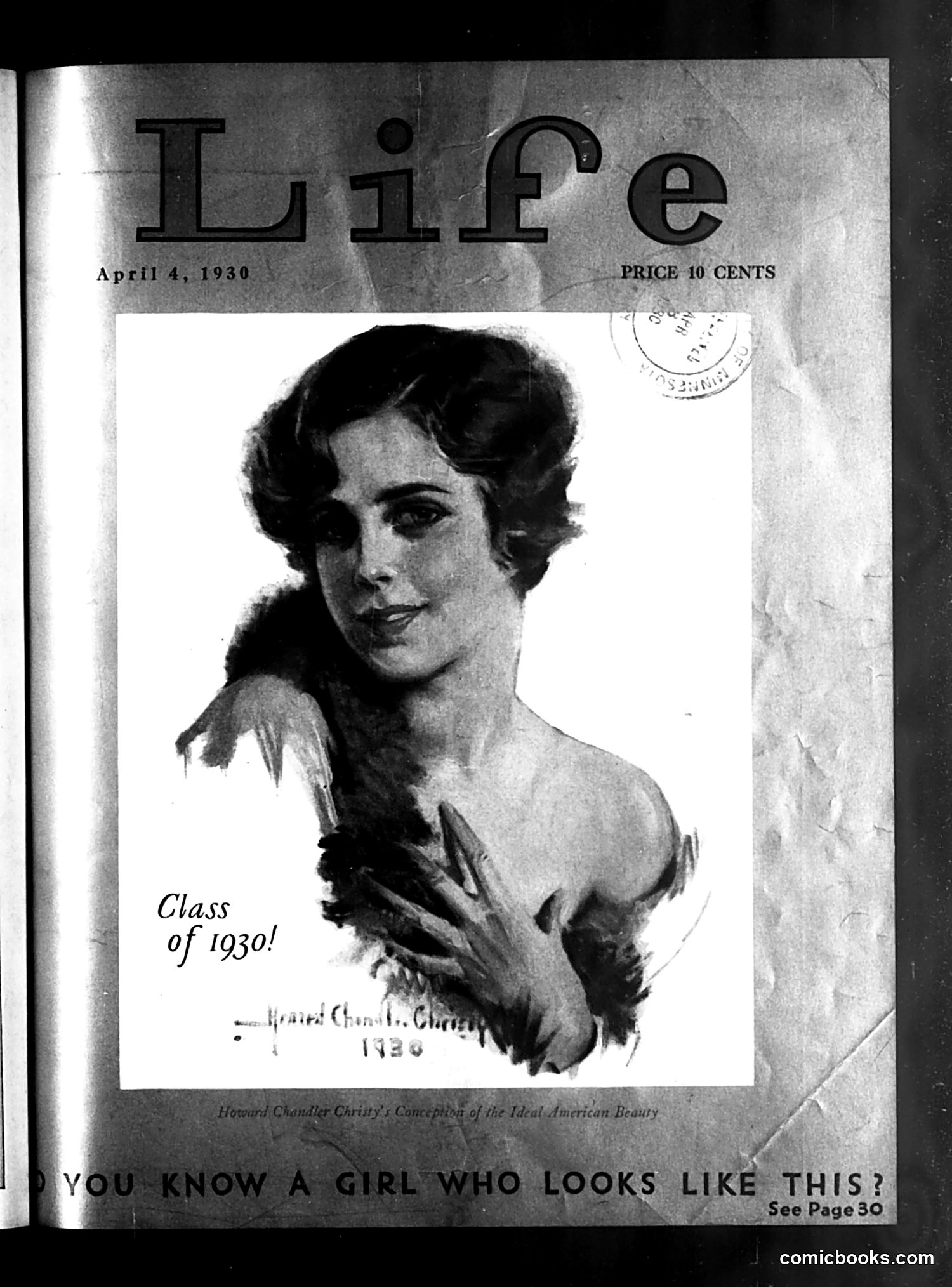
Life Magazine Cover Analysis, April 4, 1930 This is a title page/cover rather than a cartoon. It features a portrait sketch labeled "Class of 1930!" with a caption crediting "Howard Chandler Christy's Conception of the Ideal American Beauty." The interactive element—"YOU KNOW A GIRL WHO LOOKS LIKE THIS? See Page 30"—appears to be a reader-engagement gimmick typical of 1930s magazines. It likely connects to content inside about identifying or celebrating contemporary "ideal beauty" standards. The price (10 cents) and date confirm this as a genuine 1930 issue. Rather than satirical commentary, this represents Life magazine's function as a lifestyle publication promoting beauty standards and ideal femininity to its Depression-era readership.
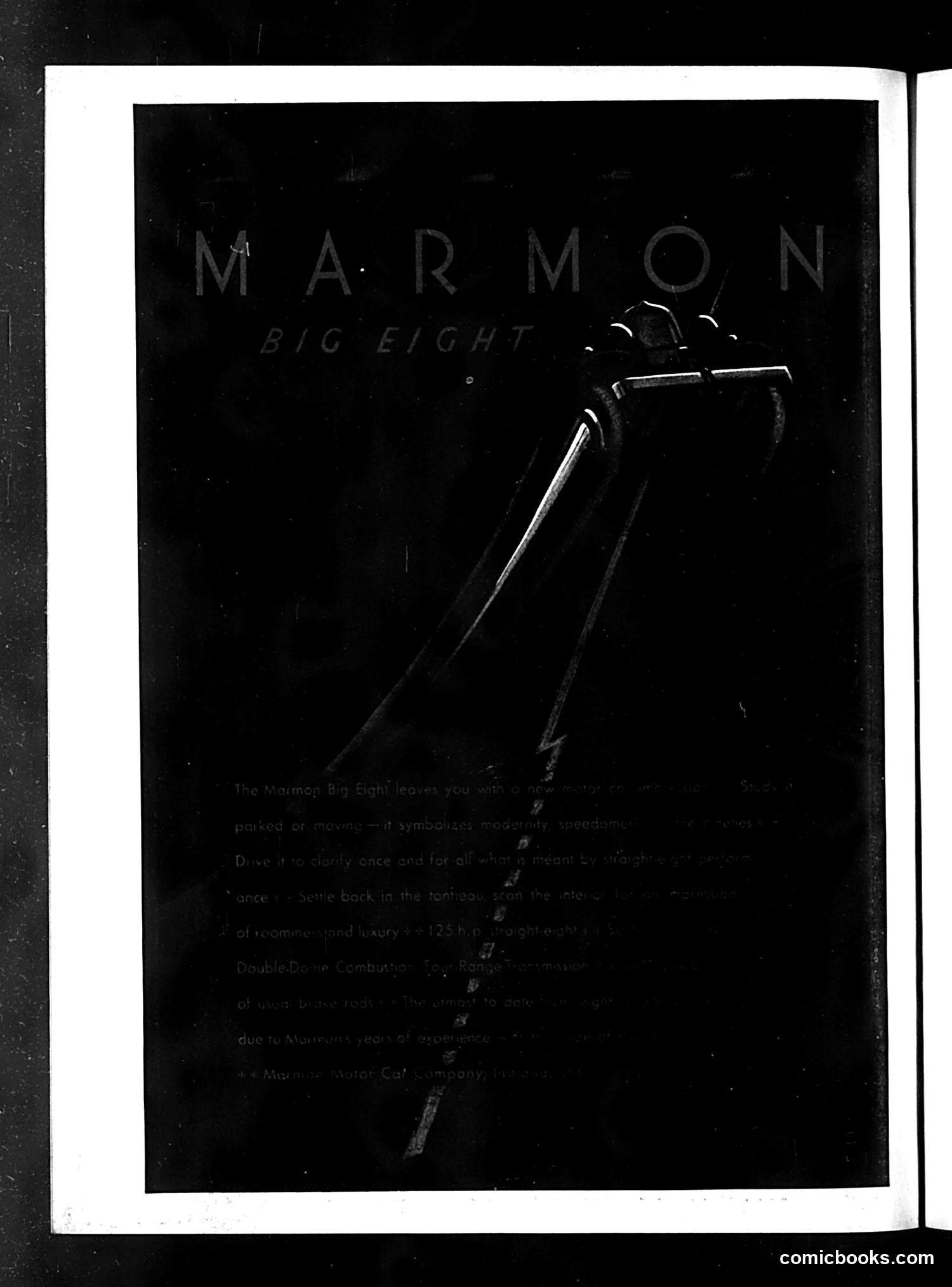
Marmon Big Eight Advertisement This is a vintage automobile advertisement for the Marmon Big Eight, a luxury car. The page features dramatic styling typical of early 20th-century advertising—a sleek, minimalist black background with the car's distinctive handlebar-style steering mechanism prominently displayed. The text (largely illegible in this reproduction) appears to emphasize the car's modern engineering, smooth operation, and luxury features. References to "DoubleDrive Combustion" and performance specifications suggest marketing appeals to affluent buyers interested in cutting-edge automotive technology. This is not political satire but rather a straightforward commercial advertisement aimed at wealthy consumers—part of Life magazine's revenue model. The sophisticated, understated design reflects the prestige positioning of Marmon automobiles in the competitive luxury market of the era.
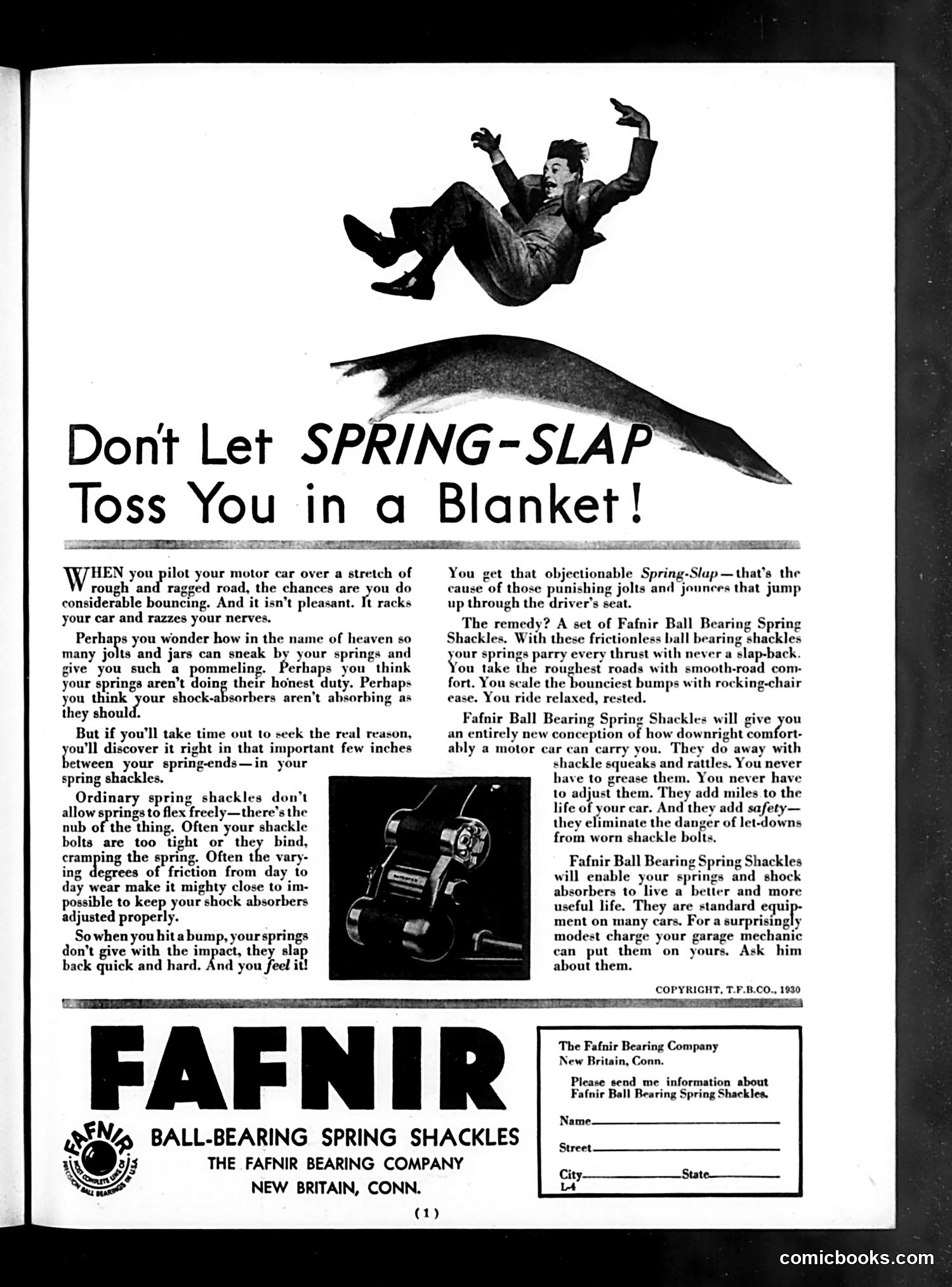
This is primarily a 1930 advertisement, not satire or political commentary. The page advertises Fafnir Ball Bearing Spring Shackles for automobiles. The cartoon illustrates the problem being solved: a man is comically thrown upward from his car seat, depicting the jarring "spring-slap" effect that occurred when driving over rough roads in early automobiles. The ad explains that ordinary spring shackles were too rigid, causing violent bouncing. Fafnir's ball-bearing design allows springs to flex freely, eliminating the punishing jolts. The humor is purely functional and domestic—showing the physical discomfort of early motoring rather than making social or political points. The exaggerated illustration of the airborne driver is meant to resonate with readers who experienced this common automotive annoyance.
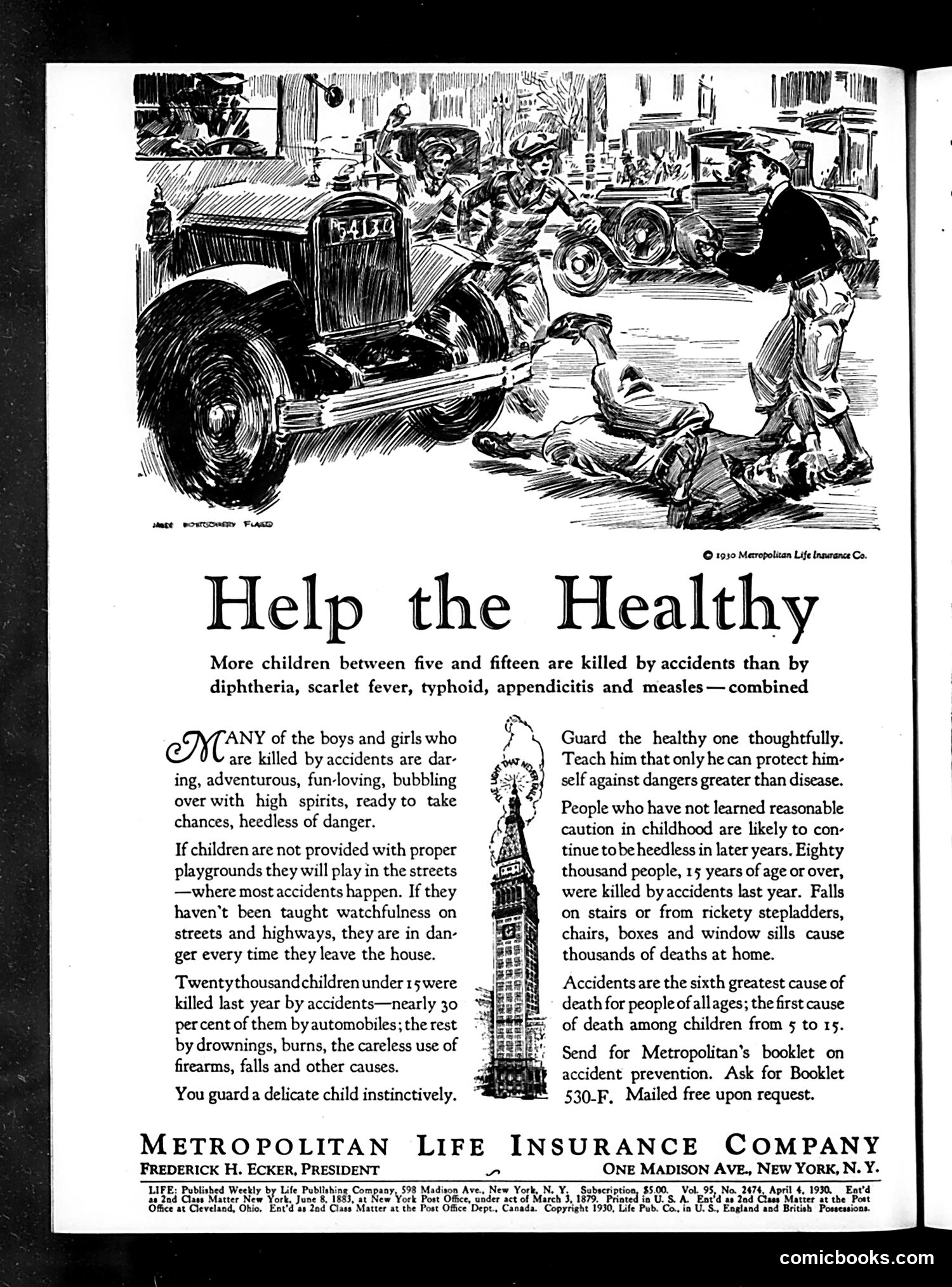
Analysis This is a public health advertisement from Metropolitan Life Insurance Company (1930), not satire or political commentary. The illustration depicts a street accident involving an automobile and children, with multiple vehicles and pedestrians in an urban setting. The accompanying text argues that accidental deaths—not diseases like diphtheria or scarlet fever—are the leading cause of death for children aged 5-15. The ad's message is straightforward: parents must teach children safety and provide proper playgrounds to prevent street accidents. It cites statistics (20,000 children under 15 killed annually) and warns that unattended children playing in streets face constant danger. This reflects early 20th-century concerns about automobile safety and urban hazards, positioning accident prevention as a serious public health priority worthy of insurance company advocacy.
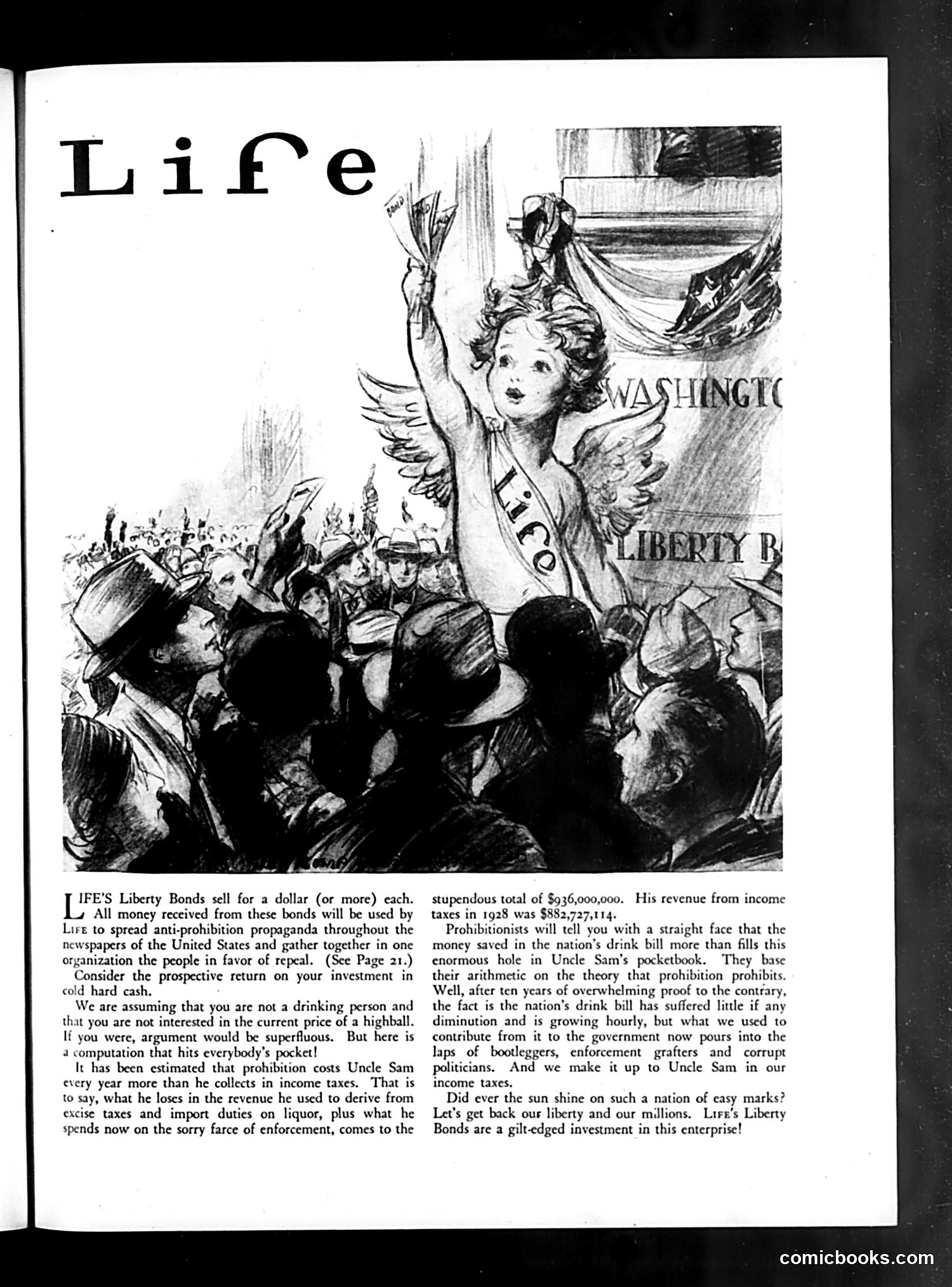
Explanation for Modern Readers This 1928 *Life* magazine page satirizes Prohibition and Liberty Bonds. The central illustration depicts an allegorical female figure (Liberty) elevated above a crowd, promoting Liberty Bonds as investments. The accompanying text argues that Prohibition costs the government enormous revenue—estimated at $316 million annually—through lost liquor taxes and enforcement expenses. The satire suggests that wealthy citizens should buy Liberty Bonds to compensate Uncle Sam for prohibition-related economic losses. The article sarcastically implies that Prohibition primarily benefits bootleggers and corrupt politicians rather than public welfare. The cartoon equates Bond investment with regaining national prosperity while acknowledging Prohibition's widespread failure to reduce drinking and its financial drain on government coffers.
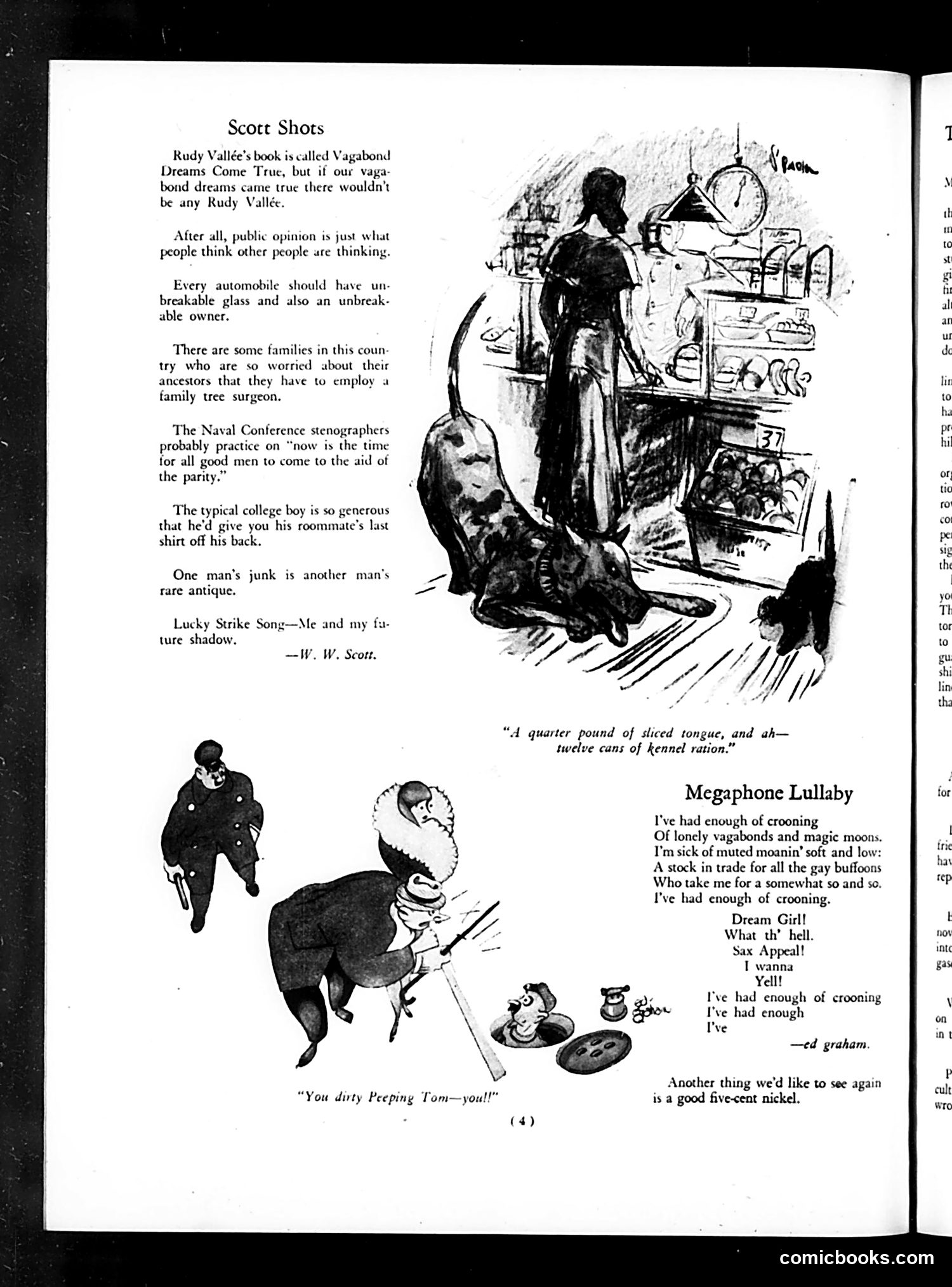
Scott Shots: Early 20th Century Humor Page This is a satirical humor page from *Life* magazine featuring several short jokes and two cartoon illustrations. The top cartoon shows a woman at what appears to be a junk shop or pawnbroker, with the caption "A quarter pound of sliced tongue, and ah—twelve cans of kennel ration"—a joke about dog food being sold alongside human food, likely commenting on the poor quality or indistinguishability of cheap provisions. The lower cartoon, captioned "You dirty Peeping Tom—you!", depicts a man, woman, and what appears to be a cat or small animal—likely a visual pun or domestic mishap joke. The "Megaphone Lullaby" section parodies popular crooning songs of the era, satirizing contemporary musical tastes and sentimental ballad culture. The jokes throughout mock modern life, automobiles, family pretensions, and social conventions typical of 1920s satire.
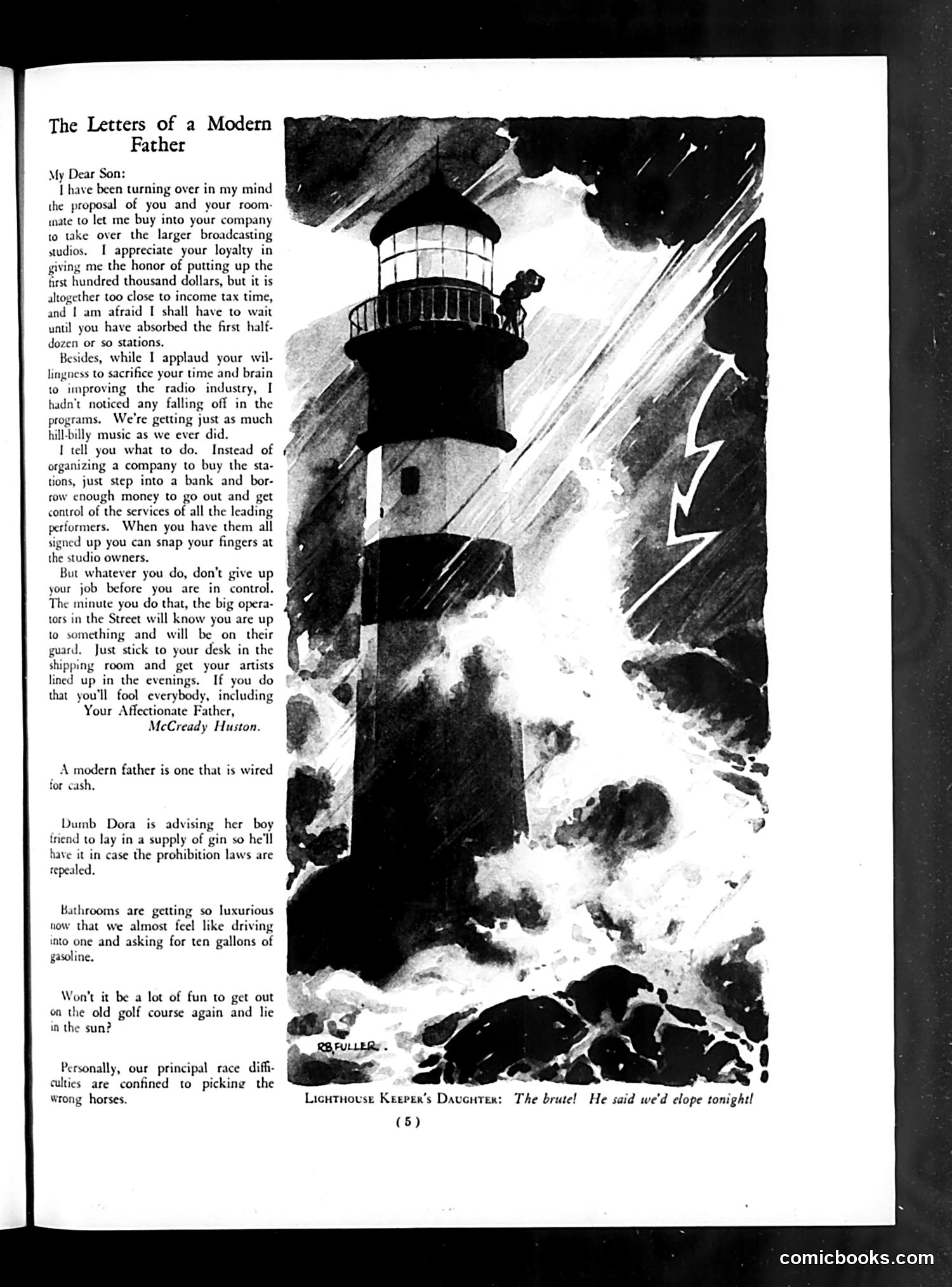
"The Letters of a Modern Father" - Life Magazine Page This page contains a satirical letter from "McCready Huston" to his son about the broadcasting industry. The father advises his son to borrow money and gain control of radio stations rather than starting from the bottom—a joke about 1920s American capitalism and the rush to control new media technology. Below are several one-liners mocking contemporary social trends: modern fathers valuing money, prohibition-era gin stockpiling, luxurious bathrooms, and golf. The illustration depicts a lighthouse keeper's daughter eloping—a melodramatic scenario captioned "The brute! He said we'd elope tonight!" This appears to be a separate satirical illustration lampooning sentimental romance narratives popular in the era. The satire targets materialism, Prohibition evasion, and the get-rich-quick mentality of the Jazz Age.
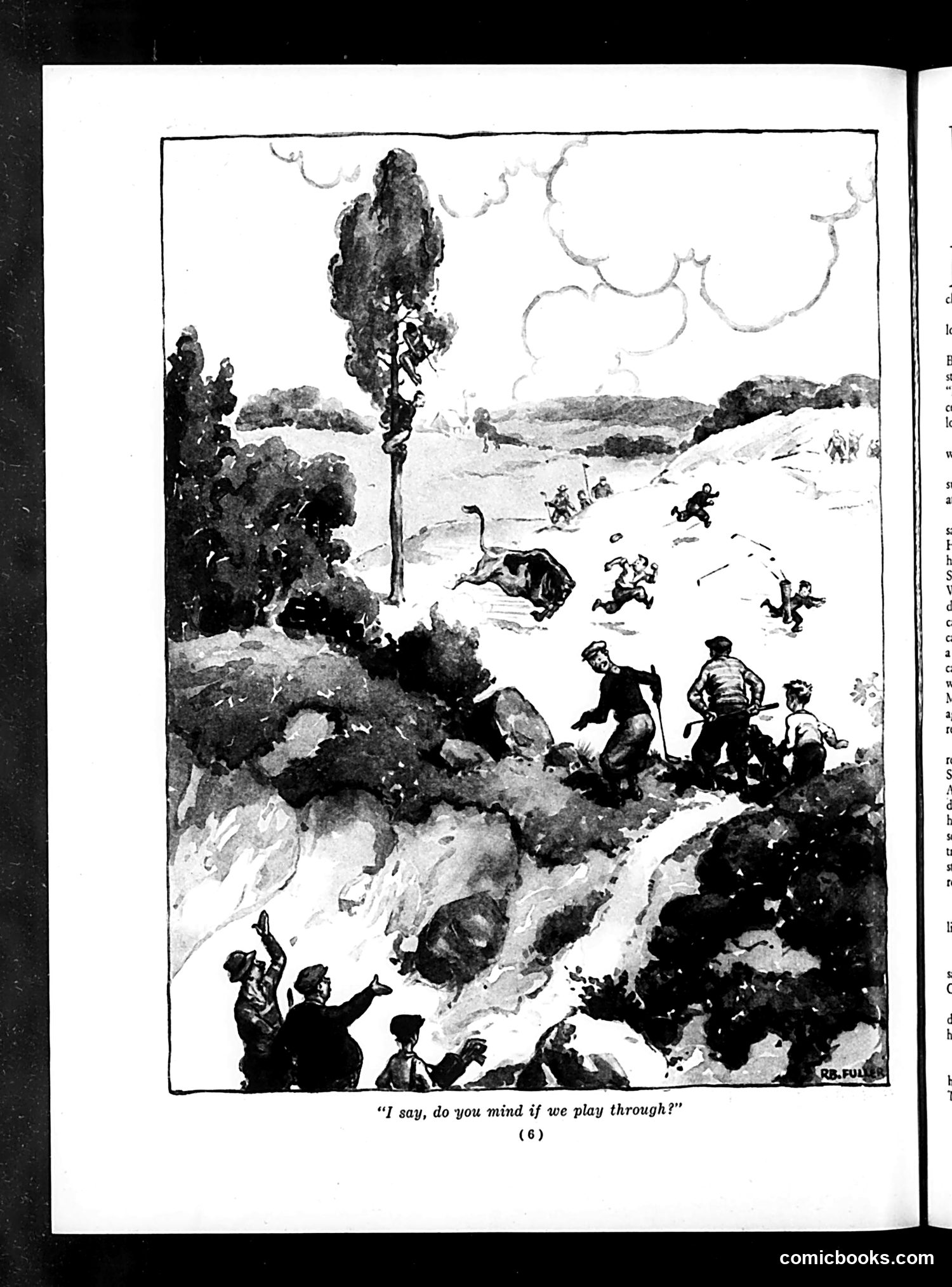
Analysis of Cartoon Page This illustration depicts a sandy landscape with numerous figures engaged in recreational activity—appearing to be children and adults playing on a beach or sandy area. The central figures in the foreground are asking "I say, do you mind if we play through?" a phrase commonly used in golf when one group requests to pass slower players ahead. The satire appears to be about crowded public recreational spaces, suggesting that even on what should be a leisurely beach or sandy area, there are so many people that one group must formally request permission to proceed past others. The joke satirizes overcrowding in public spaces and the loss of privacy or freedom in popular leisure destinations—a social commentary on congested modern recreation areas where even simple activities require negotiating around crowds.
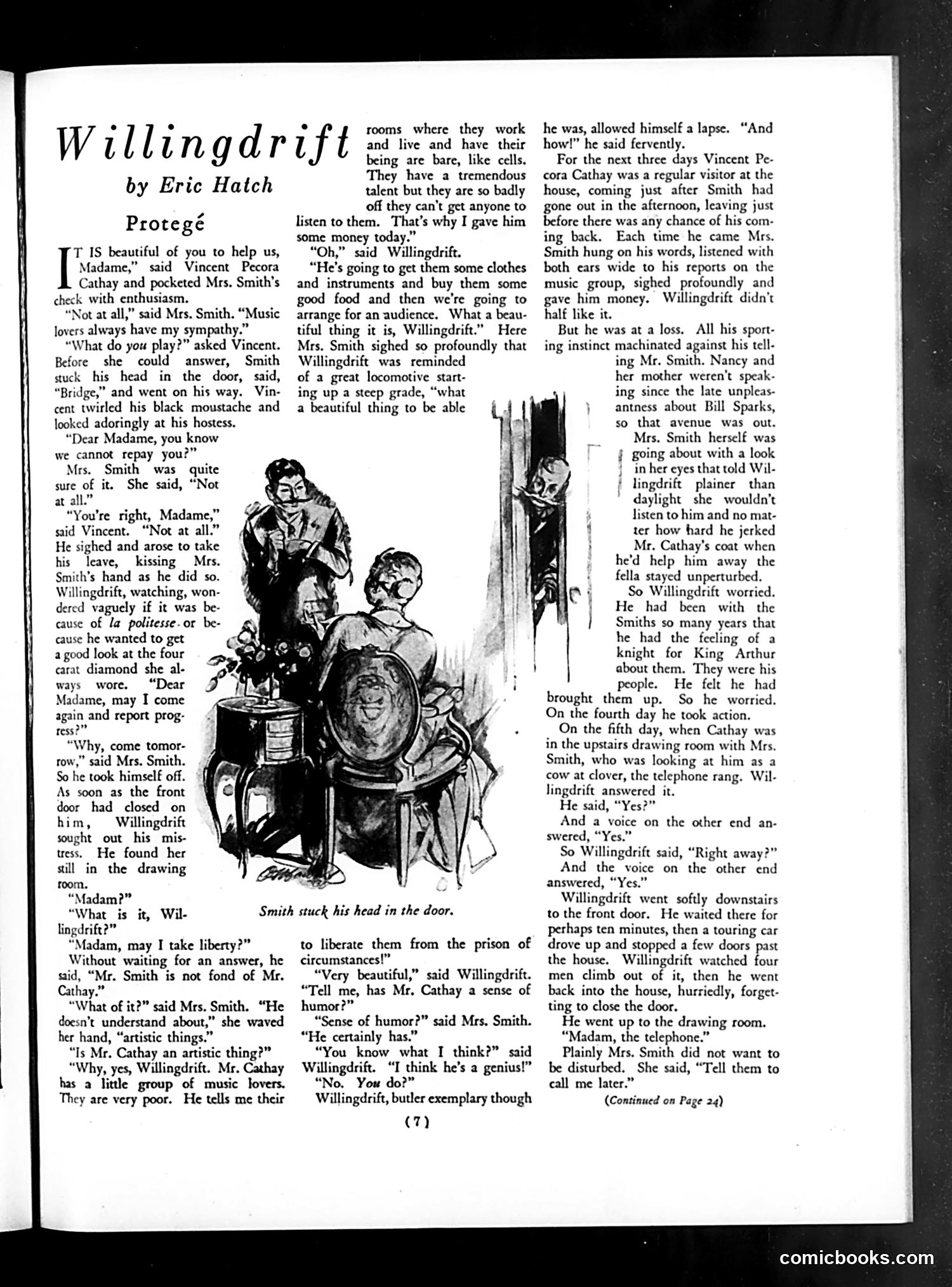
"Willingdrift" by Eric Hatch — Page Analysis This is a short story (not a political cartoon), appearing to be a humorous fiction piece about a character named Willingdrift. The illustration shows Smith "stuck his head in the door," depicting a domestic scene with multiple figures in what appears to be an interior setting. The narrative concerns Mrs. Smith's enthusiasm for helping "Madame" and Vincent Percora Cathay by providing music lessons and instruments to his struggling group. The story explores themes of artistic patronage and social obligation. Willingdrift, apparently the household's character of interest, serves as the vehicle for examining 1920s-era attitudes toward bohemian artists and domestic service. Without additional context about the original publication date or Cathay's identity, the specific satirical targets remain unclear.
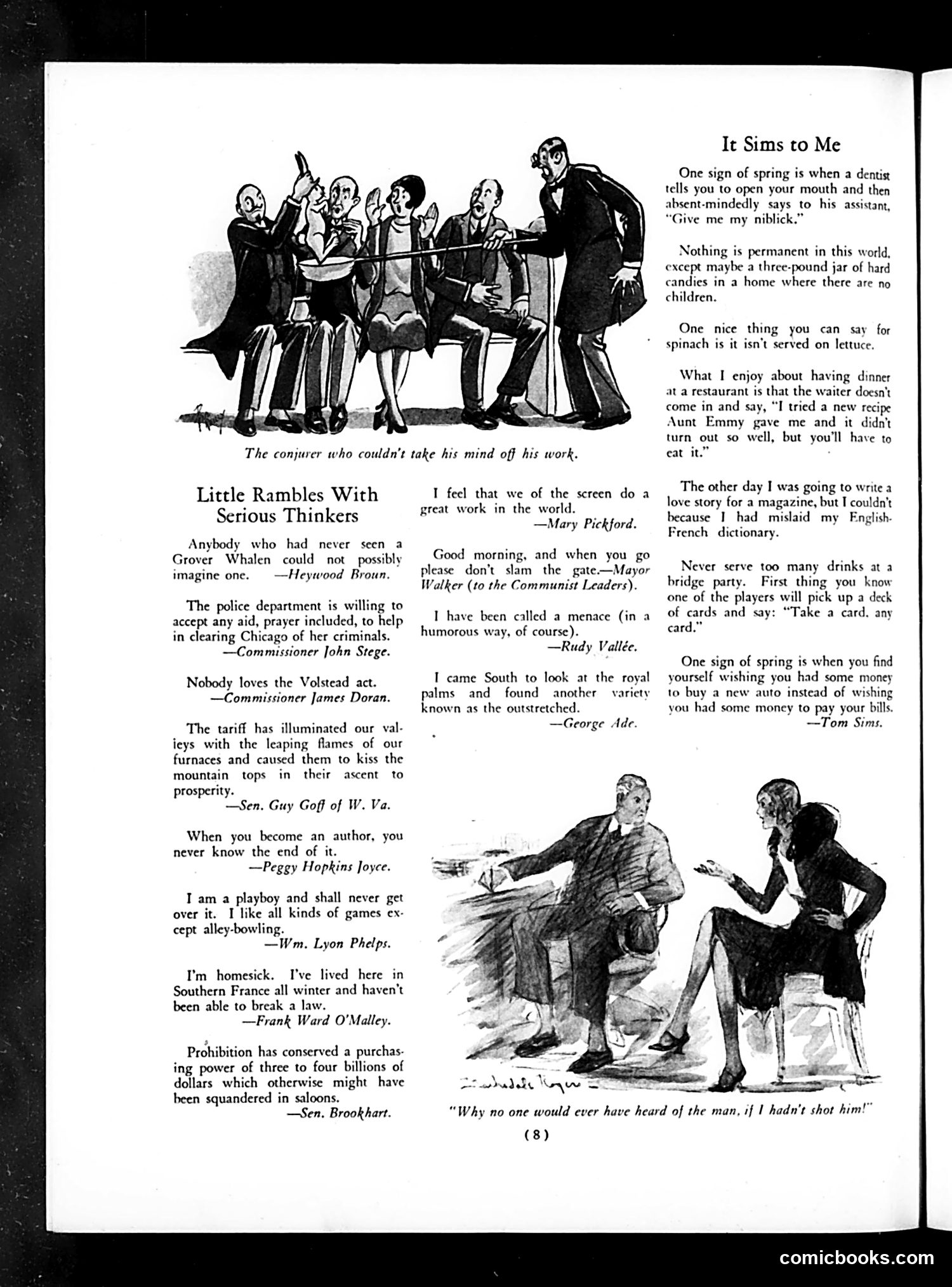
Analysis of Life Magazine Page Top Cartoon: Shows five men in formal dress gathered around a conjurer performing magic, with the caption "The conjurer who couldn't take his mind off his work." This appears to be satirizing absent-minded professionals—likely a magician or performer so obsessed with his craft that he remains mentally engaged with work even in social settings. "It Sims to Me" Column: A humorous essay offering observations on everyday life, including commentary on dentists, spinach preparation, restaurant service, and prohibition-era observations. The writing style is light satire on modern domestic customs. Bottom Cartoon: Shows a man and woman in conversation with dialogue: "Why no one would ever have heard of the man, if I hadn't shot him!" This appears to satirize how notoriety or fame sometimes derives from violence or scandal rather than merit.
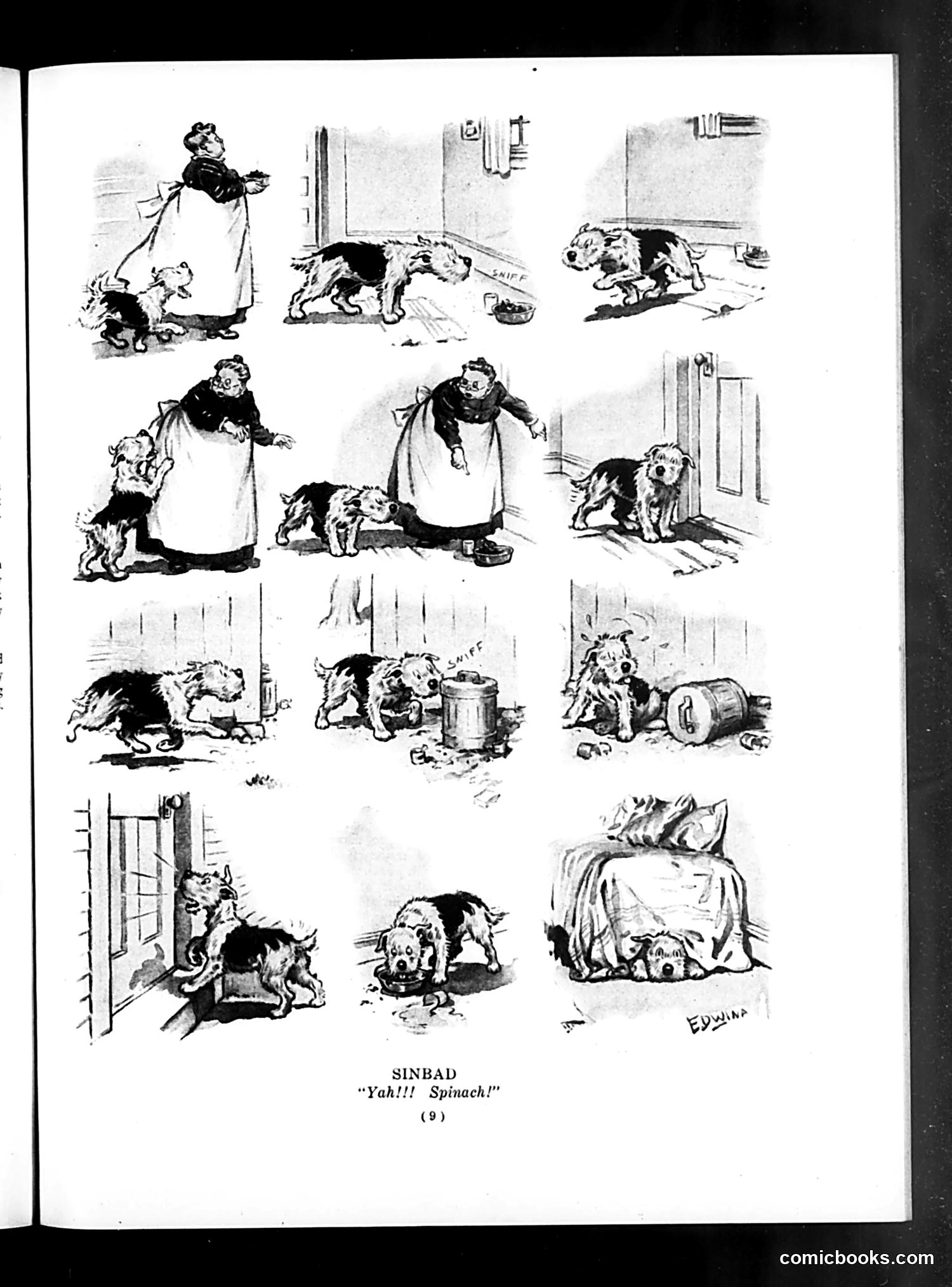
Sinbad "Yah!!! Spinach!" This is a humorous comic strip sequence titled "Sinbad" that appears to parody the famous sailor character. The strip shows a domestic scene with what looks like an elderly woman (possibly a caretaker or landlady) and a dog repeatedly interacting around food and household items. The joke plays on the exclamation "Yah!!! Spinach!" — likely referencing Popeye the Sailor Man, the cartoon character famous for gaining superhuman strength from eating spinach. Here, the satire seems to mock both the Sinbad legend and contemporary comic strip tropes by showing mundane, comedic interactions rather than adventurous heroics. The numbered page "(9)" suggests this is part of a larger serialized work in *Life* magazine's satirical humor section.
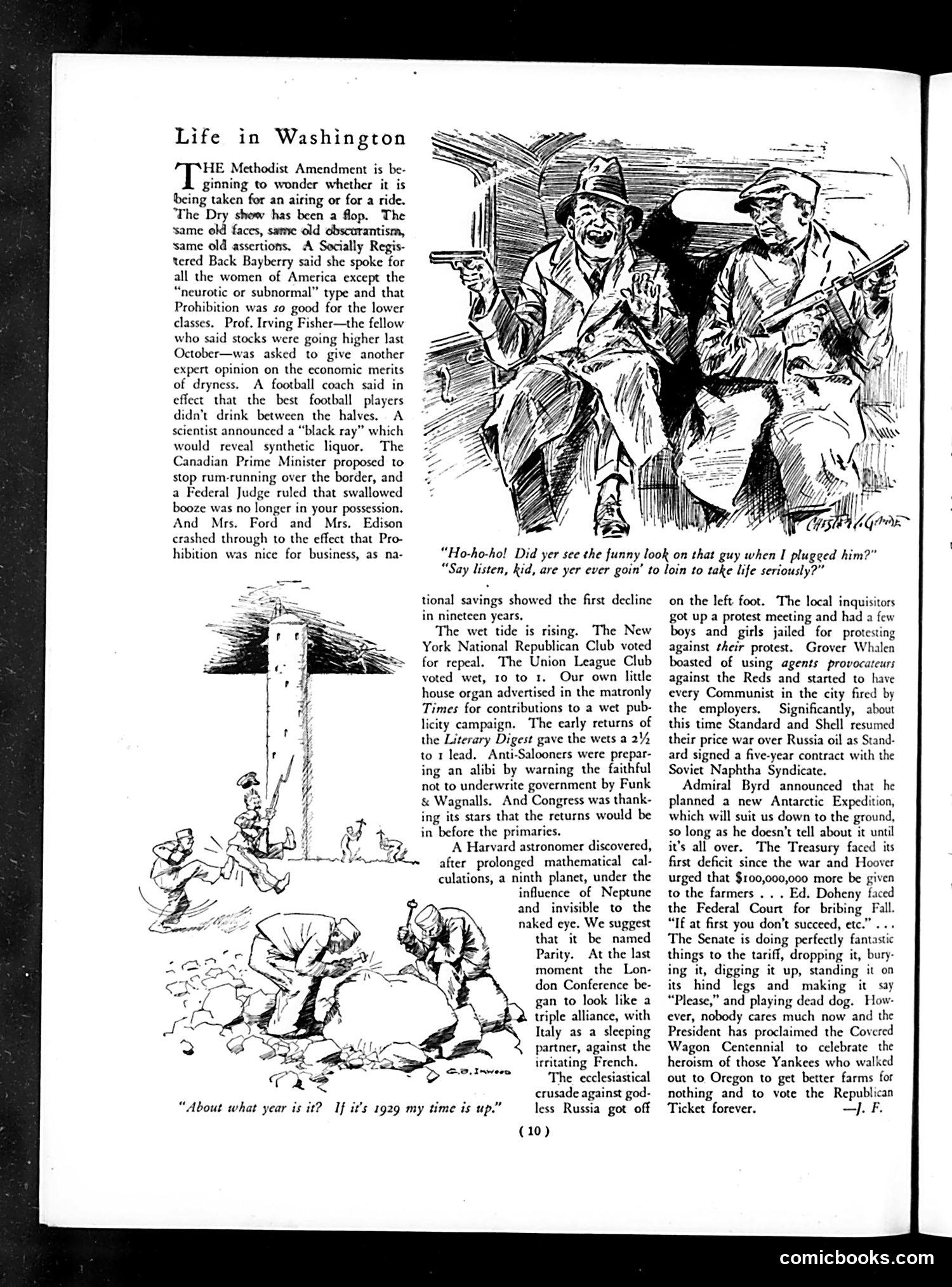
Political Satire: "Life in Washington" (Page 10) This page satirizes Prohibition-era Washington politics through two cartoons and accompanying commentary. Top cartoon: Two men in hats discuss another man's appearance after apparently being struck. The caption jokes about "the funny look" and taking life seriously—likely mocking political violence or heated disputes during Prohibition debates. Bottom cartoon: Figures appear to be digging or scavenging, with the caption "About what year is it? If it's 1929 my time is up"—referencing someone's prison sentence or legal sentence ending in 1929. The text discusses the Methodist Amendment, Prohibition's effects on the lower classes, and various political reactions including discussions of "wet" versus "dry" positions. References to Russian communism, Admiral Byrd's Antarctic expedition, and Senate debates situate this as early-1920s American political commentary on Prohibition's enforcement and social consequences.
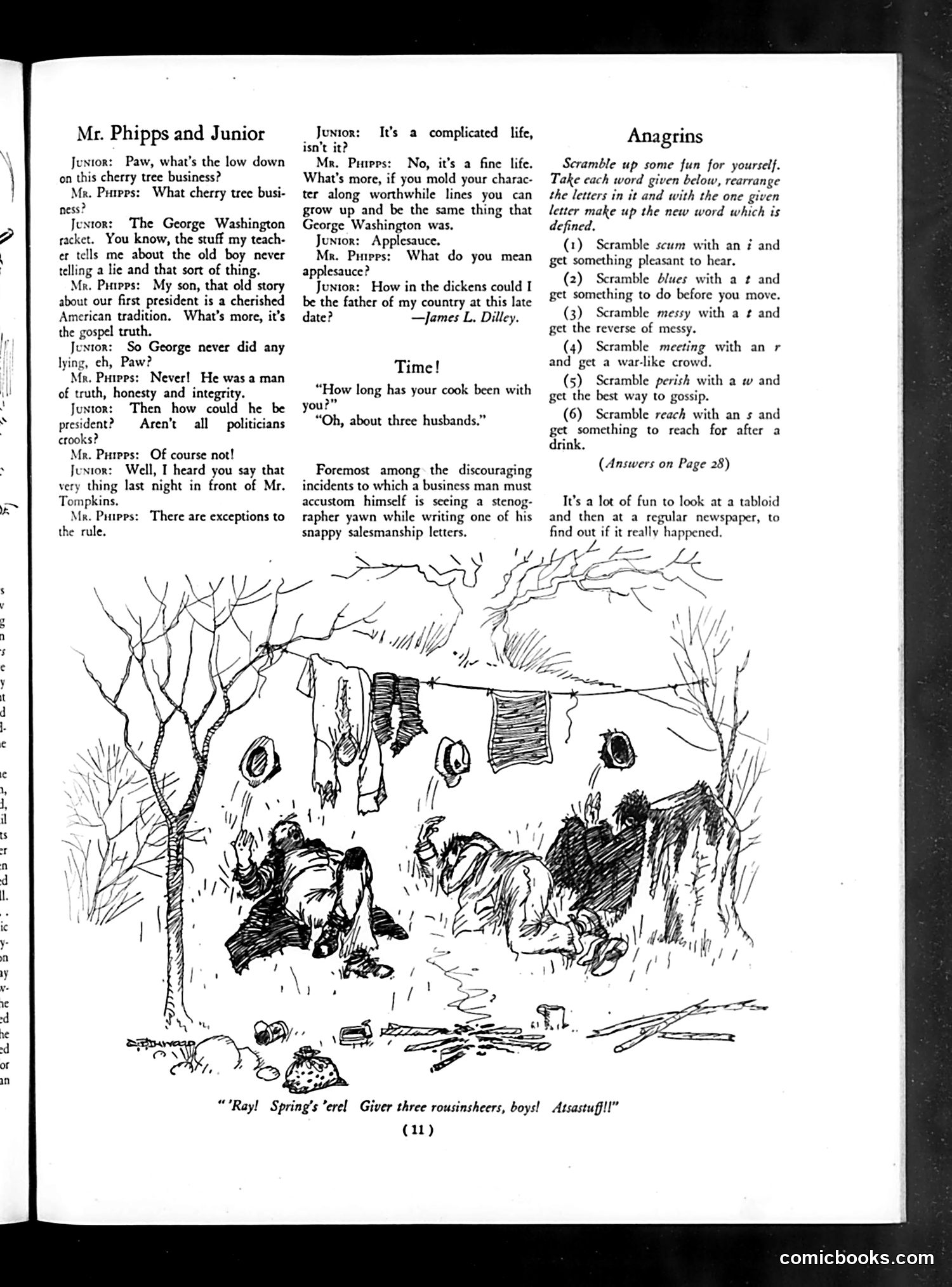
Analysis of Life Magazine Page This page contains a humorous dialogue between "Mr. Phipps and Junior" satirizing American civic mythology. Junior questions whether George Washington actually never lied, citing the "cherry tree" anecdote as suspect. Ms. Phipps defends Washington's honesty while acknowledging politicians generally lack integrity—a contradiction Junior points out. The exchange mocks the uncritical acceptance of patriotic legends taught to children. The bottom illustration depicts vagrants or hobos doing laundry by a river, with the caption "Ray! Spring's 'ere! Giver three roosters, boys! Atasaugh!" This appears to satirize Depression-era poverty and working-class hardship through crude humor about desperate men. The "Anagrins" word puzzle section is unrelated filler content.
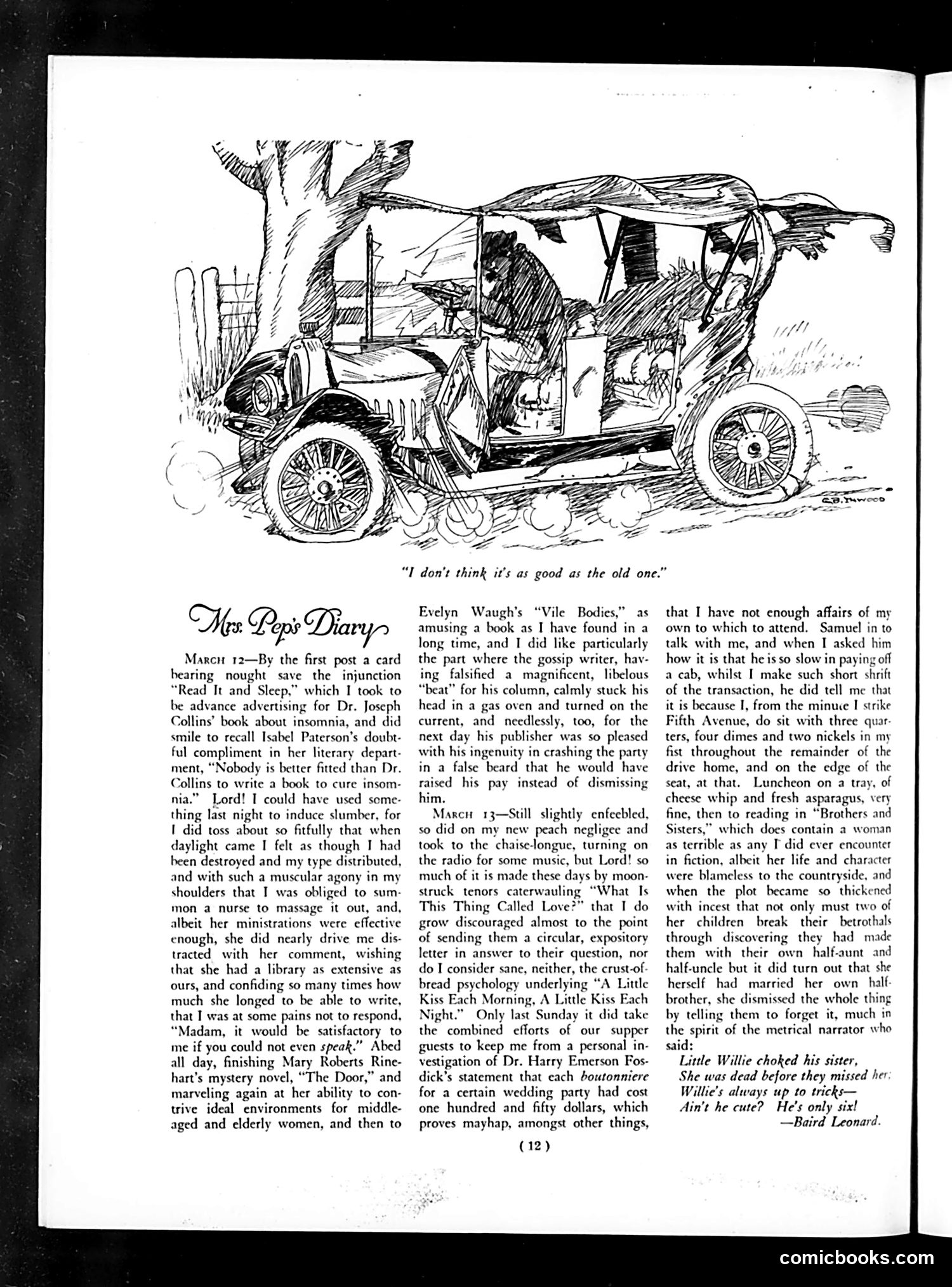
Political Context Analysis The cartoon illustrates a woman's complaint: "I don't think it's as good as the old one," referring to a decrepit automobile. The image satirizes the rapid technological change and obsolescence of early automobiles—a contemporary concern when car models changed frequently and older vehicles became unreliable quickly. The accompanying "Mrs. Pope's Diary" column discusses Evelyn Waugh's book "Vile Bodies" and various social observations about marriage, gossip, and modern literature. The diary format was a common satirical device in Life magazine for commentary on contemporary manners and morality. The overall page mocks both automotive progress and modern social pretensions, characteristic of Life's satirical approach to American and international culture during this era.
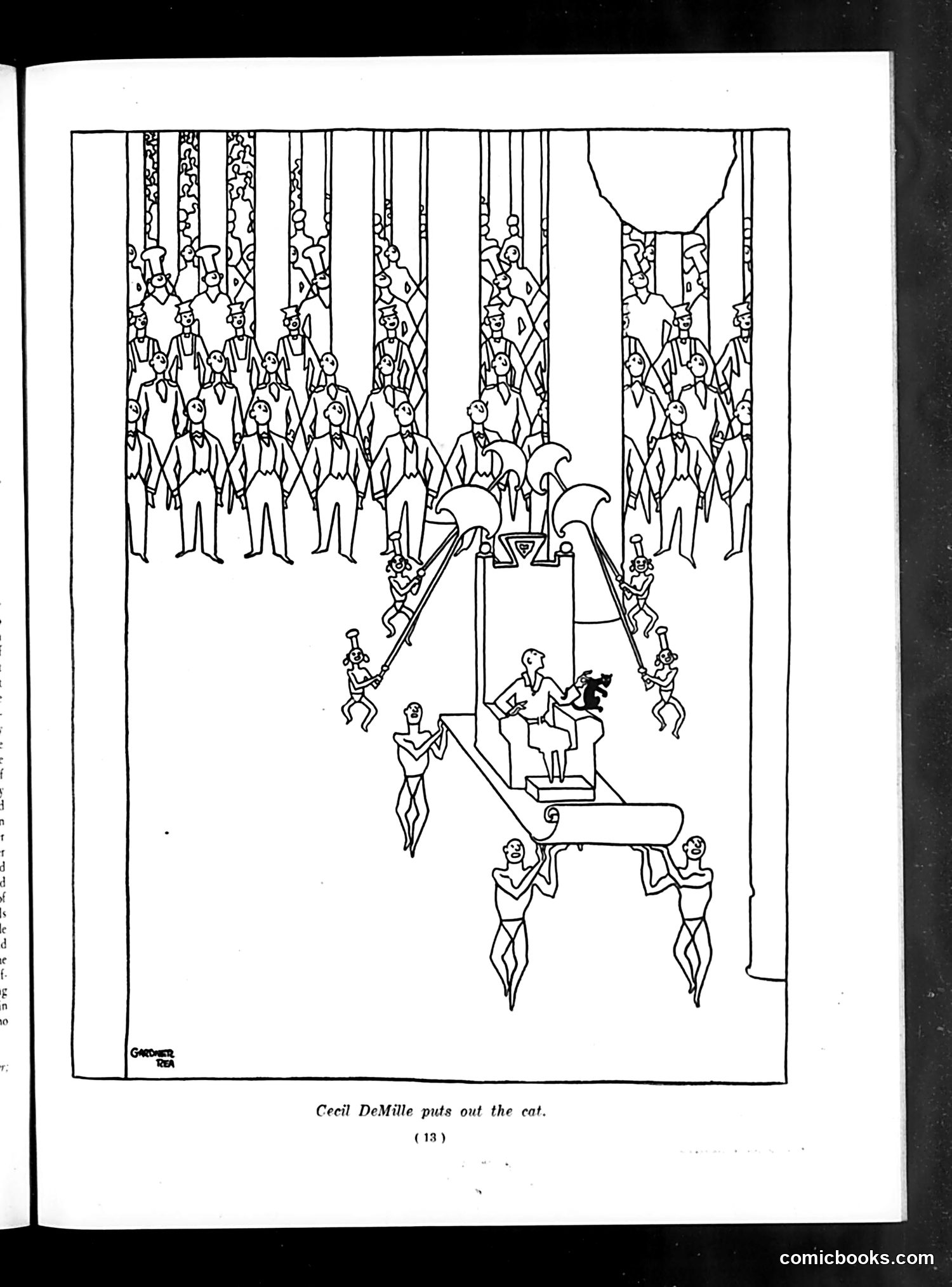
Analysis of "Cecil DeMille puts out the cat" This is a satirical cartoon about Cecil B. DeMille, the famous film director known for his elaborate, large-scale productions. The image depicts DeMille (shown on an elevated platform in the center) literally "putting out the cat" — ejecting a black cat from what appears to be a theatrical or film set. The joke plays on DeMille's reputation for grandiose, expensive productions with massive crowds and elaborate staging (shown here with columns, numerous extras, and theatrical props). The humor comes from reducing his dramatic directorial style to the mundane domestic act of removing a cat from one's home — treating a trivial action as though it were an elaborate Cecil B. DeMille production spectacle.
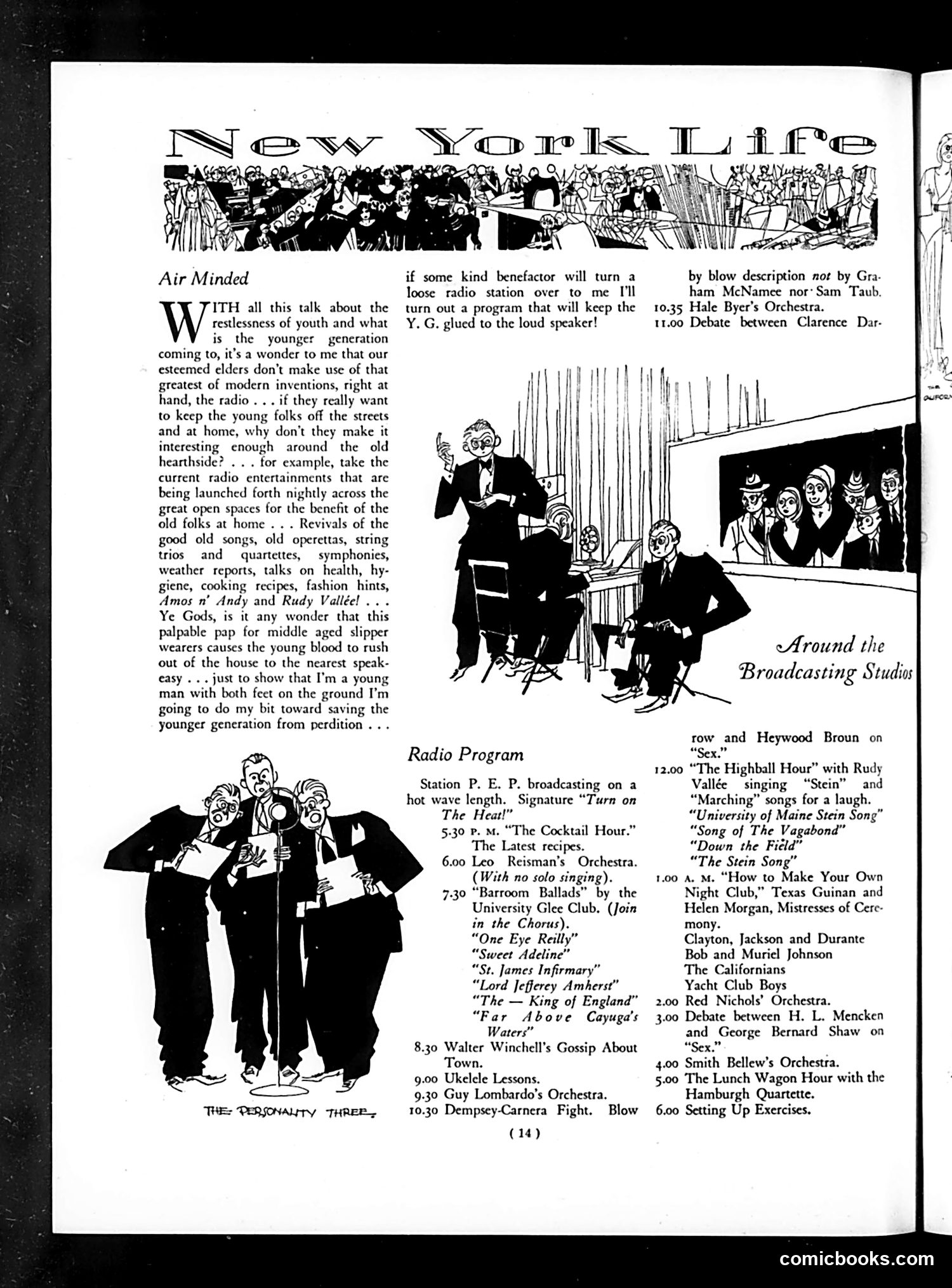
Page Analysis: "Air Minded" and Radio Programming This is a satirical article criticizing radio programming choices. The author argues that broadcasters, despite claiming to serve "youth and the younger generation," actually fill airtime with content aimed at elderly listeners—old songs, operettas, and domestic advice shows. The cartoon illustrates the disconnect: an elderly conductor gestures dramatically while young people peer through a window, excluded from the broadcast. The "Radio Program" schedule lists actual 1920s-30s shows featuring ukulele lessons, orchestras, and domestic instruction—supporting the author's point that radio content skews old-fashioned rather than youth-oriented. The satire suggests broadcasters pay lip service to engaging younger audiences while actually catering to older demographics, leaving young listeners wanting more modern entertainment.
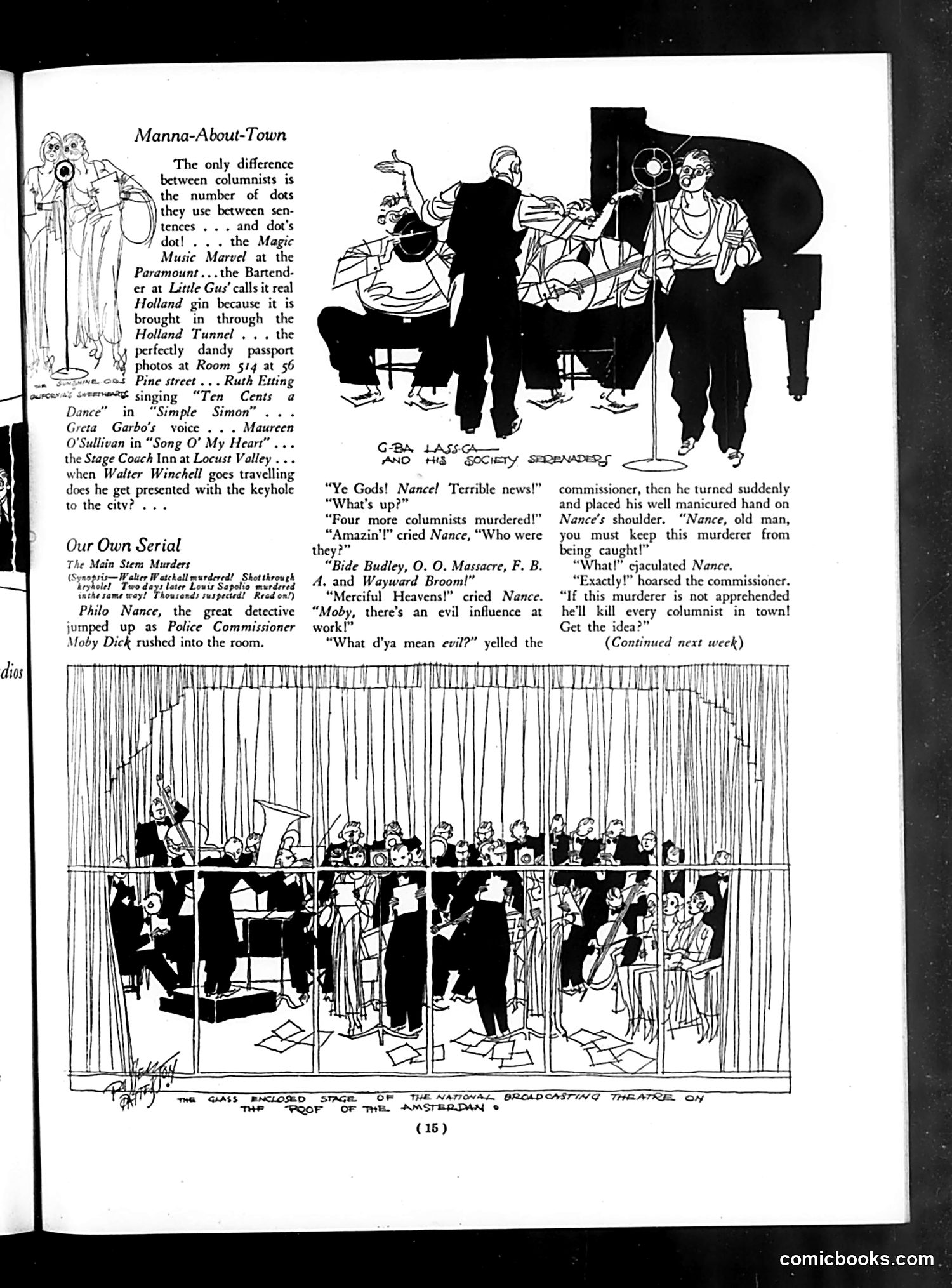
Analysis of Life Magazine Page This page contains entertainment gossip and a serialized murder mystery called "The Main Stem Murders." The top section ("Manna-About-Town") discusses Broadway entertainers and films, including references to Greta Garbo and various stage productions. The main narrative feature is "Our Own Serial," which presents a dramatic scene: Police Commissioner Moby Dick has arrived to investigate murdered newspaper columnists. A character named Nance delivers urgent news about the deaths, suggesting "evil influence at work." The commissioner responds with determination to catch the murderer. The bottom illustration depicts the National Broadcasting Theatre's orchestra performing on stage, showing the glass-enclosed stage of the Amsterdam Theatre with musicians and audience members visible. This appears to be light entertainment journalism typical of 1920s Life magazine—mixing celebrity gossip with serialized fiction.
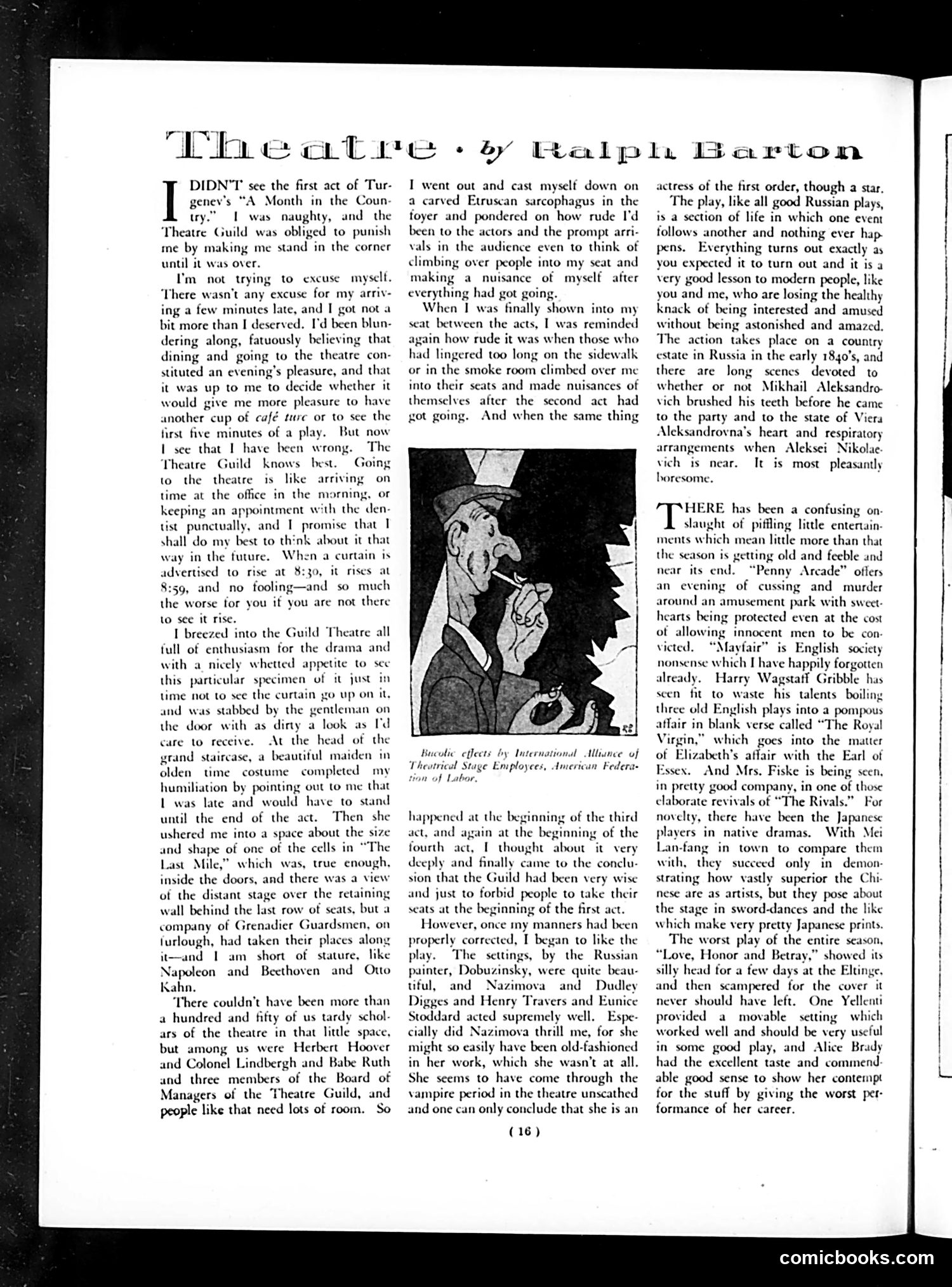
Analysis of "Theatre" by Ralph Barton This page contains Ralph Barton's theater review essay with an accompanying caricature. The cartoon depicts a grotesque theatrical figure—likely representing an exaggerated stage character or actor type—in an unflattering, satirical style typical of Barton's work. The essay critiques Turgenev's "A Month in the Country" at the Theatre Guild, where the author was punished for standing in a corner. Barton humorously discusses his theater-going experience and reviews several contemporary productions, including Russian plays and English society pieces. The caricature exemplifies Barton's sharp satirical approach to theatrical subjects, using exaggeration and grotesque features to comment on acting styles or theatrical personalities of the era.
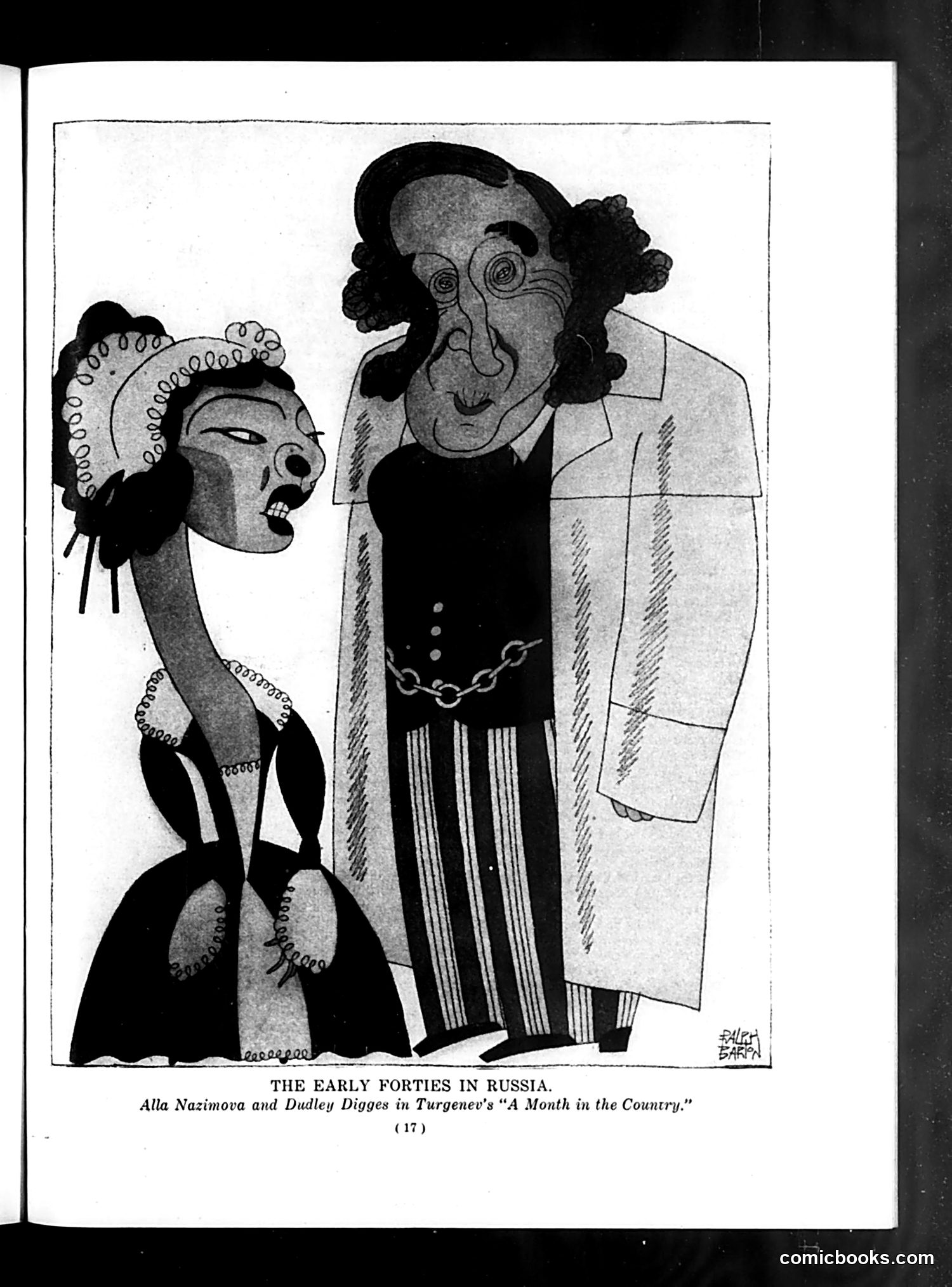
"The Early Forties in Russia" This satirical illustration depicts two figures from Sergei Turgenyev's theatrical work "A Month in the Country." The caption identifies them as Alla Nazimova and Dudley Digges, likely performers in this production. The exaggerated caricatures employ grotesque facial features—spiraling eyes, elongated noses, and distorted proportions—typical of early 20th-century satirical cartooning. The woman wears elaborate period costume with decorative headpiece; the man displays an oversized nose and theatrical expression. The satire appears to mock either the actors' performances, the Russian literary work itself, or perhaps the affectations of theatrical interpretation during this era. Without additional context about the specific production or critical reception, the precise satirical target remains unclear, though the grotesque treatment suggests ridicule of affected or exaggerated theatrical style.
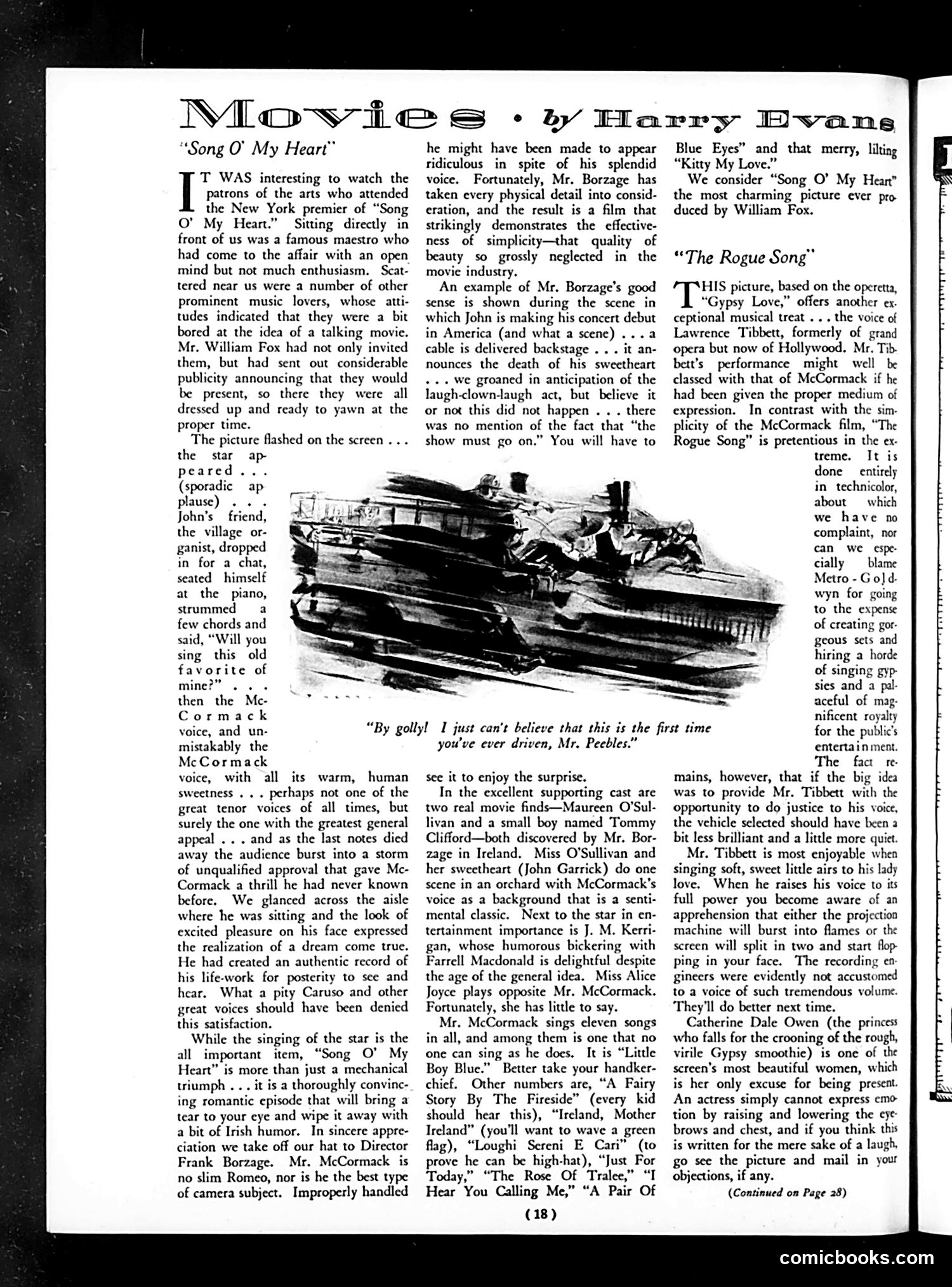
"Song O' My Heart" - Movie Review This page reviews a 1930 Fox film starring Irish tenor John McCormack in his acting debut. The accompanying sketch depicts a car accident, illustrating a scene from the movie where McCormack's character announces his sweetheart's death. The reviewer praises McCormack's authentic operatic voice and natural screen presence, noting his eleven songs performed throughout. However, the critic gently mocks the film's melodramatic plot—typical of early talkie romantic vehicles—while commending supporting actors like Maureen O'Sullivan. The reviewer also critiques "The Rogue Song," another musical film, for its technical pretension and poor casting of Lawrence Tibett, suggesting Metro-Goldwyn-Mayer overspent on elaborate sets rather than ensuring quality performances.
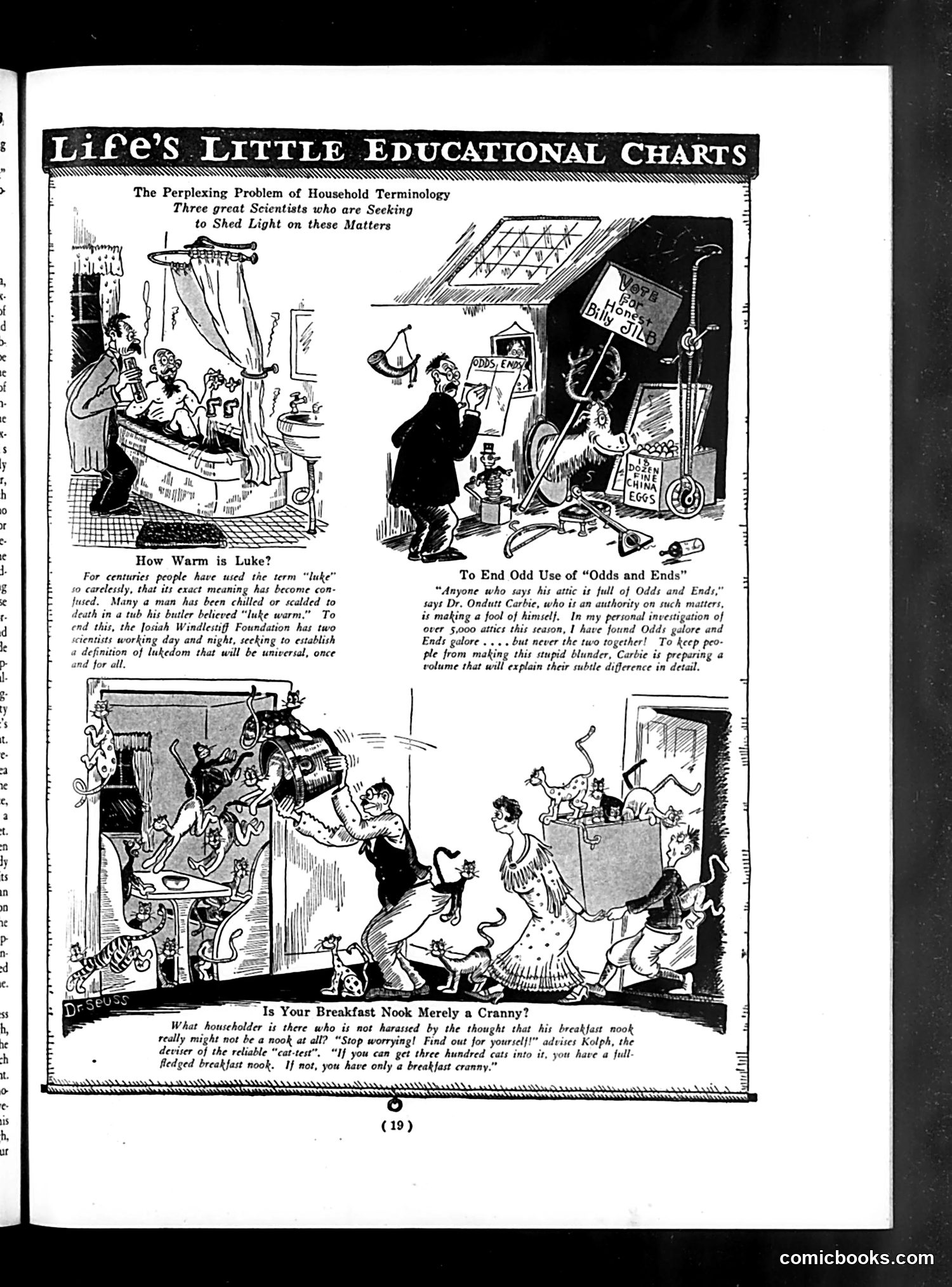
Life's Little Educational Charts: Household Terminology Satire This page satirizes pseudo-scientific "expert" culture by mocking obsessive definitional precision about everyday household terms. Three invented "scientists"—Dr. Windlestiff, Dr. Ondutt Carbie, and Kolph—conduct absurd investigations into meaningless distinctions: - "How Warm is Luke?" ridicules the vagueness of "lukewarm" by imagining serious research to establish universal definition, despite the term's practical clarity. - "Odds and Ends" mocks literal-minded pedantry: Carbie claims "odds" and "ends" never actually appear together in attics, only separately—a silly parsing of common usage. - "Breakfast Nook vs. Cranny" parodies pseudoscientific testing by proposing a nonsensical cat-counting method to distinguish furniture. The cartoon targets 1920s-era obsession with expert authority and the inflation of trivial domestic matters into scientific problems. The humor lies in treating colloquial language with absurdly rigorous academic methodology.
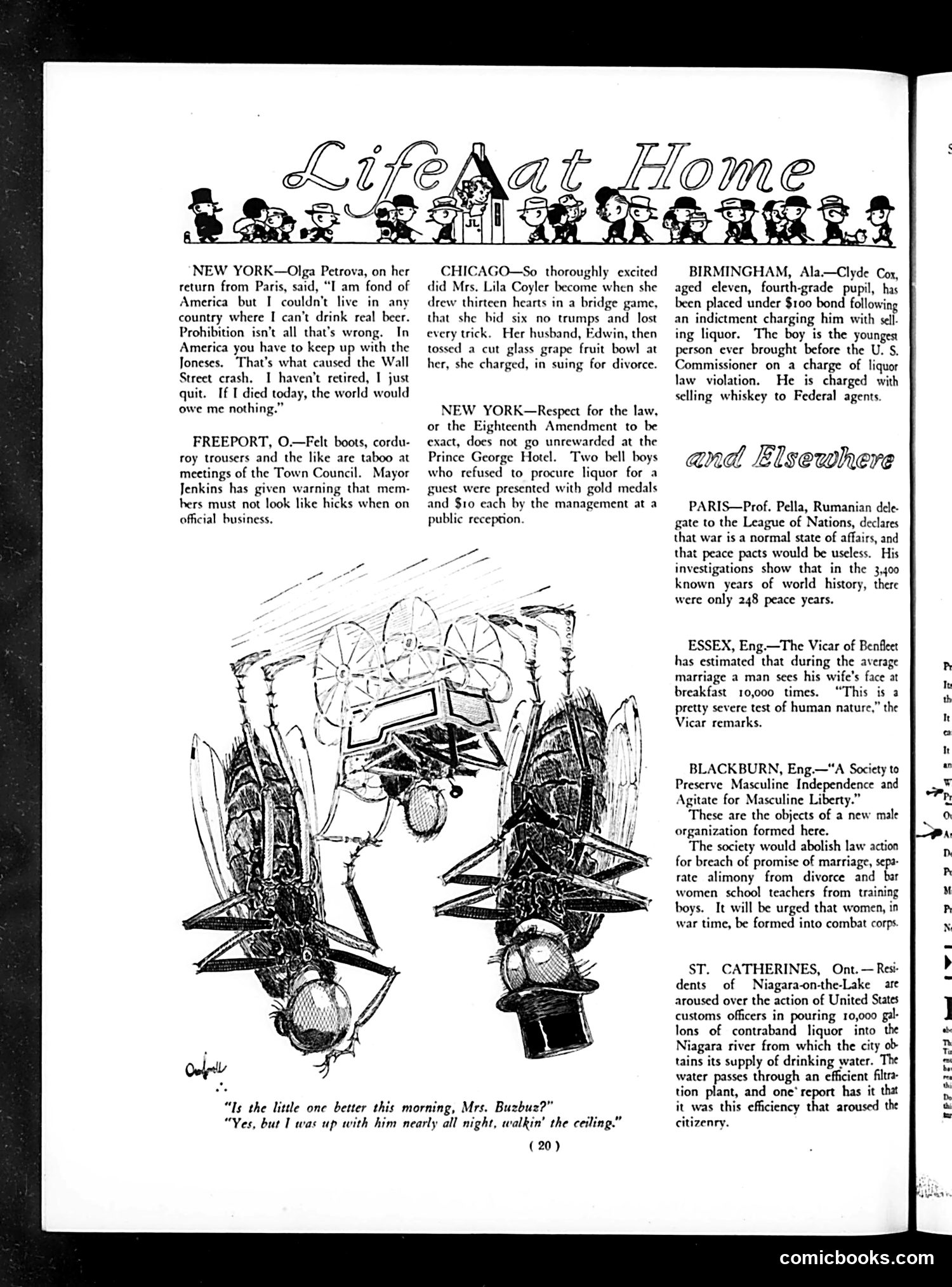
"Life at Home and Elsewhere" - Prohibition-Era Satire This page satirizes 1920s American life under Prohibition and contemporary social anxieties. The main cartoon depicts a man suspended from the ceiling—the caption's joke about "walkin' the ceiling" (staying up all night with a sick child) visualizes the idiom literally, showing domestic exhaustion. The surrounding brief items mock Prohibition's contradictions: actress Olga Petrova criticizes American drink laws; bell boys receive medals for *refusing* liquor (inverting normal morality); an 11-year-old faces charges for selling whiskey to federal agents (absurd enforcement); and U.S. customs officers dump seized liquor into Canada's water supply, which the town's efficient filtration ironically makes potable. Additional snippets target marriage discord, masculine anxiety (a "men's rights" group forming), and League of Nations pessimism. The tone is sardonic about enforcement inconsistencies, personal liberty restrictions, and social chaos following the 1929 crash.
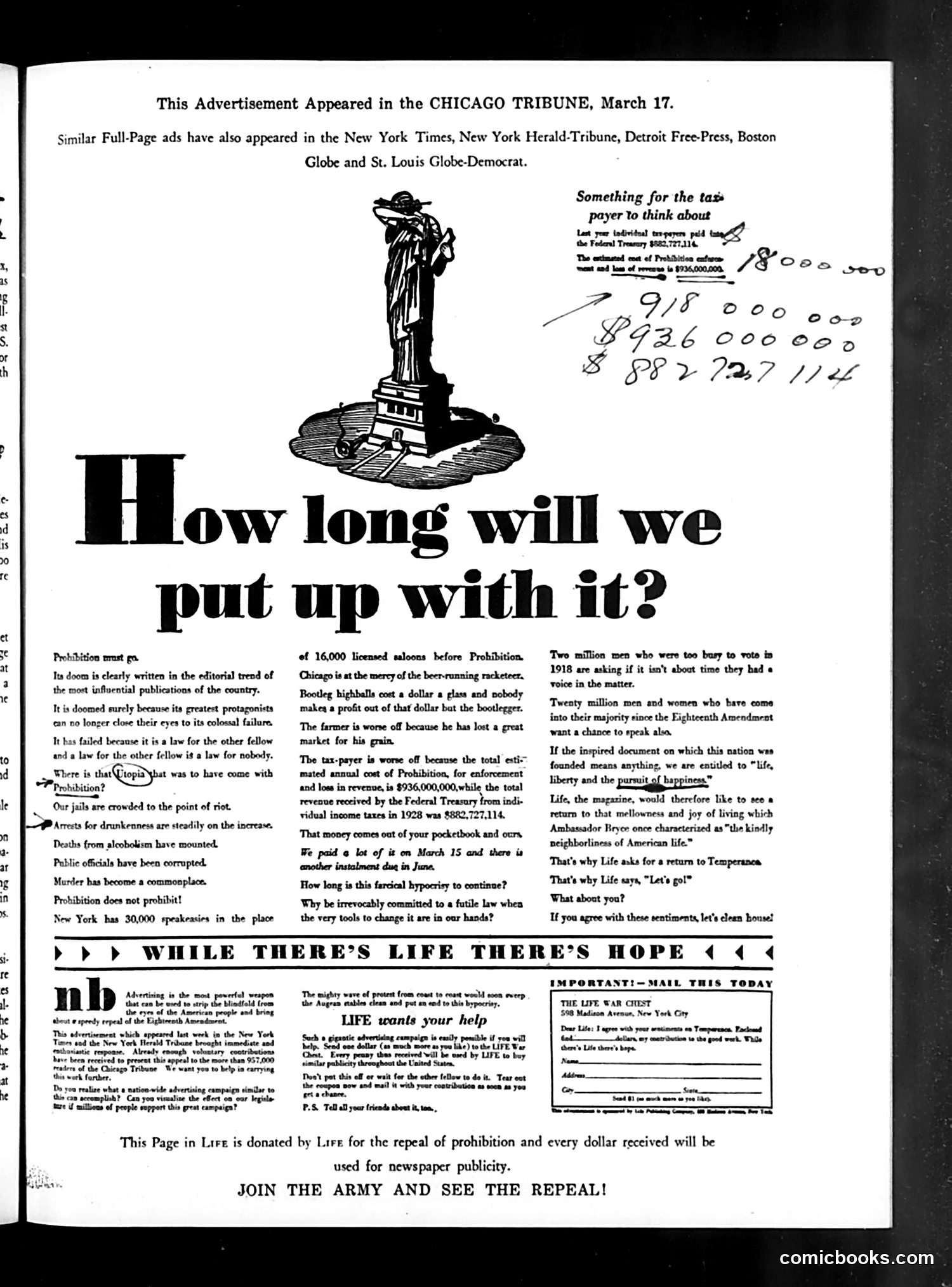
Analysis for Modern Readers This 1931 Life magazine advertisement campaigns for repeal of Prohibition—the constitutional ban on alcohol (1920-1933). The central image shows the Statue of Liberty appearing damaged or compromised, symbolizing that Prohibition violates American ideals of freedom. The satire's points: The ad presents economic and social arguments: Prohibition costs taxpayers $936 million annually in enforcement and lost tax revenue, yet fails to prevent drinking. Instead, it has created 30,000 illegal speakeasies in New York (versus 16,000 legal pre-Prohibition saloons), empowered organized crime bootleggers, corrupted officials, and increased arrests and deaths. The rhetorical question "How long will we put up with it?" frames Prohibition as a failed, hypocritical law that contradicts American values of "life, liberty and the pursuit of happiness." Context: This reflects the growing anti-Prohibition consensus among educated elites and publishers by the early 1930s—Prohibition would be repealed in 1933.
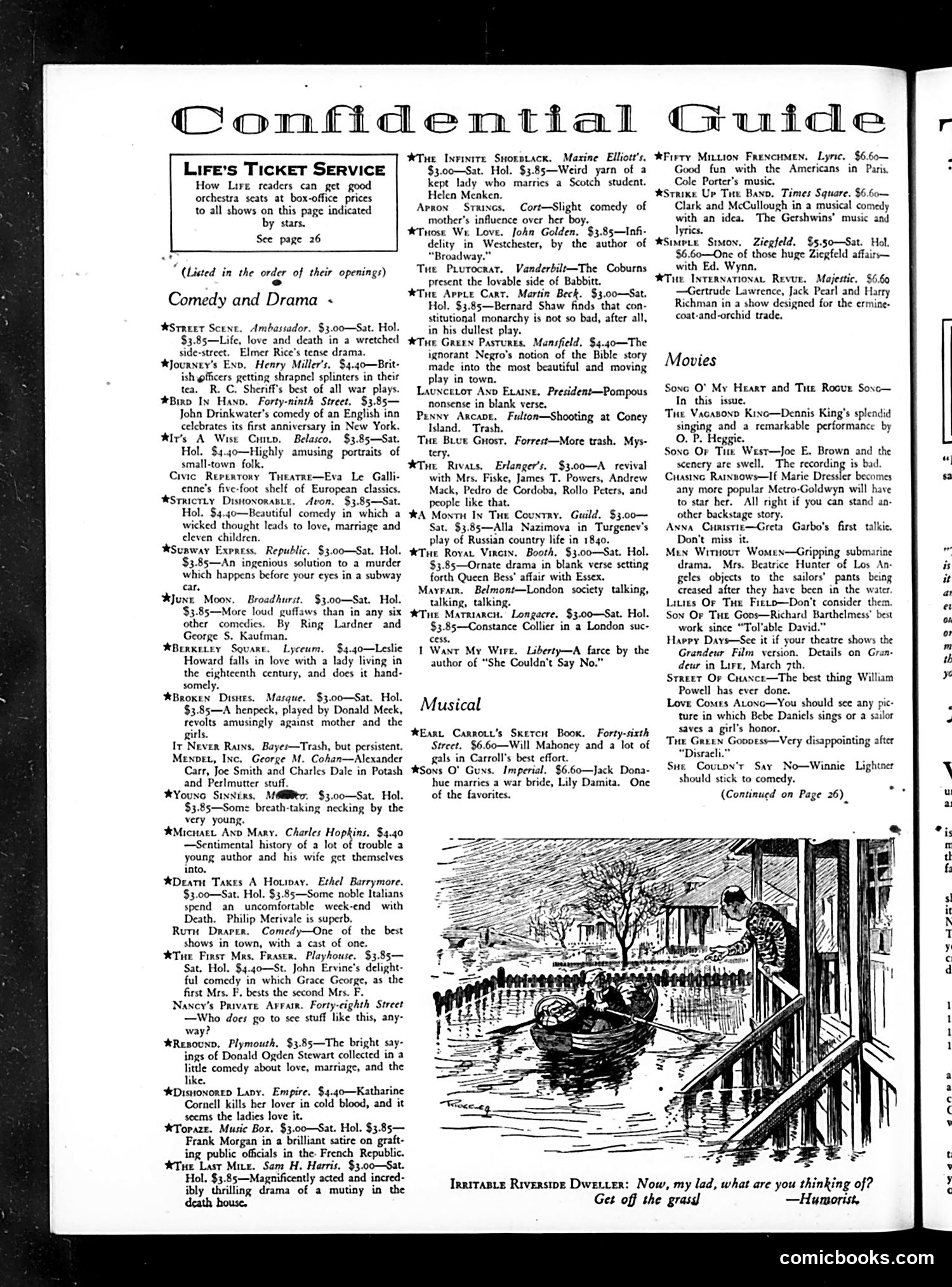
Cartoon Analysis: "Irritable Riverside Dweller" This page is primarily a theater guide listing Broadway shows with prices and brief synopses. The only cartoon appears at the bottom: a sketch showing someone in a boat on a river, apparently disturbing waterfowl or causing a commotion near a riverside house. The caption reads: "Now, my lad, what are you thinking of? Get off the grass!" attributed to "Humorist." The joke appears to be absurdist: someone in a boat on water is being scolded to "get off the grass"—an illogical command since they're on water, not grass. The humor derives from the mismatch between the setting (river) and the complaint (trespassing on lawn). This reflects 1920s-era comedic sensibilities favoring wordplay and illogical scenarios rather than political or social satire. The cartoon serves as filler entertainment on a page devoted to theater listings.
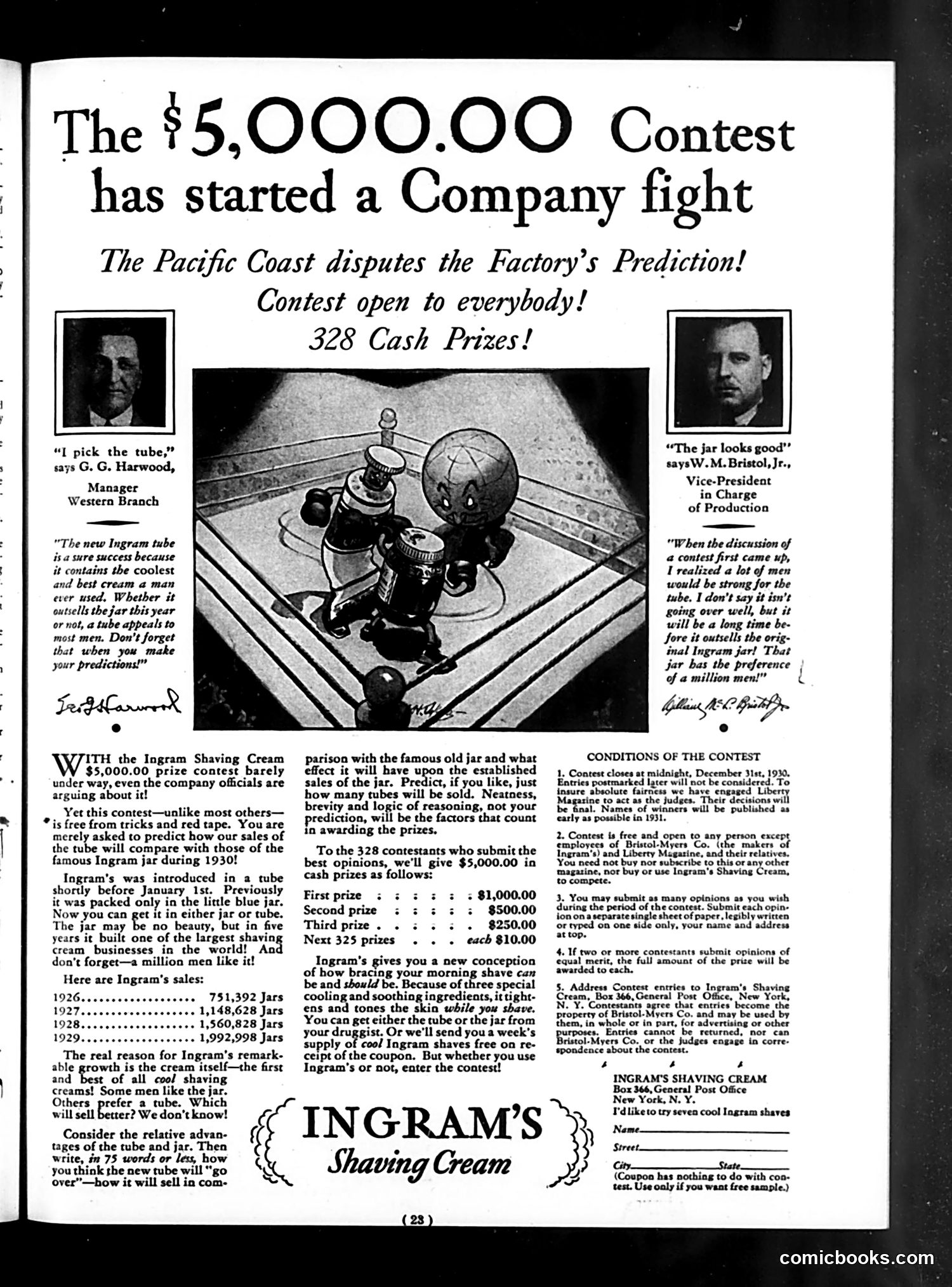
What This Page Means This is a contest advertisement, not satire. Ingram's Shaving Cream is running a $5,000 prize competition asking consumers to predict whether their newly introduced tube format will outsell their established jar format in 1930. The "company fight" in the headline refers to a real internal debate: two Ingram executives publicly disagree on the tube's prospects. G.G. Harwood (Western Branch Manager) predicts the tube will succeed; W.M. Bristol Jr. (Vice-President of Production) believes the jar will remain dominant "for a long time." This staged disagreement is the contest's hook—it generates interest by presenting a genuine business uncertainty as entertainment. The page shows Ingram's actual sales figures (1926-1929) to establish credibility, then invites the public to predict the outcome while competing for cash prizes. For modern readers: this exemplifies early 20th-century consumer engagement marketing, where companies invited public participation in business decisions, blending advertising with interactive entertainment.
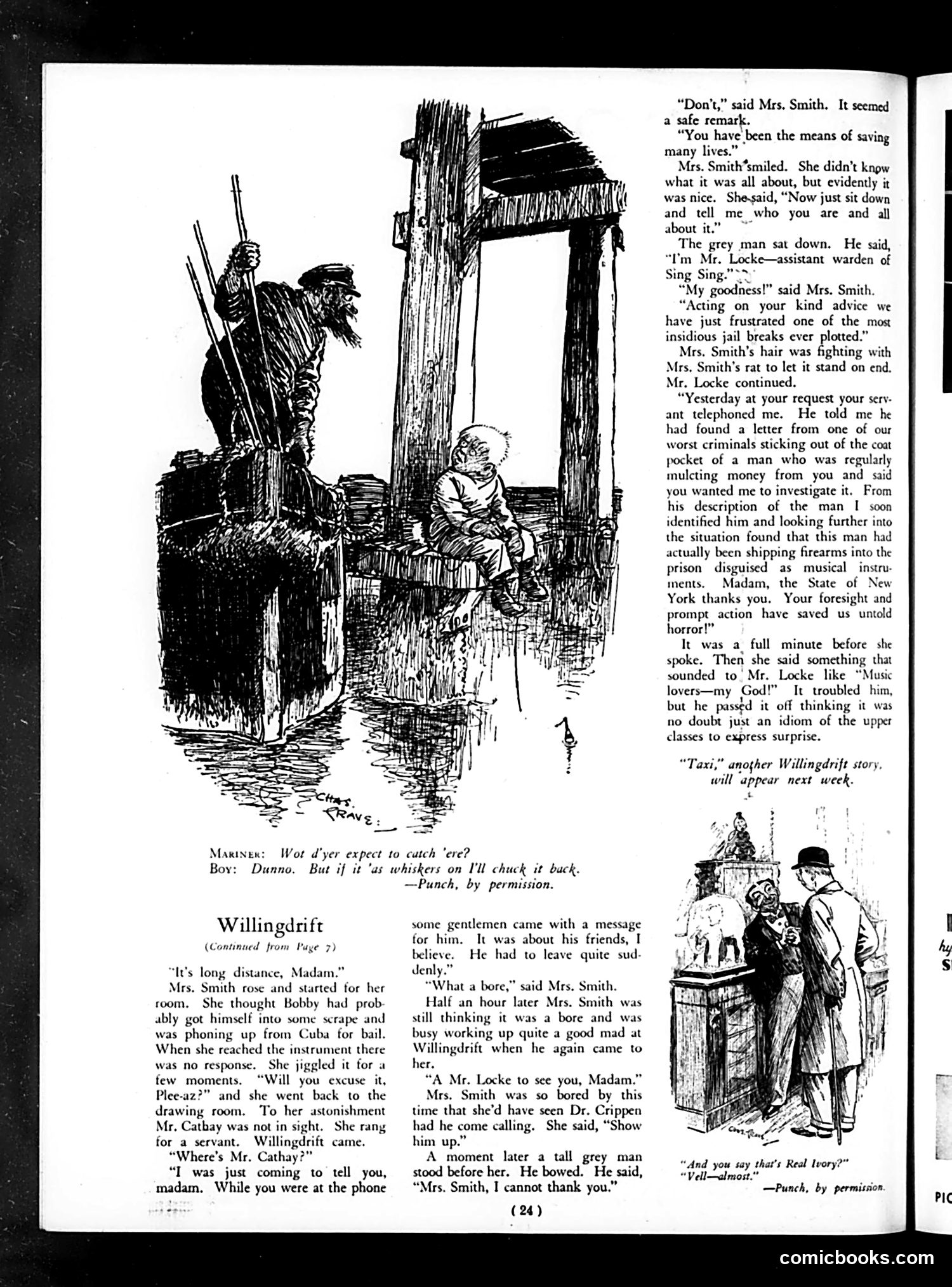
Explanation for Modern Readers This page contains a serialized story called "Willingdrift" about Mrs. Smith, a wealthy woman who unknowingly prevents a prison break at Sing Sing. Her servant discovered a letter from a criminal in a visitor's coat pocket; the man had been smuggling firearms into the prison disguised as musical instruments. When Mr. Locke, the assistant warden, thanks Mrs. Smith profusely for her "foresight," she's bewildered—she had no idea what she was doing. Her confused response "Music lovers—my God!" amuses Locke, who dismisses it as upper-class eccentricity. The page includes two unrelated cartoons from *Punch* magazine (credited separately): one about fishing, another about ivory merchandise. The satire gently mocks both Mrs. Smith's obliviousness and the tendency of authority figures to credit the wealthy with virtues they don't possess.
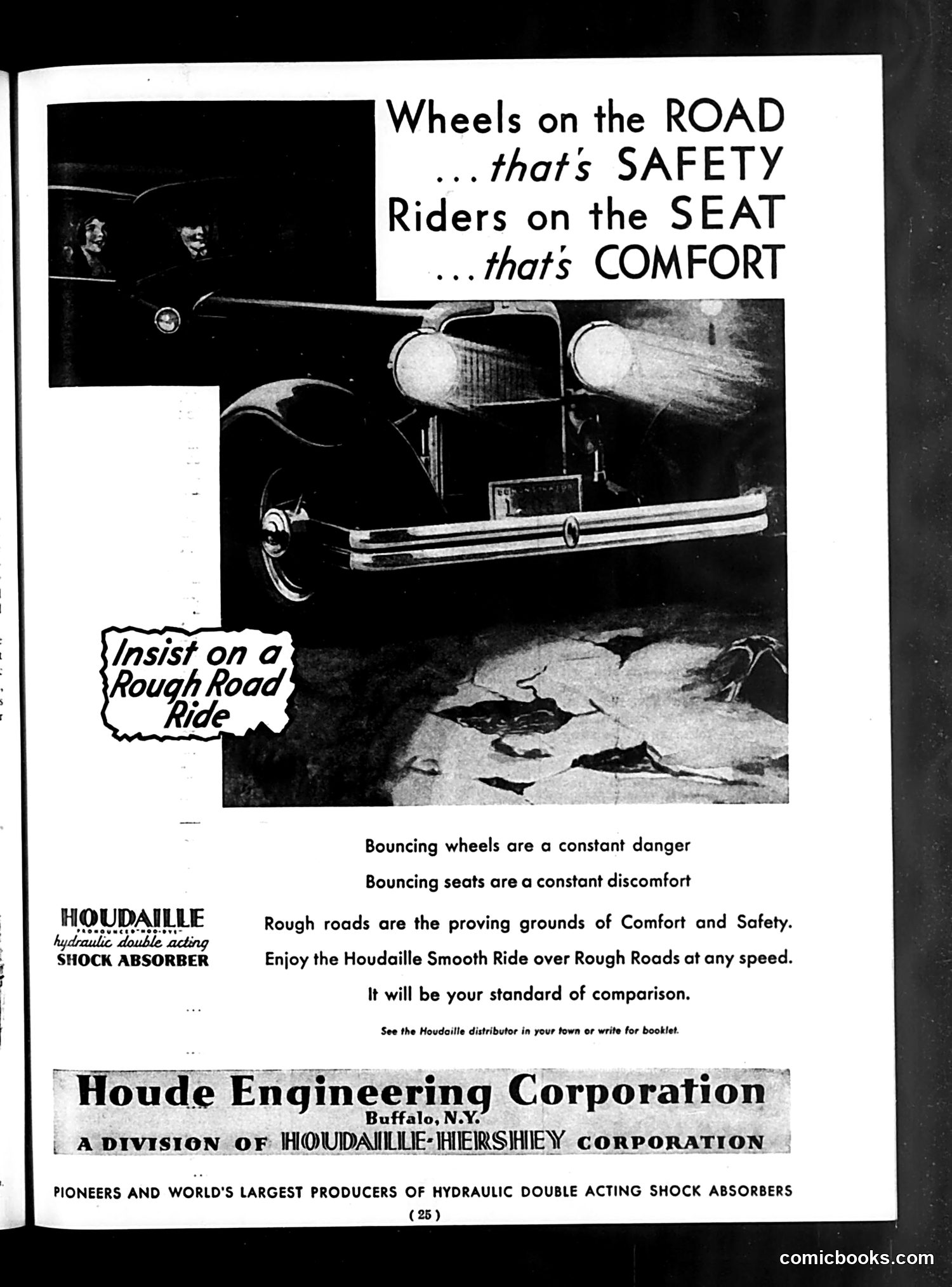
Analysis This is primarily a product advertisement, not political satire. It promotes Houdaille hydraulic shock absorbers for automobiles. The page uses a simple visual metaphor: a car driving over rough, potholed roads. The advertisement argues that shock absorbers solve two problems—safety (preventing wheel bounce, which causes loss of control) and comfort (preventing seat bounce, which causes passenger discomfort). The small inset cartoon labeled "Insist on a Rough Road Ride" shows two passengers in a car, though its specific meaning is unclear—possibly demonstrating confidence in the product or illustrating the problem being solved. The copywriting emphasizes that rough roads "prove" the superiority of Houdaille's suspension system, inviting consumers to test-drive and compare. This is typical 1930s-40s automotive advertising, when shock absorbers were still a competitive feature worth highlighting.
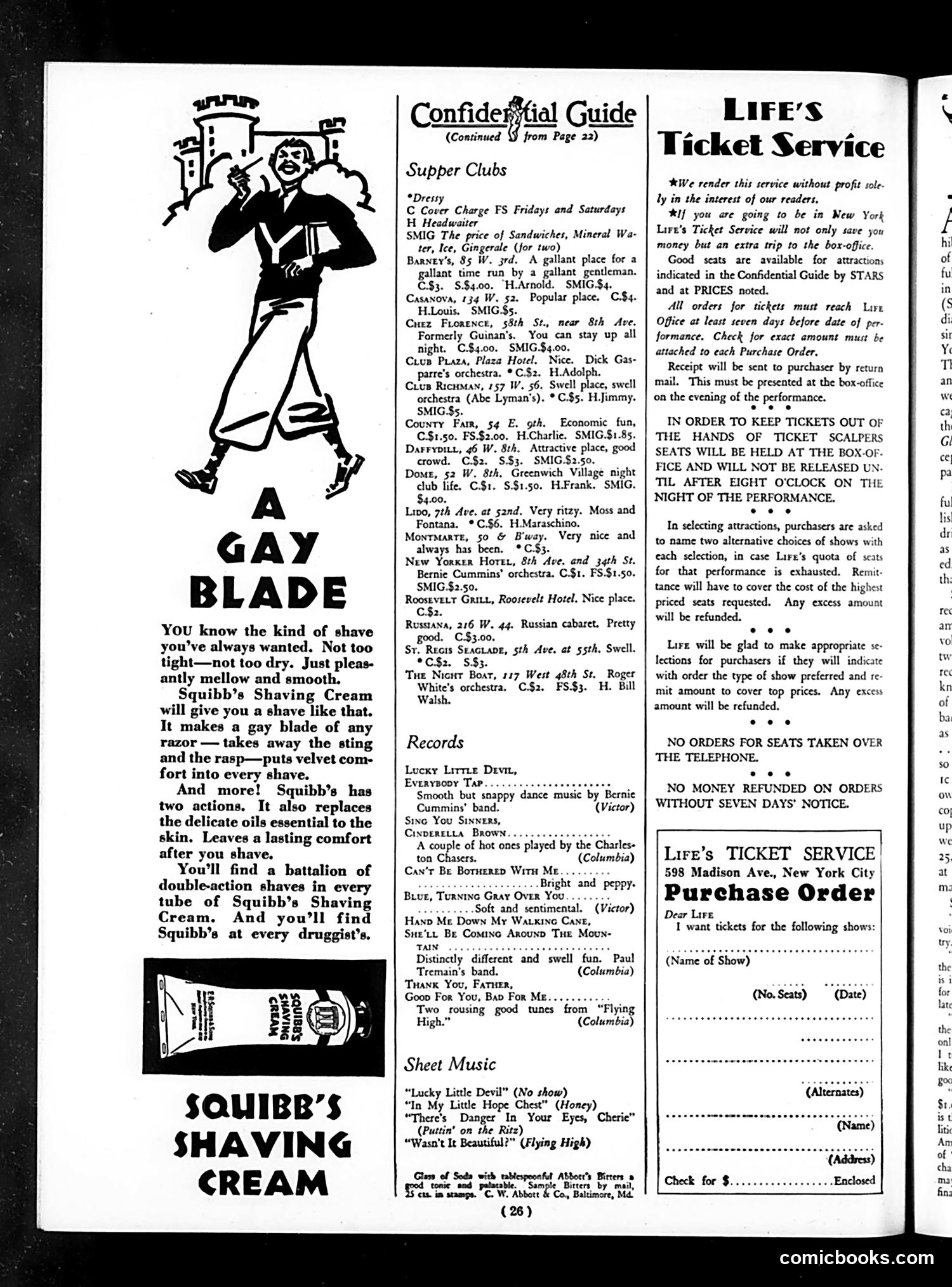
What This Page Means to Modern Readers This is primarily a 1920s entertainment and advertising page from *Life* magazine. The left side features an ad for Squibb's Shaving Cream, using the phrase "gay blade" (meaning a fashionable, carefree man—not the modern slang meaning). The blade illustration depicts a dapper gentleman in period dress. The right side provides a "Confidential Guide" to New York City nightlife during Prohibition era (1920s), listing speakeasies and supper clubs with coded information about cover charges, music, and atmosphere. References to "Roger White's orchestra" and Bernie Cummins' band indicate live jazz entertainment was central to the scene. The bottom features Life's ticket service—a reader benefit offering advance Broadway tickets without scalper markups. The satire/point: There's no obvious political cartoon here. This is primarily practical consumer content mixed with advertisements reflecting Jazz Age leisure culture and entertainment venues that often operated illegally during alcohol prohibition.
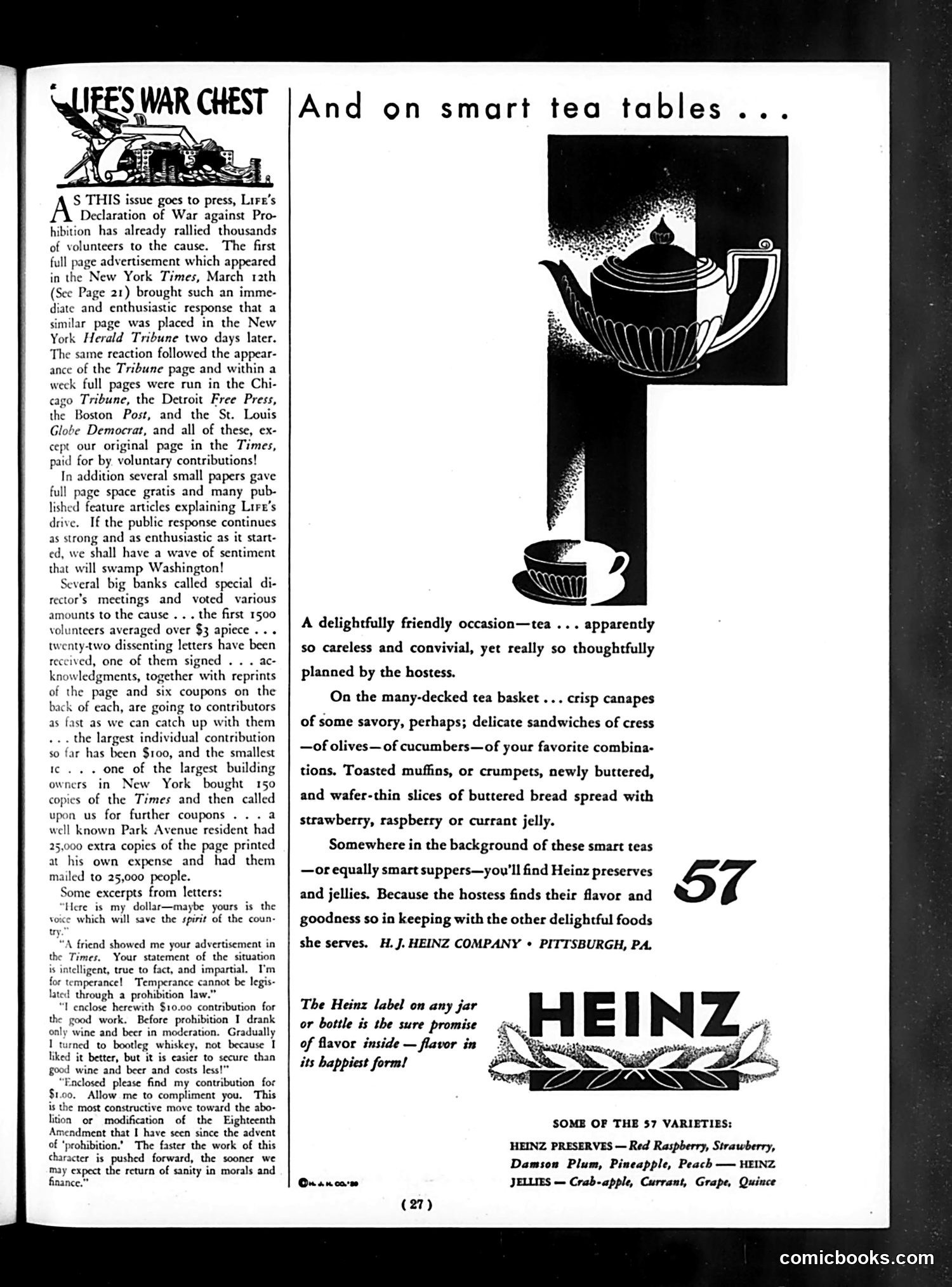
Analysis: Life Magazine's Anti-Prohibition Campaign and Heinz Advertisement This page documents Life magazine's "Declaration of War against Prohibition," a public campaign launched in March (appears to be 1920s, given Prohibition context). The left column reports the campaign's massive success: thousands of volunteers, major newspapers running full-page ads funded by public donations, banks contributing, and individual donations ranging from $1 to $100. The testimonials reveal the campaign's argument: Prohibition drives people to dangerous bootleg whiskey rather than moderate wine and beer consumption. One contributor notes he drank responsibly before Prohibition but now turns to illegal alcohol because it's "easier to secure." The Heinz advertisement (right side) appears incongruous—it markets preserves and jellies for elegant tea service. This juxtaposition is likely intentional satire: while Life rails against Prohibition's moral failures, a respectable company advertises genteel domesticity. The ad's emphasis on "thoughtfully planned" hospitality subtly undercuts Prohibition's claim to improve American life and morality.
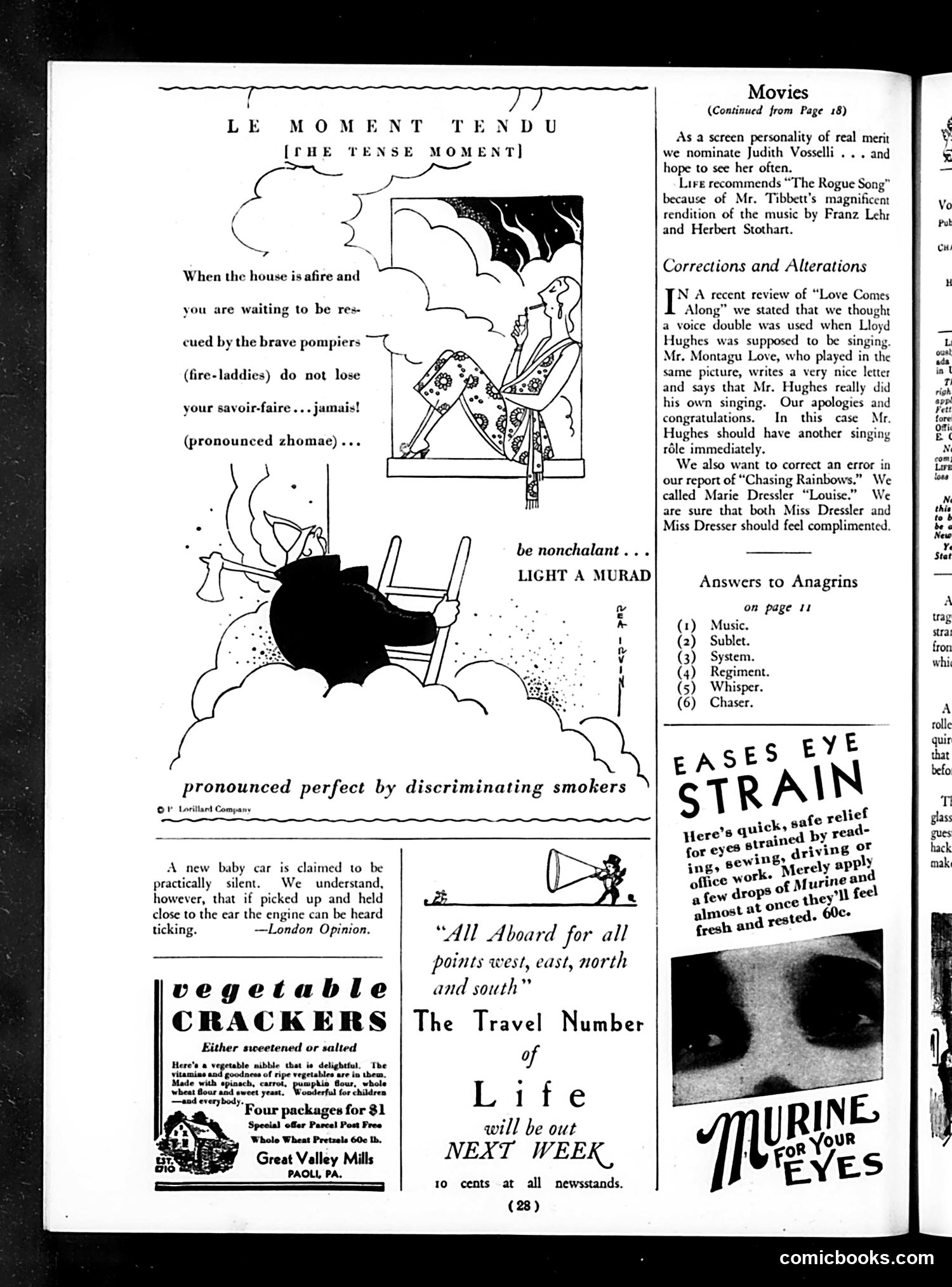
"Le Moment Tendu" (The Tense Moment) This page is primarily movie advertisements and corrections, with one notable cartoon advertisement. The main illustration shows a fireman rescuing a woman from a burning building. The joke is a play on French manners: even in mortal danger, a refined Parisian woman maintains her composure ("nonchalant") and doesn't lose her "savoir-faire" (social grace). The humor mocks upper-class pretension—the suggestion that proper etiquette matters even during a life-threatening emergency. The woman calmly holds a cigarette while being rescued. The advertisement is for Murad cigarettes, using this satirical scenario to suggest that discriminating smokers (implying sophisticated, refined people) would choose their brand. The surrounding content includes movie reviews, corrections to previous articles about silent films and actors, and unrelated product advertisements (crackers, eye drops). The page reflects 1920s magazine culture mixing entertainment criticism with consumer advertising.
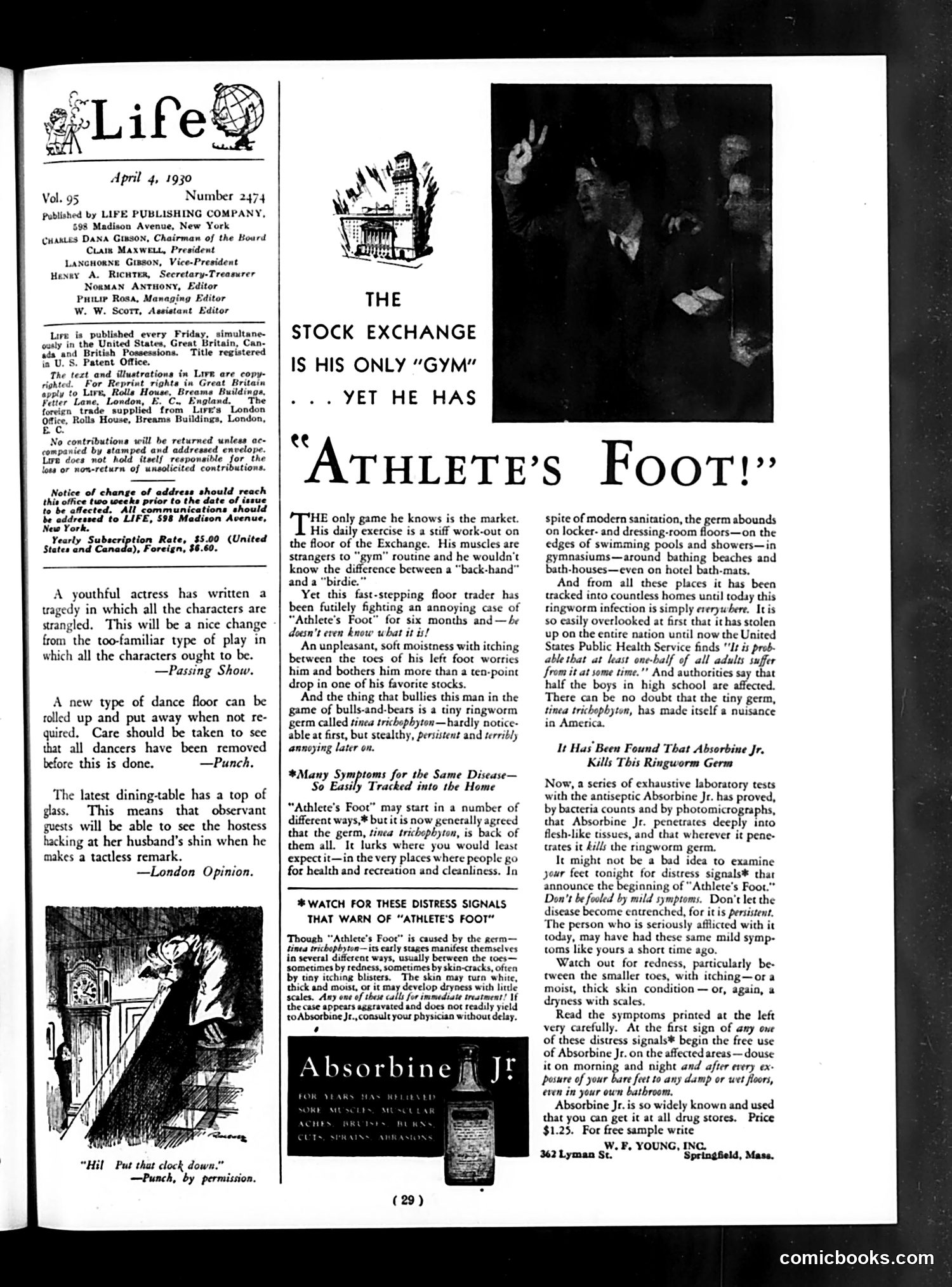
Life Magazine, April 4, 1930: "Athlete's Foot" Advertisement This page is primarily a full-page advertisement for Absorbine Jr., a patent medicine, presented as satirical editorial content—a common advertising practice in Life magazine. The central conceit is a humorous contrast: a stock exchange trader (representing a busy, modern businessman focused entirely on financial markets) ironically suffers from "Athlete's Foot"—a fungal infection typically associated with actual athletes. The wordplay highlights the disconnect between his sedentary desk job and this physical ailment. The ad lists warning symptoms and promotes Absorbine Jr. as treatment, claiming the fungus spreads in public bathing facilities. The surrounding short jokes (from *Punch* and *London Opinion*) are filler content typical of Life's format. This reflects 1930 advertising strategies: disguising commercial pitches as humorous commentary to engage readers while selling remedies for everyday ailments.
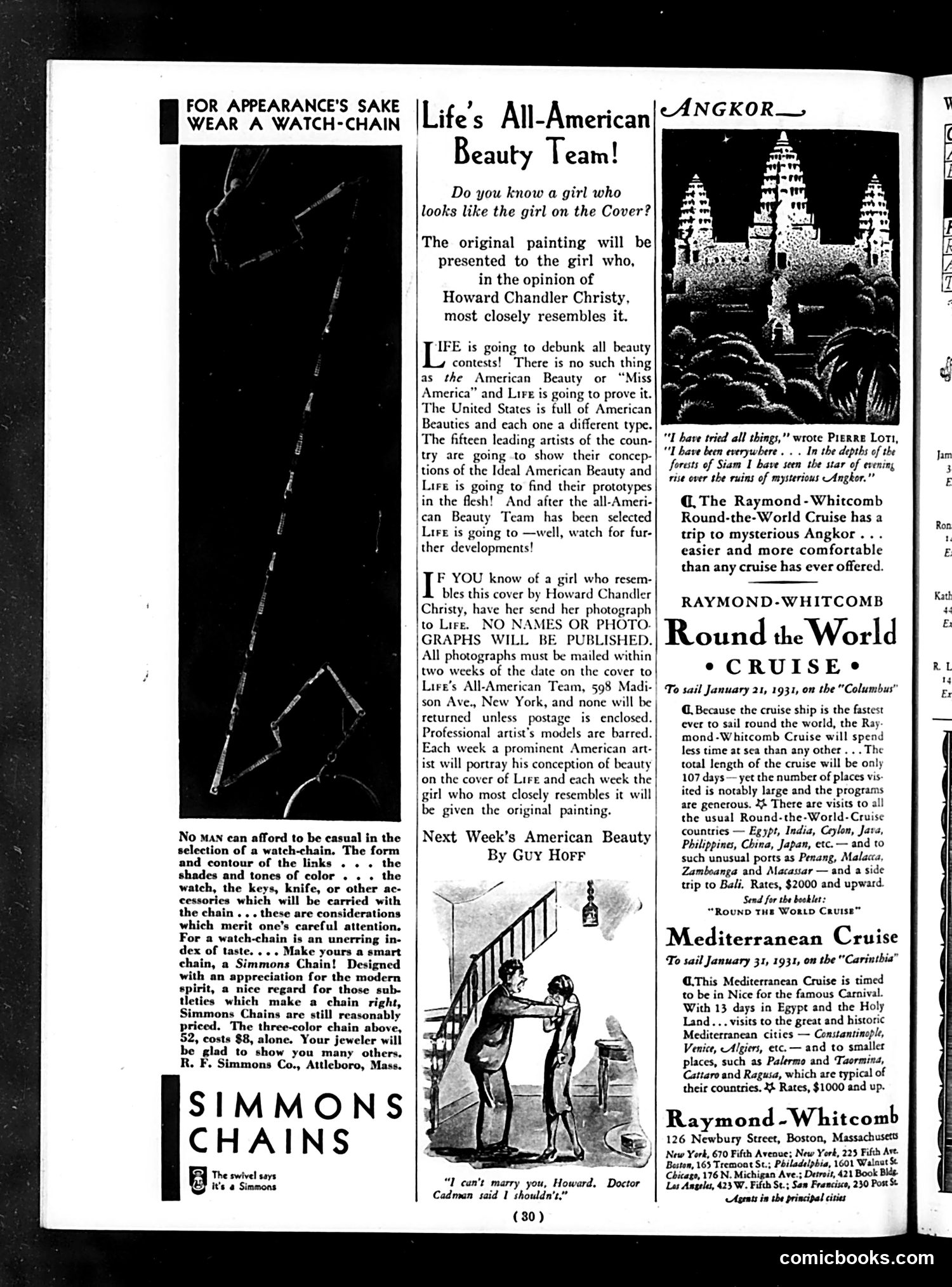
Analysis for Modern Readers This page contains mostly advertising and promotional content, not political satire. The left side advertises Simmons watch chains, emphasizing that the accessory choice reflects personal taste and status—a common early 20th-century concern about masculine respectability. The center features Life magazine's "All-American Beauty Team" contest, where 15 prominent artists (including Howard Chandler Christy) would each paint their conception of ideal American beauty. Readers could submit photographs of girls resembling the cover artwork to win the original painting. This reflects the era's fascination with standardized beauty ideals and celebrity artist culture. The right side advertises Raymond-Whitcomb luxury cruise lines: a round-the-world voyage and a Mediterranean cruise, emphasizing exotic destinations (Angkor, Egypt, the Orient) and leisure travel as markers of affluence. The small cartoon shows a domestic comedy scene unrelated to the surrounding content—a woman refusing marriage for health reasons. The page exemplifies 1930s consumer culture targeting affluent readers through beauty contests, travel, and status-signifying purchases.
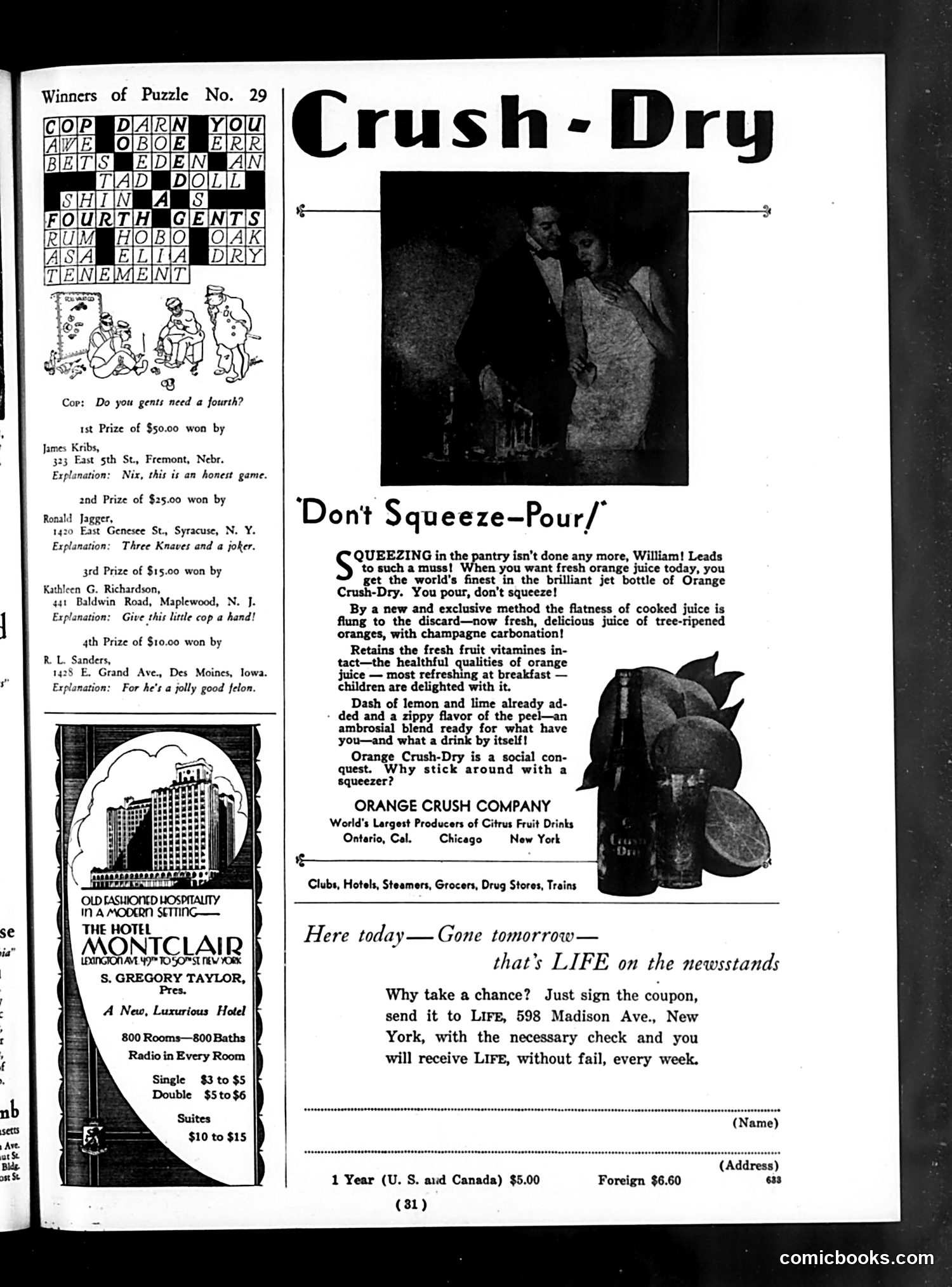
Crush-Dry Advertisement This page is primarily an advertisement for Orange Crush-Dry juice, disguised as editorial content in Life magazine. The ad mocks older juice-preparation methods by showing a couple where the man urges the woman to stop squeezing oranges manually—it's messy and outdated. The product pitch: Crush-Dry is pre-made, carbonated orange juice you simply pour, requiring no effort. It retains vitamins and fresh taste while adding lemon, lime, and champagne carbonation for sophistication. The social messaging reflects 1920s-30s consumer culture: modern convenience represents progress and class refinement. The tagline "Don't Squeeze—Pour!" positions the product as labor-saving technology for the modern household, particularly targeting women by eliminating tedious kitchen work. The left side shows puzzle contest winners and hotel advertising—typical magazine filler. The overall page demonstrates how early 20th-century magazines blended advertising with editorial matter.
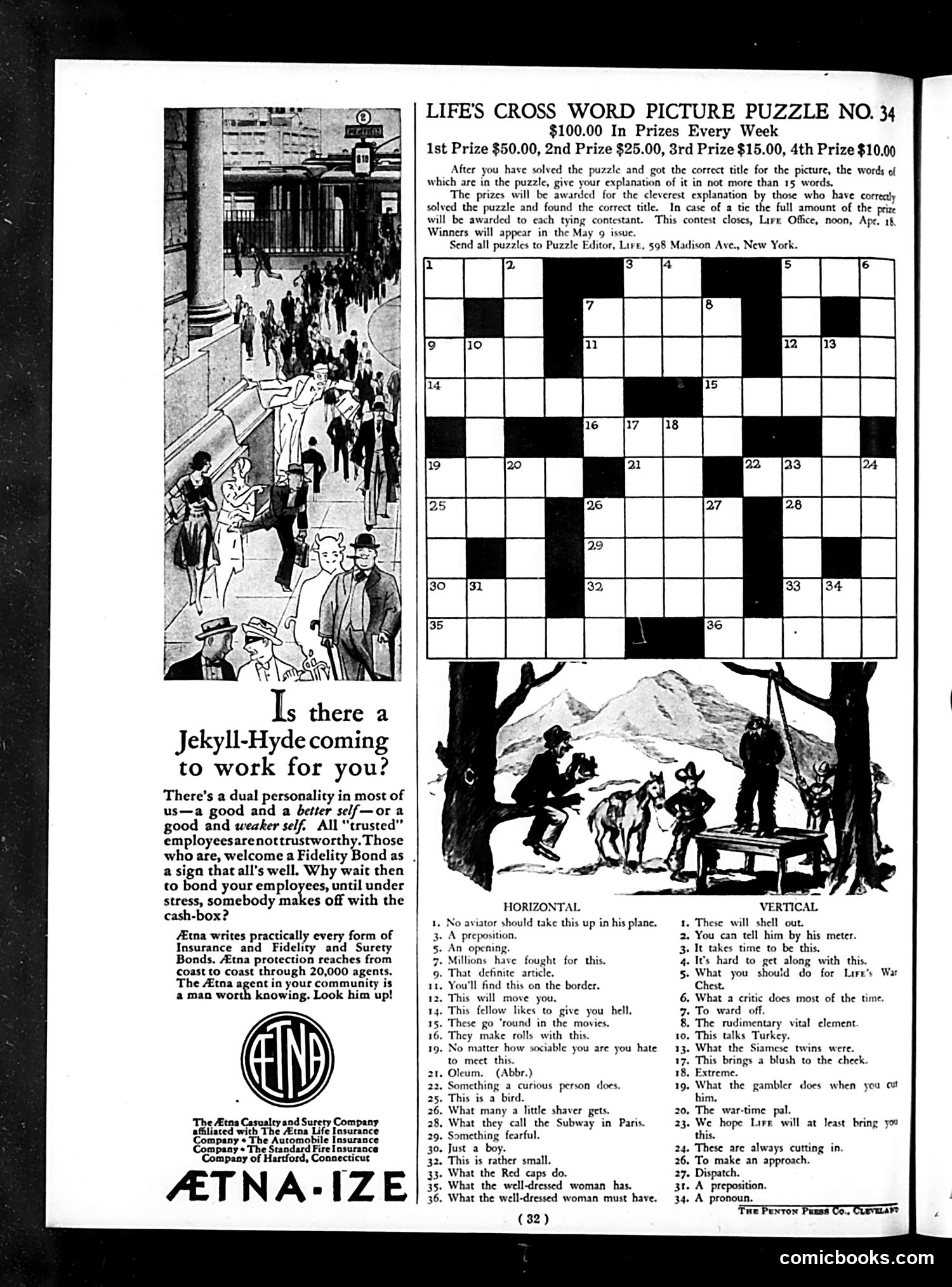
Life Magazine Crossword Puzzle Page Analysis This page is primarily advertising and entertainment content, not political satire. It features: Main Content: Life's crossword picture puzzle competition (#34), offering $100 in weekly prizes. Solvers must identify the illustrated scene (a busy urban street with pedestrians and storefronts) and provide a 15-word explanation. Advertisement: The dominant ad is for Ætna Insurance, specifically promoting fidelity bonds and surety insurance. The "Jekyll-Hyde" headline suggests that trustworthy employees may have hidden dishonest tendencies—a sales pitch warning employers that even "trusted" workers might steal. The ad encourages purchasing fidelity bonds as protection. Context for Modern Readers: This reflects early-20th-century workplace anxiety about employee theft and corporate security. The Jekyll-Hyde reference invokes Robert Louis Stevenson's famous novella about dual personalities to create urgency around bonding employees. The puzzle itself appears to feature a typical urban scene of the era, though the specific satirical point is unclear without solving it.
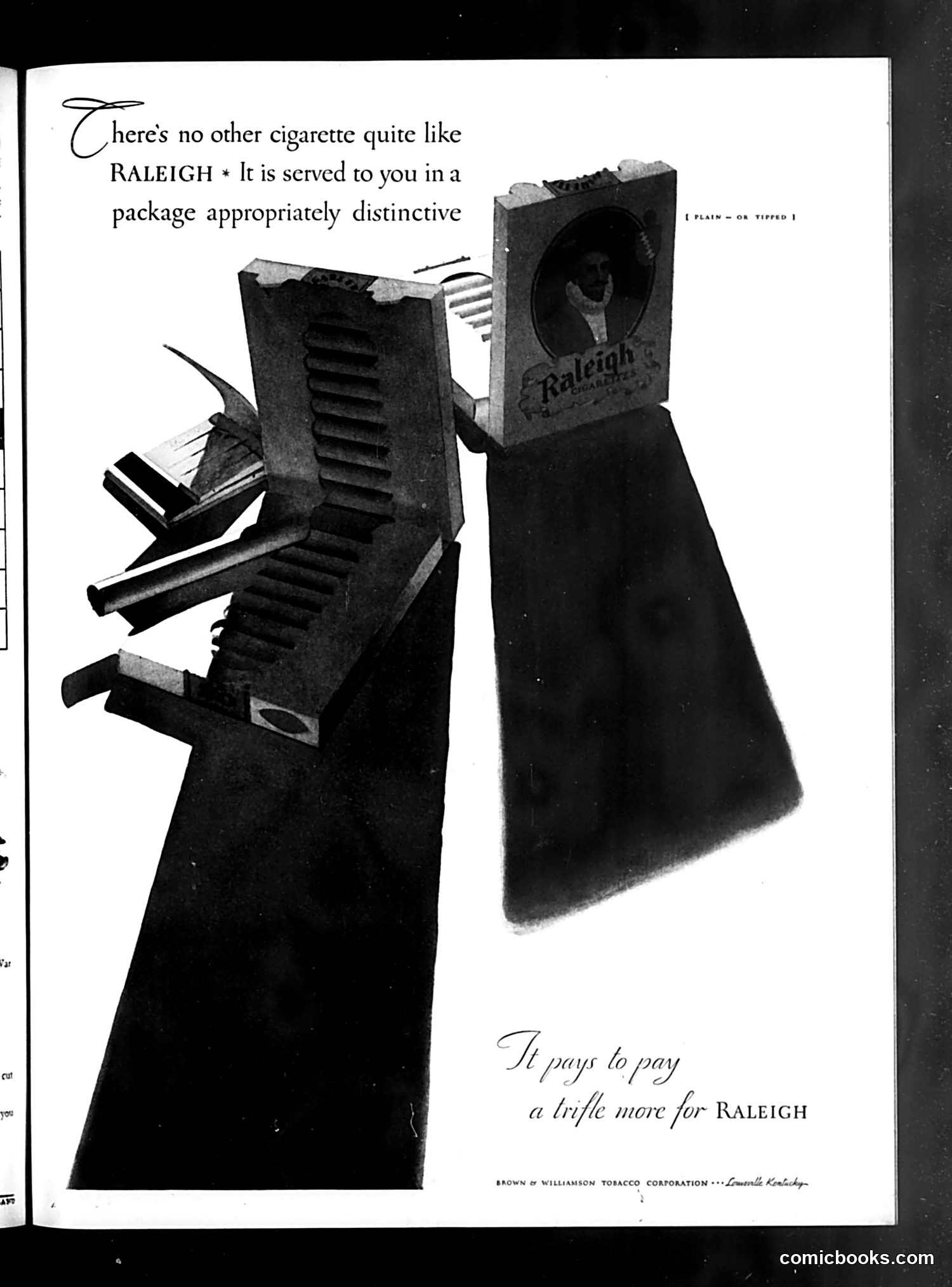
This is a cigarette advertisement, not a political cartoon. It promotes Raleigh cigarettes by Brown & Williamson Tobacco Corporation. The ad uses visual metaphor: the cigarette packages are styled as distinctive architectural or sculptural forms—one resembles a modernist building or monument. The tagline "It pays to pay a trifle more for Raleigh" suggests the product commands a premium price through its sophisticated, "appropriately distinctive" packaging. This reflects mid-20th century advertising strategy: emphasizing product differentiation and design as justification for higher cost. The stark black-and-white photography and modernist aesthetic were typical of upscale cigarette marketing of the era, before health warnings became standard.
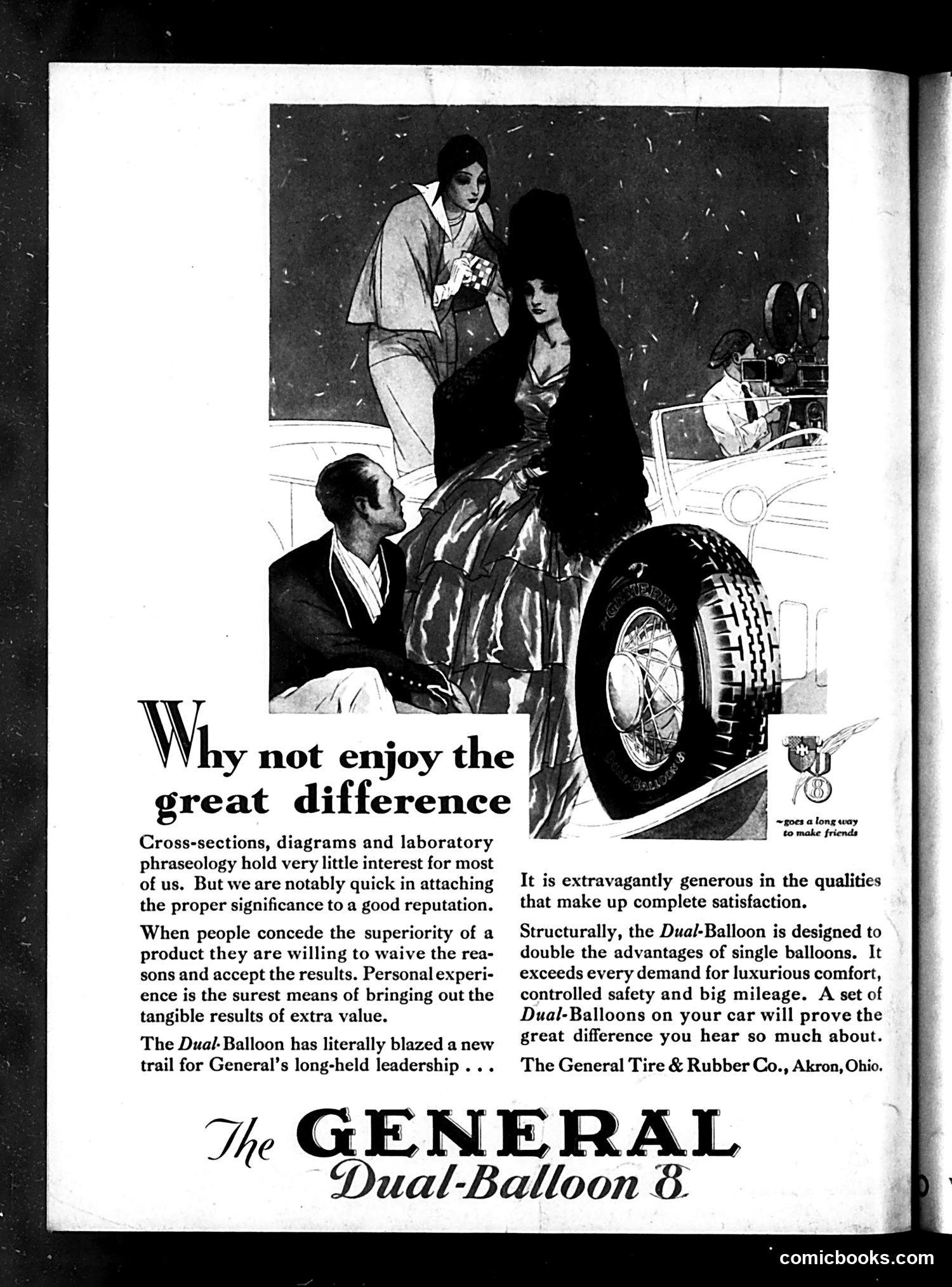
Analysis This is a tire advertisement, not political satire. It's an ad for General Tire & Rubber Company's "Dual-Balloon" tire product, circa 1920s-1930s based on the styling and typography. The illustration shows fashionably dressed people (a woman in a long coat and hat, a man in a suit, and others) admiring a car's wheel, highlighting the tire's modern design. The "balloon" tire was a genuine automotive innovation of that era—wider, more cushioned tires that replaced narrow, hard tires and improved ride comfort. The ad's argument is straightforward marketing: don't get bogged down in technical specs; trust reputation and real-world results. Dual-Balloon tires allegedly offer luxury, comfort, safety, and mileage. The stylish figures represent the aspirational lifestyle associated with owning this superior product. This is consumer advertising, not political commentary or satire.