life
Life — April 11, 1930
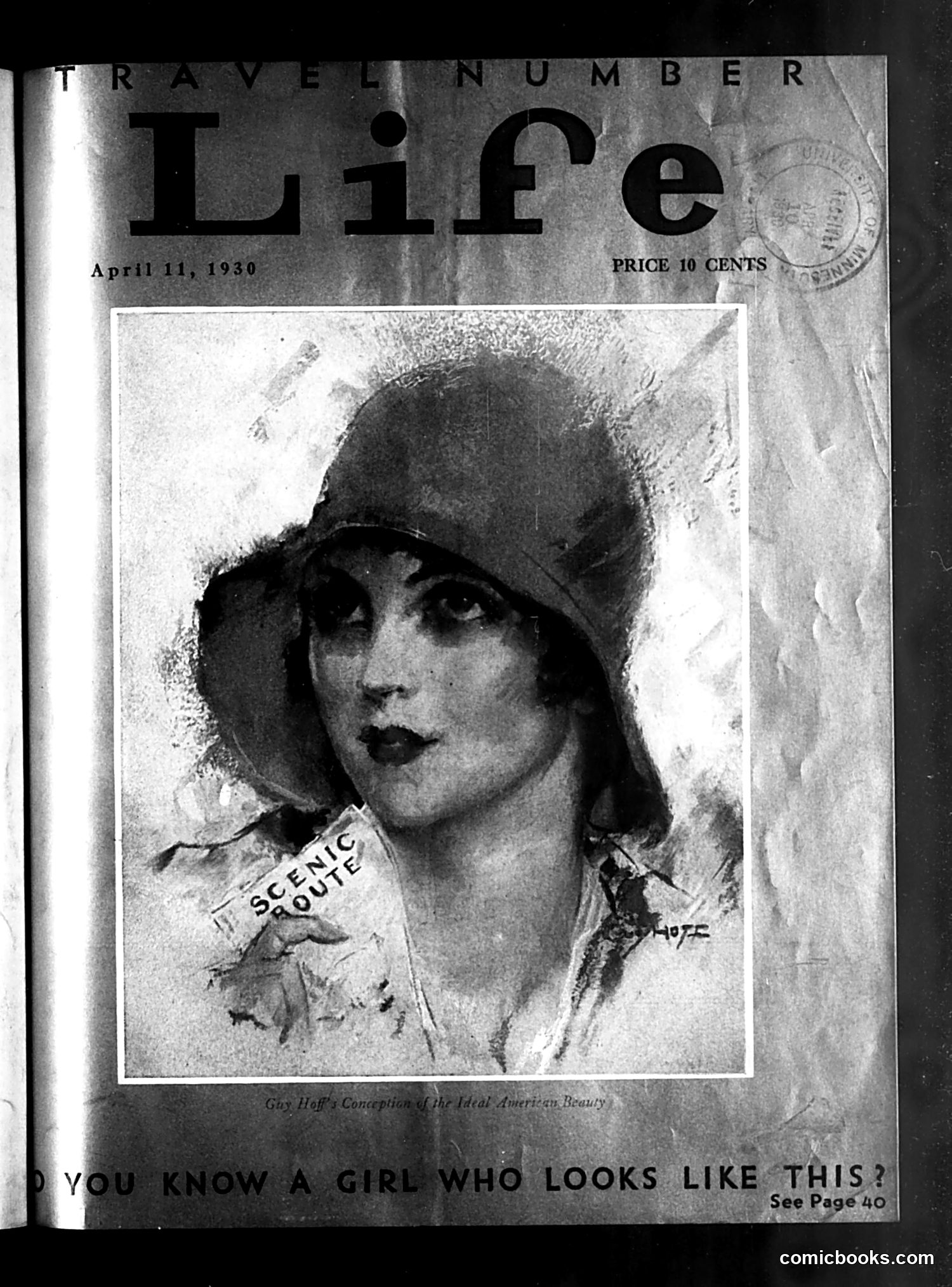
Analysis This is the cover of *Life* magazine from April 11, 1930. The main image shows a woman wearing a cloche hat and styled in the fashionable 1920s-30s "modern woman" aesthetic, labeled "Guy Huff's Conception of the Ideal American Beauty." The cover's interactive hook—"YOU KNOW A GIRL WHO LOOKS LIKE THIS? See Page 40"—suggests this was a participatory feature inviting readers to identify women matching this beauty ideal. The label "IT SCENIC ROUTE" on the image is unclear in meaning. The overall content reflects the era's fascination with defining and celebrating contemporary feminine beauty standards during the Jazz Age, when the "flapper" aesthetic represented modernity and social change.
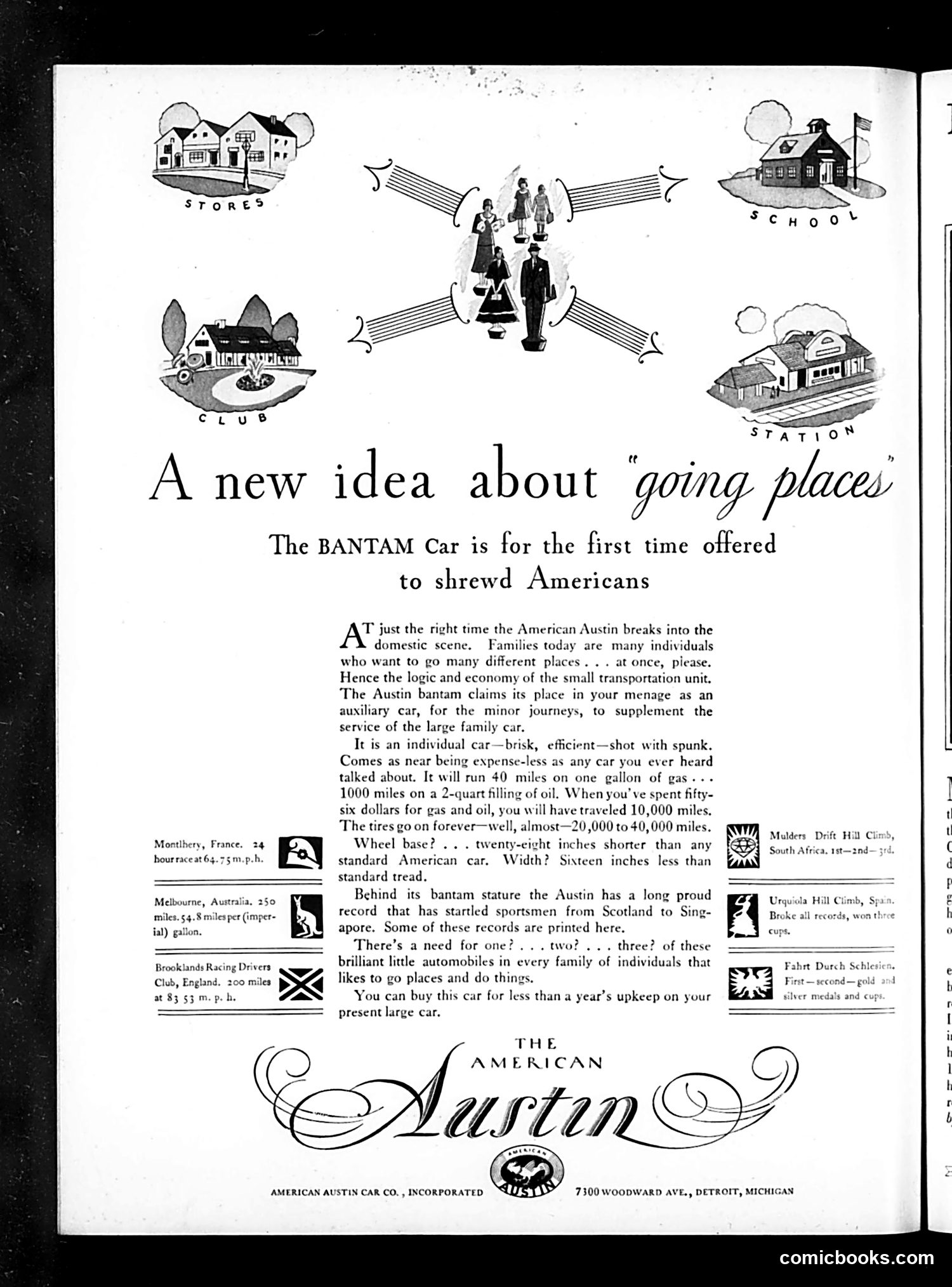
This is an advertisement for the American Austin Car's "bantam" model, not a political cartoon. The page promotes a new small car concept aimed at American families who need multiple vehicles for different destinations. The central illustration shows a family radiating outward to different locations (stores, school, club, station) via lines of connection, visually representing the car's utility for various errands. The advertisement emphasizes economy—40 miles per gallon, 1,000 miles on two quarts of oil—positioning the bantam as an affordable auxiliary vehicle cheaper than a year's upkeep on a larger car. Side notes reference racing records from Brooklands (England), Montlhéry (France), and Melbourne (Australia), establishing the vehicle's engineering credibility. This is purely commercial marketing, not satire.
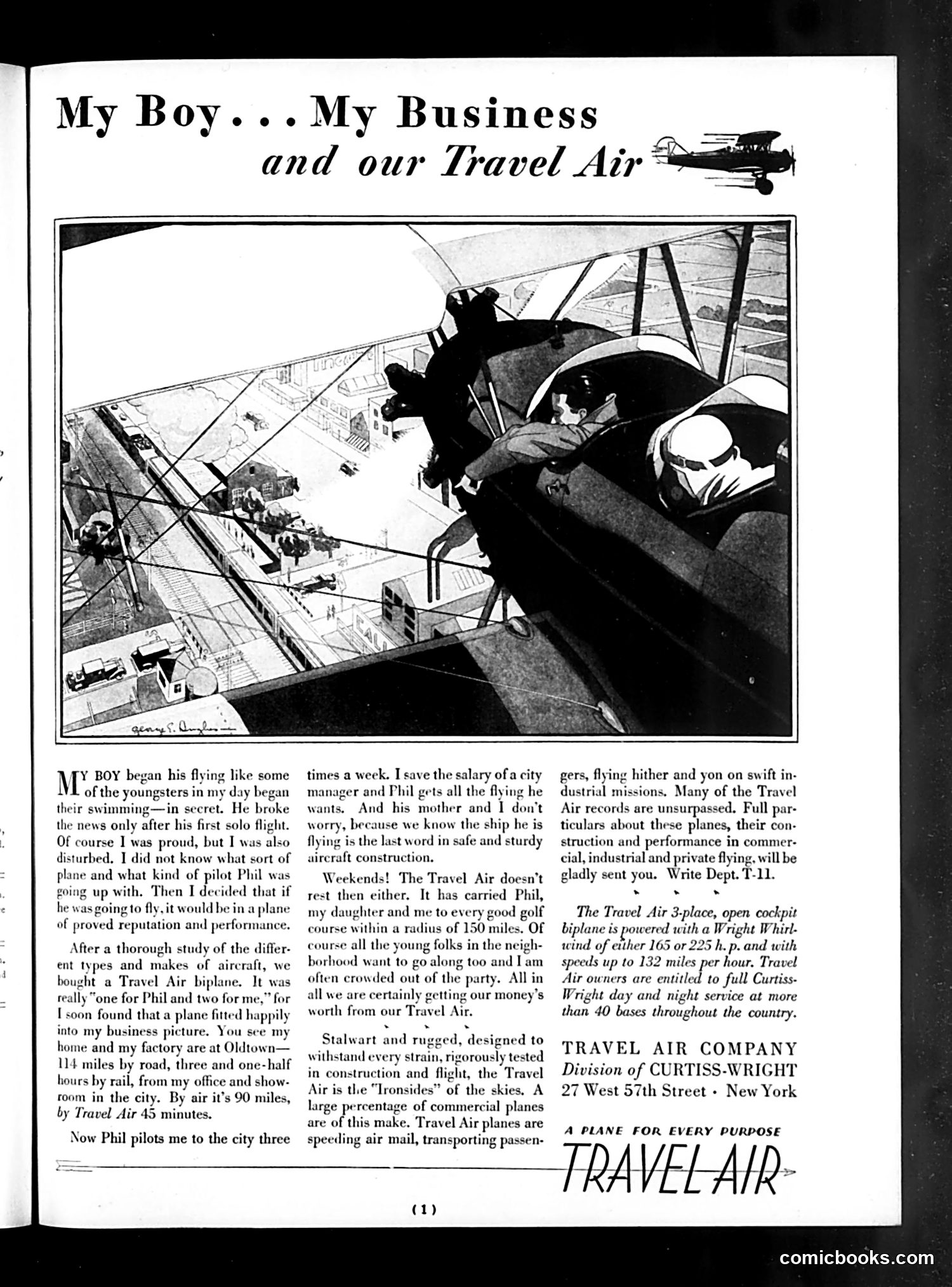
Analysis This page is primarily advertising content for Travel Air Company, a Division of Curtiss-Wright, promoting their 3-place aircraft. The image shows what appears to be a businessman and passengers in an open-cockpit biplane flying over an industrial landscape. The accompanying text presents a personal narrative from a father describing how his son took up flying, eventually becoming a Travel Air pilot. The father expresses initial concern but pride in his son's aviation career. The narrative emphasizes Travel Air's reliability and performance ("Stalwart and rugged...the 'Ironsides' of the skies"), positioning the aircraft as suitable for commercial, business, and private missions. This represents 1920s-30s aviation promotion, when commercial flying was novel and manufacturers used testimonial-style marketing to establish credibility and normalize air travel for potential business customers.
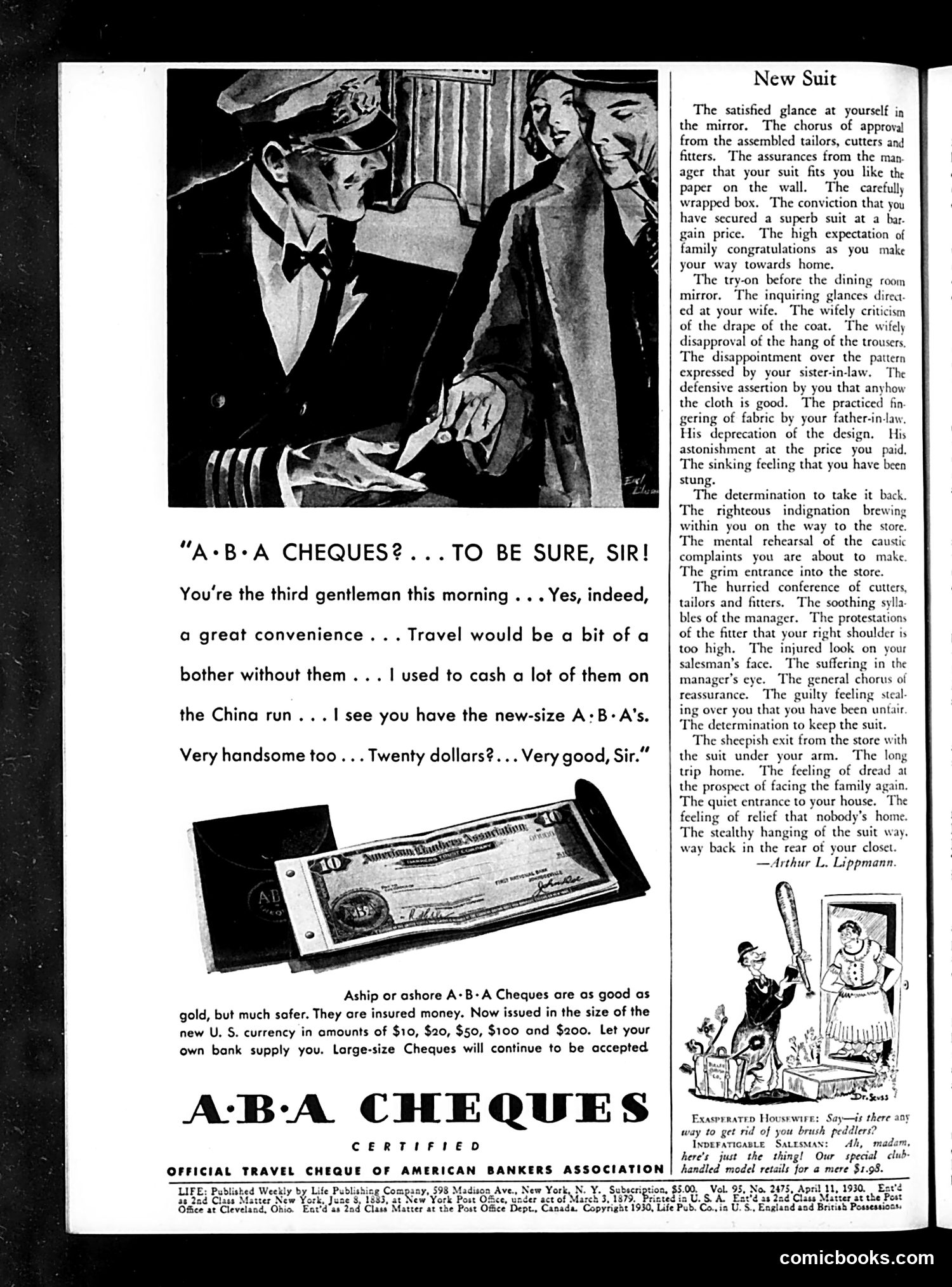
A.B.A Cheques Advertisement This is primarily a travel cheque advertisement rather than political satire. The page features: Main Image (top): A traveler at what appears to be a bank or exchange counter, presenting A.B.A cheques to a clerk while other gentlemen wait. The dialogue humorously depicts the cheques' convenience—the clerk notes this is his third customer that morning and recalls cashing many during "the China run," confirming A.B.A's global acceptance. The Product: A.B.A (American Bankers Association) Certified Cheques—insured traveler's checks issued in denominations matching U.S. currency ($10, $20, $50, $100, $500). The Appeal: The advertisement emphasizes safety and convenience for international travel, positioning A.B.A cheques as "as good as gold, but much safer" for the business traveler. The right-side essay "New Suit" by Arthur L. Lippmann provides humorous social commentary on anxieties surrounding a new suit purchase—entirely separate from the advertisement.
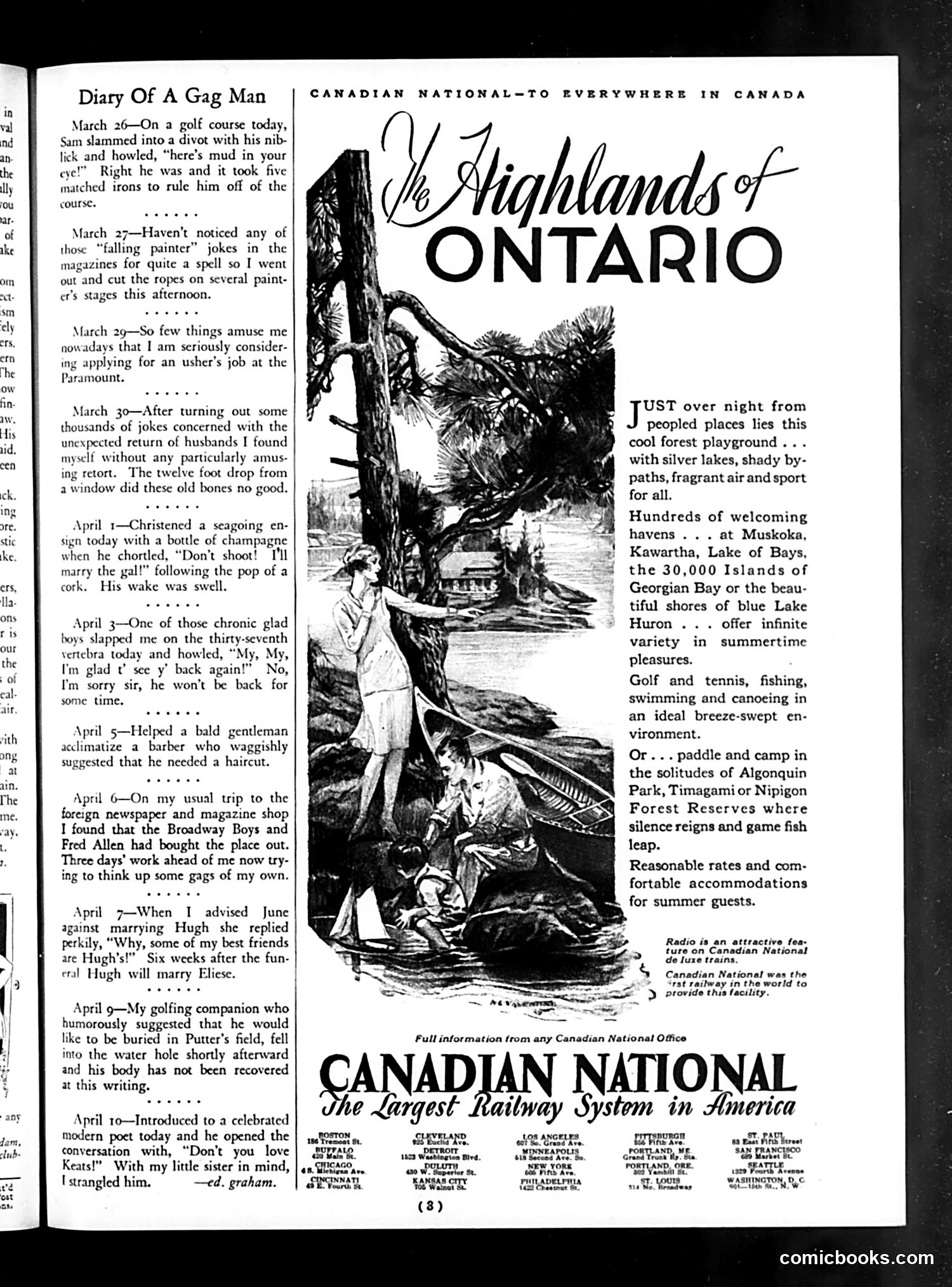
"Diary of a Gag Man" & Canadian National Advertisement This page contains two distinct elements: Left side: A humor column titled "Diary of a Gag Man" featuring brief comedic anecdotes from late March through mid-April. The entries describe mundane situations (golf mishaps, rope-cutting accidents, joke-writing, marriage proposals, barber visits) presented as humorous observations. The humor appears to rely on understated, deadpan delivery rather than elaborate setups—typical of 1920s magazine comedy where everyday absurdities were treated as entertainment. Right side: A full-page advertisement for the Canadian National Railway system, featuring an illustrated scene of recreational activities (camping, canoeing) in Ontario's highlands. The ad promotes leisure travel and the railway's service as "The Largest Railway System in America." The juxtaposition suggests how Life magazine balanced satirical content with commercial advertising.
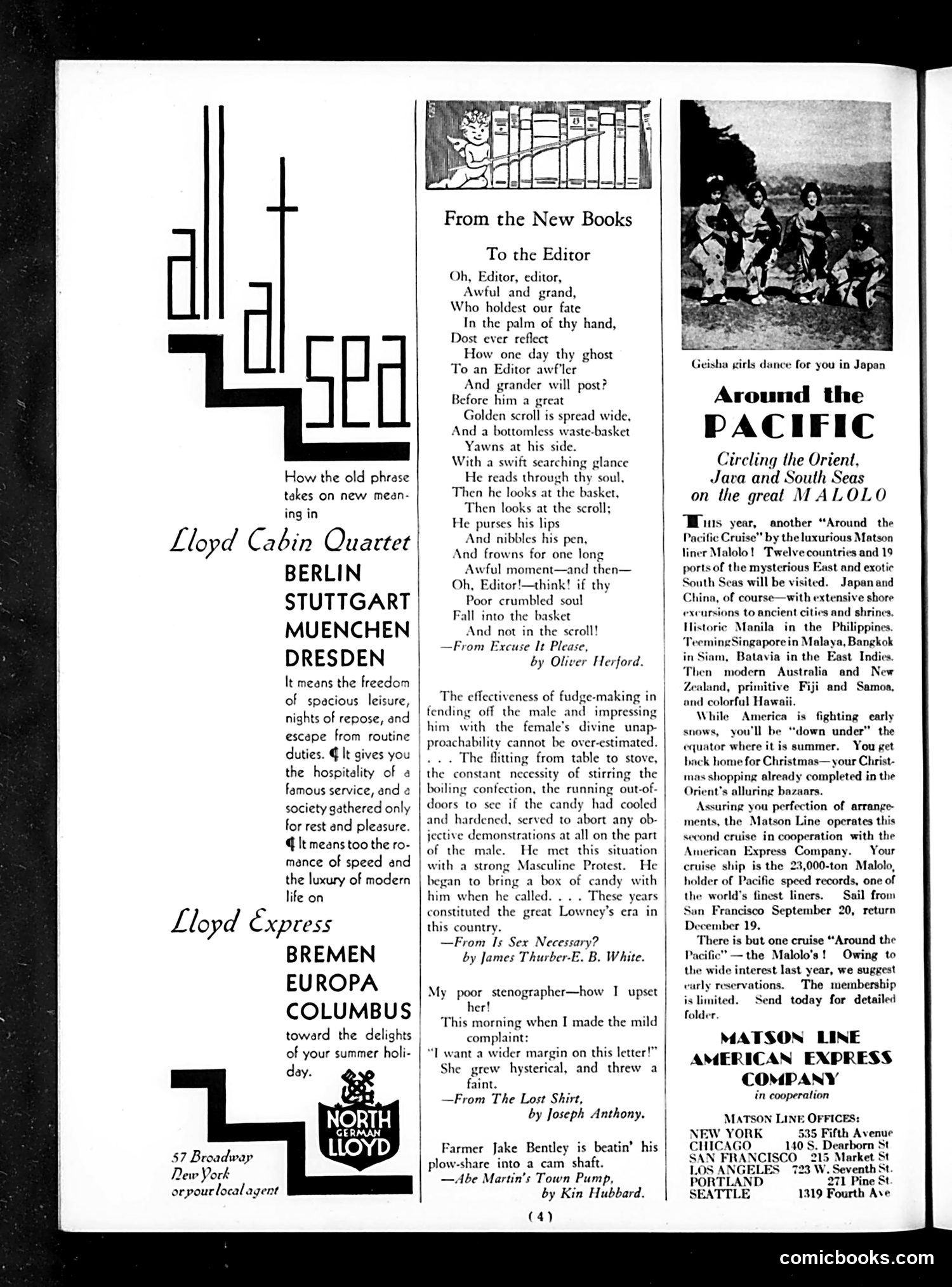
Page Analysis This page is primarily advertising and editorial content rather than political satire. The left side features ads for Lloyd shipping lines (German ocean liners: Cabin Quartet, Express) and North German Lloyd travel services, marketing European luxury cruises from New York. The right side advertises the Matson Line's "Around the Pacific" cruise, with an image of Geisha girls dancing in Japan. The cruise promises visits to Japan, China, Manila, Singapore, and other exotic Orient destinations, plus Australia, Fiji, and Hawaii. A central poem "To the Editor" and short humor pieces about stenographers and farmers fill the middle—typical period magazine content. The overall tone reflects 1920s-era commercialism promoting international leisure travel to distant, "exotic" locations for affluent American audiences.
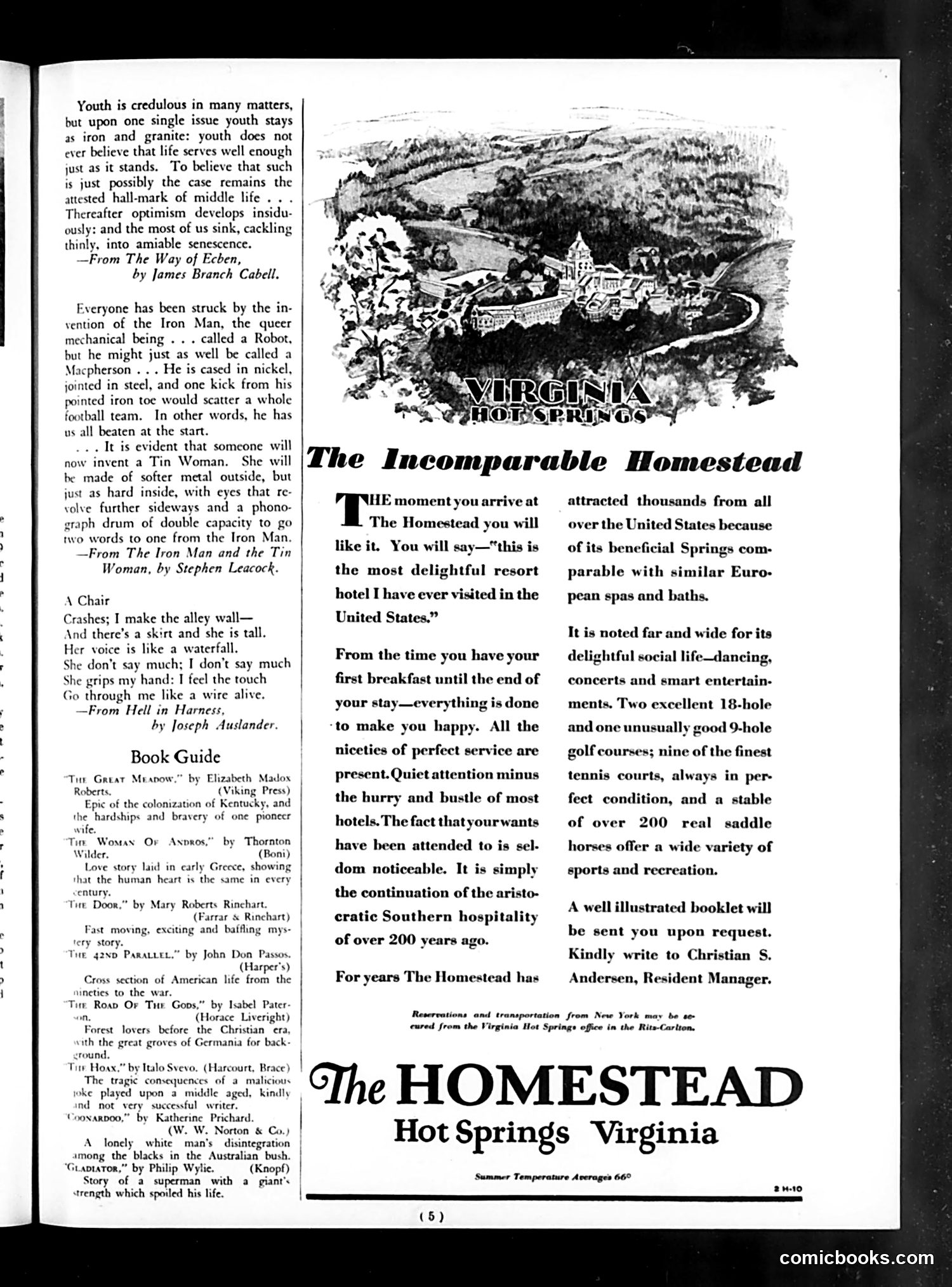
Content Analysis This page is primarily advertising for The Homestead resort in Hot Springs, Virginia, not political satire or editorial cartooning. The left column contains literary quotations and a book guide—these are standard magazine filler content from the era, not satirical commentary. The quotations discuss themes like youth, ambition, and mechanical invention (referencing "The Iron Man" and "The Tin Woman"), but serve as decorative text rather than social critique. The right side features a detailed resort advertisement with an illustrated landscape showing the hotel grounds and facilities. The copy emphasizes luxury amenities: golf courses, tennis courts, horseback riding, entertainment, and the therapeutic benefits of the mineral springs. This is a straightforward commercial page, not satirical content requiring historical context to decode.
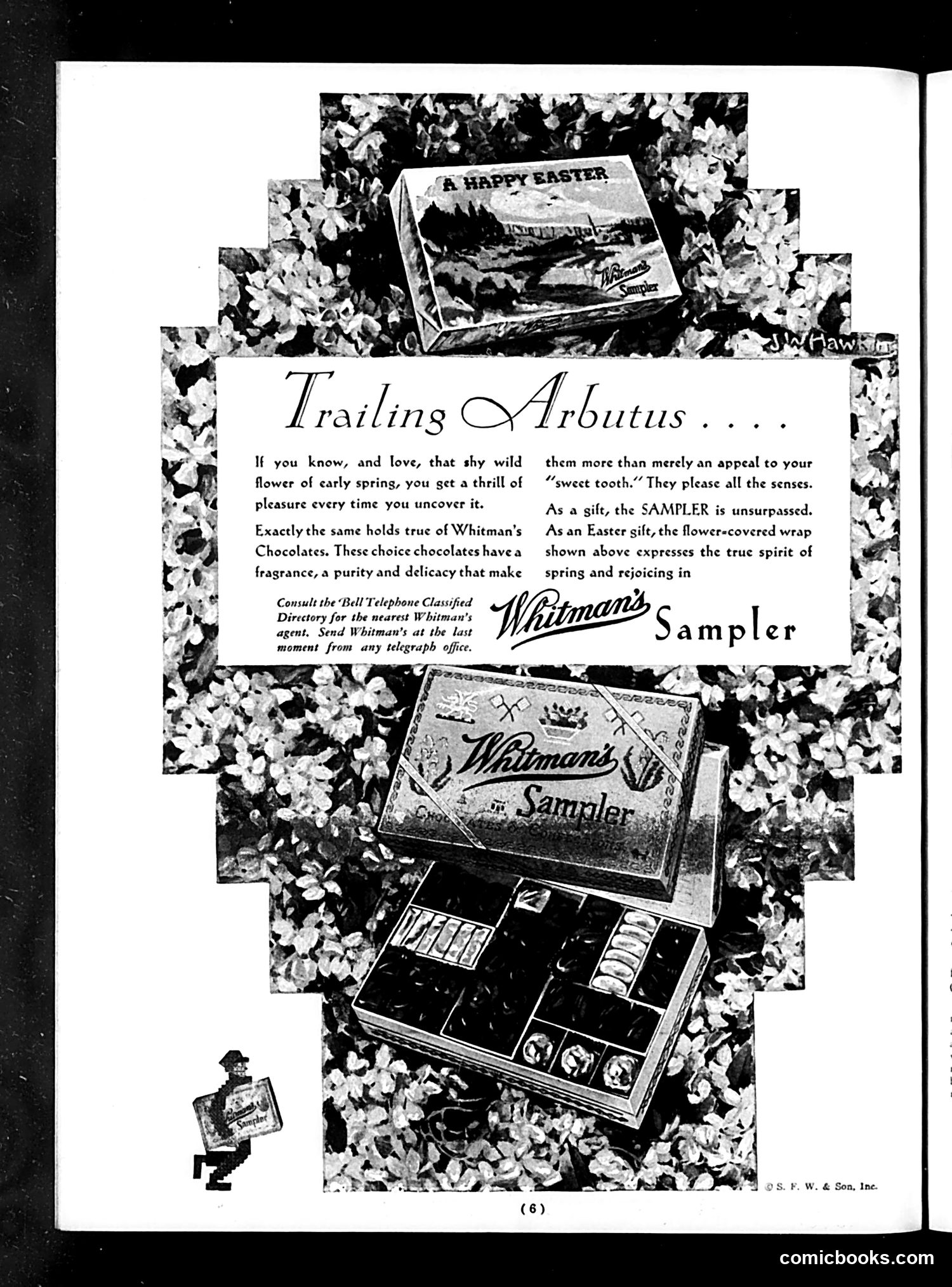
Analysis This is a Whitman's Chocolates advertisement, not political satire. The page promotes their "Sampler" box as an Easter gift, using the spring flower motif of trailing arbutus (a delicate woodland flower) as its central theme. The ad emphasizes that Whitman's chocolates appeal to refined tastes—described as having "fragrance, a purity and delicacy." The sampler box is presented as ideal for Easter gift-giving, combining the flower-covered packaging with the chocolates inside. The only potentially humorous element is the phrase about the flowers being "more than merely an appeal to your 'sweet tooth'"—a mild pun playing on both literal sweetness and the gift's elegance. This is straightforward vintage advertising without political commentary or satire.
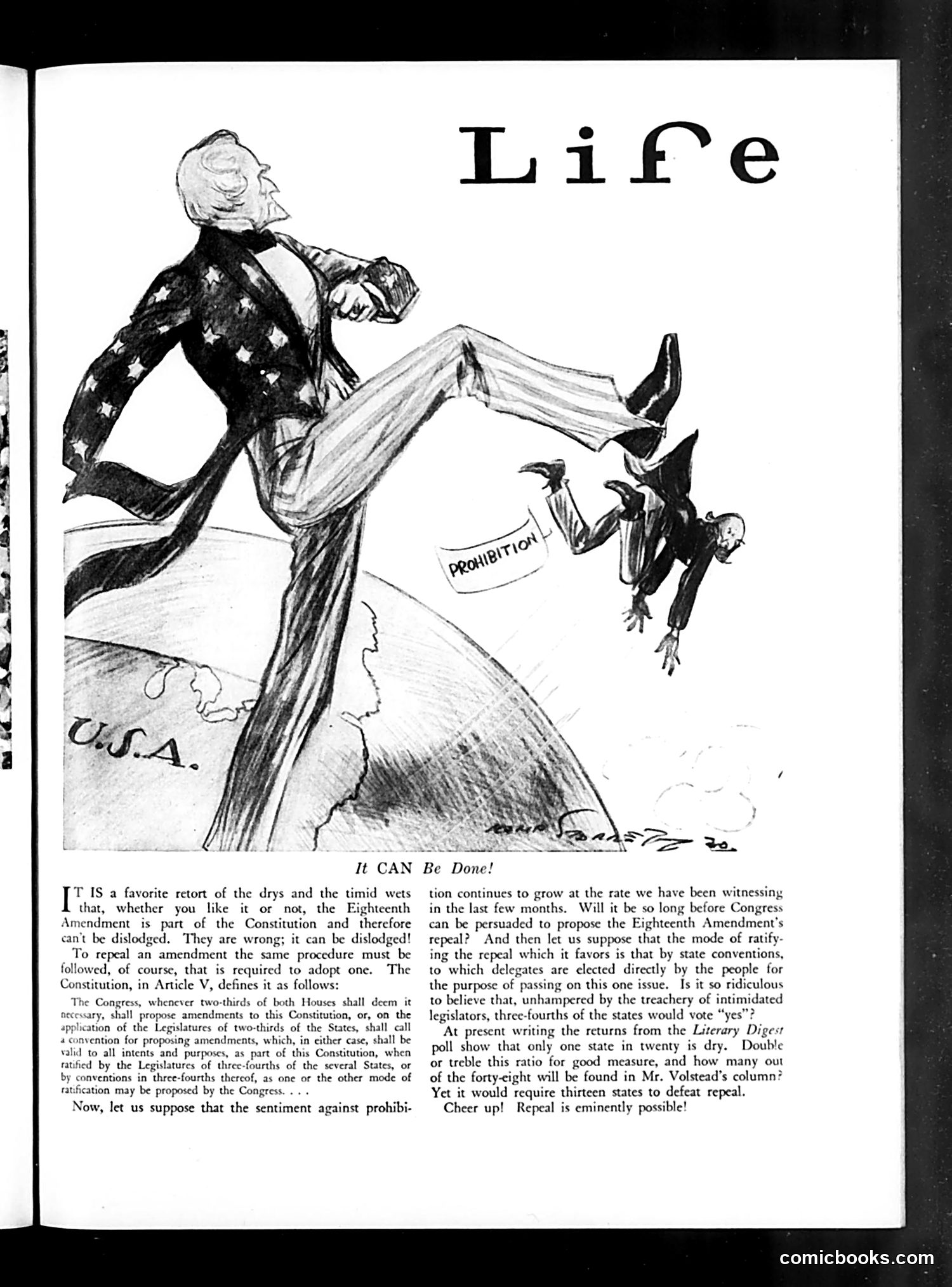
Political Cartoon Analysis: "It CAN Be Done!" This cartoon addresses the repeal of Prohibition, the constitutional ban on alcohol (18th Amendment). The figure kicking up his heels represents an optimistic American celebrating potential repeal as "imminent." The smaller figures being kicked appear to represent opponents of repeal — likely prohibition supporters or enforcers. The label "PROHIBITION" on the kicking figure's leg emphasizes the subject. The accompanying text argues repeal is procedurally possible through constitutional amendment (Article V), citing statistics suggesting majority state support. The author disputes claims that repealing Prohibition is impossible, countering that only 13 states would need to vote "yes" — a realistic target given contemporary sentiment. This reflects the wet vs. dry debate of the early 1930s, culminating in Prohibition's actual repeal in 1933.
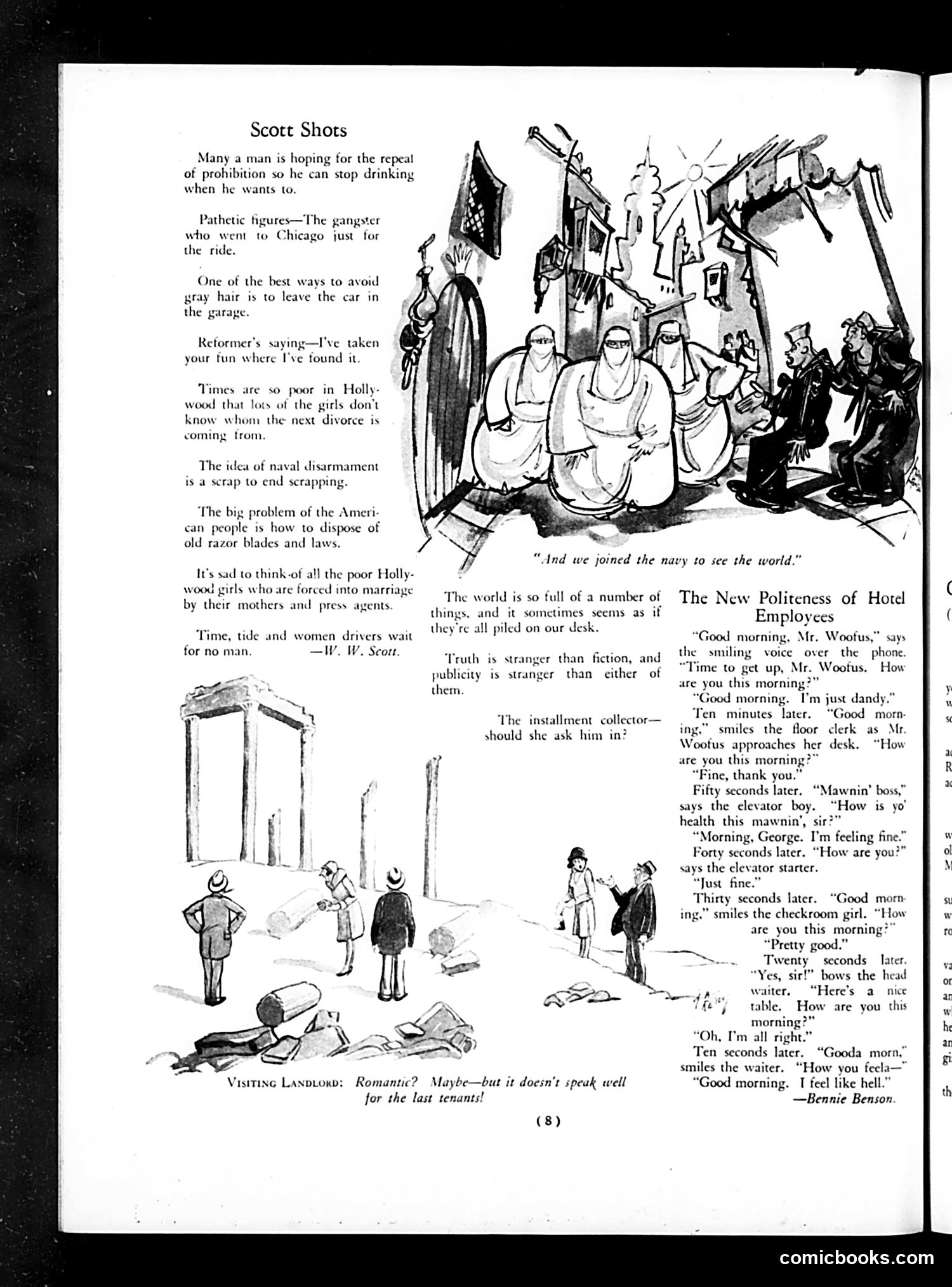
Scott Shots and Hotel Politeness This page contains several short satirical pieces by W.W. Scott. The top section mocks Prohibition-era behavior and social problems—including gangsters, divorce, and naval policy—through brief, pithy observations. The lower cartoon depicts a landlord showing a rundown property to prospective tenants, with the caption suggesting the building's poor condition makes it unsuitable even for evicting the last tenant. This satirizes predatory landlord practices common in that era. "The New Politeness of Hotel Employees" humorously catalogs how different hotel staff mechanically greet guests with identical "How are you this morning?" inquiries in rapid succession, mocking the performative nature of service-industry courtesy and the lack of genuine human connection in commercial interactions.
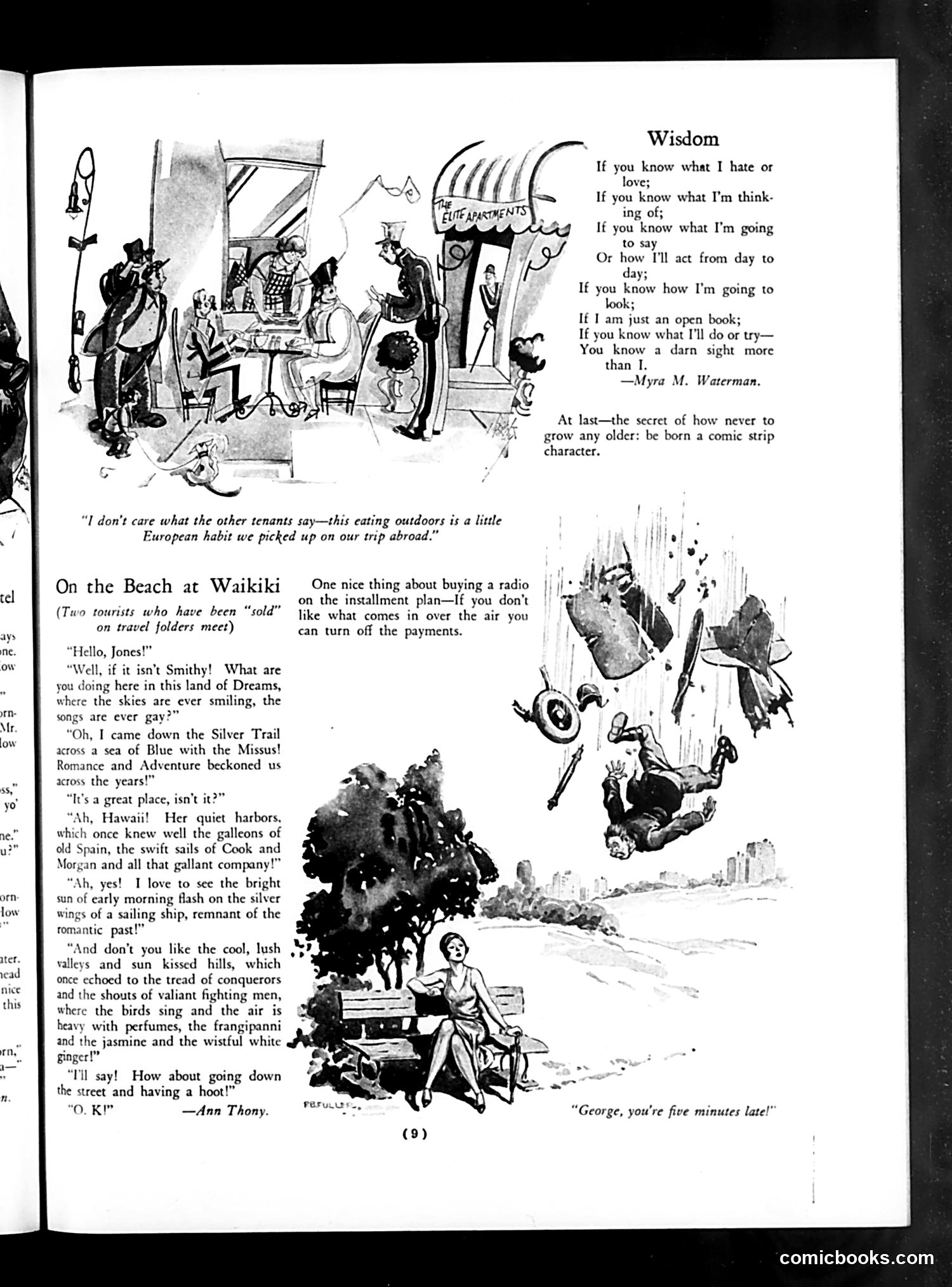
Page 9: "On the Beach at Waikiki" This page contains a humorous dialogue between two travelers meeting at Waikiki Beach (Hawaii). One character, Jones, encounters Smythy and they reminisce about romantic travel experiences—referencing Cook's voyages, gallant conquistadors, and exotic locales with "jasmine and wistful white ginger." The joke satirizes tourists who romanticize travel while ignoring mundane reality. Smythy suggests they go "down the street and having a hoot" (get drunk), deflating the grand romantic pretensions just expressed. The cartoon at top depicts apartment dwellers eating outdoors, with a caption about adopting "European habits" from abroad—gently mocking how travelers adopt foreign affectations. The illustration shows a woman at Waikiki with the caption "George, you're five minutes late!"—suggesting vacation romance is as ordinary and domestic as everyday life.
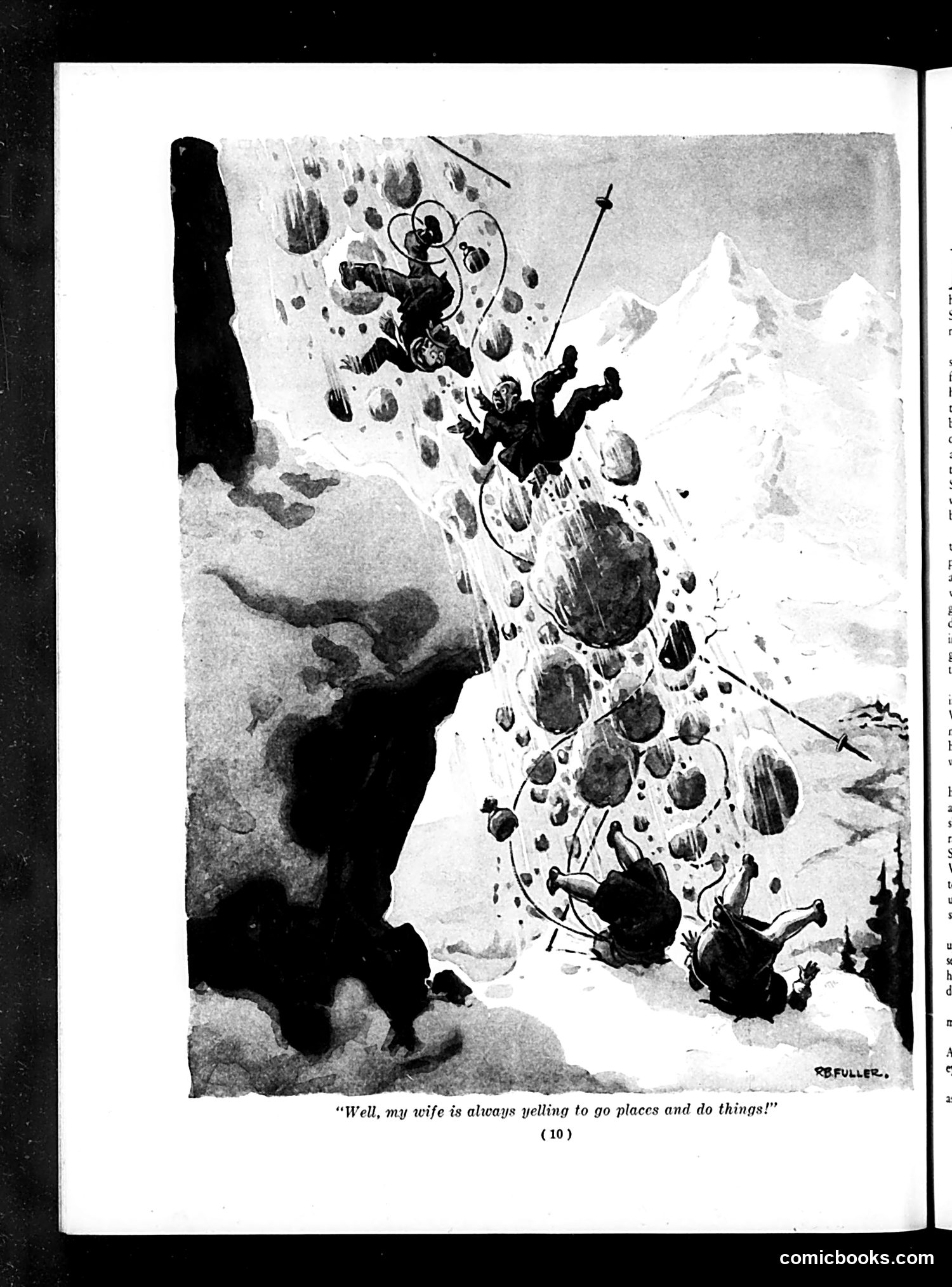
Commentary on This Cartoon This is a humorous domestic scene depicting a husband complaining about his wife's adventurous spirit. The cartoon shows multiple figures falling or tumbling down a snowy mountainside amid rocks and boulders, suggesting chaotic action and danger. The joke plays on traditional gender roles: the husband grumbles that his wife constantly wants to "go places and do things"—apparently including extreme mountain activities—rather than staying home. The visual chaos of people falling illustrates the (literal and figurative) consequences of her restless ambition. The satire mocks both the wife's desire for independence and adventure, and implicitly the husband's passive complaint rather than active participation. It reflects early 20th-century anxieties about changing women's roles and expectations regarding domesticity.
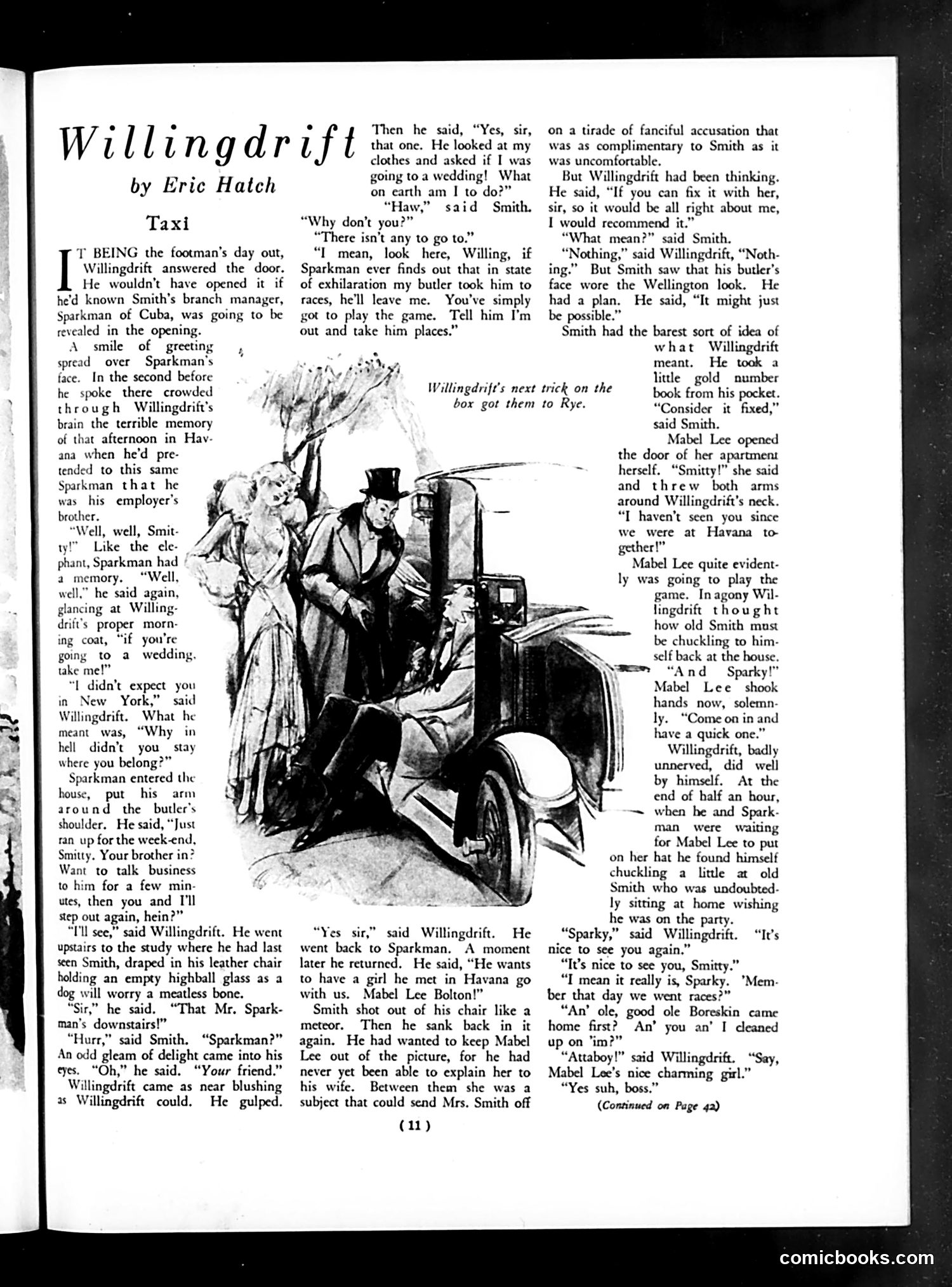
"Willingdrift" by Eric Hatch This is a short story installment titled "Taxi," featuring a humorous domestic scene. The illustration shows a taxi with several characters in period dress (appearing early 20th century), with Willingdrift as the apparent protagonist. The plot involves Willingdrift being summoned by his employer Sparkman to open a taxi business. The dialogue reveals social comedy around class differences and misunderstandings—Sparkman assumes Willingdrift is attending a wedding based on his clothing, and there are complications involving a woman named Mabel Lee and references to Havana. The satire appears to target pretension and miscommunication between social classes rather than political figures. This is a narrative fiction piece rather than a political cartoon.
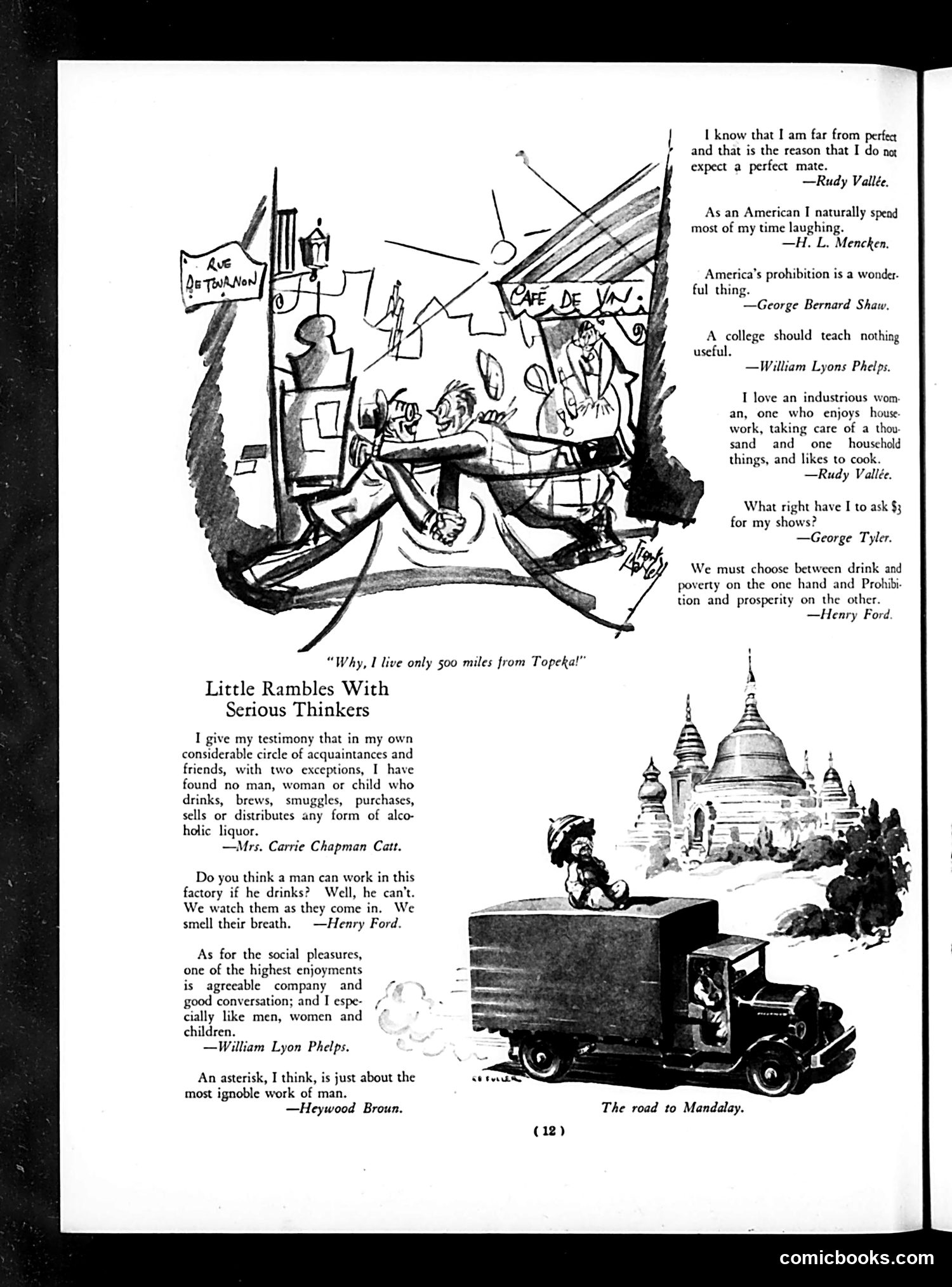
Analysis This page from *Life* magazine satirizes Prohibition through a cartoon titled "Why, I live only 500 miles from Topeka!" The sketch depicts people in what appears to be a nightclub or café ("Café de Vin"), with the reference to Topeka (Kansas, a center of the temperance movement) suggesting ironic distance from Prohibition's heartland. The surrounding quotes from various figures—Henry Ford, George Bernard Shaw, and others—debate Prohibition's merits and social effects. Ford argues Prohibition ensures worker sobriety; Shaw calls it "wonderful"; others defend drinking and social pleasure. The lower illustration of "The road to Mandalay" shows a truck traveling to Burma, likely suggesting smuggling routes or escape from Prohibition's reach. The page mocks Prohibition through competing viewpoints while implying widespread violation of the ban.
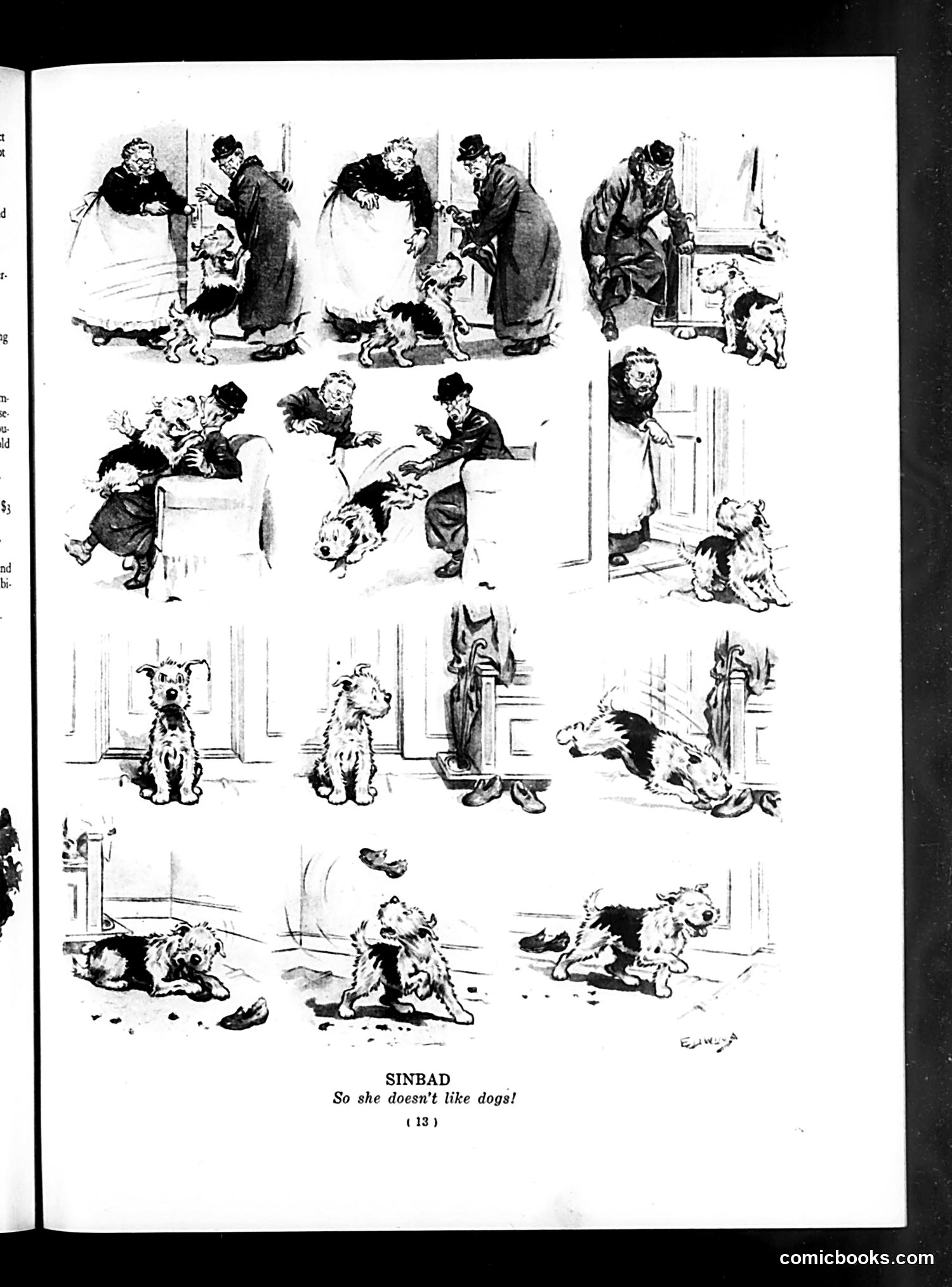
Analysis of "Sinbad" Comic Page This appears to be a comedic illustrated sequence titled "Sinbad: So she doesn't like dogs!" (page 13). The narrative follows a woman's increasingly negative encounters with dogs across multiple panels. The sequence shows: - Upper panels: A woman (presumably "Sinbad" or associated with that character) repeatedly encountering and rejecting small dogs offered or presented to her - Middle panels: Individual dogs sitting or standing, appearing sad or dejected - Lower panels: Dogs in various states of distress or mischief The humor derives from the contrast between the dogs' apparent desire for acceptance and the woman's consistent rejection of them. This appears to be a lighthearted satire on either a character's stubborn dislike of animals or a commentary on unrequited affection—a common comedic device in early 20th-century magazine humor.
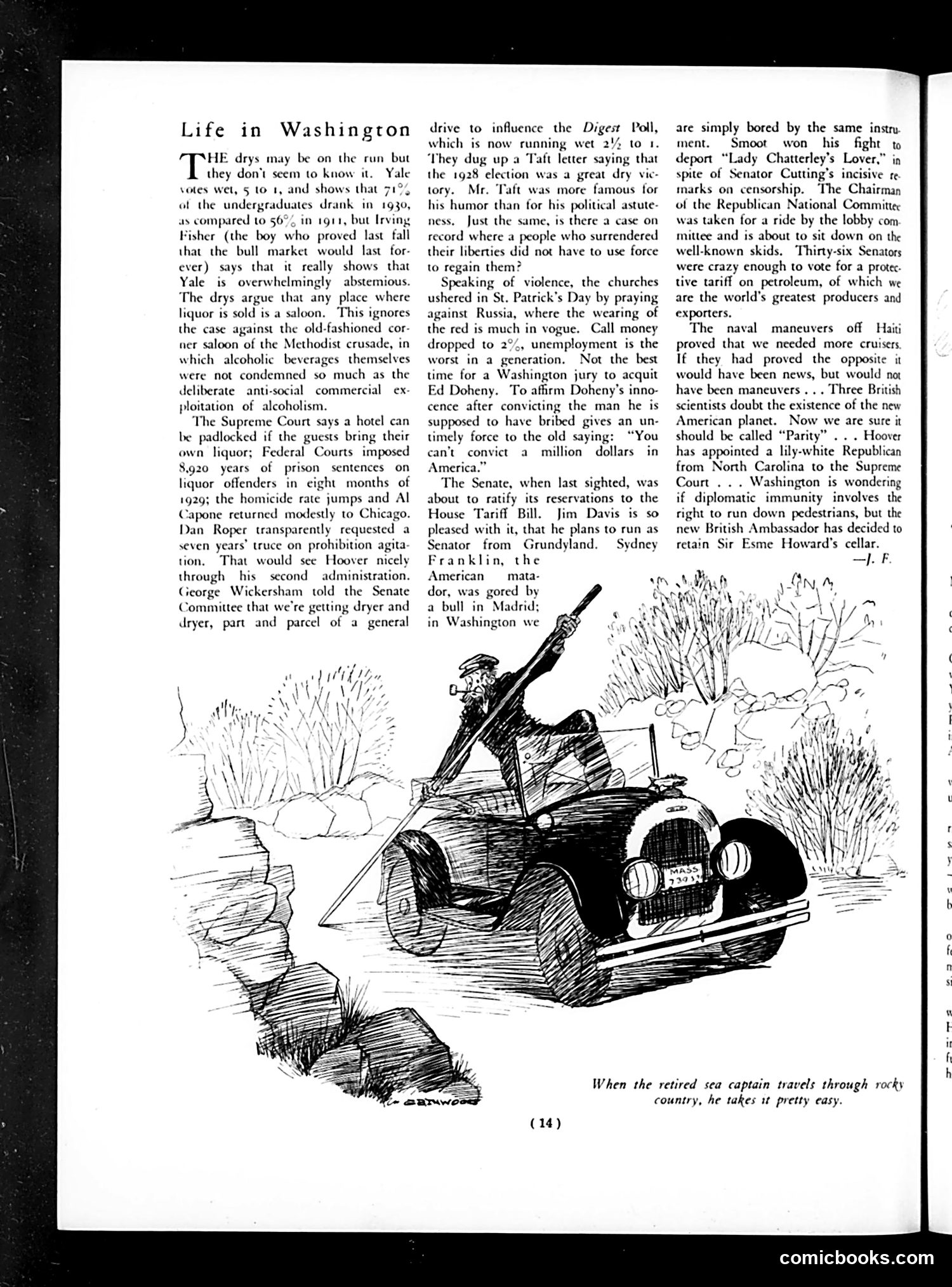
Political Cartoon Analysis This page from *Life* magazine contains a satirical illustration depicting a retired sea captain navigating rocky terrain in an automobile, with the caption: "When the retired sea captain travels through rocky country, he takes it pretty easy." The cartoon is a visual pun playing on nautical terminology. A "sea captain" maneuvering carefully through "rocky country" suggests both literal rocky terrain and the metaphorical phrase "rocky waters"—meaning difficult times. The joke equates driving cautiously on actual rocks with navigating metaphorical difficulties. The accompanying article discusses various Washington political issues including prohibition, the Supreme Court, and congressional maneuvering, suggesting the cartoon may be commenting on political navigating, though the connection isn't entirely explicit.
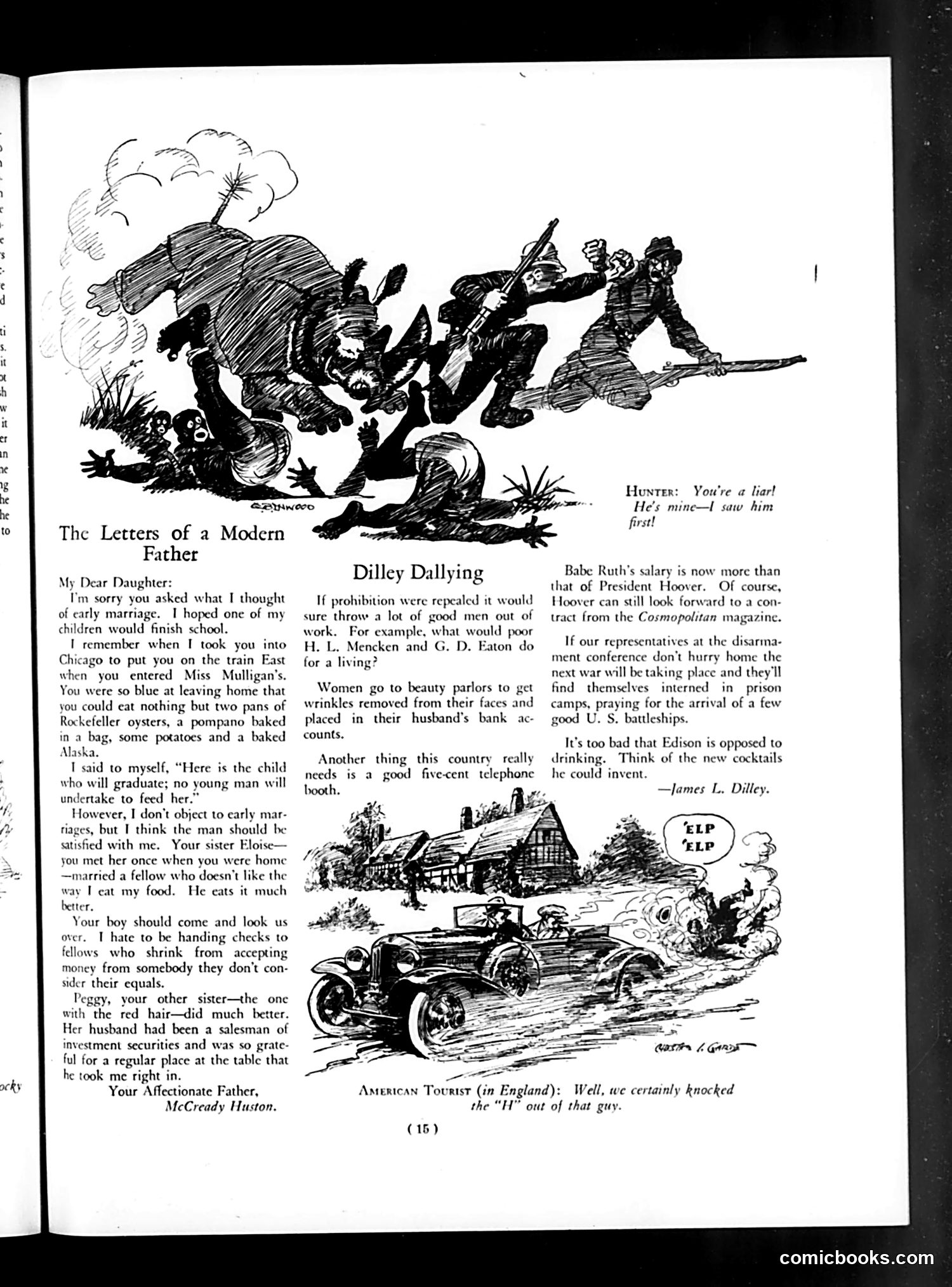
Analysis of Life Magazine Page This page contains satirical commentary on 1920s American social issues: "The Letters of a Modern Father" by McCready Huston mocks early marriage and changing courtship customs. The father criticizes youth culture, particularly young men's work ethic and willingness to accept financial dependence. "Dilley Dallying" by James L. Dilley satirizes Prohibition's repeal and contemporary concerns: women frequenting beauty parlors, the disarmament conference, and Edison's opposition to drinking. The reference to Babe Ruth earning more than President Hoover reflects 1920s celebrity culture. The cartoon (bottom) shows an American tourist in England causing a car accident, joking about aggressive American driving versus British restraint—a common transatlantic stereotype of the era. The page reflects post-WWI anxieties about social change, economic priorities, and American identity.
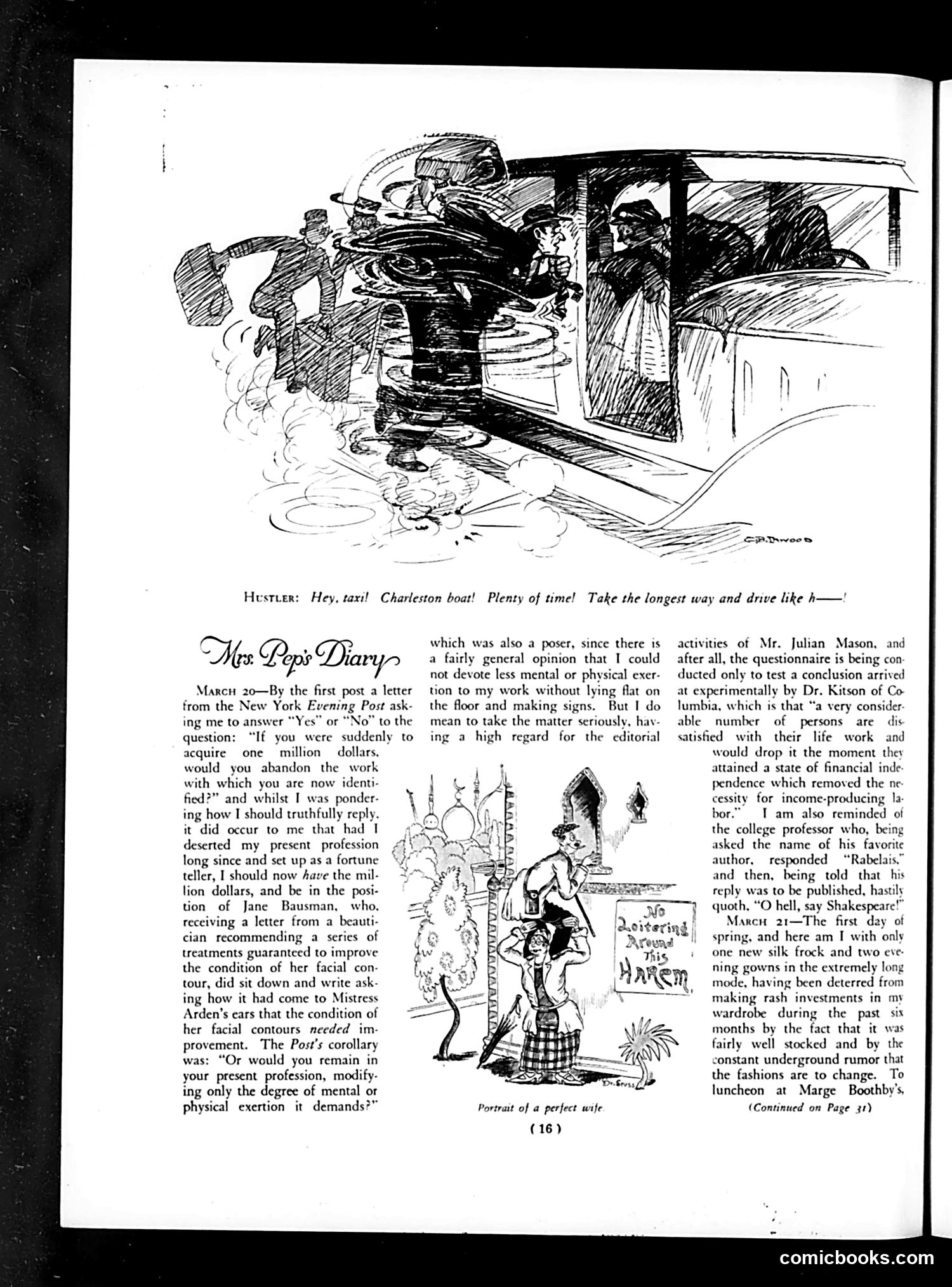
Analysis of This Life Magazine Page Top Cartoon: A chauffeur ("Hustler") tells passengers in a car to "Take the longest way and drive like h—!" The humor mocks wealthy employers who, despite paying for the shortest route, demand reckless driving. It satirizes the contradiction between class pretension and actual behavior—the rich want to appear refined while acting dangerously. "Mrs. Pop's Diary" Column: A humorous diary entry (March 20-21) discussing whether the author should abandon journalism for fortune-telling, and mentioning spring fashion acquisitions. The entry includes a small illustration labeled "Portrait of a perfect smile." The page blends social satire with domestic humor typical of Life magazine's early 20th-century content—mocking both wealth and changing gender roles through a woman's perspective.
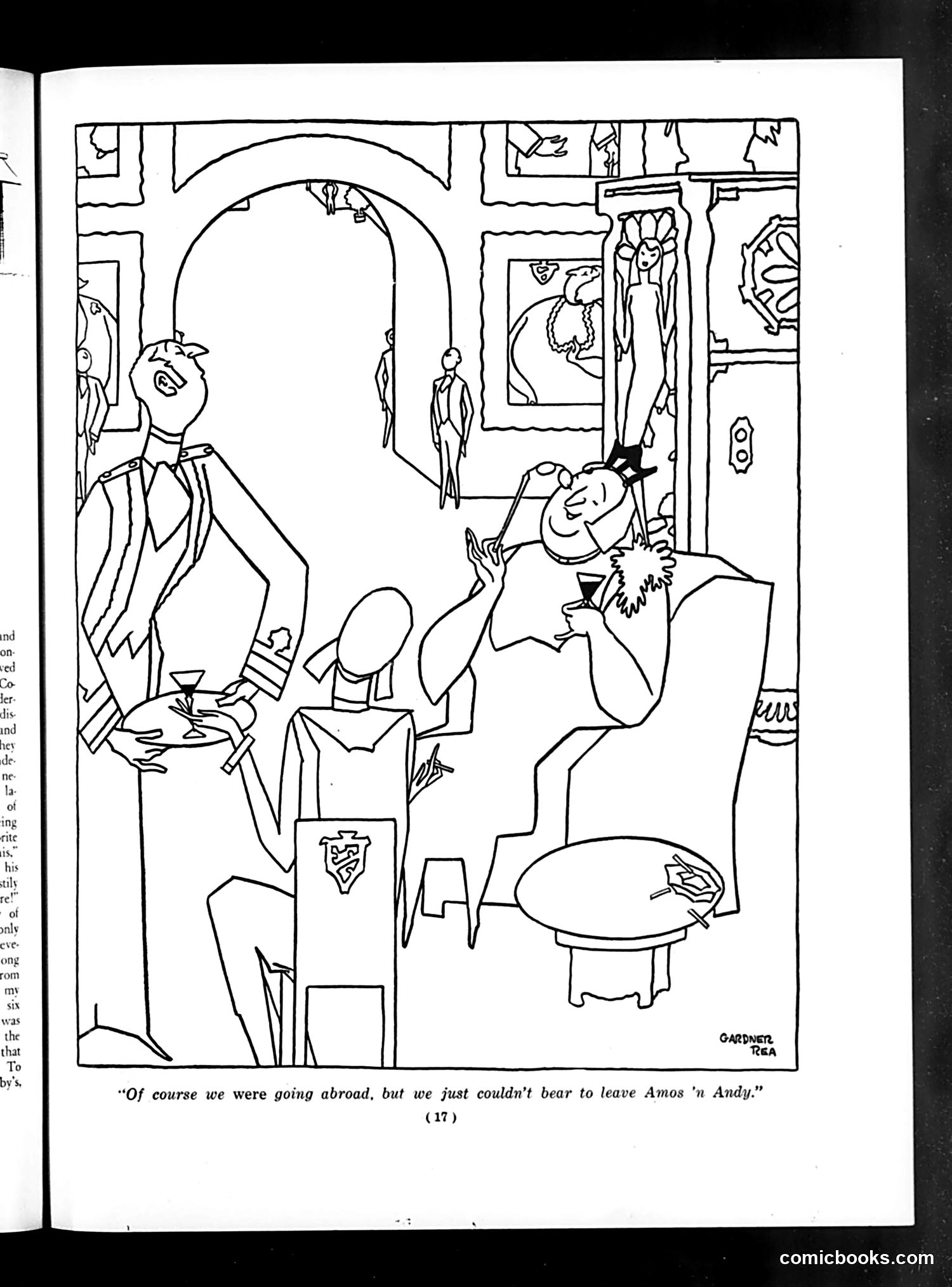
Cartoon Analysis This cartoon depicts a sophisticated social gathering where two well-dressed figures converse. The caption reads: "Of course we were going abroad, but we just couldn't bear to leave Amos 'n Andy." The joke satirizes Americans' addiction to the popular radio program "Amos 'n Andy," which aired during the 1920s-1930s. The cartoon mocks the absurdity of wealthy socialites canceling international travel plans—typically a marker of elite status—because they couldn't miss their favorite radio show. The humor targets both the show's cultural dominance and the frivolous priorities of the upper class. Rather than pursue glamorous abroad travel, these characters are enslaved to their radio schedule, revealing how mass entertainment had captured even the most privileged Americans' leisure time.
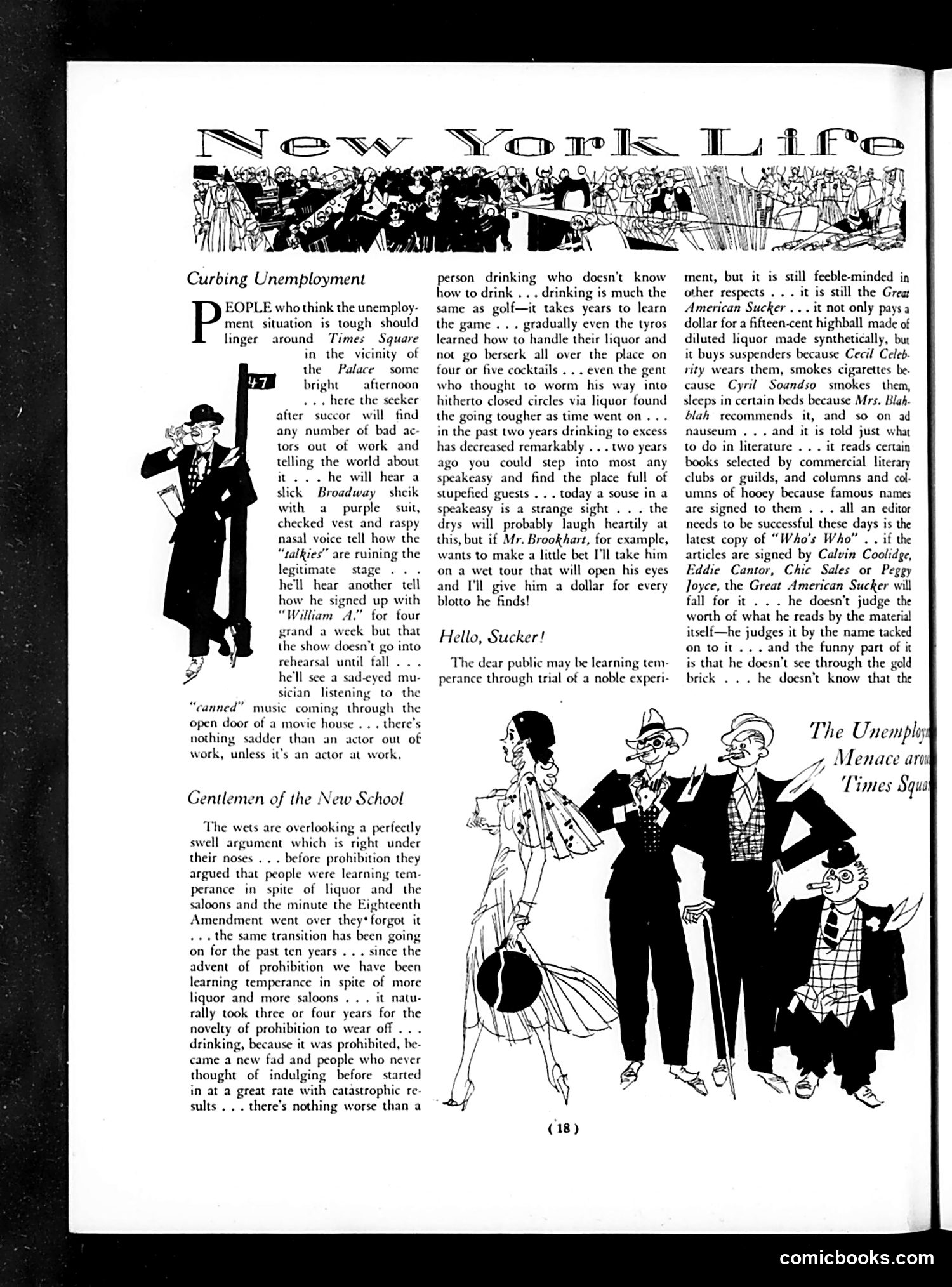
Analysis of New York Life Page This page satirizes 1920s social issues during Prohibition. The left cartoon mocks unemployed men loitering around Times Square, specifically critiquing those seeking handouts or "easy" Broadway work. The illustration shows a well-dressed panhandler, suggesting economic desperation affected all social classes. The right section, titled "Hello, Sucker!" and "Gentlemen of the New School," ridicules the notion that Americans are learning temperance through Prohibition's enforcement. Instead, the text argues people are drinking MORE in speakeasies and saloons, with newly wealthy bootleggers and young drinkers replacing traditional patrons. The cartoon depicts fashionable socialites and well-dressed figures frequenting illegal establishments—suggesting Prohibition created a glamorous underworld culture rather than moral reform.
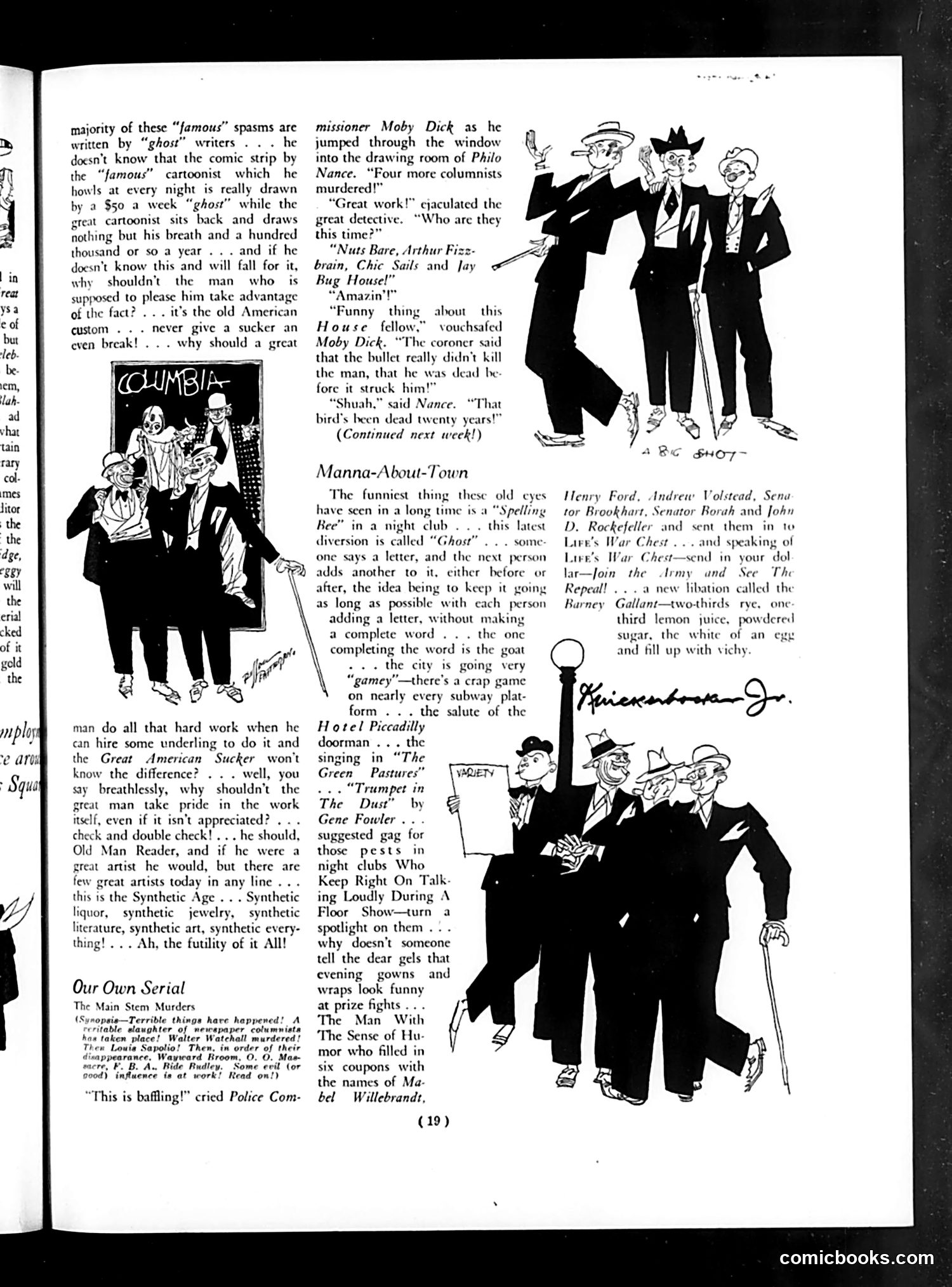
Analysis of Life Magazine Page This page satirizes synthetic culture and artistic fraud in 1920s America. The opening section mocks famous cartoonists who employ "$50 a week 'ghost' writers" while taking credit and earning substantial incomes—exploiting the "Great American Sucker" (the reader) who doesn't know the difference. The author argues this reflects a broader "Synthetic Age" of fake everything: liquor, jewelry, literature, art. The cartoon serial "The Main Stem Murders" parodies detective fiction, featuring "Police Commissioner Moby Dick" and detective "Philo Nance" investigating murdered newspaper columnists. The humor lies in the absurdist detective-story conventions and the play on famous names. "Manna-About-Town" offers gossipy observations about nightclub trends, including a "Spelling Ree" game and mentions of contemporary figures like Henry Ford, Andrew Volstead (Prohibition enforcer), and Mabel Willebrandt (Assistant Attorney General, Prohibition administrator)—figures associated with Prohibition-era America.
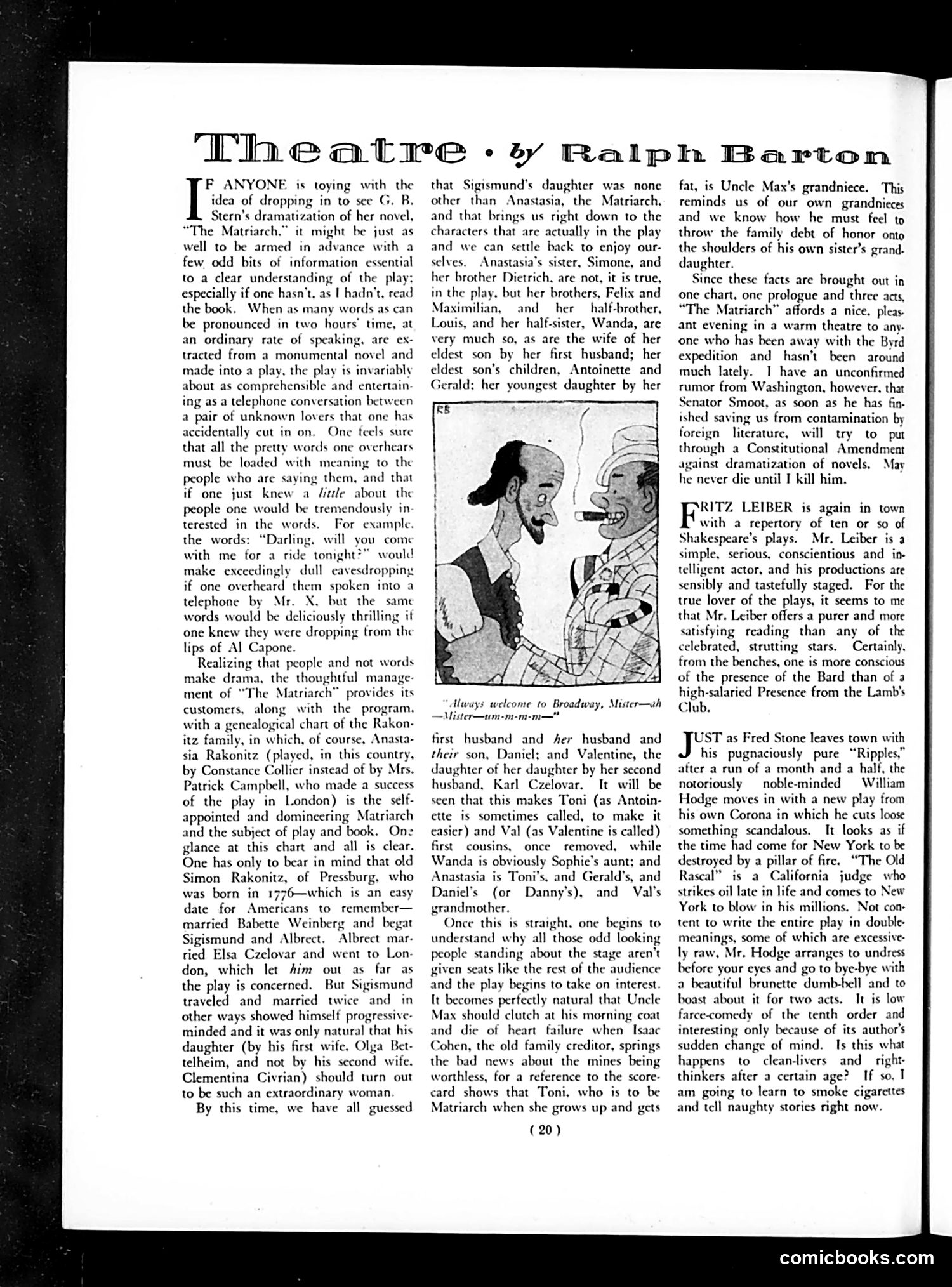
Explaining This Life Magazine Theatre Column This is Ralph Barton's theatre review of "The Matriarch," a play adapted from G.B. Stern's novel. The cartoon shows two men greeting each other on Broadway, with one struggling to remember the other's name—a joke about Broadway's superficial social rituals. Barton's satirical point: the play is so plot-heavy with complex family genealogies that audiences need a printed family chart to follow it. He compares watching it to eavesdropping on a telephone conversation between strangers—meaningless unless you know the people involved. His humor relies on the contrast between words and character: he notes that "Darling, will you come for a ride?" would be dull if spoken by "Mr. X" but thrilling if spoken by Al Capone—implying drama comes from *who* speaks, not *what* is said. The genealogical details about the Rakonowitz family (spanning from 1776 Prussia to London) underscore how unwieldy the play's exposition becomes.
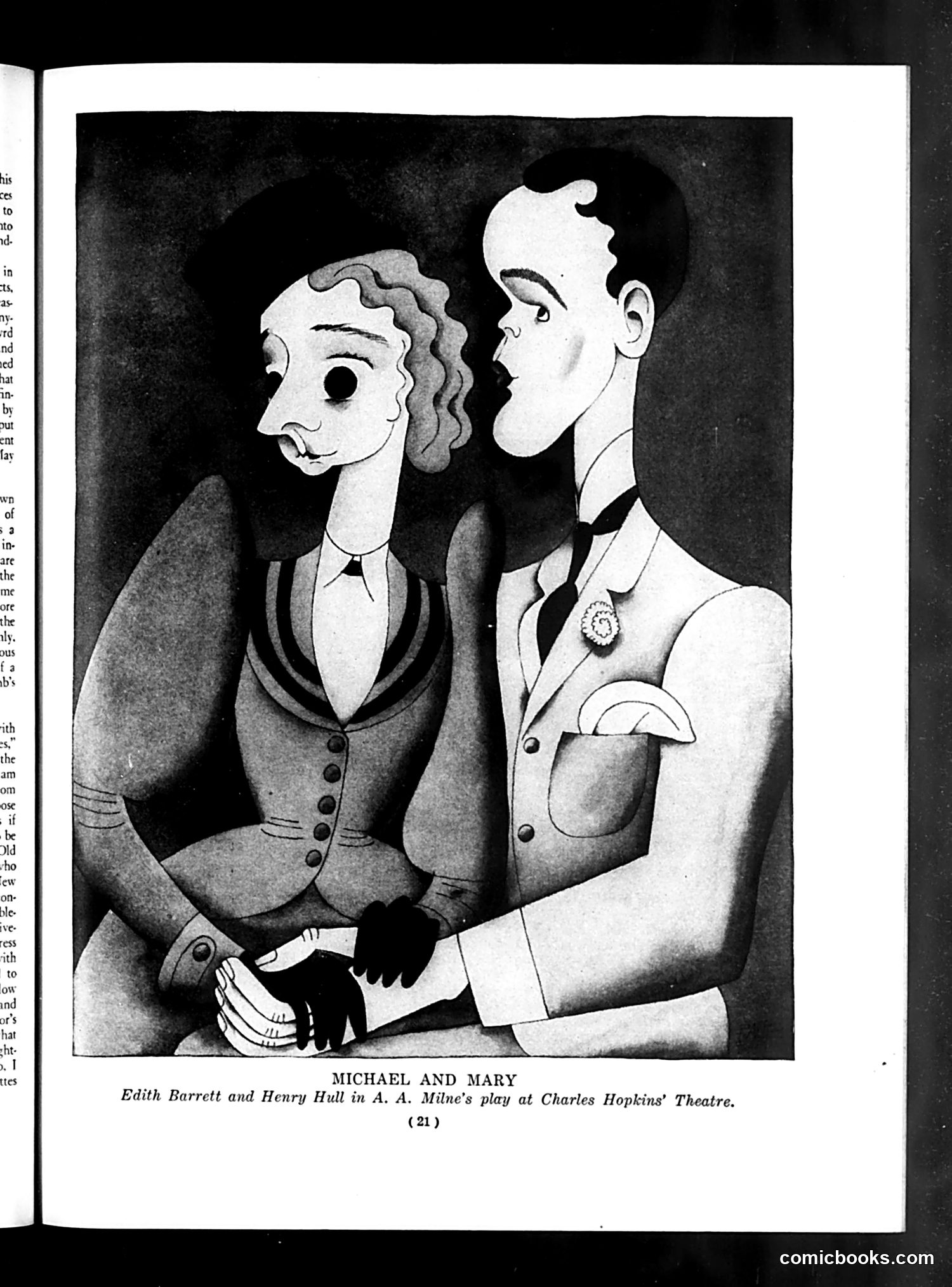
This is a theatrical photograph, not a political cartoon. It shows actors Edith Barrett and Henry Hull performing in "Michael and Mary," a play by A. A. Milne (author of Winnie-the-Pooh), staged at Charles Hopkins' Theatre in New York. The image depicts two figures in formal 1920s-30s attire shaking hands in what appears to be a dramatic scene. The stylized, somewhat exaggerated drawing style was typical of theater publicity of the era. The page functions as entertainment coverage rather than satire—Life magazine regularly featured theatrical productions alongside its cartoons and commentary. Without additional context about the play's plot, the specific dramatic moment being illustrated remains unclear to modern viewers.
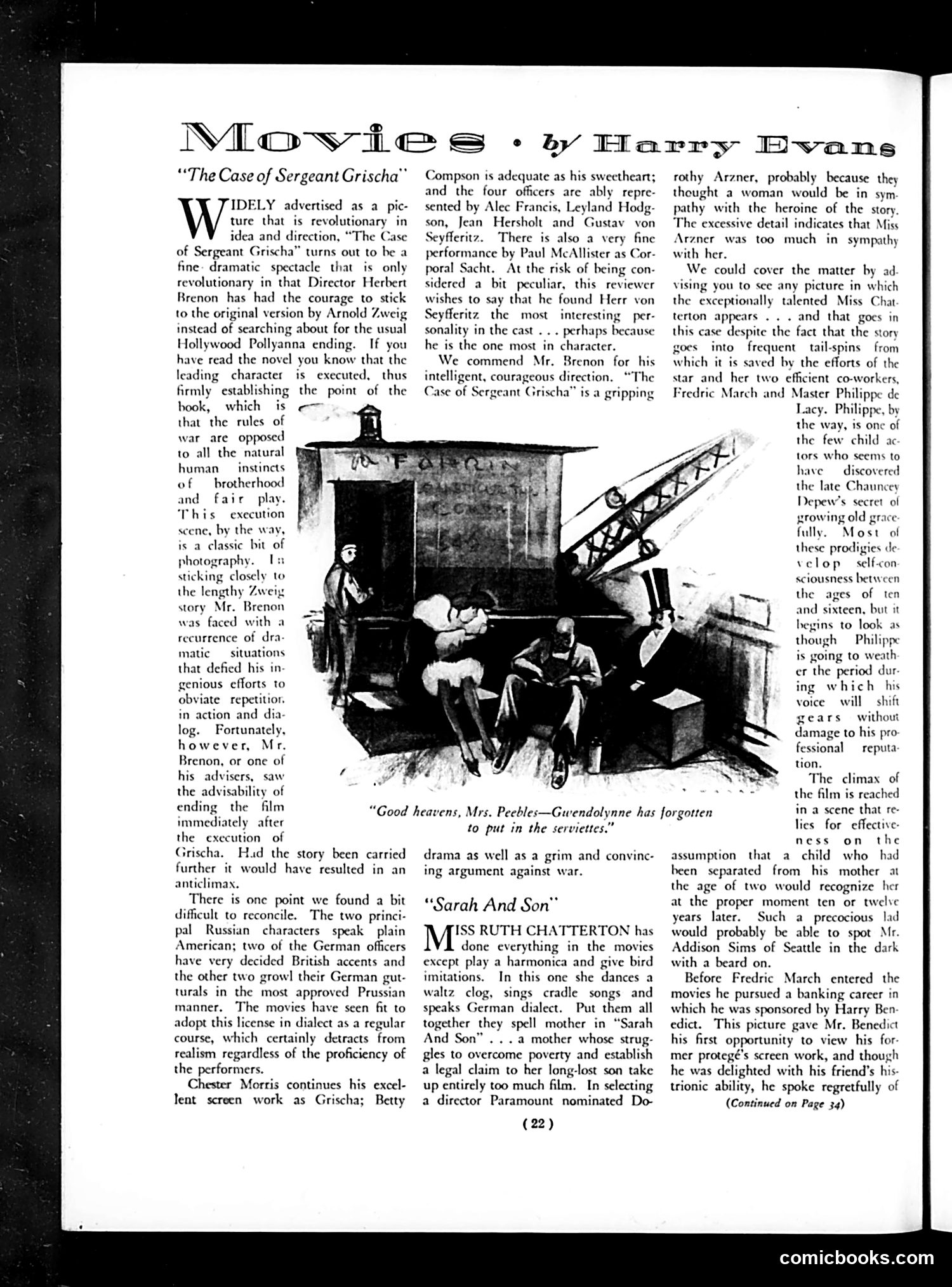
"The Case of Sergeant Grischa" and "Sarah and Son" Reviews This page contains two film reviews from *Life* magazine. The main review praises "The Case of Sergeant Grischa," an adaptation of Arnold Zweig's anti-war novel, commending director Herbert Brenon for faithfully ending the film with the protagonist's execution rather than adding a Hollywood happy ending. The reviewer notes the film makes a "grim and convincing argument against war." The photograph shows a scene from the film depicting soldiers in a military setting. Below, a brief review of "Sarah and Son" critiques Ruth Chatterton's performance while faulting excessive plot detail and sentimentality. The reviewer suggests seeing any film featuring Chatterton regardless, and praises child actor Philippe de Lacy for his mature acting ability. A small cartoon caption jokes about a character forgetting table napkins ("serviettes").
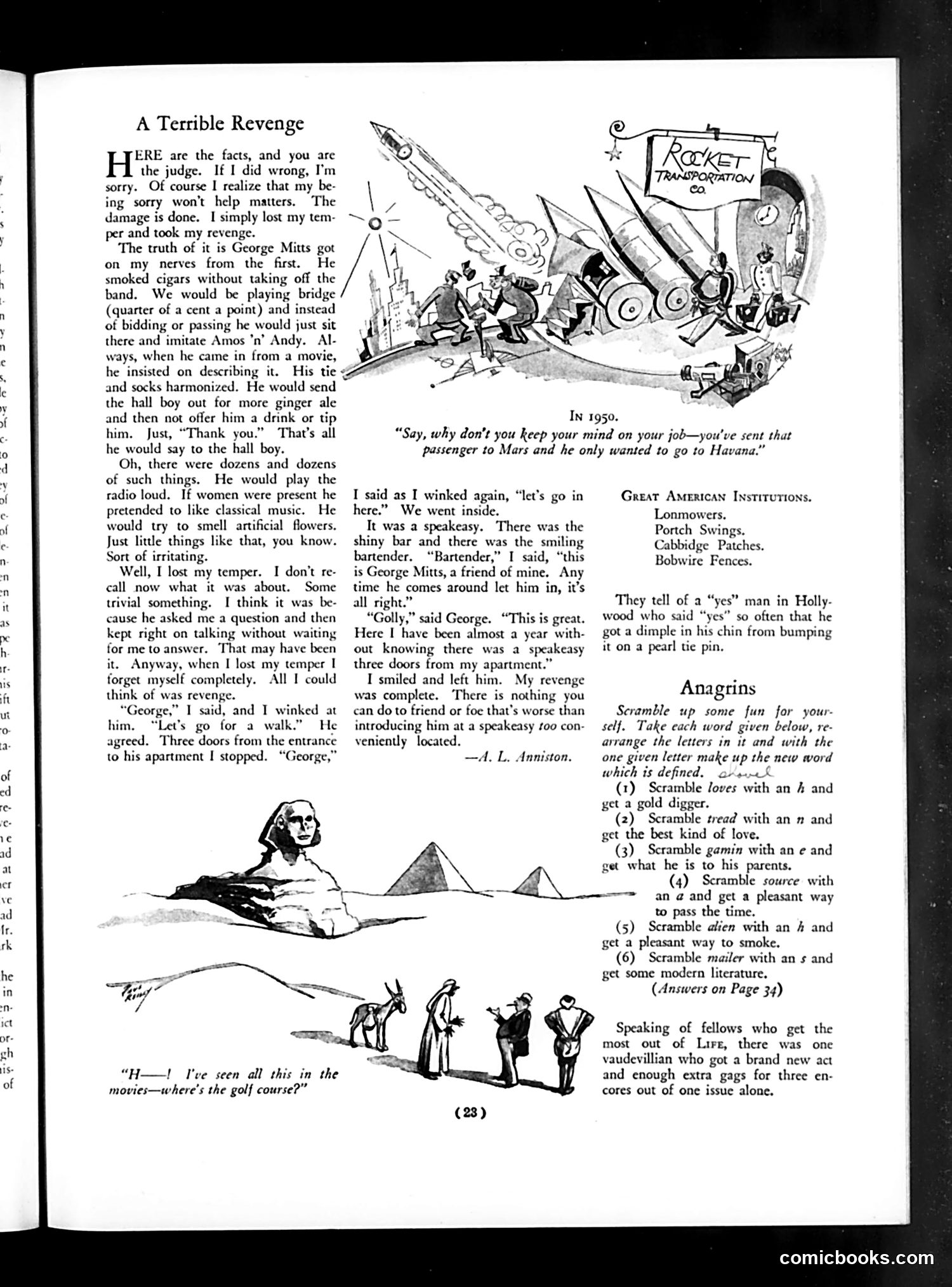
"A Terrible Revenge" - Life Magazine Satire This is a humorous short story satirizing petty social annoyances and disproportionate revenge. The narrator catalogs George Mitts' irritating habits—smoking cigars with bands on, imitating the Amos 'n' Andy radio show, describing movies at length, neglecting to tip service staff, playing loud radio, and interrupting conversations. Rather than confront these behaviors directly, the narrator's "terrible revenge" is simply to introduce George to a conveniently-located speakeasy near his apartment. The joke's punch line: there's "nothing you can do to friend or foe that's worse than introducing him at a speakeasy too conveniently located." This satirizes 1920s-30s Prohibition-era anxieties about speakeasies as vice dens, implying that giving someone easy access to illegal alcohol is the ultimate social sabotage. The story mocks both petty grievances and the moral panic surrounding speakeasies. The sidebar cartoons are unrelated filler content typical of Life magazine's format.
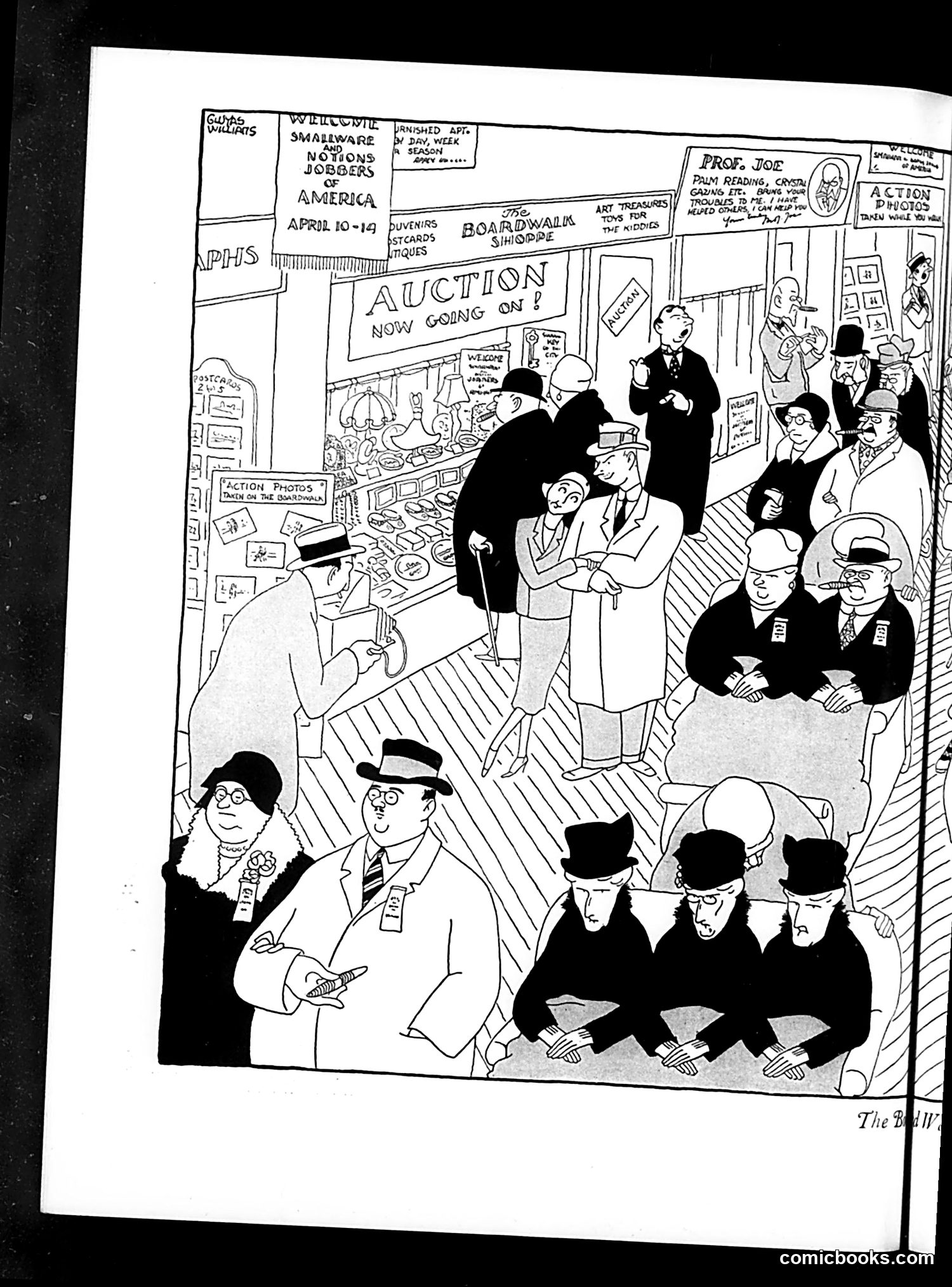
Analysis This appears to be a satirical cartoon depicting an auction at what looks like a boardwalk shop or seaside establishment (circa early-to-mid 20th century, given the style). The scene shows well-dressed attendees gathering around an auctioneer conducting a sale "NOW GOING ON!" The storefronts visible include references to "smallware," "notions," and "jobbers"—suggesting this is a commercial district auction, possibly of merchandise or shop inventory. The caricatured figures in formal attire and hats represent typical auction attendees of the era. The satire likely mocks either the commercialization of boardwalk tourism, the enthusiasm of crowds at auctions, or contemporary consumer culture. However, without clearer OCR text or additional context about Life magazine's specific date and focus, the precise satirical target remains somewhat unclear. The cartoon's humor appears aimed at the spectacle of public auctions and the types drawn to them.
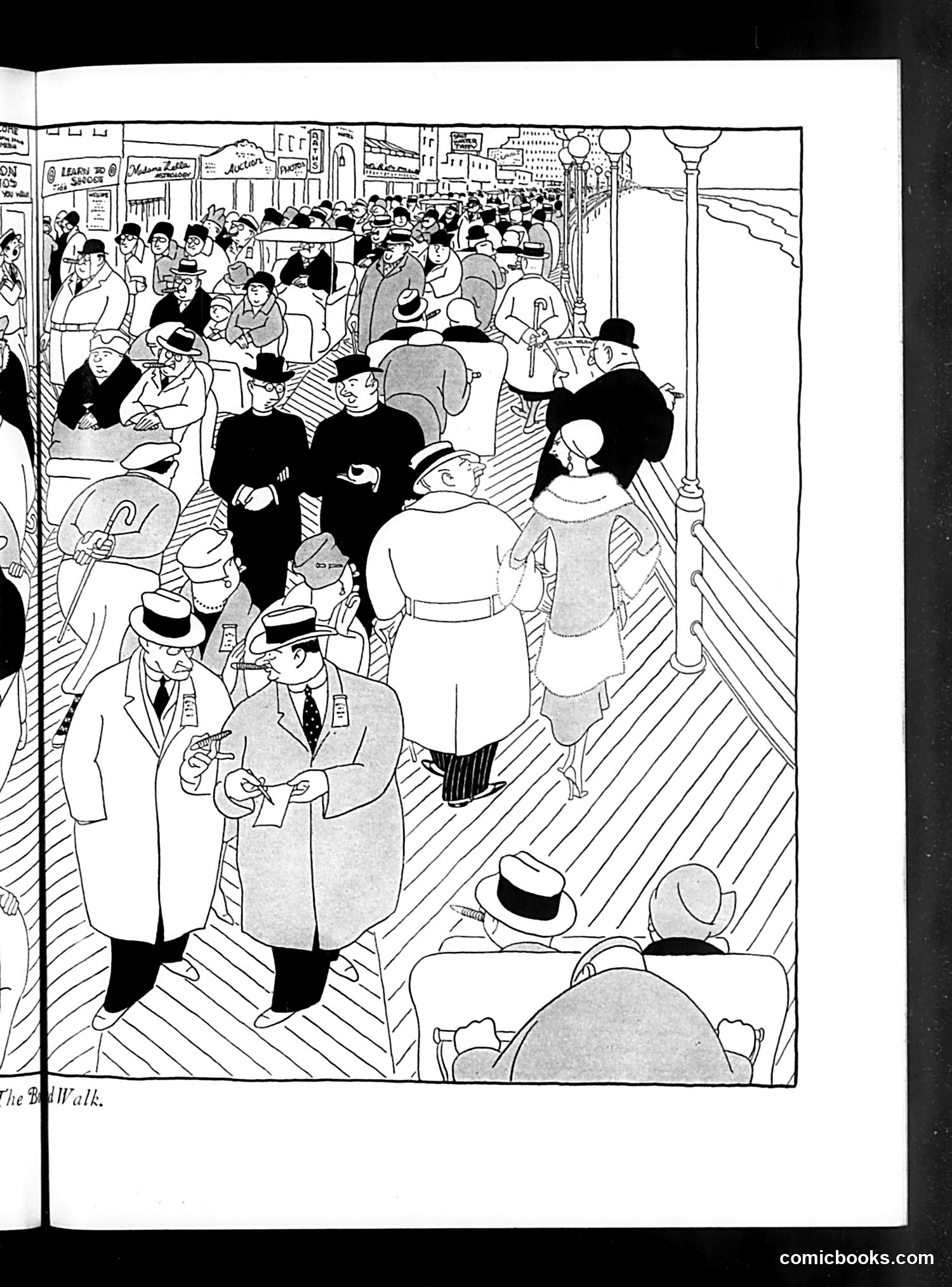
"The Bal Walk" This cartoon depicts a crowded public promenade or boardwalk scene, likely from the early 20th century based on the clothing styles (fedoras, long coats, period hats). The title "The Bal Walk" suggests a fashionable social gathering or seaside resort destination. The satire appears to target social pretension and overcrowding at such venues. The densely packed crowd—mixing well-dressed figures with various social types—suggests the democratization of once-exclusive spaces. Two well-dressed men in the foreground appear to be observing or commenting on the scene, possibly representing sophisticated observers bemused by the chaos of mass leisure culture. The cartoon likely mocks how fashionable public spaces had become uncomfortably congested with ordinary people attempting social respectability.
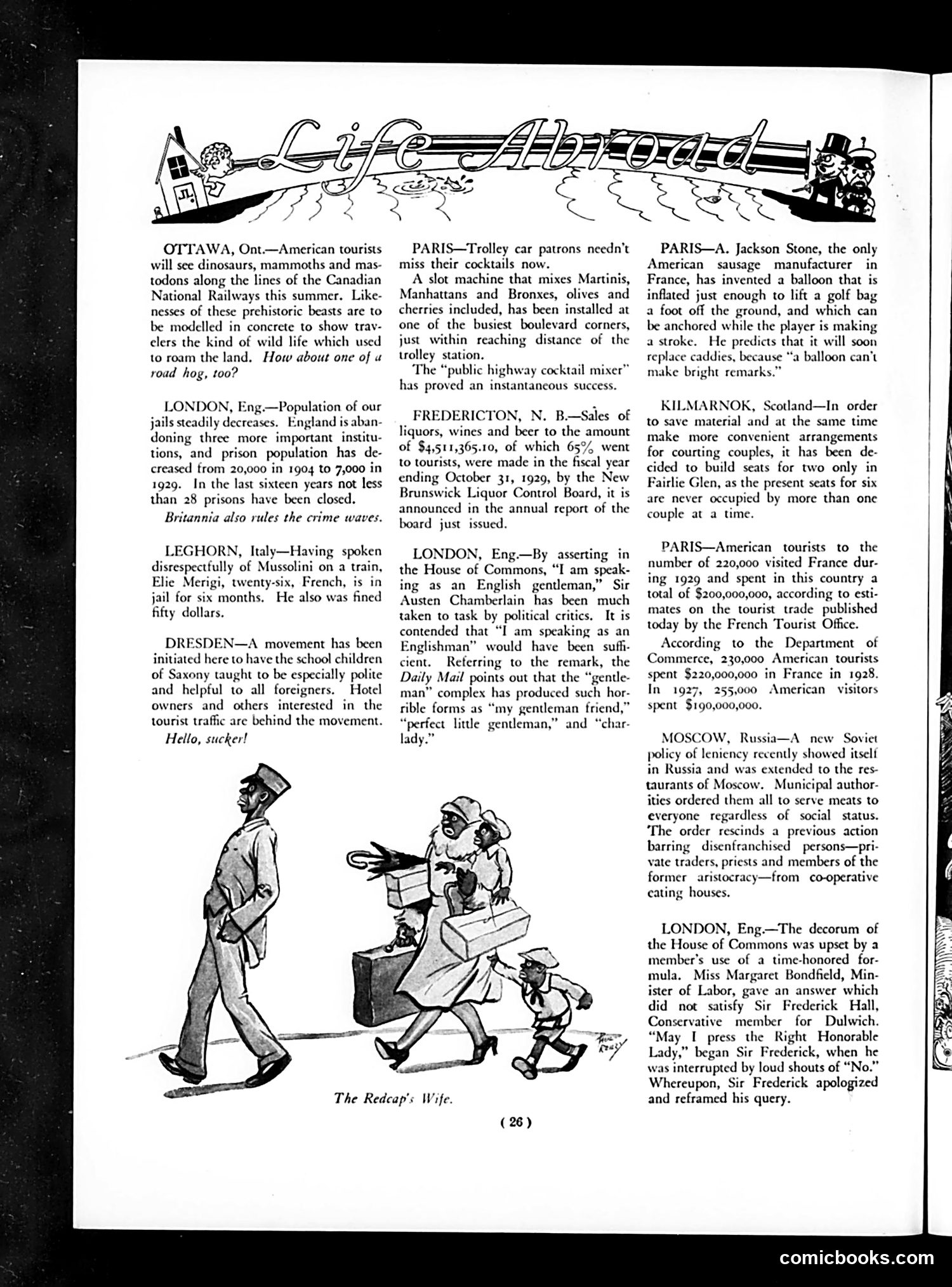
"Life" Magazine Page Analysis This page collects brief satirical news items from around the world, with one cartoon illustrating the "Hello, sucker!" story about Dresden's tourism campaign. The Cartoon: "The Redcap's Wife" depicts a railway porter's wife aggressively soliciting a well-dressed male traveler, with children following. It satirizes Dresden's initiative to train schoolchildren to be polite to tourists—the joke being that aggressive panhandling by locals undermines such efforts. The "sucker" reference suggests tourists are being exploited. Broader Satire: The page mocks modern absurdities: Canada's dinosaur displays for tourists, Paris's vending-machine cocktails, Scotland's two-person park benches (assuming couples won't share), and a sausage manufacturer's golf-bag-lifting balloon. Other items highlight curiosities like Italy's fascist intolerance, England's declining prison population, and Soviet restaurants now serving meat to formerly excluded groups. The recurring theme: consumer culture, tourism's growth, and society's increasingly commercialized relationship with travel and leisure.
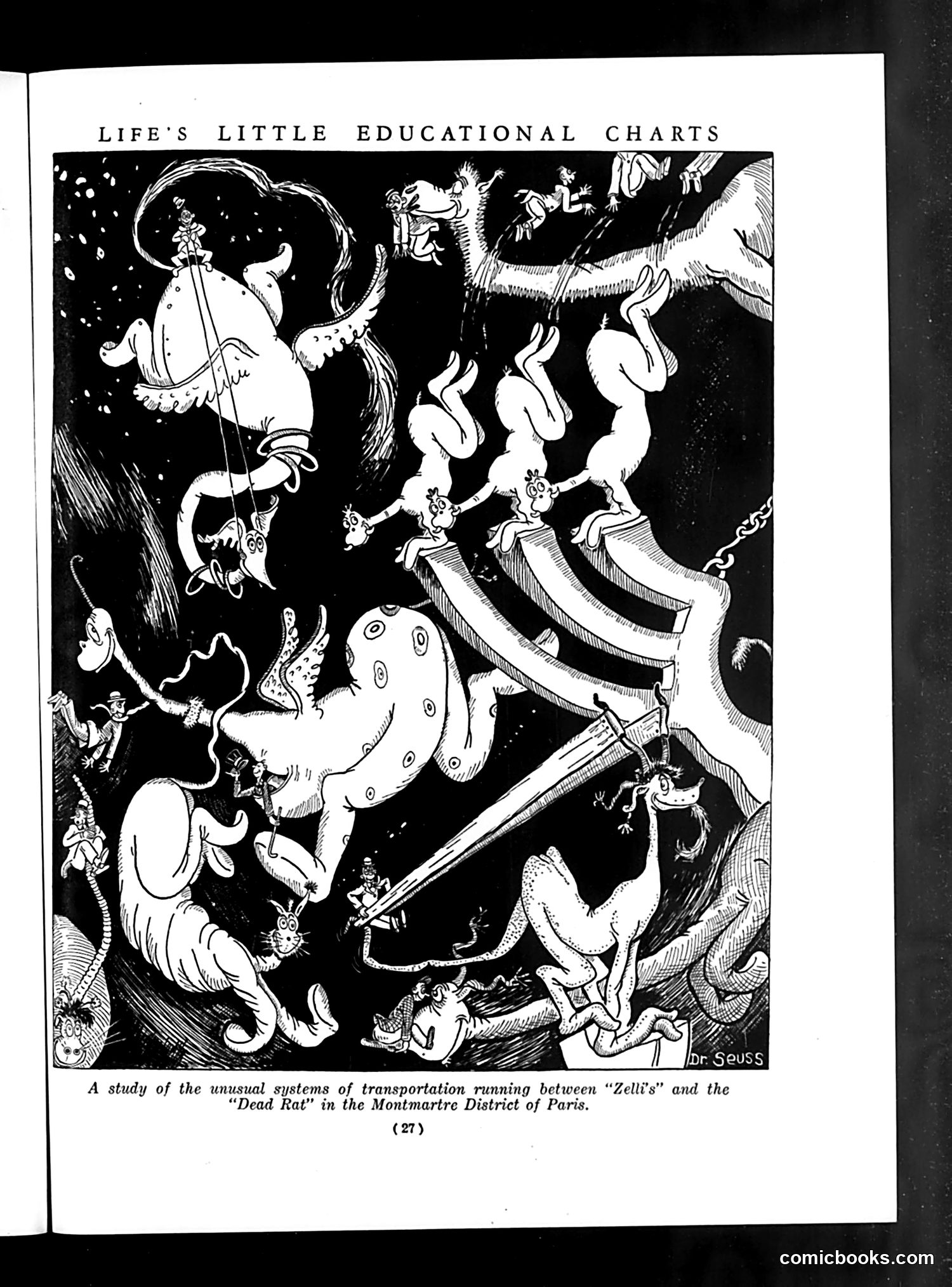
Explanation for Modern Readers This Dr. Seuss cartoon satirizes the nightlife and transportation between two famous Parisian venues: Zelli's nightclub and the "Dead Rat" (Rat Mort), both located in Montmartre. The image depicts fantastical, absurd "transportation systems" — whimsical creatures and contraptions — connecting these establishments, populated by exaggerated caricatures of revelers and performers. The satire targets the bohemian Paris nightclub scene of the 1920s-30s, mocking the chaotic, surreal experience of patrons traveling between venues during wild nights out. Seuss exaggerates the absurdity through his characteristic surrealist style, suggesting the scene itself was already ridiculous enough to warrant such fantastic illustration. The humor relies on readers' familiarity with Paris's notorious entertainment district.
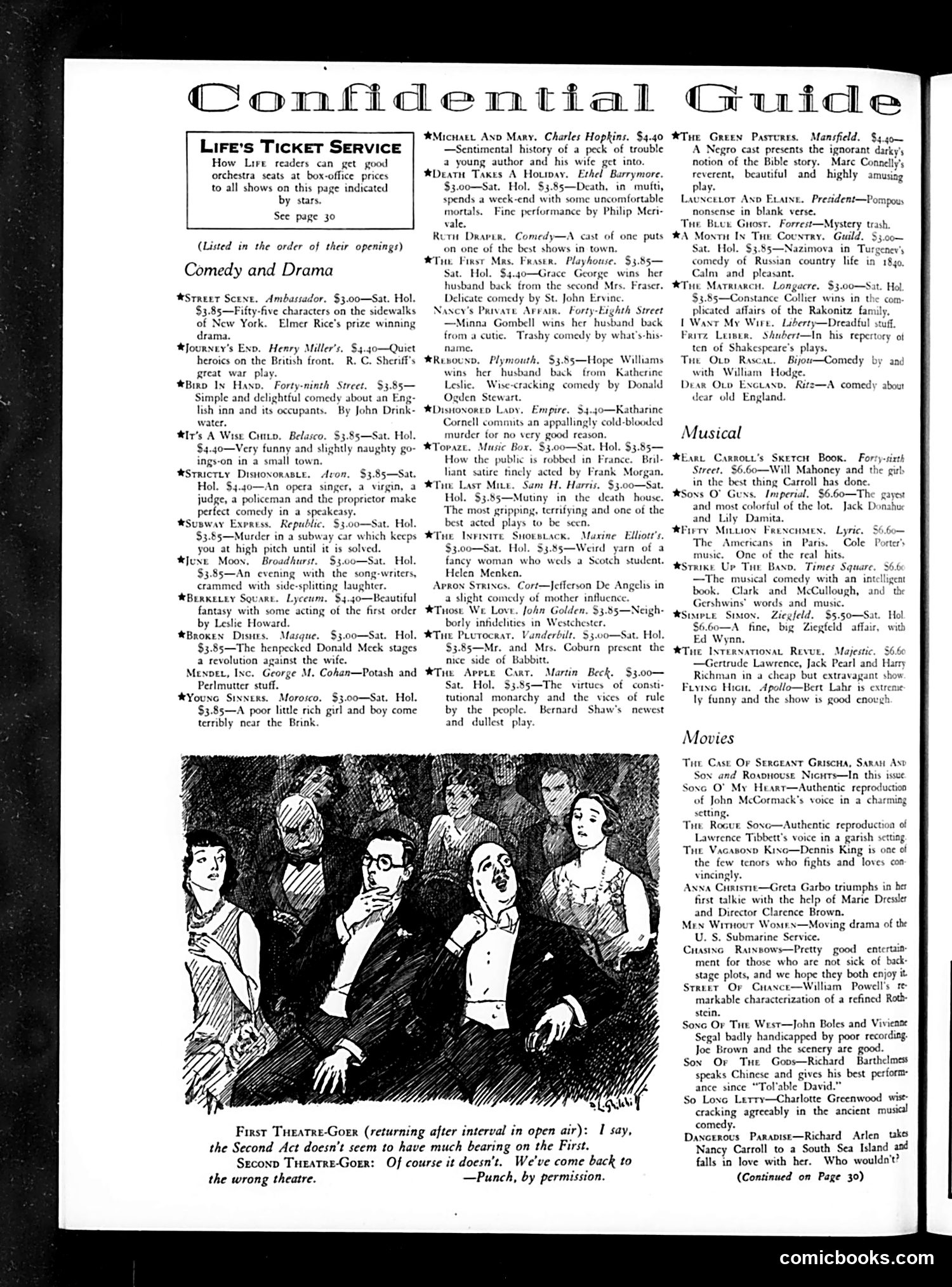
Analysis of This Life Magazine Page This is a theater guide and review page from Life magazine, listing Broadway shows with prices and brief descriptions. The page includes one small cartoon at the bottom, credited to Punch magazine. The Cartoon Explanation The joke depicts two theatergoers discussing their experience. The first comments that Act Two seems disconnected from Act One. The second responds that of course it doesn't make sense—they've accidentally returned to the *wrong theater* after intermission. The satire: This mocks both absent-minded theatergoers and, more broadly, the quality of contemporary Broadway plays themselves. By suggesting the plot could be so confusing that one wouldn't notice switching theaters, it implies that some shows lack coherent narrative structure. It's gentle mockery of theater-going in the 1920s—when programs lacked the clear act divisions modern audiences expect. The page itself is primarily practical content (ticket prices, show descriptions), not political satire. The humor is social rather than political.
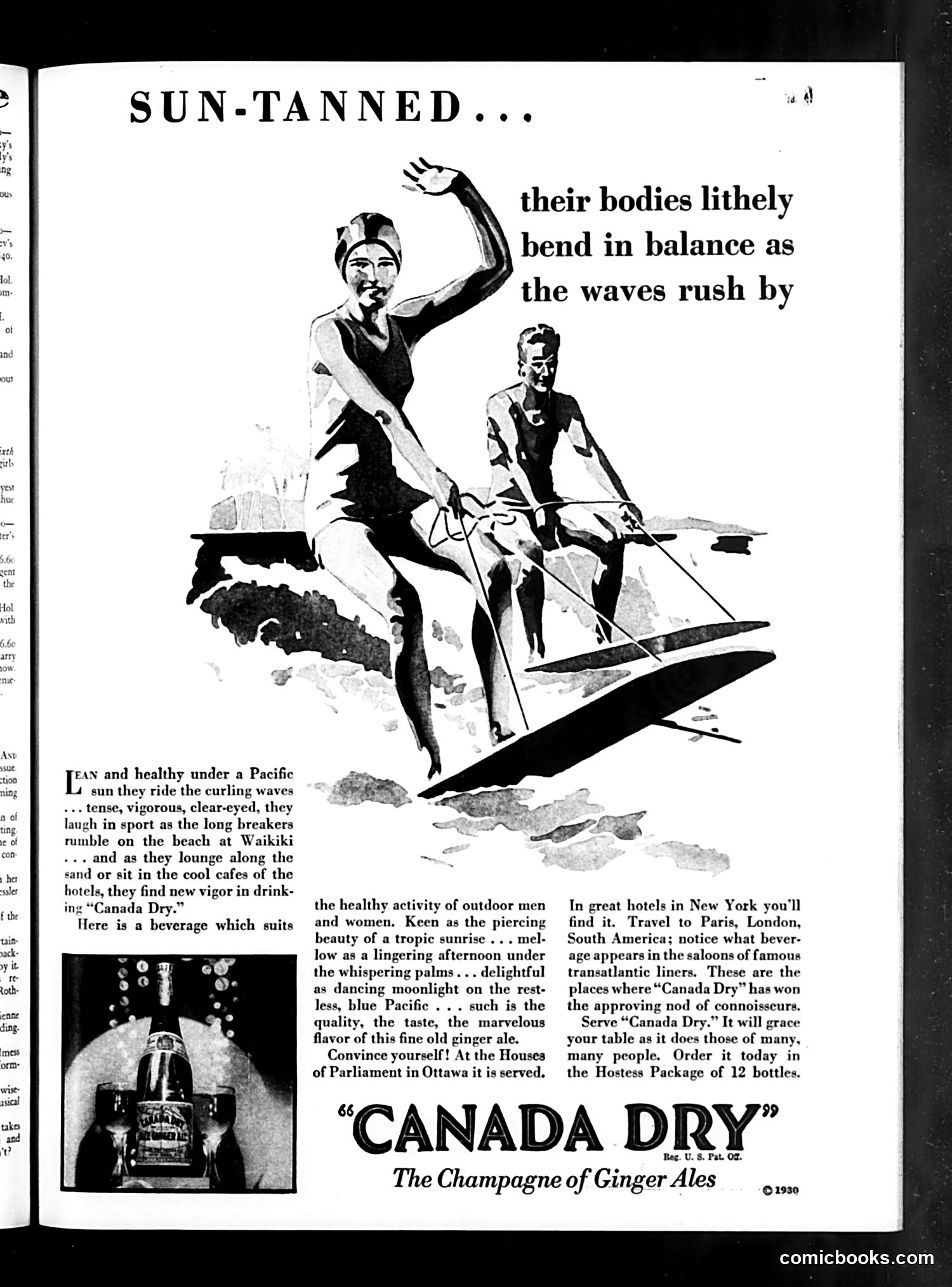
Canada Dry Advertisement (1930) This is primarily a beverage advertisement, not political satire. It promotes "Canada Dry" ginger ale by associating it with leisure, health, and sophistication. The illustration shows sun-tanned figures surfing and relaxing at Waikiki Beach, Hawaii—then an exotic destination representing glamour and vitality. The ad copy emphasizes outdoor vigor and tropical beauty as selling points. The marketing strategy includes social prestige claims: the drink is supposedly served at Parliament in Ottawa, major New York hotels, and aboard transatlantic ocean liners. This appeals to aspirational consumers by suggesting that elegant, wealthy people worldwide endorse the product. The tagline "The Champagne of Ginger Ales" attempts to elevate ginger ale from a simple soft drink to a sophisticated beverage worthy of formal occasions. There is no apparent political cartoon or satire on this page—it's straightforward 1930s consumer advertising using common era tropes: exoticism, health messaging, and class association.
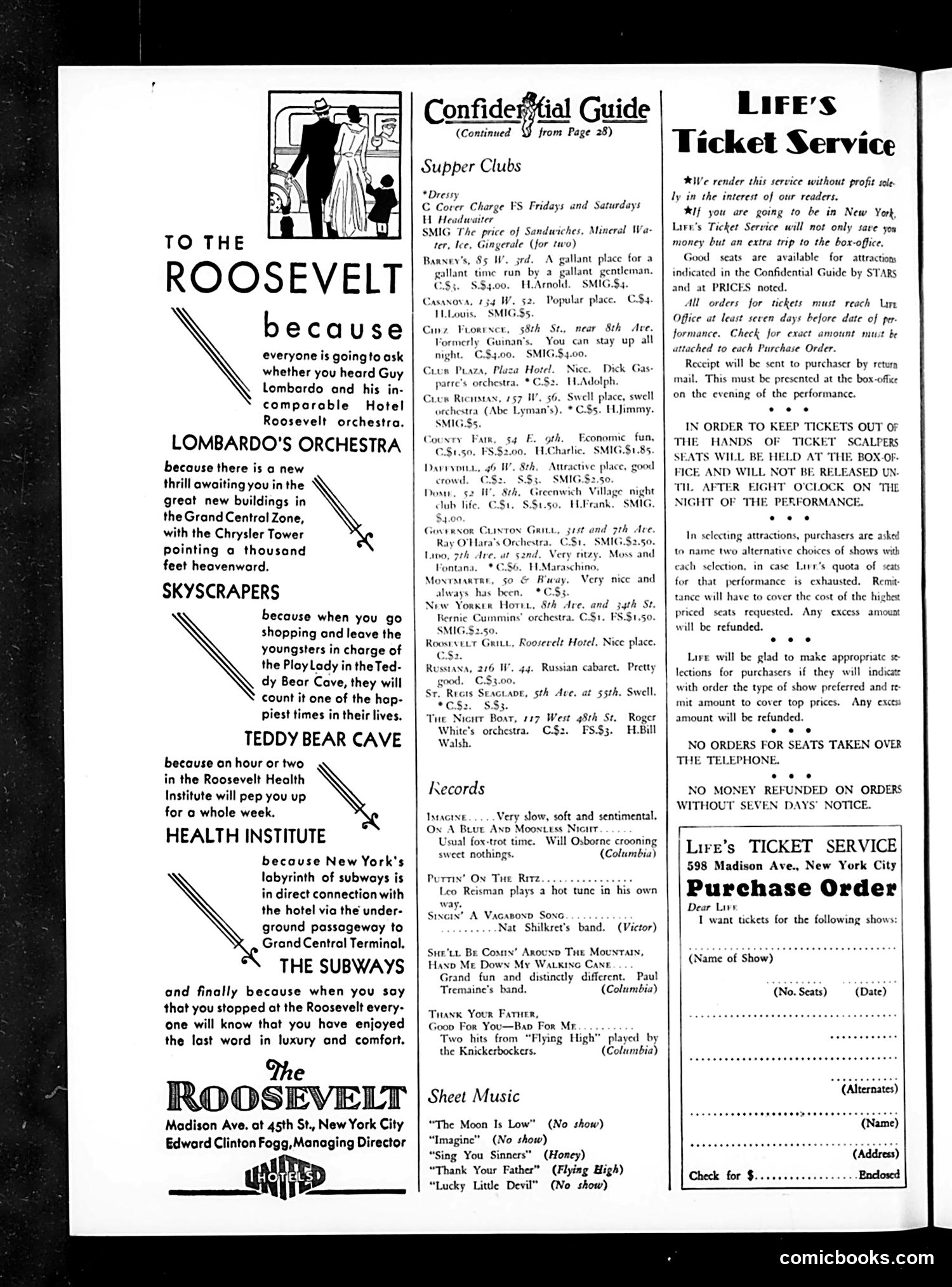
This page is primarily advertising and service content, not political satire. The left side promotes the Roosevelt Hotel through a series of humorous reasons to stay there (Guy Lombardo's orchestra, the Chrysler Tower views, childcare facilities, health amenities, subway access). These are lighthearted lifestyle appeals rather than political commentary. The bulk of the page comprises Life magazine's practical services: a "Confidential Guide" listing New York supper clubs with pricing and orchestras, record recommendations, sheet music listings, and crucially, Life's Ticket Service—a mail-order system for Broadway show tickets. This was a genuine subscriber benefit allowing New Yorkers to purchase theater seats by mail, with strict rules about advance notice and no telephone orders. The content reflects 1930s urban leisure culture and Life's role as both satirical publication and practical lifestyle guide for affluent readers.
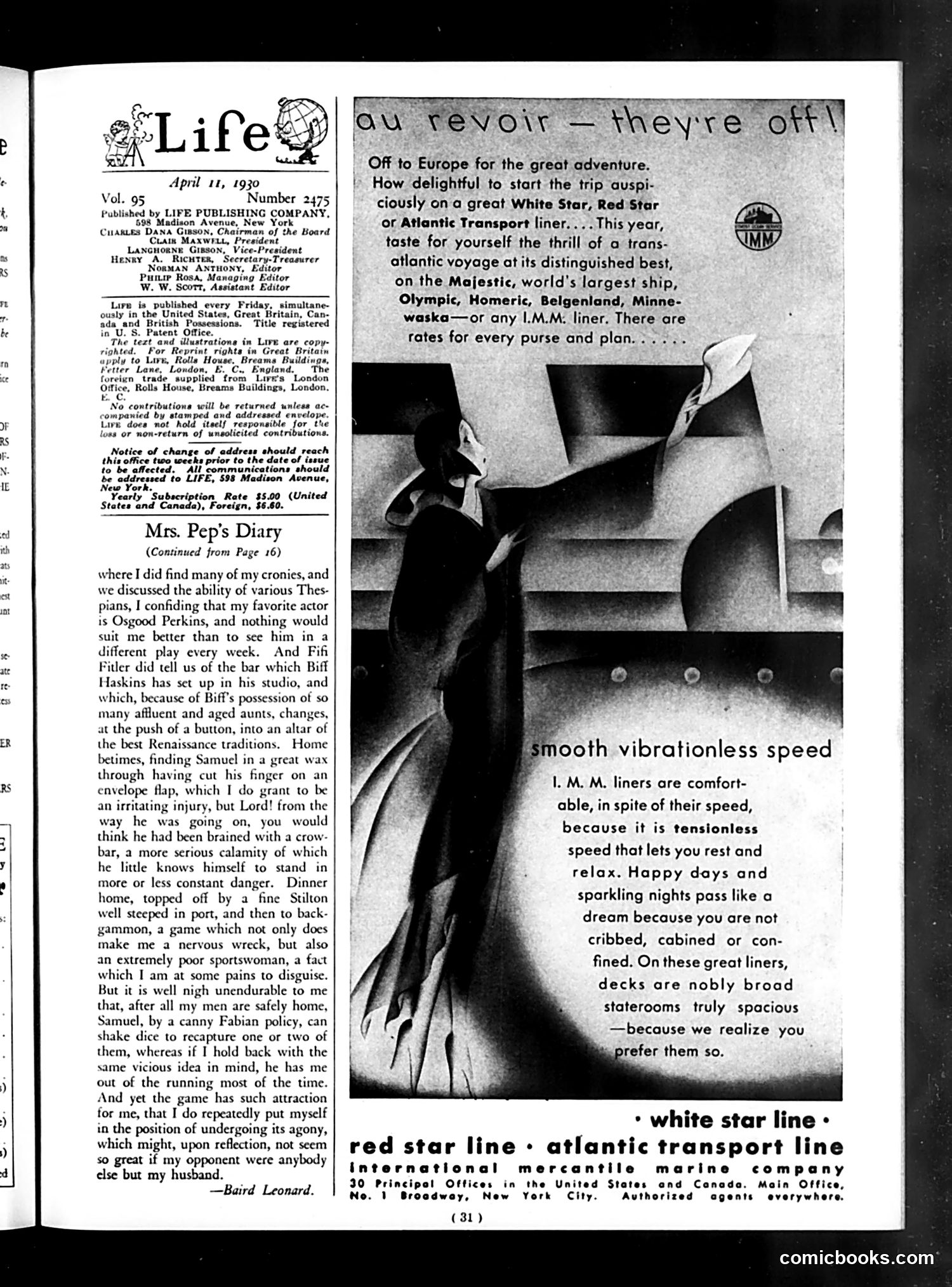
Page Analysis: Life Magazine, April 11, 1930 This page is primarily editorial and advertising content, not political satire. The left column features "Mrs. Pep's Diary," a humorous domestic column by Baird Leonard describing a socialite's evening—attending theater, visiting friends' studios, playing backgammon with her husband Samuel. The comedy is gentle and personal rather than satirical: her frustration that Samuel wins at backgammon despite her strategic caution. The right side is a full-page advertisement for steamship lines (White Star, Red Star, Atlantic Transport, and I.M.M. liners) promoting transatlantic voyages to Europe. The ad emphasizes luxury features like "smooth vibrationless speed" and spacious accommodations. The imagery shows a stylized woman gazing from a ship's deck. Historical context: This April 1930 issue was published just months after the October 1929 stock market crash. The advertising's emphasis on accessible "rates for every purse and plan" suggests the industry adapting to economic uncertainty while still targeting the affluent.
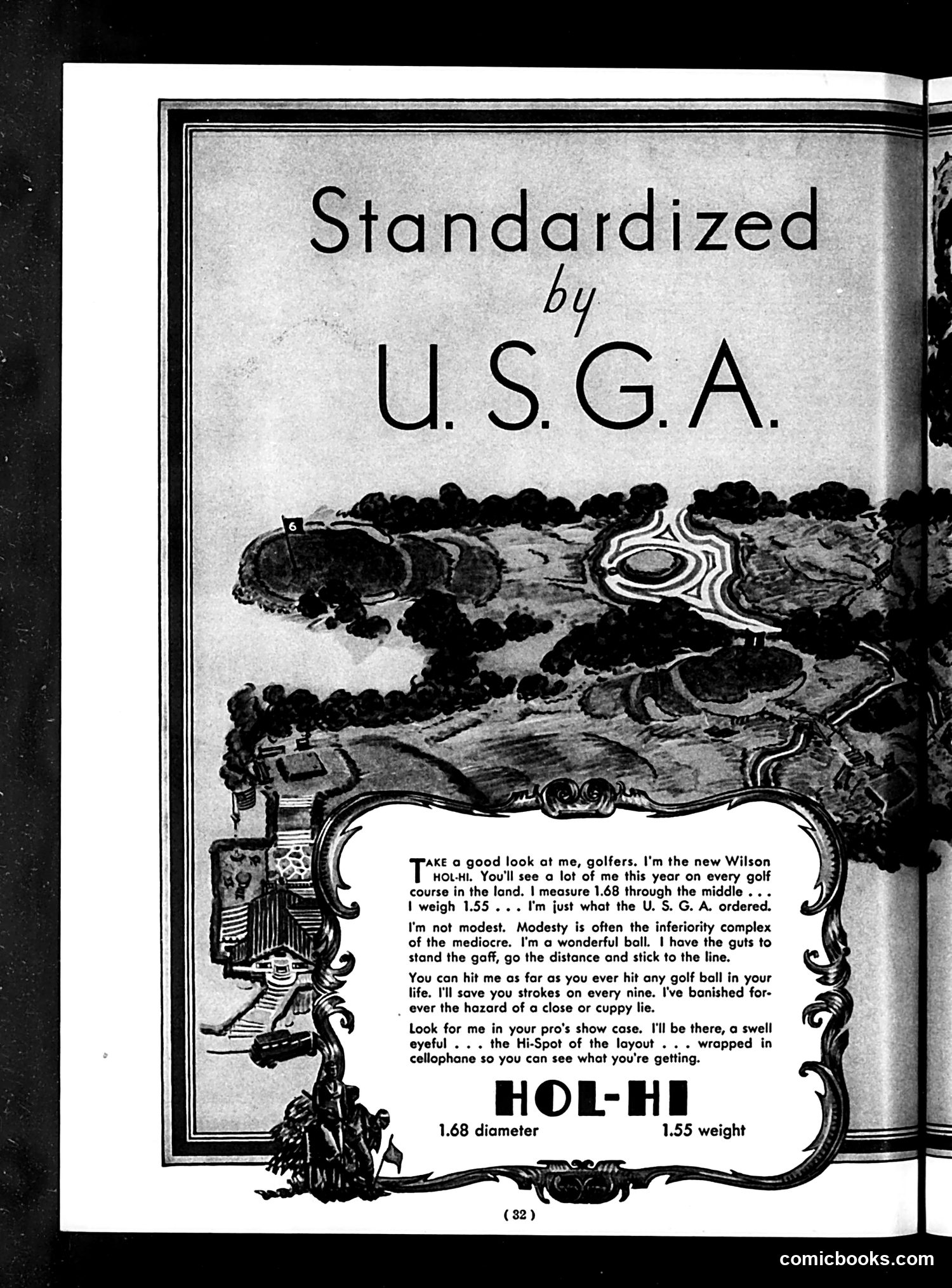
Analysis This is a Wilson golf ball advertisement, not satire or political commentary. The page header states "Standardized by U.S.G.A." (United States Golf Association), establishing the product's legitimacy through official standards. The ad uses personification: a Wilson "Hol-Hi" golf ball speaks directly to golfers, claiming superiority through specific measurements (1.68 diameter, 1.55 weight). The ball boasts it will "go the distance and stick to the line" and promises to help golfers "save strokes on every nine." The ornate border and landscape illustration are typical of 1920s-1930s advertising design. There's no political message—this is straightforward product promotion using humor and anthropomorphization to make the golf ball seem reliable and desirable to golfers.
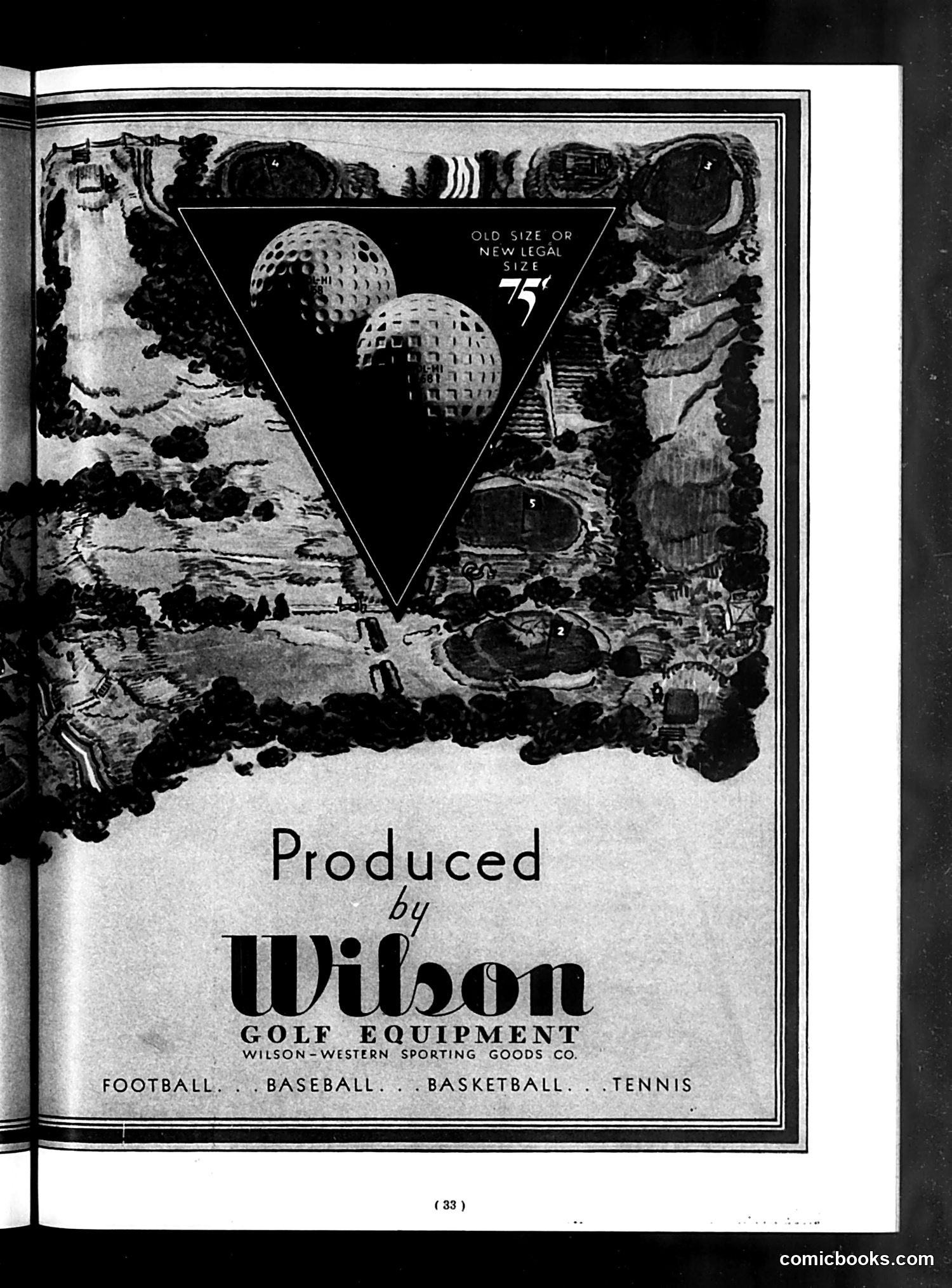
This is a product advertisement, not a political cartoon. It's a Wilson sporting goods company ad promoting golf equipment. The page shows two golf balls in a triangular frame marked "75¢" (described as "old size or new legal size"), surrounded by decorative imagery of various sports equipment and activities. The "new legal size" reference likely indicates a recent change to official golf ball regulations—the USGA had adjusted minimum ball size specifications during this era. The ad emphasizes Wilson's product line across multiple sports (football, baseball, basketball, tennis), positioning the company as a comprehensive sporting goods manufacturer. This appears to be a magazine insert or advertisement page rather than editorial content or satire.
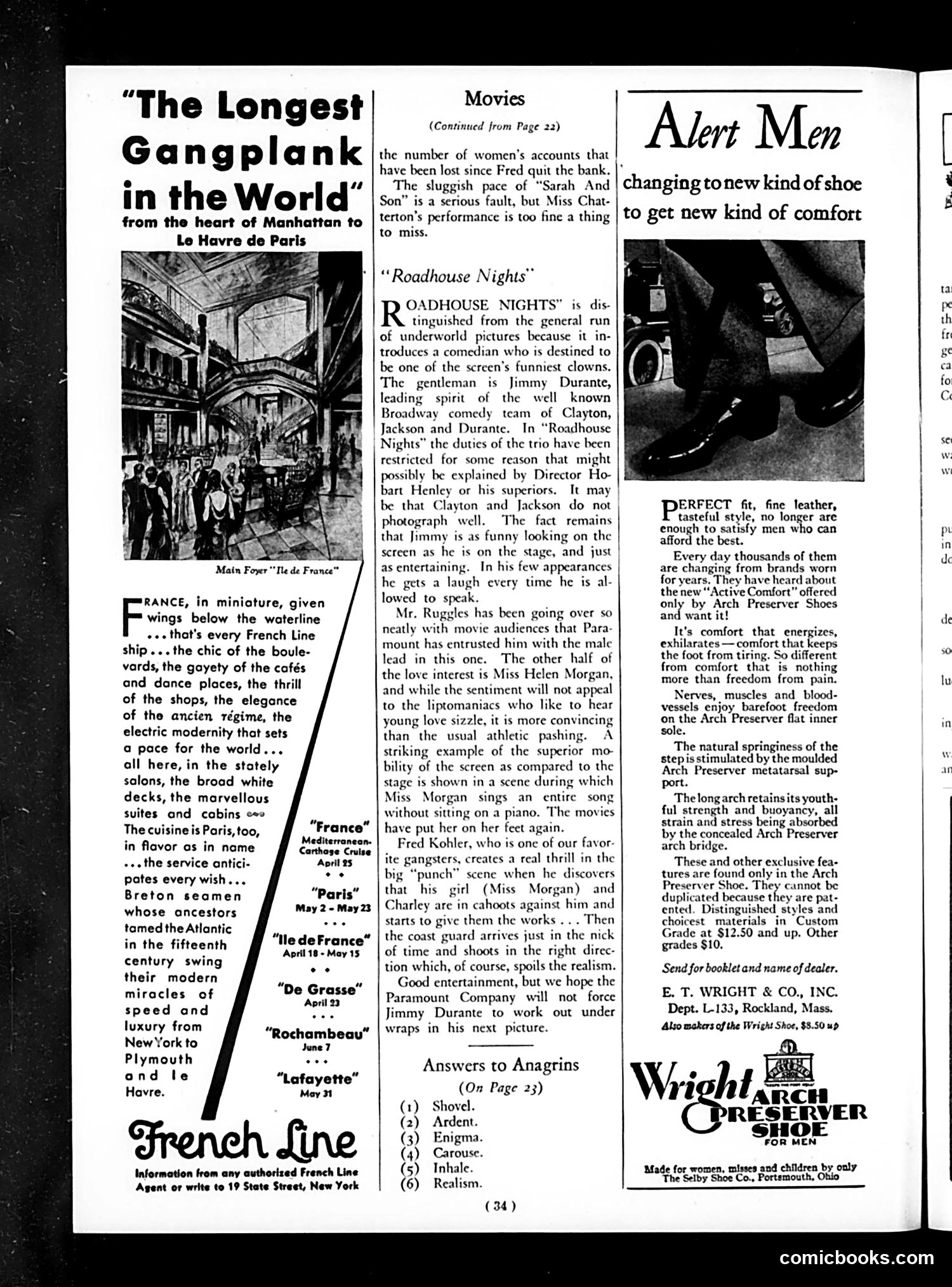
Content Analysis for Modern Readers This page is primarily advertising and entertainment content from a 1920s-era Life magazine, not political satire. The left side features a large French Line cruise ship advertisement, promoting luxury ocean travel from New York to Europe. It emphasizes French sophistication ("the chic of the boulevards," "the cuisine is Paris") and appeals to aspirational American travelers seeking European glamour. The center contains a film review discussing "Roadhouse Nights," highlighting comedian Jimmy Durante's screen debut. The reviewer notes his comedic talent translates well from Broadway to film. The right side advertises Arch Preserver Shoes, marketing a new "Active Comfort" feature to men seeking both style and foot support. There is no political cartoon or satire on this page. It represents typical 1920s consumer culture: luxury travel, entertainment, and footwear advertising targeting middle to upper-class readers seeking modern comfort and style.
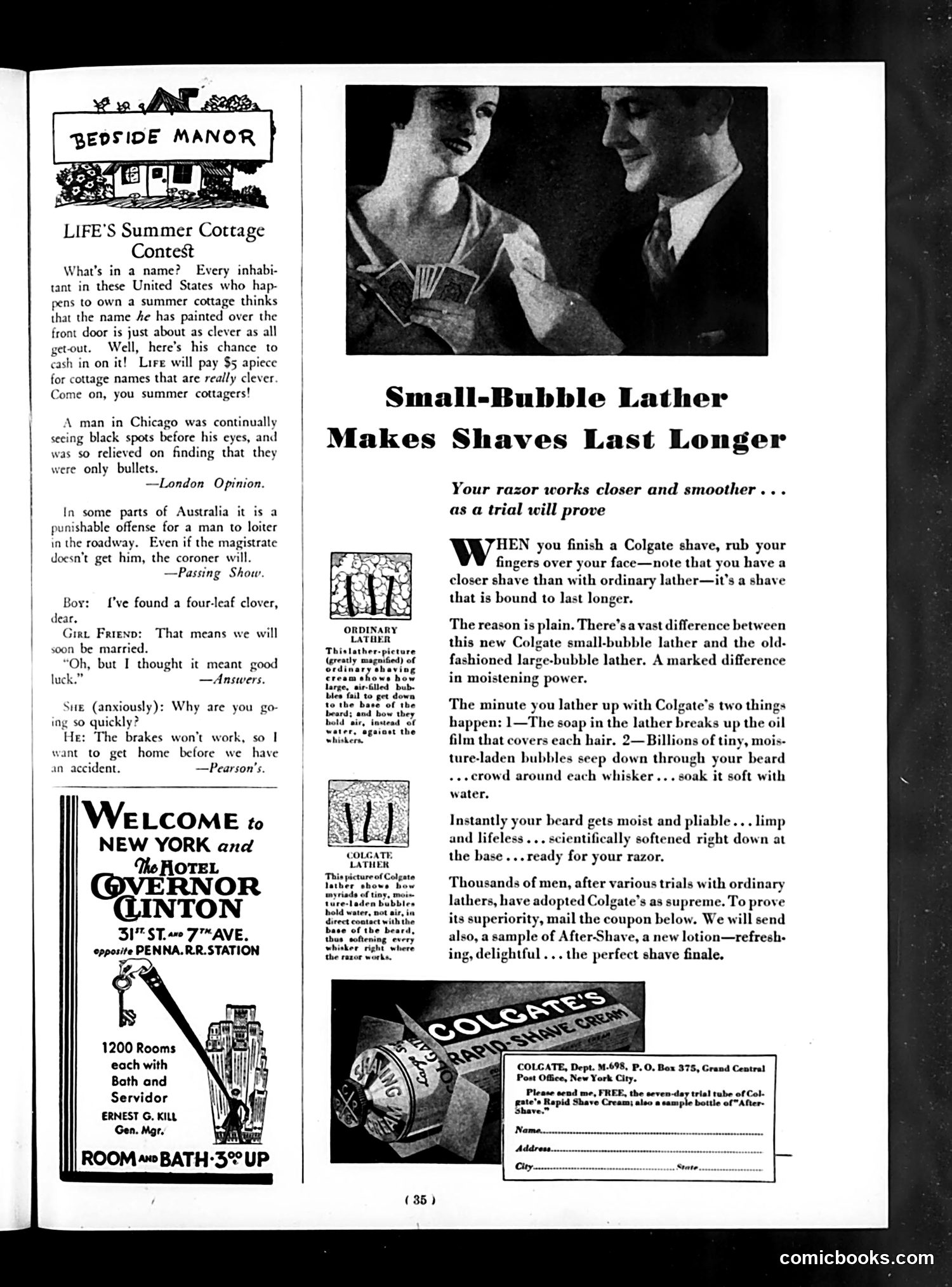
Analysis of Life Magazine Page This page contains mostly advertisements and humor shorts, not political cartoons requiring historical context. The humor shorts are brief, joke-format pieces typical of Life's satirical style—observational gags about everyday situations (a man seeing bullet holes, Australian loitering laws, a misunderstanding about four-leaf clovers). These require no special historical knowledge to understand as jokes. The main content is a Colgate shaving cream advertisement using pseudo-scientific claims about "small-bubble lather" versus "large-bubble lather" to market the product's moisturizing superiority. The ad includes before-and-after magnified lather images and a mail-in coupon. The Hotel Governor ad simply promotes New York City accommodations. The "Summer Cottage Contest" invites readers to submit clever cottage names for $5 payment—a reader-engagement promotion. None of these elements involve political satire, caricatured figures, or social commentary requiring historical context beyond understanding 1920s-30s advertising and humor conventions.
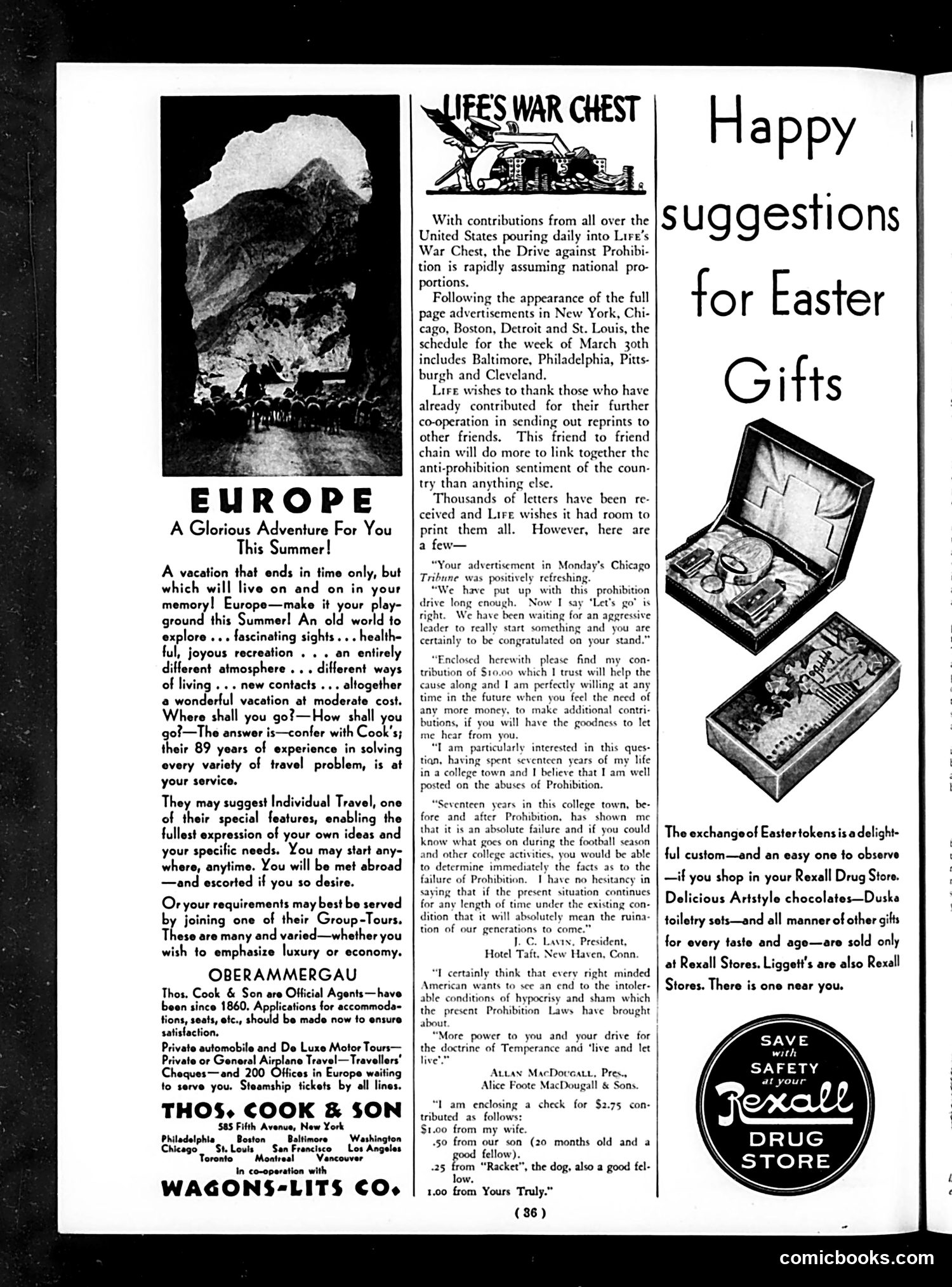
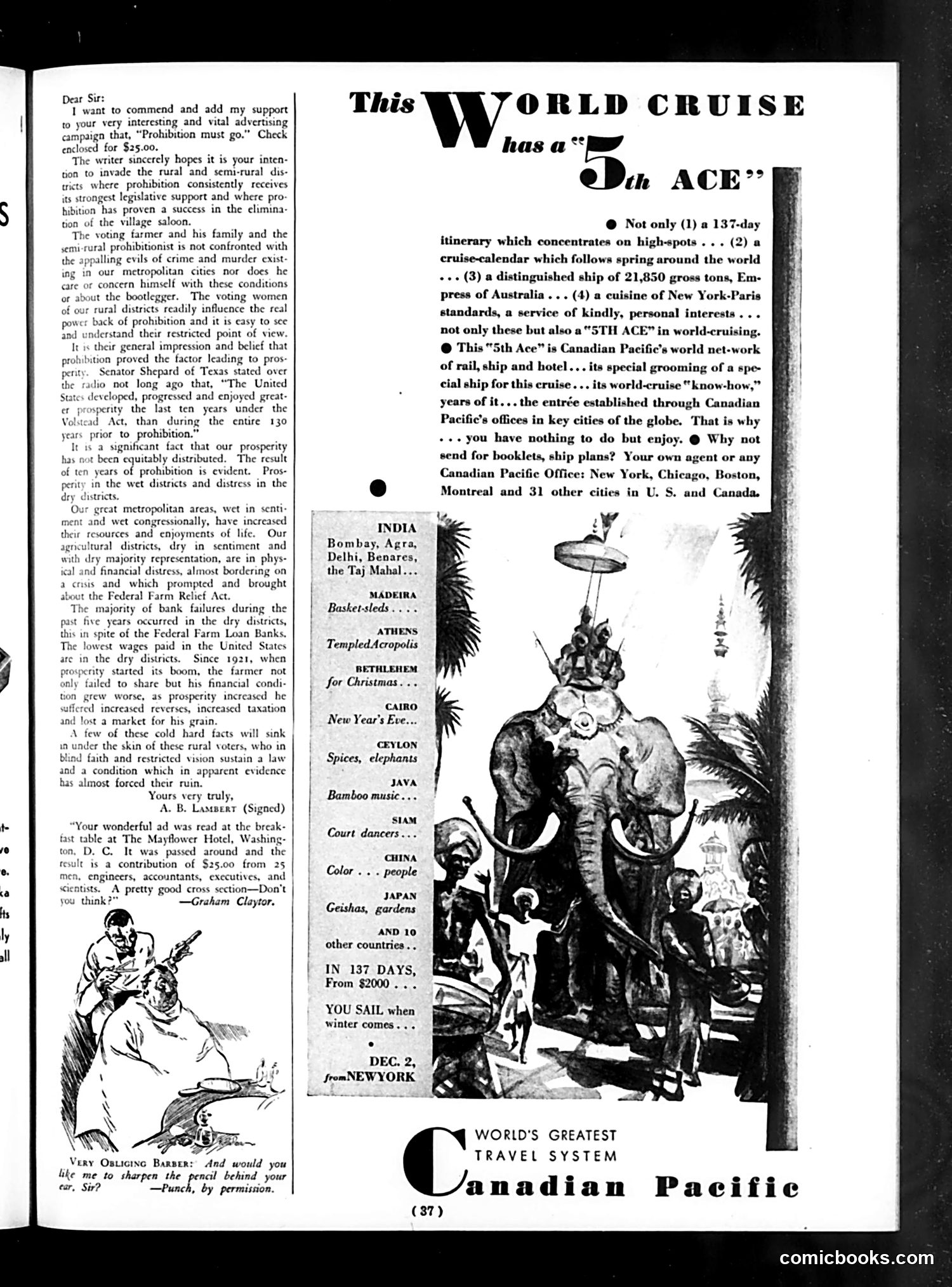
Analysis of This Life Magazine Page This page contains two distinct elements: a political letter-to-editor section and a cruise ship advertisement. Political Content (Left Side) The letters discuss Prohibition's economic impact. A supporter of Life's anti-Prohibition campaign argues that while Prohibition succeeded in eliminating rural saloons, it has paradoxically impoverished rural America. The writer contends that prosperity since 1921 concentrated in "wet" urban areas, while "dry" rural districts suffer bank failures, low wages, and agricultural distress—contradicting Prohibition supporters' claims of universal prosperity. The small cartoon shows a barber offering to sharpen a pencil, satirizing obsequiousness—likely commentary on deference to authority figures. Advertisement (Right Side) This Canadian Pacific cruise advertisement promotes a 137-day world voyage departing December 2 from New York, visiting India, Egypt, Ceylon, Java, Siam, China, and Japan for $2,000+. The ship is the Empress of Australia (21,850 tons). The ad emphasizes luxury amenities and exotic destinations, with an elephant illustration evoking adventure and colonial exoticism typical of interwar travel marketing.
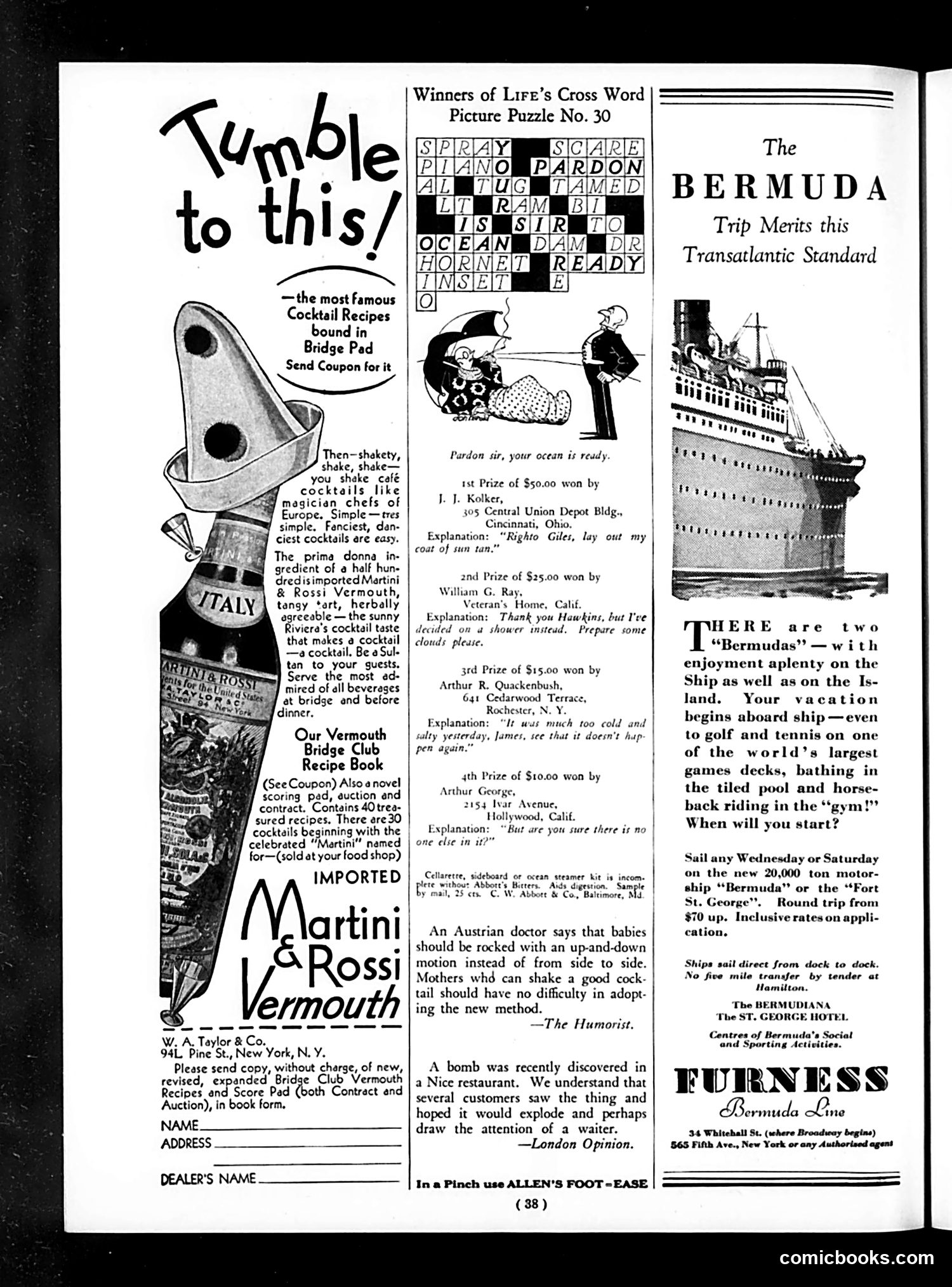
Analysis for Modern Readers This page mixes advertising with humor content typical of Life magazine's format. Left side: A Martini & Rossi vermouth ad uses exaggerated imagery—a cocktail shaker personified as an Italian chef—to sell imported vermouth as sophisticated and European. The "Bridge Pad" offer exploits the 1920s-30s popularity of bridge card games among middle-class Americans. Center: A crossword puzzle contest with humorous winning explanations that anthropomorphize the ocean—treating it like a servant ("lay out my coat of sun tan," "prepare some clouds"). The joke gently mocks wealthy leisure culture's absurd demands. Right side: Travel advertising for Bermuda cruises, positioning vacation as aspirational luxury. Bottom: Two brief satirical jokes—one from *The Humorist* linking cocktail-shaking to a new baby-rocking method (absurdist humor), and one from *London Opinion* mocking restaurant service so poor that diners hope a bomb will explode to get a waiter's attention. The page reflects 1920s-30s consumer culture, leisure obsession, and mild social satire through wordplay.
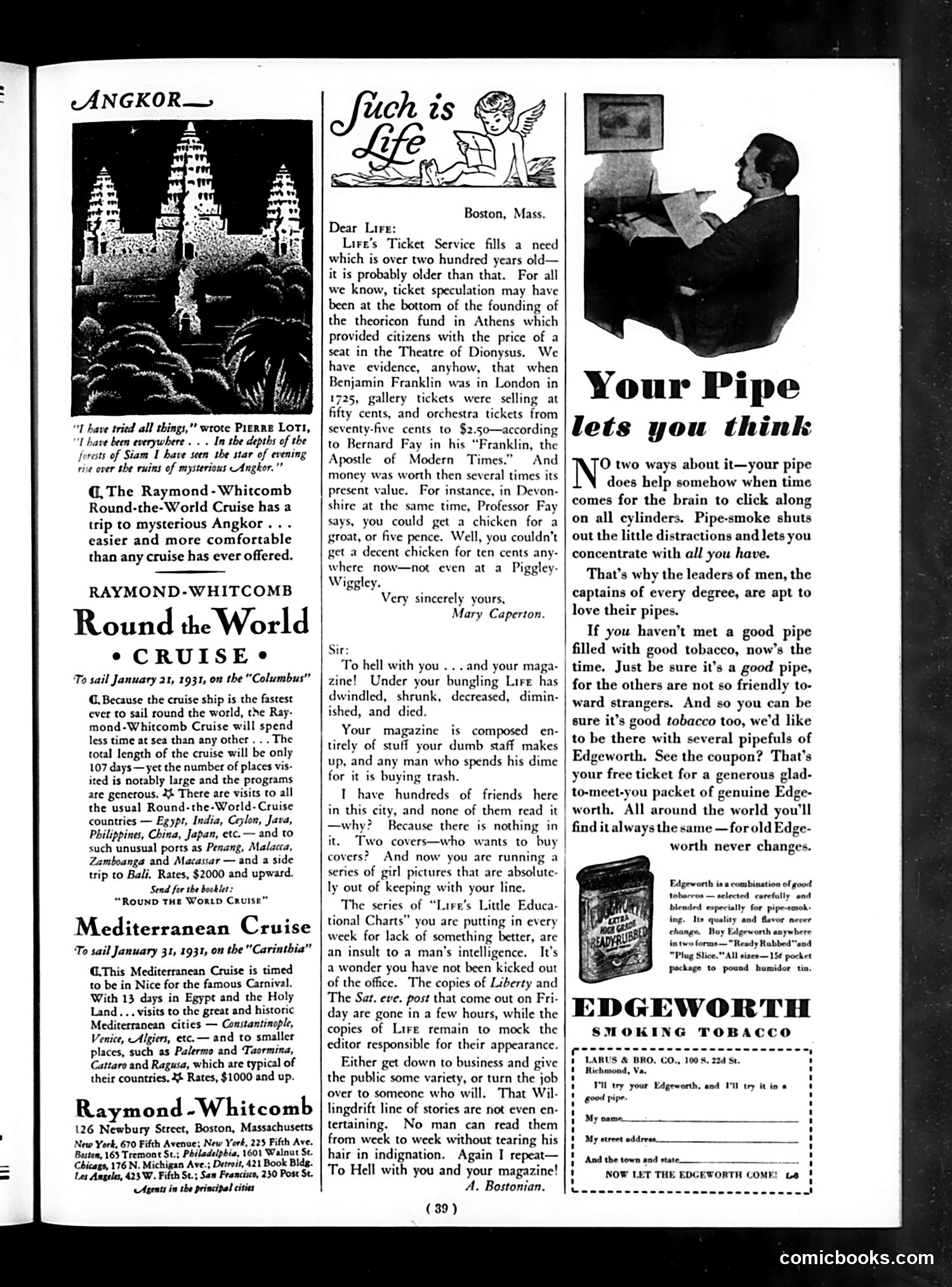
Life Magazine Page Analysis (circa 1931) This page is primarily travel advertising for Raymond-Whitcomb cruise lines, not political satire. The "Angkor" reference quotes French writer Pierre Loti to promote exotic round-the-world cruises departing January 1931—emphasizing visits to Egypt, India, Ceylon, Japan, and the mysterious Cambodian temple ruins of Angkor. The "Such is Life" section features reader letters to *Life* magazine itself. One praises *Life's* ticket service (referencing ticket speculation back to ancient Athens). Another angrily attacks *Life* magazine, calling it trash composed of "dumb staff" content, criticizing its "girl pictures" and educational charts as insulting to readers' intelligence—contrasting unfavorably with competitors *Liberty* and *The Saturday Evening Post*. The pipe advertisement on the right uses the cliché that pipes help men think. No political cartoon appears here. The page reflects 1930s consumer advertising and reader complaints about magazine quality.
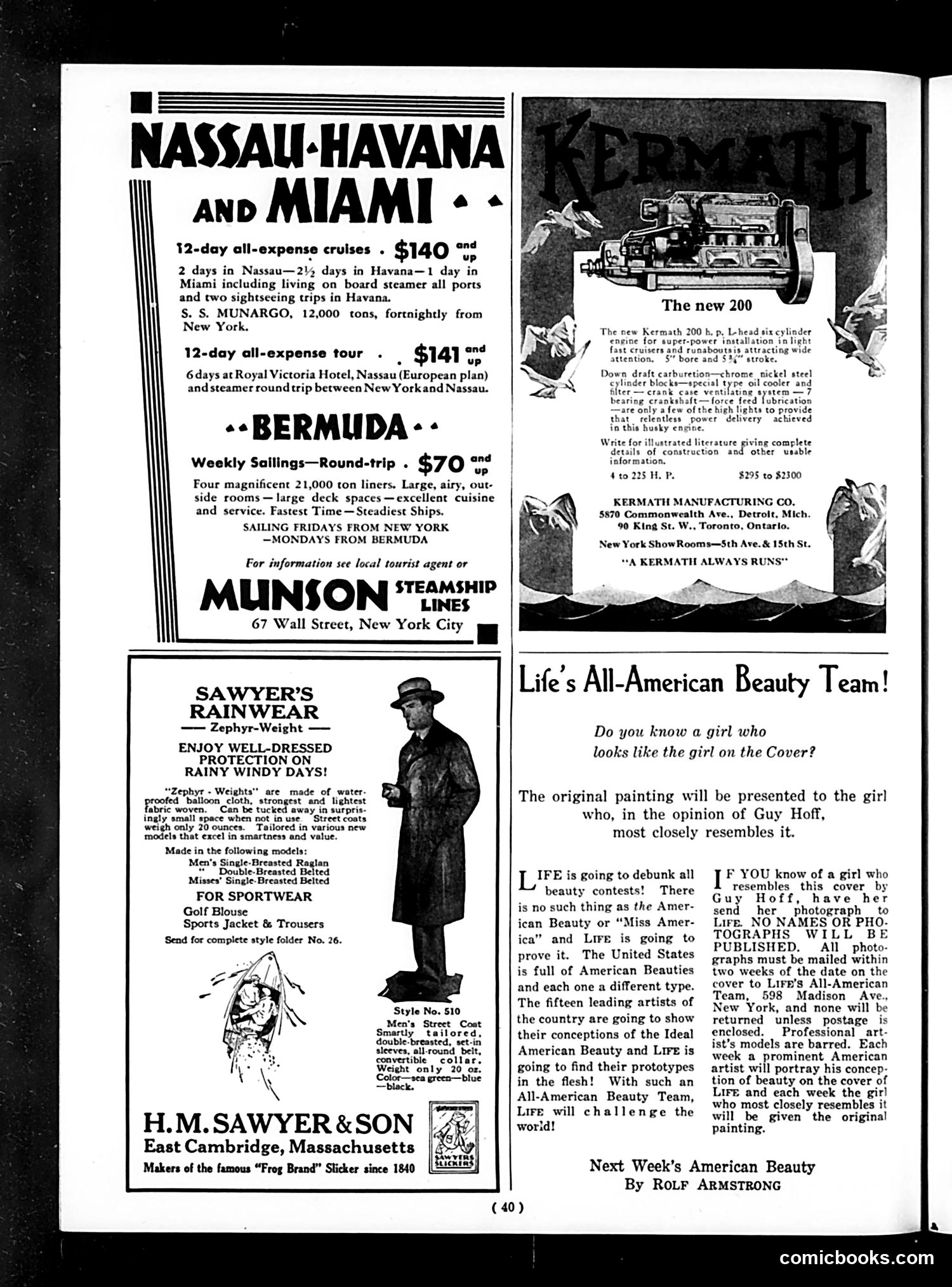
Life Magazine Content Analysis This page is primarily advertising with one notable editorial feature. The main content is Life's All-American Beauty Team contest—a tongue-in-cheek editorial announcement. Life magazine claims to "debunk" beauty contests by arguing there's no single "American Beauty" type, but rather many different kinds of beauty across America. The magazine announces it will commission fifteen prominent artists (starting with cover artist Guy Hoff and next week's artist Rolf Armstrong) to paint their ideal American beauty. Readers are invited to submit photographs of girls resembling these paintings; the closest match wins the original artwork. This is likely satirical social commentary—poking fun at the era's obsession with beauty pageants and standardized feminine ideals while simultaneously conducting its own beauty contest. The remainder comprises travel advertisements (cruises to Nassau, Havana, Miami, and Bermuda), automotive advertising (Kermath boat engines), and rainwear promotion (Sawyer's "Zephyr-Weight" clothing).
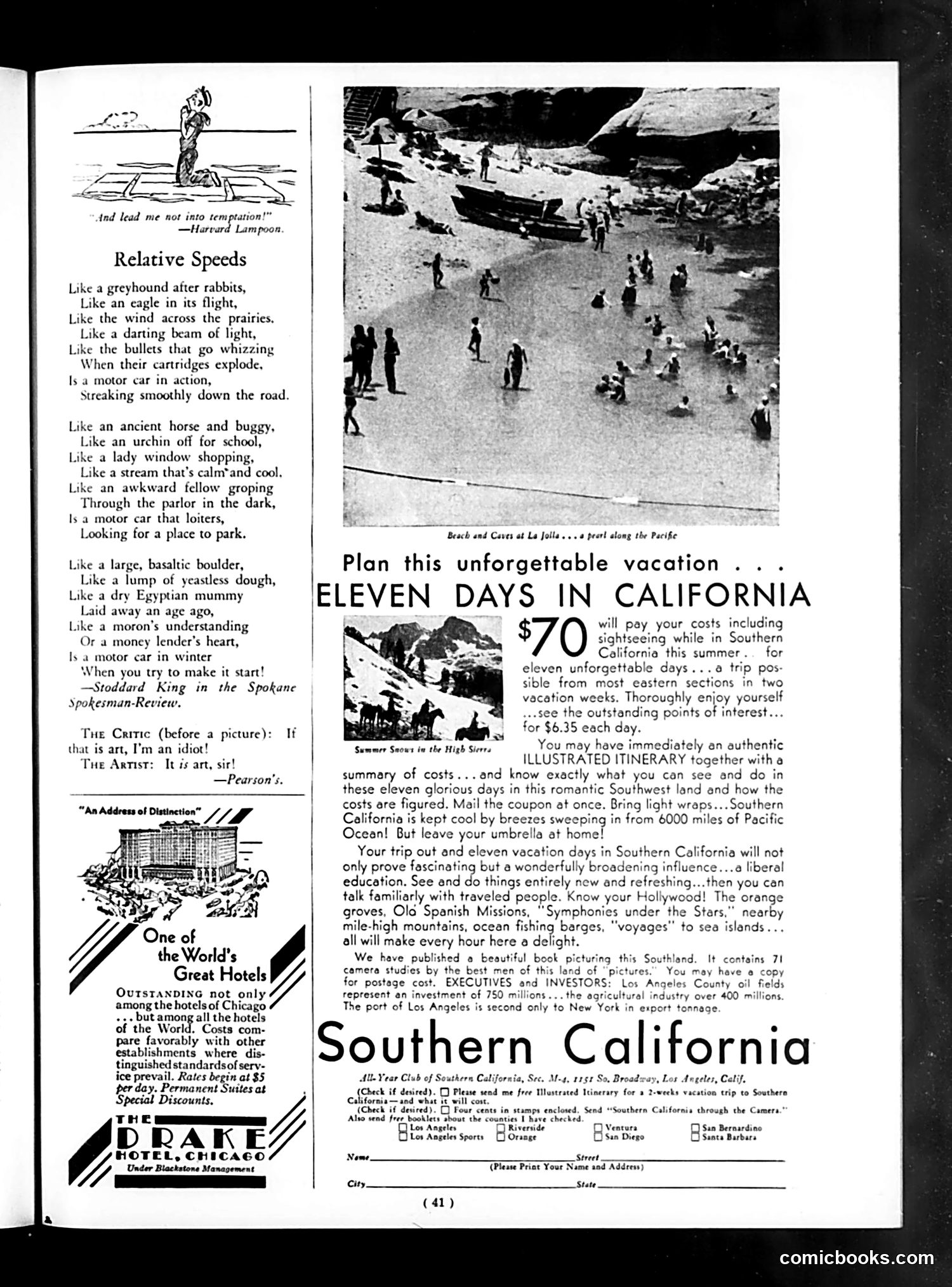
Analysis of Page 41 from Life Magazine This page combines humor and advertising, typical of Life's satirical-advertising format. The Cartoons/Humor: The top features a Harvard Lampoon quote about temptation, paired with a simple line-drawing cartoon of a figure. Below are three humorous poems about automobiles by Stoddard King, contrasting a car's speed, sluggishness when parking, and difficulty starting in winter—relatable complaints for 1920s motorists. The brief exchanges between "The Critic" and "The Artist" poke fun at modern art's pretension. The Advertising: The bulk of the page advertises the Drake Hotel (Chicago) and a Southern California vacation package—eleven days for $70, targeting eastern tourists. The copy emphasizes exotic attractions (Hollywood, Spanish missions, orange groves, ocean fishing) and California's year-round pleasant climate, positioning the region as an educational and investment opportunity. The Context: This reflects the 1920s automobile boom, tourism industry growth, and California's promotion as an accessible vacation destination for middle-class Americans. The humor gently mocks modern technology's frustrations while the ads capitalize on wanderlust.
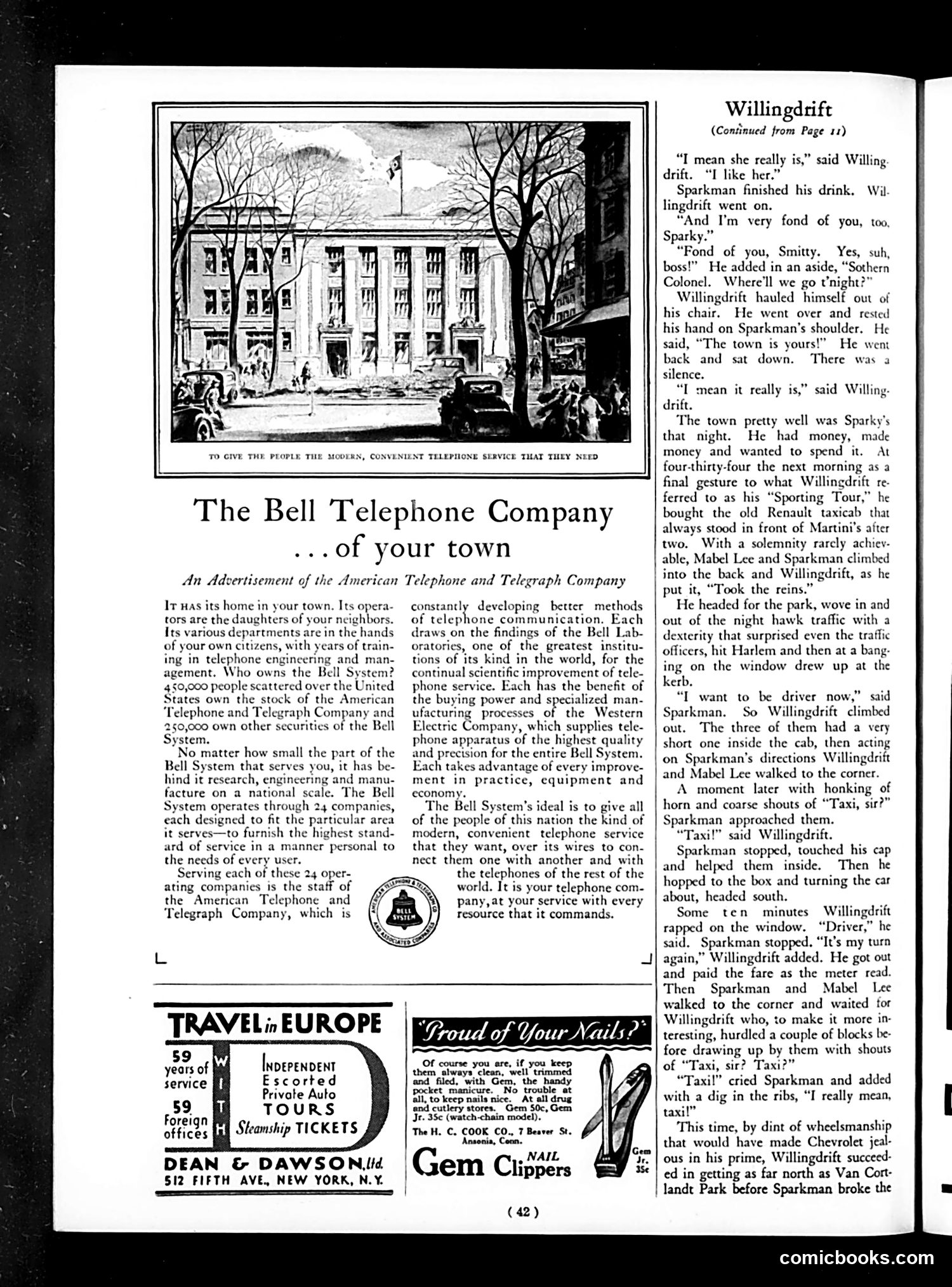
Page Analysis This page contains primarily advertisements alongside the continuation of a story titled "Willingdrift." The main advertisement is for The Bell Telephone Company, presented as a corporate image-building piece by American Telephone and Telegraph. It emphasizes that the Bell System is locally owned (by 450,000 Americans), employs local citizens as operators, and provides modern telephone service nationwide through 24 regional companies backed by research laboratories and manufacturing capabilities. The smaller ads include travel services (Dean & Dawson steamship tickets to Europe) and Gem Nail Clippers. The "Willingdrift" narrative on the right describes a character named Sparkman (appears to be a Black servant or employee, based on the dialect "suh, boss") receiving money from his employer Willingdrift to spend on a night out in town. The story follows their taxicab adventure through Harlem. The page is primarily commercial content rather than satire. The contrast between the earnest corporate messaging and the recreational narrative provides the page's structure, but no political satire is evident.
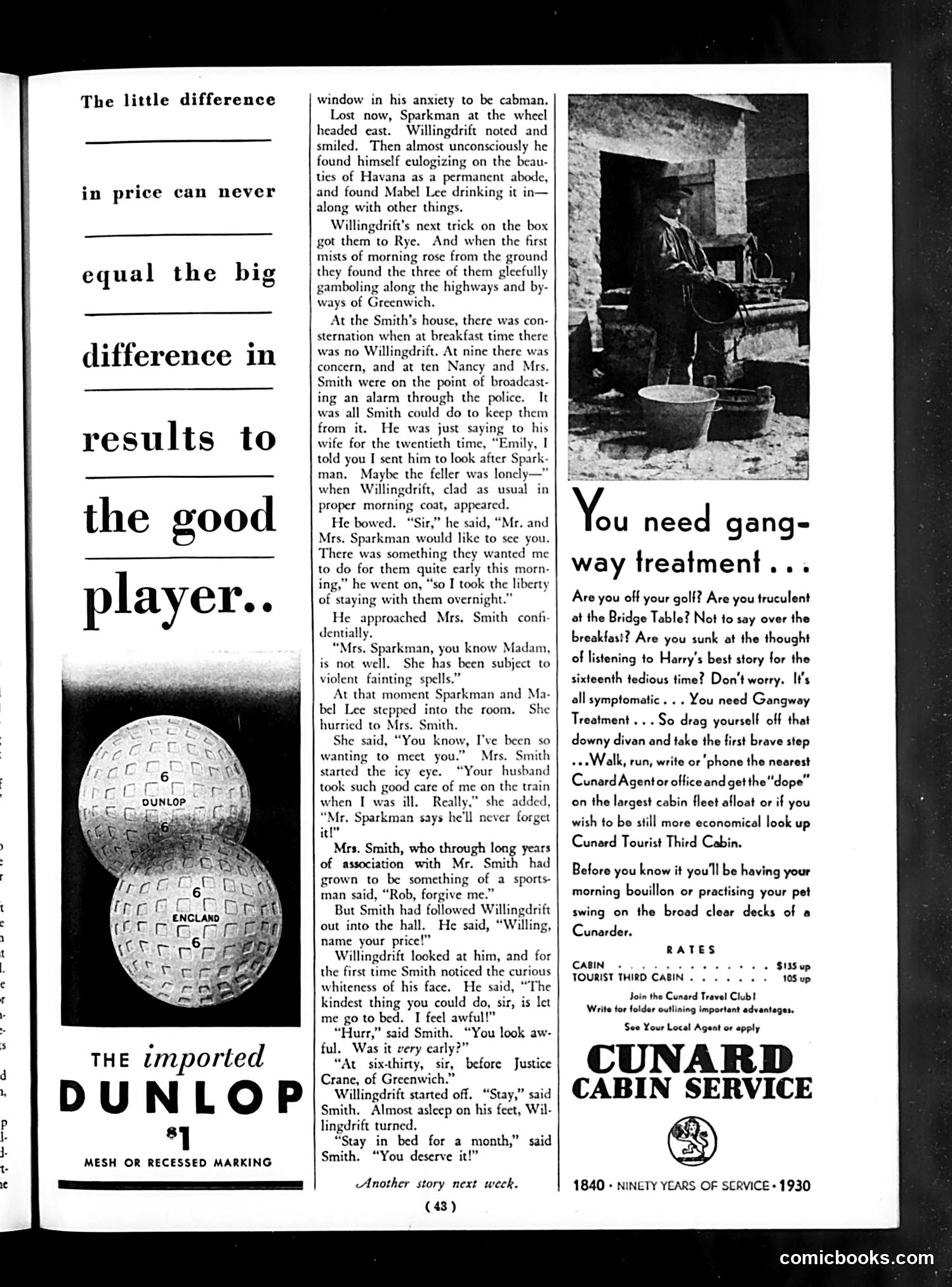
Page Analysis: Life Magazine (circa 1930) This page contains a serialized short story about a character named Willingdrift, apparently a resourceful servant or fixer who resolves a domestic crisis. The plot involves Willingdrift secretly accompanying a guest (Mabel Lee) overnight to prevent her from fainting, thereby smoothing over marital tension when the Smiths initially suspect impropriety. The humor derives from the misunderstanding and Willingdrift's clever solution—he even arranges an early-morning marriage for the couple, which Mr. Smith rewards generously. The left side features a Dunlop golf ball advertisement emphasizing quality over price—a sales pitch typical of Depression-era marketing. The right contains a Cunard shipping line advertisement using humor about boredom and social fatigue ("gangway treatment") to encourage leisure cruises, with budget options like "Tourist Third Cabin" appealing to middle-class readers. Both ads and story reflect 1930s values: servant loyalty, class hierarchies, and consumption as remedy for modern ennui.
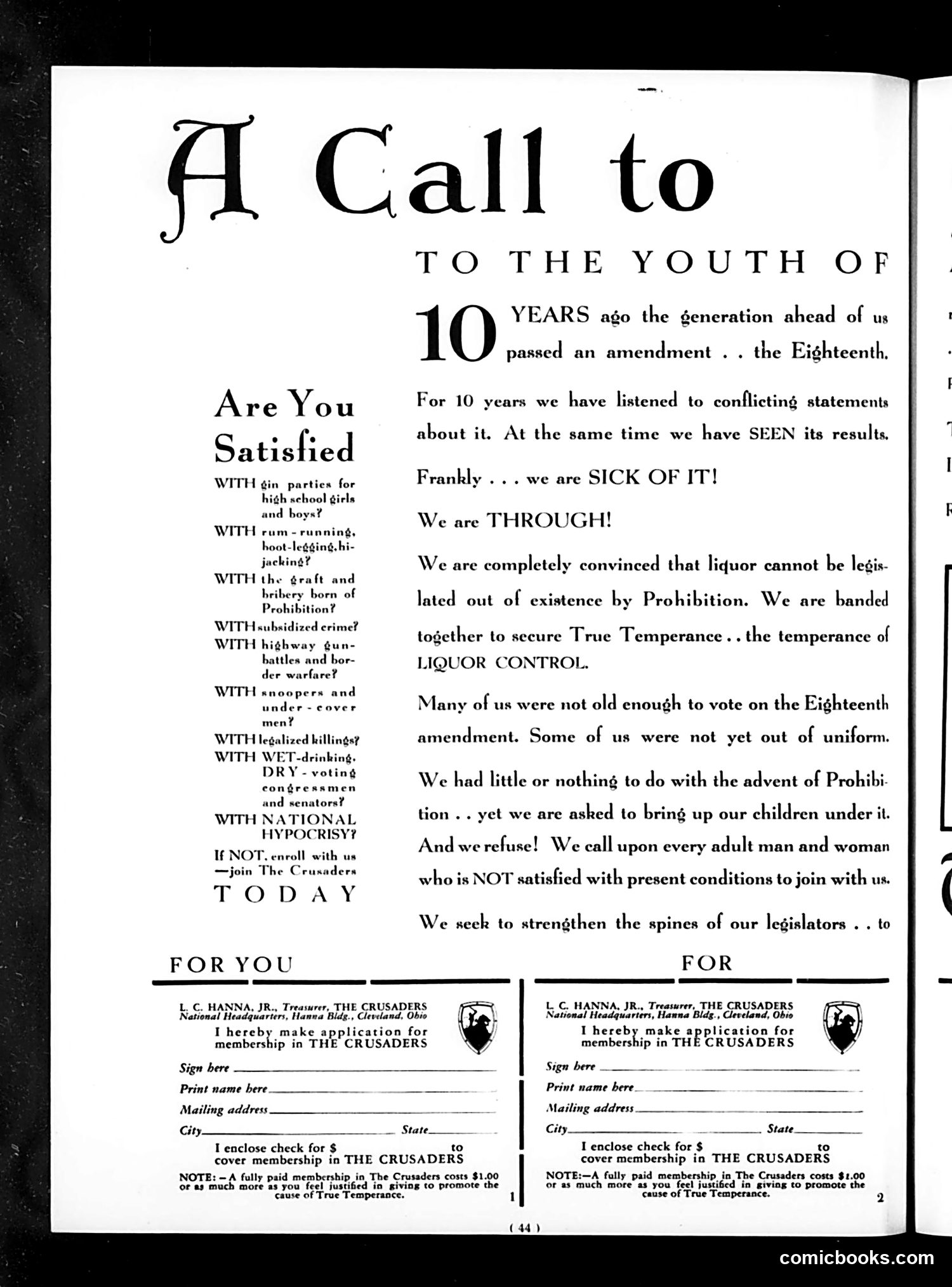
"A Call to the Youth" — Anti-Prohibition Recruitment, c. 1920s This is a recruitment advertisement for The Crusaders, an organization opposing Prohibition (the 18th Amendment, enacted 1920). The satirical left panel lists the social ills they blame on Prohibition: bootlegging, hijacking, police corruption, gangster violence ("highway gun-battles"), bribery, and legislative hypocrisy ("WET-drinking, DRY-voting congressmen"). The main text targets young adults—particularly those too young to vote when Prohibition passed—arguing they shouldn't inherit laws they didn't create. The group claims Prohibition has failed to eliminate alcohol and instead spawned crime and corruption. They advocate "True Temperance" through "liquor control" (regulated sales) rather than total prohibition. This reflects the real repeal movement of the late 1920s, which successfully overturned Prohibition in 1933. The Crusaders were one of many organizations arguing that criminalization, not elimination, of alcohol was the actual problem—a position vindicated by historical outcome.
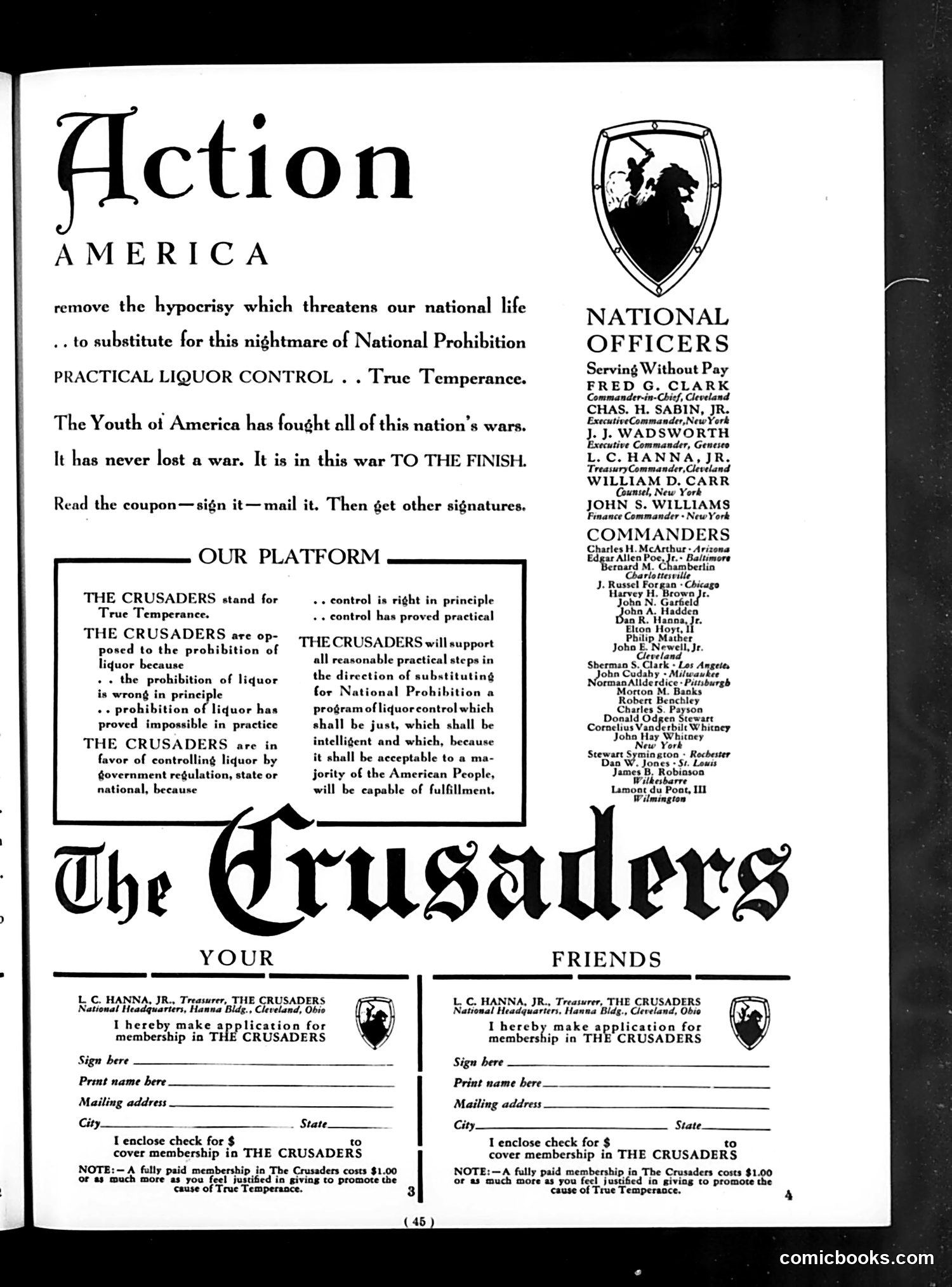
The Crusaders: Anti-Prohibition Advocacy (circa 1930s) This is a recruitment advertisement for The Crusaders, an organization opposing National Prohibition. The page attacks Prohibition as "hypocrisy" and "nightmare," arguing it has proven "impossible in practice." Instead, The Crusaders advocate "practical liquor control" through government regulation rather than outright bans. The organization lists prominent national officers (many with wealth indicators like "Jr." and geographic affiliations), lending legitimacy to their cause. They appeal to patriotism—"The Youth of America has fought all of this nation's wars"—framing repeal as a moral imperative. The dual membership coupons (labeled "Your" and "Friends") are designed for viral spread, encouraging signatories to recruit others. Historical context: This reflects the failed Prohibition era (1920-1933), when widespread illegal alcohol production and organized crime convinced many Americans that regulation was preferable to prohibition. The Crusaders represented elite, "respectable" opposition to a policy increasingly seen as unworkable.
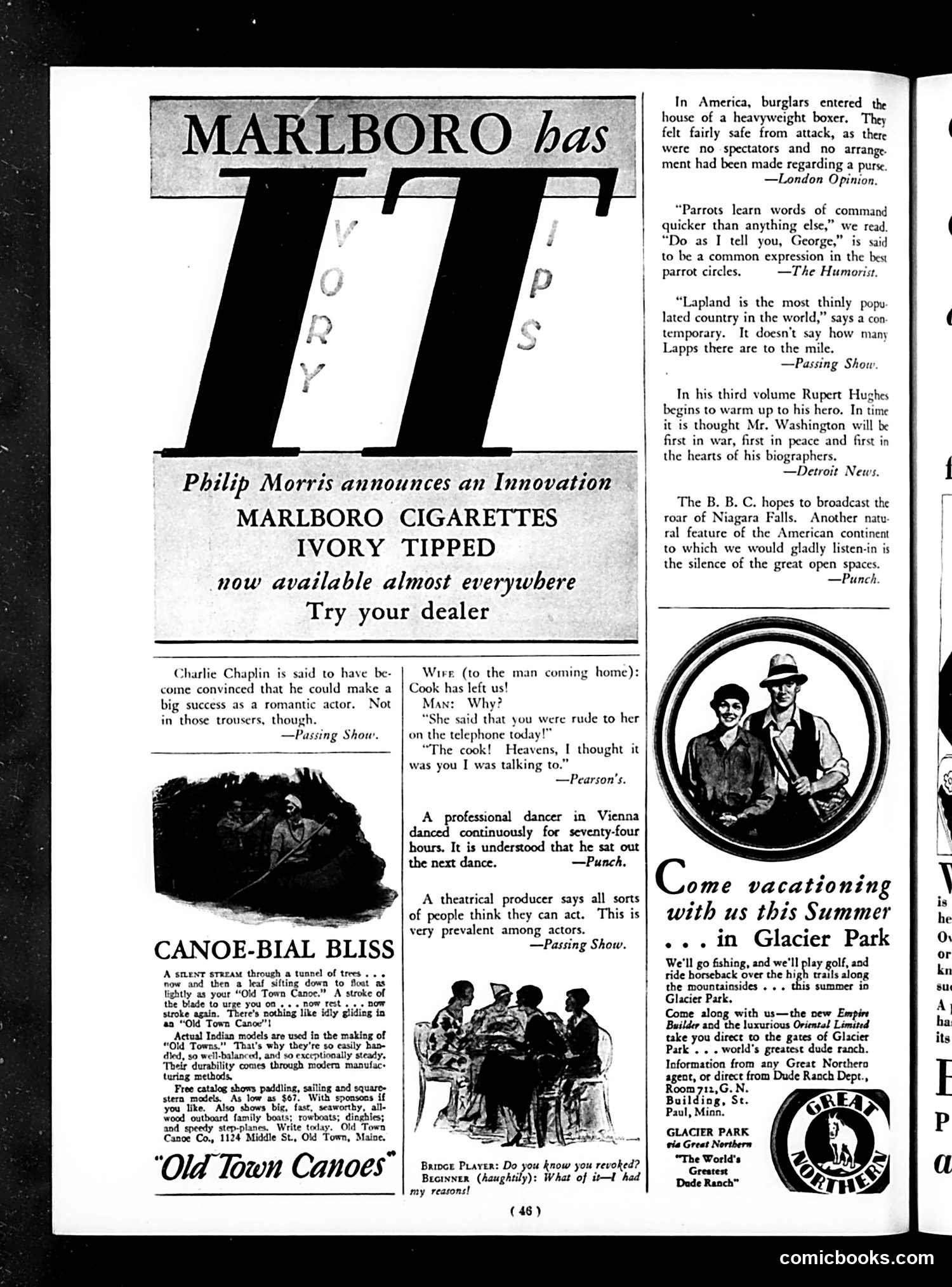
Life Magazine Page Analysis This is primarily an advertising and humor miscellany page from Life magazine, circa early 20th century. Main Content: - Marlboro cigarettes advertisement announcing "ivory tipped" cigarettes as a new innovation - "Canoe-Bial Bliss" - an Old Town Canoes advertisement with romantic copy about paddling - Glacier Park vacation advertisement promoting the Great Northern Railway's dude ranch destination Humor Shorts: The page includes brief jokes reprinted from other publications (Passing Show, Pearson's, Punch, The Humorist, Detroit News, London Opinion). These are gentle, observational gags: Charlie Chaplin's trousers being unsuitable for romantic roles; a cook mistaking a telephone caller's identity; a Vienna dancer dancing 74 hours then sitting out the next dance; remarks about parrots, Lapland's sparse population, and biographer Rupert Hughes. Purpose: This is a typical Life magazine format—mixing commercial advertising with reprinted witticisms and light satire, aimed at educated, affluent readers.
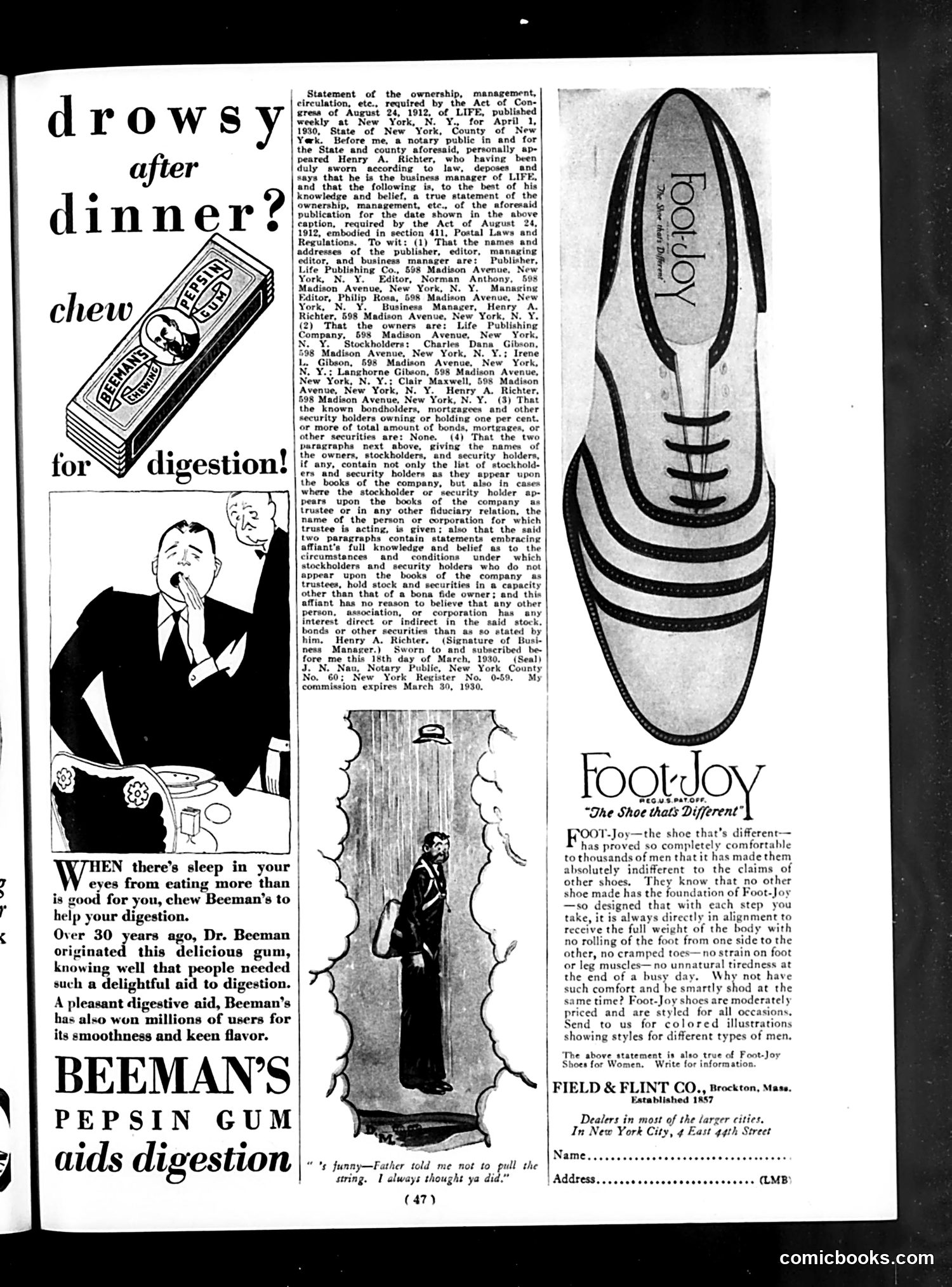
Analysis of Life Magazine Page (circa 1930) This page contains two distinct advertisements with no political cartoon content: 1. Beeman's Pepsin Gum ad (left): Uses a humorous scenario—a drowsy businessman at dinner—to pitch digestive gum. The joke is that after overeating, chewing gum supposedly aids digestion. The ad references "Dr. Beeman" (a real product founder from ~1900) and appeals to post-dinner comfort, a common advertising trope of the era. 2. Foot-Joy Shoes ad (right): Markets shoes as exceptionally comfortable, claiming indifference to competing products. Features a shoe illustration and includes ordering information. The page also contains ownership/circulation statements required by postal law (standard regulatory content). The small cartoon at bottom—a child and parent discussing pulling a string—appears to be filler humor, unrelated to the advertisements. No political satire or significant social commentary is present. This is primarily a commercial advertising page typical of 1930s Life magazine.
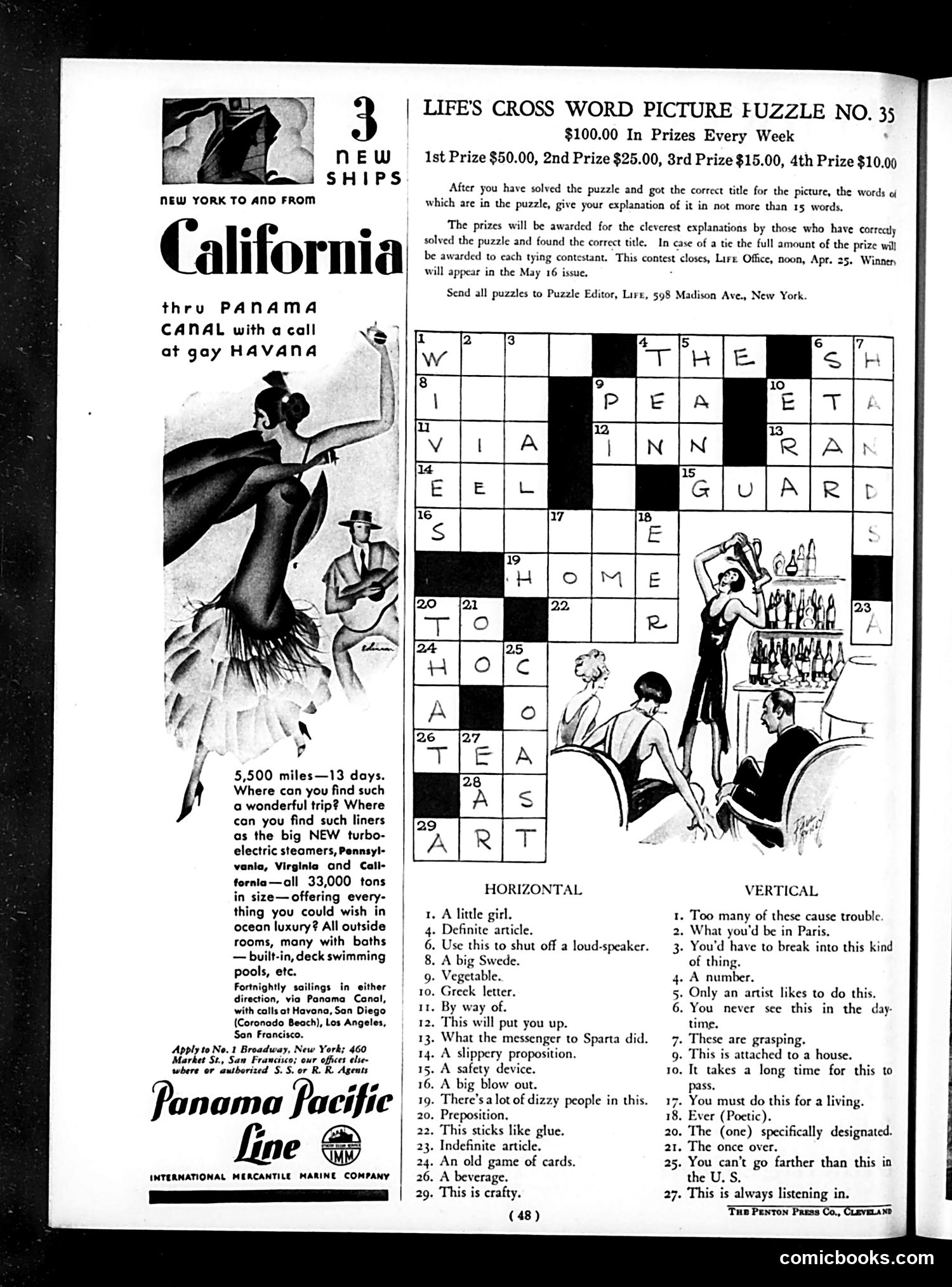
Analysis of Life Magazine Page (circa 1920s-1930s) This page is primarily advertising and a puzzle contest, not political satire. The left side features a Panama Pacific Line advertisement promoting luxury ocean travel to California via the Panama Canal, with calls at Havana. The illustration depicts a stylized woman in tropical/exotic dress—imagery typical of the era's romanticized marketing of Caribbean and Pacific destinations. The right side presents "Life's Crossword Picture Puzzle No. 35," a contest offering $100 in weekly prizes ($50 first place). Solvers must identify the picture's title using words hidden in a crossword grid, then explain it in 15 words for judging. The small illustration shows what appears to be an upper-class social gathering—a cocktail party or nightclub scene with well-dressed figures, reflecting 1920s leisure culture. Historical context: This represents Life magazine's dual function as both satirical publication and middlebrow entertainment vehicle, mixing advertisements, puzzles, and lifestyle content for educated middle-class readers during the interwar period.
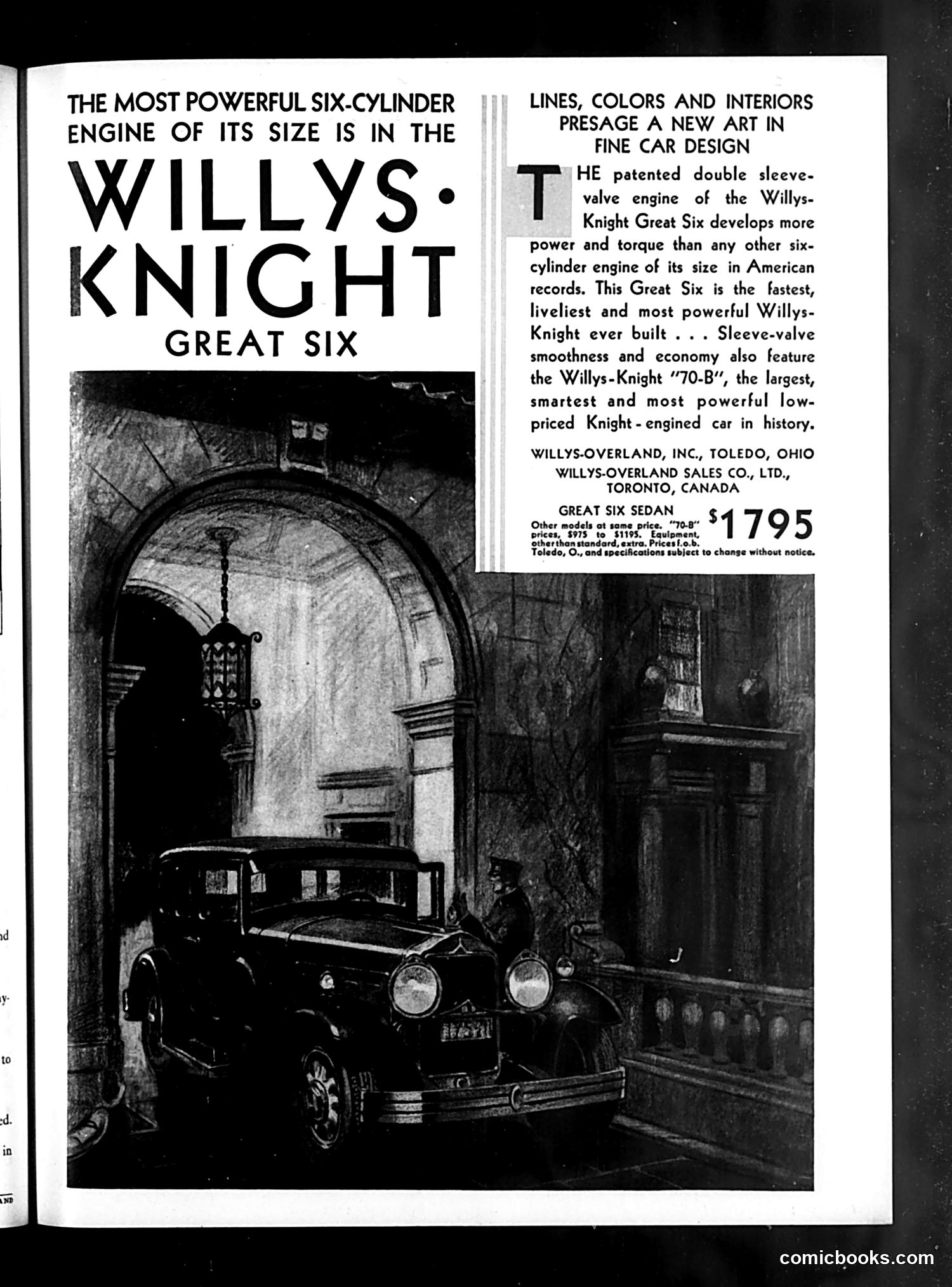
Analysis This is not a cartoon or satire—it's a straightforward automobile advertisement for the Willys-Knight Great Six sedan, priced at $1,795. The page promotes the car's technical features: a patented double sleeve-valve engine claimed to be the most powerful six-cylinder engine of its size in America. The copy emphasizes power, torque, speed, and economy, positioning it as a premium yet affordable vehicle. The dramatic photograph shows the sedan parked in what appears to be a classical European archway or tunnel, likely chosen to suggest elegance and prestige. This is typical 1920s advertising strategy—placing automobiles in refined architectural settings to elevate the product's status and appeal to aspirational buyers. The only noteworthy design element is the headline's emphasis on "lines, colors and interiors" as "a new art in fine car design"—reflecting 1920s modernist thinking about automotive aesthetics.
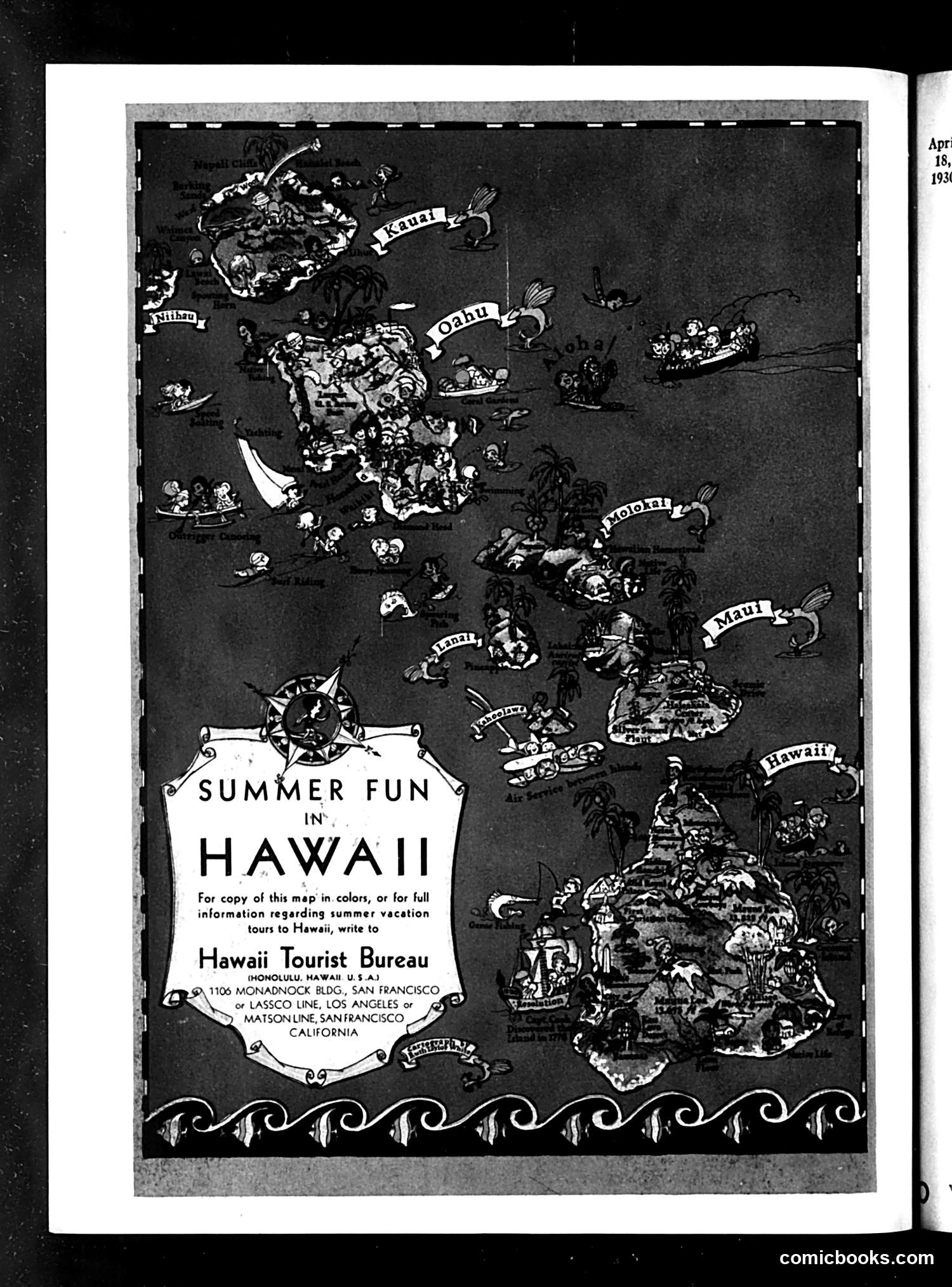
"Summer Fun in Hawaii" - Tourism Advertisement This is a tourism advertisement, not political satire. Dating to April 1938, it promotes Hawaiian vacations through the Hawaii Tourist Bureau. The illustrated map depicts Hawaii's islands (Kauai, Oahu, Molokai, Maui, Hawaii) adorned with cartoonish scenes of leisure activities—swimming, surfing, hula dancing, and tropical scenery. The decorative style romanticizes Hawaiian culture for mainland American tourists. The text directs readers to contact the tourism bureau at San Francisco addresses (Matson Line and Lasso Line were cruise companies). A compass rose and wave border frame the design, emphasizing oceanic travel. The advertisement reflects pre-WWII American tourism marketing, when Hawaii was promoted as an exotic vacation destination. No political commentary is evident—this is straightforward commercial promotion.