life
Life — April 25, 1930
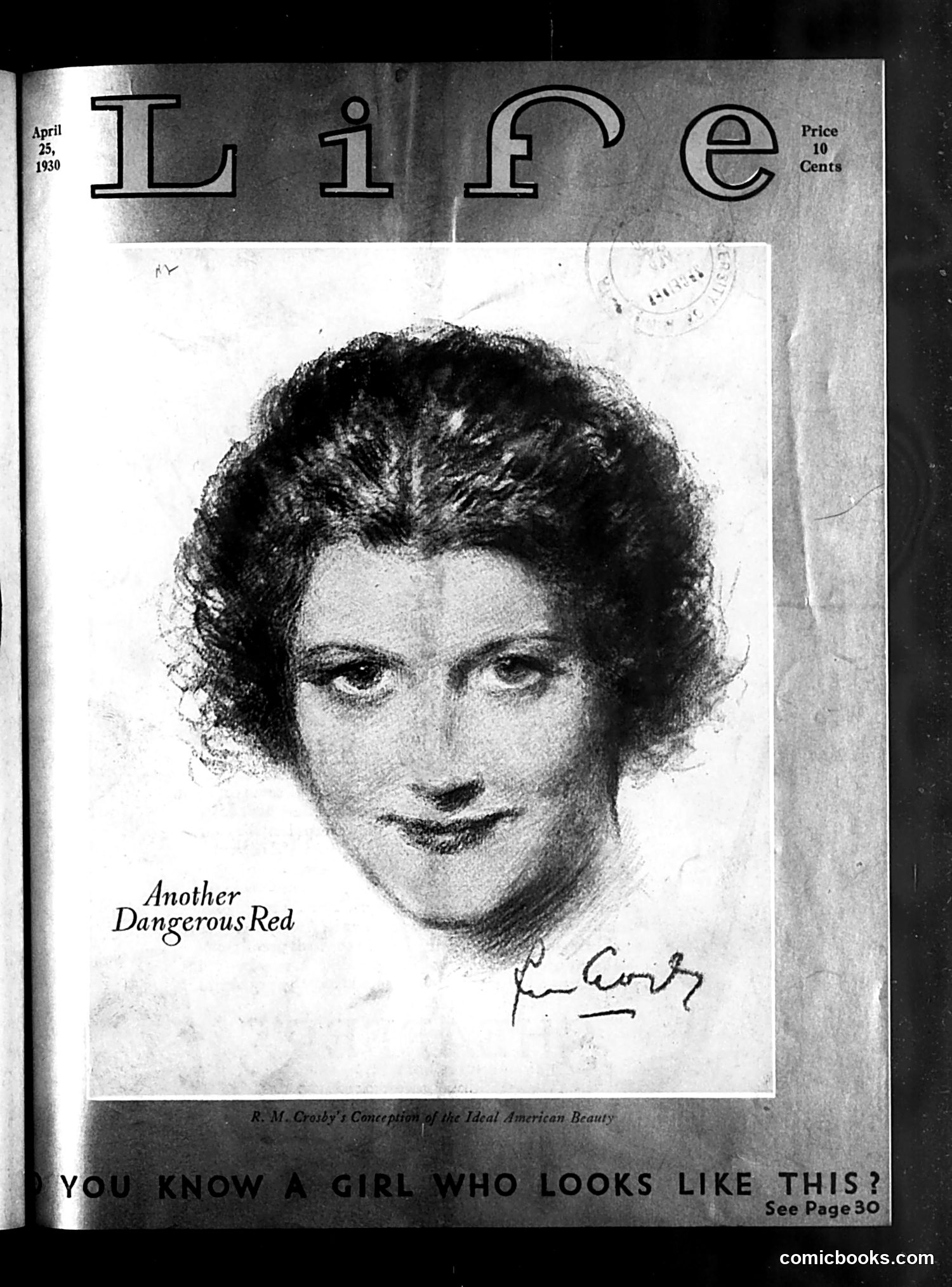
Analysis This is a Life magazine cover from April 25, 1930 (price 10 cents). It features a portrait of a woman with 1920s-style hair and makeup, labeled "Another Dangerous Red." The text at bottom reads: "YOU KNOW A GIRL WHO LOOKS LIKE THIS? See Page 90" What this means: This appears to be a satirical piece playing on the "Red Scare" — the 1920s-1930s American panic about communists and radicals. The phrase "Dangerous Red" likely mocks this hysteria by sarcastically suggesting that women with fashionable, stylish appearances (specifically the bobbed hair and makeup of the flapper era) might be secret communists. The interactive element ("You know a girl who looks like this?") invites readers to participate in the joke, suggesting the absurdity of judging ideology by appearance. This satirizes both anti-communist paranoia and 1920s beauty standards simultaneously.
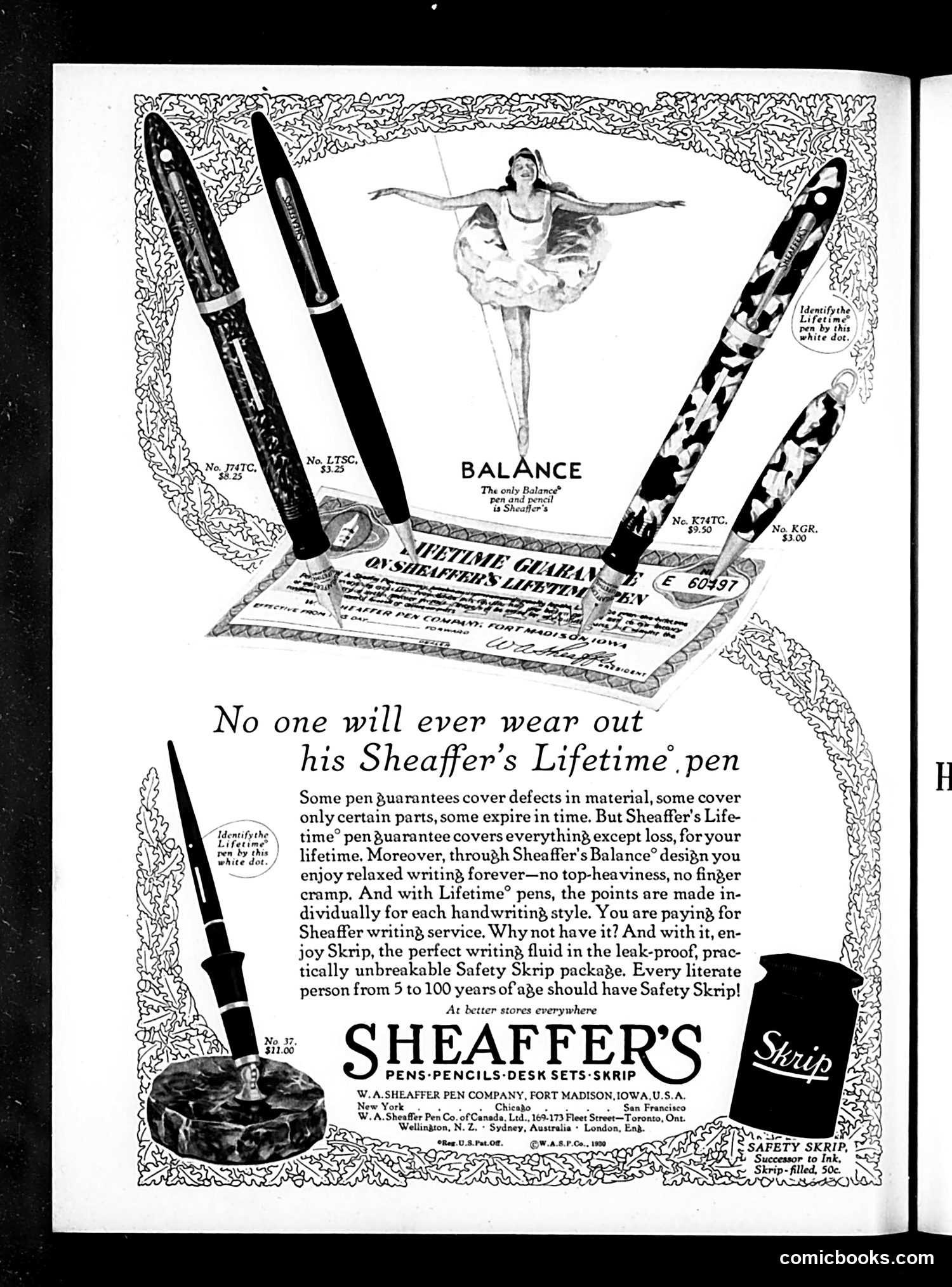
Analysis This is a Sheaffer pen advertisement, not political satire. The page features a stylized illustration of a ballerina in an elegant pose, surrounded by ornate decorative borders. Four different Sheaffer pen models are displayed around her, each labeled with model numbers and prices (ranging from approximately $3.00 to $5.00). The ad's core message appears in the headline: "No one will ever wear out his Sheaffer's Lifetime pen." The text emphasizes the pen's lifetime guarantee—covering everything except loss—and promotes its comfortable design and balanced construction. The ballerina image symbolizes grace, refinement, and sophisticated writing. This is straightforward consumer advertising for fountain pens, targeting educated, affluent buyers who valued durability and elegant design.
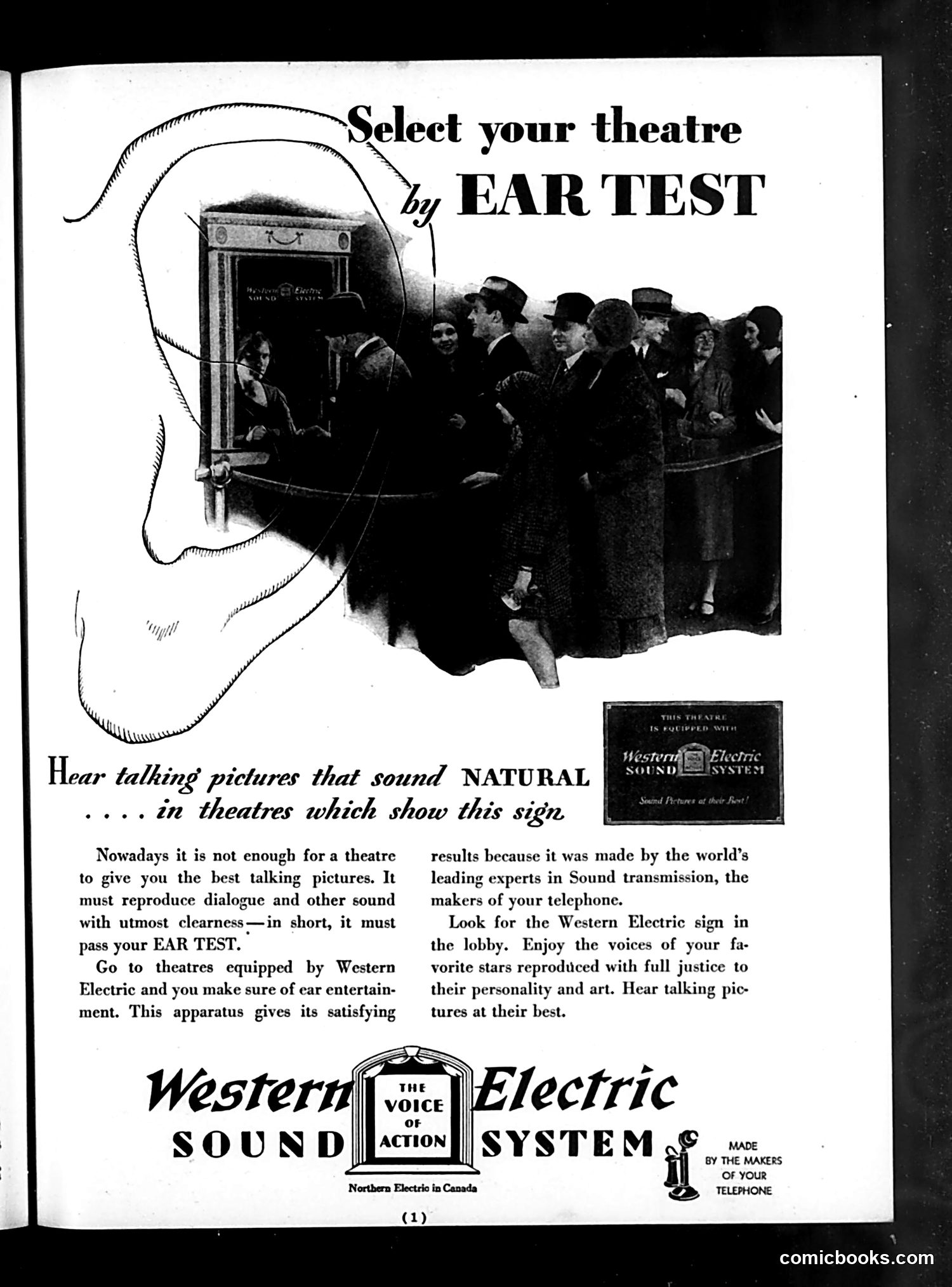
Western Electric Sound System Advertisement This is a advertisement, not satire or political commentary. It promotes Western Electric's sound reproduction technology for movie theatres during the early "talking pictures" era. The image shows a large ear illustration with people lined up at a theatre entrance, suggesting audiences should test sound quality before choosing where to see films. The ad emphasizes that merely showing talking pictures isn't enough—theatres must reproduce dialogue with "utmost clearness" to pass the "ear test." The advertisement references the competitive race among theatres to install quality sound systems as cinema transitioned from silent to synchronized sound films. Western Electric, made by telephone manufacturers, positioned their "Voice of Action" system as the superior choice for reproducing actors' voices naturally.
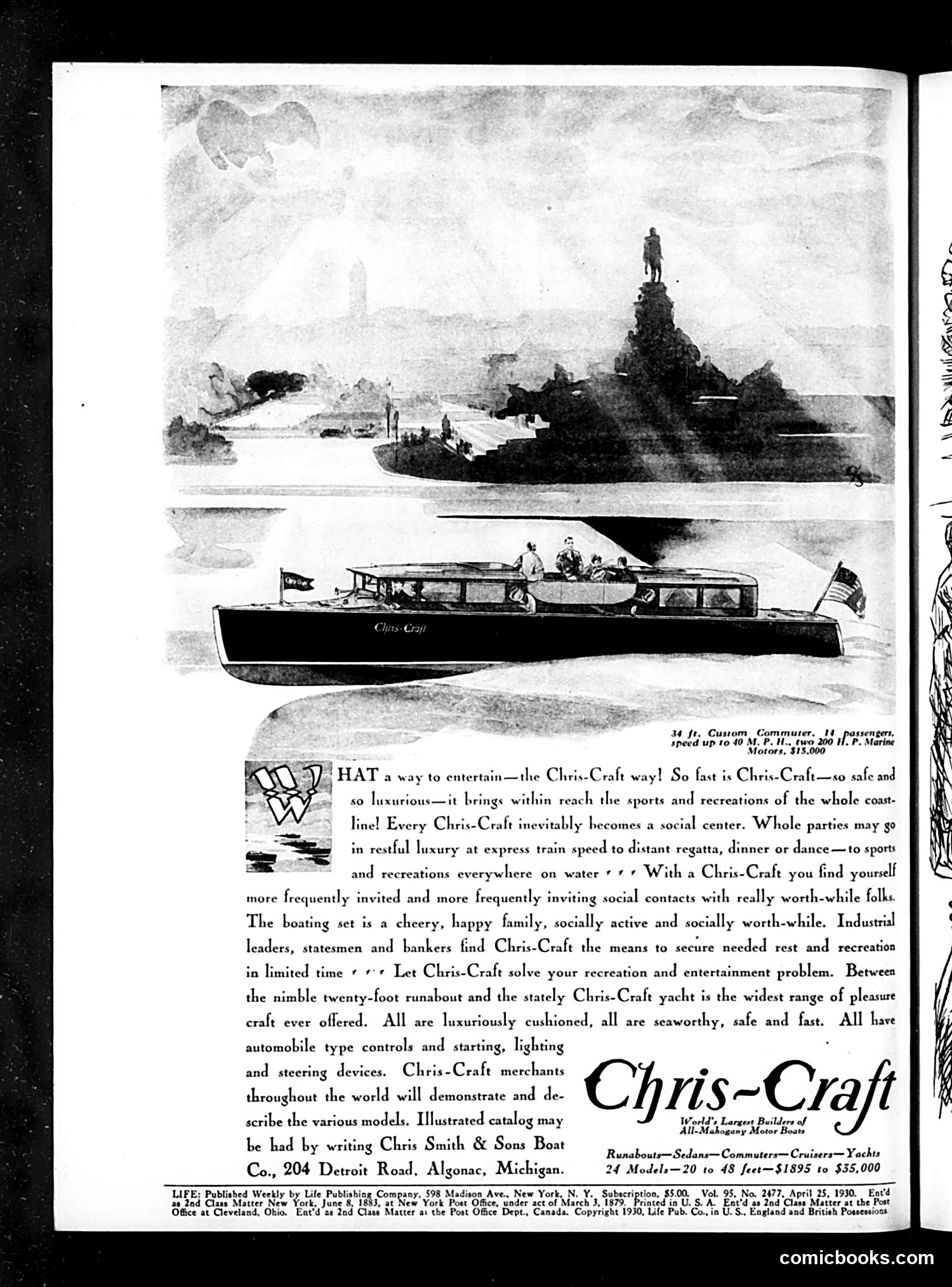
Chris-Craft Advertisement Analysis This page is primarily a commercial advertisement for Chris-Craft motorboats, not a political cartoon. The ad uses aspirational lifestyle messaging typical of 1920s-30s marketing. The top illustration shows a scenic waterfront with a monument and elegant boat, while the central image depicts the "34 ft. Custom Commuter" vessel. The accompanying text promotes Chris-Craft boats as status symbols for the wealthy—vehicles for "social contacts with really worth-while folks" and "express train speed" entertainment access. The satire, if present, is subtle: the ad's breathless language about how boat ownership creates social prestige and frequent invitations gently mocks the leisure class's aspirations during what appears to be the interwar period. However, this is primarily straightforward advertising rather than satirical commentary.
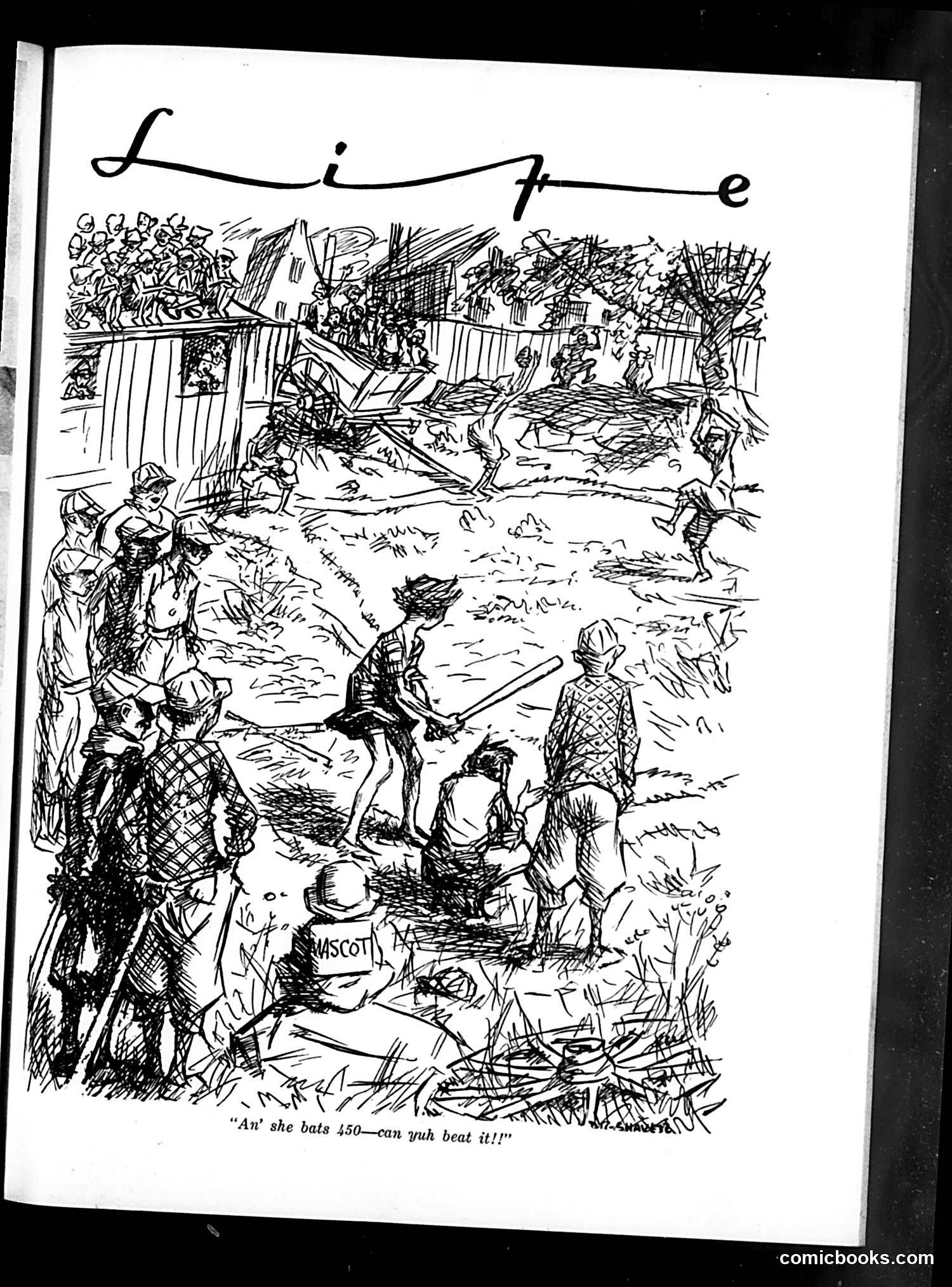
"Life" Baseball Cartoon Analysis This is a sketch depicting a baseball game, likely from the early 20th century based on the art style. The caption reads: "An' she bats 150—can yuh beat it!!" The joke appears to be satirizing either: 1. A woman playing baseball competitively (unusual for the era), or 2. A female spectator's surprising athletic knowledge or boldness in claiming someone bats .150 (a poor batting average) The crowded stadium scene with onlookers suggests public surprise or scandal at a woman's involvement in baseball—whether as player or vocal fan. The exclamatory tone indicates this was meant as humorous commentary on gender roles, presenting women's participation in or expertise about baseball as comedically shocking to contemporary readers.
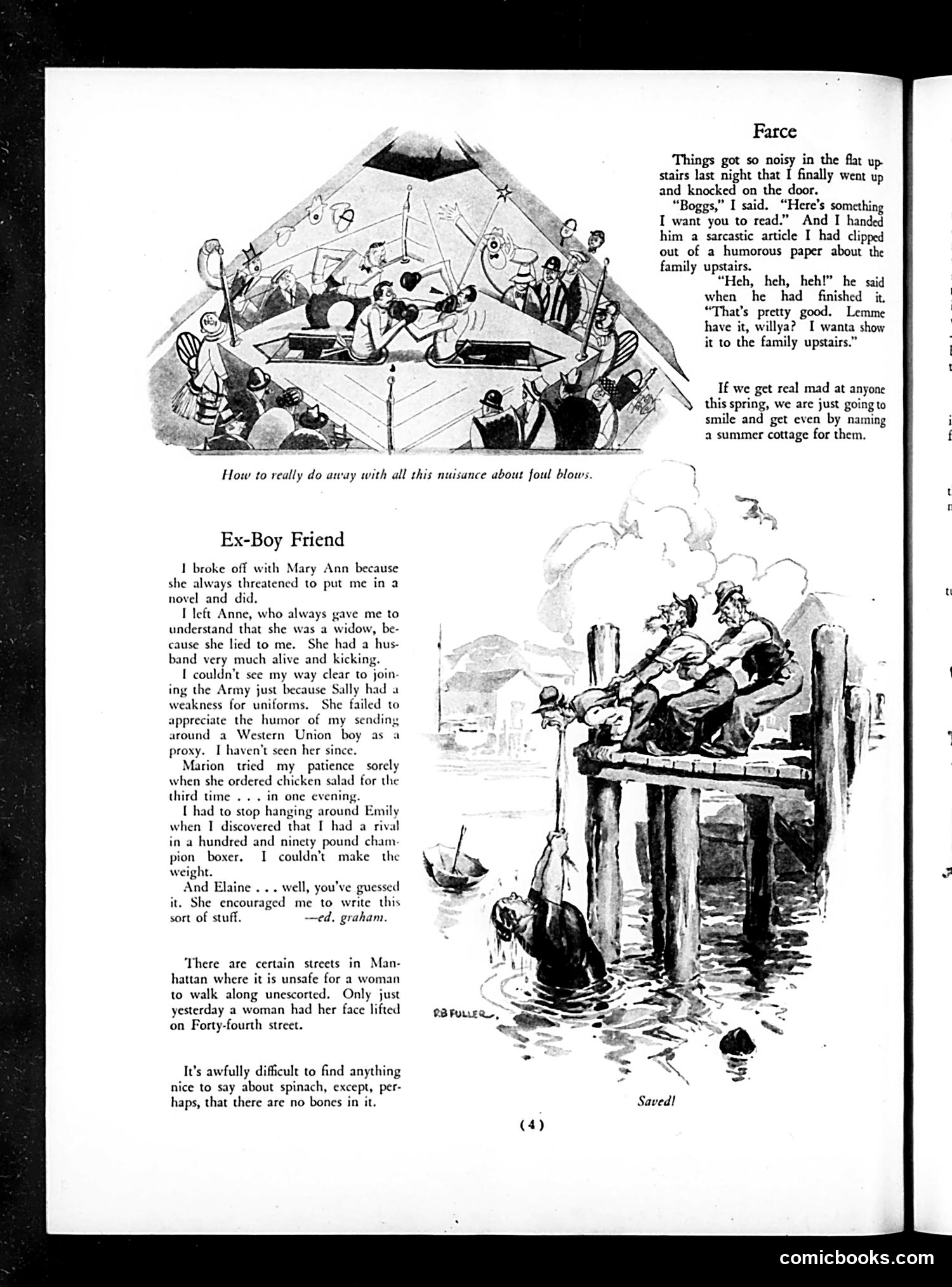
Analysis of Life Magazine Page This page contains two humorous pieces: "Farce" (top): A satirical illustration showing a crowded, chaotic interior scene labeled "How to really do away with all this nuisance about foul blows." The cartoon appears to mock domestic discord or family quarreling—the narrator describes noise upstairs and delivers a sarcastic newspaper article about family disputes to resolve conflict through humor rather than confrontation. "Ex-Boy Friend" (bottom): A comedic column about romantic entanglements, describing the narrator's breakup with Mary Ann and subsequent romantic complications involving multiple women. The accompanying illustration shows people in a rowboat, captioned "Saved!" The humor derives from the narrator's complicated relationship history and the implication of being rescued from romantic chaos. Both pieces use light satire to mock common social situations of the era.
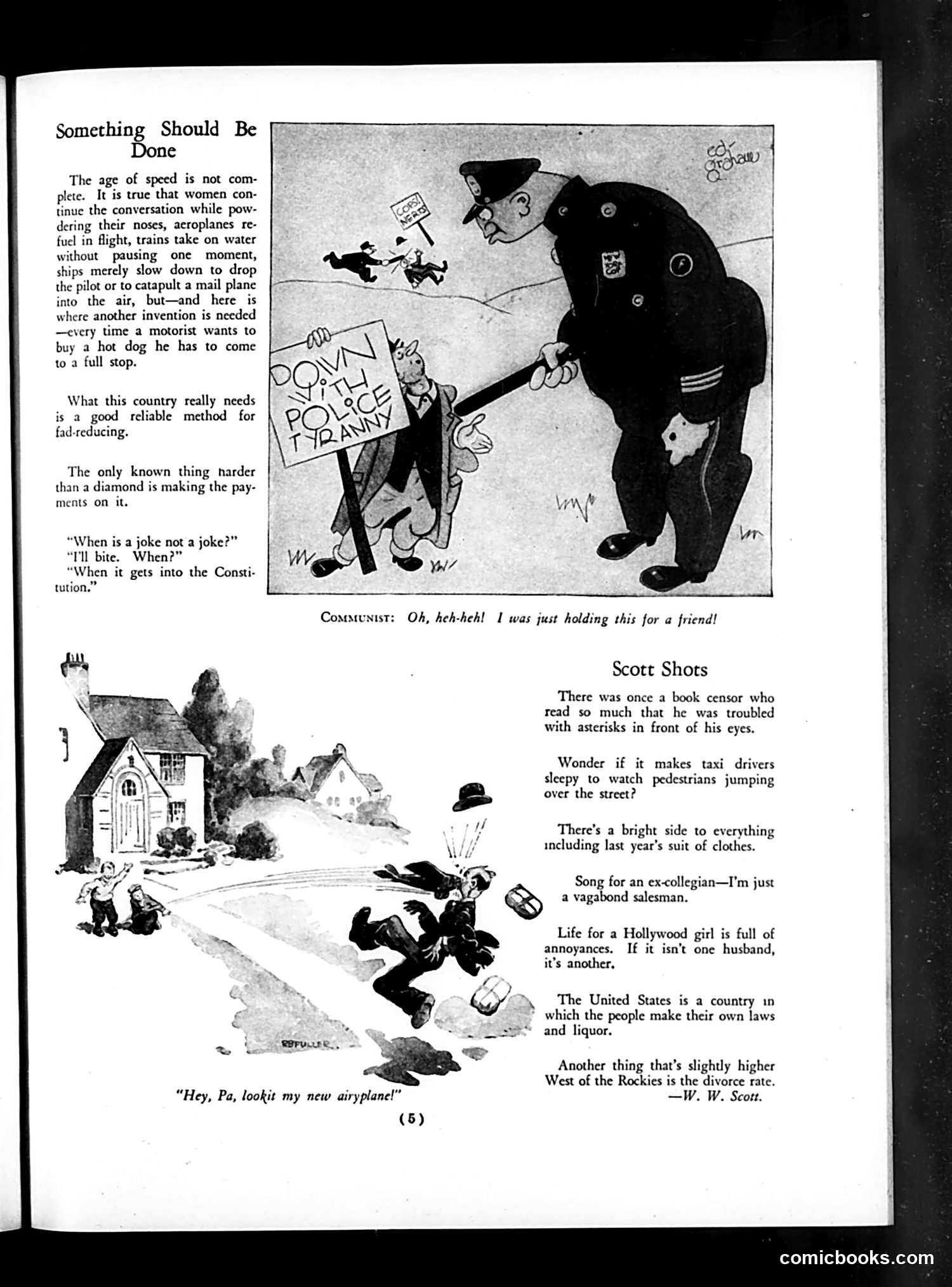
Political Cartoon Analysis Top Cartoon ("Something Should Be Done"): This cartoon satirizes Communist agitation during the era of Red Scare anxieties. A large police officer confronts a man holding a sign reading "DOWN WITH THE POLICE AND ARMY"—the policeman's caption claims he was "just holding this for a friend." The satire mocks how Communist sympathizers or agitators would deny their political activities or claim innocent involvement. The accompanying text uses humor to critique both rapid modernization and the difficulty of regulating dangerous ideologies, comparing the challenge to stopping a motorist wanting a hot dog. Bottom Section ("Scott Shorts"): This is a collection of brief humorous observations and social commentary, including jabs at censorship, Hollywood scandals, and divorce rates in the American West.
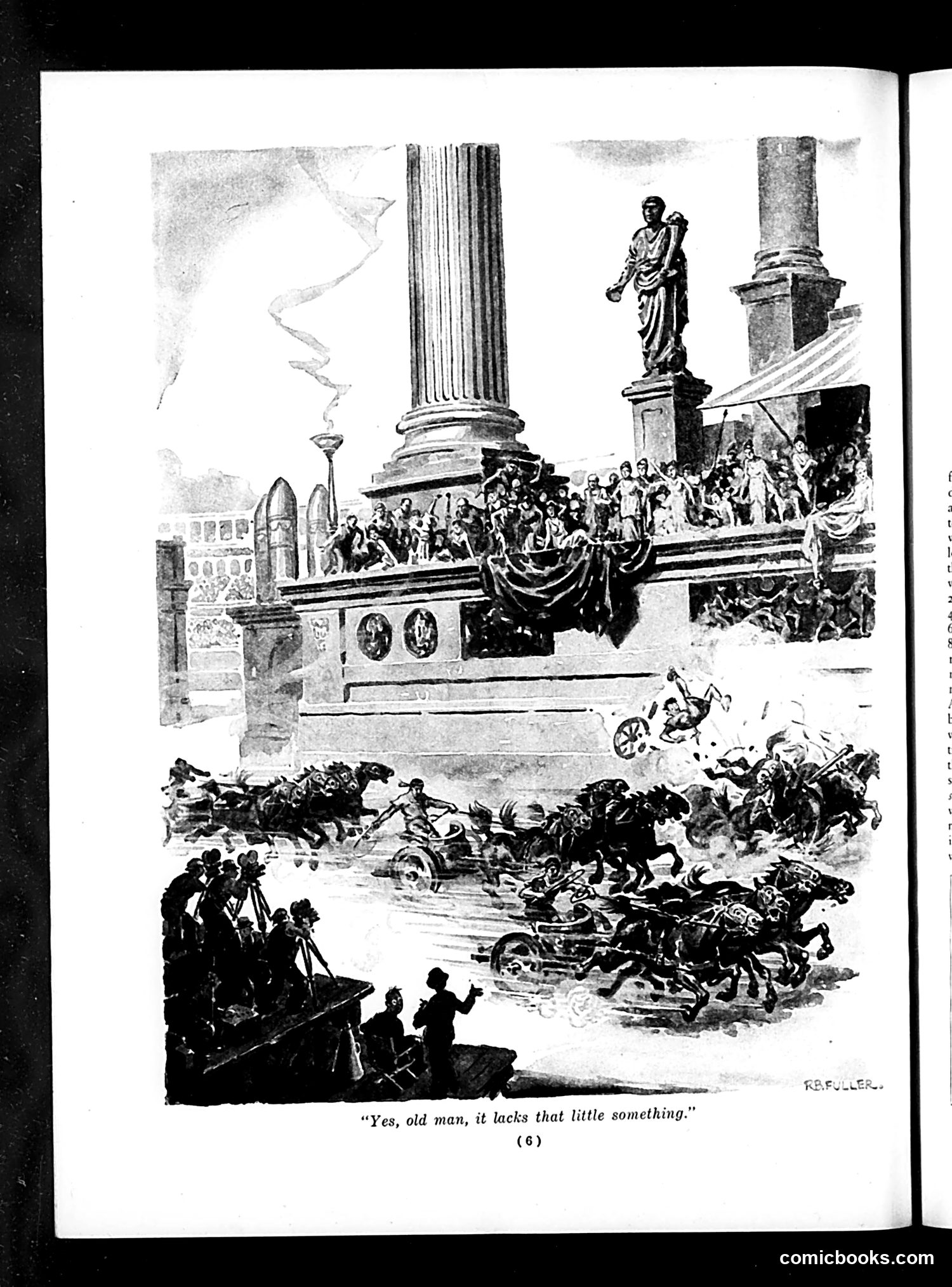
Analysis This is a satirical cartoon depicting a chaotic scene at what appears to be a public monument or gathering place. The image shows classical architecture with columns and a statue, overlooking tumultuous activity below—multiple horse-drawn carriages and figures in apparent disorder or conflict. The caption reads: "Yes, old man, it lacks that little something." The cartoon appears to be social or political satire, likely commenting on public disorder, mismanagement, or a failed event. The contrast between the dignified classical setting above and the chaos below suggests irony about governmental or institutional competence. Without additional context about Life magazine's publication date, the specific event being referenced remains unclear, though the overall message seems critical of poor organization or leadership.
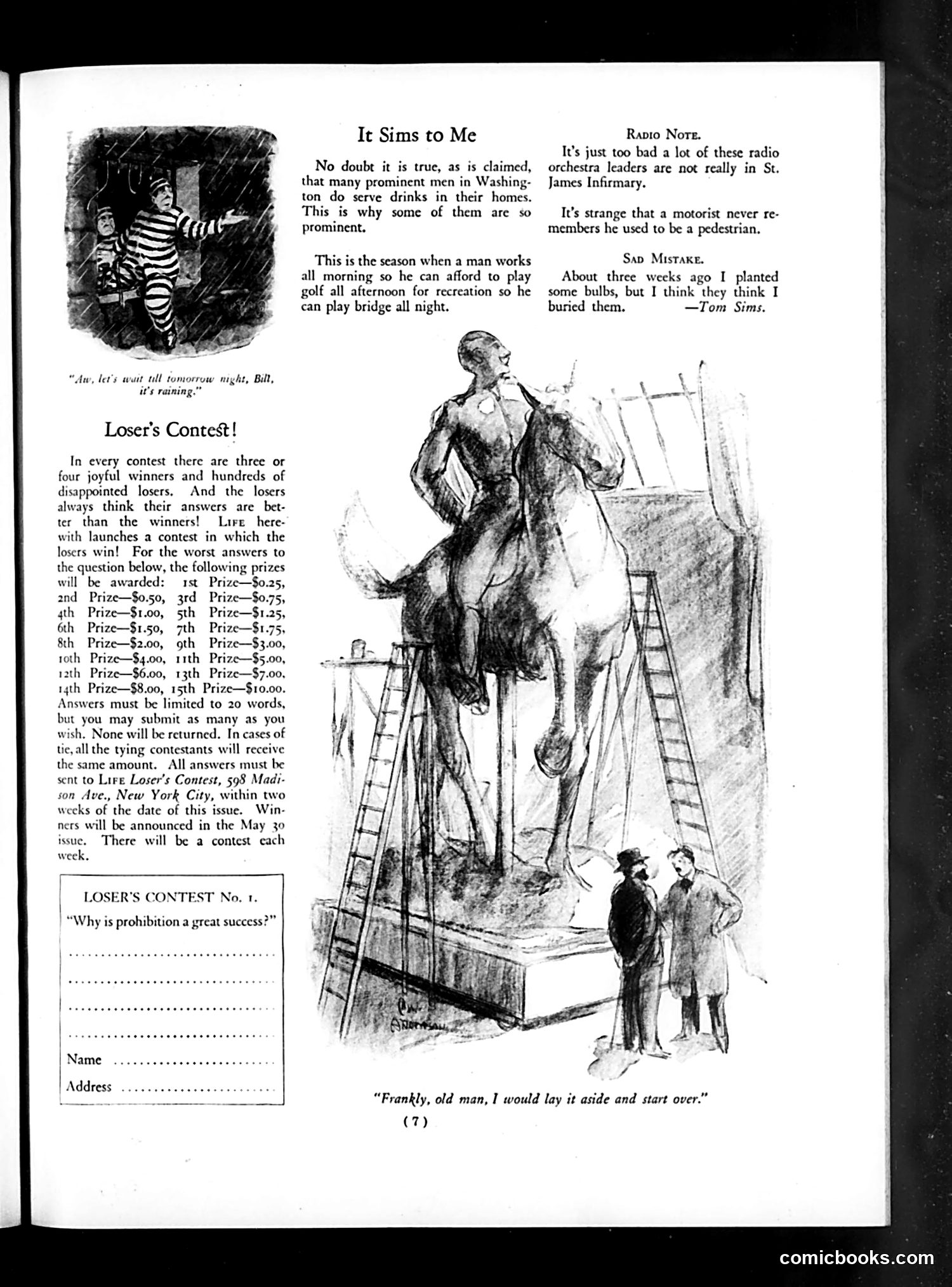
Analysis of Life Magazine Page This page contains satirical commentary and a contest feature rather than political cartoons. "It Sims to Me" features brief social observations—including jabs at Washington politicians who "serve drinks in their homes" (likely referencing Prohibition era hypocrisy), radio orchestra leaders, and motorists. The tone is light mockery of contemporary urban society. "Loser's Contest" is a humor competition where readers submit answers to "Why is prohibition a great success?"—the joke being that Prohibition was widely considered a *failure*, so the worst answers win prizes. This satirizes Prohibition's unpopularity while mocking those defending it. The illustration shows a man on a tall structure contemplating suicide with onlookers below—likely commenting on economic despair, though the specific context is unclear without the caption's full context.
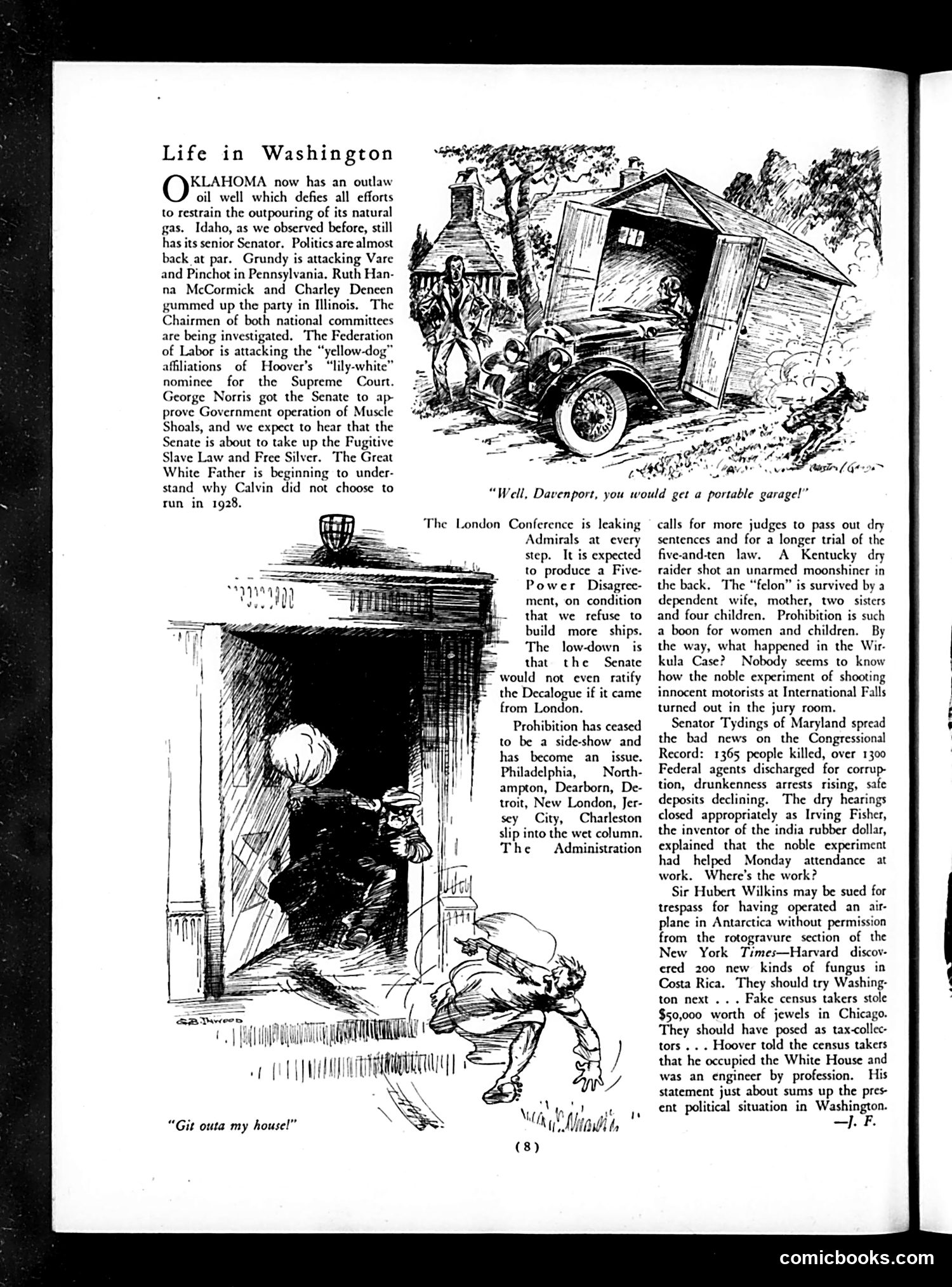
"Life in Washington" - Political Satire, circa 1928 This page contains two editorial cartoons mocking Washington politics and Prohibition enforcement. The top cartoon shows someone arriving at a house with a motorcycle, captioned "Well, Davenport, you'd get a portable garage!" — likely satirizing ineffective Prohibition enforcement or political hypocrisy. The bottom cartoon, "Git outa my house!" depicts someone being forcibly removed, possibly commenting on political upheaval or Congressional conflicts. The accompanying text discusses real 1928 events: oil scandals (Oklahoma), Senate politics, the London Naval Conference, Prohibition's failures (Philadelphia and other cities mentioned), Congressional corruption charges, and census-taking controversies. The final paragraph attributes commentary to "J.F." and notes Hoover's claim to have been an engineer—suggesting the author views the current political situation as absurd or incompetent.
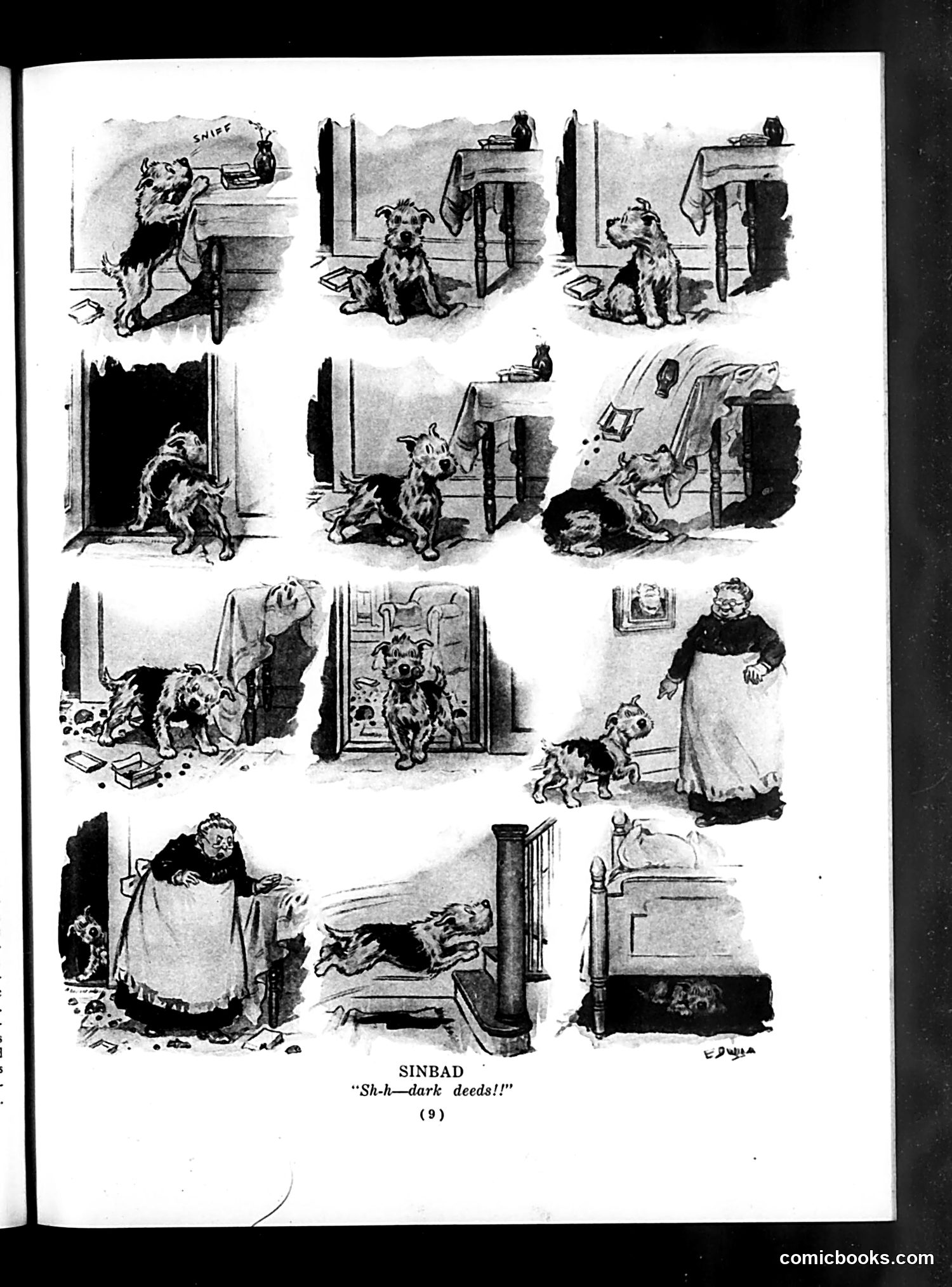
Analysis of "Sinbad" Comic Strip This appears to be a sequential comic strip titled "Sinbad" with the caption "Sh-h—dark deeds!!" The strip uses a dog character (appearing to be a terrier or similar breed) as the protagonist engaged in various mischievous activities throughout a household. The humor derives from slapstick domestic chaos: the dog steals from a kitchen counter, breaks dishes, creates mayhem with household items, and generally causes destruction while evading or interacting with human inhabitants (depicted as a chef and domestic workers). The satire likely comments on the uncontrollable nature of pets or servants in domestic spaces—typical themes in early 20th-century humor. The wordplay on "Sinbad" (the legendary sailor known for adventures) ironically applies to a dog's "dark deeds" within a confined household, creating comedic contrast between grand adventure and petty household mischief.
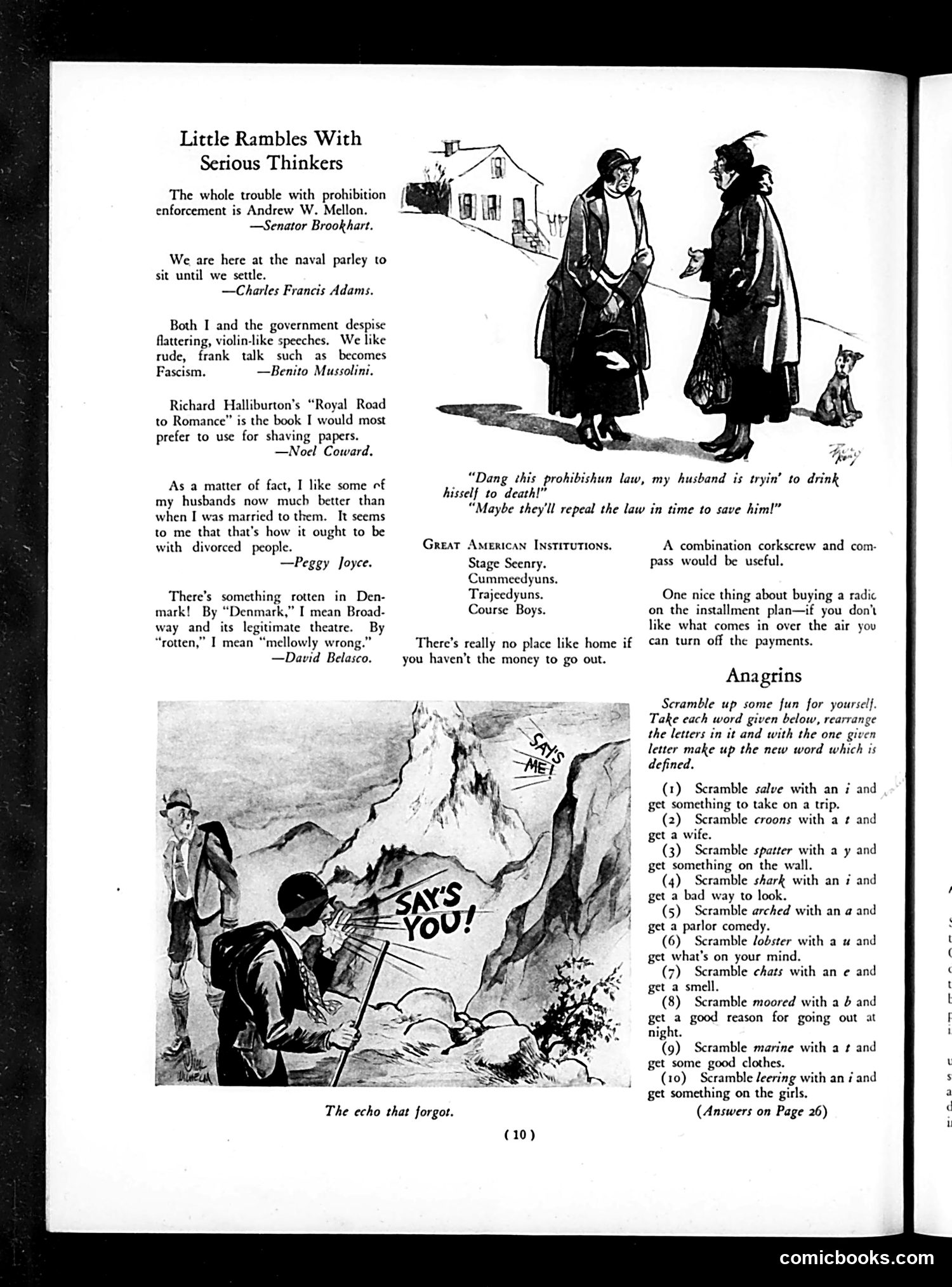
"Little Rambles With Serious Thinkers" - Prohibition Era Satire This page satirizes Prohibition enforcement through quotes from prominent figures (Senator Brookhart, Charles Francis Adams, Benito Mussolini, Noel Coward, Peggy Joyce, David Belasco) expressing frustration with the policy. The main cartoon shows two women discussing a man "tryin' to drink himself to death" due to prohibition laws, with one hoping repeal will save him. This illustrates the human cost of alcohol bans—driving people to dangerous drinking. The second cartoon, "The echo that forgot," depicts a man in mountains hearing "Says you!" echoed back, likely satirizing how prohibition rhetoric bounces back unanswered or ignored. Together, the page mocks prohibition as unenforceable and damaging, reflecting 1920s-30s anti-prohibition sentiment before the policy's repeal in 1933.
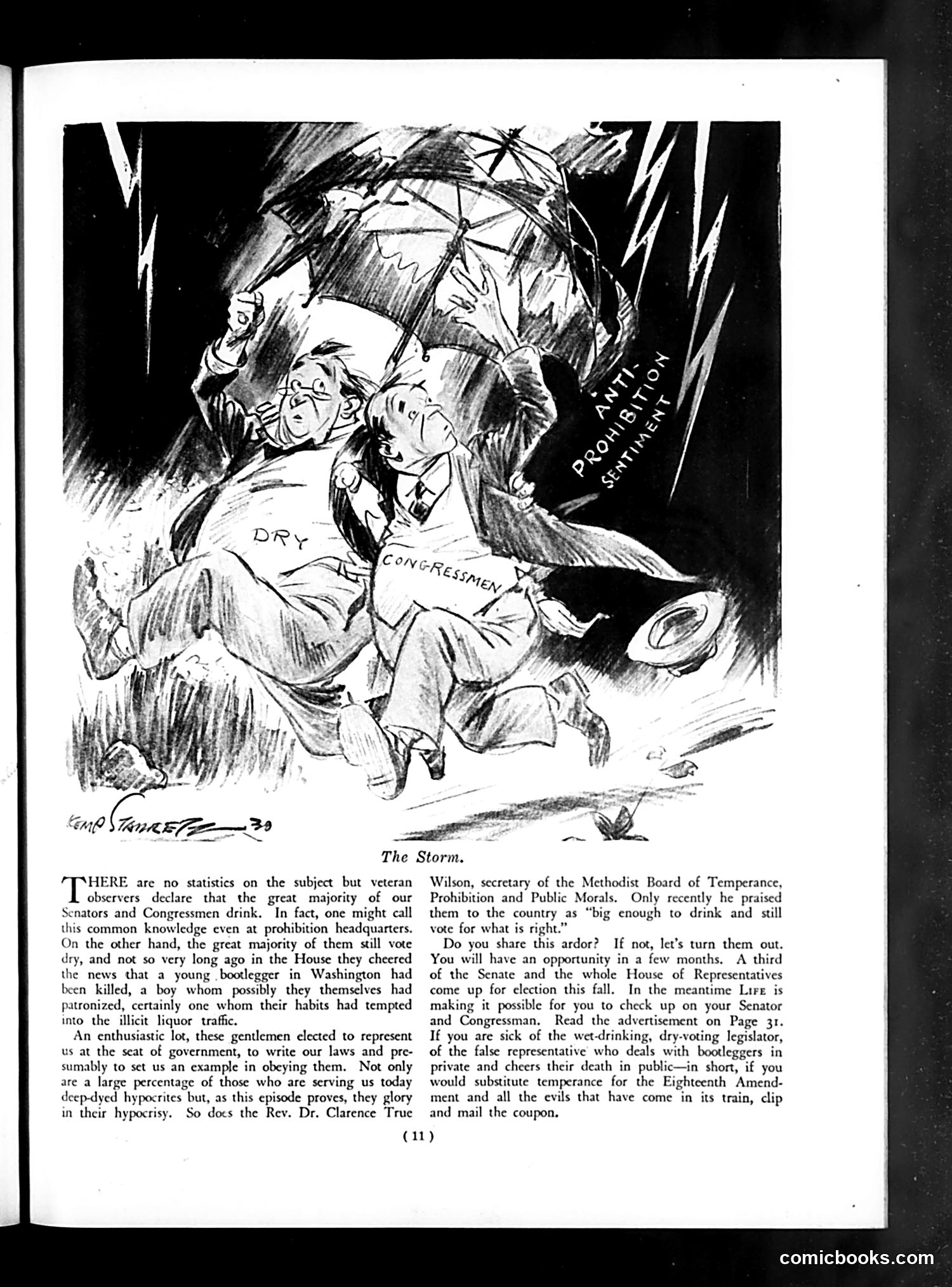
"The Storm" - Political Cartoon Analysis This Prohibition-era cartoon satirizes congressional hypocrisy on temperance. The image depicts two figures labeled "DRY" and "CONGRESSMEN" huddled under an umbrella during a storm, with "PROHIBITION SENTIMENT" falling around them like rain. The text reveals the satire's point: while Congress publicly champions Prohibition and expects citizens to obey dry laws, many legislators privately drink alcohol. The article references a Methodist official praising senators for their "prohibition sentiment," while noting that veteran observers at the Capitol know the reality differs sharply. The cartoon mocks the disconnect between politicians' public dry stance and private wet behavior—they demand constituents follow rules they themselves violate, seeking shelter from the consequences of their own hypocrisy.
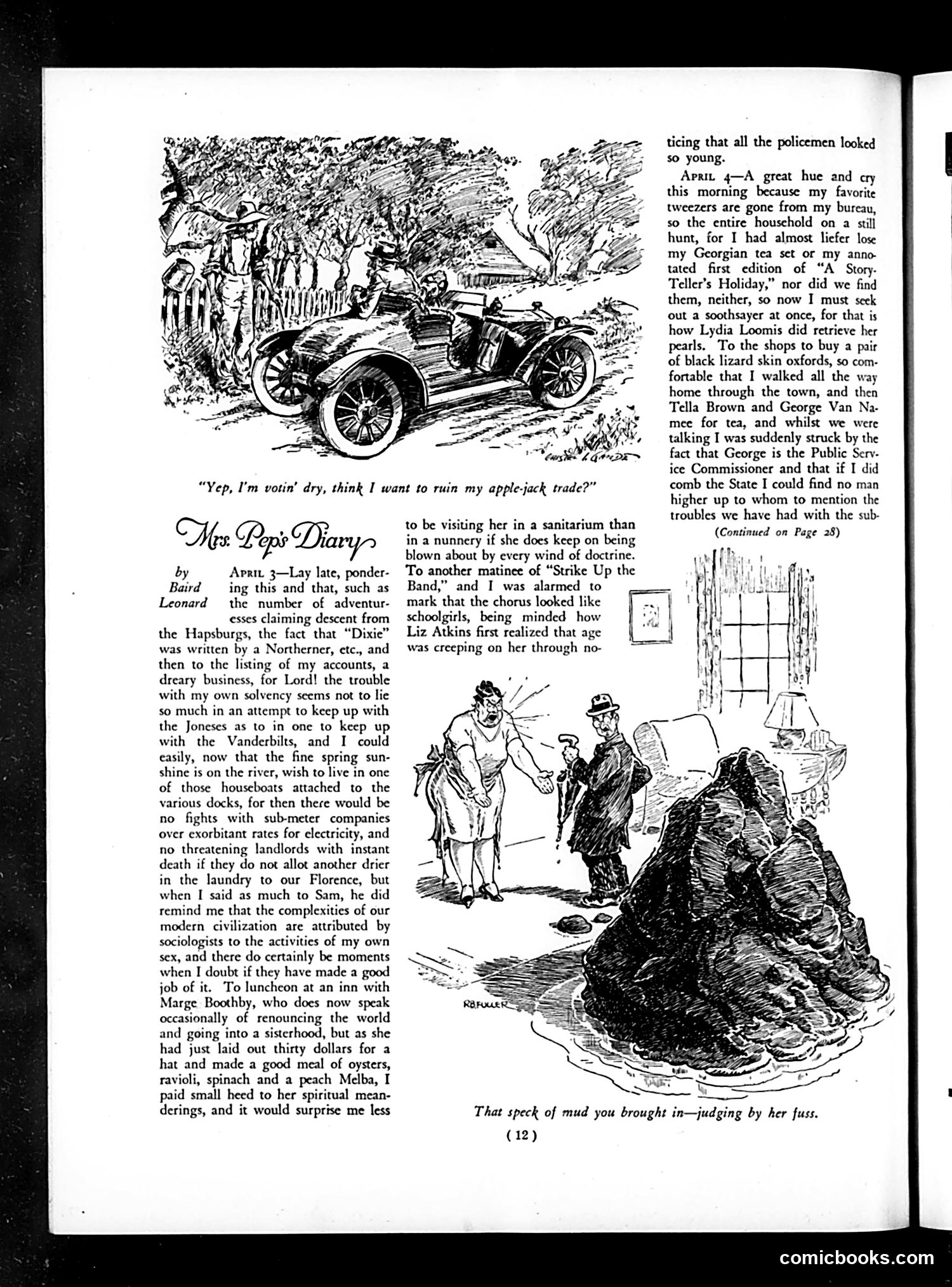
Analysis of "Mrs. Pep's Diary" Page This page contains a serialized diary column by Baird Leonard titled "Mrs. Pep's Diary." The content satirizes early 20th-century domestic life and social pretensions. The upper cartoon shows a car with the caption "Yep, I'm votin' dry, think I want to ruin my apple-jack trade?" — referencing Prohibition debates and bootlegging. The lower illustration depicts a woman meeting with what appears to be a landlord or creditor, captioned "That speck of mud you brought in—judging by her fuss." This satirizes class tensions and domestic management concerns of the era. The diary text itself mocks women's social climbing, complaints about servants, and trivial domestic concerns among the upper-middle classes, using ironic commentary on modern "civilization" and female activism. The overall tone is gently satirical of contemporary women's lives and concerns.
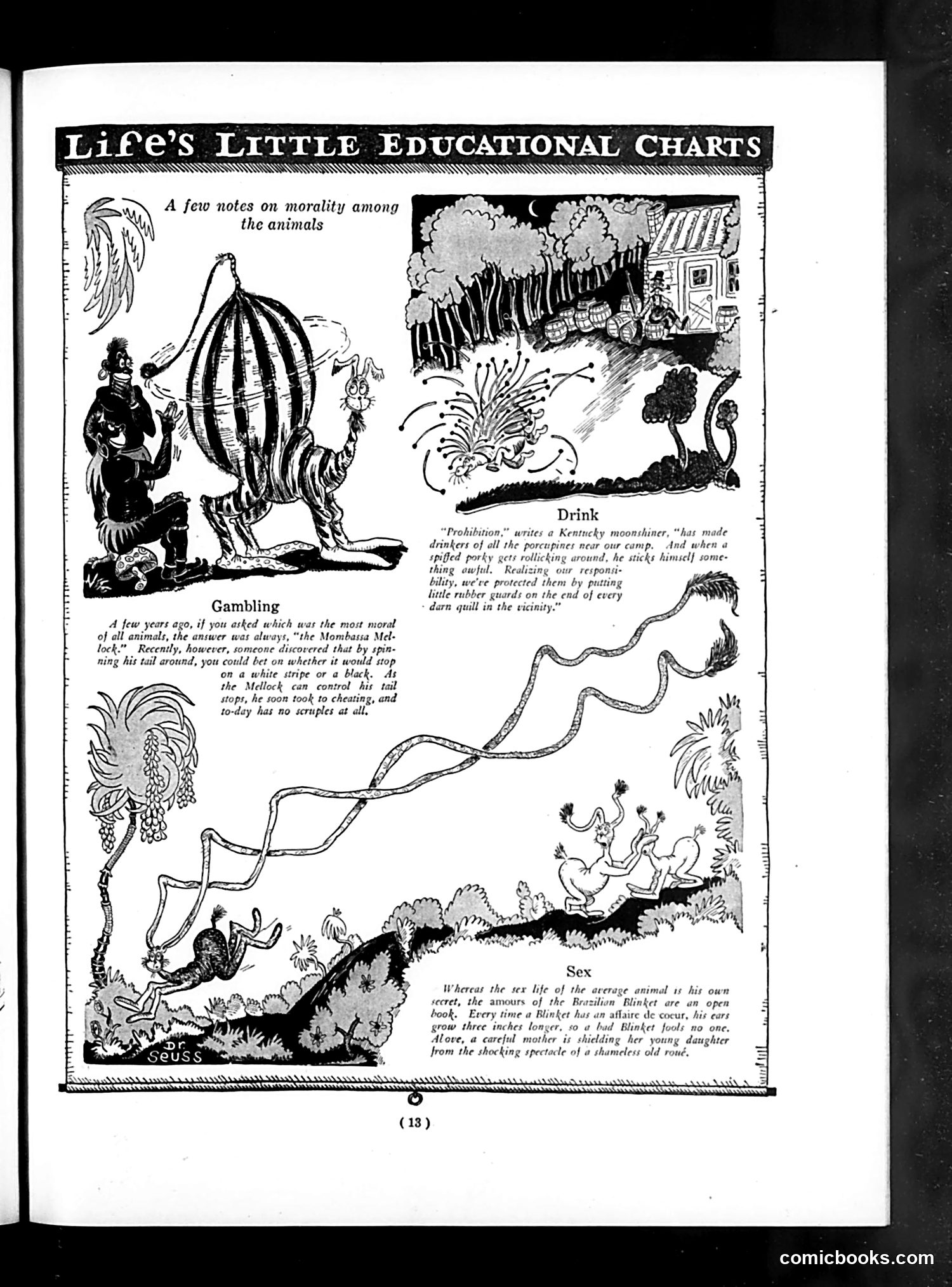
Life's Little Educational Charts: Animal Morality This satirical page uses animal behavior as a moral mirror to human vices. Each illustration pairs animals with human failings: Gambling: A man plays cards with a Mombassa Mollock (a fictional or obscure creature), illustrating how gambling addicts, like the animal, cannot resist wagering—they'll bet on anything, even stripes. Drink: A cautionary scene shows a drunk man; the text references Kentucky moonshiners protecting their stills with rubber guards on darts, darkly suggesting alcohol's dangers. Sex: A long snake and Brazilian Blanket bird demonstrate reproductive excess, with commentary on animal promiscuity contrasted against human moral responsibility—mothers should shield daughters from such "shameless" spectacles. The satire mocks Victorian moral anxieties by treating human weaknesses through crude animal analogies.
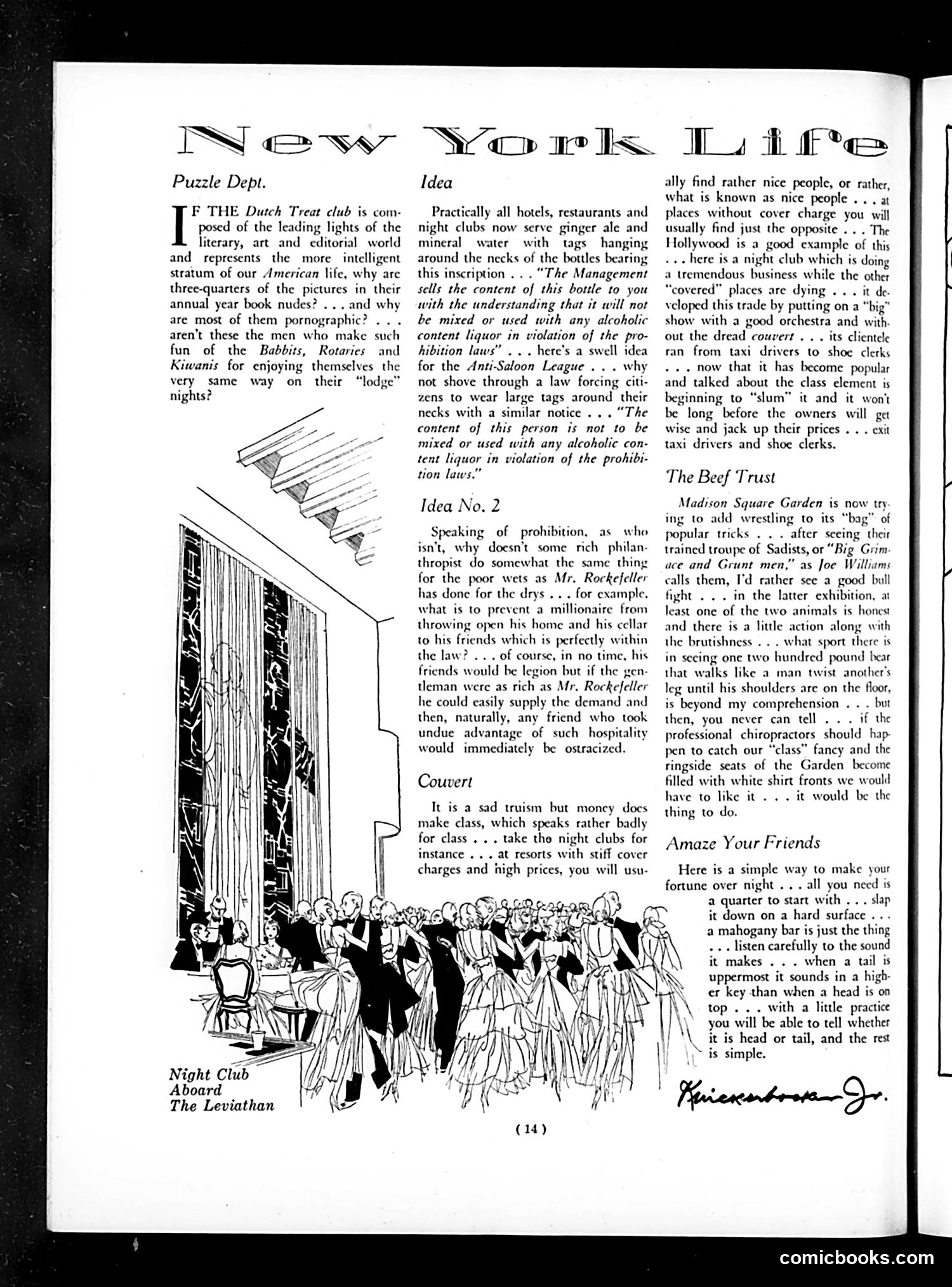
Analysis This page from *Life* magazine's "Puzzle Dept." contains satirical commentary on Prohibition-era social practices rather than a traditional political cartoon. The main illustration shows a crowded nightclub scene aboard "The Leviathan" (a famous ocean liner). The text discusses how wealthy philanthropists like Rockefeller could circumvent Prohibition laws by serving alcohol in private settings, while average citizens faced legal consequences. The satire criticizes class inequality: the rich could openly violate prohibition through private hospitality without prosecution, whereas others risked legal trouble. Additional sections mock nightclub culture, including fake "cover charges" to disguise illegal alcohol sales, and offer humorous tips for distinguishing head from tail on a fish at dinners—commentary on pretentious social posturing during the Prohibition period.
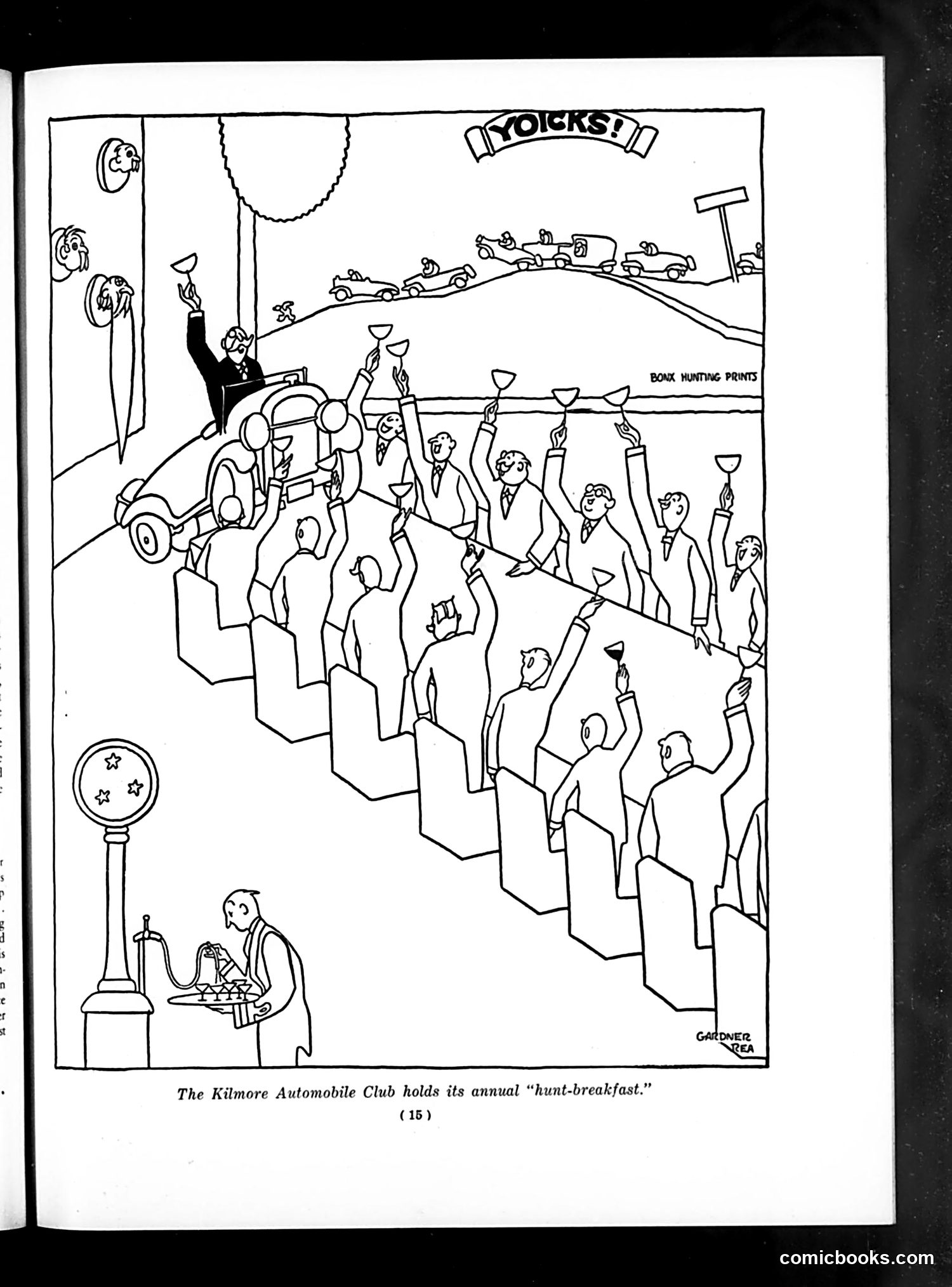
Explanation for Modern Readers This is a satirical cartoon titled "The Kilmore Automobile Club holds its annual 'hunt-breakfast.'" The joke is a visual pun playing on the double meaning of "hunt." Rather than an actual hunting expedition, the "hunt" refers to a "treasure hunt" or scavenger hunt game. Dozens of formally-dressed club members stand in organized rows holding torches or searchlights, searching for hidden items. Meanwhile, a vendor at bottom-left sells refreshments, and cars line a hill in the background—suggesting this is a motorist's club activity rather than traditional hunting. The satire mocks the genteel pretensions of automobile clubs, suggesting their members engage in frivolous games rather than serious pursuits. The elaborate setup and formal dress underscore the comedy of grown adults participating in what is essentially a children's party game.
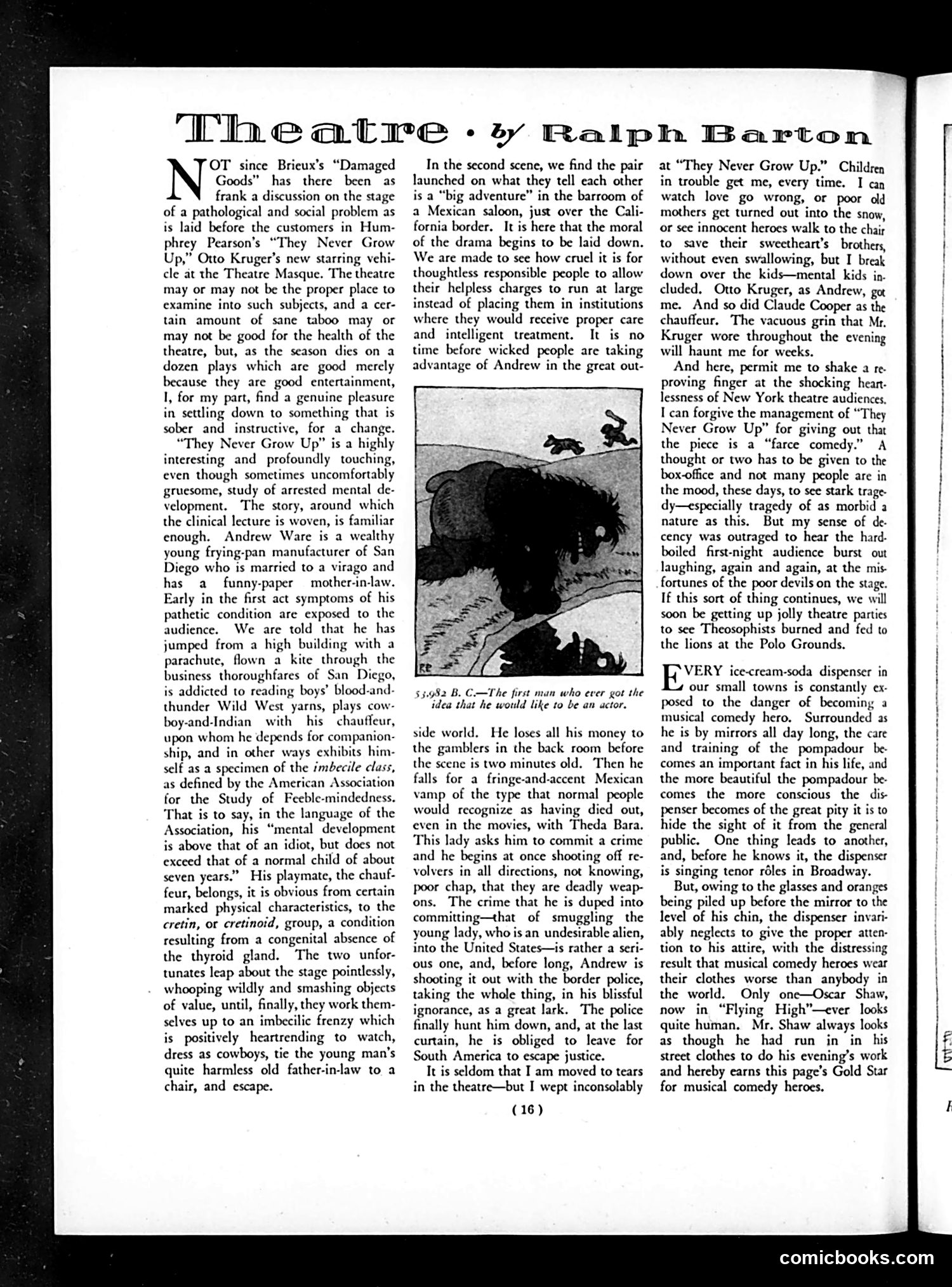
Theatre Review: "They Never Grow Up" This is a theatre review by Ralph Barton discussing a play called "They Never Grow Up." The embedded illustration depicts a desert scene with what appears to be cowboys or frontier figures—likely representing the play's setting or plot. The review discusses the story of Andrew Ware, a wealthy San Diego manufacturer married to a woman named Diego. The plot involves Andrew jumping from a building with a parachute, leading to complications in Mexico involving smuggling, crime, and border police. The reviewer critiques the play's treatment of serious subjects (poverty, crime) through comedic means, expressing concern that audiences laugh at the misfortunes of desperate characters rather than sympathize with their plight. Barton questions whether such "musical comedy heroes" deserve Gold Star status for entertainment value.
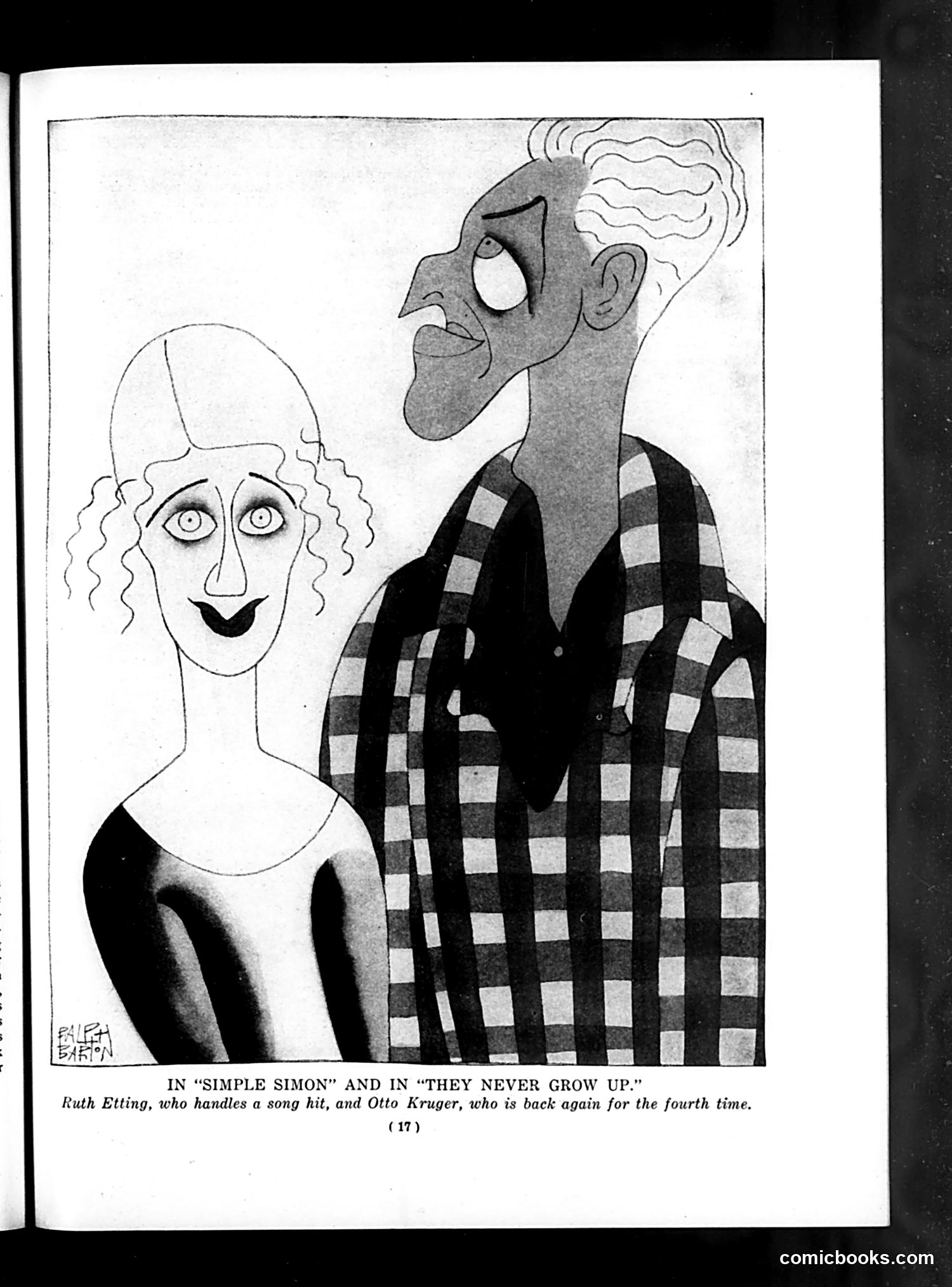
Analysis This is a caricature illustration accompanying text about two performers: Ruth Etting (left figure) and Otto Kruger (right figure), who appear in the films "Simple Simon" and "They Never Grow Up." The cartoon uses exaggerated facial features typical of early 20th-century satirical illustration—the woman on the left has wide eyes and curled hair, while the man displays an elongated profile and prominent features. The text notes Kruger is "back again for the fourth time," suggesting he was a recurring or prolific actor. The humor appears to derive from physical caricature rather than specific political commentary. This represents Life magazine's entertainment coverage, offering visual commentary on popular performers and films of the era through grotesque portraiture—a common editorial practice of the period.
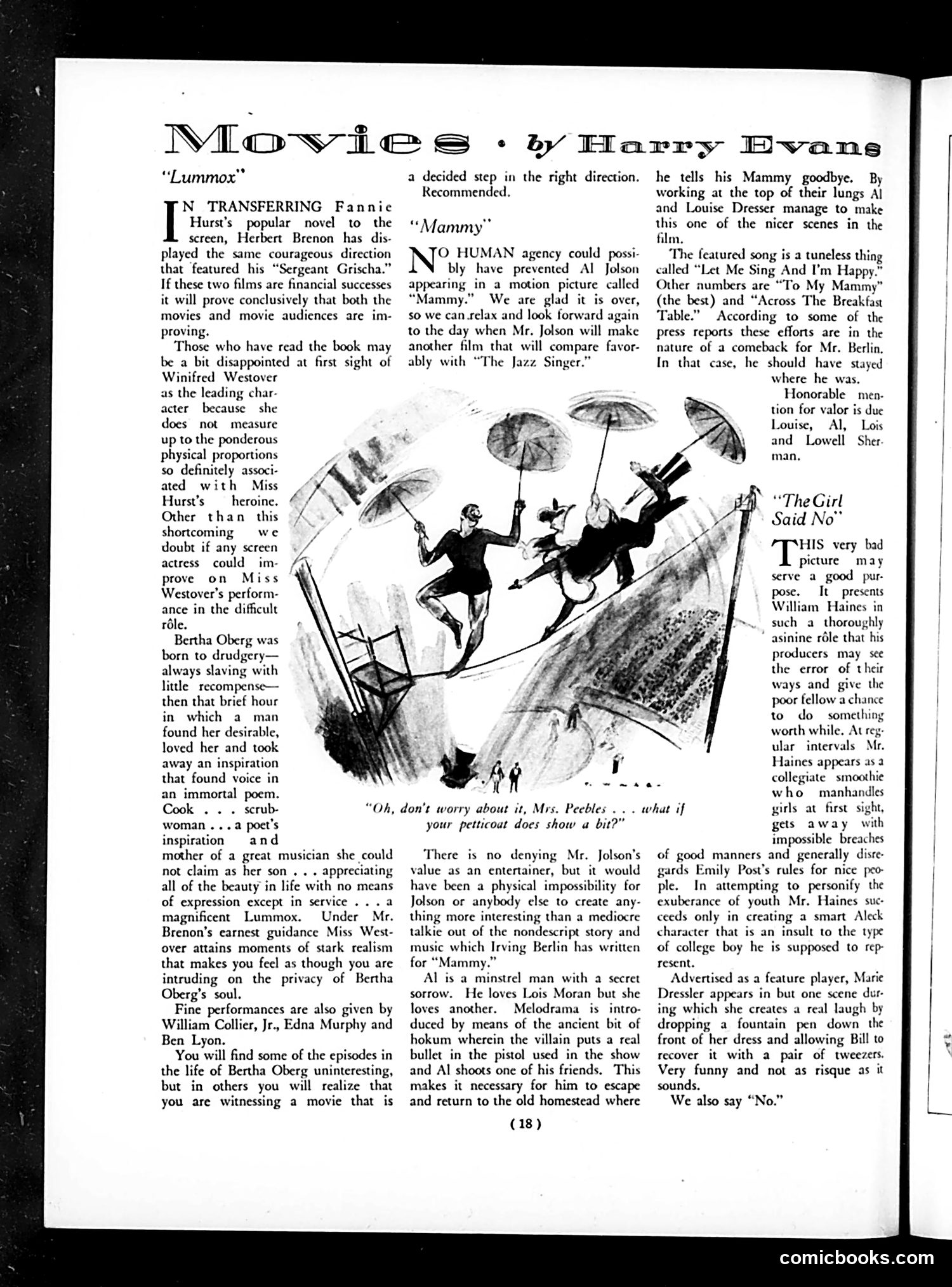
Movie Reviews by Harry Evans This page reviews several films. The main illustration shows two figures with umbrellas in what appears to be a comedic scene, captioned "Oh, don't worry about it, Mrs. Webbs—what if your petticoat does show a bit?" The reviews critique: "Luminox" — Evans finds Fannie Hurst's novel poorly adapted, noting Winifred Westover is physically mismatched for the lead role despite her acting ability. "Mammy" — Praising this Al Jolson film as an improvement over his previous work, with good songs and scenes. "The Girl Said No" — A harsh assessment of William Haines in an "asinine" role, where even his charm cannot salvage poor material. Evans suggests the producers made an error casting him. The satire targets casting decisions and script quality in early sound cinema.
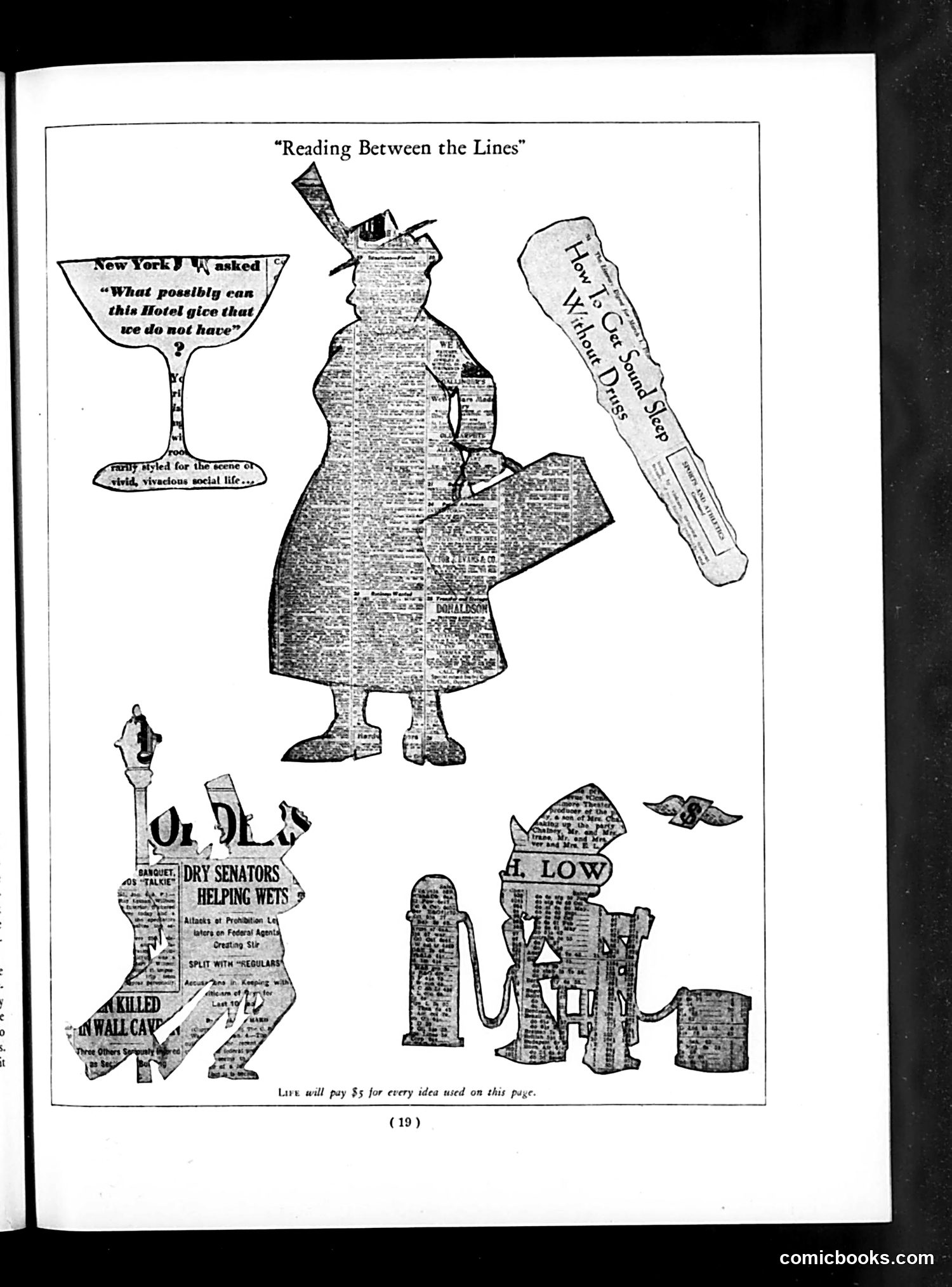
"Reading Between the Lines" - Life Magazine Satire This page uses newspaper clippings arranged into visual figures to satirize Prohibition-era politics and social hypocrisy. The central large figure appears constructed from hotel advertisements, suggesting hotels marketed themselves as social venues despite Prohibition bans on alcohol. The smaller figures reference political figures and issues: "Dry Senators Helping Wets" criticizes politicians who publicly opposed alcohol while privately enabling its consumption. The "LOW" figure likely represents gas prices or economic conditions. The joke is that Life is "reading between the lines" of newspapers—finding hidden meanings in how establishments advertised their services despite legal restrictions. The satirical point: public officials and businesses were openly flouting or covertly supporting Prohibition despite official positions. This reflects 1920s American frustration with Prohibition's unenforced contradictions.
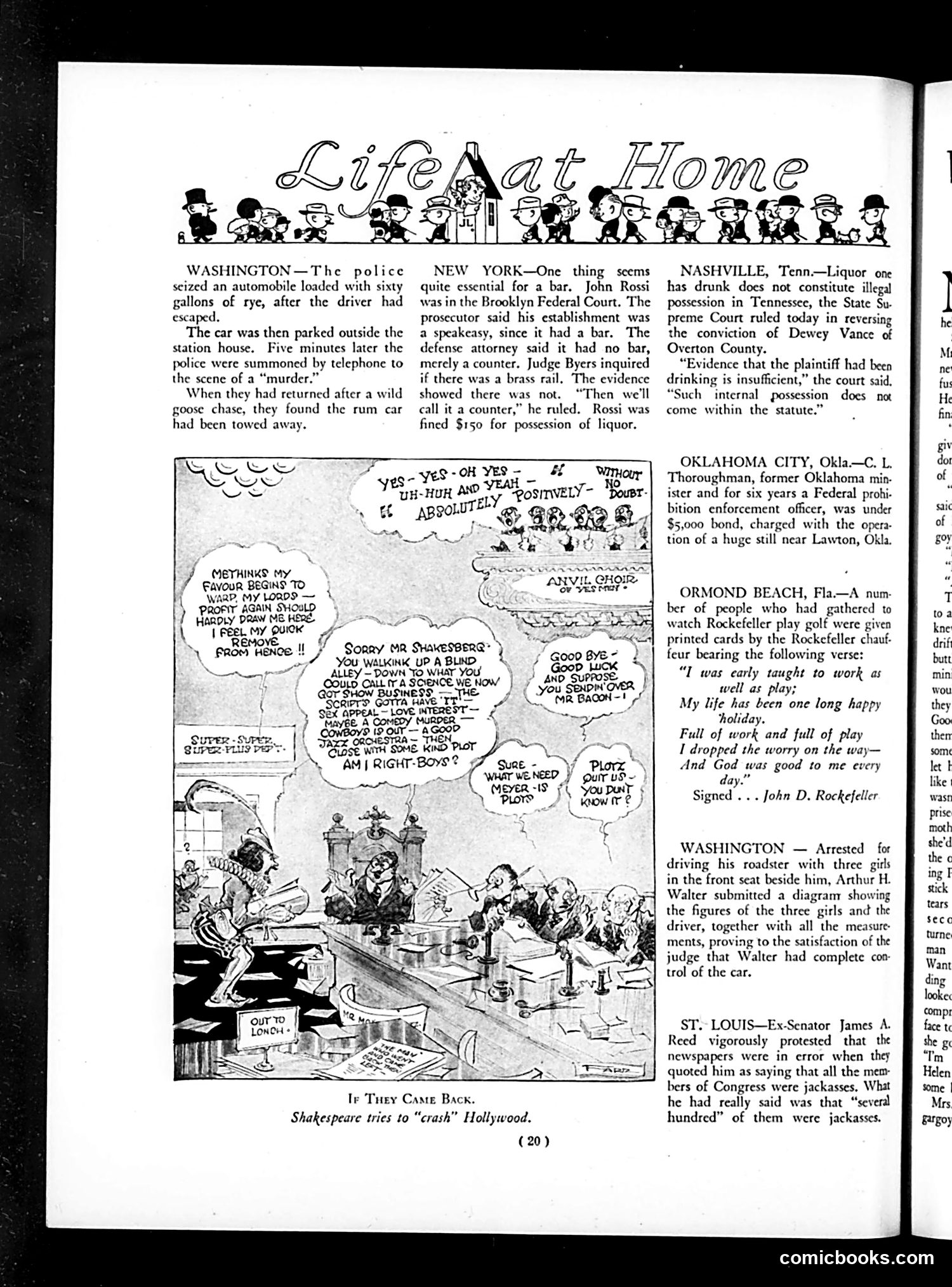
Page Analysis: Life Magazine Prohibition-Era Satire This page satirizes Prohibition enforcement absurdities during the 1920s-early 1930s alcohol ban. News briefs mock the contradictions and loopholes in prohibition law: police losing seized liquor to theft; prosecutors arguing semantic distinctions (bar vs. counter) to convict speakeasy operators; courts ruling that merely drinking alcohol doesn't constitute illegal possession; and a former federal prohibition officer himself operating an illegal still. The main cartoon depicts Shakespeare attempting to "crash" (gain entry to) Hollywood, with studio figures speaking in nonsensical dialogue—likely satirizing the absurdity of adapting classical literature for cinema, or mocking Hollywood's pretensions. Additional anecdotes include Rockefeller's chauffeur distributing pious verses about virtue, and a politician's backpedaling denial that he called Congress "jackasses"—all examples of public figures' hypocrisies and the era's general institutional failures. The page's theme: authority figures and systems are fundamentally unreliable and contradictory.
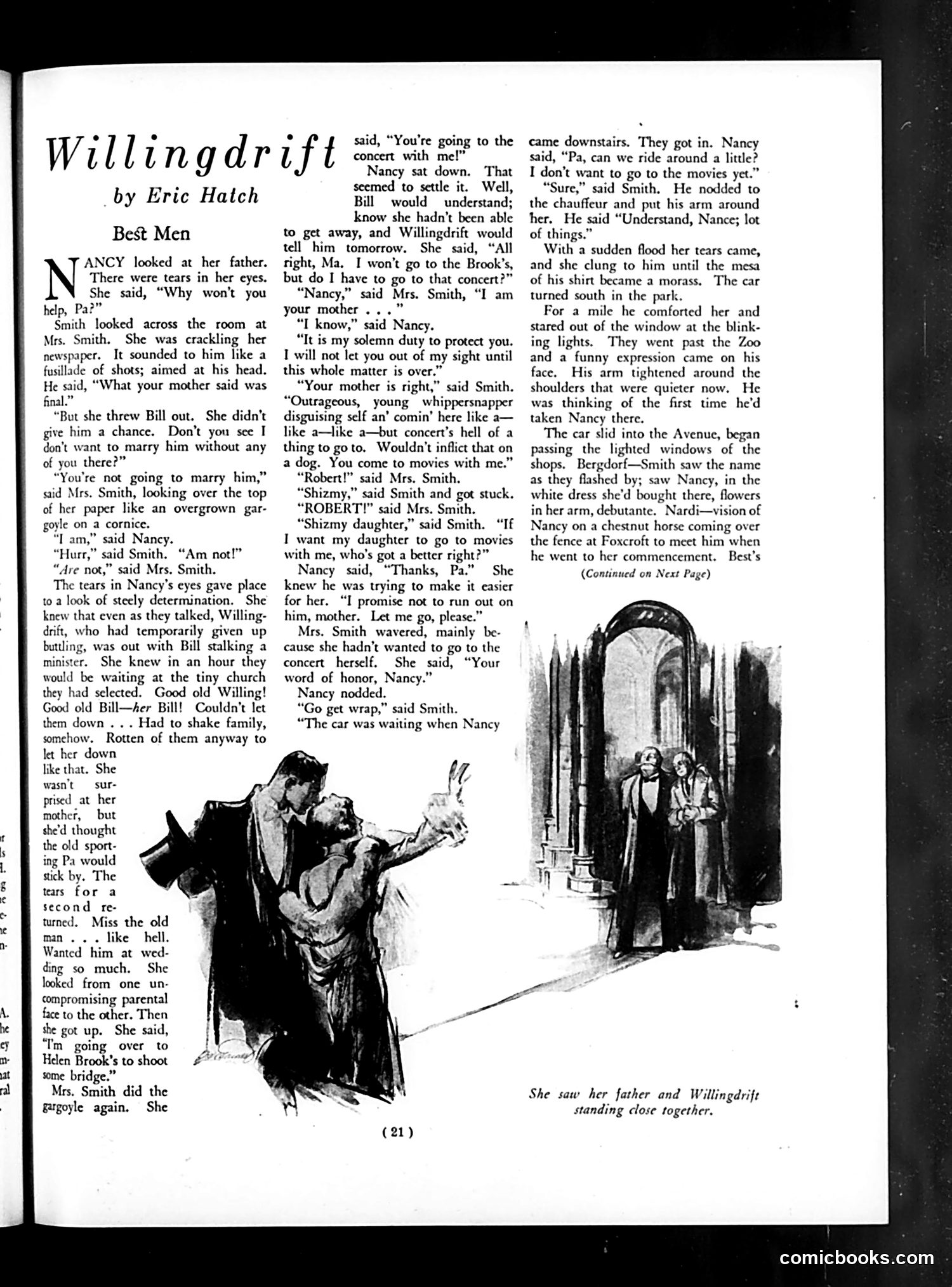
Analysis of "Willingdrift" Page This is a serialized short story by Eric Hatch titled "Best Men," not primarily a political cartoon. The narrative depicts a domestic conflict where Nancy Smith wants to marry a man named Bill (or "Willingdrift"), but her disapproving mother forbids it. Her father, Mr. Smith, initially sides with his wife but later shows sympathy. The two illustrations depict key emotional moments: Nancy's tearful confrontation with her parents, and a scene showing Nancy and her father together outside, suggesting his quiet support despite family opposition. The story reflects early-20th-century themes about parental authority, particularly maternal control over daughters' marriage choices, and generational conflict. Mr. Smith's eventual kindness ("lot of things") suggests fathers were expected to understand romantic matters better than rigid mothers. The narrative champions the younger generation's right to choose their own spouse against arbitrary parental veto.
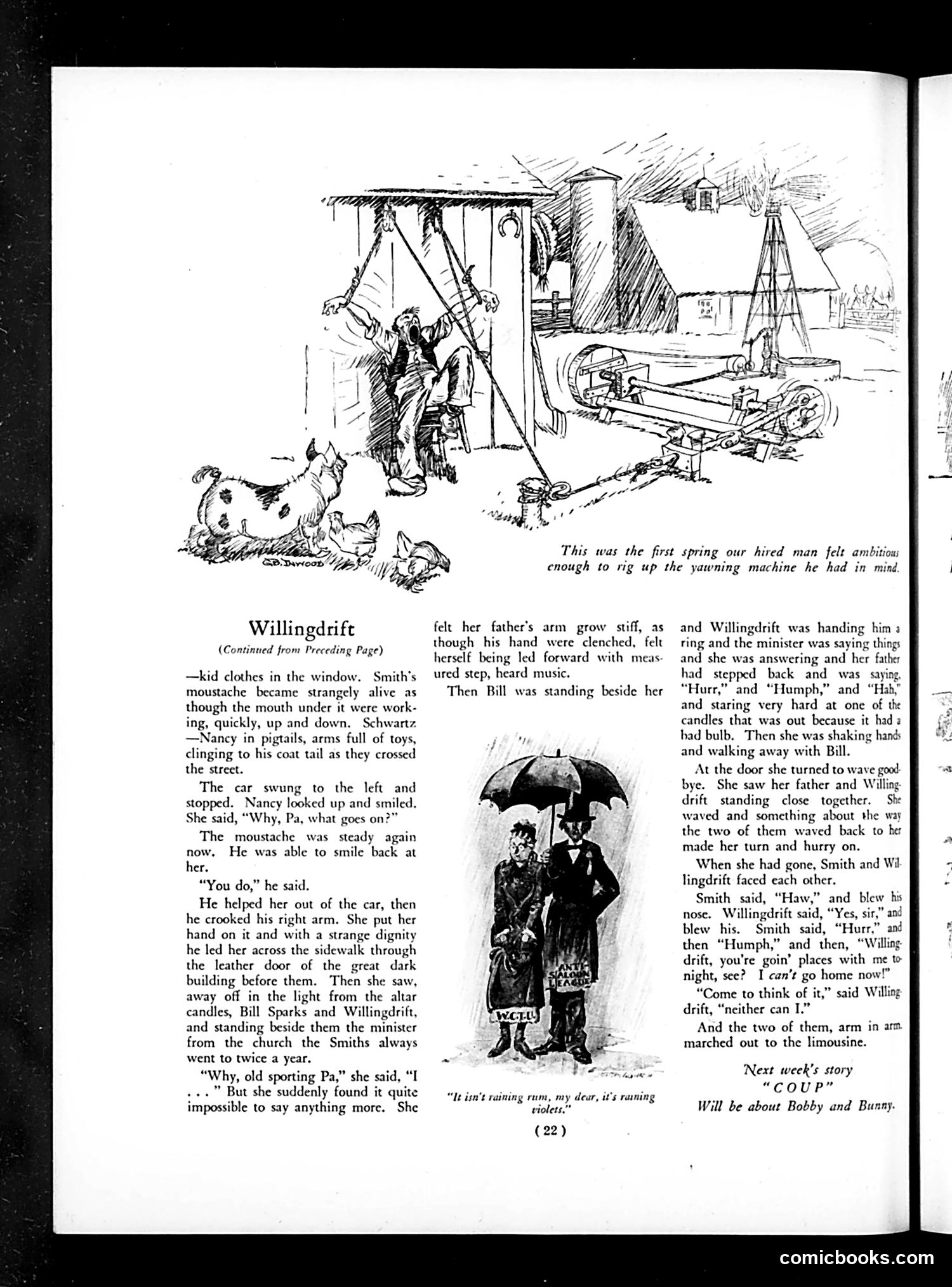
"Willingdrift" - Story Analysis This is a serialized short story (continued from a previous page) rather than a political cartoon. The narrative depicts a working-class father, Smith, attending his daughter's wedding to Bill Sparks, with their hired man Willingdrift present. The emotional core involves Smith's difficulty expressing sentiment—his moustache twitching with suppressed feeling, his stiff arm during the ceremony, his focus on a burned-out candle rather than watching his daughter. The story explores masculine emotional constraint: Smith cannot say goodbye properly, and afterward, he and Willingdrift avoid going home by heading to a limousine together instead. The humor and pathos stem from early 20th-century working-class masculinity—men unable to articulate feelings, substituting grunts ("Hurr," "Humph") for words, yet clearly moved. The caption at top references a subplot about a "yawning machine," suggesting this is Life magazine's humorous fiction section.
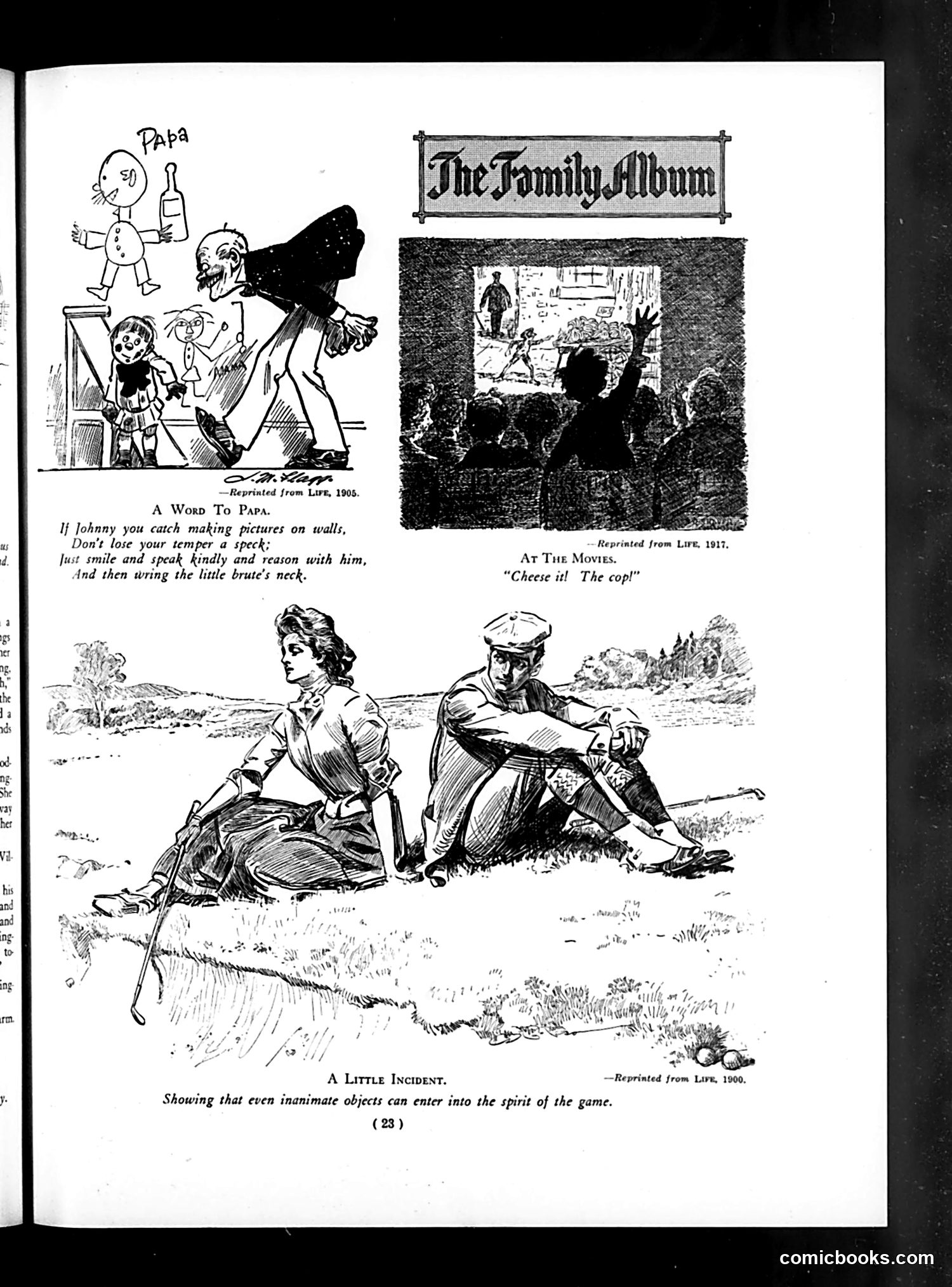
Analysis for Modern Readers This page from *Life* magazine reprints three early 20th-century cartoons about childhood misbehavior and parenting: "A Word to Papa" (1905): Satirizes Victorian parenting advice. The text ironically counsels gentleness—"smile and speak kindly"—while the illustration shows a father about to strike his son for drawing on walls. The joke is the contradiction between the stated advice and the depicted reality of harsh discipline. "At the Movies" (1917): Shows children at a film shouting "Cheese it! The cop!"—slang meaning "watch out for police." The humor references how cinema excited children, often depicting crime or chase scenes. "A Little Incident" (1900): Depicts a couple outdoors where the woman appears startled by a snake. The caption jokes that even inanimate objects participate in "the spirit of the game"—suggesting romantic/courtship scenarios use every prop available. All three reflect early 1900s attitudes toward children's behavior, entertainment, and courtship customs now largely obsolete.
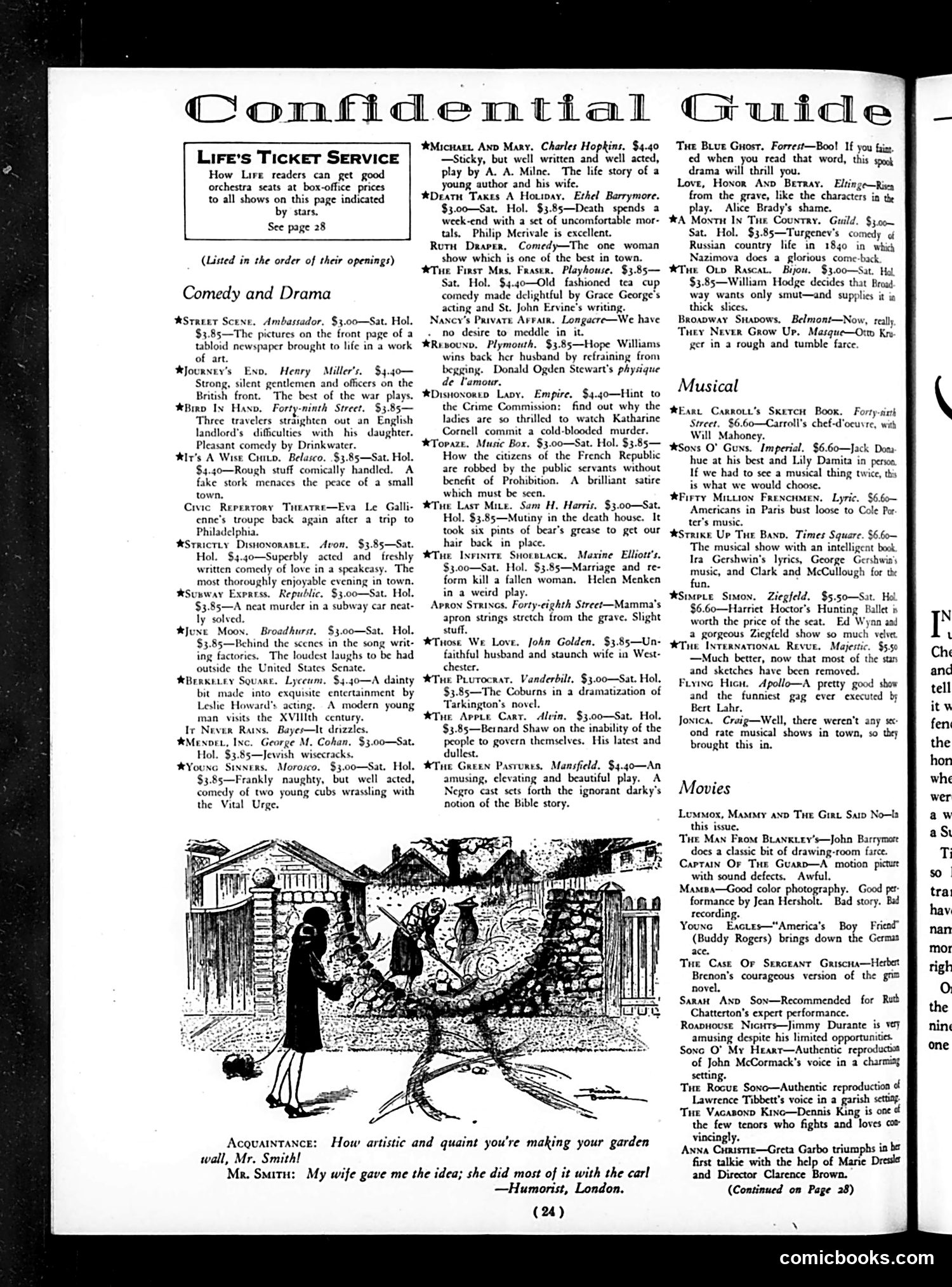
Cartoon Analysis The single cartoon on this page depicts a domestic scene where a woman shows a man an elaborate garden. The caption reads: "How artistic and quaint you're making your garden well, Mr. Smith!" with Mr. Smith responding, "My wife gave me the idea; she did most of it with the carl—*Humorist, London.*" The satire targets gender roles and domestic labor. The acquaintance compliments the man's apparent horticultural skill, but Smith credits his wife, revealing she performed the actual work (likely "carl" means "care" or refers to manual labor). The joke mocks men who accept credit for women's labor—a common social critique. This reflects 1920s-era commentary on how women's contributions to household and domestic projects were often overlooked or attributed to men in polite society. The page itself is primarily a theater and entertainment guide for Life magazine readers, listing shows with ticket prices and brief reviews.
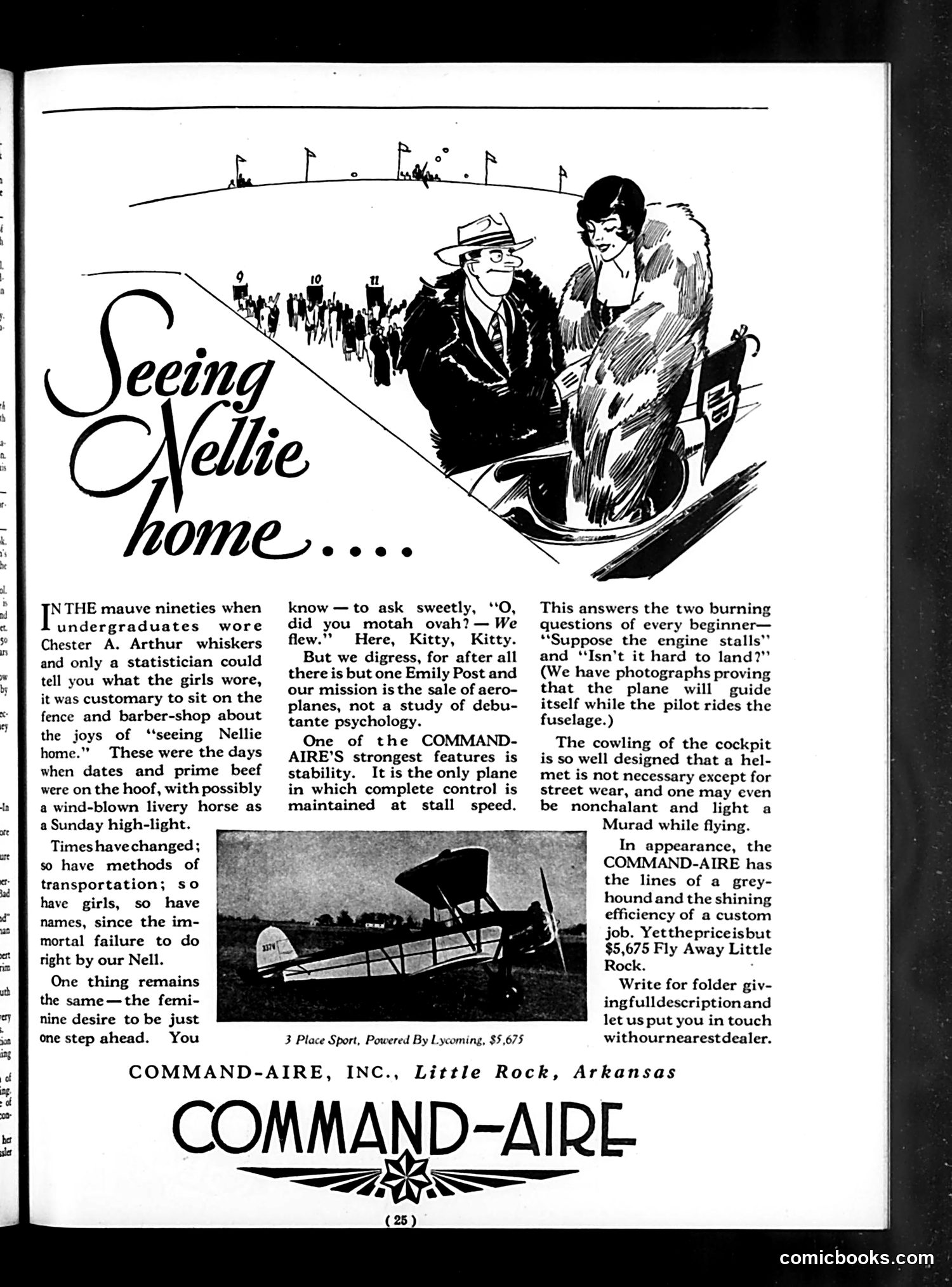
"Seeing Nellie Home" — A Command-Aire Aircraft Advertisement This is primarily a 1920s aircraft advertisement dressed up as satirical commentary. The "Nellie" reference alludes to the 1880s song "Seeing Nellie Home," evoking outdated courtship rituals. The satire mocks the generational shift in dating and transportation: where 1890s "undergraduates wore Chester A. Arthur whiskers" and courted girls on foot or by carriage, modern women now expect to be impressed by airplane rides. The phrase "did you motah ovah?—We flew" captures this one-upmanship among debutantes. The actual pitch: the Command-Aire plane ($5,675) offers stability, controllability at stall speed, and stylish design. The humorous details (you don't need a helmet; you can light a cigarette while flying) emphasize its safety and sophistication. Bottom line: A clever advertisement using period satire to position aviation as the new frontier of courtship and status-seeking among the leisure class.
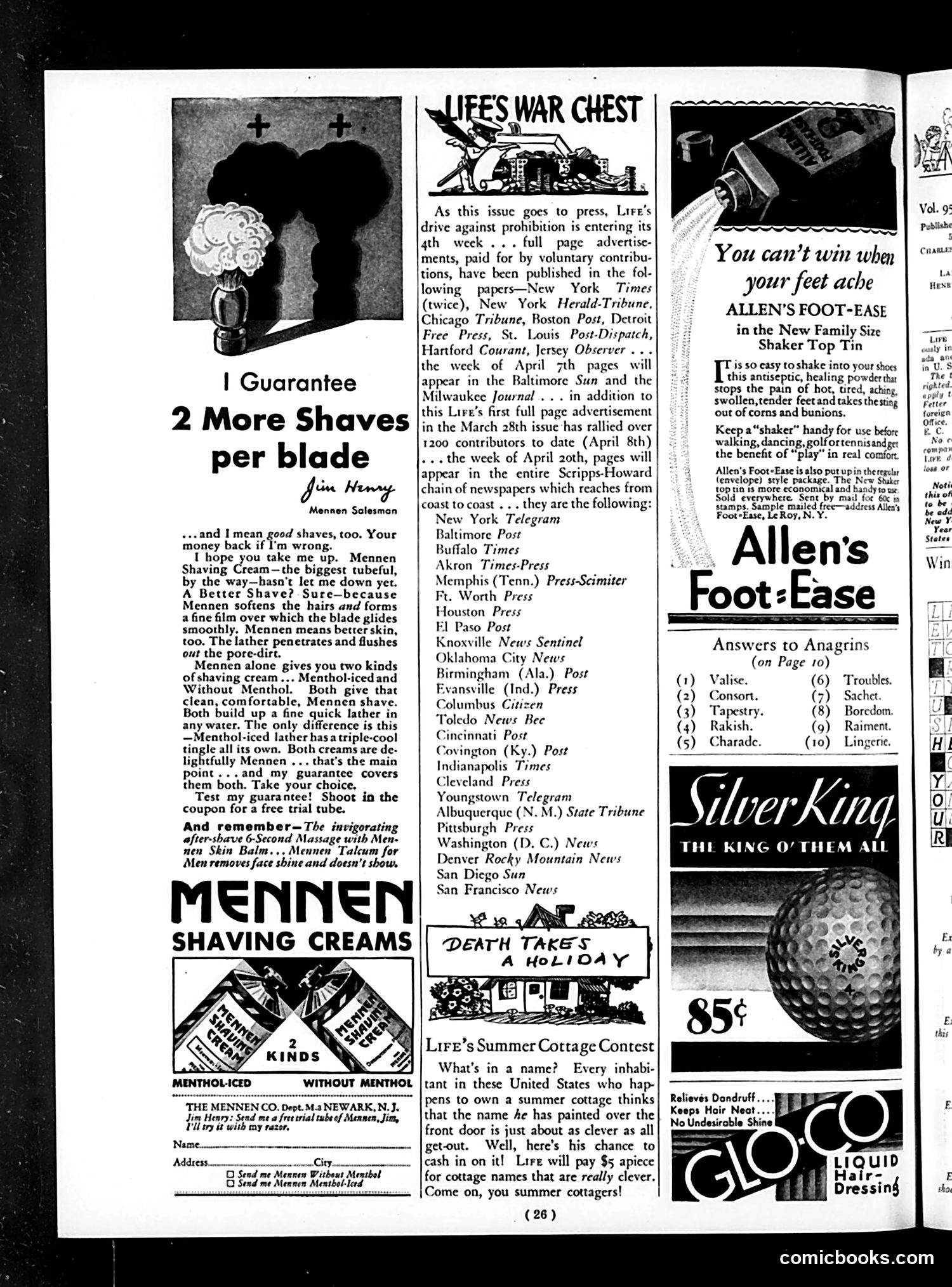
Page Analysis: Life Magazine Advertisement and Editorial Content This page is primarily advertising with one notable editorial section. The left side features a Mennen Shaving Cream ad with a salesman ("Jim Henry") guaranteeing two extra shaves per blade—a competitive claim typical of 1920s-30s grooming product marketing. The center contains "Life's War Chest"—an editorial announcement that Life magazine is running a four-week anti-Prohibition campaign funded by voluntary contributions. The text lists dozens of major newspapers nationwide publishing full-page ads opposing Prohibition, showing coordinated media effort against the alcohol ban. The right side advertises Allen's Foot-Ease powder and Silver King golf balls, plus a Glco Liquid Hair Dressing ad. At bottom, Life announces a summer cottage naming contest offering $5 per submission for clever cottage names. The Prohibition campaign is the historical note: Life was actively mobilizing public opinion against the 18th Amendment during the dry era.
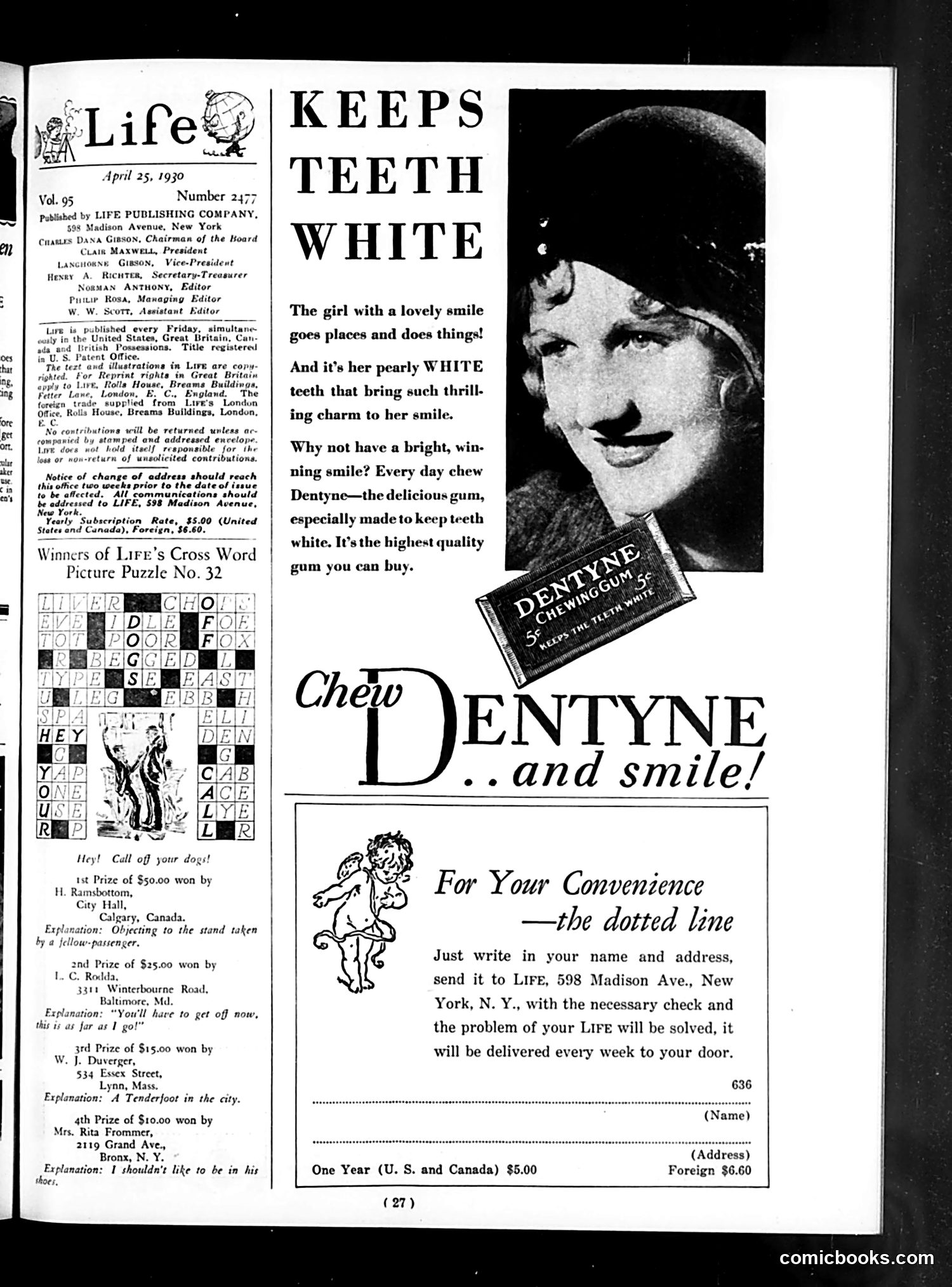
Analysis This page is primarily a Dentyne chewing gum advertisement rather than political satire. The main content features: Advertisement Content: The ad promotes Dentyne gum by emphasizing that chewing it keeps teeth white and bright, which supposedly helps women "go places and does things." The visual shows a smiling woman's face alongside the product packaging. Supporting Elements: The page includes Life magazine's masthead and a crossword puzzle contest. Below the advertisement is a subscription form encouraging readers to mail in their names and addresses to receive Life magazine weekly. Historical Context: This 1930 ad reflects early 20th-century marketing that linked personal grooming (particularly white teeth and smiling) to social success and female opportunity—a common advertising trope of the era. The gum is positioned as enabling women's social mobility through improved appearance. This is straightforward commercial advertising with no political satire or commentary present.
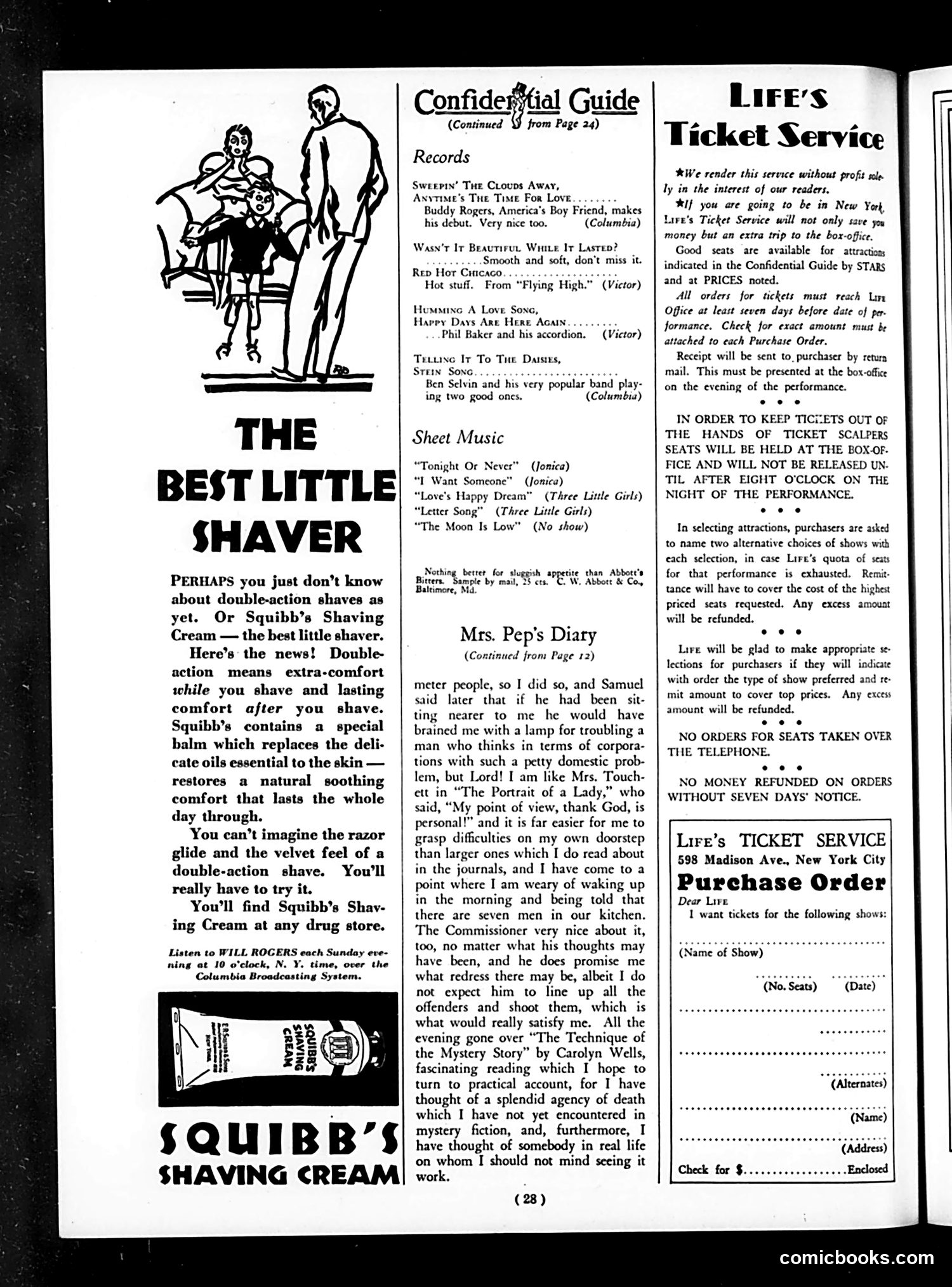
Analysis of Life Magazine Page This page contains primarily advertisements and service features, not political satire. "The Best Little Shaver" is a straightforward ad for Squibb's Shaving Cream, featuring an illustration of a man being shaved. The copy promotes "double-action" shaving with a special balm for skin comfort. It includes a plug for Will Rogers' radio show. "Mrs. Pep's Diary" is a humorous domestic column where the writer complains about household matters—particularly seven men working in her kitchen. She references Henry James' *Portrait of a Lady* and mentions reading Carolyn Wells' *Technique of the Mystery Story*, suggesting literary interests. The tone is lighthearted domestic comedy about marital frustrations. "Life's Ticket Service" is a service announcement for purchasing theater tickets, with detailed ordering instructions. The page reflects 1920s-30s consumer culture and entertainment advertising rather than political commentary. The cartoonish illustration style is typical of the era's advertising design.
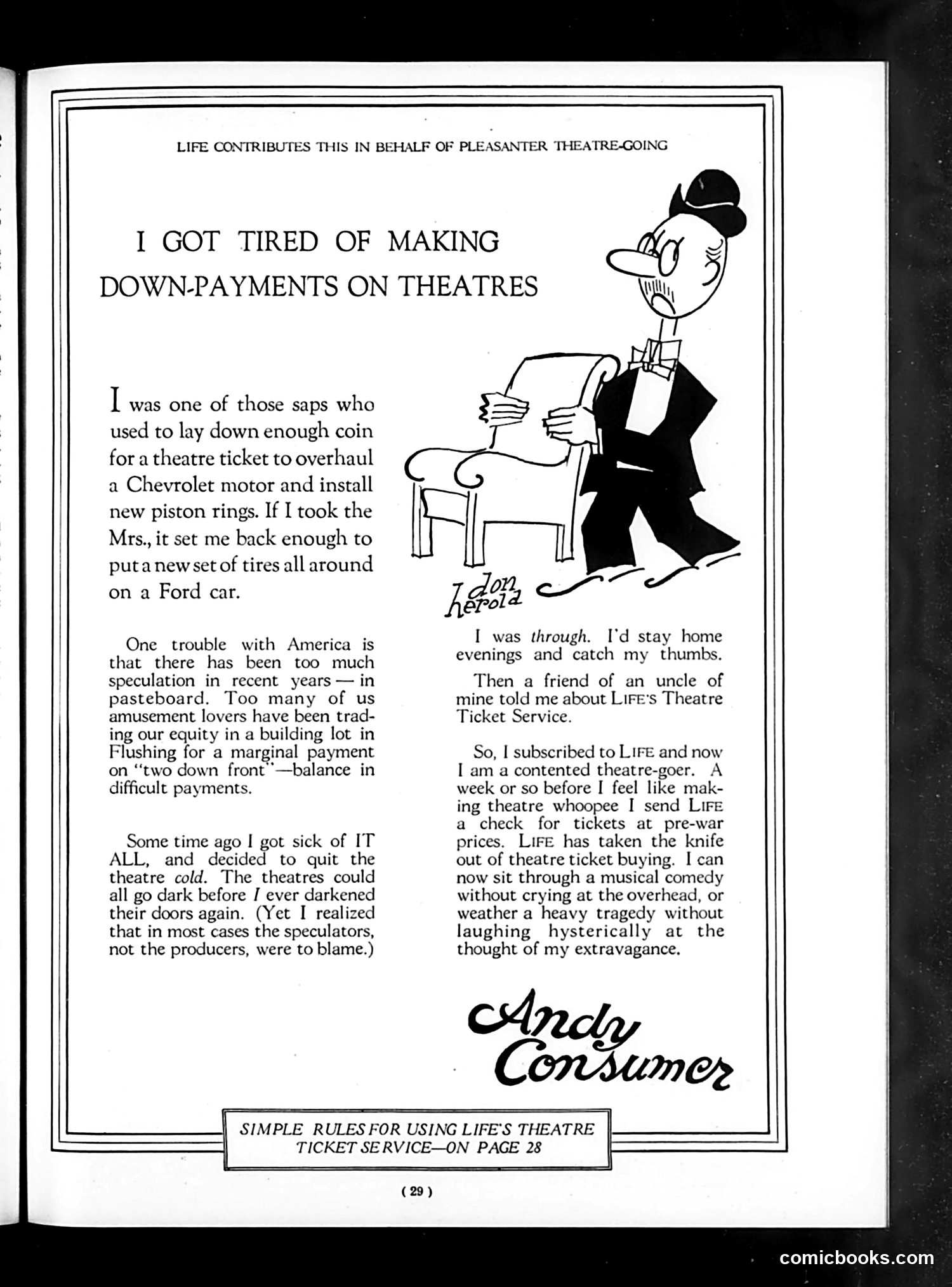
Analysis for Modern Readers This is a Life magazine advertisement (disguised as editorial content) promoting their theatre ticket subscription service, circa 1920s-30s. The Setup: A character named "Andy Consumer" complains about theatre ticket prices being absurdly expensive—equivalent to major car repairs. He illustrates the financial burden by comparing ticket costs to overhauling a Chevrolet engine or replacing Ford tires. The Social Context: The piece critiques 1920s financial speculation, particularly how ordinary Americans were making risky "down payments" on assets (building lots, theatre tickets) they couldn't fully afford—a prescient warning about unsustainable consumer debt. The Solution: Life's Theatre Ticket Service supposedly solved this by offering pre-war prices through subscription. Subscribers would send checks in advance, locking in cheaper rates. The Satire: The humor lies in Andy's exaggerated relief—he can now enjoy theatre without "crying at the overhead" or laughing hysteriacally at costs. It's essentially Life magazine selling financial peace of mind disguised as consumer advocacy.
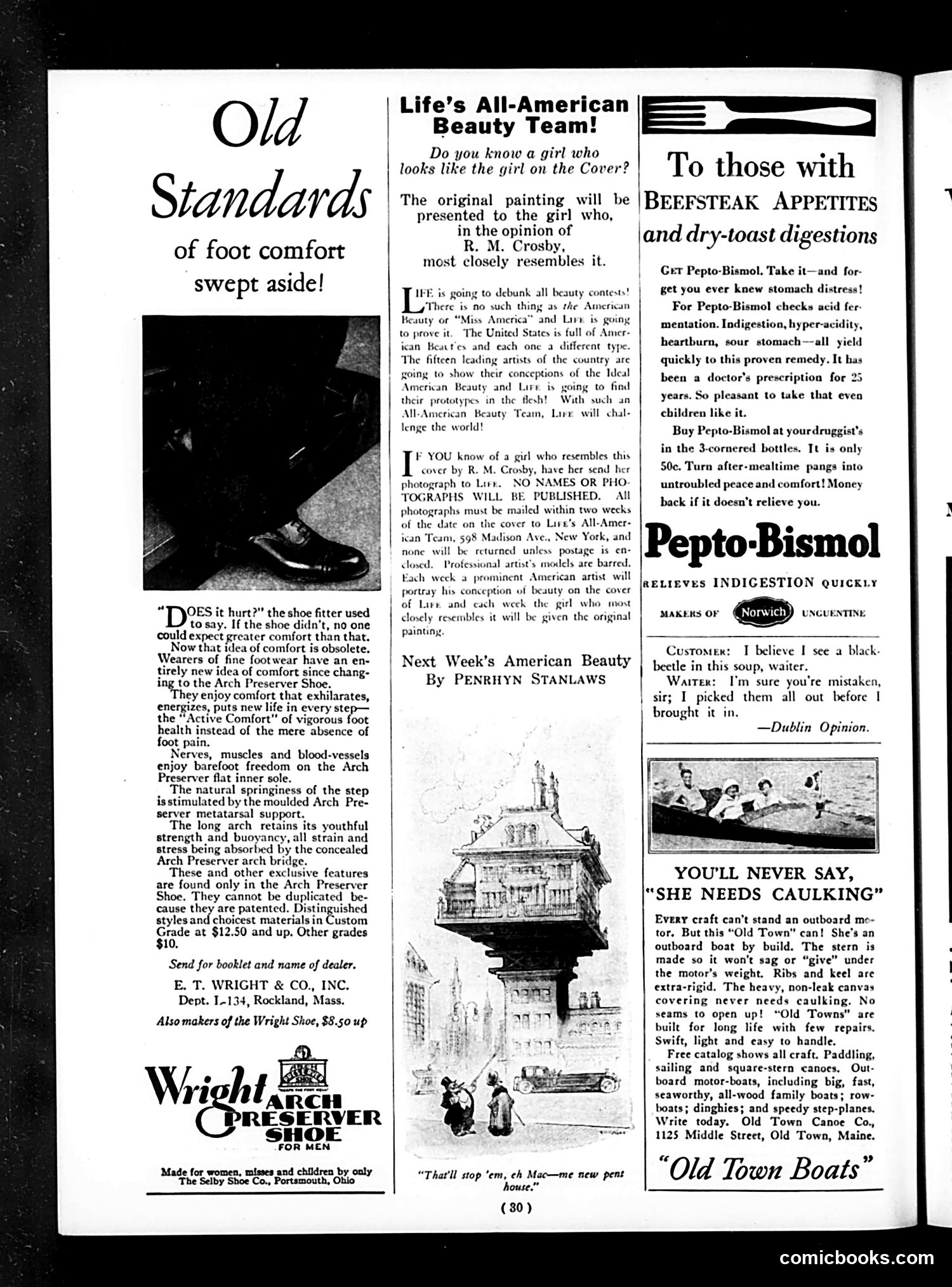
Page Analysis: Life Magazine Advertisement & Content This page is primarily advertising, with a beauty contest announcement. The main elements: "Old Standards of Foot Comfort Swept Aside" (left): An advertisement for Arch Preserver shoes, promoting a new philosophy of shoe comfort—moving beyond merely painless footwear to active support and "vigorous foot health." This reflects early 20th-century marketing of technological improvement in everyday products. "Life's All-American Beauty Team" (center): Life magazine announces a contest to find girls matching artist R.M. Crosby's cover painting of ideal American beauty. The stated aim is to "debunk all beauty contests" by showing that American beauty exists in many types, not one standard—fifteen artists will each render their conception weekly. Small cartoon (bottom center): A man in a penthouse jokes "That'll stop 'em, ch Mac—me new pent house," satirizing nouveau-riche ostentation during the prosperous 1920s. Right side: Advertisements for Pepto-Bismol (indigestion remedy) and Old Town Boats, plus a Dublin Opinion joke about restaurant quality. The page reflects 1920s consumer culture and advertising sophistication.
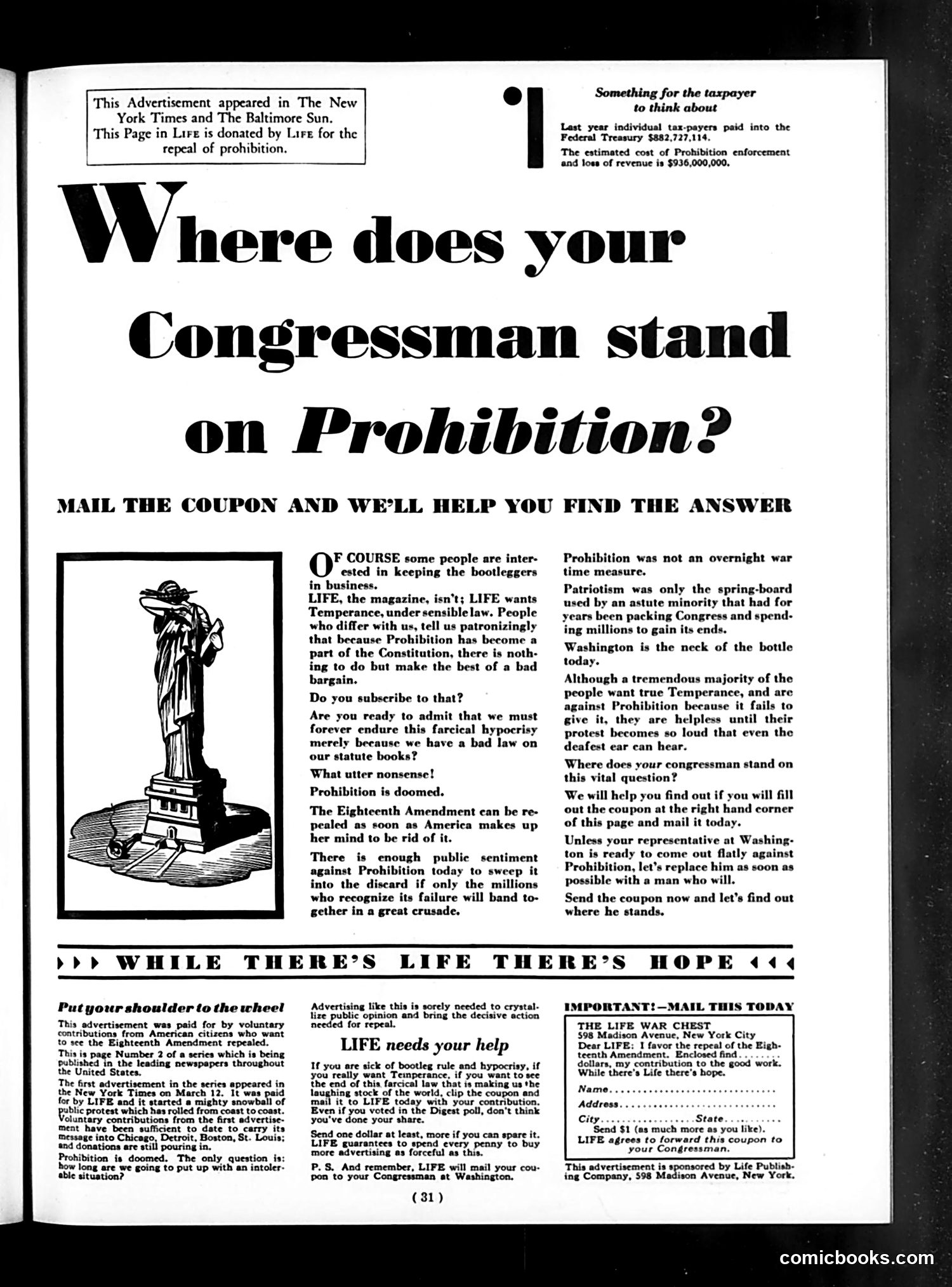
Context for Modern Readers This is a 1920s anti-Prohibition advertisement from *Life* magazine, advocating repeal of the Eighteenth Amendment (alcohol ban, 1920-1933). The appeal: The page uses a patriotic Liberty statue image and fiscal arguments—claiming Prohibition costs taxpayers $936 million annually in enforcement and lost tax revenue while failing to prevent bootlegging. The "vital question" challenges readers to pressure their congressmen to support repeal. The political context: By the late 1920s, Prohibition was widely seen as a failed, hypocritical law that enriched organized crime while being ignored by the public. The advertisement frames repeal as a majority position needing political courage to succeed—Washington is "the neck of the bottle," meaning politicians control the outcome. The satire: *Life* mocks Prohibition's pretense of morality while organized crime flourishes, calling it a "farcical hypocrisy" and "laughing stock." This represents the crescendo of anti-Prohibition sentiment before the amendment's actual repeal in 1933.
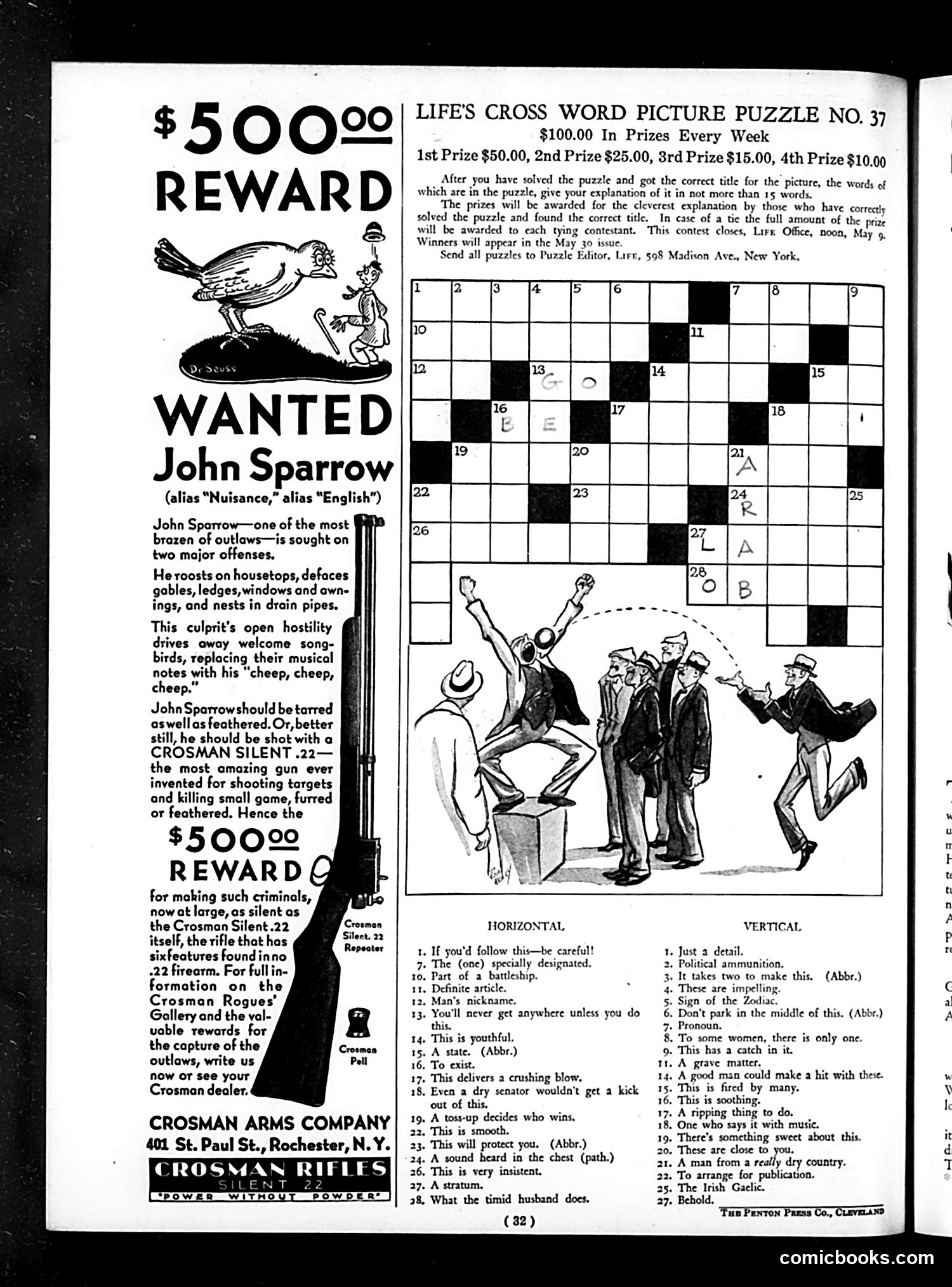
"John Sparrow" Advertisement & Crossword Puzzle Page This page combines a Crosman rifle advertisement disguised as satirical content with a crossword puzzle contest. The "wanted poster" for "John Sparrow" is a humorous pitch for a .22 rifle. The sparrow—depicted as a pest that defaces buildings and replaces songbirds with annoying chirping—represents a genuine nuisance to homeowners. The advertisement cleverly reframes pest control as catching an "outlaw," offering a $500 reward for anyone who eliminates sparrows using a Crosman Silent .22 rifle. The satire works by anthropomorphizing the bird as a criminal ("brazen outlaw," multiple aliases) deserving punishment—tar and feathers being a historical form of mob justice. This elevated language around a common pest makes the pitch humorous while promoting the rifle's accuracy for small-game hunting. The page's second half is Life magazine's regular crossword puzzle contest with monetary prizes, unrelated to the advertisement.
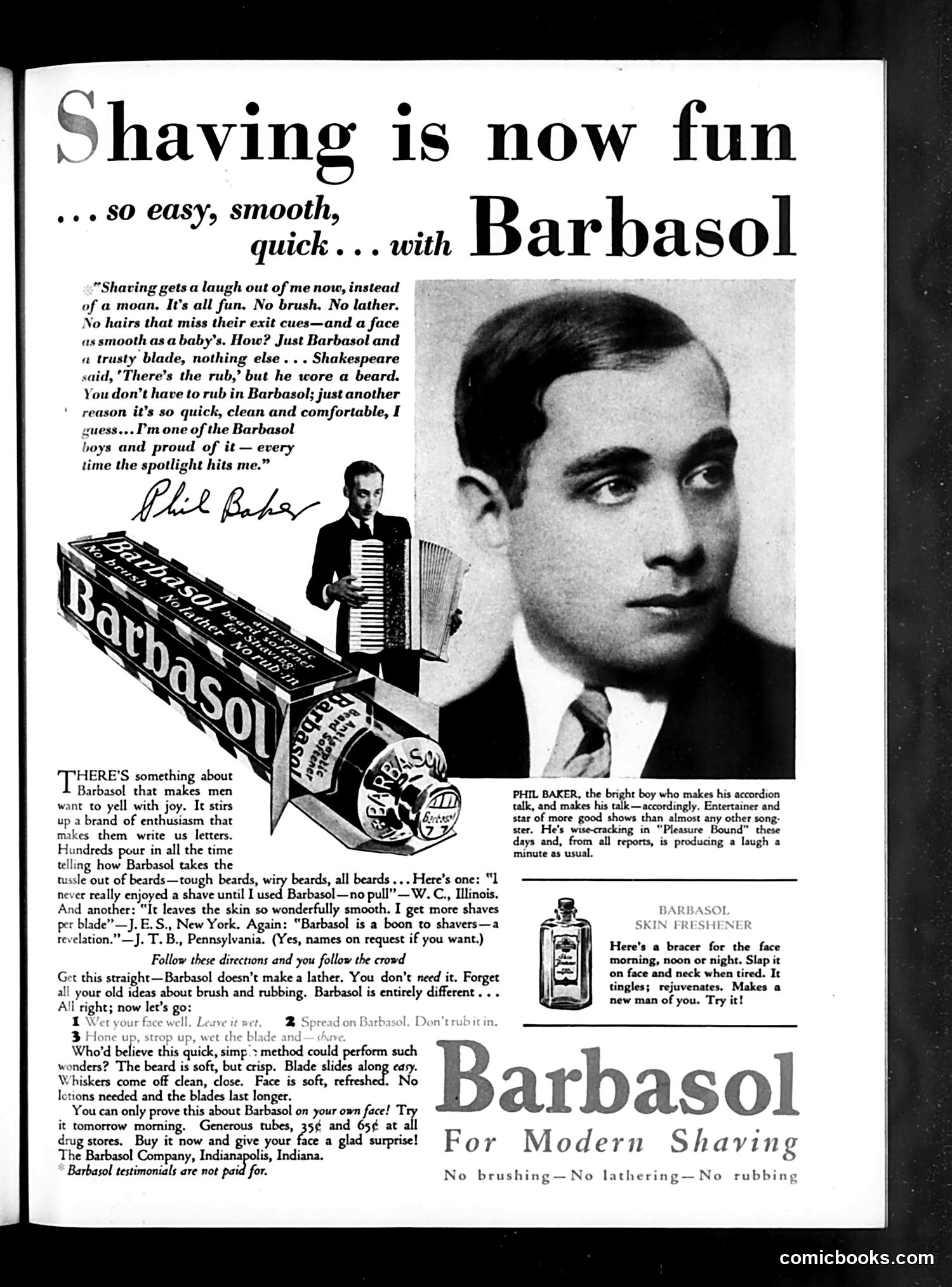
Barbasol Shaving Cream Advertisement This is a product advertisement, not political satire. It promotes Barbasol shaving cream by featuring Phil Baker, a popular entertainer and accordion player of the era, as an endorser. The ad's humor relies on breaking conventional shaving wisdom: Barbasol requires "no brush, no lather, no rubbing"—reversing what men expected from shaving. Baker's endorsement adds credibility through celebrity association, common in early 20th-century advertising. The page includes customer testimonials praising the product's smoothness and efficiency, plus usage instructions. A "Barbasol Skin Freshener" product is also advertised. The only satirical element is the playful Shakespeare reference ("There's the rub") inverting the Bard's famous line—a lighthearted way to mock old shaving methods while selling the modern alternative. This reflects 1920s-30s marketing celebrating "progress" and convenience.
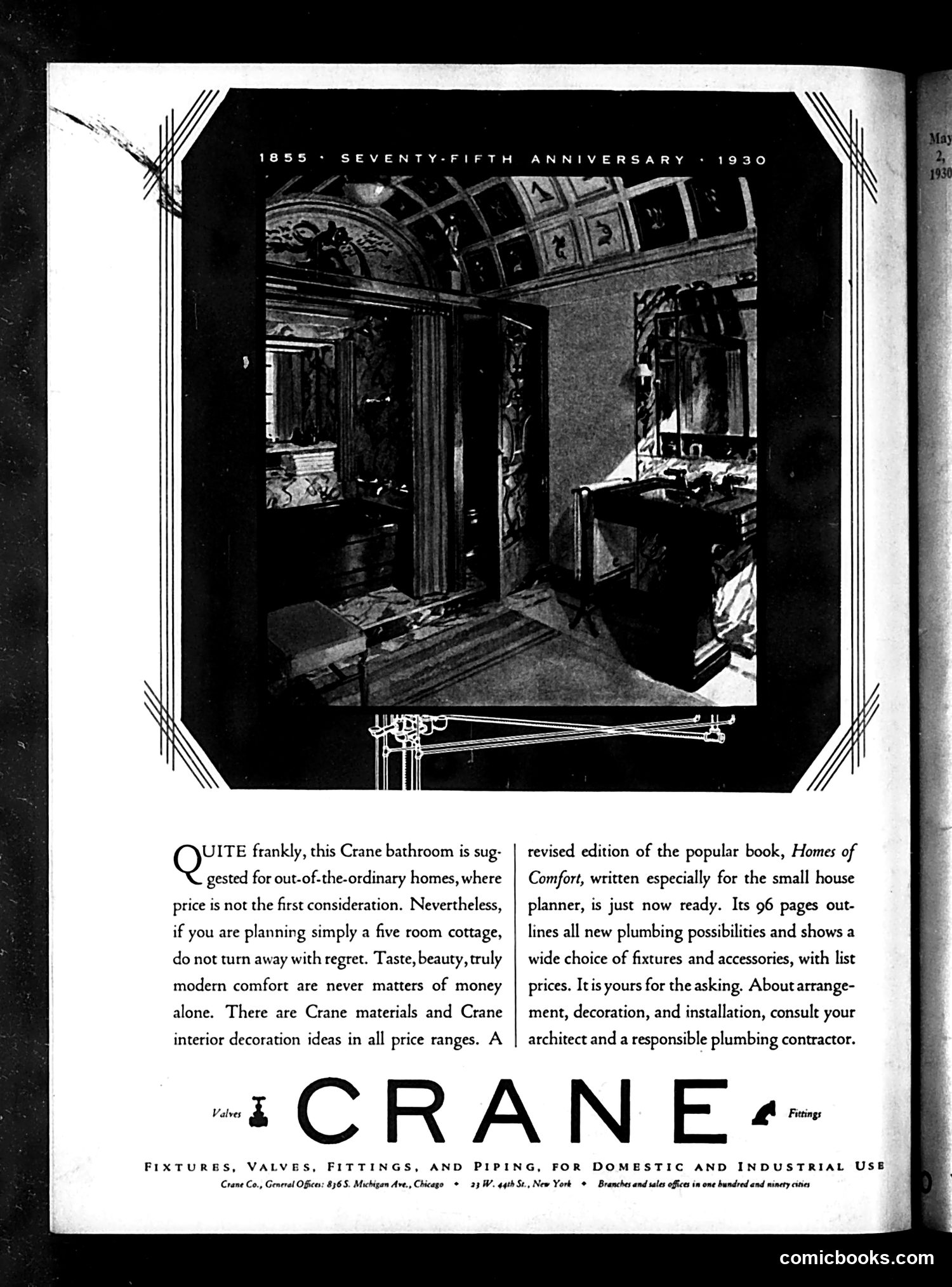
What This Page Is This is not a cartoon or satirical content—it's a full-page advertisement for Crane plumbing fixtures, marking their 75th anniversary (1855-1930). What It Shows The image displays an elegant 1930s bathroom interior with Art Deco styling, featuring high ceilings, decorative tiles, and upscale fixtures. The text explicitly markets this bathroom as designed for "out-of-the-ordinary homes, where price is not the first consideration," while reassuring budget-conscious readers that Crane products exist "in all price ranges." The Sales Pitch The ad promotes a new edition of *Homes of Comfort*, a planning guide offering "all new plumbing possibilities" with pricing. It advises consulting architects and contractors for proper installation and design. This represents typical early-Depression advertising: aspirational luxury messaging aimed at middle-class homeowners, emphasizing that modern comfort and taste needn't depend solely on wealth.