life
Life — May 2, 1930
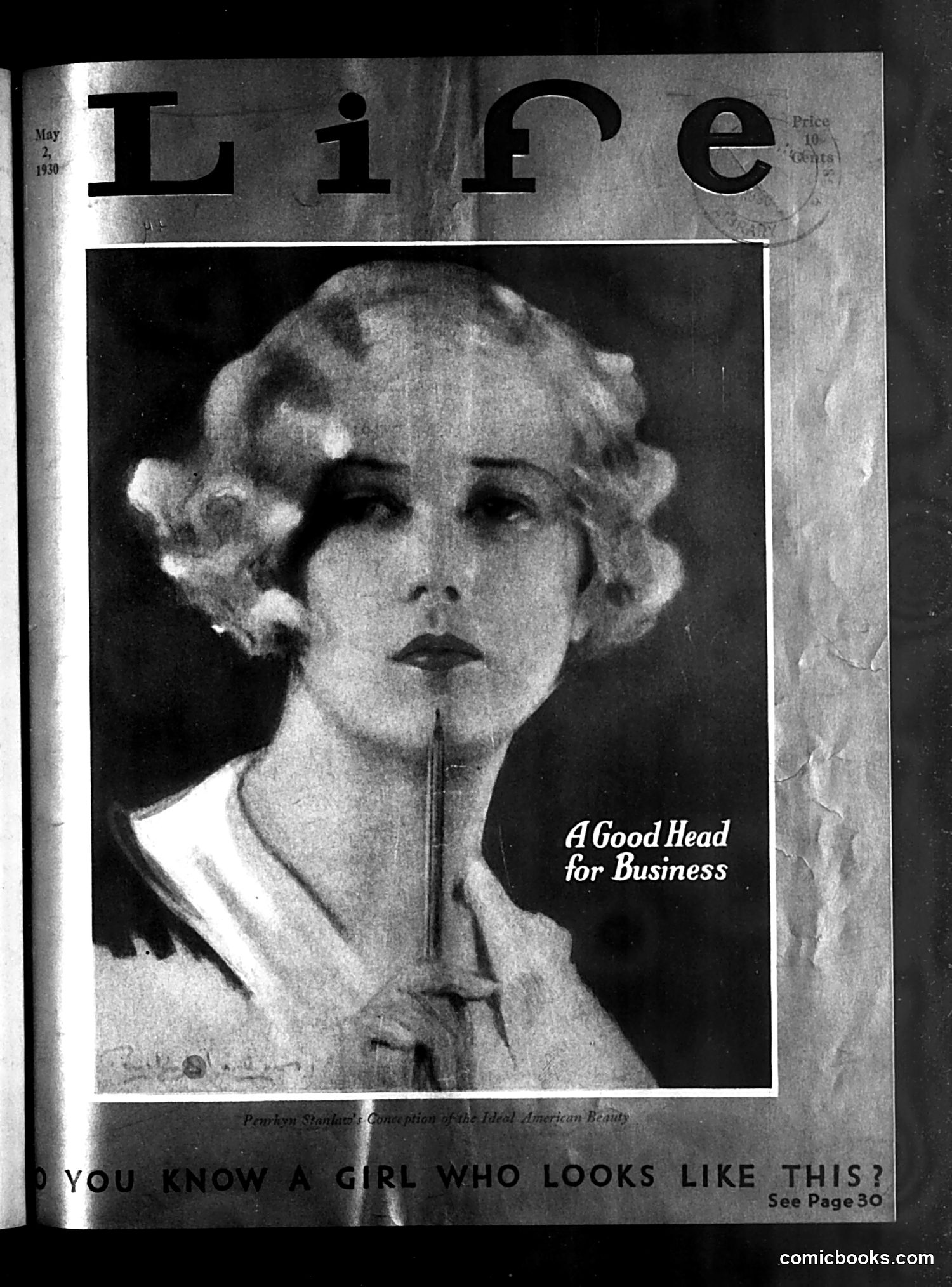
Life Magazine, May 2, 1930: "A Good Head for Business" This page features a portrait photograph with the caption "A Good Head for Business" and a subtitle attributing it to "Penrhyn Staniaws's Conception of the Ideal American Beauty." The satirical point appears to be commentary on 1930s beauty standards and their relationship to women in business. The phrase "A Good Head for Business" is a double entendre—literally about business acumen, but paired with the portrait, it suggests ironic commentary on whether women were valued for their minds or appearance in professional contexts. The closing question "Do You Know a Girl Who Looks Like This? See Page 30" indicates this was part of a larger feature in the magazine, likely continuing the satirical examination of idealized femininity and female participation in the business world during the early Depression era.
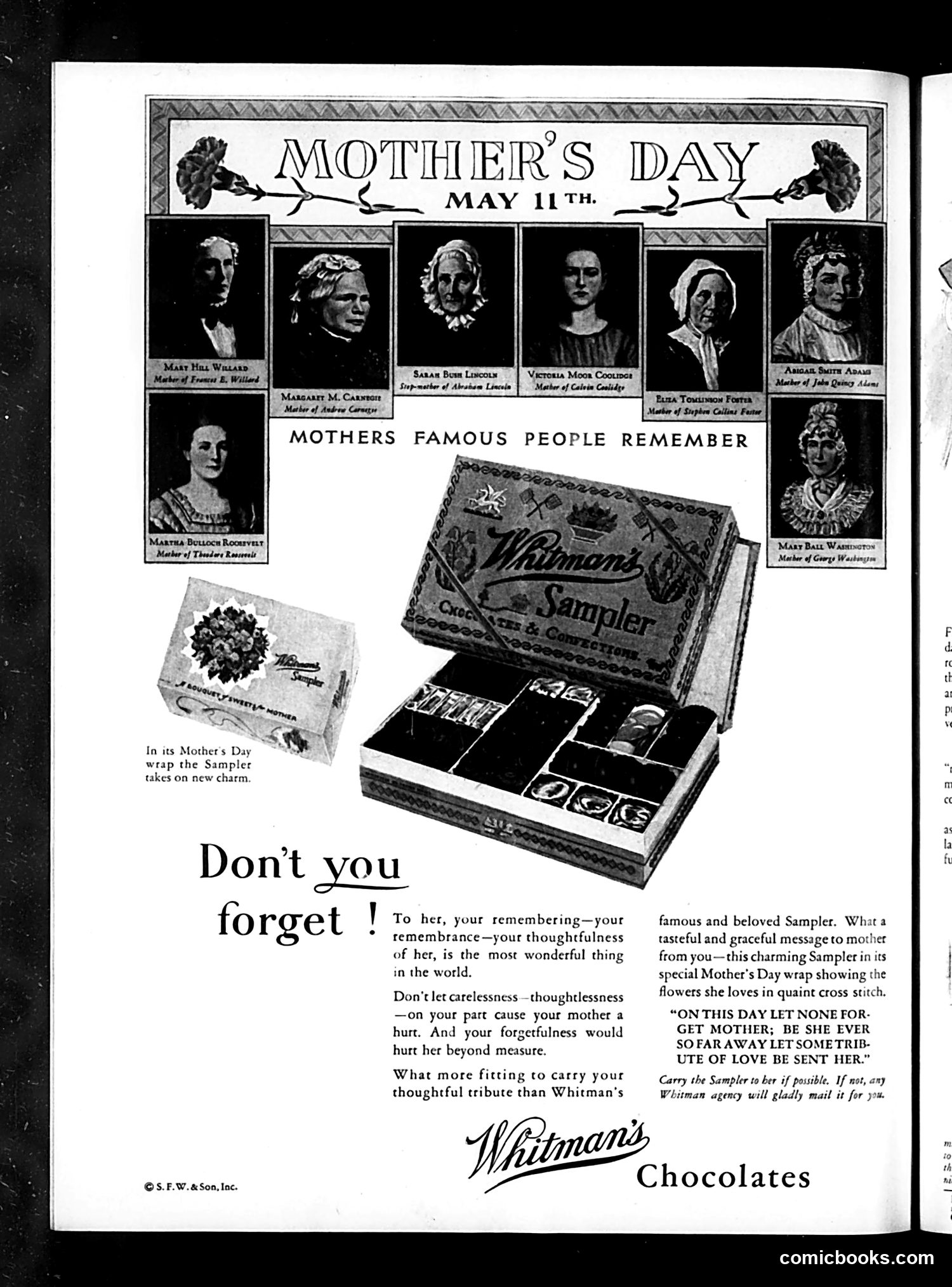
Mother's Day Advertisement Analysis This is a Whitman's Chocolates advertisement, not a political cartoon. The page celebrates Mother's Day (May 11th) by featuring portraits of famous historical mothers, including: - Mary Hale Willard (mother of Francis E. Willard) - Margaret M. Carmody (mother of Sidney Carmody) - Sarah Bush Lincoln (Abraham Lincoln's stepmother) - Victoria Moor Coolidge (mother of Calvin Coolidge) - Edna Todhunter Foster (mother of Stephen Collins Foster) - Abigail Smith Adams (mother of John Quincy Adams) - Martha Bulloch Roosevelt (mother of Theodore Roosevelt) - Mary Ball Washington (mother of George Washington) The ad uses these prominent historical figures to elevate chocolate-giving as an appropriate Mother's Day tribute, suggesting that remembering mothers through Whitman's Sampler chocolates demonstrates thoughtfulness and love.
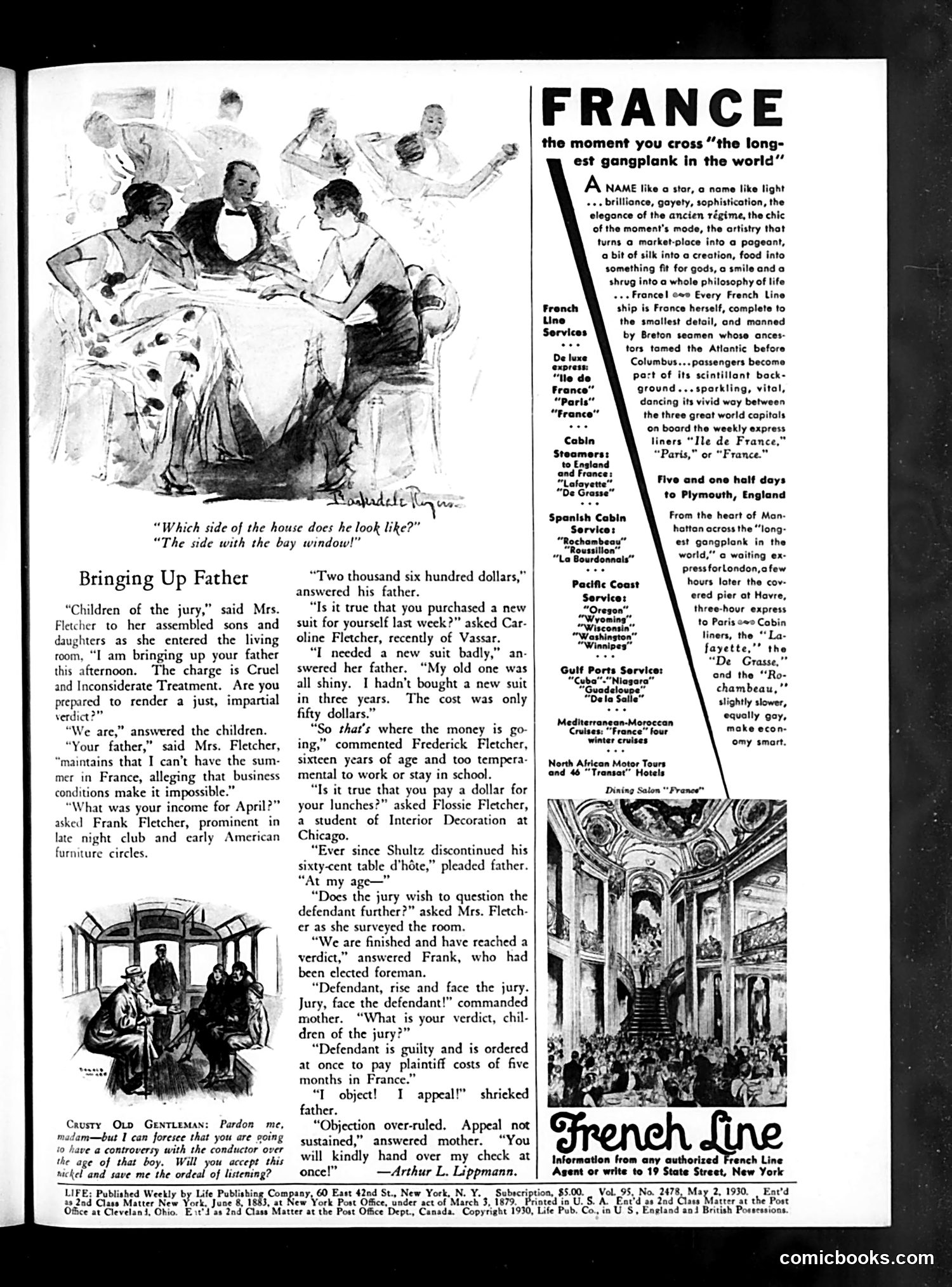
"Bringing Up Father" - Life Magazine Cartoon This page features a comic strip satirizing wealth and class pretension. The scenario depicts a jury trial where Mr. Fletcher, a wealthy man, is being prosecuted for cruelty and "Inconstiderate Treatment" toward his father. The satire targets nouveau riche hypocrisy: Fletcher's children accuse him of denying their father adequate summer housing in France despite spending $2,600 on a new suit for himself. His defense—that he only pays one dollar for his father's lunches—exposes the absurdity of his misplaced priorities. The verdict declares Fletcher guilty, forcing him to pay plaintiff costs. His wife's final plea to "hand over my check at once!" suggests marital financial control, adding another layer of domestic comedy to the critique of selfish wealth management.
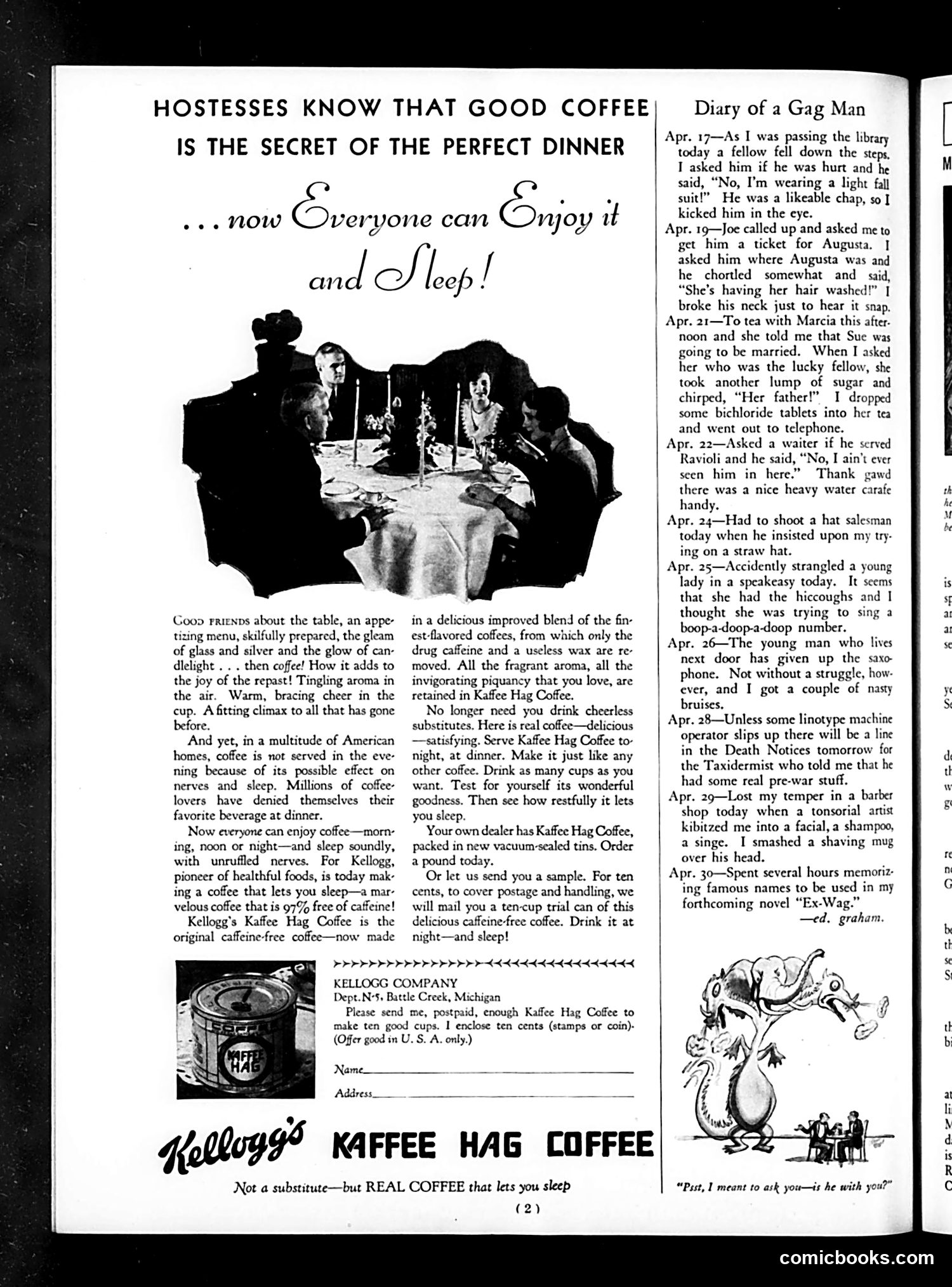
Analysis This page is primarily a caffeine-free coffee advertisement for Kellogg's Kaffee Hag Coffee, occupying the left two-thirds. The ad emphasizes that the product allows people to "enjoy" coffee at dinner and still "sleep" afterward—addressing a real concern of the era about coffee's stimulant effects keeping people awake. The right column contains "Diary of a Gag Man," a humor column with unrelated anecdotes (failed library visits, marriage announcements, hat salesmen, barber mishaps). The small cartoon at bottom right depicts a cherub-like figure, accompanying a caption about missing someone. The page reflects early 20th-century advertising targeting anxious consumers: the ad's core pitch—real coffee taste without caffeine's drawbacks—would have resonated with health-conscious dinner hosts wanting social sophistication without sleep disruption.
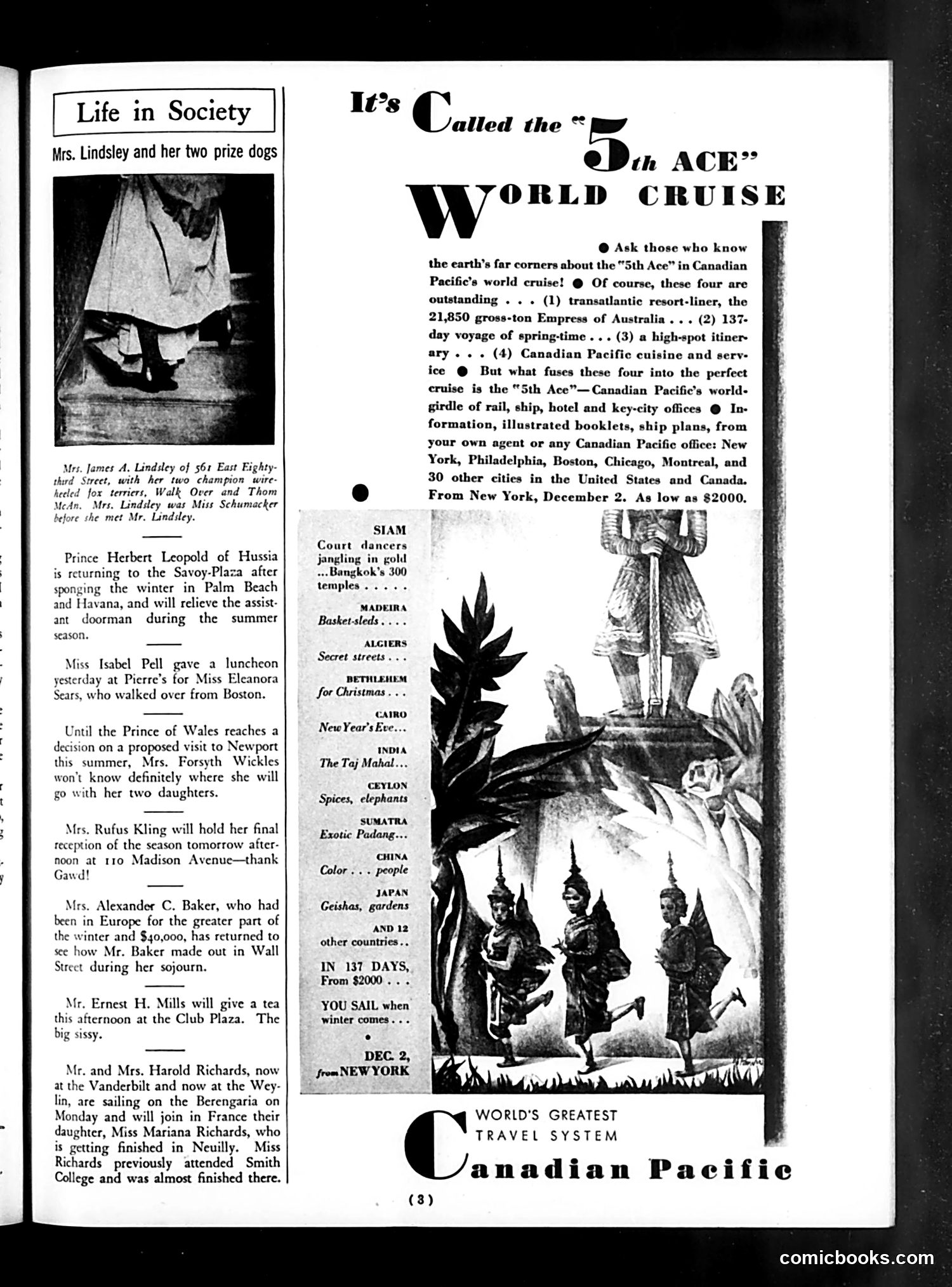
Life Magazine Page Analysis This page is primarily advertising and society gossip rather than satirical content. The left column ("Life in Society") reports on wealthy New York socialites: Mrs. Lindsley's prize dogs, Prince Herbert Leopold's winter plans, and various society events. These brief items document the leisure activities of the upper class. The right side is a travel advertisement for Canadian Pacific's "5th Ace" world cruise, promoting an around-the-world voyage departing December 2 from New York. The exotic imagery—temples, palm trees, dancers—appeals to affluent readers seeking luxury travel experiences. This layout reflects *Life* magazine's dual purpose: documenting high-society activities while advertising luxury goods and services to its wealthy readership. There is no political satire visible on this page.
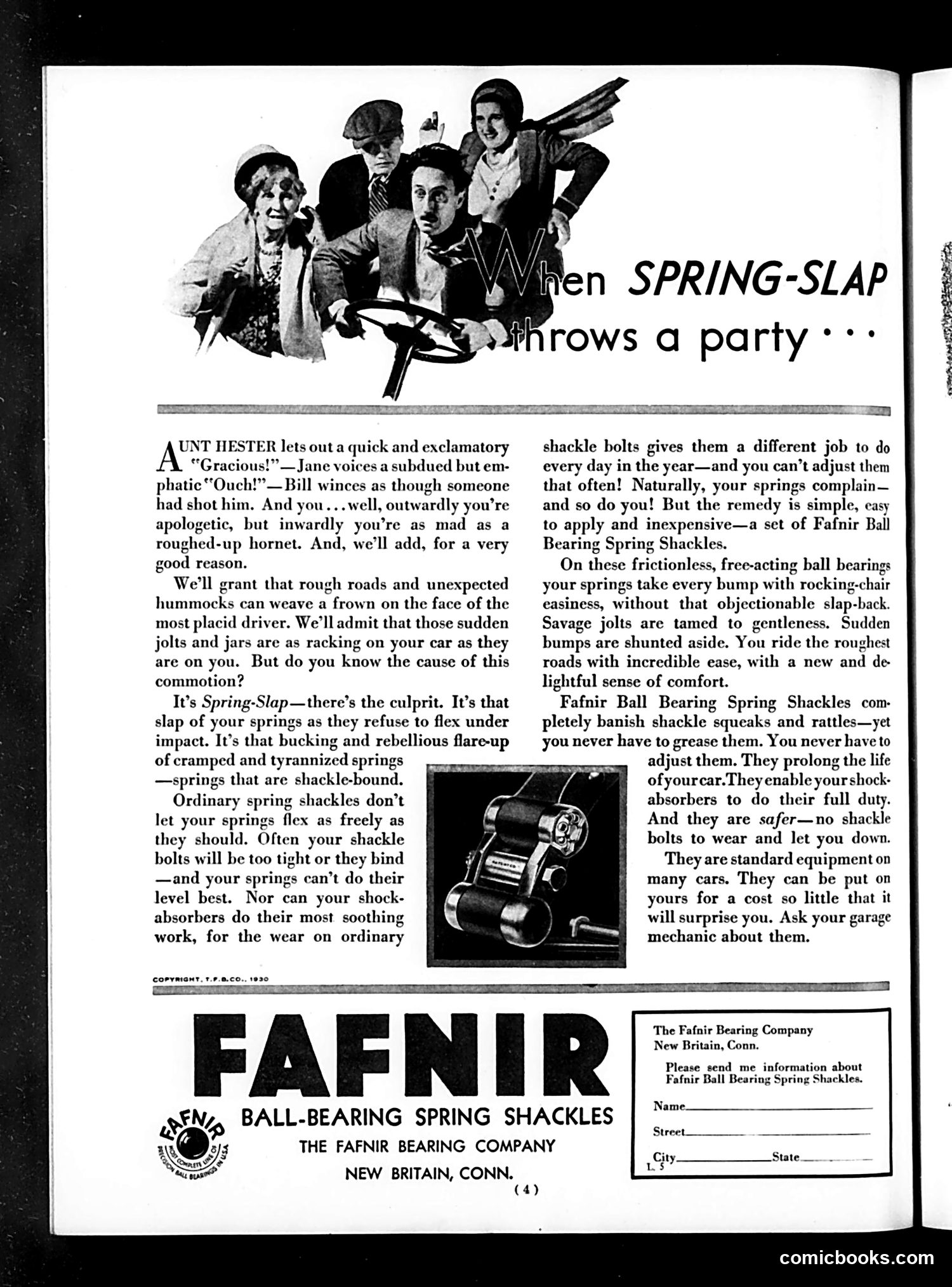
Analysis This page is primarily a comic advertisement for Fafnir Ball Bearing Spring Shackles, an automobile suspension component. The comic strip at top depicts four people (appearing to be from a slapstick film) experiencing violent jolting in a car, with text introducing "Spring-Slap" as the problem. The advertisement uses humor to explain a practical automotive issue: poorly designed springs cause uncomfortable, dangerous bumping and jarring on rough roads. The product solution—ball-bearing spring shackles—is presented as eliminating this problem through smoother suspension. The ad emphasizes benefits: no greasing needed, longer car life, and improved comfort. The comedic setup is straightforward product-focused advertising typical of 1920s-30s magazines, using exaggerated physical comedy to make a mechanical concept relatable to everyday car owners.
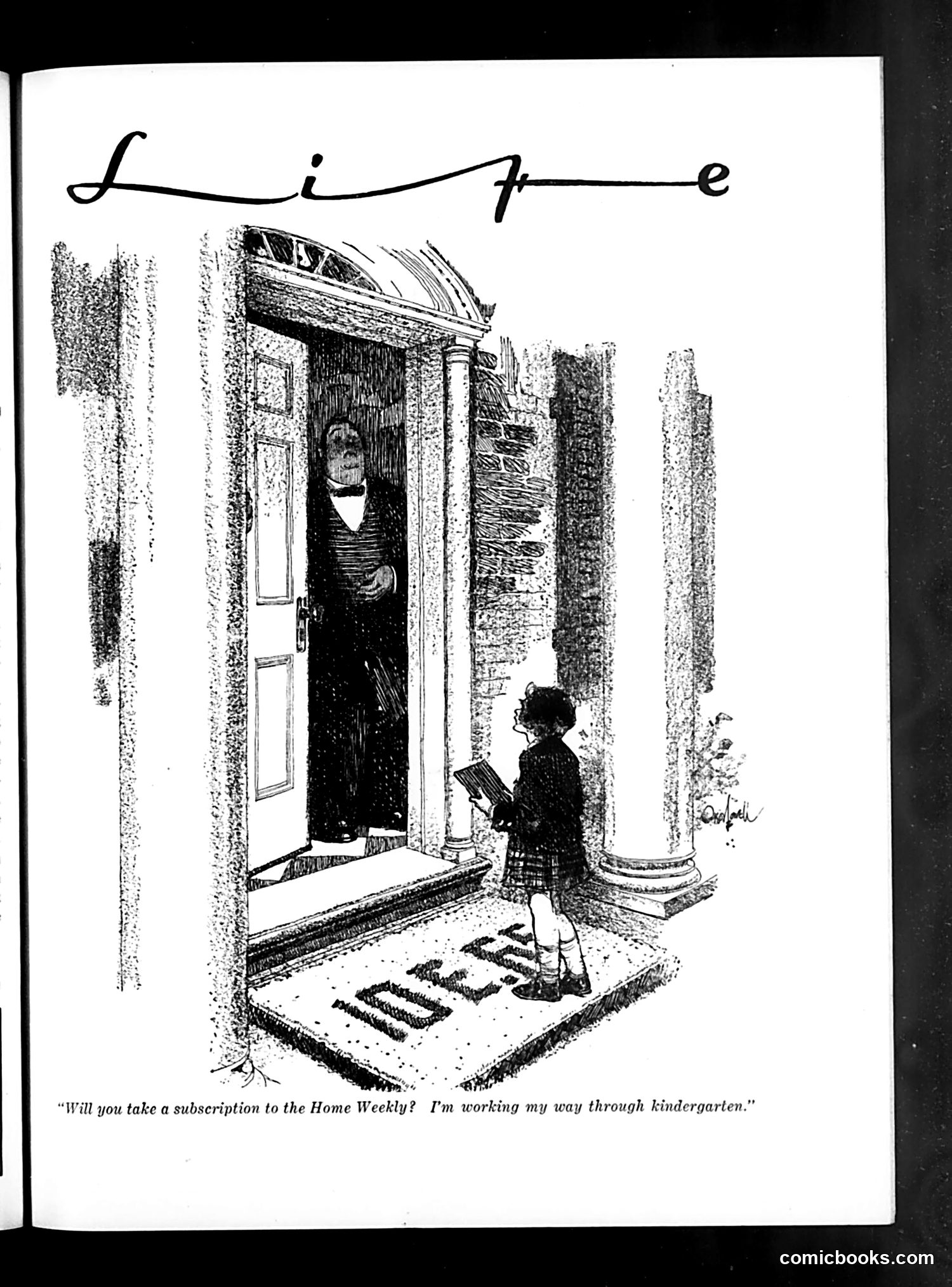
Analysis This cartoon shows a young girl selling magazine subscriptions door-to-door, stating she's "working my way through kindergarten." The humor targets two social phenomena: 1. Child labor/economic hardship: The absurdity of a kindergarten-age child needing to work for education expenses satirizes economic inequality and families' financial struggles. 2. Magazine subscription sales culture: Door-to-door subscription selling was common in this era, often conducted by students or children to fund schooling. The joke suggests this system has become so extreme that even pre-school children now participate. The title "Life" appears at top. The cartoon critiques both economic conditions forcing child participation in commerce and the aggressive subscription-sales culture of the period, presenting this dystopian scenario as satirical commentary on American capitalism and education funding.
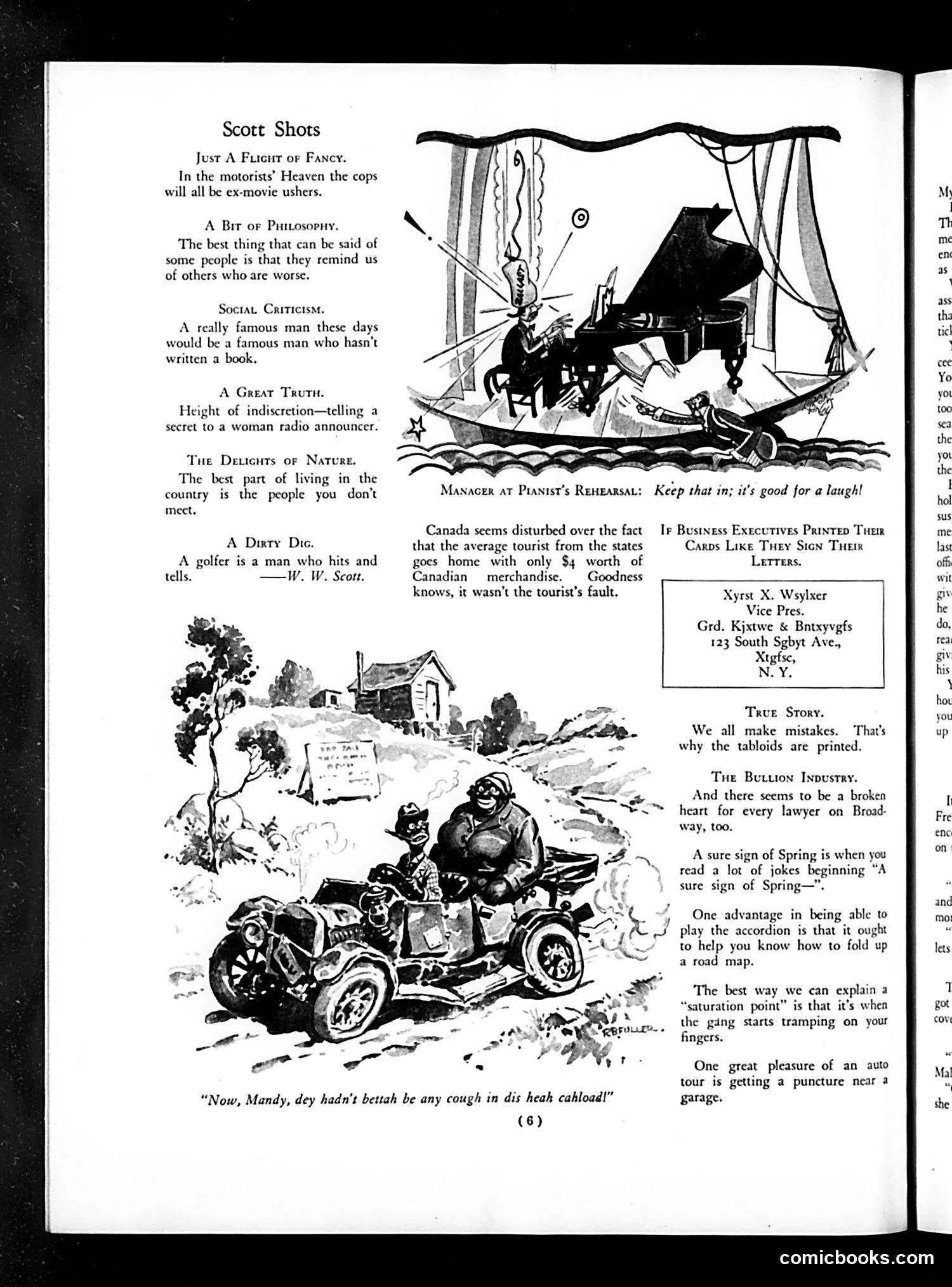
"Scott Shots" - Life Magazine Humor Page This is a humor column featuring short satirical observations and two cartoon illustrations. The top cartoon shows a pianist at rehearsal with the caption "Keep that in; it's good for a laugh!" — suggesting accidental musical errors can be entertainingly preserved. The lower cartoon depicts a family in an old car on a rural road, captioned "Now, Mandy, dey hadn't bettah be any cough in dis heah cahload!" The exaggerated dialect and cramped vehicle suggest early automobile tourism, poking fun at families crowded into unreliable cars for country outings — a common recreational activity of the era. The surrounding "Scott Shots" are brief witticisms on topics like philosophy, radio announcers, and spring season jokes — typical of this magazine's light satirical commentary on contemporary American life.
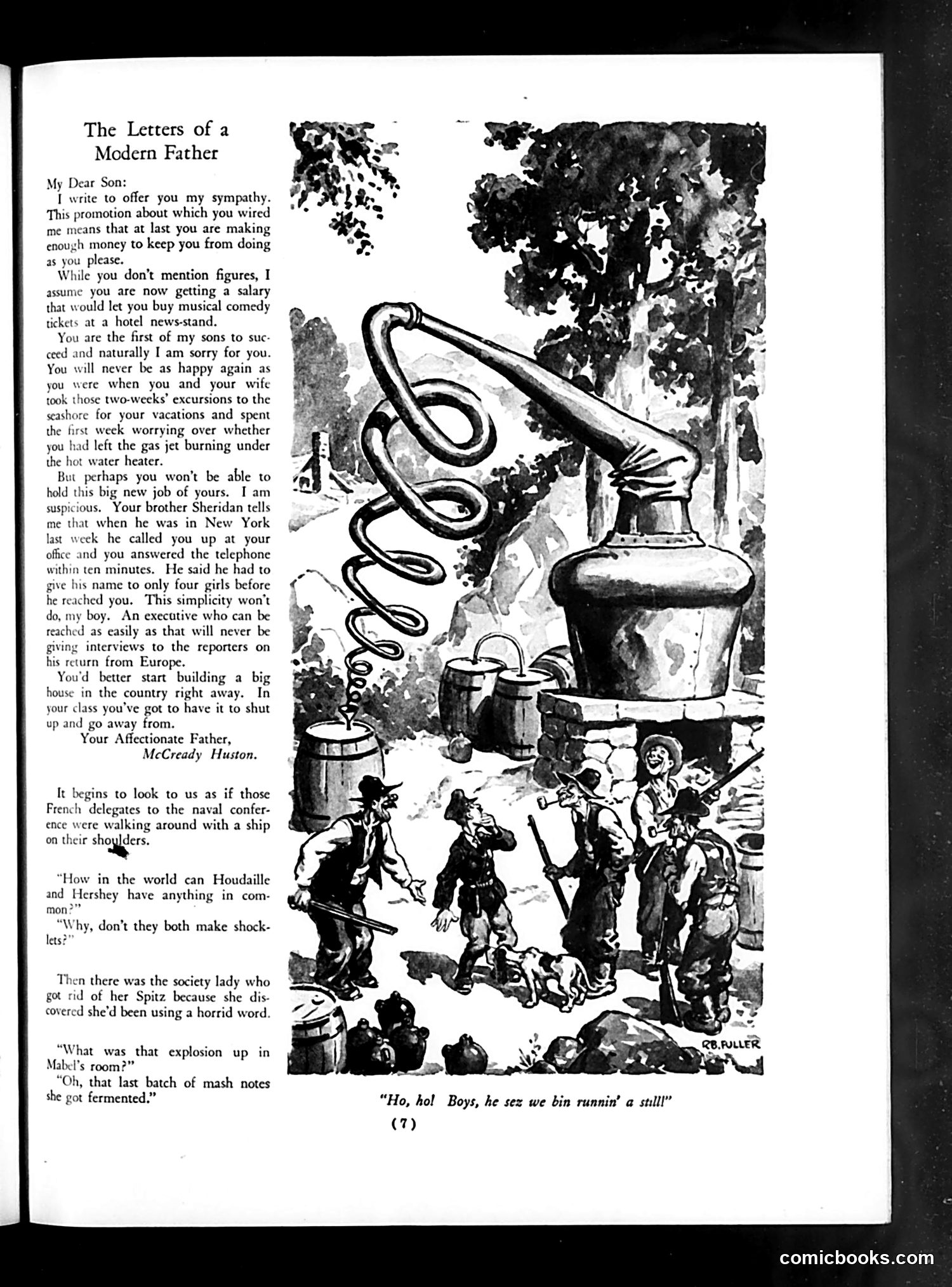
Explanation for Modern Readers This page contains "The Letters of a Modern Father," a satirical column by McCready Huston. The father writes to congratulate his son on a promotion, then sarcastically undermines the achievement by noting the son will never be happy again and referencing his brother Sheridan's similar experience in New York. The accompanying cartoon illustrates unrelated comedic anecdotes: French naval delegates at a conference, a confusion about Houdini and Hershey (likely magician vs. chocolate maker), a society lady using an inappropriate word about Spitz dogs, and a joke about fermented mash notes exploding in someone's room. The humor relies on wordplay, puns about brand names, and genteel social embarrassment typical of early 20th-century satirical magazines.
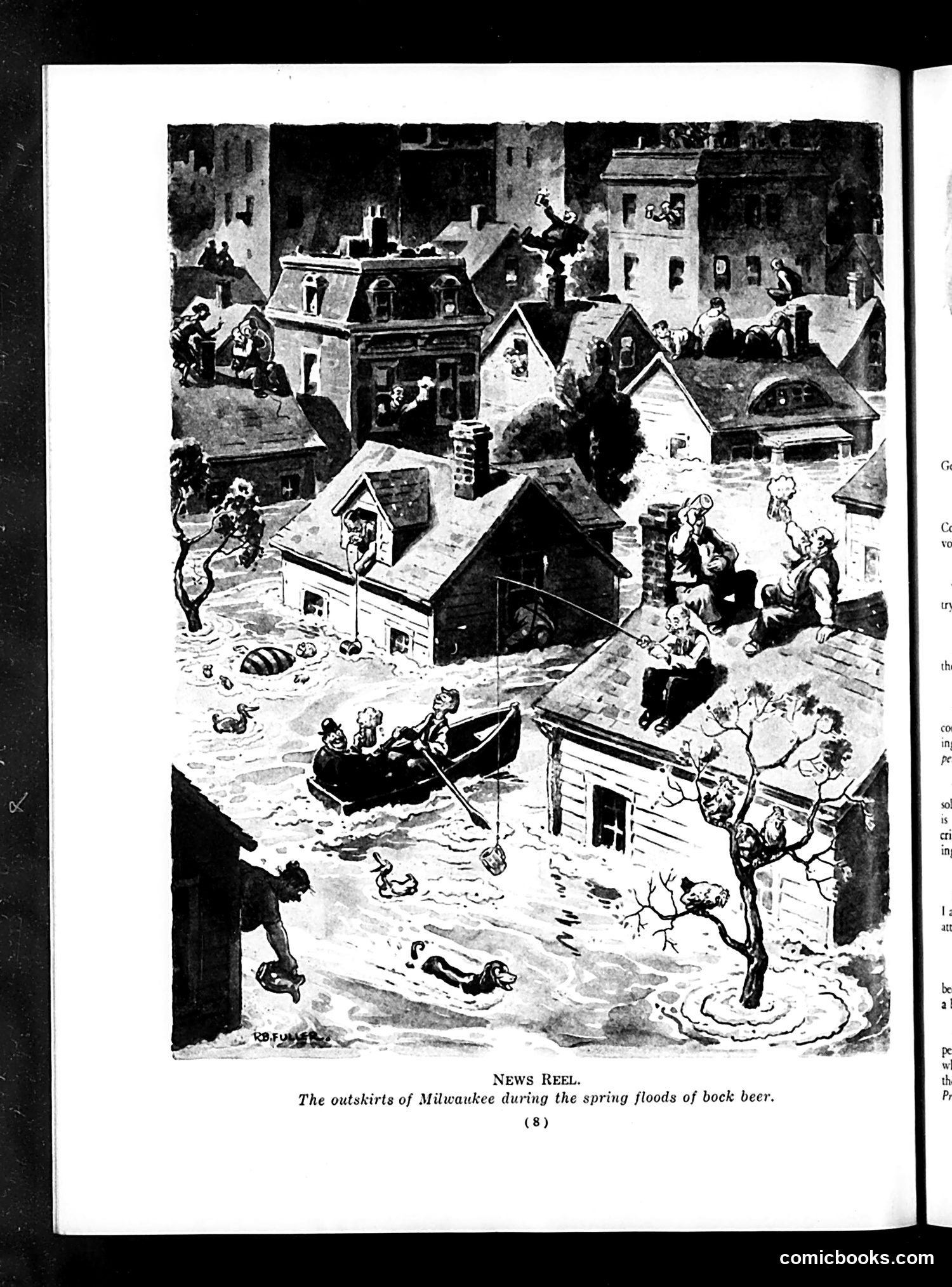
Analysis This is a satirical illustration titled "News Reel: The outskirts of Milwaukee during the spring floods of bock beer." The cartoon uses a flooded landscape as metaphor for beer abundance. "Bock beer" is a strong German lager traditionally consumed in spring. The scene depicts Milwaukee's outskirts during what appears to be actual flooding, but the caption reframes it as excessive beer consumption rather than water overflow. The illustration shows people in various states of distress or intoxication amid buildings and flooded terrain—some in boats, others scattered about. The satire targets Milwaukee's reputation as a beer-producing city (heavily German-immigrant population) and suggests spring bock beer season creates such widespread drunkenness it's like a natural disaster flooding the area.
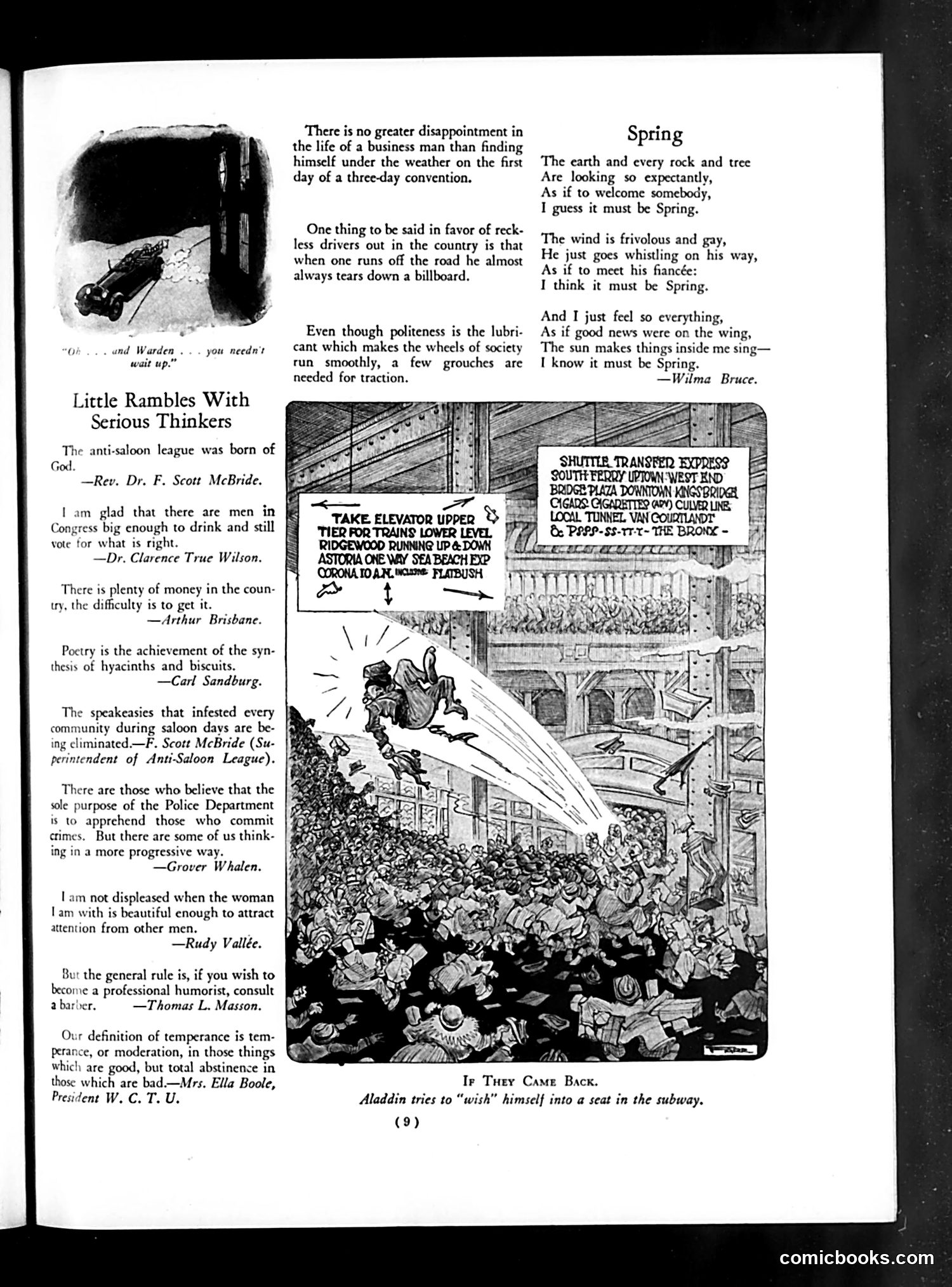
Explanation for Modern Readers This page contains a poem titled "Spring" by Wilma Bruce and a satirical cartoon titled "If They Came Back," showing Aladdin attempting to "wish" himself into a subway seat. The cartoon mocks the chaos of crowded urban public transportation—specifically the New York City subway system (referenced in the signage). The joke is that even a magical figure like Aladdin, with his wish-granting lamp, cannot secure a seat in the impossibly packed subway. It's social satire about the indignity and impossibility of rush-hour commuting in a major city. The page also includes "Little Rambles with Serious Thinkers"—humorous quotes attributed to various public figures (Rev. Dr. F. Scott McBride, etc.) offering tongue-in-cheek observations about society, politics, and human nature, typical of Life magazine's satirical format.
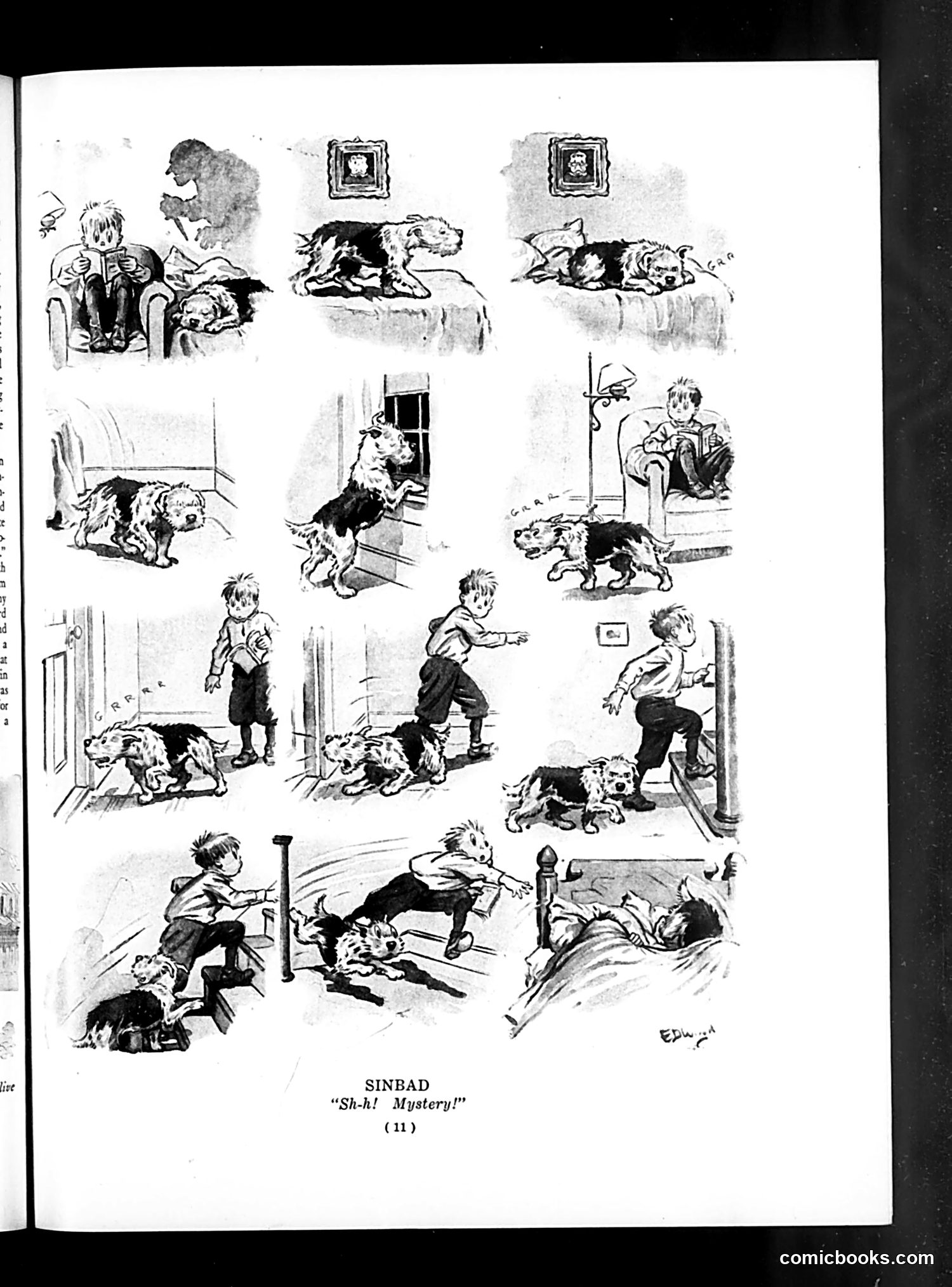
"Sh-h! Mystery!" - A Sinbad Comic Strip This is a comic strip page titled "Sinbad" with the caption "Sh-h! Mystery!" The strip depicts a young boy and his dog engaged in various mischievous activities throughout a house—hiding, chasing, playing, and getting into trouble. The humor appears to be situational rather than political: a child and pet creating chaos while attempting to be secretive or solve imaginary mysteries. The strip satirizes childhood adventure-seeking and the inevitable bumbling that results. The repeated interactions between the boy and dog across nine panels show escalating mishaps. This represents typical early-20th-century American comic humor celebrating children's antics and the relationship between kids and pets, without apparent political or social commentary.
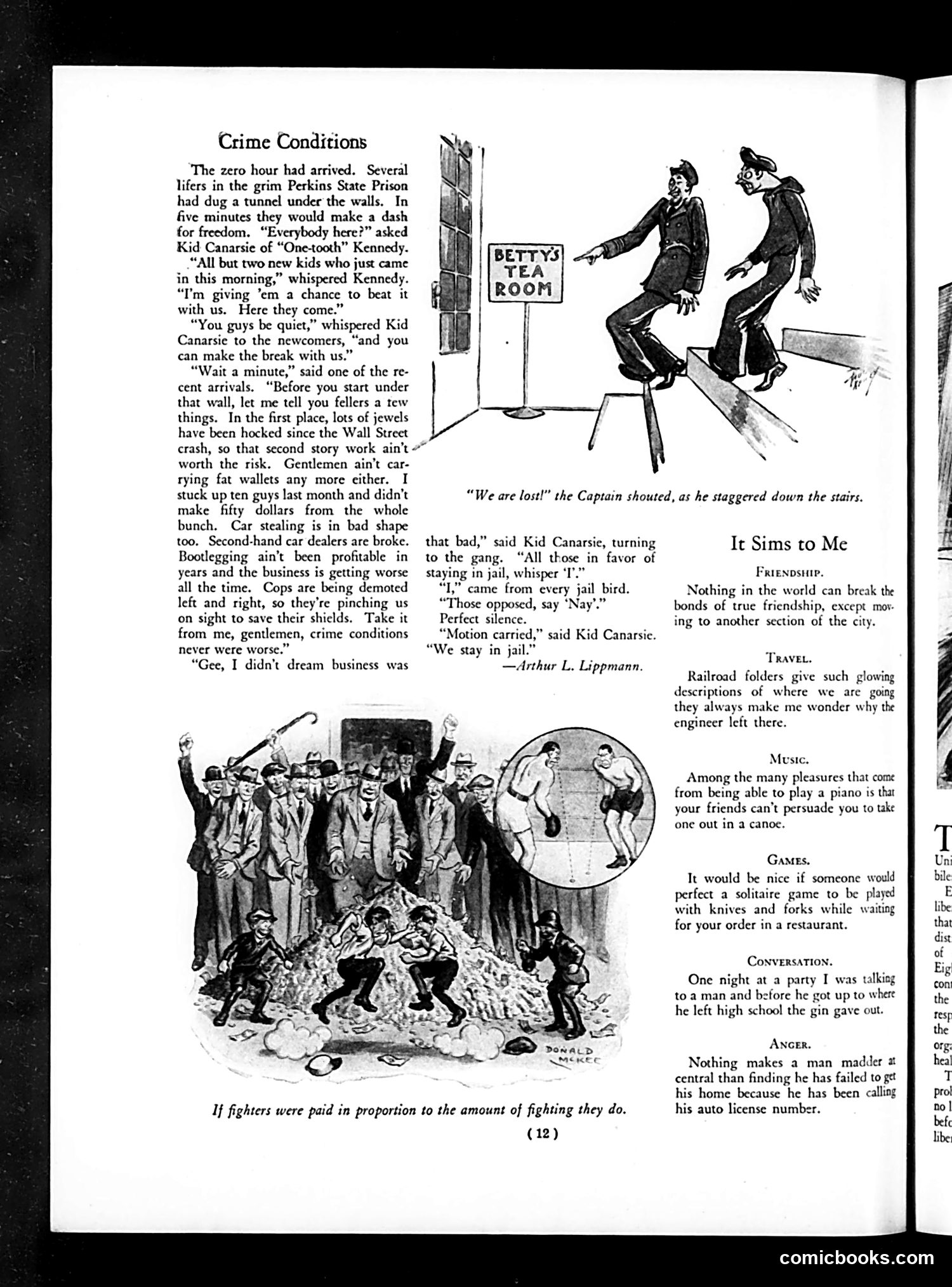
"Crime Conditions" Page Analysis This satirical page critiques Prohibition-era crime and prison conditions. The top cartoon shows prisoners escaping from Perkins State Prison through a tunnel, with dialogue suggesting the escape is inevitable and easy—mocking prison security. The larger bottom illustration depicts what appears to be organized crime or gang activity, with multiple figures emerging from or associated with a large pile of money or contraband, credited to artist "Donald." The caption states fighters were "paid in proportion to the amount of fighting they do," likely referencing bootleggers, gang violence, or criminal enterprises flourishing during Prohibition. The right column, titled "It Sims to Me," offers philosophical observations on friendship, travel, music, games, conversation, and anger—providing editorial commentary alongside the crime satire. Together, the content criticizes how Prohibition enabled organized crime and prison system failures.
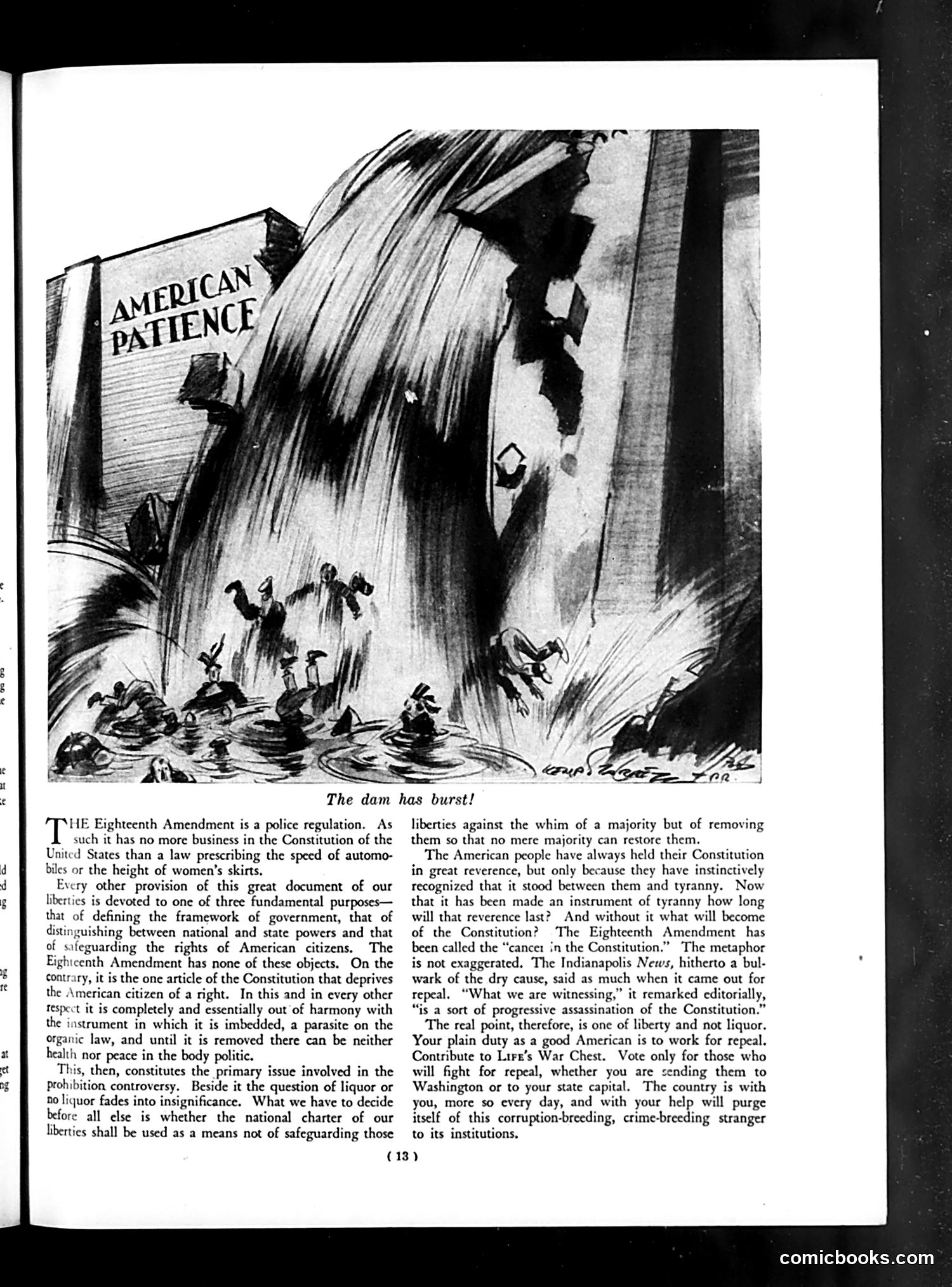
Political Cartoon Analysis: "The Dam Has Burst!" This political cartoon criticizes the Eighteenth Amendment (Prohibition). The image depicts a massive dam bursting, with water—labeled "American Patience"—flooding downward, sweeping away numerous figures below. The text argues that Prohibition is unconstitutional overreach, comparing it to tyranny. The "burst dam" metaphor represents public patience exhausted by the amendment. The drowning figures likely represent supporters of Prohibition or government enforcement. The accompanying article explicitly calls for Prohibition's repeal, framing it as a "corruption-breeding, crime-breeding stranger" to American institutions. The satire suggests that Prohibition enforcement has become so unpopular that resistance is inevitable and justified—the "dam" of public compliance cannot hold.
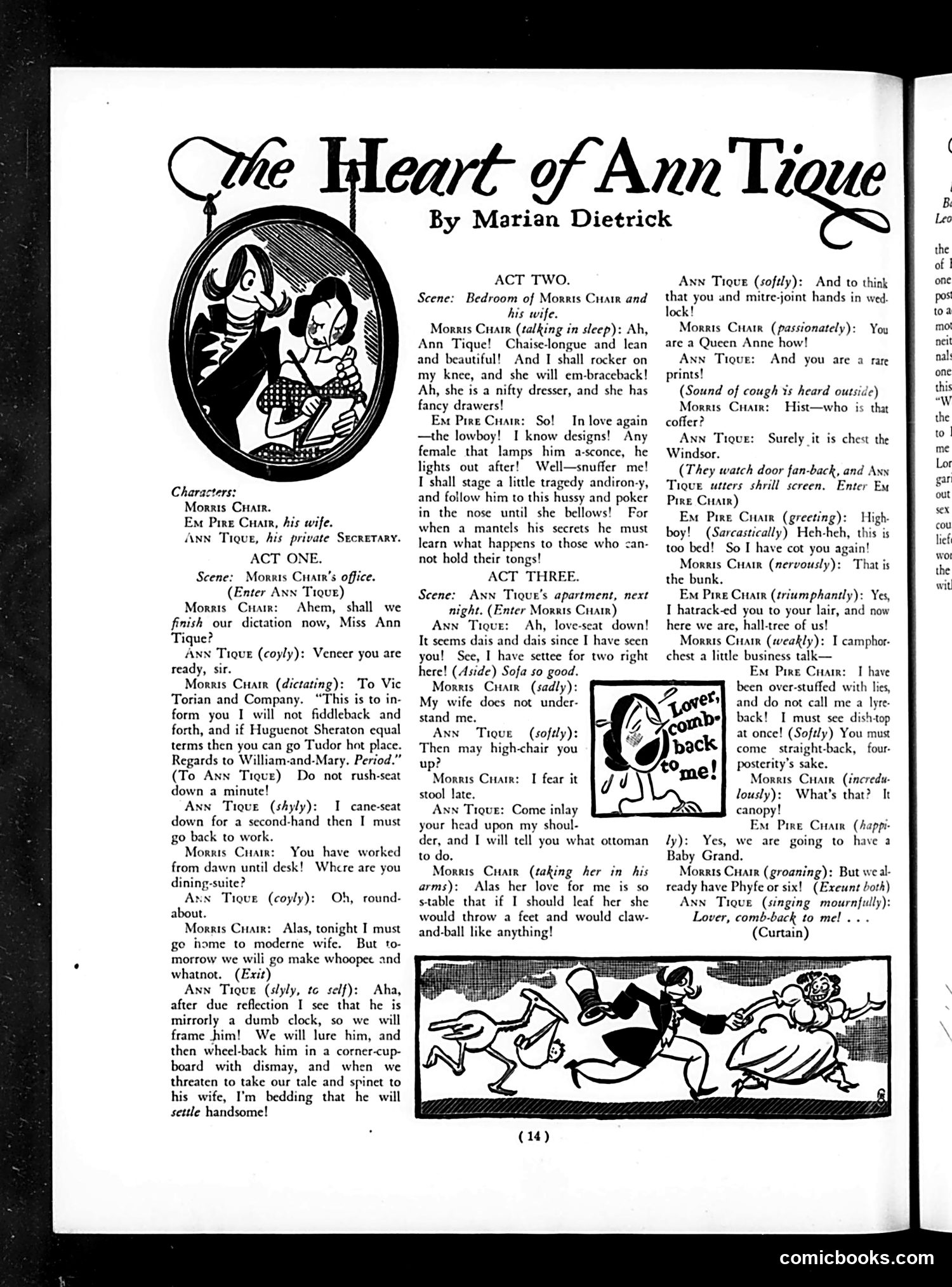
"The Heart of Ann Tique" by Marian Dietrick This is a comedic play script rather than a political cartoon. The piece appears to be satirical domestic humor, common to Life magazine's entertainment content. The plot involves Morris Chair (a pun on the furniture type) and his wife Ann Tique (antique), with their secretary. The humor relies on wordplay and marital comedy—Morris fears his wife will become unfaithful, while Ann Tique makes double entendres about being a "rare print" and having a "Baby Grand" (piano). The cartoon illustrations below show slapstick physical comedy. This represents typical 1920s-era satirical entertainment—light domestic farce using puns on furniture and antique-related names to create absurdist humor for middlebrow audiences.
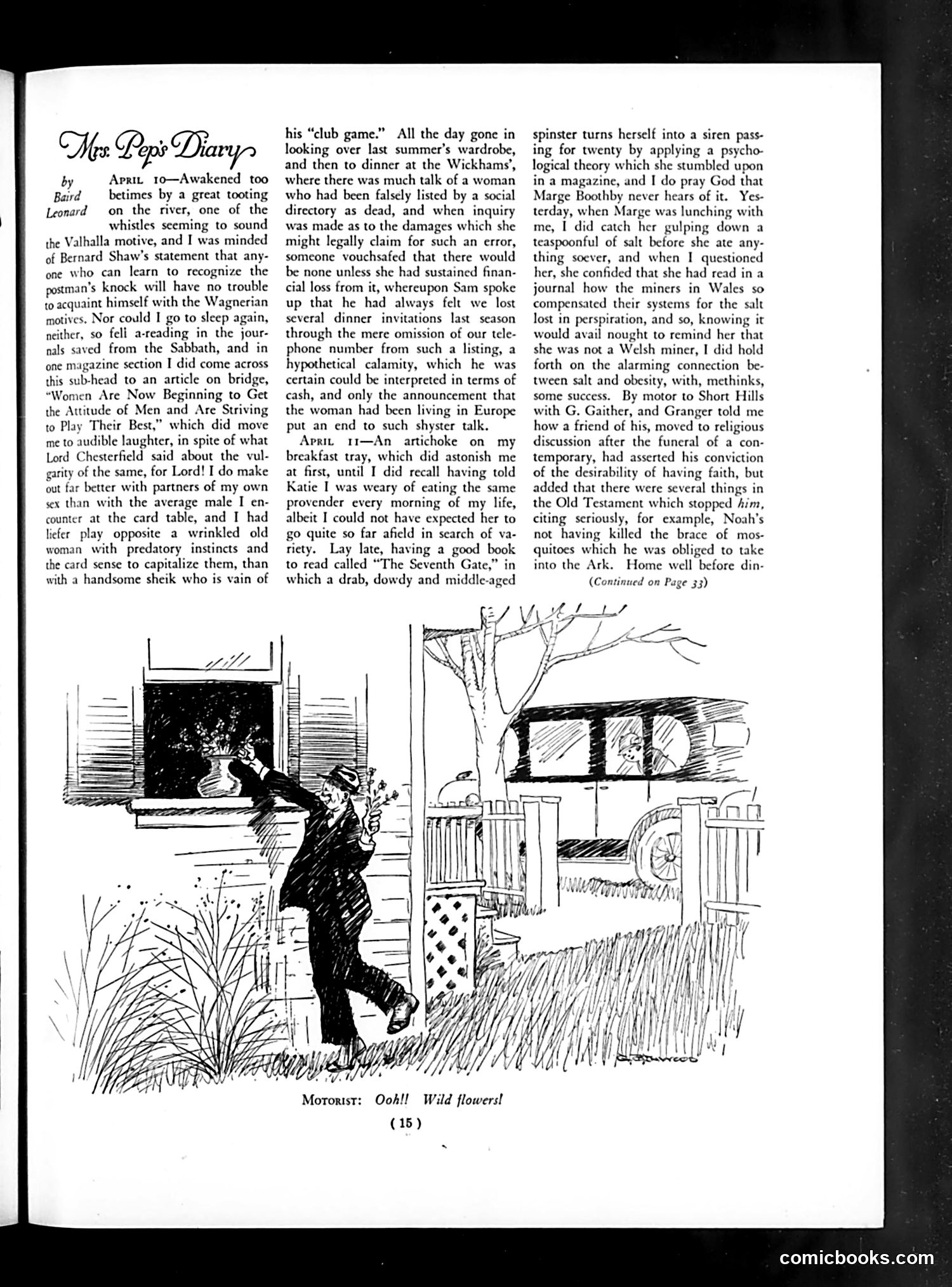
Analysis of "Mrs. Pop's Diary" Page This is a humorous diary entry dated April 10-11 from *Life* magazine's "Mrs. Pop's Diary" column by Baird Leonard. The text describes social awkwardness: a woman falsely reported dead by society pages, dinner party gossip about someone living in Europe, and tedious breakfast reading about mining compensation claims. The accompanying sketch—captioned "Motorist: Ooh! Wild flowers!"—shows a man leaning out a car window apparently picking flowers from a roadside, with a caravan or trailer visible. The cartoon satirizes motorists' behavior during an era of increasing automobile tourism, mocking the casual, often reckless way drivers interacted with roadsides and nature while traveling. The overall page targets upper-class social pretension and modern automotive culture.
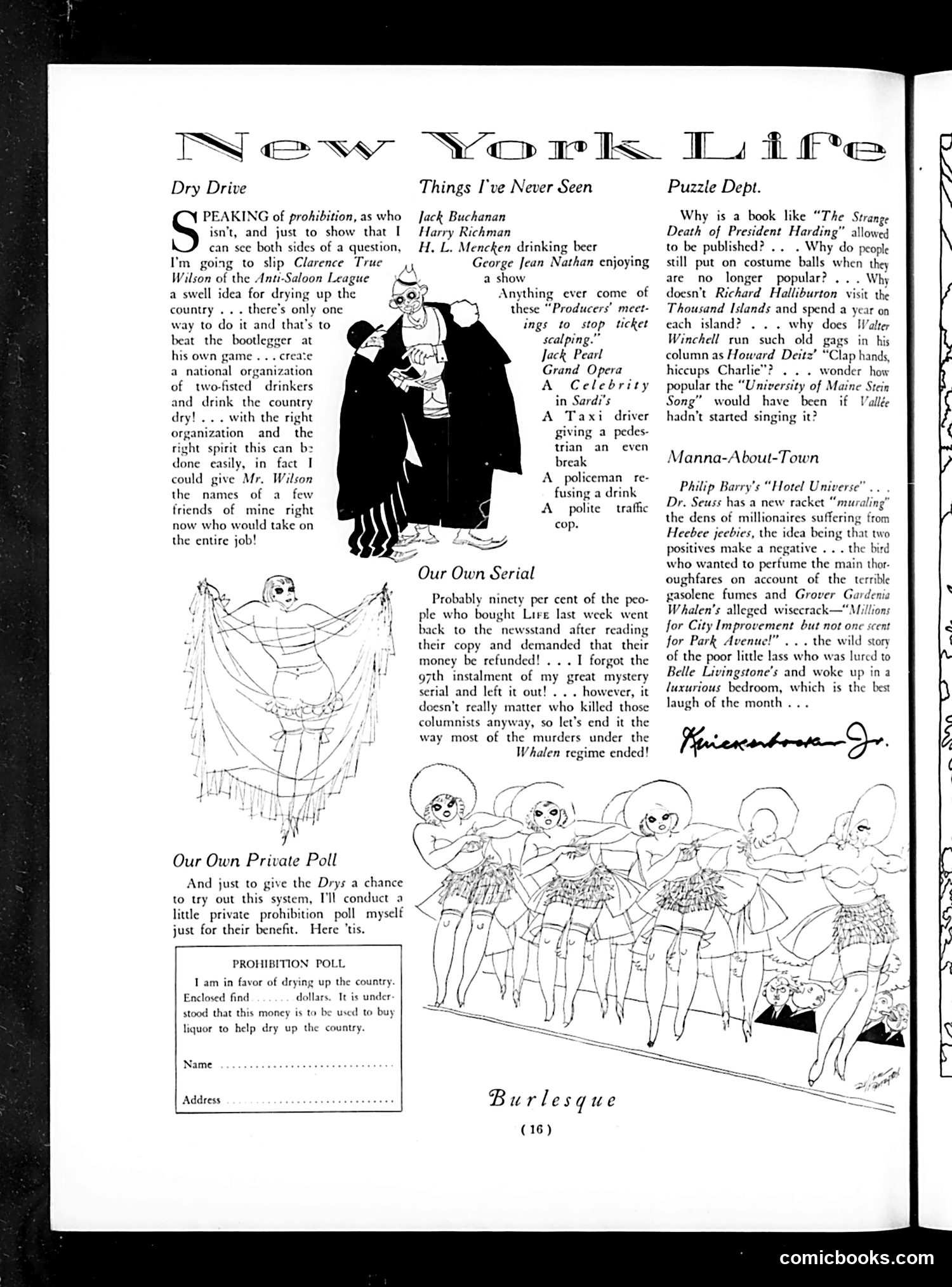
Analysis of Life Magazine Page This page satirizes Prohibition (the 1920s ban on alcohol). The "Dry Drive" column mocks the Anti-Saloon League's push for a "dry country" by suggesting Clarence True Wilson organize prohibition enforcement through drinkers themselves—inverting the League's own goal. The "Prohibition Poll" at bottom is a humorous mock-ballot where readers declare support for Prohibition while enclosing dollars "to be used to buy liquor to help dry up the country"—satirizing the contradiction of funding alcohol sales while claiming to support sobriety. The burlesque cartoon at right depicts chorus girls, likely referencing entertainment venues that thrived *despite* Prohibition. Overall, the page ridicules both Prohibition's ineffectiveness and the hypocrisy of its supporters.
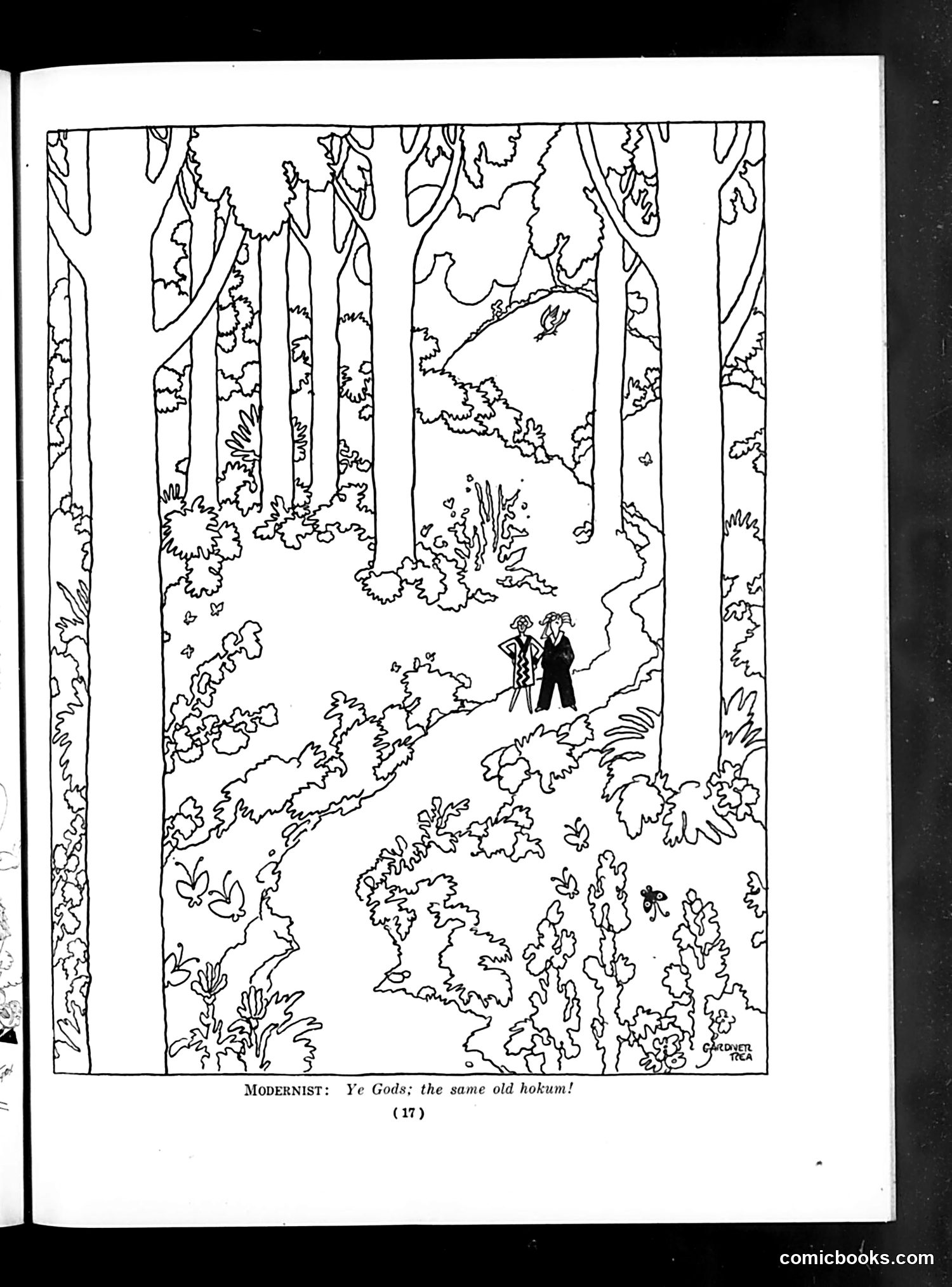
Analysis This single-panel cartoon depicts two figures standing in a forest clearing, with tall trees framing the scene. The caption reads: "MODERNIST: Ye Gods; the same old hokum!" The satire appears to target artistic modernism by showing a modernist encountering a traditional, naturalistic forest landscape scene. The joke suggests that despite modernists' claims to artistic innovation and rejection of conventional art, they're encountering the "same old hokum"—implying that nature itself, or traditional representational art depicting nature, remains unchanged and fundamental regardless of artistic movements. The cartoon critiques modernism's pretensions by suggesting that modernist innovations cannot escape or transcend basic artistic and natural realities. It's a commentary on the tension between avant-garde artistic movements and enduring traditional subjects or approaches.
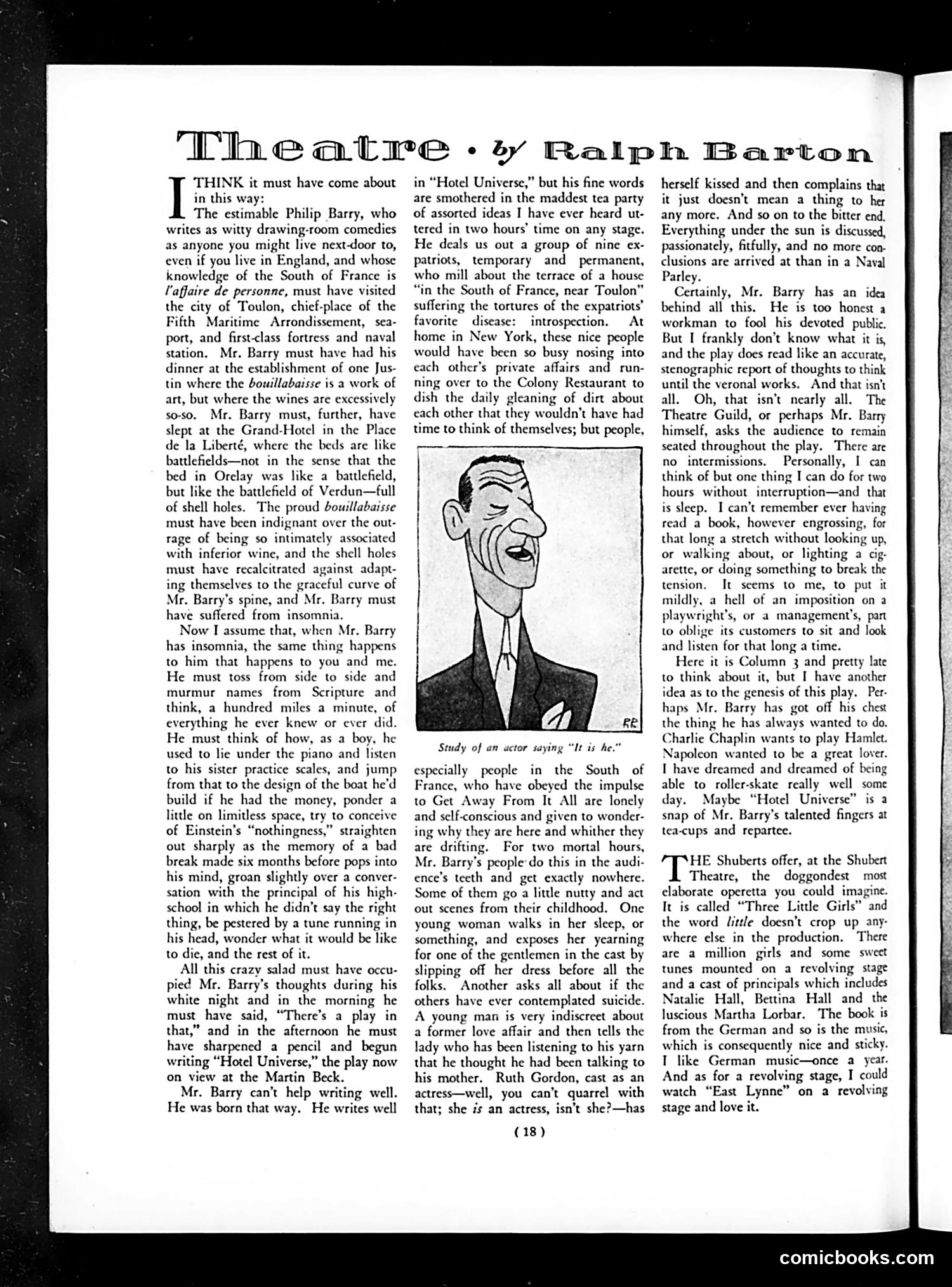
Theatre Review by Ralph Barton This page is a theatre review by Ralph Barton (a noted cartoonist and satirist) critiquing Philip Barry's play "Hotel Universe," currently at the Martin Beck Theatre. The small caricature shows an actor with an exaggerated, strained expression labeled "Study of an actor saying 'It is he.'" Barton's satire mocks the play's pretentious intellectualism and the audience's patience. He jokes that Barry expects viewers to sit motionless for two hours without interruption—an "imposition on a playwright's" part. Barton suggests the play exemplifies overwrought theatrical self-seriousness, comparing it unfavorably to more entertaining options like German musicals or performers like Charlie Chaplin and Napoleon. The review is humorous rather than politically charged, targeting theatrical affectation and Barry's artistic ambitions.
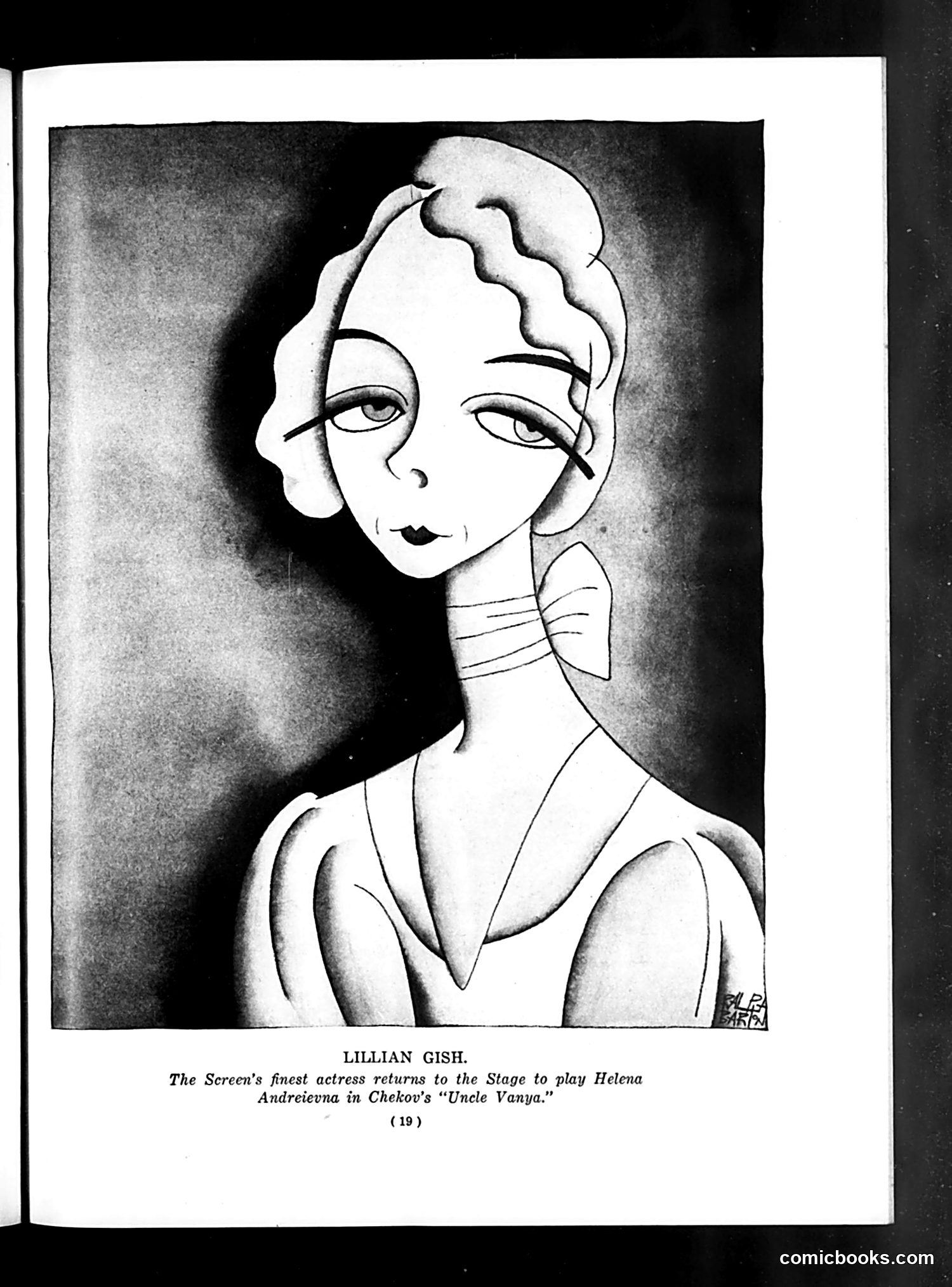
This is a portrait illustration of actress Lillian Gish, not a political cartoon. The text announces her return to theatrical stage acting after her film career, specifically to perform in Anton Chekhov's play "Uncle Vanya," playing the character Helena Andreievna. The drawing employs an expressionistic style typical of 1920s-30s portraiture, emphasizing her distinctive features with elongated proportions and dramatic shading. The formal attire (bow tie, draped clothing) and elegant presentation reflect her status as "the Screen's finest actress." This appears to be a society or entertainment page noting a significant theatrical comeback by a major film star of the silent era.
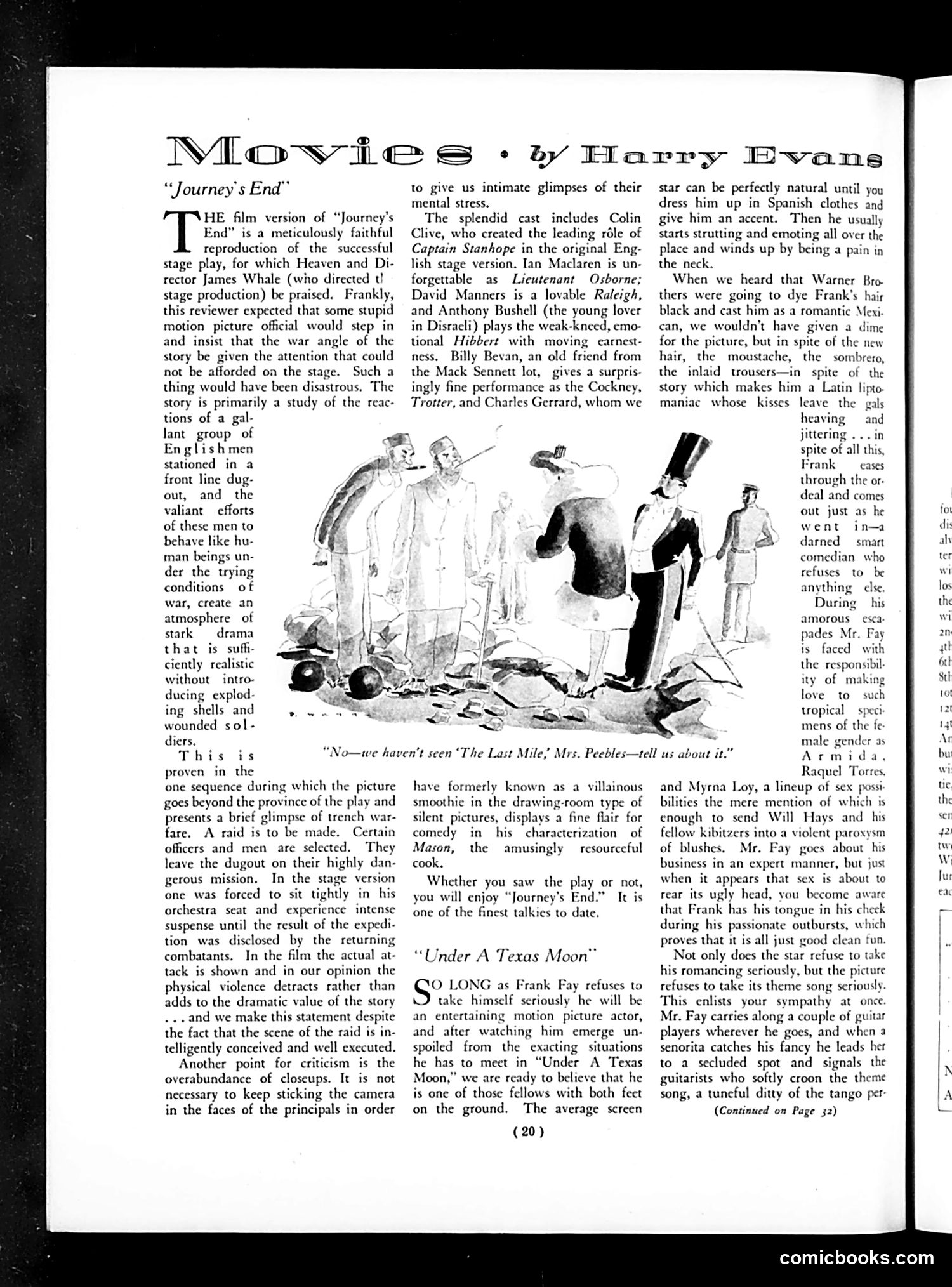
Analysis of Life Magazine Movie Review Page This page contains two film reviews by Harry Evans from Life magazine's movie criticism section. "Journey's End": The reviewer praises this film adaptation of a successful stage play about English soldiers in a World War I dugout. The accompanying sketch depicts soldiers in a trench setting—likely illustrating the famous scene the critic mentions where a raid is depicted. The reviewer argues the film wisely avoids overemphasizing combat violence, instead focusing on the psychological strain of war on the men. He criticizes excessive close-ups but praises the cast, including Colin Clive. "Under A Texas Moon": This section reviews Frank Fay's ability to play a romantic Mexican character without becoming pretentious. The critic suggests Fay's self-aware comedic approach prevents the usual pitfall of actors becoming absurdly earnest and affected when placed in exotic costumes and accents—a common complaint about early sound film performances. Both reviews reflect 1930s concerns about film realism and acting authenticity in the newly-arrived "talkie" era.
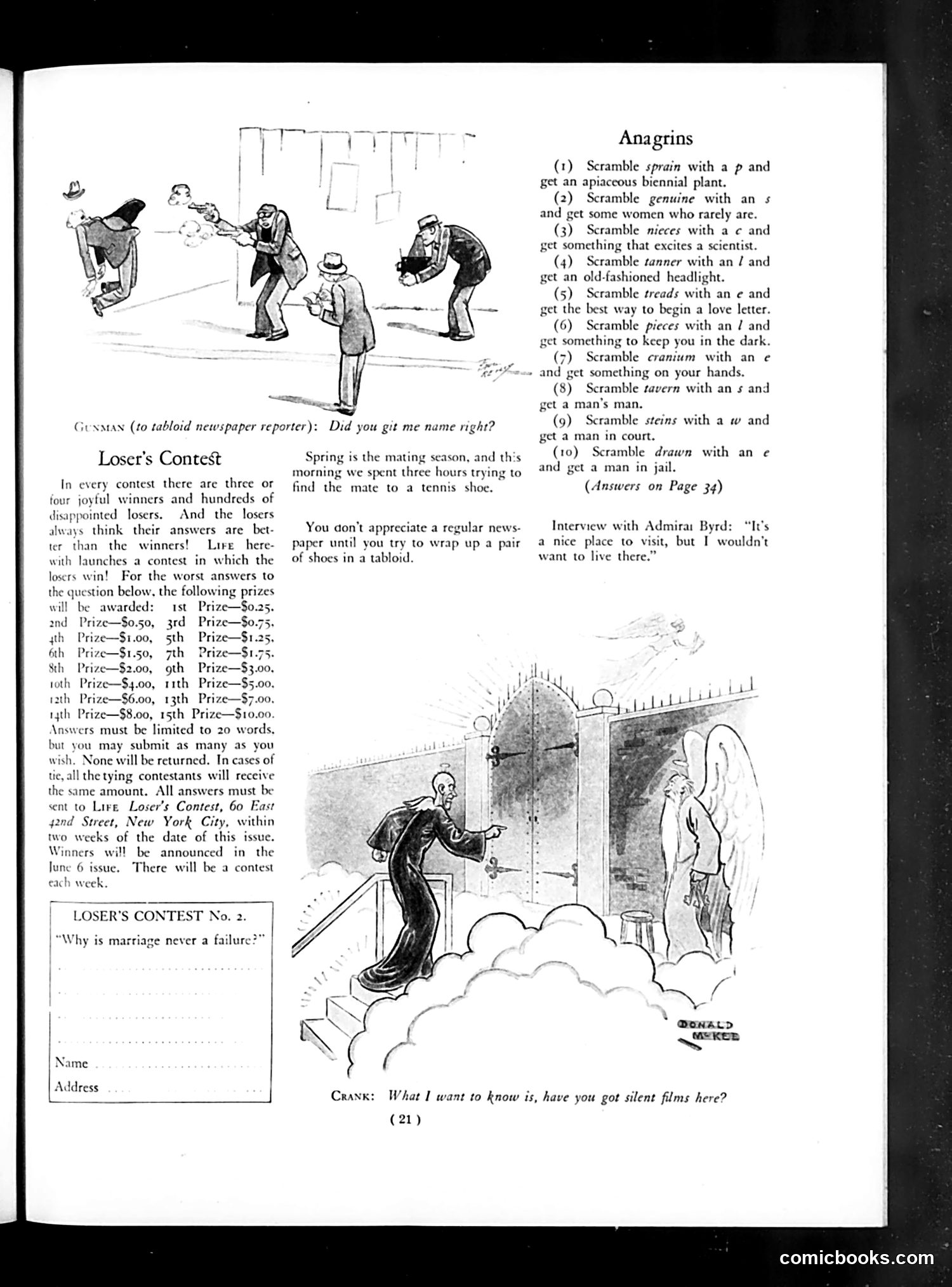
Life Magazine Page Analysis This page from *Life* magazine features humorous content targeting early 1920s American culture: "Loser's Contest": A satirical competition inverting typical contest logic—Life awards prizes for the *worst* answers to "Why is marriage never a failure?" This jokes about reader disappointment in regular contests and mocks contemporary marriage attitudes. Top cartoon: A "Gunman" (appearing to be a criminal or tough character) asks a tabloid reporter if they got his name right—satirizing sensationalist crime reporting and criminals' vanity about newspaper coverage. Bottom cartoon: A figure in heaven asking "have you got silent films here?"—referencing the contemporary dominance of silent cinema and humorously suggesting the afterlife's entertainment options. "Anagrams": A word puzzle feature unrelated to satire. The page overall reflects 1920s preoccupations: tabloid journalism, silent film culture, marriage skepticism, and organized crime visibility in newspapers. The humor assumes readers followed sensational crime reporting and cinema trends.
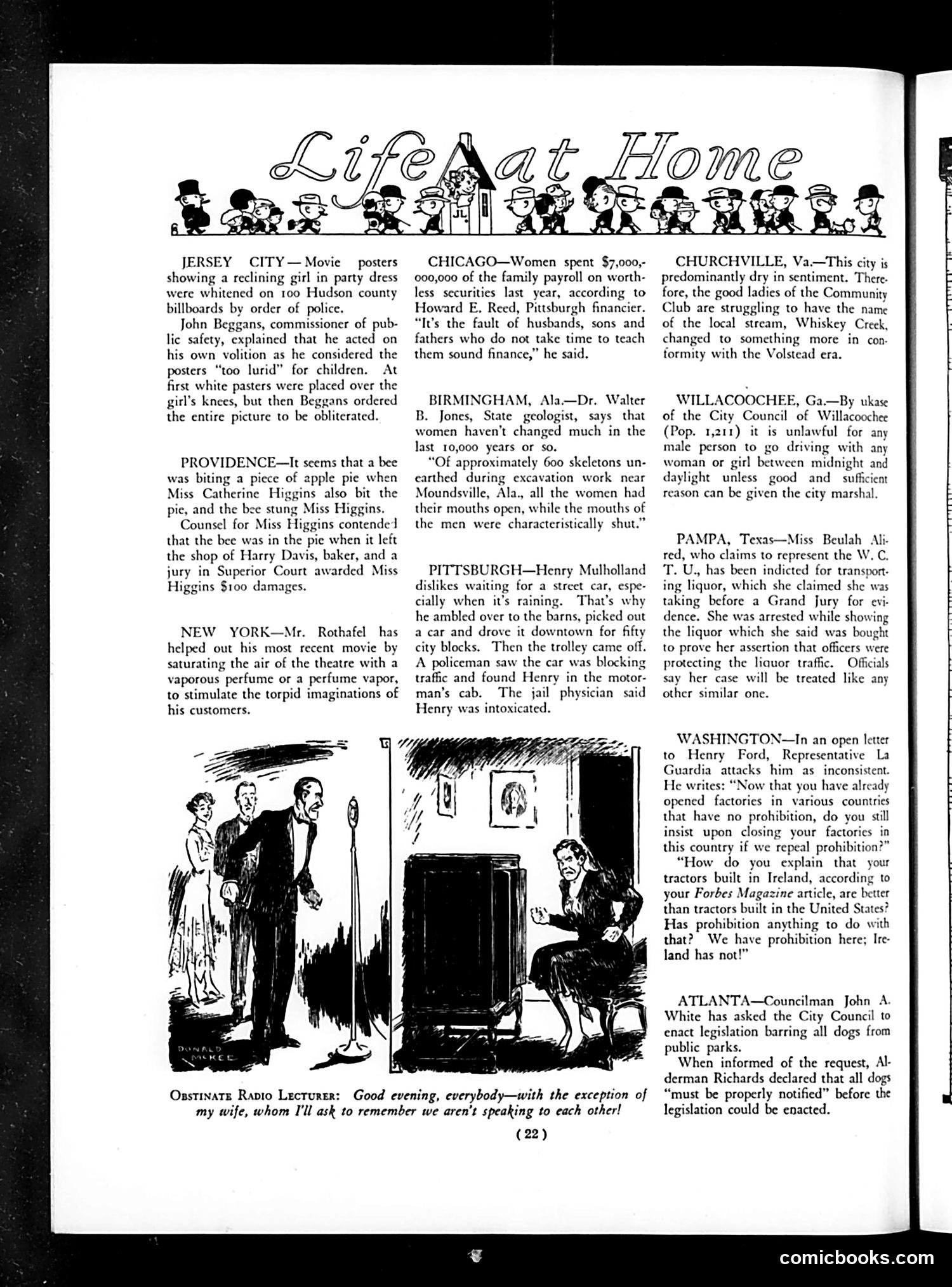
"Life at Home" Page Analysis This page collects humorous news briefs satirizing American social attitudes during the Prohibition era (1920s). The content mocks several targets: Gender stereotypes: A geologist's claim that prehistoric female skeletons had open mouths (implying women talk too much) and a financier blaming wives for bad investments. Censorship absurdity: Jersey City officials whitening out "lurid" movie posters—first covering a girl's knees, then obliterating the entire image. Prohibition enforcement: A WCTU representative indicted for transporting liquor "as evidence," and a Virginia town renaming "Whiskey Creek" for propriety. The cartoon depicts a radio lecturer addressing an audience while excluding his wife from his greeting—a domestic squabble joke reflecting 1920s marital comedy themes. The page's overall tone mocks both rigid moral enforcement and the gender politics of the era, presenting these situations as absurd rather than praiseworthy.
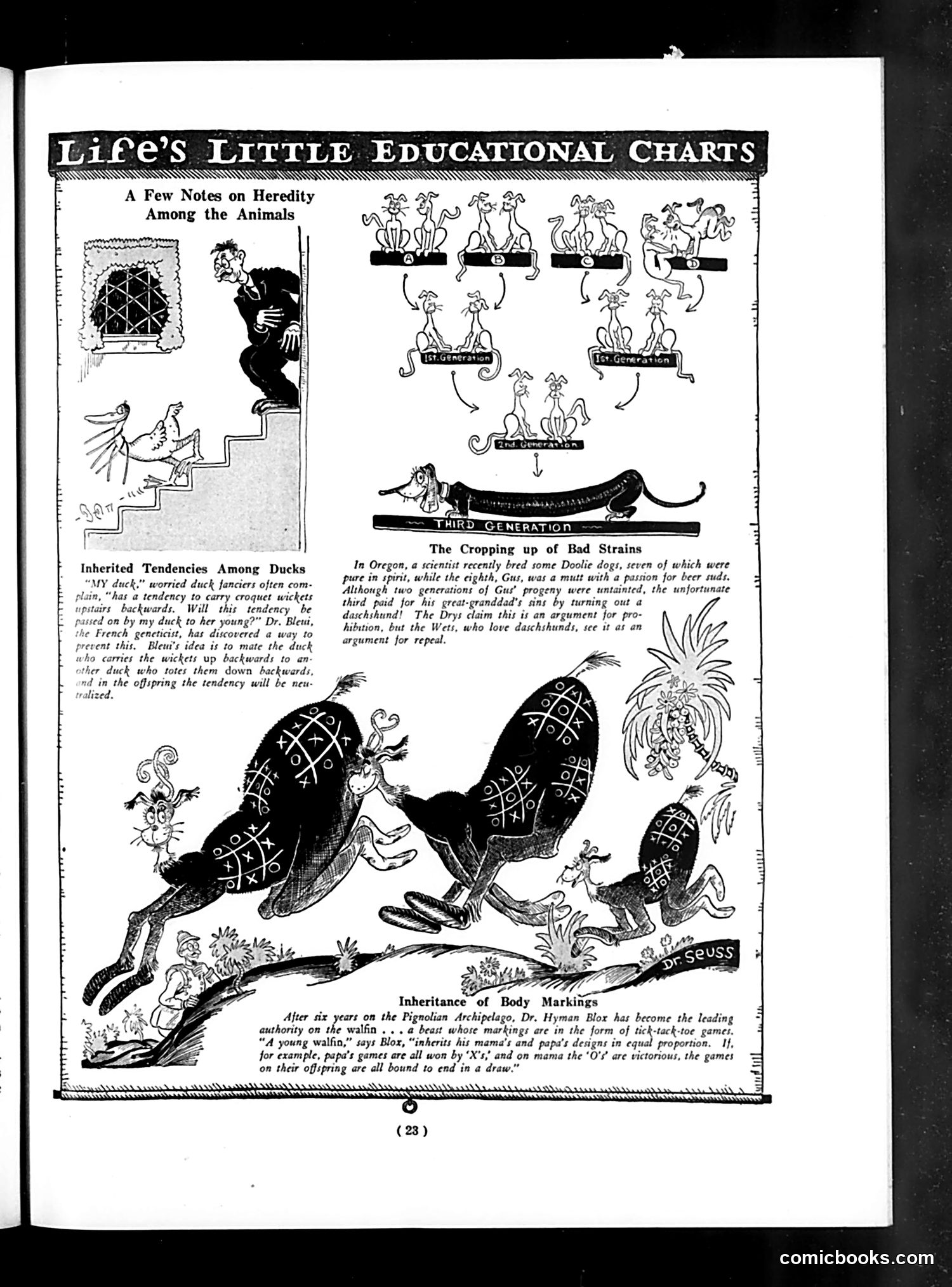
Life Magazine's "Educational Charts" on Heredity This is a satirical science feature from Life magazine using absurdist humor to mock both genetics education and contemporary social debates—particularly Prohibition. The three cartoons present fake scientific observations: ducks inheriting croquet-wicket-carrying tendencies, dogs passing down beer preferences across generations, and fictional creatures (walfins) inheriting tic-tac-toe game patterns. The most pointed satire appears in the dog section, where a "mutt with a passion for beer suds" named Gus produces descendants that supposedly inherited his weakness. The text explicitly references the Prohibition debate: "The Drys claim this is an argument for prohibition, but the Wets, who love daschshunds, see it at an argument for repeal." The joke targets both sides—suggesting that hereditary arguments about moral weakness were being cynically weaponized in the Prohibition political fight. By attributing human social problems (alcoholism, moral failing) to animal inheritance, Life mocks the pseudo-scientific reasoning used in that era's policy debates. The artwork is credited to Dr. Seuss, the cartoonist's pen name before his children's books.
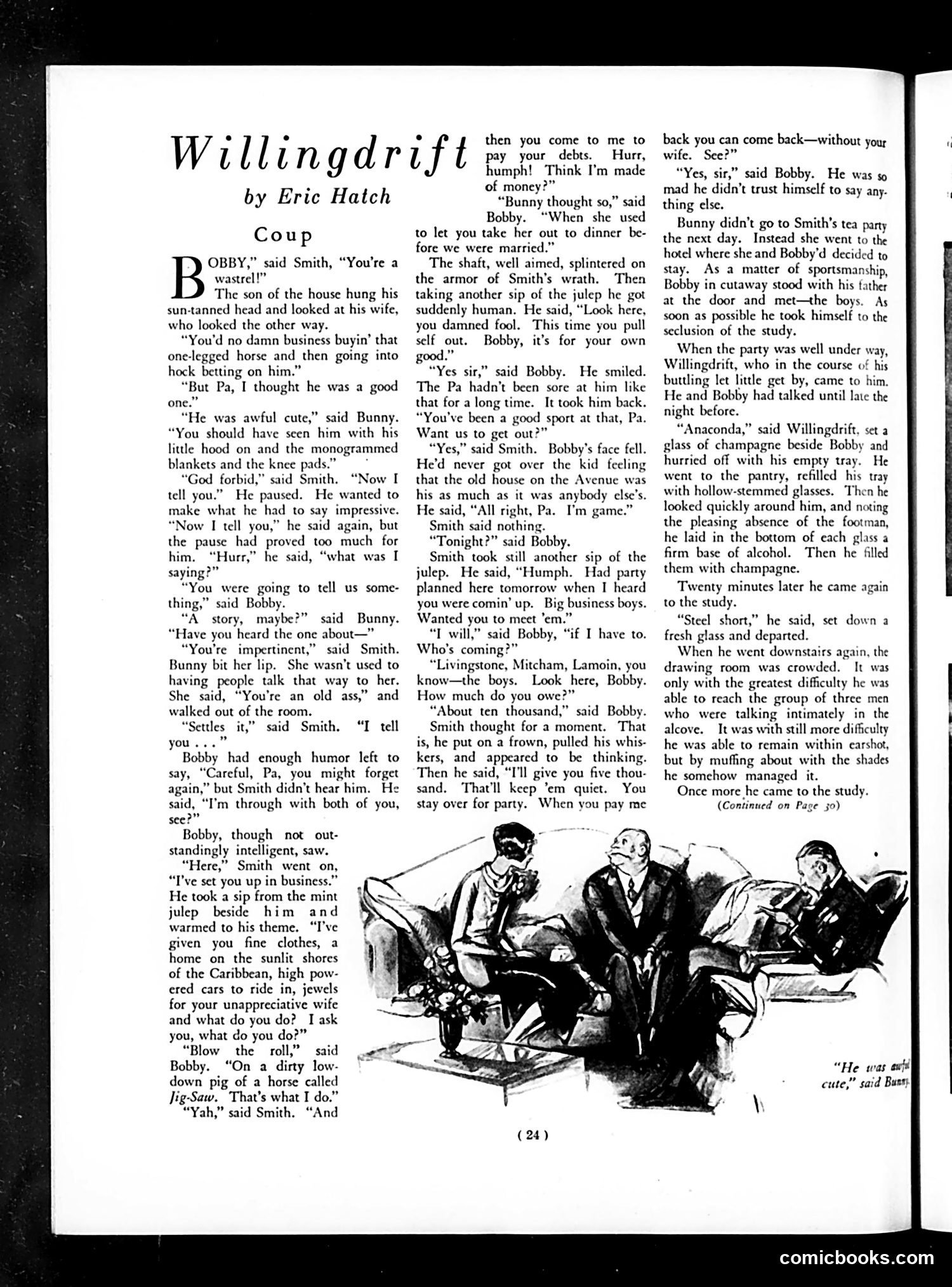
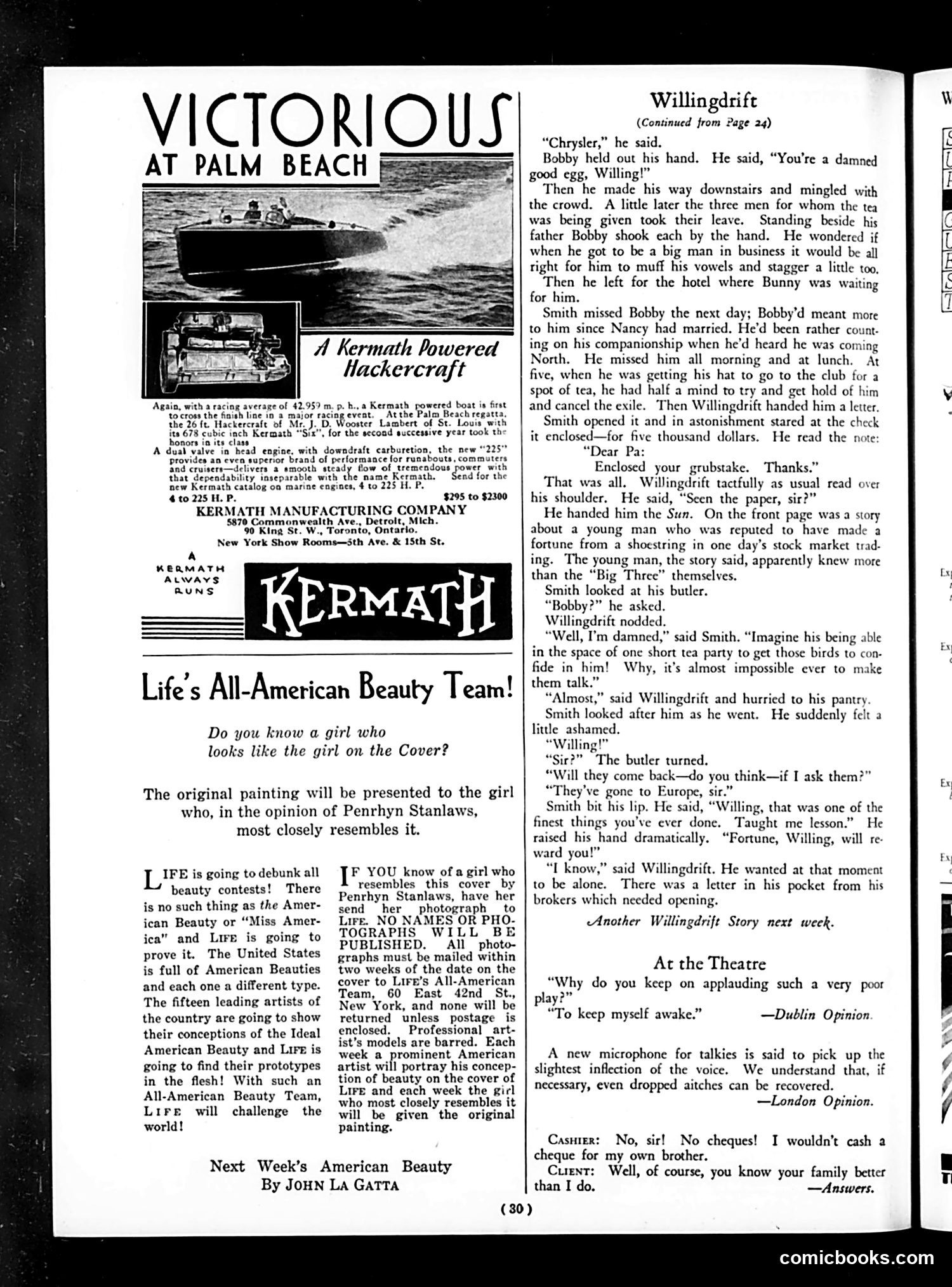
Analysis of "Willingdrift" by Eric Hatch This is a short story (not primarily a cartoon), occupying a magazine page with one illustration showing three men in conversation. Plot summary: Bobby, a wealthy but financially irresponsible son, has squandered money on a racehorse called "Jig-Saw." His father Smith threatens to cut him off, but then relents—offering Bobby five thousand dollars to settle debts on condition he stay for a dinner party with important business associates and that he separate from his wife Bunny. The satire targets: Wealthy idle characters and family dynamics among the privileged class. Smith represents the self-made businessman holding financial power over his dependent son. Bobby and Bunny represent the frivolous younger generation spending inherited wealth recklessly. Social commentary: The piece satirizes the brittleness of family relationships when money is involved, parental control through financial leverage, and the shallow concerns of the wealthy (horses, parties, Caribbean estates). The illustration simply depicts the three men conversing—no political figures or specific historical references are identifiable.
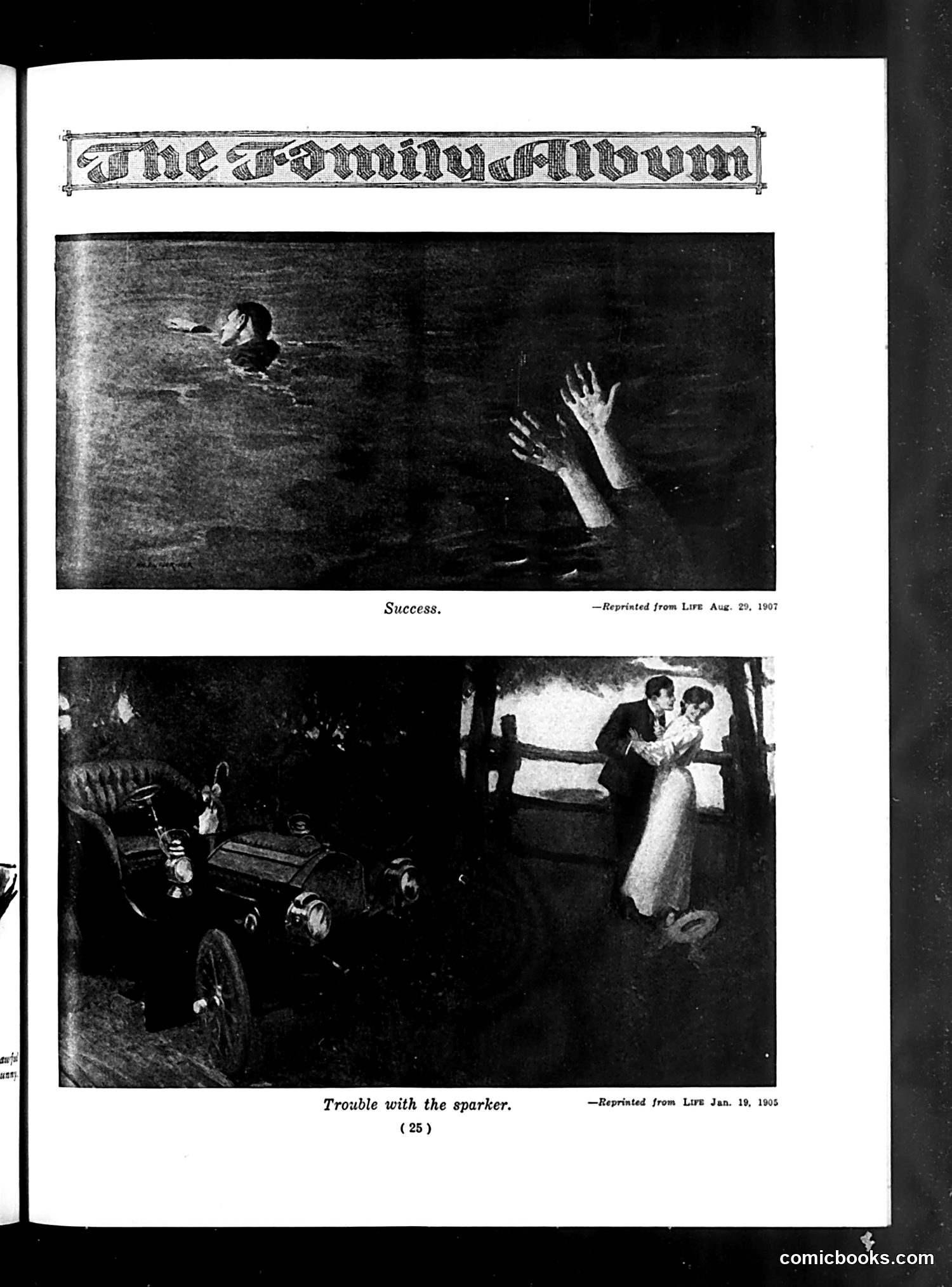
The Automobile Age: Early 1900s Humor This page presents two early automotive cartoons from *Life* magazine, satirizing the novelty and unreliability of automobiles around 1905-1907. The top image titled "Success" depicts a swimming scene—likely commenting on the dangers or difficulty of early motoring, with a figure in water raising their arms in apparent relief or triumph. The bottom cartoon, "Trouble with the sparker," shows an early automobile with several people examining it. The "sparker" refers to the ignition system—a notoriously finicky component in early cars. The scene humorously illustrates the constant mechanical problems owners faced. The presence of multiple people suggests the social spectacle and communal effort required just to keep these vehicles running, poking fun at automobiles' unreliability during the horseless-carriage era.
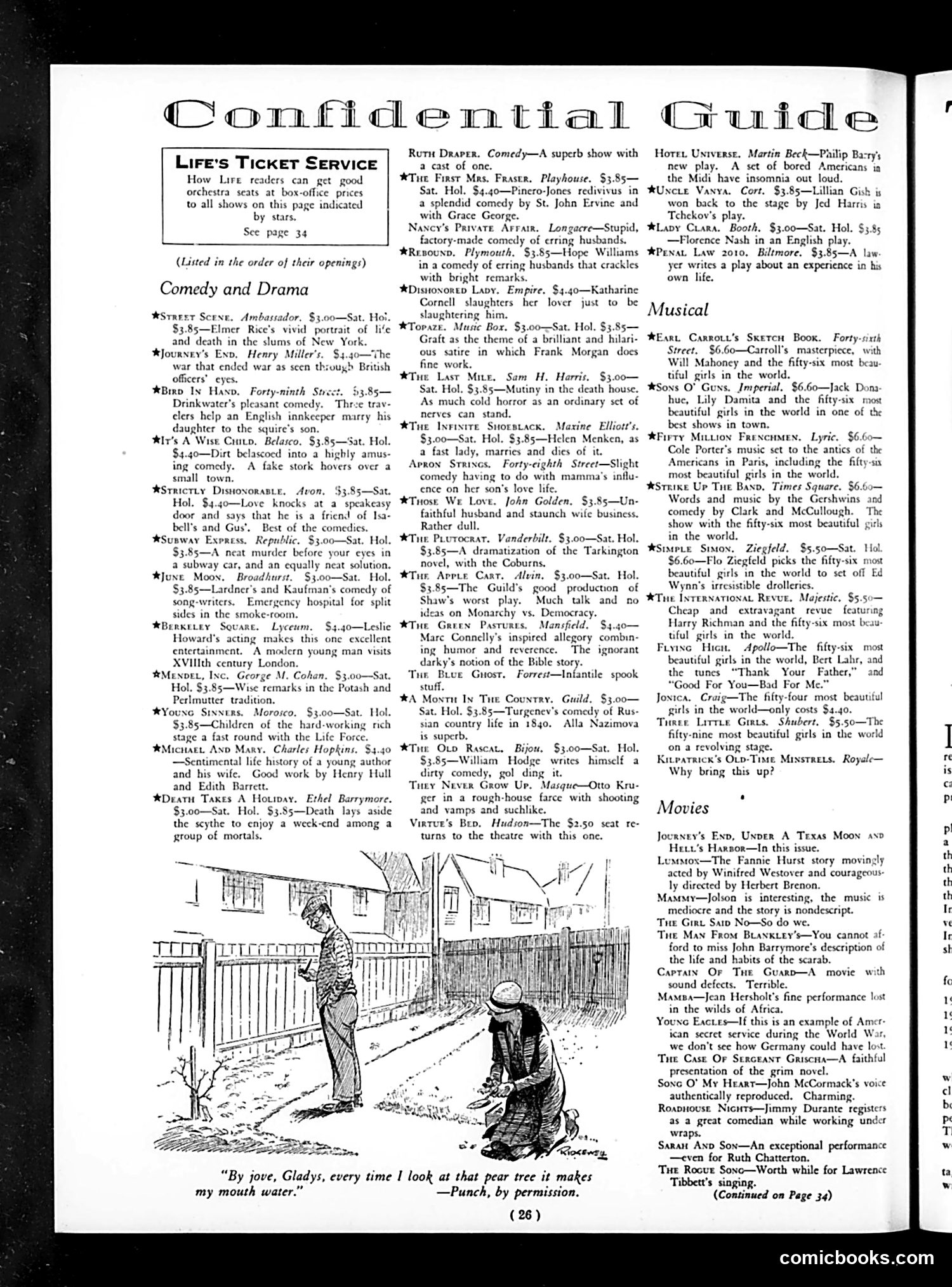
Analysis of This Life Magazine Page This is a theater guide and review page, not a political cartoon. It lists Broadway shows with prices and brief critical descriptions, organized by genre (Comedy/Drama, Musical, Movies). The single illustration shows two men in what appears to be a working-class or impoverished setting, with one standing and one crouching near the ground. The caption quotes Punch magazine: "By jove, Gladys! every time I look at that pear tree it makes my mouth water." This is a humorous cartoon about poverty or desperation—the joke being that even looking at a pear tree makes someone's mouth water because they're hungry or in want. The reference to "Punch" (British humor magazine) and the formal speech pattern ("By jove, Gladys!") suggest gentle satire about the contrast between refined language and harsh circumstance. The page itself is primarily a practical service guide for Life's readers seeking theater tickets at reasonable prices, with asterisks marking shows where discounted seats were available.
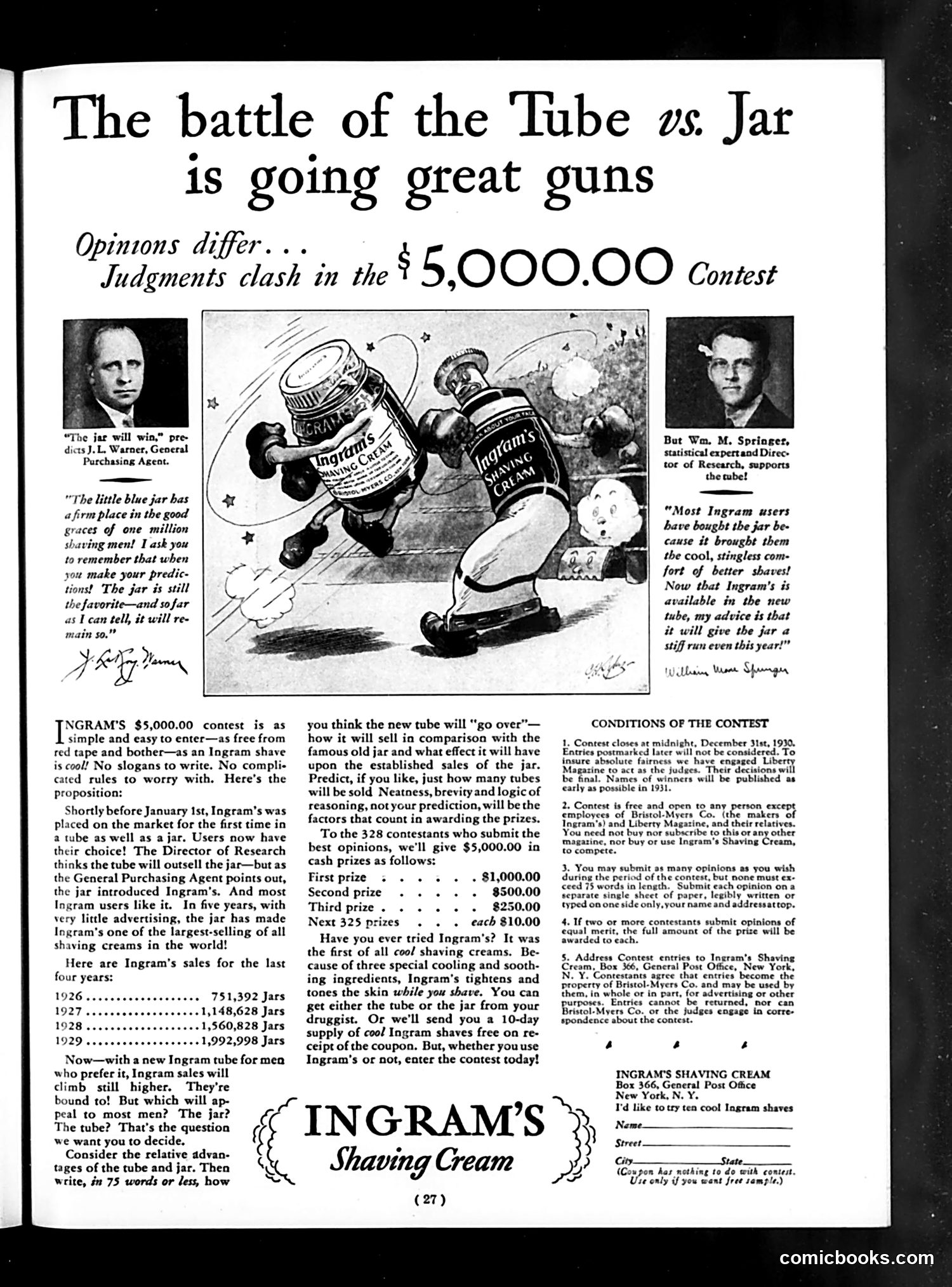
What This Page Means This is a 1930 advertisement for Ingram's Shaving Cream disguised as a consumer contest. The company has introduced their product in a new tube format alongside the traditional jar, and is running a $5,000 contest asking customers to predict which packaging will outsell the other. The "battle" depicted is literal: the cartoon shows a tube and jar as boxers fighting. Two company executives offer opposing predictions—J.L. Warner (General Purchasing Agent) predicts the jar will win, citing its million-user loyalty; Wm.M. Springer (Director of Research) predicts the tube will succeed. The satire is gentle: Life magazine is poking fun at corporate confidence-building exercises. By framing a business decision as a democratic public vote, Ingram's appears to value customer opinion while actually conducting market research. The sales figures shown demonstrate Ingram's genuine success, making this less about whether they'll survive than about corporate self-congratulation dressed up as a game.
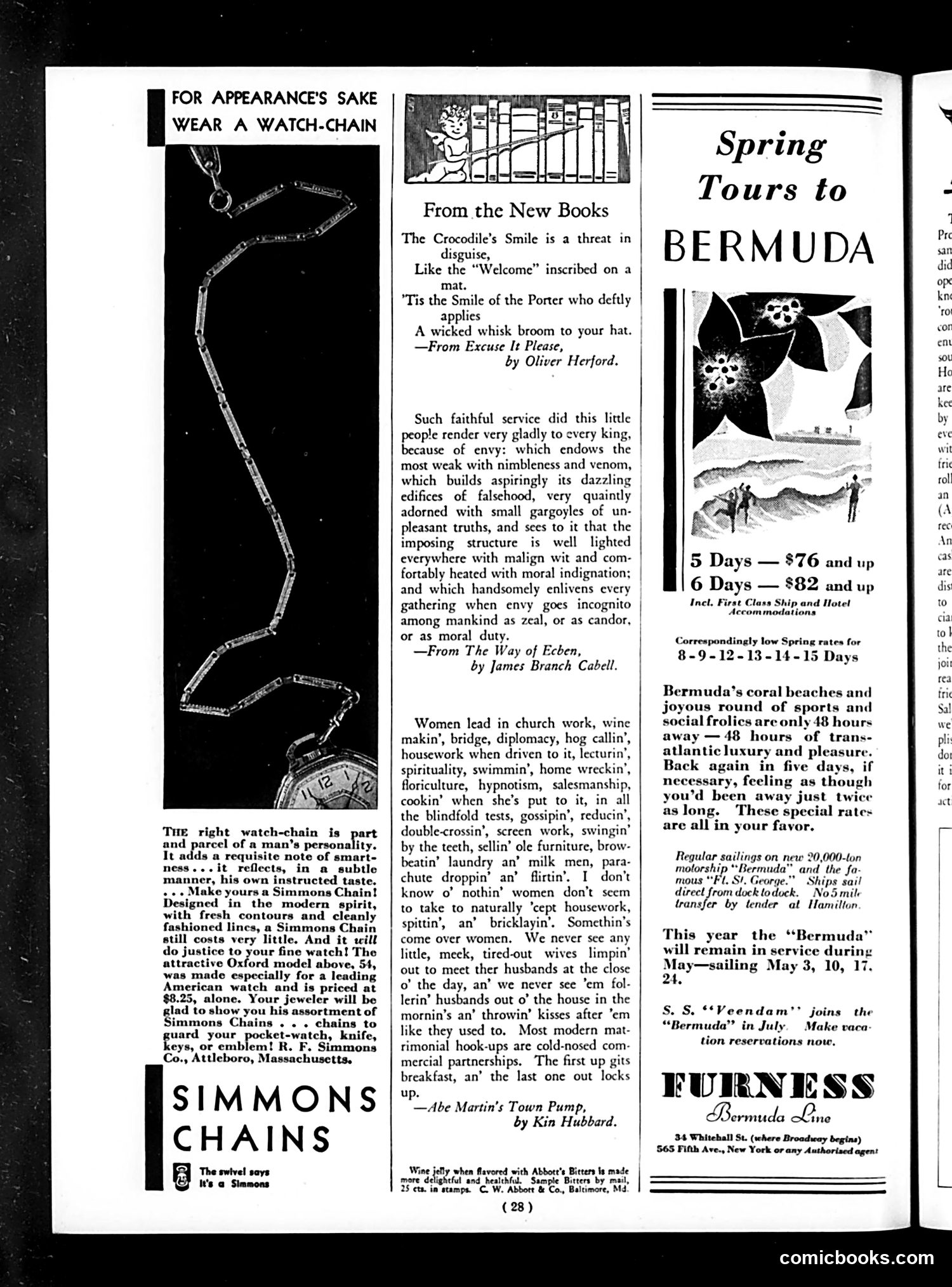
Page Analysis: Life Magazine Advertisement Section This page is primarily advertising and book excerpts, not political cartooning. The main visual content is a Simmons Chains advertisement (left) promoting watch-chains as markers of masculine taste and refinement. The imagery shows the chains themselves against a dark background with a pocket watch. The literary excerpts (center) provide satirical commentary on social behavior: - Oliver Herford mocks insincere hospitality - James Branch Cabell criticizes envy disguised as virtue - Kin Hubbard's "Abe Martin's Town Pump" (bottom) offers the sharpest social critique: a curmudgeonly complaint that modern women have abandoned traditional submissiveness, now engaging in diverse activities and treating marriage as "cold-nosed commercial partnerships" rather than devotion. This reflects 1920s anxiety about women's changing roles post-suffrage. The right side features Furness Line travel advertisements for Bermuda cruises. The page reflects period attitudes about gender, consumerism, and class status through consumption.
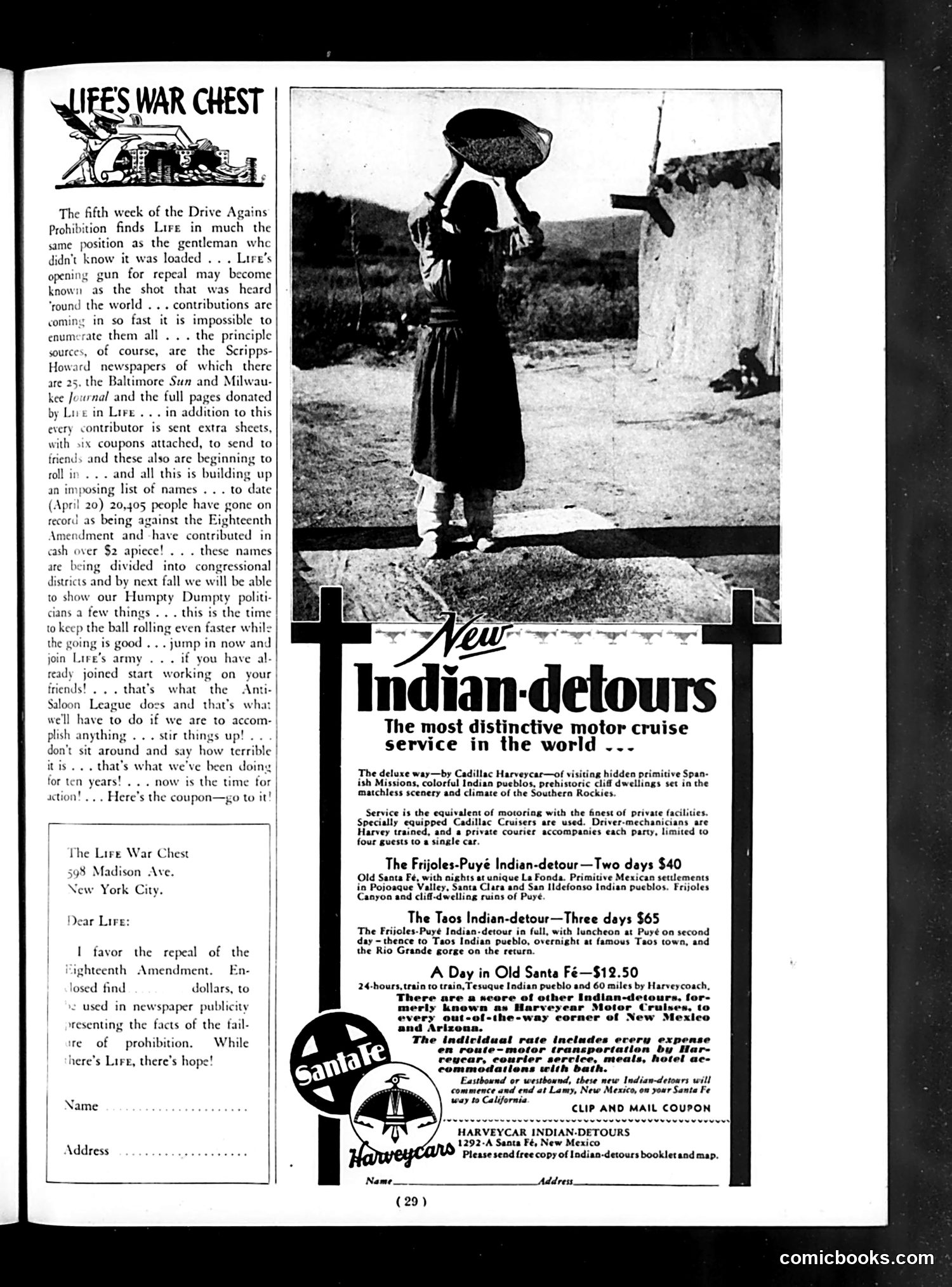
Analysis of Life Magazine Page (circa 1920s) This page primarily features advertising for Harveycar Indian-detours motor cruises in the Southwest, with a secondary editorial section about *Life* magazine's anti-Prohibition campaign. The Editorial Content ("Life's War Chest"): *Life* is fundraising for a repeal campaign against the 18th Amendment (Prohibition). The text boasts that 20,405 people have contributed $2+ each to oppose Prohibition, with funds being organized by congressional district. The editor compares themselves to the "Humpty Dumpty politicians" they aim to pressure. This reveals *Life*'s satirical stance: the magazine opposed Prohibition and was actively organizing a grassroots anti-Prohibition movement during the 1920s. The Advertisement: The large image shows a person in silhouette carrying what appears to be supplies, promoting scenic motor tours through New Mexico featuring Native American pueblos and historic Spanish missions—typical leisure tourism marketing of the era. The page demonstrates how *Life* mixed editorial advocacy with commercial advertising, and reveals contemporary anti-Prohibition sentiment among at least some American media outlets.
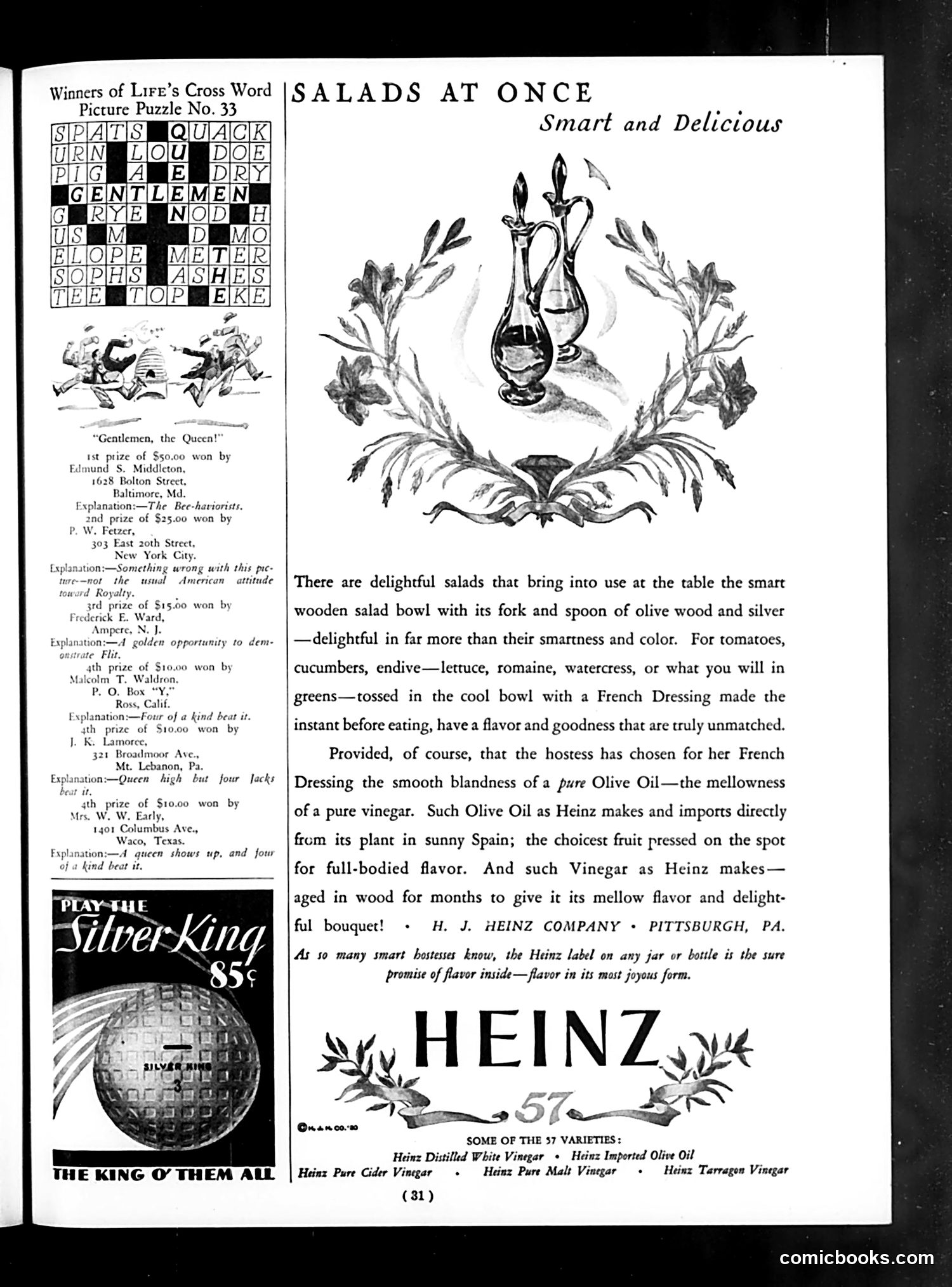
Analysis of This Life Magazine Page This page combines a crossword puzzle contest with a Heinz advertisement. The cartoon at top left shows a toast to "the Queen," with prize-winning explanations playing on poker terminology—"bee-haviorists," "four of a kind," "queen high but four jacks." The humor appears to mock Americans' irreverent attitude toward British royalty by reframing royal protocol through gambling slang, suggesting the Queen is treated casually rather than with deference. The bulk of the page is a Heinz advertisement for salad ingredients (olive oil and vinegar), featuring decorative botanical imagery. This represents typical early-20th-century food advertising that emphasized quality ingredients and refinement for the hostess. The ad's focus on "smart" entertaining reflects period concerns with domestic sophistication among middle-class women. The page blends entertainment (puzzle contest) with commerce (product promotion)—a common Life magazine strategy for generating reader engagement while securing advertising revenue.
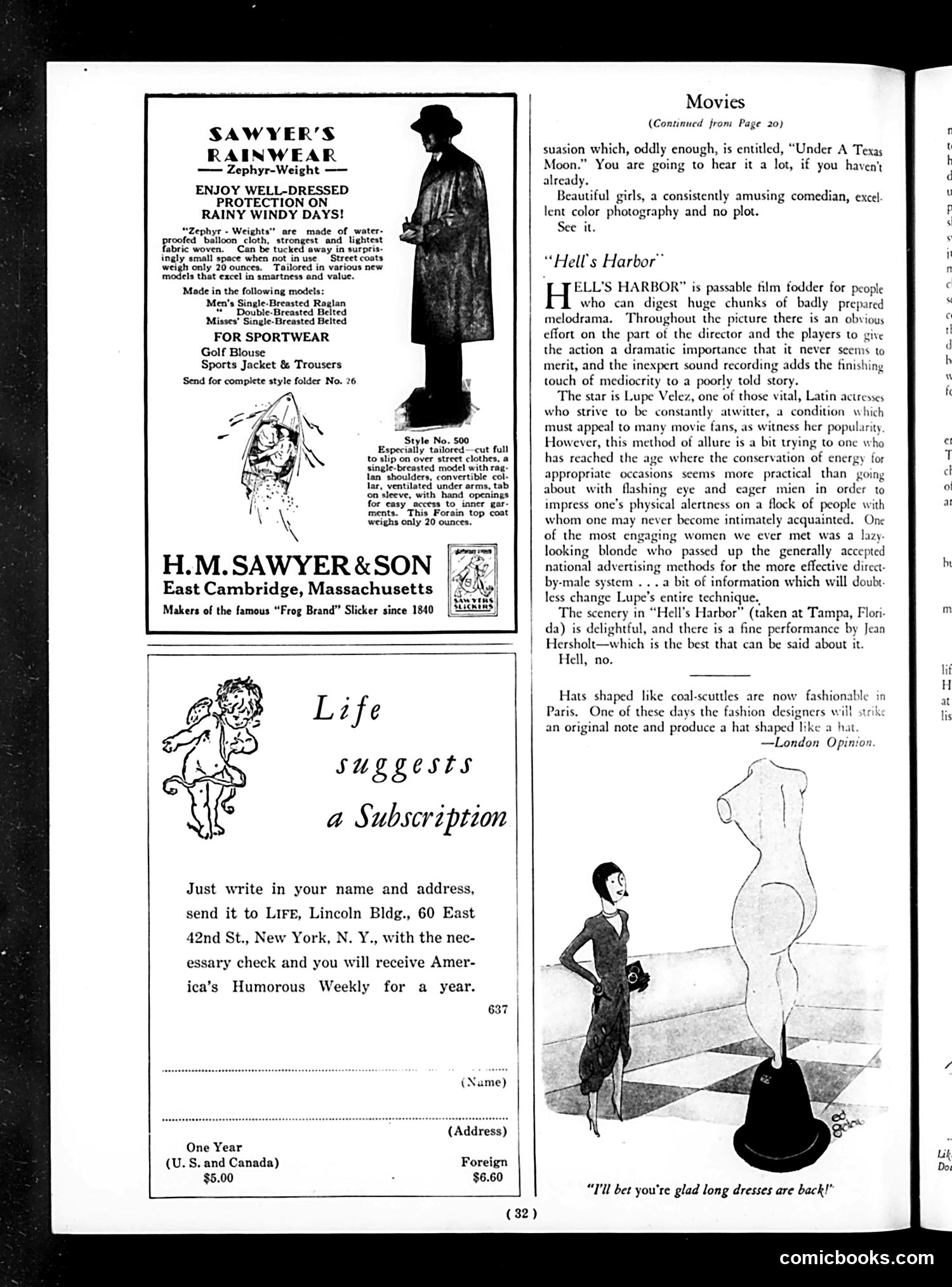
Page Analysis: Life Magazine (circa 1920s-30s) This page combines advertisements with movie reviews. The main content includes: Advertisements: - Sawyer's Rainwear (waterproof coats marketed as lightweight and fashionable) - Life magazine subscription pitch Movie Reviews: The text critiques two films: 1. "Under A Texas Moon" — dismissed as having "beautiful girls," an "amusing comedian," and "no plot," suggesting it's lightweight entertainment. 2. "Hell's Harbor" — reviewers call it "passable" melodrama with poor sound recording. The star, Lupe Velez (a Latin American actress), is criticized for her constant animated mannerisms—the reviewer suggests her method of "flashing eye and cager mien" is exhausting rather than charming. Jean Hersholt receives praise for his supporting performance. The Cartoon: A woman in a long dress admires a sculptural form shaped like a dress, with the caption "I'll bet you're glad long dresses are back!"—mocking the cyclical nature of fashion trends. The page reflects 1920s-30s entertainment and fashion commentary.
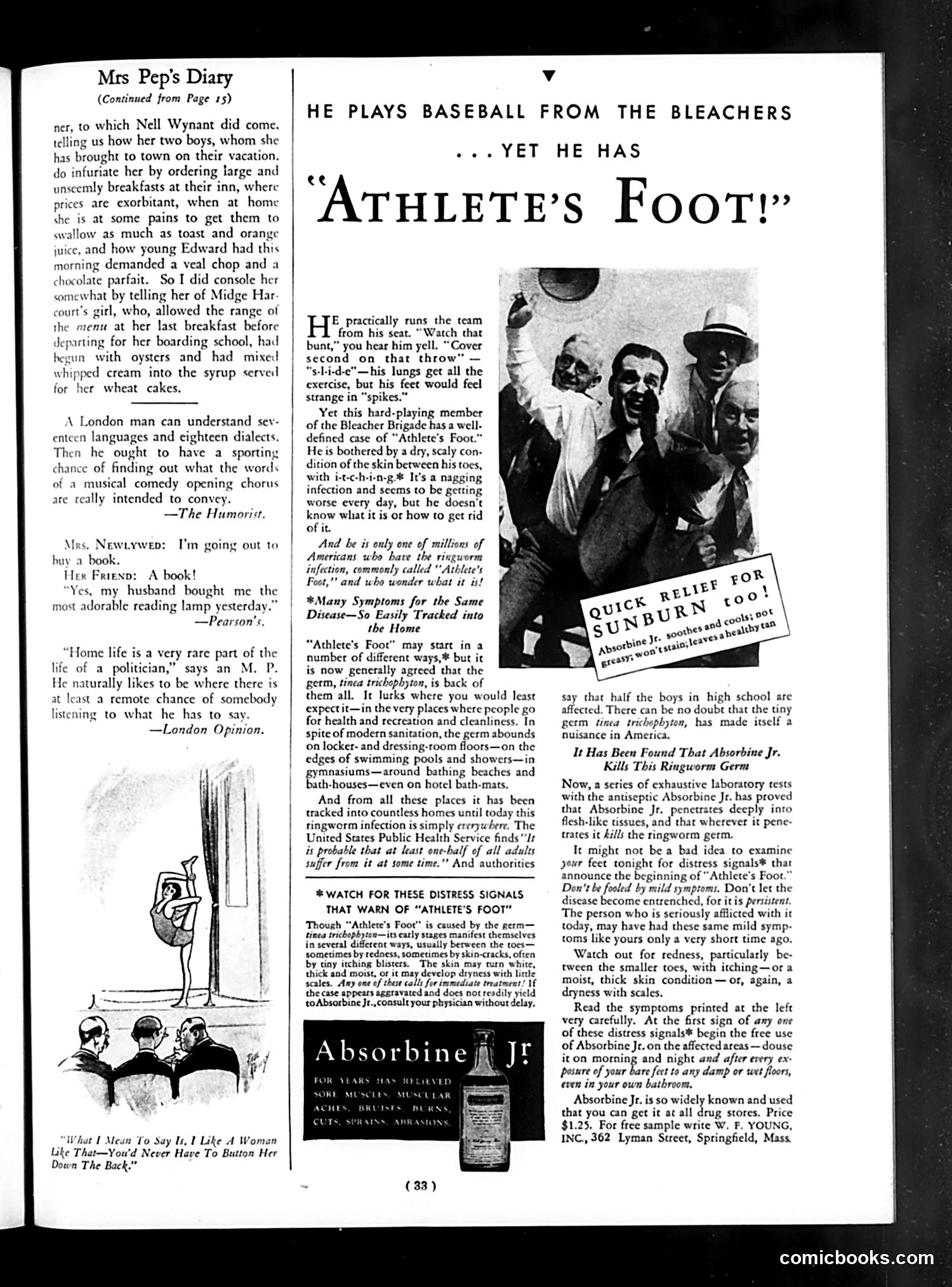
"Athlete's Foot" Advertisement (Life Magazine) This page is primarily a pharmaceutical advertisement for Absorbine Jr., disguised as health journalism. The illustrated figure is a generic "Bleacher Brigade" baseball fan—not a specific caricature—used to demonstrate the contradiction that someone athletic enough to enthusiastically coach from the stands could nevertheless suffer from athlete's foot (tinea trichophyton ringworm). The satire is implicit: despite modern sanitation, the fungal infection remains ubiquitous in gyms, pools, and locker rooms, affecting "at least one-half of all adults." The advertisement masquerades as public health education by listing symptoms and warning signs, then pivots to promoting Absorbine Jr. as treatment. The sidebar "Mrs. Pep's Diary" and comic excerpts are filler content typical of Life magazine's satirical format, unrelated to the main advertisement.
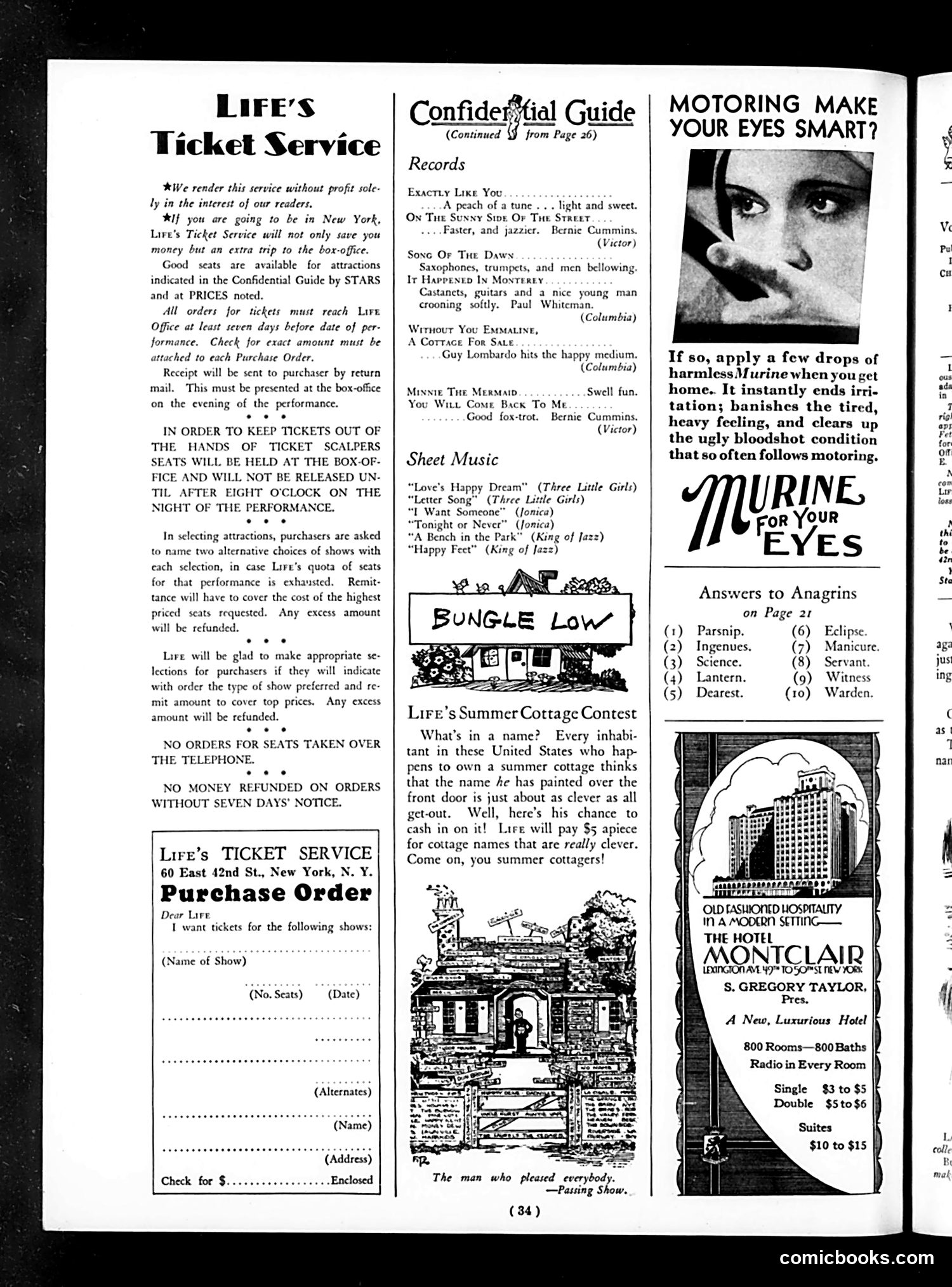
Life Magazine Page Analysis This page is primarily advertisements and service listings rather than political satire or editorial cartoons. It contains: Main Content: - Life's Ticket Service: a reader service offering Broadway tickets in New York, with detailed ordering instructions and anti-scalping measures - Record and sheet music recommendations (jazz and popular songs of the era) - A cottage-naming contest offering $5 per clever summer cottage name - Small decorative illustrations of a cottage and bungalow (non-satirical) Advertisements: - Murine eye drops (for motorists' eye strain) - Hotel Montclair (luxury hotel in NYC) Historical Context: The page reflects 1920s consumer culture—Broadway was a major entertainment destination, recorded music was still relatively new, and automobiles were becoming common enough that eye irritation from motoring was a recognized complaint. The cottage contest speaks to growing vacation home ownership among the middle/upper classes. No political cartoons or satire appears on this page.
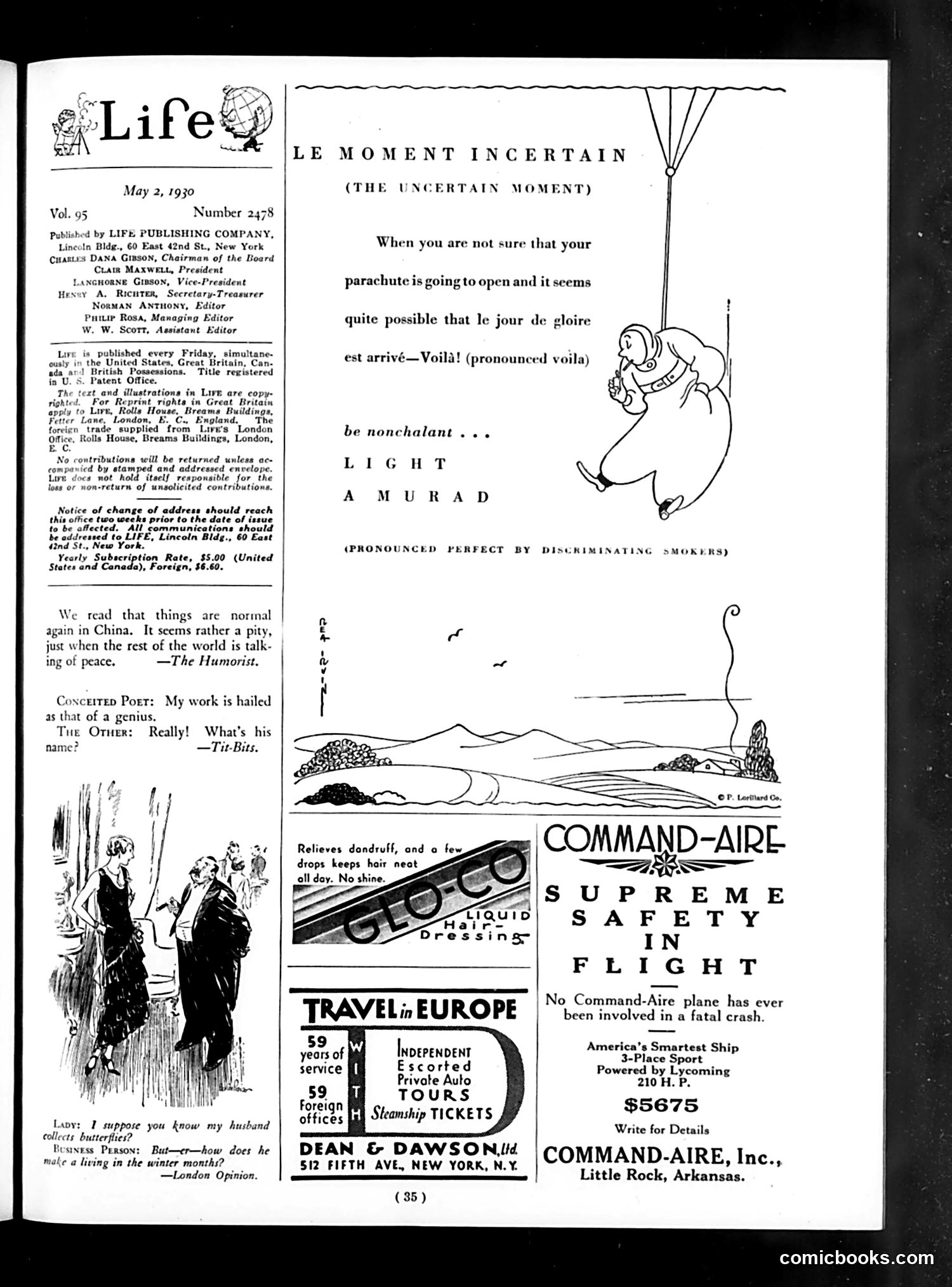
Cartoon Analysis: Life Magazine, May 2, 1930 This page contains two distinct elements: Main Cartoon ("Le Moment Incertain"): A humorous illustration of a skydiver whose parachute may or may not open, captioned with French phrases. The joke advises nonchalance during this potentially fatal moment—absurdist humor playing on the gap between rational fear and forced composure. The cartoon ridicules the notion that one should remain calm facing death. Lower Cartoons: Two brief comic dialogues satirizing pretension and social obliviousness. The "Conceited Poet" joke mocks artistic ego; the "Lady and Businessman" joke plays on the absurdity of collecting butterflies as a winter profession, poking fun at wealthy hobbyists and their detachment from practical economics. The page is primarily advertising-heavy, featuring cigarette ads (Murad), hair dressing (Crego), travel services (Dean & Dawson), and aircraft (Command-Aire). The advertisements are period pieces reflecting 1930s commercial interests. The overall tone is light, satirical commentary on human folly and pretension, typical of Life's editorial approach during this era.
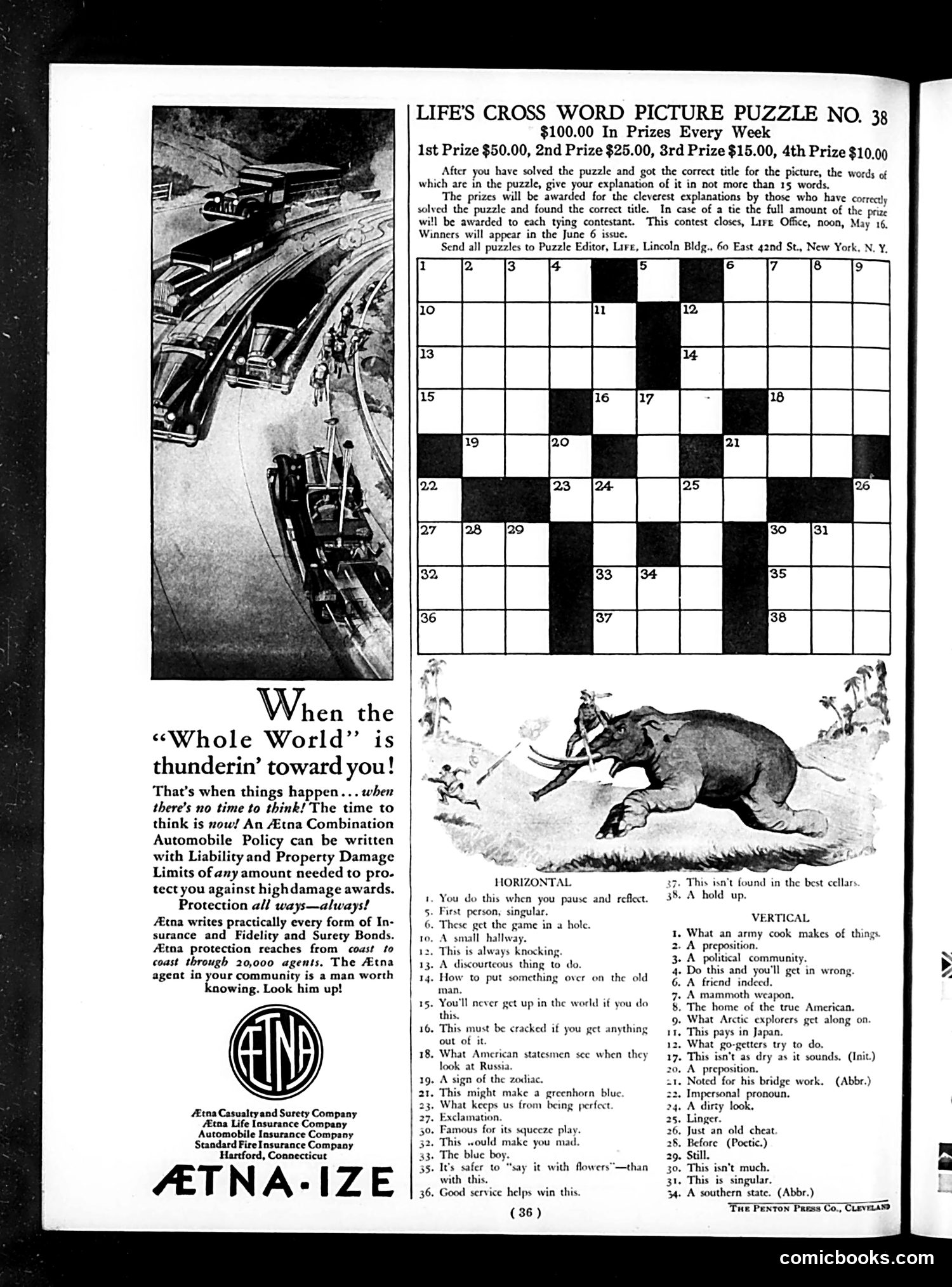
This page is primarily an advertisement for Aetna insurance featuring a dramatic illustration of cars on a curved road with the tagline "When the 'Whole World' is thunderin' toward you!" The ad's message is straightforward: automobile accidents happen suddenly ("when there's no time to think"), so you should purchase comprehensive Aetna insurance *now*. The insurance company emphasizes they offer flexible liability and property damage coverage through 20,000 agents nationwide. The lower half contains an unrelated crossword puzzle contest where readers solve a picture puzzle and submit 15-word explanations for prizes ($50 first place). The clues reference common 1930s-40s cultural references and wordplay typical of the era. This is essentially a pure advertisement page disguised partly as entertainment content—a common magazine strategy of the period to increase reader engagement while promoting insurance products. The dramatic artwork of vehicles in peril serves the advertiser's persuasive purpose.
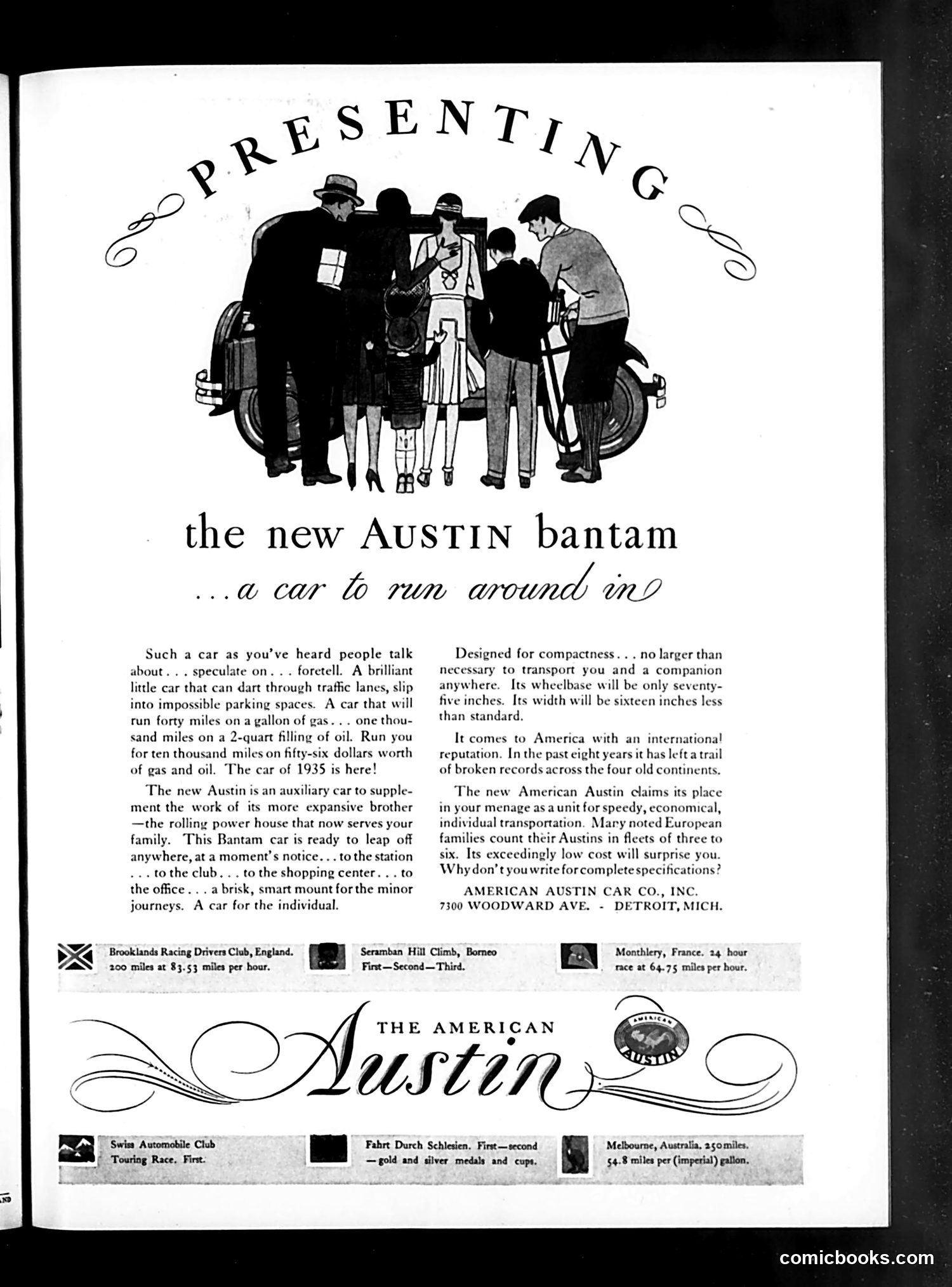
Analysis This is primarily a automobile advertisement, not satire or political commentary. It promotes the new Austin Bantam car to American consumers. The illustration shows a diverse group of people (men and women in 1930s dress) gathered around a small car, emphasizing its appeal as practical personal transportation for various uses—commuting, shopping, social visits. The ad's selling points are economic efficiency (40 miles per gallon, low operating costs) and maneuverability ("slip into impossible parking spaces"), positioning it as an affordable "car for the individual" rather than a family vehicle. The text references the car's international racing record across "four old continents" to establish credibility. It notes European families own multiple Austins, suggesting affordability and reliability. The humor is gentle rather than satirical—the headline "a car to run around in" is deliberately understated for a practical, modest vehicle marketed during the Depression era as an economical alternative to larger American cars.
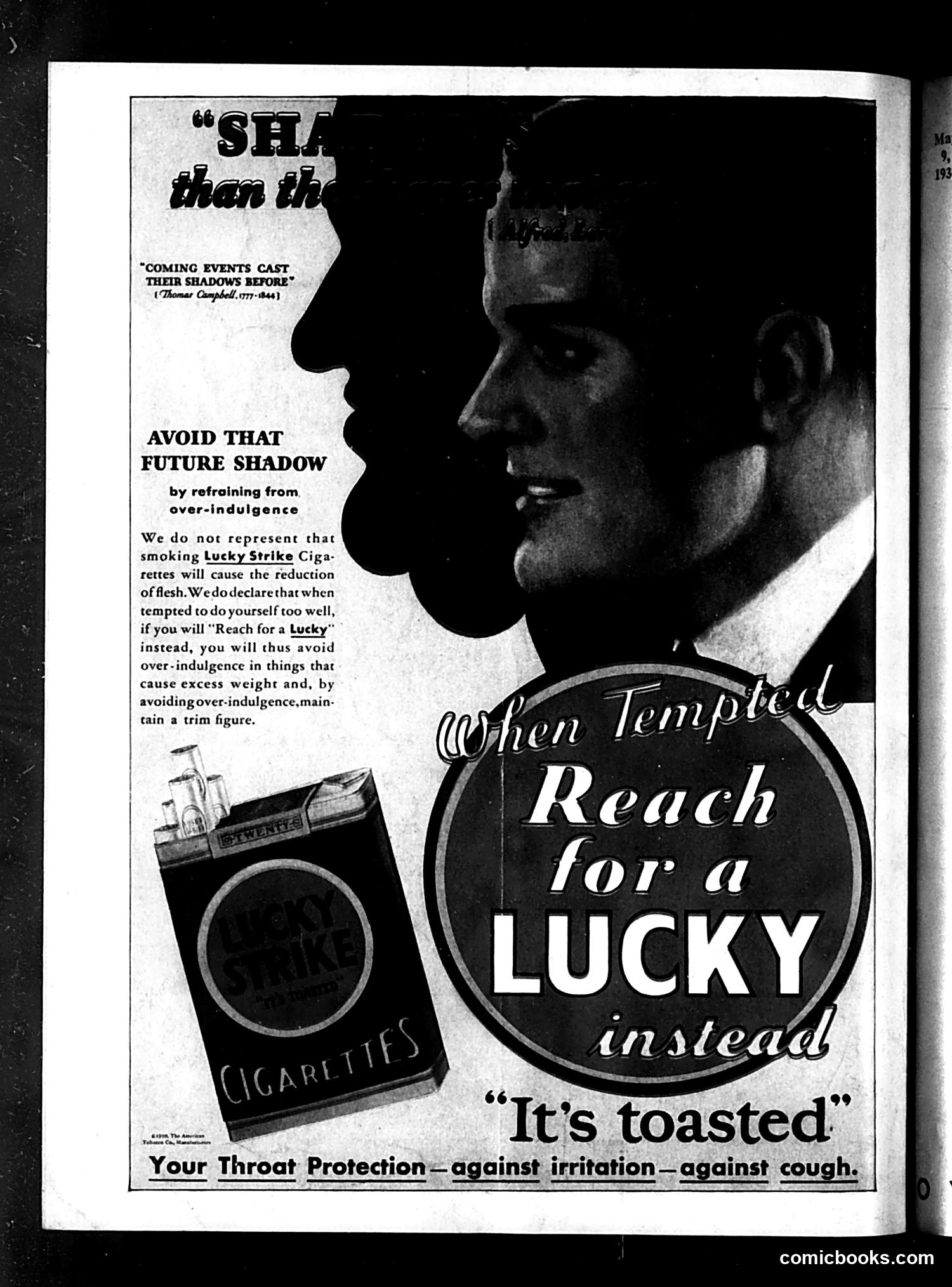
Lucky Strike Cigarette Advertisement Analysis This is a cigarette advertisement, not satire—it's a genuine Lucky Strike marketing campaign from approximately the 1920s-30s. The ad uses a silhouette showing a man's profile alongside a woman's profile to suggest weight loss. The pitch: instead of eating when tempted by indulgence, "reach for a Lucky" cigarette instead. This reduces caloric intake and maintains a "trim figure." The ad explicitly claims cigarettes don't cause weight loss, but positions smoking as an appetite suppressant—a diet aid. The "toasted" claim addresses throat health concerns. Context for modern readers: This reflects pre-regulation advertising when cigarette companies made direct health and weight-loss claims without scientific evidence. Smoking-as-dieting was a common marketing angle targeting women especially. Such advertisements are now illegal under tobacco regulations.