life
Life — May 9, 1930
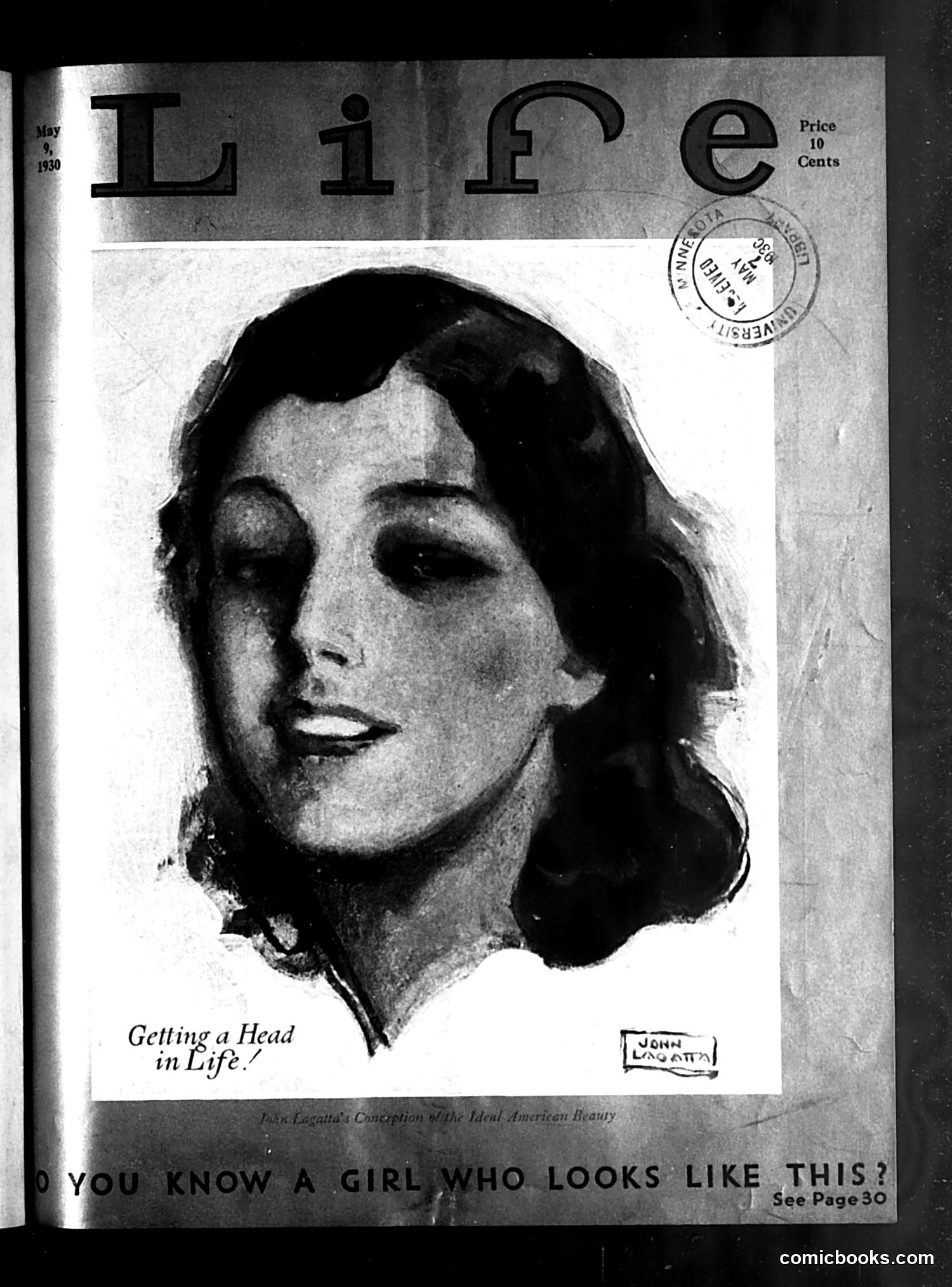
Life Magazine Cover Analysis (May 9, 1930) This is a Life magazine cover featuring a portrait illustration credited to John Lagatta. The headline reads "Getting a Head in Life" with a caption below asking "DO YOU KNOW A GIRL WHO LOOKS LIKE THIS?" directing readers to page 80. The satire appears to target 1930s beauty standards and the concept of "getting ahead" through appearance. Lagatta's illustration represents the "ideal American Beauty" according to the caption, suggesting Life will discuss what constitutes fashionable femininity and social advancement for women of the era. The cover presents beauty ideals as a commodity and social currency—the joke being that women's "success" or progress depended significantly on conventional looks rather than ability or merit. This reflects the period's commercialization of female appearance.
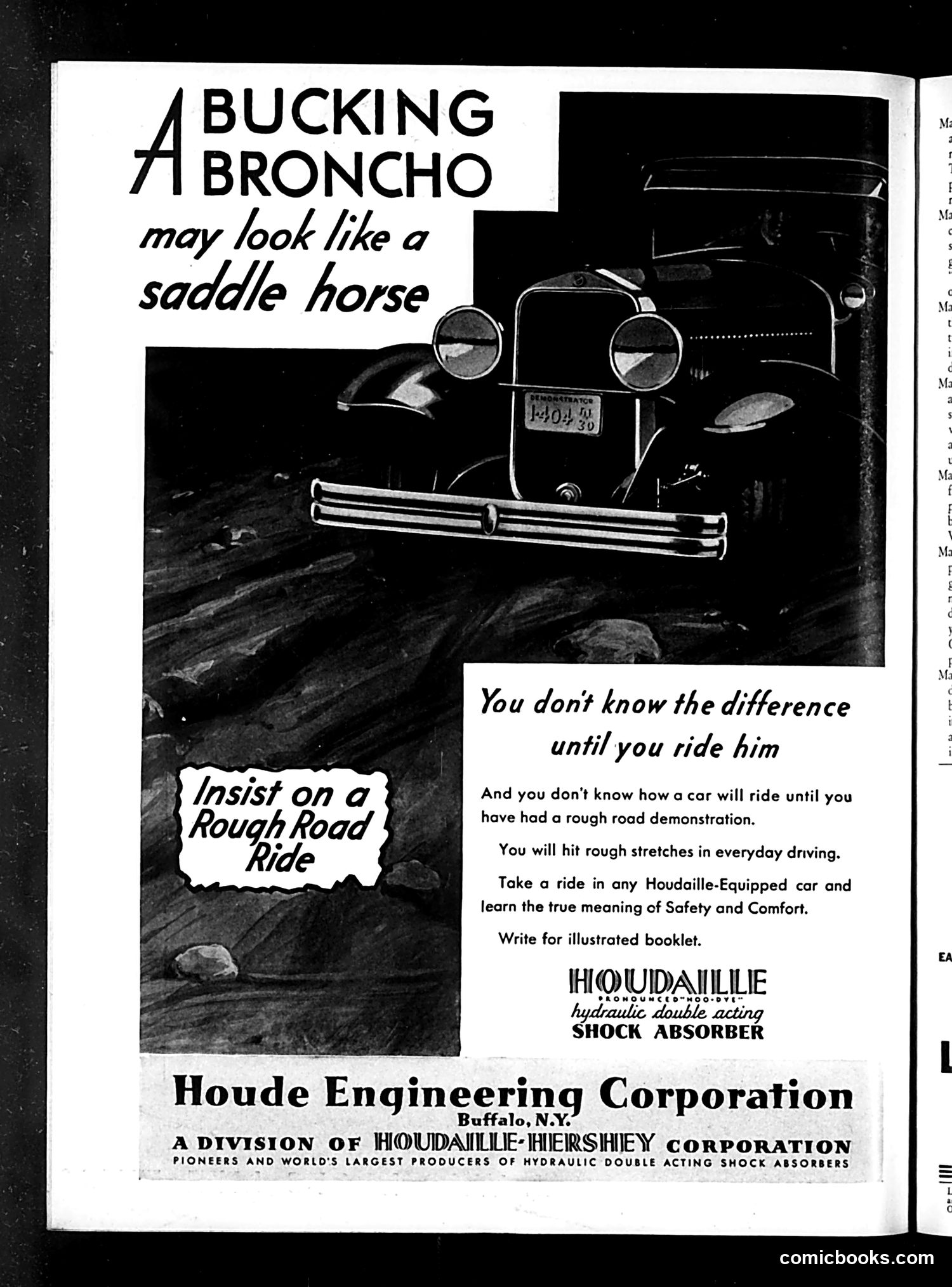
Advertisement Analysis This is a Houdaille shock absorber advertisement, not satire or political commentary. The ad uses a humorous visual metaphor: a bucking bronco horse representing a car with poor suspension on rough roads. The joke is comparative—a vehicle without Houdaille shock absorbers will buck and jolt like a wild horse when hitting rough terrain. The ad encourages potential customers to request a "Rough Road Ride" demonstration to experience the difference between equipped and unequipped vehicles. The advertisement emphasizes safety and comfort as selling points, suggesting that proper shock absorption technology was a notable automotive feature worth demonstrating to skeptical buyers in this era.
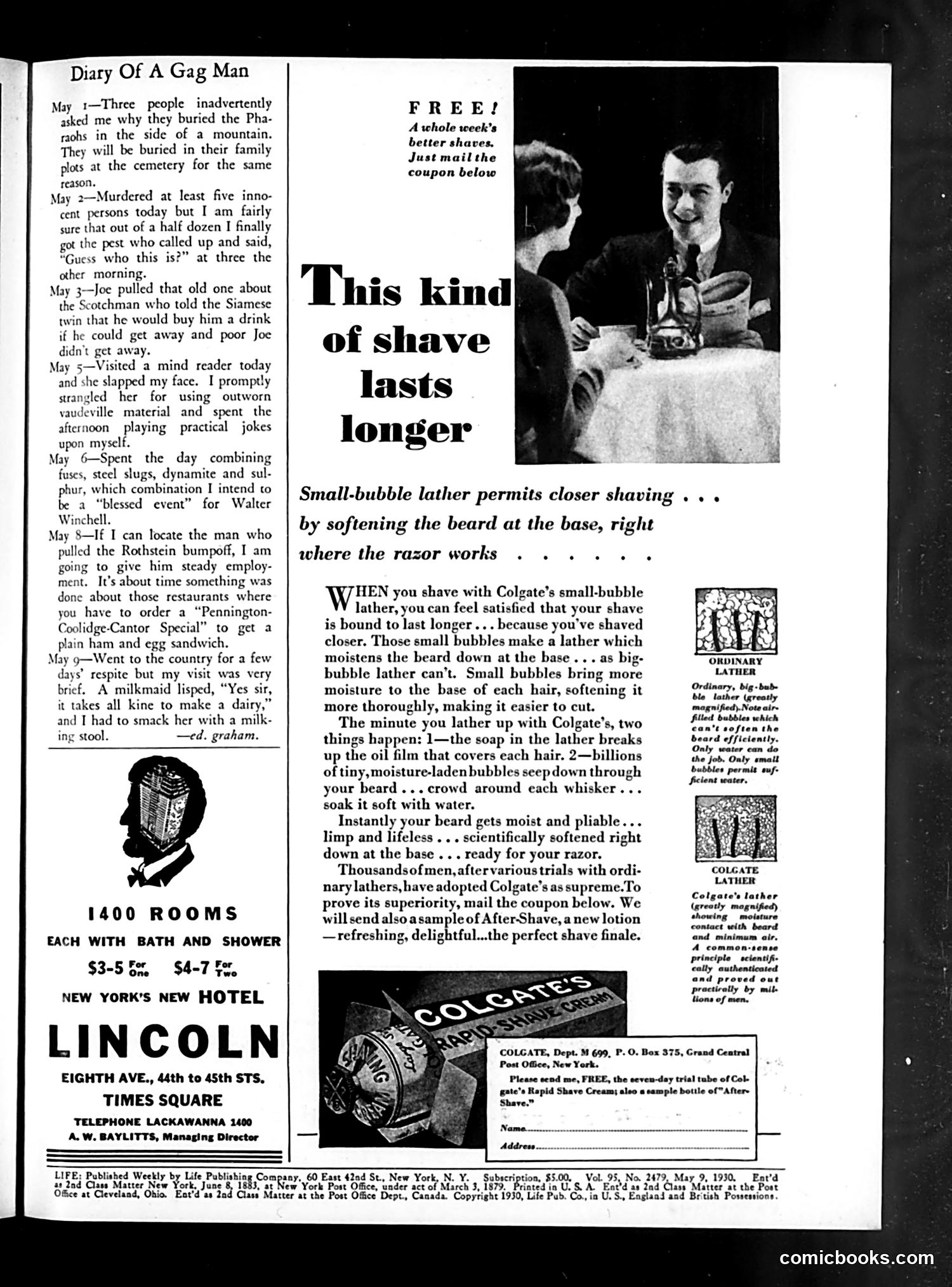
"Diary of a Gag Man" - Historical Context This page is primarily a Colgate shaving cream advertisement disguised as editorial content. The "Diary" entries on the left are humorous fictional observations (murders, mind readers, etc.) — typical of Life magazine's satirical style in the 1920s-30s. The main advertisement promotes Colgate's "small-bubble lather" as superior because it softens beards at the base for closer shaving. The pitch emphasizes scientific superiority: small bubbles allegedly penetrate better than large ones. The "gag man" diary format was a common Life feature — showcasing witty one-liners. The page also advertises the Hotel Lincoln in Times Square, reflecting Life's New York-centric audience. This reflects an era when advertisements posed as entertainment rather than clearly labeled commercial content.
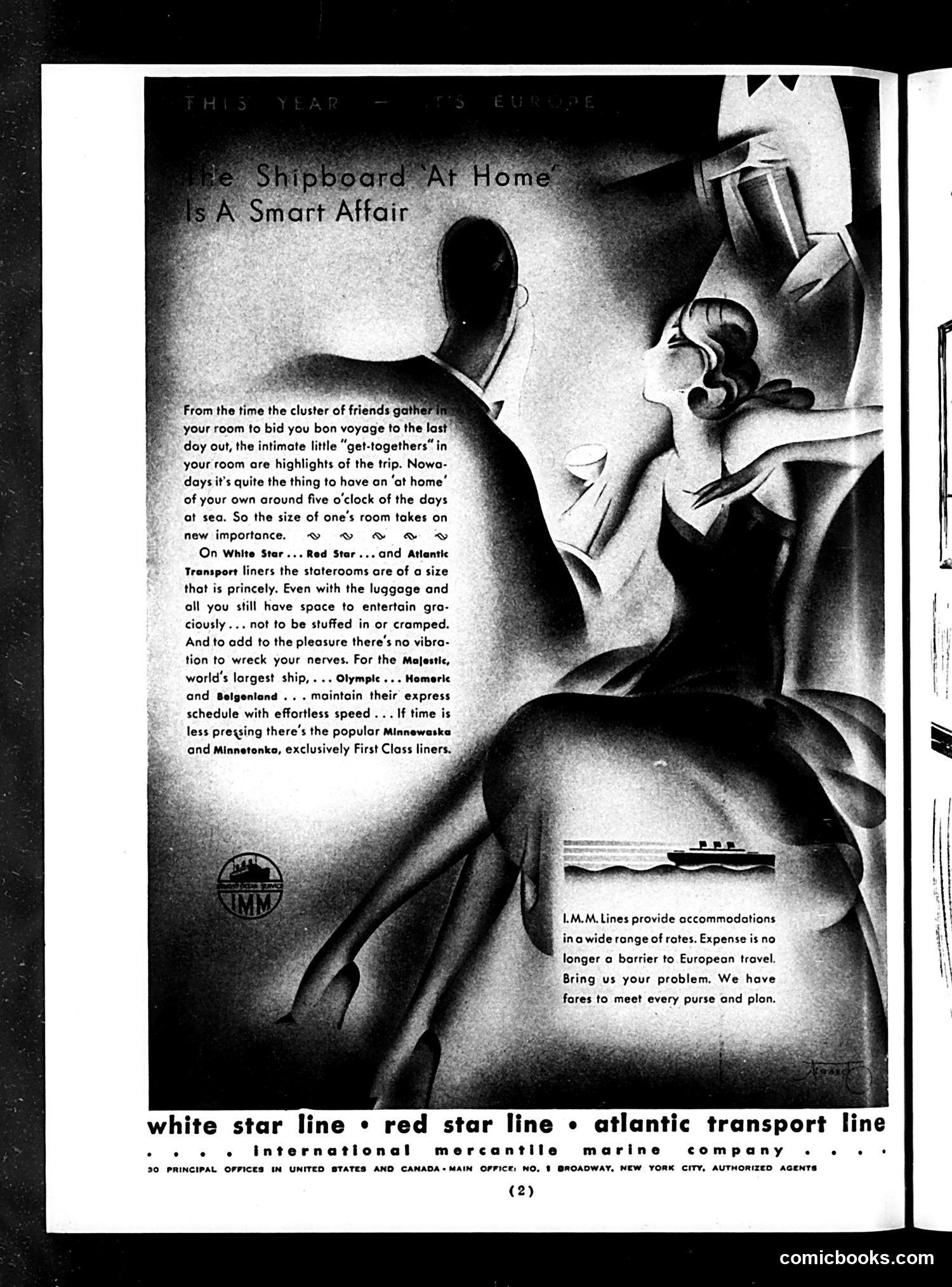
Analysis This is an advertisement, not political satire. It promotes transatlantic ocean liner travel via White Star Line, Red Star Line, and Atlantic Transport Line (operated by International Mercantile Marine Company). The illustration depicts two stylized figures in 1920s-30s fashion examining what appears to be ship accommodations or travel materials. The ad's central argument is that shipboard staterooms have become spacious enough to host social gatherings—making ocean travel an appealing leisure experience rather than mere transportation. The text emphasizes that modern liners like the *Majestic*, *Olympic*, *Homeric*, *Minnewaska*, and *Minnetonka* offer comfortable, affordable accommodations across multiple price points, removing financial barriers to European travel. This reflects the interwar era's growing middle-class tourism market.
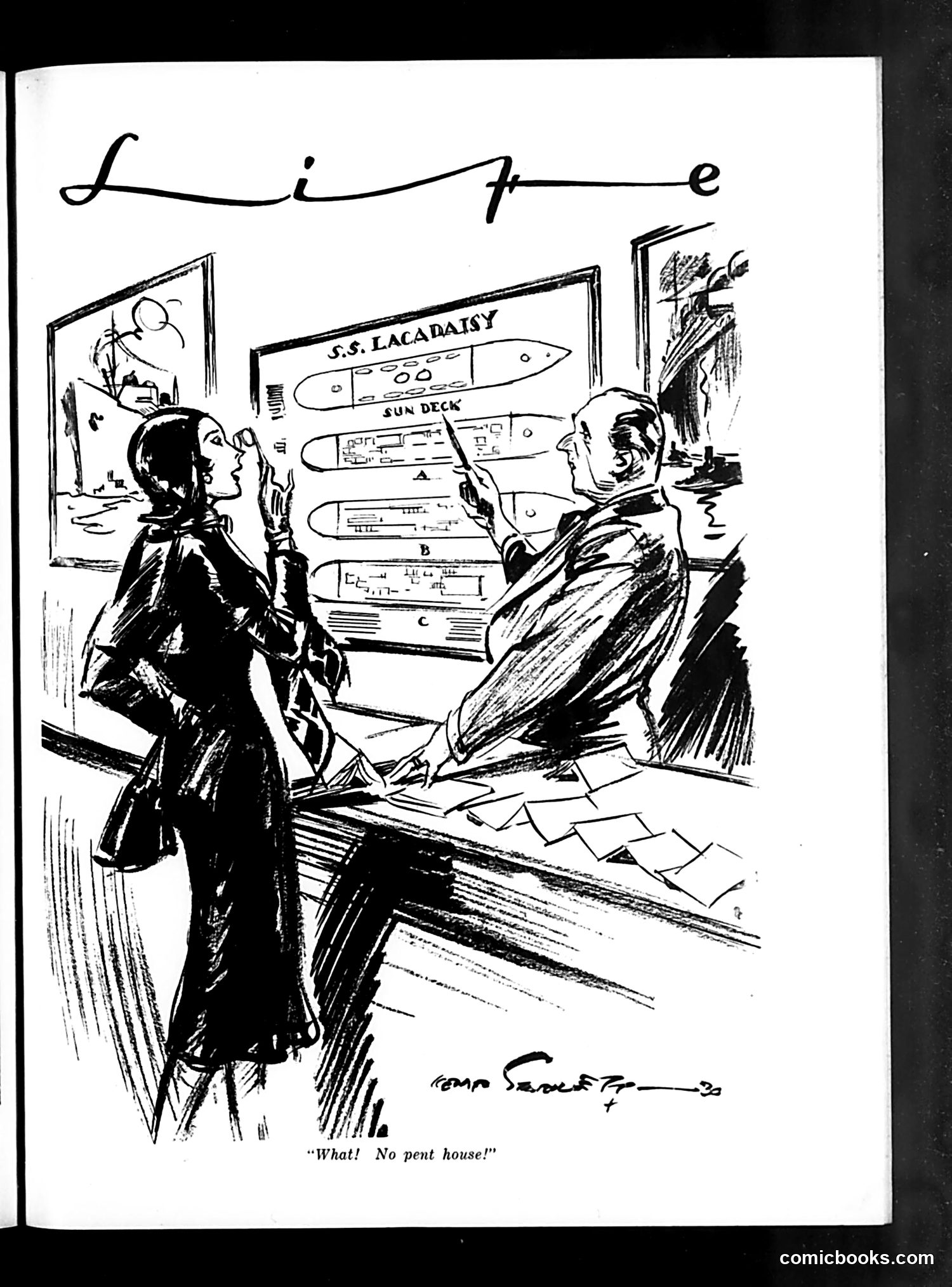
Explanation for Modern Readers This cartoon titled "What! No pent house!" satirizes luxury apartment marketing in early 20th-century America. A well-dressed woman (likely a wealthy prospective tenant) examines a blueprint of the S.S. Lacadaisy, a ship repurposed as luxury housing. She expresses shock that this vessel lacks a "penthouse"—the fashionable rooftop apartments that were becoming status symbols among the wealthy. The satire mocks two things: the absurdity of marketing a *ship* as residential housing, and the era's obsession with penthouse apartments as status symbols. The joke suggests that even conversion of ocean liners into housing couldn't satisfy the wealthy's appetite for the latest architectural trends. The cartoon critiques both real estate marketing excess and consumer materialism of the period.
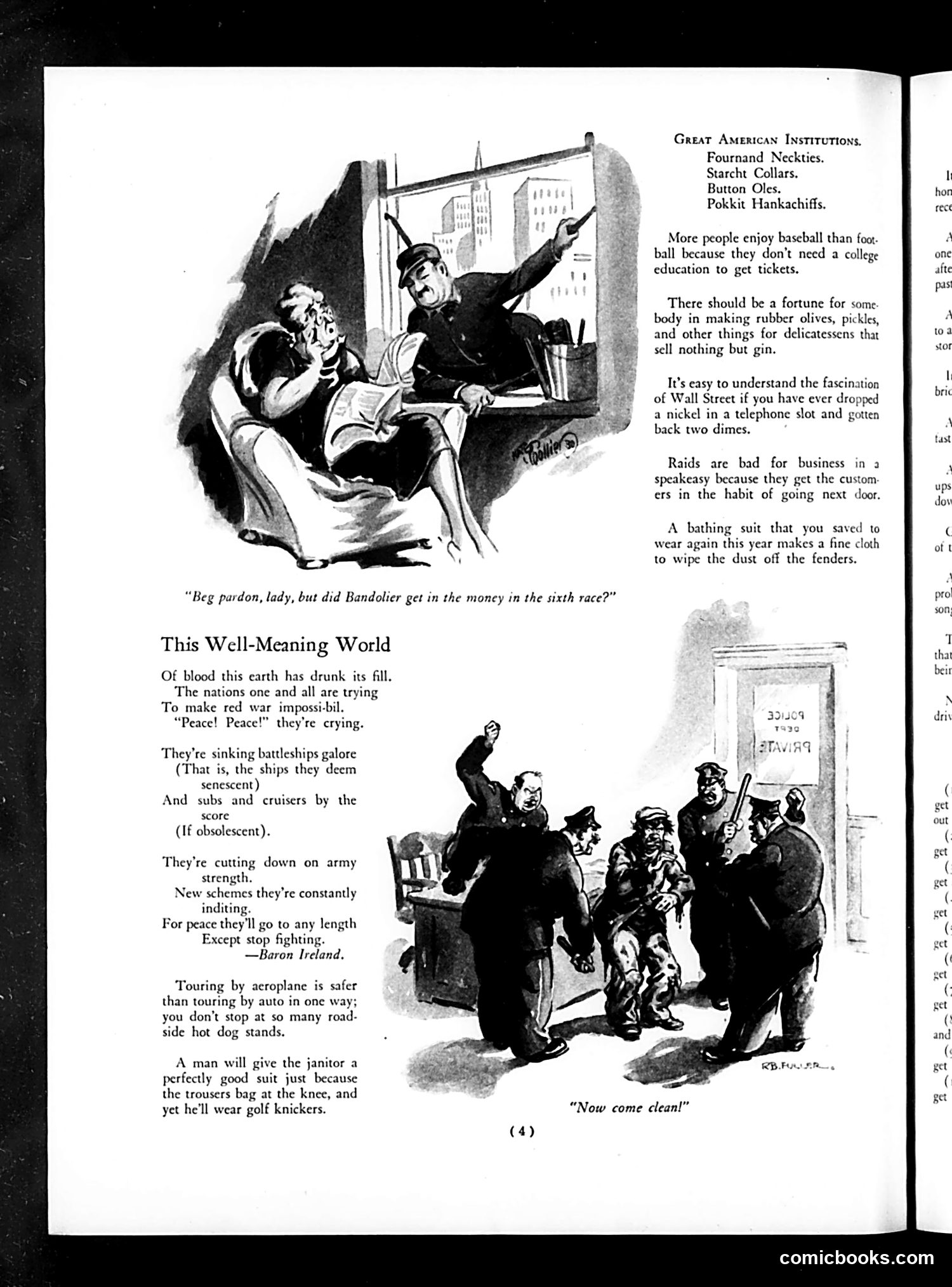
Analysis of Life Magazine Page This page contains satirical commentary on 1920s American society and politics. The top cartoon depicts someone asking about "Bandolier" in a horse race—likely referencing gambling and Wall Street speculation, which the adjacent text mocks as a "fascination" comparable to inserting nickels into slots. The poem "This Well-Meaning World" by Baron Ireland critiques post-WWI peace efforts, sarcastically describing nations' failed attempts at peace while simultaneously building weapons and planning wars. The phrase "Except stop fighting" undercuts the entire premise of their peace rhetoric. The lower cartoon captioned "Now come clean!" appears to depict political or police figures confronting someone, likely satirizing corruption or investigative proceedings, though specific figures remain unclear without additional context.
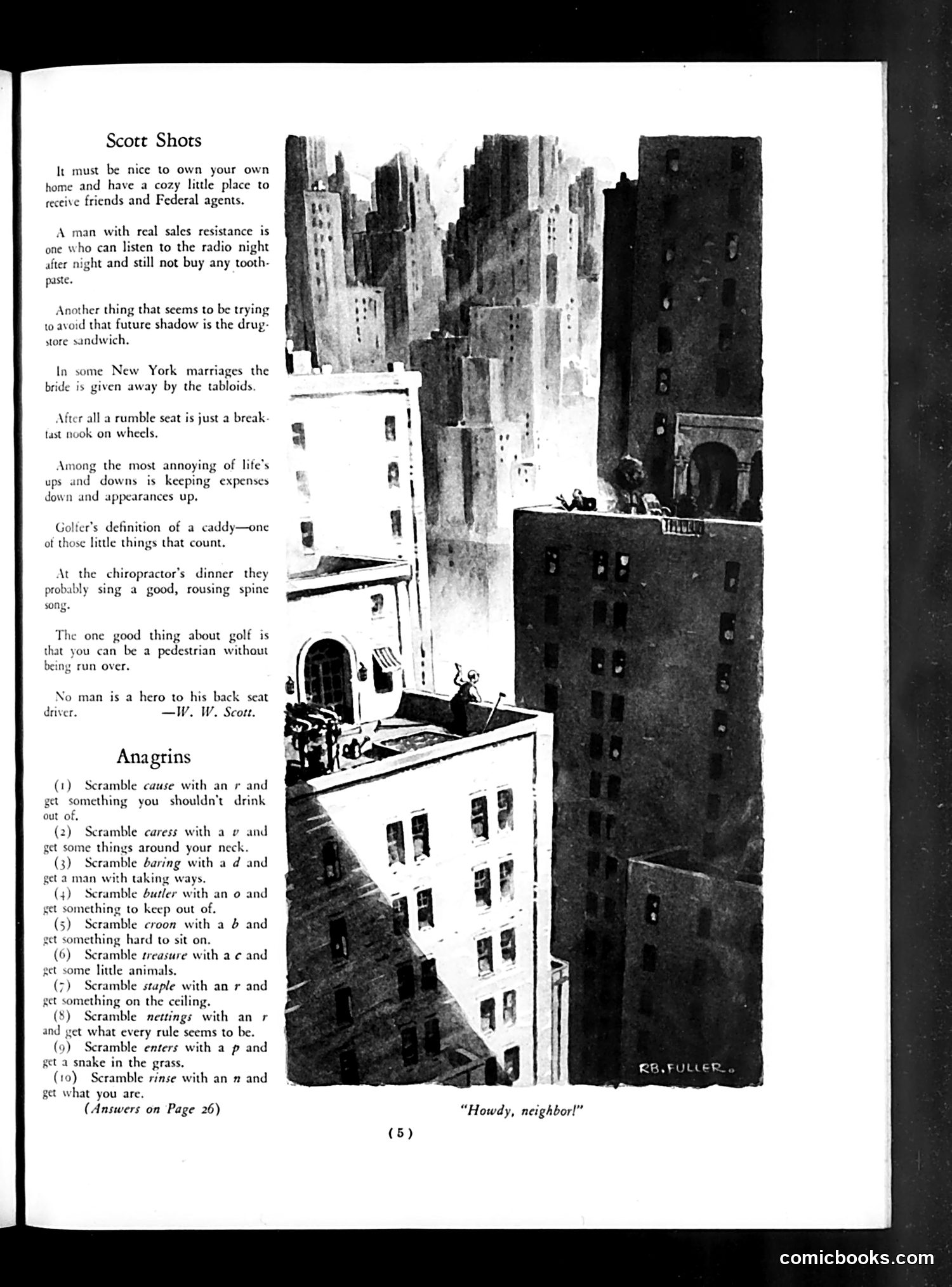
"Howdy, neighbor!" - Urban Apartment Life Satire This page satirizes modern urban living, particularly apartment-dwelling in New York City. The large illustration shows a crowded residential building with inhabitants visible in windows and on fire escapes, depicting the close quarters and lack of privacy characteristic of city apartment living. The text section "Scott Shors" offers humorous observations about city life—owning a small home, avoiding door-to-door salesmen, drugstore sandwiches, and tabloid-given wedding gifts. The "Anagins" wordplay section plays on letter scrambles, a popular puzzle format of the era. The title "Howdy, neighbor!" is ironic: despite living in dense proximity to many people, urbanites remain isolated and anonymous. The cartoon critiques the impersonal nature of crowded metropolitan existence.
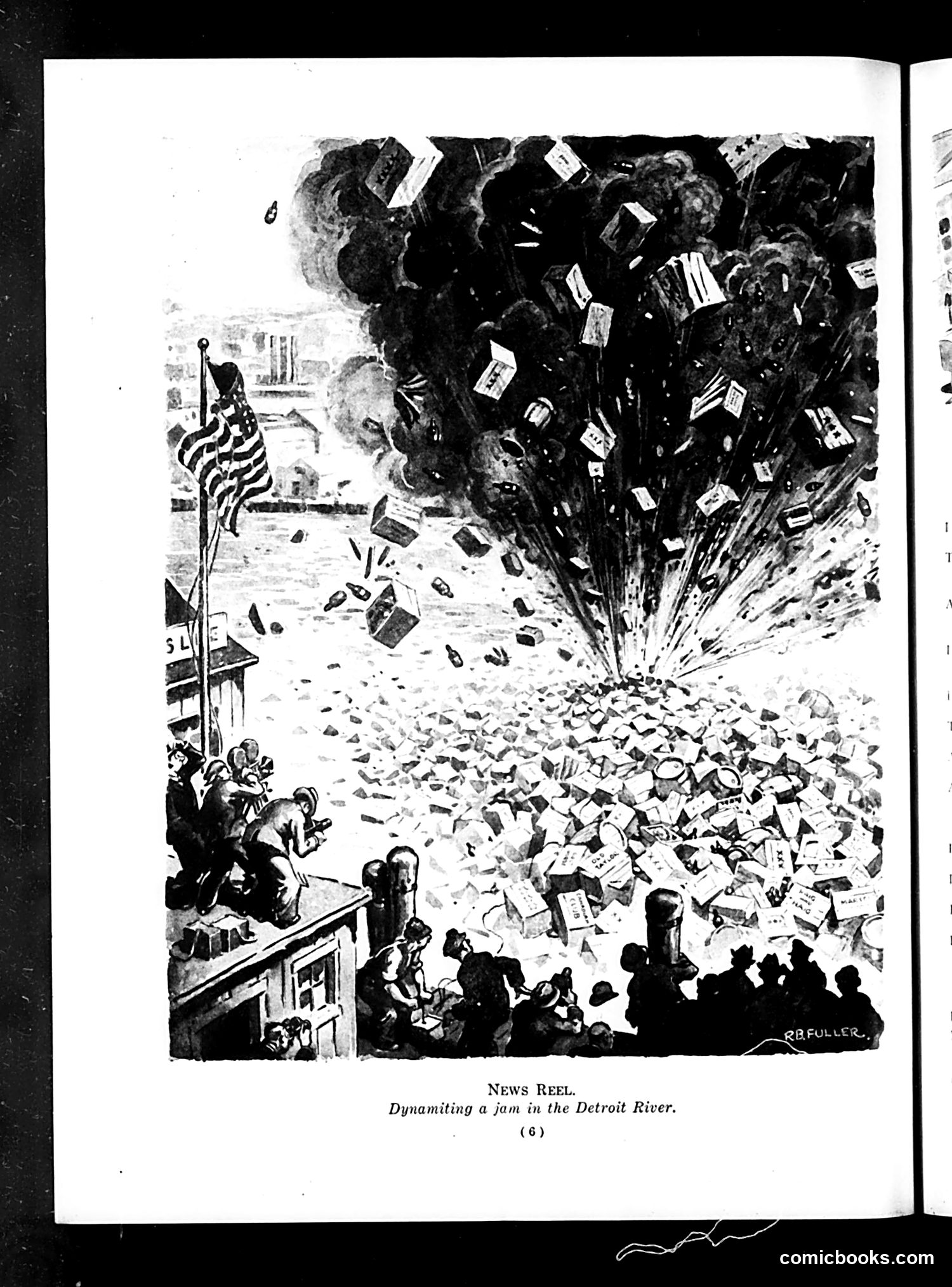
"News Reel: Dynamiting a Jam in the Detroit River" This cartoon satirizes efforts to clear a log jam in the Detroit River using dynamite. The image shows an explosion detonating a massive pile of logs, with debris and wooden blocks scattered across the water. An American flag flies prominently on the left, and crowds of observers gather to watch the spectacle from shore-based structures. The satire appears to mock the dramatic, forceful approach to solving what may have been a recurring civic problem—treating infrastructure management as a spectacular public event. The artist (R.B. Fuller, signed lower right) uses the contrast between the American flag's patriotic symbolism and the chaotic destruction to suggest either the absurdity or the heavy-handed nature of the solution employed.
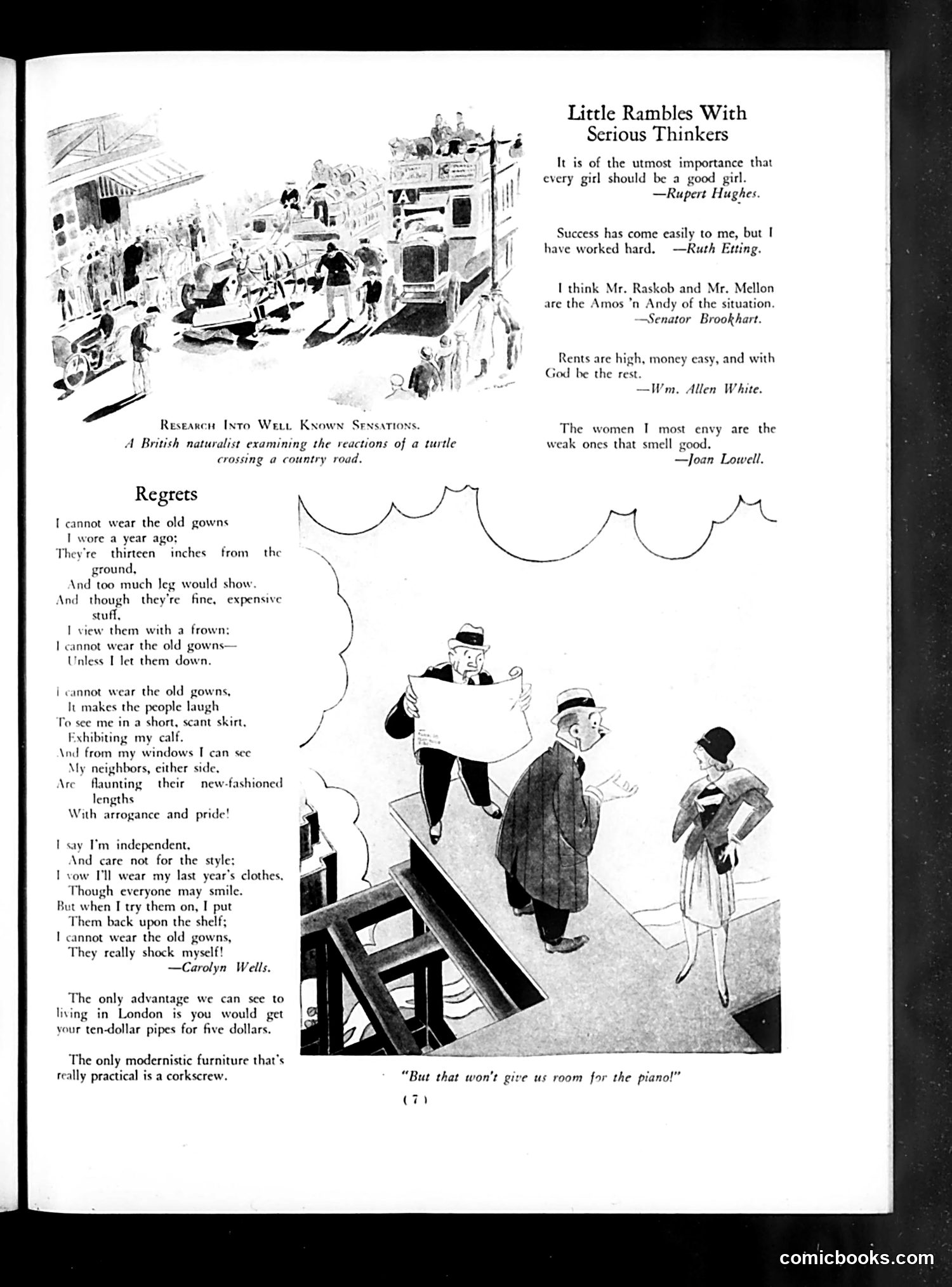
Analysis This page from *Life* magazine contains two distinct sections: Upper section ("Little Rambles With Serious Thinkers"): A series of humorous quotes from public figures (Rupert Hughes, Ruth Etting, Senator Brookhart, William Allen White, and Joan Lowell) commenting on contemporary issues—fashion standards, financial conditions, and social envy. These appear to be satirical observations on 1920s concerns. Lower section ("Regrets"): A poem by Carolyn Wells lamenting fashion constraints, particularly women's inability to wear year-old gowns without social embarrassment due to changing hemlines and neighbor judgments. The cartoon: Three men discuss furniture placement in a tight apartment. One man holds what appears to be a piano diagram, while another says "But that won't give us room for the piano!"—satirizing the conflict between modern minimalist living spaces and maintaining traditional middle-class status symbols like pianos. The page satirizes 1920s anxieties about fashion, social standing, and changing living standards.
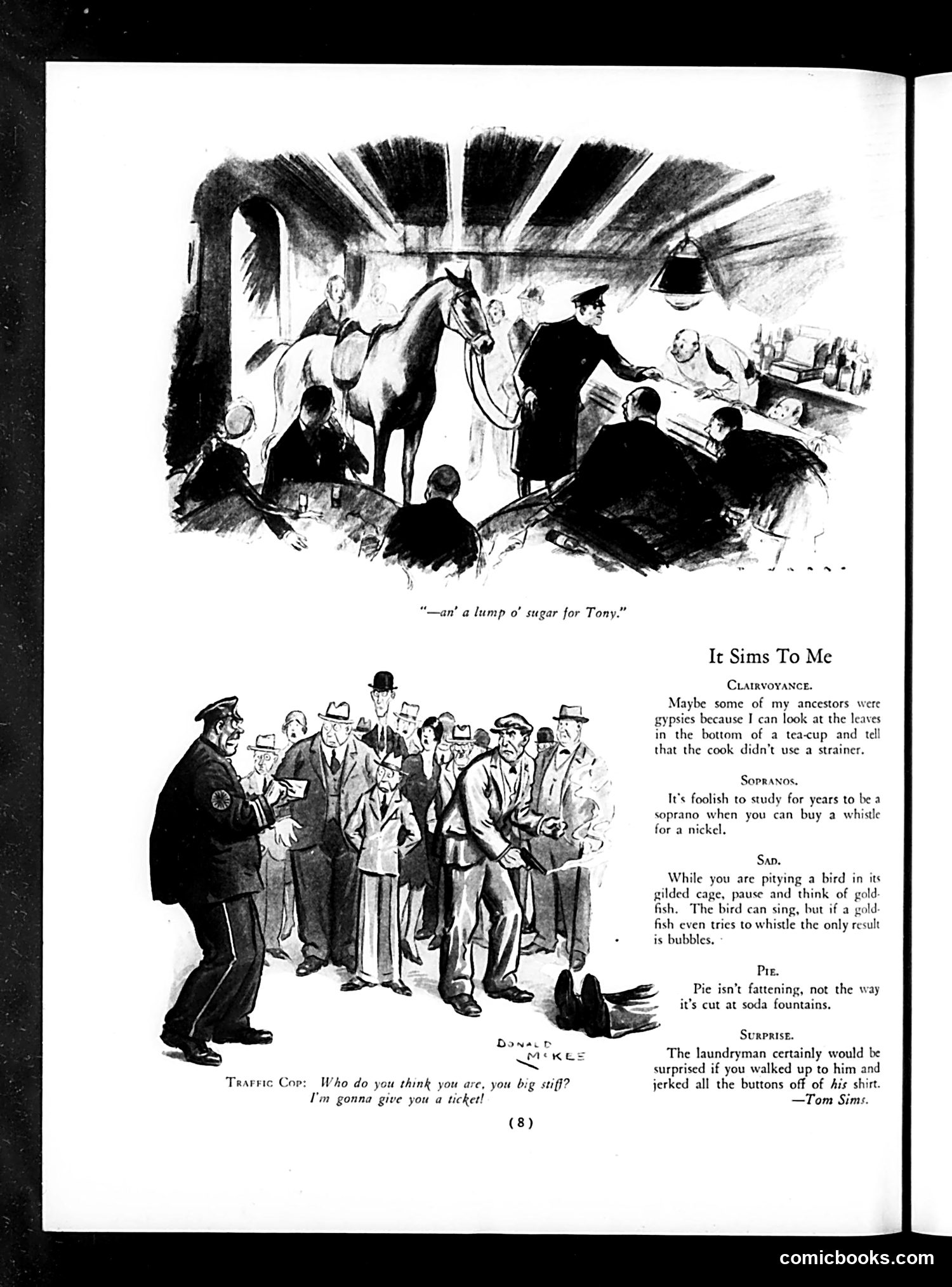
Explanation for Modern Readers This page contains two satirical cartoons from *Life* magazine mocking superstition and pretension. Top cartoon: Shows a stable scene where someone offers "a lump o' sugar for Tony" (a horse). The joke satirizes people who anthropomorphize animals or engage in magical thinking. Bottom cartoon: A traffic cop confronts a well-dressed man, saying "Who do you think you are, you big stiff? I'm gonna give you a ticket!" The humor targets arrogant, entitled individuals who believe their status exempts them from rules. The accompanying column, "It Sims To Me," offers brief satirical observations mocking gullibility—studying to be a soprano, fortune-telling via teacups, and other foolish pursuits. The overall page ridicules human vanity, superstition, and disrespect for authority across social classes.
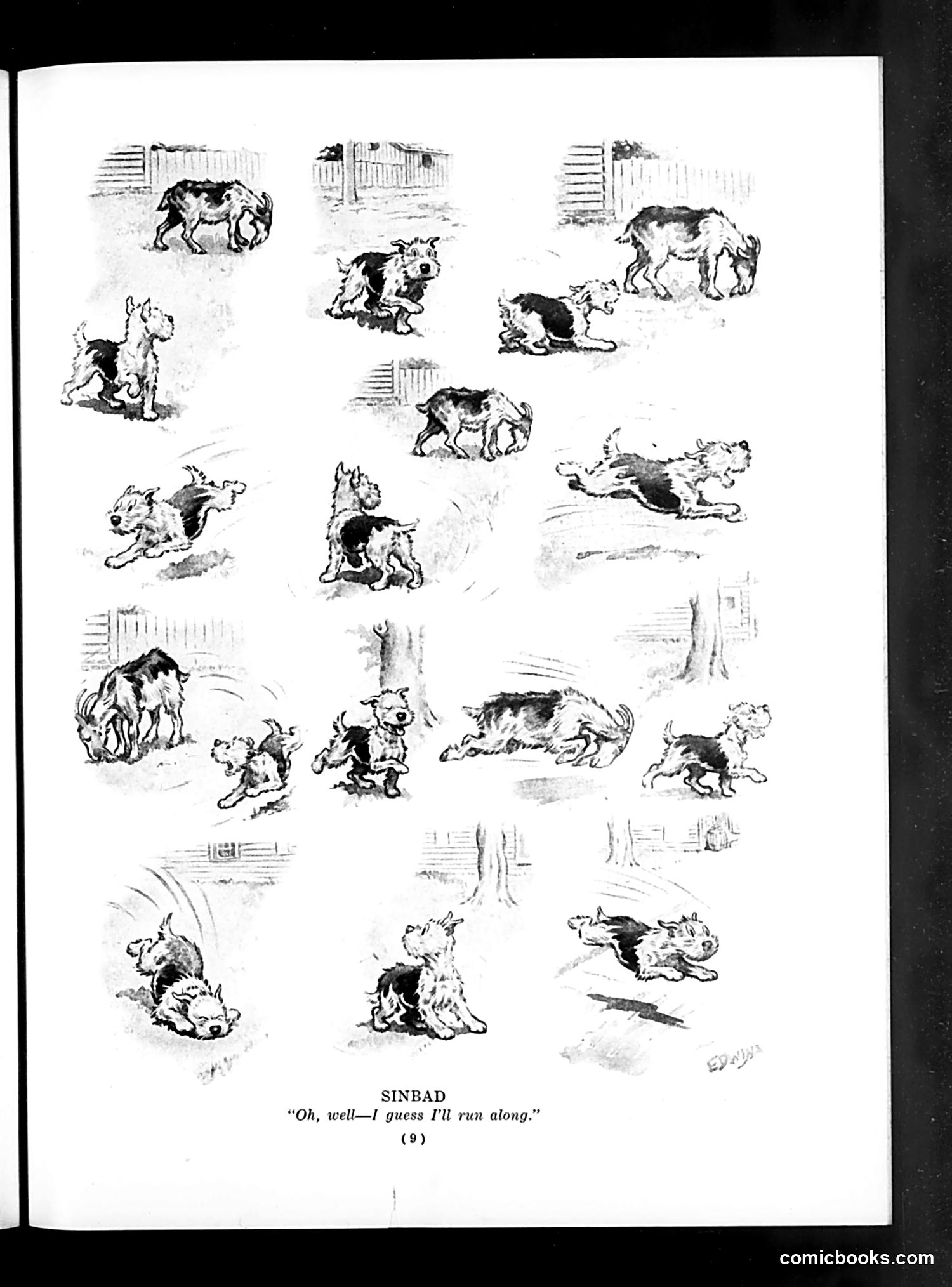
Analysis This page features a series of sketches titled "Sinbad" with the caption "Oh, well—I guess I'll run along." The drawings appear to be humorous illustrations of dogs in various poses and situations—playing, running, resting, and interacting with their environments (fences, trees, and ground). Rather than political satire, this is a comic strip or illustration sequence depicting animal behavior. The repeated character (presumably "Sinbad," likely a dog) is shown in different activities and moods. The caption suggests the character's casual, wandering nature—fitting for a dog who moves from one activity to the next. This appears to be entertainment content rather than commentary on political or social issues, typical of Life magazine's mix of humor and satire.
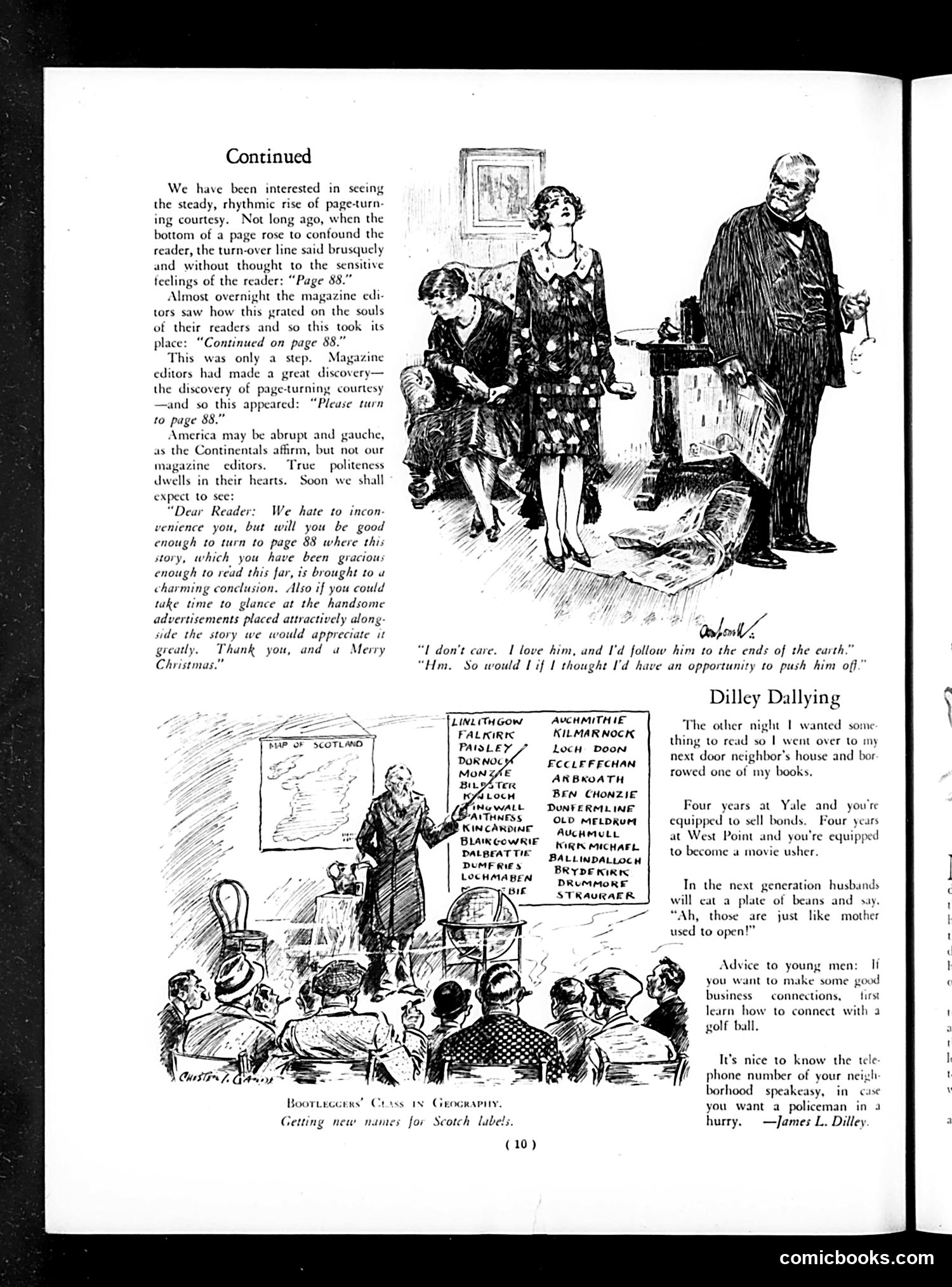
Analysis of Life Magazine Page This page contains two distinct elements: Upper cartoon: Shows three figures in an interior domestic scene, with the caption about a woman's devotion to a man. The satire appears to mock romantic sentimentality and domestic relationships, though the specific reference is unclear without additional context. Lower cartoon: Titled "Bootleggers' Class in Geography: Getting new names for Scotch labels," depicts a man lecturing to an audience holding what appears to be a chart of Scottish place names (Linlithgow, Falkirk, Paisley, etc.). This is Prohibition-era satire: bootleggers (illegal alcohol producers/distributors) were learning Scottish geographic names to fraudulently label counterfeit or homemade whiskey as imported Scotch. The joke mocks both prohibition's failure and consumer deception during that period (1920-1933).
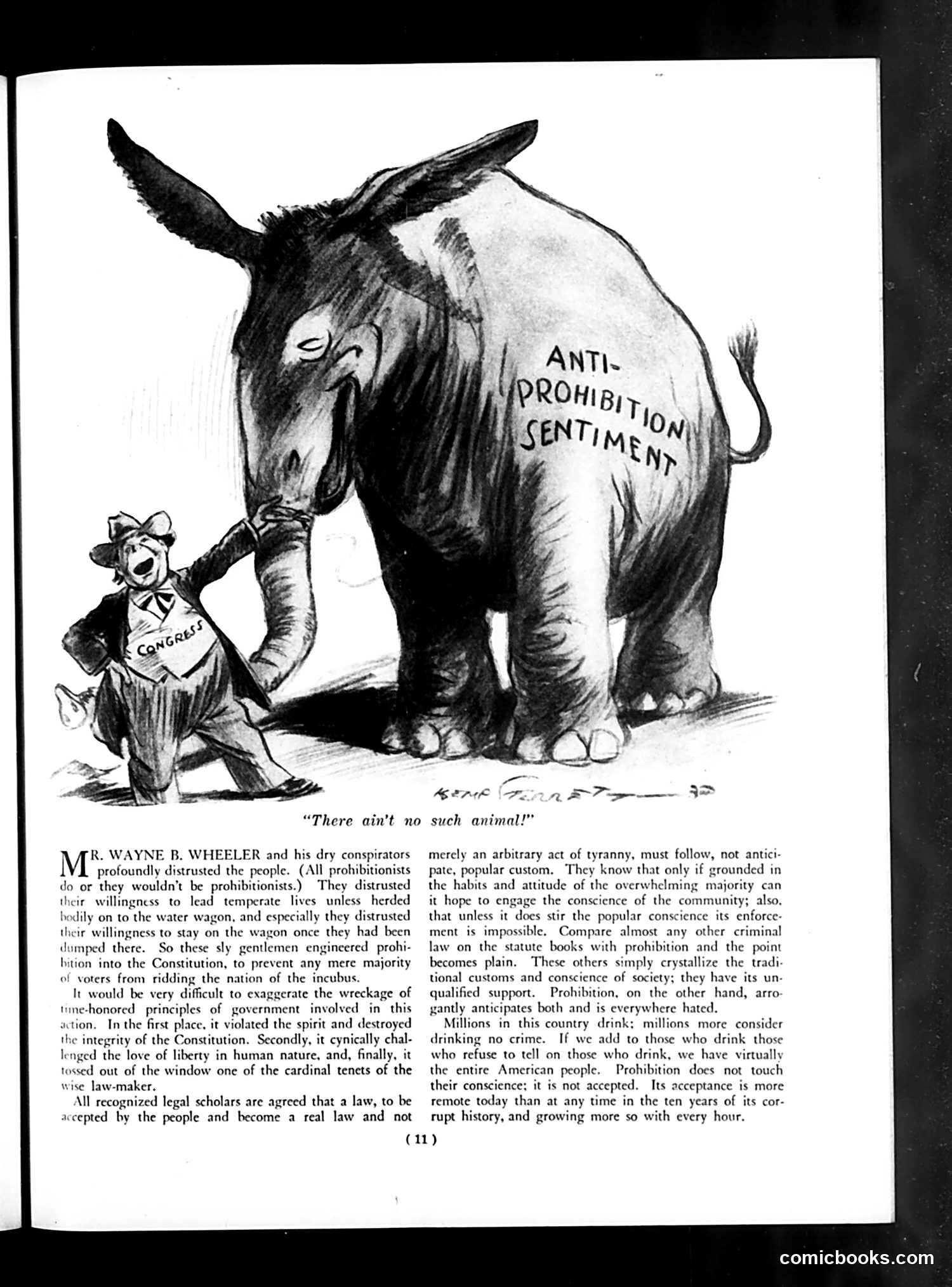
Political Cartoon Analysis: "Anti-Prohibition Sentiment" This cartoon satirizes Prohibition enforcement by depicting a small figure labeled "Congress" attempting to lead a massive donkey labeled "Anti-Prohibition Sentiment." The caption reads "There ain't no such animal!"—suggesting Congress denies the existence of widespread public opposition to Prohibition laws. The accompanying text by Wayne B. Wheeler argues that Prohibition, though unpopular, must be enforced because laws should reflect moral principles, not majority opinion. The satire mocks this position: the massive donkey represents the obvious, undeniable reality that most Americans oppose Prohibition, while Congress pretends this opposition doesn't exist. This appears from the Prohibition era (1920-1933), when the 18th Amendment created intense political conflict between enforcement advocates and the drinking public.
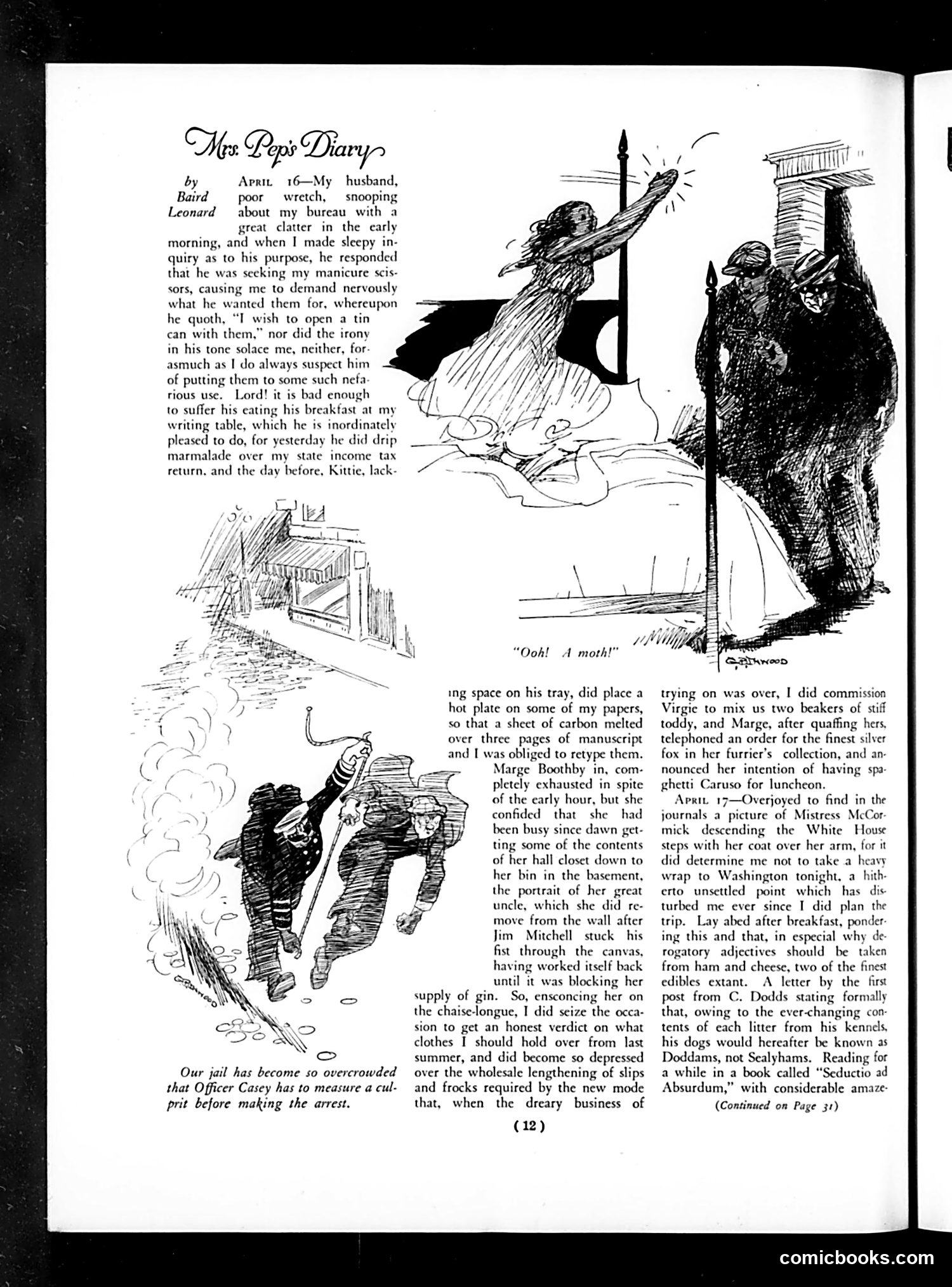
"Mrs. Pep's Diary" by Baird Leonard This is a humorous domestic diary entry dated April 16, satirizing the frustrations of a wife managing household chaos. The husband, described as a "poor wretch," clutters the bureau and creates noise in the early morning. When questioned about his activities, he dismissively invokes "masculine scissors," prompting the narrator's exasperated demands. The cartoons illustrate her mounting domestic tribulations: a figure dramatically gesturing amid scattered papers, and another scene showing someone emerging from what appears to be an overflowing closet or storage area—visual gags emphasizing household disorder and the wife's burden of managing domestic space. The accompanying text details servants causing additional chaos, mixing drinks, and other household mismanagements. The satirical humor targets both husbands' thoughtlessness and the general mayhem of domestic life for upper-class women trying to maintain order.
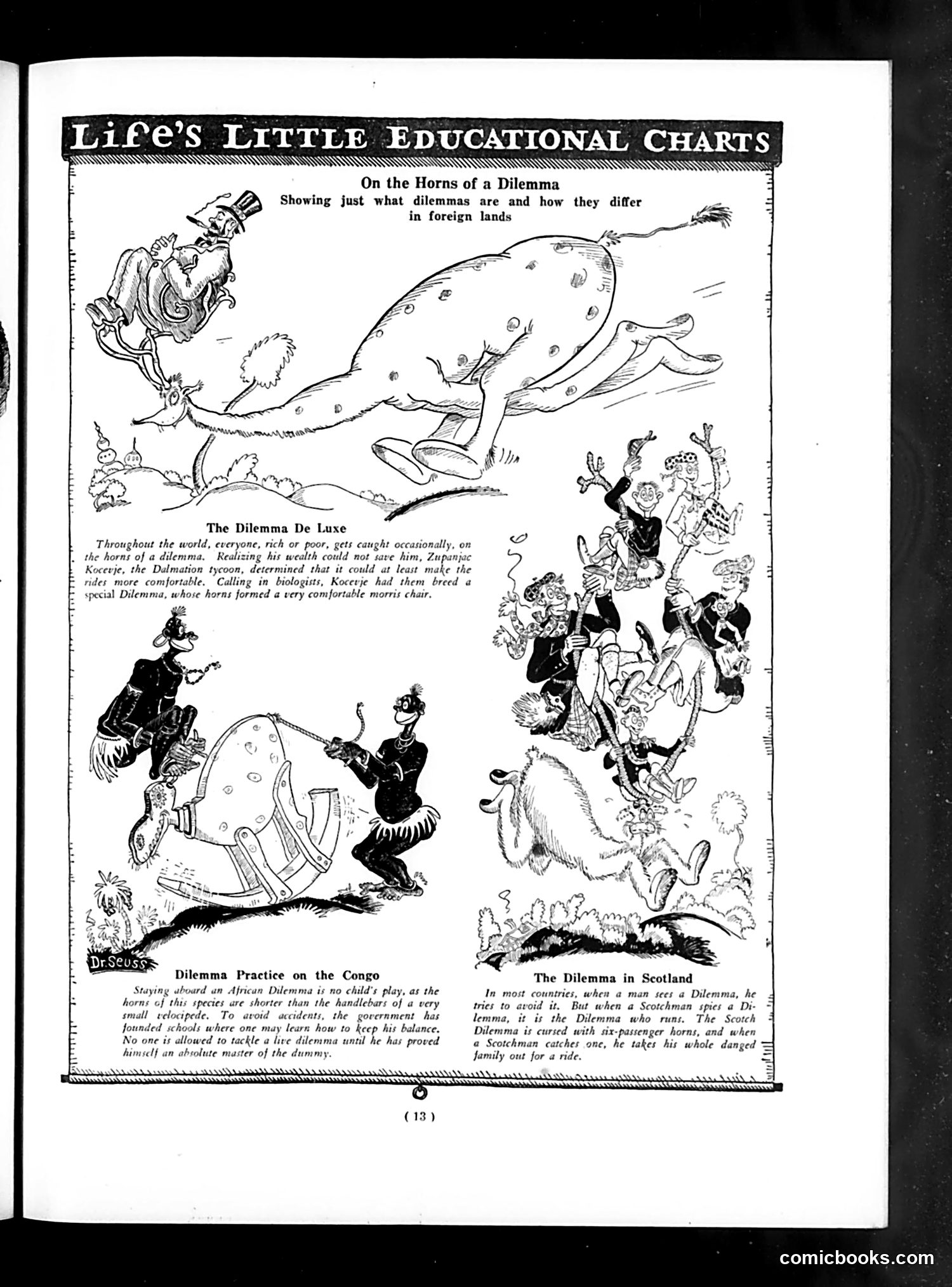
"On the Horns of a Dilemma" This Dr. Seuss-illustrated satirical chart explains "dilemmas" (impossible choices) as they supposedly occur in foreign lands. Three scenarios are depicted: 1. "The Dilemma De Luxe": A wealthy figure (likely a wealthy businessman or politician) must choose between comfort and morality when a Dalmatian tycoon offers him a chair made from uncomfortable materials. 2. "Dilemma Practice on the Congo": African colonial subjects face dangerous balancing acts on tightropes, satirizing the precarious situation of colonized peoples forced into impossible choices by European rule. 3. "The Dilemma in Scotland": A Scottish man encounters a dilemma involving a six-passenger horse—likely mocking Scottish frugality or rural predicaments. The satire appears to mock Western indifference to genuine moral crises faced by colonized peoples, contrasting trivial wealthy-world "dilemmas" with serious colonial hardships.
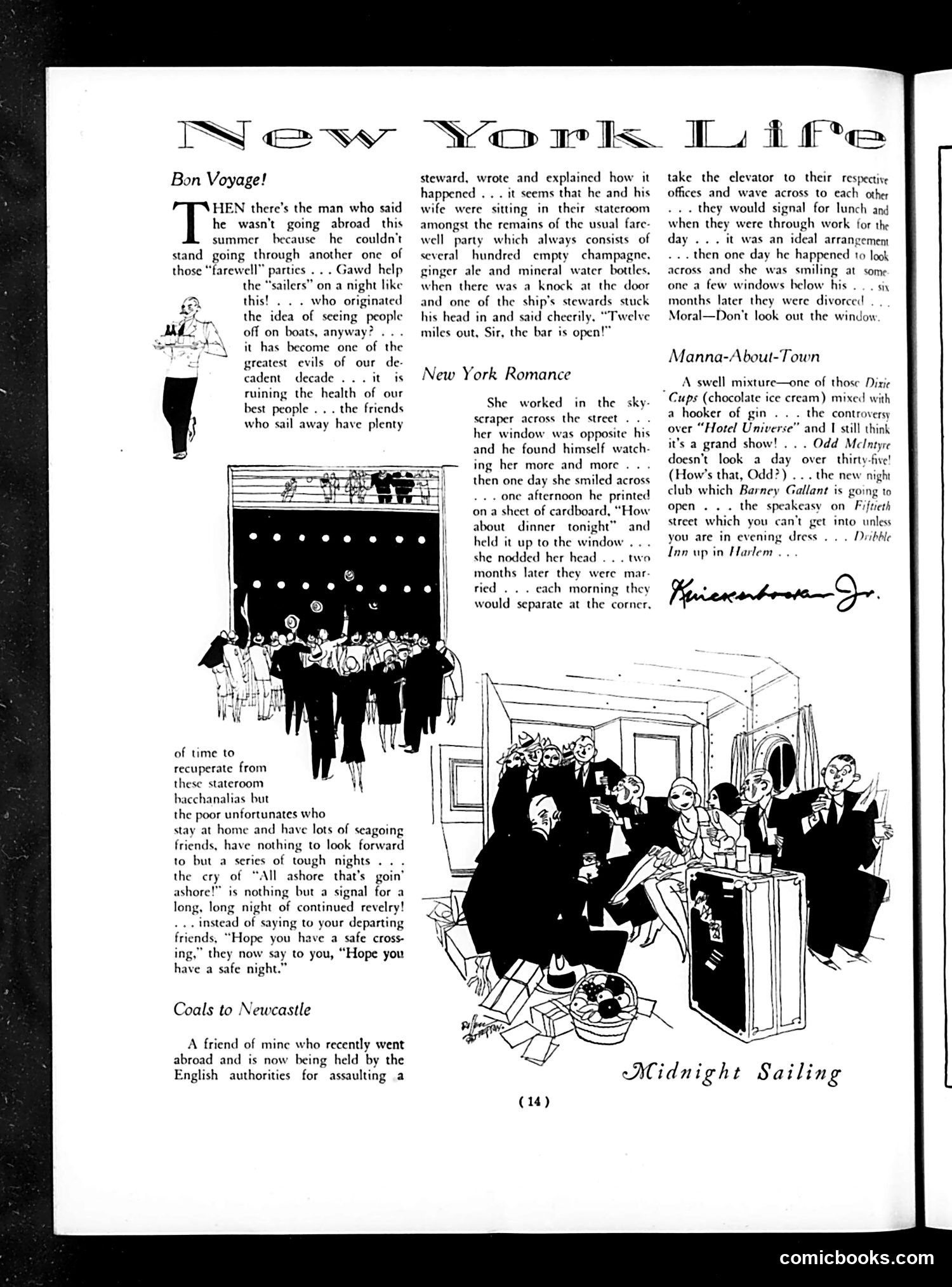
Analysis of New York Life Page This page from *Life* magazine contains three brief social commentary pieces rather than political cartoons: 1. "Bon Voyage!" satirizes people avoiding ocean travel due to seasickness—a common complaint before modern medicine. The joke is that people prefer the familiar discomfort of staying home to the risk of illness abroad. 2. "New York Romance" depicts a love story between two office workers separated by buildings, communicating through windows. It's light satire on urban isolation and unconventional courtship. 3. "Coals to Newcastle" references a friend arrested abroad for assault—likely a humorous cautionary tale about Americans abroad. 4. "Midnight Sailing" (illustrated) shows a farewell party, humorously contrasting old seafaring traditions with modern social gatherings. The page emphasizes *Life*'s focus on urban, middle-class American life and social customs.
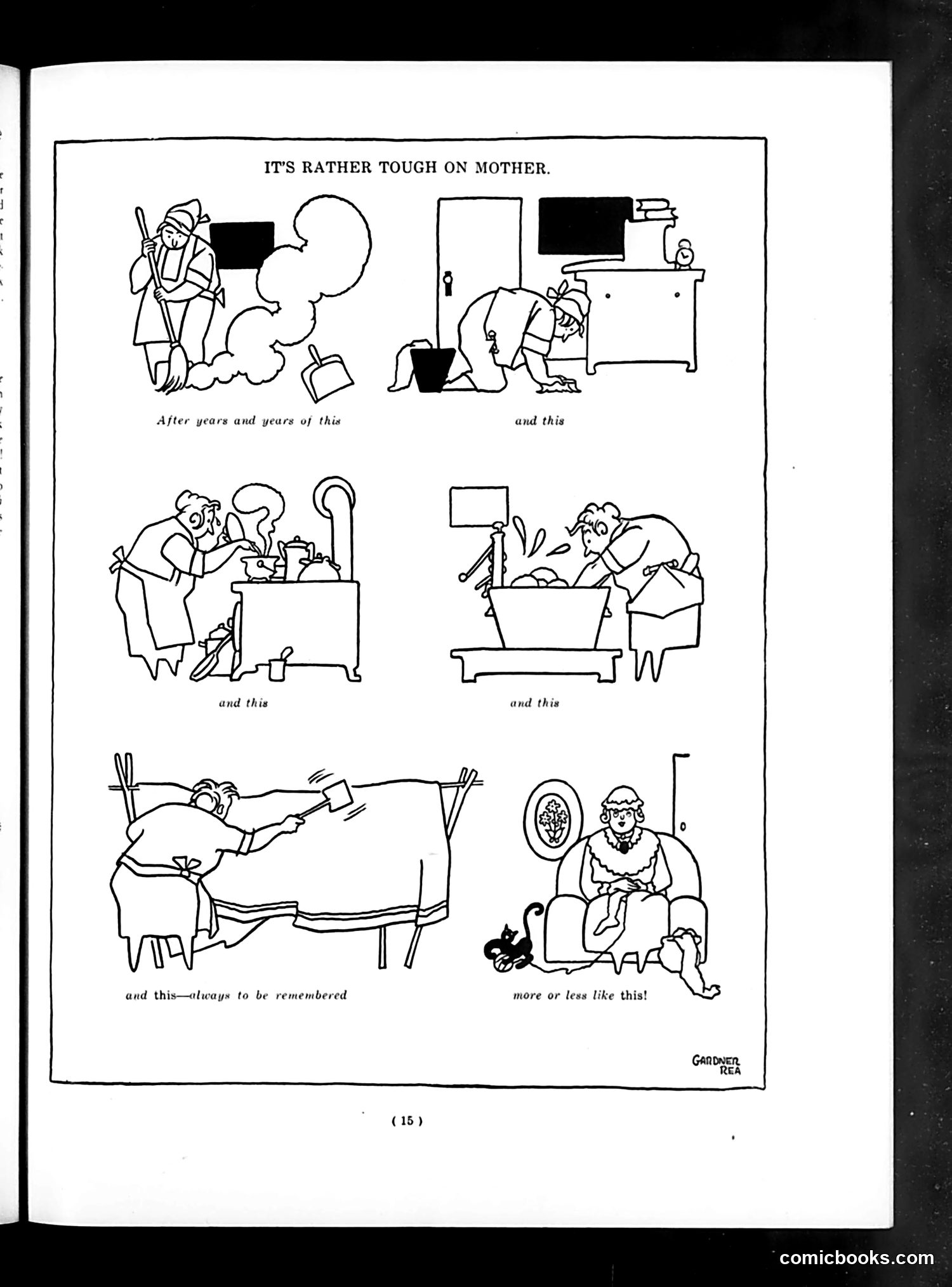
"It's Rather Tough on Mother" This comic strip satirizes the disparities between a mother's idealized public image and her actual daily reality. The sequence contrasts: Top panels: A woman as soldier/worker (appearing capable and dignified) versus domestic drudgery (childcare, housework). Middle panels: Cooking and laundry labor—backbreaking, repetitive tasks. Bottom panels: The final image shows an exhausted, aged woman sitting idle, captioned "more or less like this"—implying motherhood ages women prematurely. The satire critiques how society glorifies mothers' contributions during wartime (when women entered factories and military roles) while ignoring the grinding, thankless nature of domestic motherhood. The cartoon suggests that years of unpaid household labor extract a severe physical and emotional toll, leaving women worn down by age.
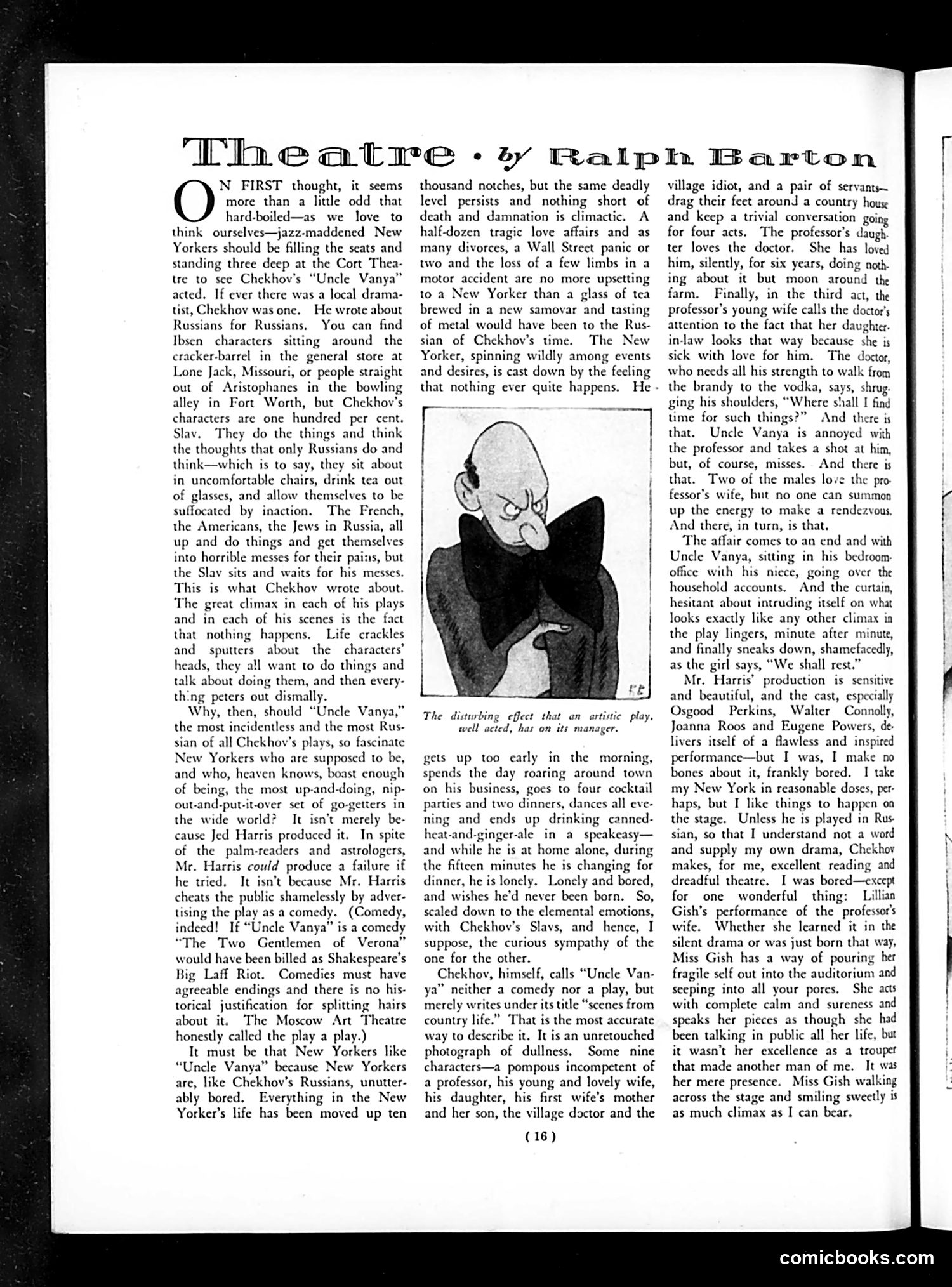
Analysis This is a theater review by Ralph Barton about a production of Chekhov's "Uncle Vanya," directed by someone named Harris. The illustration shows a bald man with glasses in profile, likely depicting a character from the play (appears to be Uncle Vanya himself based on the caption). Barton's critique contrasts Russian literary subtlety with American theatrical sensibility. He argues New Yorkers find Chekhov's "nothing happens" dramaturgy boring compared to their preference for action and spectacle. The review praises Harris's sensitive production while acknowledging its limitations for audiences accustomed to Broadway's more plot-driven entertainment. The satire targets American cultural taste—the implication being that sophisticated European drama doesn't translate well to commercially-minded American audiences seeking excitement over introspection.
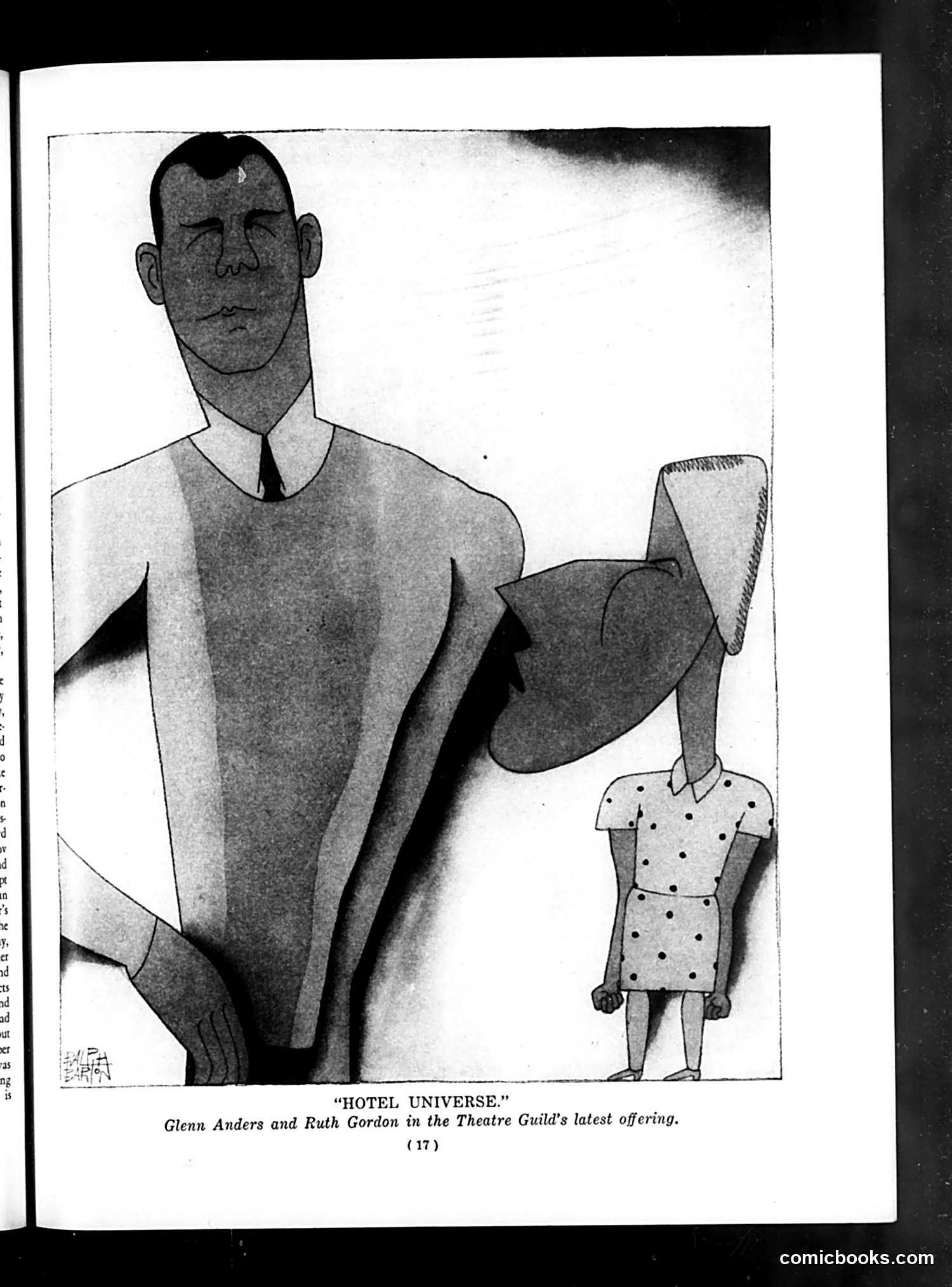
"Hotel Universe" Commentary This is a theatrical advertisement/review illustration for a play called "Hotel Universe" featuring actors Glenn Anders and Ruth Gordon. The cartoon depicts a stark size disparity: a tall, nearly nude male figure dwarfs a small, fully clothed female figure in a polka-dot dress. The satire likely comments on the play's themes or the actors' roles—possibly mocking either the dramatic pretension of the production or the power dynamics being portrayed on stage. The exaggerated proportions create an absurdist, unsettling visual that suggests either physical intimidation or commentary on gender/social hierarchies within the theatrical narrative. Without access to the original play's plot, the precise satirical target remains somewhat unclear, though the image emphasizes disparity and imbalance.
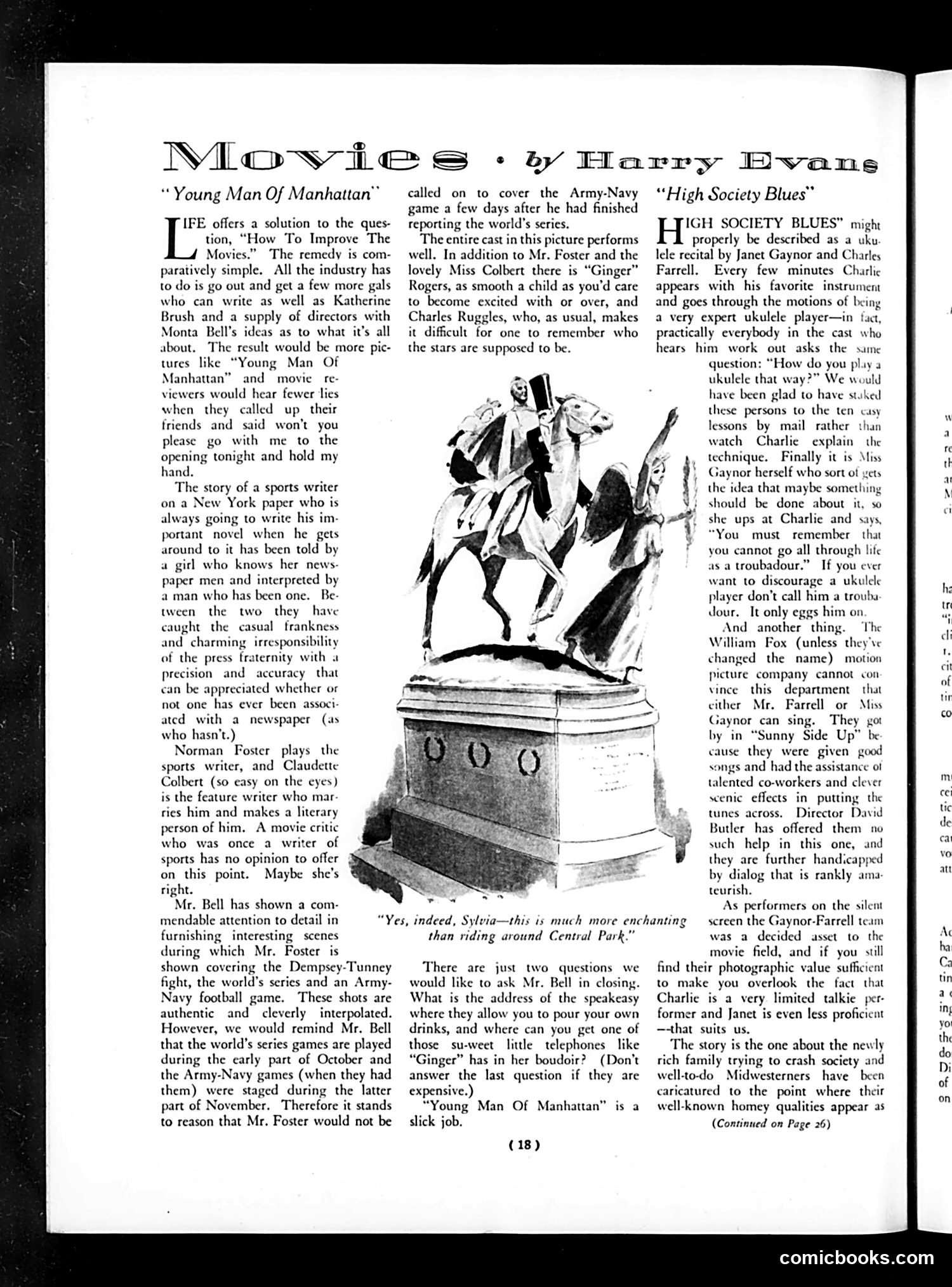
Movie Reviews by Harry Evans This page contains two film reviews. The main illustration depicts a statue of a horse and rider on a pedestal labeled "1900," accompanying the review of "Young Man of Manhattan." "Young Man of Manhattan" is criticized as formulaic—a sports writer romance with a girl who knows newspaper life. The reviewer notes the film relies on casual frankness and irresponsibility typical of press fraternity portrayals, though it features competent performances by Norman Foster and Claudette Colbert. "High Society Blues" receives a brief, dismissive review of a ukulele recital by Janet Gaynor and Charles Farrell. The reviewer mocks the performance and warns against expecting much from this minor musical effort. Both reviews suggest mediocre entertainment value with limited artistic merit.
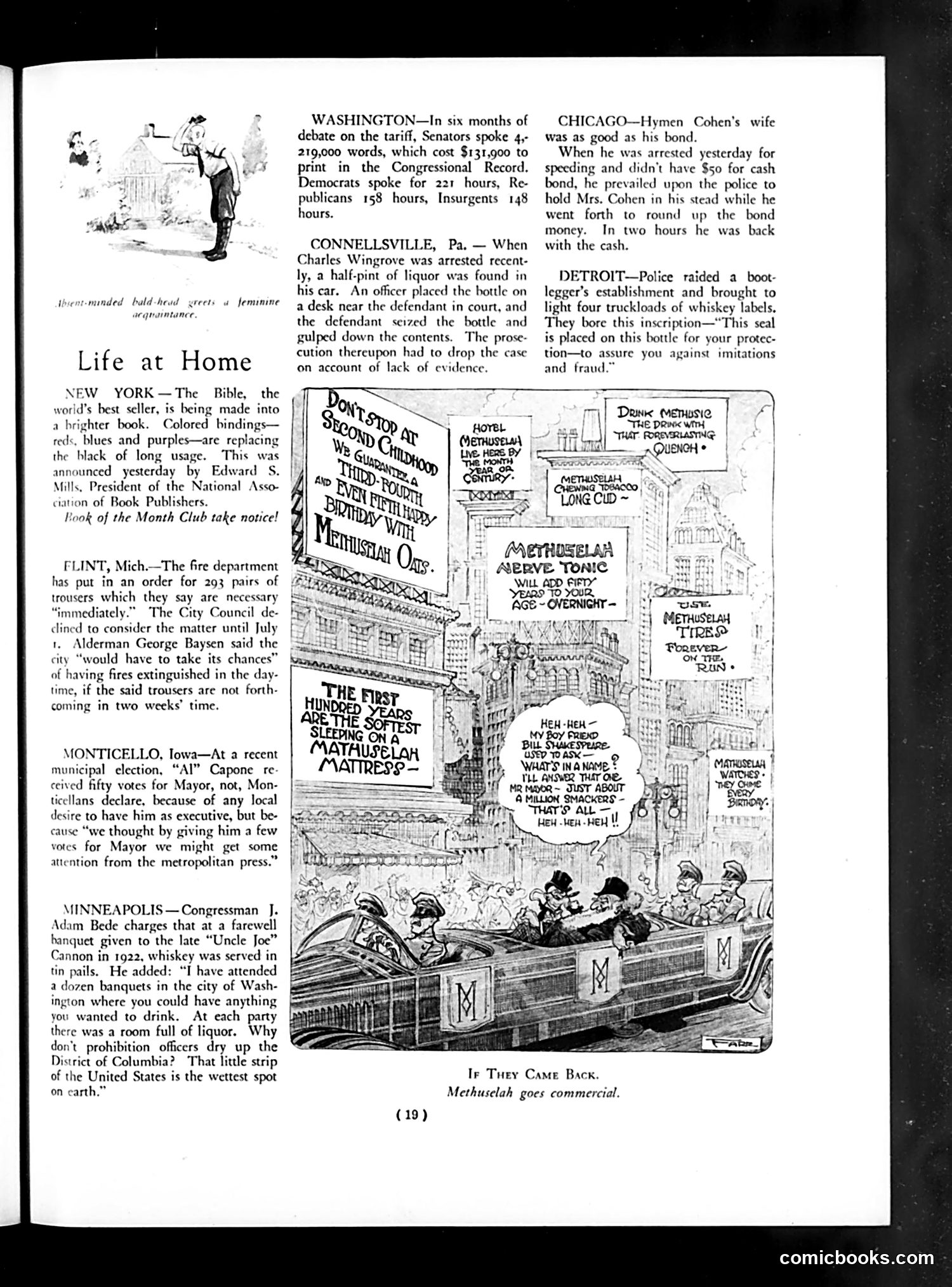
"If They Came Back": Methuselah Goes Commercial This full-page cartoon satirizes Prohibition-era commercialism and advertising excess. The large central illustration depicts a luxurious hotel or nightclub scene featuring biblical figures—notably Methuselah (the famously long-lived Old Testament figure)—surrounded by garish advertisements for "Methuselah" brand products: tonic, wine, and other goods. The satire targets how companies exploited any cultural reference, however sacred, for profit during the 1920s. By depicting the ancient patriarch hawking commercial products in a modern speakeasy setting, the cartoon mocks both rampant materialism and the absurdity of Prohibition enforcement (evident in surrounding news items about bootlegging, whiskey raids, and illegal liquor). The caption's double meaning—"If They Came Back / Methuselah goes commercial"—suggests that even biblical longevity couldn't survive modern advertising's commodification of everything. The page's brief news items reinforce themes of law-breaking, corruption, and hypocrisy during Prohibition's reign.
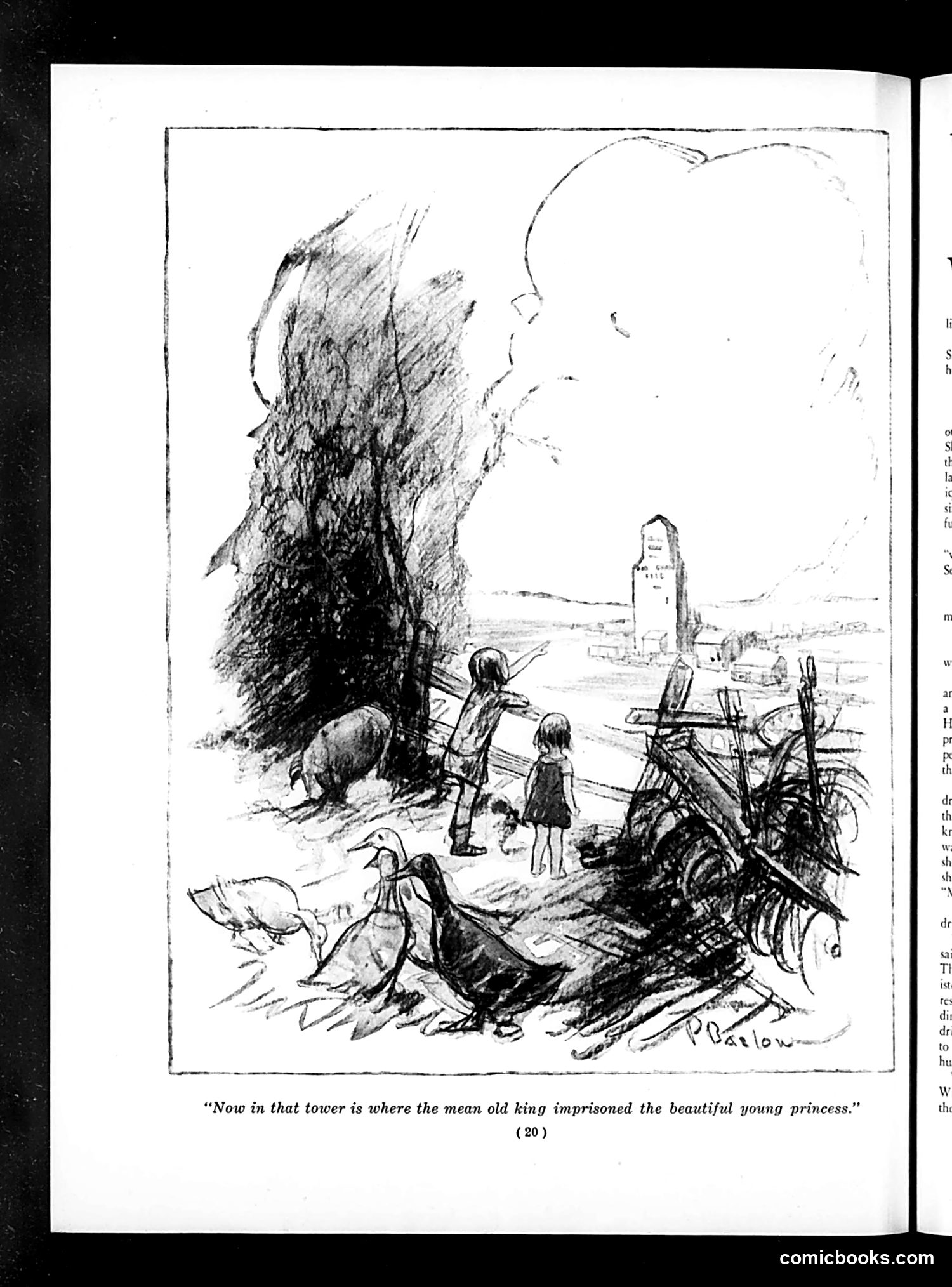
This illustration accompanies a fairy-tale narrative, depicting children viewing a distant tower while an adult (likely a parent or storyteller) narrates the classic imprisonment scenario of a princess by a tyrannical king. The sketch shows a pastoral landscape with the tower visible in the distance, establishing the storybook setting. The children's perspective—gazing toward the tower as the story unfolds—creates the innocent wonder typical of traditional tale-telling. The artist's signature appears to read "Darlow." This appears to be illustrative content from *Life* magazine accompanying children's fiction or serialized fairy tales, rather than political satire. The page number "(20)" suggests this is part of a larger story.
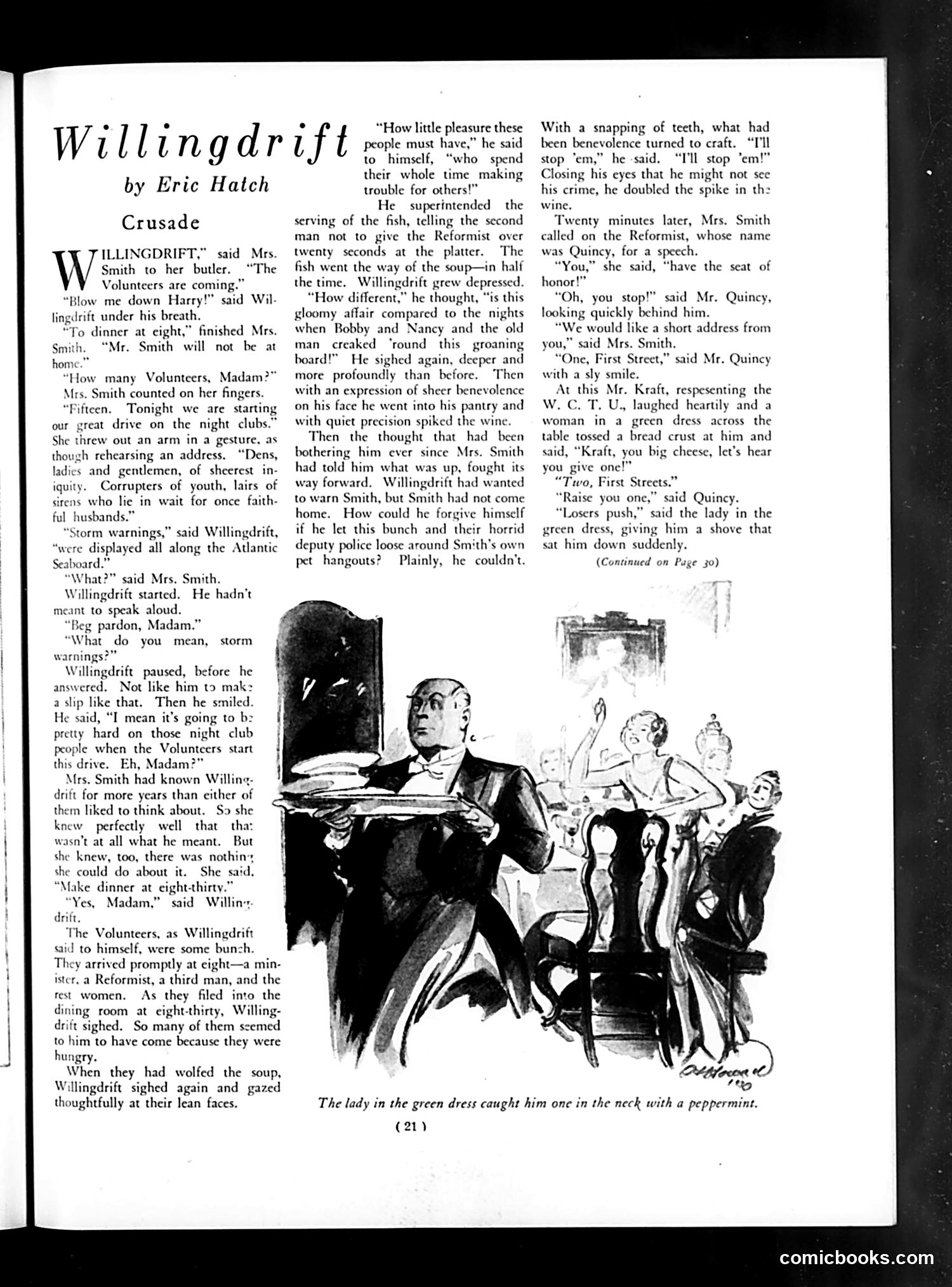
"Willingdrift" - Satire on Temperance Reform This story satirizes the Prohibition-era "Crusade" against vice and nightlife. Mrs. Smith leads "Volunteers" (including a minister and a "Reformist" named Quincy) to raid night clubs and reform society—a clear reference to temperance and moral reform movements of the 1920s-30s. The joke centers on Willingdrift, the butler, who secretly sympathizes with Mr. Smith and his social habits. When the preachy reformers arrive hungry and self-righteous, Willingdrift sabotages their crusade by spiking the wine, getting them drunk and rowdy instead of virtuous. The illustration shows the lady in green catching Quincy "in the neck with a peppermint"—the spiked group has devolved into playful chaos, undermining their moral authority. The satire mocks self-appointed moral reformers as sanctimonious busybodies whose true motivation is appetite, not virtue.
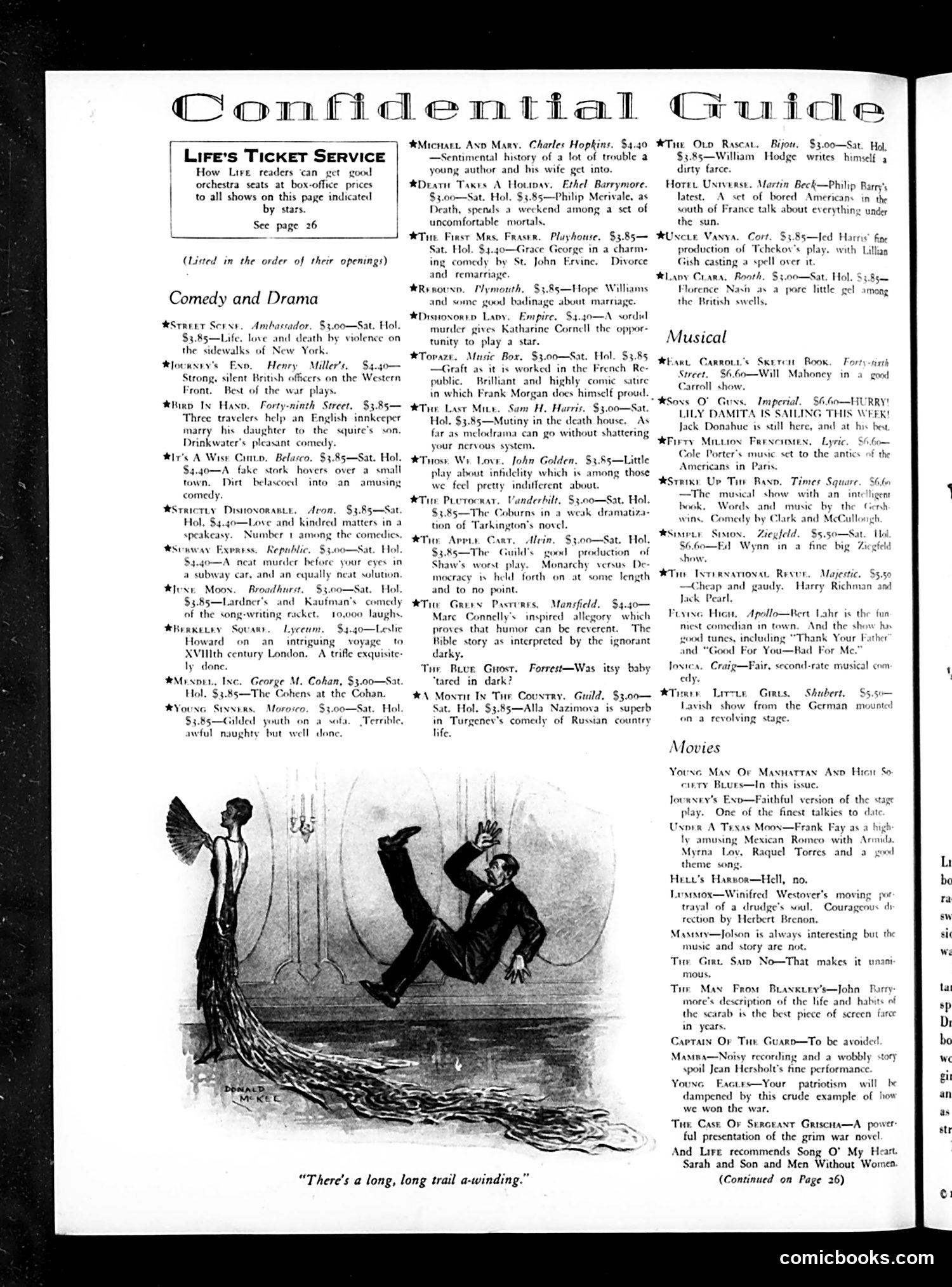
Understanding This Life Magazine Page This is a theater guide and review section from Life magazine—essentially an entertainment listings page, not political satire. The page lists current Broadway shows with prices and brief critical summaries. The single cartoon at bottom depicts a man being pulled by a woman on a rope, illustrating the caption "There's a long, long trail a-winding"—likely a visual joke referencing the popular WWI song "There's a Long, Long Trail" while commenting on romantic entanglement or marriage. The reviews themselves offer snappy Period commentary: shows are praised as "brilliant," "inspired," or criticized as "weak" or featuring "Shaw's worst play." Several productions deal with post-war themes ("Best of the war plays") reflecting the 1920s theatrical landscape. For modern readers: This is essentially a Broadway entertainment section—like today's theater reviews in newspapers, but from the Jazz Age, showing which shows were running and what critics thought of them.
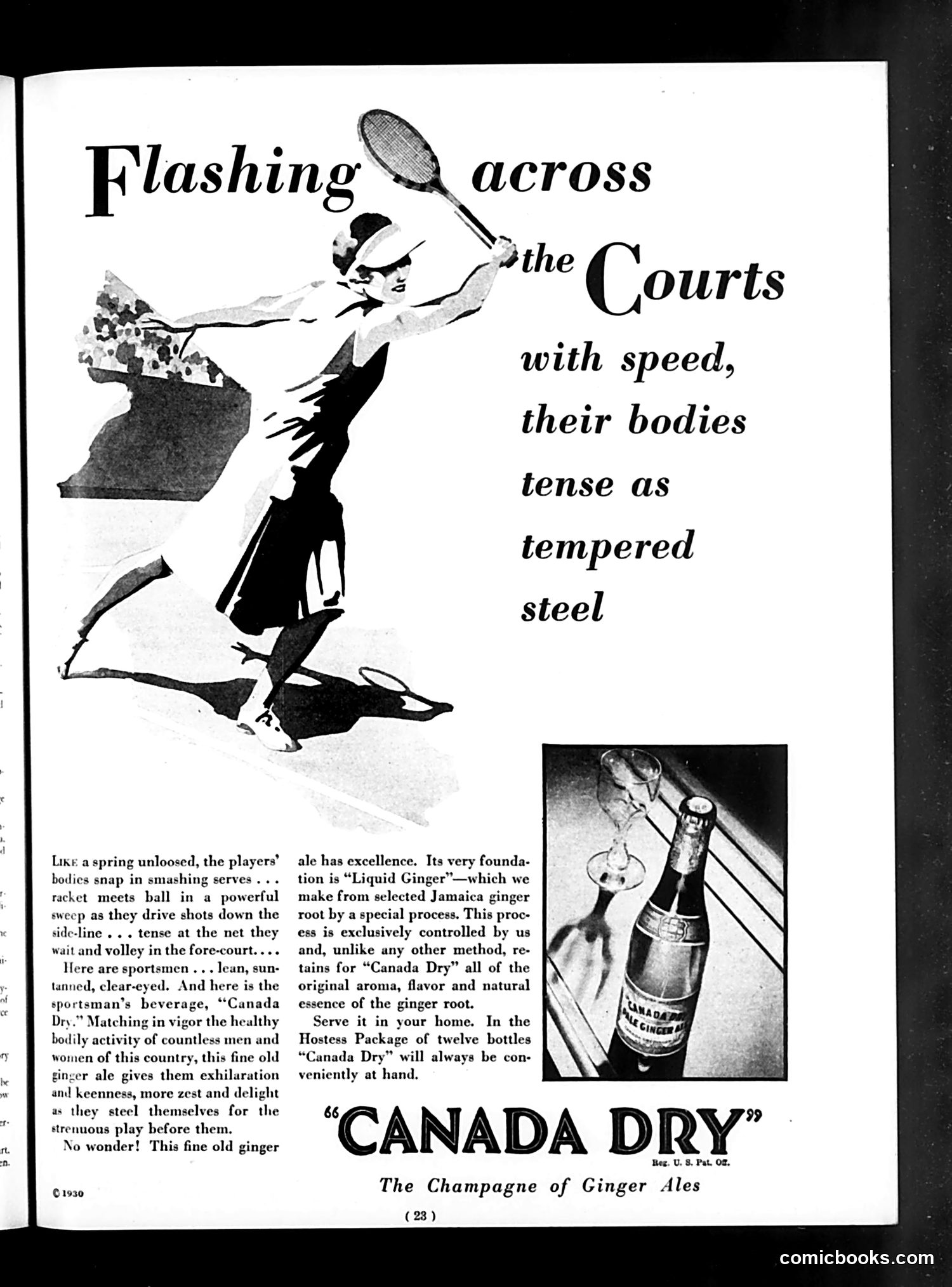
Analysis This is a 1930 advertisement for Canada Dry ginger ale, not political satire. The illustration depicts a dynamic female tennis player in action, serving across a court. The visual emphasizes athleticism and vigor—"bodies tense as tempered steel"—to associate the beverage with health, energy, and sporting vitality. The ad's strategy links Canada Dry to an active, modern lifestyle. It emphasizes the product's "Liquid Ginger" base from Jamaica ginger root, claiming exclusive production methods preserve authentic flavor. The copy targets both men and women as consumers of this "sportsman's beverage," positioning ginger ale as enhancing athletic performance and social occasions. The "Hostess Package" reference appeals to domestic entertaining. This reflects 1930s advertising conventions merging product benefits with aspirational lifestyle imagery—here, the glamorous athleticism of tennis culture.
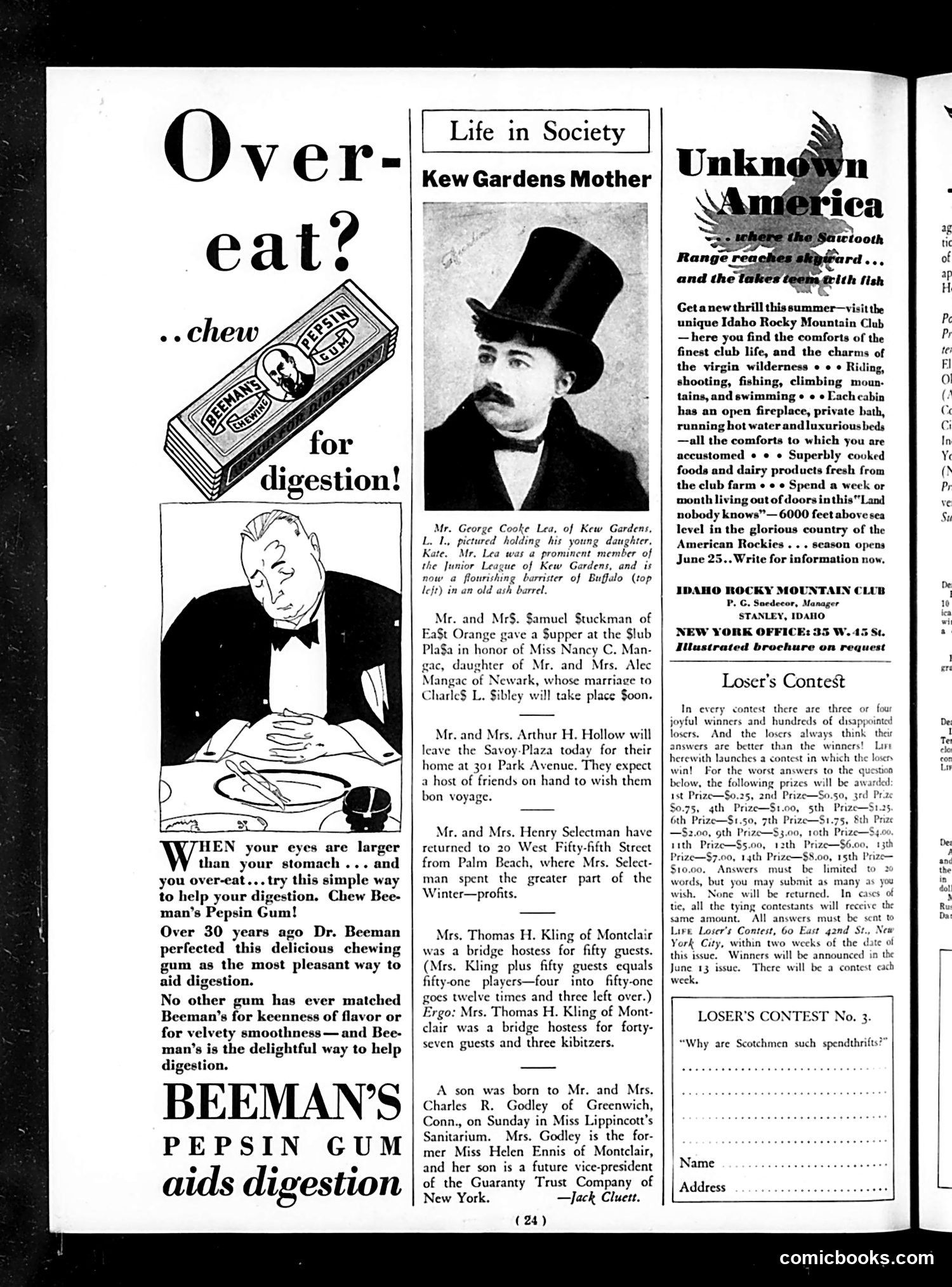
Life Magazine Page Analysis This page is primarily advertisement and society gossip with light satire. The main cartoon (left) mocks overeating through a Beeman's Pepsin Gum advertisement: a well-dressed man sits at dinner with visibly bulging cheeks, illustrating the product's message that chewing gum aids digestion after consuming too much food. The ad references Dr. Beeman's 30-year-old formula, positioning it as a respectable digestive aid. The "Life in Society" section contains satirical gossip items about wealthy New Yorkers and suburbanites. The humor is subtle—dry, witty observations about upper-class social rituals. For example, the bridge-hostess entry uses mathematics to mock the hostess's self-importance, and the closing joke about a newborn being a "future vice-president" of a bank drily satirizes inherited privilege. The page also advertises an Idaho resort and announces a humorous "Loser's Contest" where readers submit intentionally bad joke answers for prizes. The satire targets the wealthy leisure class through documenting their trivial activities.
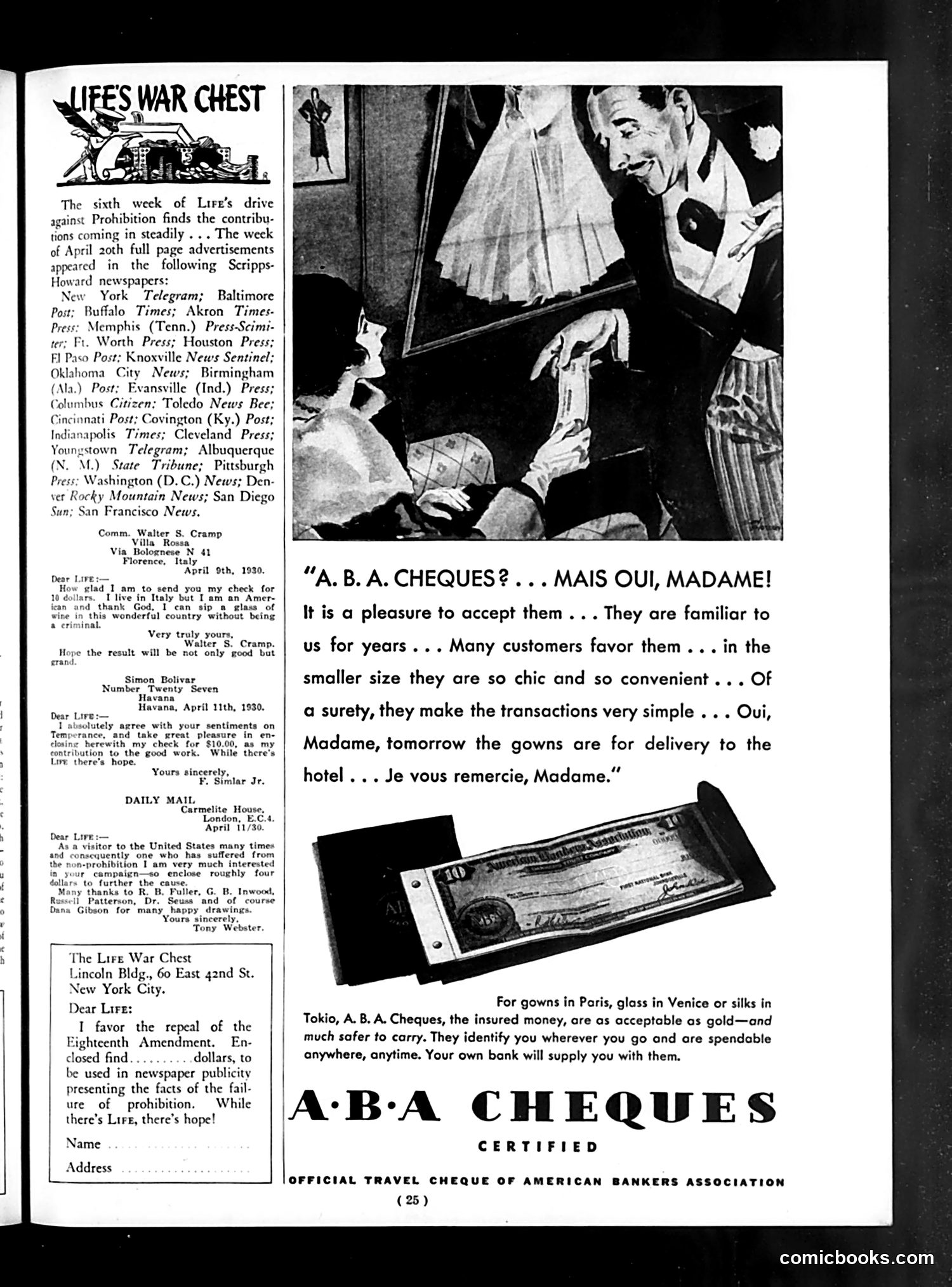
Life Magazine Page Analysis (1930) This page combines Life's anti-Prohibition campaign with travel advertising. The left column shows reader donations to Life's "War Chest" — a fund supporting newspaper publicity against the Eighteenth Amendment. Contributors from Italy, Cuba, and England express support for repealing Prohibition, with one American noting he can "sip a glass of wine" freely abroad without being "a criminal." The right side features an advertisement for A.B.A. Traveler's Cheques, using a French shopkeeper scene to market international travel. The ad appears strategically placed: it subtly reinforces themes of travel freedom and purchasing power abroad — implicitly contrasting with Prohibition-era restrictions at home. The juxtaposition suggests Life's worldview: Prohibition is an embarrassing American peculiarity compared to more civilized European attitudes toward alcohol and personal liberty.
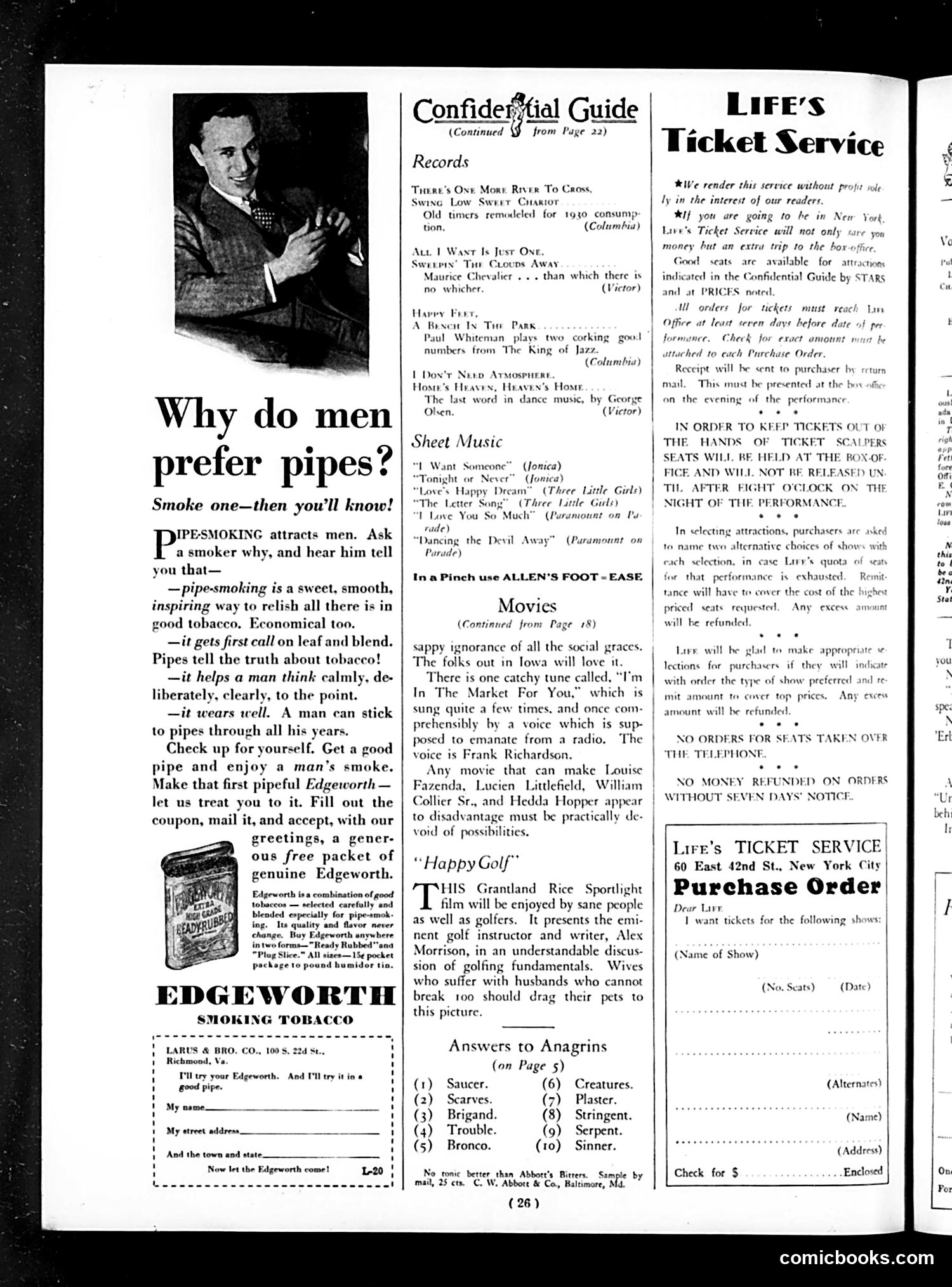
Analysis for Modern Readers This page is primarily advertising and service content, not political satire. The main feature is a large Edgeworth pipe tobacco advertisement asking "Why do men prefer pipes?" It uses appeals to masculinity—claiming pipes help men think "calmly, deliberately, clearly"—and promises a free sample to those who mail in a coupon. The rest of the page contains: - "Confidential Guide": entertainment listings (records, sheet music, movies) with brief reviews - "Happy Golf": a film review by Grantland Rice about golf instruction - "Life's Ticket Service": a reader service for purchasing theater tickets in New York - Word puzzle answers (Anagrins) There is no political cartoon or satire present. This is a typical 1930 magazine page mixing advertisements with entertainment content and reader services—standard Life magazine format of that era.
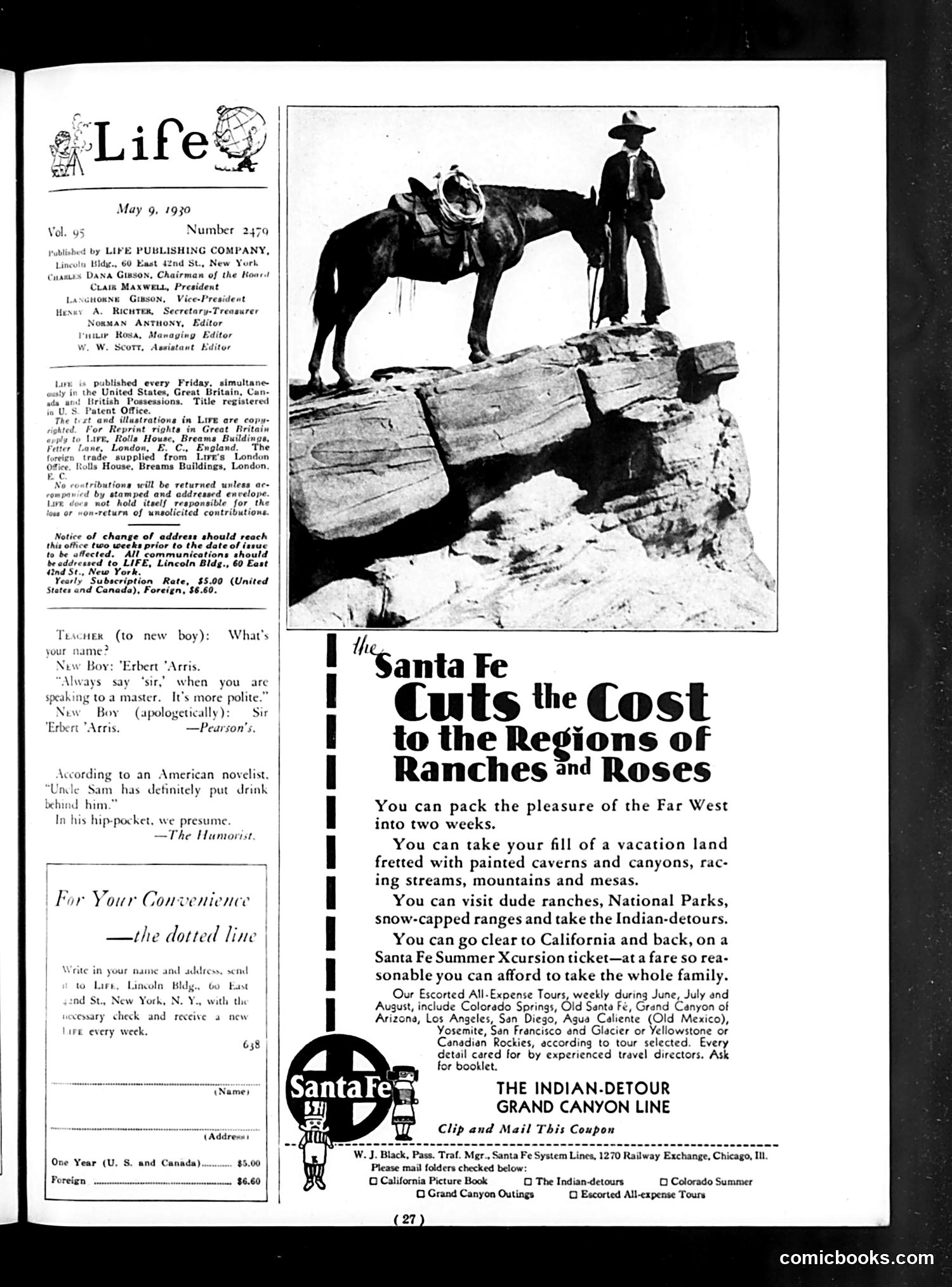
Life Magazine, May 9, 1930 This page is primarily a title/contents page with advertising, not a political cartoon. The main image shows a cowboy on horseback atop a desert rock formation—a romanticized Western scene used to advertise the Santa Fe Railway's summer vacation tours to the American Southwest. The advertisement emphasizes affordable access to dude ranches, national parks, and scenic destinations like the Grand Canyon and California. Two small jokes appear in the text: one about a British schoolboy's politeness ("Sir Erbert 'Arris"), and another referencing Prohibition—a quip that "Uncle Sam has definitely put drink behind him," with the punch line that he's merely hidden it in his hip pocket. This reflects the era's widespread public knowledge that alcohol prohibition (1920–1933) was being widely flouted, a common subject of contemporary humor. The page captures 1930s American consumer culture and the emerging tourist industry targeting middle-class vacationers.
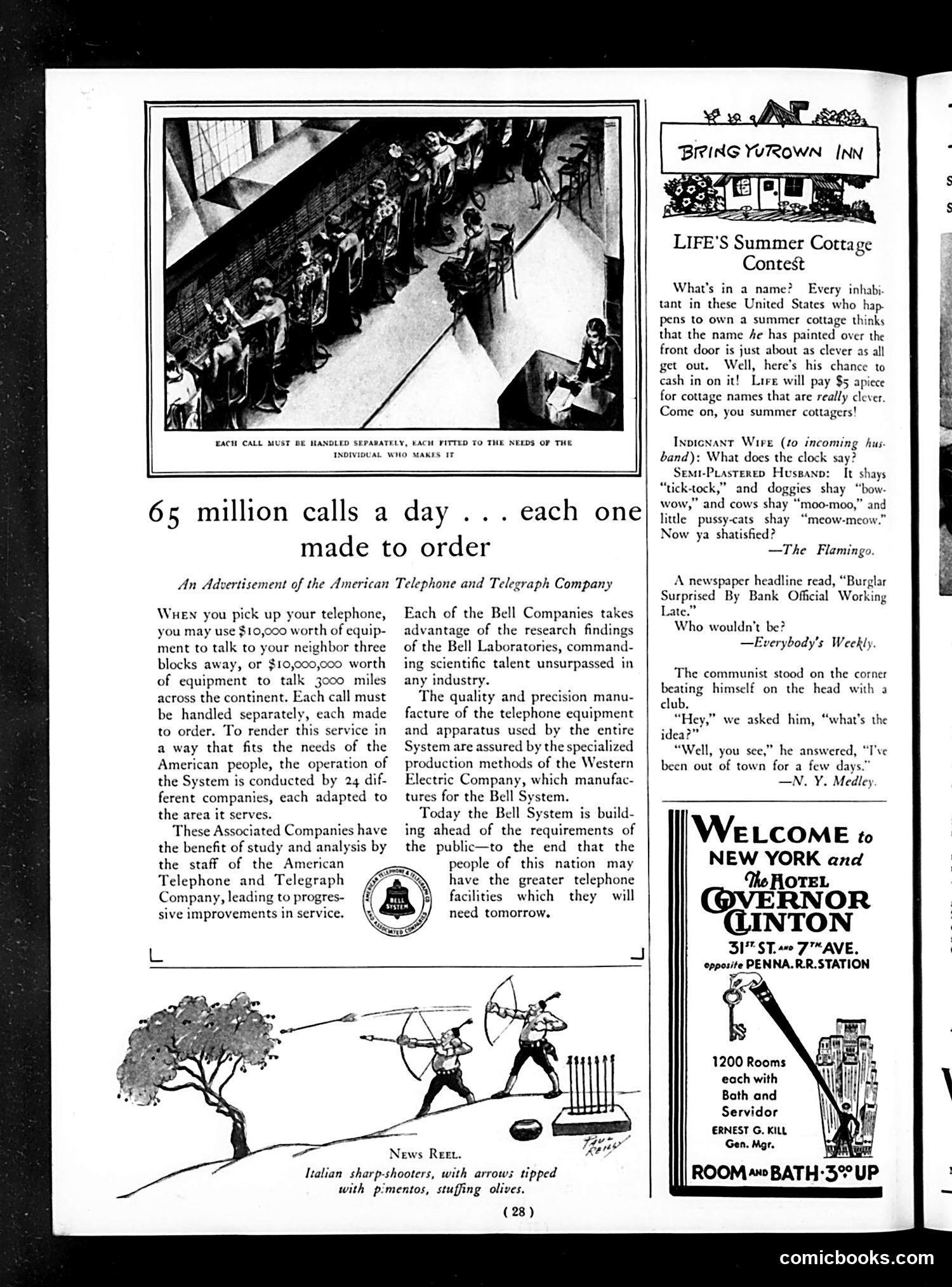
Page Analysis: Life Magazine Advertisement and Humor This page is primarily advertising content for AT&T's telephone system, occupying the left two-thirds. The ad boasts that 65 million daily calls are individually routed through Bell System infrastructure—a technical marvel designed to serve diverse customer needs across the nation. The right side contains humorous filler content: a summer cottage naming contest and several brief jokes. These jokes reflect 1920s-30s sensibilities: a joke about a semi-inebriated husband mimicking animal sounds (dialect humor was common), a quip about burglar-catching being unexpected, and a joke about a communist "out of touch" with current events. At bottom right is a hotel advertisement for the Governor Clinton in New York. The page's main purpose is corporate promotion dressed alongside light entertainment—typical for Life's hybrid advertising-and-satire format. No political cartoons appear here; the "satire" is mild observational humor rather than pointed social commentary.
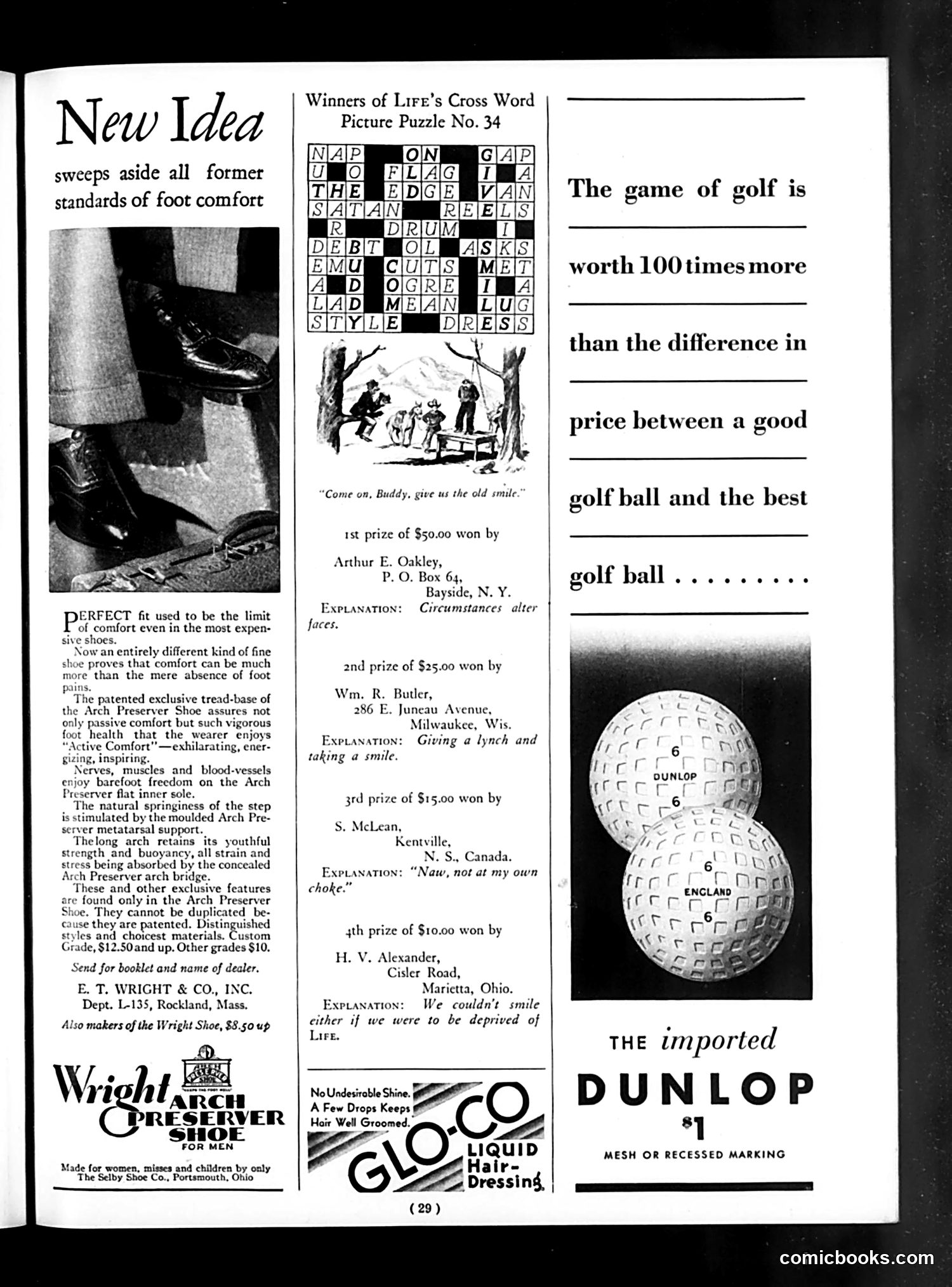
Analysis of Life Magazine Page This page is primarily advertising and contest results, not political satire. The main content features: 1. Wright Arch Preserver Shoe advertisement (left): A product ad emphasizing comfort innovation, with a photo of a woman's foot/shoe. The "New Idea" claims the shoe provides "Active Comfort" through patented arch support. 2. Life's Crossword Picture Puzzle winners (center): Four prize-winning entries with humorous explanations. The cartoon shows people playing outdoors with the caption "Come on, Buddy, give us the old smile." Winners' explanations are lighthearted observations (e.g., "Circumstances alter faces," "We couldn't smile either if we were to be deprived of Life"). 3. Dunlop Golf Ball advertisement (right): Promotes imported British golf balls, claiming superior quality justifies premium pricing. No political satire is present. This appears to be a typical 1920s-30s Life magazine page mixing consumer product advertising with reader contest results and gentle humor—representative of the publication's commercial content rather than its satirical editorial voice.
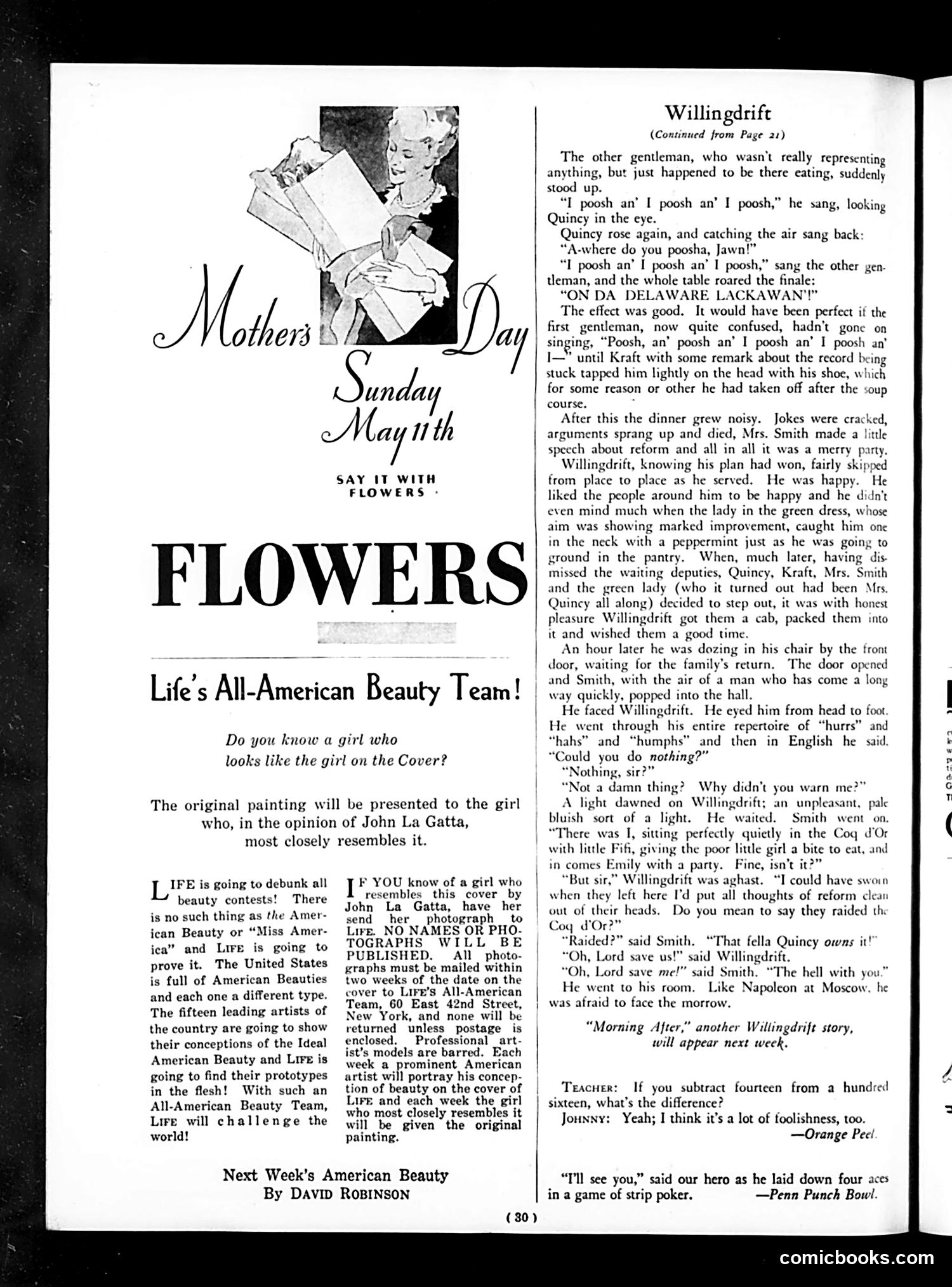
Life Magazine, May 11th: Content Analysis This page contains two distinct sections: Left side: A Mother's Day flower advertisement and announcement of Life's "All-American Beauty Team" contest. Life magazine is launching a satirical challenge to traditional beauty pageants by arguing that American beauty comes in many types. Rather than crowning one "Miss America," the magazine will have leading artists depict their ideal of beauty weekly on the cover, then search for real women matching those paintings. This mocks the artificiality of beauty contests by suggesting no single standard exists—a democratic, if tongue-in-cheek, point for 1920s America. Right side: Continuation of a humorous short story titled "Willingdrift," depicting a dinner party where a servant named Willingdrift successfully orchestrates merriment among guests, including singing and playful antics. The story concludes with Smith returning home and apparently blaming Willingdrift for some undefined misadventure, creating comedic tension about servant accountability and employer expectations.
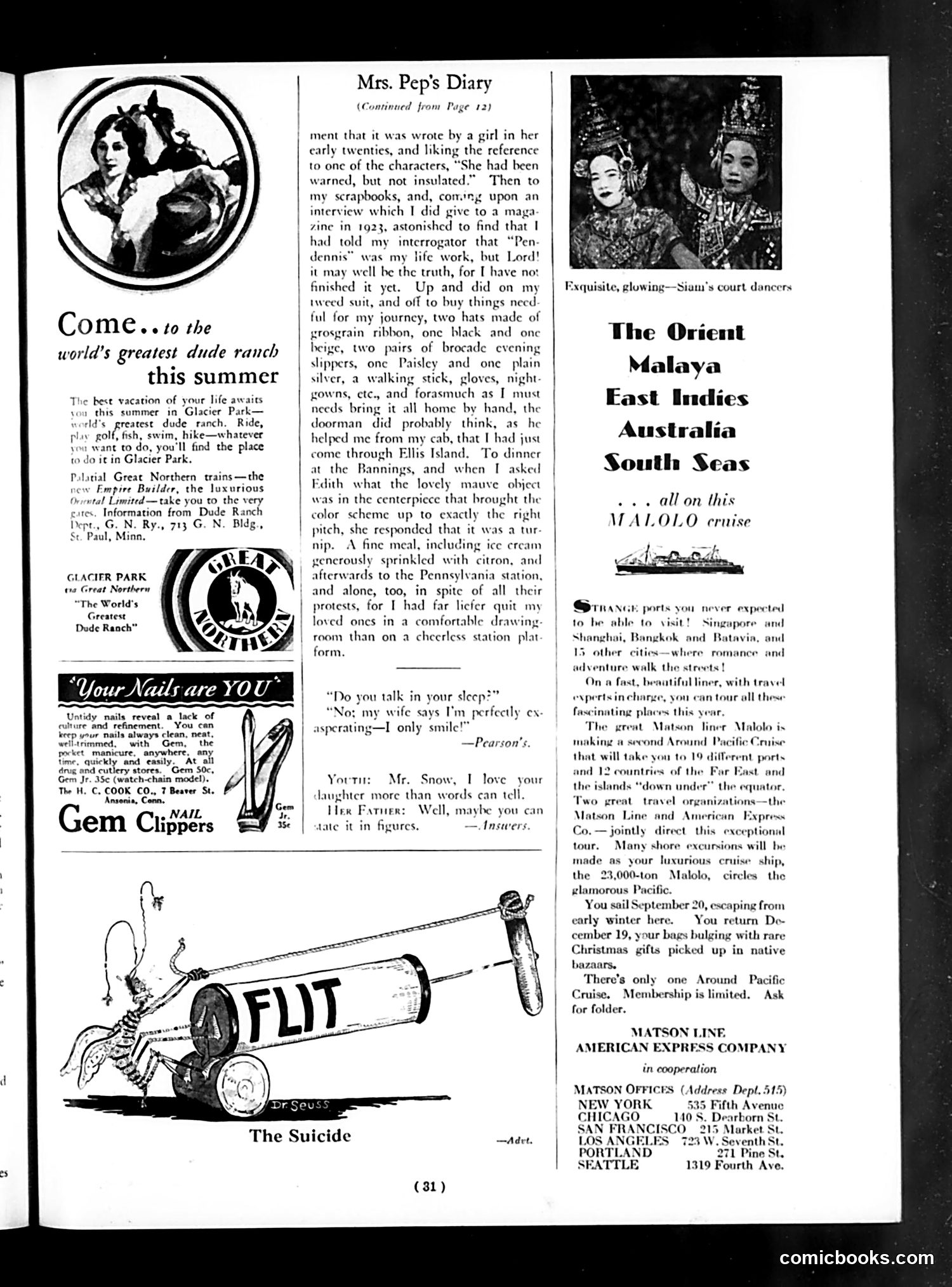
Page Analysis: Life Magazine (circa 1920s) This page mixes editorial content with advertisements typical of Life's format. The main cartoon, titled "The Suicide," depicts an insect being shot from a "Flit" bug spray gun—a visual pun where the pest's "suicide" results from the product's effectiveness. This is straightforward product advertising using dark humor. The page also includes Mrs. Pep's diary excerpt (continued from earlier), describing her travel preparations and social observations, along with small humor jokes about conjugal life and parenting. The advertisements promote luxury travel (Glacier Park dude ranch, Matson cruise line), personal grooming (Gem manicure tools), and nail care products—reflecting 1920s aspirational consumer culture targeting middle and upper-class readers. The satirical content is minimal on this page; it's primarily a commercial publication blending light social commentary with ads appealing to affluent American readers seeking leisure and self-improvement.
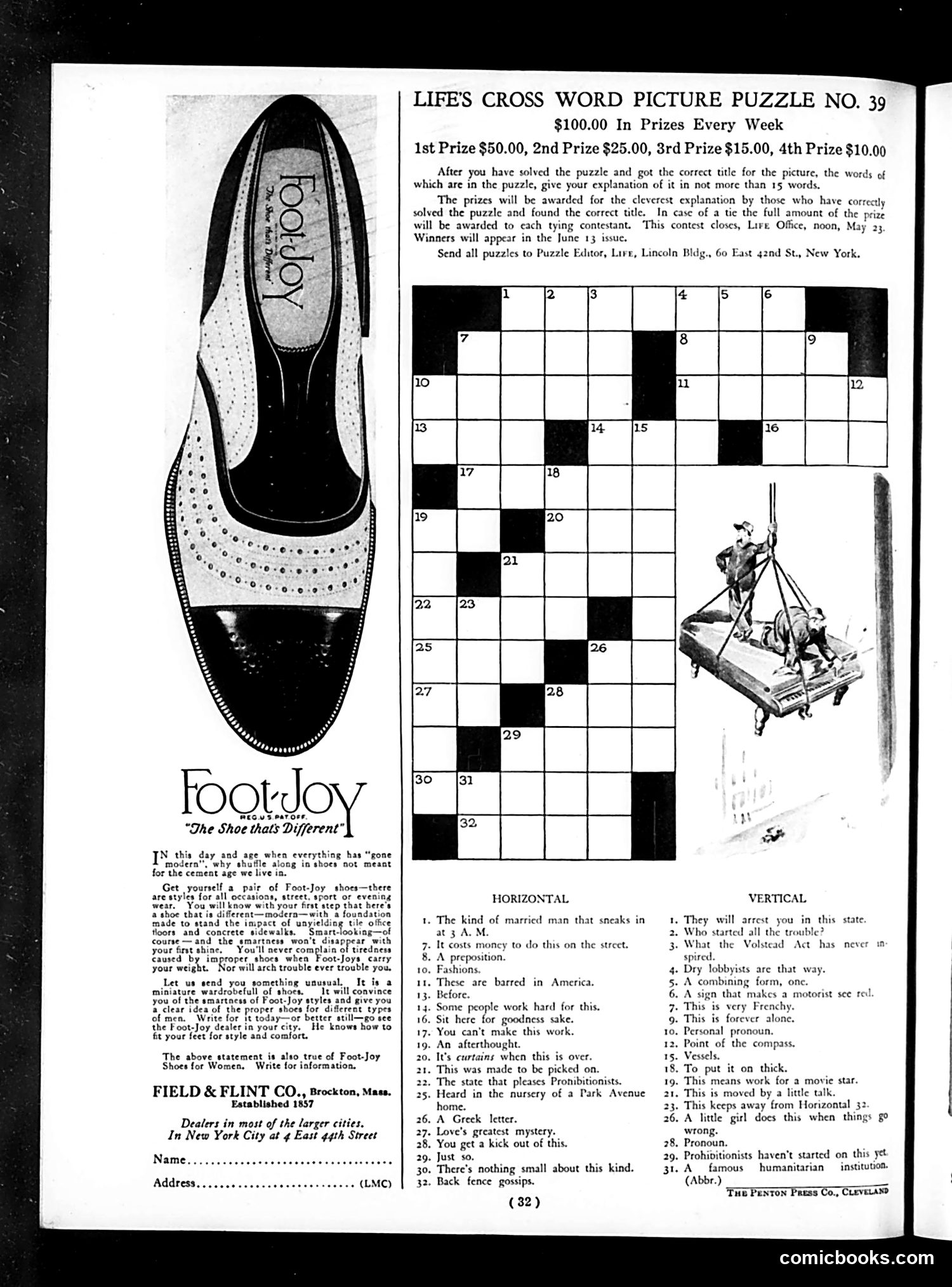
Foot-Joy Shoe Advertisement and Life Magazine Crossword Puzzle This page contains a shoe advertisement (left side) and a crossword puzzle contest (right side). The Foot-Joy ad markets modern shoes for the "cement age," emphasizing comfort and style for urban professionals navigating office floors and concrete sidewalks—a clear appeal to 1920s city workers adapting to modern industrialized life. The crossword puzzle is Life magazine's regular contest feature, offering $100 in weekly prizes. The puzzle's clues are topical references to 1920s American life: Prohibition ("The state that pleases Prohibitionists"), married infidelity ("The kind of married man that sneaks in at 3 A.M."), the Volstead Act, and social customs. An illustration of someone on a primitive aircraft appears alongside. The puzzle exemplifies how Life used wordplay and contemporary social commentary—particularly around Prohibition and modern urban life—as entertainment while subtly satirizing 1920s American culture and anxieties.
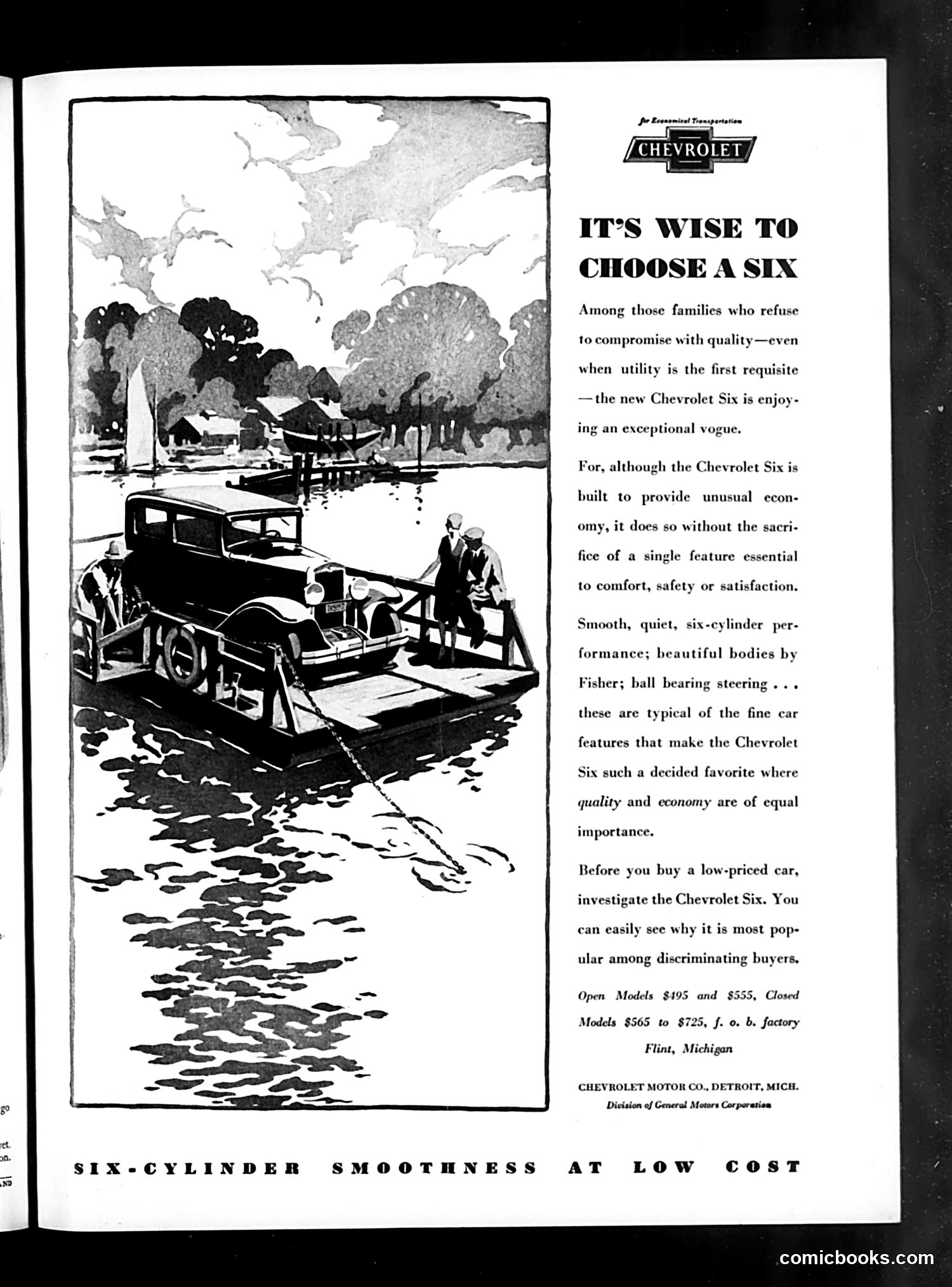
Analysis This is a Chevrolet automobile advertisement, not satirical content. The page promotes the Chevrolet Six, a new six-cylinder car model positioned as affordable yet quality-focused. The illustration shows a car being ferried across water, with well-dressed men overseeing the transport—imagery suggesting reliability and careful handling of valuable goods. The accompanying text targets "discriminating buyers" who won't compromise on quality despite wanting economy. The advertisement's messaging reflects 1920s-era marketing: positioning a mass-market vehicle as suitable for middle-class families concerned with both cost and respectability. Prices listed ($495-$725) indicate this was indeed a budget option compared to luxury brands, yet the ad emphasizes features like "beautiful bodies by Fisher" and "ball bearing steering" to suggest premium quality. There is no cartoon or political satire present—this is straightforward commercial advertising typical of *Life* magazine's revenue model during the era.
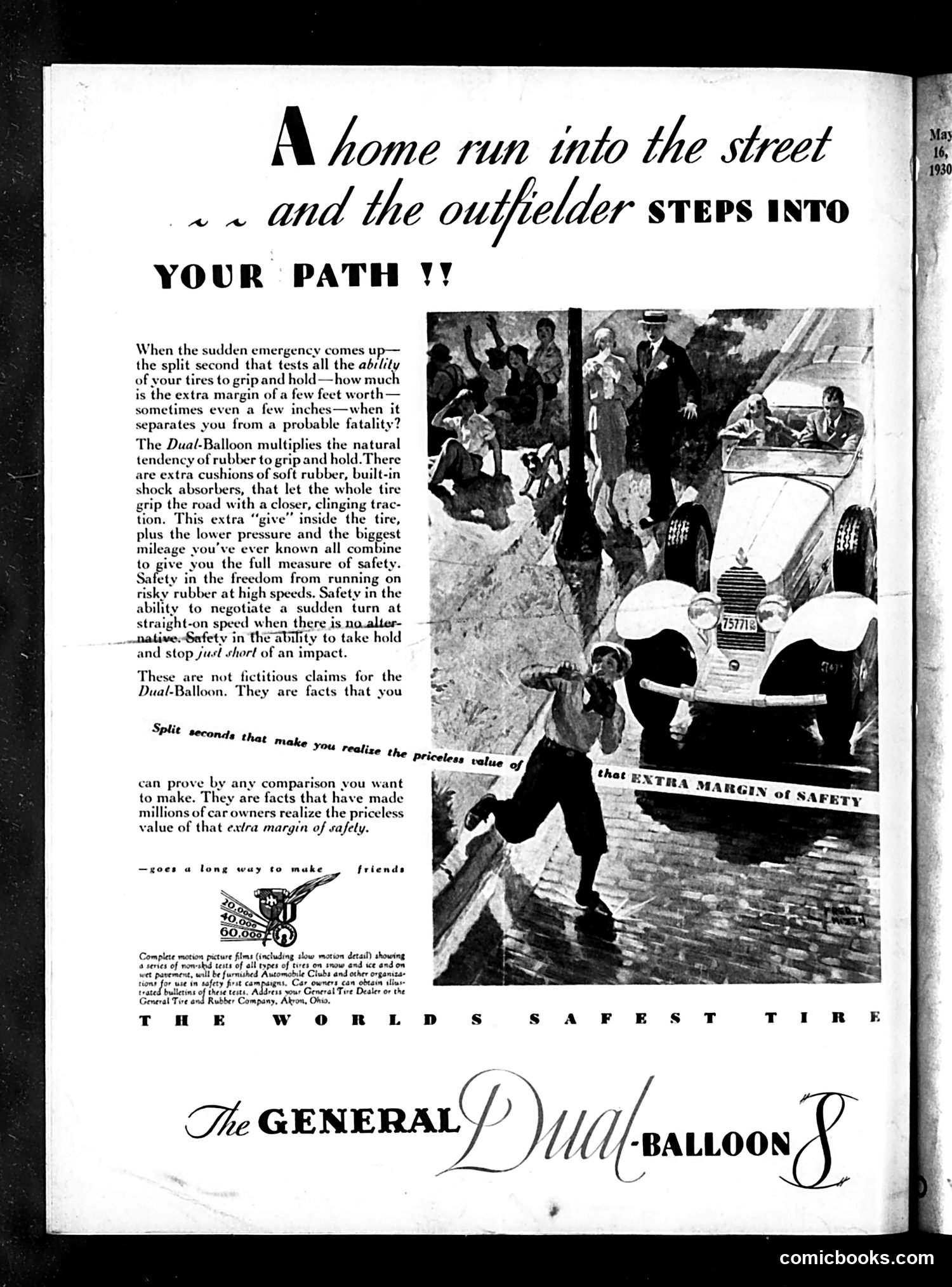
Analysis: General Tire Advertisement (1930) This is not satire or political cartoon—it's a straightforward automobile tire advertisement from *Life* magazine (May 16, 1930). The page uses a dramatic scenario to sell safety: a baseball home run flying into the street forces a driver to swerve suddenly, nearly hitting the outfielder. The ad argues that General's "Dual-Balloon" tires provide crucial grip and stopping power in emergencies—the literal "extra margin of safety" that prevents fatal collisions. The copy emphasizes that tire quality matters in split-second life-or-death moments. It's framed as fact-based marketing: General claims their tires have "extra cushions of soft rubber, built-in shock absorbers" enabling better traction. For modern readers: this reflects 1930s automobile safety concerns before seatbelts or airbags existed. Tire quality was genuinely one of few safety variables drivers could control. The dramatic baseball scenario appeals to middle-class car owners worried about accidents involving pedestrians—a common urban hazard of the era.