life
Life — May 23, 1930
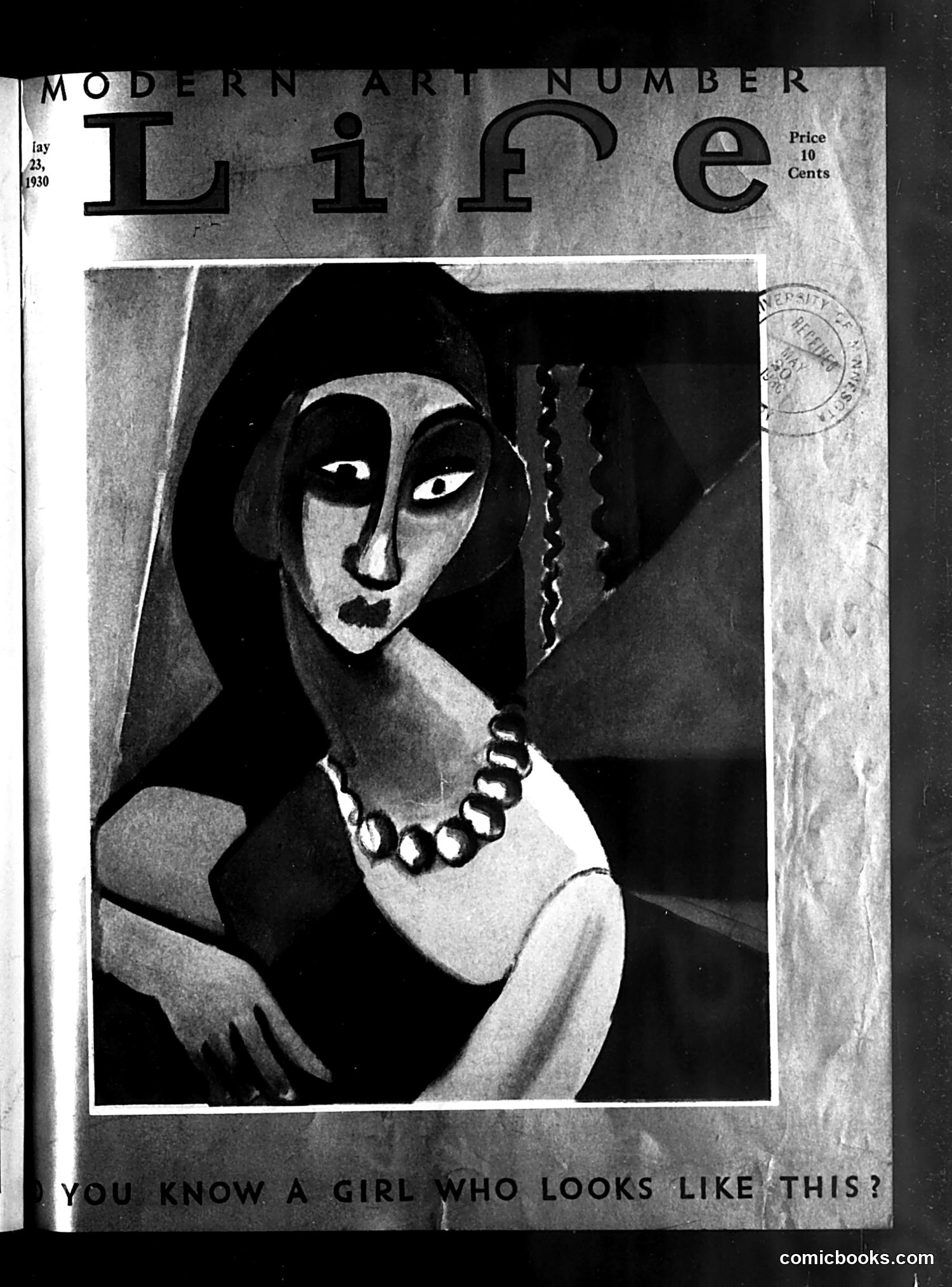
Analysis This is a cover from *Life* magazine (priced at 10 cents, dated July 24, 1930). The striking modernist portrait depicts a woman wearing a black hood or head covering and a geometric necklace, rendered in high-contrast black and white. The caption asks: "YOU KNOW A GIRL WHO LOOKS LIKE THIS?" The artwork appears to be satirizing the modernist or avant-garde aesthetic popular among certain social circles in 1930s America—likely mocking either experimental fashion trends, artistic pretension, or perhaps specific cultural figures associated with avant-garde movements. The exaggerated geometric face, severe styling, and mysterious hooded appearance suggest the magazine is gently ridiculing what it portrays as affected or bizarre contemporary style choices among fashionable women.
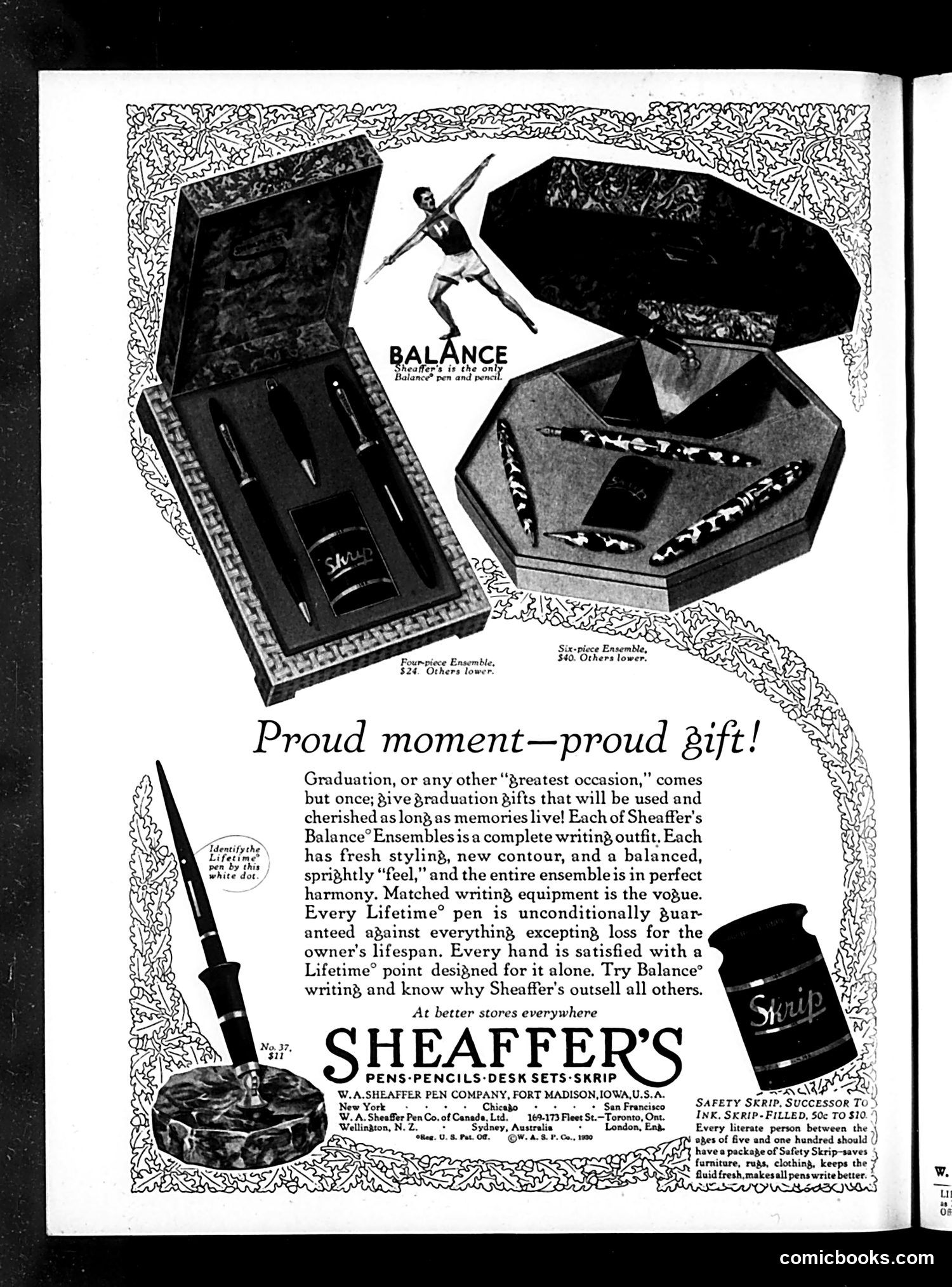
Content Analysis This page is primarily an advertisement, not satire or political commentary. It promotes Sheaffer's "Balance" writing sets—pens, pencils, and desk accessories marketed as graduation gifts. The visual elements include: - Decorative ornamental borders (typical of the era) - Product photography showing multiple "Balance Ensemble" sets in open boxes - A stylized illustration of a figure in a diving/balancing pose, illustrating the "Balance" brand name - Images of individual pens and a bottle of Safety Skrip ink The advertisement's appeal emphasizes matched writing equipment as prestigious graduation gifts that will last a lifetime. The "Balance" name and acrobatic figure serve as visual branding rather than political reference. There is no cartoon, satire, or social commentary present on this page—it is straightforward commercial advertising typical of early-to-mid 20th century magazine promotion.
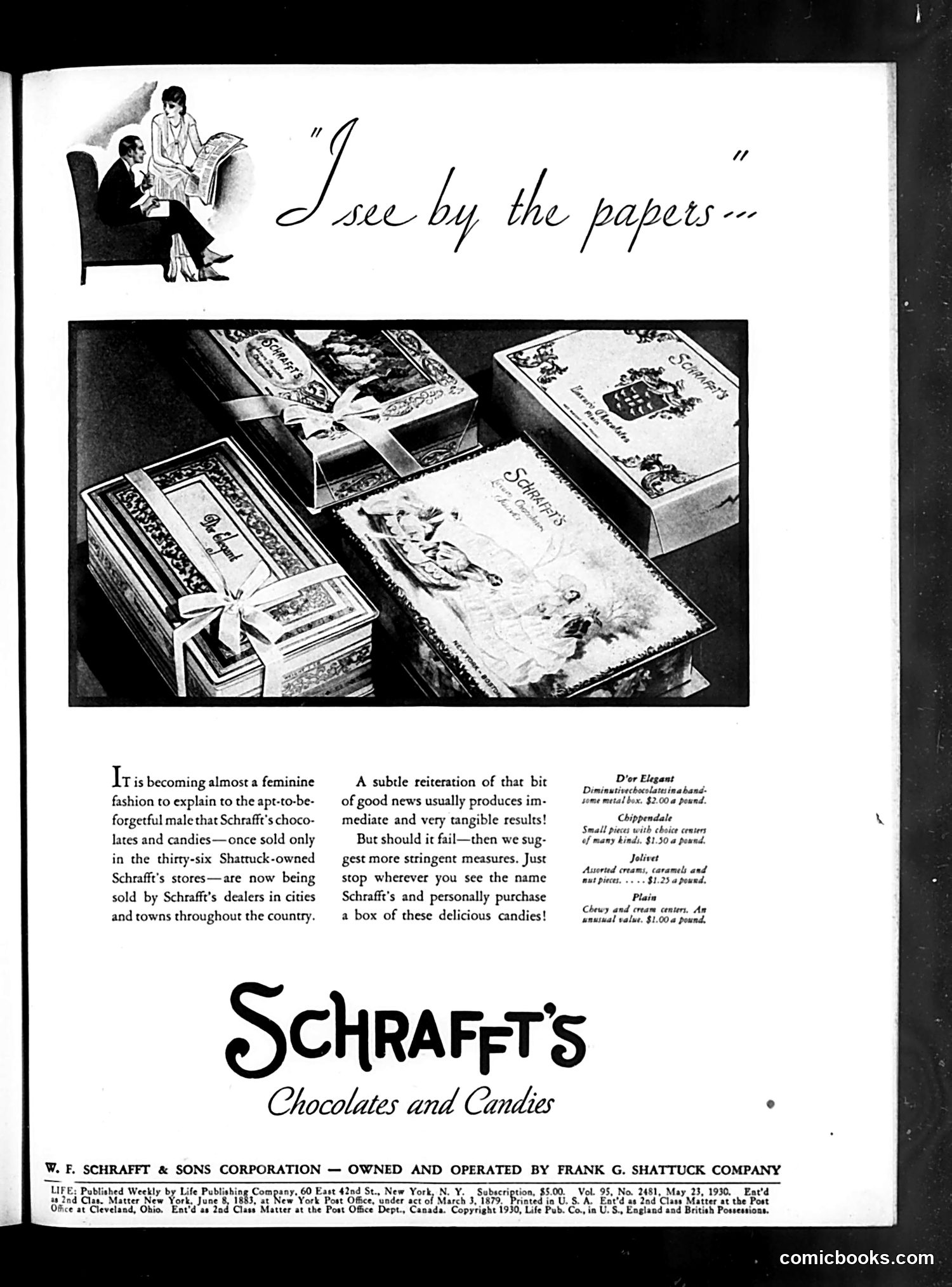
Analysis This is a Schrafft's chocolate and candy advertisement, not political satire. The page shows gift boxes of confections arranged artfully. The small illustration at top depicts a man and woman in an office setting—likely meant to suggest a business or workplace context where Schrafft's candies serve as an appropriate gift. The ad's humor relies on gentle social commentary: it notes that giving Schrafft's chocolates and candies has become "almost a feminine fashion" to explain the "apologies" men must make. The underlying joke is that men have traditionally given women sweets as romantic gestures or peace offerings, positioning Schrafft's as the quality brand for such occasions. The copy emphasizes that Schrafft's products, once sold only in their own stores, are now available through dealers nationwide—a distribution expansion the advertiser presents as significant news.
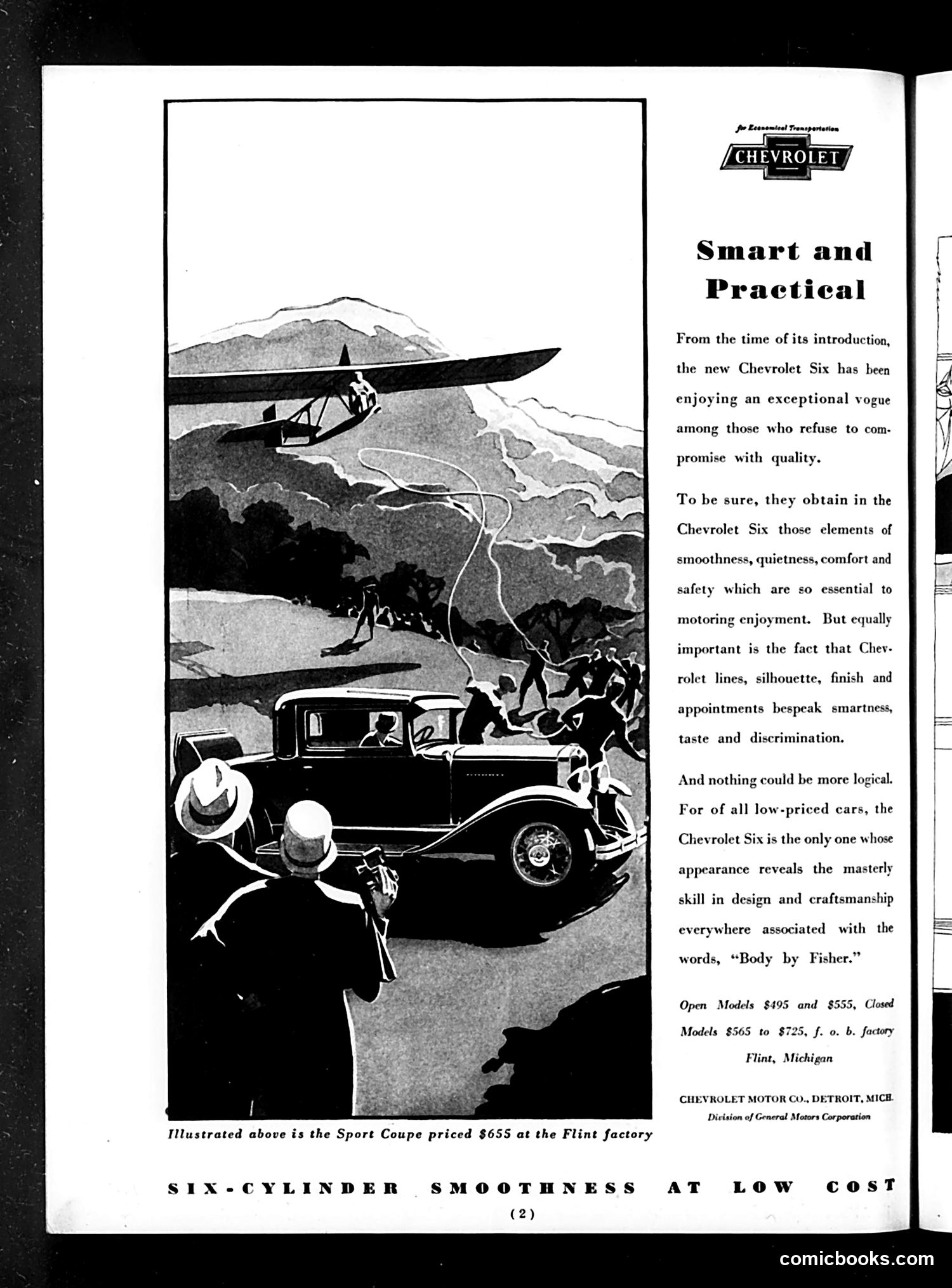
Analysis This is a Chevrolet automobile advertisement, not a political cartoon. The page showcases the Chevrolet Six with the heading "Smart and Practical." The illustration depicts an airplane landing near a Chevrolet, with elegantly dressed people observing—suggesting the car's modernity and sophistication. The ad emphasizes that despite being low-priced, the Chevrolet Six features quality design, comfort, and safety comparable to higher-priced vehicles. Key selling points highlighted include the car's "smoothness, quietness, comfort and safety" and its distinctive appearance by Fisher Body (a noted coachbuilder). The text notes this positions the Chevrolet Six uniquely among affordable cars for its craftsmanship. Pricing listed: Open Models $495-$555; Closed Models $565-$725, factory in Flint, Michigan.
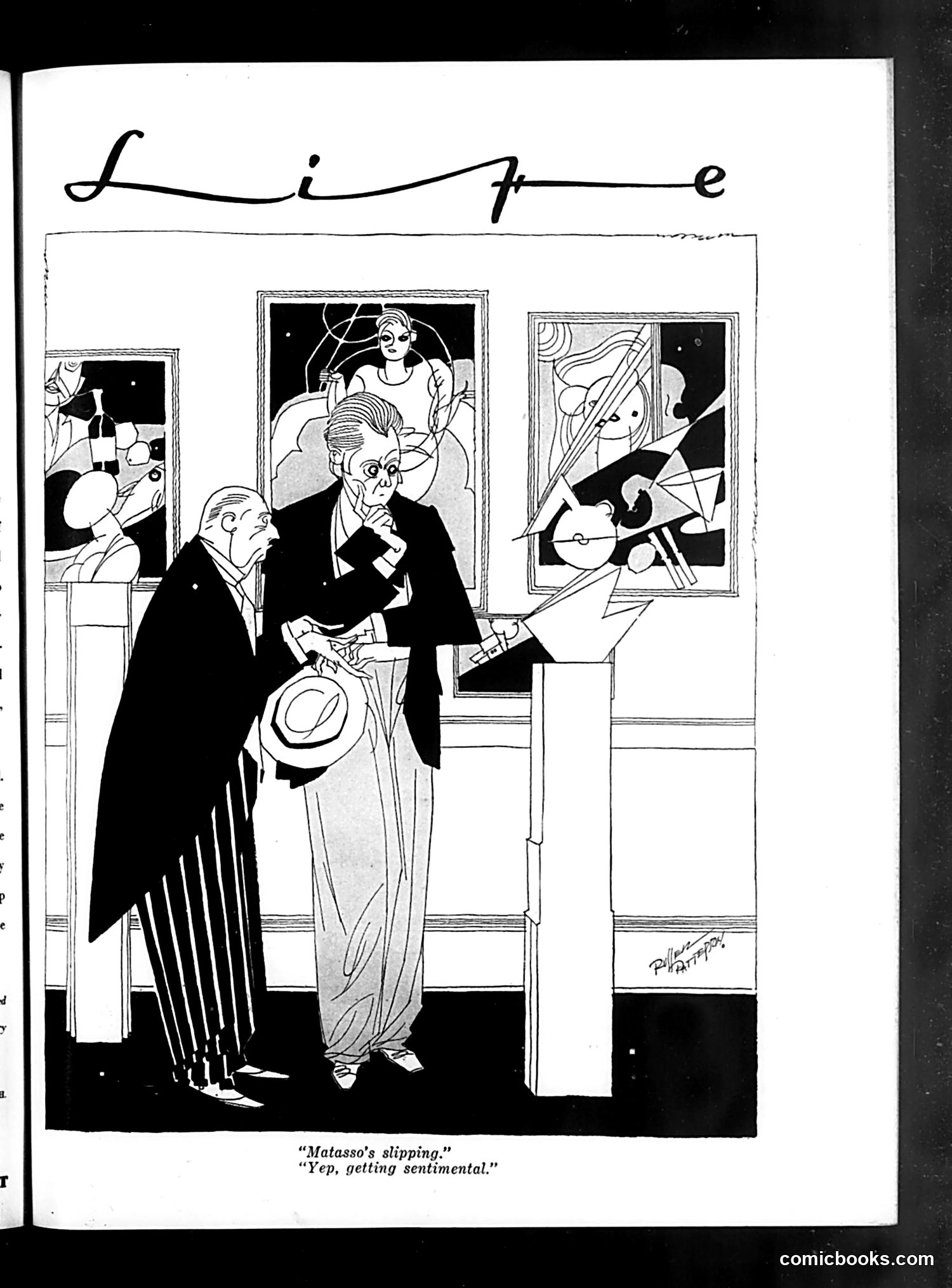
"Matasso's Slipping" - Life Magazine Cartoon This cartoon depicts two well-dressed men in formal attire viewing what appears to be an art gallery or exhibition. The caption reads: "Matasso's slipping. / Yep, getting sentimental." The joke appears to reference someone named Matasso (likely an artist or public figure) whose work is displayed in the framed pieces visible on the walls behind them. The observers are commenting that Matasso's artistic standards or edge are declining—he's "slipping"—and they attribute this decline to him becoming overly "sentimental," suggesting his work has become emotionally indulgent rather than maintaining previous artistic rigor. Without additional context about who Matasso was, the specific satirical target remains unclear, though this was likely topical commentary on a contemporary artist or cultural figure from Life magazine's era.
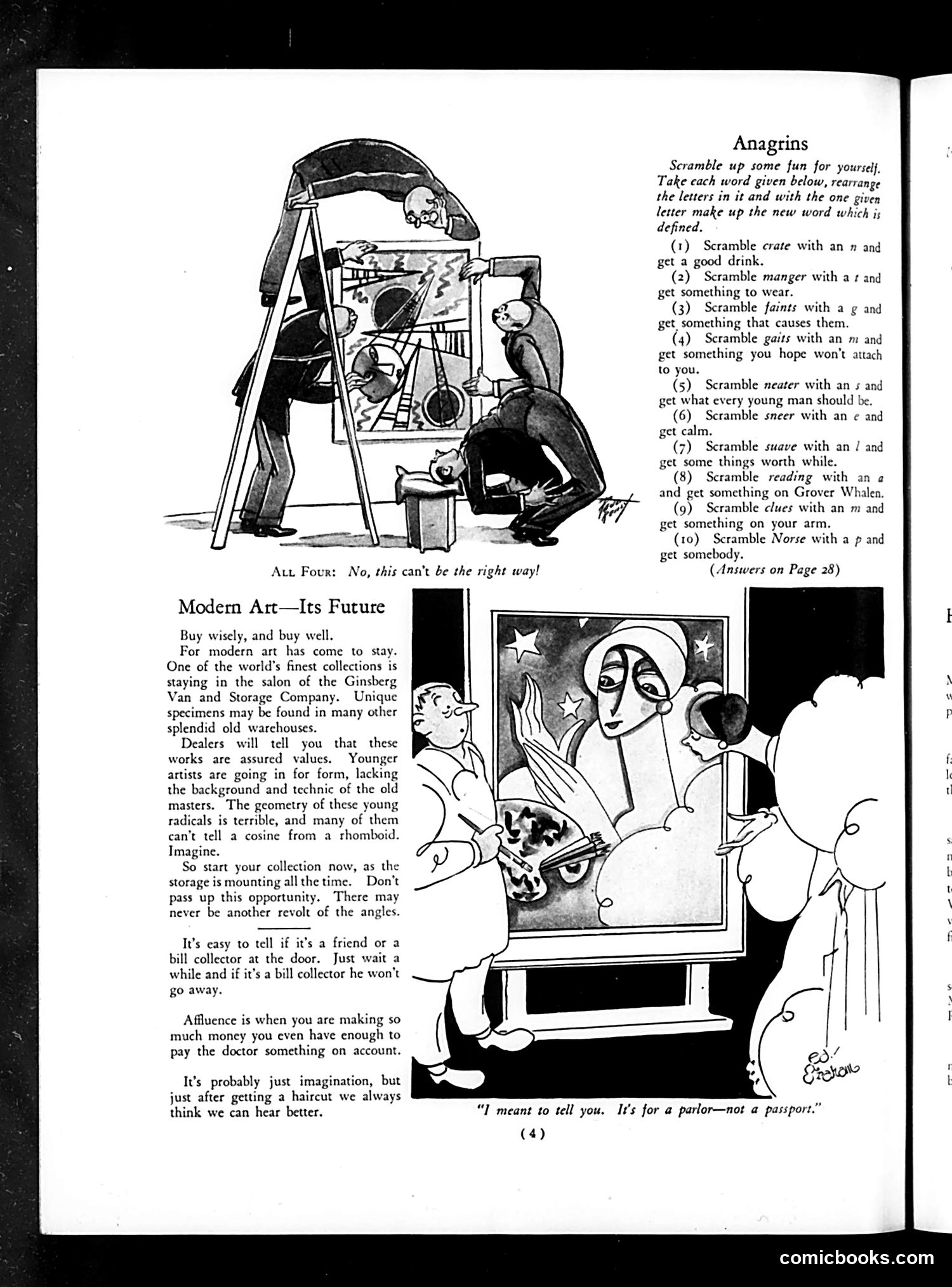
Explanation for Modern Readers Top Cartoon: Four figures examine what appears to be abstract modern art on an easel, all declaring "No, this can't be the right way!" This satirizes the bewilderment that early 20th-century audiences felt toward modernist and avant-garde art movements—cubism, abstract expressionism, etc. The joke: even trained observers couldn't understand or appreciate these radical new artistic styles. Bottom Advertisement: A piece of abstract art on display attracts potential buyers. The caption jokes: "I meant to tell you. It's for a parlor—not a passport." This mocks modern art's obscurity by suggesting the painting is so incomprehensible it could serve as a fraudulent travel document. The satire targets both the bewildering nature of modern art and wealthy collectors who purchase it despite (or because of) its incomprehensibility.
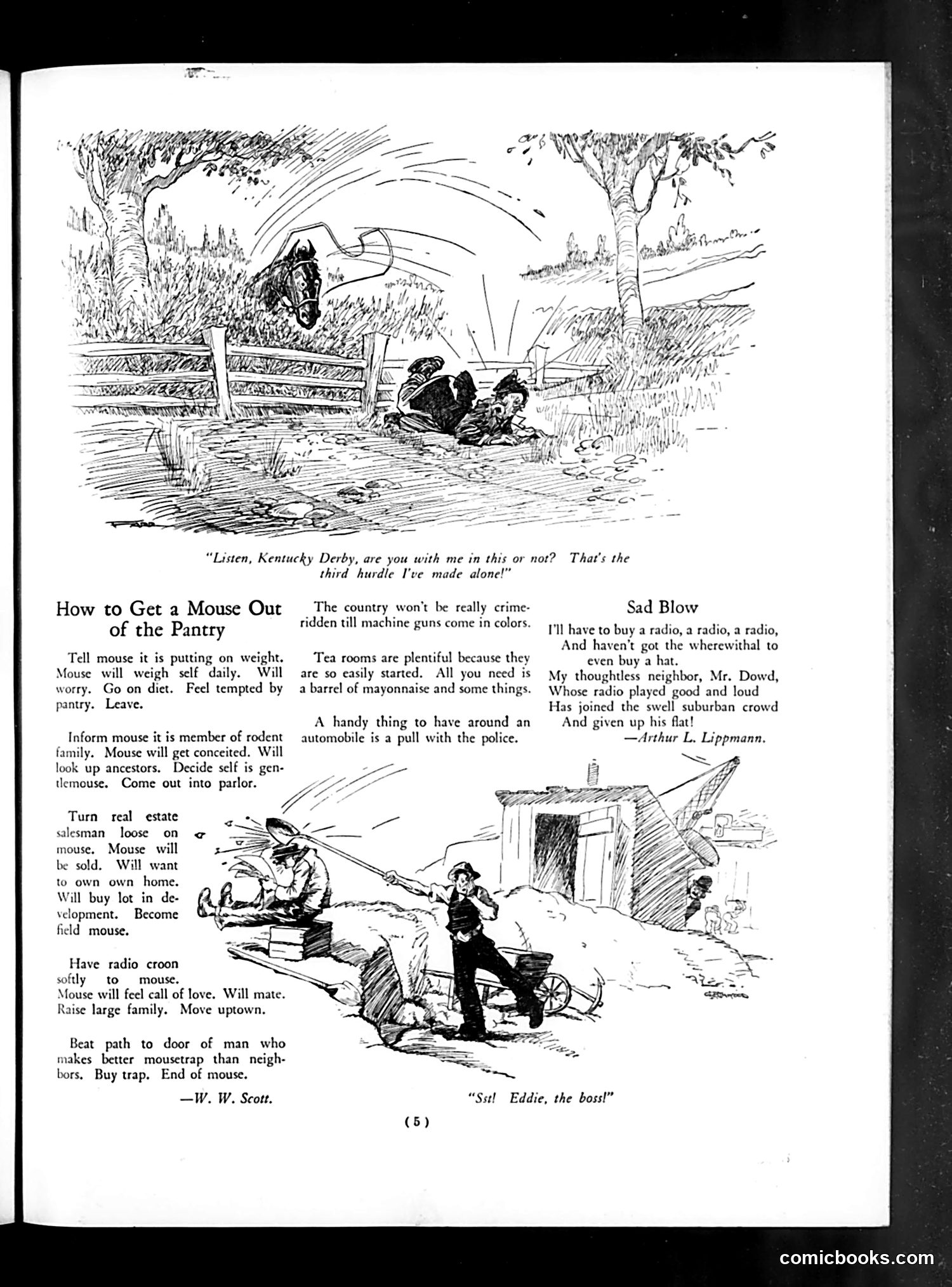
Analysis This page contains three humorous pieces from *Life* magazine: 1. "How to Get a Mouse Out of the Pantry" (by W.W. Scott): A satirical "advice" piece offering absurd solutions—telling the mouse it's overweight, making it a real estate agent, playing radio music to make it mate and move uptown, or buying a better mousetrap. The humor lies in treating a simple pest problem with elaborate, impractical schemes. 2. "Sad Blow" (by Arthur L. Lippmann): A poem lamenting that the author can't afford a radio, while a thoughtless neighbor, Mr. Dowd, bought one and now plays it loudly, annoying the entire suburban neighborhood. This reflects 1920s-30s frustrations with new radio technology and inconsiderate neighbors. 3. Cartoon captions: "Listen, Kentucky Derby, are you with me..." and "Suh! Eddie, the boss!" accompany period illustrations depicting rural/comedic scenarios. The page satirizes everyday modern inconveniences of the era.
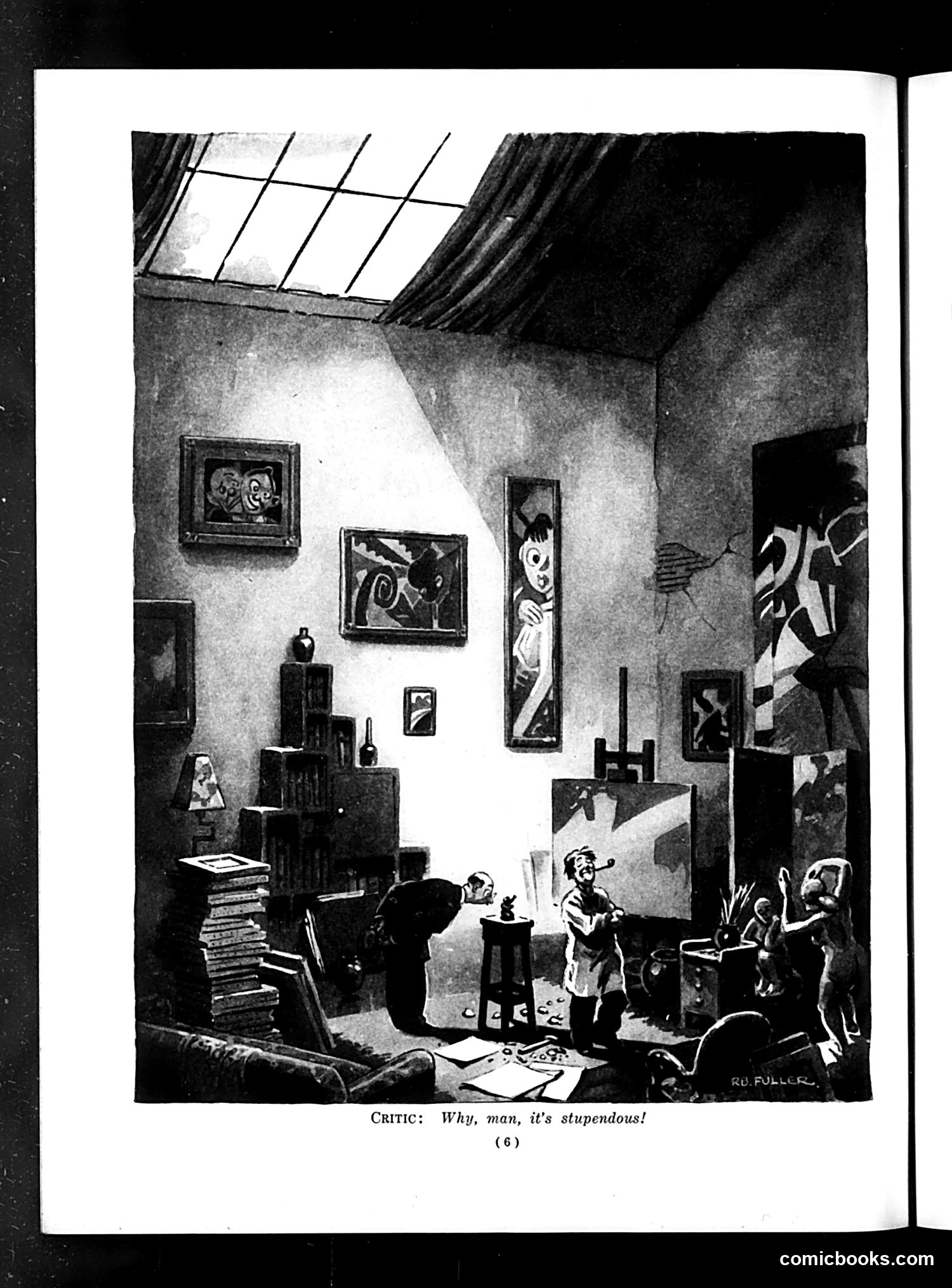
Analysis This is a single-panel cartoon by R.D. Fuller titled "Critic: Why, man, it's stupendous!" The image depicts an artist's studio with a skylighted ceiling and various modernist artworks hanging on the walls. Several figures examine the artwork with apparent enthusiasm. The satire targets art criticism and modernism. The joke appears to be that critics lavishly praise abstract or unconventional art as "stupendous" when the actual merit may be questionable. The cluttered studio, stacked books, and eclectic collection of paintings—some appearing quite crude or nonsensical—suggest the artwork lacks clear artistic value, yet the critic declares it impressive anyway. This reflects early-to-mid 20th-century skepticism about modern art movements and the perceived pretentiousness of art criticism.
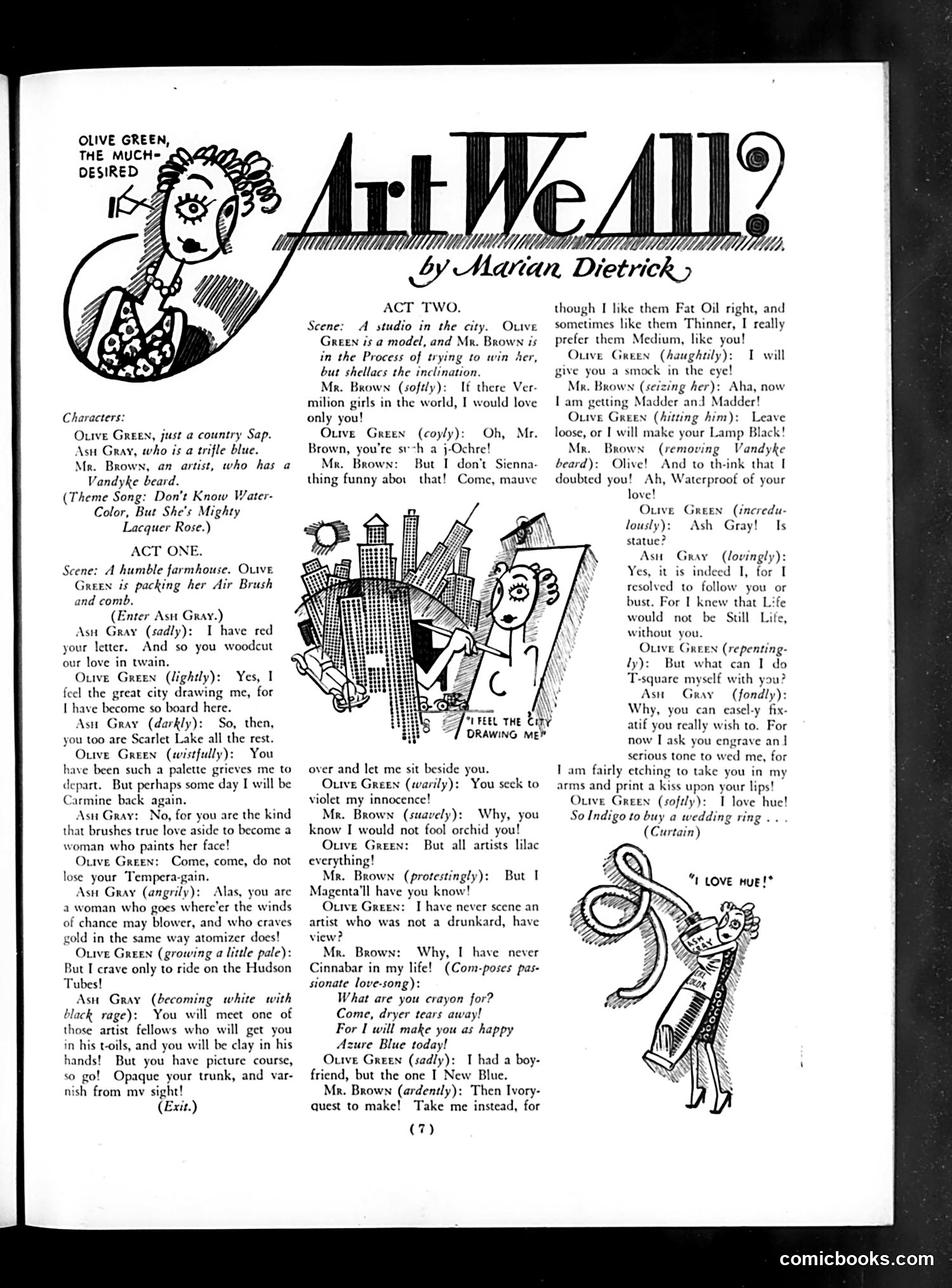
This page presents "Art Well?", a one-act comedy by Marian Dietrick. The sketch satirizes artistic pretension and bohemian stereotypes through characters including Olive Green (a country girl and air-brush model), Ash Gray (described as "a trifle blue"), and Ms. Brown (an artist). The humor revolves around Olive Green's naïve charm clashing with the affected, bohemian world of artists and models in the city. References to artistic temperament, drinking ("I have never seen an artist who was not a drunkard"), and romantic entanglement drive the comedy. The illustrations show the city skyline and Olive Green in fashionable dress, emphasizing the contrast between her rural origins and urban artistic society. The sketch mocks both artistic pretension and the innocence of country folk encountering city sophistication.
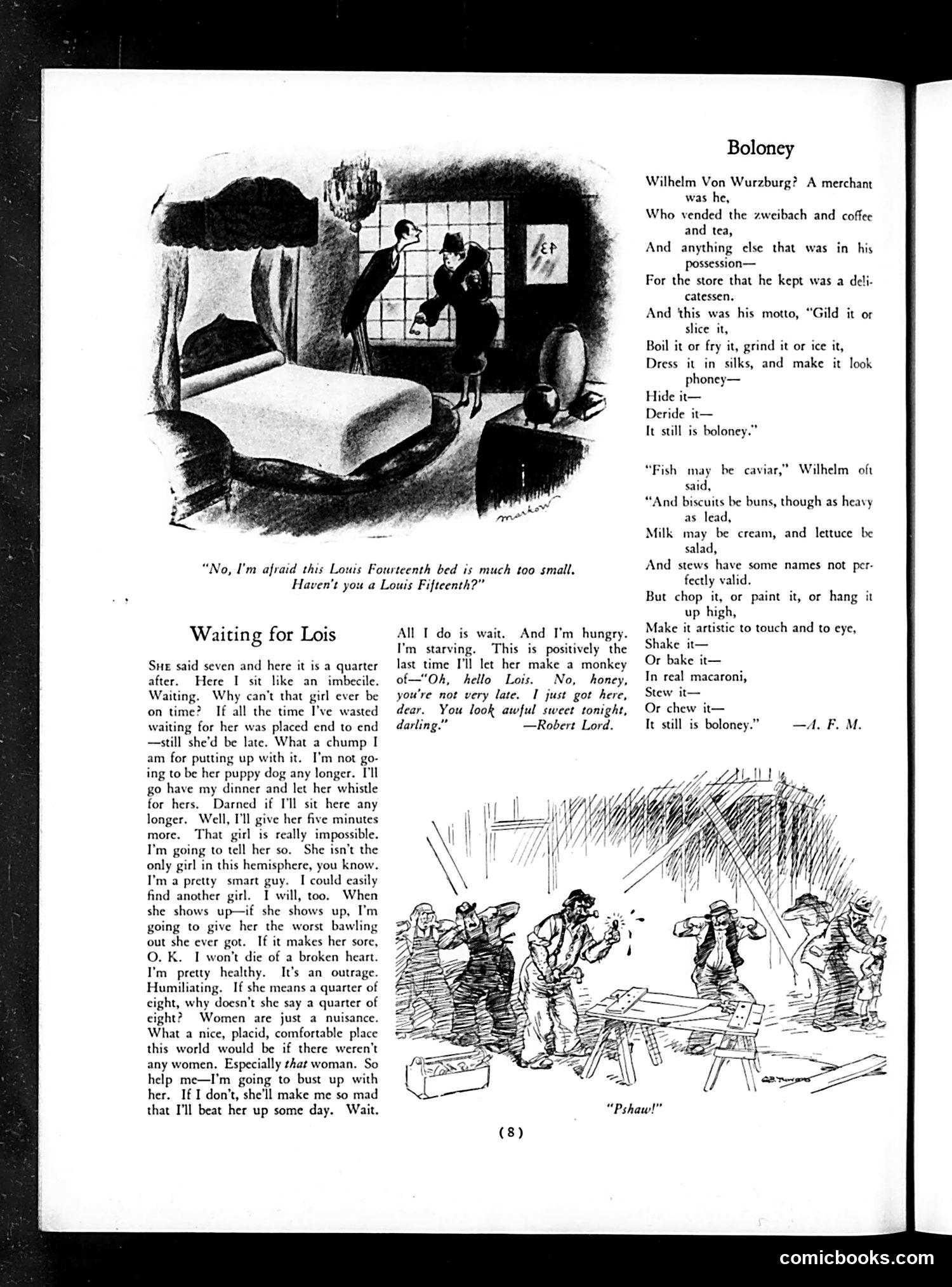
Analysis of Page 8 from Life Magazine This page contains two distinct pieces: "Boloney" (right): A satirical poem mocking Wilhelm Von Wurzburg, a merchant who sells delicatessen items. The piece ridiculues his practice of disguising low-quality food through fancy preparation—"Gild it or slice it, / Boil it or fry it"—to pass it off as premium. The satire targets food fraud and marketing deception, suggesting merchants mask inferior ingredients through presentation and labeling tricks to deceive customers. "Waiting for Lois" (left): A humorous story about a man waiting for a woman named Lois who is late. He complains bitterly about waiting, threatens to end the relationship, and makes misogynistic remarks about women generally being a "nuisance." The illustration shows an uncomfortable domestic scene reflecting early 20th-century gender dynamics and relationship frustrations.
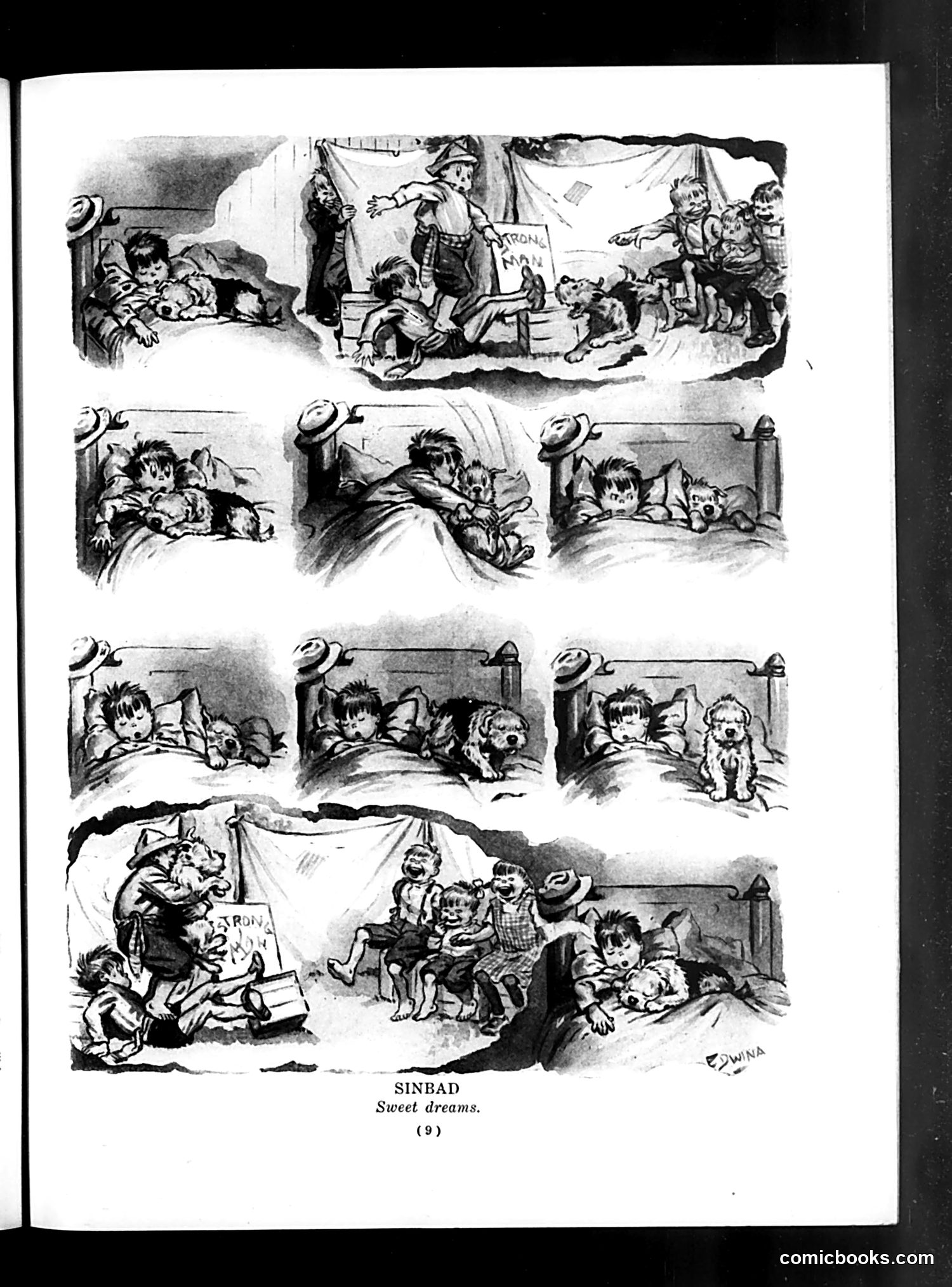
"Sweet Dreams" by Sinbad This appears to be a sequential comic strip depicting a child's bedtime routine and dreams. The title "Sweet dreams" and the character name "Sinbad" suggest the narrative follows a young boy named Sinbad as he goes to bed. The panels show: children in various sleeping positions, an adult (likely a parent) supervising bedtime, and what appear to be dream sequences featuring fantastical or adventurous imagery—possibly referencing Sinbad's famous maritime adventures from Arabian tales. The comic likely uses the contrast between ordinary bedtime and imaginative dreams for gentle humor, playing on how children's sleep is often filled with vivid, fantastical dreams. The signature appears to be "Dwina" or similar. Without additional context about Life magazine's publication date, the specific satirical intent remains unclear.
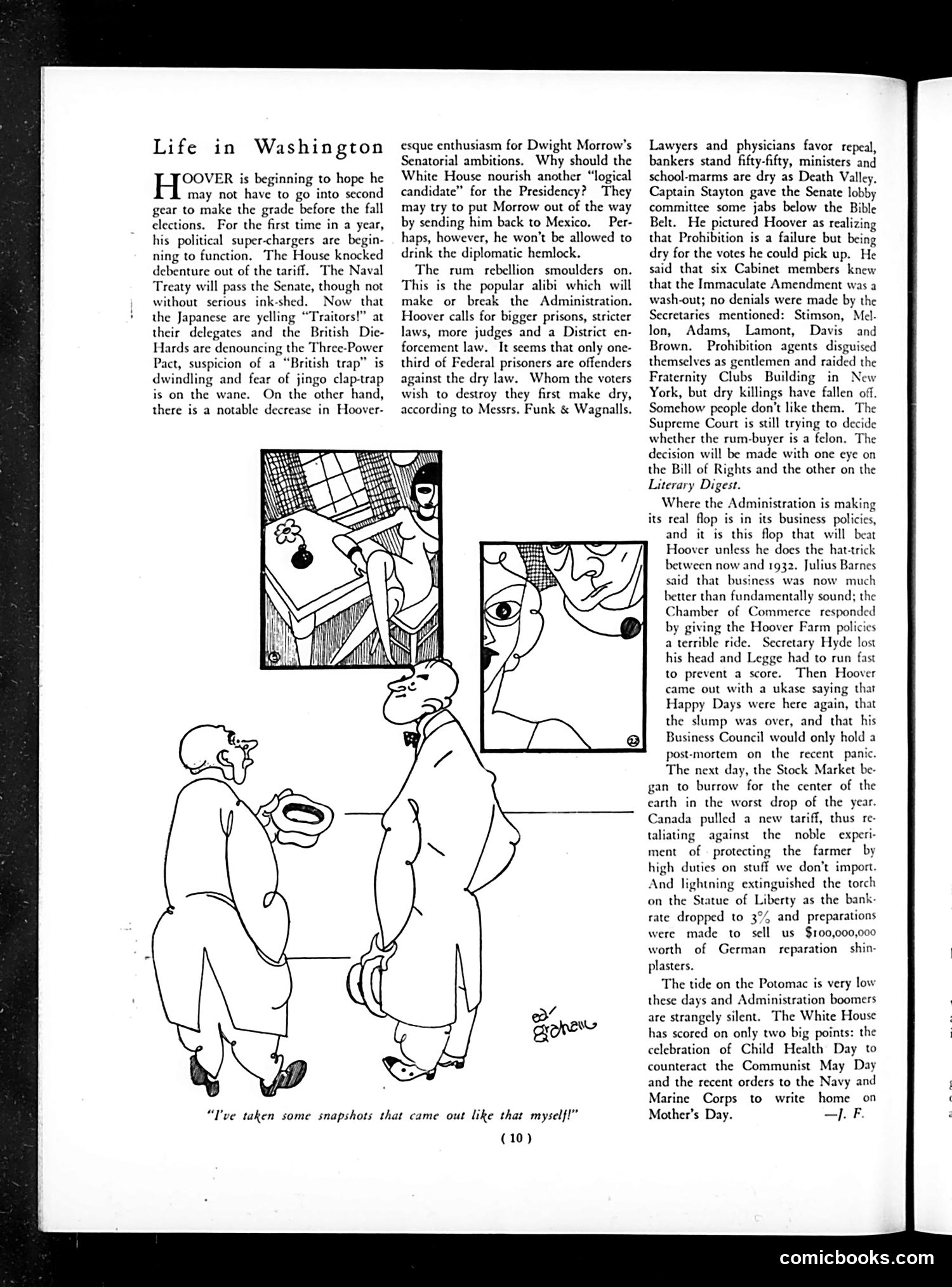
Political Satire: "Life in Washington" This page satirizes the Hoover administration's political troubles circa 1932. The main cartoon depicts two portly figures (likely representing political rivals or administration figures) exchanging gossip or scheming, with the caption "I've taken some snapshots that came out like that myself!" The text criticizes Hoover's declining popularity and failing economic policies during the Great Depression. It mocks his attempts to manage crises—including references to the Doral Treaty, crime concerns, and failed business recovery efforts. The article suggests Hoover's administration is resorting to deceptive tactics and empty rhetoric ("Happy Days were here again") rather than substantive solutions. The cartoon's style and subject matter reflect contemporary frustrations with the president's inability to address the economic catastrophe gripping America.
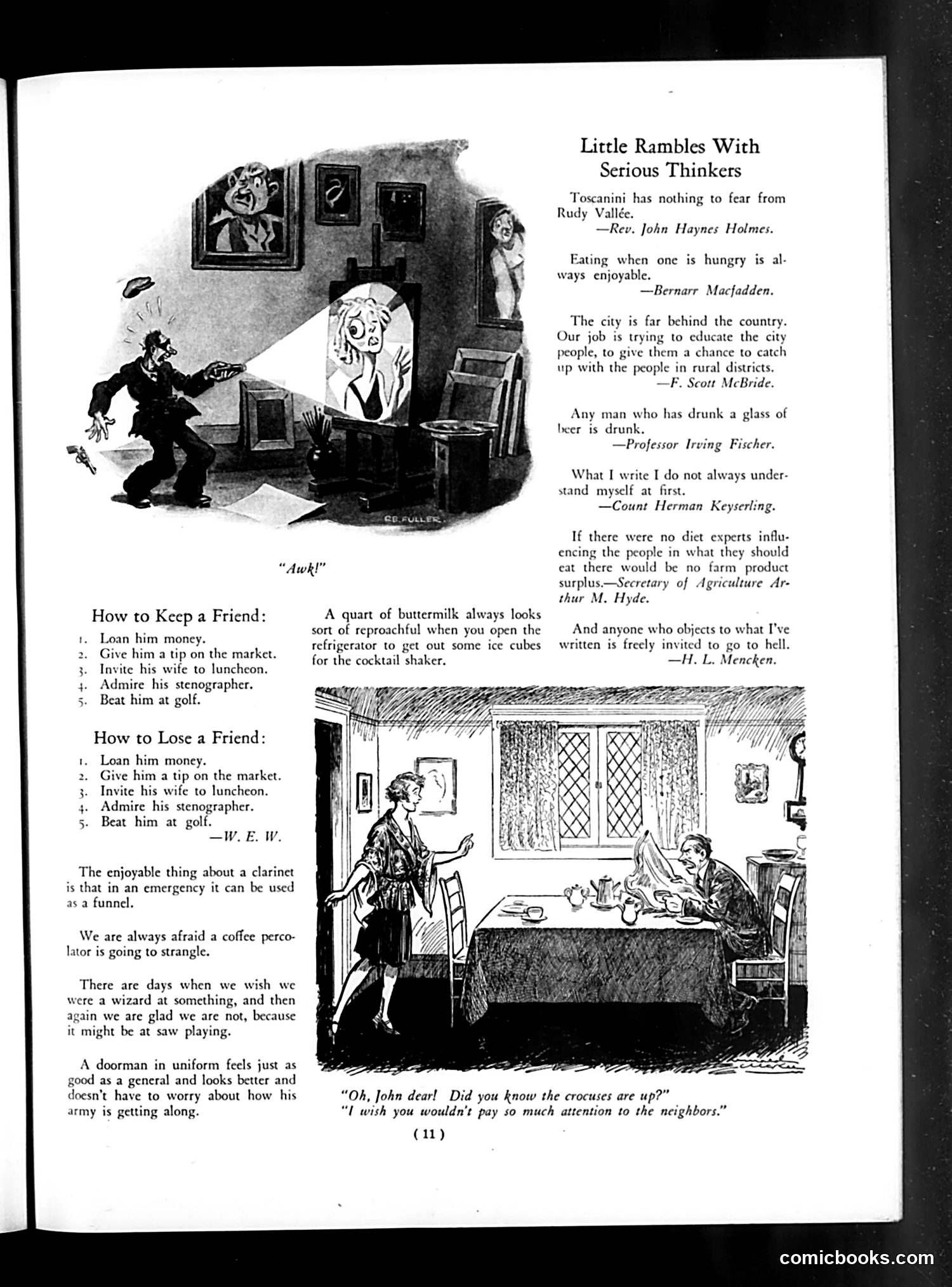
Analysis of "Little Rambles With Serious Thinkers" This page features a collection of humorous quotes attributed to notable figures (Rev. John Haynes Holmes, Bernardr Macfadden, etc.) alongside two cartoons and satirical lists. The top cartoon titled "Awk!" shows a man startled by artwork on a wall, likely satirizing awkward social situations or reactions to modern/unconventional art. The lists "How to Keep a Friend" and "How to Lose a Friend" present identical numbered actions (loan money, give market tips, invite wife to lunch, etc.), with the ironic conclusion that the same behaviors accomplish opposite results—a joke about the inconsistency of human relationships and social etiquette. The lower cartoon depicts a domestic scene where a woman complains about neighbors' crocuses to her husband, illustrating petty domestic disputes over trivial matters.
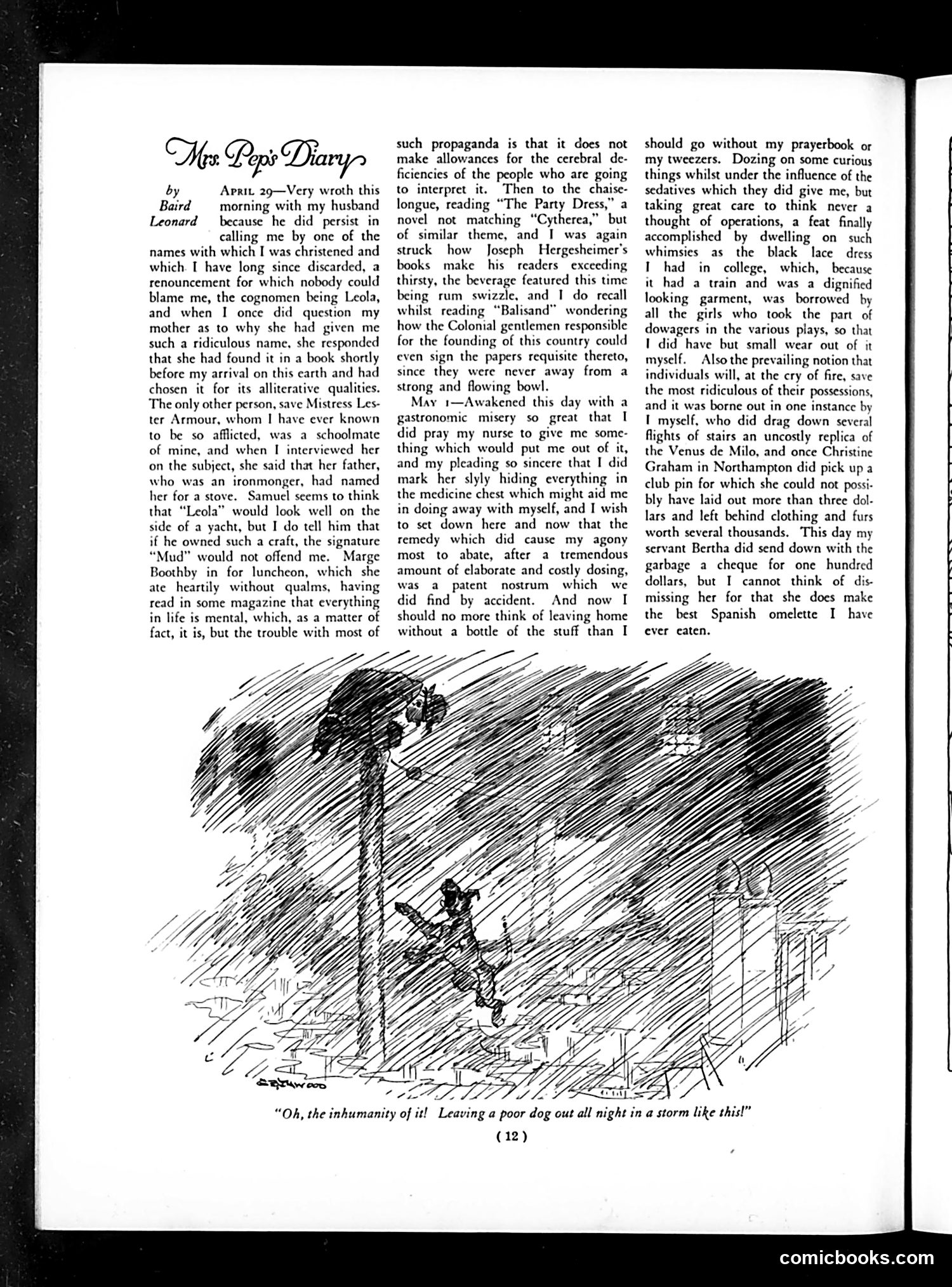
"Mrs. Pop's Diary" Commentary This is a humorous diary entry by "Baird Leonard" describing social embarrassments and domestic complaints from April 29-May 1. The cartoon illustrates the May 1st entry, which describes the author's gastric distress from eating an elaborate "patient nostrum" (medicinal remedy) that caused severe indigestion. The sketch shows a figure struggling in heavy rain near a streetlamp, with the caption: "Oh, the inhumanity of it! Leaving a poor dog out all night in a storm like this!" The joke's irony: the diarist, suffering miserably from their own ailment, sympathizes with a dog enduring similar outdoor misery—a self-aware commentary on sharing the dog's discomfort. The satire gently mocks both hypochondria and sentimental pet-sympathy, common targets in early-20th-century satirical humor.
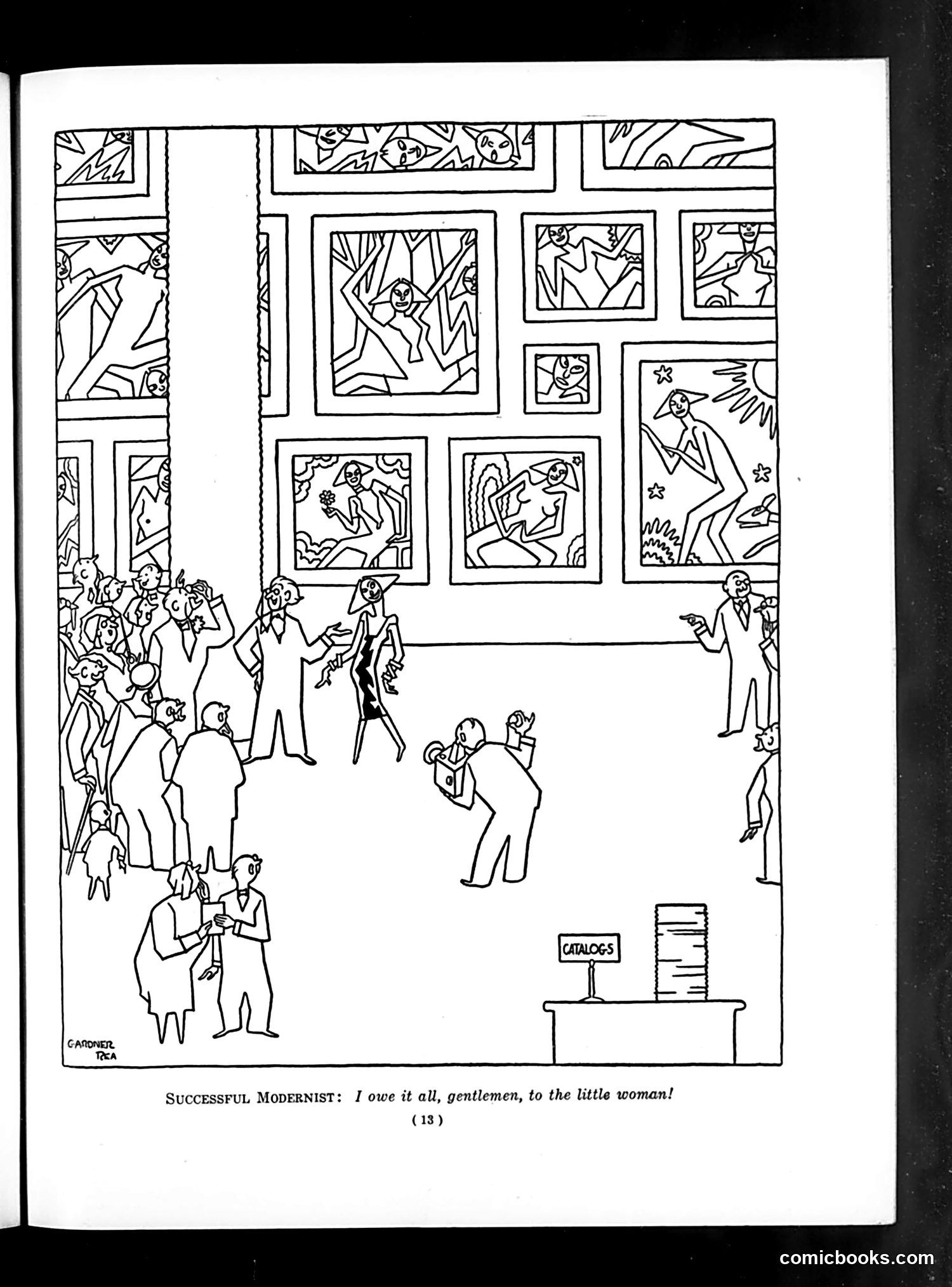
"Successful Modernist" This cartoon satirizes the art world's embrace of modernism. The scene depicts an art gallery opening where a well-dressed man stands prominently while crowds of formally-dressed visitors admire abstract artworks on the walls. The caption reads: "I owe it all, gentlemen, to the little woman!" The satire targets a successful modernist artist who credits his wife for his achievements—likely mocking both the pretentiousness of modernist art circles and gender dynamics of the era. The joke suggests the artist's success depends on his wife's support, while the abstract paintings displayed (featuring geometric and dynamic forms) represent the fashionable but often incomprehensible modernist movement that Life's satirists frequently ridiculed for its lack of accessibility or traditional artistic merit.
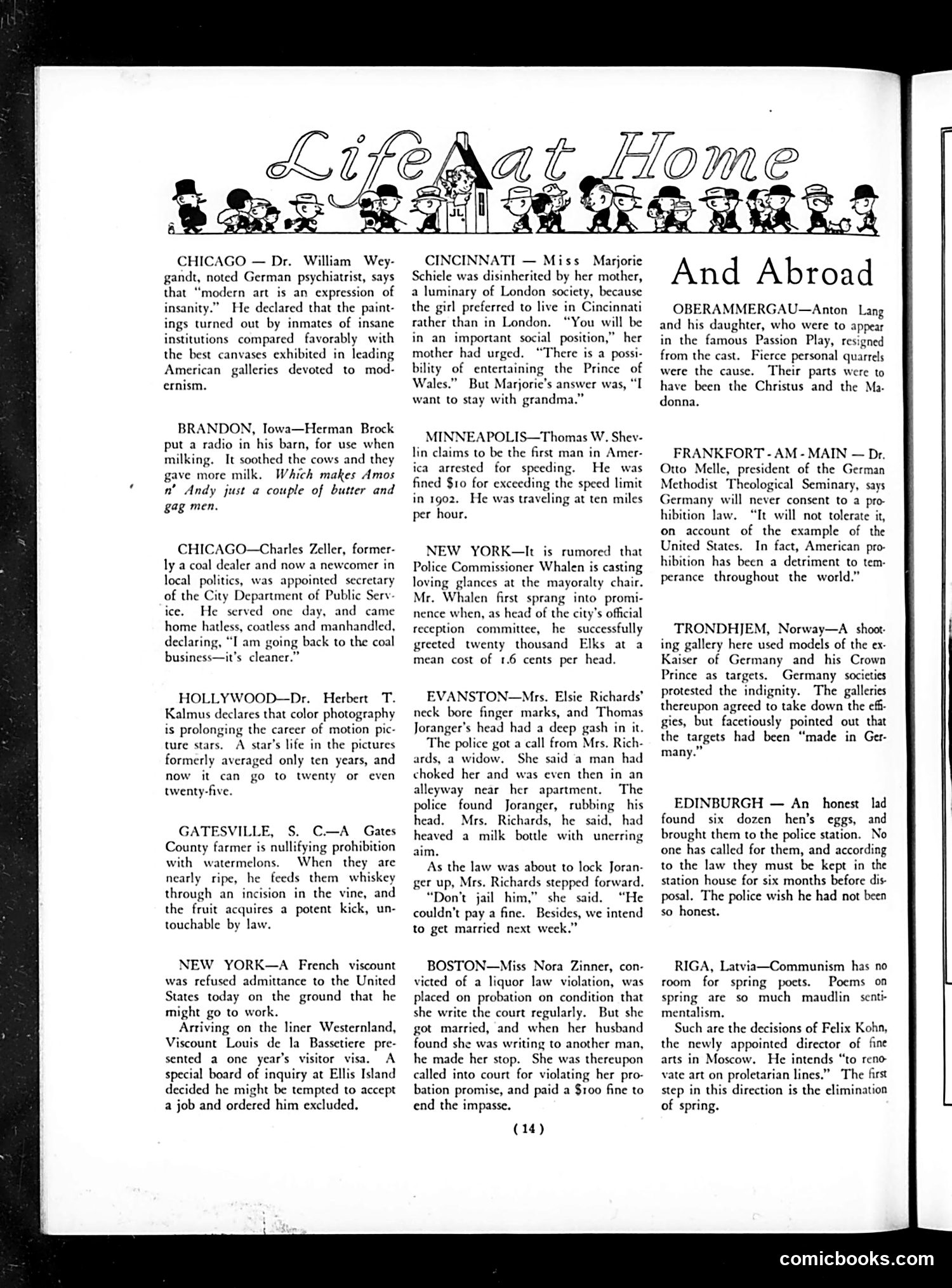
Life Magazine Page Analysis This page presents a column titled "Life at Home and Abroad" featuring brief humorous anecdotes from various American and international cities. The header illustration shows a row of cartoon figures in formal dress, suggesting genteel society commentary. The content satirizes upper-class pretension and social hypocrisy across multiple locations. Examples include: a German psychiatrist dismissing American modernist art, a coal dealer newly appointed to government bragging about returning to "cleaner" business, and a French viscount denied U.S. entry despite claiming important connections. The recurring theme mocks the gap between people's self-perception and reality—whether regarding social status, moral authority, or cultural sophistication. These are observational humor pieces targeting bourgeois vanity and the absurdities of stratified society.
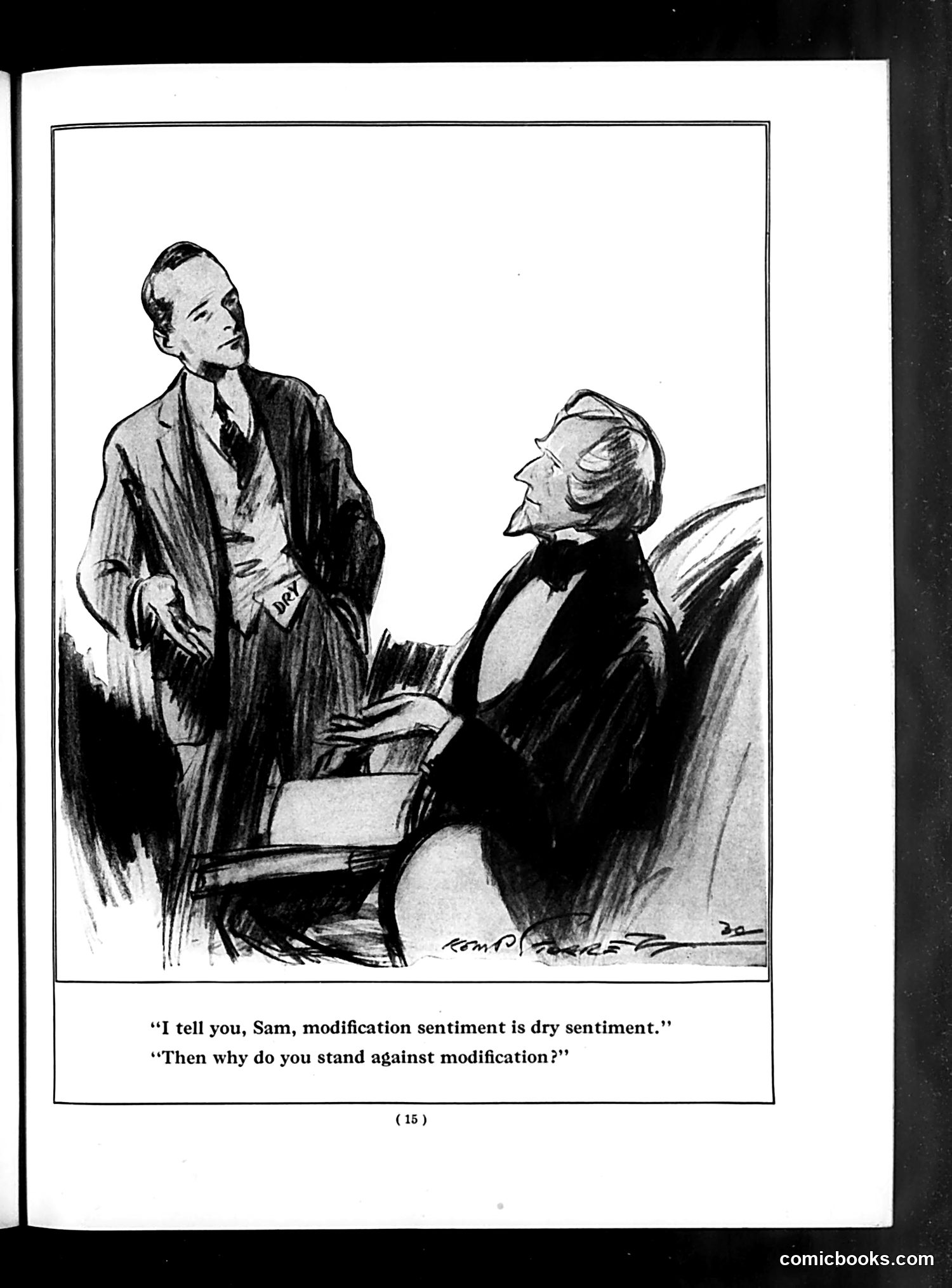
Cartoon Analysis This single-panel cartoon depicts two men in formal attire in what appears to be a private conversation. One man stands while the other sits; both are dressed in suits typical of early-to-mid 20th century professional settings. The dialogue reveals a philosophical disagreement: the seated man (Sam) argues that "modification sentiment is dry sentiment," while the standing man questions why Sam opposes modification if sentiment about it is merely "dry." The joke appears to target someone's inconsistent logic—arguing against modification while simultaneously dismissing emotional arguments *for* modification as unemotional. The specific political or social context of "modification" remains unclear without additional historical information about Life magazine's publication date and ongoing contemporary debates.
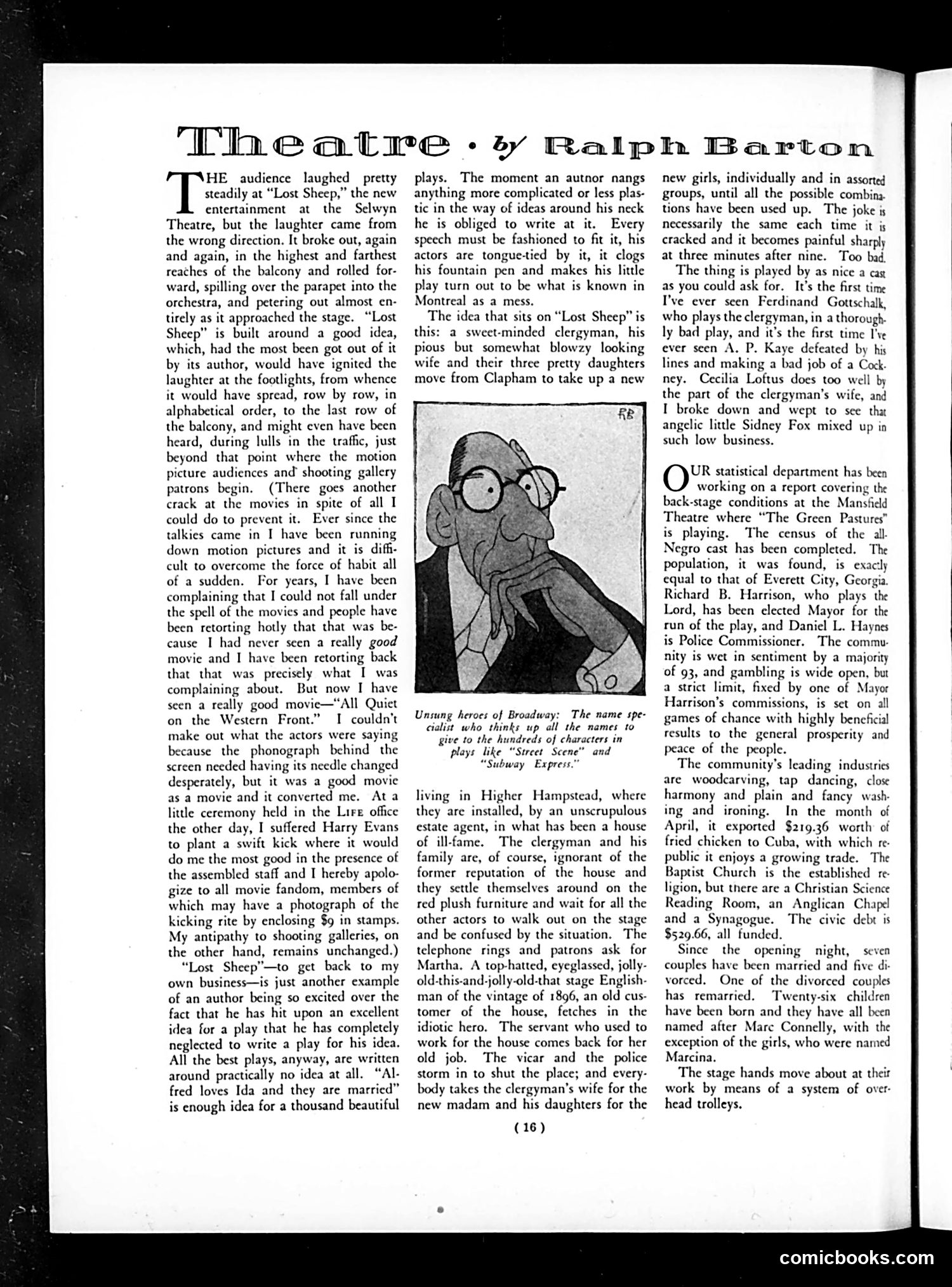
Theatre Review: "Lost Sheep" by Ralph Barton This is a theatre review by Ralph Barton critiquing the play "Lost Sheep" at the Selwyn Theatre. The cartoon shows a caricatured figure wearing large glasses—likely depicting either the play's author or a character type being satirized. Barton's review is largely negative. He argues the play's central idea (a clergyman and his three daughters from Clapham taking in new lodgers) lacks sufficient dramatic complexity. He complains that the plot is thin and becomes muddled in execution—"a mess." The accompanying illustration appears to mock theatrical pretension or perhaps a specific character's absurdity. Barton suggests the play fails because simple ideas require more skillful execution to sustain theatrical interest, and this production falls short.
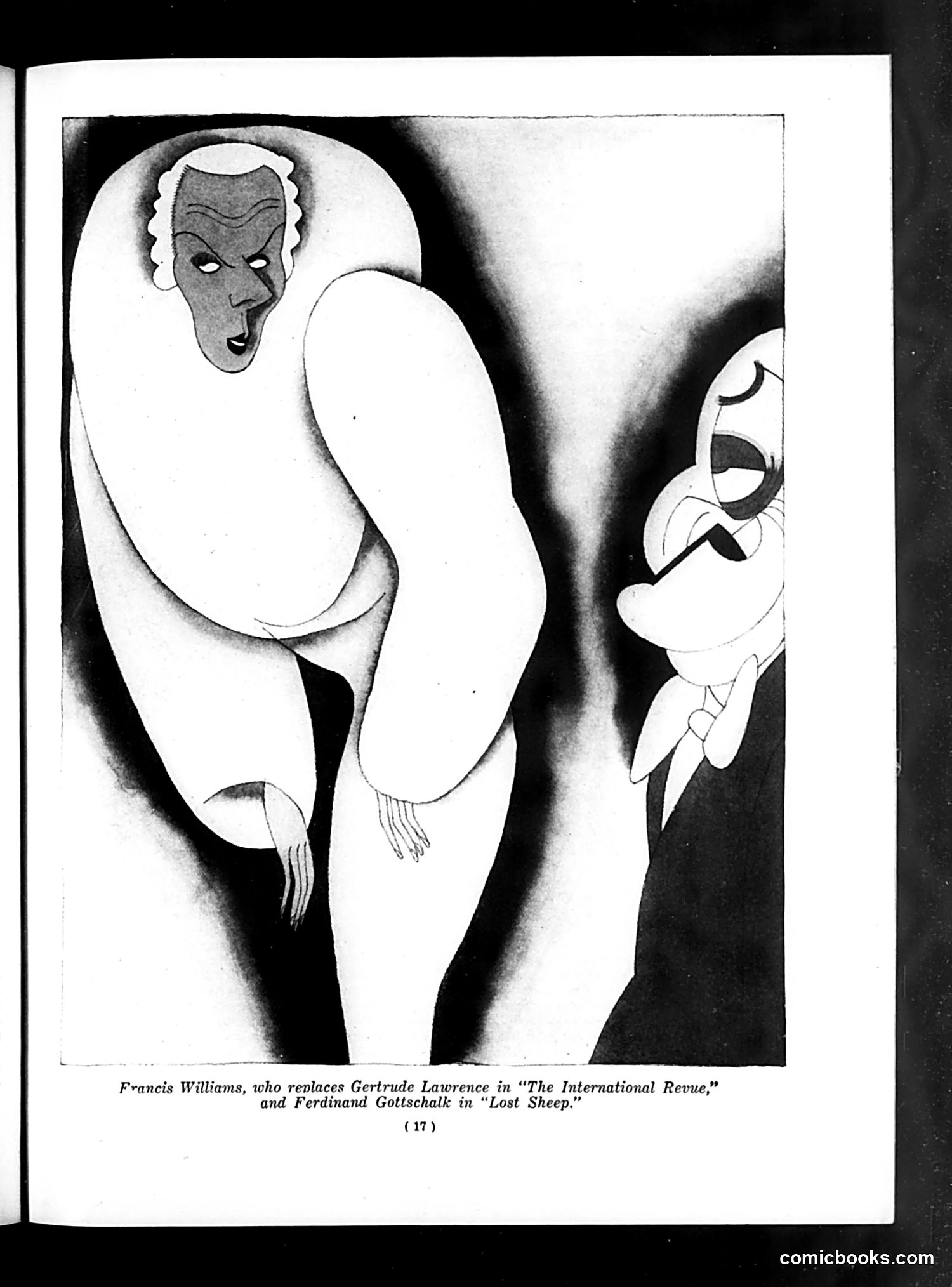
Analysis This page appears to be from *Life* magazine and shows a single artistic illustration labeled at the bottom. The caption credits Francis Williams as replacing Gertrude Lawrence in "The International Revue," and Ferdinand Gottschalk in "Lost Sheep." The image depicts two figures in a stylized, modernist black-and-white drawing style typical of 1920s-30s theatrical illustration. The composition appears to be commentary on theatrical casting or performance, likely satirizing either the performers themselves or the productions mentioned. However, without additional context about these specific Broadway or theatrical productions, the exact satirical point remains unclear—whether it's mocking the performers' abilities, their physical appearance, or some aspect of the shows themselves. The artistic style and subject matter suggest this is theater criticism presented through visual satire.
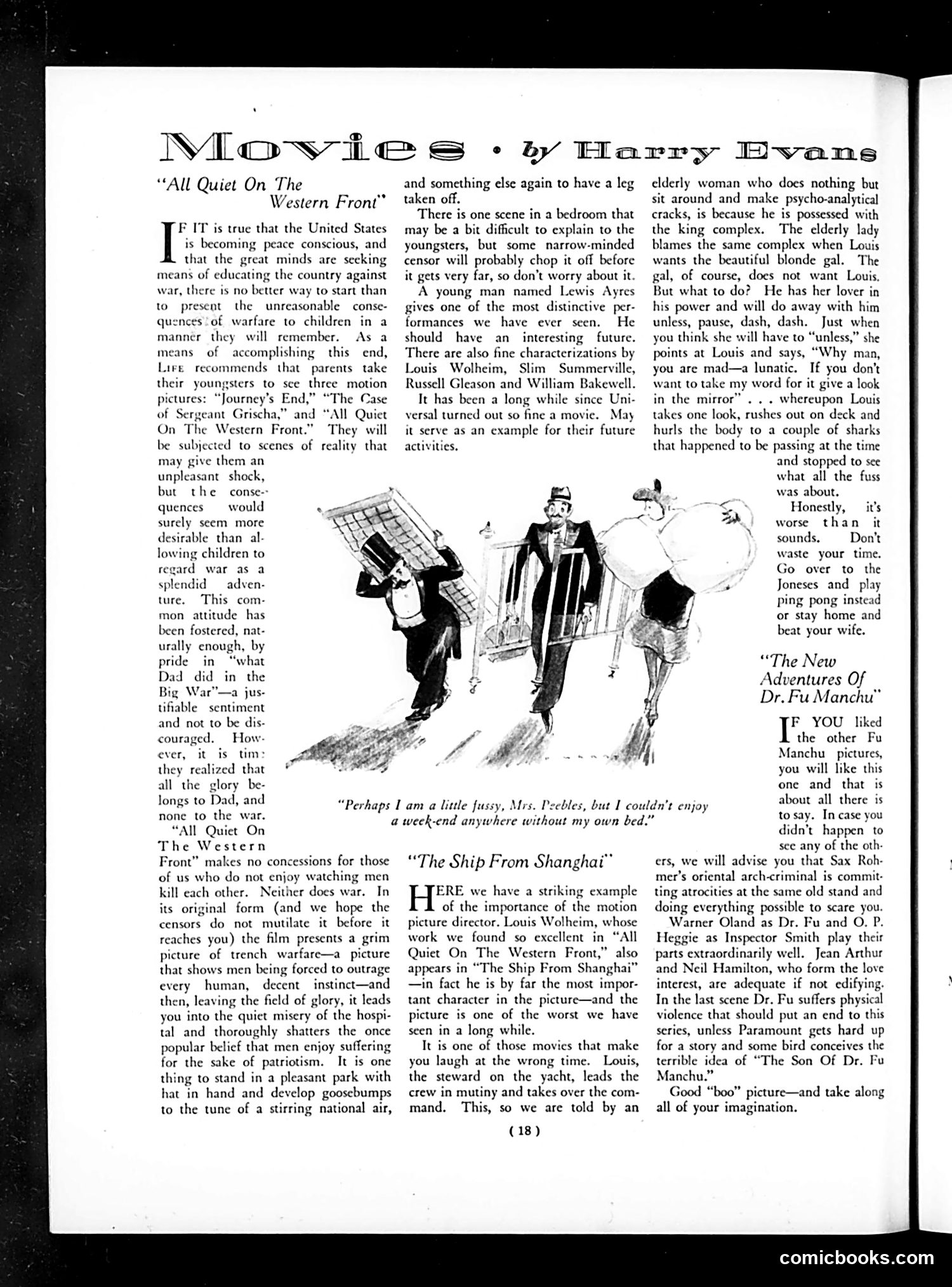
Analysis of Life Magazine Movie Review Page This is a movie review column by Harry Evans discussing three films. The central illustration shows three men in formal attire appearing to struggle or stumble together, captioned with a quote about someone being "fussy" and not enjoying a weekend without their own bed. The reviews critique war-themed films, particularly "All Quiet On The Western Front." Evans argues against glorifying war and soldiers' suffering for patriotic purposes. He dismisses "The Ship From Shanghai" as poorly made, with an incompetent director and bad acting that makes audiences laugh at wrong moments. The page advocates for realistic, unglamorous depictions of warfare rather than sentimentalized portrayals. Evans emphasizes that suffering soldiers deserve respect, not entertainment value—a stance reflecting post-WWI disillusionment with romanticized military narratives common in 1920s cinema.
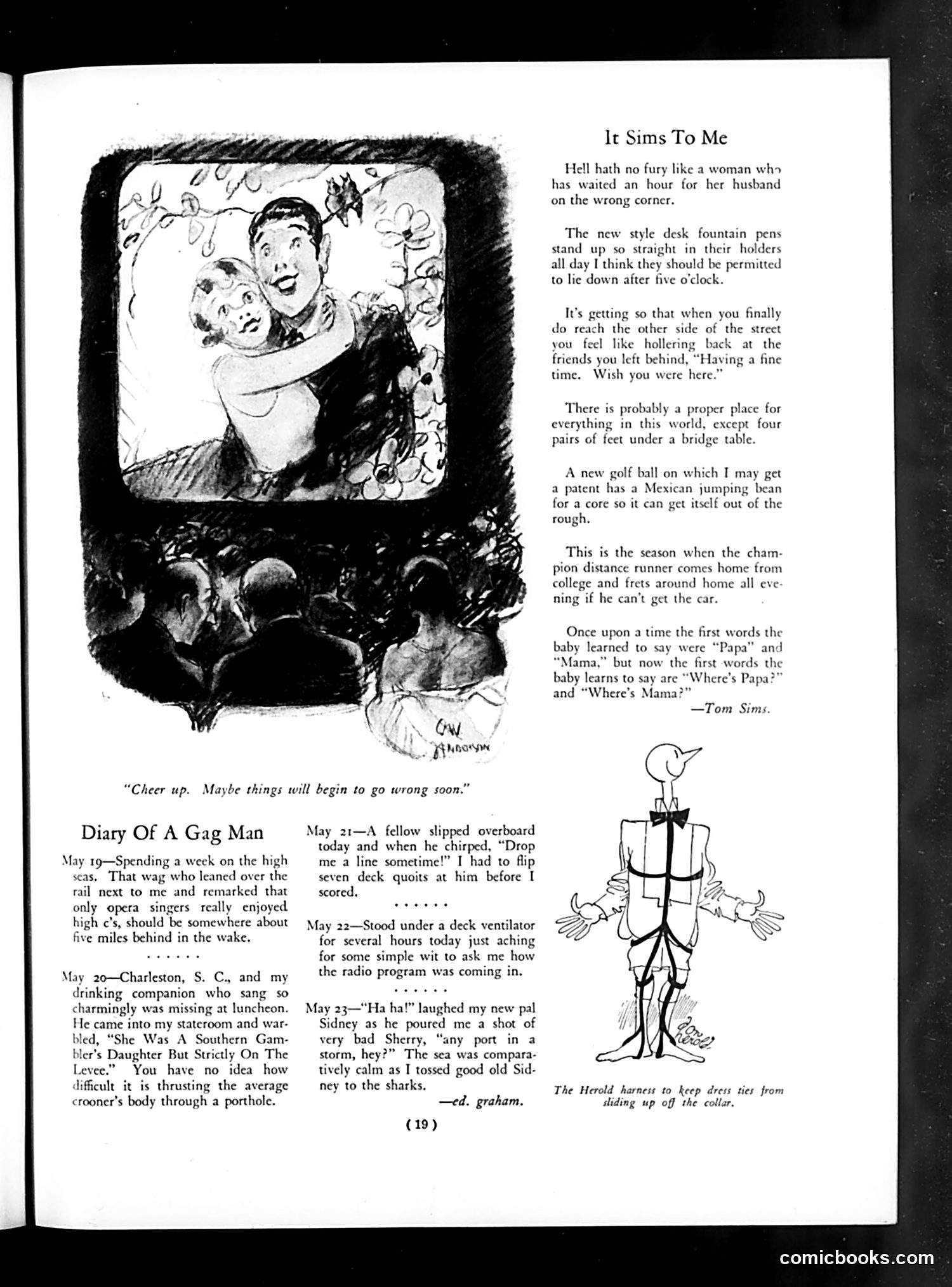
Page Analysis: Life Magazine Humor This page contains two satirical humor pieces typical of 1920s-30s Life magazine: "It Sims To Me" (by Tom Sims) is a column of observational jokes about modern life—waiting for husbands, fountain pens, bridge games, golf, college students borrowing cars, and babies asking "Where's Papa?" rather than saying parents' names. The humor targets domestic frustrations and generational changes. "Diary Of A Gag Man" (by ed. graham) presents a cruise ship passenger's darkly comedic log. The joke is that the narrator kills annoying people making bad puns and jokes (throwing them overboard). Each entry describes someone making terrible jokes—opera singer puns, corny songs, nautical wordplay—whom the narrator violently eliminates. It's absurdist dark humor satirizing both bad comedians and the narrator's murderous overreaction. Both pieces reflect Jazz Age-era humor: irreverent, self-aware about modernity's absurdities, and relying on exaggeration for laughs.
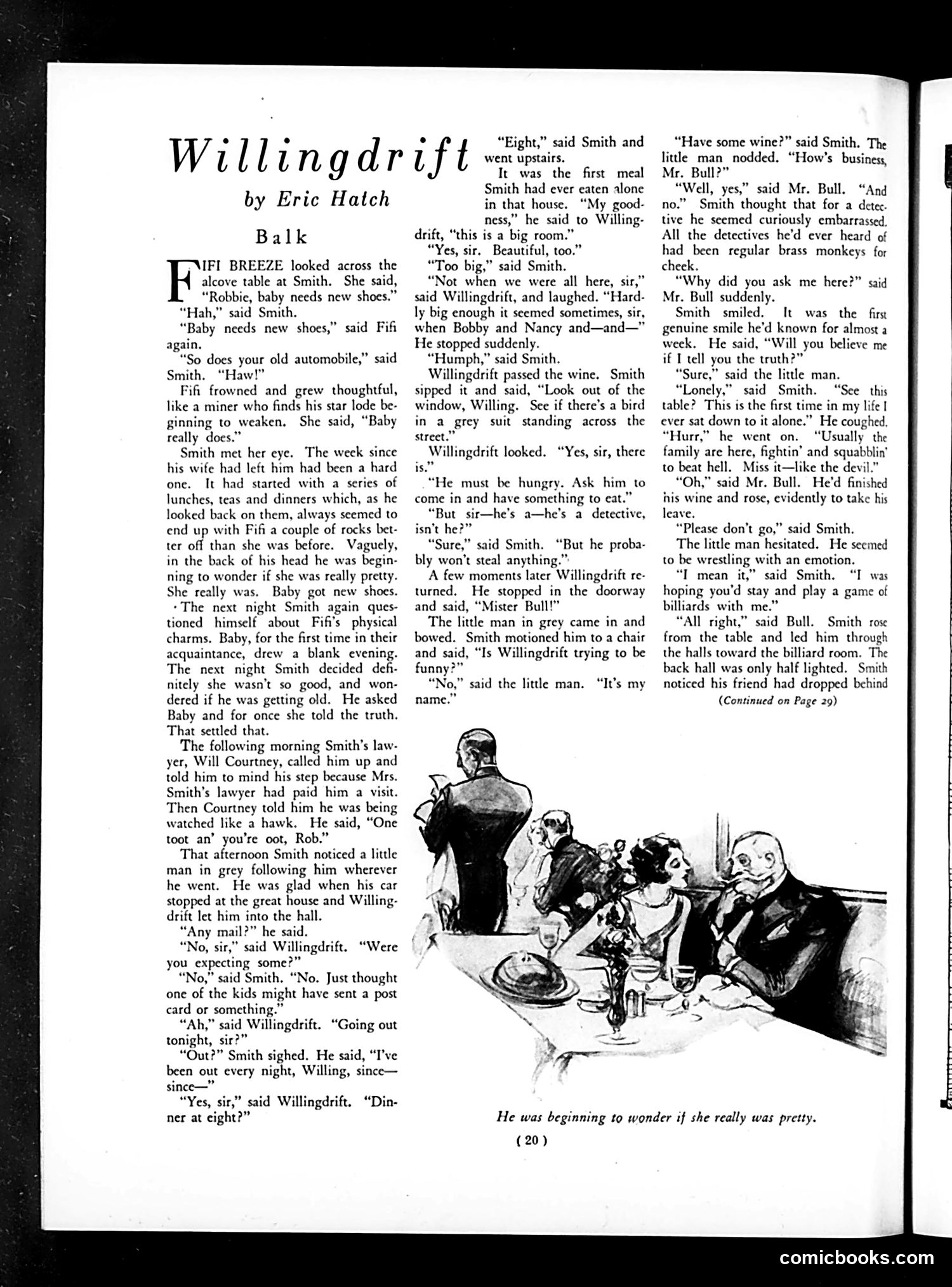
"Willingdrift" by Eric Hatch — Page Analysis This is a humorous short story, not a political cartoon. The narrative depicts a domestic comedy about a separated man named Smith whose wife has left him. The satire targets marital dynamics and infidelity rather than politics. The plot: Smith's estranged wife is having him watched by a detective (Mr. Bull) to catch evidence of misconduct. Smith, lonely and aware of surveillance, invites the detective inside for dinner. The humor derives from the absurdity of the situation—Smith's genuine loneliness and the detective's awkward position, plus the revelation that "Bull" is the man's actual surname (a visual/verbal joke). The accompanying illustration shows three men at dinner, emphasizing the awkward social situation. This appears to be 1920s-era satirical fiction about Jazz Age marital troubles, targeting the era's infidelity scandals and divorce proceedings rather than making political commentary.
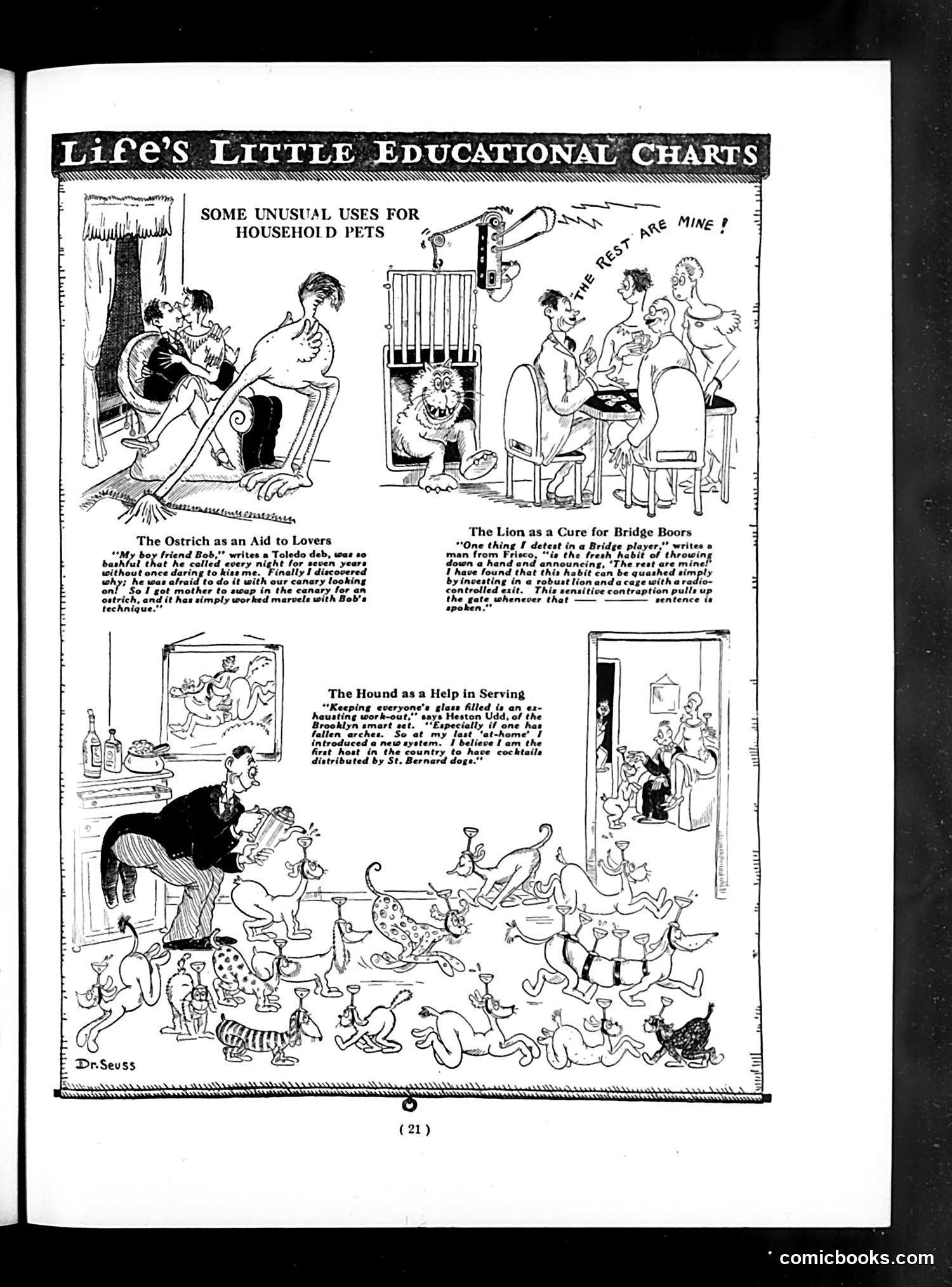
Life's "Educational Charts" - Modern Context This is a humorous satirical piece by Dr. Seuss from *Life* magazine presenting absurd "solutions" to social problems using household pets. The four vignettes mock dating etiquette and entertaining conventions of the era: 1. Ostrich as romance aid: A shy suitor needs the canary removed so he'll feel comfortable kissing his girlfriend—the pet's presence inhibits his boldness. 2. Lion as party enforcer: A bridge player's rudeness is corrected by a lion's threatening presence, stopping him from making irritating announcements. 3. Hound as bartender: A host with foot problems uses St. Bernard dogs to distribute cocktails, avoiding the physical exhaustion of serving guests himself. 4. Implied fourth scenario (partial text visible). The satire pokes fun at both the social anxieties of the period (romantic hesitation, entertaining obligations) and the absurdity of "modern solutions." Seuss's exaggerated cartoon style amplifies the ridiculous premise that pets could solve these essentially human social problems. It's gentle mockery of middle-class social conventions.
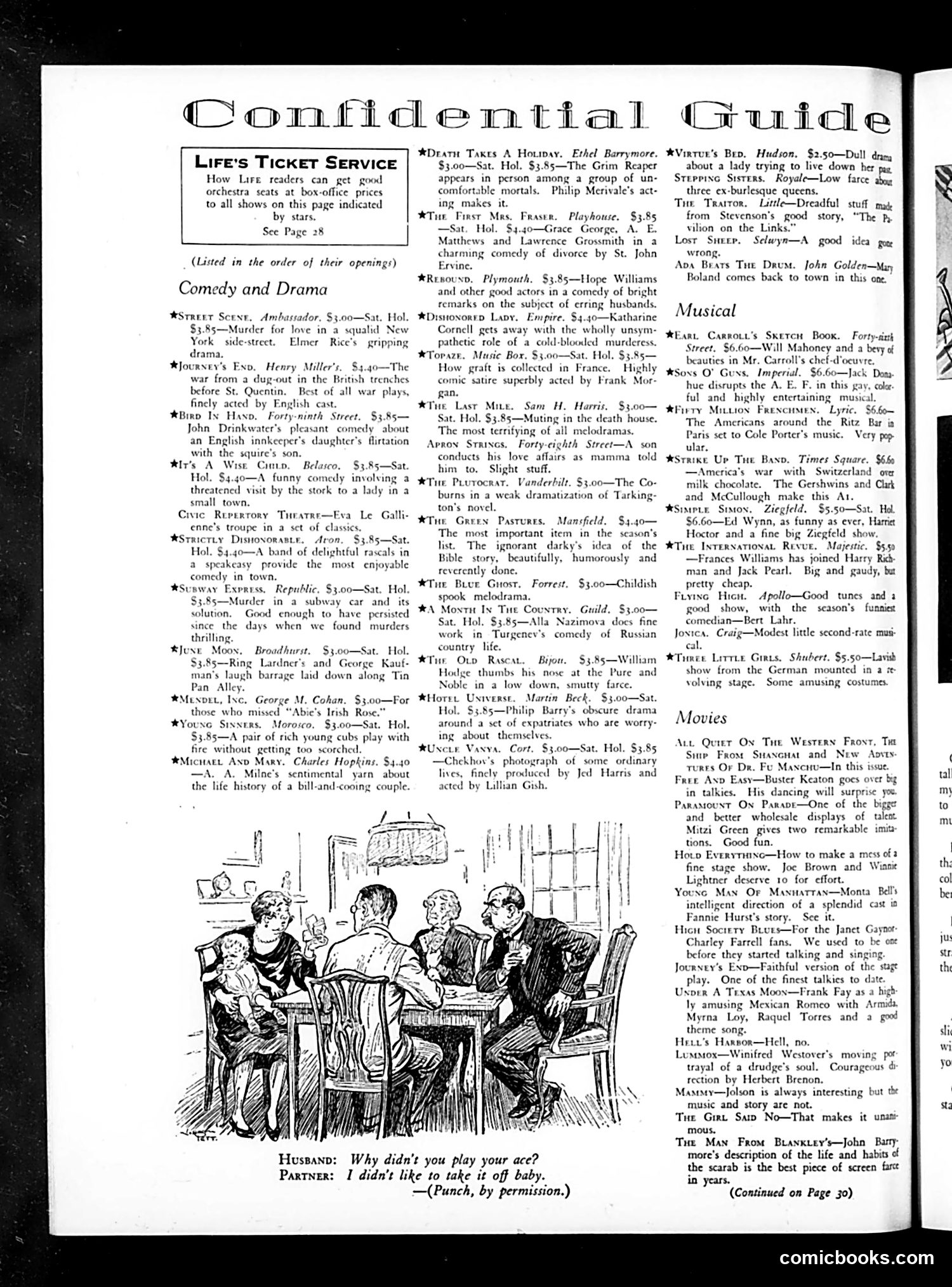
Understanding This Life Magazine Page This is a theater guide and entertainment listings page, not a political cartoon. The single cartoon shown depicts a bridge game, with the caption being a humorous domestic joke: a husband questions why his partner didn't play a winning card, and the partner jokes he didn't want to "take it off baby"—a flirtatious double meaning. The page primarily lists Broadway shows opening that season (early 1930s), with prices and brief reviews. Notable entries include *The Green Pastures* (described as "the most important item in the season's list"), which uses period-typical language reflecting its depiction of African American biblical interpretation. The asterisks indicate shows where Life readers could obtain discounted orchestra seats through the magazine's ticket service. This is essentially a service page for theatergoers, mixing entertainment criticism with practical ticketing information, rather than substantive satire or political commentary.
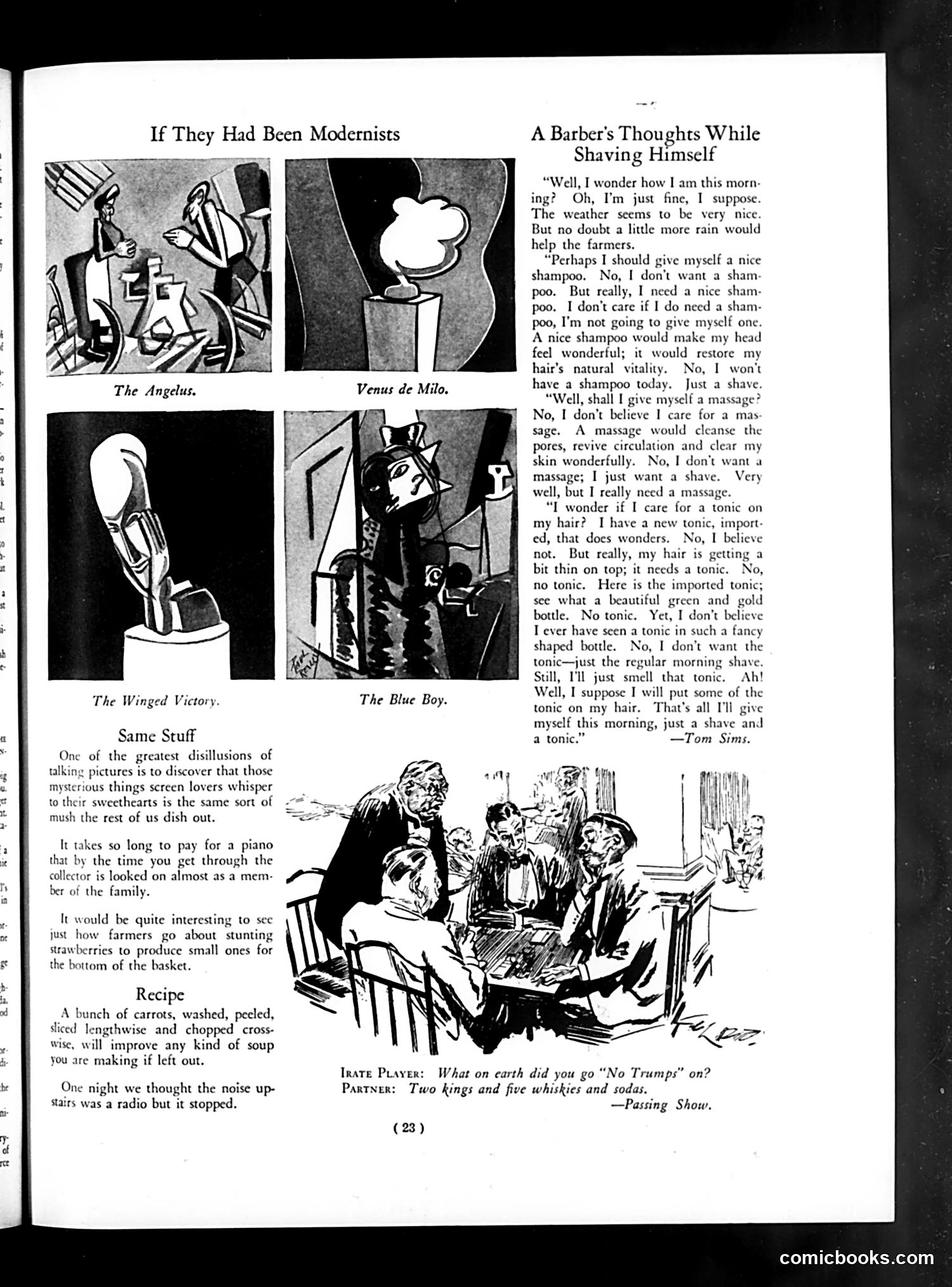
"If They Had Been Modernists" and "A Barber's Thoughts While Shaving Himself" Left panel: Four cubist/modernist art parodies mock avant-garde artistic movements. "The Angelus" and "Venus de Milo" are recognizable classical artworks rendered as abstract, fragmented forms. "The Winged Victory" and "The Blue Boy" follow suit. The satire mocks modernist artists for distorting or obscuring recognizable subjects into uninterpretable abstraction. Right panel: A barber's internal monologue humorously depicts obsessive indecision while shaving himself. He repeatedly argues against giving himself additional grooming services (shampoo, massage, hair tonic) while simultaneously acknowledging their benefits, ultimately succumbing and using the tonic anyway. The joke captures neurotic self-contradiction and rationalization—common human behavior presented as absurdly verbose inner debate. "Same Stuff" makes dry observations about ordinary life: that movie romance dialogue is generic; piano payments take forever; and farm produce deception is unremarkable. The page satirizes both high art pretension and everyday human foibles.
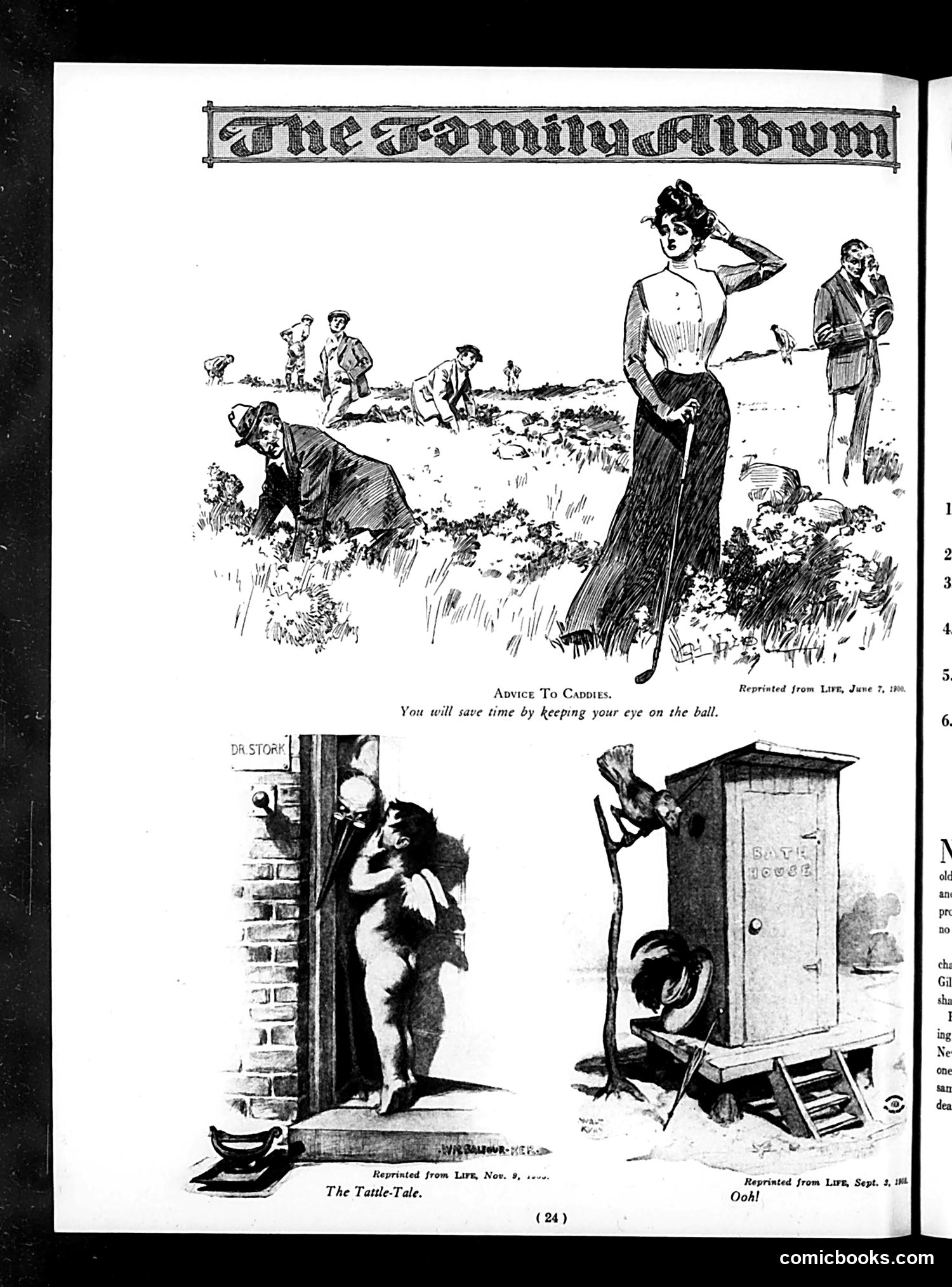
Explanation of Page Content This page from *Life* magazine contains three separate humorous cartoons: "Advice to Caddies" (top): Shows a woman golfer surrounded by male caddies in a field. The joke plays on the double meaning of "keeping your eye on the ball"—advice ostensibly about golf, but the caddies are clearly distracted by the woman rather than focusing on the sport. "The Tattle-Tale" (bottom left): Depicts a cherub or cupid figure at a doorway, apparently caught in a compromising situation. The implication is of romantic or scandalous behavior being discovered. "Ooh!" (bottom right): Shows a figure emerging from or entering an outhouse, with the caption suggesting surprise or embarrassment about the facility. All three cartoons use visual innuendo and bathroom/romantic humor typical of early 20th-century American satire—lighthearted, mildly risqué content aimed at adult readers.
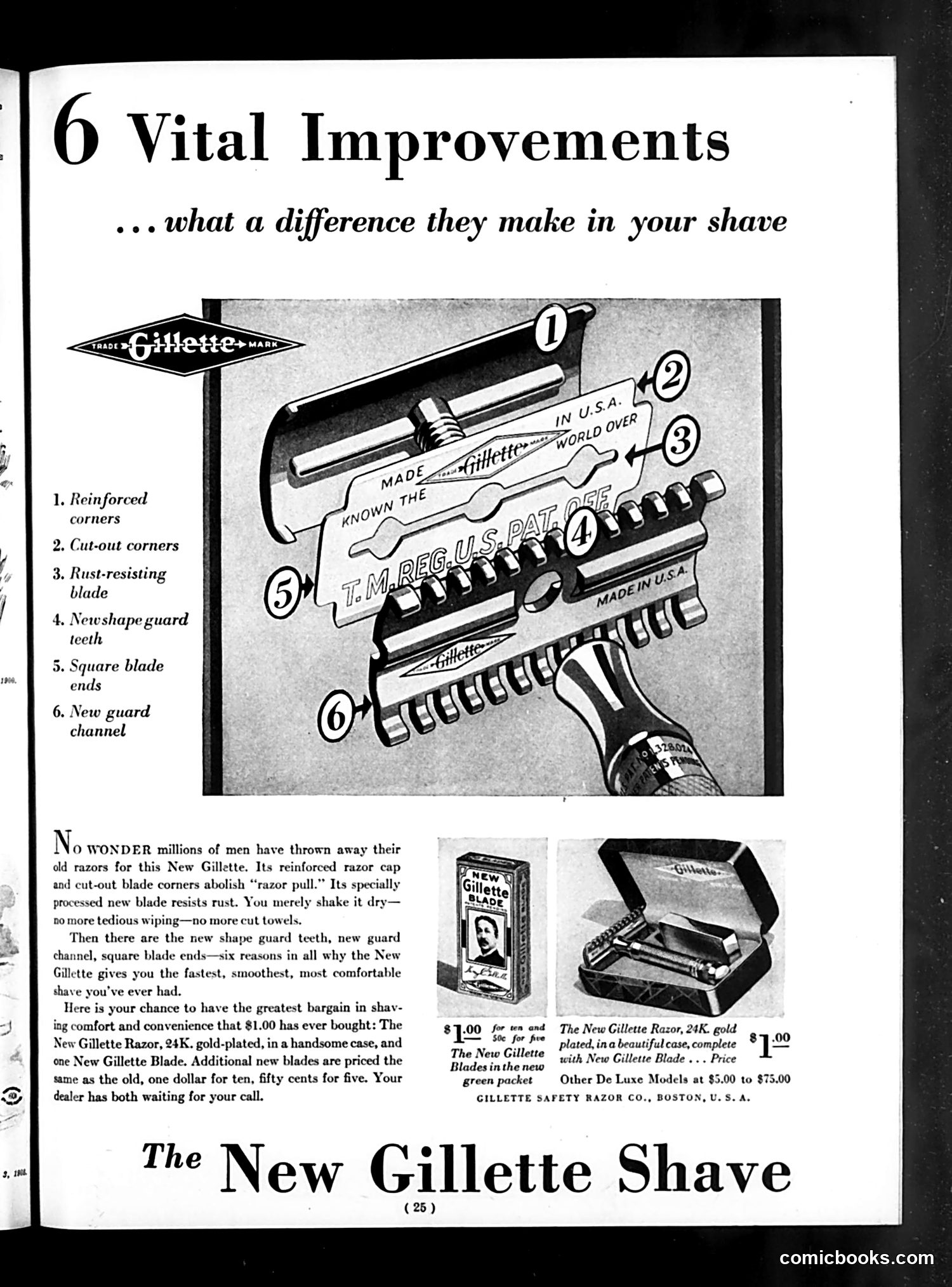
Analysis This is not a cartoon or satire—it's a straightforward product advertisement for Gillette Safety Razors, likely from the 1920s-1930s based on design and typography. The page promotes the "New Gillette" razor by listing six engineering improvements (reinforced corners, rust-resistant blade, new guard teeth, etc.) with an exploded-view diagram showing each component. The ad emphasizes practical benefits: no "razor pull," less maintenance ("merely shake it dry"), and a faster, smoother shave. The pricing ($1.00 for the razor with case and one blade; replacement blades at 50¢-$1.00) is positioned as an exceptional bargain. The copy uses competitive language ("greatest bargain") to encourage switching from older razors. There is no political satire or social commentary here—this is standard consumer marketing emphasizing product innovation and value to drive sales.
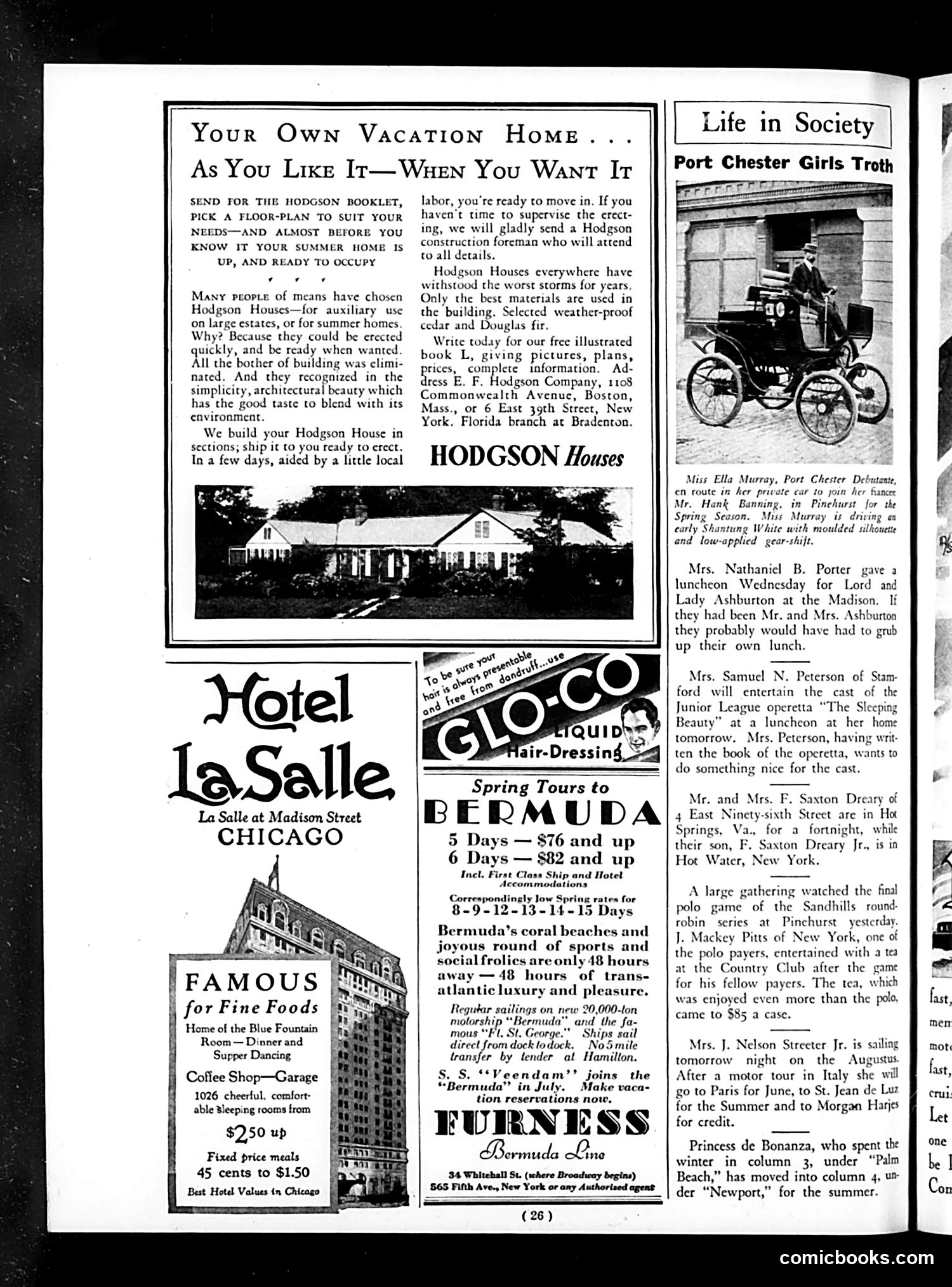
Analysis of This Life Magazine Page This page is primarily advertising and society gossip, not political satire. The left side features ads for Hodgson prefabricated houses, Hotel La Salle in Chicago, and Bermuda vacation packages—typical 1920s luxury consumer marketing. The right column, "Life in Society," is a satirical gossip section mocking wealthy debutantes and the upper class. The humor targets their trivial concerns and pretensions: Miss Murray's elaborate car description for a simple drive, the joke that titled British guests (Lord and Lady Ashburton) get better treatment than plain "Mr. and Mrs.," and the absurd detail that a polo spectator's post-game tea cost $85 per case—more than the polo itself mattered. The reference to "Hot Water, New York" (for young Saxton Dreary) appears to be a playful euphemism suggesting he's in trouble. The satire reflects 1920s American mockery of old-money snobbery and status-consciousness among the leisure class.
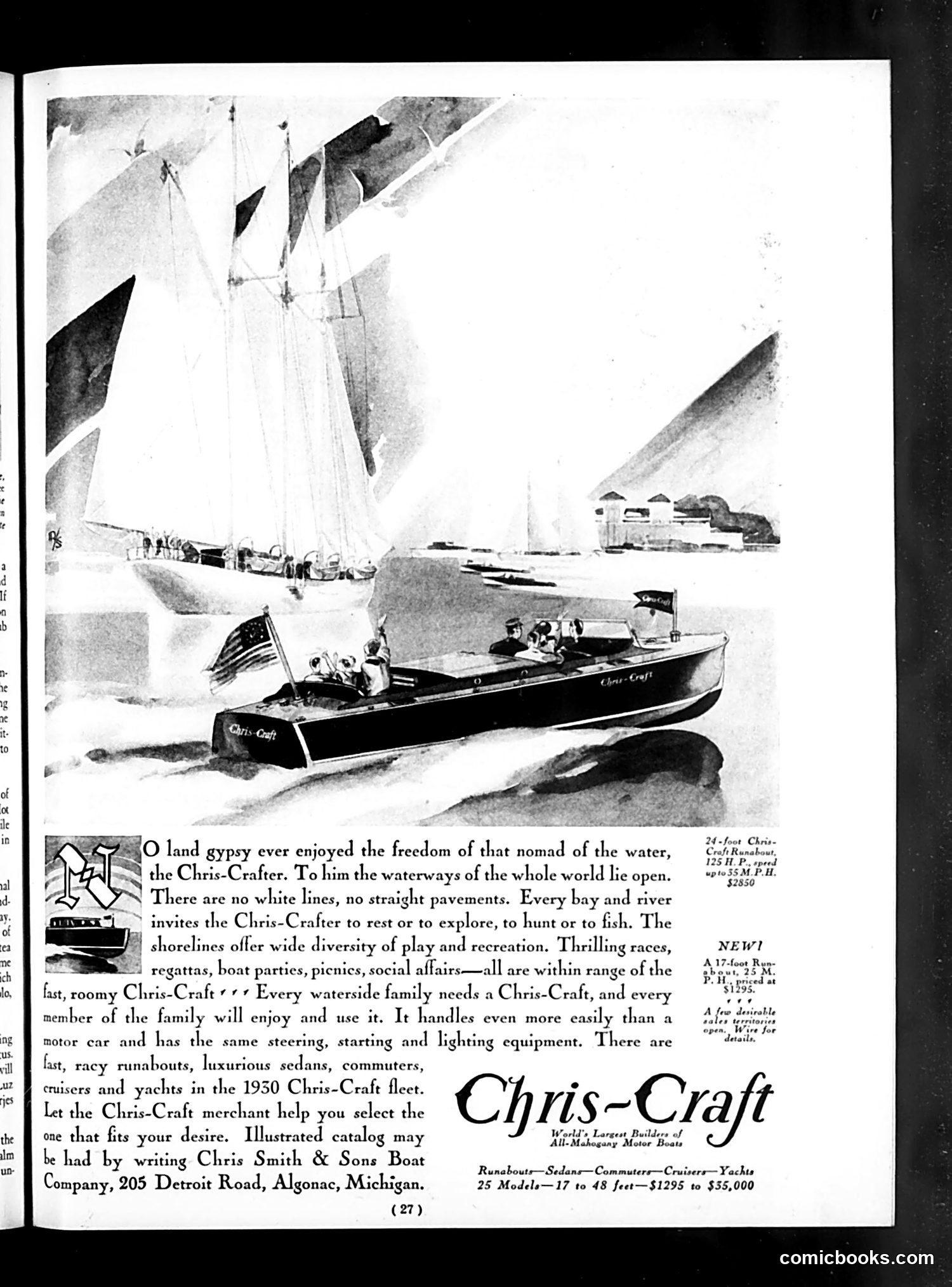
Chris-Craft Boat Advertisement This page is primarily a commercial advertisement, not political satire. It promotes Chris-Craft motorboats, manufactured by Chris Smith & Sons in Algonac, Michigan. The ad uses romantic imagery of leisure and freedom to market boats to post-WWII American families. The text emphasizes that boat ownership offers "freedom" and adventure unavailable through car ownership—"no white lines, no straight pavements." It positions Chris-Craft as essential for "every waterside family." The photograph shows multiple vessels and families enjoying waterside recreation, reinforcing the aspirational lifestyle the company wants to sell. The decorative vessel illustration at top left and the small inset photos showcase different boat models. This reflects 1950s American consumer culture and the era's emphasis on recreational leisure for the middle class. The "NEW!" notation and pricing ($1,295–$55,000) indicate this is marketing the latest fleet offerings to affluent readers of *Life* magazine.
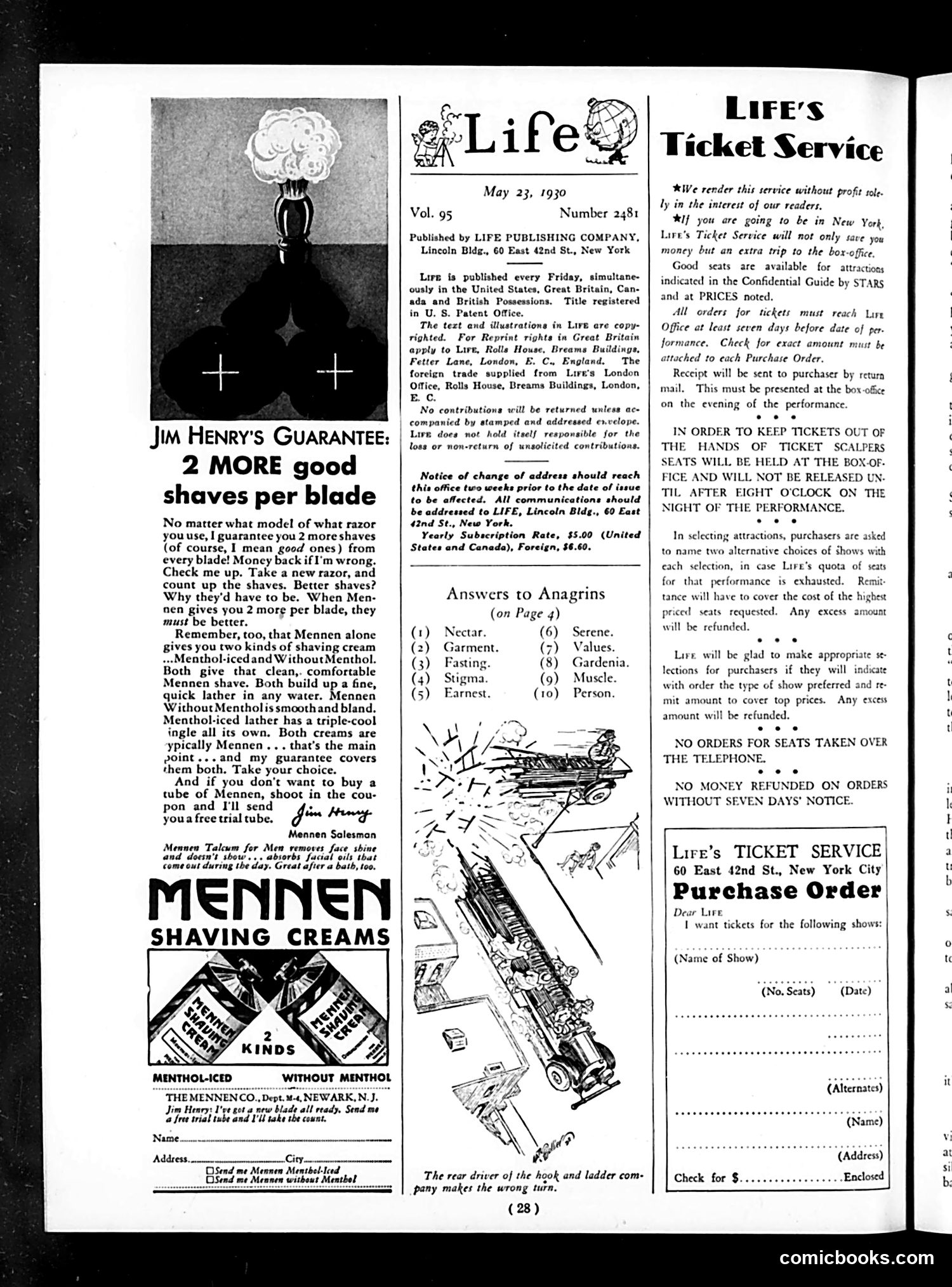
Life Magazine Page Analysis (May 23, 1930) This page is primarily advertising and administrative content, not political satire. The dominant feature is a Mennen shaving cream advertisement featuring "Jim Henry's Guarantee"—a salesman pledge that Mennen blades deliver "2 more good shaves per blade" than competitors. The ad emphasizes Mennen's two product variants (menthol-iced and plain) and includes a mail-in coupon for a free trial. Below is a section of "Answers to Anagrins"—apparently a word puzzle from earlier in the magazine—listing ten anagrams and their solutions (Nectar, Garment, Fasting, etc.). The right column contains Life's Ticket Service information: administrative details about ordering theater tickets through the magazine, including policies on refunds, timing requirements, and seat allocation to prevent scalping. There is no political cartoon or satire on this page. It represents Life's business operations: advertising revenue, reader services, and puzzle content typical of 1930s magazines.
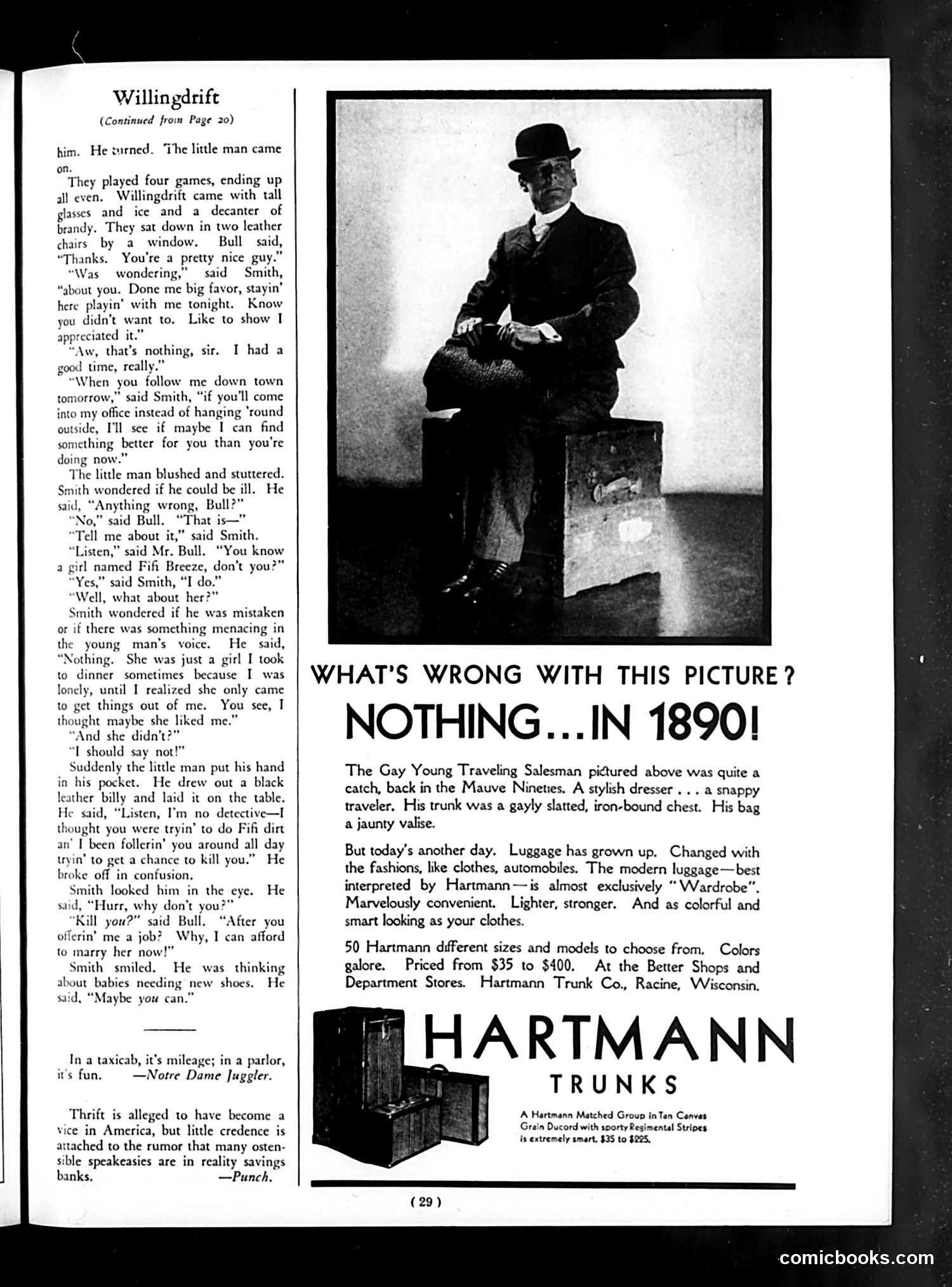
Analysis of Life Magazine Page This page contains two distinct elements: a short story excerpt and an advertisement. The Story ("Willingdrift"): A narrative about a traveling salesman (Smith) who befriends a small man (Bull). The plot turns darkly comedic when Bull reveals he's been following Smith with a billy club, believing Smith was seducing a girl named Fifi Breeze. Smith's job offer defuses the violence—Bull suddenly abandons his murderous intent because the prospect of employment means he can now marry Fifi respectfully. The Advertisement: Hartmann Trunks uses nostalgic humor about luggage fashion. It contrasts the "Gay Young Traveling Salesman" of the 1890s (shown in the photograph in formal dress with ornate baggage) with modern travelers, arguing that luggage design has evolved alongside fashion and automobiles. The pitch: contemporary Hartmann trunks are lighter, stronger, and more stylish than Victorian-era luggage. The advertisement's title—"Nothing...in 1890!"—suggests the old-fashioned trunk would look absurd today, making a sales argument through dated-ness.
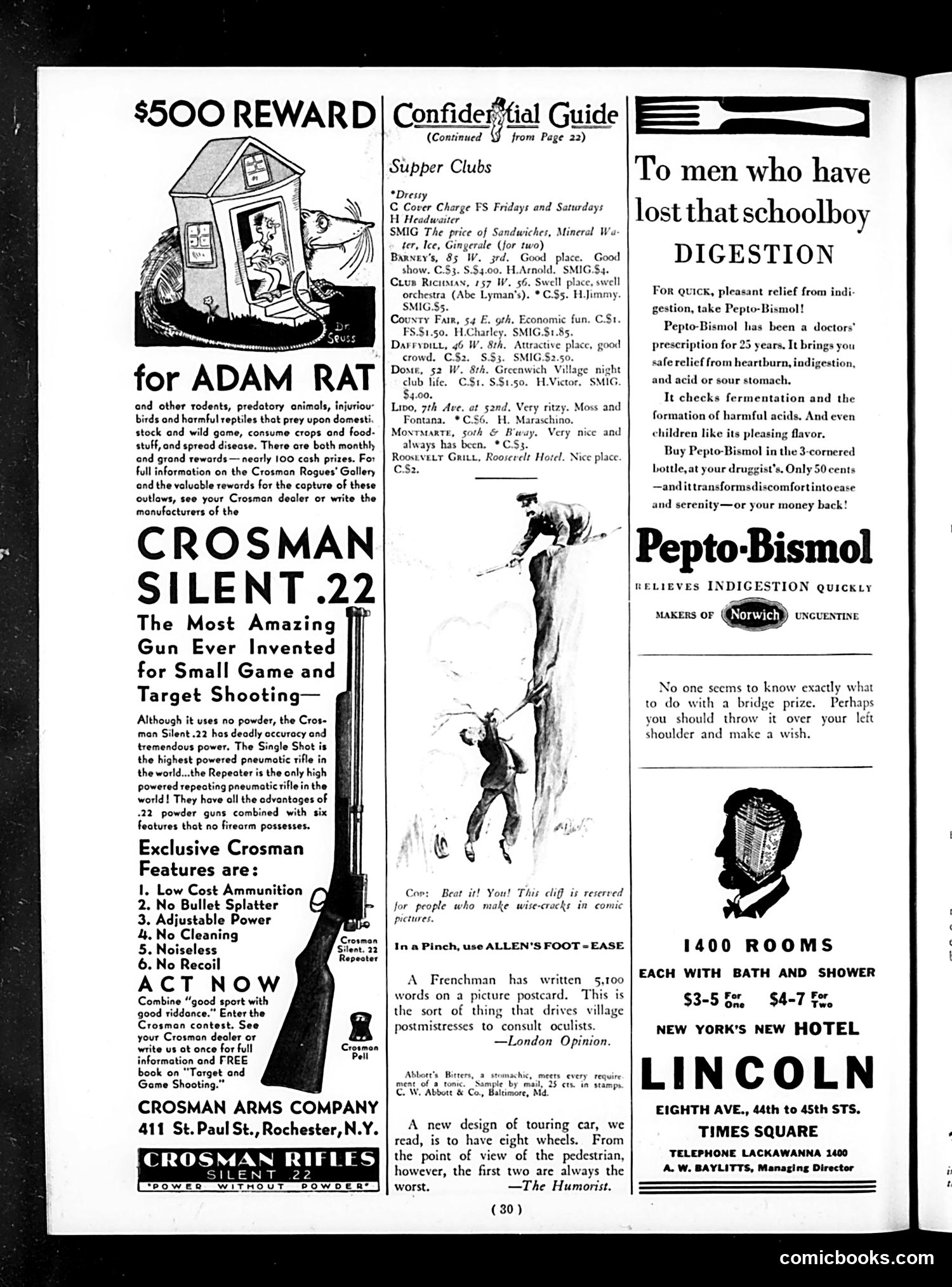
Content Analysis This page is primarily advertising, typical of Life magazine's revenue model. Key sections: Left side: A $500 reward advertisement for the Crosman Silent .22 air rifle, marketed for eliminating "Adam Rat" and other "predatory animals" and "harmful reptiles." The ad emphasizes the gun's accuracy, power, and noiselessness—appealing to Depression-era readers who could earn bounty money catching rodents and pests. Center: A "Confidential Guide" listing supper clubs in what appears to be New York City, with prices and headwaiter names—typical urban entertainment listings. Below this, a small cartoon shows two figures on a cliff; the text reads "Beat it! You! This cliff is reserved for people who make wise-cracks in comic pictures"—a meta-joke about the magazine's own humor standards. Right side: Patent medicine ads (Pepto-Bismol for indigestion, Allen's Foot-Ease) and the Lincoln Hotel advertisement promising budget rooms ($3-7). The page reflects 1920s-30s consumer culture, targeting middle-class readers with practical solutions to everyday problems.
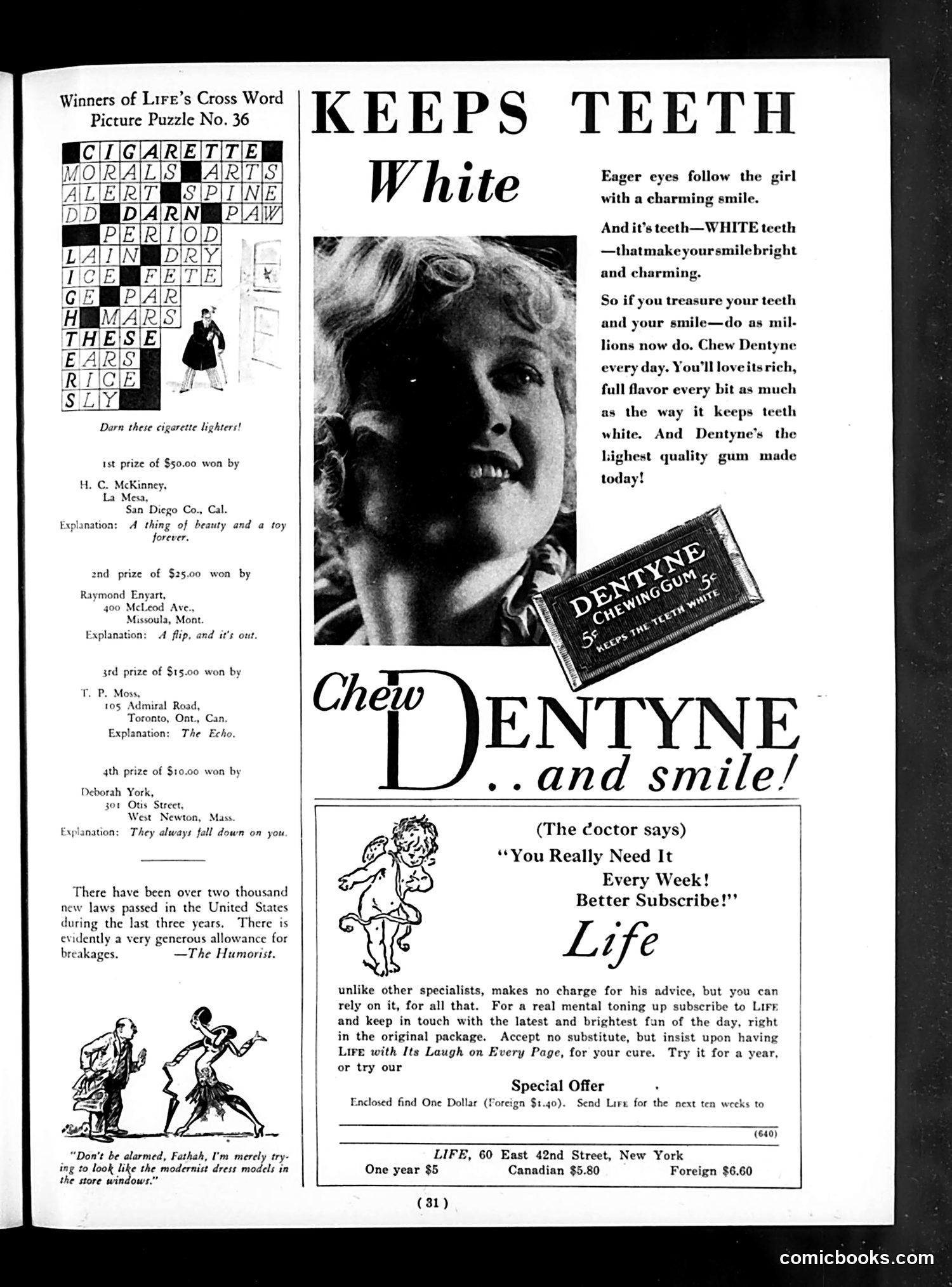
Life Magazine Page Analysis This page is primarily advertising and subscription promotion, not political satire. The main content consists of: 1. Crossword puzzle results (left side): Winners of Life's puzzle contest with their names and locations. 2. Dentyne gum advertisement (center/right): Features a photograph of an attractive woman with text emphasizing that chewing Dentyne keeps teeth white and maintains an appealing smile. This reflects early 20th-century consumer advertising linking dental hygiene to social attractiveness and success. 3. Life magazine subscription pitch (bottom): Humorously styled as medical advice ("The Doctor says"), encouraging readers to subscribe weekly for mental health and humor. The offer costs one dollar for ten weeks. 4. Small cartoons (left margin): Brief humorous vignettes about fashion and social behavior, typical of Life's satirical style but disconnected from larger political commentary. The page reflects advertising and consumer culture priorities of the era rather than substantial political commentary.
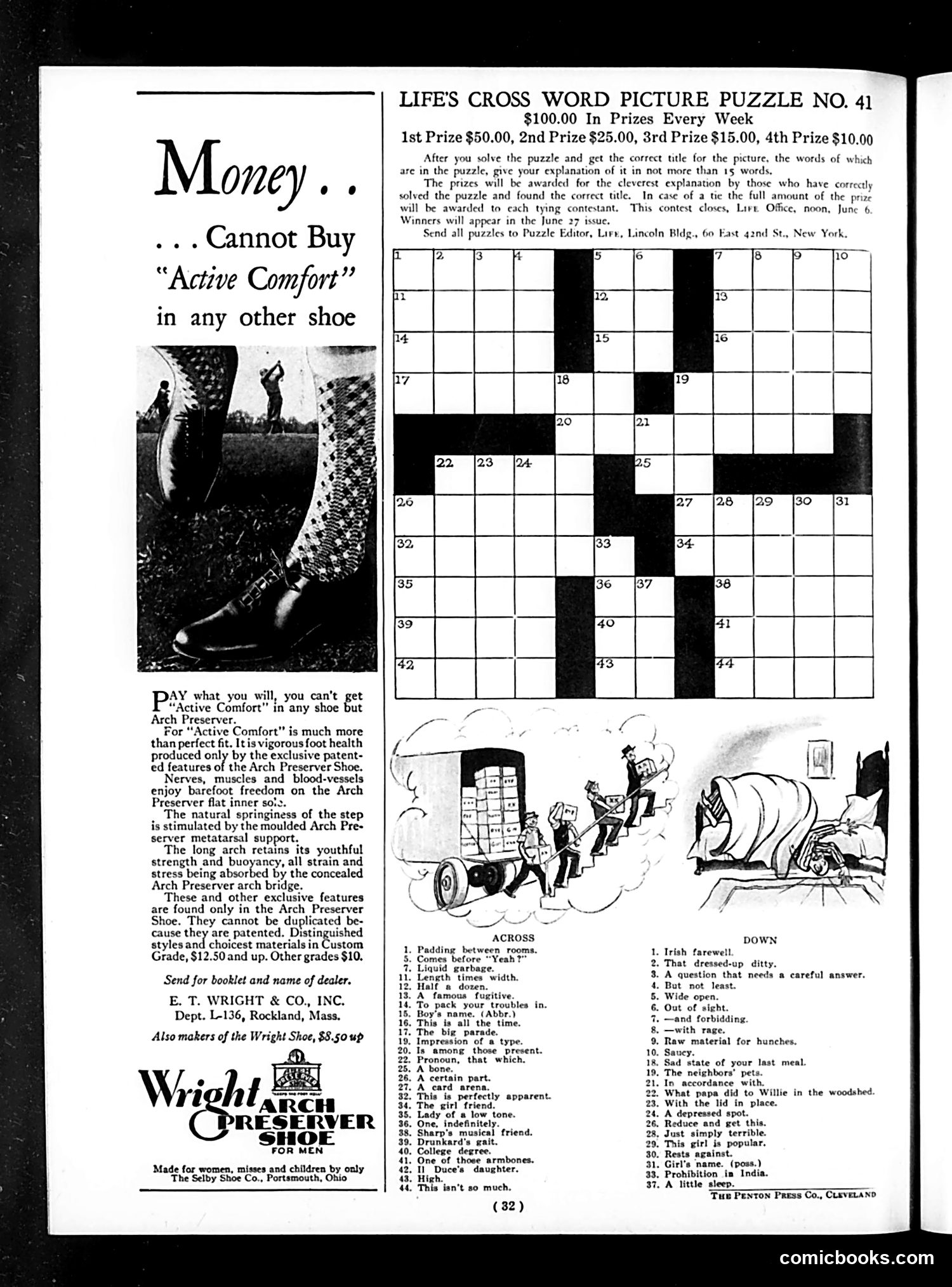
Life Magazine Cross-Word Picture Puzzle Advertisement Page This page is primarily advertising and a contest puzzle, not political satire. The dominant content is a commercial for "Arch Preserver" shoes, claiming they uniquely provide "Active Comfort" through patented arch-support features unavailable elsewhere. The page includes Life magazine's weekly cross-word picture puzzle (#41), offering $100 in prizes. Solvers must complete the puzzle, identify its title, and write a 15-word explanation for judging. The shoe advertisement uses period-typical marketing language emphasizing health benefits—"vigorous foot health," nerve stimulation, and arch support—common in early-20th-century product promotion. A photograph shows a woman's leg/foot in the shoe. The cartoon illustration at bottom-right appears generic promotional art showing people moving or working, likely meant to suggest active comfort in action, though it's not clearly connected to specific social commentary or recognizable figures.
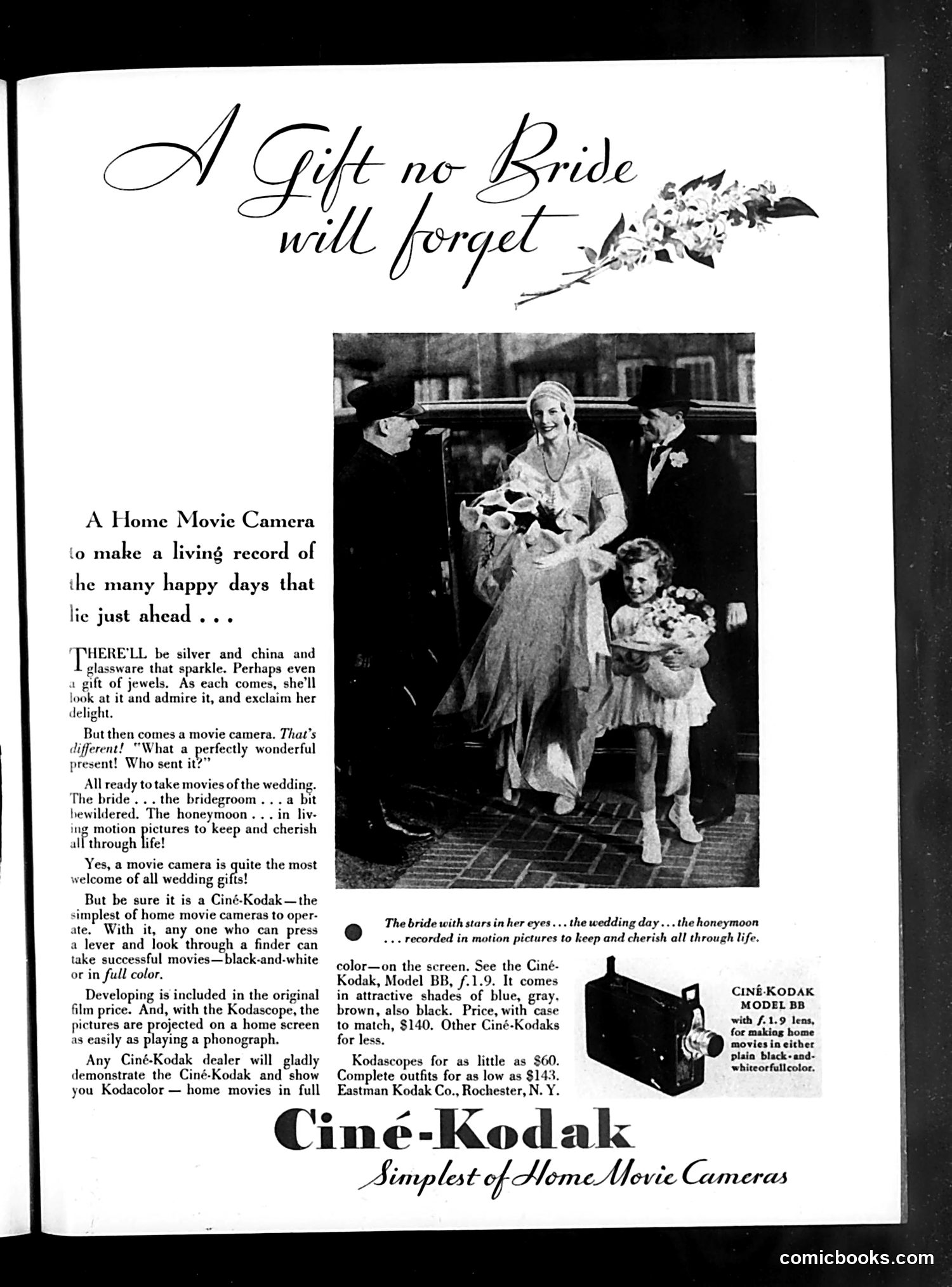
Ciné-Kodak Advertisement Analysis This is a product advertisement, not satire or political commentary. It promotes Eastman Kodak's home movie camera to American consumers, likely from the 1920s-1930s. The "joke" is gentle marketing psychology: the ad claims a movie camera makes a *better* wedding gift than traditional valuables (silver, china, jewels). The copy argues that capturing memories in motion pictures—the wedding, honeymoon, and future moments—is more meaningful than material goods. The photograph shows a bride with attendants, illustrating the camera's intended use: documenting family milestones. The ad emphasizes the Ciné-Kodak's simplicity ("simplest of home movie cameras") and affordability (starting at $60), positioning home movie-making as accessible to ordinary families rather than just professionals. The appeal reflects early 20th-century consumer culture and the novelty of portable film technology for personal use.
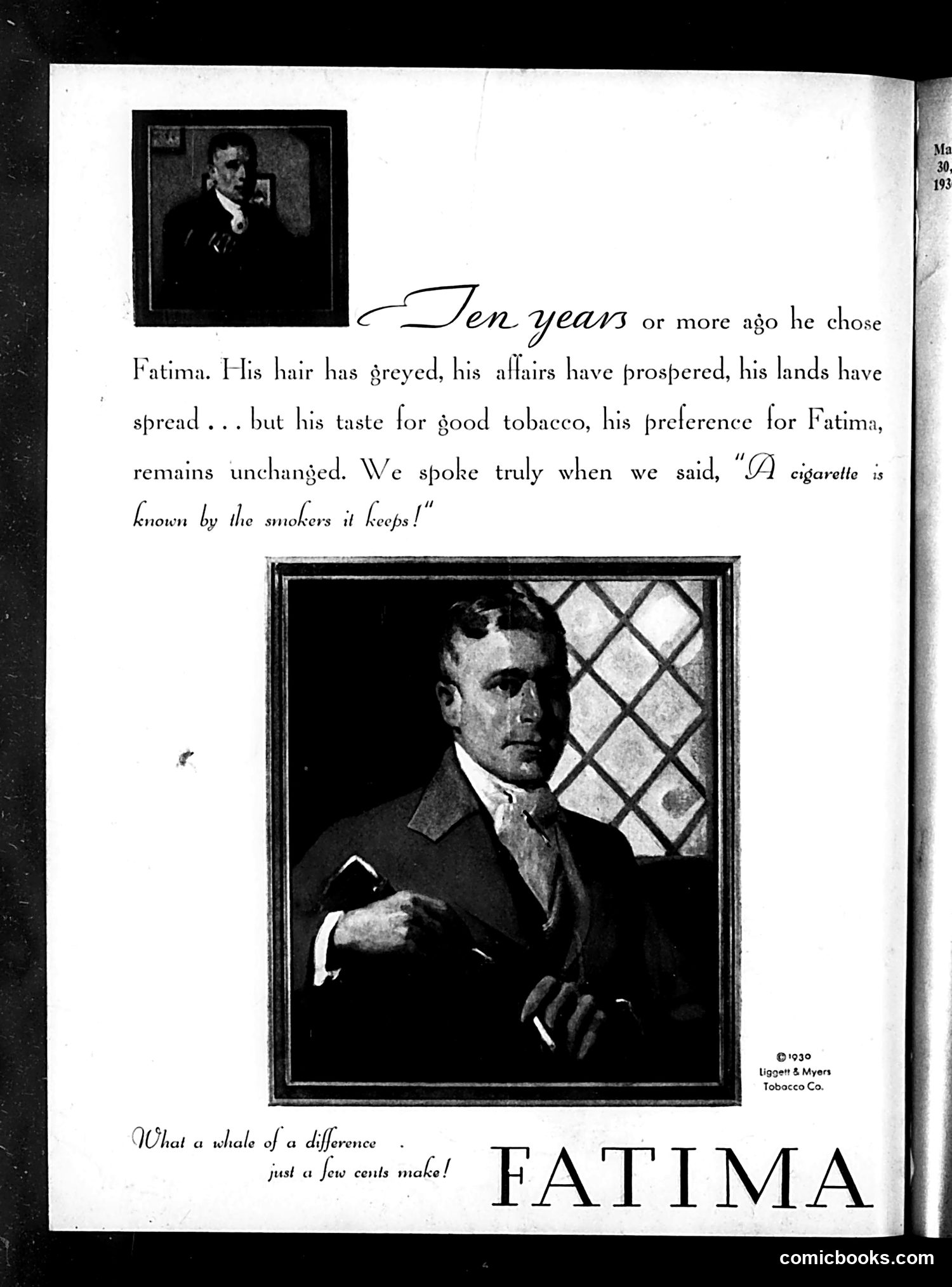
Fatima Cigarette Advertisement (1930) This is a cigarette advertisement, not political satire. The "Fatima" brand (made by Liggett & Myers) uses a narrative about male success and constancy. The advertisement depicts a well-dressed man who, ten years earlier, chose Fatima cigarettes. Despite his life improving dramatically—graying hair, prosperous affairs, expanded lands—his taste in tobacco remains unchanged. The tagline "A cigarette is known by the smokers it keeps" suggests brand loyalty reflects good judgment. The phrase "What a whale of a difference just a few cents make!" emphasizes that Fatima's affordable price hasn't diminished its quality or desirability among discerning smokers. This is straightforward marketing, appealing to masculine identity and the notion that choosing Fatima demonstrates both sophistication and sound values—a common advertising strategy of the era when cigarette promotion was unrestricted.