life
Life — May 30, 1930
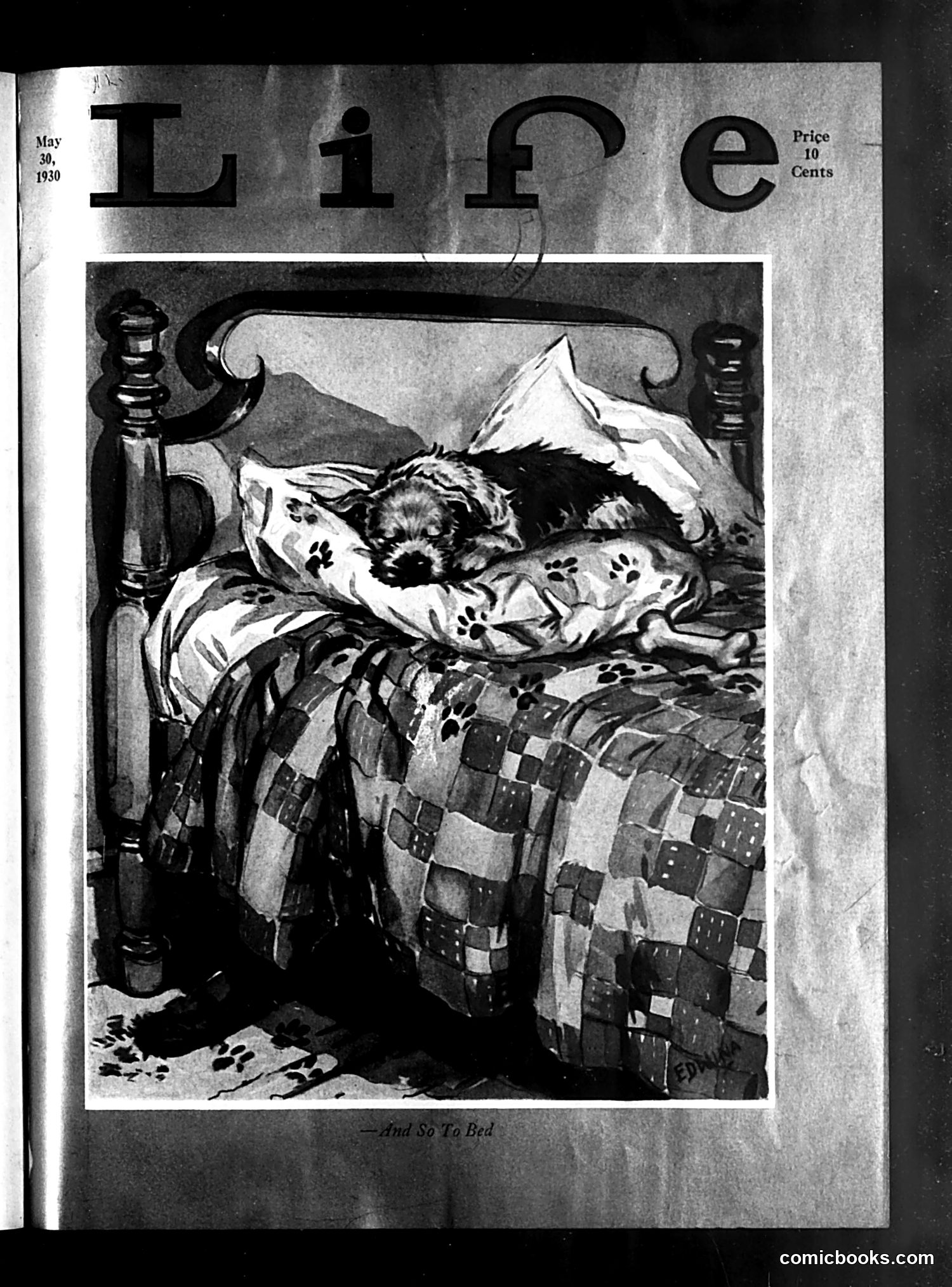
Life Magazine Cover Analysis (May 30, 1930) This is a cover illustration titled "And So To Bed," featuring a small dog settling into an ornate bed with patterned blankets and pillows. The image appears to be a humorous domestic scene with no obvious political satire. The illustration likely reflects 1930s attitudes toward pets—specifically the trend of owners indulging their dogs with human comforts. The elaborate bedding and decorative pillows suggest affluence and sentimentality toward animals, which may have been a subtle target of gentle satire about American consumerism during the Great Depression era. Without additional text visible on this page, the specific satirical intent remains unclear, though the whimsical tone suggests commentary on pet ownership practices.
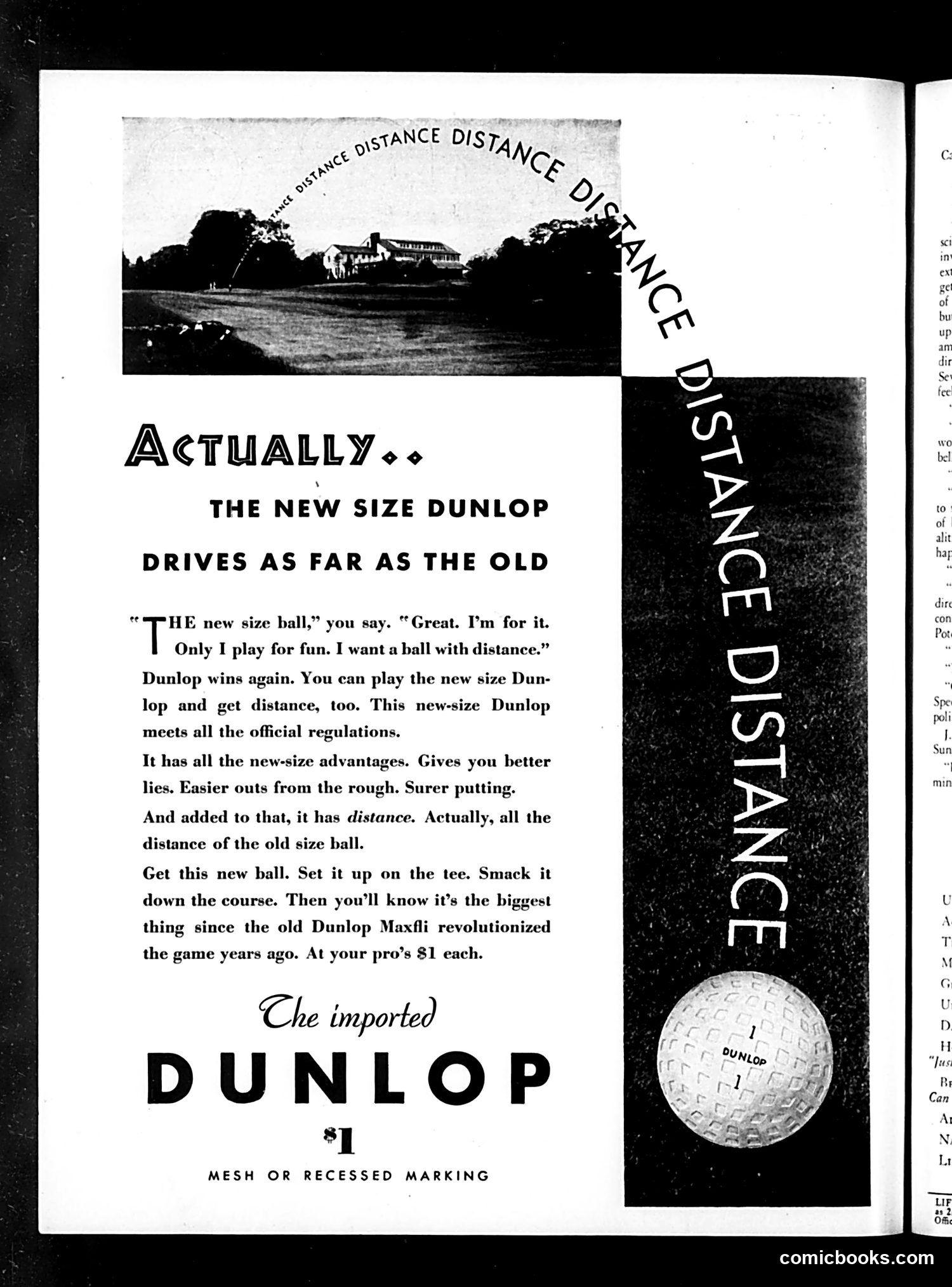
Analysis This is a Dunlop golf ball advertisement, not political satire. The page promotes Dunlop's new-size golf ball, claiming it meets official regulations while delivering the distance of the older, larger ball. The "joke" (for the advertiser) is the apparent contradiction: golfers wanted distance, and the new smaller ball supposedly provides it. The ad emphasizes this paradox through the repeated phrase "DISTANCE DISTANCE DISTANCE" and the playful "Actually..." heading. The scenic photograph at top shows a golf course landscape, reinforcing the leisure/sport context. The ball image at bottom-right displays the product. This reflects 1920s-30s golf culture and equipment standardization debates—not a political commentary.
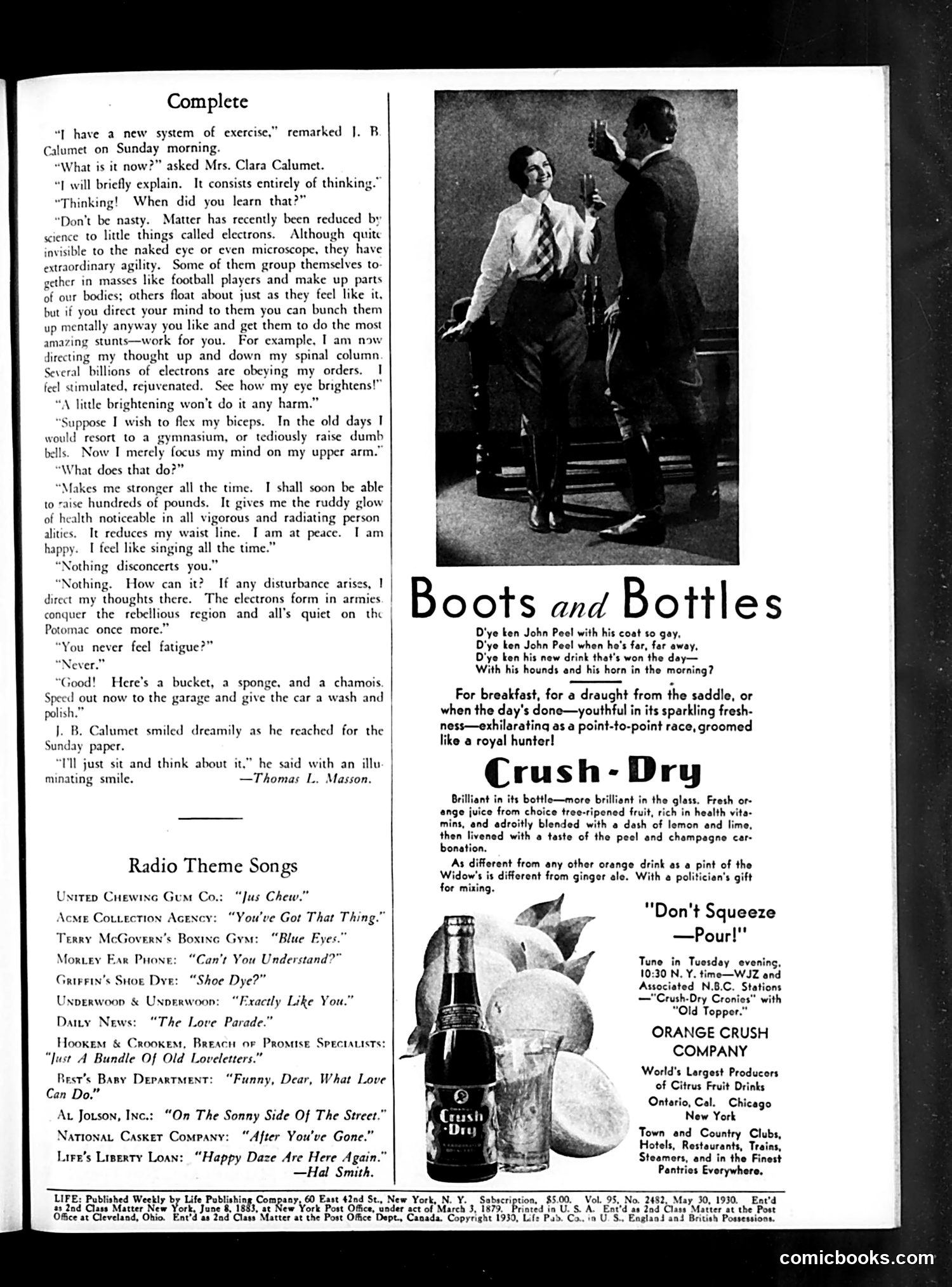
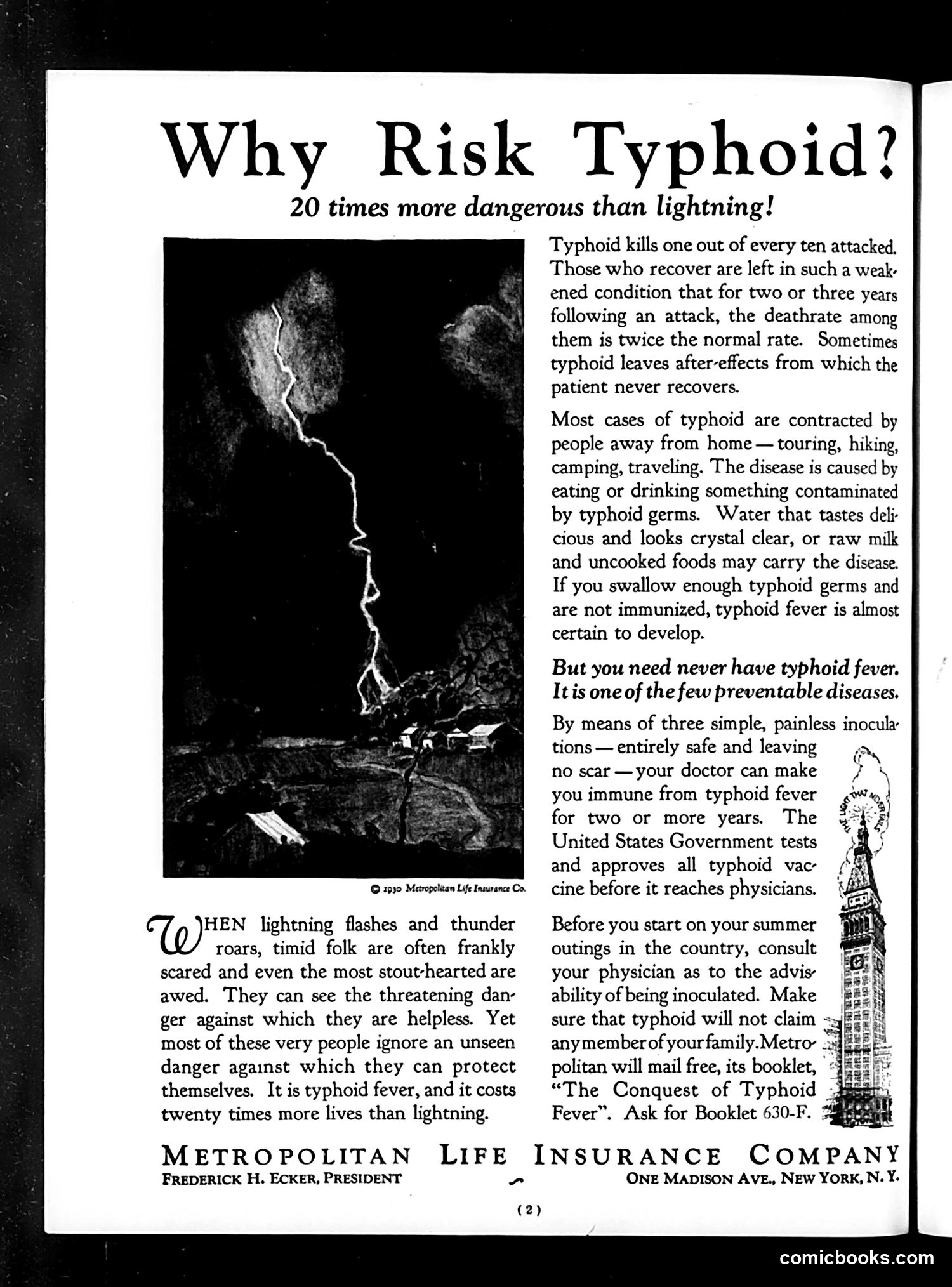
Analysis This is a public health advertisement, not satire or political commentary. Metropolitan Life Insurance Company uses fear-based marketing to promote typhoid vaccination. The image shows a lightning bolt striking a rural house—a visual metaphor comparing typhoid's danger to lightning. The text claims typhoid is "20 times more dangerous than lightning," claiming it kills 1 in 10 and leaves survivors weakened for years. The ad targets travelers ("touring, hiking, camping") who might contract typhoid through contaminated food or water. The solution: three painless vaccinations from your doctor, approved by the U.S. Government. The rhetoric reflects early-20th-century public health messaging that relied on dramatic comparisons and government endorsement to encourage medical intervention—then a relatively new concept for preventive medicine.
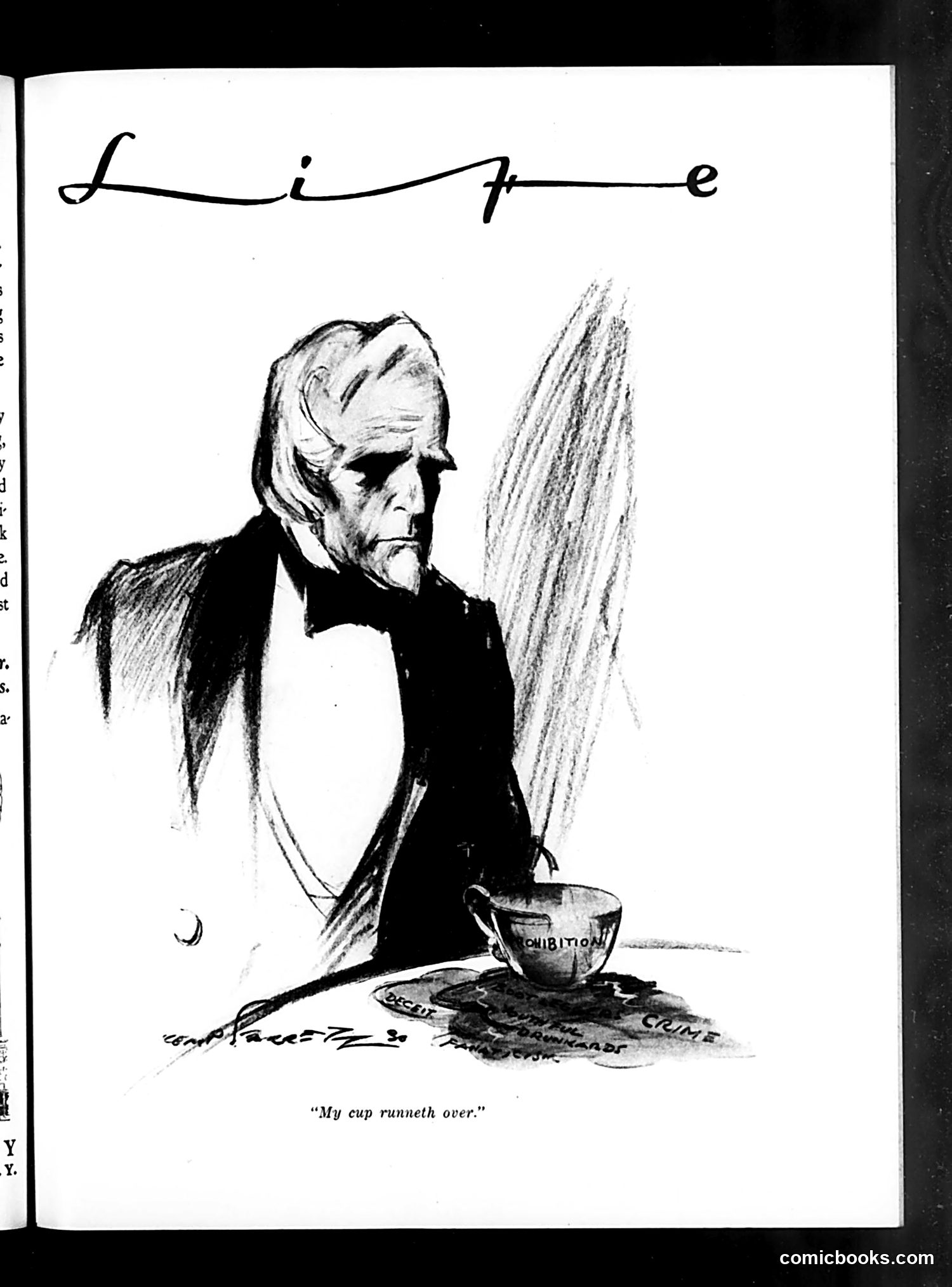
Analysis of "Life" Magazine Cartoon This political cartoon depicts an elderly man in formal attire (bow tie and jacket) looking distressed at a spilled cup. The title "My cup runneth over" is a biblical reference to Psalm 23, typically expressing gratitude and abundance. The satire inverts this meaning: the spilled cup suggests the figure's fortunes have reversed—his "cup" of prosperity or good fortune has literally overflowed and been lost. The figure's aged appearance and refined dress suggest he represents a wealthy or prominent person whose circumstances have deteriorated. Without additional context about *Life* magazine's publication date, the specific historical figure being caricatured remains unclear, though the artwork style suggests early-to-mid twentieth century. The cartoon likely comments on financial loss or failed ambitions of a public figure.
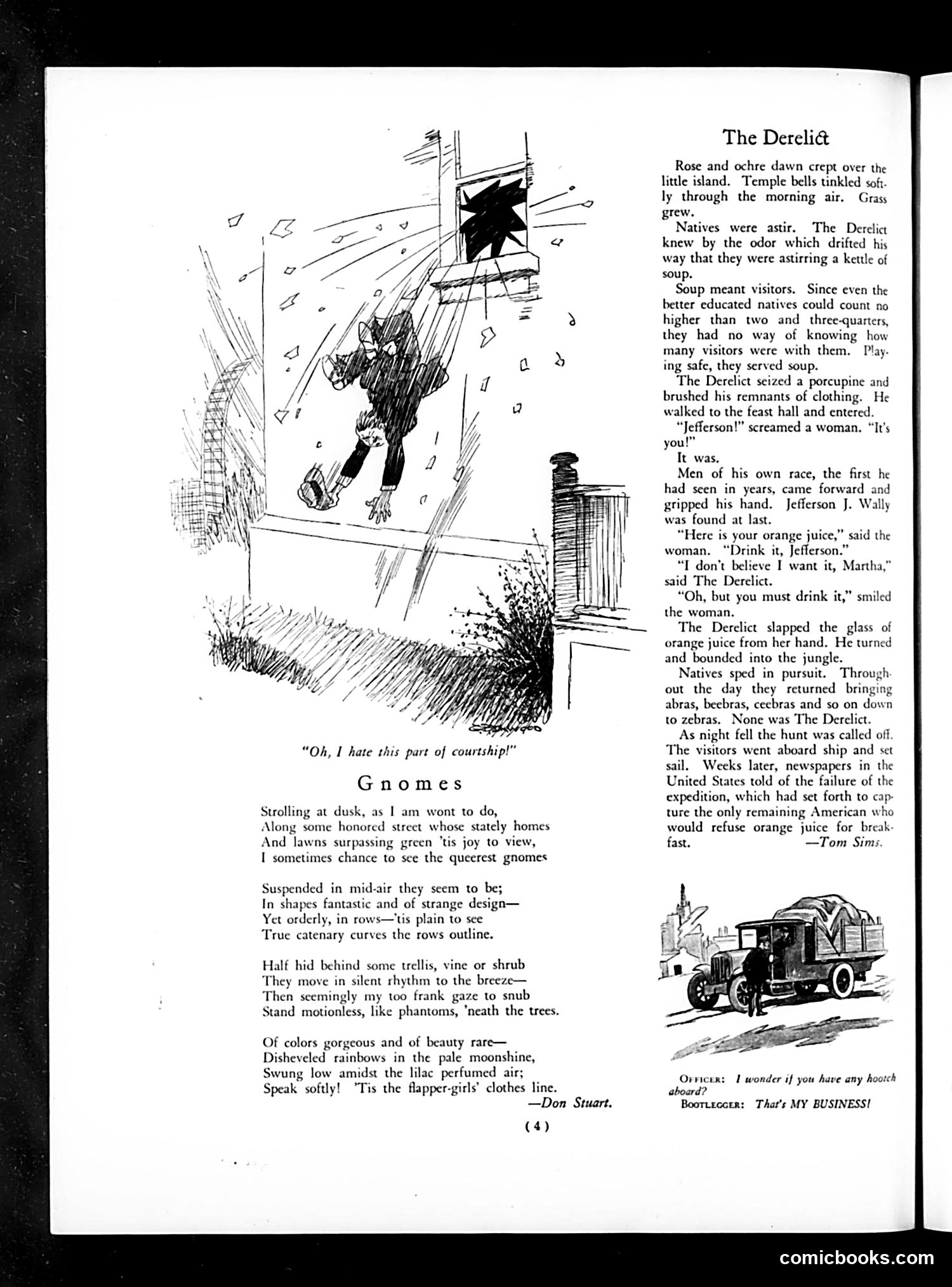
Analysis of Page 4 This page contains two distinct pieces: "The Derelict" (top right): A prose story about an American expedition member ("The Derelict") who abandons his group on an island, drinks orange juice offered by a local woman, and flees into the jungle. When the group fails to return, newspapers report he's the only surviving American who "would refuse orange juice for breakfast"—satirizing American stubbornness and pickiness. "Gnomes" (bottom left): A poem by Don Stuart celebrating garden gnomes as whimsical decorative figures visible in suburban yards at dusk, described with fantastical imagery. The cartoon (bottom right) shows an officer and bootlegger with a truck, likely referencing Prohibition-era smuggling, with the bootlegger claiming the contraband is his "business." The page primarily showcases literary humor and poetry rather than political satire.
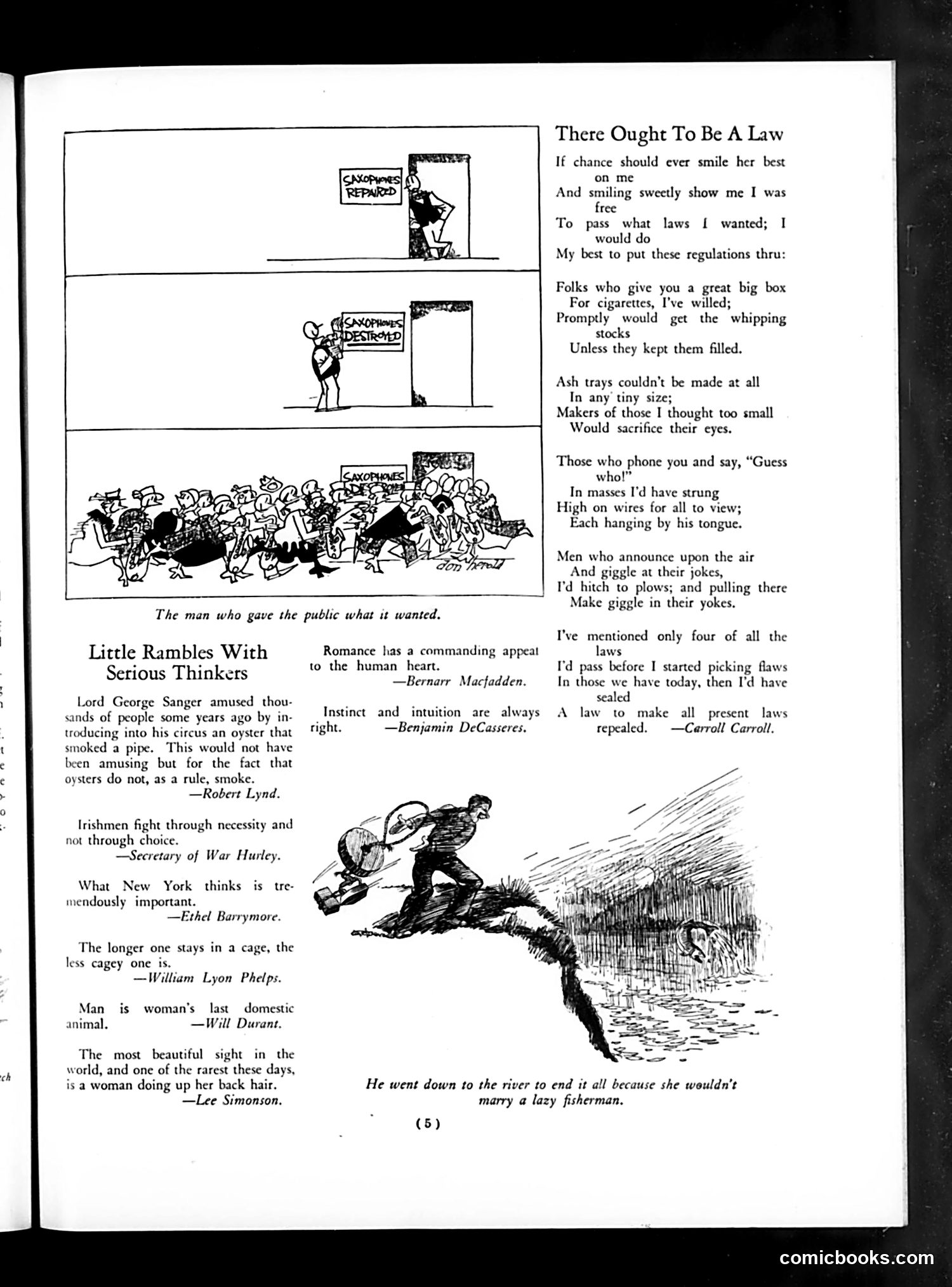
Analysis: "There Ought To Be A Law" This satirical poem proposes absurd punishments for modern annoyances. The three cartoon panels illustrate escalating consequences: 1. Panel 1: A sign reads "SAXOPHONES REPAIRED" — mocking the popularity of saxophones, likely a 1920s jazz-age reference. 2. Panel 2: The sign is destroyed, humorously suggesting violent enforcement of regulations. 3. Panel 3: A massive crowd hangs from wires by their tongues — the poet's proposed punishment for people who make prank phone calls ("Guess who!"). The poem satirizes social frustrations of the era: cigarette box gifting, tiny ashtrays, and telephone pranks. The humor relies on grotesque, disproportionate punishments for trivial modern irritants—a common satirical technique mocking both the annoyances and society's tendency toward regulation.
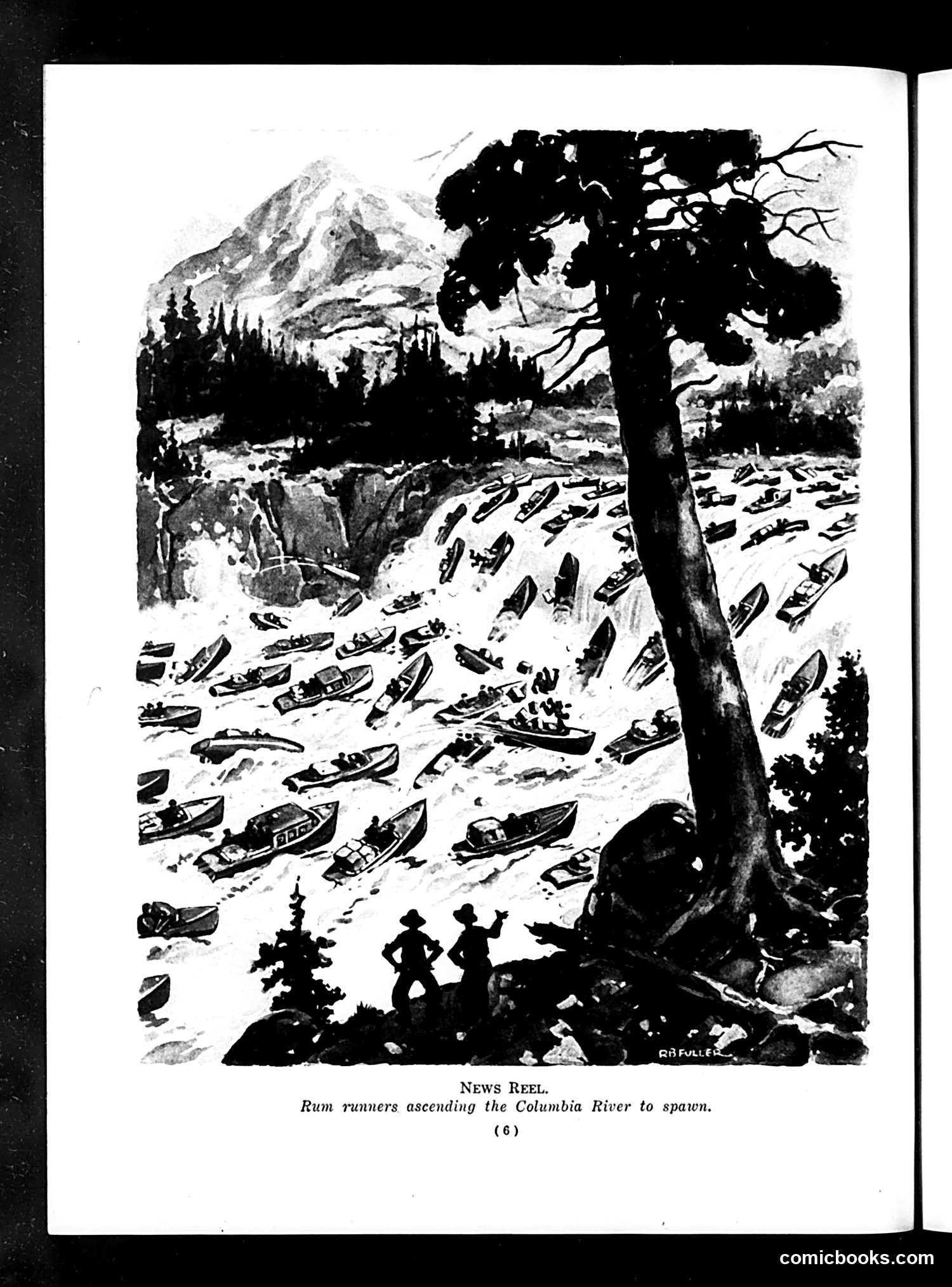
Analysis This illustration, titled "News Reel: Rum runners ascending the Columbia River to spawn," is a satirical commentary on Prohibition-era smuggling. The cartoon depicts numerous boats densely packed on a riverbed, anthropomorphized as if they were salmon spawning upstream—a natural migration pattern. Two figures in the foreground observe this scene. The "rum runners" are illegal alcohol smugglers, and the joke compares their annual upstream journey to the Columbia River to salmon returning to spawn. The satire mocks both the proliferation of bootlegging operations during Prohibition and the futility of enforcement efforts. By presenting smugglers as mindlessly instinctive creatures, the cartoonist suggests the inevitability and prevalence of illegal alcohol trafficking, despite government prohibition laws. The artist signature appears to be "B.F. Huller" or similar.
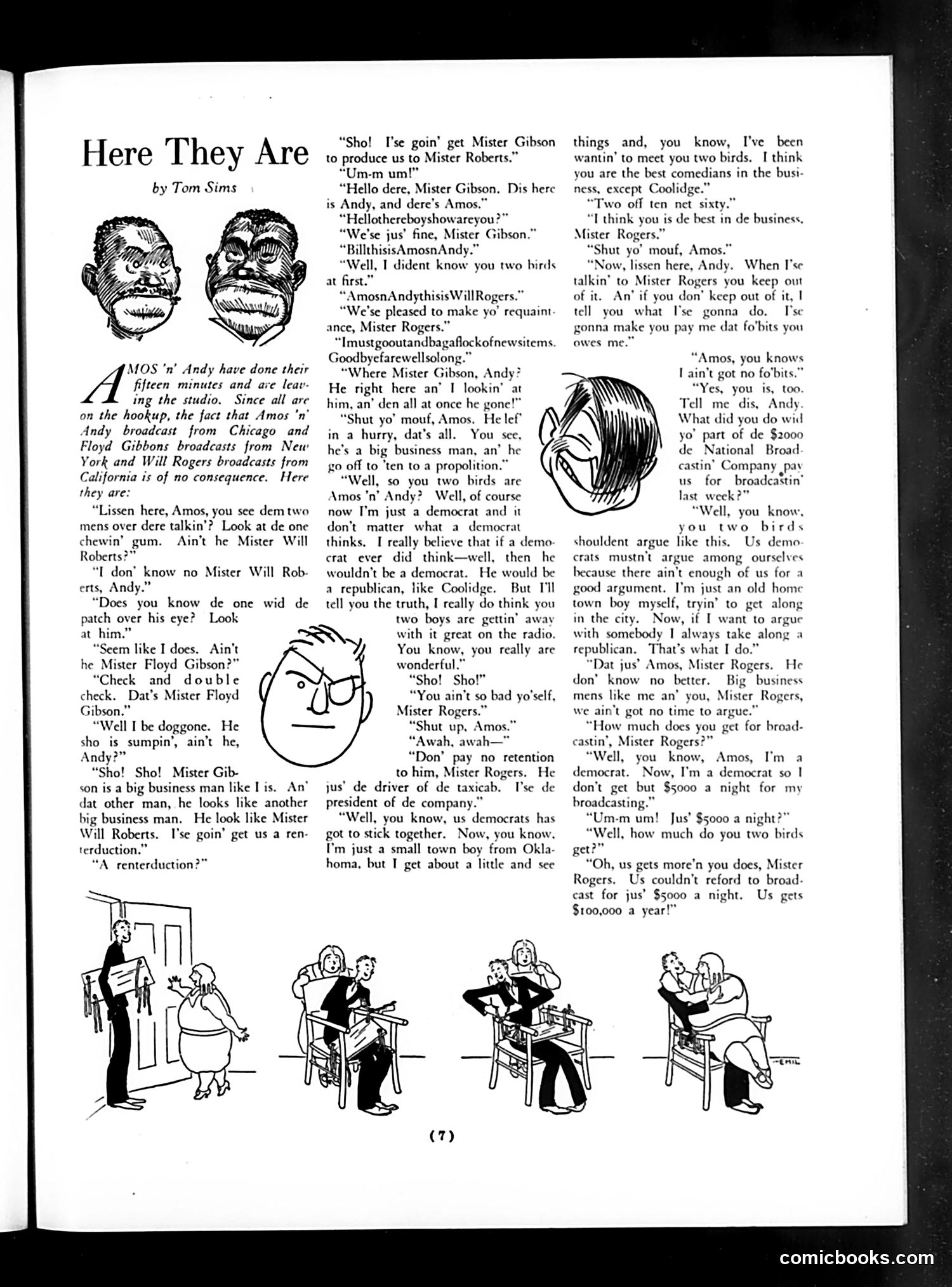
"Here They Are" by Tom Sims This satirical piece features two radio broadcasters, Amos and Andy, discussing business and politics. The dialogue contrasts their personas: Andy represents old-fashioned rural simplicity (from Oklahoma), while Mister Rogers embodies big-city sophistication and wealth. The satire targets democratic politics and radio broadcasting economics. Rogers boasts of earning $5,000 nightly ($100,000 annually) for broadcasting, while Andy struggles with modest income. The joke critiques the vast wealth disparity in entertainment and the absurdity of democratic ideals when economic inequality is so pronounced. The caricatured faces at top and sequential cartoon panels below illustrate the comedic dialogue. The piece satirizes how radio personalities could become extraordinarily wealthy while ordinary citizens remained poor—a pointed commentary on 1920s-30s American capitalism disguised as entertainment humor.
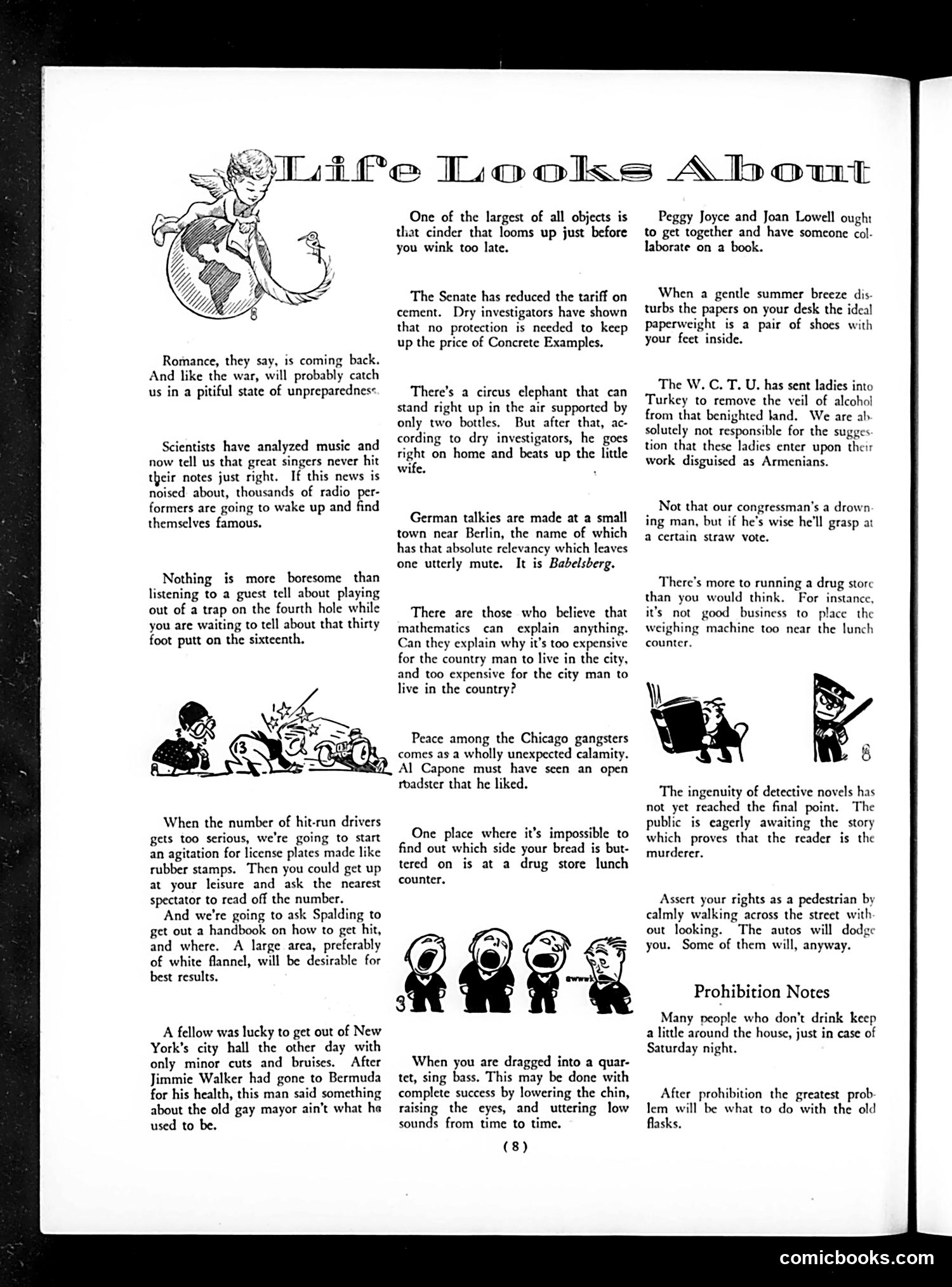
"Life Looks About" - Political Satire Column This is a humor column mixing social commentary with light satire. Key references include: - Senate tariff reduction on cement: Contemporary political debate about trade policy and pricing - W.C.T.U. in Turkey: The Women's Christian Temperance Union, a real prohibition advocacy group, apparently sending women to combat alcohol - Chicago gangsters: References the prohibition-era organized crime problem - Drug store lunch counters: Commentary on where illicit alcohol was actually sold during Prohibition - Hit-run drivers / license plates: Satirizing the growing automobile safety problem - Pedestrian safety: Mocking dangerous street-crossing in modern cities The cartoons feature simple character drawings illustrating these everyday absurdities. The overall tone mocks contemporary American social problems—organized crime, traffic dangers, and prohibition enforcement failures—through brief, sardonic observations.
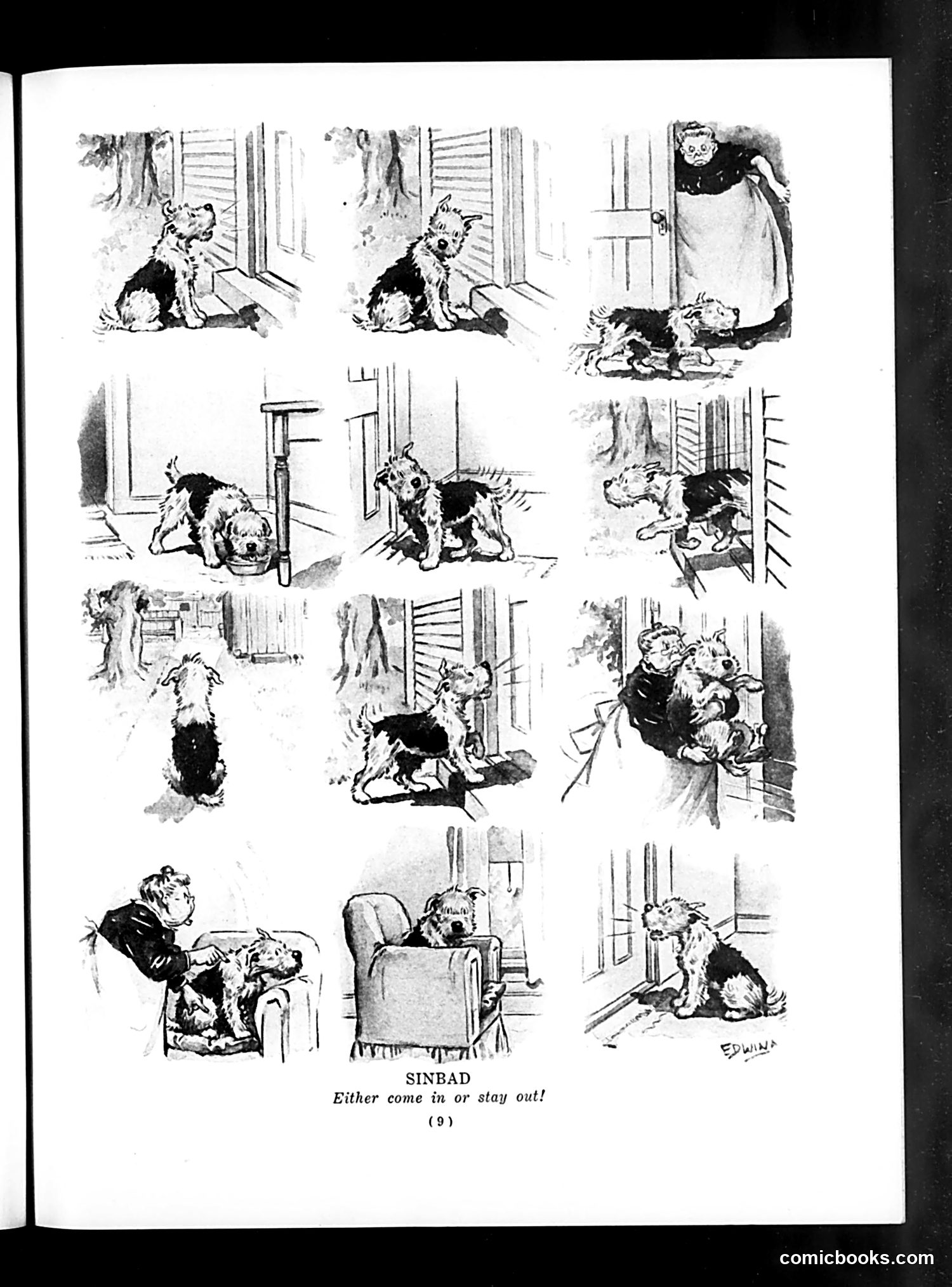
Analysis: "Sinbad - Either come in or stay out!" This is a comic strip about a dog named Sinbad that satirizes indecisive behavior. The sequential panels show Sinbad repeatedly hesitating at a doorway or window, unable to commit to entering or staying outside. A woman (likely the homeowner) becomes increasingly exasperated, finally expressing frustration with his inability to make up his mind. The humor targets a relatable human trait—indecision and procrastination—by attributing it to a pet. The title's imperative command reflects the woman's mounting irritation at Sinbad's vacillating behavior. This appears to be a humorous domestic vignette rather than political satire, typical of Life magazine's comedic content featuring animals that anthropomorphically mirror human flaws.
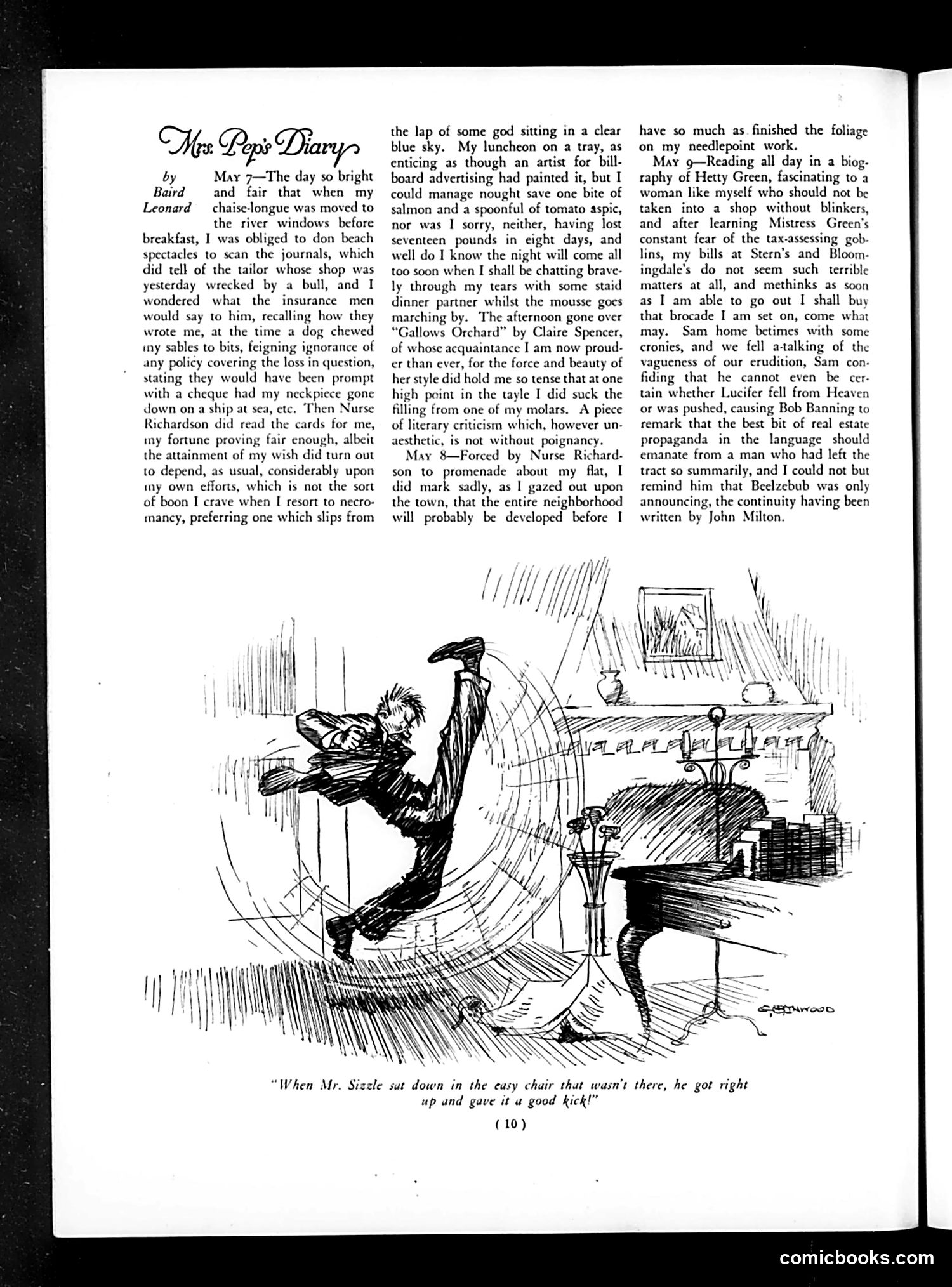
Analysis of "Mrs. Pepys' Diary" Page This is a humorous diary column written by Heywood Broun, presenting fictional entries from May 7-8. The illustrated cartoon shows a slapstick scene: a man has kicked over an easy chair (which wasn't there), sending himself flying backward with comic exaggeration. The caption reads: "When Mr. Sissle sat down in the easy chair that wasn't there, he got right up and gave it a good kick!" The joke is a simple physical comedy setup—the man doesn't realize the chair is missing, sits in empty air, and reacts with an angry kick at the nonexistent furniture. It's typical early 20th-century magazine humor: absurdist slapstick designed to amuse readers with visual wit and wordplay about everyday domestic mishaps.
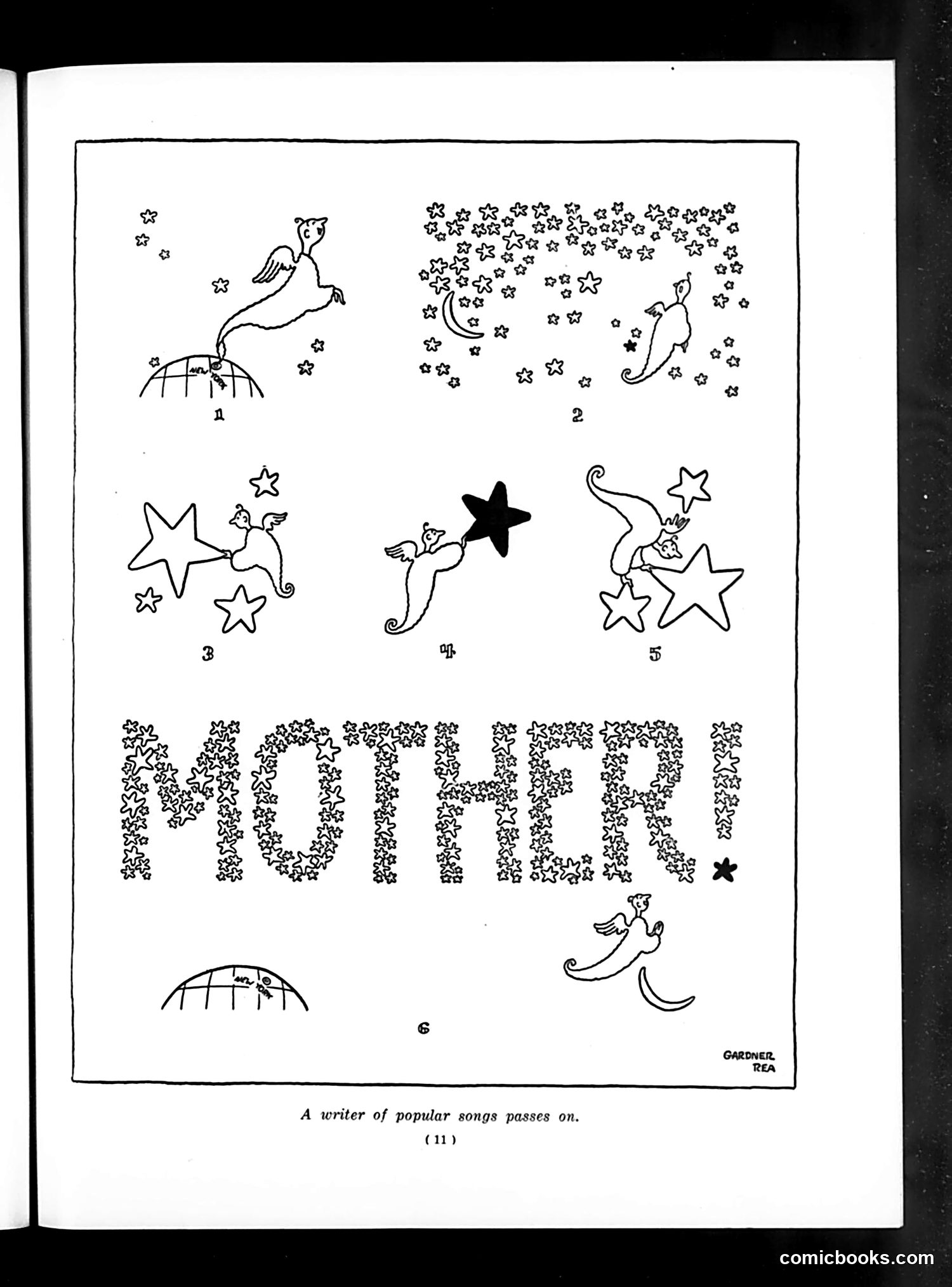
"Mother" — A Political Cartoon Analysis This is a visual riddle or rebus puzzle from *Life* magazine, not a traditional political cartoon. The page shows six numbered illustrations of cherubs/cupids interacting with stars and celestial imagery, leading to the word "MOTHER" spelled out in small stars. The caption reads: "A writer of popular songs passes on." The puzzle works as a visual pun: each illustration represents a syllable or word sound that, when decoded, references a famous popular songwriter who has died. The cherubs and stars suggest heavenly/celestial themes appropriate to a memorial tribute. Without additional historical context identifying which songwriter is referenced, the exact subject remains unclear, but the page celebrates a deceased composer of popular music through this clever visual wordplay.
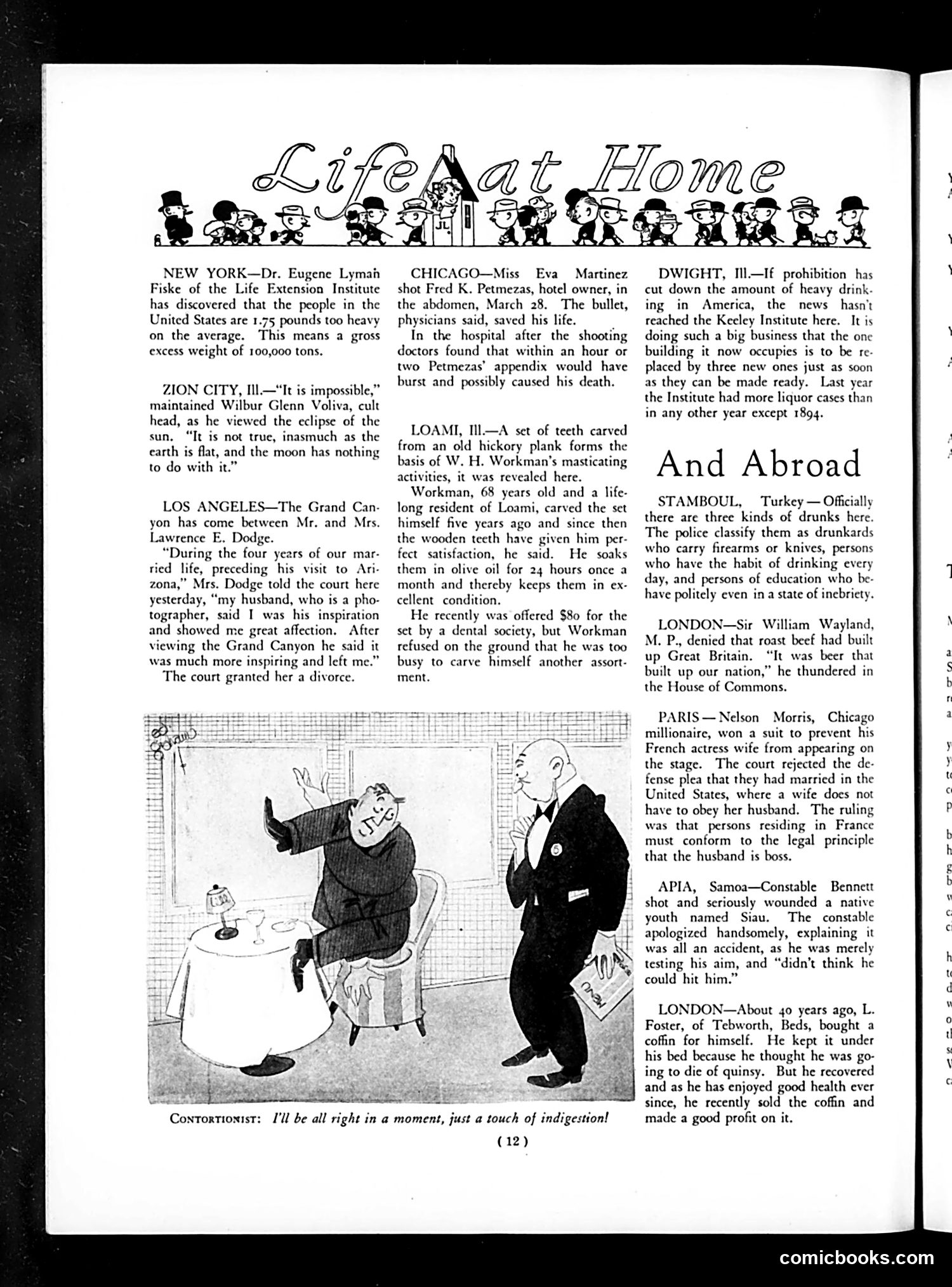
"Life at Home and Abroad" - Page Analysis This page presents brief international news items paired with a cartoon. The cartoon shows a man suffering from indigestion while a waiter offers assistance with the caption "I'll be all right in a moment, just a touch of indigestion!" The accompanying news snippets are satirical vignettes from various cities—New York, Chicago, Los Angeles, London, Paris, and others—documenting oddities and absurdities: a cult leader's impossible claims, someone carving dentures from hickory wood, a millionaire's marital lawsuit, and accidental shootings. The indigestion cartoon appears to metaphorically represent the digestive difficulty of absorbing such bizarre global events. The overall page exemplifies *Life* magazine's satirical approach to reporting: presenting real (or allegedly real) peculiar human behavior as dark humor reflecting modern society's absurdities.
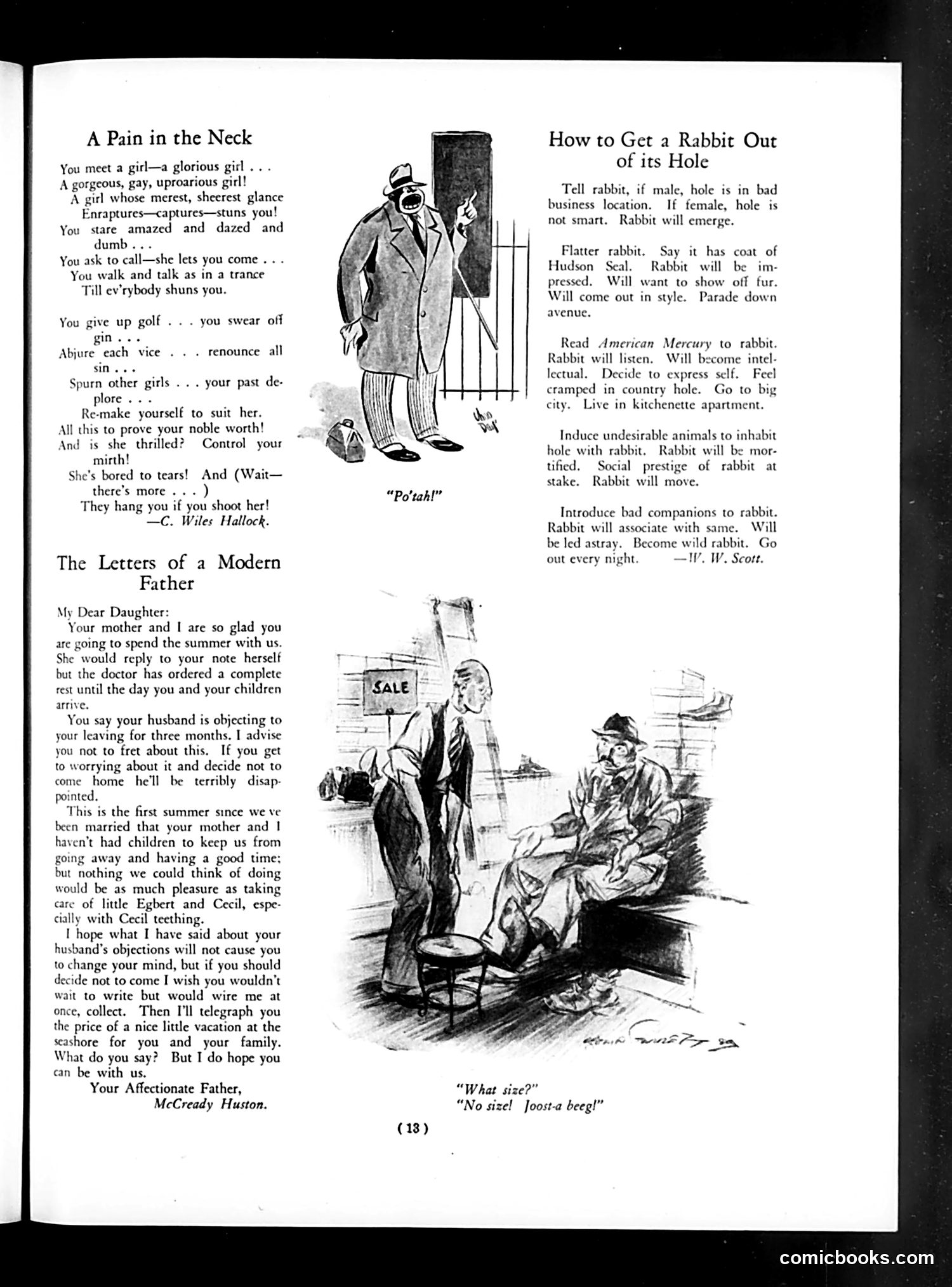
Analysis of Life Magazine Page 18 This page contains three satirical pieces reflecting early 20th-century social concerns: "A Pain in the Neck" mocks romantic pursuit of an "glorious girl"—a woman who demands her suitor abandon golf, drinking, and male friendships to prove devotion. The satire targets both demanding women and the lengths men go to win them. "The Letters of a Modern Father" presents a father advising his daughter about a summer separation from her husband. The tone is witty marital commentary, suggesting tension between spouses' desires. "How to Get a Rabbit Out of its Hole" satirizes getting a rabbit to leave by various methods (fluttering, reading literature, introducing bad companions). The accompanying sketch shows men at a dock with a "SALE" sign, likely making a humorous point about persuasion techniques. The overall page emphasizes romantic and social tensions of the era through humor.
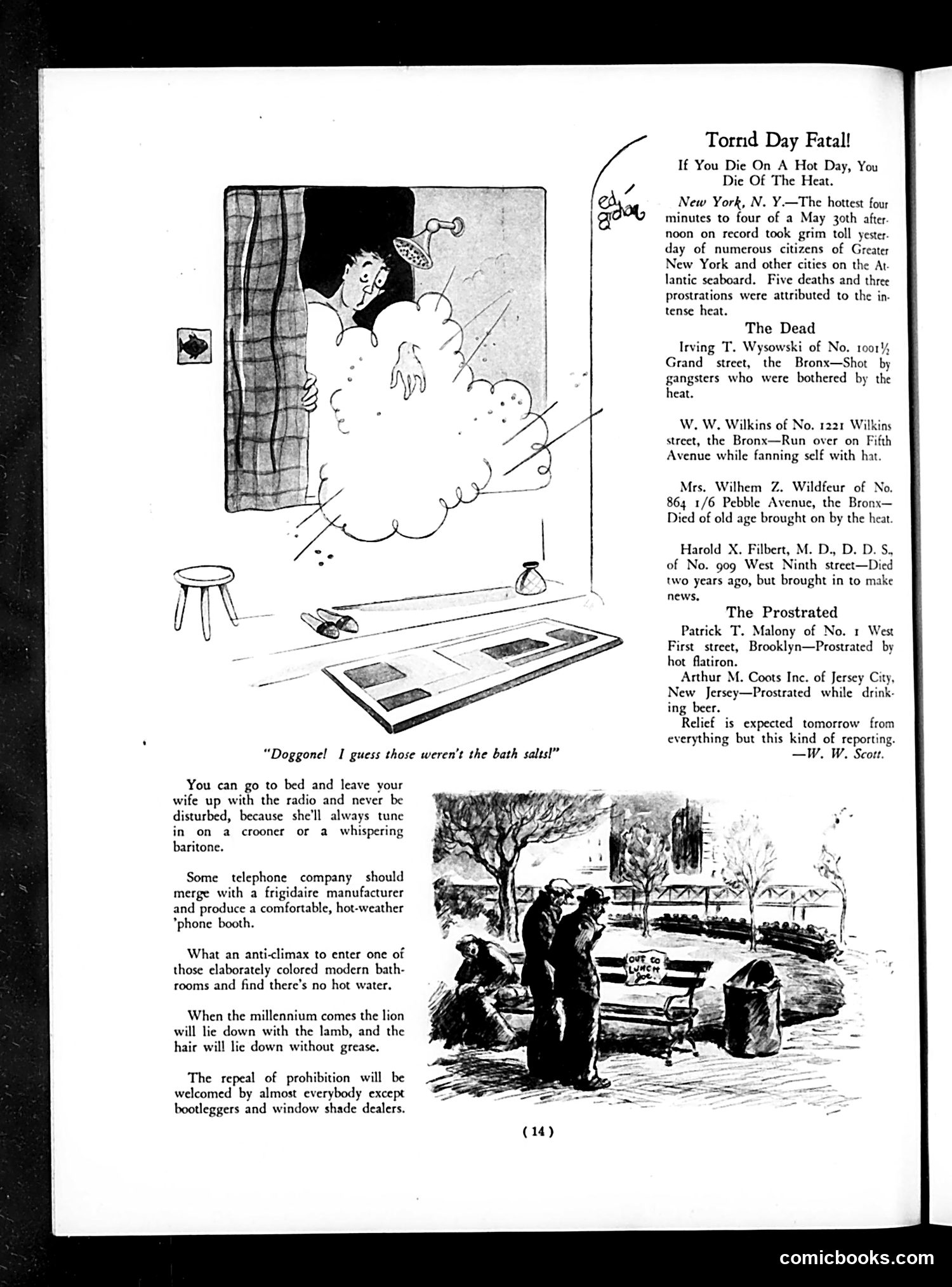
Analysis This page from Life magazine satirizes the extreme heat wave affecting New York in May (the text mentions "May 30th"). The top cartoon mocks people's desperate attempts to cope with oppressive temperatures—a man lies in bed with a fan, surrounded by heat-related imagery. The caption "Doggone! I guess those weren't the bath salts!" is a humorous non-sequitur suggesting confusion or delirium from the heat. The right column lists actual heat-related deaths and injuries from the recent weather event, treating the tragedy with dark humor—a common Life magazine approach that blended satire with social commentary. The bottom illustration shows people gathered outdoors seeking relief, likely at a public space during the heat emergency. Together, these elements satirize New Yorkers' comically ineffective coping strategies while acknowledging the genuine public health crisis the heat wave created.
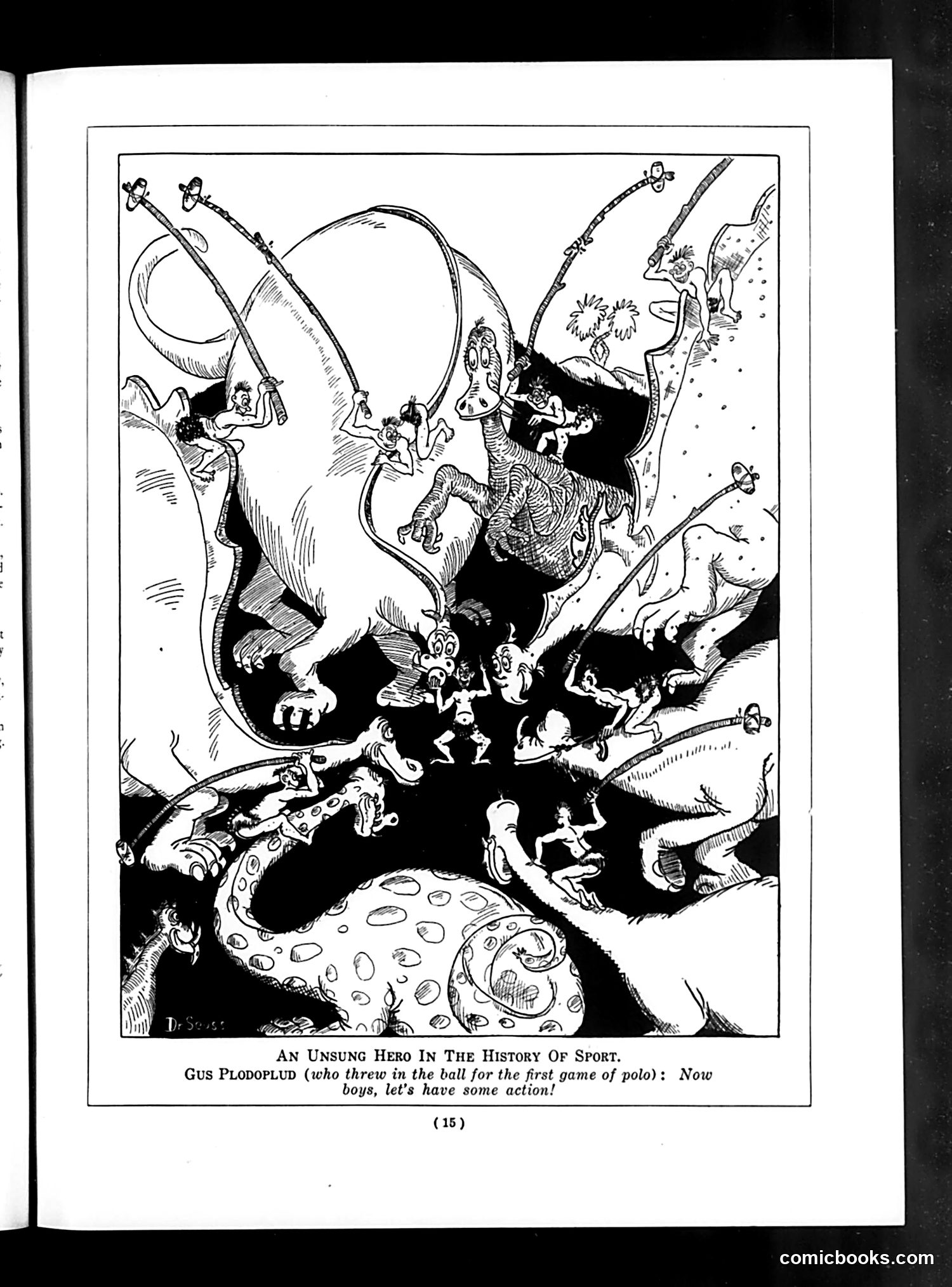
"An Unsung Hero in the History of Sport" This satirical illustration depicts Gus Plodoplud, credited as the person "who threw in the ball for the first game of polo." The cartoon humorously elevates an obscure, mundane figure to historical importance by showing him surrounded by chaos—tiny human figures swarming around and interacting with enormous polo balls and mallets in an exaggerated, fantastical underground or cavern setting. The satire mocks both the obsession with sports history and the tendency to attribute grand significance to trivial roles. By treating Plodoplud as a major historical figure deserving recognition, Life pokes fun at how sports enthusiasts and historians sometimes overstate the importance of minor participants or create legendary status for ordinary people involved in sporting "firsts."
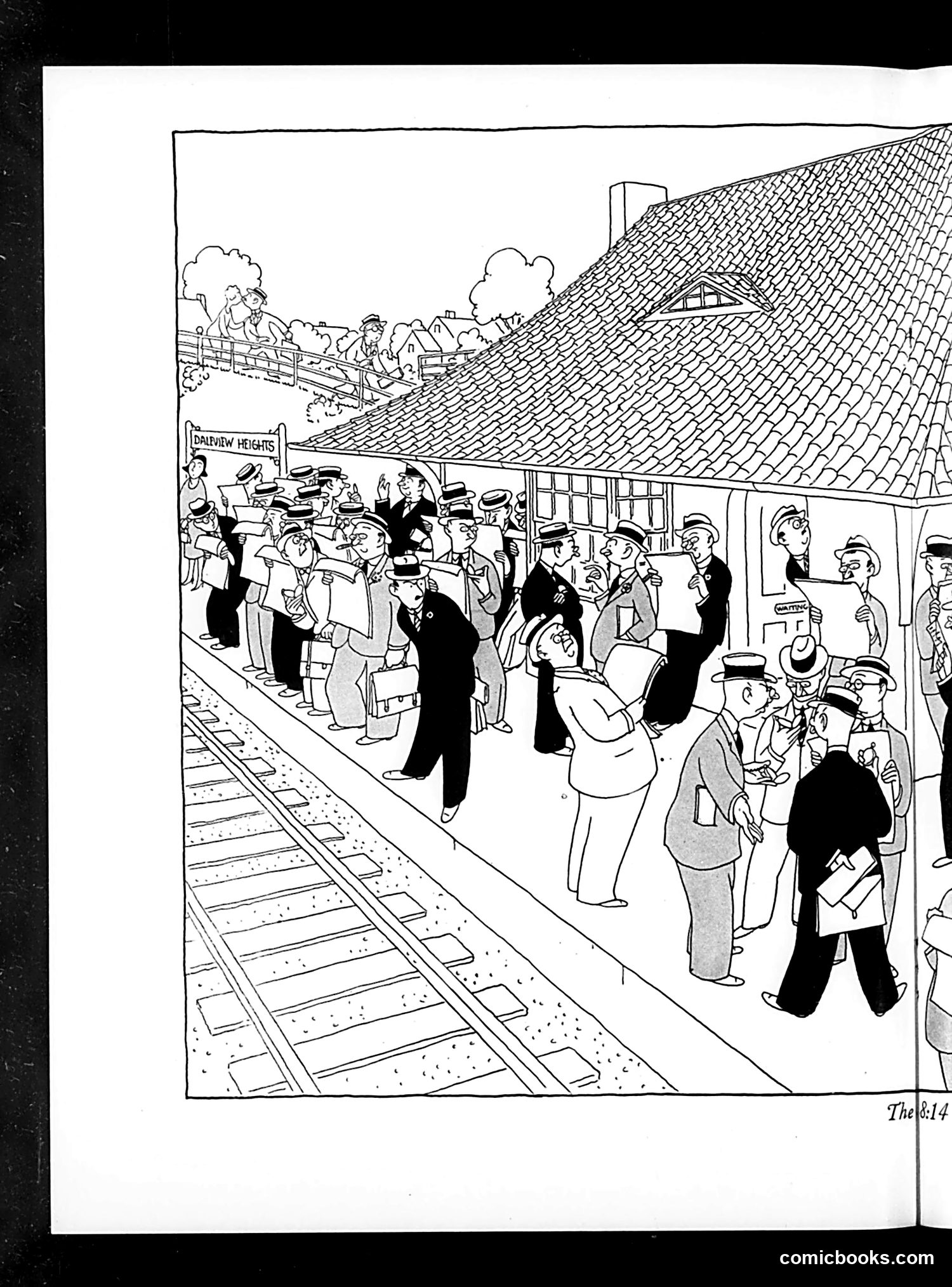
Analysis This cartoon depicts a crowded railroad station platform at "Dairyview Heights" (visible on the station sign). The scene shows numerous well-dressed men in suits and hats gathered in apparent confusion or commotion on the platform beside railroad tracks. The satire appears to target suburban real estate development and speculation. The "Dairyview Heights" development name suggests a converted rural or agricultural area being marketed as suburban housing. The crowded platform and disorganized gathering of businessmen likely satirizes the frenzy of real estate sales, investor interest, or property speculation that characterized suburban development booms. The cartoon's humor derives from depicting respectable-looking professionals in chaotic disorder, suggesting the undignified scramble underlying polite real estate transactions. Without additional context or text, the specific event referenced remains unclear.
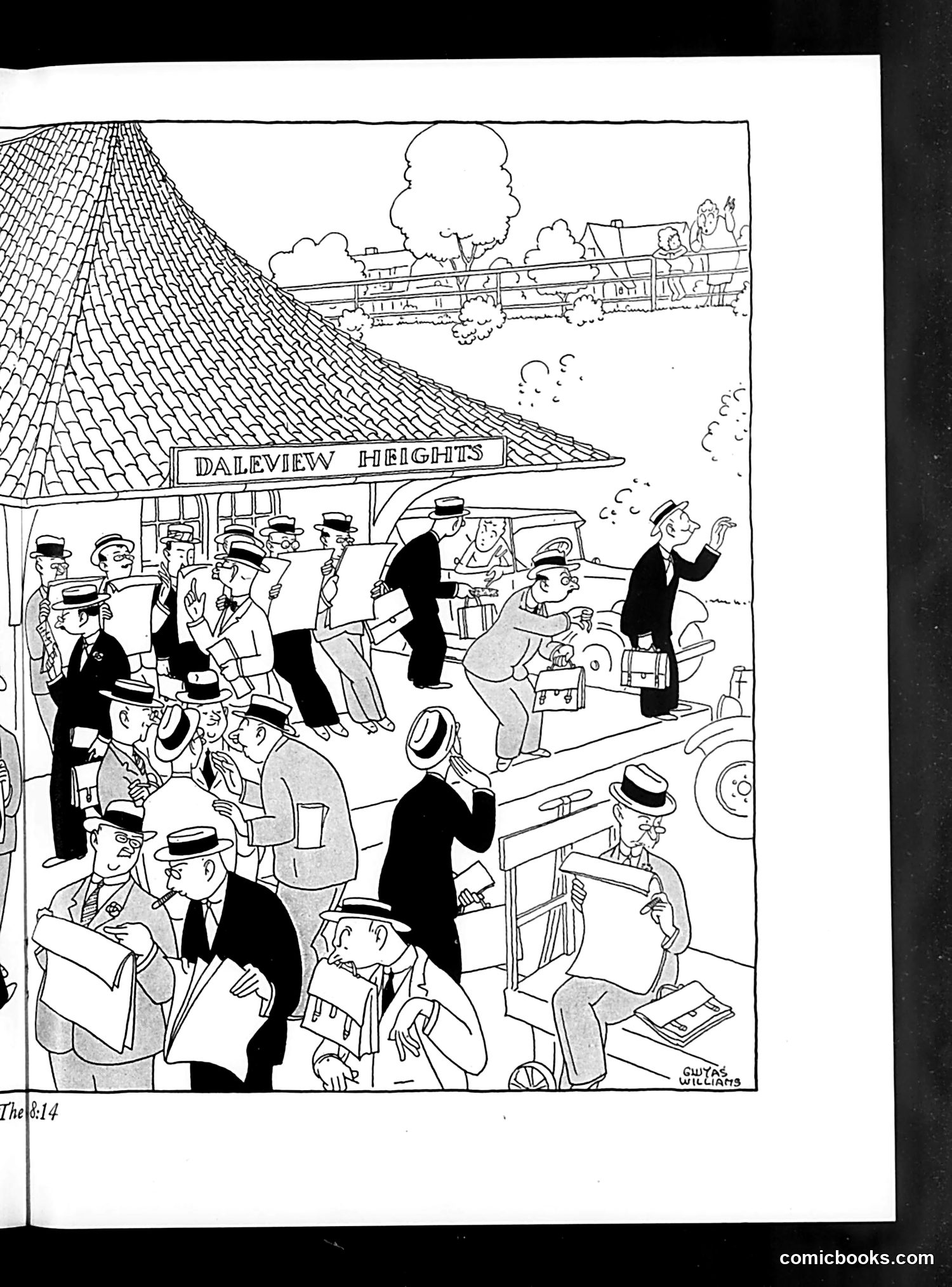
Analysis of "Daleview Heights" Cartoon This cartoon satirizes a real estate development or suburban community called "Daleview Heights," depicted as a crowded, chaotic scene of prosperous-looking men in suits and hats conducting business transactions. The scene shows numerous figures exchanging papers, negotiating deals, and conducting what appears to be a land or property sales event. The style suggests this is mocking the frenzy of real estate speculation—likely during a boom period when investors and businessmen scrambled to buy and sell property. The crowded composition and exaggerated activity suggest satire of speculative excess, financial mania, or the aggressive commercialism surrounding suburban development. The well-dressed figures emphasize the profit-seeking nature of such ventures. The artist (signed "Chiyya Williams") presents the scene as frenzied and somewhat absurd, poking fun at the get-rich-quick mentality of real estate deals.
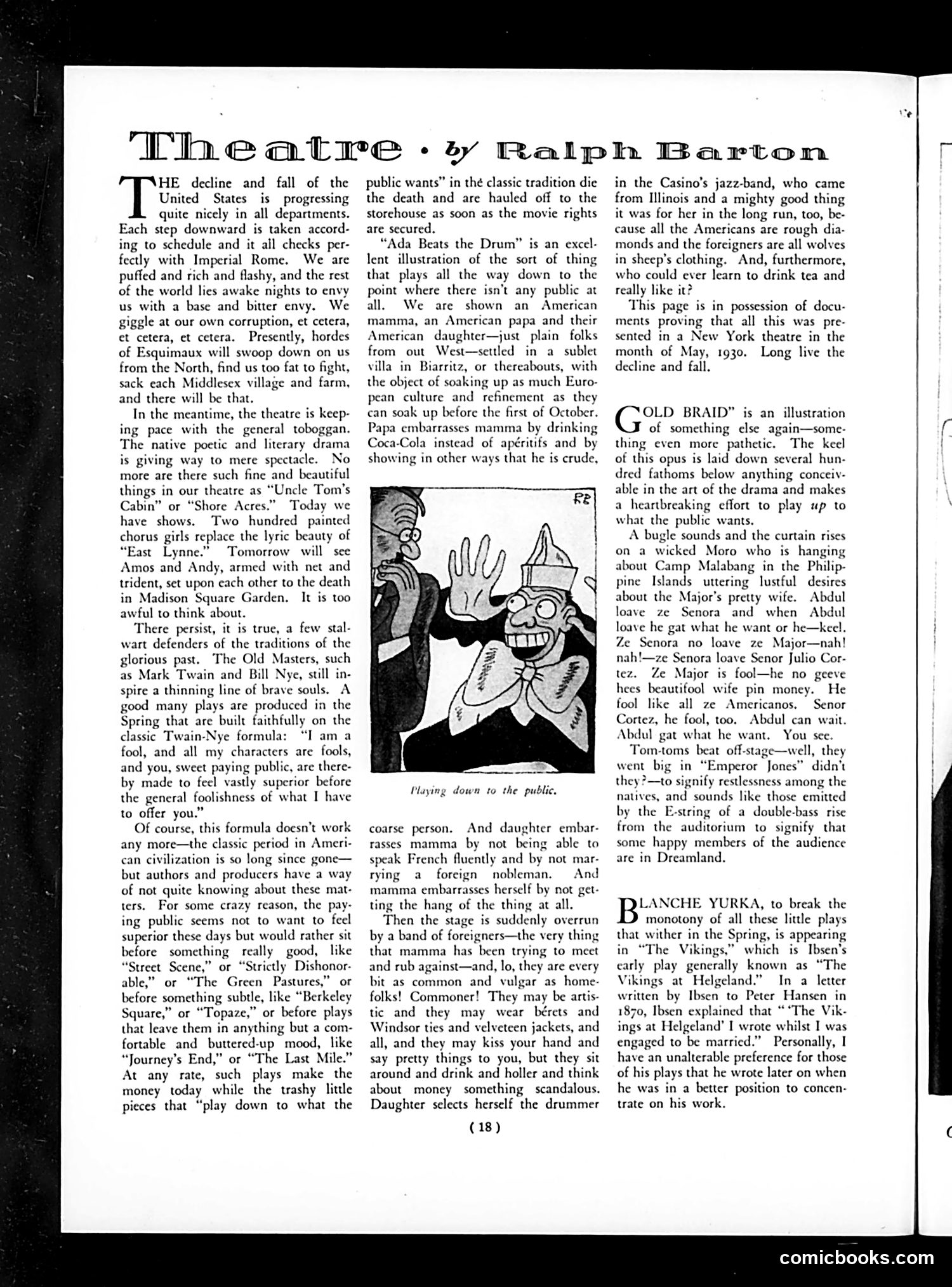
Explanation for Modern Readers This page from *Life* magazine contains Ralph Barton's theater criticism. The main illustration depicts a caricatured figure labeled "Playing down to the public" — showing an exaggerated, crude character with a large grin. Barton satirizes American theater's decline, arguing that plays increasingly pander to lowbrow audiences rather than maintaining artistic standards. He criticizes productions like "Ida Beats the Drum" for presenting stereotypical "plain folks" characters and crude humor instead of sophisticated drama. The cartoon embodies his complaint: theater has abandoned refinement for base entertainment designed to make audiences feel superior. Barton argues that even the great tradition of classic American plays now succumbs to this formula of artistic compromise for commercial success and public approval.
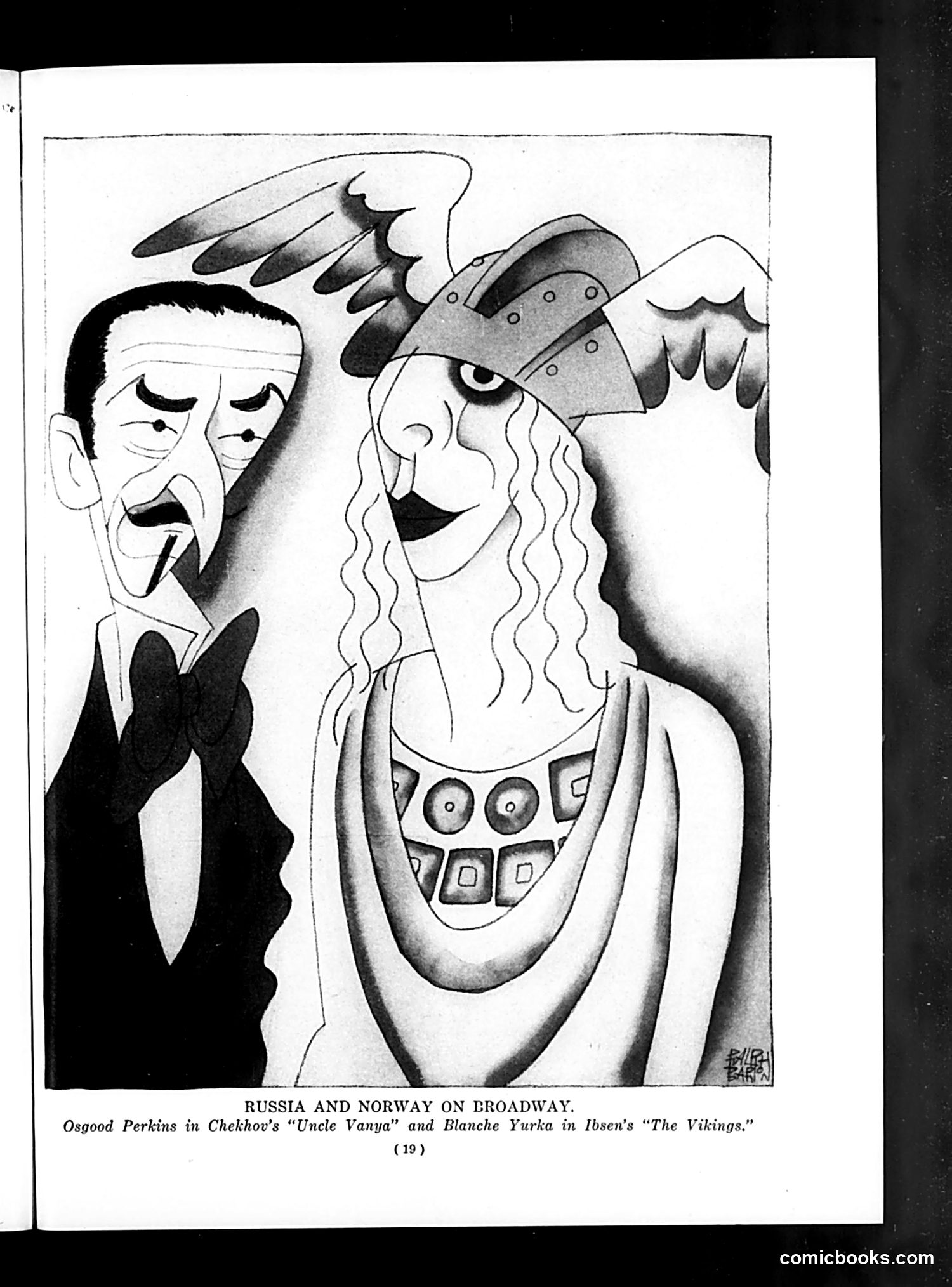
This page references two Broadway theatrical productions featuring Russian and Norwegian plays. The cartoon depicts two characters: on the left, actor Osgood Perkins in Chekhov's "Uncle Vanya" (a Russian play), shown as a melancholic man with a cigarette; on the right, actress Blanche Yurka in Ibsen's "The Vikings" (a Norwegian play), portrayed as a dramatic figure with elaborate costume and headdress, gesturing expressively. The satirical point appears to contrast the emotional styles of Russian versus Norwegian dramatic traditions—Russian introspection and pessimism versus Norwegian theatrical grandeur and passion. The exaggerated caricatures mock the intense, emotionally heavy nature of both European dramatic traditions that were popular on American stages at the time.
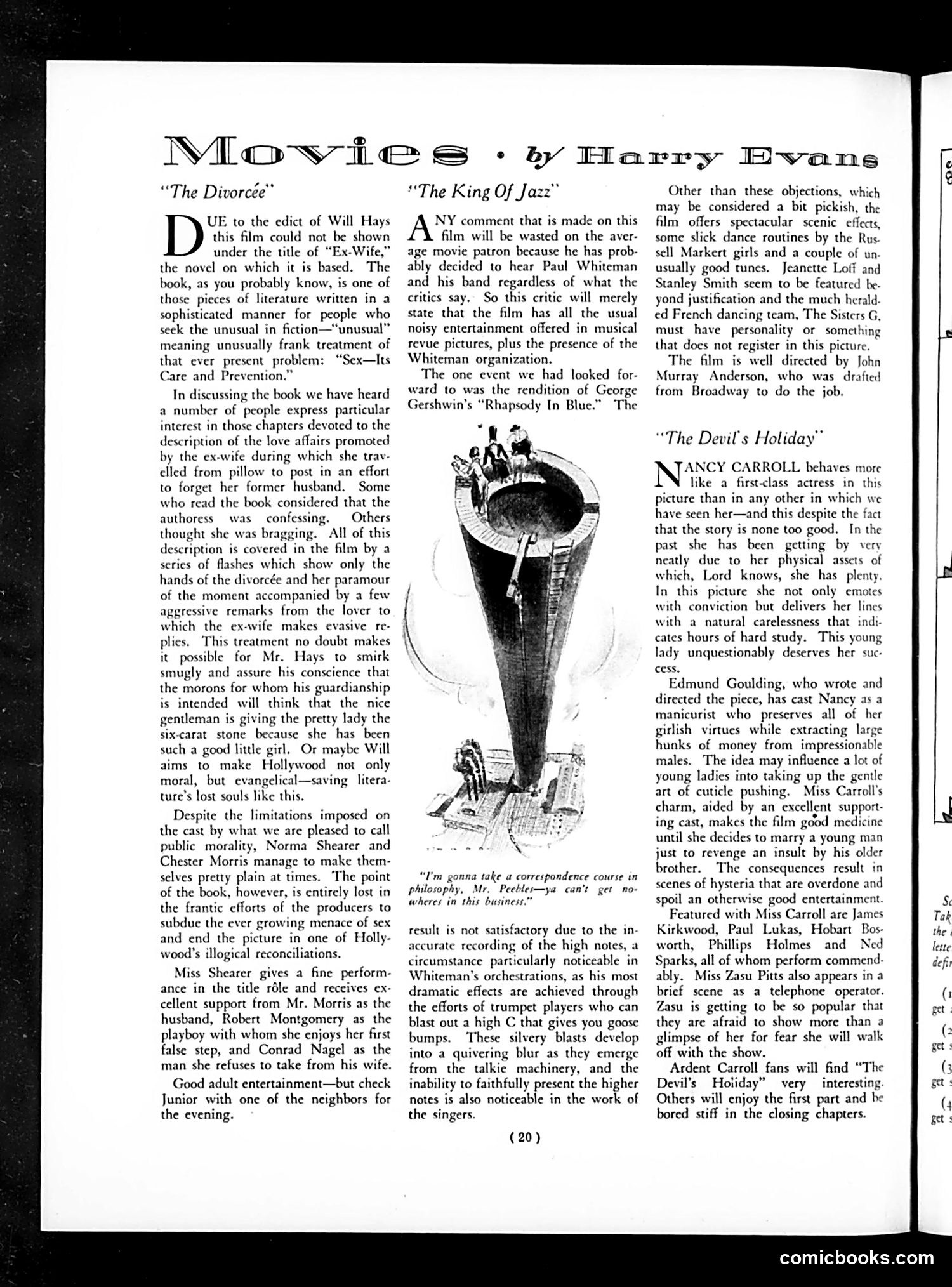
Analysis of Life Magazine Movie Reviews Page This page contains film reviews by Harry Evans of three 1929 movies. The key satirical content targets Will Hays, the Motion Picture Association's chief censor, who famously imposed strict moral codes on Hollywood. "The Divorcée" review sarcastically mocks Hays's censorship. The novel dealt frankly with a woman's sexual affairs, but the film had to hide this content. Evans ridicules how Hays's "edict" forced filmmakers to show only hands and vague dialogue to obscure the story's actual themes—allowing audiences to pretend immoral behavior wasn't happening. The humor lies in exposing this transparent hypocrisy: pretending moral guardianship while the scandalous plot remains obvious. The cartoon shows a woman in a champagne glass (suggesting hedonism/decadence) with the caption about needing philosophy to succeed "in this business"—a cynical jab at Hollywood's shallow materialism. The reviews generally praise the acting while criticizing producers' inability to make "moral" films without destroying their source material's meaning.
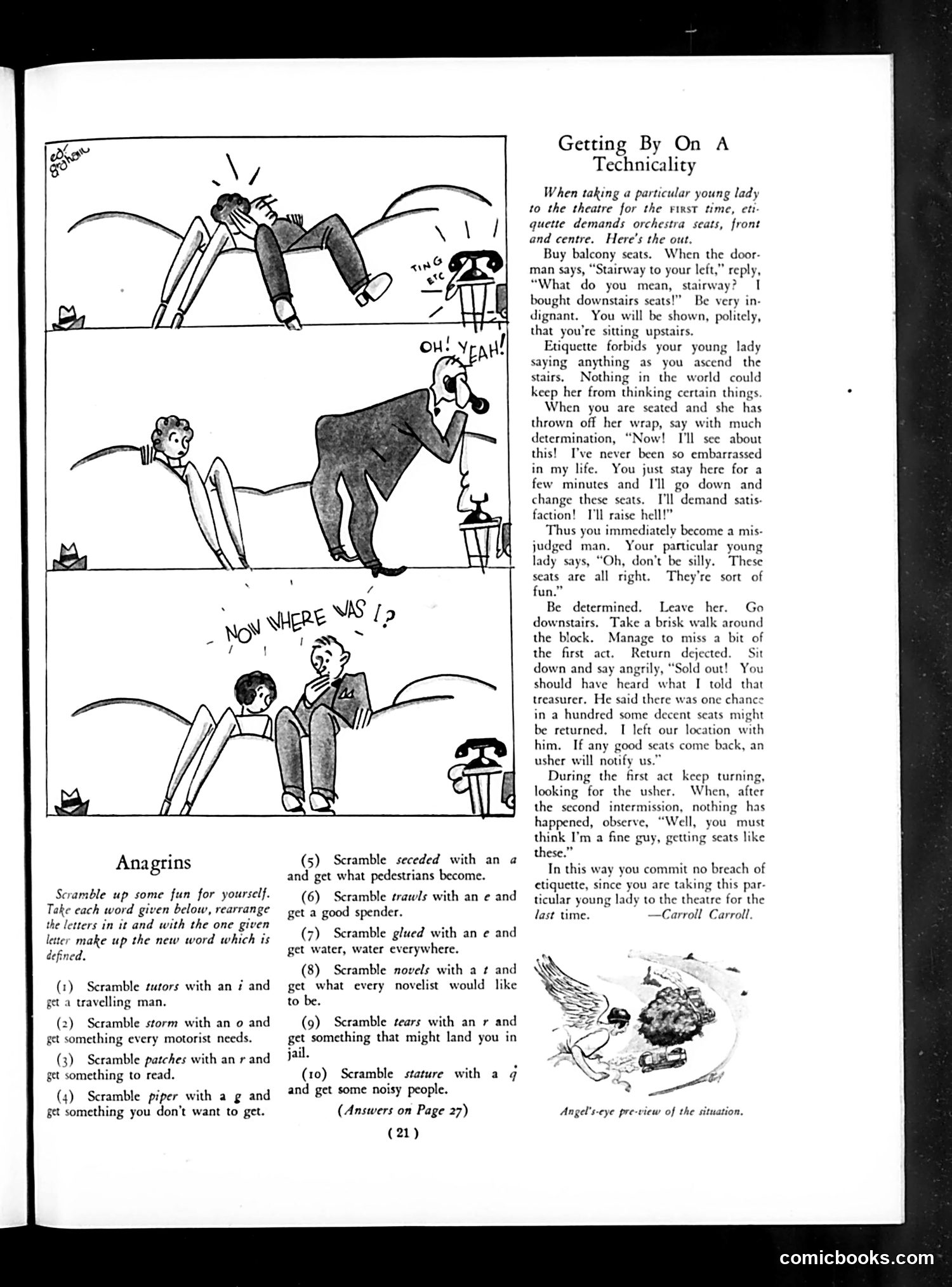
Explanation for Modern Readers This page contains two unrelated humor pieces from *Life* magazine: "Anagrins" is a word puzzle game—essentially an anagram challenge where readers rearrange letters to solve clues. It's casual entertainment with no deeper meaning. "Getting By On A Technicality" is satirical dating advice by Carroll Carroll. The joke mocks cheapskate men taking dates to the theater. The scheme: buy balcony seats but feign outrage when seated upstairs, demanding orchestra seats. By theatrically complaining to the treasurer and pretending to search for better seats all evening, the man creates an *impression* of effort and gallantry—while actually spending less money. The punchline's dark humor: the deception ensures he won't date this woman again ("for the last time"). The cartoon panels show a man physically struggling up theater stairs while his date watches, illustrating the awkwardness of his scheme. The satire targets masculine dishonesty and the performative nature of 1920s-era courtship etiquette.
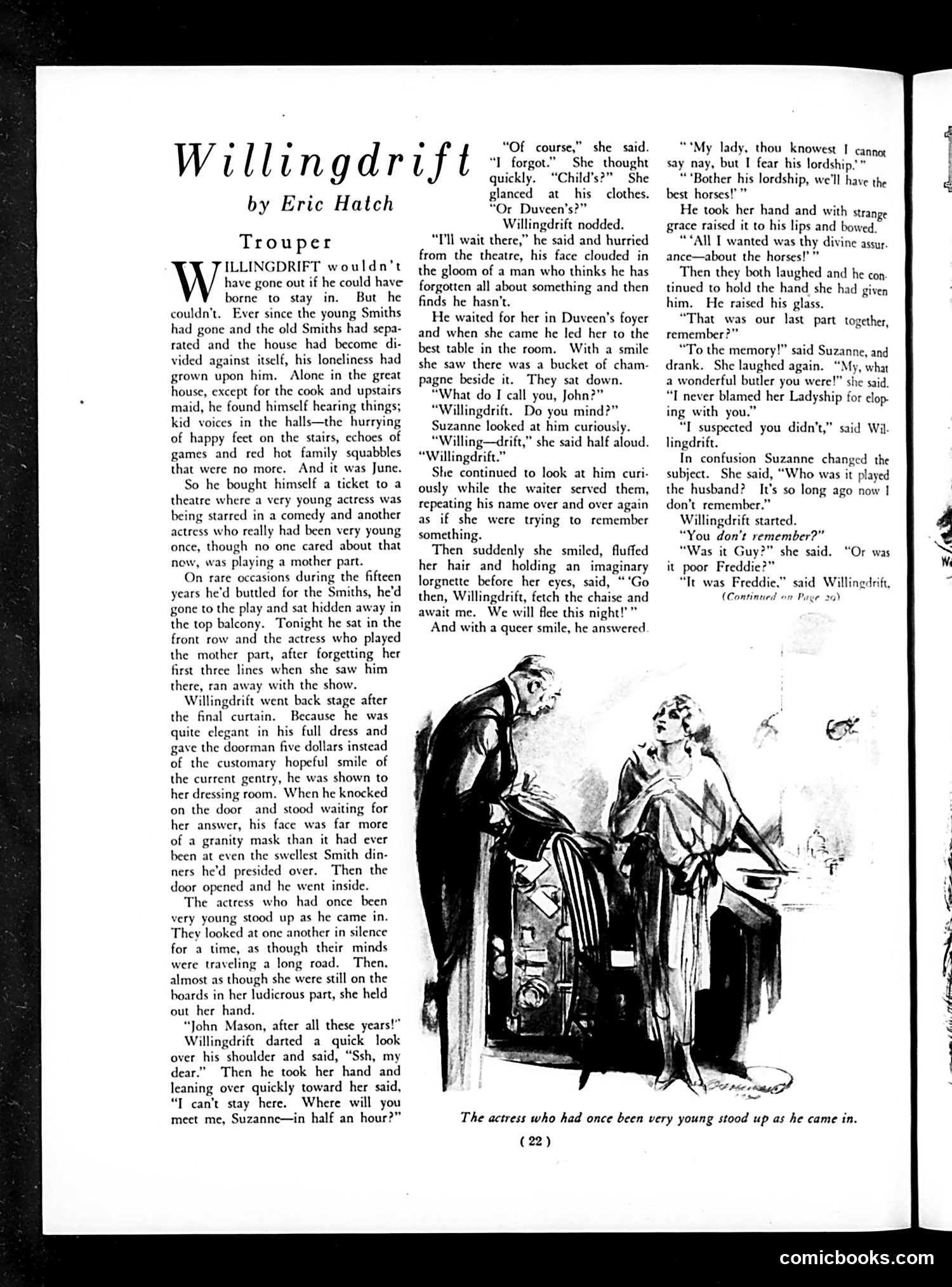
"Willingdrift" - Plot Summary & Social Context This is a short story (not a political cartoon) by Eric Hatch about a lonely butler named Willingdrift who reconnects with an actress from his past. The narrative depicts class dynamics typical of early 20th-century America: Willingdrift, a refined servant in a wealthy household, attends theater performances in the "top balcony" (servants' section). When he visits an actress backstage, he uses money and formal elegance to gain access where servants normally wouldn't be admitted. The emotional core involves two former stage performers—he apparently under an assumed name, she an aging actress—who shared theatrical work years earlier. Their reunion at an upscale restaurant (Duveen's) involves nostalgic recitation of old stage lines, suggesting romance once existed between them. The story examines loneliness, class boundaries, and how servants navigated elite spaces through charm and financial gesture rather than social standing.
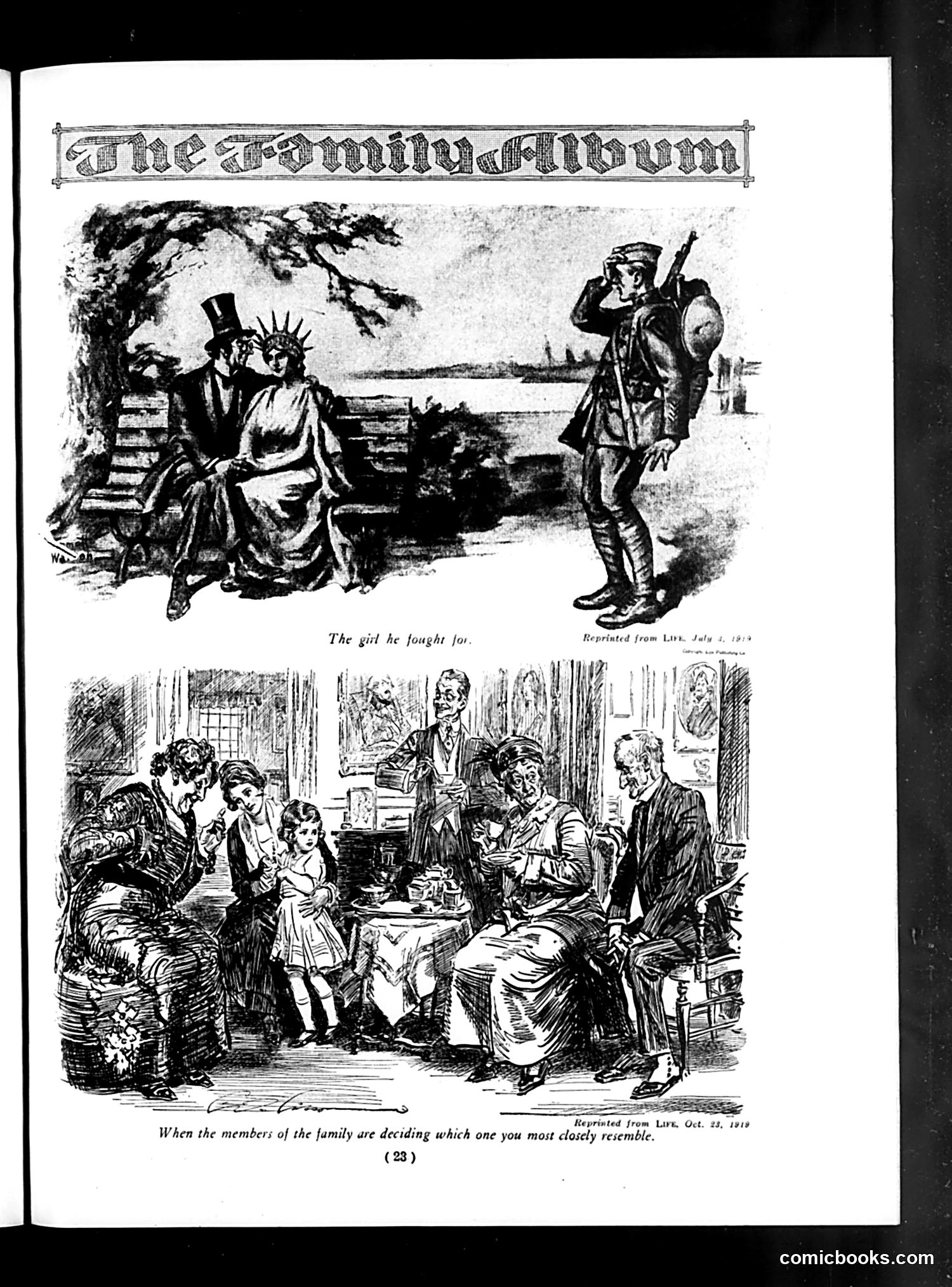
"The Commonplace Album" This page contains two satirical sketches from Life magazine (October 23, 1919). The top cartoon shows a soldier courting a woman by a waterside bench, captioned "The girl he fought for." The bottom sketch depicts a domestic family scene where multiple adults and a child gather around, apparently comparing the child's appearance to various family members. The humor targets post-World War I soldier romanticism and family resemblance awkwardness. The juxtaposition suggests ironic contrast: soldiers fought for idealized notions of home and romance (top), but the reality is mundane family gatherings where relatives scrutinize a child's features (bottom). The satire critiques both wartime sentimentality and ordinary domestic life's unglamorous nature.
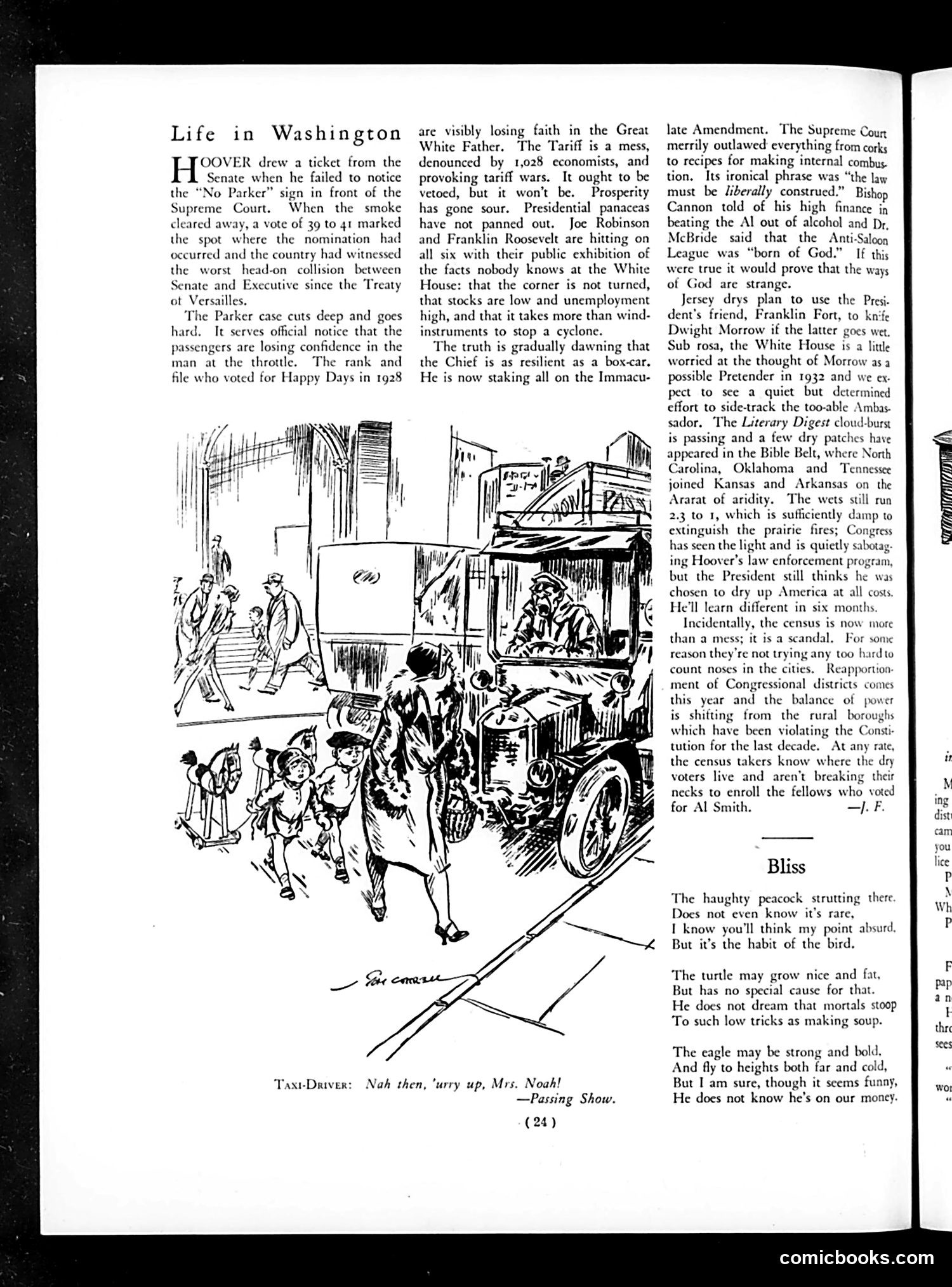
Political Satire from Life Magazine (circa 1930) This page satirizes President Herbert Hoover's struggling administration during the early Great Depression. The main article "Life in Washington" criticizes Hoover's failed policies: the unpopular tariff, ineffective prohibition enforcement, and economic collapse despite his 1928 "Happy Days" campaign promises. The text references his Senate defeat over Judge Parker's nomination as evidence the public has lost confidence in him. The cartoon depicts a taxi driver telling a passenger to "hurry up, Mrs. Noah"—a biblical flood reference mocking Hoover's inability to stop economic disaster, comparing him to an ineffective vehicle operator. The separate poem "Bliss" uses animals (peacock, turtle, eagle) that don't understand their significance to satirize people oblivious to their own importance—likely commenting on politicians or the wealthy who don't grasp their role in the economic crisis. Both attack Hoover's incompetence and disconnection from economic reality.
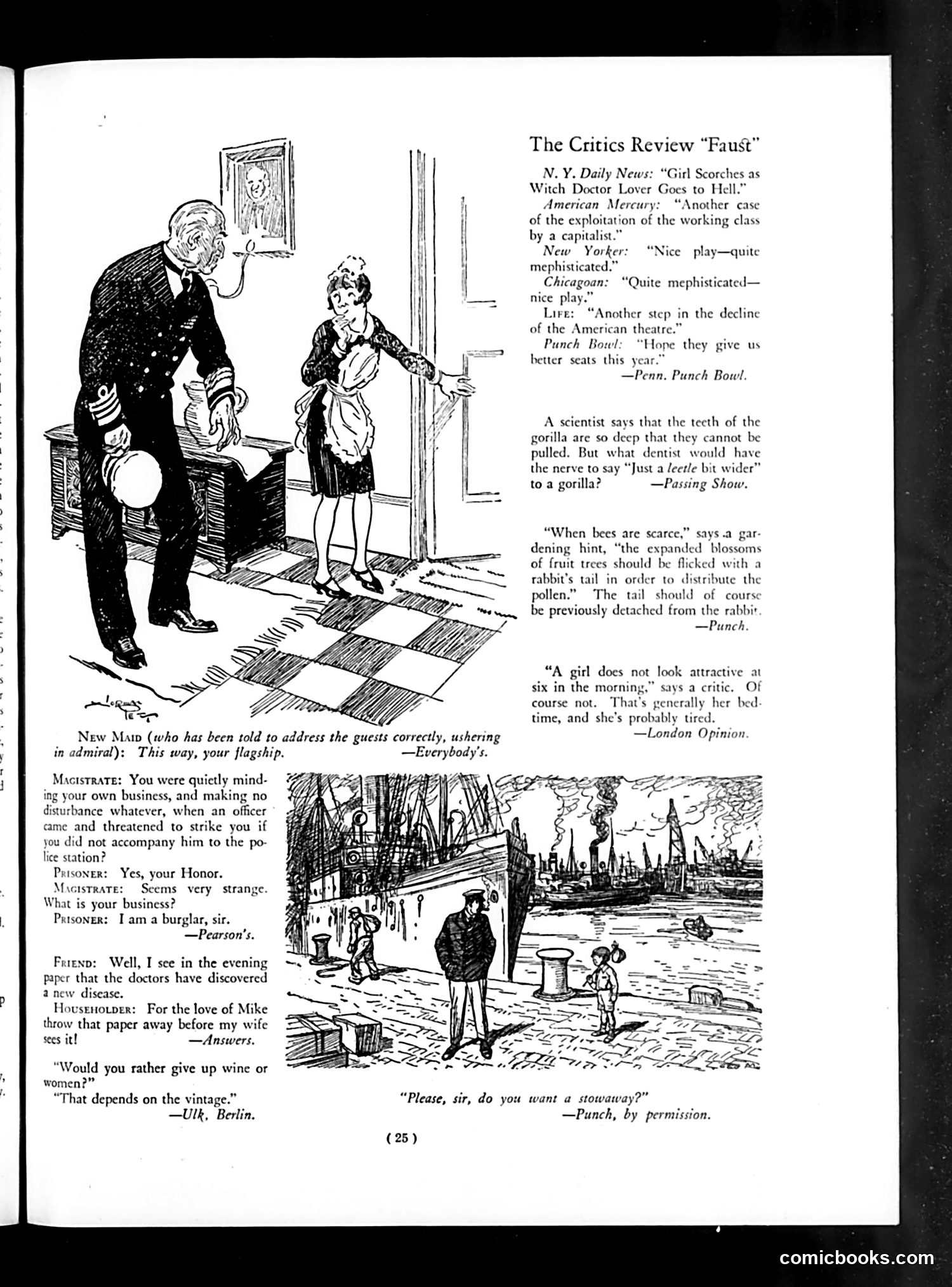
Analysis of Life Magazine Page This page collects brief satirical humor pieces and cartoons typical of early-20th-century magazines. "The Critics Review 'Faust'" mocks theatrical reviews by presenting contradictory assessments of a play adaptation—some praising it as "sophisticated," others condemning it as evidence of American theater's decline. The satire targets critics' pretentiousness and disagreement. The top cartoon shows a new servant addressing guests as "your flagship" instead of the correct "your Lordship," poking fun at social climbing and servants' confusion about proper etiquette. Other pieces are short jokes about absurd situations: a dentist afraid to ask a gorilla to open wider; using a detached rabbit's tail to pollinate flowers; a burglar arrested while "quietly" conducting business; a man preferring wine depending on its vintage. The riverside cartoon shows a man asking a child if he wants to be a stowaway—gentle, whimsical humor about childhood adventure fantasies. Overall, this represents *Life*'s signature style: lightweight social satire targeting middle-class anxieties, pretension, and everyday absurdities rather than serious political content.
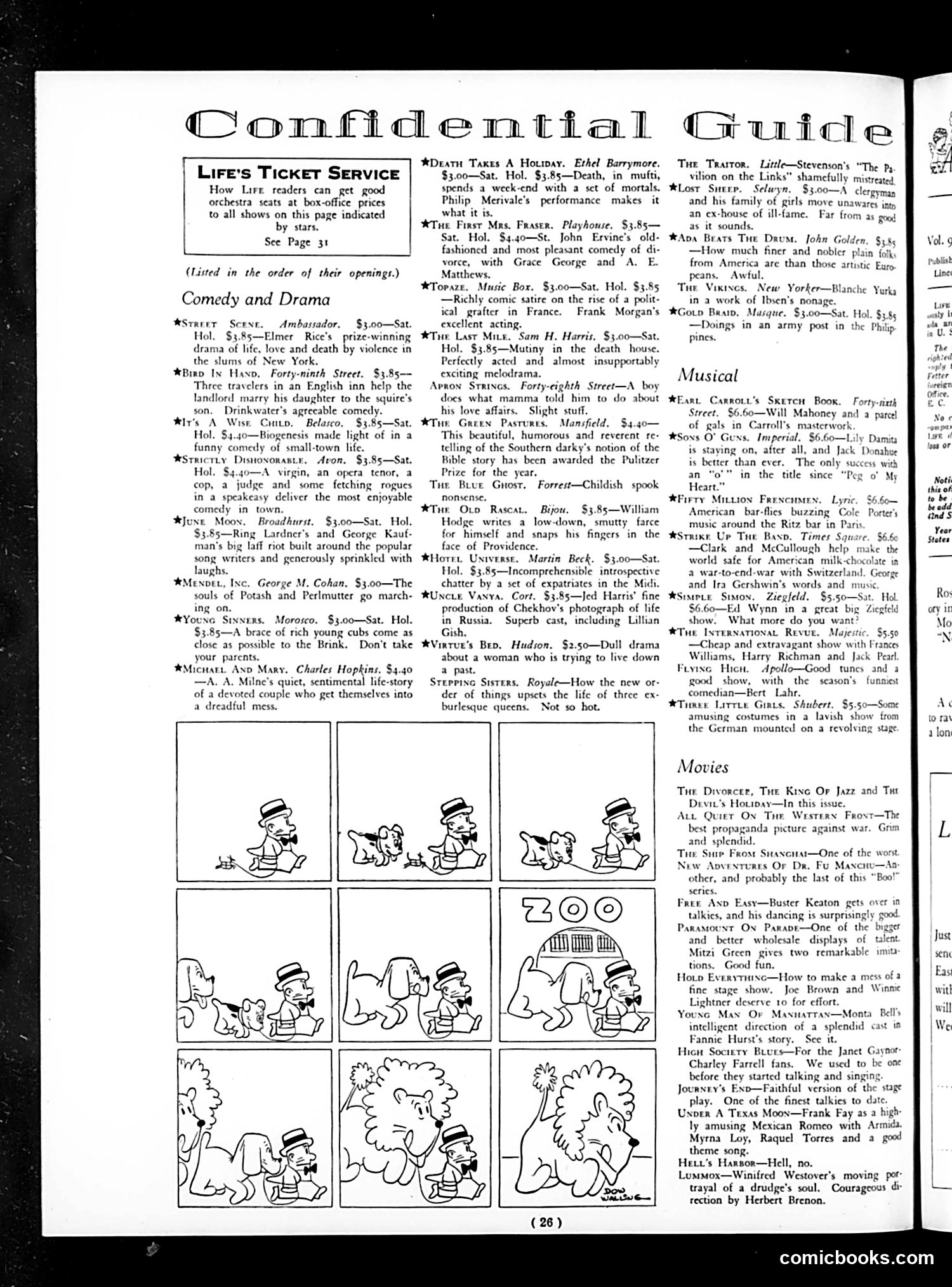
Analysis for Modern Readers This page is primarily a theater guide and entertainment listings for New York productions, not a political cartoon. It consists of: 1. "Life's Ticket Service": A box explaining how readers could obtain discounted orchestra seats to Broadway shows listed in the guide. 2. Theater Reviews: Brief synopses and prices for current Comedy/Drama productions (marked with asterisks for ticket availability), Musical shows, and Movies. 3. Comic Strip: A nine-panel wordless cartoon showing a man in a hat and a dog in various domestic situations, featuring physical comedy and slapstick humor typical of 1920s entertainment. The page reflects 1920s Broadway culture, referencing established playwrights (Chekhov, A.A. Milne) and contemporary hits. The language includes period-specific terms like "speakeasy" (Prohibition-era bars) and references to vaudeville. The cartoon relies on visual gags rather than topical satire—purely entertainment-focused rather than political commentary.
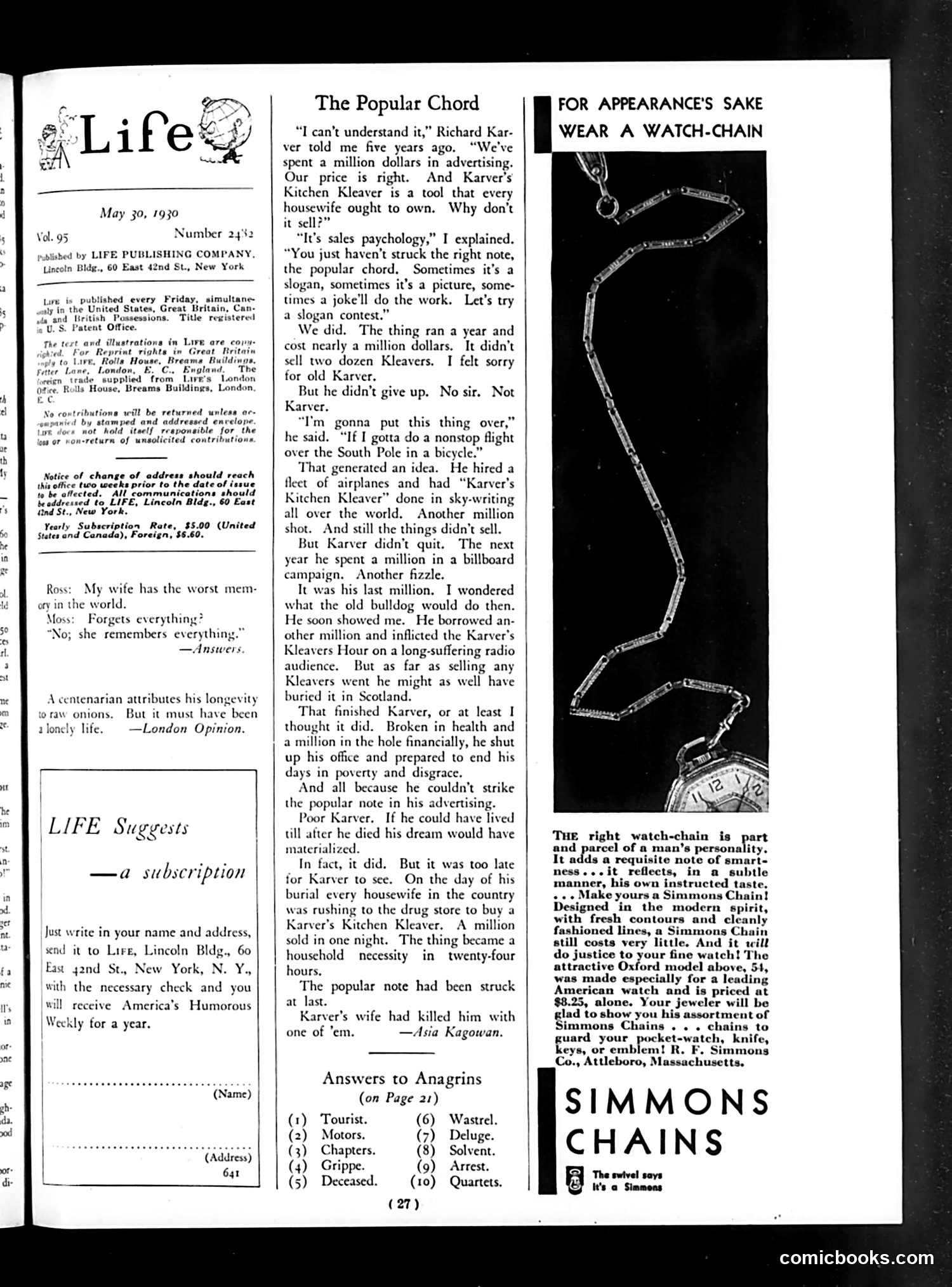
"The Popular Chord" This satirical story mocks the advertising industry's obsession with finding the perfect marketing "angle." Richard Karver spends five million dollars trying to sell his Kitchen Kleaver through conventional advertising methods—slogans, sky-writing, billboards, and radio campaigns—all failures. The joke's dark twist: his product finally succeeds spectacularly *after* his death, when his wife kills him with the cleaver. Only then do housewives rush to buy it. The satire targets how advertising executives believed in pseudo-scientific "sales psychology" and increasingly elaborate promotional stunts, yet often missed what actually drove consumer behavior. By 1930, during the Depression, this commentary on wasteful advertising spending and the disconnect between marketing theory and reality would have resonated sharply. The story suggests that sometimes the most effective advertising is unintentional—or, darkly, that desperation and crime sell better than rational appeals.
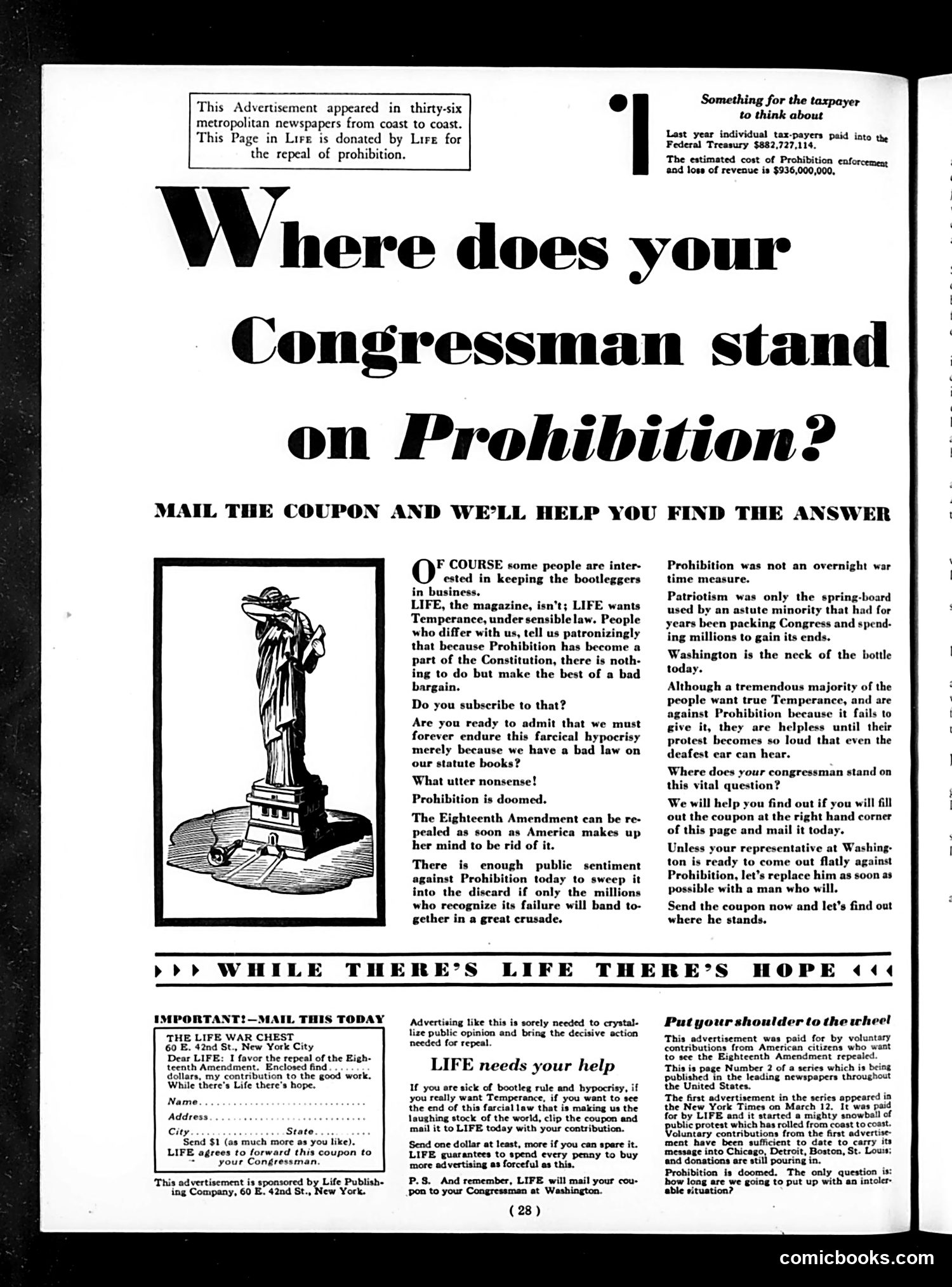
Political Satire: Life Magazine's Anti-Prohibition Campaign This is a full-page advertisement—not a cartoon—advocating for repeal of the Eighteenth Amendment (Prohibition). Life magazine donated the page to mobilize public opposition to alcohol prohibition. The satire operates through irony and data: Life highlights that taxpayers funded $882 million in Prohibition enforcement while losing $936 million in tax revenue, calling it "farcical hypocrisy." The text mocks the argument that a bad constitutional law must simply be endured, dismissing this as "utter nonsense." The Liberty statue illustration suggests the law contradicts American freedom. Life frames Prohibition as a failure imposed by "an astute minority" that spent years lobbying Congress, despite "tremendous majority" public opposition. The call-to-action coupon invites readers to pressure their congressman on their stance. This represents pre-repeal advocacy (the 21st Amendment passed in 1933); Life argues democratic will can overturn even constitutional law if citizens organize loudly enough.
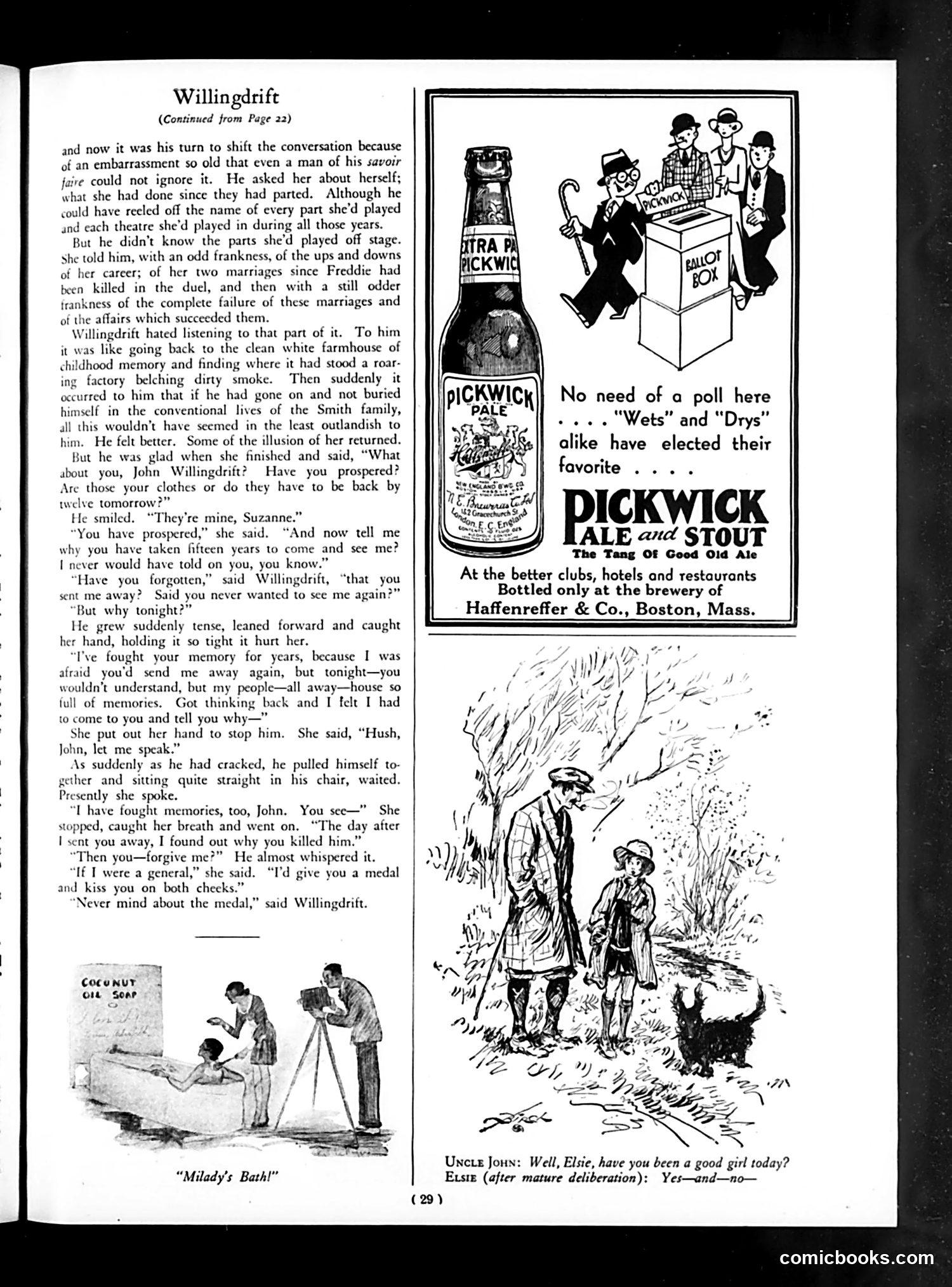
Analysis of Life Magazine Page This page contains two distinct elements: The Main Story ("Willingdrift"): A serialized romantic narrative about a man reuniting with a former lover after 15 years. The plot involves a past duel and suggests they had a forbidden relationship. The story appears melodramatic—focusing on memory, regret, and reconciliation—typical of early 20th-century serialized fiction in Life magazine. The Advertisement: A Pickwick Ale & Stout advertisement from Haffenreffer & Co. (Boston) uses a ballot-box graphic mocking Prohibition-era politics. The phrase "No need of a poll here—'Wets' and 'Drys' alike have elected their favorite" references the heated national debate over alcohol prohibition. "Wets" supported drinking; "Drys" supported prohibition. The ad humorously suggests that regardless of political stance, everyone prefers Pickwick beer—a cheeky commentary on widespread drinking despite Prohibition laws. Bottom cartoon ("Milady's Bath"): Appears to be a separate humorous domestic scene, details unclear.
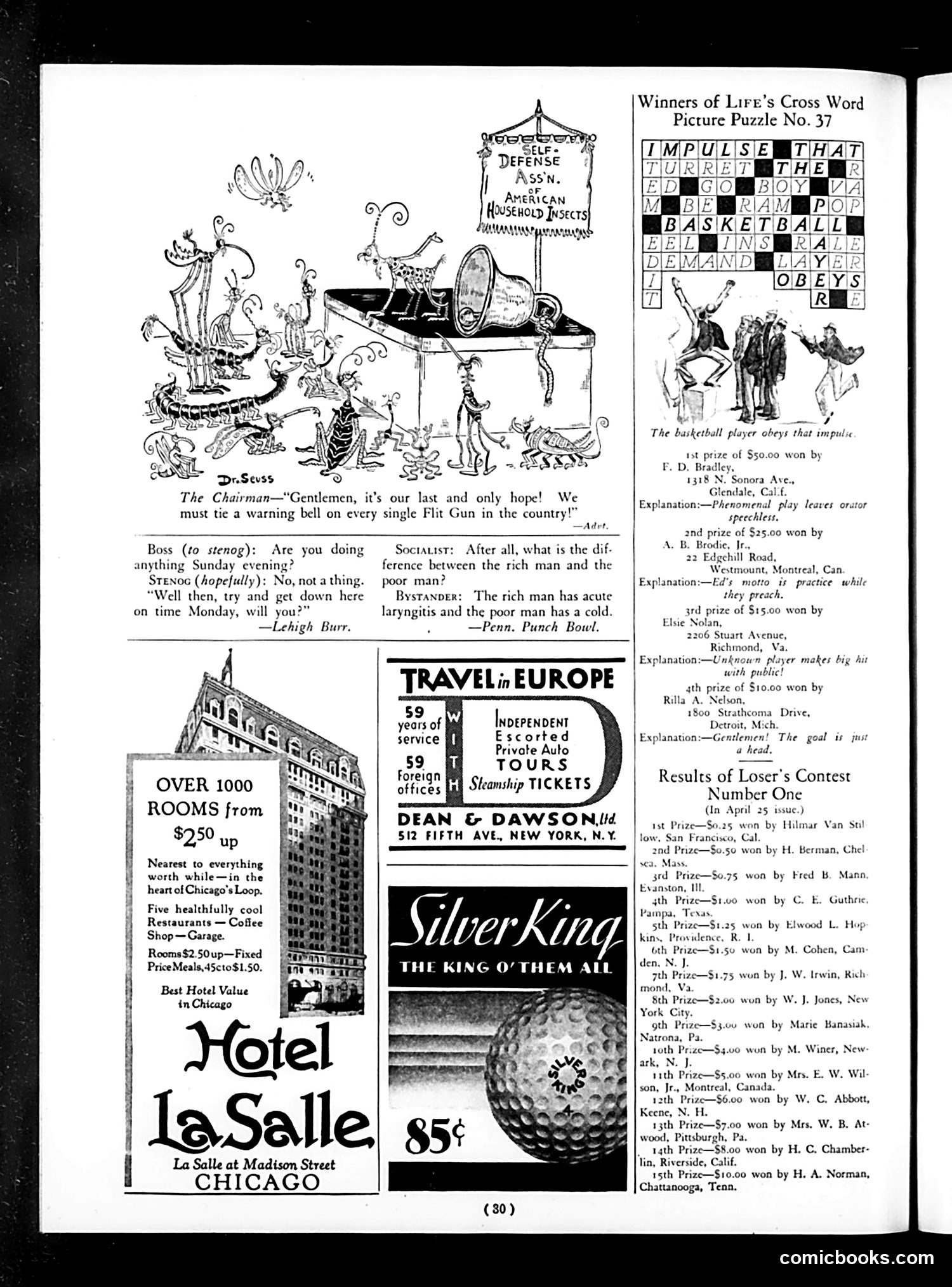
Page Analysis This page is primarily advertisements and contest results rather than satirical content. The main cartoon (top left) is credited to Dr. Seuss and depicts whimsical insects in a chaotic scene. The caption references "Flit Gun" pest control, suggesting this is advertising disguised as editorial content—a common practice where manufacturers sponsored cartoon spots. The dialogue jokes below involve wordplay about Sunday plans and social commentary comparing wealthy and poor men's health conditions. The page otherwise contains hotel, travel, and golf ball advertisements typical of 1920s Life magazine, plus results from "Life's Cross Word Picture Puzzle" and "Loser's Contest"—reader participation features that drove magazine engagement and circulation. This represents Life's mixed editorial-advertising model rather than pure satire.
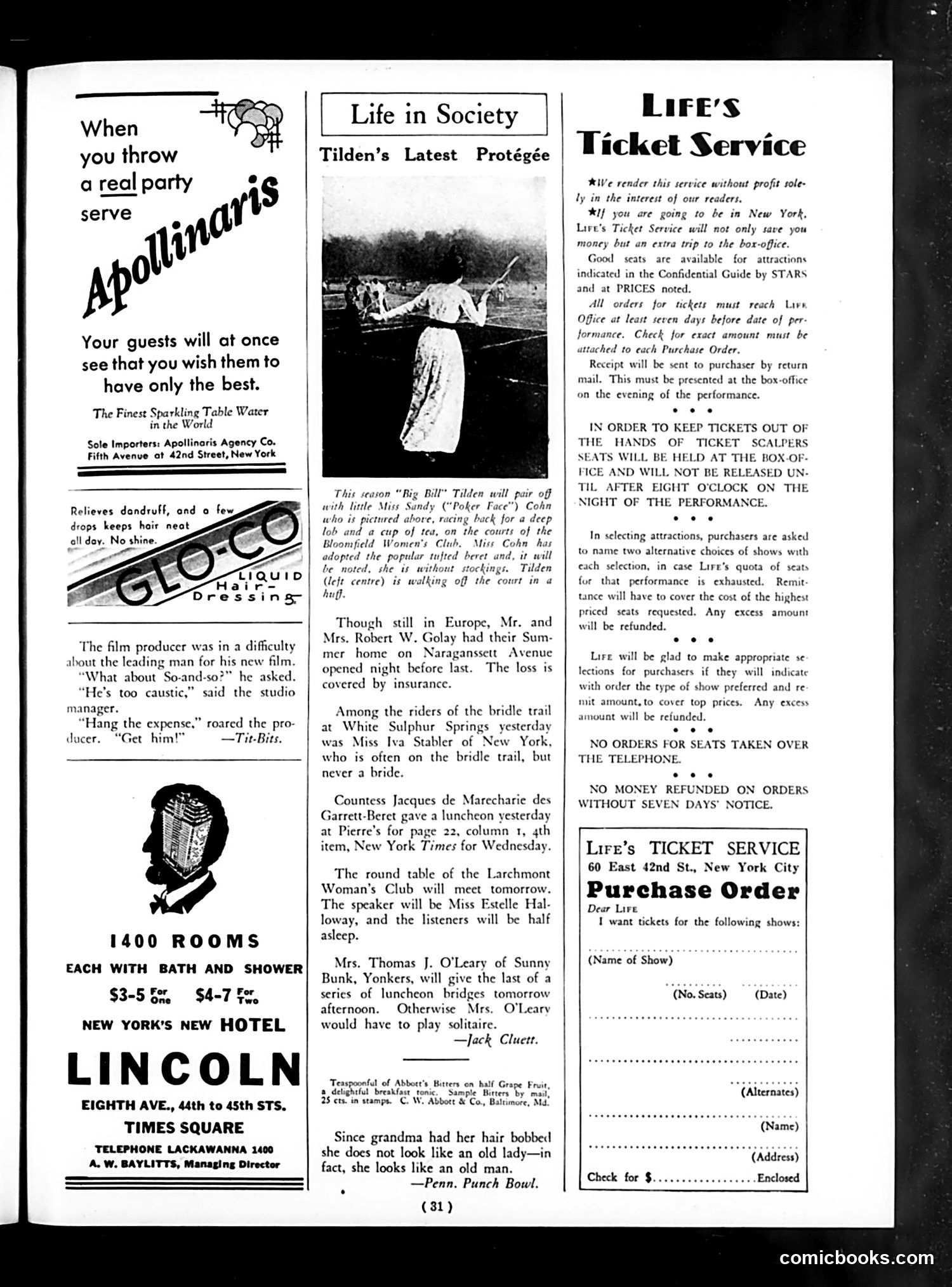
Life Magazine Page Analysis This page is primarily advertisements and society gossip, not political satire. The "Life in Society" section offers social humor targeting the leisure class: The Satire: The brief items mock wealthy New Yorkers and social pretension. Key examples: - A woman ("Poker Face" Cohn) playing tennis without stockings—scandalous for the era - A couple opening their summer home the night before it burned (covered by insurance—implying casual wealth) - A woman perpetually on the "bridle trail" but "never a bride"—mocking her unmarried status - A club speaker so dull listeners will "be half asleep" - The closing joke: grandma now looks like "an old man" after getting a fashionable bobbed haircut Context: This appears to reference real tennis star "Big Bill" Tilden (1920s-30s), a famous athlete. The humor targets 1920s-30s social conventions and modern women's fashion (bobbed hair, no stockings). The remainder of the page contains advertisements (Apollinaris water, Gleco hair dressing, the Lincoln Hotel) and Life's ticket service—typical magazine filler of the era.
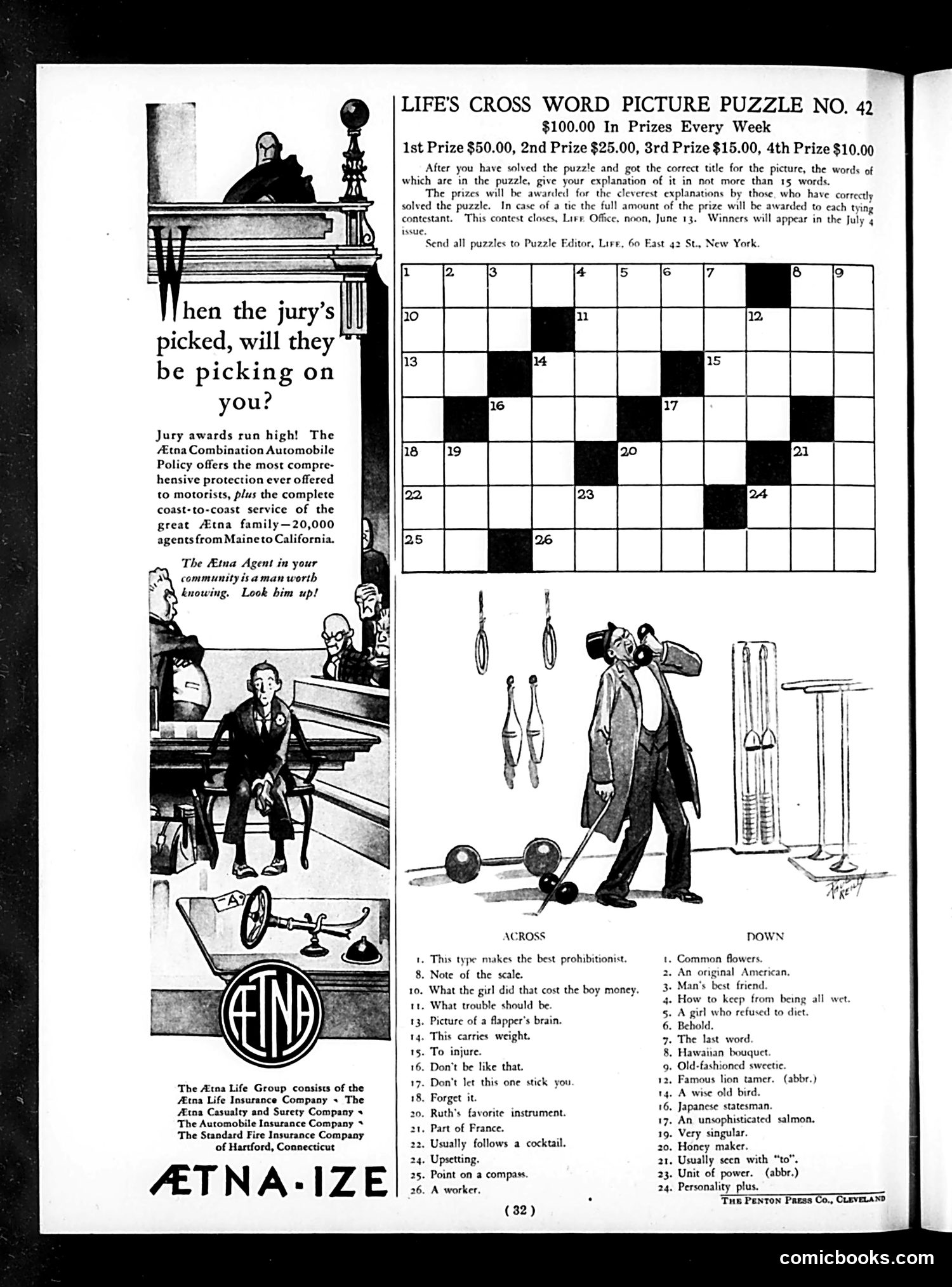
Analysis of Life Magazine Page No. 42 This page combines advertisement with a crossword puzzle contest. The main content is an Aetna Insurance ad featuring a courtroom scene where a man sits nervously before a jury, with the tagline "When the jury's picked, will they be picking on you?" The ad capitalizes on anxiety about legal liability—specifically automobile accidents—to sell Aetna's comprehensive insurance coverage and nationwide agent network (20,000 agents). Below the ad is a crossword puzzle game offering $100 in weekly prizes. The puzzle clues contain period slang and social commentary: references to "prohibitionist" (Prohibition era), "flapper's brain" (Jazz Age youth culture), and "girl who refused to diet" suggest 1920s preoccupations. The cartoon's humor relies on readers' fear of lawsuits and unpredictable juries—positioning insurance as protection against financial ruin. This reflects the interwar period's growing automobile culture and corresponding legal/insurance anxieties.
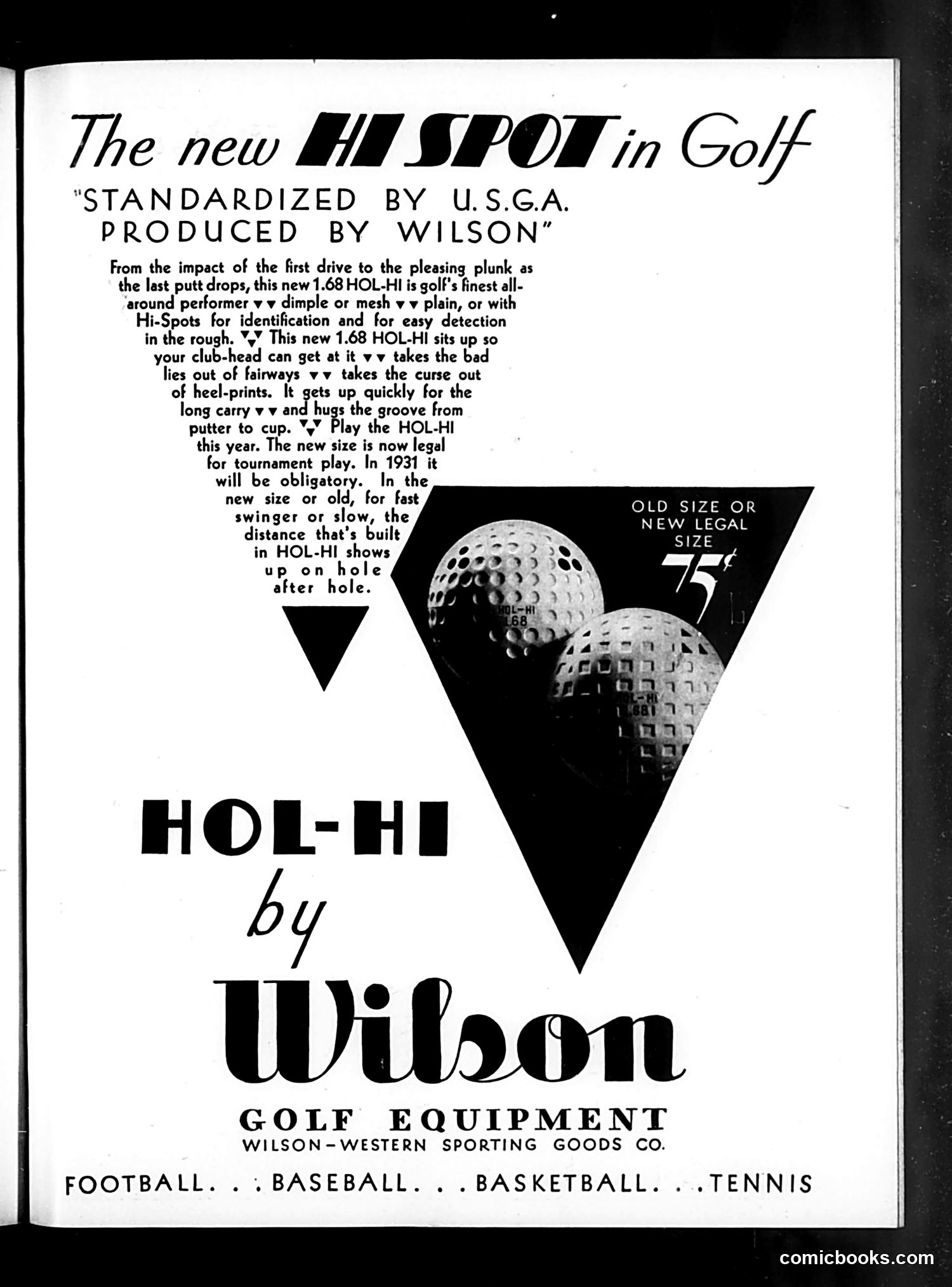
Analysis This is a golf equipment advertisement, not a political cartoon or satire. It promotes Wilson's new "HOL-HI" golf ball, standardized by the U.S. Golf Association. The ad announces a regulatory change: the golf ball's new standardized size (1.68 inches) became legal for tournament play in 1930 and would be mandatory by 1931. The advertisement emphasizes the ball's practical benefits—easier detection in rough, improved flight, better putting performance—and highlights that it meets the new official specifications. The two golf balls shown in the black triangular graphic illustrate the size comparison (old versus new legal size), priced at 75 cents. This reflects a genuine shift in golf equipment standards during the early 1930s, when the sport was modernizing its rules. The page is straightforward product marketing with no satirical intent.
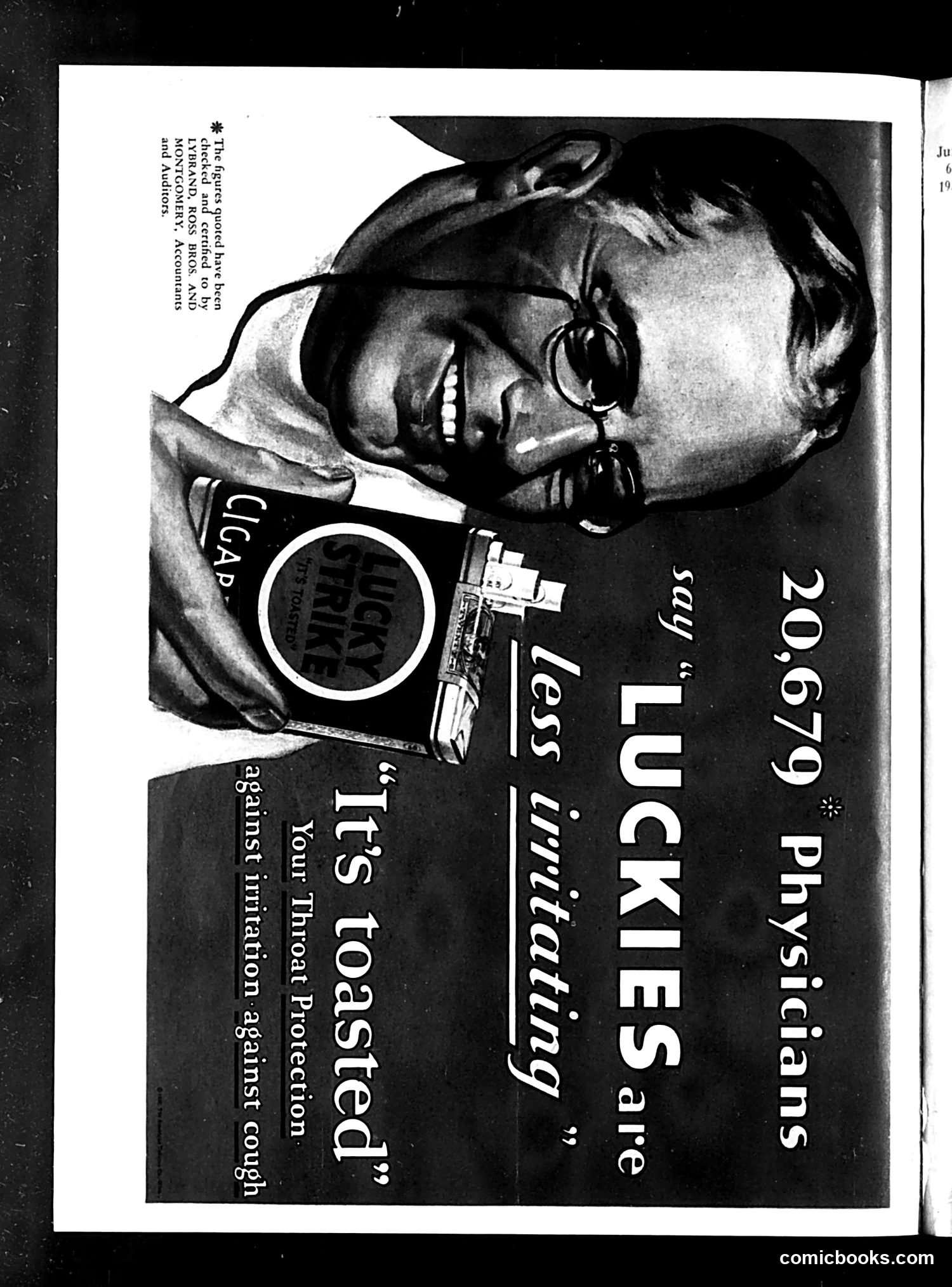
Lucky Strike Cigarette Advertisement (Life Magazine) This is a cigarette advertisement, not political satire. It promotes Lucky Strike cigarettes to physicians, using the then-common advertising claim that their product was "less irritating" to the throat. The image shows a doctor wearing glasses and a stethoscope, holding a pack of Lucky Strikes. The text emphasizes "It's toasted" (Lucky Strike's marketing slogan) and claims the cigarettes provide "throat protection against irritation against cough." The ad's targeting of doctors is significant: mid-20th century tobacco companies actively marketed to physicians, using their endorsement to build consumer confidence. This strategy was effective before the health dangers of smoking became widely acknowledged. The specific number "20,679 physicians" likely claims doctor approval. By modern standards, this advertisement is shockingly misleading about health effects.