life
Life — June 6, 1930
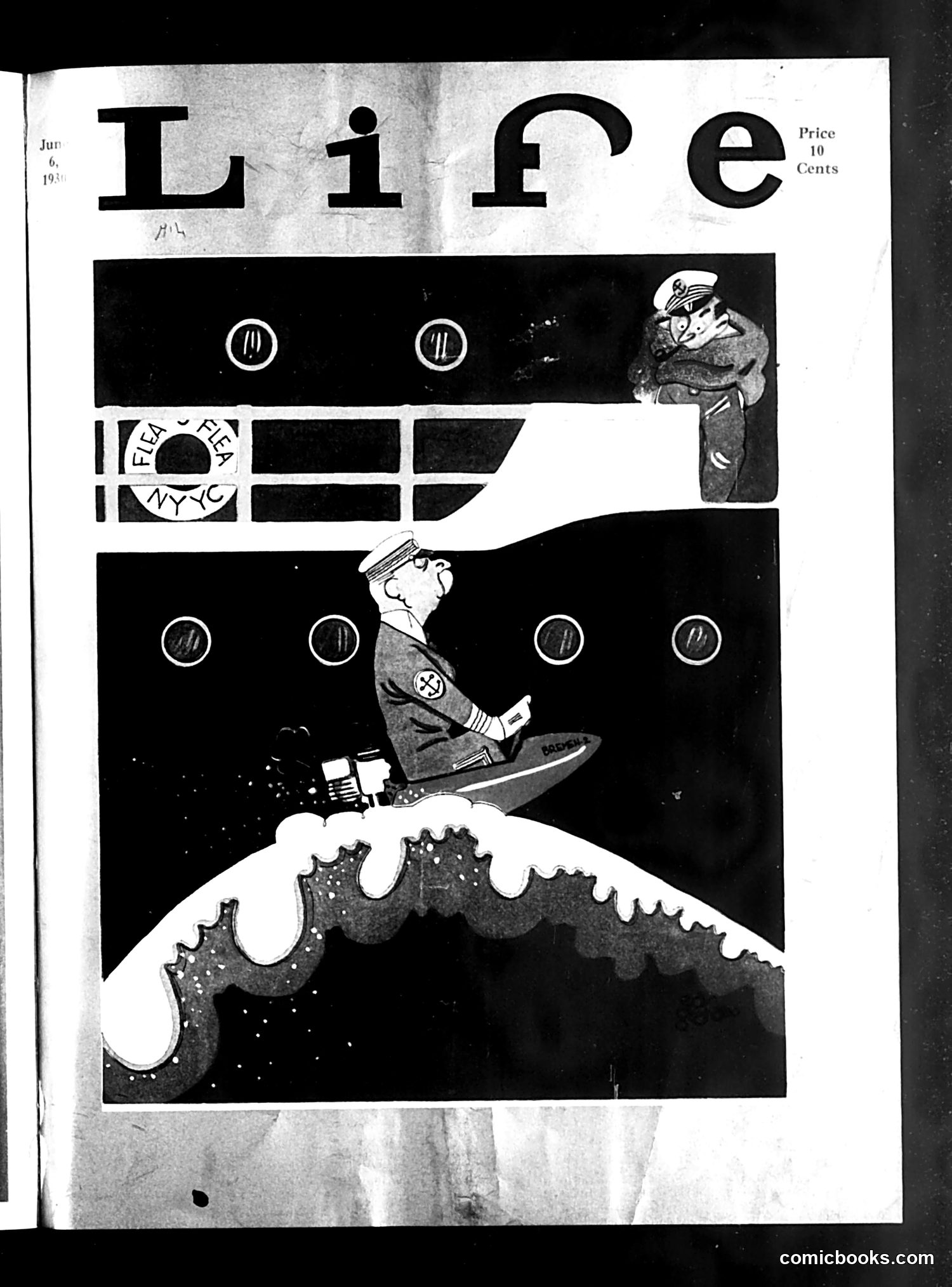
Analysis of Life Magazine Cover This is a Life magazine cover (priced at 10 cents, dating it to the early 20th century) featuring a political cartoon. The illustration shows a figure in military uniform surfing or riding atop a large wave. The figure wears what appears to be a naval or military cap and uniform with insignia. The cartoon likely satirizes military adventure, imperial expansion, or reckless political leadership navigating turbulent international waters—a common theme in early 20th-century American satire. The wave imagery suggests dangerous or unstable circumstances. However, without visible text identifying specific individuals or events, the precise historical reference remains unclear. The style and subject matter suggest commentary on contemporary military or diplomatic affairs of that era.
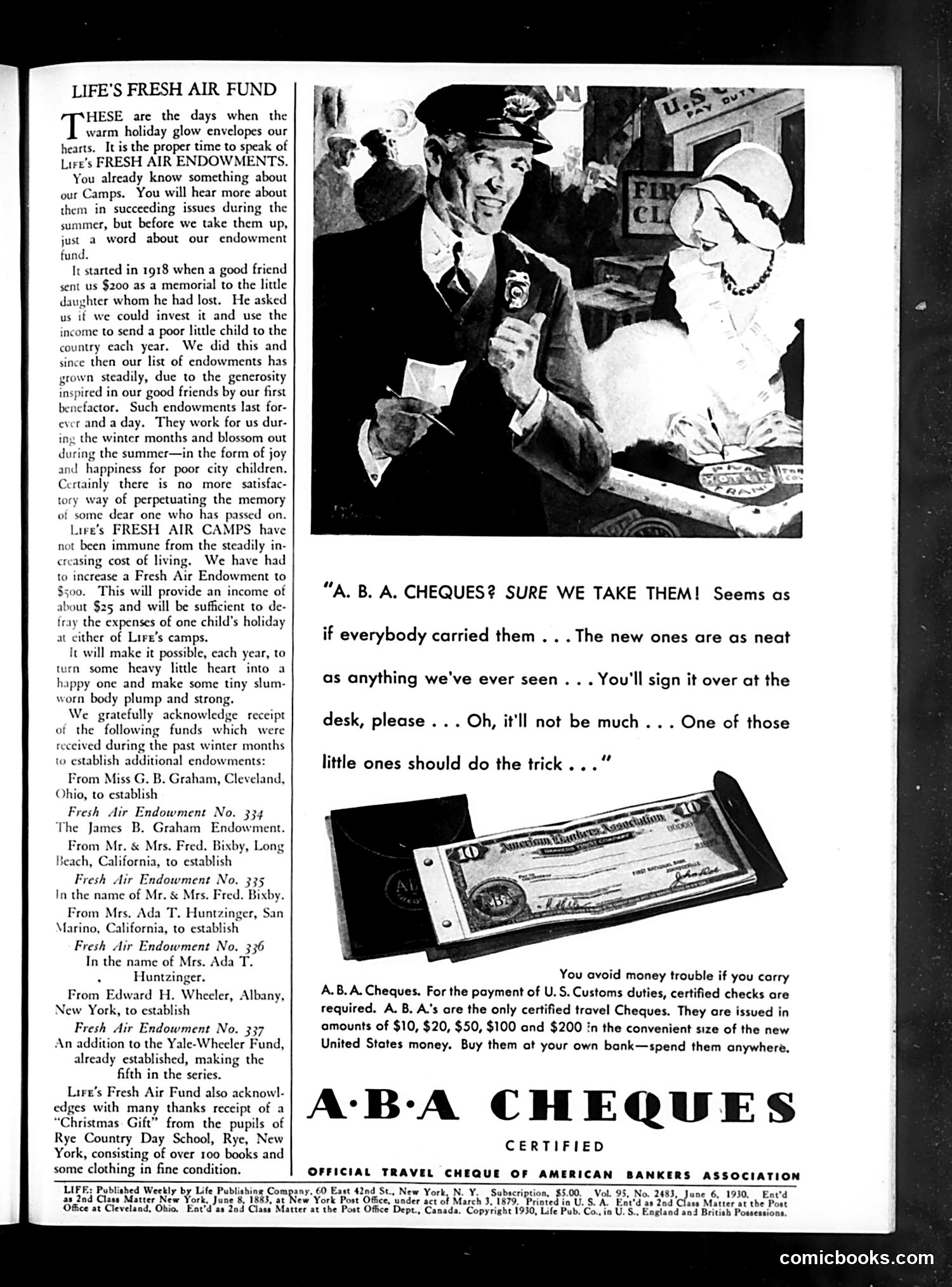
Life Magazine Page Analysis This page combines charitable fundraising with advertising. The left column describes "Life's Fresh Air Fund," established in 1918 to send poor city children to summer camps—a genuine philanthropic initiative. The text acknowledges recent endowment increases and lists new donors. The right side advertises A.B.A. Cheques, traveler's checks issued by the American Bankers Association. The cartoon-style photograph shows what appears to be a street vendor or worker being offered an A.B.A. check, with copy suggesting their widespread acceptance and convenience for international travel and customs payments. The juxtaposition is not satirical but rather *contextual*: both represent American institutions serving different economic classes during the 1930s era.
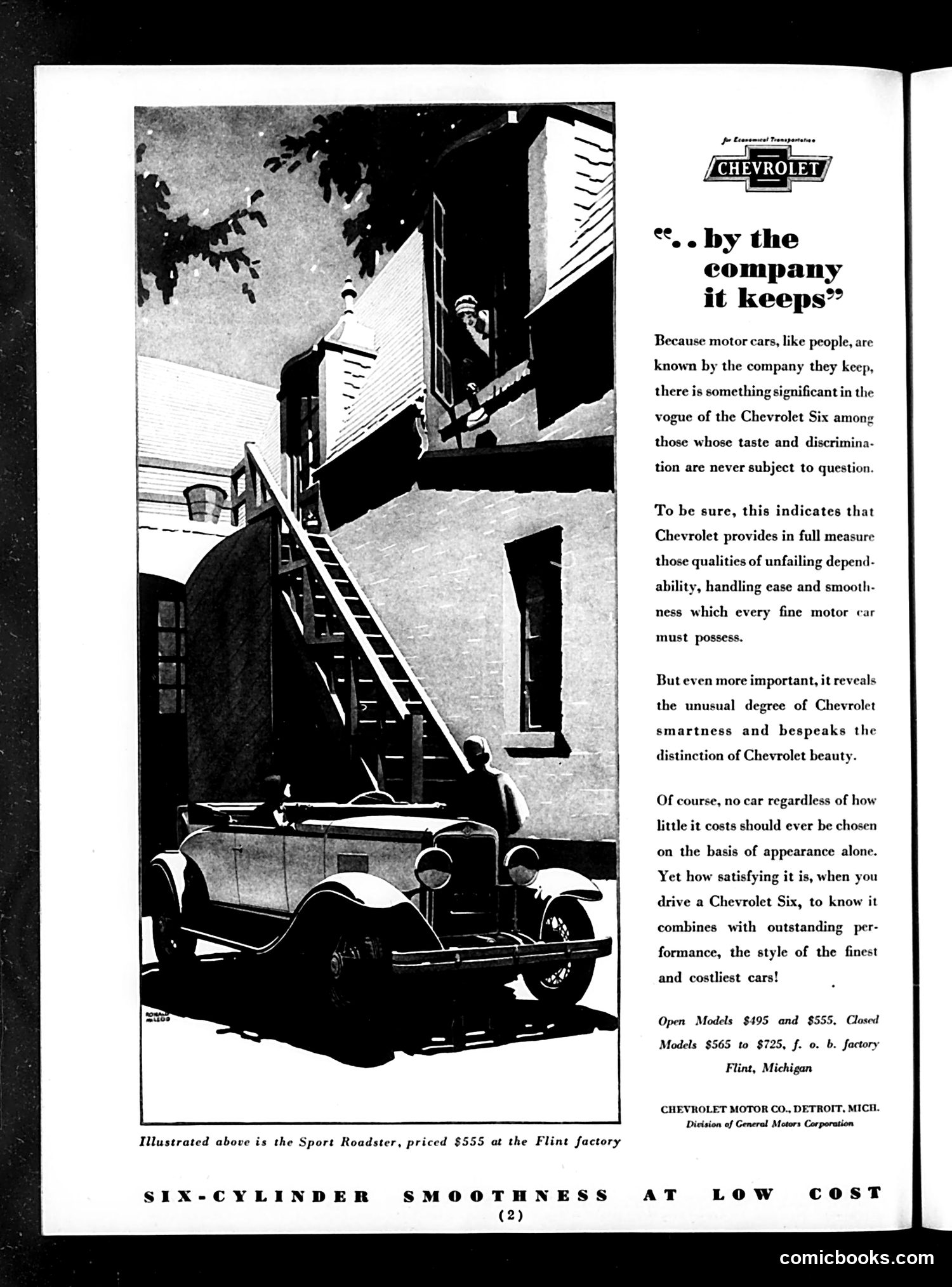
Advertisement Analysis This is a Chevrolet automobile advertisement, not political satire or a cartoon. The page features a photograph of a 1920s Chevrolet Sport Roadster positioned beneath an elegant modernist building with stairs and architectural details. The ad's messaging emphasizes that "motor cars, like people, are known by the company they keep." It argues that the Chevrolet Six's presence among luxury vehicles demonstrates both quality engineering and aesthetic distinction—combining "outstanding performance" with "the style of the finest and costliest cars." The juxtaposition of the car with sophisticated architecture is meant to elevate Chevrolet's status, suggesting it belongs in refined company despite its relatively affordable pricing ($195–$725). This targets middle-class aspirations for both economy and elegance.
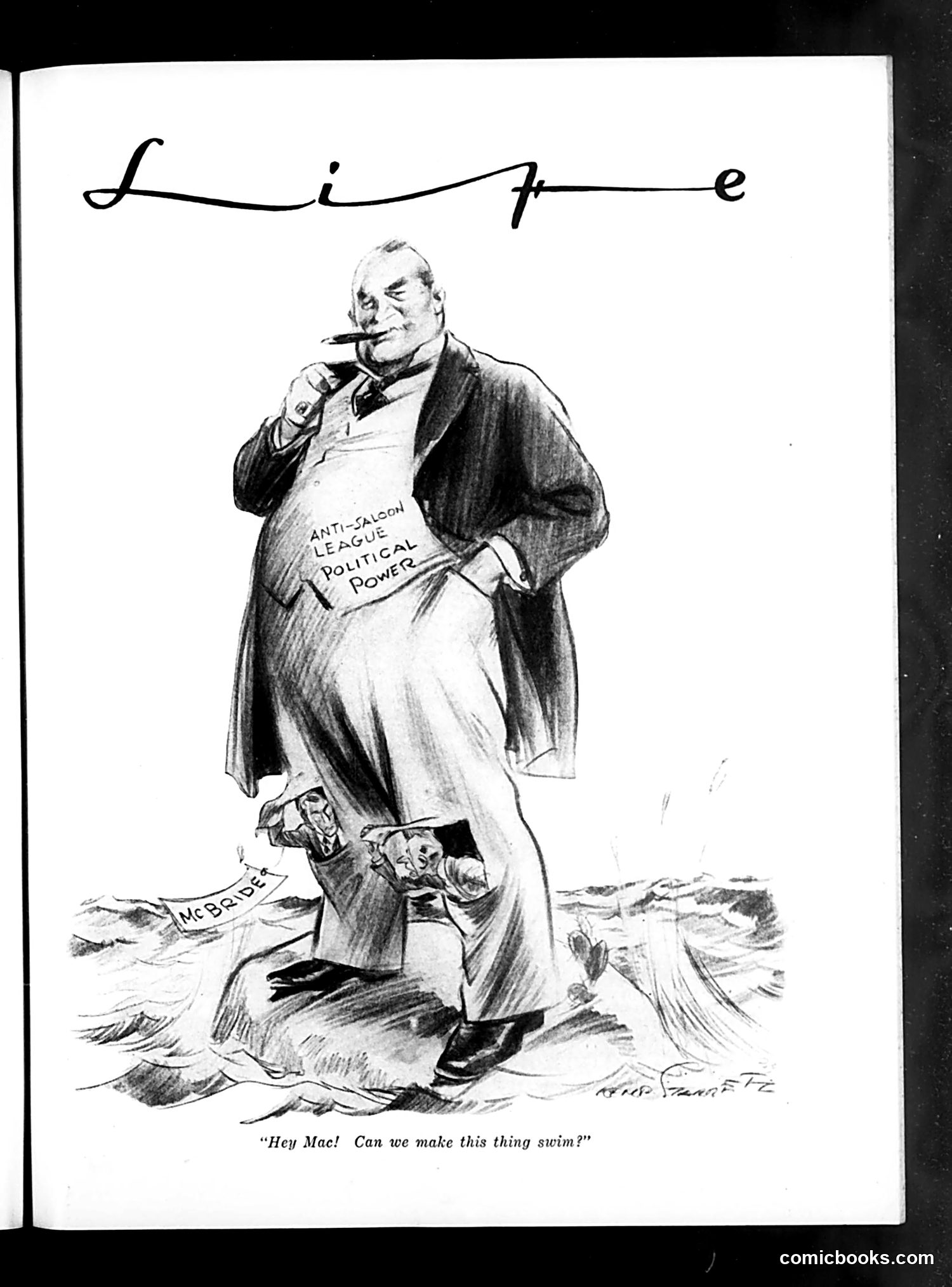
Political Cartoon Analysis This Life magazine cartoon satirizes an older politician wearing an apron labeled "Anti-Saloon League Political Power." He holds a cigar and stands in turbulent waters marked "McBride," appearing to struggle with the situation. The caption reads: "Hey Mac! Can we make this thing swim?" The cartoon mocks the Anti-Saloon League's political influence during Prohibition era. The figure appears to represent a political leader being overwhelmed by or questioning the viability of the League's agenda. The drowning metaphor suggests the League's power is unsustainable or failing. The reference to "McBride" (likely a contemporary political figure) and the sinking situation implies criticism of those backing Prohibition-era policies. The satire targets the tension between political promises and practical failure in enforcing alcohol prohibition.
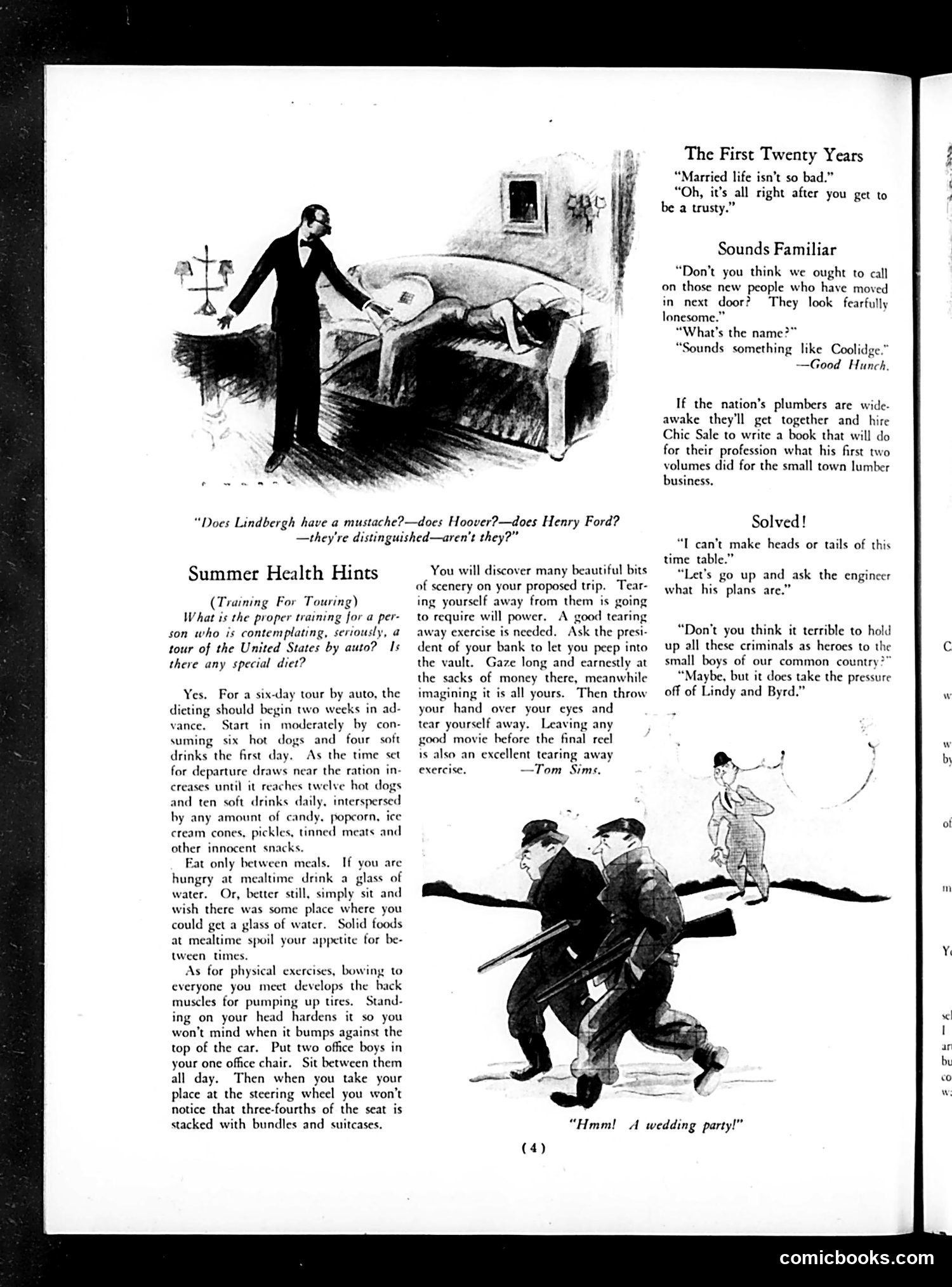
Page Analysis This page from *Life* magazine contains three distinct satirical pieces: 1. "Does Lindbergh have a mustache?" — A cartoon mocking famous men's distinguishing features, likely Charles Lindbergh, Herbert Hoover, and Henry Ford. The joke plays on whether these celebrities are recognizable by their facial hair. 2. "Summer Health Hints" — Tongue-in-cheek advice for automobile touring, satirizing the then-novel practice of cross-country road trips. It humorously suggests absurd "training" methods and warns against excessive eating, treating auto travel as a serious athletic undertaking. 3. "Hmm! A wedding party!" — A cartoon showing what appears to be criminals or rough characters, making a joke about a wedding or group gathering. The page reflects 1920s-30s American culture, celebrity obsession, and the novelty of automobile tourism.
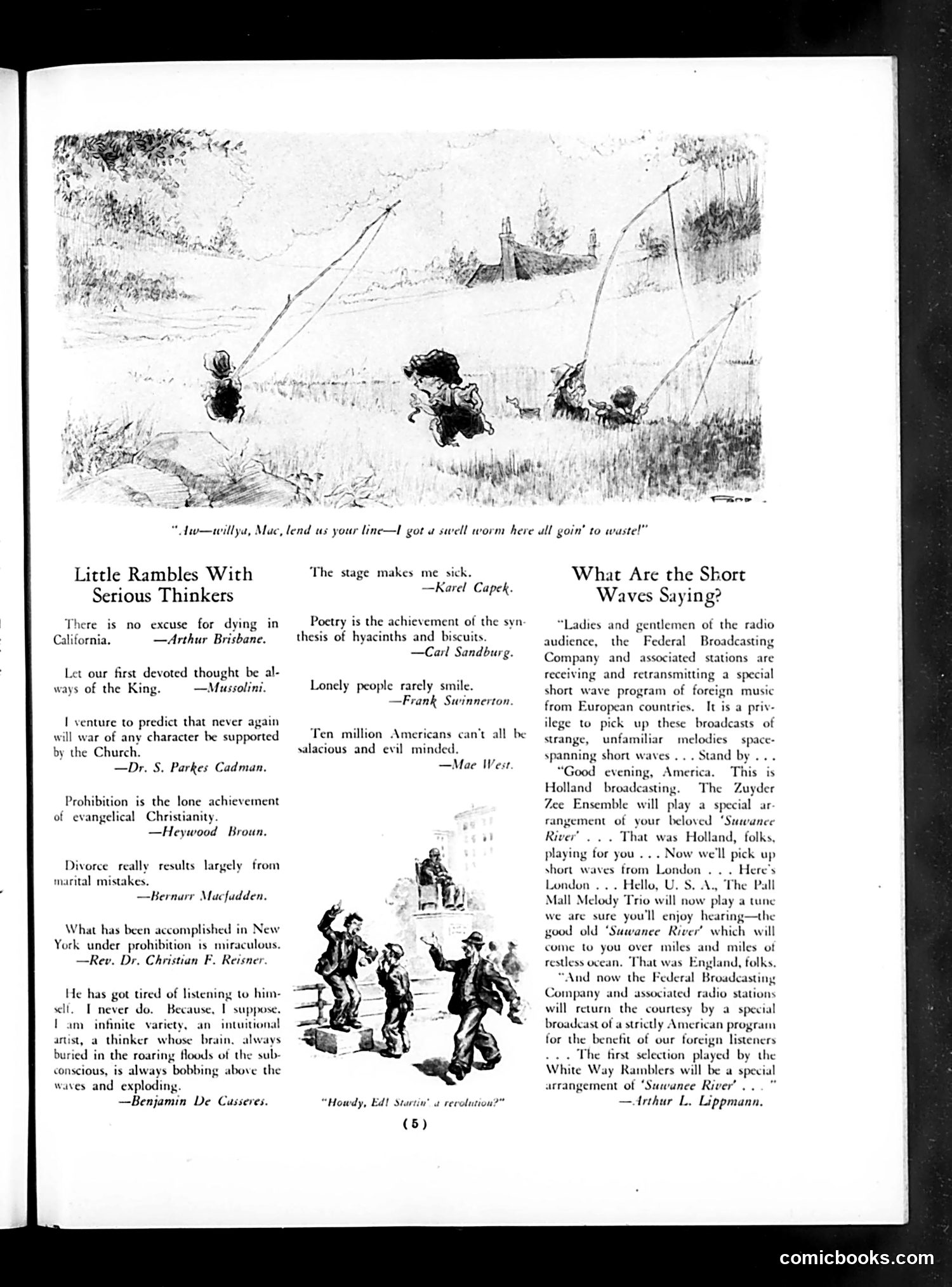
Explanation for Modern Readers This page contains two unrelated sections: satirical quotes and radio programming commentary. "Little Rambles With Serious Thinkers" presents brief, often contradictory quotes attributed to public figures (Arthur Brisbane, Karel Čapek, etc.), mocking earnest social commentary. The joke is the absurdist juxtaposition—mixing serious claims about religion, divorce, and morality with deliberately vapid observations. "What Are the Short Waves Saying?" describes international radio broadcasts, particularly European stations broadcasting to American audiences via shortwave radio. This celebrates radio's then-novel technology for international cultural exchange. The text humorously imagines foreign broadcasters offering "Suwanee River" and other American songs to audiences across the Atlantic. The cartoons above illustrate children fishing and people dancing—lighthearted vignettes unrelated to the text below.
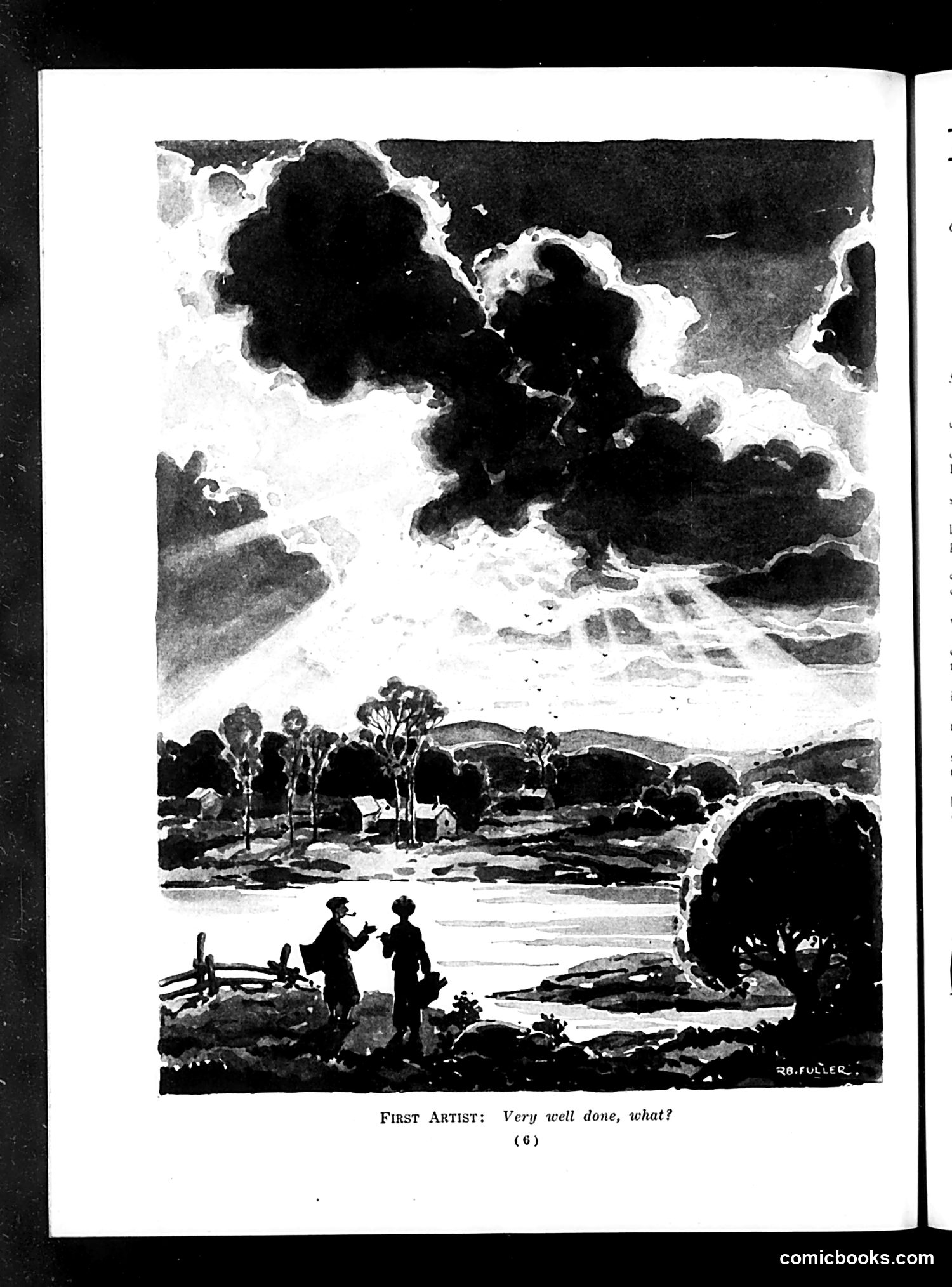
Cartoon Analysis This is a single-panel cartoon by R.B. Fuller showing two figures standing by a riverbank, observing a landscape with trees, hills, and dramatic storm clouds. The caption reads: "First Artist: Very well done, what" (with "(6)" indicating this is part of a numbered series). The joke appears to be a play on artistic appreciation or critique. One figure (the "First Artist") is complimenting another's work—likely commenting on the natural landscape or sky as if it were a painting. The incomplete caption "Very well done, what" suggests ironic or sarcastic praise, possibly mocking pretentious art criticism or the tendency to comment on nature as though it were a created artwork. The dramatic clouds dominate the composition, making them the likely subject of the critique.
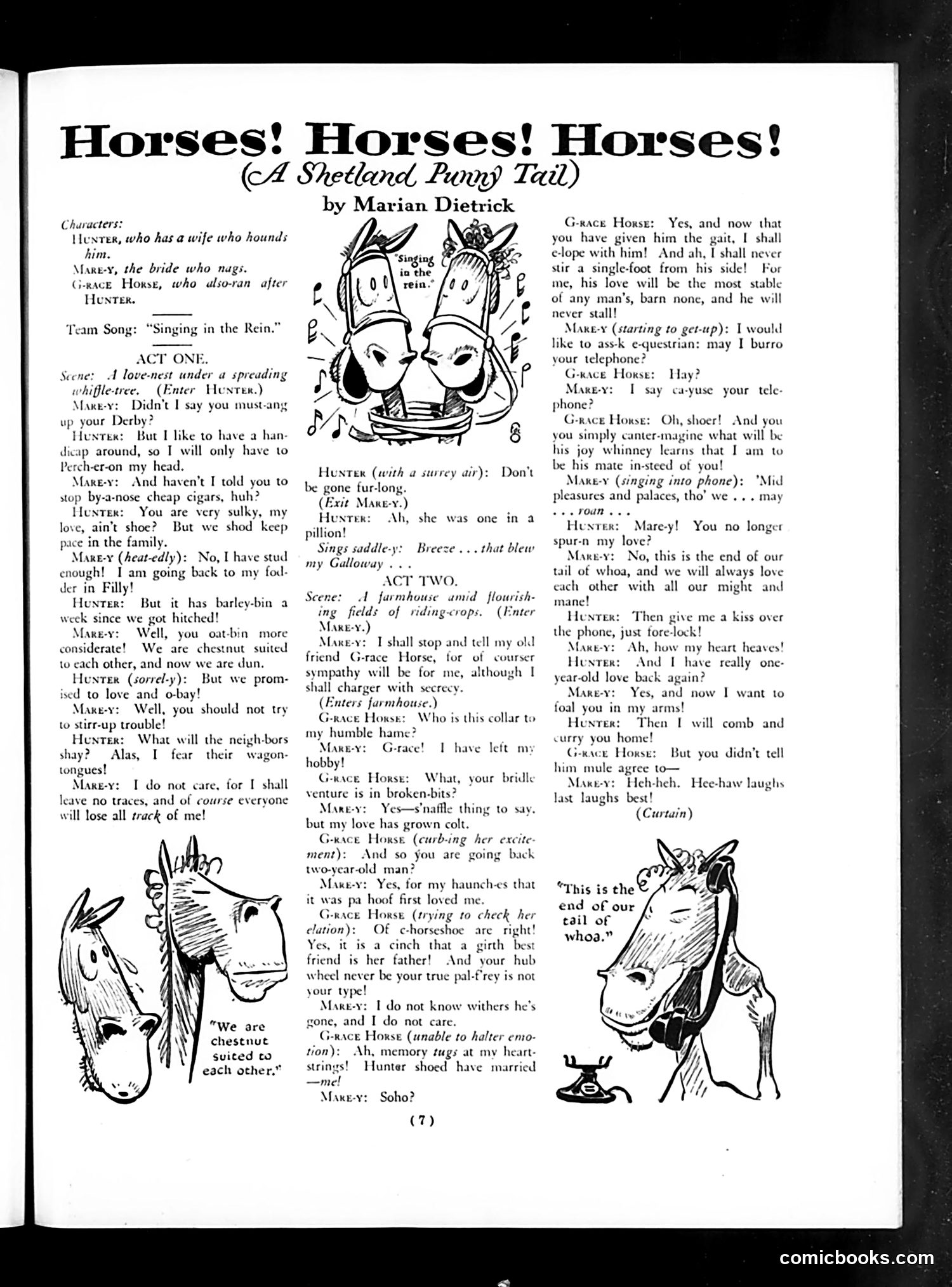
"Horses! Horses! Horses!" - A Shetland Pony Tale This is a humorous one-act play by Marian Dietrick featuring anthropomorphic horses as characters. The plot concerns Hunter (who has a wife who hounds him) and Marey (the bride who nags). The narrative centers on their marital disputes and romantic reconciliation, with dialogue full of puns and wordplay typical of early 20th-century vaudeville humor. The satirical point appears to be gentle domestic comedy—poking fun at married couples' bickering and the clichéd "nagging wife" stereotype common in period entertainment. The Shetland pony setting provides whimsical cover for what is essentially a conventional marriage-and-reconciliation narrative. The team song "Singing in the Rein" reinforces the equine pun-heavy approach throughout.
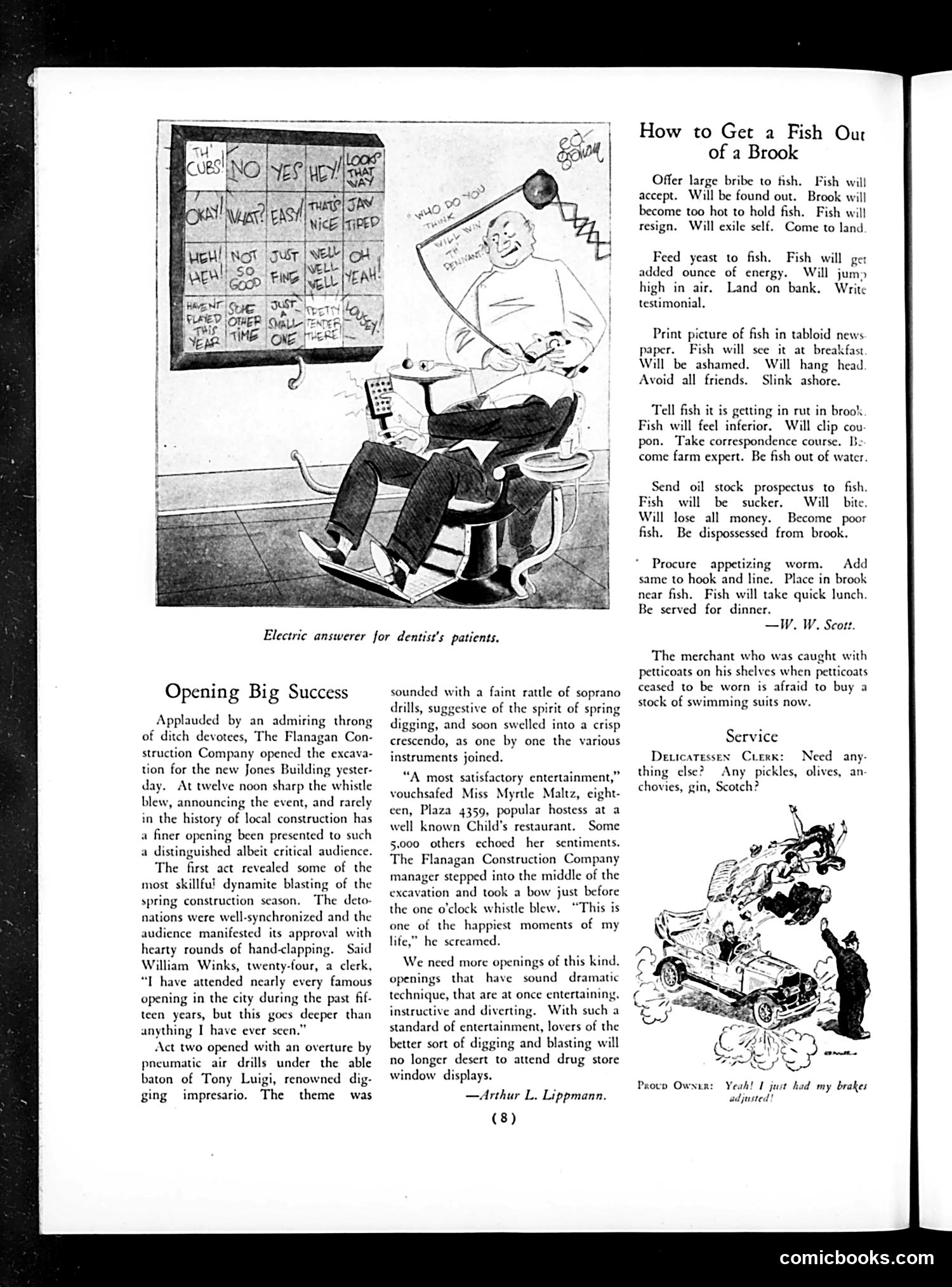
Analysis Top Cartoon: "Electric answerer for dentist's patients" This is a visual gag showing a patient in a dentist's chair unable to speak normally due to dental work. The cartoon depicts an "electric answerer"—essentially an early automated response device—displaying pre-written answers to common questions (YES, NO, WAIT, THAT'S EASY, NOT GOOD, JUST SWELL, etc.). The joke satirizes both the helplessness of dental patients unable to communicate and pokes fun at emerging electrical/mechanical automation technology of the era. It's absurdist humor about trying to maintain conversation during dental procedures. Right Column: "How to Get a Fish Out of a Brook" A humorous mock-instructional piece offering increasingly ridiculous and counterproductive methods to catch fish—offering bribes, yeast, embarrassment tactics, and business propositions. It's satire of self-help journalism and absurd advice columns popular in magazines of this period.
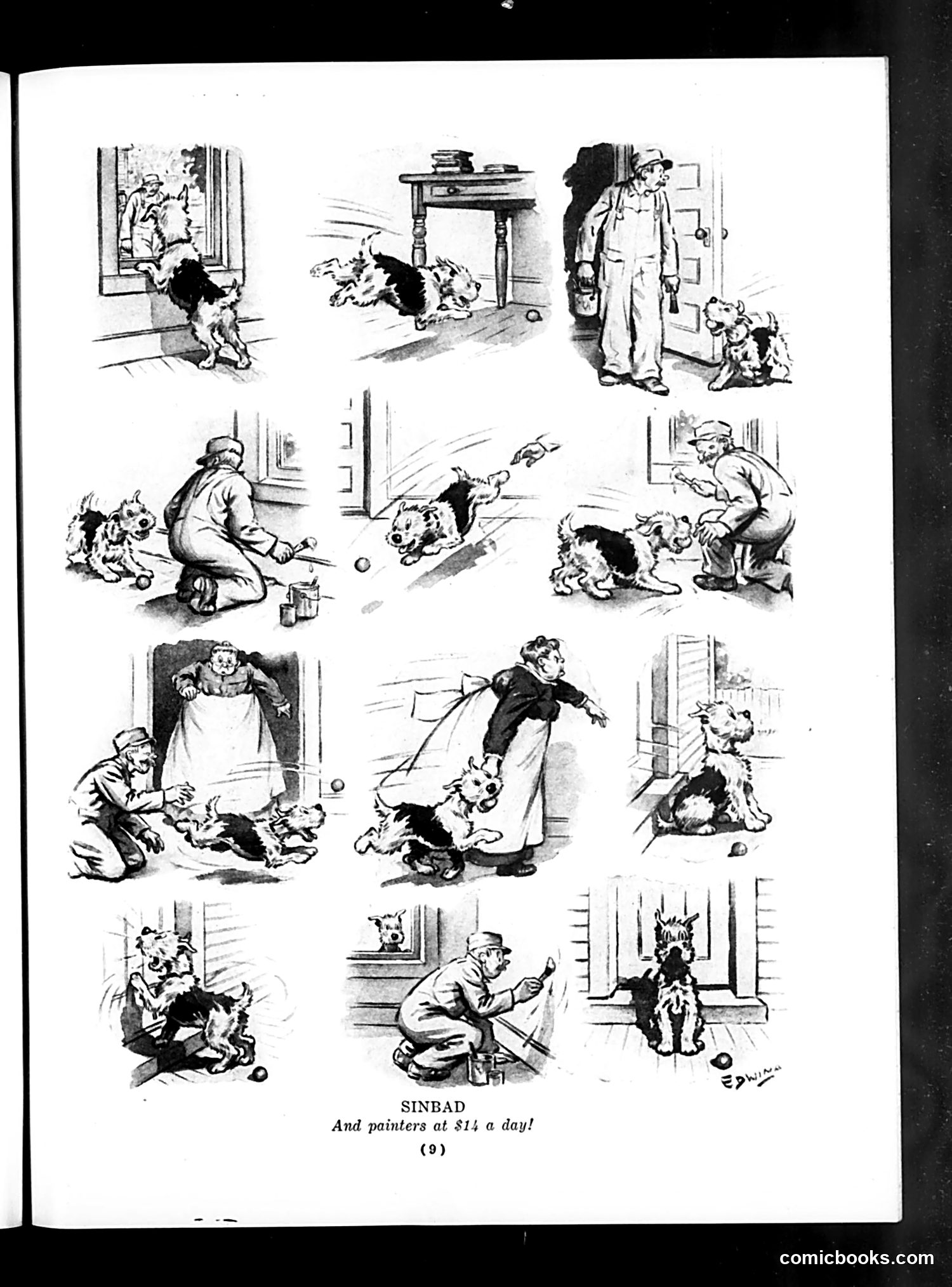
Satire Explanation: "Sinbad and painters at $14 a day!" This is a comic strip-style sequence showing a man (appearing to be a laborer or tradesman named Sinbad) interacting with dogs in various domestic settings. The subtitle's joke plays on wage complaints: it sarcastically suggests that painters earning $14 per day—likely a substantial or controversial wage during the period this was published—are living like the legendary adventurer Sinbad with his fantastic wealth and magical encounters. The humor satirizes labor disputes and wage debates by exaggerating the comparative luxury of workers' earnings. Each panel depicts mundane domestic scenarios with dogs, contrasting sharply with the Sinbad reference, which evokes exotic adventure and riches. The satire targets either workers demanding higher wages or employers defending high wage payments as excessive.
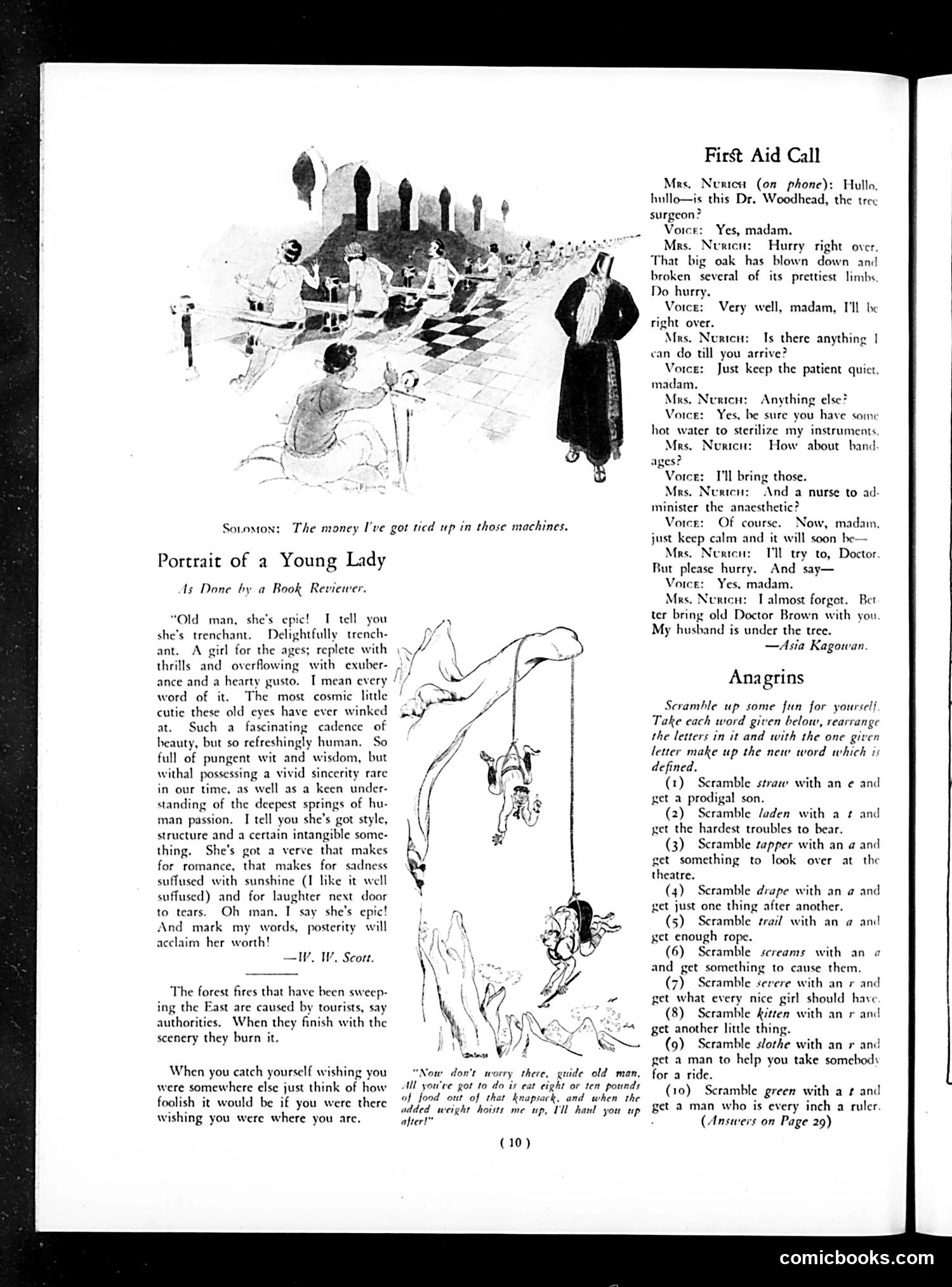
Page Analysis This page contains three separate pieces: 1. "First Aid Call" (top right): A humorous dialogue between Mrs. Nureich (calling by phone) and Dr. Woodhead about a fallen oak tree. The joke depicts a wealthy woman treating tree damage as a medical emergency requiring the doctor's immediate attention—satirizing upper-class over-dramatization of minor property problems. 2. "Portrait of a Young Lady" (left): A literary review praising an unnamed young woman for possessing wit, charm, and romantic appeal. It's genuine flattery rather than satire. 3. "Anagrins" (right): A word-puzzle game asking readers to rearrange scrambled letters to form new words—a recreational feature rather than satirical content. The page primarily showcases Life's mixed editorial approach: humor targeting affluent readers' pretensions alongside literary appreciation and reader entertainment.
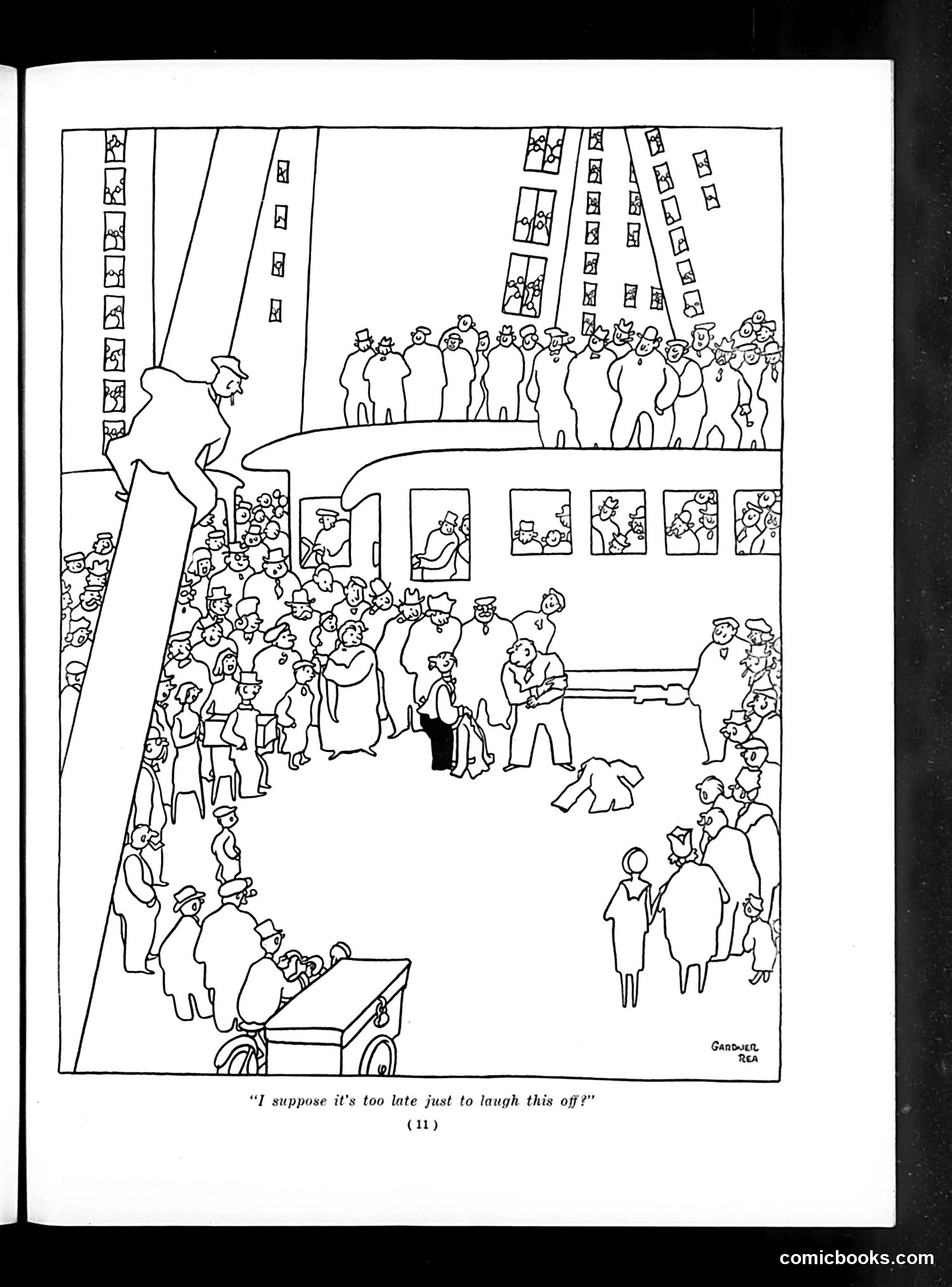
Cartoon Analysis This single-panel cartoon by Gardiner Rea depicts a circus or carnival scene with a large crowd gathered in an arena. A figure in the center appears to be performing or presenting something to the assembled spectators, while others watch from multiple levels—standing on the ground, in windows, and on an upper platform. The caption reads: "I suppose it's too late just to laugh this off?" The satire suggests a public spectacle or performance that has become too serious or consequential to dismiss humorously. Without additional historical context from the magazine's publication date, the specific event referenced remains unclear, though the crowded arena setting implies a major public event or announcement that demands serious attention rather than levity.
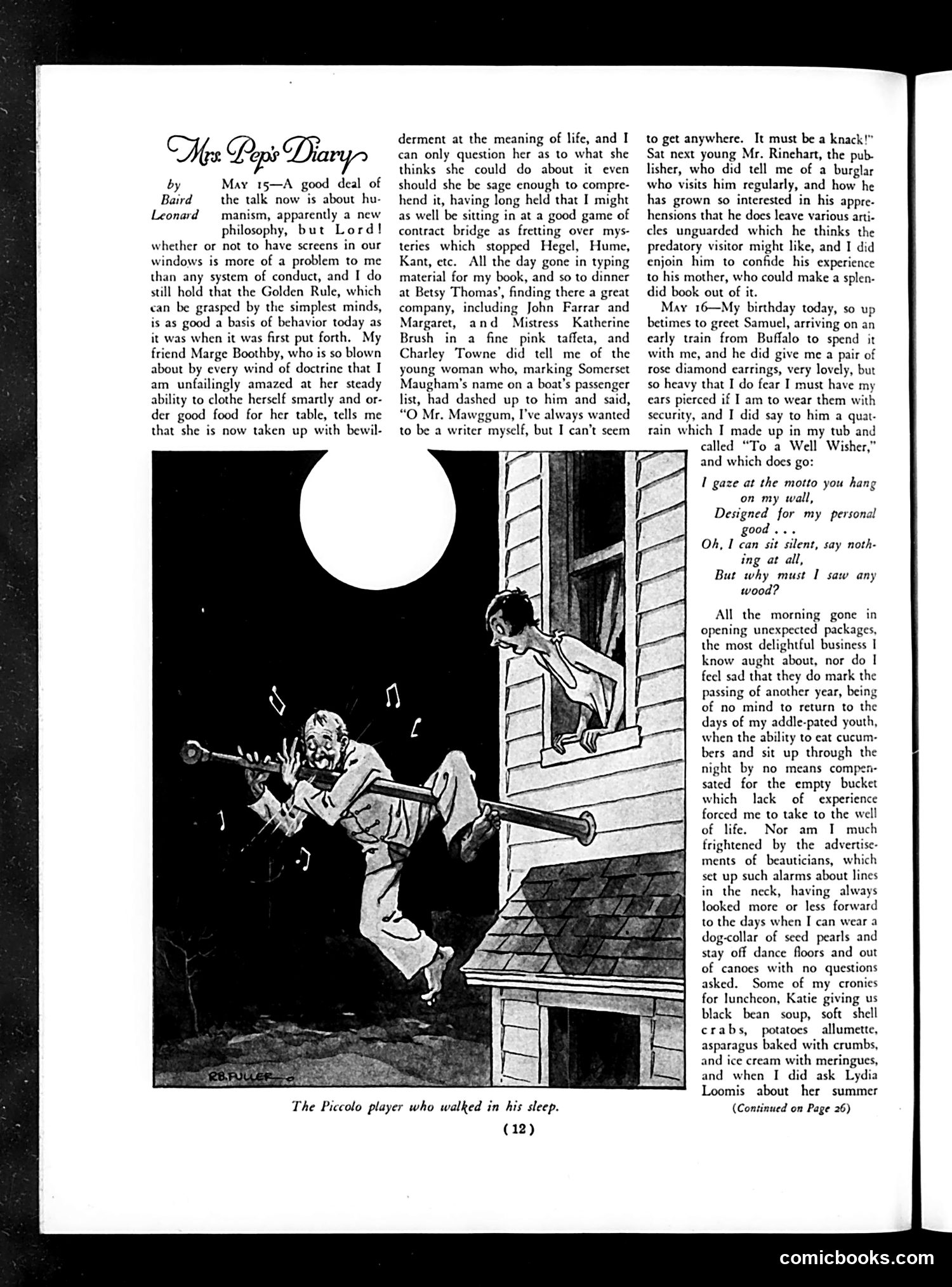
"Mrs. Pep's Diary" - Life Magazine Page This is a diary column by Baird Leonard discussing domestic philosophy and humanism. The accompanying illustration depicts "The Piccolo player who walked in his sleep"—a figure playing a piccolo while sleepwalking outside a window at night, with a full moon visible. The image is a whimsical visual gag illustrating the absurdity of someone unconsciously performing music while asleep. The cartoon plays on the common 19th-20th century literary trope of sleepwalking as both comedic and slightly unsettling behavior. The diary text covers topics including birthday gifts (rose diamond earrings), philosophical musings about aging, and domestic observations. The overall tone is light, humorous domestic satire typical of Life magazine's genteel humor for educated, middle-class readers.
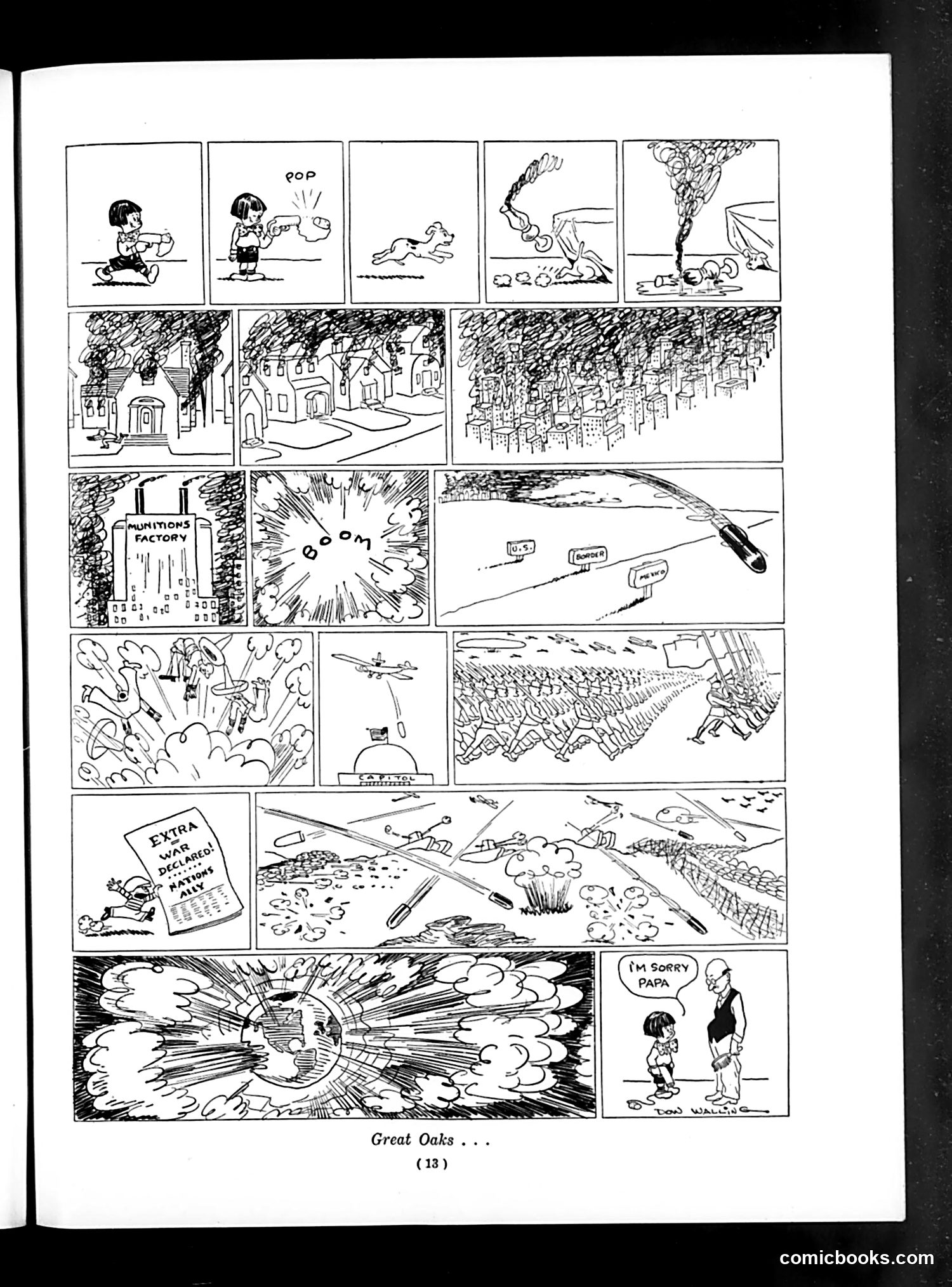
Analysis of "Great Oaks..." Comic Page This is a narrative comic depicting the catastrophic consequences of war on a civilian population. The sequence progresses from a child playing innocently to escalating destruction: a balloon bursts (suggesting warfare), buildings collapse, factories are bombed, explosions devastate cities, aircraft drop bombs on agricultural land, and finally nuclear-scale destruction obliterates an entire urban center. The concluding panel shows a child apologizing to his father—likely representing a new generation inheriting the devastation caused by their parents' war decisions. The comic's title "Great Oaks..." (presumably referencing the proverb about mighty oaks growing from small acorns) ironically suggests how small initial conflicts grow into catastrophic destruction. This appears to be anti-war propaganda, likely from the World War II era or immediate post-war period, warning against the escalation and civilian impact of modern warfare.
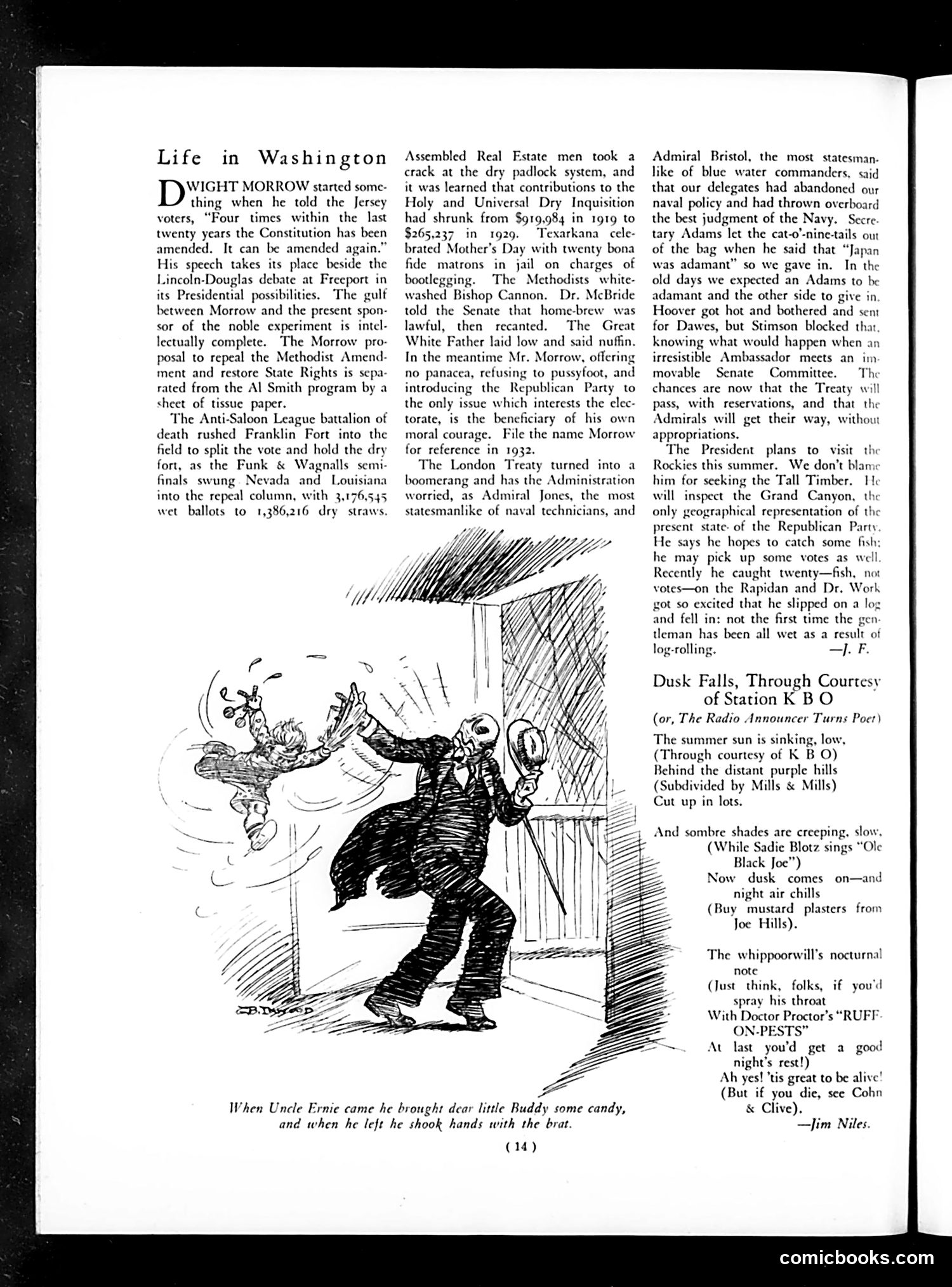
Analysis of "Life" Magazine Page This page contains two distinct pieces: Left Column - Political Commentary: Dwight Morrow discusses constitutional amendments and the "Anti-Saloon League" split over Prohibition's repeal, mentioning specific vote tallies. The text references naval policy disputes and Admiral Jones, suggesting early 1930s political debate. Cartoon & Poem: The illustration shows a man juggling while catching/dropping objects—captioned about "Uncle Ernie" bringing candy to "little Buddy" and shaking hands. The accompanying poem by Jim Niles advertises commercial products (Mills & Mills plasters, Doctor Proctor's "RUFF-ON-PESTS," Cohn & Clive) through humorous verse about dusk falling and nighttime pest remedies. The cartoon appears to be entertainment/advertising rather than political satire. The overall page blends serious political discussion with commercial humor typical of 1930s *Life* magazine.
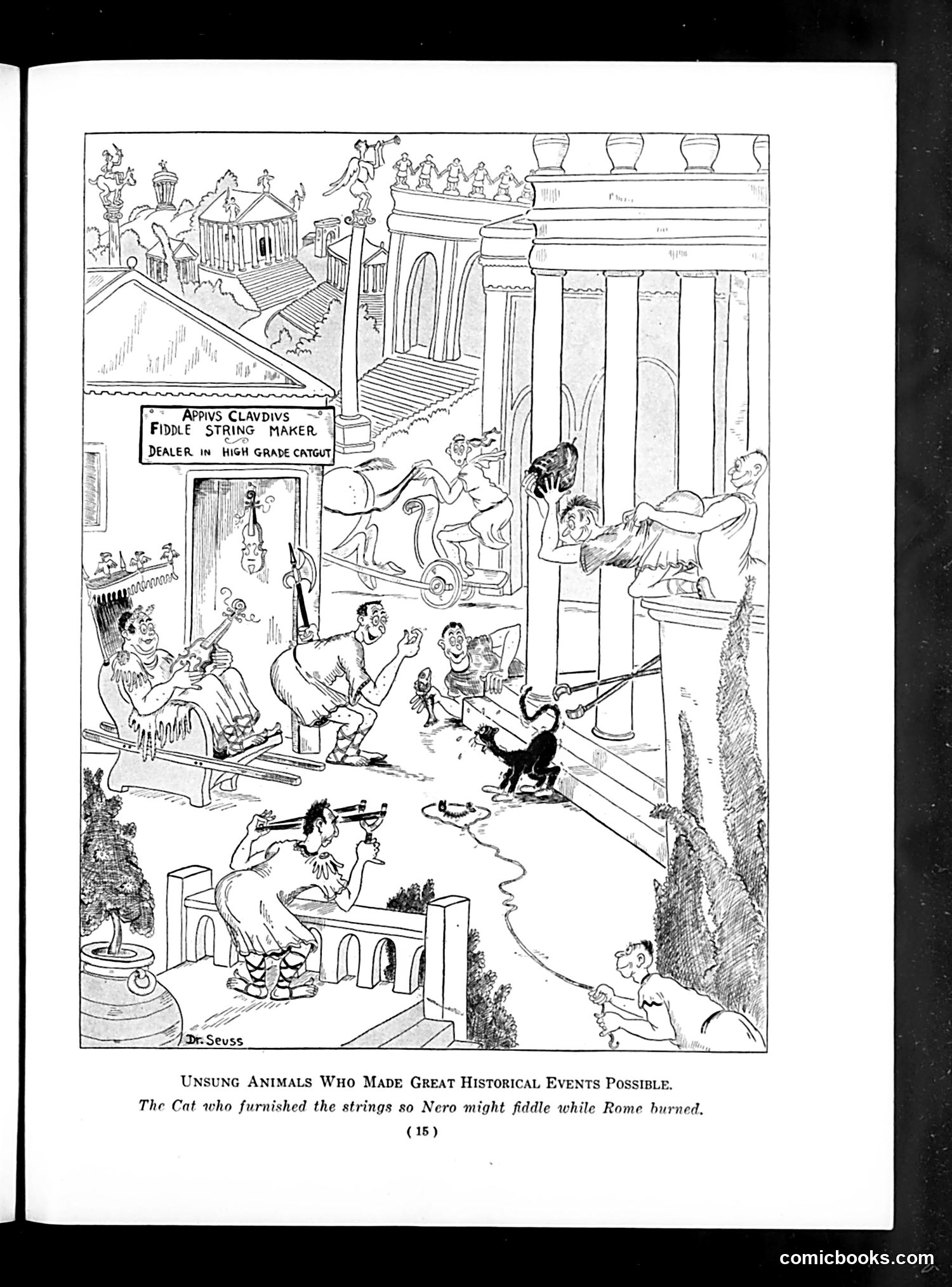
Explanation for Modern Readers This is a Dr. Seuss cartoon titled "Unsung Animals Who Made Great Historical Events Possible." The specific panel shown satirizes the legend of Nero fiddling while Rome burned. The joke: A cat (labeled "Appius Claudius - Fiddle String Maker, Dealer in High Grade Catgut") is being used to provide fiddle strings. The cartoon cleverly plays on the historical pun that Nero's fiddle strings were made from "catgut" (animal intestine), and literalizes this by showing an actual cat being the source. The satire mocks both historical inaccuracy and the absurdity of the original tale. The elaborate Roman setting with columns and crowds reinforces the historical pretension being humorously deflated. This demonstrates Seuss's early satirical style before his children's book career.
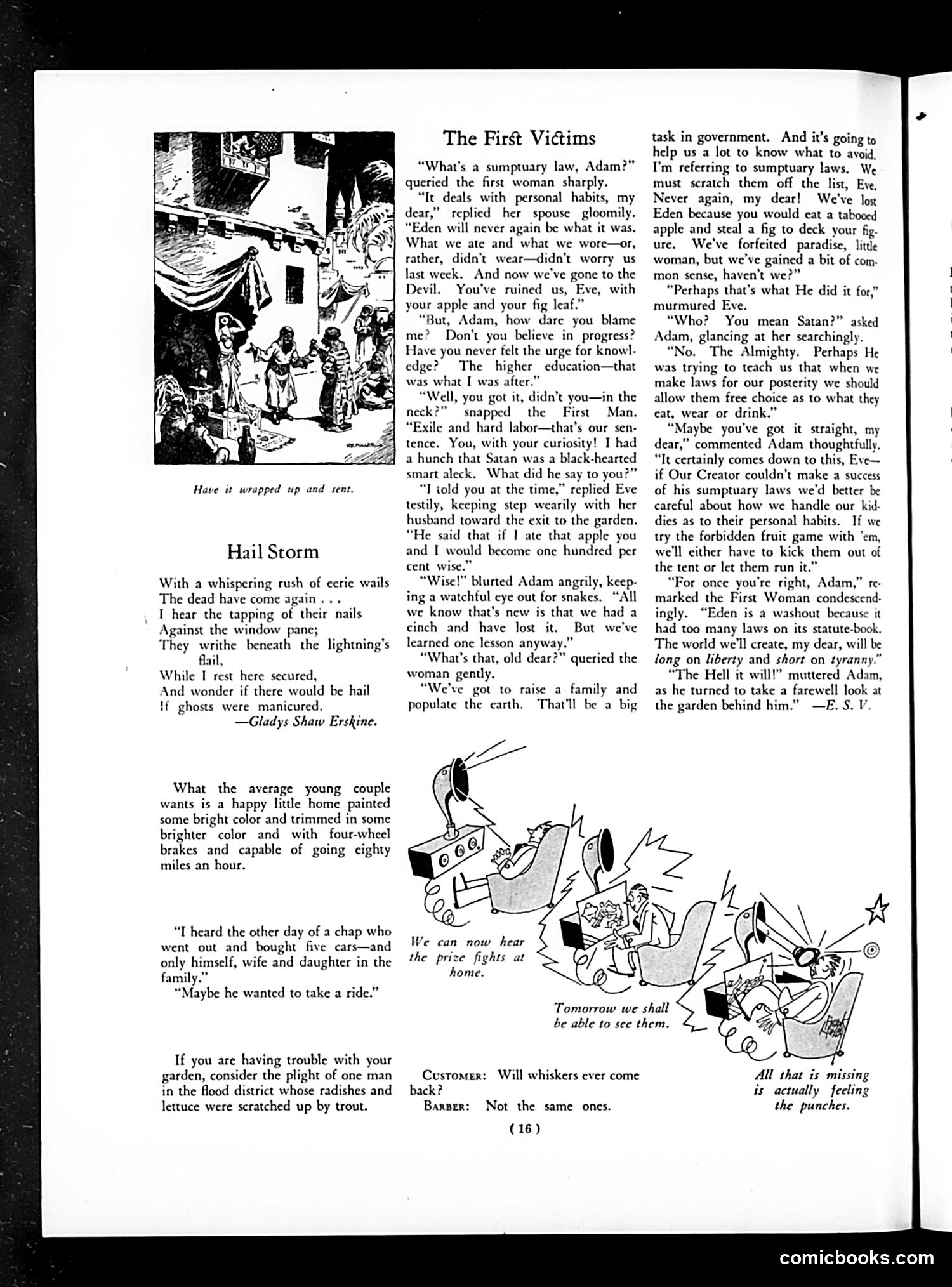
"The First Victims" - Political Satire This page satirizes prohibition-era enforcement and unintended consequences. The main dialogue between Adam and Eve uses the biblical Fall of Man as an allegory for prohibition's failures. Adam blames Eve (and by extension, government overreach) for humanity's downfall through sumptuary laws—regulations restricting personal behavior and consumption. The couple debates whether laws can effectively control human nature. Eve defends progress and education; Adam argues laws inevitably drive people toward forbidden behavior. The satire suggests prohibition represents government overreach that paradoxically encourages the vice it aims to prevent. The accompanying poem "Hail Storm" and other brief pieces continue this theme of unintended consequences from restrictive legislation, mocking both enforcement efforts and the naiveté of lawmakers.
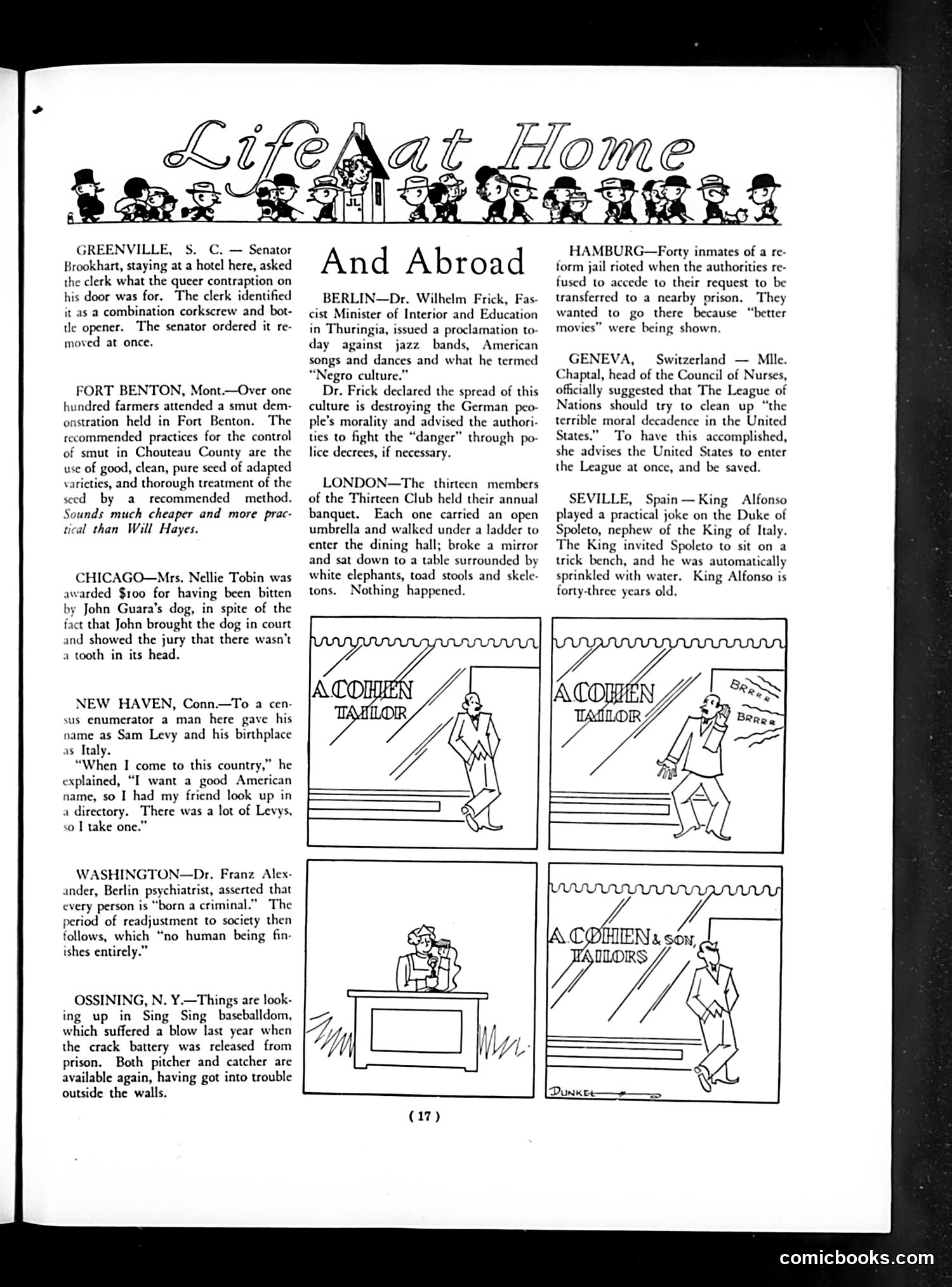
Life Magazine Page: "Life at Home and Abroad" This page contains brief international news items alongside a comic strip called "A Cohen Tailor." The news snippets report on various social issues: Berlin's Nazi Interior Minister denouncing jazz and "Negro culture" as moral threats; a Geneva nurses' council criticizing moral decline in America; King Alfonso XIII of Spain playing a prank; and a Berlin psychiatrist claiming everyone is "born a criminal." The comic strip depicts a tailor shop, with a customer entering, speaking with the tailor, and apparently leaving unsatisfied—suggesting commentary on customer service or business dealings. The page reflects 1920s-era concerns about cultural "degeneracy," international politics, and everyday social friction, presented through news briefs and gentle humor.
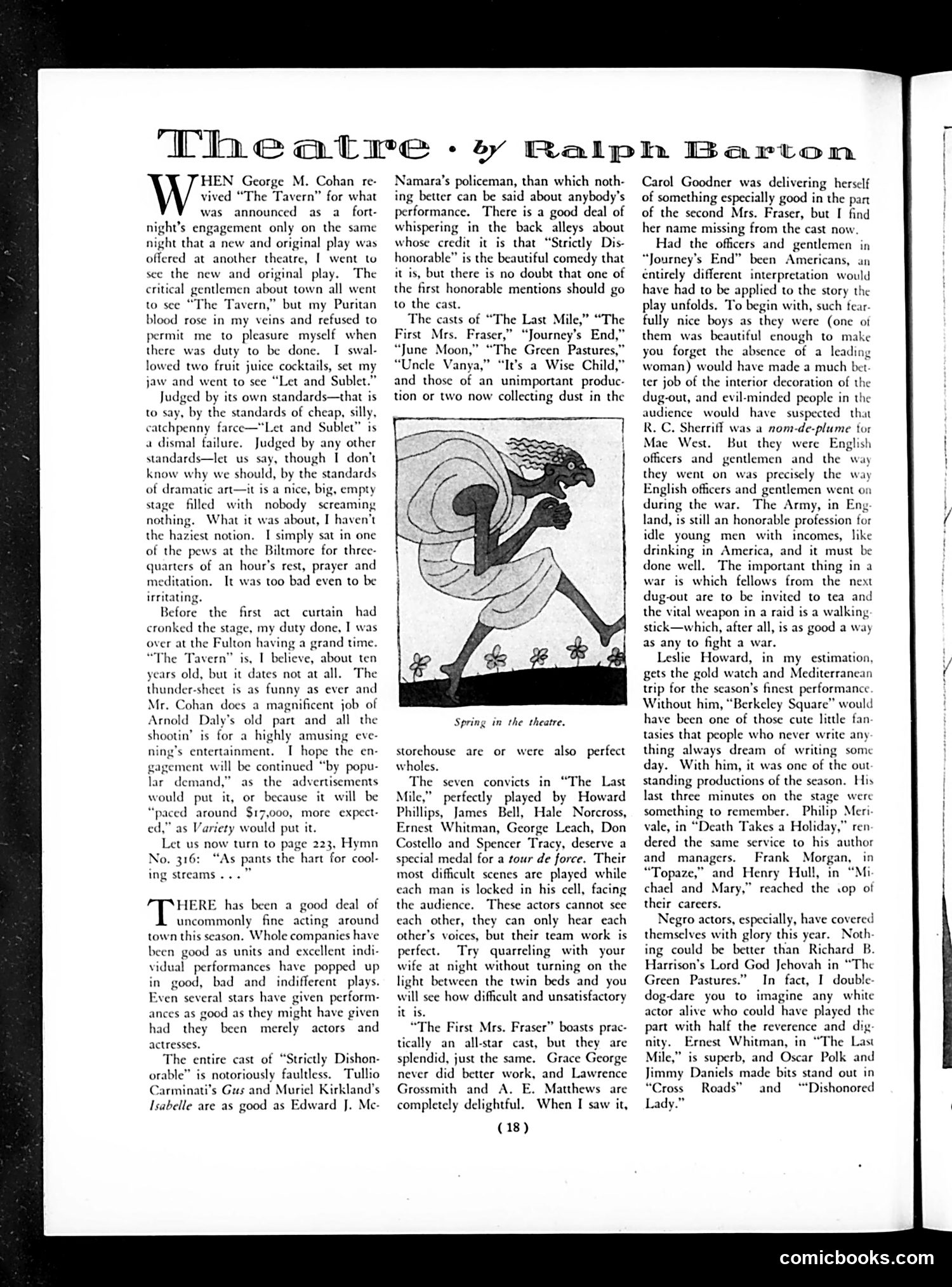
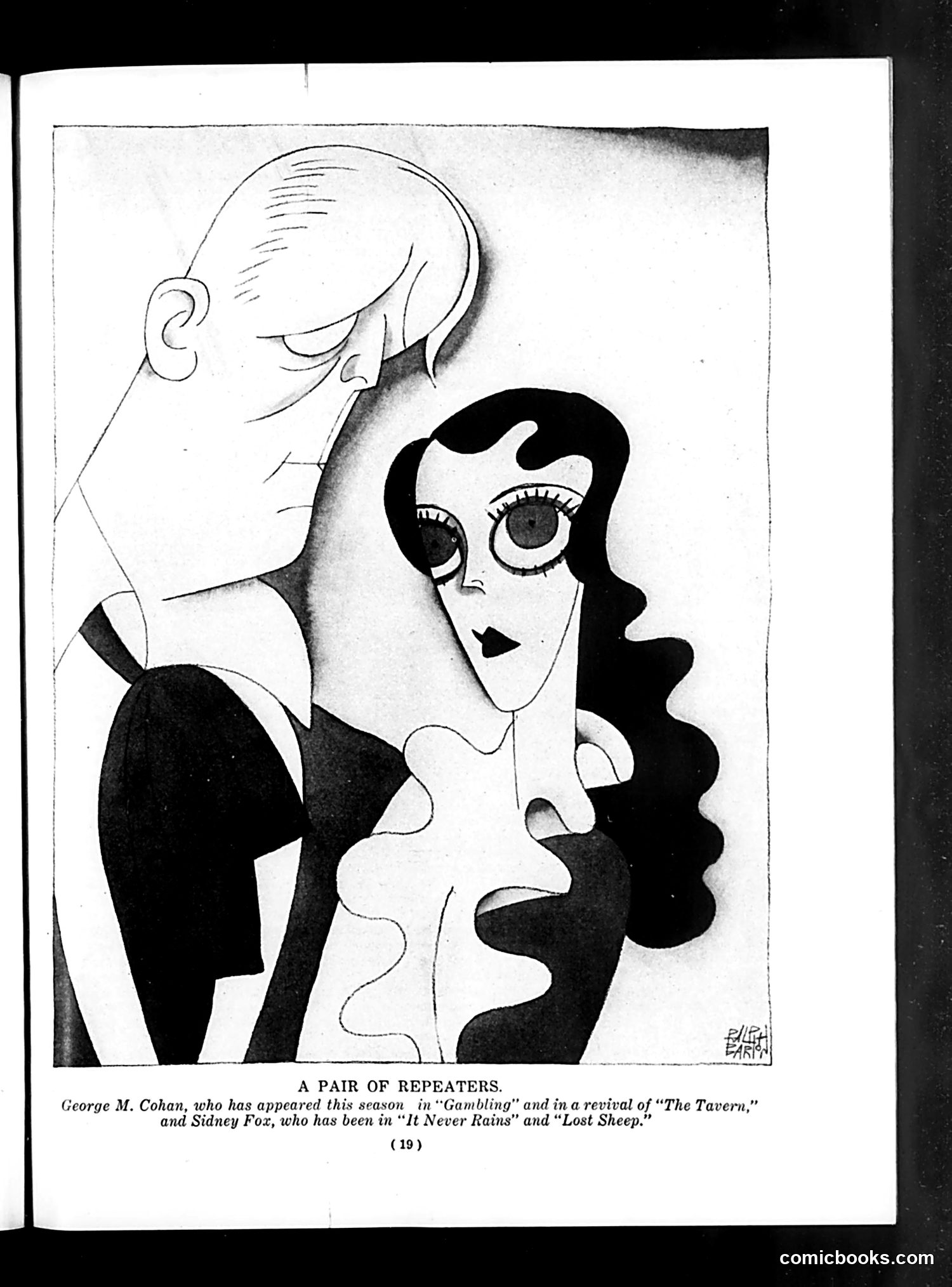
"A Pair of Repeaters" This Life magazine illustration satirizes two Broadway actors—George M. Cohan and Sidney Fox—who are characterized as "repeaters," meaning they appear in multiple theatrical productions during the same season. The cartoon uses exaggerated Art Deco styling typical of 1920s-30s theatrical caricature: stark contrasts, elongated features, and dramatic makeup. The joke is that these performers are omnipresent on stage, cycling through different shows. The title puns on "repeaters" (actors who keep appearing) while the visual caricature emphasizes their theatrical personas—the dramatic eye makeup and stylized expressions underscore how recognizable they've become to audiences seeing them repeatedly.
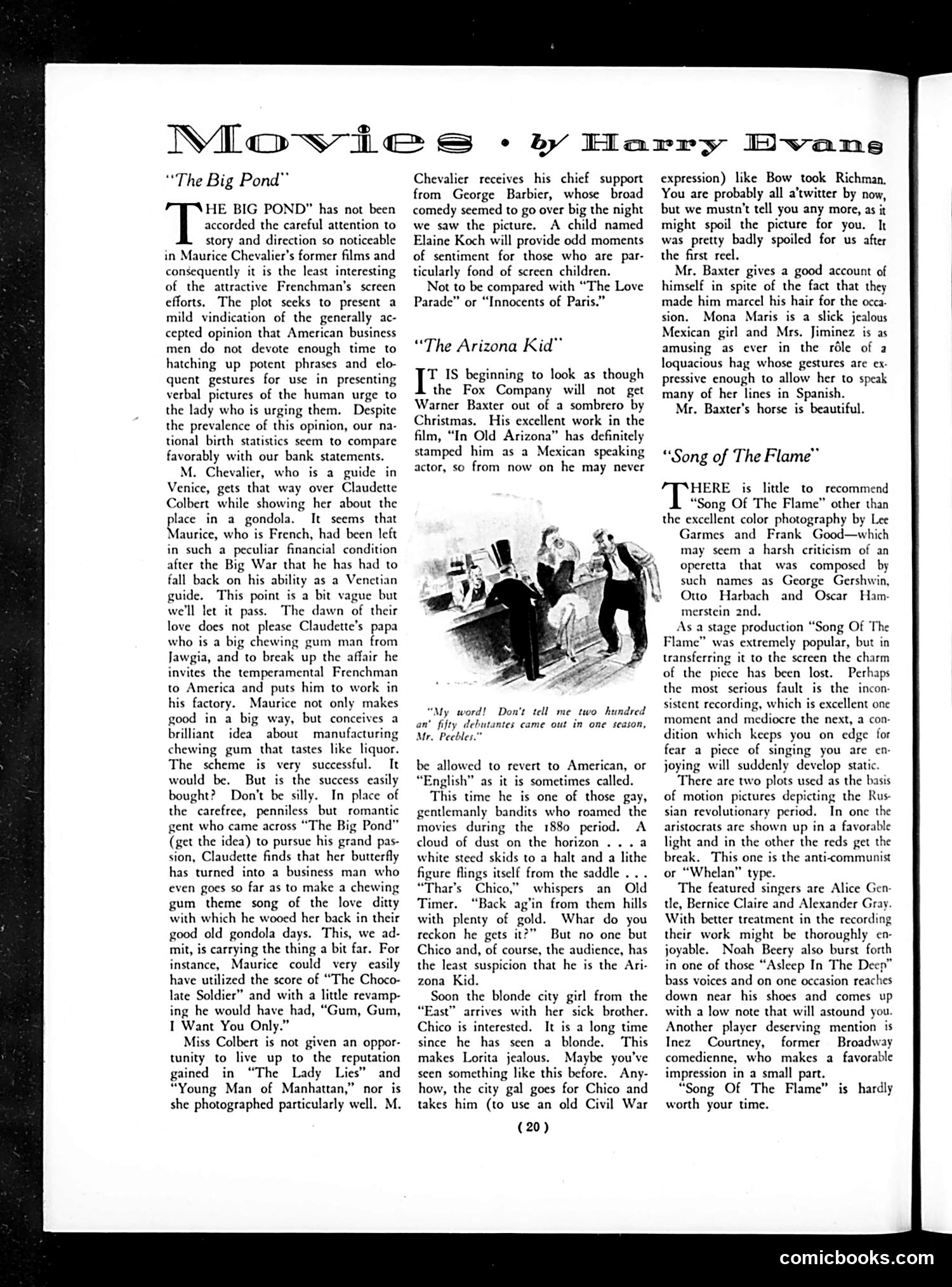
Movie Reviews by Harry Evans - Life Magazine This page contains three film reviews from an era of early sound cinema (likely late 1920s). The cartoon/illustration shows a scene from "The Arizona Kid" with the caption about "two hundred debutantes" in one season—a humorous aside about the implausibility of the plot. Key points: - "The Big Pond" stars Maurice Chevalier and Claudette Colbert. The reviewer criticizes the film for being Chevalier's weakest effort, mocking its plot about a Venetian guide turned American chewing-gum manufacturer who absurdly turns his love song into a commercial jingle. - "The Arizona Kid" concerns Warner Baxter, an actor typecast as a Mexican-speaking cowboy after his success in "In Old Arizona." The review notes he may never escape this role. - "Song of the Flame" features early Technicolor but suffers from poor sound recording that ruins the operetta's musical impact. The reviews are sardonic about filmmaking conventions and the emerging star-system's limitations.
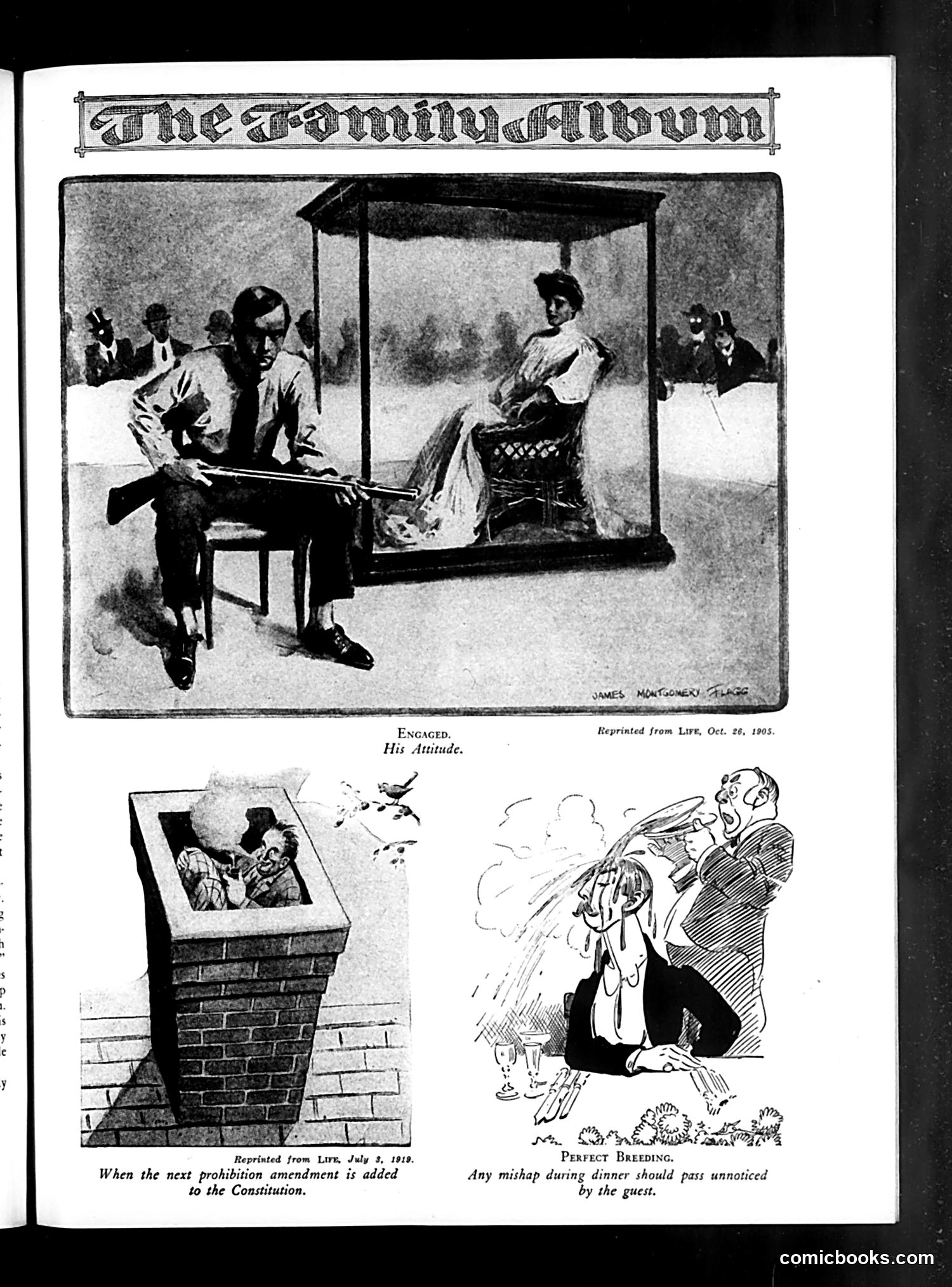
Political Cartoons from Life Magazine This page contains three satirical cartoons by James Montgomery Flagg addressing early 20th-century social issues: "Engaged. His Attitude" (1905): Shows a man at a window display examining a woman in a booth, satirizing courtship as transactional viewing—he inspects her like merchandise while observers watch. "When the next prohibition amendment is added to the Constitution" (1918): Depicts a couple trapped in a chimney, suggesting that added prohibition laws would further constrain personal freedom and morality to absurd levels. "Perfect Breeding" (1920): A gentleman ignores a woman spilling wine during dinner, satirizing the upper-class etiquette rule that hosts must overlook guests' mishaps to maintain decorum. The cartoons mock emerging social anxieties: commodification of women, expanding government regulation (Prohibition era), and rigid class conventions. The humor relies on exaggeration and visual incongruity typical of early 20th-century American satirical illustration.
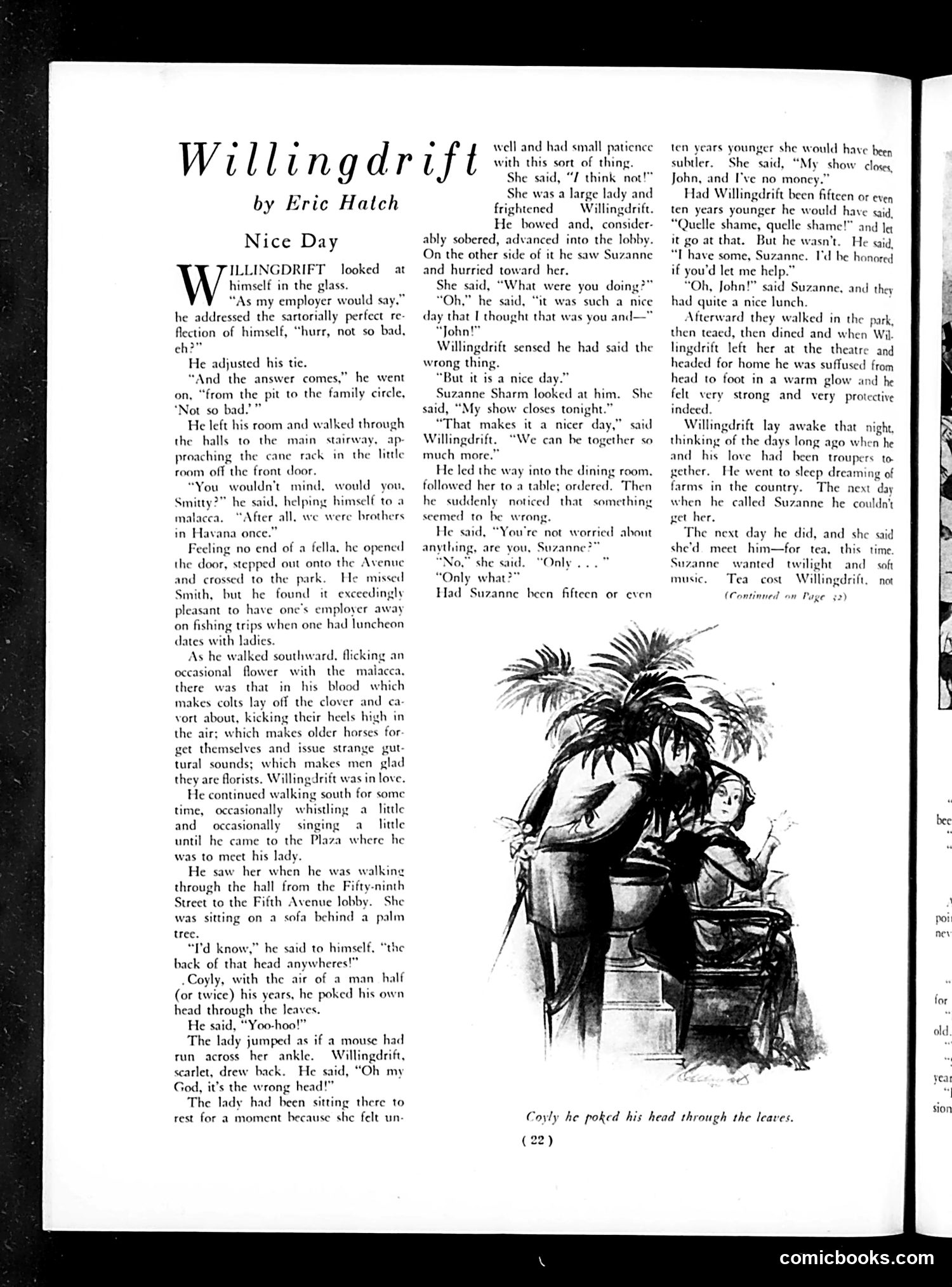
"Willingdrift" by Eric Hatch: A Romantic Comedy This is a serialized short story (marked "Continued on Page 52"), not political satire. The narrative follows a character named Willingdrift, a somewhat foolish but well-meaning man in love. The humor derives from his comedic mishaps: he mistakes a stranger for his beloved Suzanne at the Plaza Hotel, awkwardly poking his head through palm leaves and saying "Yoo-hoo!" to the wrong woman. Later, he impulsively offers financial help to Suzanne when she mentions her show closing and lacking money—a romantic gesture that apparently compromises her independence or changes their dynamic. The illustration shows Coyly (likely Willingdrift's friend) performing the embarrassing head-poking incident through leaves. This appears to be typical *Life* magazine romantic fiction from the early-to-mid 20th century—gentle comedy about upper-class courtship and masculine fumbling, not political commentary.
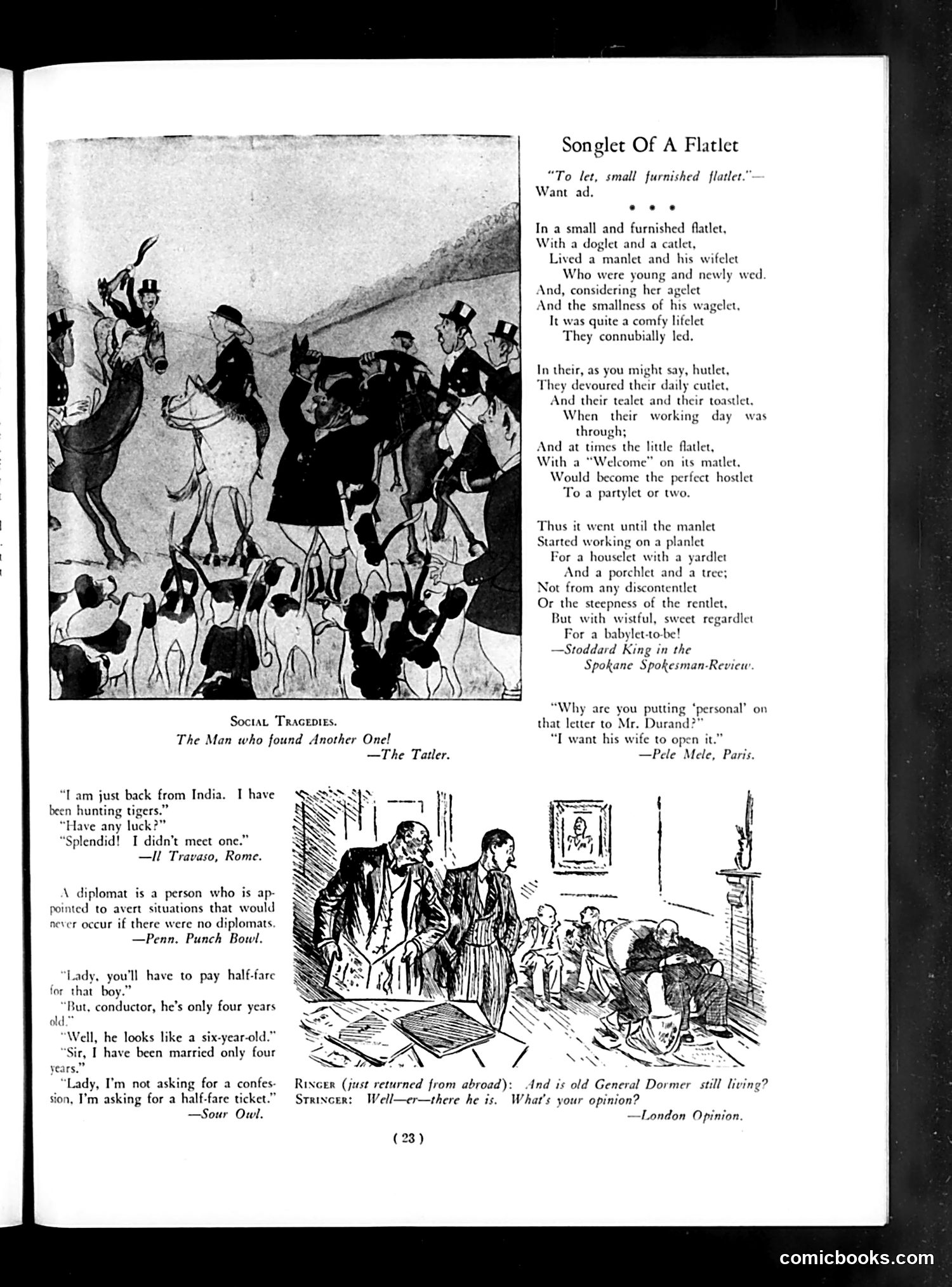
Social Satire from Life Magazine This page collects brief humorous anecdotes and verses mocking everyday social situations and human nature. The "Social Tragedies" section features short jokes about absurd logic: a hunter boasting he succeeded at tiger-hunting by *not* meeting any tigers; a diplomat's paradoxical existence; a conductor insisting a young boy pay full fare because he *looks* older than his actual age, leading to marital innuendo. The "Songlet of a Flatlet" is a whimsical poem about a young married couple in a small rented apartment, using diminutive "-let" suffixes throughout (flatlet, doglet, cutlet, etc.) to emphasize the smallness of their domestic life. It's sentimental humor showing their humble contentment until the husband begins planning for a house—motivated by hopes for a child ("babylet"), not discontent. Additional brief jokes mock marital deception and the assumption that returning travelers have interesting opinions. The satire is gentle, focusing on universal human quirks rather than political targets.
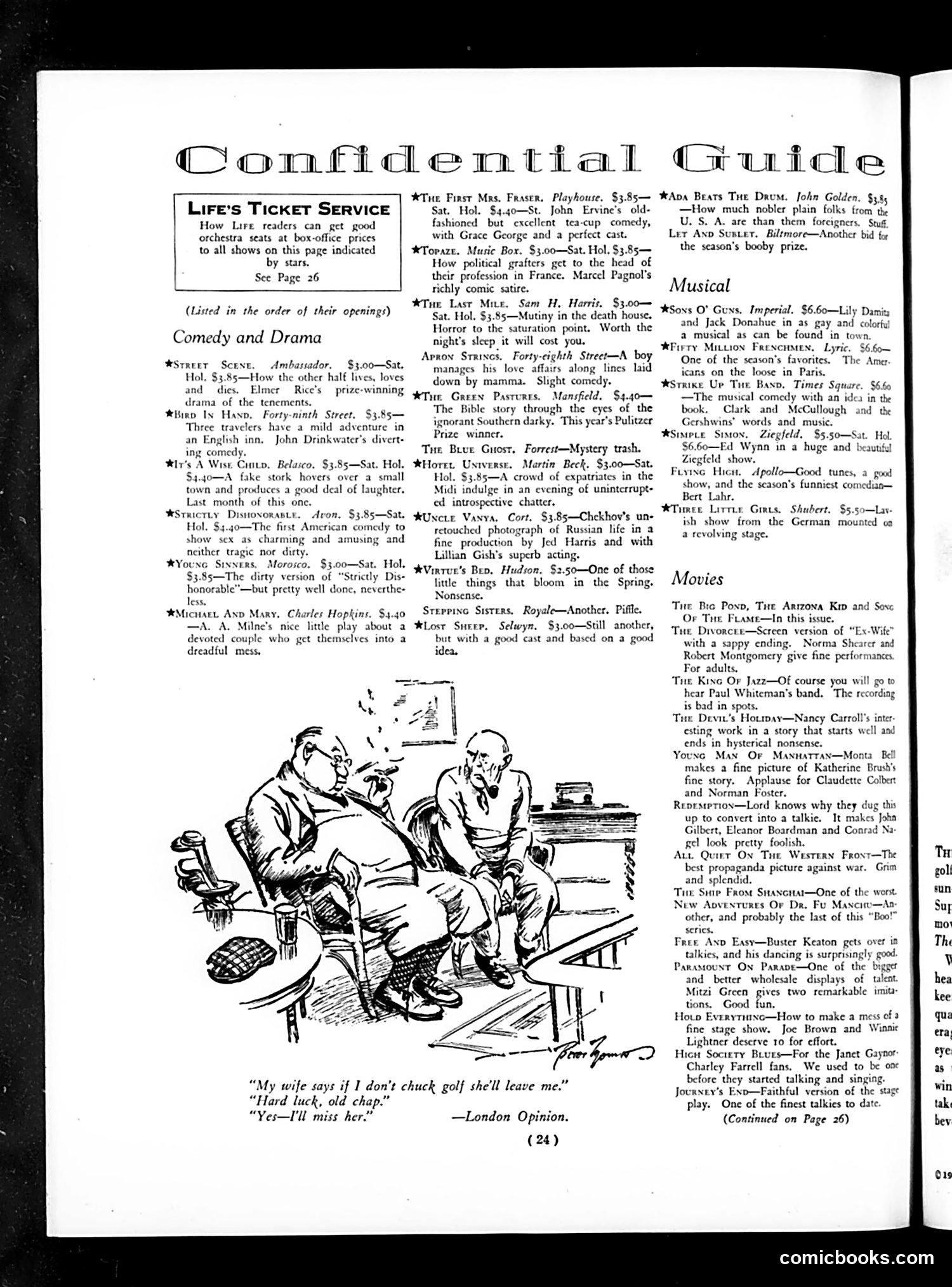
Explanation for Modern Readers This page is a theater and entertainment guide from *Life* magazine, not primarily a political cartoon. The small cartoon at the bottom depicts two men discussing golf and marriage—a domestic humor piece reflecting 1920s-30s attitudes about leisure, marriage, and male priorities. The cartoon's joke: A man tells his friend his wife threatens to leave if he doesn't quit golf. His friend commiserates, and the man replies he'll "miss her"—implying he doesn't actually plan to stop golfing despite the ultimatum. The satire gently mocks masculine stubbornness and the assumed superiority of recreational interests over spousal demands. The page itself lists Broadway shows and movies available through *Life*'s ticket service. References like "The Green Pastures" (a Pulitzer Prize winner featuring African American performers) and "Uncle Vanya" (Chekhov) indicate the cultural offerings of the era.
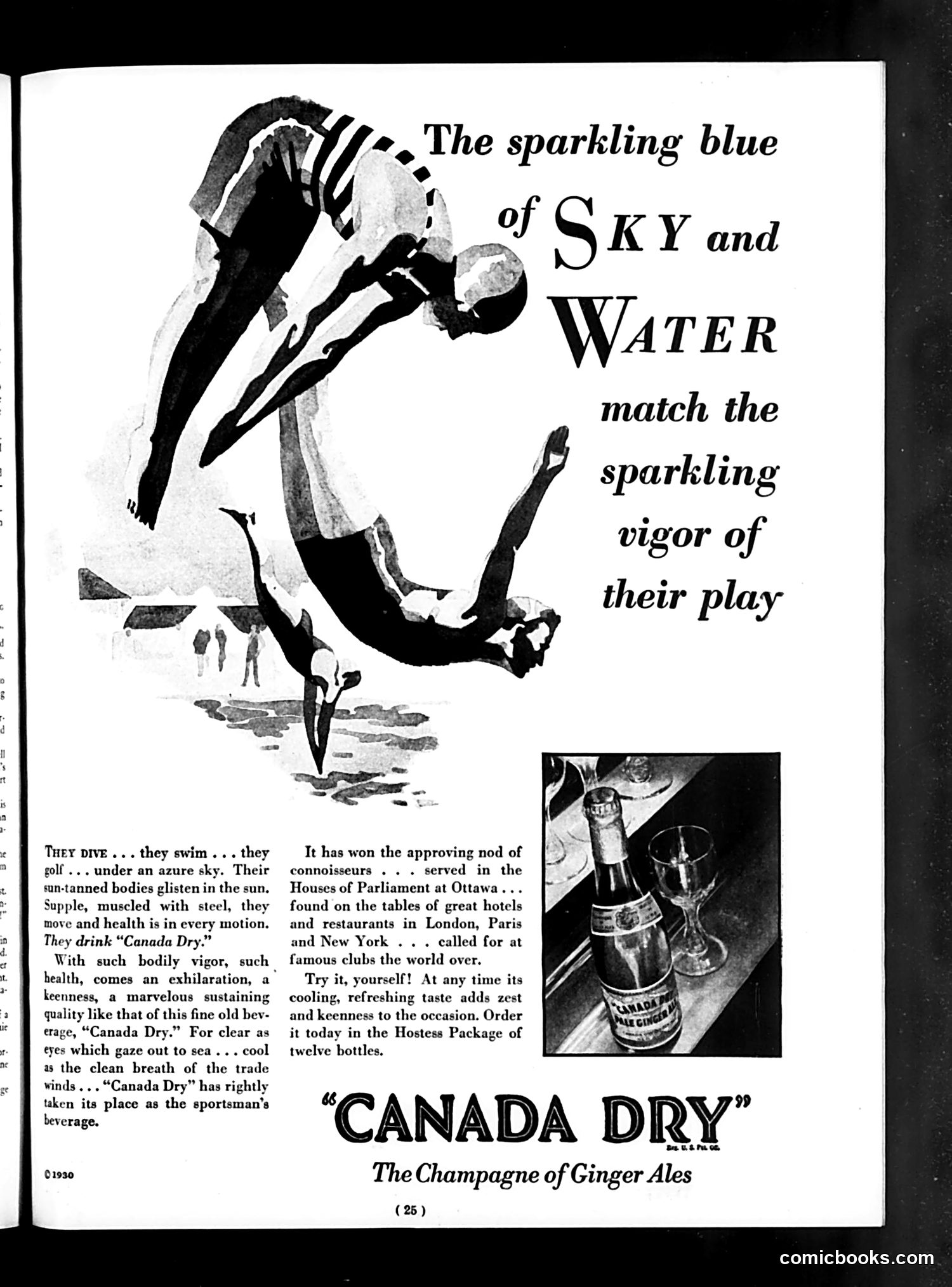
Analysis This is a Canada Dry ginger ale advertisement from 1930, not political satire. The page depicts athletic figures—a diver and golfer—performing vigorous outdoor activities under a blue sky. The ad's central message links physical vitality ("sun-tanned bodies glisten," "muscled with steel") to consuming Canada Dry, claiming the beverage's "sparkling vigor" matches athletic performance. The copy emphasizes the drink's prestige: it's served in Parliament, fine hotels, and exclusive clubs worldwide—positioning it as a mark of sophistication and health-consciousness. The phrase "Champagne of Ginger Ales" elevates the product's status. For modern readers: This reflects 1930s advertising's direct equation of consumption with lifestyle aspiration and wellness—a youthful, athletic image sold through the promise that drinking this specific brand signifies membership in an elite, vigorous social class.
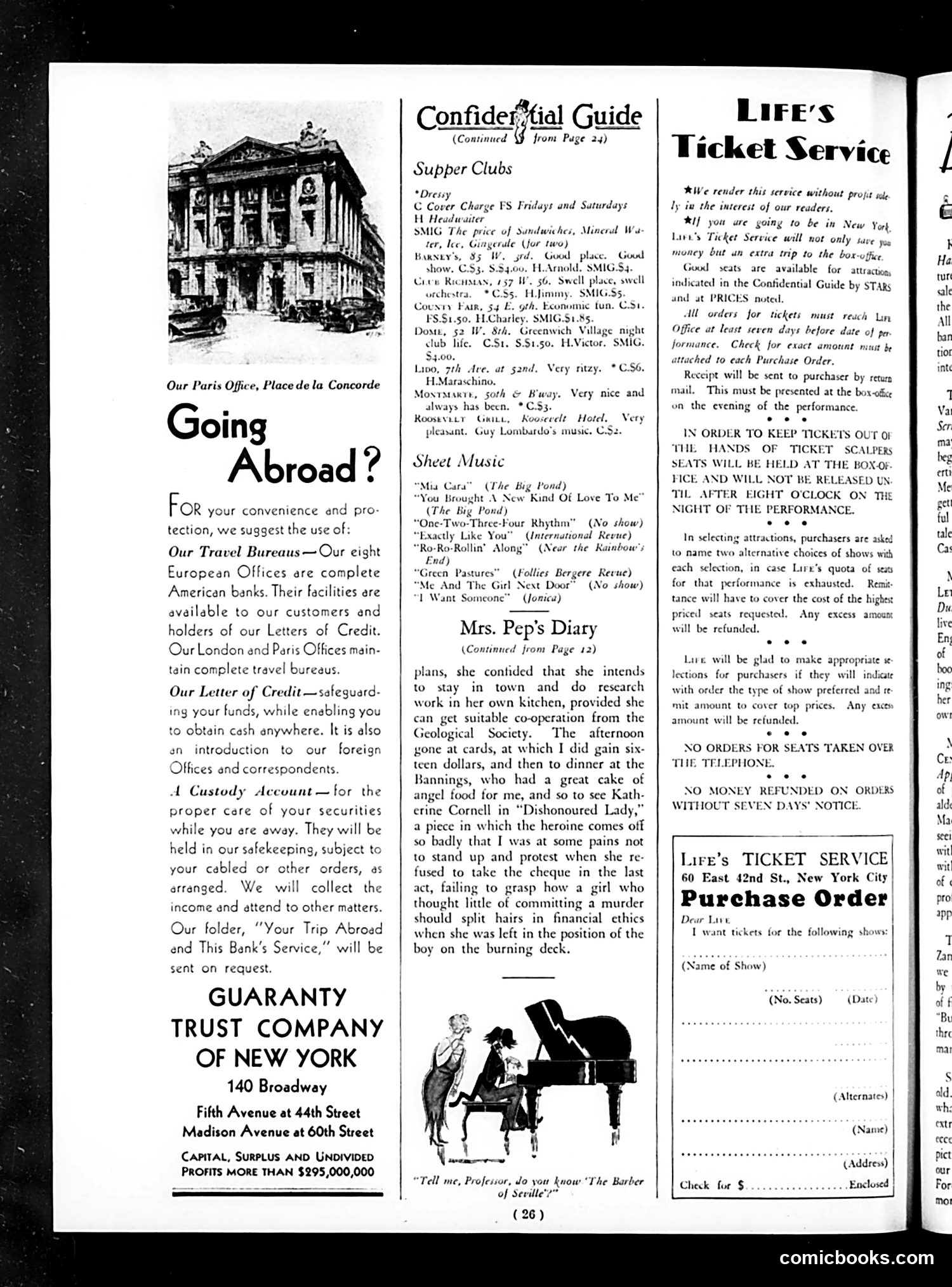
Page Analysis: Life Magazine Service Pages This page contains primarily advertising and service information, not political satire or social commentary. The content includes: 1. Guaranty Trust Company ad (left): A banking service promoting international travel assistance—letters of credit, foreign offices, and financial safeguarding for Americans traveling abroad. 2. "Confidential Guide" (center): A directory of New York nightlife—supper clubs with cover charges, headwaiter names, and sheet music listings from contemporary Broadway shows and revues (references to *The Big Pond*, *Follies Bergere Revue*, etc.). 3. "Mrs. Pep's Diary" excerpt: A humorous society column describing an upper-class woman's activities—cards, dinner at the Bannings, attending a Katherine Cornell theatrical performance. 4. Life's Ticket Service (right): Practical instructions for purchasing theater tickets through the magazine. No political cartoon or satirical commentary appears on this page. It's a standard service/directory page from Life magazine's entertainment section, aimed at affluent New York readers.
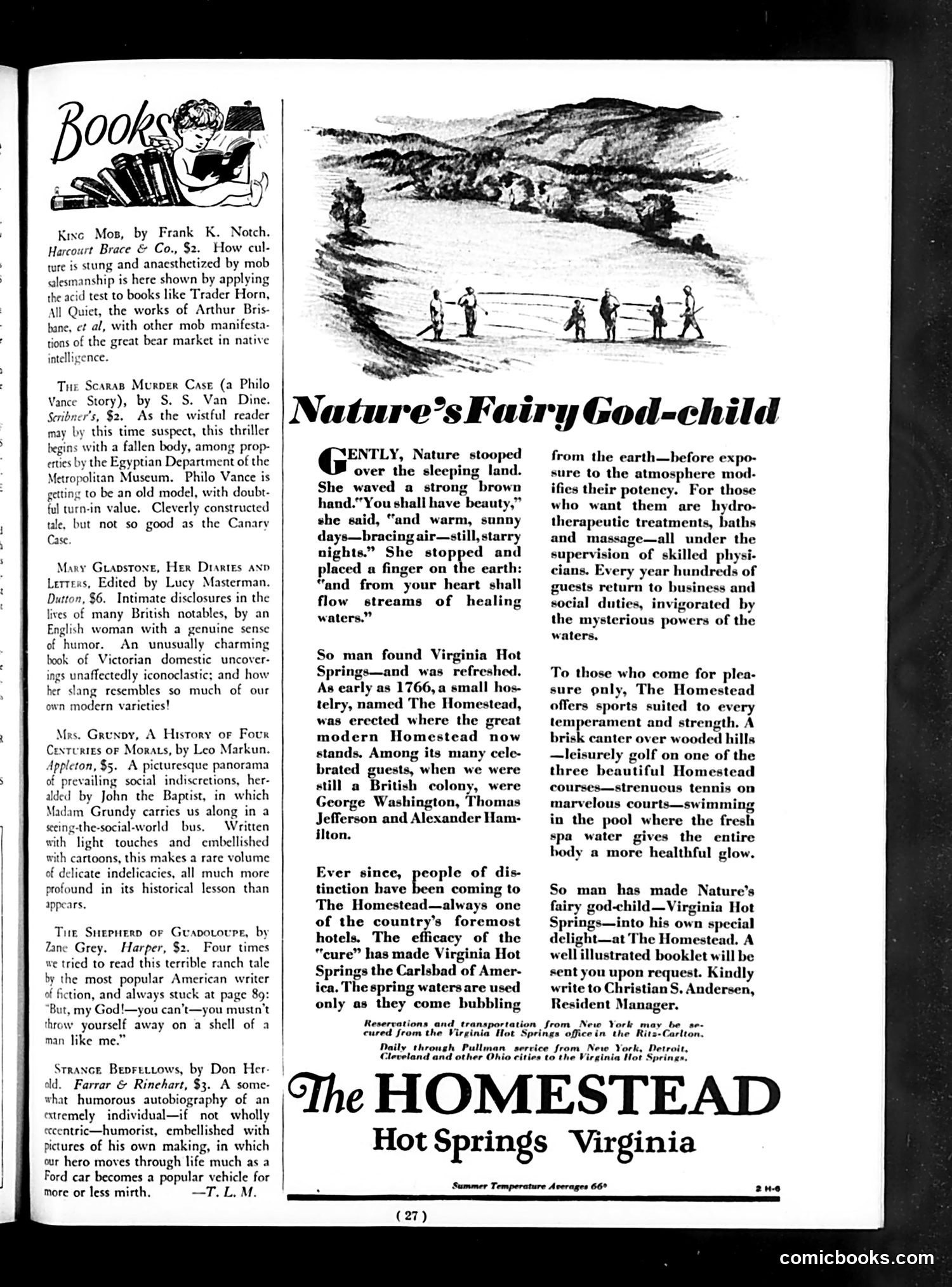
Analysis of This Life Magazine Page This page combines book reviews with a full-page advertisement for The Homestead resort in Hot Springs, Virginia. The book section (left column) contains satirical reviews of contemporary 1920s bestsellers, critiquing popular literature as intellectually shallow. The reviewer mocks "King Mob" for its "mob salesmanship," dismisses Zane Grey westerns as unreadable, and generally expresses skepticism about commercial fiction's cultural value. The advertisement (right side) uses romantic, almost mythological language to promote The Homestead. The narrative begins "Gently, Nature stooped over the sleeping land," personifying nature as a beneficent fairy godmother bestowing healing waters. The text emphasizes the resort's historical prestige—mentioning George Washington, Thomas Jefferson, and Alexander Hamilton as guests—to appeal to wealthy, status-conscious readers. The "cure" reference positions it as America's answer to Carlsbad (a famous European spa), promising rejuvenation through natural spring waters and therapeutic treatments. This juxtaposition of intellectual skepticism about popular culture with aspirational luxury marketing is characteristic of *Life* magazine's satirical stance toward American consumer society.
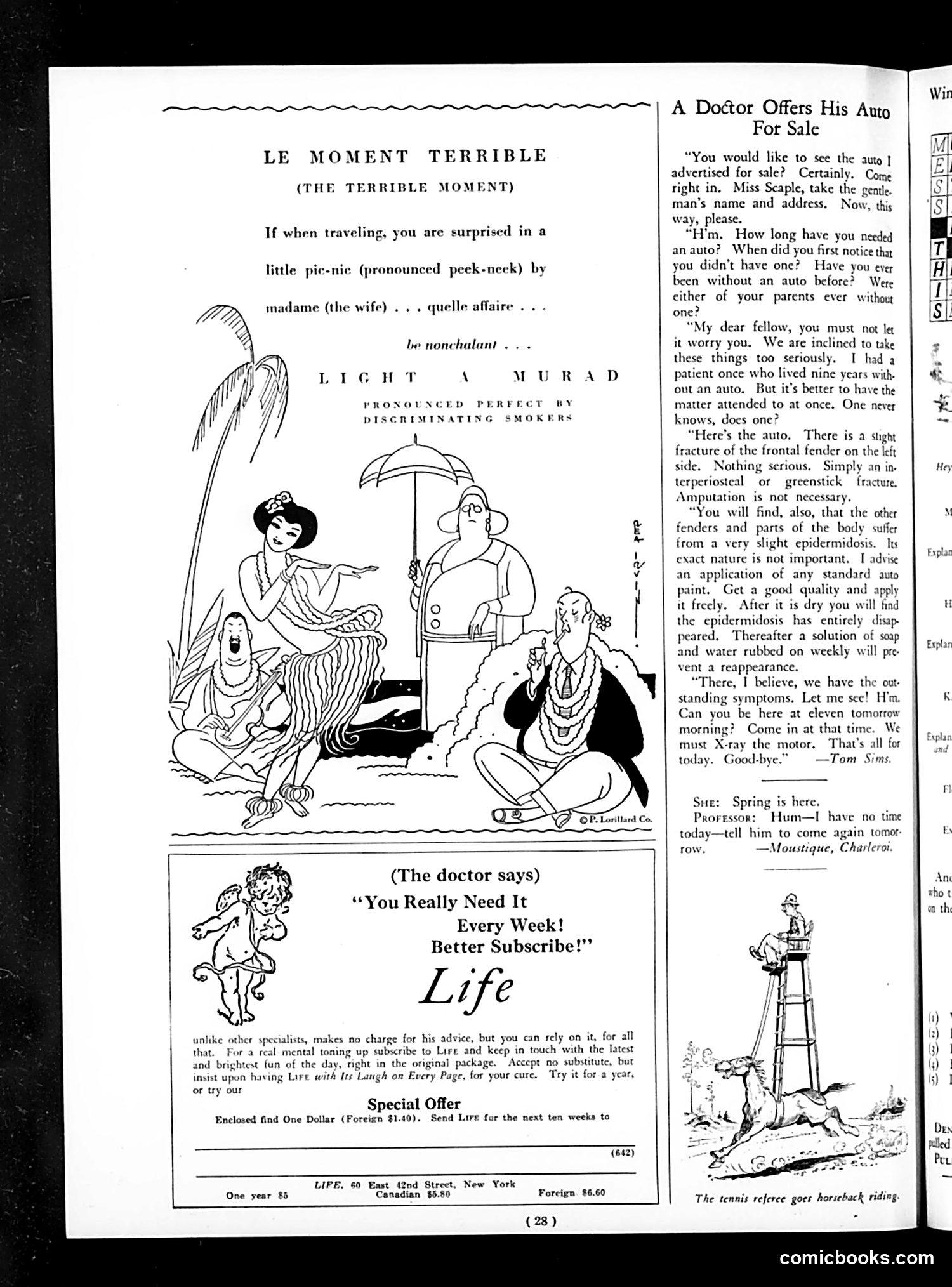
Analysis This page contains three distinct pieces of satire: "Le Moment Terrible" (top): A French-language cartoon about an awkward marital situation—a husband caught in a compromising position with a woman while traveling. The humor relies on the risqué implication and the phrase *"quelle affaire"* (what an affair). "A Doctor Offers His Auto For Sale" (right column): The main joke satirizes the American obsession with automobiles in the 1920s. A doctor treats a car's minor damage with absurdly medical language—diagnosing a dented fender as "frontal fender fracture" and rust as "epidermidosis." The satire mocks both the pseudo-scientific jargon doctors use and society's neurotic attachment to car ownership. The doctor even questions a patient who lived nine years without one, treating automobile-ownership like a psychological necessity. Advertisement: Life magazine promotes itself as mental health remedy, claiming readers "need it every week" for psychological well-being. The page reflects 1920s anxieties about modernity, consumerism, and status-consciousness.
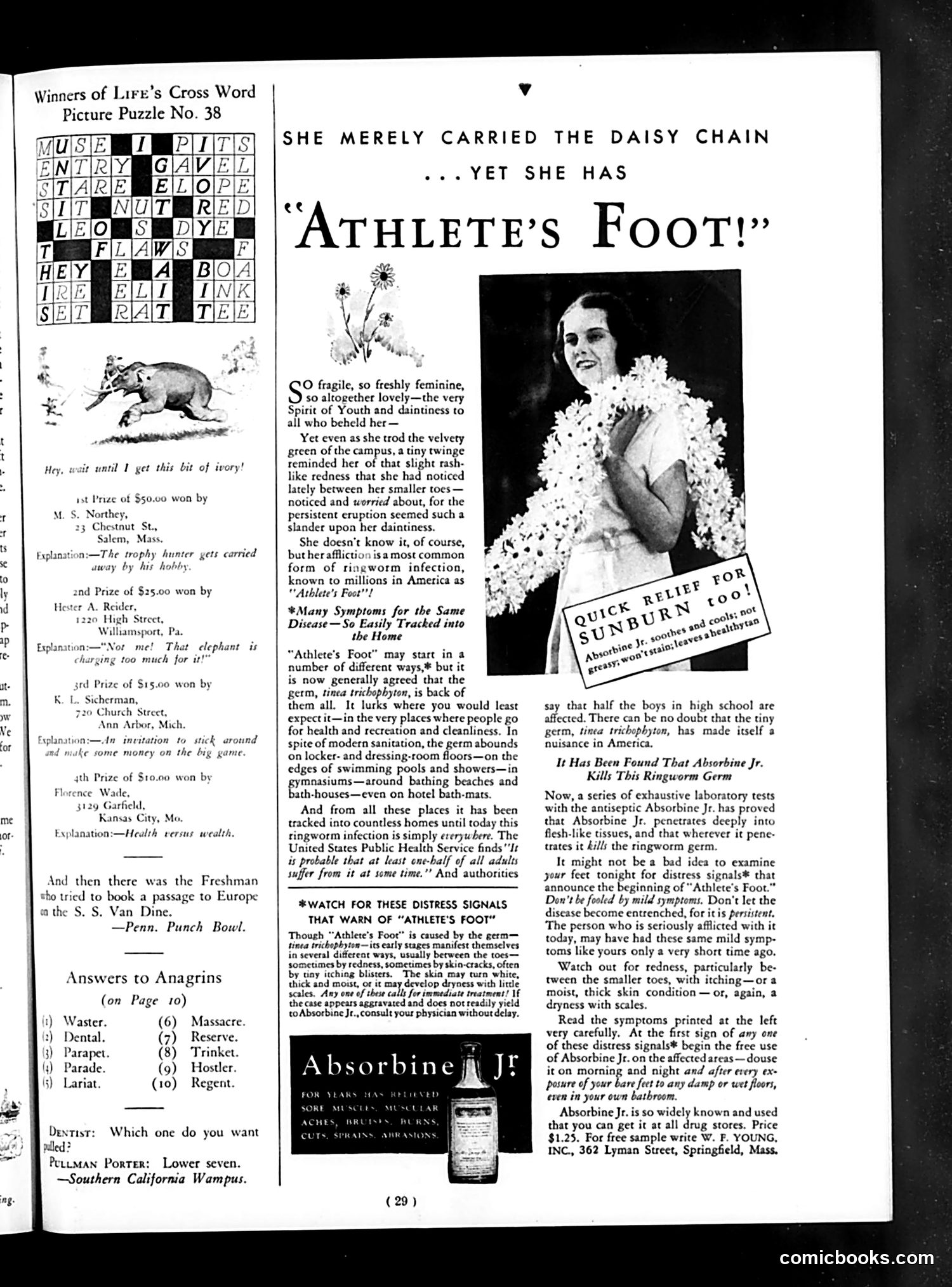
Analysis for Modern Readers This page contains a crossword puzzle contest and a full-page advertisement disguised as health journalism. The Advertisement: The main content promotes Absorbine Jr., a patent medicine, by presenting "Athlete's Foot" (ringworm infection) as a widespread health crisis. The accompanying photograph shows an elegantly dressed young woman with the caption sarcastically noting she has "Athlete's Foot" despite her refined appearance—the joke being that this unglamorous condition affects even the most fashionable people. The Satire: The ad employs fearmongering typical of early 20th-century patent medicine marketing: claims that the infection is "everywhere," affects "half of all adults," and can be contracted from public facilities. It then promises the product as a cure, citing vague "laboratory tests." Context: This reflects an era when advertising made exaggerated health claims without FDA regulation. The juxtaposition of the glamorous woman with an embarrassing foot condition exemplifies how such ads exploited social anxieties about cleanliness and respectability to drive sales.
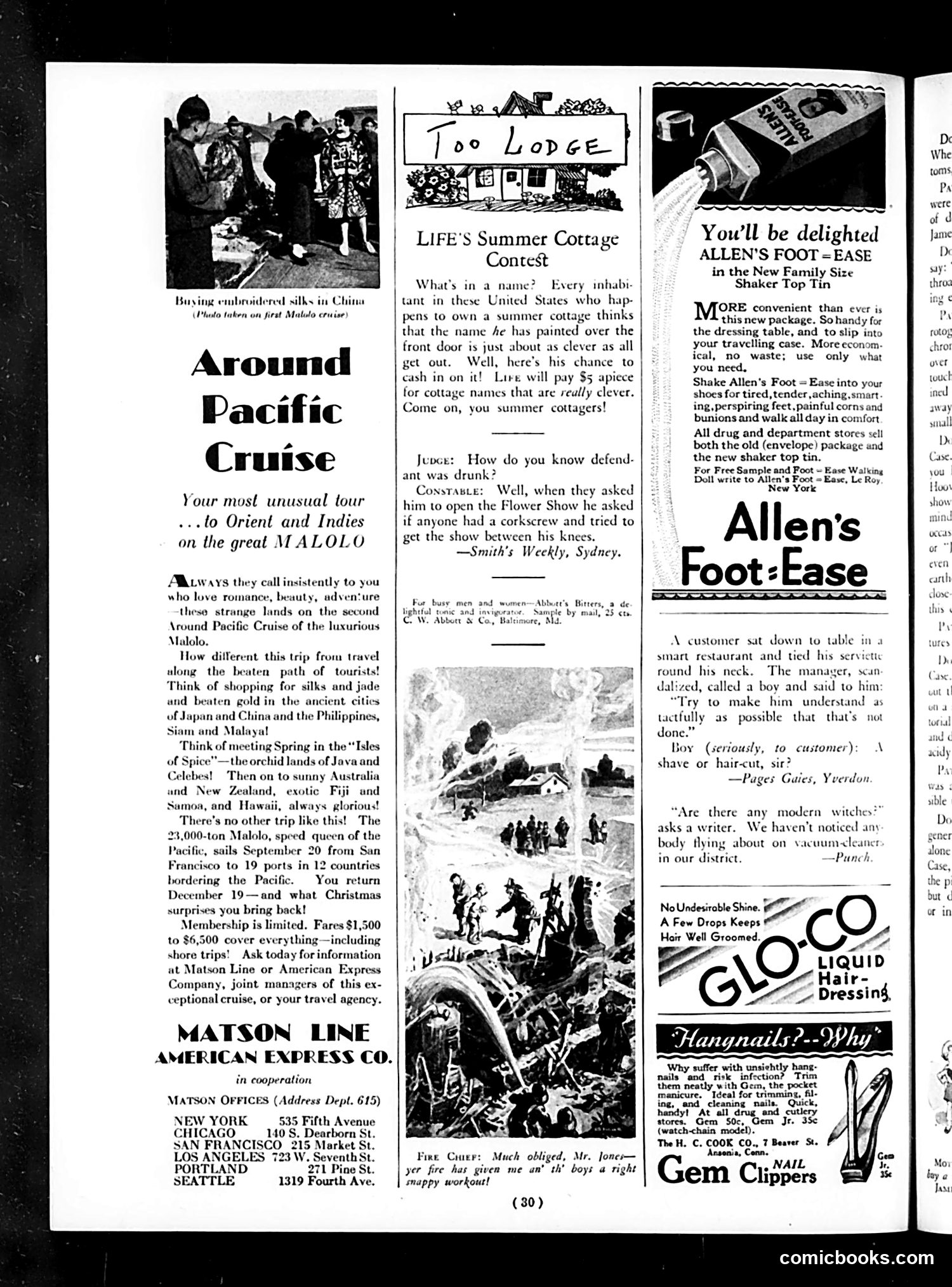
Page Analysis: Life Magazine Advertisement and Humor Page This page is primarily advertising and light humor, not political satire. The main content includes: "Around Pacific Cruise": A travel advertisement for the luxury ship *Malolo*, promoting a 12-country Pacific cruise departing September 20, operated by Matson Line and American Express. The accompanying photo shows tourists buying silks in China—typical colonial-era leisure travel imagery. "Life's Summer Cottage Contest": A humor section inviting readers to submit clever summer cottage names for $5 each, with a Sydney newspaper joke about a drunk man trying to open a Flower Show with a corkscrew. Product Advertisements: The right column features ads for Allen's Foot-Ease powder, Gloco hair dressing, and Gem nail clippers—typical 1920s-30s personal grooming products with light humor copy. The page reflects 1920s-30s consumer culture: leisure travel for the wealthy, health/beauty products marketed as convenient and modern, and gentle humor about domesticity. No significant political content is present.
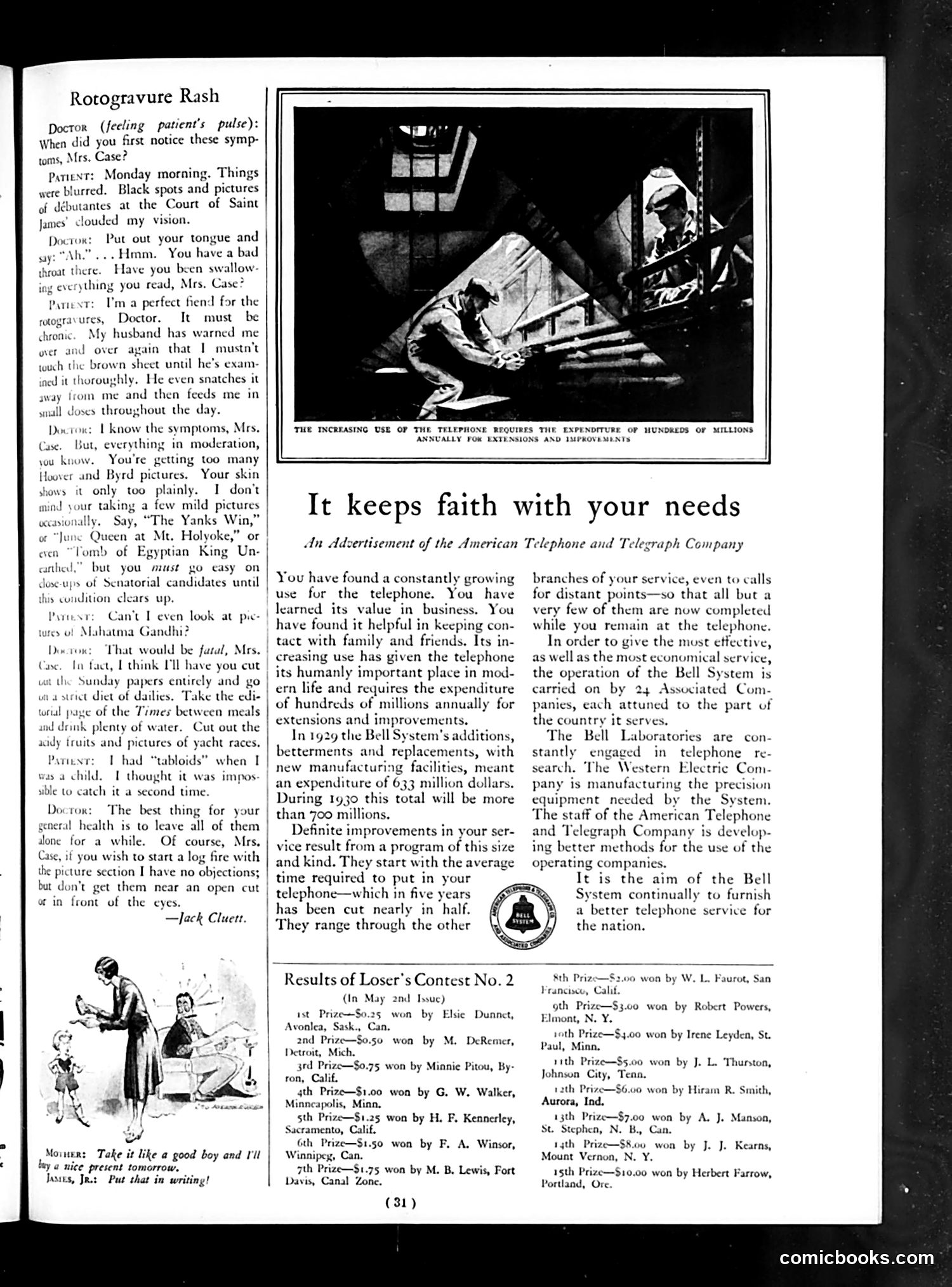
"Rotogravure Rash": A 1930 Medical Satire This cartoon mocks the era's obsession with illustrated newspapers and magazines—particularly the newly popular "rotogravure" picture sections. A doctor diagnoses "Mrs. Case" with an addiction to photographic images, warning that excessive consumption of pictures (of debutantes, politicians like Hoover and Byrd, and Mahatma Gandhi) causes physical illness: blurred vision and black spots. The joke reflects genuine anxiety about mass media's proliferation. By 1930, illustrated rotogravure supplements were expanding rapidly in newspapers, and cultural critics worried about their addictive quality and social impact. The cartoon presents picture-consumption as a vice requiring medical intervention—a satirical exaggeration that captures real contemporary concerns about changing media habits and their effects on readers' minds and vision. The humor lies in treating a modern cultural phenomenon as a medical pathology.
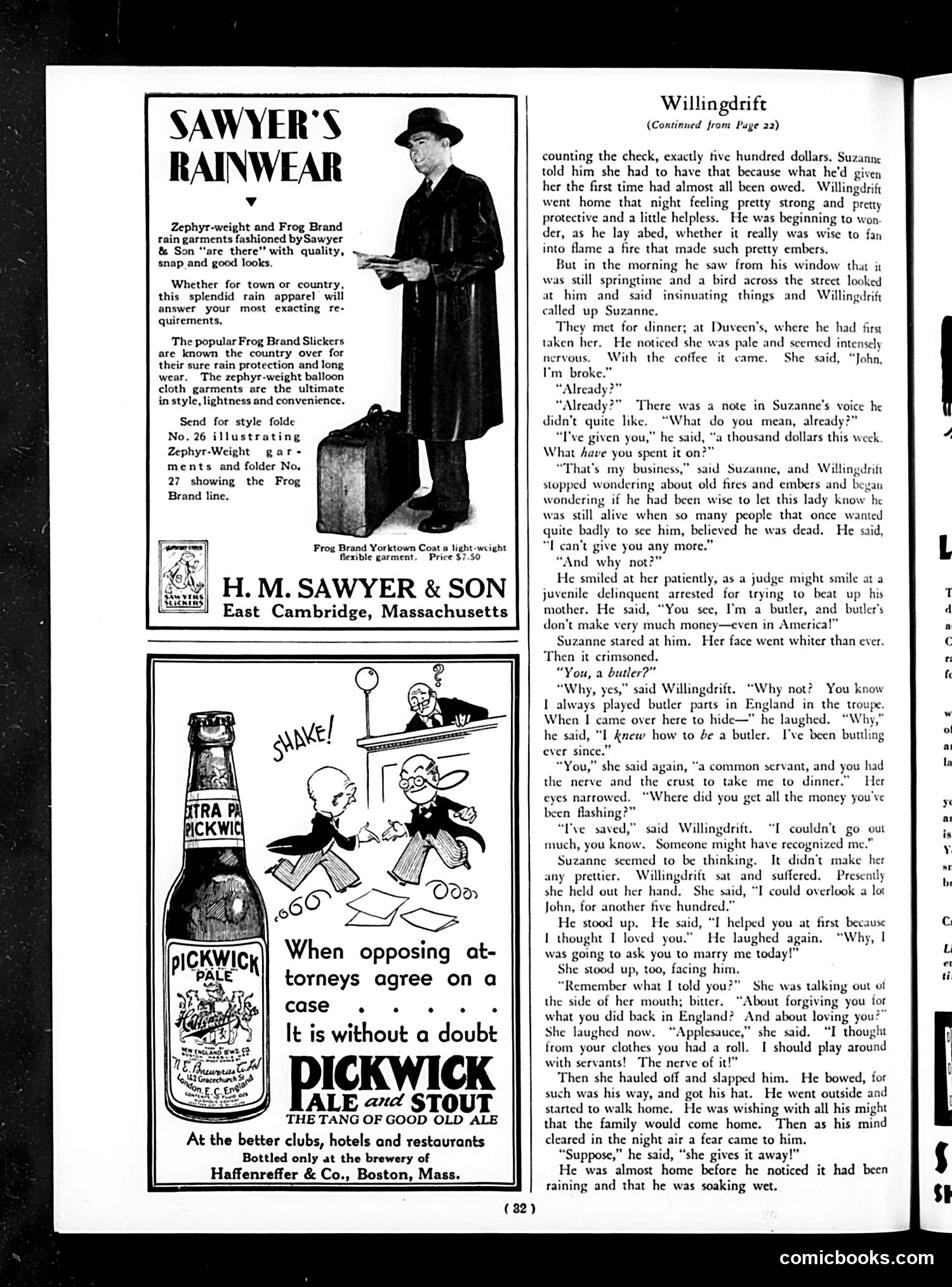
Analysis of This Life Magazine Page This page contains two unrelated advertisements and a serialized fiction story. The Advertisements: Sawyer's Rainwear (top left): A straightforward product ad for rain coats, featuring a man in formal dress with luggage—standard early 20th-century marketing. Pickwick Ale & Stout (bottom left): A humorous ad with a cartoon showing two opposing lawyers shaking hands over scattered papers. The joke: "When opposing attorneys agree on a case... It is without a doubt DICKWICK." This is a pun playing on the product name and suggesting the beer is so good that even adversaries would unanimously endorse it. The Story: "Willingdrift" (right side, continued from page 22) is a serialized romantic drama about a butler named John Willingdrift and a woman named Suzanne. The excerpt shows their relationship deteriorating: he's been secretly wealthy but posed as a servant; she's been spending his money recklessly; she's now angry discovering his true profession. It's a period romance with class-conflict themes typical of the era's magazine fiction.
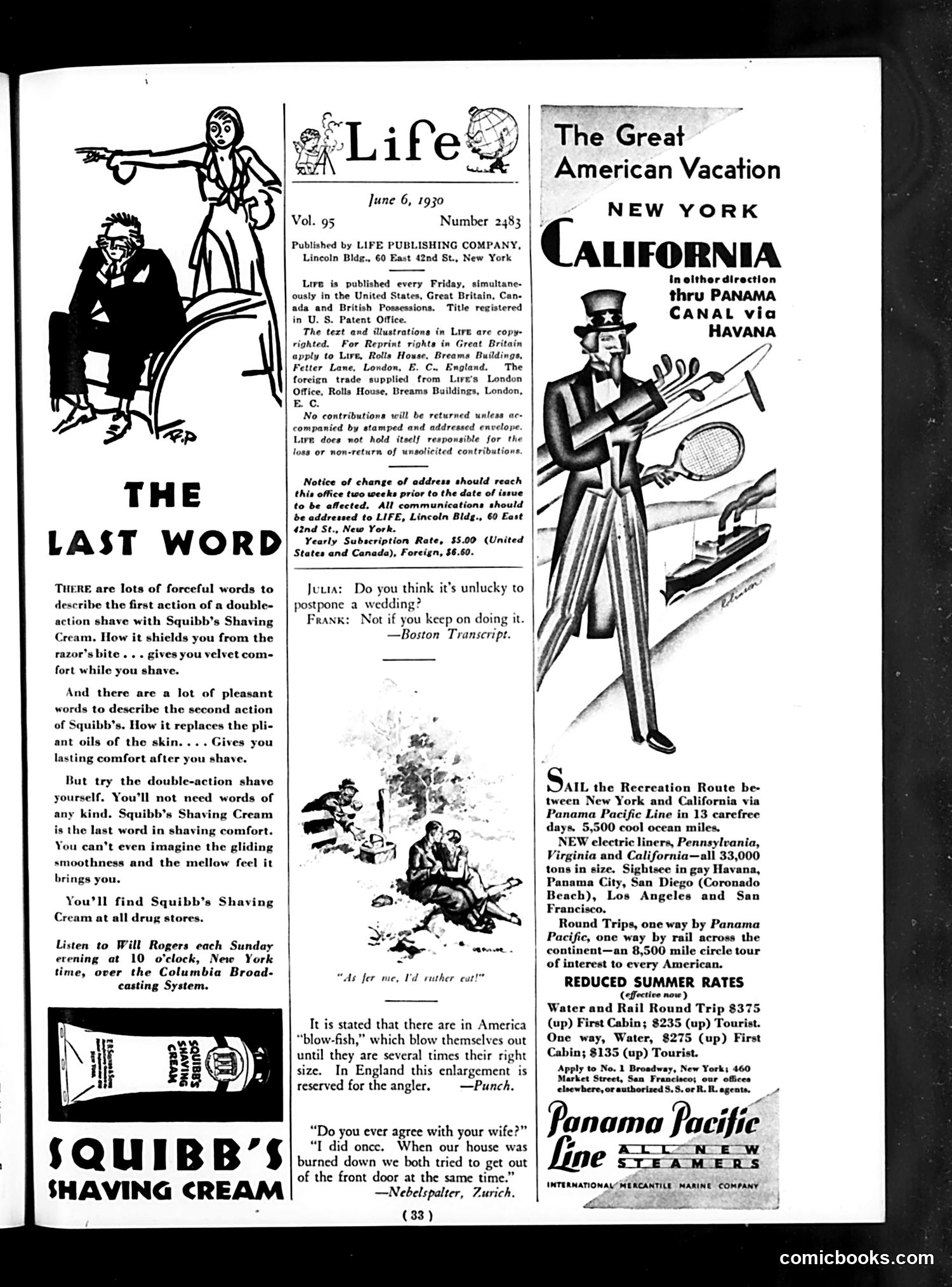
Life Magazine, June 6, 1930: Content Analysis This page is primarily advertising and editorial content rather than political satire. "The Last Word" is a Squibb's Shaving Cream advertisement emphasizing the product's two-stage comfort benefits. The accompanying cartoon shows exaggerated figures—likely caricatures of working-class men—discussing shaving, though the specific identities are unclear. Humor snippets include jokes about postponed weddings, blow-fish enlargement, and marital disagreement—light social comedy unrelated to politics. The major content is travel advertising: the Panama Pacific Line promotes luxury vacation cruises from New York to California via the Panama Canal and Havana, highlighting new electric liners and reduced summer rates. This reflects 1930s leisure marketing to affluent Americans during the early Great Depression period. The page demonstrates how Life magazine balanced satirical humor with advertising revenue. No significant political commentary is present.
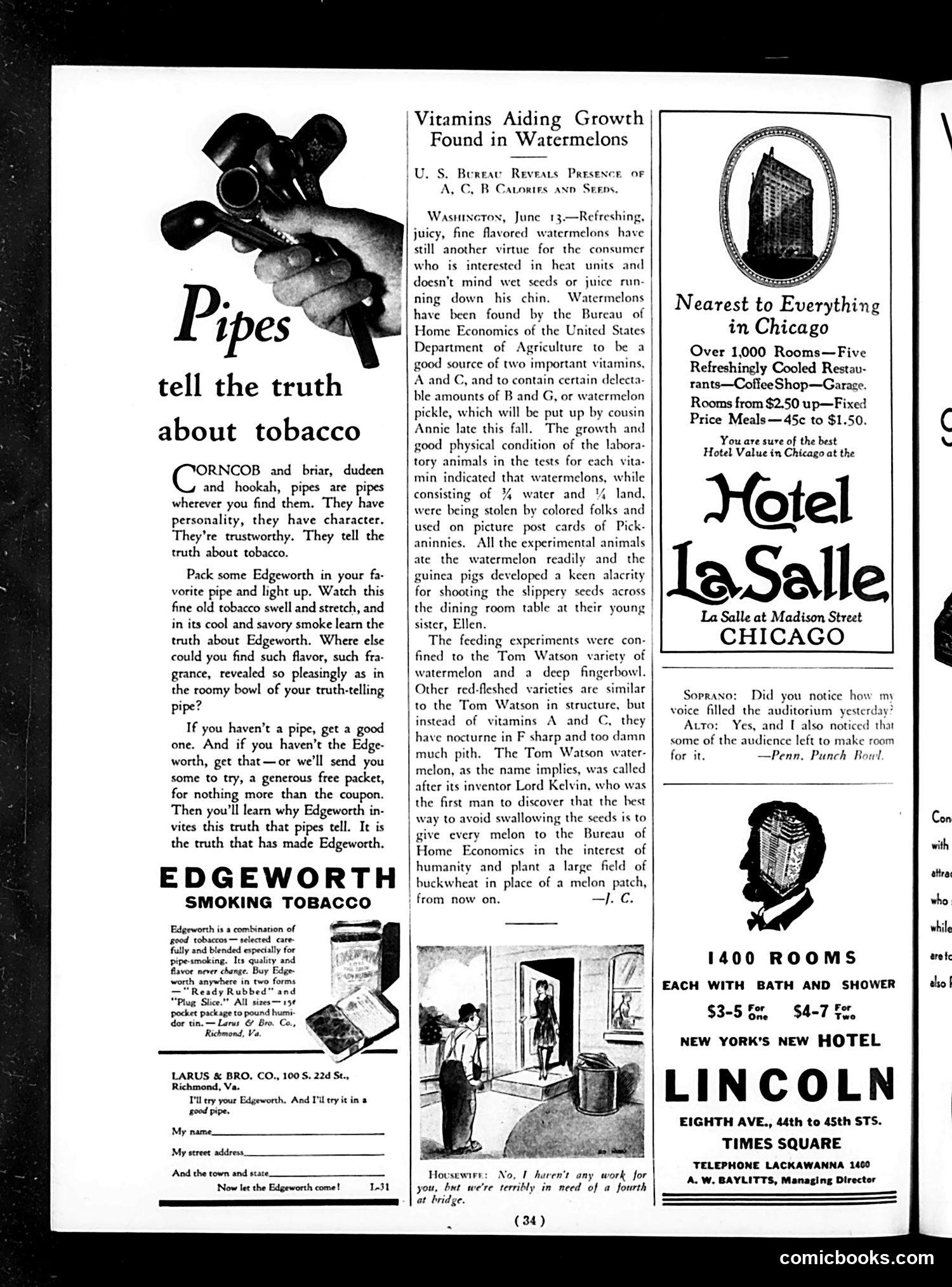
Page Analysis This page from *Life* magazine contains primarily advertisements rather than political cartoons. The main content is an Edgeworth Smoking Tobacco ad using the slogan "Pipes tell the truth about tobacco"—a straightforward marketing appeal claiming pipes reveal tobacco's "true" flavor and quality. The ad invites readers to try free samples via coupon. The center column contains a humorous piece titled "Vitamins Aiding Growth Found in Watermelons," which appears to be satirical pseudo-scientific writing mocking government agricultural research. It makes absurd claims (watermelon inventor "Lord Kelvin," nocturne in F sharp) and includes a racist stereotype about "colored folks" stealing watermelons—reflecting the deeply prejudiced attitudes of the era. The page also advertises Hotel La Salle (Chicago) and the Lincoln Hotel (New York). A small cartoon at bottom shows a dinner party exchange where a soprano boasts about filling an auditorium with her voice; an alto replies the audience left to make room for it—a mild joke about bad singing. The page is primarily commercial, not satirical political content.
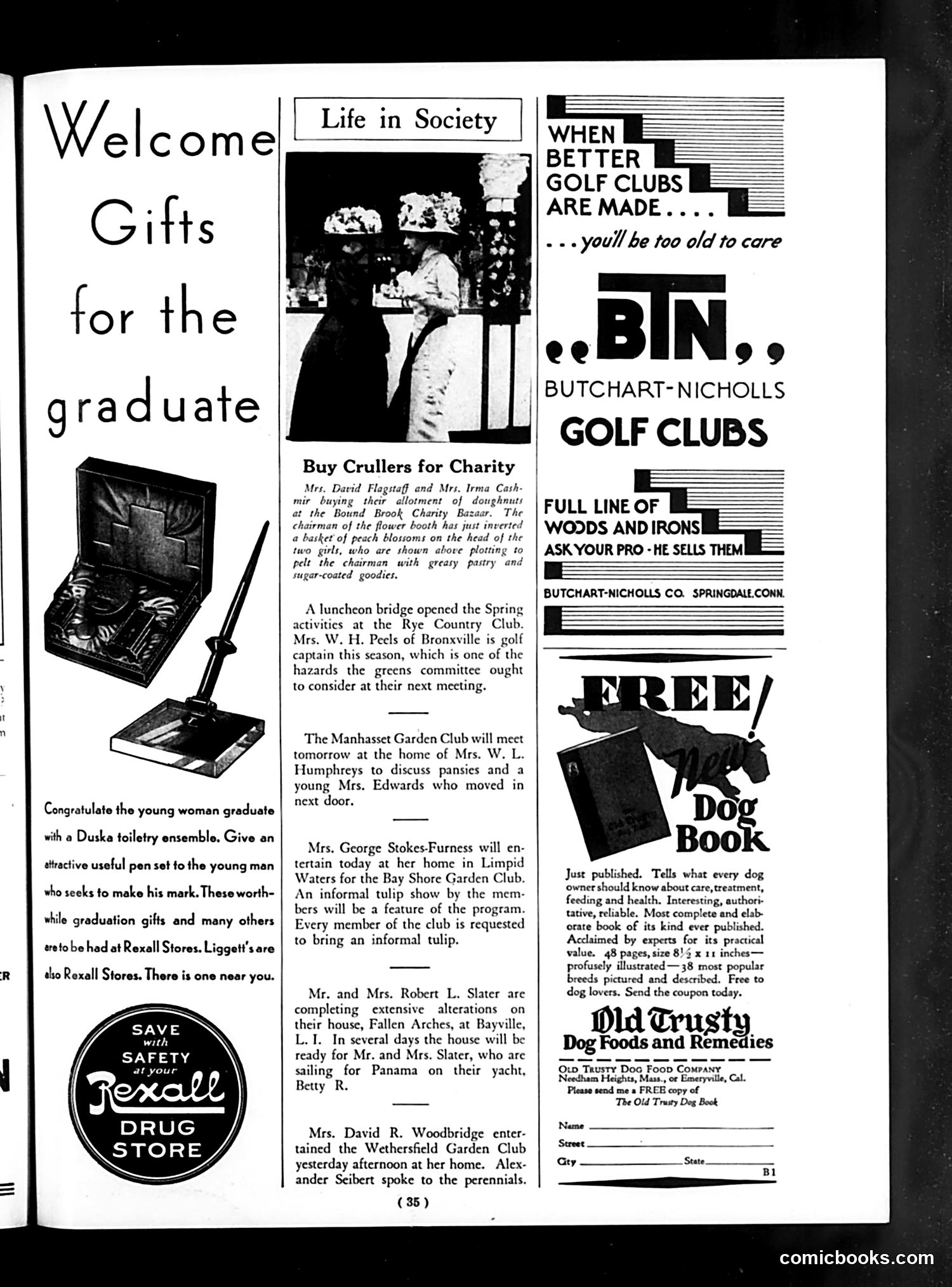
Analysis of Life Magazine Page Content This page combines graduation gift advertising with satirical society gossip. The "Life in Society" section mocks upper-class suburban social activities—charity bazaars, country club events, garden club meetings—through deadpan humor. The satire works through absurdist details: a woman becomes golf captain despite being "one of the hazards," neighbors gossip about a newly arrived Mrs. Edwards, and a house is humorously named "Fallen Arches." The peach-blossom incident shows socialites planning food fights at charity events, undercutting the pretense of charitable good works. The adjacent Butchart-Nicholls golf club ad contains self-deprecating humor: "When better golf clubs are made... you'll be too old to care"—mocking both consumer aspirations and aging. The page reflects Life magazine's satirical approach to American consumer culture and suburban social hierarchies, gently ridiculing the aspirational leisure class through witty observation rather than harsh critique.
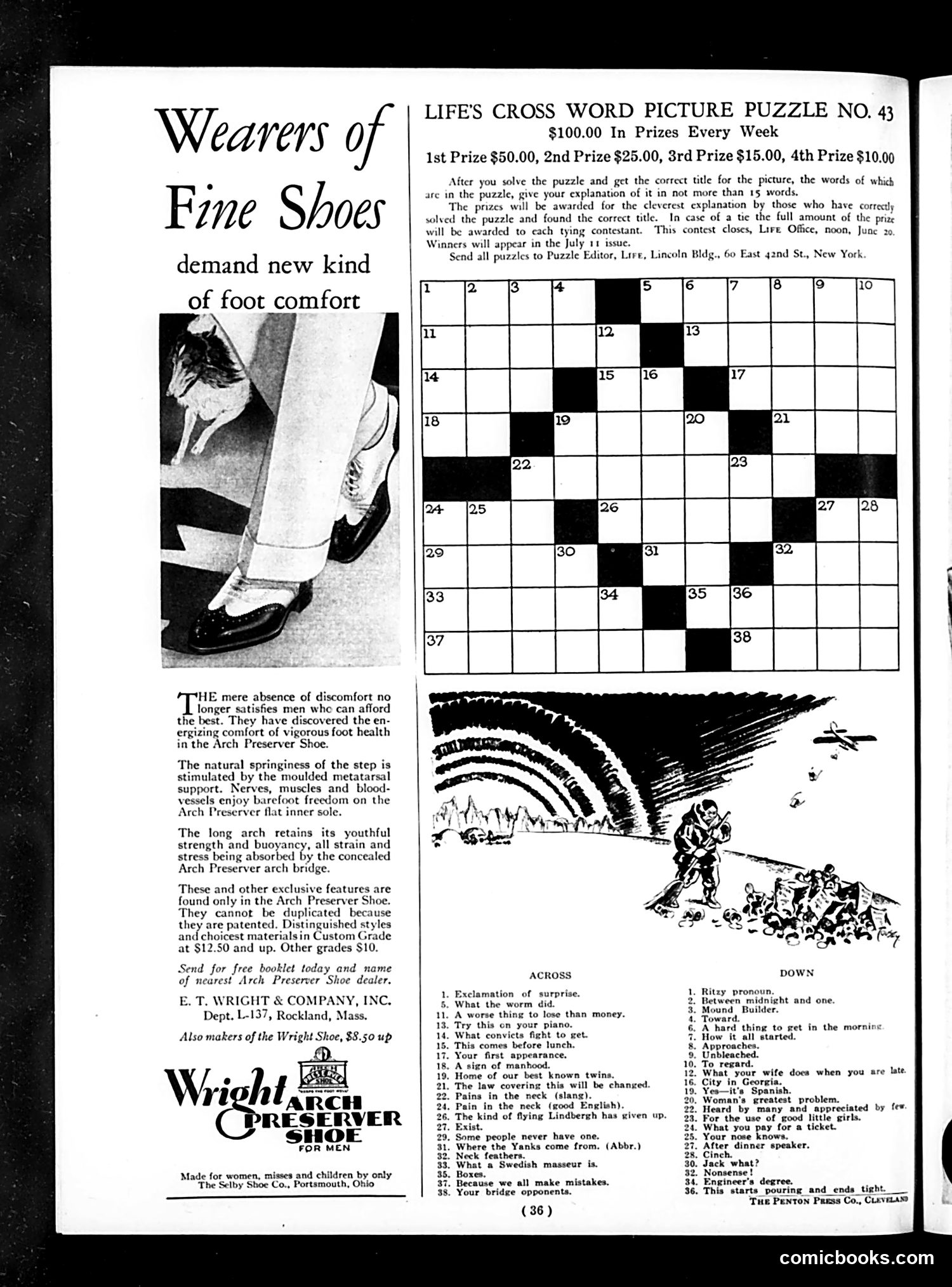
Life Magazine Crossword Puzzle Page This page is primarily advertising and a puzzle contest, not political satire. The main content features an Arch Preserver Shoe advertisement with a photograph of elegant women's feet in fine shoes, emphasizing "foot comfort" and patented arch support technology. The ad copy appeals to wealthy consumers seeking health benefits beyond mere comfort. Below is Life's crossword picture puzzle #43, a regular competition offering $100 in weekly prizes (largest prize $50). Solvers must identify the picture's title and explain it in 15 words. Winners appear in the July 11 issue. The puzzle clues reference contemporary 1920s-30s topics: Lindbergh's aviation, Swedish massage, convicts, and bridge opponents—typical wordplay for educated readers of Life magazine. This is standard magazine content: entertainment mixed with luxury advertising targeting affluent audiences.
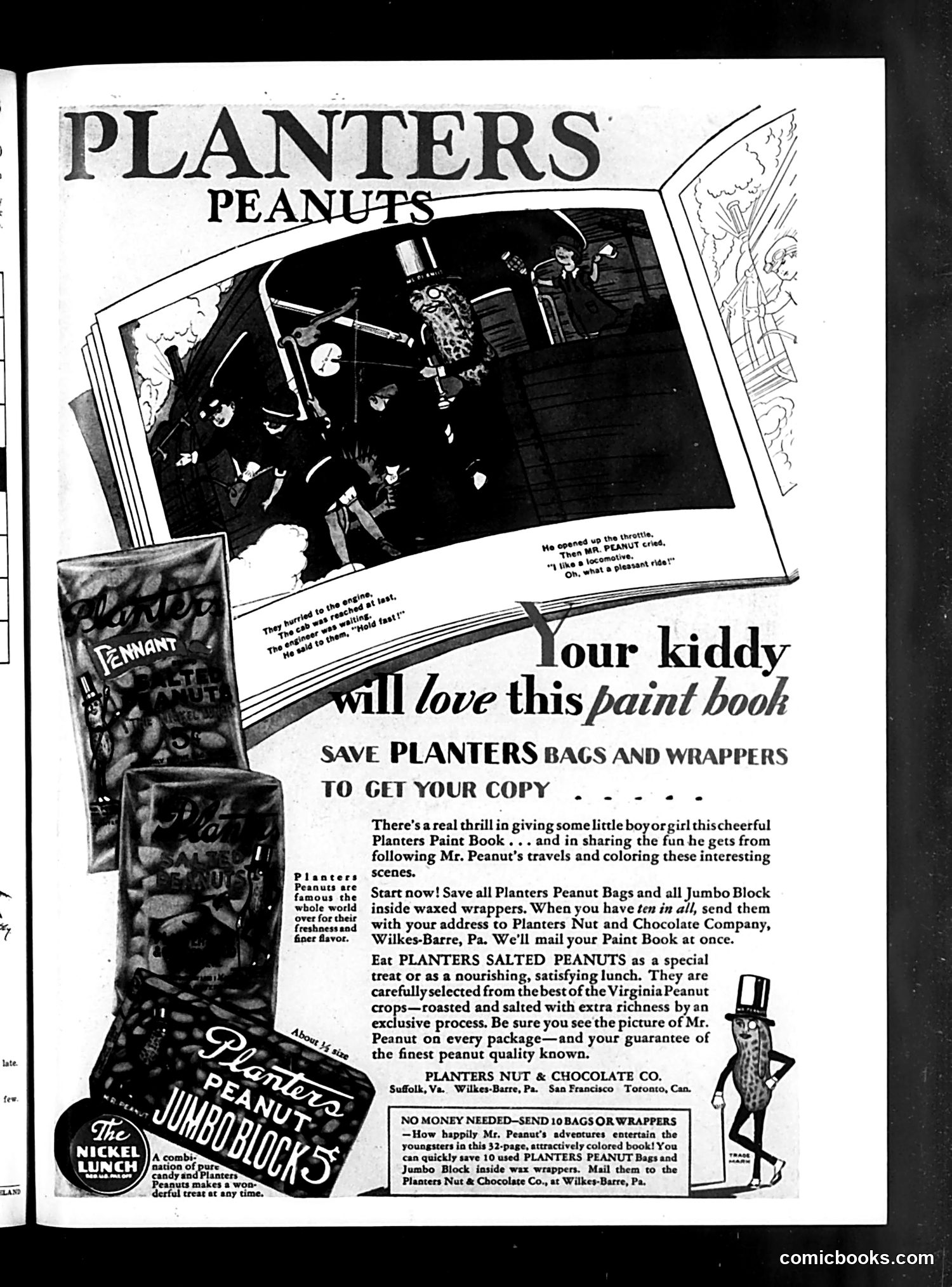
Analysis This is primarily a Planters Peanuts advertisement, not political satire. The page promotes a children's paint book featuring Mr. Peanut, the brand's mascot (the anthropomorphic peanut in top hat visible throughout). The offer: Consumers could collect 10 Planters peanut bags/wrappers and mail them to receive a free coloring/paint book showing Mr. Peanut's "travels and adventures." The image at top appears to show a scene from Mr. Peanut's fictional adventures—possibly depicting transportation or action—meant to appeal to children. Marketing strategy: This was a mid-20th-century promotional technique: collecting product packaging incentivized repeat purchases while providing children entertainment, making parents more likely to buy the brand. The "Nickel Lunch" reference on the left indicates peanuts were affordable, everyday food for working-class families. There is no political cartoon or satire here—this is straightforward vintage product advertising using collectible premiums as a sales tool.
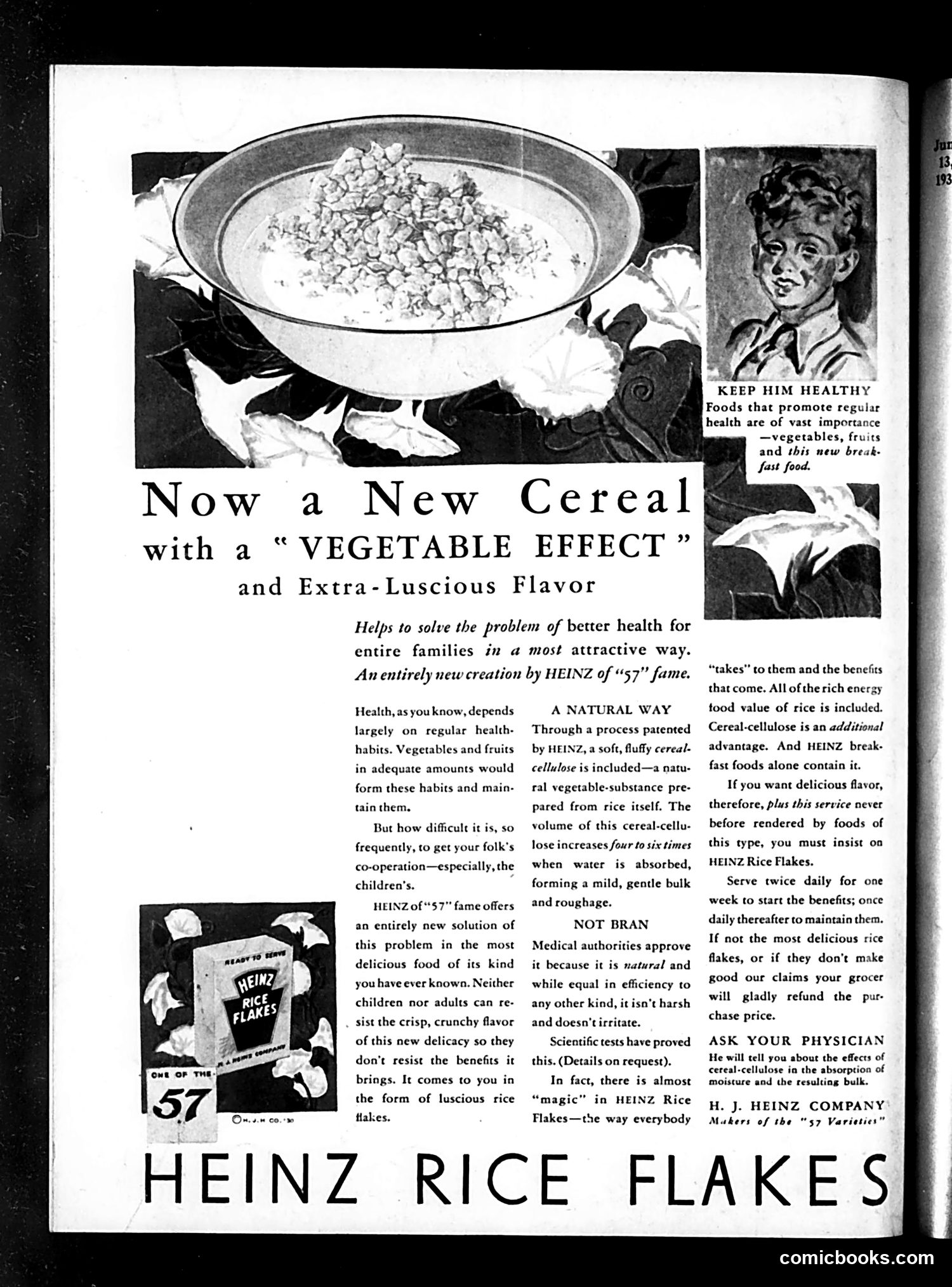
Heinz Rice Flakes Advertisement Analysis This is a full-page advertisement, not satire or political commentary. It promotes Heinz's new Rice Flakes cereal (circa 1920s-30s, based on style). The ad addresses a genuine parental concern of the era: getting children to eat vegetables for health. It positions Rice Flakes as solving this problem by incorporating "cereal-cellulose"—a vegetable substance derived from rice that increases bulk when digested, mimicking the digestive benefits of vegetables without tasting like them. Key selling points included: - Appeals to health-conscious parents ("Keep Him Healthy") - Claims medical/scientific approval - Promises palatability children won't resist - Offers a money-back guarantee The accompanying illustrations show a bowl of cereal and portraits emphasizing healthy, well-fed children. This reflects early 20th-century wellness marketing that positioned processed foods as modern, scientific solutions to nutritional challenges—a now-familiar advertising strategy.