life
Life — June 20, 1930
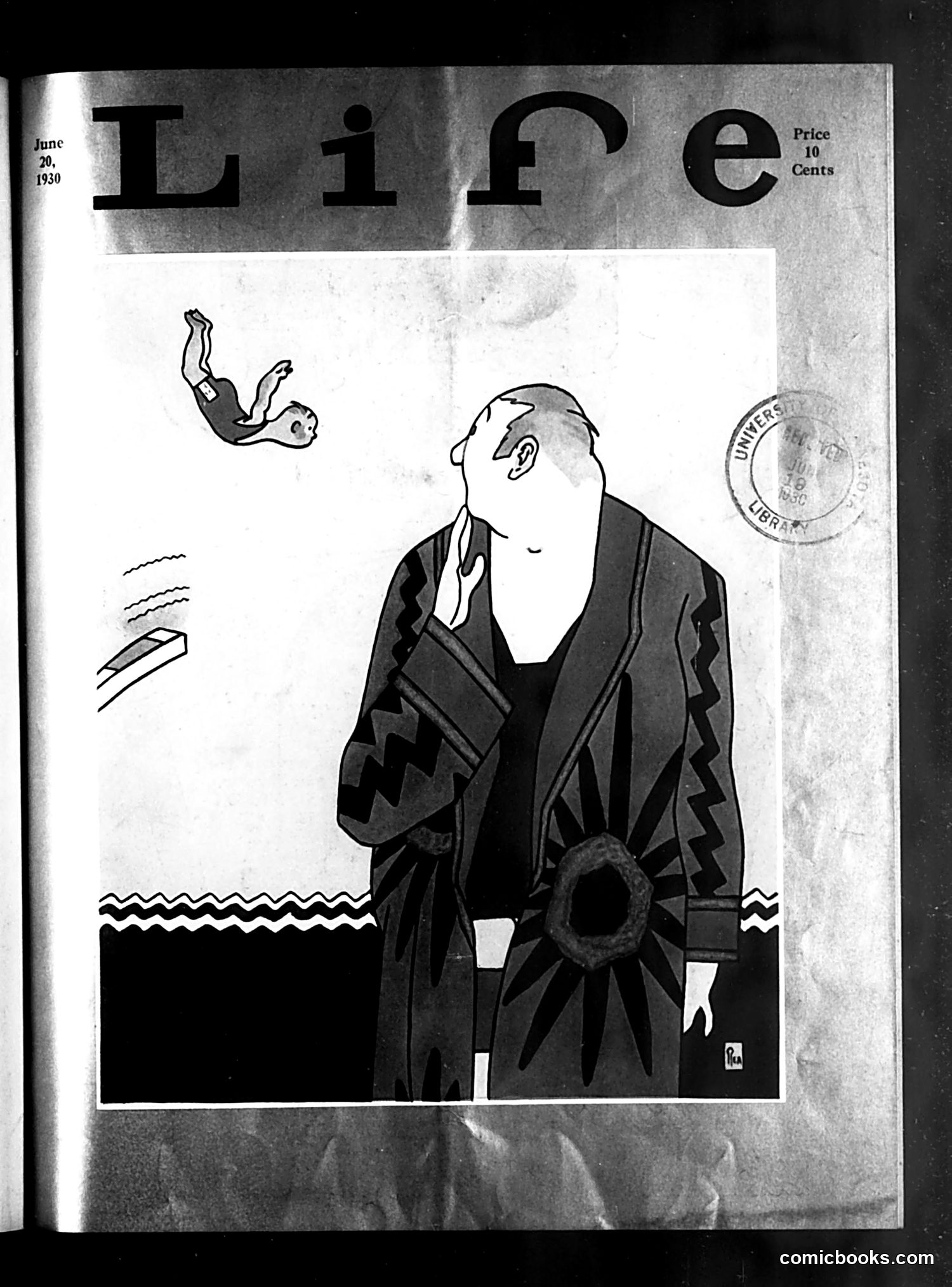
Life Magazine Cover - June 20, 1930 This cover depicts a man in a ship captain's uniform at a ship's wheel, looking distressed as a small figure tumbles from above into the water. The captain appears to be losing control—his facial expression conveys alarm or despair. Given the June 1930 date, this likely references economic or maritime concerns during the early Great Depression. The imagery suggests incompetent leadership or a crisis situation spiraling out of control. The man overboard and the captain's distressed demeanor indicate disaster or catastrophe. Without additional text visible, the specific political figure or event referenced remains unclear, though the satirical commentary appears to critique whoever commands this "ship"—possibly a government or business leader blamed for current crises.
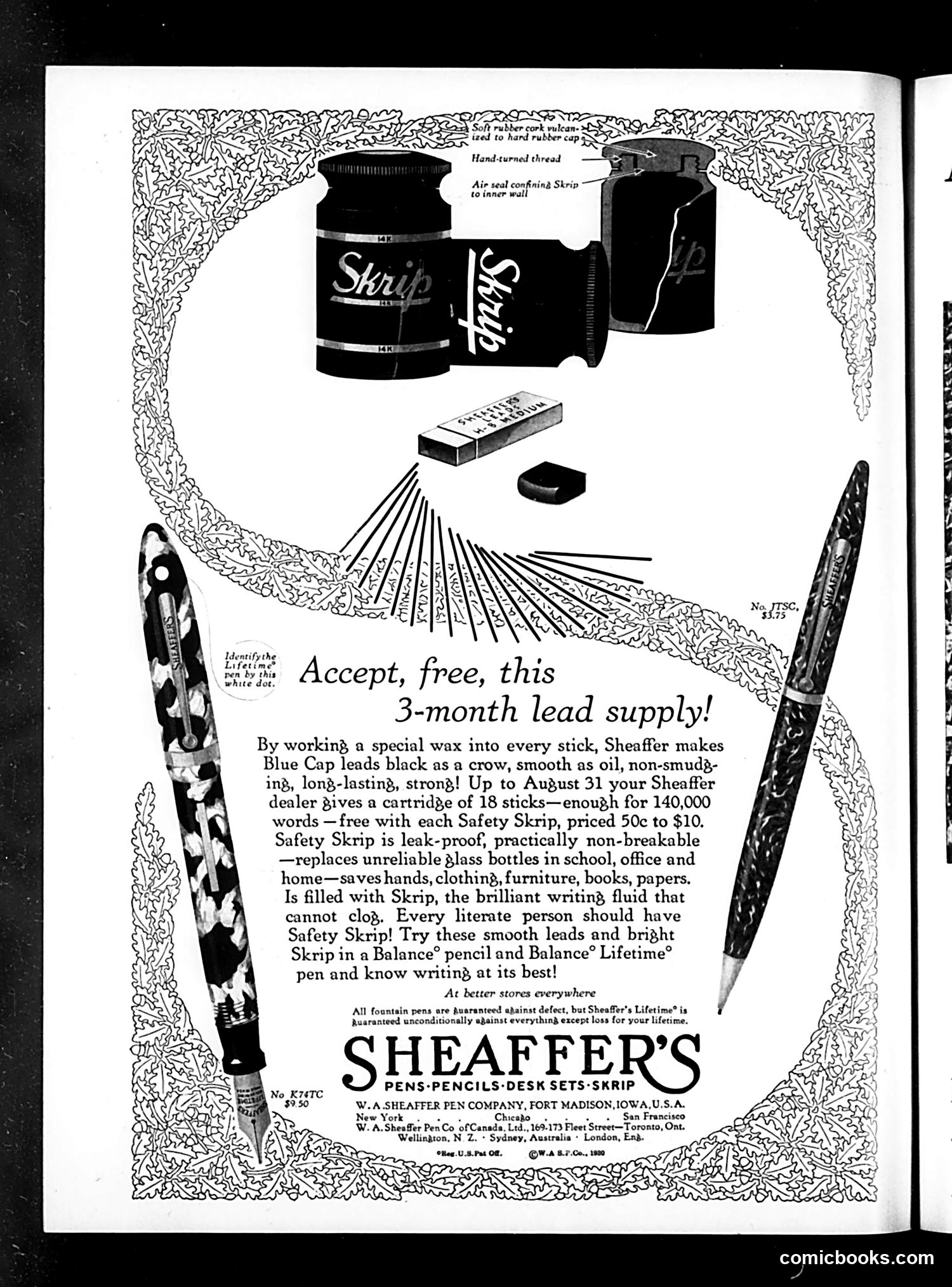
Analysis This is not a political cartoon or satire—it's a straightforward advertisement for Sheaffer pens and pencils, specifically promoting their "Safety Skip" fountain pen ink product. The ad offers a promotional giveaway: purchasing Sheaffer pencils (priced 50¢ to $10) includes a free 3-month supply of "Safety Skip" ink. The text emphasizes the product's qualities: the ink writes smoothly, resists smudging, and won't clog. It highlights practical benefits like being leak-proof and suitable for school and office use. The decorative border and illustrated pens are standard design elements of the era's advertising. There is no political commentary or hidden satire—this is period marketing material aimed at consumers interested in writing instruments.
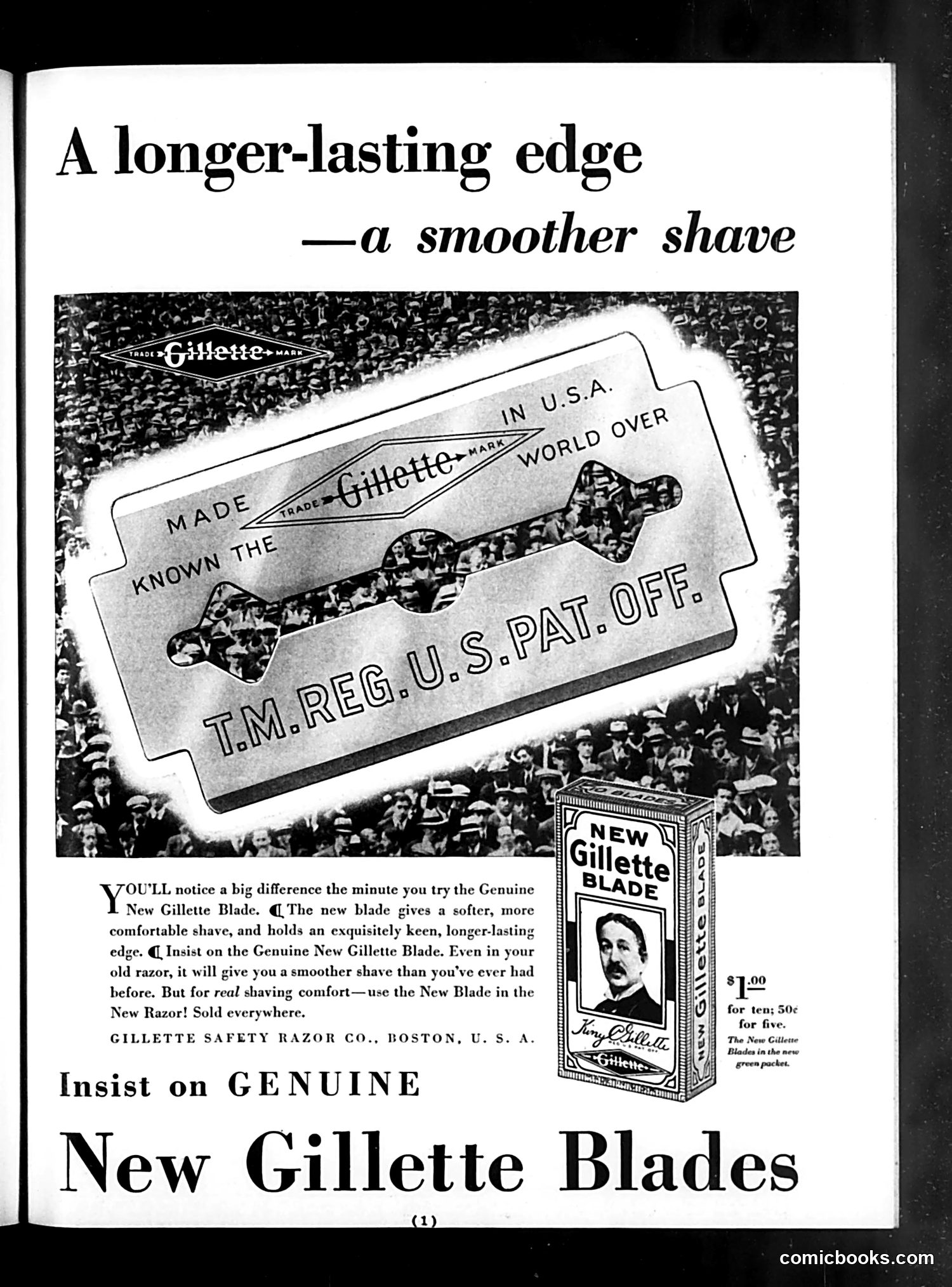
This is a Gillette Safety Razor advertisement, not political satire or a cartoon. The ad promotes the "New Gillette Blade," emphasizing its longer-lasting edge and smoother shave. The large central image shows a Gillette razor blade package displayed prominently against a crowded background (appearing to show masses of people), suggesting the product's widespread popularity and market dominance. The text claims the new blade provides superior comfort and a keener edge than competitors. It encourages consumers to "insist on GENUINE" blades and use them "in the New Razor" for optimal results. Pricing information indicates ten blades cost $1.00, or fifty cents for five. The Gillette Safety Razor Company, based in Boston, is identified as the manufacturer. This is straightforward early 20th-century consumer product advertising with no satirical intent.
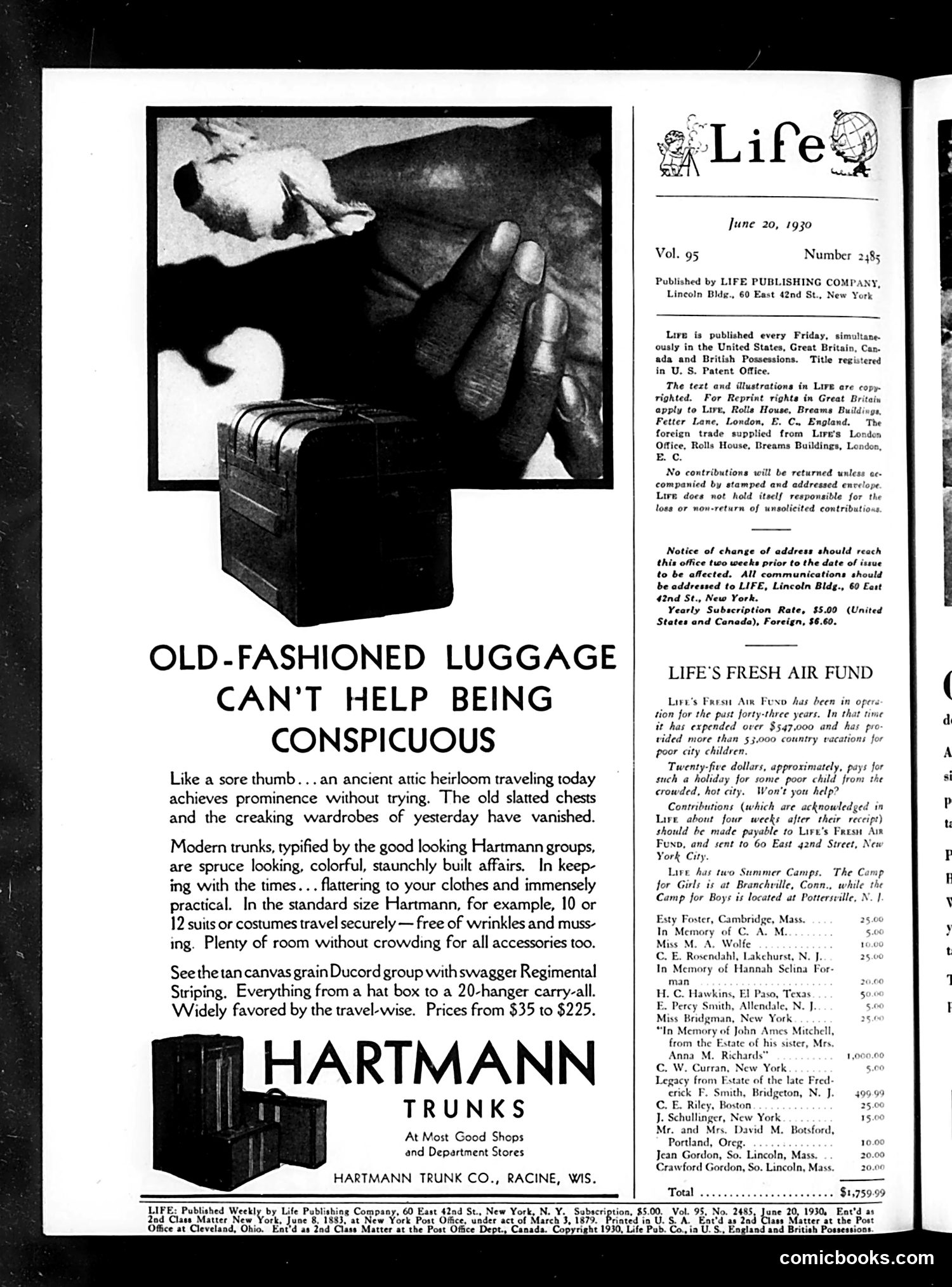
Analysis This page is primarily advertising, not political satire. The main content is a Hartmann Trunks advertisement, which dominates the lower half of the page. The ad's visual joke contrasts old-fashioned luggage (shown in a photograph at top—an old steamer trunk being held by hands) with modern Hartmann trunks. The headline plays on this: old luggage "can't help being conspicuous" because it looks dated and cumbersome, like "a sore thumb" or "ancient attic heirloom." The advertisement promotes Hartmann's modern, sleek trunks as practical travel solutions for contemporary travelers who want to avoid the visual embarrassment of outdated baggage. Prices range from $35 to $225. The right column contains Life magazine's "Fresh Air Fund" announcement—a charitable initiative unrelated to the advertisement.
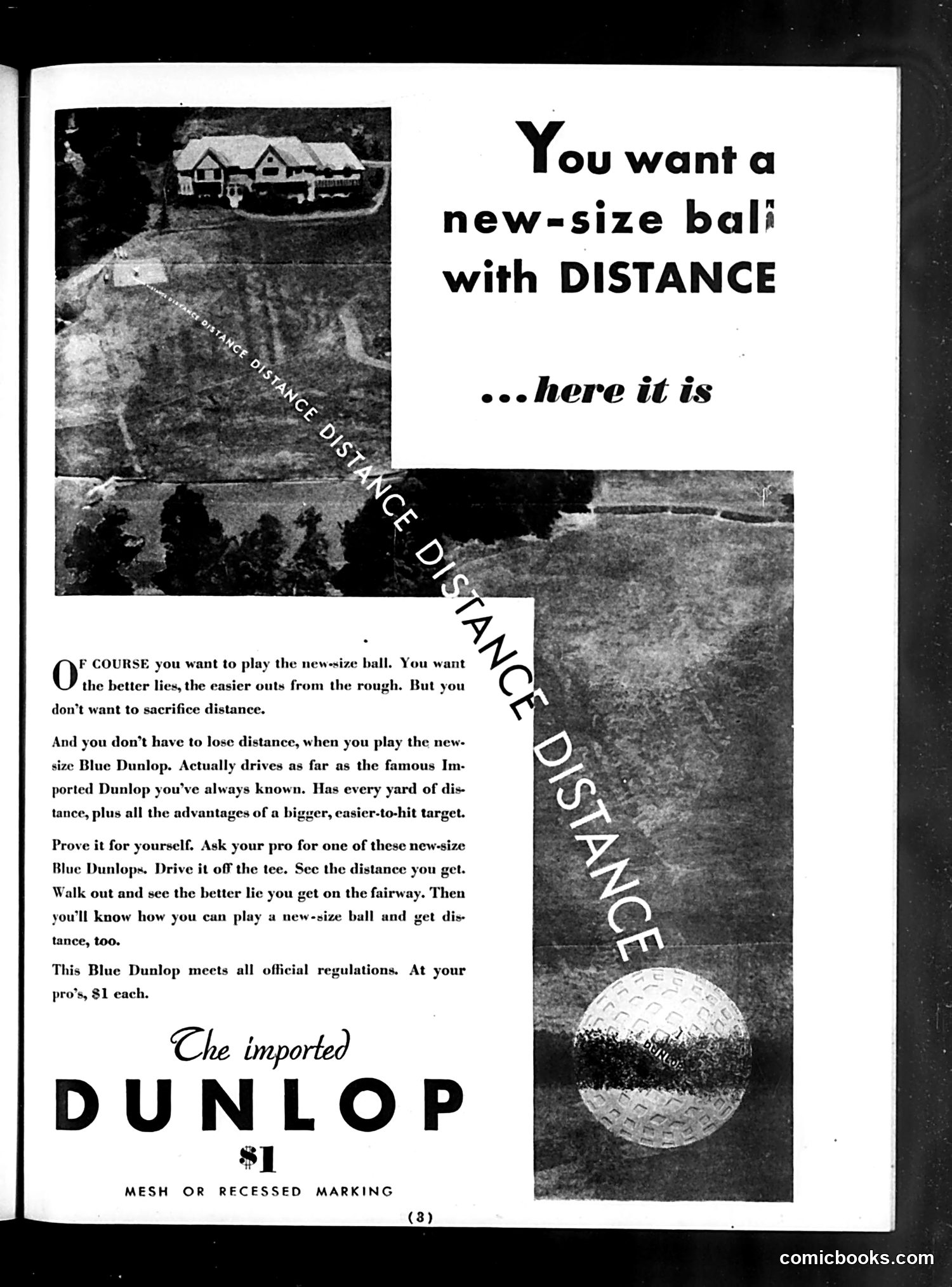
Blue Dunlop Golf Ball Advertisement This is a straightforward product advertisement, not political satire or a cartoon. It promotes the "new-size Blue Dunlop" golf ball ($1), marketed as combining two desirable features: 1. Larger size for easier hitting and better lie on fairways 2. Distance performance matching the famous imported Dunlop ball The ad uses aerial photographs of suburban homes and fairways to emphasize the distance golfers can achieve. The diagonal text "DISTANCE DISTANCE DISTANCE" reinforces the sales pitch. The close-up photo of the ball itself demonstrates the product. The advertisement appeals to mid-century American golfers by suggesting they can enjoy recreational benefits without sacrificing performance—a common marketing strategy of the era.

Analysis This is a Northern Pacific Railway advertisement, not satirical content. The page celebrates the railroad's "50,000,000 Miles" achievement—referring to the North Coast Limited train's operational record since March 29, 1900. The circular logo features a yin-yang symbol (the company's actual trademark), emphasizing balance and harmony. The text boasts the train's punctuality across major cities: Seattle, Minneapolis, Chicago, and stations throughout the Pacific Northwest. The advertisement emphasizes the railroad's reliability and luxury service, claiming "the unexcelled record" of running "every hour, every day, every year" for over two decades. The small print promotes the Northern Pacific's newest railroad passenger equipment. This is corporate promotion, not political satire.
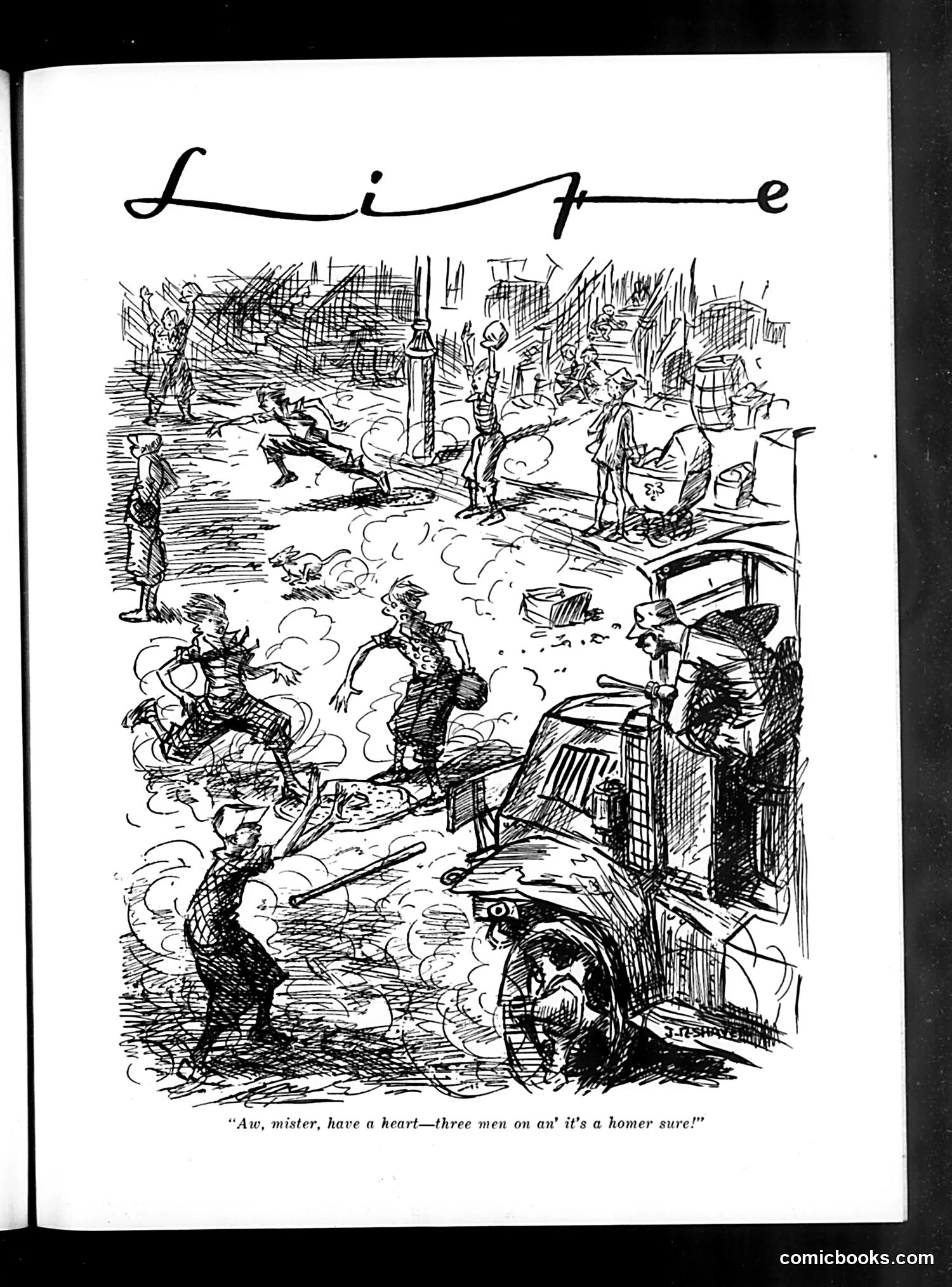
Analysis of "Life" Magazine Cartoon Page This page shows a street scene titled "Life" with a caption: "Aw, mister, have a heart—three men on an' it's a homer sure!" The cartoon depicts what appears to be a baseball game in progress on a city street, with buildings visible on the right and numerous figures scattered across the scene. The speaker (likely a player or street urchin) is pleading with someone, using baseball vernacular—asking for mercy because "three men on" base and a hit would score a "homer" (home run). This is satirical commentary on street baseball, a common recreational activity in urban America. The humor lies in the informal, desperate appeal for fair play in an impromptu game, suggesting the chaotic, rule-bending nature of street sports where stakes feel high to the participants despite the casual setting.
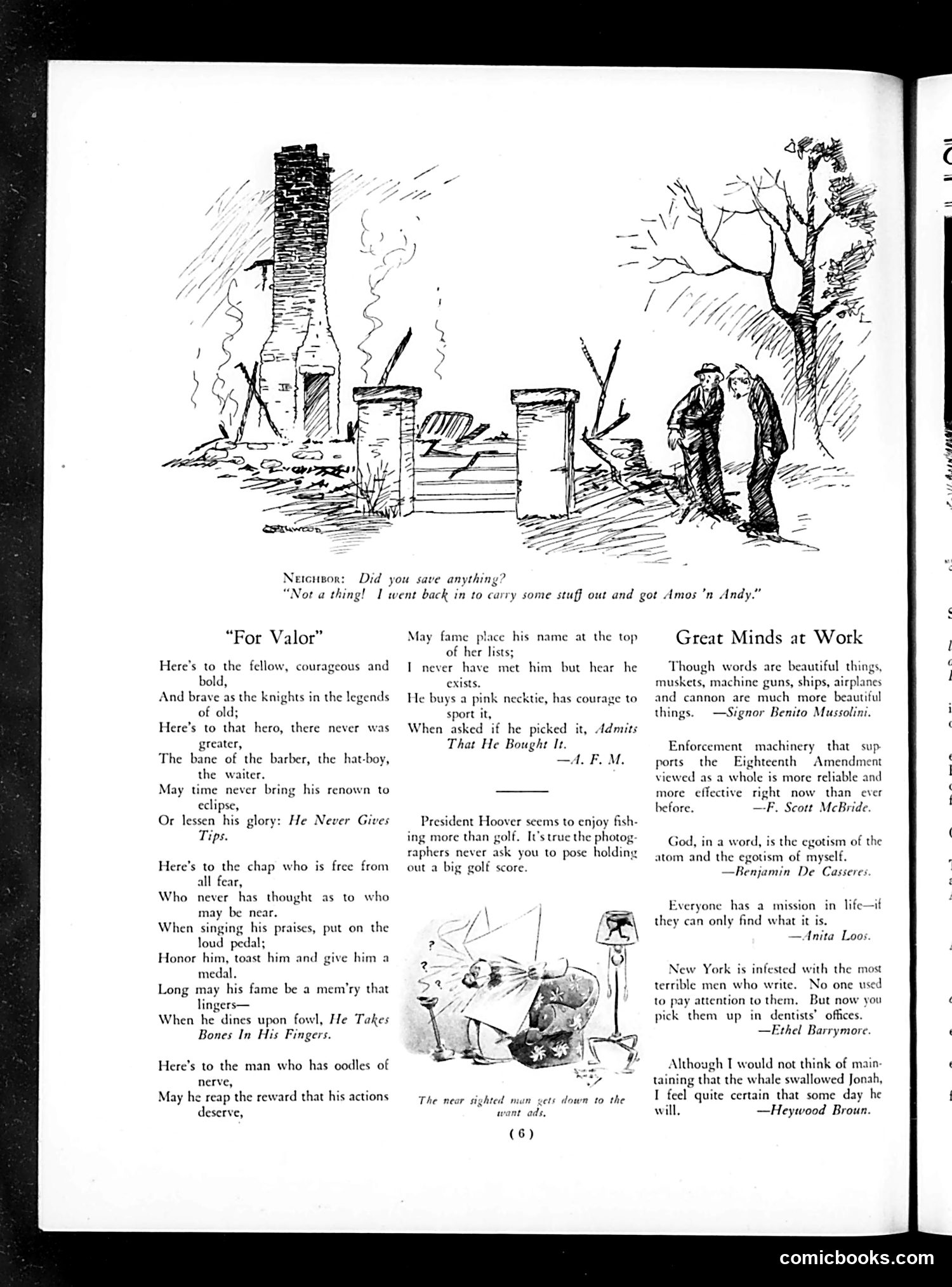
Explanation for Modern Readers This page contains poetry and quotations rather than political cartoons. The top cartoon shows two neighbors discussing a fire—one asks if the other saw anything; the reply jokes about retrieving "Amos 'n Andy" (a reference to a popular 1920s-30s radio show). The main content includes "For Valor," a satirical poem mocking someone (likely a public figure) who avoids genuine heroism and danger, instead seeking easy glory and recognition. The right column offers brief philosophical quotes from various authors about words versus actions, egoism, and New York's literary scene. The lower cartoon depicts a fisherman, relating to Hoover's fishing hobby mentioned in the adjacent text. The page is primarily literary satire rather than visual political commentary.
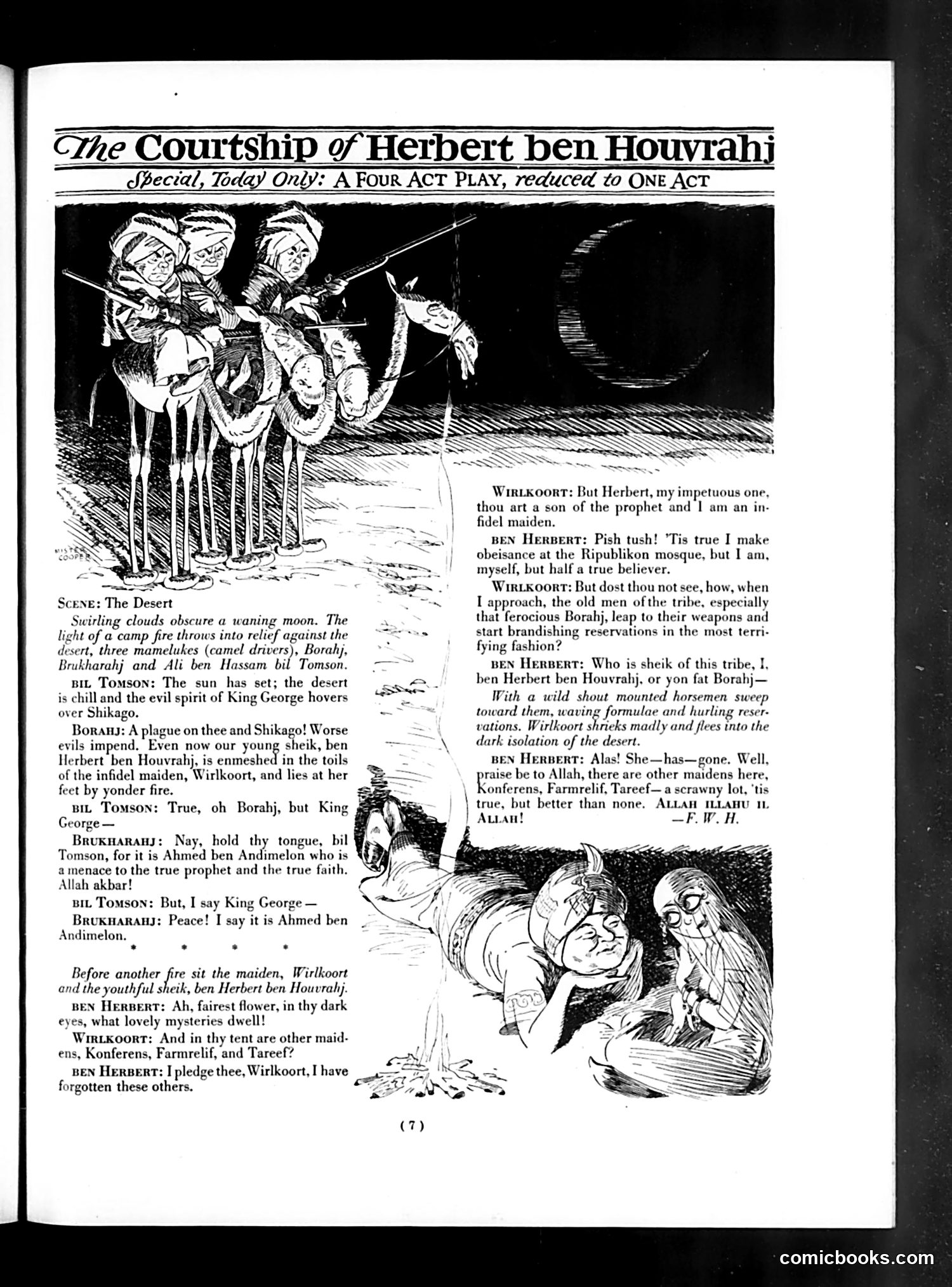
"The Courtship of Herbert ben Houyrah" This is a one-act stage play adaptation featuring characters in Middle Eastern/North African dress. The scene depicts a desert setting with three camel drivers, and dialogue between characters named Wirlkoort, ben Herbert, Borajh, and others. The satire appears to target religious and cultural stereotypes through exaggerated character names and dialectical speech patterns. References to "King George," "the prophet," and "the true faith" suggest commentary on colonial-era religious and political authority. However, without additional historical context about the original four-act play or Life magazine's specific publication date, the precise political targets remain unclear. The caricatured illustrations and orientalist aesthetic suggest this reflects early 20th-century attitudes toward Middle Eastern subjects, though the exact satirical intent is difficult to determine from this page alone.
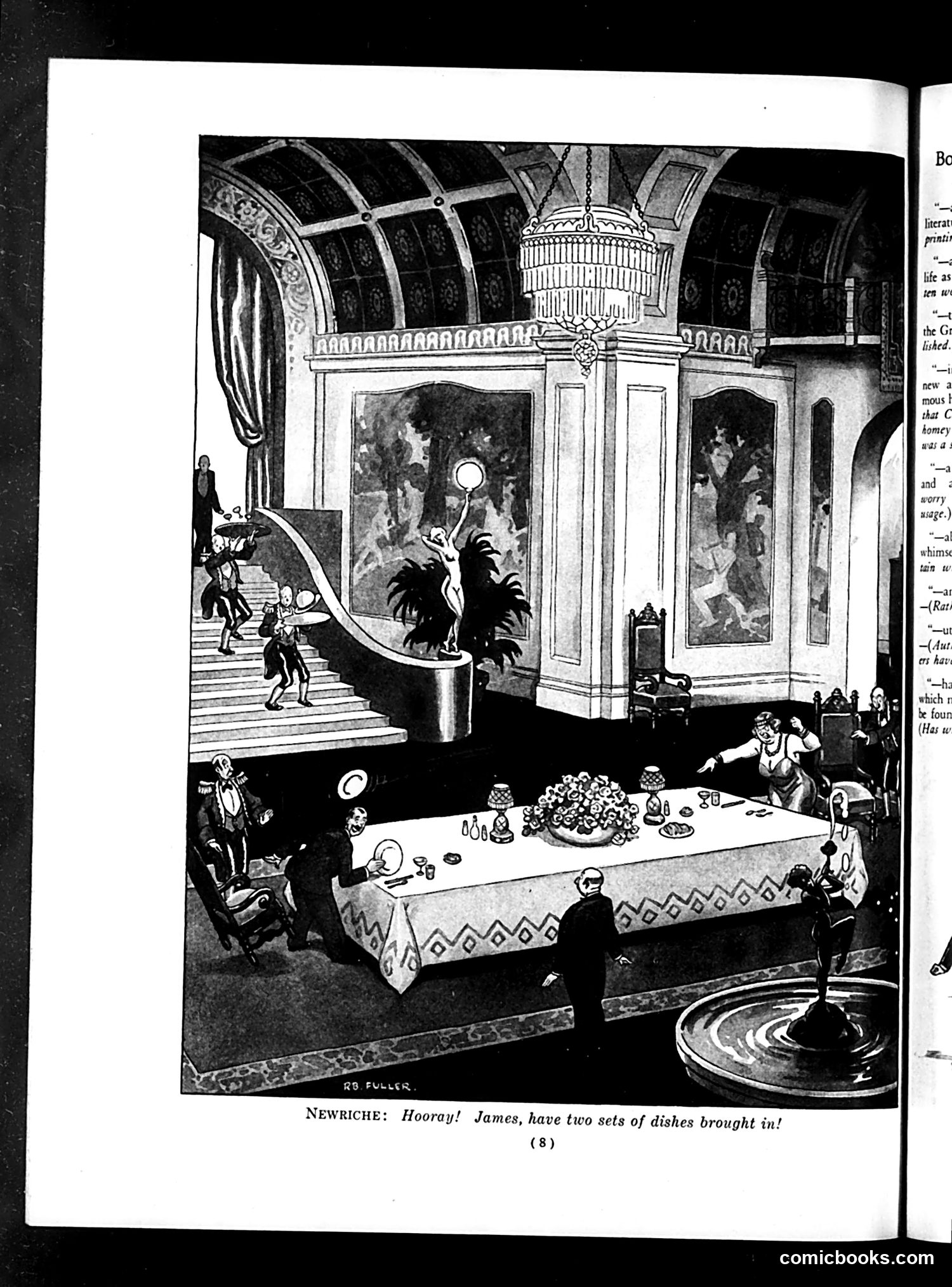
Explanation for Modern Readers This is an illustration titled "NEWRICHE: Hooray! James, have two sets of dishes brought in!" The cartoon satirizes the "nouveau riche"—newly wealthy people lacking refined manners. The scene depicts an ostentatious dinner party in an elaborately decorated room with a chandelier and classical paintings. The host, appearing vulgar and overdressed, demands multiple place settings be brought out, suggesting either ignorance of proper dining etiquette or an attempt to display wealth through excess. The satire mocks the pretensions of the newly rich who assume more elaborate presentations equal sophistication. The contrast between the grand architectural setting and the host's crude behavior emphasizes that wealth alone cannot purchase genuine refinement or social grace—a common theme in early 20th-century American satire about class and social aspiration.
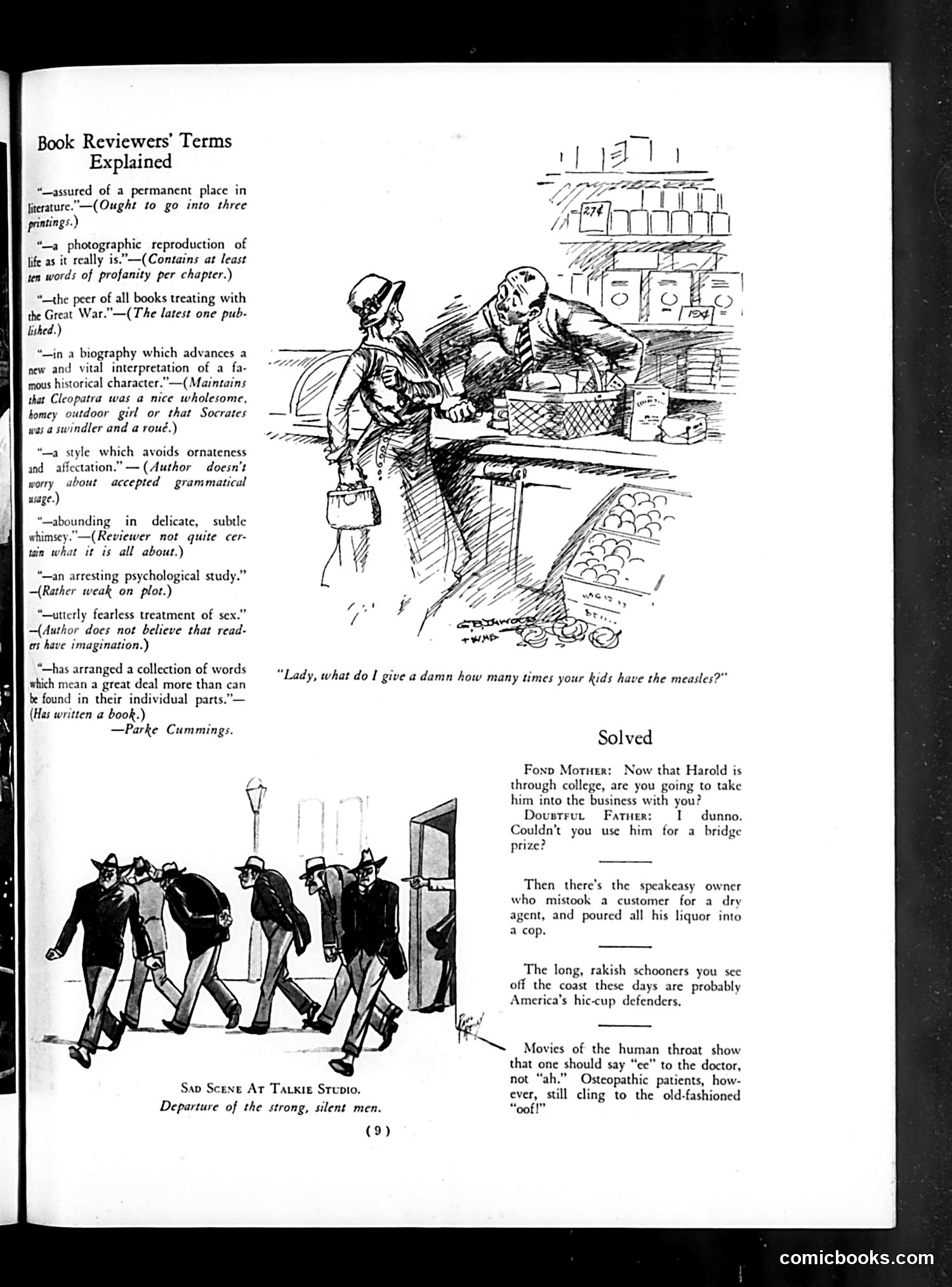
Life Magazine Page Analysis This page contains two distinct sections: Upper half: "Book Reviewers' Terms Explained" — a satirical glossary mocking pretentious literary criticism. Examples include phrases like "assured of a permanent place in literature" and "a photographic reproduction of life as it really is," with parenthetical translations revealing the hollow nature of such praise. Lower half: Two cartoons. The top cartoon shows a woman asking a man "Lady, what do I give a damn how many times your kids have the measles?" — likely satirizing intrusive social conversation. The bottom cartoon titled "Sad Scene at Talkie Studio" depicts men in suits departing, labeled "Department of the strong, silent men" — mocking how sound films ended the era of silent-film stars who relied on physical performance rather than vocal ability. The "Solved" section contains brief humorous anecdotes about contemporary life.
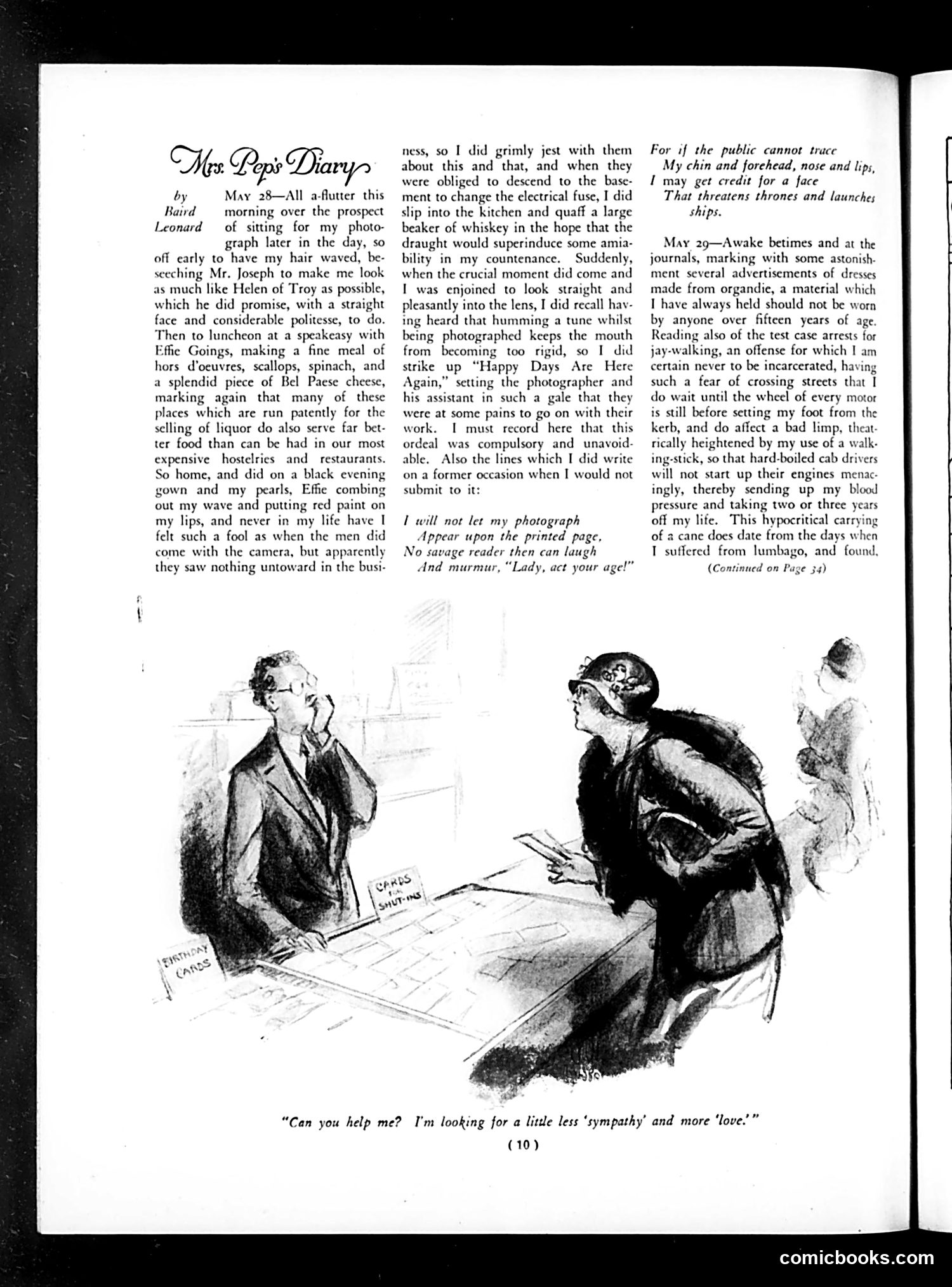
Mrs. Pep's Diary Analysis This page from *Life* magazine presents a humorous diary entry by "Mrs. Pep's" (author Leonard) describing mundane domestic frustrations—hair waving appointments, electrical fuse issues, whiskey-fueled mishaps, and automotive troubles. The accompanying cartoon depicts two men examining what appears to be architectural blueprints or plans, with the caption: "Can you help me? I'm looking for a little less 'sympathy' and more 'love.'" The satire targets early 20th-century domestic life's petty annoyances and the tension between spouses. The diary's obsessive focus on small household crises—fuses, photographs, engine problems—mocks both female preoccupation with appearance and the broader domestic anxiety of the era. The cartoon's dialogue suggests marital discord masked by polite euphemism, poking fun at how couples communicate about relationship problems indirectly.
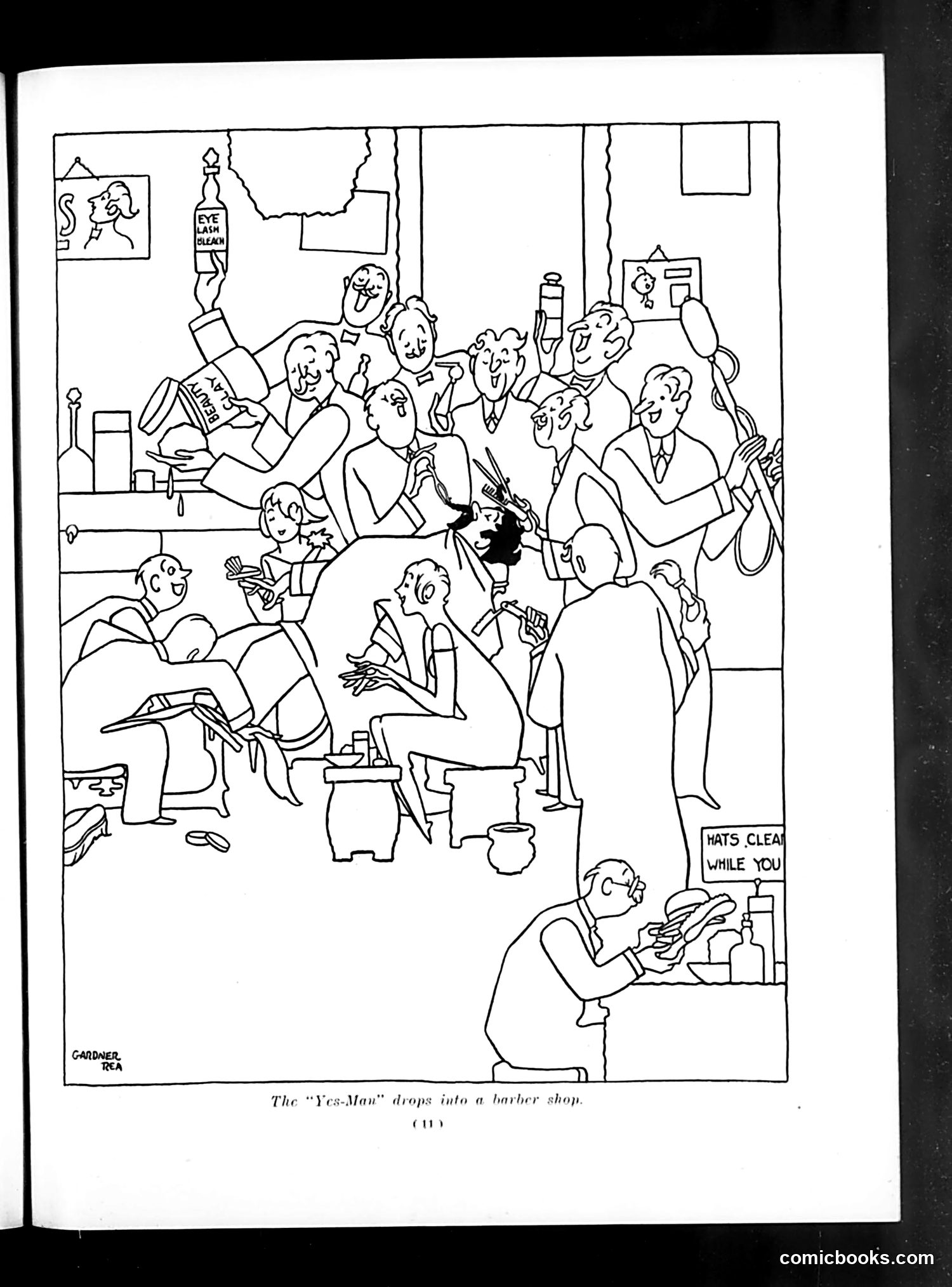
Analysis of "The 'Yes-Man' Drops Into a Barber Shop" This cartoon satirizes the "yes-man"—a contemptible figure of the era who agrees with everything his superior says. The scene shows a crowded barber shop where one man (center, notably darker/distinguished-looking) has apparently entered as a customer or VIP. The other patrons and barbers react with exaggerated enthusiasm and deference, their expressions showing eager agreement regardless of what he might say. The satire targets workplace sycophancy and the culture of blind obedience, suggesting that yes-men will agree with anyone of apparent authority or status. The barber shop's democratic, egalitarian setting makes the contrast sharper—even ordinary spaces become infected with this degrading behavior when faced with perceived authority. The artist is credited as Gardner, working for Life magazine's satirical tradition.
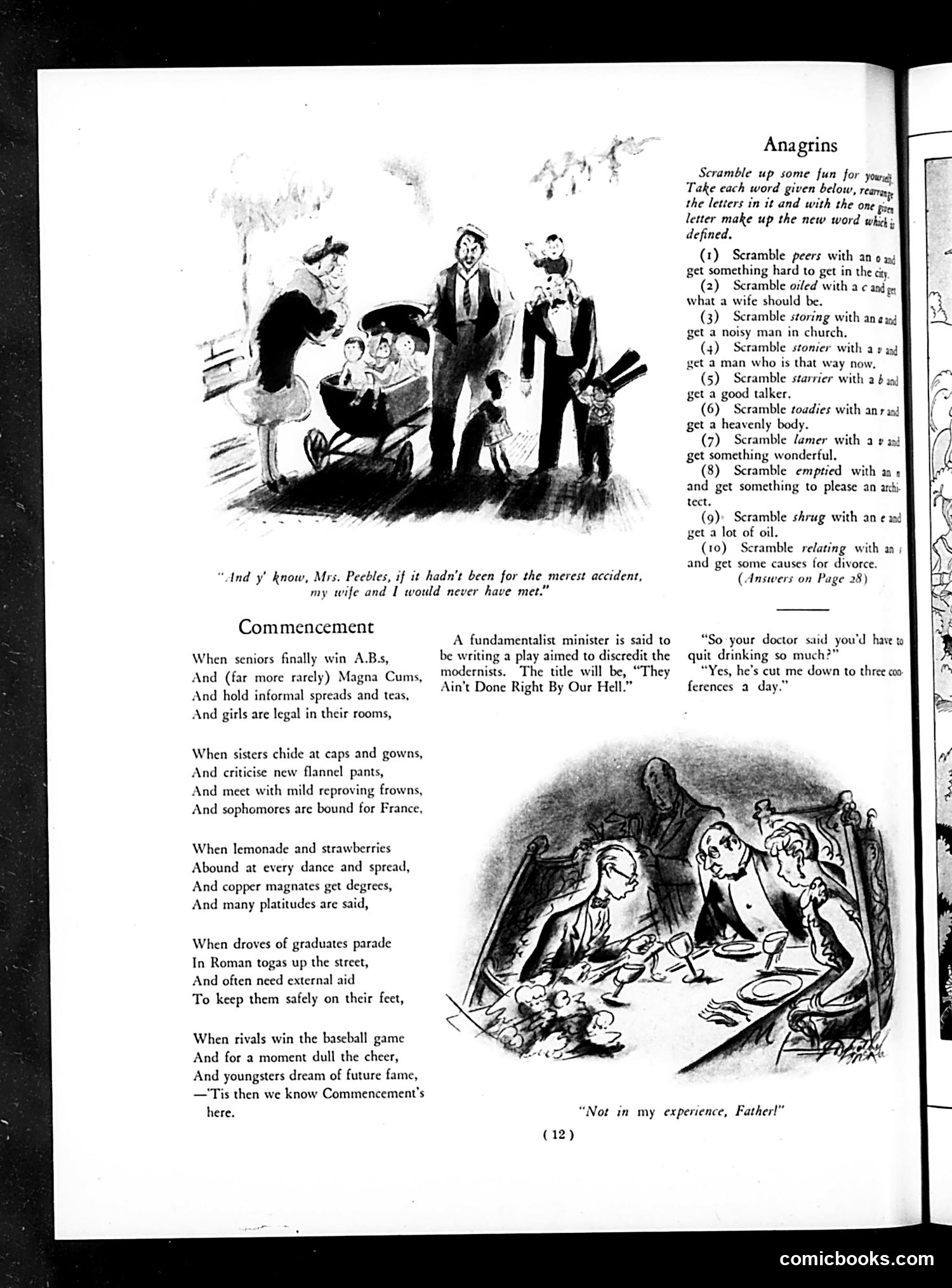
Analysis of Life Magazine Page This page contains two satirical pieces: Top cartoon: Shows a domestic scene where a man explains to Mrs. Peebles how a "mere accident" led to meeting his wife. The humor relies on implying an illicit or scandalous origin story for their marriage, typical of Life's marital humor. "Commencement" poem: A humorous poem describing various academic milestones (seniors getting degrees, graduates parading, etc.). The satire mocks the pretension and social chaos of commencement season—students in formal dress stumbling about, excessive celebration, and the inflated self-importance of the occasion. Bottom cartoon: Appears to depict hell or demons at a dinner table, with the caption "Not in my experience, Father!" — likely satirizing religious hypocrisy or confession. The overall tone reflects Life's characteristic early-20th-century domestic and institutional satire.
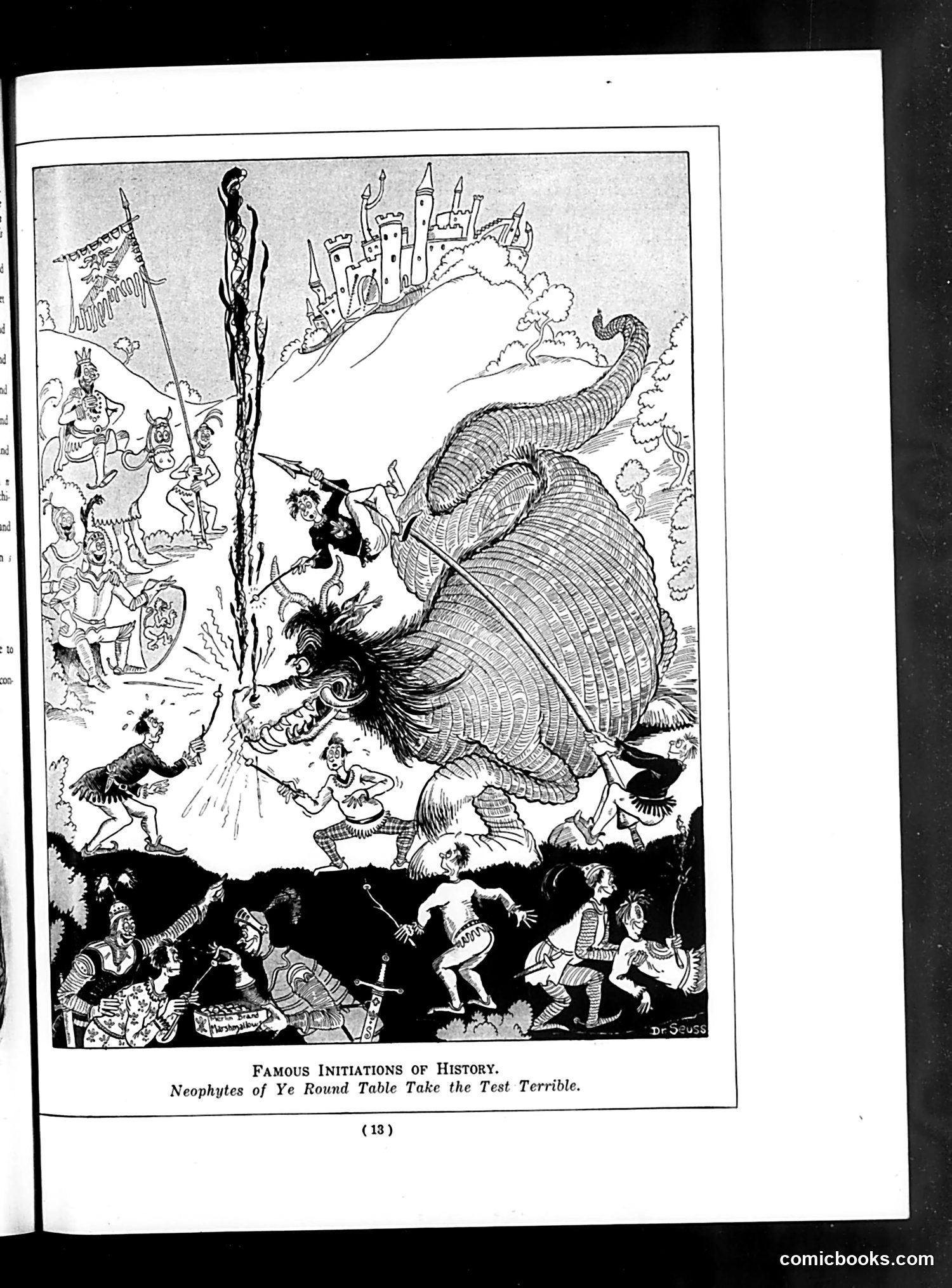
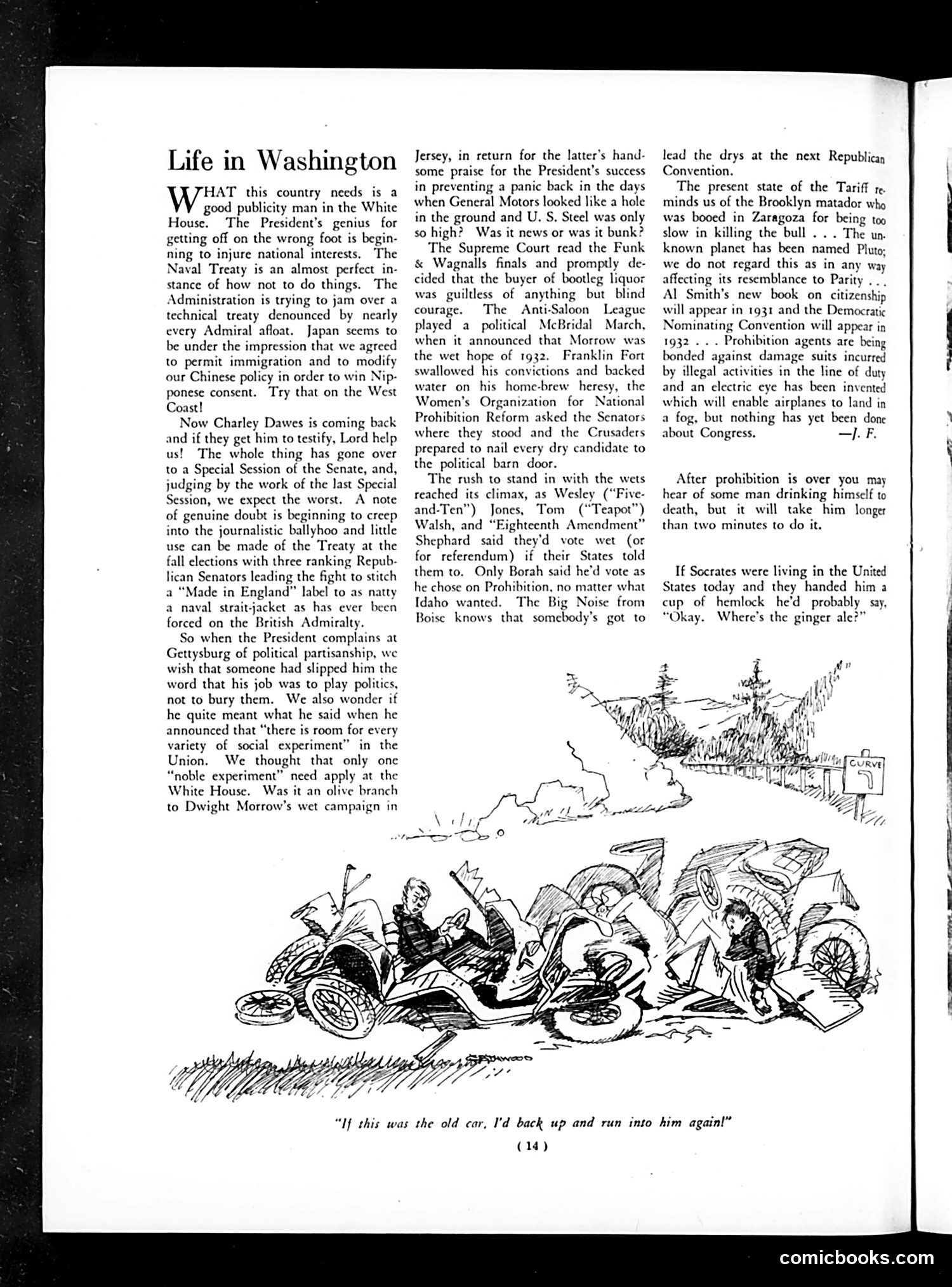
"Life in Washington" - Political Satire, circa early 1930s This article criticizes President Hoover's handling of major issues: the Naval Treaty, General Motors panic, U.S. Steel crisis, Prohibition enforcement, and tariff policy. The author mocks Republican senators' contradictory stances on Prohibition—some claiming to support it while secretly voting wet. The cartoon below depicts a car crash with multiple vehicles colliding, accompanied by the caption "If this was the old car, I'd back up and run into him again!" This appears to satirize political chaos and dysfunction, suggesting that even destructive collisions might be preferable to current mismanagement. The wreckage likely represents failed government policies or the economic turmoil of the early Depression era.
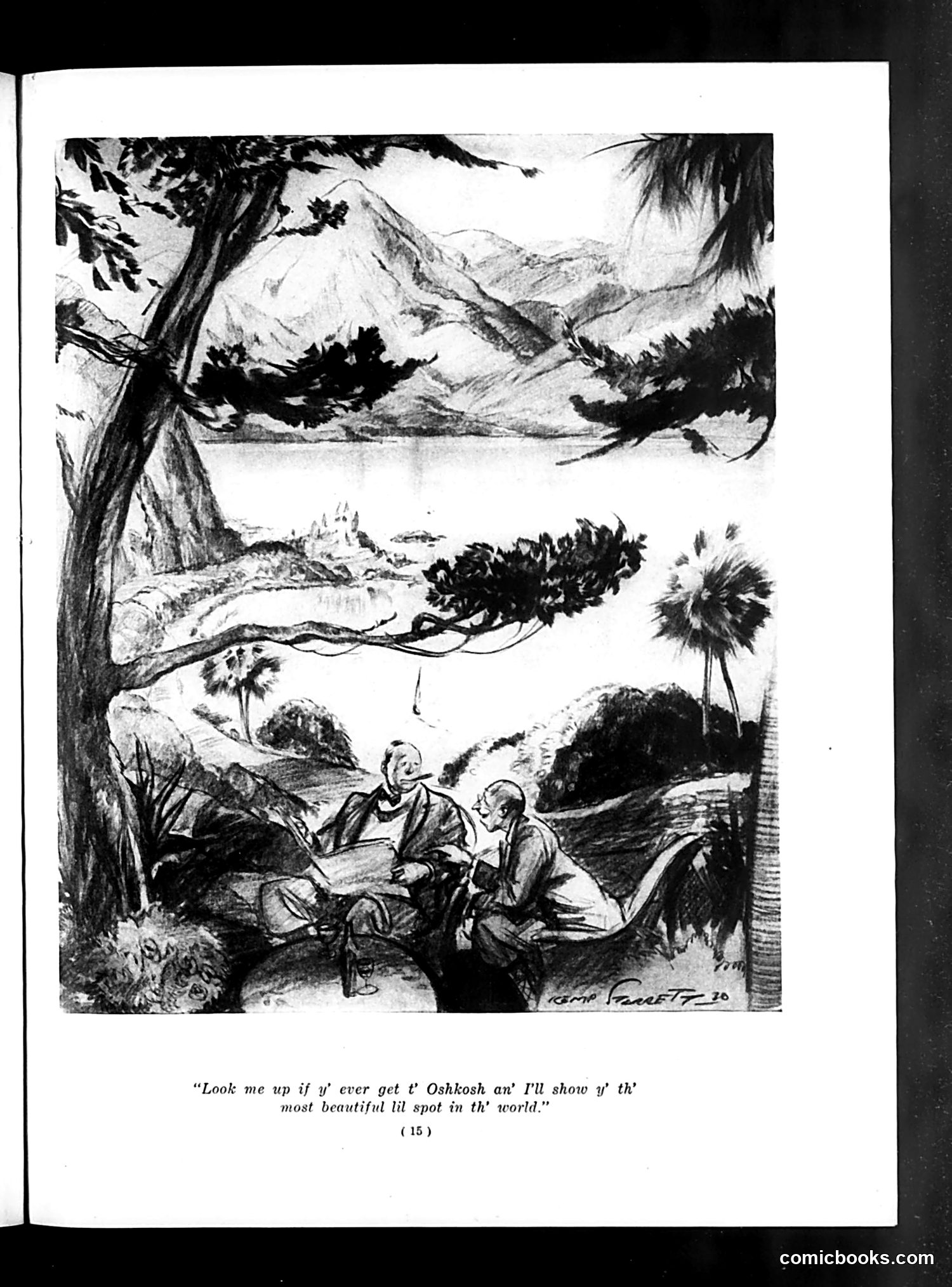
Analysis This illustration appears to be a literary or narrative illustration rather than a political cartoon. It depicts two figures in what looks like early 20th-century clothing sitting beneath a large tree, overlooking a scenic landscape with mountains, water, and palm trees. The quoted dialogue below—"Look me up if y' ever get t' Oshkosh an' I'll show y' th' most beautiful lil spot in th' world"—suggests romantic or sentimental humor about small-town pride. The speaker appears to be making an earnest but somewhat comical boast about their hometown (Oshkosh, Wisconsin). The satire likely targets rural American sentimentality or the contrast between humble Midwestern towns and their residents' exaggerated sense of local beauty. The signature appears to read "Cesare Bisetti '20," dating this to 1920.
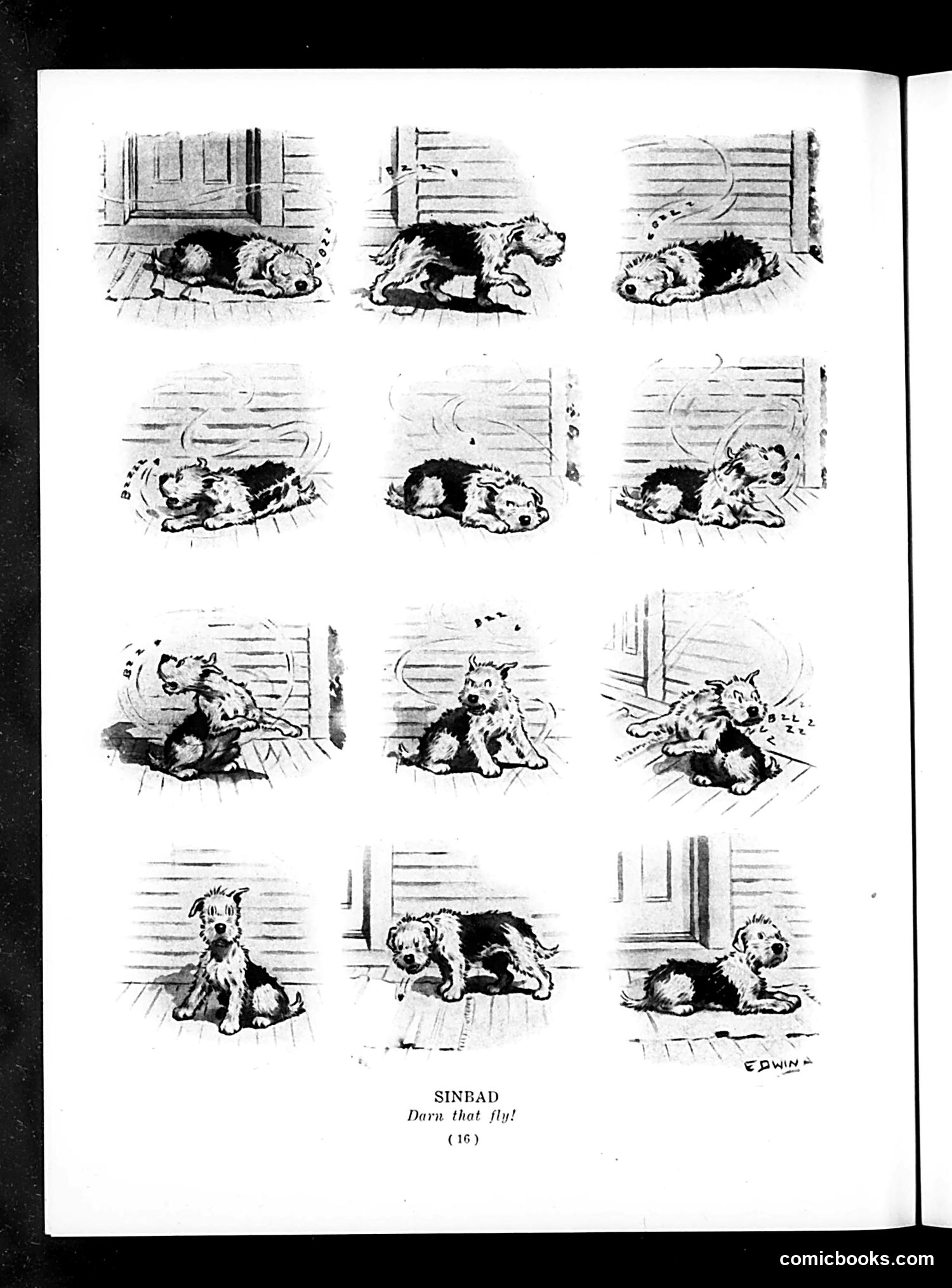
SINBAD: "Darn that fly!" This is a 12-panel comic strip by Edwin (signed "EDWIN" at bottom) showing a terrier-type dog named Sinbad repeatedly attempting to catch a fly. The humor comes from the escalating chaos of each attempt—the dog chases the fly across wooden floors, knocking into walls and furniture, sliding and tumbling, while the fly remains consistently out of reach. The joke is simple slapstick: the dog's frustrated determination to catch something trivial leads to increasingly absurd physical mishaps. The fly represents an impossible goal, and the dog's futile efforts mock obsessive persistence over insignificant matters. It's gentle humor typical of early 20th-century American comic strips, requiring no political or social context beyond appreciating physical comedy.
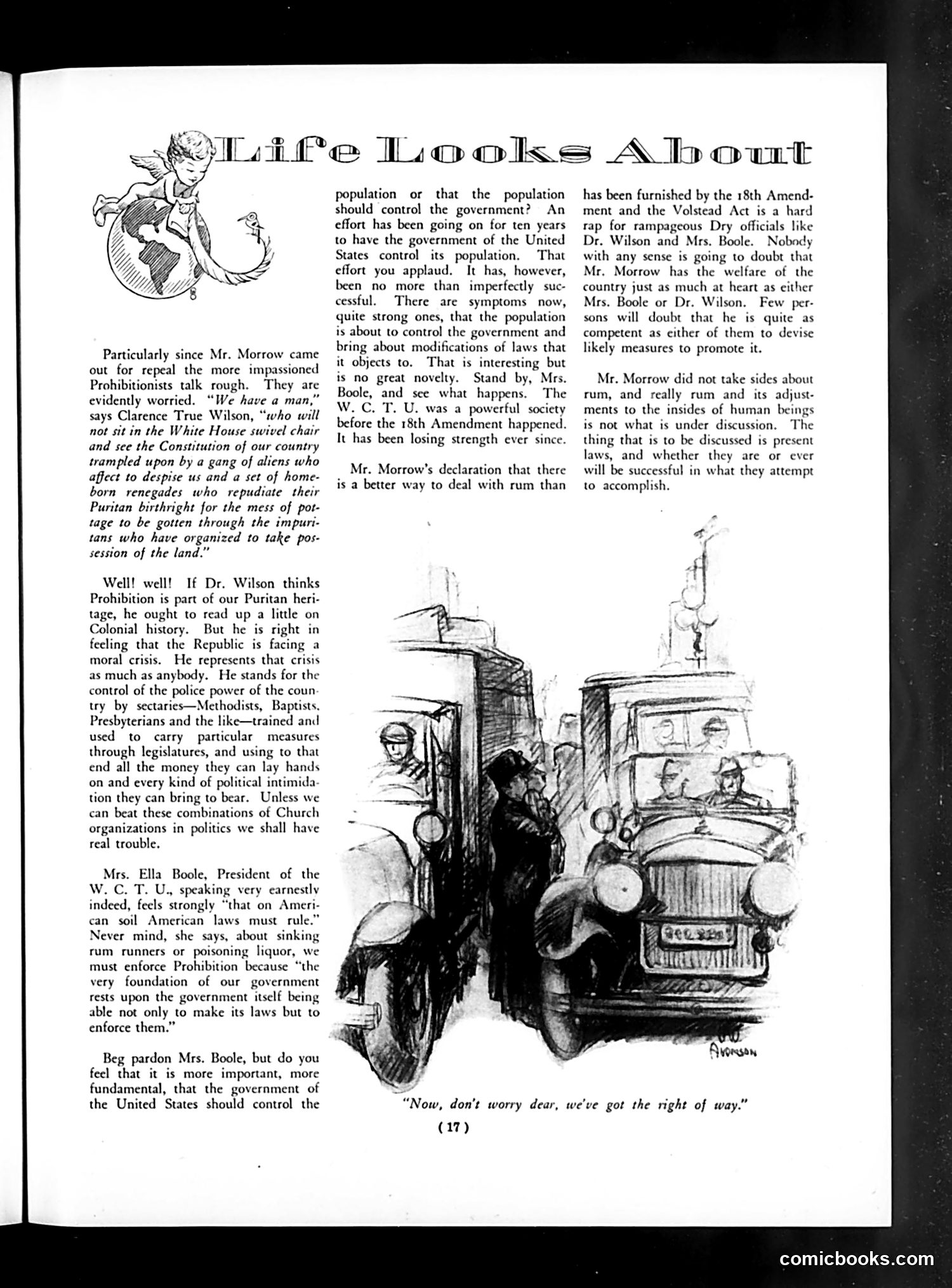
Analysis of "Life Looks About" This page satirizes the Prohibition debate, circa the 1920s. The text references Mr. Morrow's advocacy for repealing Prohibition and mentions Mrs. Ella Boole of the W.C.T.U. (Women's Christian Temperance Union), a real anti-alcohol organization that supported the 18th Amendment. The cartoon depicts law enforcement stopping a vehicle driven by a man who appears to be smuggling illegal liquor—a "rum runner." The officer says, "Now, don't worry dear, we've got the right of way," suggesting either corruption (the officer is complicit) or ironic commentary on Prohibition's failure to stop illegal alcohol distribution. The satire critiques both Prohibition enforcement and the cultural hypocrisy surrounding it during America's "dry" era.
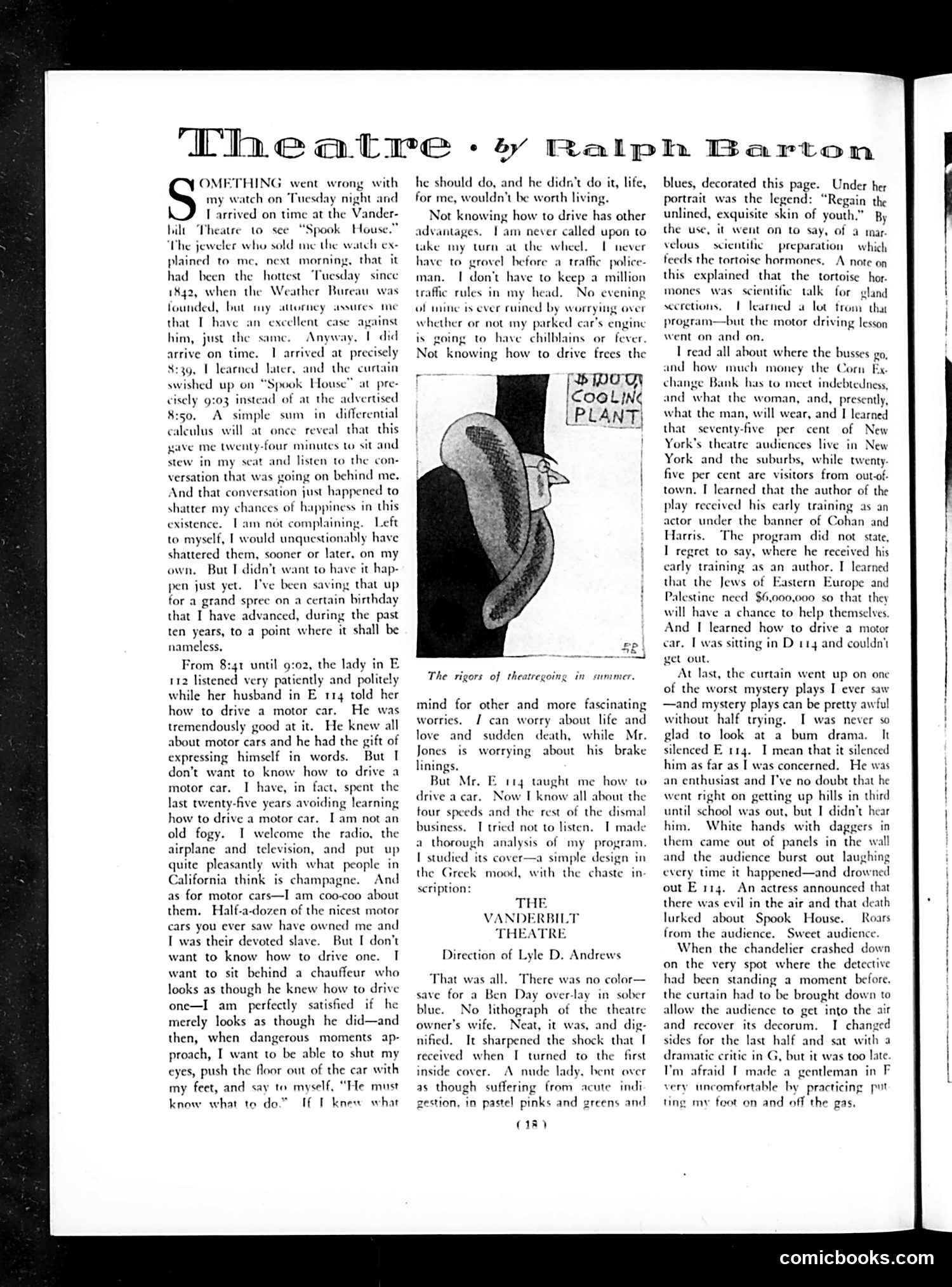
Analysis of "Theatre" by Ralph Barton This page is Ralph Barton's humorous essay about attending a Broadway play ("Spook House") at the Vanderbilt Theatre. The accompanying illustration depicts a large ear, labeled "The rigors of theatregoing in summer." The satire targets the discomforts of summer theater attendance: the author arrives late, leaves early to avoid traffic, and experiences the cramped conditions of a crowded playhouse. The ear illustration jokes that one's hearing becomes oddly acute—perhaps from straining to hear dialogue over audience disruptions, or from the claustrophobic intensity of close quarters with other sweating patrons. Barton's tone is self-mocking, admitting his own driving incompetence while complaining about theater logistics and the play's quality. The humor relies on relatable, mundane observations about New York theater culture circa 1920s.
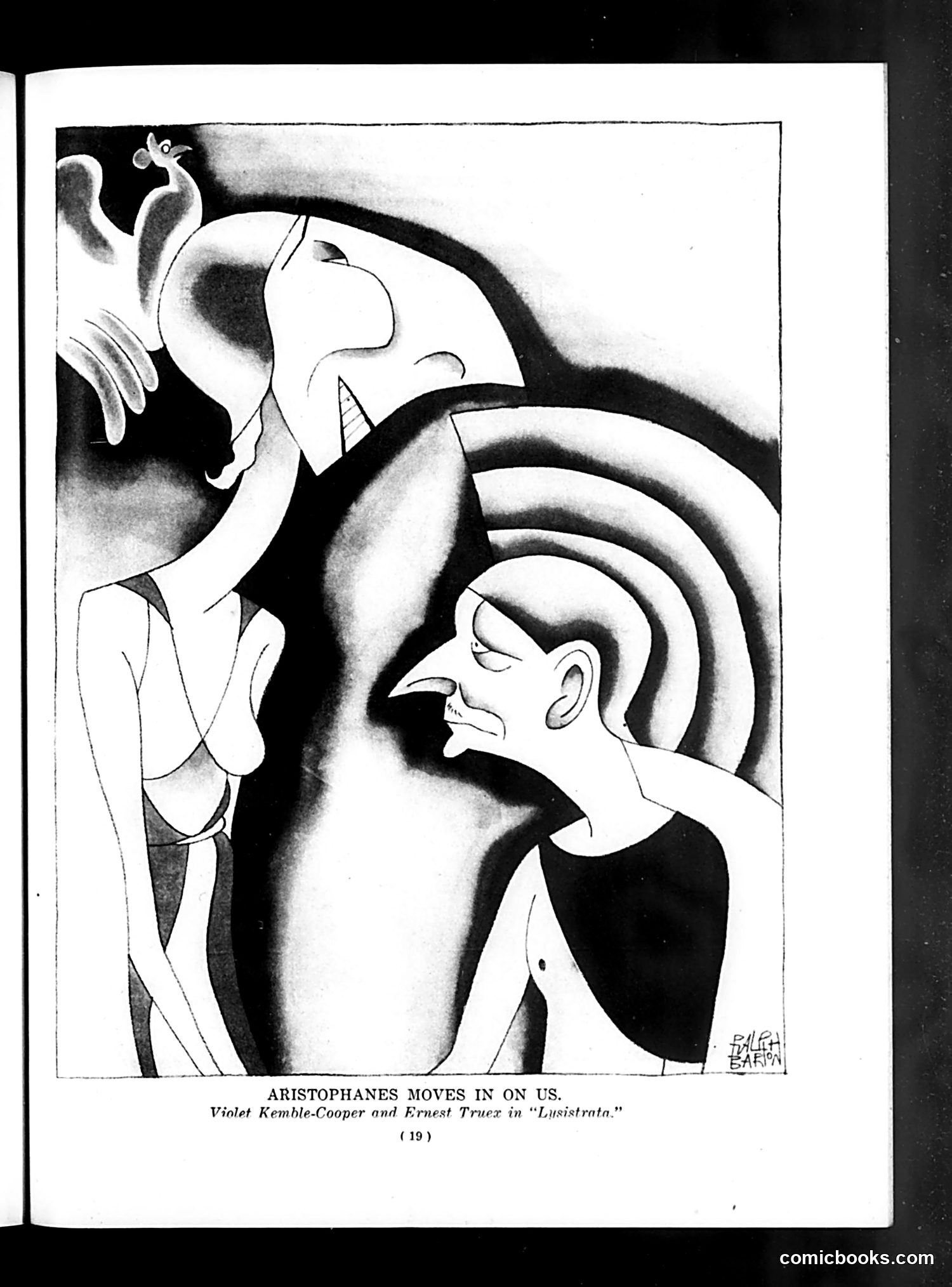
Political Cartoon Analysis This cartoon illustrates a theatrical production of Aristophanes' ancient Greek play *Lysistrata*, featuring actors Violet Kemble-Cooper and Ernest Truex. The artwork uses exaggerated caricature typical of Life magazine's satirical style. The reference is to the play's central premise: women withhold sexual relations to force men to end war. By captioning this as "Aristophanes Moves in on Us," the cartoonist suggests the play's ancient anti-war message remains pointedly relevant to contemporary audiences—likely American readers during a period of conflict or military tension (the incomplete date "19[__]" makes precise timing unclear). The caricatured expressions and body language emphasize the comedic yet serious nature of using satire to critique war and male authority, making classical Greek dramaturgy serve as social commentary for modern times.
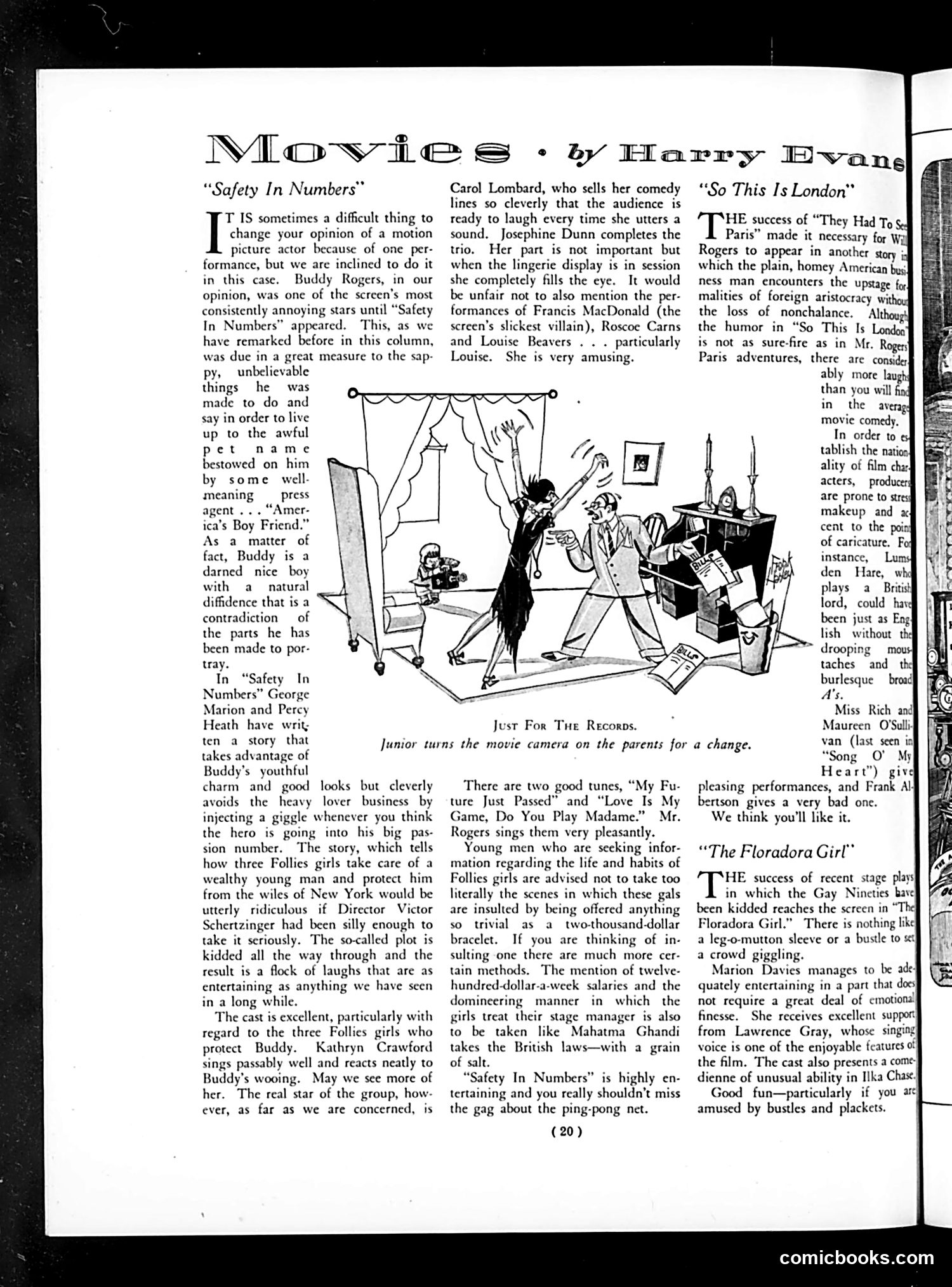
Life Magazine Movie Review Page This is Harry Evans's movie review column from Life magazine, discussing three films. The central cartoon illustrates "Safety In Numbers," showing a scene where three young women (Follies girls) interact with a male character in a domestic setting. Key content: Evans praises "Safety In Numbers," noting it finally makes actor Buddy Rogers likeable by avoiding his typical "America's Boy Friend" persona. He credits the film's success to three actresses—particularly Carol Lombard, whose comedic timing he highlights. The review gently mocks the film's implausible plot (three showgirls protecting a wealthy man) while praising how the director playfully acknowledges its absurdity rather than treating it seriously. The reviews also cover "Just For The Records" and "The Floradora Girl." Evans uses humor to critique how Hollywood treats Follies girls and stage life, advising young men not to take the depicted scenarios literally—particularly salary and workplace dynamics. The tone is lighthearted film criticism typical of 1920s entertainment journalism.
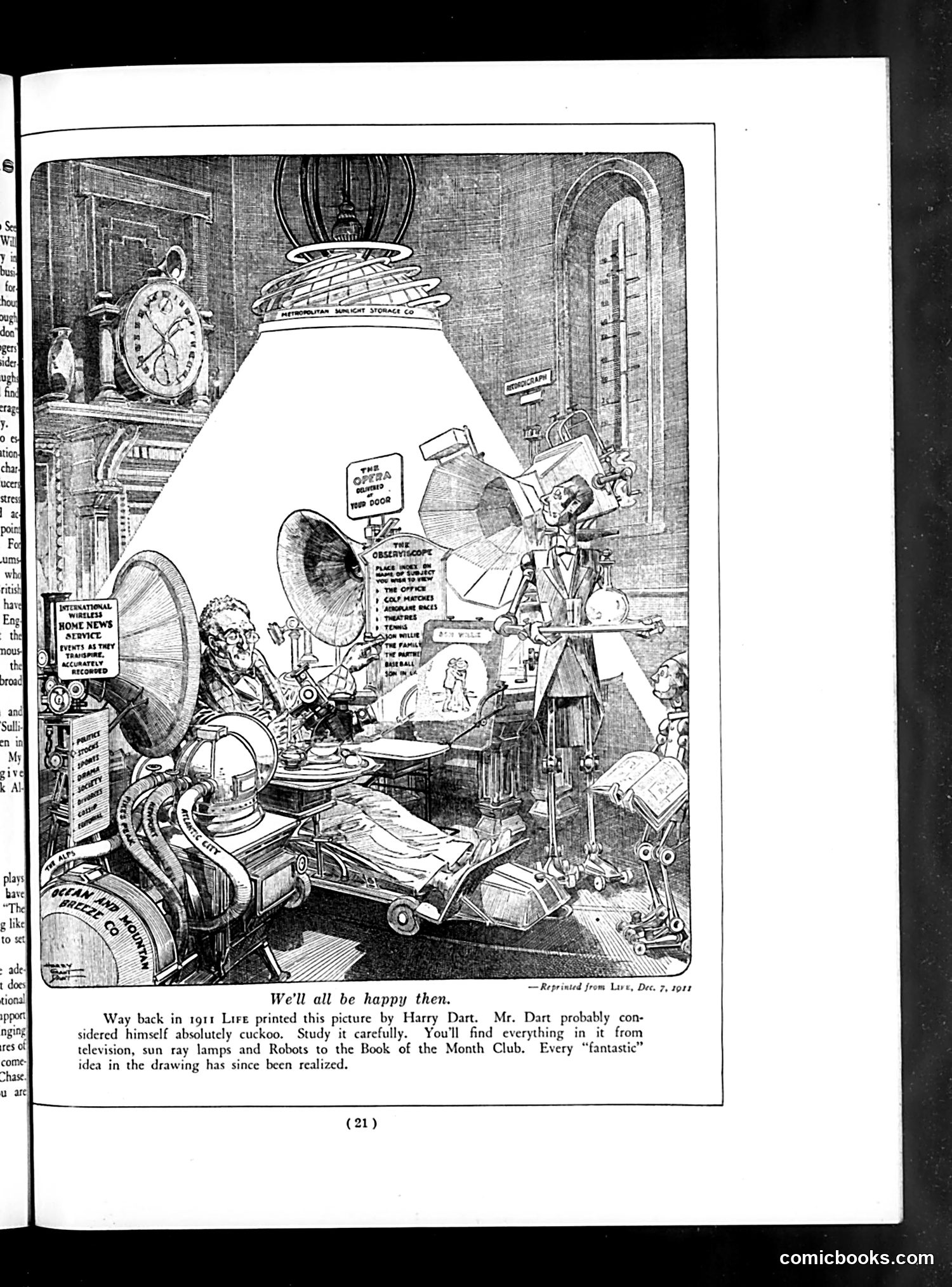
"We'll All Be Happy Then" (1911) This is a retrospective piece showcasing artist Harry Dart's 1911 futuristic prediction drawing. The cartoon depicts an idealized future home filled with technological marvels that Dart imagined would eventually exist: television screens, sun lamps, robots, and automated devices. The accompanying text notes sarcastically that Dart "probably considered himself absolutely cuckoo" for imagining such fantastical inventions. The article's humor derives from hindsight—this appears in a later Life magazine issue acknowledging that nearly every "crazy" prediction Dart made has actually come true, including television and the Book of the Month Club. The caption "We'll all be happy then" is Dart's original optimistic assertion about this mechanized future. The piece celebrates how science fiction predictions from 1911 became reality, validating Dart's imaginative vision while gently mocking how far-fetched such ideas once seemed.
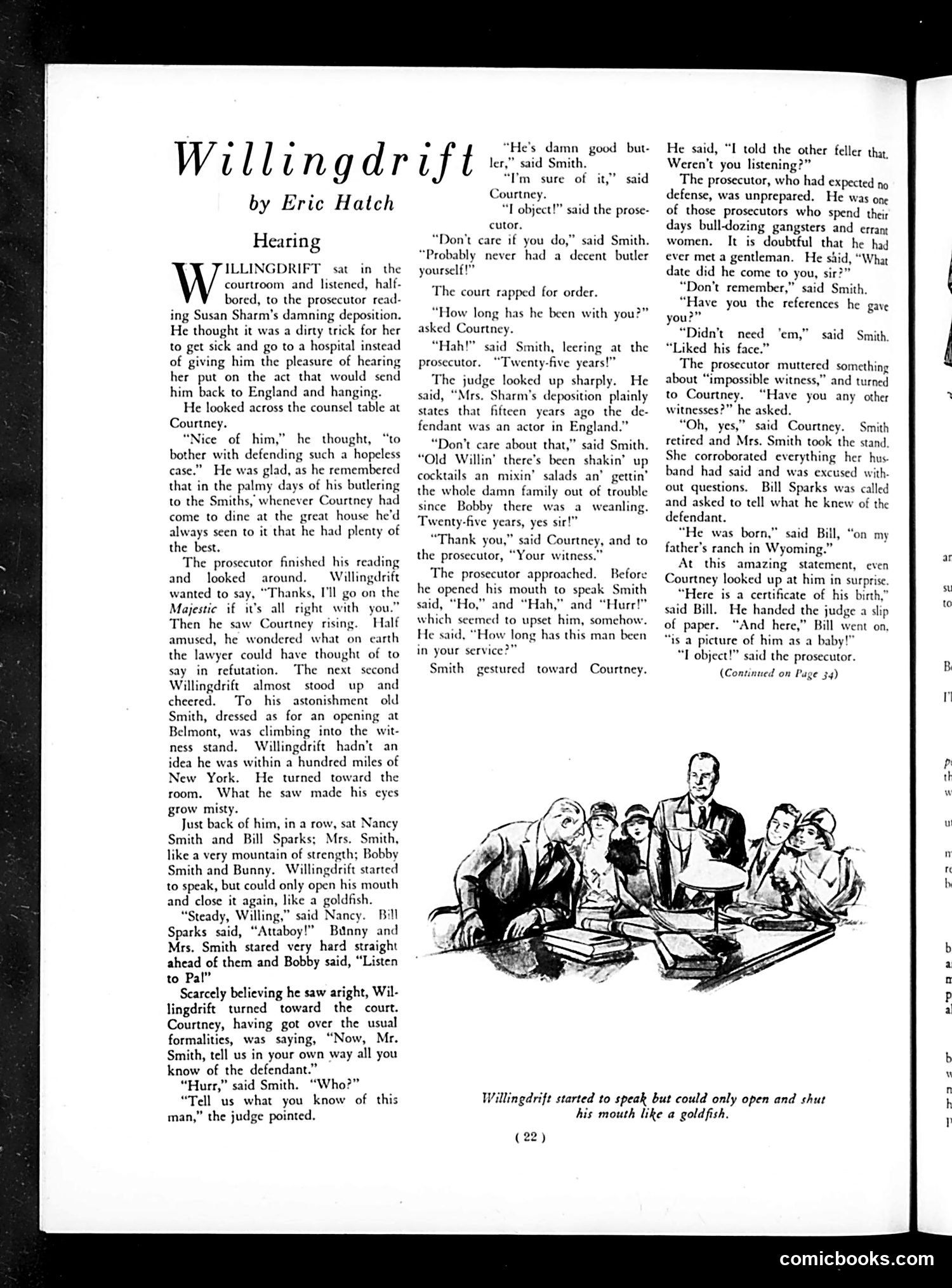
Analysis of "Willingdrift" Page This is a fictional story (not a political cartoon) by Eric Hatch titled "Willingdrift." The illustration shows a courtroom scene where a man named Willingdrift—apparently a British butler—stands trial, likely for a crime he may not have committed. The satire targets prosecutorial overconfidence and class prejudice. The prosecutor, accustomed to bullying "gangsters and errant women," is unprepared to face testimony from gentlemen like Mr. Smith, who testifies that Willingdrift has been his faithful butler for 25 years. Smith's casual, aristocratic manner—his dismissive "Didn't need 'em" regarding references, his focus on liking the man's face, his interruptions—suggests that a gentleman's word and character judgment outweigh formal documentation. The humor lies in the prosecutor's discomfort when confronted with actual respectability and the old-money class he cannot intimidate. The loyal Smith family's courtroom appearance demonstrates that Willingdrift has earned genuine social standing regardless of his legal predicament.
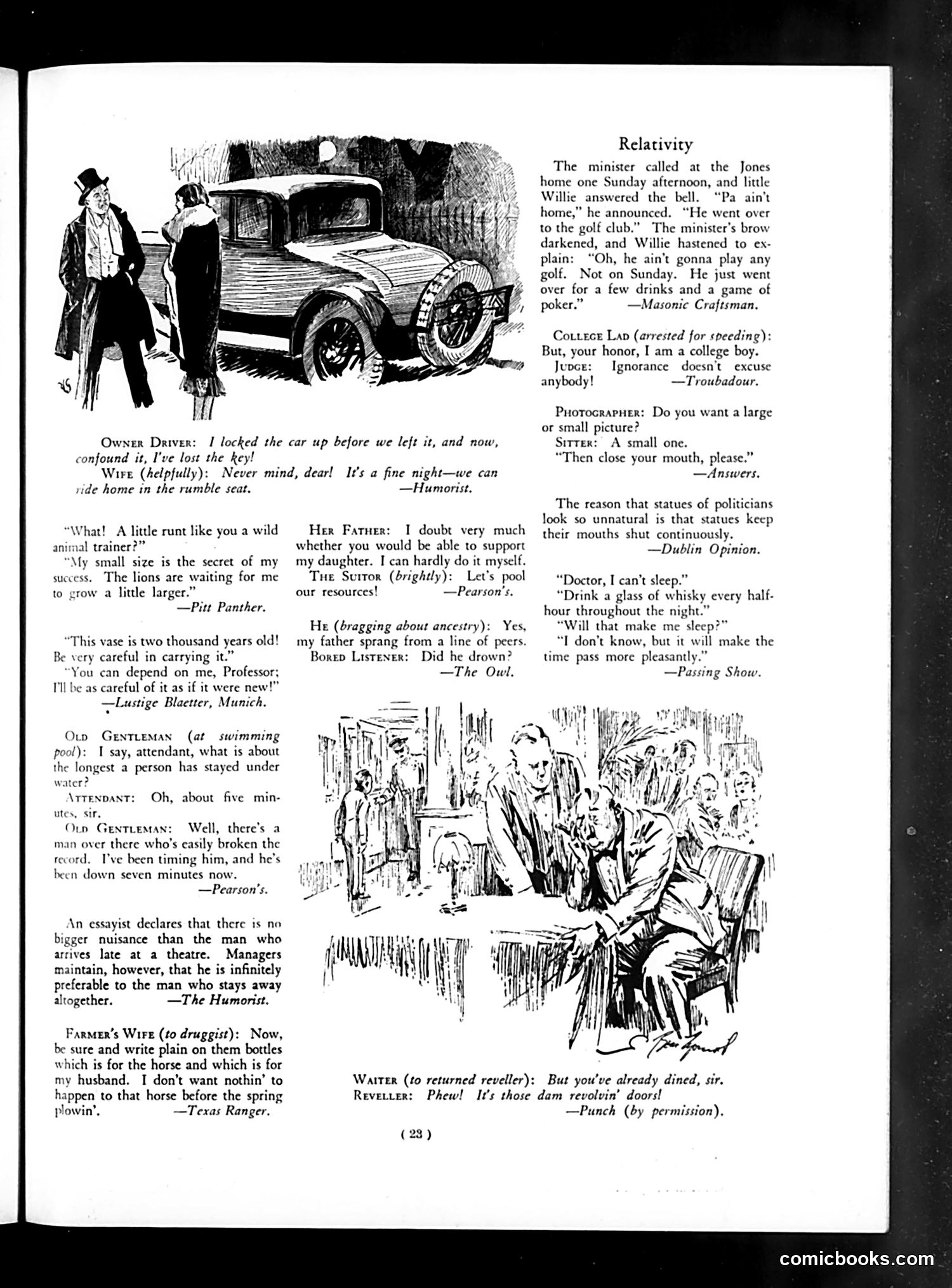
Relativity Page Analysis This is a miscellaneous humor page from *Life* magazine featuring several short jokes and comic scenarios, most unrelated to each other. The page title "Relativity" appears ironic—it doesn't reference Einstein but rather the relative nature of perspective in the jokes. Key content: - Top cartoon: A car owner has lost his ignition key; his companion suggests they can still drive home in the rumble seat (an open rear compartment)—the humor lies in the impractical solution. - Various short jokes touch on hypocrisy and class: a minister disapproves of Sunday golf until learning it involves drinking and poker; a college student expects ignorance to excuse speeding; a farmer worries his wife might confuse medicine meant for the horse with his own. - Social commentary: Jokes about late theater arrivals, politician statues' unnatural expressions (because they "keep their mouths shut"), and a drunk man blaming revolving doors for his condition. The humor is genteel, relying on irony, mild social criticism, and everyday absurdities rather than sharp political satire.
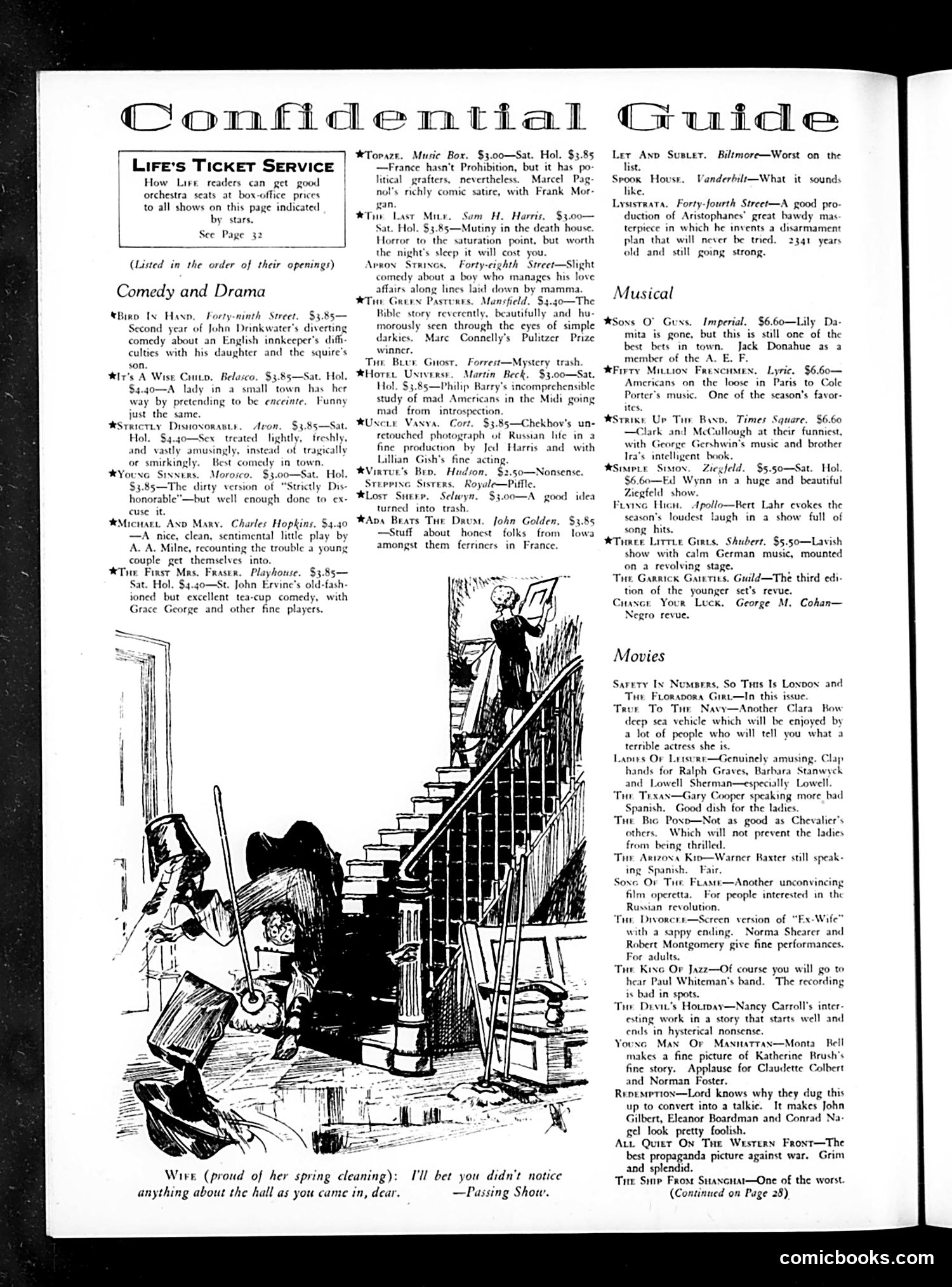
Political Cartoon Analysis The illustration depicts a domestic scene of spring cleaning, showing a wife at the bottom of a staircase, apparently having made a mess during her housekeeping. The caption quotes her saying to her husband: "I'll bet you didn't notice anything about the hall as you came in, dear." The Satire: This is gentle domestic humor about the gap between a wife's efforts and a husband's obliviousness. The wife has clearly worked hard cleaning (note the scattered items), yet she assumes—correctly, the joke suggests—that her husband won't even notice her labor. The humor relies on the stereotype of husbands being inattentive to household management and their wives' domestic work. Context for Modern Readers: This reflects early 20th-century gender roles where housework was exclusively women's domain and husbands were portrayed as blissfully unaware of—or ungrateful for—such labor. The joke assumes audiences will recognize this dynamic as relatable rather than questioning why notice isn't given. The page itself is primarily a theater guide listing Broadway shows with reviews and ticket prices.
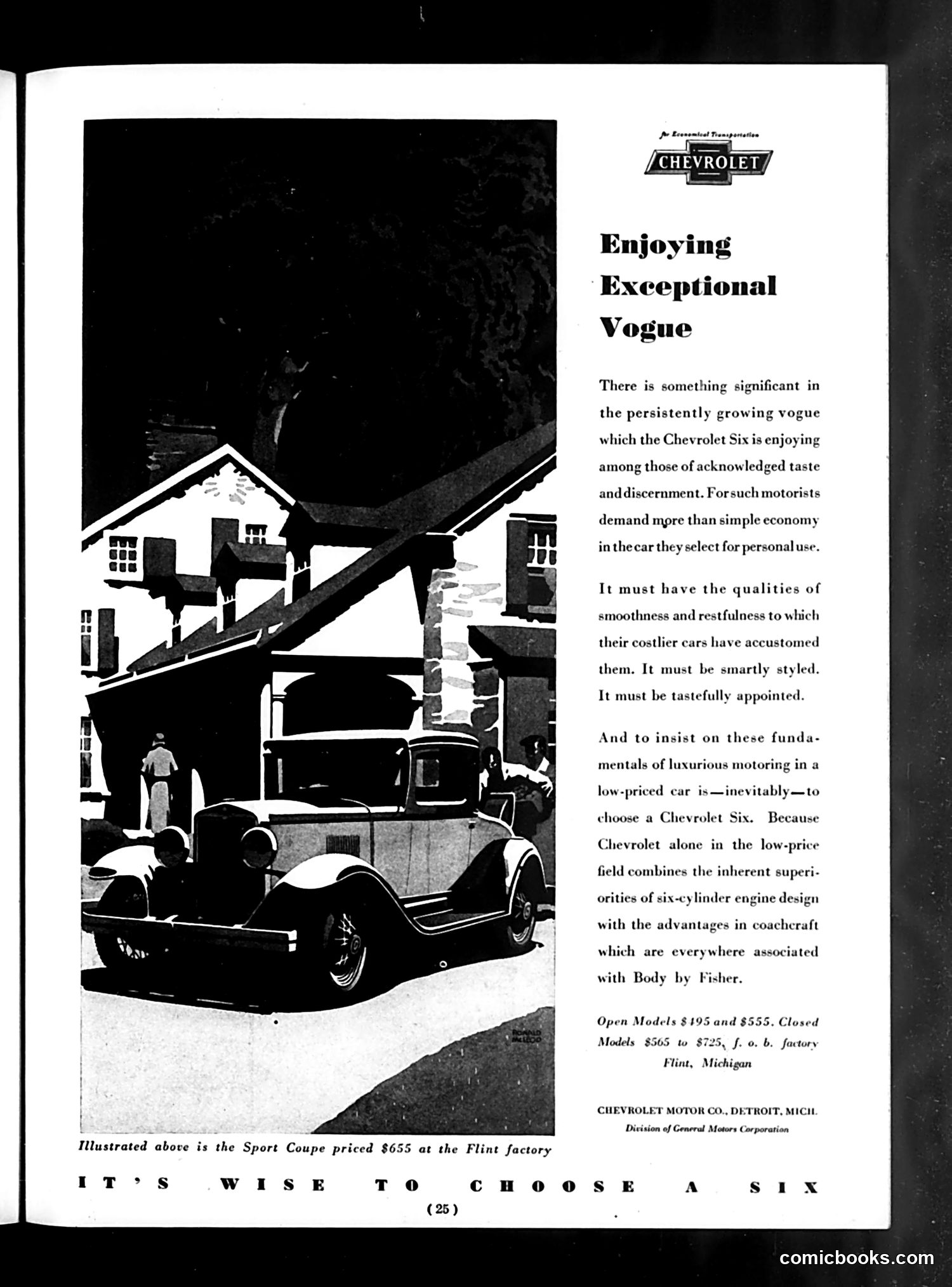
This is a Chevrolet automobile advertisement, not political satire. The page advertises the Chevrolet Six, positioned as an affordable luxury car for discriminating buyers. The image shows a stylish Sport Coupe parked in front of an elegant house, establishing aspirational lifestyle association. The advertisement's pitch targets middle-class consumers who want luxury features—smoothness, restfulness, smart styling, tasteful appointments—without high costs. It emphasizes that Chevrolet alone among low-priced cars combines six-cylinder engine superiority with "Body by Fisher" coachcraft (premium body design), then-associated with quality. Pricing ranges from $195 to $725 at the factory in Flint, Michigan. The tagline "It's Wise to Choose a Six" positions the six-cylinder engine as the sophisticated choice over cheaper four-cylinder competitors. This reflects 1920s-30s marketing: selling cars as status symbols and lifestyle purchases rather than mere transportation. There is no political cartoon or satire present on this page.
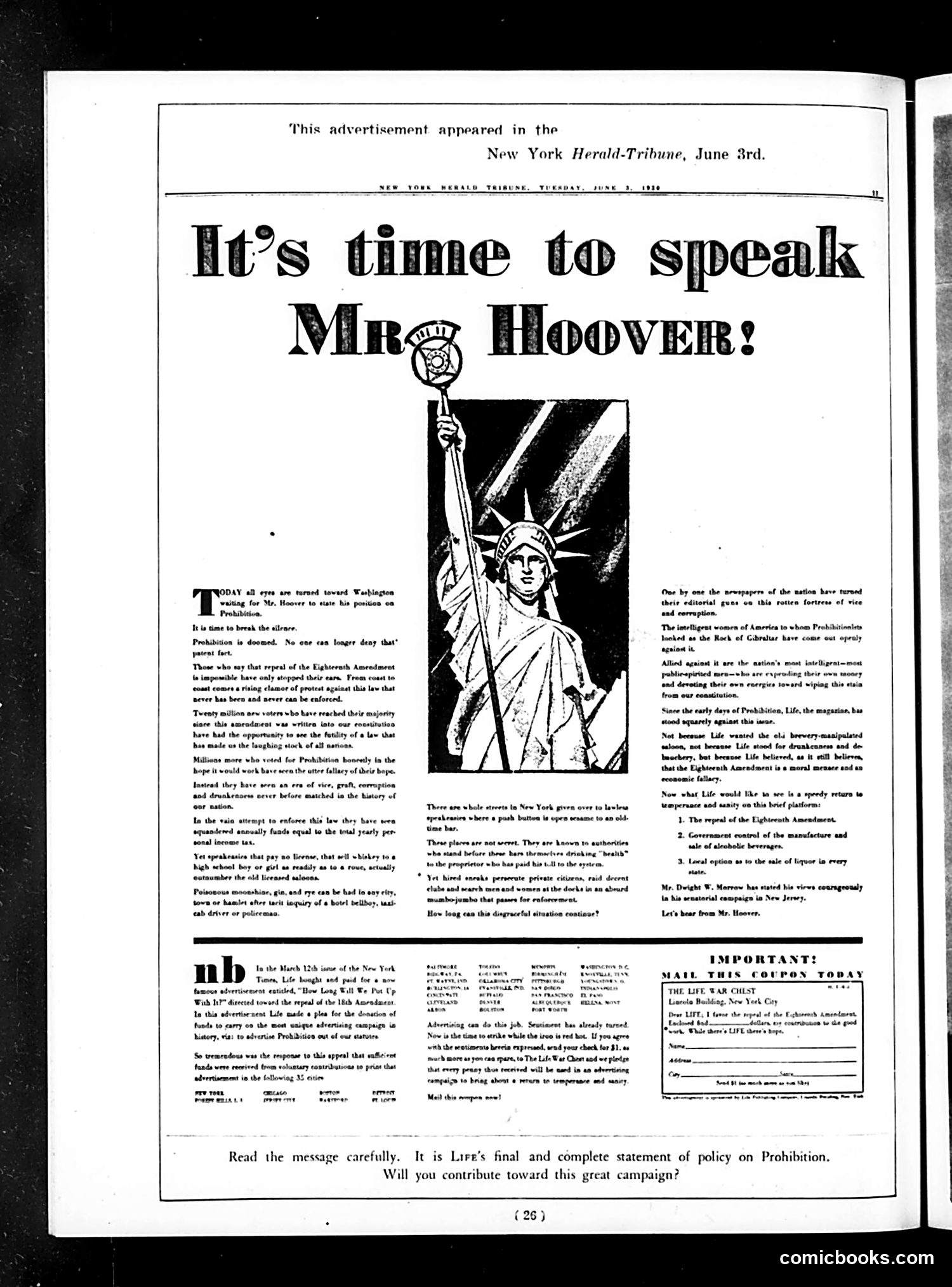
Life Magazine's Anti-Prohibition Advertisement (1930) This page reproduces a full-page advertisement that appeared in the *New York Herald-Tribune* on June 3rd, calling for the repeal of Prohibition. The central image shows the Statue of Liberty holding what appears to be a torch or banner labeled with a seal. The advertisement is framed as an appeal from *Life* magazine itself, urging President Hoover to publicly state his position on Prohibition. The text condemns Prohibition as unenforceable and morally corrupting—describing speakeasies, corruption, and violence resulting from the law. It presents three specific demands: repeal of the Eighteenth Amendment, federal enforcement cessation, and local option on liquor sales. The accompanying note explains that *Life* solicited donations to fund this anti-Prohibition campaign across 35 cities. This reflects the magazine's editorial stance that Prohibition represented both a failed policy and a moral hazard, positioning repeal as a matter of common sense and integrity rather than pro-drinking advocacy.
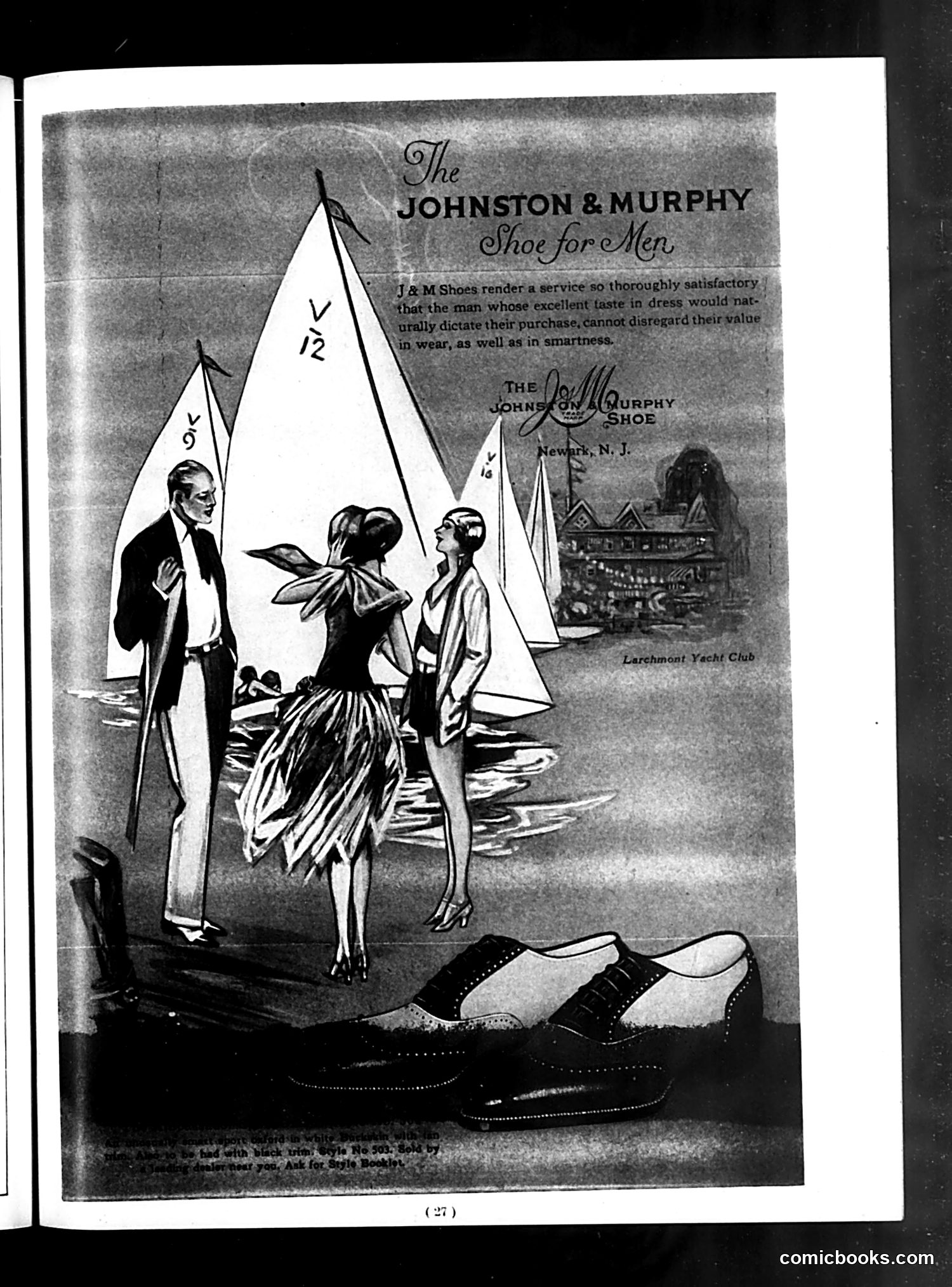
Johnston & Murphy Shoe Advertisement This is primarily a shoe advertisement for Johnston & Murphy, a Newark, N.J. company, rather than political satire. The ad uses a leisure scene—three well-dressed people near sailboats at the Larchmont Yacht Club—to associate the shoes with affluence and refined taste. The accompanying text claims J&M shoes are so satisfactory that discerning men won't overlook their value "in wear, as well as in smartness." The mathematical notation on the sails (√12, √6, √13) appears decorative rather than meaningful. This represents vintage advertising strategy: linking a product to aspirational lifestyle imagery and social status rather than discussing the shoes' actual features.
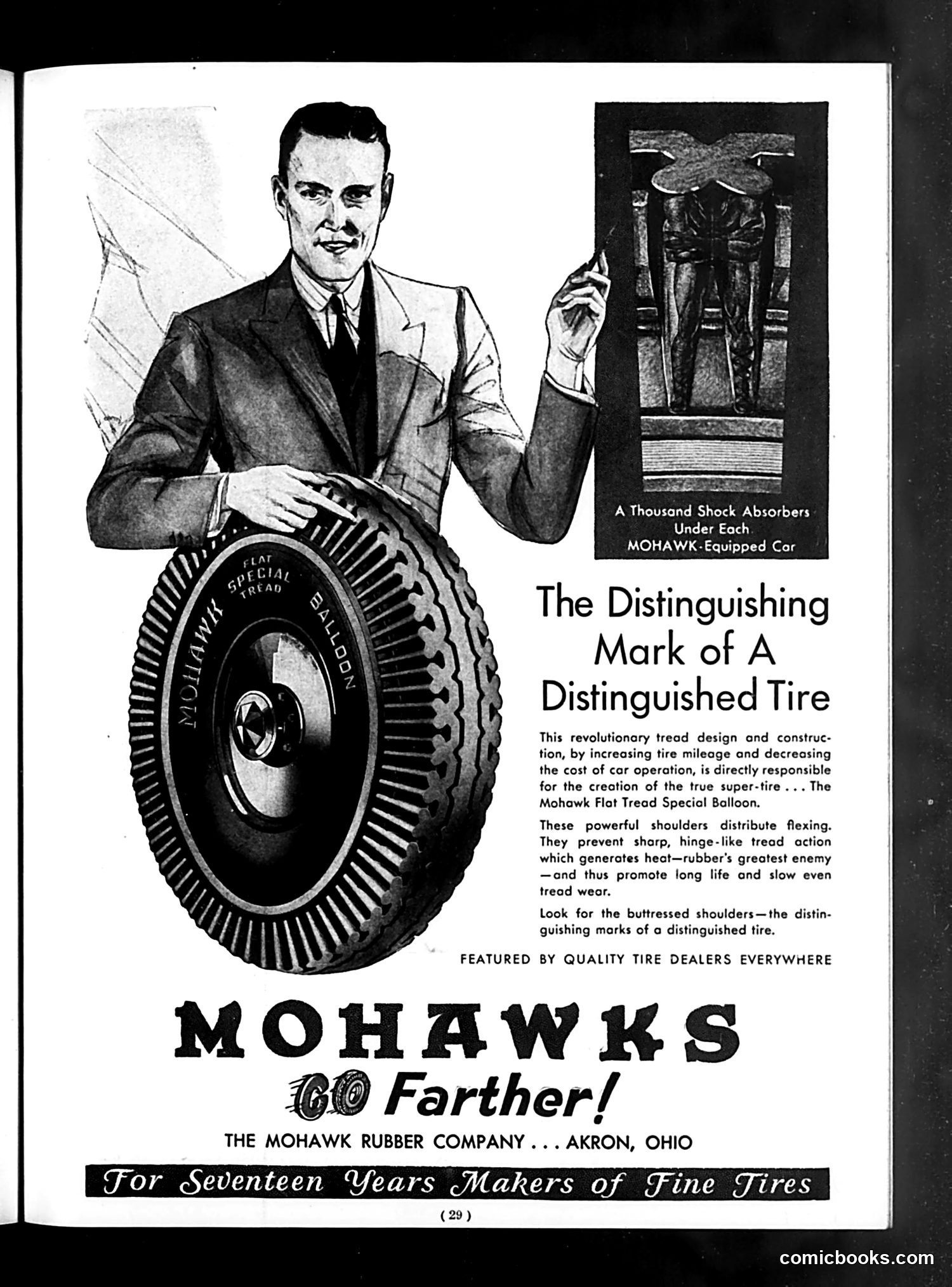
This is a tire advertisement, not political satire. It's a Mohawk Rubber Company ad promoting their "Flat Tread Special Balloon" tire to 1920s consumers. The well-dressed man holds a large tire, emphasizing its "buttressed shoulders" and innovative tread design. The inset shows shock absorbers beneath a car, illustrating the tire's technical superiority. The ad's appeal is purely commercial: Mohawk claims their revolutionary design increases mileage, reduces operating costs, and prevents heat damage through superior tread distribution. The "distinguishing mark of a distinguished tire" catchphrase targets quality-conscious buyers. The tagline "100 Farther!" and mention of "Seventeen Years Makers of Fine Tires" establish brand credibility. This represents straightforward early automotive advertising—no satire or hidden political meaning is present.
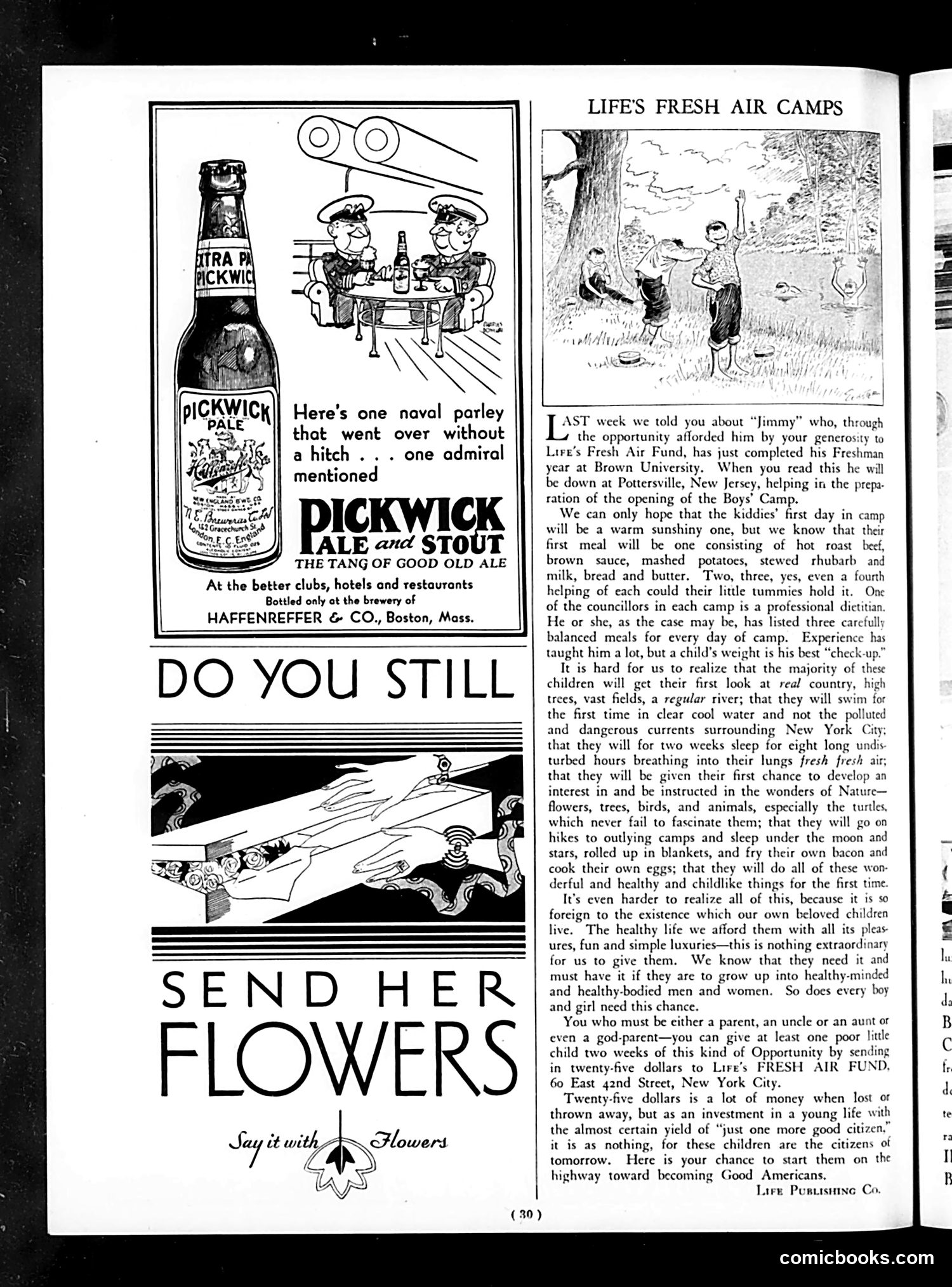
Page Analysis This Life magazine page contains three distinct elements: Left side: A Dickwick Pale Ale advertisement featuring a cartoon of two men in naval uniforms toasting at a table, with the caption "Here's one naval parley that went over without a hitch." This appears to be a topical joke referencing naval negotiations or diplomatic meetings of the era, where alcohol supposedly facilitates agreement. Below is a separate "Send Her Flowers" advertisement. Right side: An earnest fundraising article for Life's Fresh Air Camps, describing a charitable program sending poor urban children (particularly from New York City) to summer camps in rural New Jersey. The piece emphasizes how transformative outdoor experiences—swimming in clean water, breathing fresh air, encountering nature—are for underprivileged children, while contrasting this with the taken-for-granted healthy childhoods of the wealthy. It solicits $25 donations to sponsor individual children. The juxtaposition is striking: frivolous alcohol advertising sits opposite sincere charitable advocacy, likely reflecting Life magazine's mix of commercial and public-service content.
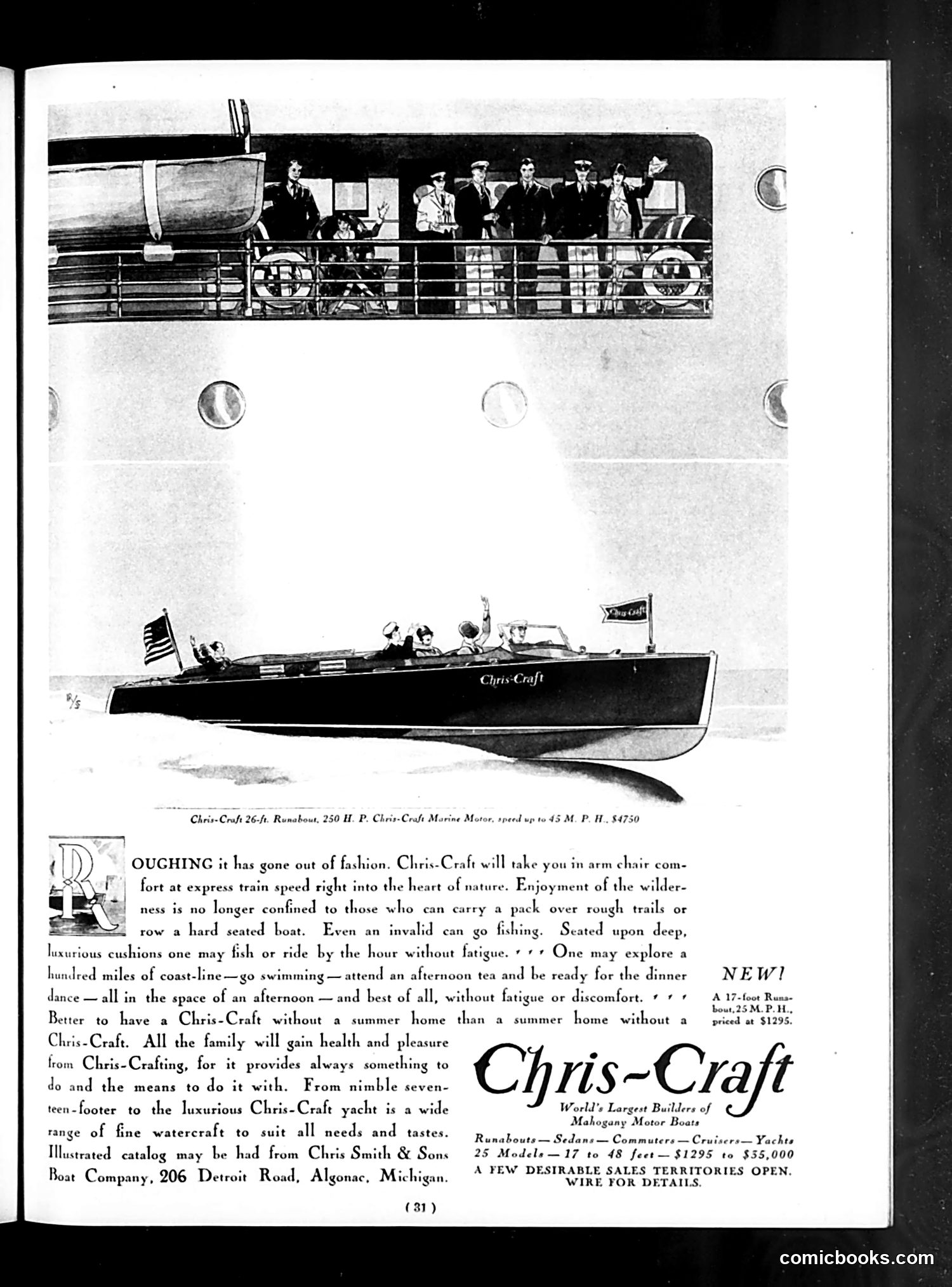
Chris-Craft Advertisement Analysis This is not a political cartoon or satire — it's a straightforward luxury boat advertisement from Life magazine. The page promotes Chris-Craft motor boats, marketed as the solution to enjoying nature without discomfort. The top image shows two vessels: an upper-deck scene with well-dressed passengers aboard a larger Chris-Craft, and below, the sleek "Chris-Craft 26-foot Runabout" speedboat. The ad's pitch targets affluent leisure-seekers by contrasting "roughing it" (traditional camping/boating) with luxury: comfortable cushioned seating, high speed (45 mph), and the ability to accomplish multiple activities—swimming, tea, dinner dancing—in one afternoon without fatigue. The tagline "Better to have a Chris-Craft without a summer home than a summer home without a Chris-Craft" positions the boat itself as a status symbol and lifestyle essential for the wealthy. The company, based in Algonac, Michigan, offered 25 models ranging $1,295–$55,000, emphasizing their dominance as "World's Largest Builders of Mahogany Motor Boats."
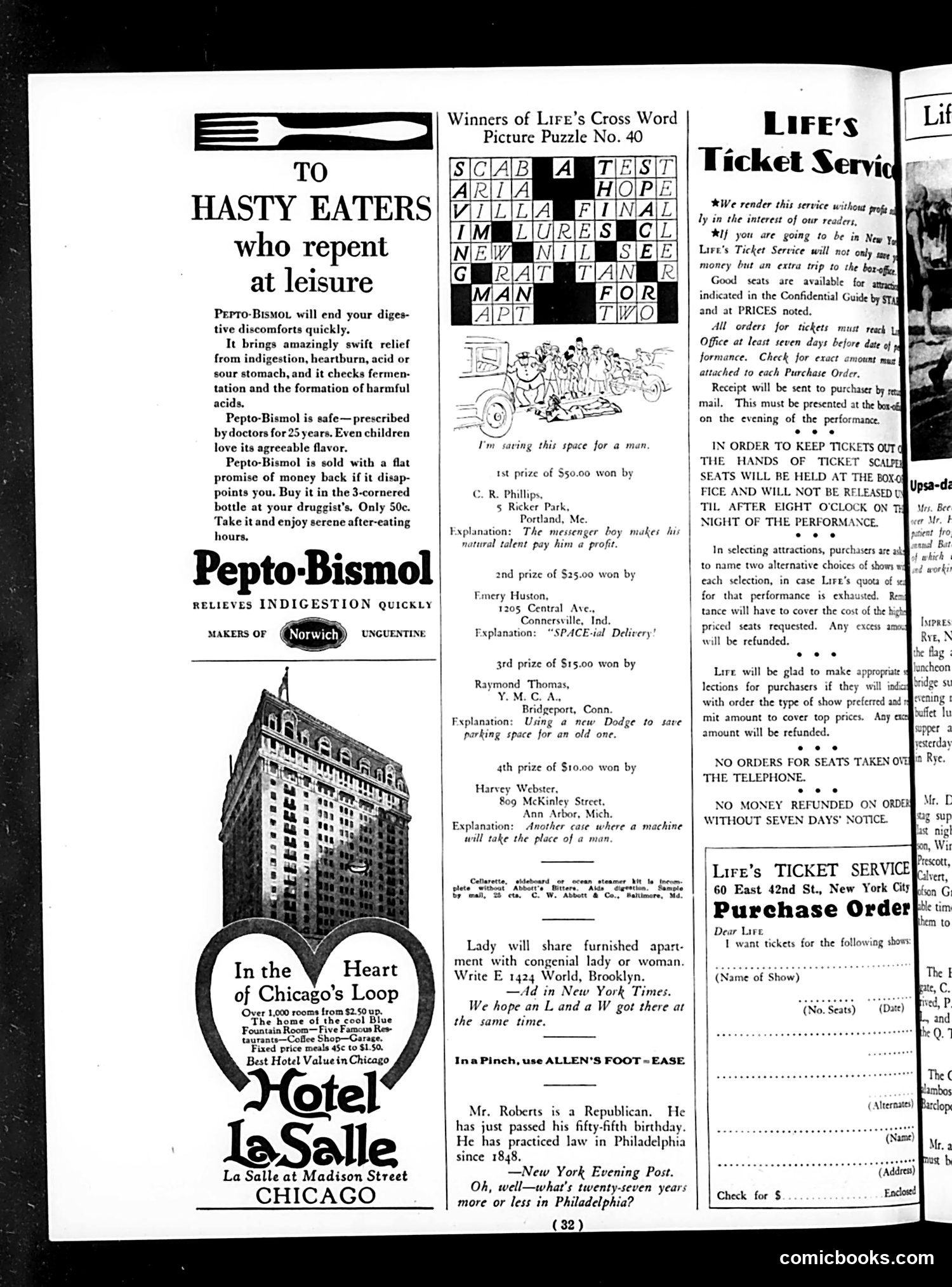
Analysis for Modern Readers This page is primarily advertising and service announcements rather than satirical content. The main items are: 1. Pepto-Bismol ad — targeting people who eat too quickly and suffer digestive problems, positioning the product as quick relief for indigestion. This reflects early 20th-century marketing of patent medicines. 2. Hotel LaSalle ad — promoting a Chicago hotel with emphasis on affordable rates and amenities. 3. Life's Crossword Picture Puzzle winners — a contest featuring visual riddles with humorous explanations about modern life (messenger boys, parking problems, automation replacing workers). 4. Life's Ticket Service — an in-house ticketing service for theater and entertainment, with strict rules about advance notice and refund policies. 5. Miscellaneous filler items — including a bemused note about a Philadelphia lawyer who's been practicing since 1848, treating his longevity as absurdly unremarkable. The page demonstrates Life magazine's dual function: satirical humor mixed with practical services and advertisements aimed at urban, middle-class readers.
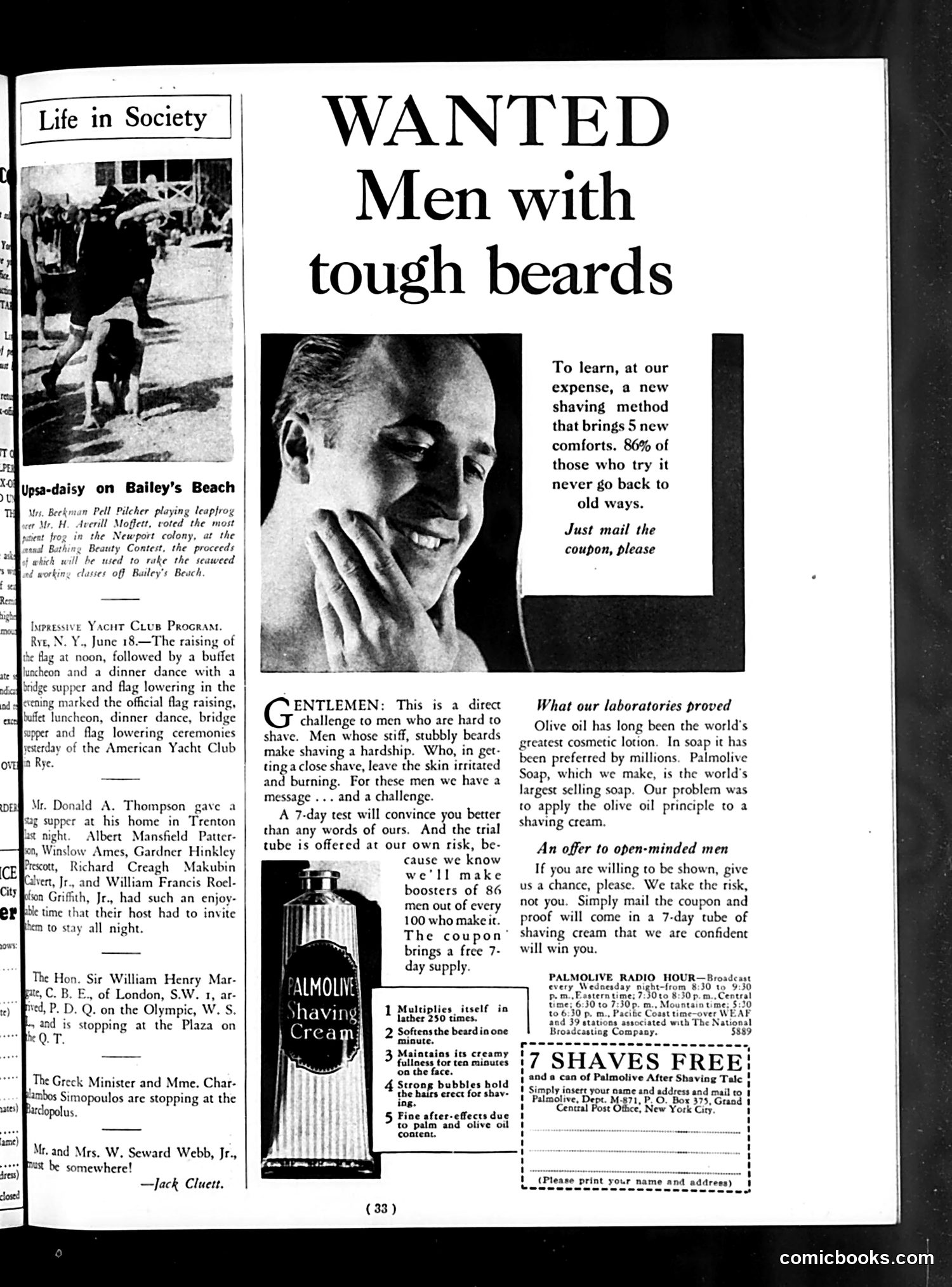
Explanation for Modern Readers This page contains two distinct elements: social gossip and advertising. The left column ("Life in Society") records upper-class social events among wealthy New York families—yacht club gatherings, dinner parties, and leisure activities at exclusive venues like Bailey's Beach in Newport. The tone is lighthearted; one caption jokes about a socialite winning a "beauty contest" whose proceeds will fund beach cleanup. The right two-thirds is a Palmolive Shaving Cream advertisement disguised as editorial content. It presents a mock challenge: "WANTED: Men with tough beards." The ad addresses men who struggle with irritated skin from shaving, positioning Palmolive as the solution through a 7-day free trial. The copy claims 86% of trial users become converts. The satire is gentle—the "wanted" framing humorously treats difficult beards as a problem needing recruitment, while the scientific claims about olive oil and bubble strength appeal to consumer confidence. This was typical early 20th-century advertising strategy: blending promotional material with entertainment to appear less overtly commercial.
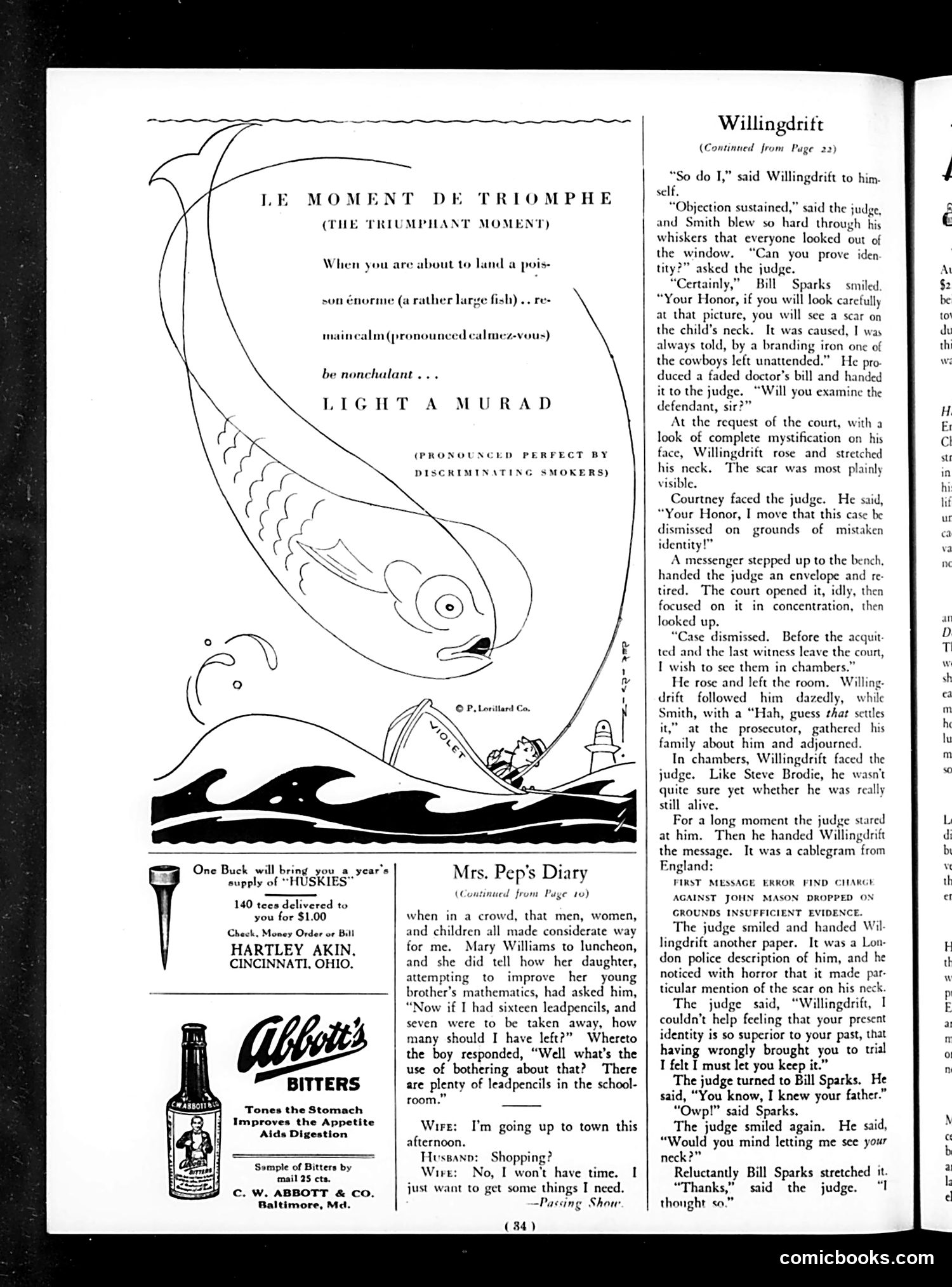
Analysis: "Willingdrift" Story & Page Content This page contains the conclusion of a serialized story called "Willingdrift" (continued from page 22), a courtroom drama about mistaken identity. The narrative involves a man named Willingdrift accused of a crime, with witness Bill Sparks providing crucial evidence—a scar on a child's neck allegedly caused by a branding iron, which Willingdrift bears. The twist: a cablegram arrives revealing the real criminal (John Mason) was found in England, and the London police description matches Bill Sparks, not Willingdrift. The judge dismisses the case, recognizing Willingdrift's "superior" current identity deserves protection over his criminal past. The page also contains period advertisements (Hartley Akin golf tees, Abbott's Bitters, Light Murad cigarettes) and "Mrs. Pep's Diary"—a humor column featuring domestic comedy about shopping and children.
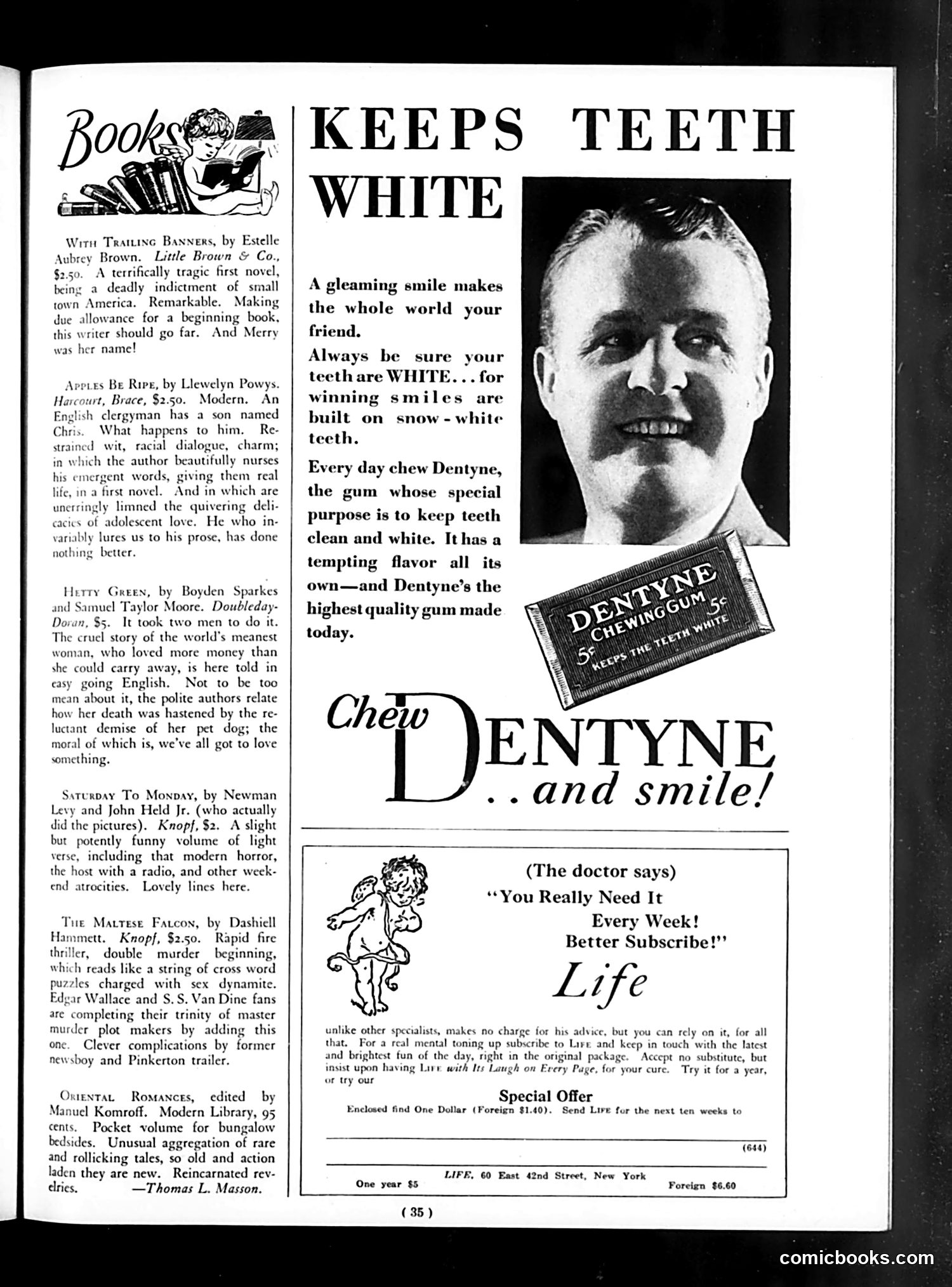
Page Analysis: Life Magazine Book Reviews & Advertisements This page is primarily book reviews and advertising, not political satire. The left column reviews five contemporary novels (1920s-era works by authors like Dashiell Hammett and Llewelyn Powys), offering literary criticism in a witty, accessible tone typical of Life's cultural commentary. The dominant content is a Dentyne chewing gum advertisement featuring a smiling man's photograph with the slogan "Keeps Teeth White." The ad conflates dental hygiene with social success ("A gleaming smile makes the whole world your friend"), a common marketing trope of the era. Below is a humorous subscription pitch for Life magazine itself, styled as "doctor's orders" to "subscribe" weekly for mental health—a self-promotional joke playing on the magazine's reputation for humor and satire as therapeutic. The page reflects 1920s consumer culture: aspirational advertising, literary gatekeeping through reviews, and magazines marketing themselves as essential lifestyle products.
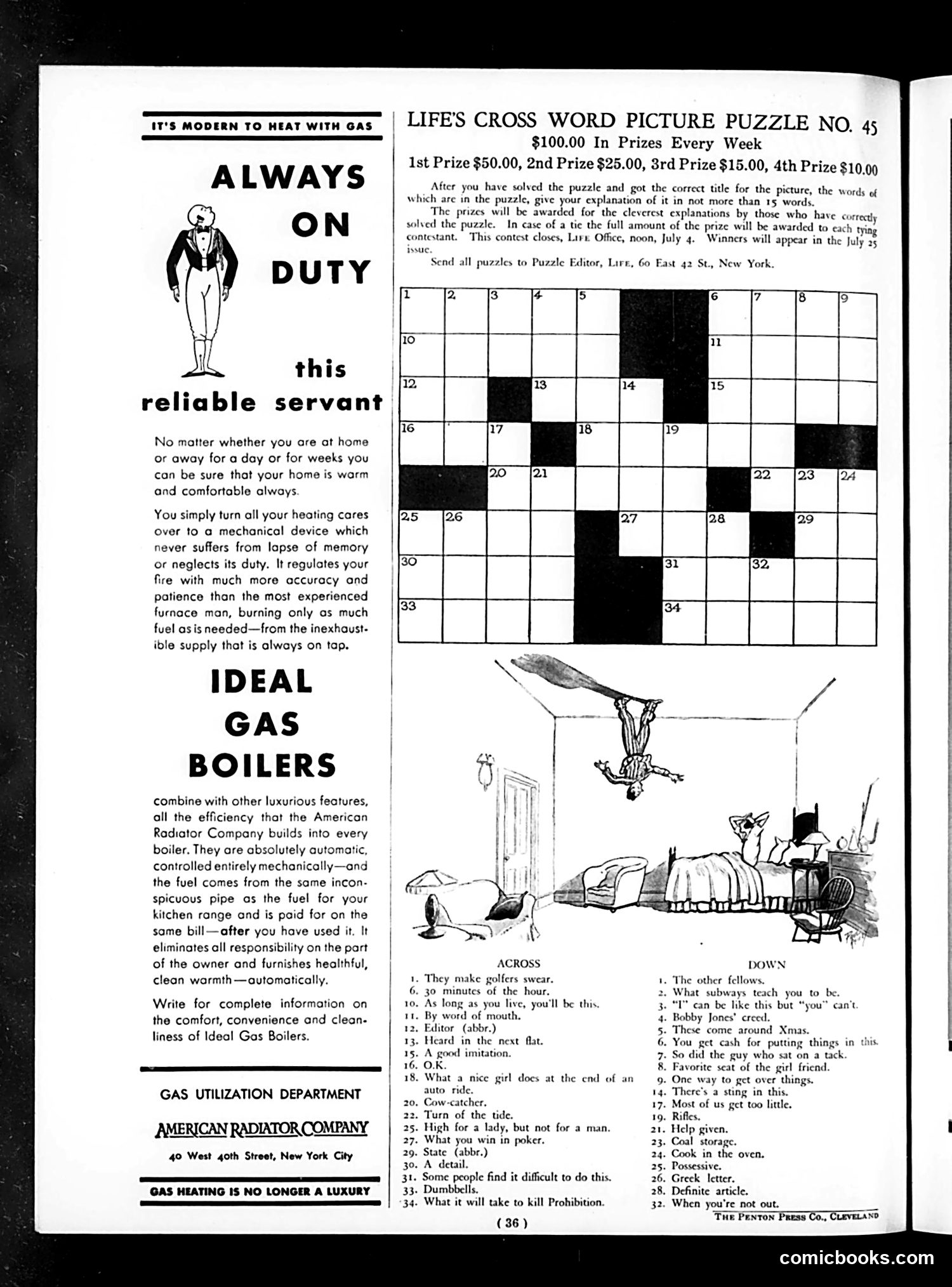
Life Magazine Page Analysis This page is primarily advertising and entertainment content, not political satire. The left side features a gas heating advertisement for American Radiator Company's "Ideal Gas Boilers." The illustrated figure ("reliable servant") is an anthropomorphized heating system—not a political caricature—representing the automatic, duty-bound convenience of gas heating. The marketing pitch emphasizes that gas heating eliminates homeowner responsibility and provides consistent warmth automatically. The right side is Life's crossword puzzle contest (No. 45), offering $100 in weekly prizes. Solvers must identify a picture hidden in the crossword grid and explain it in 15 words. The clues are typical 1920s-era wordplay (references to "Prohibition," "Bobby Jones," Christmas). There is no political cartoon or satire on this page. The "servant" image is purely commercial imagery promoting domestic convenience during an era when gas heating was transitioning from luxury to standard home feature.
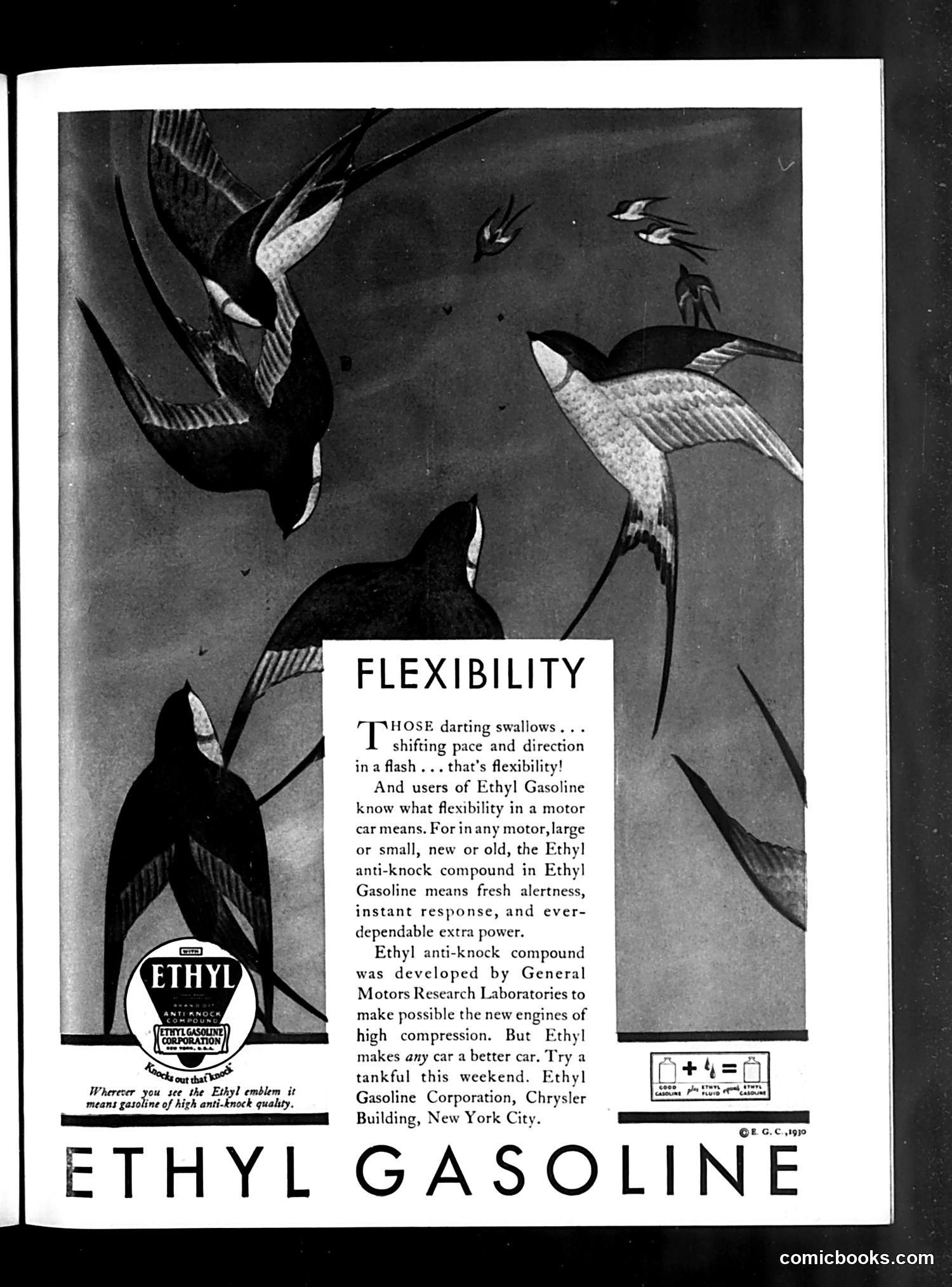
Analysis This is a vintage advertisement, not political satire. It's an Ethyl Gasoline Corporation ad (copyright 1929) promoting their anti-knock gasoline additive. The imagery shows darting swallows in flight—a metaphor for flexibility and responsiveness. The ad argues that just as swallows shift direction instantly, Ethyl-brand gasoline provides "fresh alertness, instant response, and ever-dependable extra power" in any motor vehicle. The text notes the product was developed by General Motors Research Laboratories to enable high-compression engines. The pitch is straightforward: buy Ethyl gasoline to make your car perform better. For modern readers: This reflects early 20th-century consumer advertising that used poetic nature imagery and scientific credentials to market a petroleum product. There's no satire here—it's genuine marketing, though the health dangers of leaded gasoline (tetraethyl lead in "anti-knock" compounds) wouldn't be widely understood or acknowledged for decades.
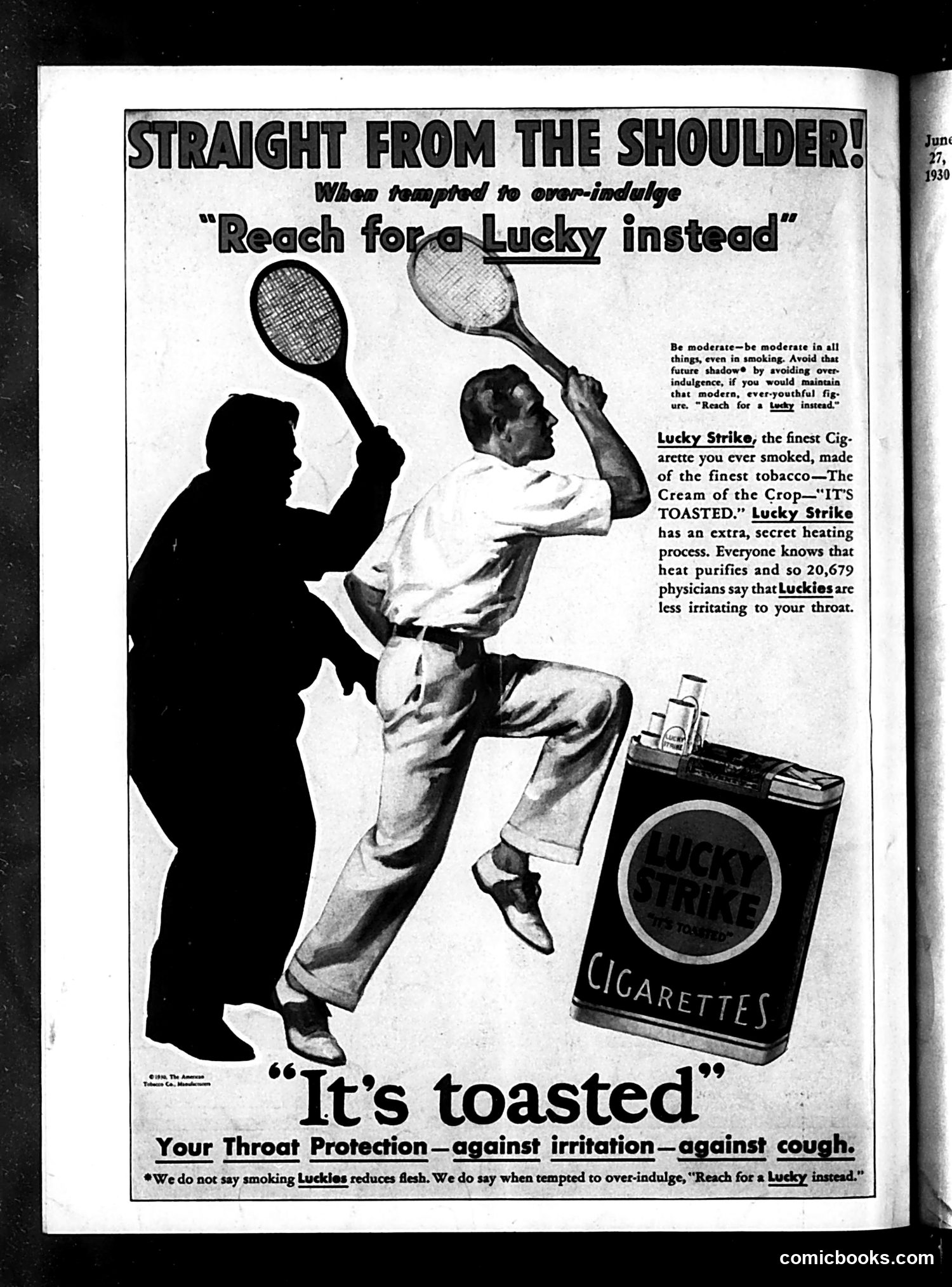
Analysis This is primarily a Lucky Strike cigarette advertisement, not satire or political commentary. The page presents a tennis player choosing cigarettes over overindulgence, with the tagline "Reach for a Lucky instead." The advertisement makes several now-infamous health claims typical of 1930s tobacco marketing: - Cigarettes are "toasted" (implying purity/safety) - 20,679 physicians allegedly endorse Lucky Strikes as "less irritating to your throat" - Smoking promotes a "modern, ever-youthful figure" (weight control) - Cigarettes offer "throat protection against irritation" A small disclaimer admits they don't claim smoking reduces weight—only that when tempted to overindulge in food, one should "reach for a Lucky instead." For modern readers, this represents the era before tobacco health dangers were acknowledged, when cigarette companies made unsubstantiated medical claims and recruited doctors for marketing purposes—practices later revealed as deceptive and now illegal.