life
Life — June 27, 1930
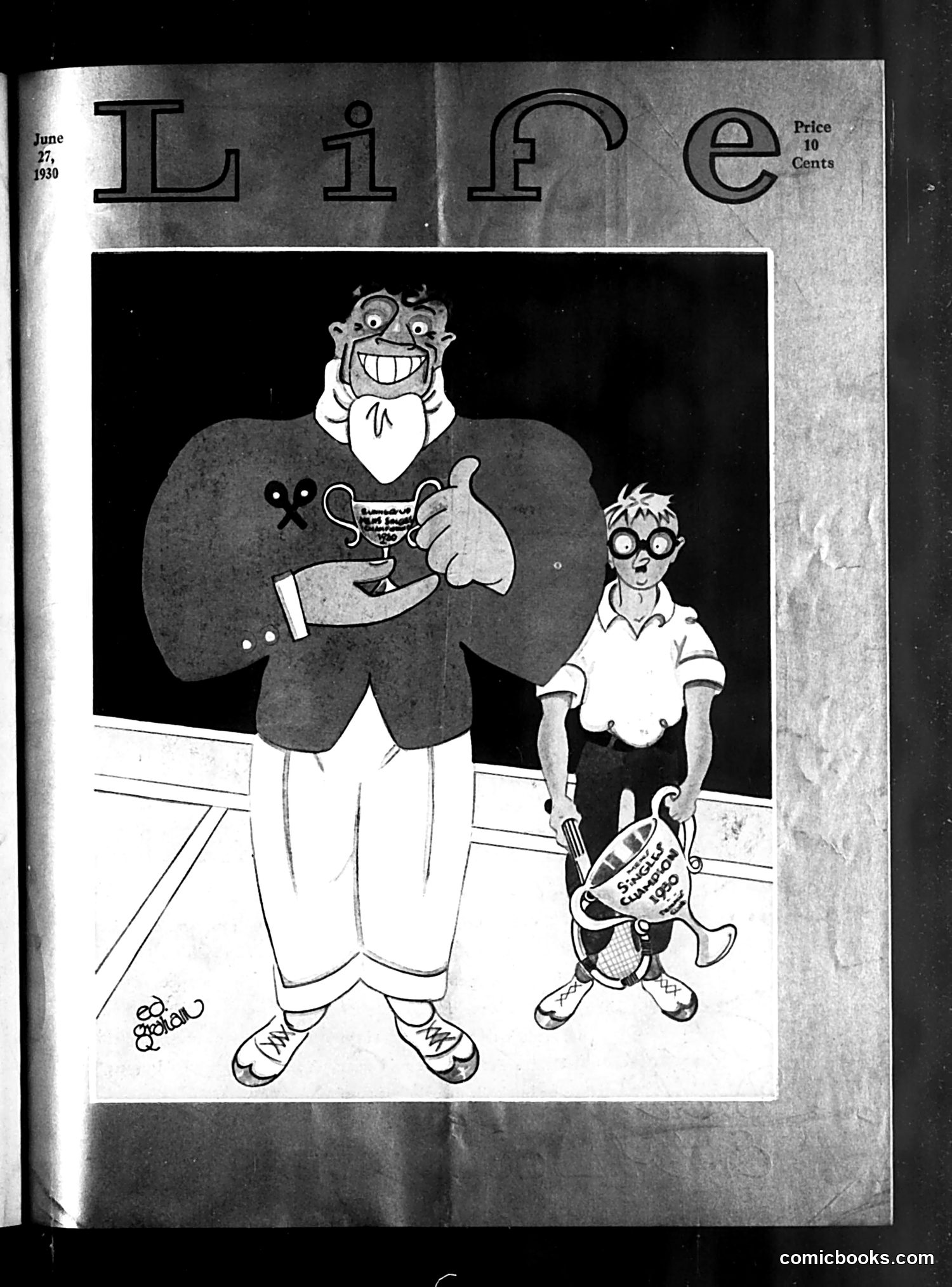
Life Magazine Cover, June 27, 1930 This cover illustration depicts a large, menacing figure with an exaggerated grin holding a trophy cup, while a smaller boy beside him clutches what appears to be a sports award or ribbon. The art style is characteristic of 1930s satirical cartooning. Without identifying text clearly visible for the specific figures, the cartoon appears to satirize disparities in competitive success or prize-winning—possibly commenting on unfair advantages or "rigged" competition where a dominant figure claims the trophy while a smaller competitor is left with lesser recognition. The exact political or social context remains unclear from the image alone. The date (1930) and exaggerated character design suggest commentary on contemporary American sports, business, or social competition during the Great Depression era, but the specific target of satire cannot be definitively determined without additional context.
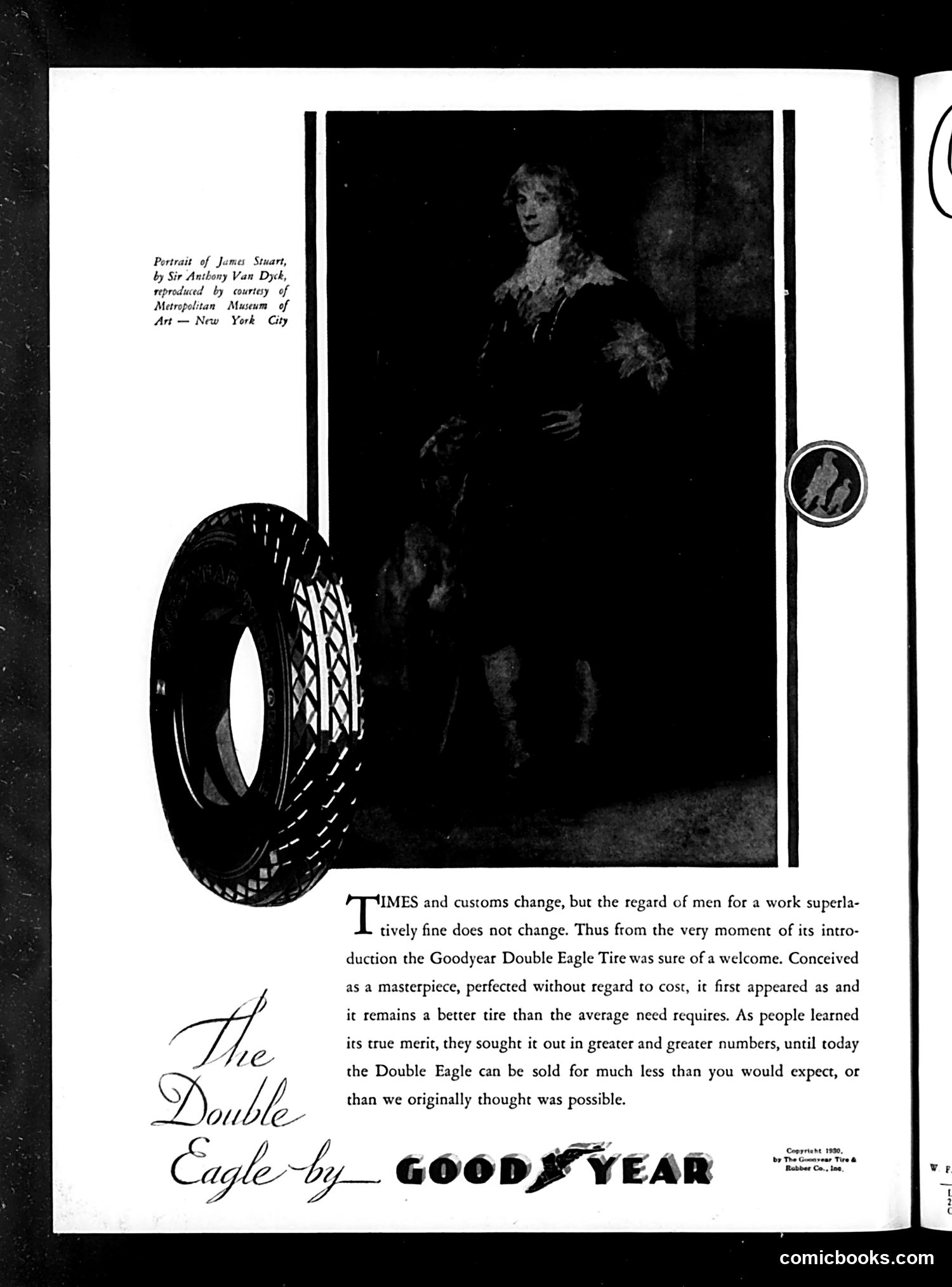
This is a Goodyear tire advertisement, not a satirical cartoon. The page features a portrait (credited to Sir Anthony Van Dyck, from the Metropolitan Museum of Art) of what appears to be a historical gentleman in 17th-century dress, positioned above a large tire illustration. The advertisement's pitch argues that quality craftsmanship is timeless: "Times and customs change, but the regard of men for a work superlatively fine does not change." It uses this classical portrait as a metaphor—just as Van Dyck's painting remains valued across centuries, so the Goodyear Double Eagle Tire supposedly maintains its superior quality despite changing times and market conditions. The ad claims the tire's excellence has driven increasing demand, allowing prices to drop while maintaining superior quality.
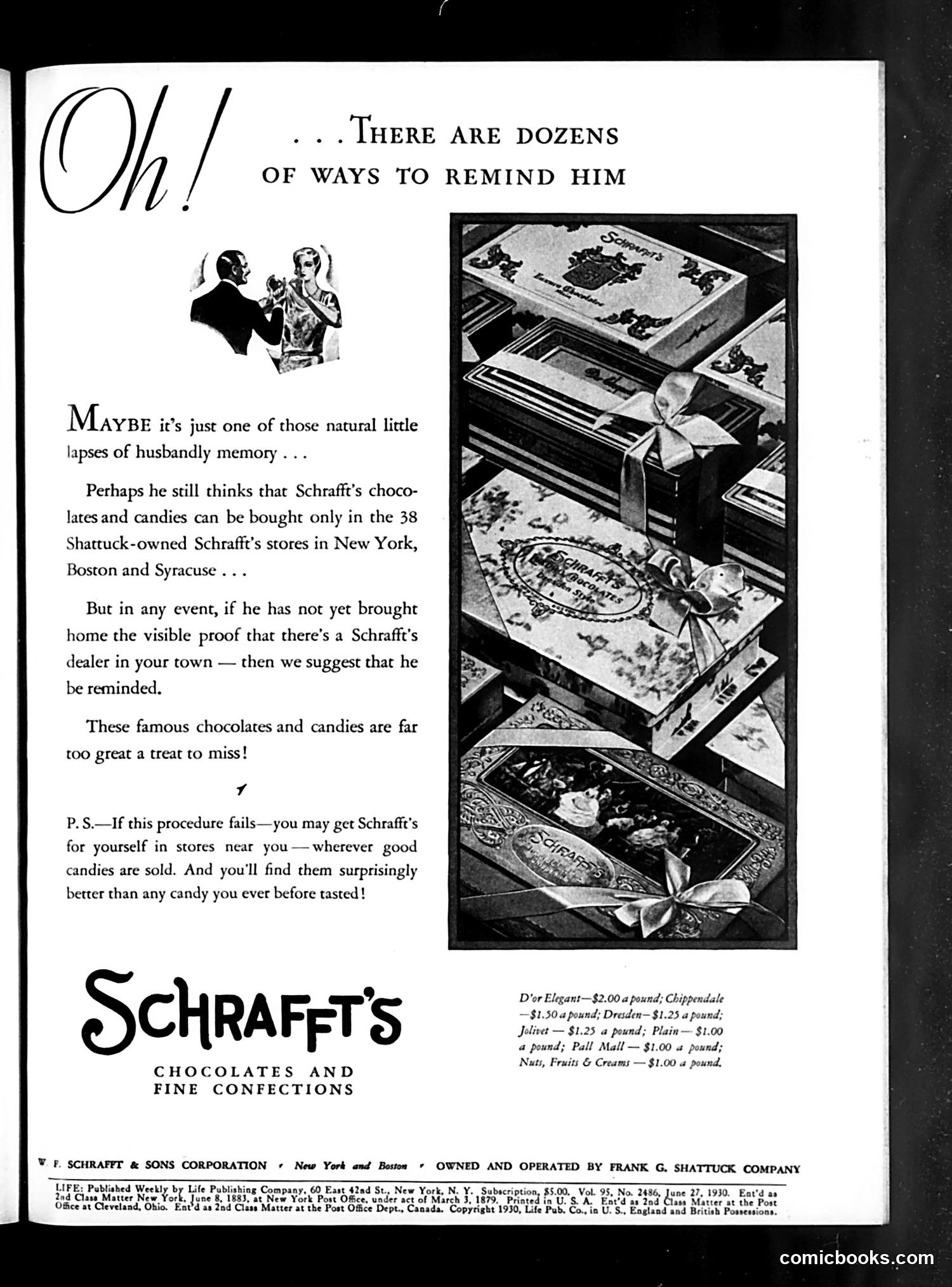
Analysis This is primarily an advertisement for Schrafft's chocolates and candies, not a political cartoon. The "Oh!" headline and illustrated couple appear designed to humorously address husbands who've forgotten to bring home Schrafft's products as gifts. The satire is gentle domestic humor: the ad jokes that a husband's "natural little lapses of husbandly memory" might cause him to forget Schrafft's exists only in 38 stores across three cities (New York, Boston, Syracuse). The solution: the wife should remind him, or he should buy it himself. The right panel shows attractive Schrafft's product boxes with ribbons. Prices range from $1.00 to $2.00 per pound for varieties like "D'r Elegant" and "Dresden." The humor targets wives and gift-giving expectations—typical 1930s consumer advertising using gentle marital comedy to encourage candy purchases.
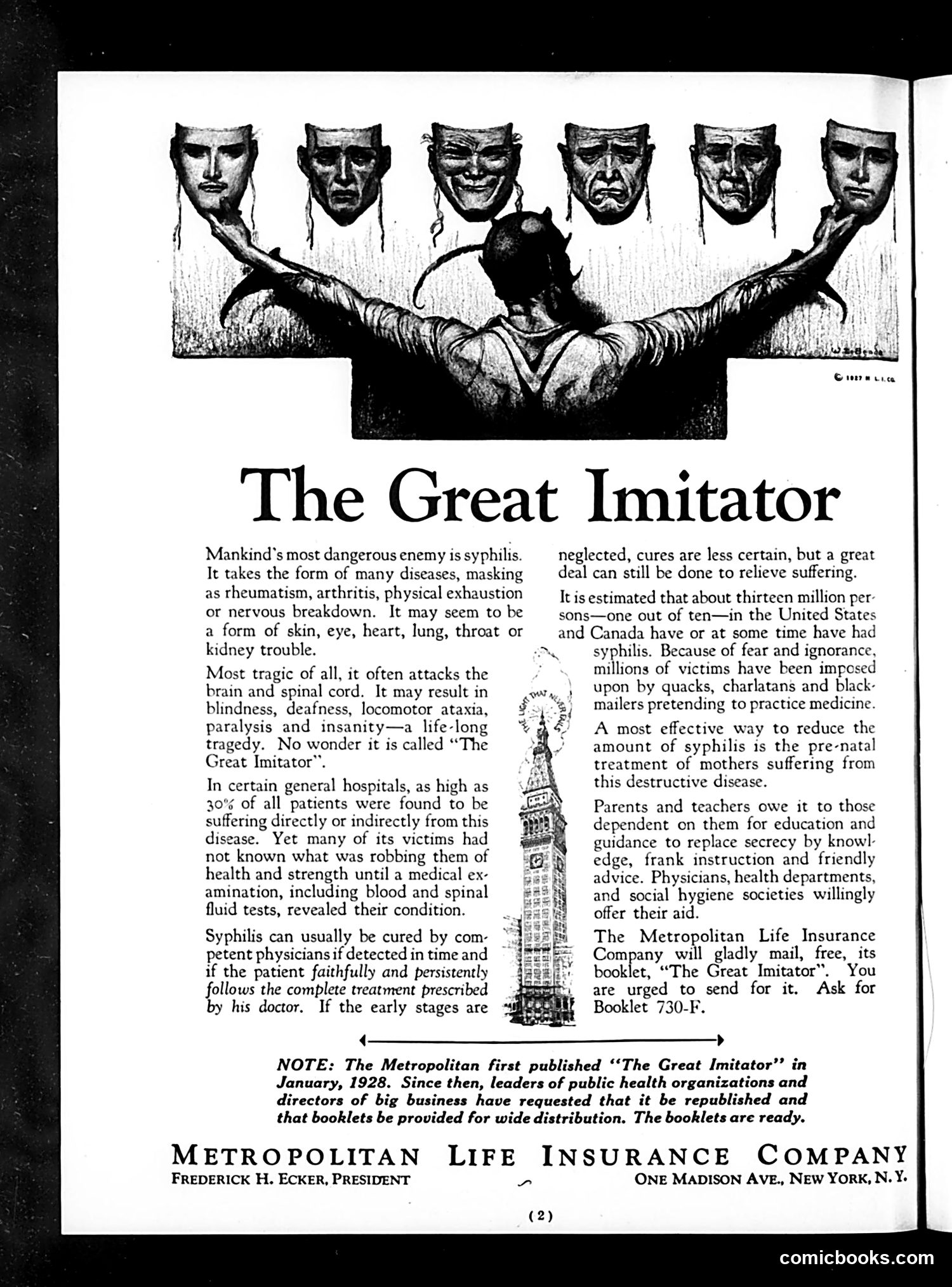
"The Great Imitator" - Public Health Advertisement This is a public health advertisement by Metropolitan Life Insurance Company, not political satire. The page warns about syphilis, which was called "The Great Imitator" because it mimics other diseases—appearing as rheumatism, arthritis, or nervous breakdown. The six illustrated male faces at top represent different disease manifestations. The figure below with outstretched arms symbolizes the disease's widespread, deceptive nature. The ad emphasizes that syphilis was a major health crisis (affecting roughly one in ten Americans), often undiagnosed due to stigma and medical fraud. It urges education, early detection, and proper medical treatment as prevention strategies, positioning the insurance company as a public health advocate offering free informational booklets.
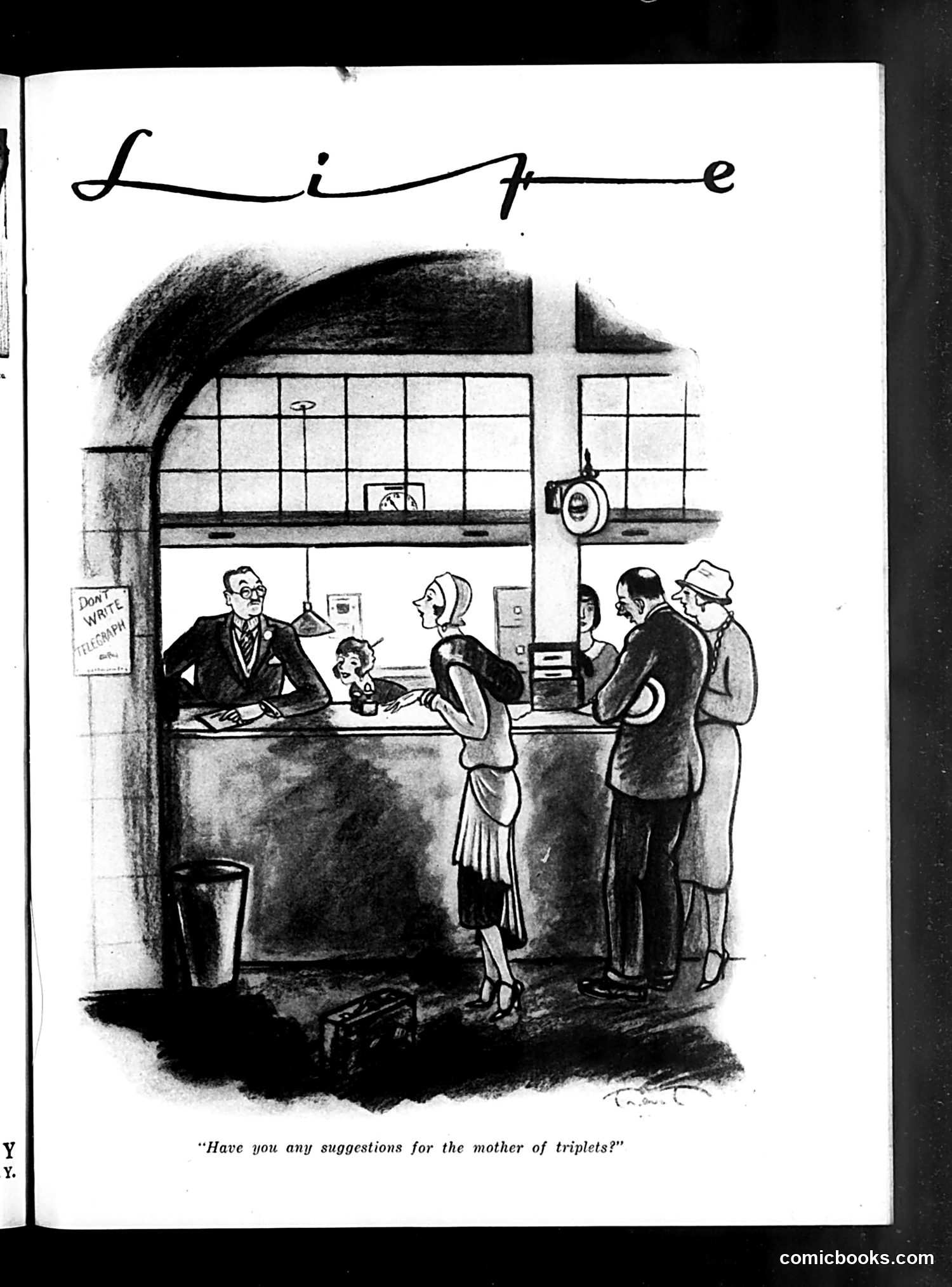
Cartoon Analysis: "Have you any suggestions for the mother of triplets?" This is a satirical cartoon from *Life* magazine depicting a scene at what appears to be a government office or social services window (note the "Don't Write on Sill" sign). A woman with triplets seeks advice from a bureaucrat behind the counter, while several men in hats wait behind her. The humor satirizes the bureaucratic response to large families during an era of economic concern—likely the Depression or post-war period when supporting multiple children was financially challenging. The cartoon mocks both the apparent inadequacy of government assistance and the absurdity of asking bureaucrats for practical parenting advice. The waiting men suggest this is a common, frustrating interaction with an indifferent system. The satire targets institutional inefficiency in addressing real family hardships.
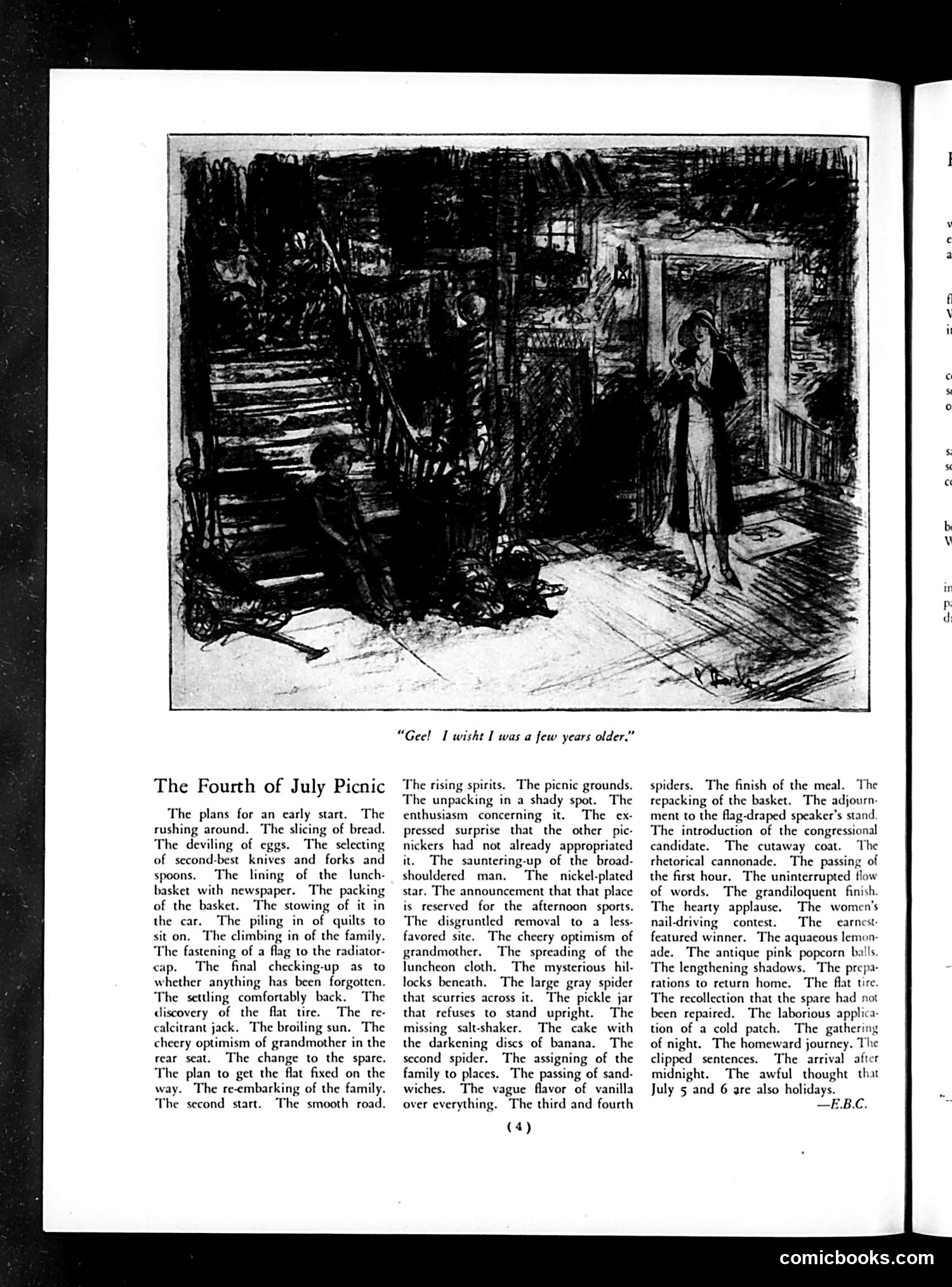
Analysis This page contains a humorous short story titled "The Fourth of July Picnic" with an accompanying illustration. The sketch shows a domestic scene at what appears to be a picnic outing, depicting various mishaps and ironies associated with attempting an early-morning Fourth of July celebration. The satire targets the gap between picnic ideals and reality: the text catalogs a series of escalating disasters—forgotten items, spilled food, broken equipment, family disputes, and various minor catastrophes that undermine the cheerful patriotic occasion. The final line notes that "July 5 and 6 are also holidays," suggesting exhausted relief when the ordeal ends. This is gentle social satire about American family life and holiday expectations rather than political commentary.
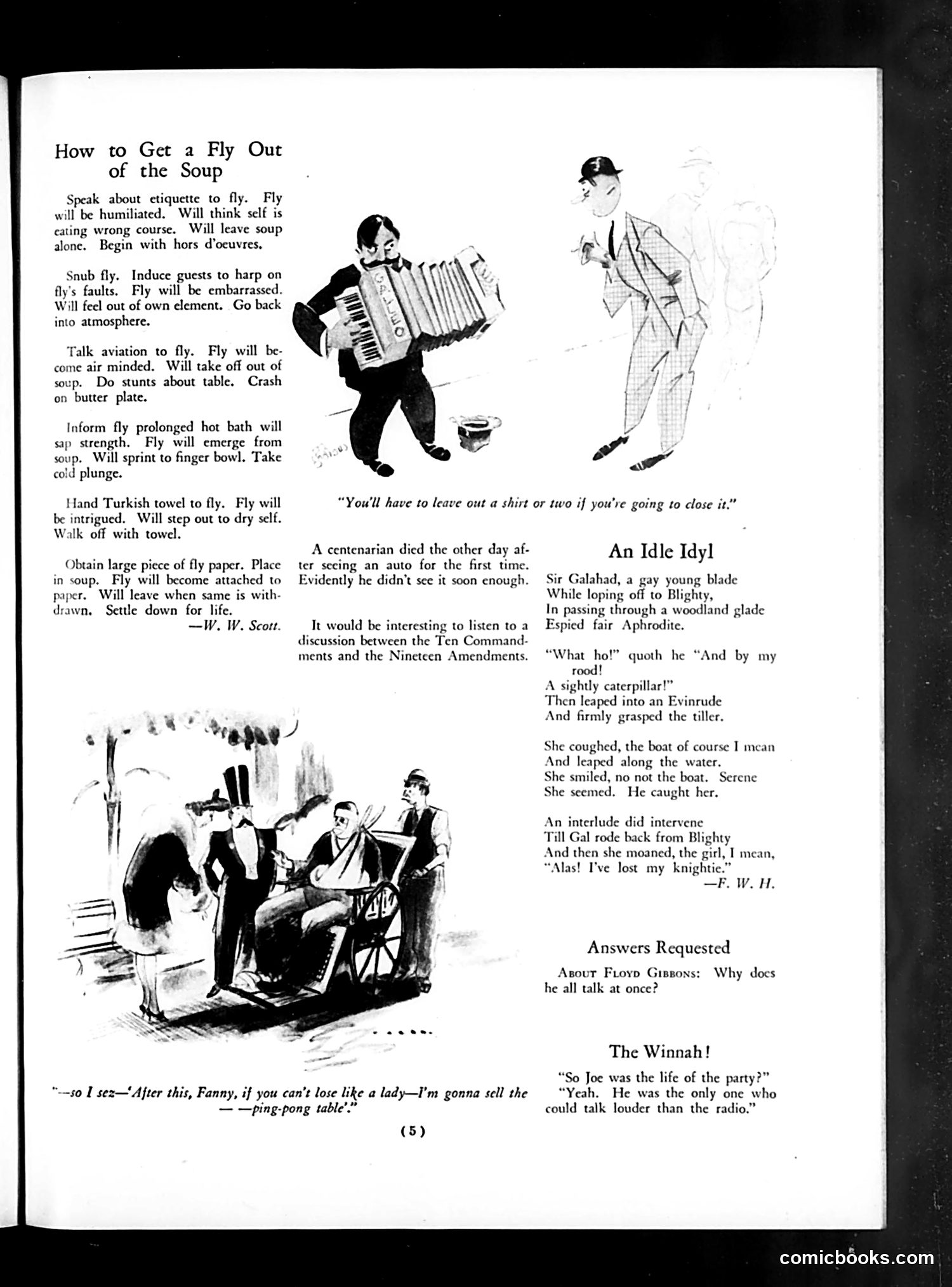
Explanation for Modern Readers This page contains three unrelated humor pieces typical of Life magazine's satirical content: 1. "How to Get a Fly Out of the Soup" — A comedic advice column offering absurd solutions (snubbing the fly, talking aviation to it, Turkish towels, etc.). The joke relies on treating a mundane annoyance with exaggerated, ridiculous formality. 2. "An Idle Idyl" — A poem about Sir Galahad encountering a woman named Aphrodite while boating. The humor appears to play on courtly romance language applied to an awkward modern encounter. 3. "Answers Requested" and "The Winnah!" — Short joke items. One asks why Floyd Gibbons talks constantly; the other makes a joke about Joe being the loudest party guest (likely a radio reference, as radio was prominent entertainment then). The page reflects 1920s-era humor: wordplay, physical comedy scenarios, and gentle social satire about modern manners and entertainment.
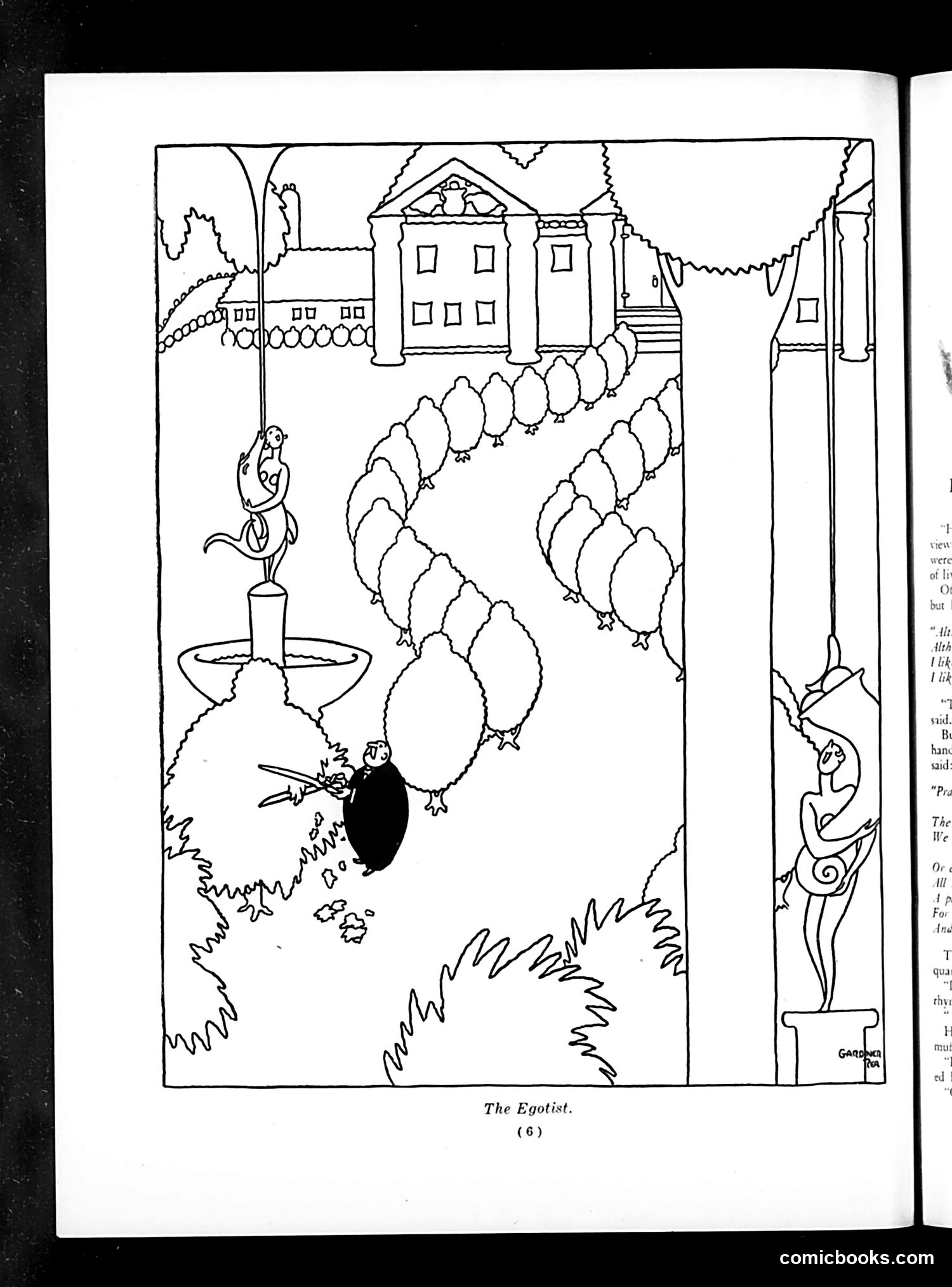
"The Egotist" - Explanation This satirical cartoon depicts a pompous figure (shown in black, standing center) surrounded by admiring statues of themselves in various classical poses. The figure is literally surrounded by representations of their own image—in fountains, on pedestals, and as decorative garden elements around an impressive mansion. The satire targets excessive self-regard and vanity. The title "The Egotist" makes the message explicit: this is a person so consumed with self-importance that they've filled their entire estate with monuments to themselves. The classical architectural setting and formal garden layout emphasize the pretension and self-aggrandizement. This appears to be social commentary on wealthy individuals who display their status and ego through ostentatious self-commemoration rather than genuine achievement or character.
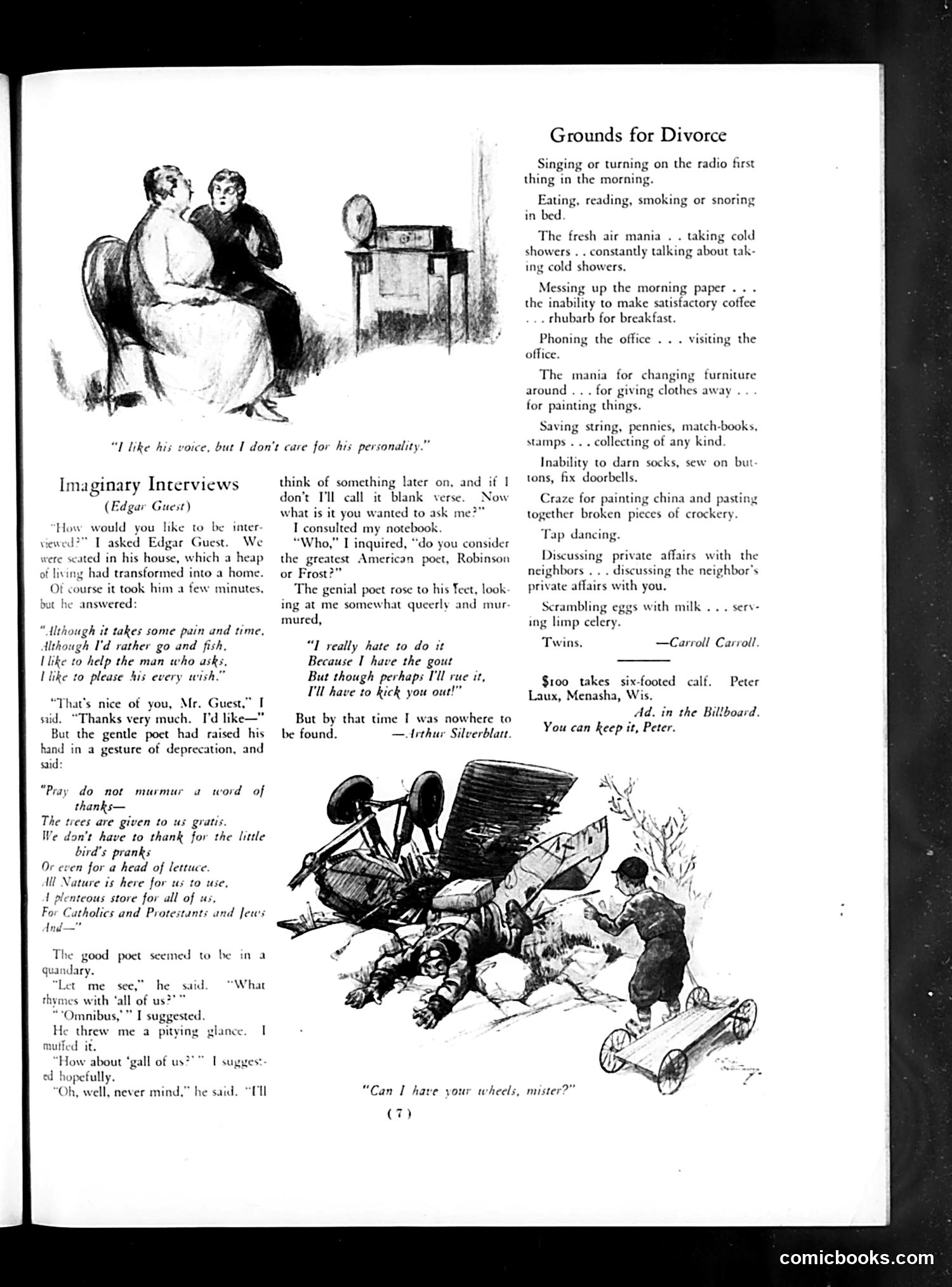
Analysis of Life Magazine Page This page contains two distinct pieces: "Imaginary Interviews (Edgar Guest)" — A satirical interview with the poet Edgar Guest. The interviewer asks Guest about being America's greatest poet, and Guest responds with verbose, sentimental poetry. The joke targets Guest's reputation for writing overly flowery, saccharine verse. The satire suggests his poetry lacks substance—the interviewer can't even get a straight answer. "Grounds for Divorce" — A humorous list of marital complaints (singing off-key, snoring, messiness, obsessing over cold showers, etc.). This reflects period anxieties about marriage and domestic friction. Bottom cartoon — Shows children playing roughly with a toy wagon, with one child asking "Can I have your wheels, mister?" The humor appears to reference childhood negotiation and property disputes.
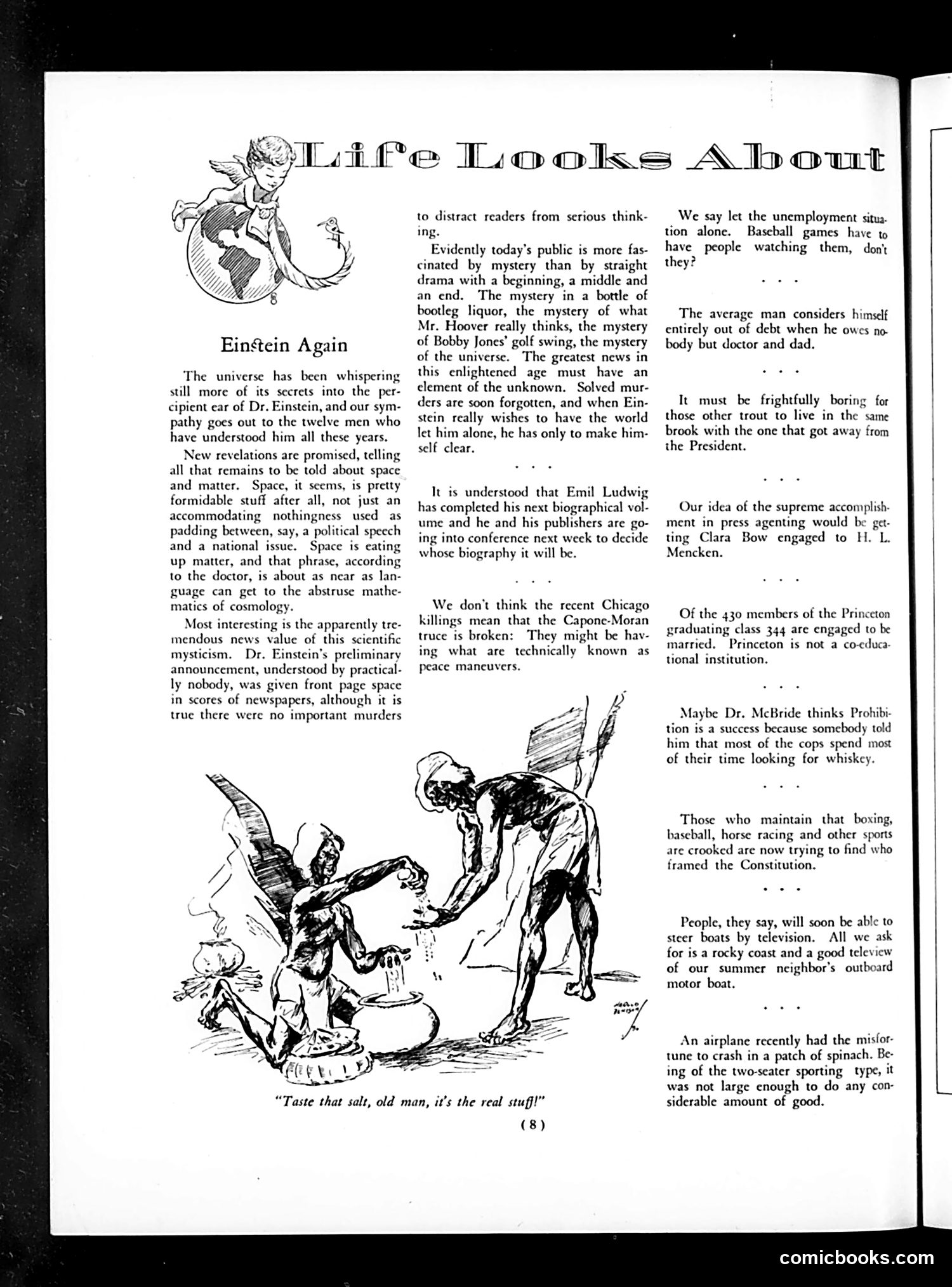
"Life Looks About Einstein Again" This satirical piece mocks contemporary fascination with Einstein's scientific announcements. The main text criticizes how modern readers prefer mystery and spectacle over substantive understanding—using Einstein's relativity theories as an example of incomprehensible yet celebrated news. The cartoon below depicts figures around a cauldron with the caption "Taste that salt, old man, it's the real stuff!" This appears to reference Prohibition-era bootlegging and the illegal alcohol trade, likely satirizing corrupt practices or dubious "remedies" being sold to the public. The right column includes brief jokes about unemployment, baseball, Prohibition enforcement, and sports corruption—common satirical targets of the 1920s-30s era. The overall tone suggests readers are distracted by sensationalism rather than genuine understanding of complex issues.
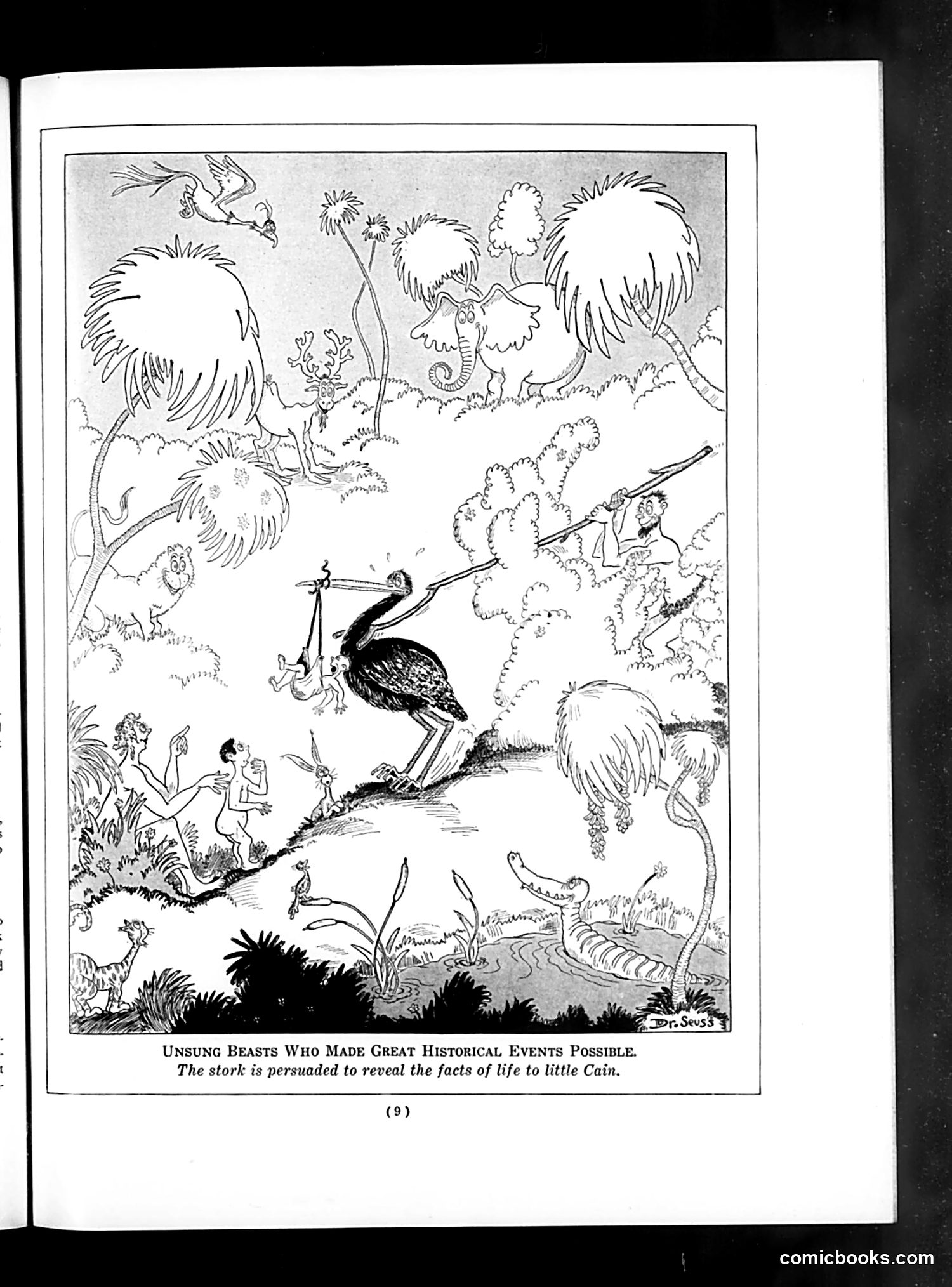
Unsung Beasts Who Made Great Historical Events Possible This satirical illustration shows a stork being "persuaded" by various fantastical creatures to reveal "the facts of life to little Cain." The cartoon appears to be a humorous take on the traditional story of storks delivering babies, here recontextualized with a biblical reference to Cain (the first murderer in Genesis). The "unsung beasts" are whimsical, invented creatures populating the landscape. The satire seems to mock the conventional euphemism adults use to explain human reproduction to children, while the reference to Cain adds dark irony—suggesting that even knowledge of life's origins cannot prevent human violence and sin. The cartoon employs absurdist humor typical of Life magazine's satirical style.
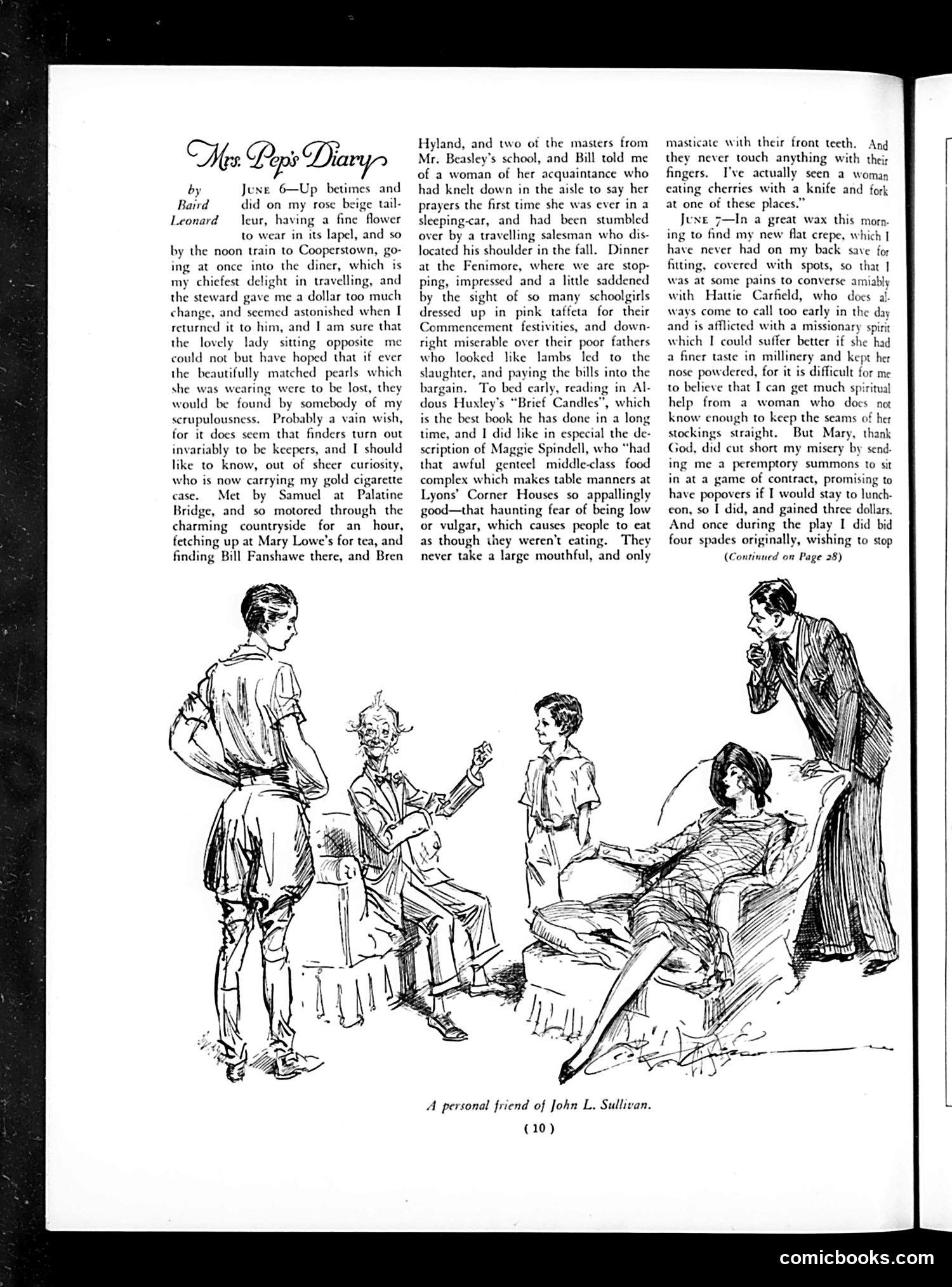
Analysis This page contains "Mrs. Pop's Diary" by Baird Leonard, a personal essay with accompanying illustration. The text describes the author's train journey to Cooperstown, observations about schoolgirls in pink taffeta at a church event, and reflections on social class anxieties—particularly about appearing vulgar or "low." The illustration, credited as "A personal friend of John L. Sullivan," shows a social gathering with figures in Edwardian dress. It appears to satirize middle-class pretension and social climbing, depicting people in somewhat awkward poses that underscore the essay's theme about class consciousness and the fear of social misstep. The reference to boxer John L. Sullivan (popular circa 1880s-1890s) suggests this is from Life's humorous commentary on American social dynamics and aspirational behavior among the emerging middle class.
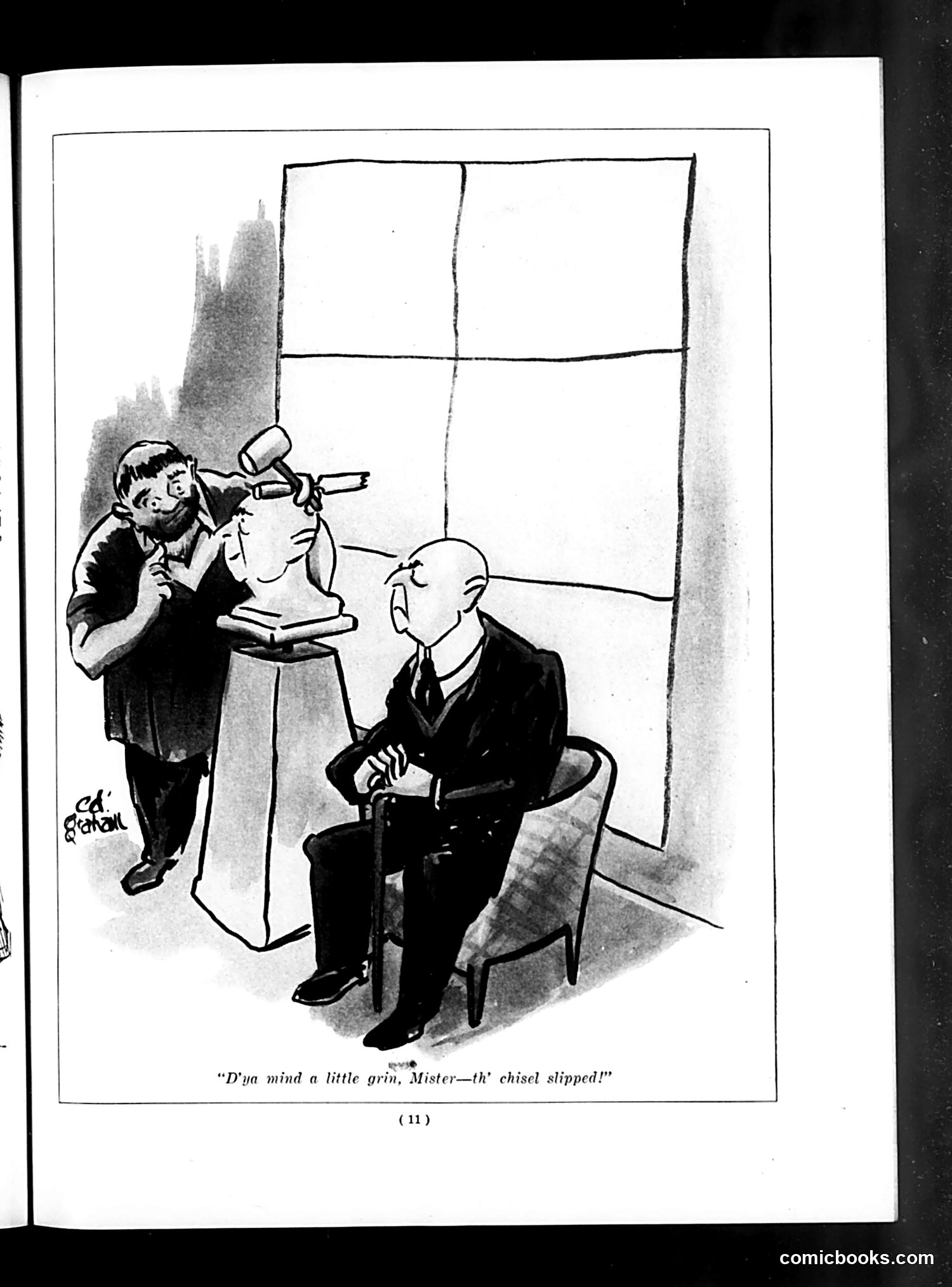
Cartoon Analysis This single-panel cartoon depicts a sculptor working on a bust of a seated man. The sculptor says, "D'ya mind a little grin, Mister—th' chisel slipped!" The humor is visual and situational rather than political. It's a classic "workplace accident" joke playing on the idea that the sculptor has accidentally damaged the sculpture (creating an unwanted grin) and is now making a self-deprecating excuse to his client. The pun on "chisel slipped" suggests both a genuine tool mishap and the sculptor's attempt at lighthearted cover-up. This appears to be general comedic content from *Life* magazine rather than partisan political satire. The cartoon relies on shared understanding of the sculptor-client dynamic and accident-related embarrassment for its humor.
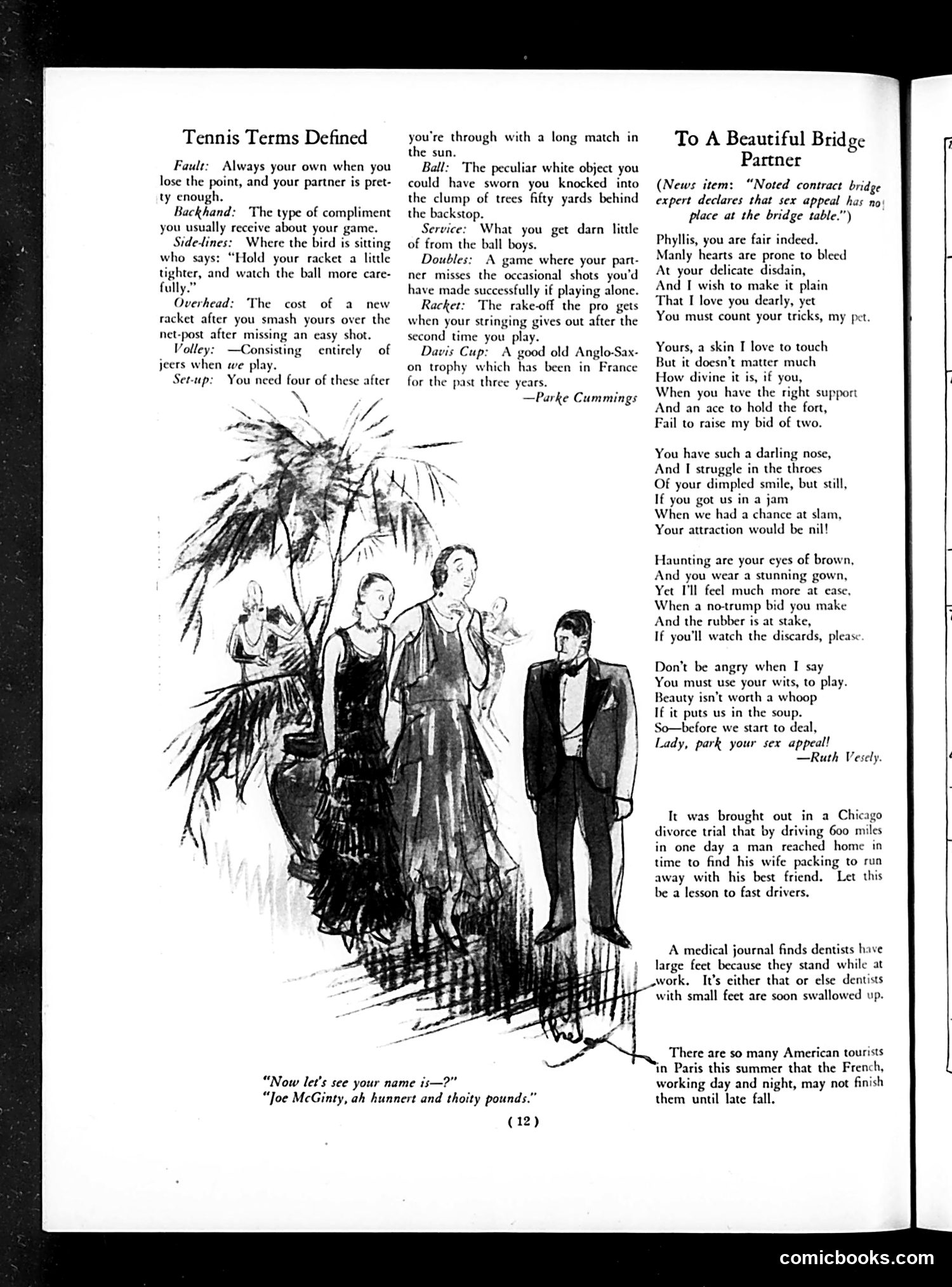
Analysis This page contains three distinct pieces: tennis terminology definitions (left), a cartoon illustration (center), and a poem titled "To A Beautiful Bridge Partner" (right). The cartoon depicts a formal social scene—a man in a tuxedo confronting what appears to be a woman in evening wear, with other figures visible in the background near a decorative plant. The caption reads: "Now let's see your name is—?" "Joe McGinty, ah hunnert and thirty pounds." The humor appears to target social pretense at formal gatherings, where a man is confronted with evidence that his companion (the "bridge partner") has misrepresented herself—either her identity or her weight. The satire mocks both deceptive behavior and shallow social judgment based on appearance and name-dropping in 1920s upper-class society.
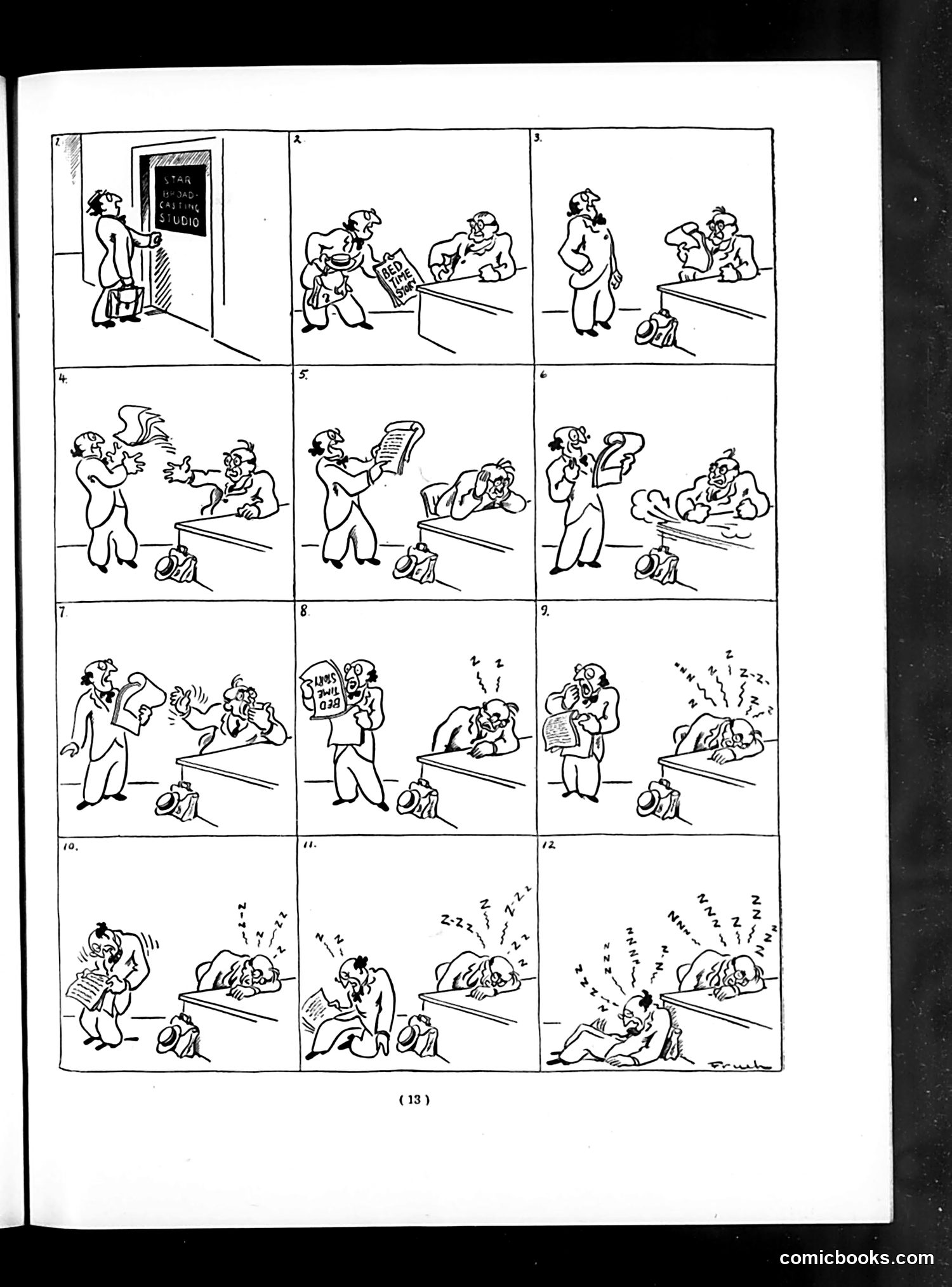
Analysis This is a 12-panel comic strip showing a slapstick sequence. A man repeatedly attempts to read or consult what appears to be a newspaper or document while a small dog continuously interferes with his efforts—jumping on him, grabbing the paper, and creating chaos. The humor is physical comedy: each panel shows a new disruption. By panel 8, the man appears exasperated ("DARN DOG"). Panels 10-12 show the man eventually giving up—he falls asleep while the dog continues causing mischief, with "Z"s indicating sleep. This is straightforward satirical humor about domestic annoyance rather than political commentary. The joke is the frustration of trying to read while a pet demands attention—a relatable domestic scenario for the magazine's middle-class audience. No specific political figures or events are referenced.
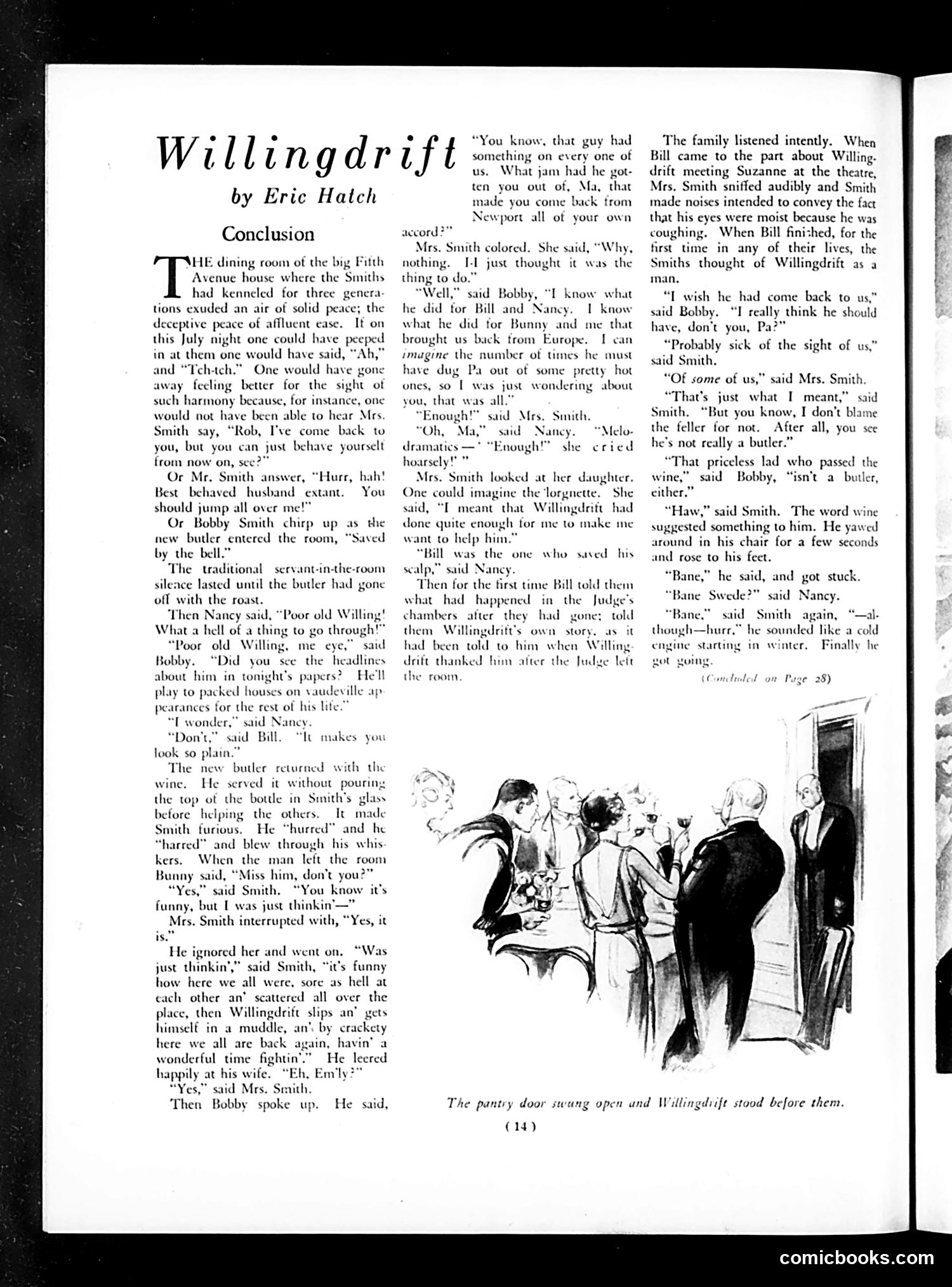
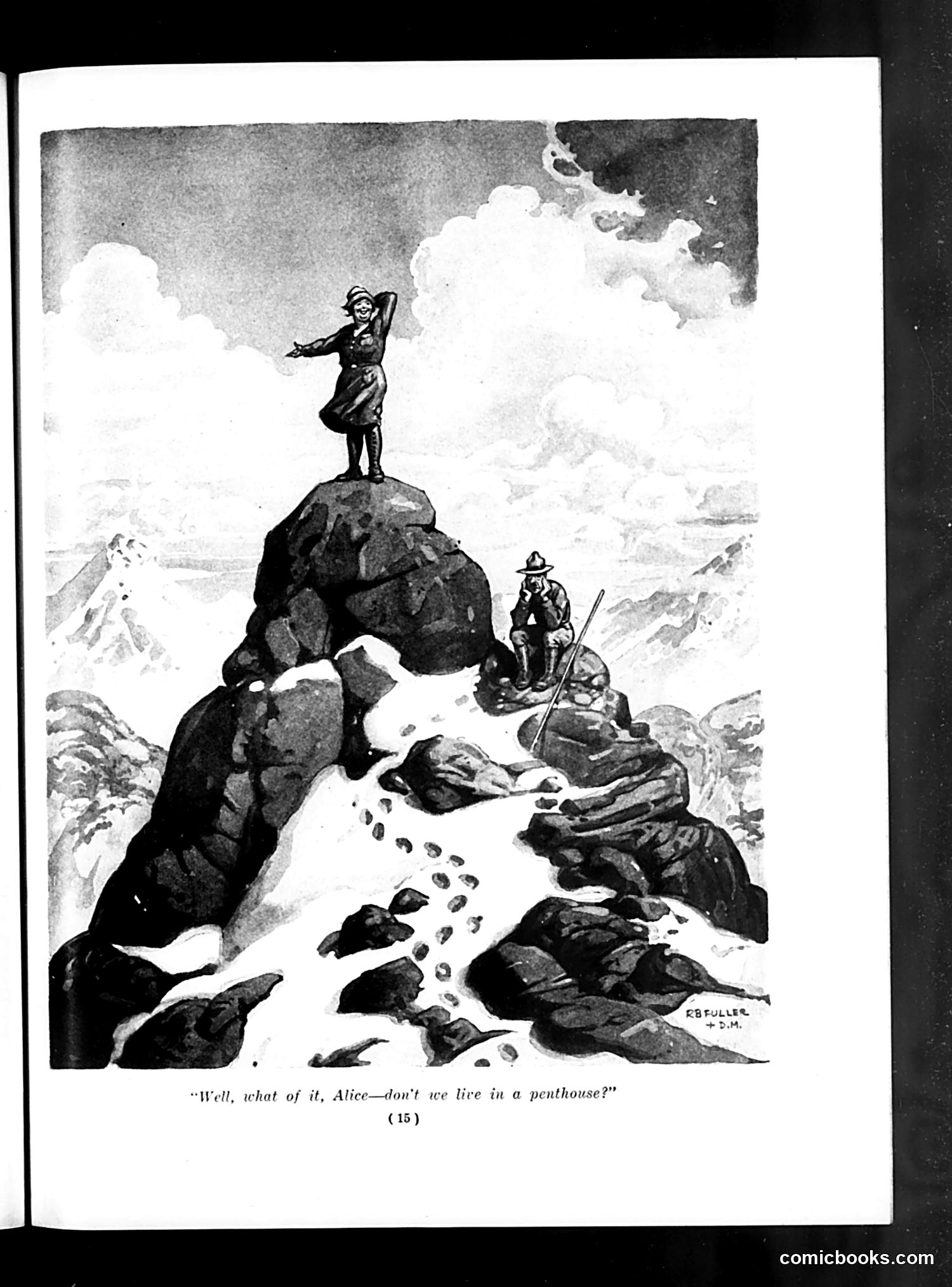
Analysis This illustration shows a mountaineering scene with a woman standing triumphantly atop a large boulder while two men below appear exhausted or defeated in the snow. The caption reads: "Well, what of it, Alice—don't we live in a penthouse?" The cartoon appears to satirize early 20th-century gender dynamics and mountain climbing. The joke likely references a woman's achievement or ambition (symbolized by reaching the summit) that exceeds or embarrasses the men accompanying her. The man's defensive comment about living in a "penthouse" suggests he's making excuses or deflecting from the woman's superior performance. This reflects contemporary debates about women's capabilities and the era's evolving attitudes toward female athleticism and independence, with the humor rooted in role-reversal anxiety common to this period's satirical magazines.
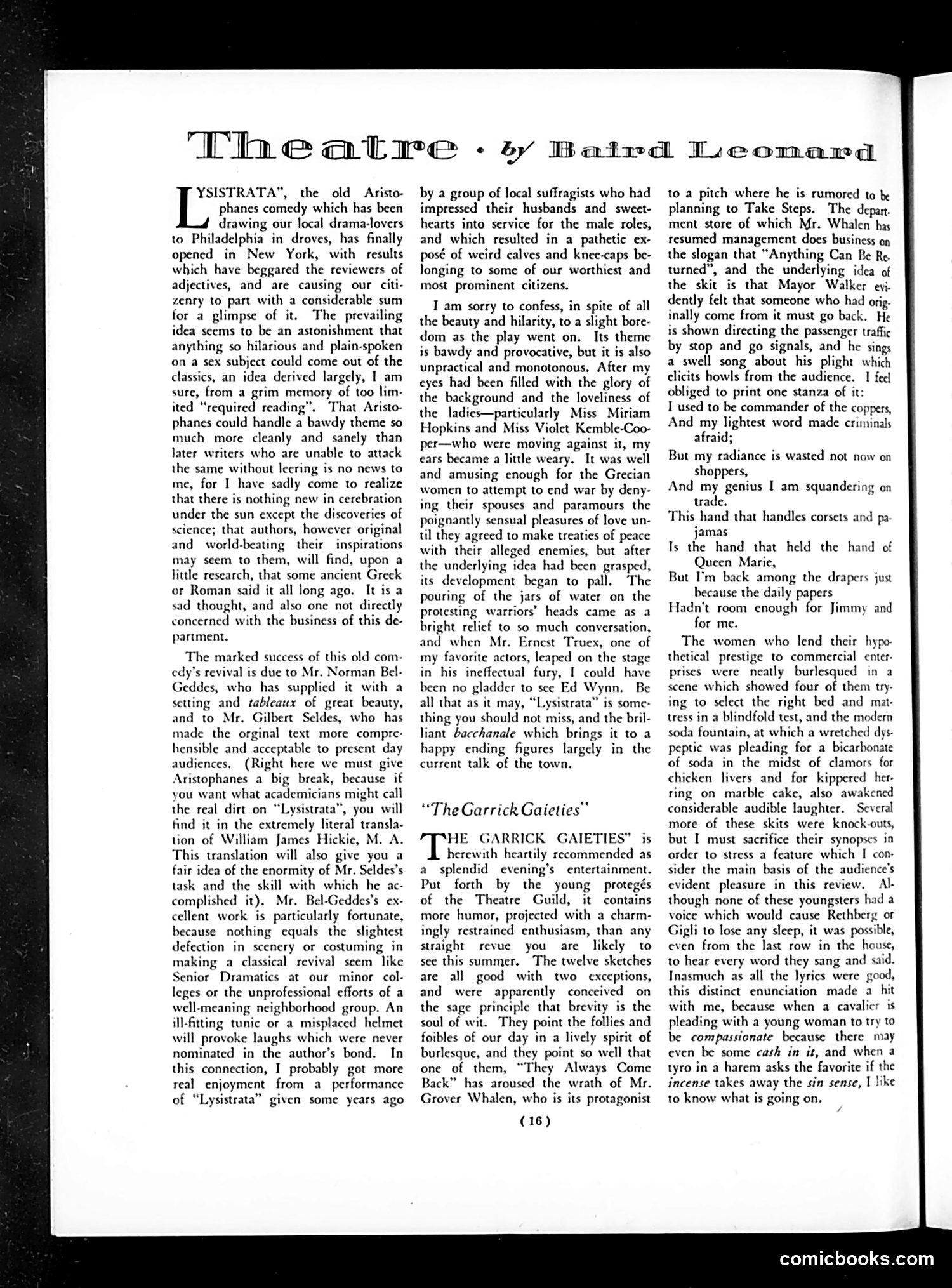
Theatre Review Analysis This is a theatre review page by Baird Leonard from *Life* magazine, discussing two theatrical productions without accompanying cartoons or caricatures visible in the image. The review critiques "Lysistrata," an Aristophanes comedy revival in New York that Leonard finds disappointingly sanitized. He notes the play's sexual themes have been neutered by local suffragists who demanded male roles and "weird calves and knee-caps" to make it respectable for prominent citizens. Leonard sarcastically observes that removing the bawdiness defeats the play's purpose. The second review covers "The Garrick Gaieties," a Theatre Guild revue he recommends. He praises its humor and youthful energy, particularly highlighting a sketch called "They Always Come Back." The page is primarily text-based criticism rather than visual satire.
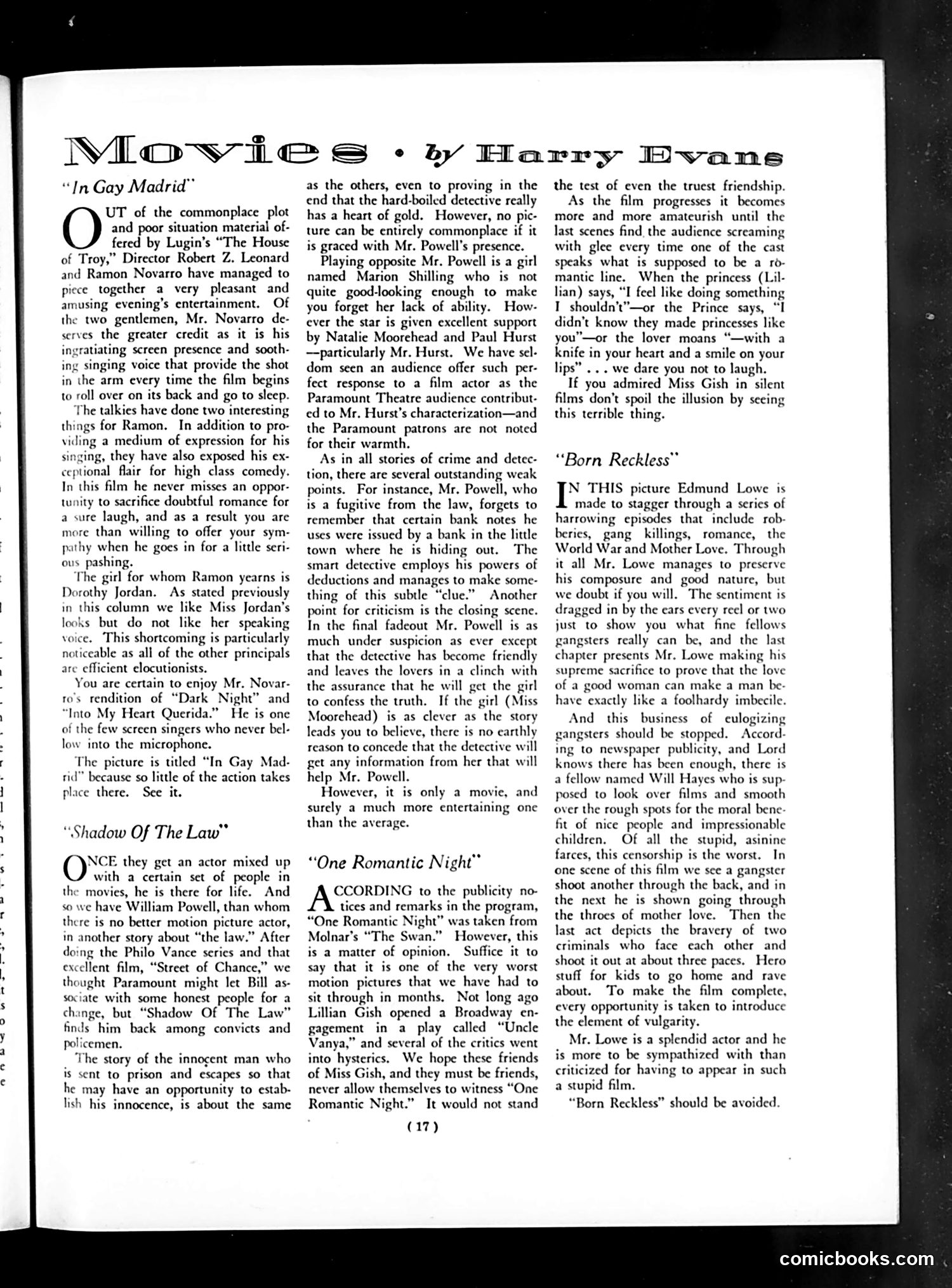
Movie Review Page Analysis This is a movie review column by Harry Evans, not a political cartoon. The page contains three film reviews: 1. "In Gay Madrid" - praised for pleasant entertainment, crediting Ramon Novarro and Norma Shearer's chemistry 2. "Shadow Of The Law" - critiques William Powell in a crime drama about an innocent man imprisoned 3. "Born Reckless" and "One Romantic Night" - brief reviews noting Edmund Lowe's wasted talent in "Born Reckless" and expressing hope that Lillian Gish won't appear in similar films again The reviews are straightforward entertainment criticism from the silent/early-sound era, evaluating actor performances and plot quality. No political satire or social commentary is evident—this is purely entertainment journalism.
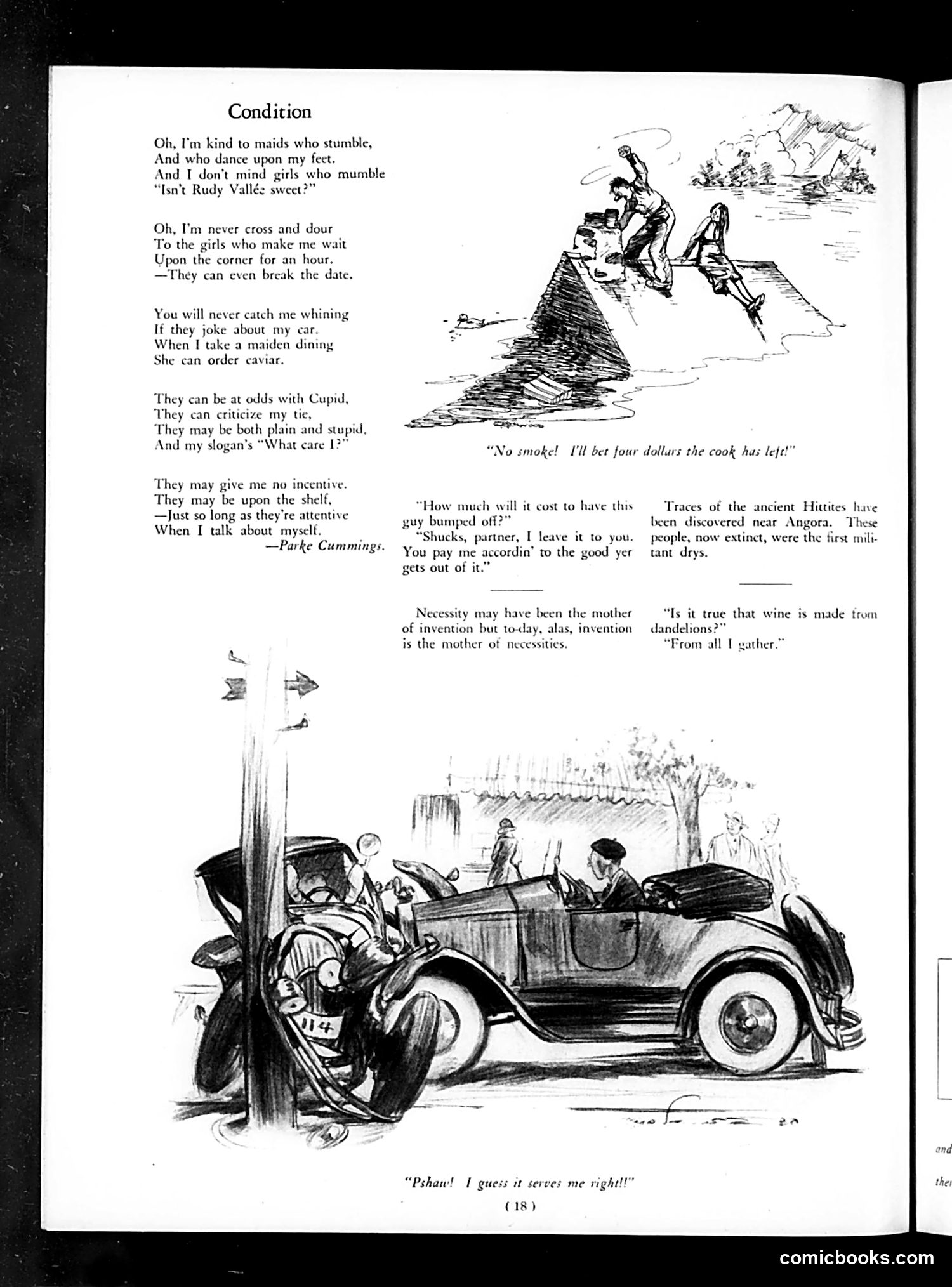
"Condition" - Life Magazine Satire This page contains a poem titled "Condition" by Parke Cummings satirizing modern attitudes toward dating and relationships. The poem celebrates a carefree male attitude: the speaker is unbothered by women's missteps, won't complain about dates, and maintains complete indifference to romantic entanglements—his "condition" being an enviable detachment. Two cartoons accompany the text. The upper illustration shows people near water, possibly depicting leisure activities. The lower cartoon depicts a car accident where a driver has crashed into a lamppost, with the caption "Pshaw! I guess it serves me right!" This juxtaposes the poem's theme of masculine indifference with physical consequences—suggesting that such cavalier attitudes have real, sometimes painful results. The satire mocks both romantic callousness and reckless behavior.
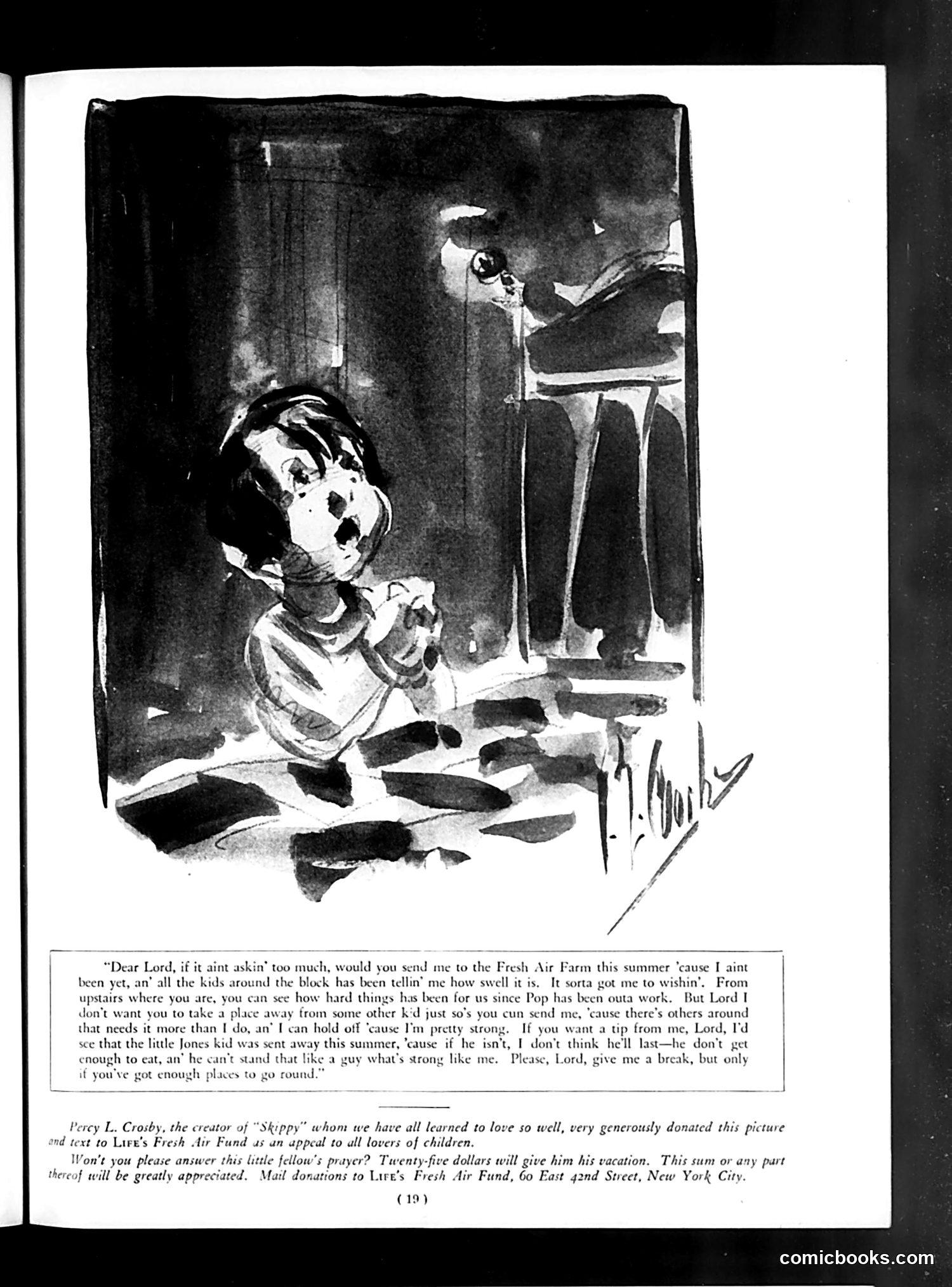
Cartoon Analysis: "Fresh Air Fund" Appeal This is a charitable fundraising appeal created by Percy L. Crosby, cartoonist behind the popular comic strip "Skippy." The image shows a poor child praying, with an adult figure (likely a parent or authority figure) visible in the background. The cartoon satirizes poverty during what appears to be the Great Depression era (references to a father being "outa work" indicate economic hardship). The child's prayer is both touching and darkly humorous—he asks God for a Fresh Air Farm vacation (a program providing city children summer respite), but selflessly suggests another needy child, "little Jones kid," receive it instead since he's worse off. The satire works on two levels: it mocks both the desperation of the poor and subtly critiques the inadequacy of charitable solutions to systemic poverty. The appeal requests $25 donations to fund vacations, highlighting how minimal resources could provide temporary relief to suffering children.
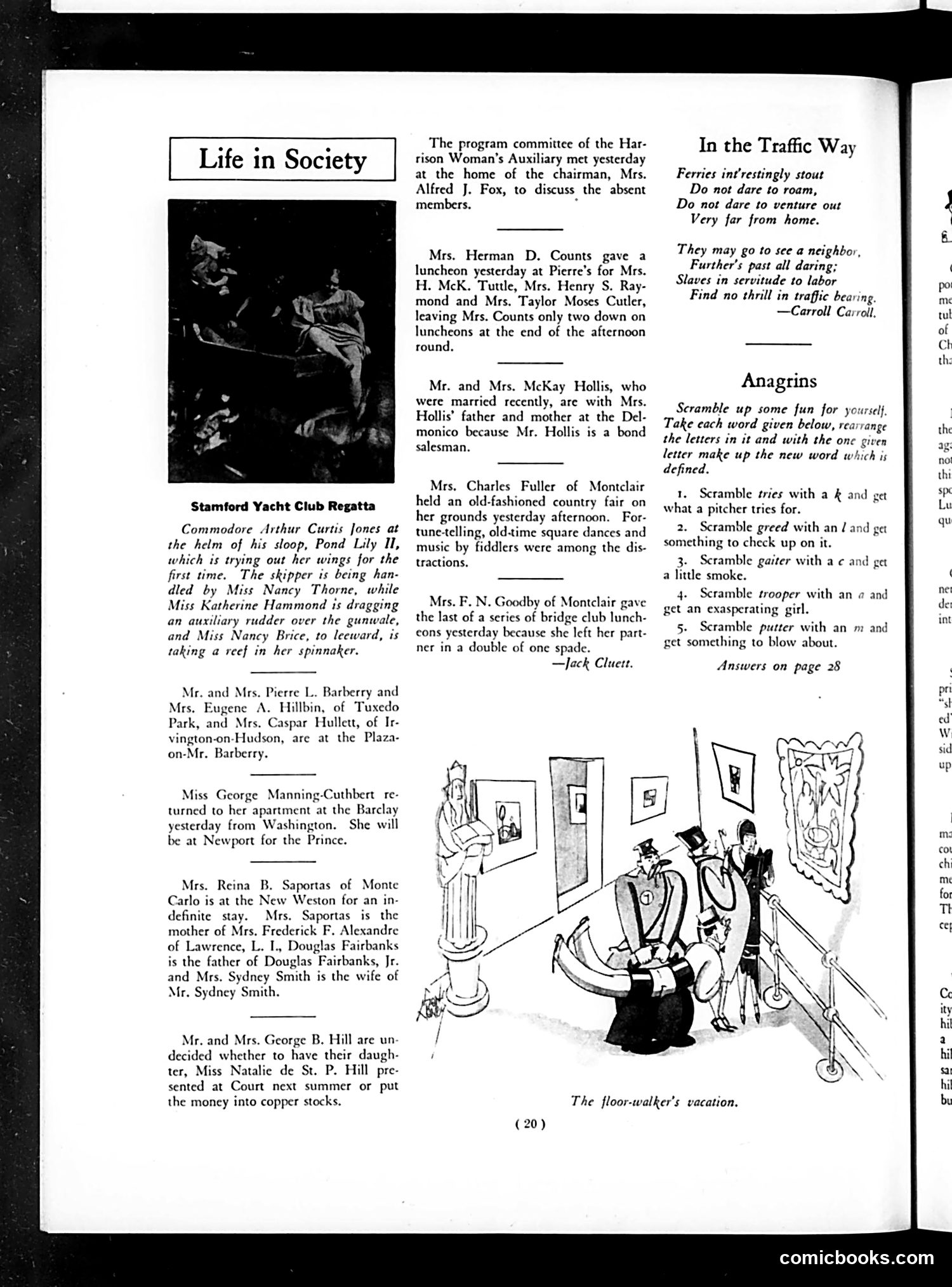
"Life in Society" Page Analysis This page from *Life* magazine combines society gossip with light humor typical of early 20th-century American satire. The "Life in Society" section records the leisure activities and social movements of wealthy New York families—yacht club regattas, luncheons at exclusive restaurants (Pierre's, the Plaza), and visits to fashionable destinations (Newport, Monte Carlo). The humor is gentle mockery: noting that Mr. and Mrs. Hill are "undecided whether to have their daughter...presented at Court...or put the money into copper stocks" satirizes how the ultra-wealthy treat expensive social conventions as equivalent to financial investments. The cartoon titled "The floor-walker's vacation" depicts a department store floor-walker (a supervisor who managed store aisles) attempting leisure activities in an art gallery, surrounded by bicycles and other recreational equipment. The joke: even on vacation, this working-class man remains comically encumbered by the tools of his labor—he cannot escape his job's constraints. The tone: *Life* mocks both wealthy idleness and working-class entrapment, representing the magazine's satirical approach to American class divisions.
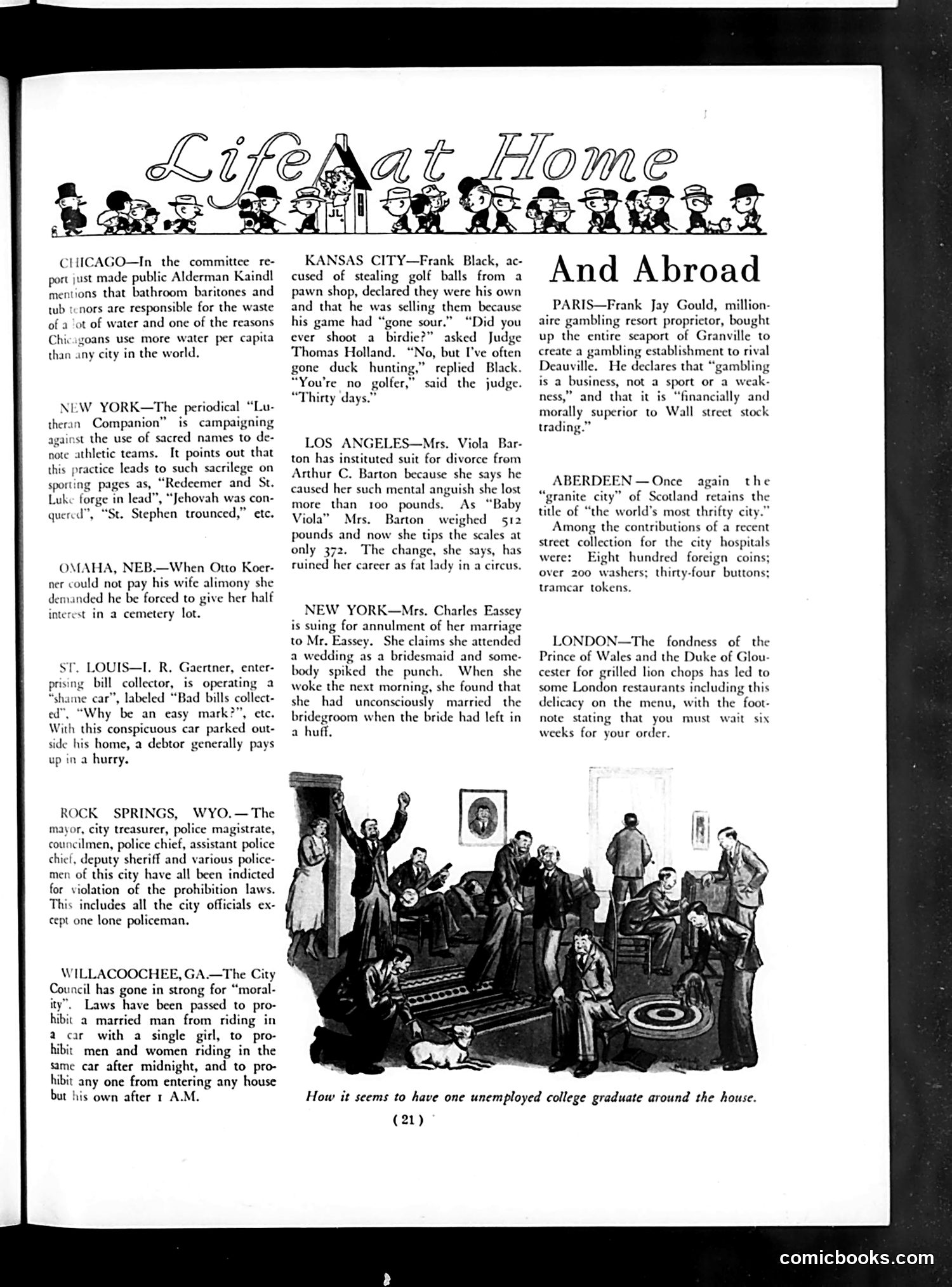
Life Magazine Satire Page: Social Commentary This page compiles humorous short anecdotes mocking American and British social absurdities during the Prohibition era. The items ridicule: Domestic follies: A Chicago report blaming "bathroom baritones" (shower singers) for water waste; a St. Louis debt collector using public shame; an Omaha wife demanding cemetery lot ownership as alimony. Legal absurdities: A Kansas City judge sentencing a man for "stealing" golf balls he claimed were his own; a Los Angeles woman suing for divorce after losing 100+ pounds as a circus "fat lady," losing her career; a New York woman claiming she accidentally married someone while drunk at a wedding. Moral overreach: Willacoochee, Georgia passing extreme "morality" laws prohibiting unmarried couples from riding together or entering homes after 1 A.M.; Rock Springs officials indicted for Prohibition violations. The bottom cartoon mocks unemployed college graduates as household nuisances—a Depression-era anxiety about educated youth unable to find work. The page satirizes civic incompetence, legal pretension, and social contradiction through absurdist humor typical of 1920s-30s Life magazine.
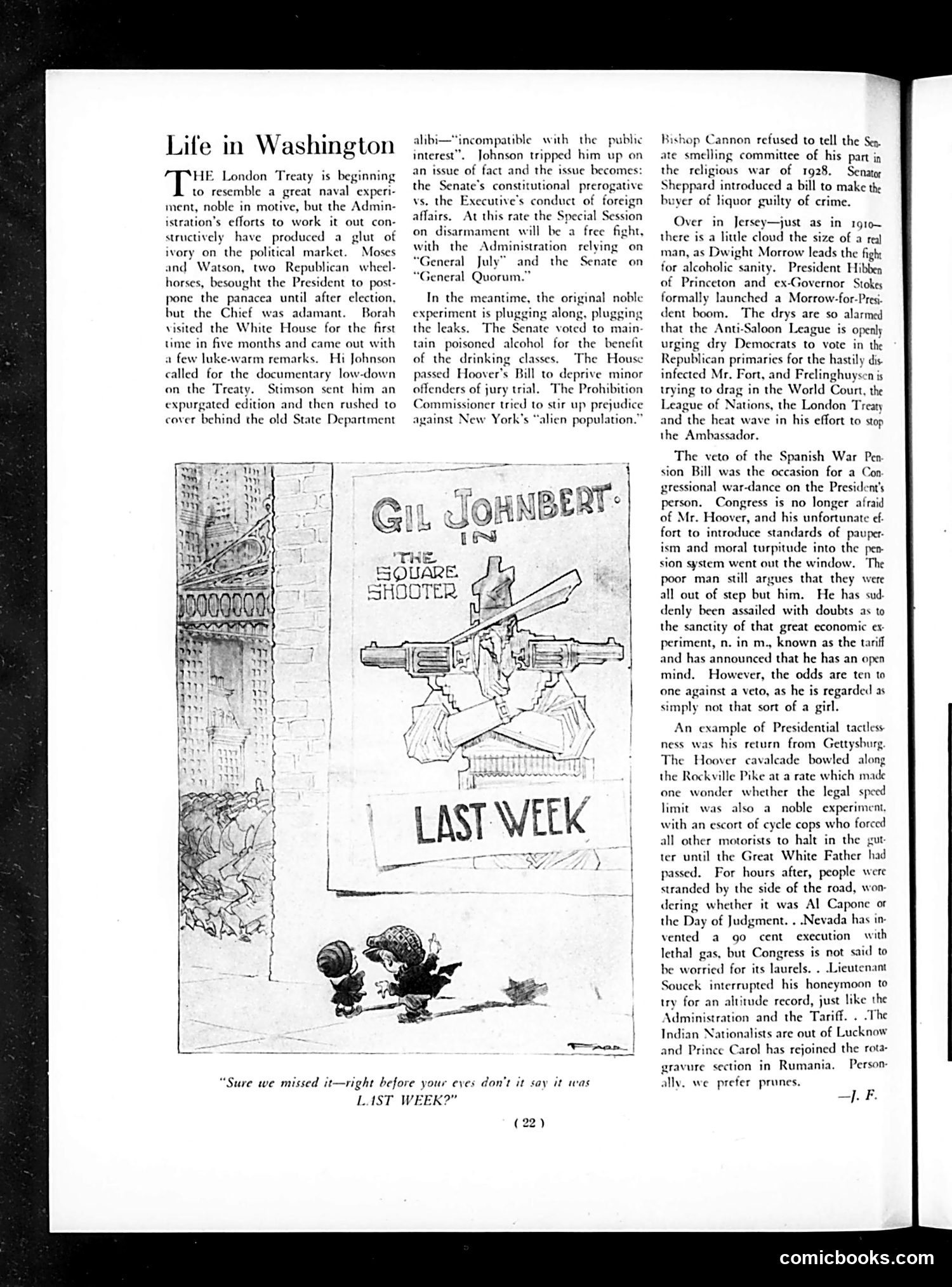
Political Satire from Life Magazine This page satirizes President Hoover's Washington during negotiations over the London Naval Treaty. The cartoon depicts figures struggling with "last week's" problems—a visual metaphor for the administration's inability to move forward constructively on major issues. The article criticizes Hoover's handling of the treaty negotiations, Senate obstruction, and broader policy failures including Prohibition enforcement and pension vetoes. The text mocks Congressional inaction ("General Quorum"), internal contradictions in alcohol policy, and the president's attempted dignified return from Gettysburg—where his motorcade cavalcade forced other motorists off the road. The satire suggests Hoover has lost Congressional fear and respect. References to New Jersey politics and Dwight Morrow indicate factional divisions even within Republican ranks over Hoover's direction, particularly regarding Prohibition and tariff policy. The overall tone is one of bewildered ineffectual leadership amid competing interests.
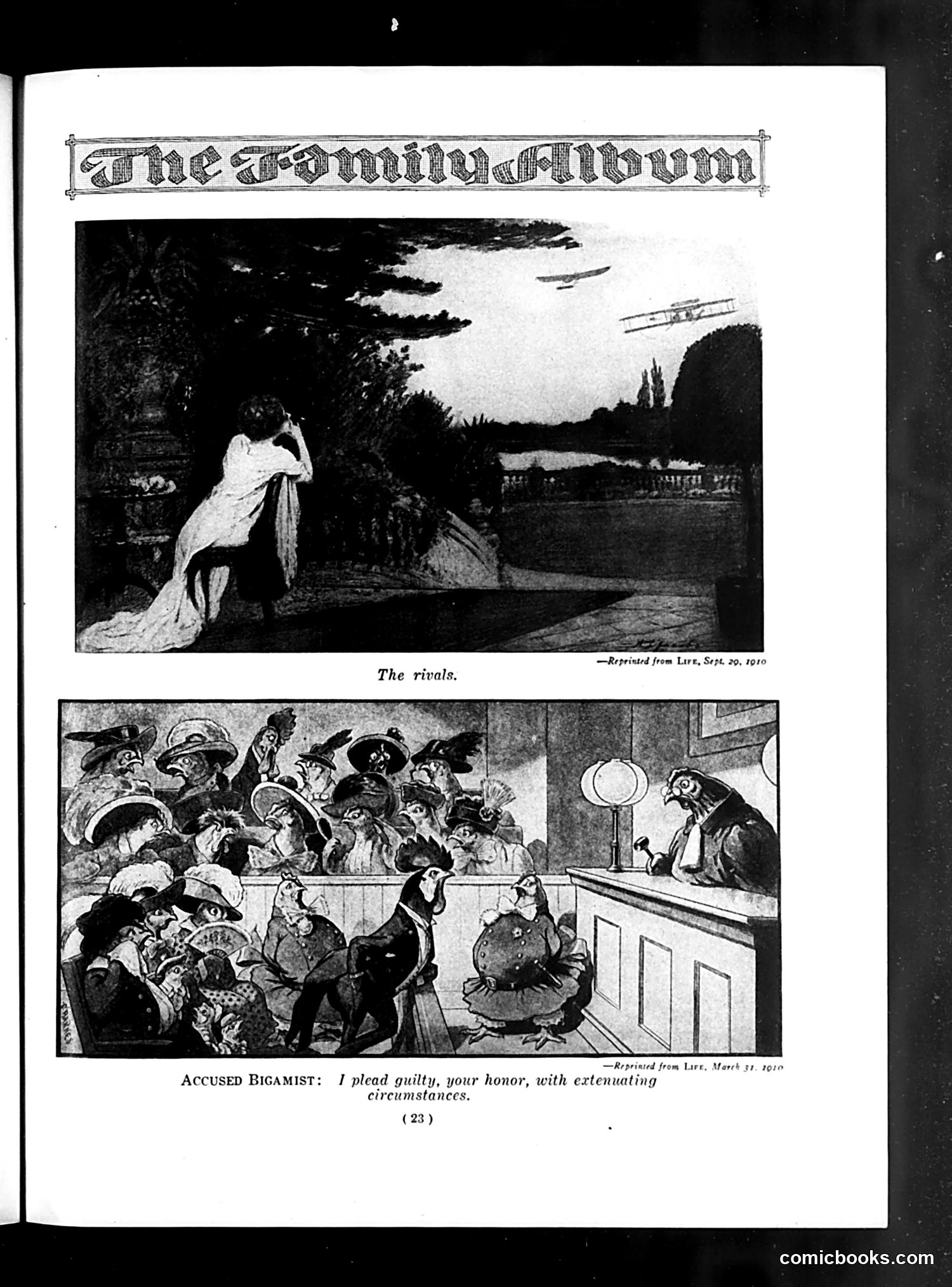
Analysis This page contains two cartoons reprinted from *Lire*, an Italian satirical magazine (1910-1911). The top image, "The rivals," depicts a woman in classical dress observing an airplane in the sky—a reference to early aviation's novelty and cultural fascination circa 1910. The bottom cartoon, "Accused Bigamist," shows a courtroom scene where a rotund man addresses a judge, claiming he pleads guilty "with extenuating circumstances." The joke appears to play on the absurdity of attempting to justify bigamy through excuses. The caricatured figures and crowded courtroom suggest satirical commentary on either a specific scandal or the general foolishness of such legal defenses. Both cartoons employ exaggerated character drawing typical of early 20th-century European satirical illustration.
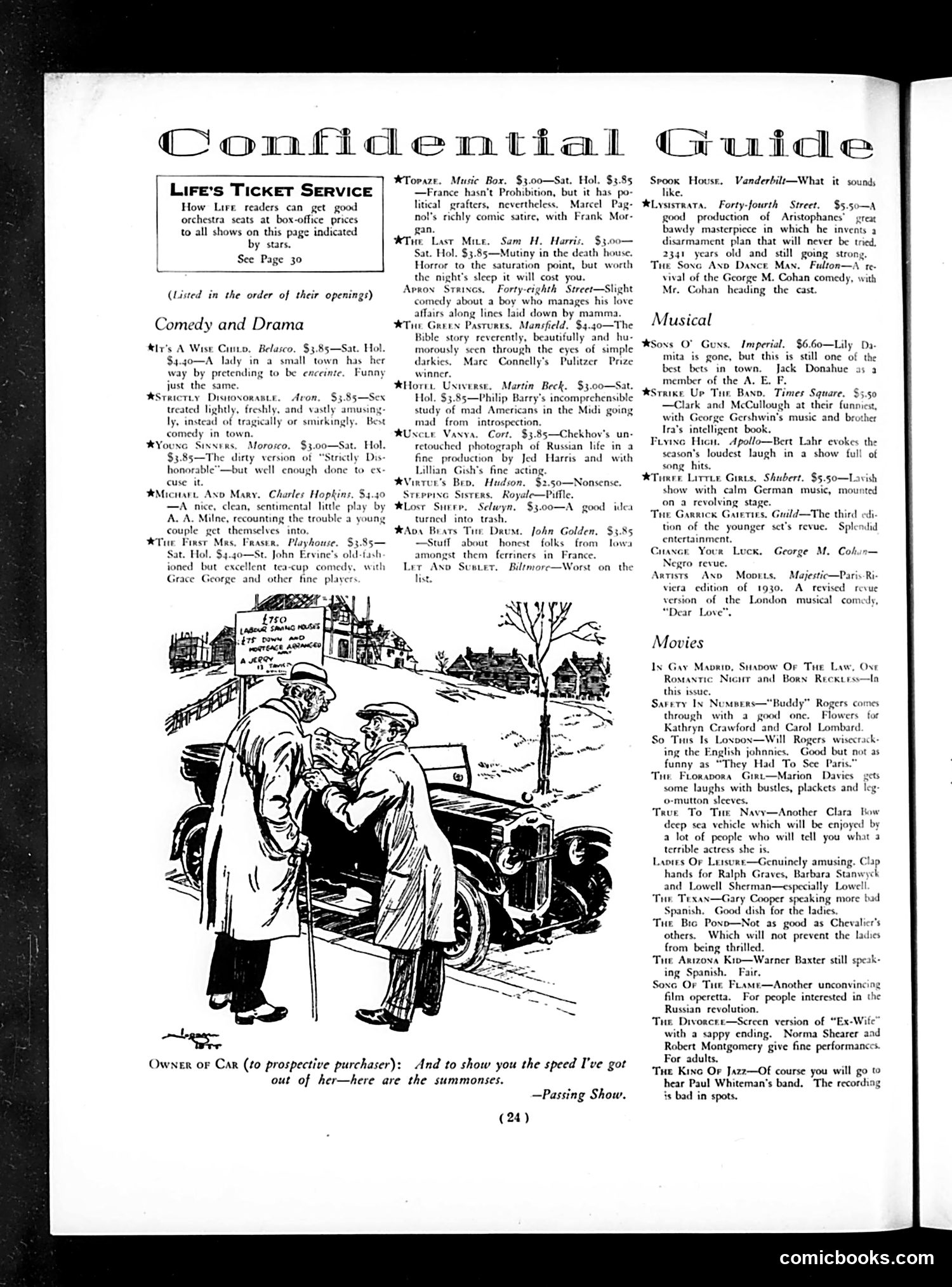
Confidential Guide Page Analysis This page is primarily entertainment listings and reviews for Life magazine readers—a "Confidential Guide" to theatrical performances in New York, listing shows, theaters, prices, and brief critical commentary. The single cartoon at the bottom depicts a car owner showing a prospective buyer the vehicle while displaying multiple traffic summonses, joking that the "speed I've got out of her" is evidenced by the tickets received. This is straightforward automotive humor: the car's only real achievement is generating speeding violations. The page itself is not political satire but rather a service feature—showing which shows have discounted tickets available through Life (marked with asterisks). The reviews mention contemporary plays like *Topaze* (about French political graft) and *The Green Pastures* (a Pulitzer Prize winner depicting biblical stories through African American characters' perspectives), but these are descriptive rather than satirical. The overall content reflects 1920s-30s entertainment culture and consumer service journalism.
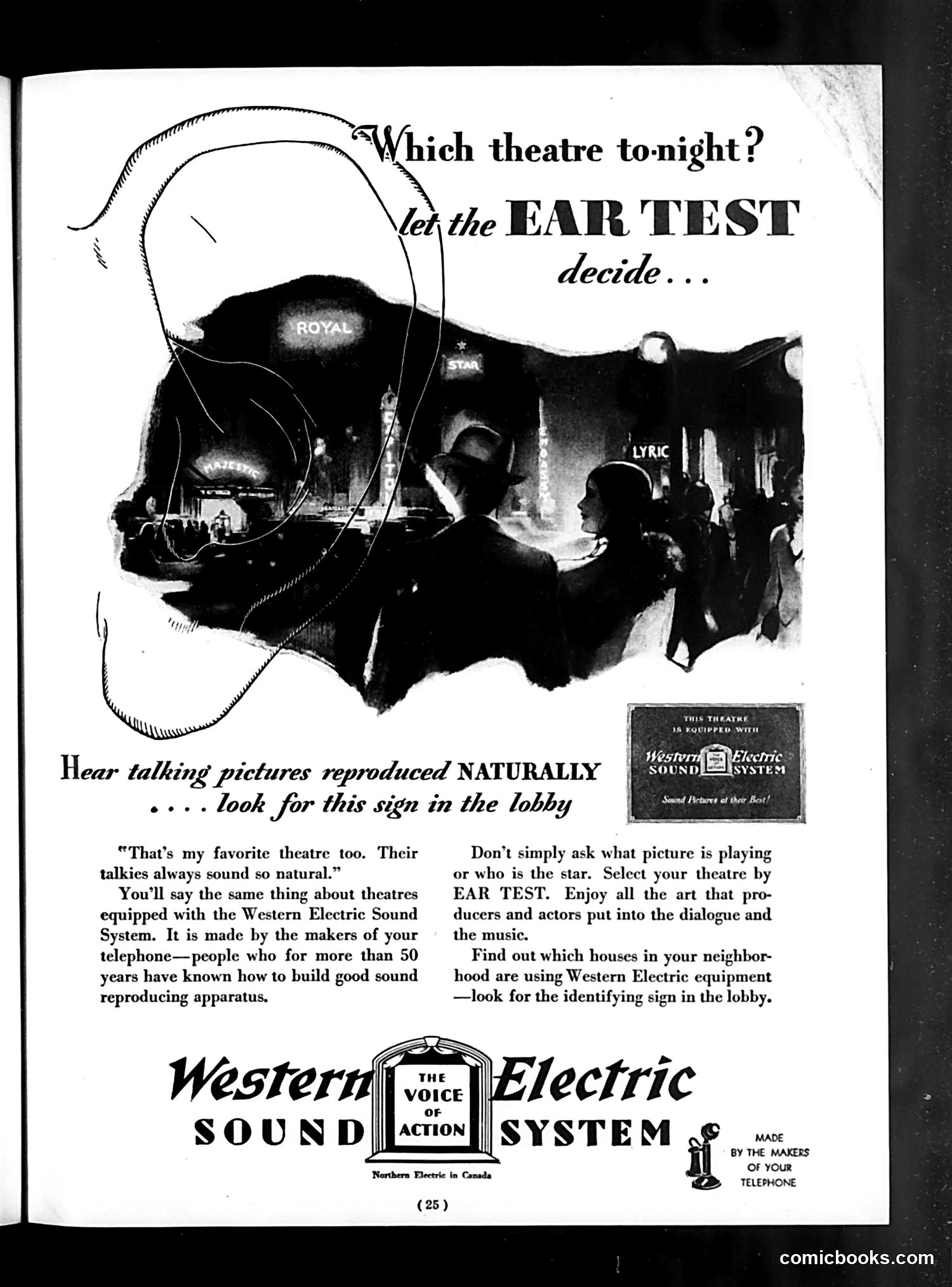
Advertisement Analysis This is a Western Electric Sound System advertisement, not political satire. It promotes selecting movie theaters based on sound quality rather than content or stars. The central image shows silhouettes of people outside theaters (labeled "ROYAL," "STAR," and "LYRIC"), with a large ear overlay—a visual pun on the "EAR TEST" concept. The ad suggests moviegoers should evaluate theaters by actually listening to the sound reproduction. Historical context: This appears from the early "talkie" era (sound films), when audio quality varied significantly between theaters. Western Electric, the telephone company's manufacturing division, had developed sound equipment and positioned itself as the premium option. The satire is gentle: the ad mocks audience priorities (caring only about star names or titles) while promoting a practical alternative—choosing theaters for superior sound engineering. It's essentially a brand advertisement disguised as consumer advice, targeting 1920s-30s moviegoers.
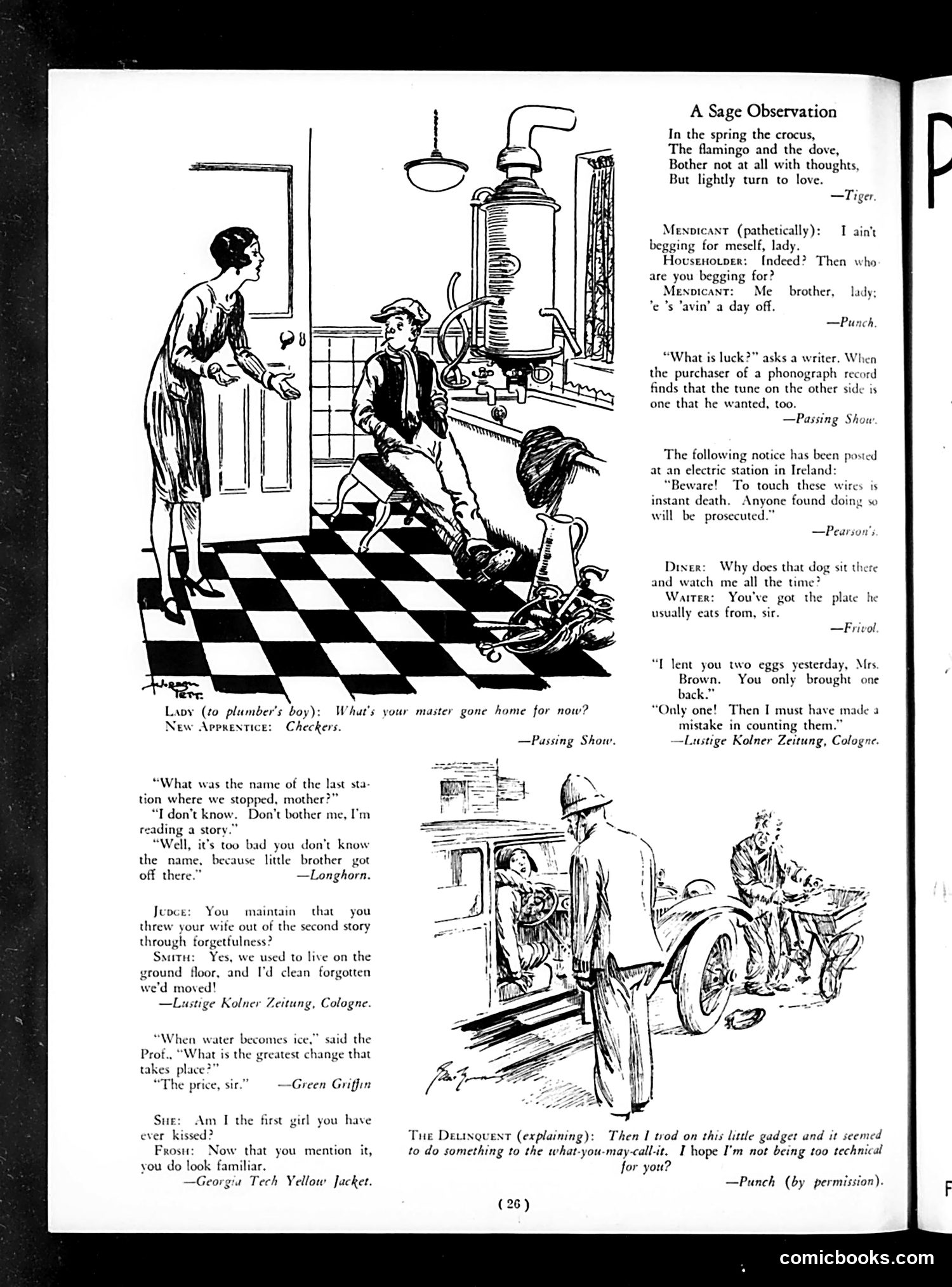
A Page of Early 20th-Century Humor Magazines This page collects short jokes from various satirical publications (Life, Punch, Passing Show, Frivol, etc.). The main cartoon shows a plumber's boy being asked by a lady where his master went; he replies "Checkers"—a play on words, as the checkered floor resembles the board game. The surrounding jokes target familiar targets: a beggar claiming to beg for his brother's "day off" (absurd logic); a diner whose dog watches because it recognizes the plate he's eating from; a wife thrown from a second-story window through forgetfulness after moving; and a judge's incredulous reaction. The humor relies on wordplay, domestic absurdities, and observational comedy about marriage, poverty, and class interactions. A recurring theme is the gap between what people claim and reality—the beggar's obvious lie, the wife-thrower's implausible excuse. This reflects period attitudes toward working-class characters and marital dynamics as comedy fodder.
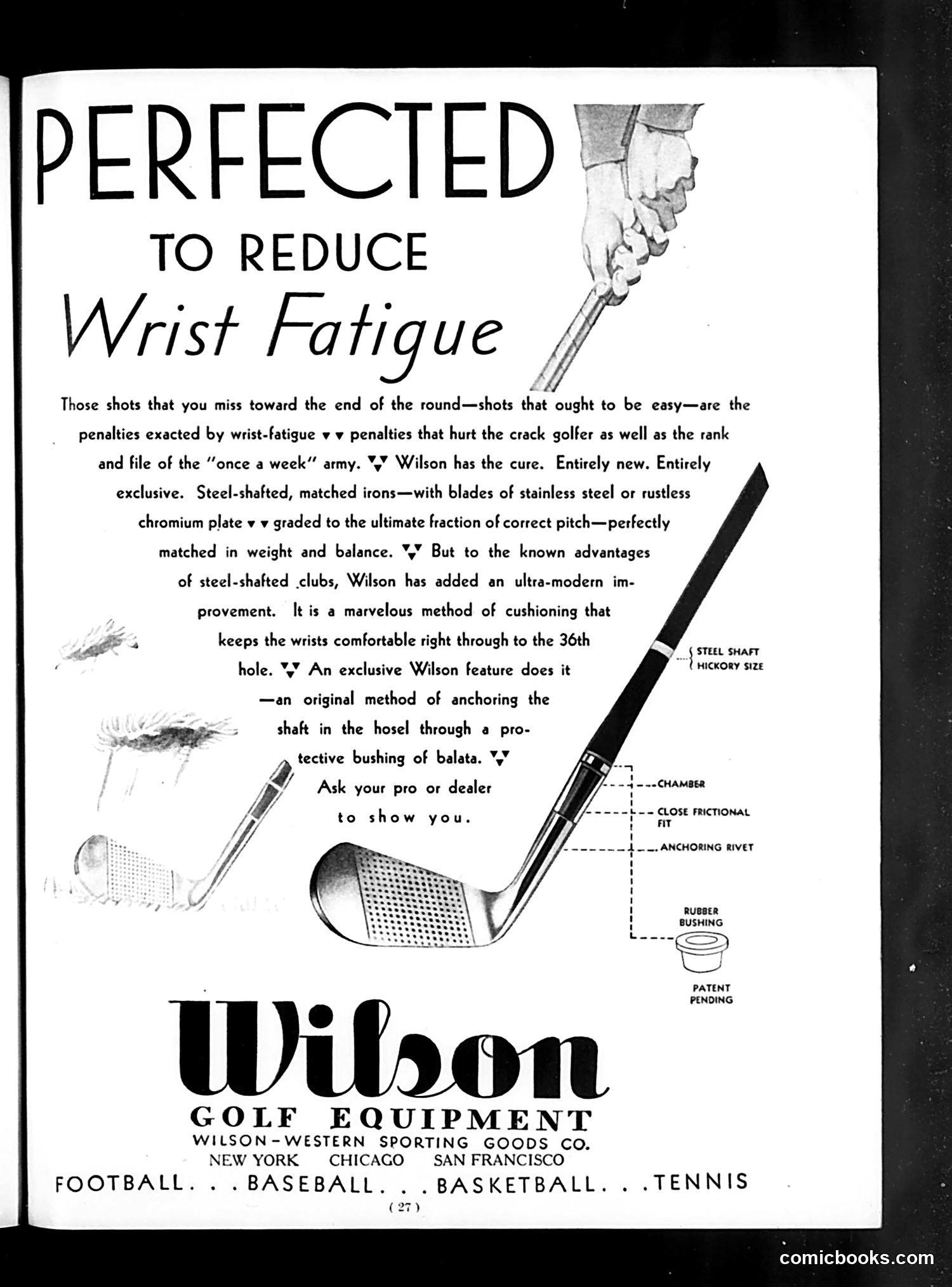
Analysis This is not a cartoon or satire—it's a straightforward Wilson Golf Equipment advertisement from Life magazine. The page promotes Wilson's new steel-shafted golf irons designed to reduce "wrist fatigue" during long rounds. The ad addresses recreational golfers ("once a week" players) and serious golfers alike, claiming Wilson's innovation solves the problem of missed shots late in a round caused by tired wrists. The technical features highlighted include stainless steel or chromium-plated blades, matched weight and balance, and an exclusive cushioning method using a rubber bushing to anchor the shaft—all aimed at keeping wrists comfortable through 36 holes. The diagram on the right illustrates the club's internal construction details. This is period advertising copy typical of early-to-mid 20th-century golf marketing, emphasizing engineering precision and performance benefits to justify the product's presumably premium price.
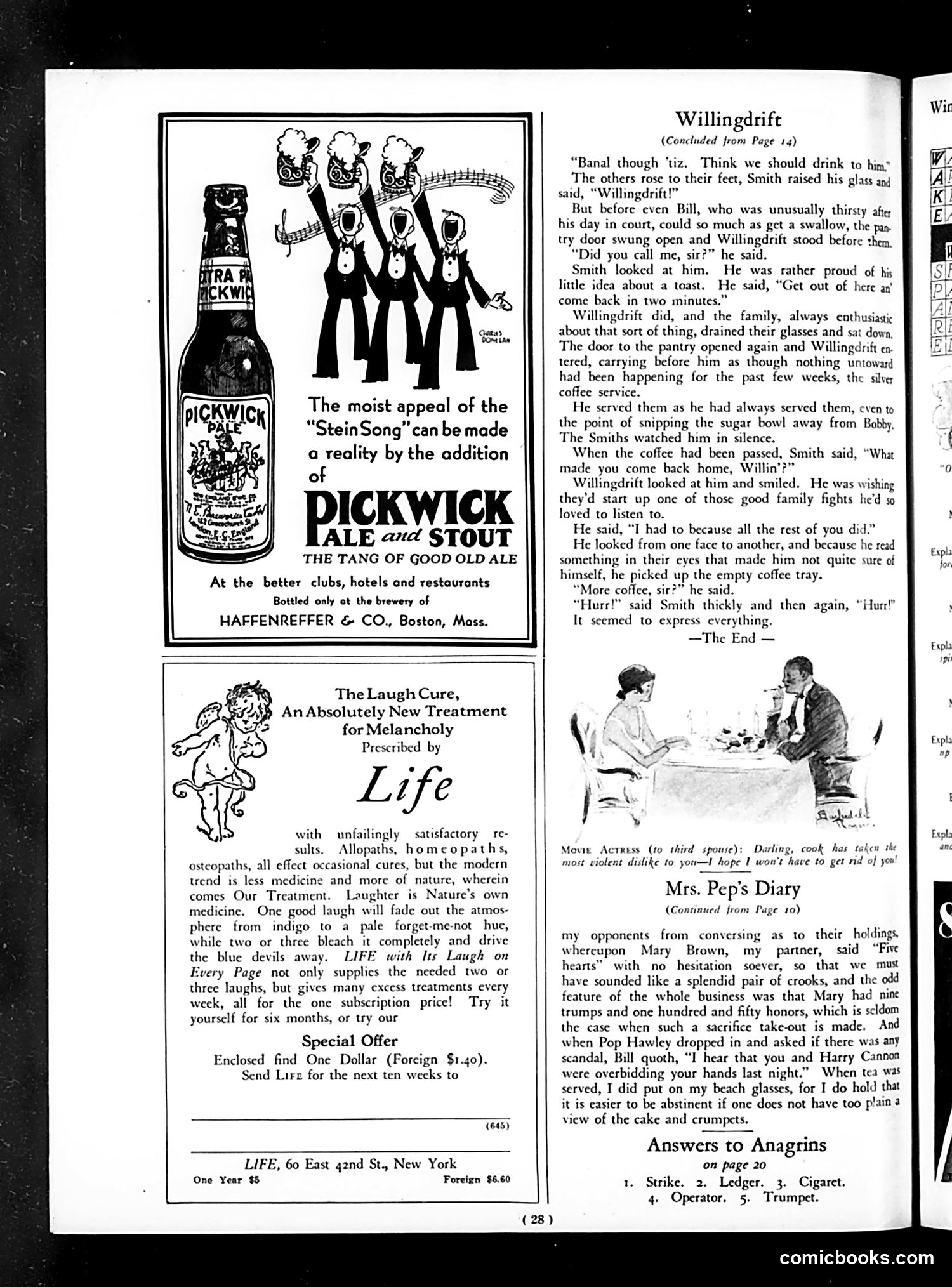
Analysis of Life Magazine Page Content This page contains primarily advertisements and serialized fiction rather than political cartoons. The Pickwick Ale advertisement (top) features dancing figures celebrating beer, referencing the popular "Stein Song"—a drinking song that became a cultural phenomenon. The ad appeals to upscale venues (clubs, hotels, restaurants). Below is Life magazine's self-promotion for "The Laugh Cure"—a tongue-in-cheek claim that laughter treats melancholy better than medicine. This reflects 1920s-era skepticism toward traditional doctors and appeals to Life's audience by promoting the magazine itself as therapeutic entertainment. The page continues serialized stories: "Willingdrift" (a domestic servant narrative), "Mrs. Pep's Diary" (social comedy about bridge games and etiquette), and a movie-industry joke about a cook disliking an actress-spouse. Context: This represents Life's typical format—upscale advertising, light social satire about upper-middle-class life, and humor aimed at educated urban readers with disposable income.
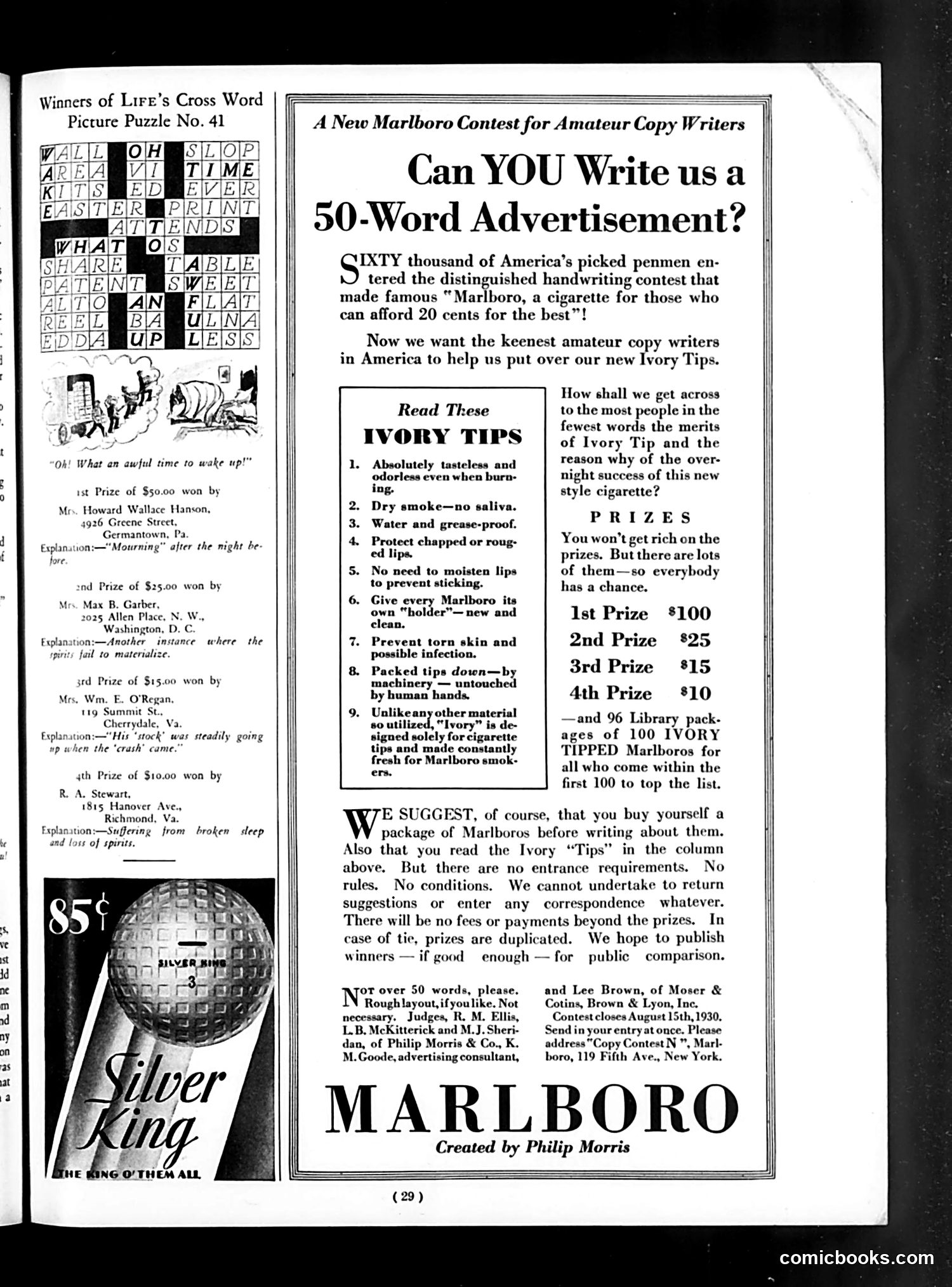
Analysis for Modern Readers This page contains advertising and contest material, not satirical cartoons. The top left shows a crossword puzzle solution with a vintage cartoon caption ("Oh! What an awful time to wake up!") — likely depicting someone hungover, a common humor trope of the 1920s-30s. The main content is a Marlboro cigarette advertising contest from 1930, asking amateur writers to compose 50-word advertisements for their "Ivory Tips" cigarettes. The page lists nine claimed benefits (tasteless, dry smoke, grease-proof, etc.) — marketing language that would be illegal in modern advertising. The cartoonish tone and casual prizes ($100 first place) reflect early 20th-century marketing tactics. The reference to a previous "distinguished handwriting contest" suggests cigarette companies actively courted consumer participation in advertising. For modern context: This represents pre-regulation tobacco marketing, when health concerns were absent from advertising, and companies openly promoted cigarettes as desirable consumer products with family-friendly contests.
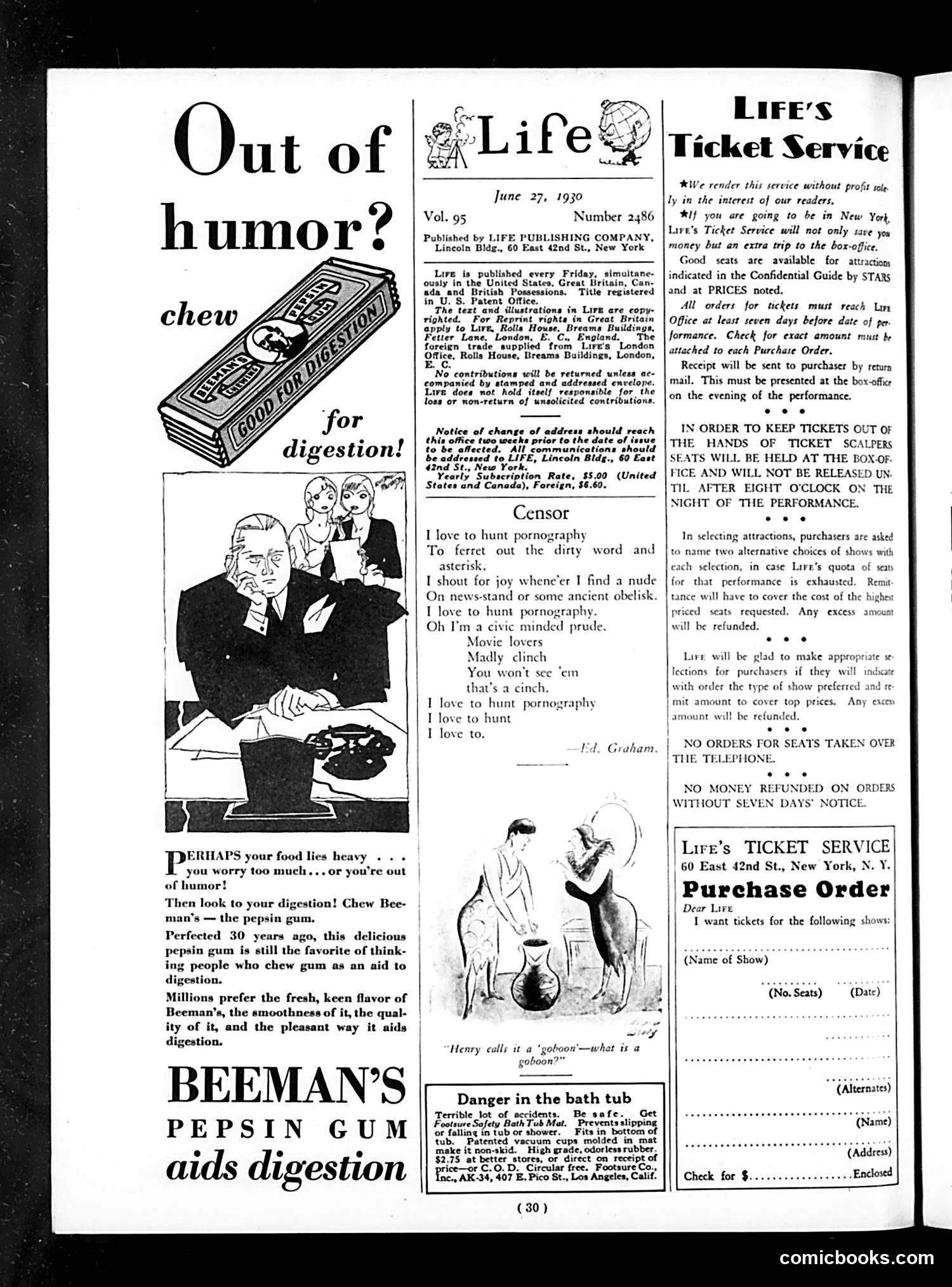
"Out of Humor?" — Life Magazine, June 27, 1930 This page is primarily advertising and service information, not political satire. The main cartoon (left) is a Beeman's Pepsin Gum advertisement. It depicts a man with indigestion looking miserable, suggesting chewing gum aids digestion—a common 1930s advertising claim. The coffin-shaped gum package is the product being promoted. The other cartoon is titled "Censor" (by Ed. Graham) and satirizes self-appointed moral guardians—specifically, people who hunt for "pornography" on newsstands and in art, presenting themselves as civic-minded but revealing themselves as prudes. The irony: they obsess over the very "dirty" content they claim to oppose. This reflects 1930s cultural anxieties about obscenity and censorship. The rest of the page contains Life's Ticket Service information and advertisements (Footsure bath mat), typical magazine filler content unrelated to satire or humor.
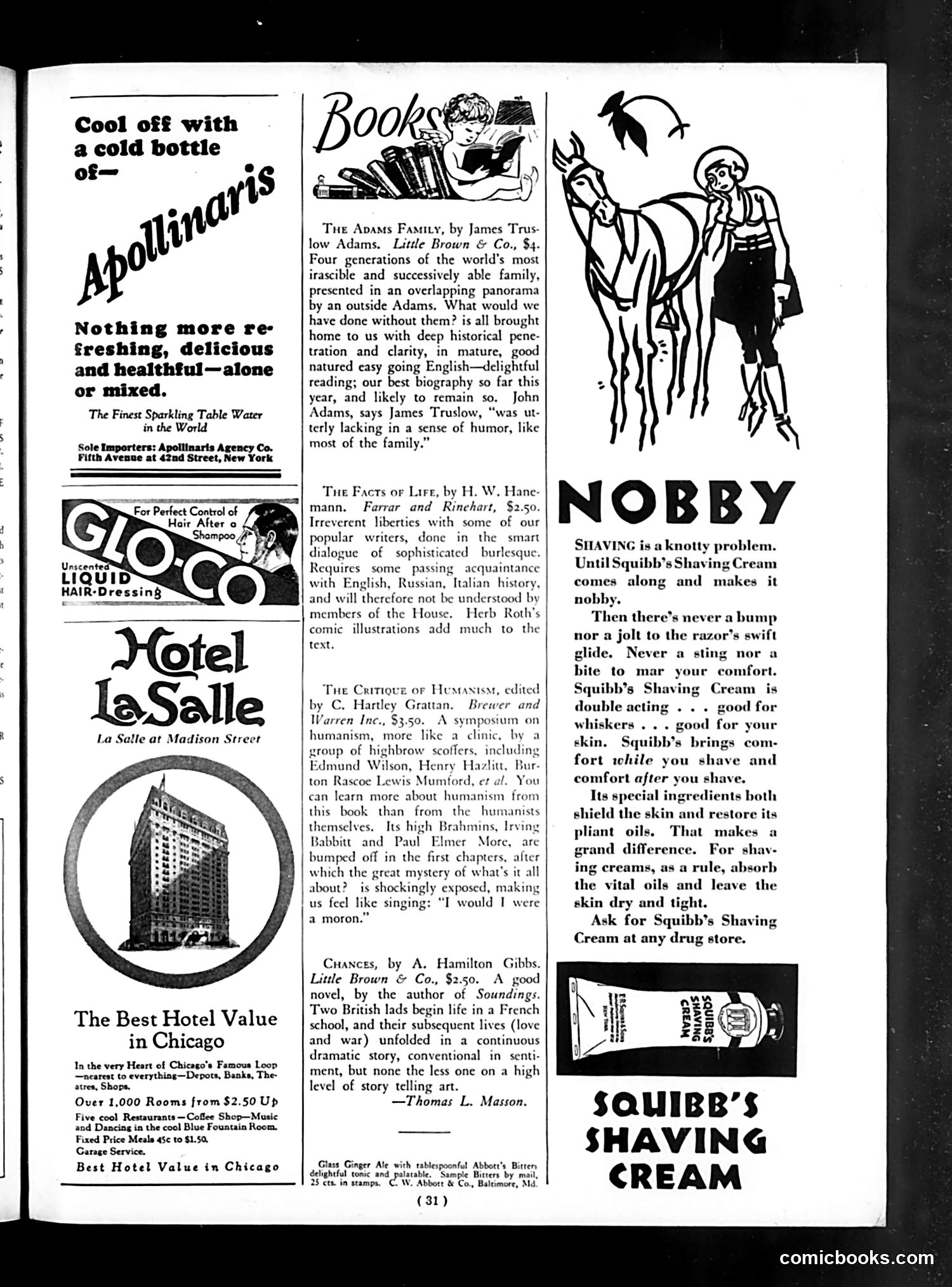
Analysis of Life Magazine Page Content This page is primarily advertising and book reviews, not political satire. The book review section critiques four volumes: James Truslow Adams' *The Adams Family* (noting John Adams "utterly lacking in a sense of humor"); H.W. Hanemann's *The Facts of Life* (described as irreverent burlesque requiring sophisticated knowledge); a symposium on humanism that deflates its high-minded practitioners; and A. Hamilton Gibbs' novel *Chances*. The single illustration—a man with a donkey—accompanies the *Chances* review, likely depicting one of the "two British lads" mentioned in the plot synopsis, though the connection is unclear. The majority of the page consists of period advertisements: Apollinaris sparkling water, Glo-Coco hair dressing, Hotel La Salle in Chicago, and Squibb's Shaving Cream. These ads emphasize health benefits and comfort—typical marketing strategies of the 1920s-30s era.
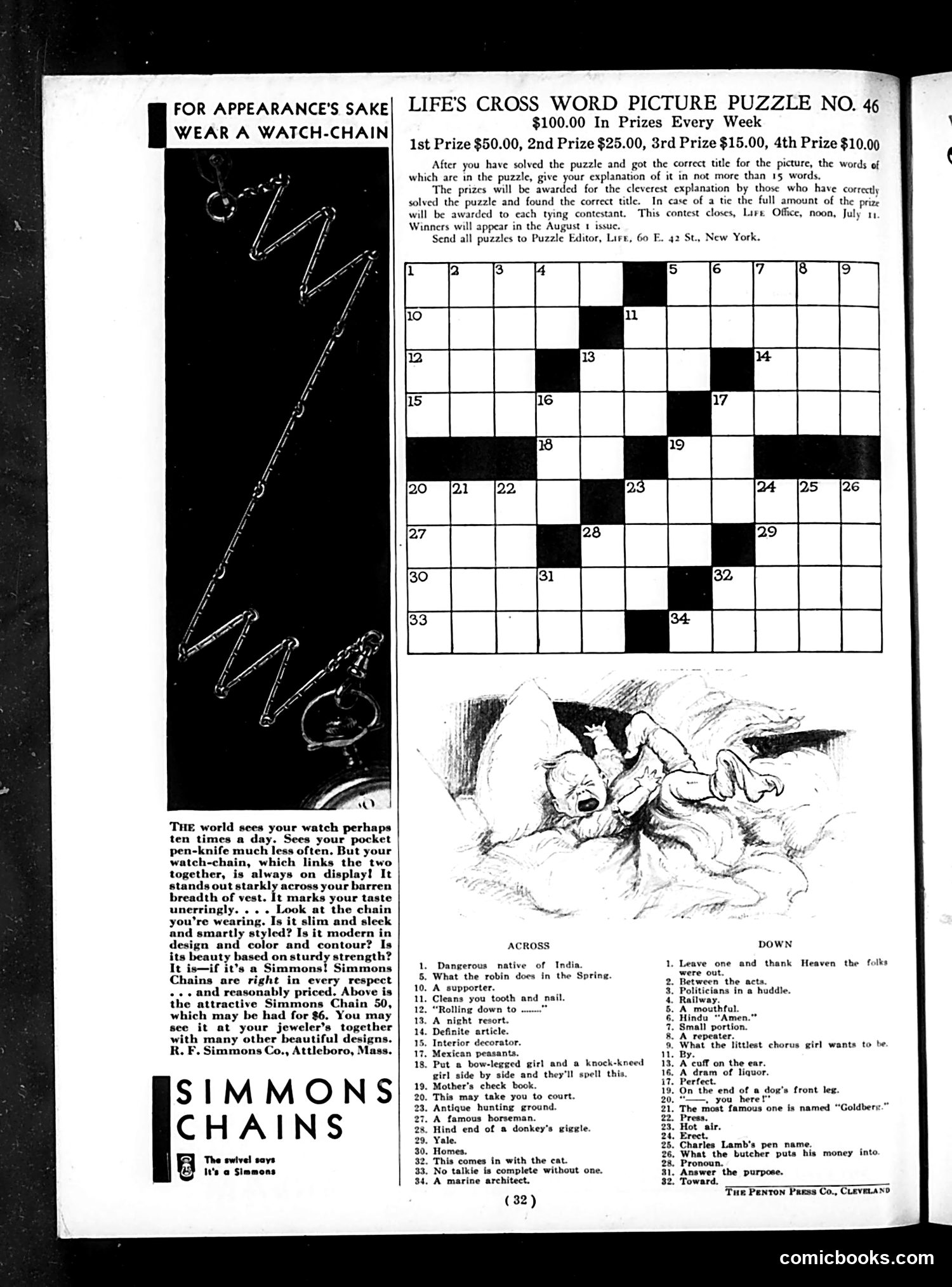
Analysis This page is primarily advertising and a crossword puzzle contest, not political satire. The left side features a Simmons Chains advertisement showing watch chains in an elegant line drawing. The ad argues that watch chains, constantly visible across one's vest, reflect personal taste and style more than hidden items like pocket knives. It emphasizes that Simmons chains are "modern in design" and "reasonably priced" at $6. The right side is Life Magazine's weekly crossword puzzle contest (No. 46), offering $100 in prizes. Solvers must complete the grid, identify the picture's title from the words within it, then explain the picture in 15 words or fewer. The clues are typical crossword fare—wordplay, definitions, and puns. The small illustration below shows what appears to be figures in period dress, but without seeing the completed puzzle solution, the specific satirical meaning is unclear. This appears to be a standard puzzle page from an early-to-mid 20th century magazine.
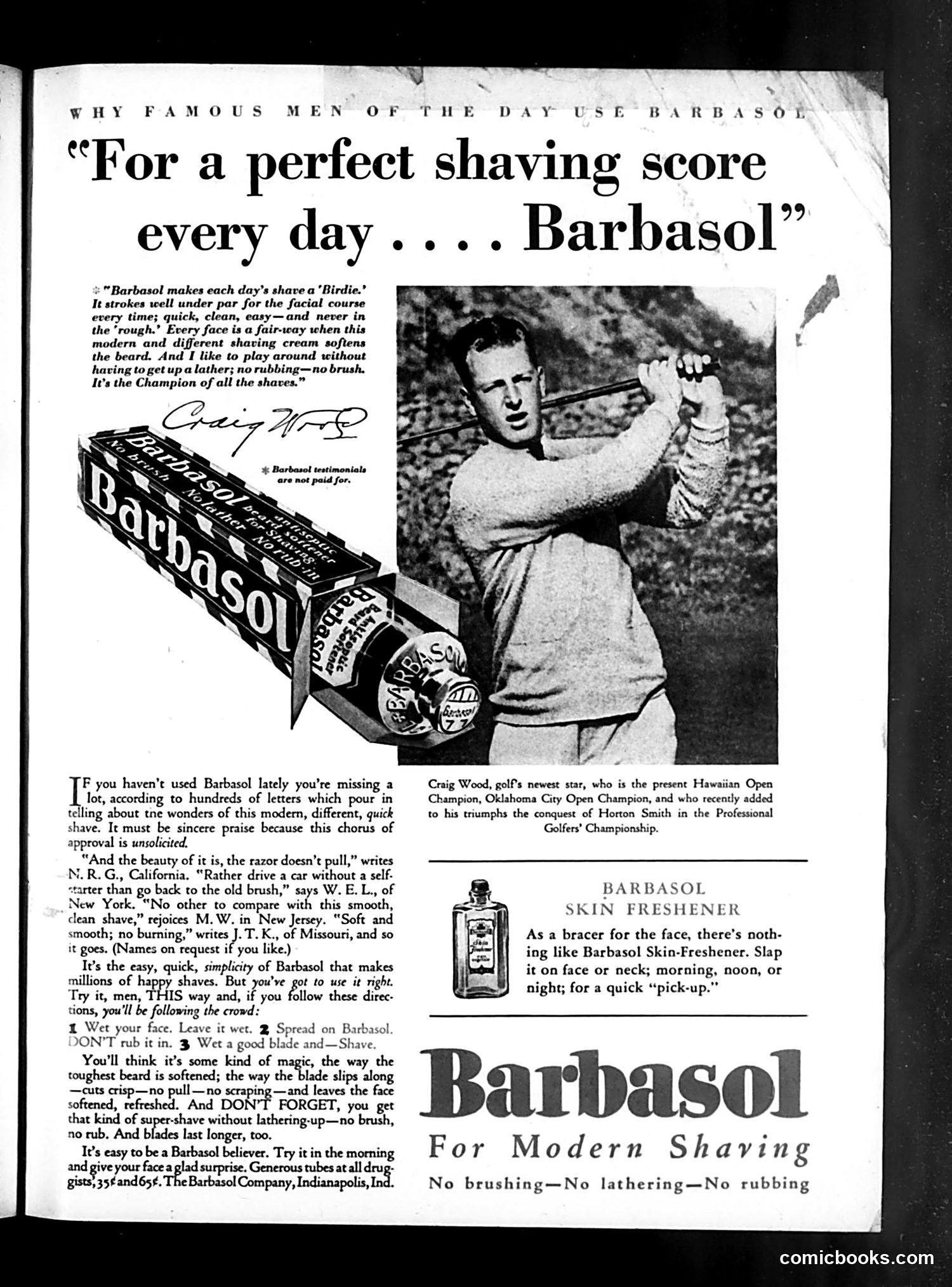
Barbasol Advertisement Analysis This is primarily a product advertisement, not satire or political commentary. The page promotes Barbasol shaving cream using celebrity endorsement. The Figure: Craig Wood, identified as a professional golfer—the "present Hawaiian Open Champion" who recently defeated competitor Horton Smith. His golf victory is used as a celebrity endorsement strategy. The Pitch: The ad employs golf terminology as metaphor ("perfect shaving score," "Birdie," "fair-way") to appeal to masculine interests. Wood's athletic success implicitly suggests that using Barbasol contributes to a man's overall polish and competence. Key Marketing Claims: The product requires no brush, lather, or rubbing—positioning it as modern and convenient compared to traditional shaving methods. Multiple customer testimonials (presented as unsolicited) emphasize ease and quality. Context for Modern Readers: This reflects 1930s-40s advertising strategy: celebrity endorsement + masculine/athletic associations + emphasis on technological convenience as markers of modernity.
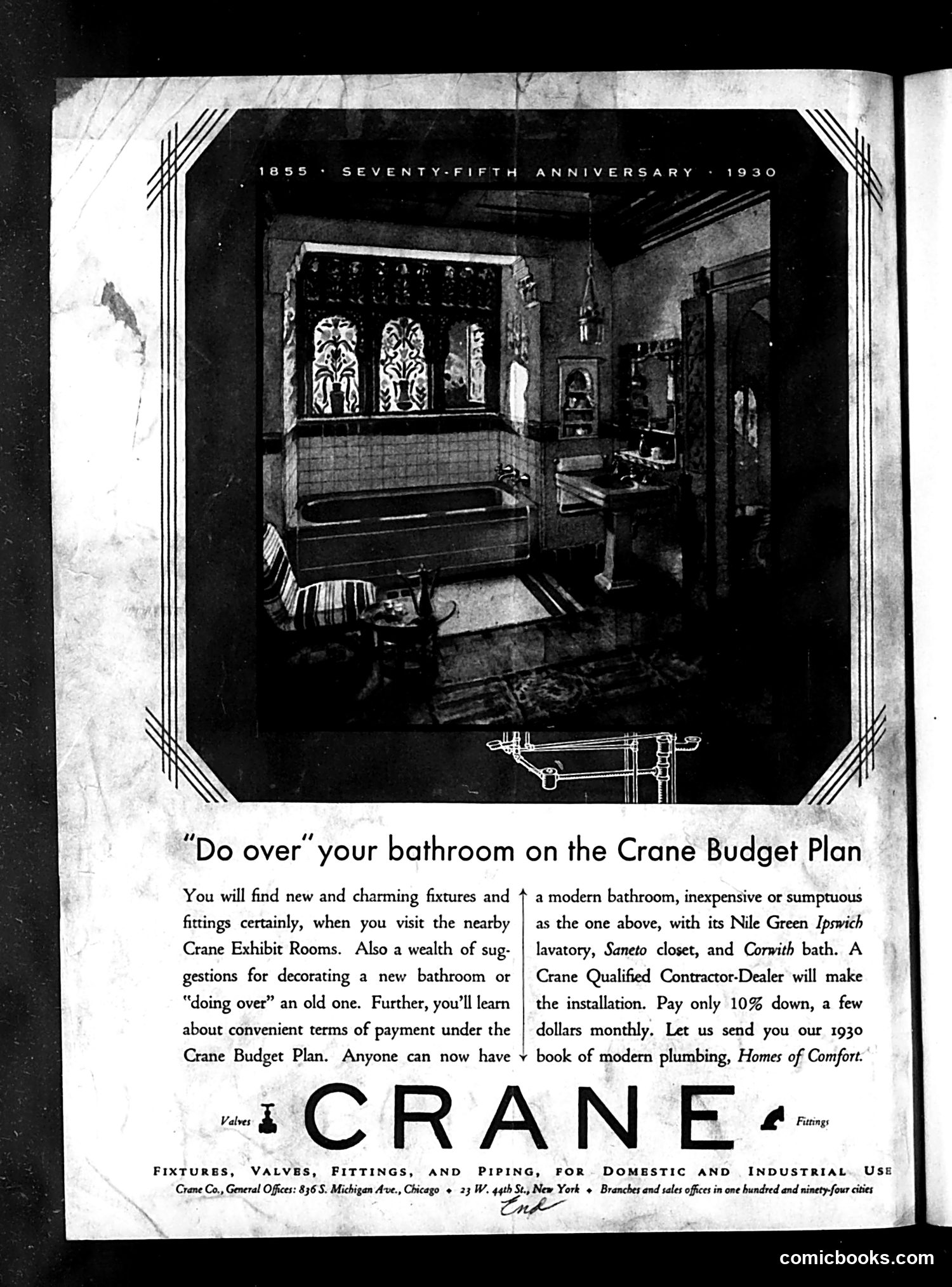
Advertisement Analysis This is not a cartoon or satire, but a straightforward product advertisement for Crane plumbing fixtures, marking the company's 75th anniversary (1855-1930). The page promotes bathroom modernization through the "Crane Budget Plan"—an installment payment system requiring only 10% down with monthly payments. The photograph shows an upscale 1930s bathroom with fashionable colored fixtures (Nile Green lavatory, Saneto closet, Corwith bath), presenting bathroom renovation as newly accessible to average consumers. The appeal targets middle-class homeowners wanting to "do over" existing bathrooms with modern amenities. The phrase "Anyone can now have" a modern bathroom emphasizes democratization through financing—a significant marketing concept during the pre-Depression period when such conveniences were luxury items. This reflects 1930s American consumer culture emphasizing home improvement and the availability of credit purchasing.

I can see this is a blank or nearly blank page from what appears to be a Life magazine issue, with only "comicbooks.com" visible at the bottom - which is a modern watermark, not original content. The page itself contains no visible cartoon, text, advertisements, or other content that would allow me to analyze political or social satire. Without actual magazine content to examine, I cannot identify figures, references, or explain what jokes or points were being made. To provide the analysis you're requesting, I would need a page with visible cartoons, illustrations, or text from the original Life magazine publication.