life
Life — July 4, 1930
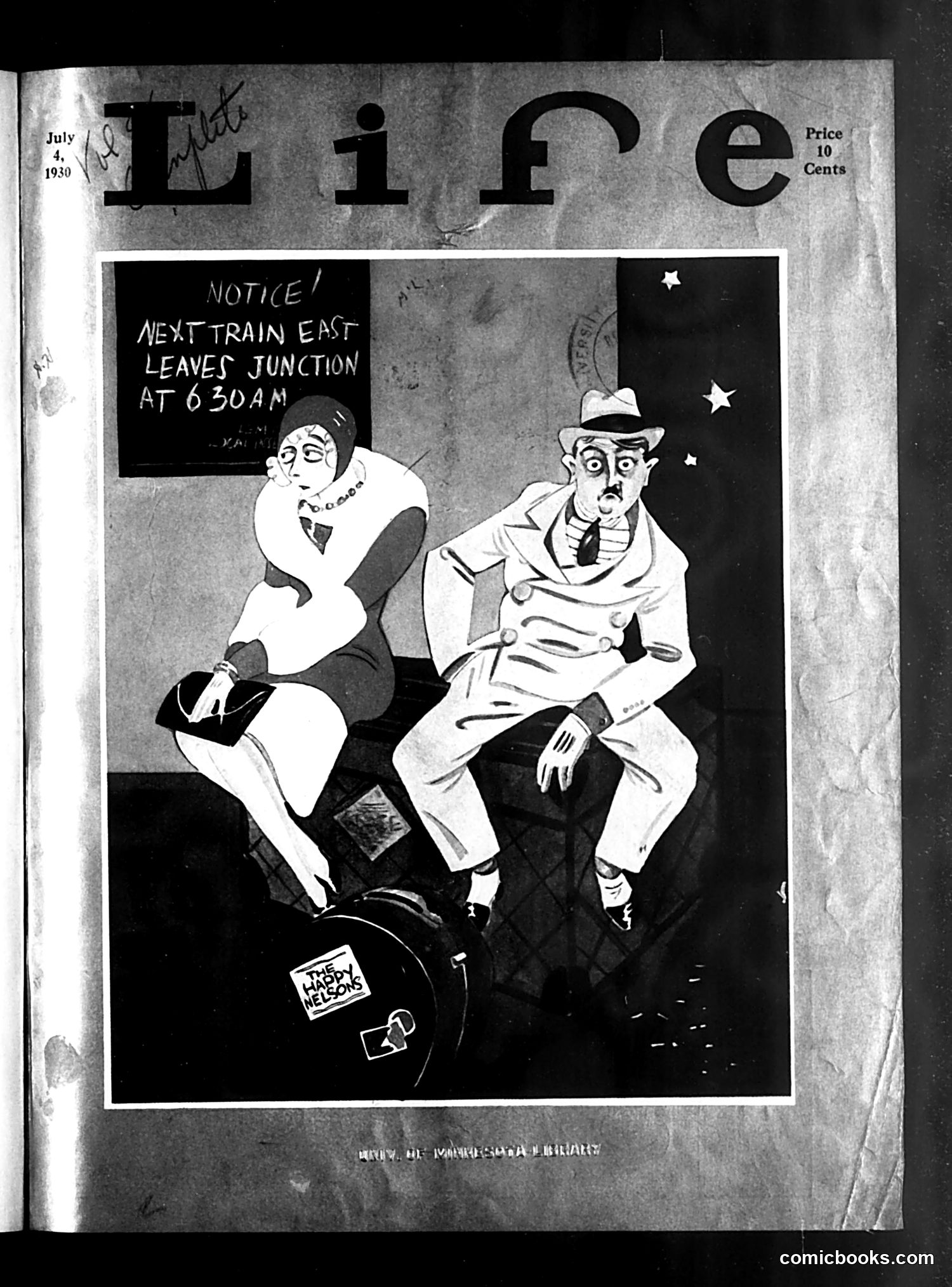
Life Magazine Cover, July 4, 1930 This cover depicts two well-dressed travelers in distress at a train station, having just missed their departure. A notice reads "NEXT TRAIN EAST LEAVES JUNCTION AT 6:30AM," and their luggage bears a label "THE HARDY HELIONS." The satire appears to target wealthy leisure travelers inconvenienced by early train schedules. The couple's exaggerated expressions of dismay and their fashionable attire suggest they represent a privileged class unaccustomed to minor hardships. "The Hardy Helions" label may be ironic commentary on their inability to handle discomfort despite their self-perceived toughness or adventurous pretensions. The overall joke mocks upper-class travelers' entitled expectations during the Great Depression era.
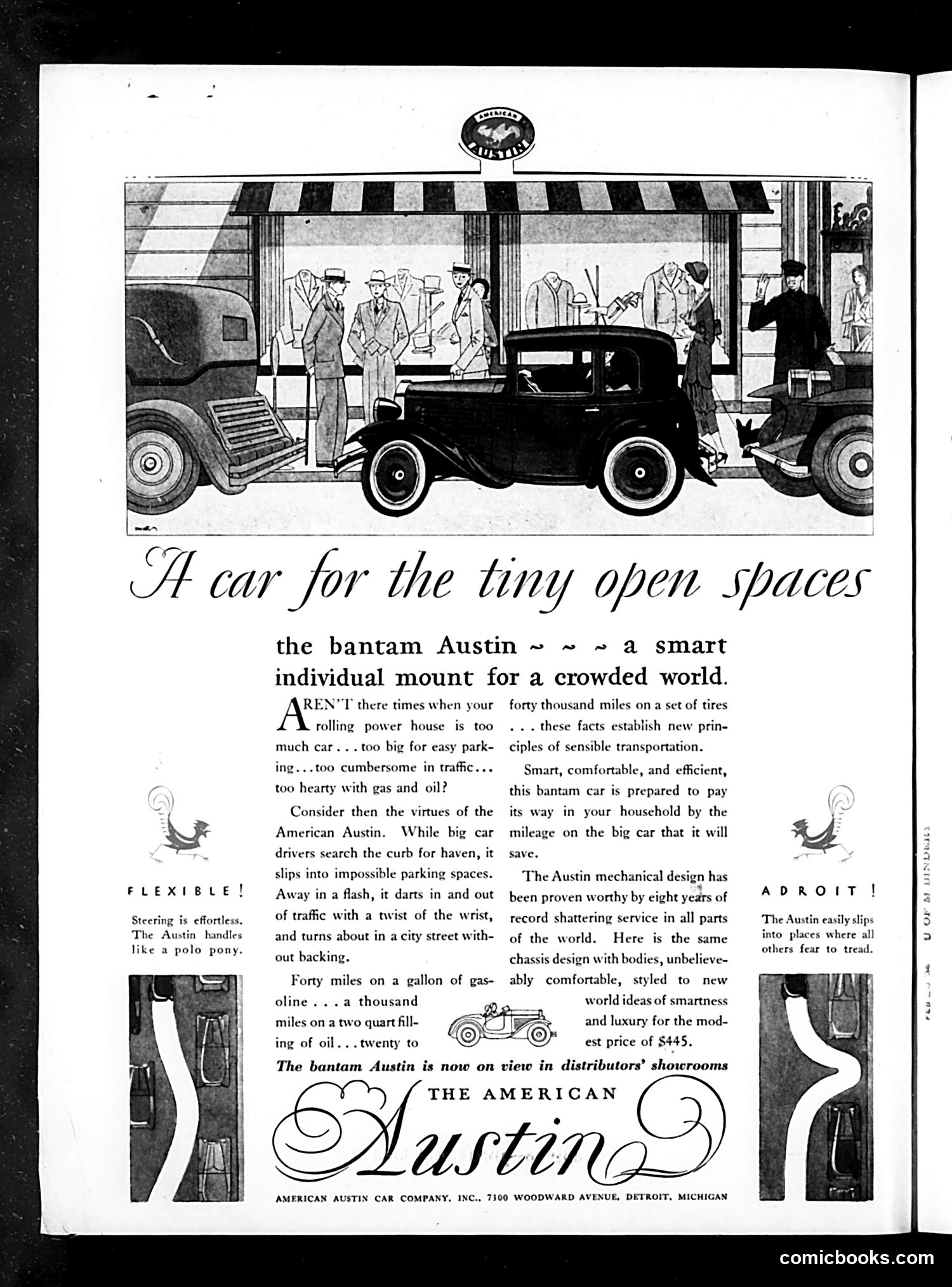
This is an advertisement for the American Austin automobile, not a political cartoon. The page features a stylized illustration of a small car parked on a city street surrounded by well-dressed pedestrians and shoppers. The ad's appeal targets urban dwellers facing parking and traffic congestion—a growing problem in crowded 1920s-30s cities. The "bantam Austin" is marketed as a solution: compact enough to fit "impossible parking spaces," yet mechanically sound and comfortable. The satirical angle is implicit: the ad acknowledges that modern city life has become overwhelming ("too big for easy parking," "too cumbersome in traffic"), and proposes a tiny, maneuverable car as the answer. It's gentle humor about urban overcrowding rather than sharp political satire.
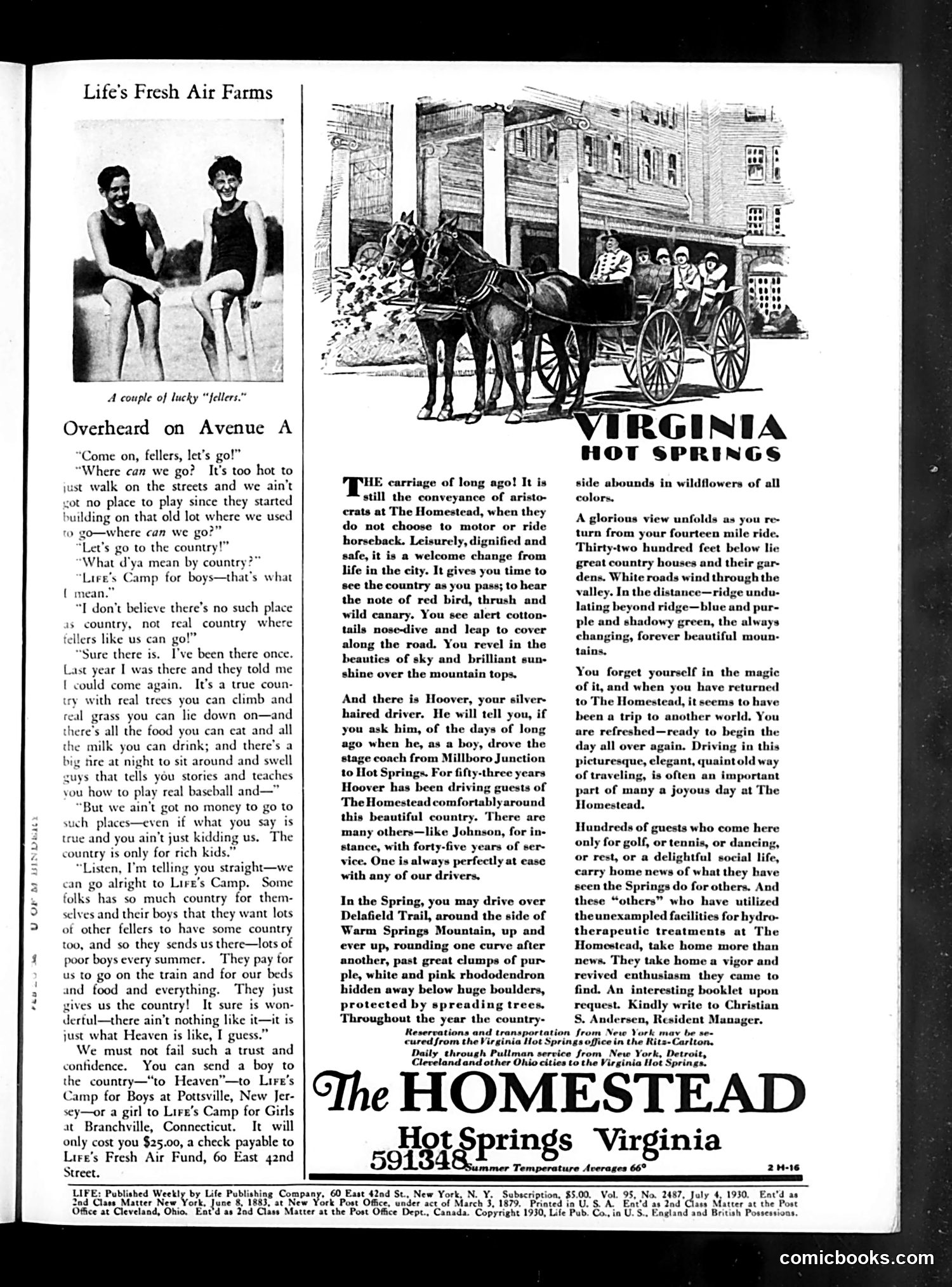
Page Analysis This page is primarily advertising content rather than political satire. The left side shows "Life's Fresh Air Farms" — a humorous dialogue between two young people debating whether to visit the countryside versus staying in the city. The joke hinges on their desire for "country" experience: one argues for Life's Camp for Boys at Postsville, New Jersey. The right side advertises The Homestead hotel in Hot Springs, Virginia, featuring an illustration of a horse-drawn carriage. The ad emphasizes old-fashioned leisure travel — scenic drives, natural springs, and hospitality from long-time drivers like "Hoover." The satire is gentle: urban dwellers romanticize rural/country experiences, while the magazine promotes its own camp and advertises luxury resort vacations as solutions to this yearning. It's essentially marketing nostalgia and escape.
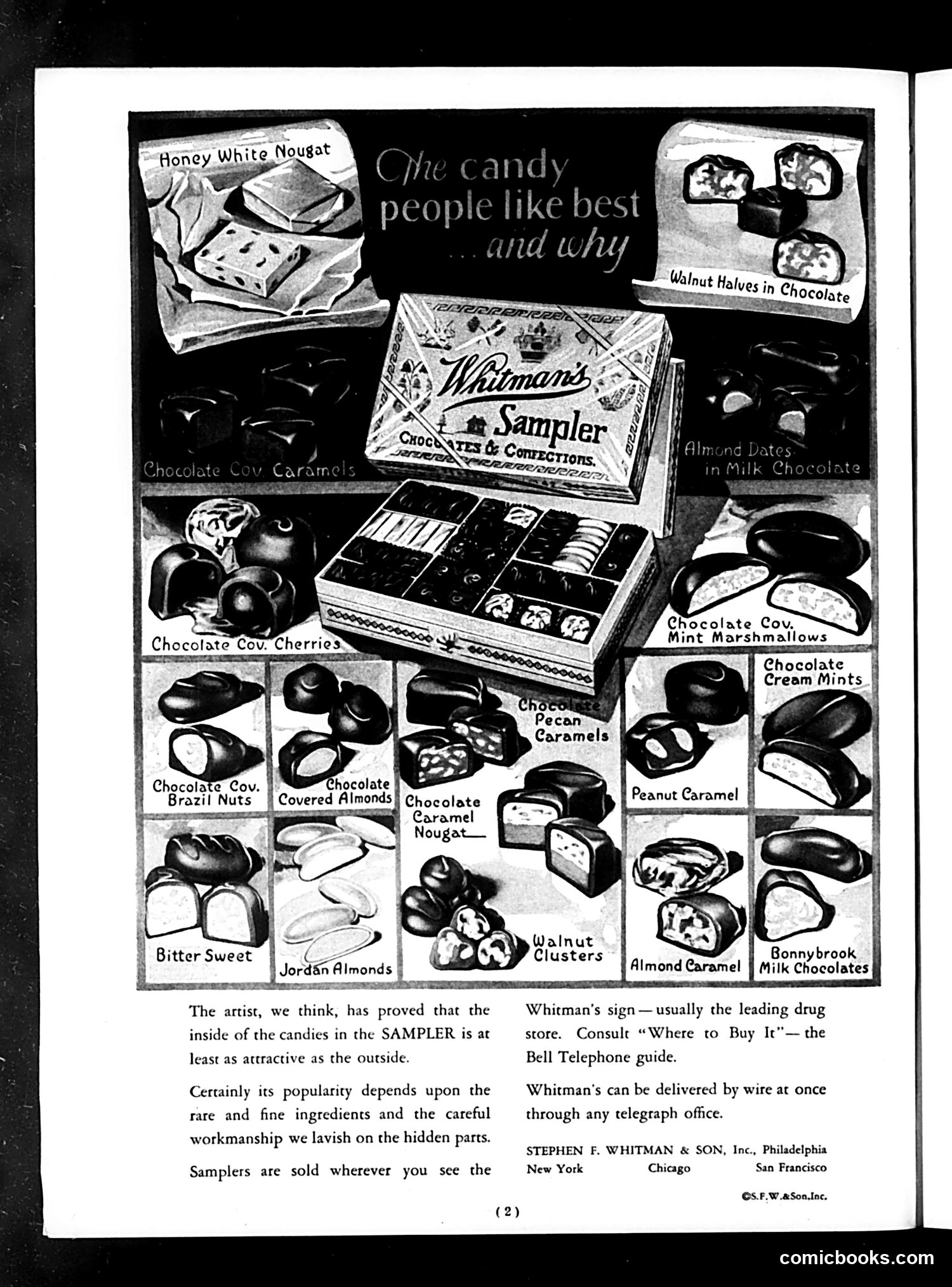
Analysis This page is primarily an advertisement, not satire or political commentary. It promotes Whitman's Sampler chocolates through a visual catalog of candy varieties. The headline "The candy people like best...and why" frames the ad around consumer appeal. The central image shows an open Whitman's Sampler box displaying various chocolates: Brazil Nuts, Covered Almonds, Cherries, Pecans, Nougat, Caramels, Walnut Clusters, Mints, and others. The accompanying text emphasizes that Whitman's success depends on "rare and fine ingredients and careful workmanship on the hidden parts"—suggesting quality extends beyond appearance. The ad notes Whitman's sign is "usually the leading drug store" fixture and can be delivered via telegraph. This reflects early-20th-century marketing strategy: positioning luxury candies as gifts, emphasizing hidden craftsmanship, and leveraging convenient retail distribution.
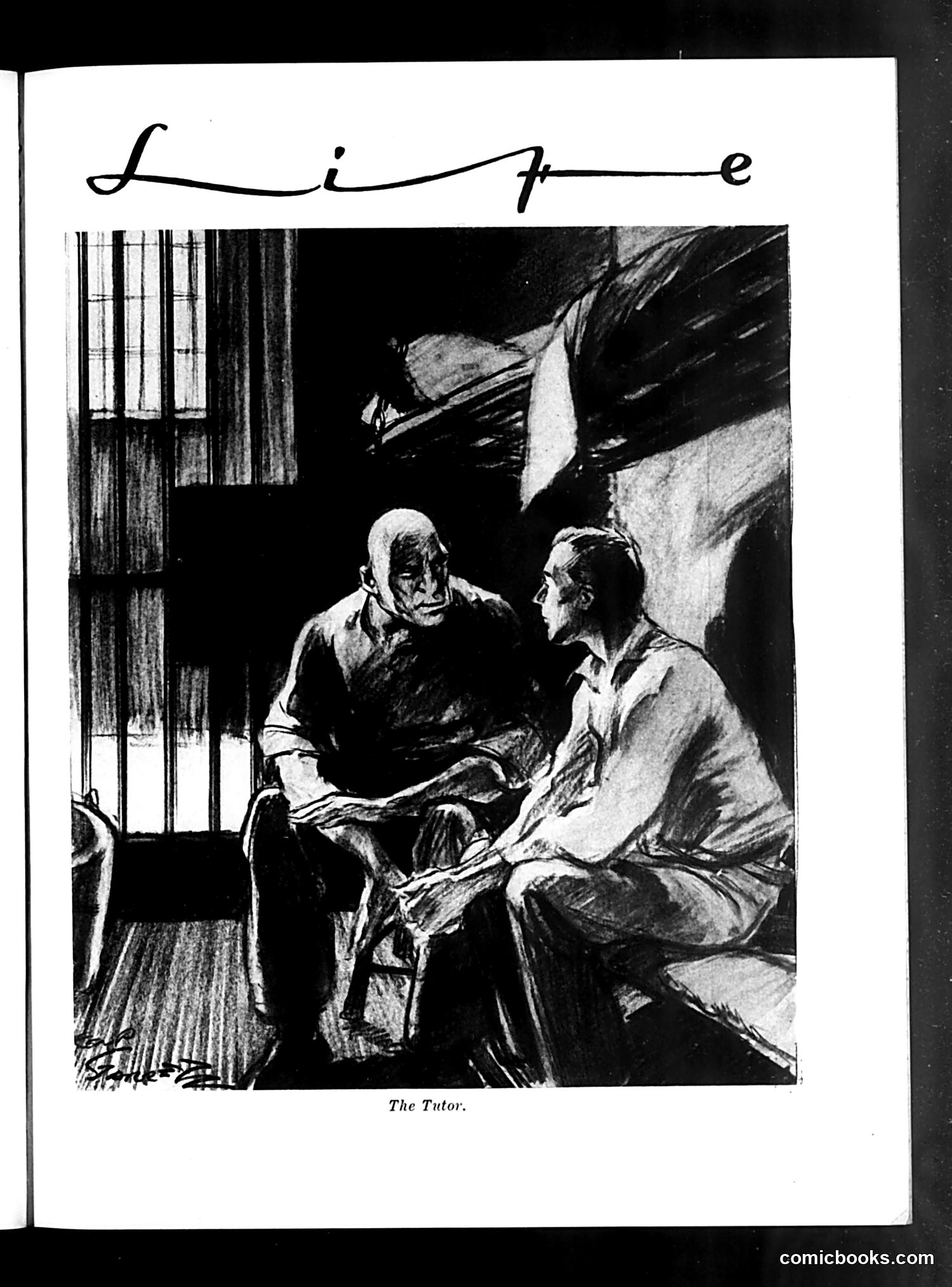
"The Tutor" - Life Magazine Illustration This illustration depicts two men in what appears to be a prison cell (note the barred window on the left). The caption identifies the scene as "The Tutor." The image likely satirizes educational or instructional dynamics in an institutional setting, possibly critiquing prison education programs or the relationship between an authority figure and a subordinate. One figure appears older and is gesturing while speaking; the other listens attentively. Without additional context from the magazine issue, the specific political or social target remains unclear. The satirical intent likely relates to 19th or early 20th-century American social commentary, possibly mocking either prison reform efforts, the efficacy of education in such settings, or a particular public figure's role in institutional management. The style and subject suggest social criticism typical of Life magazine's satirical approach.
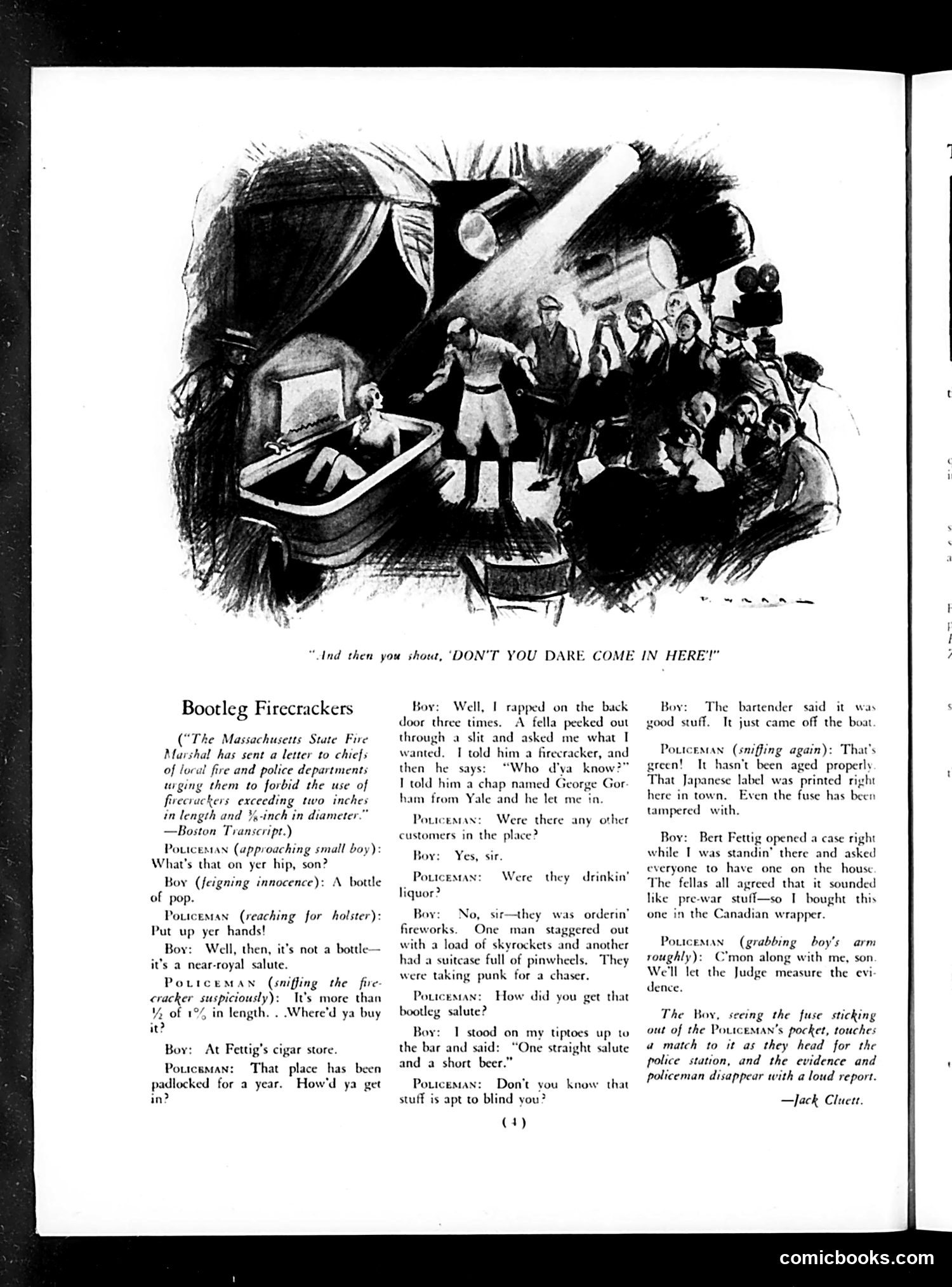
"Bootleg Firecrackers" - Life Magazine Satire This is a humorous sketch by Jack Clinett depicting Prohibition-era lawbreaking. A policeman interrogates a boy caught with illegal firecrackers (and possibly bootleg liquor), framed as contraband similar to illegal alcohol. The joke plays on the absurdity of Prohibition enforcement: firecrackers are being treated with the same gravity as smuggled liquor. The boy's casual admissions—that he bought them at a cigar store (itself "padlocked for a year"), that a bartender sold them—mock how pervasive illegal goods were and how ineffective law enforcement had become. The cartoon satirizes both the ridiculousness of treating fireworks like contraband and the widespread defiance of Prohibition laws, where even children could easily obtain banned items through obvious front operations.
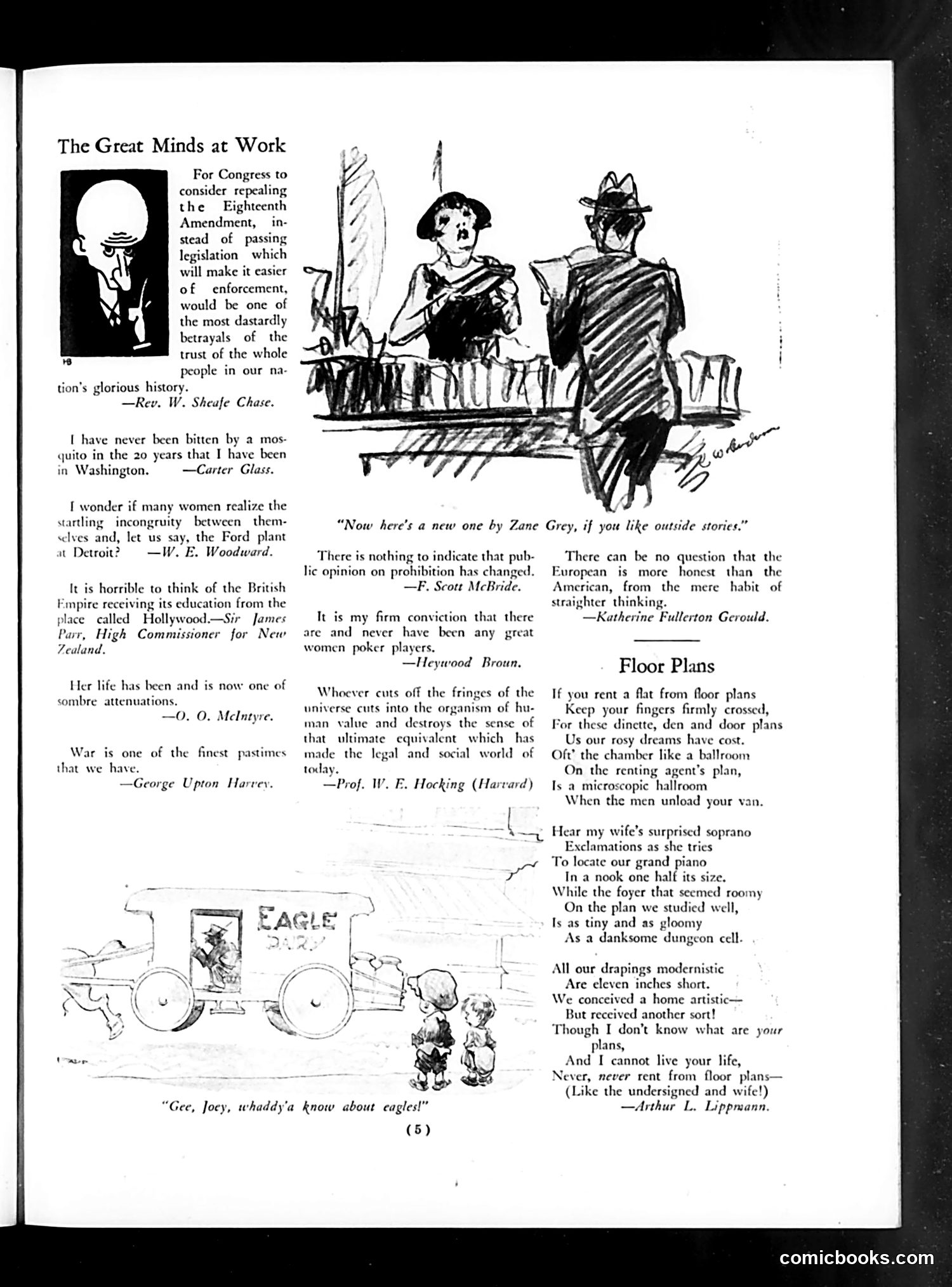
Analysis of Life Magazine Page Top Cartoon: Depicts congressional figures debating prohibition repeal. The skeleton figure and armed congressmen represent the debate over repealing the 18th Amendment. The caption suggests disagreement about enforcement versus outright repeal—a major political conflict of the Prohibition era (likely 1920s-early 1930s). Bottom Cartoon: Shows children asking "Gee, Joey, whaddy'a know about eagles?" while observing a truck marked "EAGLE." This appears to be a simple children's humor piece playing on the double meaning of "eagle" (the bird vs. commercial branding). The page also contains various quoted opinions on contemporary social issues, including criticism of British imperial education and debates about women's roles—typical satirical commentary for Life magazine's intellectual readership.
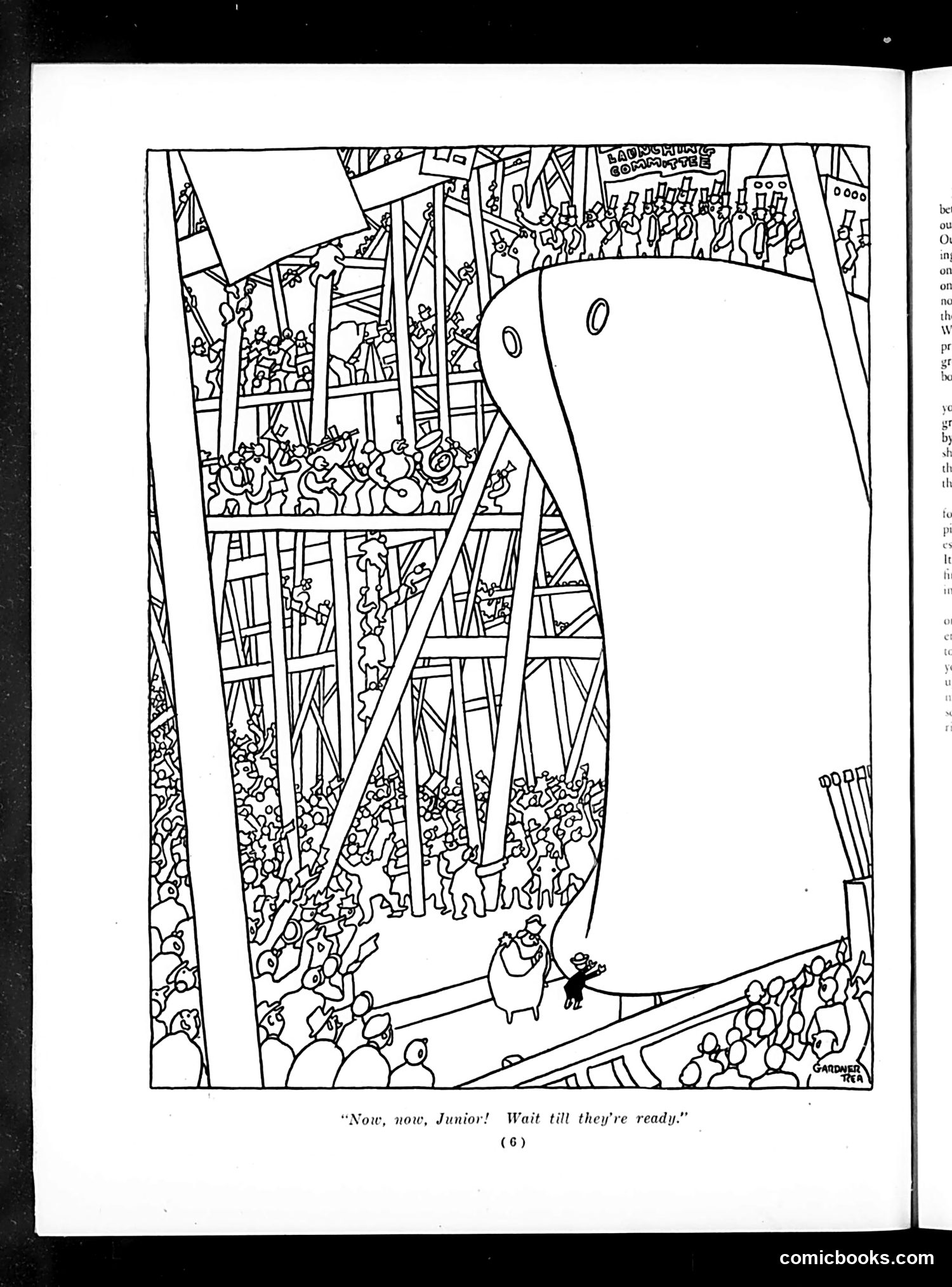
Analysis of Life Magazine Cartoon This cartoon depicts a circus or large public spectacle with massive crowds packed into a multi-tiered venue. Two figures stand in the arena floor—one appears to be an adult (possibly a ringmaster or performer) and a smaller figure labeled "Junior." The caption reads: "Now, now, Junior! Wait till they're ready." This satirizes the anticipation and control of mass audiences at public events. The joke suggests that even children are subject to crowd management and must wait for official cues before reacting or participating, reflecting on American spectacle culture and the manufactured nature of public enthusiasm. The densely-packed crowds emphasize how audiences have become standardized, managed components of entertainment rather than spontaneous participants. The cartoonist is Gardner (visible signature).
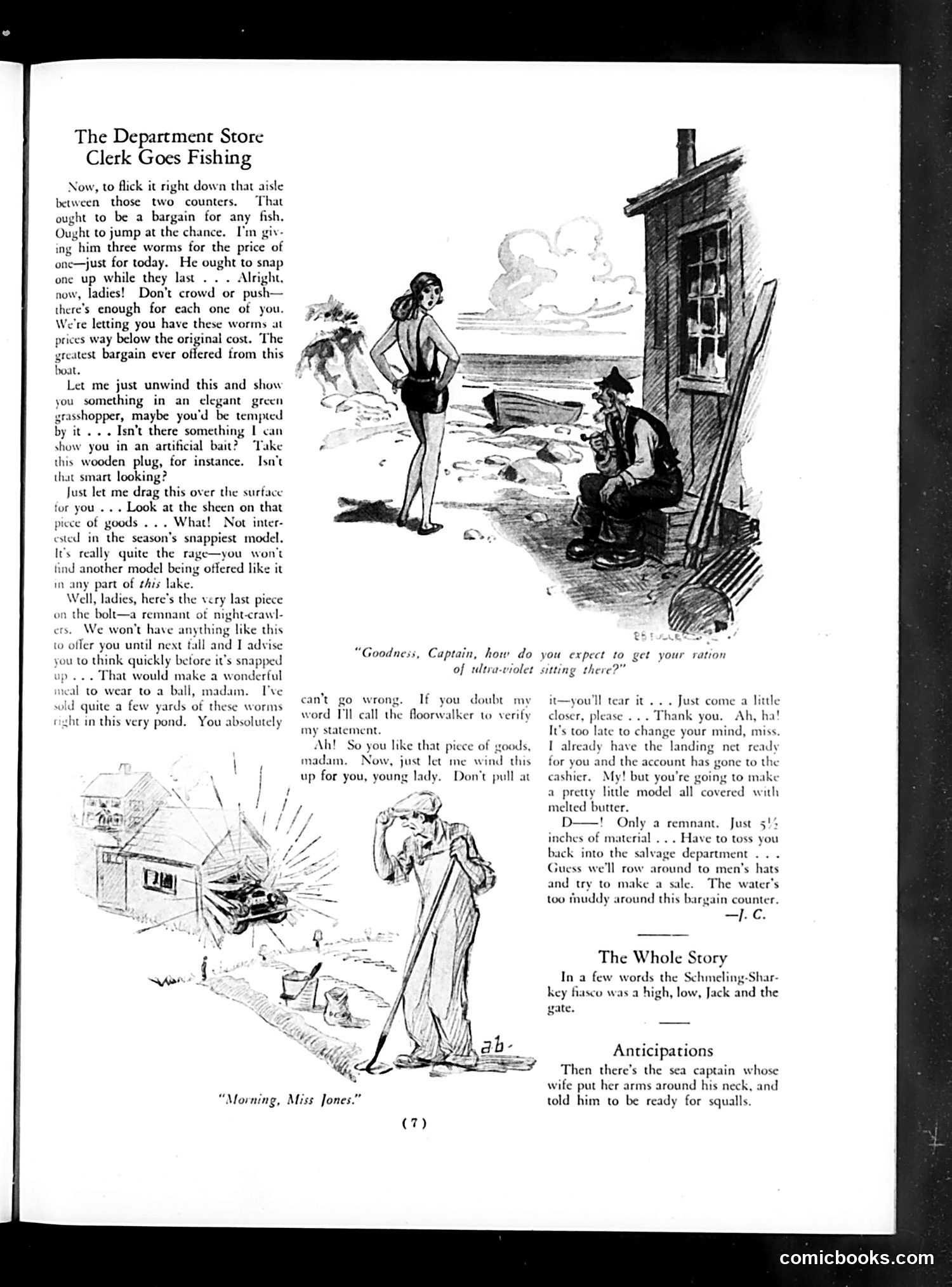
"The Department Store Clerk Goes Fishing" This satirical piece mocks a department store clerk attempting to sell fishing equipment. The humor turns on the clerk's desperation and transparently false sales pitches—describing worms as "bargains," praising cheap goods with flowery language ("elegant green grasshopper"), and using high-pressure tactics ("Don't crowd or push"). The accompanying illustration shows the clerk awkwardly approaching a seasoned fisherman and woman by the water, clearly out of his element. The joke critiques both aggressive retail sales methods and the clerk's absurd attempt to convince experienced anglers to buy inferior department store fishing gear instead of using actual bait and equipment. The satire reflects early 20th-century frustrations with commercialism and pushy salesmanship.
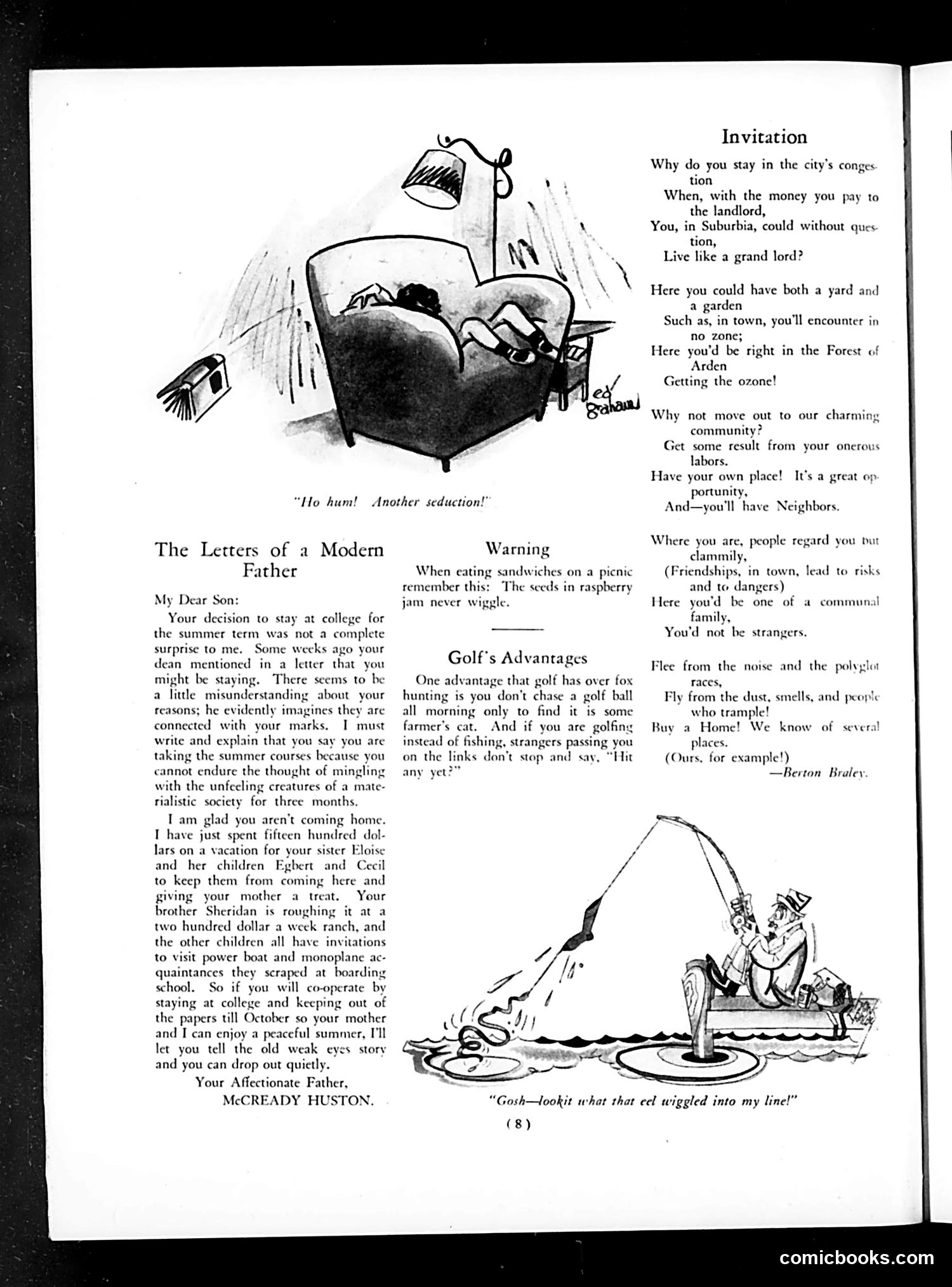
Page Analysis: Life Magazine, Page 8 This page contains satirical pieces about early 20th-century suburban life and leisure. "The Letters of a Modern Father" is a humorous letter from McCready Huston to his son, advising him to stay at college rather than come home for summer. The father humorously lists family obligations—visiting relatives' ranches and power boats—making staying away seem preferable to family obligations. "Invitation" sarcastically encourages moving to the suburbs, offering space and gardens while poking fun at suburban life's claims of superiority over city living. "Golf's Advantages" jokes that golf's main benefit is losing balls on the links early, avoiding further play—a humorous jab at the sport's frustrations. The cartoons illustrate these satirical pieces with sketches of domestic comfort and leisure activities, typical of Life's social commentary on American middle-class life.
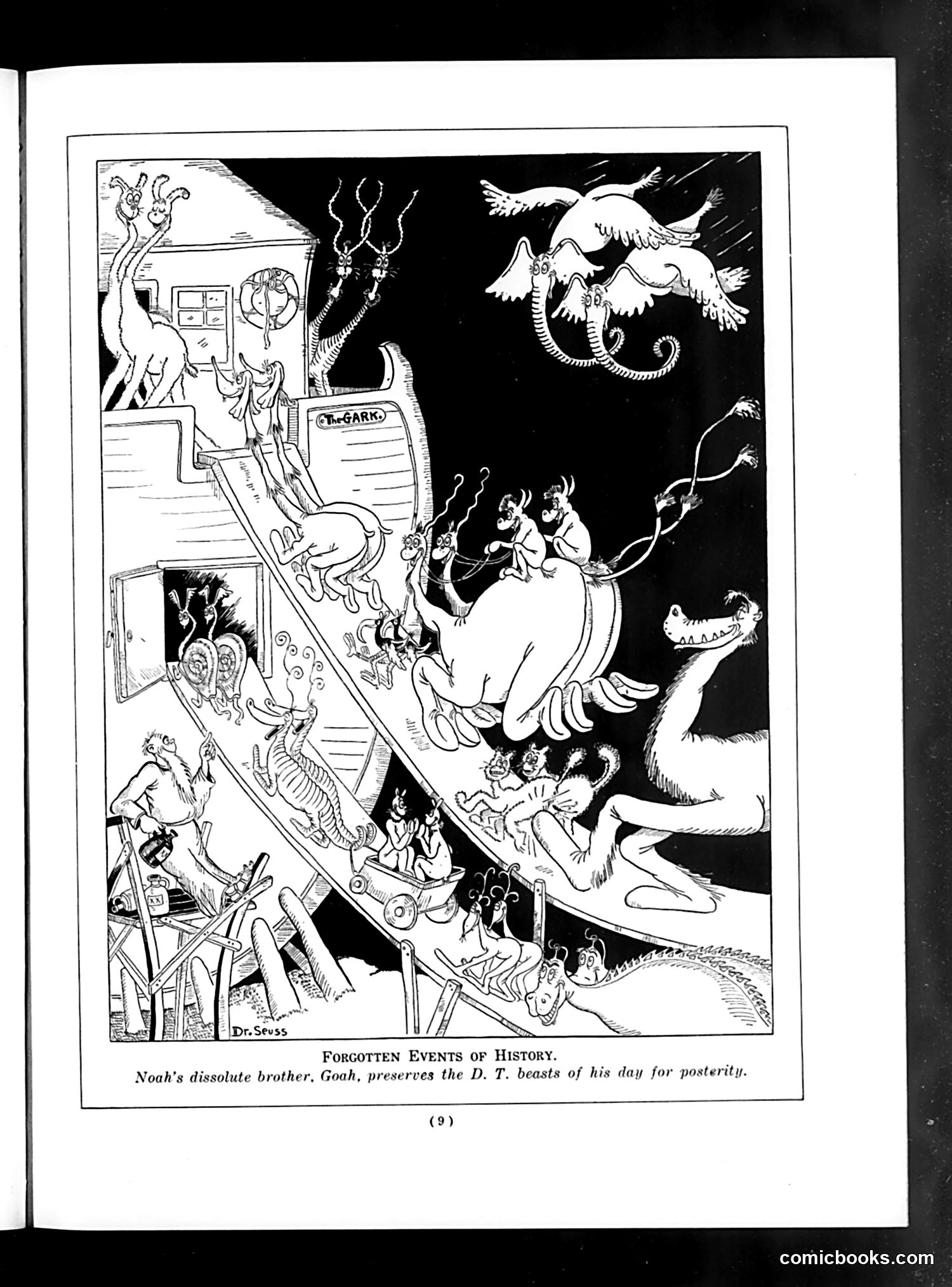
"Forgotten Events of History" This is a Dr. Seuss cartoon satirizing Noah's Ark through an absurdist lens. The caption reads: "Noah's dissolute brother, Goah, preserves the D.T. beasts of his day for posterity." The joke plays on "D.T.s" (delirium tremens)—hallucinations caused by alcohol withdrawal. Rather than Noah preserving real animals, his fictional dissolute brother Goah is preserving fantastical, impossible creatures that exist only in an alcoholic's delirious imagination: winged animals with multiple heads, strange hybrid beasts, and other surreal forms. The cartoon mocks both excessive drinking and the biblical Noah's Ark story through whimsical exaggeration. It's typical of Seuss's early satirical work in *Life* magazine, combining social commentary about alcoholism with imaginative visual chaos.
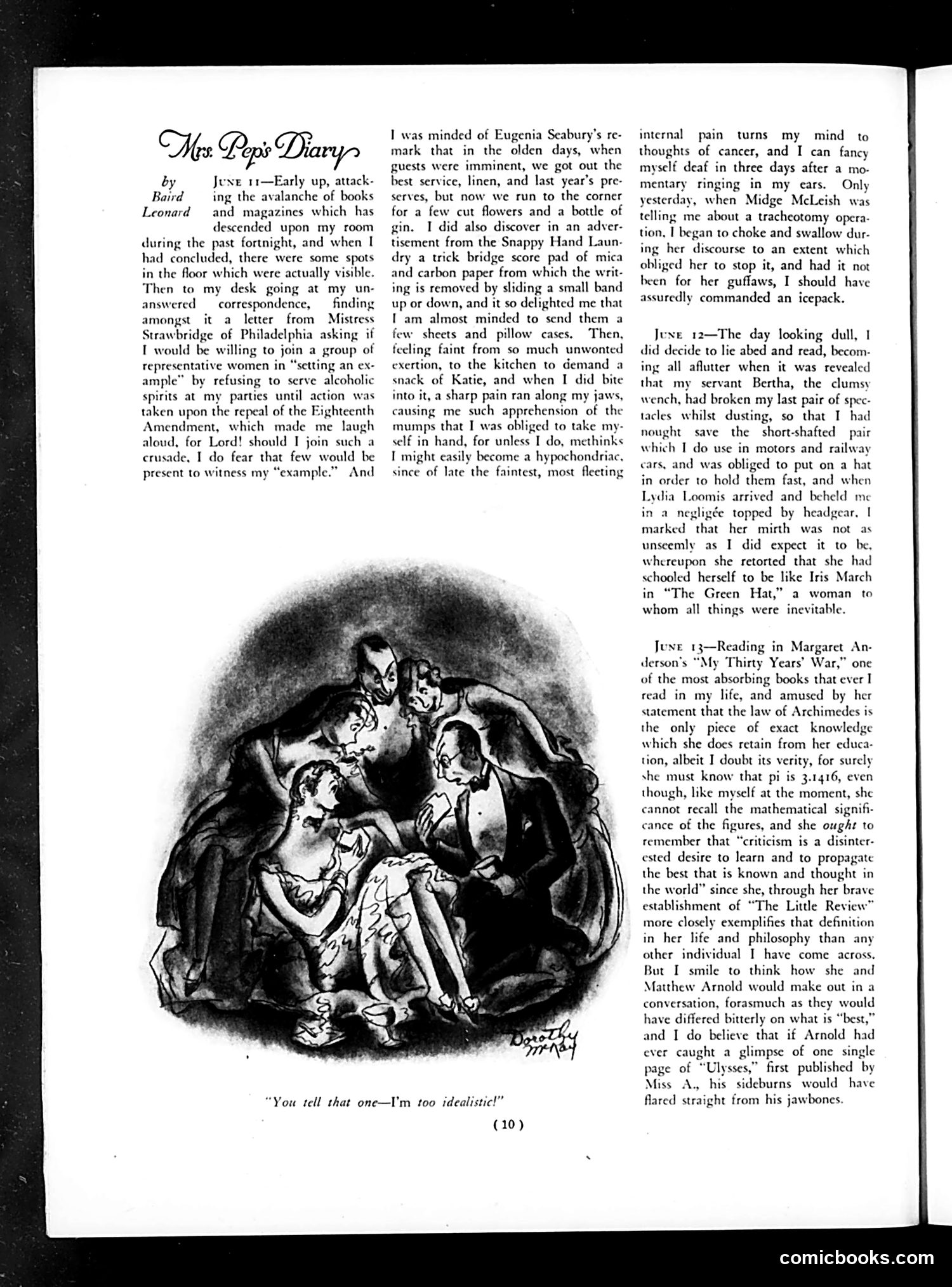
Mrs. Pep's Diary Analysis This page presents a personal diary entry by "Baird Leonard" dated June 11-13, discussing domestic life, household management, and intellectual pursuits. The accompanying illustration shows a woman surrounded by children in what appears to be a domestic scene. The caption beneath the sketch reads: "You tell that one—I'm too idealistic!" This appears to be gentle social satire about women's roles and intellectual aspirations. The diary discusses the author's efforts to maintain household standards while pursuing intellectual engagement (reading Margaret Anderson's literary criticism). The final caption suggests tension between idealistic principles and practical domestic realities—the woman feels too principled to tell a particular anecdote, likely something crude or cynical. The humor derives from the gap between intellectual aspirations and domestic constraints typical of upper-middle-class women's lives in this era.
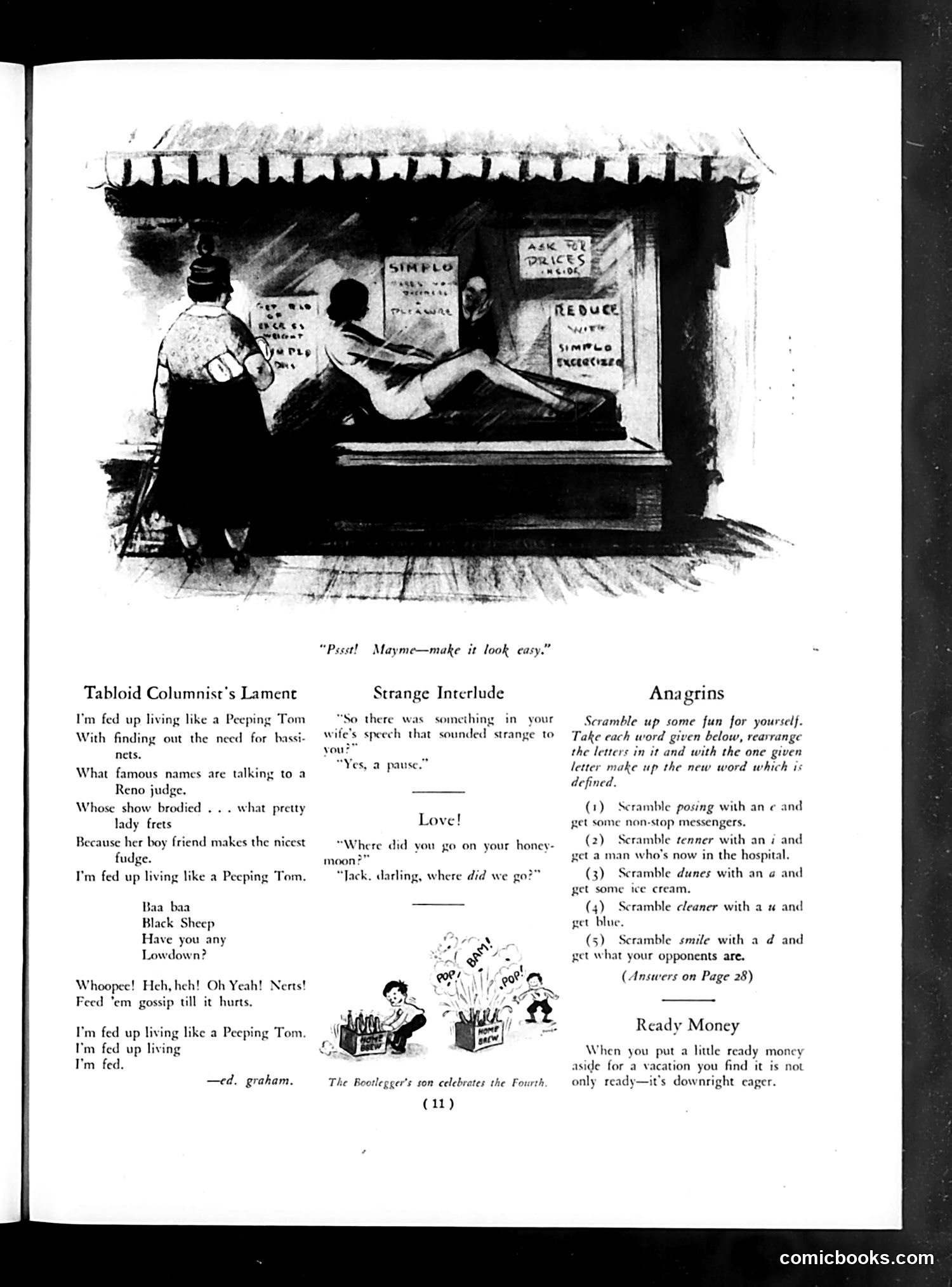
Analysis The main cartoon depicts a shop scene with signs reading "Ask re prices inside," "Simplo," and "Reduced." A customer approaches the counter while the shopkeeper appears to lounging or reclining behind it. The caption reads: "Psst! Mayme—make it look easy." The satire: This appears to mock shopkeepers or salespeople who create an illusion of effortless service or casual competence while actually working hard or cutting corners. The "Simplo" signage suggests simplified pricing or service, while the shopkeeper's reclined posture contrasts with the customer's expectation of attentive service. The whispered instruction suggests fakery—maintaining appearances of ease despite the actual effort involved. The surrounding page contains humorous poems and word puzzles typical of Life magazine's light satirical content from the early 20th century.
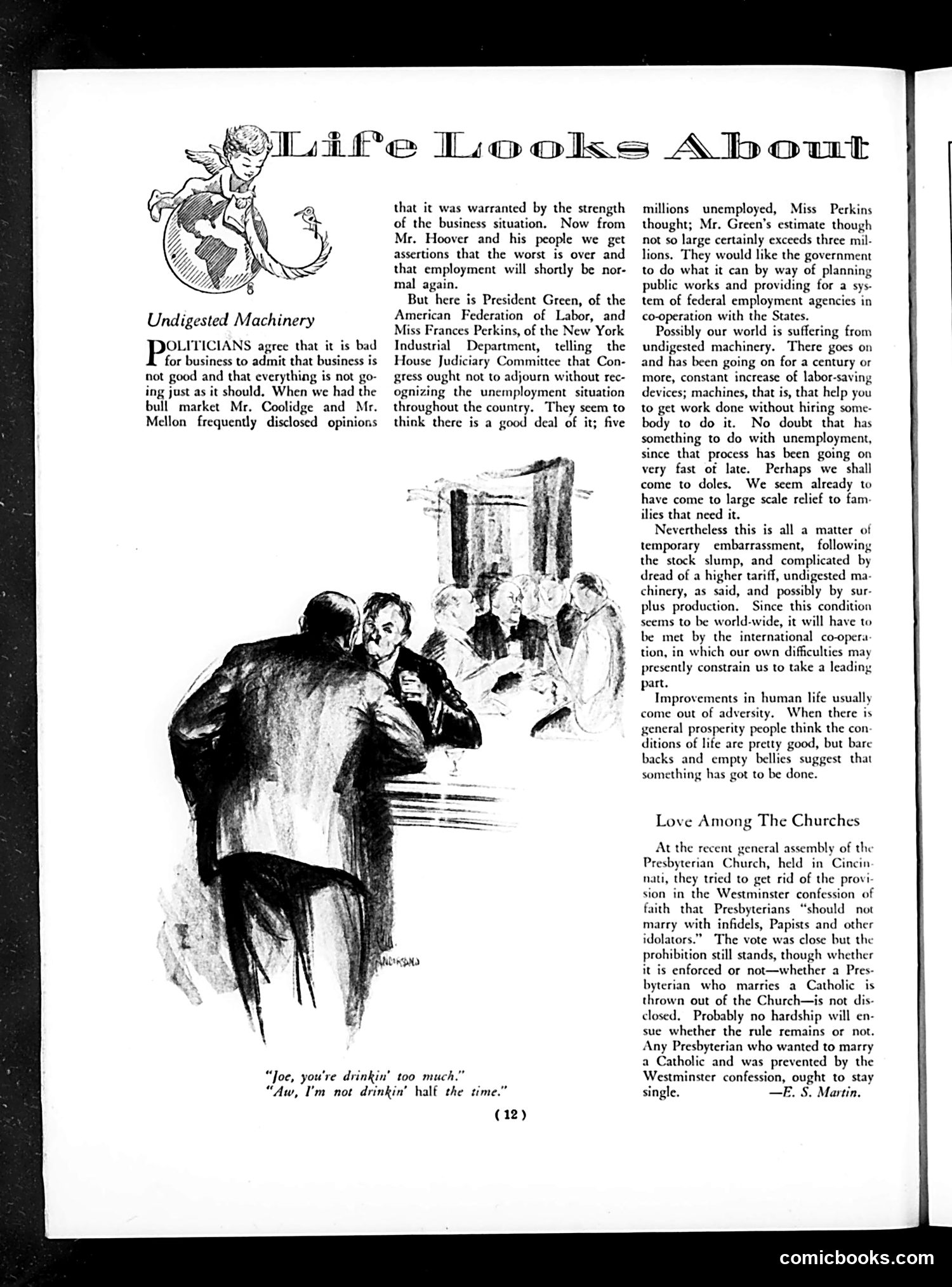
"Life Looks About" - Page Analysis This page contains two distinct sections: "Undigested Machinery" (left): A political commentary on unemployment during what appears to be the post-stock-market-crash era. The text references President Green of the American Federation of Labor and Frances Perkins of the Industrial Department testifying before Congress about persistent joblessness. The article dismisses their concerns about labor-saving machinery causing unemployment as exaggerated, arguing the problem is temporary and tied to tariffs and overproduction rather than automation. "Love Among The Churches" (right): Commentary on Presbyterian church doctrine regarding interfaith marriage, specifically their Westminster confession rules against marrying Catholics and other "infidels." The author sarcastically suggests such prohibitions are unenforceable and absurd. The cartoon shows two men in a drinking scene, illustrating excess and poor judgment through alcohol consumption.
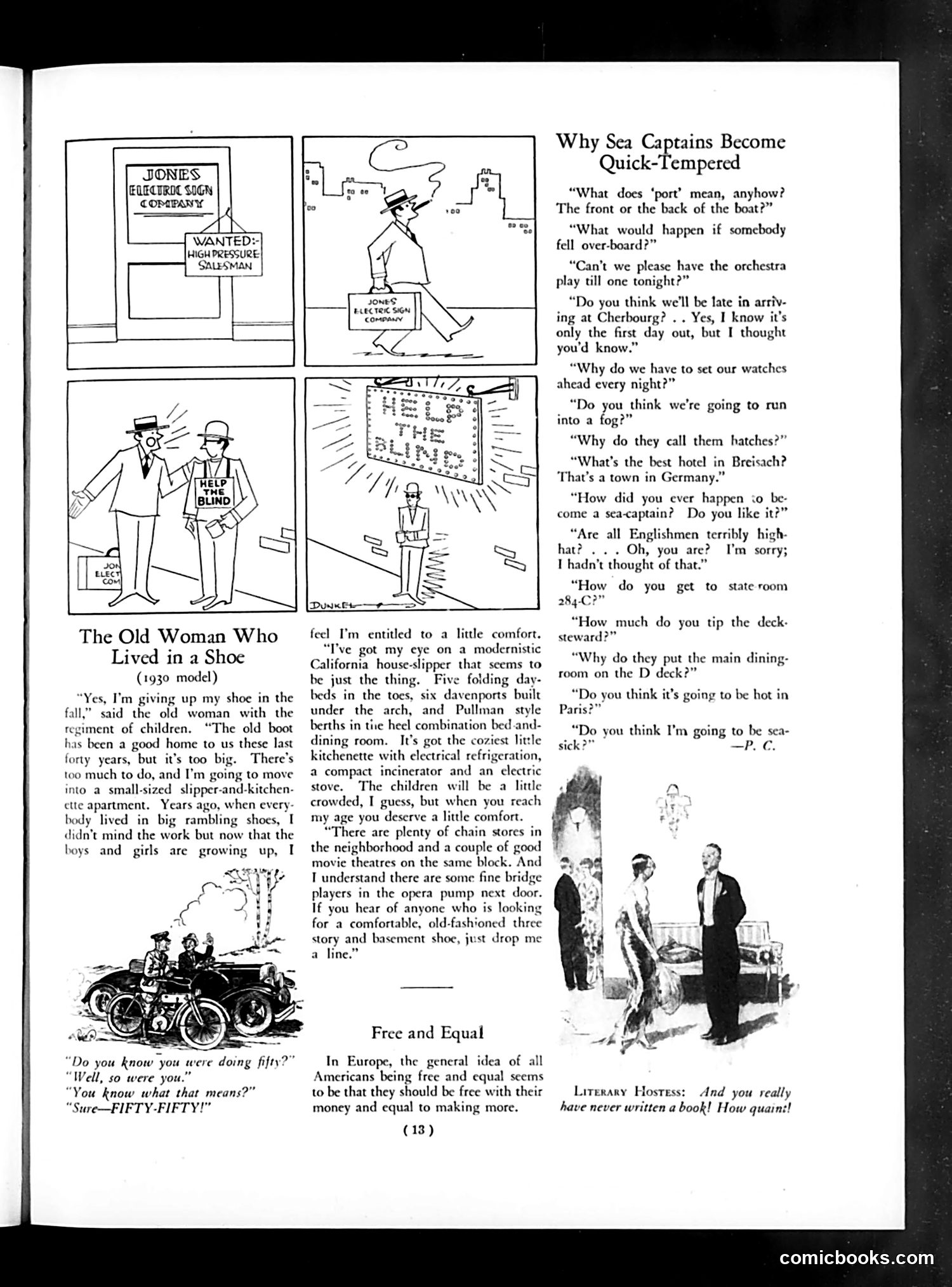
Analysis of Life Magazine Page This page contains three distinct satirical pieces: 1. "Jones Electric Shoe Company" comic: A visual gag about a struggling salesman seeking employment at a shoe company, likely mocking Depression-era job desperation. 2. "The Old Woman Who Lived in a Shoe" (1939 model): A tongue-in-cheek piece where an elderly woman describes upgrading from a literal shoe home to a modern apartment equipped with contemporary luxuries (folding beds, Pullman berths, refrigeration). The satire targets both Depression-era housing poverty and aspirational consumerism—poking fun at how Americans dream of modern conveniences. 3. "Why Sea Captains Become Quick-Tempered" and "Free and Equal": Brief satirical observations about nautical life and American attitudes toward freedom and money. The overall tone is lighthearted social commentary on 1930s American life, class anxieties, and consumer desires.
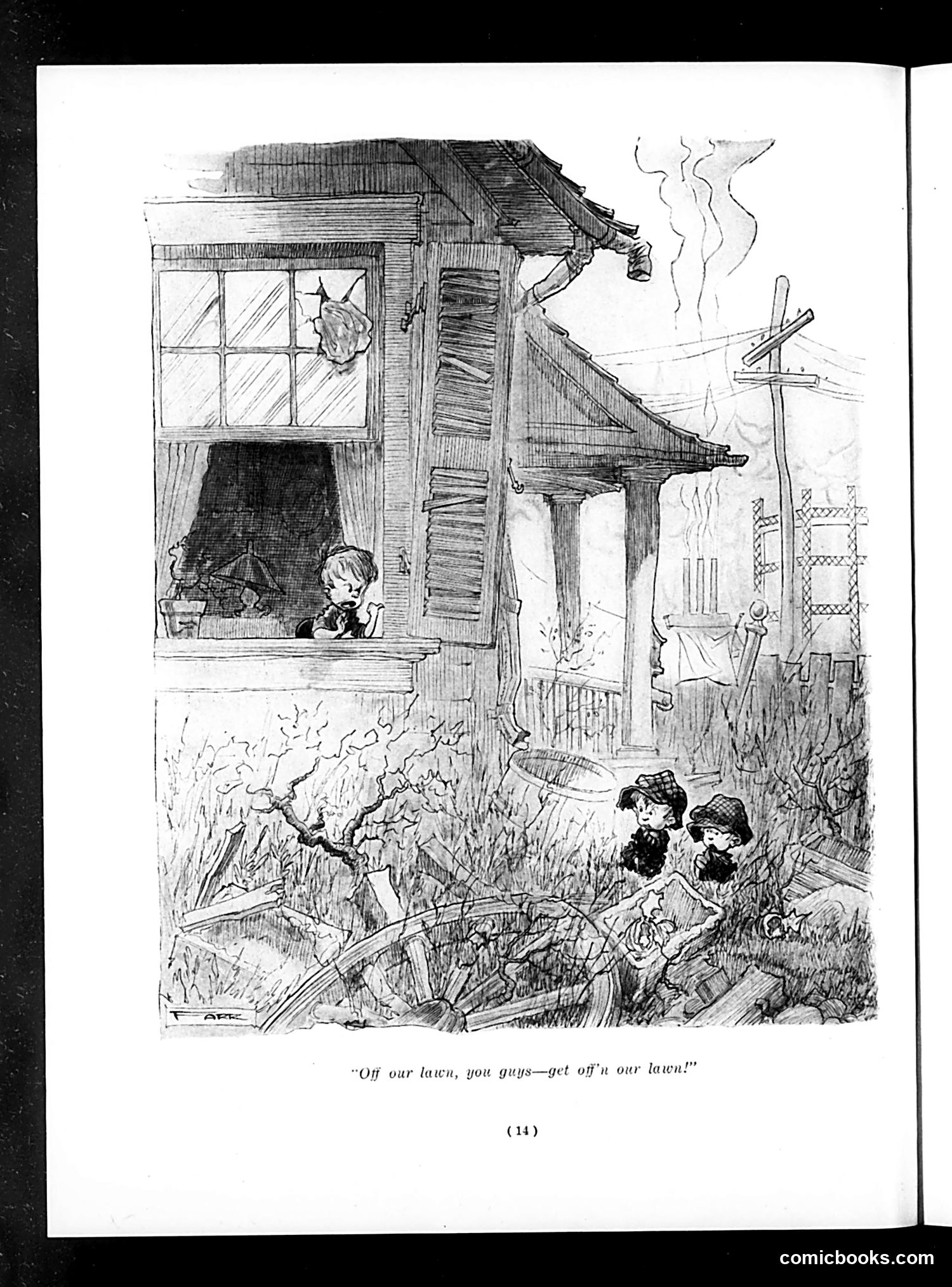
Analysis of Cartoon Page 14 This is a single-panel satirical cartoon depicting a social class conflict. A child peers from an upper-story window of a modest house while two boys in the overgrown yard below shout up: "Off our lawn, you guys—get off'n our lawn!" The humor derives from role reversal: typically, children from poor or working-class backgrounds would be chased away from wealthy homeowners' property. Here, the situation is inverted—these boys are defending their own humble yard against intrusion, asserting their right to their space despite their modest circumstances. The cartoon satirizes class attitudes and property rights, suggesting that ownership and dignity aren't determined by wealth. The overgrown vegetation and dilapidated house emphasize the family's humble status, making their assertion of boundaries both poignant and humorous.
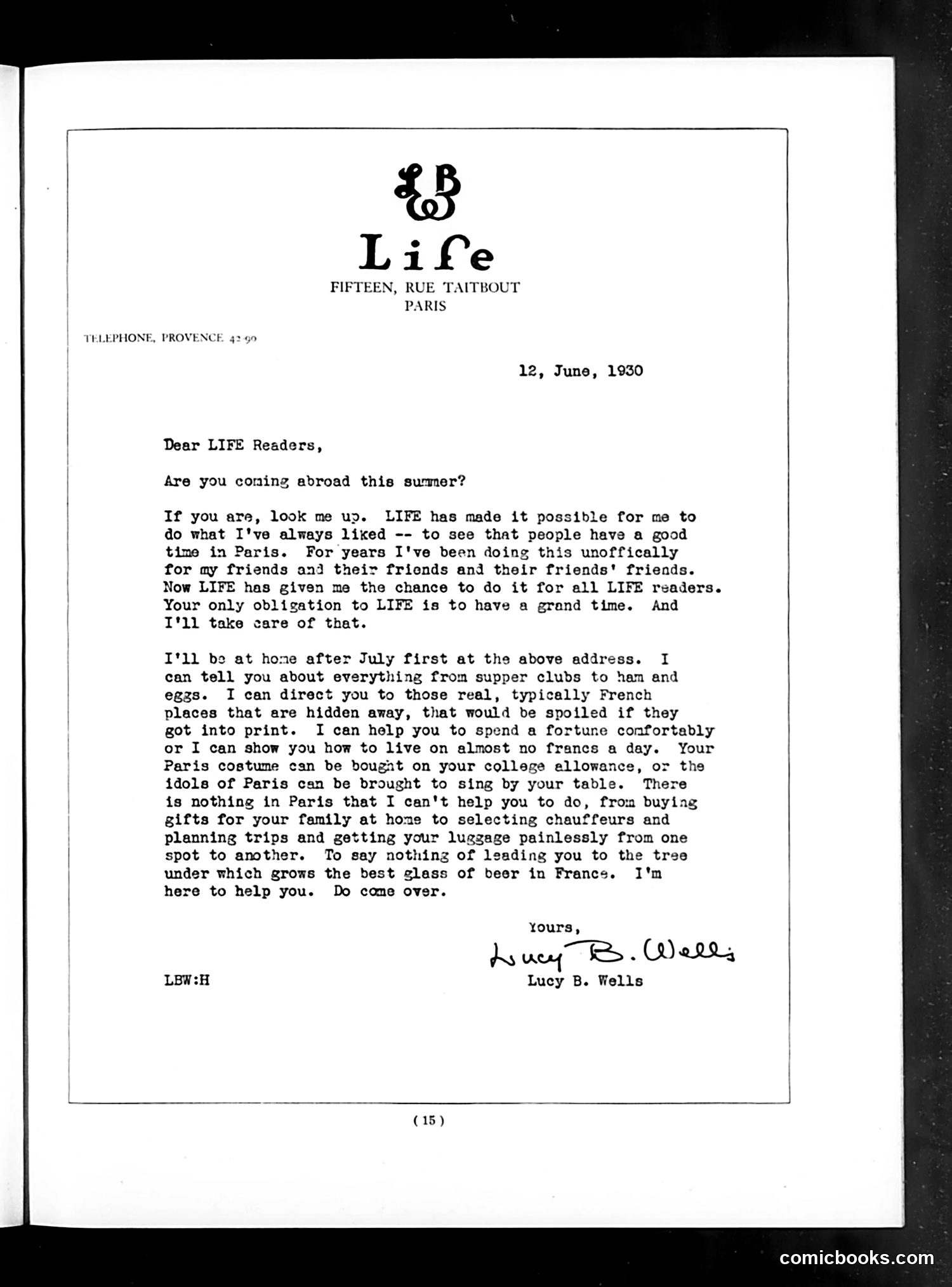
This is not a cartoon or satirical content page—it's a personal letter from Lucy B. Wells, published in *Life* magazine on June 12, 1930. Wells offers to host American readers visiting Paris during summer, promising to guide them to authentic French experiences: hidden restaurants, affordable shopping, and cultural attractions unavailable in print guidebooks. She positions herself as a knowledgeable insider who can help visitors spend money "comfortably" while living cheaply. The letter's publication likely served as both a humorous personal advertisement and gentle satire of the *Life* readership's aspirations to sophisticated European travel during the Depression era. The tone is affectionately patronizing toward wealthy Americans seeking authentic Paris experiences.
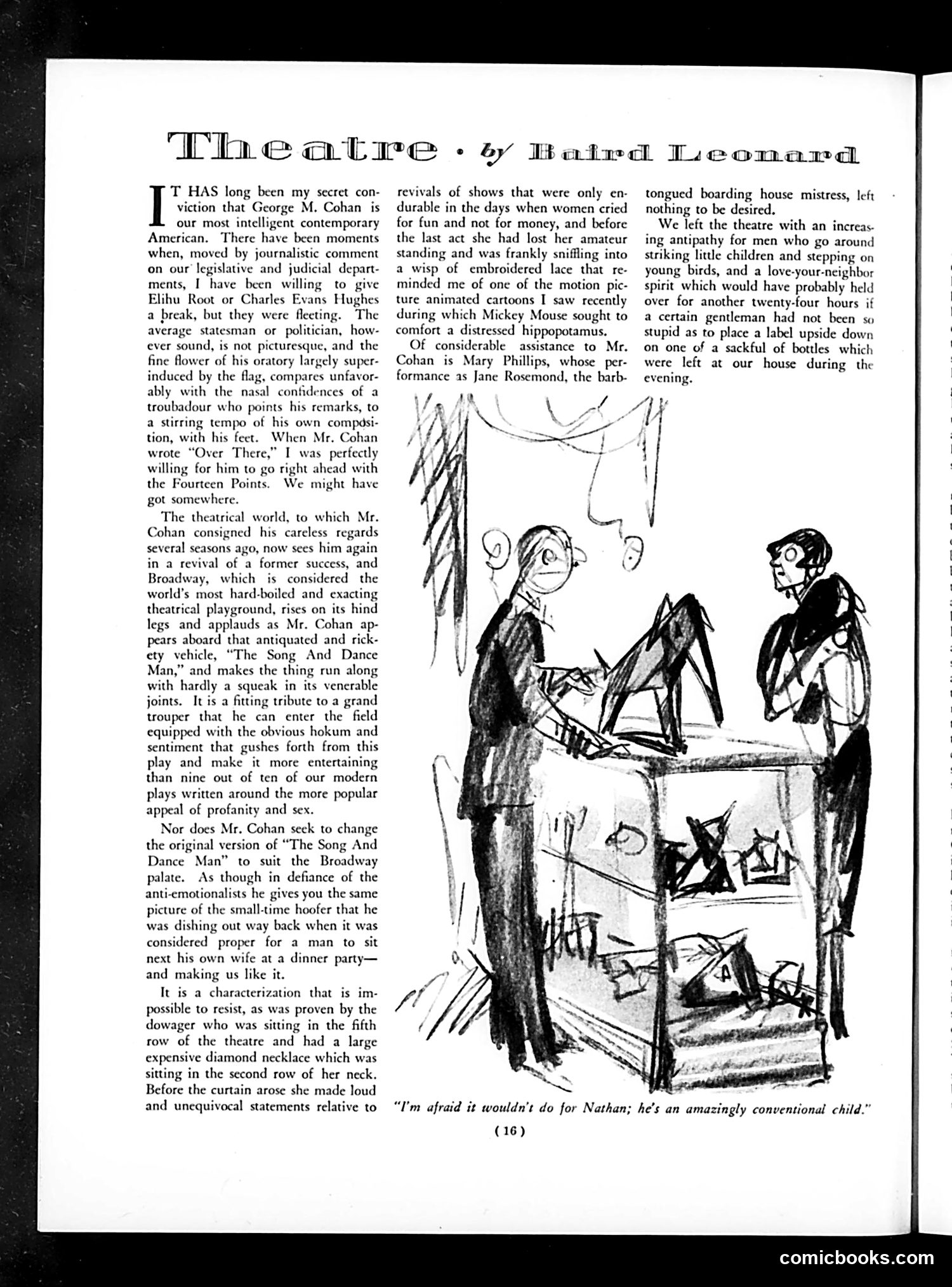
Theatre by Baird Leonard This page reviews George M. Cohan's theatrical work, specifically praising his intelligence as a contemporary American playwright. The review discusses Cohan's revival of "The Song and Dance Man," noting how he modernizes the original version to suit Broadway audiences by incorporating contemporary themes of "profanity and sex." The accompanying sketch depicts three men in formal attire examining what appears to be theatrical set pieces or props in a trunk. The caption reads: "I'm afraid it wouldn't do for Nathan; he's an amazingly conventional child." The joke satirizes theatrical critics (likely referring to drama critic John Corbin or similar figures) as prudishly conventional, contrasting with Cohan's more daring, modernized approach to classic theatrical material.
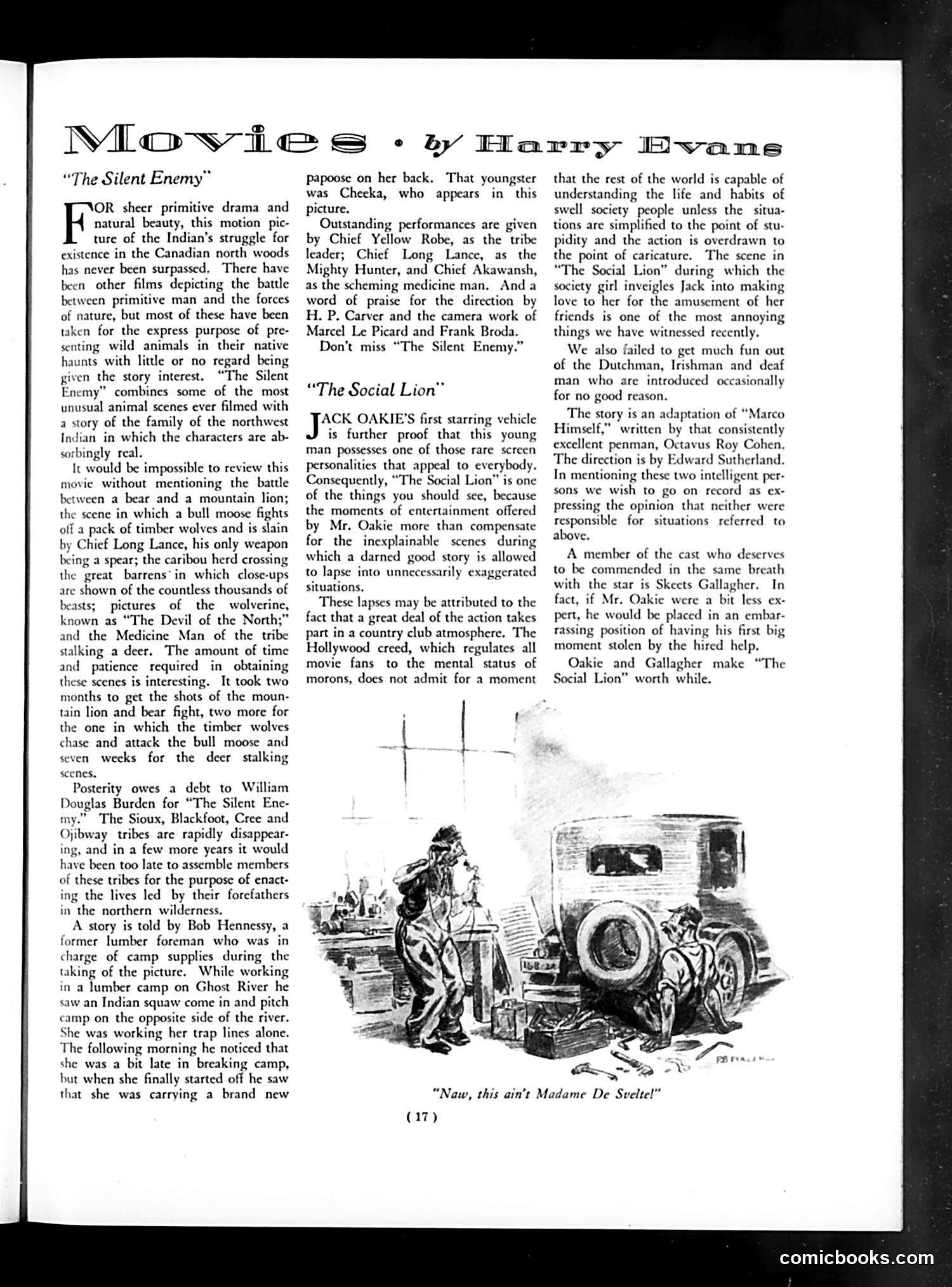
Movie Reviews by Harry Evans This page contains film reviews rather than political cartoons. The main illustration shows a woman in Native American dress standing beside an old automobile, with the caption "Now, this ain't Madame De Seetee!" The reviews discuss three films: 1. "The Silent Enemy" - A drama about Indigenous peoples in the Canadian north, featuring battles with animals and tribal life. The review praises the direction and cinematography. 2. "The Social Lion" - Starring Jack Oakie, described as entertainment with some implausible scenes set in a country club atmosphere. 3. "Marco Himself" - An adaptation directed by Edward Sutherland, with critic praise for the cast. The cartoon's caption appears to be a joke about movie authenticity or cultural misrepresentation, though the specific reference remains unclear without additional context.
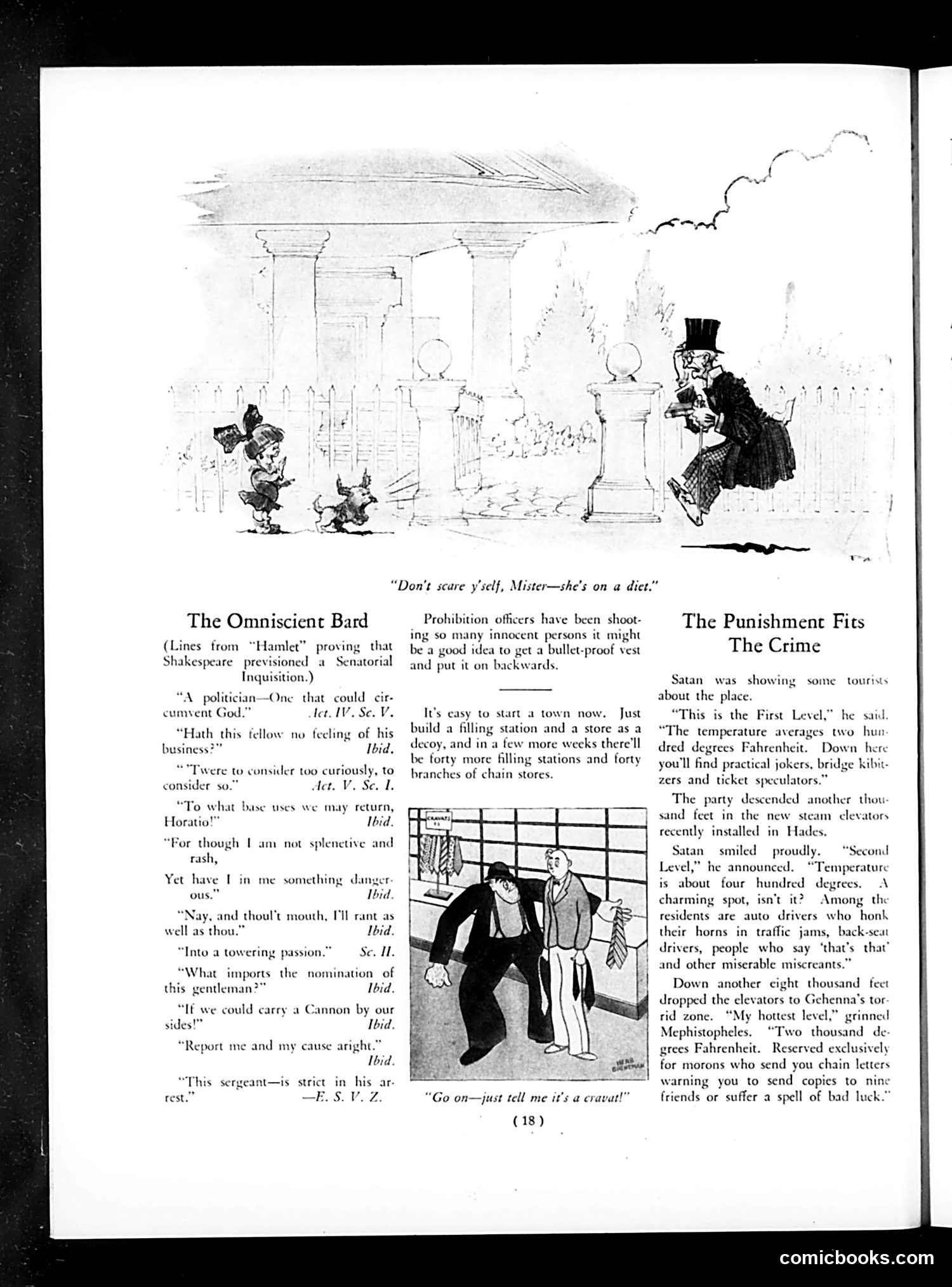
Analysis The top cartoon depicts a gentleman in a top hat encountering two small figures on a street with classical columns in the background. The caption reads: "Don't scare y'ell, Mister—she's on a diet." This appears to be a satirical commentary on Prohibition enforcement. The left column, "The Omniscient Bard," quotes Shakespeare to mock a politician's verbose speech. The right column, "The Punishment Fits The Crime," uses a supernatural framing device where Satan tours Hell's levels, each representing contemporary miseries: crowded filling stations, hot elevators, and chain letters. The overall page satirizes modern American life's absurdities and annoyances during what appears to be the Prohibition era, treating everyday frustrations as worthy of infernal punishment.
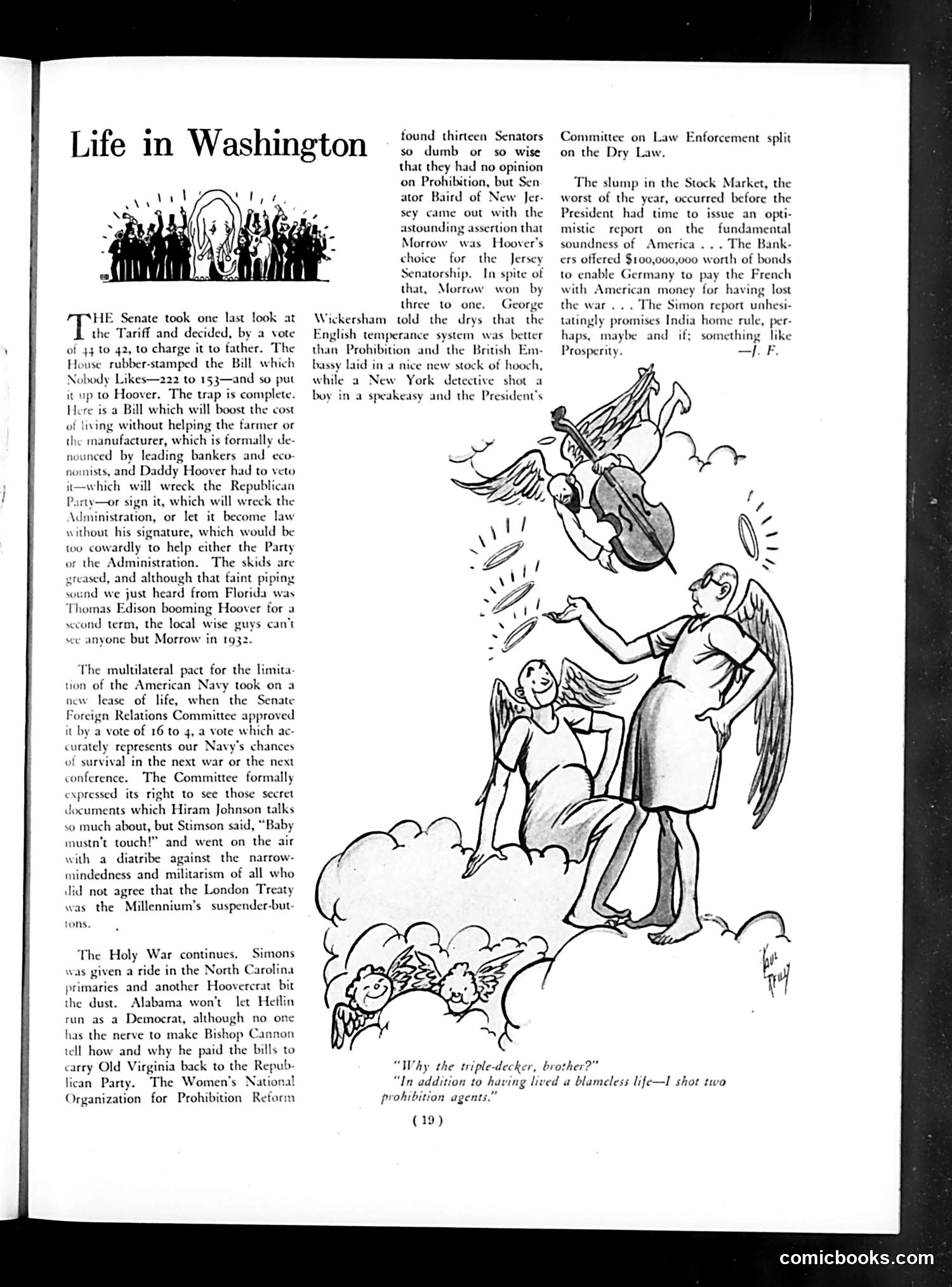
Life Magazine Satire Analysis This 1932 *Life* magazine column satirizes the Hoover administration's political paralysis. The main text attacks a tariff bill that pleased nobody—bankers, economists, and farmers all opposed it—yet President Hoover faced an impossible choice: veto it and anger Republicans, sign it and damage his administration, or let it become law without his signature (cowardice). The author suggests this trap may end Hoover's presidency, with Secretary of State Henry Stimson's dismissal of Senator Hiram Johnson's concerns about secret Navy treaty documents representing broader administration arrogance. The cartoon caption jokes darkly about Prohibition enforcement failures. A man boasts he shot two prohibition agents—a reference to the violent cat-and-mouse game between federal agents and illegal speakeasy operators that characterized the era. The image shows angels/cherubs observing the absurdity, suggesting divine judgment on America's moral chaos. Overall, the page mocks Hoover's political incompetence and Prohibition's destructive legacy.
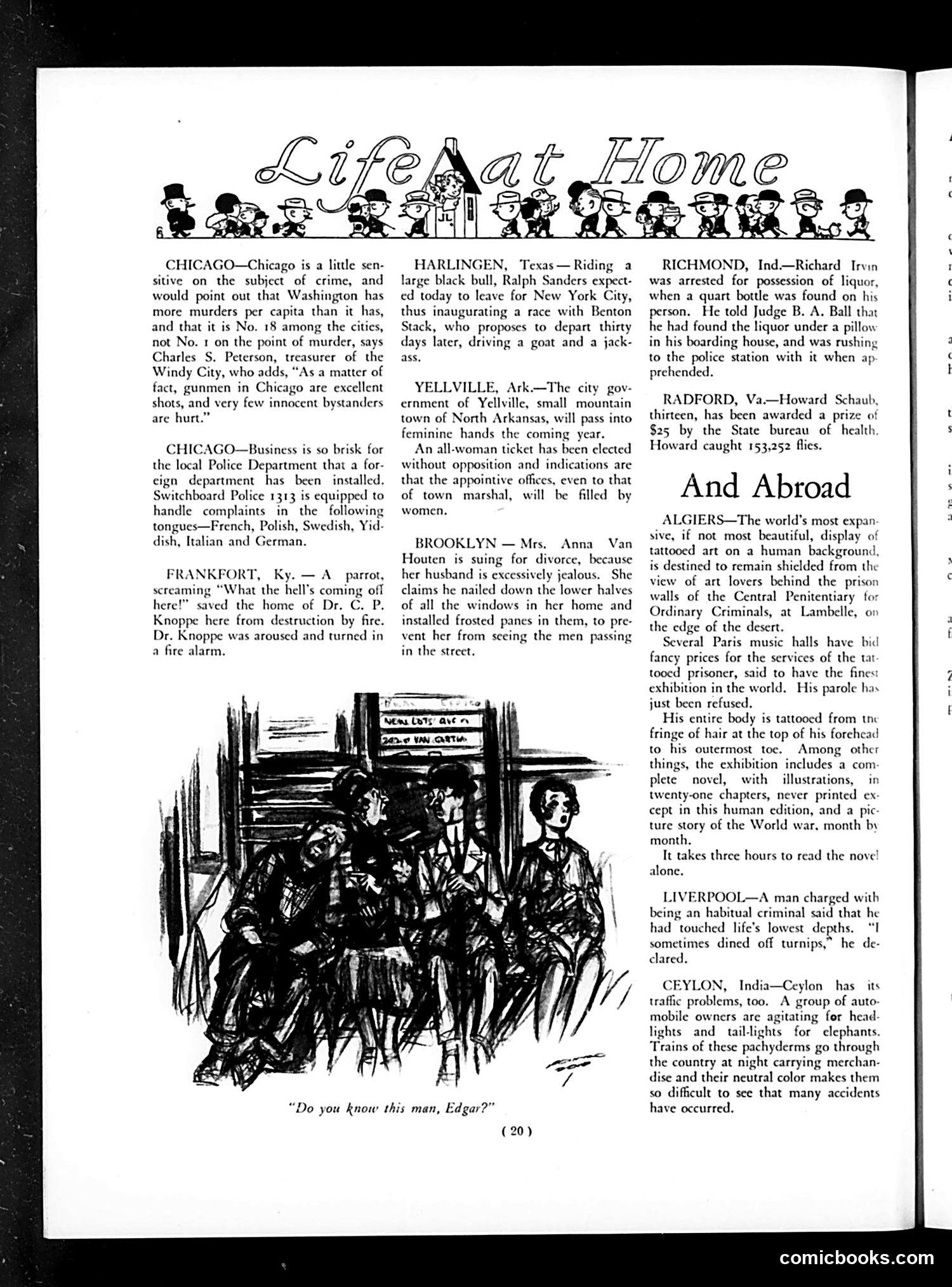
Life Magazine "Life at Home and Abroad" Page Analysis This is a humor column featuring short, quirky news items from across America and abroad. The cartoon shows a police lineup scene with the caption "Do you know this man, Edgar?"—a visual gag about criminal identification. The text items satirize American attitudes and absurdities: Chicago defensively claims its gunmen are "excellent shots" so few innocent bystanders get hurt—dark satire on the city's crime problem. A police department installs a foreign-language switchboard to handle complaints in multiple immigrant languages, reflecting early 20th-century urban diversity. Other items mock human foolishness: a jealous husband who nails windows shut; a man rushing contraband liquor to police (during Prohibition); a teenager catching 153,000 flies for a health prize. The "Abroad" section highlights curiosities: an Algerian prisoner with his entire body tattooed (including a novel in pictures), and Ceylon's traffic problems requiring headlights on elephants carrying cargo at night. The overall tone is lighthearted mockery of contemporary social conditions, crime, immigrant integration, and international oddities.
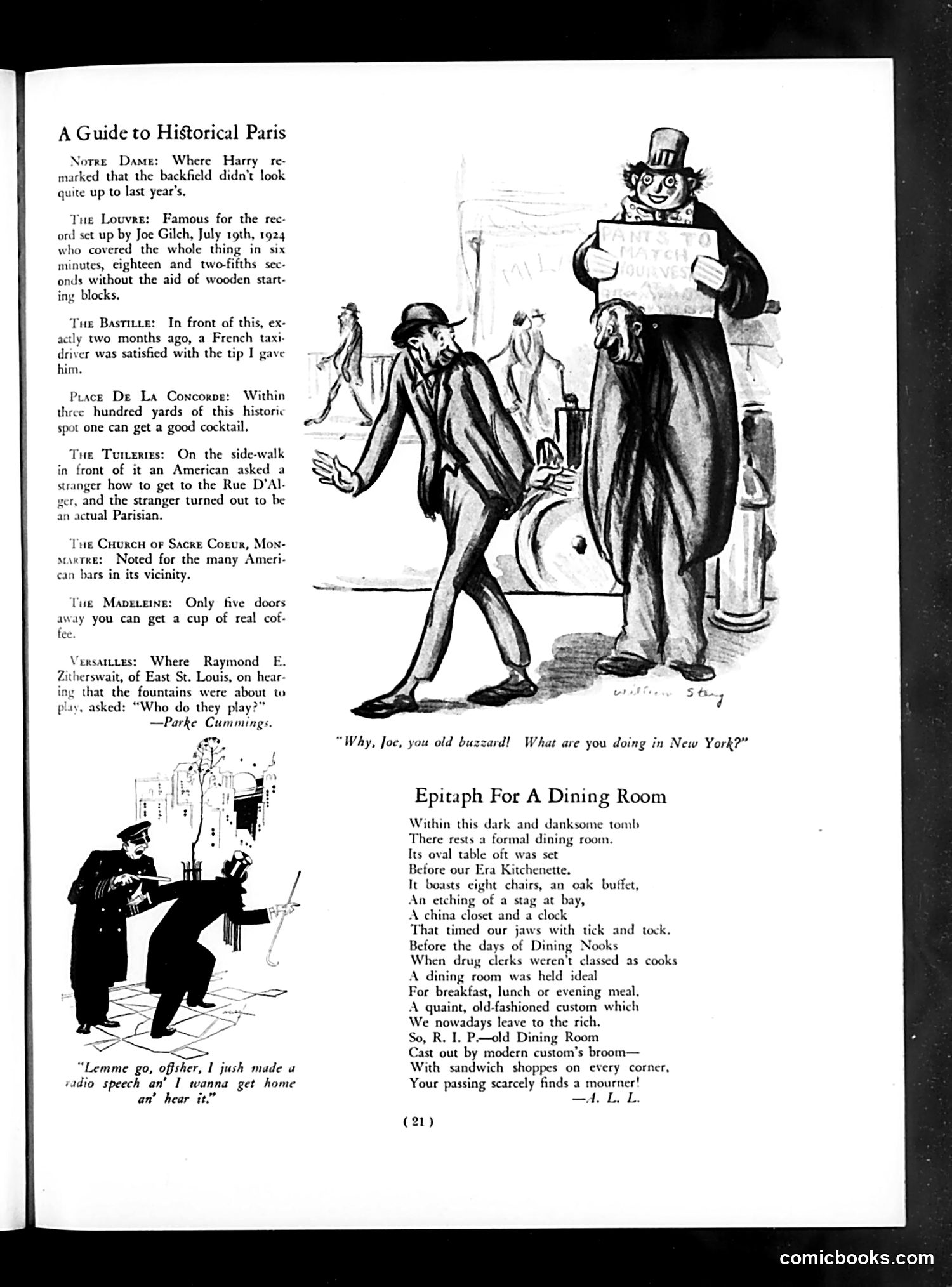
Explanation for Modern Readers This page contains two satirical pieces about 1920s American tourism and social change. "A Guide to Historical Paris" mocks American tourists in Paris. The entries joke that visitors are culturally uninterested (rushing through the Louvre in seconds, asking about sports at Notre-Dame) and primarily seeking alcohol and American comforts (cocktails, American bars near churches). The final anecdote about Raymond Zitherwait asking "Who do they play?" regarding fountains suggests Americans' obsession with sports over culture. The cartoon above shows a tall figure (appearing to be Uncle Sam or similar American character) confronting what looks like a Parisian, with the caption "Why, Joe, you old buzzard! What are you doing in New York?"—reversing the expected scenario to mock American cultural dominance. "Epitaph For A Dining Room" satirizes modernization. It mourns the disappearance of formal dining rooms as replaced by quick "sandwich shoppes," lamenting that only the wealthy now maintain this old-fashioned custom. This reflects 1920s anxiety about rapid social and commercial change undermining traditional domestic life.
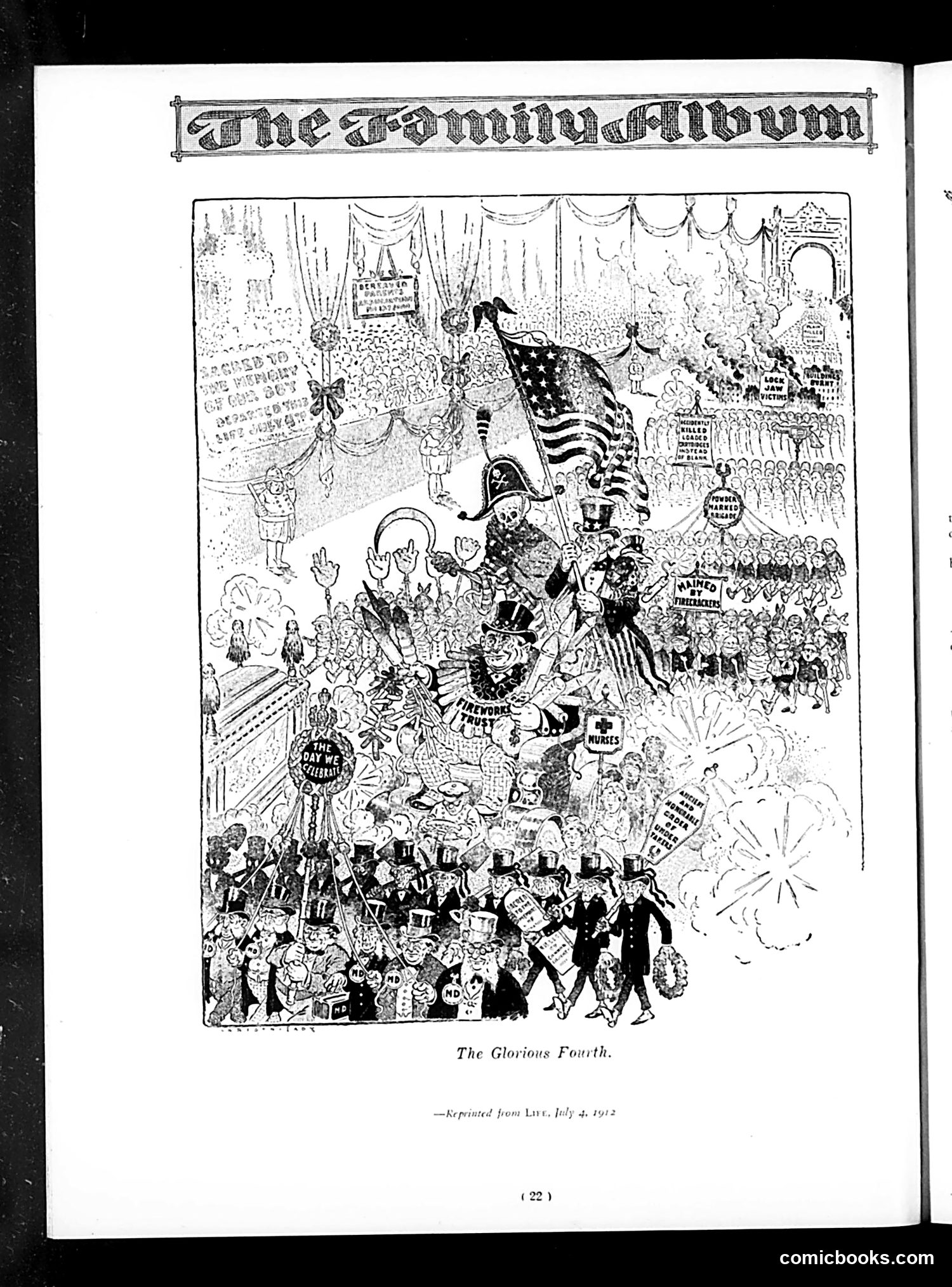
"The Glorious Fourth" (Life Magazine, July 4, 1912) This satirical cartoon depicts an elaborate Fourth of July celebration crowded with figures in top hats, military uniforms, and formal dress. The scene appears to mock American patriotic pageantry and political spectacle—the ornate decorations, masses of dignitaries, and dramatic staging suggest excessive formality around Independence Day festivities. The cartoon likely critiques the gap between idealistic patriotic rhetoric and actual political/social practice. Without clearer identification of specific caricatured figures, the exact targets remain unclear, but the dense composition of formally-dressed authority figures suggests satire of establishment elites celebrating national values they may not genuinely uphold. The "Glorious Fourth" title appears ironic given the crowded, theatrical nature of the depiction.
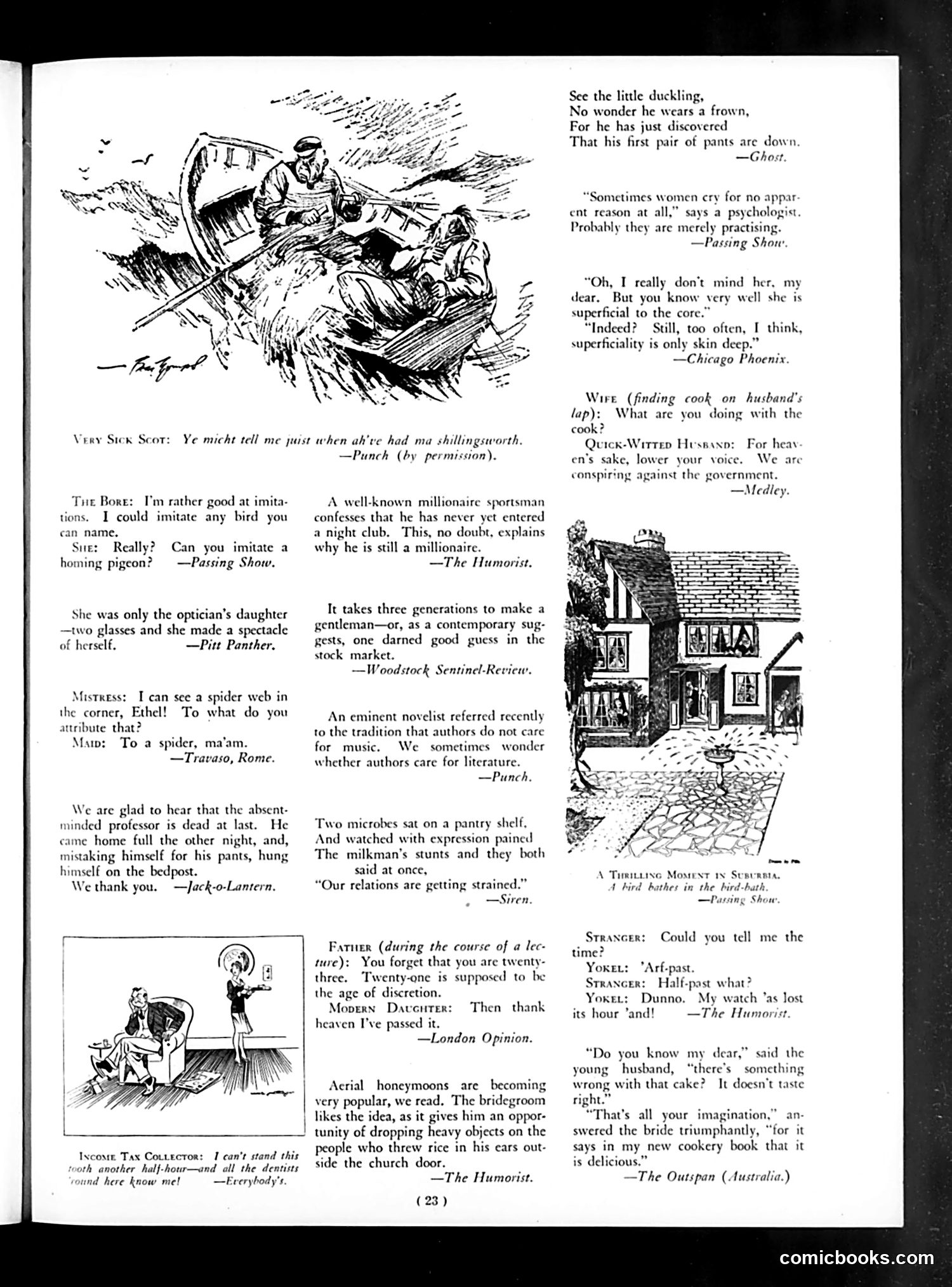
Life Magazine Humor Page Analysis This page collects short jokes and cartoons from various British and American humor publications (Punch, The Humorist, Passing Show, etc.), typical of Life's format in the early 20th century. The cartoons mock social pretensions and gender dynamics of the era. One sketch shows an Income Tax Collector desperately avoiding dentists—satirizing tax collection as an unpopular duty. Another depicts a husband caught sitting with the cook by his wife; his whispered excuse about "conspiring against the government" is absurdist humor about marital deception. The written jokes target recognizable types: the bore who imitates birds poorly, the absent-minded professor, the superficial society woman, and the new bride who blindly follows her cookbook despite producing inedible food. A recurring theme is class—the millionaire who avoids night clubs, the "gentleman" made by stock-market luck rather than generations of breeding. The humor assumes readers' familiarity with these stock characters and social anxieties of the period: taxation, domesticity, social climbing, and gender relations.
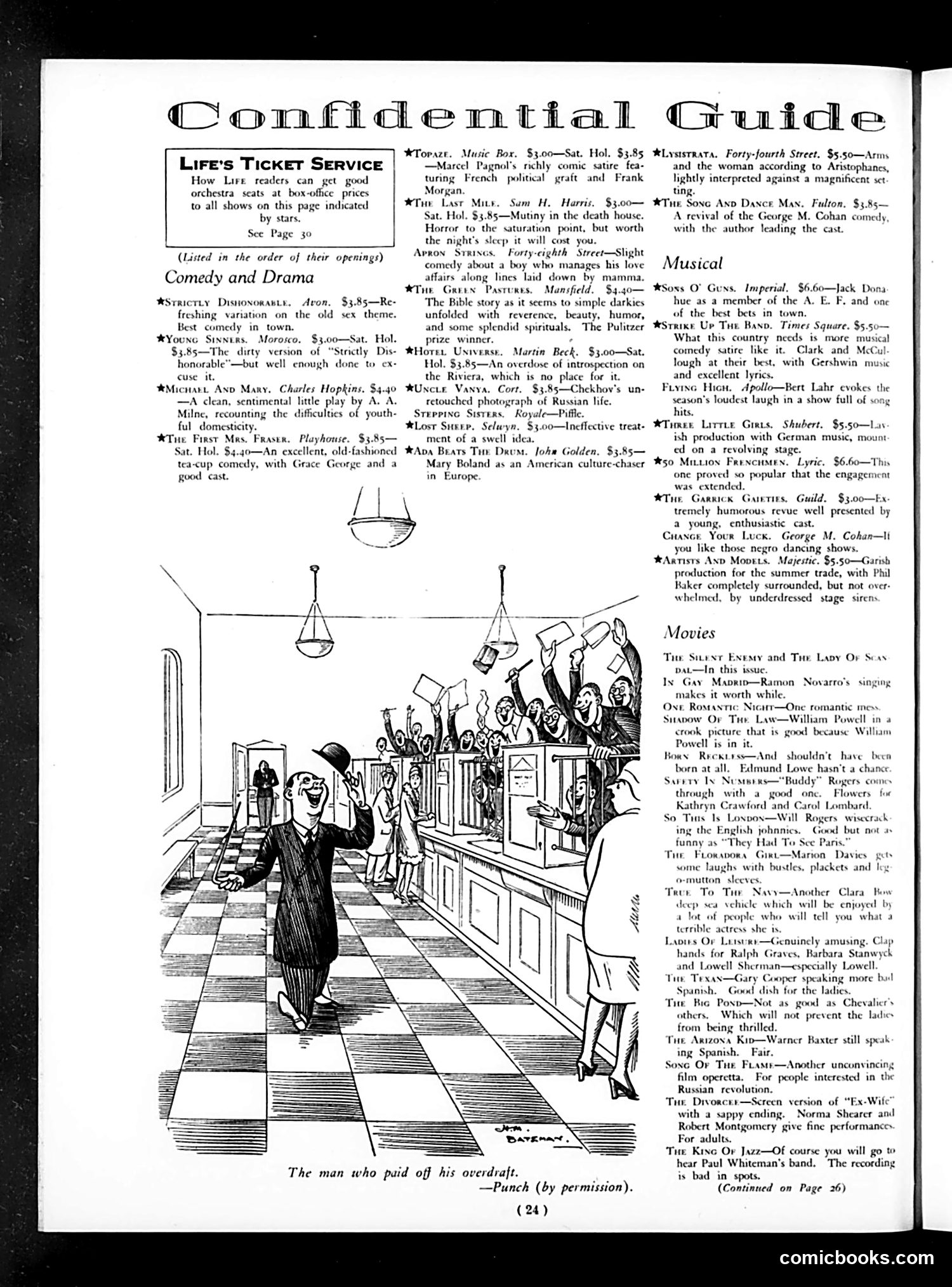
What This Page Means This is a "Confidential Guide" — Life magazine's entertainment listings and reviews for theater, musicals, and film. The large illustration shows a crowded theater lobby with an elegant couple in formal dress; the caption "The man who paid off his overdraft" (credited to Punch, another satirical magazine) is a visual joke about the expense of attending these shows. The page lists Broadway productions with prices and brief critical descriptions. The asterisks mark shows where Life readers could get discounted box-office seats. Notable entries include "Green Pastures" (called a Pulitzer Prize winner), various comedies and dramas, and musicals like "Strike Up the Band" with Gershwin music. The movie section reviews current films featuring stars like Ramon Novarro and William Powell — typical 1920s entertainment coverage. The overall tone is gossipy and entertaining, reflecting Life's role as a guide to urban sophistication and leisure for its readers.
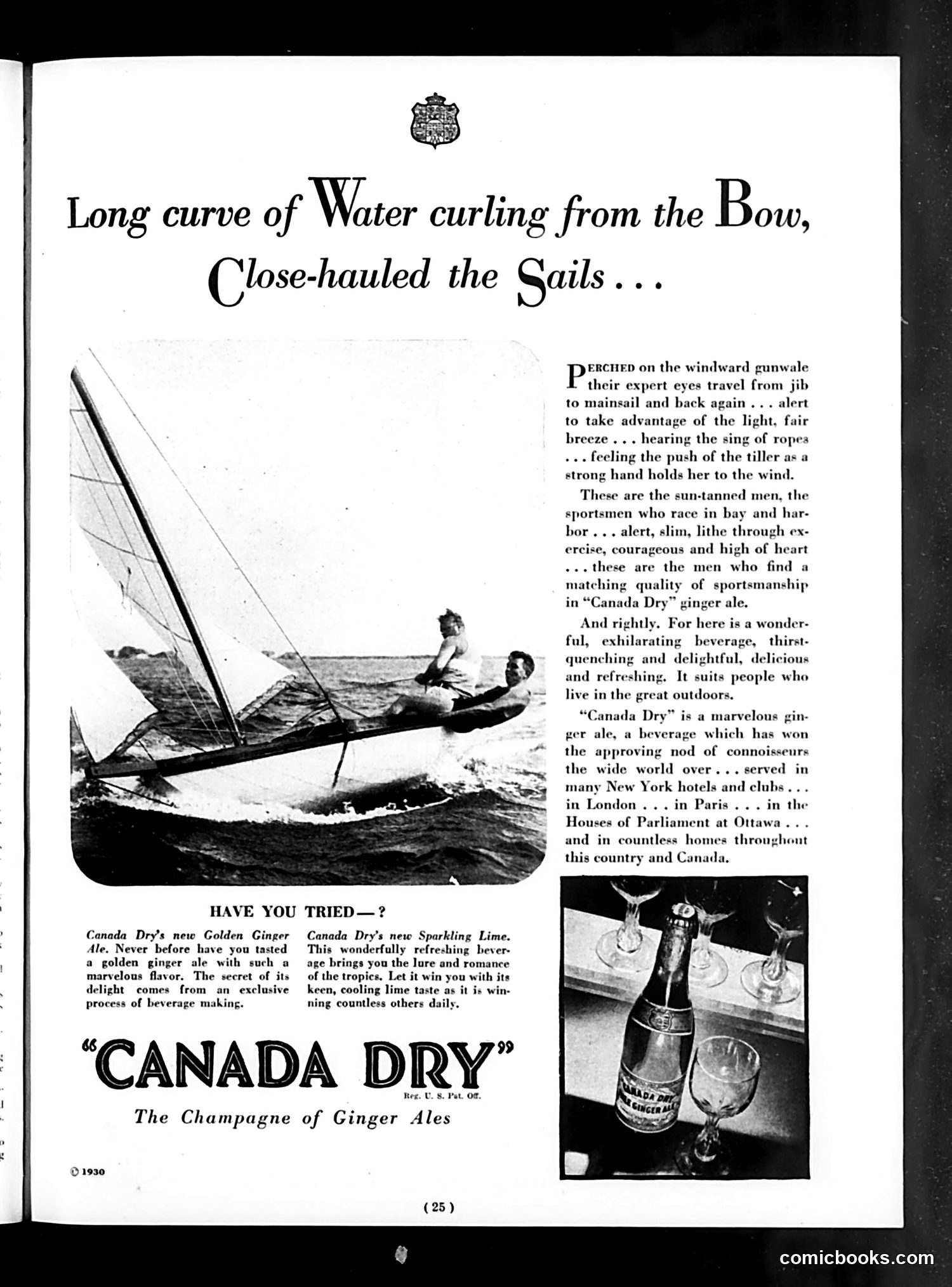
Analysis: Canada Dry Advertisement (1930) This is primarily a beverage advertisement, not political satire. The page promotes Canada Dry ginger ale by associating it with outdoor sportsmen and leisure. The central image shows sailors racing a small boat, used to evoke an aspirational lifestyle of athletic vigor and refined taste. The accompanying text romanticizes these "sun-tanned men" as exemplars of sportsmanship and outdoor living. The advertisement's strategy links Canada Dry to prestige and broad appeal—claiming the product is "served in many New York hotels and clubs... in London... in Paris... in the Houses of Parliament at Ottawa." This appeals to both cosmopolitan sophistication and Canadian pride. Two product variants are highlighted: Golden Ginger Ale and Sparkling Lime, each pitched with lifestyle messaging (adventure, tropical allure). Dating to 1930, this reflects pre-Prohibition repeal marketing that emphasizes ginger ale as a respectable, sophisticated beverage—an indirect acknowledgment that ginger ale's primary market included those seeking legal alcohol alternatives during Prohibition.
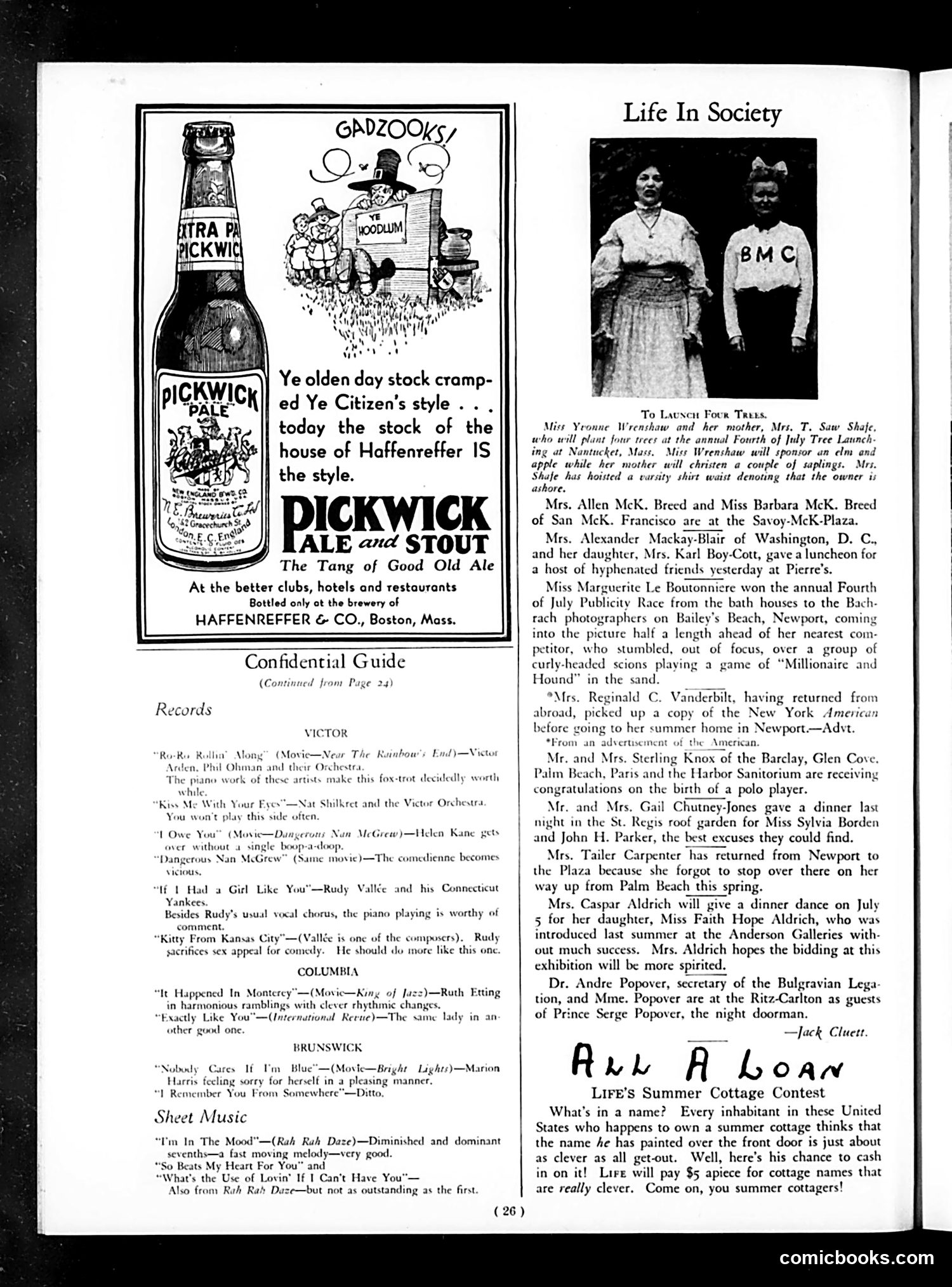
Political Cartoon & Social Commentary Analysis This page contains a beer advertisement (Pickwick Pale and Stout by Haffenreffer & Co., Boston) paired with satirical social commentary. The ad's cartoon mocks class pretension: it contrasts "ye olden day stock cramped Ye Citizen's style" with modern times, where Haffenreffer beer is now "the style" of the wealthy—suggesting the beer has become fashionably aspirational among the upper classes. The "Life in Society" section below is pure satire of high society gossip. It mocks wealthy New Yorkers through absurd names (Mrs. Karl "Boy-Cott," Miss "Le Boutonnicre") and ridiculous activities (planting trees at publicized events, a "Publicity Race" for photographs, naming a child "Faith Hope Aldrich"). The tone is mockingly breathless about trivial social events, exposing the vanity and emptiness of wealthy socialite culture during the Jazz Age.
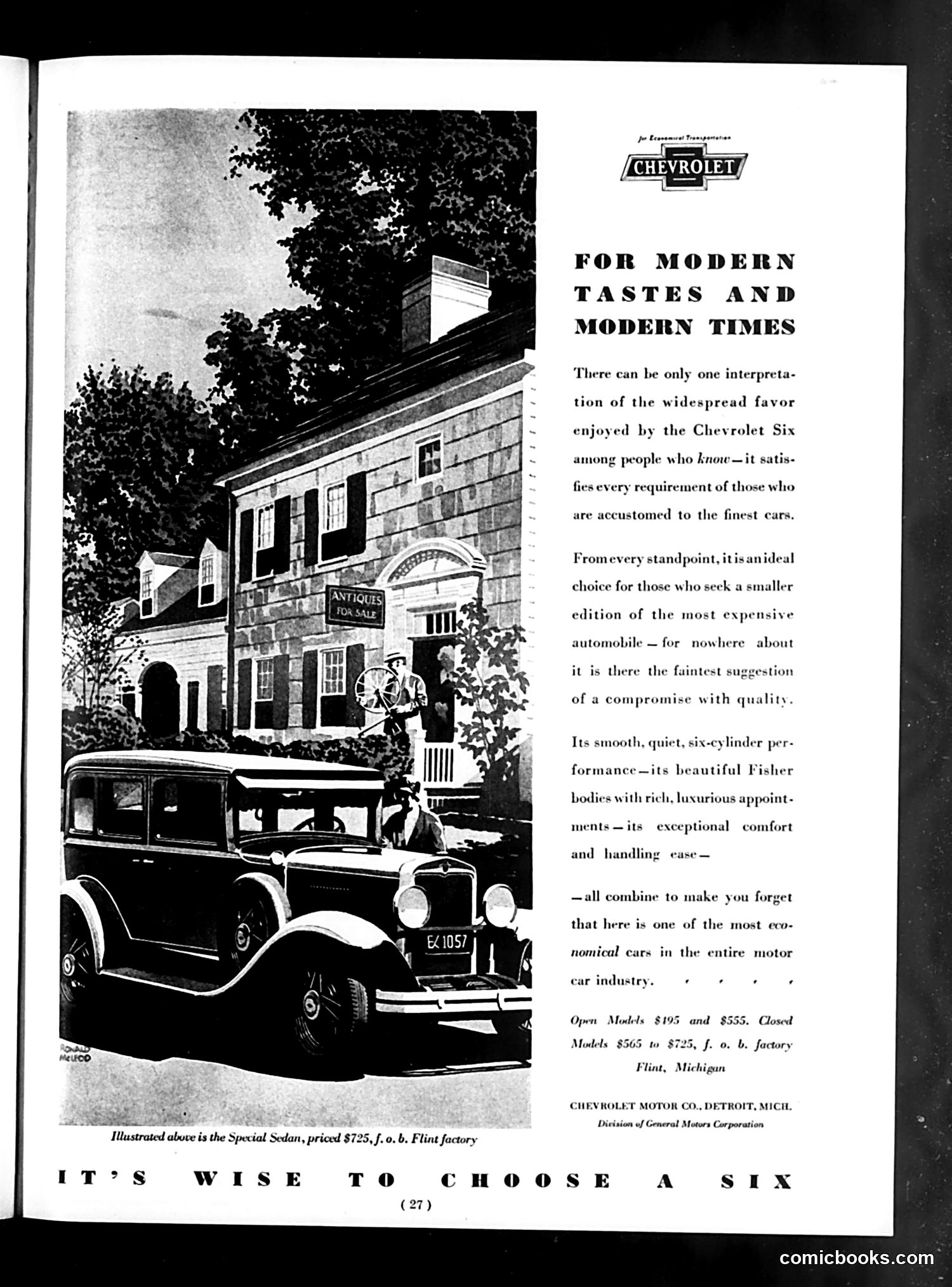
Advertisement Analysis This is a Chevrolet automobile advertisement, not a political cartoon. It targets affluent consumers by positioning the Chevrolet Six as a luxury vehicle that doesn't compromise on quality despite being economical. The ad's key strategy is reassuring wealthy buyers—those "accustomed to the finest cars"—that they won't sacrifice prestige by choosing this smaller, less expensive car. It emphasizes the Fisher body (a premium feature), smooth six-cylinder performance, and comfort to justify the price point ($195–$725, substantial sums in this era). The accompanying illustration shows a well-appointed Chevrolet parked before a Colonial-era home with an antique shop, implying that the car suits refined, cultured owners. The rhetoric throughout insists there is "no suggestion of a compromise with quality"—directly addressing the social anxiety that buying an economical car might indicate declining status. This reflects 1920s consumer culture where automobile choice was deeply tied to social identity.
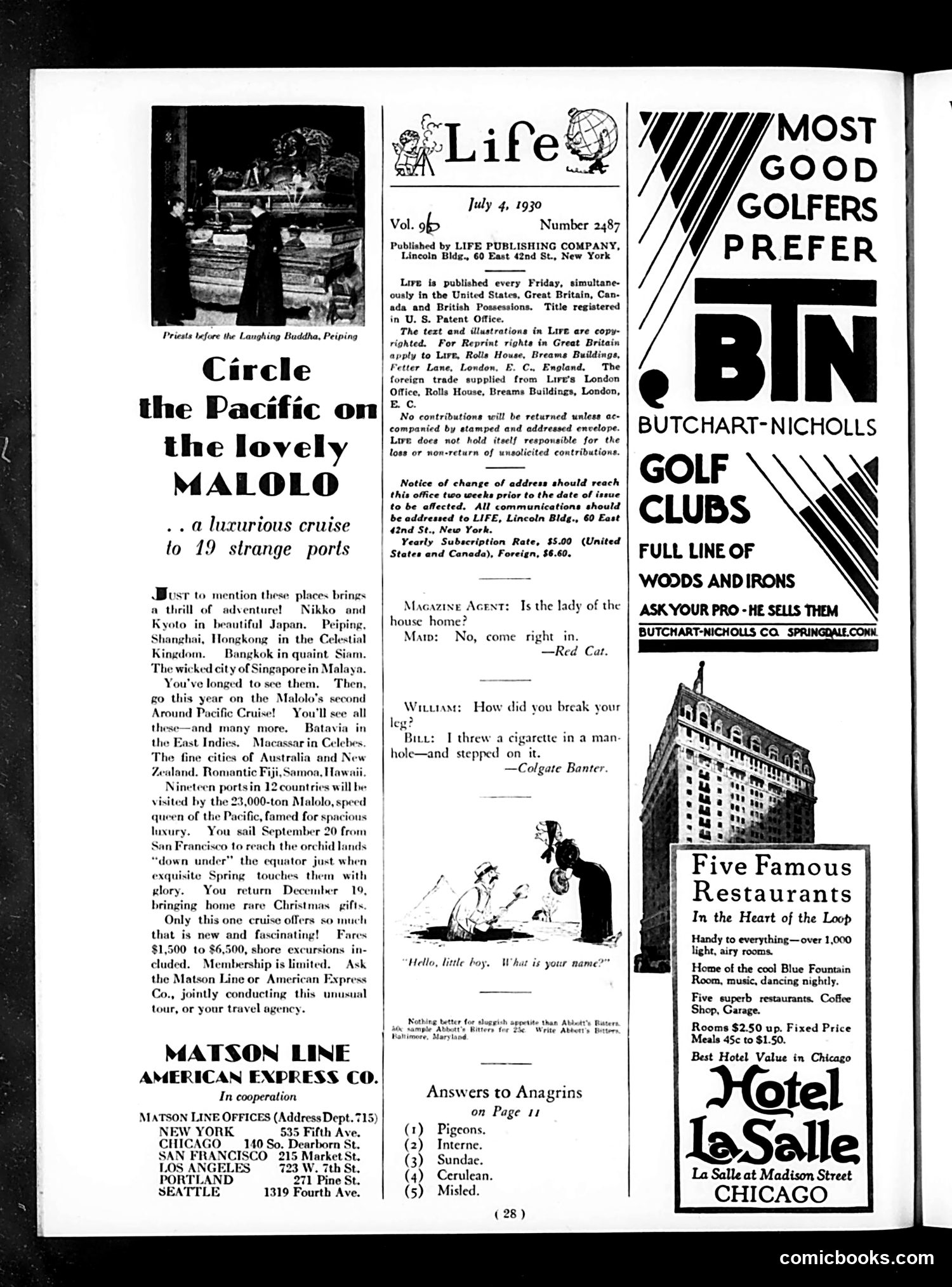
Life Magazine, July 4, 1930 - Page Analysis This page is primarily advertising and editorial content rather than satirical commentary. The main elements are: Left side: A cruise advertisement for the S.S. Malolo, promoting luxury Pacific travel to 19 ports including Japan, Singapore, Fiji, and Australia. The Matson Line and American Express Co. jointly offered this voyage departing September 20. Center: Three brief comic jokes (typical of Life's humor section): - A maid joke about a lady not being home - A physical comedy bit about stepping on a cigarette in a manhole Right side: Advertisements for Butchart-Nicholls golf clubs and Hotel La Salle in Chicago. Bottom: An "Answers to Anagrins" section (word puzzles). The page reflects 1930 leisure culture—luxury cruising and golf being pursuits of the affluent during the early Great Depression. No political satire is evident.
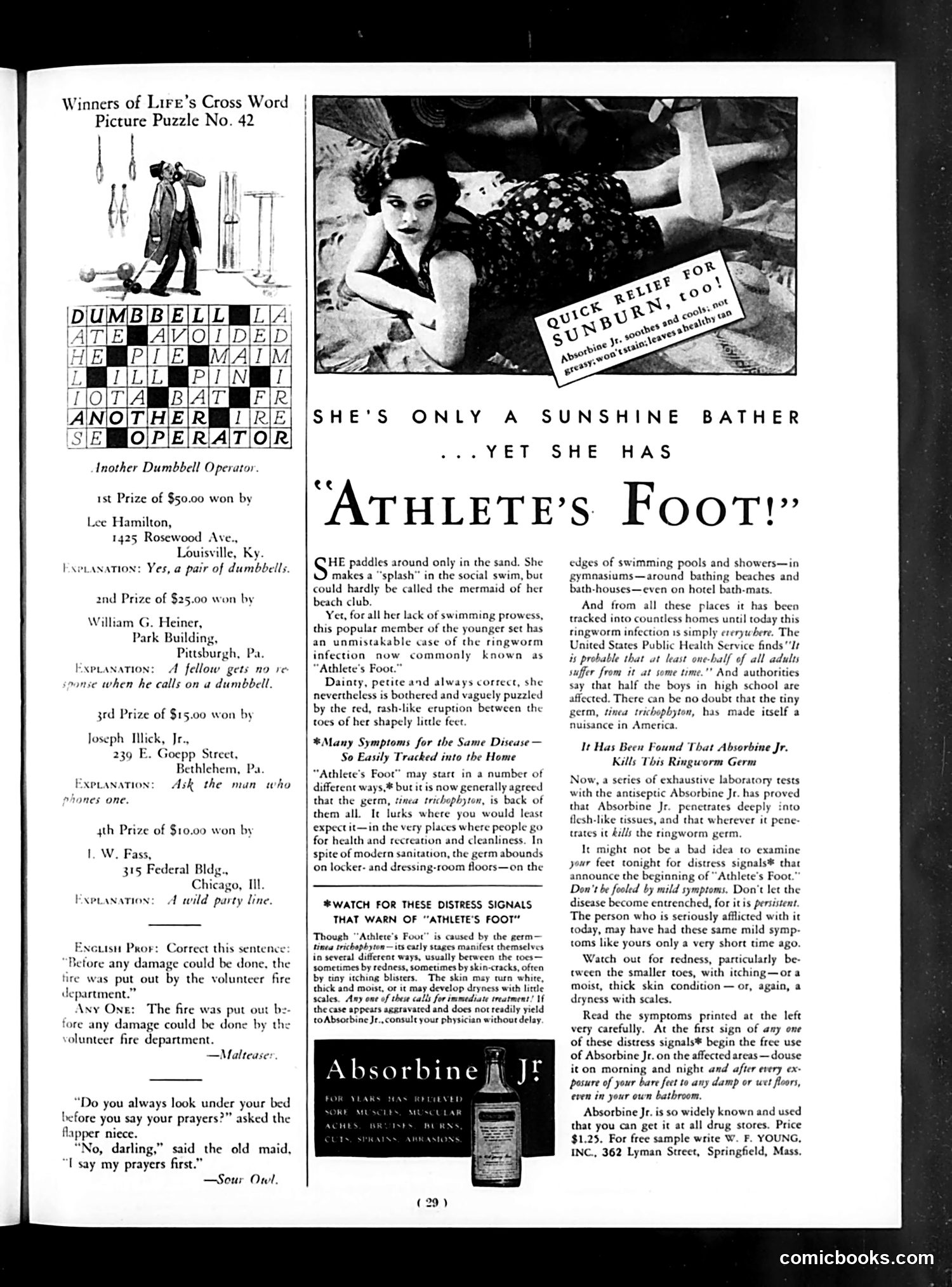
Page Analysis: Life Magazine Advertisement This page is primarily a commercial advertisement for Absorbine Jr., a patent medicine claiming to cure "Athlete's Foot" (a fungal infection). The upper left shows crossword puzzle winners—standard magazine content from this era. The main image depicts a young woman in a bathing suit, establishing the product's target market: active, fashionable people who frequent public bathing areas. The advertisement's core message exploits public health anxiety: it claims the ringworm infection is widespread in America (citing the U.S. Public Health Service), describing it as present in locker rooms, showers, and even hotel bathrooms. This scaremongering technique was common in early 20th-century patent medicine marketing. The text emphasizes that despite the woman's social respectability and cleanliness, she's contracted the condition—normalizing the problem and justifying the need for treatment. The product is positioned as a scientific solution with "laboratory tests" proving its efficacy. This represents typical interwar commercial exploitation of health fears to drive sales.
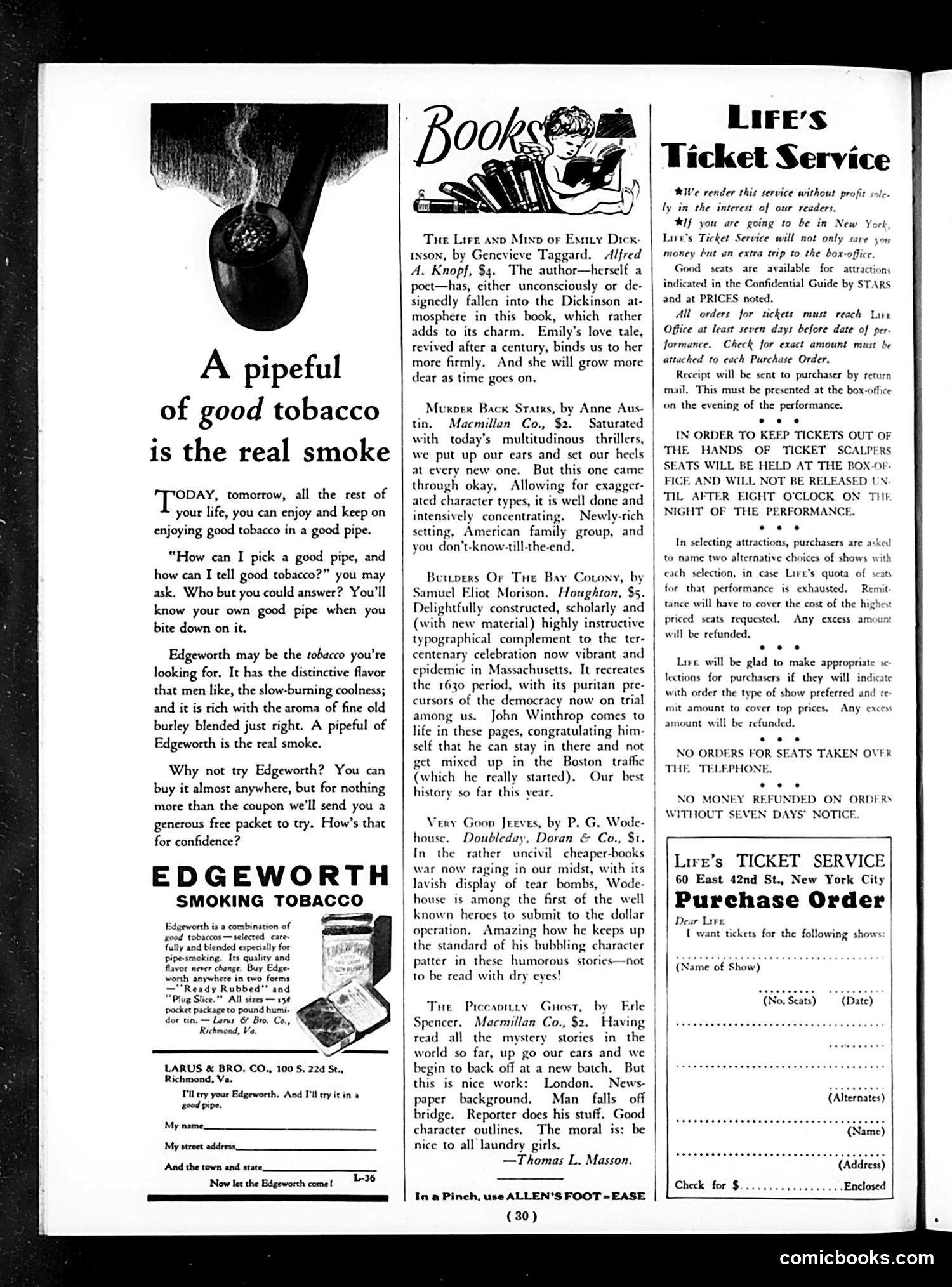
Explanation for Modern Readers This page is primarily advertising and service announcements, not political satire. The main content consists of: 1. Edgeworth Tobacco Advertisement (left): A straightforward pitch for pipe tobacco, emphasizing quality and flavor. The accompanying image shows a pipe bowl, which is purely illustrative advertising—not a political cartoon. 2. Book Reviews (center): Brief reviews of contemporary literature, including works about Emily Dickinson and Massachusetts history—standard magazine content from this era. 3. Life's Ticket Service (right): A practical service announcement explaining how readers can order theater tickets through Life magazine, with a purchase order form. There is no political cartoon or satire on this page. It represents typical 1930s magazine content mixing consumer advertising, cultural criticism, and reader services. The tobacco ad's messaging about personal choice and quality is commercial rhetoric, not commentary on social issues.
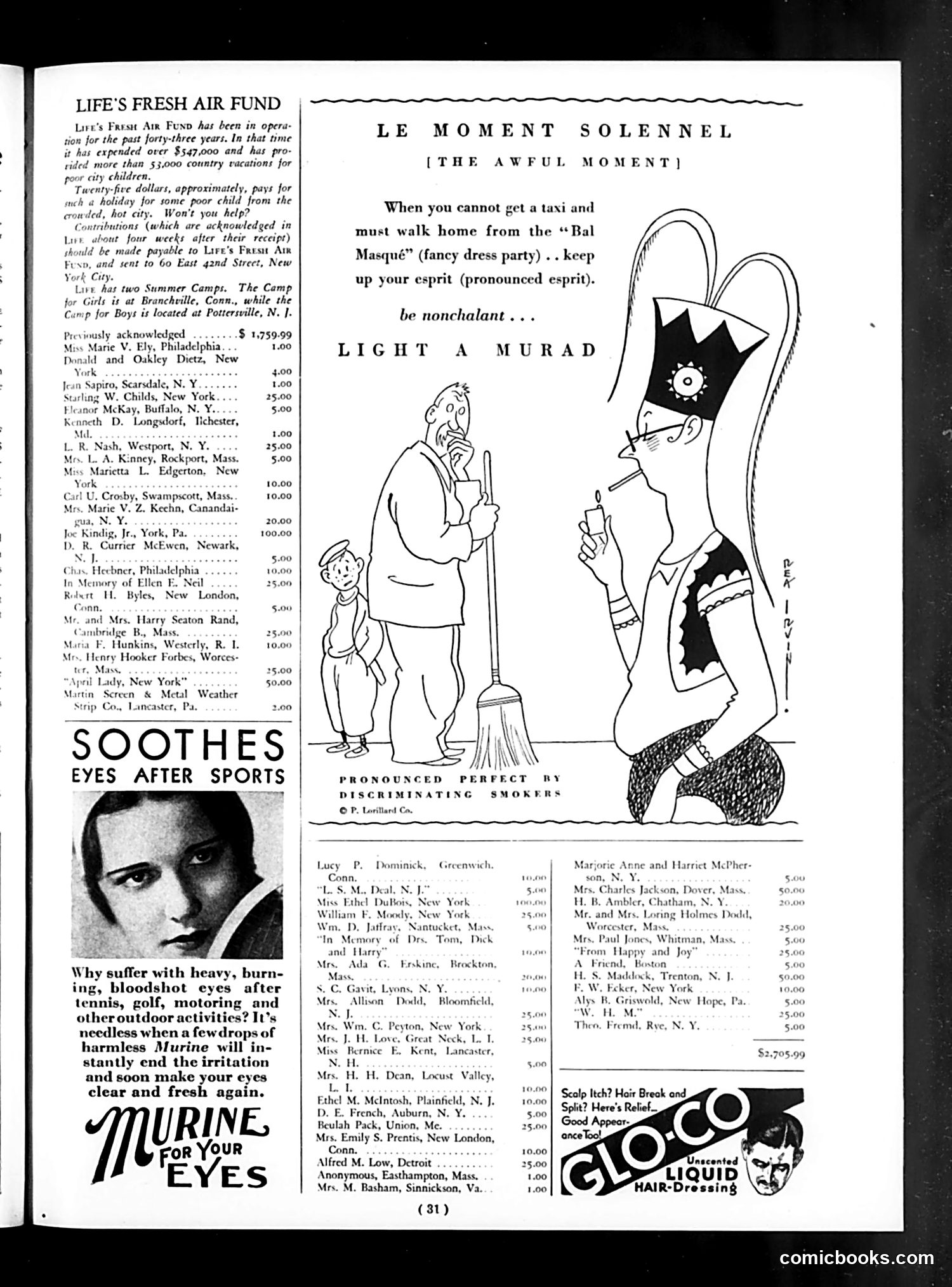
"Le Moment Solennel" [The Awful Moment] This cartoon satirizes post-party etiquette among the wealthy. It depicts a well-dressed couple returning home on foot after a formal "Bal Masqué" (fancy dress ball) — unable to secure a taxi. The humor lies in their predicament: they must walk through the streets in elaborate evening wear, potentially ruining their appearance and dignity. The accompanying text advises maintaining composure ("be nonchalant") and "esprit" (good spirits) during this embarrassing situation. The satire targets the vanity and social anxiety of the upper class, who view such practical indignities as genuinely tragic. The cartoon mocks their concern with appearances and the performative nature of sophistication — they must pretend the walk home is no inconvenience, maintaining their social facade despite obvious discomfort. This reflects 1920s-era Life magazine's typical satirical focus on wealthy urban society's pretensions.
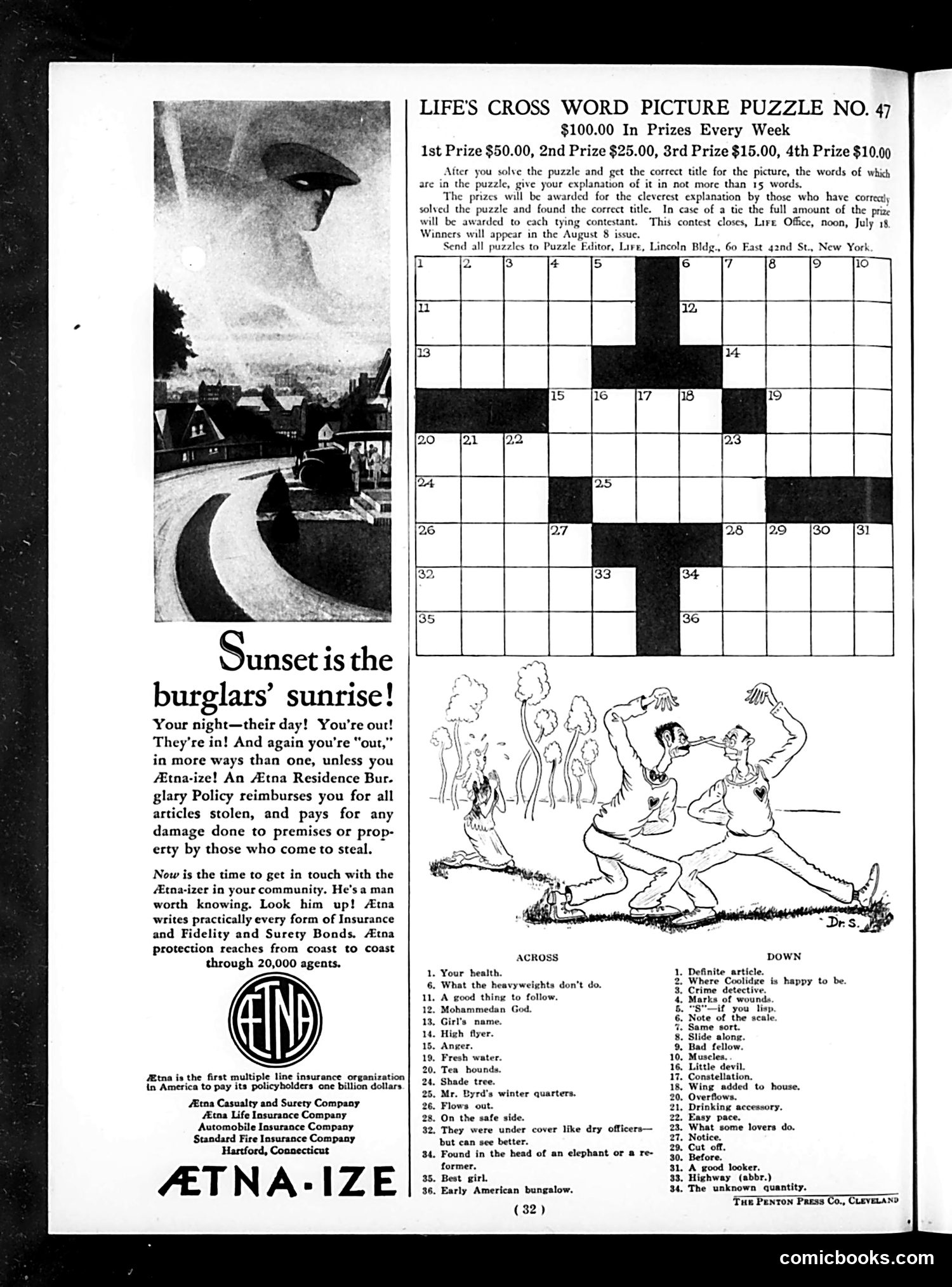
Life Magazine Crossword Puzzle Page Analysis This page contains two distinct elements: advertising and a puzzle contest. The Aetna insurance advertisement (top half) uses dark humor to sell burglary insurance. The accompanying illustration shows a nighttime town scene with a crescent moon—establishing "sunset" as "burglars' sunrise." The copy plays on the double meaning of being "out": you're out of your home while burglars are inside, leaving you "out" of your valuables and peace of mind. The advertisement emphasizes that Aetna reimburses stolen property and damage, positioning insurance as essential protection. The crossword puzzle (right side) is a reader contest offering $100 in weekly prizes. Solvers must identify the picture's title and explain it in 15 words maximum. The clues reference contemporary 1920s figures and concepts: "Mr. Byrd's winter quarters" (Admiral Byrd's Arctic explorations), "Where Coolidge is happy to be" (President Calvin Coolidge), and cultural references throughout. The cartoon at bottom right shows people celebrating outdoors, likely illustrating leisure or social activity—typical period line-art humor.
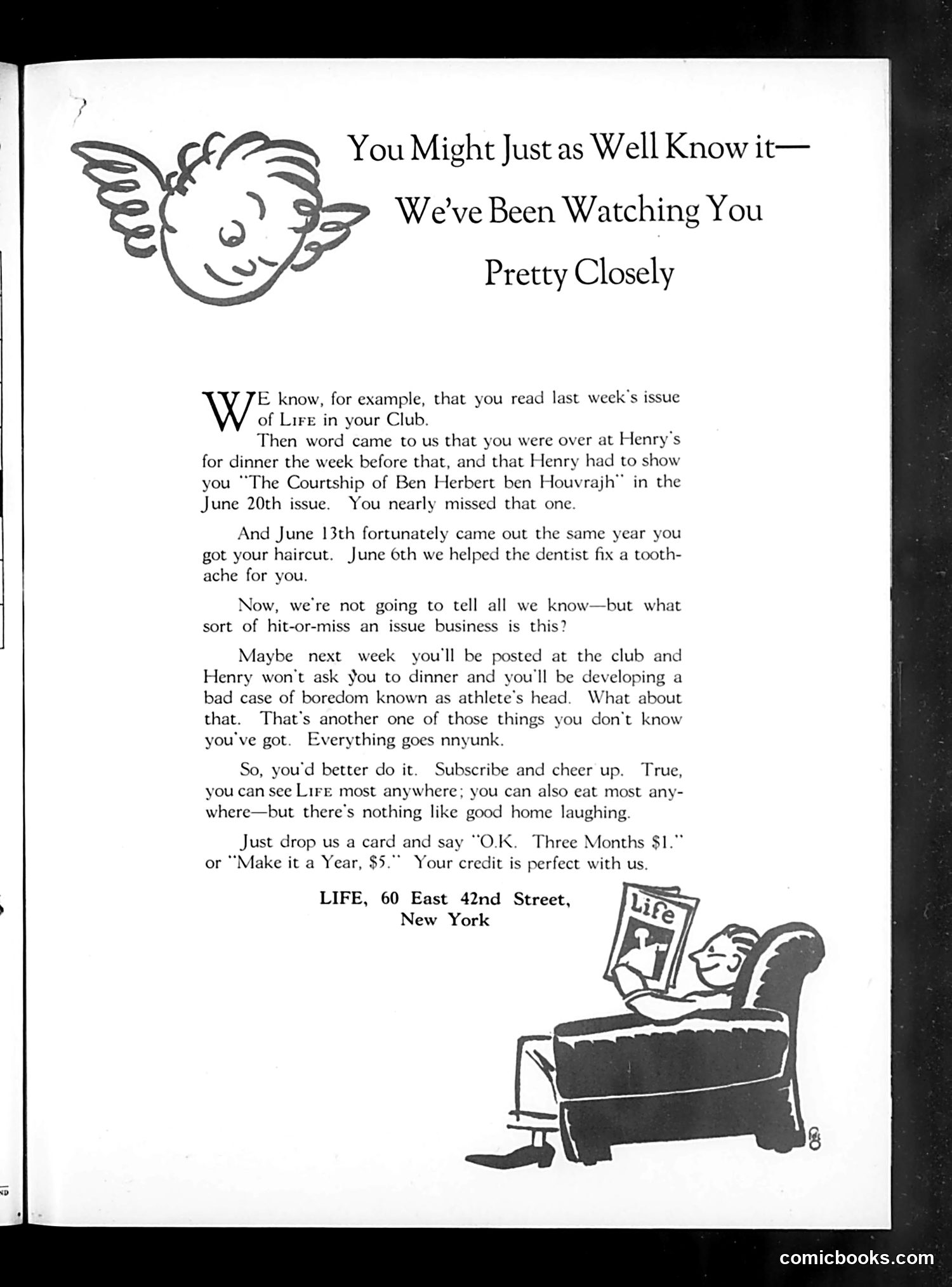
Life Magazine Subscription Advertisement This is a subscription pitch disguised as humorous surveillance. Life magazine claims to have been mysteriously tracking the reader's activities—knowing which issues they've read at their club, what they were doing when specific issues came out (haircuts, dental visits, dinners at "Henry's"), and implying they have detailed knowledge of the reader's private life. The joke relies on playful intimidation: "We've been watching you pretty closely." The cartoon shows a cherub-like figure observing from above, reinforcing the all-seeing-eye theme. The pitch's logic is: if Life already knows so much about you, you might as well subscribe regularly so you're never caught without it. The humor comes from the exaggerated claim of omniscience—suggesting Life magazine is somehow inescapable and essential to social life. The subscription prices offered are "Three Months $1" or "Make it a Year, $5"—implying you can't escape their watchfulness anyway, so consent to subscribing.
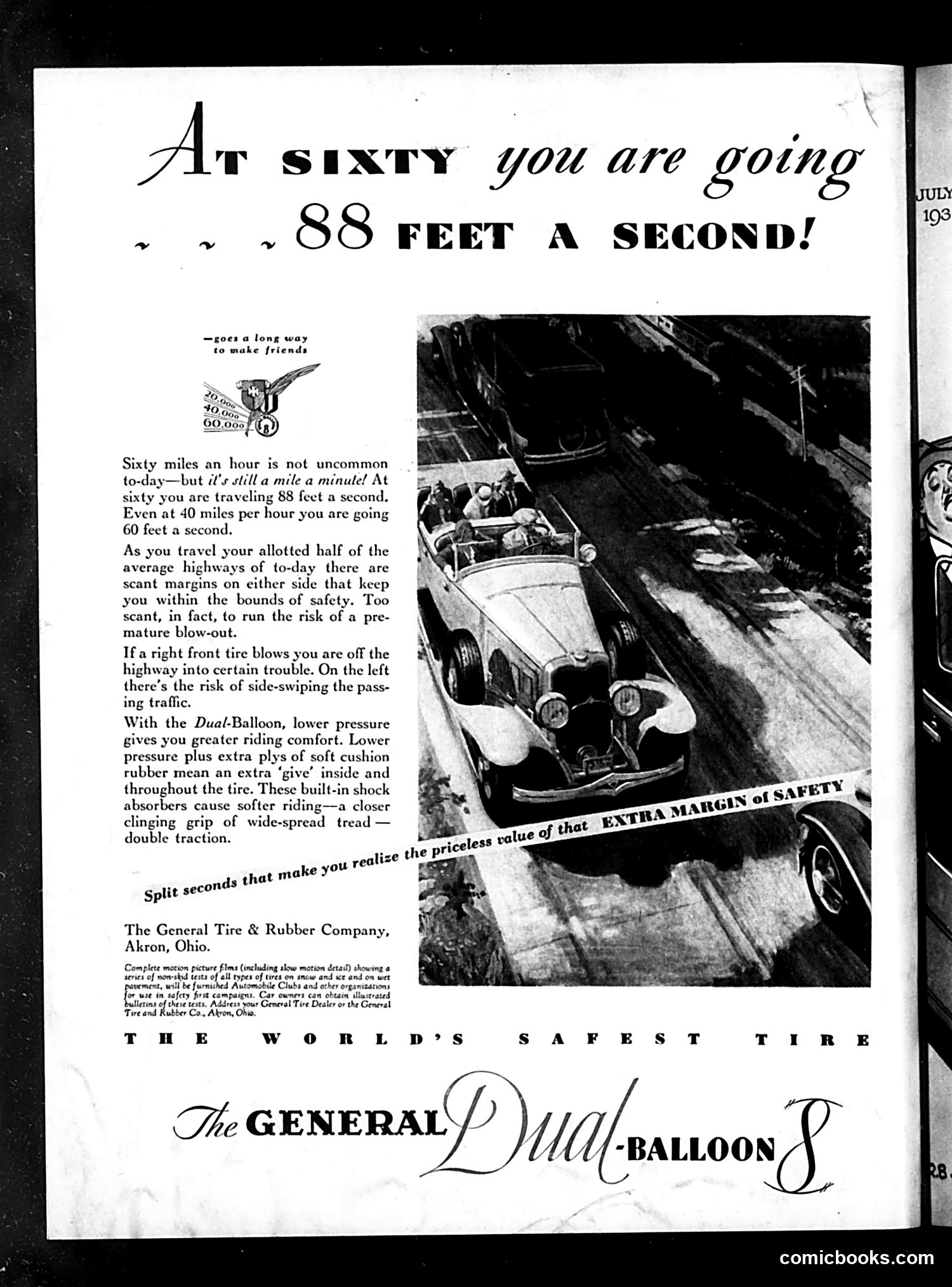
Analysis This is a tire advertisement, not a political cartoon. It's a General Tire & Rubber Company ad for their "Dual-Balloon" tire, appearing in Life magazine (likely 1920s-early 1930s based on the styling). The "Satire": The ad uses dramatic language to scare readers into buying safer tires. It emphasizes that at 60 mph, you're traveling 88 feet per second—a disorienting stat meant to make driving feel dangerously fast. The implication: standard tires are unsafe at these speeds; their product prevents blowouts and side-swiping accidents. Visual support: The photograph shows a convertible car on a highway, illustrating the modern motoring hazard being addressed. Historical context: This reflects early automotive safety concerns when highways were narrow, tire technology was developing, and speeds were increasing. The ad assumes readers now drive at "uncommon" speeds and need reassurance about safety—a novel marketing angle for the era. This is straightforward product advertising, not satirical commentary.