life
Life — July 11, 1930
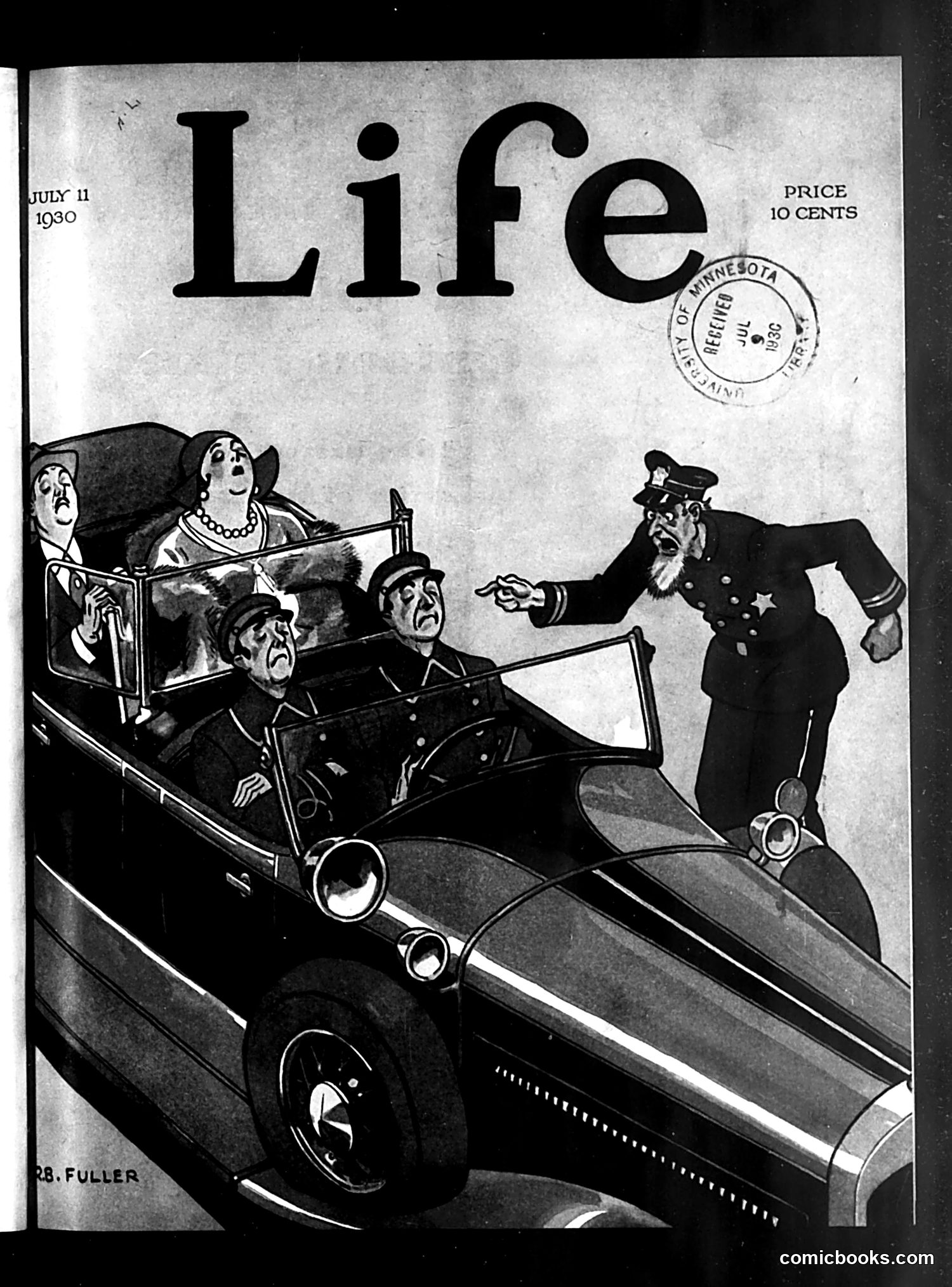
Political Cartoon Analysis: Life Magazine, July 11, 1930 This cover cartoon by B. Fuller depicts a traffic-control scenario with satirical intent. A uniformed police officer or traffic controller directs an automobile containing four passengers—appearing to include well-dressed civilians and officials—as if managing vehicle flow. The satire likely comments on government authority, regulation, or control during the early Depression era. The exaggerated expressions suggest the passengers' anxiety about being "directed" or controlled by authority figures. The specific identities of the passengers remain unclear from the image alone, though their formal dress suggests they represent institutional or political figures subject to oversight or management. The cartoon's point appears to critique governmental direction of commerce or society during this economically turbulent period.
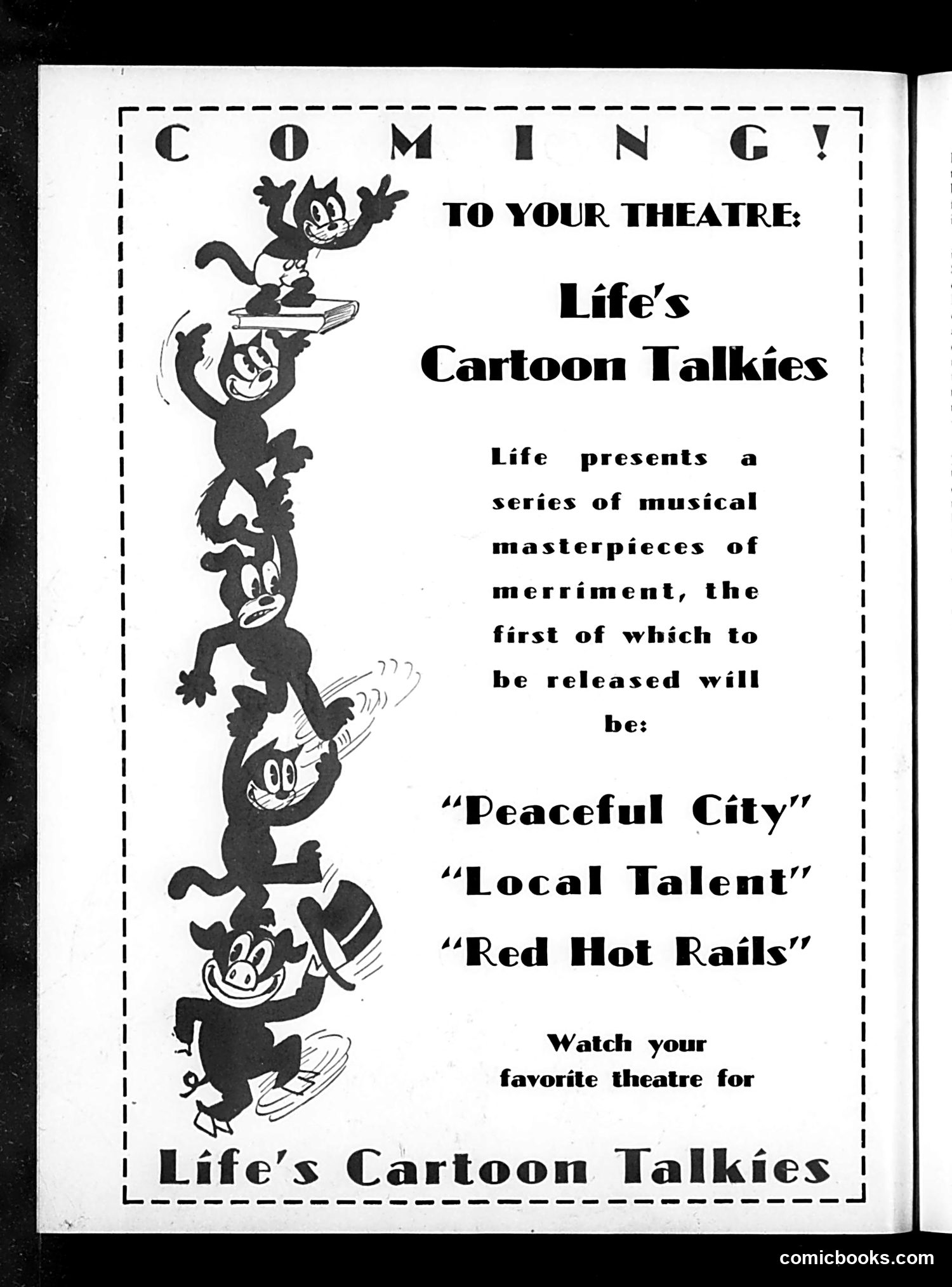
This is an advertisement for "Life's Cartoon Talkies"—a series of musical animated short films coming to theaters. The image shows a vertical stack of cartoon animals (appearing to be cats or similar creatures) performing acrobatic stunts, illustrating the "merriment" promised by these films. The ad announces three upcoming titles: "Peaceful City," "Local Talent," and "Red Hot Rails." These appear to be comedic animated shorts typical of early sound-era cinema, when novelty "talkie" cartoons were popular theatrical attractions. The stacked characters suggest physical comedy and slapstick humor—standard fare for cartoons of this era. The advertisement is essentially promoting Life magazine's foray into producing entertainment content for cinema audiences, blending their satirical sensibility with popular animated entertainment.
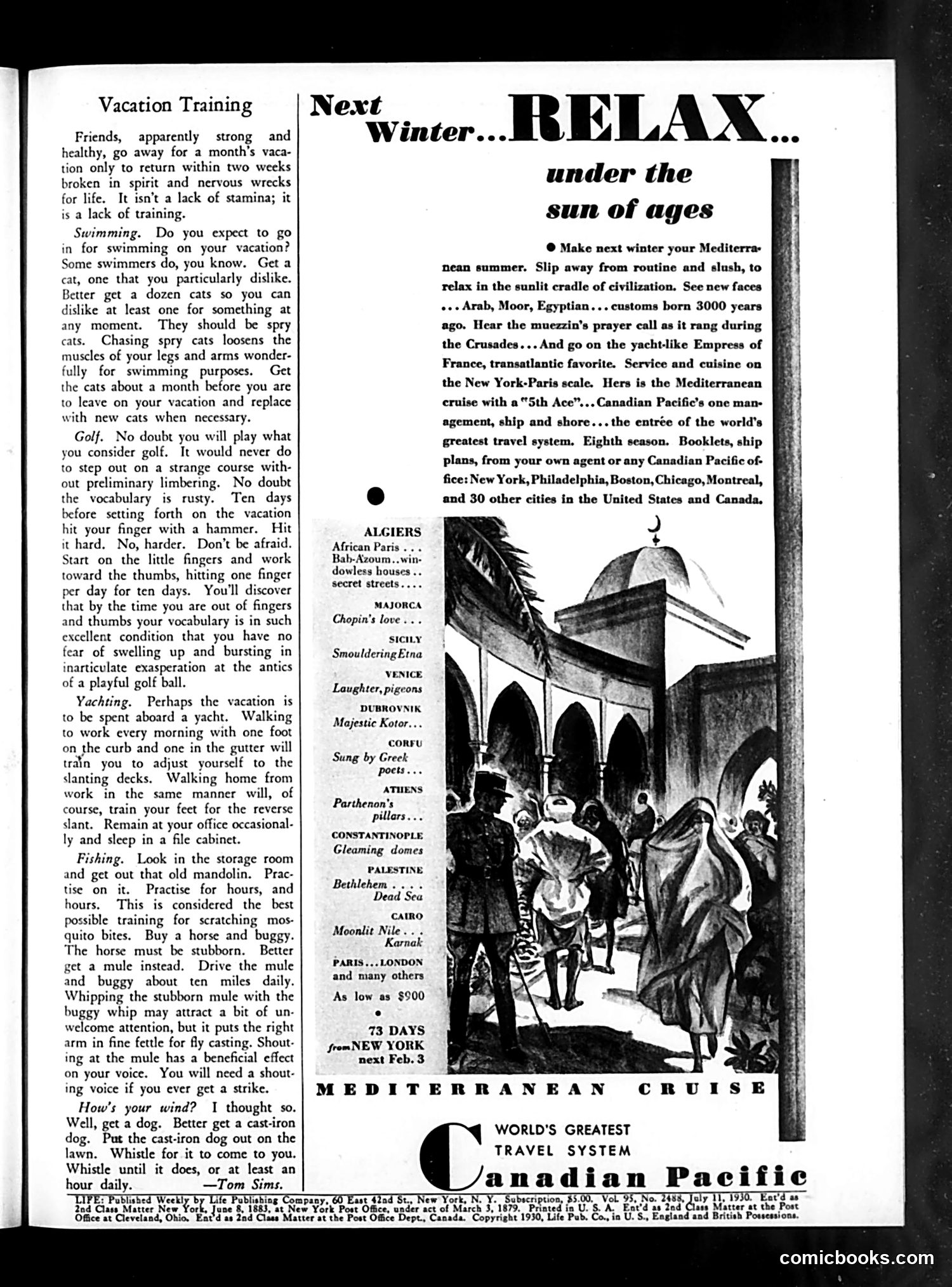
Analysis This page contains an article titled "Vacation Training" (left column) offering humorous advice on preparing for vacation through activities like swimming, golf, yachting, and fishing. The practical joke is that readers should practice these leisure skills beforehand to avoid returning from vacation "broken in spirit and nervous wreck[s]." The right side is a full-page advertisement for Canadian Pacific's Mediterranean cruise, promoting a 73-day voyage from New York departing February 3rd. It lists exotic destinations (Algeria, Sicily, Venice, Athens, Cairo, Palestine) and emphasizes luxury—"the world's greatest travel system." The accompanying illustration shows passengers in Mediterranean settings with local architecture and figures. The ad targets wealthy Americans seeking winter escape and cultural tourism, reflecting 1930s leisure travel advertising conventions.
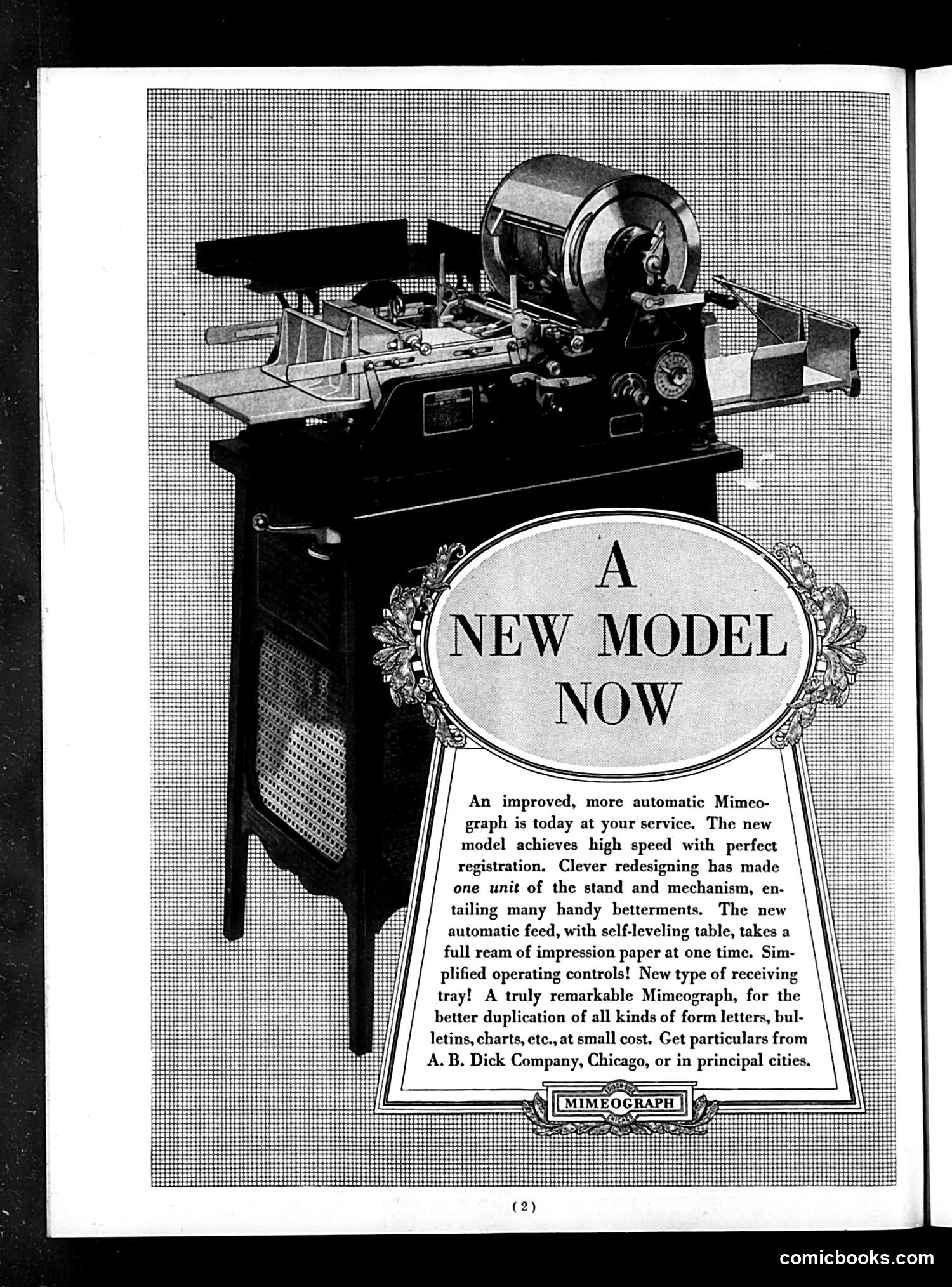
Analysis This is not a cartoon or satirical content, but rather a product advertisement for the Mimeograph machine, placed in Life magazine. The page promotes "A New Model Now" from the A.B. Dick Company of Chicago. The ad highlights improvements to this duplicating technology: higher speed, better registration, automatic feed with self-leveling table, simplified controls, and a new receiving tray. It emphasizes the machine's utility for duplicating "form letters, bulletins, charts, etc., at small cost." This represents early 20th-century office equipment marketing—the mimeograph was essential pre-digital technology for businesses needing to reproduce documents quickly and affordably. The ornate decorative border and prominent placement suggest this was a significant advertising purchase reflecting the machine's commercial importance.
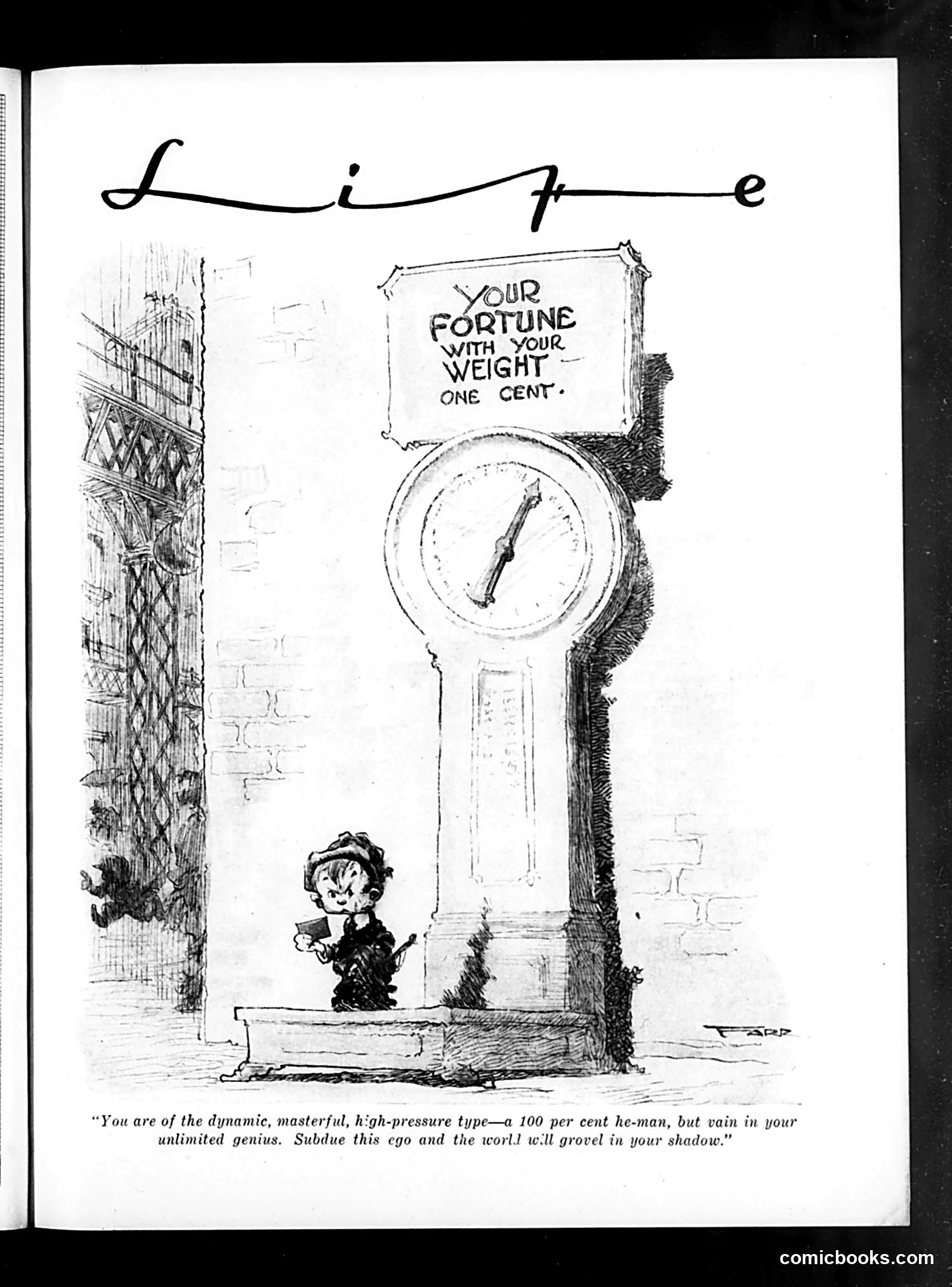
Analysis of "Life" Magazine Cartoon This cartoon satirizes fortune-telling machines—penny-operated devices common in early 20th-century America. A small figure (appears to be a child or diminutive person) stands before a scale that dispenses fortunes for one cent, with a sign reading "YOUR FORTUNE WITH YOUR WEIGHT ONE CENT." The caption mocks grandiose self-help rhetoric of the era, praising the person as "dynamic, masterful, high-pressure type—a 100 per cent he-man" while simultaneously advising them to "subdue this ego and the world will grovel in your shadow." The satire targets both the absurdity of automated fortune-telling and the contradictory pop-psychology messages promoted to American consumers—flattering their ego while demanding ego-suppression. The humor lies in the clash between inflated praise and practical advice.
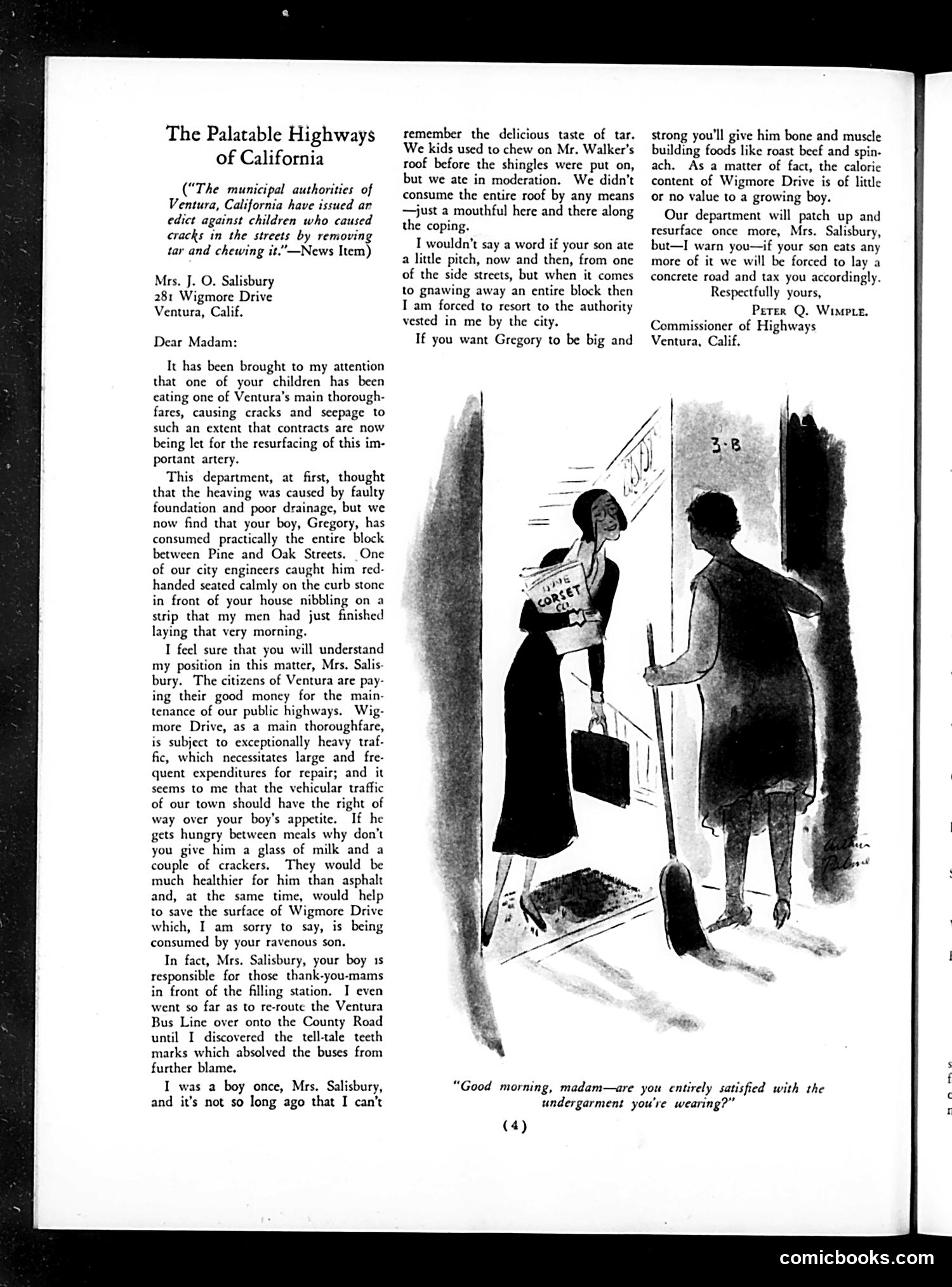
Analysis of "The Palatable Highways of California" This page contains a satirical letter from Peter Q. Wimple, Commissioner of Highways in Ventura, California, responding to a complaint from Mrs. J.O. Salisbury about her son Gregory eating tar from street repairs. The satire mocks bureaucratic absurdity: Wimple solemnly argues that the boy's consumption of road tar is actually *beneficial*—providing "bone and muscle building foods like roast beef and spinach"—and suggests the real problem is insufficient milk and crackers in the child's diet. The accompanying illustration shows a woman presenting a boy with visible tar stains to a puzzled man, likely a doctor. The joke exposes how officials deflect legitimate public complaints through absurd logic rather than addressing actual infrastructure problems affecting residents.
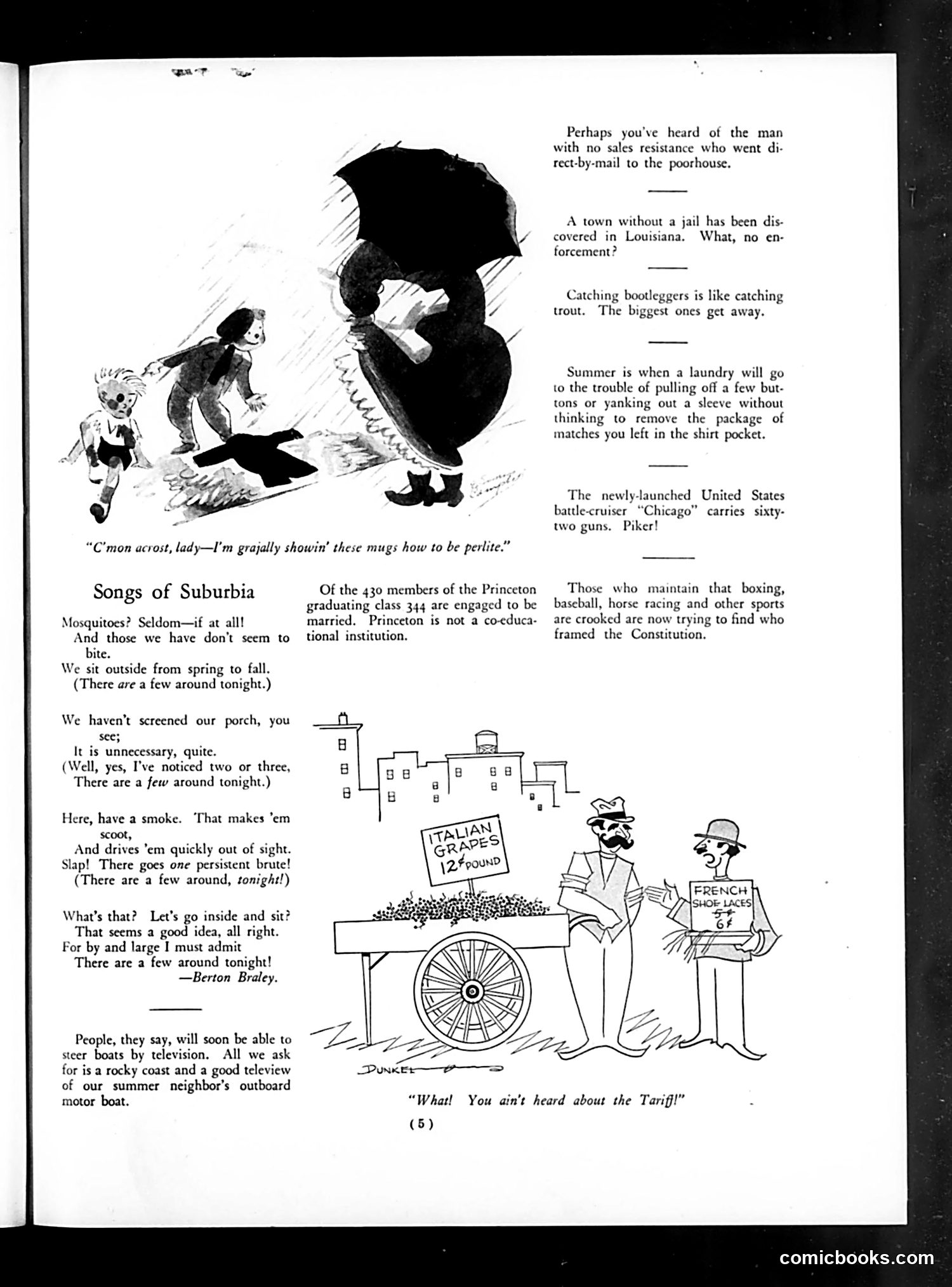
Page Analysis This page from *Life* magazine contains humorous observations and two cartoons satirizing American suburban and commercial life. The top cartoon depicts a woman showing a child how to behave properly toward "mugs" (street hoodlums), suggesting suburban anxieties about urban crime and rough characters. The "Songs of Suburbia" section offers satirical verse about suburban mosquitoes, unscreened porches, and summer entertaining—poking fun at the discomforts and social pretenses of suburban living. The bottom cartoon, captioned "What! You ain't heard about the Tariff!", shows street vendors (Italian grapes and French shoe laces) reacting to tariff policies. This references trade tariffs—likely 1920s-era protectionist debates—that would affect import prices and availability of foreign goods in American markets. Both cartoons reflect early-20th-century American preoccupations with suburban life, immigration, and economic policy.
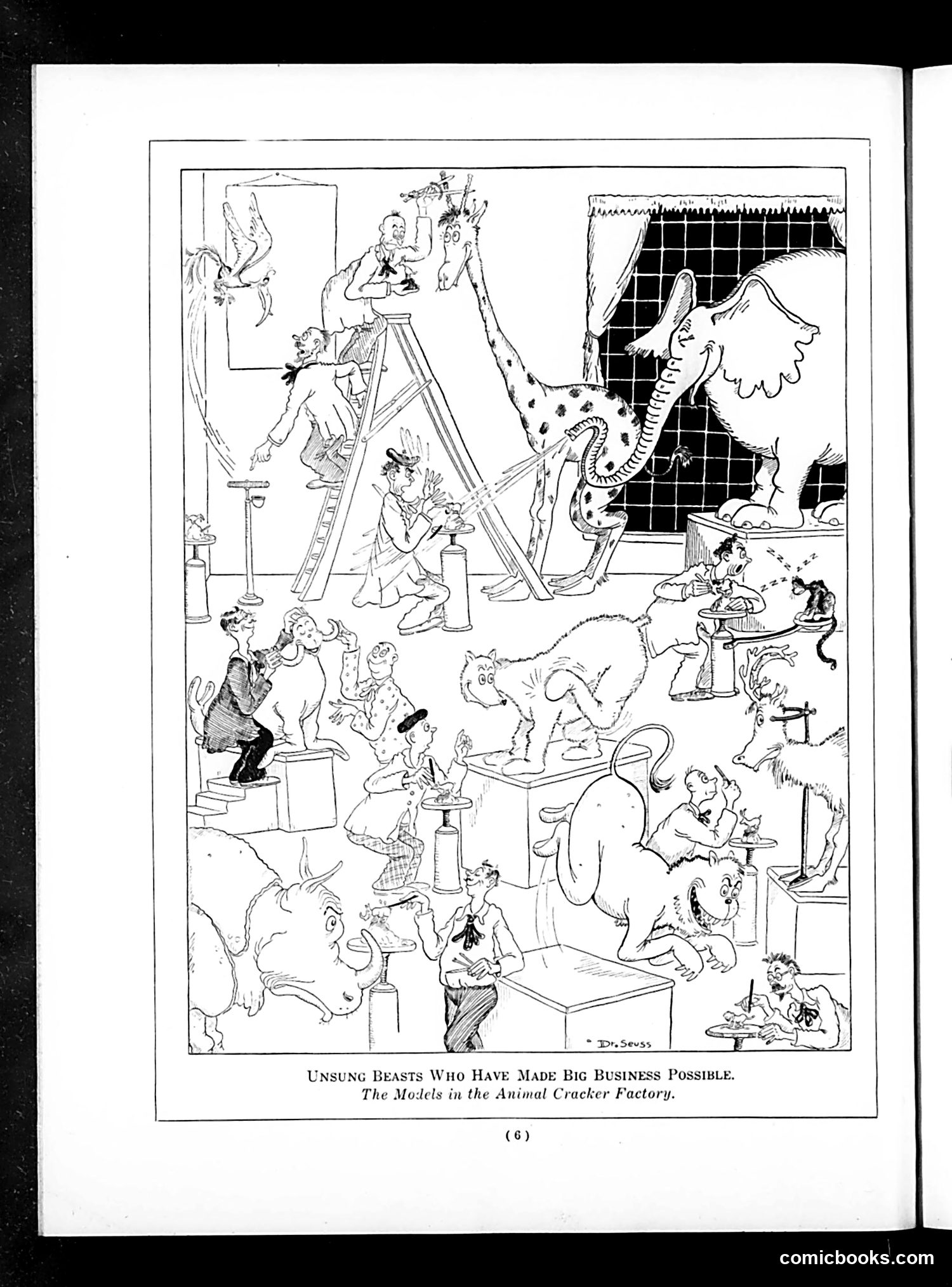
"Unsung Beasts Who Have Made Big Business Possible: The Models in the Animal Cracker Factory" This Dr. Seuss cartoon satirizes the animal cracker industry by personifying the actual animals used as models for cracker designs. The illustration shows a chaotic factory scene where various exotic animals—an elephant, giraffe, rhinoceros, hippo, and others—pose while human workers sketch, measure, and study them. The joke is a clever inversion: instead of celebrating the human designers and businessmen, the caption credits the "unsung beasts" whose likenesses make the product profitable. It's gentle satire on how commercial success often depends on natural resources or subjects that receive no recognition—here, the animals themselves literally modeling for profit while remaining anonymous contributors to the industry.
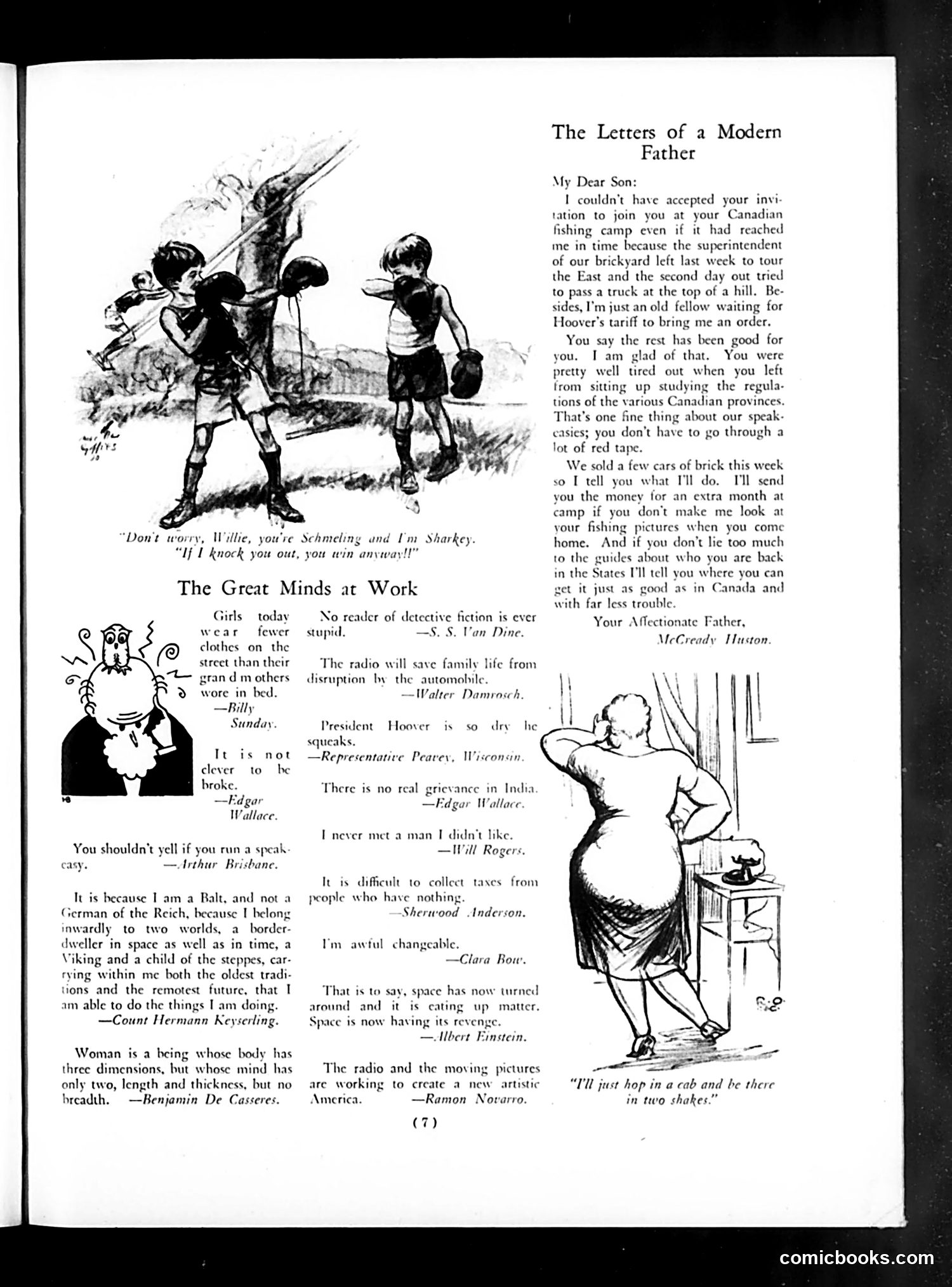
Page Analysis: Life Magazine This page contains two sections: "The Letters of a Modern Father" — A humorous letter from father "McCroody Huston" to his son, declining a Canadian fishing camp invitation. The humor lies in the father's mundane domestic troubles (touring the brickyard, waiting for Hoover's tariff order, selling brick cars) contrasted with his son's exciting vacation plans. It's satirizing how ordinary adult life is compared to youthful adventure. "The Great Minds at Work" — A collection of brief, witty quotes attributed to famous figures (Will Rogers, Benjamin Franklin, Einstein, etc.) offering sardonic observations on contemporary life: girls wearing fewer clothes, radio's impact, taxes, and space exploration. The cartoons accompanying these quotes provide visual gags supporting each quip, typical of Life's satirical approach to celebrity and modern society.
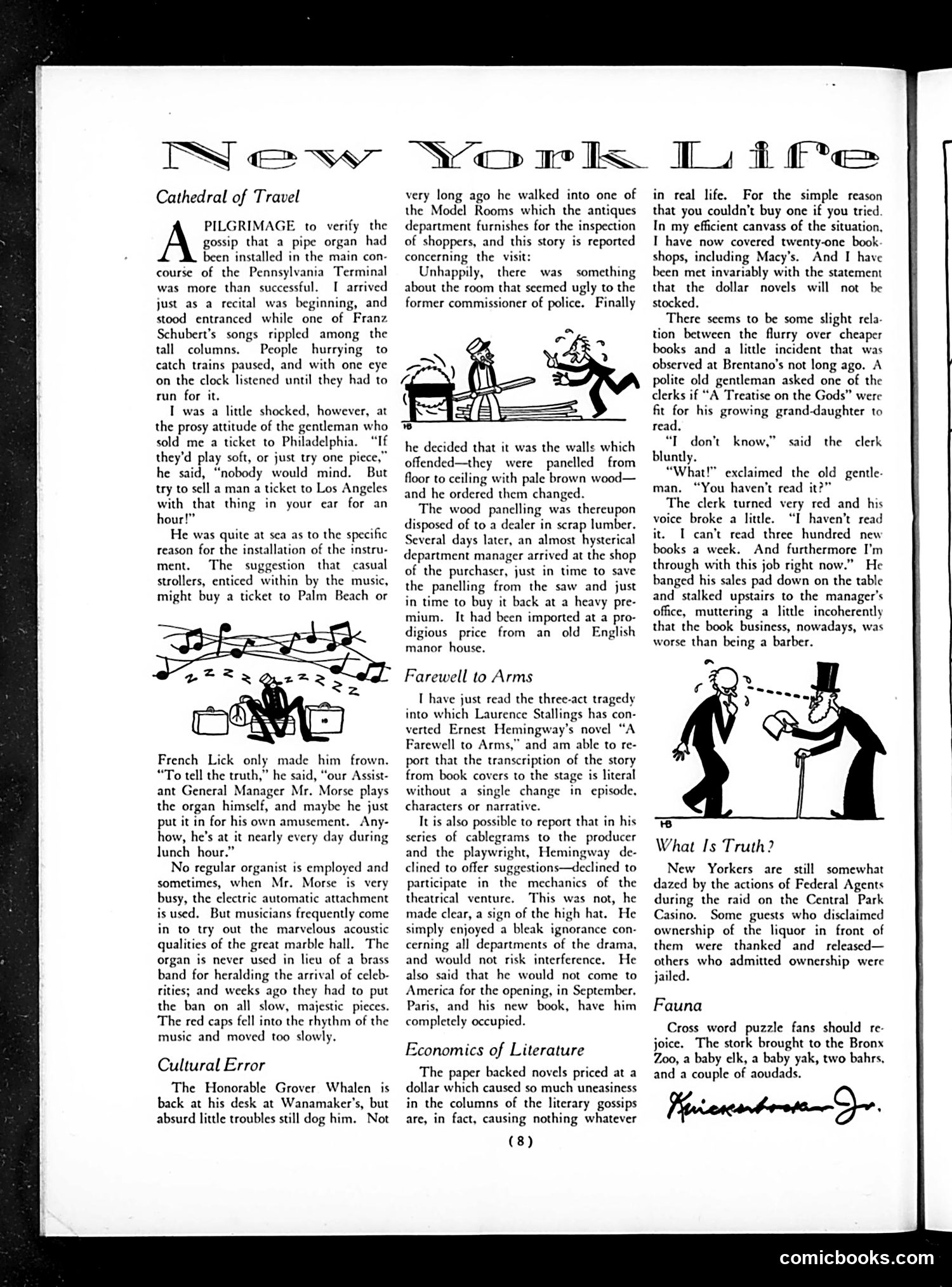
Analysis of Life Magazine Page This page contains literary commentary rather than political cartoons. The main sections discuss: "Cathedral of Travel" - A humorous anecdote about a man's experience at Pennsylvania Terminal, where he encounters a ticket agent dismissive of classical music and modest travel plans. "Cultural Error" - A brief note about an unnamed "Honorable Grocer" experiencing minor social embarrassments at Wanamaker's department store. "Farewell to Arms" - Commentary praising Laurence Stallings' theatrical adaptation of Hemingway's novel for its faithful transcription. The small cartoons show figures in formal dress conducting what appears to be business or social transactions, illustrating the mundane urban situations described in the text. The overall tone is satirical commentary on American consumer culture and manners, rather than political satire.
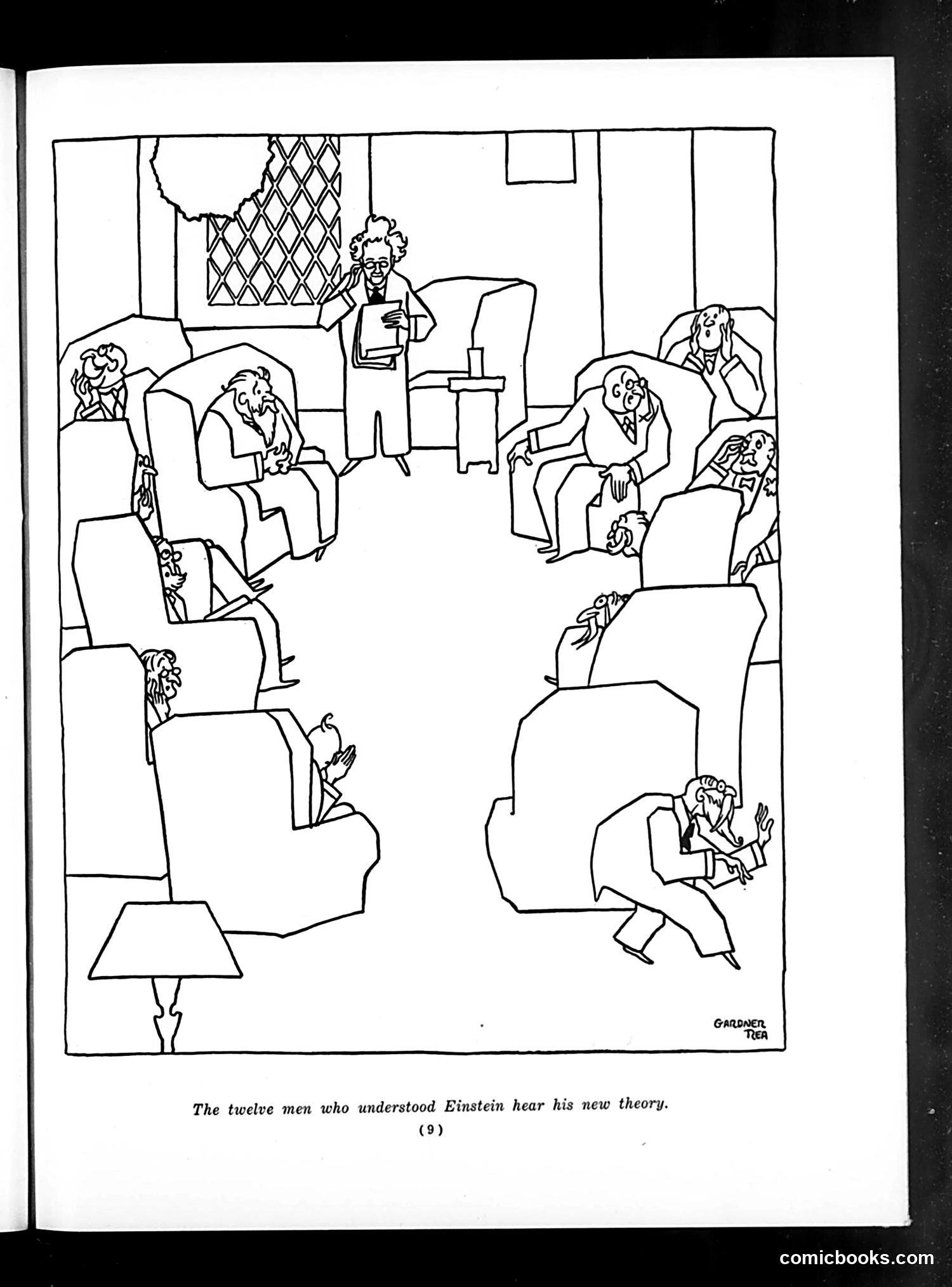
"The Twelve Men Who Understood Einstein" This cartoon satirizes Einstein's theory of relativity as incomprehensibly complex. The caption claims only twelve people worldwide could understand his new theory—a famous contemporary quip about the theory's difficulty. The drawing shows a lecture room with an audience seated in armchairs, appearing puzzled and disengaged while one figure (presumably Einstein, center) presents. The cartoon mocks both the theory's opacity and the pretentiousness surrounding it. The humor lies in the contrast between Einstein's apparent confidence and his audience's obvious confusion and lack of comprehension. This reflects 1920s popular skepticism about relativity—a genuinely difficult concept that fascinated yet baffled the public and even many scientists. The joke plays on widespread anxiety about whether anyone truly grasped what Einstein had actually proposed.
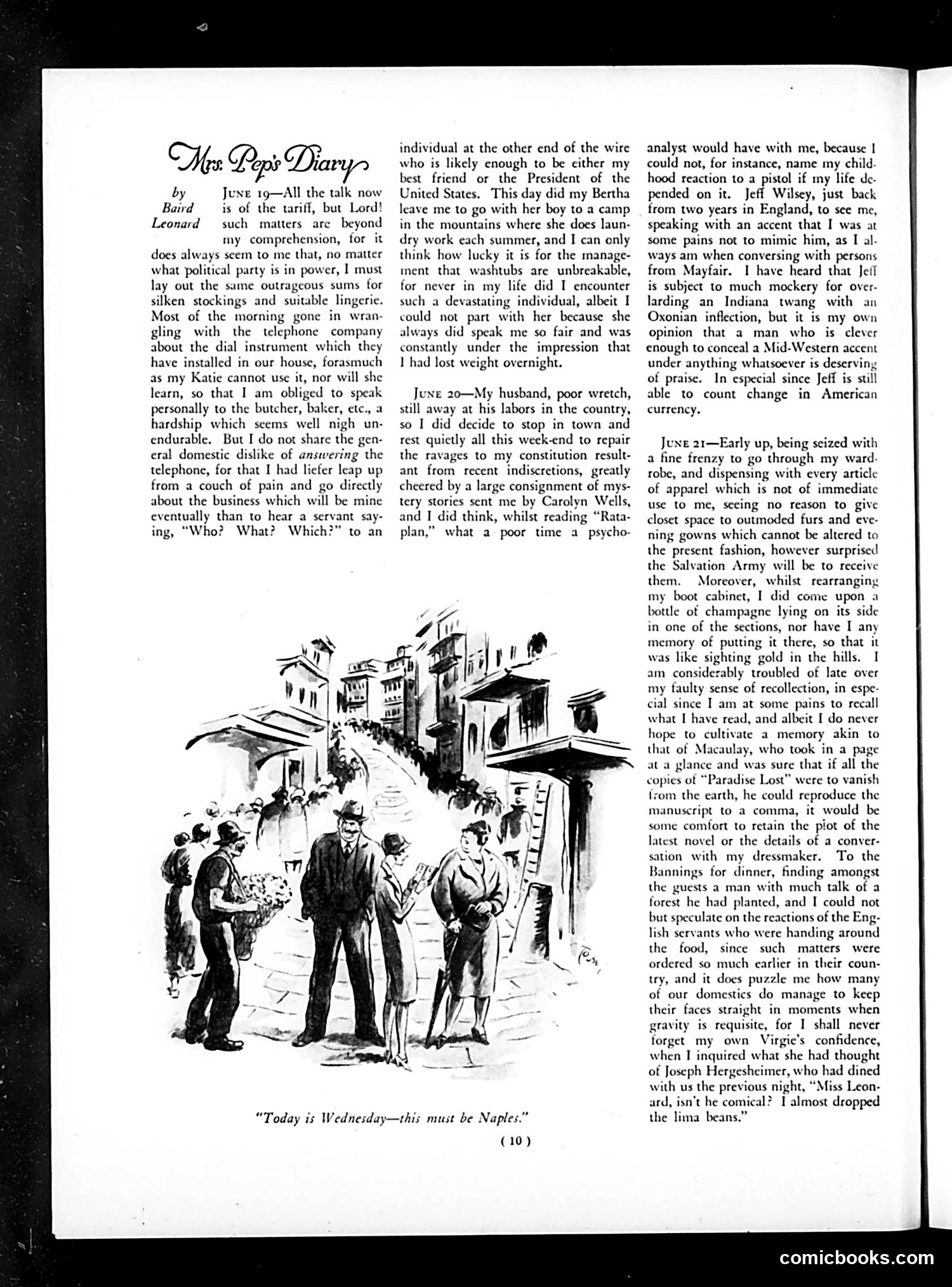
"Mrs. Pope's Diary" - Analysis This page shows a serialized diary column by Baird Leonard titled "Mrs. Pope's Diary." The illustration depicts a street scene (captioned "Today is Wednesday—this must be Naples") with figures in period dress. The diary entries from June 19-21 discuss mundane domestic matters: telephone company complaints, a husband away on country business, wardrobe reorganization, and social observations. The humor derives from satirizing upper-class women's preoccupations—servants, fashion, gossip, and minor domestic crises—presented as momentous personal concerns. The Naples reference suggests travel narratives. The satire mocks both the self-importance of wealthy women's concerns and the breathless tone typical of society diary columns popular in early 20th-century magazines like Life.
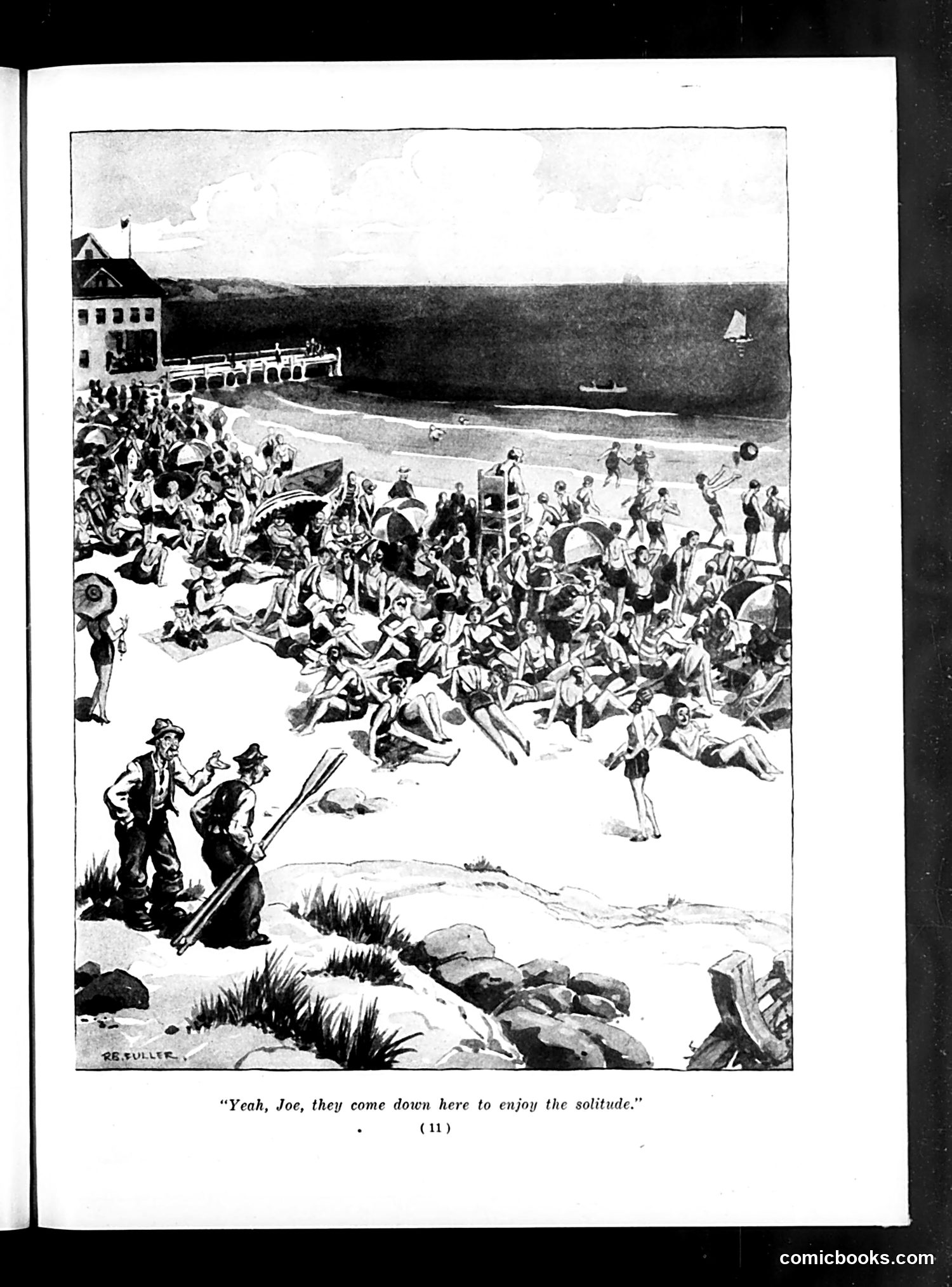
Analysis This is a satirical illustration showing a crowded beach scene with two figures in the foreground observing the masses. The caption reads: "Yeah, Joe, they come down here to enjoy the solitude." The joke is a clear contradiction: the beach is packed with hundreds of people sunbathing, swimming, and socializing, yet the speaker claims visitors come for "solitude" (peace and quiet). This is social satire about modern leisure culture—specifically mocking the irony that popular vacation destinations become so crowded that they defeat their own purpose as places of rest and escape. The illustration likely dates to mid-20th century Life magazine, when beach tourism had become a mass phenomenon. The humor relies on the obvious visual contradiction between the stated intention (solitude) and the reality (throngs of people).
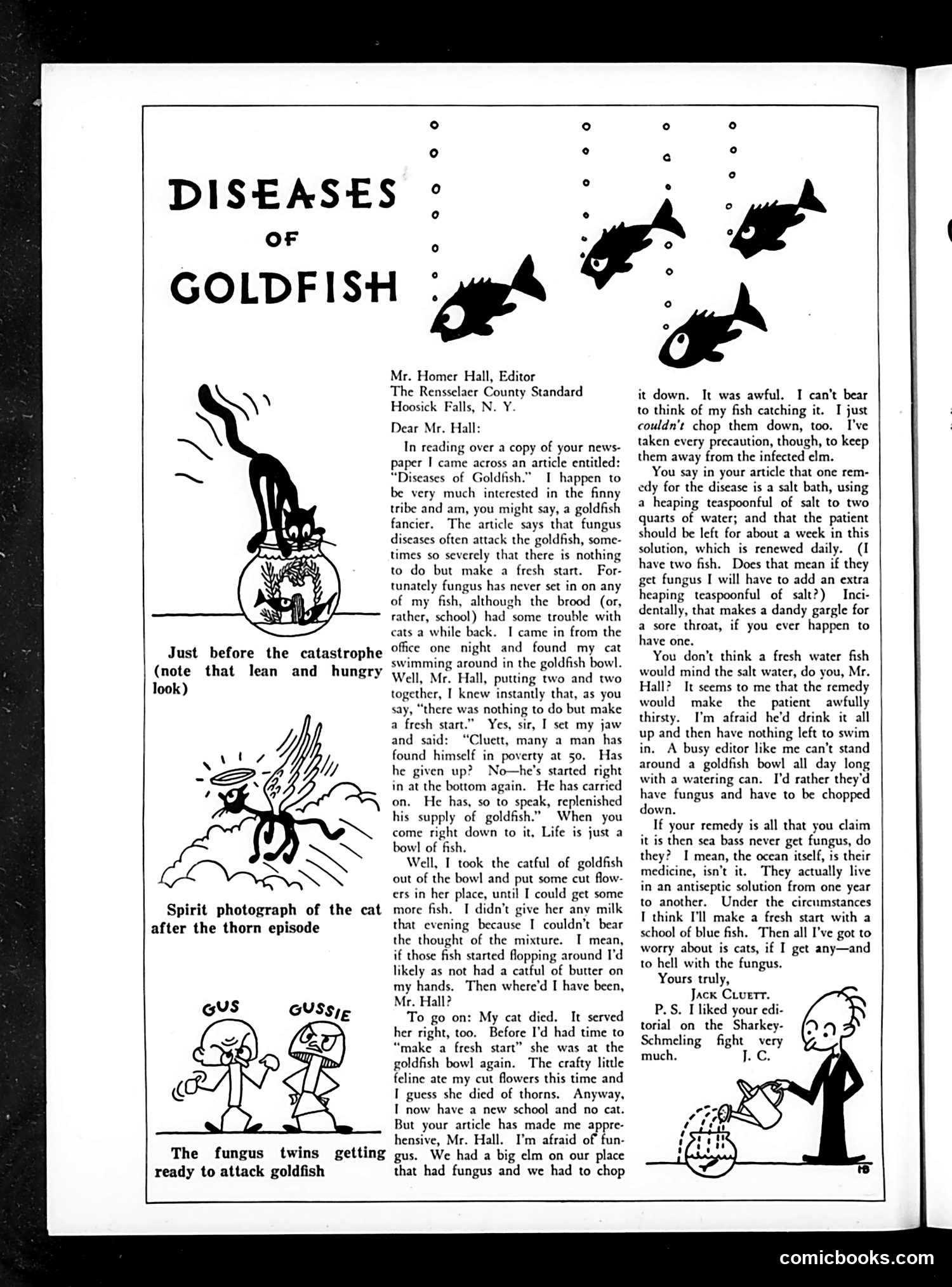
"Diseases of Goldfish" - Life Magazine Humor Page This is a humorous advice column responding to an article about goldfish diseases. The satirical point is straightforward: a reader writes to editor Homer Hall complaining that the disease prevention advice (salt baths for fungus) is impractical because the goldfish died before he could treat it—and his cat died after eating the diseased fish. The cartoons illustrate the absurdity: a skeletal cat looking "lean and hungry" before the "thorn episode," then "spirit photographs" showing the cat's ghostly form, and "the fungus twins" as cute characters "getting ready to attack goldfish." The joke mocks both the original article's overly-serious tone about trivial pet care and the reader's increasingly ridiculous explanation of household chaos. It's gentle, family-friendly satire typical of early Life magazine's style.
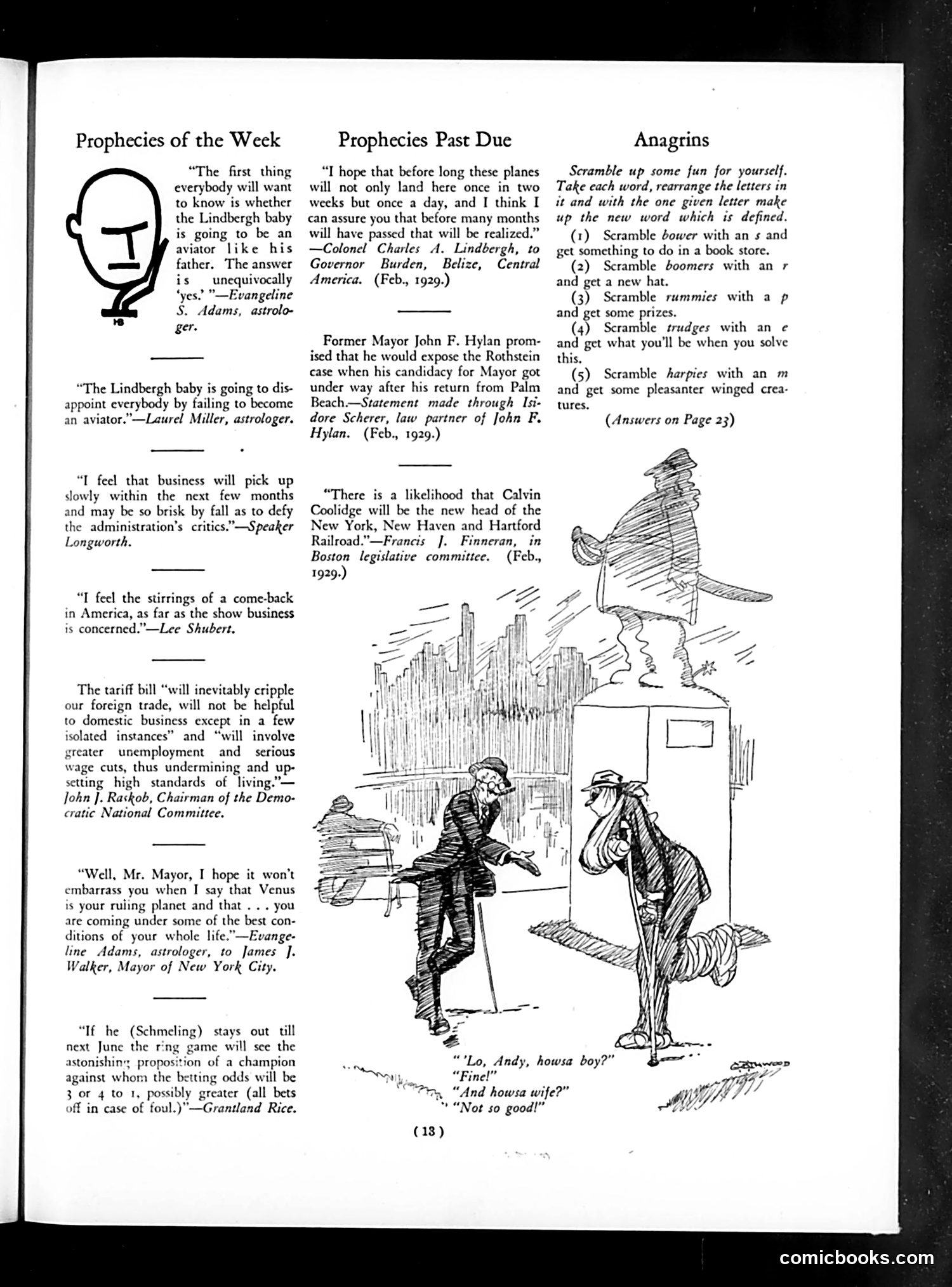
Analysis of Life Magazine Page 13 This page contains prophecies and political commentary from early 1929. The left column features predictions about the Lindbergh baby (referencing Charles Lindbergh's fame as an aviator), business recovery, and tariff policy concerns. The main cartoon depicts two men in a city setting discussing Venus as a "ruling planet." One appears to be an astrologer or fortune teller consulting the other (possibly a mayor, given the context about "Mayor" in the dialogue). The joke satirizes the absurdity of using astrology to make serious civic decisions—implying that political leaders are relying on superstition rather than rational policy-making. The "Anagrams" word puzzle section provides reader entertainment, typical of Life's format during this era.
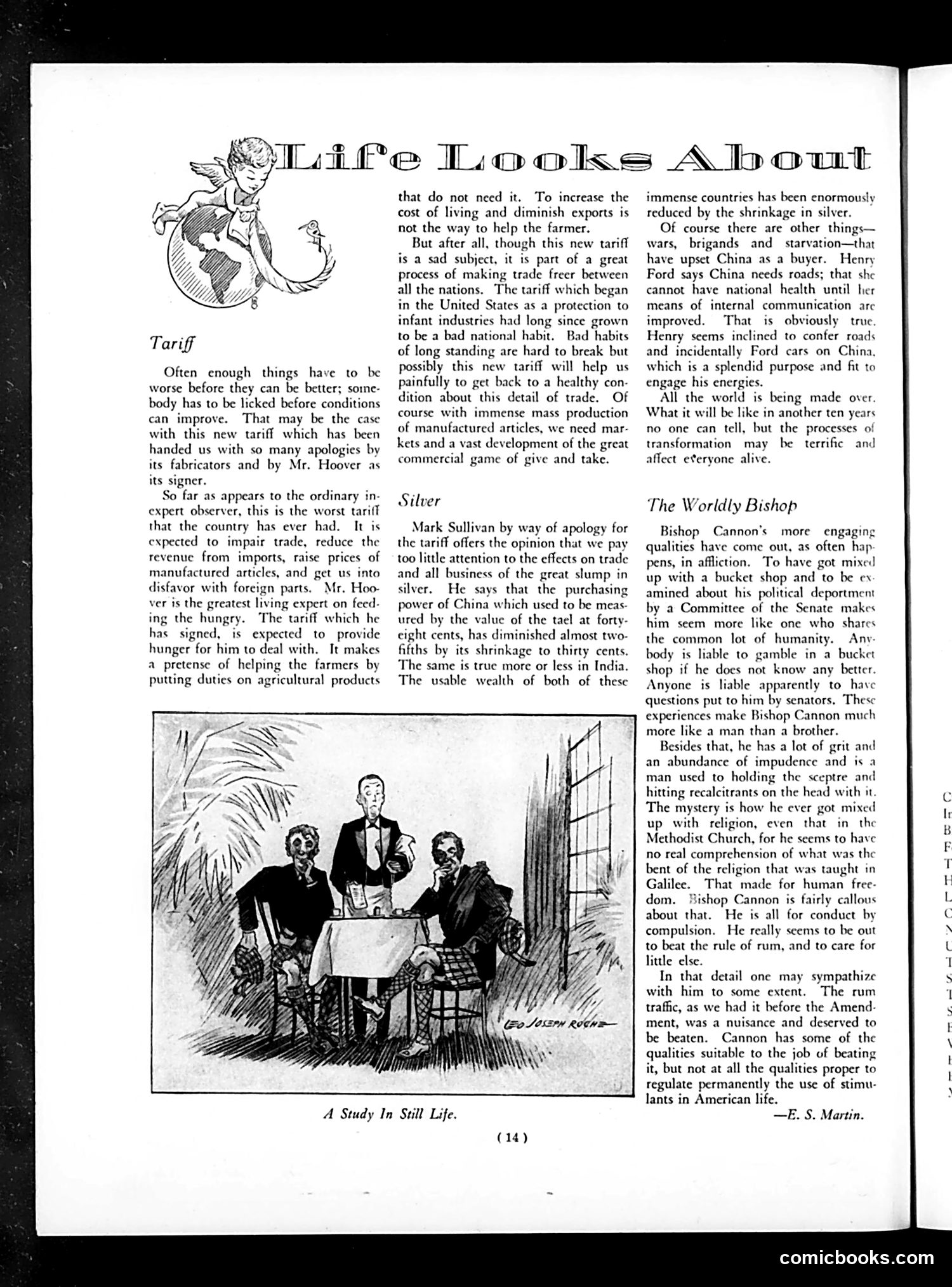
Analysis of "Life Looks About" Page This page contains three separate opinion pieces on early 20th-century trade policy: "Tariff" discusses new tariff legislation, arguing it's counterproductive—making trade harder rather than helping farmers, despite claims otherwise. "Silver" critiques how little attention is paid to silver's role in trade, noting China's reduced purchasing power as the metal's value dropped from forty-eight cents to thirty cents. "The Worldly Bishop" is a character sketch of Bishop Cannon, describing him as politically engaged but somewhat hypocritical—meddling in secular governance while claiming religious authority, particularly regarding prohibition enforcement. The accompanying illustration ("A Study In Still Life") appears to depict a formal business or political discussion among three men, likely related to these trade debates, though specific identities aren't labeled in the image.
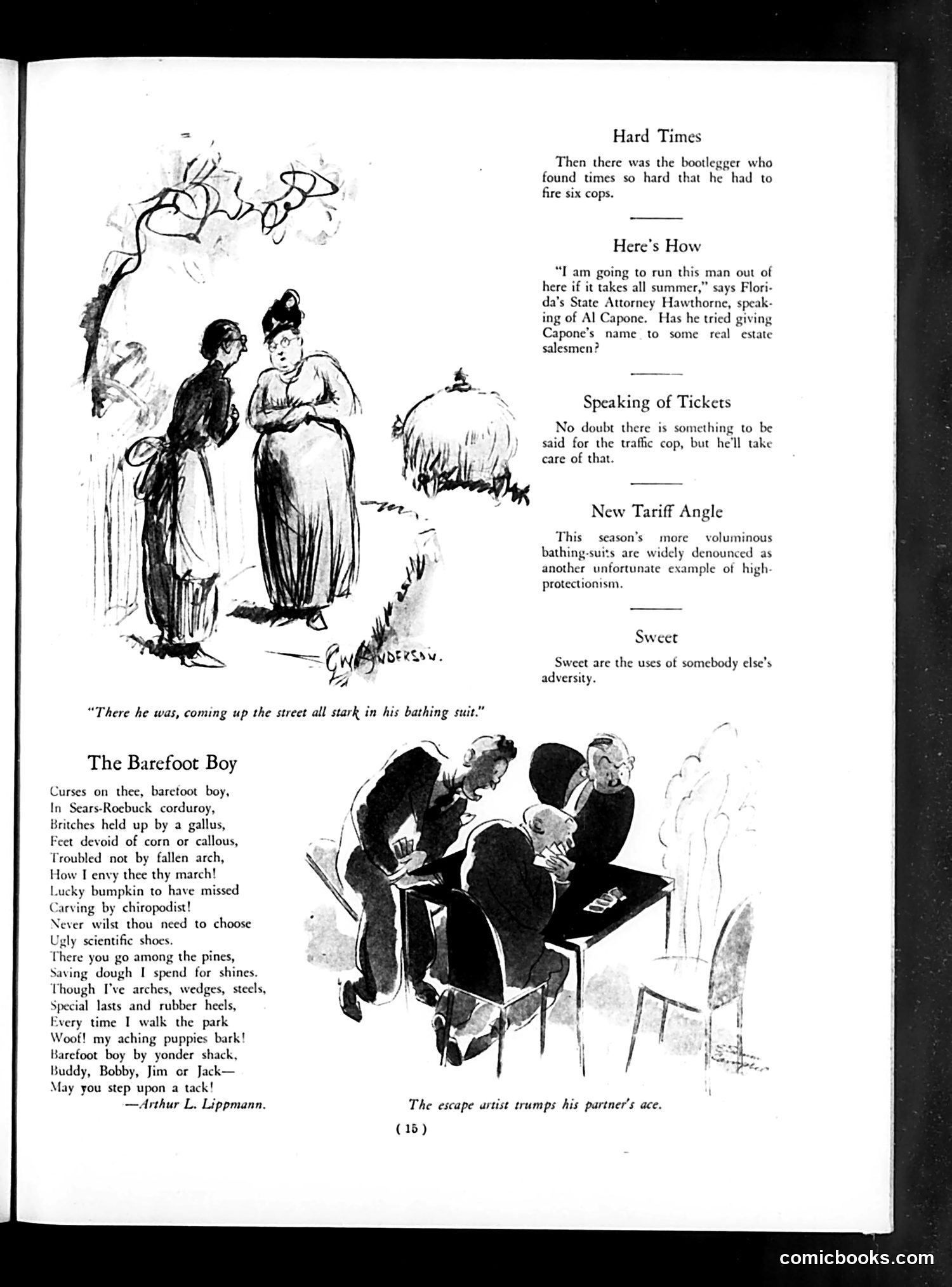
Analysis of Life Magazine Page This page contains several satirical pieces targeting early 20th-century American society: "Hard Times" mocks bootleggers (illegal alcohol sellers) during Prohibition, joking one had to "fire six cops"—suggesting widespread corruption and bribery of law enforcement. "Here's How" references Florida's State Attorney Hawthorne's efforts against Al Capone, the notorious gangster, implying difficulty prosecuting organized crime figures. "Speaking of Tickets" and "New Tariff Angle" make brief social commentary on traffic enforcement and protectionist trade policies. "The Barefoot Boy" is a poem by Arthur L. Lippmann lamenting the expense of children's footwear, contrasting childhood freedom with modern consumer demands. The cartoon below shows card players, captioned "The escape artist trumps his partner's ace," depicting deception in games—likely social satire on dishonesty.
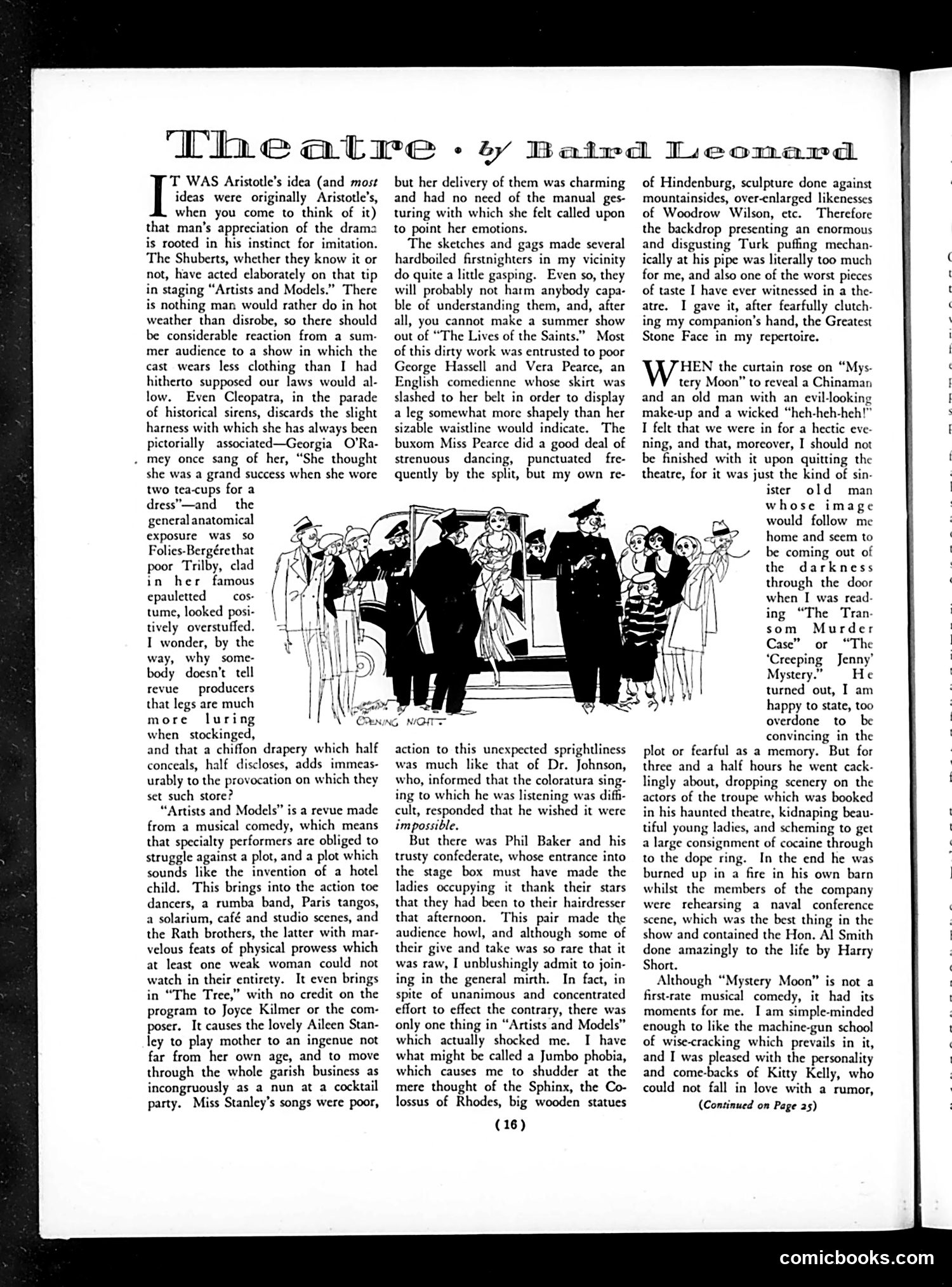
Theatre Review: "Artists and Models" This page reviews a Broadway revue called "Artists and Models." The author criticizes the production's attempt to satirize artistic pretension through exaggerated costumes and physical comedy—featuring performers like the Rath Brothers, dancers doing rumba and tango numbers, and comedians staging elaborate sketches. The illustration shows a crowded stage scene with various characters in formal and theatrical dress, apparently depicting the chaotic backstage or performance environment the revue portrays. The review's main critique is that while the show aims for sophisticated satire about art world affectation, it relies too heavily on slapstick and crude physical humor rather than genuine wit. The author finds some moments amusing but considers the overall production overwrought and trying too hard to please an undiscriminating audience.
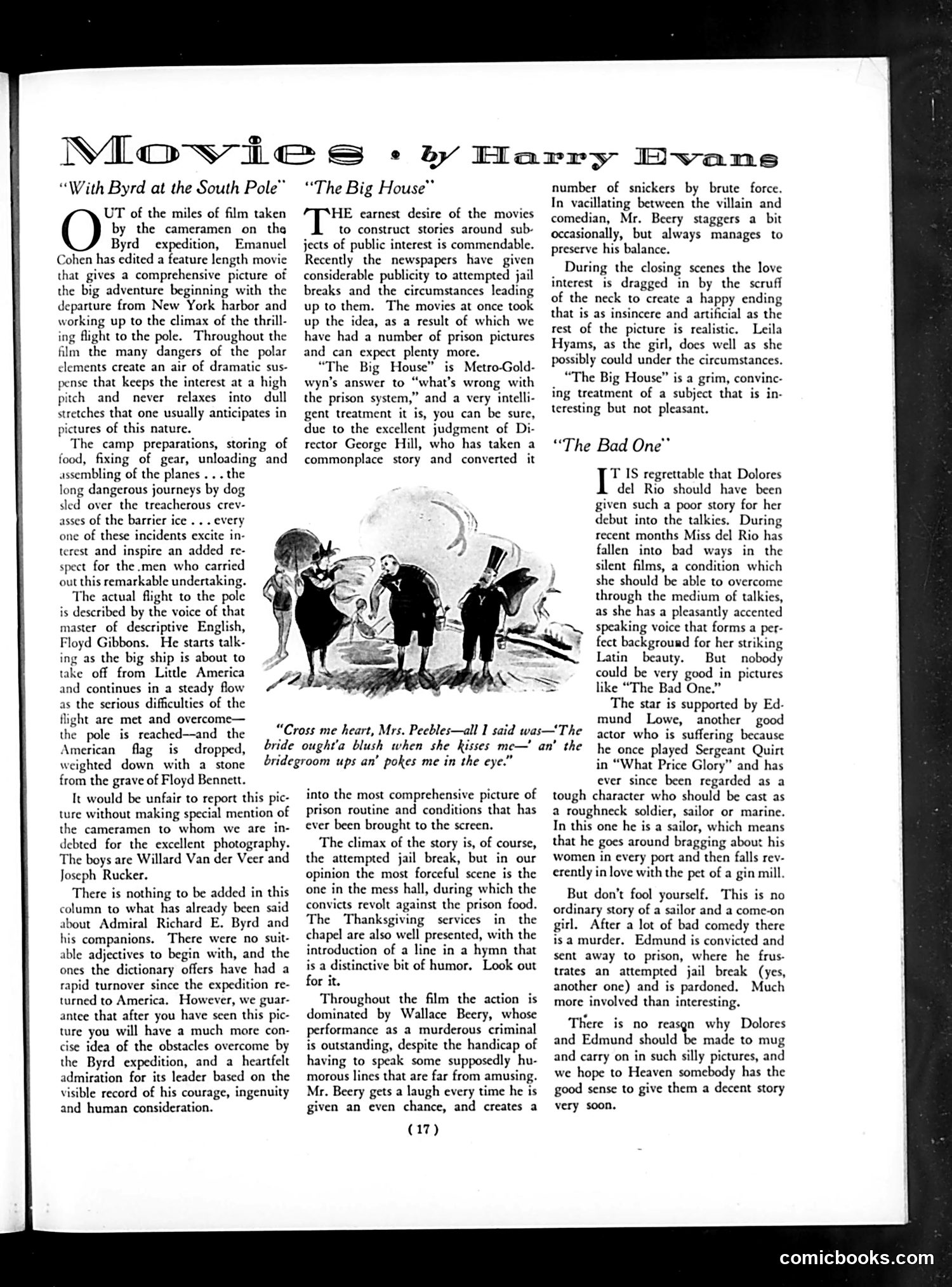
Movie Reviews by Harry Evans This page contains film reviews from *Life* magazine, focusing on three movies: "With Byrd at the South Pole," "The Big House," and "The Bad One." The single illustration shows what appears to be a prison scene with four men in suits standing before what looks like a crashed or damaged aircraft or vehicle. The caption includes dialogue about a bride and bridegroom, suggesting a comedic moment amid serious subject matter. The reviews themselves discuss contemporary Hollywood films dealing with adventure (polar exploration), prison conditions, and crime drama. The critics praise "The Big House" for its realistic treatment of prison life and criticize "The Bad One" for poorly utilizing actress Dolores del Rio in a weak crime story, despite supporting performances by Edmund Lowe.
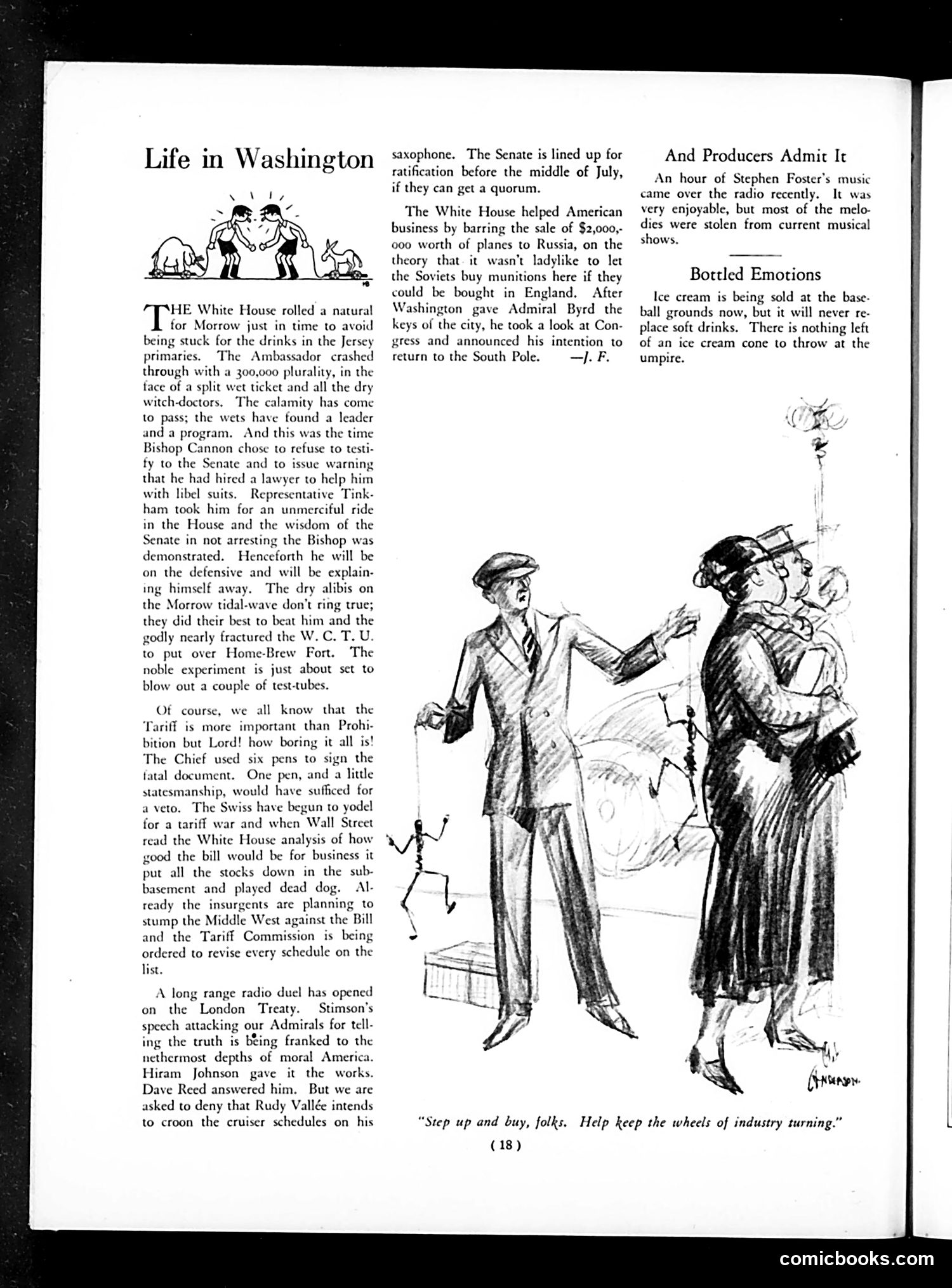
Analysis of Life Magazine Page This page from *Life* magazine satirizes Washington politics and social issues of the era. The main cartoon depicts a man addressing two well-dressed figures with the caption "Step up and buy, folks. Help keep the wheels of industry turning." The accompanying text discusses various Washington absurdities: the White House blocking plane sales to Russia, Bishop Cannon's refusal to testify about hiring a libel lawyer, and debates over Prohibition and tariffs. The satire targets how politicians and business interests use patriotic language ("help keep the wheels of industry turning") to manipulate public spending and behavior. The cartoon suggests cynicism about whether such appeals genuinely serve national interest or merely benefit special interests and profiteers during this period of economic and political tension.
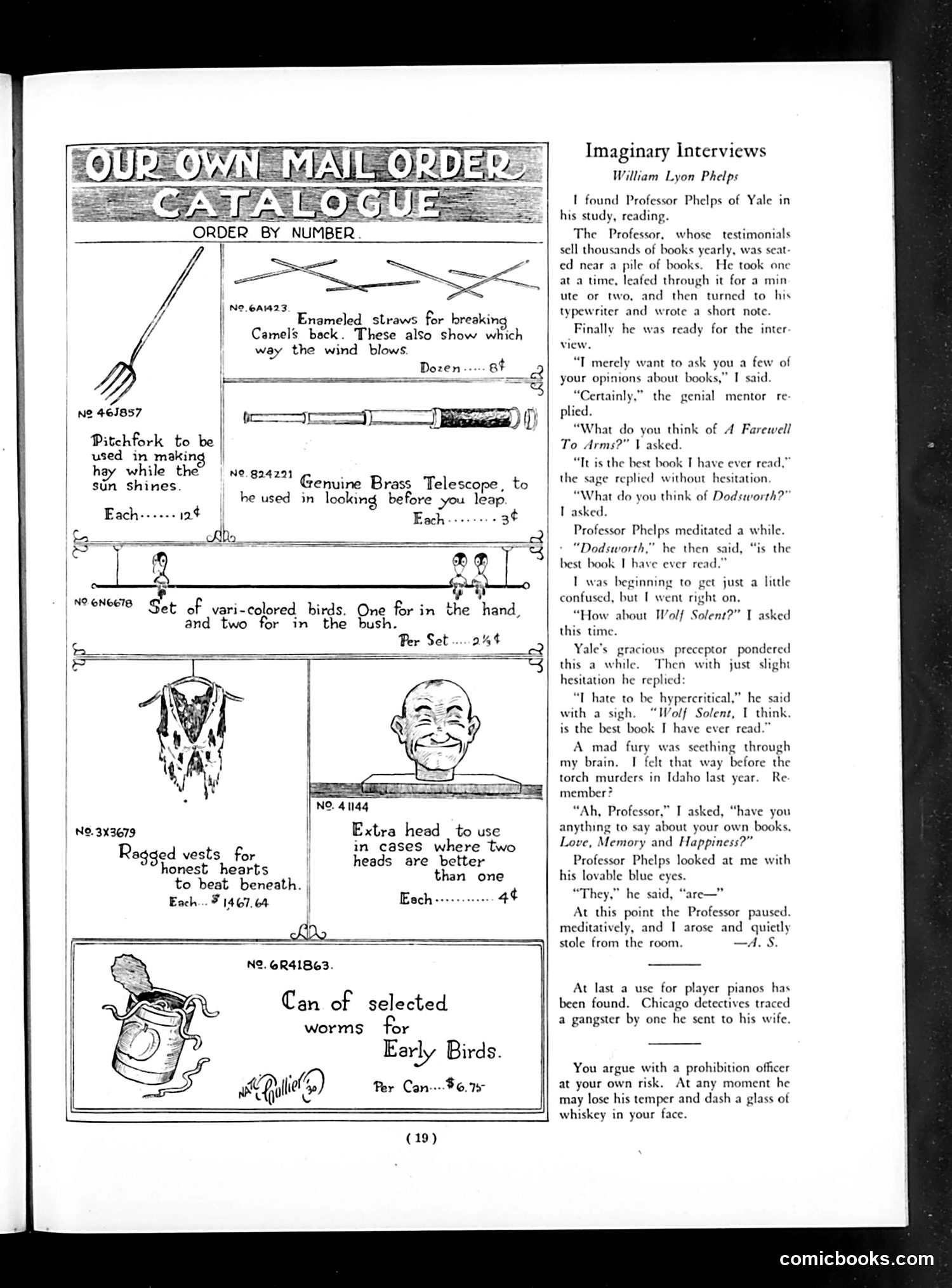
Explanation for Modern Readers This page contains two distinct sections: Left side—"Our Own Mail Order Catalogue": A humorous fake advertisement catalog parodying mail-order businesses popular in the era. The items are absurdist joke products: straws for "breaking Camels back" (referencing the proverb), a pitchfork for "making hay while the sun shines," and a telescope for "looking before you leap"—each item mockingly literalizes common sayings. The "extra head" for cases "where two heads are better than one" is the most direct visual gag. These mock products satirize how mail-order catalogs promise practical solutions to everyday problems. Right side—"Imaginary Interviews: William Lyon Phelps": A satirical interview with Yale professor William Lyon Phelps, a real literary authority whose book endorsements were commercially valuable. The joke: when asked his opinion on different novels (*A Farewell to Arms*, *Dodsworth*, *Wolf Solent*), he calls each "the best book I have ever read"—exposing him as an indiscriminate praiser, undermining his credibility as a serious critic. The interview ends with brief unrelated jokes about player pianos and Prohibition.
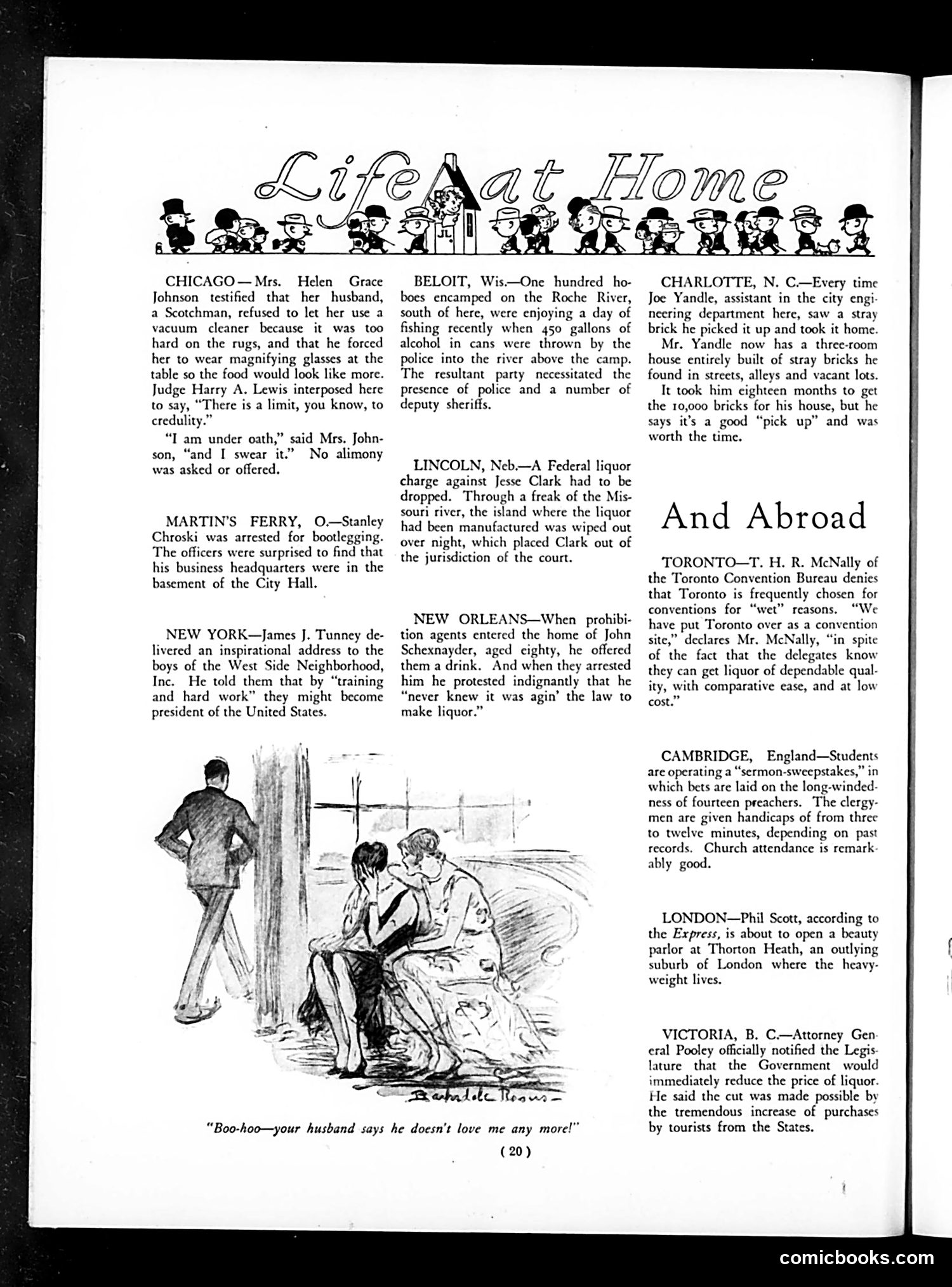
"Life at Home and Abroad" - Prohibition-Era Satire This page satirizes American life during Prohibition (1920-1933) through humorous anecdotes. The recurring theme is alcohol and legal absurdity: Domestic stories mock marriage troubles and petty crime—a Scottish husband's stinginess, a bootlegger operating from City Hall's basement, and a man compulsively collecting stray bricks. Prohibition enforcement is ridiculed through ironies: 450 gallons of confiscated alcohol thrown into a river accidentally creates a party; an island liquor operation vanishes overnight, eliminating the defendant's jurisdiction; an elderly man didn't know making liquor was illegal. The cartoon shows a woman (likely a mistress or rival) confronting a seated couple with "your husband says he doesn't love me anymore!"—illustrating domestic discord. International section reveals Prohibition's absurd consequences: Toronto Convention Bureau admits liquor quality attracts delegates; Cambridge students bet on sermon lengths; a boxer opens a beauty parlor; Canada reduces liquor prices due to American tourist purchases. The satire suggests Prohibition's enforcement was chaotic, easily circumvented, and economically counterproductive.
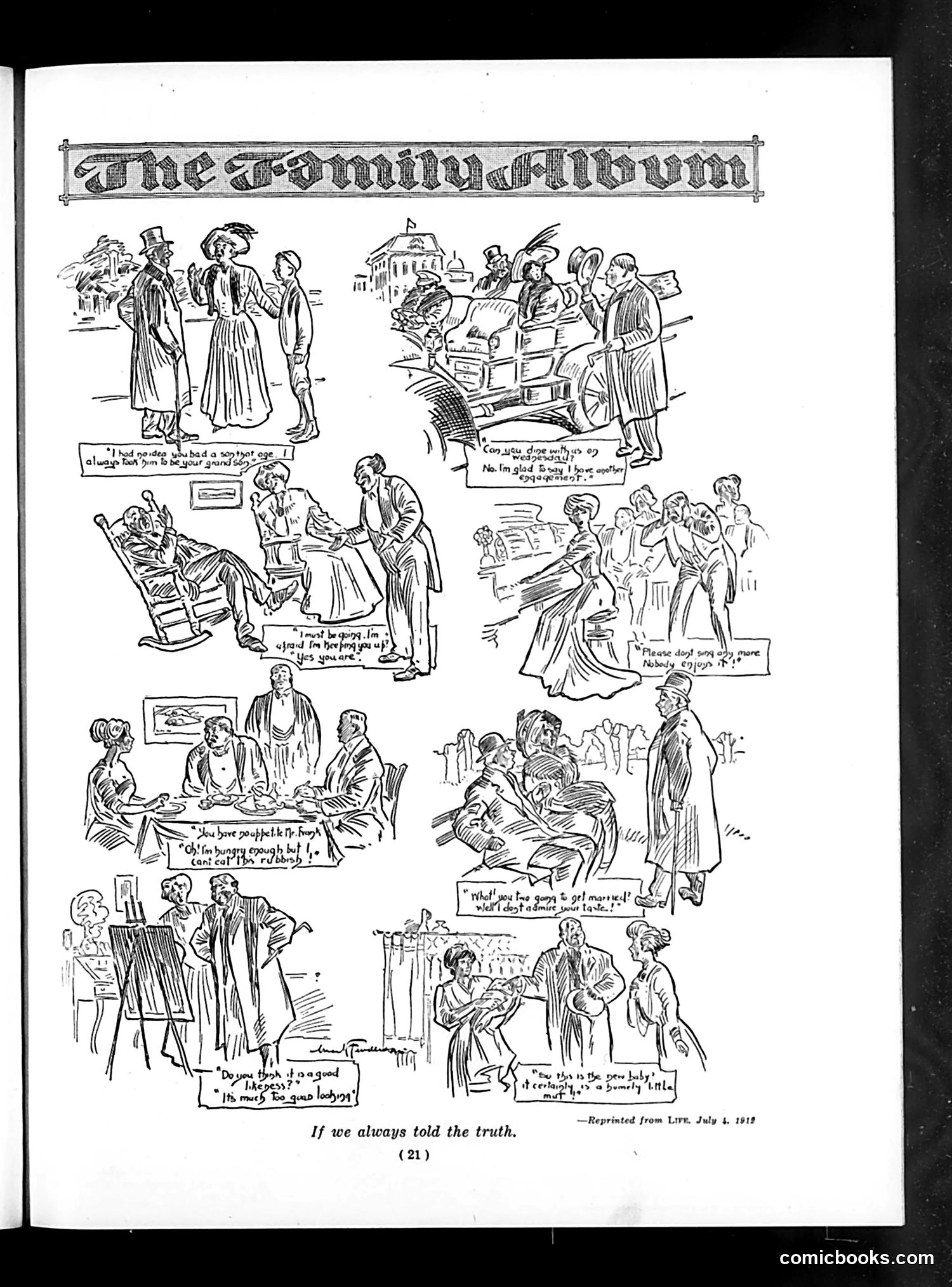
"If We Always Told the Truth" - Life Magazine, July 1919 This comic strip satirizes social hypocrisy by showing what would happen if people always spoke their minds honestly. Each panel depicts a common social scenario—interactions between wealthy and working-class people, domestic situations, romantic encounters, and public gatherings—with characters bluntly stating their true (usually unflattering) thoughts instead of maintaining polite pretense. The satire targets class divisions, gender relations, and social pretense in post-WWI America. Characters voice selfish, insulting, or mercenary motivations they'd normally conceal: people reveal they're motivated by money or status rather than genuine feeling; women admit to marriage calculations; the wealthy show disdain for workers. The point is that civilized society depends on people *not* telling the truth—that politeness masks fundamentally dishonest, self-interested behavior.
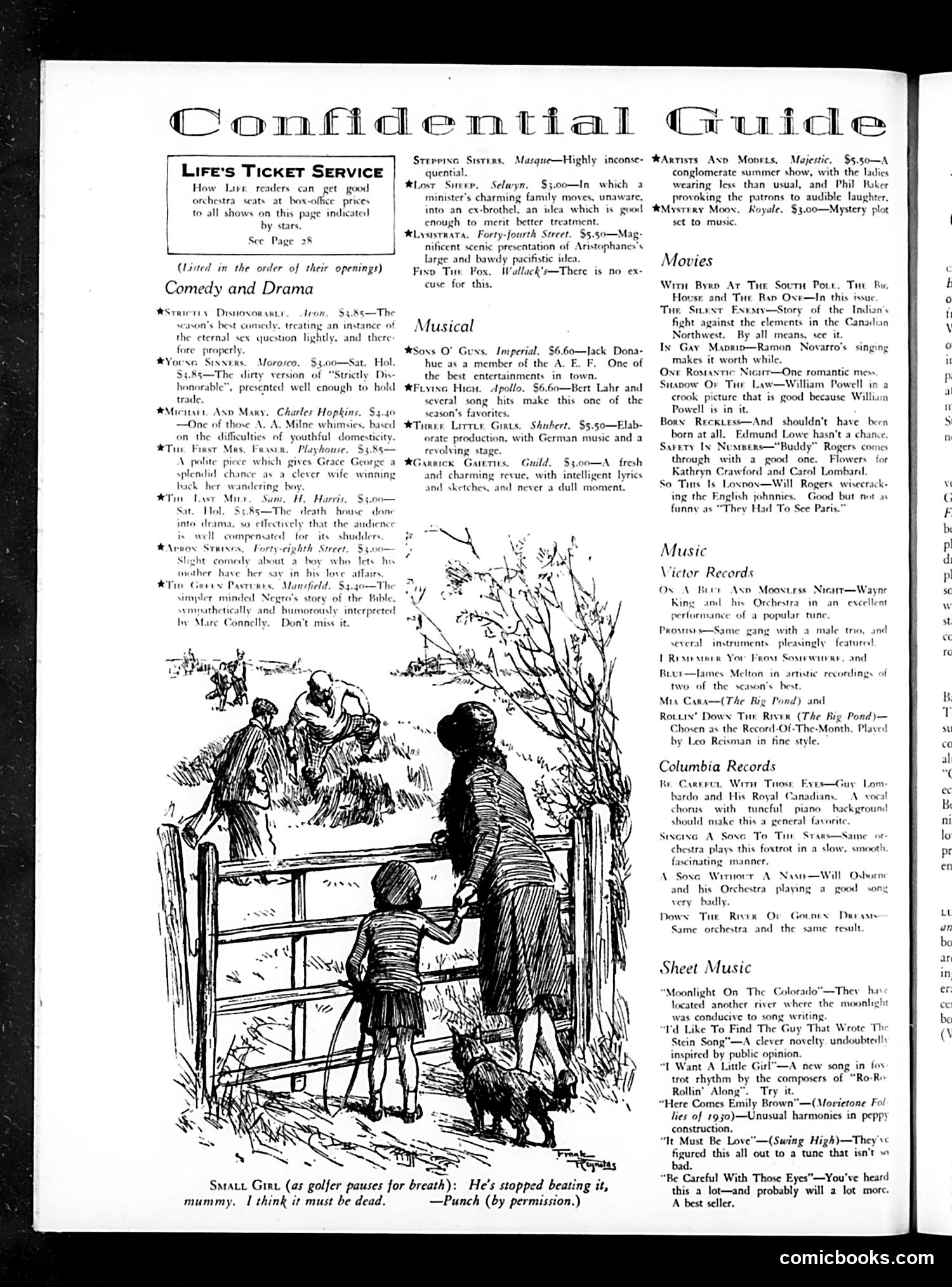
Analysis of Life Magazine Page This is primarily a theater and entertainment guide rather than a political cartoon page. The small cartoon at bottom shows a child telling her mother a golfer "stopped beating it"—the child has misunderstood, thinking the golfer killed something, when he actually just stopped his swing. It's gentle domestic humor from *Punch* magazine. The page's main content lists Broadway shows, musicals, movies, and records with brief critical reviews. Notable entries include references to Jack Donahue in "Sons O' Guns," Bert Lahr in "Flying High," and William Powell in a crime film. The reviews are snappy and opinionated—dismissing "Wallack's" with "There is no excuse for this." This represents 1920s commercial entertainment culture, showing what sophisticated urban audiences considered worthy of attention and modest expense during the Jazz Age.
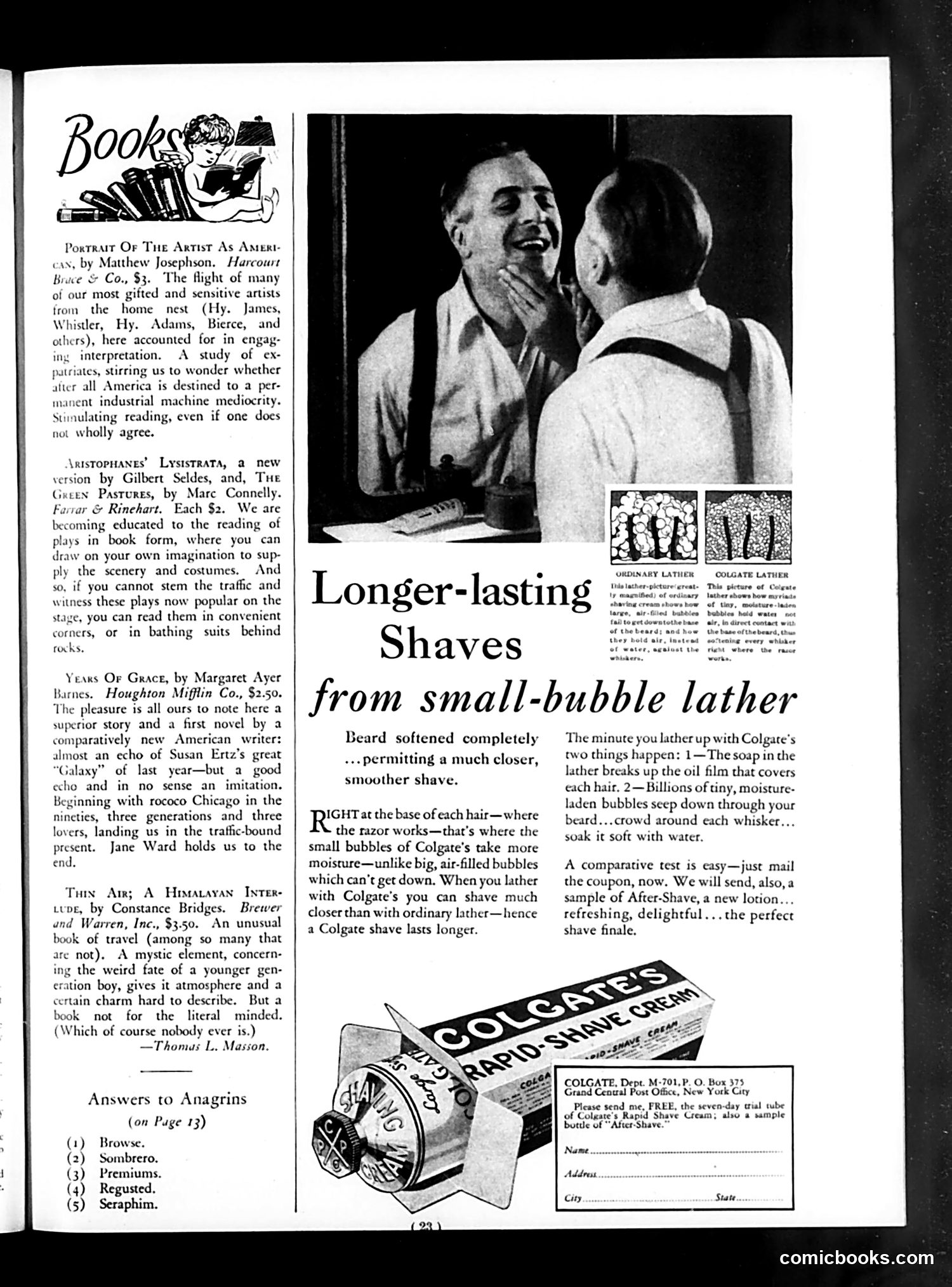
Page Analysis This page is primarily advertising and book reviews, not political satire. The left column reviews five books, including Matthew Josephson's *Portrait of the Artist as American*, which discusses why major American artists (James, Whistler, Adams, Bierce) emigrated—suggesting America's industrial mediocrity drove cultural talent abroad. This reflects 1920s-30s debates about American artistic vitality. The right side is a Colgate shaving cream advertisement disguised as an article. It explains the product's superiority through pseudo-scientific diagrams showing how "small bubbles" penetrate beard hair better than competitors' "big, air-filled bubbles." The accompanying photograph shows two men in what appears to be a barbershop demonstration. There are no political cartoons or satirical figures here. This is a vintage magazine page mixing cultural criticism with product marketing—typical of *Life* magazine's format during this era.
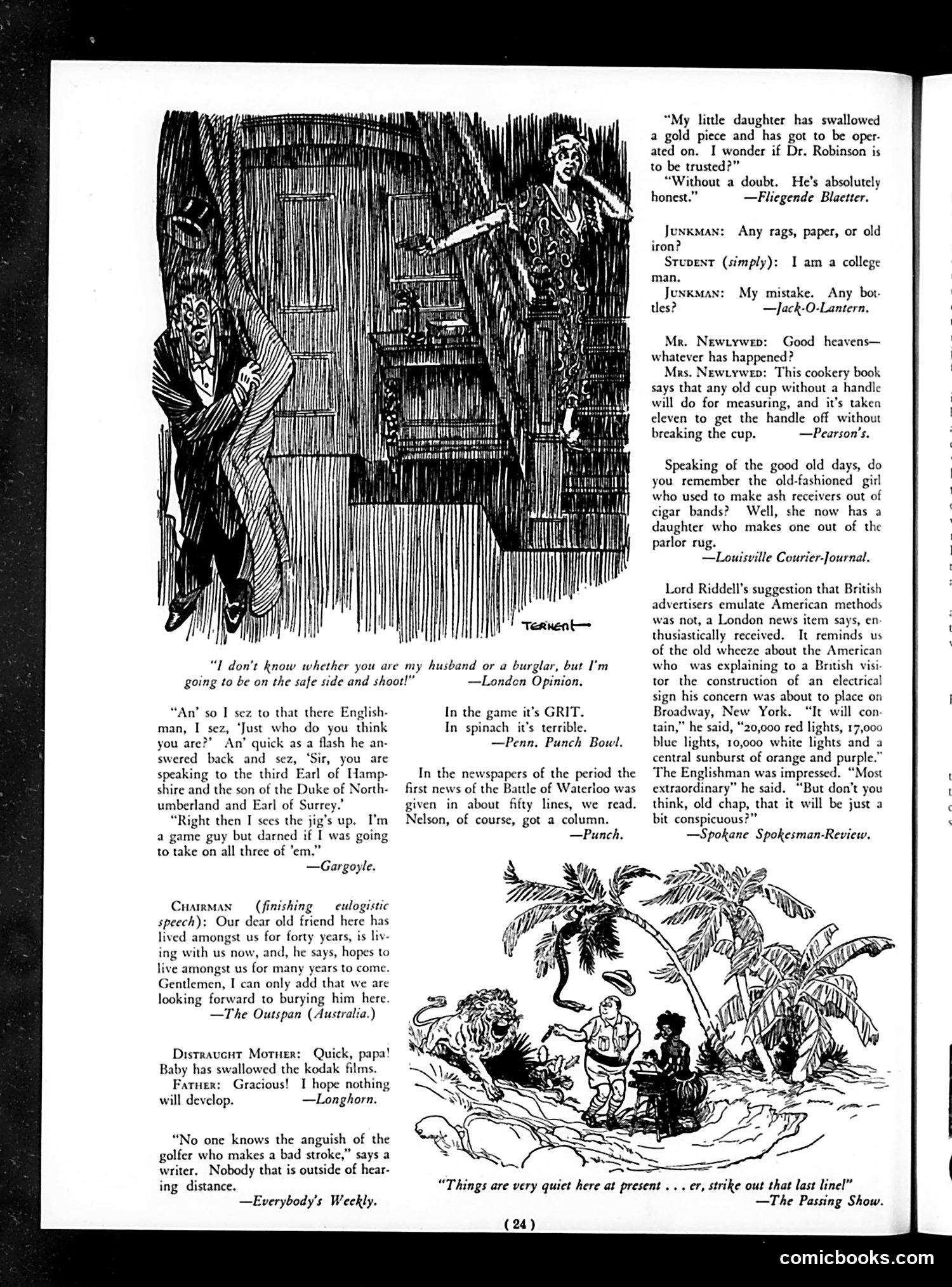
Analysis of Life Magazine Page This page from *Life* magazine collects brief humorous anecdotes and jokes from various sources, rather than featuring a single cartoon. Key humor pieces: The main illustrated cartoon (top left) depicts a burglar confronted by a woman; the joke plays on class anxiety—an American working-class man backs down when the intruder claims aristocratic English titles, assuming someone of high birth must be trustworthy. Other jokes mock contemporary situations: a baby swallowing kodak film (with a pun on "develop"), a wife measuring with a handleless cup per cookbook instructions, and complaints about American advertising excess (20,000+ lights on a Broadway sign). Social context: These pieces reflect early-20th-century anxieties about class, American commercial excess versus British restraint, and domestic mishaps. The humor relies on wordplay, class consciousness, and simple domestic scenarios—typical of period magazine filler content aimed at middle-class readers. The page number (24) suggests this is interior content from a larger issue.
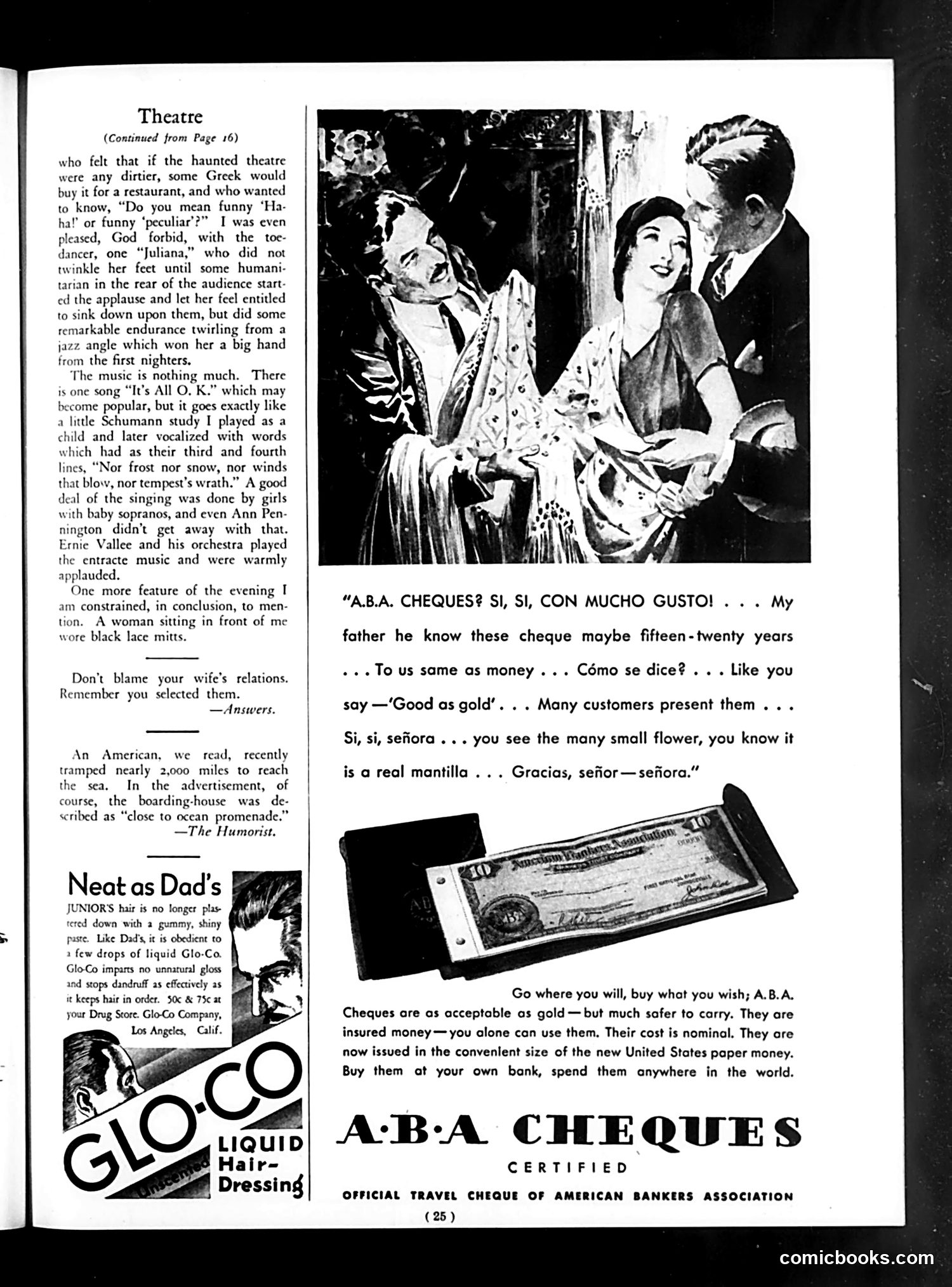
Page Analysis: Life Magazine Theatre Review and Advertisements This page contains a theatre review (continued from prior page) and two advertisements. The theatre review critiques a production, mentioning performers like "Juliana" (a toe-dancer) and Ann Pennington. The critic mocks mediocre music and singing, noting one song resembles a Schumann study. A humorous aside ridicules a woman wearing black lace mitts to the show. The Glo-Co advertisement (left) promotes hair dressing for men, contrasting "Dad's" plastered-down style with modern grooming for juniors. The A.B.A. Cheques advertisement (right, main) features a scene with what appears to be a Spanish or Latin American character in stereotypical dress, speaking in exaggerated accent and broken English about traveler's cheques. This reflects early 20th-century advertising's casual ethnic caricature. The pitch emphasizes cheques as safe, portable "money" acceptable worldwide—practical for American travelers. Both ads target affluent readers able to travel internationally or afford grooming products.
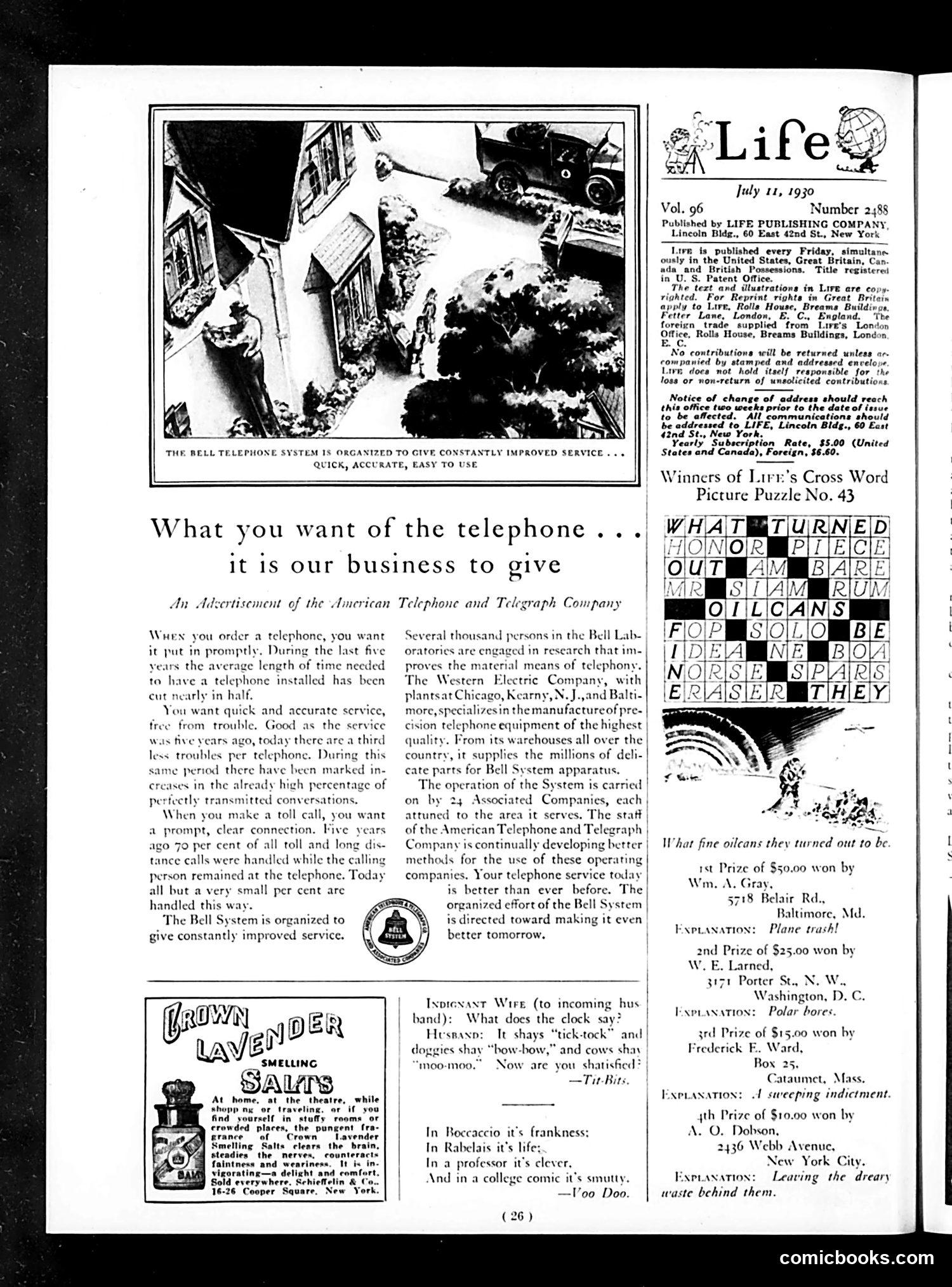
This page is primarily a full-page advertisement for the Bell Telephone System published in Life magazine (July 11, 1930). The ad features an overhead photograph of a busy street with Bell Telephone service trucks and workers, illustrating the company's claim that "the Bell Telephone System is organized to give constantly improved service—quick, accurate, easy to use." The text boasts of concrete improvements in recent years: installation time cut "nearly in half," one-third fewer service troubles, and better long-distance connection handling. The ad emphasizes Bell's infrastructure: thousands of researchers in Bell Laboratories, manufacturing facilities (Western Electric Company), and a network of 24 Associated Companies across the country. The message is corporate self-promotion typical of 1930s advertising—demonstrating progress and technological achievement to reassure consumers of the company's efficiency and commitment. There is no political satire on this page. The supporting content includes humor pieces, a crossword puzzle, product ads (Crown Lavender Salts), and reader-submitted jokes—standard Life magazine filler material.
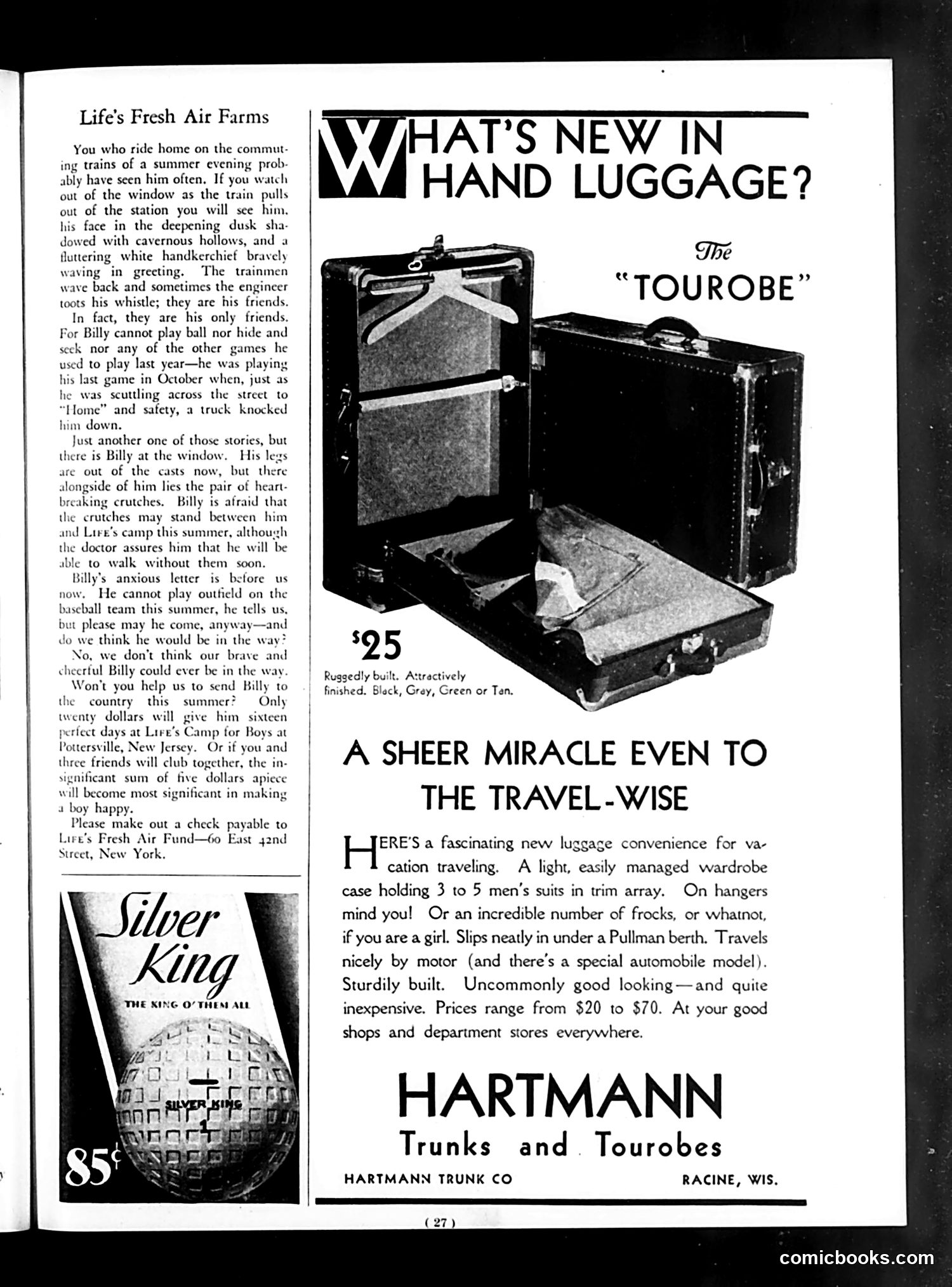
Life Magazine Page Analysis This page mixes charitable appeal with advertising. The left column features "Life's Fresh Air Farms," a fundraising pitch for a boys' camp. It tells the story of Billy, a child injured by a truck who can no longer play baseball but desperately wants to attend camp. The appeal asks readers to donate $20 (or $5 from four friends) to send Billy to Life's Camp for Boys in New Jersey for sixteen days. The right side advertises the "Tourobe," a new travel wardrobe case by Hartmann Trunk Company (priced $20-$70). It promises convenient vacation packing—holding multiple suits or dresses and fitting under Pullman train berths. For modern readers: This reflects early-20th-century American life before comprehensive social safety nets. Charitable organizations and magazine readers directly funded youth welfare. The adjacent luggage ad shows leisure travel was becoming accessible to middle-class Americans, contrasting sharply with Billy's struggle with disability and limited opportunities.
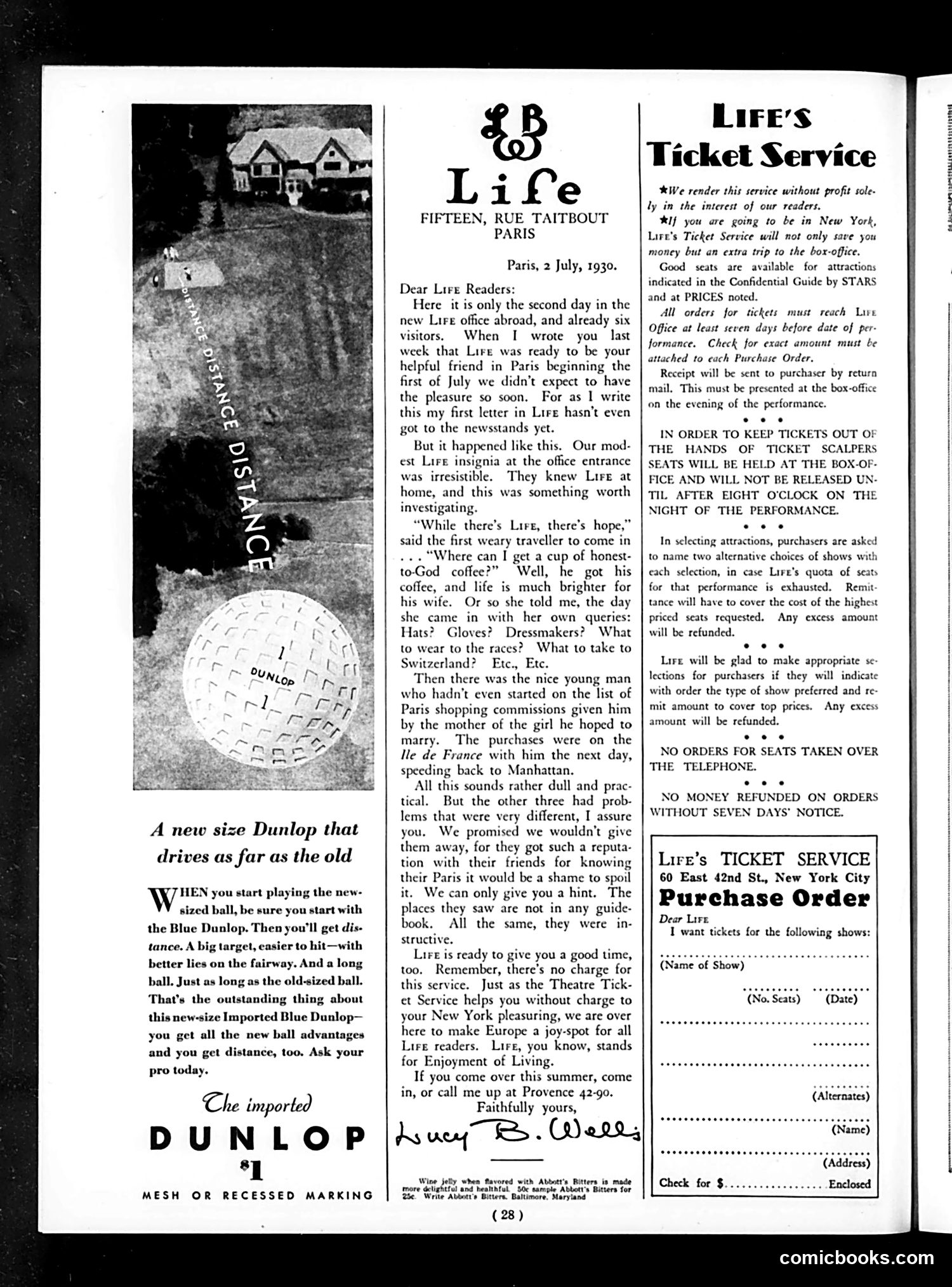
Life Magazine Page Analysis (1930) This page combines advertising with editorial content from Life's newly opened Paris office. The Dunlop Golf Ball Ad (left side): A straightforward advertisement for a new "imported Blue Dunlop" golf ball, emphasizing that the smaller new-size ball still delivers distance comparable to the old larger ball. The ad targets golfers concerned about equipment performance standards changing. The Editorial Letter (center): Written by someone at Life's Paris bureau, it humorously describes the office's first days—six American visitors arriving seeking practical help (directions, shopping advice, restaurant recommendations) and romantic intrigue. The tone suggests Life positions itself as a helpful travel guide for American tourists and expatriates abroad. Life's Ticket Service (right): An advertisement for the magazine's New York ticketing service, offering Broadway/theater seats without markup. It establishes rules preventing scalping and requiring advance notice for cancellations. The page reflects 1930s travel culture—when Paris was a major American destination and Life served affluent readers seeking both practical tourism advice and entertainment access.
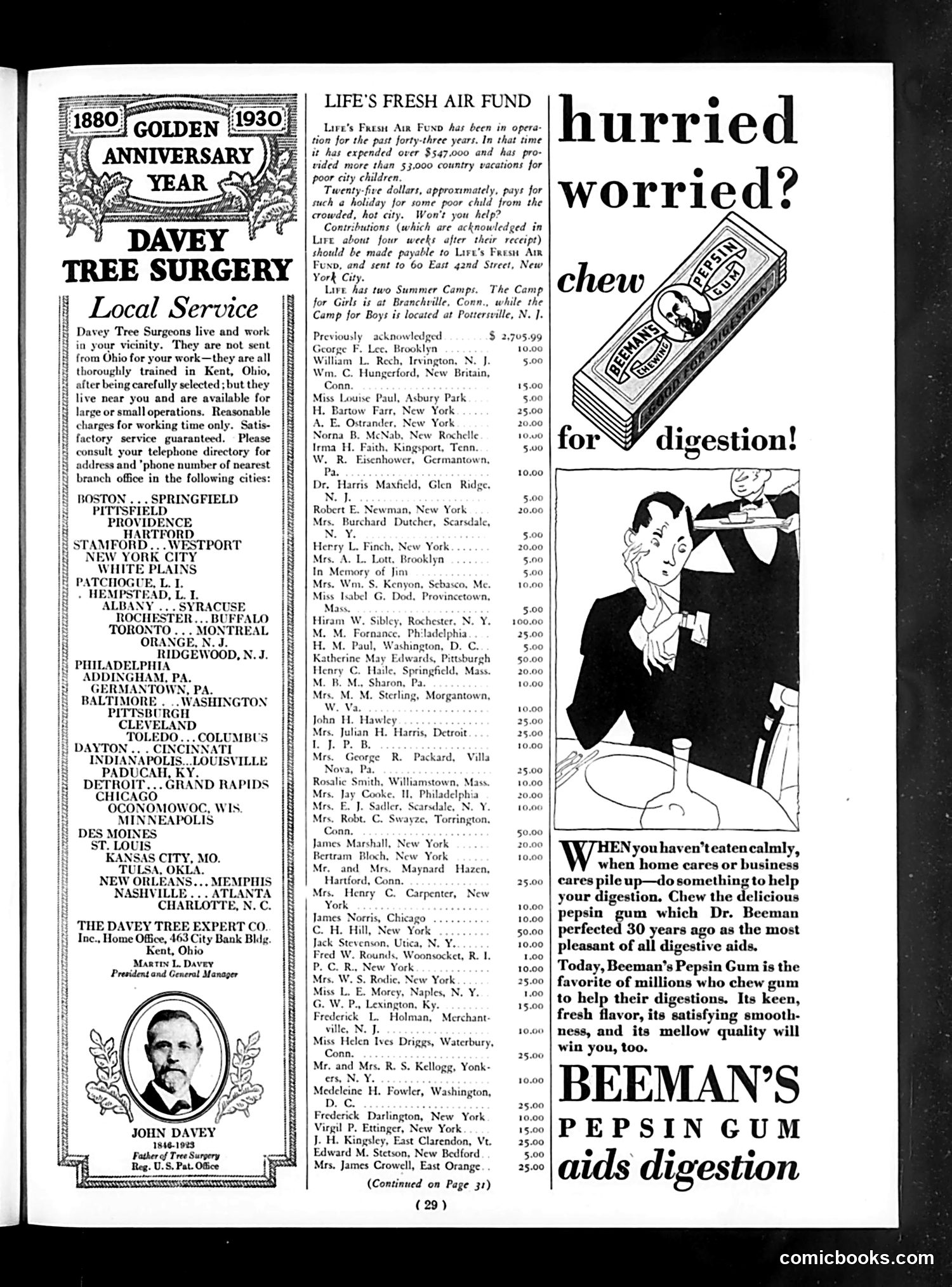
Page Analysis: Life Magazine Advertisement Section This page is primarily advertisements and charitable fundraising, not political satire. Left side: Davey Tree Surgery company ad (1880-1930 Golden Anniversary) listing branch locations and promoting their tree care services. Center: Life's Fresh Air Fund solicitation—a legitimate charity that provided summer camp vacations for poor urban children. The text lists donor contributions; notably absent is any satirical commentary. Right side: Beeman's Pepsin Gum advertisement featuring a cartoon of a worried man clutching his stomach. The ad claims the gum aids digestion and has been "the most pleasant of all digestive aids" for 30 years. The "satire" here is minimal—the worried man's exaggerated distress is typical advertising humor, not political commentary. The juxtaposition of charitable giving with consumer product ads reflects 1920s-30s magazine economics rather than editorial satire. This appears to be a standard revenue page mixing ads with public-interest announcements.
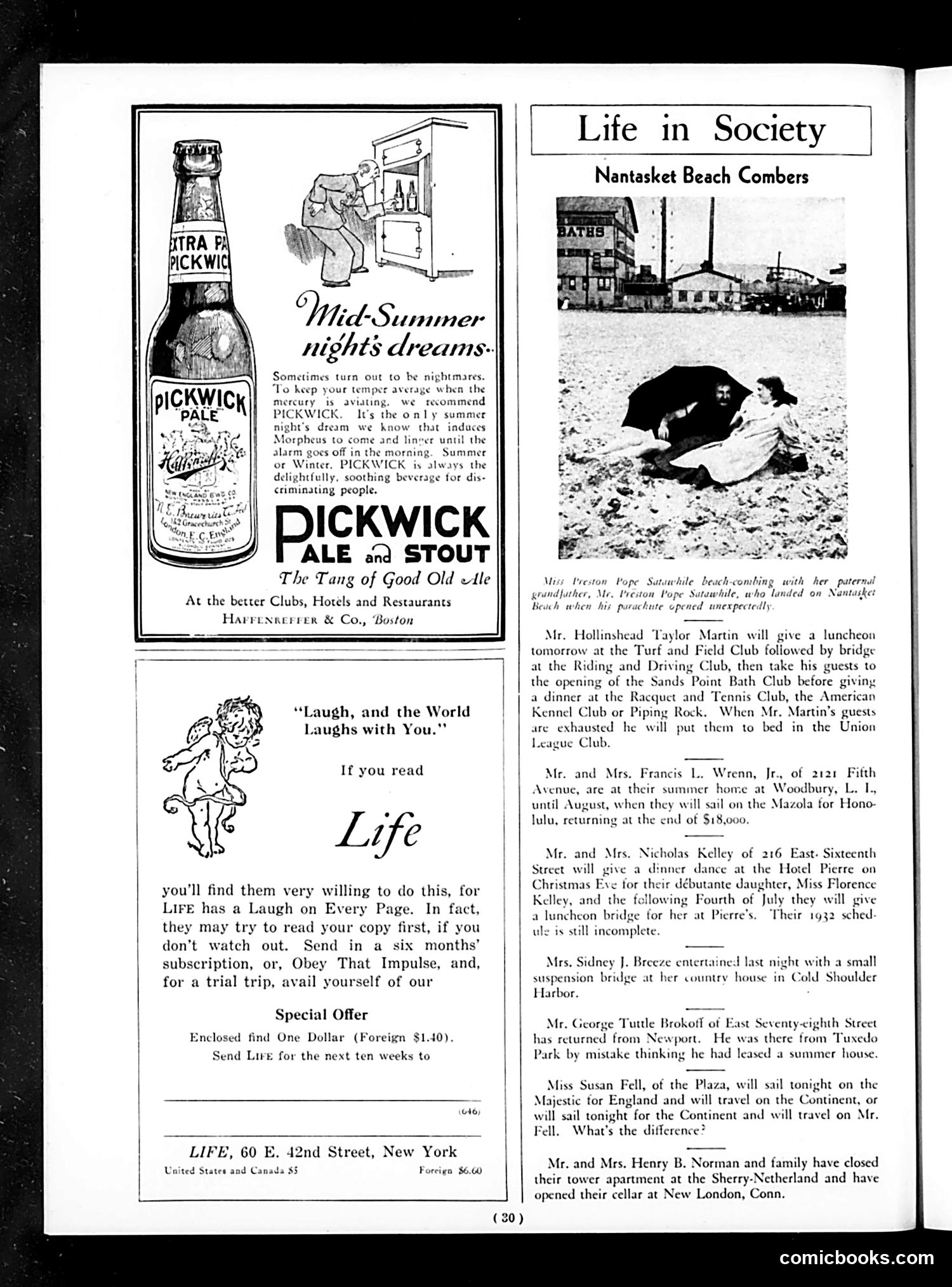
Life Magazine Page Analysis This page contains two distinct sections: Left side: A Pickwick Ale advertisement using humor about summer heat and insomnia—the drink promises to help you sleep through hot nights. The copy plays on the "Morpheus" (sleep god) reference and positions the beer as a "discriminating" choice. Right side: A society gossip column with satirical undertones. The humor mocks the wealthy elite's leisure activities and frivolous schedules. Notable examples: - A woman "beach-combing" with her grandfather who "landed on Nantasket Beach when his parachute opened unexpectedly"—suggesting accidental arrival rather than planned leisure - A man's exhaustingly packed social calendar ending with being "put to bed in the Union League Club" - A woman entertaining with a "suspension bridge" at her country house—absurdist comedy - A man who went to Newport but accidentally came from Tuxedo Park The satire mocks upper-class pretension, conspicuous consumption, and the triviality of their social concerns during what appears to be the 1930s Depression era.
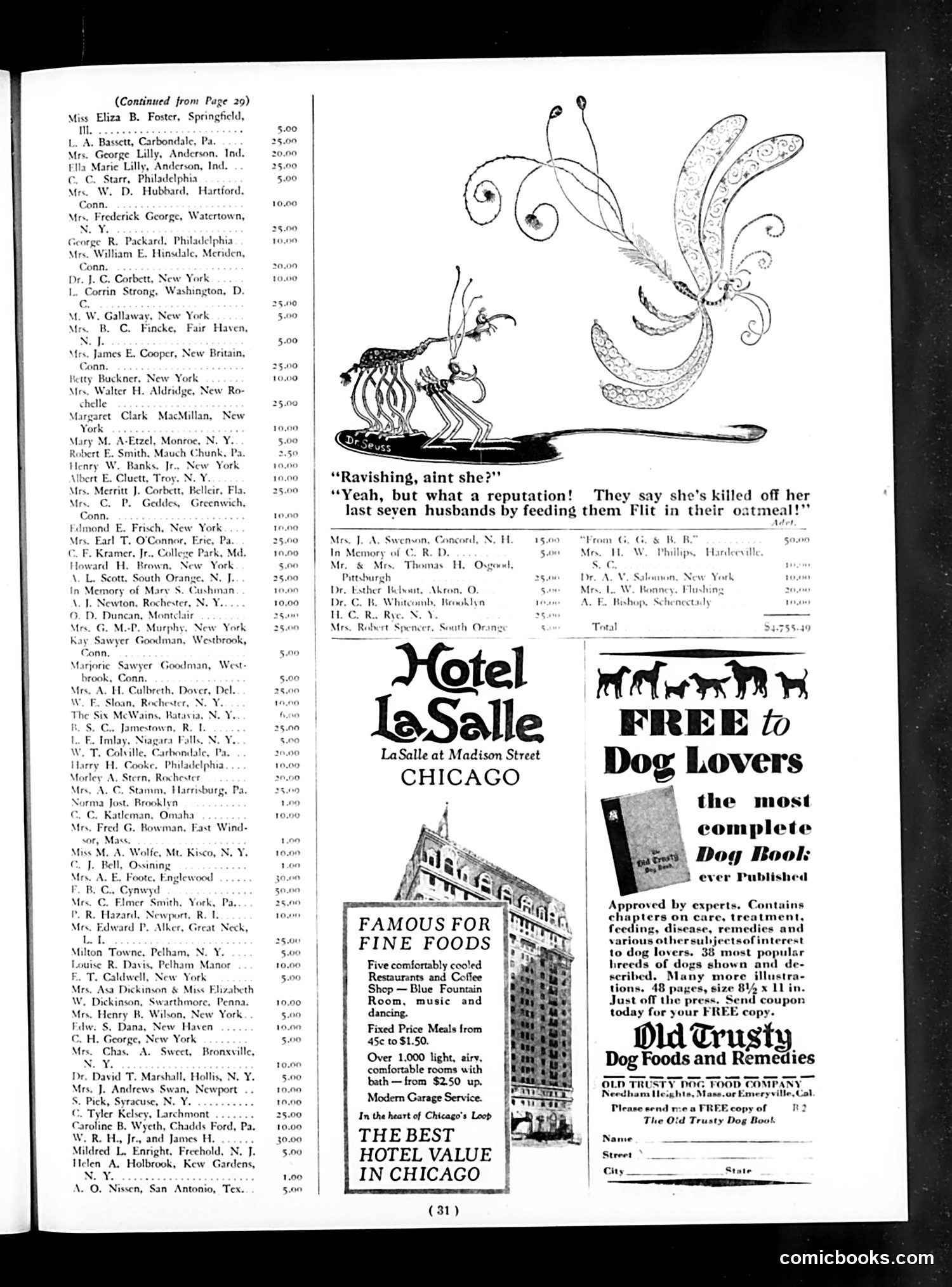
Life Magazine Page Analysis This page is primarily a donor/contribution list (continued from page 29), showing names and monetary amounts contributed to an unspecified charitable cause. The amounts range from $1 to $28. The page contains one cartoon depicting a woman and man discussing a female character. The man says "Ravishing, ain't she?" and the woman replies with dark humor: "Yeah, but what a reputation! They say she's killed off her last seven husbands by feeding them Flit in their oatmeal!" The joke references Flit, a commercial insecticide brand heavily advertised in early 20th-century publications. The satire combines: - A gossipy conversation about a woman's attractiveness versus her murderous reputation - Dark comedy suggesting she poisoned husbands using household pest spray mixed into food - Contemporary product placement/awareness (Flit was ubiquitous in advertising) The cartoon's humor relies on readers recognizing Flit as a real, commonly-used product, making the poisoning scenario darkly absurd. The remainder of the page contains hotel and dog book advertisements.
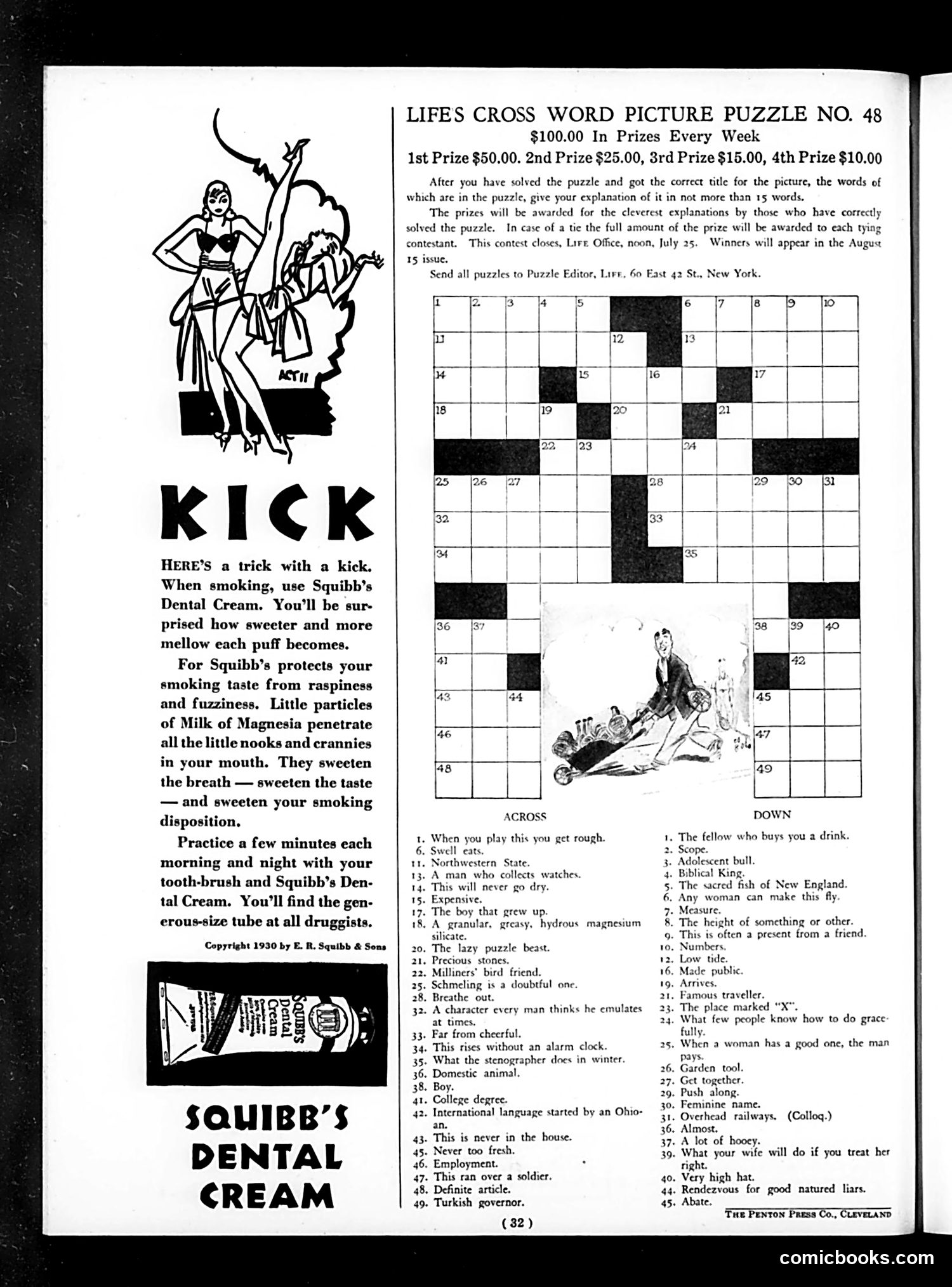
Explanation for Modern Readers This page contains a vintage advertisement for Squibb's Dental Cream (1930) and an unrelated crossword puzzle contest from *Life* magazine. The ad's humor lies in its absurd claim that toothpaste improves the *smoking experience*—making cigarettes taste "sweeter and more mellow." This reflects 1930s attitudes when smoking was normalized and heavily marketed, with manufacturers making dubious health claims. The ad promises that Milk of Magnesia in the toothpaste will protect smokers' taste and freshen breath, framing dental care as enhancing, rather than discouraging, smoking. By modern standards, this is shocking: we now know smoking damages teeth and health. The ad reveals how differently cigarettes were perceived then—as a pleasure to be enhanced rather than a health hazard to be minimized. The crossword puzzle is a separate contest element, unrelated to the advertisement.
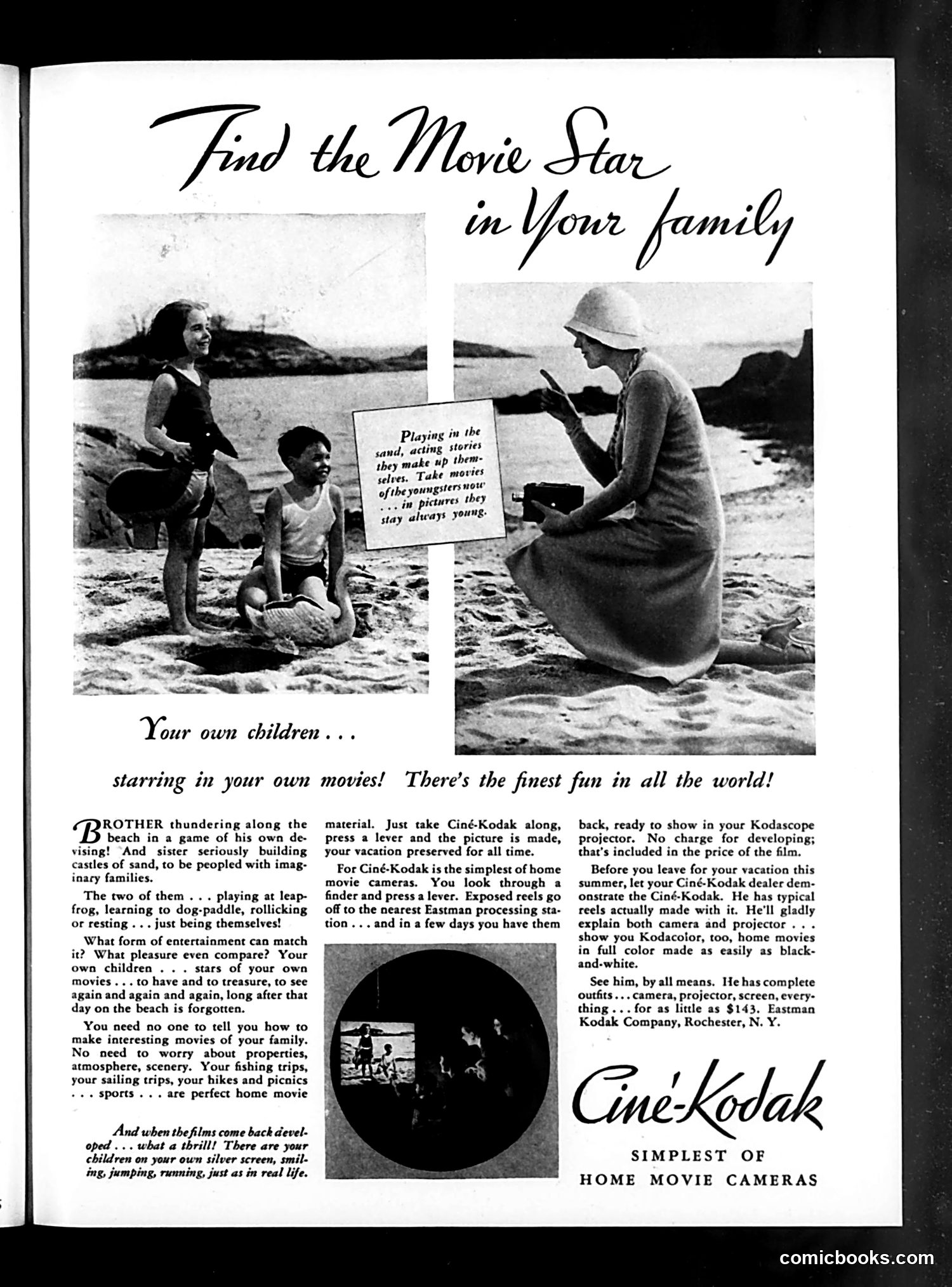
Analysis This is a Kodak advertisement, not political satire. It promotes the Ciné-Kodak home movie camera to middle-class American families. The page shows two photographs of children playing on a beach—a boy and girl engaged in innocent summer activities. The ad's pitch is straightforward: parents should film their own children to preserve family memories. The tagline "Find the Movie Star in Your Family" frames ordinary kids as entertainers worthy of documentation. The humor is gentle and aspirational rather than satirical. It appeals to parents' desire to preserve youth and childhood moments before they're forgotten. The text emphasizes simplicity (just "press a lever"), affordability (starting at $143), and convenience (Kodak handles developing). This reflects 1930s-40s consumer culture promoting home technology as a way to capture and relive domestic life—a notably nostalgic message targeting families seeking to memorialize ordinary moments as entertainment and keepsakes.
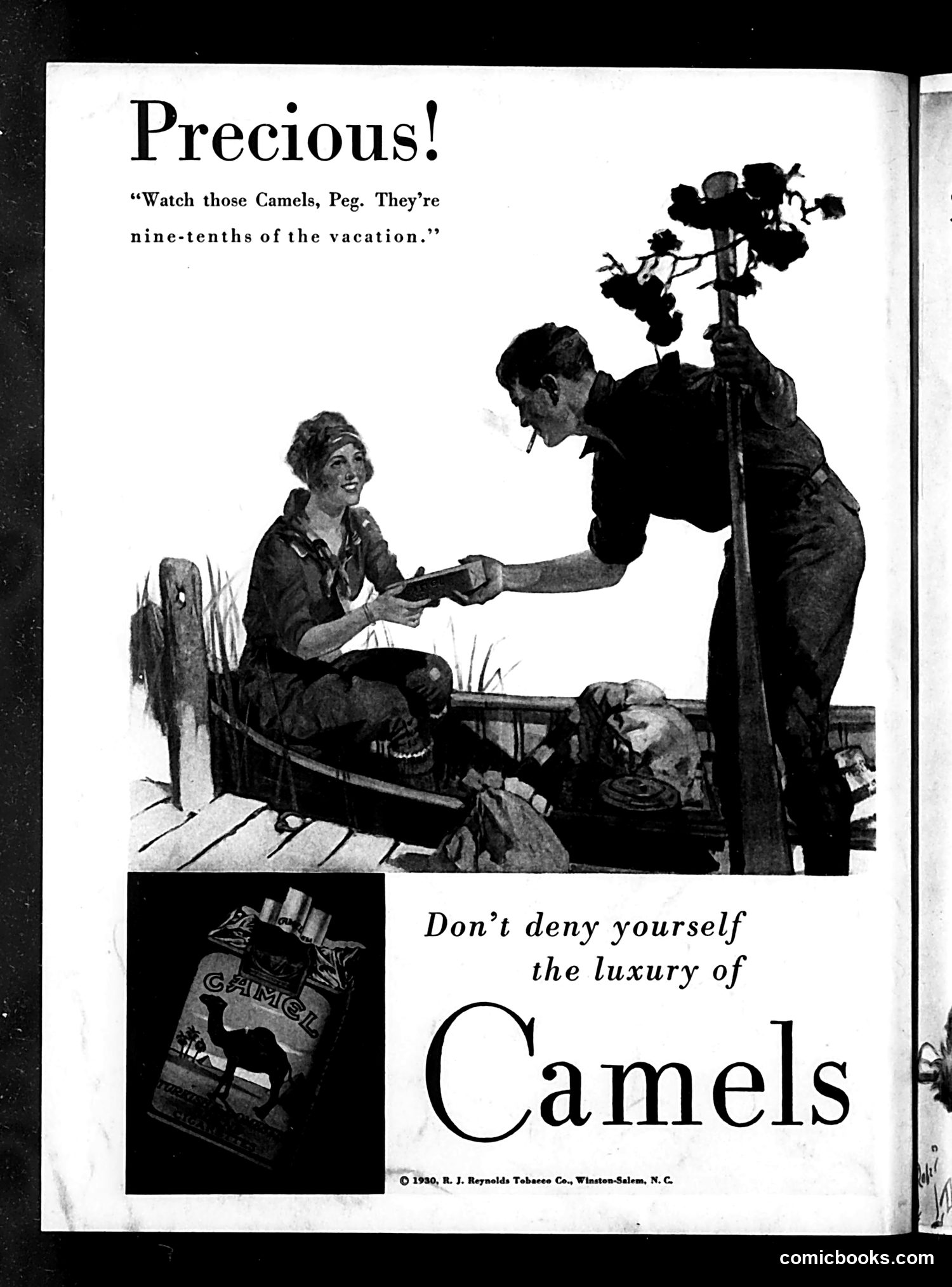
Analysis This is a Camel cigarette advertisement from 1930, not political satire. The "joke" is a pun playing on the double meaning of "Camels": the animal and the cigarette brand. The scene shows a couple on vacation near actual camels. The man's dialogue suggests that Camel cigarettes are "nine-tenths of the vacation"—meaning smoking them is the best part of their trip, more valuable than the exotic animals themselves. The ad's message is straightforward marketing: luxurious smoking enhances leisure time. The humor relies on the visual incongruity of literal camels appearing in a cigarette ad's tagline. For modern readers: this reflects 1930s advertising's direct health claims about tobacco (presented as a "luxury") before smoking's dangers were widely acknowledged or regulated.