life
Life — July 18, 1930
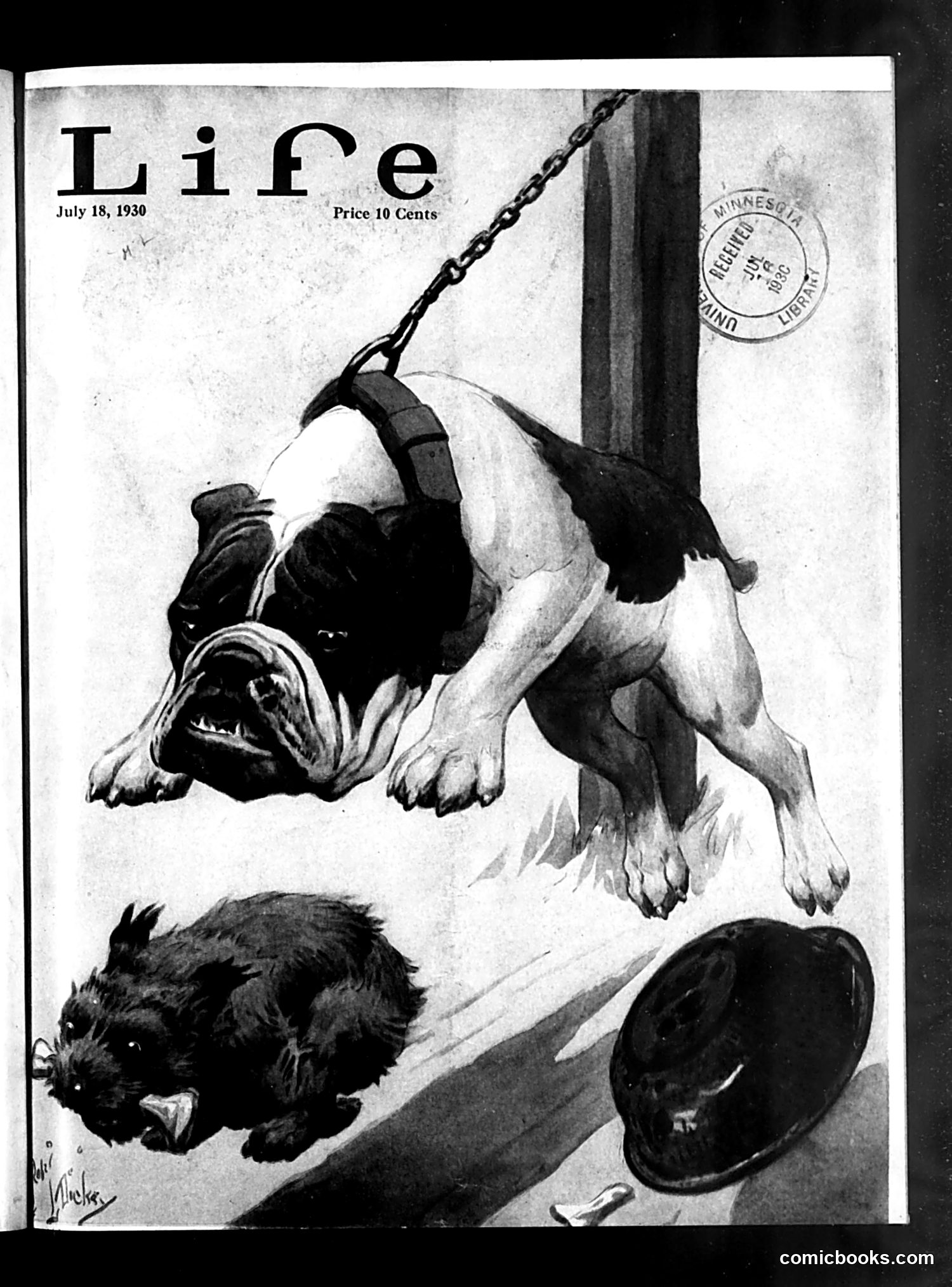
Life Magazine Cover, July 18, 1929 This cover depicts a bulldog suspended by a chain, straining downward toward a small dark animal (appears to be a rat or similar creature) on the ground, with an overturned bowl nearby. The image likely satirizes the stock market crash of October 1929, which occurred just months after this July issue. The bulldog—representing American economic power or investors—is shown restrained and unable to reach its prey (financial opportunities or profits). The overturned bowl suggests depleted resources or failed expectations. The overall message appears to be a dark comedic warning about impending economic danger: despite America's strength, external forces or circumstances are preventing it from achieving its goals, foreshadowing the Great Depression's devastating impact.
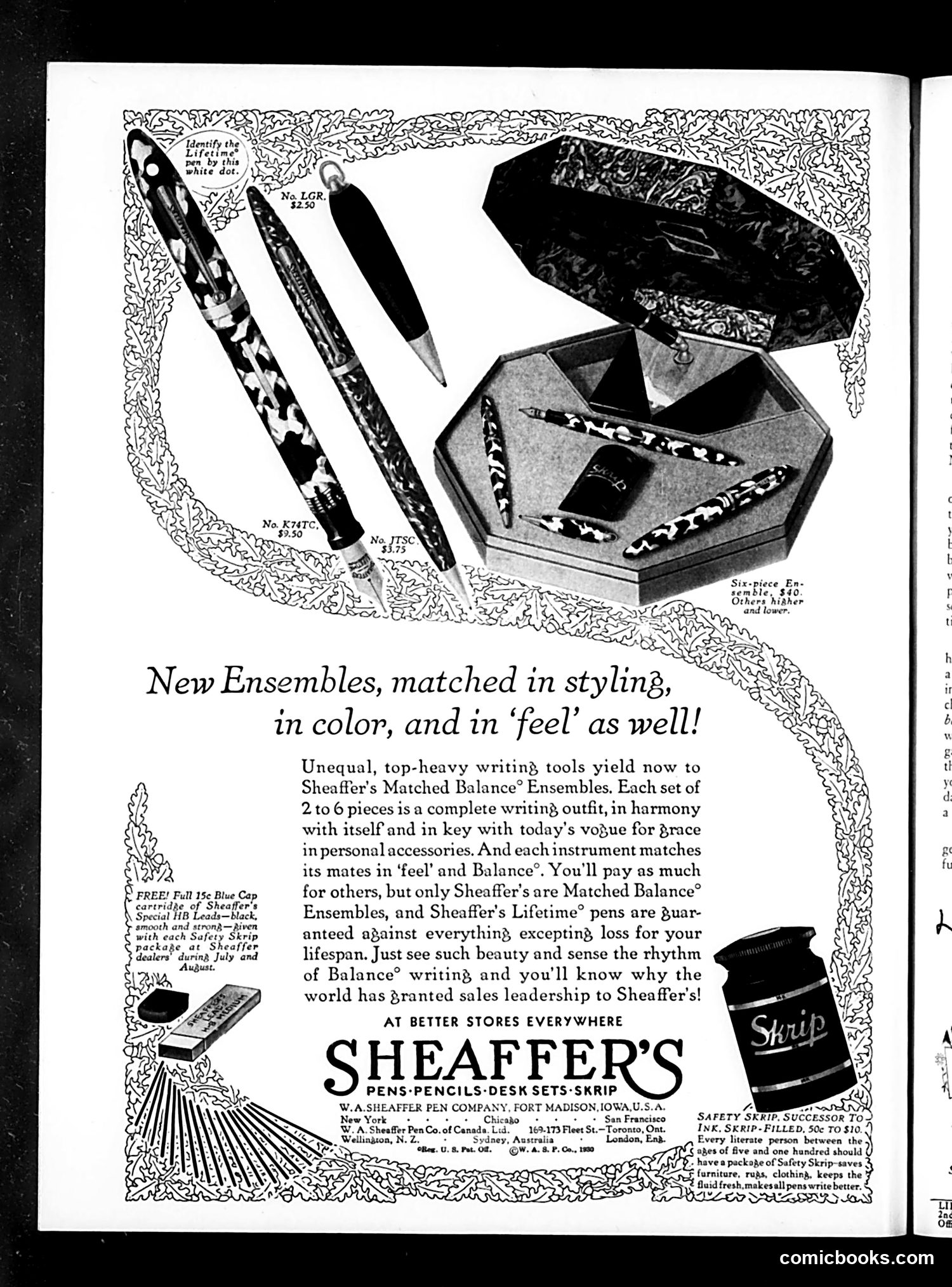
Analysis This is primarily a Sheaffer's pen and pencil advertisement, not a political cartoon or satire. The page advertises "Matched Balance Ensembles" — coordinated writing instrument sets that combine pens, pencils, and desk accessories in matching styles and colors. The ad emphasizes that these matched sets represent a shift from "unequal, top-heavy writing tools" to harmonious, balanced designs. It appeals to consumers' aesthetic sensibilities and the appeal of coordinated accessories—a modern concept at the time. The decorative border and small illustrations of writing implements are purely ornamental. There is no political satire, caricature, or social commentary present. This is straightforward consumer advertising typical of vintage magazine content.
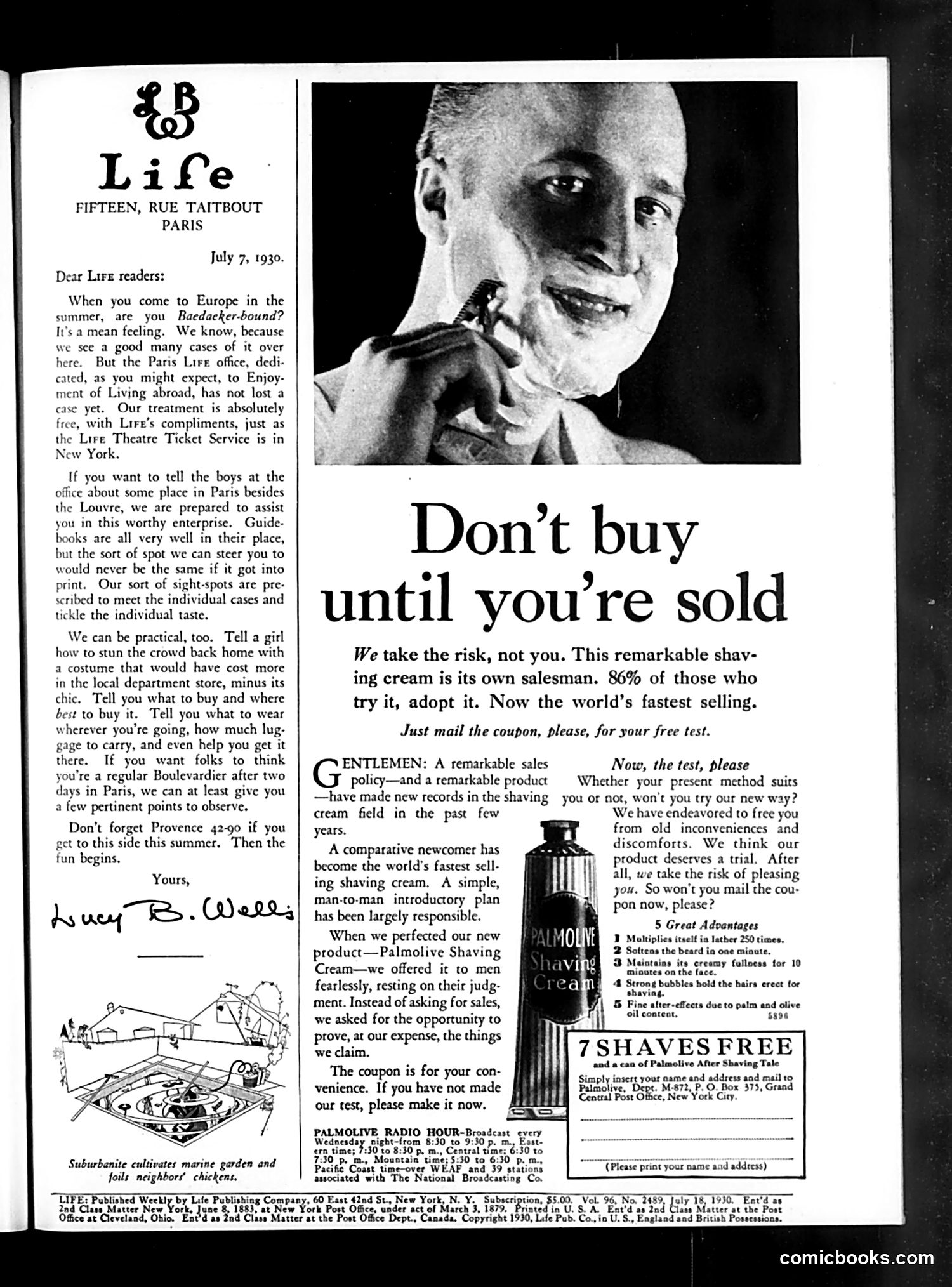
This page is primarily a Palmolive Shaving Cream advertisement, not political satire. The ad features a photograph of a man's face with the headline "Don't buy until you're sold," promoting Palmolive's sales strategy: customers can test the product free before purchasing. The ad claims 86% of trial users adopt the product, calling it "the world's fastest selling" shaving cream. The accompanying text emphasizes the company's confidence in quality—they "take the risk, not you"—and lists seven claimed advantages (better lather, quicker shaves, etc.). A small cartoon at bottom left shows a domestic scene, likely illustrating the product's family appeal or convenience. The page also includes unrelated editorial content from Life magazine's Paris office discussing summer travel in Europe.
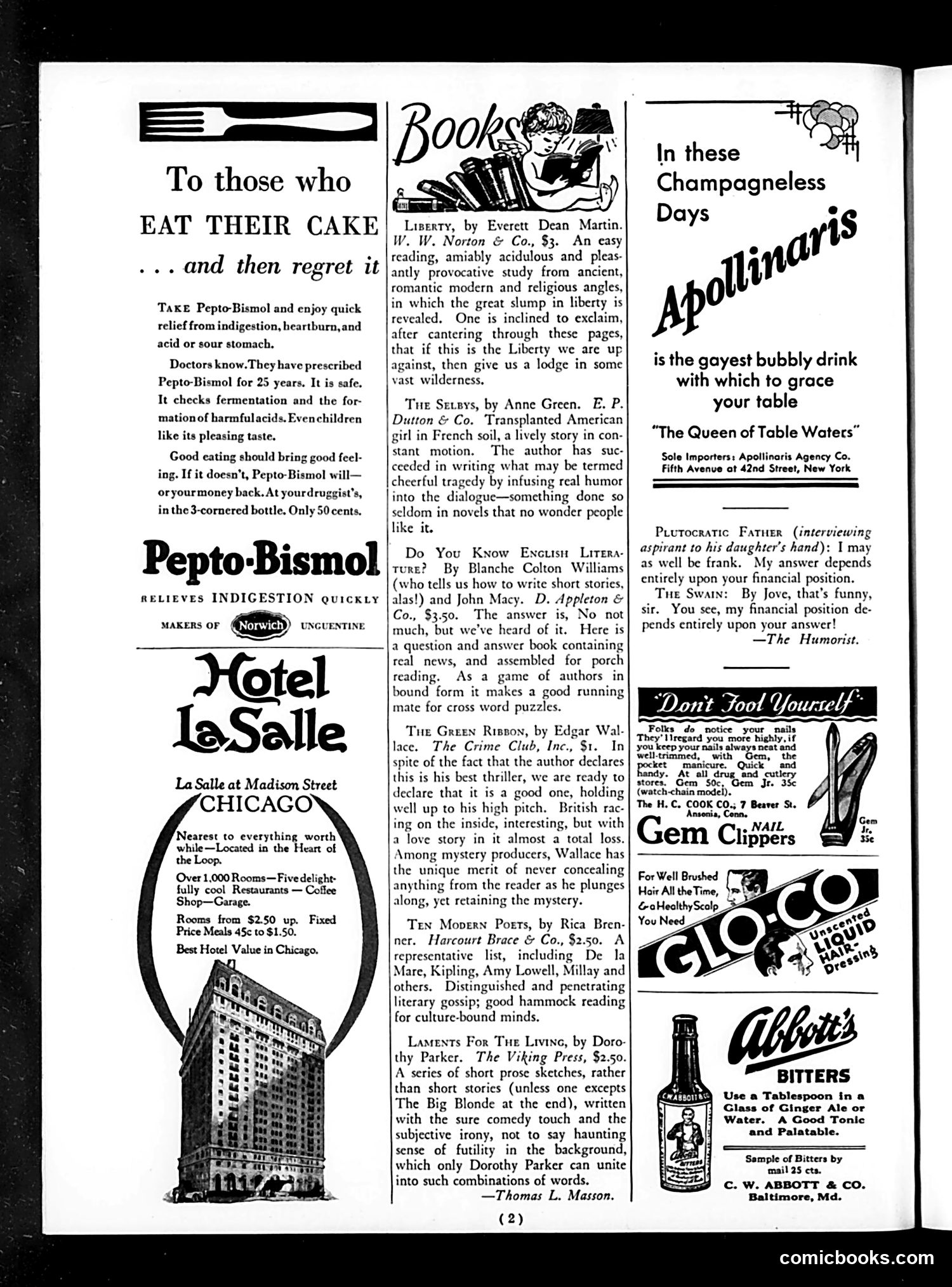
Page Analysis This page is primarily advertising and book reviews, not political cartoons. The content includes: Book Reviews (center column): Reviews of contemporary 1920s-30s literature, including works on liberty, French life, English literature, and modern poetry—typical middlebrow cultural fare of the era. Advertisements (surrounding text): - Pepto-Bismol (digestive aid) - Hotel LaSalle in Chicago - Apollinaris sparkling water - Gem Clippers (nail care) - Gloico hair product - Abbott's Bitters (medicinal tonic) The advertisements reflect period concerns: digestive health, hotel amenities, grooming, and patent medicines marketed as health tonics. There are no political cartoons or caricatures on this page—it's a standard magazine layout mixing literary content with consumer product advertising typical of early 20th-century American magazines.
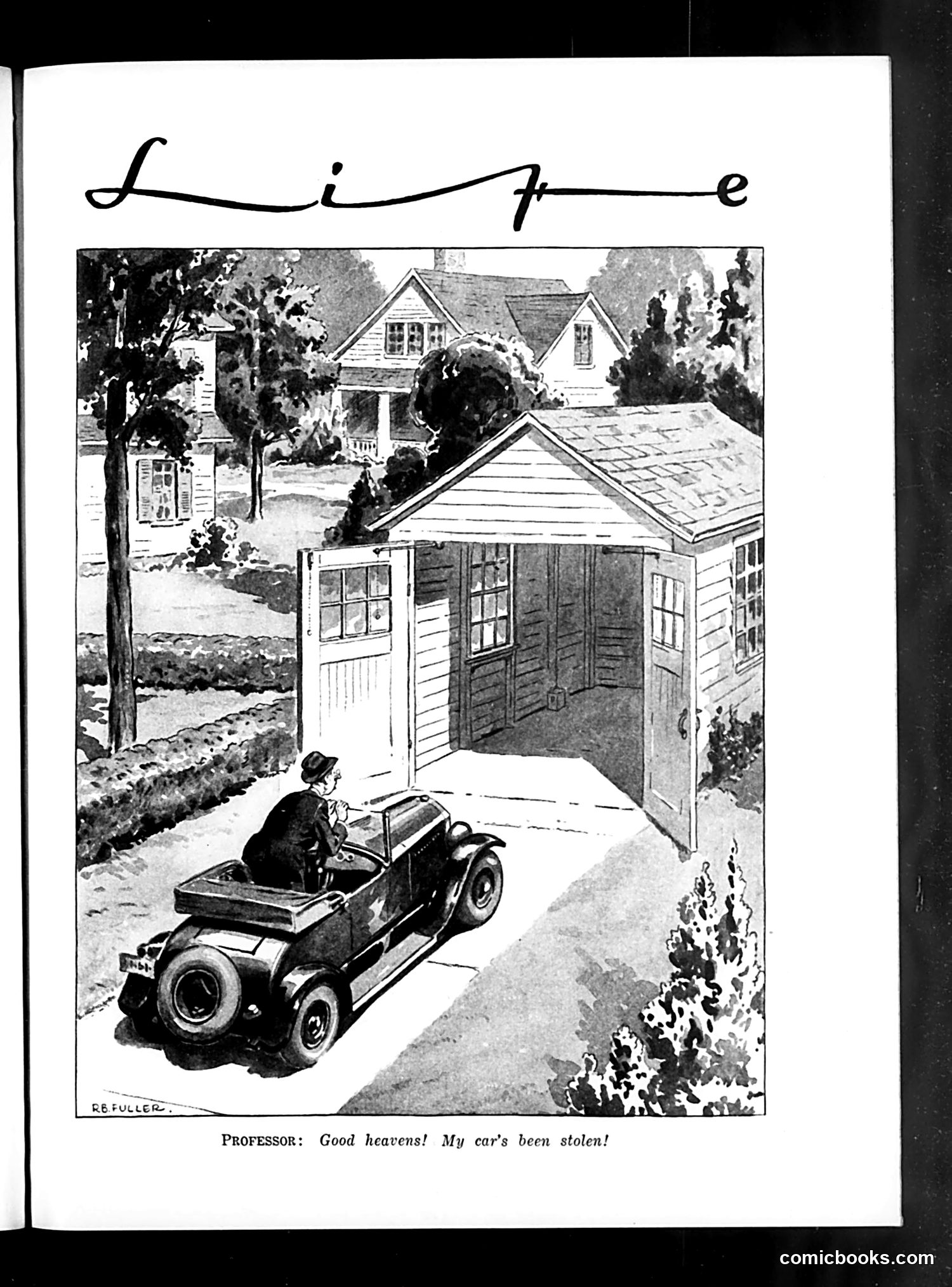
Analysis This is a single-panel cartoon satirizing car theft. The image shows a well-dressed professor driving away in a toy-sized automobile from a residential garage, with the caption reading "Good heavens! My car's been stolen!" The joke operates through visual irony: the professor appears to be driving away *in* what he claims has been stolen. The cartoon likely comments on absent-mindedness or the absurdity of not noticing one has their car. It may also gently mock the emerging problem of automobile theft in early-to-mid 20th century America, playing on concerns about vehicle security and crime. The cartoonist signature reads "R.B FULLER." The architectural detail of the suburban house and garage setting anchors this in domestic American life during the automobile era.
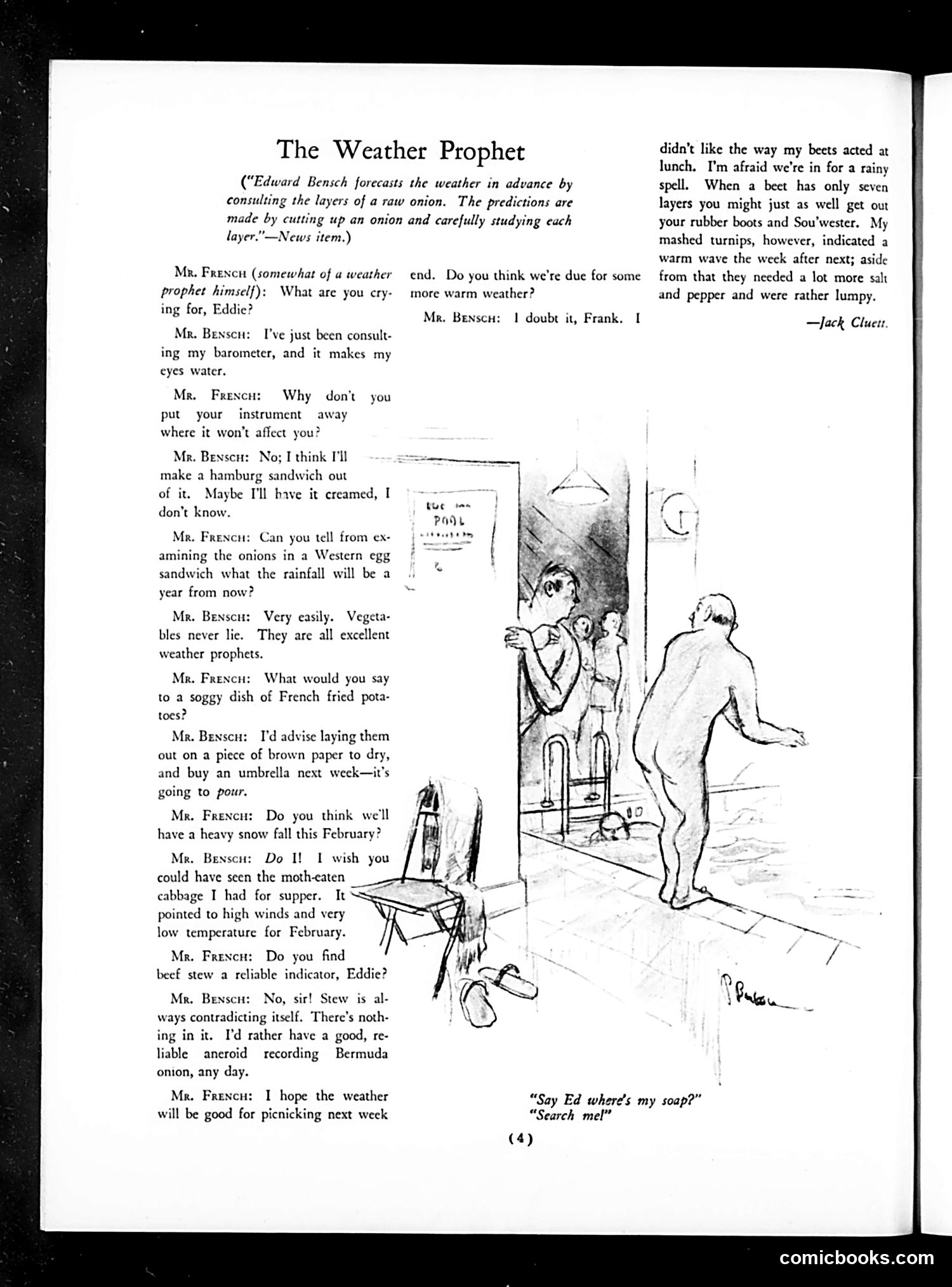
"The Weather Prophet" Analysis This is a humorous dialogue between Mr. French and Mr. Bensch, a self-proclaimed "weather prophet" who claims to predict rainfall by examining onion layers (a folk method referenced in the header). The satire mocks both pseudoscientific weather prediction and Bensch's absurd confidence in his method. When French asks serious questions about rainfall and snow, Bensch responds with ridiculous advice: using vegetables as forecasting tools, claiming a moth-eaten cabbage indicates low February temperatures, and recommending French fried potatoes need drying on brown paper. The accompanying cartoon shows two nude figures looking at what appears to be a bathtub or basin, with one asking "Say Ed where's my soap?" and the other replying "Search me!" This visual gag seems unrelated to the dialogue, likely accompanying a separate joke on the page.
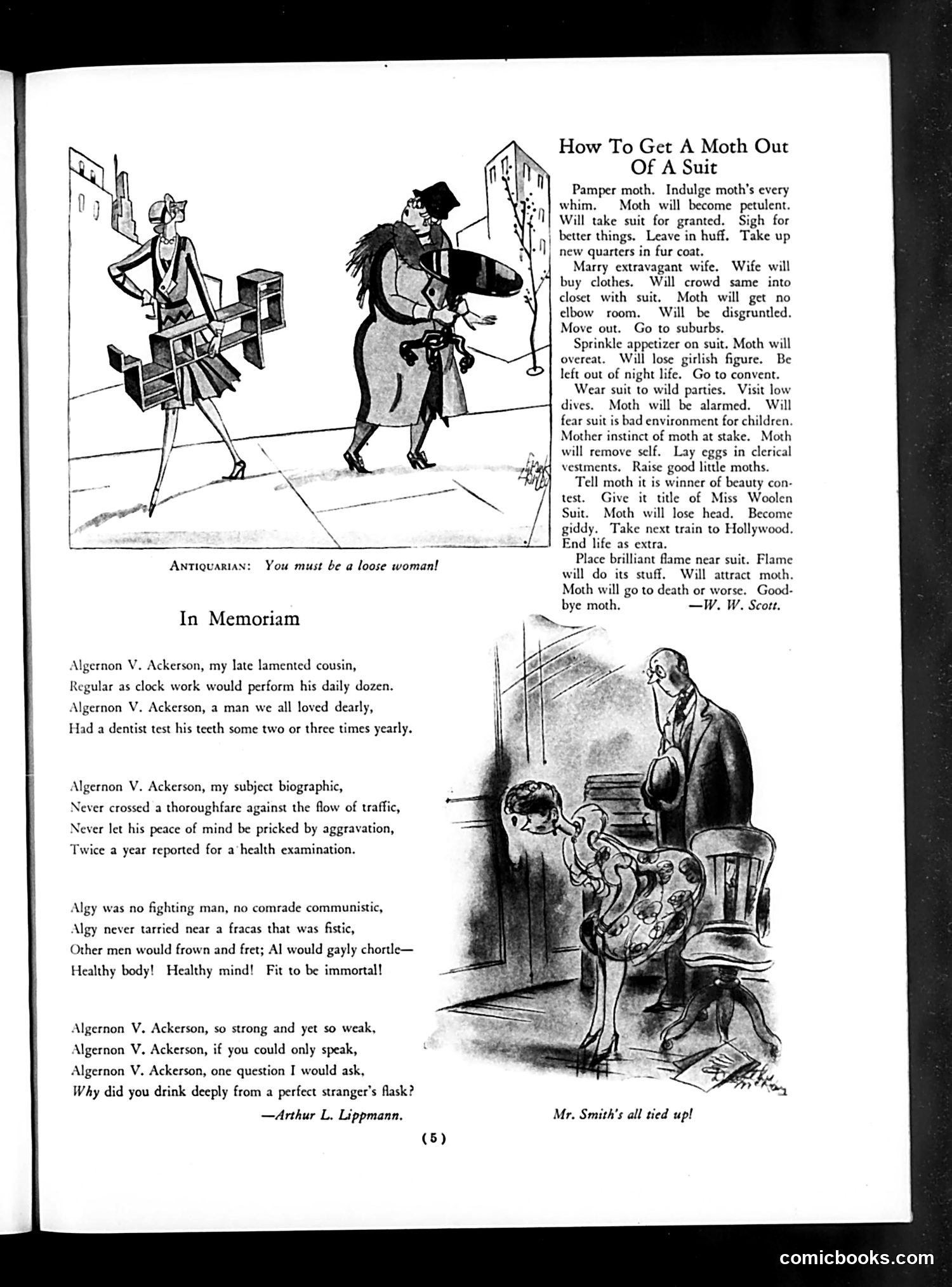
Analysis of Life Magazine Page The top cartoon satirizes gender roles and marriage. A woman in fashionable dress stands holding household items while a man in formal wear appears to be leaving. The caption "You must be a loose woman!" suggests mockery of a wife's independence or unconventional behavior—likely her spending on clothes or active social life. The satire targets rigid Victorian expectations of female domesticity. Below is a humorous poem "In Memoriam" for Algernon V. Ackerson, presented as an oddly cheerful tribute to a boring, cautious man who regularly visited dentists and never took risks. The tone is ironic—praising his predictability as admirable rather than dull. The bottom illustration shows a medical/dental scene, likely supporting the poem's theme about health examinations.
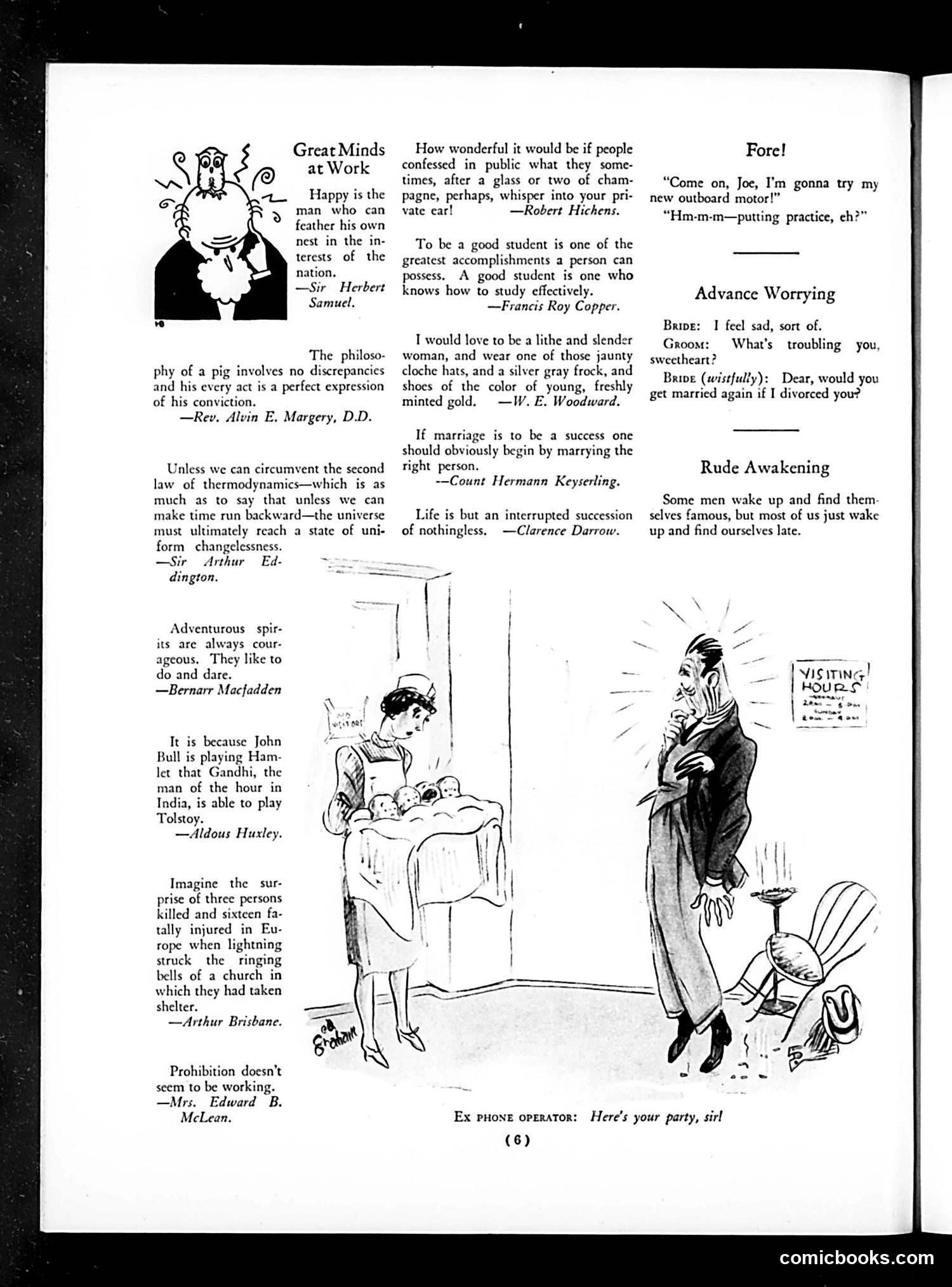
Analysis of Life Magazine Page This page contains satirical quotes and cartoons typical of 1920s-30s Life magazine humor. "Great Minds at Work" features attributed quotes on happiness, student life, and philosophy from various public figures and writers. "Advance Worrying" is a brief comic dialogue between a bride and groom about potential divorce—a joke on marital pessimism. "Rude Awakening" contains a quip about fame and ordinariness, paired with a cartoon showing a man arriving at "visiting hours" to see a woman with a baby. The caption "Ex phone operator: Here's your party, sir!" is a pun: the operator is delivering her "party" (the baby, implying he's the father), playing on telephone operator language. The humor relies on sexual innuendo common to the era's satire about unmarried mothers and paternity.
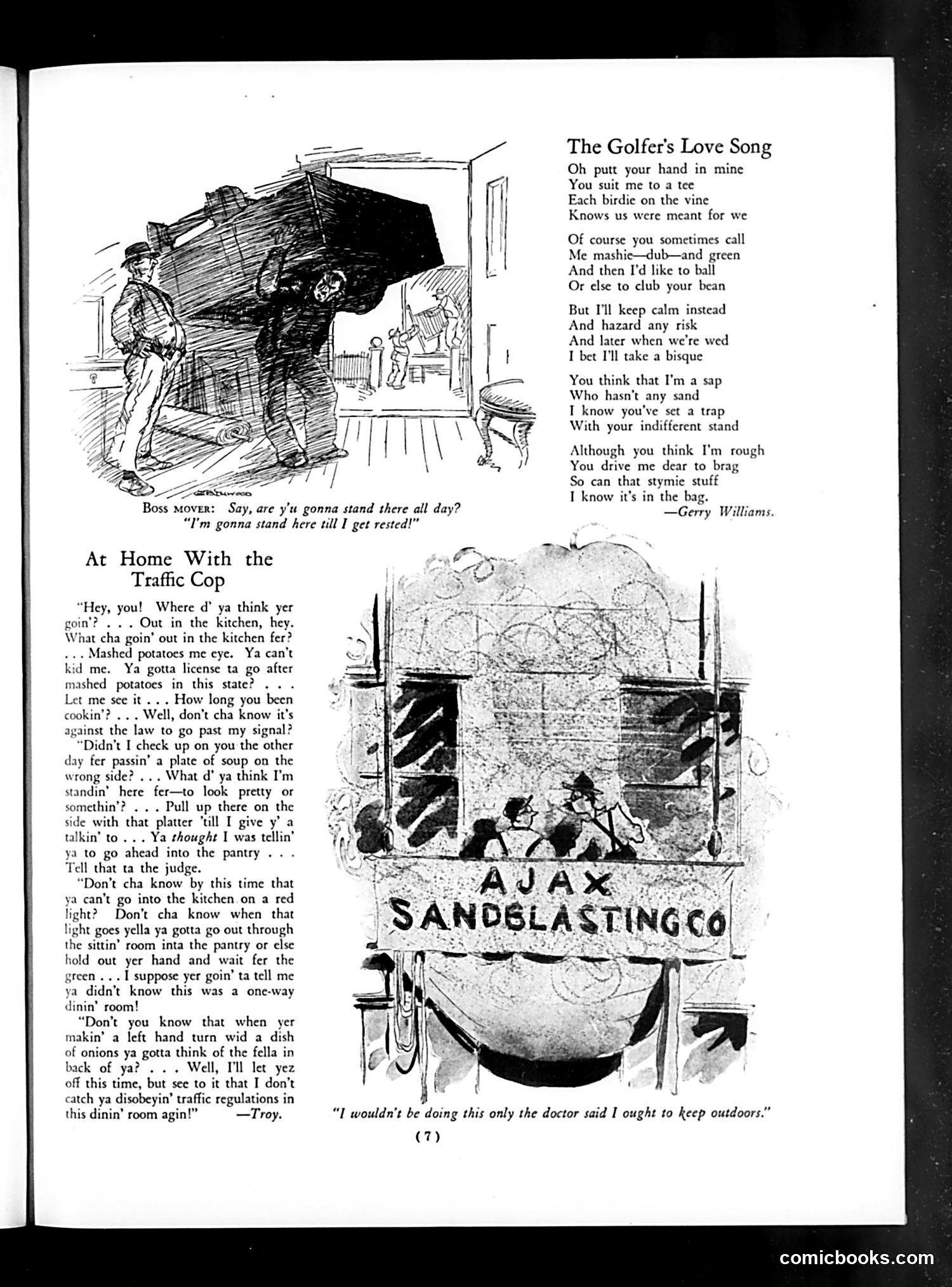
Analysis of Page 7 This page contains three separate pieces: 1. "The Golfer's Love Song" by Gerry Williams—a humorous poem about a man courting a woman who is obsessed with golf. The joke is that she prioritizes the sport over romance, calling him names like "mashie-dub" (golf club terms) and threatening to "club your bean" (hit his head). It's satire on how golf consumes people's attention. 2. "At Home With the Traffic Cop" by Troy—a comedic monologue where a traffic cop complains about his wife's kitchen cooking and his frustration enforcing traffic laws. The humor relies on his exasperated, vernacular speech and domestic frustrations. 3. An advertisement for "Ajax Sandblasting Co." with an illustration showing workers sandblasting a surface. These represent typical Life magazine humor content: light domestic comedy and advertising.
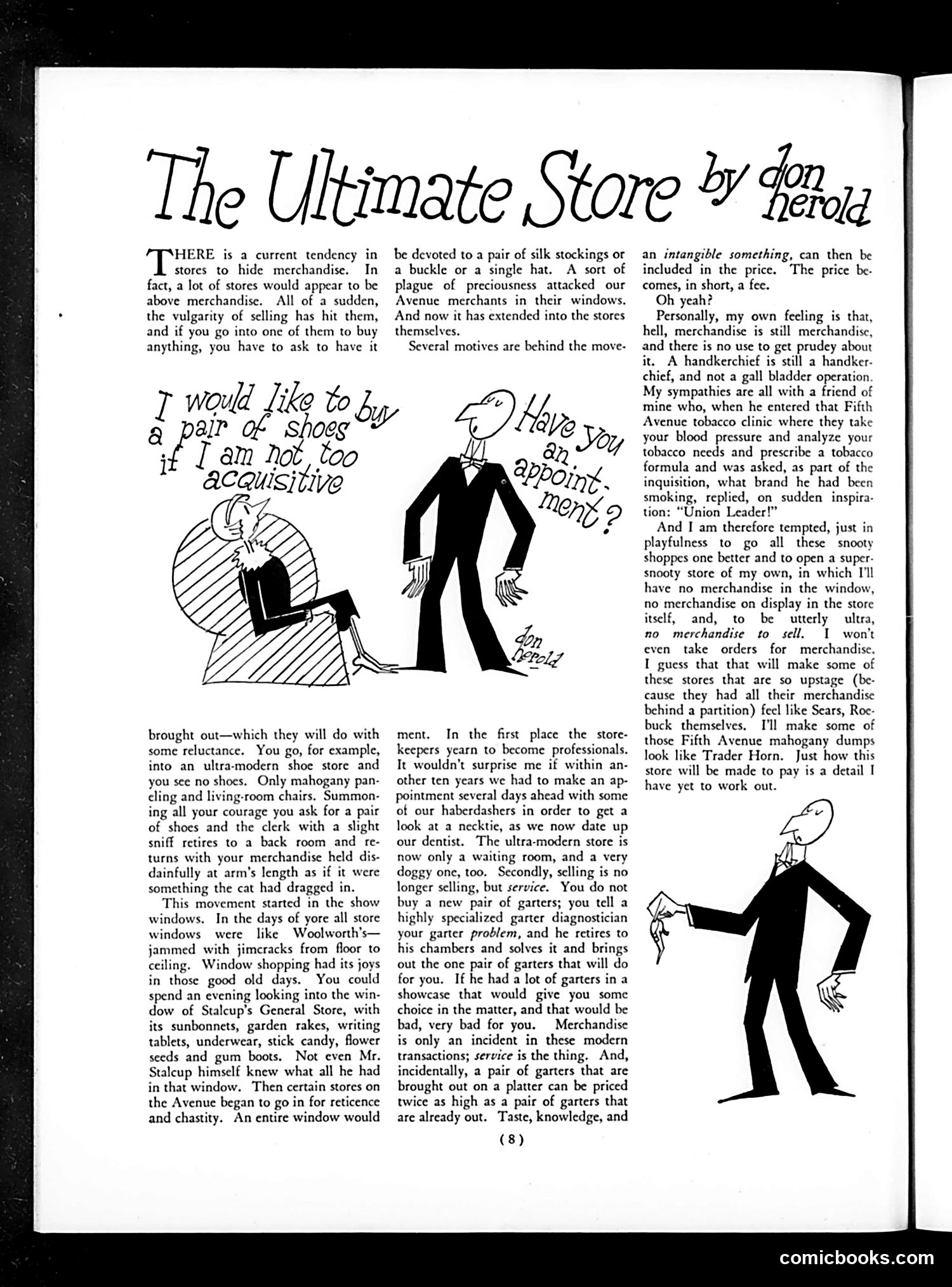
"The Ultimate Store" by Don Herold This satirical article mocks the trend of upscale retail stores removing merchandise from display to emphasize exclusivity and "service." The author ridicules stores that hide products behind partitions, forcing customers to ask clerks for items—mimicking high-end tobacconists and haberdasheries. Herold proposes opening a deliberately absurd counter-store: no merchandise visible anywhere, no window displays, and no actual sales—only consultation services (like a garter "diagnostician"). The joke targets the pretension of modern retail culture, where the *perception* of exclusivity matters more than actual goods. The accompanying cartoons show exaggerated figures embodying this snobbish shopping experience—the satire suggesting this trend had become laughably extreme among Fifth Avenue establishments.
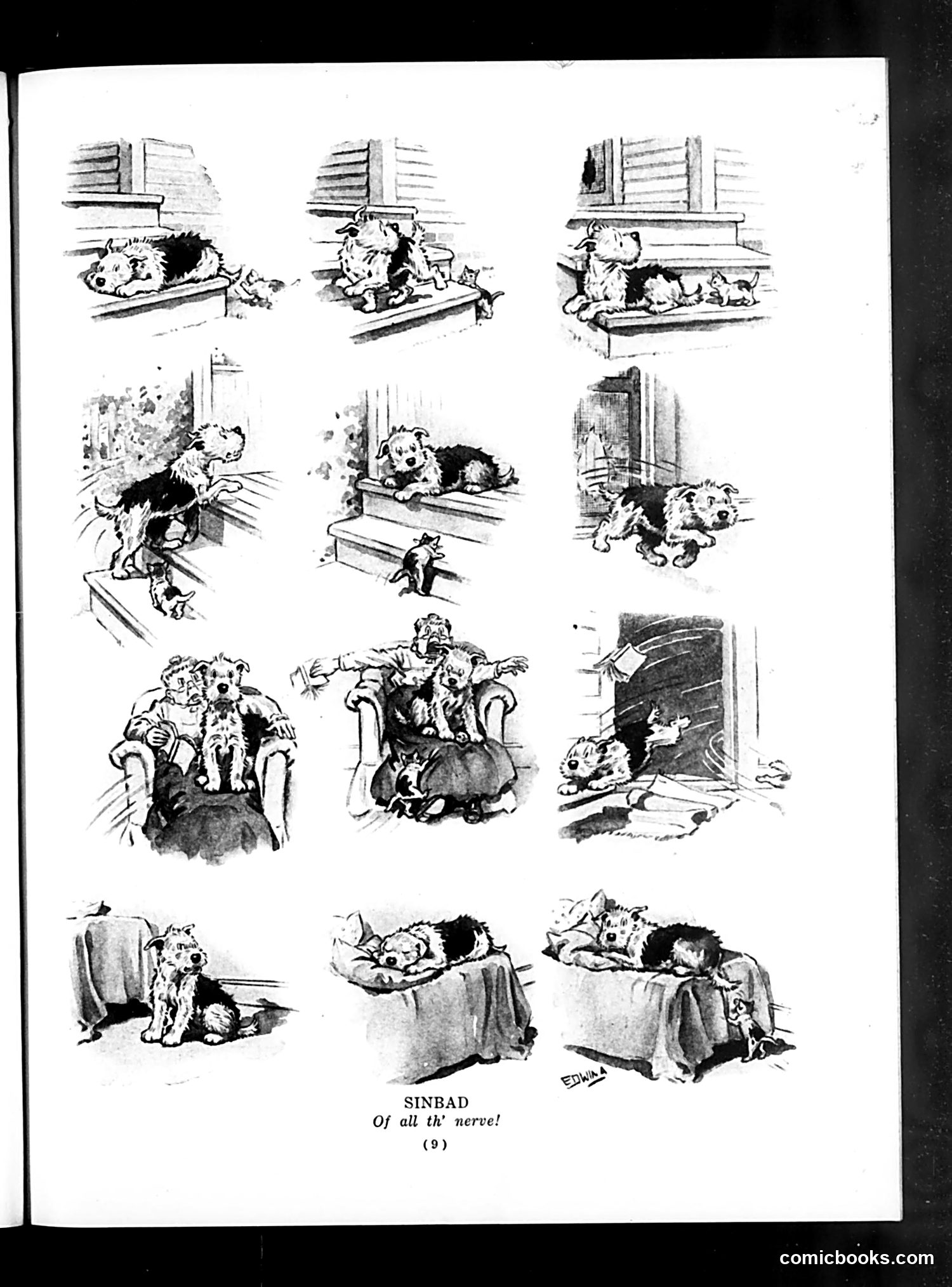
"Sinbad: Of all th' nerve!" This is a humorous comic strip sequence depicting the misadventures of a character named Sinbad (likely a dog, based on the visual style). The twelve panels show increasingly chaotic scenarios: the character causes trouble in various domestic and public settings—creating disturbances indoors, outdoors, with furniture, and around people. The title "Of all th' nerve!" suggests exasperation at the character's brazen misbehavior. The humor derives from slapstick physical comedy typical of early 20th-century comic strips, where a mischievous character creates destruction and mayhem without apparent consequence or remorse. The strip appears designed as lighthearted entertainment rather than political satire, relying on visual gags of disorder and chaos for comedic effect.
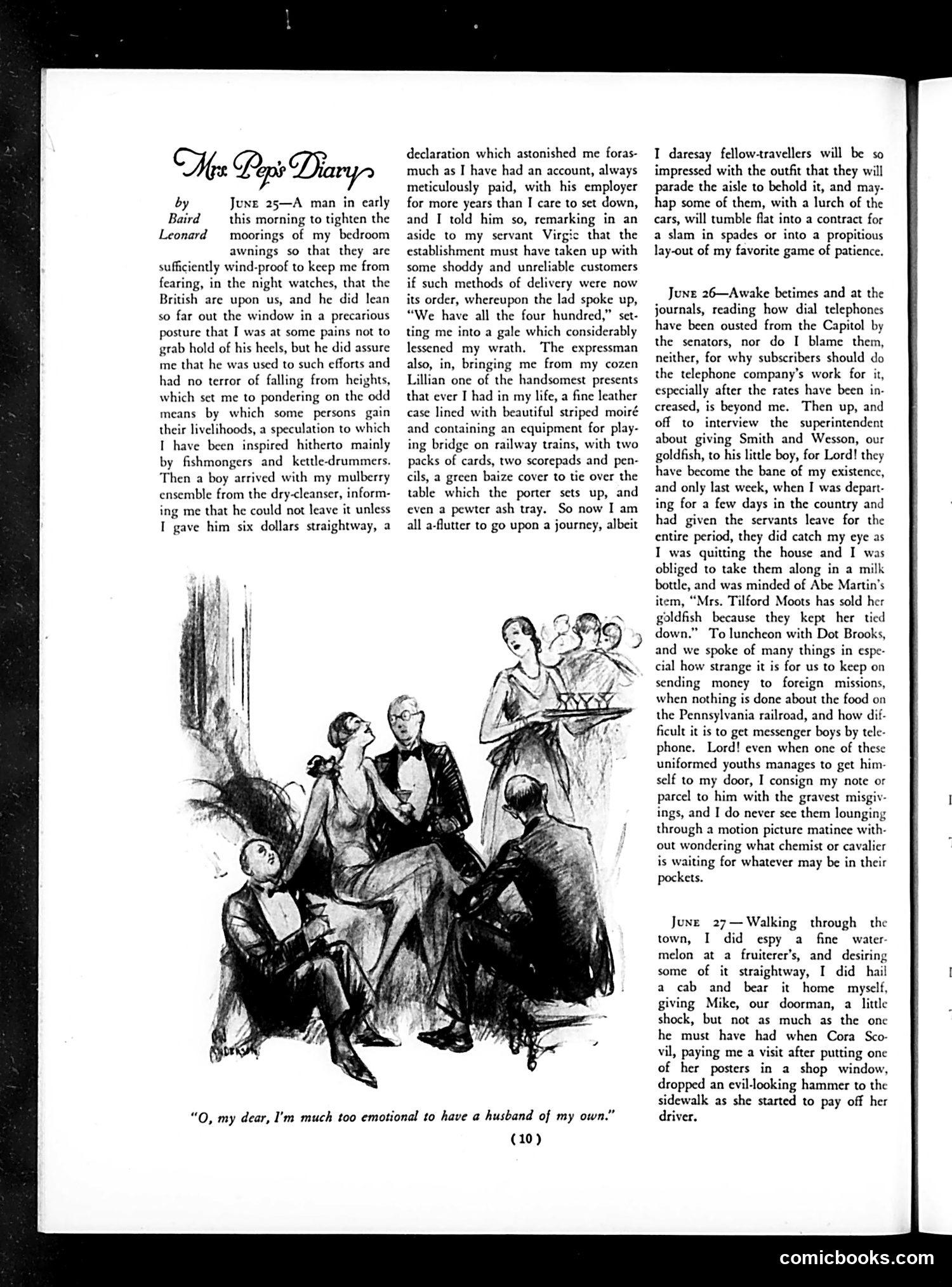
"Mrs. Pep's Diary" - Page Analysis This is a satirical diary entry by humorist Leonard, dated June 25-27. The illustration depicts a domestic scene where a woman (Mrs. Pep) appears distressed while holding a serving tray, surrounded by men in formal dress. The satire targets early 20th-century servant labor and domestic management. Mrs. Pep complains about her cook's unreliability and discusses hiring difficulties. The caption—"O, my dear, I'm much too emotional to have a husband of my own"—suggests the humor lies in comparing spoiled, difficult servants to difficult husbands, mocking upper-class domestic frustrations. Additional entries mock sending money to foreign missions while ignoring local problems, and describe an awkward encounter with a cab driver over a watermelon purchase. The overall tone satirizes privileged concerns and social pretensions of the period.
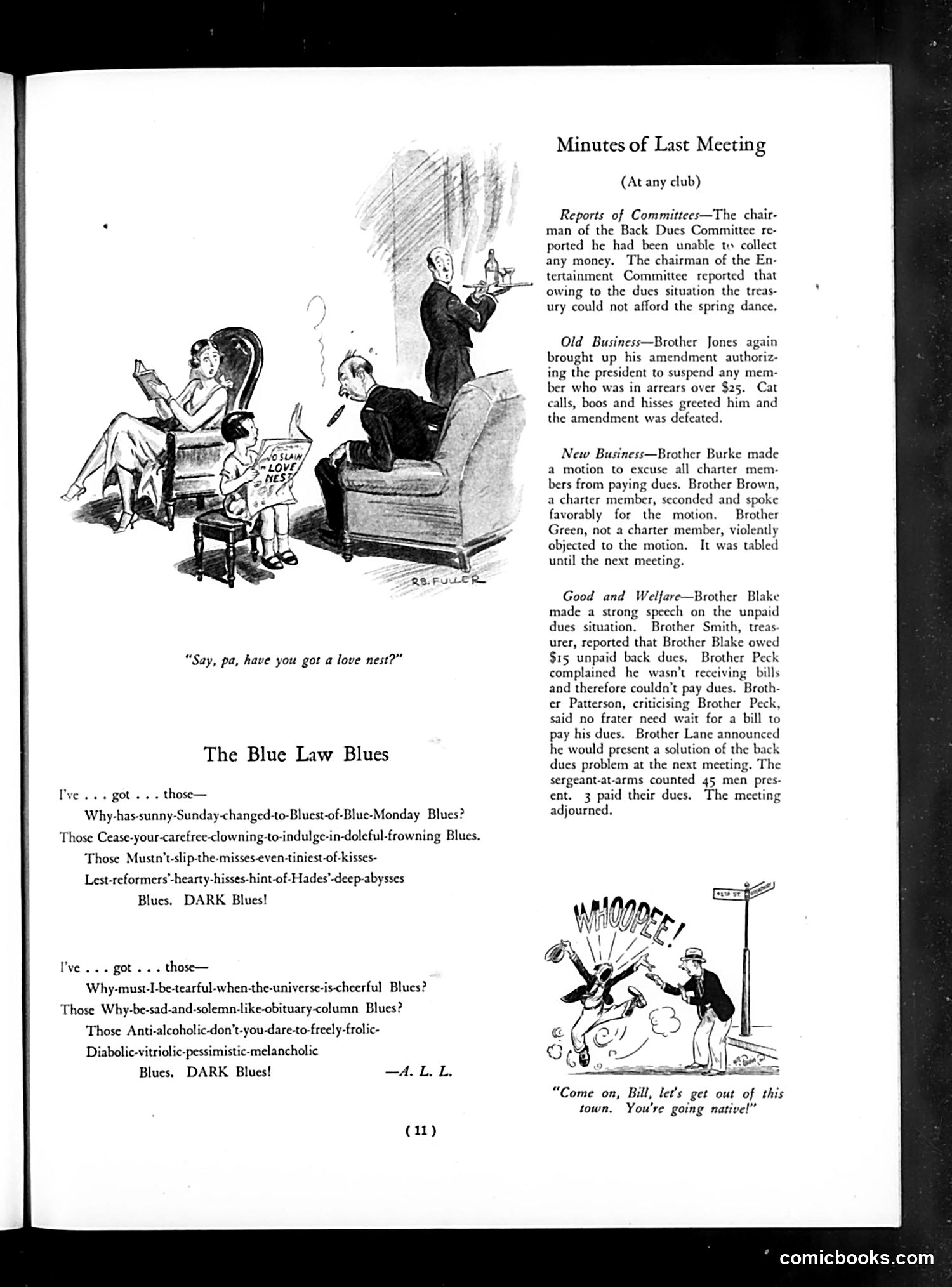
Analysis of Life Magazine Page 11 This page satirizes fraternity or club life through meeting minutes. The top cartoon depicts a member presenting financial troubles ("Say, pa, have you got a love nest?"), mocking the disconnect between members' social pretensions and actual financial responsibility. The "Minutes of Last Meeting" section humorously documents fraternity dysfunction: unpaid dues, failed fundraising attempts, and contentious motions about member discipline. Brothers argue over finances and exemptions, with proposals defeated amid "calls, boos and hisses." "The Blue Law Blues" poem (attributed A.L.L.) uses deliberately overwrought language to mock melodramatic complaints about rule changes—turning trivial grievances into pseudo-tragic lament through absurdly stacked adjectives. The bottom cartoon shows someone being forcibly evicted, captioned with ironic encouragement about leaving town. Overall, the page ridicules clubmen as financially irresponsible, quarrelsome, and prone to self-dramatization.
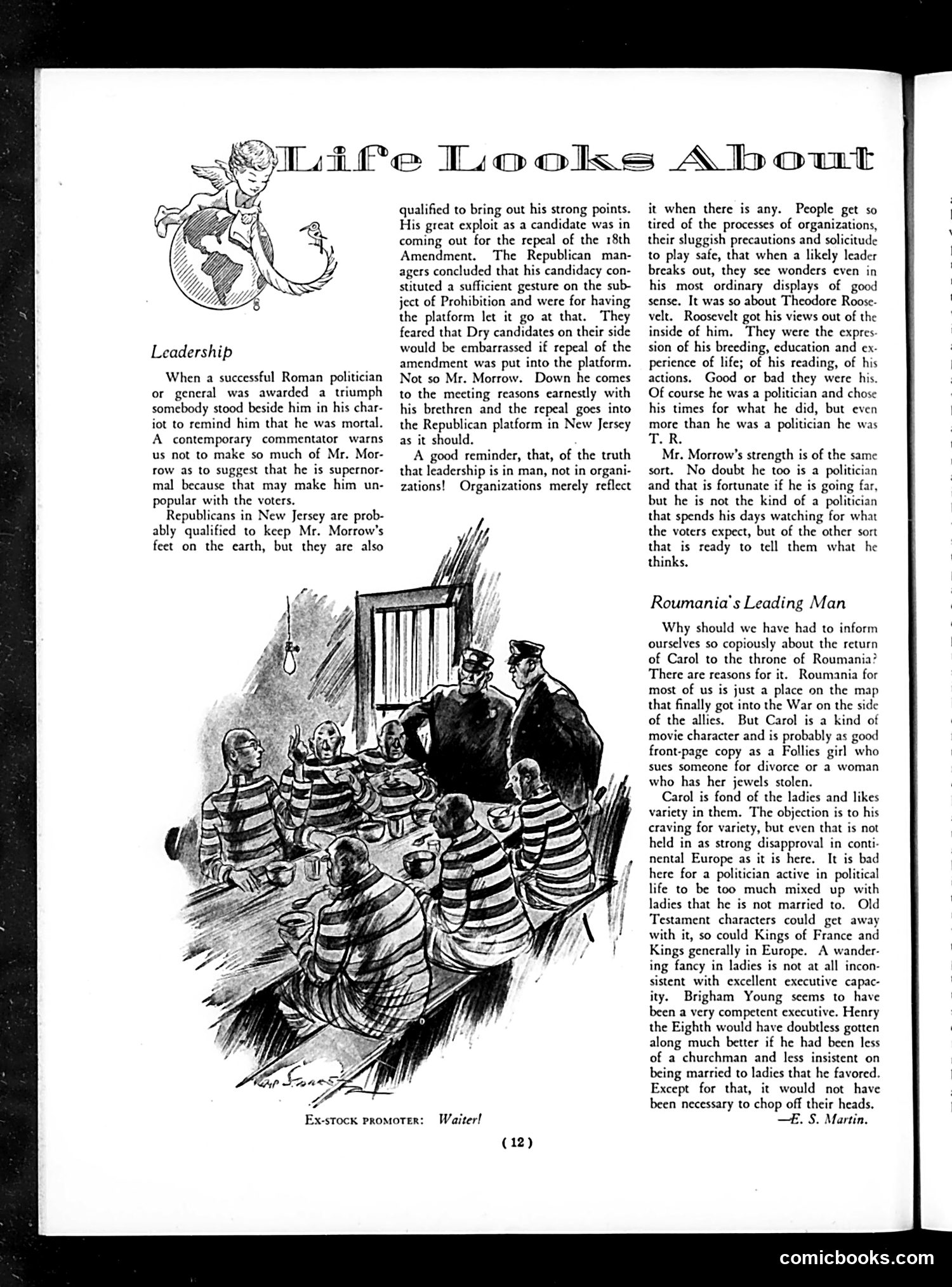
Analysis This page discusses American political leadership, with particular focus on someone named Morrow (likely Republican politician Dwight Morrow, based on context clues about New Jersey Republicans and the 18th Amendment repeal). The cartoon depicts "Ex-stock promoter: Waiter!" - showing men in striped prison uniforms serving at what appears to be a formal dinner. This is satirizing financial corruption: a former stock promoter has been imprisoned and is now working as a servant, illustrating the consequences of fraudulent behavior. The accompanying text argues that true leadership resides in individual character rather than organizational positions, and criticizes King Carol of Romania for his romantic entanglements, suggesting such personal behavior undermines executive competence. The satire targets both American financial fraud and European monarchical excess as failures of leadership.
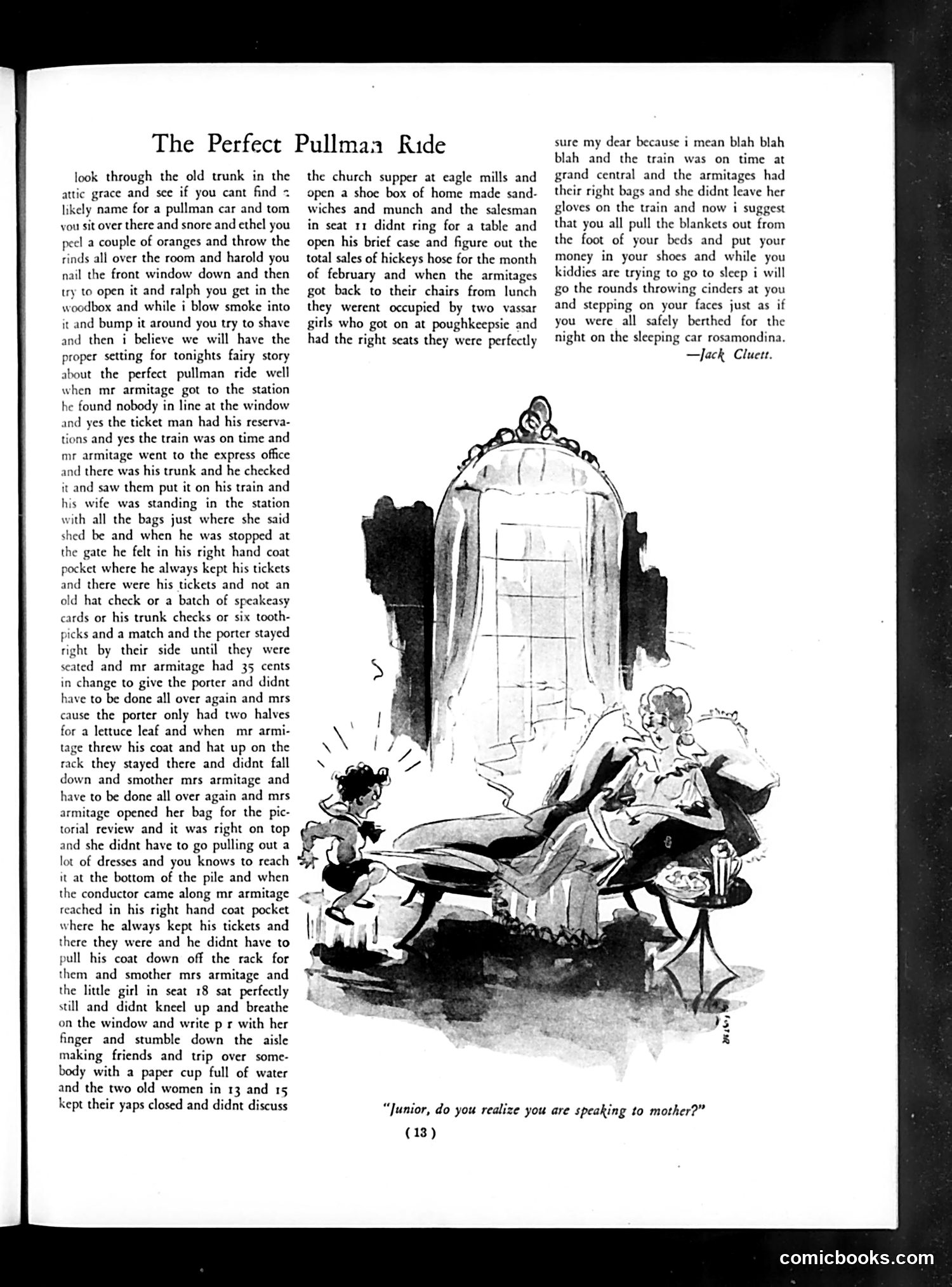
"The Perfect Pullman Ride" This satirical article by Jack Cluett mocks the chaos of train travel, specifically on Pullman cars (luxury railroad sleepers). The narrative humorously catalogs mishaps: lost tickets, trunk checking failures, coats left on racks, children misbehaving, elderly passengers gossiping. The accompanying illustration shows a crowded train car where passengers—including a woman with a child and an elderly gentleman—are cramped and uncomfortable despite Pullman's reputation for comfort. The caption's joke ("Junior, do you realize you are speaking to mother?") suggests a child loudly addressing his parent, adding to the general disorder. The satire targets the gap between Pullman's marketed luxury and passengers' actual experience—crowding, inconvenience, and social awkwardness rather than comfortable travel.
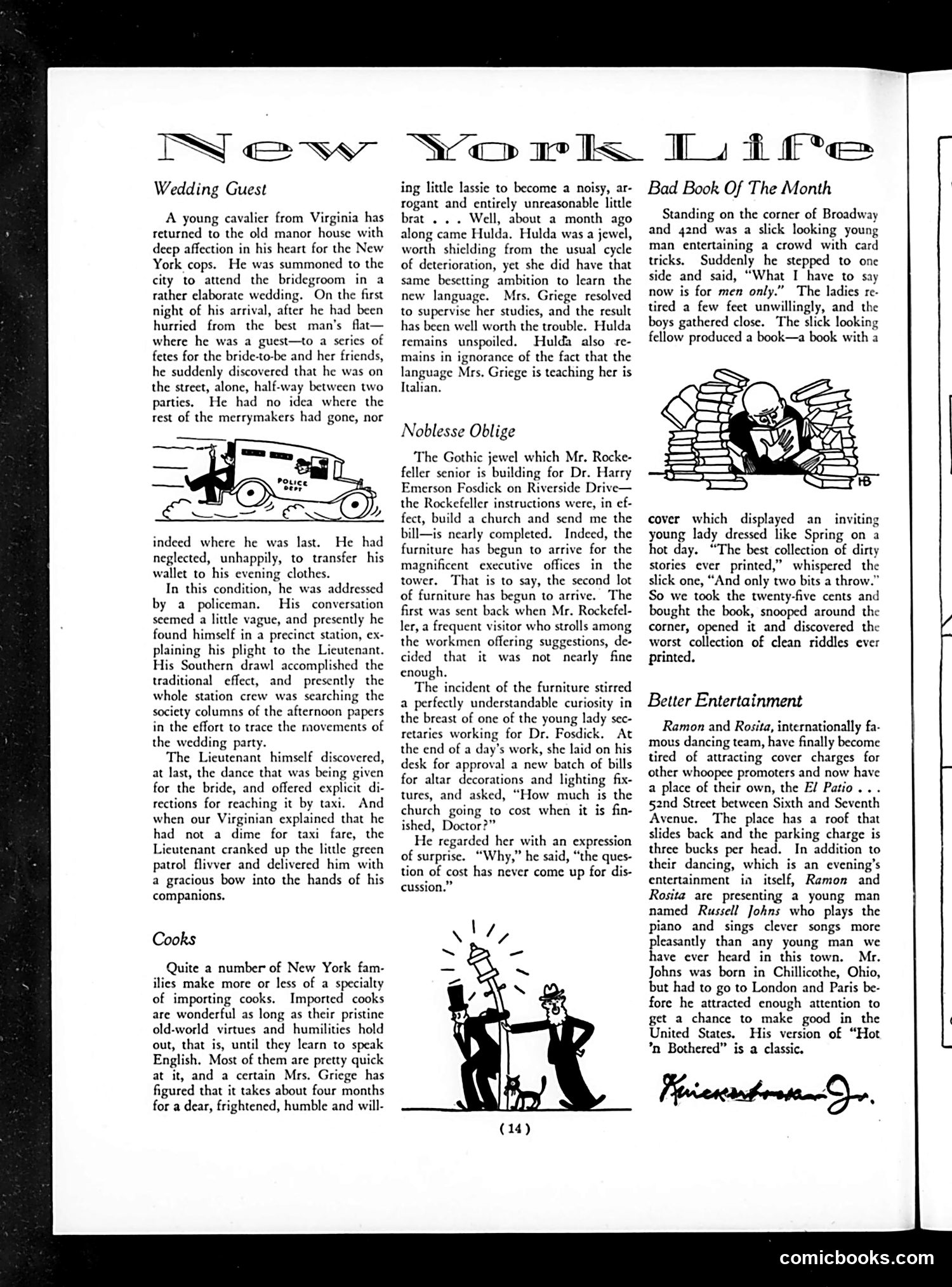
New York Life Page Analysis This page contains three short humorous social commentary pieces typical of Life magazine's satirical style. "Wedding Guest" mocks a Virginia cavalier who discovers he's been staying as an unwitting guest rather than at a proper residence, creating social embarrassment. "Noblesse Oblige" satirizes wealthy New Yorkers' casual attitudes about expense—a secretary asks a doctor how much his church renovation will cost, and he dismissively replies that cost was never discussed, poking fun at the rich's financial obliviousness. "Bad Book of the Month" and "Better Entertainment" feature small cartoon illustrations (a man with stacks of books; two men with a child) accompanying brief entertainments reviews, likely promoting performers Ramon and Rosita and pianist Russell Johns. The overall tone reflects 1920s-30s upper-class social satire focused on wealth, pretension, and entertainment trends.
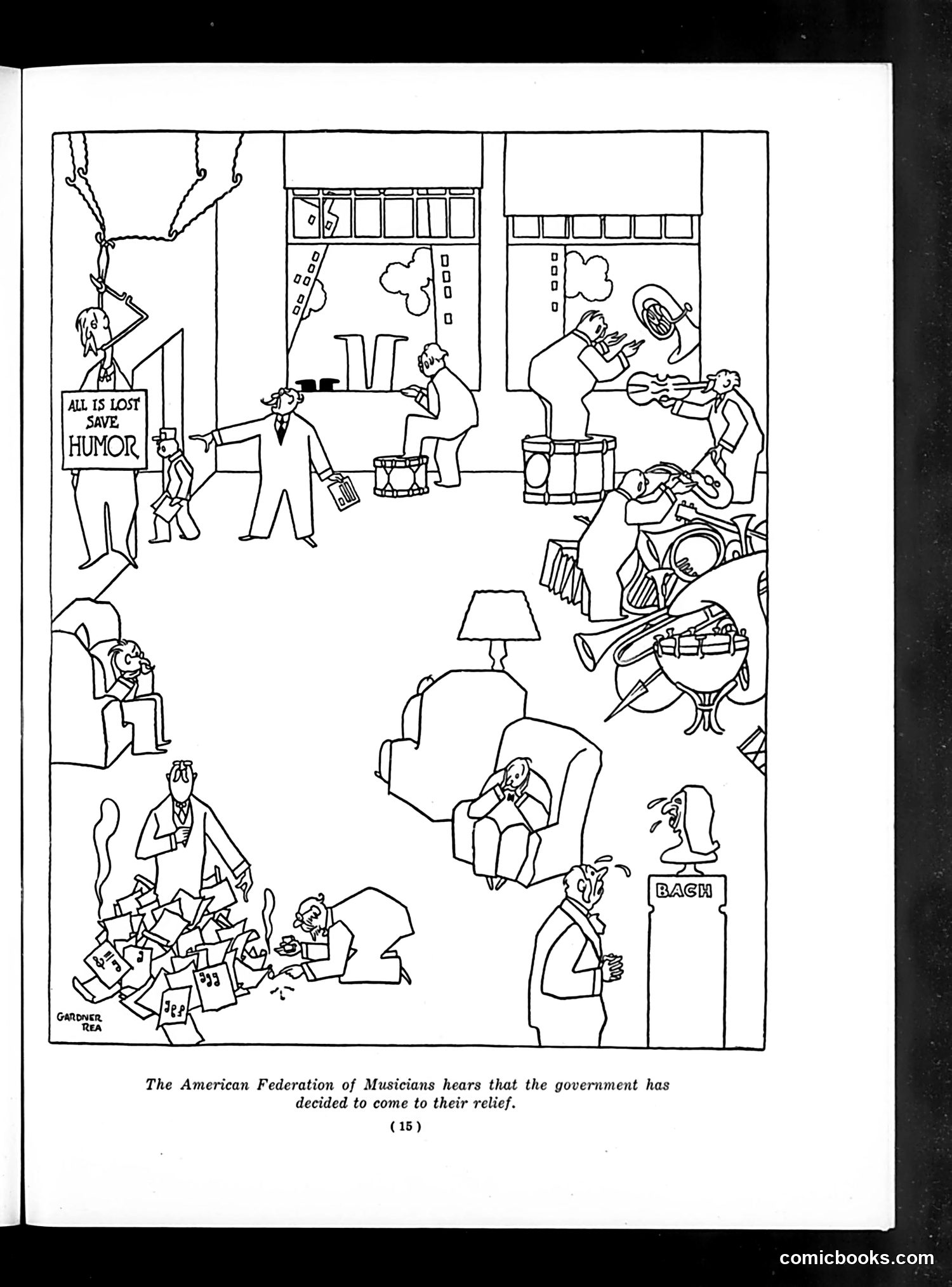
Political Cartoon Analysis This cartoon satirizes government relief efforts during an economic crisis (likely the Great Depression era). The scene depicts chaotic activity in what appears to be a relief office or government agency. The sign reading "ALL IS LOST SAVE HUMOR" on the left emphasizes the cartoon's satirical tone. Various figures engage in seemingly absurd or inefficient activities—playing instruments, conducting music, sitting idle—suggesting that government relief programs are poorly organized or wasteful. The caption states "The American Federation of Musicians hears that the government has decided to come to their relief," indicating this specifically mocks relief programs targeting musicians. The cartoonist (signed "GARDNER REA") appears to suggest that government intervention in aiding specific industries is either ineffectual, comedic, or misguided, reducing serious economic hardship to bureaucratic farce.
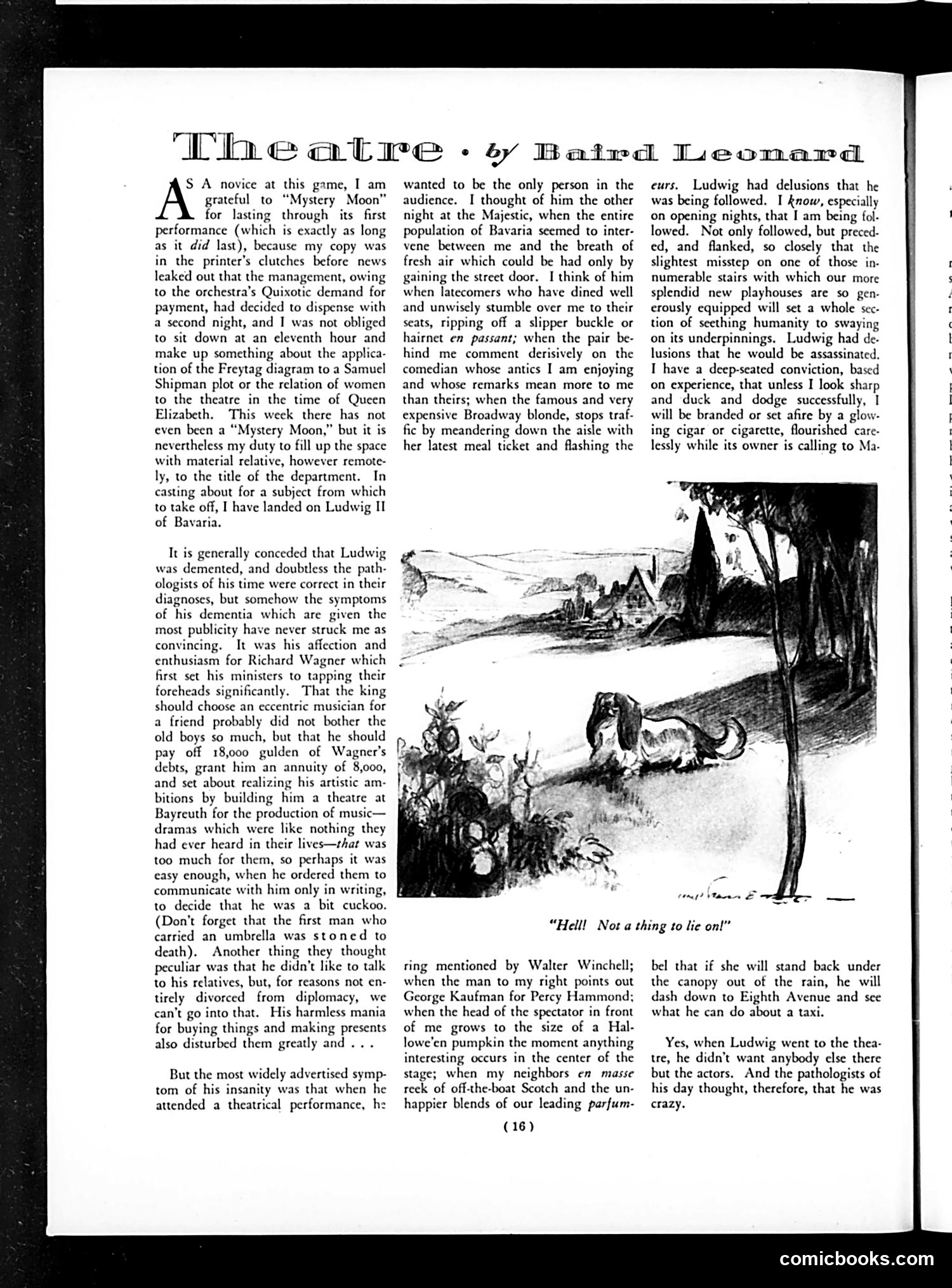
Analysis This page is the opening of an article titled "Theatre" by Baird Leonard, discussing Ludwig II of Bavaria. The accompanying sketch illustrates a scene from Ludwig's life, captioned "Hell! Not a thing to lie on!" The article satirizes Ludwig's reputation for eccentricity and mental instability. Leonard notes that Ludwig's most famous symptom of supposed insanity was his behavior at theatrical performances—he demanded to be the only audience member present, wanting to watch plays alone. The author uses this anecdote to suggest Ludwig's peculiar tastes and social isolation. The illustration appears to depict Ludwig in a distressed or uncomfortable situation, reinforcing the theme of his abnormal behavior. The satire mocks both Ludwig's documented psychological difficulties and the contemporary fascination with his bizarre conduct, presenting him as a cautionary figure of aristocratic excess and mental decline.
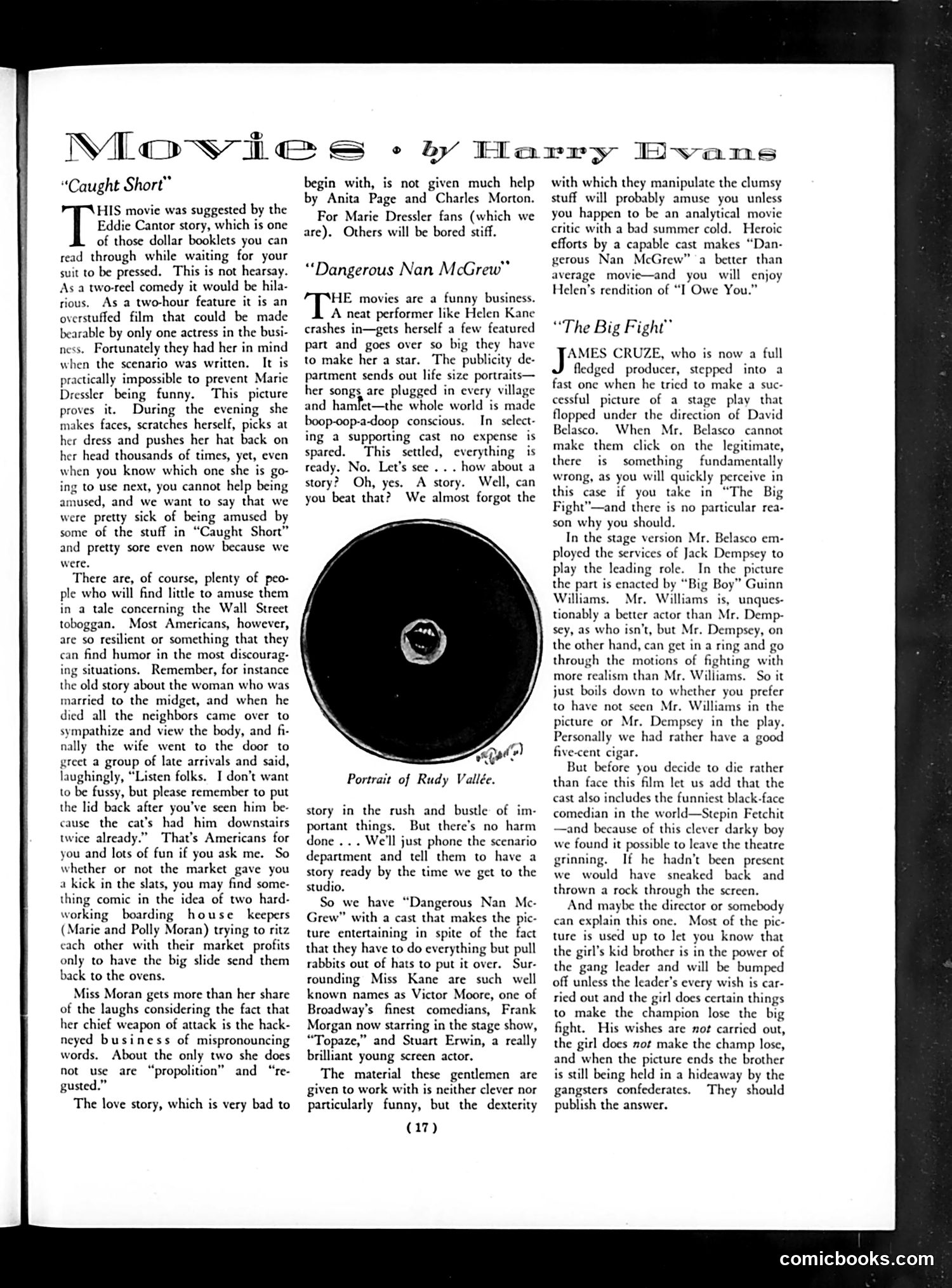
"Movies" by Harry Evans - Film Reviews Page This is a film review column from *Life* magazine covering three movies: "Caught Short," "Dangerous Nan McGrew," and "The Big Fight." The page features a circular portrait photograph labeled "Portrait of Rudy Vallée," a famous 1920s entertainer and singer referenced in the reviews. The reviews are humorous critiques of contemporary films. The author criticizes weak plots and acting while appreciating comedic performers like Helen Kane and Marie Dressler. He compares stage and film versions of roles (Jack Dempsey vs. Guinn "Big Boy" Williams), preferring one actor's realism over another's theatrical style. The satire targets both the film industry's formulaic storytelling and American audiences' willingness to find humor in inherently unfunny situations—a commentary on popular entertainment standards of the era.
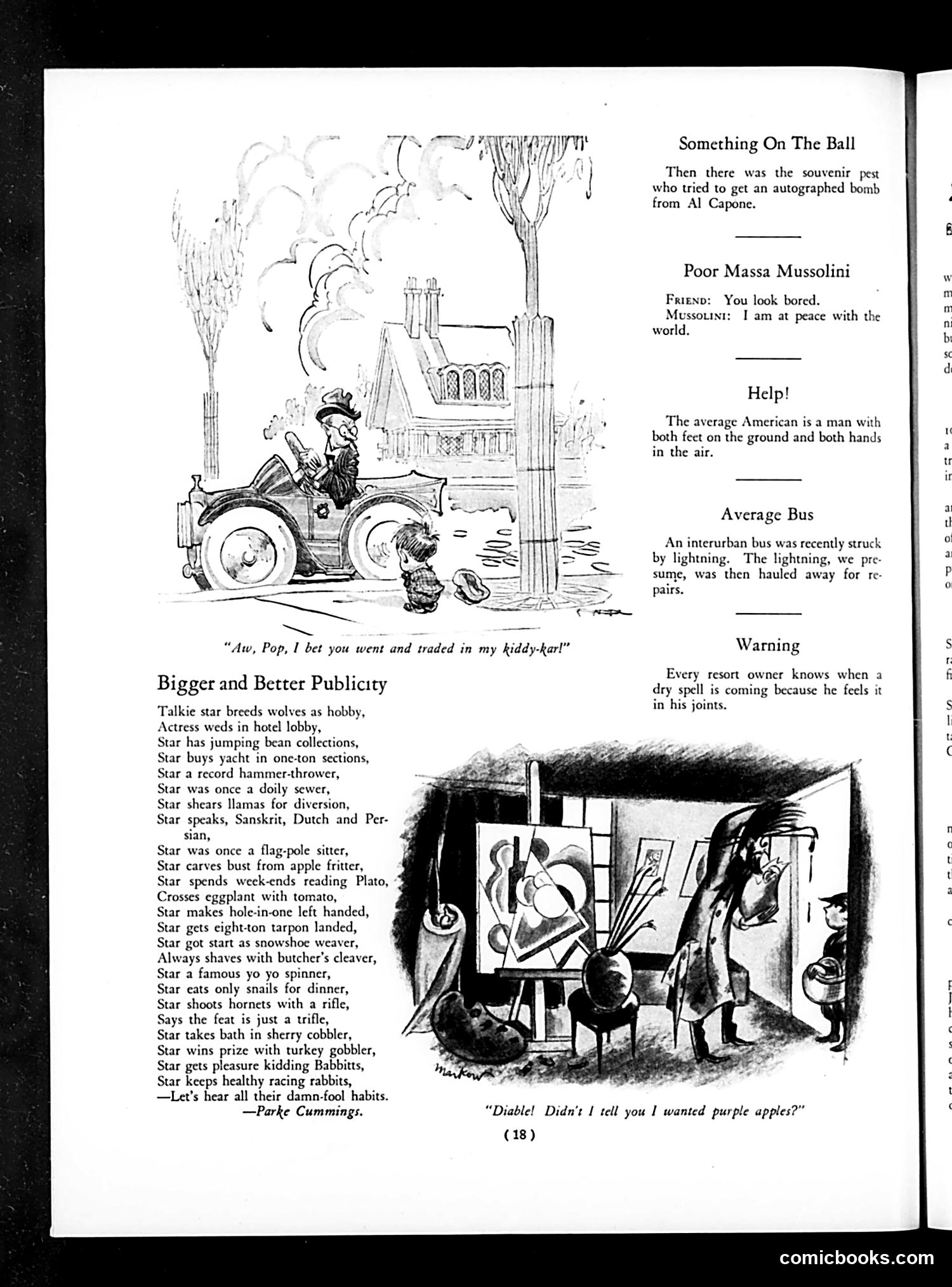
Analysis of Life Magazine Page 18 This page contains satirical humor pieces typical of early-to-mid 20th century Life magazine. Top cartoon ("Aw, Pop, I bet you went and traded in my kiddy-kart!") shows a child confronting an adult who has apparently swapped the child's toy vehicle for a full-sized car. The joke mocks frivolous consumer culture and materialistic impulses. "Bigger and Better Publicity" is a satirical poem by Park Cummings listing absurd hobbies and behaviors attributed to unnamed "stars" (celebrities). It mocks Hollywood excess and the ridiculous publicity stunts celebrities undertake for attention—eating snails, keeping rabbits, bathing in sherry. Bottom cartoon shows what appears to be a modern artist in a studio with abstract artwork, with the caption "Diabel! Didn't I tell you I wanted purple apples?" This satirizes incomprehensible modern/abstract art and the gap between artist intent and client expectations.
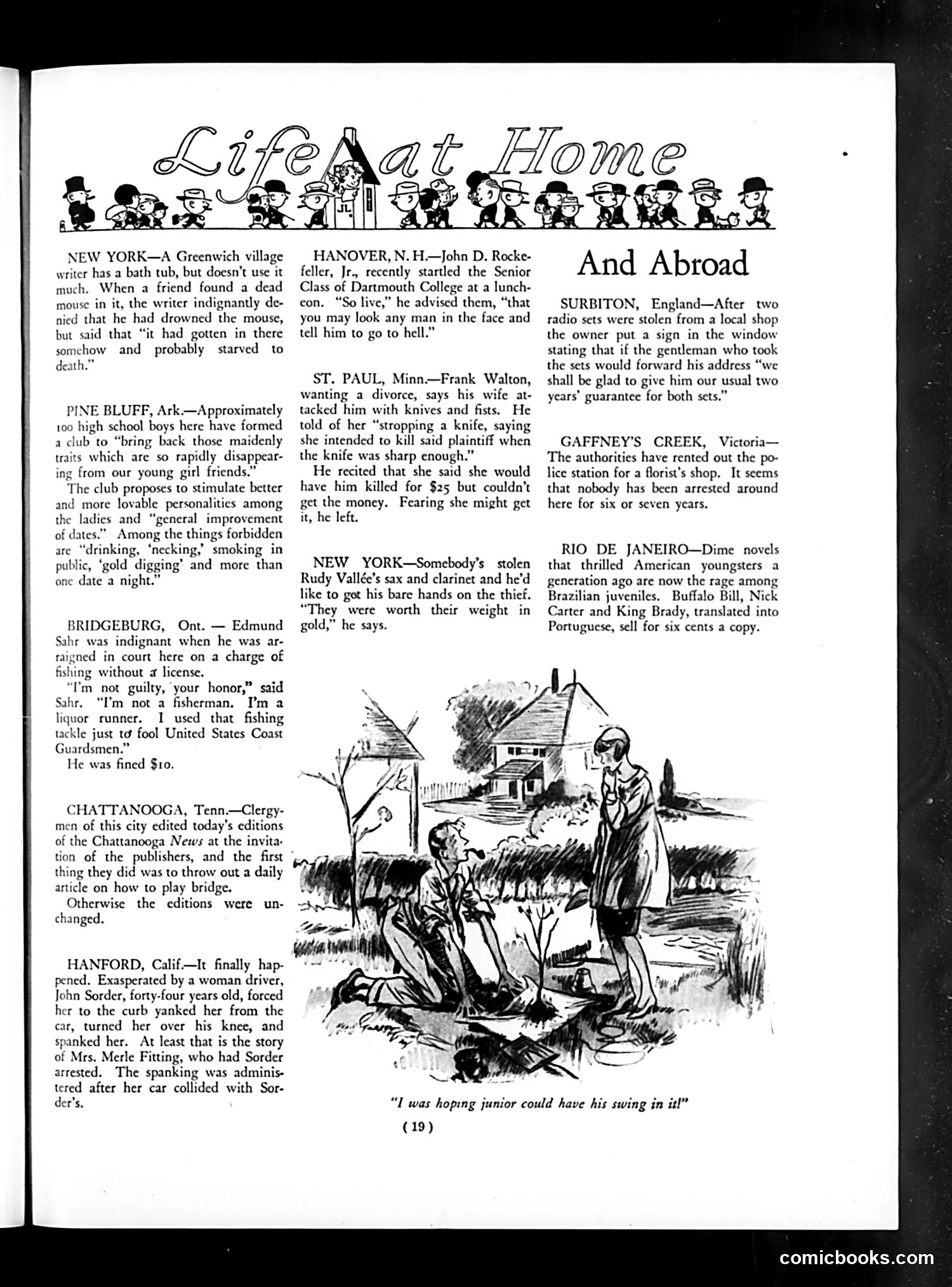
"Life at Home and Abroad" Page Analysis This page from *Life* magazine collects humorous anecdotes from American and international newspapers—a common feature of the satirical publication. The cartoon depicts a rural scene where a man appears to have fallen into a well or hole, while a woman stands nearby with what seems to be grim acceptance, captioned "I was hoping junior could have his swing in it!" The accompanying brief news items mock human folly and absurdity: a Greenwich Village writer with a dead mouse in his bathtub; Pine Bluff boys forming a club to preserve girls' "maidenly traits" by banning necking and "gold digging"; a liquor runner caught during Prohibition claiming he's not a fisherman; and a Hanford, California man spanking a woman driver after a collision. The satire targets 1920s social contradictions—prohibition hypocrisy, changing gender roles causing moral panic, and automotive-age manners clashes. The cartoon's dark humor (the well/swing gag) exemplifies *Life*'s cynical tone about everyday domestic life.
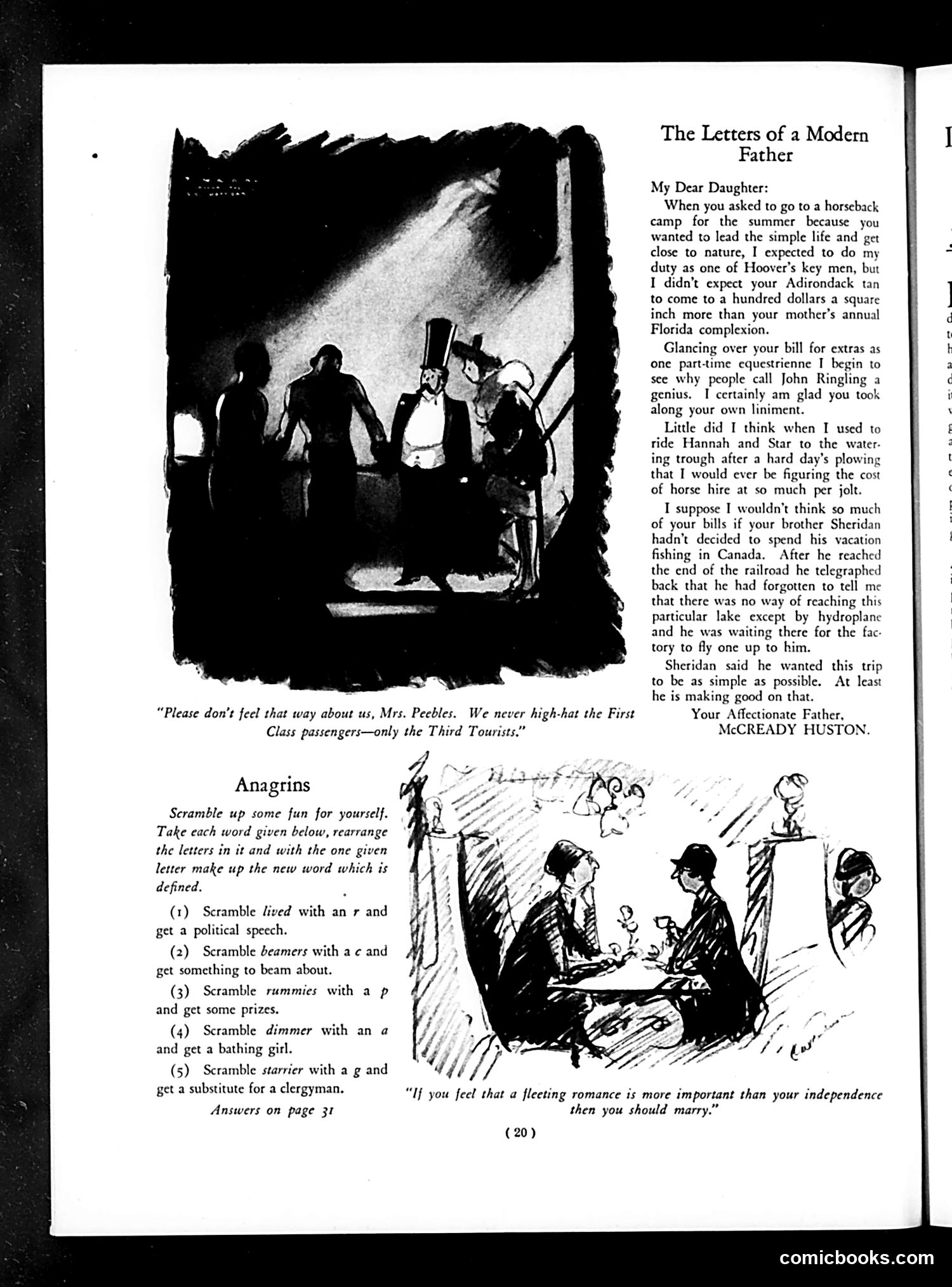
Analysis of Life Magazine Page This page contains a satirical letter from a father to his daughter, mocking wealthy 1920s leisure culture and excessive spending. The Main Satire ("Letters of a Modern Father"): The father complains about his daughter's expensive horseback camp, referencing "Hoover's key men" (linking to President Hoover's business-friendly administration). He contrasts her costly Adirondack tan with his wife's Florida vacation, and sarcastically notes her brother Sheridan's "simple" fishing trip that required the family to hire a hydroplane—satirizing the wealthy's contradictory claims of wanting simplicity while spending lavishly. The joke: wealthy Americans claim to seek "simple life" and nature closeness while incurring astronomical bills. The reference to "John Ringling a genius" (circus magnate/wealth) emphasizes absurd spending on leisure. The Lower Cartoon: Shows three figures in conversation with the caption about not "high-hatting" first-class passengers—mocking class pretension among tourists. "Anagrins": A word puzzle game filling the page's remaining space—typical magazine filler content of the era. The overall tone critiques conspicuous consumption among the wealthy during the pre-Depression era.
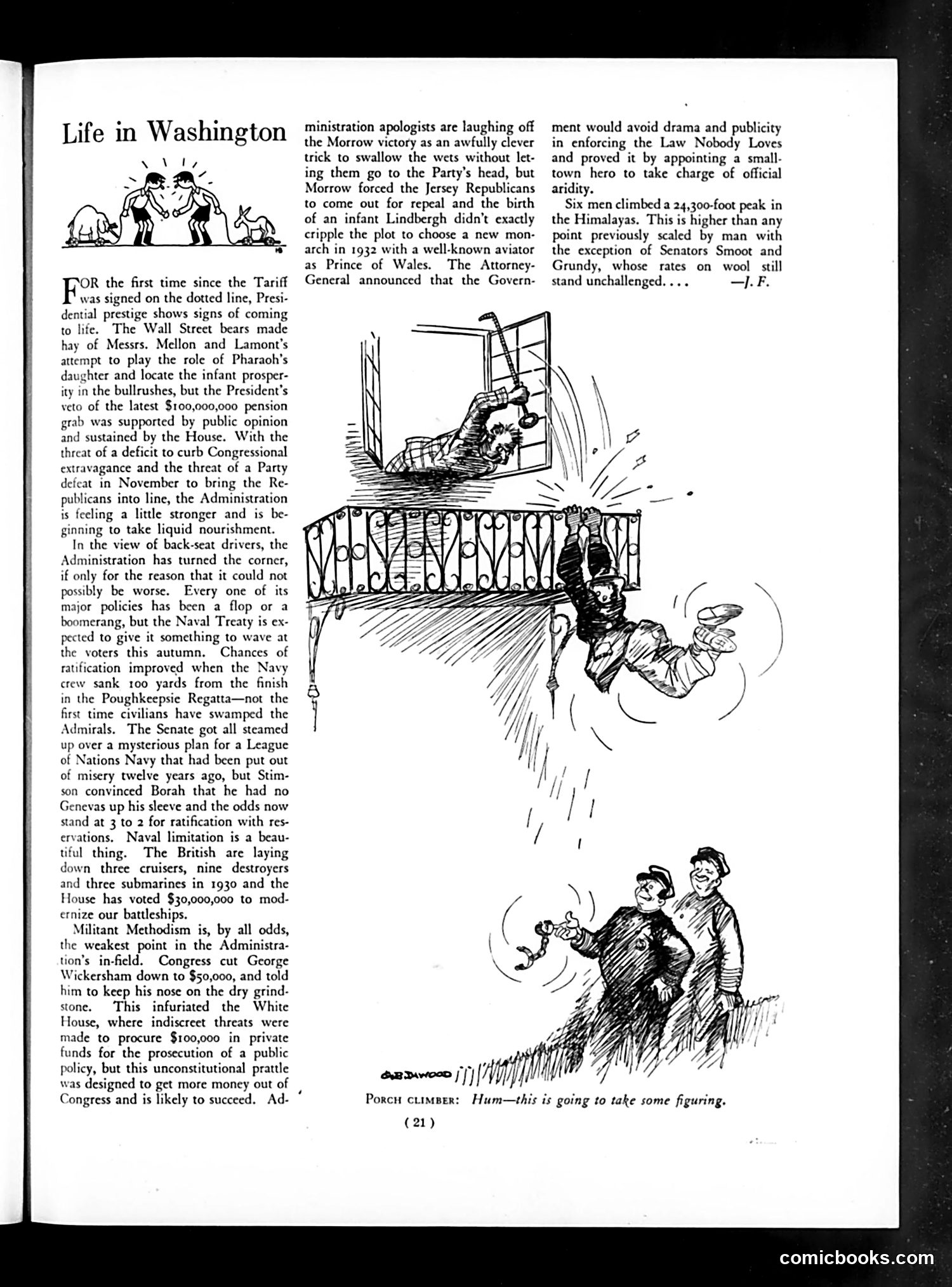
"Life in Washington" - Political Satire, c. 1930 This satirical column mocks the Hoover Administration's struggles. The main cartoon depicts a man (likely representing a politician or businessman) climbing out a window onto a ledge while figures below seem confused—captioned "this is going to take some figuring," suggesting administration policies are incomprehensible or desperate. The text attacks multiple targets: the failed pension veto, Prohibition enforcement ("the Law Nobody Loves"), and naval policy contradictions. It ridicules "Militant Methodism"—likely Attorney General George Wickersham's aggressive Prohibition stance. The final joke compares Senators Smoot and Grundy (protectionist tariff advocates) to Himalayan mountain climbers, suggesting their high tariff rates are equally extreme and unchallenged. The overall tone: the Administration is flailing, its policies are contradictory, and politicians are either incompetent or absurdly self-important.
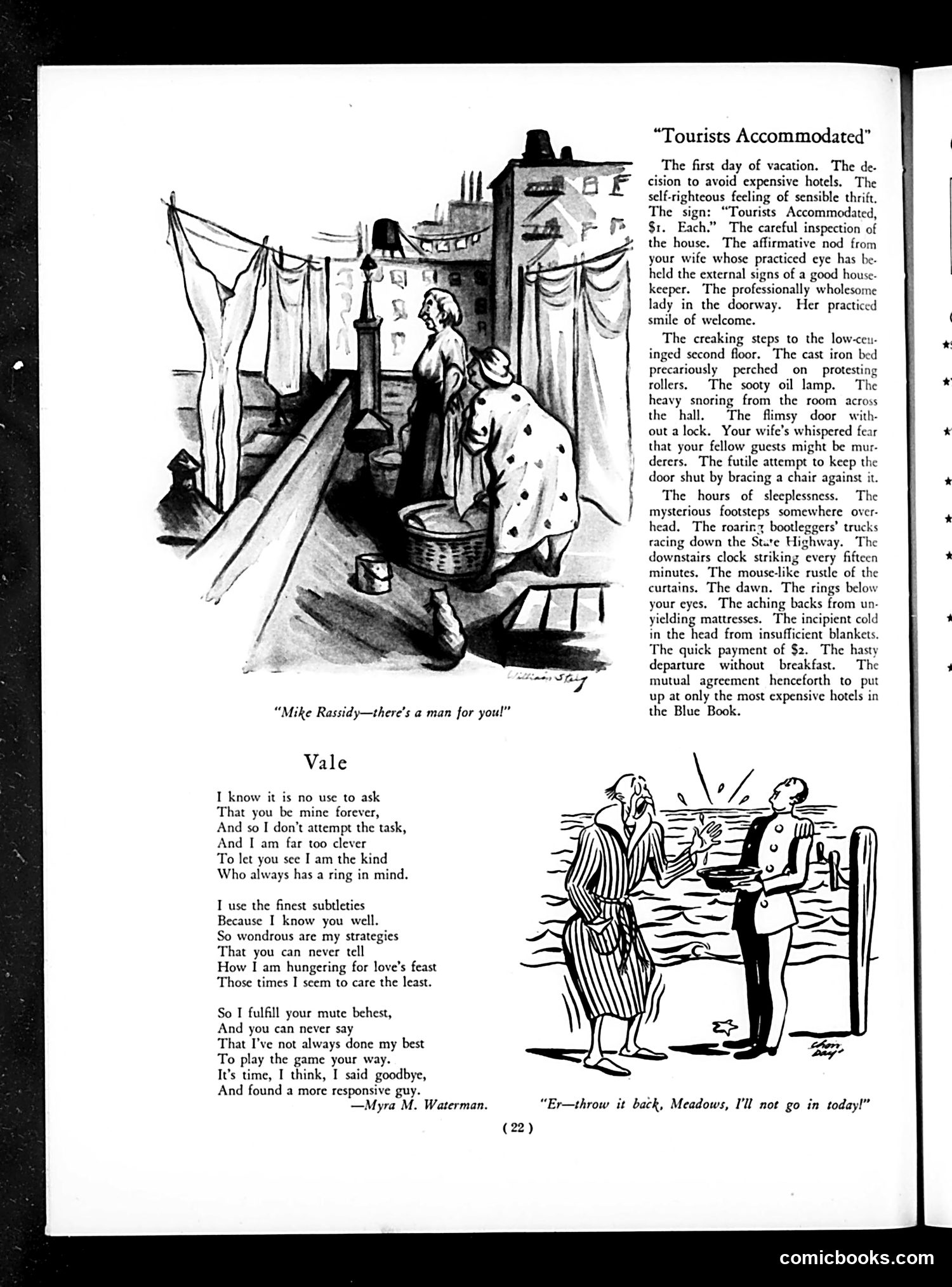
Analysis of Life Magazine Page 22 "Tourists Accommodated" satirizes the false economy of budget travel. The narrative follows a couple choosing a cheap boarding house ($1/person) over expensive hotels, feeling virtuous about thrift. The text catalogues their miserable night: a rickety iron bed, sooty lamp, noisy neighbors, unlocked door, mysterious footsteps, bootlegger trucks on the highway, a constantly chiming clock, and thin blankets. They escape without breakfast, paying $2 total, and vow thereafter to stay only at expensive hotels listed in the Blue Book (a travel guide). The joke: penny-wise, pound-foolish—the cheapest option proves costliest to comfort and peace. "Valc" is a poem about romantic manipulation and departure. The speaker uses calculated subtlety and emotional games to maintain a relationship on the partner's terms, hiding genuine feelings. Finally, exhausted by one-sided effort, they end it, seeking "a more responsive guy." The bottom cartoon shows a woman refusing a man's invitation to go out ("I'll not go in today"), though the specific context is unclear.
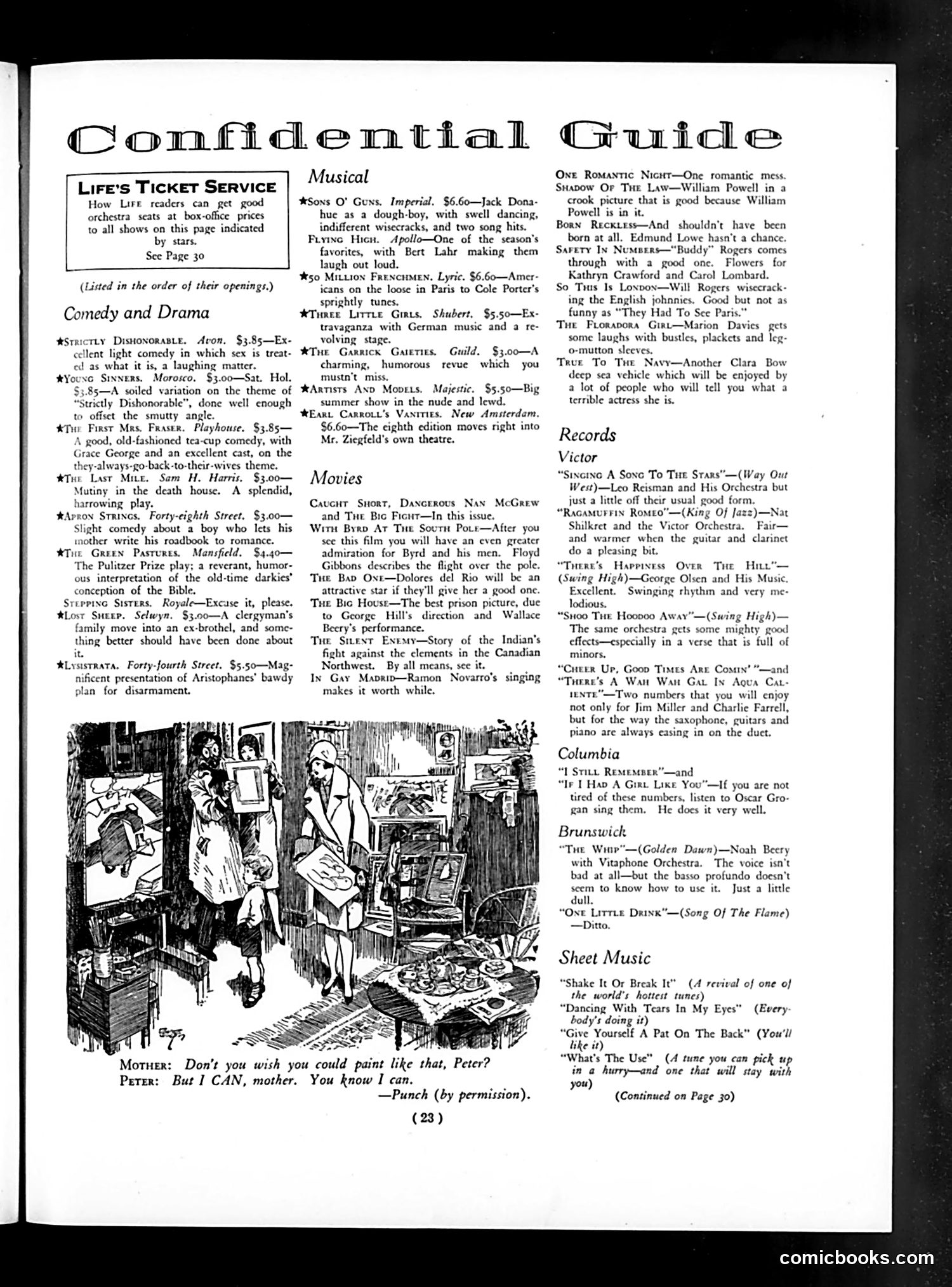
Analysis of Life Magazine Page (circa 1928-1929) This is primarily a entertainment guide, not a political cartoon page. The content lists Broadway shows, films, and musical recordings with brief critical reviews. The only cartoon appears at the bottom—a Punch-sourced domestic humor strip showing a mother and son ("Peter"). The joke is a simple play on words: Mother assumes Peter cannot paint, but he insists he *can* ("I CAN, mother"). The humor relies on a child's literalism versus parental skepticism—typical early 20th-century family comedy. No political satire is present. The page reflects 1920s entertainment, mentioning performers like Will Rogers, Marion Davies, and productions like "The Green Pastures" (a Pulitzer Prize play about African American biblical interpretation). The reviews use frank language about sexual content ("bawdy," "nude and lewd"), suggesting Jazz Age sophistication. This is a consumer guide for theatergoers seeking discounted tickets to Life-advertised shows.
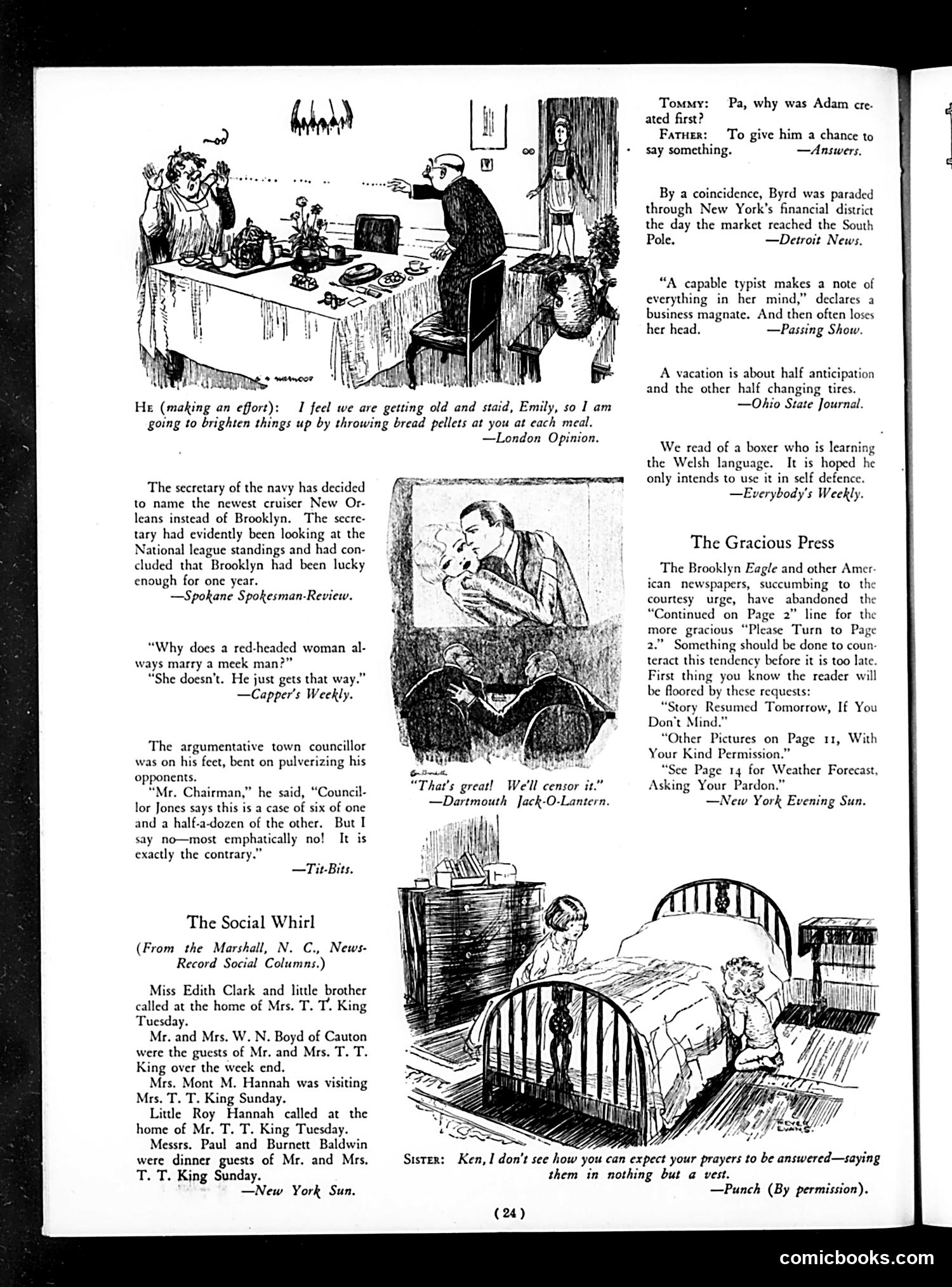
Life Magazine Page Analysis This page contains humorous short jokes and satirical commentary typical of early 20th-century Life magazine. The cartoons mock everyday domestic life and social pretension: Top cartoon: A husband proposes throwing bread pellets at his wife to "brighten things up"—satire on couples stuck in dull routines attempting forced gaiety. Middle cartoon: A man censoring a document says "We'll censor it"—likely commentary on post-WWI censorship practices becoming absurdly routine. Bottom cartoon: A sister mocks her brother praying in only a vest, suggesting his casual approach undermines his religious sincerity. The surrounding brief jokes target: naval bureaucracy (naming ships), gender stereotypes (red-haired women/meek men), verbose politicians, and excessive newspaper politeness. "The Social Whirl" section satirizes small-town society columns obsessively documenting trivial social visits. The humor is gentle, observational satire about American manners, institutional absurdity, and domestic life—typical of Life's satirical approach during this era.
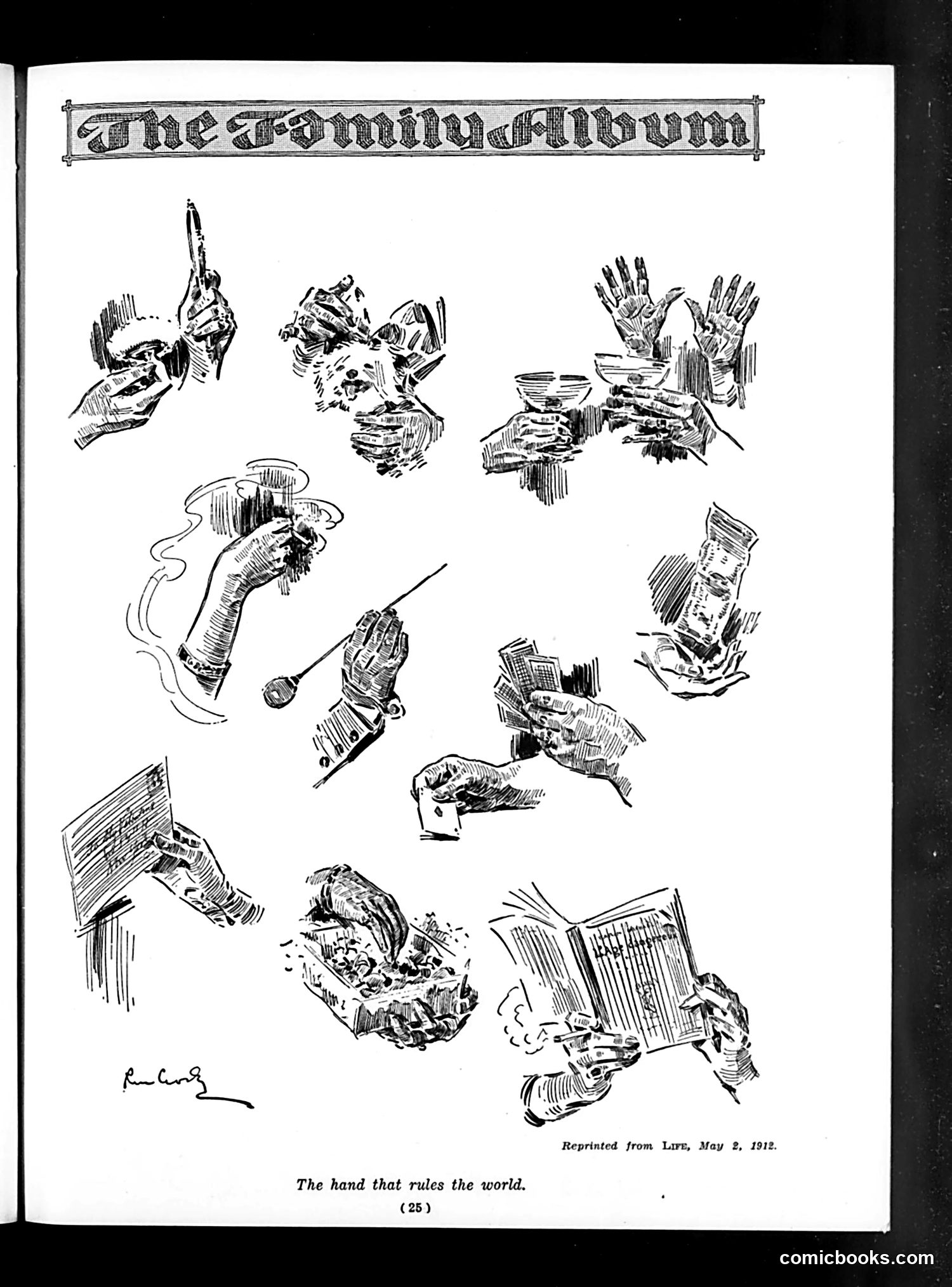
Analysis: "The Hand That Rules the World" This political cartoon from *Life* magazine (May 2, 1912) uses a series of sketches depicting hands engaged in various activities—holding weapons, money, books, food, and other objects—to illustrate different sources of power and influence in society. The title's irony suggests the cartoon critiques who actually controls world affairs. The varied imagery implies power operates through multiple mechanisms: military force, finance, education, sustenance, and industry. Rather than identifying specific figures, it presents a broader satire on institutional and economic power structures themselves. The cartoon likely comments on early 20th-century debates about whether politicians, industrialists, military leaders, or financiers truly governed nations—a relevant concern during the pre-WWI era when industrial and imperial powers were ascending.
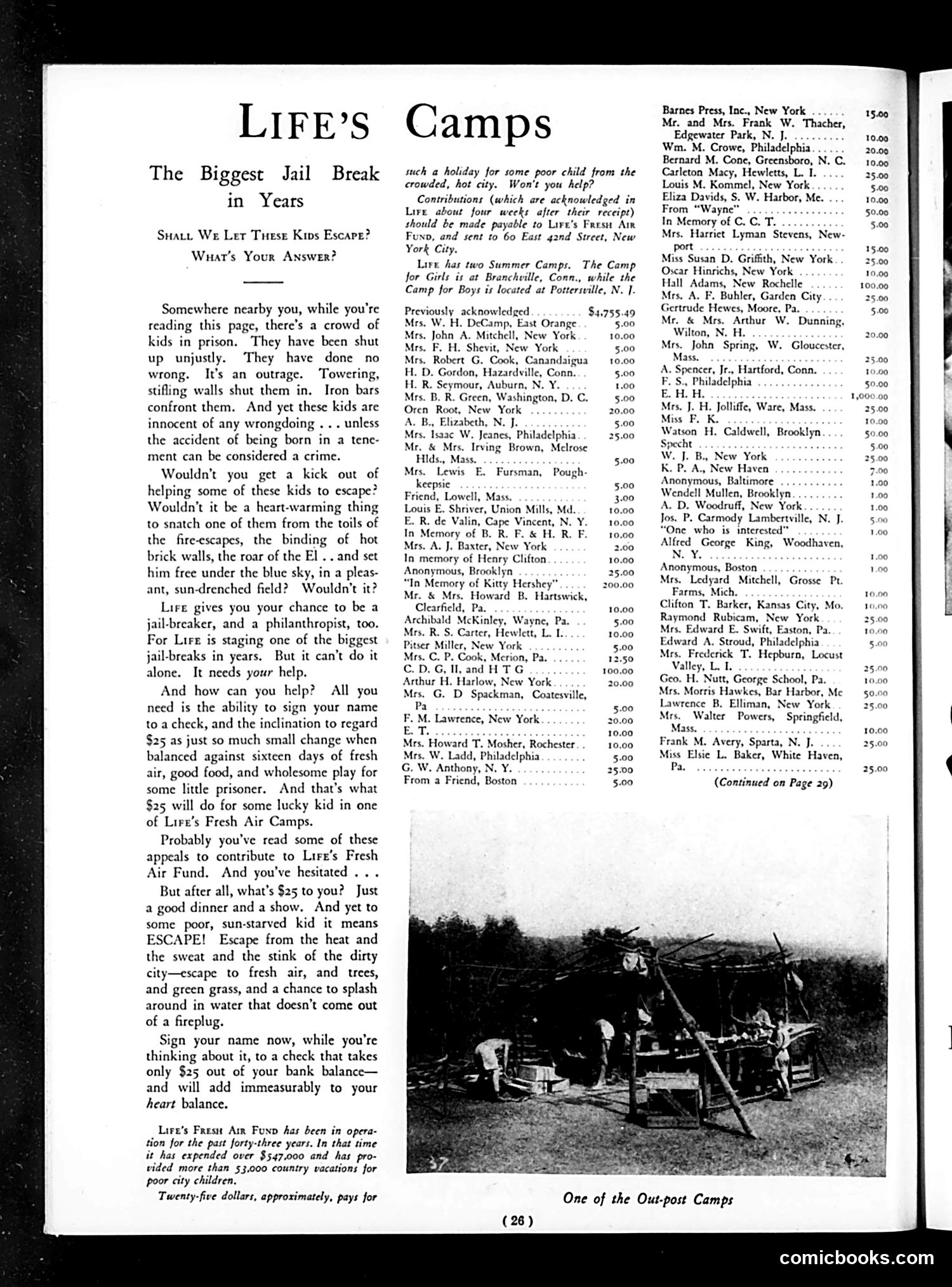
Life's Fresh Air Camps Appeal This page is primarily a fundraising appeal, not a political cartoon. Life magazine is soliciting donations for its Fresh Air Fund, which sends poor urban children to summer camps. The "jail break" metaphor describes tenement-bound children as imprisoned by poverty and urban conditions—trapped by "towering, stifling walls," "iron bars," and "fire-escapes." The appeal frames a $25 donation as an act of liberation, allowing one child sixteen days of escape to countryside camps in Connecticut and New Jersey. The photograph shows an actual camp scene. The text emphasizes the program's forty-three-year history and $547,000 expended, listing contemporary donors by name and amount. This is earnest Progressive-era social reform rhetoric, positioning wealth as a moral obligation to rescue poor children from the "heat and sweat and stink of the dirty city." The appeal targets affluent readers directly, suggesting $25 is merely "a good dinner and a show" to them but "ESCAPE" for a suffering child.
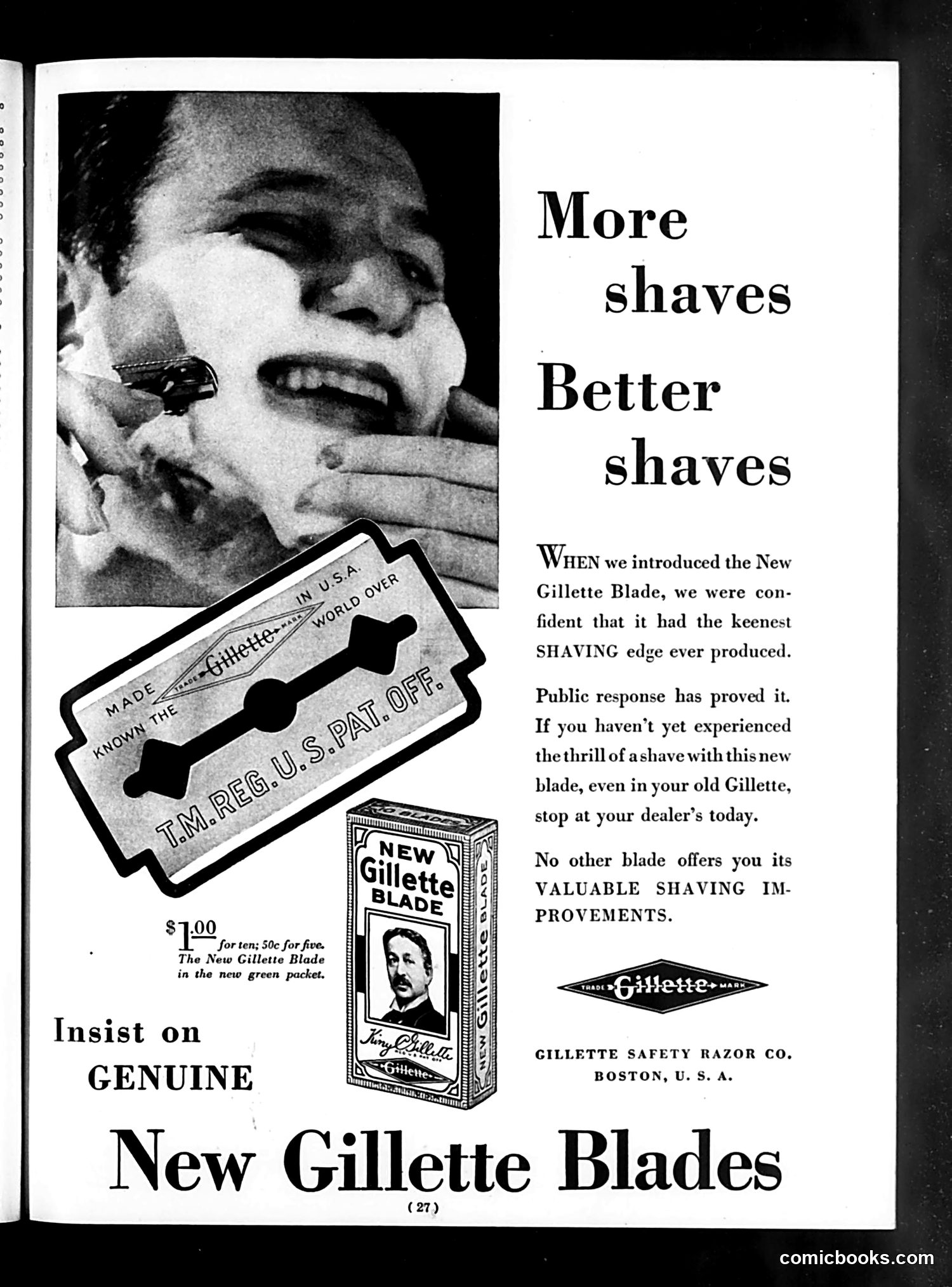
Analysis This is a Gillette razor blade advertisement, not a political cartoon. The page promotes the "New Gillette Blade" with a photograph of a man experiencing an apparently pleasurable shave. The ad's messaging emphasizes product superiority: the new blade offers the "keenest shaving edge" and "valuable shaving improvements" that competitors allegedly lack. The pricing—$1.00 for ten blades or 50¢ for five—appears in the lower left, with the tagline "Insist on GENUINE New Gillette Blades." The emotional appeal targets male consumers by depicting shaving as a pleasurable experience ("thrill of a shave"), encouraging customers to upgrade even if they already own a Gillette razor. The Gillette Safety Razor Co. in Boston positions itself as the industry leader through comparative claims of superiority. There is no satire or political commentary here—it's straightforward early-to-mid 20th century consumer advertising emphasizing product innovation and quality.
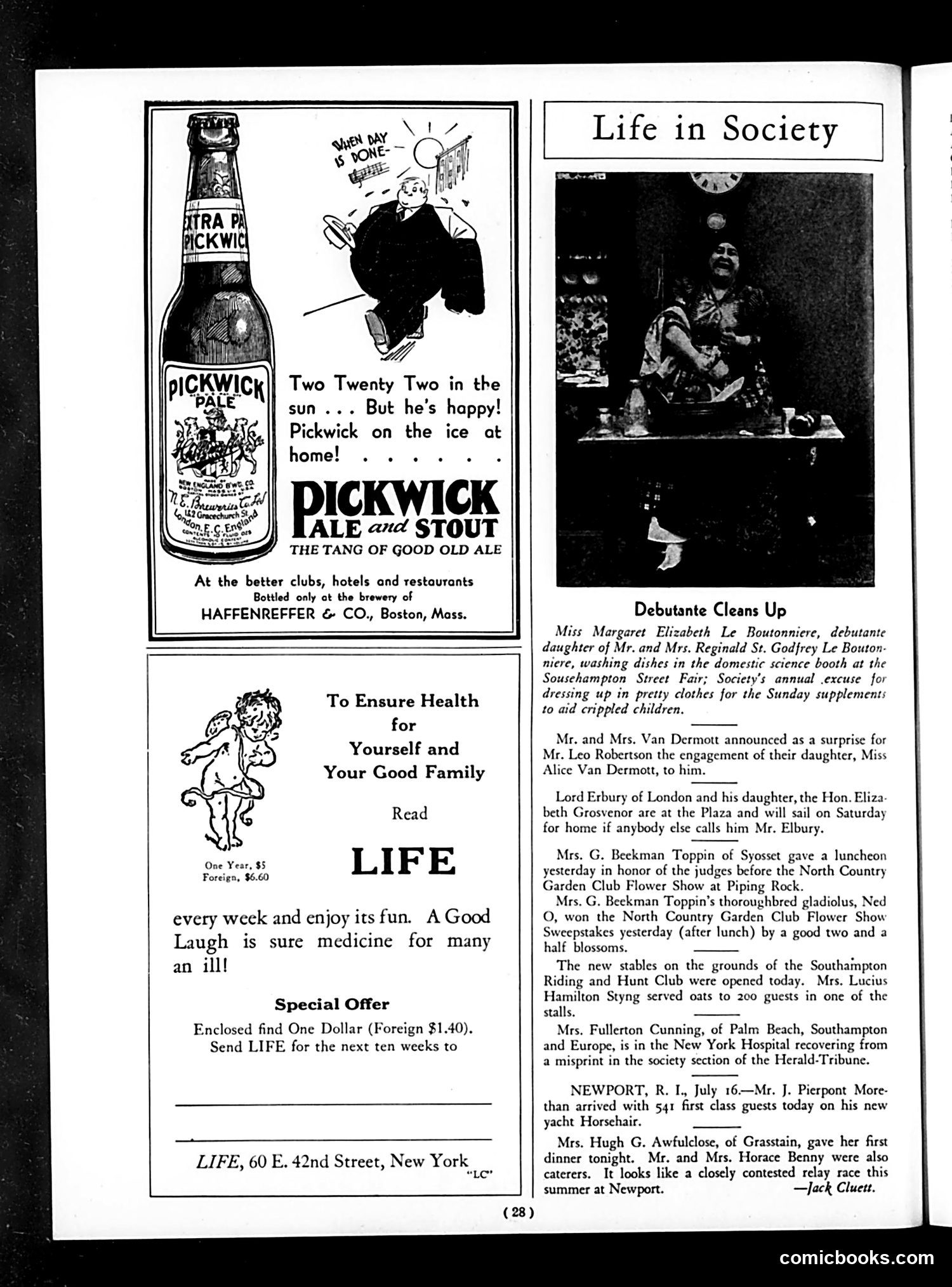
Analysis of Life Magazine Page This page combines advertising with social satire typical of Life magazine's humor. Left side: A Pickwick Ale advertisement uses a pun—"Two Twenty Two in the sun" (122°F heat) contrasts with a happy man drinking cold beer at home. The tagline promises refreshment and comfort. Right side: "Life in Society" mocks wealthy debutantes and the upper class through satirical society gossip. The lead story shows a debutante "washing dishes" at a charity fair—the satire being that wealthy young women perform token domestic labor while dressed up for newspaper photographs, treating charitable work as social performance rather than genuine service. The subsequent gossip items ridicule the pretensions of the ultra-wealthy: their yacht parties, flower show competitions, and trivial social events. Names like "Mrs. Hugh G. Awfulclose, of Grasstain" appear to be invented satirical names mocking the absurdity of high-society nomenclature and concerns. The overall message: Life magazine was lampooning the self-important, performance-based charity work and frivolous social obsessions of the wealthy elite.
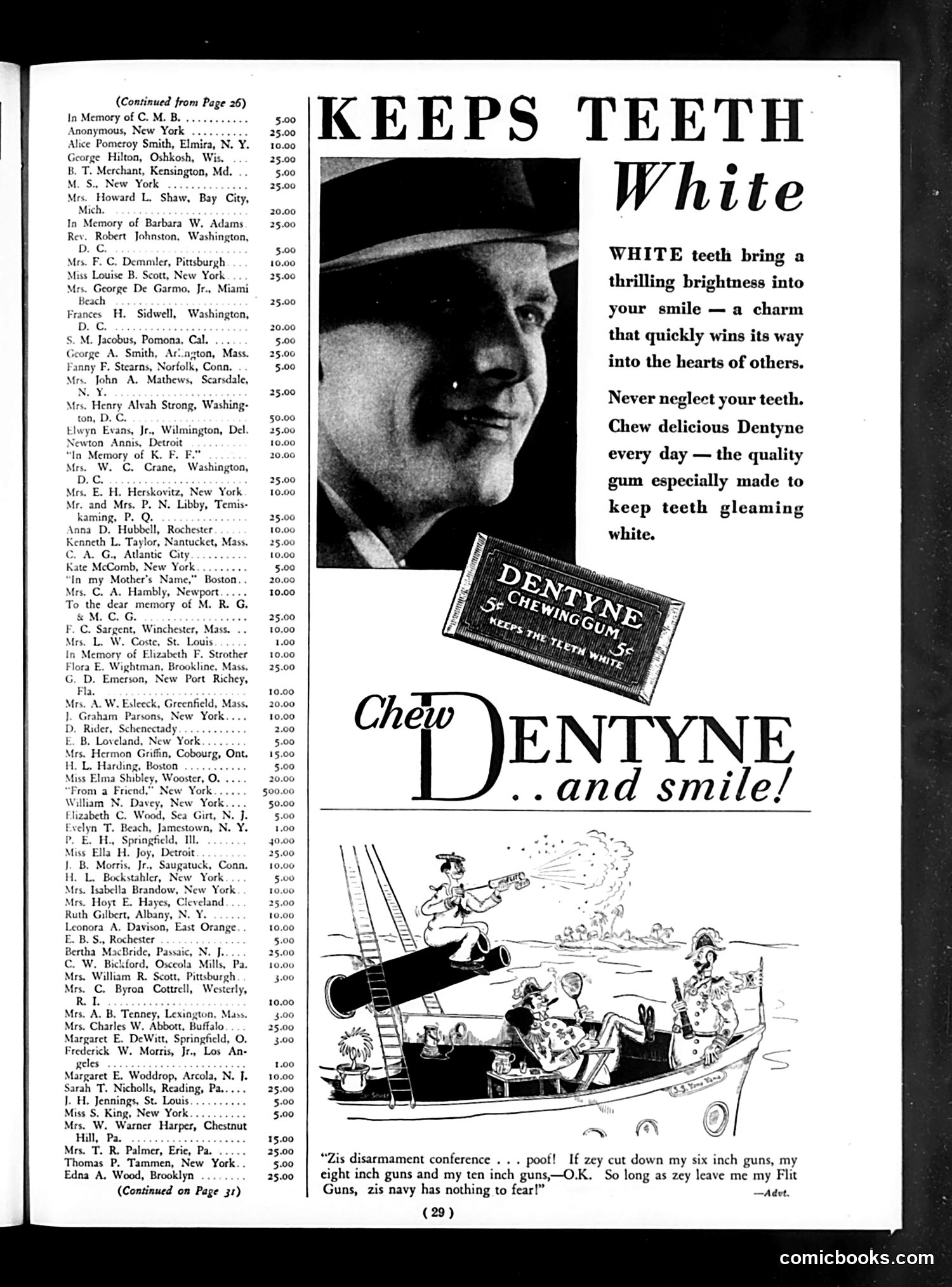
Analysis of Page 29 This page is primarily a Dentyne chewing gum advertisement featuring a smiling woman's portrait and the slogan "Chew Dentyne and smile!" The ad emphasizes white teeth as socially desirable. Below the ad is a political cartoon satirizing disarmament conferences. It depicts a military officer (likely representing a naval power, possibly Soviet based on the accent) declaring that while he'll accept cuts to large naval guns, he refuses to give up his "Flit Guns"—a joke referencing the popular Flit insecticide brand and its famous advertising slogan "When Better Insecticides Are Made, Flit Will Make Them." The satire mocks nations' superficial compliance with disarmament treaties while secretly retaining weapons. The juxtaposition of commercial products (Dentyne, Flit) with military concerns creates absurdist humor typical of Life magazine's approach, suggesting that even during serious diplomatic negotiations, consumer brands dominate public consciousness. The page demonstrates early 20th-century advertising density mixed with political commentary.
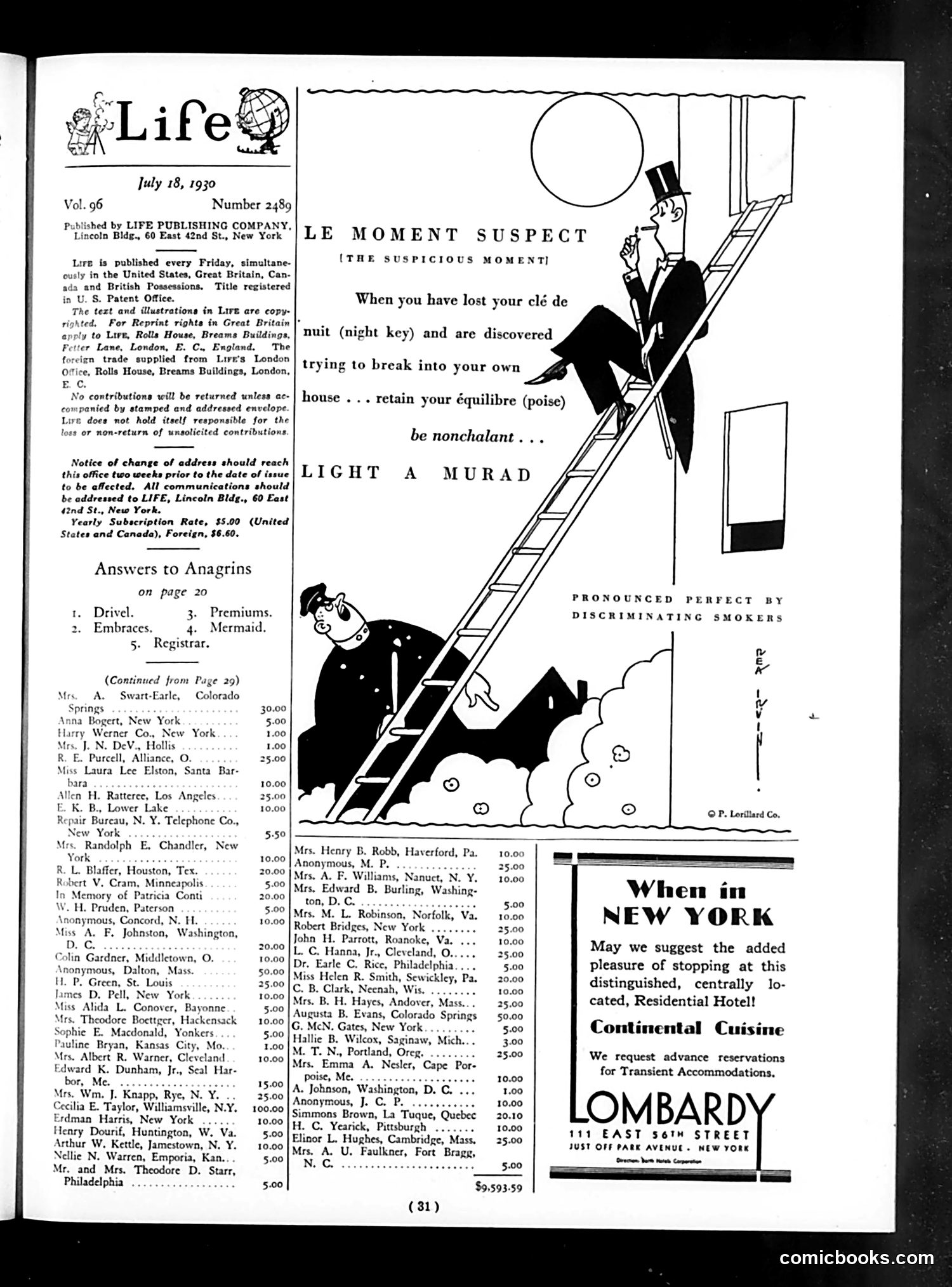
"Le Moment Suspect" (The Suspicious Moment) This is a cigarette advertisement for Murad cigarettes, positioned as satirical humor. The cartoon depicts a well-dressed man on a ladder attempting to break into his own house after losing his key ("clé de nuit"—night key). The joke plays on maintaining composure in an embarrassing situation: if caught mid-burglary by a neighbor or police, one should "retain your équilibre (poise)" and "be nonchalant." The advertisement's tagline—"Pronounced Perfect by Discriminating Smokers"—suggests that smoking Murad cigarettes somehow aids in maintaining such sophisticated coolness during awkward moments. The humor relies on class-based assumptions about 1930s readers: a gentleman wouldn't want to appear undignified, even while literally breaking into his own home. It's a lighthearted play on social anxiety and the aspirational self-image cigarette advertising cultivated.
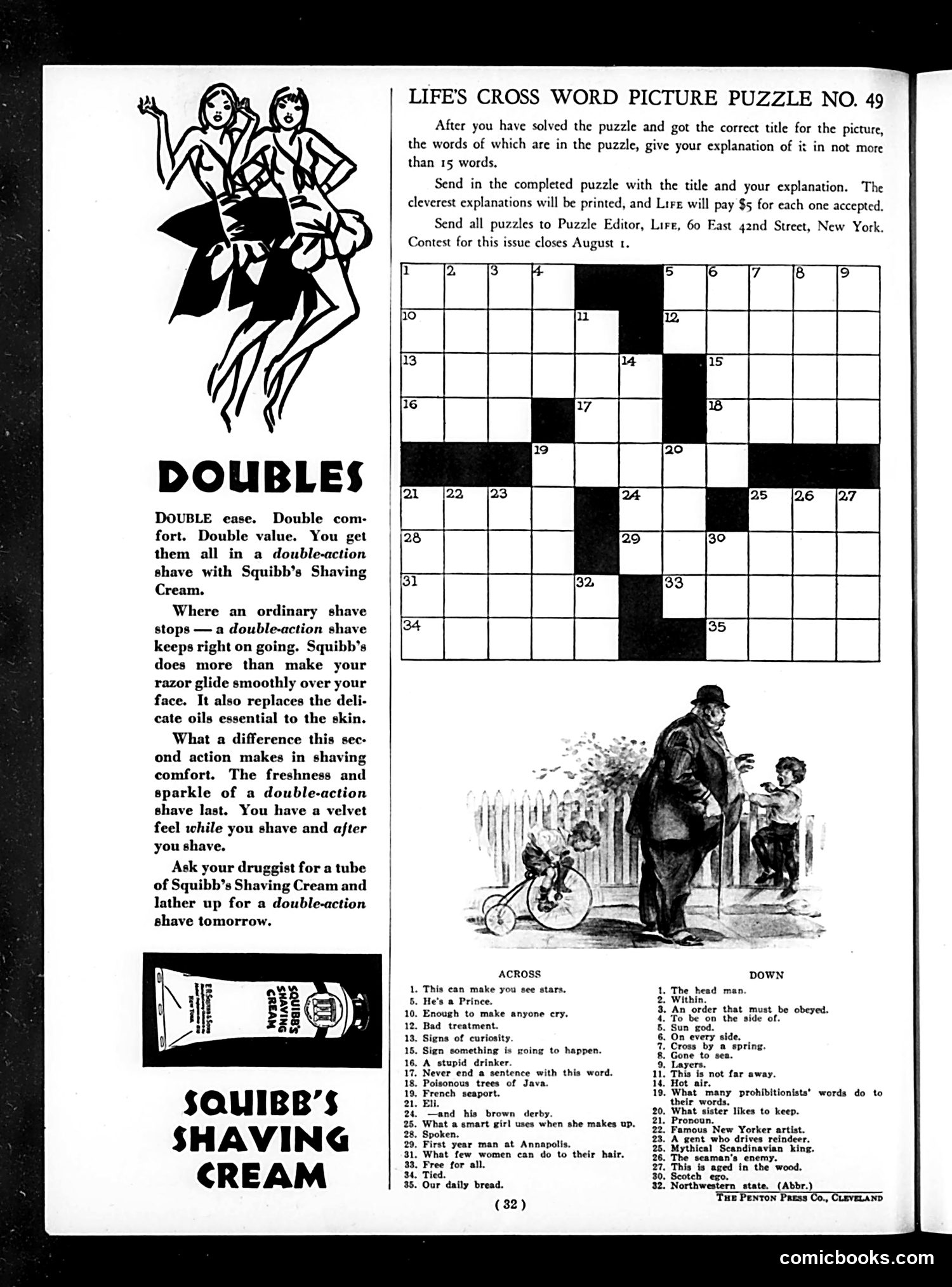
Analysis This page is primarily advertising for Squibb's Shaving Cream, featuring a product-focused illustration of two stylized women in 1920s-30s fashion and a testimonial text emphasizing the cream's "double-action" benefits—smooth gliding *and* skin oil replacement. Below the ad sits a crossword puzzle contest (Life's Puzzle No. 49). Solvers must complete the grid, identify a picture title from the puzzle words, and submit a 15-word explanation for a $5 prize. The clue lists reference mundane topics (bread, princes, prohibitionists, reindeer drivers) with no obvious satirical point visible from the text alone. The small illustration accompanying the puzzle shows what appears to be a street scene with an elderly man and children—likely the puzzle's subject, though its significance is unclear without solving it. This is essentially a reader-engagement feature—common in Life magazine—combining commercial advertisement with interactive entertainment to boost circulation and reader participation.
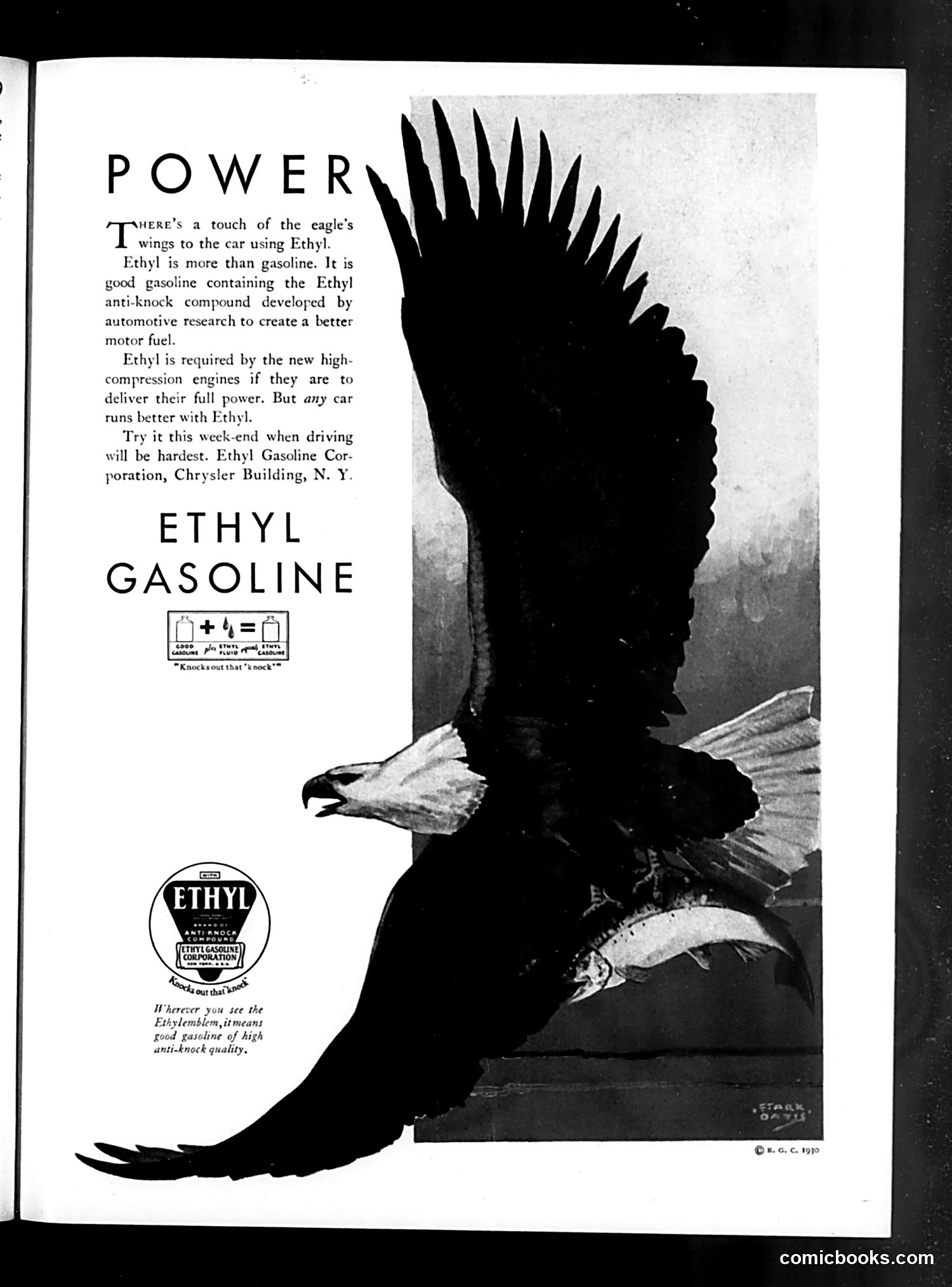
Ethyl Gasoline Advertisement (c. 1930) This is a product advertisement, not political satire. It promotes Ethyl gasoline by using a dramatic silhouette of an eagle in flight, carrying a fish. The eagle imagery invokes American patriotism and power—connecting the fuel's performance to the bird's strength and dominance. The text emphasizes that Ethyl contains an "anti-knock compound" that allows modern high-compression engines to operate at full power. The ad claims any car "runs better with Ethyl," and encourages consumers to test it during demanding driving (weekend trips). The eagle's talons grip a fish, a visual metaphor suggesting the fuel's gripping power and effectiveness. This is straightforward commercial persuasion using nationalist symbolism common to 1920s-30s American advertising—no satire is present. The Ethyl Gasoline Corporation's Chrysler Building address anchors this as genuine marketing from the era.
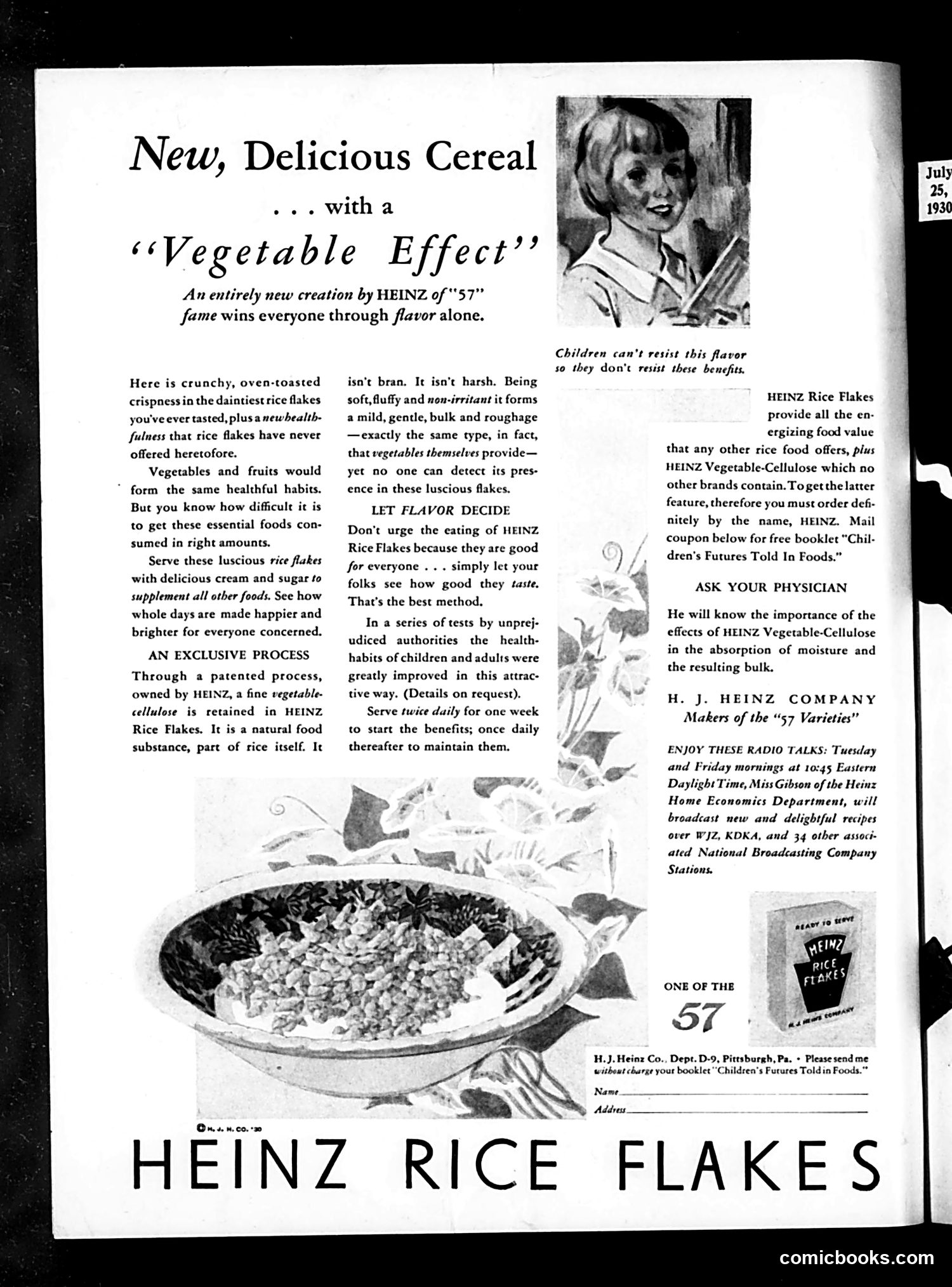
Analysis This is a full-page advertisement, not satire or editorial content. It promotes Heinz Rice Flakes cereal (July 1930). The ad targets parents concerned about children's nutrition, claiming the cereal contains a proprietary "vegetable cellulose" that aids digestion while tasting good enough that children willingly eat it. The accompanying photograph shows a smiling young girl and a bowl of cereal flakes. Key marketing claims include: the product is "crunchy" and "delicious," contains health benefits vegetables provide, improves children's eating habits through flavor appeal alone, and has been tested by "unprejudiced authorities." The ad invokes physician authority and offers a free booklet titled "Children's Futures Told in Foods." This reflects 1930s advertising strategies emphasizing scientific testing and health benefits to justify premium pricing for processed foods—a relatively novel marketing approach at the time.