life
Life — July 25, 1930
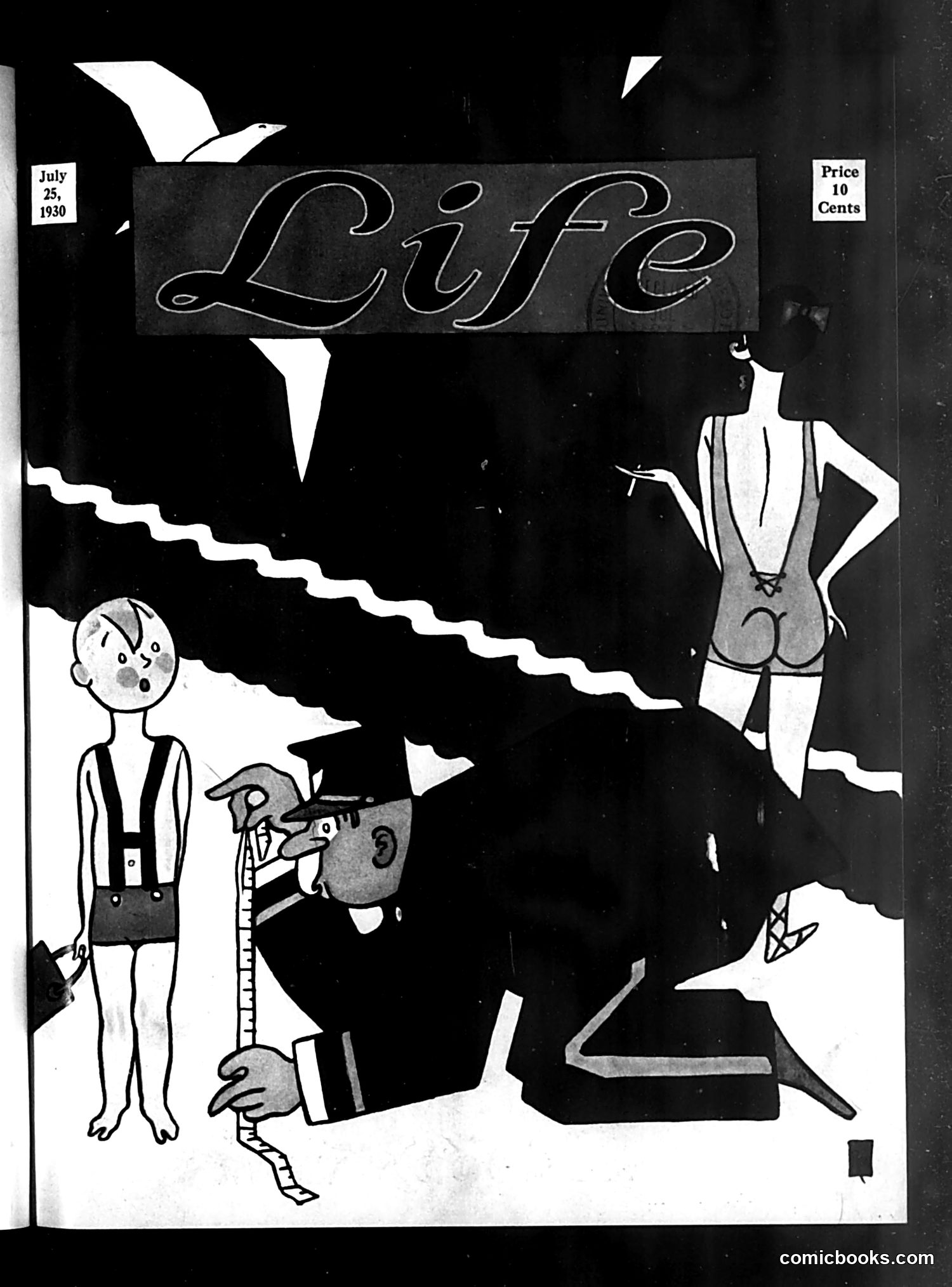
Life Magazine Cover Analysis - July 23, 1930 This cover depicts a theatrical or film production scene. A director (center, wearing a cap and holding a megaphone) measures a young male actor against a measuring scale, while a scantily-clad female performer poses to the right. A young boy on the left appears shocked or distressed. The satire likely critiques Hollywood's objectification of performers, particularly the physical measurement and evaluation of actors—especially women—for casting purposes. The boy's shocked expression suggests moral concern about the entertainment industry's standards and practices. The 1930 date places this during early sound film era, when Hollywood was consolidating its studio system and developing notorious casting couch culture. The cartoon mocks the dehumanizing nature of show business talent evaluation.
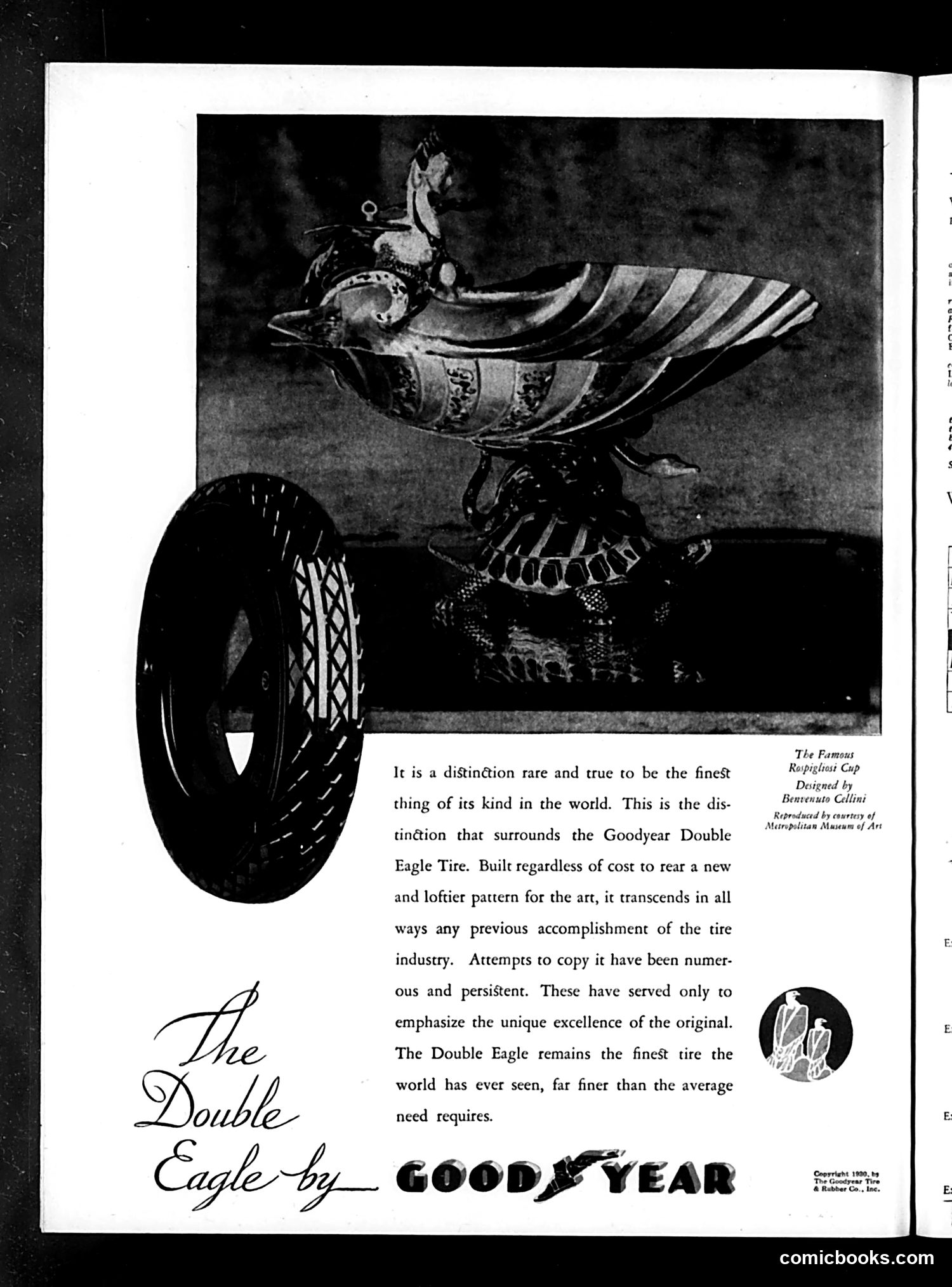
Analysis This is primarily a Goodyear advertisement, not satirical content. The page promotes the "Double Eagle" tire as "the finest thing of its kind in the world." The top image shows an ornate decorative vessel (appears to be a Renaissance-era art object, possibly from a museum collection, given the credit to "Metropolitan Museum of Art"). This luxurious artifact serves as a visual metaphor—the ad argues that the Double Eagle tire represents comparable excellence and craftsmanship in its category. The tire image on the left demonstrates the product's distinctive tread pattern. The text emphasizes the tire's superiority and notes that competitors have attempted to copy it, only reinforcing the original's unique quality. This is straightforward product marketing using an appeal to quality and prestige rather than satire.
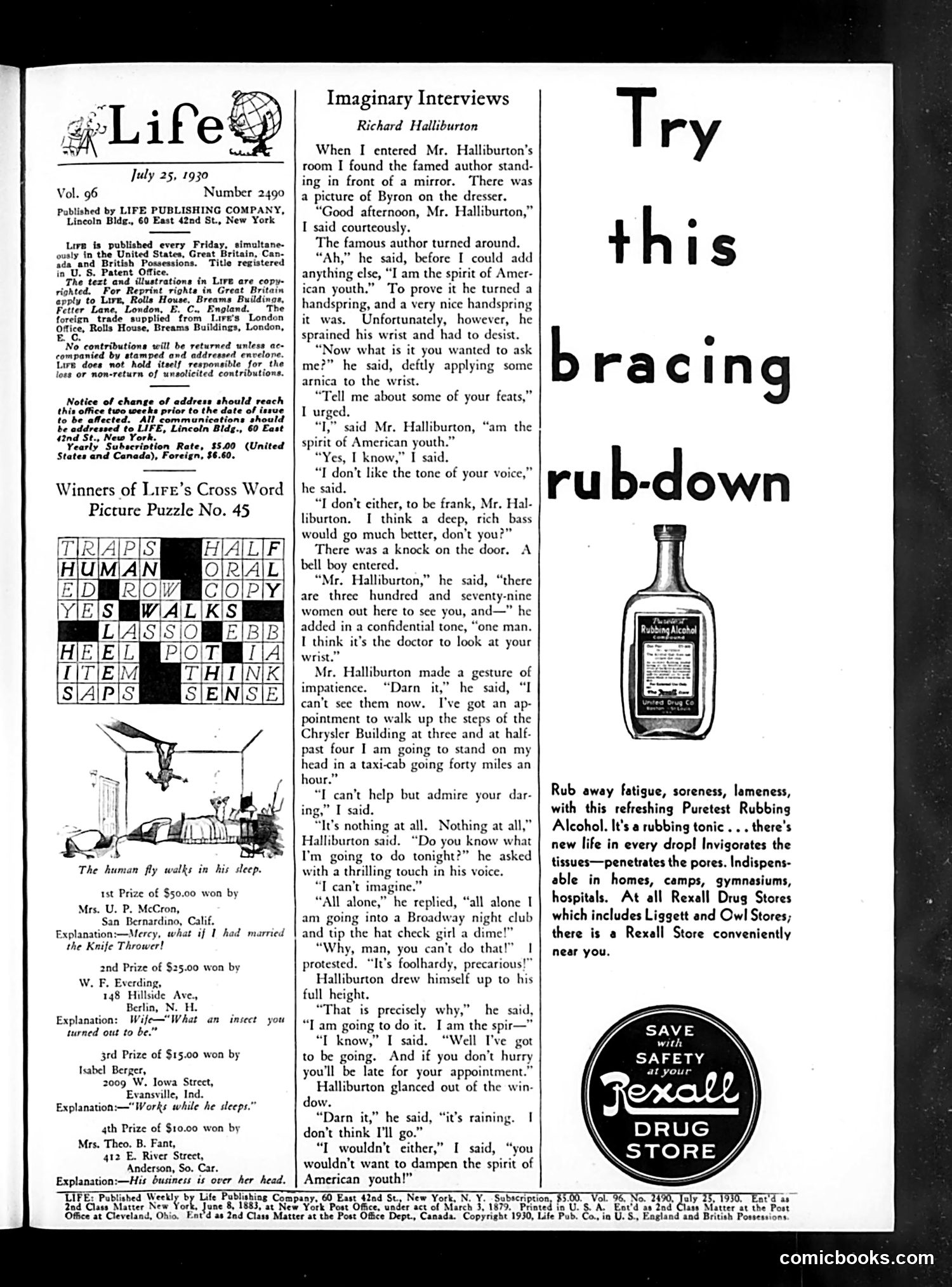
Page Content Analysis This page is primarily advertising and puzzle content, not political satire. The main elements are: 1. "Imaginary Interviews: Richard Halliburton" - A humorous fictional dialogue where the interviewer visits author Halliburton, who claims to be "the spirit of American youth." The joke involves Halliburton injuring himself while posing dramatically, then rushing off to a Broadway nightclub appointment, contradicting his grandiose self-description. 2. Crossword puzzle and picture puzzle with reader prize winners listed. 3. Rexall Drug Store advertisement for "Purest Rubbing Alcohol" as a medicinal rub. The satire here targets Halliburton's pretentious public persona rather than politics—mocking his self-aggrandizing claims of youthful adventurousness while depicting him as vain and self-centered.
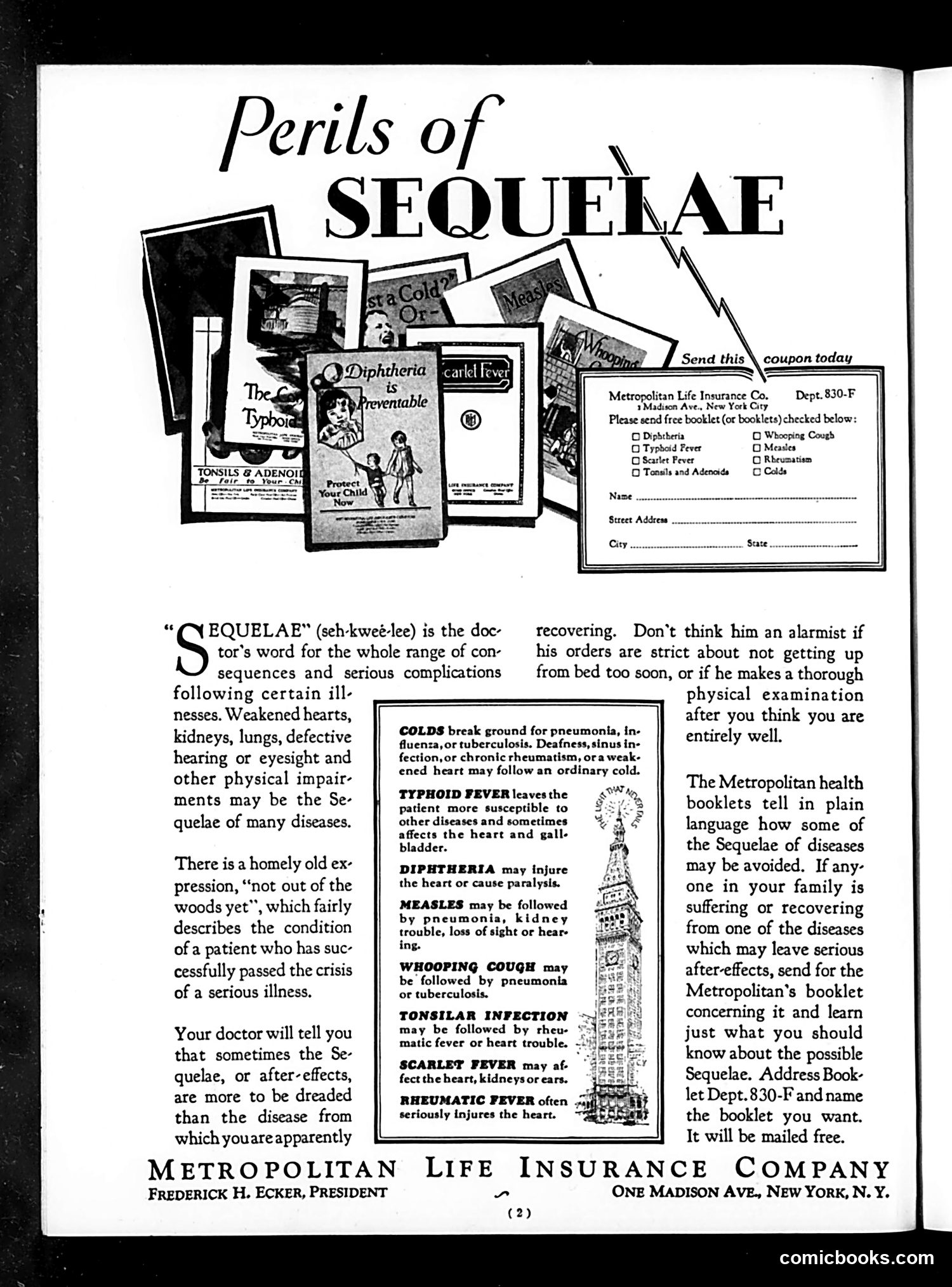
Analysis: "Perils of Sequelae" This page is primarily advertising disguised as educational content from Metropolitan Life Insurance Company. The term "Sequelae" (medical complications following illness) frames the pitch. The visual collage shows vintage public health posters warning about diseases like diphtheria, typhoid fever, and measles—conditions common in the early 20th century that could cause lasting damage or death. The satirical angle is subtle: Metropolitan Life presents itself as a health educator while selling insurance against these "perils." The message to readers is: serious illnesses can have devastating aftereffects; therefore, you need life insurance protection. The coupon invites readers to request free health booklets on various diseases—a marketing tactic disguising commercial intent as public service. This represents an era when insurance companies positioned themselves as legitimate health authorities.
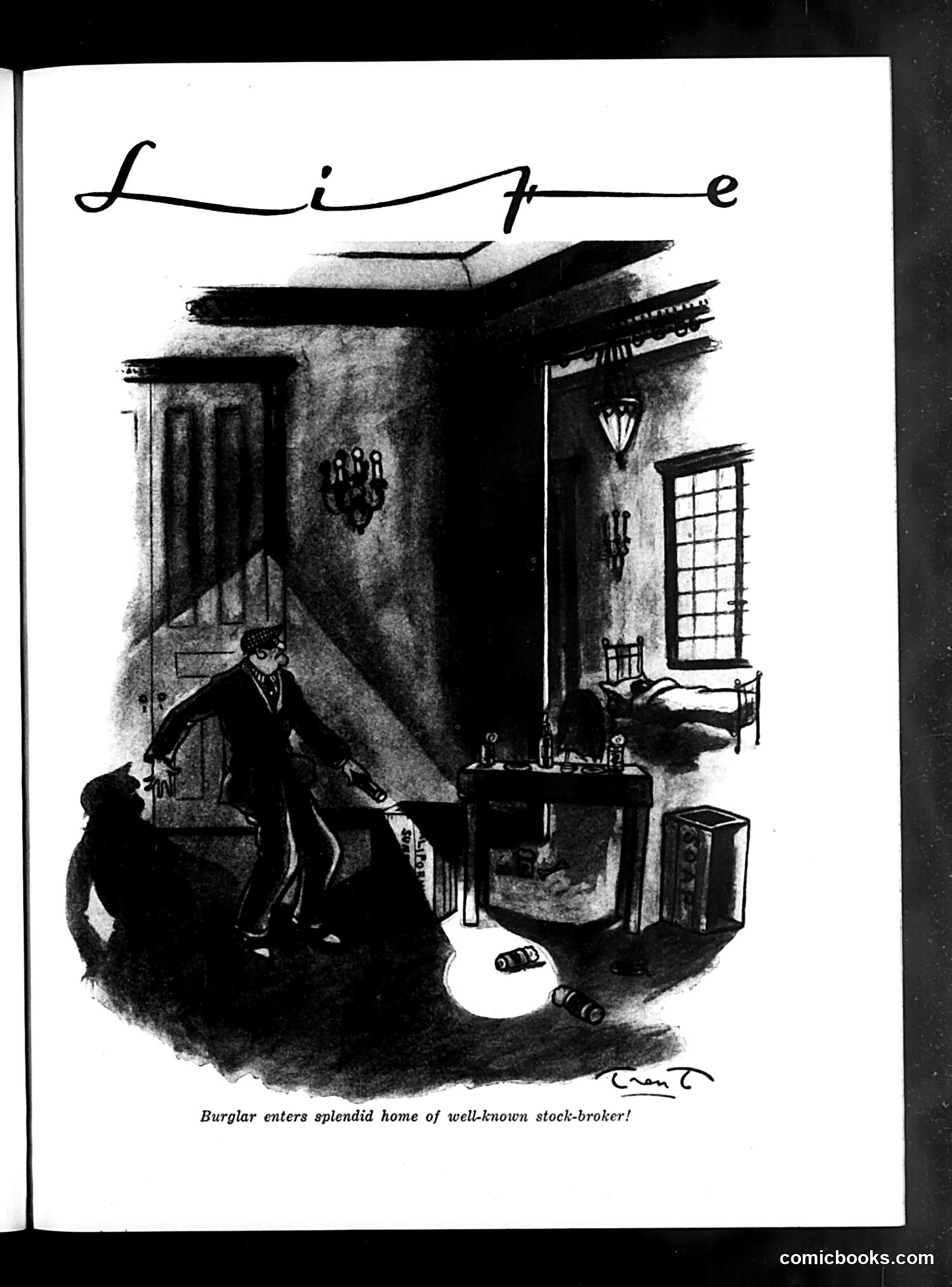
Explanation for Modern Readers This cartoon satirizes wealthy stock brokers during what appears to be the early 20th century. The caption reads: "Burglar enters splendid home of well-known stock-broker!" The joke targets the contradiction between a stock broker's apparent prosperity and the moral implications of their profession. The artist suggests that stock brokers—who manipulate markets and fleece investors—are themselves criminals, making them hypocritical targets for actual burglary. The "splendid home" represents ill-gotten wealth. This reflects widespread public distrust of financial markets and Wall Street profiteering during an era of economic inequality and financial scandals. The satire implies stock brokers deserve robbery because their own practices are essentially criminal, just "legal." The cartoon mocks both their wealth and their lack of moral standing to complain about theft.
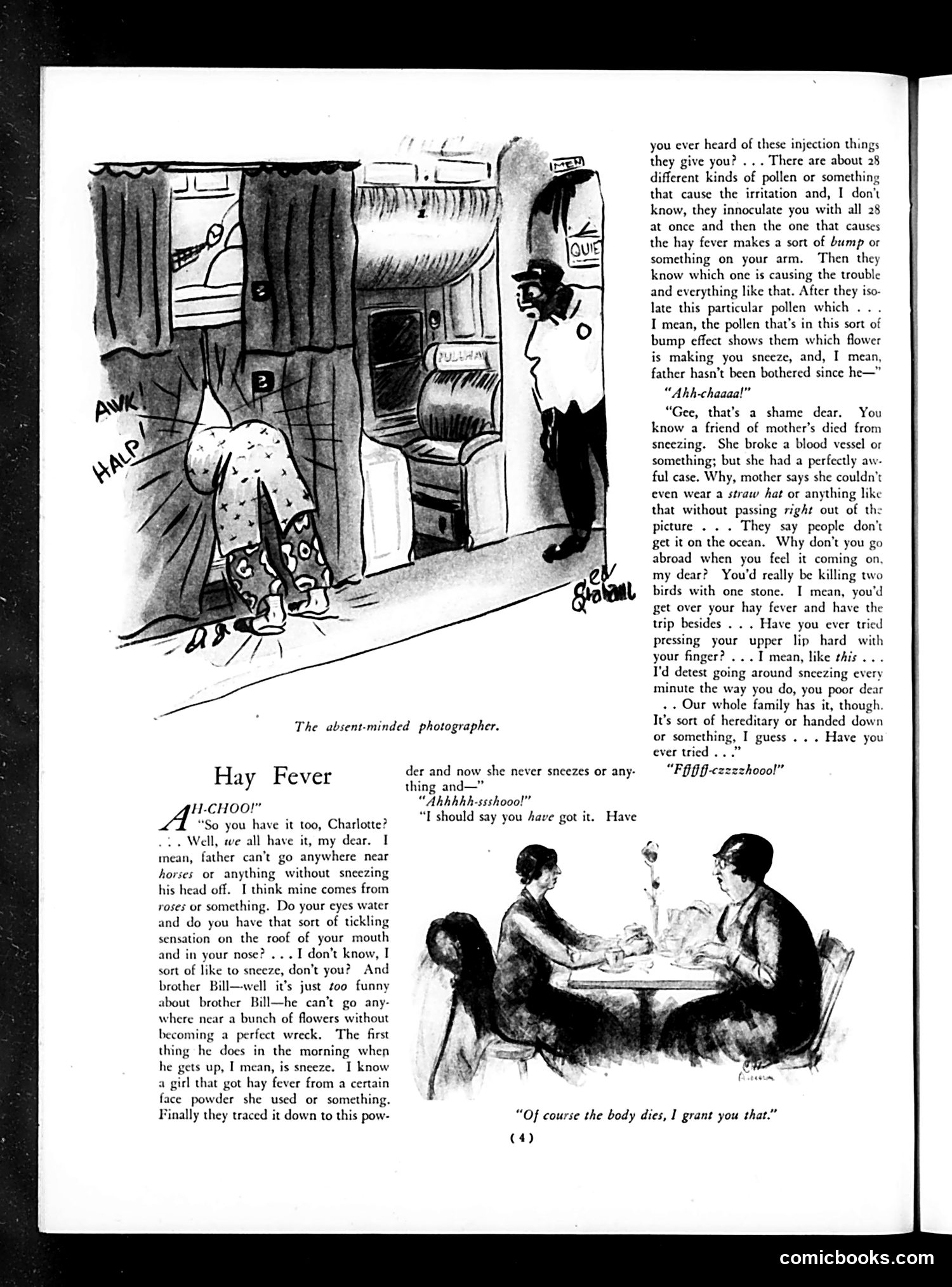
Hay Fever This page presents a humorous piece about hay fever, a seasonal allergy condition. The cartoon at top shows "The absent-minded photographer" — a man so absorbed in his work that he's oblivious to his surroundings, illustrated through visual comedy. The main text is a conversational monologue where one character describes hay fever symptoms to another named Charlotte, discussing sneezing fits, watery eyes, and discomfort. The speaker mentions relatives suffering similarly, including a friend's mother whose condition was so severe she couldn't leave home. The illustration below shows people dining together, with the caption "Of course the body dies, I grant you that." The piece satirizes how hay fever sufferers discuss their ailment in tedious, self-pitying detail—a relatable social observation about complaint-culture that remains timeless.
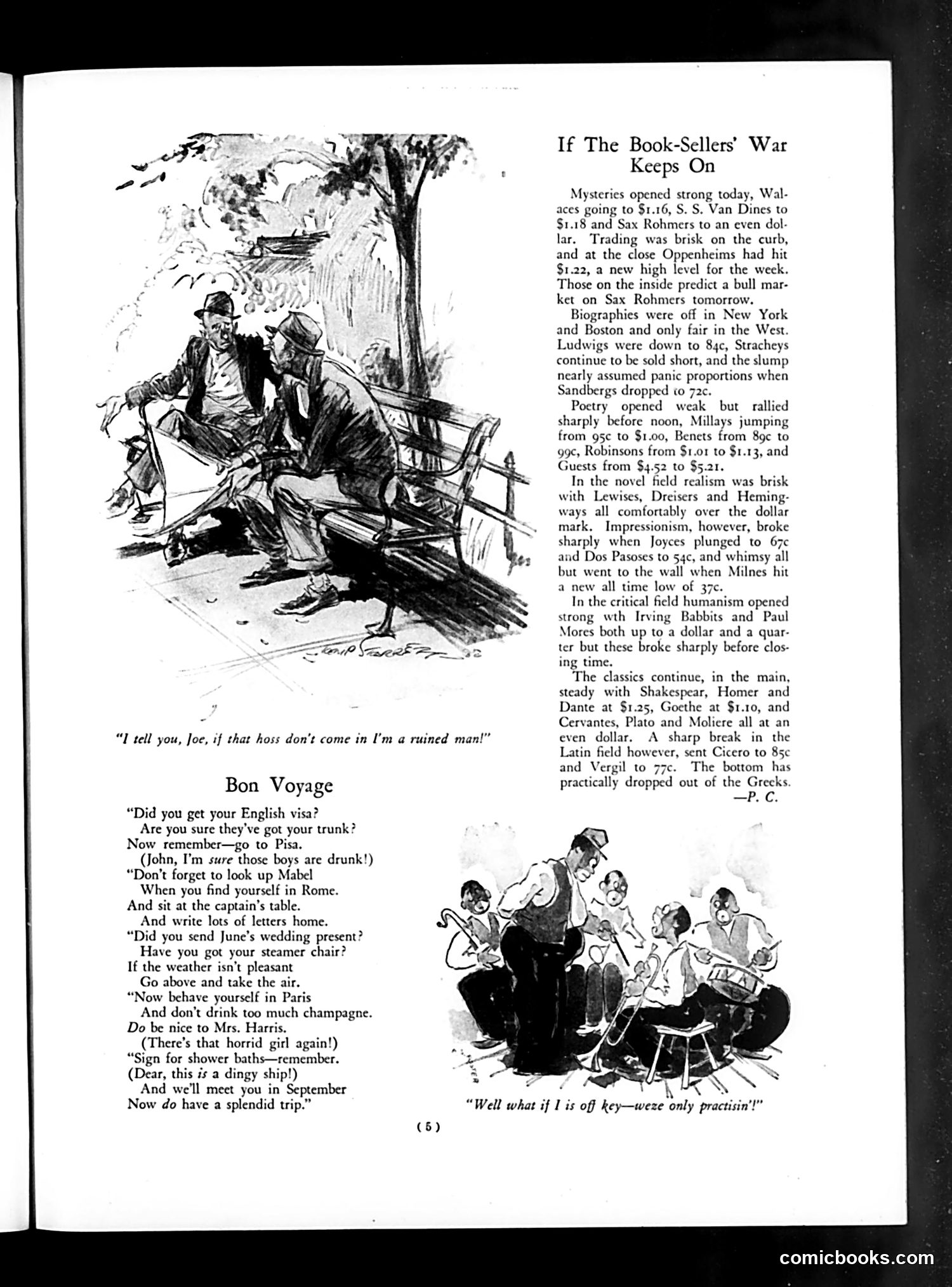
Analysis of Life Magazine Page This page satirizes the "Book-Sellers' War"—a price war among publishers and booksellers during what appears to be the 1920s. The article reports on competing discounts on popular titles (mysteries, biographies, poetry, novels, and classics), with prices fluctuating dramatically as retailers undercut each other. The top illustration depicts two figures in financial distress—likely representing booksellers or publishers—struggling amid economic turmoil, captioned "I tell you, Joe, if that boss don't come in I'm a ruined man!" Below, the "Bon Voyage" poem humorously advises a traveler on European etiquette and behavior, with the illustration showing passengers aboard a ship, captioned "Well what if I is off key—weze only practisin'!" The satire mocks both the chaotic publishing industry price competition and travel pretensions.
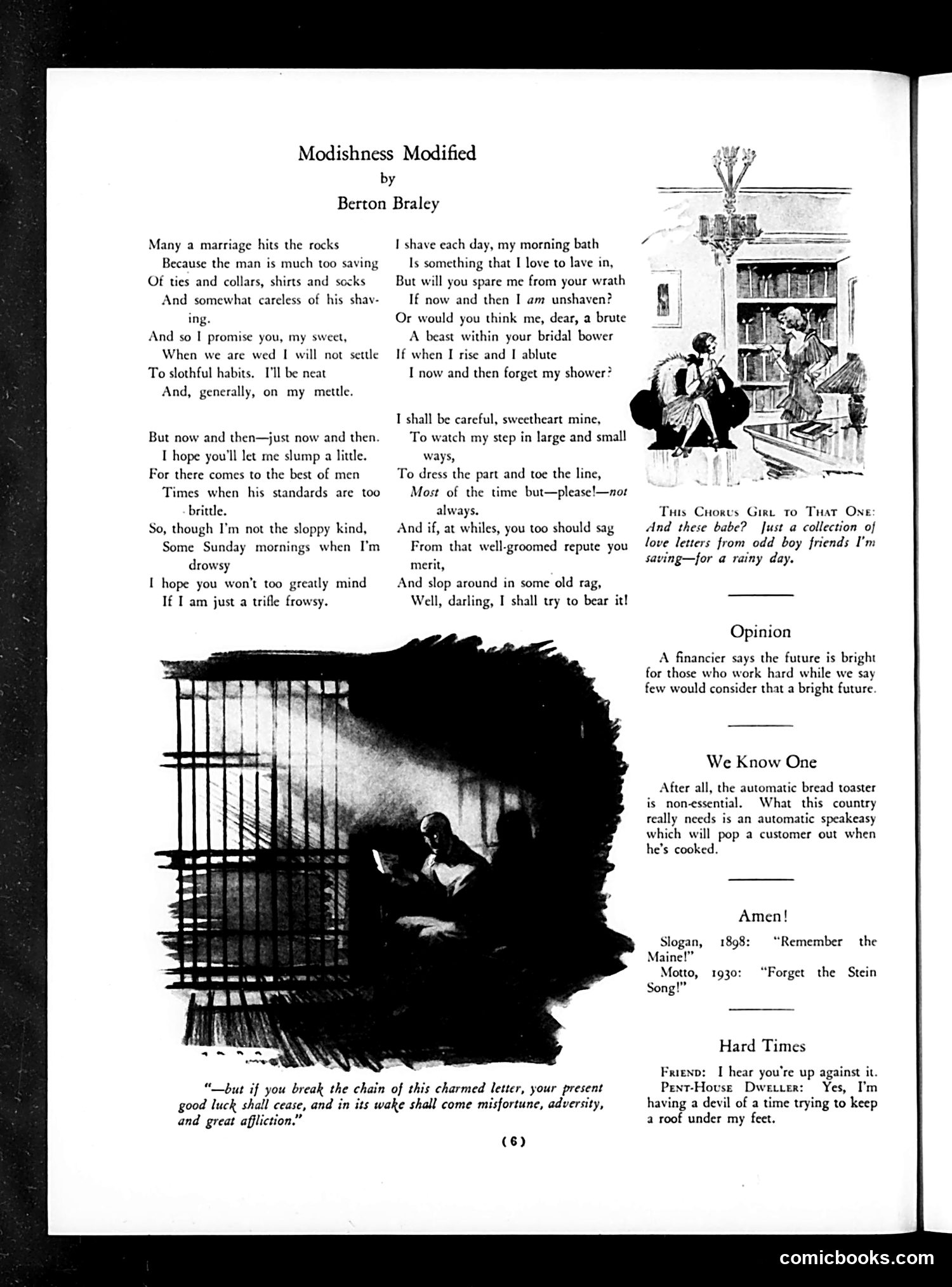
"Modishness Modified" by Berton Braley This poem satirizes modern marriage by contrasting a husband's desire for a neat, orderly wife with his own slovenly habits. The speaker promises his bride he won't settle into "slothful habits" and will remain "neat" and "generally, on my mettle"—but then immediately undercuts this with admissions that he slumps around, forgets his shower, and dresses carelessly. The accompanying illustration shows a man lounging in a chair while a woman arranges books, suggesting the gendered hypocrisy: he demands modishness (fashionable tidiness) from her while exempting himself from the same standard. The satire targets the double standards husbands impose on wives regarding domestic appearance and behavior.
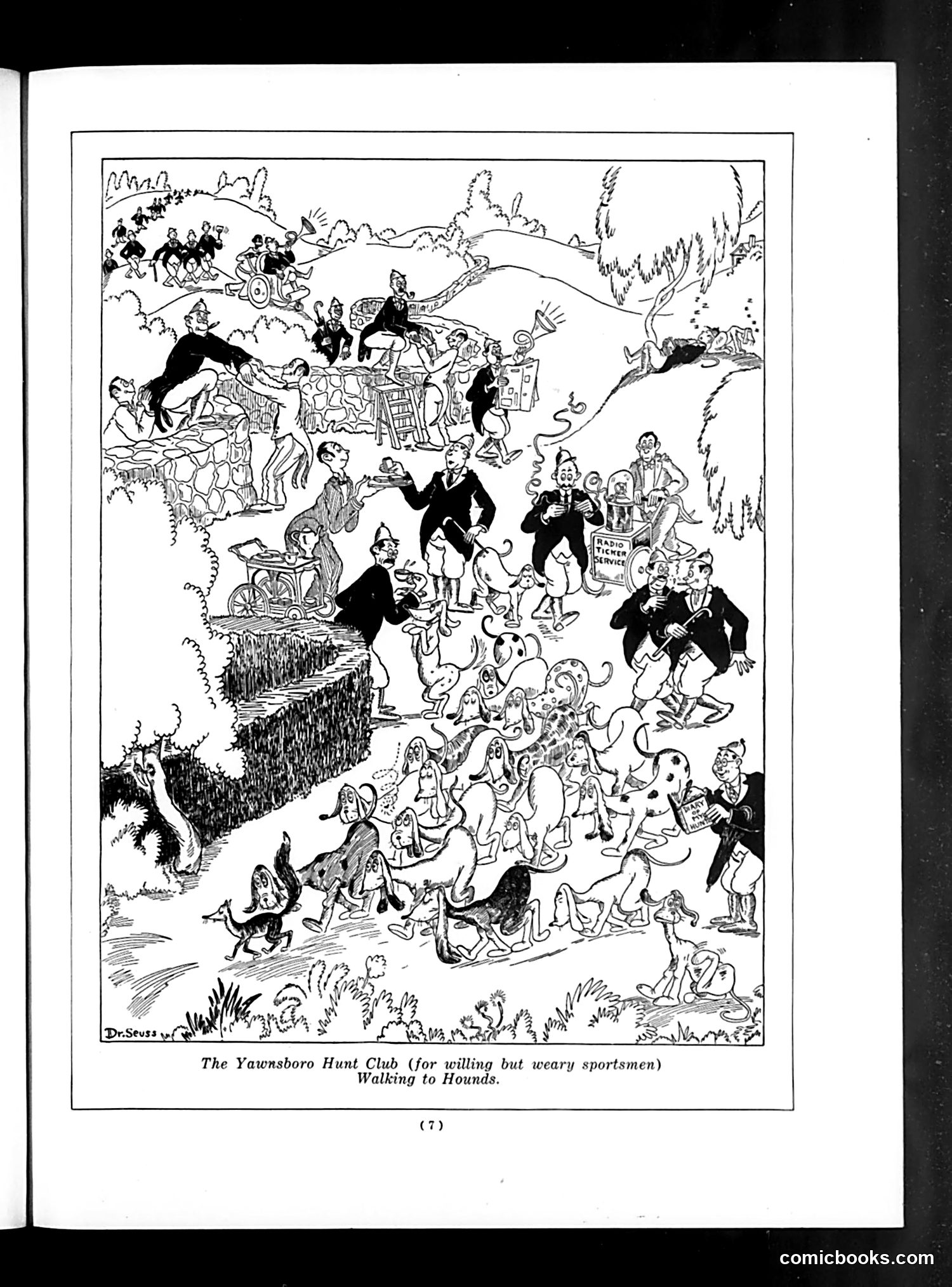
Analysis This is a satirical cartoon titled "The Yawnsboro Hunt Club (for willing but weary sportsmen) Walking to Hounds." The image depicts a hunting club outing where the participants appear exhausted and unenthusiastic. Well-dressed gentlemen in formal hunting attire are shown yawning widely, slouching, and looking generally depleted rather than vigorous. Dogs and horses are present, but the human participants display little energy or enthusiasm for the sport. The satire targets wealthy sportsmen who participate in traditional hunting activities more out of social obligation than genuine interest or fitness. The caption's parenthetical note—"for willing but weary sportsmen"—underscores the joke: these are men who show up to maintain their club membership and social standing, but lack the actual stamina or passion for hunting. The exaggerated yawning emphasizes their boredom and exhaustion despite being supposedly engaged in leisurely recreation.
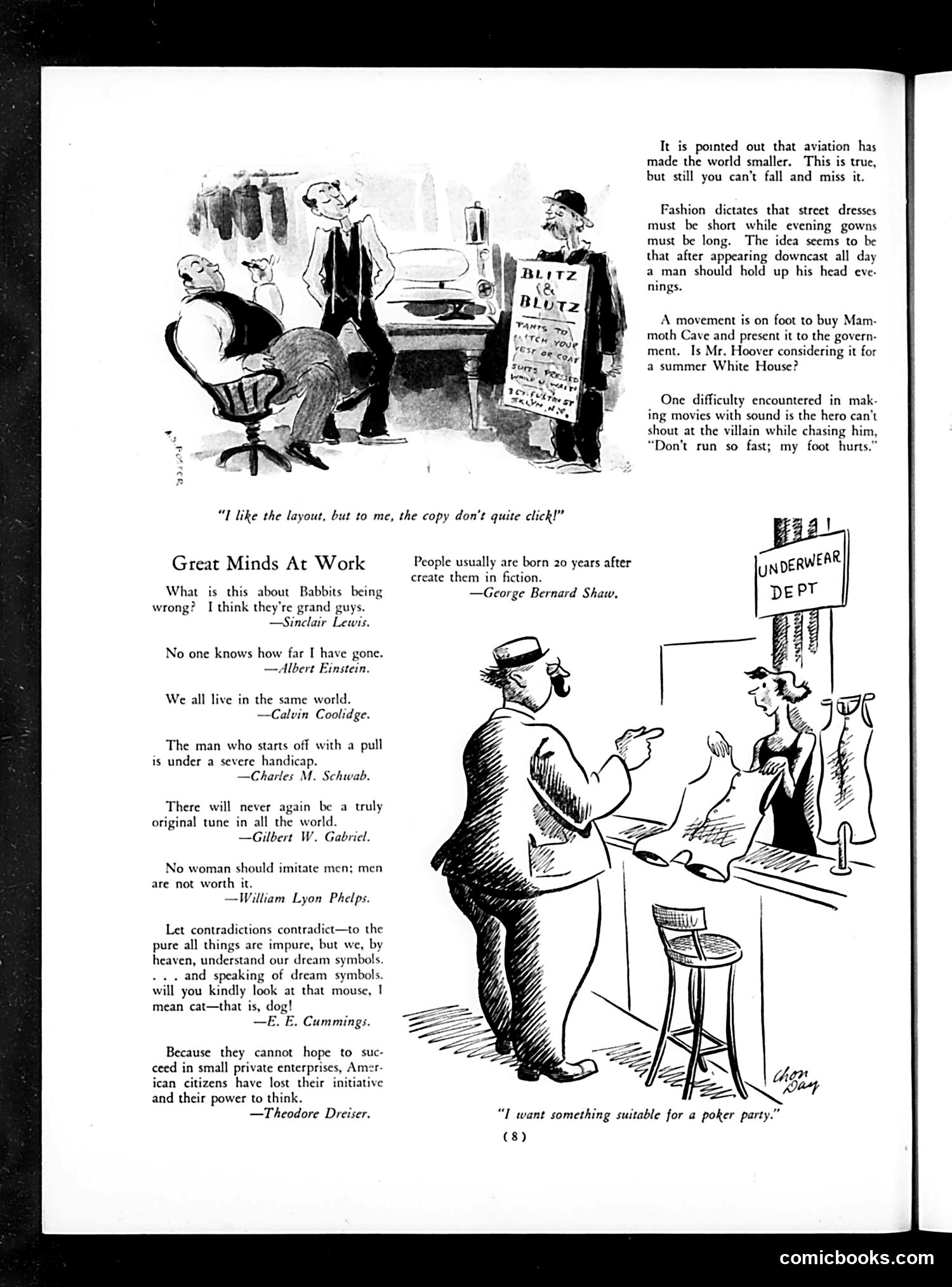
Analysis of Life Magazine Page This page contains two distinct elements: Top cartoon: A film industry scene satirizing movie production. A director critiques a layout, saying "I like the layout, but to me, the copy don't quite click!" The cartoon mocks how movies prioritize visual spectacle over coherent storytelling. "Great Minds At Work" section: A collection of famous quotes (Shaw, Einstein, Coolidge, Schwab, etc.) paired with a single-panel cartoon below. The cartoon shows a man at an underwear department counter telling a saleswoman, "I want something suitable for a poker party." This is a mild double-entendre joke playing on the idea of "underwear" having a secondary meaning in dated slang for confidence or preparedness. The page blends satire of entertainment industry pretension with light humor about consumer shopping.
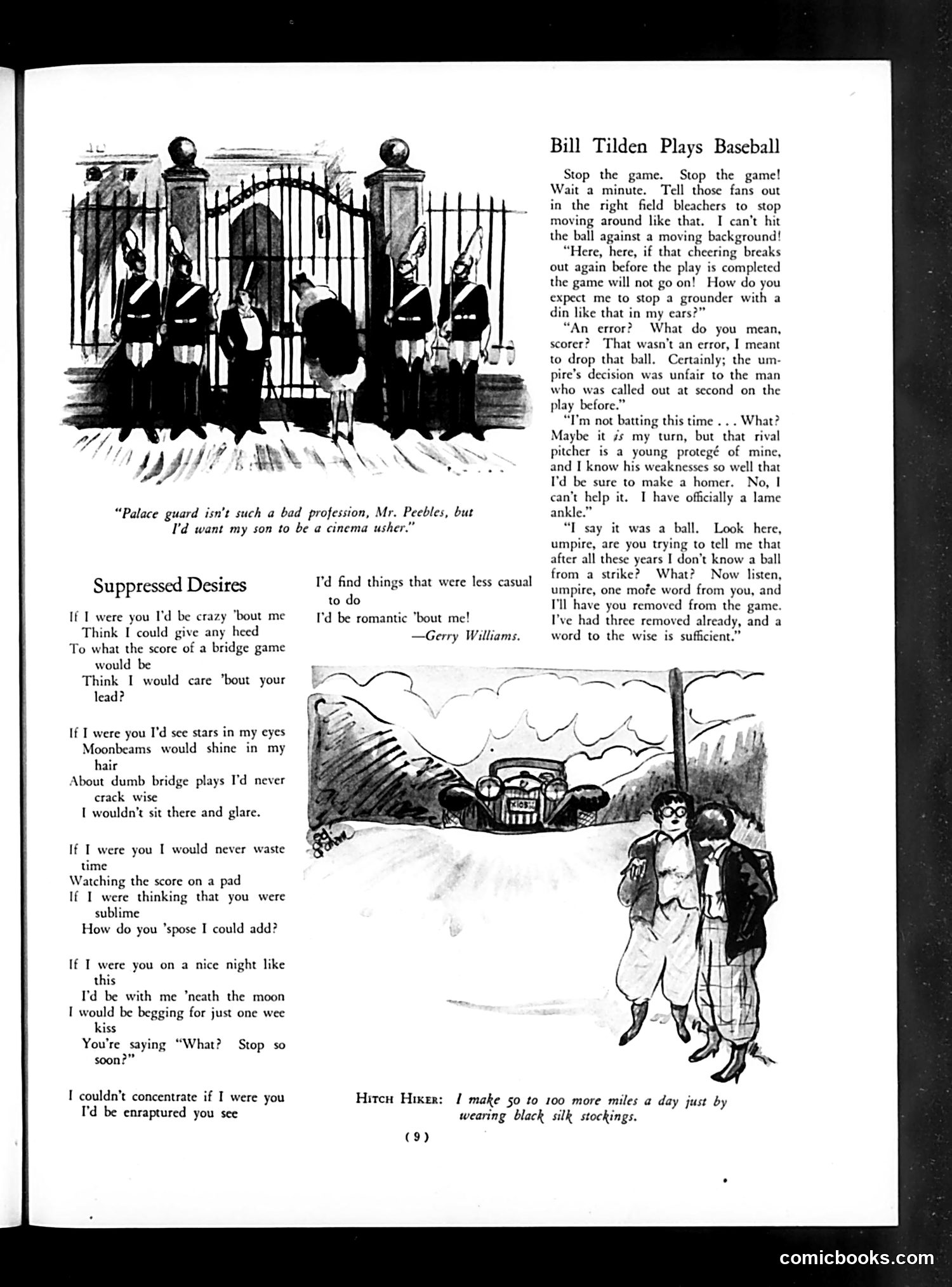
Analysis of "Bill Tilden Plays Baseball" This page satirizes Bill Tilden, the famous 1920s tennis champion, imagining him attempting baseball instead of his sport. The cartoon depicts him complaining to an umpire about the difficulty of hitting a moving ball and makes absurd excuses (claiming a young pitcher is "his protégé" he doesn't want to embarrass). The humor derives from Tilden's celebrity status being applied to an entirely different sport where he'd be incompetent. The "Palace Guard" illustration above shows uniformed officials, likely referencing Tilden's high-society world. "Suppressed Desires" is an unrelated poem about romantic longing, and "Hitch Hikers" is a separate joke about black silk stockings making walking faster. The satire mocks celebrity overconfidence crossing into unfamiliar domains.
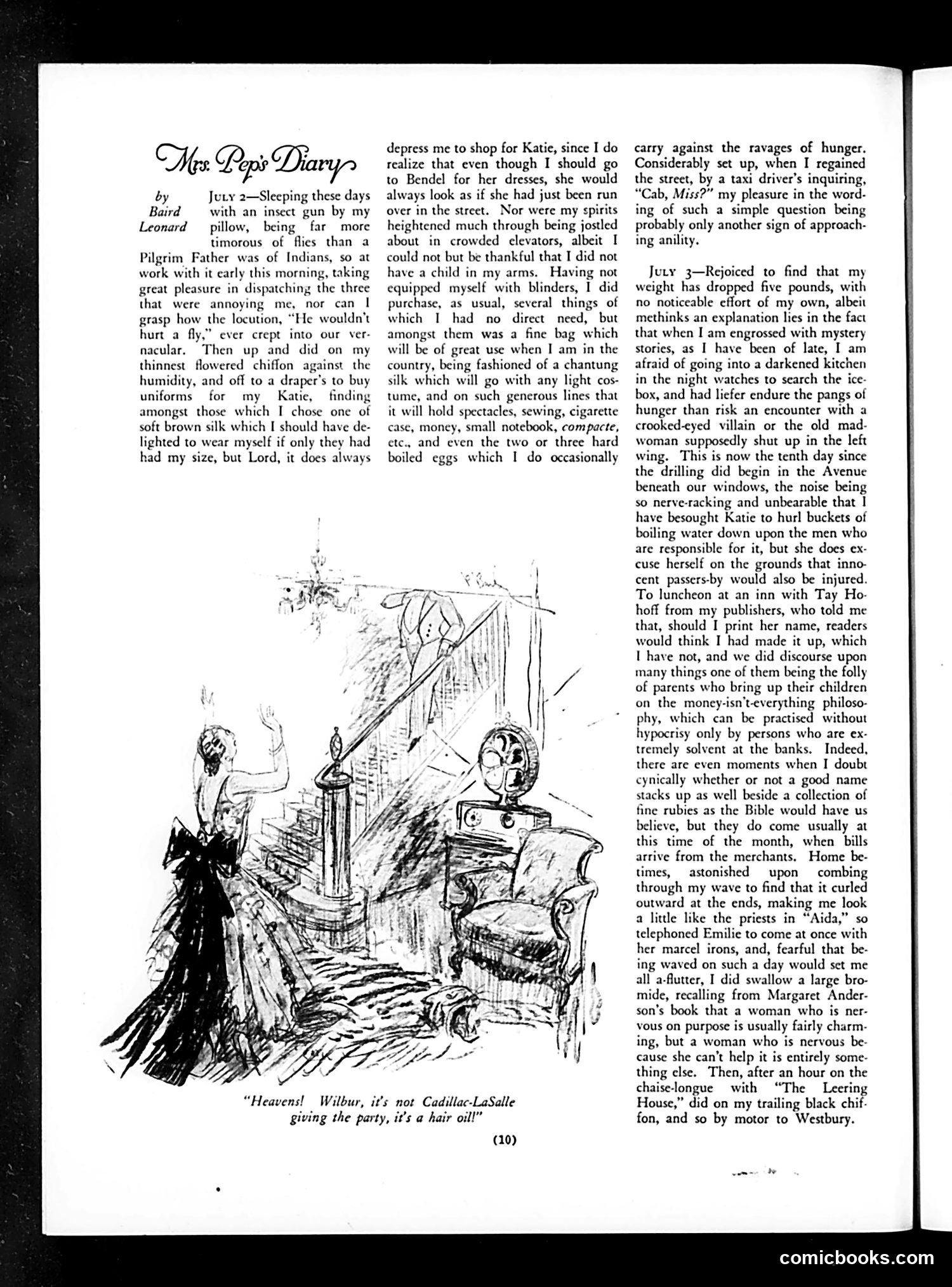
"Mrs. Pep's Diary" - Page Analysis This page presents "Mrs. Pep's Diary" by Baird Leonard, a humorous domestic narrative featuring diary entries from July 2-31. The accompanying illustration shows a woman in a chair reacting with exasperation to a man, with the caption: "Heaven! Wilbur, it's not Cadillac-LaSalle giving the party, it's a hair oil!" The joke satirizes 1920s consumer culture and social pretension. The woman's shock stems from discovering that a prestigious party's sponsor is a hair oil company rather than the luxury car brand Cadillac-LaSalle—revealing her embarrassment at the social status mismatch. This mocks contemporary anxieties about brand prestige and keeping up appearances among middle-class Americans navigating newly commercialized social hierarchies.
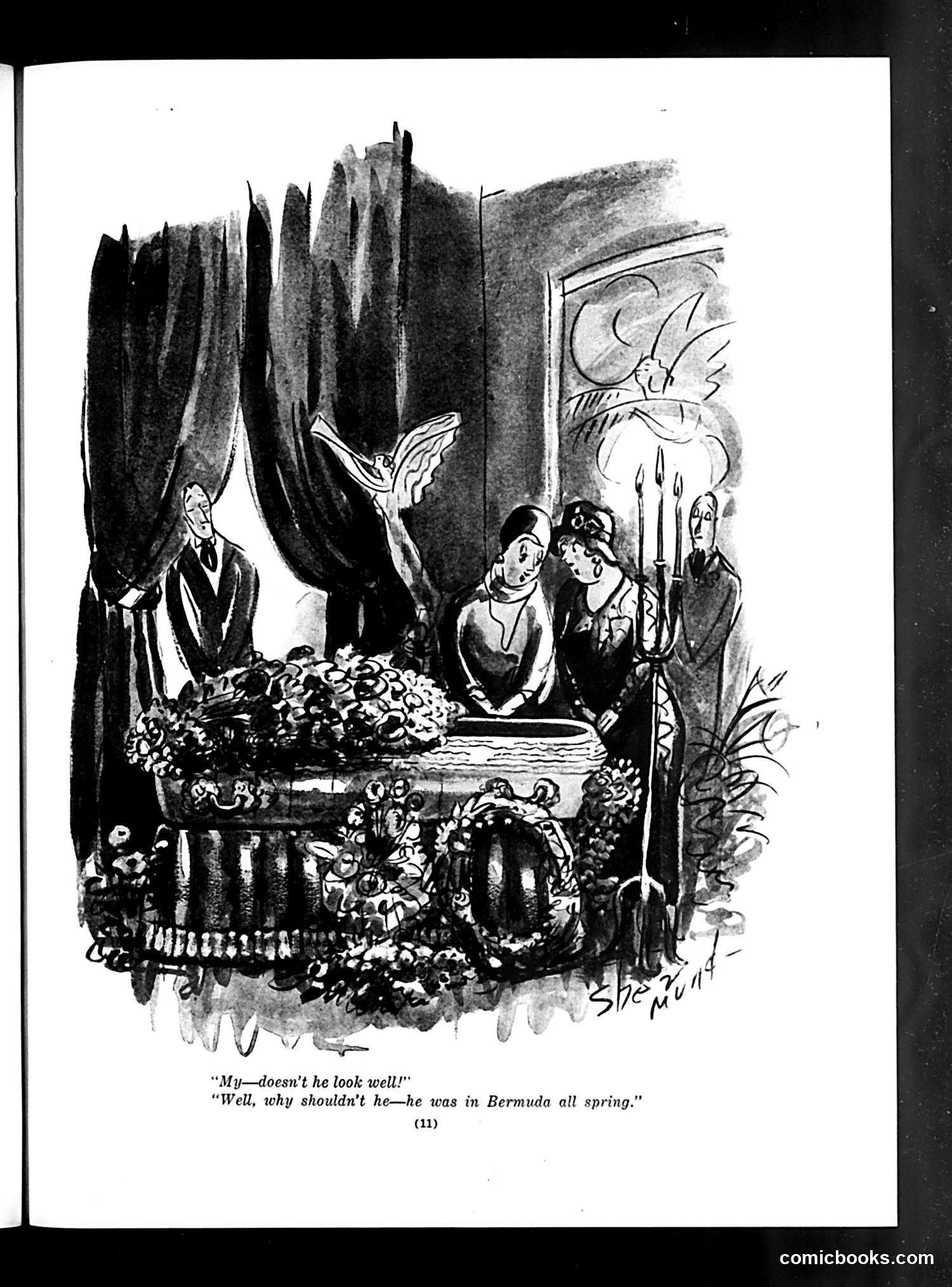
Analysis of Life Magazine Cartoon This is a funeral scene cartoon depicting mourners around a casket decorated with flowers. The dialogue reveals the joke's context: one mourner asks "My—doesn't he look well?" and another replies "Well, why shouldn't he—he was in Bermuda all spring." The satire likely targets a wealthy person who spent the spring season in Bermuda (a fashionable leisure destination for the affluent), suggesting their healthy tan or appearance from vacation contrasts with their death. The cartoon mocks upper-class social conventions—the mourners' concern with appearances even at a funeral—and possibly satirizes the shallow values of wealthy society figures who prioritize leisure travel and maintaining a healthy appearance over other concerns. The artistic style and page number (11) suggest this is from an early-to-mid 20th century Life magazine issue.
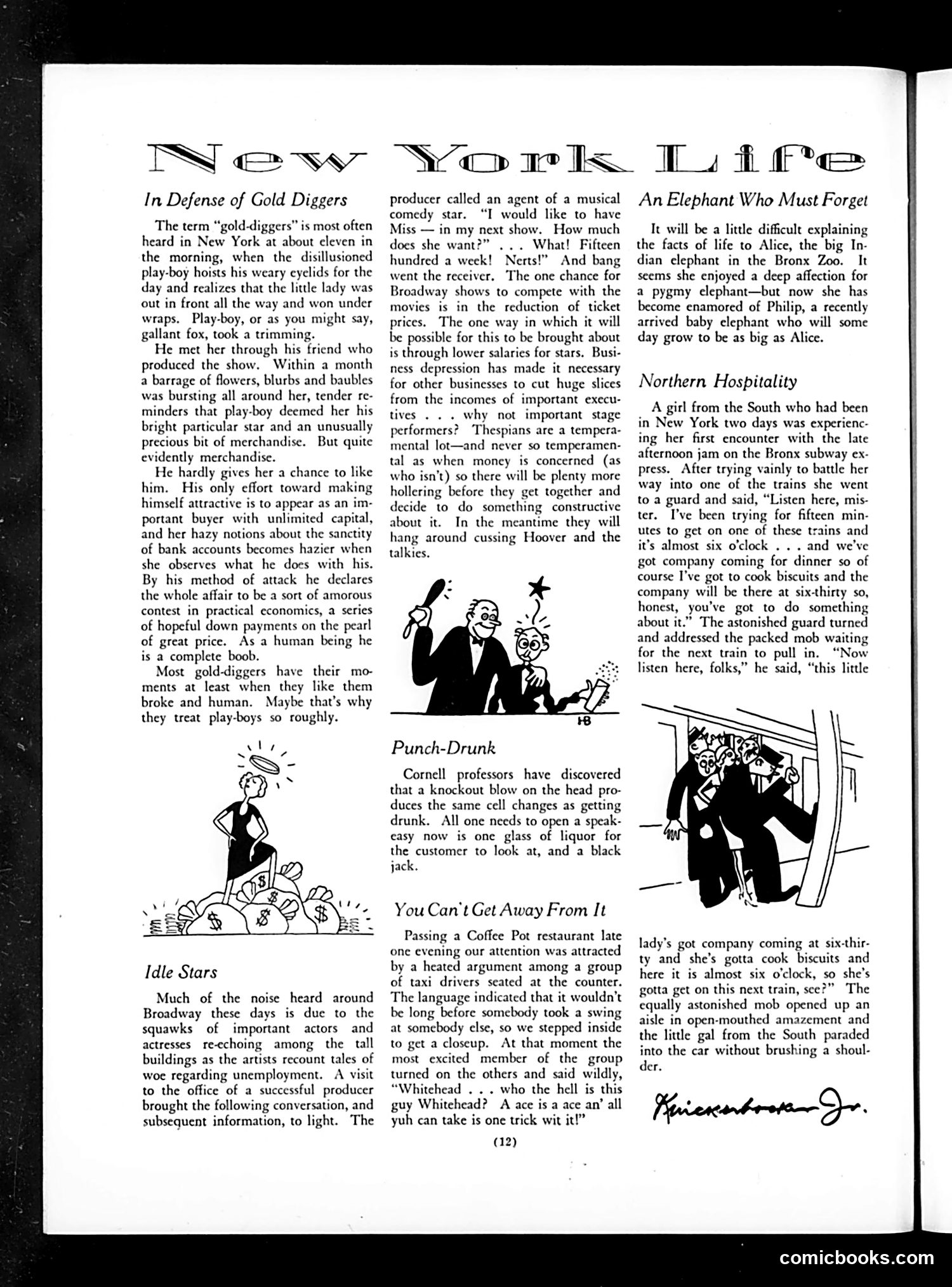
Explanation for Modern Readers This Life magazine page contains several satirical pieces about 1930s American theater and urban life: "In Defense of Gold Diggers" mocks struggling Broadway actors who pursue wealthy patrons for financial support—a common practice during the Depression. "Idle Stars" satirizes unemployed actors spreading complaints about joblessness among Broadway buildings, suggesting producers cynically exploit their desperation. "Punch-Drunk" is a brief joke about Cornell professors discovering that head injuries cause the same effects as intoxication. "You Can't Get Away From It" humorously depicts New Yorkers unable to escape social obligations—a Southern woman insists on cooking despite being crowded on a subway train, embodying the theme that life's demands follow you everywhere. The cartoons use exaggeration and irony to comment on Depression-era economic struggles and New York's intense urban pace.
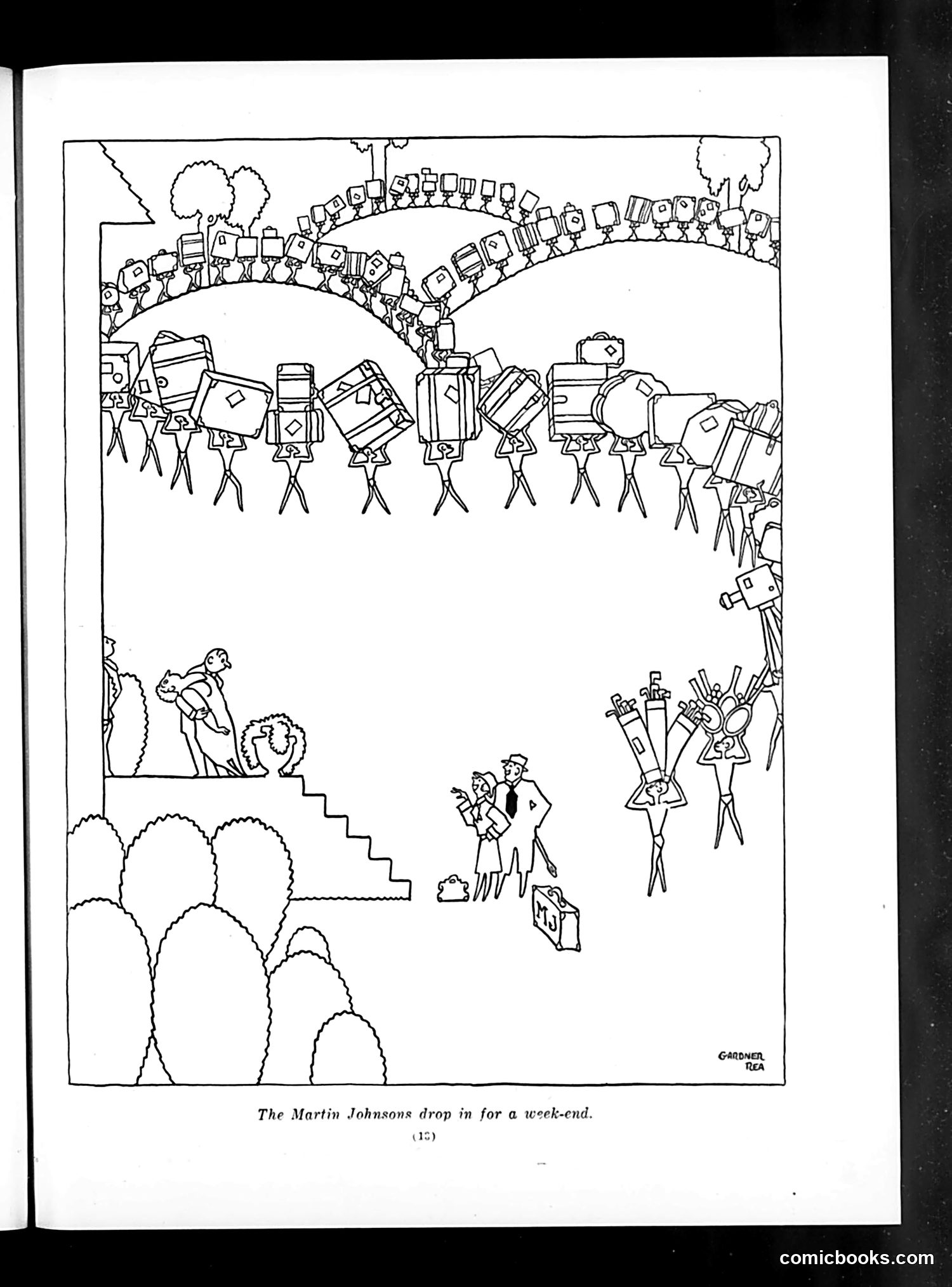
"The Martin Johnsons Drop In for a Week-End" This cartoon satirizes the celebrity travel adventures of Martin Johnson and Osa Johnson, famous explorers and filmmakers of the early 20th century known for documenting exotic locations. The joke depicts their arrival at what appears to be an exclusive residential community. The residents—shown as stick figures with suitcases for bodies—line the bridges and hills, suggesting wealthy travelers. The Johnsons' casual "drop in" for a weekend contrasts humorously with the elaborate infrastructure required to receive them, implying their fame and the disruption their visit causes. The cartoon mocks both celebrity culture and the leisure-class obsession with exotic travel experiences popular during this era. Signed by Gardner Rea, the cartoonist.
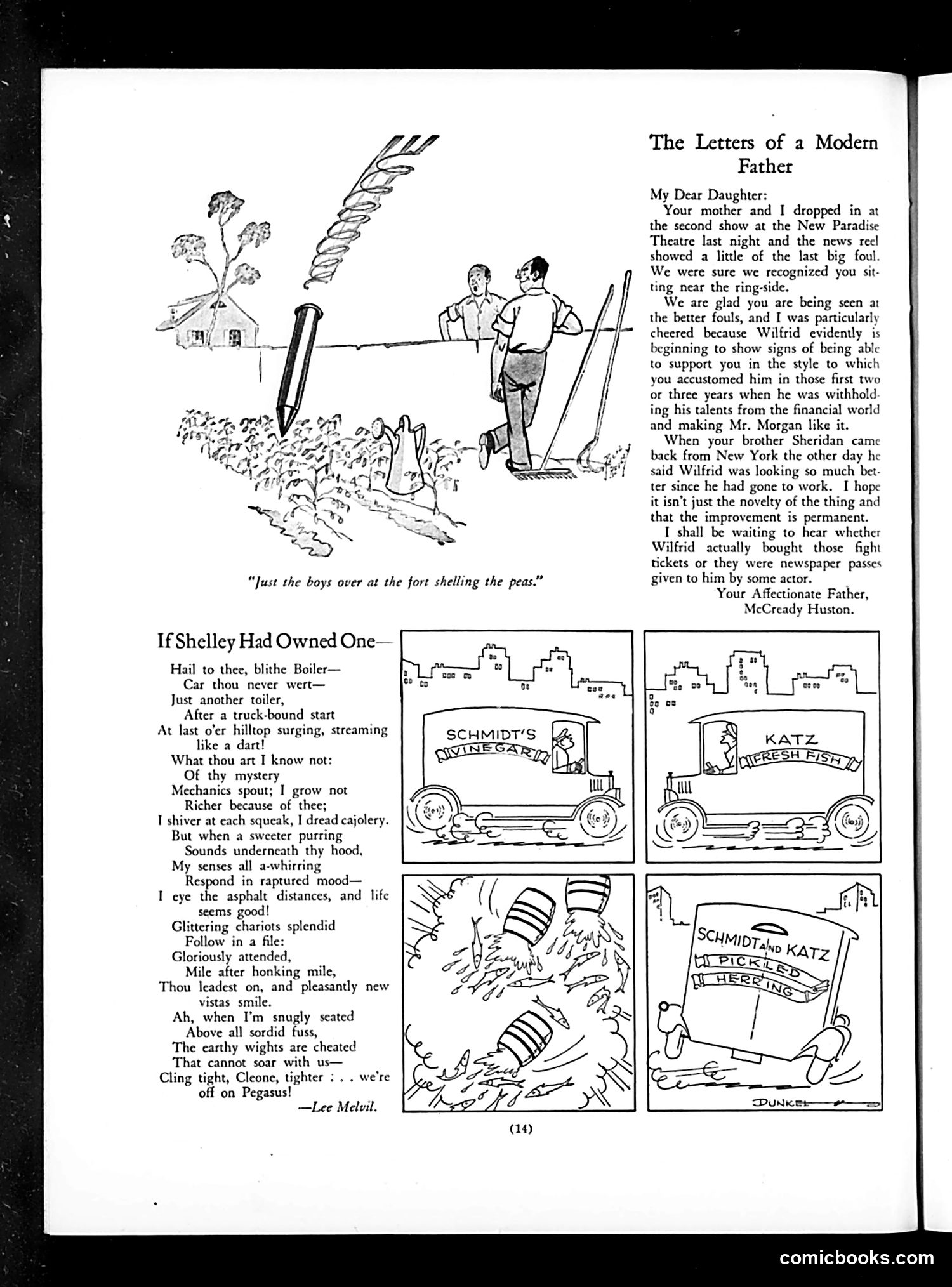
Analysis of Life Magazine Page This page contains a personal letter from a father (McCready Huston) to his daughter about attending theater, and two separate pieces of content: 1. "If Shelley Had Owned One" - A poem by Lee Melvil celebrating automobiles with romantic, elevated language. It's satirizing the tendency to romanticize cars as glamorous status symbols. 2. Three comic panels comparing competing brands: Schmidt's and Katz are depicted as competing pickled-herring/fresh-fish merchants. The comics show their vehicles and products in a humorous commercial rivalry, likely advertising or satirizing competing food brands of the era. The page exemplifies Life's mix of domestic humor, consumerism satire, and advertising-adjacent content typical of early-to-mid 20th century American magazines.
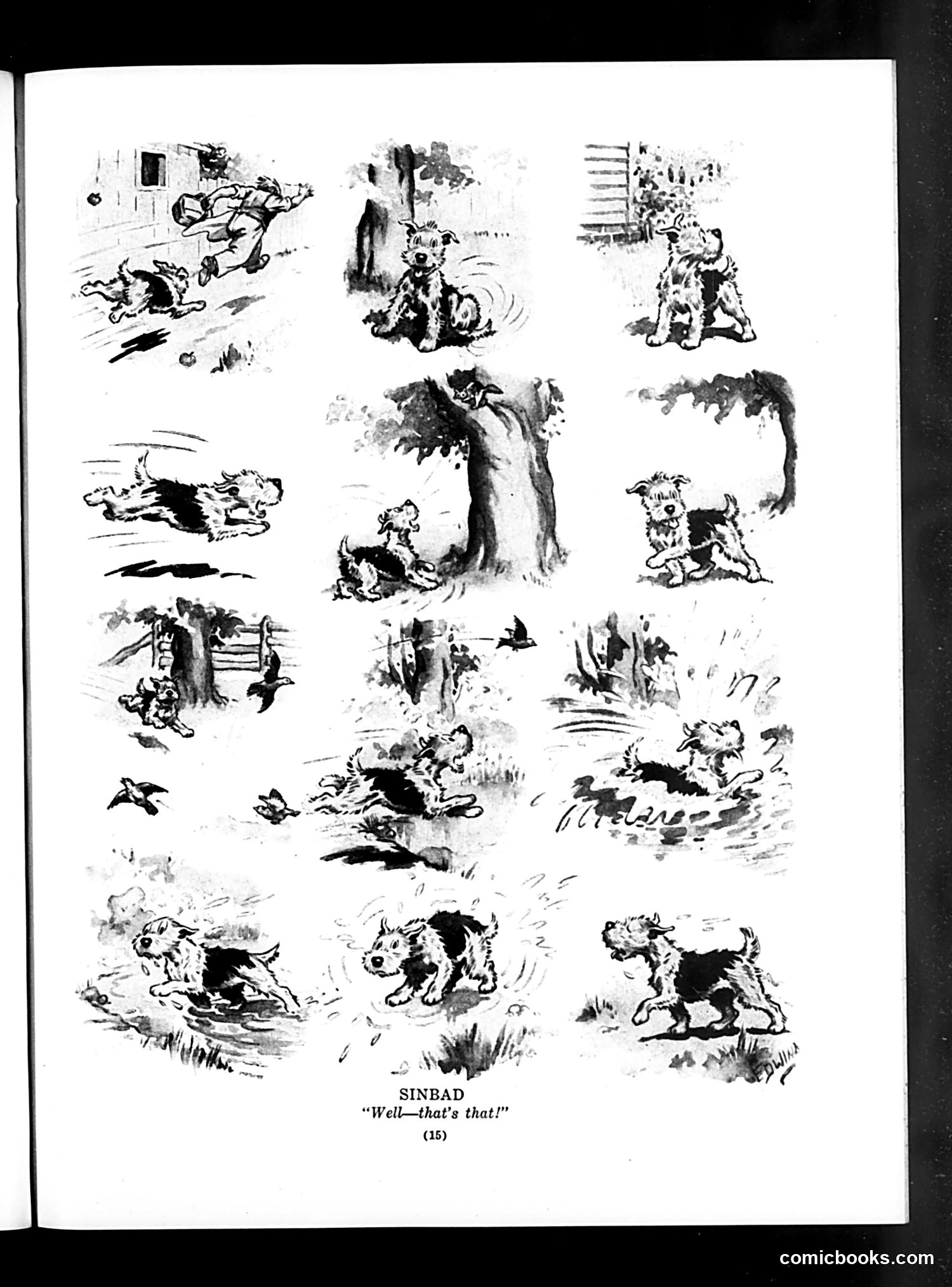
"Well—that's that!" (Sinbad) This page contains a series of sketches titled "Sinbad," showing a dog in various comical situations. The drawings appear to be humorous vignettes depicting the dog's misadventures—getting chased, jumping in water, encountering other animals, and generally causing or experiencing chaos throughout a domestic setting. The satirical point is unclear from the image alone, though the title "Well—that's that!" suggests these sketches chronicle the resolution or conclusion of the dog's escapades. Without additional context about whether "Sinbad" references a specific contemporary figure or event, the cartoons appear to be simply entertainment-focused animal humor typical of Life magazine's comic content, rather than political satire.
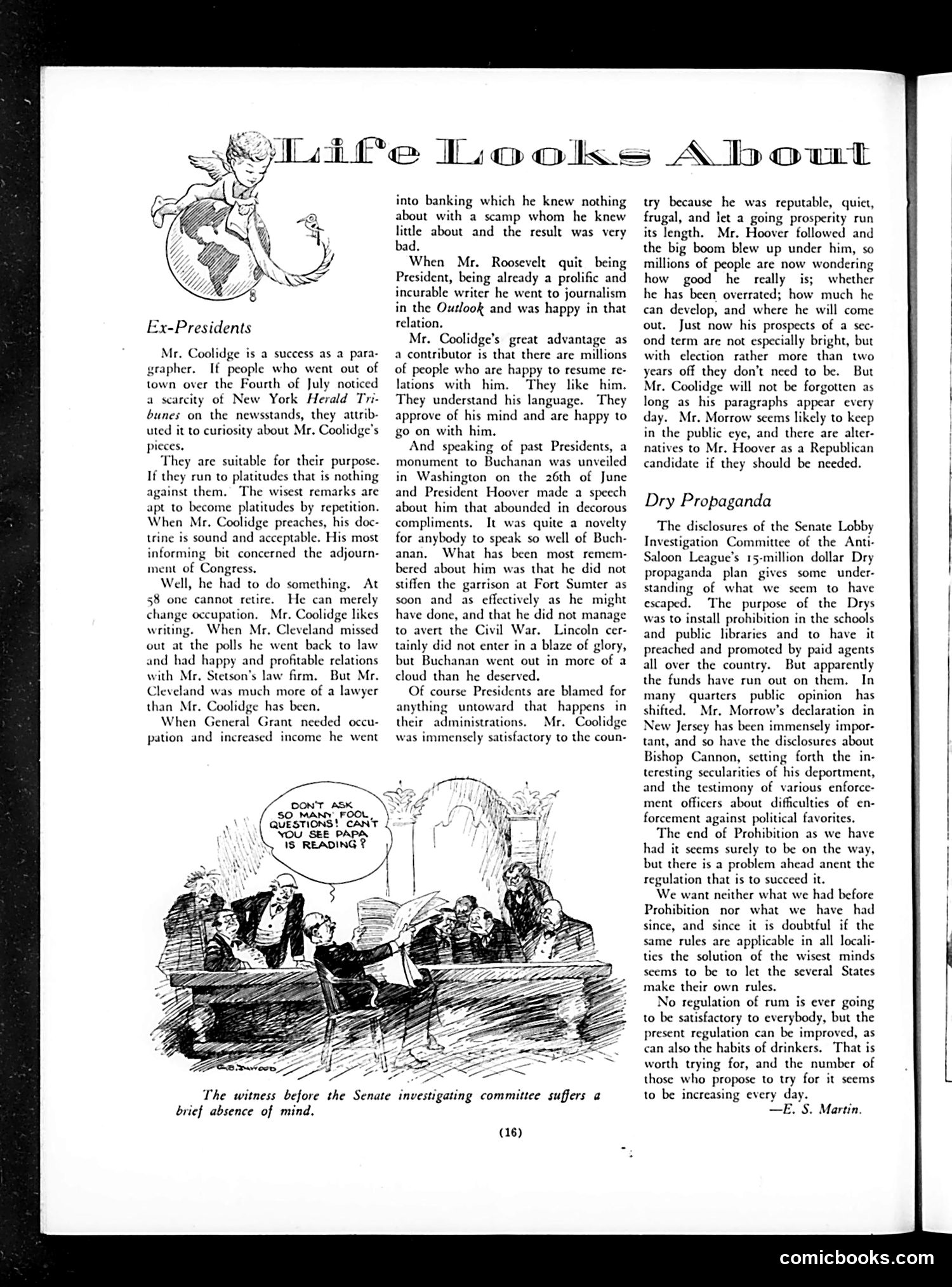
Analysis of "Life Looks About: Ex-Presidents" This page satirizes former U.S. presidents and contemporary political figures. The main cartoon depicts a Senate investigating committee witness claiming absent-mindedness—a jab at evasive testimony during scandals. The text discusses Mr. Coolidge (Calvin Coolidge, ex-president), praising his success as a writer and his diplomatic skills compared to predecessors. It references President Hoover making a speech about Buchanan on June 26th, suggesting Hoover was drawing historical parallels. The "Dry Propaganda" section criticizes the Anti-Saloon League's prohibition enforcement efforts, claiming their methods involve installing prohibition in schools and libraries through paid agents, while obscuring where funds originate. The satire targets political evasion, prohibition policies, and the machinations of reform organizations.
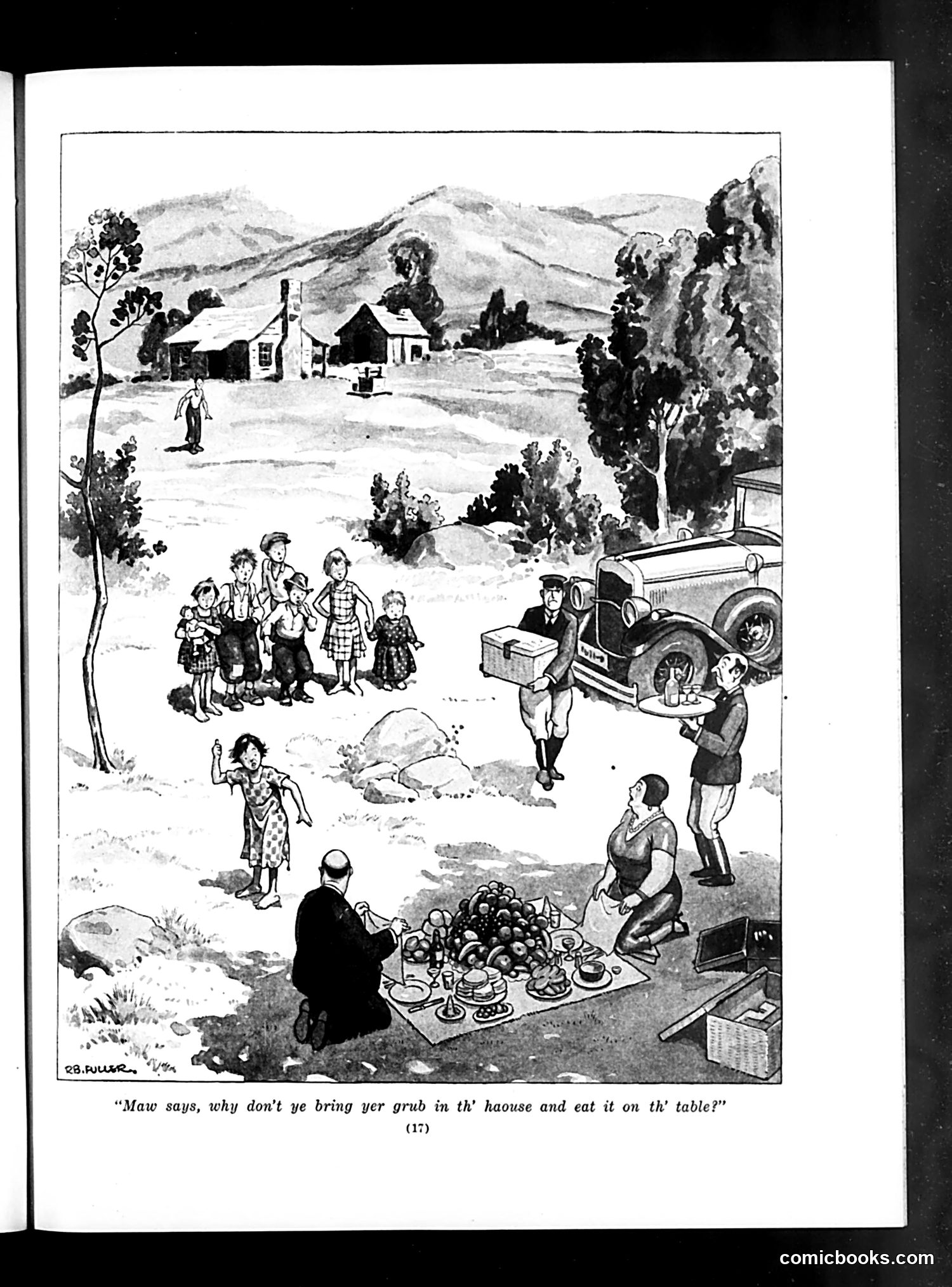
Analysis of Life Magazine Cartoon (Page 17) This is a single-panel cartoon depicting a rural picnic scene. A man sitting at a outdoor table laden with food addresses a woman, saying "Maw says, why don't ye bring yer grub in th' haoose and eat it on th' table?" The satire targets rural/working-class etiquette and living standards. The joke contrasts two settings: the outdoor picnic (suggesting poverty or rough living conditions) versus the suggestion to eat indoors at a table (representing civilized, middle-class propriety). The misspellings ("haoose," "yer," "grub") reinforce the stereotypical depiction of rural or poor Americans as uneducated. The humor relies on class-based assumptions common to early-to-mid 20th century American satire—mocking rural poverty and perceived lack of refinement.
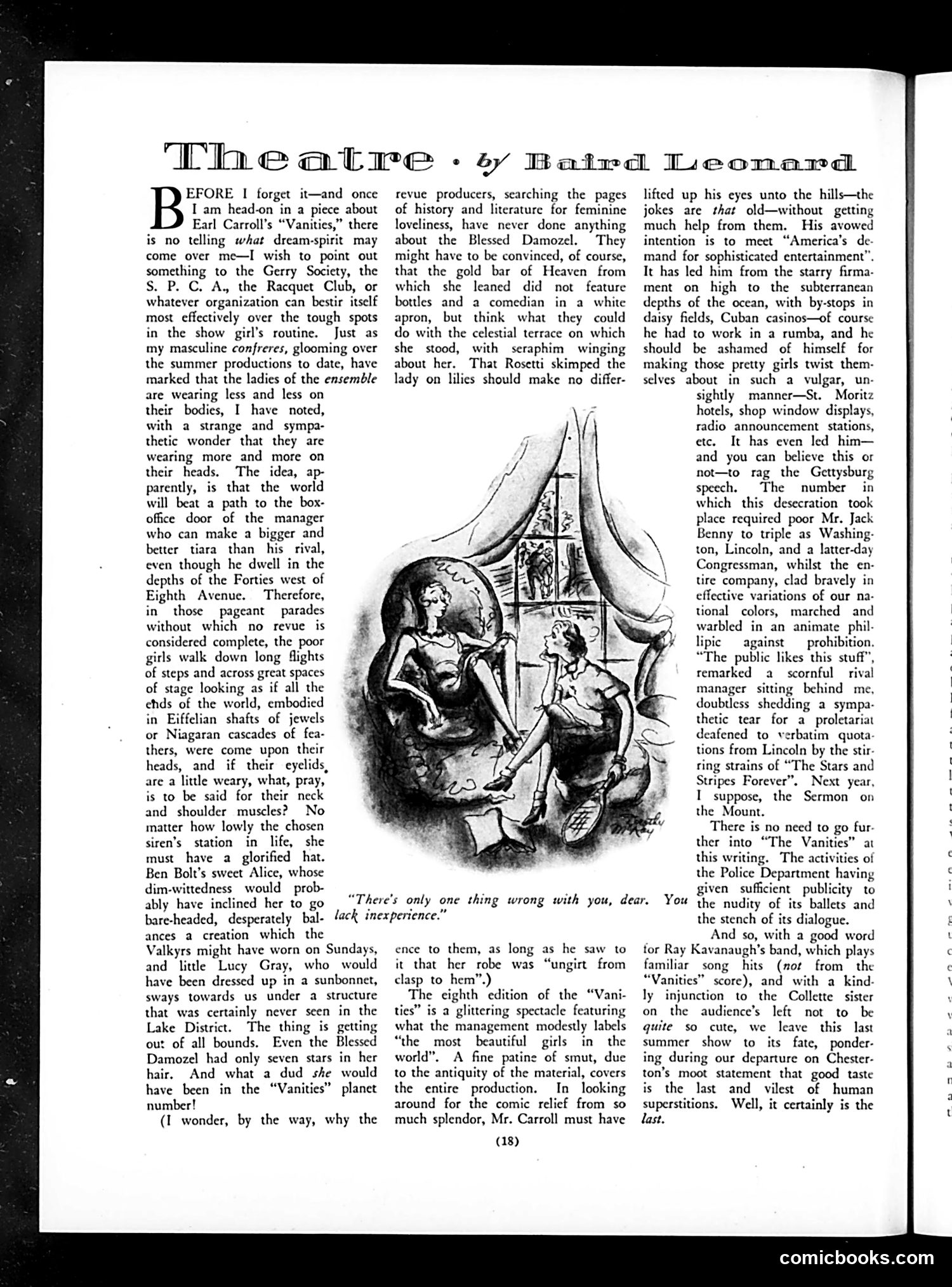
Analysis of Life Magazine Theatre Review This is a theatre review by Baird Leonard critiquing Earl Carroll's "Vanities" revue. The accompanying illustration depicts a showgirl in an elaborate costume being admired by a portly gentleman (likely representing Carroll or a theatre manager). Leonard's satirical point: while the "Vanities" features beautiful chorus girls in expensive, elaborate costumes, the real theatrical innovation comes from the management's ability to create spectacle rather than genuine artistry. He mocks the show's reliance on visual splendor—particularly underdressed girls in ornate headdresses—over substantive content. The review suggests that despite the production's lavishness, good taste ultimately matters more than mere visual extravagance in theatre, positioning this as a commentary on commercialized entertainment prioritizing display over quality.
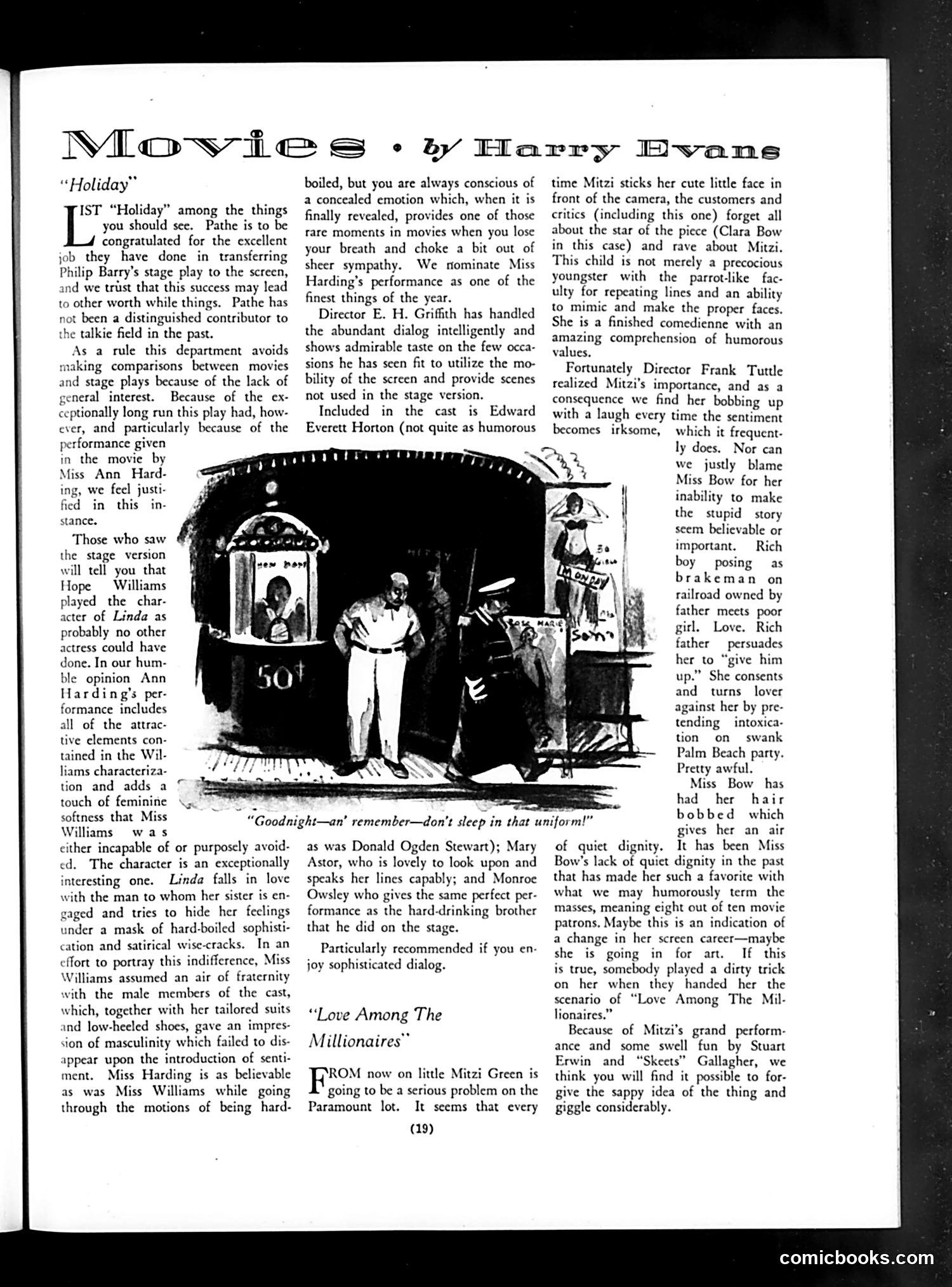
Movie Reviews by Harry Evans - Life Magazine This page contains two film reviews. The main illustration shows a scene from "Holiday" — likely a train or ship interior with uniformed figures, captioned with a comedic line about not sleeping in uniform. "Holiday": Evans praises the film adaptation of Philip Barry's stage play, particularly Ann Harding's performance as Linda. He compares her favorably to Hope Williams's original stage portrayal, noting Harding adds "feminine softness" while maintaining the character's hard-boiled facade. The review also credits director E.H. Griffith and cast members including Edward Everett Horton and Mary Astor. "Love Among the Millionaires": Evans discusses child actress Mitzi Green's scene-stealing talent, suggesting she overshadows the film's star Clara Bow. He notes that despite the "stupid story" (involving a rich boy posing as a railroad brakeman), Green's comedic abilities make the film worthwhile. Director Frank Tuttle wisely uses her to relieve sentimental moments. Both reviews assess how performers elevate material through skill and charm.
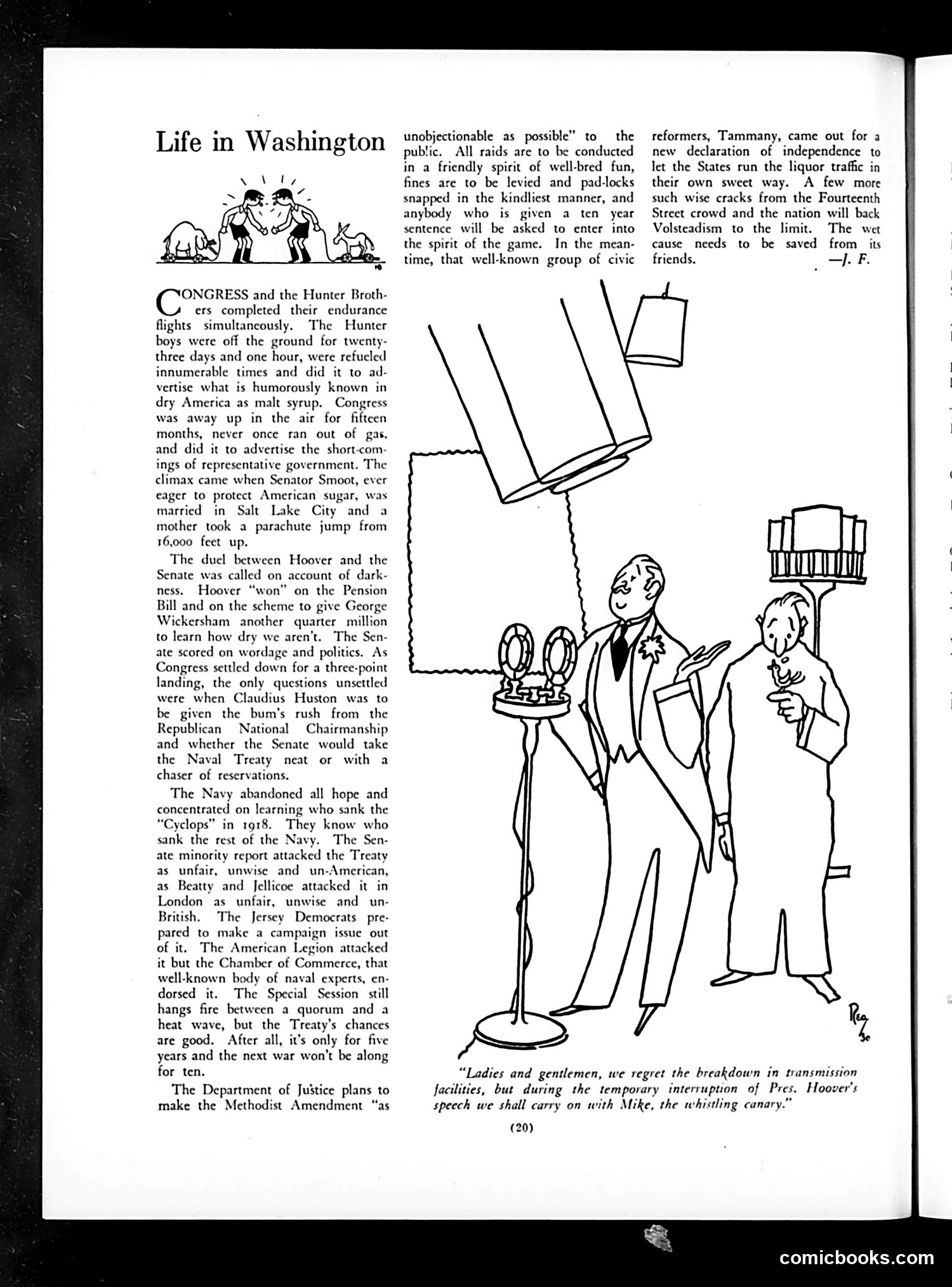
Analysis for Modern Readers This is satirical commentary on 1920s Washington politics, likely from the Hoover administration era. The text mocks Congress for prolonged inaction ("in the air for fifteen months") while comparing them unfavorably to the Hunter Brothers' endurance flight. The main cartoon depicts President Hoover attempting to deliver a speech while transmission facilities fail—a joke about modern technology's unreliability. The caption's reference to "Mike, the whistling canary" suggests the absurdity of substituting entertainment for presidential address. The broader text ridicules: - Senator Smoot's sugar-protection efforts (protectionism) - A Naval Treaty debate with international implications - Prohibition enforcement (the "Methodist Amendment"/Volstead Act), satirizing the Department of Justice's hypocritical approach - Tammany Hall (NYC Democratic machine) undermining temperance reform The satire's core: Washington dysfunction, competing interests, and how even reform movements (like Prohibition) became politically compromised—all hallmarks of 1920s American governance.
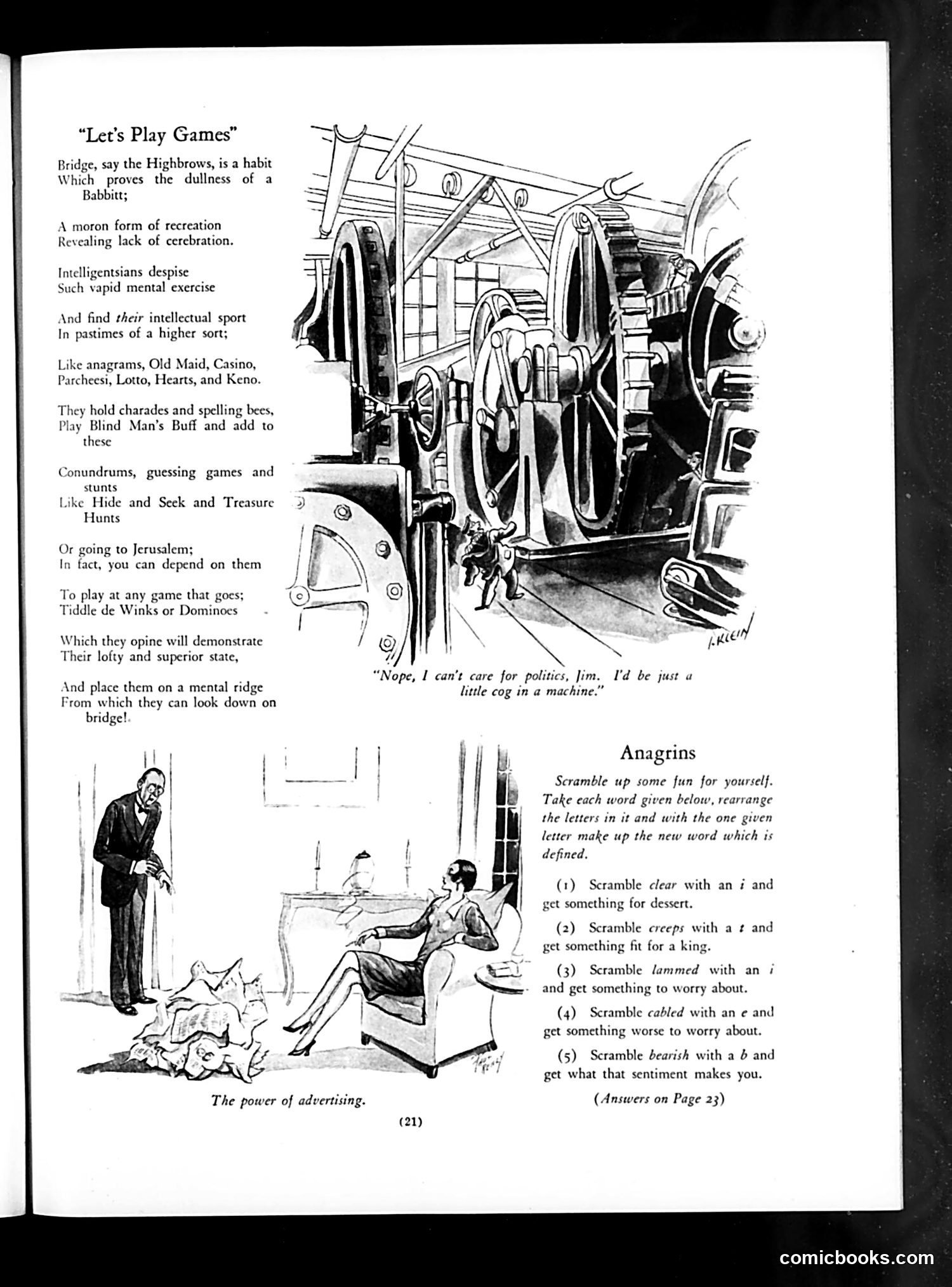
"Let's Play Games" - Life Magazine Satire This page satirizes intellectual snobbery. The poem mocks "highbrows" and "intelligentsia" who dismissively call bridge—a popular card game—a "Babbitt" pastime (referring to Sinclair Lewis's mediocre character), yet themselves play equally trivial games like anagrams, Old Maid, and charades while claiming these demonstrate their "lofty and superior state." The cartoon shows a factory worker rejecting politics, saying he'd just be "a little cog in a machine"—illustrating how even working people adopt intellectual pretensions to avoid civic responsibility. The irony is sharp: those who condescend to others' recreation are themselves engaged in childish games. The satire targets the hypocrisy of self-proclaimed intellectuals who use obscure pastimes as status markers while remaining fundamentally shallow—a recurring Life magazine theme criticizing American affectation and class pretension during the 1920s-30s era.
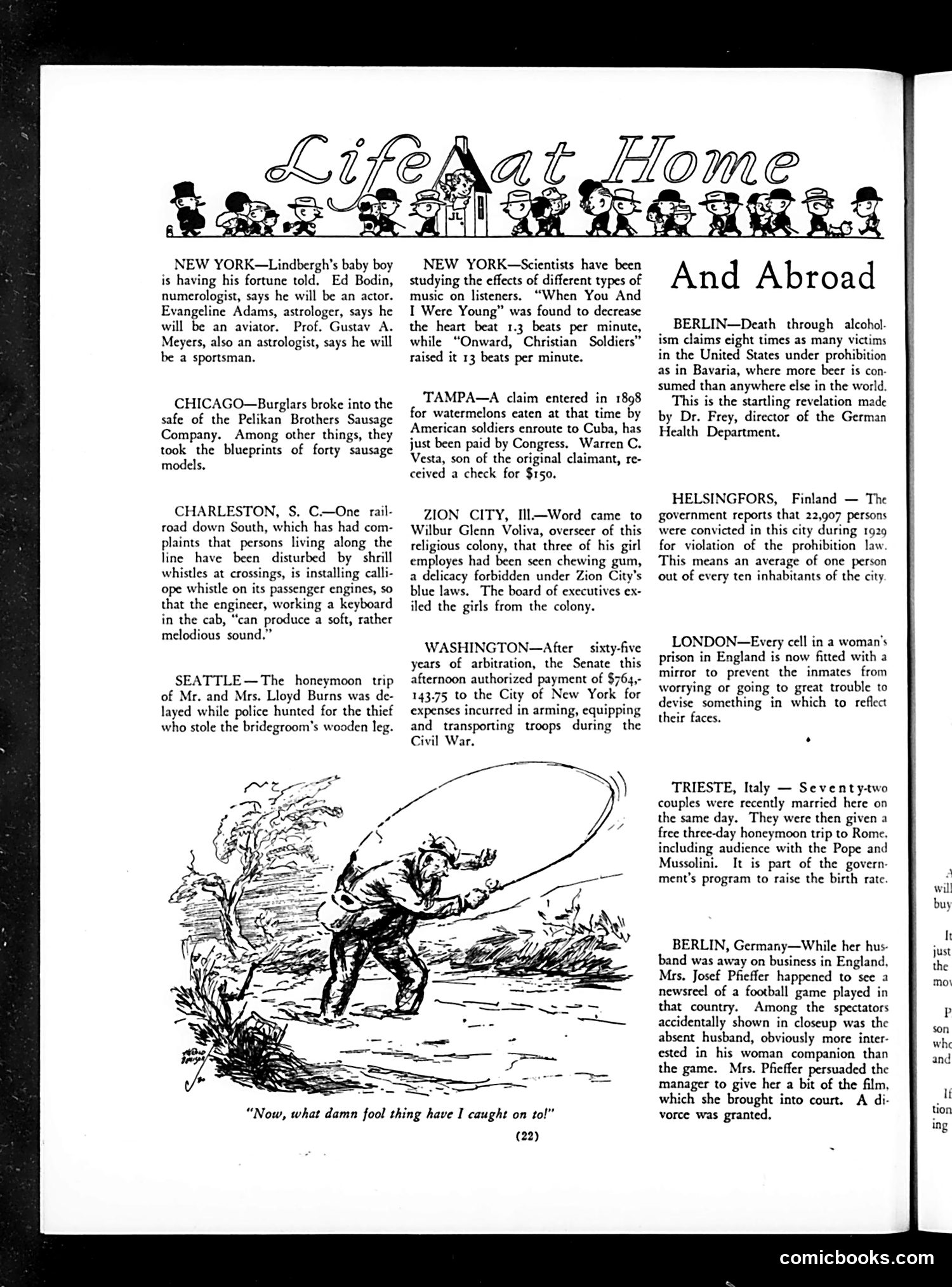
"Life at Home and Abroad" - Page Analysis This page collects brief satirical news items mixing absurd humor with social commentary. The main cartoon depicts a fisherman with an enormous catch, exclaiming "Now, what damn fool thing have I caught on to!" — likely satirizing Prohibition's unintended consequences or foolish policies. The text items mock: - Celebrity fortune-telling (Lindbergh's infant son) - Bureaucratic absurdity (railroad installing calliope whistles) - Legal delays (Civil War reimbursement after 65 years) - Prohibition's failures (Berlin reports more alcohol deaths in the US than beer-drinking Bavaria) - Authoritarian excess (Zion City's blue laws expelling girls for chewing gum) - Social engineering (Italy's government-sponsored mass weddings to raise birth rates) - Evidence in divorce court (a woman using newsreel footage to catch her philandering husband) The recurring theme: modern institutions—governments, corporations, laws—produce ridiculous outcomes. The magazine's satirical voice exposes contradictions between official policies and real-world absurdity.
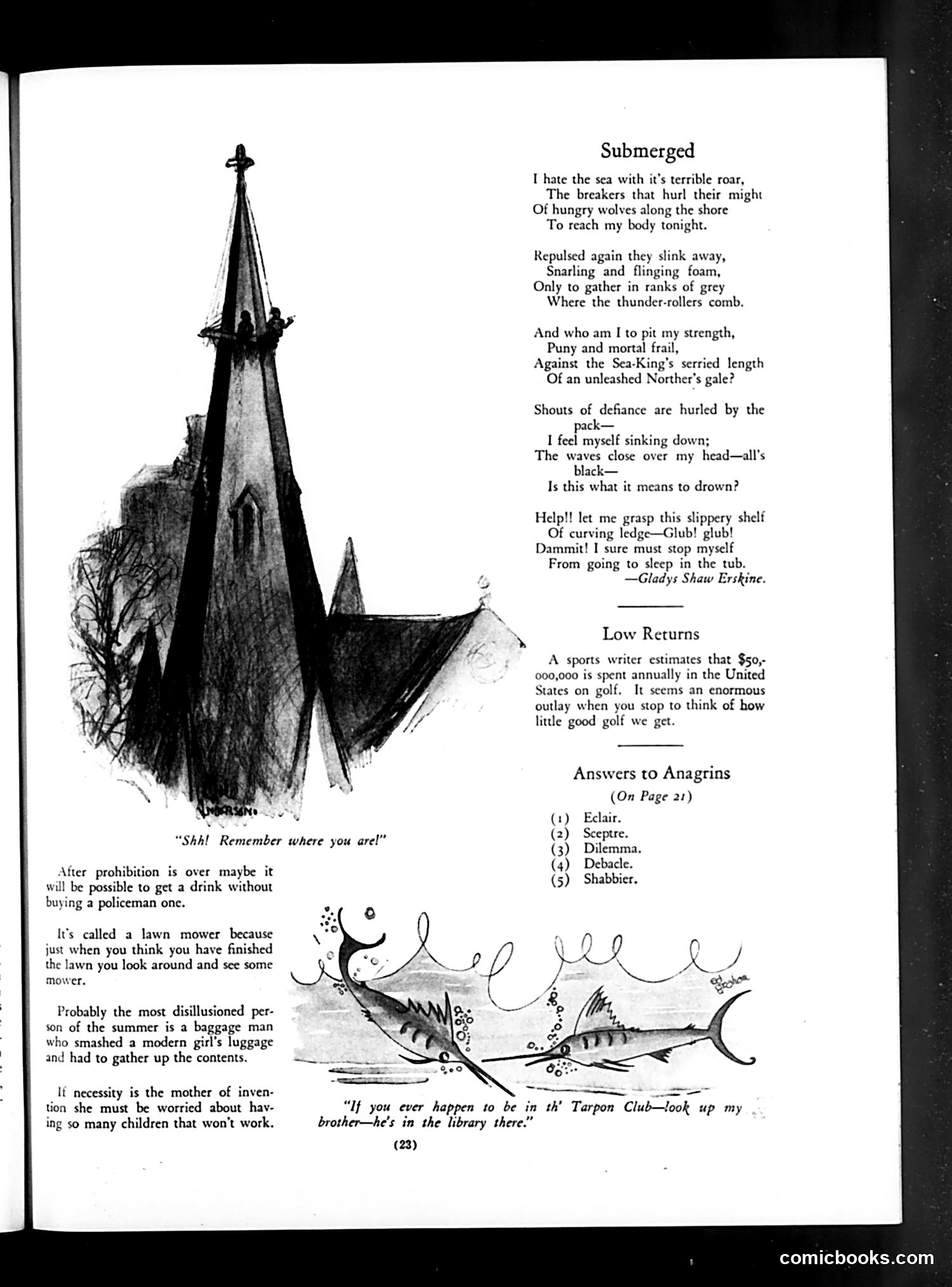
Page Analysis: Life Magazine Satire This page from Life magazine combines poetry, humor, and social commentary typical of 1920s American satirical publishing. "Submerged" is a humorous poem by Gladys Shaw Erskine depicting dramatic, overwrought terror at drowning—until the final stanza reveals the speaker is merely panicking in a bathtub. The joke relies on the contrast between grandiose, poetic language about fighting the sea and the mundane reality of bathing anxiety. The brief prose jokes mock contemporary American life: prohibition's corruption (bribing police for drinks), lawn mower frustration, baggage handling mishaps, and golf's massive expense relative to quality play. The illustrated fish cartoon with the caption about "th' Tarpon Club" appears to be a social/club reference, likely humorous commentary on exclusive establishments. These items represent Life's signature approach: lighthearted jabs at everyday modern inconveniences and social pretension, delivered through poetry, one-liners, and cartoons for educated readers.
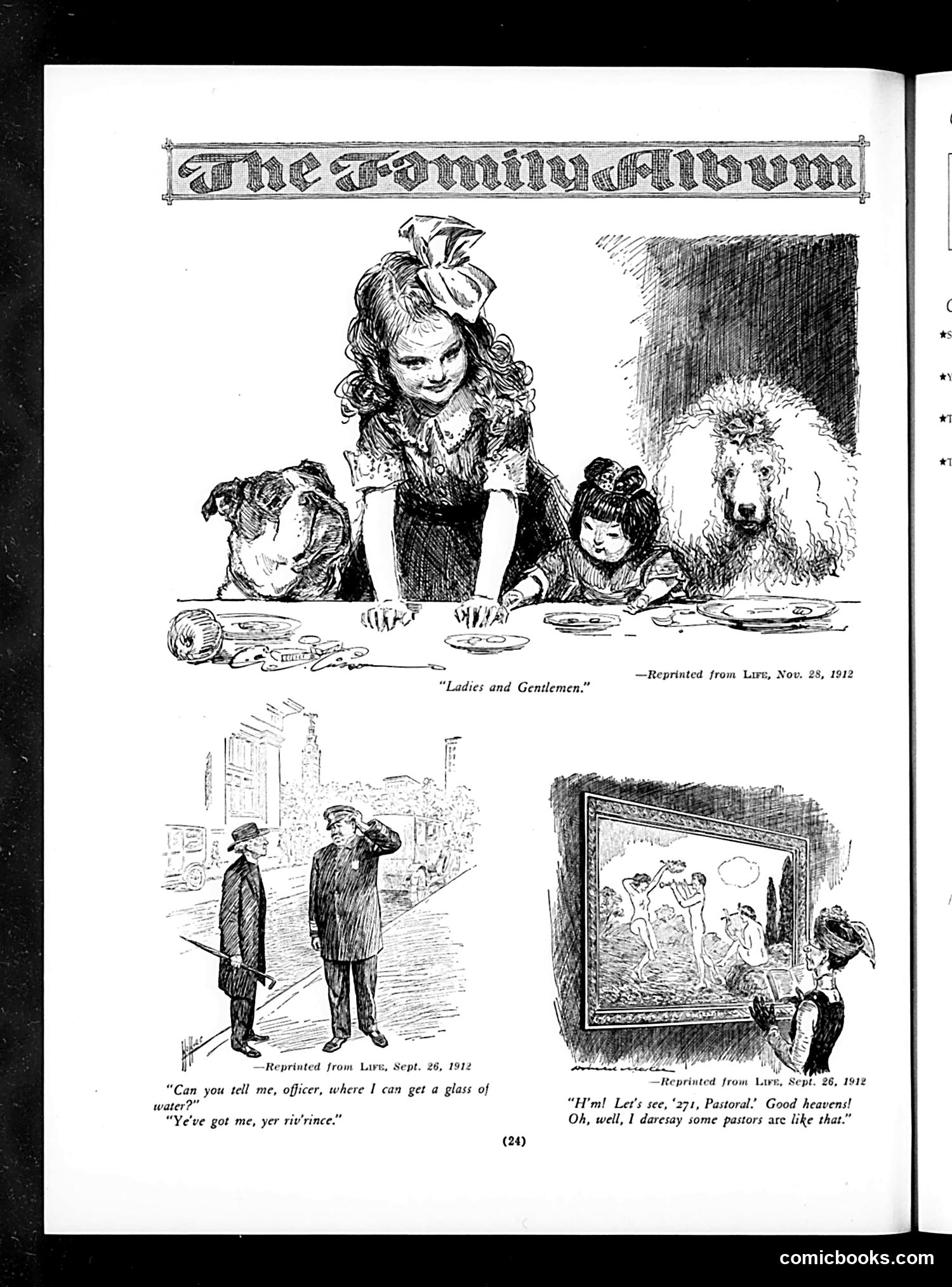
"The Family Album" - Life Magazine Page This page collects three satirical cartoons reprinted from *Lire*, an Italian publication. The top cartoon shows a young woman presiding over a formal dinner with various animals as guests, titled "Ladies and Gentlemen"—likely mocking pretentious social gatherings or absurd hospitality customs. The bottom-left cartoon depicts two men on a street; one asks an officer for water, receiving a comedic Irish dialect response ("Ye've got me, yer riv'rince"), poking fun at Irish accents and street encounters. The bottom-right shows a man examining a painting labeled "271, Pastoral" in what appears to be a gallery or church. His comment about pastors "being like that" suggests the artwork depicts something scandalous or inappropriate for religious settings—likely satirizing either art criticism, clerical hypocrisy, or what constitutes acceptable "pastoral" imagery. All three cartoons employ visual humor and wordplay typical of early 1910s satirical magazines.
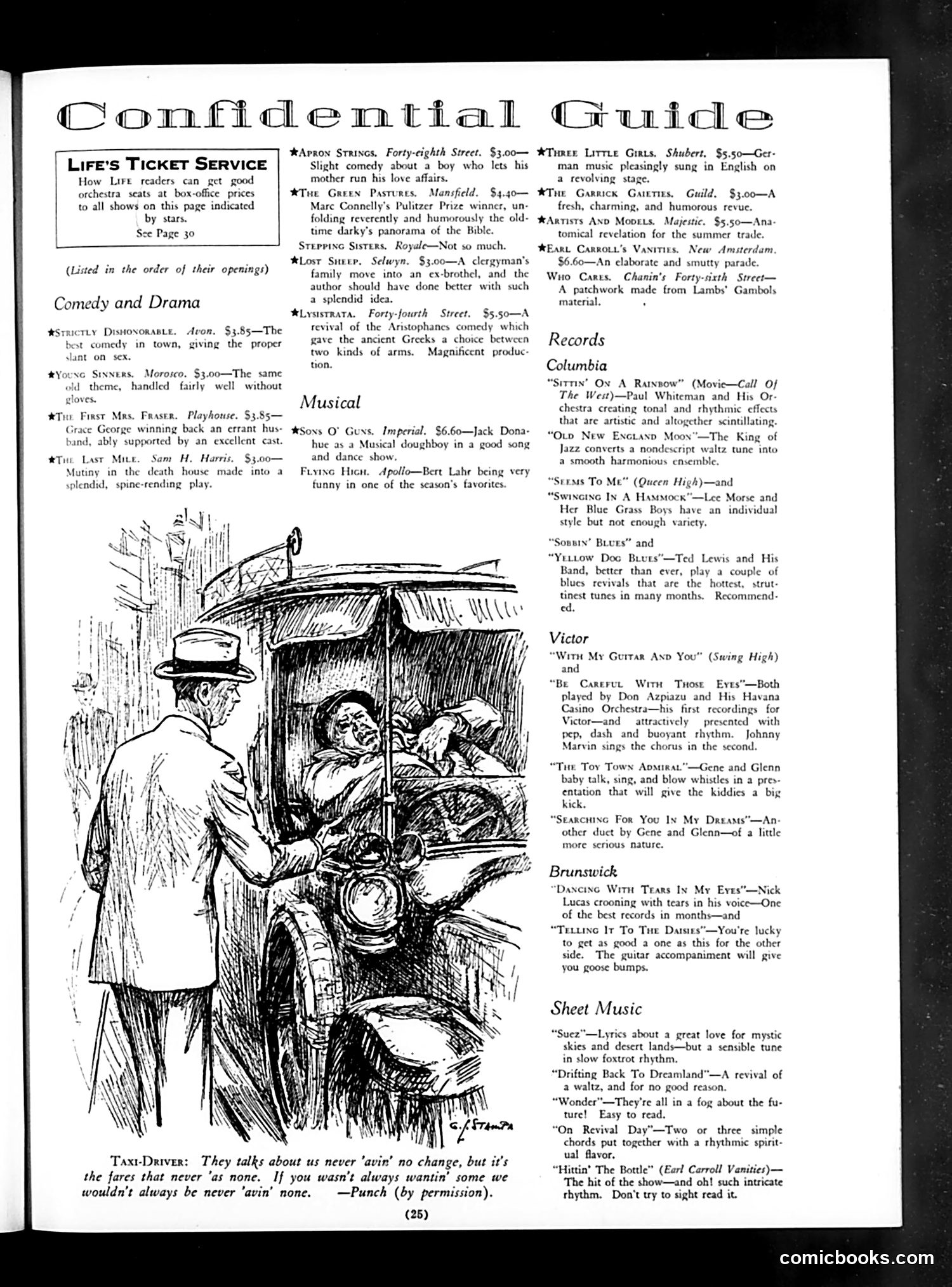
Explanation for Modern Readers This page contains theater reviews and record recommendations from *Life* magazine, circa late 1920s. The illustration shows a taxi driver and passenger, accompanying a caption (credited to *Punch*) that's a humorous working-class complaint: taxi drivers blame passengers for never having change, but really it's the fares themselves that are unpredictable—a circular logic joke about economic hardship during the period. The reviews use coded language typical of the era. Phrases like "slight comedy," "not so much," and "smutty parade" indicate *Life's* satirical assessment of Broadway shows. References to Marc Connelly's "Green Pastures" (a Pulitzer winner depicting African Americans' biblical interpretations) and Aristophanes' "Lysistrata" (an ancient Greek sex-strike comedy) reflect what contemporary theater offered. The records section promotes jazz and popular music of the Jazz Age.
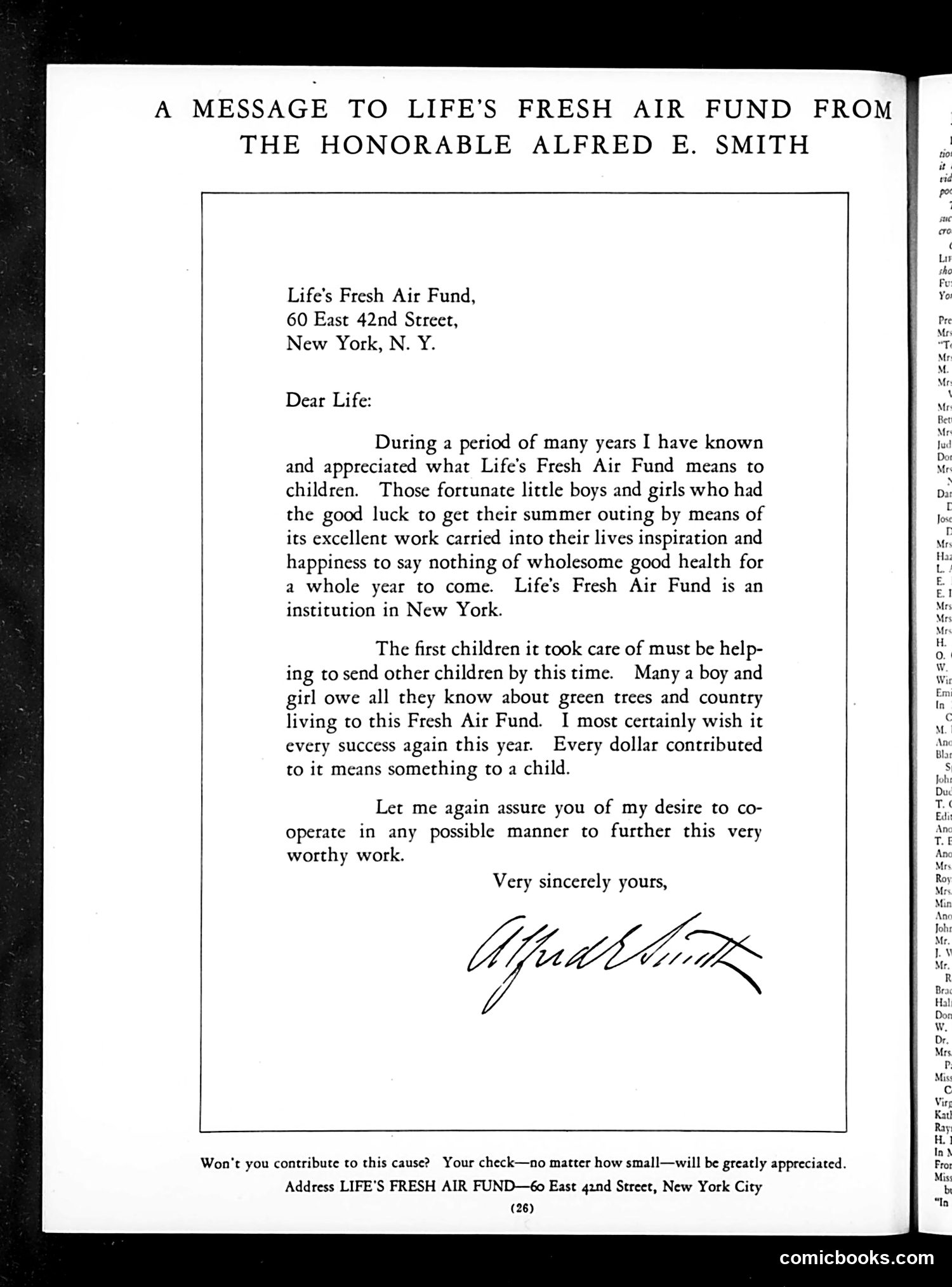
Analysis This is not a cartoon but a charitable advertisement—specifically an endorsement letter from Alfred E. Smith, a prominent political figure (likely former New York governor), supporting Life's Fresh Air Fund. The Fresh Air Fund was a genuine charitable organization that provided summer outings to poor urban children, offering them respite in the countryside. Smith's letter emphasizes the program's benefits: inspiration, health, and exposure to nature for disadvantaged "boys and girls." The appeal is straightforward advocacy, not satire. Smith leverages his public status ("The Honorable") to encourage donations, stressing that children who benefited are now helping send others, creating a cycle of charitable impact. The closing plea—"Your check—no matter how small—will be greatly appreciated"—is standard fundraising rhetoric. For modern readers, this reflects Progressive Era concern for urban child welfare and demonstrates how wealthy/prominent figures endorsed social reform causes through magazine advertisements.
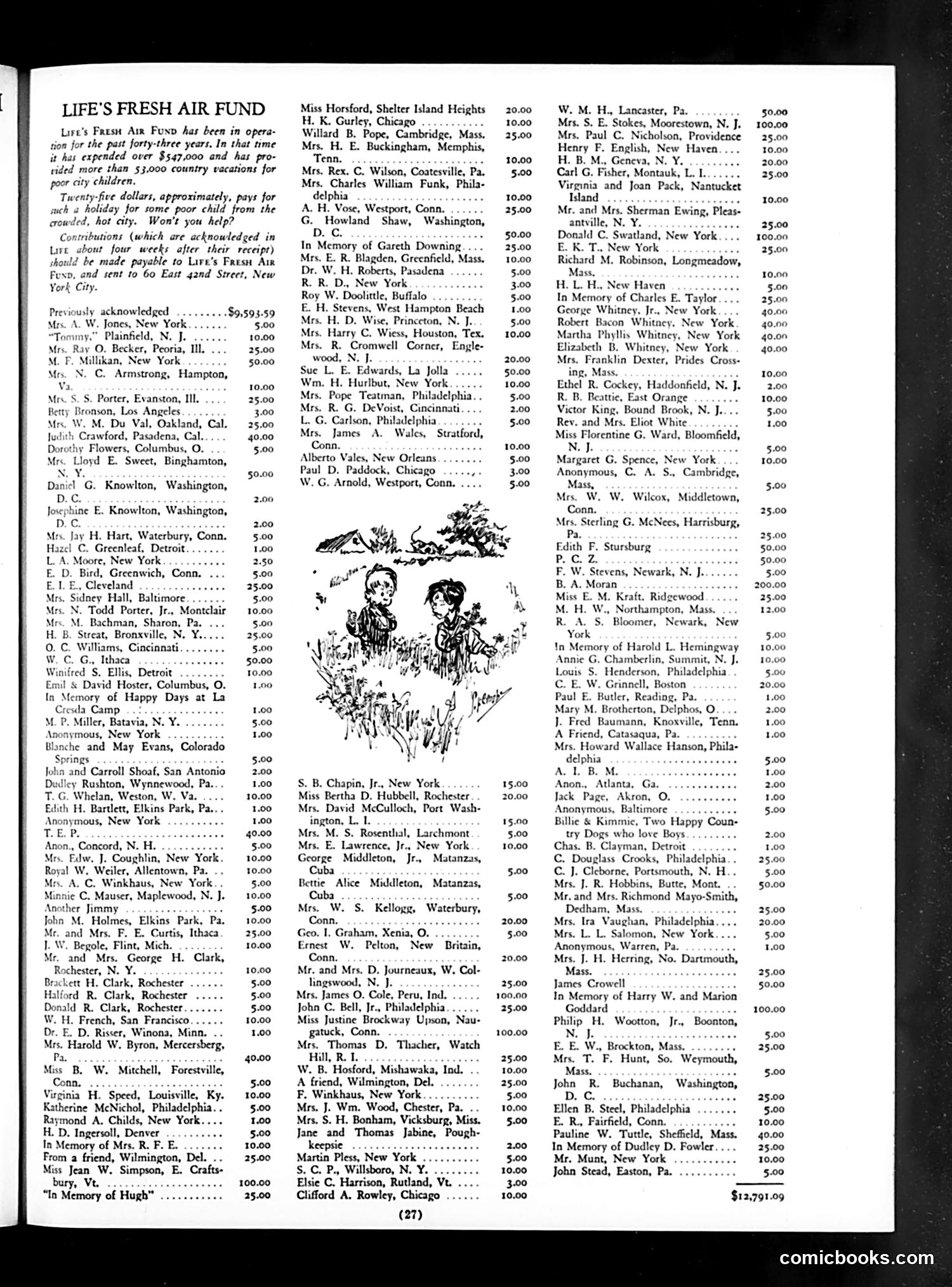
Life's Fresh Air Fund Page This is primarily a donation acknowledgment page, not a satirical cartoon. It lists contributors to Life magazine's charitable "Fresh Air Fund"—a real program that has operated for 43 years (as of publication) providing country vacations for poor urban children. The page shows: - Purpose: For $25, donors could fund a holiday for an underprivileged city child - The small illustration: A sentimental drawing of children in a rural/pastoral setting, reinforcing the fund's charitable mission - Content: Hundreds of donor names and amounts, organized geographically There is no political satire on this page. Instead, it reflects early 20th-century progressive charitable work—Life magazine (known for satirizing American society) also engaged in genuine philanthropy. The page demonstrates how publications used their platforms for social reform, addressing urban poverty and child welfare concerns of the era.
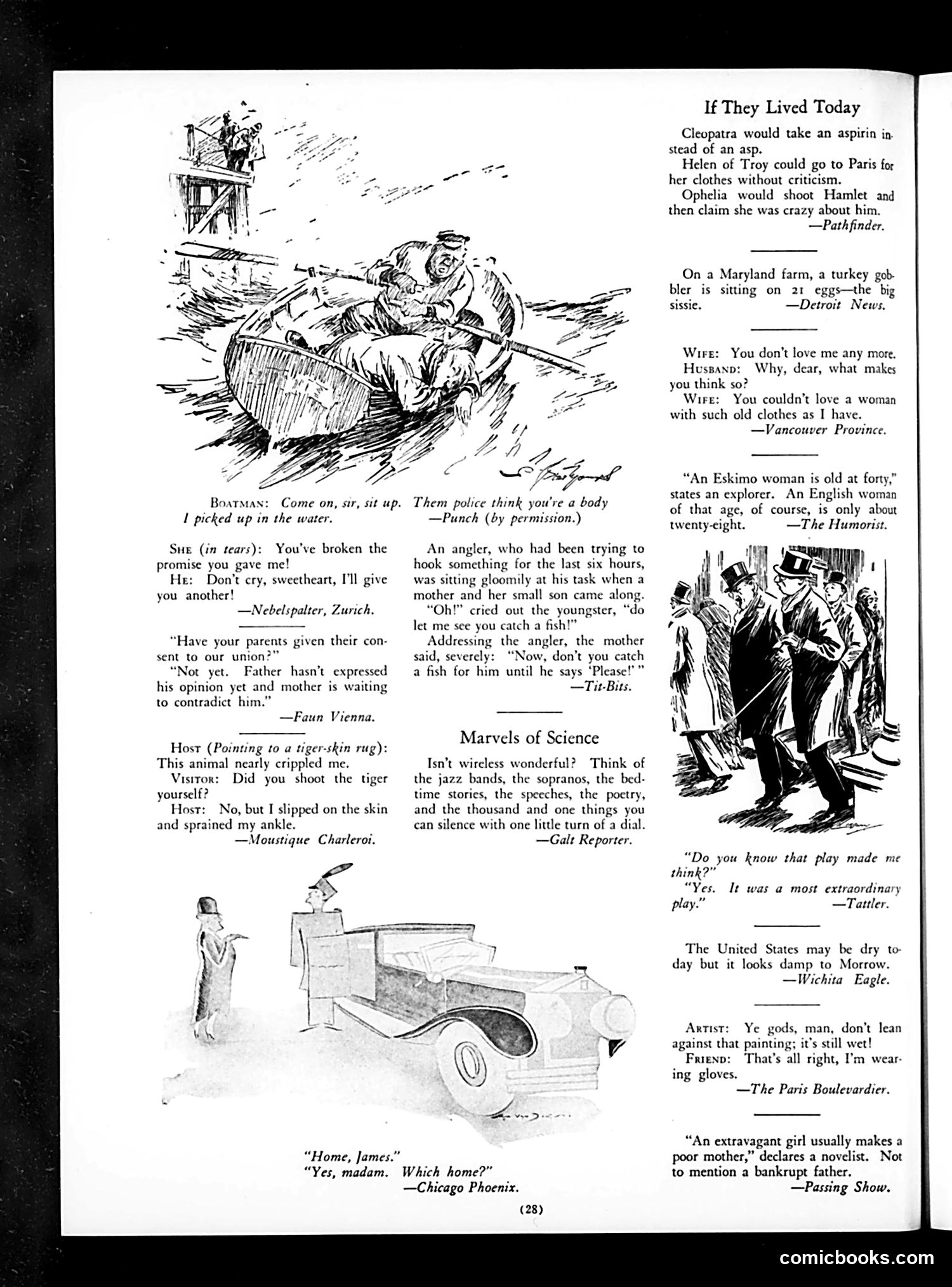
Life Magazine Humor Page Analysis This page collects international satirical jokes and cartoons from early-20th-century publications. The humor reflects period anxieties and social conventions: Key themes: - Marriage/relationships: Jokes mock spousal dynamics—broken promises, wives' fashion complaints, husbands' indifference - Gender roles: A mother teaching her son manners; criticism of "extravagant girls"; commentary on women's aging (comparing Eskimo and English women) - Modern technology anxiety: A "Marvels of Science" joke celebrates wireless radio's ability to silence unwanted broadcasts—reflecting early radio's mixed reception - Class/pretense: A wealthy host's embarrassing accident; a servant mistaking a woman for a corpse - Prohibition era: A final joke about the U.S. being "dry" (alcohol-banned) appearing "damp" The cartoons show domestic mishaps rendered in period sketch style. These are genteel, mainstream satirical jokes—mildly irreverent but ultimately reinforcing conventional morality around manners, marriage, and propriety.
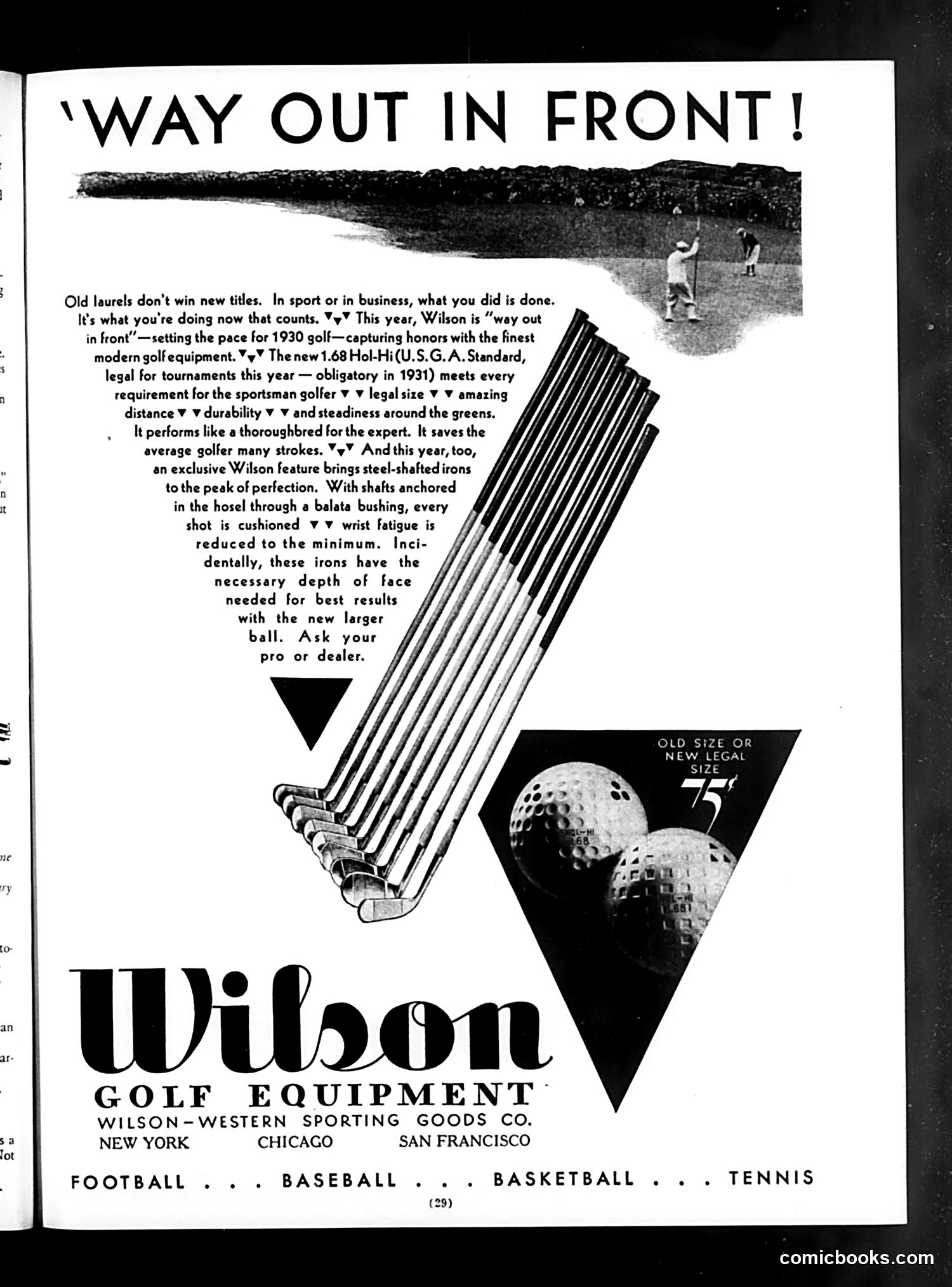
Wilson Golf Equipment Advertisement (c. 1930) This is a product advertisement, not a political cartoon. It promotes Wilson sporting goods' new golf equipment for the 1930 season. The ad emphasizes Wilson is "way out in front" by adopting the newly standardized 1.68 Hol-Hi golf ball (mandated for tournaments in 1931) and introducing steel-shafted irons with special cushioning. The message targets competitive golfers: past achievements don't matter—only current innovation counts. The visual shows a large set of golf irons and two golf balls (old vs. new legal size) priced at 75¢. The ad appeals to both expert and average golfers, claiming the equipment improves distance, durability, and reduces wrist fatigue. The headline's sports/business metaphor reflects 1930s optimism about technological progress and competitive advantage—relevant as golf was gaining popularity among middle and upper-class Americans during the Depression era.
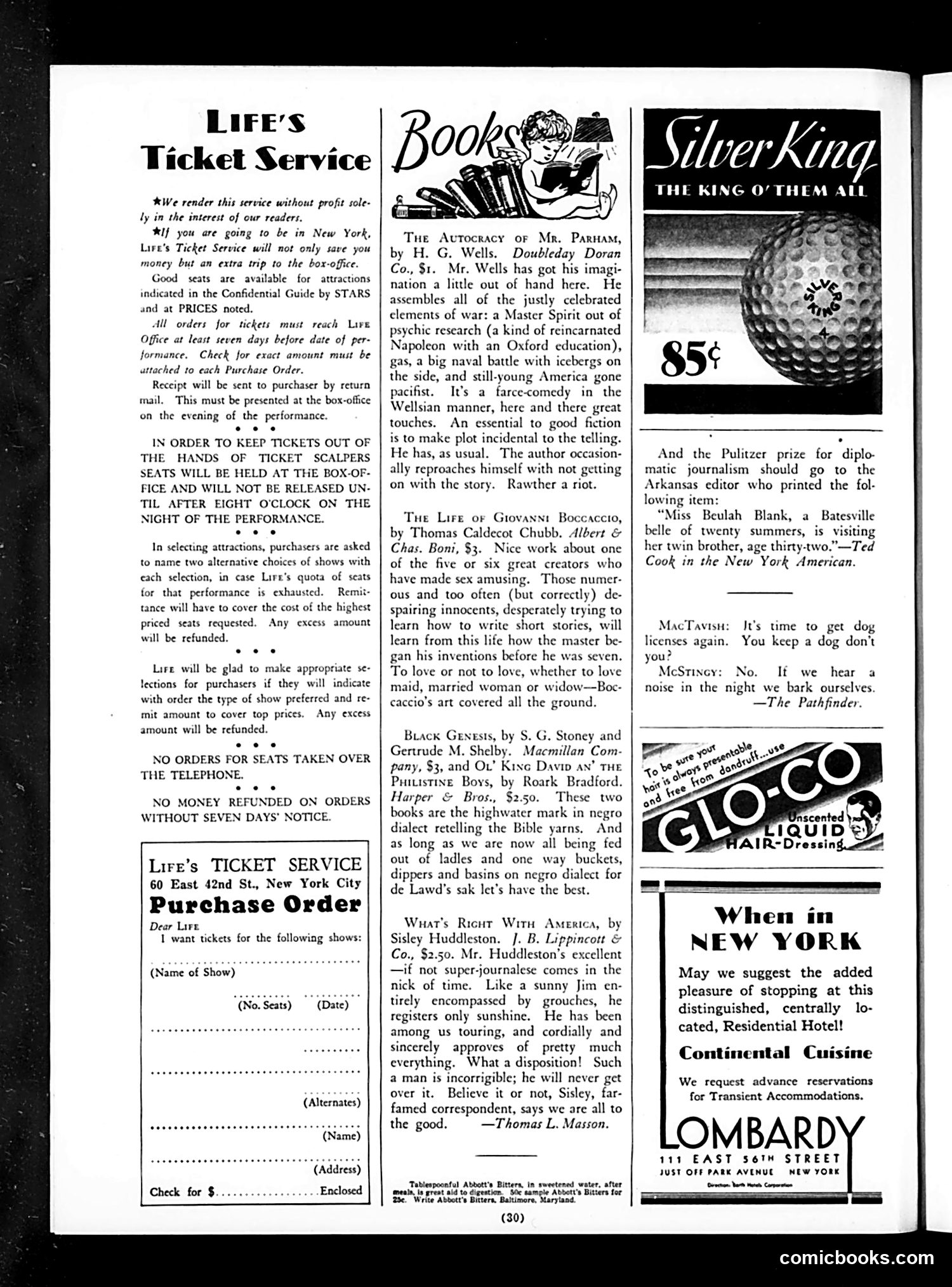
Analysis: This Is Primarily a Service Page, Not Political Satire This page is dominated by Life's Ticket Service—a practical administrative section offering Broadway theater tickets to readers. The bulk consists of ordering instructions and terms (tickets must be ordered seven days ahead, no telephone orders, anti-scalper policies). The right column contains book reviews rather than political cartoons. These are straightforward literary recommendations: H.G. Wells' *The Autocracy of Mr. Parham* (described as farce-comedy about war), a biography of Boccaccio, two books retelling Biblical stories in African American dialect, and Sisley Huddleston's travel commentary *What's Right with America*. There is no political cartoon visible on this page. The only illustration is an advertisement for SilverKing golf balls (85¢). The tone is typical early-20th-century Life magazine: urbane, literary, focused on Manhattan cultural life for affluent readers. The book reviews employ casual period vernacular ("Rawther a riot," "de Lawd"), but this reflects editorial voice, not satirical commentary on specific political figures or events.
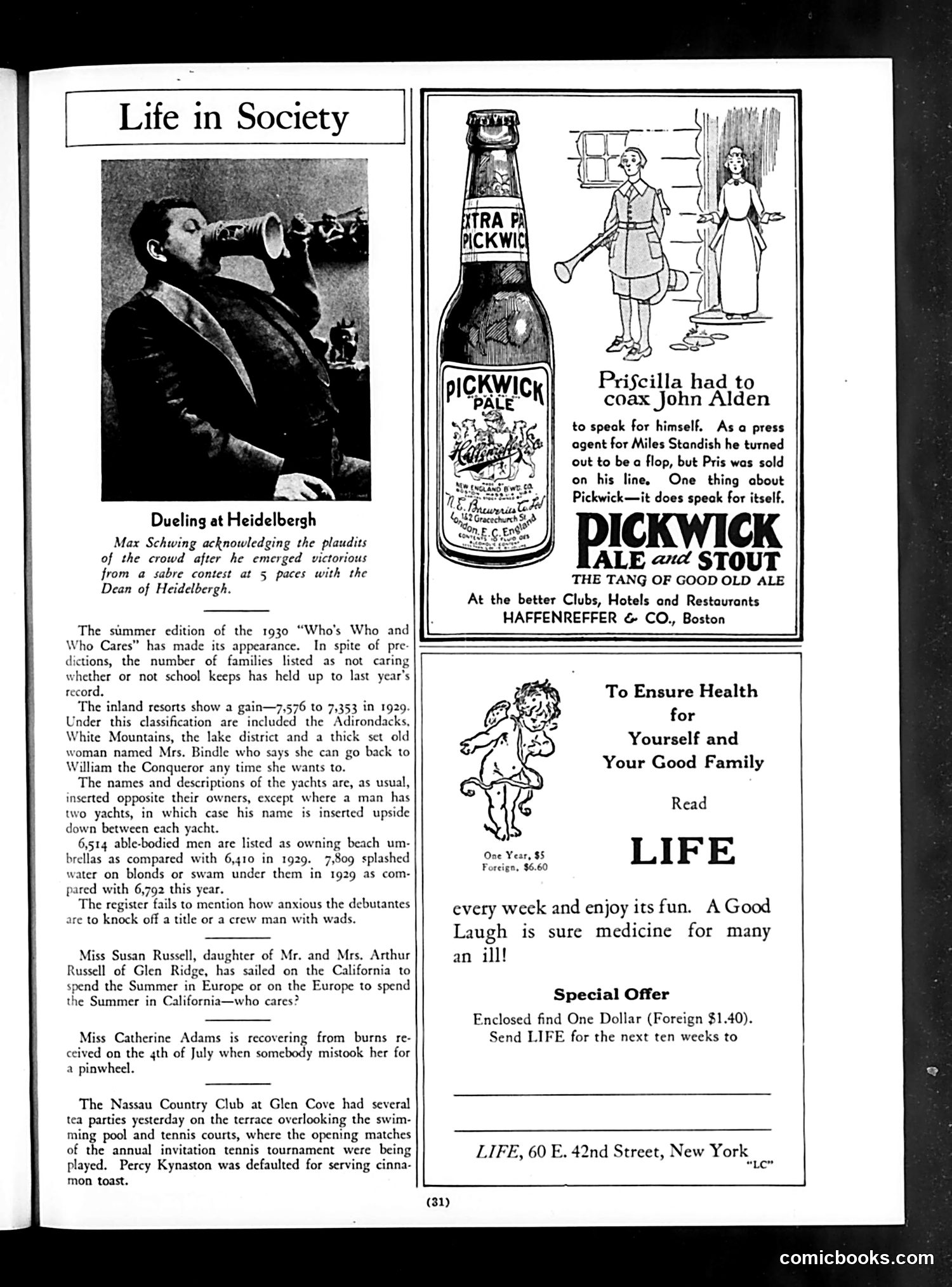
Life Magazine Page Analysis This page from Life magazine (circa 1930) contains social satire and advertisements. The left column mocks upper-class society through absurdist humor: it jokes about Who's Who directories, resort statistics, yacht ownership, and society debutantes' frivolous concerns. The reference to "Priscilla had to coax John Alden" alludes to the Pilgrims' historical romance, humorously comparing romantic persuasion to advertising. The top illustration labeled "Dueling at Heidelbergh" appears to show Max Schwing acknowledging crowd approval after a formal sabre duel—a satirical commentary on old-world aristocratic traditions. The page is dominated by commercial advertisements: a large Pickwick Ale & Stout beer ad (bottom right) and a Life magazine subscription promotion (lower right), both typical of 1930s publishing. The humor targets wealthy Americans' pretensions and outdated social conventions while promoting modern consumer products.
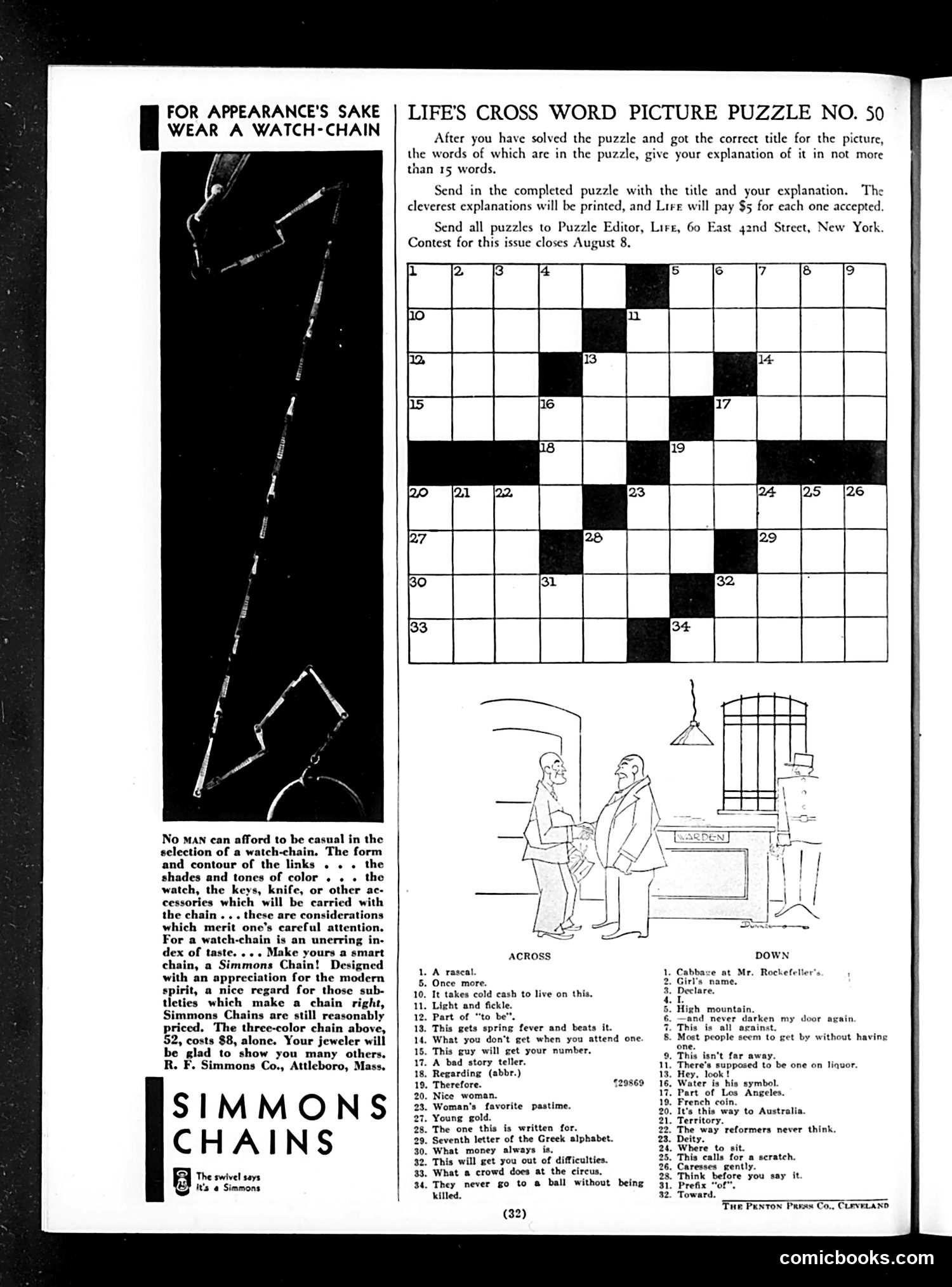
Analysis This page is primarily a crossword puzzle contest from Life magazine, not a political cartoon. The small illustration at top left shows a watch-chain and serves as advertisement for Simmons Chains, a jewelry company emphasizing that men should carefully select chains as markers of good taste. The main content is Life's "Cross Word Picture Puzzle No. 50"—a reader contest where solvers complete a crossword and propose a witty title/explanation (in 15 words or fewer) for the completed puzzle's image. Life promised to print the cleverest explanations and pay $5 each. The contest deadline was August 8. The illustration shows two men in an office setting, but without solving the crossword, the cartoon's specific satirical point remains unclear from the image alone. The puzzle itself contains both ACROSS and DOWN clues typical of crossword puzzles from this era. This is primarily a puzzle/contest page with advertising, not editorial satire.
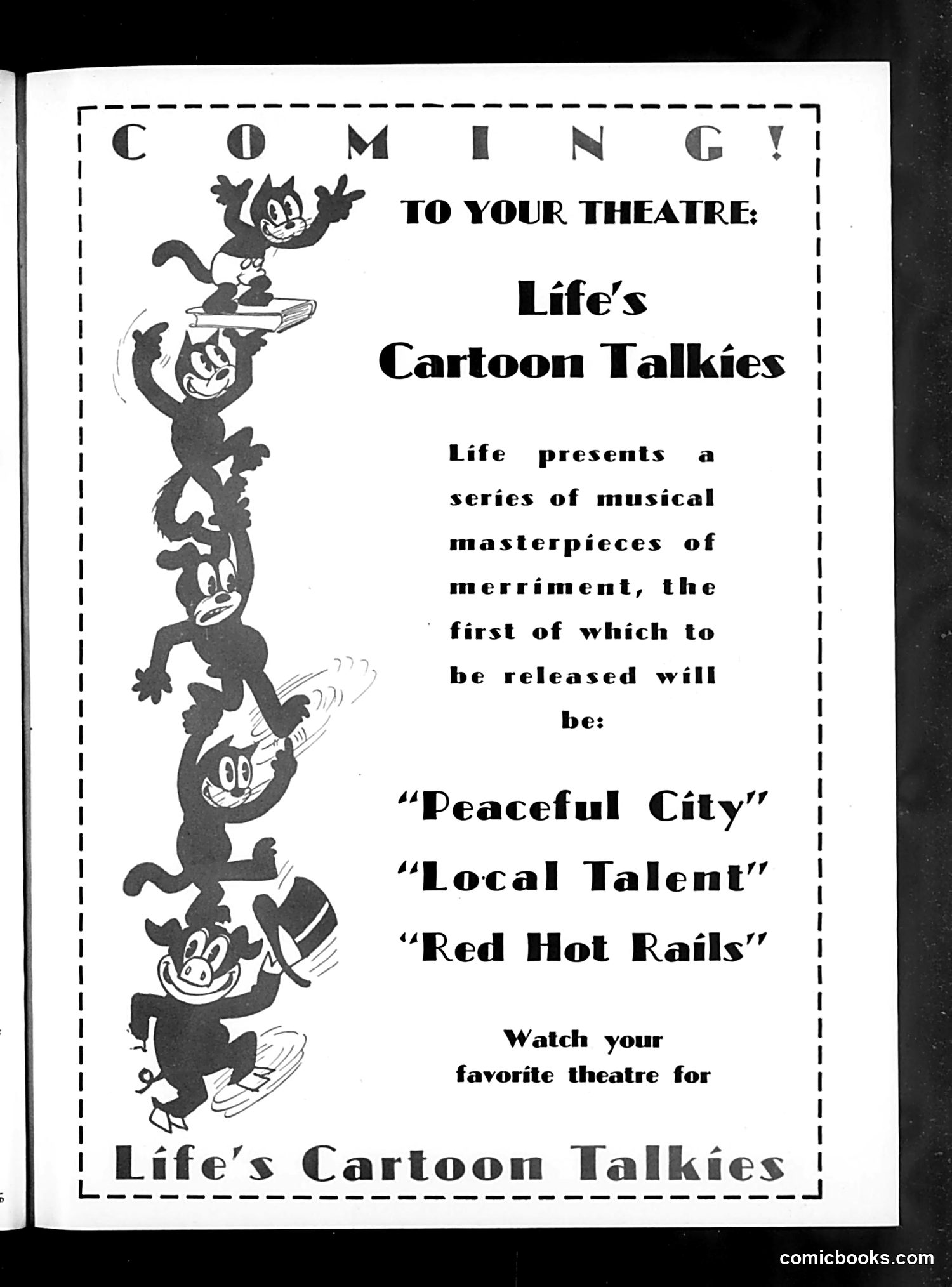
This is primarily an advertisement for Life magazine's "Cartoon Talkies" — a series of animated musical shorts Life was promoting for theatrical release. The page features a tower of stacked cartoon animal characters (appearing to be cats or similar creatures) in early animation style, exemplifying the slapstick, physical comedy these shorts would deliver. The advertisement announces three upcoming titles: "Peaceful City," "Local Talent," and "Red Hot Rails." These titles suggest humorous scenarios typical of 1920s-30s cartoon comedy — urban settings, amateur performances, and railroad-based hijinks. The "talkies" reference reflects the recent industry transition from silent to sound films. This appears to be promoting Life's entry into the growing animated entertainment market, targeting theater audiences expecting musical comedy shorts as part of their movie experience.
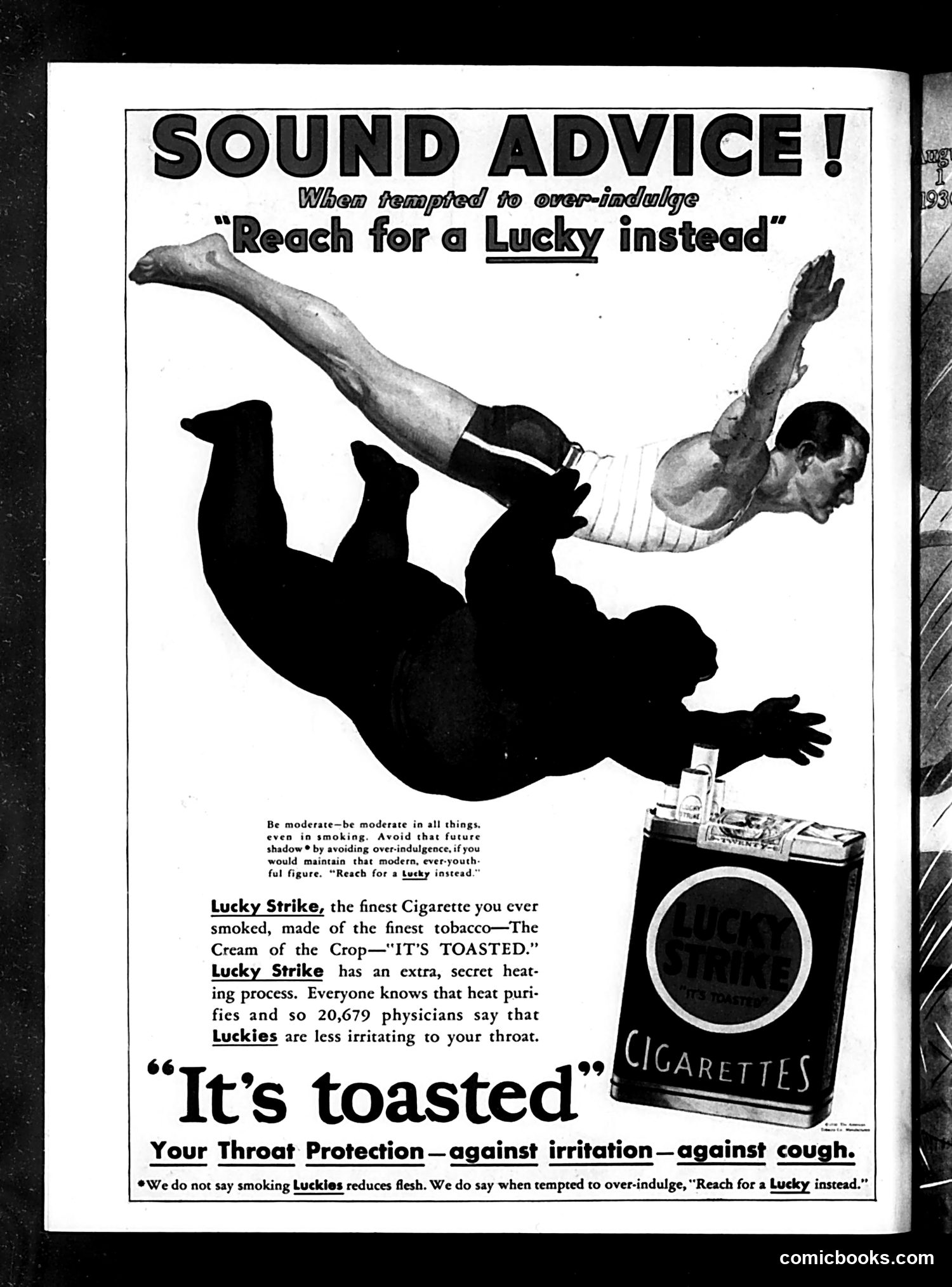
Lucky Strike Cigarette Advertisement Analysis This is a cigarette advertisement, not satire or political commentary. It promotes Lucky Strike cigarettes by appealing to 1930s health and body-image anxieties. The silhouetted figure shows a person losing weight or maintaining a slim figure—the "future shadow" referenced in the text. The ad's central pitch: when tempted to overeat, smoke a Lucky Strike instead. This exploits Depression-era concerns about physical appearance and weight. The ad claims scientific authority by citing "20,679 physicians" saying Lucky Strikes are "less irritating to your throat" due to their "toasting" process. The phrase "It's toasted" became the brand's signature claim. For modern readers: This represents tobacco industry marketing before health warnings were required—explicitly suggesting cigarettes as a diet aid and health product, while making vague medical claims that would be illegal today.