life
Life — August 1, 1930
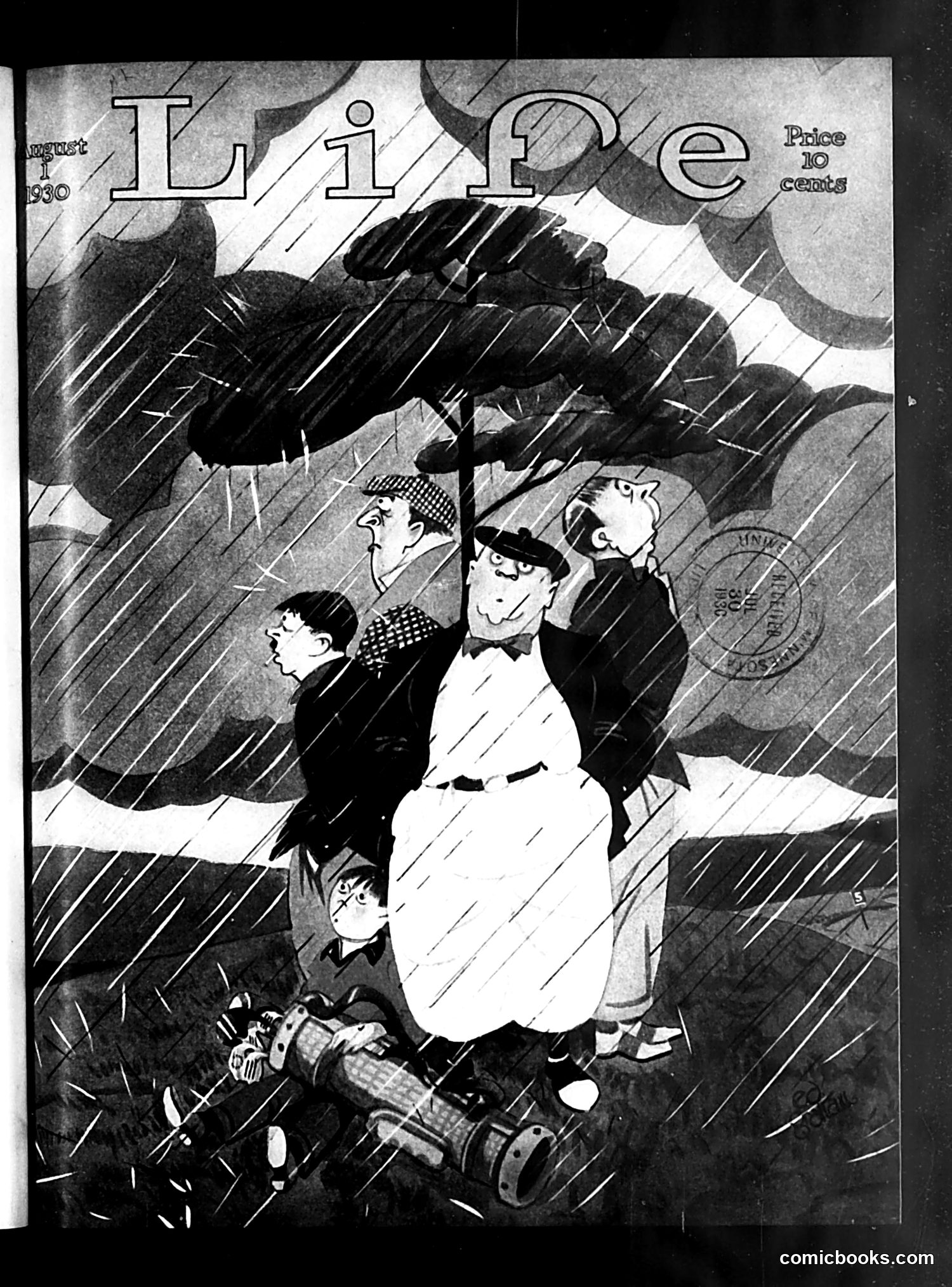
Life Magazine Cover Analysis This appears to be a Life magazine cover from August 1, 1930 (visible in top left corner). The illustration depicts four men huddled together under an umbrella during heavy rain, rendered in black and white caricature style typical of 1930s satirical art. The figures appear to represent different social classes or types seeking shelter together—a commentary likely addressing economic hardship during the Great Depression era. The contrast between formal dress (top hat, bow tie) and working-class clothing suggests satire about how financial crisis affected people across social strata equally. The rain serves as a metaphor for the economic "storm." Without identifying specific individuals, the image's message appears to be that shared misfortune transcends class boundaries—a common Depression-era theme emphasizing collective suffering.
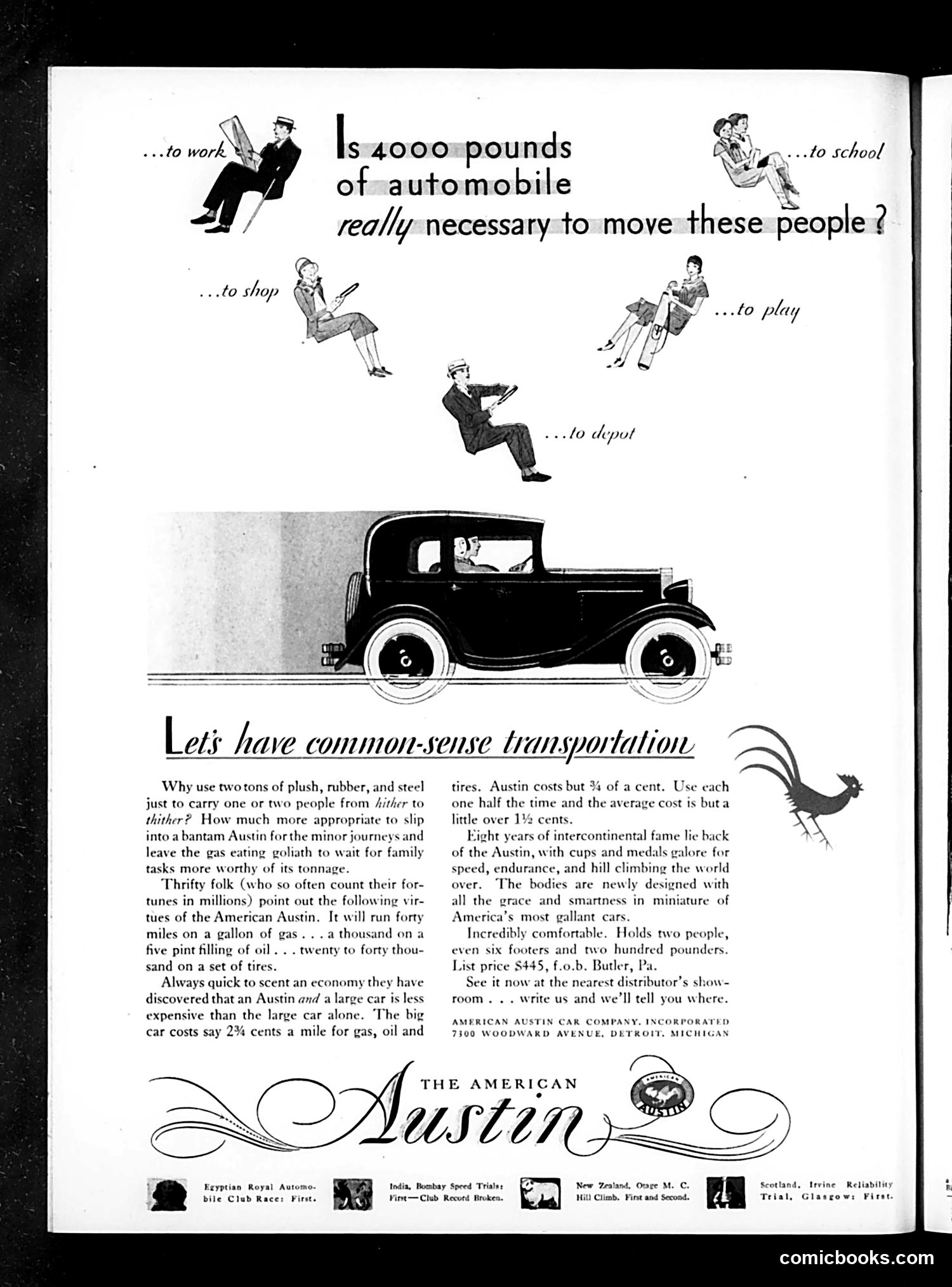
Analysis This is primarily an automobile advertisement for the American Austin car, disguised as social satire. The top half presents a rhetorical question with illustrated figures—a man going to work, a child to school, a woman shopping, a man at a depot, and children playing—each labeled with destinations. The satirical point: these everyday trips don't actually require a large, heavy automobile (4000 pounds). The Austin company argues that a small, lightweight car is more practical and economical for typical short-distance travel. The text emphasizes the Austin's efficiency: it costs only ¾ of a cent per mile to operate, runs forty miles on a gallon of gas, and can carry two people plus modest cargo. The advertisement positions the Austin as "common-sense transportation"—challenging the era's preference for larger vehicles for routine errands.
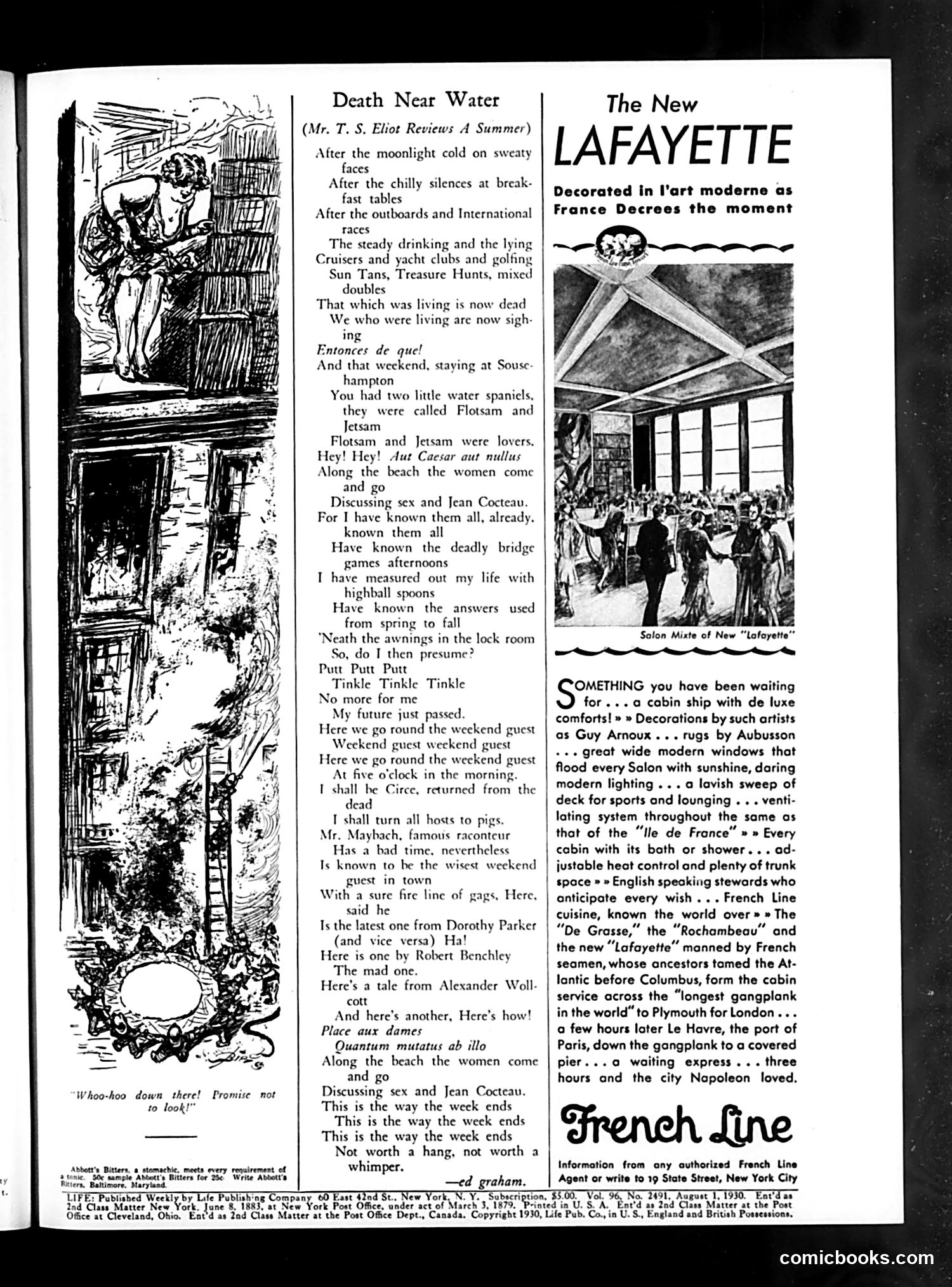
"Death Near Water" - Analysis This page contains T.S. Eliot's poem "Death Near Water" (reviewing "A Summer"), paired with an advertisement for French Line cruises featuring the new Lafayette ship. The Poem's Content: Eliot's dark, modernist verse catalogs the leisure activities of the wealthy at seaside resorts—racing, drinking, golf, yacht clubs. The repeated refrain "This is the way the week ends / Not worth a hang, not worth a whimper" suggests satirical despair at vacuous upper-class life. References to "deadly bridge games" and shallow social discourse mock the emptiness of this world. The Irony: The juxtaposition with the glamorous Lafayette advertisement—emphasizing luxurious cabins, French cuisine, and elegant deck sports—creates sharp satire. Eliot's poem mocks precisely the leisure lifestyle the ad promotes, exposing the spiritual hollowness beneath such indulgence.
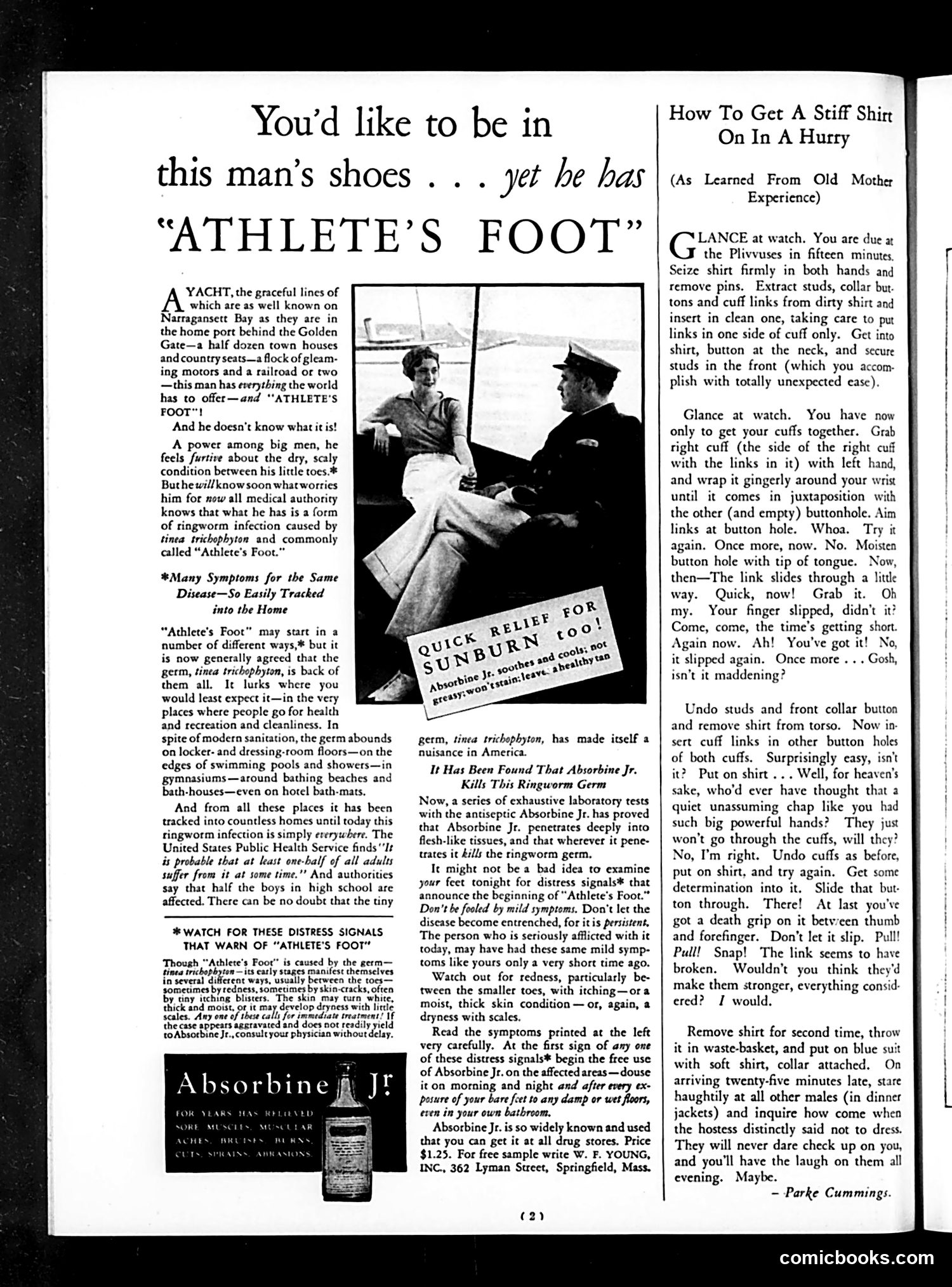
This page contains two separate pieces: a satirical advertisement for Absorbine Jr. (a liniment product) and a humorous advice column. The main advertisement uses dark humor about "Athlete's Foot"—a common fungal infection—playing on the phrase "You'd like to be in this man's shoes... yet be has 'Athlete's Foot.'" The accompanying photograph shows two men on a yacht, with the afflicted man's bare foot prominently displayed. The satire suggests that even wealthy leisure (yacht ownership, Narragansett Bay) cannot protect one from this embarrassing medical condition. The right column offers comic instructions on rapidly dressing a shirt for an urgent social engagement, using exaggerated, breathless language to describe the frantic process of inserting studs and cufflinks. Both pieces employ comedic exaggeration typical of Life magazine's satirical style, targeting mundane social anxieties and bodily embarrassments.
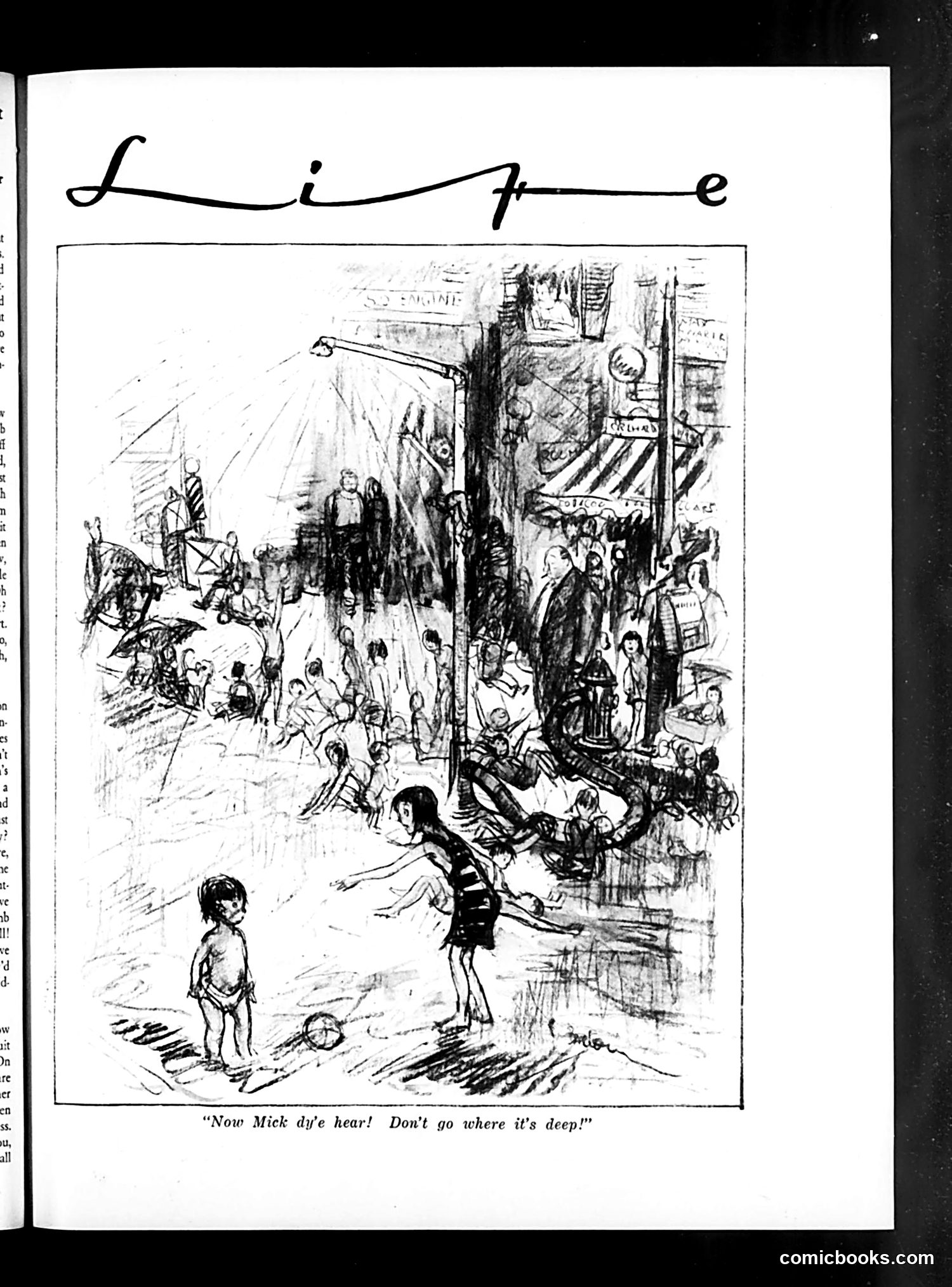
Analysis This appears to be a sketch from *Life* magazine showing a street scene titled "Now Mick d'ye hear! Don't go where it's deep!" The cartoon depicts children playing in what seems to be a poor urban neighborhood, with a densely packed street scene including tenement buildings and various figures. The warning in the caption suggests an adult cautioning a child (apparently named Mick) about water depth—likely referencing a dangerous situation like a flooded area or polluted waterway. The sketch style and Irish name "Mick" suggest this addresses immigrant life and urban poverty in early 20th-century America. The satire appears to critique unsafe living conditions in crowded tenement districts where children faced hazards from poor sanitation and infrastructure. The casual, dark humor typical of *Life*'s social commentary is evident in treating a potentially dangerous situation as material for satire.
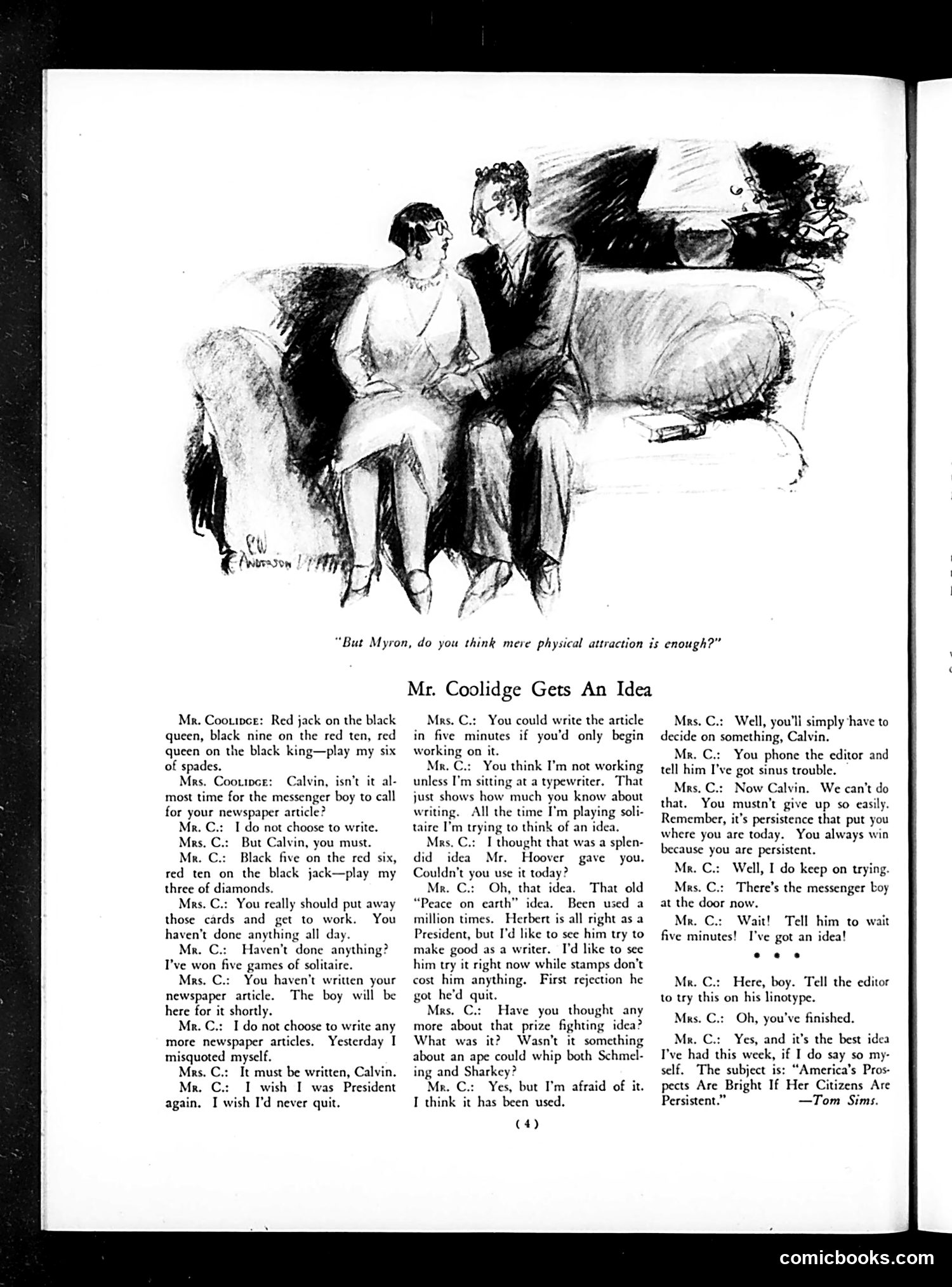
"Mr. Coolidge Gets An Idea" This is a satirical sketch showing a man and woman on a couch with the caption "But Myron, do you think mere physical attraction is enough?" The dialogue below reveals the joke: Mr. Coolidge (the man) is a newspaper writer struggling with laziness and lack of ideas. His wife Mrs. C. persistently nags him to write his overdue newspaper article. When she suggests he phone the editor, Coolidge suddenly claims to have an idea—"America's Prospects Are Bright If Her Citizens Are Persistent"—which he admits is recycled from Herbert Hoover. The satire mocks Coolidge's laziness, his wife's nagging persistence, and the banality of his "original" idea. The humor lies in how he only produces work under pressure and then recycles old material as his own.
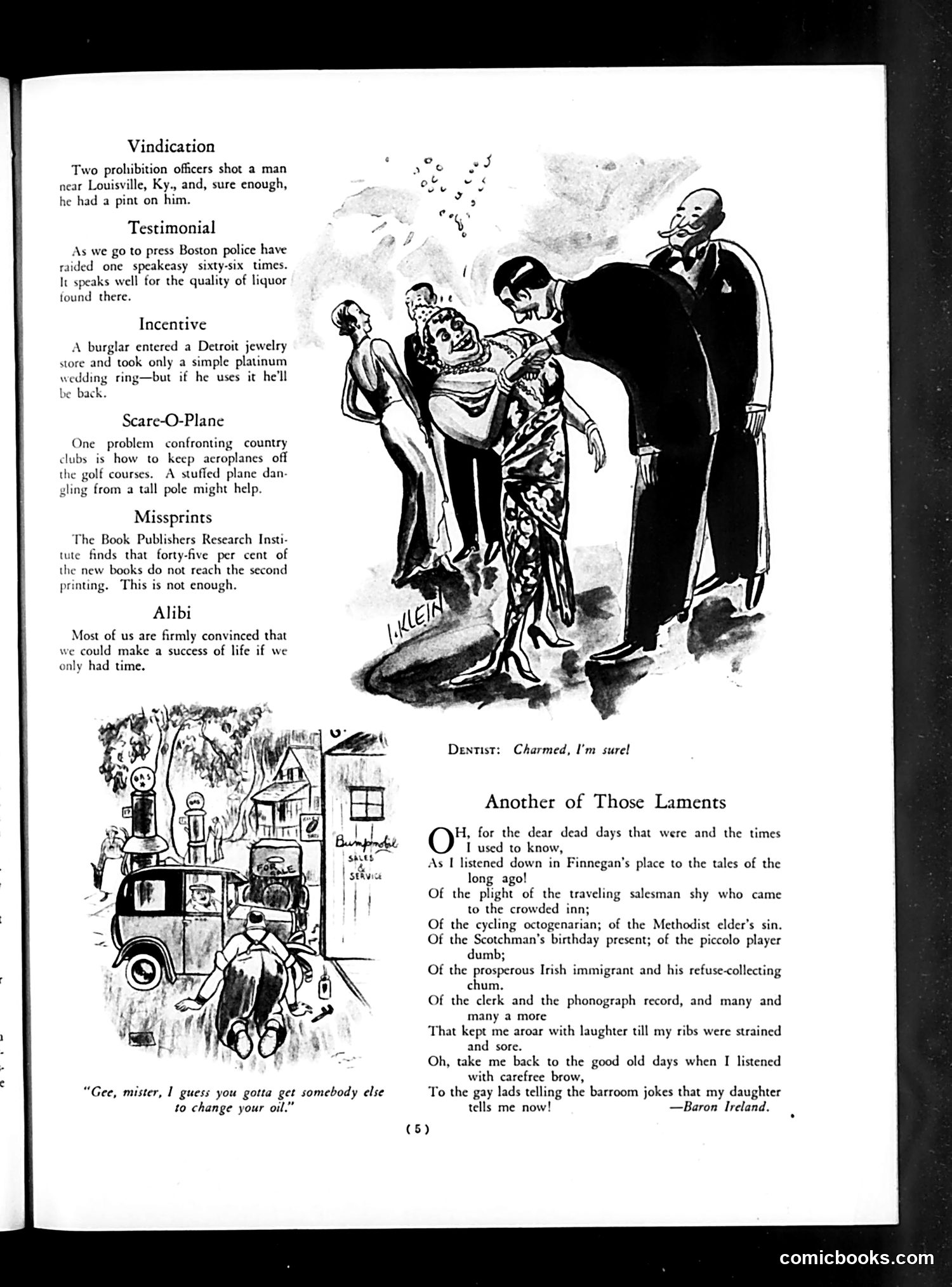
Page Analysis This page from *Life* magazine contains several short humorous items and illustrations typical of the era's satirical format. The top section includes brief jokes about Prohibition enforcement ("Two prohibition officers shot a man near Louisville, Ky., and, sure enough, he had a pint on him"), police speakeasies in Boston, a Detroit jewelry burglar, and other contemporary social issues. The main illustration shows a tall man in formal dress confronting a woman holding a baby, with other figures present—likely depicting a domestic or social scandal scenario, though the specific reference is unclear from the image alone. The bottom illustration depicts a crowded street scene with a taxi, apparently humorously captioned about needing someone to change oil. The page concludes with a nostalgic poem titled "Another of Those Laments" by Baron Ireland, yearning for older Irish immigrant culture and entertainment traditions.
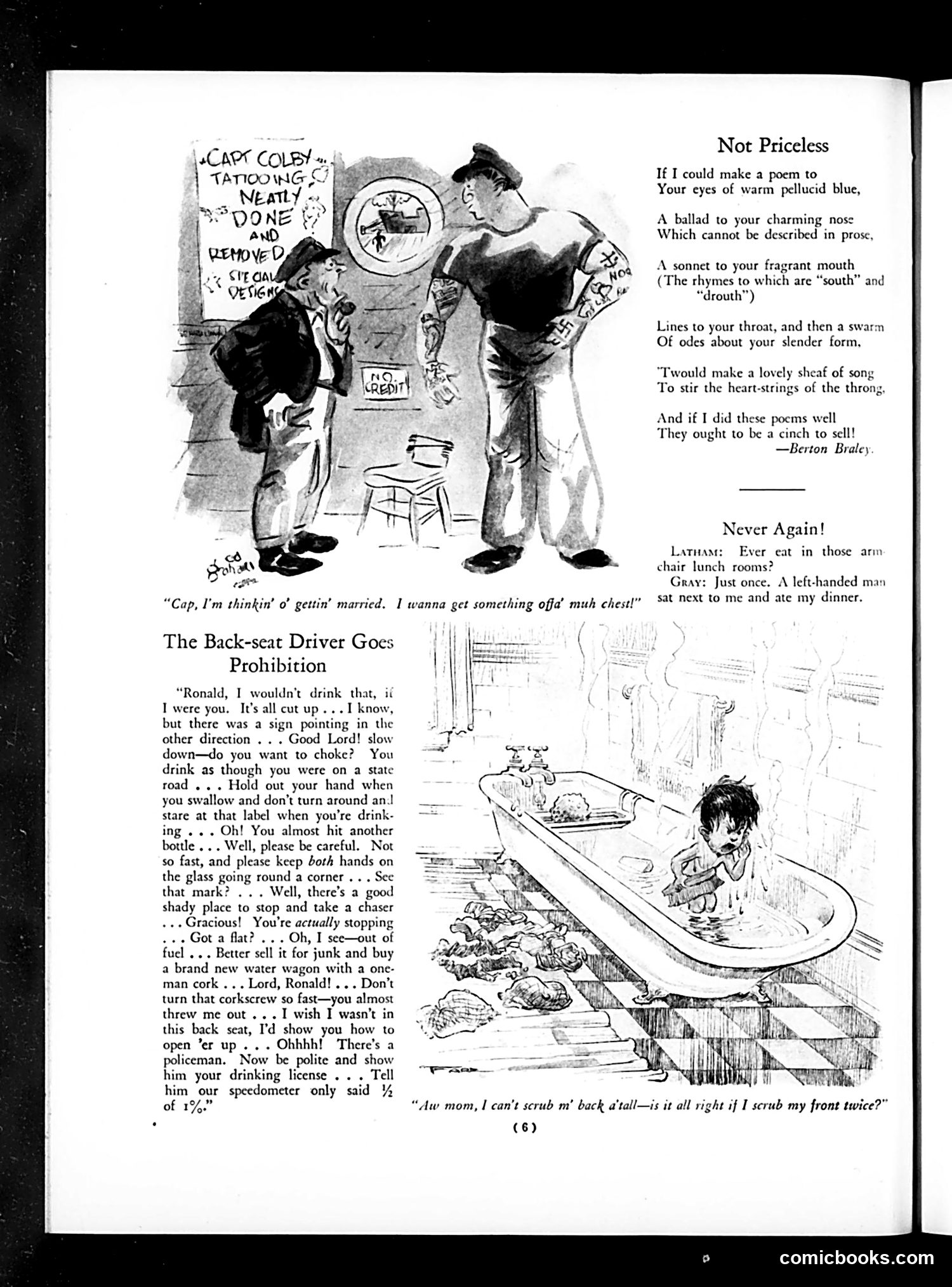
Analysis of Life Magazine Page This page contains three distinct pieces of humor: 1. "Not Priceless" — A poem by Berton Braley mocking flowery romantic verse, suggesting poetry about a woman's features would be worthless ("ought to be a cinch to sell"). 2. "Never Again!" — A brief joke about a left-handed man at an arm-chair lunch room who ate the narrator's dinner, a play on awkward shared dining spaces. 3. "The Back-seat Driver Goes Prohibition" — The main cartoon satirizes drinking and driving safety. A back-seat passenger delivers an absurdly long, paranoid monologue warning the driver against alcohol, ironically advising him to sell his car and buy a water wagon instead. The joke targets both drunk driving concerns and Prohibition-era anxieties about drinking culture.
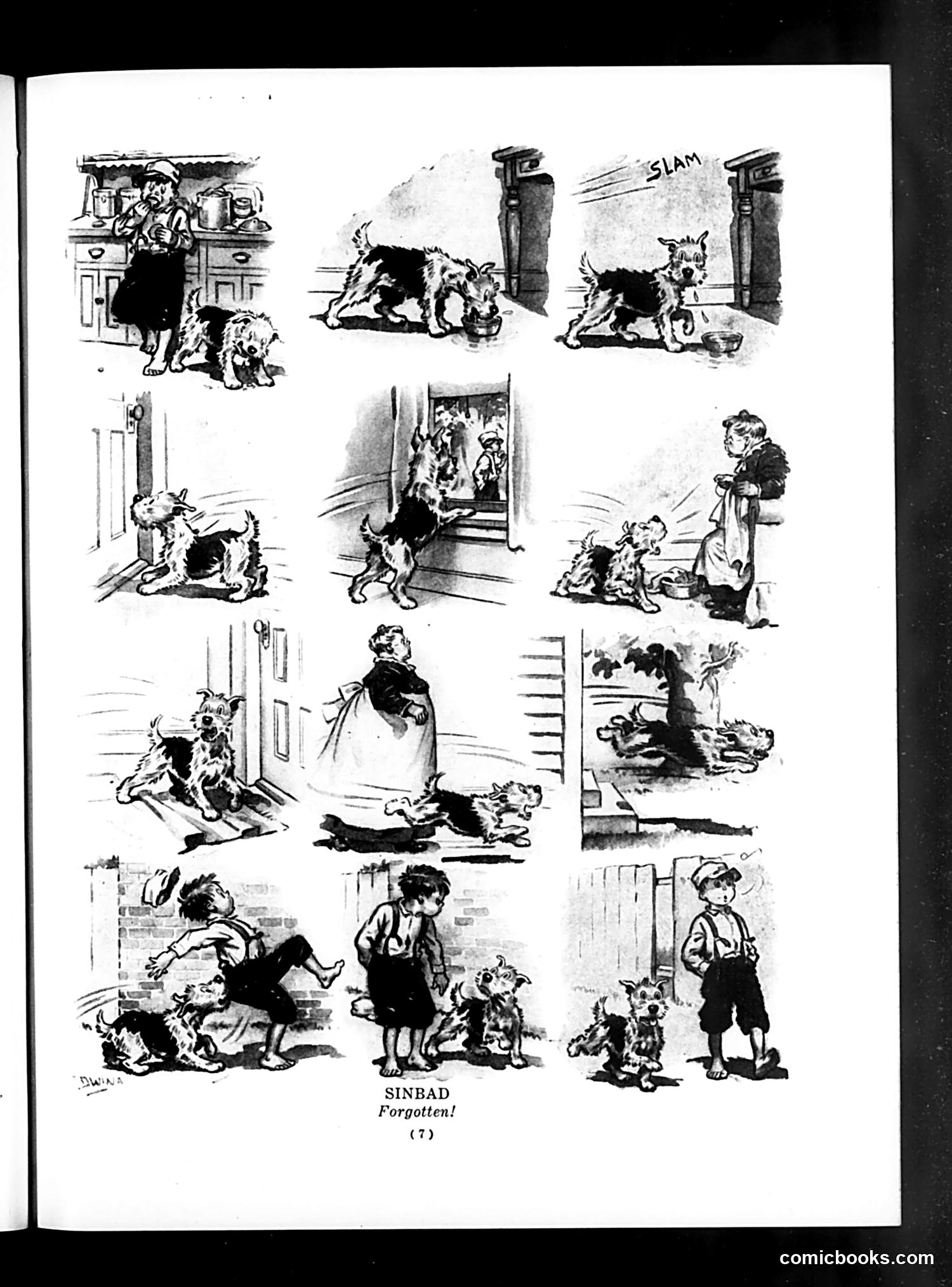
Analysis of "Sinbad Forgotten!" Comic Strip This appears to be a sequential comic strip showing a child and a dog in various domestic scenes. The title "Sinbad Forgotten!" suggests the narrative concerns the child neglecting or abandoning the dog. The strip depicts: a woman with the child and dog at home; the dog being shooed away or locked out; the child playing with other activities while ignoring the pet; and final scenes showing the lonely dog. The "SLAM" sound effect in an early panel emphasizes the door closing on the dog. The satire likely critiques childhood fickleness or the disposability of pets—a social commentary on how quickly children abandon their animal companions for new interests. The irony of naming the dog "Sinbad" (evoking adventure) only to forget it adds to the pointed humor about broken bonds and neglect.
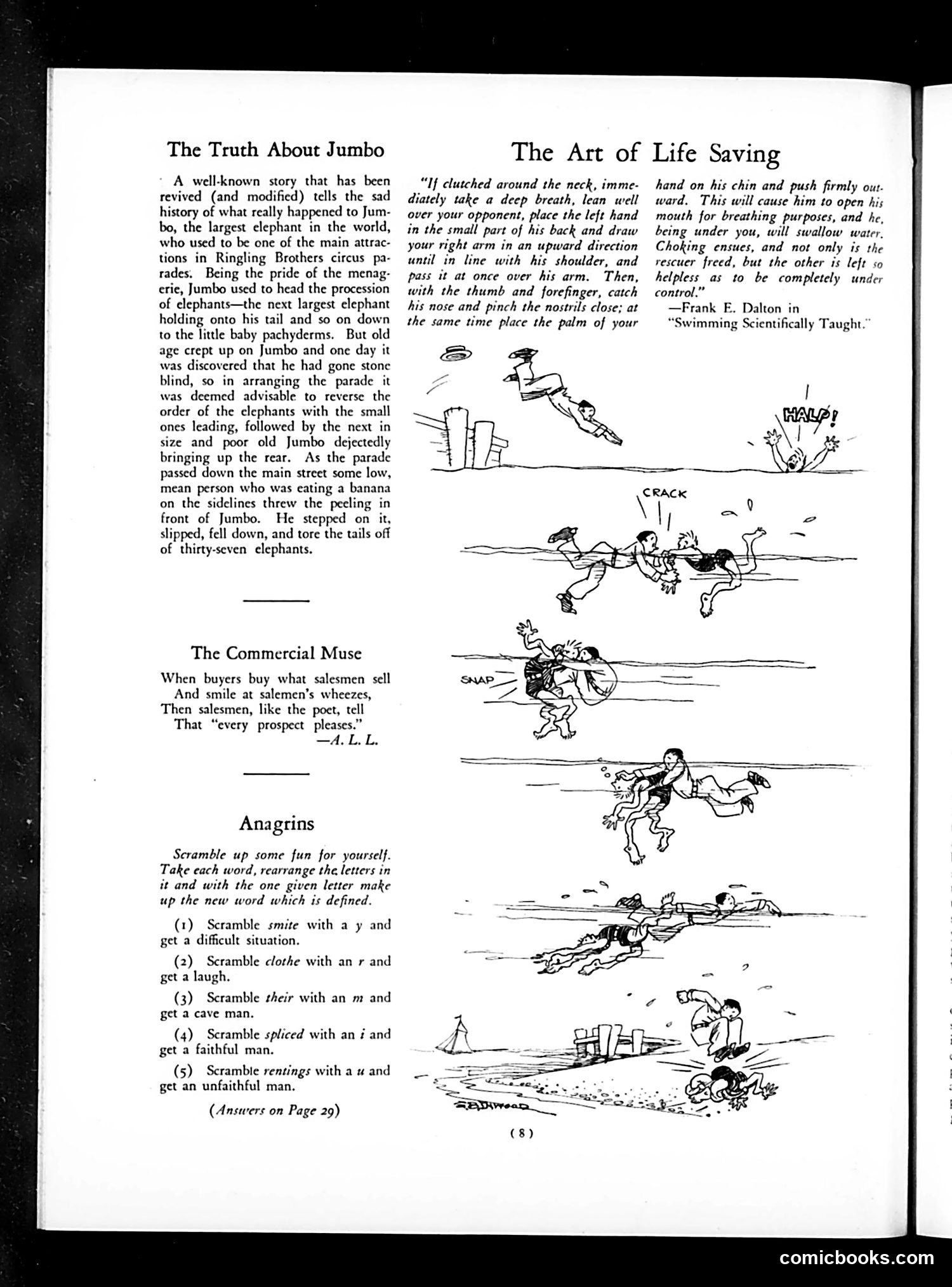
"The Art of Life Saving" - Cartoon Explanation This instructional cartoon series satirizes rescue techniques by depicting increasingly chaotic and absurd drowning-rescue scenarios. Each panel shows people attempting to save a drowning swimmer, but the "rescuers" themselves end up in the water through mishaps—slipping, falling, or being dragged down. The accompanying quote from Frank E. Dalton's "Swimming Scientifically Taught" provides serious, technical instructions for proper rescue technique, creating deliberate irony: while the text explains the *correct* method for saving someone, the illustrations show what happens when untrained or panicked people attempt rescue. The humor lies in this contrast between theory and chaotic reality—suggesting that without proper training, well-intentioned rescue efforts become disasters themselves.
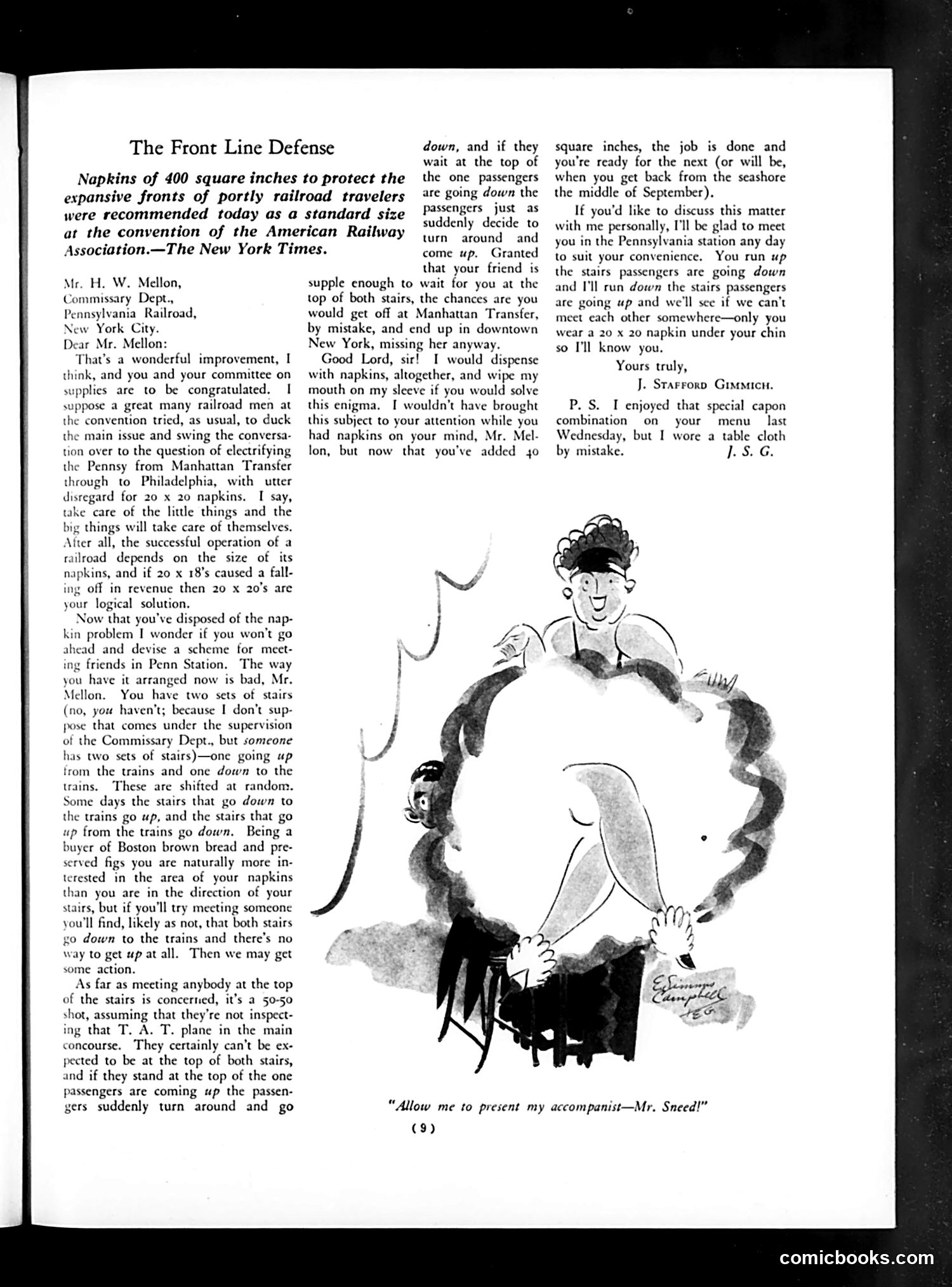
"The Front Line Defense" - Life Magazine Satire This page satirizes the Pennsylvania Railroad's solution to a practical problem: passengers on crowded trains getting their clothes soiled by expansive bodies. The railroad commissary proposed using 400-square-inch napkins. The letter from J. Stafford Gimmich mocks this absurd approach, suggesting the real issue isn't napkin size but the chaos of Penn Station itself—where stairs go randomly up or down, making it impossible to coordinate meeting friends. His sarcastic postscript jokes about wearing a tablecloth by mistake. The cartoon illustrates the absurdity: a woman being engulfed by an enormous napkin, captioned "Allow me to present my accompanist—Mr. Sneed!" The satire targets bureaucratic solutions that address symptoms rather than root causes of passenger inconvenience.
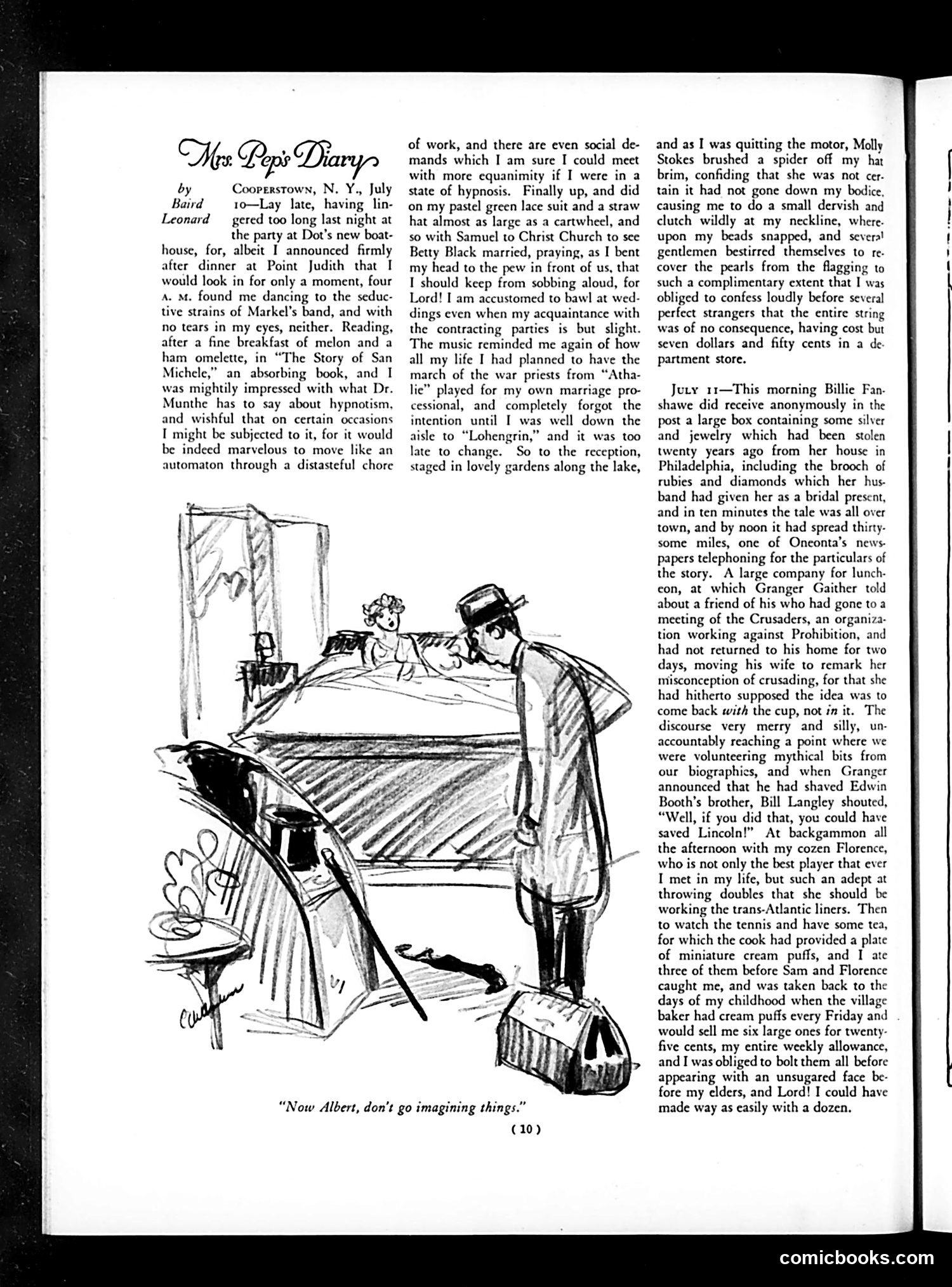
Analysis of "Mrs. Pen's Diary" Page This page from *Life* magazine presents a humorous domestic diary entry dated July 10-11, set in Cooperstown, N.Y. The cartoon illustrates a scene where a woman in bed addresses a man standing beside it with the caption "New Albert, don't go imagining things." The humor derives from a marital misunderstanding: the diary describes the woman attending social events and receiving anonymous gifts (jewelry and a brooch), which she's carefully explained away. The cartoon captures the moment of potential domestic suspicion—the husband "Albert" apparently suspects infidelity, while she's defensively reassuring him. The satire gently mocks early 20th-century gender dynamics, anxieties about marital fidelity, and the gap between spouses' perceptions of innocent social activities. The exaggerated domestic anxiety is typical of *Life*'s lighthearted social commentary.
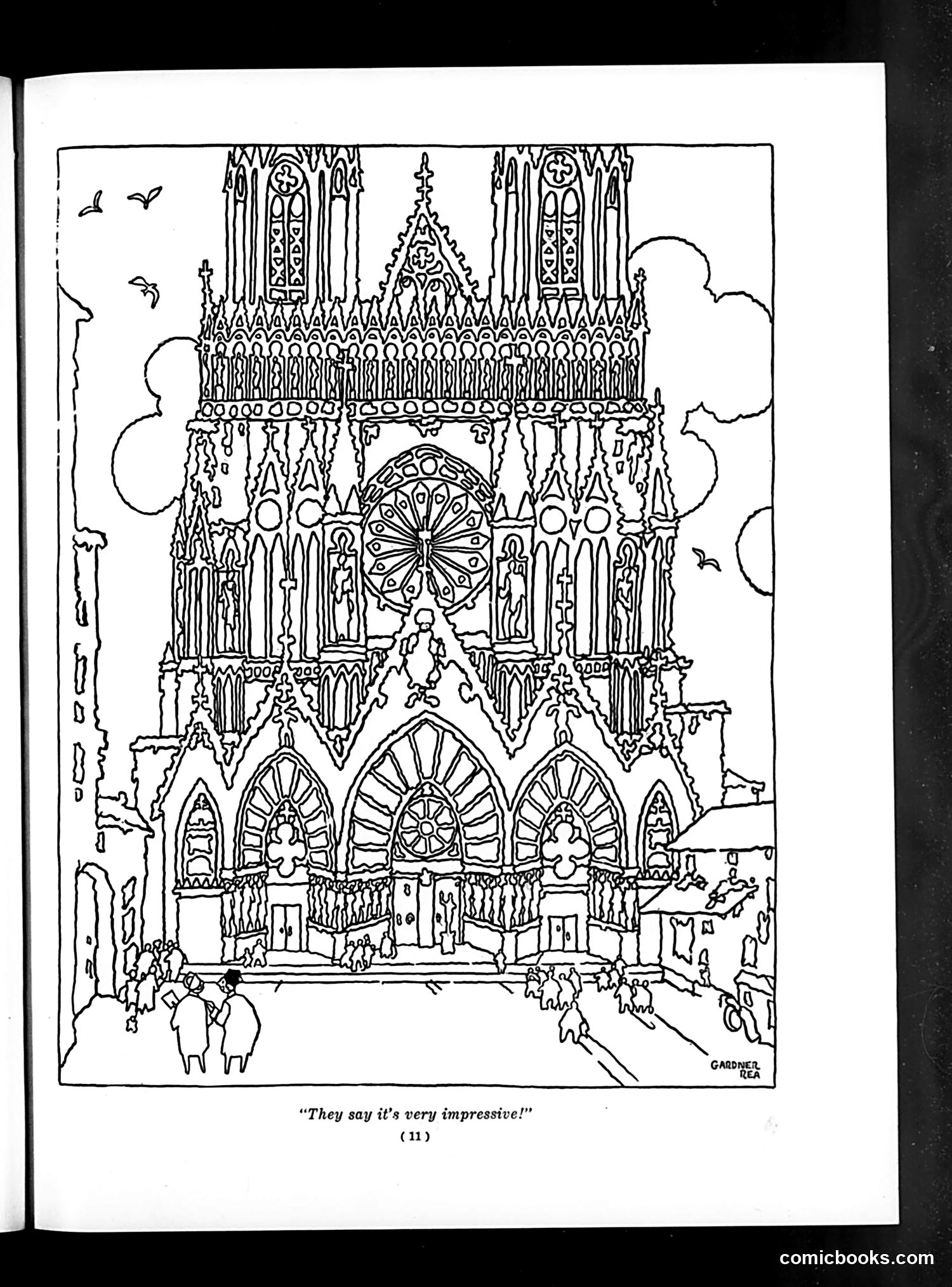
Cartoon Analysis This is a single-panel cartoon by Gardner Rea depicting a magnificent Gothic cathedral (likely Notre-Dame de Reims, based on the architectural style). Two small figures stand before it, with one saying to the other: "They say it's very impressive!" The satire is about tourist indifference to grandeur. Despite the cathedral's extraordinary Gothic architecture—soaring spires, intricate rose windows, elaborate stonework—the figures' underwhelmed response ("very impressive" in flat, tepid tone) mocks how visitors can fail to appreciate architectural masterpieces. The contrast between the building's undeniable magnificence and the tourists' casual dismissal creates the humor, likely satirizing modern tourism or the blasé attitudes of sightseers toward cultural monuments.
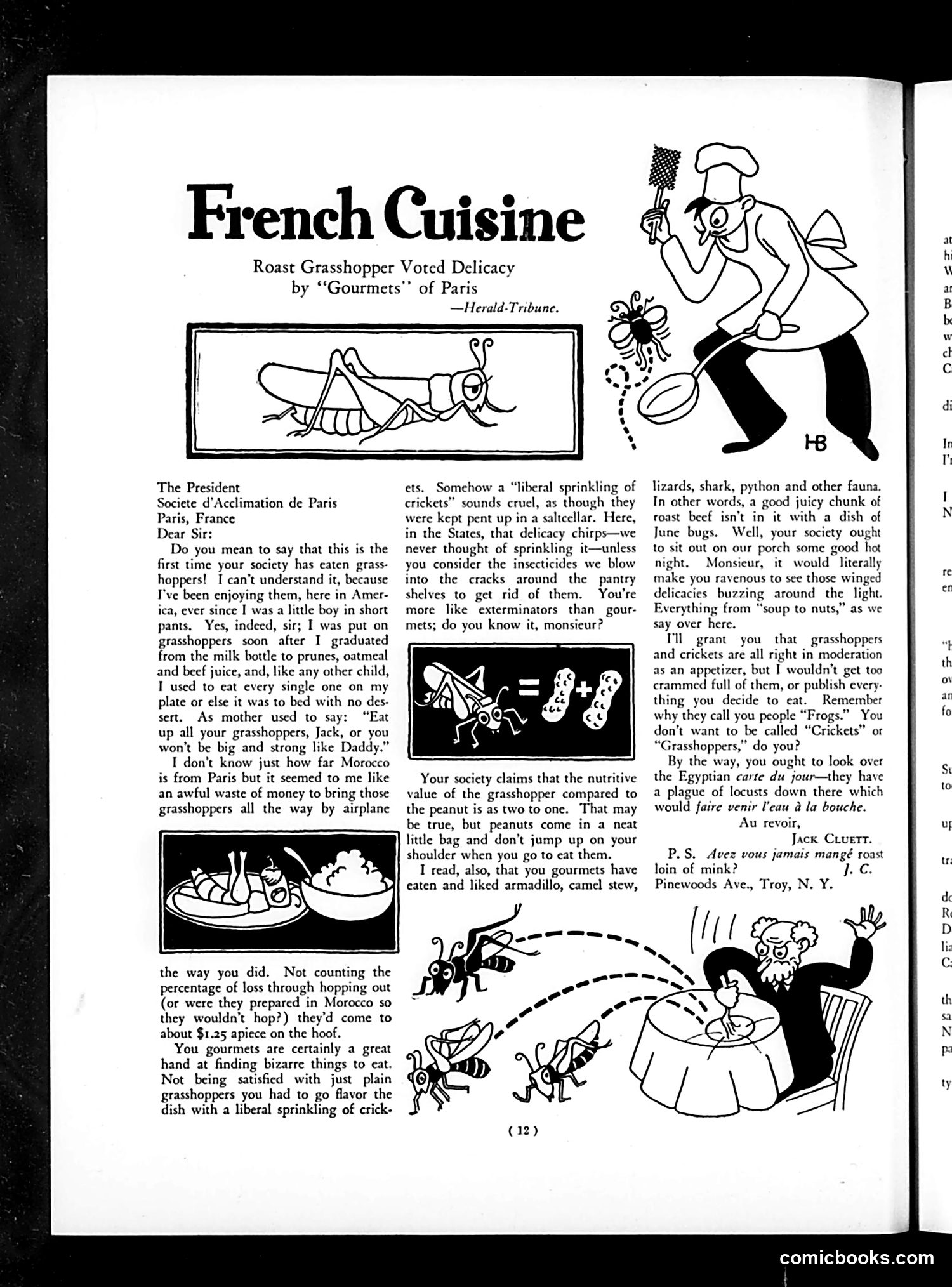
French Cuisine: Roast Grasshopper This satirical piece mocks the "exotic cuisine" pretensions of French gourmets. A Parisian chef proudly presents roasted grasshoppers and crickets as delicacies, while the letter's author—an American who ate grasshoppers as a child—deflates the pretension by noting he considers them mere pest-control measures, not cuisine. The humor lies in the cultural snobbery: Parisians elevate humble insects to haute cuisine through fancy presentation and French language ("carte du jour"), while an American sees through the artifice. The cartoons show the absurdity of treating grasshoppers seriously as food. This reflects 1920s American attitudes toward European food sophistication—viewing it as affected rather than genuinely refined. The piece gently ridicules both French culinary pretension and American provincial attitudes simultaneously.
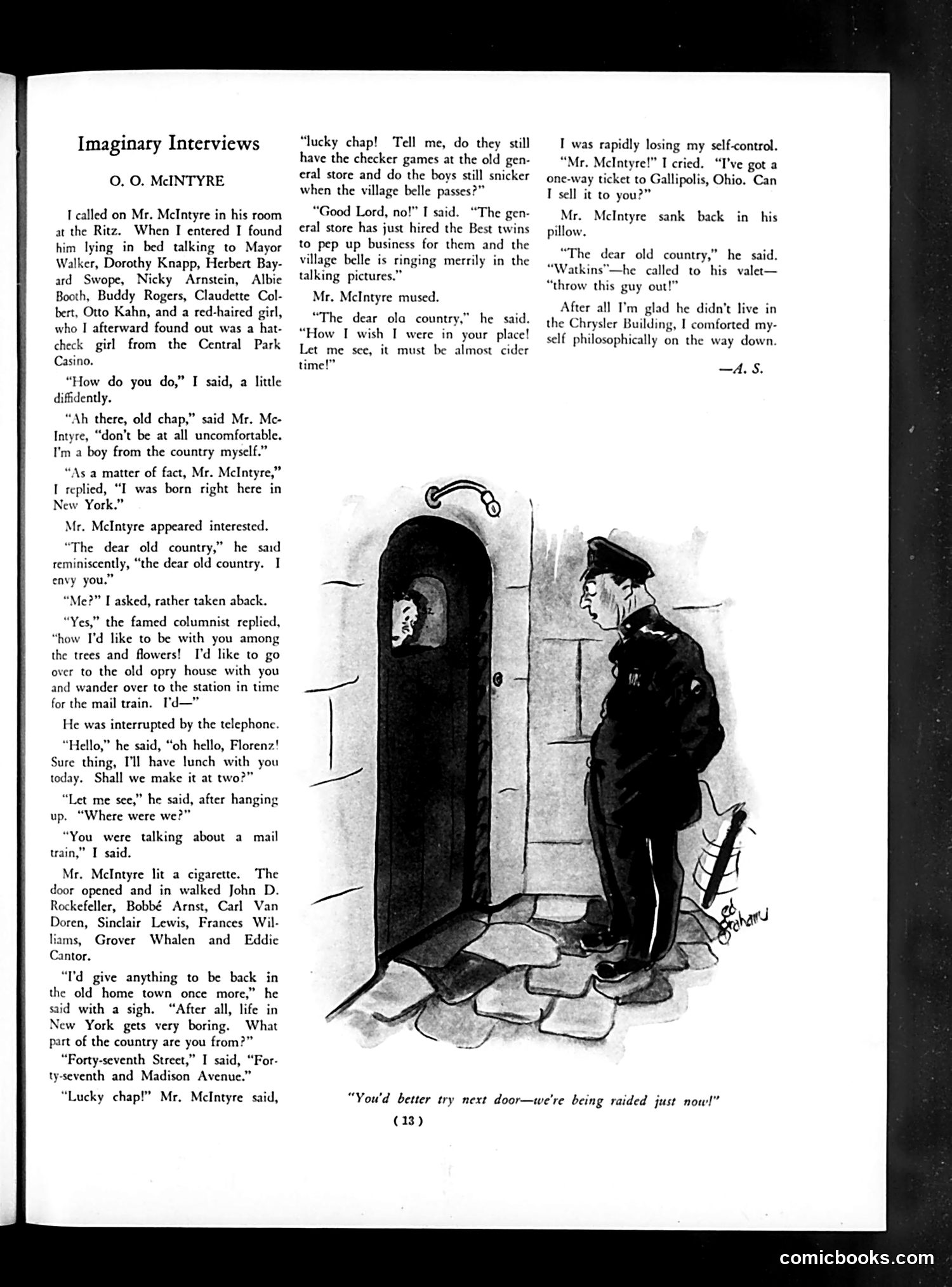
Analysis of "Imaginary Interviews: O. O. McIntyre" This page features a satirical interview with O. O. McIntyre, a real New York gossip columnist and social commentator of the early 20th century. The humor centers on McIntyre's nostalgic romanticization of rural America versus his actual urban lifestyle in Manhattan. The cartoon illustrates the joke: a visitor at McIntyre's door is told "You'd better try next door—we're being raided just now!" This references Prohibition-era police raids on speakeasies and illegal establishments—highlighting the contradiction between McIntyre's sentimental praise for small-town virtue and his actual residence in morally corrupt, lawless 1920s New York. The satire mocks journalists who sentimentalize rural values while ignoring urban decadence around them.
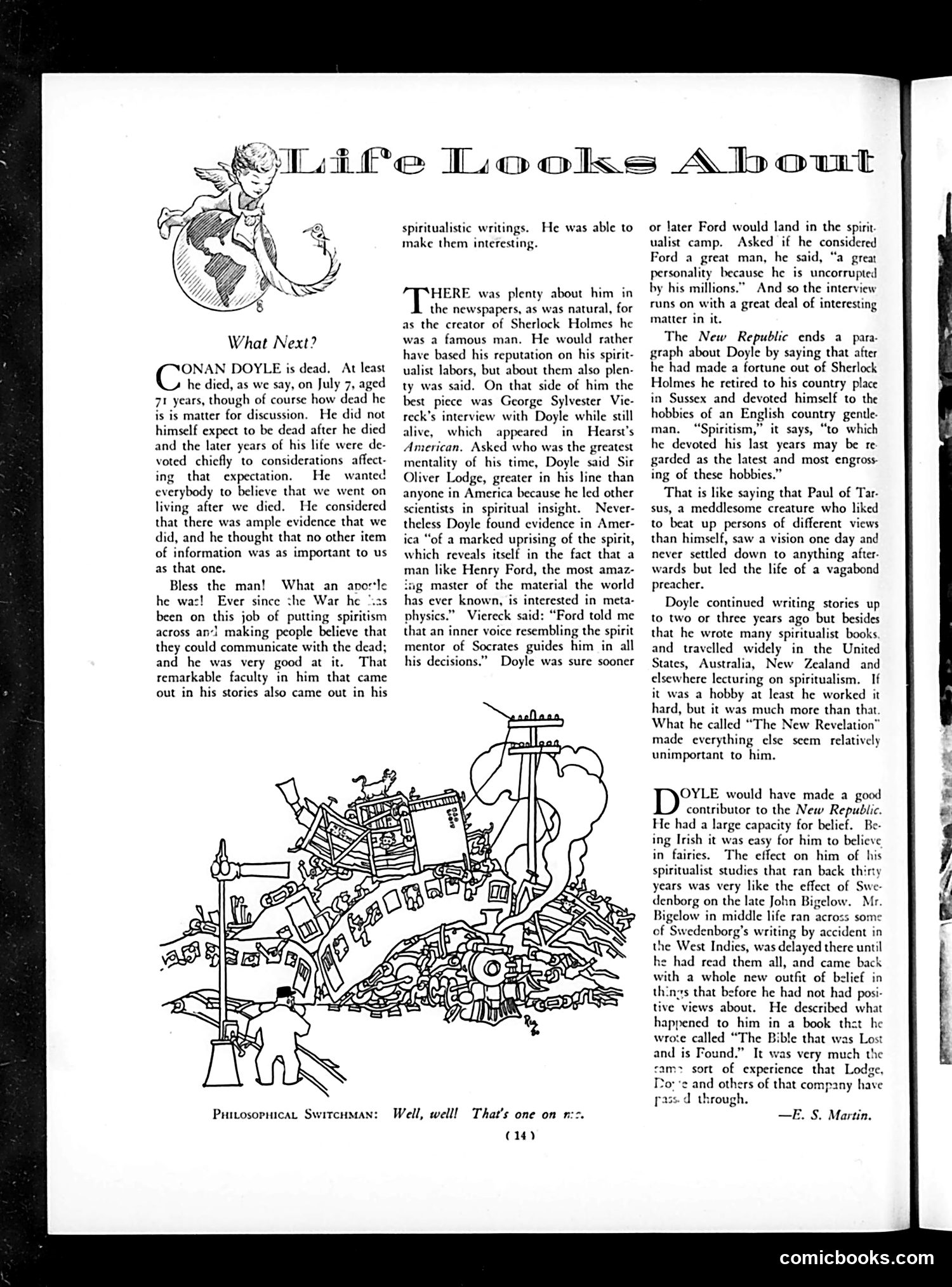
"Life Looks About What Next?" This page is an obituary-style essay on Arthur Conan Doyle, who died at age 71. The text discusses his famous creation (Sherlock Holmes) and his later life devoted to spiritualism—a major interest that the writer suggests overshadowed his literary legacy. The cartoon labeled "Philosophical Switchman" depicts a complex mechanical contraption in chaos, illustrating the jumbled state of Doyle's spiritualist beliefs. The caption "Well, well! That's one on us" appears to mock the irony that Doyle, a logical creator of detective fiction, spent his final decades pursuing mystical and metaphysical interests instead—a contradiction between his rational early work and irrational later pursuits.

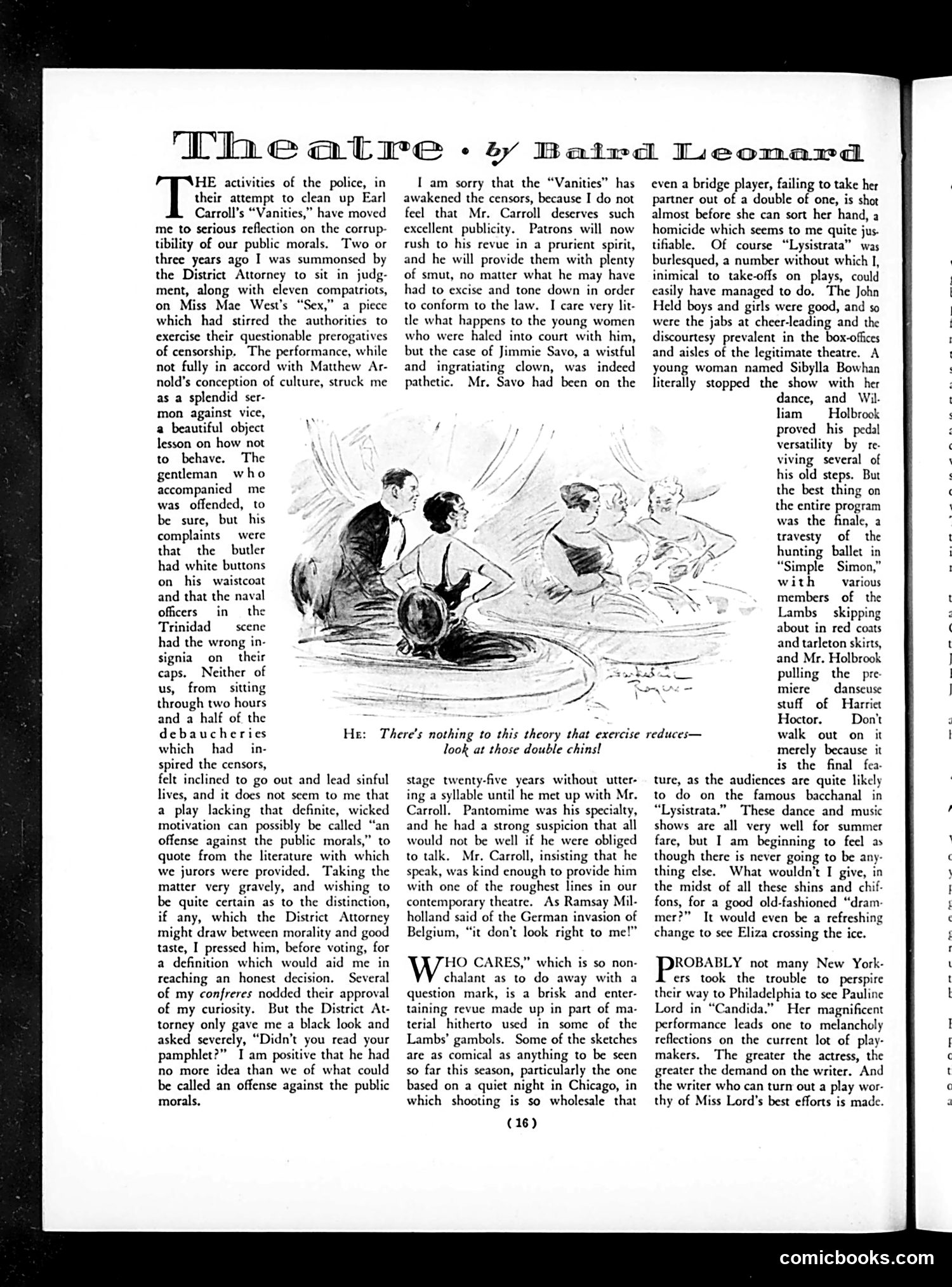
Theater Critique by Baird Leonard This is a theater review column discussing recent Broadway productions. The accompanying sketch depicts what appears to be a comedic dance scene with figures in period costume on stage. The column critiques police censorship of theatrical productions, specifically referencing Earl Carroll's "Vanities" revue. Leonard argues the censors are overly prudish, noting that removing risqué content from shows damages their artistic merit. He defends performers like Jimmie Savo and criticizes moralistic objections to theatrical content. The review also discusses other shows including one featuring pantomime and "Simple Simon," praising various performers while commenting on contemporary theatrical trends and the relationship between writers, audiences, and theatrical censors during this era of strict moral oversight of entertainment.
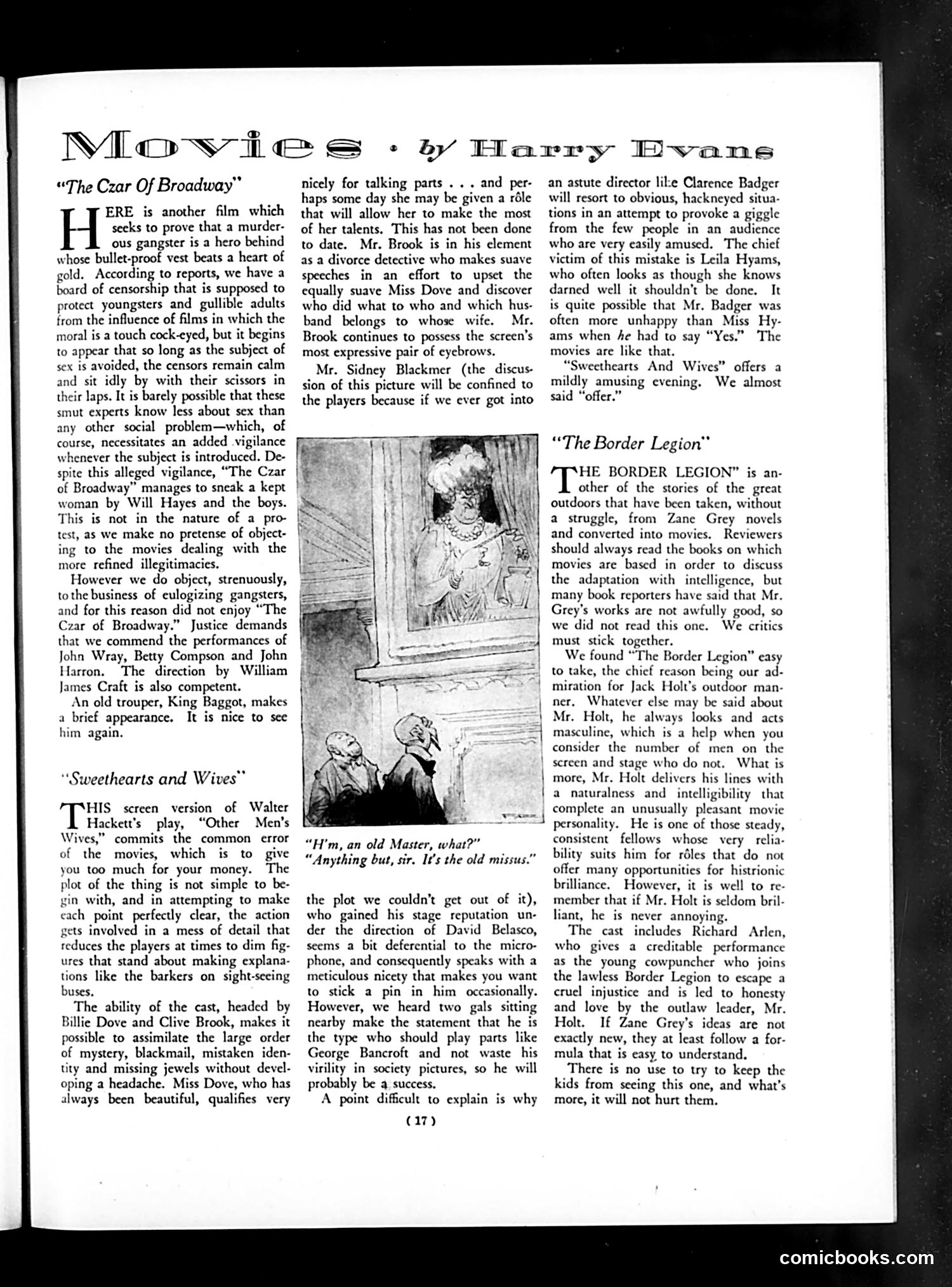
Movie Reviews by Harry Evans This page reviews three films. The visible illustration shows two figures in period costume (appearing to be from a classic play adaptation), with one saying "H'm, an old Master, what?" and another responding "Anything but, nr. It's the old missus." The reviews discuss: 1. "The Czar of Broadway" - A murder mystery where critics note the censorship board's concerns about immoral content, praising John Wray and William James Craft's direction. 2. "Sweethearts and Wives" - Adapted from Walter Hackett's play, praised for its cast's ability to handle mystery and jewel-theft plots clearly, particularly highlighting actress Billie Dove. 3. "The Border Legion" - An adaptation of a Zane Grey novel, praised for Jack Holt's masculine screen presence and natural delivery, though the critic notes the plot requires suspended disbelief.
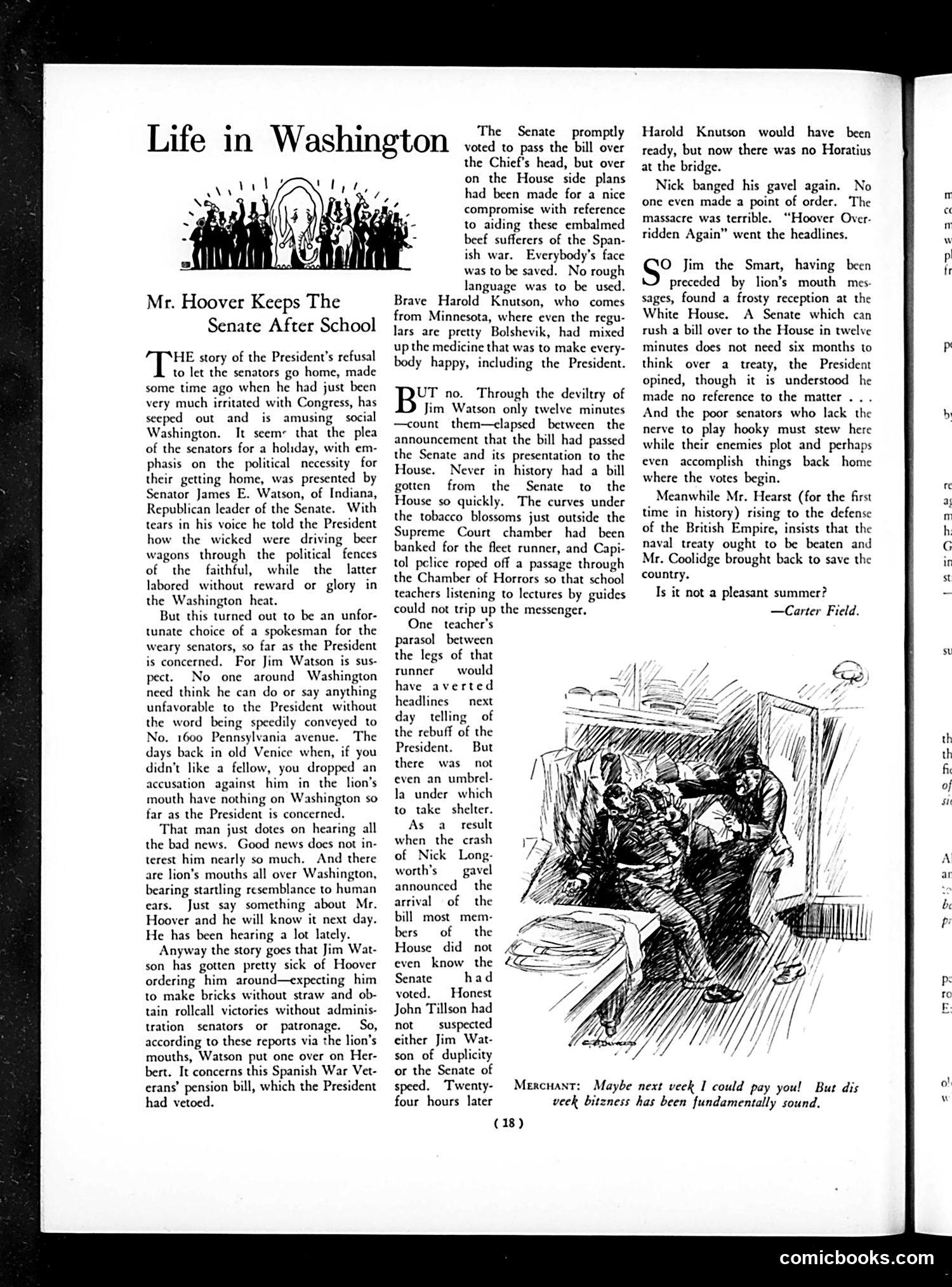
"Life in Washington" - Political Satire (circa 1920s) This page satirizes President Hoover's control of the Senate. The main article mocks how Hoover kept senators from leaving for recess, frustrating them and forcing political negotiations. The satire critiques senators' desperation to go home while the President manipulated them on legislation—particularly a Spanish War veterans' pension bill. The accompanying cartoon depicts a merchant confronting a customer about unpaid bills, captioned: "Maybe next week I could pay you! But did week business has been fundamentally sound." This mocks Hoover's famous assertion that American "fundamentals" remained sound despite economic problems—suggesting politicians made hollow promises while ordinary people suffered financially. The humor targets both executive overreach and gap between political rhetoric and economic reality.
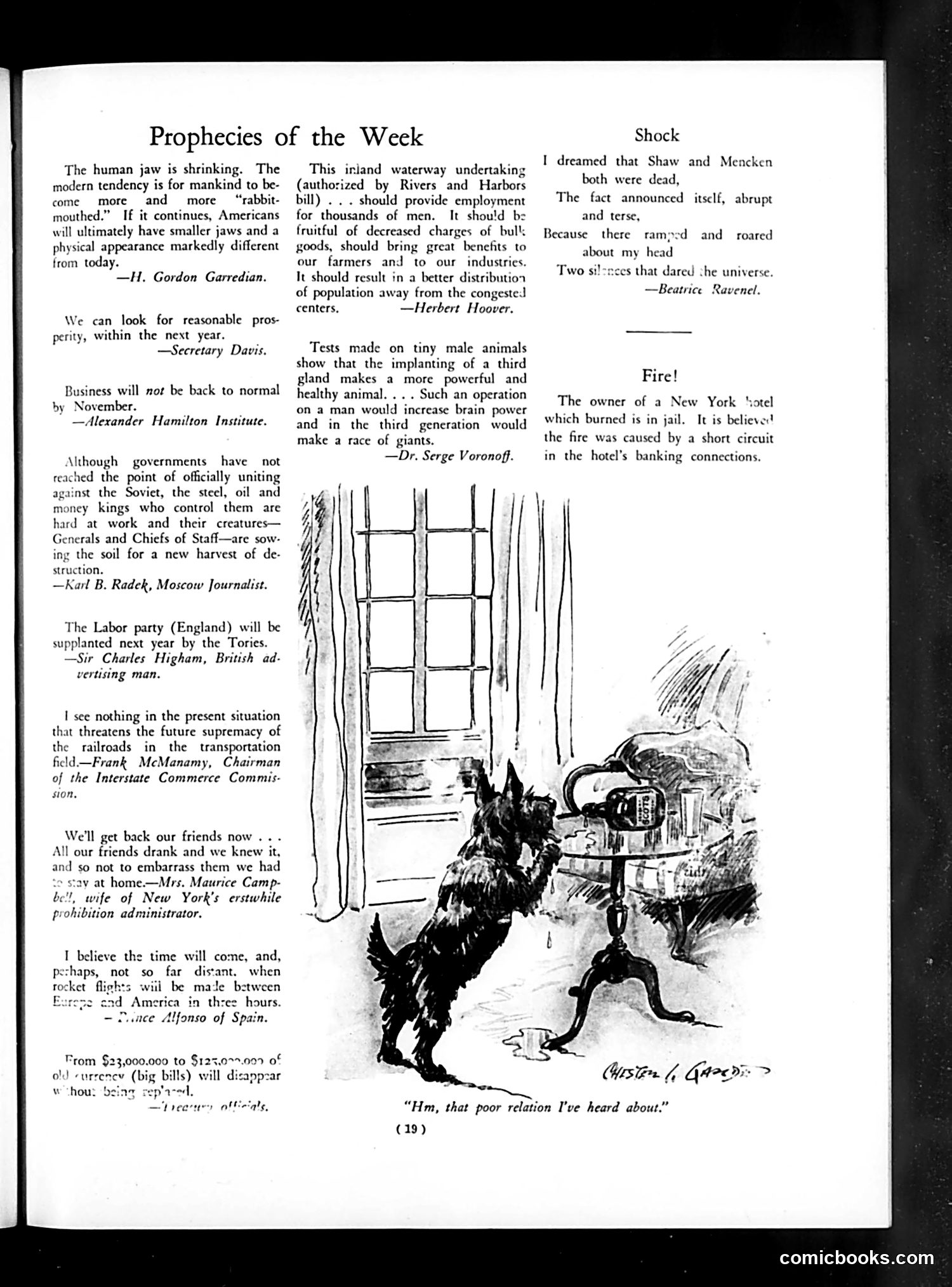
"Prophecies of the Week" - Life Magazine Satire This page collects contradictory expert predictions—a running satirical feature mocking public figures who make grand claims about economic recovery, politics, and science. The "Prophecies" section lampoons confident but often conflicting forecasts from prominent people (Secretary Davis predicts prosperity; the Hamilton Institute says otherwise). The cartoon illustrates the section's absurdist tone: a dog observes a wealthy man with expensive equipment entering a burning hotel window, captioned "Hm, that poor relation I've heard about." The joke satirizes the news story above it—a hotel owner imprisoned for arson—by depicting the criminal as a "poor relation" to legitimate society, underscoring Life's skepticism about the rich escaping consequences. Together, the page mocks both unreliable expert predictions and the hypocrisy of wealth protecting itself from justice. The satire targets overconfidence among politicians, businessmen, and scientists during economically uncertain times (likely early 1920s).
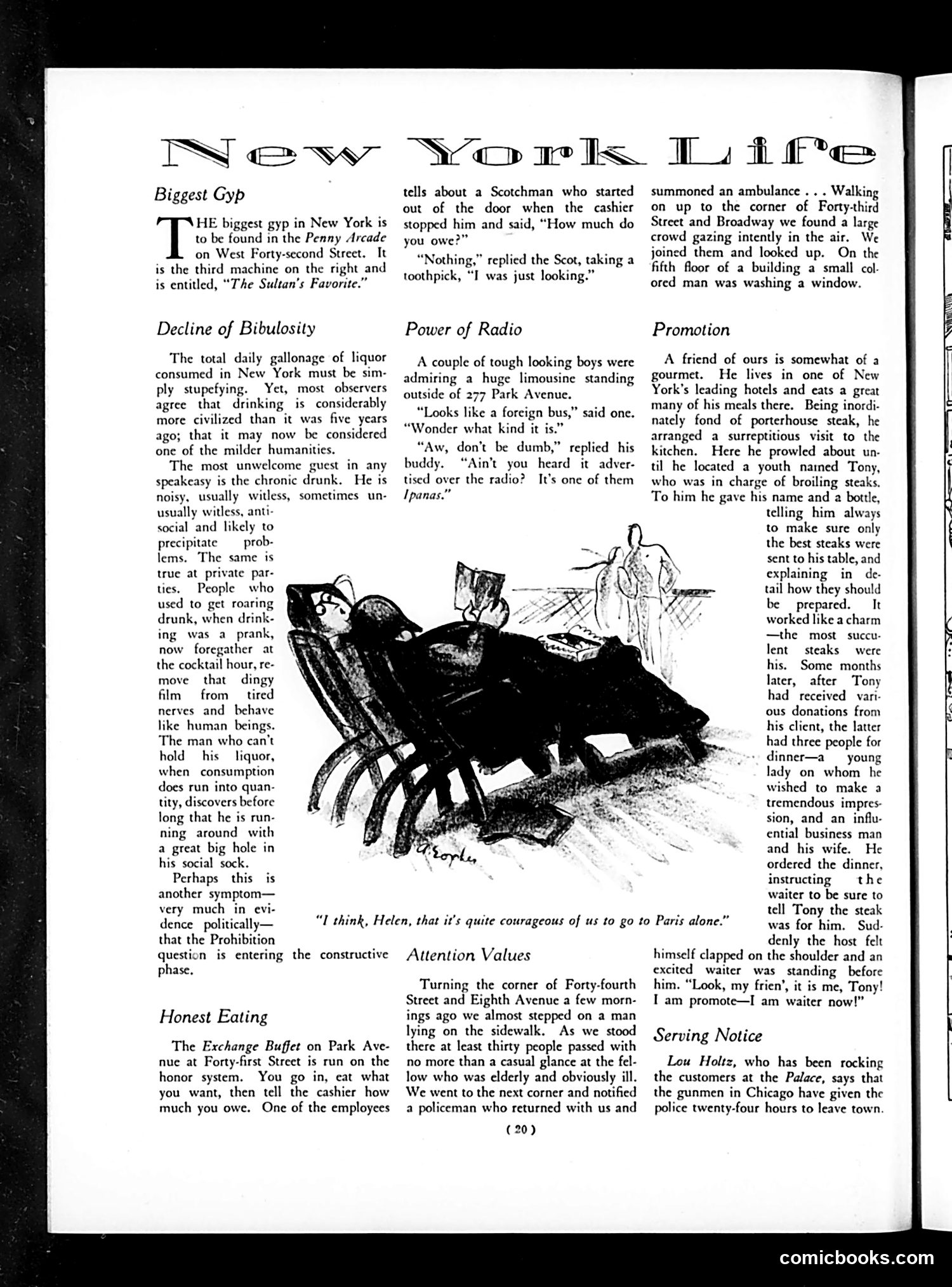
Explanation for Modern Readers This page contains several short satirical pieces about 1920s New York life, reflecting post-Prohibition attitudes. "Biggest Gyp" mocks a penny arcade machine—a reference to the "Penny Arcade" game venues common then—where a machine titled "The Sultan's Favorite" apparently cheats customers. "Decline of Bibulosity" comments on changing drinking culture after Prohibition, noting that chronic drunkenness is now socially unacceptable, whereas previously rowdy drinking was acceptable male behavior. This reflects a civilizing trend. "Power of Radio" shows radio advertising's new influence: boys identify a limousine as an "Ipana" (a toothpaste brand) simply because they heard it advertised on radio—suggesting radio ads are reshaping consumer behavior. "Attention Values" contrasts public indifference to a suffering elderly man with fascination for a window-washer—satirizing shallow spectacle-seeking over genuine human need. "Promotion" humorously describes bribing a kitchen worker for superior steaks, backfiring when the gourmet tries to impress guests.
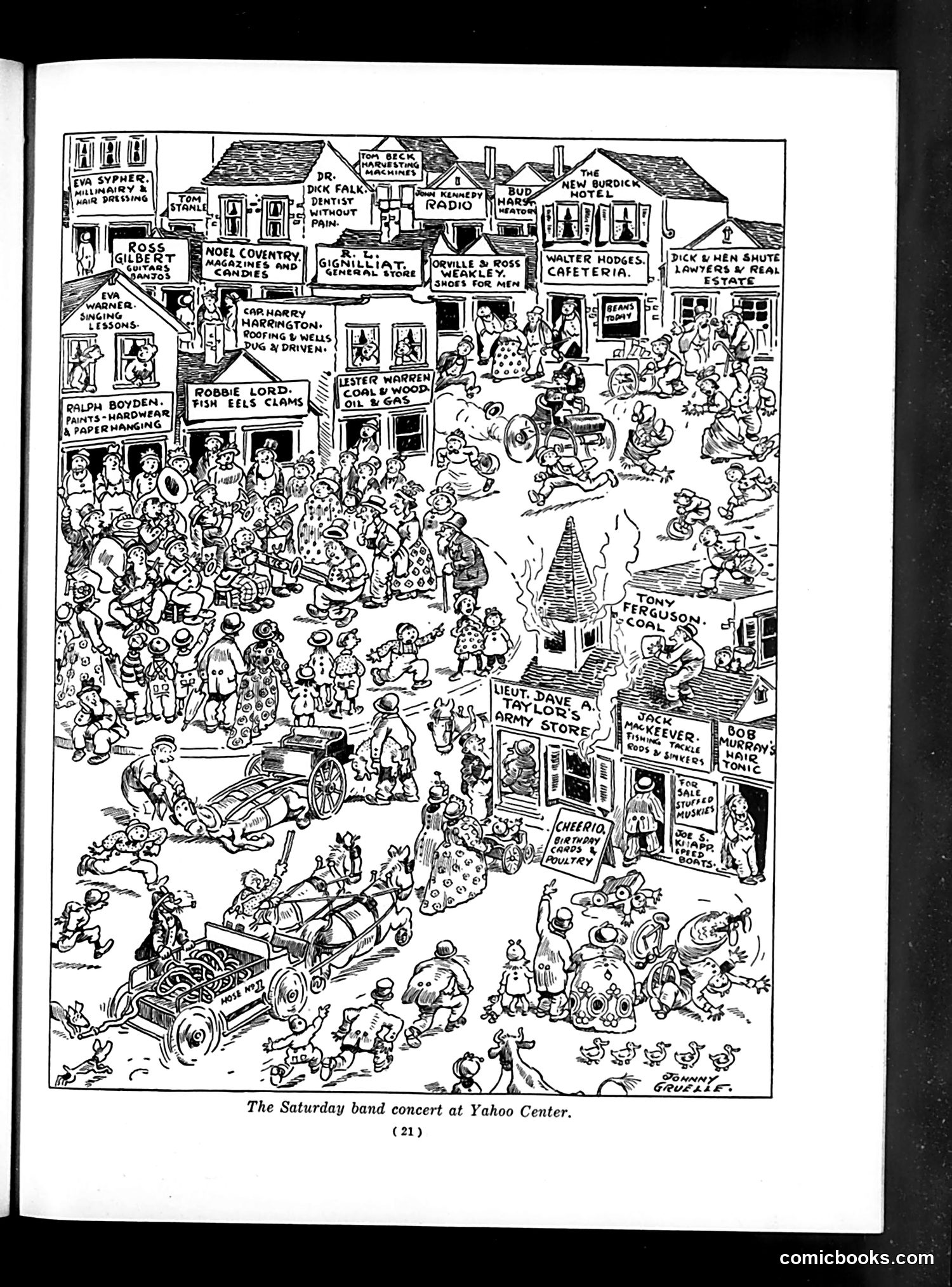
"The Saturday Band Concert at Yahoo Center" This is a densely-packed humorous illustration depicting a crowded small-town community gathering. The cartoon satirizes local American life by cramming together various stereotypical businesses and characters typical of early 20th-century towns: a dentist, radio shop, café, coal dealer, barber, and fish market—each labeled with proprietors' names. The scene shows townsfolk engaged in everyday activities around a central bandstand (indicated by the musical focus suggested by the title). The satire lies in the chaotic, exaggerated crowding and the mundane, provincial nature of the establishments—poking gentle fun at small-town commercialism and community life. The cartoonist (signed "Grunle") captures the bustling social ecosystem of "Yahoo Center" with affectionate mockery, suggesting both the vitality and the somewhat limited, repetitive nature of small-town commercial enterprise. The numerous hand-lettered business signs create a deliberately cluttered, over-commercialized impression.
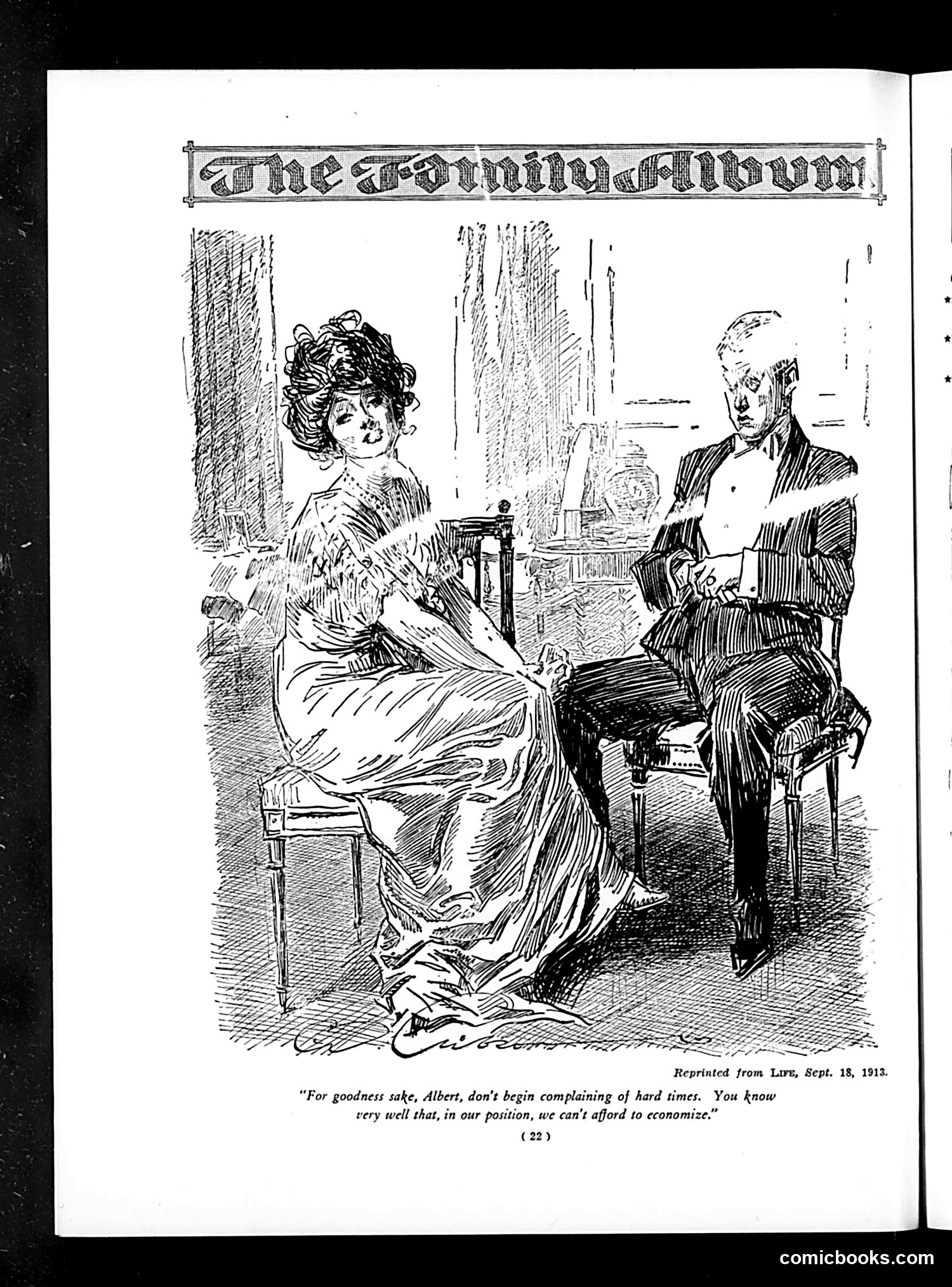
Political Cartoon Analysis This 1913 *Life* magazine cartoon satirizes wealth and hypocrisy during economic hardship. A well-dressed couple sits in an elegant interior—the woman in an elaborate gown, the man in formal attire. The woman tells "Albert" not to complain about hard times because "in our position, we can't afford to economize." The satire targets the upper class's refusal to acknowledge or adjust to economic difficulties affecting ordinary people. The couple's luxurious appearance and surroundings contradict any notion of genuine hardship. The joke pivots on the absurd logic that wealthy people must *maintain* expensive lifestyles—cannot *afford* to economize—precisely because of their social standing, making their complaints about hard times both ridiculous and self-serving.
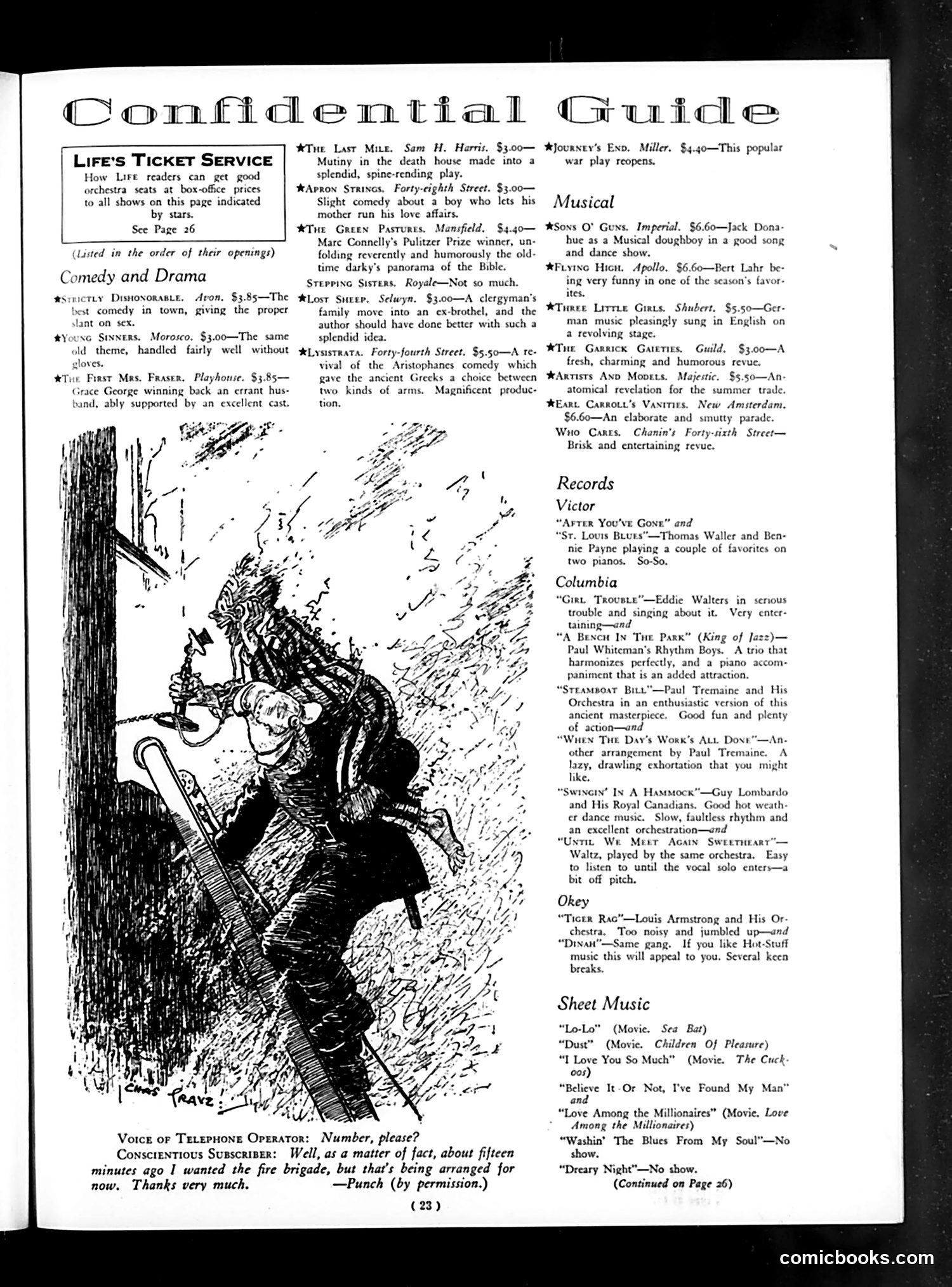
Confidential Guide Page Analysis This is primarily an entertainment listing and review page from Life magazine, not a political cartoon. The page features theater ticket information, musical reviews, and phonograph record recommendations. The only cartoon present is a small Punch cartoon at bottom left: a telephone operator receives a call from a subscriber who casually mentions he wanted the fire brigade "about fifteen minutes ago" but it's "being arranged for now." The joke satirizes British bureaucratic inefficiency and sang-froid — the absurd understatement of having just called for emergency services as though it were a minor inconvenience, treated with polite indifference. The rest of the page is straightforward entertainment coverage: reviews of Broadway shows (musicals, comedies, dramas), phonograph records on Victor and Columbia labels, and sheet music recommendations. The asterisks indicate shows where Life readers could purchase discounted tickets through the magazine's service.
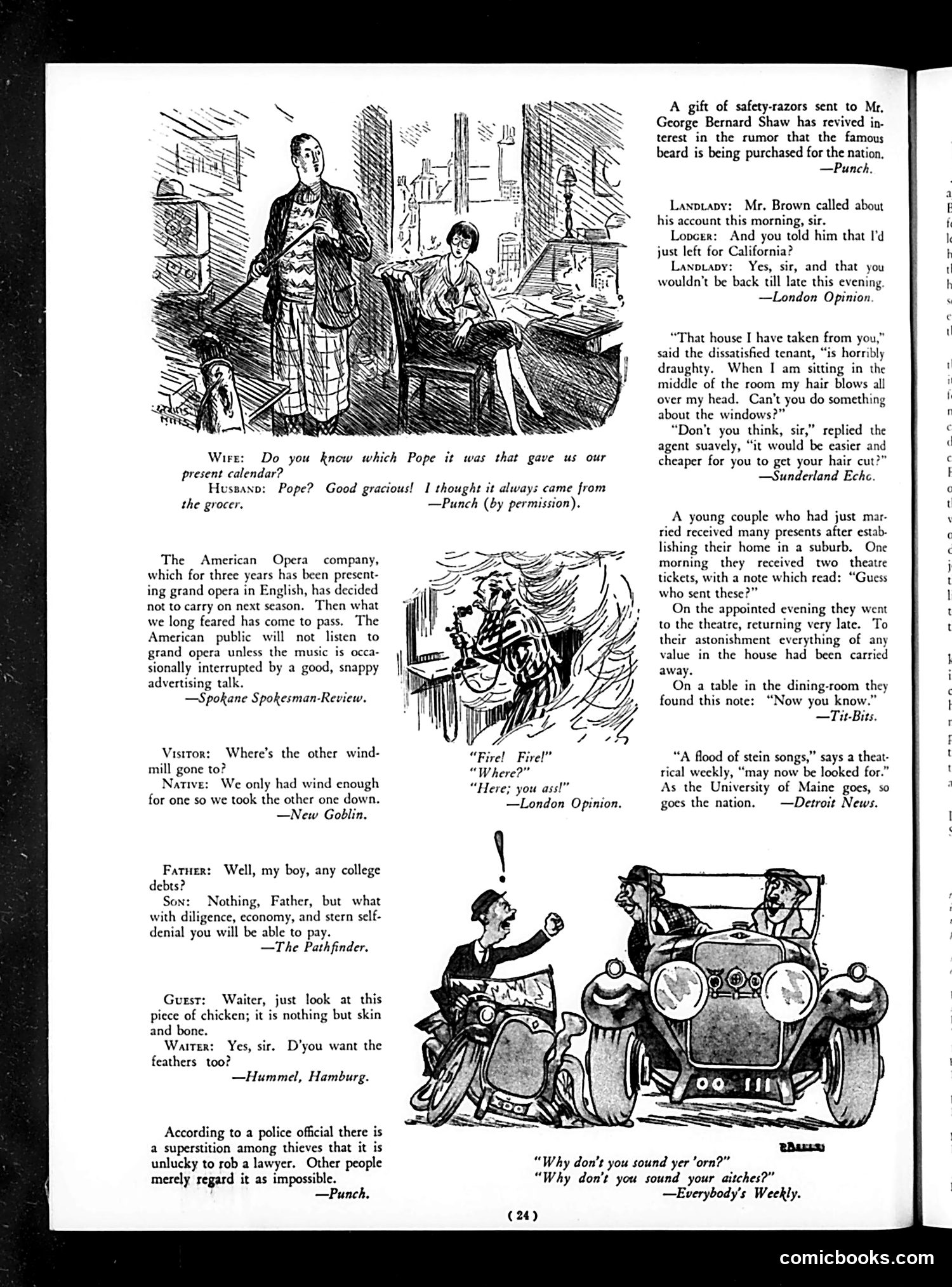
Explanation for Modern Readers This page collects brief satirical jokes and quips from various publications, typical of *Life* magazine's format. Key items: 1. Pope/Calendar joke: A husband thinks the calendar comes from the grocer, not knowing Pope Gregory XIII established it—poking fun at masculine ignorance of basic facts. 2. American Opera: Satirizes American audiences as unwilling to appreciate grand opera without commercial interruption, mocking both public taste and advertising intrusion. 3. George Bernard Shaw reference: Alludes to Shaw's famous beard; the joke suggests it's so notable someone might purchase it as a national artifact. 4. Tenant/Landlord dialogue: The landlord's suggestion to cut hair rather than fix drafty windows mocks callous property management. 5. Newlyweds' theft: Dark humor—guests send theater tickets, then steal the couple's valuables while they're out, leaving a note revealing the prank's cruel irony. 6. Car cartoon: Two motorists argue about sounding horns and "aitches" (the letter H)—British class humor about proper pronunciation. These represent early-20th-century transatlantic satire on manners, taste, and social pretension.
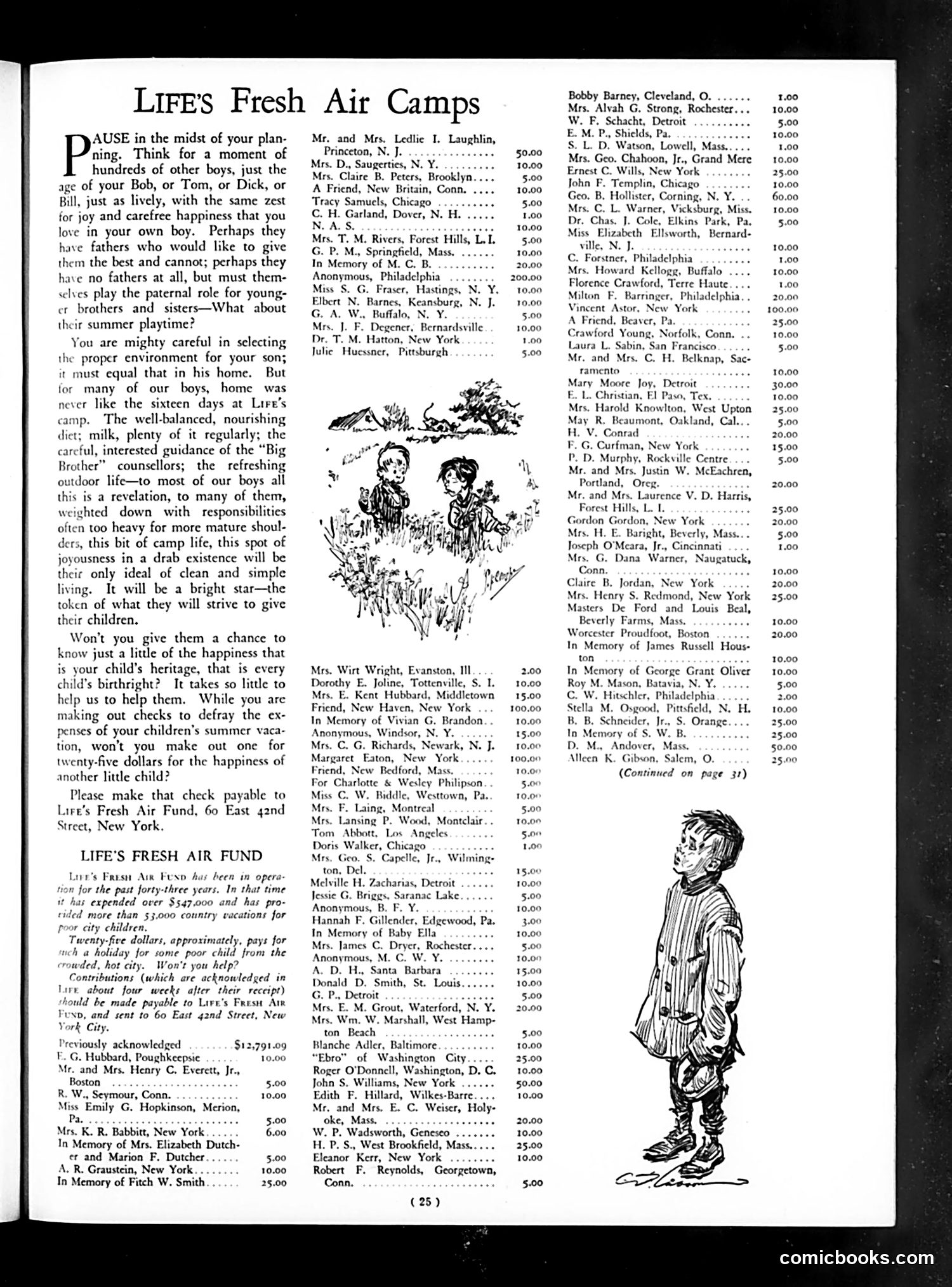
Fresh Air Camps Appeal (Life Magazine) This page is primarily a fundraising appeal for Life magazine's Fresh Air Fund, a charitable program that provided summer camp vacations for poor urban children. The accompanying illustrations show idealized children enjoying outdoor activities. The text contrasts wealthy families' ability to select proper environments for their children with poor city children who lack such opportunities. It appeals to middle-class readers' sense of social responsibility: just as you carefully plan your own child's summer, these underprivileged children deserve similar happiness and healthful experiences. The $25 donation amount was positioned as affordable for Life's readers while transformative for a poor child. The page lists donors and cumulative funds raised ($12,791.09 previously acknowledged), demonstrating the program's legitimacy and ongoing success over its 43-year history. This reflects early 20th-century Progressive Era philanthropy—addressing urban poverty through charitable interventions rather than systemic reform.
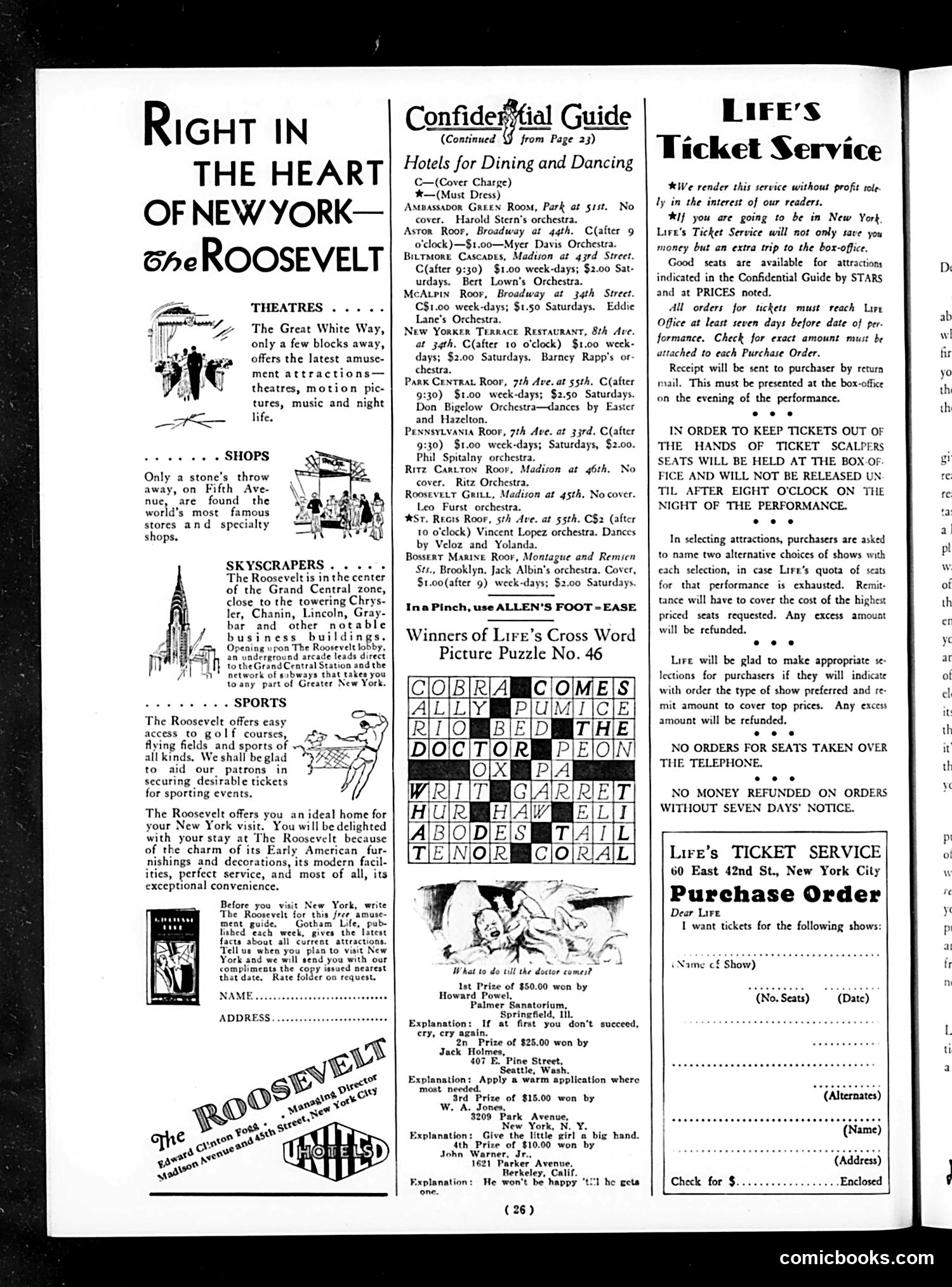
Analysis of Life Magazine Page Content This page is primarily advertising and service content rather than editorial satire. It features: Main Elements: - The Roosevelt Hotel advertisement (left side) emphasizing its Manhattan location near theaters, shops, and skyscrapers - A "Confidential Guide" listing NYC hotels with dining and dancing venues, including cover charges and orchestras - Life's Ticket Service section (right) offering theater ticket purchases by mail The only cartoon element is a small illustration captioned "What to do till the doctor comes?" accompanying a crossword puzzle answer contest. The cartoon shows a child, and the winning explanations are lighthearted ("If at first you don't succeed, try, try again"). Historical Context: This appears to be from the 1920s-1930s based on the hotel names, orchestra leaders mentioned (Vincent Lopez, Myer Davis), and the Depression-era emphasis on Life's non-profit ticket service. Rather than political satire, this page reflects the magazine's role as a lifestyle and entertainment guide for affluent New York visitors.
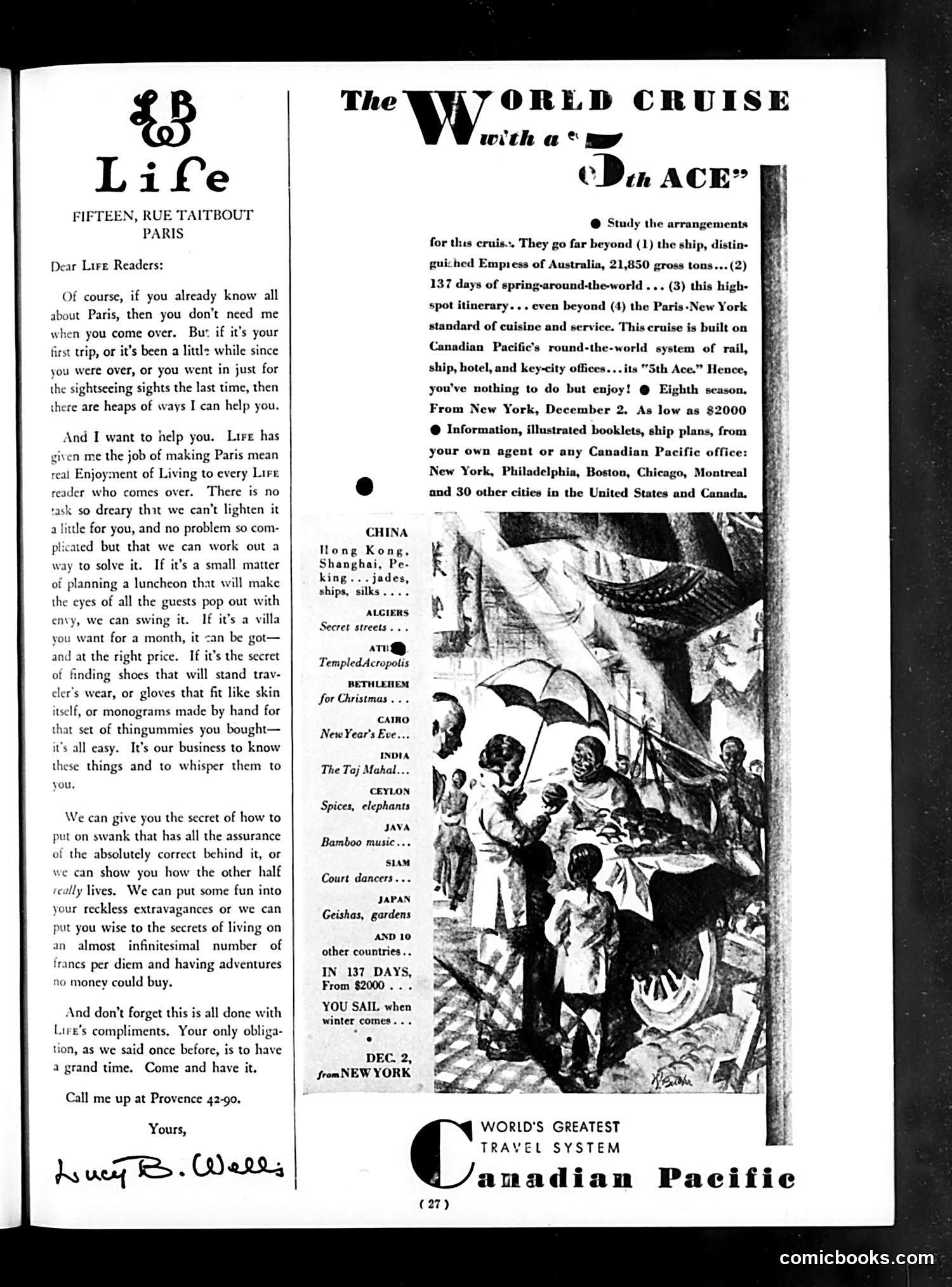
Page Content Analysis This is primarily an advertisement and editorial page, not a political cartoon. The left side features a letter from Lucy B. Wells, Life magazine's Paris correspondent, offering travel advice and local knowledge to American readers visiting France—helping them find restaurants, villas, shoes, and authentic experiences. The right side is a Canadian Pacific cruise advertisement promoting a 137-day world voyage departing December 2 from New York. The illustrated advertisement shows an exotic montage of destinations (China, Egypt, India, Japan, etc.) with romanticized imagery of local culture and landmarks. The cruise costs from $2,000 and promises comprehensive travel arrangements via the Canadian Pacific's "5th Ace" system. This reflects 1920s-30s travel culture: leisure cruises were luxury experiences marketed to affluent Americans, emphasizing exotic destinations, cultural tourism, and the romance of global travel. The page assumes readers have disposable income and leisure time—typical Life magazine audience positioning.
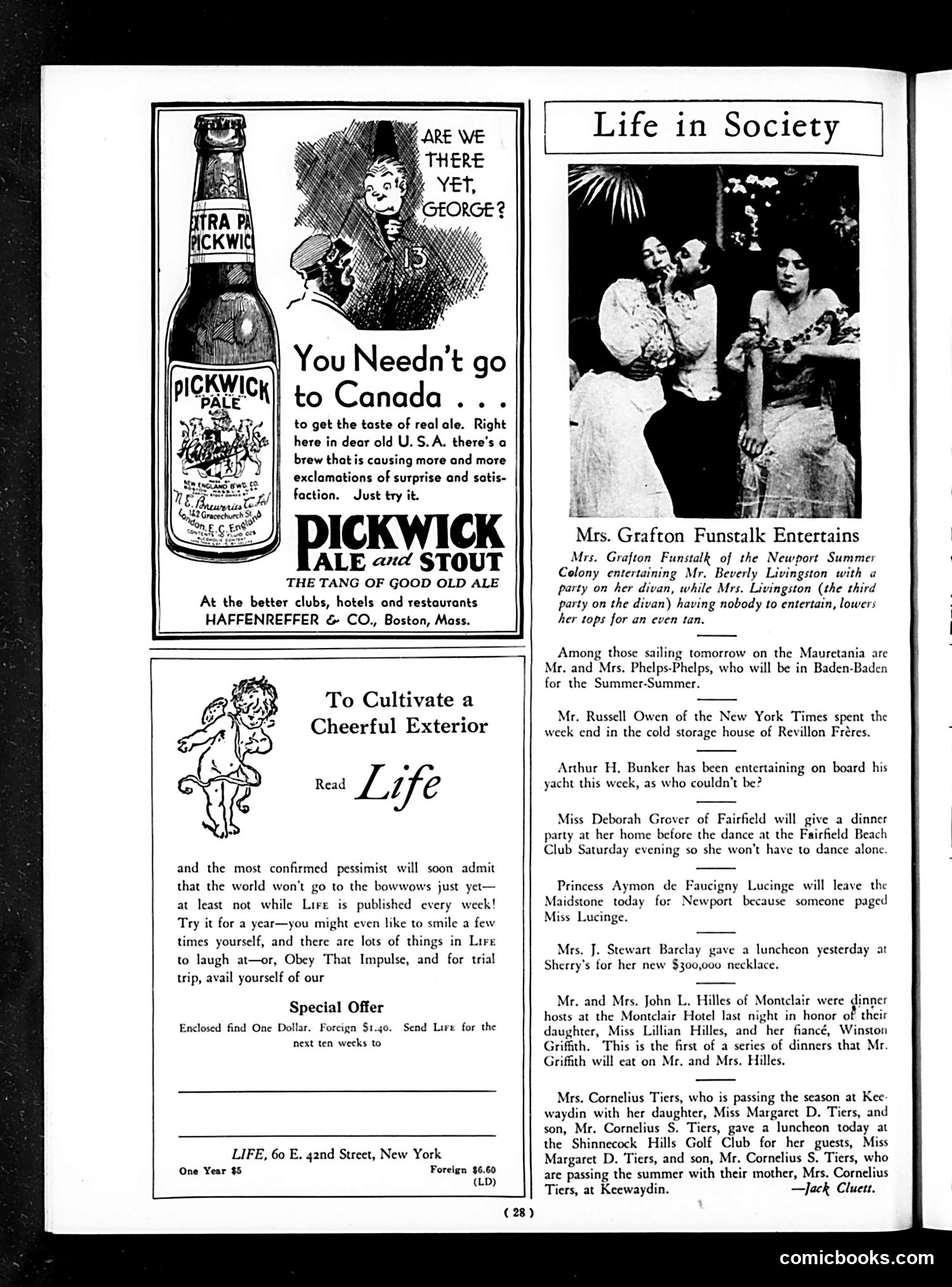
Analysis of Life Magazine Page This page blends advertising with satirical society gossip. The Pickwick Ale advertisement uses a comedic setup: a woman asks an impatient man "Are we there yet, George?" while promoting American beer as superior to Canadian imports—a joke playing on Prohibition-era tensions and smuggling. The "Life in Society" section mocks wealthy Newport elite through mock-serious gossip items. The satire targets their frivolous pursuits: Mrs. Funstalk's divan party, someone traveling specifically because "someone paged" them, Mrs. Barclay's extravagant $300,000 necklace purchase, and repeated dinner parties. The repeated names and circular details ("Tiers...Tiers") parody society column clichés. The "Cultivate a Cheerful Exterior" section advertises Life magazine itself as an antidote to pessimism, using self-deprecating humor about its own satirical content. Overall, the page satirizes wealthy leisure-class obsessions with trivial social events and conspicuous consumption during the Jazz Age.
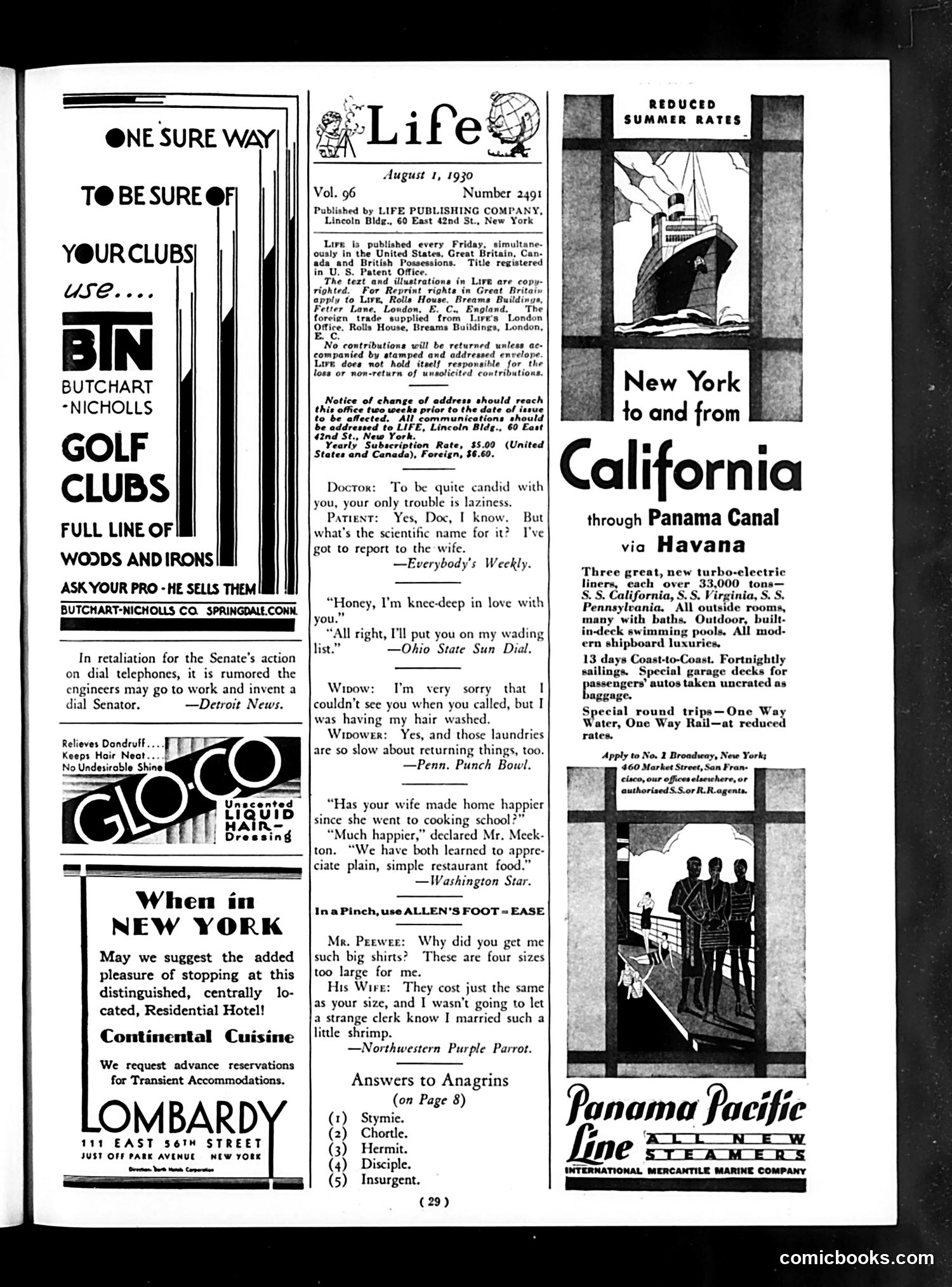
Life Magazine, August 1, 1930 – Page Analysis This page is primarily advertising and humor fillers, not political cartoons. The content reflects 1930s concerns: Notable Elements: The "Dial Senator" joke (Detroit News): References Senate action on dial telephones—likely regulatory debate over new telephone technology. The humor imagines engineers retaliating by inventing a "dial Senator," suggesting senators are mechanical/automated and thus mockable. Domestic humor: Multiple jokes about wives, laziness, and marriage reflect period gender dynamics and domestic themes common in 1930s publications. Shipping advertisement: The Panama Pacific Line prominently advertises luxury liners (California, Virginia, Pennsylvania) offering reduced summer rates to California via Panama Canal and Havana—reflecting the era's fascination with modern ocean travel and leisure. Golf clubs, hair products, hotels: Standard period advertising targeting affluent readers. The page lacks sharp political satire; instead, it captures everyday 1930s preoccupations: new technology, domestic life, and commercial luxury.
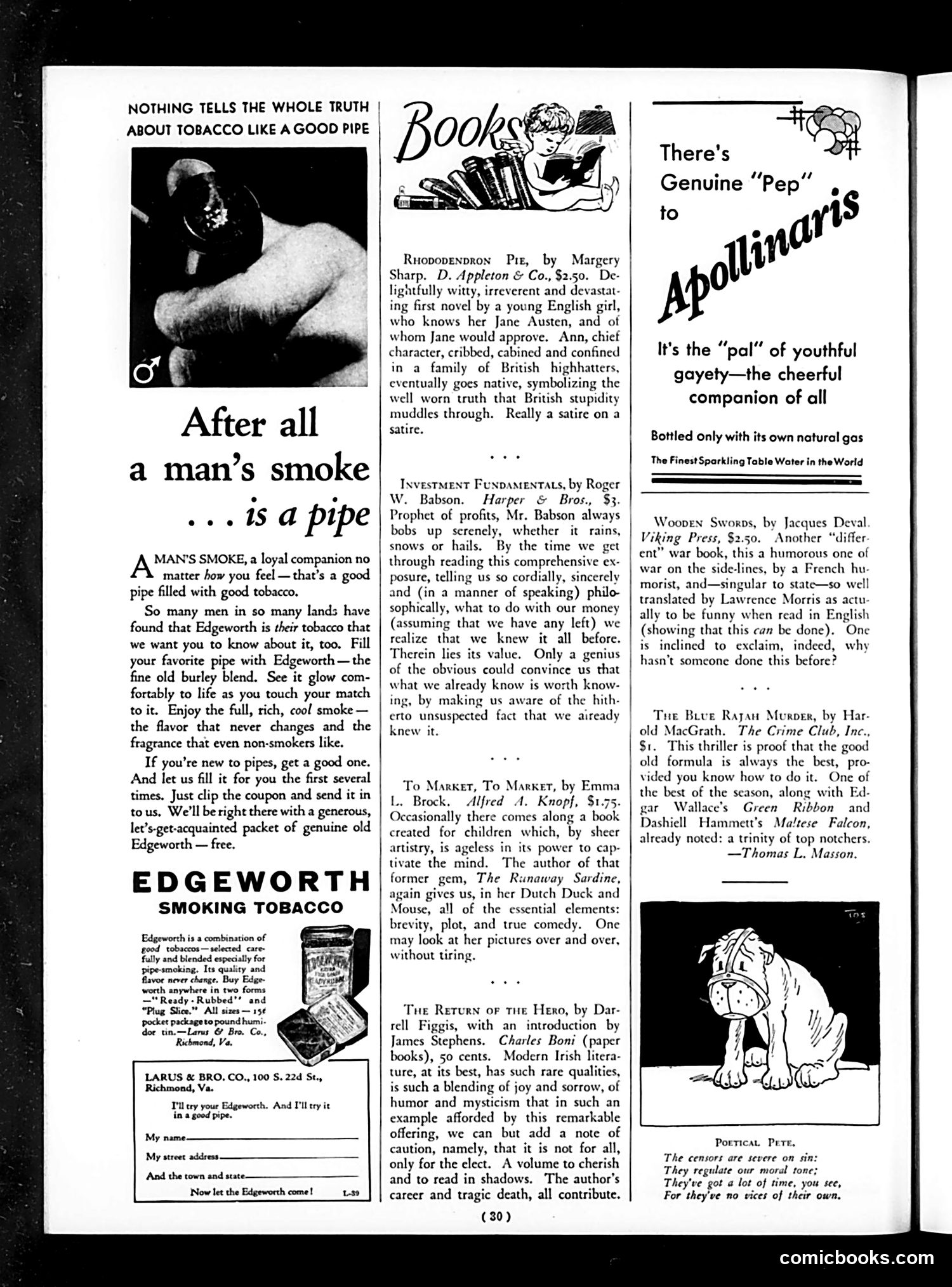
Explanation for Modern Readers This page combines a tobacco advertisement with book reviews. The main content is an Edgeworth Smoking Tobacco ad using a photograph of a man smoking a pipe, with the slogan "After all a man's smoke is a pipe." The ad appeals to masculine identity and leisure, positioning pipe-smoking as a loyal companion to men. The book reviews discuss contemporary 1920s-30s literature, including a satirical novel by Margery Sharp about a British woman who "goes native" (escapes her rigid upper-class family), and a children's picture book. One review mockingly praises an investment guide by Roger Babson for stating obvious financial advice as if it were novel wisdom. There's also an Apollinaris sparkling water advertisement and a cartoon labeled "Political Pete" showing a sad dog. The page reflects early 20th-century advertising that equated smoking with sophistication and manhood—claims that would later be heavily challenged by health research.
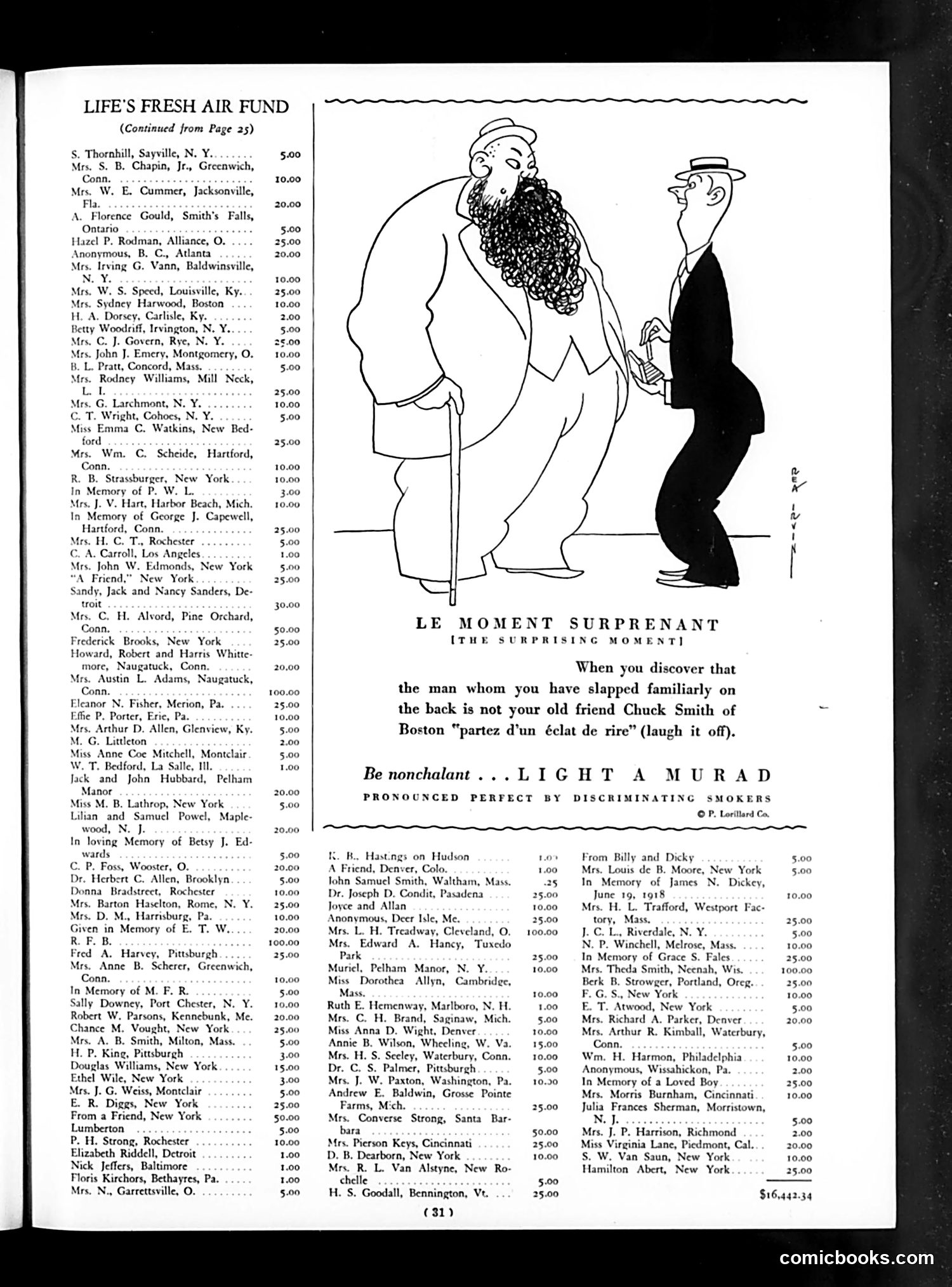
Cartoon Analysis: "Le Moment Surprenant" This cartoon illustrates an awkward social situation common to the era. A portly, bearded man with a distinctive appearance has just been slapped on the back by a well-dressed gentleman who believed him to be an old friend named "Chuck Smith of Boston." The joke centers on mistaken identity—the man being slapped is NOT Chuck Smith. The French caption "Le Moment Surprenant" (The Surprising Moment) and subtitle "The Surprising Moment" emphasize the embarrassing discovery when one realizes the error. The accompanying text advises the embarrassed slapper to "be nonchalant" and laugh it off ("partez d'un éclat de rire")—common early 20th-century etiquette for managing social blunders gracefully. The cartoon satirizes the awkwardness of high-society social encounters where mistaken identity could occur, and pokes fun at how one should maintain composure when caught in such an embarrassing mistake.
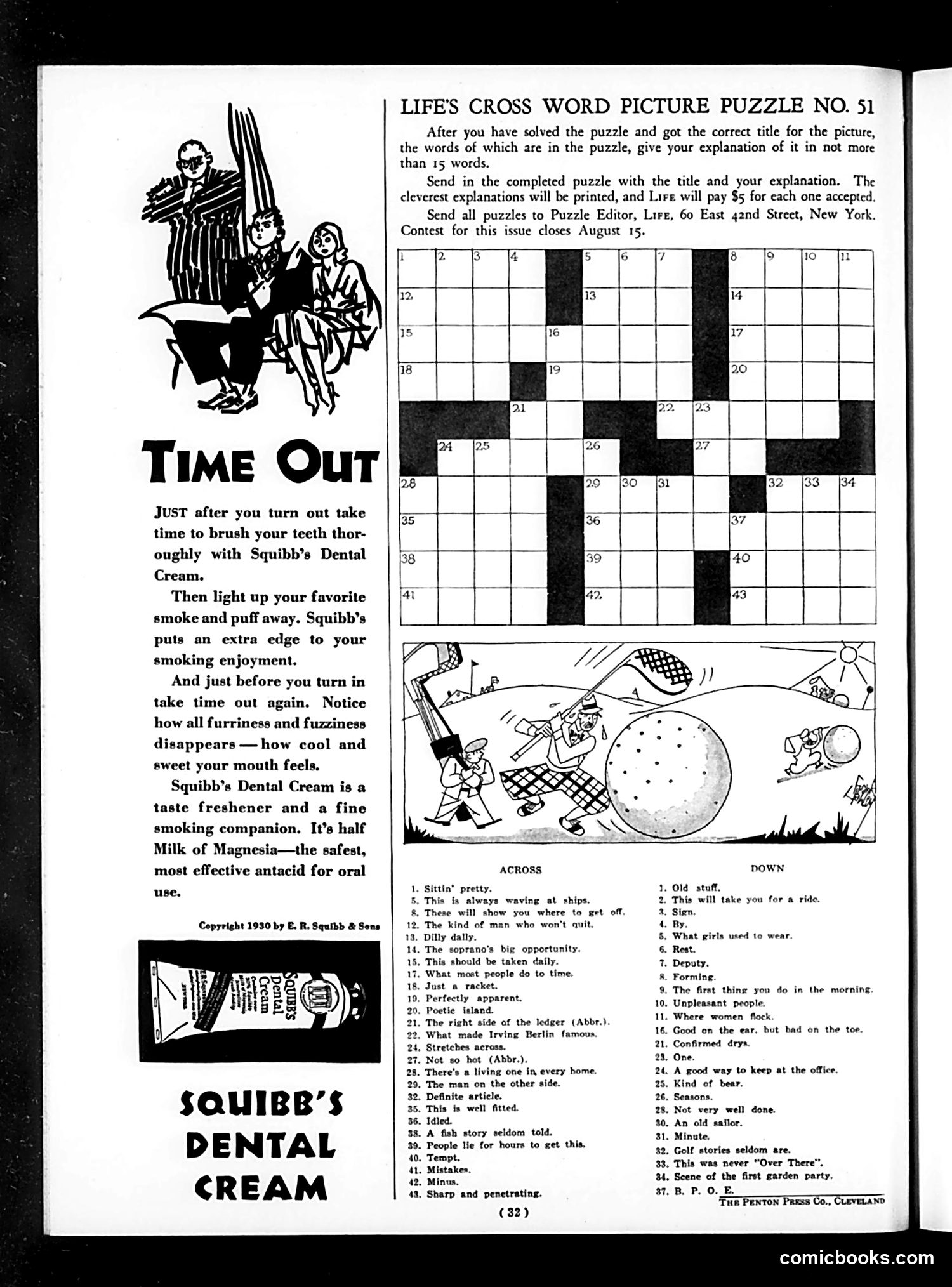
"Time Out" - Life Magazine Puzzle Page, 1930 This page combines a crossword puzzle contest with advertising. The illustration shows three figures in 1930s attire in a leisure scene, accompanying the title "Time Out"—likely depicting people taking breaks from work for relaxation and socializing. The puzzle itself is a word-picture game where solvers must identify the illustration's title by completing the crossword using provided clues, then submit explanations for prizes ($5 per accepted entry). The clues use wordplay and period references (e.g., "Irving Berlin famous," "Over There"). Below is an advertisement for Squibb's Dental Cream, which humorously markets the product as enhancing smoking enjoyment—a practice openly promoted before tobacco's health dangers were widely acknowledged. The ad highlights the product's antacid properties (containing Milk of Magnesia), reflecting 1930s marketing practices.
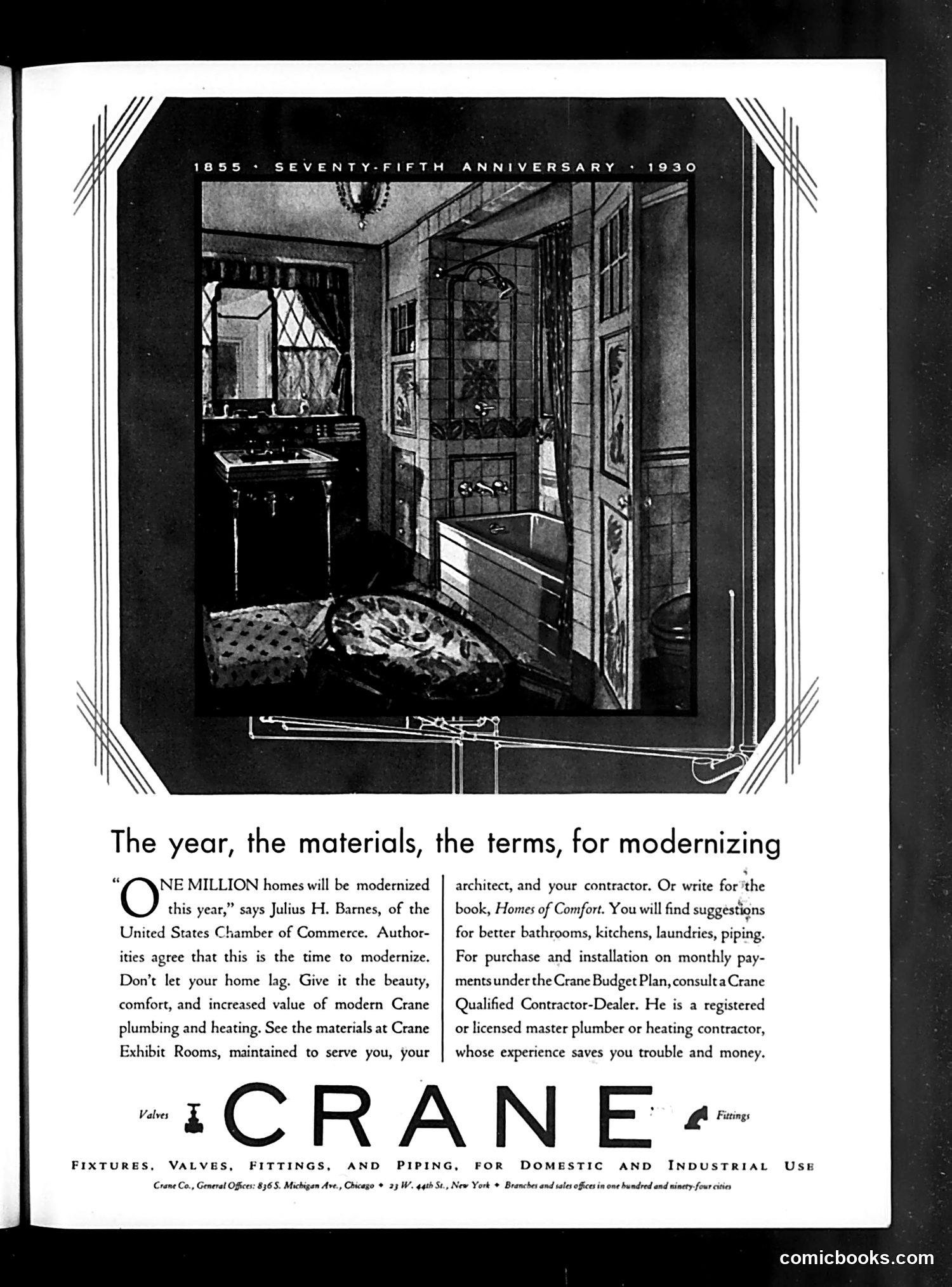
Analysis This is not a cartoon or satire—it's a straightforward advertisement for Crane plumbing fixtures, positioned as a 75th-anniversary (1855-1930) promotional page. The image shows a modernized 1930s bathroom, presented as aspirational. The advertisement quotes Julius H. Barnes of the U.S. Chamber of Commerce claiming "one million homes will be modernized this year," using this economic optimism to encourage home improvement spending. The pitch targets middle-class homeowners with practical appeals: modern bathrooms increase home value and comfort. Crane offers financing through their "Budget Plan" and emphasizes using licensed contractors to ensure quality work. Context for modern readers: This reflects pre-Depression optimism about consumer spending and home modernization as economic stimulus. The monthly payment plan was relatively novel marketing for major home improvements in 1930.
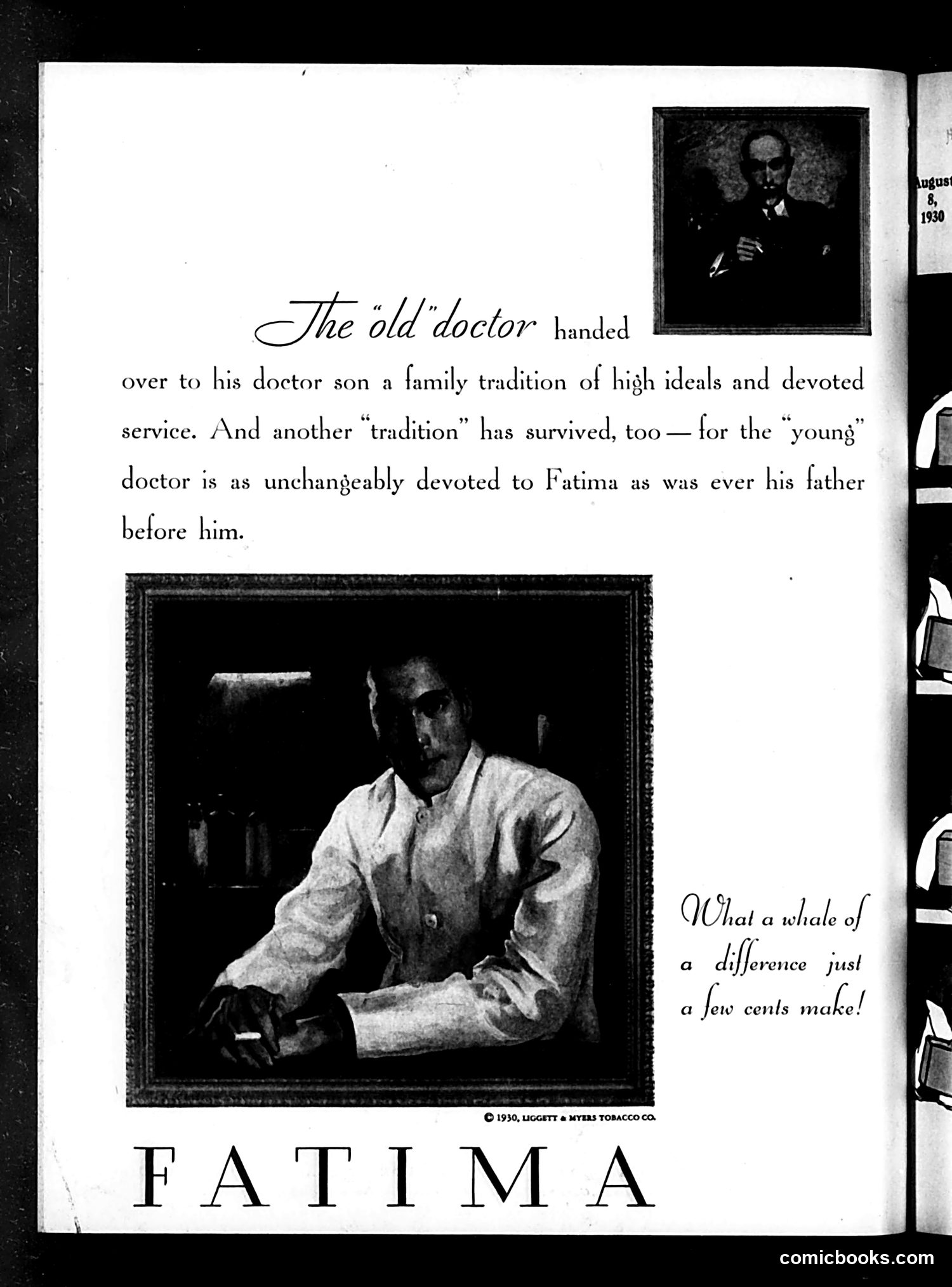
Fatima Cigarette Advertisement (1930) This is a cigarette advertisement, not political satire. The page depicts a generational narrative: an older doctor (top portrait) passes down professional values to his son (lower photograph, shown in a white medical coat). The advertisement's humor plays on family tradition and loyalty: just as the father was devoted to his medical calling, the son remains equally "devoted to Fatima"—the cigarette brand. The tagline "What a whale of a difference just a few cents make!" emphasizes cigarettes' affordability and value. This represents early 20th-century tobacco marketing, which normalized smoking and associated cigarettes with respectable professions like medicine. The generational messaging and aspirational framing were common advertising tactics before smoking's health risks became widely acknowledged.