life
Life — August 8, 1930
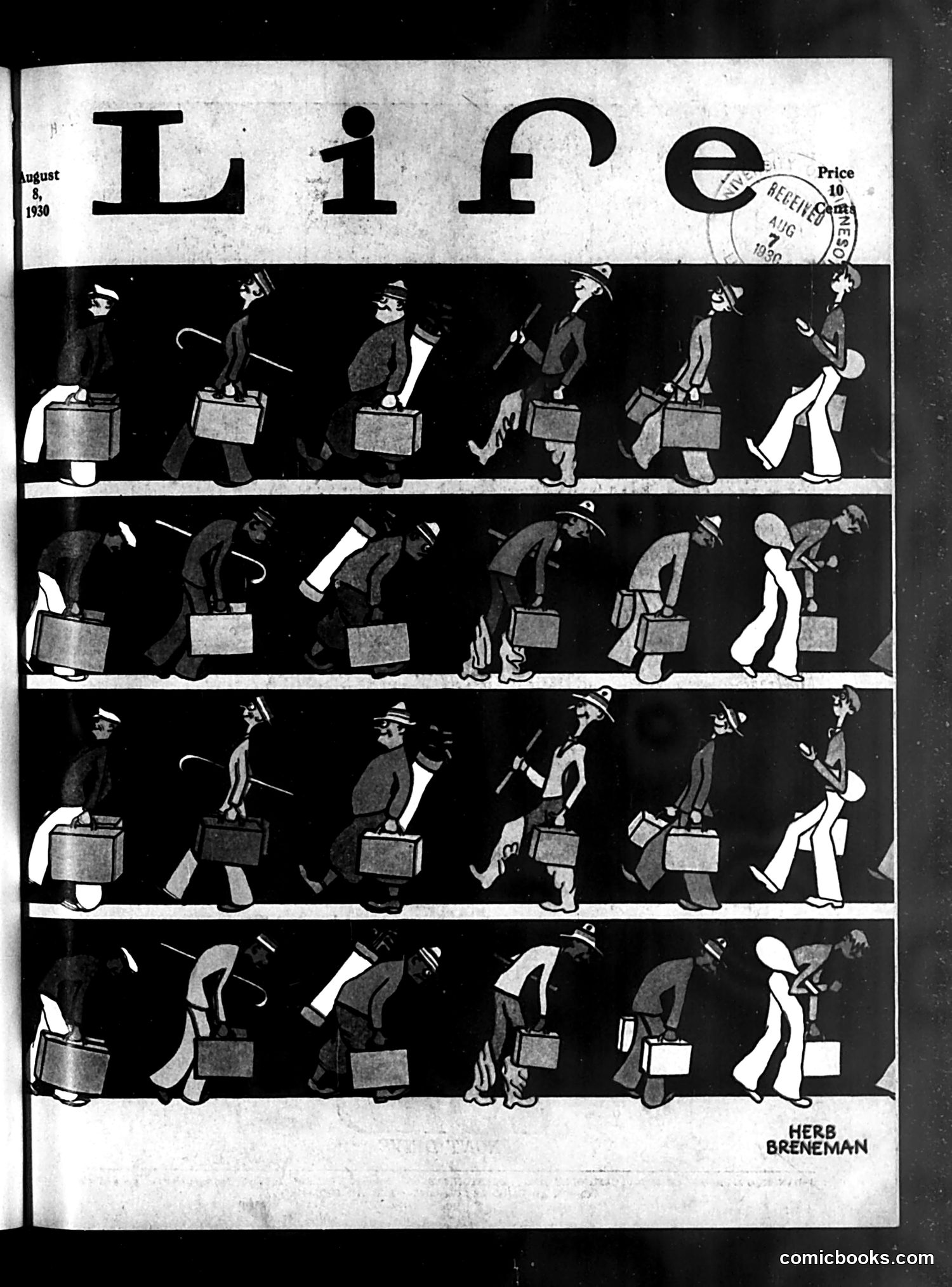
Life Magazine Cover, August 5, 1930 This is a cover illustration by Herb Breneman depicting a satirical sequence of businessmen or workers carrying briefcases, shown across four horizontal strips with slight variations in their poses and clothing. The figures appear progressively more disheveled or distressed as they move downward, suggesting a deteriorating situation. Given the August 1930 date, this almost certainly references the Great Depression, which began with the stock market crash of October 1929. The briefcase-carrying figures likely represent businessmen or office workers experiencing financial collapse—their varying poses may illustrate the mounting despair and disarray affecting the American workforce during this economic crisis. The repetitive, comic-strip style emphasizes the widespread, systematic nature of the disaster.
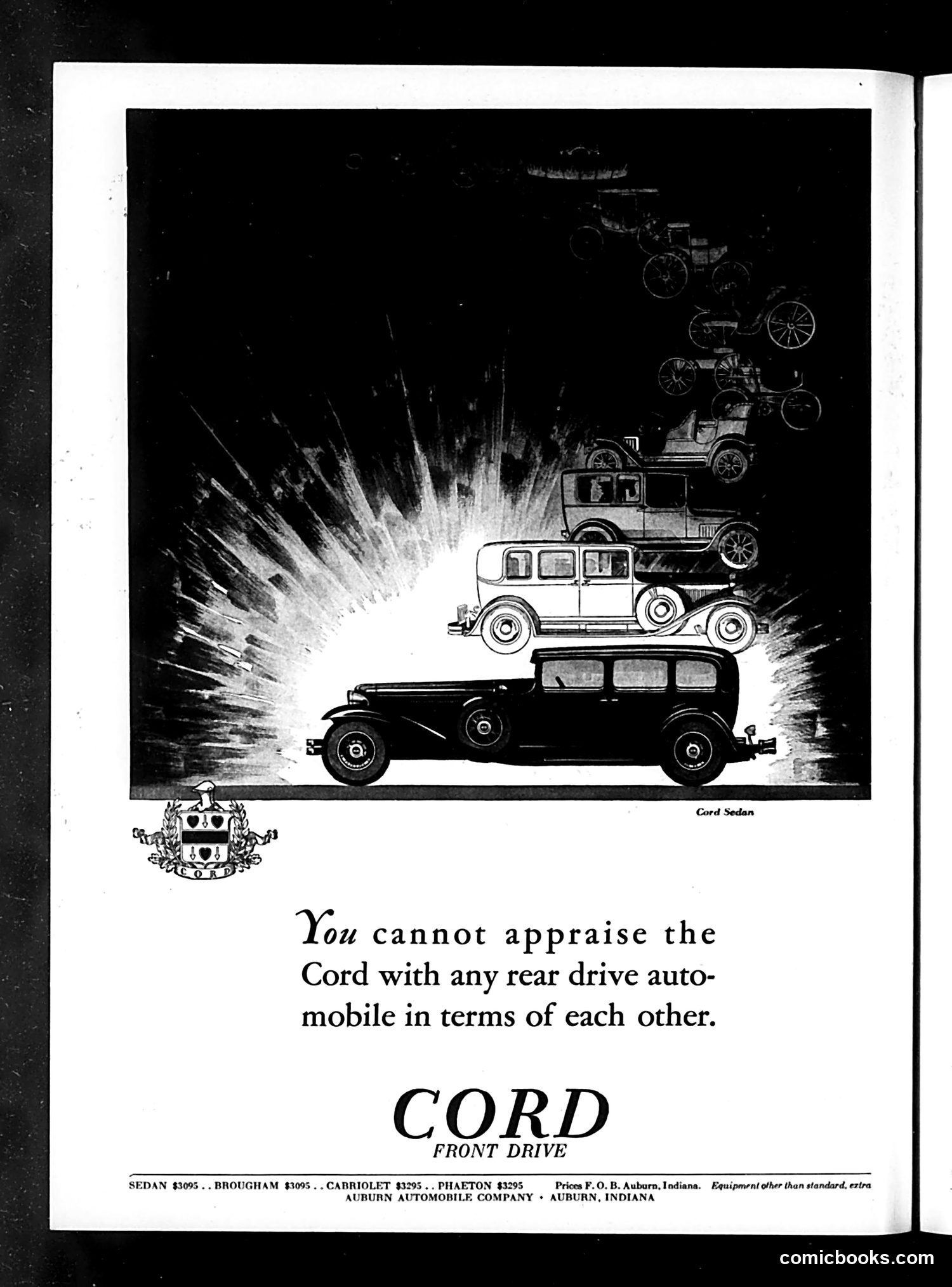
Cord Automobile Advertisement This is a car advertisement, not political satire. It promotes the Cord automobile, highlighting its front-wheel-drive technology as a competitive advantage. The illustration shows a Cord sedan at the bottom, with various other vehicles (motorcycles, bicycles, and rear-drive automobiles) stacked above it in a radiating burst pattern. The tagline states: "You cannot appraise the Cord with any rear drive automobile in terms of each other." The message is that the Cord's front-wheel-drive system made it fundamentally superior and incomparable to conventional rear-drive vehicles. Prices and manufacturing details for Auburn Automobile Company are listed below. This represents early automotive marketing emphasizing technological innovation as a selling point.
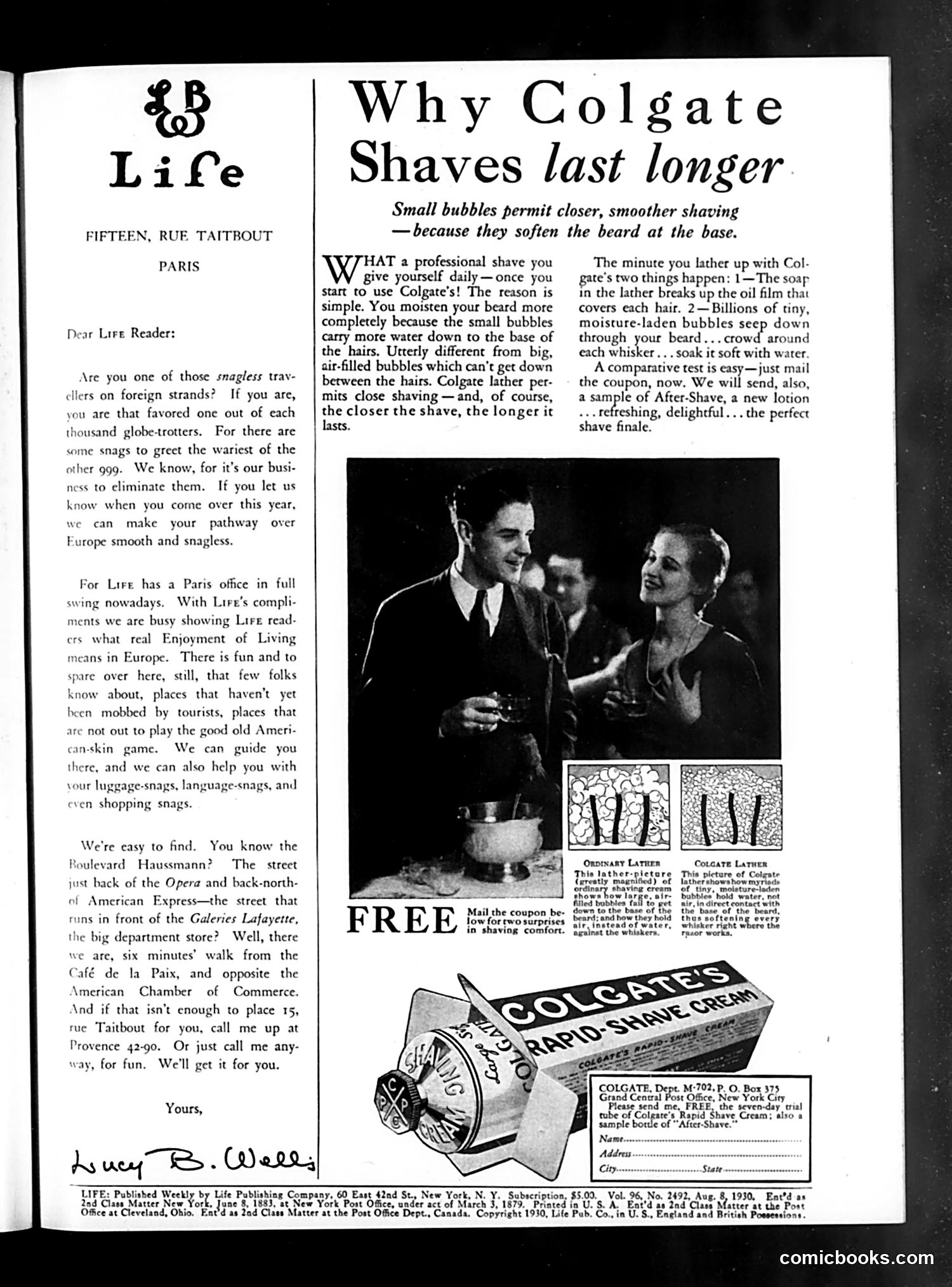
This page is primarily advertising for Colgate shaving products, not political satire. The left column contains a letter from "Lucy B. Walli" (likely a pseudonym) at Life's Paris office, offering travel tips to readers visiting Europe and mentioning Life's Paris office services. The right side features a Colgate advertisement explaining why their lather produces a closer shave. Two comparative microscope images show the difference between ordinary lather and Colgate's lather—the latter having smaller bubbles that penetrate beard hair more effectively. The advertisement includes a coupon offering a free sample of "After-Shave" lotion. This is vintage advertising copy emphasizing product superiority through pseudo-scientific claims about bubble size and beard softening.
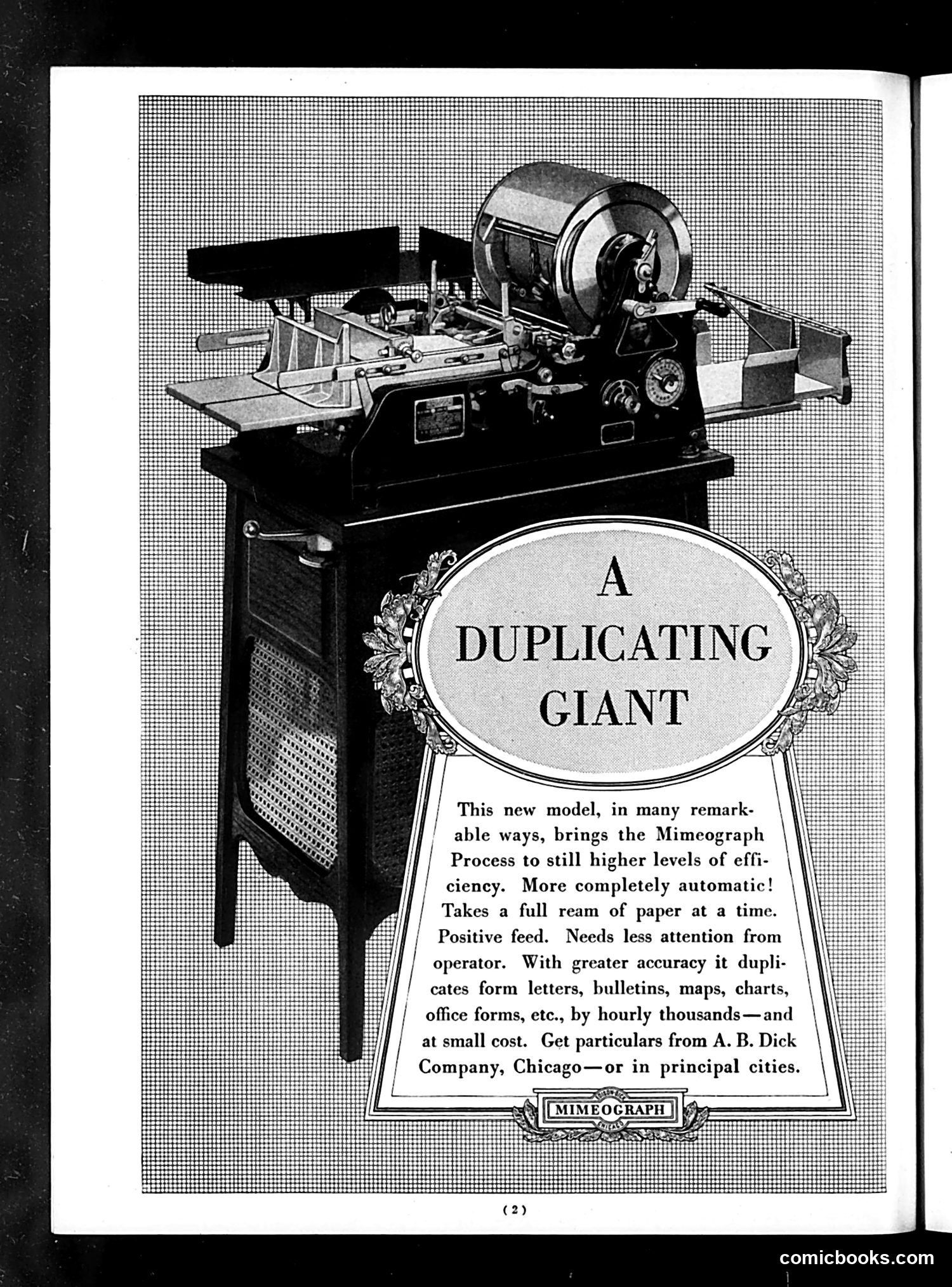
This page is primarily an advertisement, not editorial content or satire. It promotes "A Duplicating Giant"—a Mimeograph machine manufactured by A.B. Dick Company of Chicago. The ad uses marketing language typical of early-20th-century industrial advertising, emphasizing the machine's improvements: greater automation, efficiency, positive feed mechanism, and ability to duplicate documents "by hourly thousands—and at small cost." The visual shows the machine mounted on a stand with its characteristic large cylindrical drum. The decorative oval frame and ornamental typography are period-appropriate design elements meant to convey respectability and technological advancement. There is no political satire here—this is straightforward commercial advertising for office equipment.
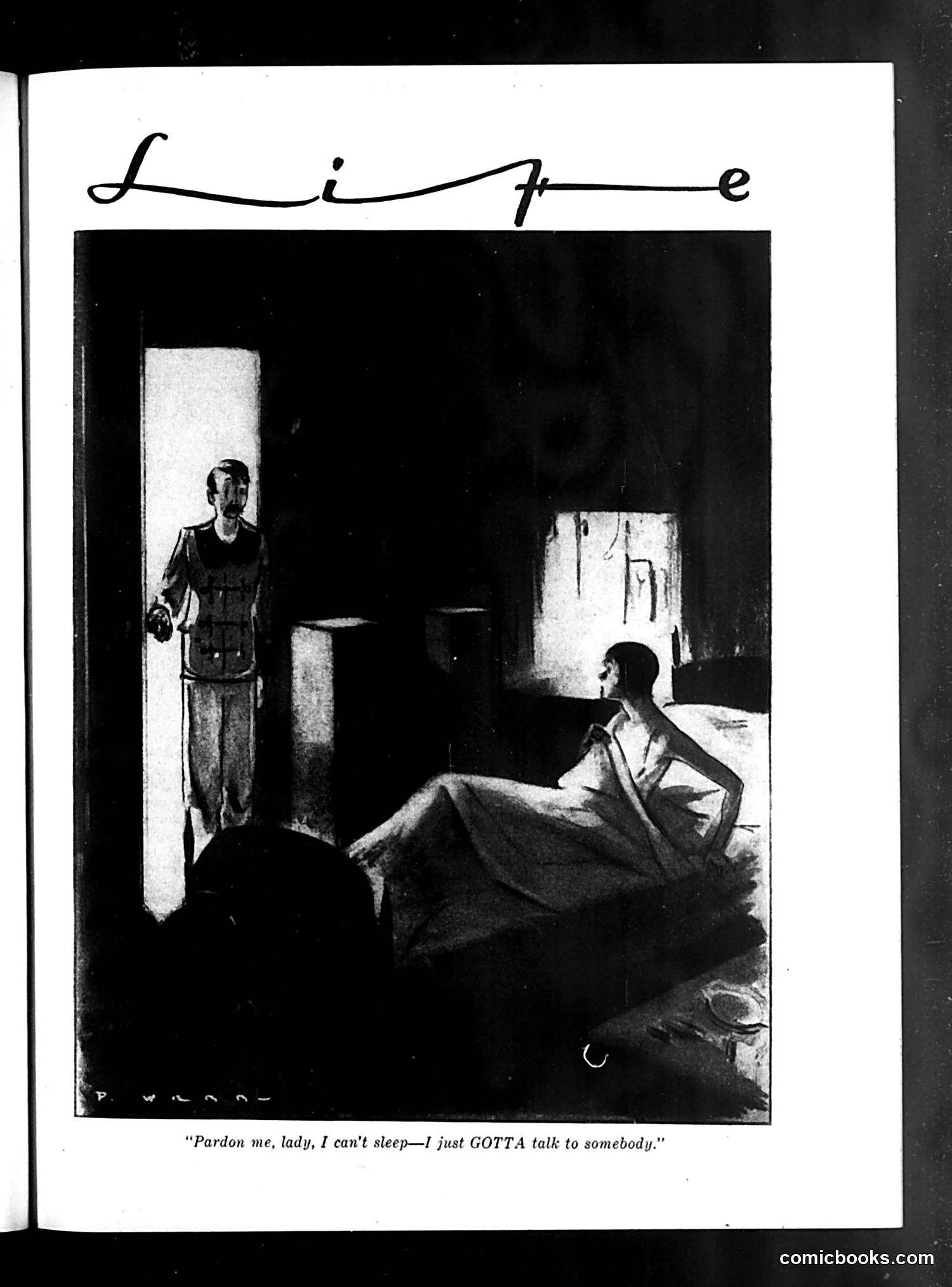
Analysis This is a single-panel cartoon from *Life* magazine showing a domestic scene: a man stands in a doorway while a woman sits on a bed. The caption reads: "Pardon me, lady, I can't sleep—I just GOTTA talk to somebody." The humor relies on a social commentary about insomnia and emotional needs. The man's intrusion on the woman (presumably his wife or partner) at night, claiming he "just GOTTA talk," satirizes how some people prioritize their own restlessness over their partner's sleep. The cartoon gently mocks masculine behavior—the man's inability to manage his own anxieties quietly, instead imposing them on someone trying to rest. The joke reflects mid-20th-century domestic life and the tension between individual emotional needs and shared household obligations.
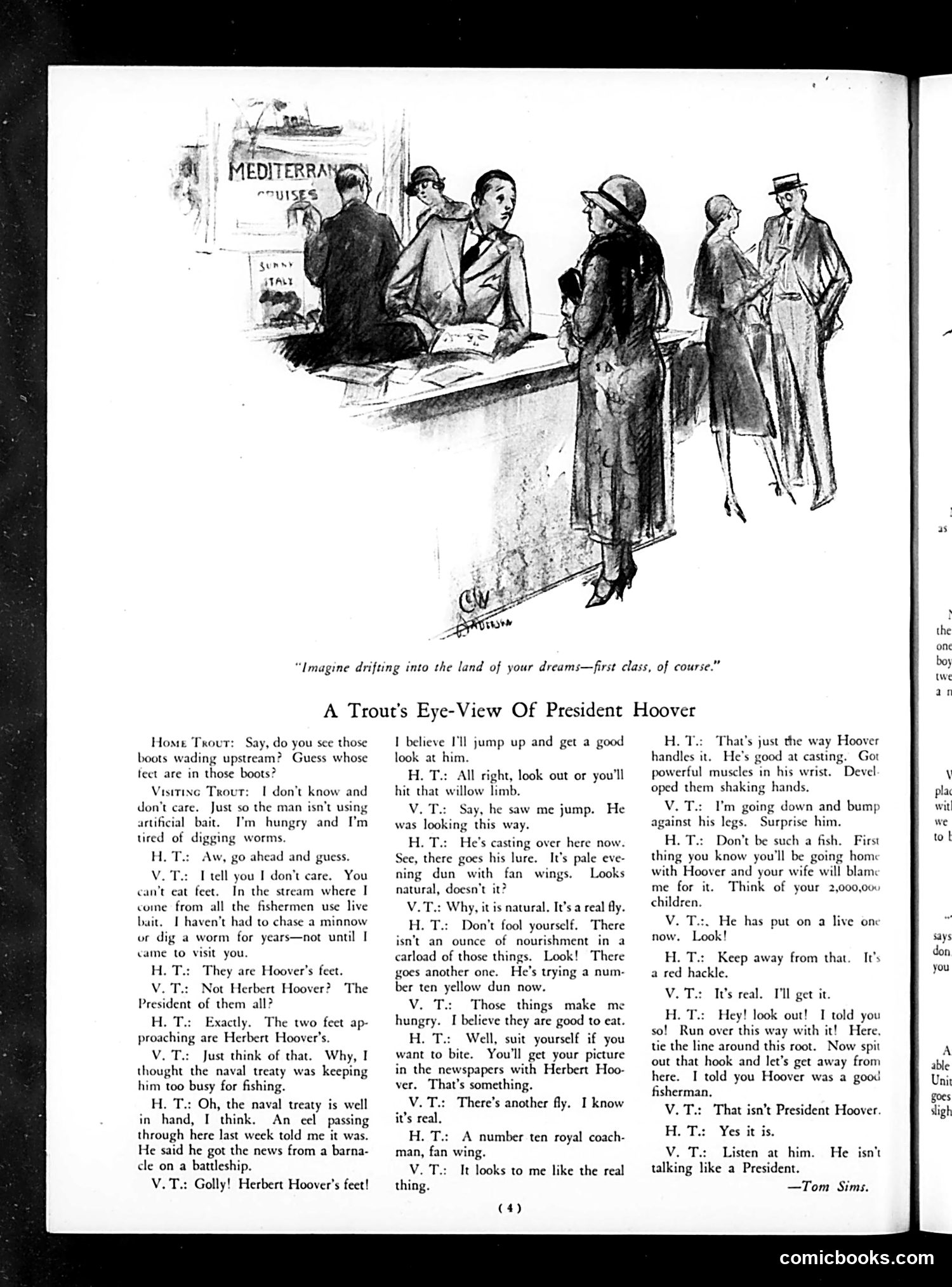
"A Trout's Eye-View Of President Hoover" This satirical cartoon depicts a ticket office (labeled "MEDITERRANEAN CRUISES") where two trout observe tourists booking passage. The humor works on multiple levels: The Setup: Fish discuss President Hoover's fishing trips—a well-known pastime he was famous for during his presidency. The Satire: The trout cynically compare Hoover's leisurely Mediterranean cruises and fishing vacations to ordinary citizens' struggles. One trout notes Hoover's "powerful muscles" and carefree demeanor while common people presumably face economic hardship. Historical Context: This likely references the early Great Depression era (early 1930s), when Hoover's continued recreational activities appeared tone-deaf to suffering Americans. The cartoon mocks the disconnect between the president's comfortable lifestyle and the public's economic distress.
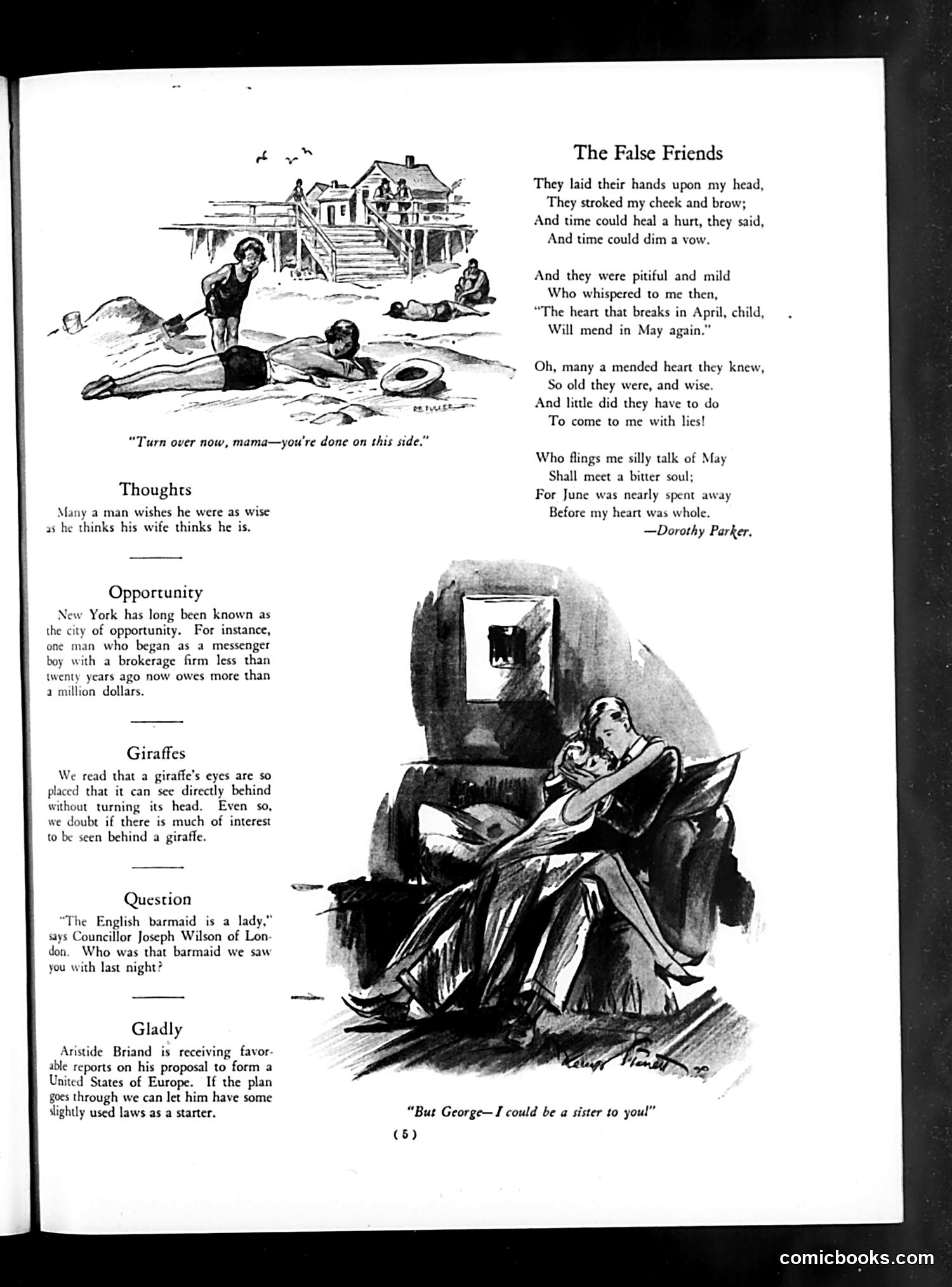
Analysis of Life Magazine Page This page contains several short satirical pieces typical of Life magazine's humor section. "The False Friends" is a Dorothy Parker poem about people offering false comfort to someone heartbroken—they claim time heals wounds but their sympathy masks insincerity. The illustration shows a bedridden or reclining figure being attended to. The other brief items—"Thoughts," "Opportunity," "Giraffes," "Question," and "Gladly"—are typical one-liner or short-paragraph observations poking fun at human nature, social pretensions, and current events (mentioning New York opportunity and Aristide Briand's European union proposal). The lower illustration shows two figures, with the caption "But George—I could be a sister to you!"—likely satirizing romantic or social misunderstandings between men and women. The humor reflects early 20th-century sensibilities about class, gender relations, and social folly.
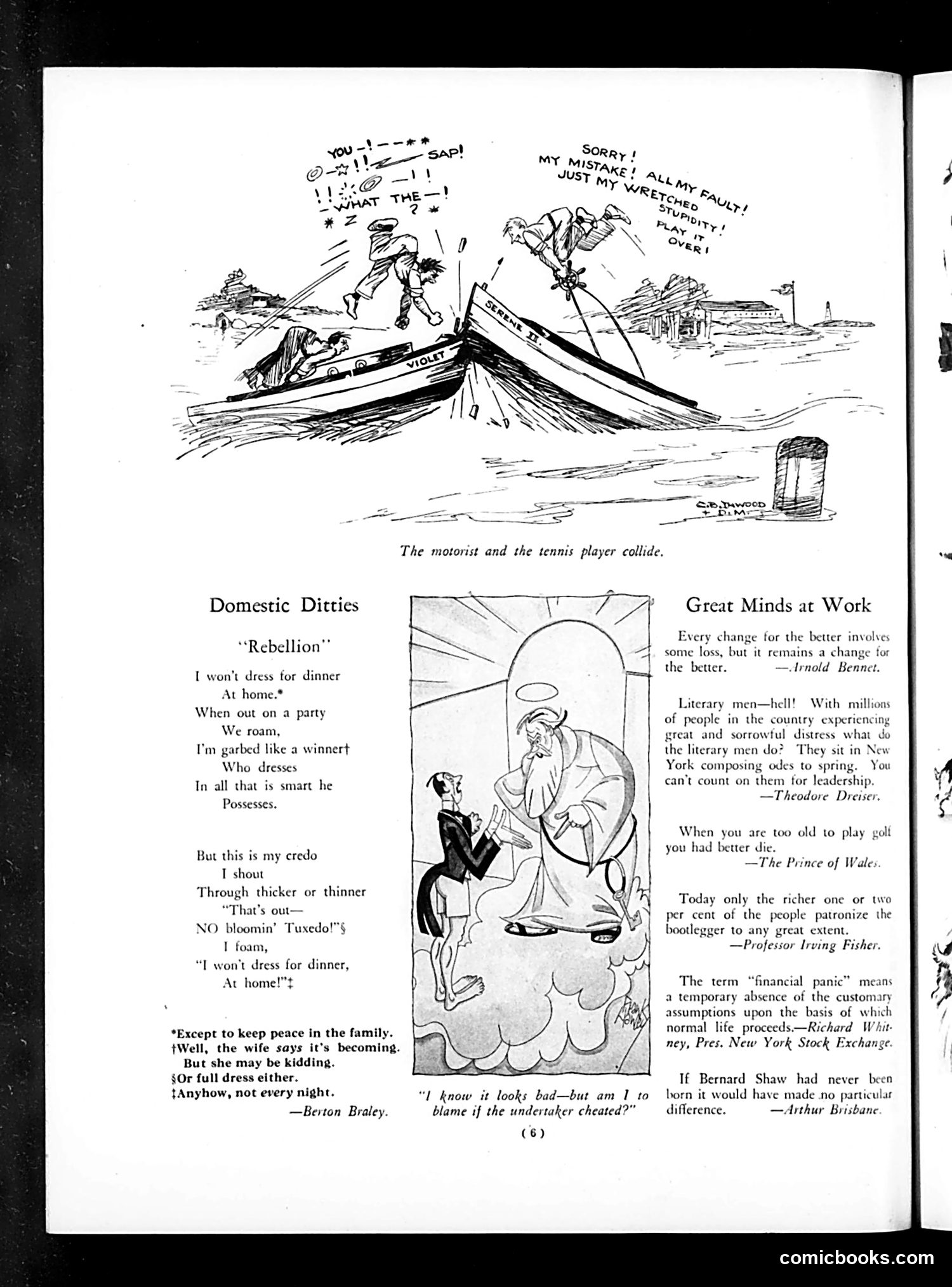
Analysis The top cartoon shows "The motorist and the tennis player collide"—two figures have crashed their boats together on a beach. One shouts "YOU SAP!" while the other apologizes for wrecking their vessel during play. This is straightforward slapstick humor about an accident. The central illustration humorously depicts a rotund figure (appears to be a wealthy businessman or entrepreneur based on the clothing and setting) meeting with a smaller man in formal attire. The caption reads "I know it looks bad—but am I to blame if the undertaker cheated?"—suggesting the larger man has become suspiciously corpulent, implying he may have obtained an unusually large corpse or committed fraud. The page also includes literary quotations and a poem ("Rebellion") about domestic dress codes.
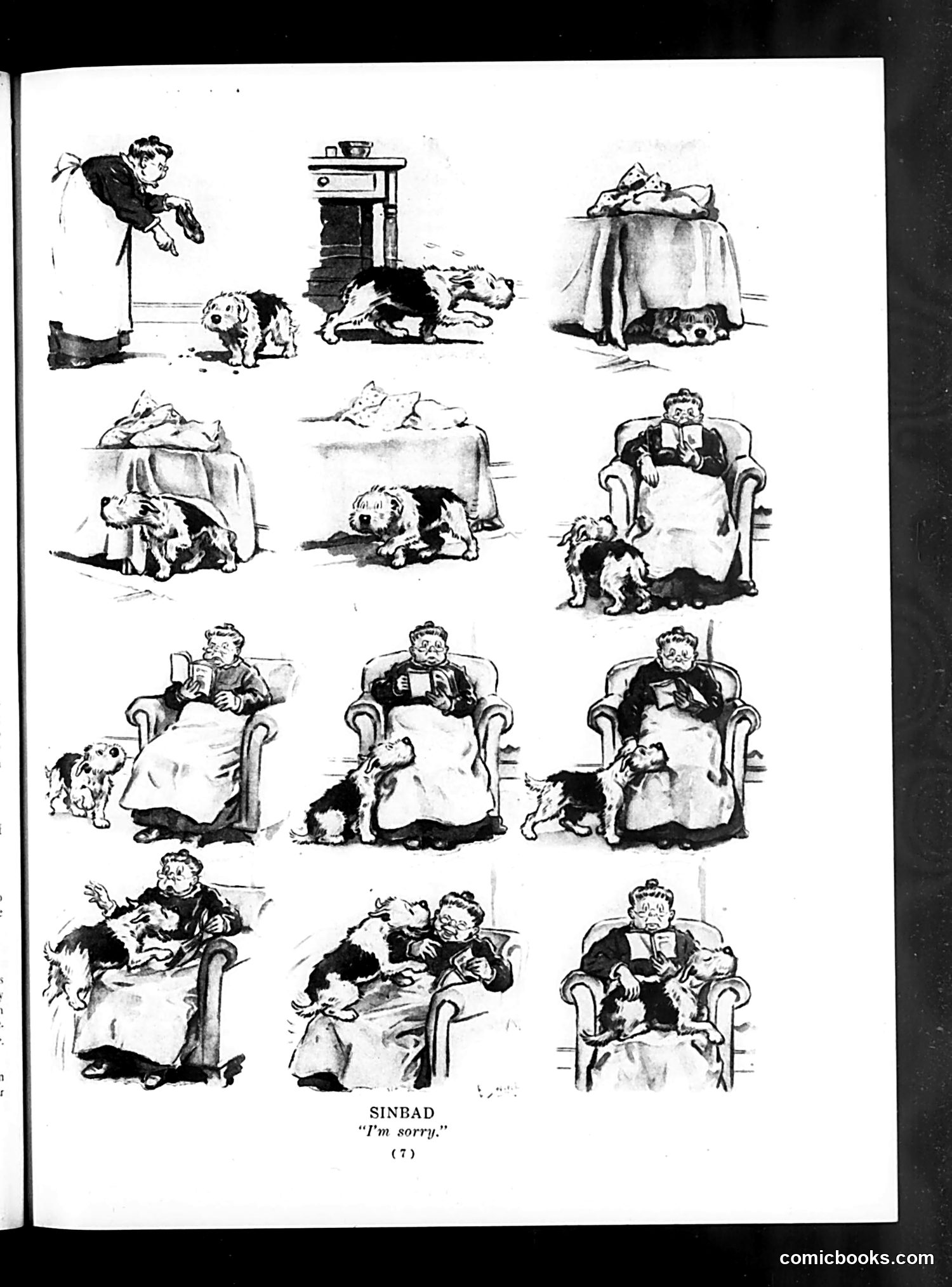
Analysis of "Sinbad: 'I'm sorry'" This is a sequential comic strip featuring a character named Sinbad (likely referencing the fictional sailor) repeatedly apologizing while sitting in a chair with a dog. The narrative progression shows: The setup: Top panels depict domestic chaos—a woman chasing the dog, scattered furniture and household items, a table overflowing with objects. The resolution: Multiple panels show Sinbad seated in an armchair with the mischievous dog, apparently saying "I'm sorry" to someone (likely his wife or household member). The joke: This appears to be satirizing male domestic helplessness—a man apologizing for the chaos caused by his dog while remaining passively seated, suggesting he takes no responsibility for actually *fixing* the mess or controlling the animal. The repetition emphasizes his hollow apologies without action.
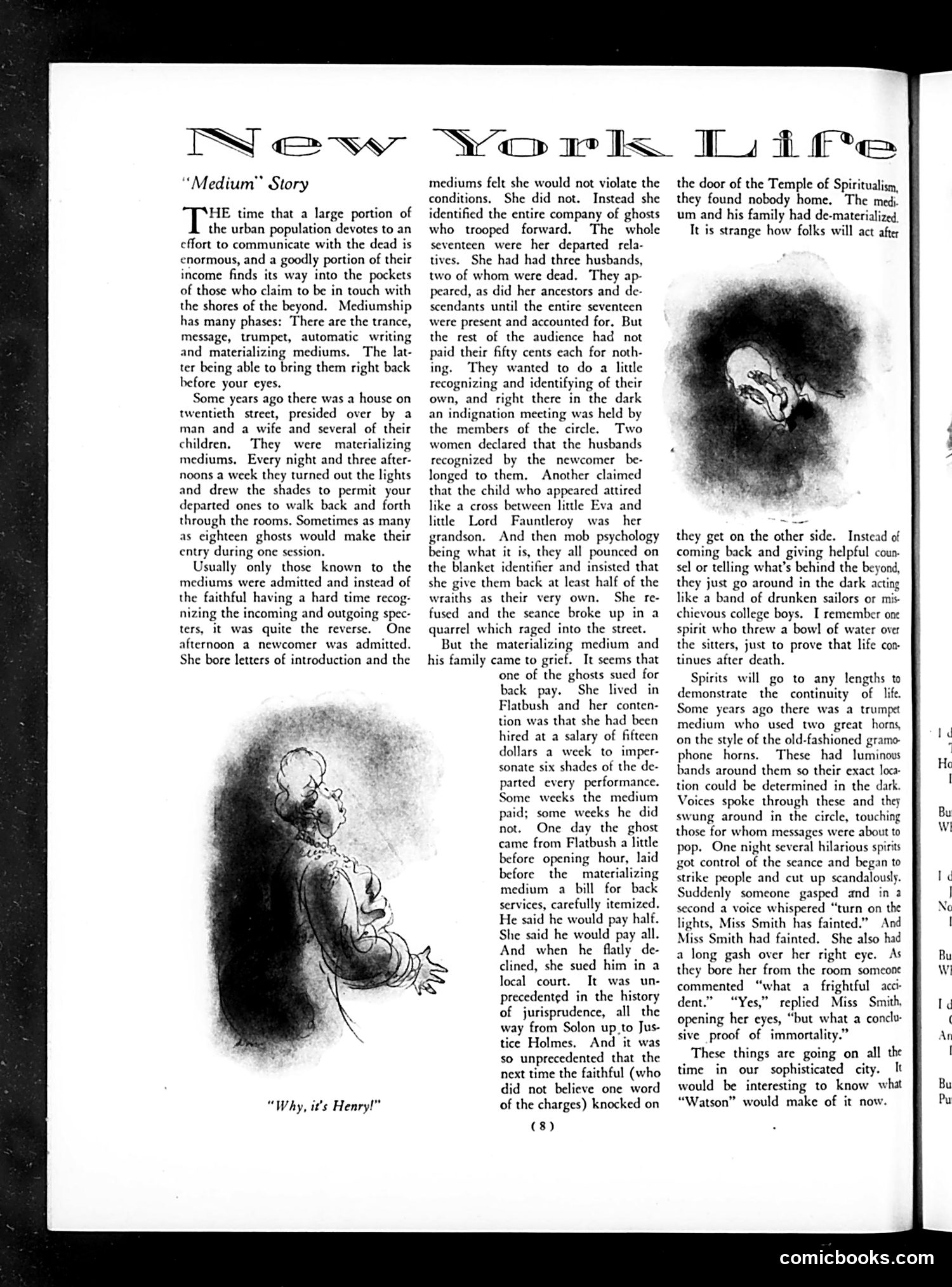
Analysis of Life Magazine Page: "Medium" Story This page presents a satirical story about spiritualism and séances, a popular cultural phenomenon of the era. The narrative mocks the credulity of wealthy urbanites who hired "materializing mediums"—people claiming to contact the dead and produce physical manifestations of spirits. The story ridicules the absurdity: a medium hired at $15/week to impersonate departed relatives, eventually sued for back pay when she failed to materialize. The accompanying illustrations show the séance setup and a spirit manifestation. The satire targets both the fraudulent mediums exploiting clients and the gullible believers who ignored obvious deceptions. References to mob psychology and the spirits' increasingly ridiculous antics ("drunken sailors," bowl-throwing incidents) underscore how absurd these séances were to skeptical observers. This reflects turn-of-century skepticism toward spiritualism despite its continued popularity.
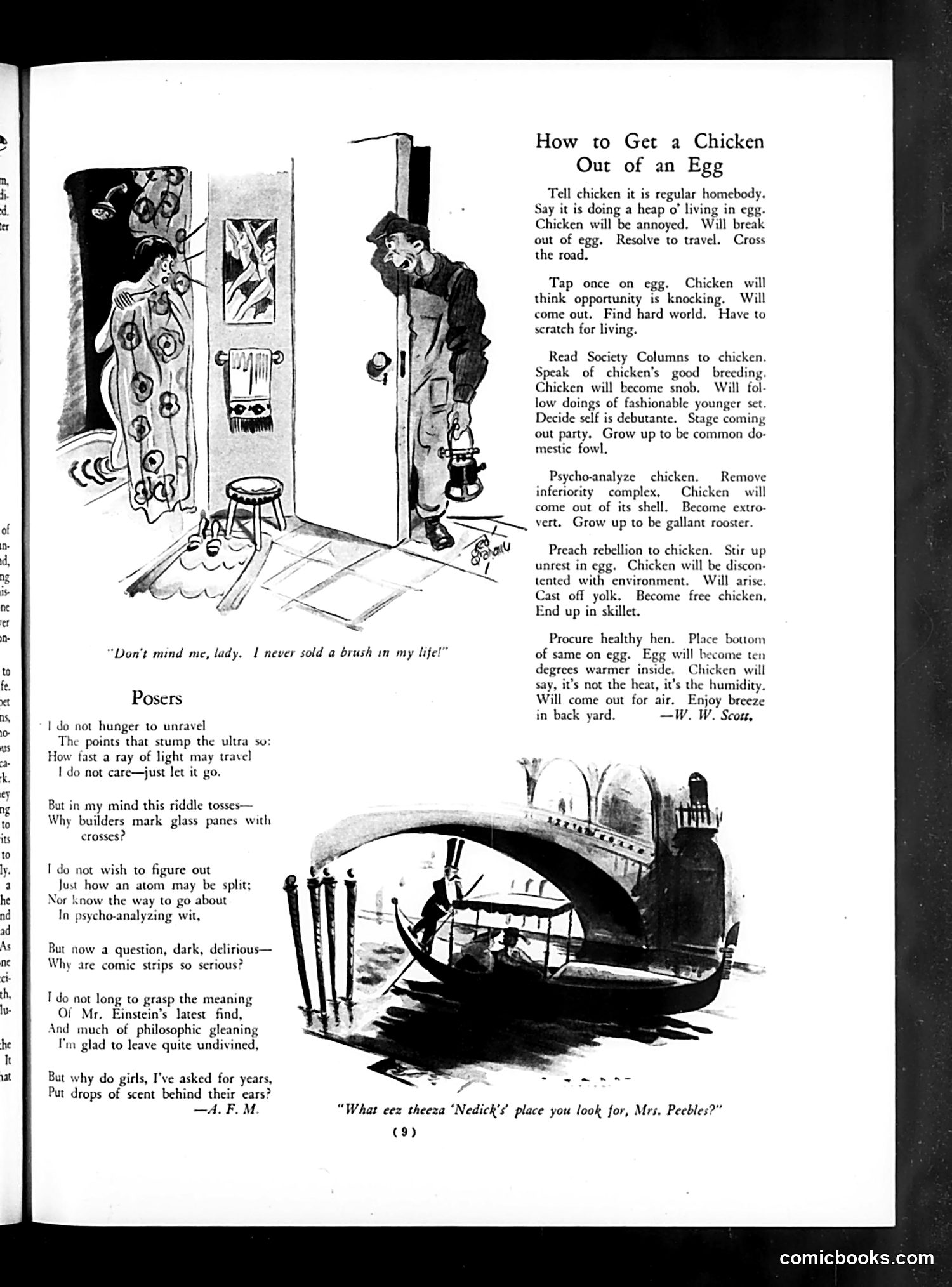
Analysis of Life Magazine Page This page contains two unrelated pieces of satire: "How to Get a Chicken Out of an Egg" (top right) is absurdist humor mocking self-help advice popular in the 1920s-30s. It satirizes pseudo-intellectual trends by offering ridiculous "solutions" to a simple problem—from reading Society Columns to the chicken to psychoanalyzing it. The joke targets the era's obsession with pop psychology and fashionable trends. "Posers" (lower left) is a poem by A.F.M. questioning why intellectual and social conventions exist—why mark glass panes with crosses, why analyze complex physics, why use perfume? It mocks pretentious intellectualism and affectation. The illustrations (a man with a tall hat confronting a woman, a gondola scene) appear to be accompanying humorous captions rather than editorial cartoons addressing specific political events.
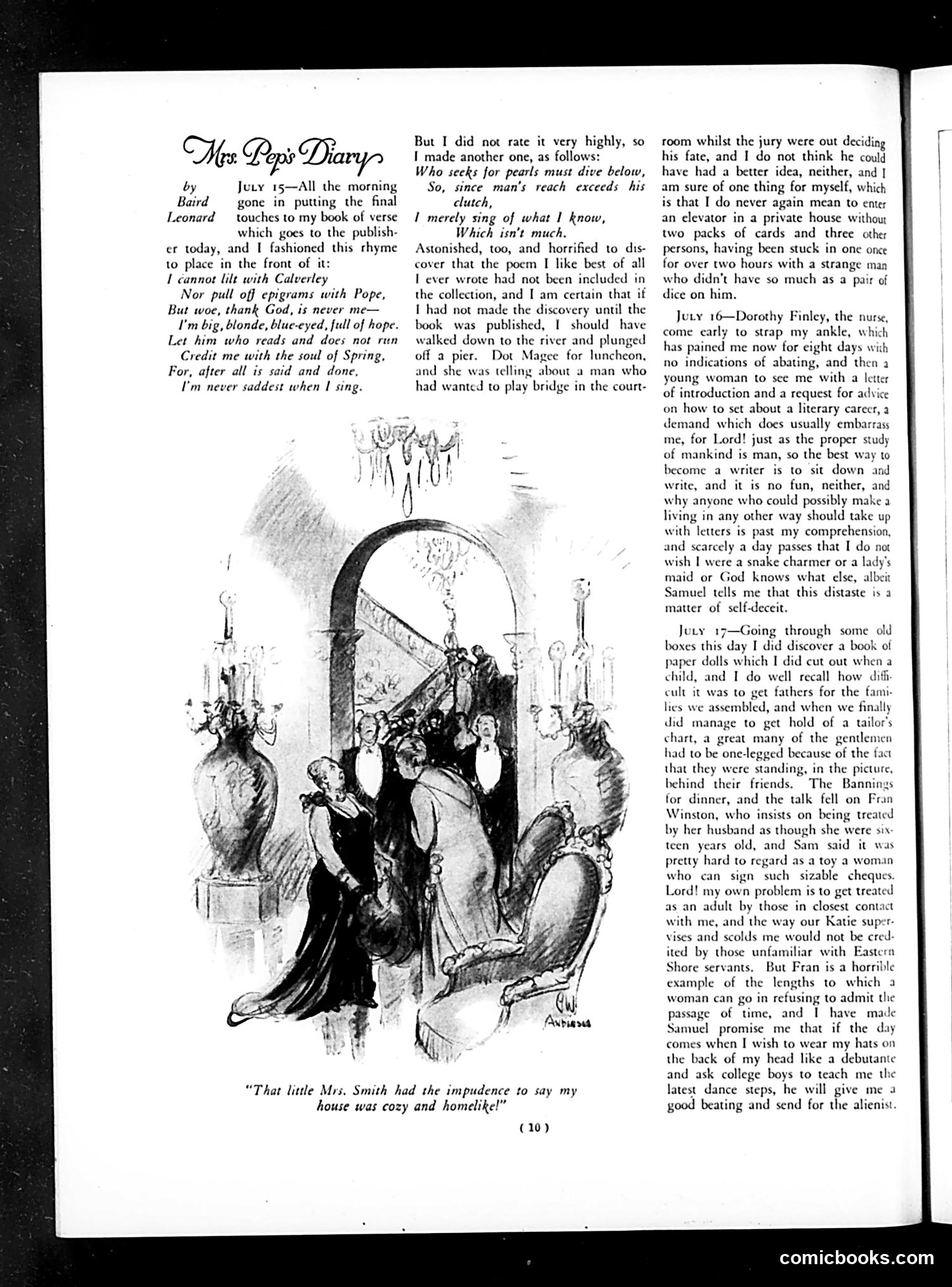
Mrs. Pepo's Diary - Page Analysis This page contains a satirical diary entry by "Baird Leonard," featuring social commentary on early 20th-century upper-class life. The illustration depicts a formal social gathering—likely a dinner party or reception—where well-dressed figures interact in what appears to be an elegant interior space. The diary entries (July 15-17) mock pretentious literary aspirations, domestic complaints, and social anxieties among the wealthy. The caption beneath the illustration—"That little Mrs. Smith had the impudence to say my house was cozy and homely!"—reveals the satire's target: the social insecurity of the affluent classes, where "cozy" is perceived as an insulting comment suggesting modest rather than grand circumstances. The humor targets vanity and status anxiety among society figures.
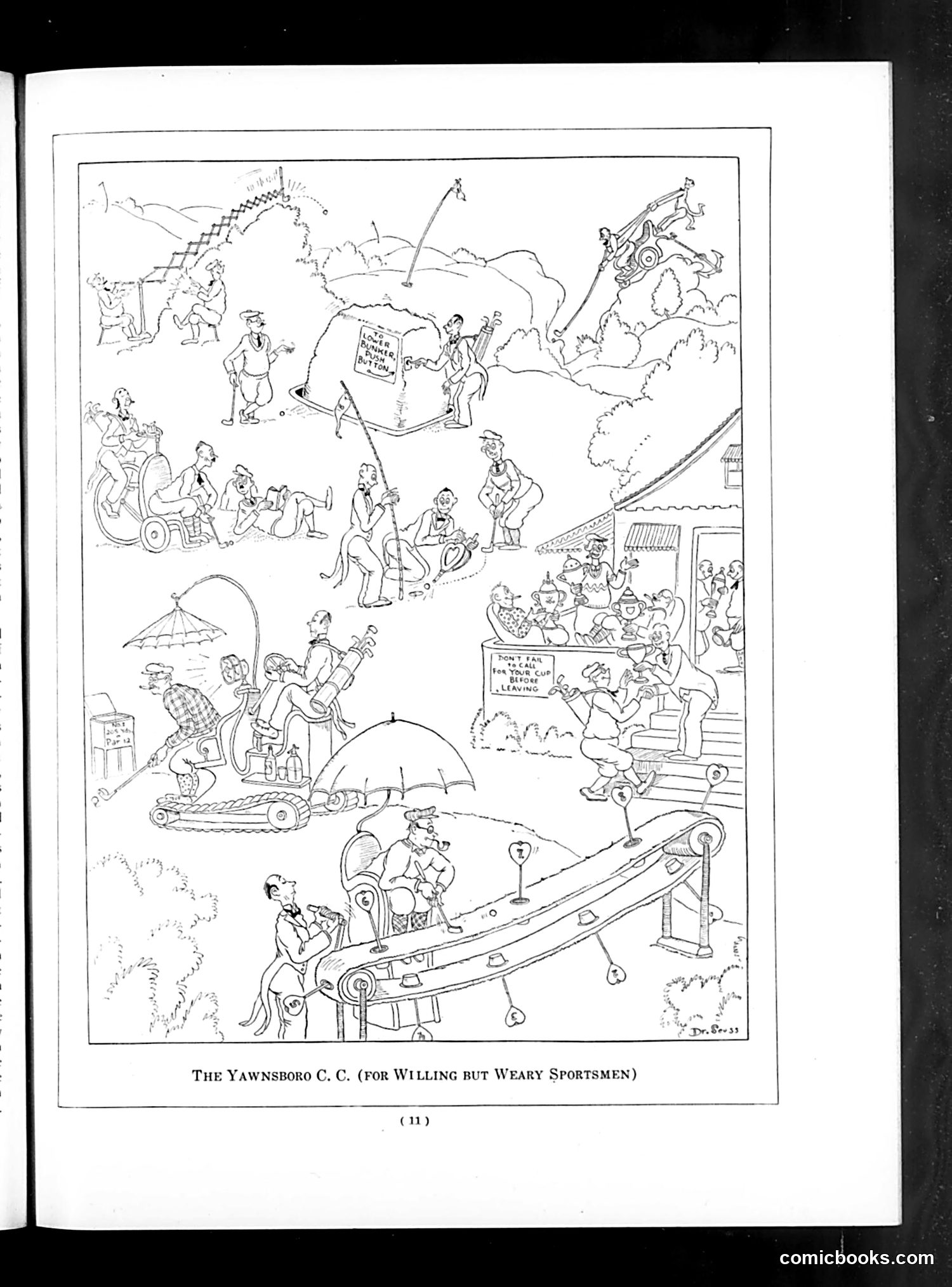
"The Yawnsboro C.C. (For Willing but Weary Sportsmen)" This is a satirical cartoon depicting a golf club (C.C. = Country Club) designed for exhausted golfers. The illustration shows various members engaged in golfing activities, but with comical accommodations for their fatigue: players use umbrellas for shade, ride in wheeled contraptions, recline in chairs, and appear generally listless throughout the course. The satire targets wealthy club members who want the social prestige of belonging to a country club but lack the actual stamina or enthusiasm for genuine athletic activity. The subtitle's phrase "willing but weary" captures the joke—these are men who want to participate in sports for status, not passion. The cartoon mocks the leisure culture of affluent Americans and their preference for comfortable indulgence over genuine athletic pursuit.
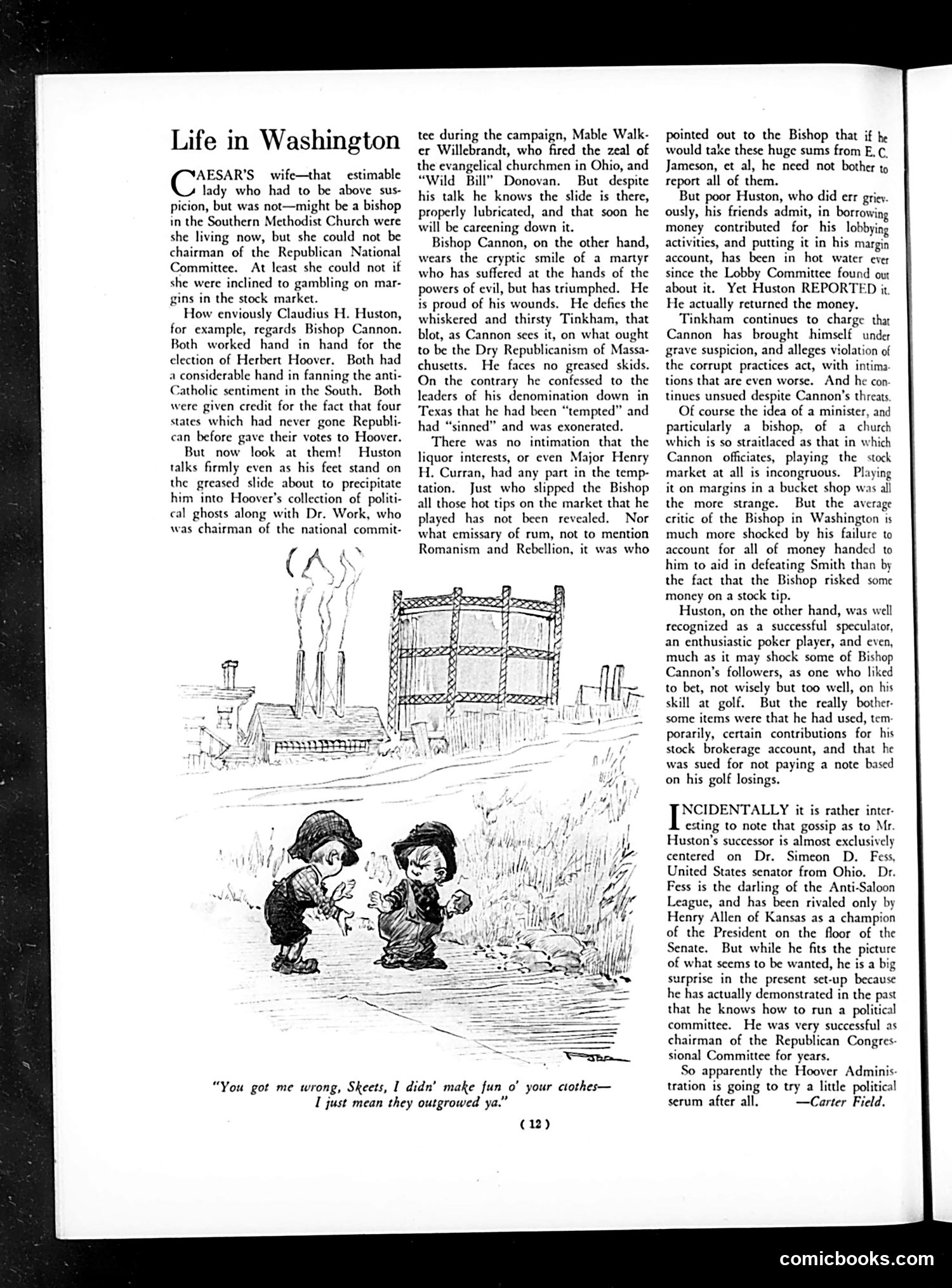
Political Satire: "Life in Washington" This page satirizes Claudius H. Huston, Republican National Committee chairman, through allegations of financial impropriety. The text criticizes his past involvement in anti-Catholic campaigns and suggests he's now engaged in corrupt stock-market dealings and money laundering for political activities. The cartoon below depicts two small figures (unclear who specifically) with the caption: "You got me wrong, Skeet, I didn't make fun o' your clothes—I just mean they outgrew ya," credited to Carter Field. This appears to be a separate joke about someone outgrowing their circumstances—likely referencing political figures or social status mockery common to the era. The overall piece attacks Huston's fitness for his position through financial scandal allegations.
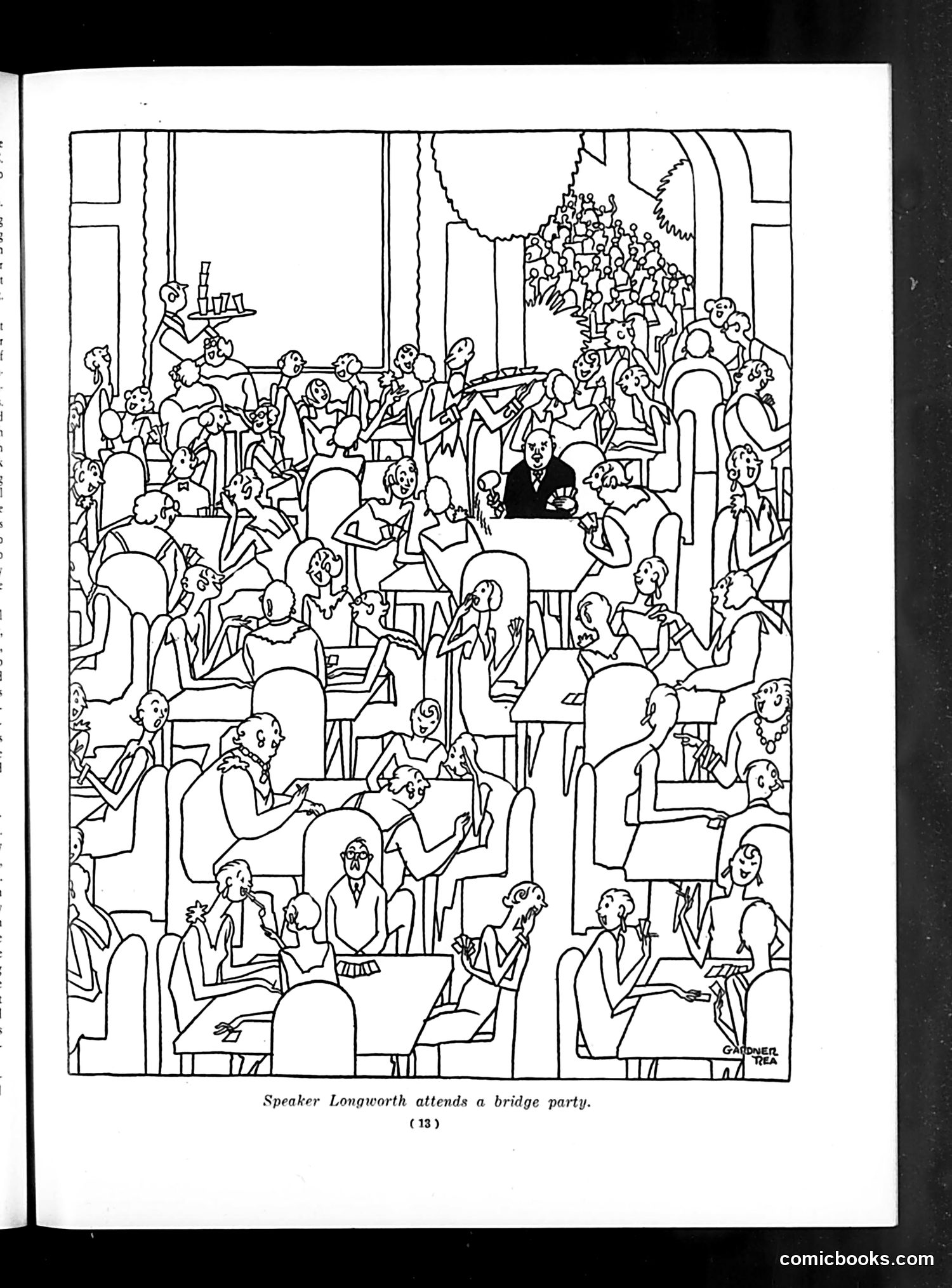
Analysis This cartoon depicts "Speaker Longworth" attending a bridge party—a social gathering where people play the card game bridge. The cartoon is a satirical commentary on the speaker's social life intruding into his public duties. The humor relies on the contrast between the formal governmental setting (suggested by the large crowd and official atmosphere) and the frivolous leisure activity of bridge. The speaker sits prominently at a table while numerous other attendees fill the venue, suggesting he's prioritizing social entertainment over legislative work. The satire criticizes how political figures balance—or fail to balance—public responsibilities with private social obligations. The crowded scene emphasizes how bridge parties occupied significant social time among the wealthy and politically connected classes during this era.
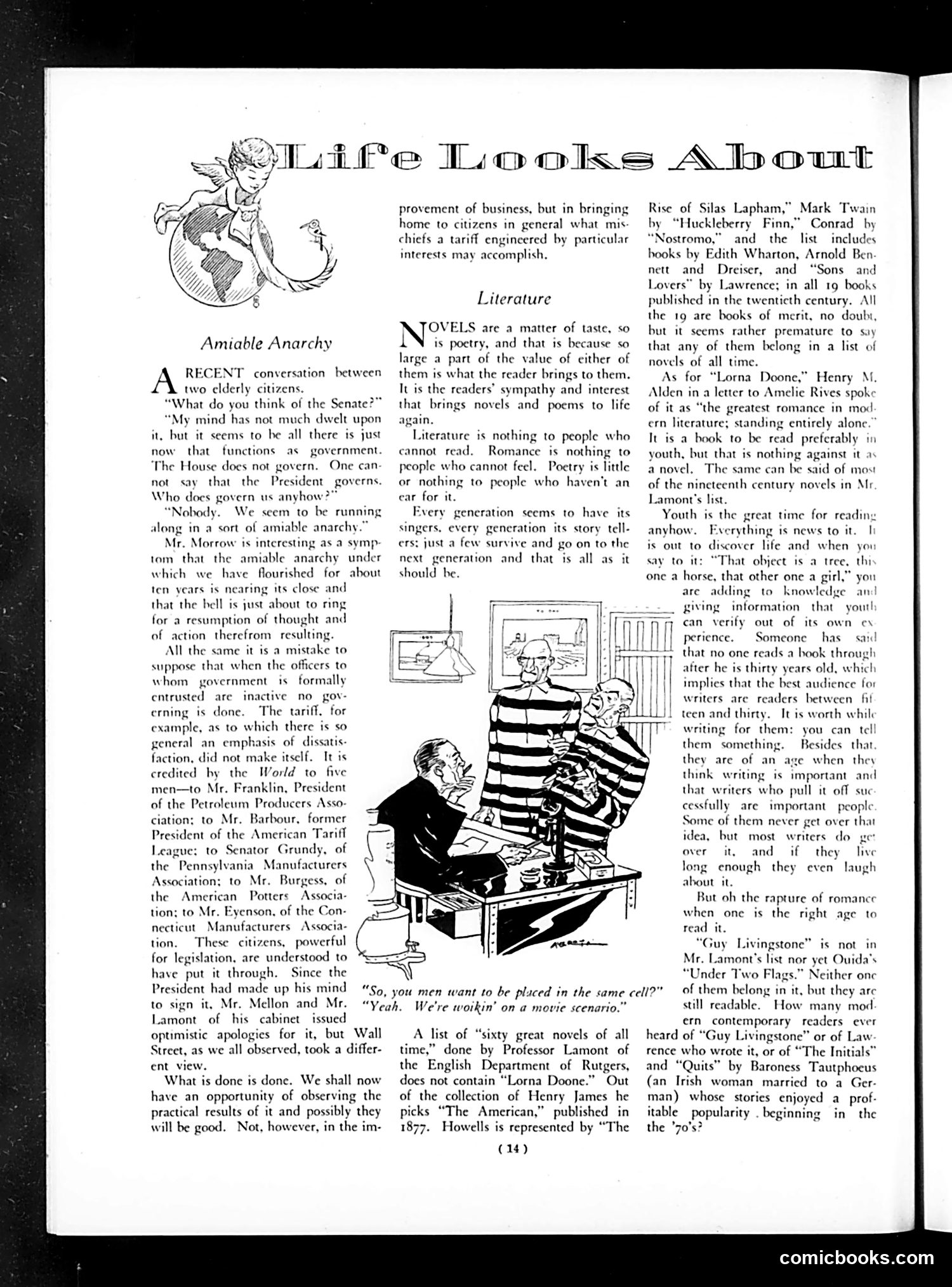
Analysis of "Life Looks About" Page This page contains editorial commentary on American governance and a literature discussion, rather than political cartoons per se. The main cartoon shows two men at a desk with the caption: "So, you men want to be placed in the same cell? Yeah. We're workin' on a movie scenario." This appears to be a joke about imprisoned figures (likely criminals or political prisoners) collaborating on a Hollywood screenplay—satirizing how even criminals might leverage their notoriety for entertainment profit, or perhaps mocking the era's fascination with crime narratives in cinema. The accompanying text discusses "Amiable Anarchy," criticizing governance and referencing Mr. Morrow's observations about American political dysfunction. The page primarily focuses on literary criticism rather than satire.
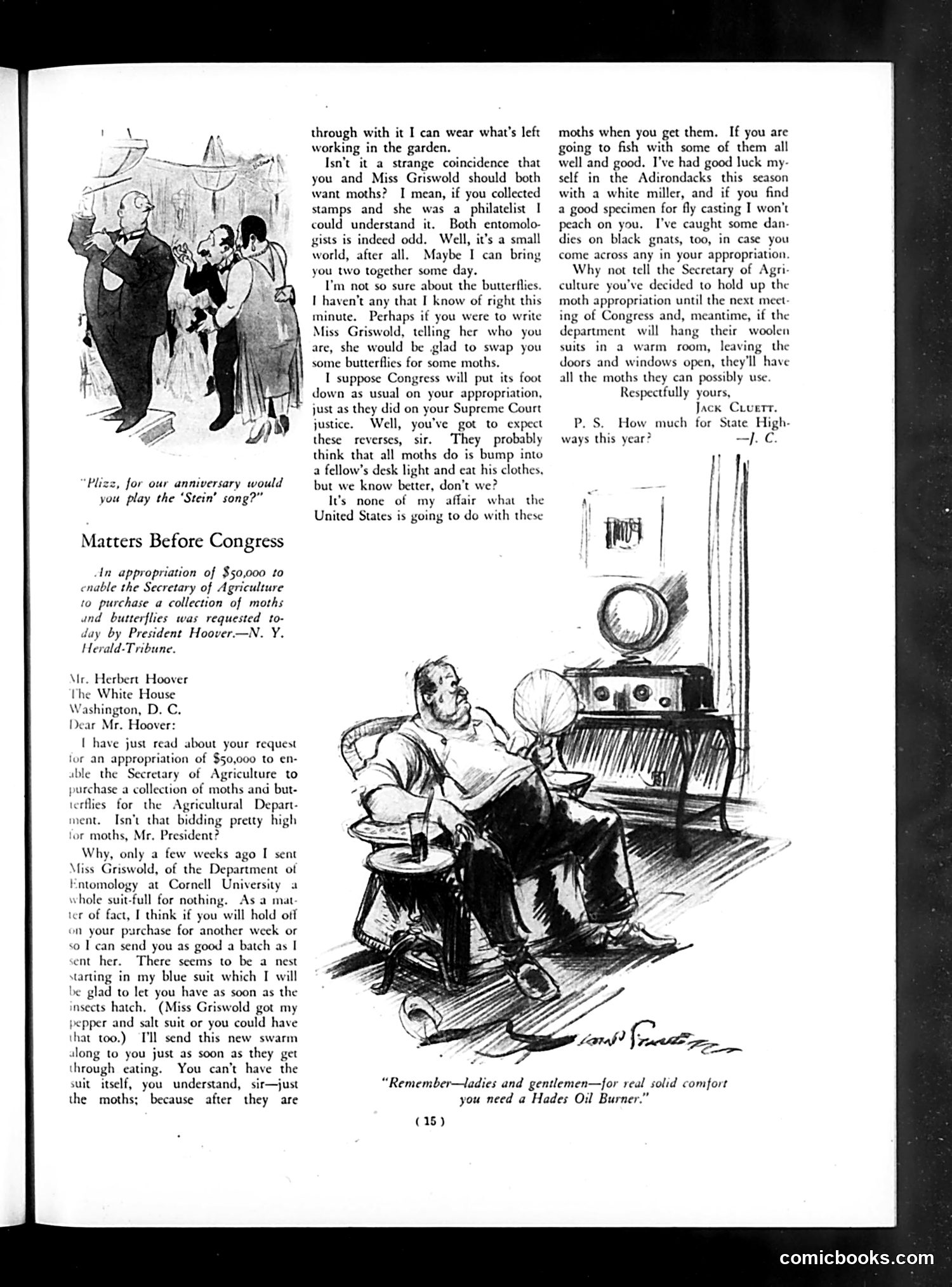
Analysis This page satirizes government spending priorities during what appears to be the early 20th century. The main content is a letter to President Hoover requesting a $50,000 appropriation for the Secretary of Agriculture to purchase moths and butterflies for a collection. The satire's point: a writer ridicules this seemingly frivolous expenditure by proposing increasingly absurd alternative uses for the money—suggesting Congress would approve it as readily as any other appropriation. The humor lies in mocking both the impracticality of the original request and implied criticism of Congressional spending habits. The advertisement cartoon below (for Hades Oil Burner) is unrelated to the political content above—typical of magazine layout from this era. The piece critiques wasteful government budgeting and the ease with which questionable appropriations apparently pass.
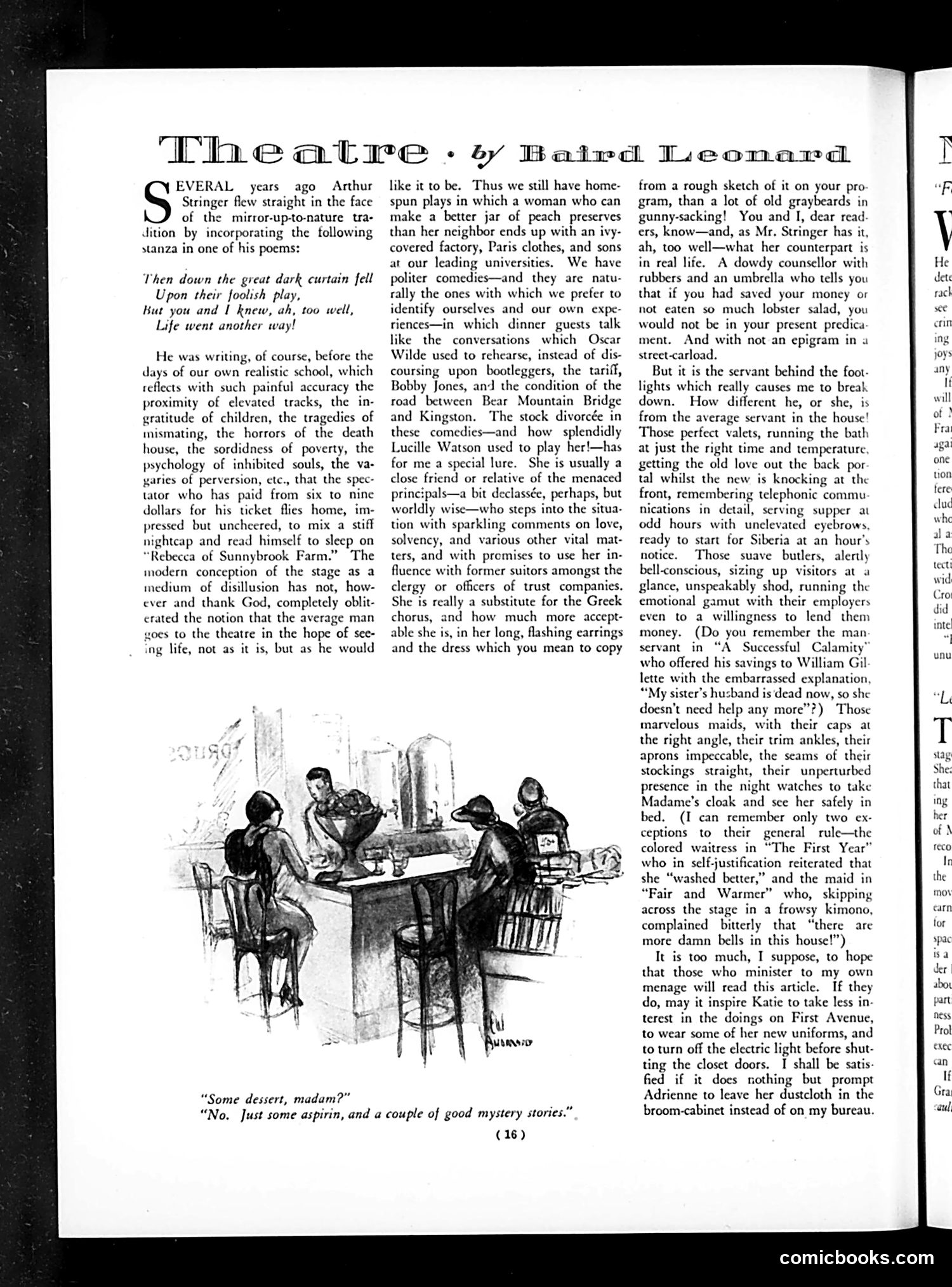
Analysis of "Theatre" by Baird Leonard This article critiques early 20th-century American theater's mediocrity. The author contrasts Arthur Stringer's poetry about realistic drama with actual theatrical practice—plays featuring homespun domesticity, trivial comedies, and stock characters rather than genuine art. The accompanying illustration shows a dinner scene with servants, likely depicting the kind of conventional "drawing-room" drama the article satirizes. The caption quotes dialogue about "dessert" and "mystery stories," exemplifying the shallow, formulaic entertainment criticized. Leonard argues that theater audiences accept trivial plots and stock character types (the menaced maiden, the worldly advisor) when they should demand higher artistic standards. The satire targets both playwrights' lazy formulas and audiences' willingness to accept them uncritically.
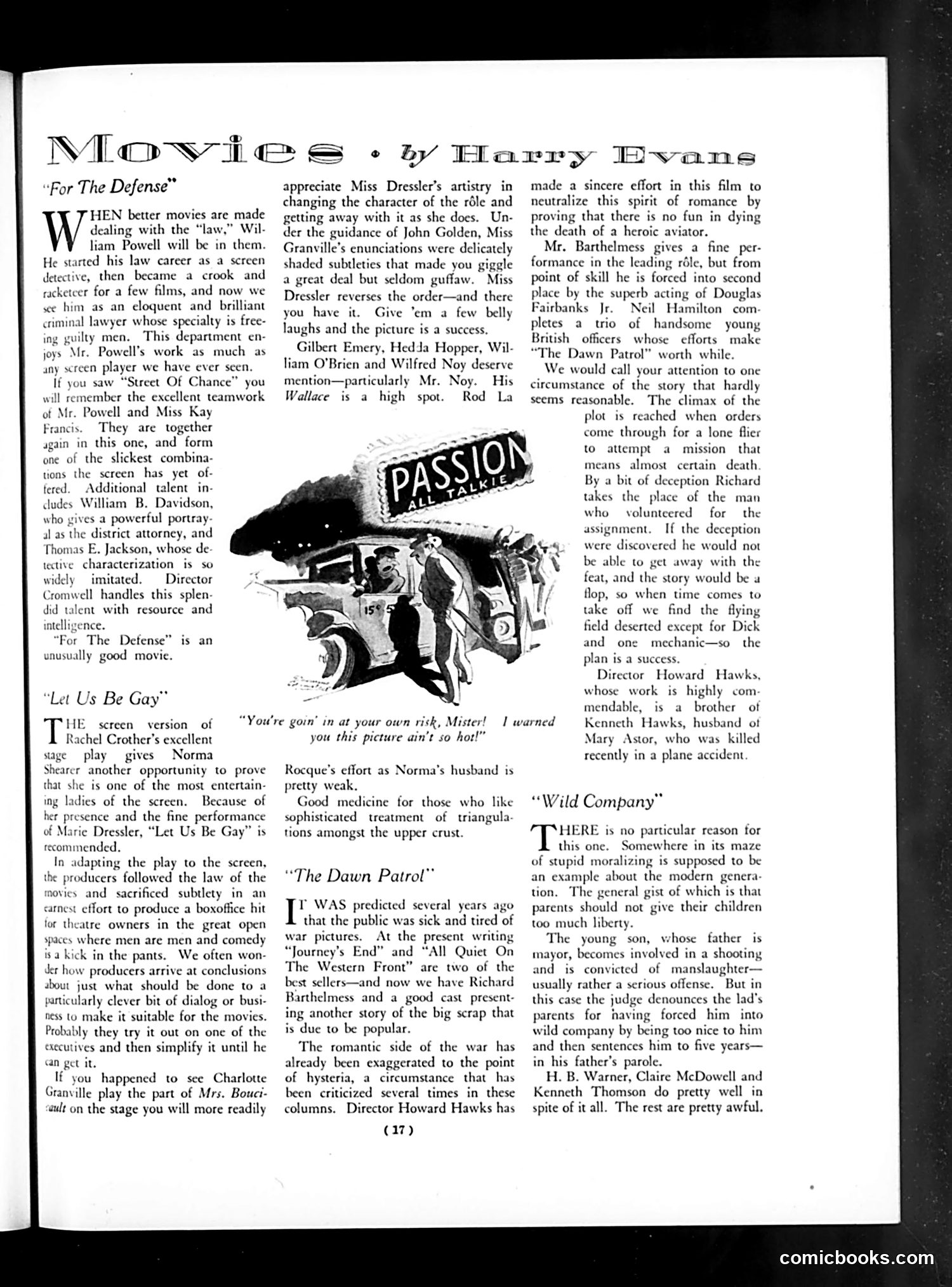
Movie Reviews by Harry Evans This page contains film reviews for four movies: "For The Defense," "Let Us Be Gay," "The Dawn Patrol," and "Wild Company." The only illustration is a cartoon showing two men in a car labeled "PASSION," with the caption: "You're goin' in at your own risk, Mister! I warned you this picture ain't so hot!" The joke satirizes the movie "Passion" itself—the caption suggests the film is so bad that even entering a theater to see it is a risky proposition. This is a straightforward pun on the movie's title, treating "passion" as a literal dangerous condition rather than the romantic drama the title suggests. The cartoon mocks the film's poor quality through this visual wordplay.
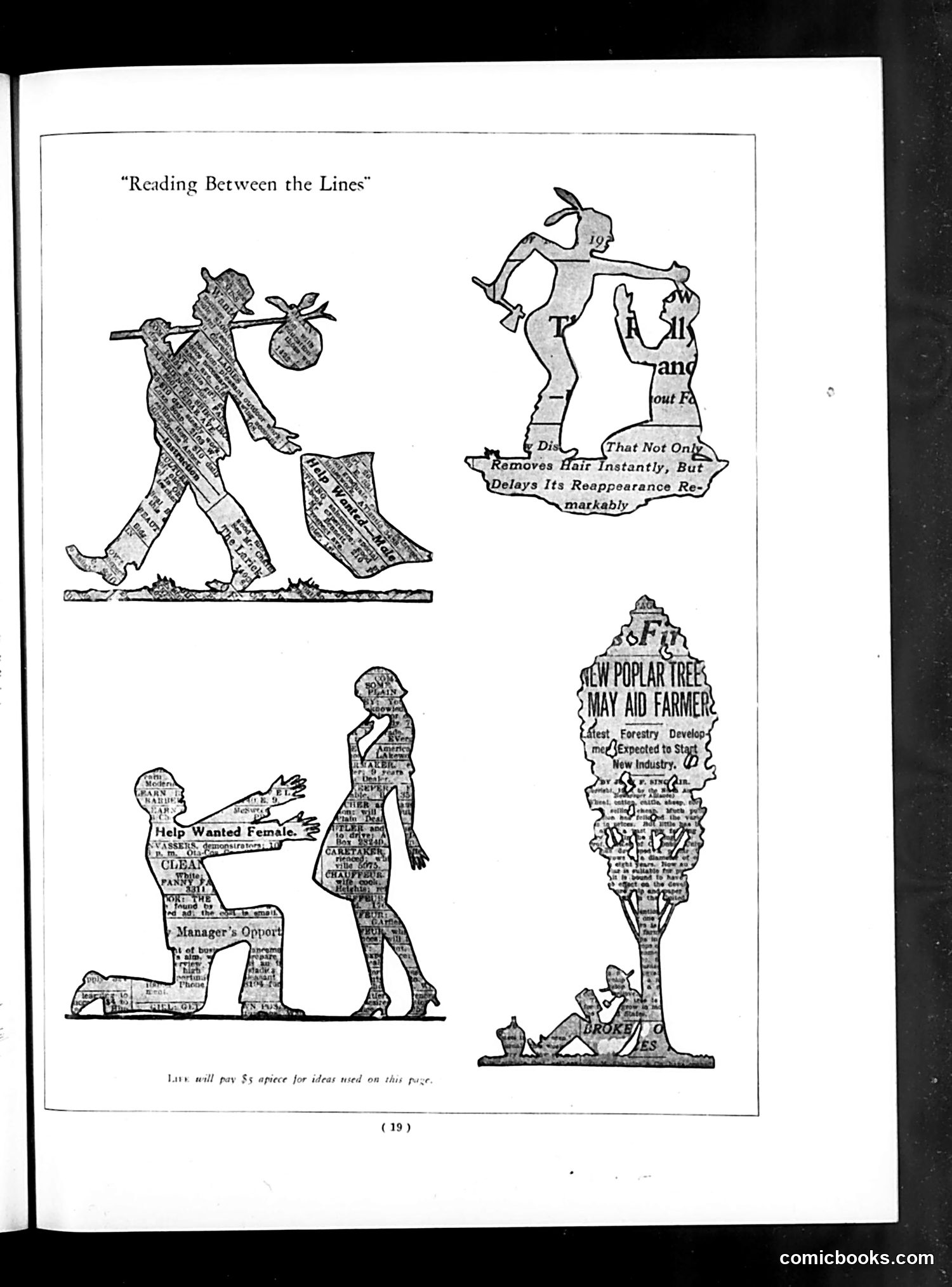
"Reading Between the Lines" — Life Magazine Satire This page presents newspaper-themed visual satire where human figures are constructed *from* newspaper text and advertisements—a technique that literalizes "reading between the lines." The cartoons mock newspaper advertising claims: - Top right: A product (likely a depilatory) claims to remove hair "instantly" but "delays its reappearance"—satirizing vague, misleading advertising language. - Bottom left: "Wanted Female" and "Manager's Opportunity"—likely mocking deceptive job advertisements that exploit workers. - Bottom right: "New Poplar Trees May Aid Farmer"—appears to satirize dubious agricultural or commercial claims. The overall concept critiques how newspapers filled with ads containing exaggerated or false claims, encouraging readers to look beyond surface text for truth. The page date appears to be page 19 of an unspecified issue.
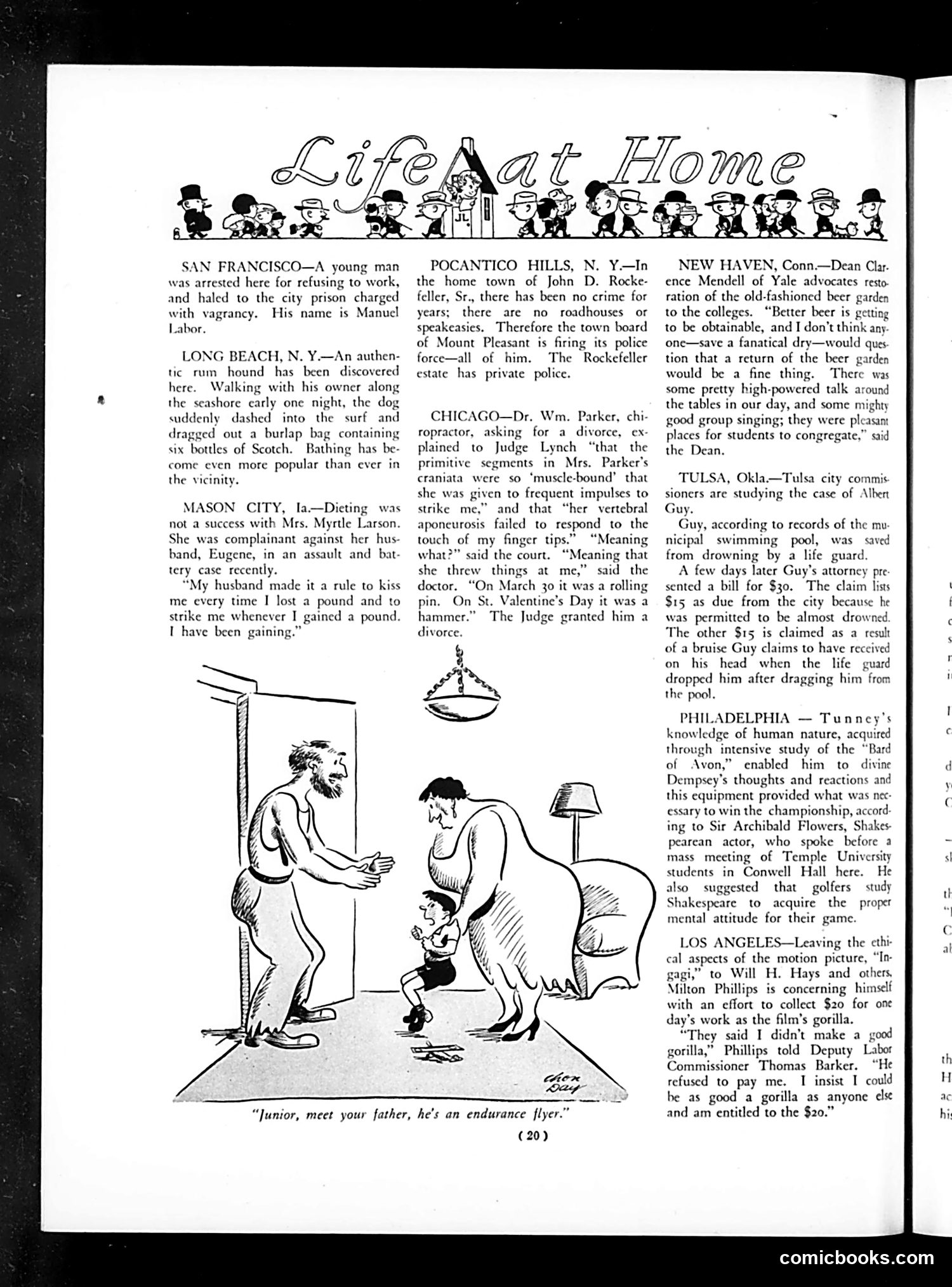
"Life at Home" Page Analysis This page from *Life* magazine presents humorous vignettes from across America, using wordplay and ironic social commentary typical of 1920s satire. Key items: - Manuel Labor pun: A man arrested for vagrancy has a name that's a homophone for "manual labor"—satirizing vagabond laws. - Rum-running dog: During Prohibition, a dog retrieves Scotch from the ocean, mocking both smuggling and the popularity of illegal alcohol. - Wife beating diet plan: A husband strikes his wife for weight gain—darkly comedic commentary on domestic violence normalized as marital "discipline." - Rockefeller's crime-free town: The text notes Pocantico Hills has no crime because the wealthy Rockefeller estate employs private police instead of public forces—critiquing class-based law enforcement. - Cartoon (center): Shows a small man introduced to a large woman as "an endurance flyer"—appears to be a crude joke about physical intimacy. The page satirizes Prohibition, domestic abuse attitudes, wealth inequality, and sexual double standards of the era.
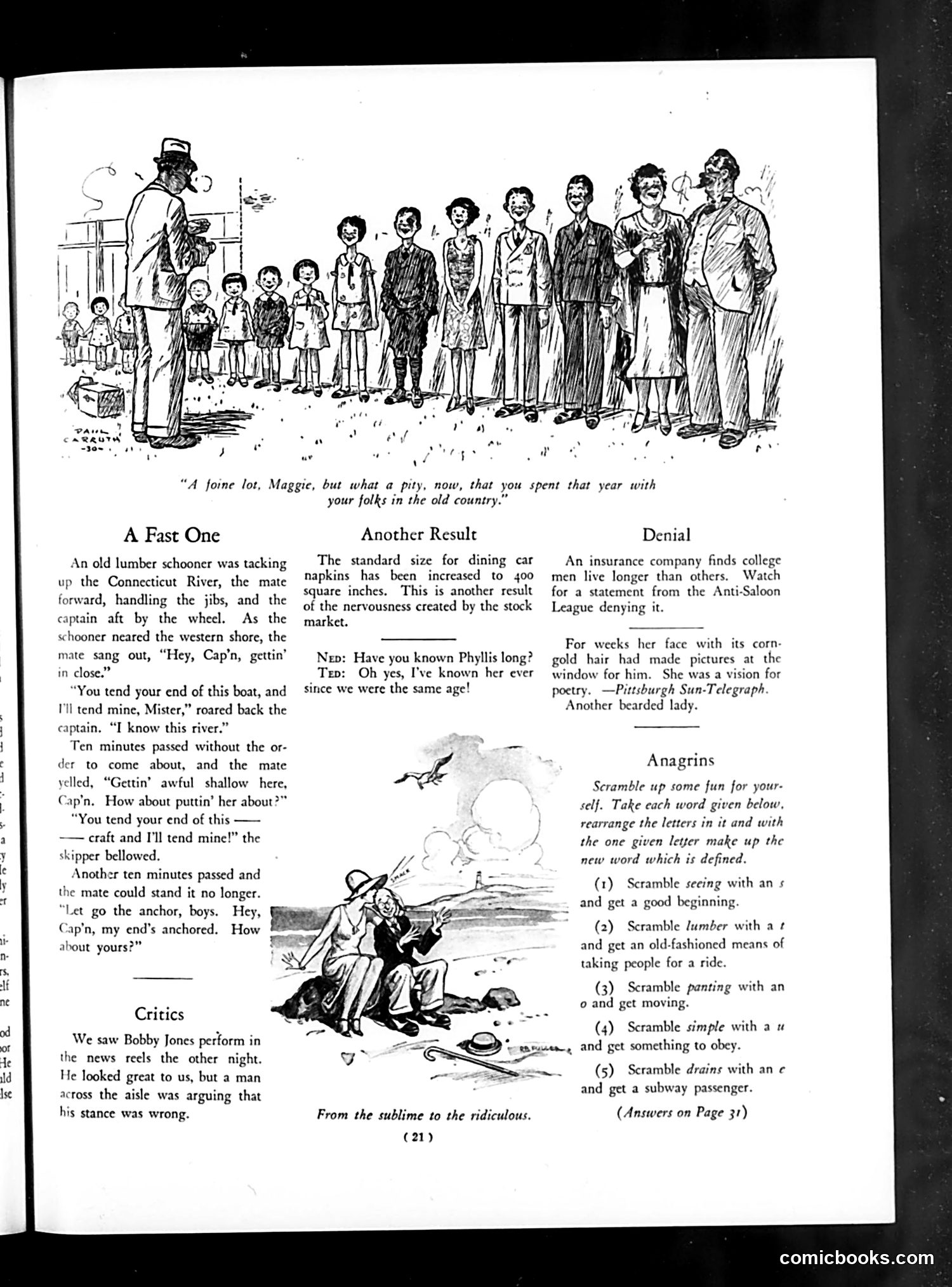
Life Magazine Page Analysis This page contains several satirical pieces typical of early 20th-century Life magazine humor: Top Cartoon: An immigration official addresses a family, saying "A fine lot, Maggie, but what a pity, now, that you spent that year with your folks in the old country." The satire mocks the stereotype of Irish immigrants—suggested by the Irish name "Maggie" and dialect—implying they're foolish for visiting Ireland instead of staying to establish themselves in America. "A Fast One": A humorous anecdote about a stubborn riverboat captain ignoring his mate's warnings about shallow water, ultimately getting grounded. It satirizes pride and refusing to listen to sound advice. "Another Result," "Denial," "Critics": Brief satirical items about stock market nervousness, insurance company statistics, and armchair criticism of golfer Bobby Jones—typical topical humor. "Anagrins": A word puzzle feature unrelated to satire. The page reflects 1920s-era concerns: immigration, class attitudes, market anxiety, and celebrity worship.
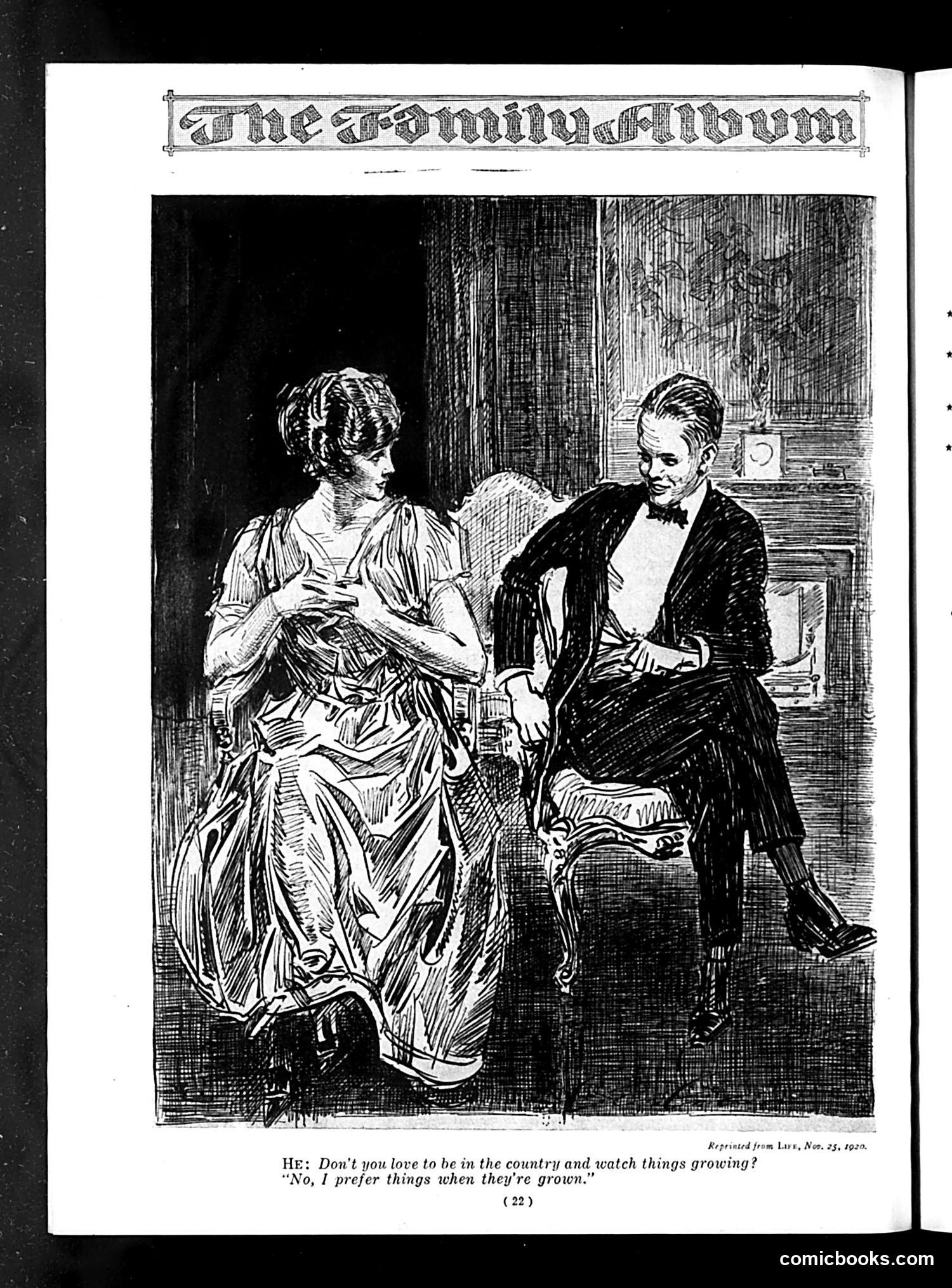
"The Flirting Game" (Life Magazine, 1920) This is a flirtation cartoon depicting a well-dressed man and woman in an elegant indoor setting. The man suggests romantic appreciation for watching "things growing" in the countryside—a poetic come-on. The woman's sharp retort—"No, I prefer things when they're grown"—is a double entendre rejecting his sentimental approach while implying she prefers mature, established pleasures (or men) rather than developmental stages. The humor targets early 20th-century courtship rituals and male romantic clichés. The woman's worldly dismissal of his countryside sentiment suggests sophistication and sexual experience, making it a mild innuendo for 1920s publication. The cartoon satirizes predictable masculine flirtation tactics and celebrates female wit and independence.
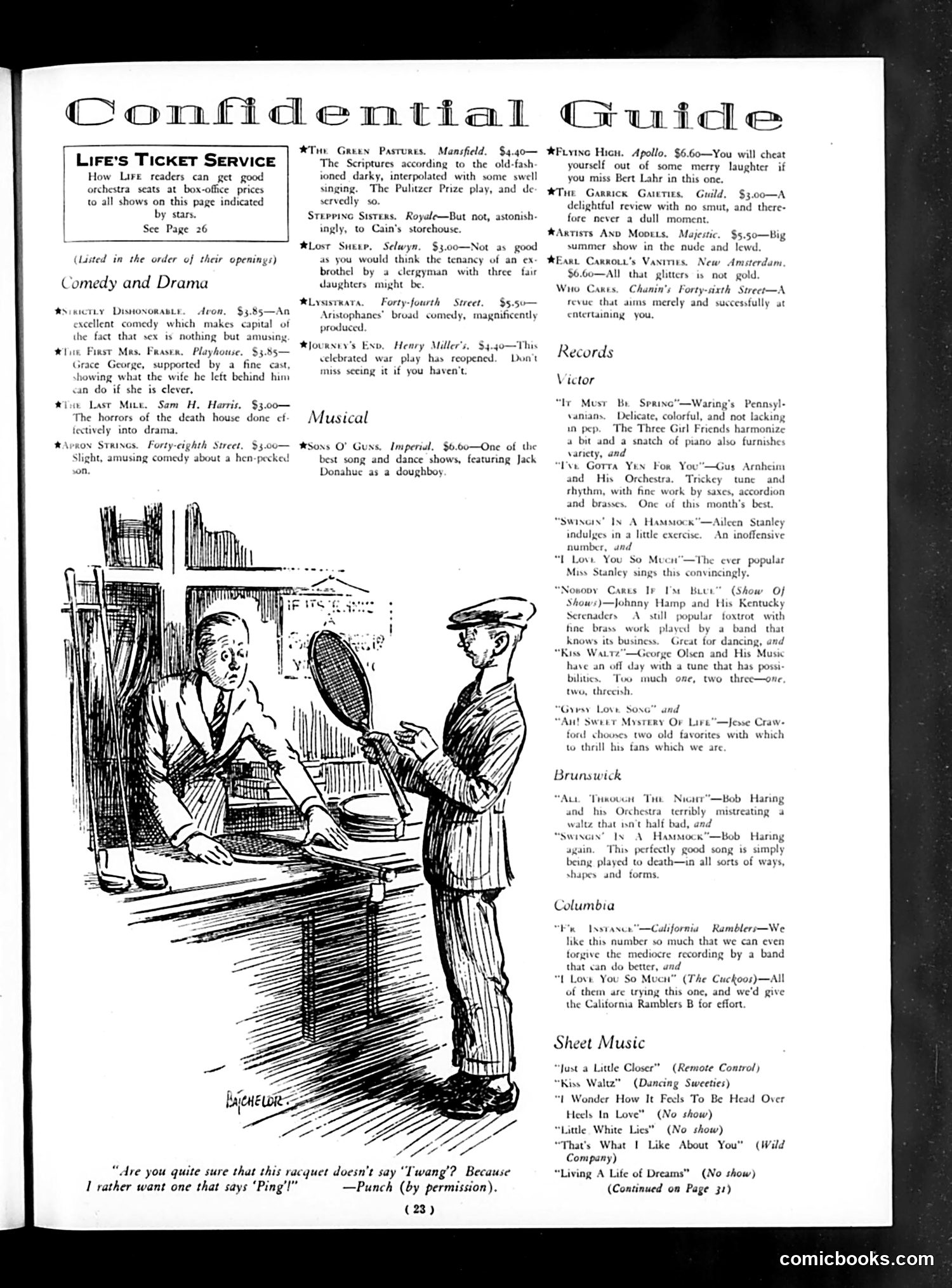
What This Page Means This is a "Confidential Guide" to Broadway shows and popular music from Life magazine's entertainment section. The main cartoon, credited to "Bachelder," is a Punch reprint depicting two men examining a tennis racquet. One man anxiously asks if the racquet says "Twang," insisting he wants one that says "Ping" instead. The joke relies on onomatopoeia: "Ping" and "Twang" are the distinctive sounds different racquets make when striking a ball. The humor comes from the absurdity of a customer obsessing over which brand-name sound his equipment produces—a mild satire on consumer brand consciousness and masculine vanity about sporting goods. The page itself advertises current theatrical productions, musical performances, phonograph records, and sheet music available to Life readers, with special pricing noted for certain shows.
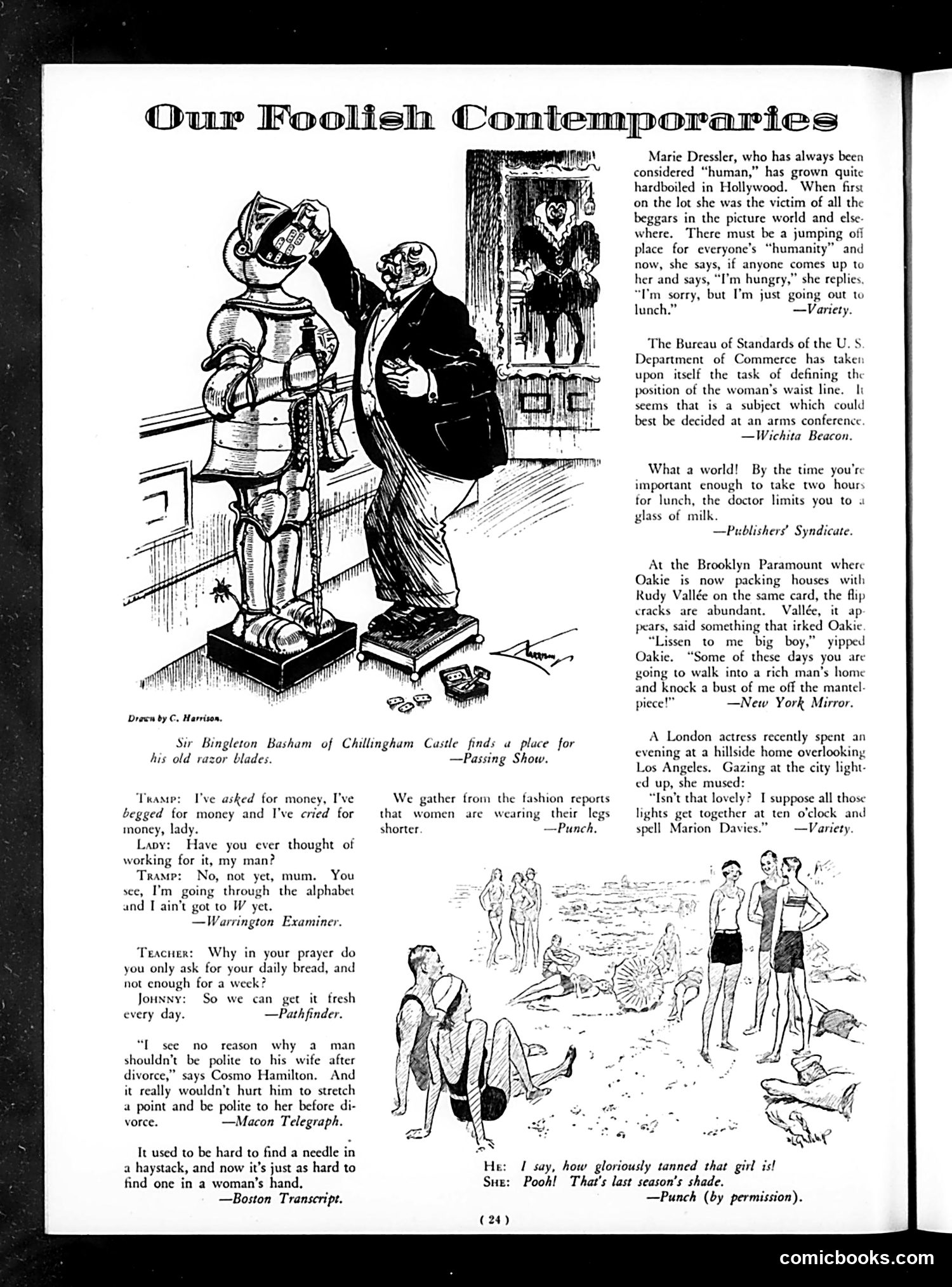
"Our Foolish Contemporaries" Analysis This is a satirical humor page from *Life* magazine featuring multiple short jokes and one cartoon. The main cartoon shows a wealthy aristocrat ("Sir Bingleton Basham") demonstrating a cruel solution to used razor blades—giving them to a tramp, suggesting the poor are disposable. The surrounding jokes mock contemporary absurdities: a tramp progressing through the alphabet before "working," a child's logical prayer logic, post-divorce politeness, women's fashion (shorter hemlines), and Hollywood economics. References include actress Marie Dressler's changed attitude toward Hollywood beggars, the U.S. Bureau of Standards debating women's waist positions, and celebrity gossip about actors Oakie and Rudy Vallée. The satire targets class indifference, social hypocrisy, fashion trends, and 1920s-30s celebrity culture—all presented as "foolish" commentary on contemporary life.
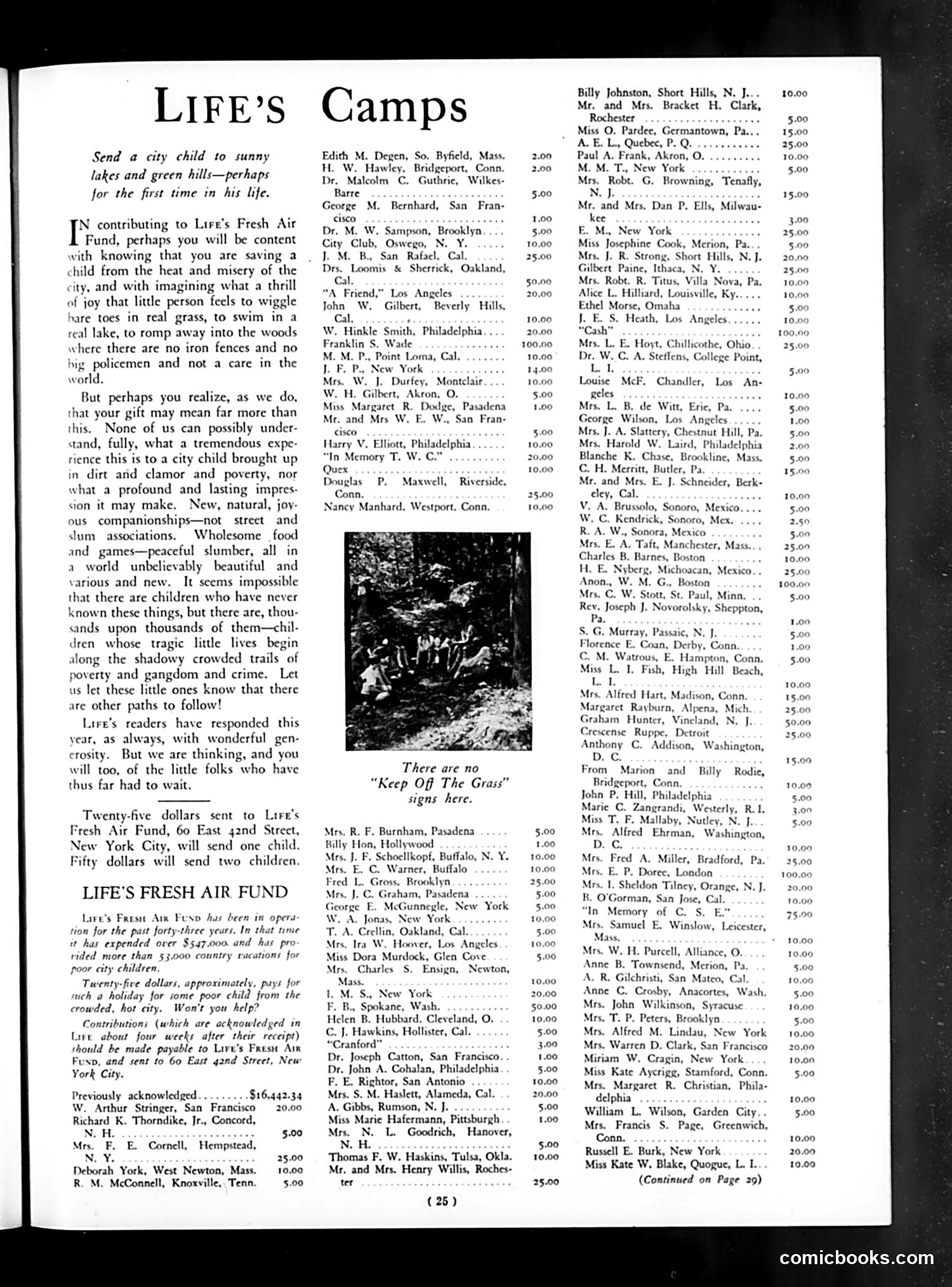
This is a fundraising page for Life magazine's Fresh Air Fund, an established charity program (operating over 43 years at time of publication) that sends poor urban children to camps and countryside vacations. The visible photograph shows children enjoying outdoor recreation—playing and laughing in nature—illustrating the campaign's central message: urban slum children deserve access to "wholesome" experiences unavailable in "crowded, hot city" environments marked by "poverty and gangdom and crime." The caption "Keep Off The Grass" signs here" underscores the appeal: in these camps, children escape rigid urban rules and restrictions to experience unstructured natural freedom. The page lists donors and contribution amounts ($5-$100), demonstrating community response. A $25 donation sends one child to camp; $50 sends two. This represents early-20th-century Progressive Era philanthropy: wealthy donors helping disadvantaged city youth through nature exposure, seen as morally reformative and spiritually uplifting—a common assumption of that era.
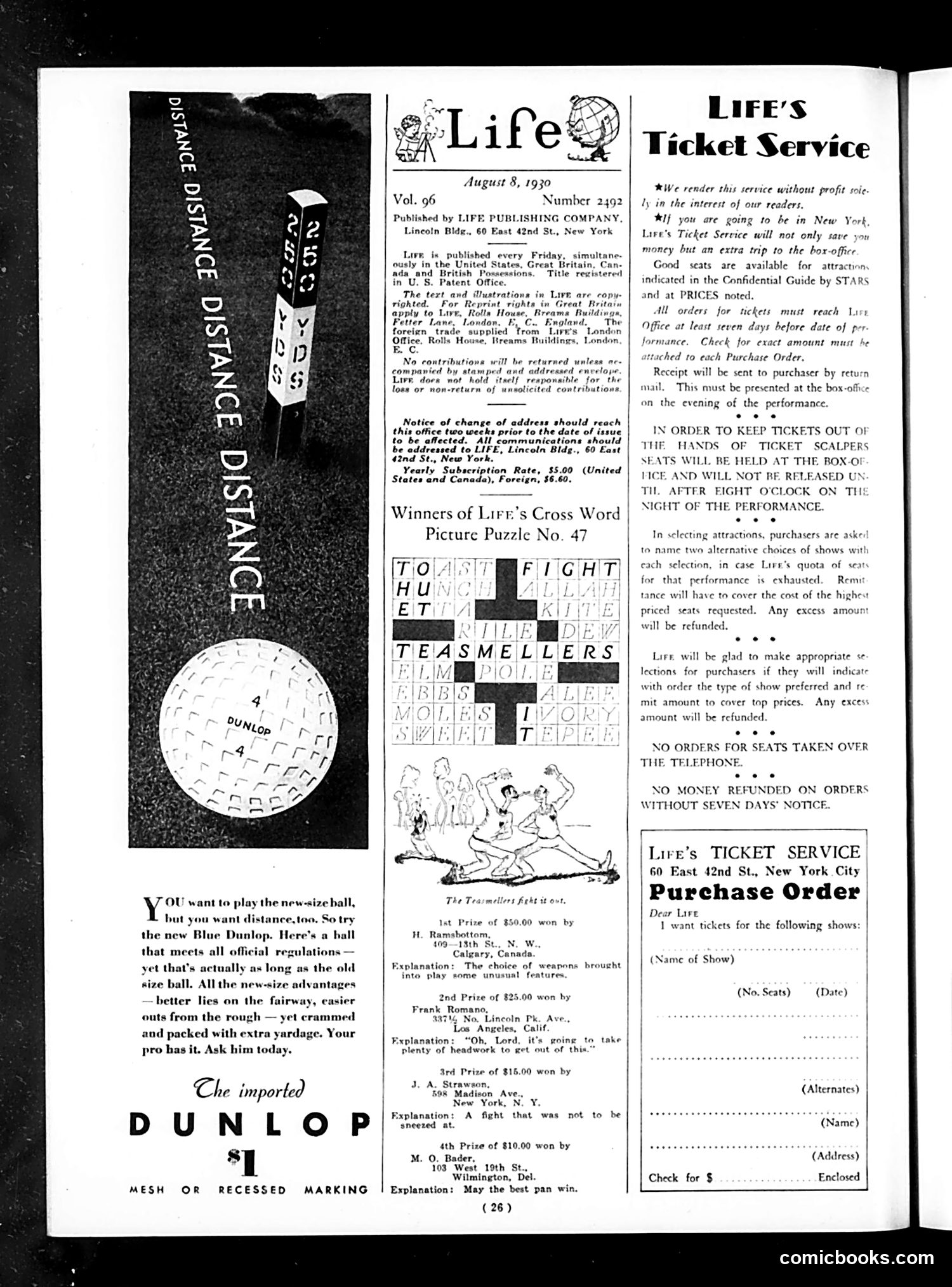
Analysis of Life Magazine Page (August 8, 1930) This page is primarily advertising and service content, not political satire. It consists of: 1. Dunlop Golf Ball Advertisement (left): Promotes a new-size golf ball claiming to meet official regulations while maintaining distance performance—appealing to golfers wanting both compliance and competitive advantage. 2. Life's Crossword Picture Puzzle: A reader contest with prize winners listed, typical of 1930s magazine engagement features. 3. Life's Ticket Service (right): A practical service offering Broadway theater tickets to readers, with detailed ordering instructions and policies (no telephone orders, seven-day cancellation notice, anti-scalper measures). The page reflects 1930 leisure culture—golf equipment marketing and theater access for affluent readers. There is no political cartoon or satirical commentary visible. The content is straightforward commercial and service-oriented, characteristic of Life magazine's business model during this period.
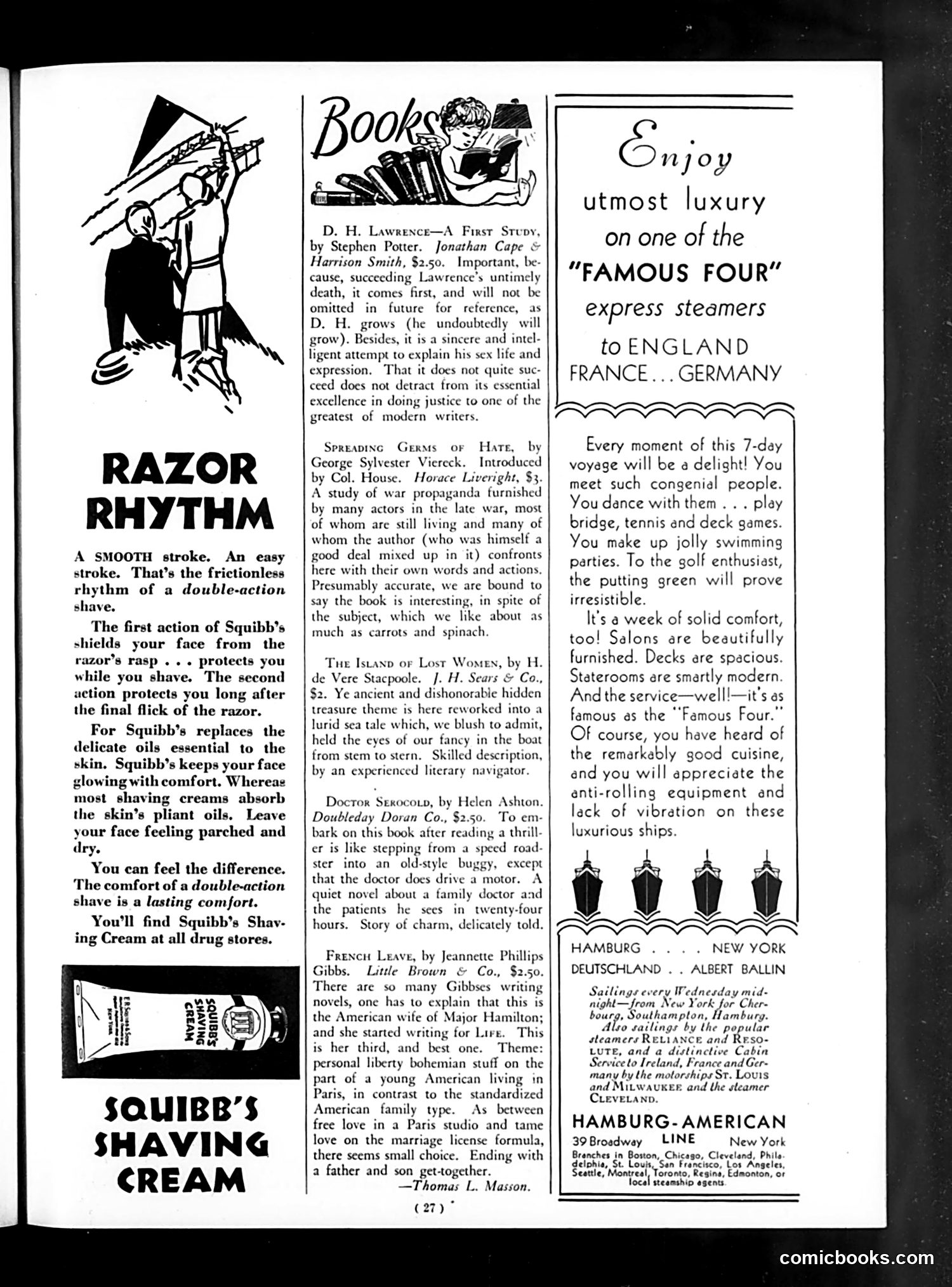
Page Analysis: Life Magazine This page is primarily advertising and book reviews, not political satire. The content is dominated by two major advertisements: Left side: A Squibb's Shaving Cream ad emphasizing the comfort of a "double-action shave" that protects skin while shaving and moisturizes afterward—marketing claims typical of 1920s cosmetics advertising. Right side: A cruise line advertisement for the "Famous Four" express steamers to England, France, and Germany, promoting luxury travel with amenities like dancing, deck games, spacious staterooms, and fine cuisine. Center: Book reviews by Thomas L. Masson covering recent literary releases, including works by D.H. Lawrence and Helen Ashton. The illustration (top left) appears to be a generic decorative figure related to the shaving product. There is no political cartoon or satire on this page—it's a straightforward commercial and cultural content page from Life magazine's advertising section.
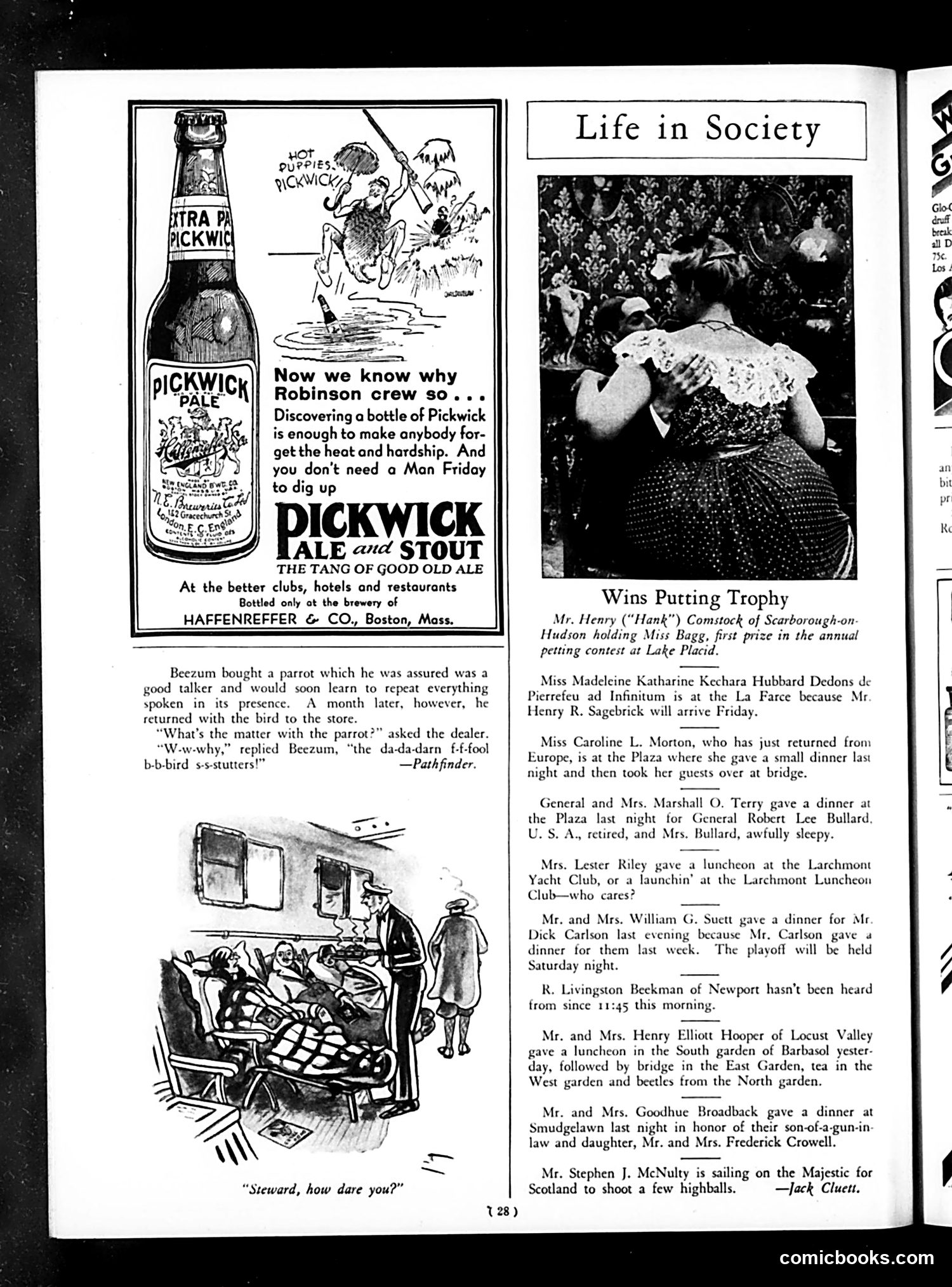
Explanation for Modern Readers This page contains two distinct sections: Left side: A Pickwick Ale advertisement referencing Robinson Crusoe—the famous castaway. The ad jokes that discovering beer is enough to make anyone forget hardship, playing on Crusoe's isolation. Below is a brief joke about a stuttering parrot, unrelated to the ad. Right side: "Life in Society" is a satirical gossip column mocking upper-class social rituals. The humor lies in absurdist exaggeration: endless formal dinners where guests reciprocate invitations (Suett gives dinner for Carlson because Carlson gave one first), deliberately ridiculous names ("Miss Bagg" winning a "petting contest"), and deadpan observations ("awfully sleepy"). The final joke about McNulty "shooting highballs" in Scotland is a euphemism for drinking. The photograph shows a "putting trophy" winner at Lake Placid—the caption's crude double-entendre about "petting" and "Miss Bagg" emphasizes the column's irreverent tone toward wealthy socialites.
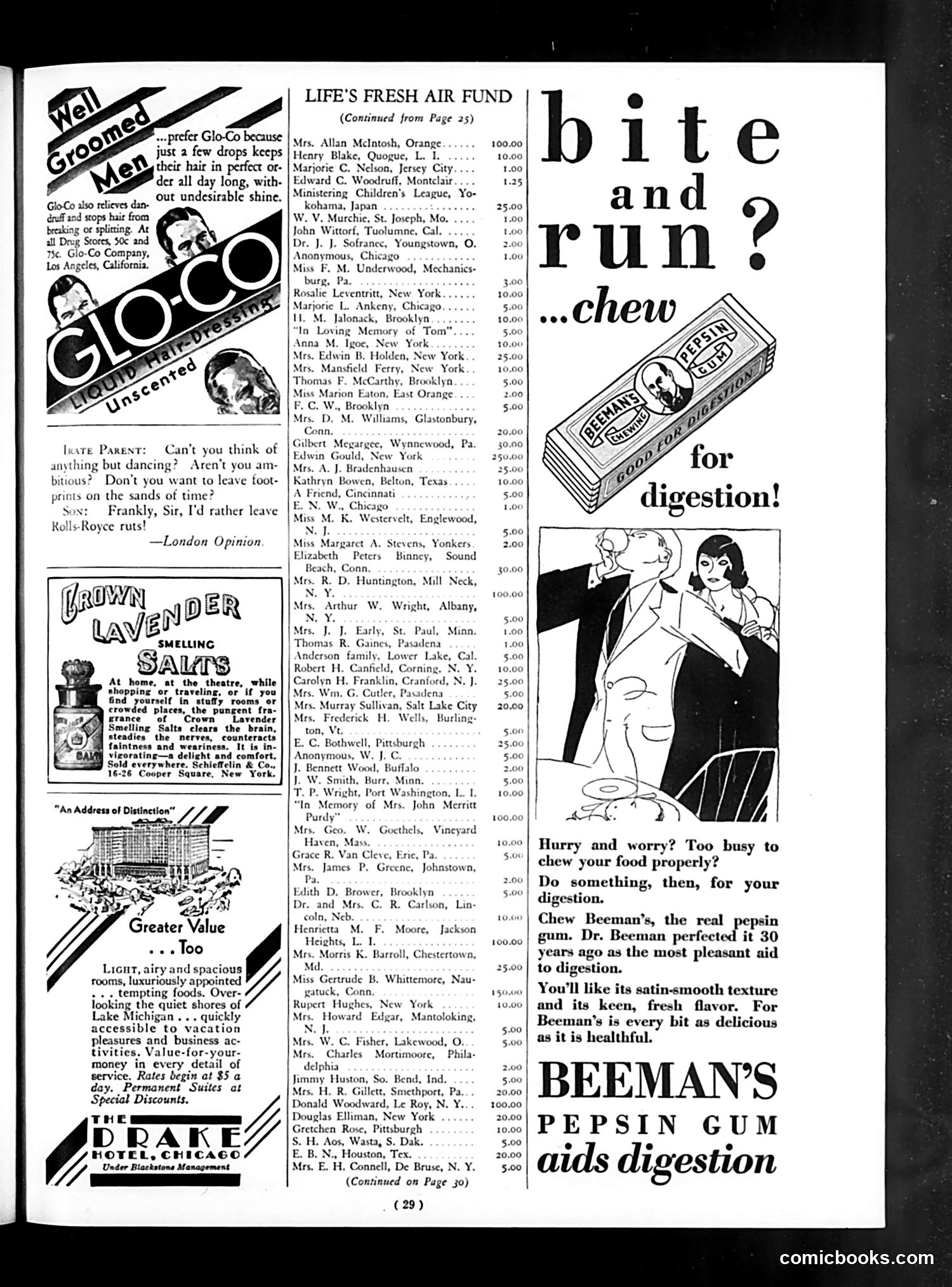
Life Magazine Page Analysis This page is primarily advertising and charity listings, not political satire. The left side contains ads for grooming products (Glo-Co hair product), a humor piece about parental expectations (a "skate parent" wanting their child ambitious, the child preferring Rolls-Royce—a joke about wealth versus ambition), and ads for Brown Lavender Smelling Salts and the Drake Hotel in Chicago. The main right side advertises Beeman's Pepsin Gum, marketed as an aid to digestion. The ad depicts a couple where the woman chews gum while the man appears stressed—the pitch being that busy people should chew gum instead of properly eating. It claims the gum, "perfected 30 years ago," aids digestion through satin-smooth texture and fresh flavor. The center is the "Life's Fresh Air Fund"—a charitable listing of donors (with contribution amounts) supporting outdoor recreation for children, reflecting Progressive-era philanthropy. No significant political cartoons or satire appear on this page.
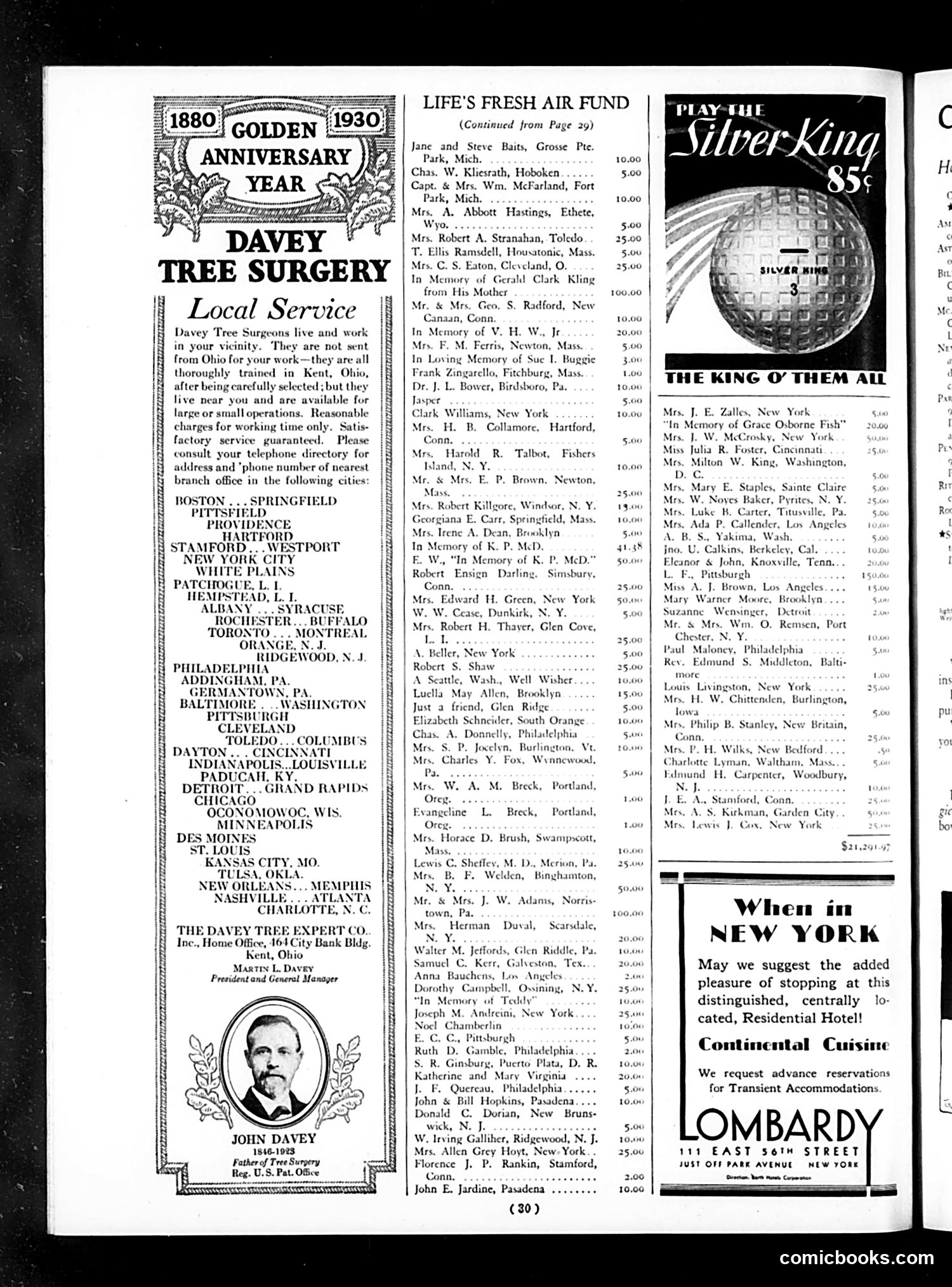
Analysis of Page 30 Content This page is primarily advertising and fundraising, not satirical content. The left column features a Davey Tree Surgery advertisement commemorating the company's 50th anniversary (1880-1930). It includes a portrait of founder John Davey (1846-1923) and lists branch offices nationwide. The ad emphasizes local service and trained personnel. The center and right columns contain the "Life's Fresh Air Fund" continuation—a charitable fundraising list of donors and their contributions to send underprivileged children to the countryside. Names are listed with hometowns and donation amounts (ranging from $1 to $100). The far right features an advertisement for "Silver King" (appears to be a product, possibly a ball or sporting equipment) priced at 85 cents, and a separate Lombardy Hotel advertisement for New York accommodations. No political satire or cartoon content appears on this page. It reflects 1930 American philanthropic and commercial culture.
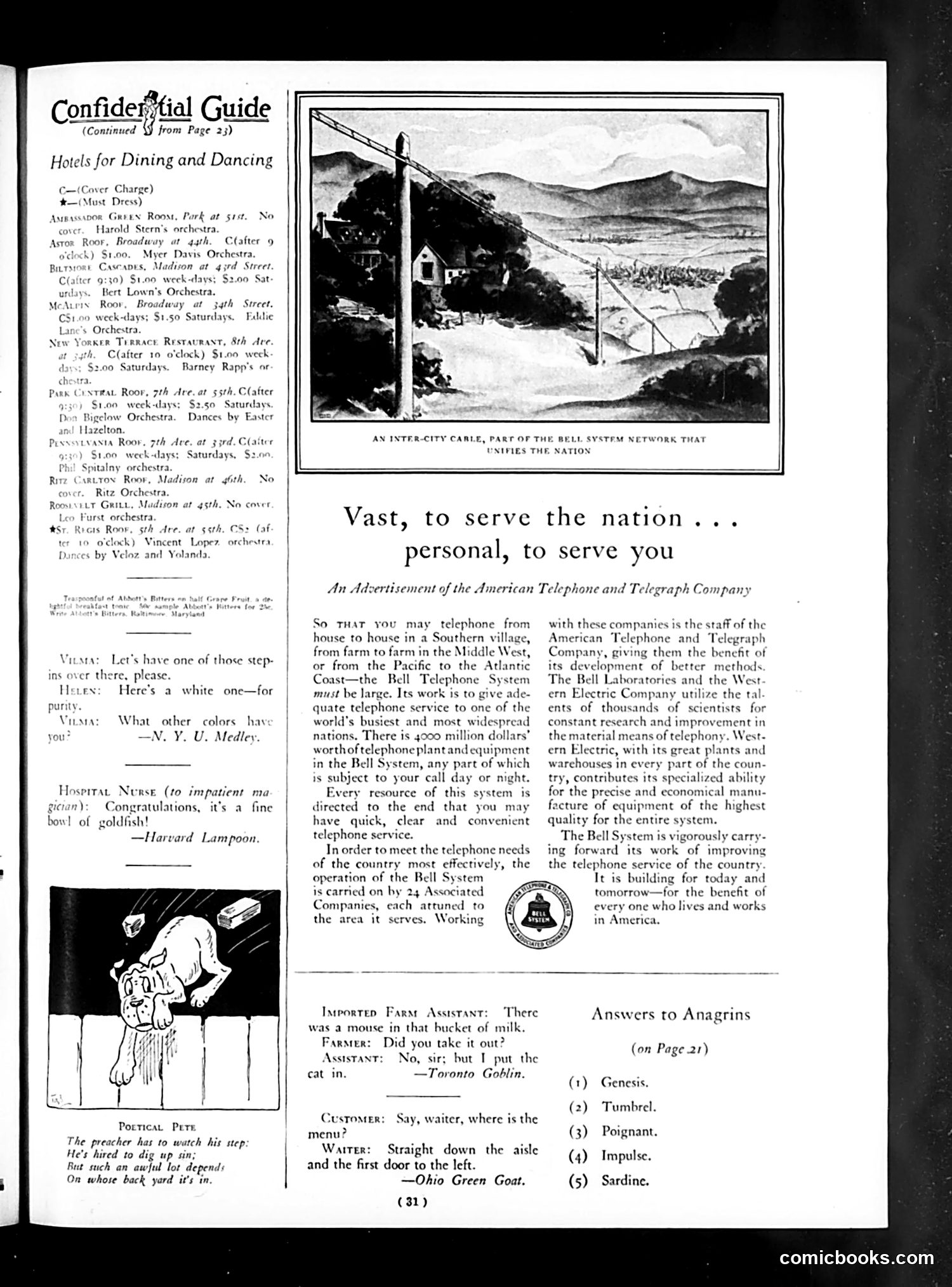
Cartoon Analysis This page contains several brief humorous jokes rather than political cartoons: 1. "Confidential Guide" jokes: Small gags about dating and social etiquette. One involves a man asking to see different colors of "step-ins" (women's undergarments)—mildly risqué for the era. 2. "Political Pete": A brief satirical poem about preachers who expose sin ("dig up") but must be careful whose property they offend—commentary on how religious moralizing is selective based on social power. 3. Other jokes: Including one about a hospital nurse, and restaurant/farm humor. The page is predominantly an AT&T advertisement celebrating the Bell Telephone System's scope and infrastructure as serving the entire nation. The ad emphasizes technological progress and corporate benevolence—typical 1920s corporate messaging. The cartoons are mild period humor; the real content is the corporate propaganda celebrating American telephone monopoly infrastructure as a national achievement.
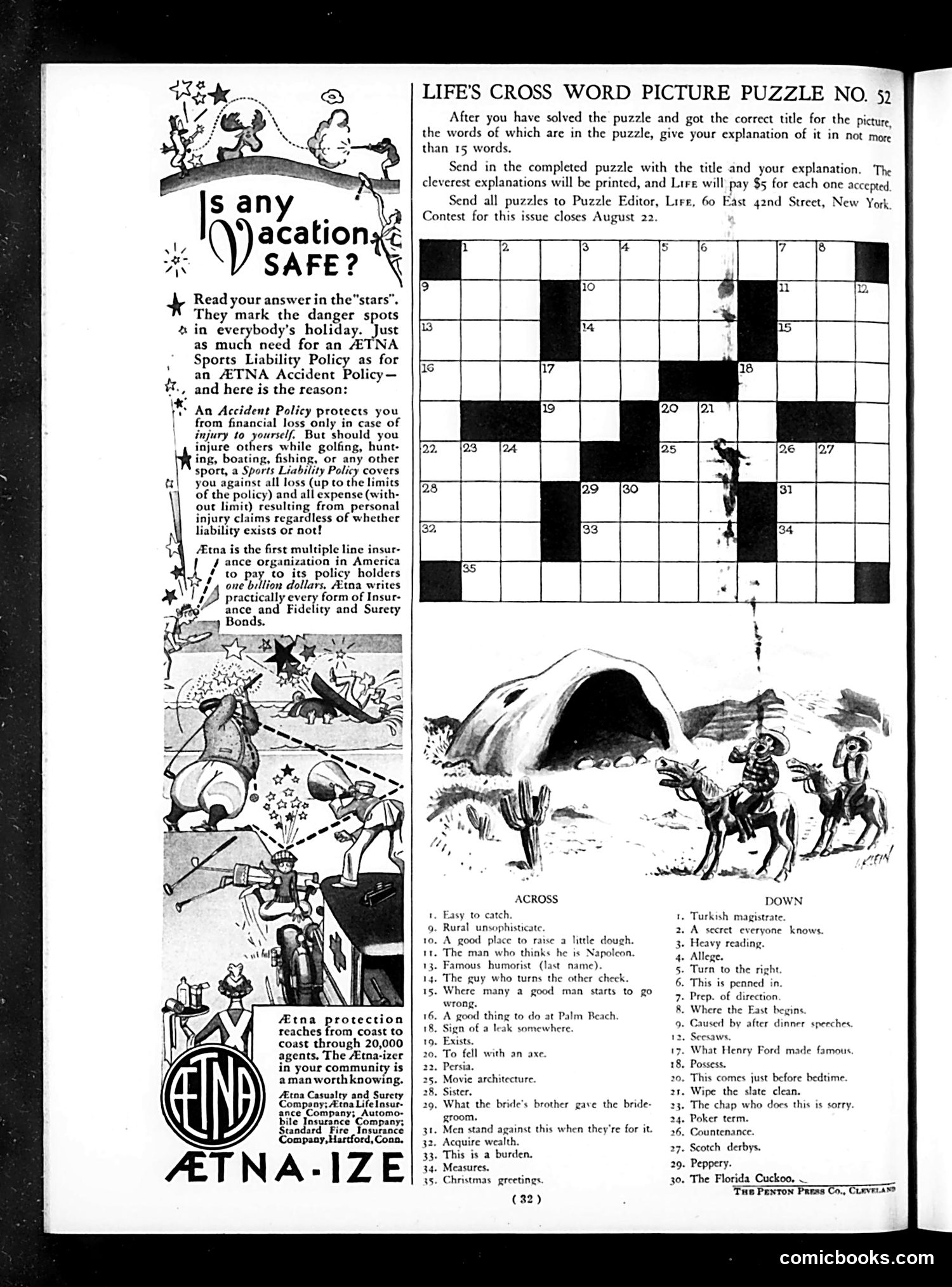
Life Magazine Crossword Puzzle Advertisement (circa 1920s) This page combines a crossword puzzle contest with an insurance advertisement. The puzzle itself appears standard for the era—solvers fill in clues to discover a hidden picture title, then submit explanations for a $5 prize. However, the advertisement dominates: AETNA Insurance uses the puzzle's "danger spots" theme (marked by stars in the image) to promote their Sports Liability Policy. The pitch emphasizes that standard accident policies only cover injury to the policyholder, but sports liability protects against claims from *others* injured during activities like golfing, hunting, and fishing. The ad's humor stems from a modern reader's perspective: it presents personal injury litigation over recreational activities as a routine concern requiring insurance. AETNA positions itself as the trustworthy insurer, claiming to be "the first multiple line insurance organization in America" and noting their reach through 20,000 agents nationwide. The accompanying cartoon illustrations humorously depict vacation hazards—swimming, boating, and desert activities—reinforcing the need for coverage during leisure time.
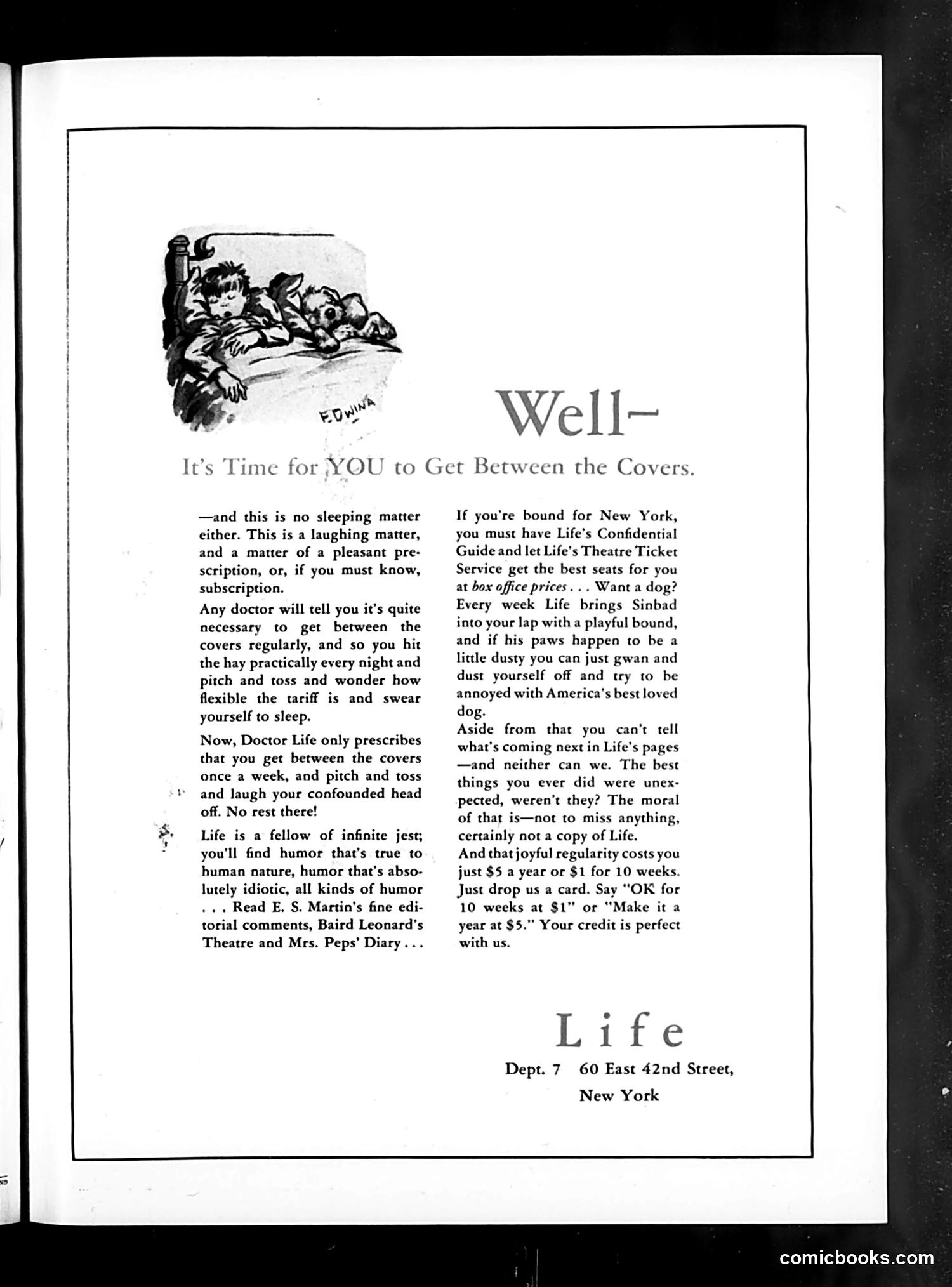
Life Magazine Subscription Advertisement This is a subscription advertisement for *Life* magazine, using a clever double entendre. The headline "Get Between the Covers" plays on the phrase's dual meaning—both literally (reading a magazine) and the common expression about sleep. The ad employs humorous, pseudo-medical language, presenting regular *Life* reading as a doctor's prescription for laughs. It promises humor "true to human nature" alongside "absolutely idiotic" content, citing regular columnists like E.S. Martin and features like "Mrs. Peps' Diary" and a recurring character named Sinbad (apparently a dog). The ad also mentions *Life's* practical services: a New York confidential guide and theater ticket booking at box-office prices—appealing to urban readers. The pricing is straightforward: $5 annually or $1 for 10 weeks. The tone is lighthearted, treating magazine subscription as essential weekly entertainment for middle-class readers seeking reliable humor and cultural commentary.
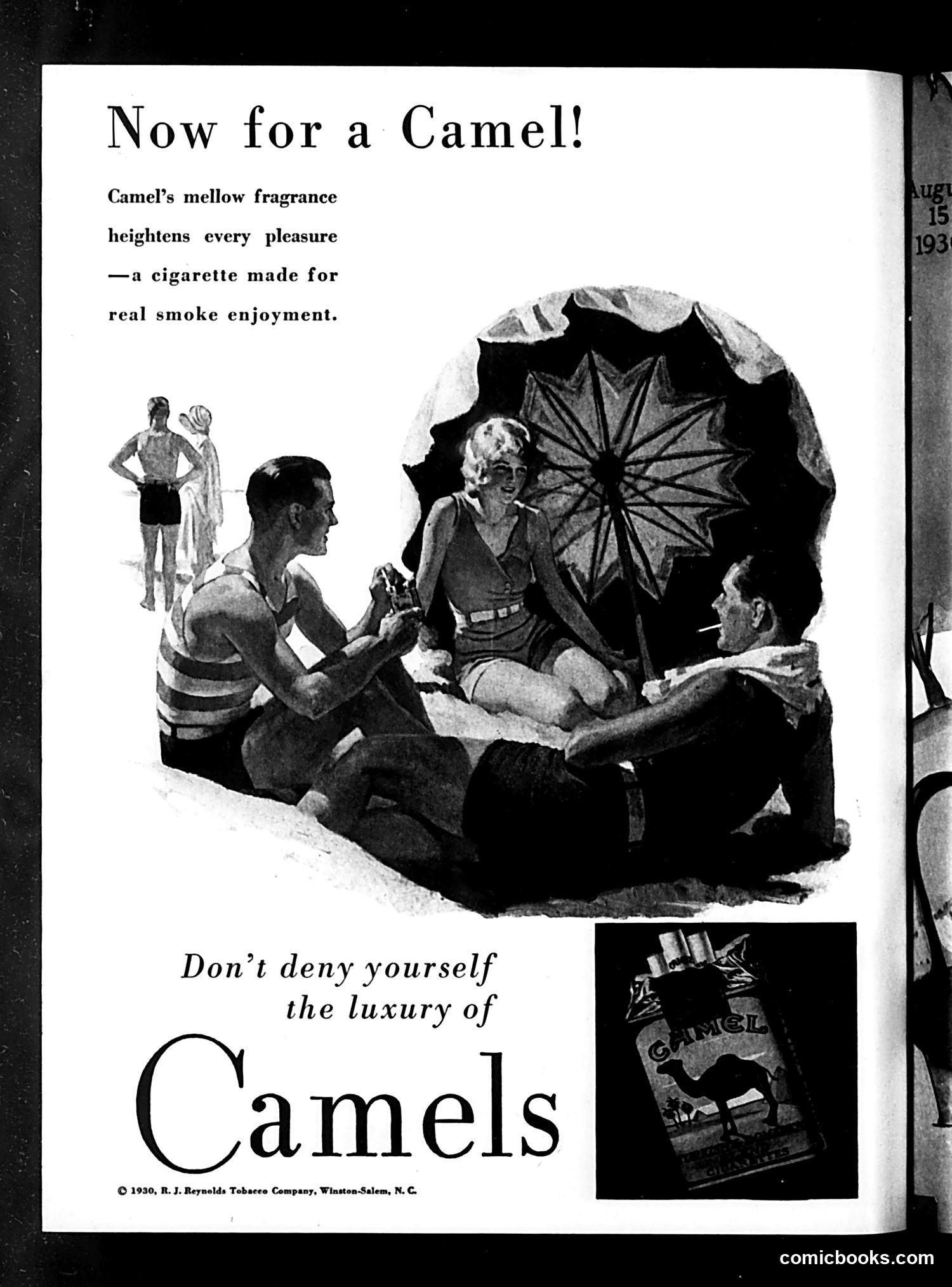
This is a cigarette advertisement, not satire or political commentary. The 1930 Camel ad depicts a beach leisure scene where people relax under an umbrella, promoting smoking as a luxury pleasure activity. The tagline "Don't deny yourself the luxury of Camels" frames cigarettes as an aspirational consumer good. What's notable to modern readers: this openly advertises cigarettes as a desirable lifestyle product, emphasizing leisure and enjoyment without any health warnings—standard for pre-regulation advertising. The ad targets middle-class consumers by associating smoking with relaxation and social pleasure at the beach. The copyright credit to R.J. Reynolds Tobacco Company is prominently displayed. This represents advertising practices that would later face restrictions as tobacco's health dangers became scientifically established.