life
Life — August 15, 1930
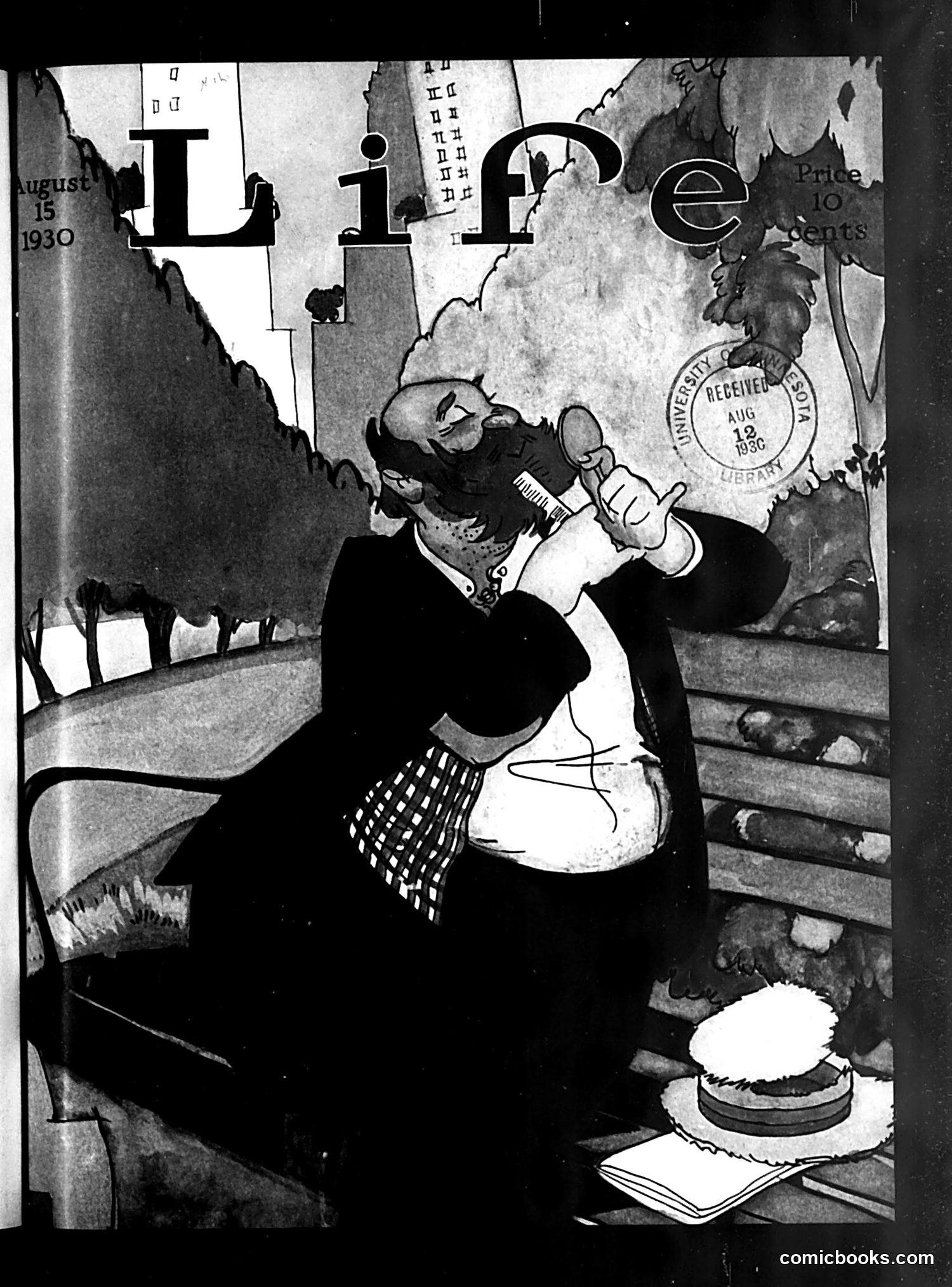
Life Magazine Cover - August 15, 1930 This appears to be a Life magazine cover from August 1930 featuring a caricatured figure in formal black attire with an exaggerated facial expression, depicted smoking or drinking something. The figure is shown in an interior setting with a map of the United States visible in the background and rural/agricultural imagery. The specific satirical target and context remain unclear without additional text or identifying labels on the cover itself. The caricature's style and the agricultural backdrop suggest commentary on American politics or society during the early Depression era, but I cannot definitively identify the figure or the precise point of satire based solely on what's visible in the image.
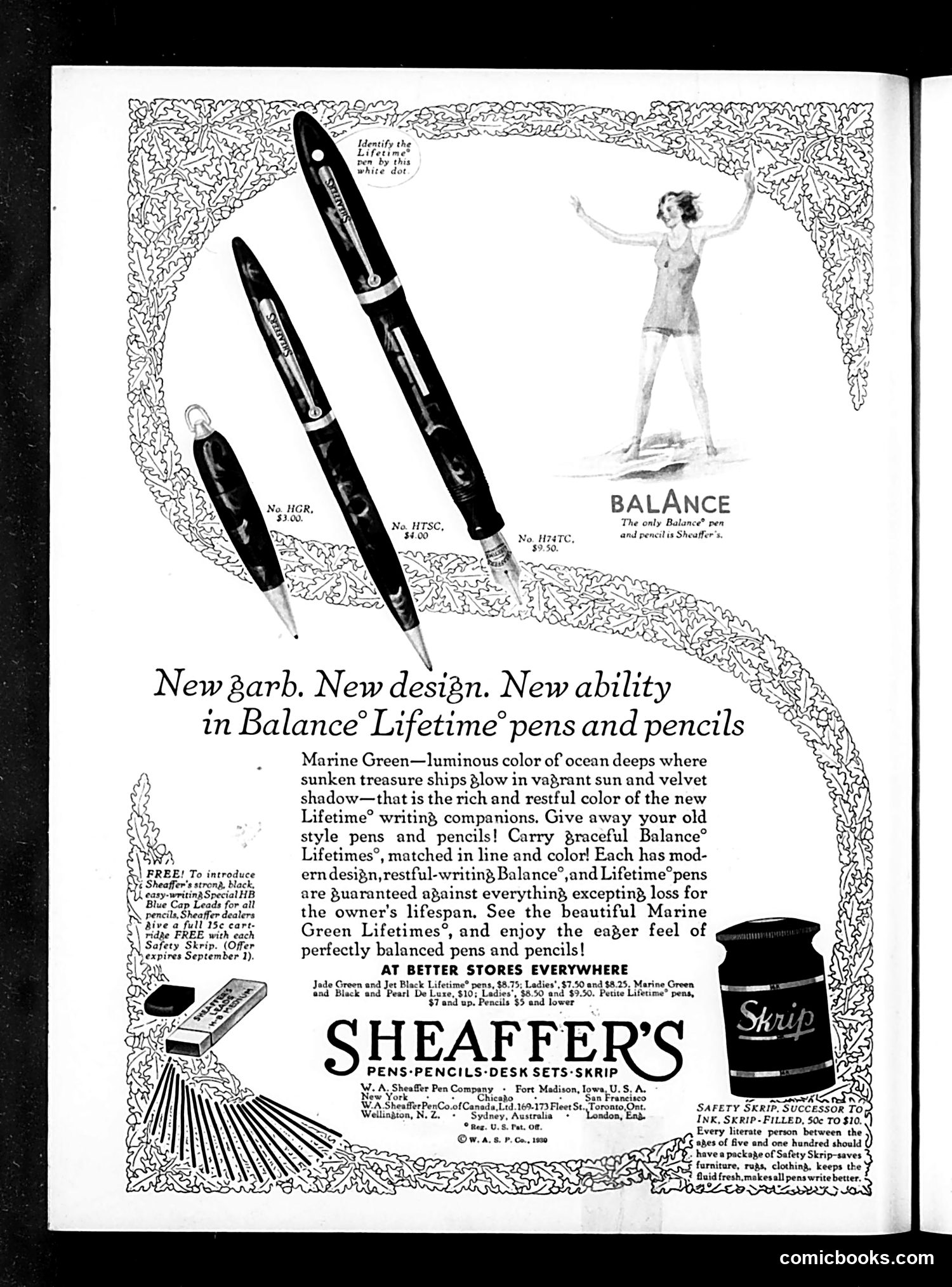
Analysis This page is primarily an advertisement, not a political cartoon. It promotes Sheaffer's Balance Lifetime pens and pencils. The main visual content shows three writing instruments displayed alongside an illustration of a woman in a short dress striking a balanced pose on one leg, labeled "BALANCE." This is the brand's marketing concept—the pens are named "Balance" and the ad emphasizes their superior design and writing quality. The imagery reflects 1920s advertising aesthetics: the stylized female figure was typical of the era's commercial art, used to convey modernity and elegance. The decorative border and typography are period-appropriate. There is no political satire or social commentary present. This is straightforward product marketing highlighting new pen designs and promoting consumer adoption through beauty and functionality claims.
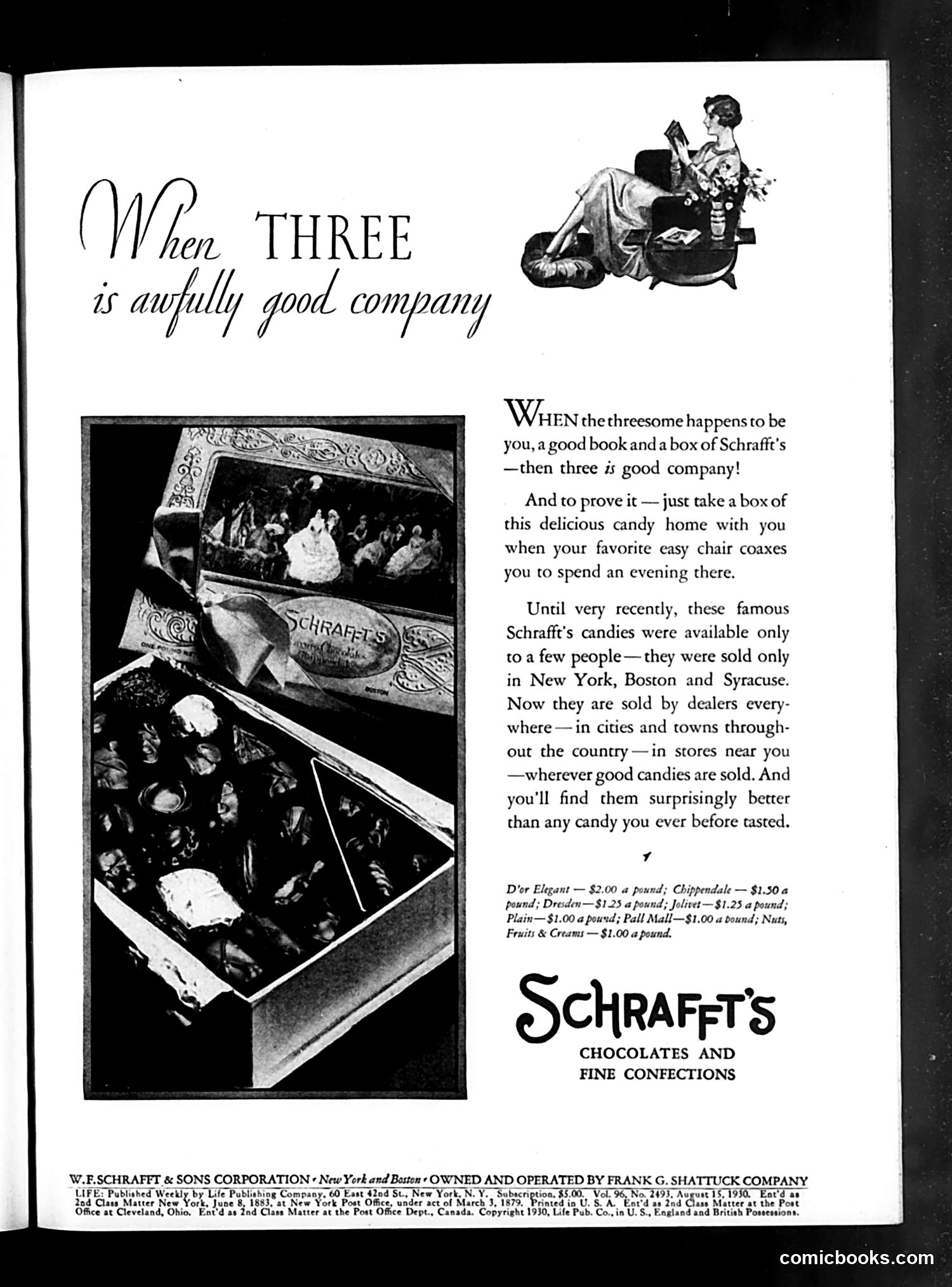
Analysis This is a Schrafft's chocolate advertisement, not political satire. The page promotes Schrafft's candies and fine confections through the phrase "When THREE is awfully good company." The visual shows an elegantly dressed woman reclining in a chair, reading while holding Schrafft's chocolates—suggesting that a book, a comfortable chair, and a box of their candy constitute perfect companionship for an evening at home. The ad notes that Schrafft's candies were historically available only in New York, Boston, and Syracuse, but are now distributed nationwide. Various varieties are listed with prices (ranging from $1.00–$2.00 per pound). This is straightforward consumer advertising targeting middle-to-upper-class readers, emphasizing leisure, refinement, and domestic comfort during what appears to be the early 20th century.
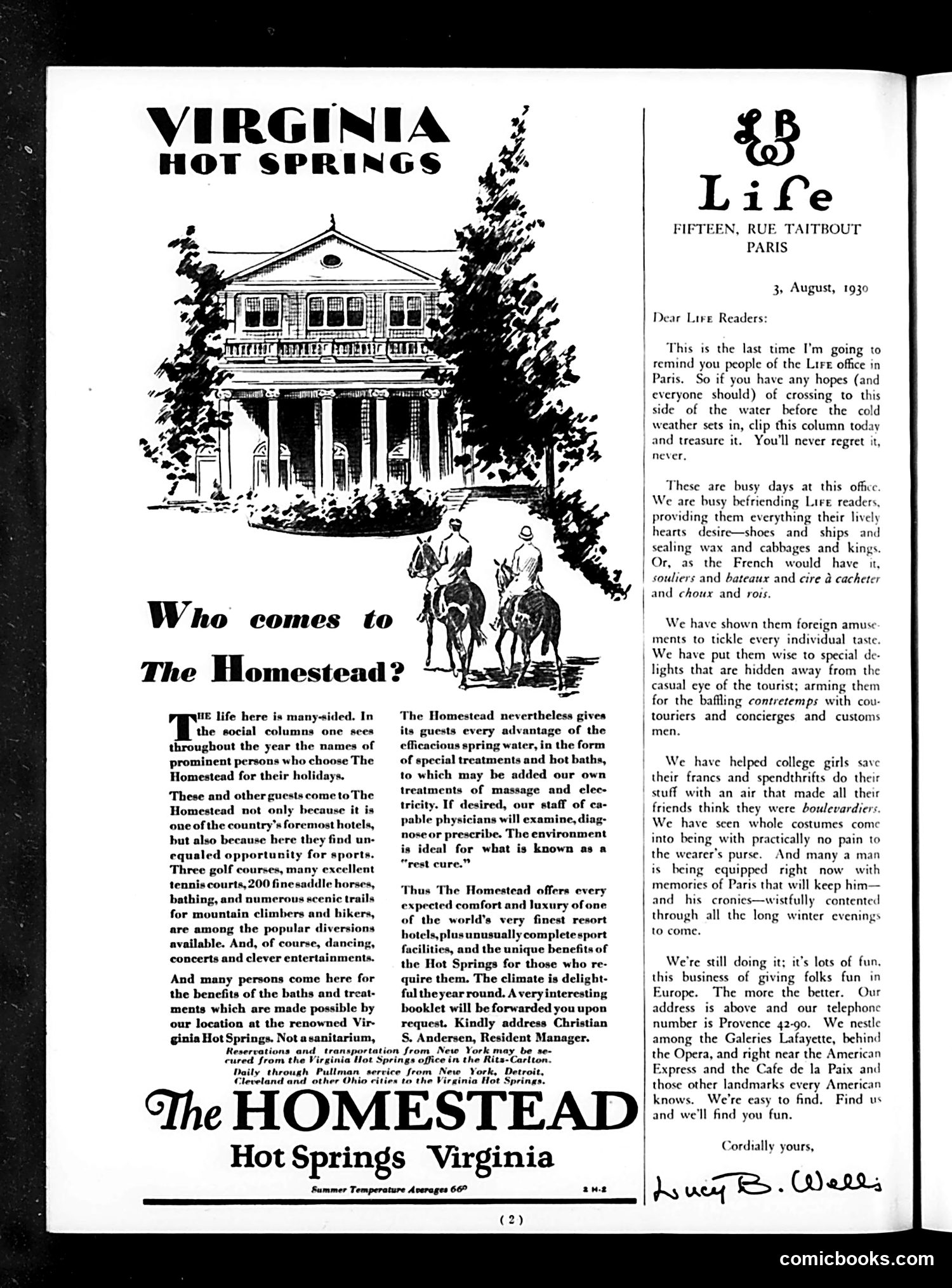
Virginia Hot Springs Advertisement This page is primarily a travel advertisement for The Homestead resort in Hot Springs, Virginia, not political satire. The left side features an illustration of an elegant neoclassical building (the resort's main structure) with well-dressed guests on horseback approaching it. The accompanying text describes the resort's amenities: hot spring waters, golf courses, horseback riding, concerts, and entertainments. The right side contains a letter from Life's Paris office (dated August 3, 1936) discussing the magazine's work entertaining Life readers in Europe—helping them find shoes, ships, amusements, and cultural experiences. There is no political cartoon or satire on this page. It is straightforward promotional content paired with organizational correspondence from the magazine's European bureau.
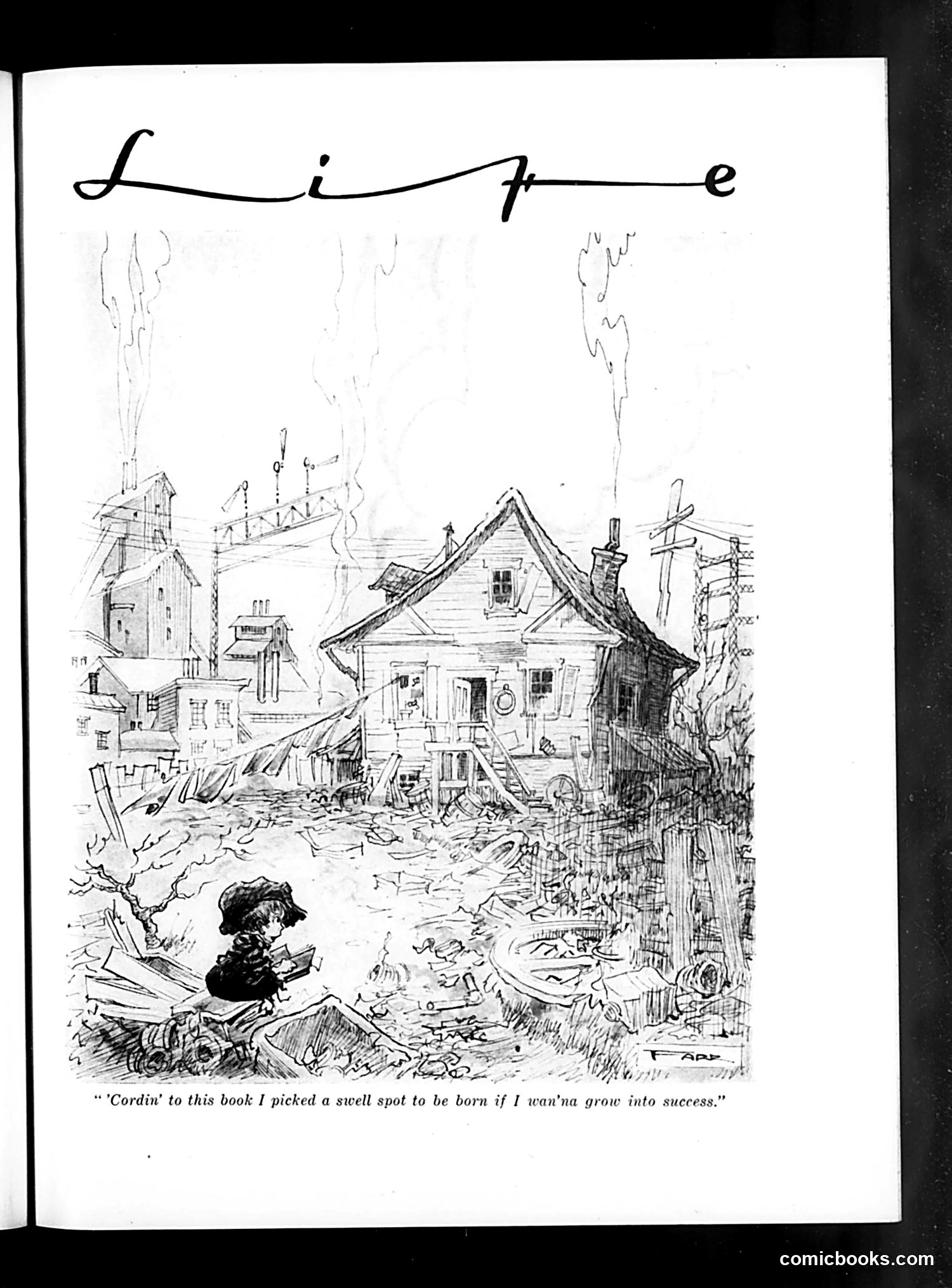
Analysis This page from *Life* magazine presents a single illustration titled "Life" at the top. The drawing depicts a child sitting in a dilapidated, run-down neighborhood amid debris and broken buildings. The caption reads: "'Cordin' to this book I picked a swell spot to be born if I wan'na grow into success." The satire is bitter social commentary on American wealth mythology. The child's dialect-heavy speech suggests a poor, likely immigrant background. The irony is sharp: despite popular narratives claiming America rewards hard work and merit, this child was born into squalor—a "swell spot" only in cruel mockery. The illustration contrasts the child's innocent ambition with the grim reality of urban poverty, questioning whether success is truly achievable from such circumstances or merely promised by false ideologies.
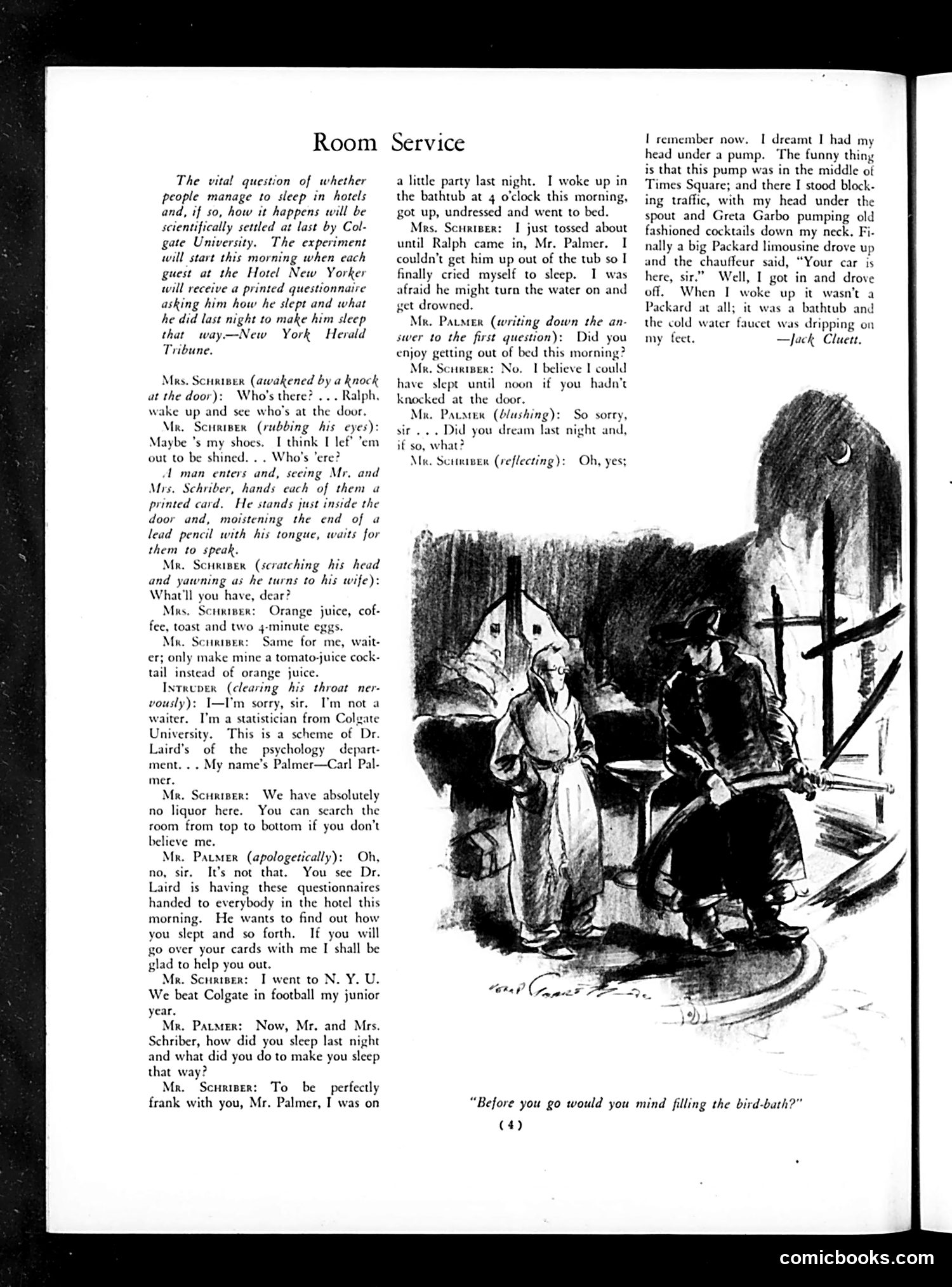
"Room Service" - Life Magazine Satire This is a comedic sketch about hotel accommodations and sleep difficulties. The dialogue presents Mr. and Mrs. Schriber being interviewed by Mr. Palmer, apparently conducting a psychology experiment for Colgate University about how hotel guests sleep. The humor centers on domestic absurdity: Mrs. Schriber complains her husband nearly drowned in the bathtub at 4 a.m., while Mr. Palmer offers increasingly ridiculous dream-analysis questions. The accompanying illustration shows a woman near a bird bath, with the caption "Before you go would you mind filling the bird-bath?" suggesting confusion between hotel amenities. The satire mocks both the pretensions of early psychology departments conducting dubious "scientific" studies and the chaos of hotel living.
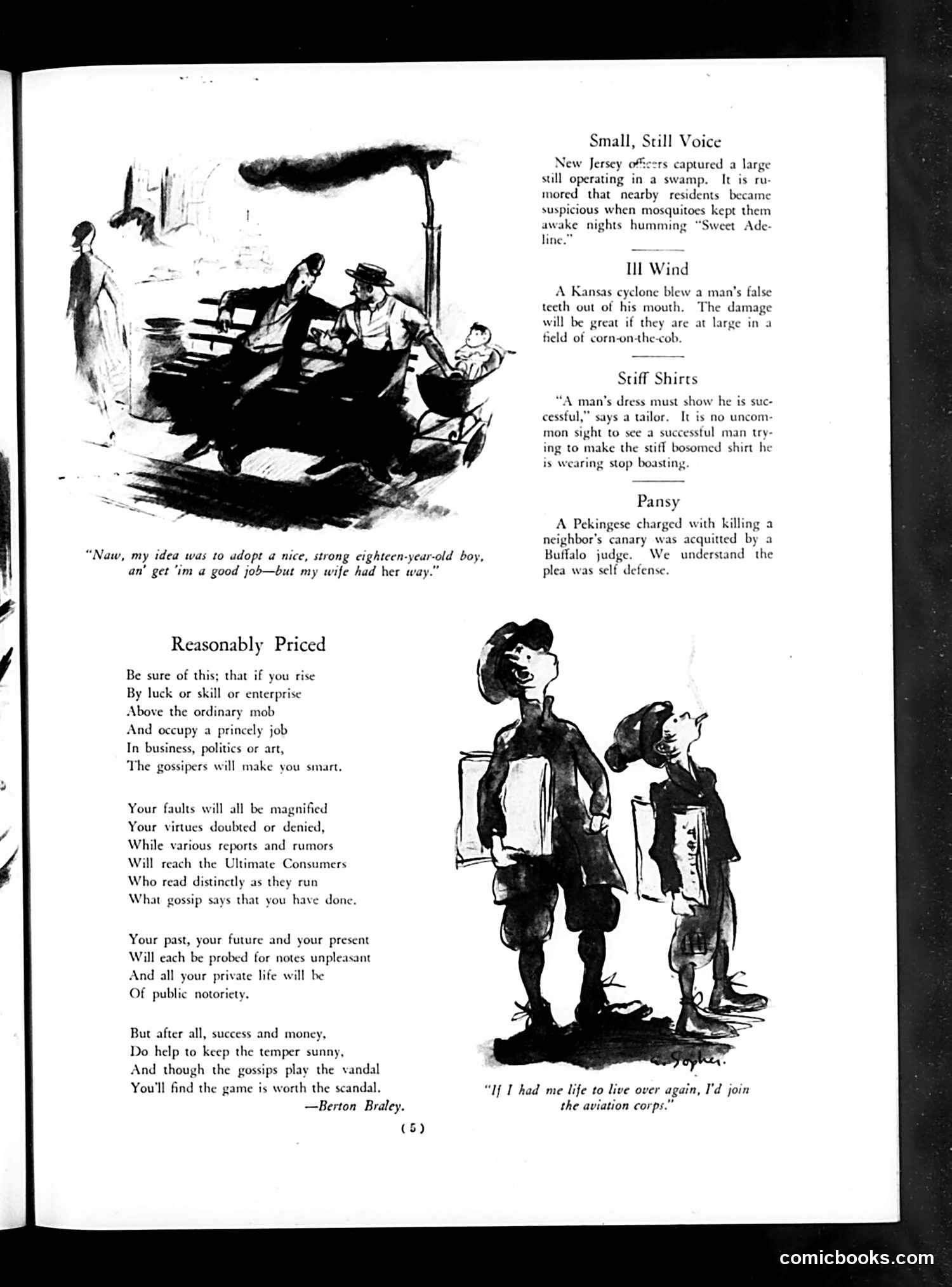
Analysis of Life Magazine Page This page contains satirical news items and a poem about success and gossip. The top section presents humorous brief anecdotes: - "Small, Still Voice": Mocks a New Jersey still (illegal alcohol production during Prohibition) operating in a swamp, where residents grew suspicious hearing mosquitoes humming "Sweet Adeline." - "Ill Wind": A Kansas cyclone blew out a man's false teeth—the joke being the damage would be worse if he owned corn-on-the-cob. - "Stiff Shirts" and "Pansy": Legal/social commentary on dress codes and a Pekinese dog acquitted of killing a canary. The main poem "Reasonably Priced" (by Berton Braley) satirizes how success brings magnified scrutiny: your faults are exaggerated, rumors spread, and gossip follows. The cartoon shows two well-dressed figures, one saying he'd join the aviation corps if he could live over.
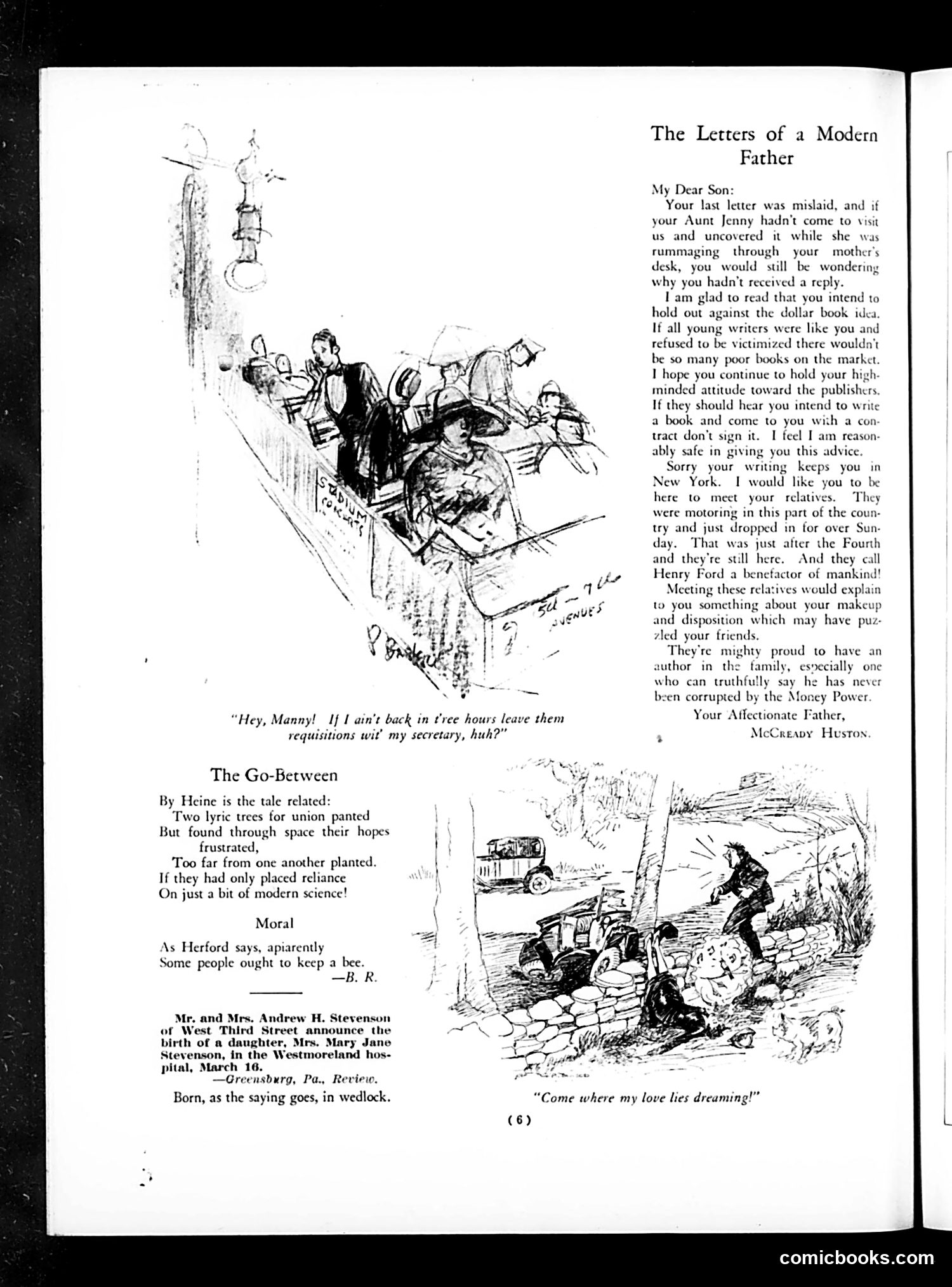
Analysis of Life Magazine Page This page contains a letter from father McCready Huston to his son about writing and publishing, alongside two unrelated satirical pieces. The top illustration depicts a chaotic office scene with the caption about "requisitions" and a secretary, likely satirizing bureaucratic inefficiency or corporate absurdity—a common Life magazine theme. "The Go-Between" is a brief poem by Heine about two trees seeking union through "modern science," with a moral suggesting people should rely on practical solutions (keeping a bee) rather than complex ones. The accompanying illustration shows a car accident or breakdown scene, reinforcing the ironic message. The page concludes with a birth announcement, a standard magazine feature. The overall tone is early-20th-century American satirical humor targeting corporate culture and misplaced faith in technological solutions.
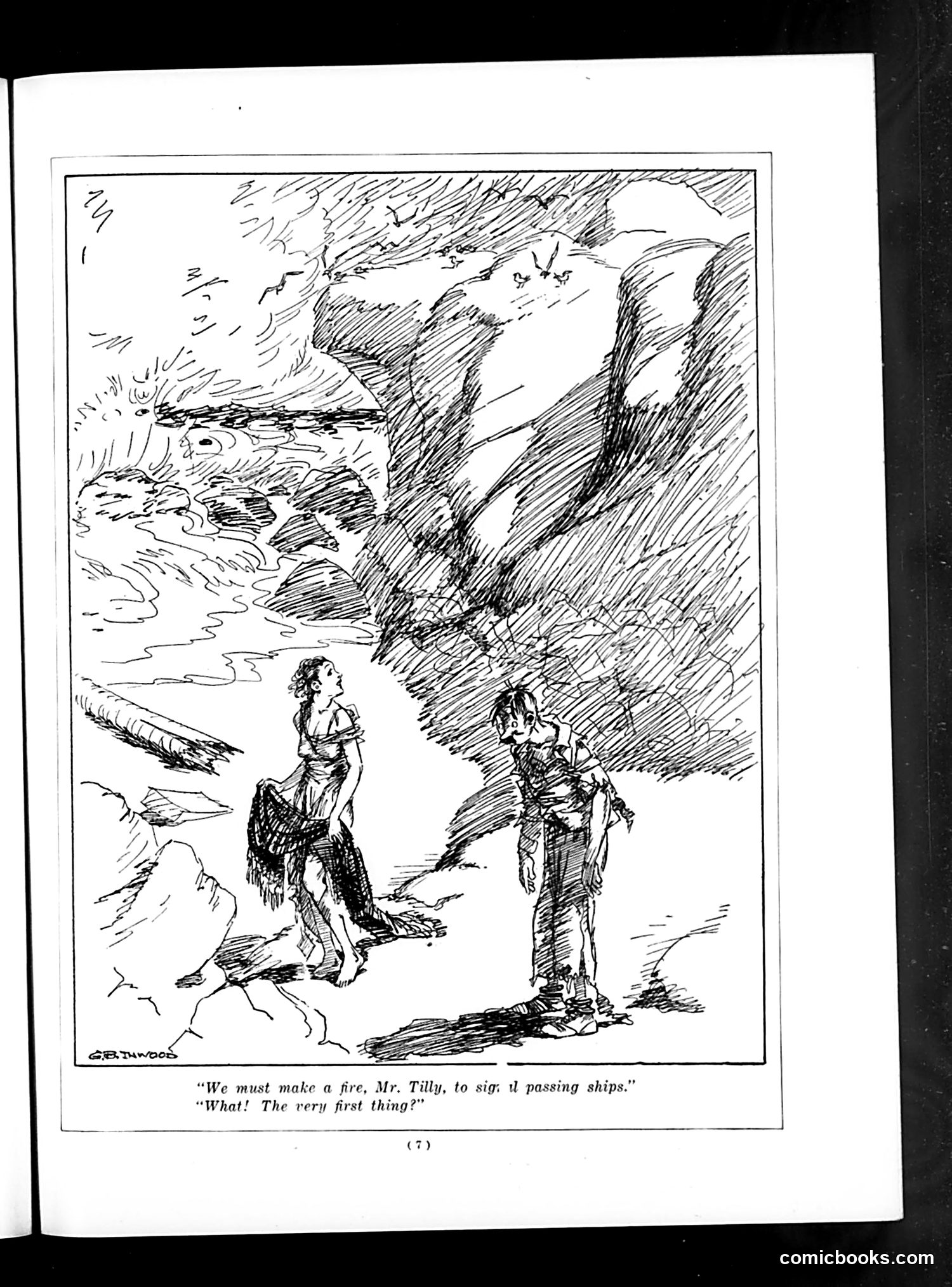
Cartoon Analysis This single-panel cartoon depicts two people on a rocky beach or shore beneath tall cliffs. One figure (appearing to be a woman in a dress) suggests to the other (a man labeled "Mr. Tilly"): "We must make a fire, Mr. Tilly, to signal passing ships." The man's response—"What! The very first thing?"—suggests he's either shocked or has different priorities in their apparent survival situation. The joke appears to satirize gender relations or courtship norms of the era, implying the man interprets the woman's suggestion as forward or inappropriate rather than as a practical survival measure. The cartoon plays on miscommunication or differing social expectations between the sexes in this isolated predicament. The artist's signature reads "G.B. Tutwood" or similar.
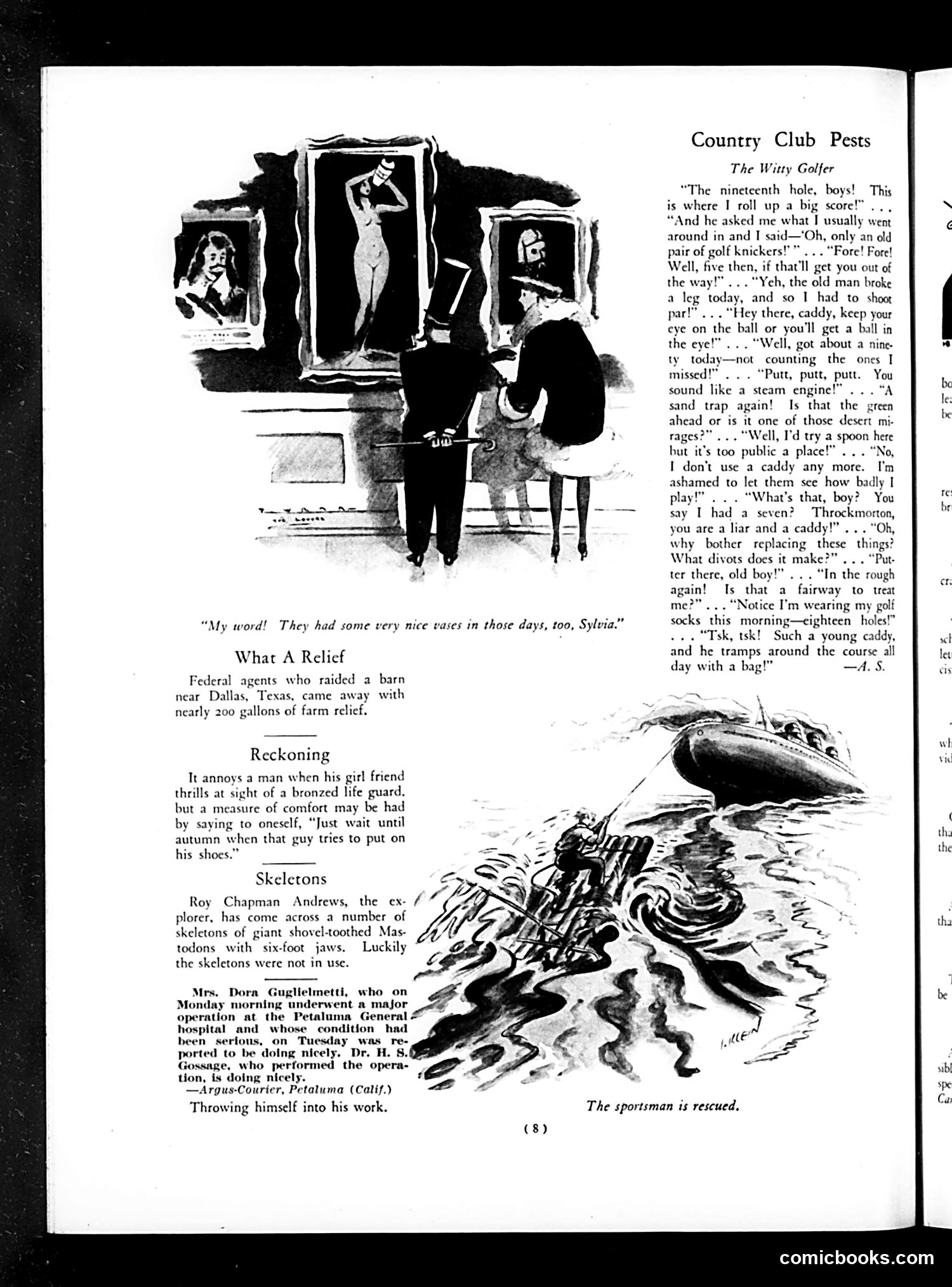
"Country Club Pests" - The Witty Golfer This page satirizes social dynamics at country clubs through golf humor. The main cartoon shows a woman looking at framed pictures on a wall while a man speaks to her, with the caption "My word! They had some very nice views in those days, too, Sylvia." The right column presents "The Witty Golfer" — a monologue mocking an irritating golfer who constantly makes bad jokes and comments during play. The repeated quoted snippets capture the tedious, unfunny banter: puns about "fore," steam engines, sand traps, and golf socks. The satire targets the type of club member who ruins others' enjoyment through constant, forced jocularity and poor sportsmanship — complaining about scores, caddy performance, and his own appearance while pestering fellow golfers.
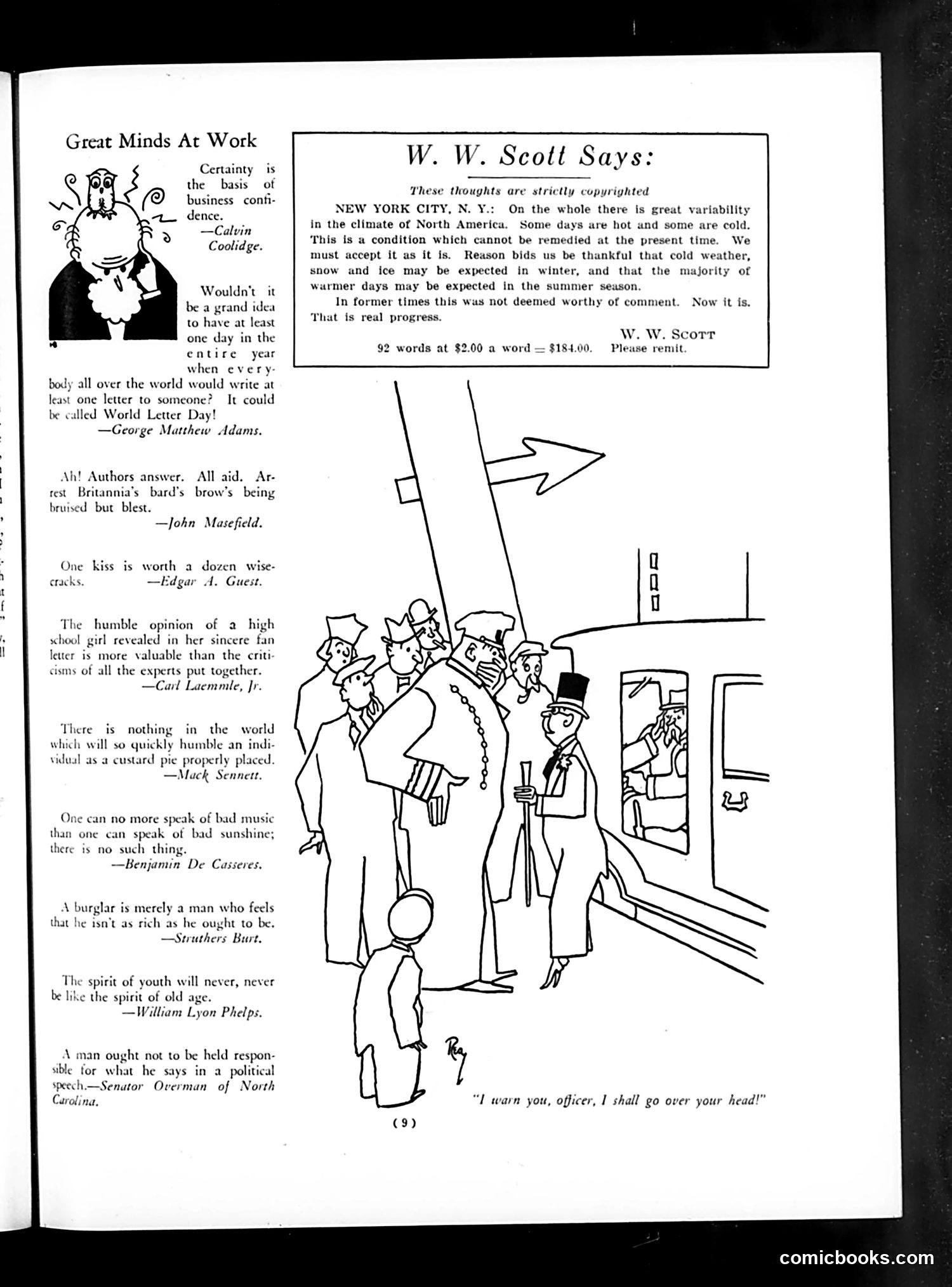
Analysis This page contains a "Great Minds at Work" column of humorous quotations attributed to famous figures, plus one cartoon illustration. The cartoon depicts what appears to be a police officer confronting a group of men entering or exiting a building (possibly a speakeasy, based on the furtive nature and the era). The officer warns, "I warn you, officer, I shall go over your head!" — suggesting someone threatening to use political influence to avoid arrest. This likely satirizes Prohibition-era corruption, where wealthy or politically connected individuals could evade enforcement of alcohol laws through bribery or influence. The joke is that the suspect preemptively warns the officer he has connections powerful enough to overturn any arrest. The page itself is primarily textual quotations rather than a substantive article.
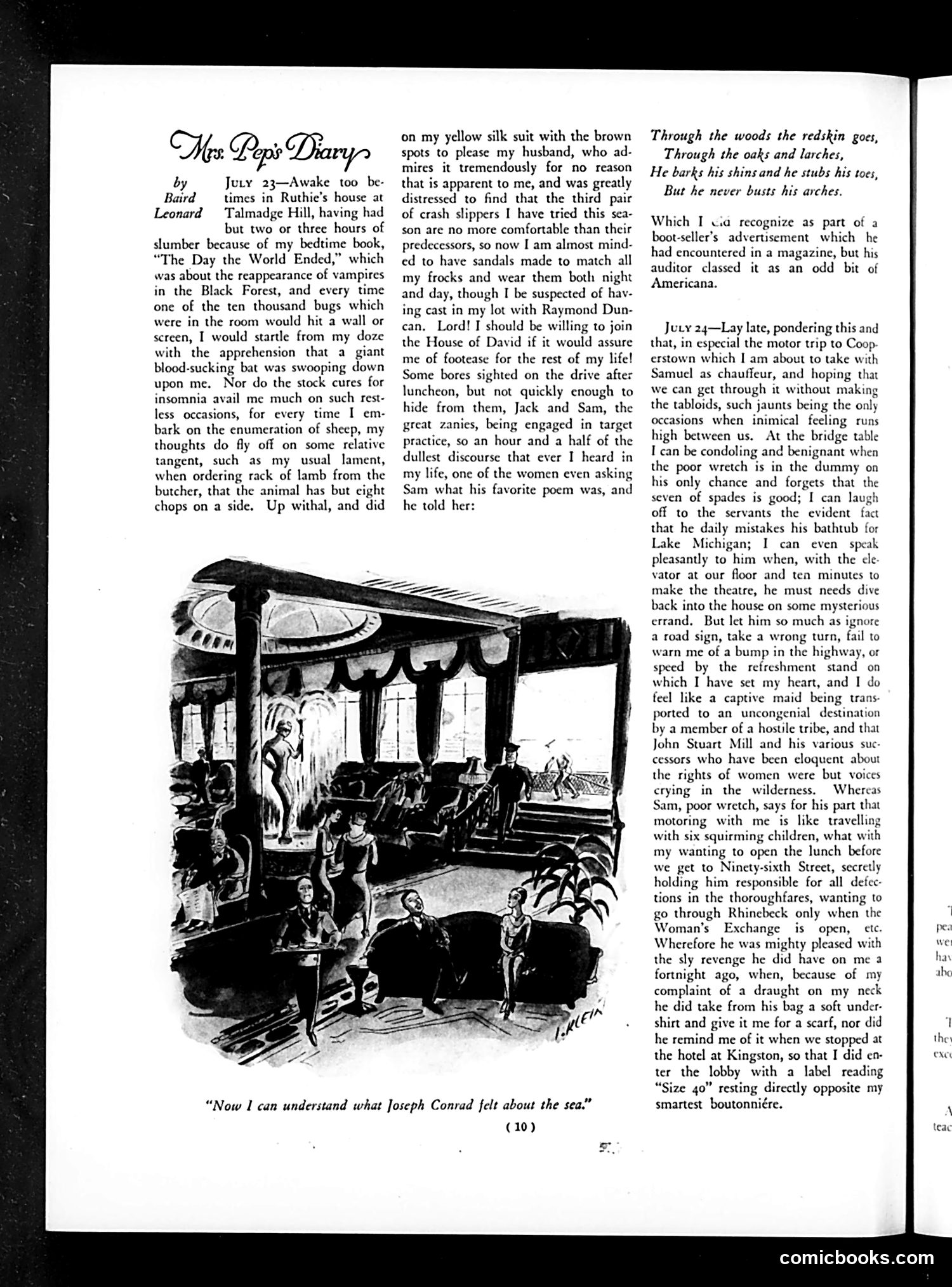
"Mrs. Pop's Diary" - Page Analysis This is a humorous diary entry by Baird Leonard dated July 23-24, satirizing upper-middle-class domestic life and marital frustrations. The illustration shows what appears to be an elevated train or transit car interior with passengers. The entry mocks the narrator's complaints about her husband (Raymond Duncan) and trivial domestic concerns—uncomfortable crash slippers, target practice bores, and his various character flaws. The satire targets women's magazines' typical advice columns and domestic concerns of the era. A key satirical moment: she compares her marital discomfort to Joseph Conrad's maritime experiences, suggesting her domestic grievances are cosmically insignificant. The humor lies in the contrast between her self-important complaints and actual human suffering, poking fun at the privileged complainant.
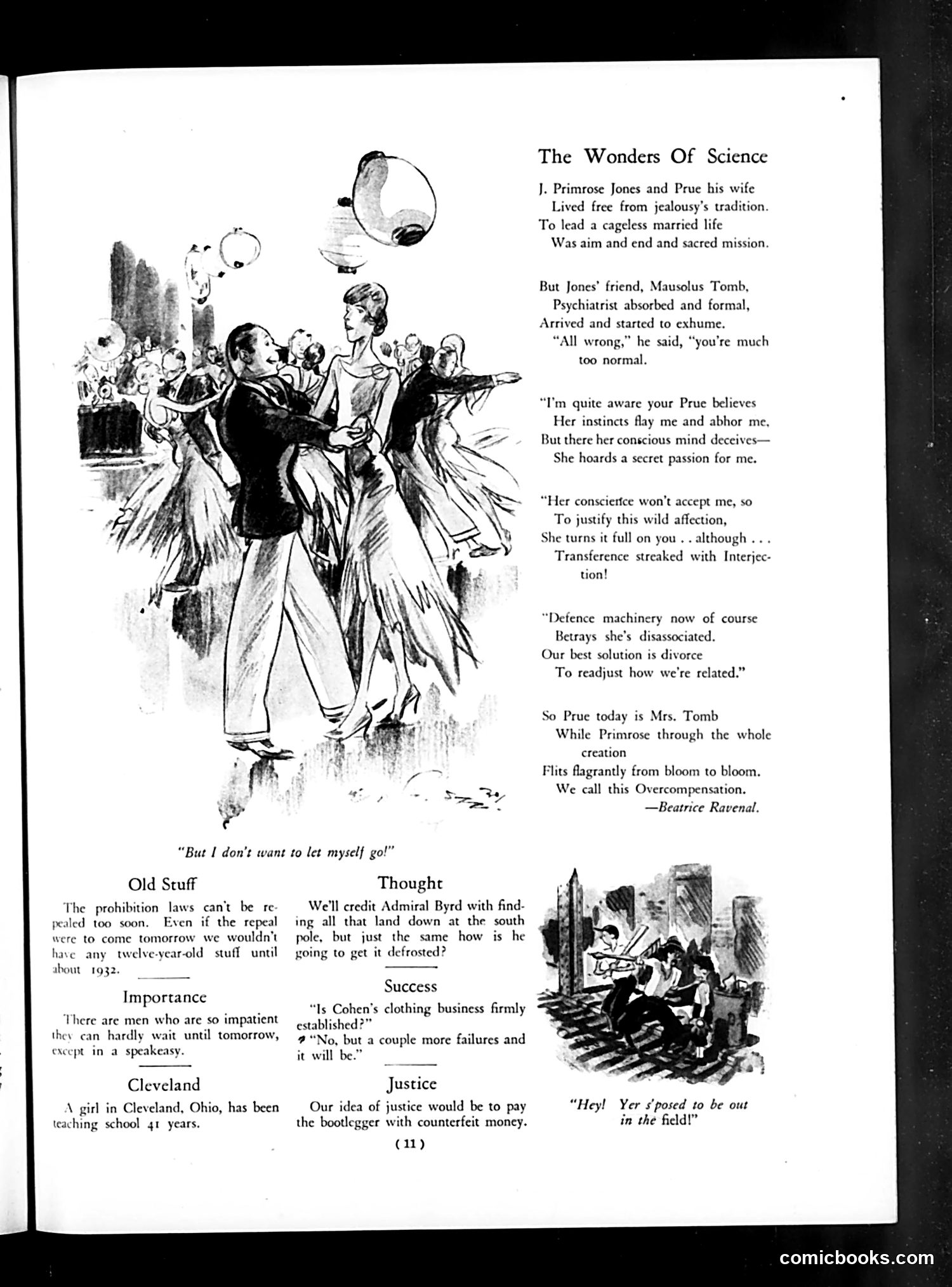
Analysis of Life Magazine Page This page contains "The Wonders of Science" — a satirical poem by Beatrice Ravenal about marital discord. The poem mocks the case of Primrose Jones and his wife Prue, who attempted a "cageless married life" free from jealousy. Their psychiatrist friend Mausolus Tomb diagnoses them as "too normal" and suggests divorce as the solution to their emotional complications. The accompanying illustration shows a couple with floating soap bubbles — likely symbolizing the ephemeral nature of their experimental marriage and modernist psychological theories. The remaining short items ("Old Scuff," "Thought," "Importance," "Success," "Cleveland," "Justice") are typical Life magazine humor bits — brief satirical observations on contemporary topics like Prohibition repeal, Admiral Byrd's Antarctic expedition, and business failure.
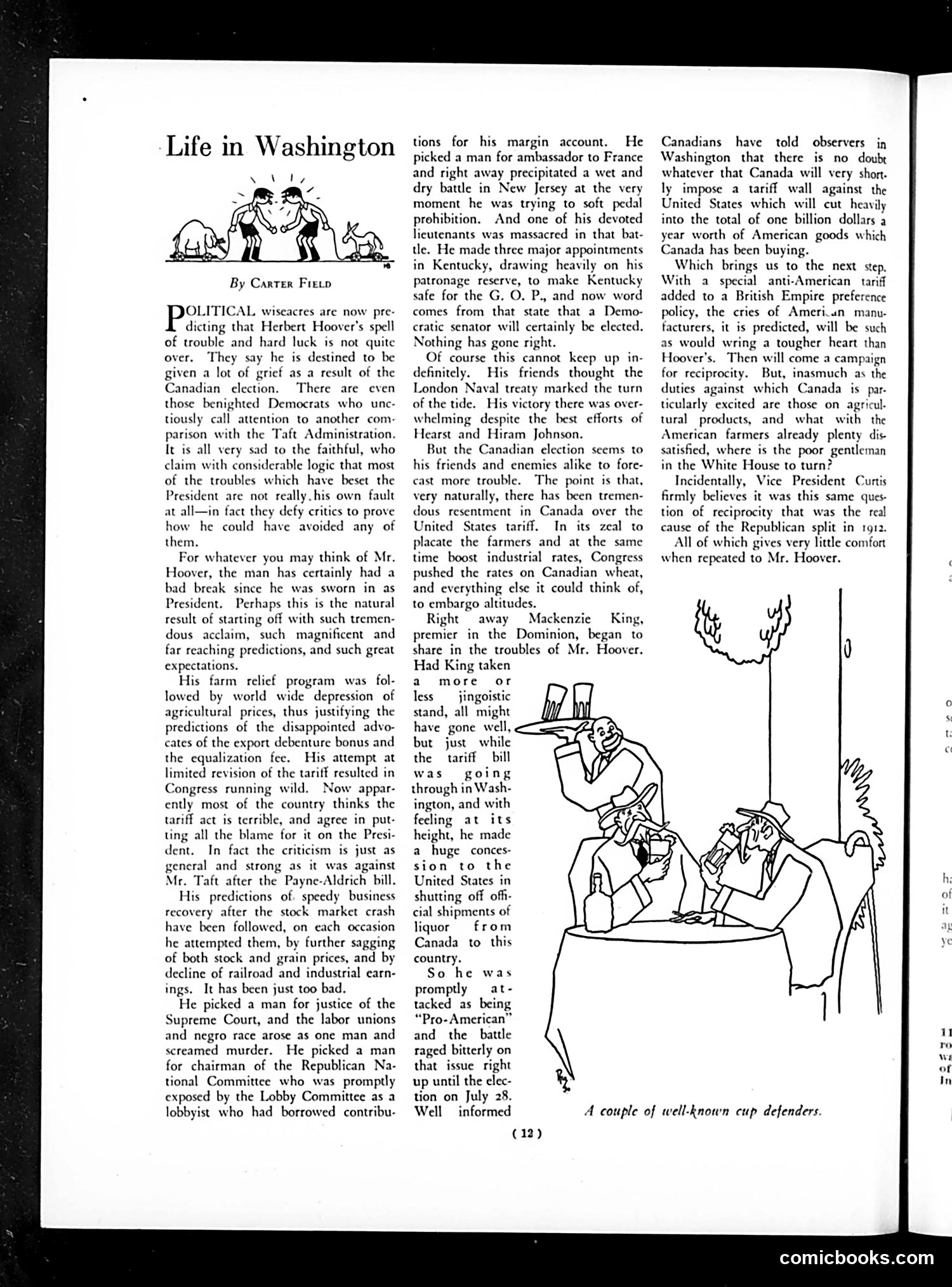
"Life in Washington" by Carter Field This political commentary by Carter Field criticizes President Hoover's handling of economic and foreign policy troubles. The article discusses Hoover's farm relief program, tariff policies (particularly regarding Canadian trade), and various controversial appointments that drew criticism from both Democrats and Republicans. The cartoon depicts two figures arguing intensely while sitting in what appears to be a legislative chamber, captioned "A couple of well-known cup defenders." This likely satirizes prominent political figures—possibly congressmen or cabinet members—engaged in bitter disputes over trade policy, particularly regarding Canadian liquor imports and agricultural tariffs that dominated political debate during Hoover's presidency. The overall tone suggests frustration with Hoover's inability to manage these mounting crises effectively.
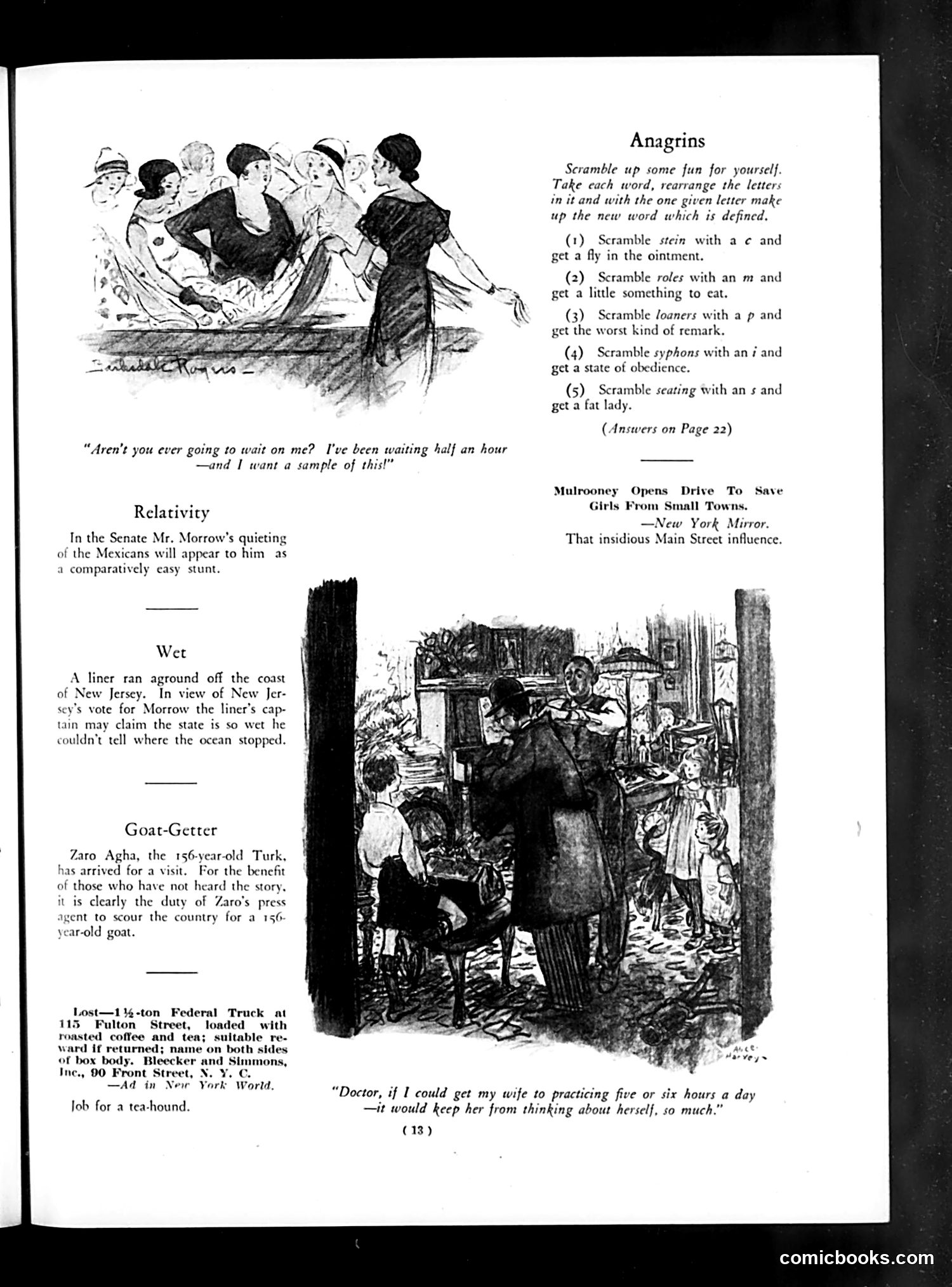
Analysis of Life Magazine Page This page contains several brief satirical items typical of early 20th-century Life magazine humor: "Relativity" jokes about Senator Morrow's position on Mexican affairs as "comparatively easy" — likely referencing contemporary diplomatic tensions. "Wet" mocks the debate over a liner's captain claiming the state line determines whether alcohol is legal, satirizing Prohibition-era inconsistencies. "Goat-Getter" announces Zaro Agha, a 156-year-old Turkish visitor, humorously suggesting his press agent should promote him by finding a 156-year-old goat. "Anagrams" is a word game where readers rearrange letters with given constraints. The page's main cartoon depicts a doctor advising a husband that having his wife practice medicine would occupy her mind and prevent marital worry — satirizing both women's professional ambitions and domestic anxiety.
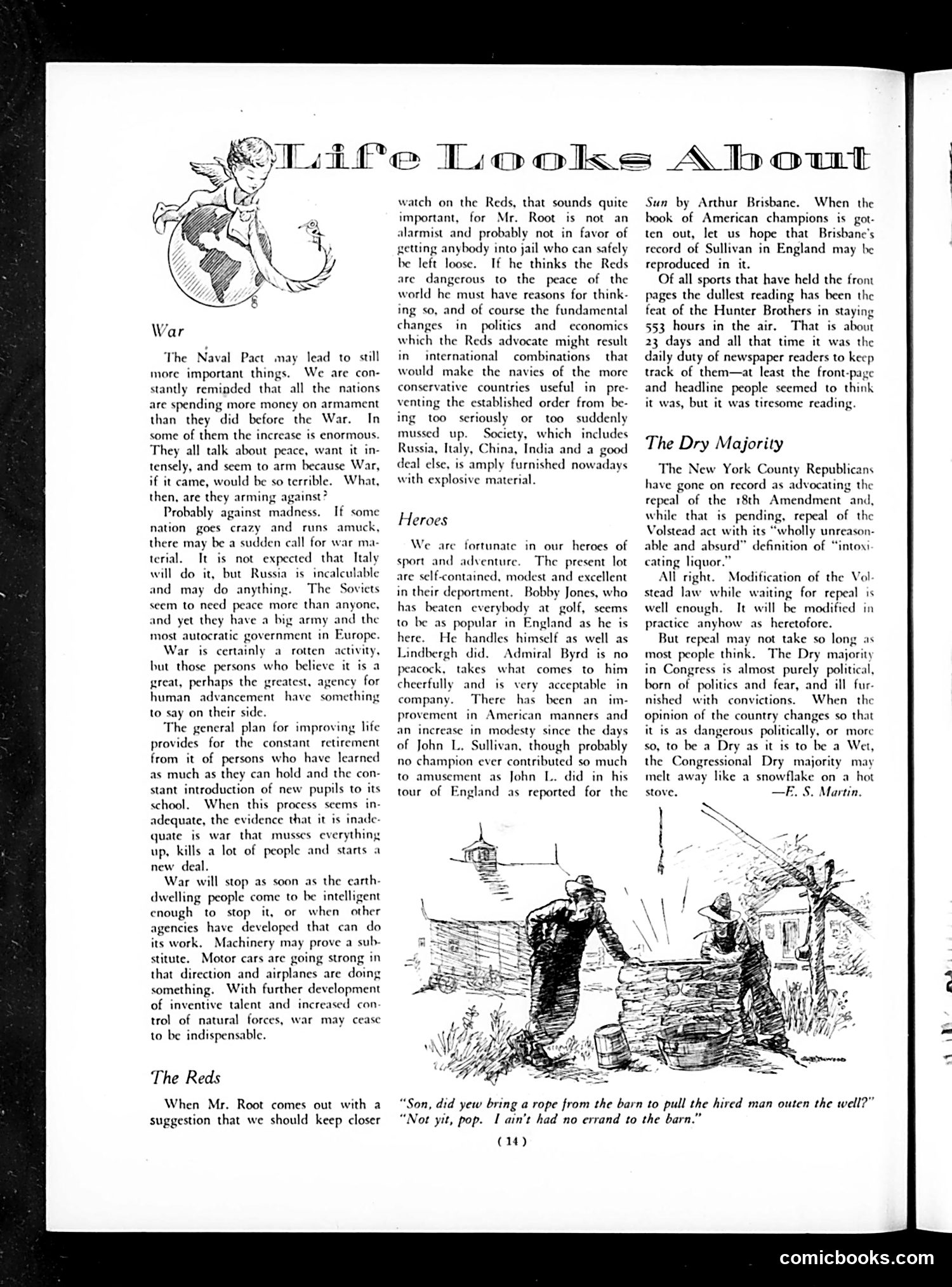
Analysis of "Life Looks About" Page This page contains three opinion columns on contemporary issues, each with a small illustration. "War" discusses naval spending and preparedness, arguing against pacifism while acknowledging war's costs. "Heroes" praises athletes like Bobby Jones (golf) and Admiral Byrd (explorer), noting their modesty and improved American manners since John L. Sullivan's era. "The Dry Majority" criticizes New York County Republicans for supporting repeal of Prohibition while claiming the Dry majority in Congress is "almost purely political" rather than conviction-based. The author (E. S. Martin) warns that a "Dry" Congress may prove as ineffective as "a snowflake on a hot stove." The bottom cartoon shows rural characters discussing a well—unrelated to the columns above.
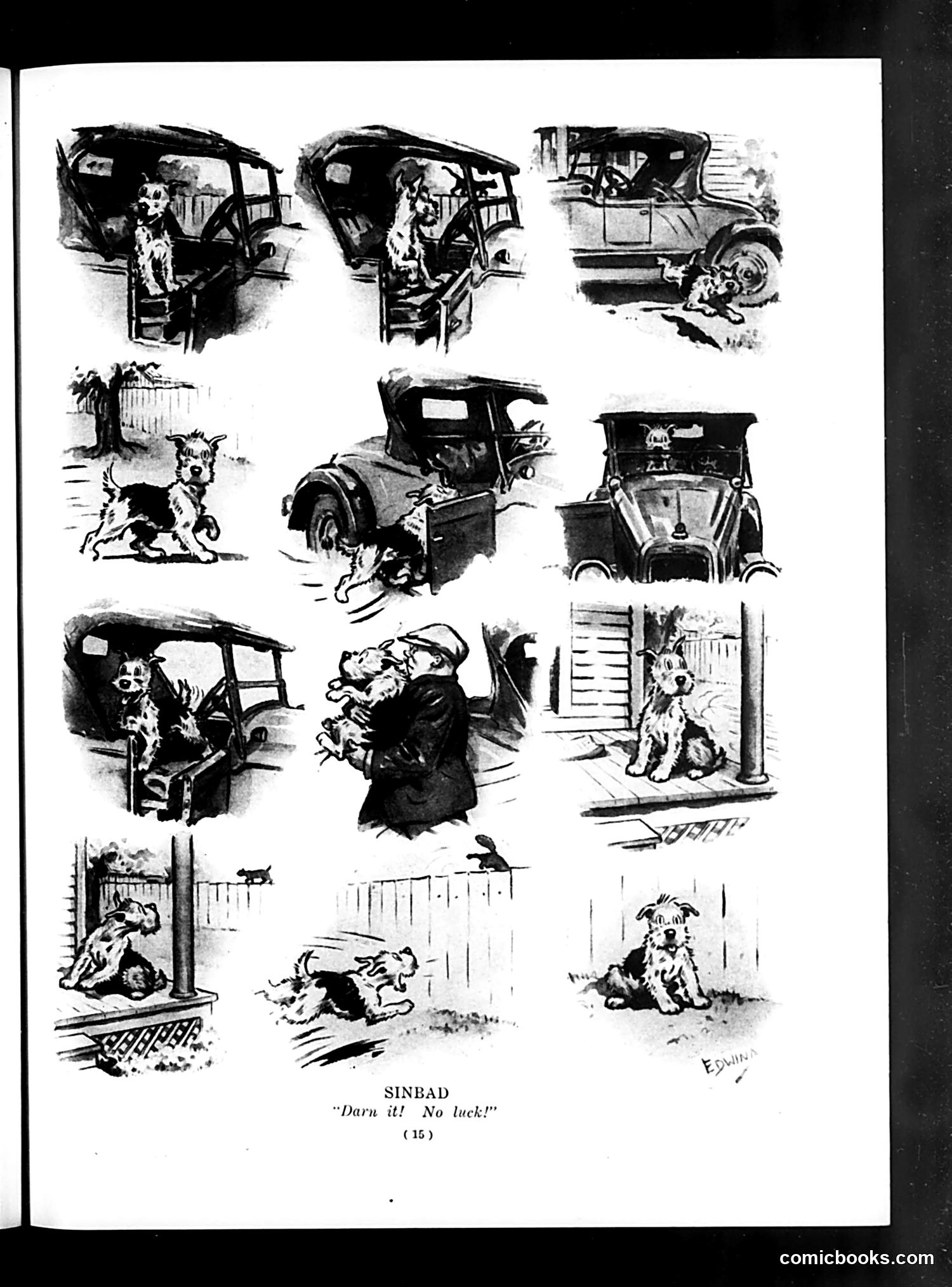
Analysis of "Sinbad: Darn it! No luck!" This is a series of comic sketches featuring a dog character named Sinbad experiencing bad luck across various scenarios. The dog appears in different situations: riding in automobiles (where accidents occur), being chased or pelted with objects, getting stuck in gates, and generally encountering mishaps. The title "Darn it! No luck!" suggests a humorous strip about a perpetually unlucky character. The sketches use slapstick comedy—a common approach in early 20th-century Life magazine comics—where physical comedy and misfortune drive the humor. The dog serves as an everyman-like character whose consistent string of accidents and troubles would have been relatable and amusing to contemporary readers. This appears to be early comic strip content focusing purely on entertainment rather than political satire.
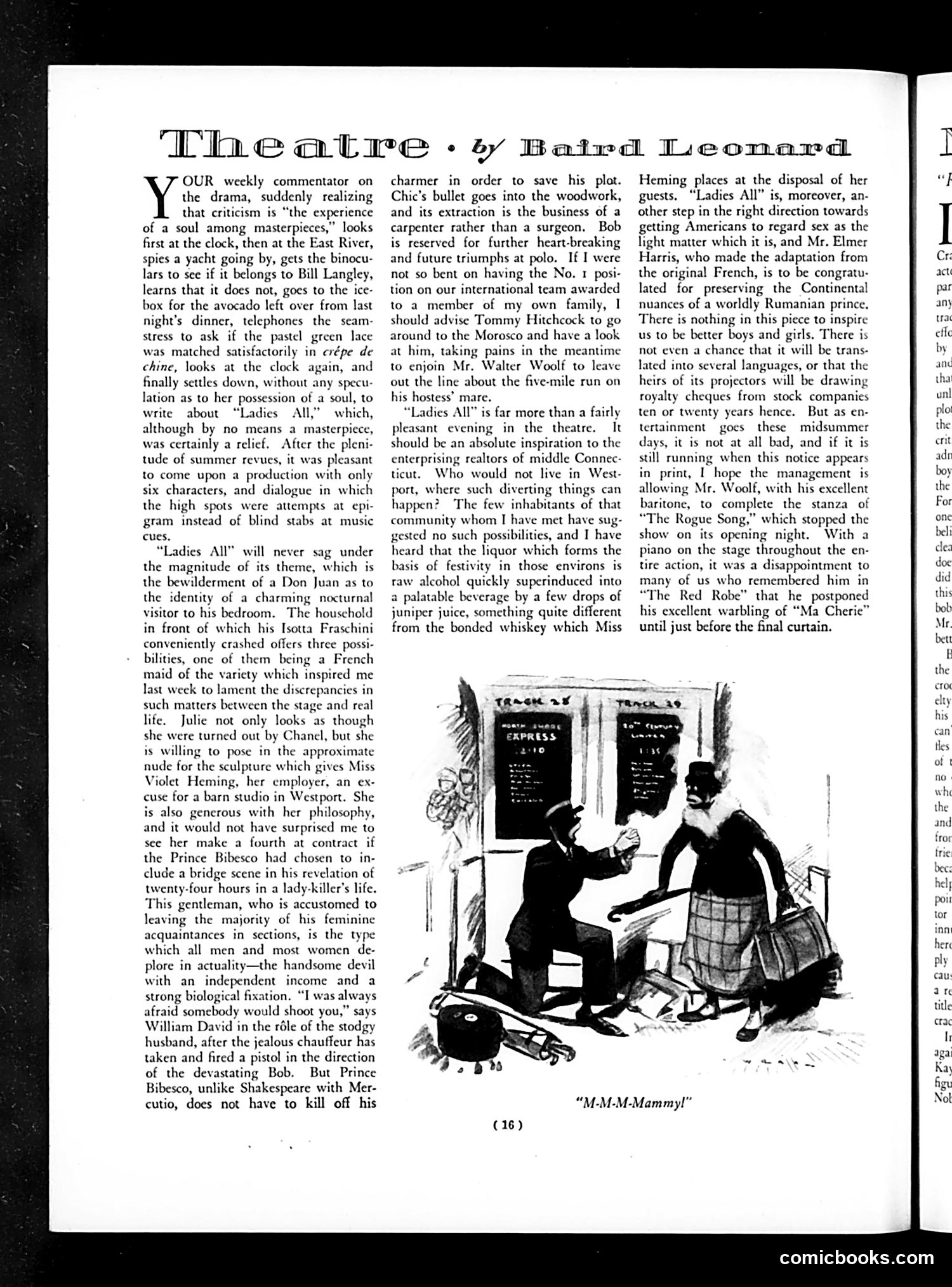
Theater Review Analysis This is Baird Leonard's theater column reviewing "Ladies All," a play about American attitudes toward women and gender roles. The illustration depicts two men in formal attire at what appears to be a theater entrance or backstage area, with one saying "M-M-M-Mammy!" The cartoon likely mocks the play's treatment of contemporary social issues—particularly how Americans regard women and romance. The exclamation suggests either surprise or exaggerated emotion, possibly satirizing overwrought theatrical performances or the play's handling of sensitive topics. Leonard critiques the production's "middle Connecticut" setting and notes the work offers "absolute inspiration" to enterprising theatrical producers. The review indicates this was a lighthearted summer entertainment, though Leonard found certain elements disappointing, particularly regarding how the play had been postponed.
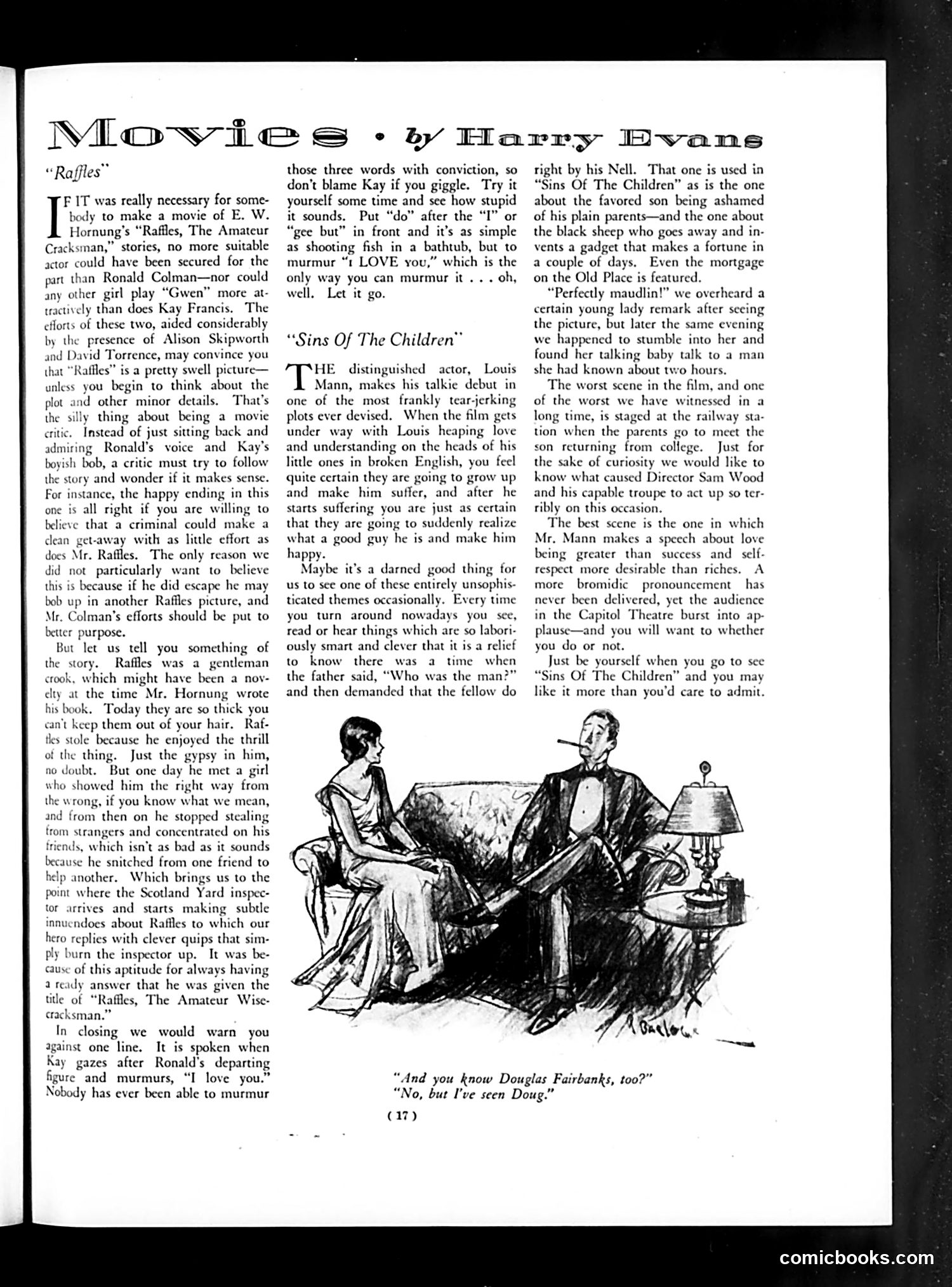
"Sins of the Children" - Movie Review Analysis This is a movie review by Harry Evans discussing Louis Mann's talkie film debut. The illustration depicts a domestic scene with two figures in conversation—likely representing characters from the film. The review discusses Mann's performance in a story about parental suffering and generational conflict. The dialogue caption reads: "And you know Douglas Fairbanks, too?" / "No, but I've seen Doug." This appears to be a light satirical jab at the film's quality or the reviewer's bemused reaction to it. The joke likely references Douglas Fairbanks' fame, suggesting the character (or perhaps Mann's acting) is less impressive than that Hollywood star. The review itself is generally complimentary of Mann's emotional performance, particularly his monologue about love versus success.
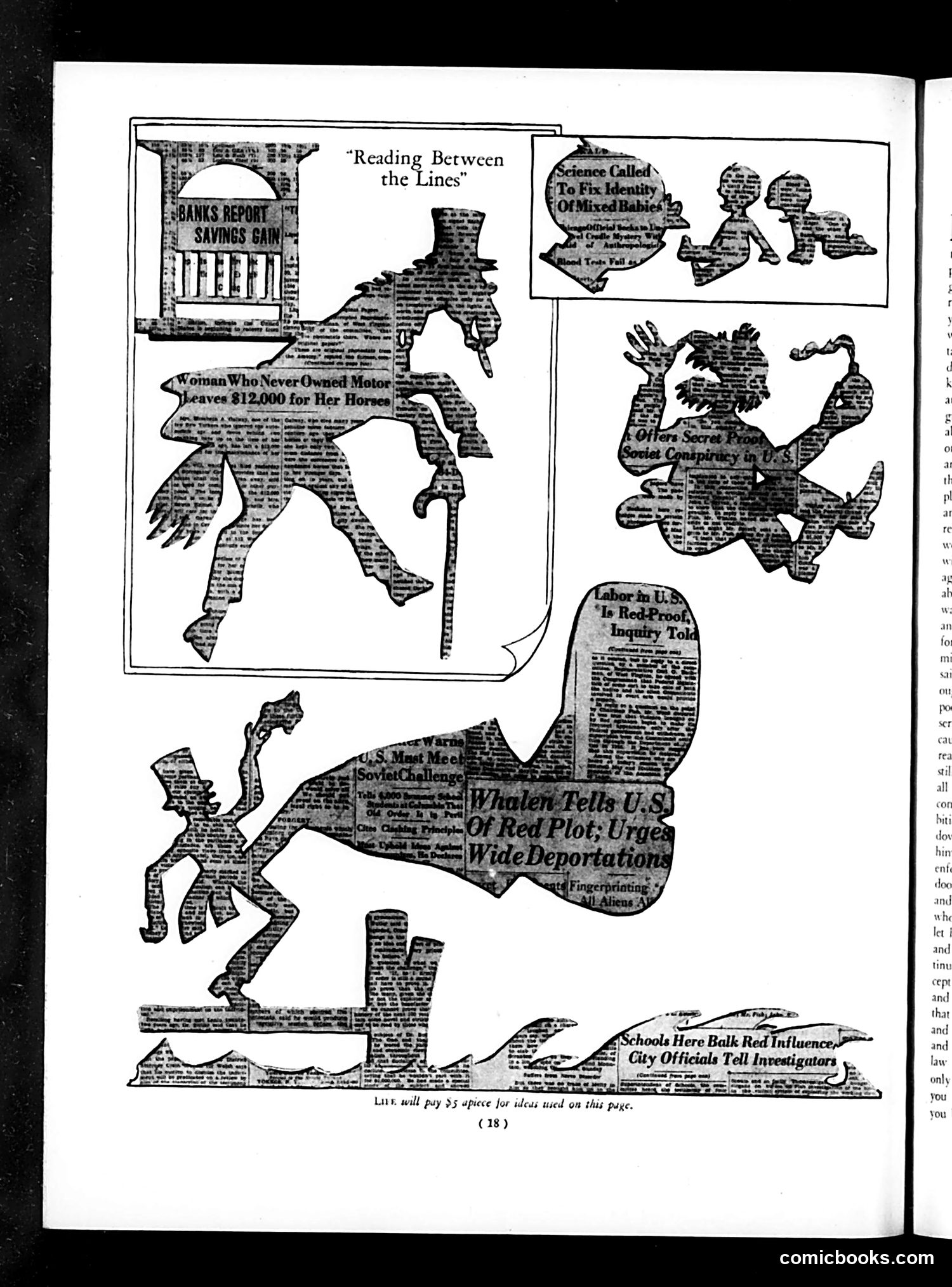
Political Cartoon Analysis This page uses newspaper text collaged into silhouettes to satirize sensationalist media coverage of contemporary anxieties. The central figure—a woman in a dress and hat—represents mainstream American society, while surrounding shapes embody various feared threats or conspiracy theories: "Science Called To Fix Identity Of Mixed Babies," "Reds' Social Conspiracy in U.S.," "Whalen Tells U.S. Of Red Plot; Urges Wide Deportations," and "Schools Here Bulk Red Influence." The cartoon critiques how newspapers stoke fear through exaggerated headlines about communism, racial mixing, and alleged Soviet plots. By literally filling these ominous shapes with actual newspaper text, the artist ironically demonstrates how media sensationalism creates public paranoia—the "lines" between real threats and manufactured panic become deliberately blurred. This reflects early 1920s Red Scare anxieties.
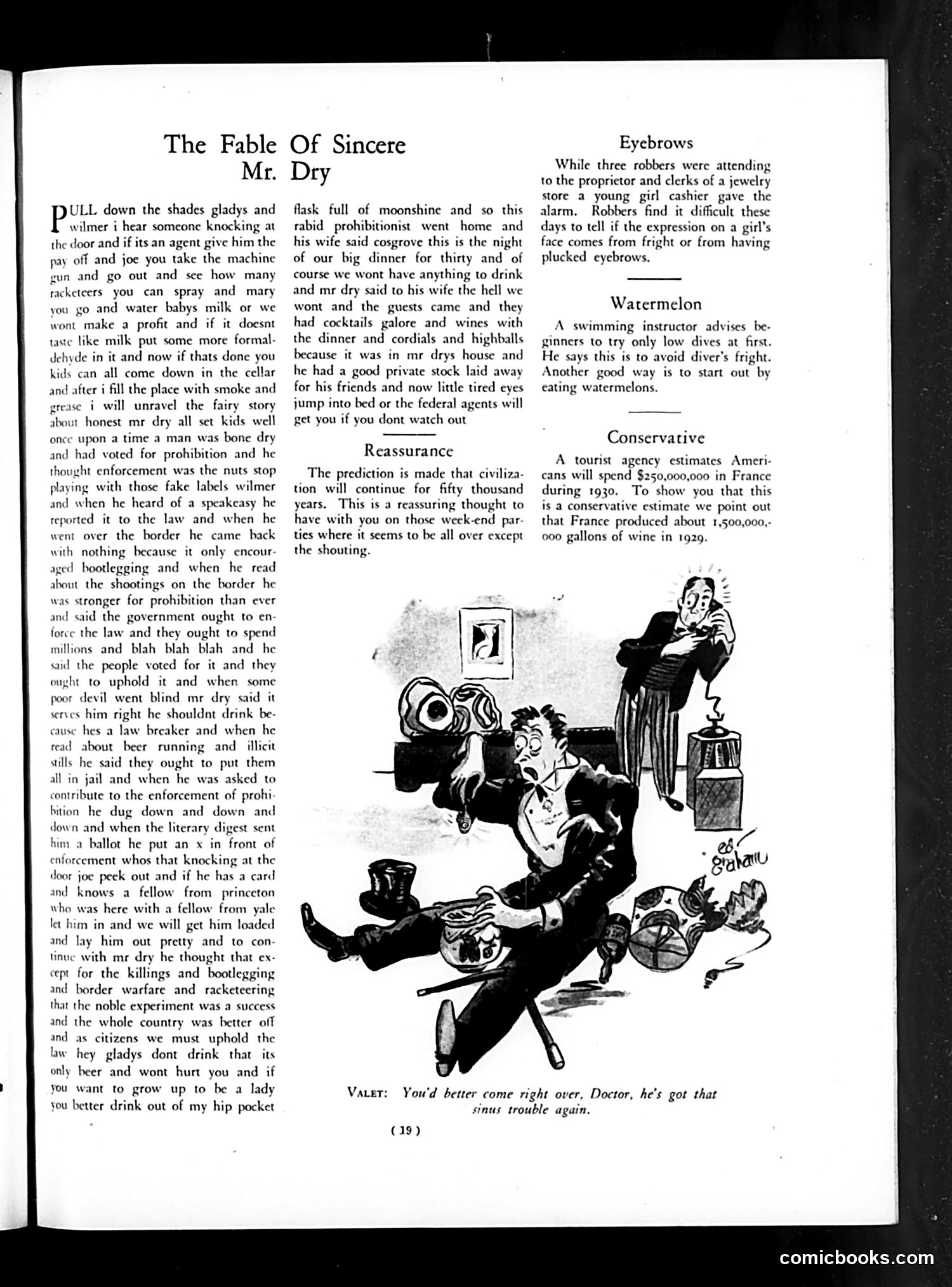
Analysis of This Life Magazine Page This satirical page attacks Prohibition hypocrisy through "The Fable of Sincere Mr. Dry"—a story about a man who publicly champions alcohol prohibition while secretly violating it. The main cartoon illustrates the fable's climax: federal agents arrive at Mr. Dry's home during a lavish dinner party where guests are openly drinking cocktails, wine, and cordials from his private stock. The visual joke exposes the contradiction between his public morality and private behavior. The valet's caption—"You'd better come right over, Doctor, he's got that sinus trouble again"—uses a transparent euphemism for drunkenness. This satirizes widespread Prohibition-era hypocrisy (1920-1933), when many affluent Americans publicly supported the law while maintaining illegal alcohol supplies. The fable condemns Mr. Dry's selective enforcement attitude: he demands jail for poor bootleggers while enjoying smuggled liquor himself. The smaller items (eyebrows, watermelon, France's wine production) are typical magazine filler jokes, though the France item subtly reinforces the page's anti-Prohibition message by highlighting wine consumption abroad.
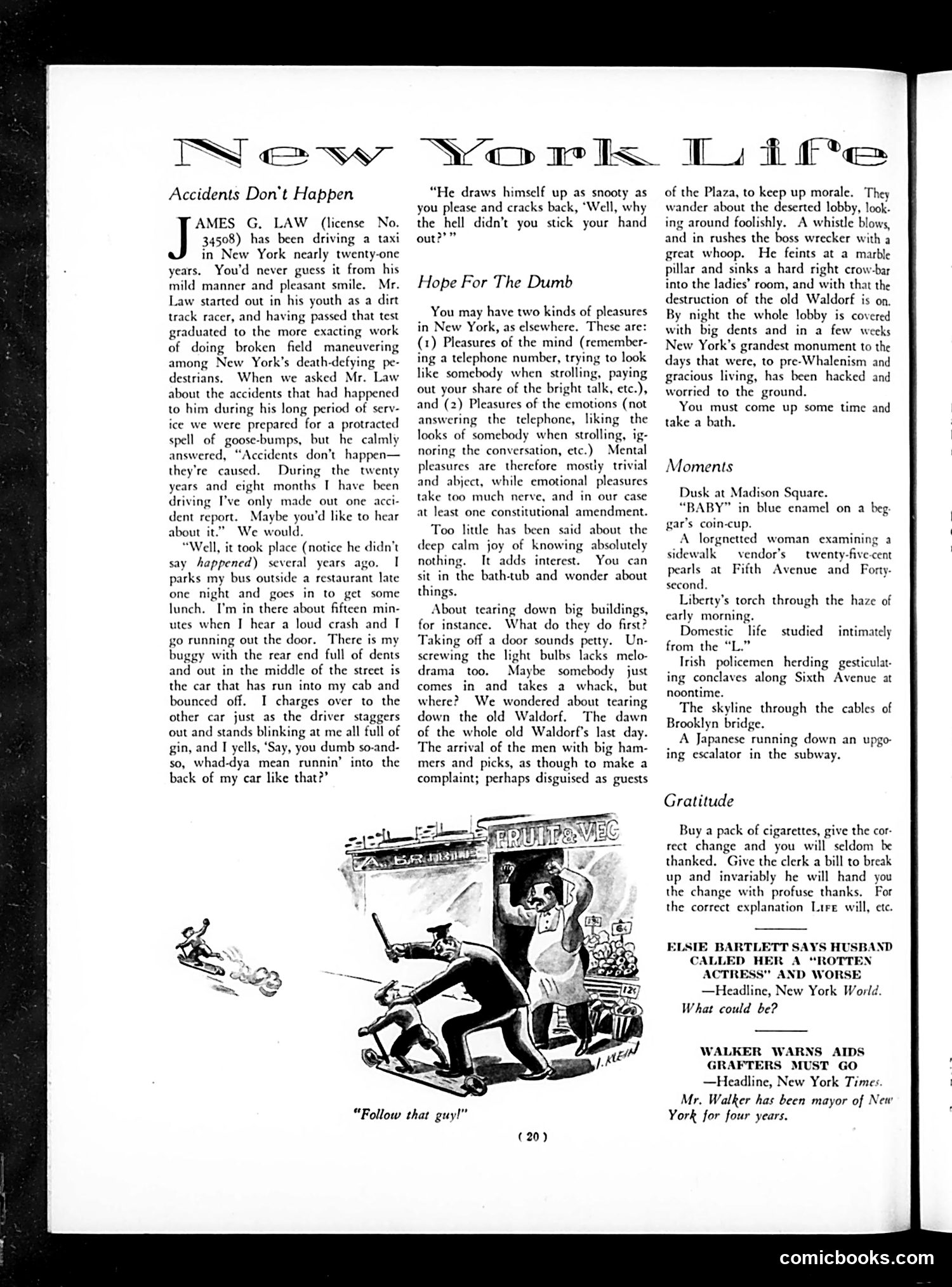
Analysis: Life Magazine Page (c. 1920s-1930s) This page contains three satirical pieces typical of Life's humor: "Accidents Don't Happen" presents a taxi driver's anecdote. James G. Law, a 21-year veteran cabbie, recounts a minor collision where the drunk driver who hit his parked cab sarcastically asks why Law didn't signal—despite the cab being stationary. The satire targets both reckless drivers and their absurd logic for deflecting blame. "Hope for the Dumb" celebrates the pleasure of knowing nothing. The author muses about demolishing the old Waldorf Hotel (a real NYC landmark), imagining workers casually destroying it like careless guests. The piece gently mocks New York's rapid destruction of historic architecture and urban apathy. "Moments" is impressionistic vignette poetry capturing fleeting NYC scenes: a beggar's coin cup, street vendors, the Statue of Liberty, elevated train observations, and Irish police managing crowds. The cartoon "Follow that guy!" depicts slapstick chaos—figures tumbling in collision—illustrating the absurdity central to these pieces. Overall, the page satirizes New York's indifference, recklessness, and casual destruction.
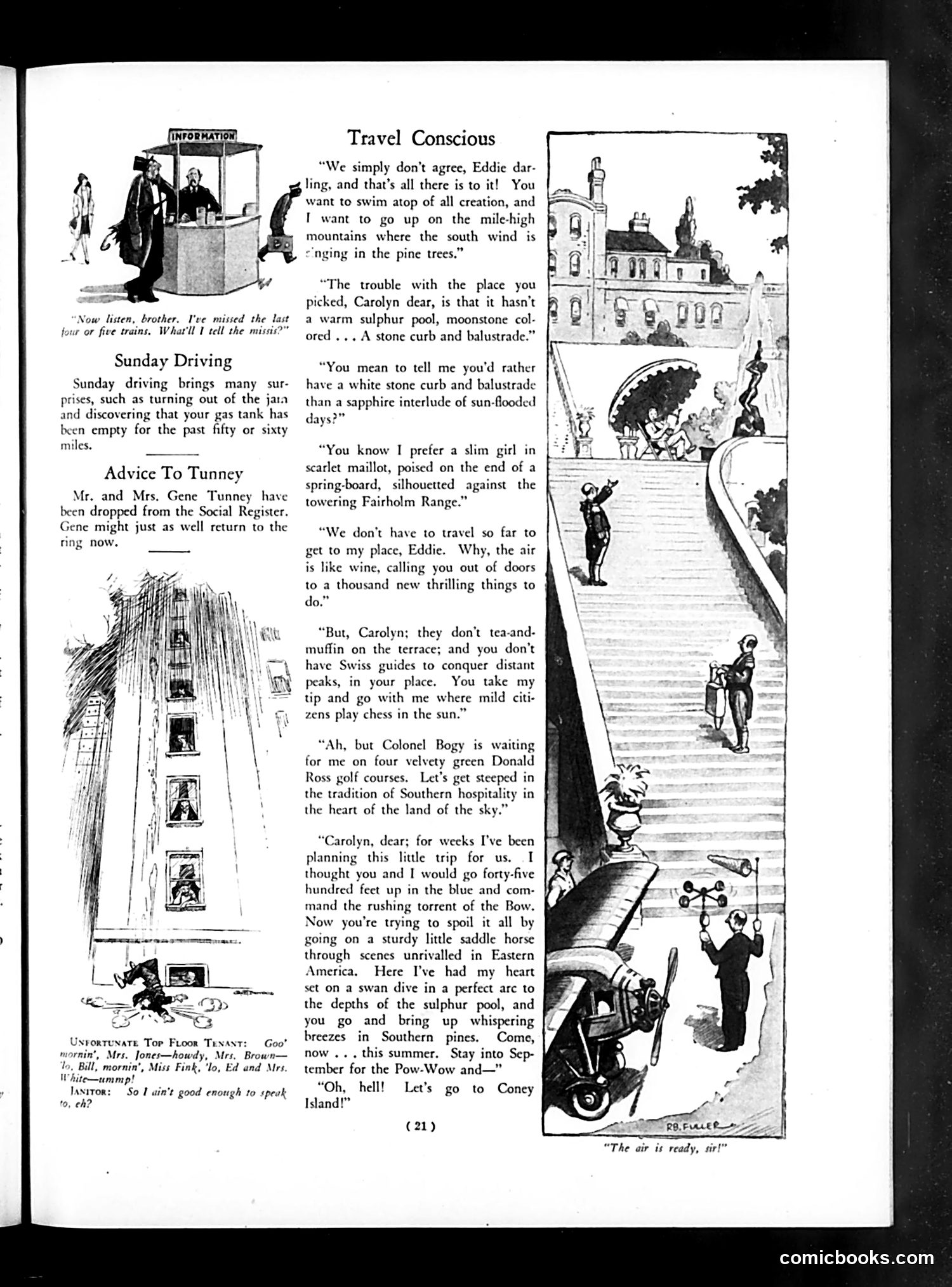
Explanation for Modern Readers This page contains three separate humorous pieces satirizing early 1920s American leisure culture. "Travel Conscious" mocks wealthy couples' pretentious vacation planning. Eddie and Carolyn engage in increasingly absurd one-upmanship about exotic destinations—sulphur pools, mountain peaks, golf courses, swan dives—each dismissing the other's suggestion as insufficiently glamorous. The joke culminates when they abandon all pretense and decide to go to Coney Island, a modest, popular seaside amusement park. This deflates their entire affected conversation, suggesting their elaborate travel snobbery was hollow posturing. "Sunday Driving" is a brief joke about early automobiles: drivers discovered their gas tanks empty after driving far from home because fuel gauges were unreliable or absent. "Advice to Tunney" references boxer Gene Tunney's removal from the Social Register (the directory of America's elite families), suggesting his boxing profession—despite success—made him socially unacceptable to the upper class. The satire mocks rigid class prejudice. The cartoons collectively satirize 1920s American social pretension and class anxiety.
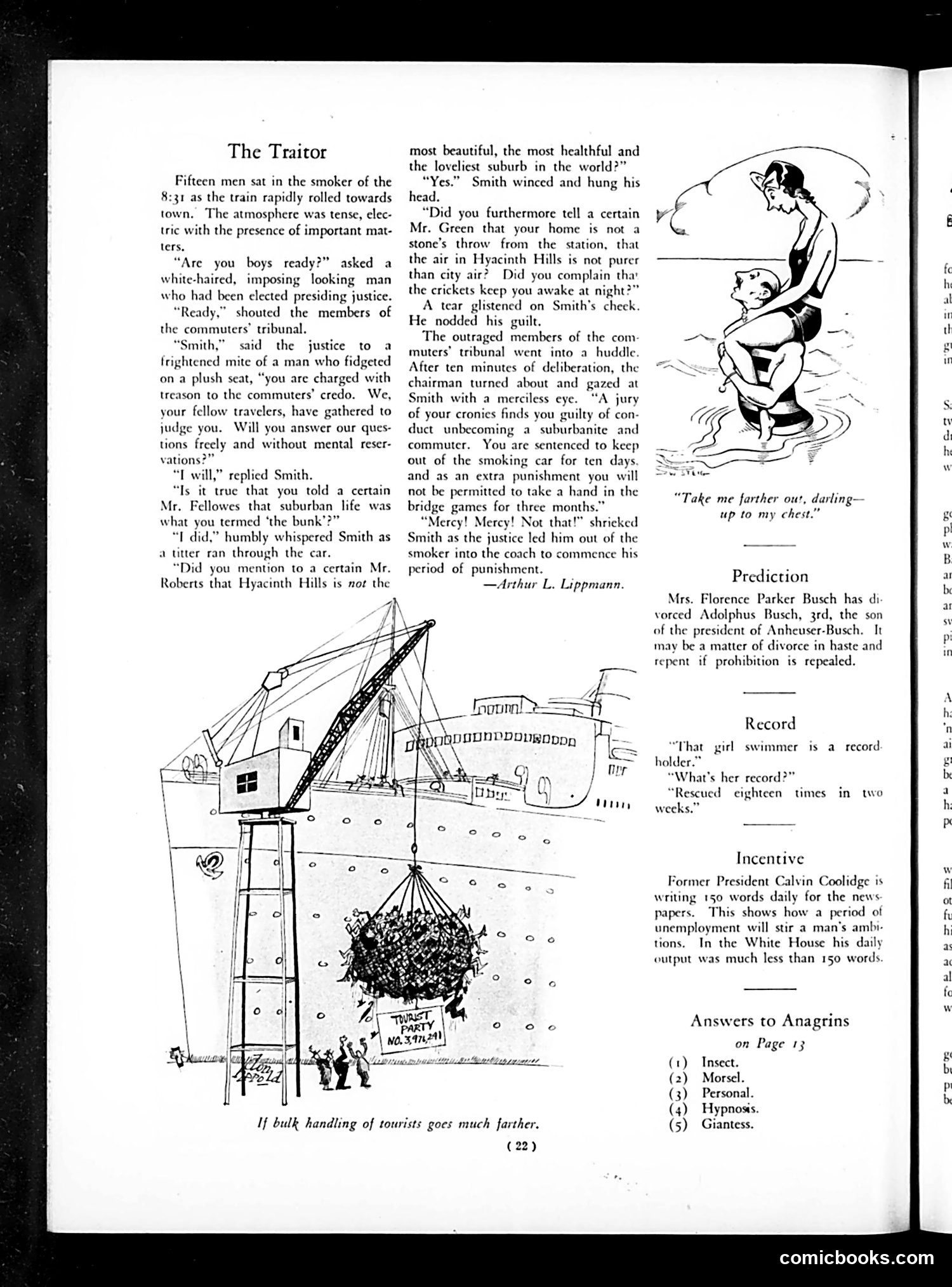
"The Traitor" - Satirizing Suburban Conformity This story by Arthur L. Lippmann mocks suburban commuter culture and enforced conformity. A man named Smith is tried by fellow train commuters for the "crime" of criticizing suburban life—specifically, he told colleagues that the suburb of Hyacinth Hills isn't as idyllic as advertised, and that commuting isn't worthwhile. The satire targets the pressure to maintain suburban propaganda: commuters treat honest opinion as "treason" and sentence Smith to social ostracism (banishment from the smoking car and bridge games). The piece ridicules how suburbanites rigidly enforce loyalty to the suburban dream, punishing anyone who admits the reality doesn't match the marketing. This reflects 1920s anxieties about suburban expansion and the conformist culture it demanded of middle-class commuters.
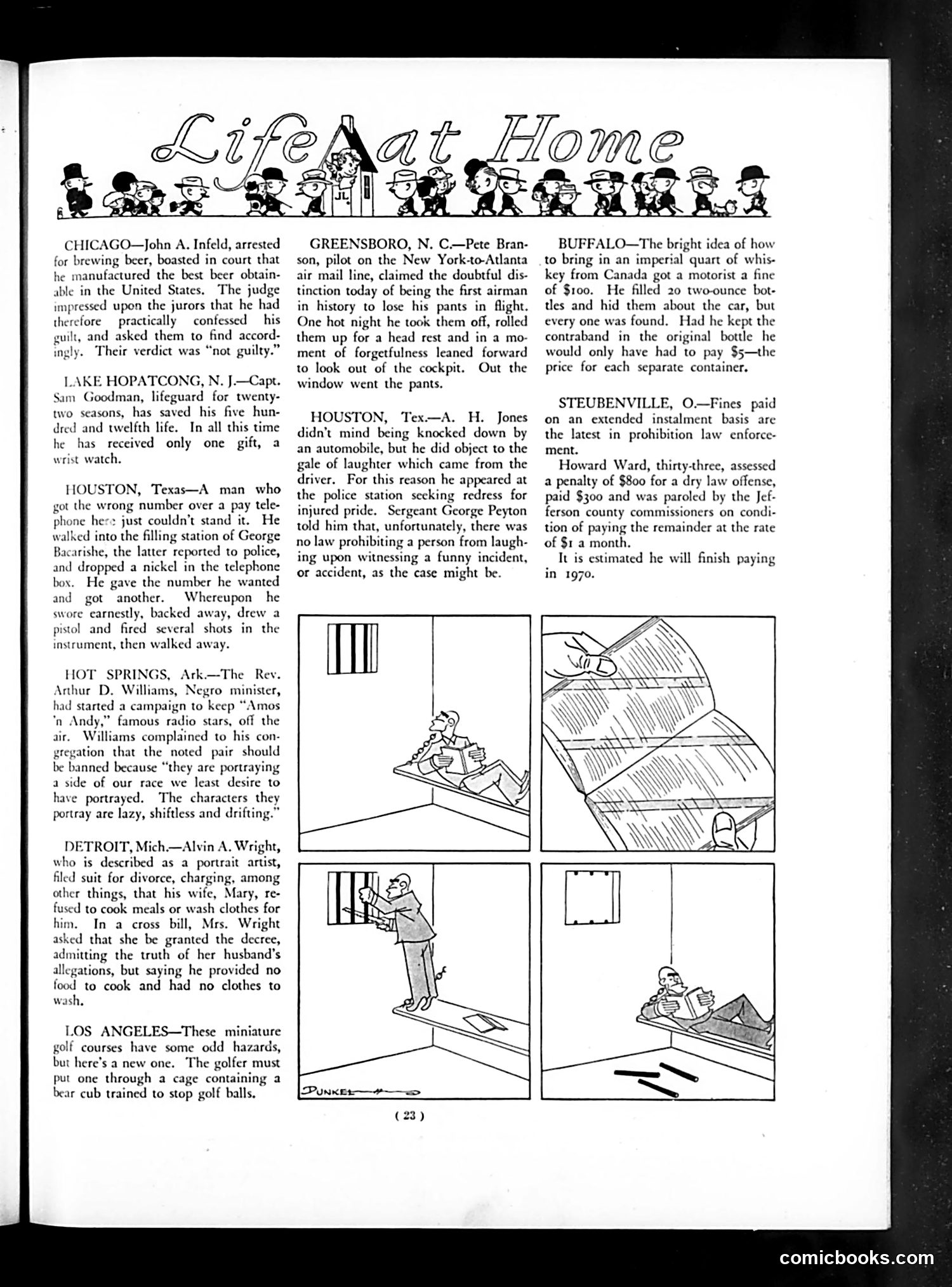
Life Magazine: "Life at Home" Page Analysis This page from *Life* magazine presents humorous anecdotes satirizing Prohibition-era absurdities and American social quirks. The cartoon strips (four panels) depict a man's misadventures during home activities—appearing to show mishaps with windows, cages, and indoor spaces. The text items mock Prohibition enforcement's illogical inconsistencies: a man smuggling whiskey faces a $100 fine for splitting one quart into 20 small bottles (legal loophole: single bottles cost only $5 each); another violator will take until 1970 to pay his $800 fine at $1/month. Other anecdotes highlight absurd human behavior: a man shooting a telephone over a wrong number, an airman losing his pants mid-flight, and a man seeking legal redress for being laughed at after being hit by a car. The Rev. Arthur D. Williams's complaint about the *Amos 'n' Andy* radio show (a minstrel-style program) represents early African American criticism of racial stereotyping. Overall, the page satirizes both legal foolishness and everyday human irrationality during the 1920s-30s.
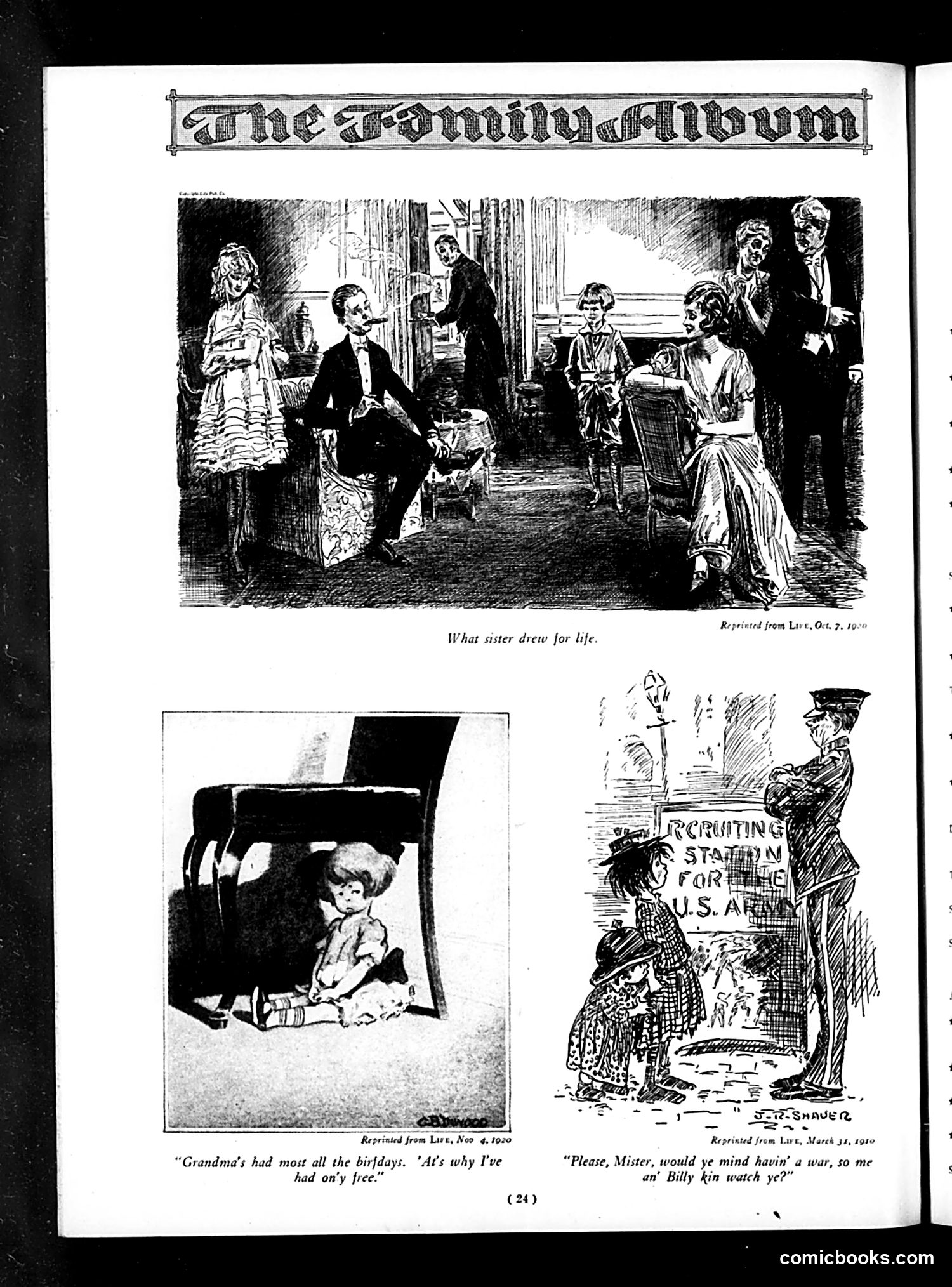
"The Family Album" - Life Magazine Page This page contains three satirical cartoons addressing early 20th-century social issues: Top cartoon ("What sister drew for life"): Depicts an upper-class social gathering, likely satirizing wealth disparities and class divisions in society. Bottom left: A child's drawing showing poverty—a grandmother and grandchild in cramped conditions. The caption's broken dialect emphasizes working-class hardship, with the child noting limited birthdays due to early death (likely from poverty-related causes). Bottom right: A child asks a soldier to start a war so he and "Billy" can watch—dark satire on how war becomes entertainment for the privileged while others suffer. The "Recruiting Station" sign references WWI-era military recruitment. Together, these cartoons critique class inequality and the devastating human costs of war, using children's perspectives to highlight society's moral failures. The reprinting dates suggest Life was revisiting these themes across decades.
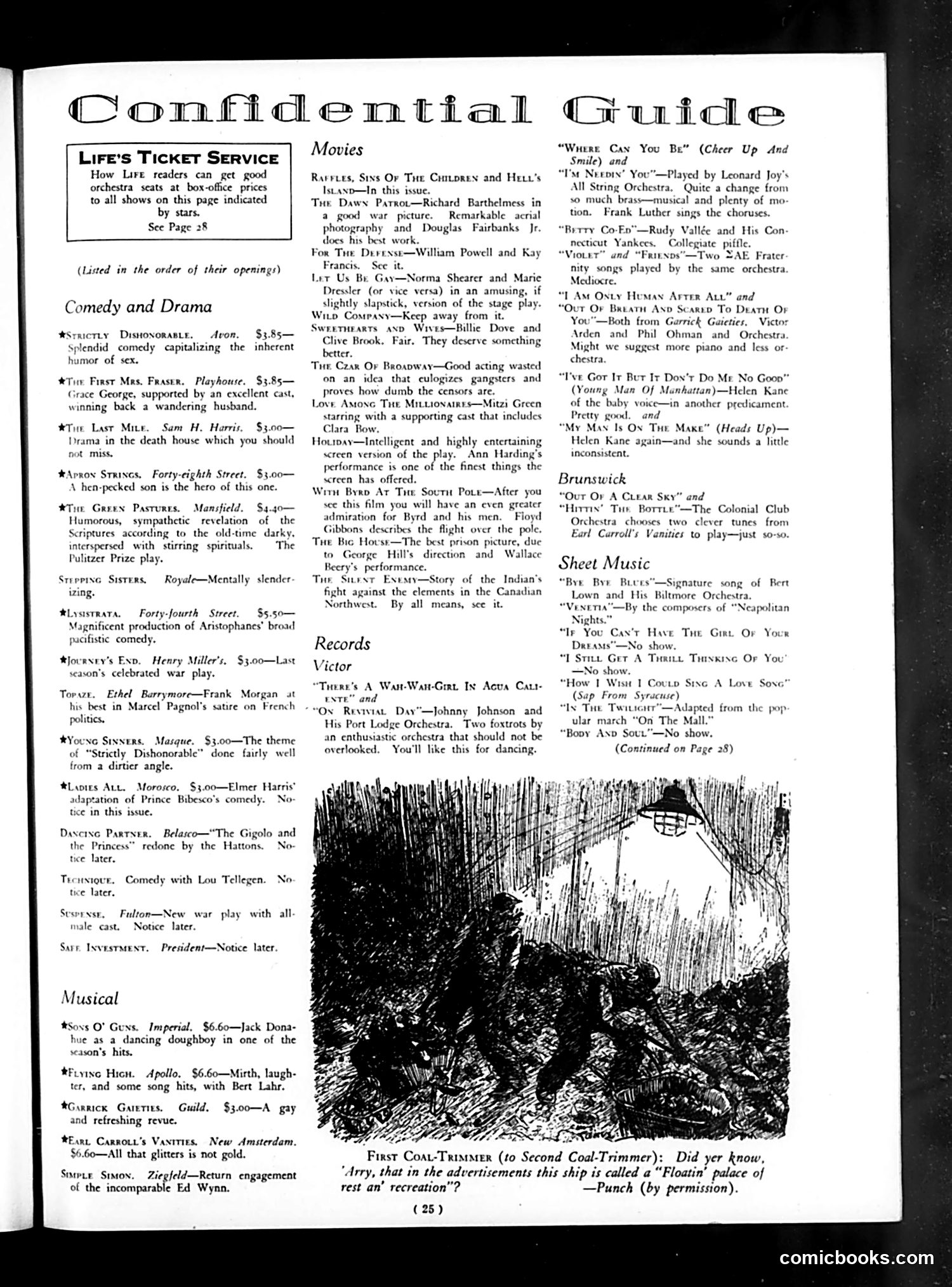
What This Page Means This is a theater and entertainment guide from Life magazine—essentially a "what's playing now" listing with reviews and ticket prices. The page is mostly practical information, not satire. The cartoon at bottom shows a coal-trimmer on a ship calling it a "floating palace of rest and recreation"—a humorous exaggeration mocking the grim reality of working-class conditions. The joke is the obvious contradiction: the man's actual job is dirty, backbreaking labor, so calling the ship a vacation resort is absurdly false advertising. The entertainment listings reflect 1920s-30s Broadway and cinema: plays like *The Green Pastures* (noted as a "Pulitzer Prize play"), musicals with then-famous performers like Ed Wynn and Bert Lahr, and silent/early-sound films. The reviews are brief and candid—one film is bluntly told to "keep away from it." The asterisks (*) mark shows where Life readers could get discounted orchestra seats through the magazine's ticket service (page 28).
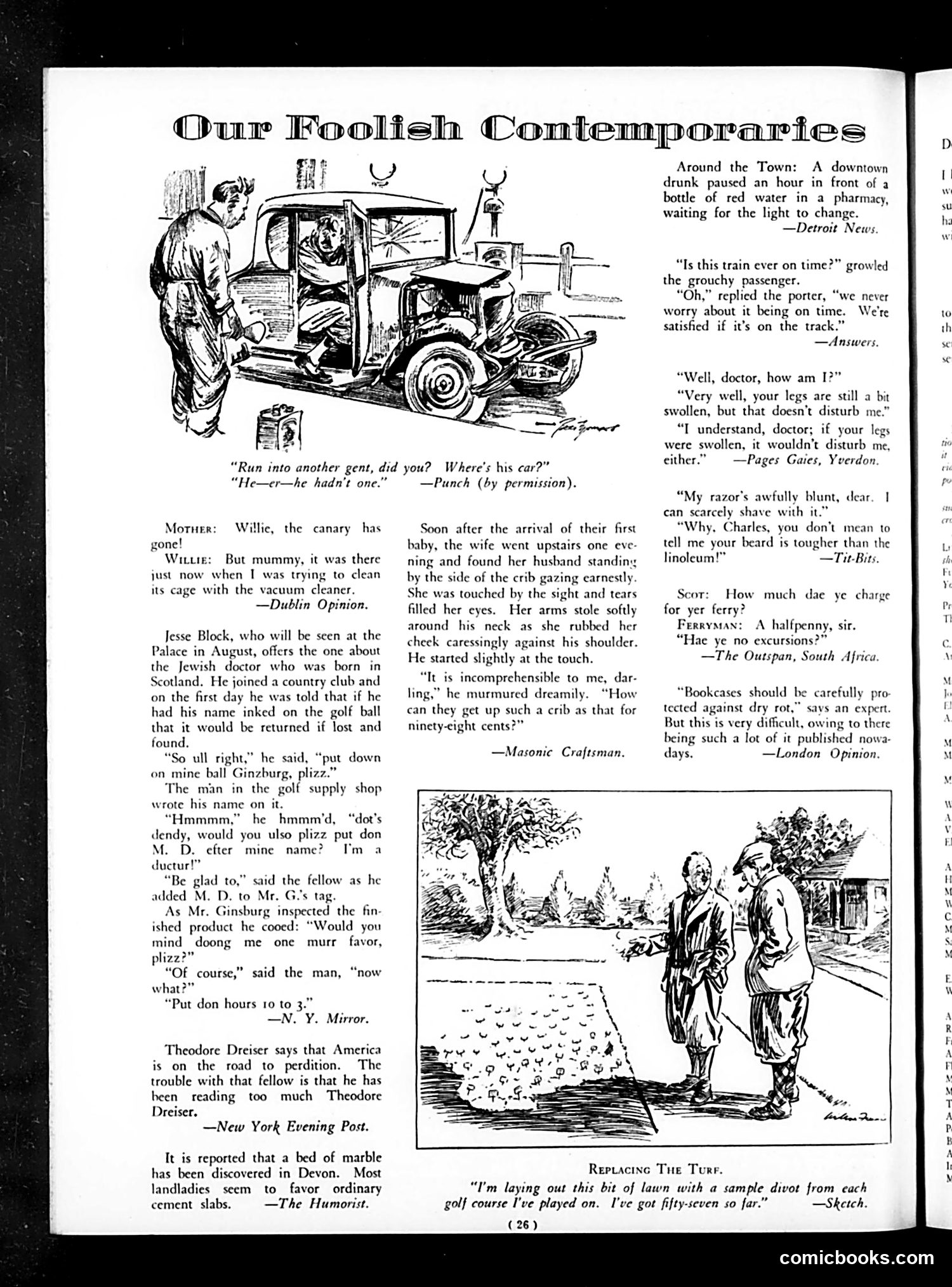
"Our Foolish Contemporaries" - Life Magazine Page This page collects brief satirical jokes and cartoons mocking everyday follies of the era (appears to be 1920s-30s based on automobile references and styling). Main cartoon (top): Shows a car accident where one driver asks the other where his car is. The reply: "He—er—he hadn't one." The joke satirizes reckless drivers who cause accidents despite having no vehicle of their own—absurdist humor about carelessness. Other jokes target: - Absent-minded parents (the canary lost to a vacuum cleaner) - Jewish immigrants' aspirations (the doctor adding credentials to his golf ball) - Misplaced priorities (the new father more concerned with crib cost than the baby) - Comic dialect humor (Scottish and Jewish accents used for comedic effect) - Social pretension and obsession with golf Bottom cartoon: A man creating a lawn from divots collected from 57 golf courses—mocking obsessive golfers. The page's humor relies on ethnic stereotypes, physical comedy, and exaggerated character types typical of period satirical magazines.
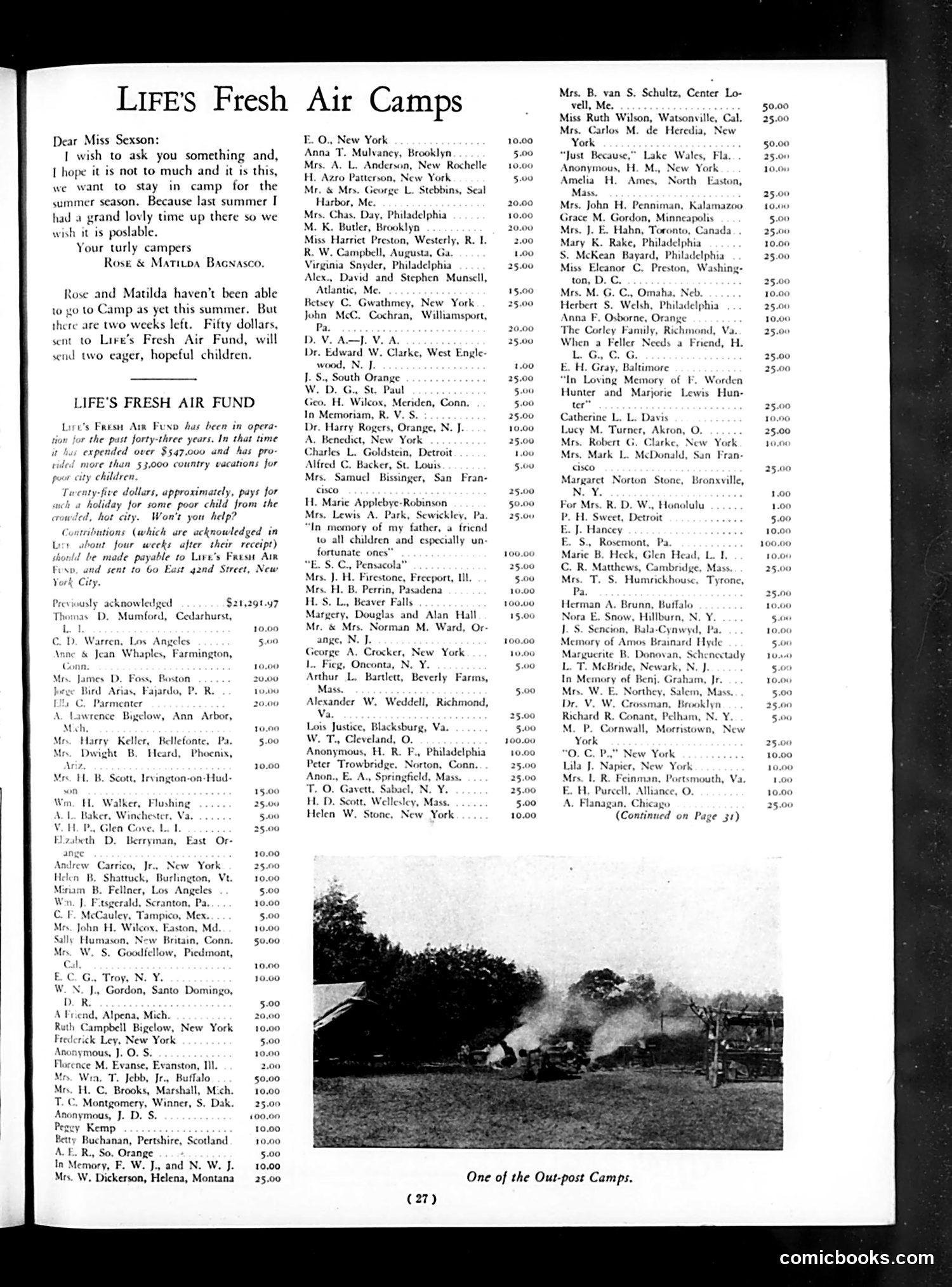
Life's Fresh Air Camps This page documents Life Magazine's charitable fundraising campaign for poor city children's summer vacations—a major progressive-era social welfare initiative. The page opens with a touching letter from two poor children (Rose and Matilda Bacinasco) requesting camp attendance. Life's Fresh Air Fund has operated for 43 years, providing country vacations to urban children at approximately $25 per child. The bulk of the page lists donors contributing to this cause, from $1 to $100. The photograph at bottom shows an "out-post camp"—a rustic facility where poor children spent summer holidays away from crowded, unhealthy city tenements. This reflects early 20th-century Progressive Era values: wealthy Americans contributing to help disadvantaged youth escape urban poverty through nature exposure. The detailed donor list serves dual purposes—acknowledging contributors while publicly encouraging further donations through example and social pressure. The campaign is entirely philanthropic; no government involvement is mentioned.
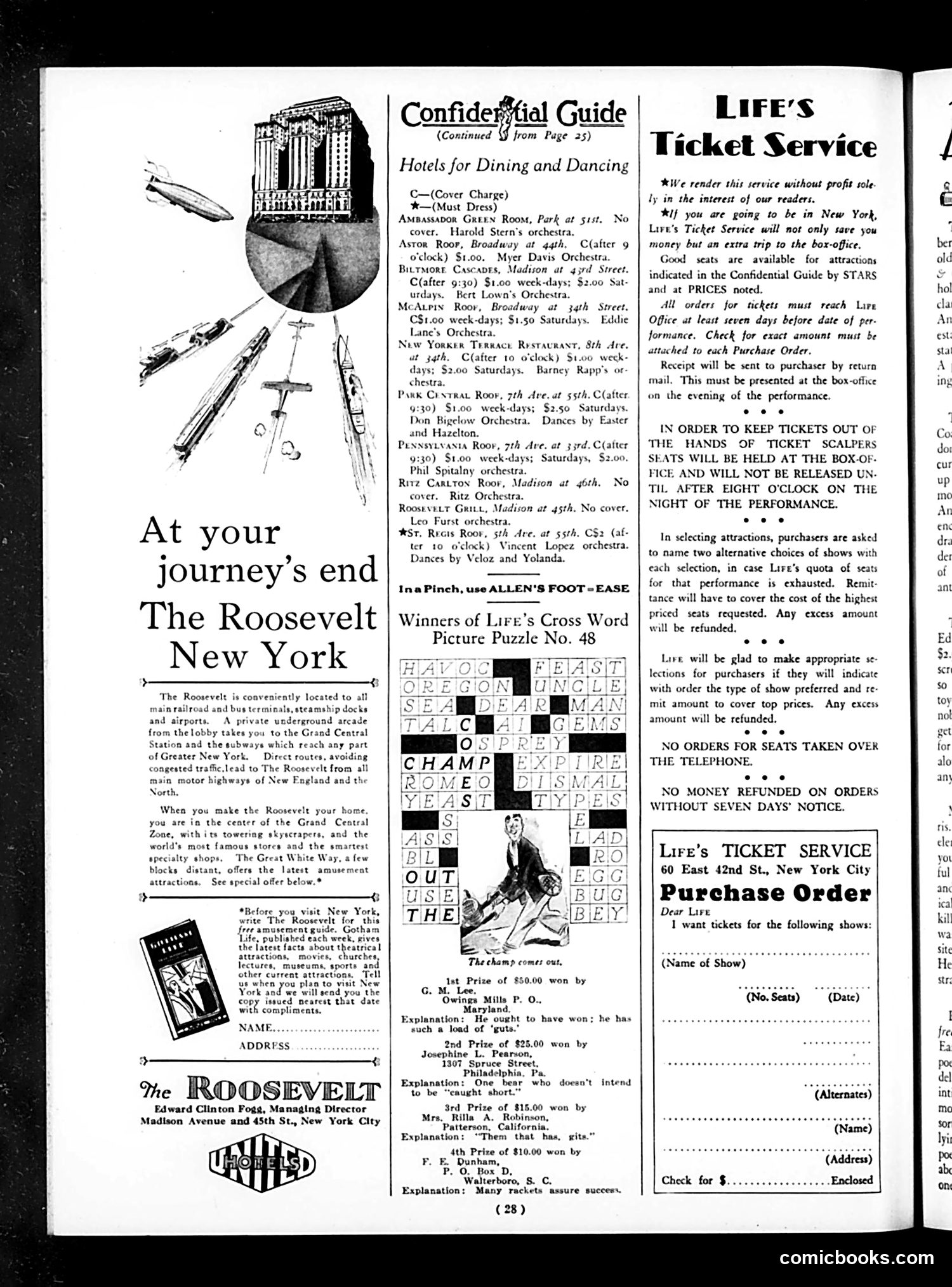
Analysis of This Life Magazine Page This is primarily a hotel and entertainment guide advertisement rather than a political cartoon. The page contains: Main Content: - A hotel advertisement for The Roosevelt (a real NYC hotel on Madison Avenue at 45th Street) - A "Confidential Guide" listing upscale dining and dancing venues in New York with cover charges and orchestras - Life magazine's ticket service offering, allowing readers to order theater tickets by mail - A crossword puzzle contest with prize winners announced The Cartoon Element: A small cartoon labeled "The champ comes out" depicts a boxer leaving the ring, likely commenting on prize-fighting. It's part of the puzzle contest winners section—the winning explanation was that the boxer "has such a load of 'guts,'" a pun on both courage and digestive contents. Historical Context: This reflects 1920s-30s New York leisure culture—upscale dining rooms with live orchestras were major entertainment, and mail-order ticketing was innovative service marketing. The page demonstrates how Life functioned as a lifestyle guide for affluent urban readers planning nights out.
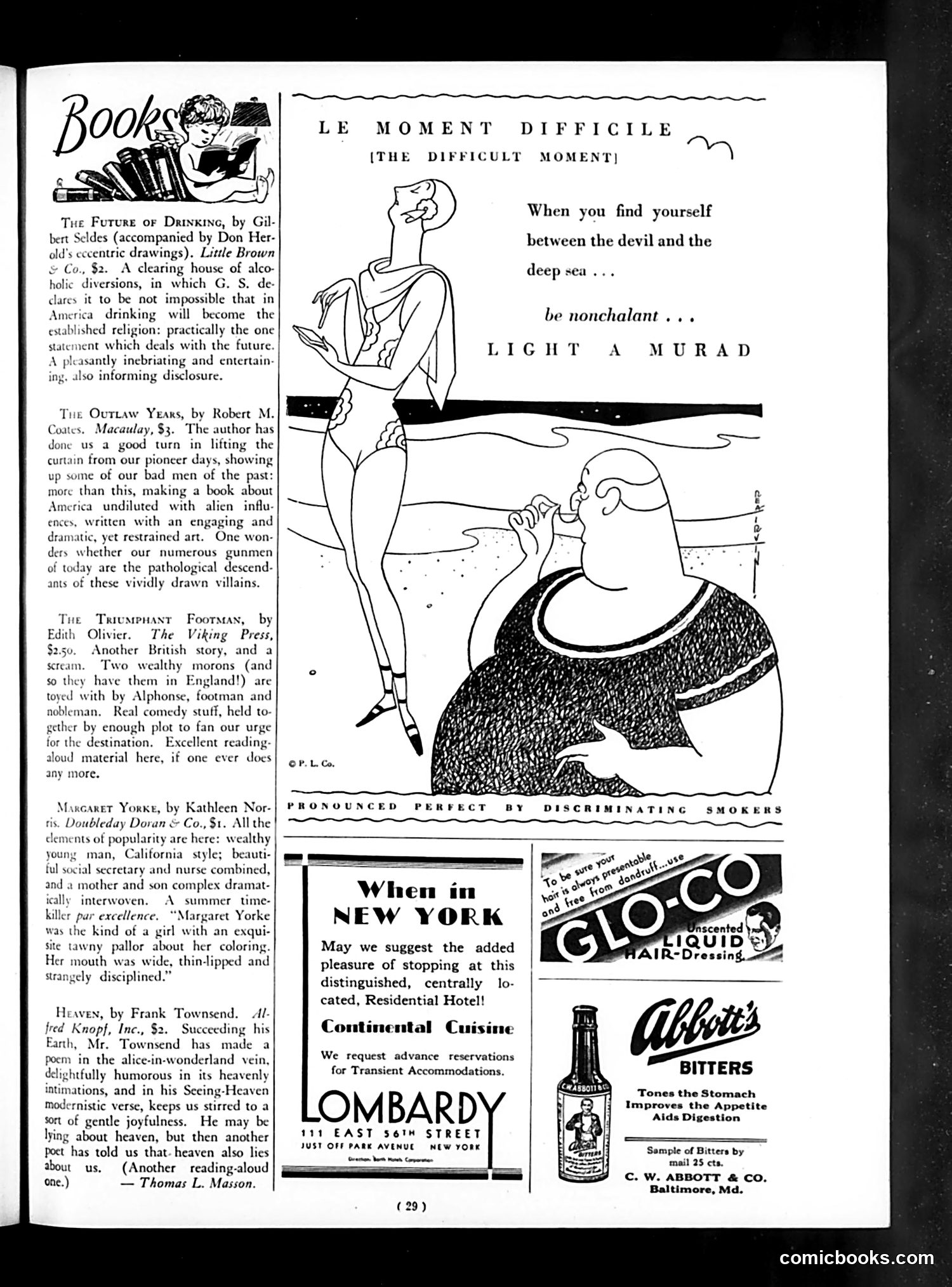
Explanation for Modern Readers This page combines book reviews with advertisements. The central cartoon illustrates "Le Moment Difficile" (The Difficult Moment)—a French phrase meaning an awkward social situation. The drawing depicts a woman caught between a devil figure and the sea, with the caption advising to "be nonchalant." This is an advertisement for Murad cigarettes, suggesting smoking provides sophistication during uncomfortable moments. The joke relies on 1920s social anxieties: the image of a composed woman in a precarious position was meant to appeal to aspirational readers by implying cigarettes confer elegance and composure. The French phrasing added perceived sophistication to the pitch. The book reviews discuss contemporary fiction and poetry, while surrounding advertisements (Glo-Co hair dressing, Abbott's Bitters, the Lombardy Hotel) represent typical Life magazine commercial content from this era. The reviews themselves use casual, witty language characteristic of the magazine's satirical tone.
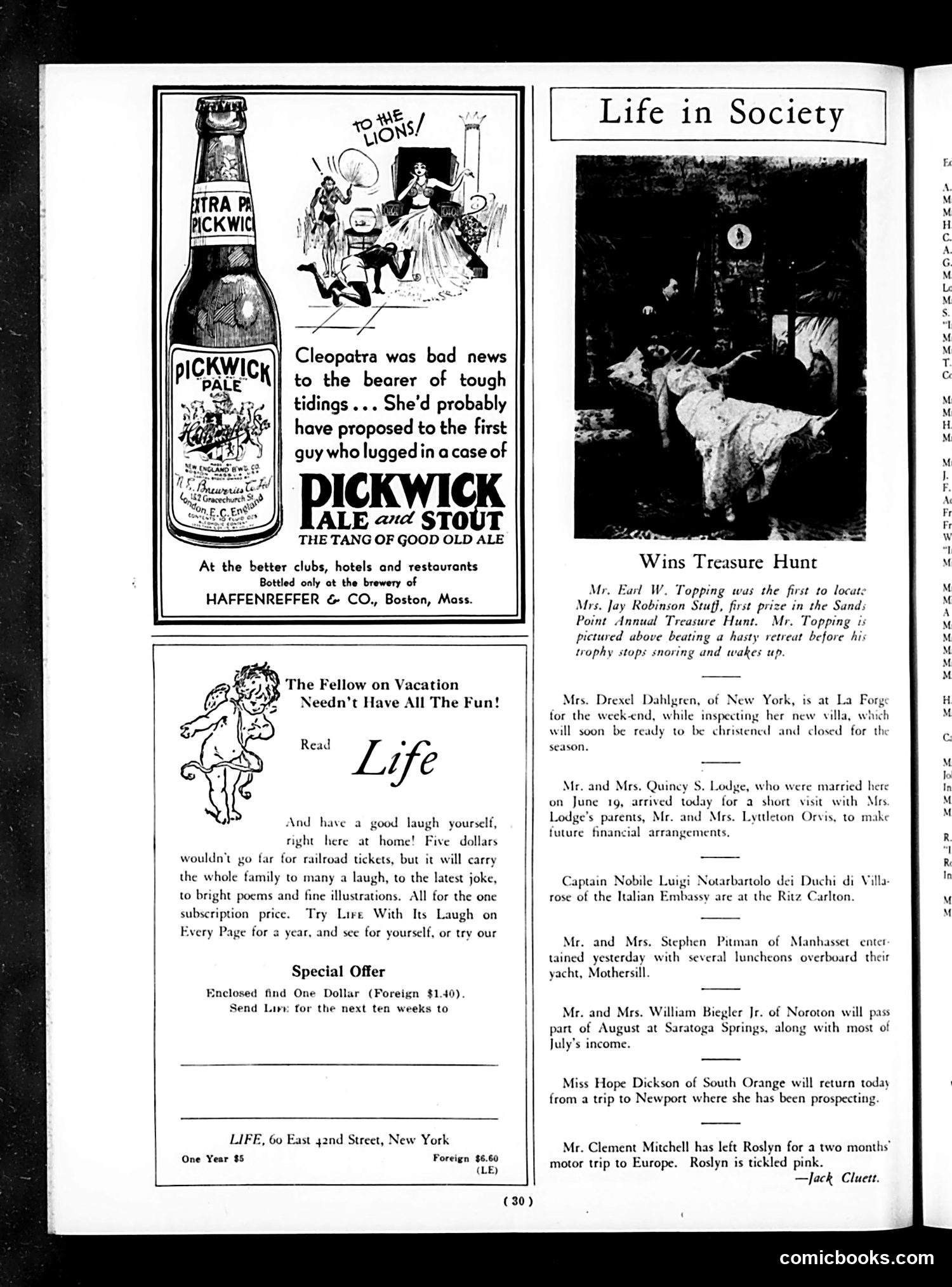
Explanation for Modern Readers This page contains two main elements: Left side: A Pickwick Ale advertisement disguised as humor. The joke references Cleopatra's legendary practice of executing messengers bearing bad news. The ad suggests that if Cleopatra had discovered beer, she'd have married the delivery man instead—implying the product is so good it could prevent historical violence. This is typical early-20th-century absurdist advertising humor. Right side: "Life in Society"—a gossip column mocking wealthy socialites. The humor is satirical commentary on the idle rich: a woman wins a treasure hunt prize (a pig that snores), another's new villa will be "closed for the season" immediately, newlyweds visit to arrange "future financial arrangements" (implying financial desperation), and a couple will spend "most of July's income" on August vacation. The final quip about Clement Mitchell's trip leaving "Roslyn tickled pink" uses the woman's name as a double entendre. The column satirizes the contradictions of wealthy leisure class life.
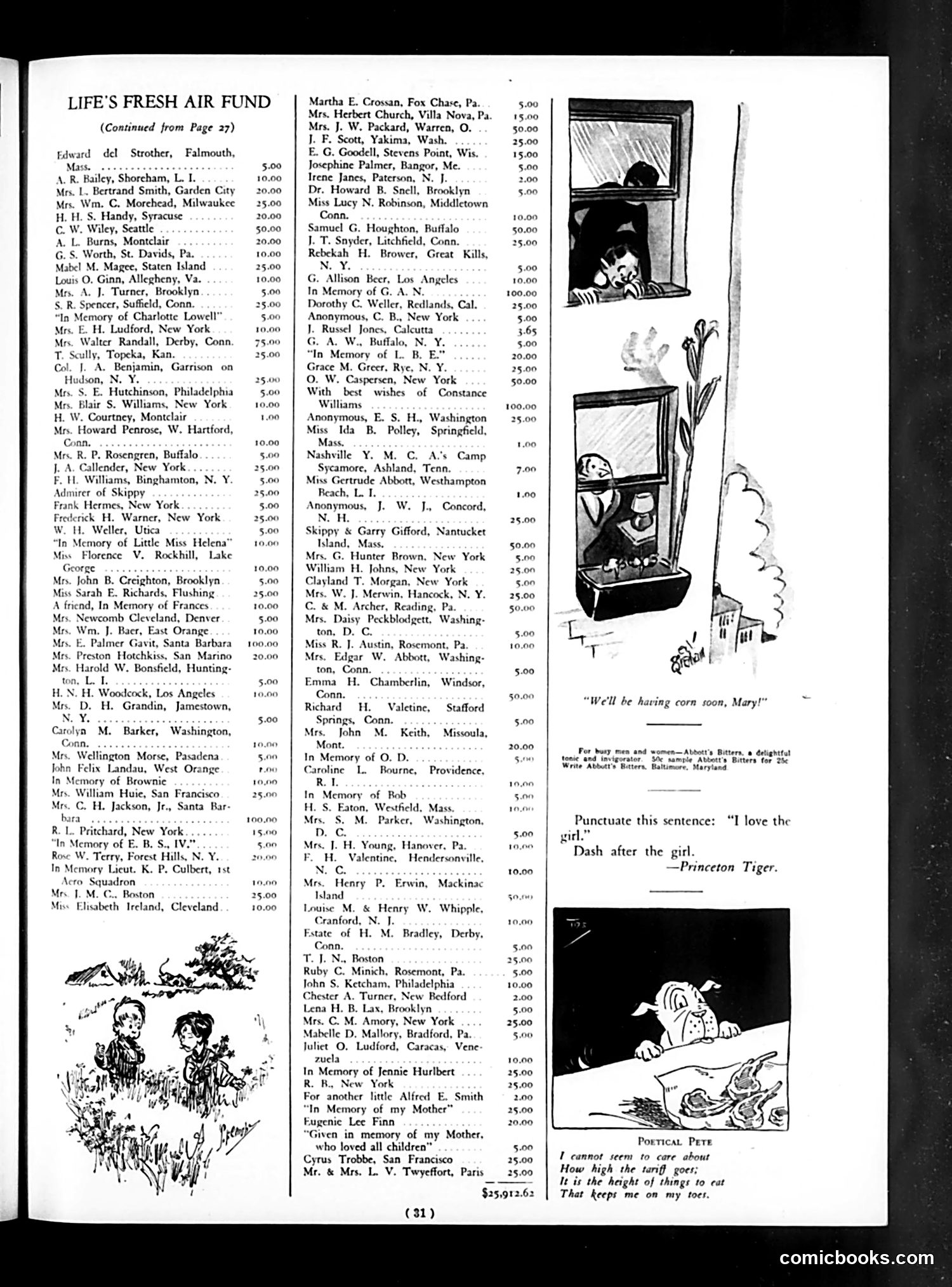
Analysis of Life Magazine Page This page primarily documents Life's Fresh Air Fund—a charitable program providing summer vacations for underprivileged urban children. The bulk of the page lists donors' names and contributions (ranging from $1 to $100), a common practice in early-20th-century charitable publications to acknowledge supporters and encourage further giving. The cartoons are unrelated to the fund itself. They appear to be standard humorous filler: one shows a domestic scene with the caption "Well's be having corn soon, Mary!" (a gentle joke about seasonal produce), and another titled "Poetical Pete" depicts a cat with a whimsical verse about appetite and contentment. The page reflects the Progressive Era's approach to child welfare, where middle and upper-class Americans supported programs to improve conditions for poor urban children—a central social reform concern of the period.
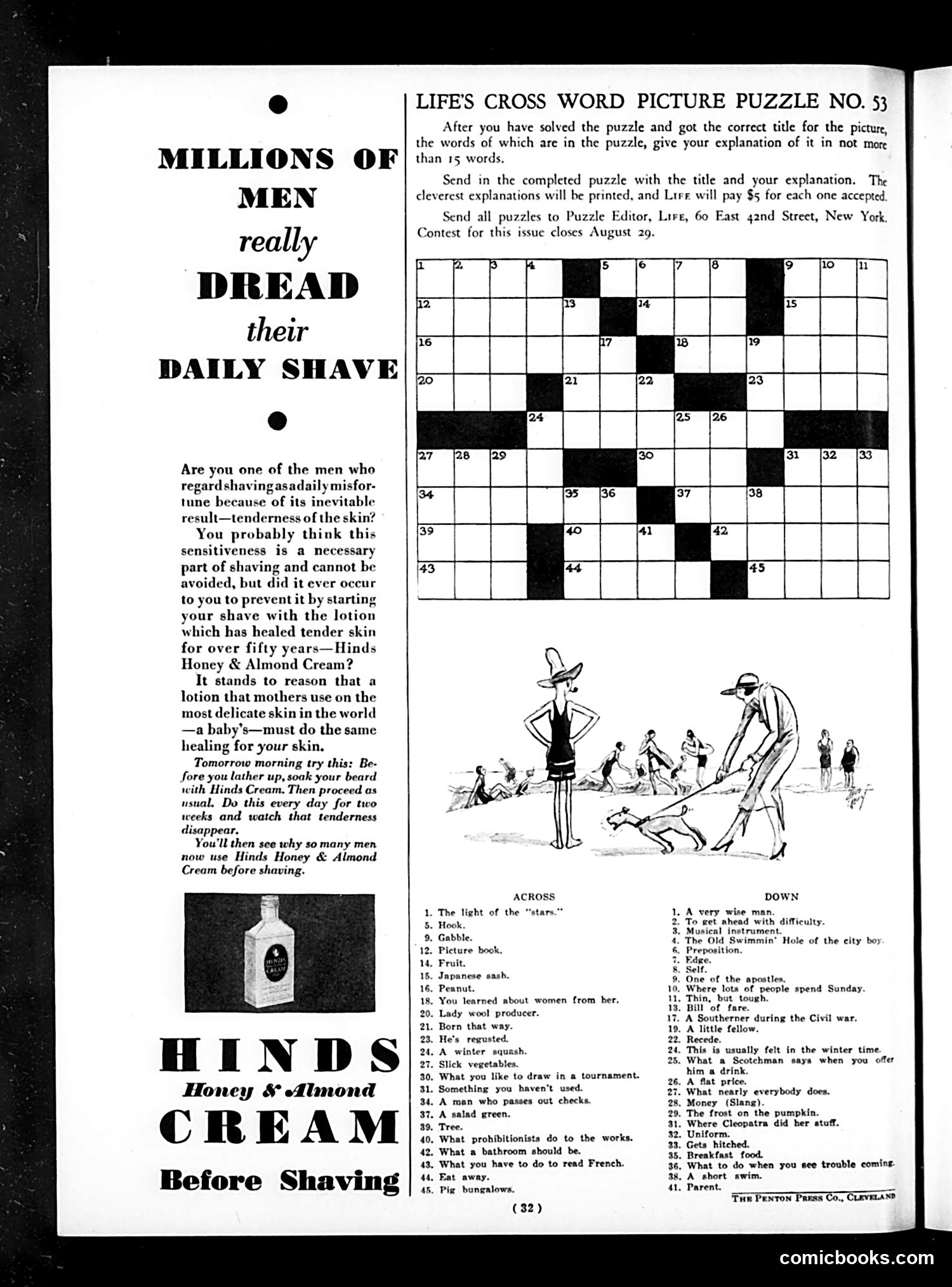
Analysis of Life Magazine Page Content This page is primarily advertising and puzzle content, not political satire. The left side features a full-page advertisement for Hinds Honey & Almond Cream, a pre-shave lotion. The ad addresses a relatable male grooming problem—razor irritation from daily shaving—and pitches the product as a solution by emphasizing its long history (over fifty years) and its use on delicate baby skin. The right side contains Life's Crossword Picture Puzzle No. 53, a reader-participation contest where solvers must complete the crossword, identify what the picture shows, and submit an explanation (max 15 words) for a $5 prize. Between these elements is a small illustration showing people at what appears to be a beach or recreational setting, likely related to the puzzle's answer. This represents typical early 20th-century magazine content: commercial advertising alongside interactive reader engagement features designed to build circulation and audience loyalty.
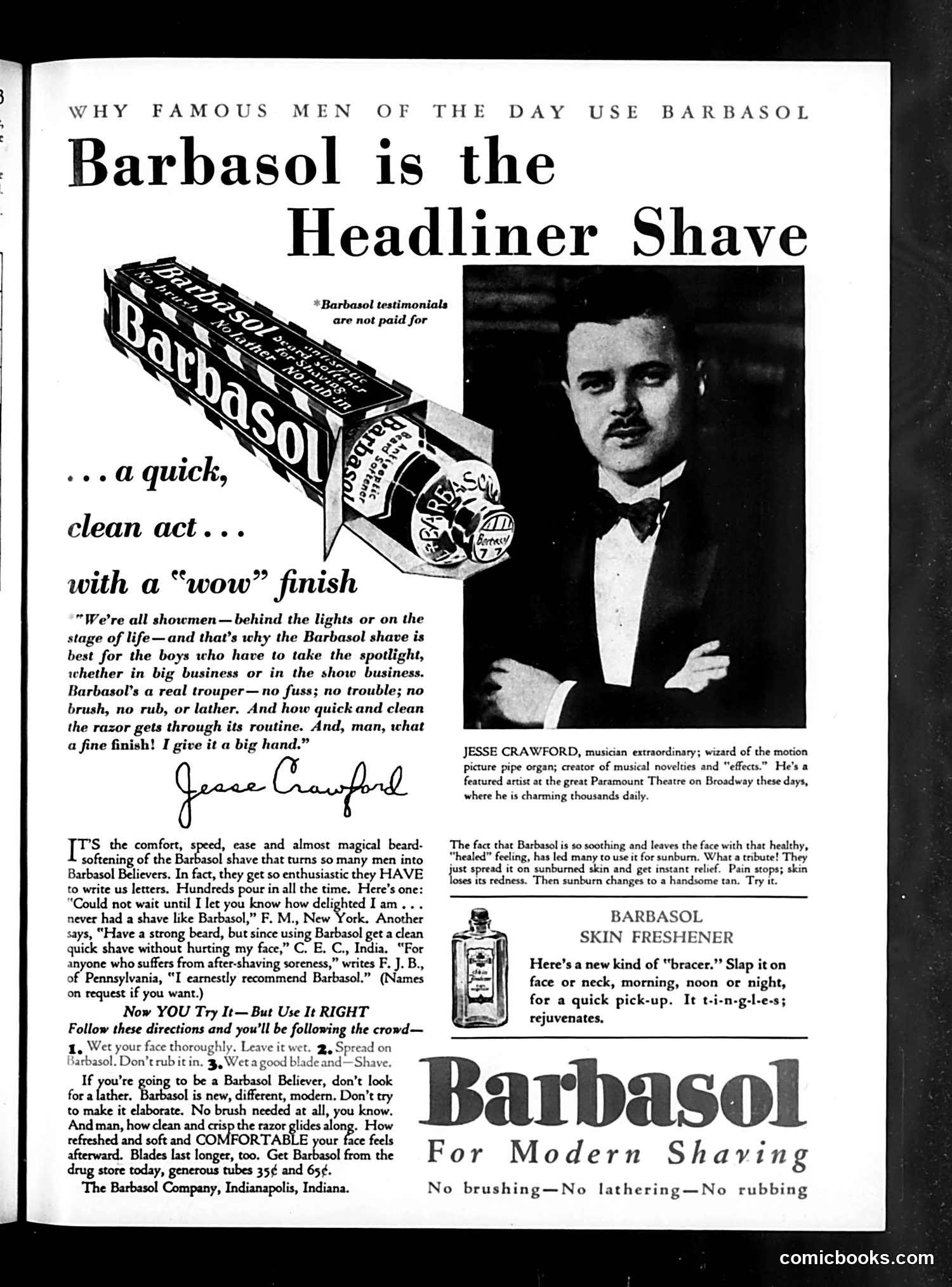
Barbasol Advertisement (Life Magazine) This is primarily a product advertisement, not political satire. It promotes Barbasol shaving cream by featuring Jesse Crawford, a real Paramount Theatre organist of the era, as a celebrity endorser. The ad targets professional men—"showmen" in business and entertainment—emphasizing speed and convenience. The key selling points are modern simplicity: no brush, no lather, no rubbing required. This appeals to busy, high-profile men who need quick grooming. The testimonials (claiming to be unpaid) from users nationwide establish credibility. The ad also positions Barbasol as innovative—"new, different, modern"—contrasting it with traditional wet-shaving methods requiring elaborate preparation. The inclusion of a skin freshener product extension suggests the brand was expanding its line to capitalize on the shaving cream's success. The overall message: modern men choose efficient, hassle-free grooming solutions.
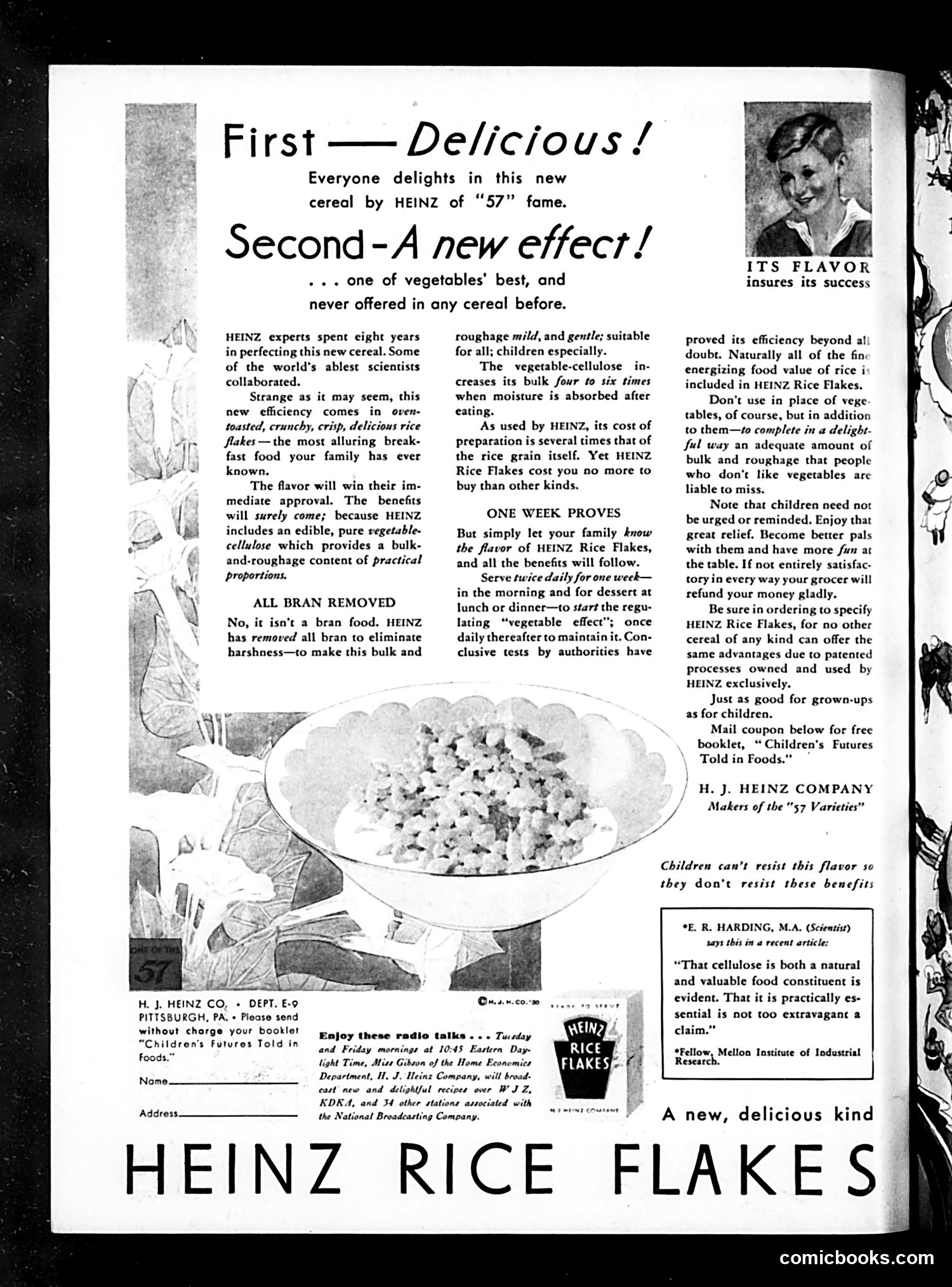
Heinz Rice Flakes Advertisement This is a product advertisement, not political satire. It promotes Heinz's new Rice Flakes cereal, emphasizing two main selling points: First: The cereal tastes delicious. Second: It contains vegetable cellulose—a novel ingredient that provides bulk and roughage, supposedly aiding digestion. Heinz claims their scientists spent eight years developing it. The ad targets families with children, promising the product is gentle on digestion while being palatable enough that "children can't resist this flavor." It includes quotes from scientists (E.R. Harding) lending credibility to health claims. Notable for modern readers: the advertisement conflates "vegetable-cellulose" with actual vegetable nutrition, and promotes digestive regularity as a key benefit—a concern that dominated early-20th-century health marketing. The coupon and radio program tie-in reflect 1930s-era advertising strategies.