life
Life — August 22, 1930
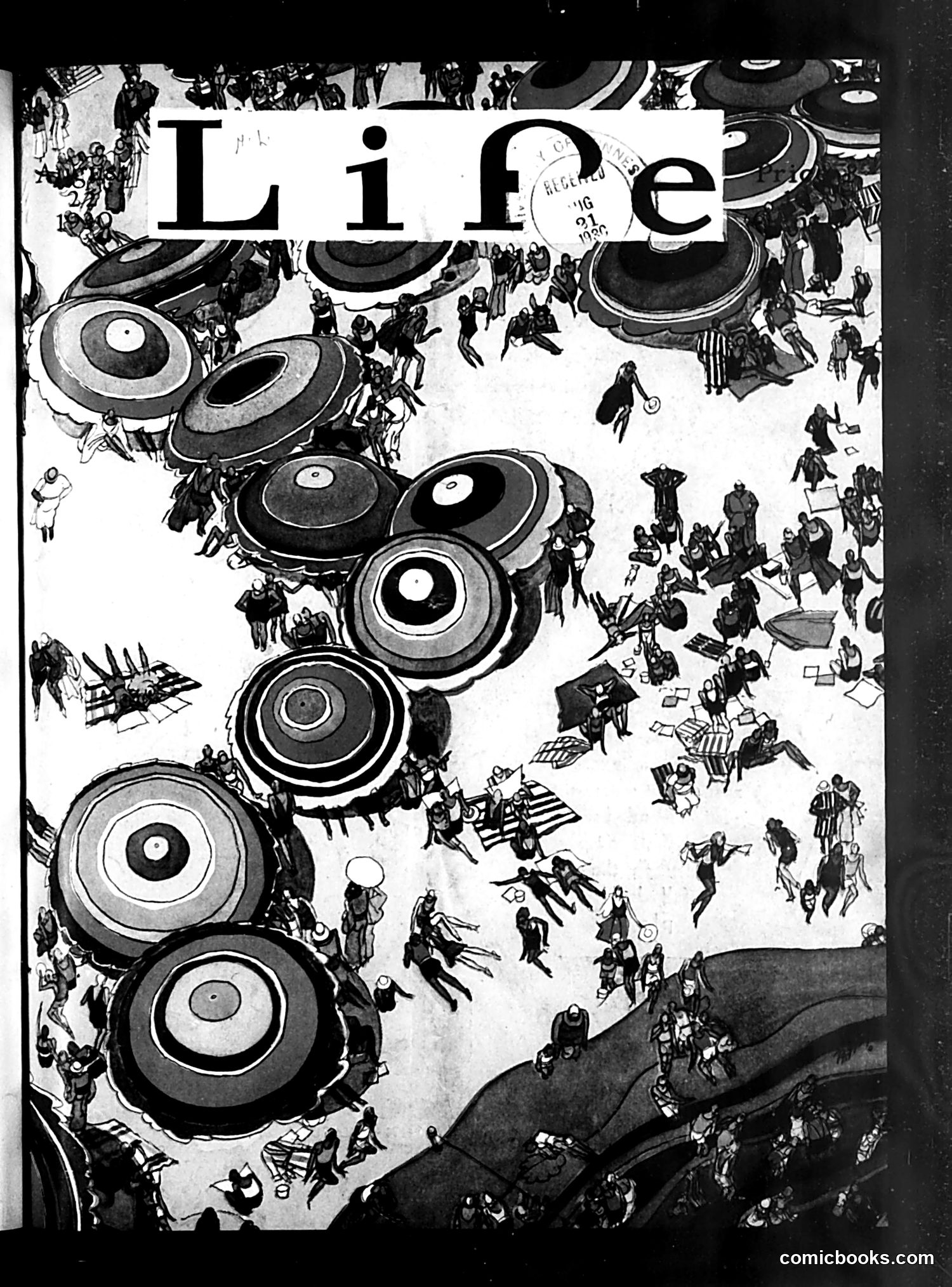
Life Magazine Cover Analysis This appears to be a Life magazine cover featuring an aerial or bird's-eye-view illustration of a crowded public space—likely a park or plaza—with numerous small human figures scattered below large circular objects that resemble umbrellas or parasols viewed from above. The satire likely comments on mass leisure, consumerism, or urban crowding in early-to-mid 20th century America. The contrast between the massive, uniform circular structures dominating the composition and the tiny, scattered people below suggests commentary on how individual humans are dwarfed by commercial or institutional forces. Without visible date or clearer identifying details, the specific historical reference remains unclear, though the style suggests the 1920s-1940s era of Life magazine's peak satirical influence.
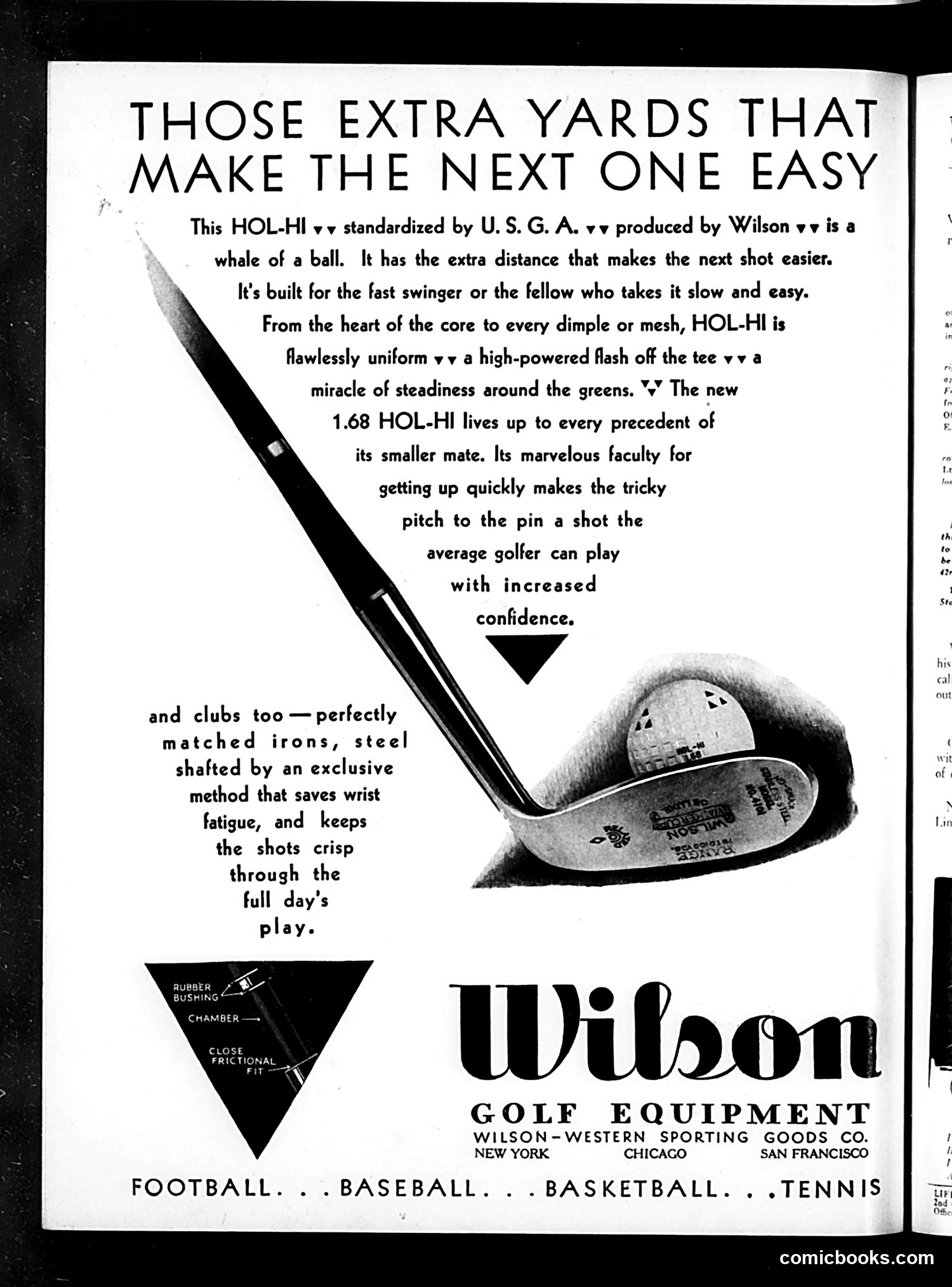
Analysis This is a Wilson golf equipment advertisement, not satirical content. There are no political cartoons or caricatures present. The ad promotes Wilson's "HOL-HI" golf ball, emphasizing that its extra distance makes the next shot easier. It appeals to both aggressive ("fast swinger") and cautious ("slow and easy") golfers. The copy highlights the ball's uniform construction, dimple pattern, and the company's matched iron sets with specially designed steel shafts. The visual shows a golf club and ball in a realistic product photograph. A technical diagram explains the shaft's "close frictional fit" design to reduce wrist fatigue. The page represents standard 1930s–1940s advertising: manufacturer branding across multiple sports (football, baseball, basketball, tennis) with aspirational messaging about performance and consistency.
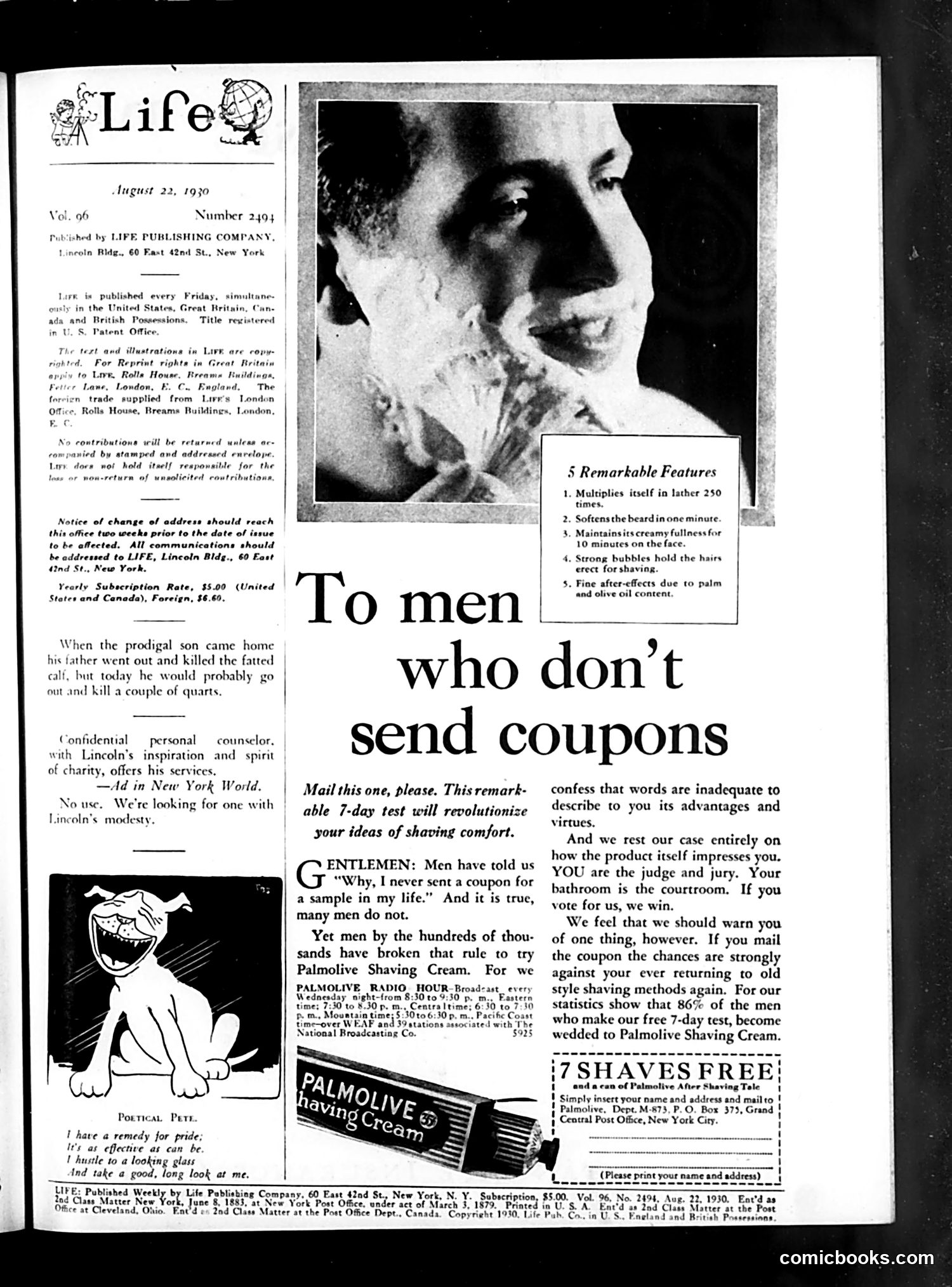
This page is primarily a Palmolive Shaving Cream advertisement from August 22, 1930, disguised as editorial content. The main headline—"To men who don't send coupons"—is a mock-serious appeal addressed to men resistant to mail-in promotions. The ad uses social pressure as its sales tactic, essentially shaming reluctant customers by suggesting that hundreds of thousands of men have already tried the product via coupon. The "5 Remarkable Features" box lists specific shaving benefits. The small political cartoon at bottom left appears unrelated—a brief satirical comment, though the OCR text is unclear about its specific subject. The bulk of the page is straightforward 1930s advertising copy and a coupon offer for "7 shaves free," reflecting the era's common direct-mail marketing strategies.
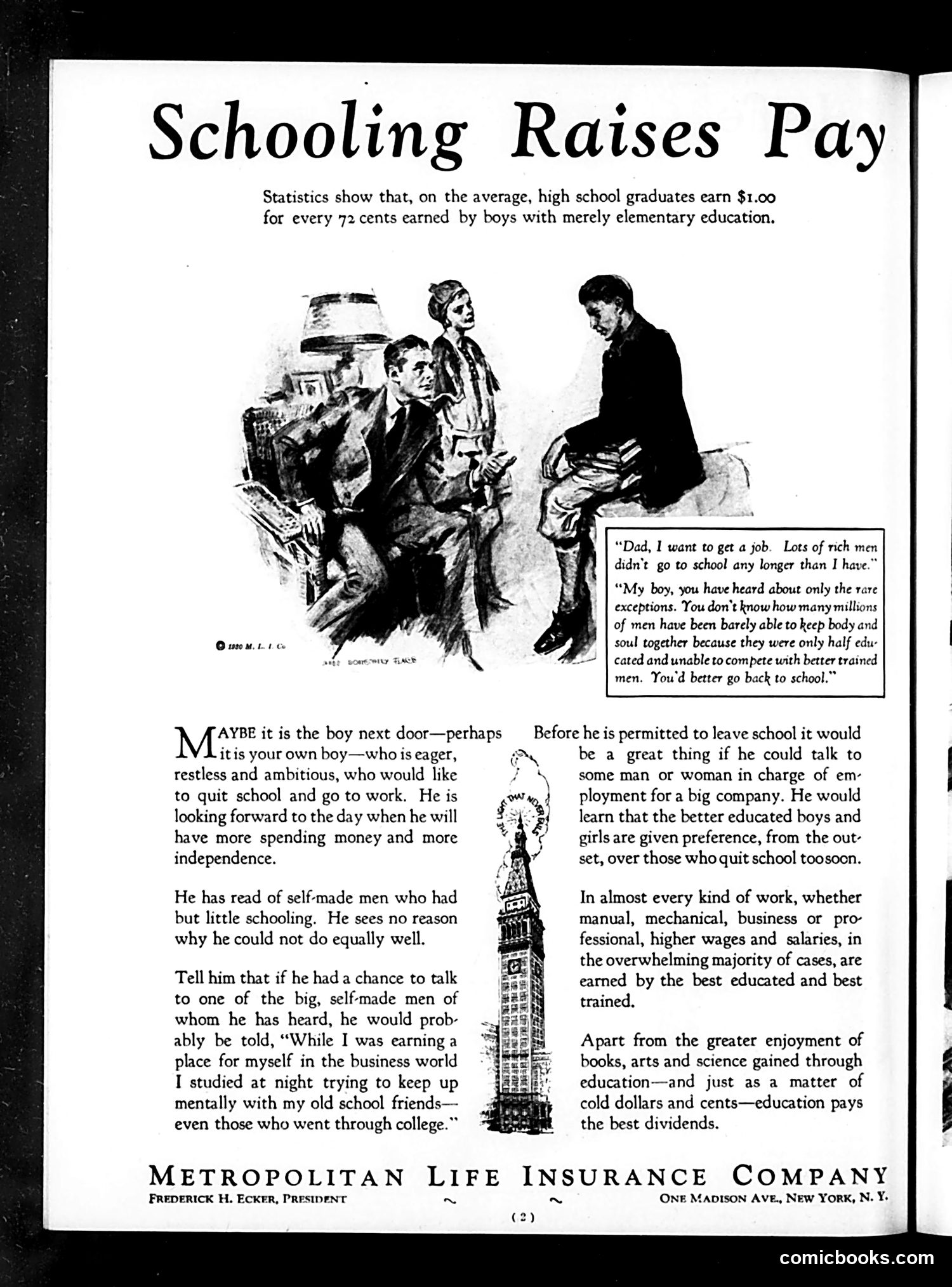
"Schooling Raises Pay" - Metropolitan Life Insurance Advertisement This is not satire but persuasive advertising by Metropolitan Life Insurance Company. The page uses a domestic scene—a boy asking his father about quitting school for work—to argue that education increases earning potential. The ad presents statistics: high school graduates earn $1.00 for every 72 cents earned by boys with only elementary education. The father counsels his son that while self-made men exist, they are exceptions. Better-educated workers receive preference in employment and earn higher wages across manual, mechanical, and professional fields. The underlying pitch: education provides financial security, making life insurance (and Metropolitan's policies) a worthwhile investment for families' futures. The message reflects early 20th-century American faith in education as economic mobility.
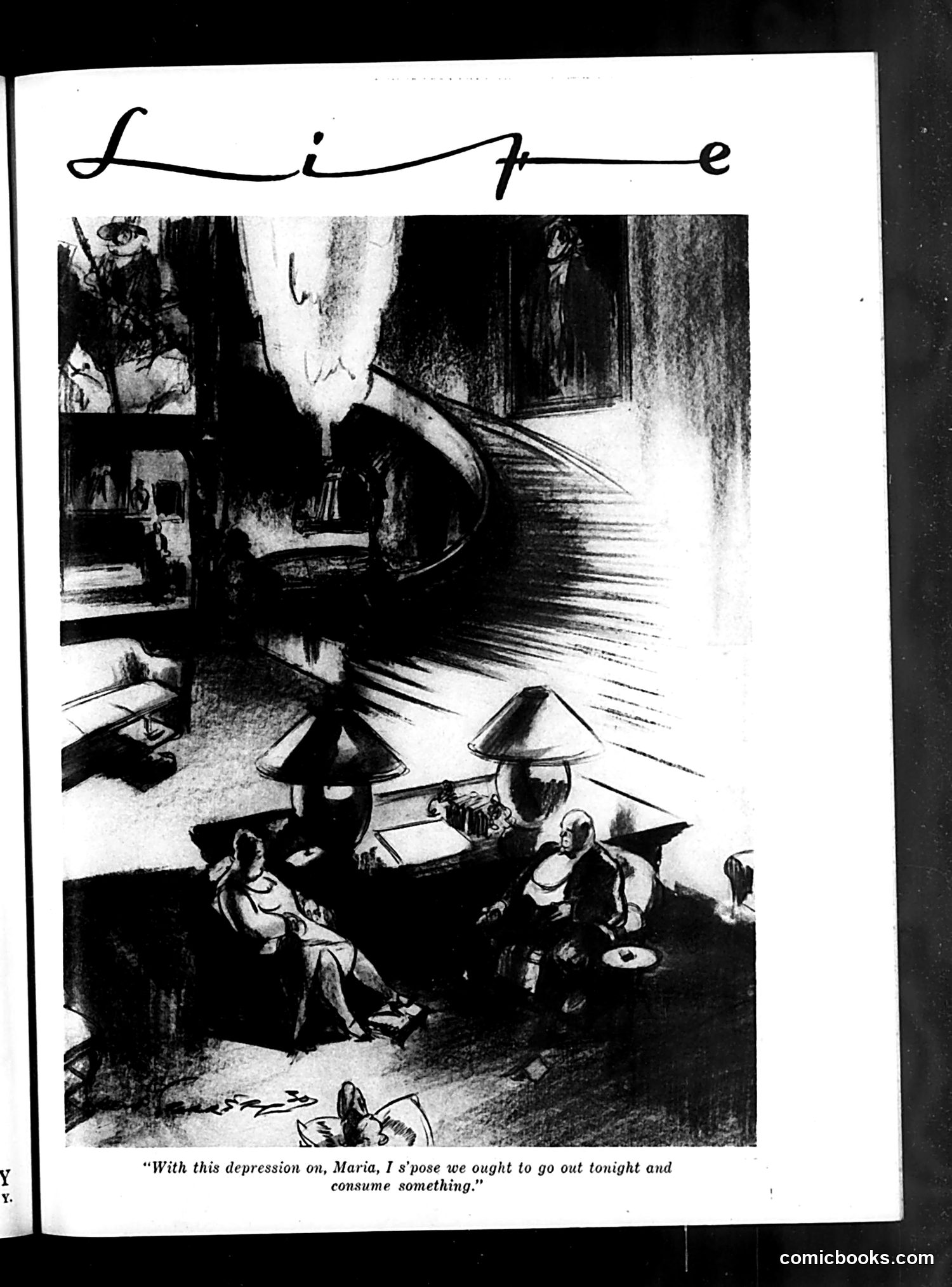
Analysis of "Life" Magazine Page This appears to be a satirical cartoon from Life magazine's "Life" section (as indicated by the handwritten title at top). The illustration depicts what seems to be an Asian setting, with figures wearing conical hats typical of East Asian dress, seated outdoors. The caption reads: "With this depression on, Maria, I s'pose we ought to go out tonight and consume something." The satire targets Depression-era consumer culture. Despite economic hardship ("this depression"), the character suggests they should go out and spend money anyway—likely mocking both the contradiction of Depression poverty and society's continued emphasis on consumption and entertainment as solutions to economic woes. The exotic setting may suggest either travel escapism or serve as mere decorative background for the economic commentary.
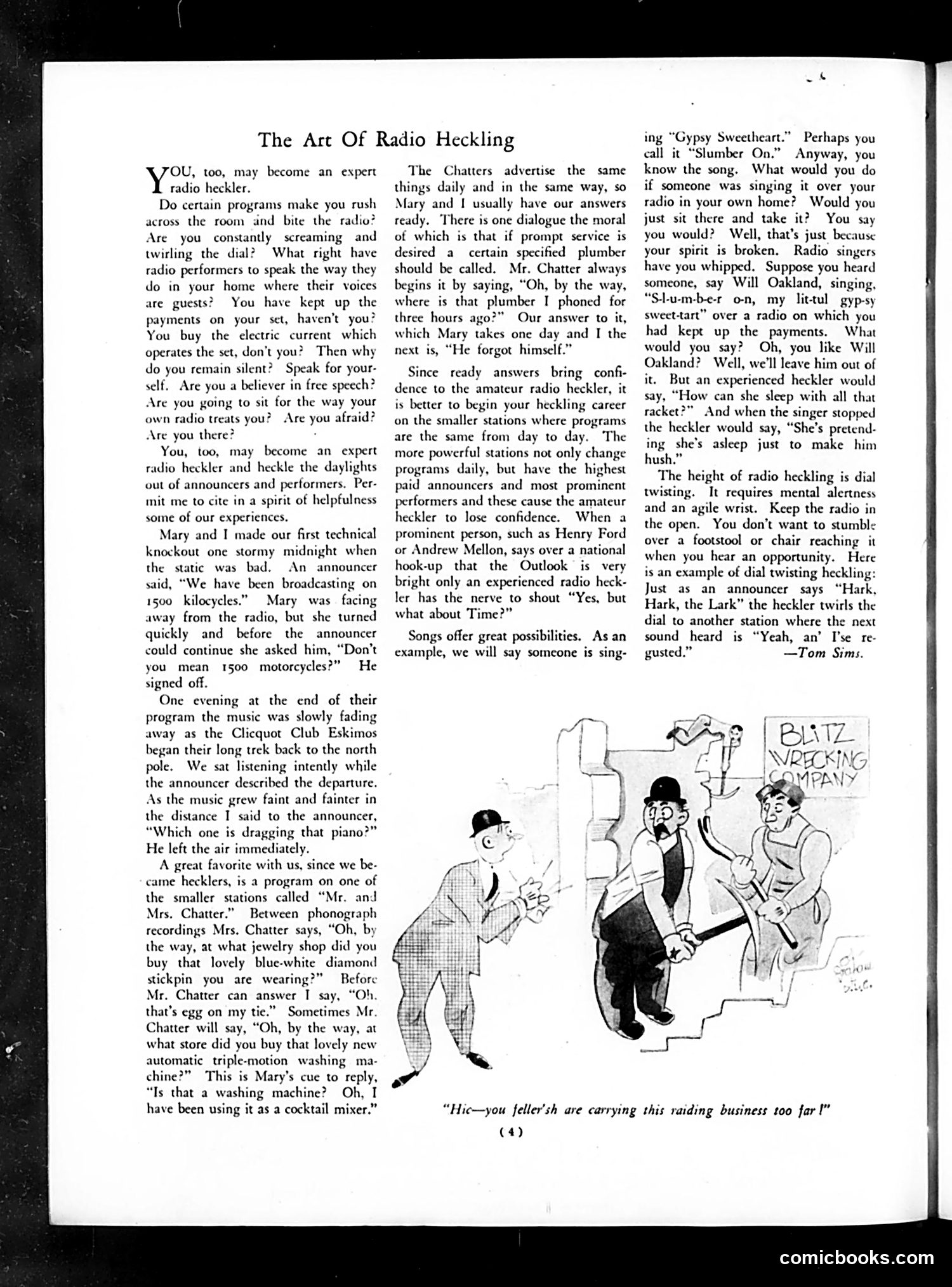
"The Art of Radio Heckling" - Life Magazine Satire This article satirizes amateur radio enthusiasts ("hecklers") who interrupt broadcasts on early radio stations. The author describes how listeners would call in during live programming to harass announcers—asking absurd questions like "Don't you mean 1500 motorcycles?" or inquiring about jewelry purchases. The accompanying cartoon depicts radio hecklers calling into a station, with one declaring "BLITZ HECKING CAMPAIGN" while another complains the activity has "gone too far." The satire targets the novelty and chaos of early radio: with no screening, any listener could reach live broadcasters mid-show. The piece humorously documents this new form of public nuisance enabled by radio technology, treating amateur heckling as a widespread amateur sport among radio listeners.
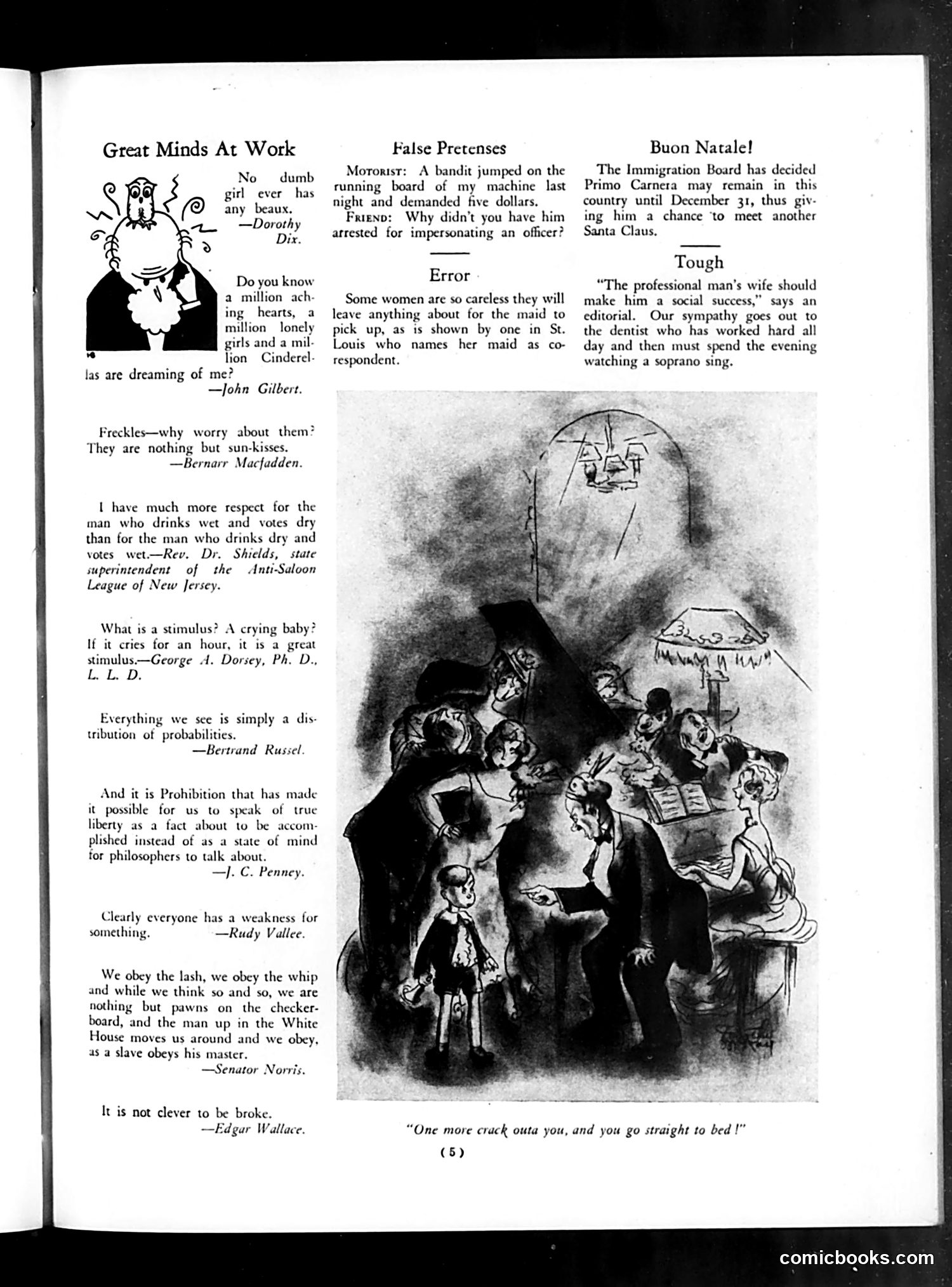
Analysis of Life Magazine Page This page contains satirical quotes and a political cartoon addressing immigration and holiday traditions. The Main Cartoon ("One more crack outa you, and you go straight to bed!") depicts Santa Claus disciplining rowdy children during Christmas—likely a commentary on American behavior or social chaos. "Buon Natale!" Section references the Immigration Board keeping "Primo Carrera" in the country until December 31st to meet "another Santa Claus"—appearing to satirize immigration policy or the treatment of foreign nationals around Christmas. "Great Minds at Work" Quotes are satirical observations from various figures mocking Prohibition, women's roles, prohibition's effects on free speech, and social hypocrisy of the era. The page reflects 1920s concerns: Prohibition enforcement, immigration debates, and gender dynamics in American society.
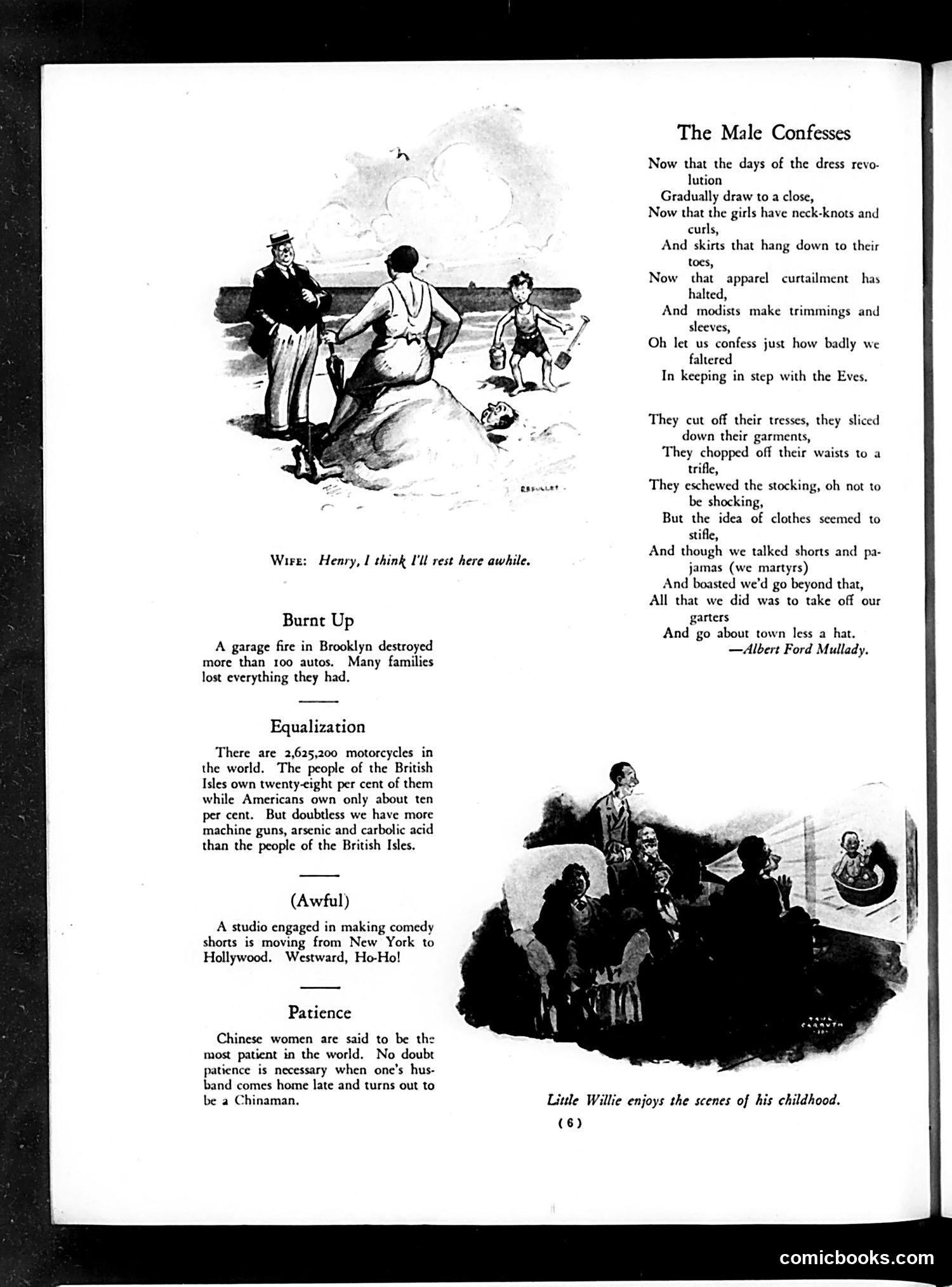
"The Male Confesses" and Related Satirical Items Top cartoon: A wife confronts her husband about fashion. The poem "The Male Confesses" mocks men who complained about women's fashion changes—shorter skirts, fewer petticoats, simpler garments. The husband admits men talked big about accepting these changes ("we boasted we'd go beyond that"), but actually just removed their hats and garters rather than genuinely adapting. The satire criticizes male hypocrisy regarding women's liberation and the dress reform movement. Lower items are brief satirical notes on unrelated topics: a Brooklyn garage fire, motorcycle statistics comparing Britain and America, a comedy studio relocating west, and observations about Chinese women's patience. The page captures early 20th-century gender tensions over women's changing fashion and social roles.
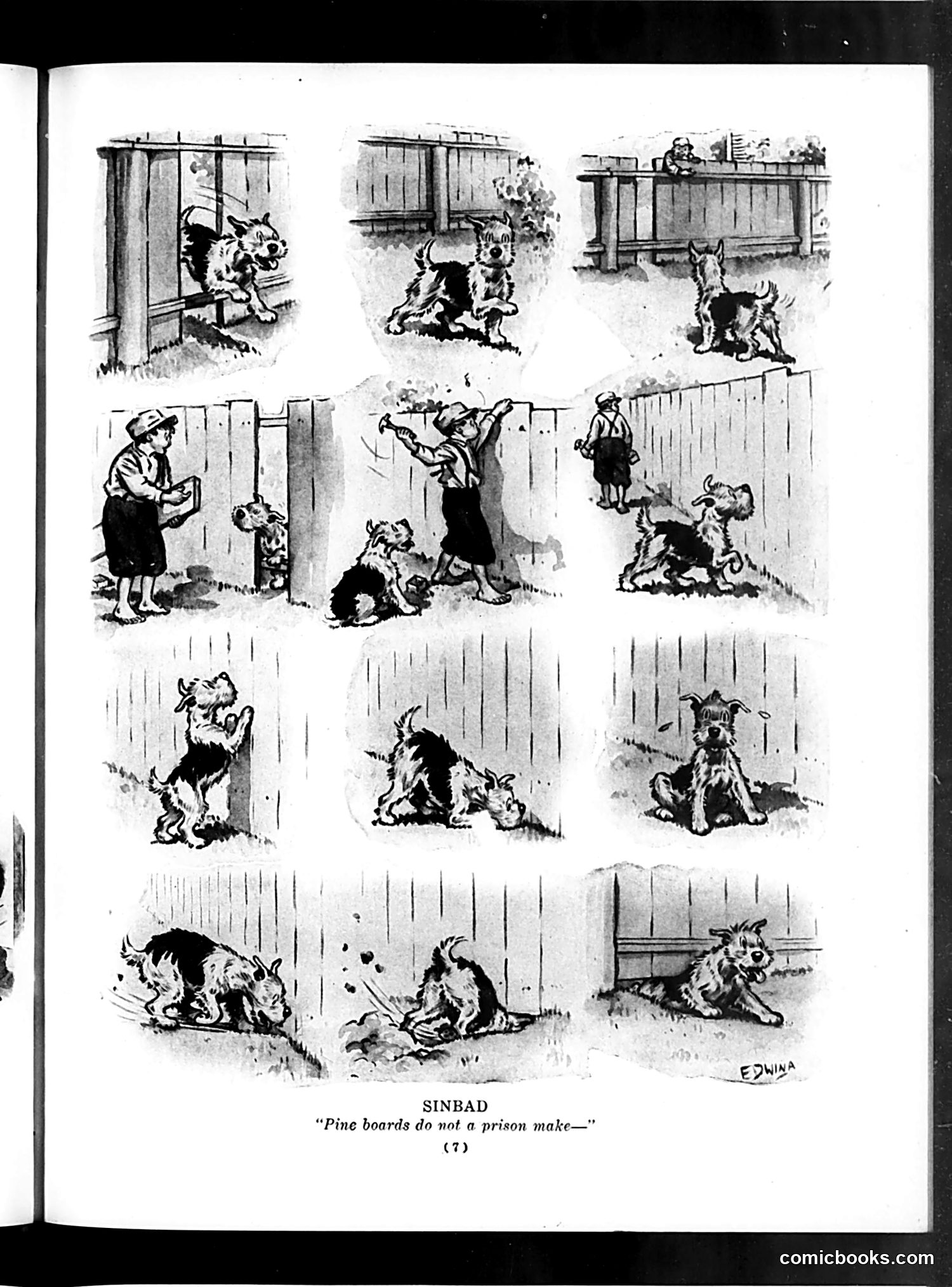
"Sinbad: Pine boards do not a prison make" This is a comic strip sequence showing a dog (Sinbad) repeatedly escaping from or breaching wooden fence enclosures. The title quotes Alexander Pope's famous line "Stone walls do not a prison make," applying it humorously to pine boards. The joke progresses through twelve panels depicting the dog's various escape attempts and exploits—jumping over fences, digging under them, breaking through, or simply ignoring the barriers. The cartoon satirizes the futility of trying to contain an determined, resourceful animal with inadequate fencing. The strip is credited to "EDWINA" (the artist's signature). It's a lighthearted observation about pet behavior rather than political satire, appearing in *Life* magazine's humor section.
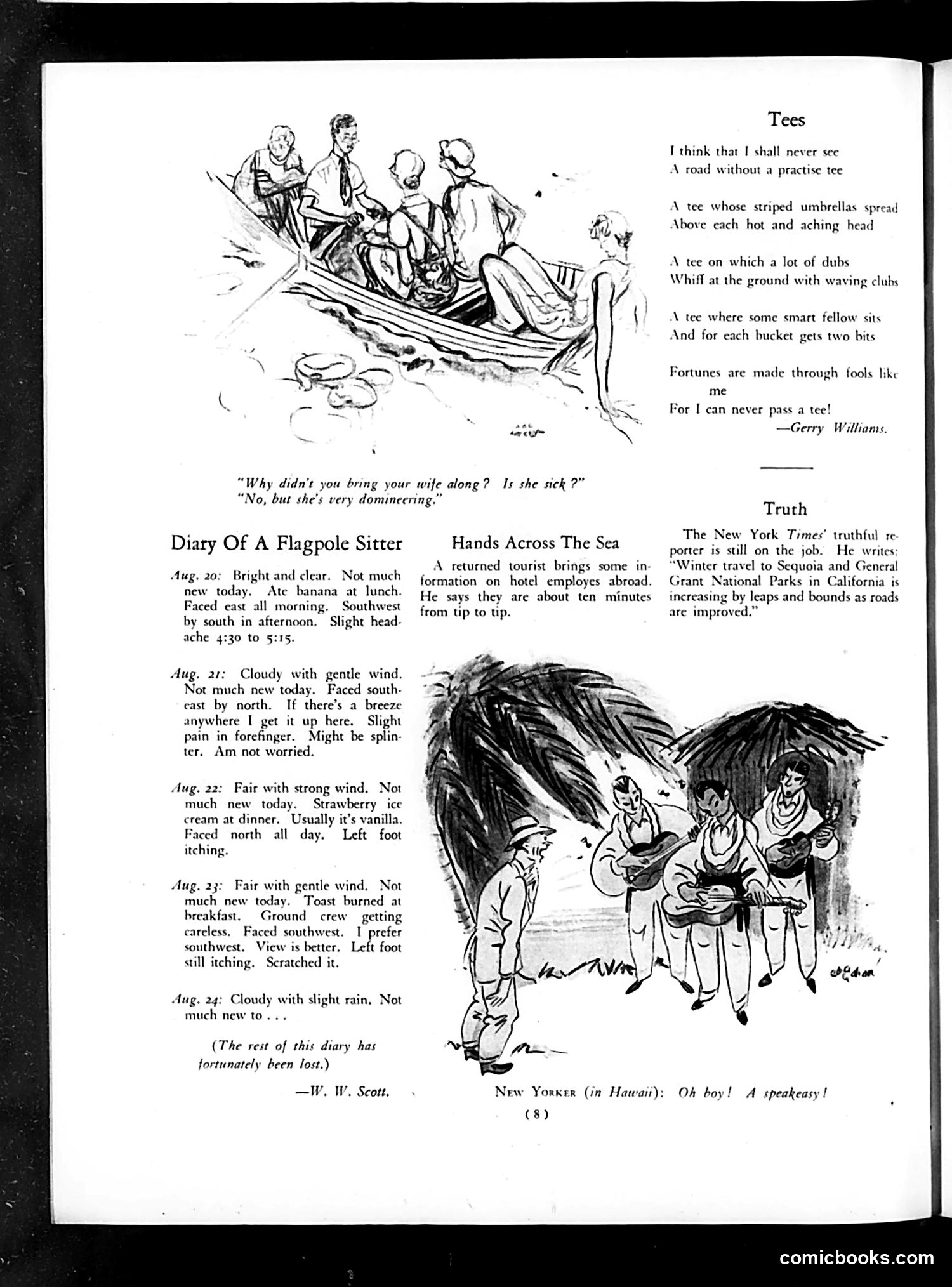
Analysis of This Life Magazine Page This page contains three separate pieces of humor content: "Tees" — A poem by Gerry Williams celebrating golf practice tees, illustrated with a sketch of golfers relaxing under umbrellas on a course. The humor is gentle, praising tees as essential tools for making fortunes in golf. "Diary of a Flagpole Sitter" — A brief diary by W.W. Scott documenting daily weather and minor events (Aug. 20-24), with a note that the rest was lost. This appears to reference the 1920s fad of flagpole sitting—a bizarre endurance stunt where people sat atop tall poles for extended periods, drawing crowds. "Hands Across the Sea" — A cartoon showing tourists in Hawaii encountering what appears to be a local speakeasy (referenced as "speakeasy" in the caption). The humor relies on Prohibition-era context, where illegal alcohol consumption was common even in tourist destinations.
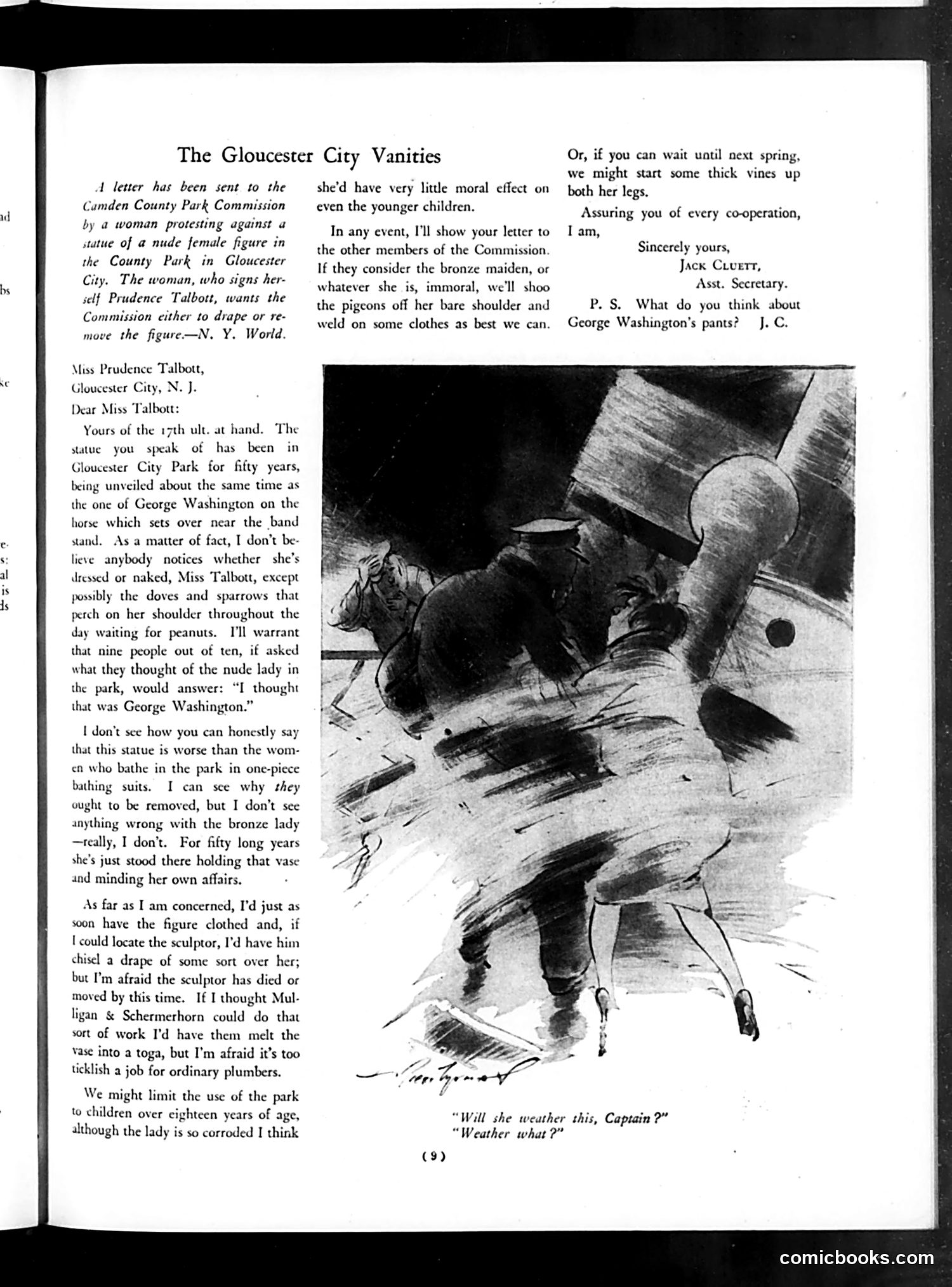
Analysis of "The Gloucester City Vanities" Page This page contains a letter-to-editor debate about a bronze statue of a nude female figure in Gloucester City Park (New Jersey). A woman protested the statue's "immorality," and Jack Cluett, the park commission's assistant secretary, responds dismissively. Cluett argues the statue has stood unnoticed for fifty years, that it's no worse than women in bathing suits, and that removing it would be an unnecessarily difficult task. He suggests clothing the figure instead, or waiting until spring to plant vines to cover it. The accompanying cartoon shows a weathered statue being rained on, with the caption "Will the weather this, Captain?" — suggesting that time and nature will resolve the controversy without intervention, mocking the protester's concerns as petty.
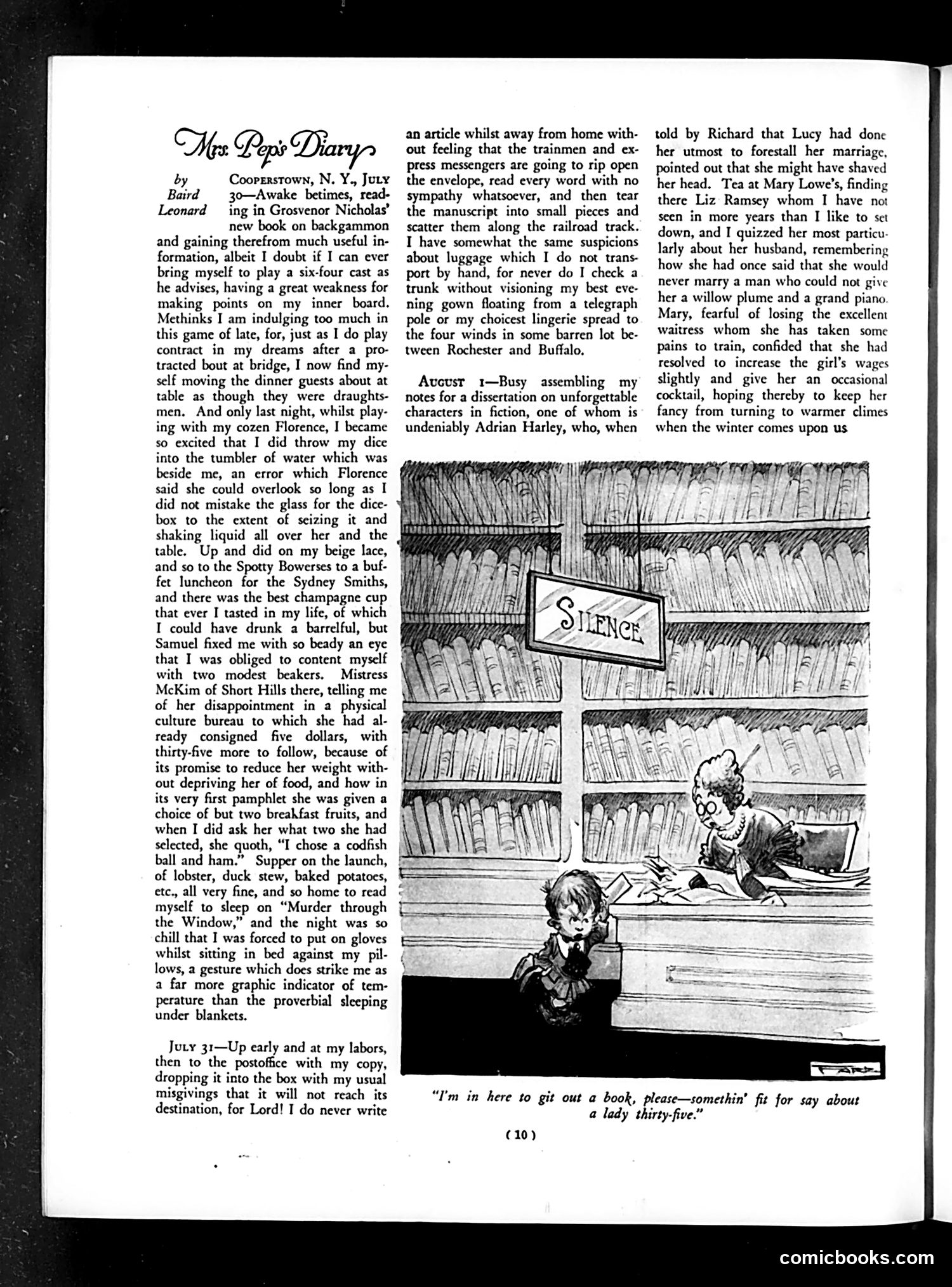
Mrs. Pepps Diary - Library Scene Cartoon This is a diary entry by Baird Leonard dated July 30-31 from Cooperstown, NY. The accompanying cartoon illustrates a humorous library scene where a child approaches a librarian requesting a book "fit for a lady thirty-five" — apparently seeking age-appropriate reading material. The joke appears to mock both the child's innocence and the arbitrary nature of gendered reading recommendations of the era. The "SILENCE" sign visible in the library reinforces the stuffy, rule-bound atmosphere of early 20th-century libraries. The diary text itself contains various social observations about daily life, including comments on marriage, servants, and class dynamics typical of the period's satirical social commentary.
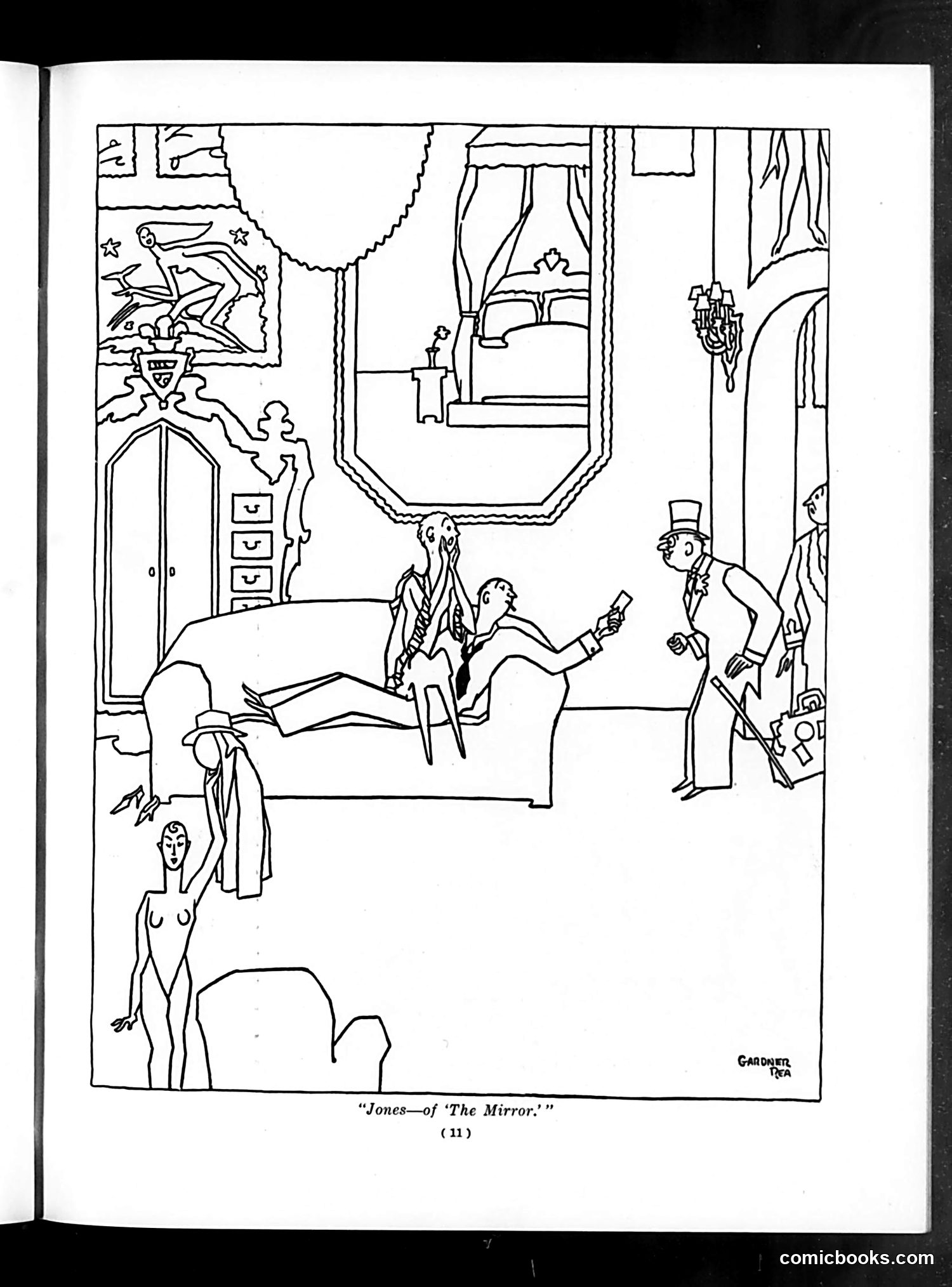
"Jones—of 'The Mirror'" This cartoon depicts a scene in what appears to be an elegant interior, with various well-dressed figures engaged in social interaction. The caption references "Jones of 'The Mirror,'" likely referring to a character or personality from that publication. The scene shows several men in formal attire and top hats mingling with women in a sophisticated setting, complete with decorative elements like wall sconces and furnishings. The satire appears to target social pretension and the fashionable society crowd—the kind of elite social circles that would be documented in society magazines of the era. The artist is credited as "Gardiner," visible in the lower right. Without additional context about the specific scandal or social commentary this references, the cartoon seems to mock the artificial sophistication and social climbing of its subjects.
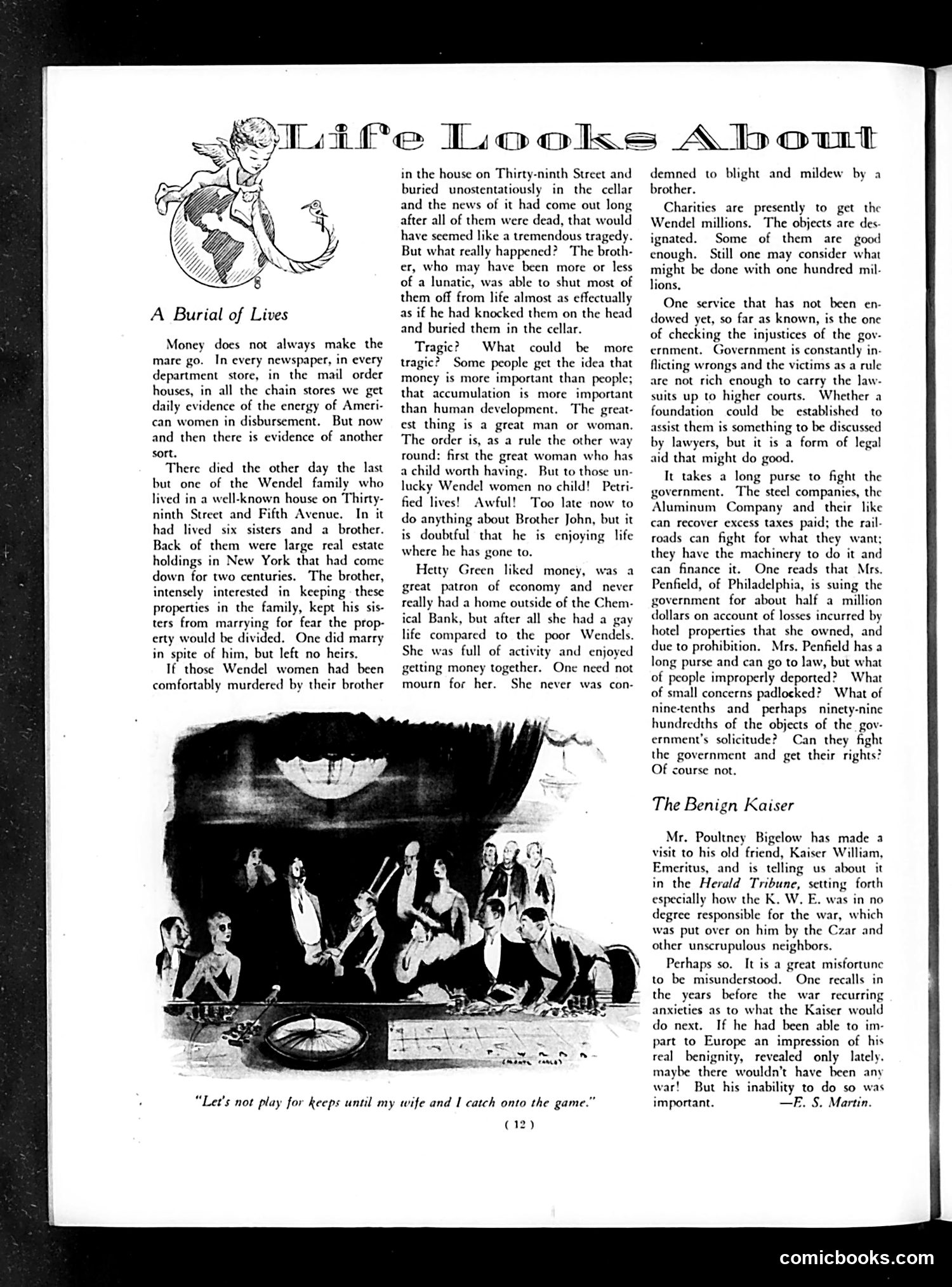
Analysis of Life Magazine Page This page contains two distinct sections: "A Burial of Lives" (left column): A social commentary criticizing wealthy families who prioritize money and property over human life. It references the Wendel family tragedy on Thirty-ninth Street, where a brother allegedly murdered sisters in a cellar. The article critiques how the family's wealth allowed them to suppress the scandal and avoid justice—illustrating how money enables the powerful to escape accountability. "The Benign Kaiser" (right column): Political satire about Kaiser Wilhelm II, arguing that pre-war observers misunderstood his character and intentions. The author suggests the Kaiser was manipulated by the Czar and neighbors into war, implying he bore less responsibility than commonly believed. Cartoon: Shows wealthy people gambling, with caption "Let's not play for keeps until my wife and I catch onto the game"—satirizing the reckless gambling of the privileged class.
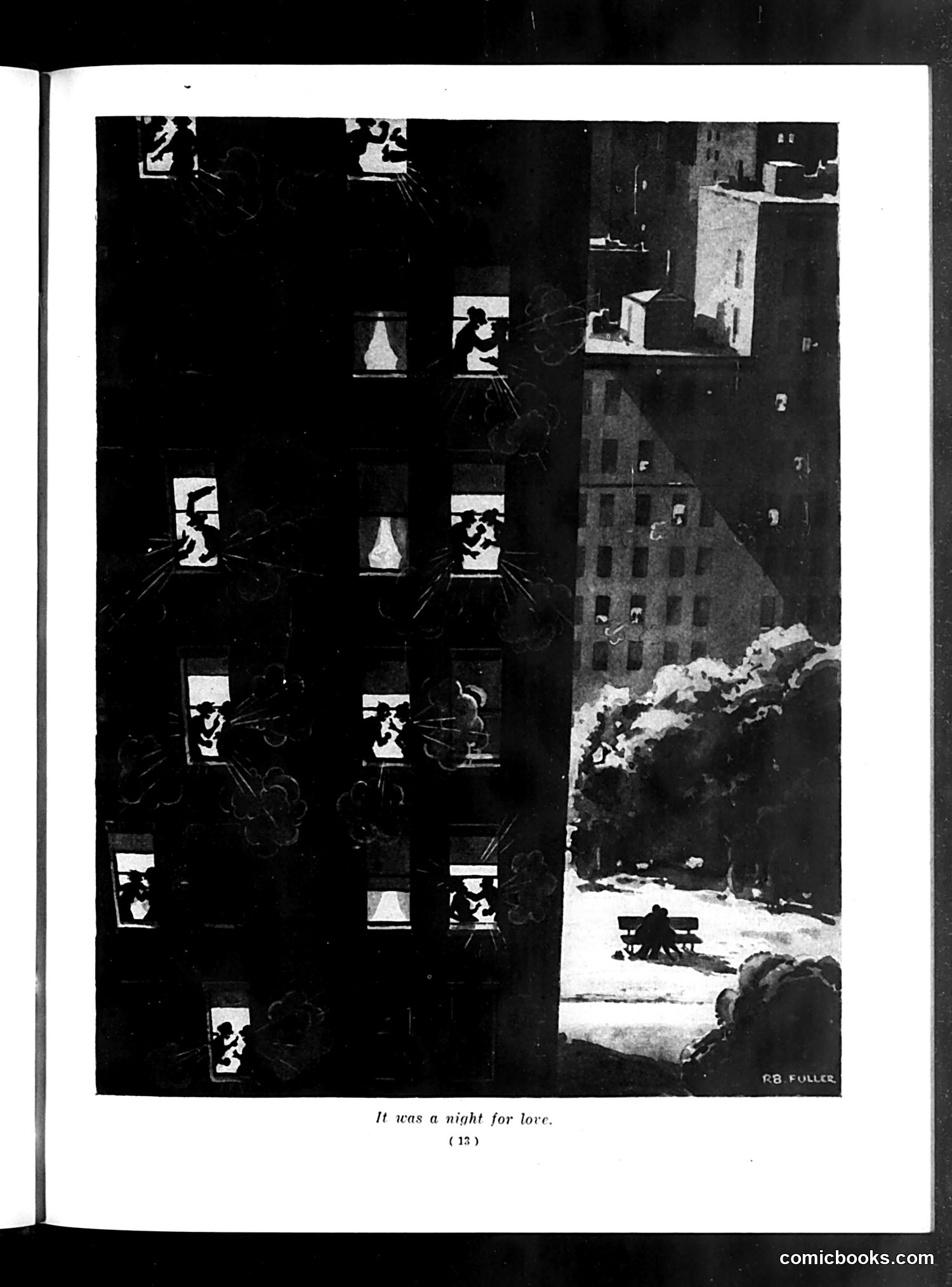
"It Was a Night for Love" - Analysis This is an illustration by R.B. Fuller showing a romantic urban nighttime scene. On the left, a dark apartment building facade displays illuminated windows where couples can be seen in silhouette, apparently intimate moments. On the right, a snow-covered street scene shows buildings and what appears to be a lone figure on a bench. The caption "It was a night for love" paired with the contrast between the warmly-lit, populated windows of romantic activity indoors versus the cold, empty street outside suggests satirical commentary on urban romance and isolation. The cartoon appears to mock the disconnect between private domestic life and public loneliness—those inside experiencing connection while others remain outside in the cold. The satire likely targets social divisions or the varying fortunes of different city dwellers.
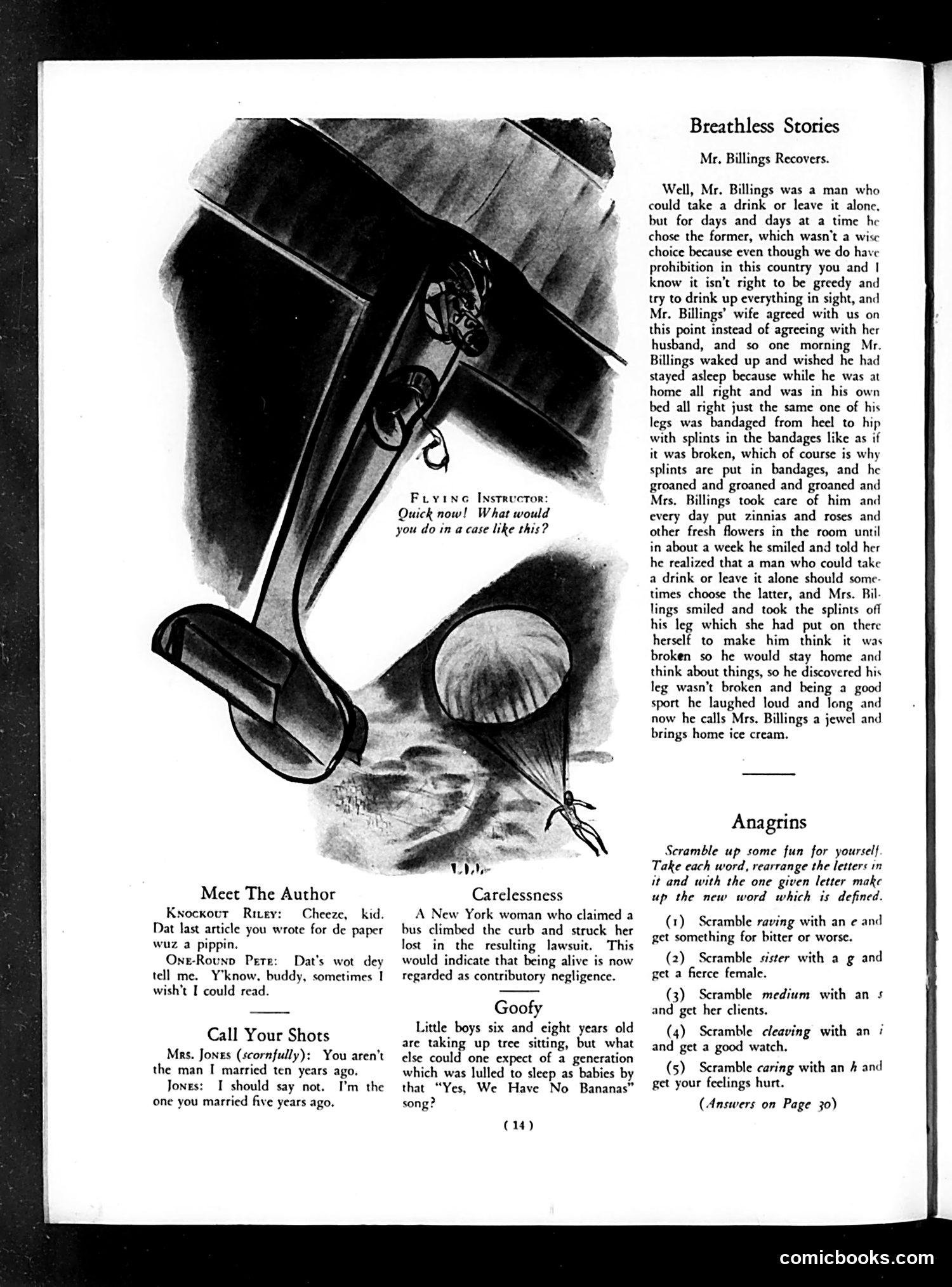
Page Analysis This page contains three distinct humorous pieces rather than a single cartoon: 1. "Mr. Billings Recovers" (main illustration): A sketch showing a flying instructor addressing a student pilot in an aircraft. The joke appears to be about emergency decision-making—the instructor asks "Quick now! What would you do in a case like this?" The accompanying story reveals the humorous point: Mr. Billings, a heavy drinker, injured his leg and stayed home where his wife cared for him. Realizing moderation has merit, he recovers and now brings her ice cream, suggesting his wife's attentiveness reformed him. 2. "Carelessness": A brief anecdote mocking a New York woman's lawsuit after hitting a curb while boarding a bus—characterizing it as absurd to blame being alive itself for negligence. 3. "Goofy": A joke about children singing "Yes, We Have No Bananas" instead of expecting better musical taste from their generation. These are light domestic humor pieces typical of 1920s-era Life magazine.
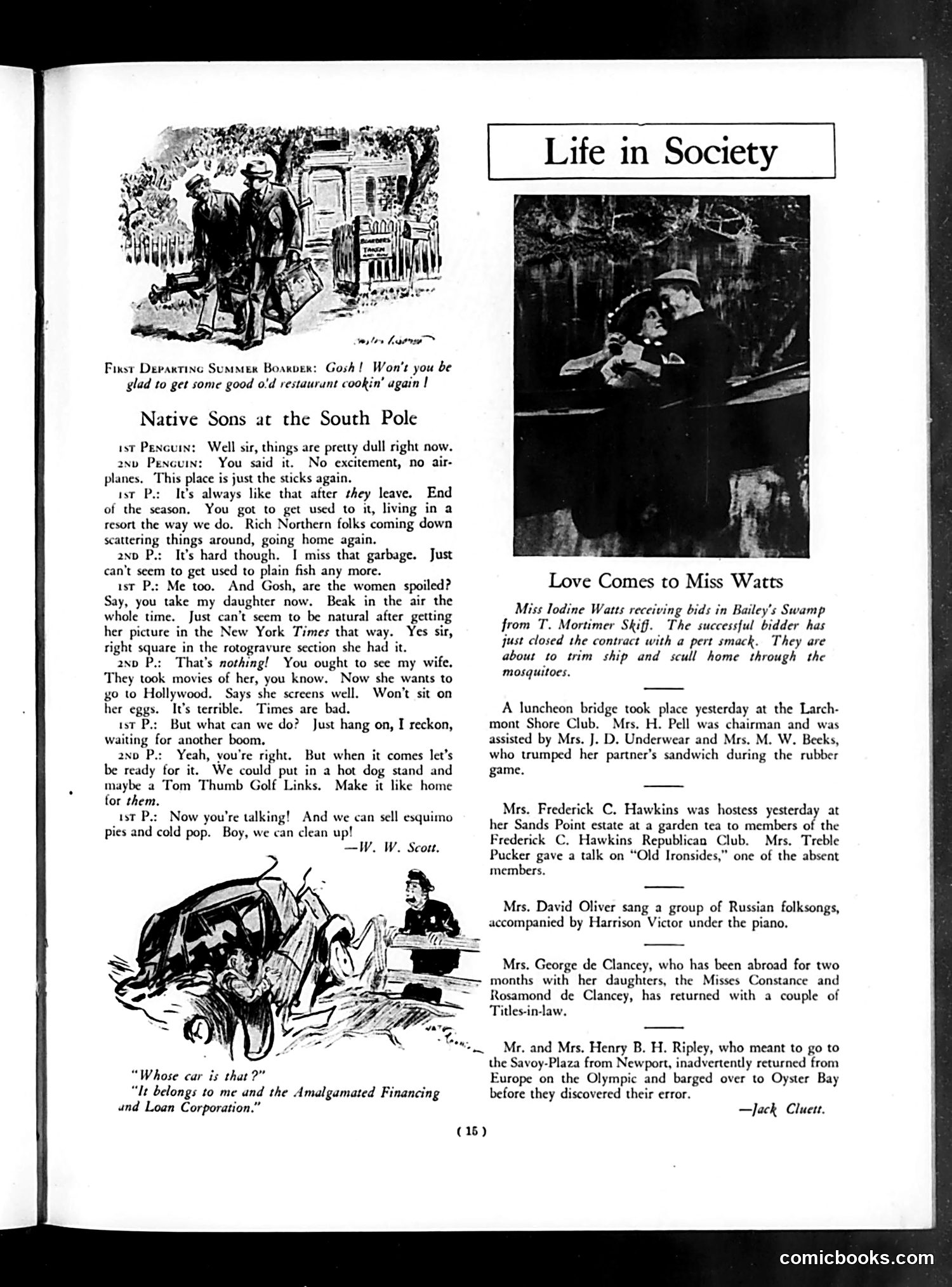
"Life in Society" Page Analysis This page combines humor with social commentary typical of early 20th-century Life magazine. "Native Sons at the South Pole" is a dialogue between two penguins discussing the monotony of Antarctic life—complaining about boredom, wanting modern conveniences (restaurants, movies, golf), and expressing frustration that wealthy Northern visitors are arriving to "scatter things around." The satire mocks both the isolation of remote locations and the disruptive impact of wealthy tourists seeking adventure. "Love Comes to Miss Watts" is a brief society-column item about Miss Iodine Watts receiving marriage proposals while boating in Bailey's Swamp, ultimately choosing one suitor. It parodies the gossipy tone of society pages reporting romantic entanglements. The page's lower cartoon depicts a car accident, captioned as belonging to "the Amalgamated Financing and Loan Corporation"—satirizing corporate entities and their legal protections. Overall, the page satirizes rural monotony, wealthy tourism, and corporate privilege.
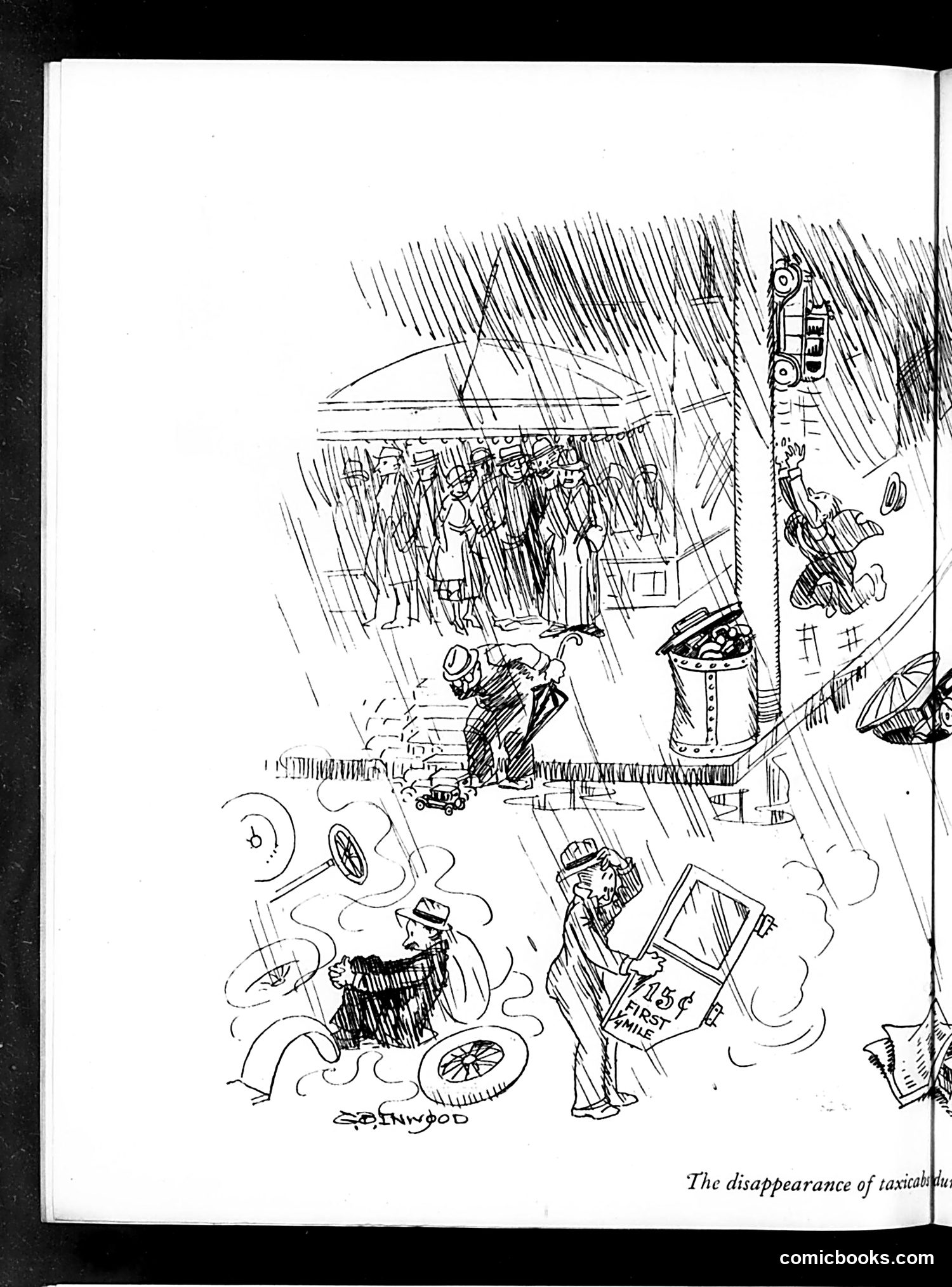
"The Disappearance of Taxicabs" This cartoon satirizes the sudden unavailability of taxicabs in an urban setting. The drawing shows multiple figures searching frantically for taxis amid rain and clouds of dust—one man examines a wheel, another holds a sign reading "1854 FIRST UNIT," suggesting either nostalgia for a historical cab or mockery of outdated vehicles. The tent/awning shelter above contains well-dressed pedestrians waiting, while taxi parts and abandoned vehicles scatter the street below. The satire likely comments on a real shortage or strike affecting taxi service—a common urban disruption in early 20th-century America. The contrast between stranded, frustrated passengers and the missing cabs drives the joke about essential services vanishing from the city.
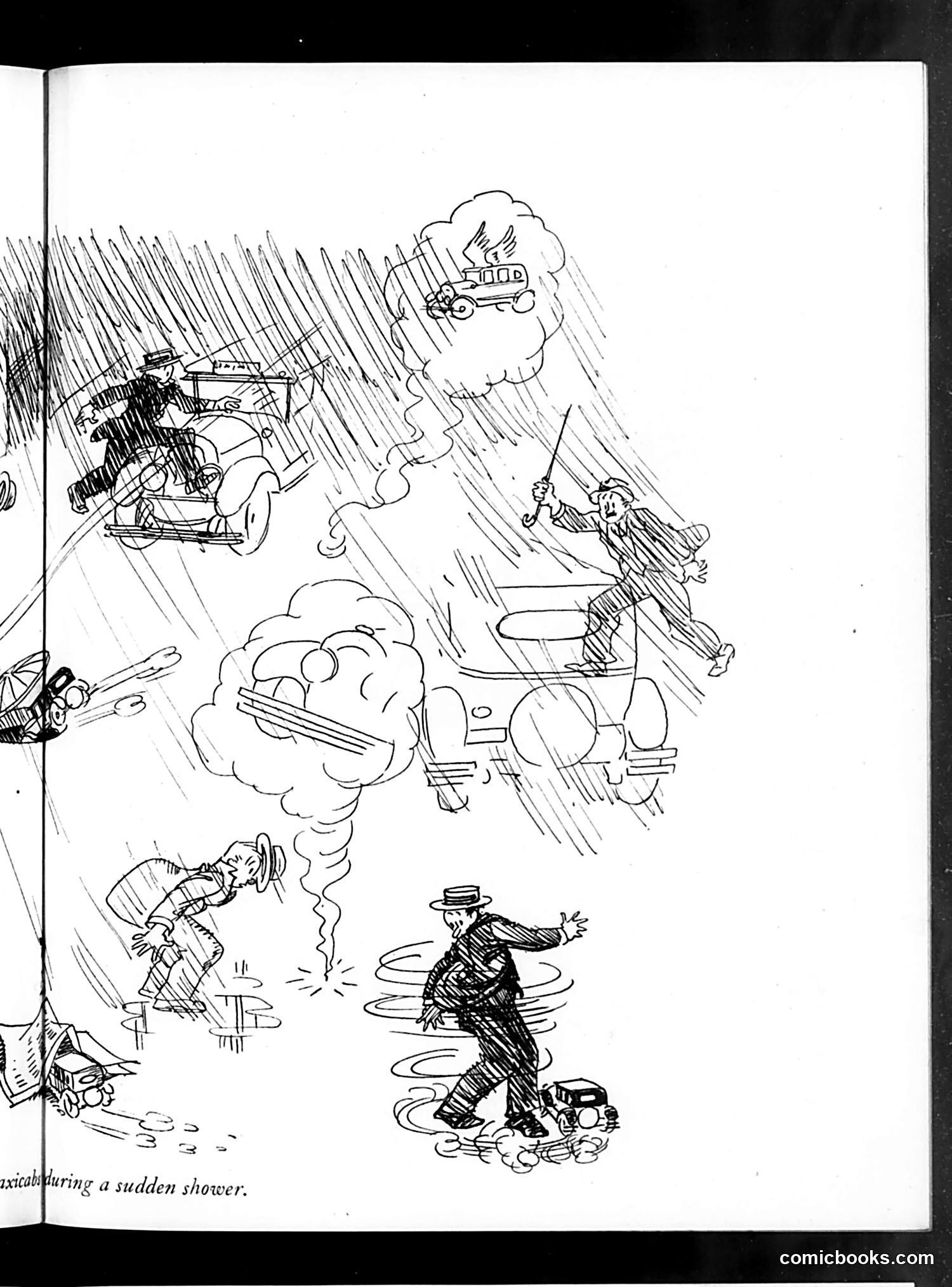
Political Cartoon Analysis: "During a Sudden Shower" This satirical cartoon depicts chaos during unexpected rainfall. The caption "during a sudden shower" appears to be the title. The scene shows multiple figures scrambling in rain, with vehicles (cars and what appears to be a bus) depicted above. A large cloud dominates the composition, with smoke or steam rising from below. The specific identities of the figures are unclear from the image alone, but the cartoon appears to satirize how various social classes or groups react differently to sudden weather disruptions. The heavily shaded businessman in the foreground contrasts with other figures, suggesting commentary on class disparities in handling everyday inconveniences. Without additional context about Life magazine's publication date or other identifying markers, the precise political or social targets remain uncertain.
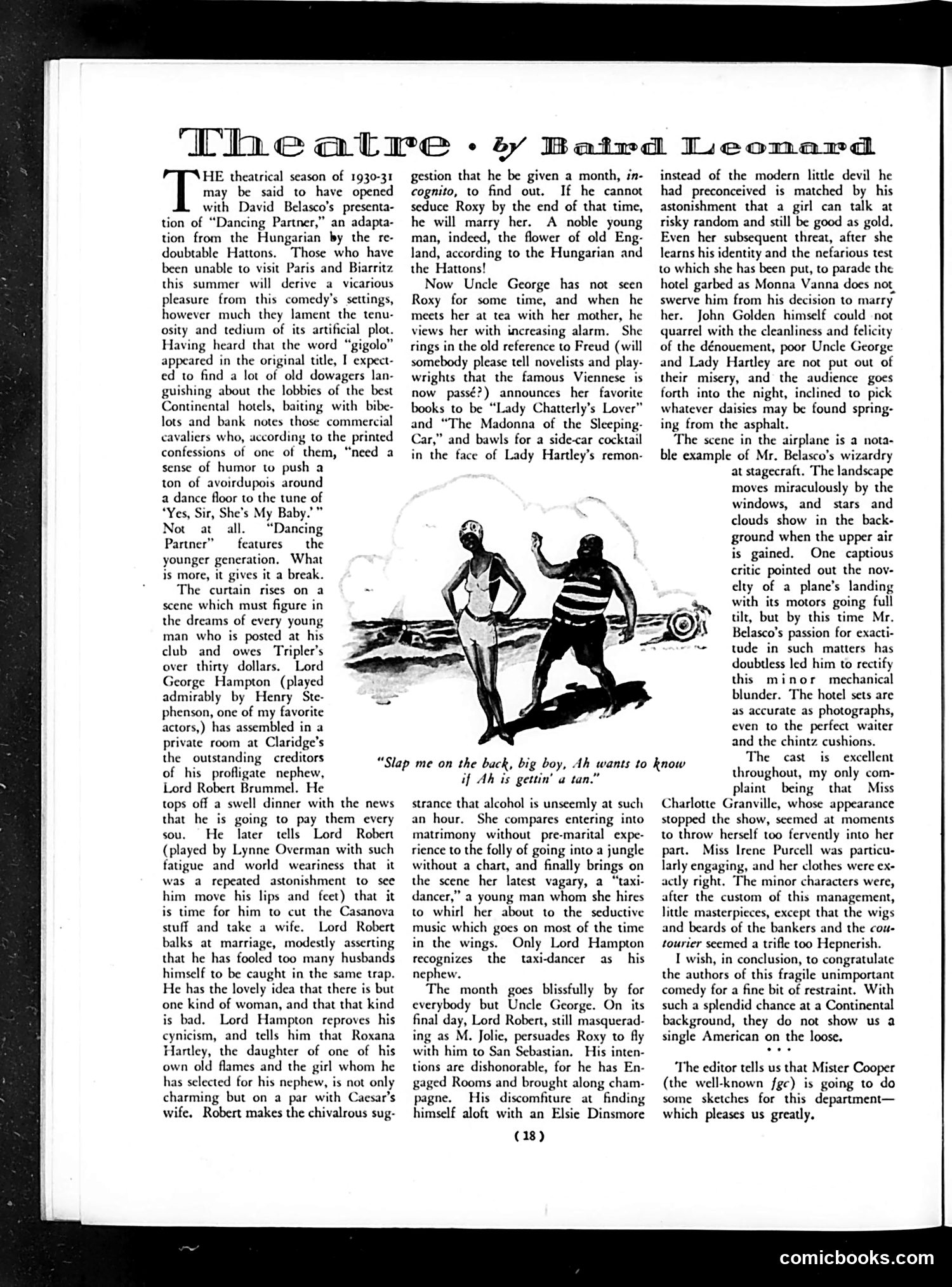
Theatre Review: "Dancing Partner" This page reviews David Belasco's 1930-31 theatrical production "Dancing Partner," adapted from a Hungarian play. The illustration shows two figures on what appears to be an airplane set, with the caption "Slap me on the back, big boy. Ah wants to know if Ah is gettin' a tan." The review discusses the play's plot involving characters named Roy, Uncle George, and Lady Hartley. The satirical thrust criticizes the production's artificial elements—particularly its mechanical airplane landing scene, which the reviewer notes appears clumsy despite Mr. Belasco's reputation for stagecraft precision. The critic also comments on the cast's performances and minor technical issues. Overall, the satire targets the gap between Belasco's acclaimed expertise and this production's somewhat contrived execution.
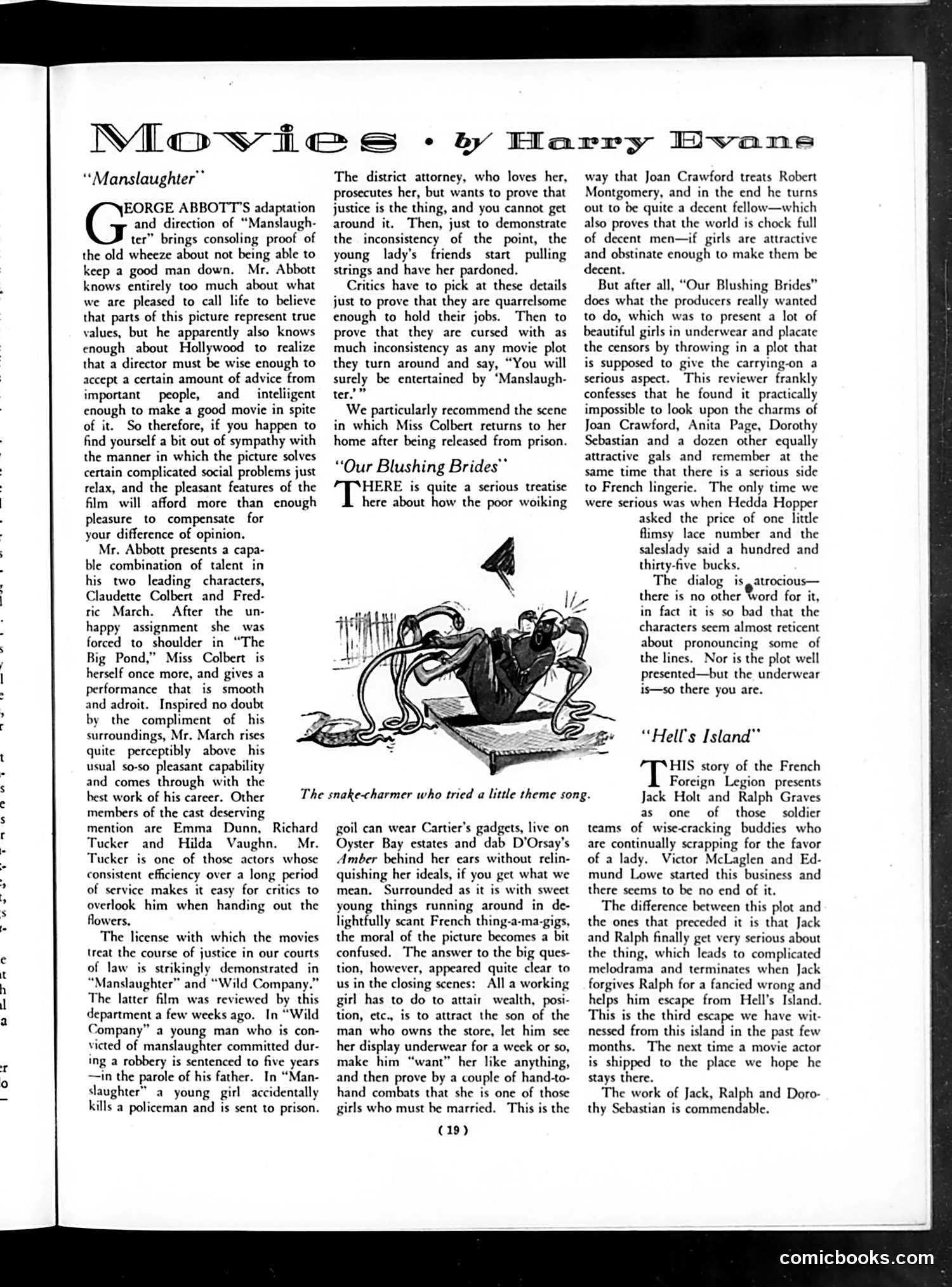
Movie Reviews Page Analysis This is a film criticism column by Harry Evane reviewing three 1920s movies for *Life* magazine. The cartoon depicts a "snake-charmer" performing—a visual metaphor for the absurdity of "Our Blushing Brides," which the reviewer mocks for its confused morality. The film supposedly teaches that poor working girls can acquire wealth and luxury (Cartier's jewelry, Oyster Bay estates) while maintaining virtue—a contradiction the reviewer finds laughable. The column critiques how Hollywood films treat justice inconsistently: in "Manslaughter," a woman accidentally kills a policeman, gets imprisoned, then is mysteriously pardoned through connections—undermining the film's own message about justice being absolute. The reviews are lighthearted but pointed. The reviewer praises the acting (Claudette Colbert, Fredric March) while noting that directors must placate "important people" in Hollywood, even when it compromises narrative logic. The tone is that of a sophisticated satirist mocking both cinema's moral confusion and the film industry's compromises with power.
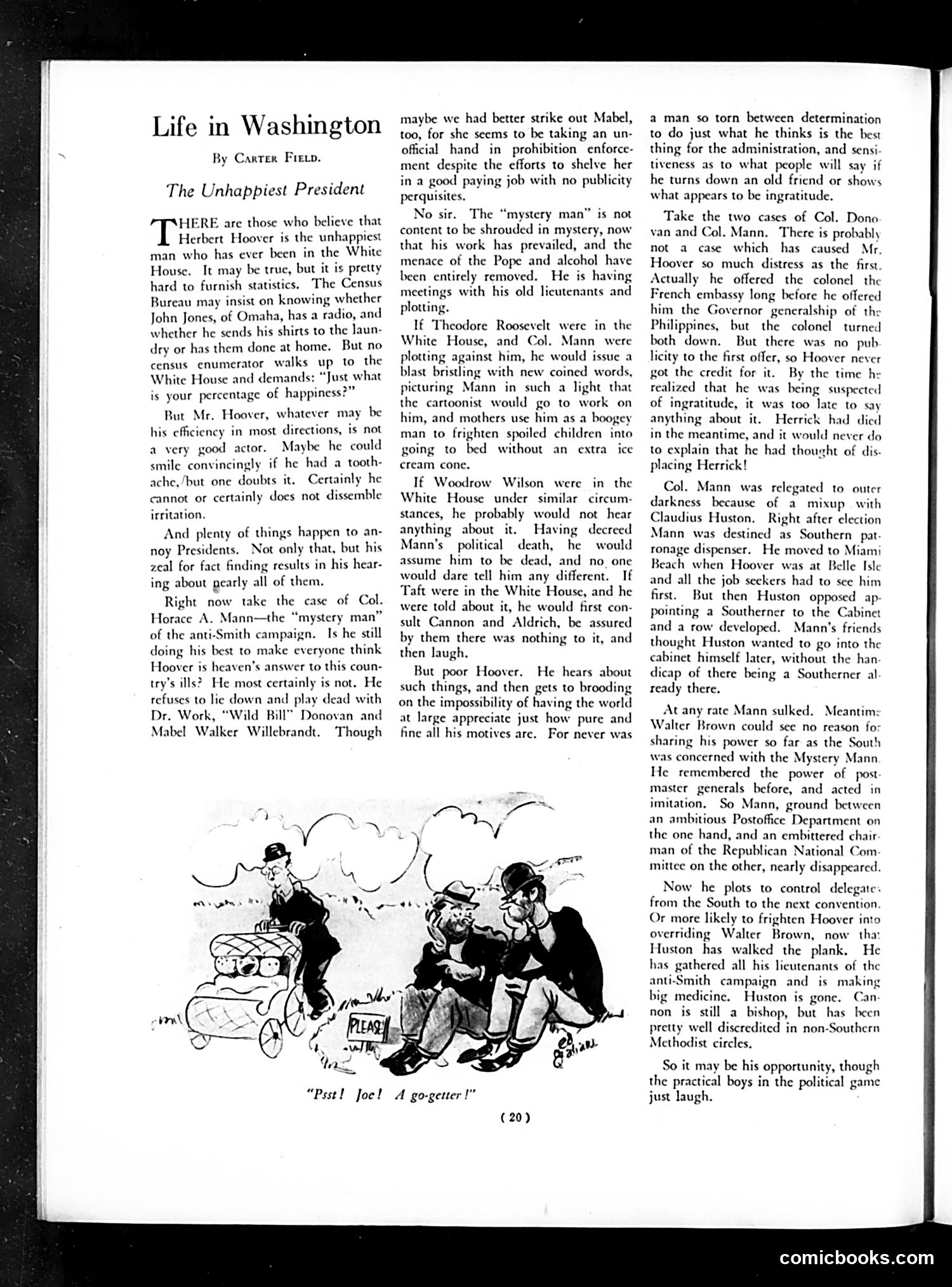
Analysis for Modern Readers This Carter Field column satirizes President Herbert Hoover's awkward political handling during his 1928-1932 administration. The cartoon depicts shadowy figures ("Psst! Joe! A go-getter!") plotting, illustrating Field's point about Col. Horace Mann—Hoover's anonymous campaign operative against Al Smith—continuing to scheme despite his usefulness ending. Field's satire centers on Hoover's fundamental weakness: he cannot gracefully manage political allies. Unlike Theodore Roosevelt (who'd publicly attack), Woodrow Wilson (who'd decree and ignore), or Taft (who'd consult and laugh off), Hoover agonizes over appearing ungrateful when sidelining supporters. This anxiety makes him both ineffectual and miserable—hence "the unhappiest president." The piece critiques Hoover's inability to balance administrative loyalty with political necessity, suggesting his famous reputation for competence masks emotional rigidity and poor political instincts.
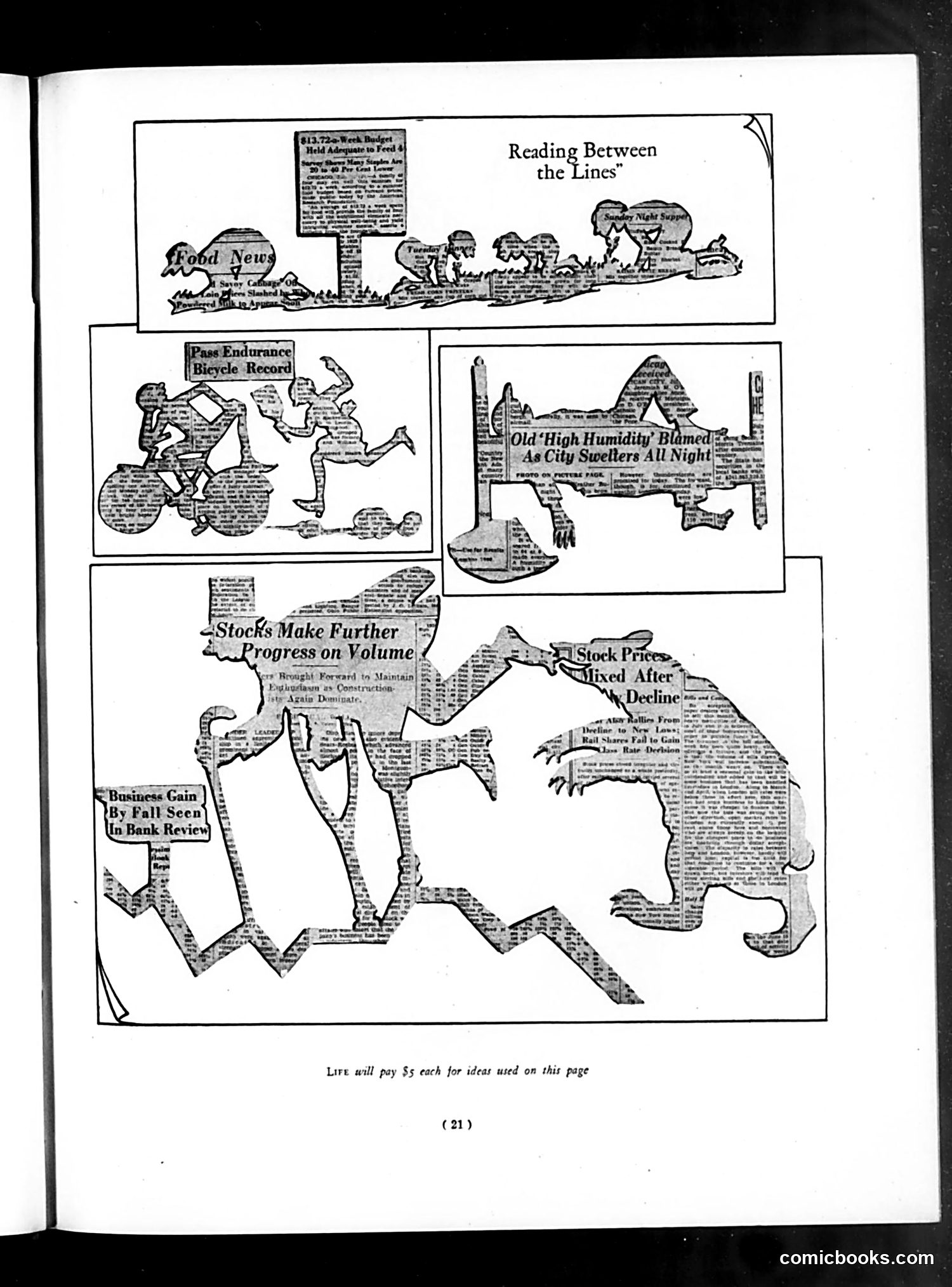
"Reading Between the Lines" - Life Magazine Satire This page satirizes newspaper journalism by reshaping actual business and weather headlines into visual puns and animal figures. The cartoons mock how newspapers present economic and financial news, often with sensationalized or contradictory messaging. Key elements include: - "Good News" (top): A cityscape made of newspaper text - "Pass Endurance Bicycle Record": Cyclists formed from text - "Old 'High Humidity' Blamed As City Swelters": A bed/person figure illustrating weather complaints - "Stocks Make Further Progress": Bull and bear figures (traditional stock market symbols) composed of financial headlines - "Stock Prices Mixed After Decline": A bear made of market news The satire suggests readers should look critically at how newspapers literally and figuratively shape reality through their presentation of information. The composition reinforces how news text constructs our understanding of events. The $5 payment offer for ideas was typical of Life's reader-participation features.
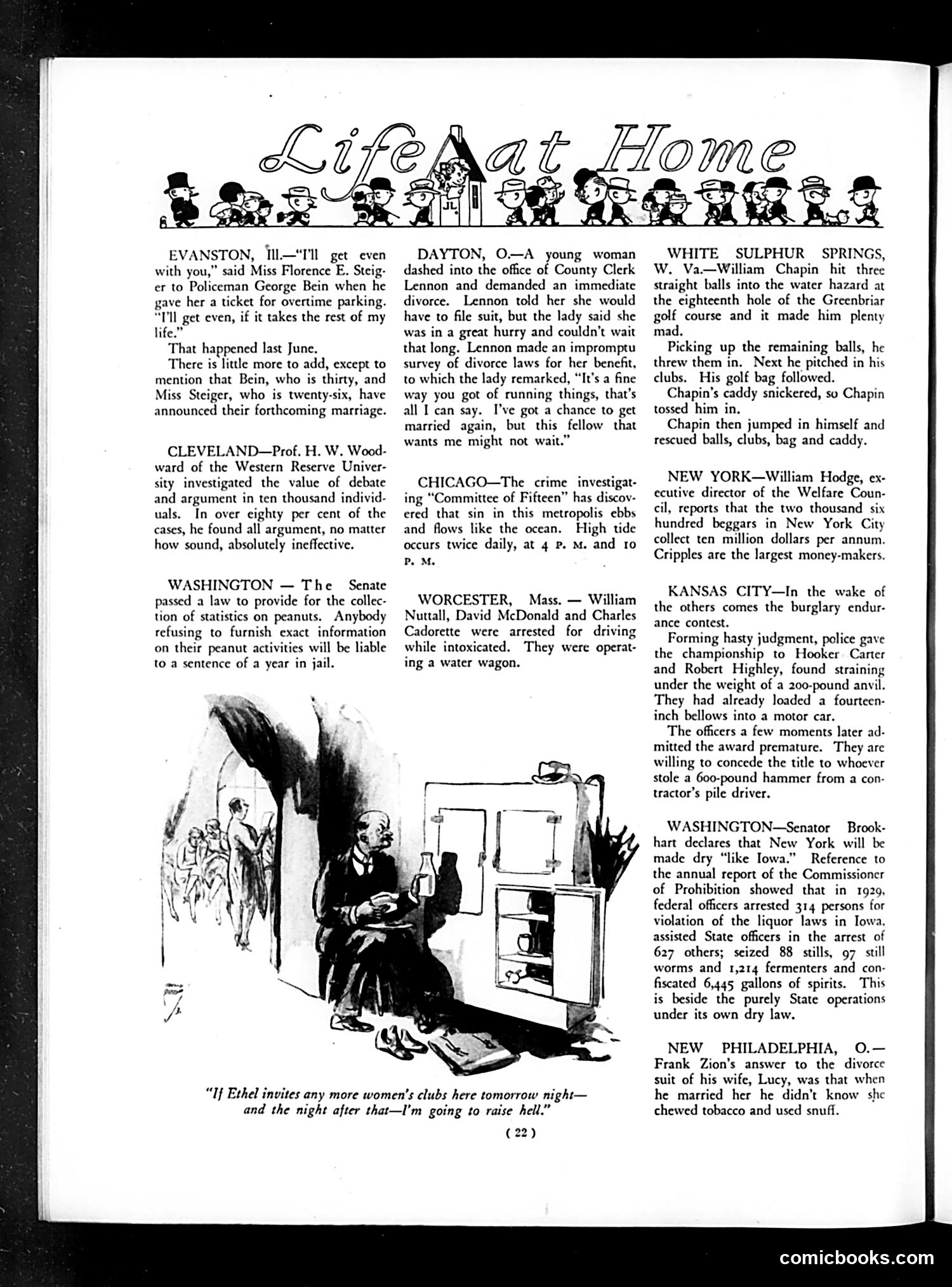
Life Magazine "Life at Home" Page Analysis This page collects humorous anecdotes satirizing American social absurdities during the Prohibition era (1920s-30s). The main cartoon depicts a man seated while a woman stands in a doorway, illustrating the caption about inviting women's clubs repeatedly—a joke about wives' social activities exhausting husbands. Key satirical targets: - Prohibition enforcement (mentioned multiple times): The Worcester item mocks drunk drivers operating a *water wagon*—ironic given Prohibition's supposed purpose. The Washington and Iowa references highlight Prohibition's ineffectiveness. - Bureaucratic absurdity: The Senate collecting peanut statistics with jail penalties for non-compliance. - Divorce frivolousness: A woman wants immediate divorce but considers remarrying the same man if he'll wait—mocking the hastiness of divorce proceedings. - Human irrationality: A golfer's escalating tantrum (throwing clubs, then himself into water) and debate research showing argument is "absolutely ineffective." The humor assumes readers recognize Prohibition's failure and the era's social chaos—these snippets mock both government overreach and ordinary people's illogical behavior.
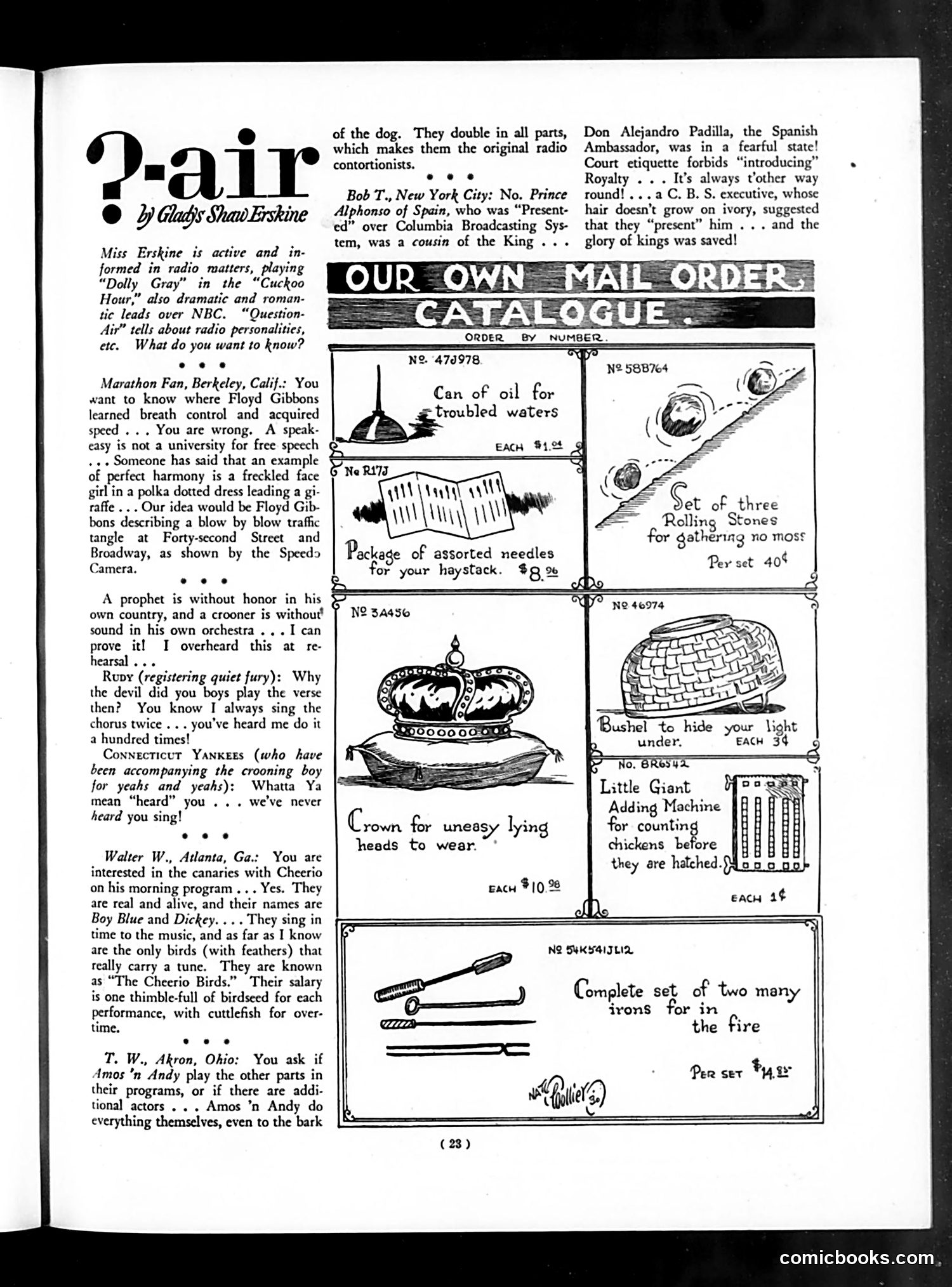
Q-air: Radio Column and Mail-Order Satire This page combines a radio advice column by Gladys Shaw Erskine with satirical mail-order advertisements. The column answers listener questions about 1920s-30s radio personalities: Floyd Gibbons (a famous fast-talking news commentator), Amos 'n' Andy (a popular comedy duo who performed all roles themselves), and canaries performing on the Cheerio morning program. The humor relies on period radio knowledge—readers would recognize these names. The "Our Own Mail Order Catalogue" section below is absurdist satire, offering ridiculous products like a "Crown for uneasy lying heads," a "Little Giant Adding Machine for counting chickens before they are hatched," and "two many irons for in the fire"—all visual puns on common expressions. These mock both mail-order culture and clichéd wisdom, using deadpan product descriptions to highlight the absurdity. The format parodies actual catalog pages of the era.
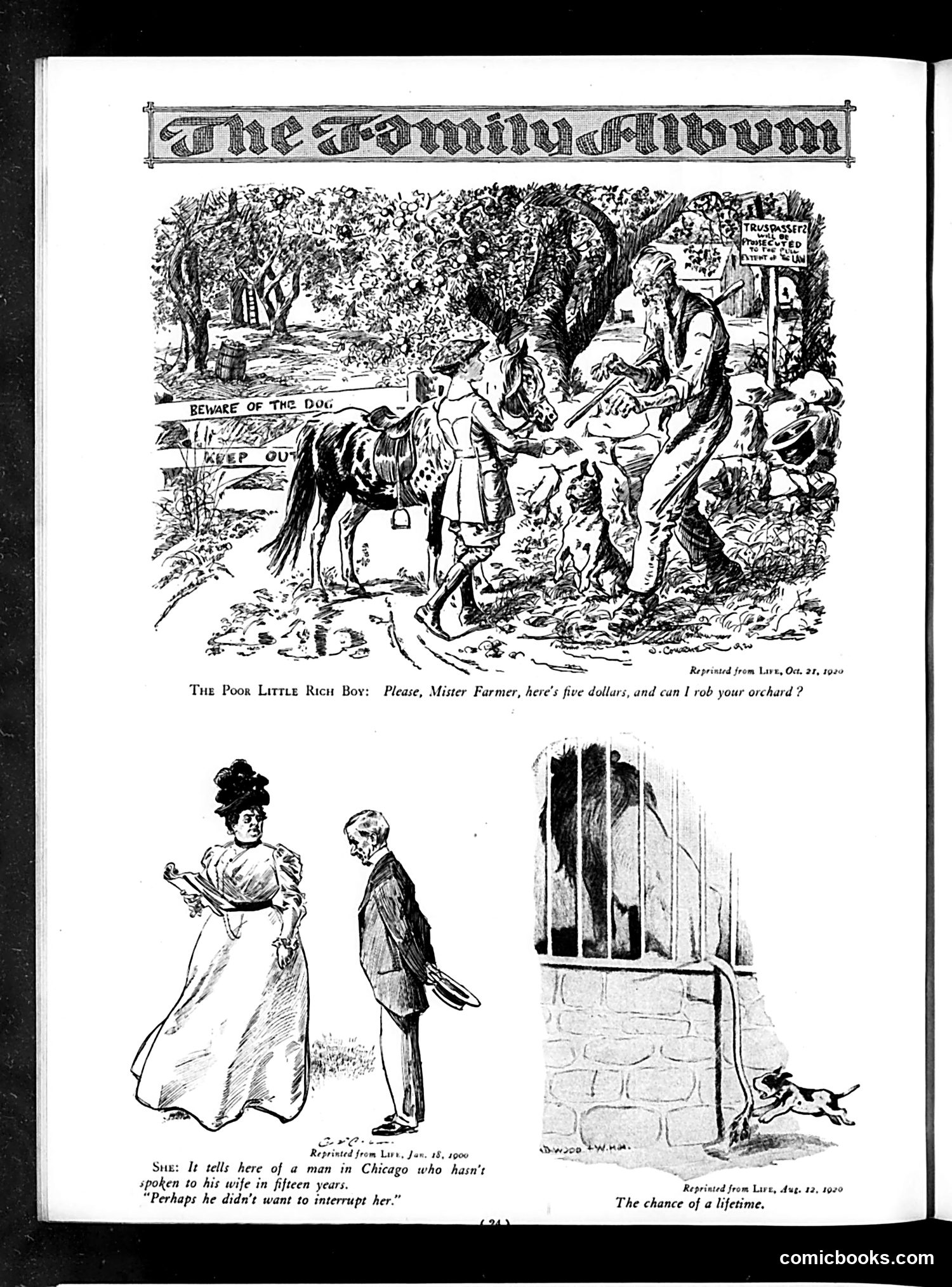
Analysis of Life Magazine Page This page contains three separate satirical cartoons from Life magazine (circa 1900-1920): 1. "The Poor Little Rich Boy" (top): Mocks wealthy children's naiveté. A privileged boy politely asks a farmer for permission to rob his orchard—satirizing how the rich are so sheltered they don't understand normal social boundaries or consequences. 2. "She" (bottom left): A domestic humor cartoon about marital silence. The joke suggests the wife talks so much that a husband who hasn't spoken to her in fifteen years may be intentionally avoiding conversation—poking fun at talkative wives, a common stereotype of the era. 3. "The Chance of a Lifetime" (bottom right): Depicts a prisoner behind bars with a dog outside. The caption's meaning is unclear from the visible text, but appears to be dark humor about imprisonment or missed opportunities. These represent typical Life magazine satire: social commentary on class, gender dynamics, and human foibles through illustrated jokes.
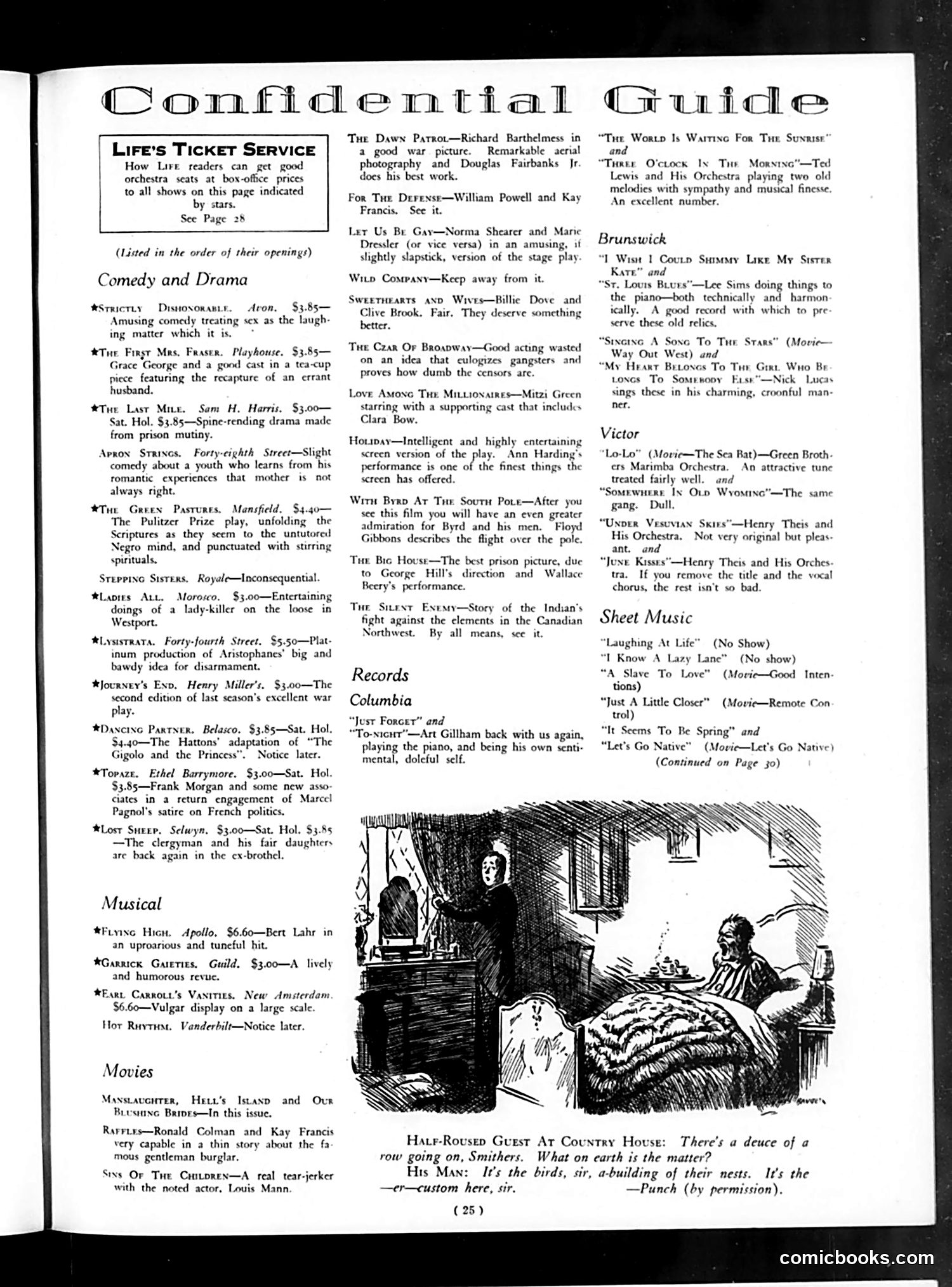
Analysis of Life Magazine Page This is a theater and entertainment guide rather than political satire. The page lists Broadway shows, movies, and musical recordings available in what appears to be the late 1920s or early 1930s. The cartoon at the bottom depicts a domestic scene: a half-roused guest at a country house overhearing two servants gossiping about neighborhood drama ("There's a deuce of a row going on, Smithers. What on earth is the matter?"). The humor is gentle social comedy—the guest eavesdropping on servants' scandal-mongering, a common comedic trope of the era involving class dynamics and domestic intrigue. The page itself is largely utilitarian: Life's Ticket Service offers discounted orchestra seats, and reviews briefly assess theatrical productions, films, and records. The tone is conversational and accessible to middle-class readers seeking entertainment recommendations in the Jazz Age.
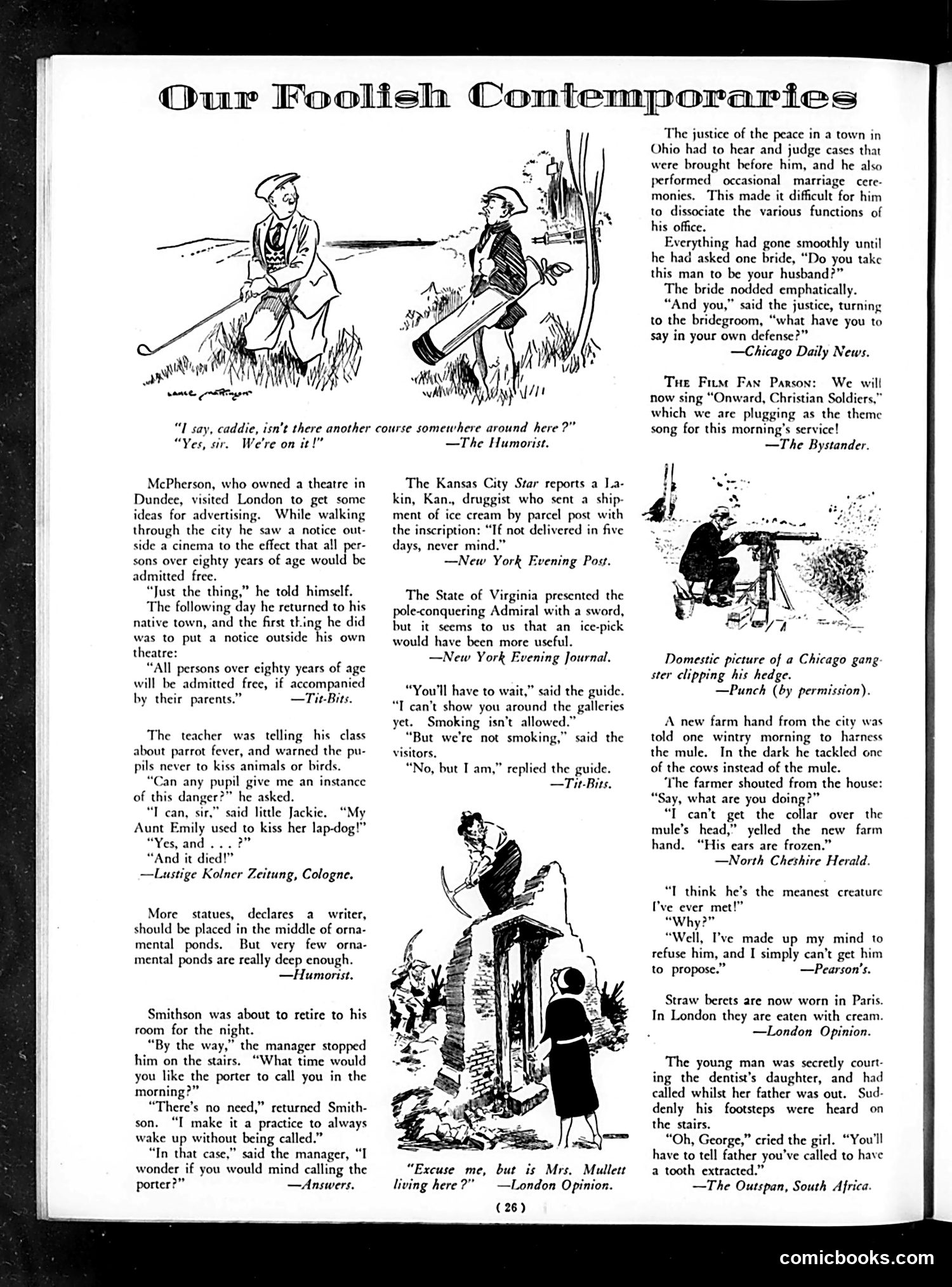
"Our Foolish Contemporaries" - Life Magazine Satire Page This page collects brief humorous anecdotes satirizing human folly and absurdity. The top cartoon shows a golfer asking a caddie if there's "another course," only to learn they're already playing on one—mocking oblivious tourists or incompetent golfers. The text items mock various stupidities: a theater owner offering free admission to the elderly "if accompanied by their parents" (absurd logic); a guide smoking while forbidding visitors to smoke; a justice of the peace asking a bridegroom "what have you to say in your own defense?"—confusing courtroom and matrimonial proceedings; a city farm hand trying to harness a cow, claiming "his ears are frozen." The lower cartoon depicts a Chicago gangster carefully trimming his hedge—juxtaposing violent criminality with suburban domesticity for comedic effect. These are recycled jokes from international newspapers (marked with attribution), typical of Life's "foolish contemporaries" column lampooning everyday human confusion, misapplied logic, and social awkwardness.
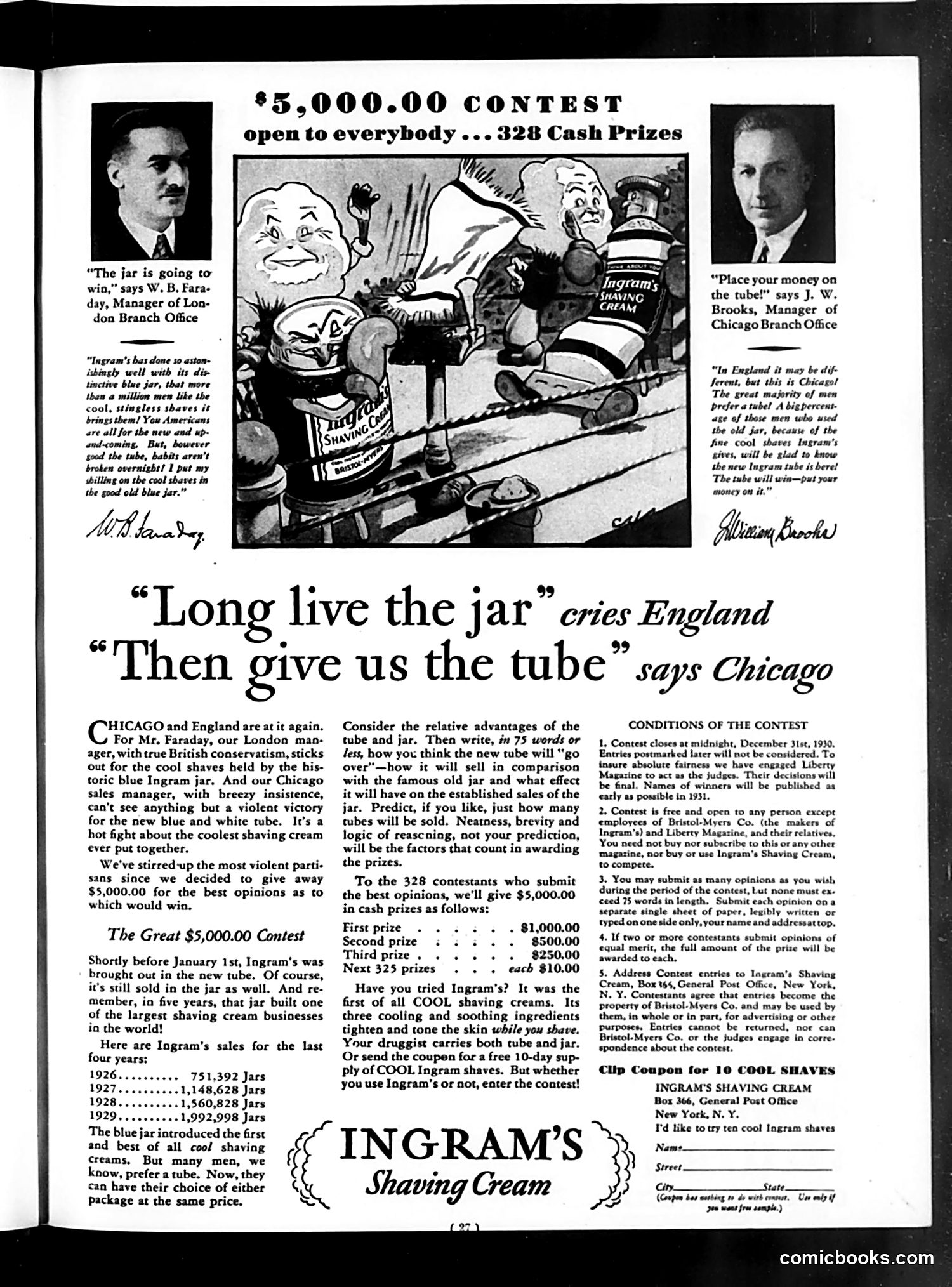
What This Page Means This is a Ingram's Shaving Cream advertisement disguised as a contest. The "satire" is a friendly corporate rivalry between two company managers—W.B. Faraday (London) championing the traditional blue jar versus J.W. Brooks (Chicago) pushing the new tube format. The cartoon depicts this as an Anglo-American cultural clash: England clings to the established jar ("Long live the jar"), while America embraces modern convenience ("Then give us the tube"). The joke plays on national stereotypes—British conservatism versus American progress. However, this is primarily advertising, not political satire. Ingram's is running a $5,000 contest asking readers to predict which packaging will outsell the other, disguising a marketing survey as entertainment. Modern readers would recognize this as a clever promotional gimmick using manufactured conflict to engage consumers.
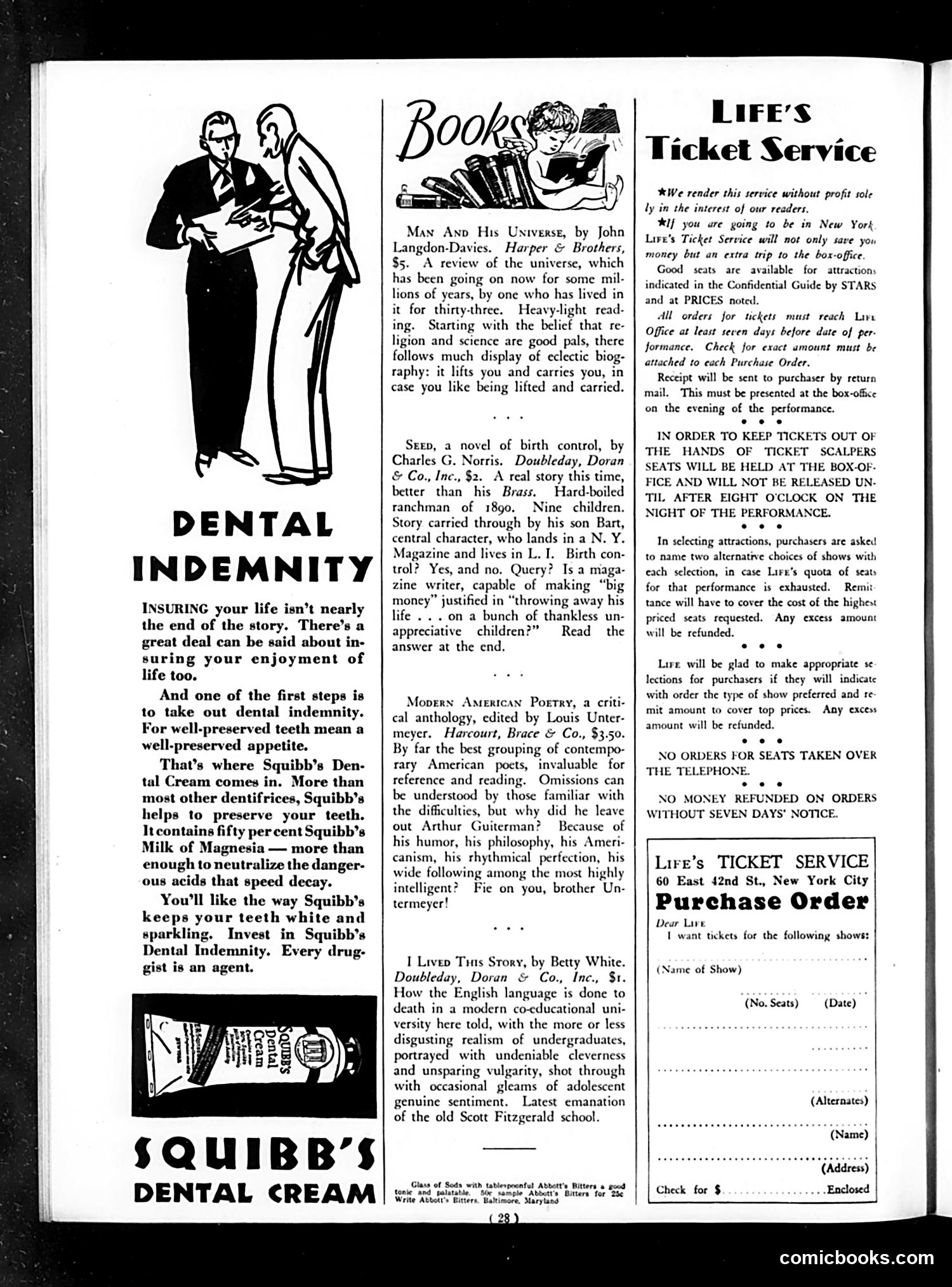
Explanation for Modern Readers This page contains primarily advertisements and service announcements, not political satire. The illustration (top left) shows two men in business attire—likely depicting a dental professional and patient in a humorous interaction, supporting the Squibb's Dental Cream ad below it. The ad employs the phrase "Dental Indemnity" as wordplay: just as life insurance protects your financial future, good teeth protect your ability to eat and enjoy life. The book reviews discuss 1920s-30s literature, including novels about birth control and university life—contemporary social topics of interest to Life's educated readership. The "Ticket Service" section announces that Life magazine (the publication itself) will help readers purchase Broadway theater tickets without scalper markups—a practical reader service. There is no political cartoon or satire on this page. It's a standard magazine spread mixing consumer advertising, literary reviews, and subscriber services typical of Life during this era.
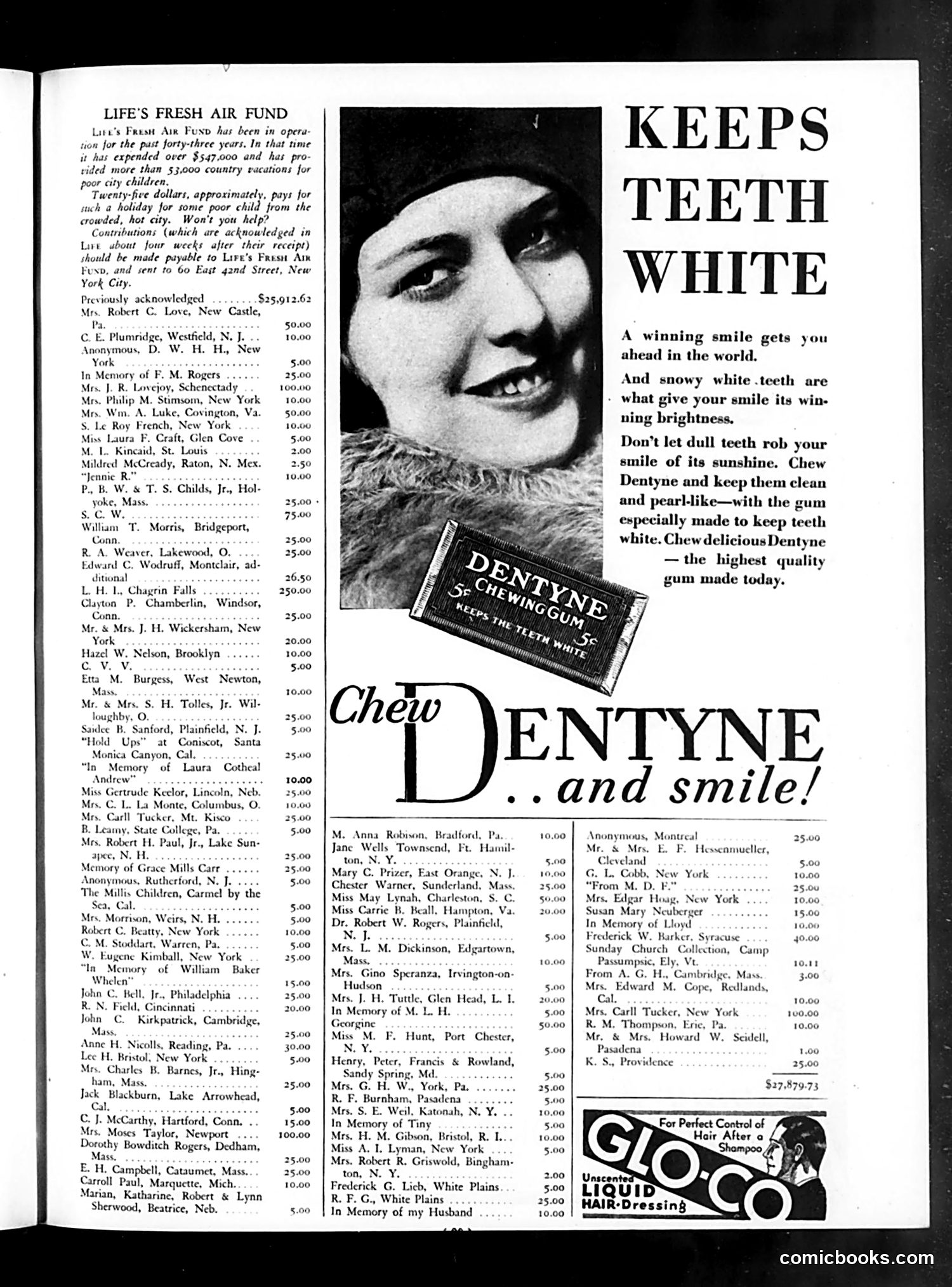
Explaining This Life Magazine Page to Modern Readers This is primarily a charitable fundraising page, not satire or political commentary. The bulk consists of donation lists for Life magazine's Fresh Air Fund—a real philanthropic program (established 43 years prior) that provided country vacations for poor urban children at approximately $25 per child. The page prominently features a Dentyne chewing gum advertisement showing a woman's smiling face and packaged gum, with the slogan "Chew Dentyne...and smile!" The ad copy emphasizes how white teeth enhance one's smile and social success ("A winning smile gets you ahead in the world"). For modern readers: This juxtaposes charitable messaging about helping poor children with a consumer advertisement promoting personal vanity—typical of 1920s-30s advertising strategy. The aspirational messaging ("ahead in the world") reflects period values linking appearance to social mobility. The GLO-CO hair-dressing product advertisement appears at the page bottom. No political cartoons appear on this page.
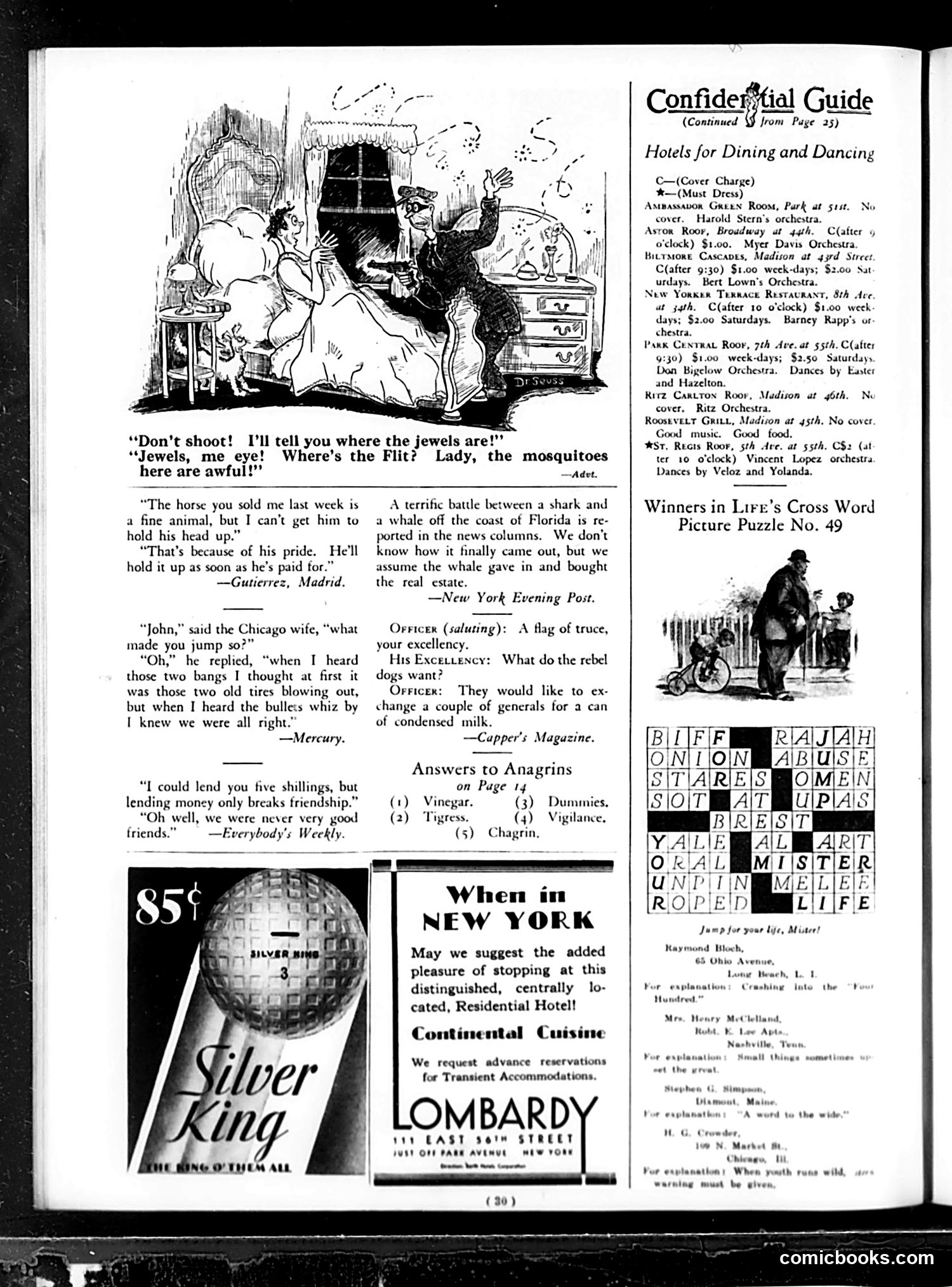
Cartoon Analysis: Life Magazine Page This page contains multiple short joke cartoons typical of 1920s-30s Life magazine's satirical humor. Main cartoon (top): A domestic scene where a man confronts a woman, likely about infidelity or theft. The humor plays on the woman deflecting—she mentions "jewels" and "Flit" (an insecticide brand), while a man in the background appears caught. The joke relies on the woman's dodging and the absurd shift to complaining about mosquitoes. Other jokes reference: - A horse with damaged pride needing payment to regain dignity (class commentary) - A Chicago man confusing gunshots with tire blasts (satirizing either urban violence or masculine obliviousness) - A shark-whale battle where the whale supposedly "bought real estate" (mocking real estate speculation) - Rebel soldiers trading generals for condensed milk (WWI-era military satire) The page also advertises NYC hotels and restaurants with dancing and dining—venues targeting affluent readers. The overall tone is light domestic and social satire aimed at middle-to-upper-class readers, with advertisements supporting the magazine's business model.
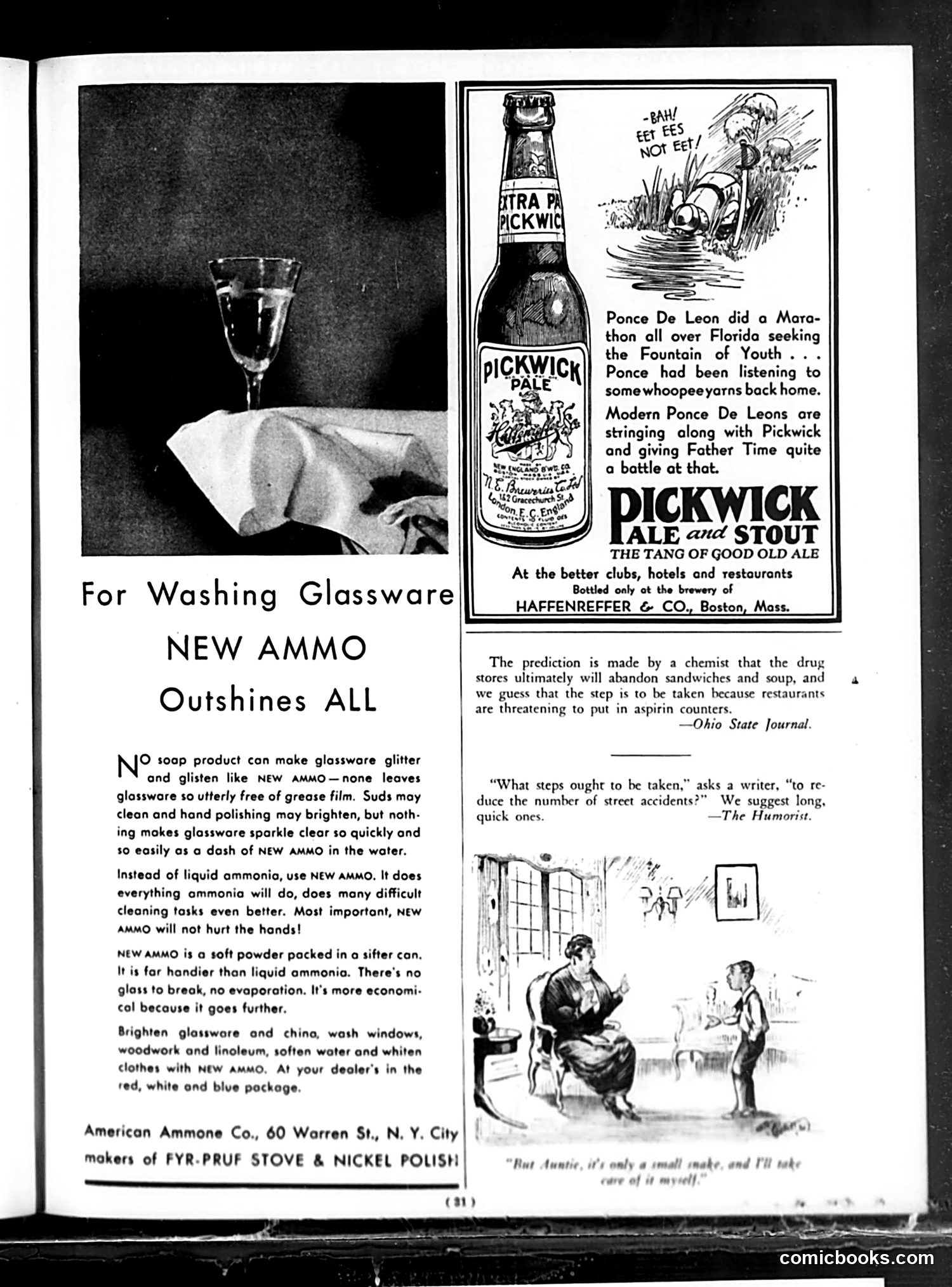
This page contains two advertisements and three brief satirical items typical of Life magazine's format. The New Ammo advertisement (left) promotes a powdered ammonia product for household cleaning, emphasizing its superiority over liquid ammonia and soap for glassware. The Pickwick Ale advertisement (right) uses a historical reference: Ponce de León's legendary search for the Fountain of Youth becomes a modern joke about men drinking beer to stay young and "battle Father Time." The humor lies in equating alcohol consumption with youthful vitality. Below are three short satirical quips: 1. A chemist's prediction that drugstores will abandon food service as restaurants add aspirin counters—mocking the trend of self-medication. 2. A humorous response to street safety: suggesting "long, quick" steps as accident prevention—wordplay on pedestrians walking faster. 3. An illustrated domestic scene (unclear specifics) with accompanying caption about a small snake. The page reflects early-to-mid 20th century American consumer culture and light social commentary.
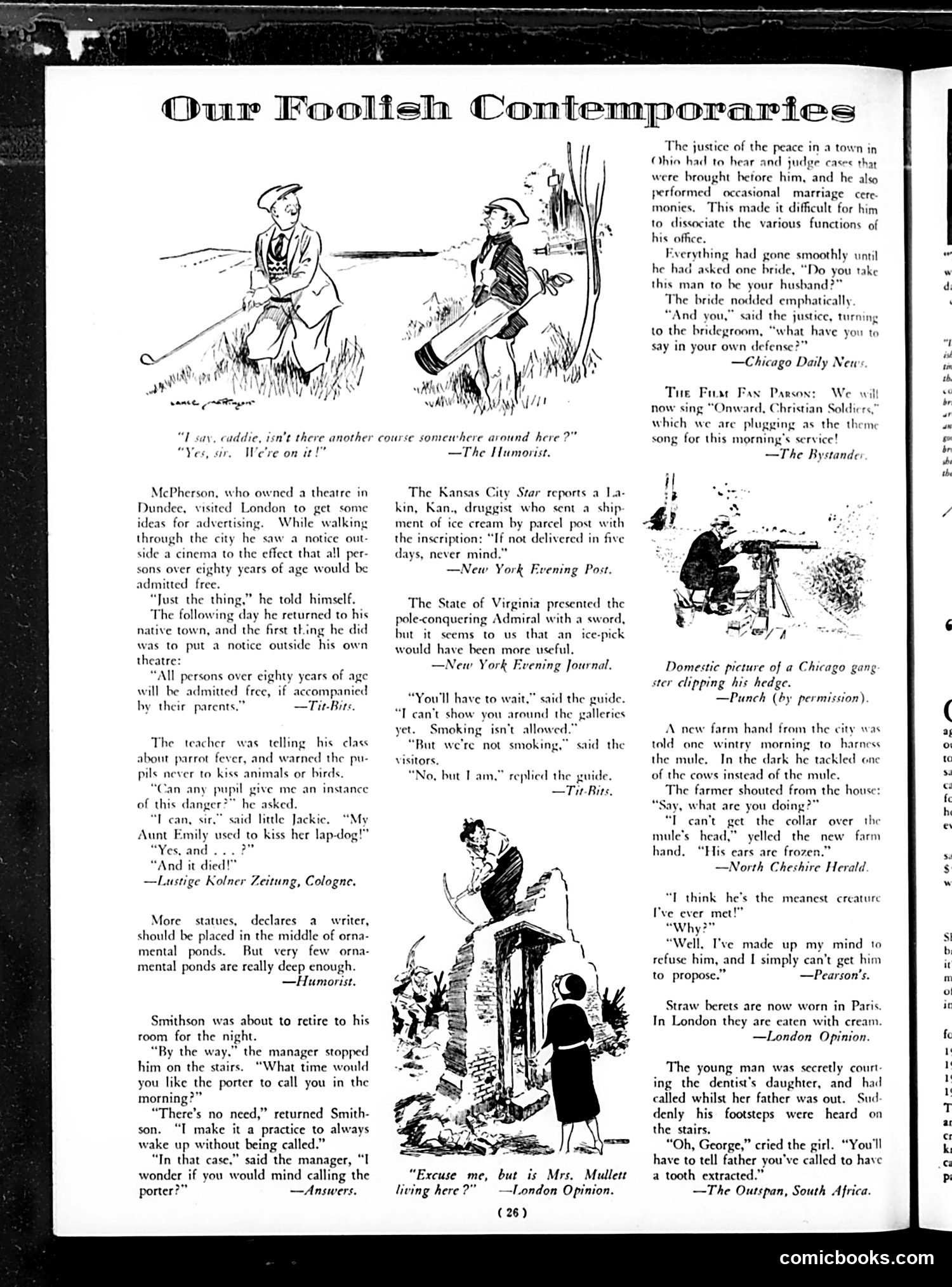
"Our Foolish Contemporaries" - Life Magazine Humor Page This is a humor anthology page featuring brief jokes and satirical anecdotes from various contemporary sources. The cartoons and jokes mock everyday absurdities and professional incompetence: Key examples: - A Scottish caddie's literal-minded response to a golfer's question - A theater owner's absurd advertising logic (offering free admission to elderly patrons "if accompanied by their parents") - A museum guide who smokes while prohibiting visitors from smoking - A confused justice of the peace treating a wedding like a court case, asking the groom "what have you to say in your own defense?" - A city farmhand mistaking a cow for a mule in the dark The page reflects early 20th-century Life magazine's formula: gentle, class-conscious humor targeting bureaucratic bungling, social pretension, and the clash between urban and rural sensibilities. The jokes assume educated readers familiar with British and American periodicals cited as sources.
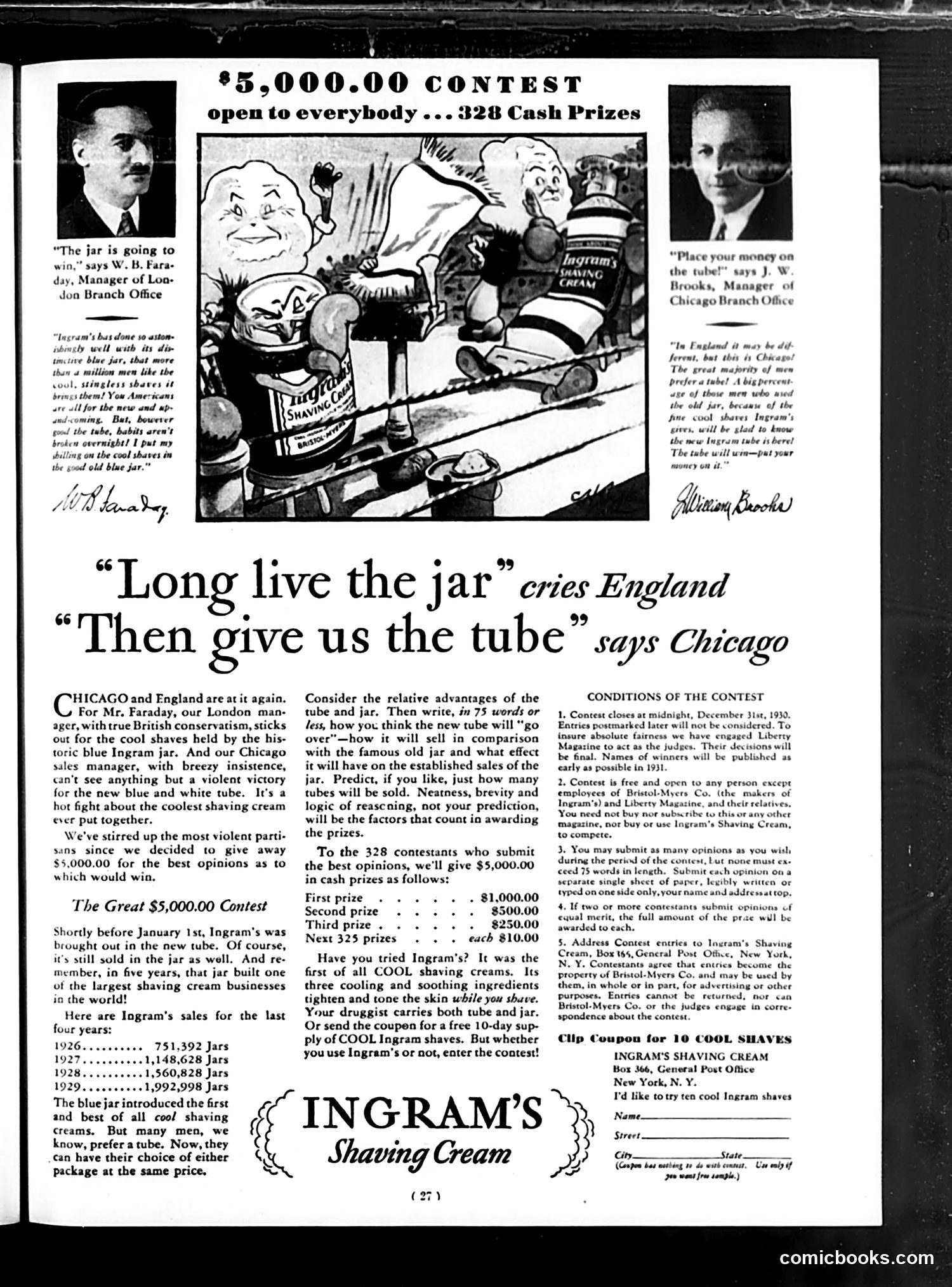
Ingram's Shaving Cream Contest Advertisement This is primarily an advertisement disguised as editorial content, featuring a humorous transatlantic dispute about product packaging. The satire pits two company managers against each other: W.B. Faraday (London branch) champions Ingram's traditional blue jar, citing its proven 4-million-customer success and British preference for established habits. J.W. Brooks (Chicago branch) aggressively promotes the new tube format, claiming American consumers prefer modern innovation. The cartoon depicts caricatured figures—likely representing British conservatism versus American progressiveness—in a playful "debate" about which packaging will dominate sales. The real mechanism: Ingram's is running a $5,000 contest asking consumers to predict whether the new tube will outsell the classic jar (75-word essays compete for 328 cash prizes). This cleverly generates consumer engagement and debate while promoting both packaging options. The ad reveals early-1930s marketing strategy: positioning product innovation as a cultural clash between British tradition and American modernity.
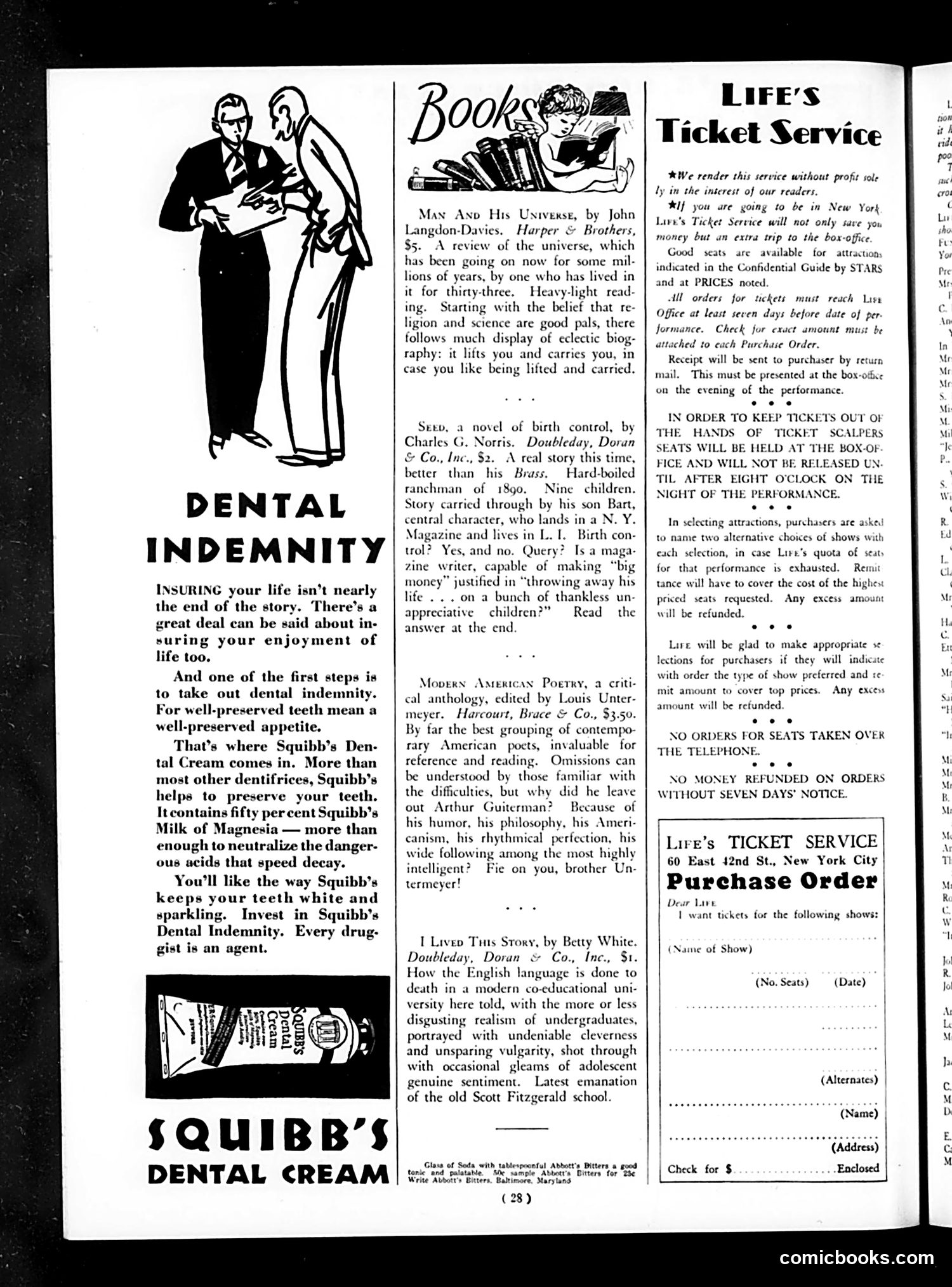
Life Magazine Page Analysis This page is primarily advertising and service content, not political satire. The left side features a Squibb's Dental Cream advertisement using the phrase "Dental Indemnity"—a pun playing on "life indemnity" (insurance). The cartoon shows two men, likely representing a salesman and customer in business attire, illustrating the pitch that preserving teeth means preserving appetite and life enjoyment. The center contains book reviews of contemporary titles, and the right side is Life's Ticket Service—a reader service offering theater tickets in New York without markup. The service protects against ticket scalpers by holding seats until 8 PM show night. This reflects 1920s-30s consumer culture: Life positioned itself as a helpful guide protecting readers' interests against commercial exploitation while promoting products and services. The "indemnity" wordplay is the page's only satirical element—gentle commercial humor rather than political commentary.
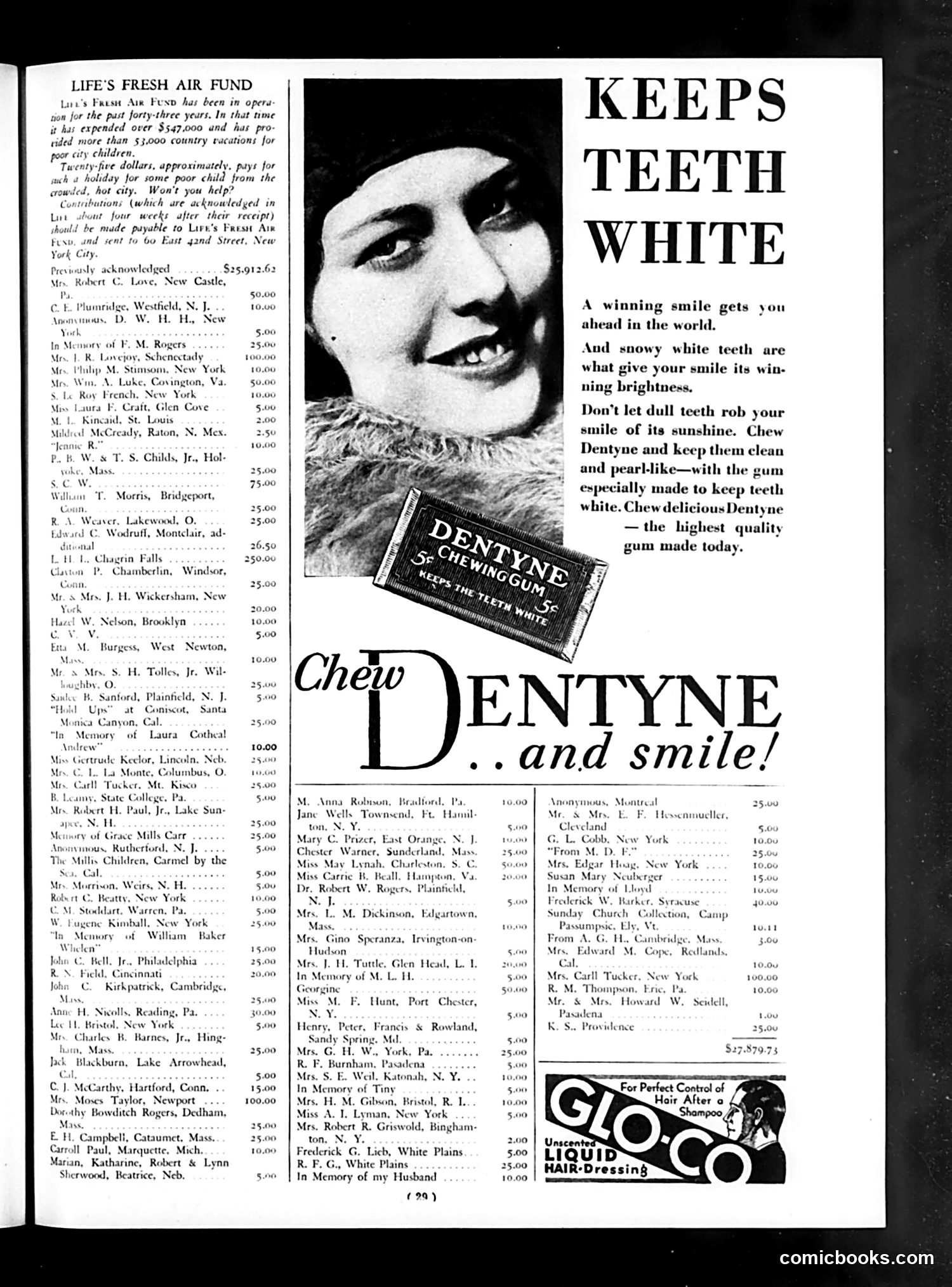
This page contains primarily the "Life's Fresh Air Fund" — a charitable campaign for the magazine *Life*. The left columns list donor contributions to send poor urban children on country vacations, a cause *Life* had supported for forty-three years. The main advertisement on the right is for Dentyne chewing gum, featuring a woman's smiling face and the slogan "Chew Dentyne...and smile!" The ad's message is straightforward consumer persuasion: white teeth = winning smile = social success. This reflects early 20th-century advertising that linked personal appearance to advancement. This is not political satire but rather a typical magazine page mixing charitable fundraising with commercial advertising. The juxtaposition illustrates how *Life* balanced social consciousness with commercial revenue. There are no political cartoons or caricatures on this page.
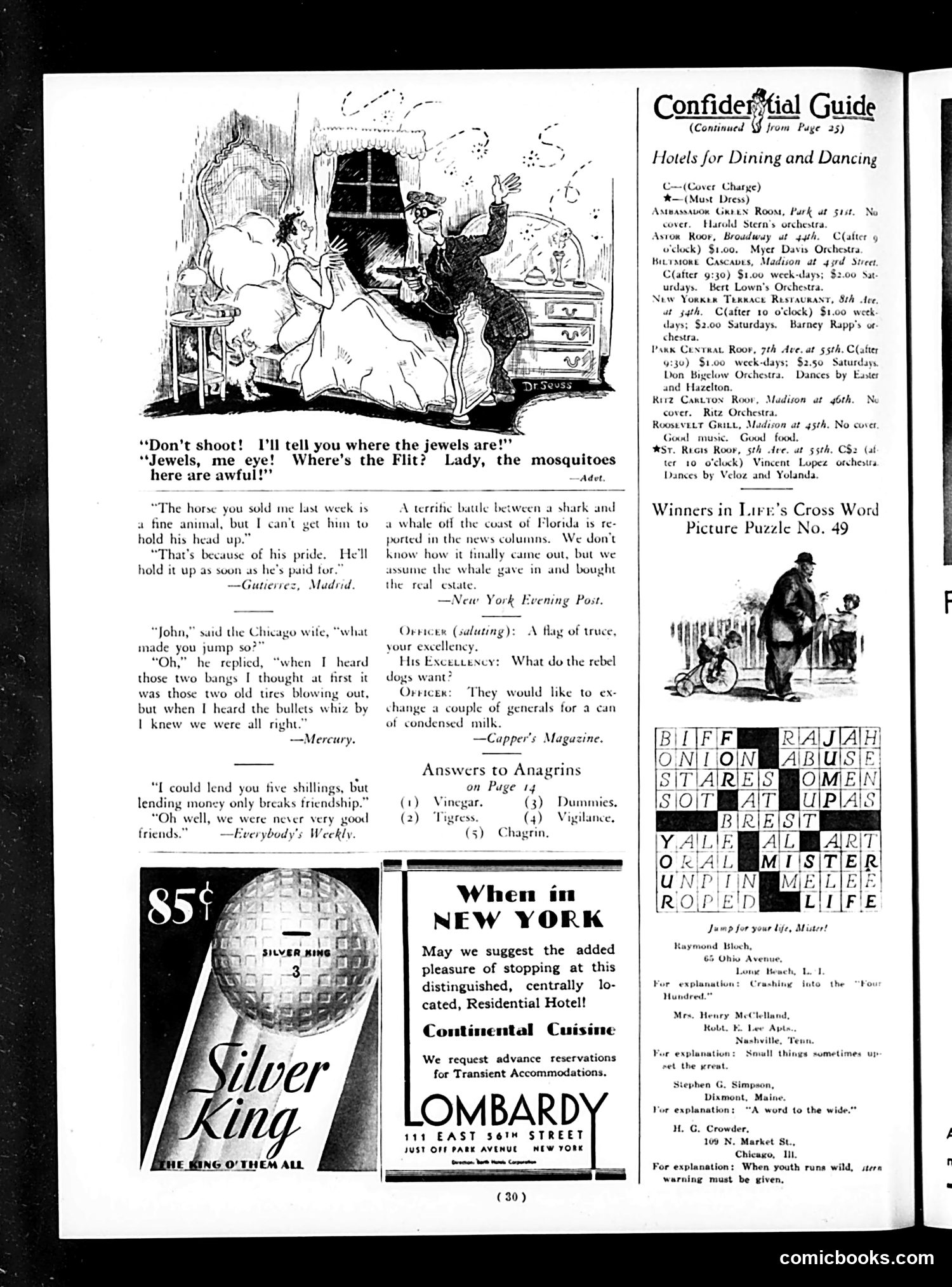
Page Analysis: Life Magazine Humor & Advertisements This page from *Life* magazine (a satirical publication, not the photo magazine) contains several short humorous anecdotes and advertisements typical of the era. The Main Cartoon (top left) depicts a bedroom scene where a woman threatens a burglar with a gun, demanding he reveal the jewels' location. The joke plays on mosquitoes as the real "thieves"—the pest control product "Flit" is being advertised as the solution. This is a product advertisement disguised as humor, common in early-20th-century magazines. The Anecdotes are brief jokes from various sources (Madrid newspapers, *Mercury*, *Everybody's Weekly*, etc.), ranging from wordplay about a proud horse refusing to hold its head up until paid for, to observational humor about gunfire and friendship. The Advertisements include the Lombardy Hotel (residential dining) and Silver King rings, representing typical upscale Manhattan services and luxury goods marketed to *Life*'s affluent readership. The page also contains puzzle answers and a crossword solution section, standard magazine filler content.
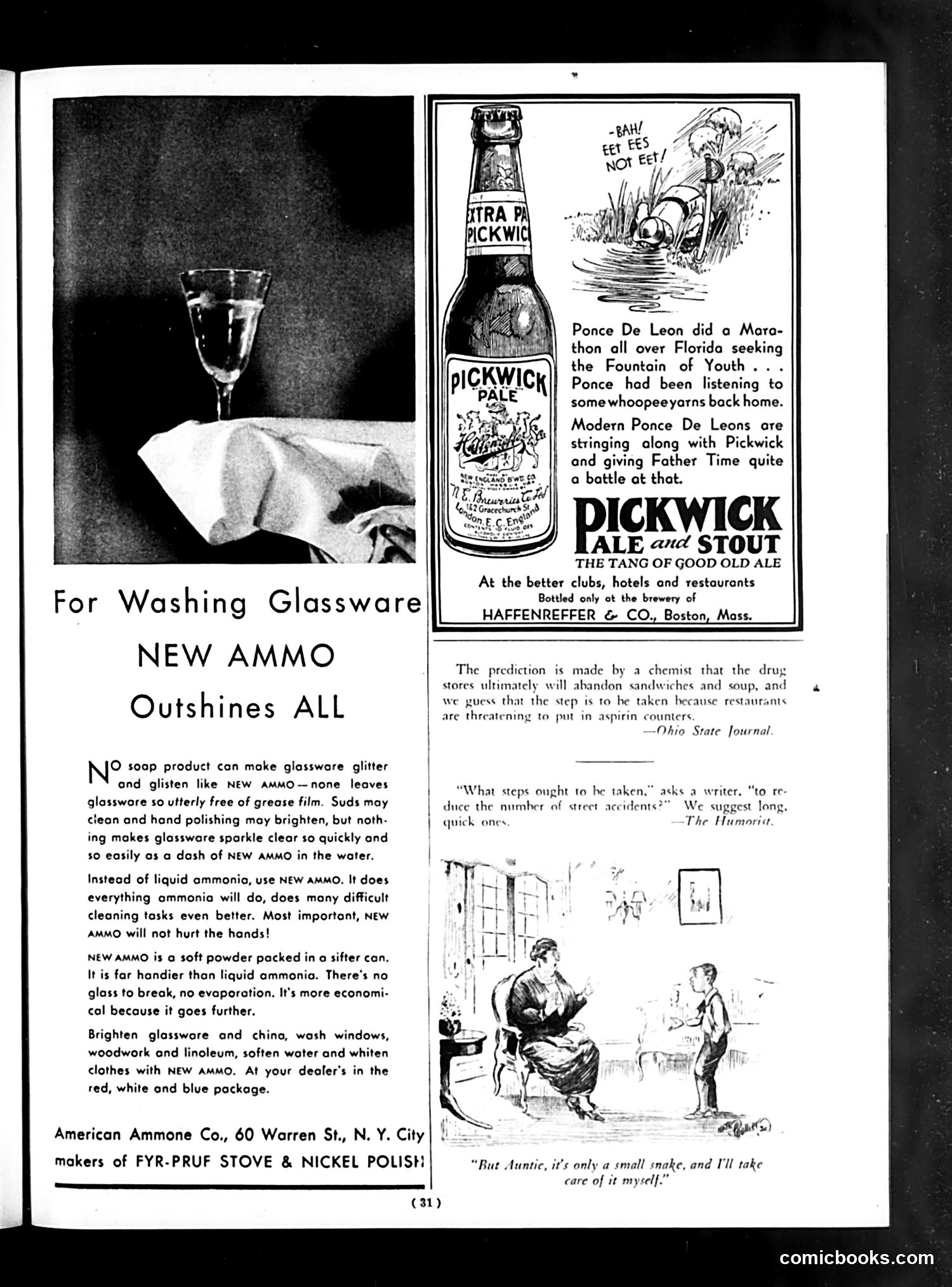
Analysis of Life Magazine Page This page contains primarily advertisements interspersed with brief satirical items. The main cartoon depicts Ponce De Leon, the historical Spanish explorer, reimagined as a modern man seeking the "Fountain of Youth"—a satirical commentary on aging men pursuing rejuvenation through alcohol (Pickwick Pale Ale). The joke: modern men fighting Father Time through beer, just as Ponce pursued mythical fountains based on "whoopeeyarns" (tall tales). Supporting this is a small illustration of a boy with a snake, with the caption playing on false reassurance about controlling something dangerous—a secondary joke about overconfidence. The text snippets are humor excerpts: one predicts drugstores will abandon food service as restaurants add aspirin counters (suggesting alcohol consumption causes headaches); another suggests reducing street accidents by making them "quick ones" (dark humor about fatal versus prolonged accidents). The remaining content consists of product advertisements for New Ammo cleaning powder and Dickwick Ale, typical of 1920s magazine layouts.
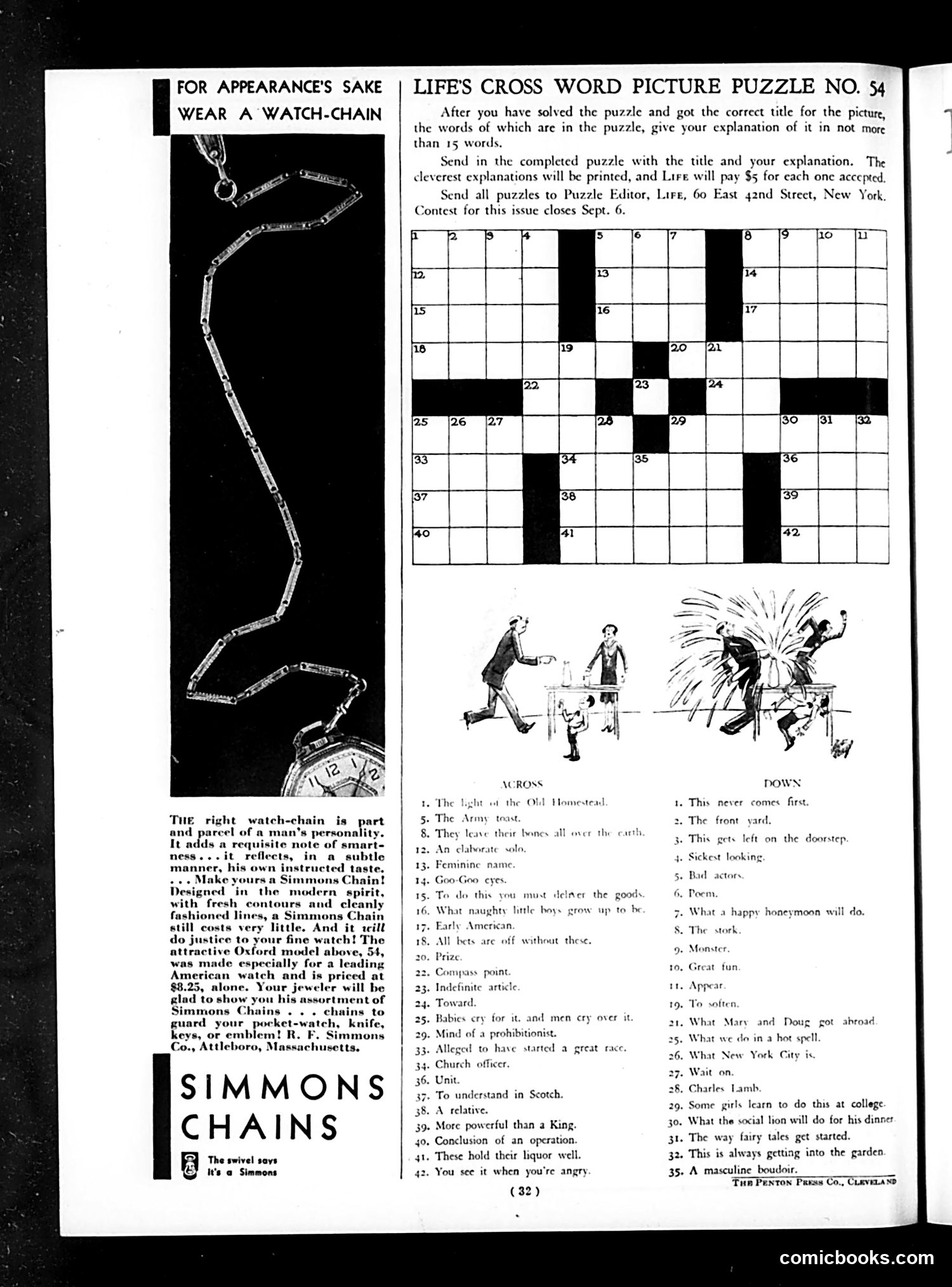
Life Magazine Page Analysis This page contains two distinct sections: a Simmons Chains advertisement (left) and a crossword puzzle contest (right). The advertisement uses a watch-chain to promote masculine refinement and social status. It suggests that proper accessories reflect "instructed taste" and personality—a common early-20th-century appeal to men's insecurity about appearing respectable and well-dressed. The crossword puzzle contest is Life's interactive feature, offering $5 payment for clever reader explanations (substantial money then). The clues mix wordplay with contemporary references: "Go-Goo eyes" (a popular song), "Early American" (design style), and "What Mary and Doug got abroad" (likely referring to Mary Pickford and Douglas Fairbanks, famous silent-film stars). The accompanying cartoon illustrations show domestic and office scenes with comedic situations—typical of Life's satirical humor targeting middle-class American life and manners of the era.
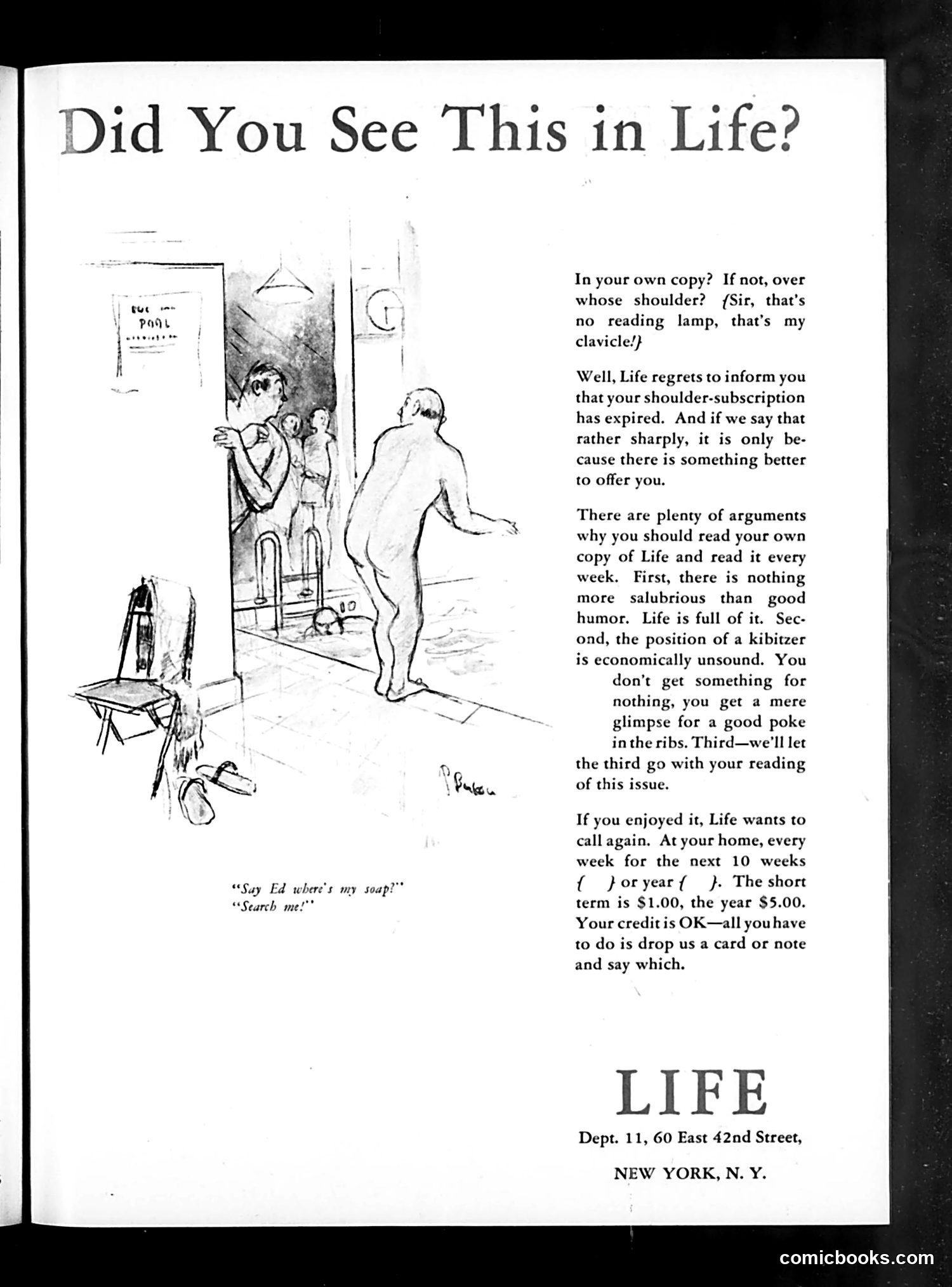
"Did You See This in Life?" - Subscription Advertisement This is a subscription pitch disguised as humor. The cartoon shows a nude man asking another man about soap while someone reads *Life* magazine over the second man's shoulder—a common social annoyance. The joke plays on "shoulder-subscription": people reading without paying. The text humorously "regrets" this freeloading, claiming readers get only "a mere glimpse for a good poke in the ribs" rather than owning their own copy. The ad argues three reasons to subscribe: (1) good humor is healthy, (2) being a "kibitzer" (observer/mooch) is economically foolish, and (3) a mysterious third reason readers should discover themselves. It's a clever self-aware advertisement acknowledging the common practice of borrowing magazines while gently shaming non-subscribers into buying their own. Subscription options: 10 weeks for $1.00 or a year for $5.00.
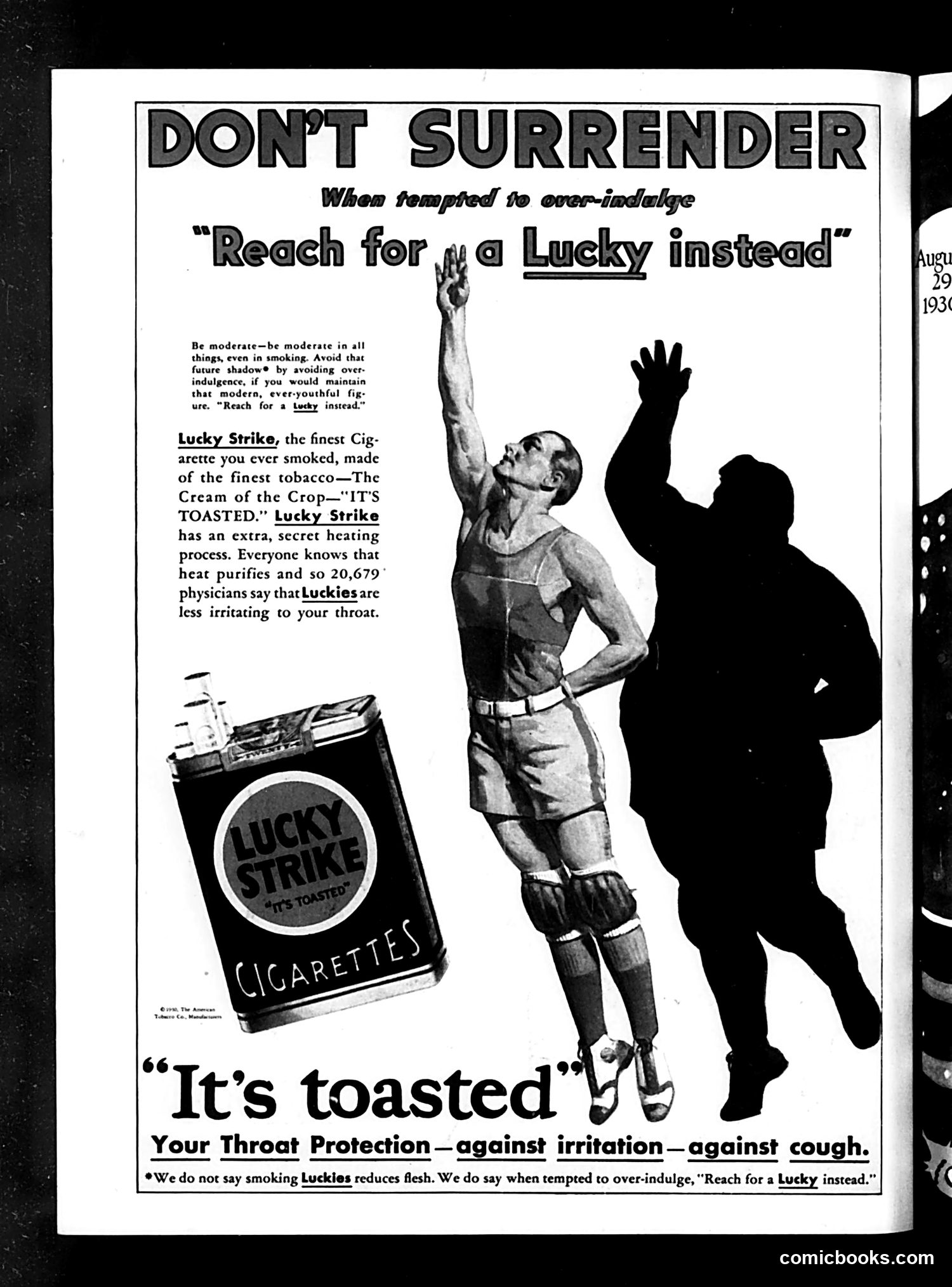
Lucky Strike Cigarette Advertisement (1930) This is a cigarette advertisement, not political satire. It promotes Lucky Strike cigarettes using the slogan "Reach for a Lucky instead"—encouraging smokers to choose Luckies when tempted to overeat or over-indulge in food. The imagery shows an athletic man and silhouetted figure, appealing to vanity: smoking instead of eating supposedly maintains a slim, youthful figure. The ad claims "20,679 physicians" endorse Luckies as "less irritating to your throat" due to a "toasted" heating process. The small disclaimer acknowledges the ad doesn't claim smoking reduces weight—only that it's a substitute for eating. This reflects 1930s advertising's loose health claims before modern regulation. The appeal to moderation and health through cigarette smoking reveals the era's starkly different understanding of tobacco's dangers.