life
Life — August 29, 1930
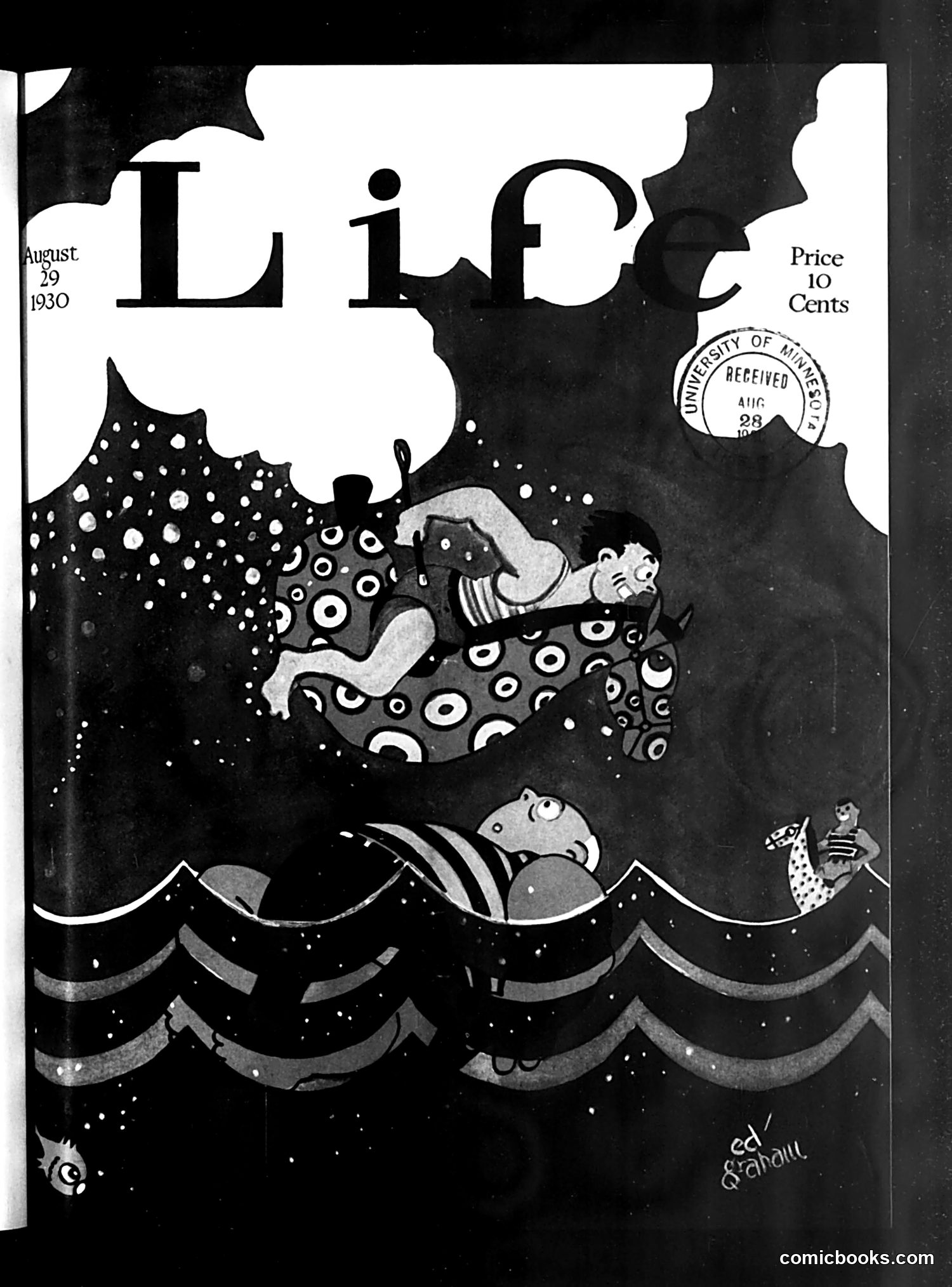
Life Magazine Cover Analysis (August 29, 1930) This cover depicts an underwater fantasy scene with surreal imagery. A figure reclines on an ornate sea creature or fantastical beast decorated with circles and patterns. Below, fish with exaggerated features swim in stylized waves. The composition is dreamlike and whimsical rather than explicitly political. Given Life's 1930 satirical focus, the cartoon likely comments on escapism during the Great Depression—the wealthy or privileged retreating into fantasy while ordinary citizens struggled. The elaborate, decorative sea-world contrasts with harsh economic reality above the surface. The artist signature appears to be "ed Grabill" (or similar). Without clearer contemporary context, the specific satirical target remains unclear, though the escapist theme fits the era's social commentary.
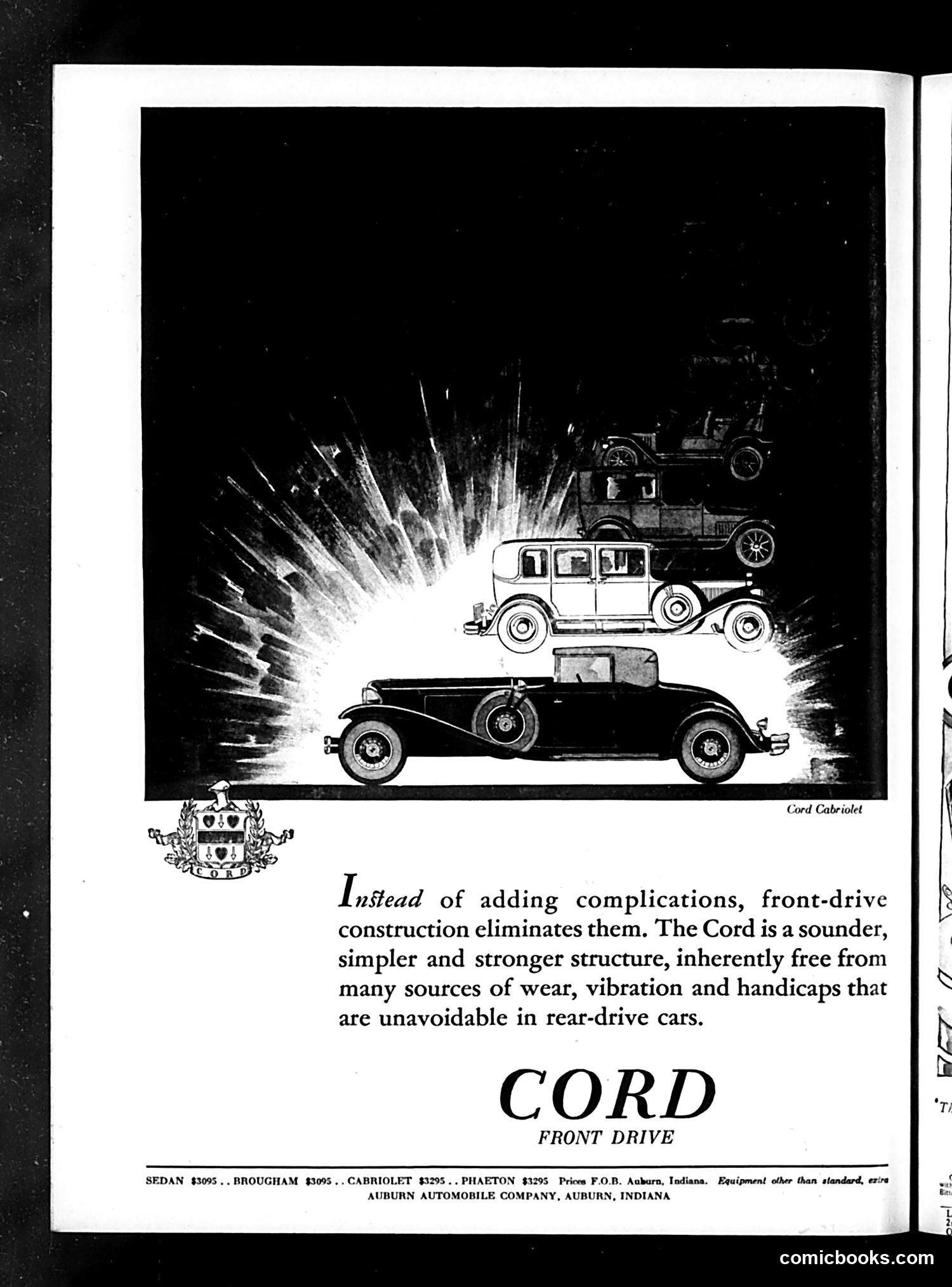
This page is an advertisement for Cord automobiles, not political satire. The image shows four cars stacked vertically with a dramatic radiating light burst behind them, emphasizing their superiority. The ad argues that Cord's front-drive construction is mechanically superior to rear-drive vehicles used by competitors—simpler, stronger, and free from vibration and wear issues. The text claims front-drive "eliminates complications" inherent to rear-drive cars. This reflects genuine 1920s-30s automotive engineering debates about drivetrain design. The stacked vehicles suggest a hierarchy, with the sleek Cord at bottom positioned as the most advanced model, contrasting with older-looking trucks and cars above it. The Auburn Automobile Company manufactured Cord vehicles in Indiana.
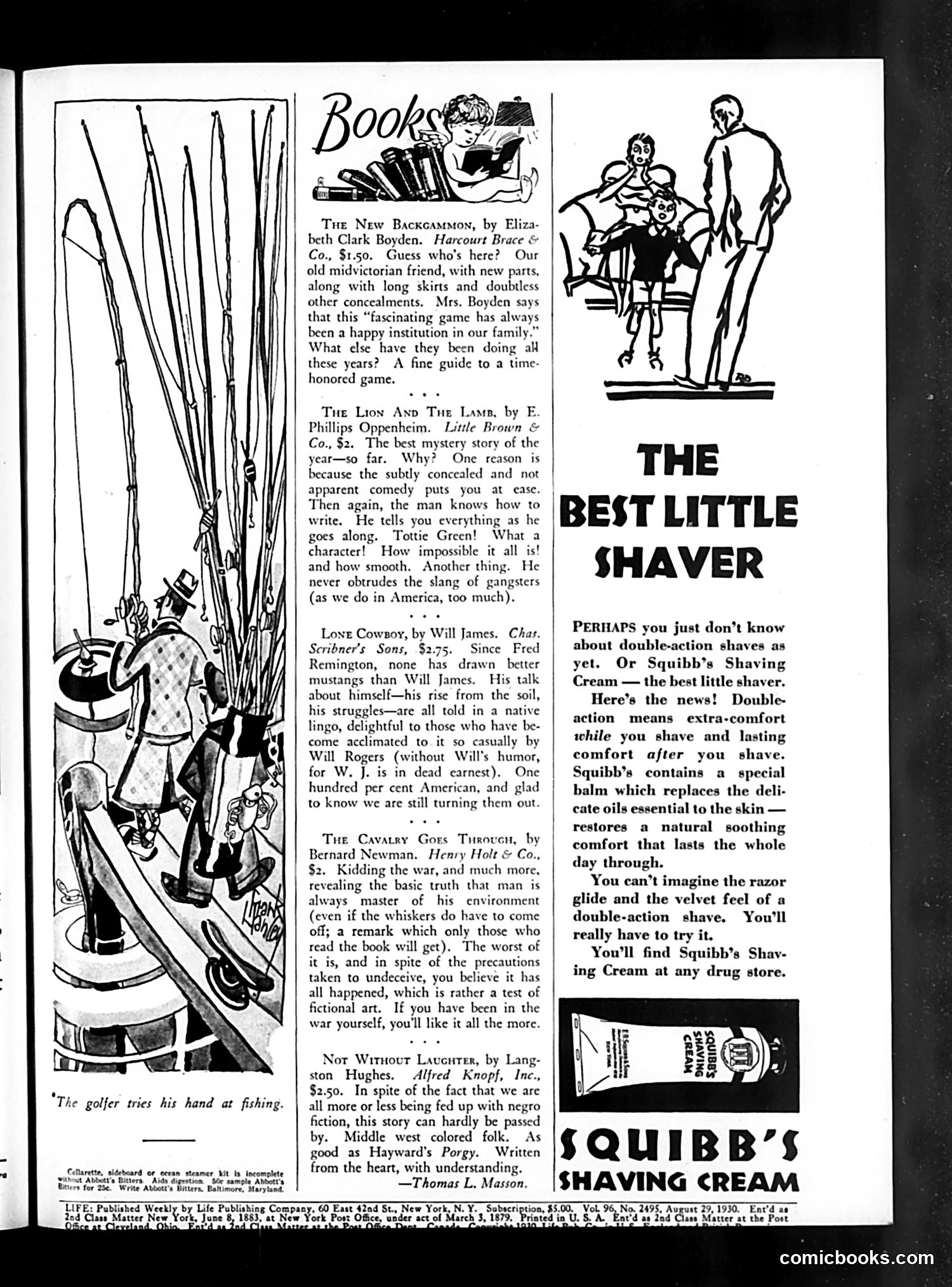
Page Analysis This page is primarily book reviews and advertising rather than political satire. The left column reviews four books, including titles about backgammon, mystery fiction, and the American West. The main illustration—"The golfer tries his hand at fishing"—is a humorous cartoon about leisure activities, showing a man in golfing attire attempting to fish among cattails, suggesting the awkwardness of applying one sport's techniques to another. The right side features a full-page advertisement for Squibb's Shaving Cream, emphasizing its "double-action" formula that provides comfort during and after shaving. The ad includes an illustration of a man shaving and product imagery. This is a typical 1930 magazine layout mixing literary content with consumer advertising.
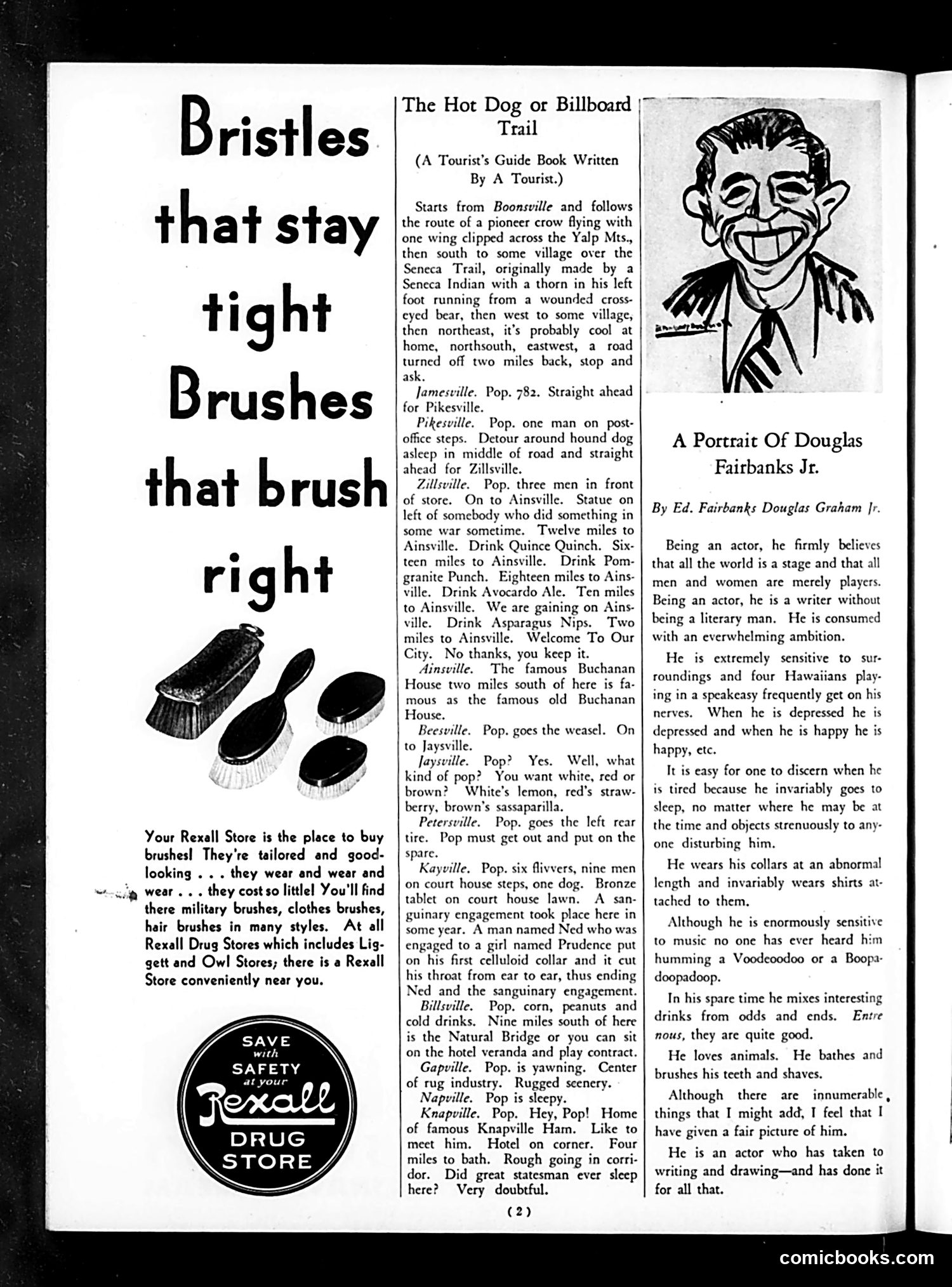
Page Analysis: Life Magazine This page contains primarily advertising and a biographical profile, not political satire. The left side advertises Rexall Drug Store brushes with product illustrations and a store locator. The center and right feature "The Hot Dog or Billboard Trail," a humorous tourist guide parodying travel literature by listing small towns with absurd, exaggerated descriptions (e.g., "Pop goes the weasel," "Pop is sleepy"). This satirizes both overwrought travel guides and America's proliferation of roadside attractions and billboards during the automobile era. The right column profiles Douglas Fairbanks Jr. (identified in text), describing him as an actor-turned-writer who is sensitive, drinks unusual cocktails, and is meticulous about appearance. This appears a lighthearted celebrity profile rather than political commentary.
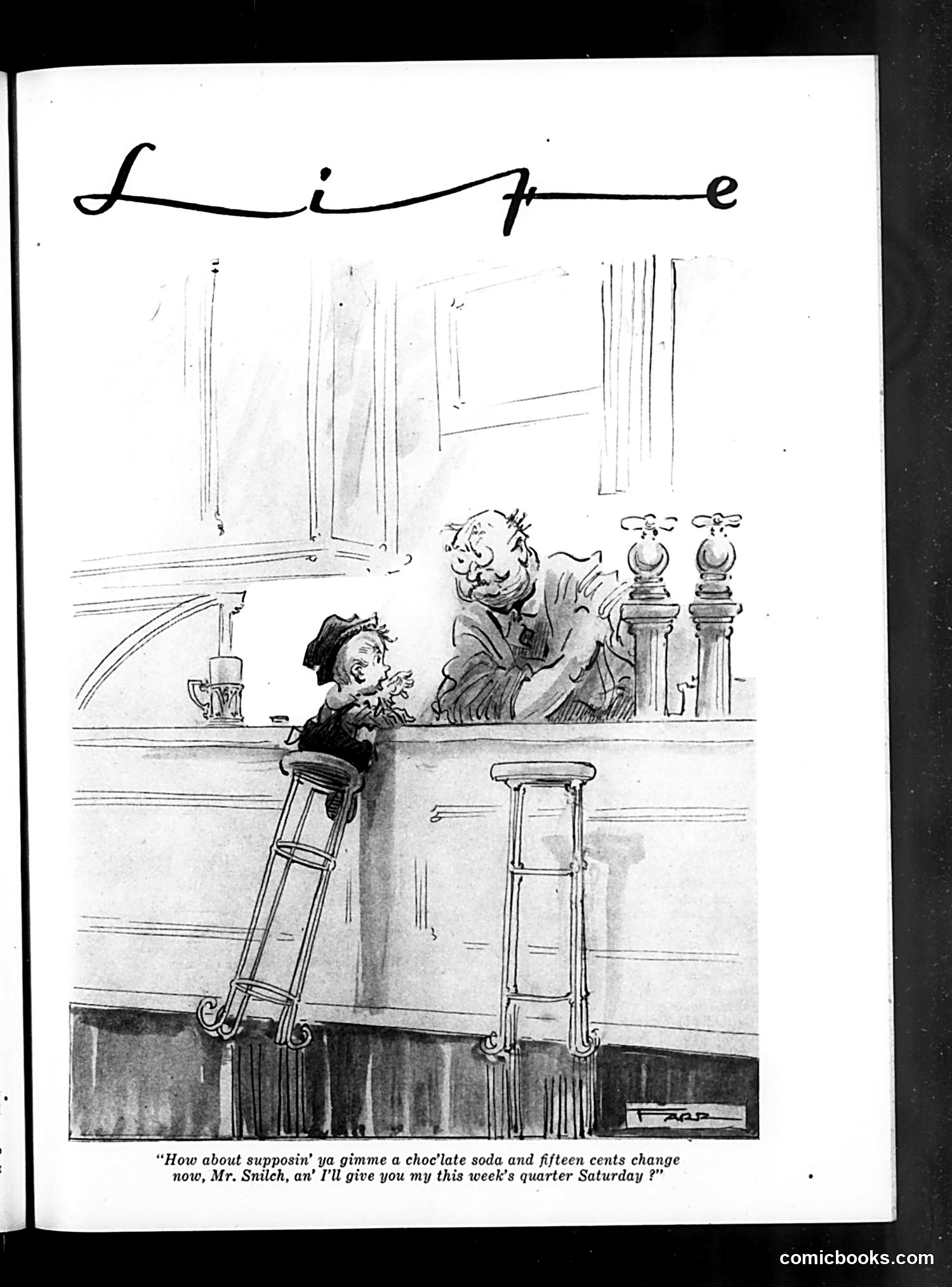
"Life" Cartoon Analysis This cartoon depicts a child standing on a stool at what appears to be a soda fountain counter, addressing an adult male proprietor named "Mr. Smilch." The child proposes a transaction: trading a chocolate soda and fifteen cents in change for his weekly allowance quarter (25 cents) due on Saturday. The joke reflects early 20th-century economics and childhood dynamics. The child is attempting to negotiate an unfavorable deal—essentially borrowing against future earnings at a loss. The humor lies in the child's brazen negotiation attempt with an adult shopkeeper, and the satirical commentary on consumer temptation (soda fountains were popular social gathering spots) overriding financial prudence. The title "Life" suggests this captures a universal human tendency toward immediate gratification.
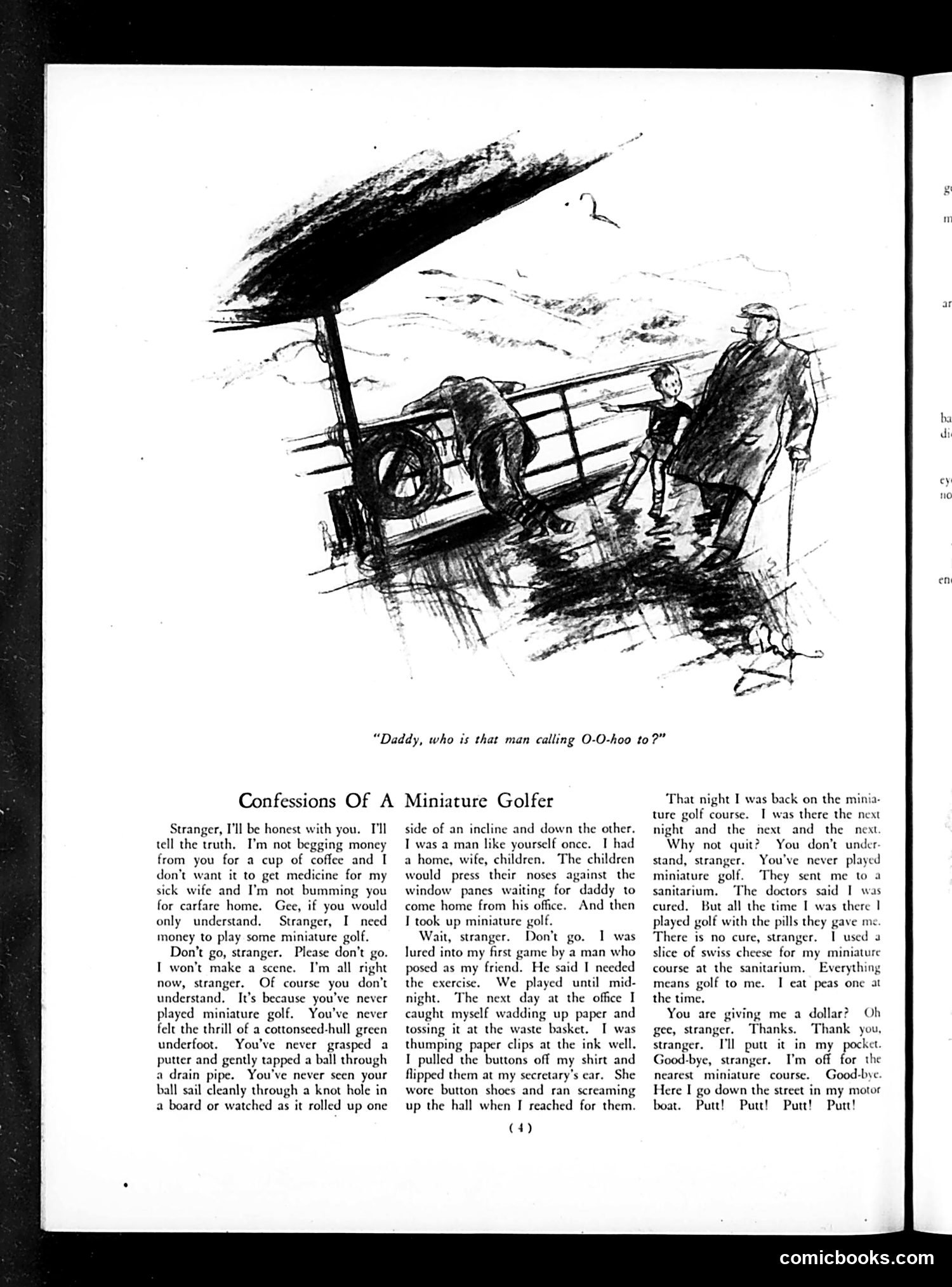
Analysis This page contains an illustration and short story titled "Confessions of a Miniature Golfer." The cartoon shows three figures on what appears to be a miniature golf course, with a child asking his father "Daddy, who is that man calling O-O-hoo to?" The accompanying text is a humorous first-person confession from an adult man describing his obsession with miniature golf. He explains how he was initially skeptical but became addicted to the hobby, even describing embarrassing incidents (like pulling buttons off his secretary's shoes while reaching for lost golf balls). The humor derives from satirizing how grown men could become so invested in this trivial recreational activity. It's a gentle mockery of adult vanity and the way leisure pursuits can consume people's attention and dignity.
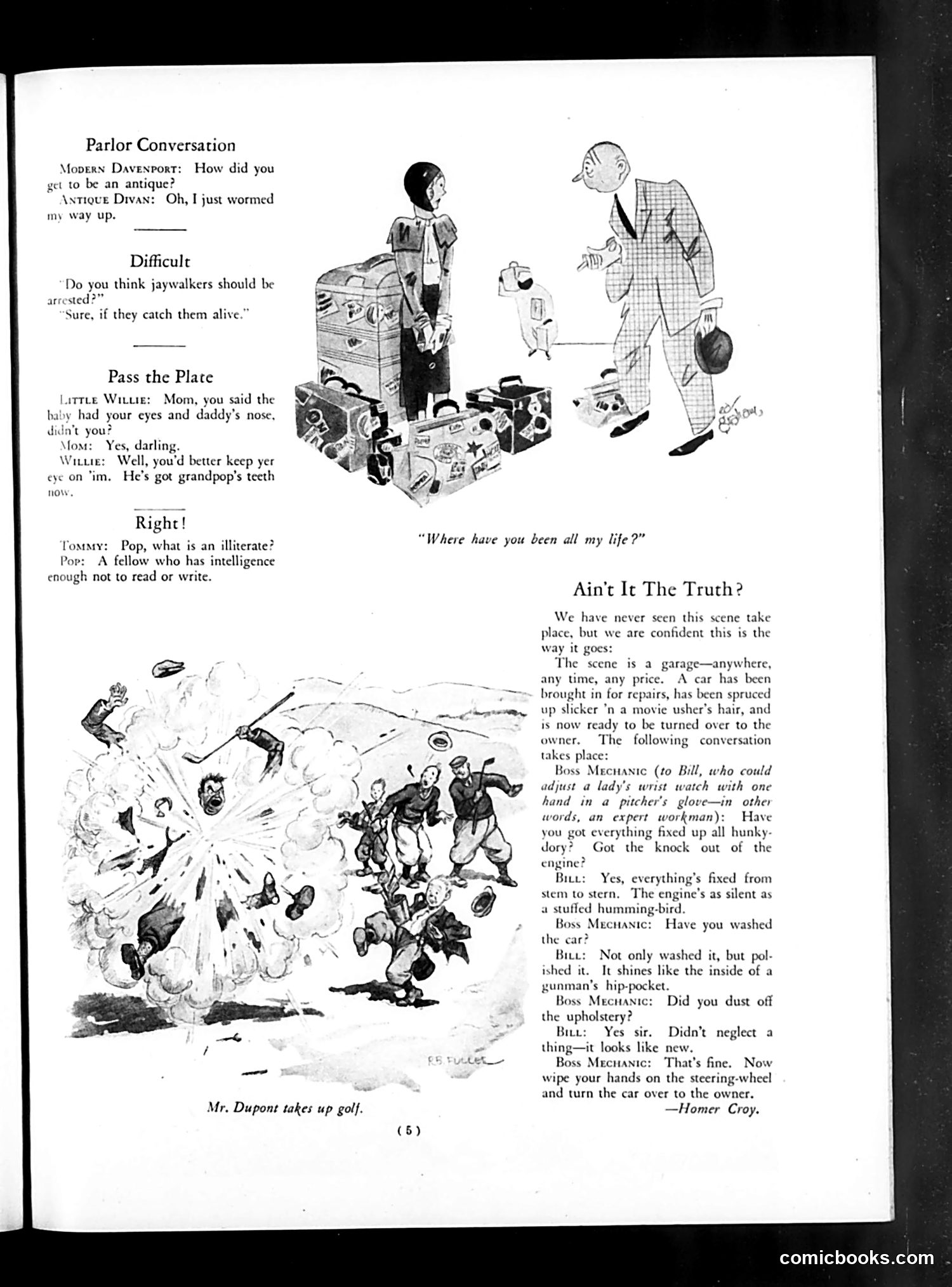
Analysis of Life Magazine Page This page contains several humor pieces targeting early 20th-century social behavior and gender relations: "Parlor Conversation" mocks how men court women by exaggerating their artificiality—the "Modern Davenport" character boasts of being an "antique divan," suggesting men fabricate their backgrounds. "Pass the Plate" satirizes parental hypocrisy: a mother tells her son to observe his father's appearance, but then admits father now wears grandfather's dentures—undermining her advice about honesty. "Right!" jokes about defining illiteracy as having intelligence enough *not* to read or write—absurdist humor questioning education's value. "Ain't It The Truth?" depicts a car mechanic's conversation with a customer (Bill), satirizing mechanic dishonesty and the performative politeness of service transactions—the mechanic's overly thorough inspection likely hides unnecessary upselling. The "Mr. Dupont takes up golf" cartoon illustrates an explosion, apparently satirizing wealthy amateur golfers' incompetence.
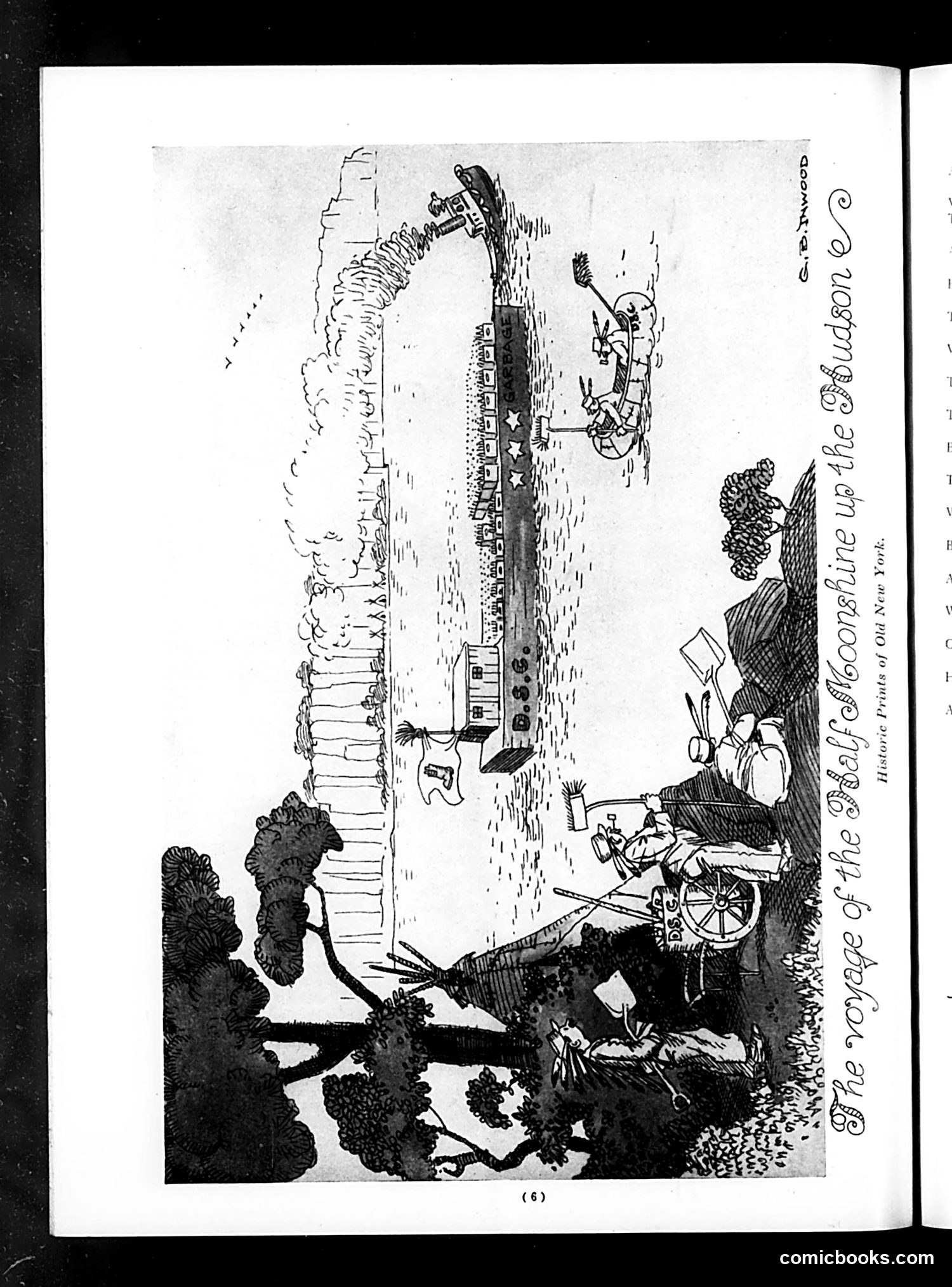
Analysis This page shows "The voyage of the Burlesque," a satirical illustration that appears to be rotated 90 degrees. The engraving depicts a steamboat traveling along what seems to be the Hudson River or similar American waterway, with passengers aboard and various figures along the shoreline. The title references "burlesque," suggesting satirical commentary on contemporary society or politics. The detailed engraving style is typical of 19th-century Life magazine illustrations. However, without clearer visibility of specific caricatured figures or readable text identifying particular political targets, I cannot definitively identify which specific events, politicians, or social movements this cartoon mocks. The boat's journey appears to be the vehicle for social satire, a common Life magazine format.
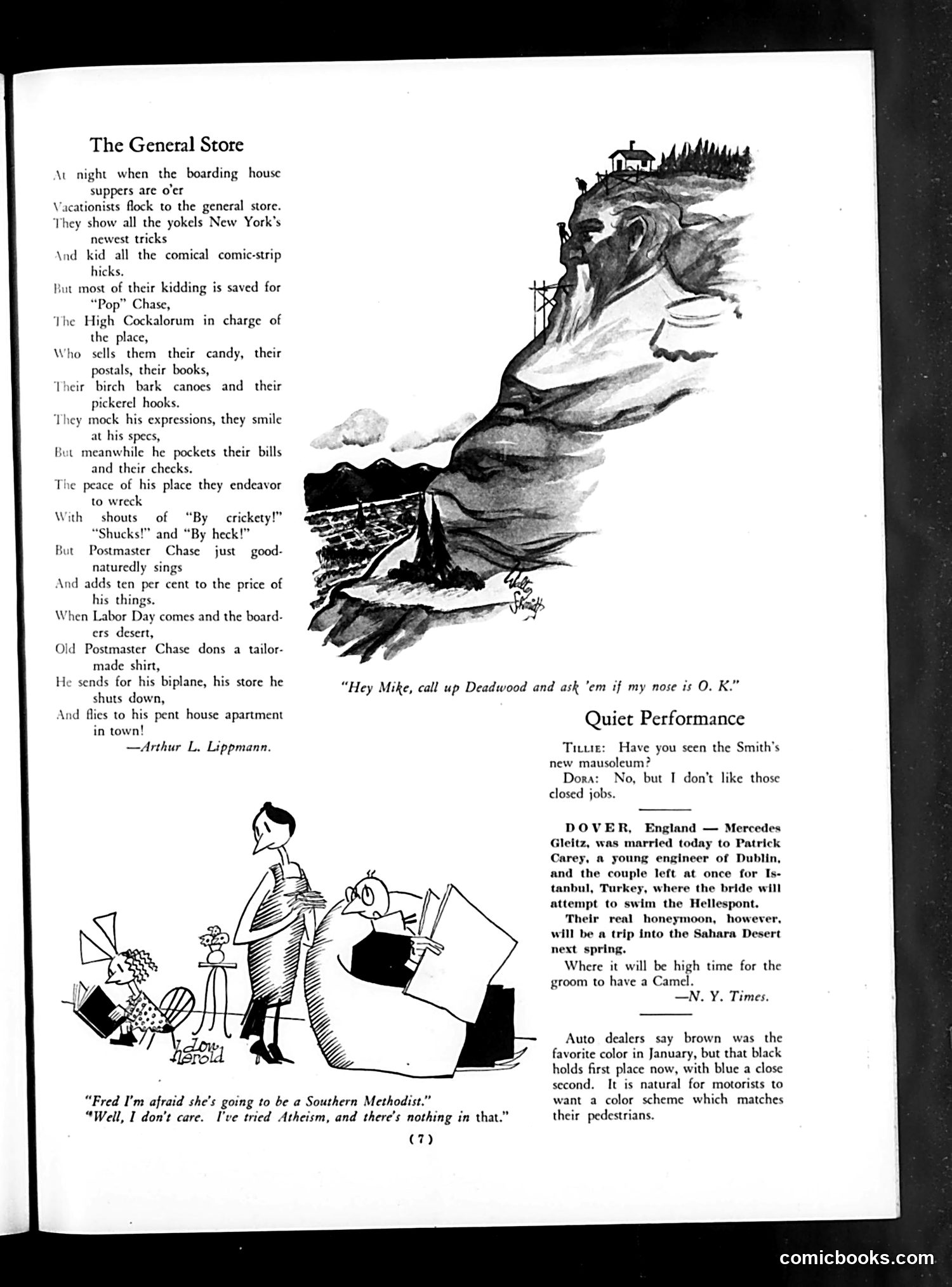
Analysis of Life Magazine Page This page contains three satirical pieces: 1. "The General Store" (poem by Arthur L. Lippmann): Mocks "Postmaster Chase," the High Cockalorum running a general store at a vacation spot. Vacationers mock him, buy cheap goods, create havoc with shouts of "By cricket!" and "Shucks!" The satire targets his self-importance and gullibility—he's easily manipulated by tourists who disrupt his business while he profits minimally. 2. Lower cartoon: Shows a domestic dispute about religion. A woman fears her husband will become a "Southern Methodist"; he replies he's tried atheism with no results, suggesting cynical indifference to both positions. 3. "Quiet Performance": Brief gossip items about social news (marriages, color preferences in automobiles). The humor relies on early-20th-century American social conventions and class anxieties.
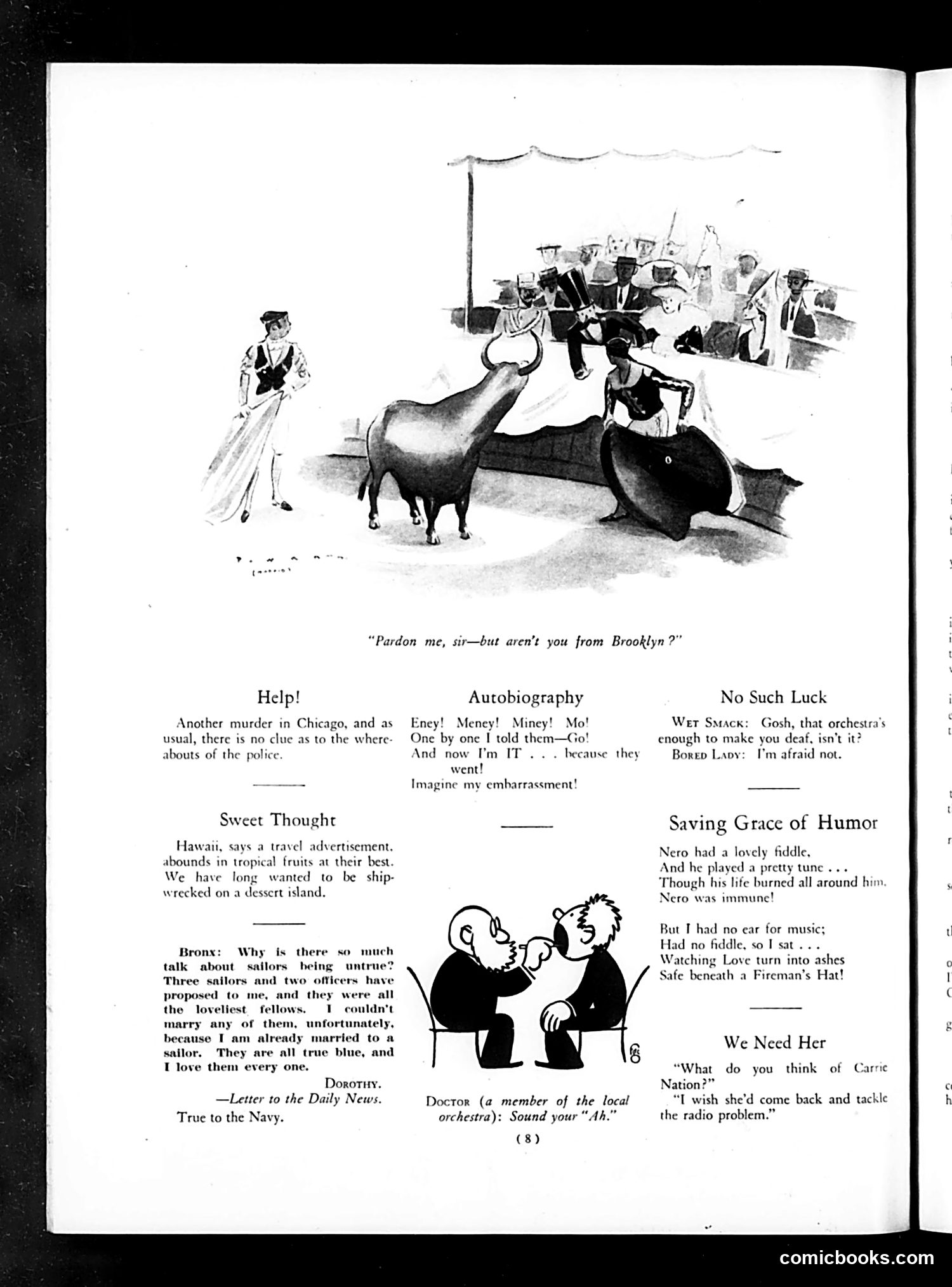
Analysis This page from *Life* magazine contains humorous short pieces and one cartoon. The main illustration at top shows a bullfight scene with a woman in a flapper dress on the left, and spectators watching a bull gore a matador. The caption reads: "Pardon me, sir—but aren't you from Brooklyn?" The joke plays on 1920s stereotypes: a Brooklyn-accented man is so unsophisticated that he'd attend a bullfight dressed formally but act obliviously American, needing to be "pardoned" for his crude behavior in a Spanish cultural setting. The remaining text consists of brief humorous anecdotes and jokes about various topics—Chicago crime, naval romance, Hawaii travel, and orchestra members—typical of *Life*'s light satirical humor of the era. These mock everyday American social situations and provincial attitudes.
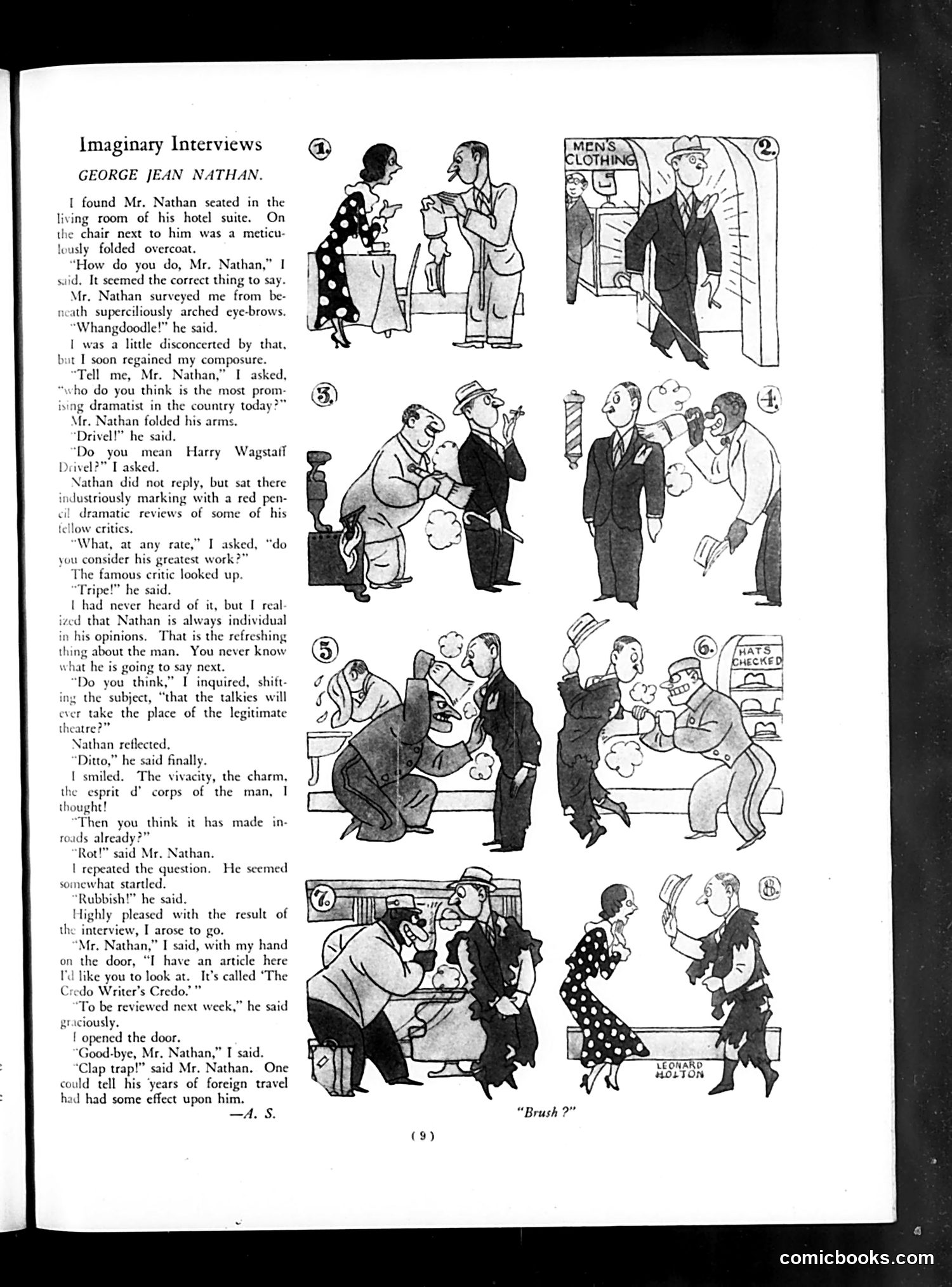
Imaginary Interviews: George Jean Nathan This page features a satirical interview with George Jean Nathan, a prominent theater critic of the early 20th century. The text humorously depicts Nathan as an arrogant, dismissive critic who considers Harry Wagstaff himself "Tripe!" and believes talkies (early talking films) will never replace legitimate theater. The accompanying comic strip illustrations (numbered 1-8) show Nathan in various scenarios—shopping, dining, and socializing—where he maintains his supercilious attitude. The final panel, titled "Brush?", appears to joke about his pretentious demeanor. The satire targets Nathan's notorious snobbery about entertainment media and his refusal to acknowledge changing cultural tastes. It's a period piece mocking a real critic's dismissiveness toward emerging technologies like sound film.
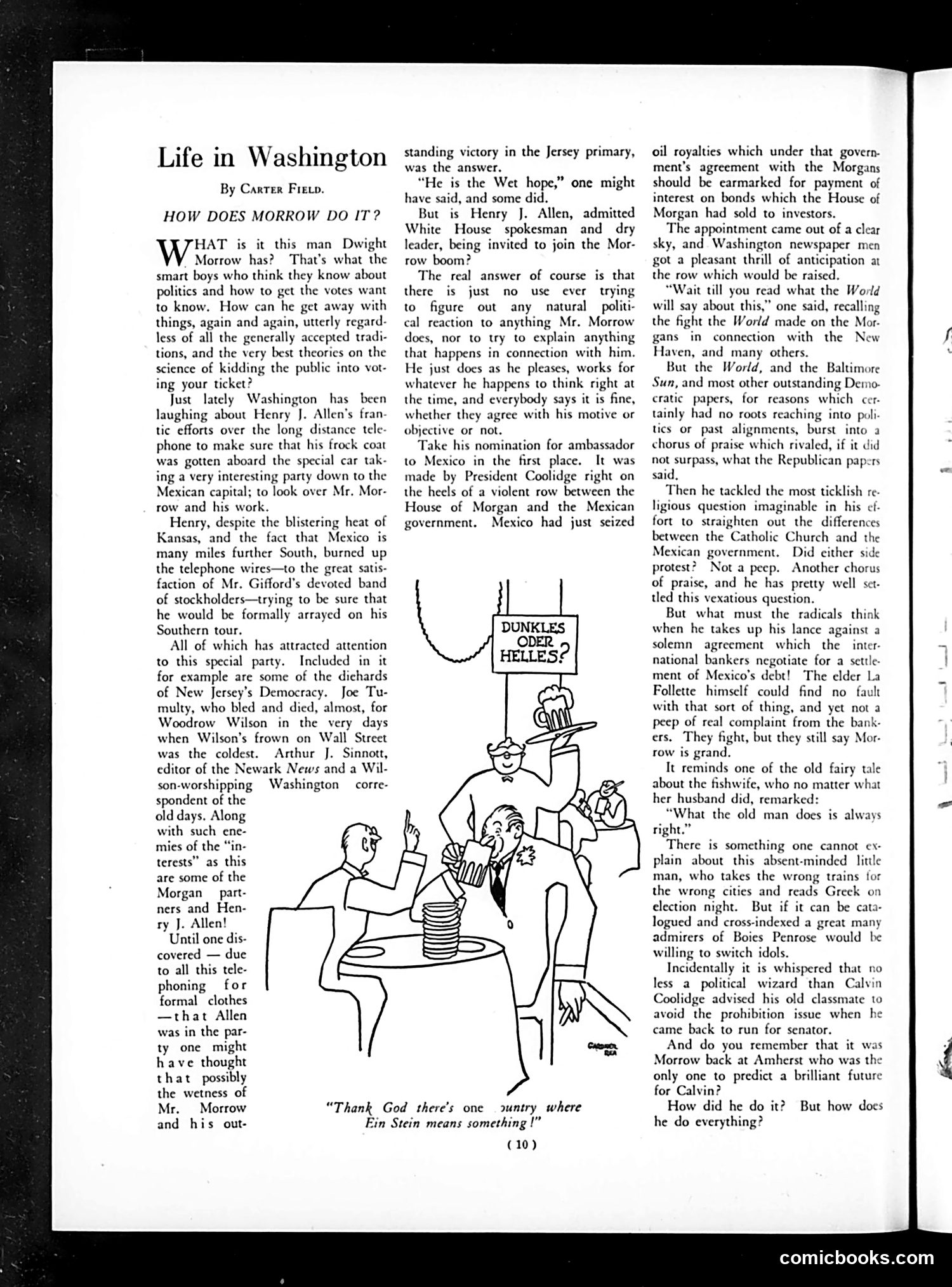
Analysis: "Life in Washington" by Carter Field This satirical piece critiques Dwight Morrow's political maneuvering and influence. The cartoon shows figures around a table with a sign reading "DUNKLES ODER HELLES?" (German for "dark or light beer"), captioned: "Thank God there's one country where Ein Stein means something!" The article mocks Morrow's role in Henry J. Allen's failed political efforts, suggesting Morrow operates behind the scenes without accountability—he "just does as he pleases, works for whoever he happens to think right at the time." The satire targets his ambassador nomination to Mexico, his involvement in the Morgan financial interests, and his influence over Calvin Coolidge. The German beer reference appears to mock immigrant or foreign policy connections, suggesting Morrow's shadowy influence extends across borders while remaining mysteriously effective in American politics.
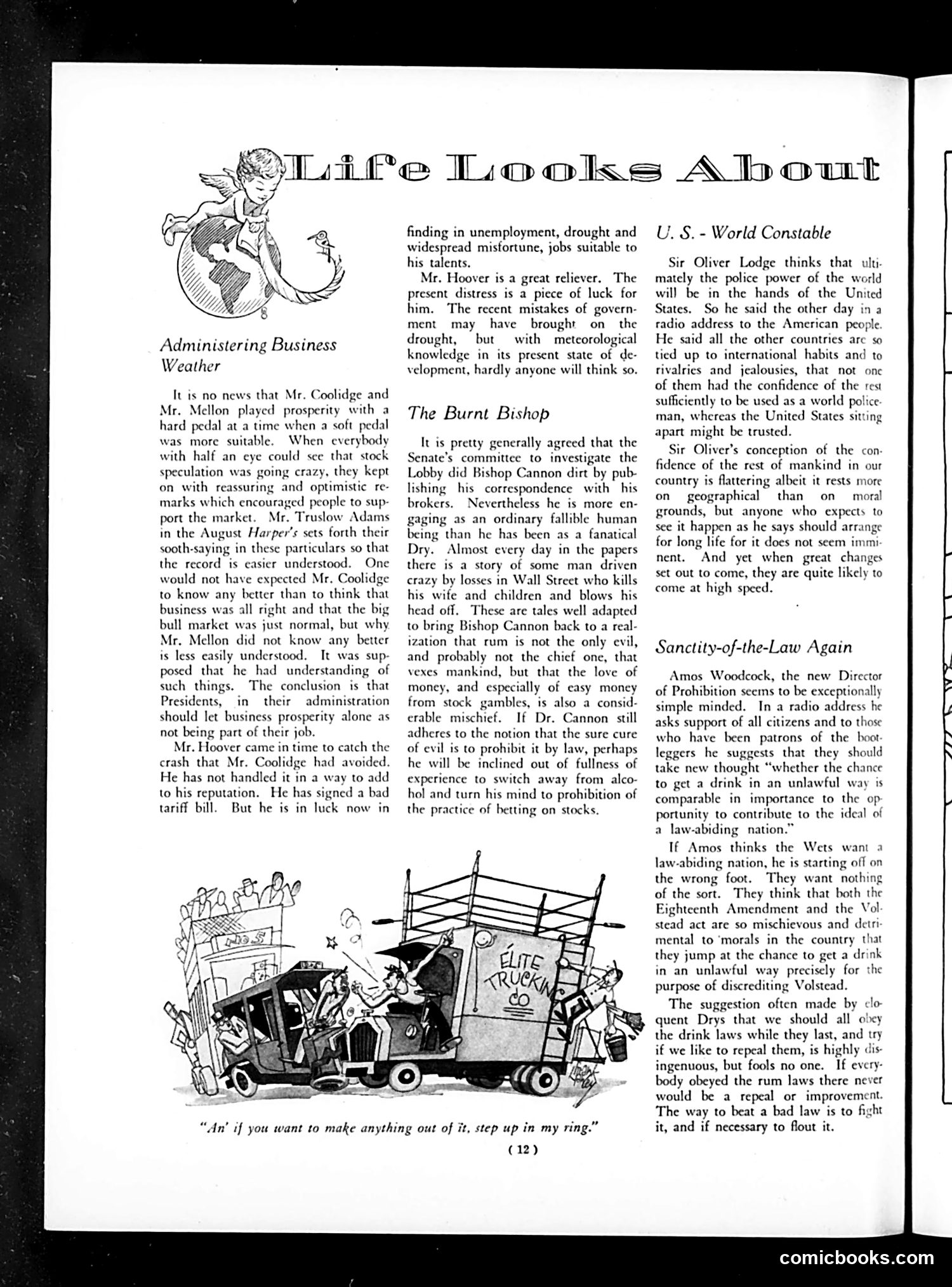
"Life Looks About" - Page 12 Analysis This page contains three separate satirical commentaries on American social issues: 1. "Administering Business Weather": Mocks Herbert Hoover's optimistic pronouncements during economic hardship. The text criticizes how Hoover and business leaders remained cheerful about stock market crashes and unemployment, suggesting their reassurances were disconnected from ordinary people's struggles. 2. "The Burnt Bishop": A story about Senator Cannon's correspondence with stockbrokers, satirizing how political figures were implicated in Wall Street speculation and stock market gambling—critiquing moral corruption among the wealthy elite. 3. "Sanctity-of-the-Law Again": Mocks prohibitionists' hypocrisy, suggesting they selectively enforce laws while ignoring the Eighteenth Amendment's failure, and critiques Amos Woodcock (Prohibition Director) for claiming moral superiority while drinking persists. The truck cartoon illustrates commercial corruption of Prohibition enforcement.
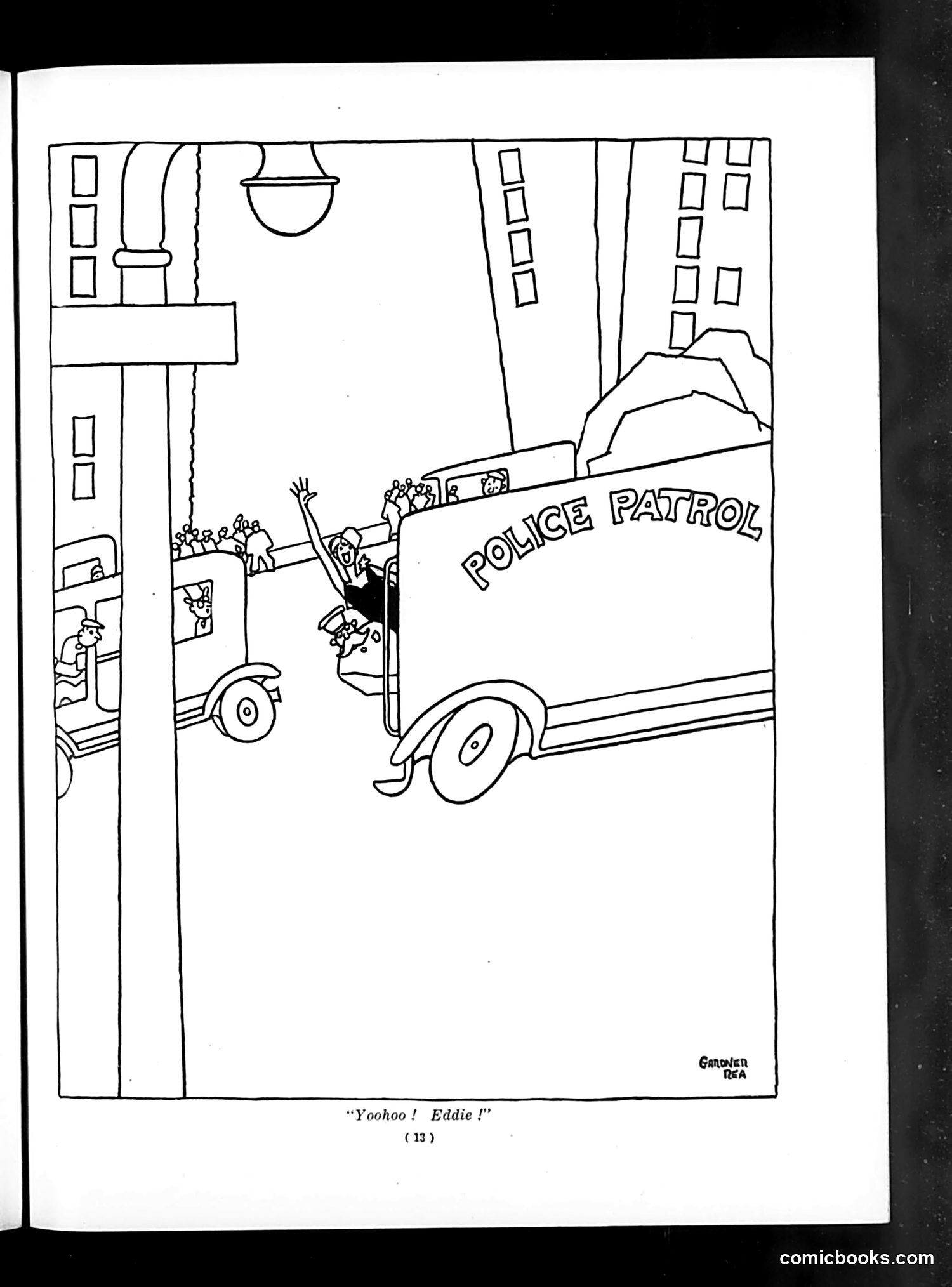
"Yahoo! Eddie!" Cartoon Analysis This single-panel cartoon depicts a police patrol vehicle in an urban street with tall buildings. People are waving enthusiastically from a window above, and someone appears to be climbing or hanging from the police car's exterior in celebration. The caption "Yahoo! Eddie!" suggests this depicts a character named Eddie receiving a triumphant or celebratory welcome, possibly related to police work or a famous arrest. The exuberant crowd reaction indicates Eddie was likely a well-known police figure or had accomplished something the public approved of. Without additional context about the specific date or Eddie's identity, the exact historical reference remains unclear, though the cartoon satirizes public enthusiasm for police actions or a particular officer's fame during this era.
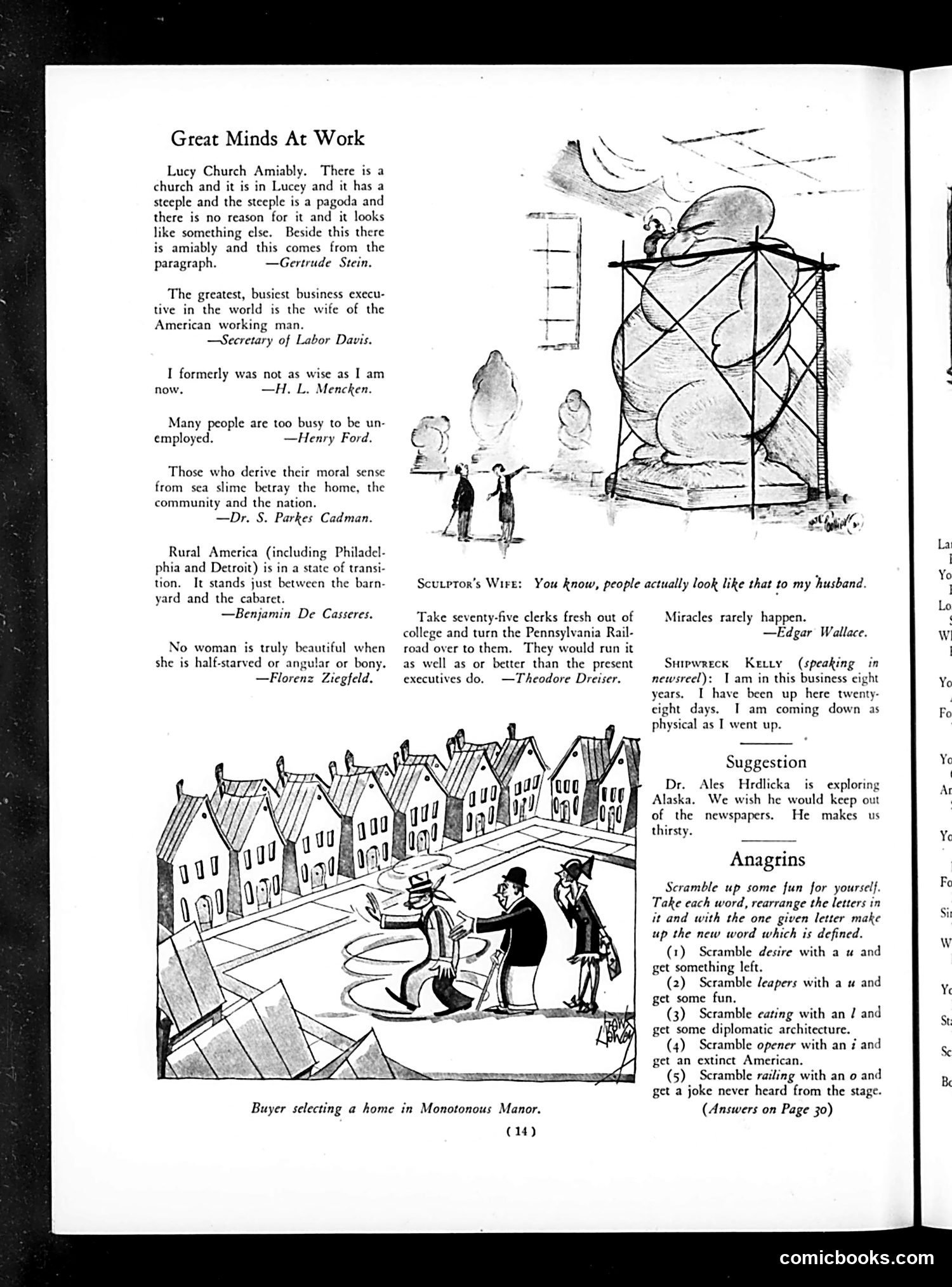
Analysis of Life Magazine Page 14 This page combines quotes from prominent figures ("Great Minds At Work") with two cartoons and a word puzzle. The top cartoon depicts a sculptor's wife comparing her husband's work to actual people, suggesting his sculptures are unflattering or exaggerated—a comment on artistic representation versus reality. The larger bottom cartoon, titled "Buyer selecting a home in Monotonous Manor," satirizes suburban development. It shows a real estate agent presenting identical row houses to a prospective buyer. The joke critiques the uniformity and lack of individuality in mass-produced housing developments—a common concern during early 20th-century suburban expansion, when such monotonous housing designs were becoming widespread. The accompanying quotes offer witty observations on business, beauty, and rural life from various notable figures of the era.
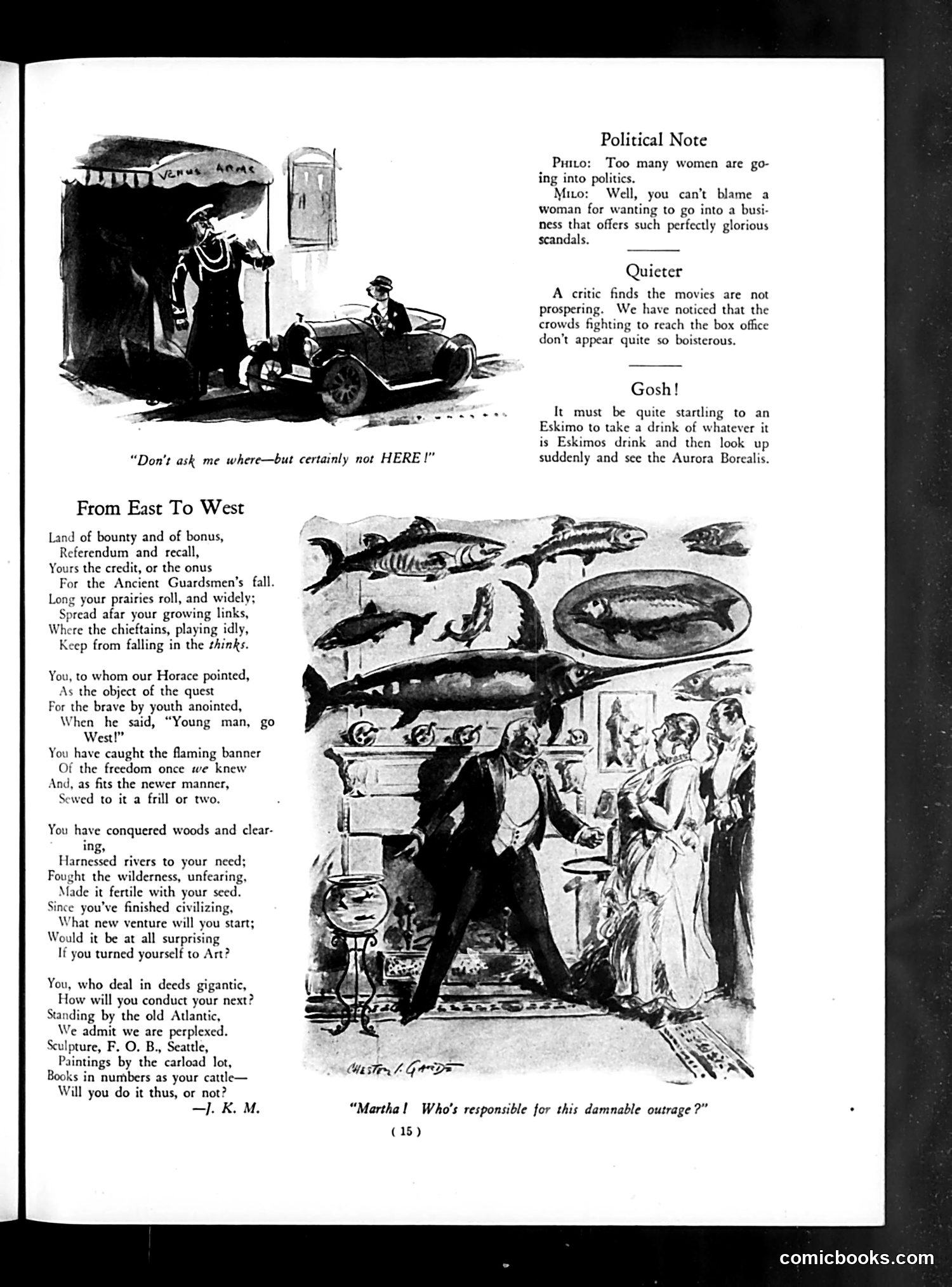
Analysis of Life Magazine Page This page contains three distinct items: "Political Note" (top right): A brief dialogue satirizing women entering politics, suggesting female politicians inevitably create "scandals." "Quieter" and "Gosh!": Short commentary pieces—one on declining movie attendance, another on Eskimos and the Northern Lights. Main Content—"From East to West": A poem by J.K.M. celebrating westward expansion and American pioneering spirit, addressing those who "conquered woods and clearings" and "fought the wilderness." It references Horace Greeley's famous "Go West, Young Man" and invokes artistic/cultural achievements (F.O.B. Seattle sculpture, etc.). The cartoon (bottom): Shows a formal dinner scene where someone has apparently served fish in an outrageous manner, with the caption "Martha! Who's responsible for this damnable outrage?"—satirizing domestic chaos or social embarrassment, likely referencing class anxieties about proper entertaining.
Theatre Review: "Suspense" This page reviews a WWI play called "Suspense," described as "A War Play to End War Plays." The critic argues the production is poorly executed—featuring careless direction, bad acting, and amateurish staging that undermines its anti-war message. The review criticizes how the play depicts war: soldiers sleep through bombardments, random firing occurs, and men sink "like dying Gauls." The critic finds these depictions unbelievable and the overall drama lacking in genuine passion or human relationships. The page also includes a separate piece titled "Caviar to the General," quoting General Sherman's famous statement that "war is hell," discussing whether anti-war propaganda through theater actually changes attitudes or merely preaches to audiences already opposed to war.
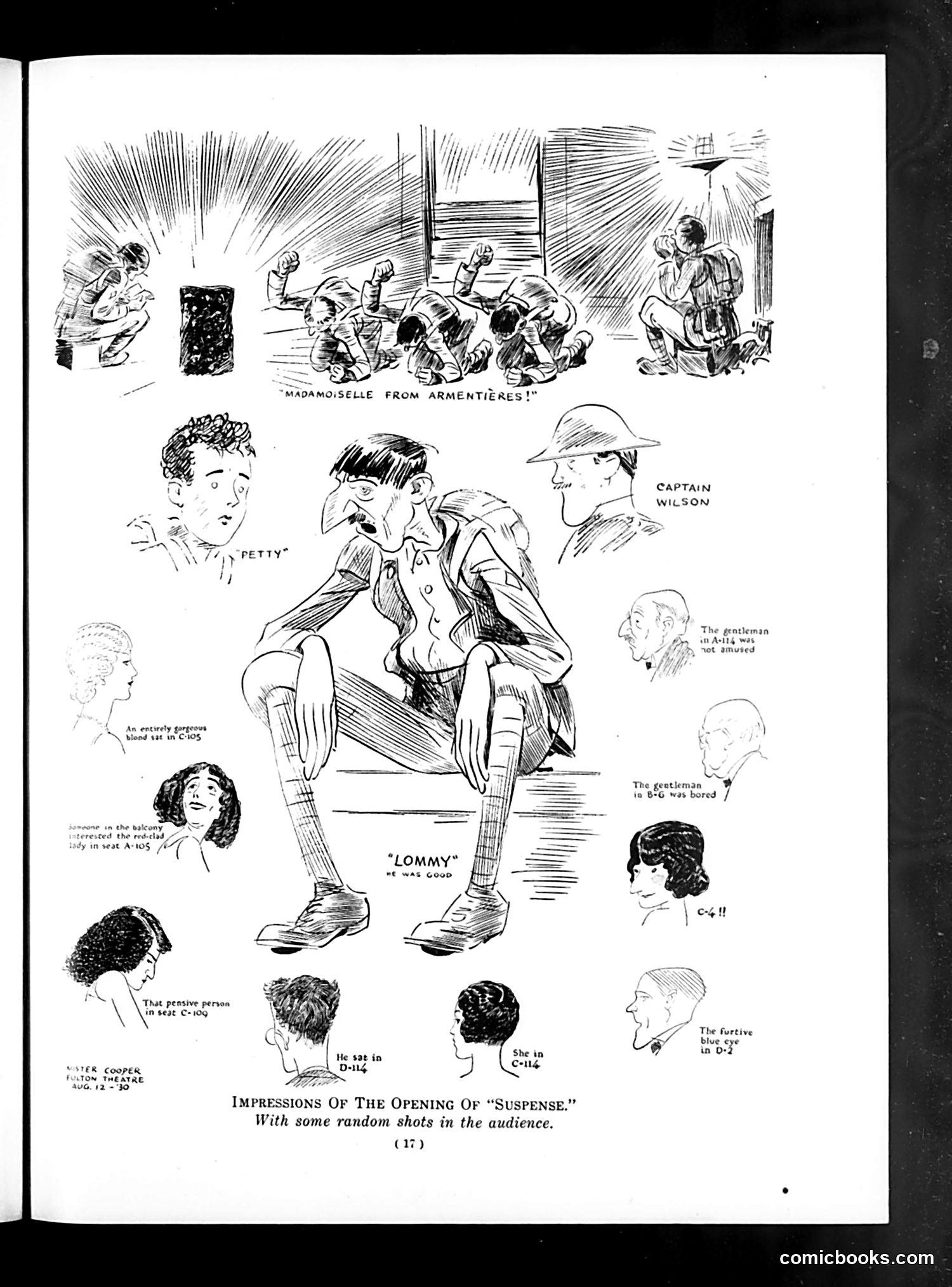
Analysis This page documents the opening of a theatrical production called "Suspense." The top panel shows an audience scene labeled "Madamo Selle from Armenières!" (referencing a WWI-era song), depicting what appears to be dramatic or comedic audience reactions. The central figure is a caricatured man labeled "Lommy" who "et was good"—likely a character or performer from the show. Surrounding him are various character sketches and audience members, each with labels indicating their reactions or identities: "Petty," "Captain Wilson," and various audience members seated in different sections (A-105, B-112, C-104, D-112, etc.). The caption indicates these are "impressions of the opening" with "random shots in the audience," documenting both the theatrical performance and spectators' responses—a common satirical Life magazine format examining both entertainment and public reaction.
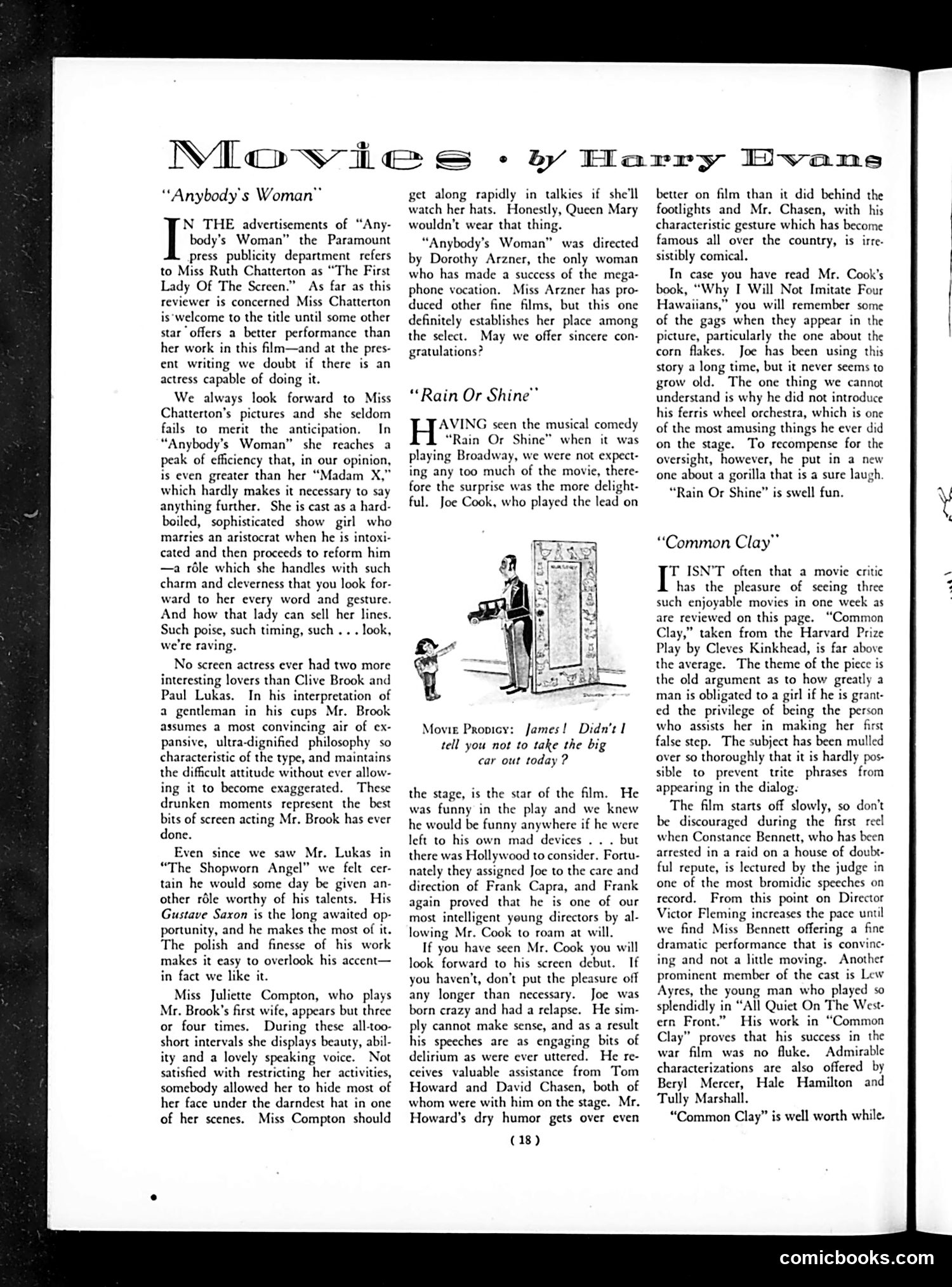
Movie Reviews by Harry Evans This page contains three film reviews from Life magazine's "Movies" column. The visible cartoon/illustration shows a movie scene with two figures and a caption: "Movie Prodigy: James! Didn't I tell you not to take the big car out today?" The reviews discuss: 1. "Anybody's Woman" — praising Dorothy Artzner as a capable female director and actress, noting her handling of complex character work 2. "Rain Or Shine" — describing Joe Cook's musical comedy performance, including a joke about Cook adding a gorilla scene for laughs 3. "Common Clay" — reviewing a Harvard Prize Play adapted for film, praising the performances of Constance Bennett and Lewis Ayres The cartoon appears to be a humorous movie scene caption rather than political satire. The page is primarily entertainment criticism aimed at contemporary film audiences.
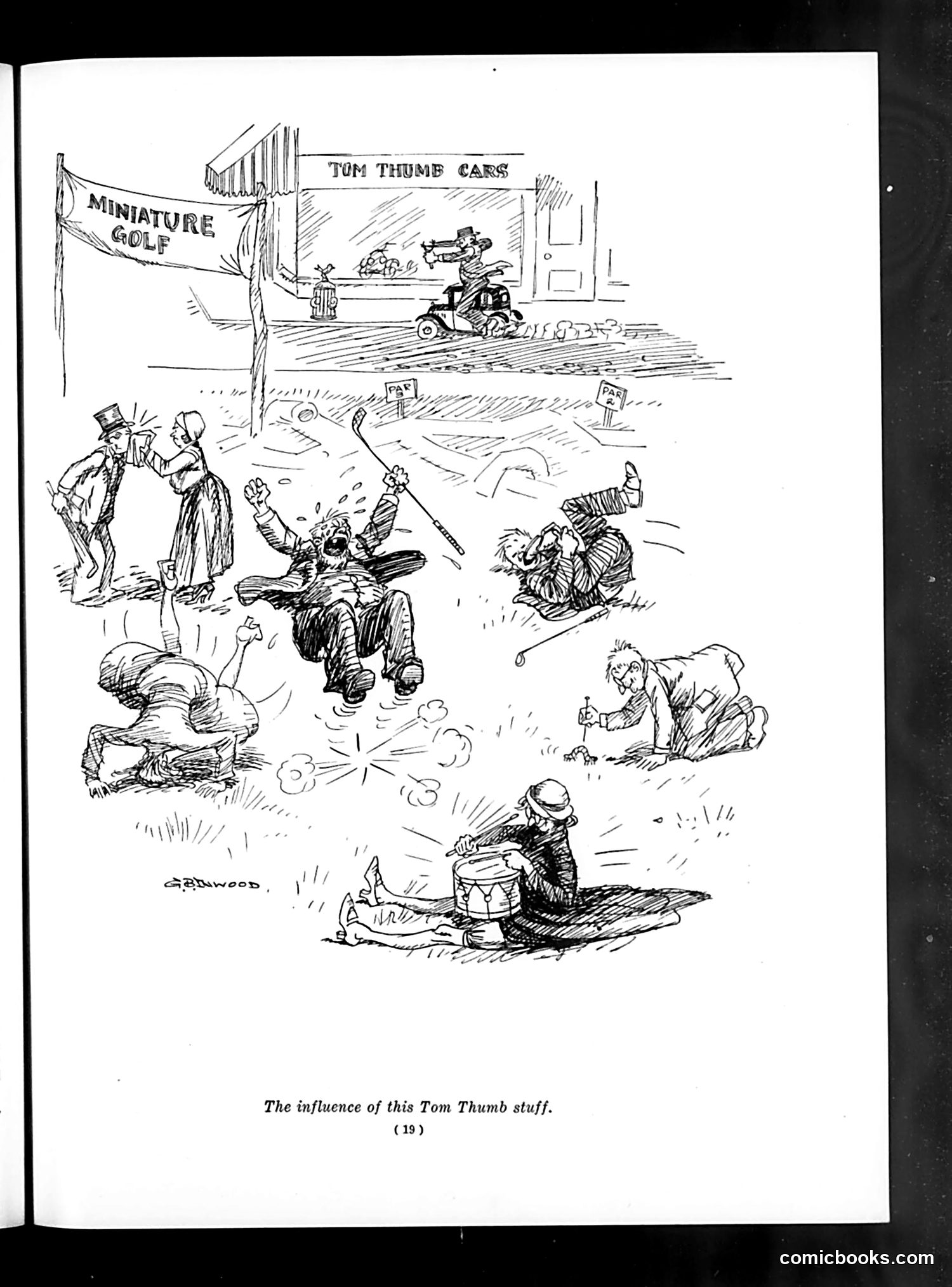
This cartoon satirizes the craze for miniature novelties and toys inspired by "Tom Thumb" culture—likely referring to General Tom Thumb, P.T. Barnum's famous midget performer who was a massive celebrity in the 19th century. The image shows chaos erupting in a street scene: children and adults are fighting, drumming, crawling, and generally misbehaving while a "Tom Thumb Cars" shop operates in the background. The caption "The influence of this Tom Thumb stuff" suggests the cartoon mocks how miniature toy cars and novelties inspired by Tom Thumb's popularity were causing wild, unruly behavior among the public—treating the commercial fad as a corrupting social influence. It's satire on consumer culture and its effects on public decorum.
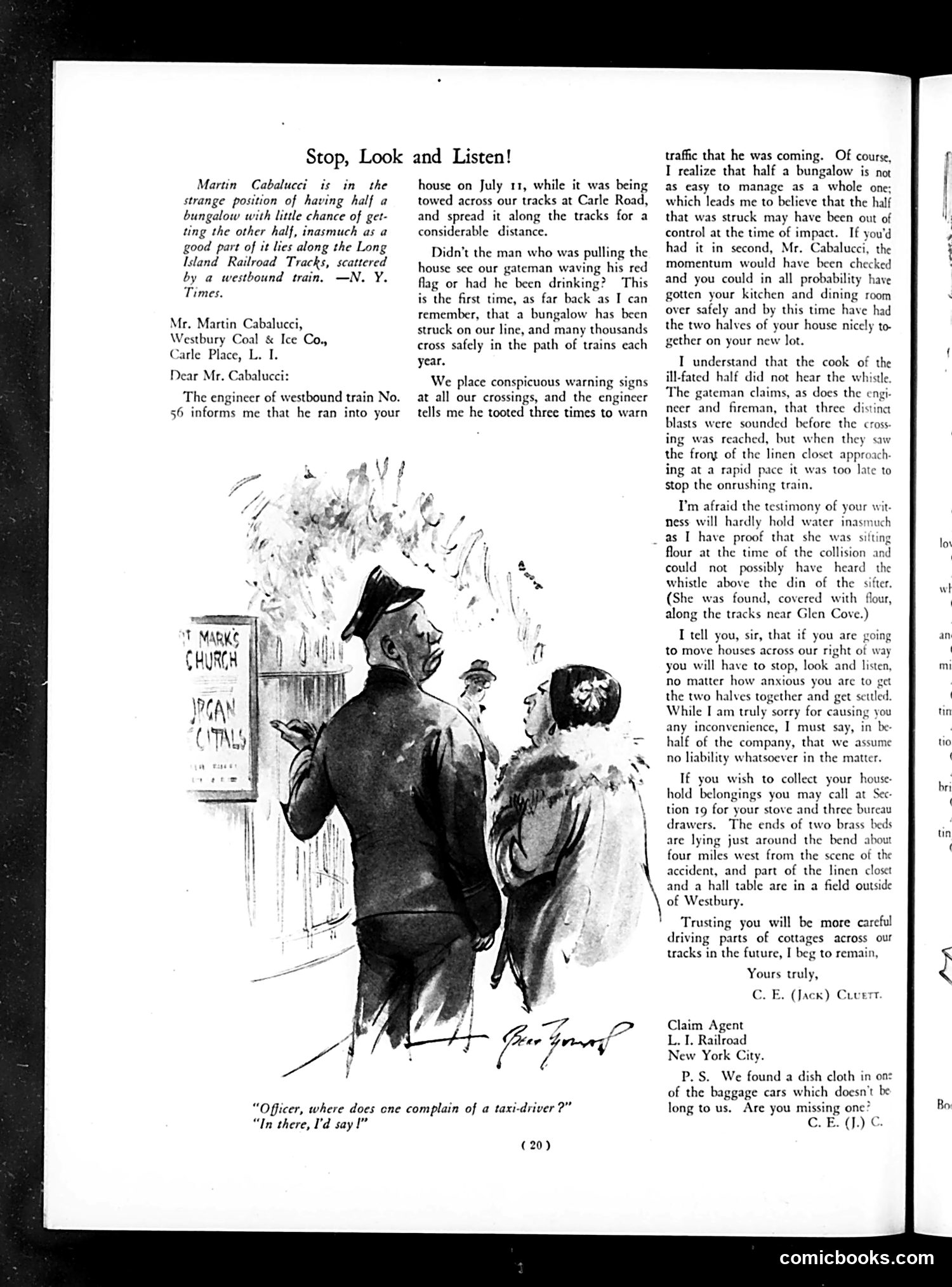
Explanation for Modern Readers This page satirizes a real 1920s incident where a bungalow owned by Martin Cabalucci was struck by a Long Island Railroad train while being towed across the tracks at Carle Road. The humor comes from a deadpan formal letter from railroad Claim Agent C.E. Cluett responding to the accident with absurd logic and bureaucratic condescension. The satire mocks: - Corporate liability evasion: The railroad accepts no responsibility despite hitting the house, instead blaming the homeowner for not controlling his moving bungalow properly - Bureaucratic absurdity: Suggesting the house needed to be "in second gear" to manage momentum, and that the cook couldn't hear whistles while sifting flour - Class dynamics: A wealthy homeowner literally cannot afford to move his property safely, reduced to collecting scattered belongings The accompanying cartoon shows an officer directing complaints elsewhere—fitting the theme of institutional indifference. The humor relies on the reader finding the railroad's smug tone outrageous.
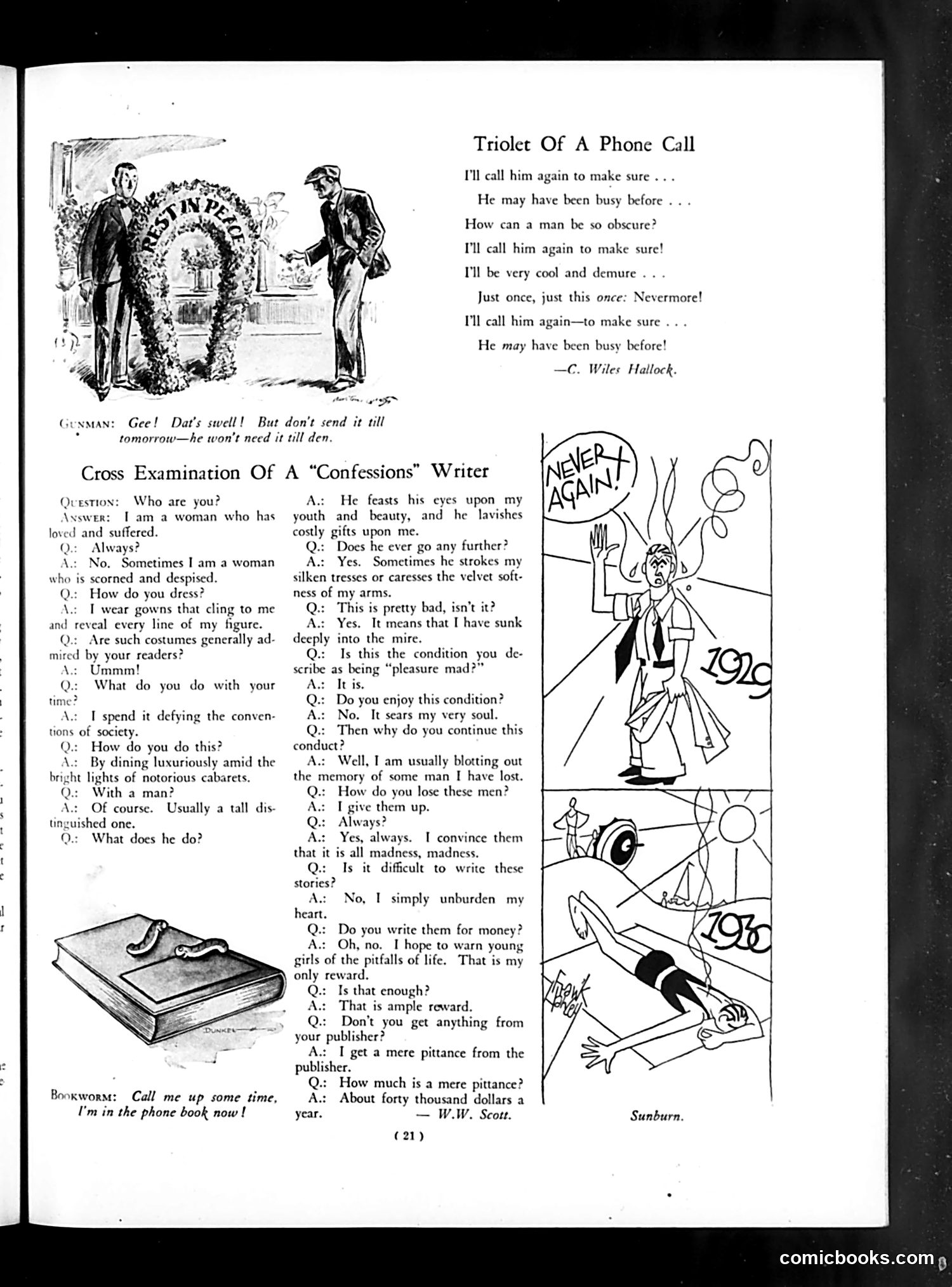
Analysis of Life Magazine Page This page satirizes two aspects of 1920s society: "Triolet of a Phone Call" mocks the anxious dating behavior of modern women. The poem humorously captures a woman's internal contradiction—she obsessively plans to call a man "just once" to confirm he's interested, while simultaneously telling herself she'll never call again. The cartoon shows a flower delivery mishap, reinforcing the theme of romantic uncertainty. "Cross Examination of a 'Confessions' Writer" parodies the hugely popular "confessions" magazine genre of the era—pulp publications featuring salacious stories of women's moral downfalls. The interview reveals the hypocrisy: the writer claims her stories warn young girls against vice while admitting she earns $40,000 annually (substantial money then) and that readers clearly enjoy the "sinful" content, not moral lessons. Both pieces mock the artificiality and commercialism of modern romance and publishing, targeting the gap between stated intentions and actual desires in Jazz Age culture.
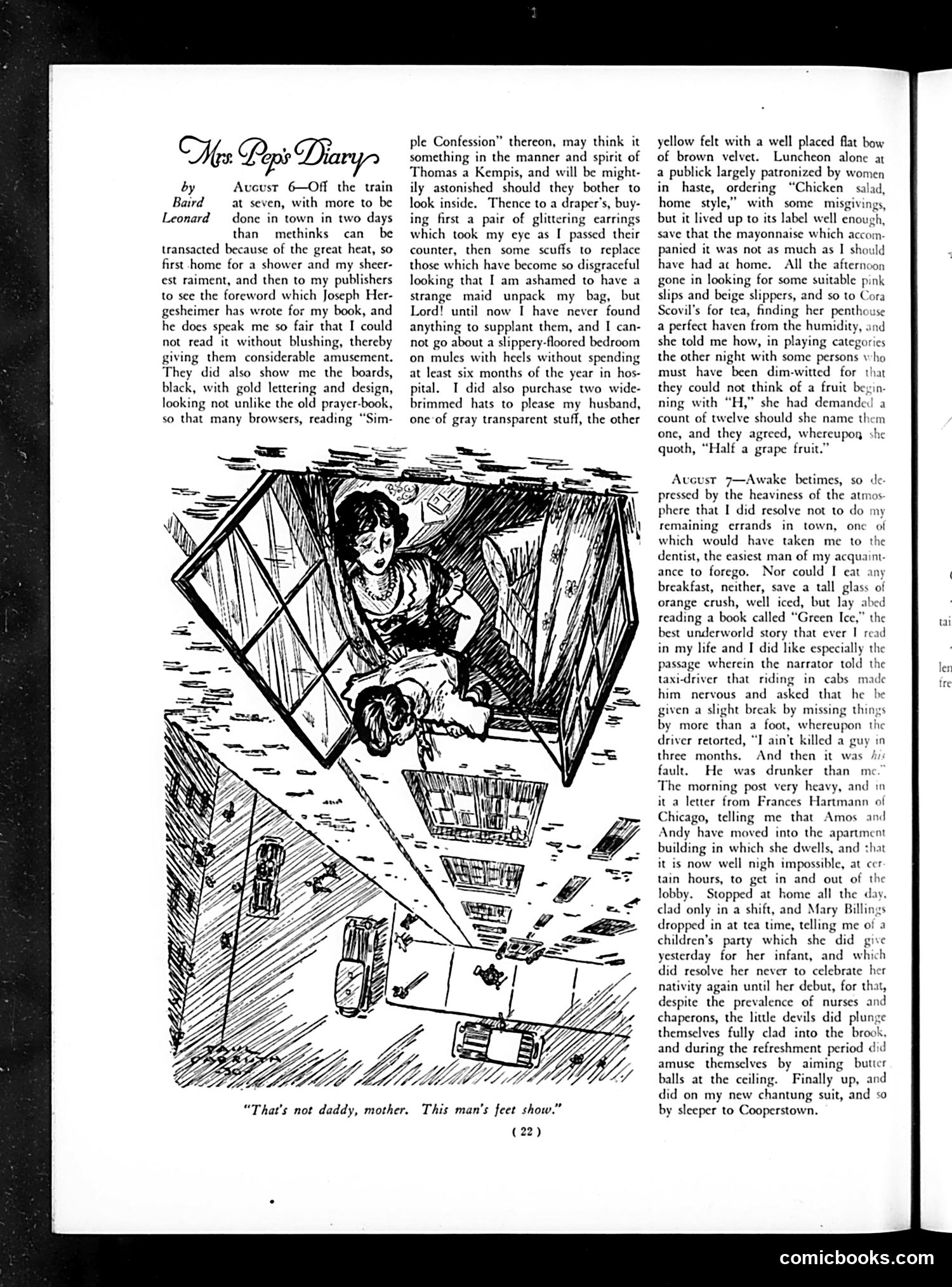
Explanation of "Mrs. Pep's Diary" Page This is a humorous diary entry by "Baird Leonard" published in *Life* magazine, a satirical publication. The illustration shows a woman in a bedroom with a child pointing at a man's feet visible beneath a curtain or door, with the caption: "That's not daddy, mother. This man's feet show." The joke relies on the visual gag of exposed feet revealing an unwanted male visitor—likely implying an affair or improper situation. The diary text itself is mock-precious social commentary about the author's mundane daily activities (shopping, visiting publishers, attending tea), written in an affected, overly-detailed style that *Life* is satirizing. The humor comes from the contrast between the diary's pretentious tone and trivial content, and the somewhat risqué illustration suggesting scandalous behavior.
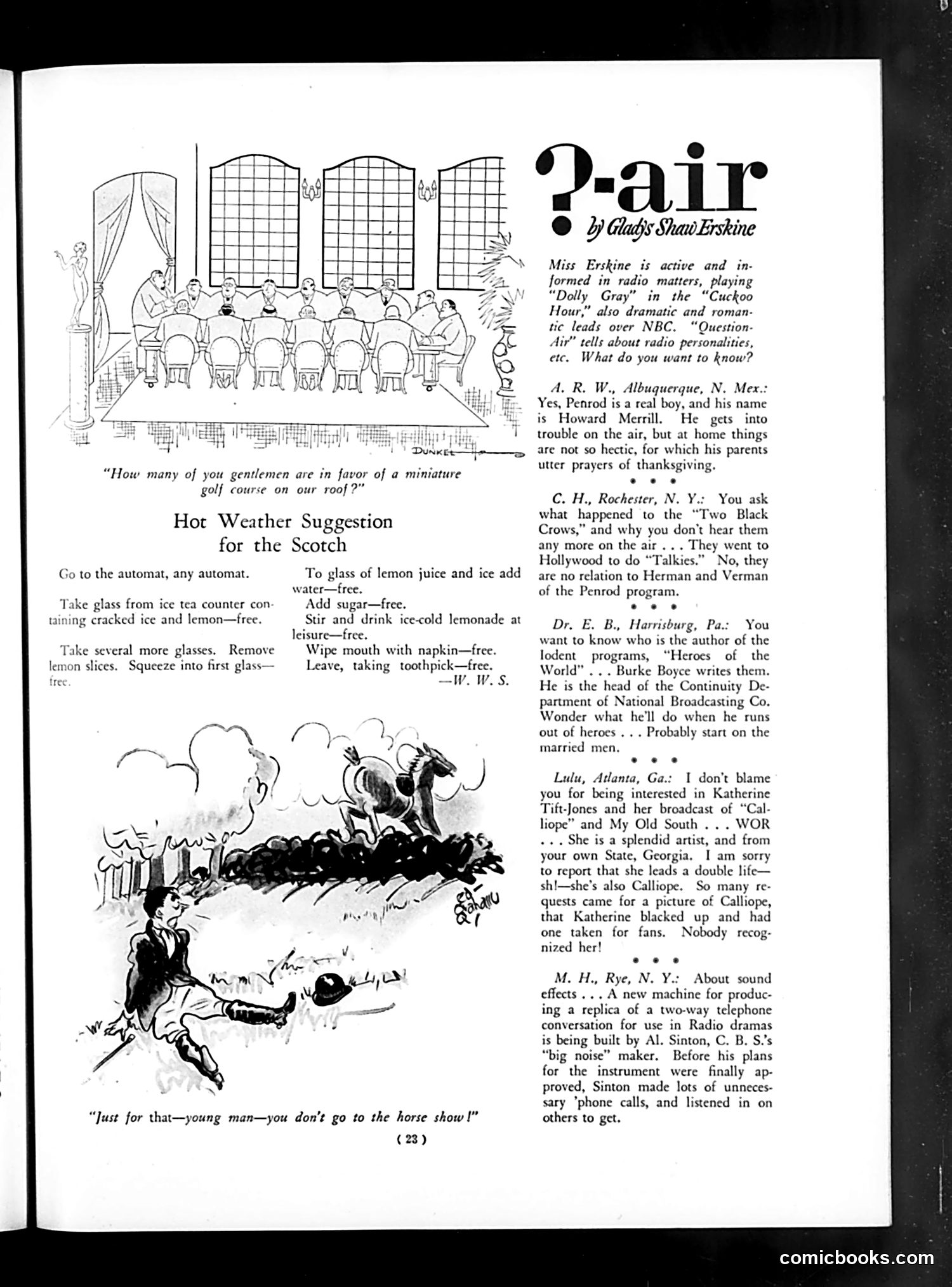
Explanation for Modern Readers This page contains three separate pieces of satirical humor from Life magazine: Top cartoon: A boardroom scene mocking the miniature golf craze of the 1920s-30s. The joke satirizes businessmen's obsession with this trendy leisure activity—so much so that they'd propose installing a golf course on an office rooftop, which is absurd and impractical. Middle cartoon and text: A satirical "recipe" mocking Scottish frugality. It humorously suggests a Scotsman can make free lemonade at an automat (self-service restaurant) by stealing glasses, ice, and lemon slices, then leaving with complimentary toothpicks. The caption shows a mother scolding her son for this petty theft, threatening to ban him from the horse show—playing on class pretensions. Right column: A radio advice column answering listener questions about early broadcast personalities and programs, reflecting radio's dominant cultural position in this era. The page satirizes contemporary American consumer culture, class anxiety, and the emerging entertainment industry.
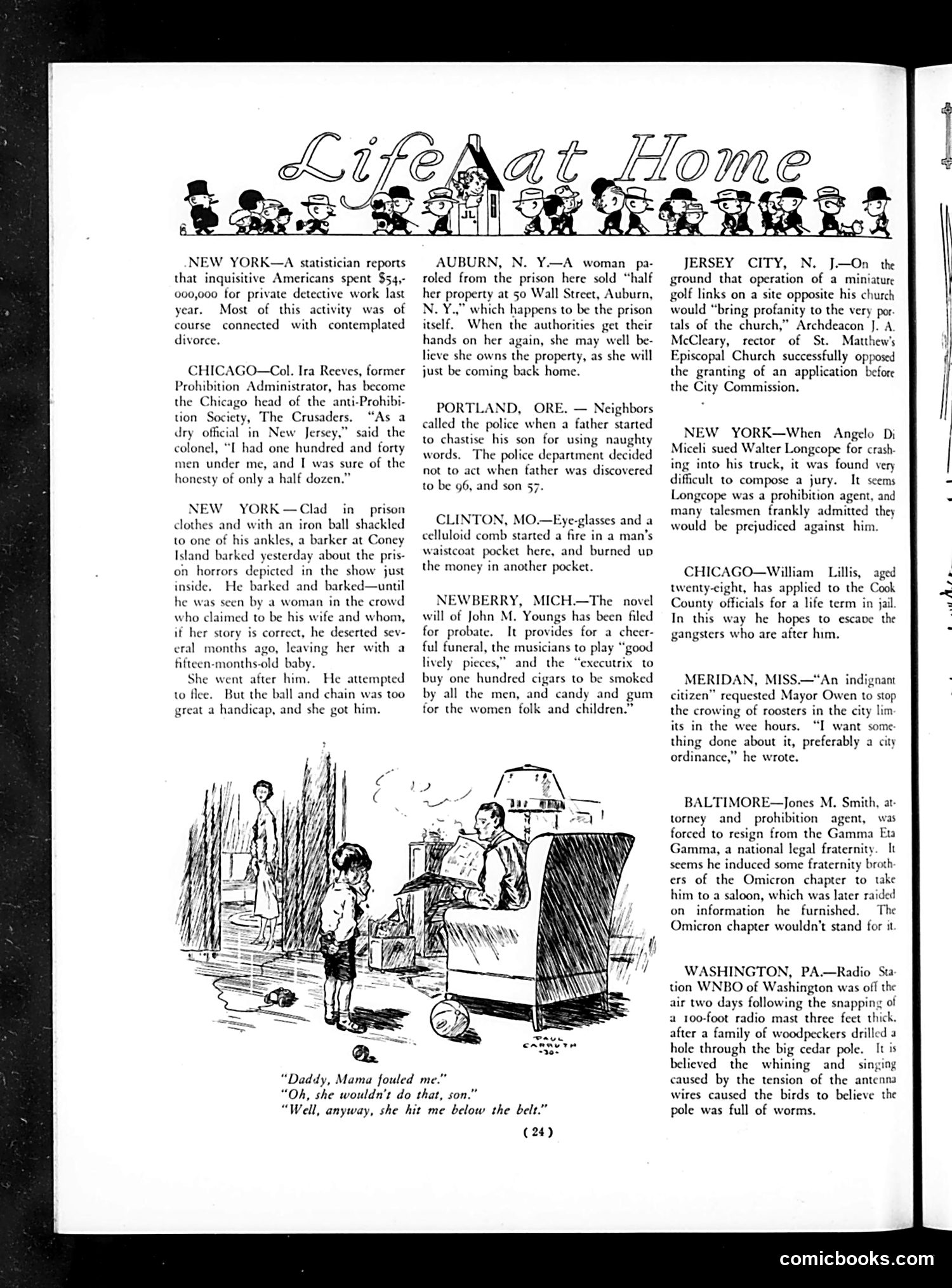
"Life at Home" Page Analysis This page from *Life* magazine consists of brief satirical news items about American domestic life, likely from the Prohibition era (1920s-early 1930s), plus one cartoon. The cartoon shows a child telling his father "Mama fouled me" / "she hit me below the belt"—a play on boxing terminology. The humor relies on the child's misuse of sports language to describe corporal punishment, creating an innocent malapropism. The news items are humorous anecdotes satirizing American society: - Private detectives hired for divorce investigations - A former Prohibition official admitting his agents were corrupt - A convict's escaped wife literally chaining him down - Various absurd situations (fires from eyeglasses, unconventional wills, miniature golf opposing churches) - A Prohibition agent betraying fraternity brothers by raiding a saloon - A radio station damaged by woodpeckers The satire targets Prohibition's failures, marital discord, legal absurdities, and everyday American peculiarities. The tone is lighthearted mockery of contemporary social conditions.
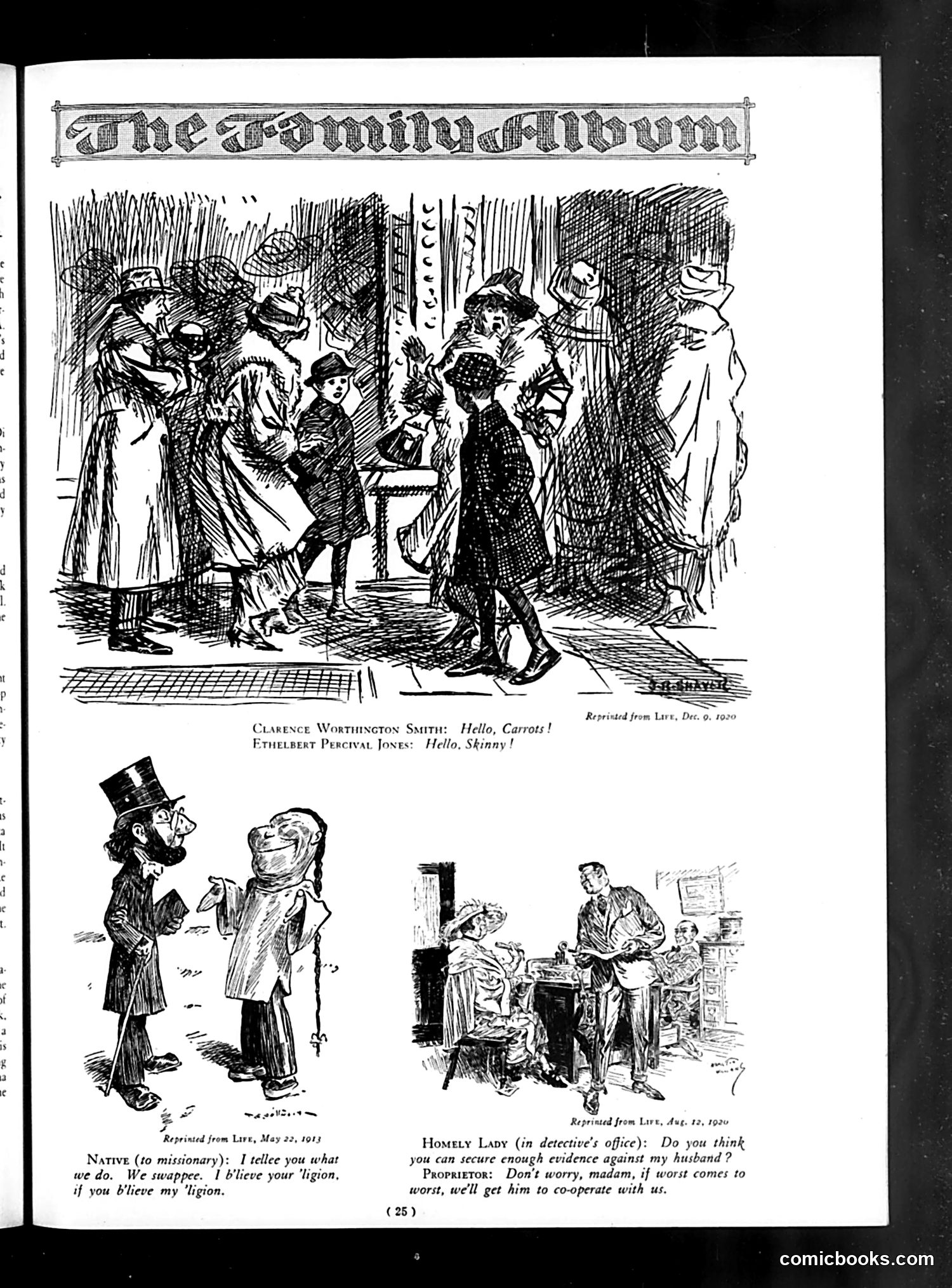
Analysis of Life Magazine Page (circa 1920) This page contains three separate cartoon vignettes satirizing early 20th-century social attitudes: Top cartoon: Shows a street scene with multiple figures greeting each other with nicknames ("Hello, Carrots!" / "Hello, Skinny!"), likely satirizing superficial urban social conventions. Bottom left: Uses racist dialect humor ("I tellee you what we do. We swappee") to mock a missionary and Indigenous person, portraying both as foolish. This reflects the era's offensive stereotyping of non-Western peoples. Bottom right: A domestic comedy where a woman consults a detective about her husband's infidelity. The detective's quip—that they'll make the husband "co-operate"—jokes darkly about coercion or blackmail. This reflects period anxieties about marriage and detective agencies' involvement in divorce cases. The cartoons employ crude stereotypes and period-specific humor that modern readers would find offensive or dated rather than amusing.
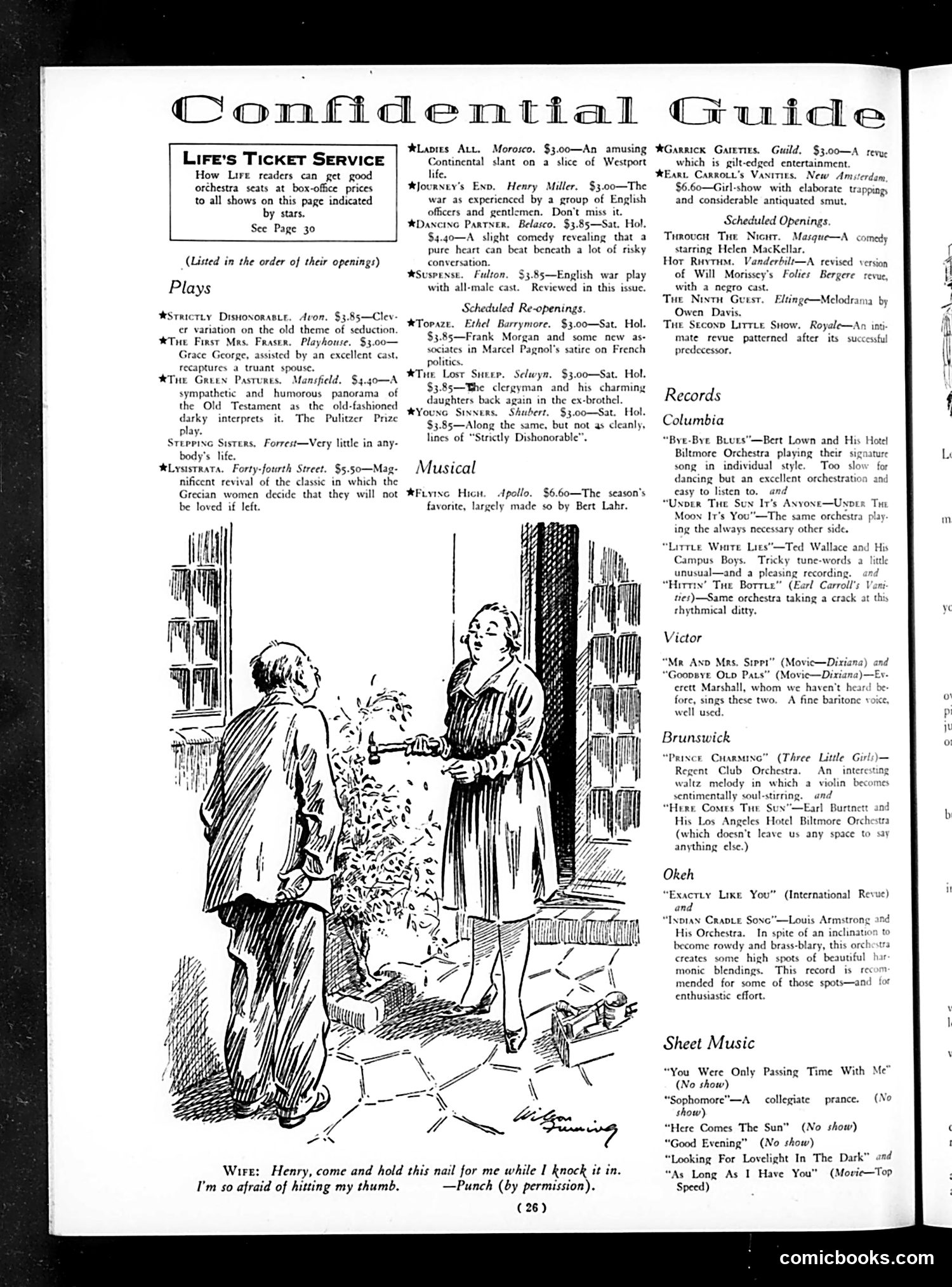
Explanation of Cartoon and Page Content This page from *Life* magazine presents a "Confidential Guide" to theatrical entertainment, listing plays, musicals, records, and sheet music currently available. The cartoon at the bottom—credited to *Punch* (British humor magazine)—depicts a domestic scene where a wife asks her husband Henry to hold a nail while she hammers, expressing fear of hitting her thumb. The joke's humor relies on the irony that she's asking *him* to steady the nail when *she's* the one swinging the hammer—reversing traditional gender roles regarding manual competence. It's gentle satire on marital dynamics and assumptions about who should handle practical tasks. The guide itself reflects 1920s-30s entertainment culture, including references to now-obscure Broadway productions and recordings. Notable is "The Green Pastures," which won the Pulitzer Prize (described as depicting "the Old Testament as the old-fashioned darky interprets it")—language reflecting the racial attitudes of that era.
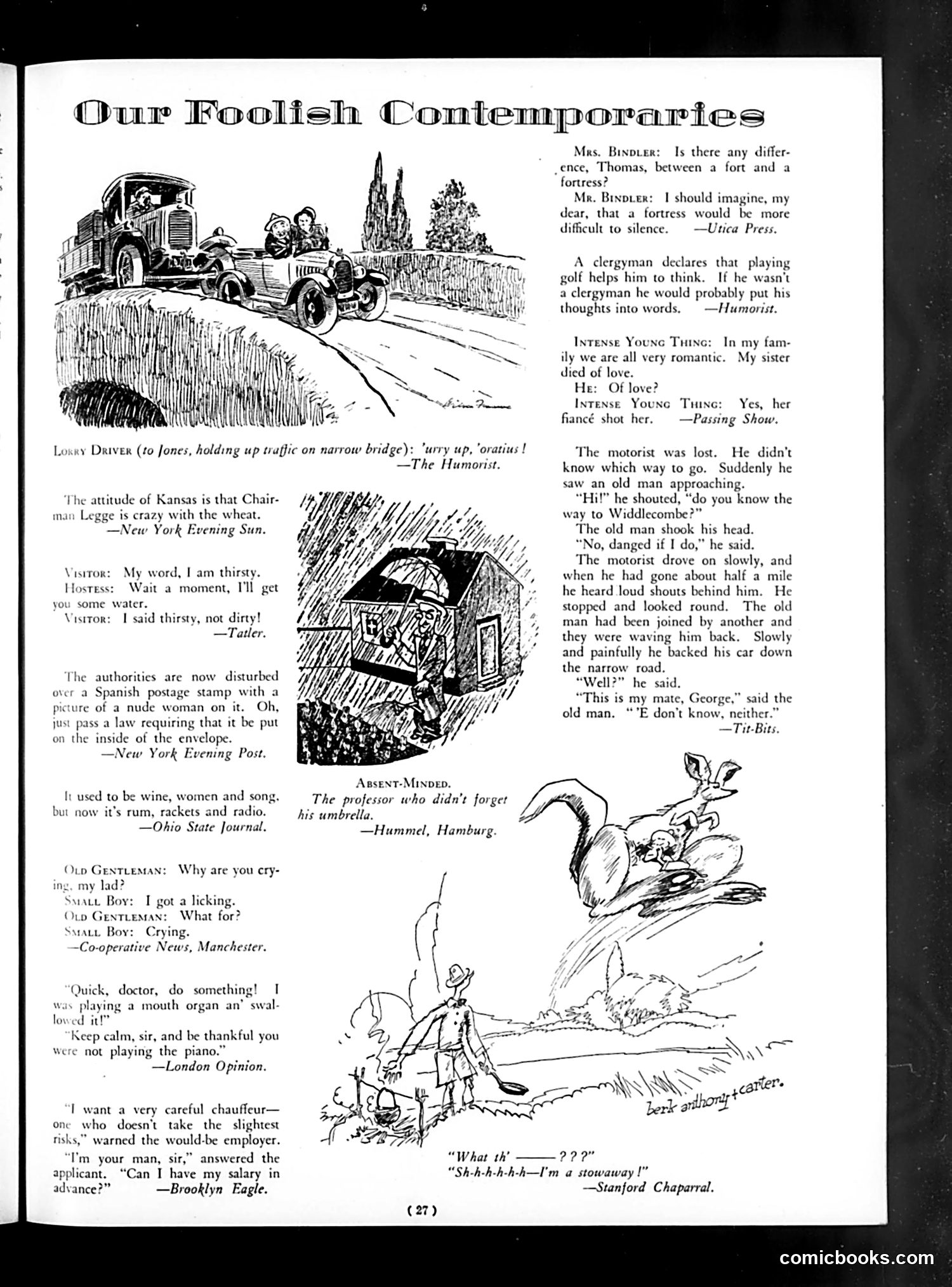
"Our Foolish Contemporaries" - Life Magazine Humor Page This is a collection of short humorous anecdotes and jokes from various contemporary newspapers and magazines, reflecting early-to-mid 20th century social absurdities. The page includes several cartoon vignettes satirizing modern life: a lorry driver blocked by slow traffic ("Oratius" references Horatius at the bridge—a heroic Roman reference applied to mundane traffic); a motorist lost seeking directions, only to find the locals equally clueless; and a professor absent-mindedly forgetting his umbrella. The text jokes mock contemporary attitudes: a clergyman golfer who can't articulate his thoughts; anxieties about Spanish postage stamps depicting nudity; and romantic deaths via disappointed love. One recurring theme is the phoniness or stupidity of modern behavior—people pretending competence (the overly careful chauffeur asking for advance salary) or miscommunicating (confusing "thirsty" with "dirty"). The overall satirical point: modern society produces foolishness across all classes and situations.
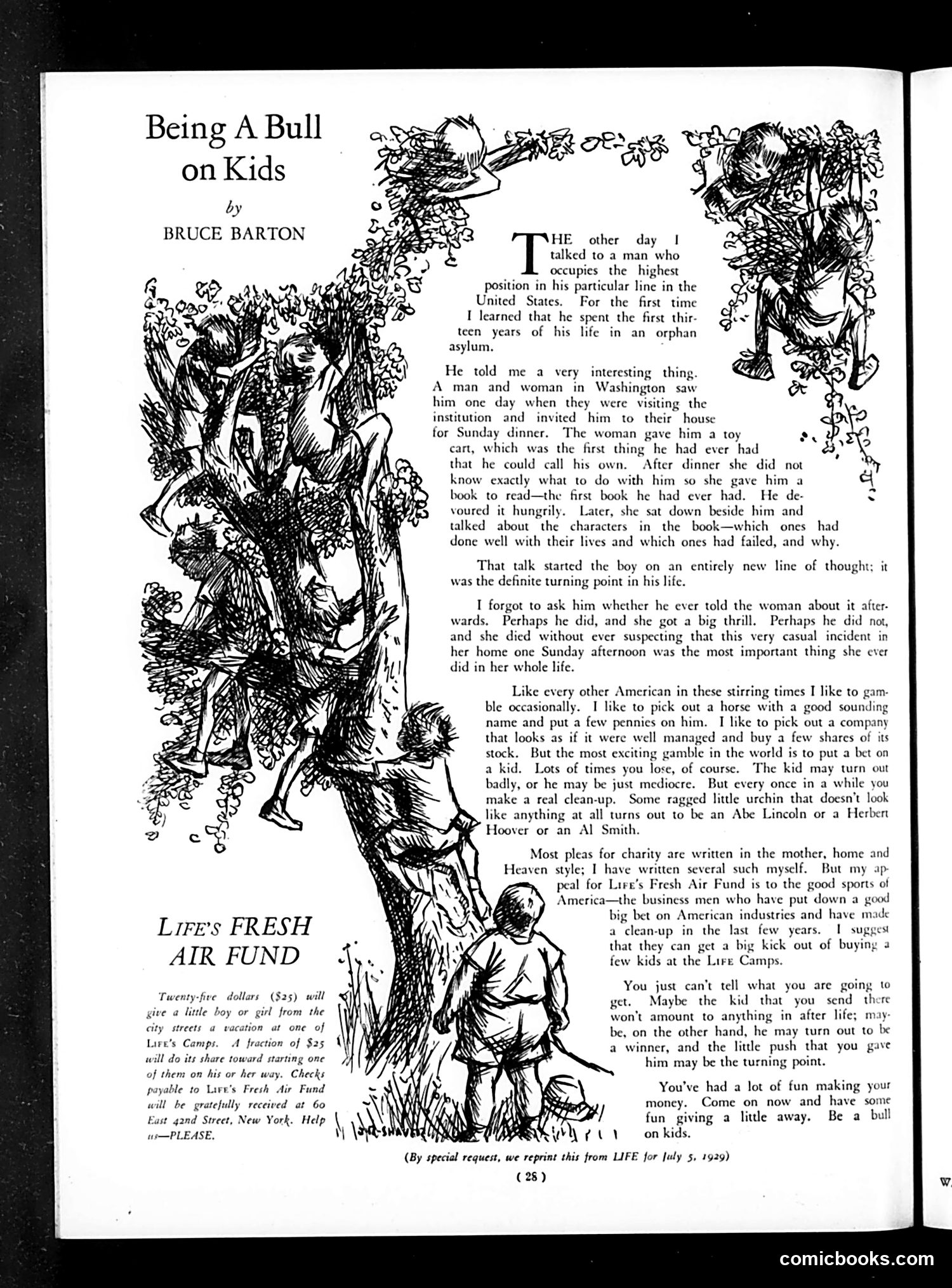
"Being A Bull on Kids" by Bruce Barton (Life, July 5, 1929) This is an essay with illustrations promoting Life magazine's Fresh Air Fund, a charitable program sending poor urban children to summer camps. The Argument: Barton, a prominent advertising executive, uses investment/gambling metaphor to pitch charitable giving to wealthy businessmen. He frames helping disadvantaged kids as a "bet"—like picking stocks or racehorses—with potentially enormous returns. His opening anecdote describes an orphan boy whose life was transformed by a Washington woman's casual gift of a toy cart and book, suggesting small interventions create major life outcomes. The Appeal: Barton argues that compared to financial speculation, investing in children offers the most thrilling "gamble"—some may fail, but occasionally "you make a real clean-up" and help produce "an Abe Lincoln or a Herbert Hoover." He urges businessmen who've profited from American industry to fund camp vacations ($25 per child) as their philanthropic "thrill." Social Context: Published summer 1929 (pre-Depression), this exemplifies early 20th-century paternalistic charity rhetoric targeting wealthy donors, treating child welfare as entrepreneurial venture capital.
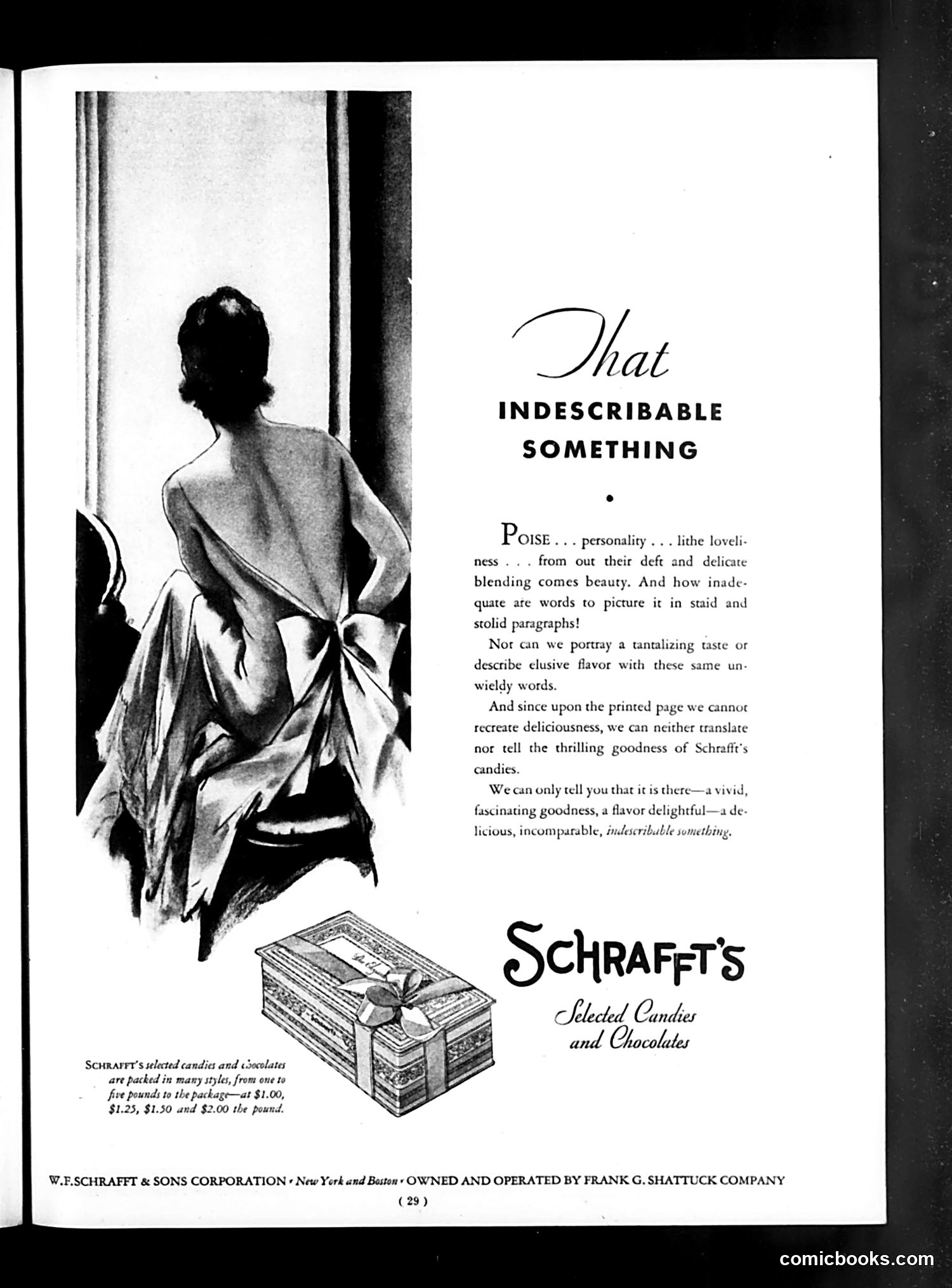
Analysis This is a Schrafft's candy advertisement, not political satire. The page features a elegant illustration of a woman in an evening gown viewed from behind, gazing out a window. The ad's humor is self-aware copywriting: it ironically acknowledges that words cannot adequately describe the product's appeal—its "poise," "personality," and especially its taste and flavor. The text repeatedly emphasizes this limitation ("how inadequate are words," "unwieldy words," "cannot recreate deliciousness"), before finally surrendering to calling it simply an "indescribable something." This was a common advertising strategy of the era: using sophisticated language and imagery to evoke luxury and refinement, while admitting that the actual product experience transcends verbal description. The woman's pose suggests elegance and desirability, associating the candy with feminine sophistication. The page includes pricing information ($1.00-$2.00 per pound) and corporate details for Schrafft's, a real confectionery company.
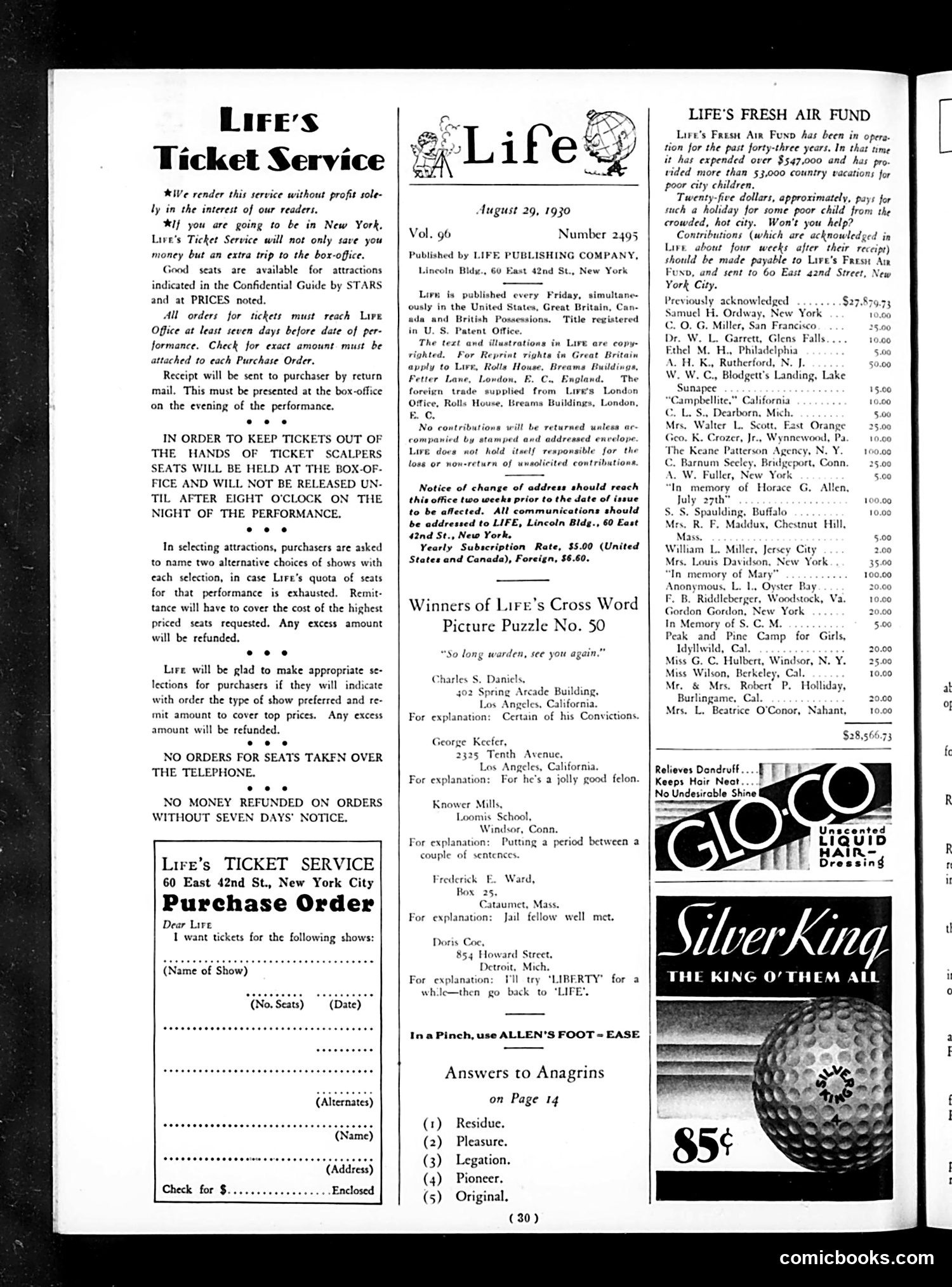
Analysis for Modern Readers This page is primarily administrative content, not political satire. It contains: 1. Life's Ticket Service (left column): A service allowing readers to purchase Broadway theater tickets by mail, with detailed ordering instructions and anti-scalping measures. 2. Masthead and publication information (center): Standard magazine details for the August 29, 1930 issue. 3. Fresh Air Fund appeal (right): Life magazine's charitable initiative providing country vacations for poor urban children—established 43 years prior (since 1887). 4. Crossword puzzle winners (center-right): Winners of "Picture Puzzle No. 50" with humorous explanations (puns on their answers). 5. Advertisements: Including "Gloco" liquid dairy products and "Silver King" golf balls. No political cartoons or social satire appear on this page. The content reflects Life's role as both entertainer and civic institution during the early Depression era.
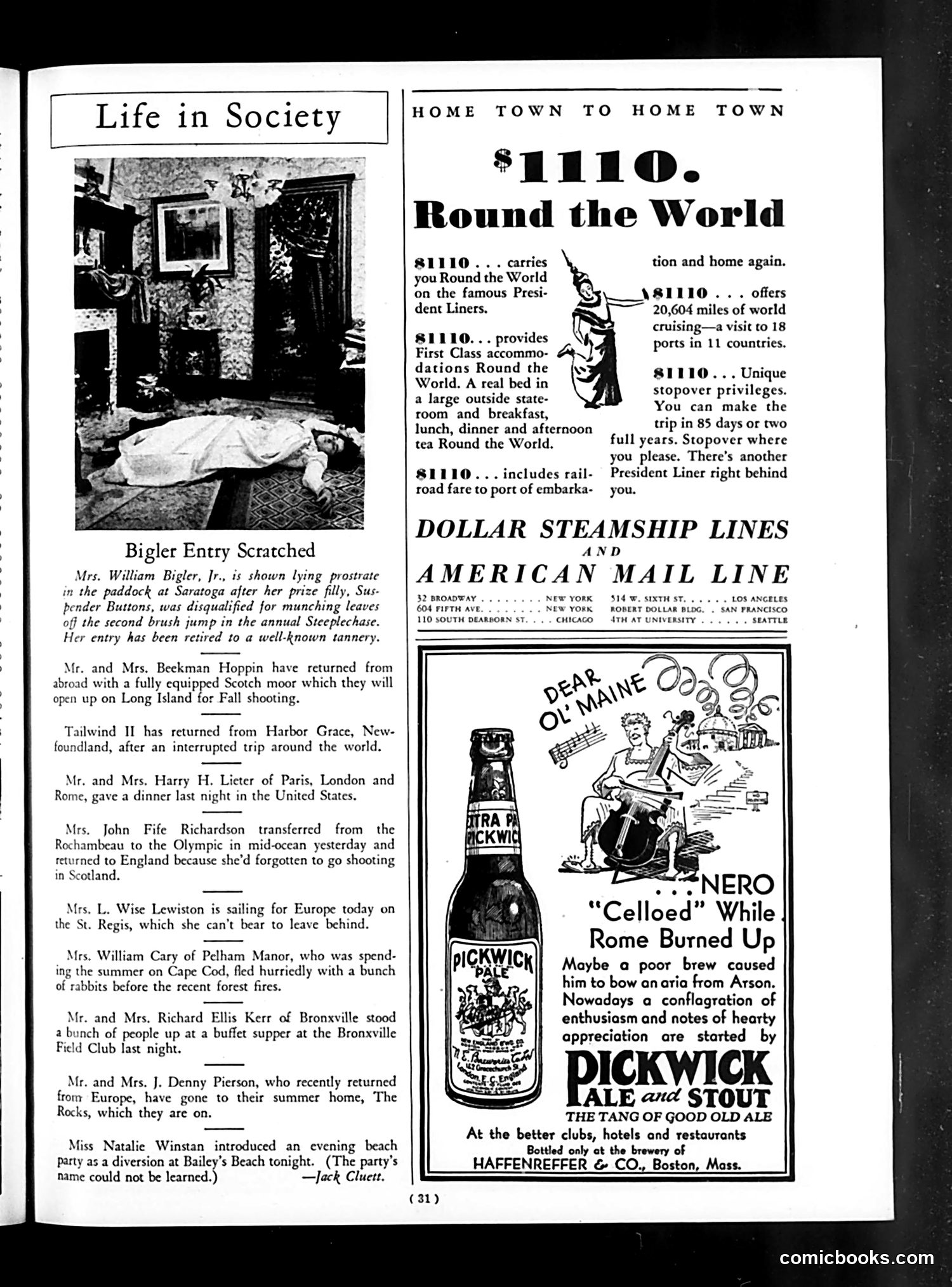
Analysis of Life Magazine Page This page combines satirical social commentary with period advertising. The left column mocks wealthy society figures through absurdist anecdotes—a woman's horse is disqualified from a steeplechase for eating leaves, so it's "retired to a well-known tannery"; another woman transfers ships mid-ocean because she forgot to go shooting in Scotland. These vignettes ridicule the frivolous concerns and extravagant travel habits of the upper class during what appears to be the 1920s-30s. The right side advertises luxury steamship cruises and Pickwick Ale beer. The beer ad's headline, "Nero 'Celloed' While Rome Burned Up," appears to mock either poor-quality beer or someone playing cello during a crisis—a satirical twist on Nero's legendary indifference during Rome's burning. This ad likely appeared in Life's satirical pages, making fun of both the product and contemporary culture.
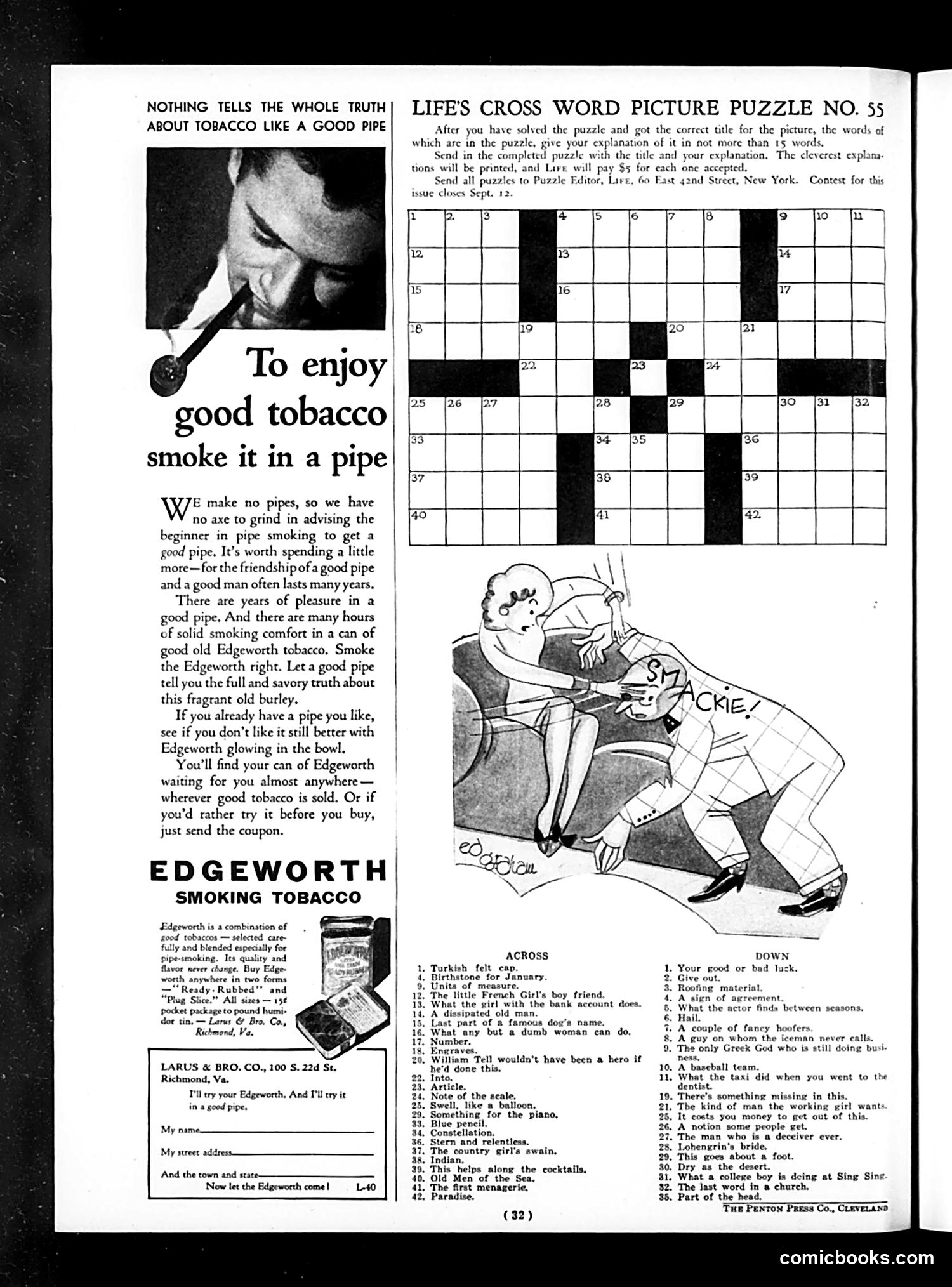
Life Magazine Page Analysis (circa 1920s-1930s) This page combines tobacco advertising with a crossword puzzle contest. The left side features an Edgeworth Smoking Tobacco advertisement showing a man enjoying a pipe, with copy emphasizing quality and pleasure. The ad uses soft-sell messaging ("we make no pipes, so we have no axe to grind") to seem helpful rather than purely commercial. The right side presents "Life's Cross Word Picture Puzzle No. 55"—a competition where readers solve a crossword, identify the resulting picture's title, and submit 15-word explanations for $5 prizes. The cartoon below shows a figure labeled "STICKIE!" in what appears to be a humorous domestic or social scene. This represents early 20th-century magazine culture: combining entertainment (puzzles and cartoons) with advertising, while inviting reader participation through contests. The tobacco ad's paternalistic tone ("let a good pipe tell you the truth") reflects period marketing before health warnings existed.
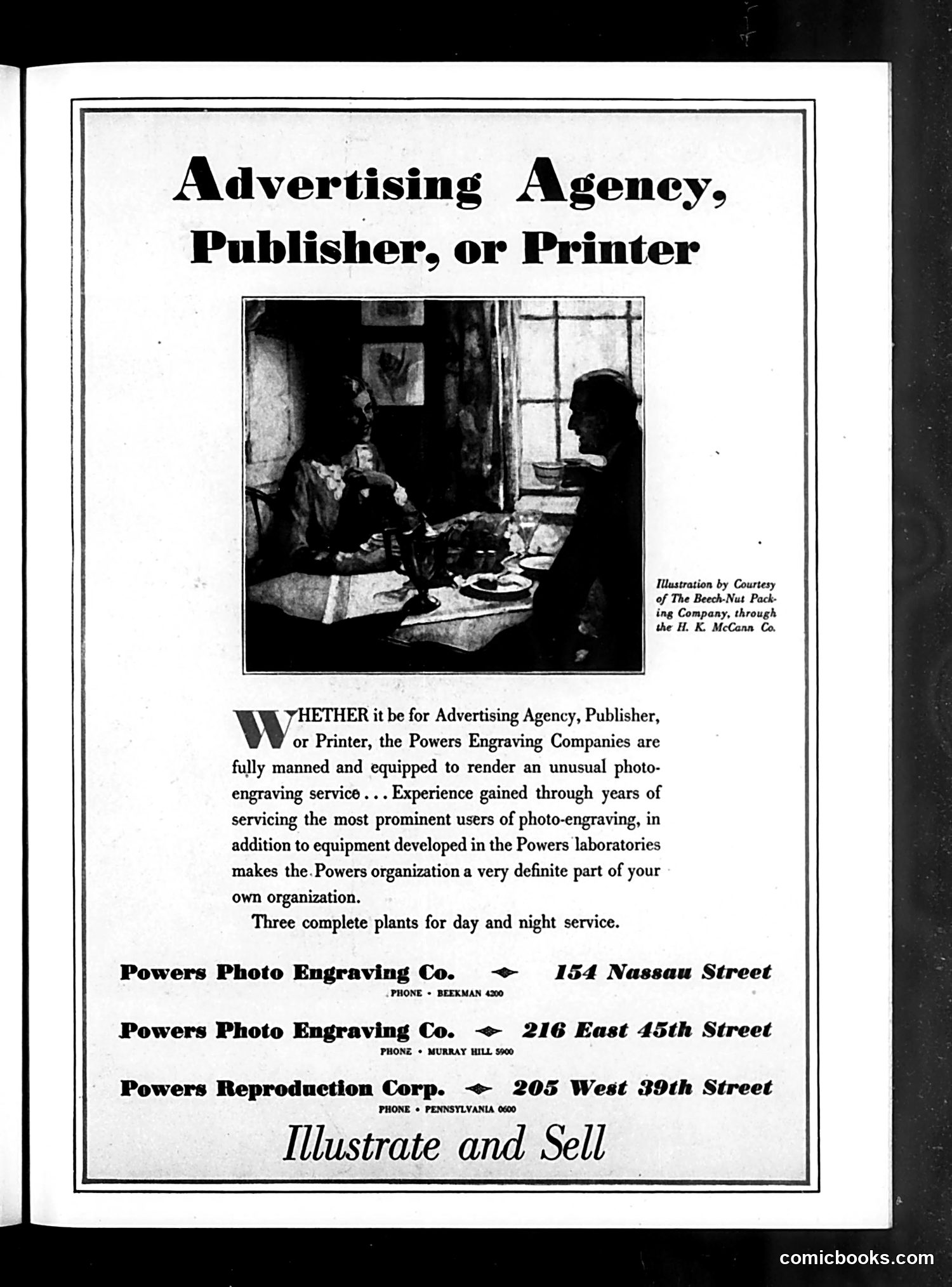
Analysis This is primarily a trade advertisement, not editorial content or satire. It promotes the Powers Engraving Companies' photo-engraving services to advertising agencies, publishers, and printers. The black-and-white photograph shows two people at a desk in what appears to be a business office, likely illustrating professional work or client consultation. The image serves as a generic representation of business activity rather than depicting specific individuals or events. The advertisement emphasizes that Powers offers comprehensive photo-engraving services with three locations providing round-the-clock operation. It appeals to potential clients by claiming extensive experience serving "prominent users" and positioning the company as an integral part of customers' operations. The phrase "Illustrate and Sell" at the bottom is the company's tagline, suggesting that quality photo-engraving helps clients both visualize and market their products. This represents early 20th-century B2B advertising, with no political or social satire evident.
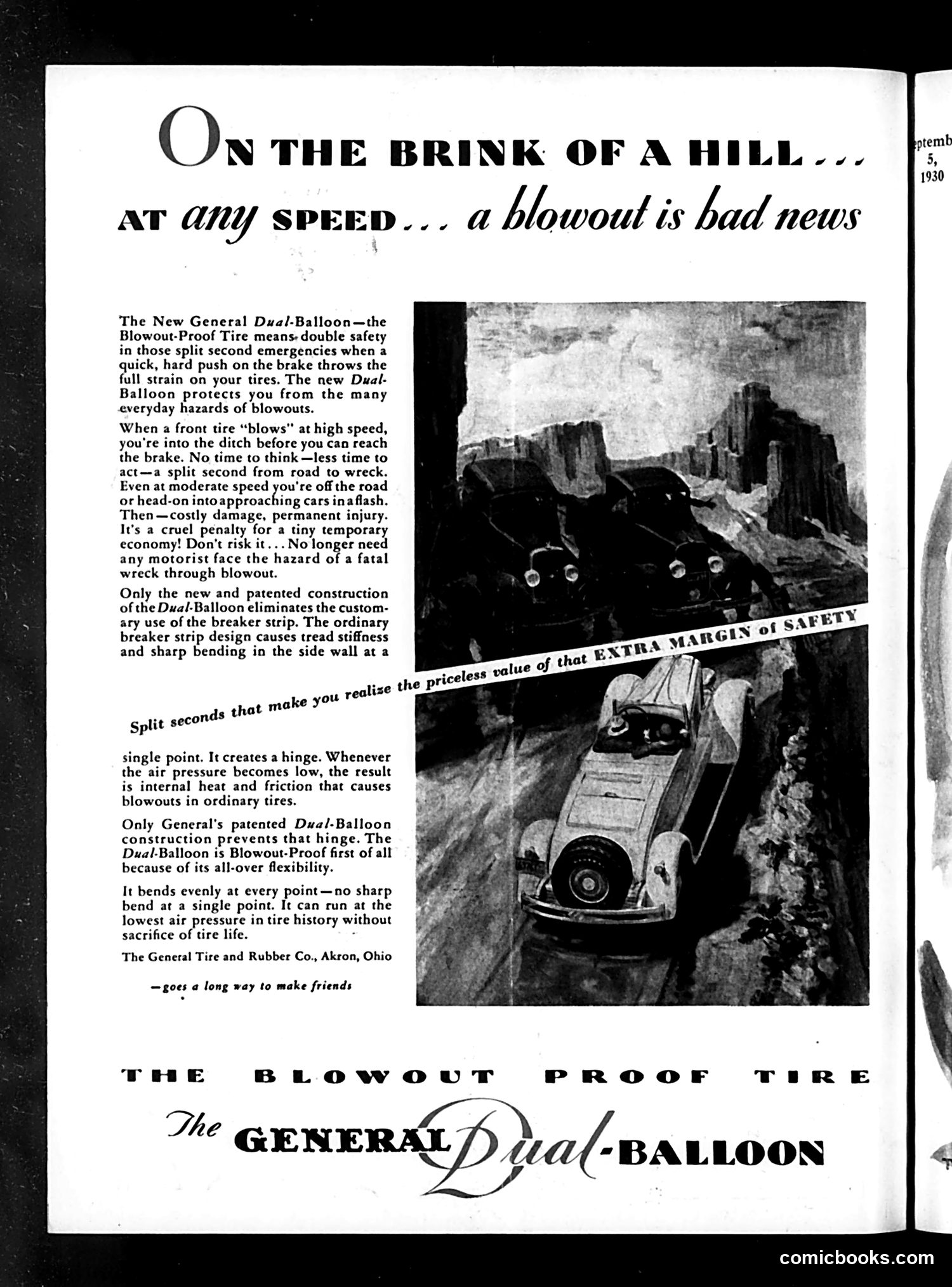
What This Page Actually Is This is not a cartoon or satire—it's a straightforward automobile tire advertisement from Life magazine (September 1930). The General Tire and Rubber Company is promoting their new "Dual-Balloon" tire, marketed as "blowout-proof." The ad uses fear-based messaging common to 1930s advertising: it emphasizes the danger of tire blowouts at speed, showing a dramatic photograph of a wrecked car on a hillside as a cautionary image. The technical argument is that the Dual-Balloon's flexible construction prevents the "hinge" effect that causes blowouts in ordinary tires with rigid breaker strips. The ad promises safety and peace of mind ("goes a long way to make friends"). This reflects genuine 1930s road safety concerns—tire failures were a real hazard in early automobiles. The page contains no political commentary, caricature, or satirical humor; it's purely commercial messaging using period advertising conventions.