life
Life — September 5, 1930
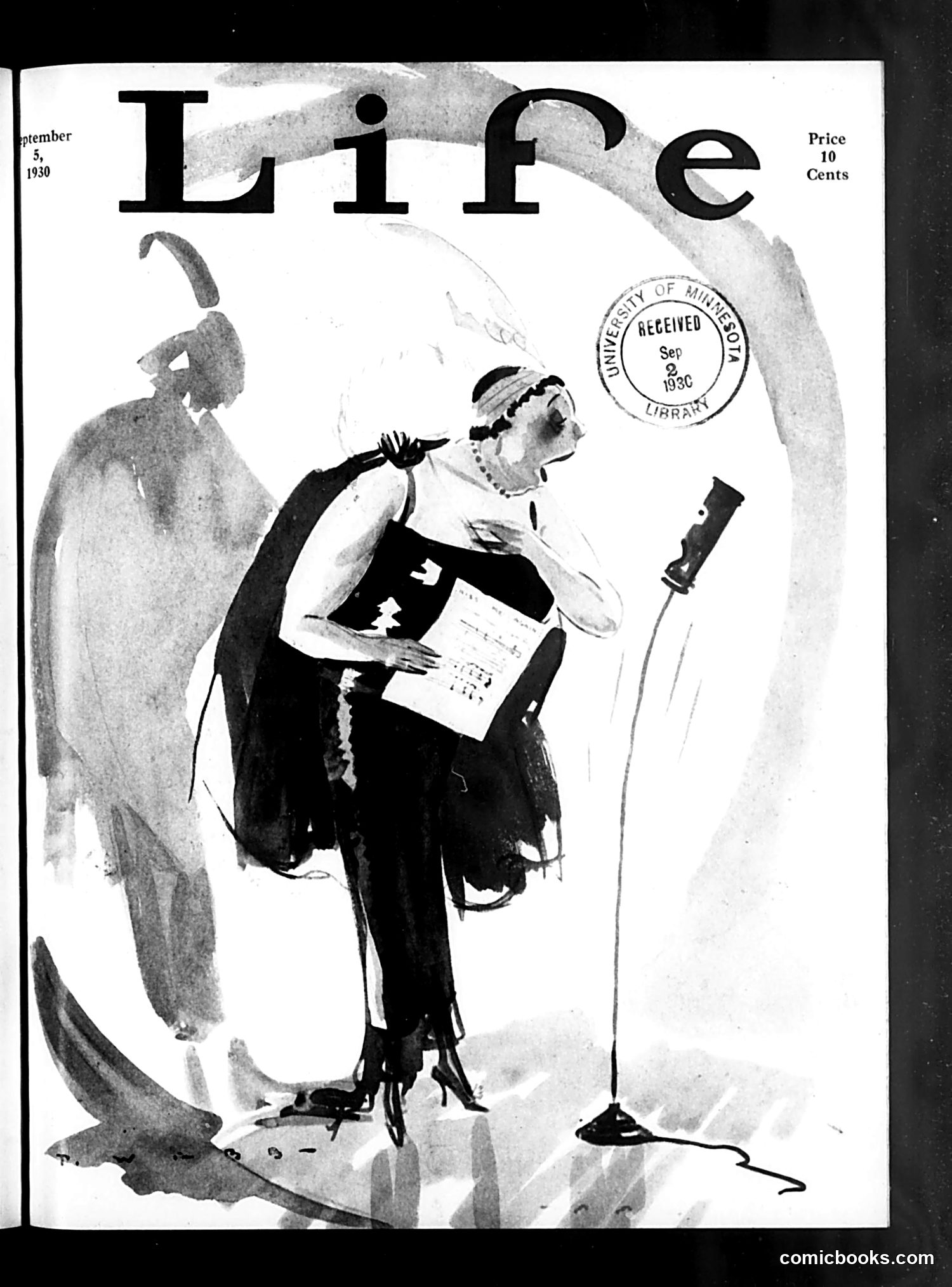
Life Magazine Cover - September 5, 1930 This cover illustration satirizes radio broadcasting and performance. A caricatured male performer holds a microphone, mouth agape mid-speech or song, while clutching what appears to be sheet music or script. He wears formal attire with a headband, suggesting theatrical or vaudeville styling. The ghostly figures behind him—appearing demonic or supernatural—likely represent the unseen radio audience or the ethereal nature of broadcast transmission itself. The shark at his feet is unclear but may suggest danger or predatory competition in the entertainment industry. The satire appears to mock the artificiality and performative nature of radio entertainment, or perhaps the anxiety performers felt about reaching invisible audiences through this then-novel technology. The 10-cent price reflects Depression-era affordability.
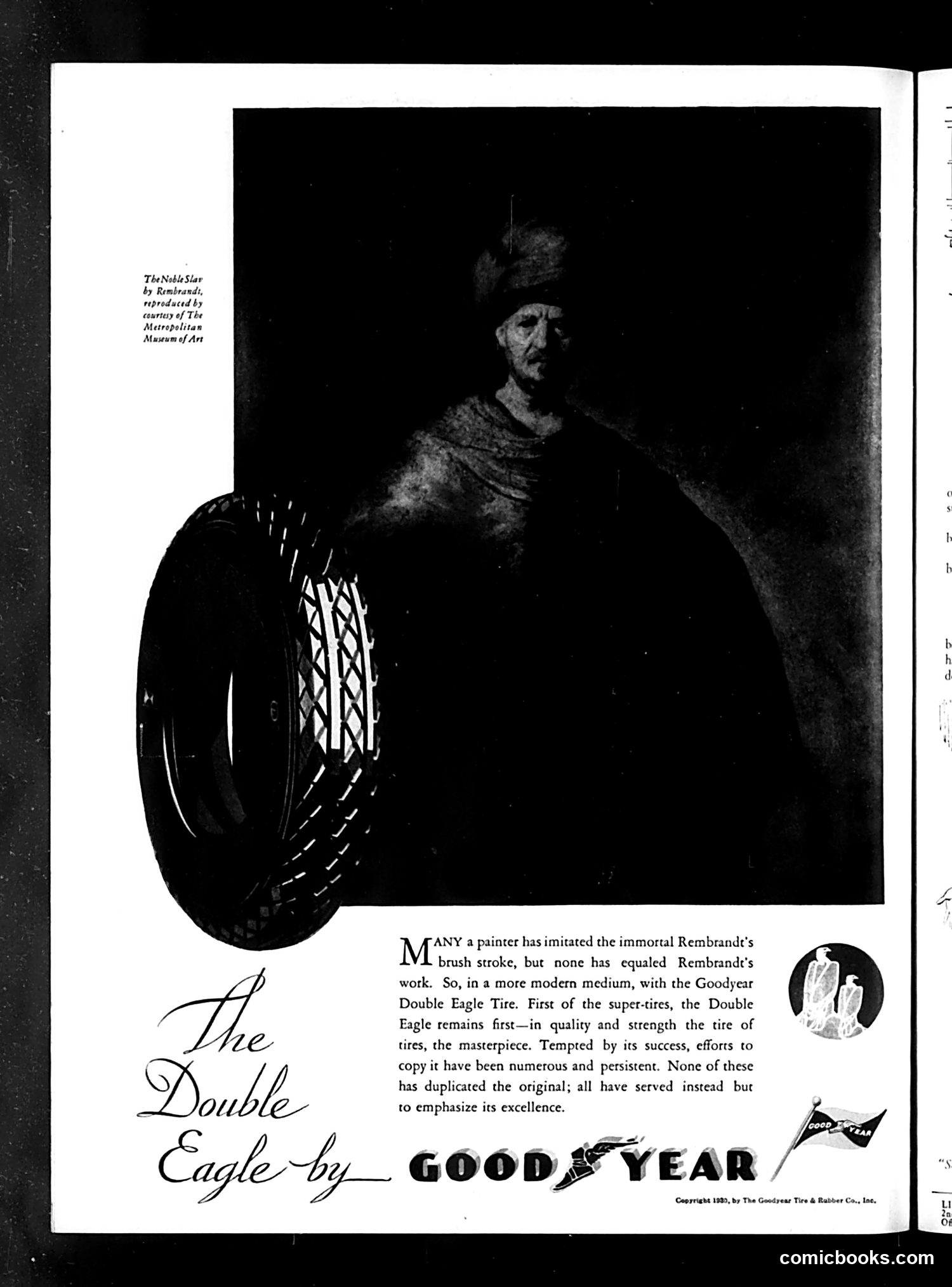
Analysis This is a Goodyear tire advertisement, not a political cartoon. The page uses a famous artwork reference to sell products. The ad compares Goodyear's "Double Eagle" tire to Rembrandt's masterful brushwork. The image shows a Rembrandt painting (reproduced "by courtesy of The Metropolitan Museum of Art") depicting a figure in period dress, with a large tire positioned prominently in the lower left. The advertisement's argument: just as many painters have imitated Rembrandt without matching his genius, competitors have attempted to copy the Double Eagle tire's success without achieving its quality. The tire is presented as "the masterpiece" — superior in "quality and strength" to imitations. This is brand-building through artistic comparison, positioning a commercial product alongside High Art to suggest unmatched excellence and authenticity.
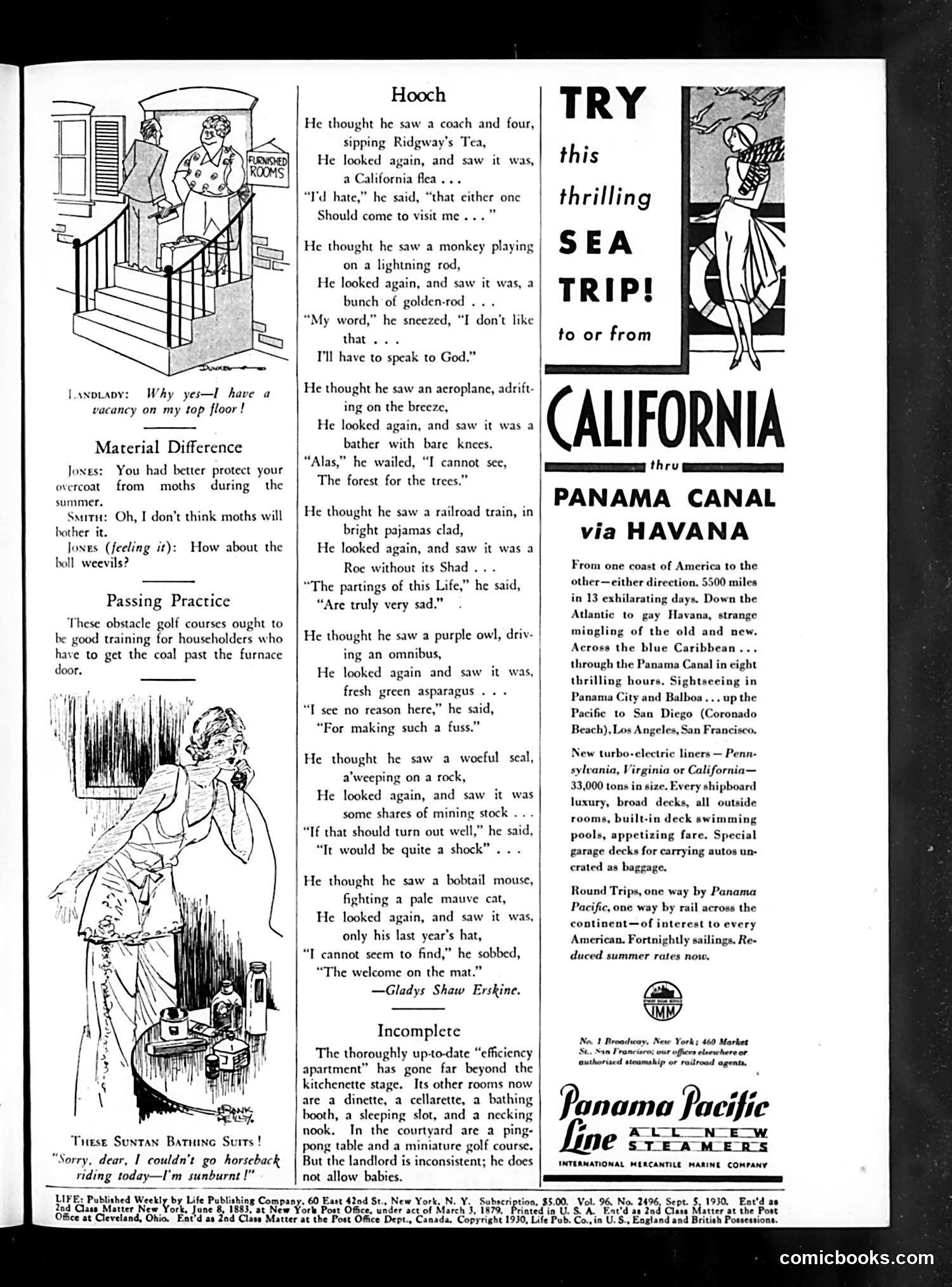
Explanation for Modern Readers This page contains humor and advertising rather than political satire. The "Hooch" poem by Gladys Shaw Erskine satirizes a man's alcohol-induced hallucinations—he mistakes ordinary objects (a flea, monkey, airplane, train, owl, asparagus, seal, mining stock, bobtail mouse) for fantastical things. This likely references Prohibition-era drinking, when illegal alcohol consumption was widespread. The jokes "Material Difference" and "Passing Practice" are light comedic sketches about everyday absurdities. The dominant content is a Panama Pacific Line advertisement promoting luxury ocean travel to California via Havana and the Panama Canal—emphasizing modern "turbo-electric liners" and reduced summer rates. The small illustration shows a woman sunburned after refusing to wear protective clothing, another mild joke about summer vanity.
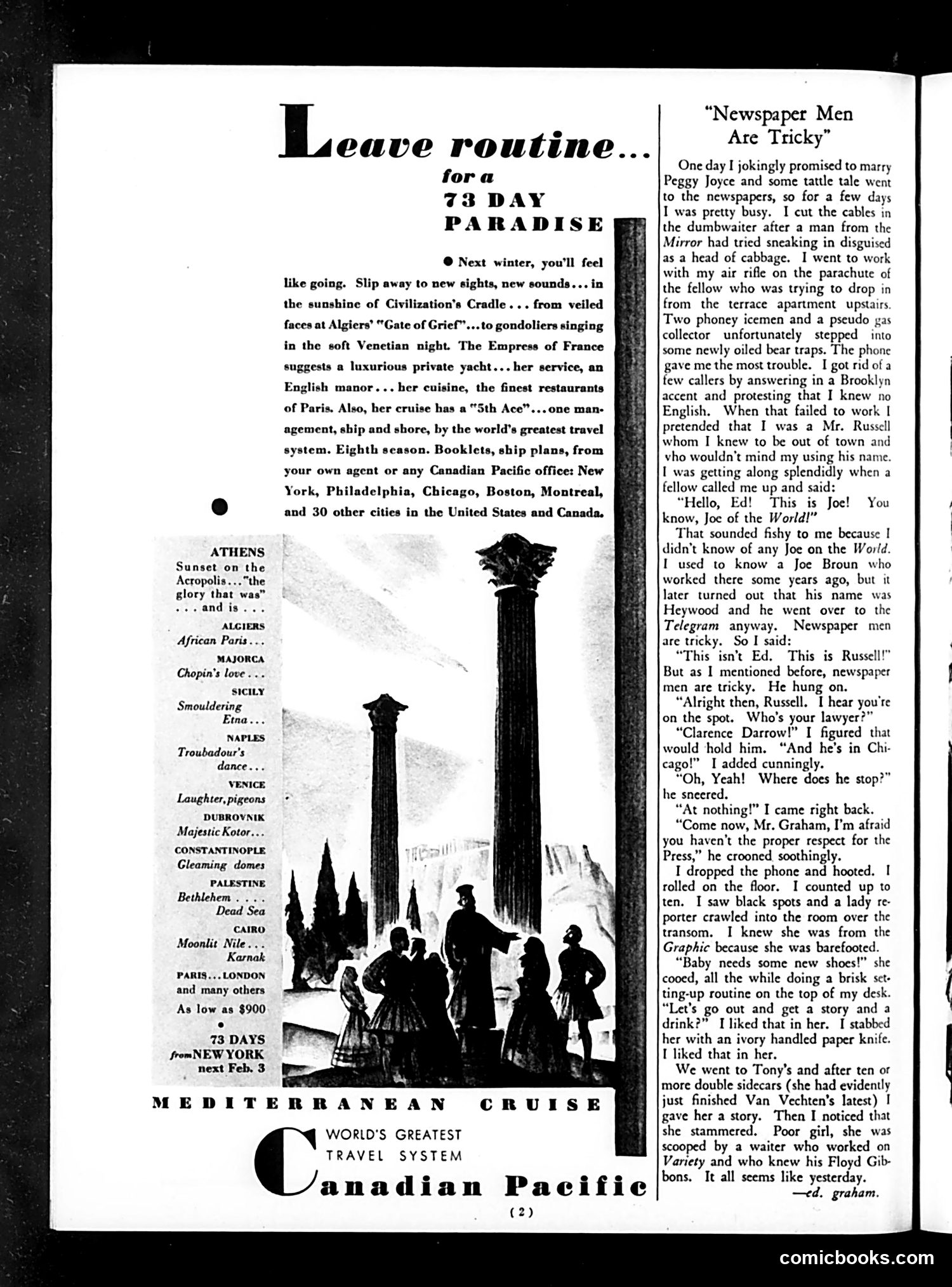
Page Analysis This page is primarily advertising for Canadian Pacific's Mediterranean cruise line (73 days, departing Feb. 3), featuring a silhouetted illustration of tourists at classical ruins. The right column contains a humorous essay titled "Newspaper Men Are Tricky," authored by "ed. graham." It's a satirical anecdote about the author's chaotic experience attempting to place a wedding announcement in newspapers while dealing with reporters. The humor centers on newspaper staff's unprofessionalism: phony callers, a "pseudo gas collector," incorrect names (confusing "Russell" with "Joe"), and ultimately the author being scooped by a *Graphic* reporter at a restaurant who obtained the story. The satire mocks both newspaper culture's competitiveness and the chaos of urban journalism circa the 1920s-30s.
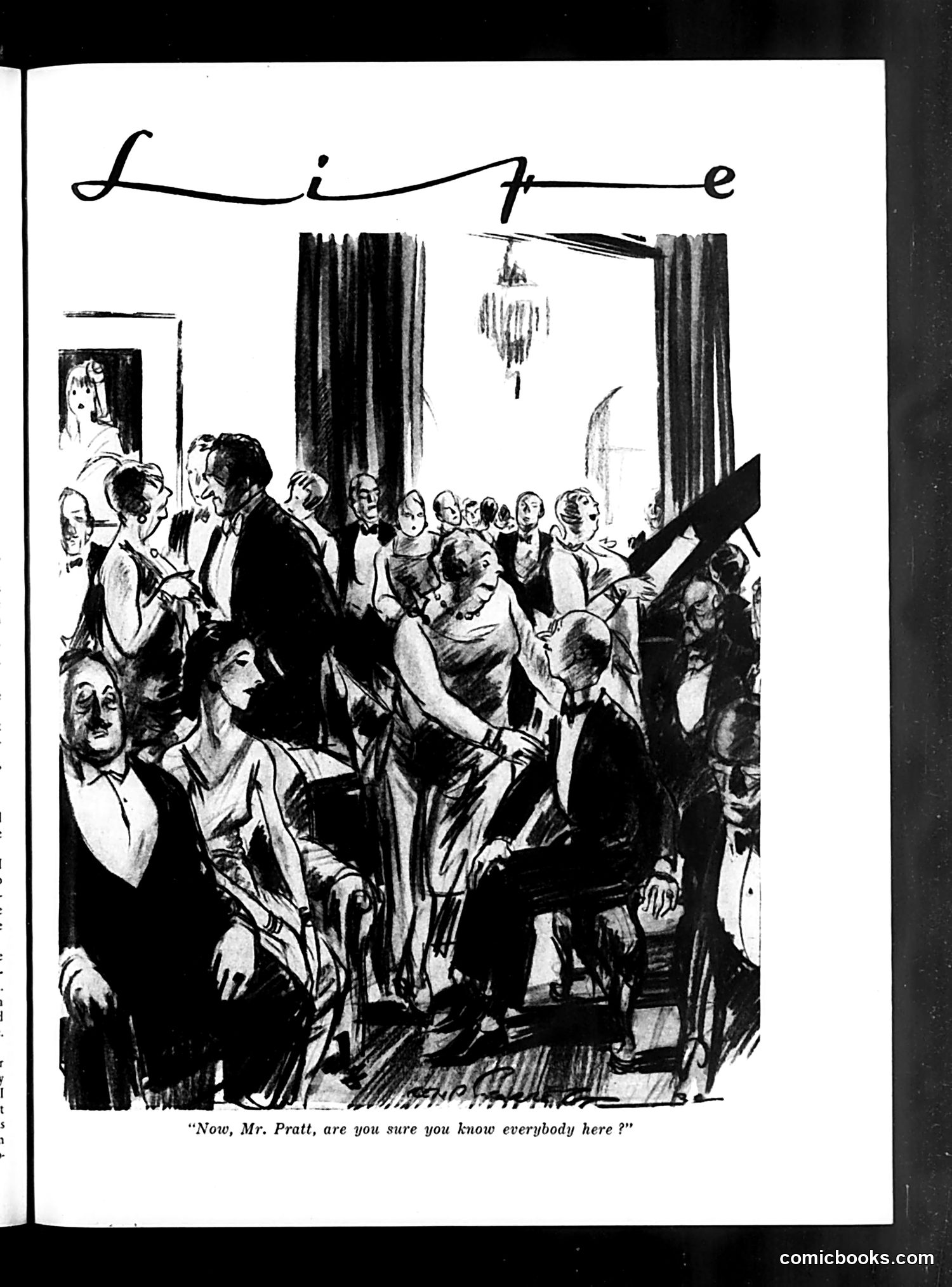
Analysis This is a single-panel cartoon from *Life* magazine titled "Life" (visible at top). The sketch depicts a crowded formal social gathering—appearing to be a high-society event or party with well-dressed attendees in evening wear. The caption reads: "Now, Mr. Pratt, are you sure you know everybody here?" The humor appears to satirize social pretension and the awkwardness of formal gatherings. Mr. Pratt (likely a recognizable public figure of the era, though unclear to modern readers) is being questioned about whether he truly knows all the guests present—suggesting either that he's claimed familiarity with everyone or that the questioner doubts his social connections. The cartoon mocks the performative nature of high-society events and the sometimes dubious claims people make about their social standing and acquaintances.
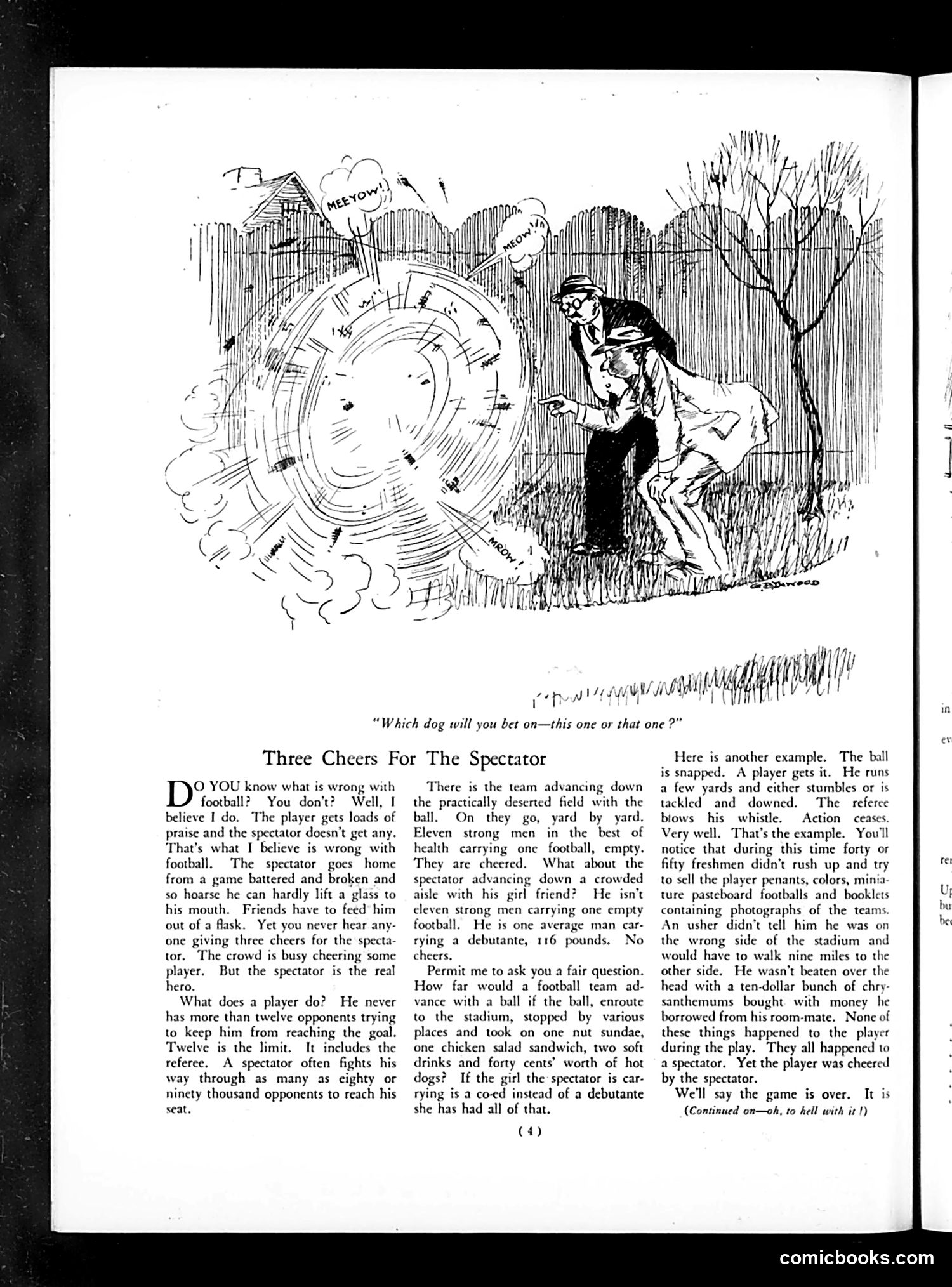
"Three Cheers For The Spectator" This satirical piece critiques how football spectators behave. The cartoon shows two men watching a game, with speech bubbles saying "MEEYOW" and "MEOW" — suggesting fans making animal-like noises. The accompanying article humorously questions what spectators actually contribute to football. The author notes that while players do the work, spectators get hoarse cheering and may spend considerable money attending games (travel, food, merchandise). He sarcastically asks whether the spectator's role is truly heroic, given that fans mainly consume the experience without performing meaningful action. The joke's target: the gap between spectators' emotional investment and their actual participation—they cheer loudly but accomplish nothing materially, like animals making noise.
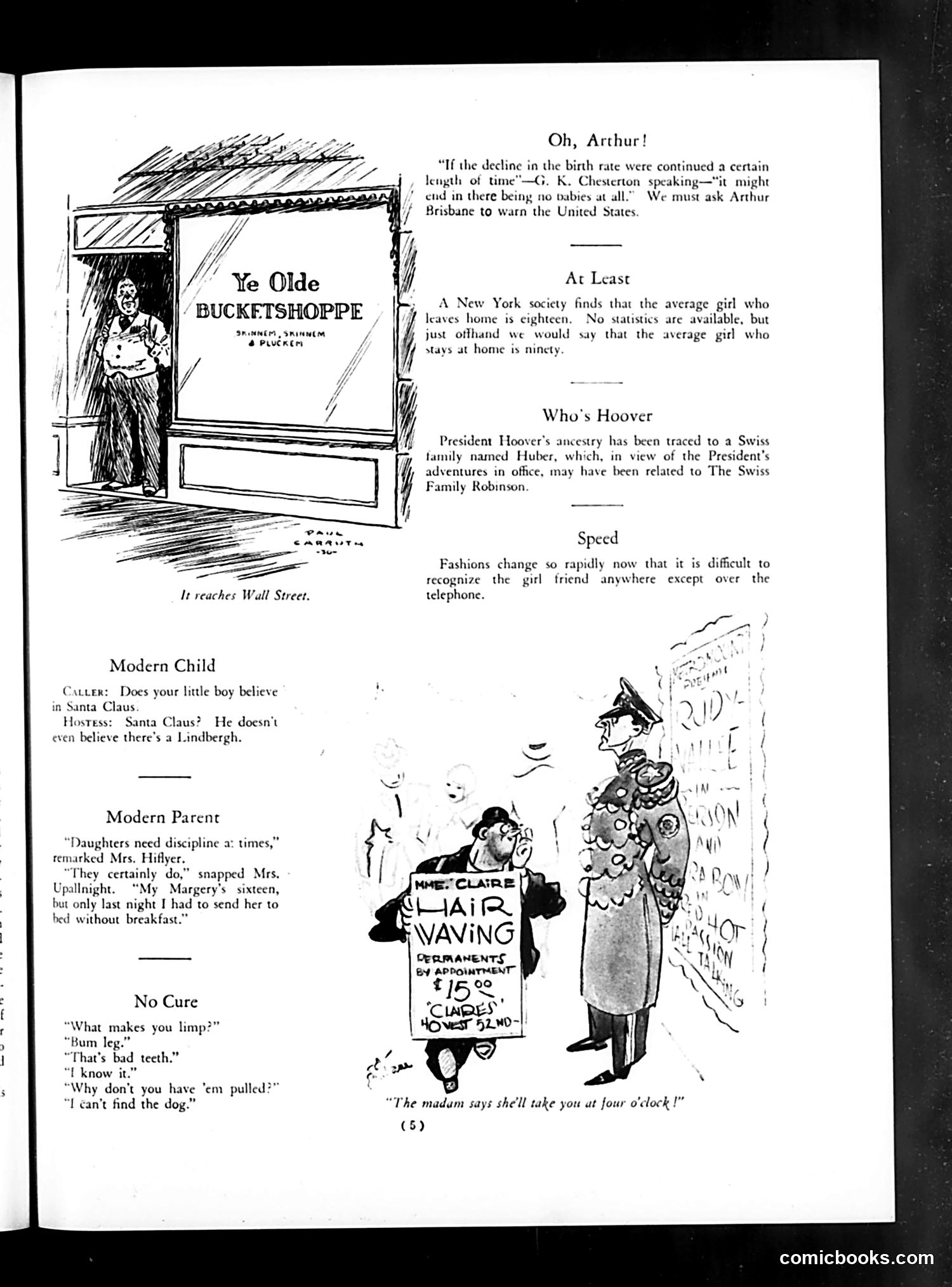
Analysis of Life Magazine Page This page contains several short humor pieces and a cartoon satirizing 1920s social trends: "Ye Olde Bucketshoppe" shows a storefront reaching Wall Street, mocking get-rich-quick investment schemes that proliferated before the 1929 crash. "Oh, Arthur!" and "At Least" make light commentary on birth rates and young women staying home—likely responding to post-WWI demographic anxieties. "Who's Hoover" references President Hoover's Swiss ancestry, a topical joke. "Speed" quips that fashion changes so rapidly girls become unrecognizable except by telephone. The large cartoon depicts "Mme. Claire Hair Waving"—a beauty salon hawking $15 permanent waves ($9.50 upstairs)—illustrating the commercialization of women's appearance and the pressure to maintain fashionable hairstyles.
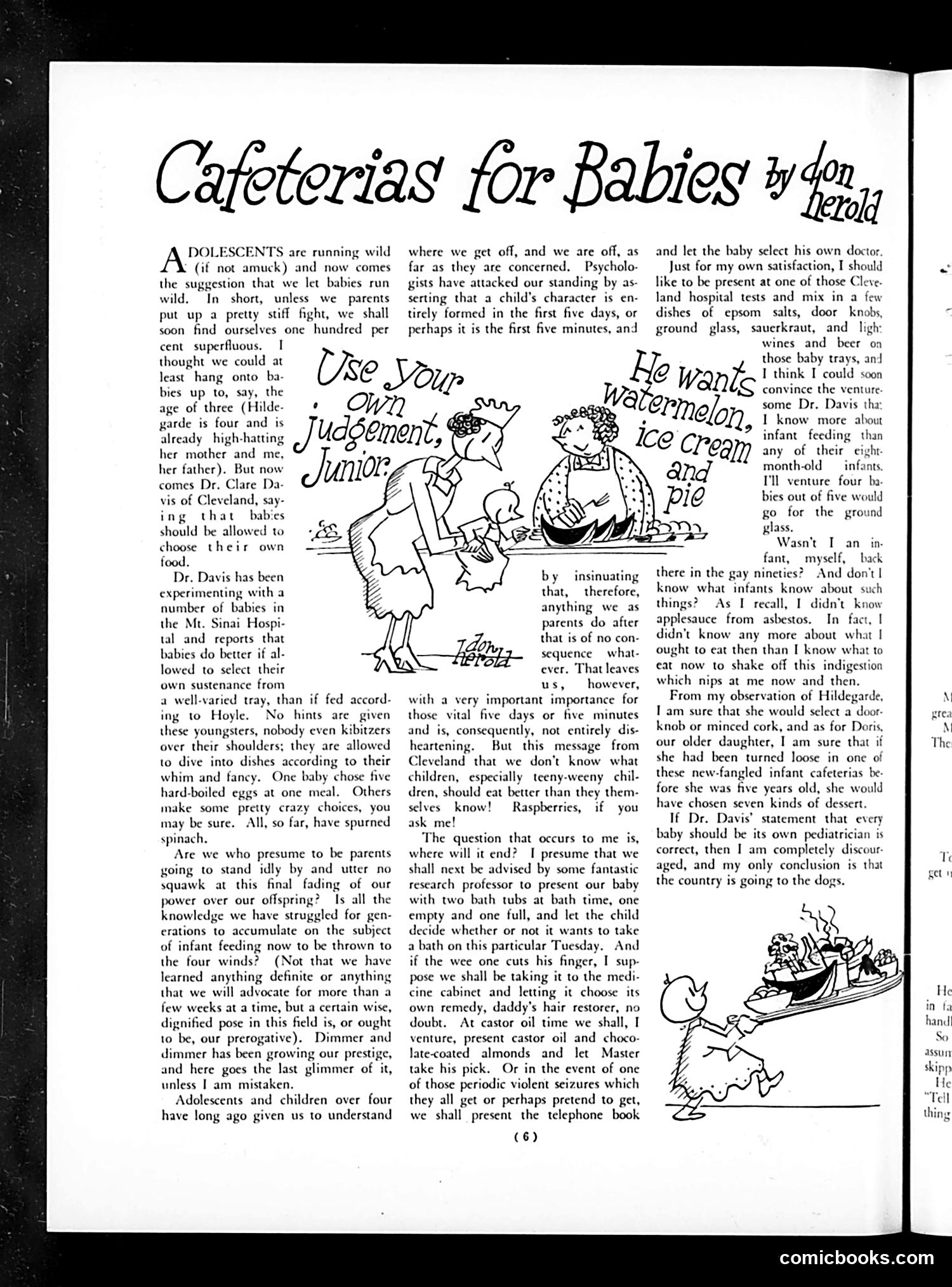
"Cafeterias for Babies" by Don Herold This satirical article mocks the early 20th-century trend of applying scientific "modern" parenting methods to infants. The author ridicules Dr. Davis's suggestion that babies should select their own food and doctors, rather than following parental guidance. The cartoon illustrations show absurd scenarios: a baby choosing between watermelon, ice cream, and pie; another selecting from various undesirable items (ground glass, door knobs, wines). Herold argues this philosophy is ridiculous—infants lack judgment and knowledge. The satire targets the era's faith in "scientific" child-rearing that strips parental authority and common sense. His point: not everything modern is an improvement; babies need guidance, not independence in crucial health decisions.
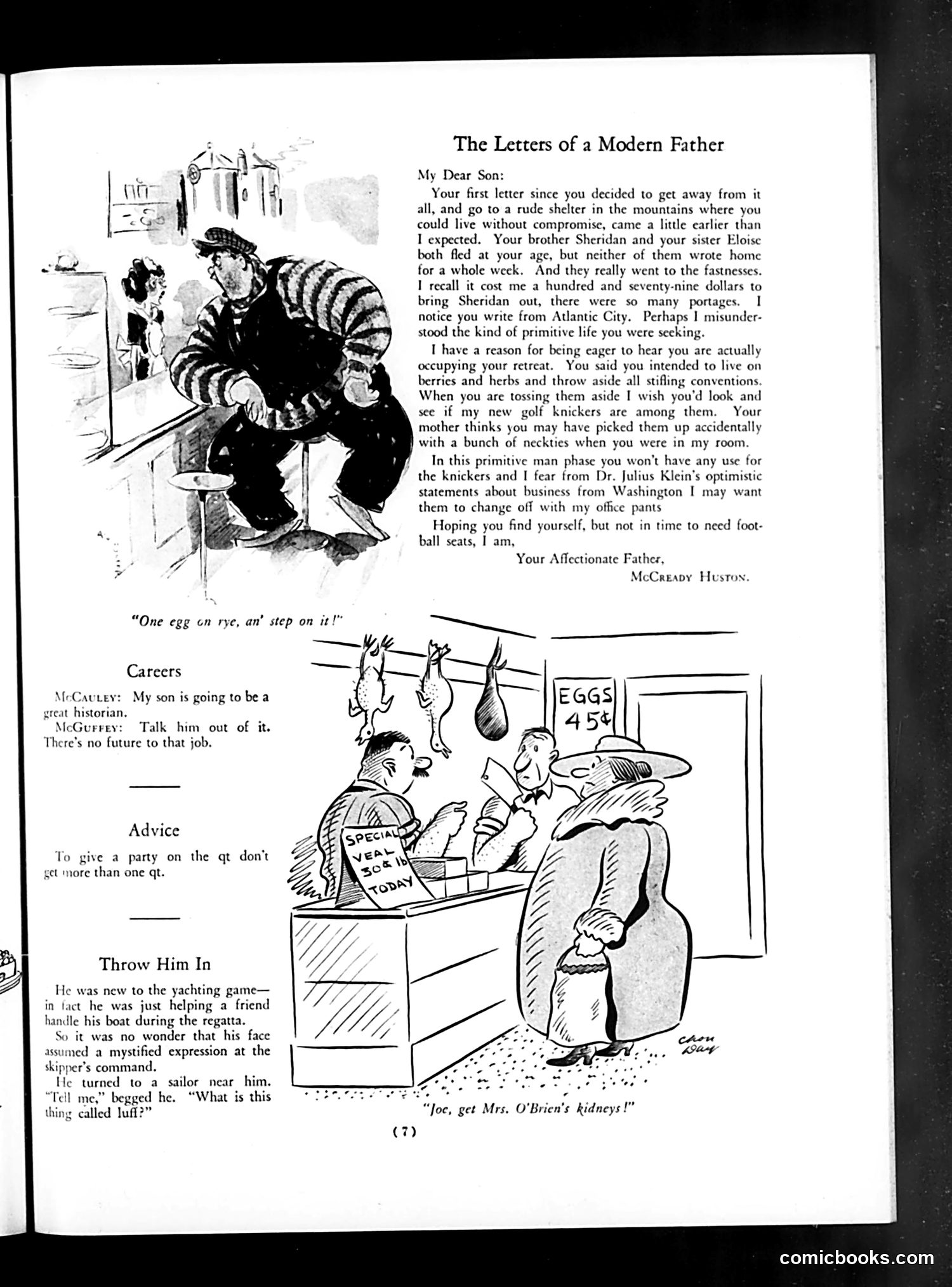
Analysis of "The Letters of a Modern Father" Page This page contains satirical commentary on 1920s youth culture and parenting. The main letter depicts a father's bemused disapproval of his son's bohemian retreat to the mountains, where he plans to live primitively on "berries and herbs" while rejecting "stifling conventions." The father notes the boy's golf knicks are present—suggesting the retreat is less authentic than claimed. The accompanying cartoons mock contemporary concerns: one jokes about pricing eggs at 45¢, another satirizes giving parties with limited alcohol ("qt" = quart), and a final scene shows a novice yachtsman's confusion about nautical terminology ("luff"). The overall satire targets both rebellious youth and parental bewilderment during the Jazz Age, when younger generations openly rejected Victorian values.
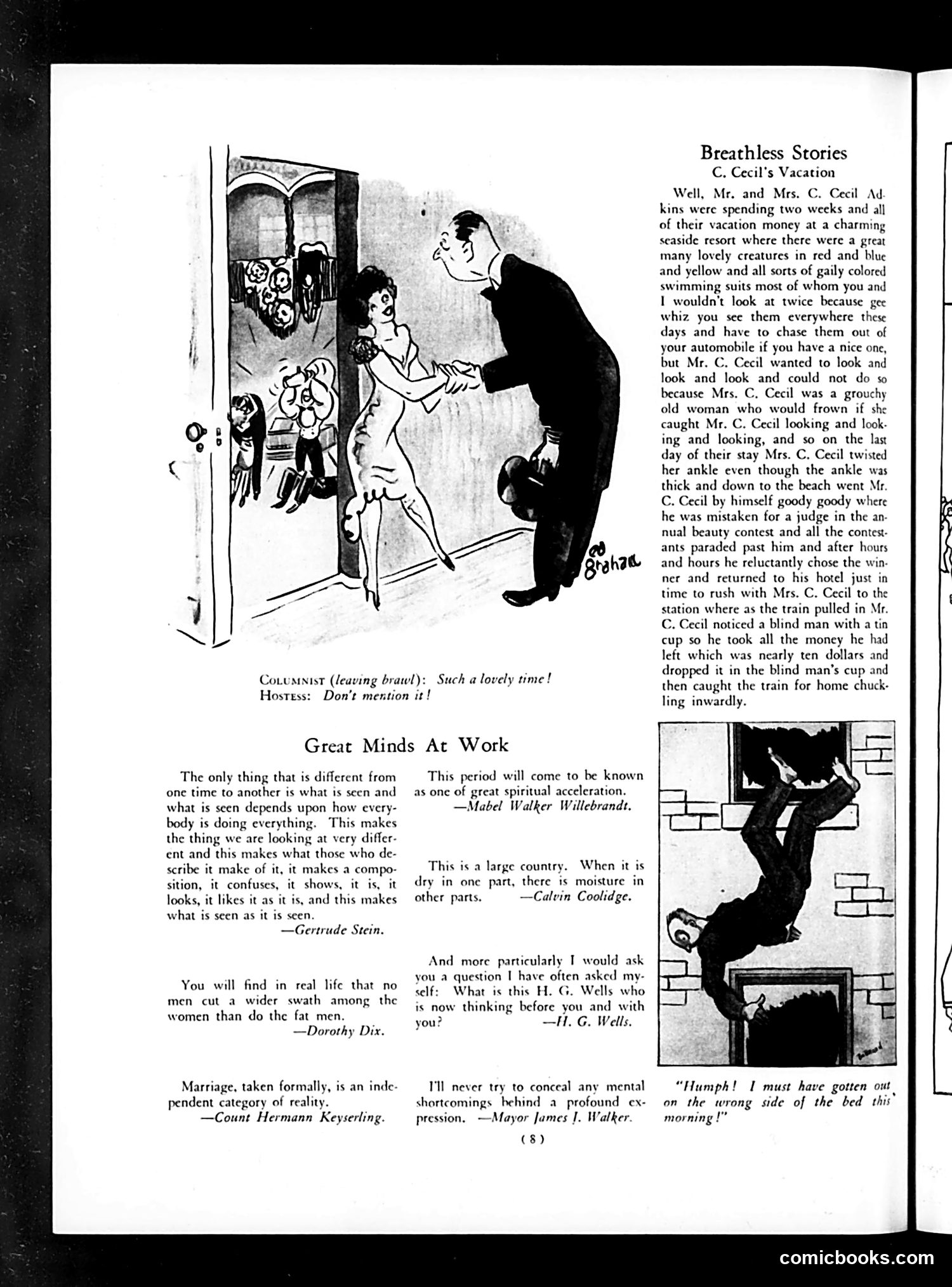
Analysis of Life Magazine Page The page contains two distinct sections: "Breathless Stories: C. Cecil's Vacation" (right column) is a humorous short story about a married couple at a seaside resort. The joke centers on Mr. C. Cecil's inability to look at attractive women in swimsuits due to his jealous wife's vigilance. The ironic payoff: while avoiding temptation at the beach, he impulsively gives nearly ten dollars to a blind beggar at the train station—money he'd saved from his vacation, then feels guilty about the deception. "Great Minds at Work" (lower section) features philosophical quotations from notable figures like Gertrude Stein, Dorothy Dis, and H.G. Wells. It's a intellectual humor section showcasing clever observations on perception, spirituality, and marriage. The cartoon above the story depicts a man ogling women entering an elevator—typical period satire about male behavior and leisure.
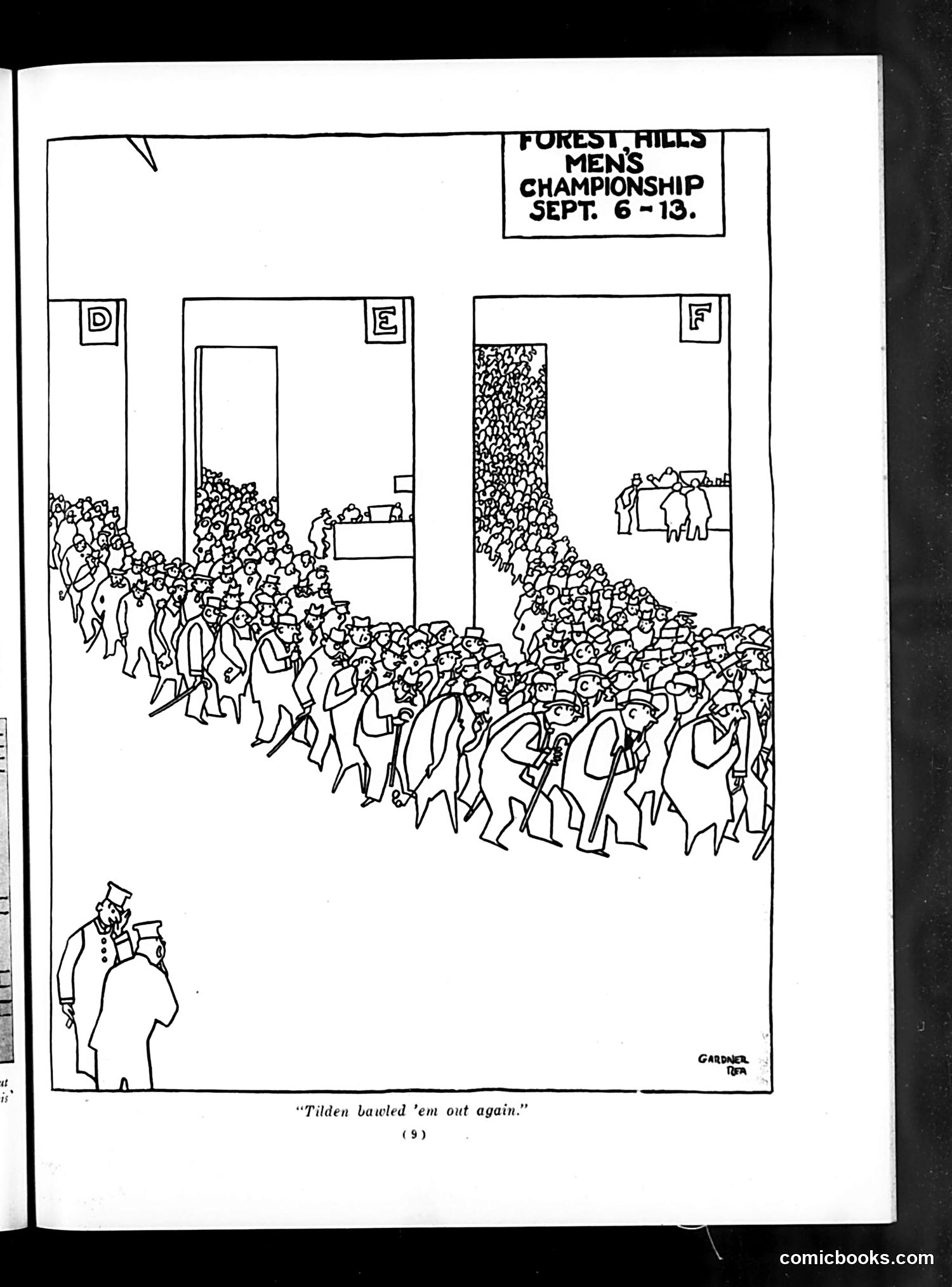
Political Cartoon Analysis This cartoon satirizes William Howard Taft (the figure labeled "Tilden" in the caption, though this appears to be an error or reference to another political figure). The image shows massive crowds being physically ejected from what appears to be the Forest Hills Men's Championship (September 6-13), a prestigious tennis tournament. The satire critiques Taft's handling of large public gatherings or crowd management during his presidency. The caption "Tilden bawled 'em out again" suggests repeated instances of crowds being forcibly removed or dispersed. The cartoon employs exaggeration—depicting enormous throngs being cleared—to mock either Taft's unpopularity, his administrative decisions affecting public events, or his heavy-handed approach to managing public spaces. The specific tennis championship reference adds ironic social commentary about access and exclusion.
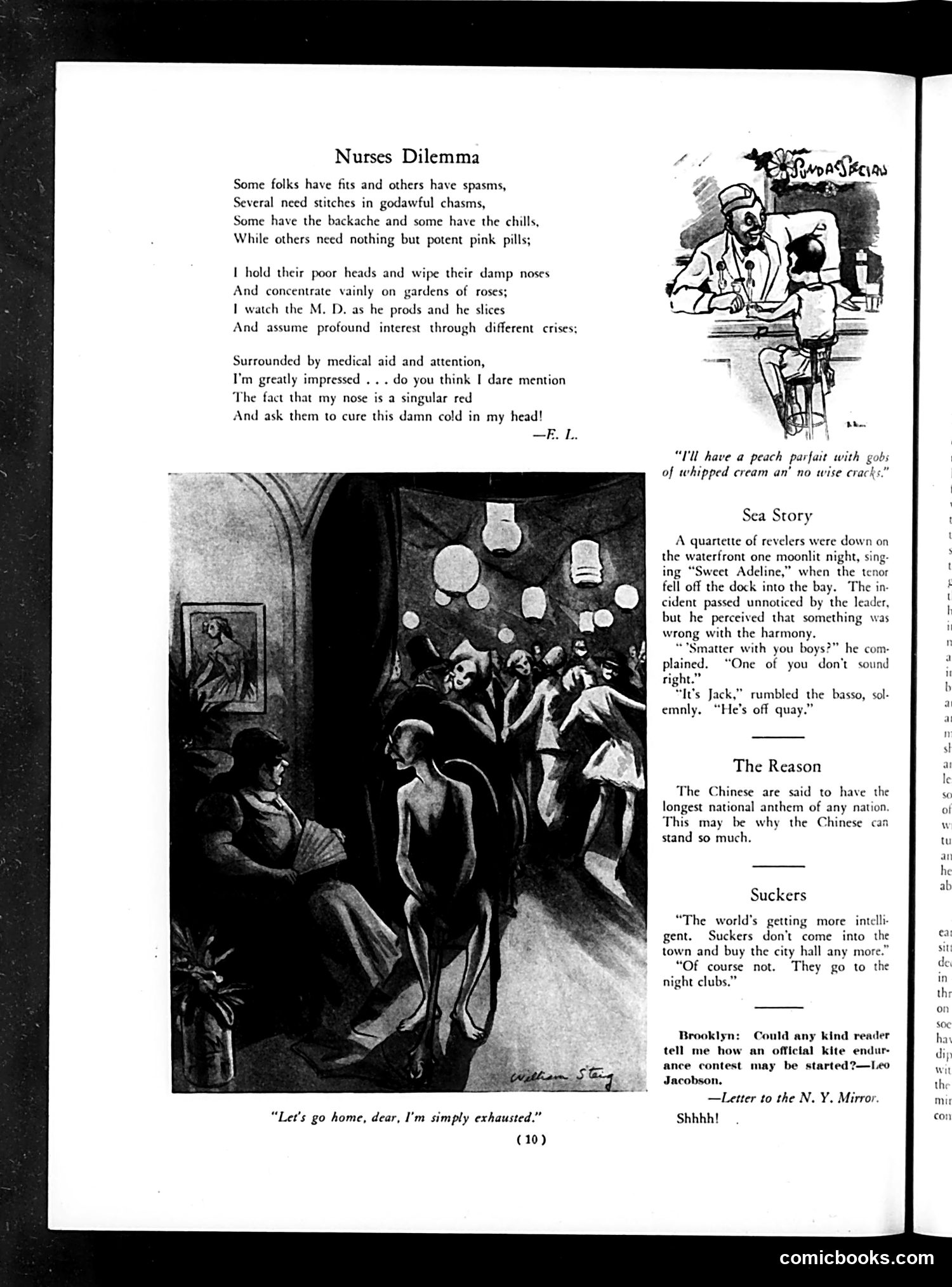
Analysis of Life Magazine Page This page contains several humor pieces targeting early 20th-century American society. "Nurses Dilemma" (top left): A poem by E.L. satirizing nurses' frustrations—they manage patients with various ailments while doctors receive credit. The nurse speaker complains her red nose goes uncured despite surrounding medical attention, poking fun at medical hierarchy and gender dynamics. The large illustration depicts an indoor social gathering, likely mocking Victorian-era decorum or possibly wartime social constraints (based on the formal dress and formal setting). "Sea Story," "The Reason," and "Suckers" are brief humorous anecdotes mocking human behavior: sailors' discord, Chinese national pride, and urban gullibility respectively. The overall tone is light satirical commentary on contemporary social behaviors and professional frustrations, typical of Life magazine's approach during this period.
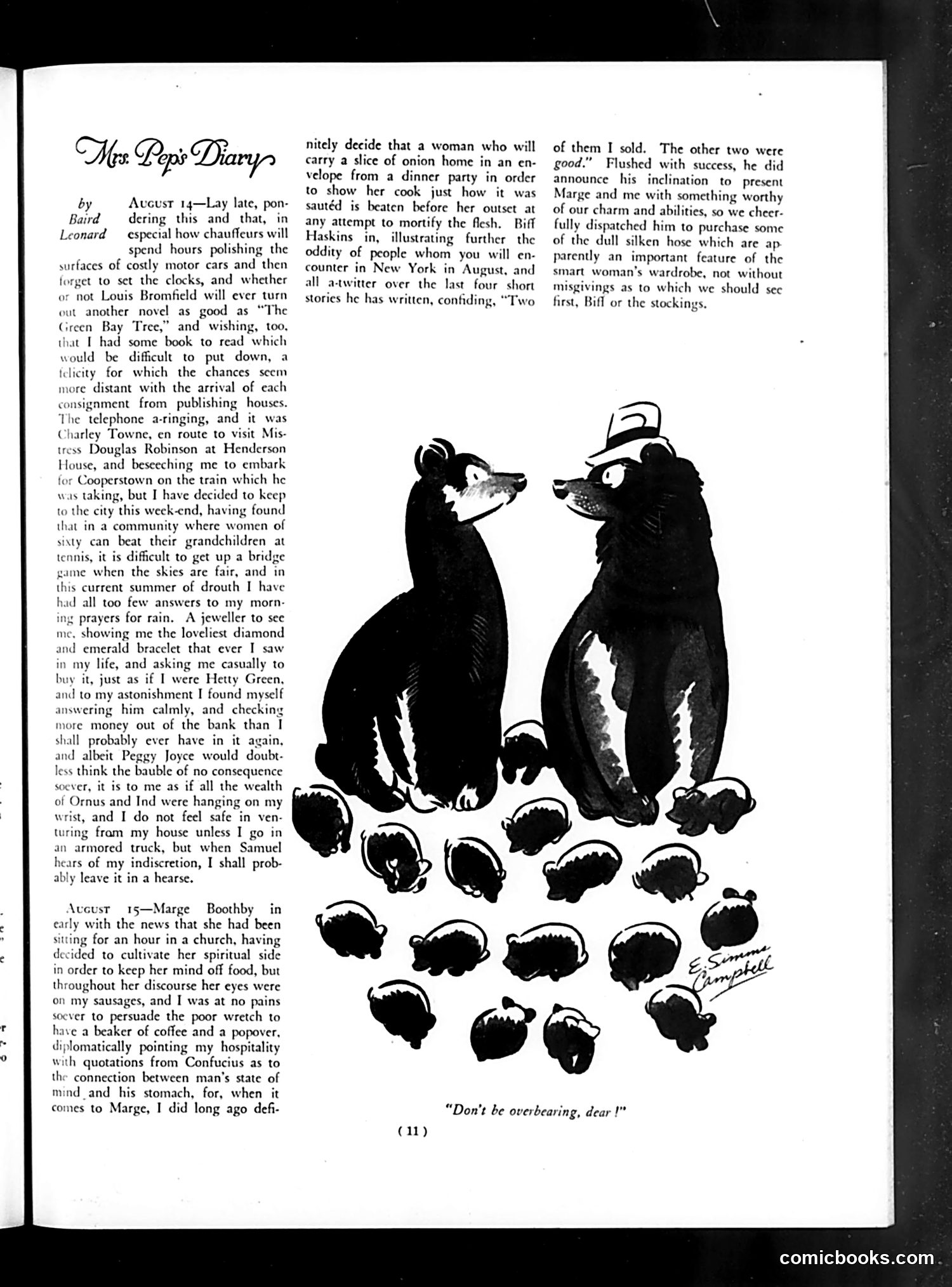
Mrs. Pop's Diary: August 14-15 Entry This page presents a humorous diary entry by "Leonard" about summer social life. The main illustration shows two bears in hats standing over a group of smaller bears, with the caption "Don't be overbearing, dear!" The cartoon is a visual pun: the word "overbearing" (meaning domineering or pushy) is illustrated literally with bears who are "over" (standing above) smaller bears. This plays on the diary's gossipy tone about social interactions and personal dynamics. The text discusses summer activities—chauffeurs polishing cars, avoiding social obligations, attending social events, and managing relationships. The cartoon humorously comments on interpersonal behavior within this affluent social circle, suggesting someone is being excessively domineering or controlling in their relationships.
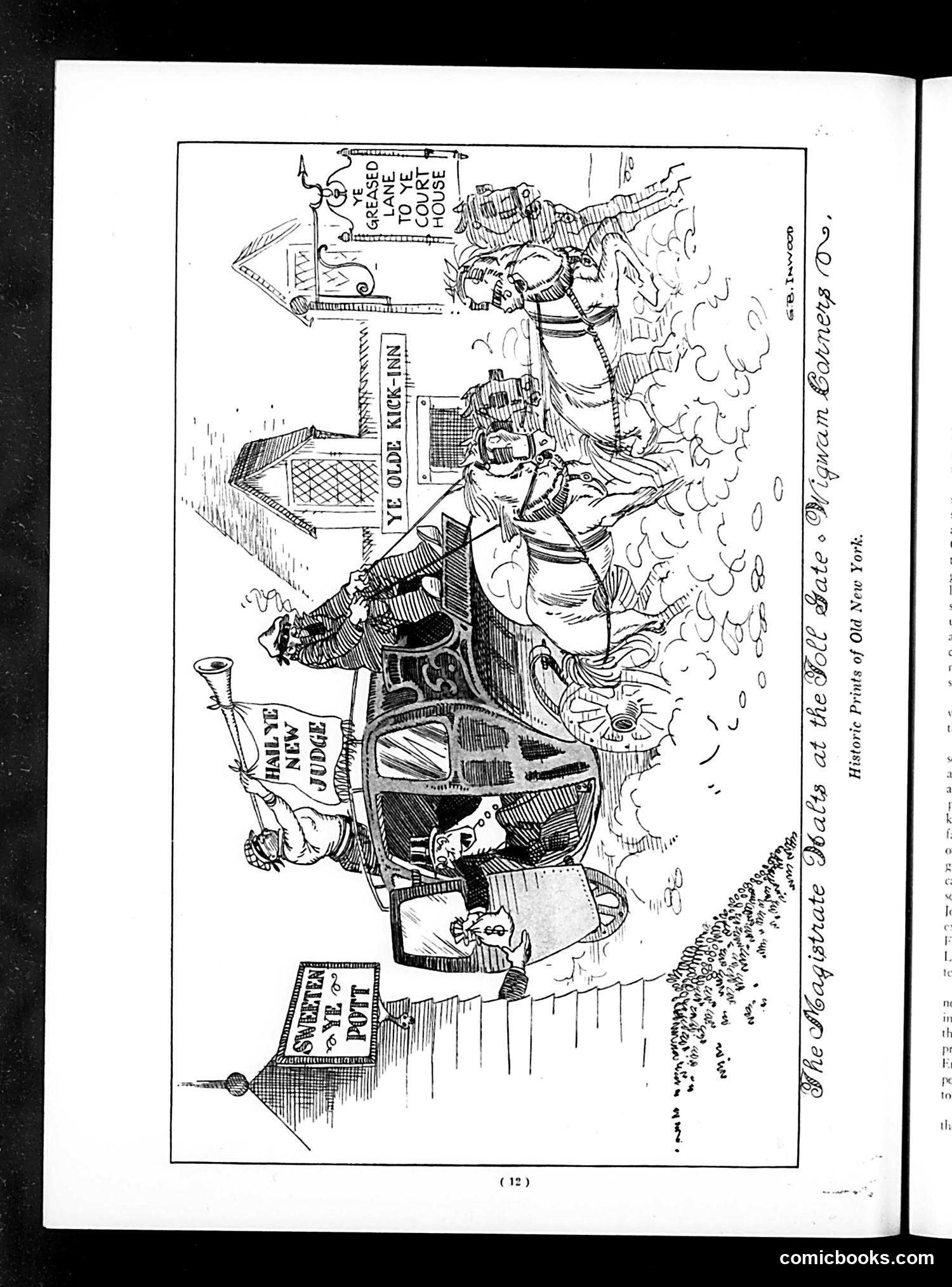
This page contains a satirical cartoon titled "The Melodramatic Belles at the Billet" (subtitled "Historic Print of Not Now York"). The image is rotated 90 degrees and depicts what appears to be a theatrical or domestic scene with multiple figures in period dress. The cartoon shows characters in what looks like exaggerated, melodramatic poses typical of 19th-century theatrical performances. Text boxes reference "Ye Olde Kick-Inn" and other period-styled establishments, suggesting satire of overly romanticized historical recreations or theatrical presentations popular in the era. The specific historical or political figures being mocked remain unclear from the visible text, though the "Historic Print" subtitle indicates the cartoon ridicules nostalgia-driven entertainments or historical reenactments of its time.
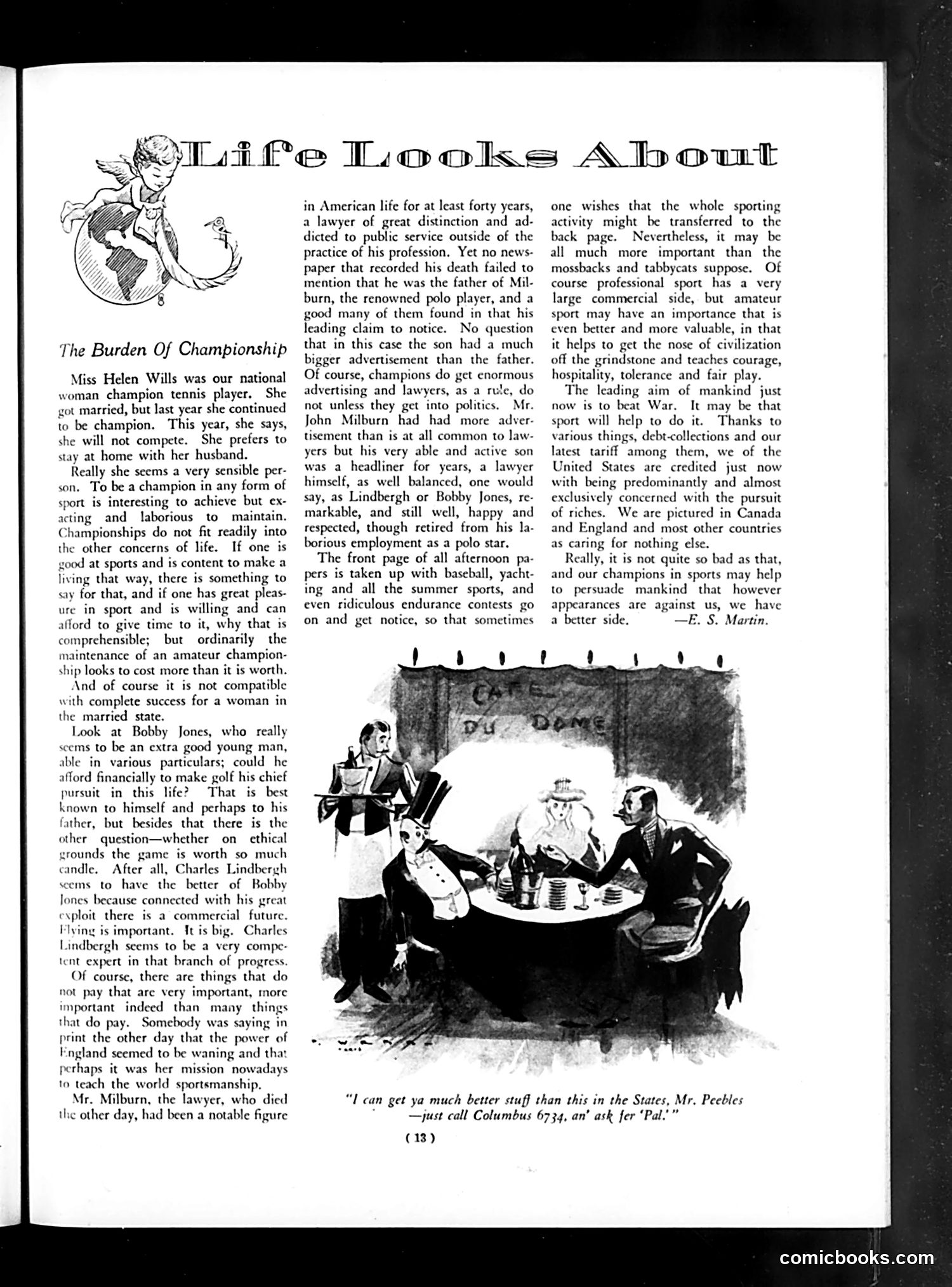
Analysis of "Life Looks About" Page This page discusses the social burden of maintaining amateur sports championships, using Helen Wills (national women's tennis champion) as an example. The article argues that while winning championships is admirable, the constant pressure to defend titles and maintain public attention is exhausting—especially for married women expected to balance sport with domestic duties. The accompanying cartoon depicts three men at a formal dinner table. One says: "I can get so much better stuff than this in the States, Mr. Peebles—just call Columbus 6734, an' ask for 'Pat.'" The joke appears to reference Prohibition-era bootlegging: the men are comparing American illegal alcohol ("stuff") favorably to legal options available abroad, implying one can order contraband liquor by phone in America.
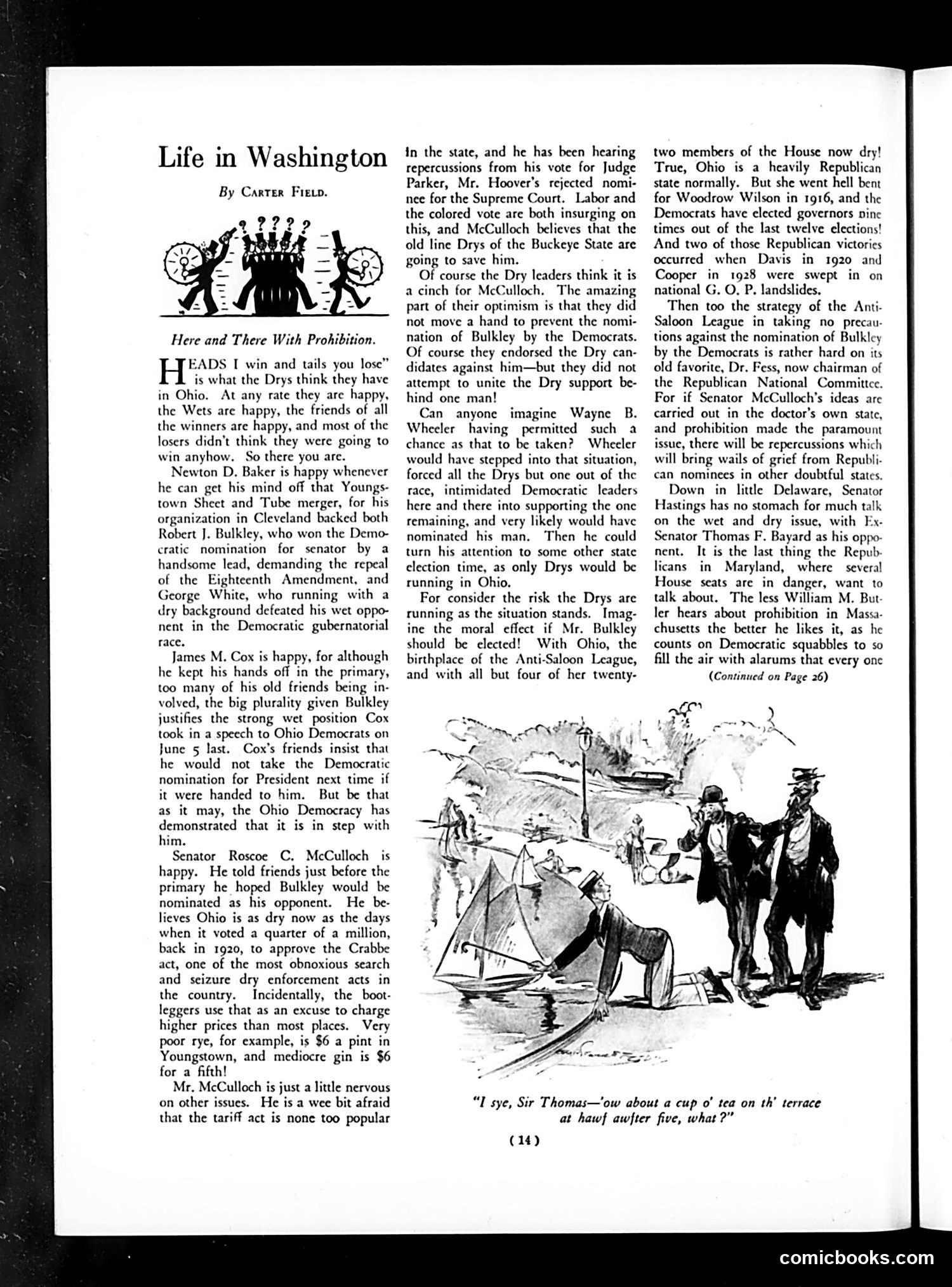
Analysis of Life Magazine Page This page discusses 1920s American Prohibition politics, particularly Ohio's Democratic primary. The article by Carter Field analyzes Senator Roscoe C. McCulloch's optimism about Ohio remaining "dry" (supporting alcohol prohibition) despite Democratic opposition. The bottom illustration satirizes British attitudes toward Prohibition. The caption shows a British gentleman ("Sir Thomas") dismissively offering "a cup o' tea" instead of alcohol, mocking the American experiment with alcohol bans. The cartoon suggests European bemusement at American Prohibition enforcement. The article references prominent figures like Robert J. Bulkley (Democratic Senate candidate) and George White, analyzing their positions on Prohibition—a major 1920s political dividing line between "wet" (anti-Prohibition) and "dry" (pro-Prohibition) factions.
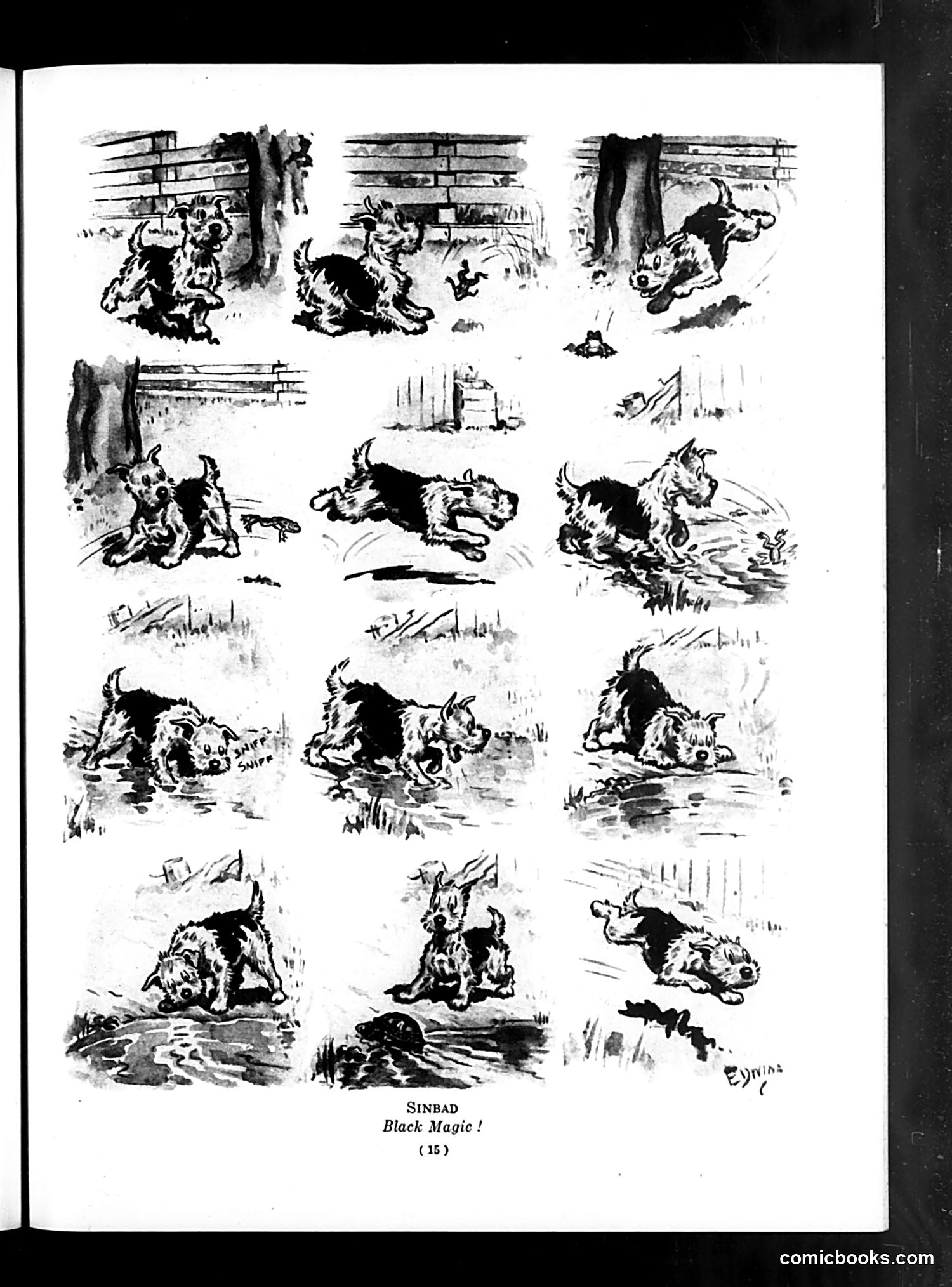
Analysis of "Sinbad: Black Magic!" This page presents a series of cartoon sketches depicting what appears to be Sinbad the Sailor encountering supernatural or chaotic situations involving demons, magical creatures, and fantastical scenarios. The twelve panel layout shows various mishaps and confrontations—creatures attacking, water scenes, and magical disturbances. The title "Black Magic!" suggests the satire centers on the absurdity or comedic horror of magical interference in Sinbad's adventures. The artist (signed "Edwins") uses exaggerated, energetic linework typical of early Life magazine humor to emphasize chaos and pandemonium. Without additional context, the specific satirical target remains unclear—it may parody adventure fiction tropes, supernatural tales, or contemporary fascinations with magic and the exotic.
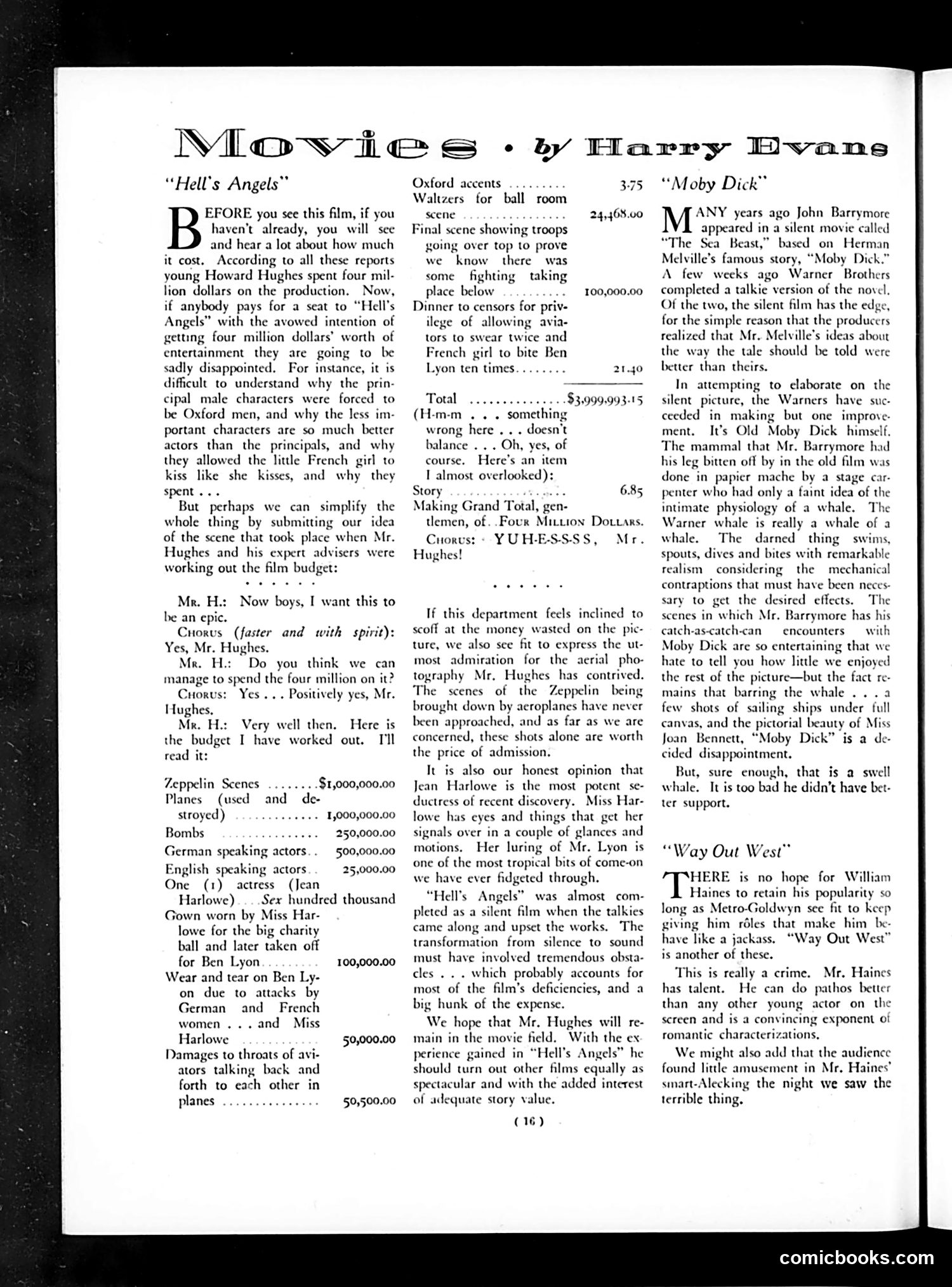
"Movies by Harry Evans" - Page Analysis This is a film criticism column reviewing three movies: "Hell's Angels," "Moby Dick," and "Way Out West." The most substantial review concerns "Hell's Angels," which the critic discusses at length. The text reveals this was an expensive production (reportedly four million dollars) directed by Howard Hughes, featuring aerial photography that was considered spectacular for the time. The review critiques the film's narrative and character development while praising its technical achievements. The "Moby Dick" review compares the new talkie version unfavorably to the earlier silent film, praising the silent version's artistic choices. "Way Out West" receives a brief dismissal regarding William Haines' waning popularity. The page functions as entertainment journalism rather than political satire, reflecting 1930s Hollywood production values and the transition from silent to sound films.
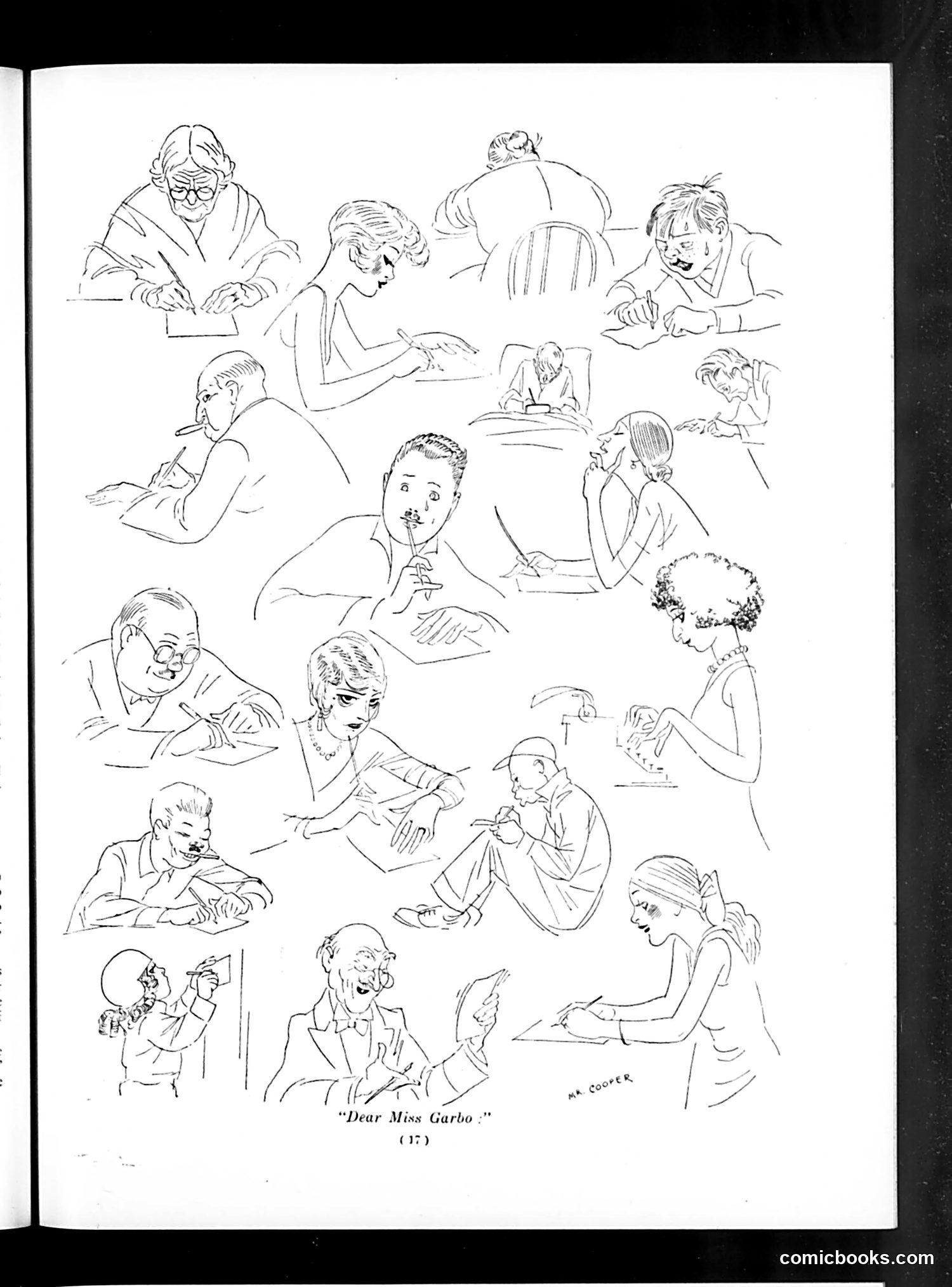
"Dear Miss Garbo" - Life Magazine Cartoon This is a humorous sketch collection by artist M. Cooper depicting various people writing fan mail to actress Greta Garbo, who was one of the biggest Hollywood stars of the era. The cartoon shows diverse characters—elderly women, businessmen, children, and others—all engaged in composing letters to the famous Swedish actress. The satire captures Garbo's enormous popularity and the phenomenon of celebrity fan mail during Hollywood's Golden Age. Each figure represents different demographics united by devotion to the star. The humor lies in showing how universal Garbo's appeal was across ages, classes, and backgrounds—everyone from sophisticated gentlemen to working-class individuals felt compelled to write to her.
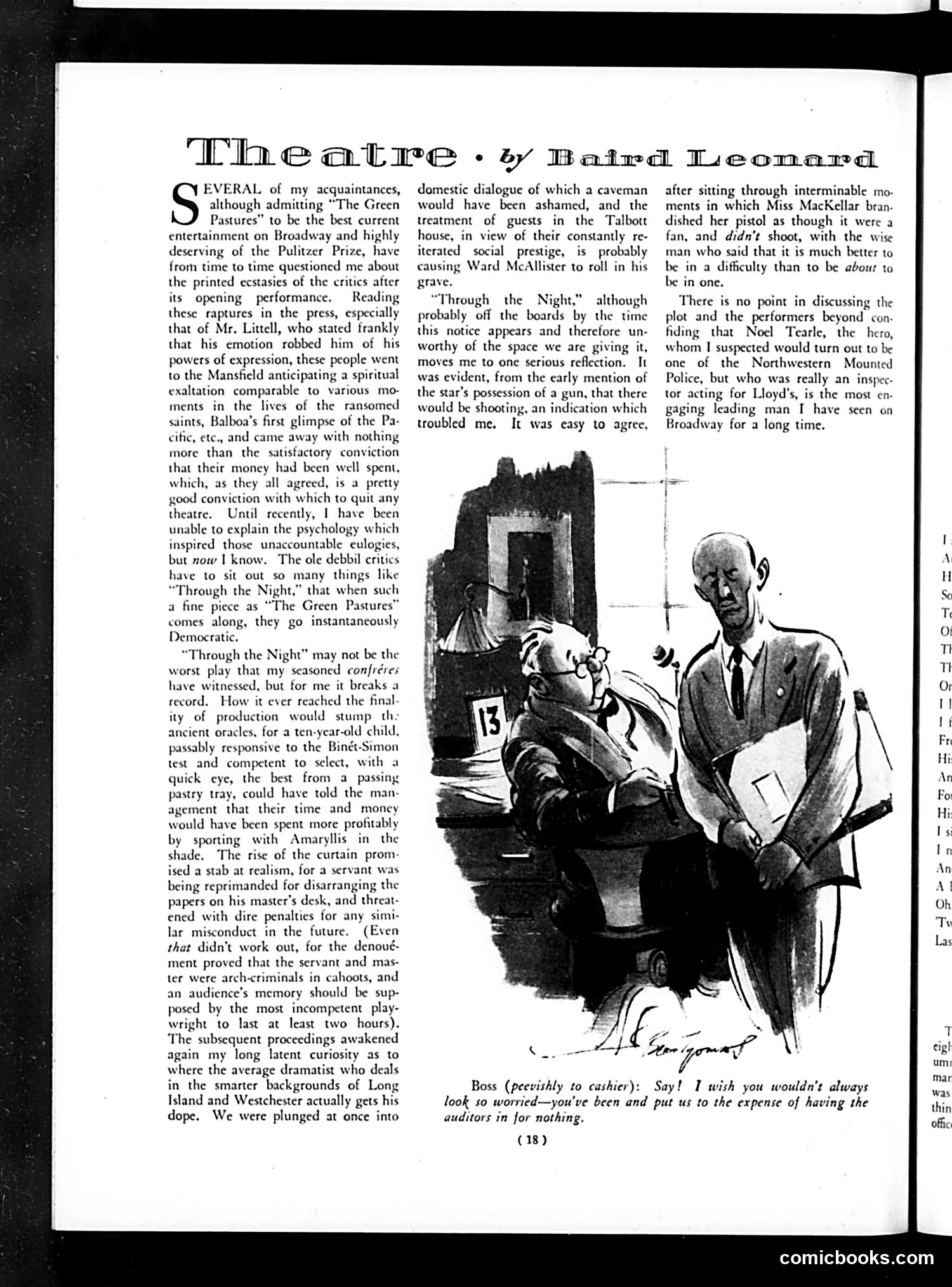
Theater Review: "Through the Night" by Baird Leonard This page reviews a Broadway play called "Through the Night." The accompanying illustration shows a boss (identified in the caption) speaking to what appears to be a worried employee or subordinate, saying "Say! I wish you wouldn't always look so worried—you've been and put us to the expense of having the auditors in for nothing." The cartoon satirizes workplace anxiety and auditor visits. The joke suggests the employee's worried demeanor prompted management to hire auditors to investigate potential financial wrongdoing, but the auditors found nothing amiss—making the employee's worry wasteful and expensive. It's social satire about corporate bureaucracy and how employee stress can trigger unnecessary oversight procedures.
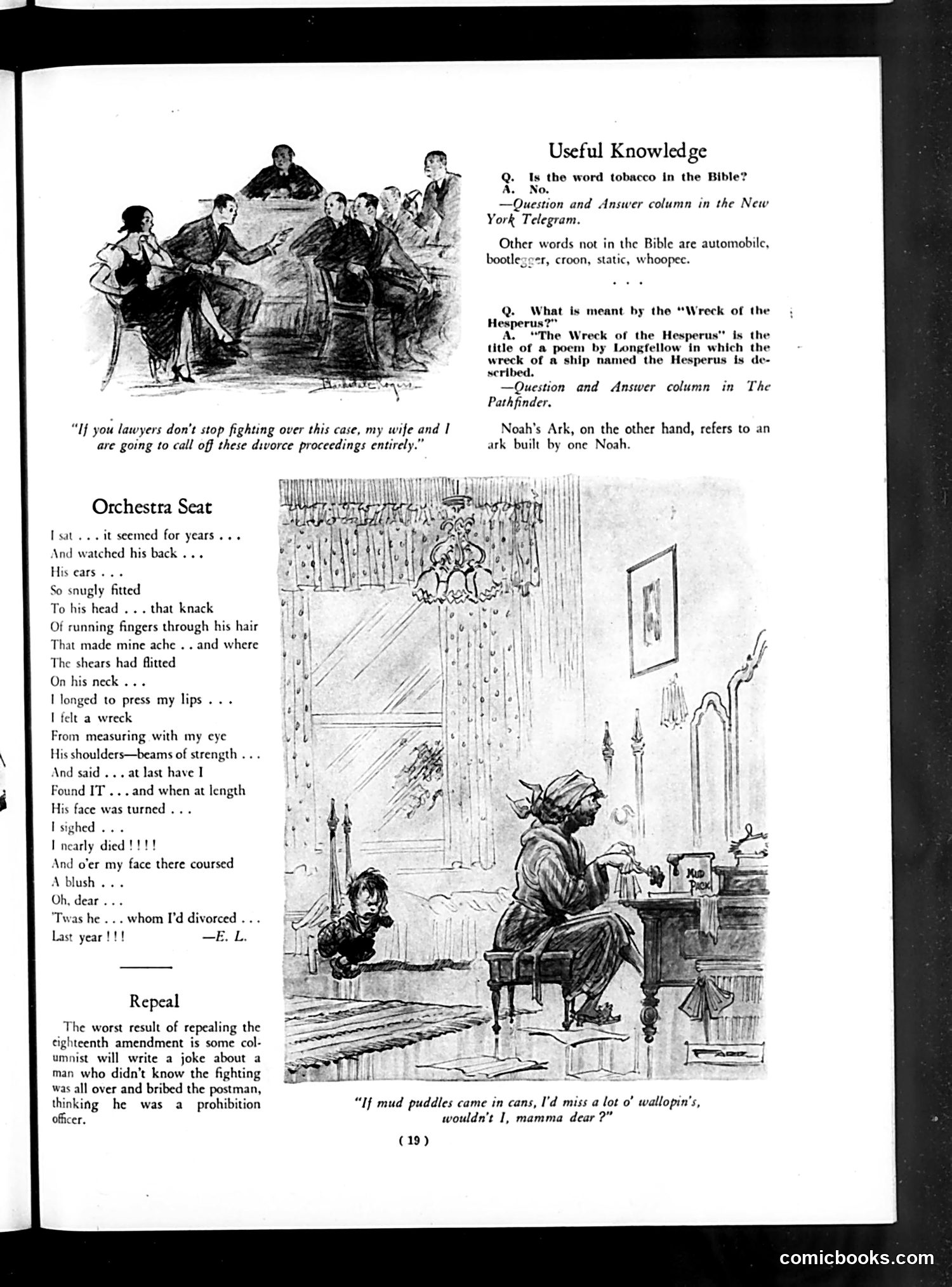
Life Magazine Page Analysis This page contains three satirical pieces reflecting 1920s American life: Top cartoon: A divorce lawyer joke. The husband threatens to end divorce proceedings if the lawyers keep fighting—implying the legal battle has become more contentious than the marriage itself. It satirizes how divorce litigation could consume couples' attention and resources. "Orchestra Seat" poem: A sentimental piece about romantic regret. The speaker watched someone in an orchestra seat for years, fell in love, then discovered it was their ex-spouse—whom they'd divorced the previous year. It's a wry commentary on lost love and awkward encounters. "Useful Knowledge" section: Satirical Q&A mocking oversimplified reference materials. It jokes that "tobacco" isn't in the Bible (technically true but pedantic), then lists modern words similarly absent. The final example about Noah's Ark delivers deadpan absurdism: stating the obvious as if it's informative. "Repeal" section: References the recently-repealed 18th Amendment (Prohibition). It jokes that columnists will keep writing tired jokes about men bribing postal workers, mistaking them for prohibition officers—humor that's now outdated. All pieces target pretension, romantic folly, and stale humor conventions.
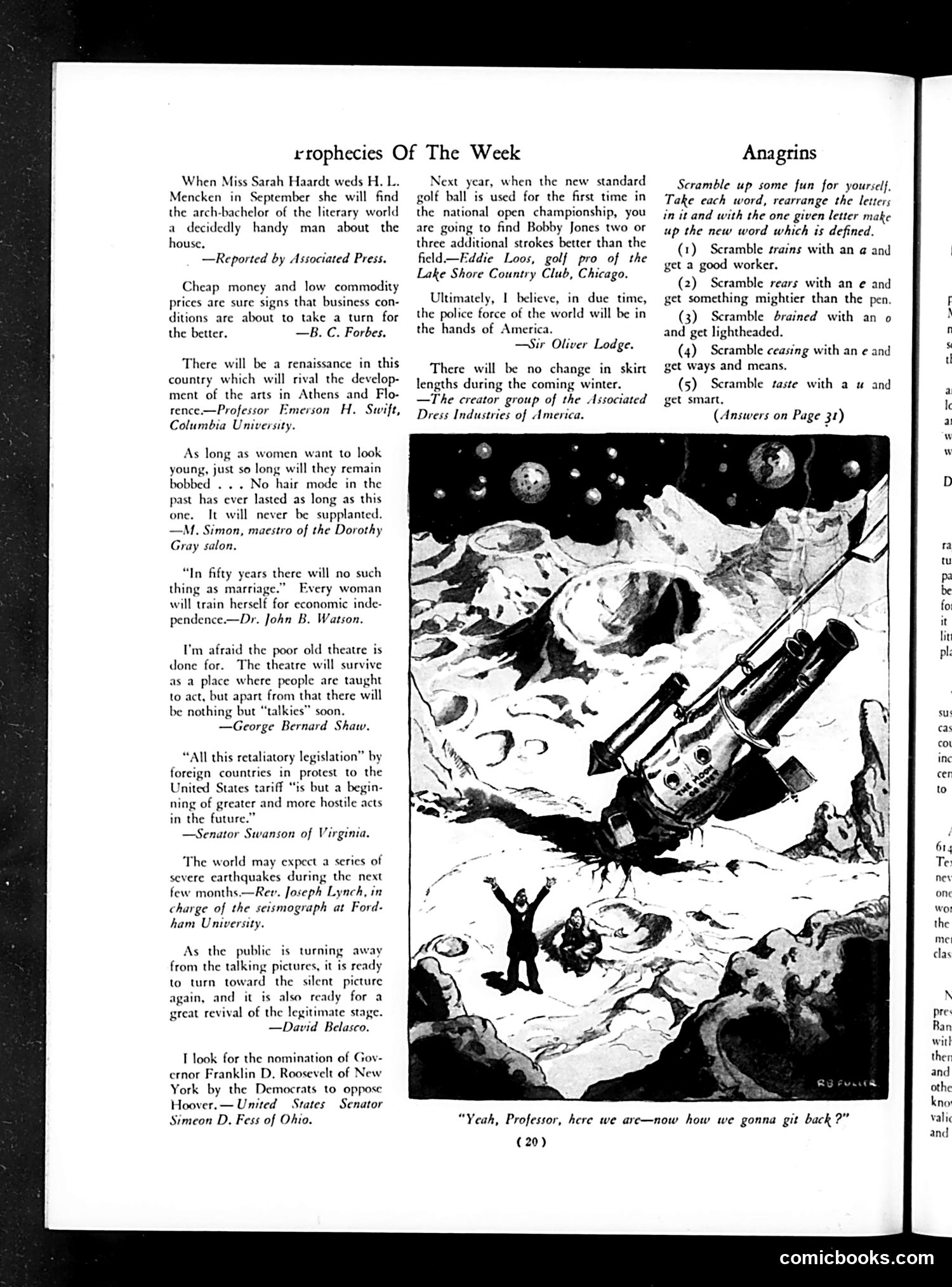
"Prophecies of the Week" - Life Magazine Satire This page satirizes confident public predictions by prominent figures. The left column collects absurd forecasts from celebrities and experts—George Bernard Shaw predicting theater's death via "talkies," a fashion expert insisting bobbed hair will never change, Dr. John B. Watson claiming marriage will disappear in fifty years. The irony is clear to a 1928 reader: these "prophecies" contradict each other and rely on flawed logic, mocking experts' habit of making sweeping predictions with unwarranted certainty. The cartoon depicts space explorers on a lunar landscape with telescopes and equipment, with one asking a professor "how we gonna git back?"—a visual joke about forward-thinking visionaries who plan ambitious futures but overlook practical problems. It complements the theme: grand predictions often ignore obvious complications. The "Anagrins" word puzzle is filler content typical of the era's magazines.
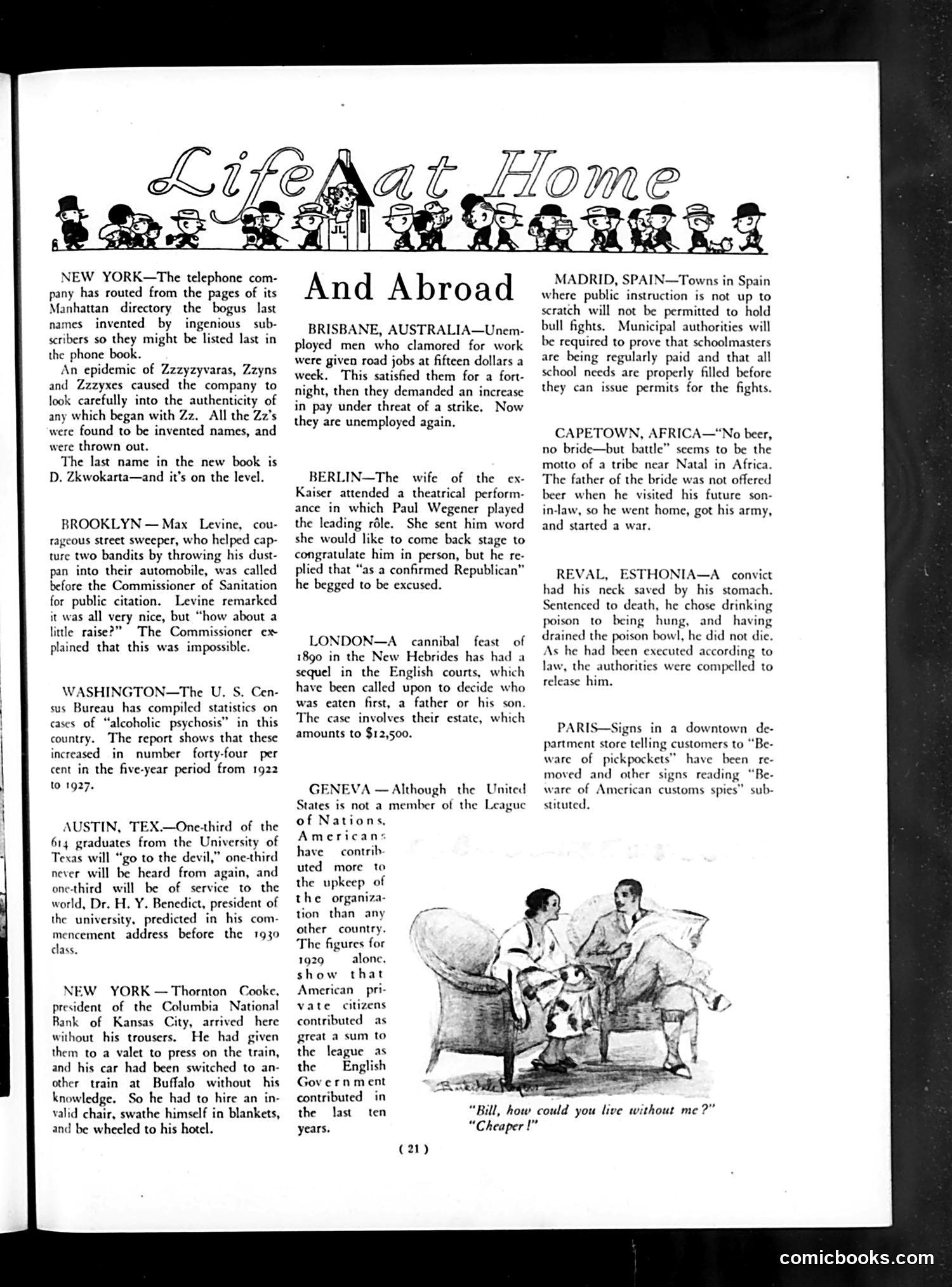
"Life at Home and Abroad" - Page Analysis This page is a collection of satirical news briefs showcasing human folly across America and the world, typical of *Life* magazine's humorous approach to current events. Domestic absurdities include: - New Yorkers inventing fake surnames (strings of Z's) to appear last in phone directories—the telephone company had to authenticate all entries - A Brooklyn street sweeper demanding a raise after heroically stopping bandits with his dustpan - A Kansas City banker arriving at his hotel pantless after a luggage mix-up International items mock: - Australian unemployed workers striking immediately after getting jobs - The ex-Kaiser's wife being snubbed by an actor claiming "Republican" principles - A decades-old English court case determining which family member was cannibalized (for inheritance purposes) - Spain conditioning bull-fighting permits on school funding - An African tribe declaring war over withheld beer at a wedding The cartoon (captioned "Bill, how could you live without me?" / "Cheaper!") depicts domestic discord, fitting the page's theme of human irrationality. The satire suggests bureaucratic absurdity and human selfishness transcend geography.
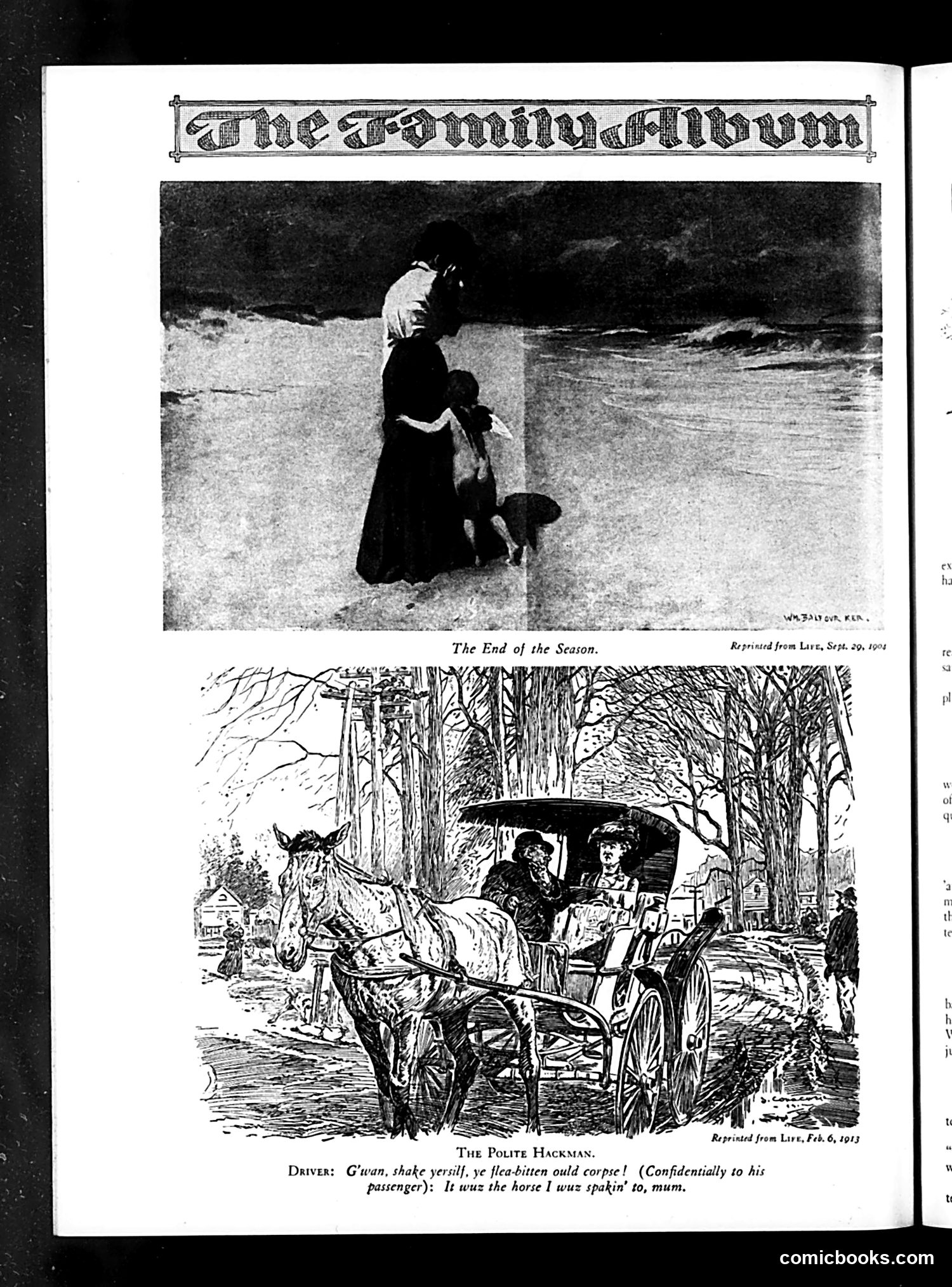
"The Polite Hackman" - Life Magazine Cartoon This 1913 cartoon satirizes Irish immigrant taxi drivers in New York City. The "hackman" (cab driver) has just insulted his horse harshly, calling it a "flea-bitten ould corpse," then apologizes to a female passenger, claiming he was addressing the horse, not her. The joke plays on Irish working-class stereotypes: the driver uses crude language and rough treatment of animals, yet attempts sudden politeness when aware of a refined passenger. The humor suggests this politeness is performative—a thin veneer over his naturally coarse manner. The exaggerated Irish dialect ("G'wan," "yersilf") reinforces the ethnic caricature typical of early 20th-century American humor.
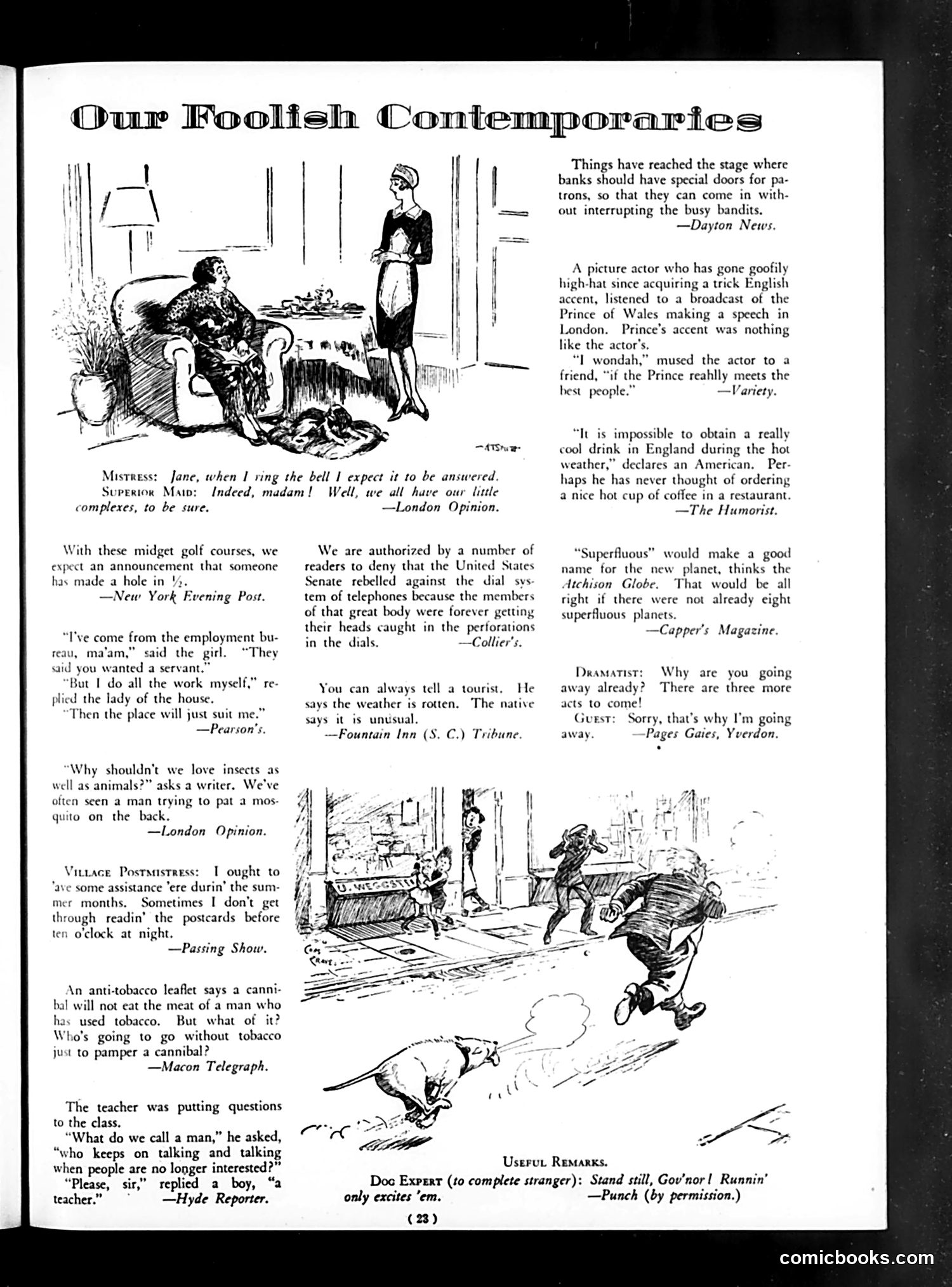
"Our Foolish Contemporaries" - Life Magazine Satire Page This page collects brief satirical items mocking contemporary follies and absurdities. Key targets include: Social pretension: A picture actor adopts an exaggerated English accent after minor success, then presumptuously judges the Prince of Wales's accent as inferior—mocking affected Americanization of British manners. Servant problems: A woman seeking household help finds a candidate willing to work for someone who "does all the work myself"—satirizing the post-WWI domestic service crisis and illogical hiring. Tourist stereotypes: Visitors complain weather is "rotten" while locals call it "unusual"—poking fun at American tourists abroad. Banking humor: A quip about banks needing separate entrances so patrons don't "interrupt the busy bandits"—dark satire on bank robberies or financial corruption of the era. The page represents *Life*'s signature format: reprinting witty one-liners from newspapers and magazines, often targeting class pretension, bureaucratic absurdity, and contemporary social anxieties through brief, punchy jokes.
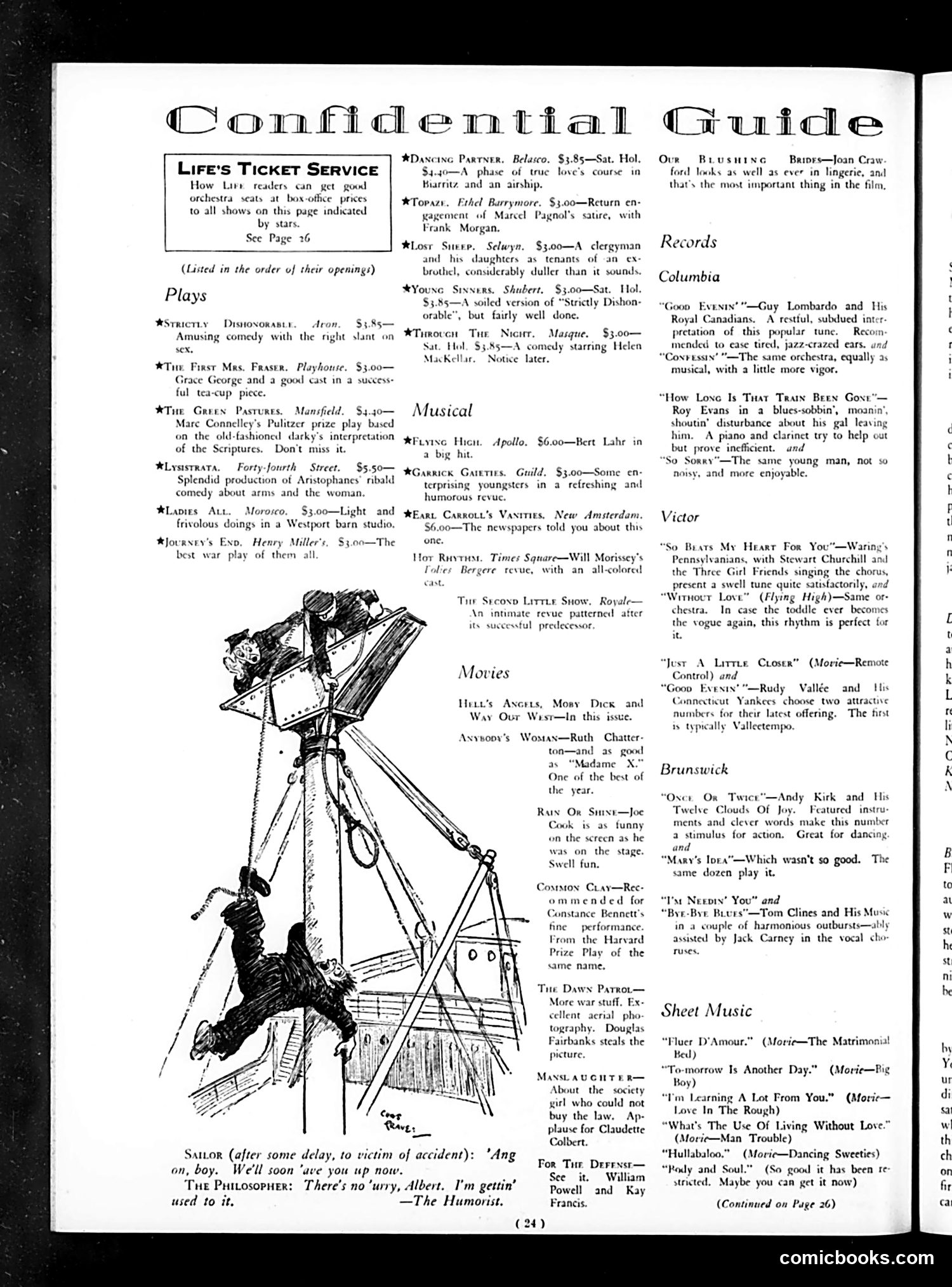
Explanation for Modern Readers This page is a entertainment guide and review section from Life magazine, not primarily satirical. It lists Broadway plays, movies, and musical recordings currently available, with brief critical assessments and ticket information. The cartoon shows a sailor injured in an accident being reassured by a philosopher character. The joke is a play on British working-class dialect: the sailor says "We'll soon ave you up now," and the philosopher replies "There's no 'urry, Albert. I'm gettin' used to it"—meaning he's becoming accustomed to lying there, a darkly humorous acceptance of his injury. The entertainment listings reflect 1920s-30s Broadway and popular music. Notable is the casual racial language in descriptions (e.g., "all-colored" revue), which reflects the era's acceptable vocabulary but would be considered offensive today. The reviews use period slang like "swell" and focus on performer names and plot snippets rather than modern critical analysis.
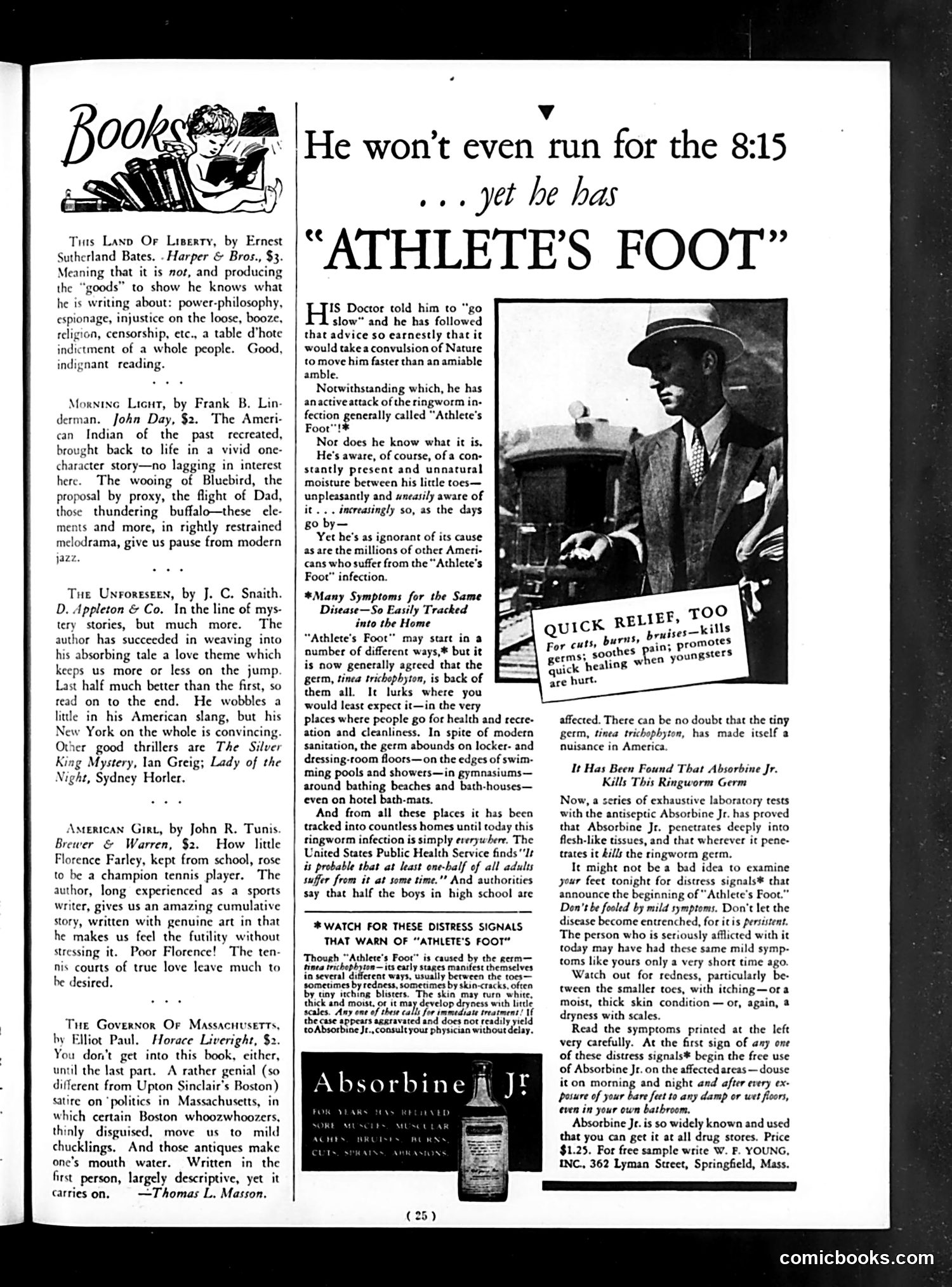
Analysis of Life Magazine Page This page is primarily a book review section with an embedded advertisement for Absorbine Jr., a patent medicine for athlete's foot. The advertisement uses humor and social commentary: it depicts a man too sedentary to "run for the 8:15" (catch a train), yet he's afflicted with athlete's foot—traditionally associated with athletes. The irony is the joke: despite his inactive lifestyle, he's contracted a fungal infection (tinea trichophyton) from public spaces like pools, gymnasiums, and hotel bathrooms. The ad educates readers about the widespread nature of the infection while promoting Absorbine Jr. as relief, claiming it "kills" bacteria and "promotes quick healing." The book reviews discuss contemporary fiction—titles about American Indians, mystery stories, and political satire on Massachusetts politics. The reviewing style is casual and witty, typical of *Life* magazine's sophisticated humor for educated, middle-class readers circa the 1920s-30s.
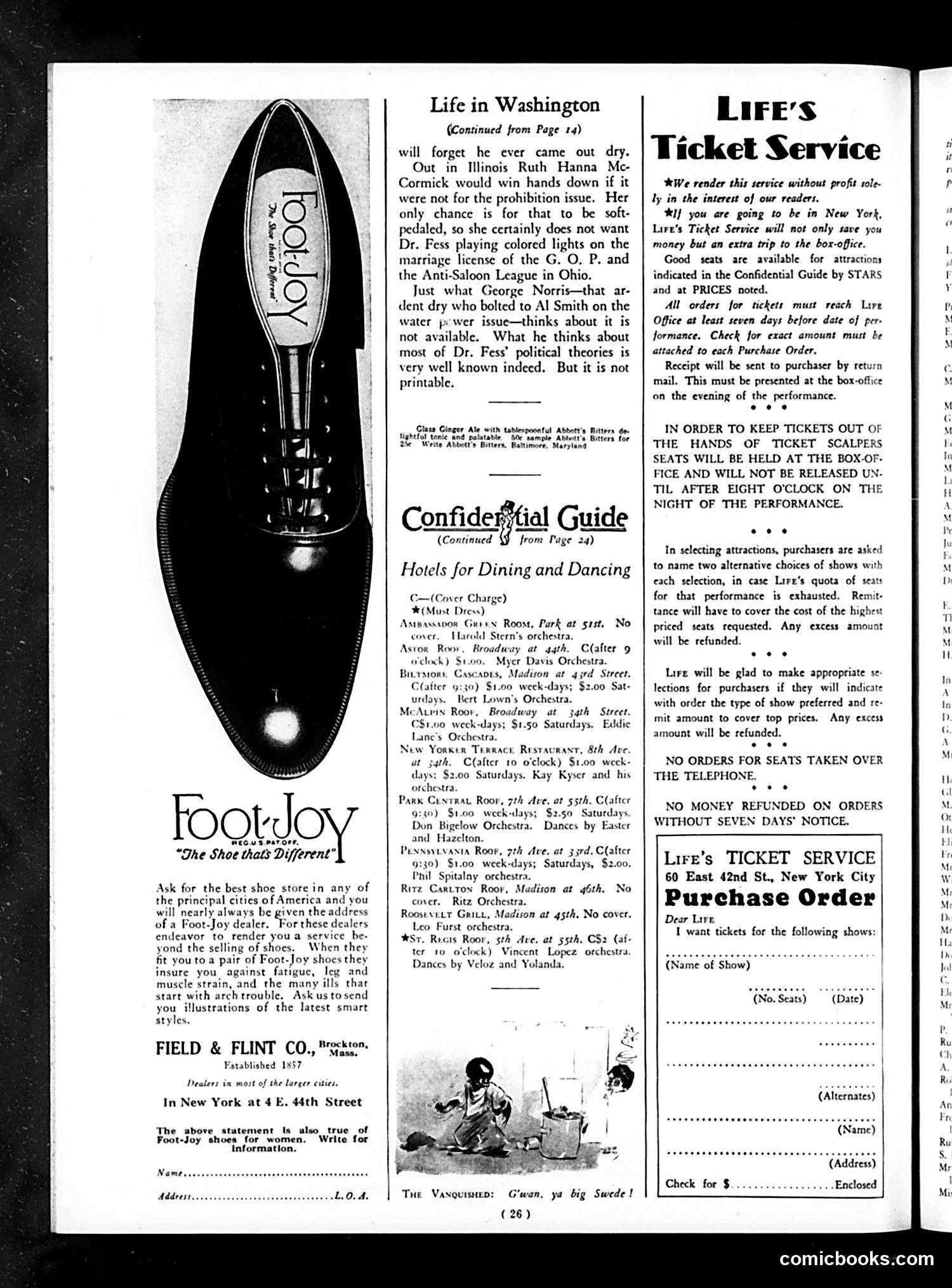
Analysis of This Life Magazine Page This page is primarily advertising and service content rather than editorial satire. The main elements are: 1. Foot-Joy Shoe Advertisement: A large shoe illustration promoting "The Shoe that's Different," emphasizing comfort and arch support—typical early 20th-century product marketing. 2. "Life in Washington" Column: A political gossip piece referencing Ruth Hanna McCormick (Republican candidate) and George Norris (Progressive senator), discussing how the Prohibition issue affects their political viability in Ohio. The column notes McCormick's chances depend on downplaying Prohibition, while Norris's views on the topic are "not printable"—indicating strong disagreement with Dr. Fess's political positions. 3. "Confidential Guide" & Life's Ticket Service: Restaurant and theater listings for New York City venues with cover charges and orchestra names, plus a mail-order ticket purchasing form. 4. Small Cartoon: A brief Scandinavian stereotype joke ("G'wan, ya big Swede!"). The page reflects 1920s-era concerns: Prohibition politics, entertainment venues, and consumer services.
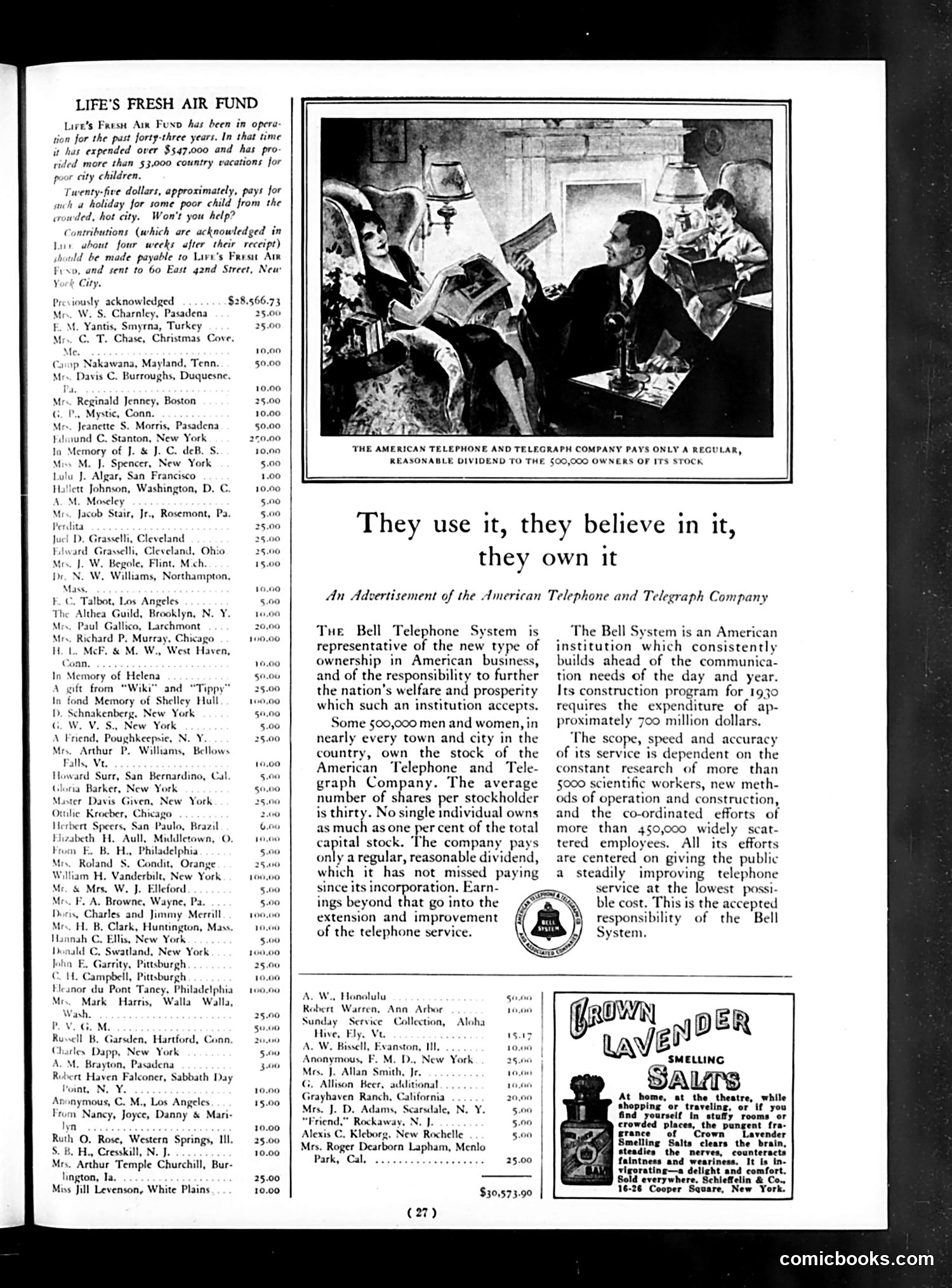
Analysis of Life Magazine Page This page contains Life's Fresh Air Fund donation list (left) and an AT&T advertisement (right). The Fresh Air Fund was Life magazine's charitable initiative providing poor urban children country vacations—a genuine Progressive Era social service addressing crowded city conditions. The AT&T ad, titled "They use it, they believe in it, they own it," promotes the telephone company as a model of democratic capitalism. It claims 500,000 Americans own AT&T stock with modest individual holdings (averaging 30 shares), ensuring no single person controls the company. The ad emphasizes that AT&T pays "reasonable" dividends while reinvesting profits into service expansion—positioning the corporation as serving public welfare rather than enriching few wealthy shareholders. This reflects early 20th-century corporate PR attempting to counter anti-monopoly sentiment by portraying widespread stock ownership as diffusing power. The ad's framing suggests telephone service as essential infrastructure deserving public trust. The page juxtaposes genuine charity with corporate image-making.
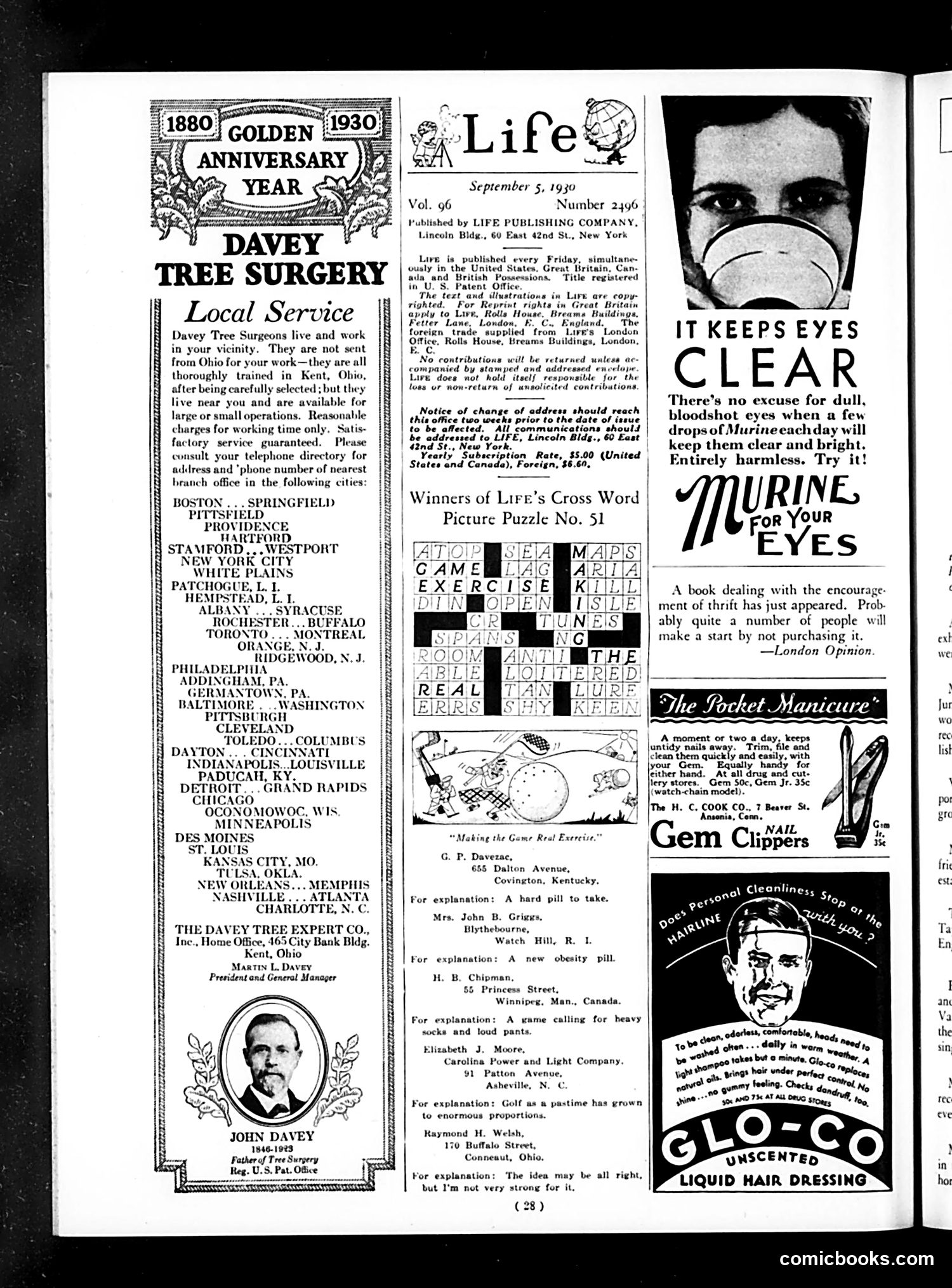
Life Magazine, September 5, 1930: Page Content Analysis This is primarily an advertising and service directory page rather than a satirical cartoon page. The main content includes: Left side: A Davey Tree Surgery advertisement celebrating their 50th anniversary (1880-1930), listing branch offices nationwide and featuring founder John Davey (1846-1923), credited as the "Father of Tree Surgery." Center: Crossword puzzle winners and explanations—appears to be humorous definitions rather than political satire. The puzzle solutions are playful wordplay (e.g., "hard pill to take," "new obesity pill"). Right side: Product advertisements including Murine eye drops, Gem Clippers, and Glo-Co hair dressing. No political cartoons are visible. The page is dominated by commercial advertising typical of 1930 Life magazine, interspersed with puzzle solutions. There is no satirical content requiring historical context to decipher.
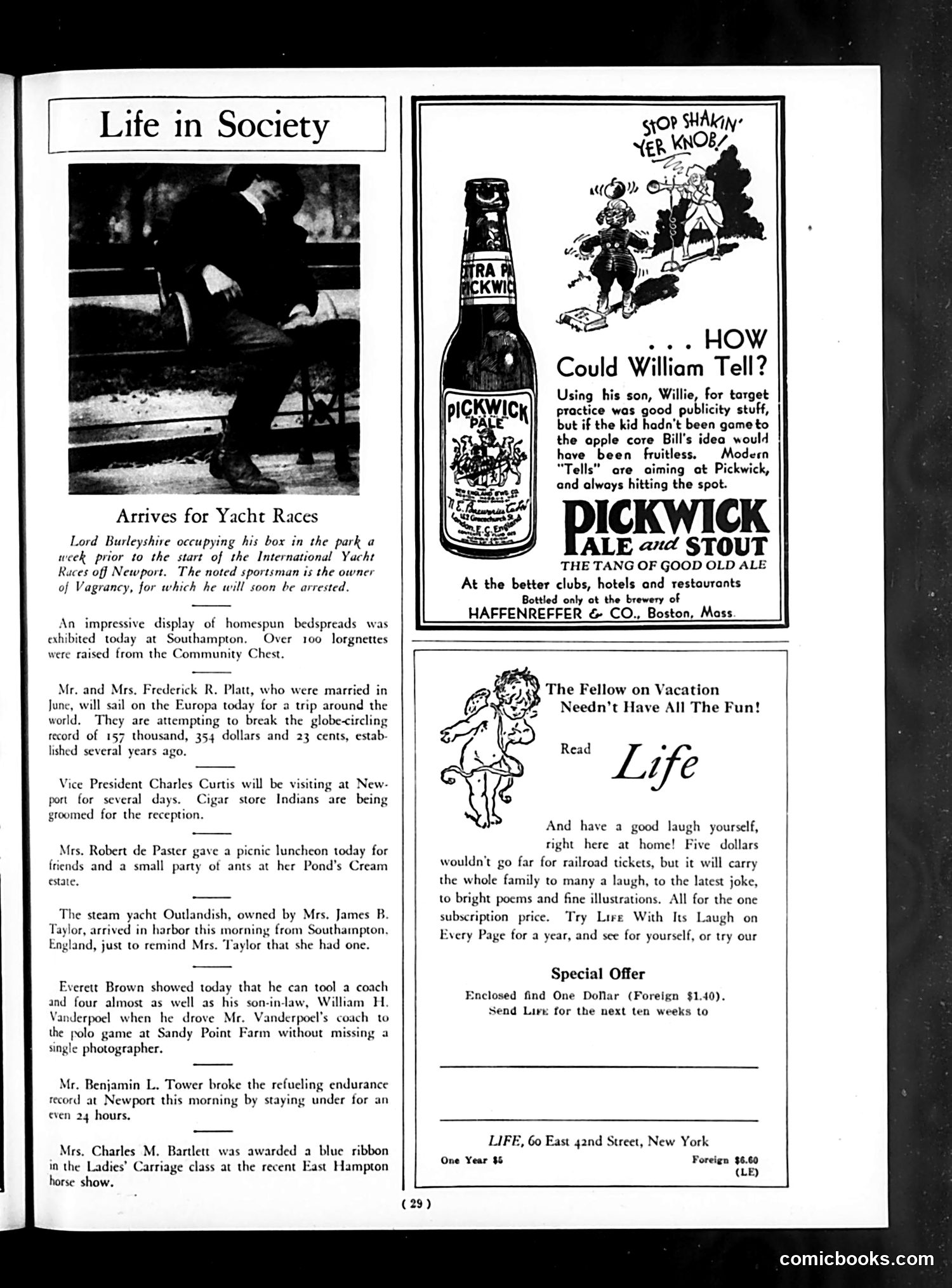
Life Magazine Page Analysis This page contains satirical society gossip and advertisements from an era when Life was a humor magazine (likely 1920s-30s). Main Cartoon: The "Could William Tell?" piece mocks modern advertising by comparing it to the William Tell legend. The joke: just as Tell's son had to be "game" (willing) for the apple-on-head stunt to work, modern advertisers (represented by "Pickwick" beer ads) rely on consumer cooperation to succeed. The reference to "Modern 'Tells' are aiming at Pickwick" suggests beer companies are targeting consumers as their "marks." Society Section: The brief gossip items mock wealthy Newport society through absurdist humor—Lord Burleyshire owns a yacht he'll be "arrested" for; a woman hosts ants at her estate; Vanderpools are so publicity-obsessed they never miss a photographer. These jabs at the leisure class's vanity and ostentation were typical Life satire. The page also advertises Life magazine itself, promoting it as home entertainment cheaper than actual vacation travel.
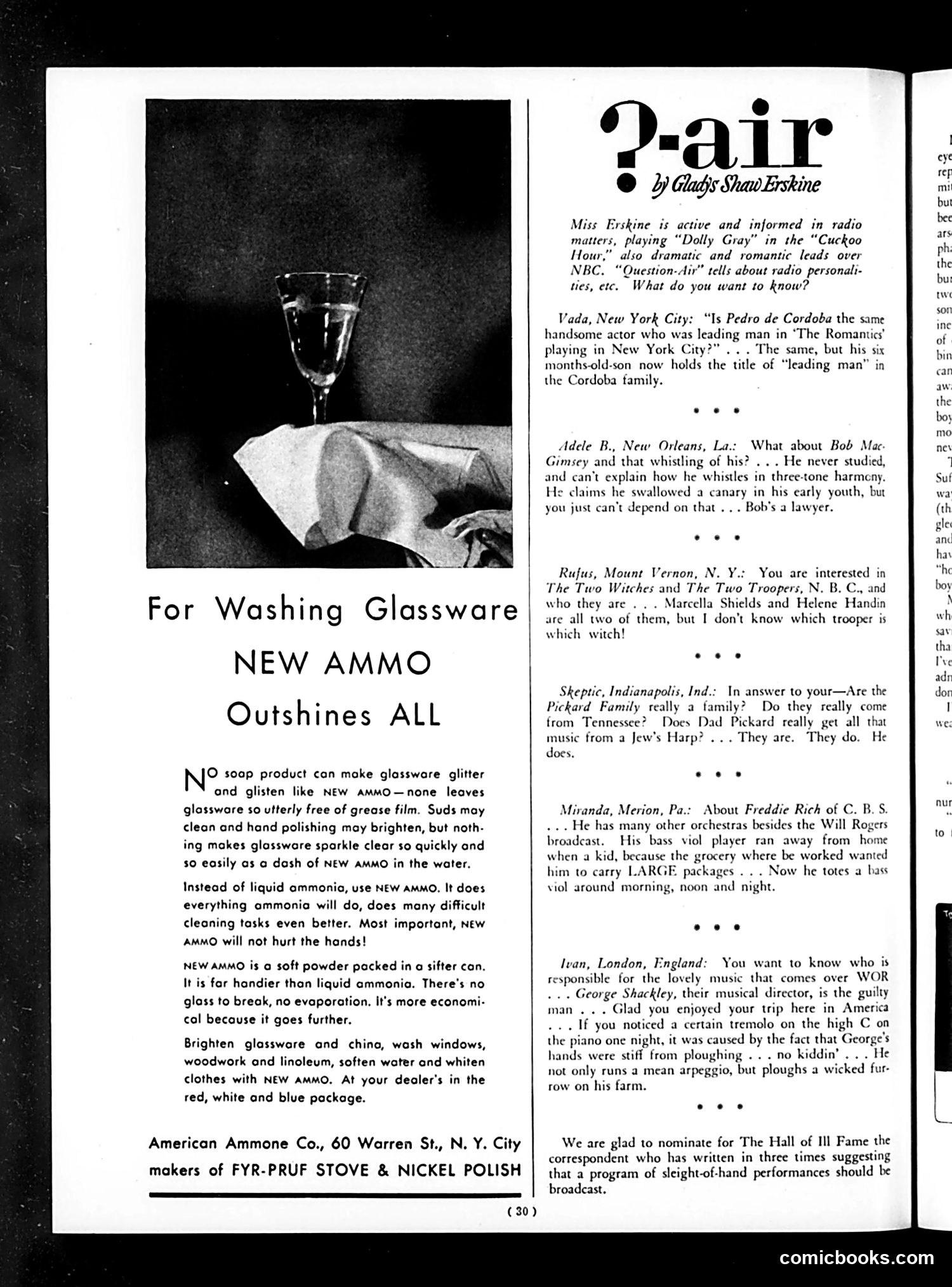
Page Content Analysis This page is primarily advertising and a radio advice column, not political satire. The left side features a product advertisement for "NEW AMMO," a powdered ammonia cleaning product made by American Ammonia Co. The image shows a hand holding a drinking glass, emphasizing the product's ability to make glassware sparkle without harming hands—a selling point distinguishing it from liquid ammonia. The right side contains "?-air" by Gladys Shaw Erskine, a radio gossip column answering listener questions about 1930s-40s radio personalities and NBC/CBS broadcast performers. Readers ask about actors like Pedro de Cordoba, musicians like Freddie Rich, and various radio show cast members. The column's humor is light—anecdotes like Bob MacGimsey supposedly swallowing a canary to whistle in harmony, or a musician's tremolo caused by stiff hands from ploughing. There is no political cartoon or satire on this page. It represents typical Life magazine content: advertising mixed with entertainment industry gossip for a general audience interested in radio broadcasting.
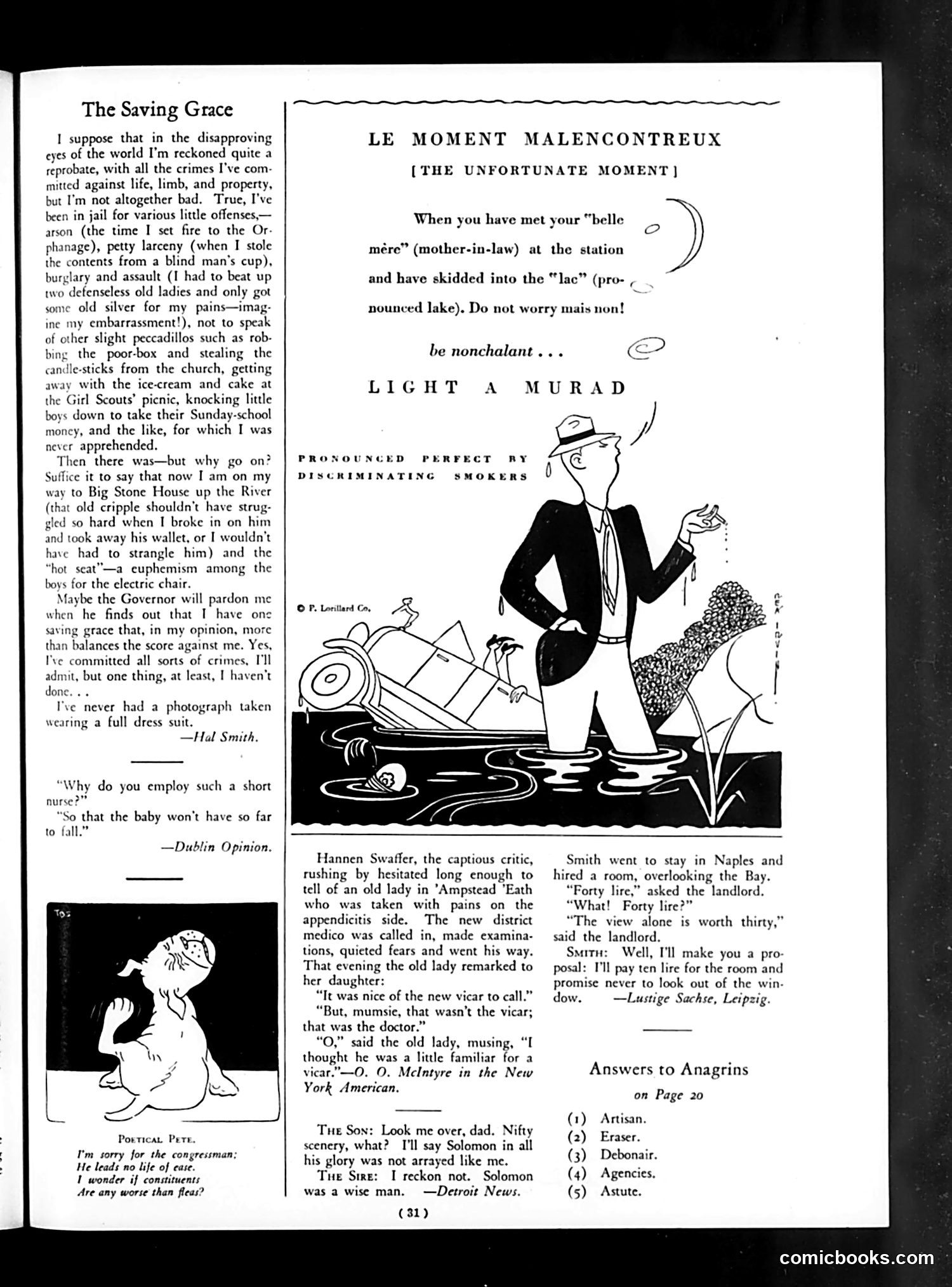
"Light a Murad" Advertisement & Period Humor This page mixes satirical fiction with advertising. The main visual element is an advertisement for Murad cigarettes, featuring a well-dressed man lighting a cigarette beside a lake—illustrating the headline's advice to "be nonchalant" after an awkward meeting with one's mother-in-law. The surrounding text includes humorous anecdotes: a confessed criminal's claim that he's never been photographed in formal dress as his "saving grace"; jokes about a short nurse and a doctor mistaken for a vicar; and a story about a traveler refusing to pay for a Naples room with a view. The "Answers to Anagrams" section at bottom references a word puzzle feature common to *Life* magazine. The satire targets vanity (formal portrait photography), social pretension, and the absurd logic of everyday life—all typical of *Life's* early 20th-century humor. The Murad ad itself subtly suggests that smoking projects sophistication during uncomfortable social moments.
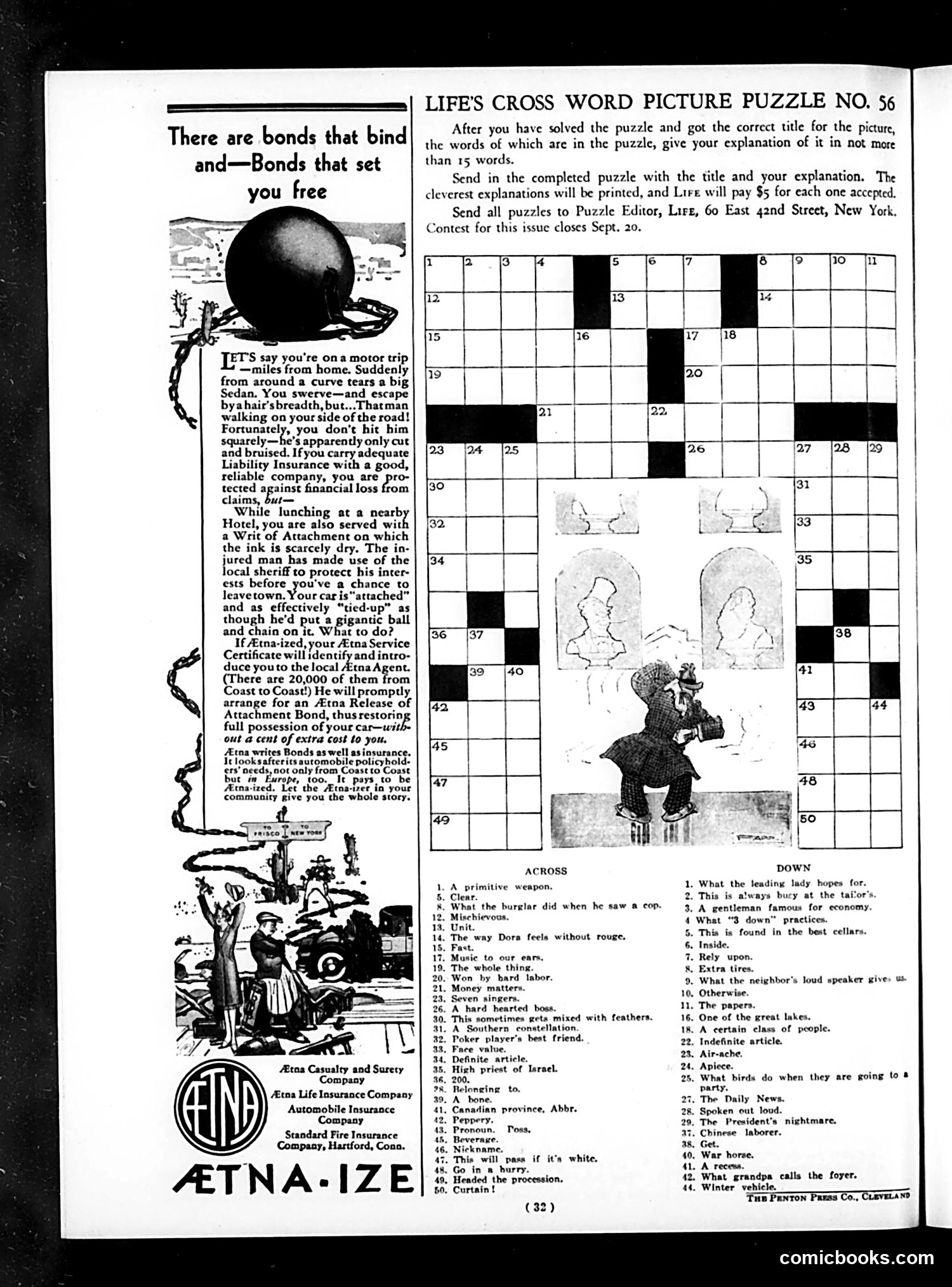
Life Magazine Page Analysis This page combines insurance advertising with a crossword puzzle contest. The left side presents an Aetna Insurance advertisement disguised as editorial content. It depicts a motor-trip scenario where a driver hits a pedestrian, then faces legal trouble when the injured man uses a "Writ of Attachment" to seize the car. The ad's message: Aetna's "Service Certificate" solves this problem by arranging a bond to release the attached vehicle—promoting Aetna's comprehensive insurance and bonding services. The phrase "Bonds that bind and set you free" is the central wordplay: legal bonds (liens) restrict you, but Aetna bonds liberate you from financial consequences. The right side features Life's crossword puzzle contest (No. 56), rewarding solvers $5 for the cleverest explanations. The puzzle incorporates illustrations related to its theme, typical of Life's interactive entertainment for readers. Both elements reflect 1920s-30s consumer culture: protecting middle-class motorists through insurance while engaging readers with puzzles—blending commerce with leisure.
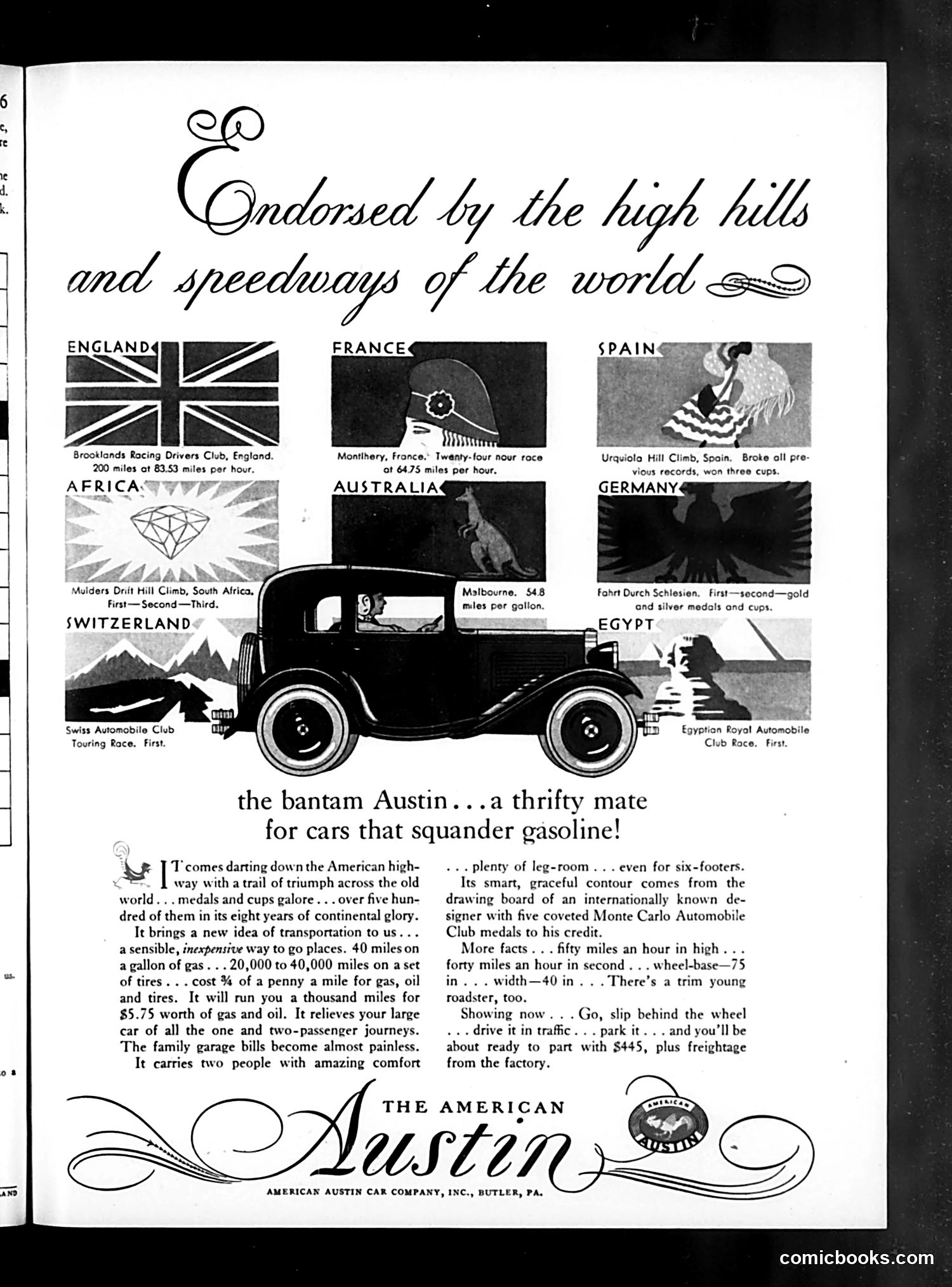
Analysis This is an advertisement for the American Austin automobile, not a political cartoon. The page uses a clever marketing strategy: it displays international racing achievements and records from various countries (England, France, Spain, Africa, Switzerland, Australia, Germany, Egypt) to establish the Austin's credibility and performance credentials globally. The appeal targets American consumers concerned about fuel economy during what appears to be an era of economic consciousness (likely the 1920s-30s, given the price point of $445). The tagline—"a thrifty mate for cars that squander gasoline"—directly contrasts the economical Austin with larger, fuel-inefficient American vehicles. The central illustration of the car surrounded by international flags and achievements serves to elevate a small, inexpensive vehicle by associating it with international prestige and engineering excellence. The copy emphasizes practical benefits: 40 miles per gallon, low operating costs, and adequate comfort. This is straightforward advertising designed to convince budget-conscious Americans that economy and quality need not be mutually exclusive.
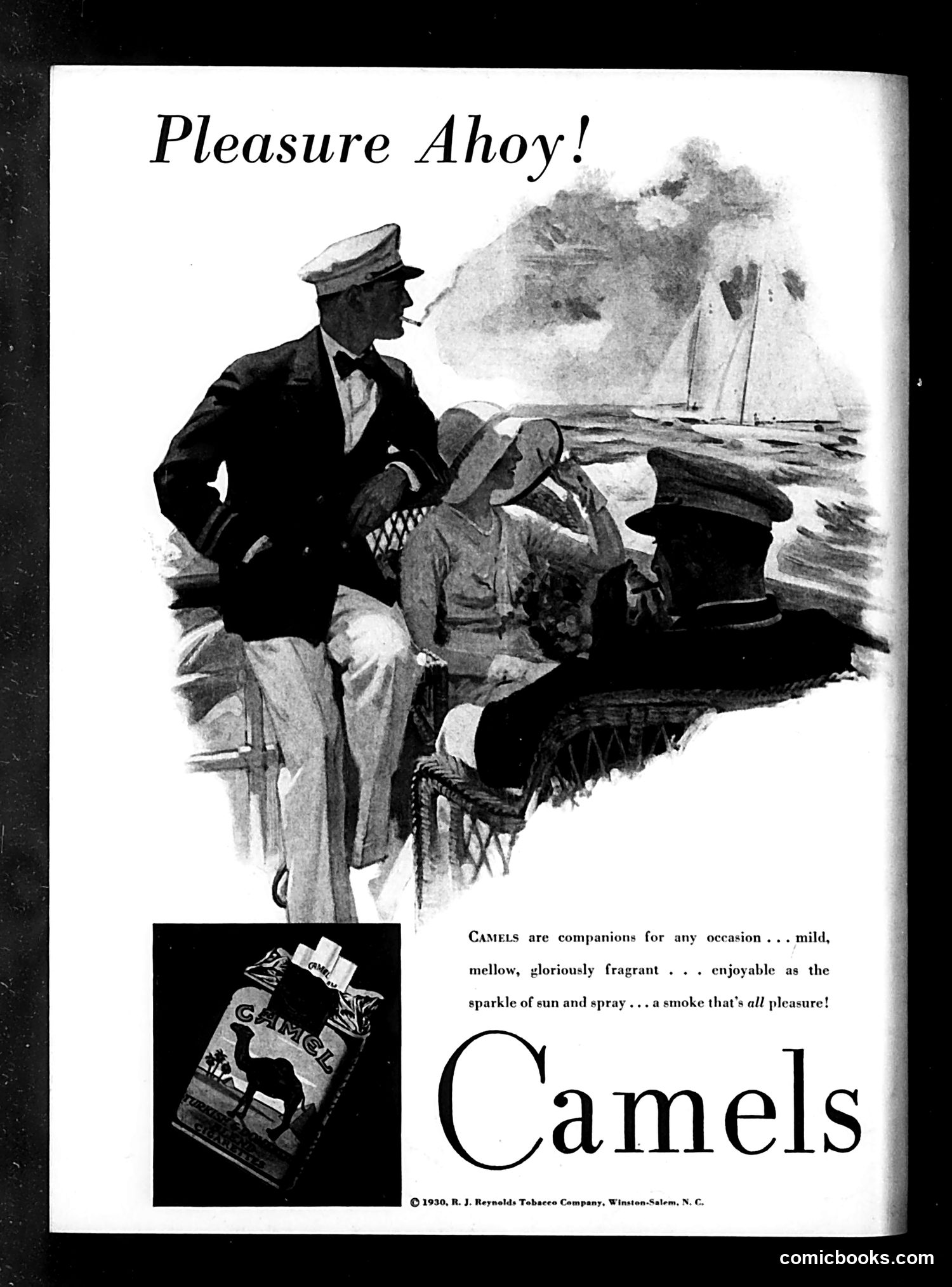
This is a 1930 cigarette advertisement for Camels, not political satire. The illustration shows a well-dressed naval officer and a woman in fashionable 1920s-30s attire enjoying leisure time by the seaside, with a sailboat visible in the background. The ad uses the romantic, carefree lifestyle imagery typical of tobacco advertising from this era—associating cigarettes with sophistication, pleasure, and social desirability. The tagline emphasizes Camels as "companions for any occasion," positioning smoking as an integral part of genteel leisure activities. This represents pre-health-warning advertising that openly promoted cigarettes without acknowledging health risks, a common practice before mid-century regulatory changes.

I can see this is a very dark, low-contrast image from what appears to be a historical publication, but I cannot reliably make out the specific cartoon(s), figures, or text content with sufficient clarity to accurately identify the political figures, social references, or satirical points being made. The image quality and contrast make it impossible for me to responsibly fulfill your request to explain the historical context and meaning of the content. To provide accurate analysis of a political cartoon's satire and references, I would need to clearly see the figures depicted and any accompanying captions or text. I'd recommend obtaining a higher-resolution or better-scanned version of this page for proper analysis.