life
Life — September 12, 1930
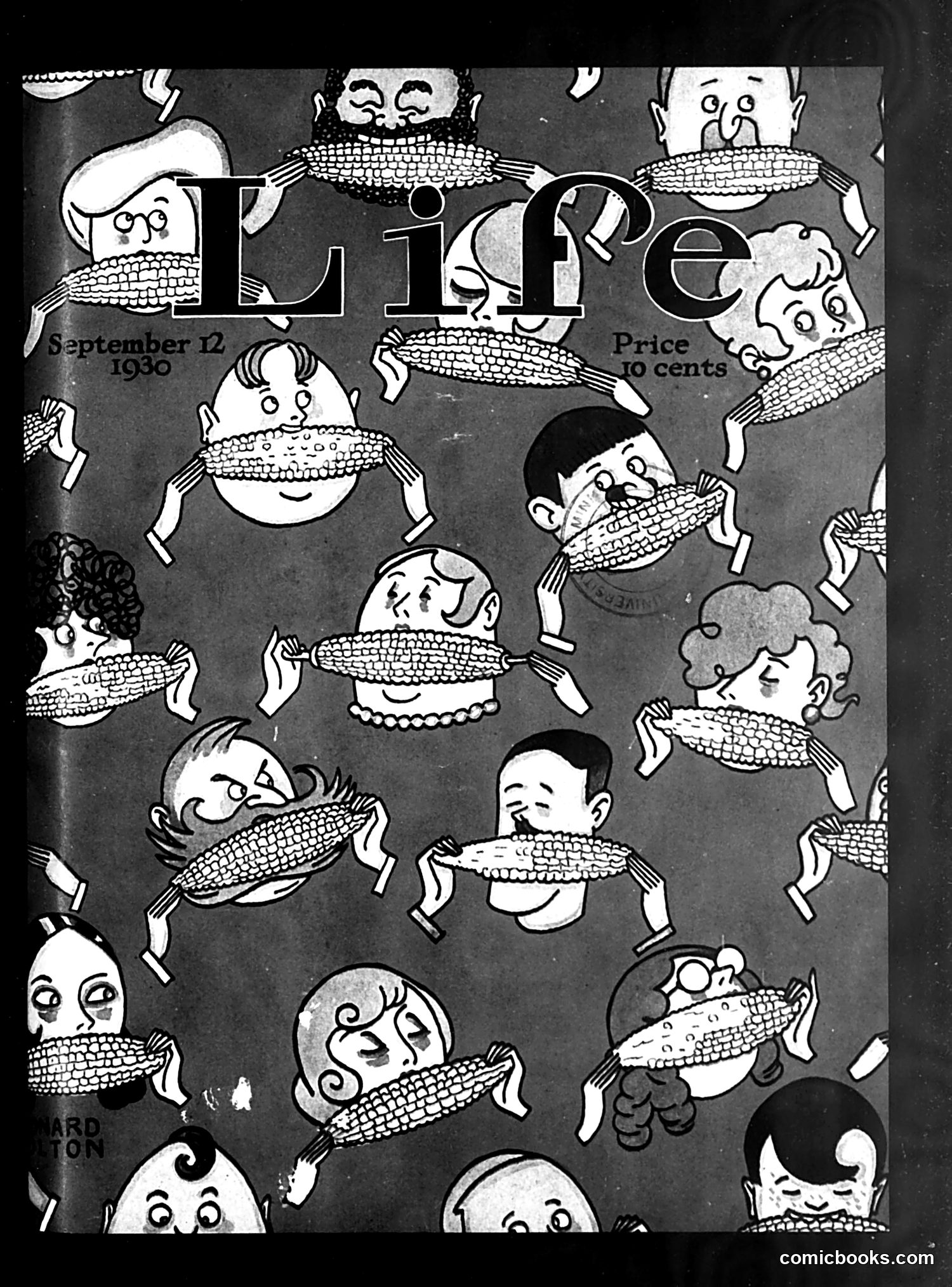
Life Magazine Cover, September 12, 1930 This is the cover of Life magazine from September 1930, priced at 10 cents. The dominant image shows multiple cartoon faces of different ethnicities and styles—male, female, young, old—all holding oversized ears of corn to their mouths as if eating or speaking. The satirical point appears to address corn consumption or corn-related issues during the Great Depression era. The diverse crowd likely comments on how corn affected Americans across demographic lines. The exaggerated mouths and corn-cob positioning suggests commentary on either agricultural abundance, food staples during economic hardship, or possibly political rhetoric about farming. The exact satirical target remains somewhat unclear without additional context from the magazine's interior.
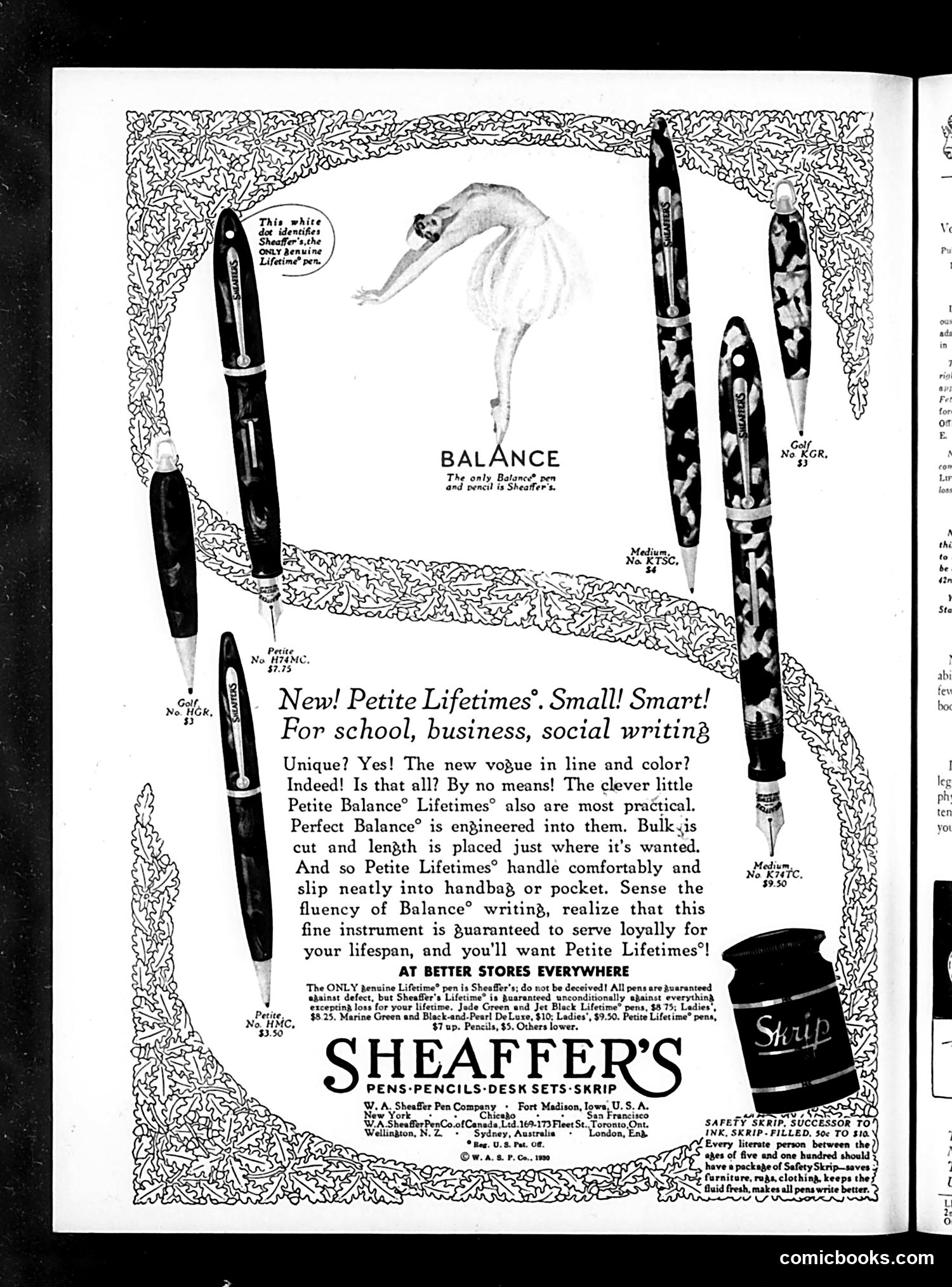
Analysis This page is primarily a commercial advertisement, not editorial content or satire. It promotes Sheaffer's "Petite Lifetimes" pens—smaller writing instruments marketed for "school, business, social writing." The central image shows a ballet dancer in an arabesque position, illustrating the concept of "Balance"—the advertisement's central selling point. The text emphasizes that these pens have "Perfect Balance" engineered into them, allowing comfortable writing and neat pocket/handbag storage. Multiple pen designs are displayed around the border with decorative leaf patterns. The ad targets consumers seeking practical, fashionable writing instruments, playing on the pen's reliability ("guaranteed to serve loyally for your lifespan") and style appeal. This represents typical early-20th-century advertising strategy: pairing consumer products with artistic imagery and lifestyle aspirations.
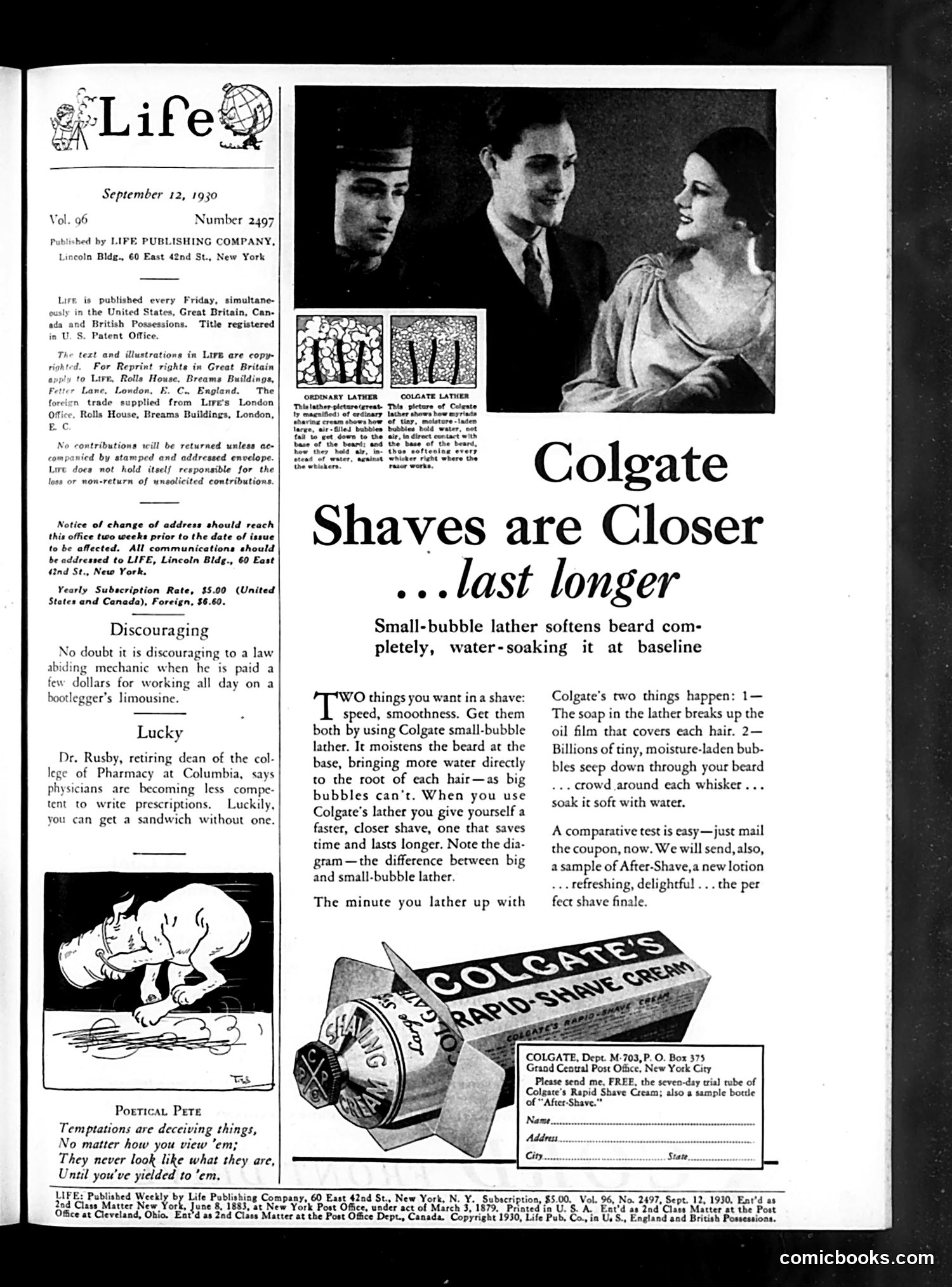
Analysis of Life Magazine, September 12, 1930 This page is primarily an advertisement for Colgate shaving cream, occupying most of the right side. The ad emphasizes that Colgate's small-bubble lather provides a closer, longer-lasting shave by better softening the beard. The left side contains three unrelated editorial pieces: 1. "Discouraging" - A brief joke about underpaid auto mechanics working on bootleggers' limousines during Prohibition. 2. "Lucky" - A quip about Dr. Ruby, retiring dean of pharmacy at Columbia, noting fewer physicians prescribe medicines since people can obtain sandwiches without prescriptions. 3. "Poetical Pete" - A cartoon poem about temptation's deceptive nature. The accompanying illustration shows a sleeping pig—the satire's subject is unclear from the image alone. The page demonstrates Life's mix of advertising, short humor, and social commentary typical of early 1930s magazines.
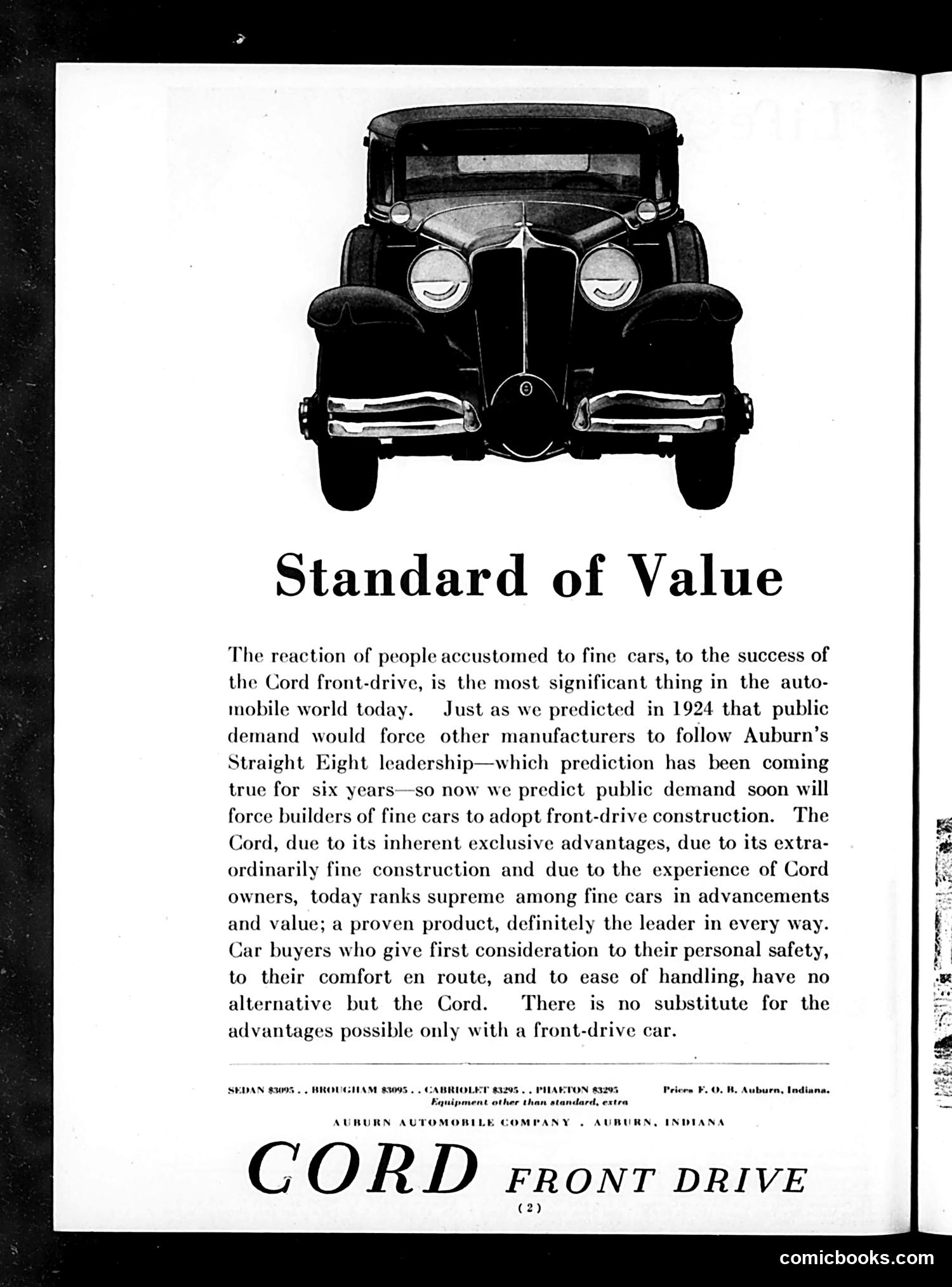
Analysis This is not a satirical cartoon page but rather a vintage automobile advertisement for the Cord automobile, circa 1930 (based on the styling and reference to Auburn's "six years" of front-drive leadership since 1924). The page shows a front-facing illustration of a Cord vehicle and contains marketing text claiming the Cord's front-wheel-drive design represents a "Standard of Value" among luxury cars. The ad argues that other fine car manufacturers will be forced to adopt this technology due to public demand and the Cord's proven advantages in safety, comfort, and handling. This appears in *Life* magazine as a paid advertisement promoting the Auburn Automobile Company's Cord brand, not as editorial satire or comics content.
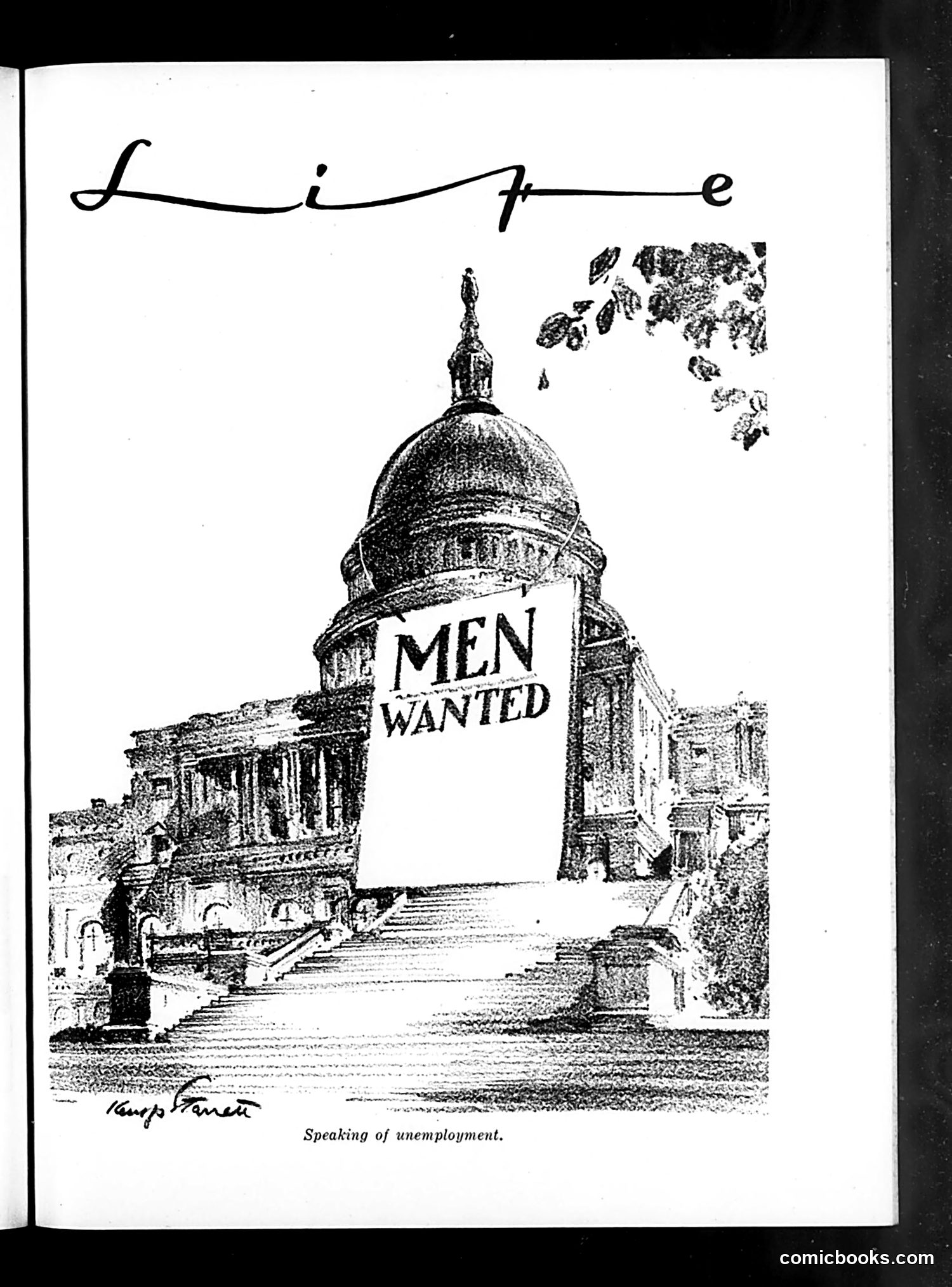
Cartoon Analysis: "Speaking of unemployment" This political cartoon uses stark irony to critique unemployment. The U.S. Capitol building—the seat of government responsible for economic policy—displays a large "MEN WANTED" sign. The juxtaposition is pointed: the government itself is advertising for workers while presiding over widespread joblessness. The caption "Speaking of unemployment" confirms the satirical intent. By showing the Capitol as if it were any commercial establishment posting hiring notices, the cartoonist mocks the government's apparent indifference to or inability to address the unemployment crisis affecting ordinary citizens. The artist's signature appears lower left. This cartoon likely dates from an economic downturn period when joblessness was a pressing public concern, and government intervention (or lack thereof) was heavily criticized.
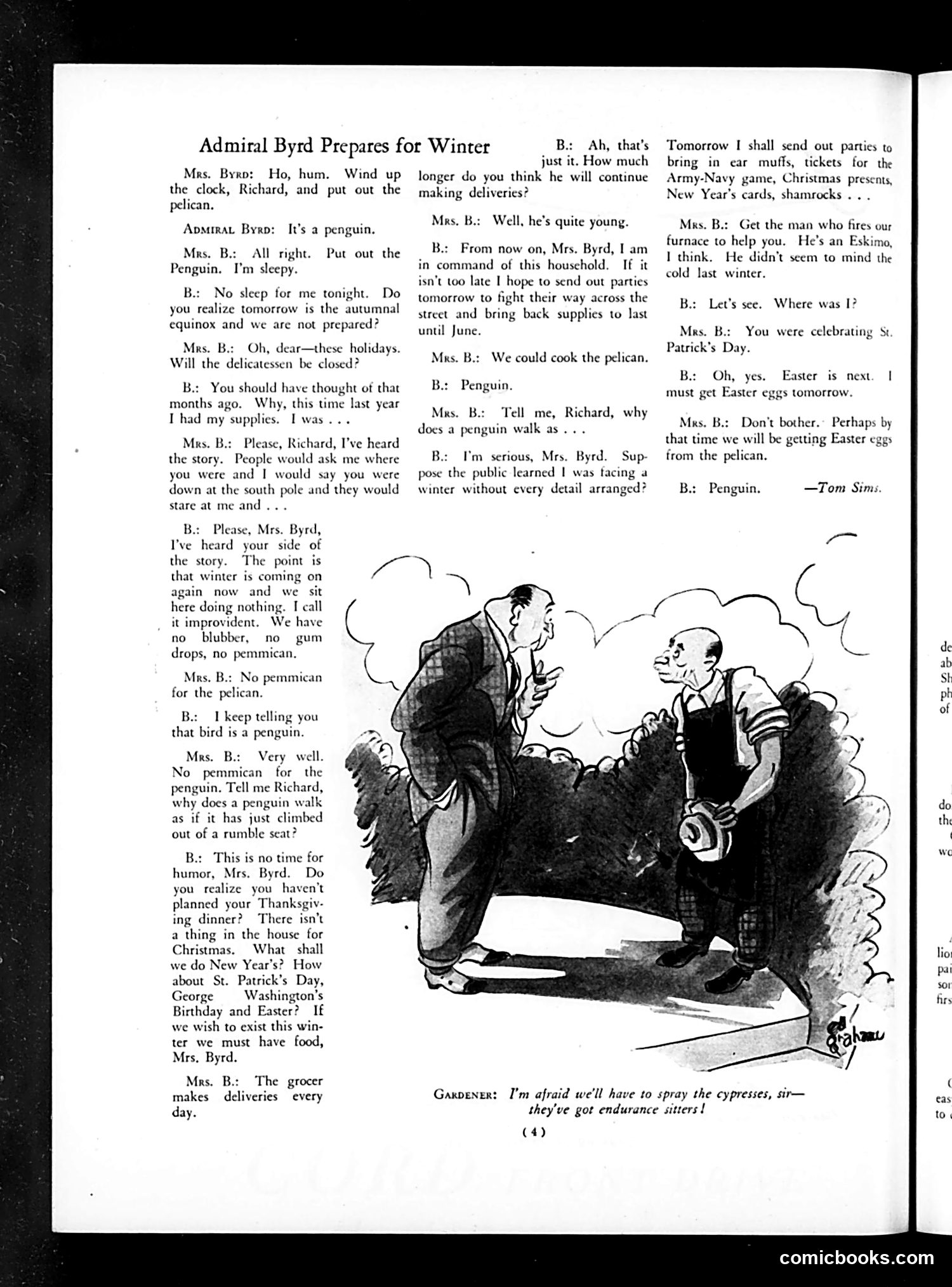
"Admiral Byrd Prepares for Winter" This is a humorous domestic sketch between Mrs. B. and Admiral Byrd (likely Richard E. Byrd, the famous polar explorer). The joke hinges on Byrd's preparations for Antarctic winter expeditions being absurdly applied to preparing his household for winter at home. Mrs. B. repeatedly mistakes his references to penguin supplies and expedition logistics as household planning failures. The cartoon illustrates the clash between his polar explorer mindset and ordinary domestic life—he's mentally focused on Antarctic conditions while his wife desperately needs him to handle Christmas, Thanksgiving, groceries, and heating fuel. The accompanying cartoon shows a gardener warning about "endurance itters" (jitters), likely depicting stress from wartime or economic anxiety.
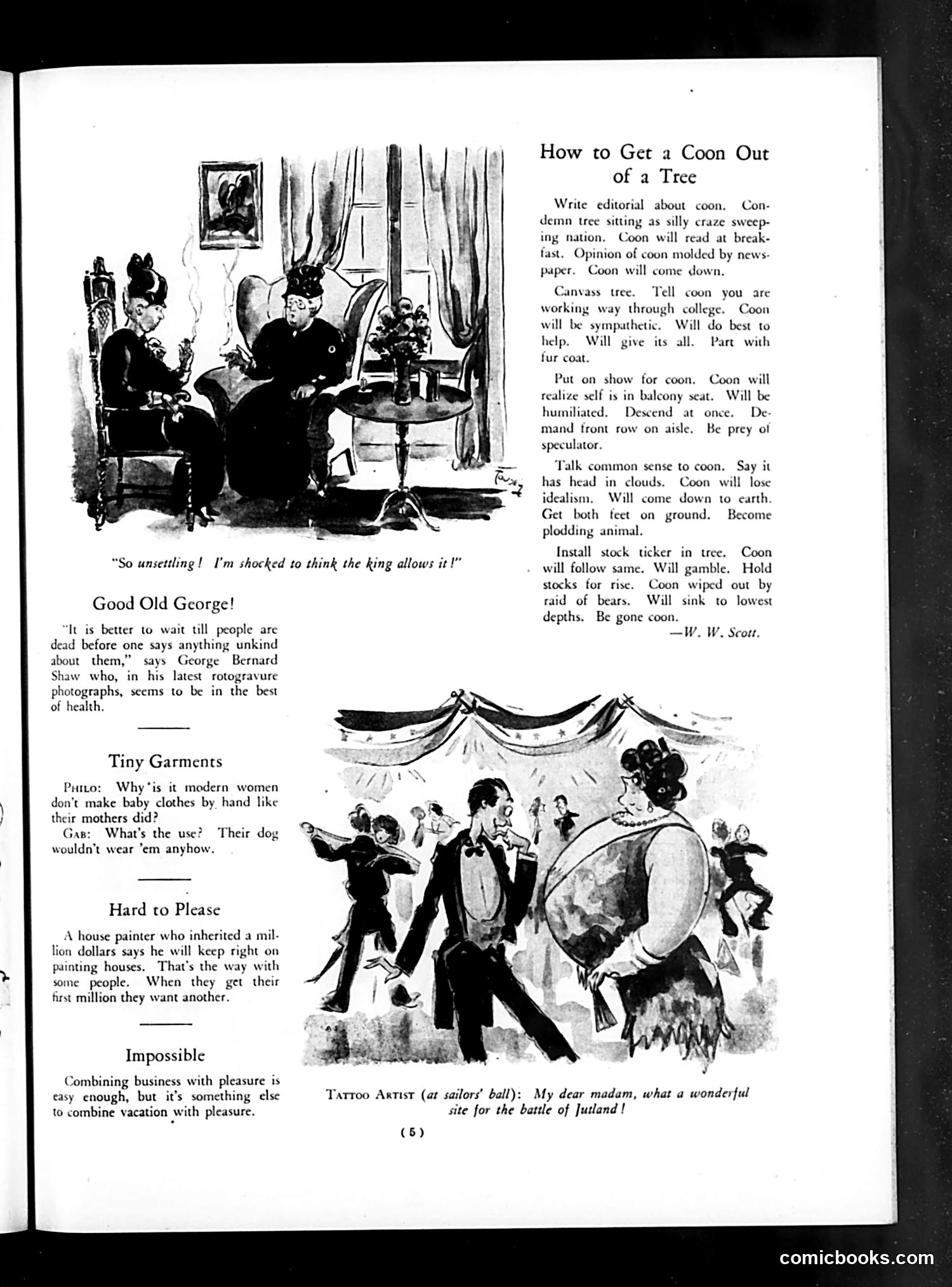
Analysis of Life Magazine Page This page contains several brief satirical pieces and two cartoon illustrations. The main content includes: 1. "How to Get a Coon Out of a Tree" — A humorous editorial by W.W. Scott offering absurd suggestions to remove a raccoon from a tree (write editorials condemning it, canvas neighbors, put on a show, etc.). The satire mocks excessive public opinion and social pressure. 2. "Good Old George!" — A brief item about George Bernard Shaw appearing healthy in recent photographs. 3. Lower cartoon — Shows a "Tattoo Artist (at sailors' ball)" admiring a woman's large posterior, calling it "a wonderful site for the battle of Jutland." This appears to reference WWI's naval Battle of Jutland while making crude humor about the woman's body. The page demonstrates Life's characteristic mix of social satire and ribald humor.
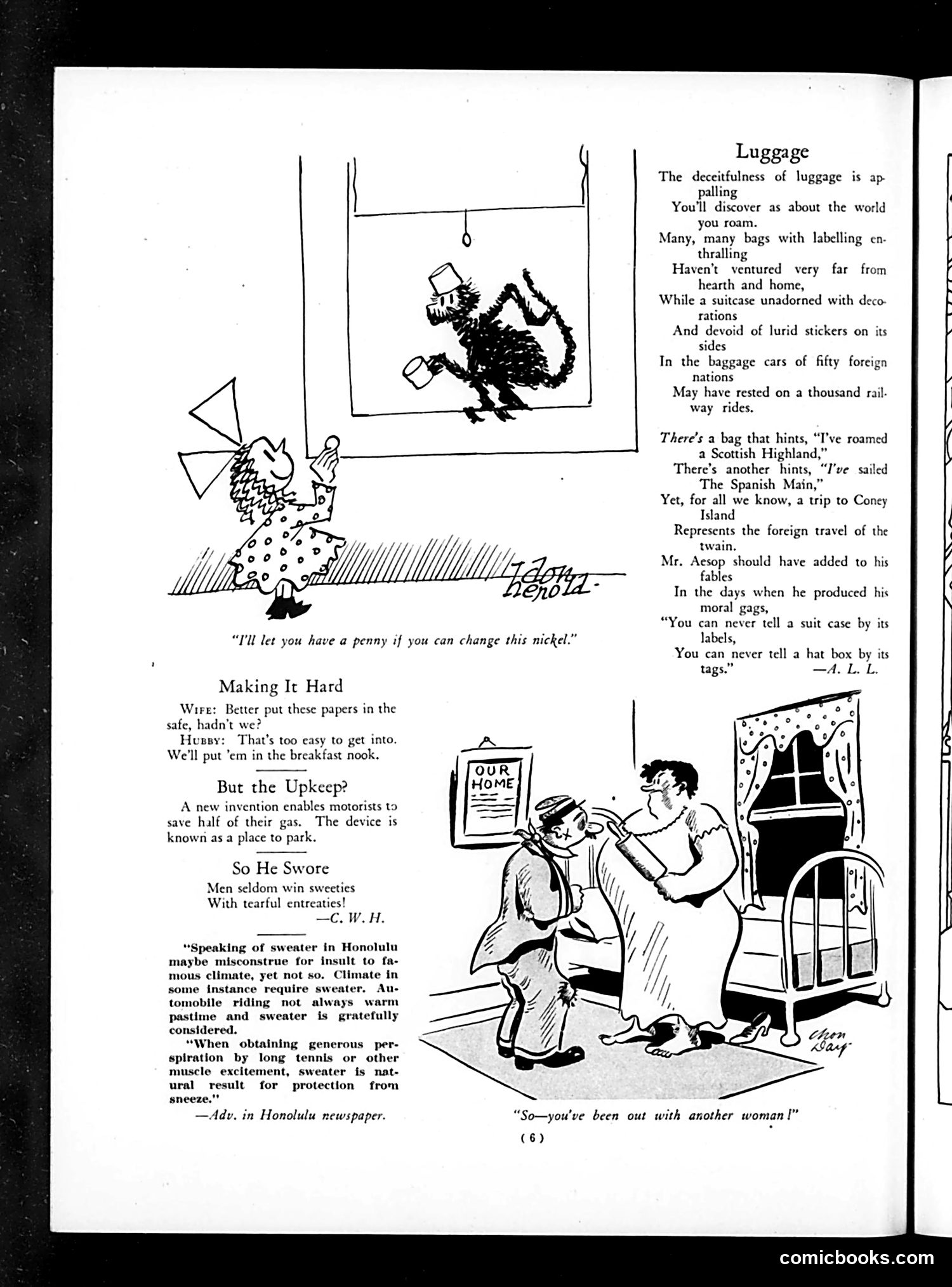
This page contains three separate satirical pieces: 1. "Luggage" (top right): A poem mocking travelers' pretentious luggage covered with travel stickers from exotic locations, suggesting people buy decorated suitcases to appear well-traveled rather than actually traveling. 2. "Making It Hard" (middle): A brief joke about motorists hiding gas rationing papers in inconvenient places (like the breakfast nook) to make theft harder during what appears to be a wartime or scarcity period. 3. "So He Swore" (bottom): A cartoon depicting a domestic argument where a man appears caught with another woman, with his wife confronting him. The humor derives from the juxtaposition of the quotation marks suggesting he's swearing oaths of innocence—a commentary on infidelity and marital dishonesty. All pieces reflect early-to-mid 20th-century American domestic and social anxieties.
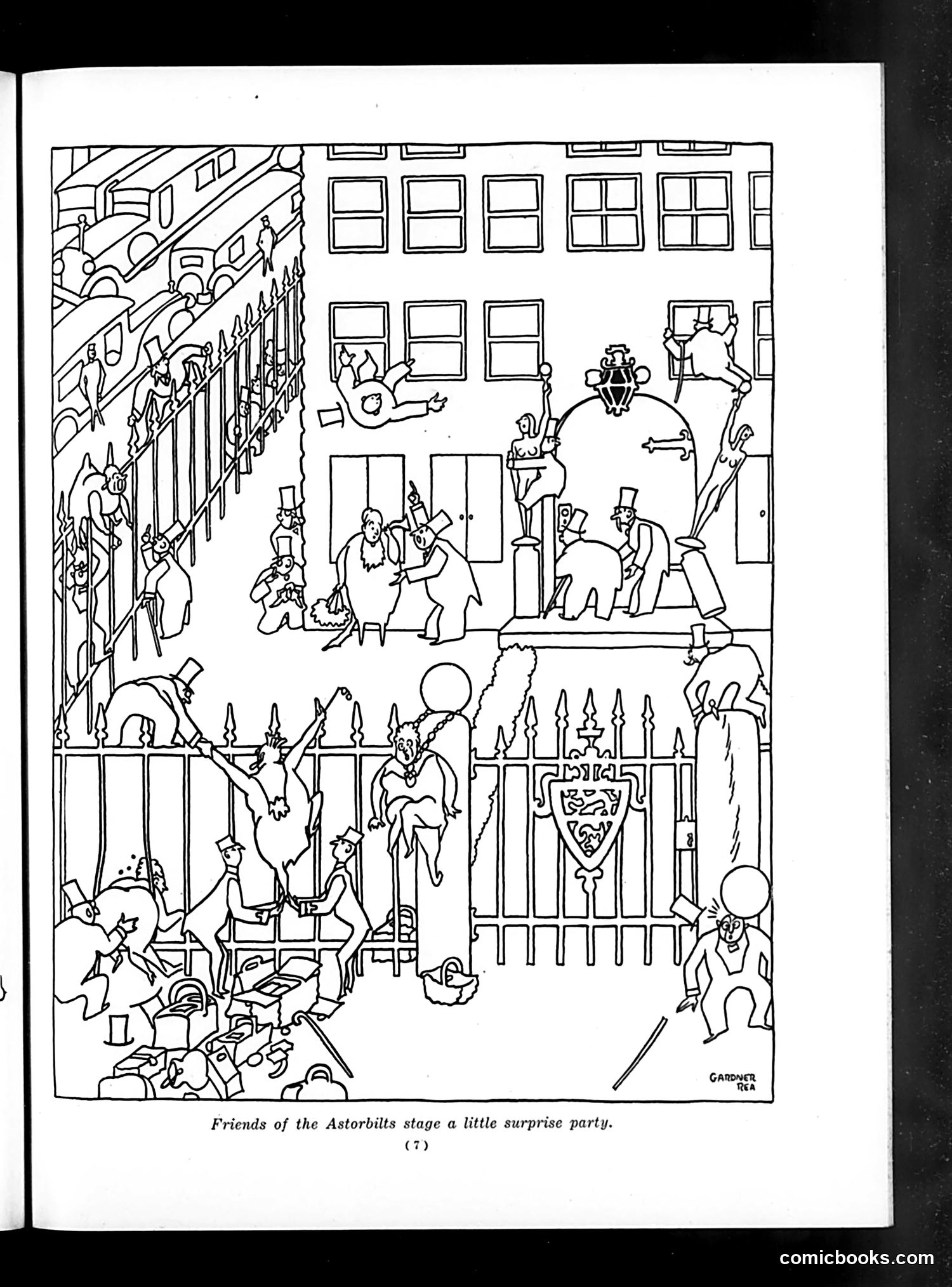
Analysis of "Friends of the Astorbilts Stage a Little Surprise Party" This single-panel cartoon depicts an elaborate outdoor party in front of a large building, with multiple levels of activity. The title references the "Astorbilts"—an apparent satirical reference to the wealthy Astor family, prominent American socialites and industrialists. The humor appears to target extravagant upper-class entertaining: the scene shows elaborate decorations, performers, musicians on a stage, and numerous guests in formal attire engaged in conspicuous consumption and revelry. The comic critique likely mocks the ostentatious nature of Gilded Age wealth and the frivolous pastimes of the ultra-wealthy. The signature reads "GARDNER '12" (or similar), suggesting this cartoon dates to approximately 1912. The satire typical of *Life* magazine during this era often lampooned nouveau riche excess.
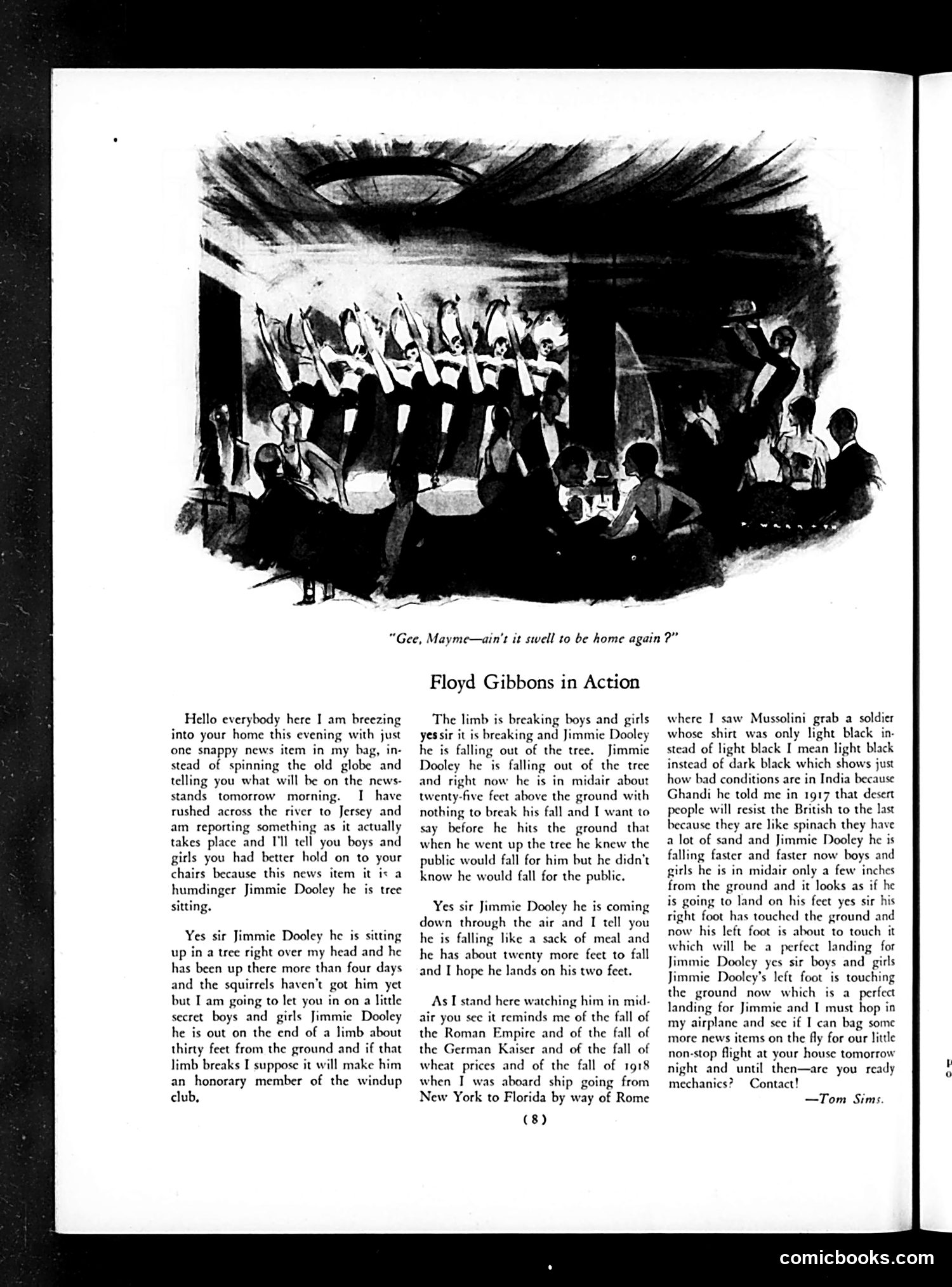
Floyd Gibbons in Action This page satirizes Floyd Gibbons, a famous war correspondent known for dramatic radio broadcasts. The cartoon depicts him broadcasting from what appears to be a nightclub or social venue, describing a child (Jimmie Dooley) falling from a tree in exaggerated, breathless language—comparing it to historical catastrophes like the fall of Rome and the German Kaiser. The satire mocks Gibbons's sensationalist style: he transforms a mundane domestic incident into epic tragedy. The text's breathless tone ("Yes sir Jimmie Dooley he is coming down through the air...") parodies his characteristic rapid-fire delivery and tendency toward overblown drama. The joke is that Gibbons treats minor news with the gravity of major historical events, satirizing both his broadcasting persona and 1920s media sensationalism.
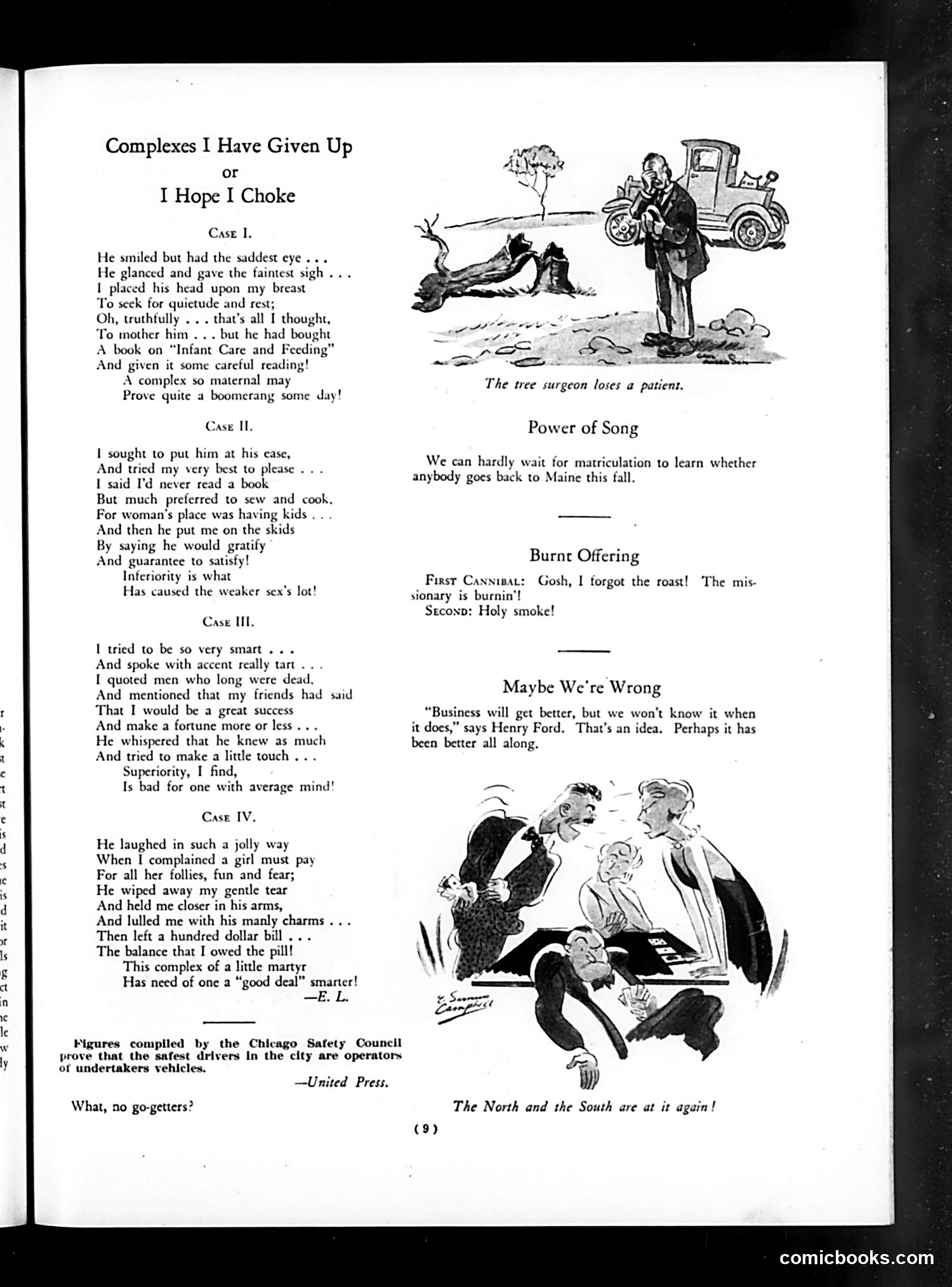
Analysis of Life Magazine Page This page satirizes gender roles and relationship dynamics of the early 20th century through four poetic "cases" about male-female complexes. The main cartoon ("The tree surgeon loses a patient") shows a man lying beneath a fallen tree while another man stands nearby with a car—likely mocking a husband's incompetence or bad luck, positioned against an image of male professional success. The four poems humorously describe men's anxieties: Case I involves infant care books backfiring; Case II shows a man's discomfort with domestic expectations; Case III satirizes intellectual pretension; Case IV depicts emotional manipulation in relationships. The humor targets masculine insecurity and changing social expectations as women gained education and independence. The page mocks both men's resistance to women's autonomy and their emotional manipulation when threatened.
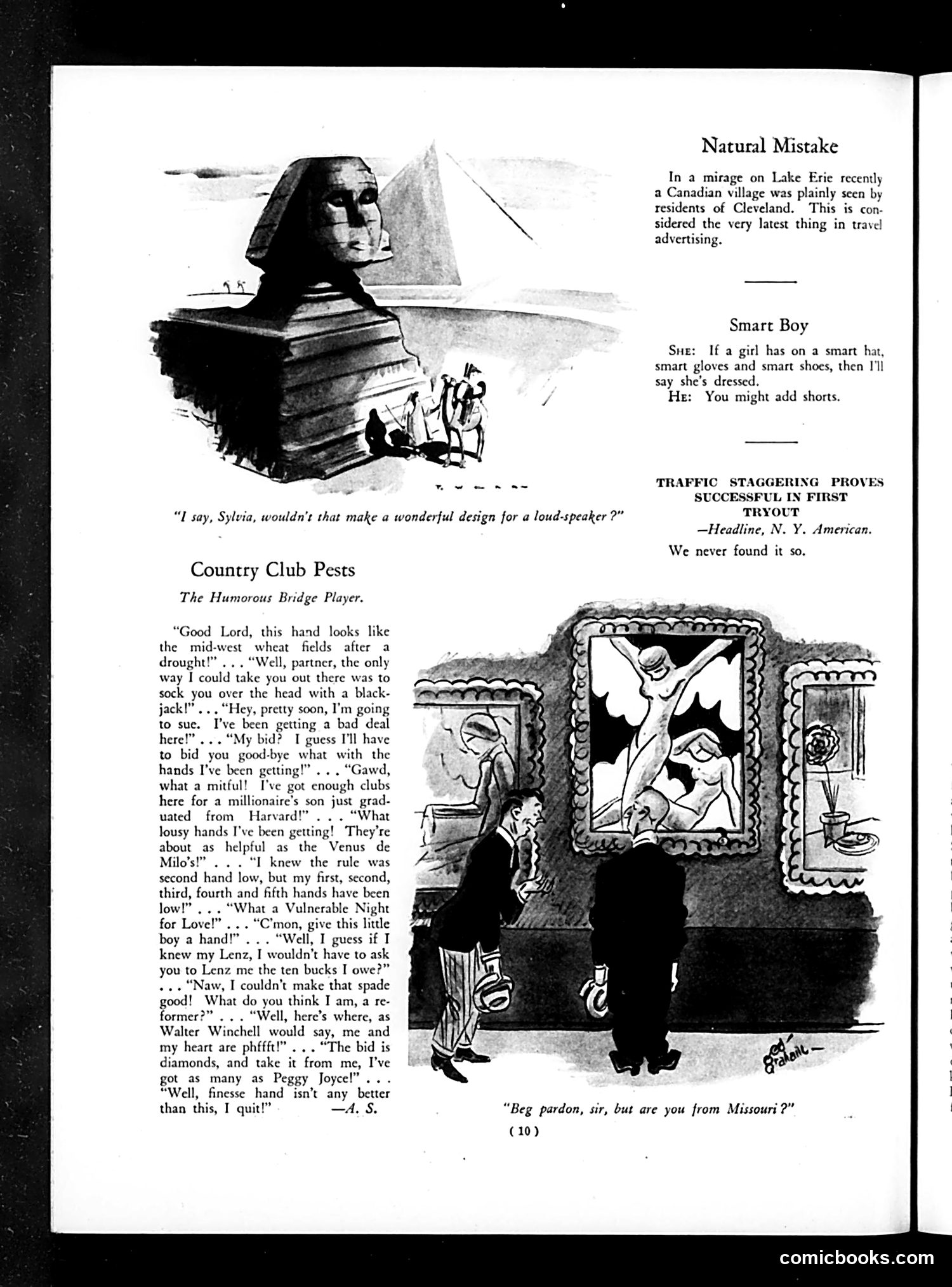
Page 10 Analysis: Life Magazine Humor This page contains three brief humorous items typical of Life's satirical content: 1. "Natural Mistake": A joke about a mirage on Lake Erie showing a Canadian village to Cleveland residents—mocking travel advertising claims. 2. "Smart Boy": A brief dialogue joke where a girl lists fashionable accessories, and a boy suggests adding "shorts," implying she's underdressed. 3. "Country Club Pests": The main feature, titled "The Humorous Bridge Player," presents a long monologue of a stereotypical wealthy, name-dropping bridge player. The character boasts about Harvard connections, romantic conquests, and financial status while playing cards—satirizing upper-class pretension and poor sportsmanship at country clubs. 4. Bottom cartoon: Shows a man asking another "Beg pardon, sir, but are you from Missouri?"—likely referencing the "Show-Me State" stereotype about skepticism or rusticity.
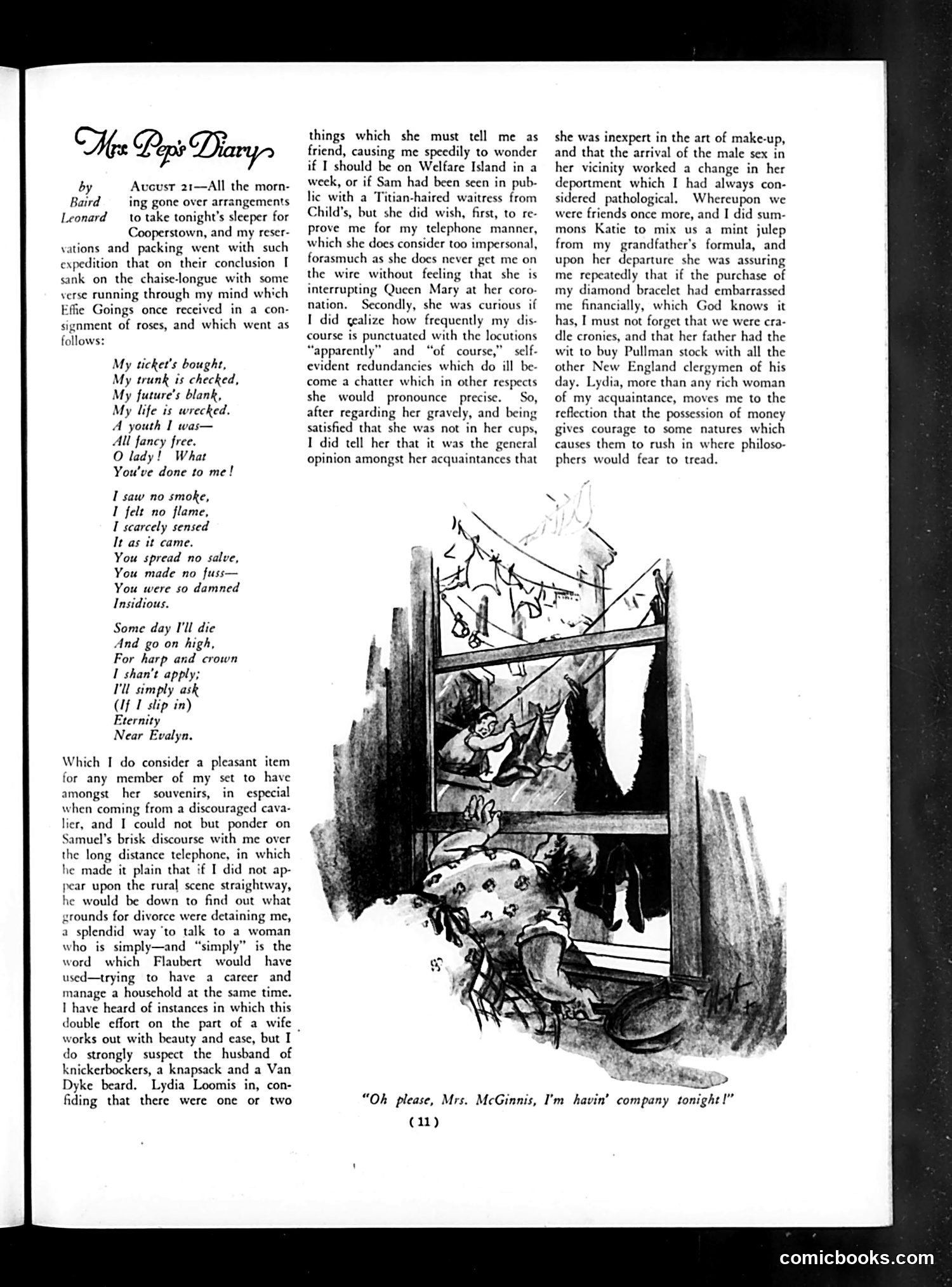
Analysis of "Mrs. Pep's Diary" Page This page from *Life* magazine presents a satirical diary entry by "Baird Leonard" dated August 21, accompanied by a humorous illustration. The cartoon depicts a domestic scene where a woman (Mrs. McGinnis) appears at a window or door, announcing she's "havin' company tonight" to someone inside. The illustration satirizes working-class domestic life and the disruptions that unexpected social obligations create. The diary text above critiques women's dual roles—managing households while navigating social expectations and financial concerns (referencing a diamond bracelet and Pullman stock). The satirical verses mock societal hypocrisy about women's ambitions and proper behavior. The overall satire targets early 20th-century gender dynamics: the tension between women's domestic duties, social pretensions, and economic vulnerability in an era when women had limited independent financial or social agency.
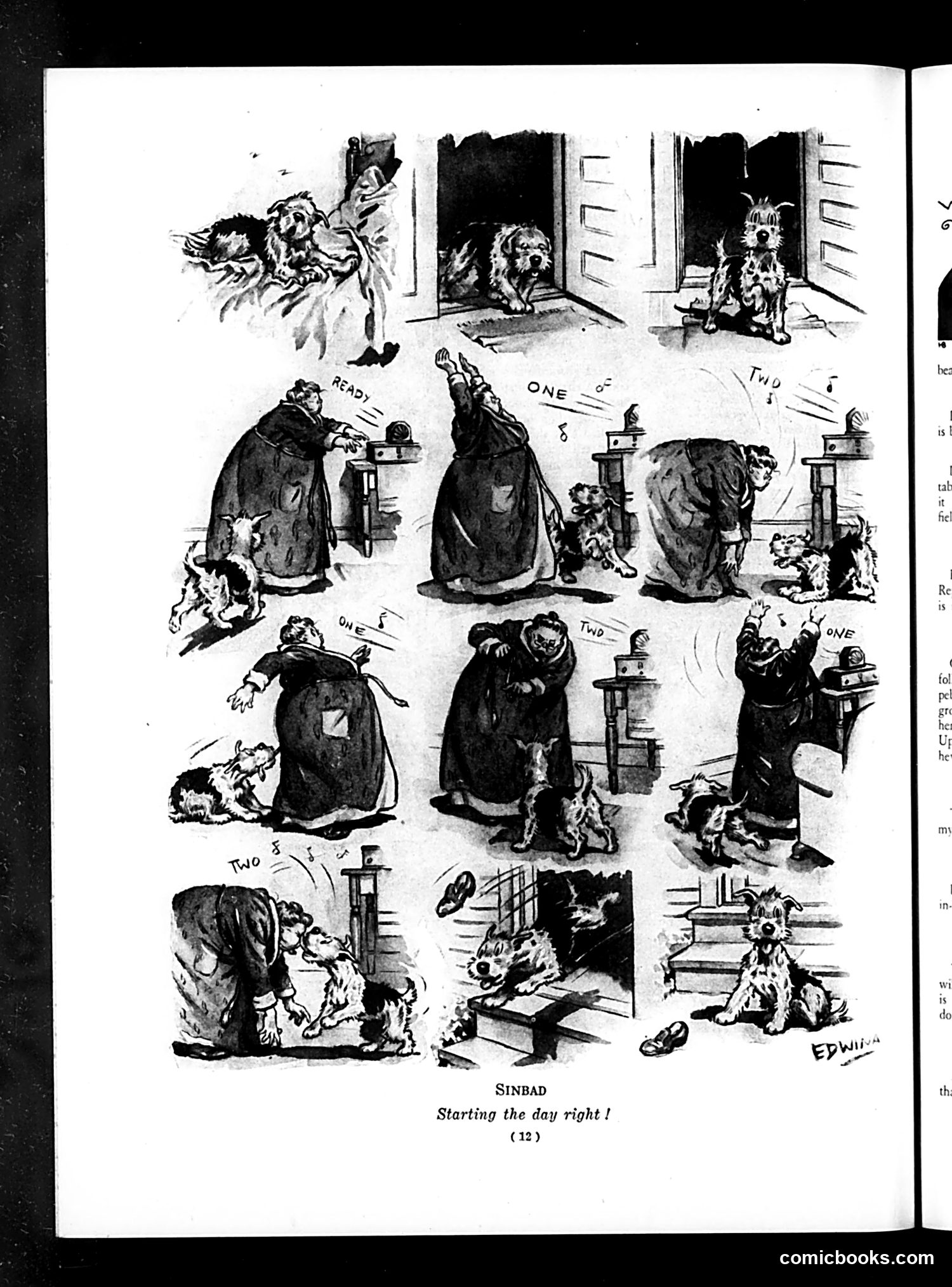
Analysis of "Sinbad: Starting the Day Right!" This is a humorous comic strip by Edwin (signature visible) showing a character named Sinbad going through his morning routine with his dog. The numbered panels depict various domestic activities: the dog greeting him at doors, washing up at basins, getting dressed, and preparing for the day. The humor appears to stem from the repetitive, ritualistic nature of morning routines and the dog's persistent, enthusiastic involvement in each step. The "starting the day right" caption suggests this is satirizing the common practice of orderly morning preparations—presented here in comically exaggerated form with the dog's involvement in every mundane task. This is straightforward domestic humor rather than political satire.
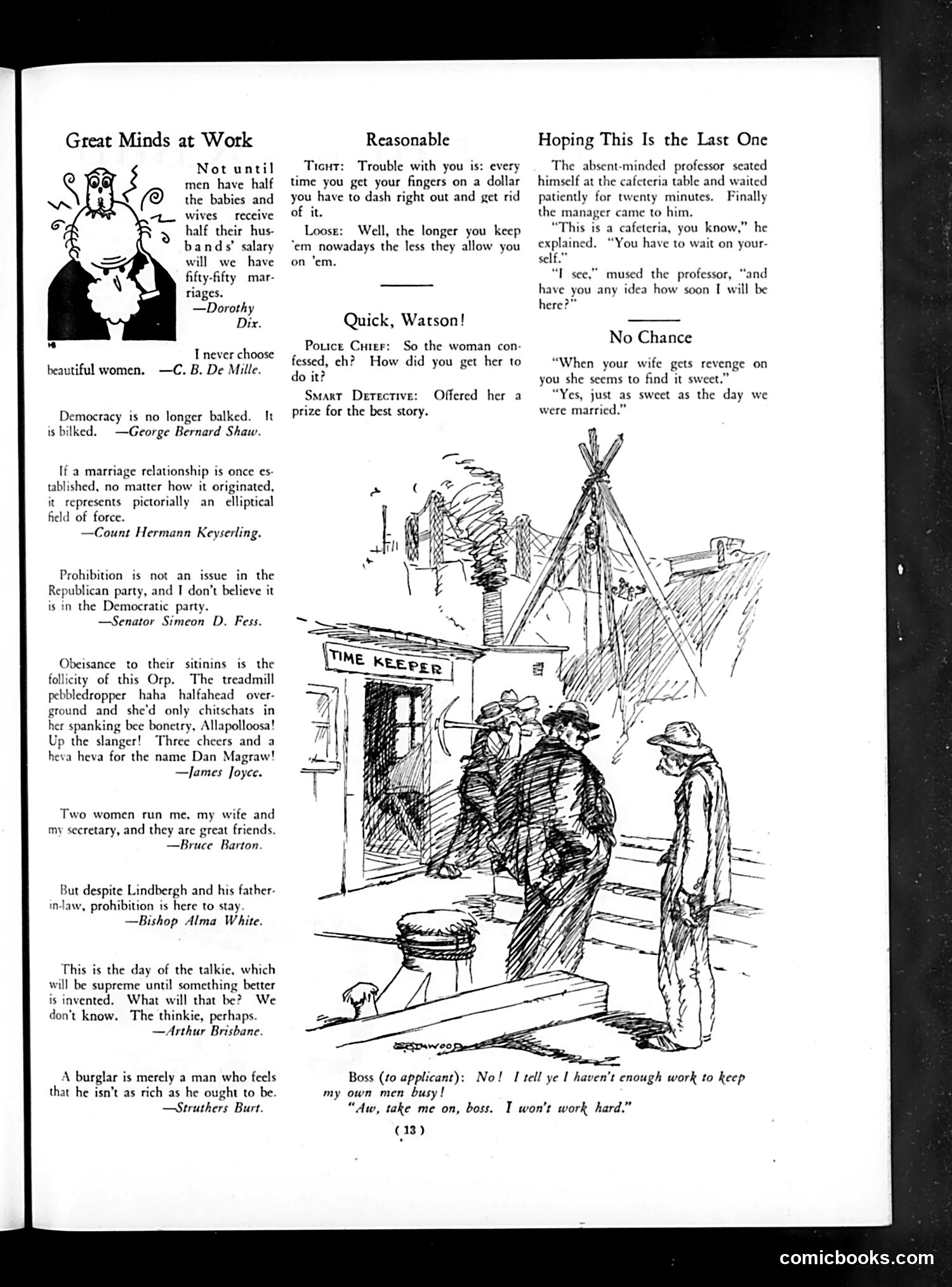
Analysis of Life Magazine Page This page contains satirical quotes ("Great Minds at Work"), humor about marriage and relationships, and a cartoon illustrating a labor dispute. The Main Cartoon depicts a "Time Keeper" building with workers outside. A boss refuses to hire an applicant, saying "No! I tell ye I haven't enough work to keep my own men busy! Aw, take me on, boss. I won't work hard." The Satire: The joke highlights Depression-era unemployment and labor desperation. The applicant promises to work less efficiently to secure any job, satirizing how severe joblessness forced workers to accept humiliating conditions. The boss's complaint that he lacks work for existing employees reflects widespread economic hardship. The Quotes Section collects humorous observations about women, marriage, and prohibition—typical Life magazine content mocking social conventions and contemporary politics.
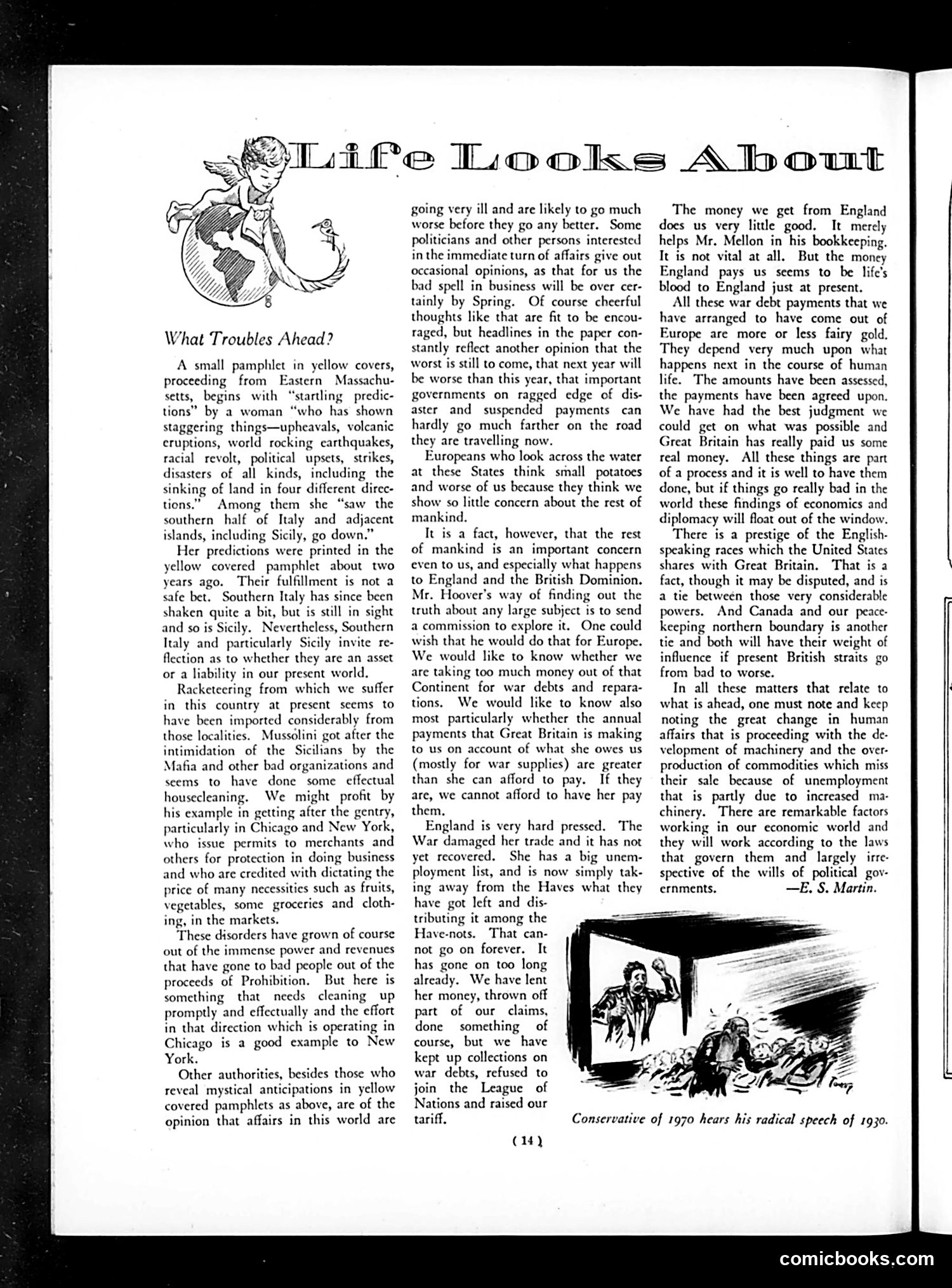
Analysis of "Life Looks About: What Troubles Ahead?" This page discusses post-WWI economic troubles and international relations. The main illustration (bottom right) shows a figure labeled "Conservative of 1970 hears his radical speech of 1930," depicting someone from an earlier era reflecting on past radical rhetoric—likely referencing how political positions evolve over time. The text addresses financial strain on Britain and Europe following World War I, including war debts owed to America, unemployment, and economic instability. It mentions Mussolini's rise in Italy and Sicily's organized crime problems, suggesting anxiety about European political upheaval. The satire critiques American isolationism while warning of future instability, implying that ignoring Europe's problems will have consequences—a prescient concern given the 1930s fascist movements that followed.
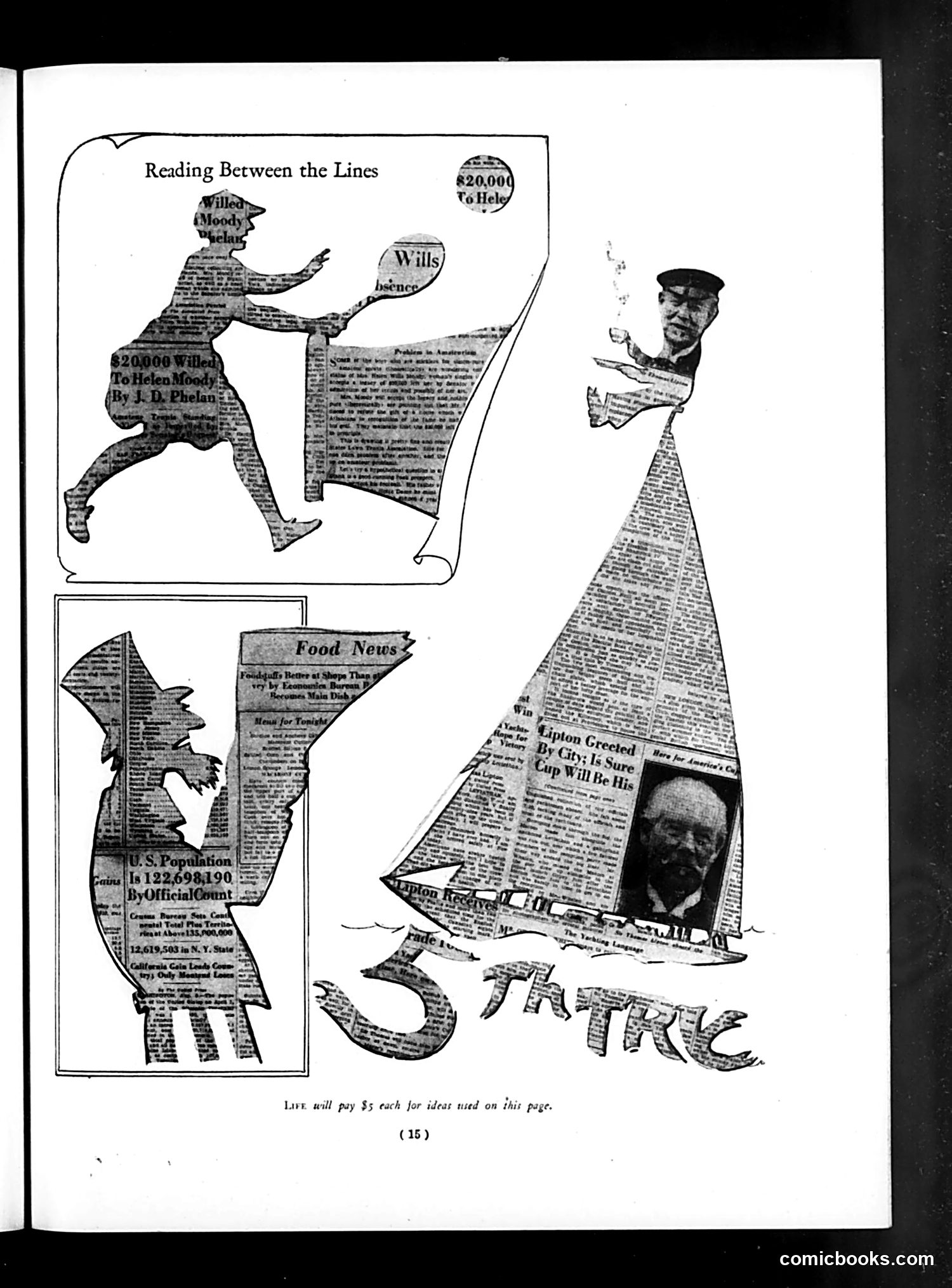
Analysis of Life Magazine Page 15 This page features "Reading Between the Lines," a satirical visual commentary using newsprint-filled silhouettes. The top section shows a figure labeled "$20,000 Wills" (likely referencing Bruce Wills or a similar wealthy figure) gesturing toward "$20,000 to Help" and a "Wills Absence" document, suggesting irony about charitable giving versus actual assistance. The lower right depicts a large sailboat made of newsprint with a portrait, labeled "Caption Greeted By City; Is Sure Cup Will Be His"—unclear which specific event this references, but it mocks media sensationalism around a yacht or sailing competition. The left panel shows a map-like figure labeled "U.S. Population Is 122,698,190 By Official Count," mixing demographic data with satirical editorial content about food and population statistics. The overall technique criticizes how newspapers obscure meaning through dense text and selective reporting.
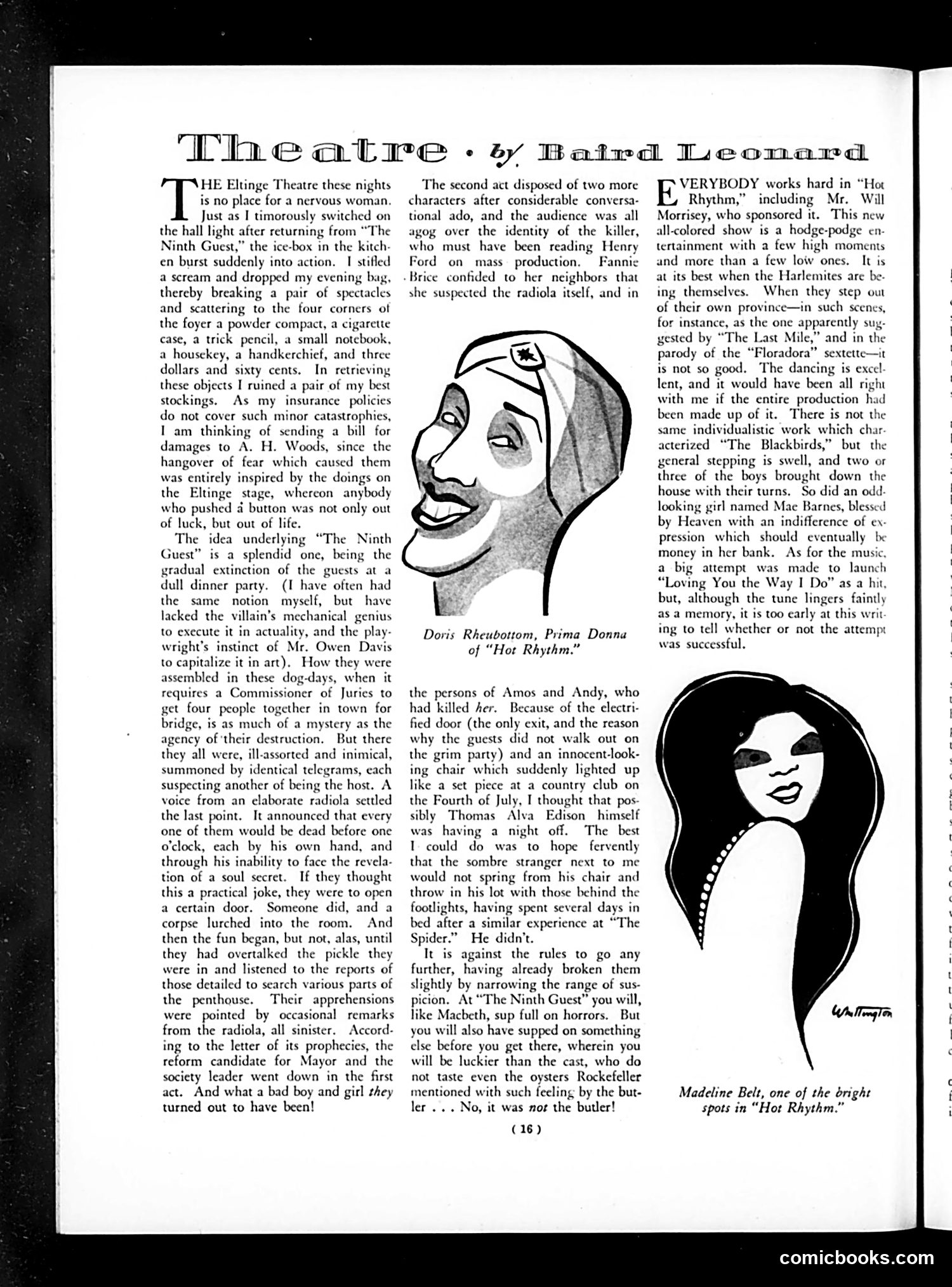
Theatre Review: "Hot Rhythm" and "The Ninth Guest" This is Baird Leonard's theatre column reviewing two Broadway productions. The two caricatures shown are performers from these shows: - Doris Richbottom, Prima Donna of "Hot Rhythm" (left illustration) - Madeline Belts (right illustration), described as "one of the bright spots in 'Hot Rhythm'" The review criticizes "Hot Rhythm" as a poorly-conceived all-colored show with weak dancing and music, though praising individual performers. "The Ninth Guest" is praised as an inventively constructed mystery-dinner-party play where guests are mysteriously eliminated. The satire focuses on theatre quality and performance rather than political content—typical of Life magazine's entertainment criticism during this era.
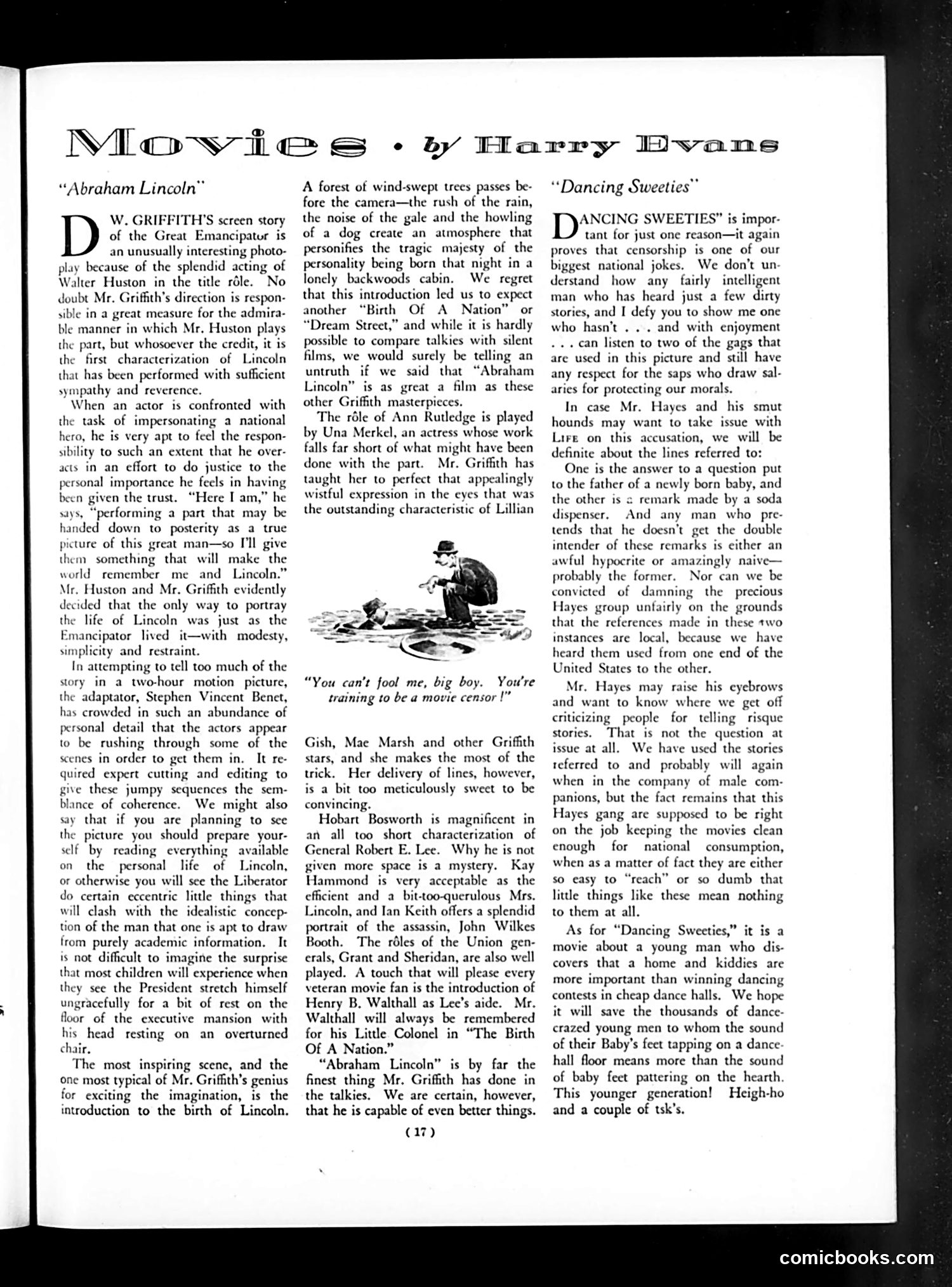
Movie Reviews by Harry Evans This page contains two film reviews. The left column discusses D.W. Griffith's "Abraham Lincoln," praising Walter Huston's performance in the lead role. The review notes Griffith's direction as "unsympathetic in a great measure" but acknowledges the film's historical importance, particularly its depiction of Lincoln's birth. The right column reviews "Dancing Sweeties," a film apparently depicting young people in a dance hall. Evans criticizes it as morally questionable entertainment, expressing concern about its message to younger audiences. He objects to specific lines in the film that he considers inappropriate, using this review as a platform to argue against what he views as the movie industry's lax censorship standards.
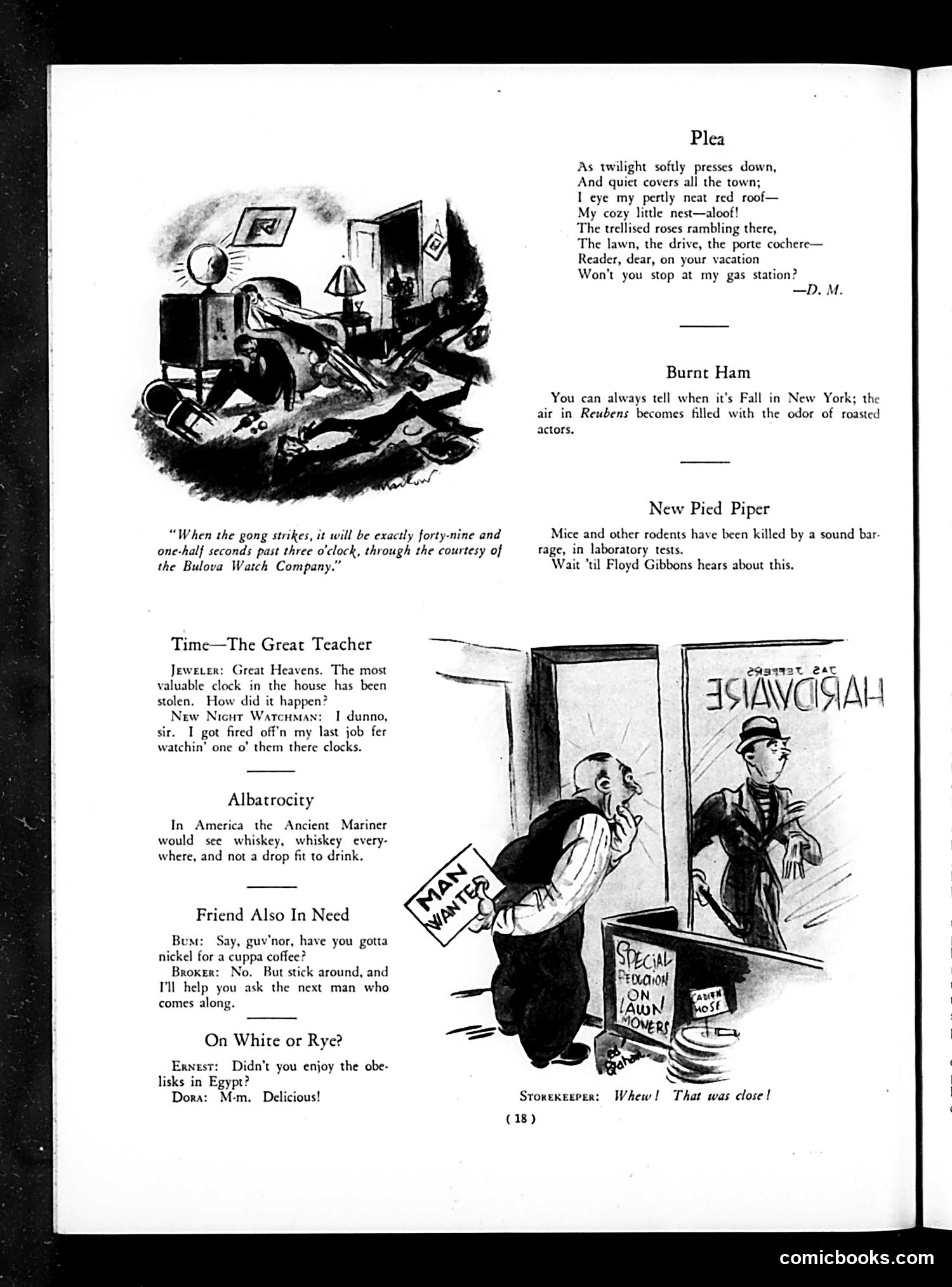
Analysis This page contains several short humorous pieces and a cartoon. The main cartoon depicts a man with a "MAN WANTED" sign attempting to enter a barbershop, while the storekeeper exclaims "Whew! That was close!" with a reversed "BARBERSHOP" sign visible in the window. The joke appears to reference labor scarcity or employment desperation—the man is literally a "wanted man" seeking work, but the storekeeper (perhaps fearing trouble or simply cautious) nearly let him in before catching himself. It's satire about post-Depression-era economic anxiety and hiring reluctance. The surrounding text pieces are brief comic vignettes on unrelated topics: a stolen valuable clock, whiskey abundance in America, a vagrant asking for coffee money, and Egyptian obelisks. These appear designed as light filler humor typical of Life magazine's satirical format.
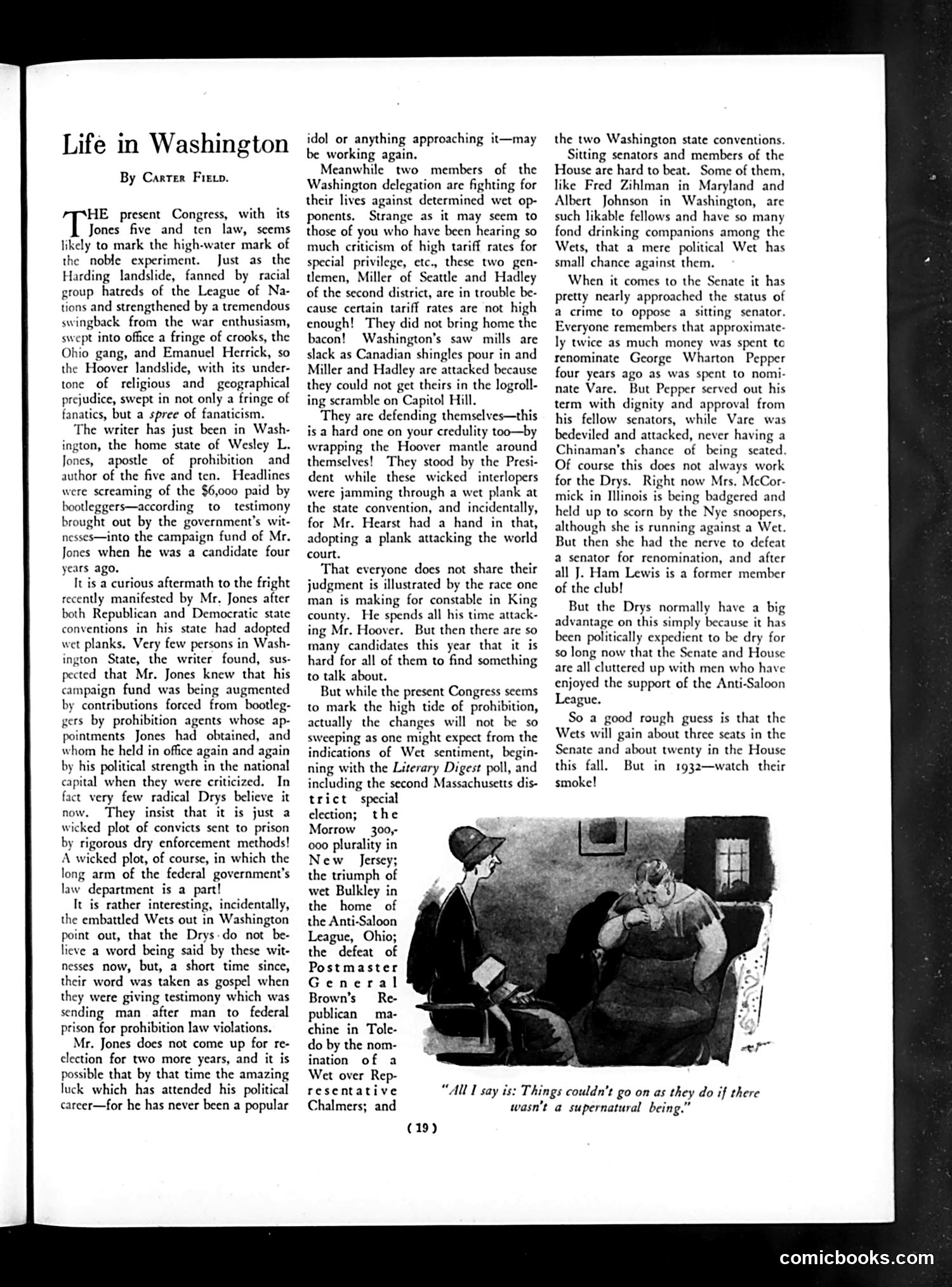
Analysis of "Life in Washington" Cartoon Page This page features satirical commentary on Prohibition-era politics by Carter Field. The main cartoon (right side) depicts a figure in a hat speaking to someone at a window, with the caption: "All I say is: Things couldn't go on as they do if there wasn't a supernatural being." Key Political References: The article mocks Senator Wesley L. Jones of Washington, a prominent Prohibition advocate who ironically received campaign contributions from bootleggers forced to pay by federal agents *he* appointed. Field highlights this hypocrisy: radical Prohibitionists dismiss the testimony as a conspiracy rather than acknowledge Jones's corruption. The piece also criticizes Representatives Miller and Hadley, who face electoral challenges over tariff rates (insufficient protection for local saw mills against Canadian competition), yet defend themselves by invoking President Hoover's support—despite having opposed his preferred world court plank. The Satire: Field exposes the contradiction between Prohibition's moral crusade and its corrupt enforcement, while skewering politicians who simultaneously champion different causes opportunistically.
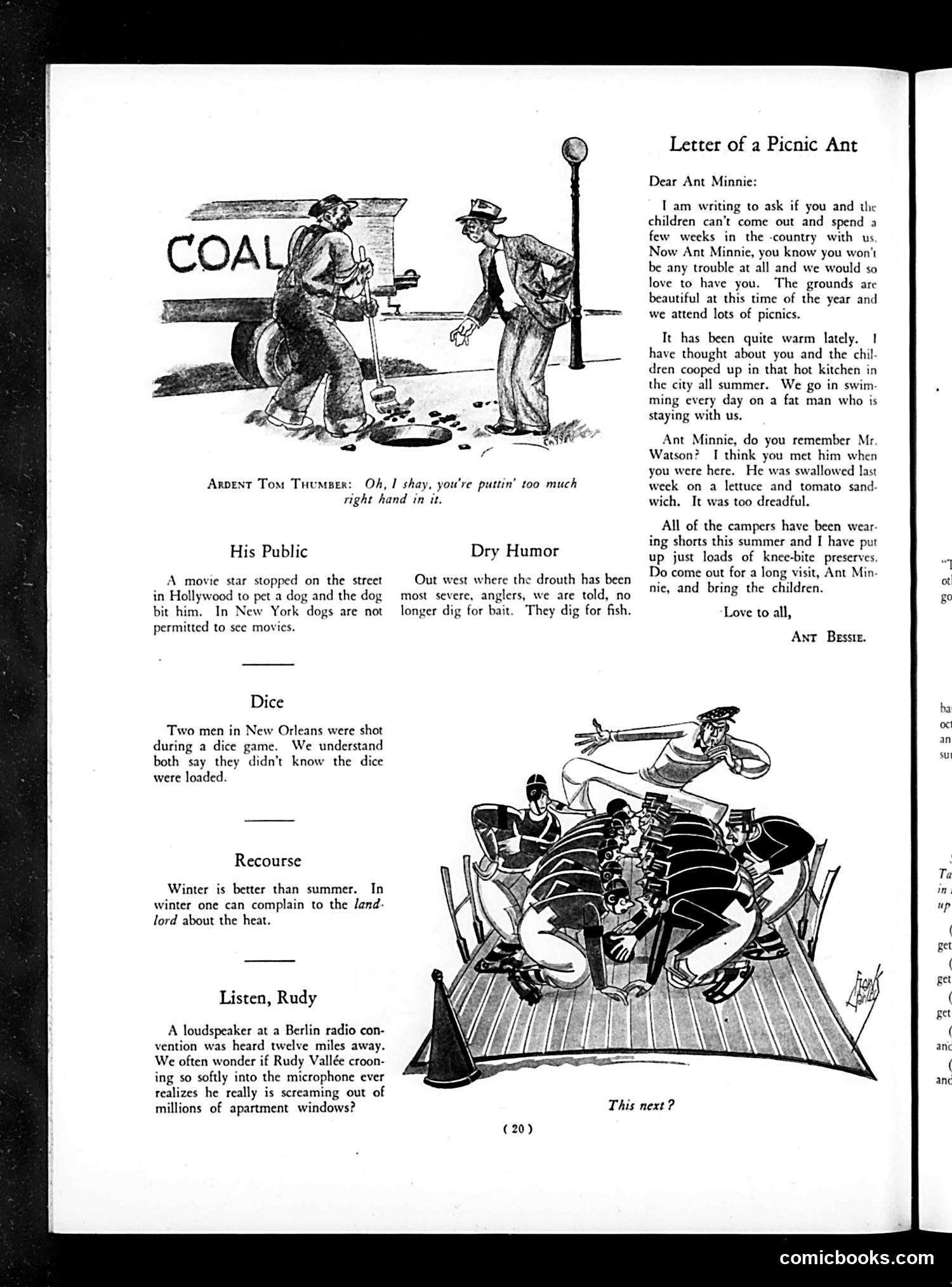
Analysis of Life Magazine Page This page contains several brief humorous items typical of 1920s-30s satirical magazines: "His Public" jokes about Hollywood's celebrity culture versus New York's indifference. "Dice" references the common practice of cheating at gambling with loaded dice. "Recourse" offers a dry observation about tenants' complaints to landlords. "Listen, Rudy" mocks Rudy Vallée, a famous crooner of the era, suggesting his soft microphone voice paradoxically projects loudly through apartment buildings—implying his singing is unavoidably present and perhaps unwanted in homes across Berlin. "Letter of a Picnic Ant" is an anthropomorphic humor piece where an ant invites another to visit, with jokes about campers in shorts attracting insects and someone being swallowed in a sandwich—typical absurdist humor for the era. The coal illustration appears decorative rather than substantive.
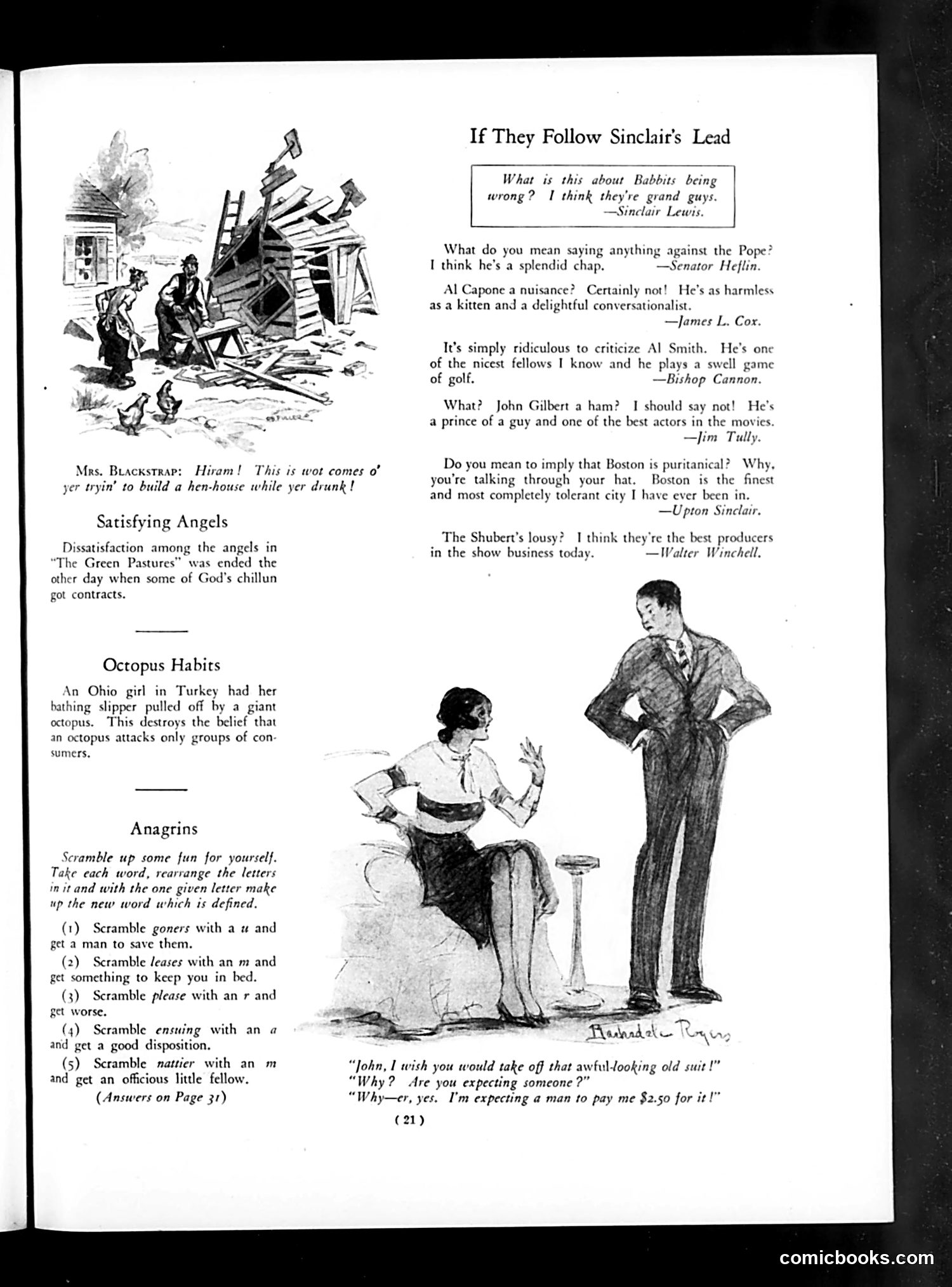
"If They Follow Sinclair's Lead" — Satirical Endorsements This page satirizes prominent figures who publicly defend controversial or disreputable subjects, likely in response to Upton Sinclair's famous novel *The Jungle* or his muckraking work exposing social problems. The section presents mock endorsements where public figures defend the indefensible: - Senator Heflin defends the Pope - James L. Cox defends Al Capone (the notorious gangster) - Bishop Cannon defends Al Smith - Jim Tully defends actor John Gilbert - Sinclair himself defends Boston's tolerance The satire's point: these are absurd, self-serving defenses—figures protecting their interests or allies by praising what's clearly problematic. The title suggests this follows "Sinclair's Lead," implying muckrakers expose wrongdoing while establishment figures reflexively defend it. The cartoon at top shows destruction caused by drunk negligence, contrasting the careless harm with the polite endorsements below—emphasizing the gap between reality and these public figures' denials.
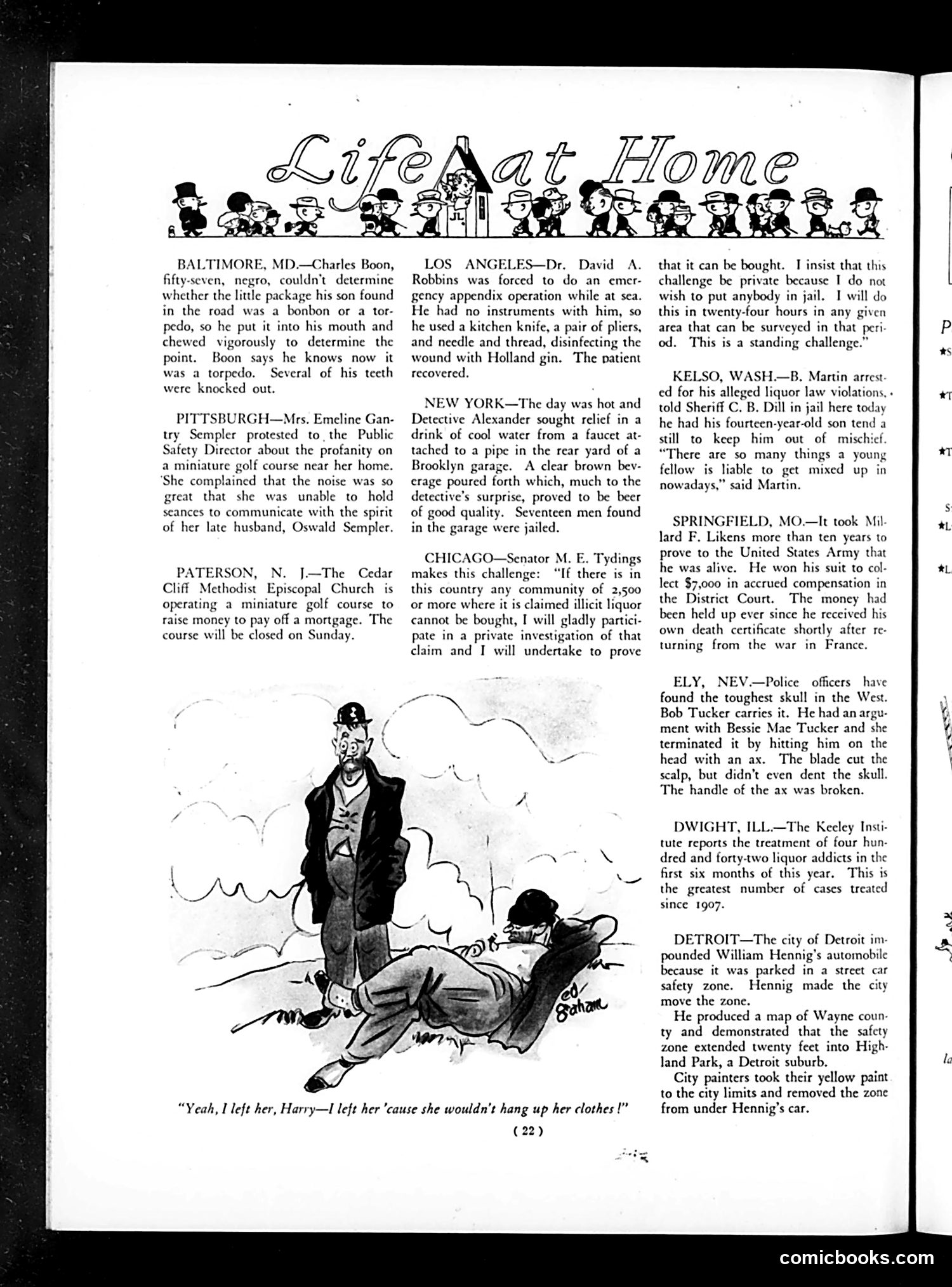
"Life at Home" Page Analysis This page from *Life* magazine presents absurdist news briefs satirizing American society during Prohibition era (likely 1920s-1930s). The items mock widespread lawbreaking and social absurdity: Key targets: - Prohibition's failure: Multiple stories highlight ubiquitous illegal liquor (Senator Tydings' boast he can find contraband anywhere; Brooklyn garage beer; liquor addiction treatment surges) - Parental irresponsibility: A father enlists his 14-year-old to run an illegal still to "keep him out of mischief" - Bureaucratic incompetence: A soldier's death certificate blocks his war compensation for years - Civic pettiness: Detroit moves safety zones to accommodate a citizen's parking complaint The cartoon shows a man abandoning his wife because "she wouldn't hang up her clothes"—domestic complaint absurdity matching the satirical tone. The overall message: American institutions (law enforcement, government bureaucracy, churches, families) are dysfunctional or hypocritical, unable to enforce laws or maintain basic order. The humor derives from deadpan reporting of ridiculous situations as fact.
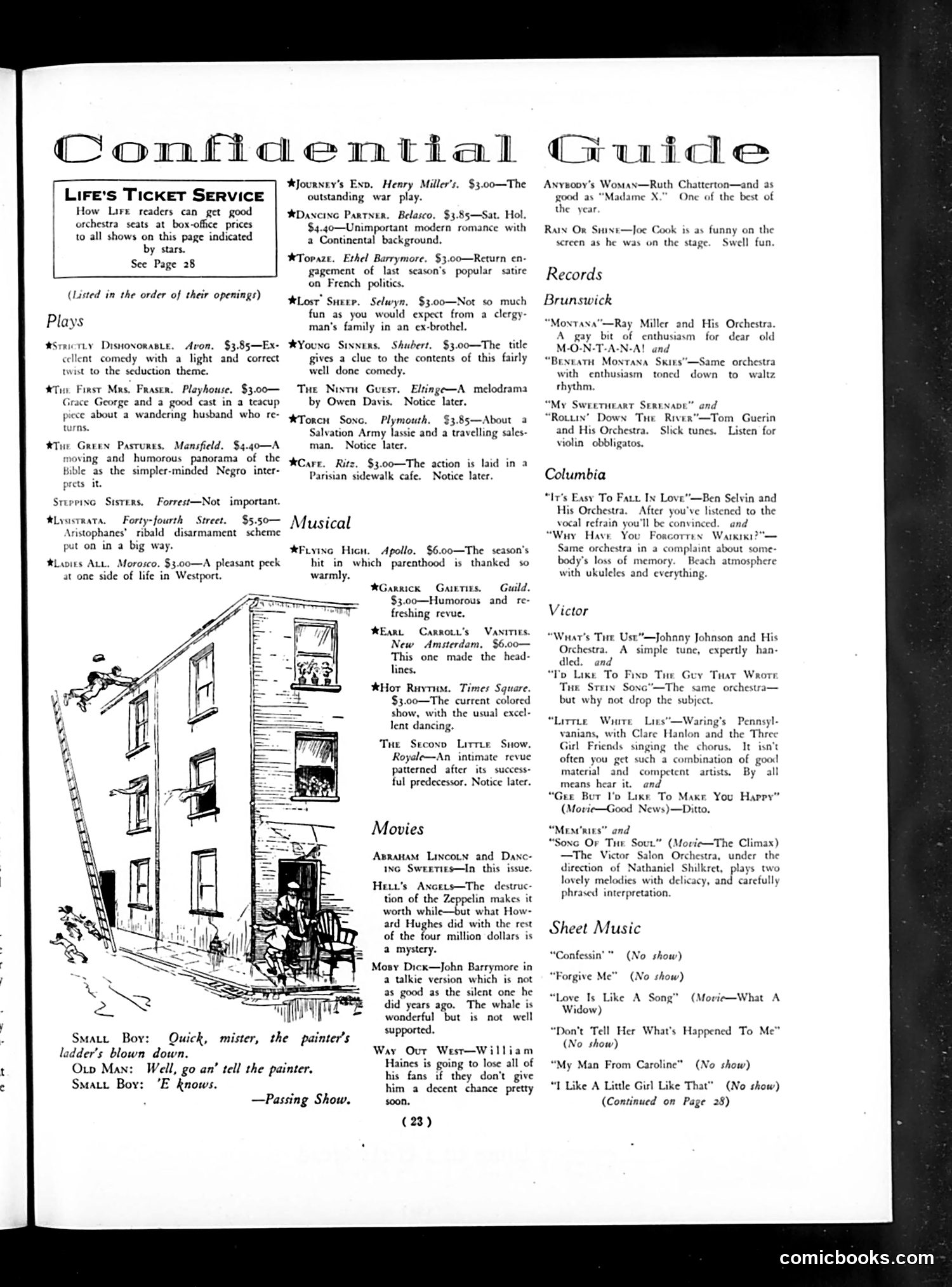
Analysis of This Life Magazine Page This is a theater and entertainment guide page from Life magazine (circa 1920s-early 1930s), not a political cartoon page. The page lists Broadway plays, musicals, and movies with prices and brief reviews. Notable entries include *The Green Pastures* (described as "a humorous panorama of the Bible as the simpler-minded Negro interprets it"—reflecting period racial attitudes), *Lysistrata* (Aristophanes' anti-war comedy), and films like *Hell's Angels* and *Moby Dick*. The single cartoon at bottom-left is a simple gag: a small boy tells an old man that the painter's ladder has blown down; the old man says "go tell the painter"; the boy replies "'E knows"—implying the painter already witnessed it. This is visual humor from *Passing Show*, not political satire. The remaining content lists phonograph records from Brunswick, Columbia, and Victor labels—period entertainment listings rather than commentary on current events.
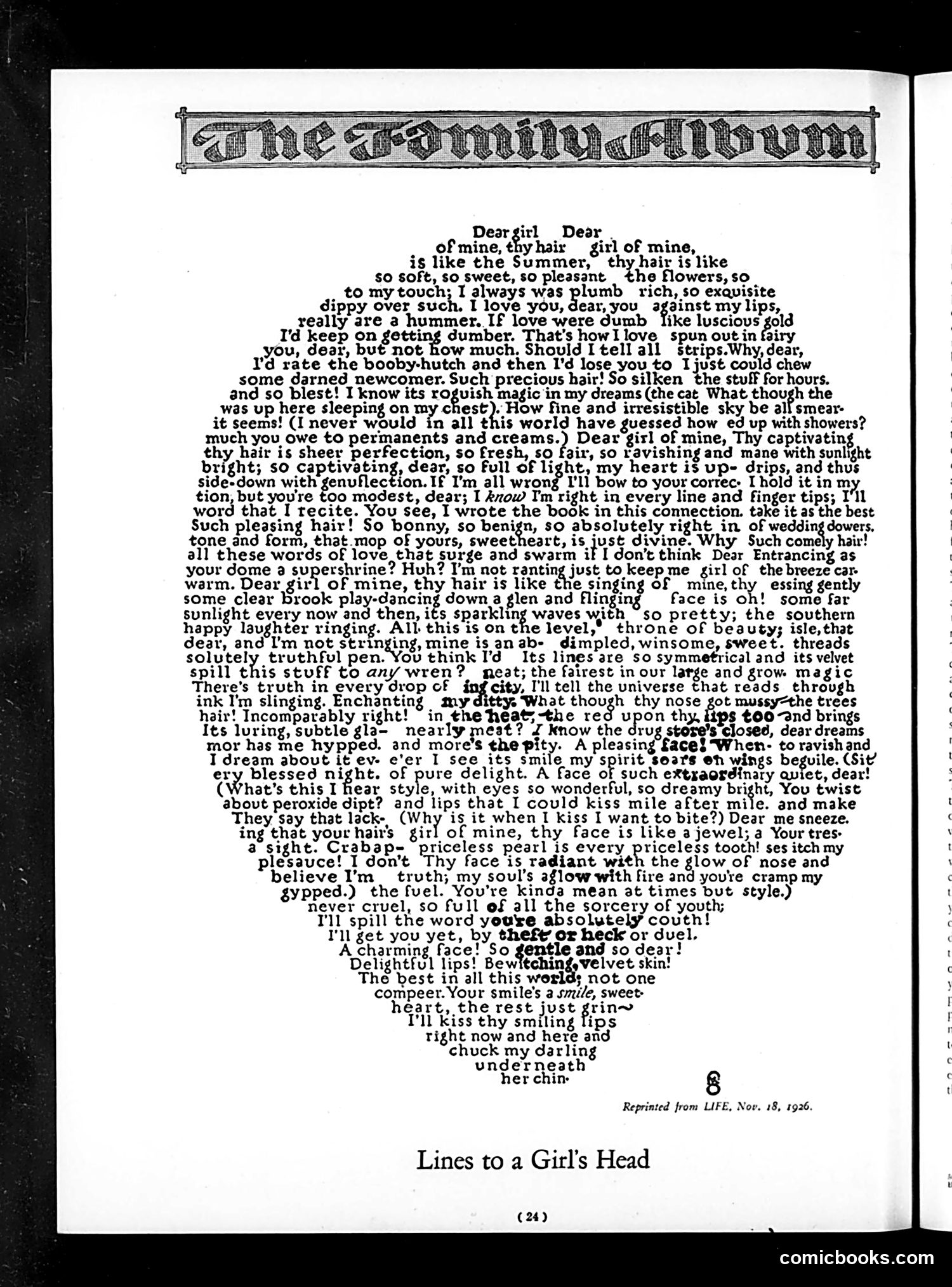
"Lines to a Girl's Head" This is not a political cartoon but rather a humorous poem/literary piece from *Life* magazine (Nov. 18, 1926). It's a satirical love poem addressed to a girl, mocking the overwrought, flowery language of romantic verse popular in the 1920s. The satire works by taking sentimental clichés to absurd extremes—comparing hair to summer, flowers, and singing brooks, while the speaker oscillates between genuine-sounding devotion and ridiculous hyperbole ("I'd rate the booby-hutch and then I'd lose you"). The footnotes and side comments ("Why, dear," "the cat," "Hold it in my finger tips") interrupt the romantic mood with mundane reality, further mocking pretentious love poetry. The ending phrase "by thefe or heck or duel" is deliberately clumsy, emphasizing the poem's self-aware artificiality. It's essentially poking fun at 1920s romantic sentimentality and florid poetic conventions.
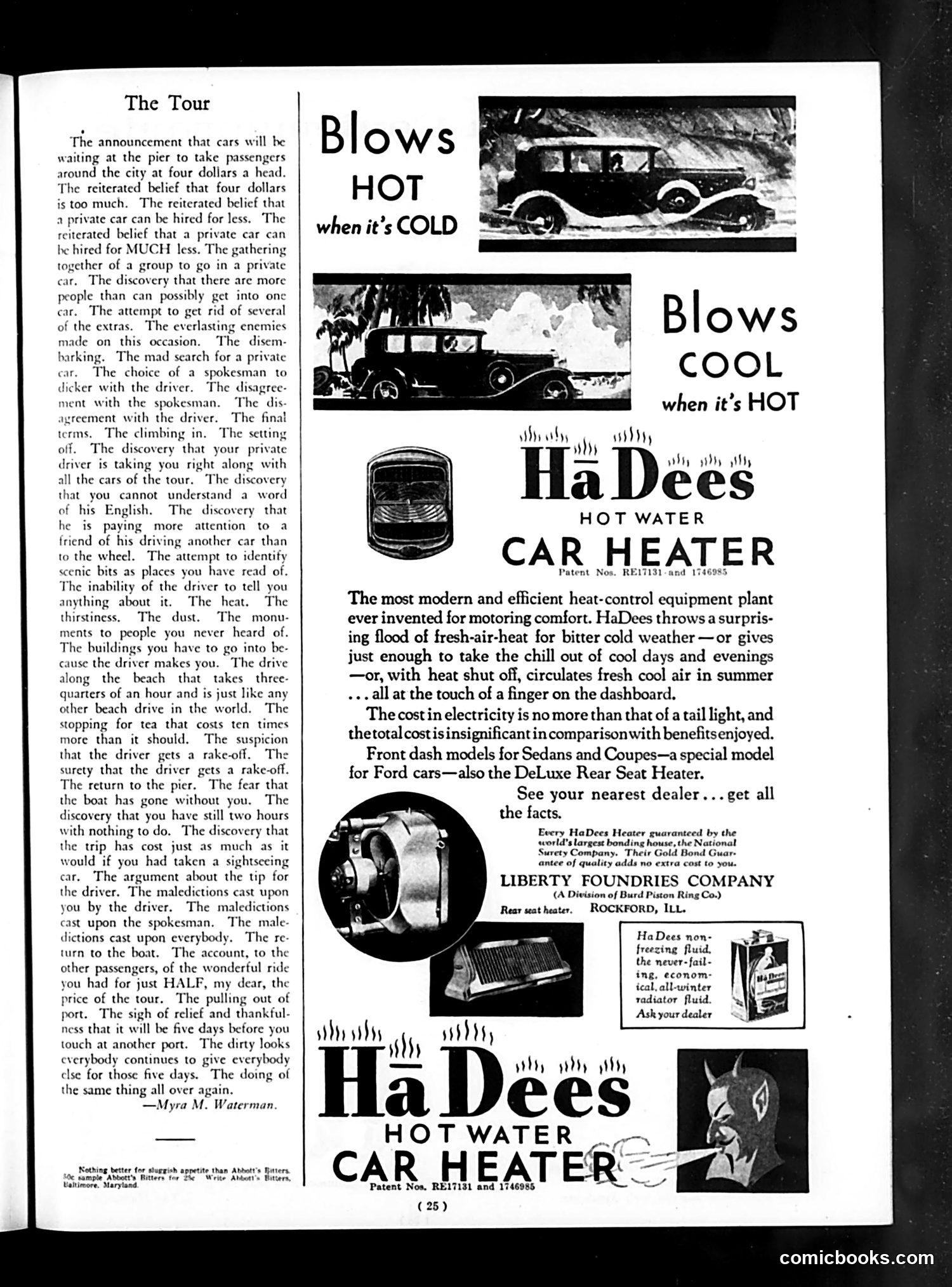
"The Tour" and HaDees Advertisement This page combines satire with product advertising. "The Tour," attributed to Myra M. Waterman, is a humorous essay satirizing the tourist experience of the 1920s-30s. It mocks the predictable frustrations of group sightseeing: tourists' complaints about pricing, the failed attempt to hire cheaper private cars, cultural miscommunication with foreign drivers, and the ultimate realization they've paid as much as an official tour anyway. The humor lies in how universal these disappointments are. The opposing half advertises the HaDees car heater—a heating/cooling device. The copywriting plays on the essay's theme: the product "blows hot when it's cold" and "cool when it's hot," offering modern comfort for motorists. This juxtaposition suggests that while tourist experiences disappoint, at least one can be comfortable while traveling.
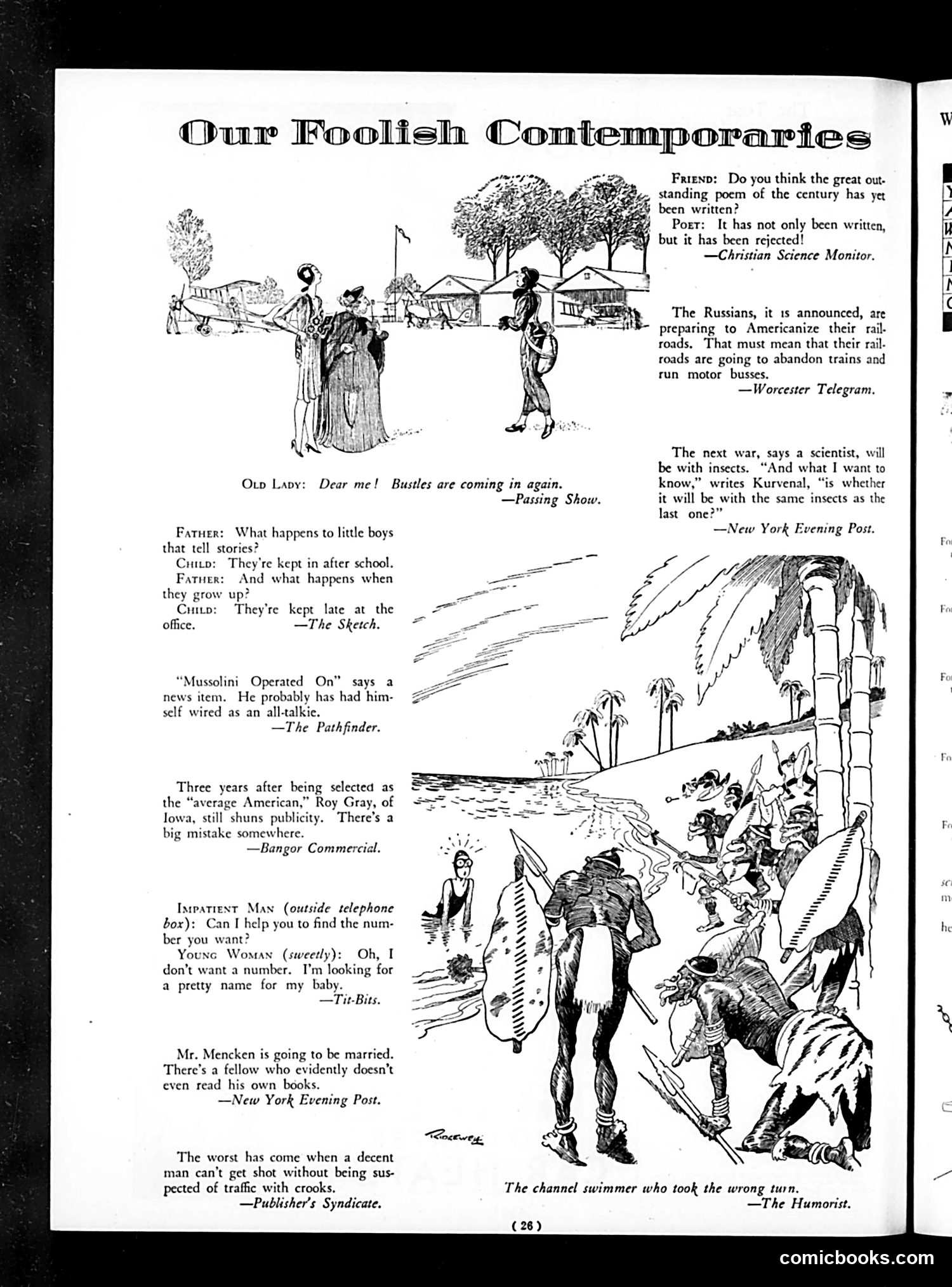
Our Foolish Contemporaries This is a humor page collecting satirical one-liners and jokes from various publications, typical of *Life* magazine's format. Key observations: The cartoons: The top illustration shows an old lady warning about returning bustles (Victorian-era clothing), while the bottom cartoon depicts a channel swimmer who took a wrong turn—likely a reference to the era's popular long-distance swimming attempts. The jokes' targets: - Mussolini: A jab at Italy's fascist leader, suggesting he'd "wire himself" like a talking picture (topical reference to early "talkie" films) - Roy Gray: An "average American" who avoids publicity—mocking the contradiction - H.L. Mencken: The famous critic getting married despite supposedly not reading his own books—implying his work isn't worth reading - Russians and railroads: Satirizing Soviet "Americanization" as abandoning trains for buses - Future warfare with insects: Dark humor about what the next war might involve The page reflects 1920s-1930s concerns: fascism, American consumerism, technological change, and anxieties about modern life. It's primarily comedic rather than deeply political.
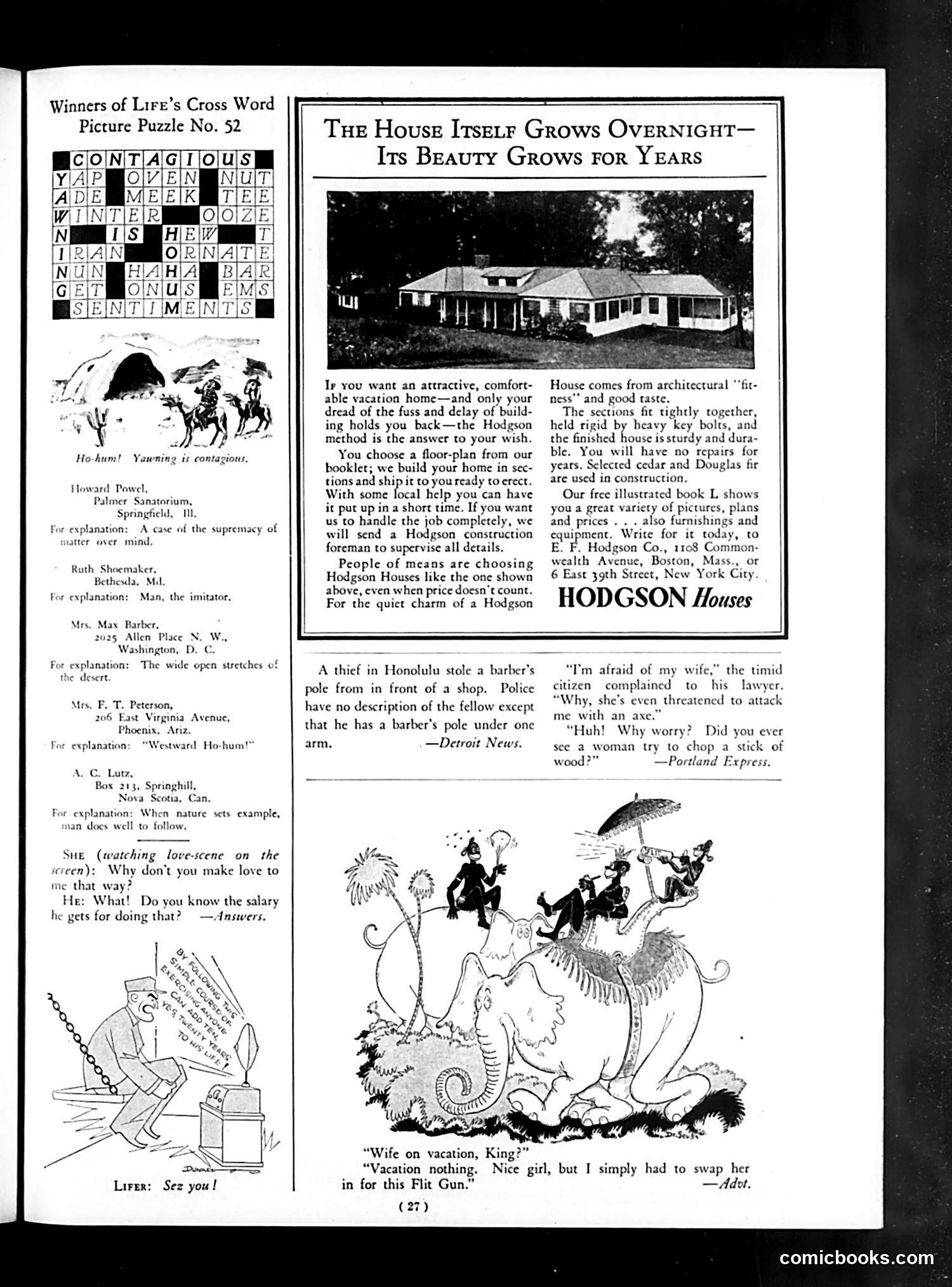
Life Magazine Page Analysis This page features a crossword puzzle contest results alongside humor and advertising. The crossword winners submitted captioned explanations for cartoon panels showing yawning as contagious and humans imitating animal behavior—typical early 20th-century observations about human nature. The joke section includes light domestic humor: a woman criticizing her boyfriend's romantic efforts after watching a movie (he's being paid as an actor), and a nervous husband worried about his threatening wife (the punchline suggesting women are incompetent at chopping wood—period sexism). The Hodgson Houses advertisement promotes prefabricated homes shipped in sections for easy assembly—a modern convenience for the era. A brief news item humorously reports a Honolulu thief's theft of a barber's pole, providing minimal suspect description. The humor derives from the absurdity of stealing such a distinctive object. The content reflects 1920s-era casual sexism, mechanical optimism, and gentle domestic comedy typical of *Life* magazine's satirical approach.
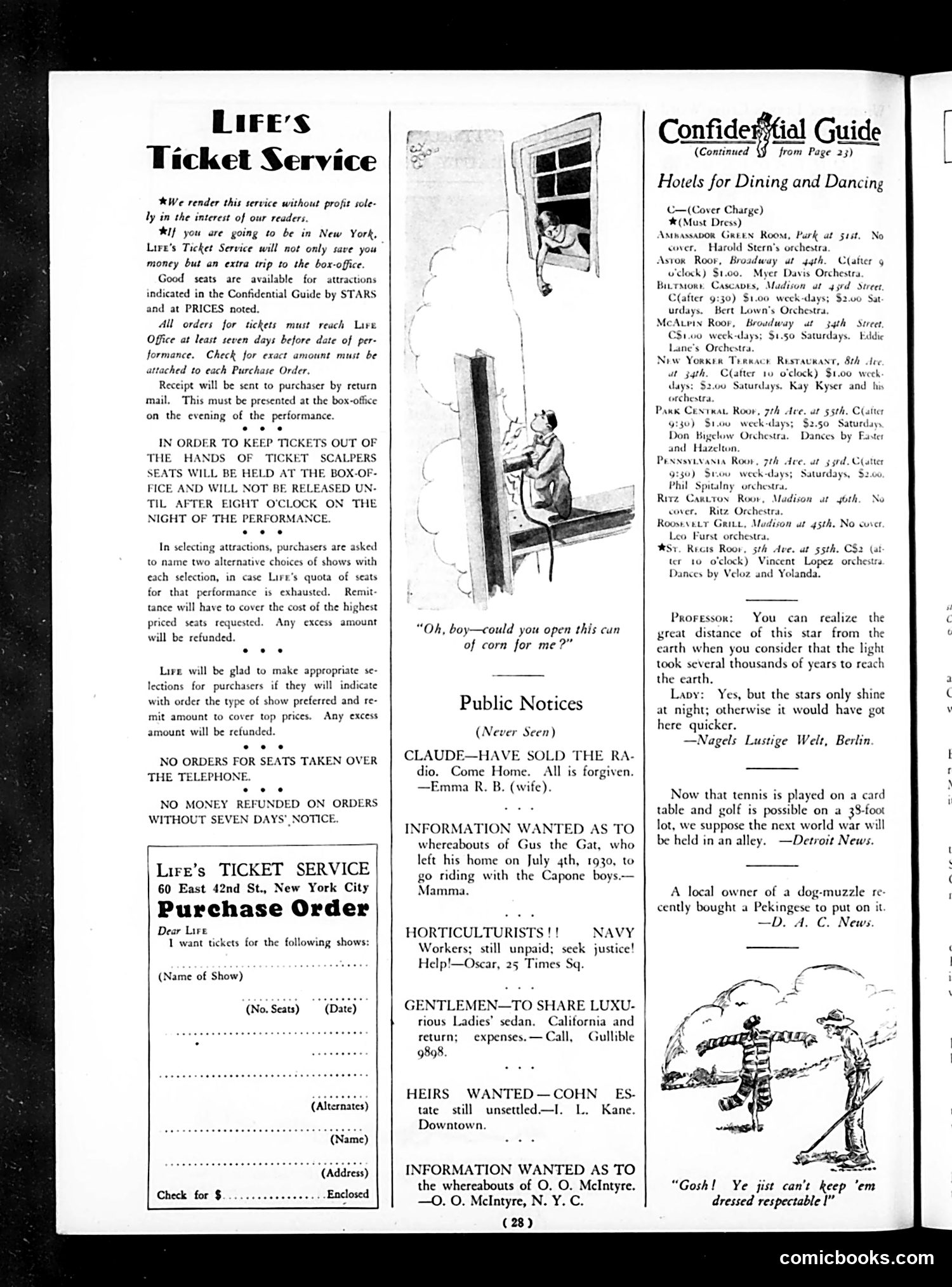
Cartoon Analysis: "Oh, boy—could you open this can of corn for me?" This cartoon depicts a domestic scene where a man leans out a tenement window, asking a woman (likely his wife) to open a can of corn. The humor relies on a reversal of gender roles and expectations: in 1930s America, opening cans was typically considered "women's work," yet the man is helplessly requesting this task—suggesting he's either incompetent or unwilling to do it himself. The cartoon satirizes masculine dependency and domestic laziness. The cramped, modest window setting emphasizes working-class life, where such everyday struggles occur. It's a gentle social joke about gender dynamics and household labor divisions of that era, poking fun at men who relied entirely on women for domestic tasks, however trivial.
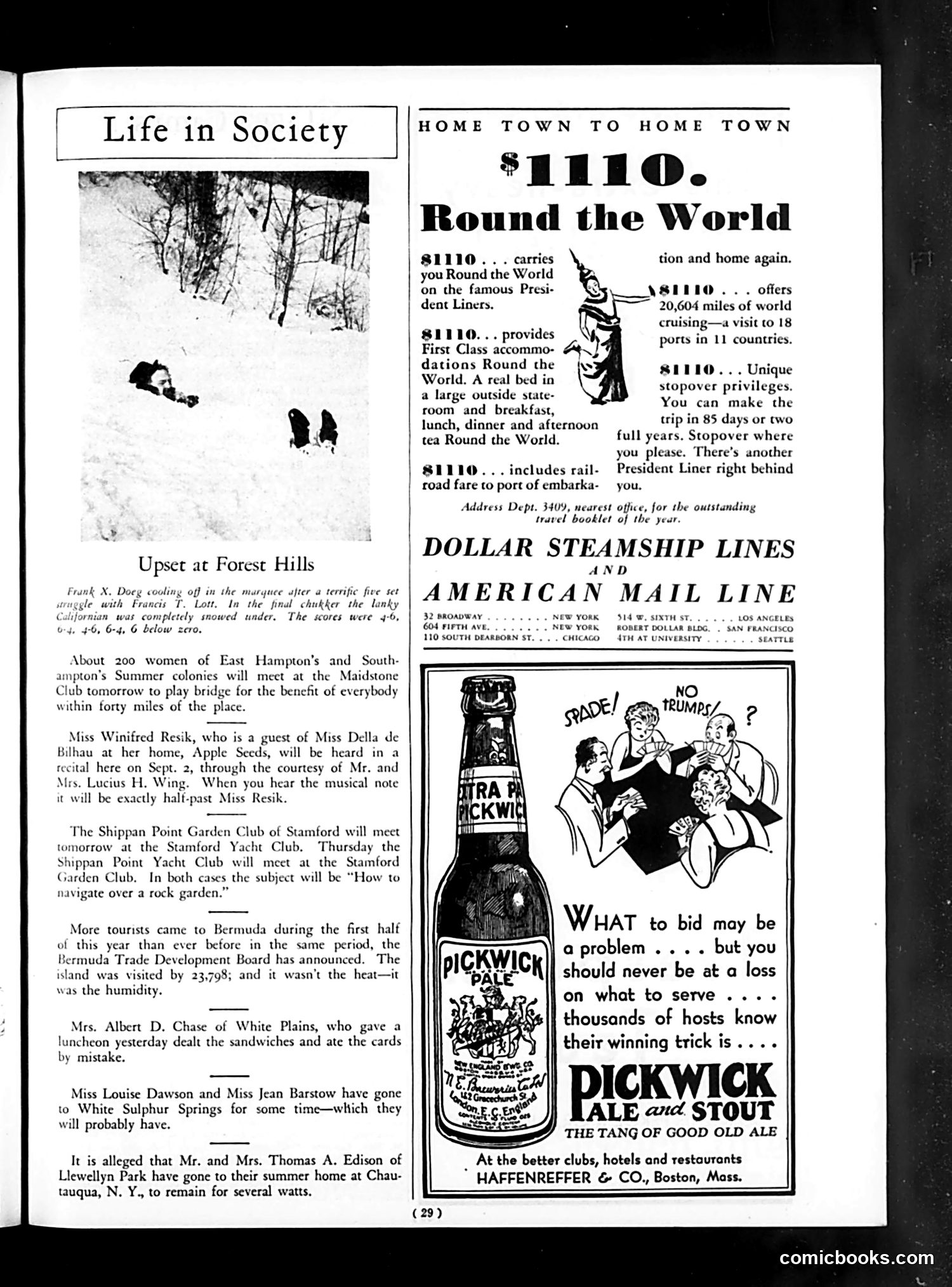
Life Magazine Page Analysis This page from Life magazine (appears to be 1920s-30s era based on style) contains two main elements: "Life in Society" Column (Left): Satirical gossip items mocking wealthy East Coast social circles. The humor relies on absurdist wordplay and deliberate misreadings—Mrs. Chase "dealt the sandwiches and ate the cards by mistake"; references to "several watts" instead of "several days." The opening item about tennis player Frank X. Doeg uses exaggerated sports jargon ("chukker," "waggle") to mock the pretentiousness of upper-class leisure activities. Advertisements (Right): A cruise line promoting round-the-world voyages and a Pickwick Ale advertisement featuring a humorous card game scene with the caption warning against bidding poorly—a gentle pun positioning the beer as a "winning trick." The page primarily satirizes the idle wealth and social preoccupations of the American leisure class during the interwar period, with gentle, observational humor targeting their exclusive clubs, summer colonies, and recreational pursuits.
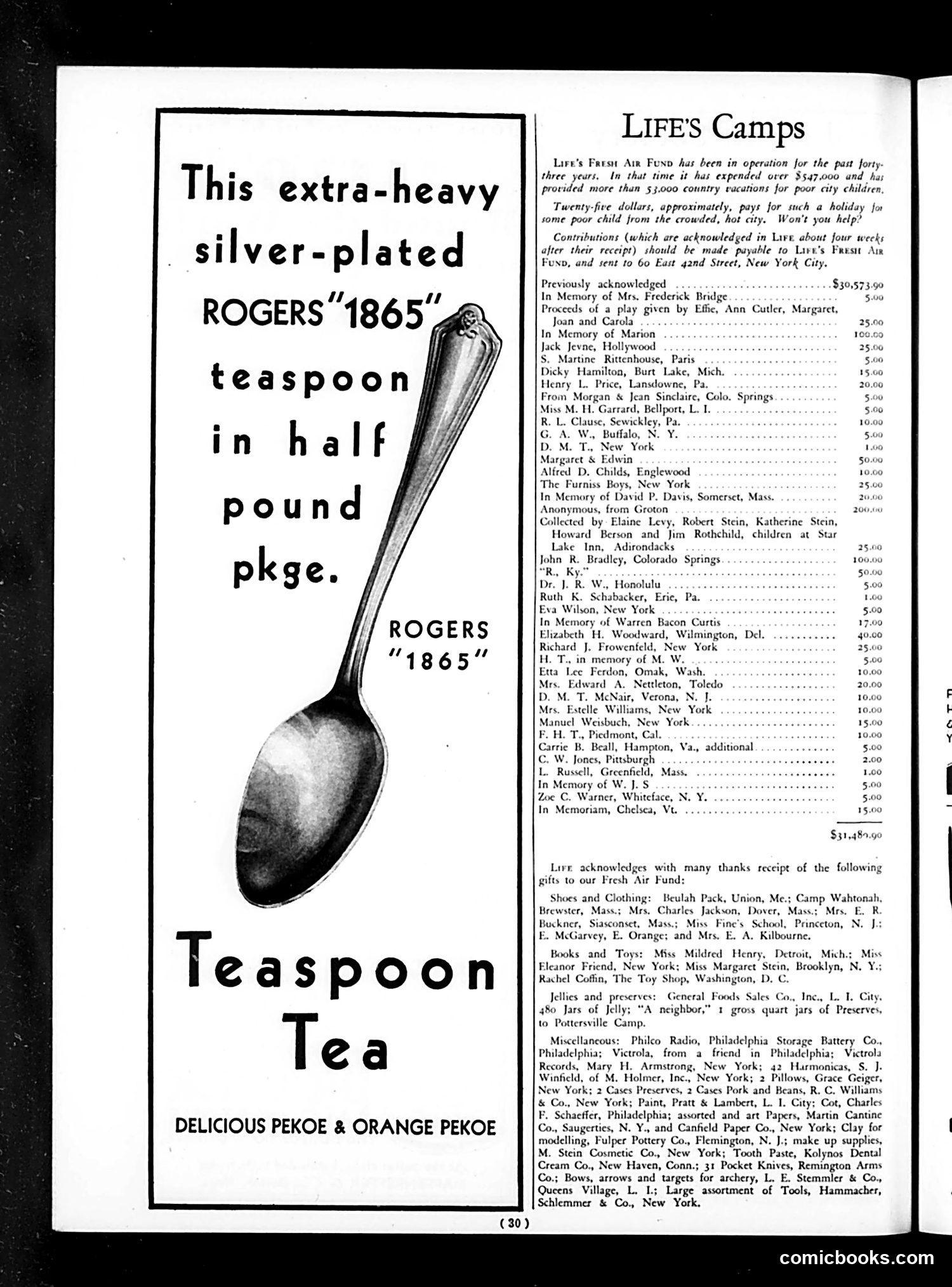
Analysis This page is primarily a charitable fundraising appeal rather than political satire or cartoon content. The left side features a product advertisement for Rogers silver-plated teaspoons (marketed as luxury items), which appears to be an unrelated commercial placement. The right side is dominated by "Life's Camps" — a charitable fundraising report for Life magazine's Fresh Air Fund, which had operated for 43 years providing poor city children with countryside vacations. The page lists monetary contributions (ranging from $1 to $200) from donors nationwide, alongside detailed acknowledgments of in-kind donations: shoes, clothing, books, toys, food, radios, and camping supplies. This represents early 20th-century philanthropic journalism — where magazines used their pages to publicize charitable causes and publicly recognize donors. The modest gift amounts and widespread participation suggest middle-class engagement with urban poverty relief, a progressive-era social concern.
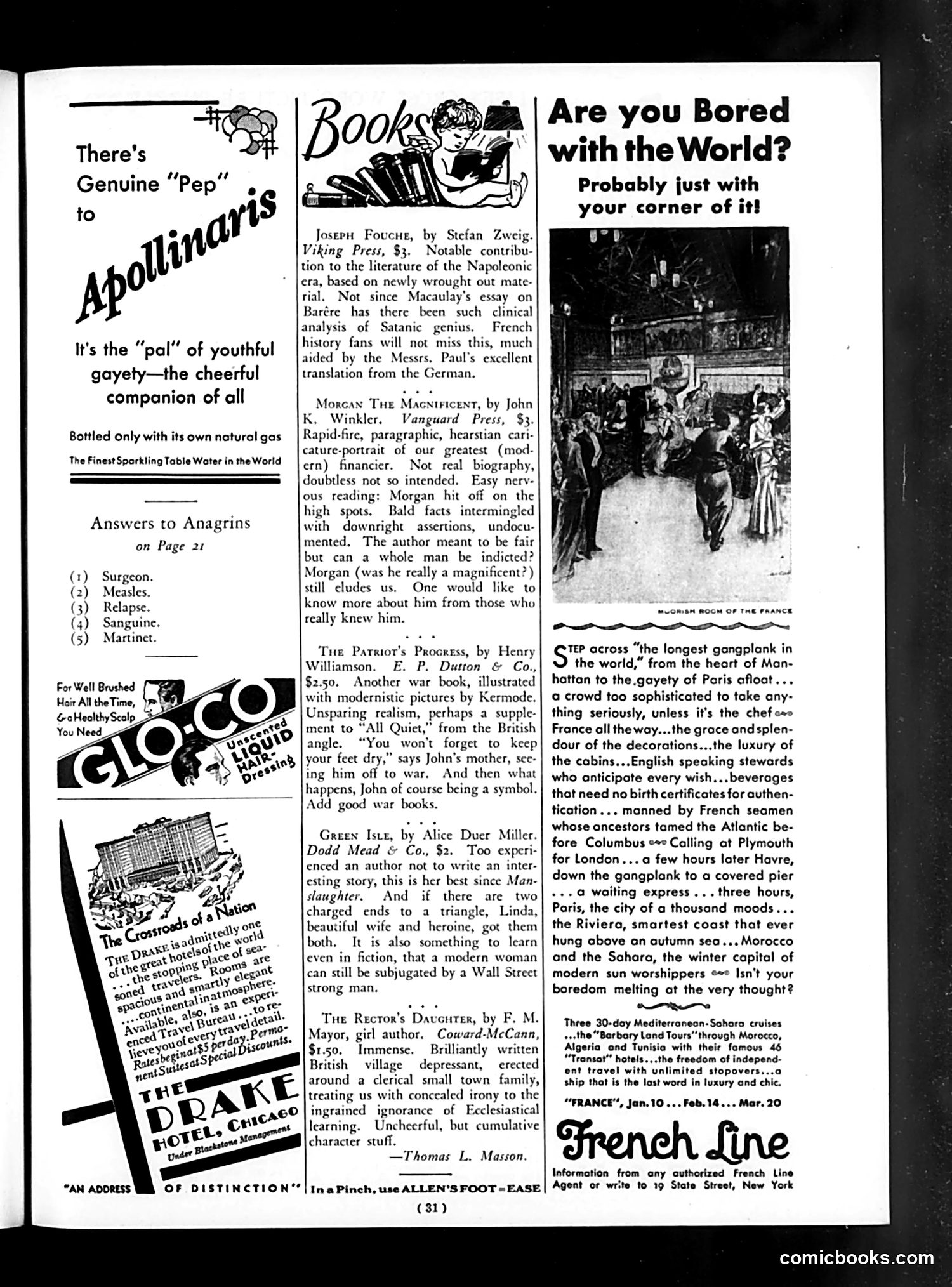
Analysis for Modern Readers This page is primarily advertising and book reviews from Life magazine, circa 1920s-1930s. Main Content: - Left side: Ads for Apollinaris sparkling water and Igloco hair product - Center: Book reviews by Thomas L. Masson covering recent novels and war literature - Right side: Travel advertisement for the French Line cruise ship "France" The "Are You Bored" Section (top right) is a travel ad using psychology to appeal to readers' dissatisfaction with domestic life. It romanticizes European travel—particularly Paris and Mediterranean cruises—as an escape from provincial American boredom. References to "sophisticated" crowds, French culture, and luxury accommodations reflect 1920s-30s aspirations among wealthy Americans for continental sophistication. Historical Context: The ads and reviews reflect post-WWI America's fascination with European culture and the era's emerging consumer advertising strategies using psychological appeals rather than simple product description.
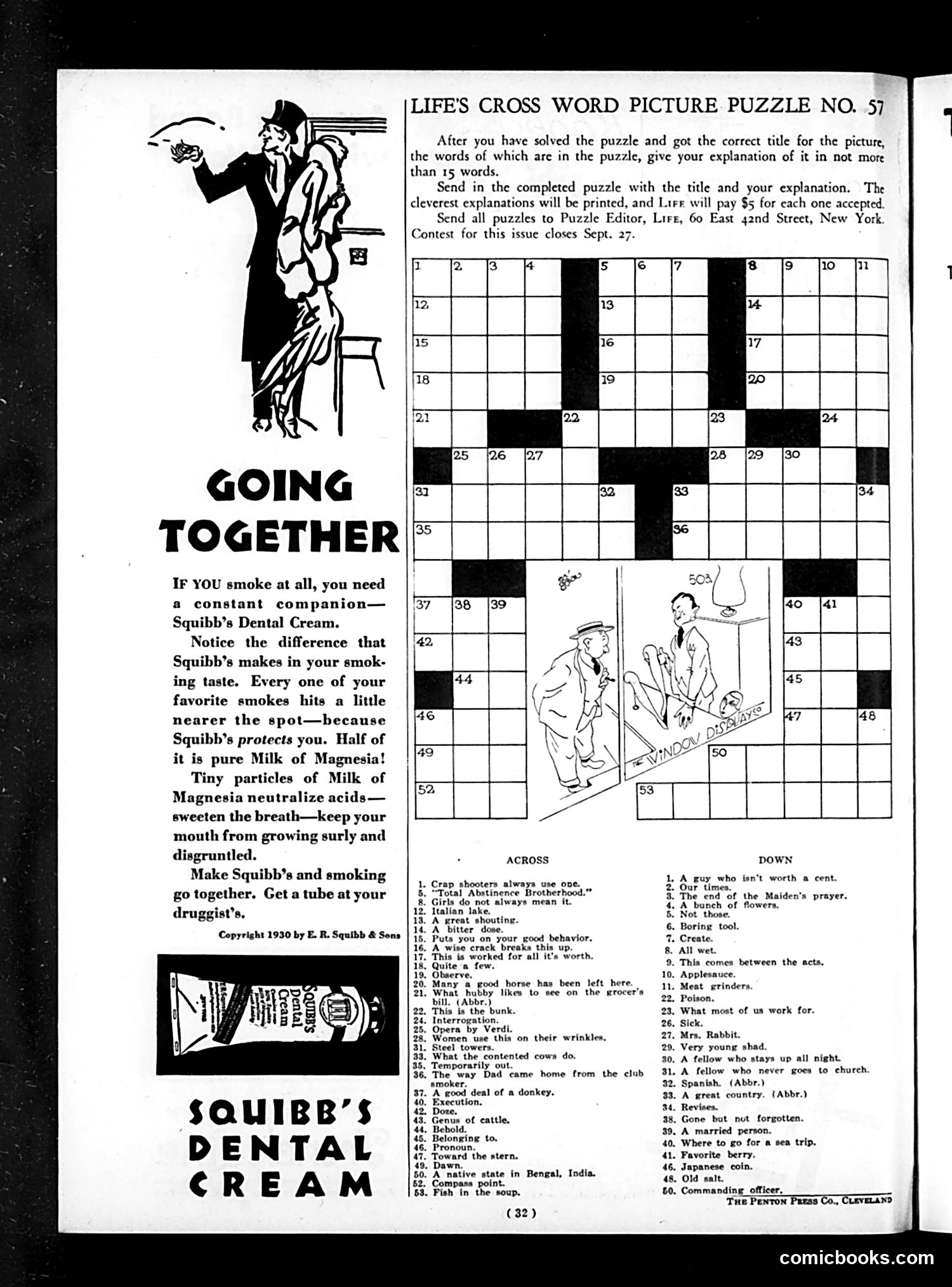
"Going Together" Advertisement & Crossword Puzzle Page This 1930 Life magazine page combines an advertisement for Squibb's Dental Cream with a crossword puzzle contest. The Advertisement: The top features a stylized illustration of a man smoking, accompanied by copy arguing that smokers need dental cream as a "constant companion." The ad claims Squibb's contains Milk of Magnesia to neutralize acids and sweeten breath—framing smoking as socially acceptable if properly managed with the right product. This reflects 1930s advertising's casual approach to tobacco use. The Puzzle: Below is a crossword with an embedded cartoon showing two men on what appears to be a ladder or plank labeled "WINDOW DRESSING"—likely depicting a retail display or con. Readers must solve the puzzle, identify the cartoon's title, and submit explanations (up to 15 words) for a $5 prize per accepted entry. The juxtaposition of smoking endorsement with wordplay typifies Life's satirical, consumer-focused editorial approach of the era.
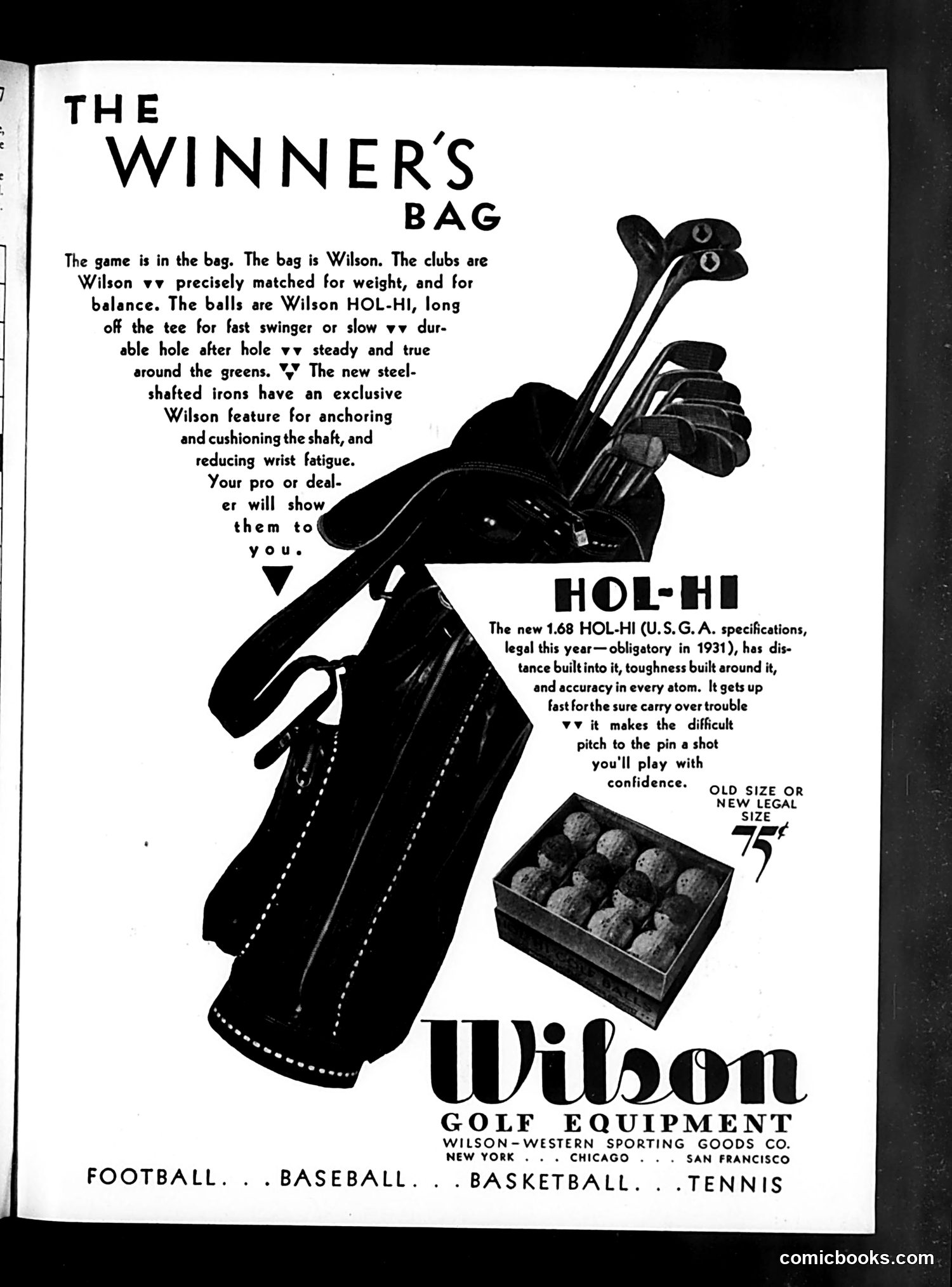
Analysis This is a golf equipment advertisement, not political satire. It's a Wilson brand ad promoting their complete golf set—clubs, balls, and bag—as a winning combination. The page uses the metaphor "The game is in the bag" (meaning victory is assured) as its marketing hook. The visual shows a golf bag with clubs and a box of Wilson HOL-HI golf balls priced at 75 cents. Key details for modern context: The ad mentions "1.68 HOL-HI (U.S.G.A. specifications, legal this year—obligatory in 1931)," indicating this is from around 1930-1931, when golf ball specifications were being standardized. The reference to "steel-shafted irons" highlights a relatively new technology at the time. This reflects the era when golf was marketed as an aspirational sport for the middle and upper classes, with equipment standardization becoming important for competitive play.
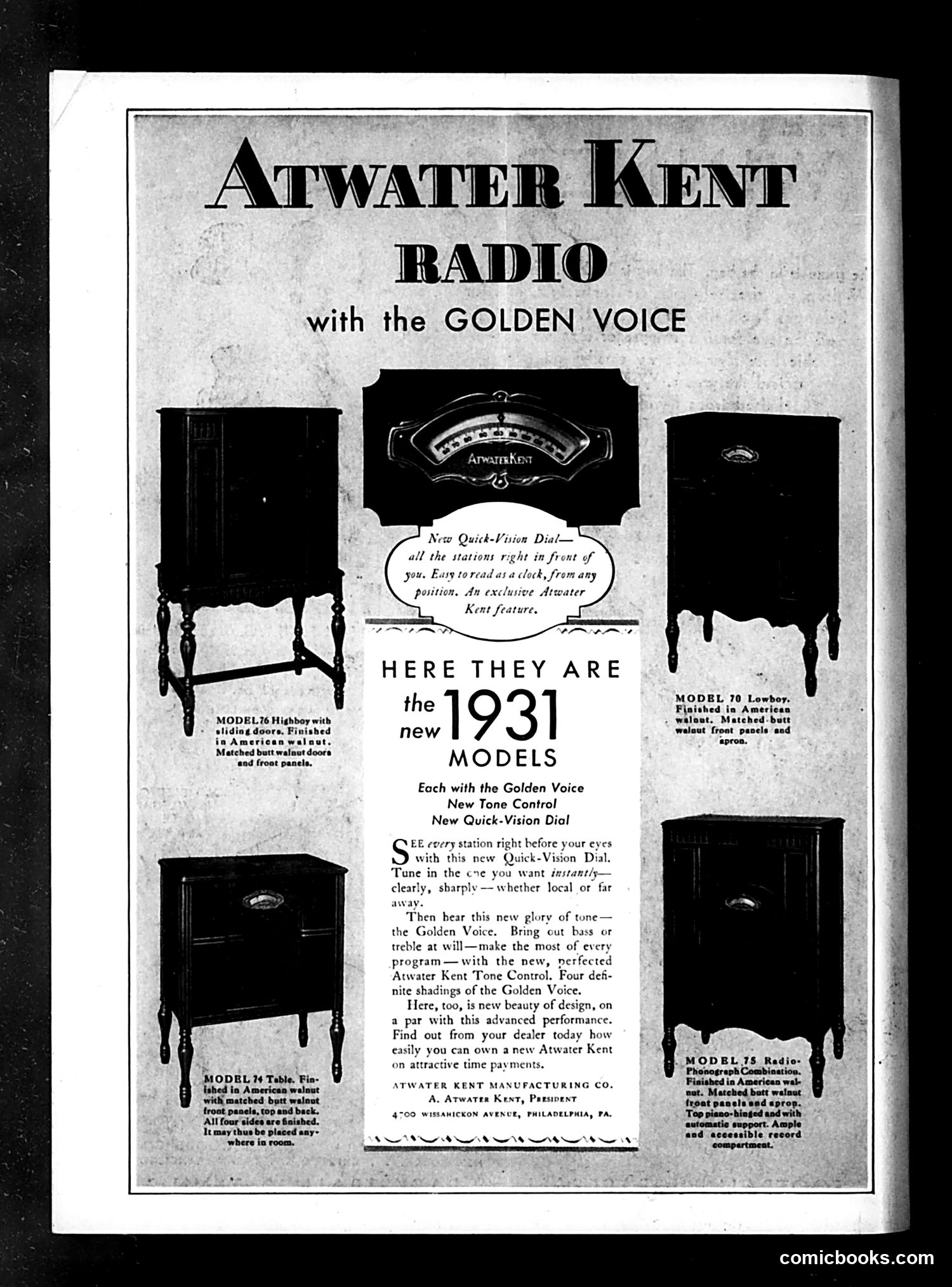
Analysis This is a product advertisement, not a political cartoon. It promotes Atwater Kent radios from 1931. The page showcases three radio models featuring the company's "Golden Voice" technology and new "Quick-Vision Dial" tuning system. The advertisement emphasizes modern design features: furniture-quality wooden cabinetry (American walnut), easy station selection visible at a glance, improved tone control with bass and treble adjustment, and financing options for purchase. The "Golden Voice" is marketing language for superior audio quality—a selling point during the early radio era when sound quality varied significantly between manufacturers. The quick-vision dial addresses a practical consumer need: being able to see which station you're tuned to from any angle. This reflects 1931 America: radios were luxury consumer goods, home entertainment was central to domestic life, and installment buying was becoming standard for major purchases. The ad targets middle-class buyers seeking both functionality and aesthetic home furnishings.

I'm unable to reliably read the specific content of this image. The page appears to be from Life magazine, but the image quality is too dark and degraded for me to make out clear details of any cartoon artwork, text, or identifying features with confidence. To provide an accurate historical explanation following your guidelines—asserting only what I can actually see—I would need a clearer reproduction. If you have a higher-quality scan or can confirm specific details from the OCR text that aren't visible here, I'd be happy to help contextualize the satire and political references for a modern reader.