life
Life — September 19, 1930
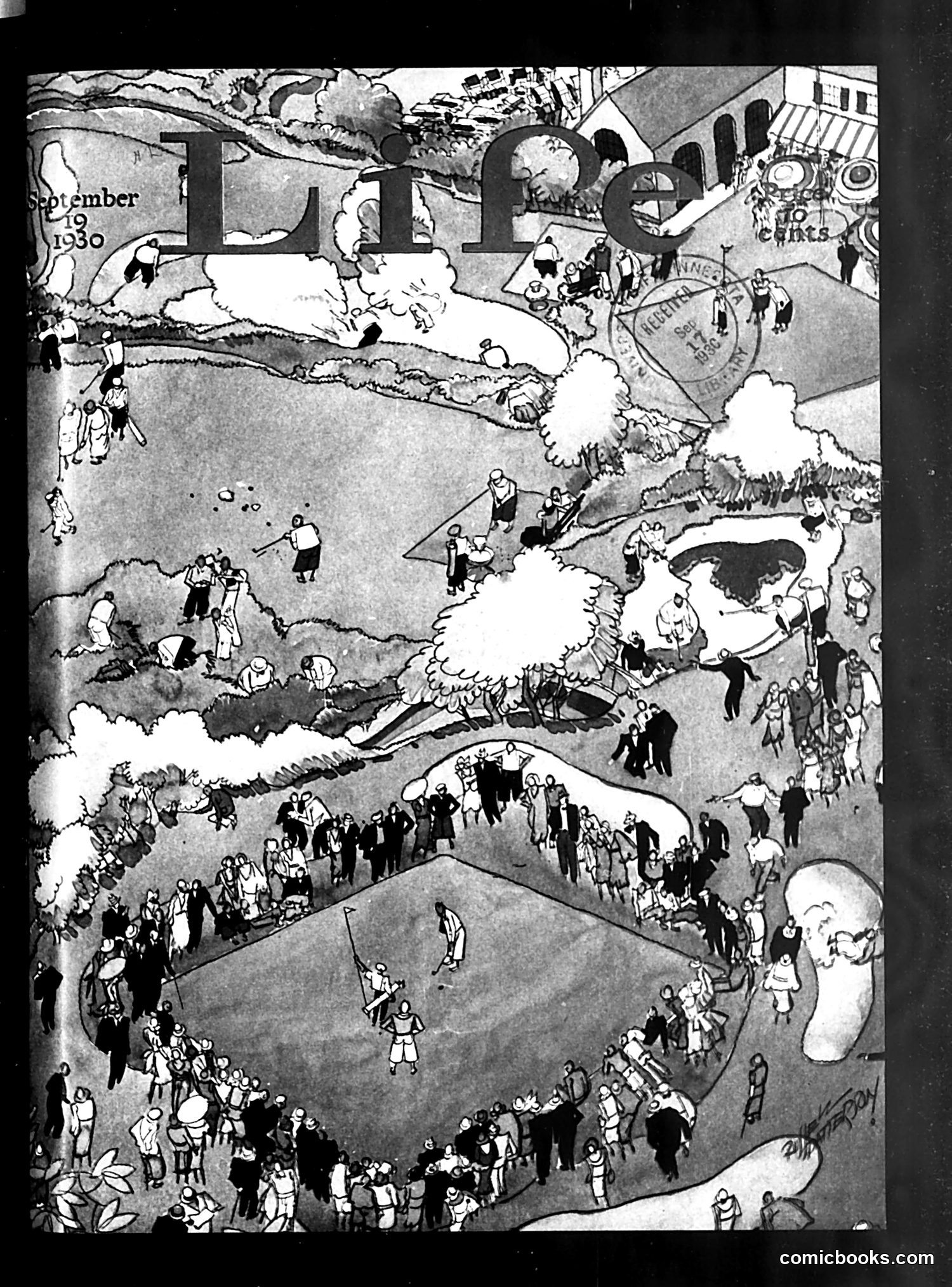
Life Magazine, September 1930 - Aerial View Illustration This appears to be a cover or full-page illustration from Life magazine's September 1930 issue, depicting an aerial view of a landscape populated with numerous small figures engaged in various activities—picnicking, playing sports, socializing, and recreating. The illustration uses the large "LIFE" text as design element integrated into the scene. The style is characteristic of 1930s satirical illustration, presenting everyday American leisure and social activity in bird's-eye perspective. Without additional visible text or captions on this page, the specific satirical point or social commentary remains unclear from the image alone. The illustration appears celebratory of American recreational culture during the early Depression era, though the intended critique or humor—if any—is not definitively apparent from what's visible here.
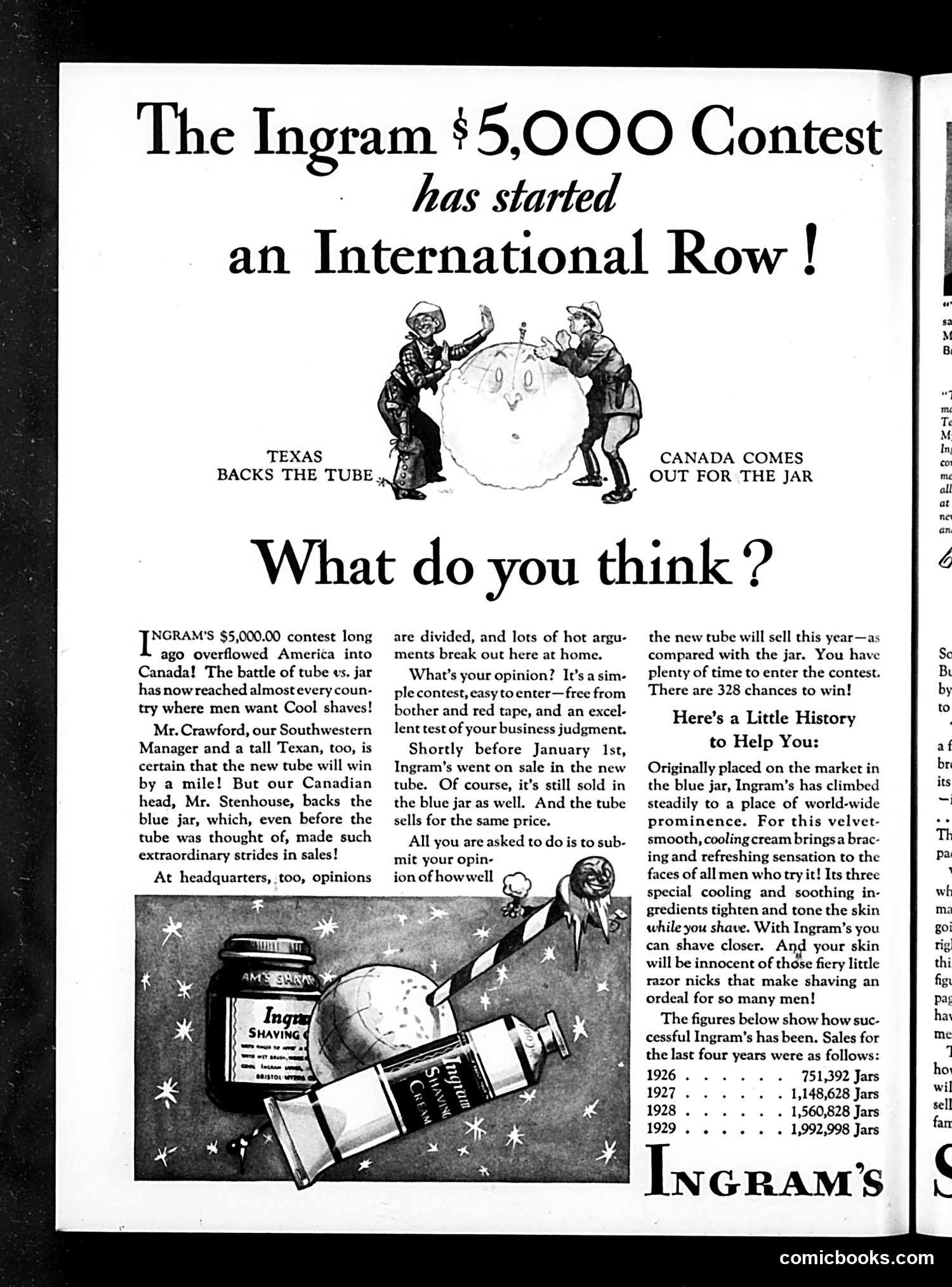
Analysis This is an advertisement for Ingram's shaving cream, disguised as a mock editorial contest. The page presents a playful "international dispute" between Texas and Canada over whether Ingram's new tube or the traditional jar will outsell better. The cartoon depicts two caricatured figures (representing each region) arguing over a large globe, framing a commercial competition as humorous national rivalry. The advertisement's strategy uses nationalist humor and friendly competition to engage readers. The text emphasizes Ingram's product history and sales figures (1926-1929), establishing brand credibility. "Here's a Little History to Help You" section promotes shaving cream benefits—smoothness, skin care, avoiding razor burn—positioning the product as a consumer choice based on practical advantages rather than mere tradition. This blends satire with commerce, typical of Life magazine's advertising approach in this era.
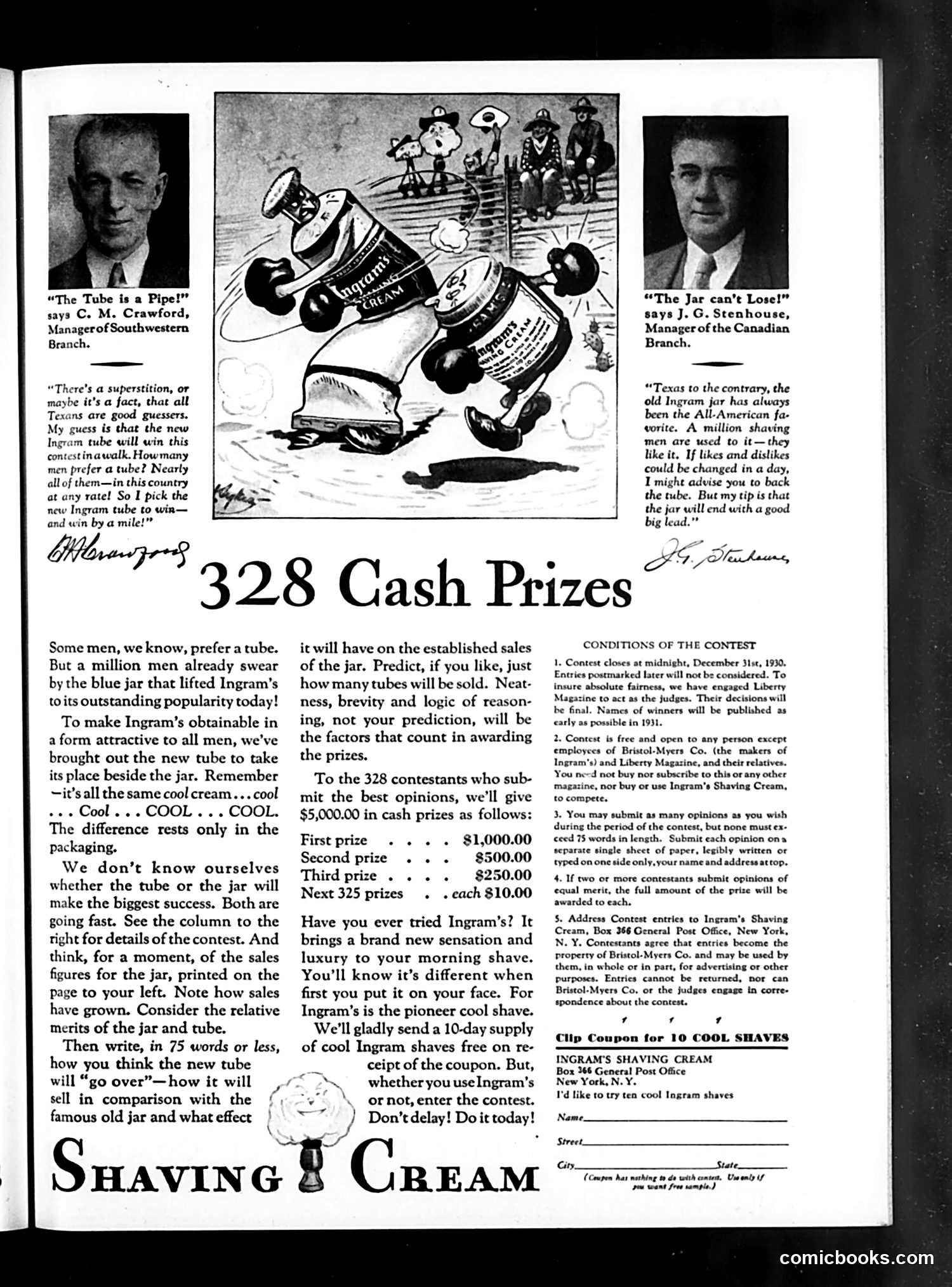
Analysis This is primarily a commercial advertisement for Ingram's Shaving Cream, not political satire. The central cartoon depicts a comical collision between a tube of Ingram's shaving cream and a traditional jar of the product, illustrated as vehicles crashing on a road with spectators watching. The advertisement promotes a product competition: Ingram's new tube packaging versus their established jar format. Two company managers (C.M. Crawford and J.G. Stenhouse) debate the merits—Crawford champions the convenient new tube, while Stenhouse defends the classic jar's reliability. The humor derives from treating packaging formats as rival competitors. The contest awards $5,000 in prizes for readers' predictions about which packaging will prove more successful. This reflects early 20th-century consumer marketing strategies emphasizing product innovation.
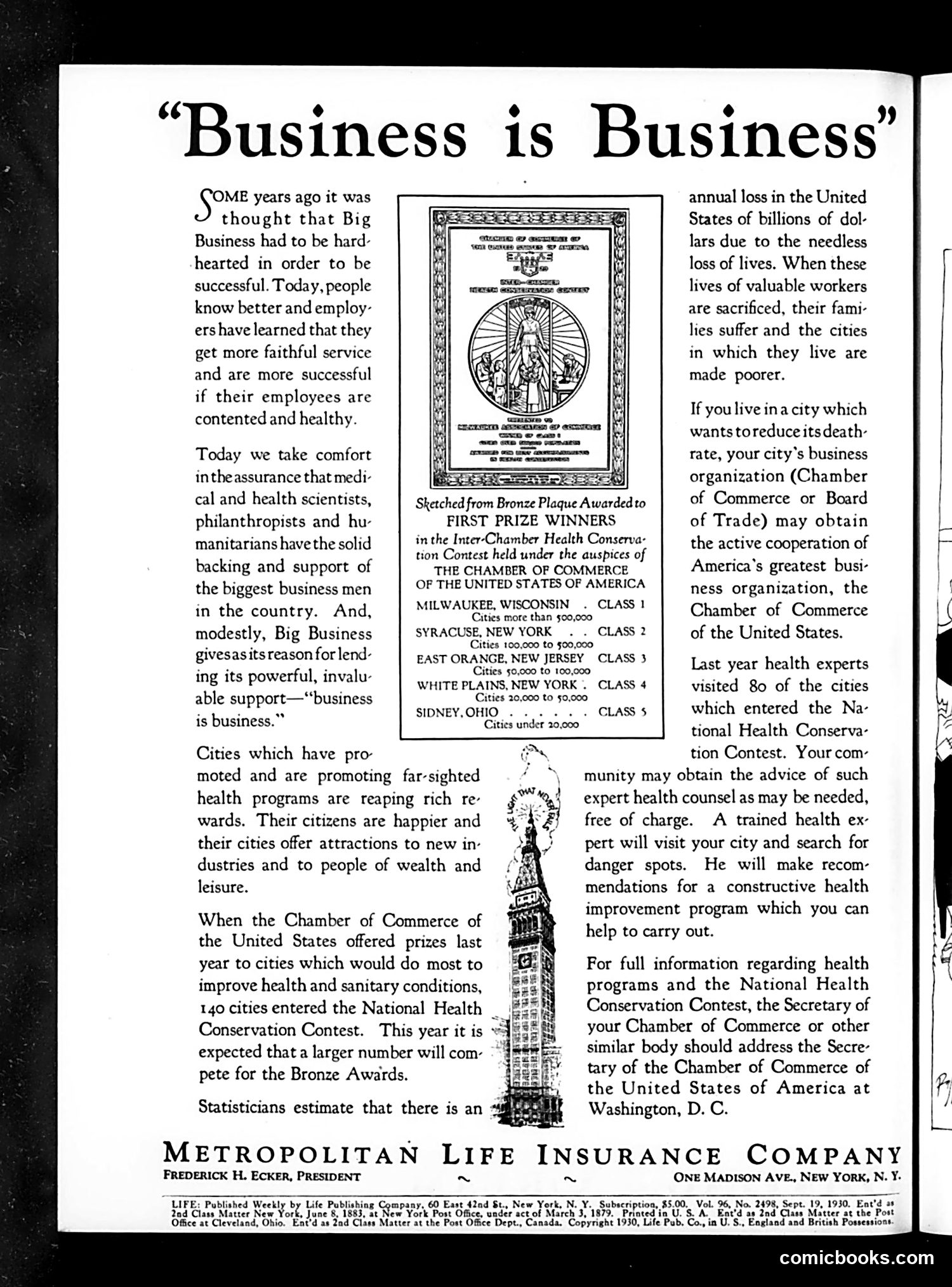
Analysis This is primarily a corporate advertisement for Metropolitan Life Insurance Company, not satire or political commentary. The piece promotes "Business is Business"—the idea that healthy, content employees benefit companies and cities economically. The central image shows a decorative bronze plaque awarded to cities winning the Chamber of Commerce's National Health Conservation Contest, recognizing municipal health improvements. The argument: Cities promoting health programs attract industries and wealthy residents, creating prosperity. The text cites 140 cities entering this contest, with health experts visiting winners to recommend improvements. The appeal to business: Worker health reduces death rates and lost productivity—framed as enlightened self-interest rather than humanitarian concern. Metropolitan Life positions itself as supporting this vision, while advertising its role in promoting public health initiatives. This reflects 1930s business philosophy emphasizing corporate social responsibility as good capitalism.
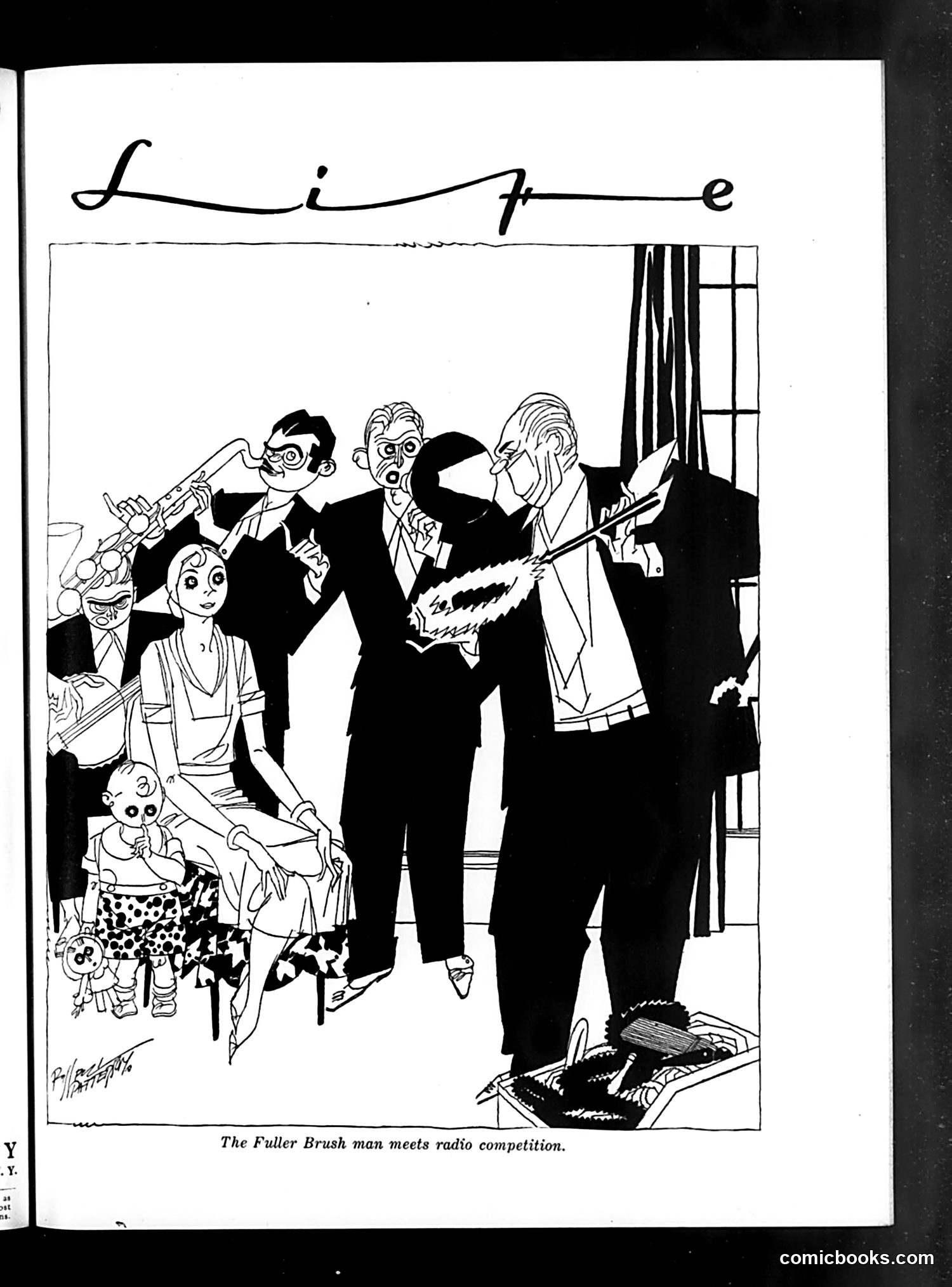
"The Fuller Brush Man Meets Radio Competition" This cartoon satirizes the collision between old and new sales methods in early 20th-century America. The "Fuller Brush man" (left, with traditional product case) represents door-to-door selling—the dominant retail method of the era. He encounters radio advertising (the figures on the right, likely representing radio personalities or sponsors), which was emerging as a revolutionary new marketing medium. The joke targets how radio threatened established sales practices. The crowded, chaotic scene suggests radio's disruptive power and popularity. The exaggerated facial expressions convey the Fuller Brush salesman's shock at this competitor he couldn't have anticipated. The cartoon mocks how quickly consumer culture was shifting from personal, in-person commerce to mass-media advertising.
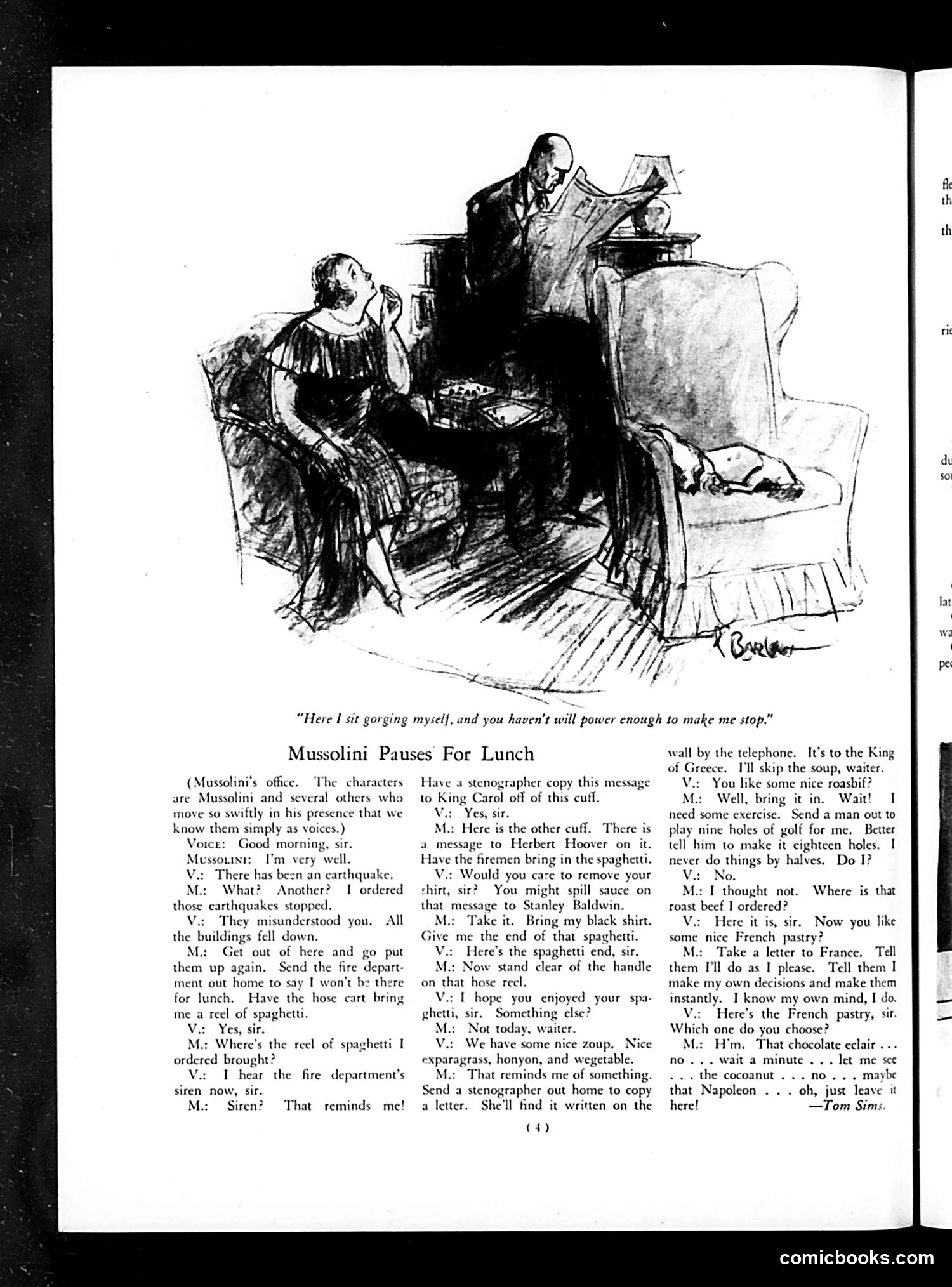
"Mussolini Pauses For Lunch" This satirical sketch depicts Benito Mussolini in his office, attended by a voice (likely a secretary or aide) who interrupts his lunch with increasingly absurd demands and messages—including requests about spaghetti, earthquakes, the fire department, and communications with foreign leaders like Herbert Hoover and Stanley Baldwin. The satire mocks Mussolini's self-important, chaotic leadership style and the constant interruptions of petty bureaucratic matters. The title itself is ironic: even during lunch, he cannot escape administrative minutiae. The cartoon suggests that despite his grandiose posturing as Italy's supreme leader, Mussolini is comically overwhelmed by routine office business—a humorous deflation of his authoritarian pretensions. The attribution to "Tom Sims" appears at the bottom.
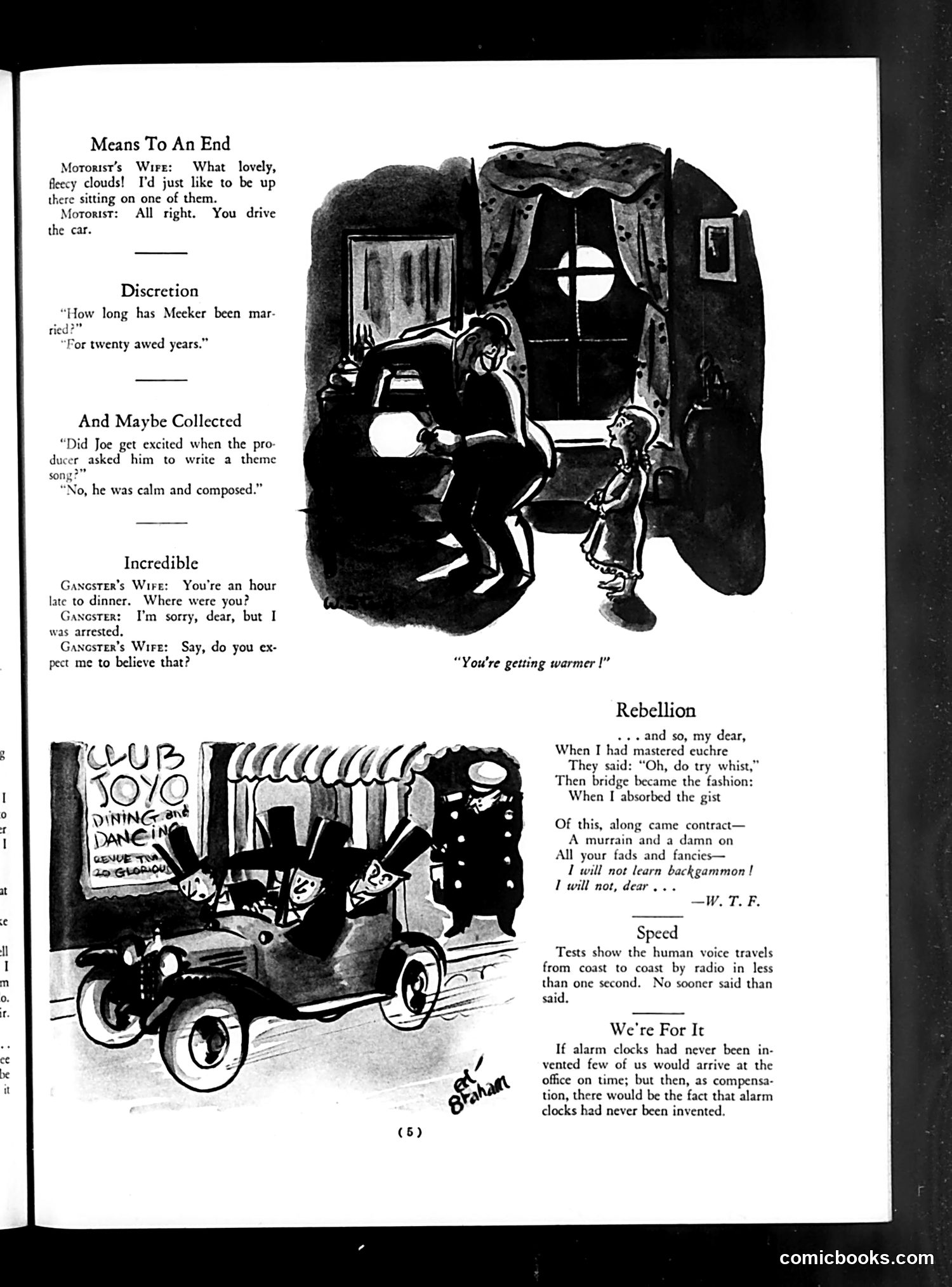
Analysis of Page 56 from Life Magazine This page contains several short humorous pieces and cartoons typical of Life's satirical format: "Means To An End" and "Discretion" are brief jokes about marital dynamics and discretion in relationships. "And Maybe Collected" jokes about a composer's calm demeanor when asked to write a theme song. "Incredible" presents a gangster making excuses to his wife about being arrested for being late to dinner. The illustrated cartoons show domestic and social scenes. One depicts a couple in what appears to be a car or confined space with the caption "You're getting warmer!" The lower cartoon shows a car outside a nightclub ("Club Yoyo") labeled "Dining and Dancing," satirizing 1920s-era nightlife venues. The "Rebellion" poem and short pieces like "Speed" and "We're For It" offer satirical commentary on modern social trends and technology of the era.
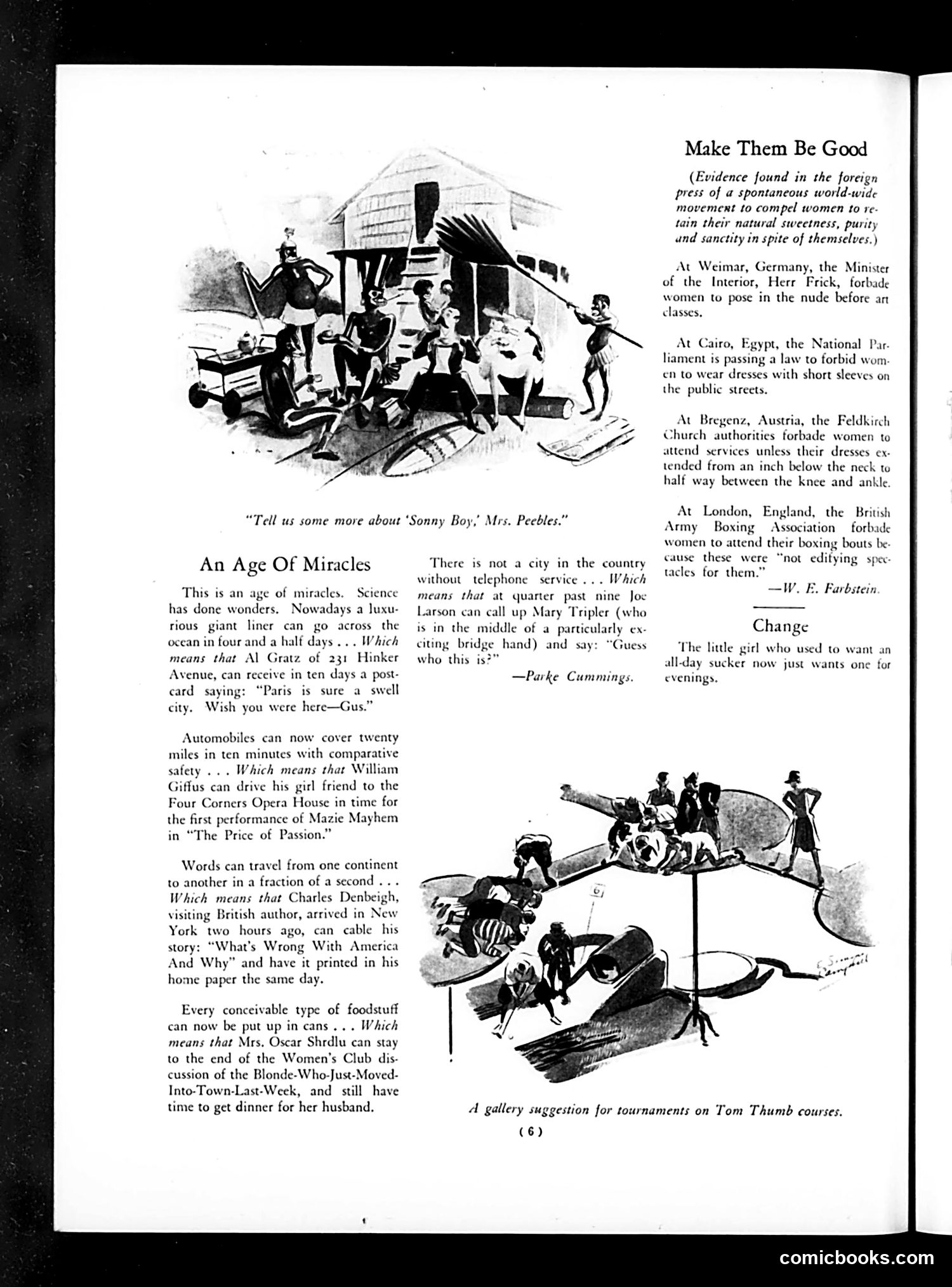
Satire of Modern Technology's Social Impact This page satirizes how rapid technological advancement is disrupting traditional social norms and enabling questionable modern behaviors. The top section "An Age of Miracles" catalogs recent innovations—transcontinental automobiles, international telegraph service, canned food—that allow unprecedented freedom and mobility. The satirical point: these conveniences enable people (particularly women and men) to behave in ways previously impossible or socially forbidden. The right column "Make Them Be Good" documents international efforts to legally restrict women's dress and public conduct, suggesting authorities recognize modern freedoms are undermining traditional moral standards. The bottom cartoon appears to mock newfound leisure activities enabled by technology, possibly suggesting Tom Thumb Circus-style entertainments represent frivolous modern pastimes. The overall satire: technology creates freedom, but society responds by attempting to legislate morality.
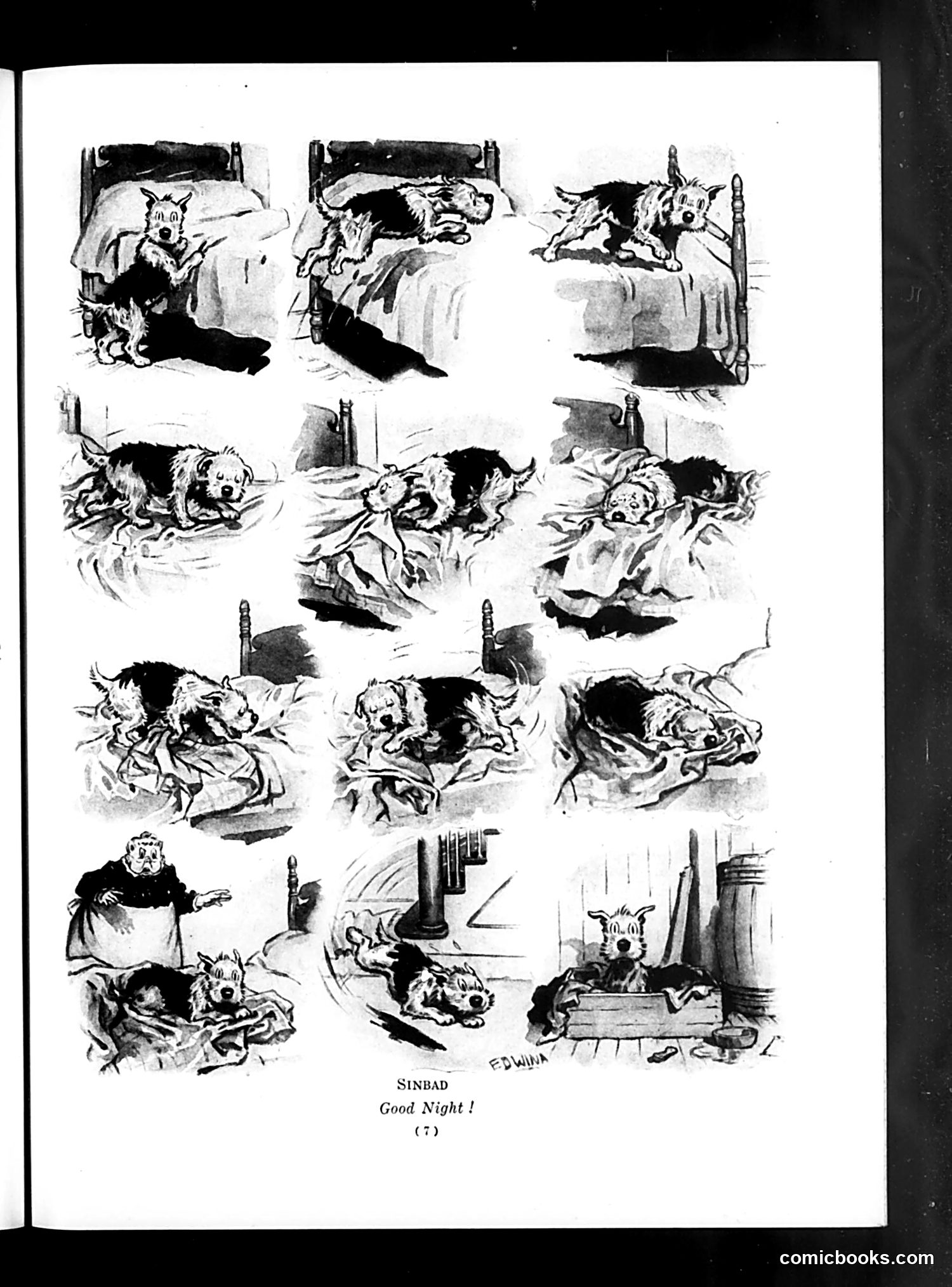
Analysis of "Sinbad: Good Night!" This appears to be a humorous illustrated sequence from Life magazine showing bedtime scenes with dogs. The title "Sinbad" and "Good Night!" suggests these are sequential comic panels depicting a character (likely named Sinbad) and various dogs in sleeping positions and nighttime scenarios. The drawings show dogs in beds, on floors, and in various states of rest and restlessness—stretching, tangled in blankets, and moving about. The sketch style is loose and expressive, emphasizing comedic movement and posture. Without clearer historical context or text identifying specific political figures or events, this appears to be straightforward humorous domestic animal comedy rather than political satire—typical of Life magazine's lighter entertainment content from this era.
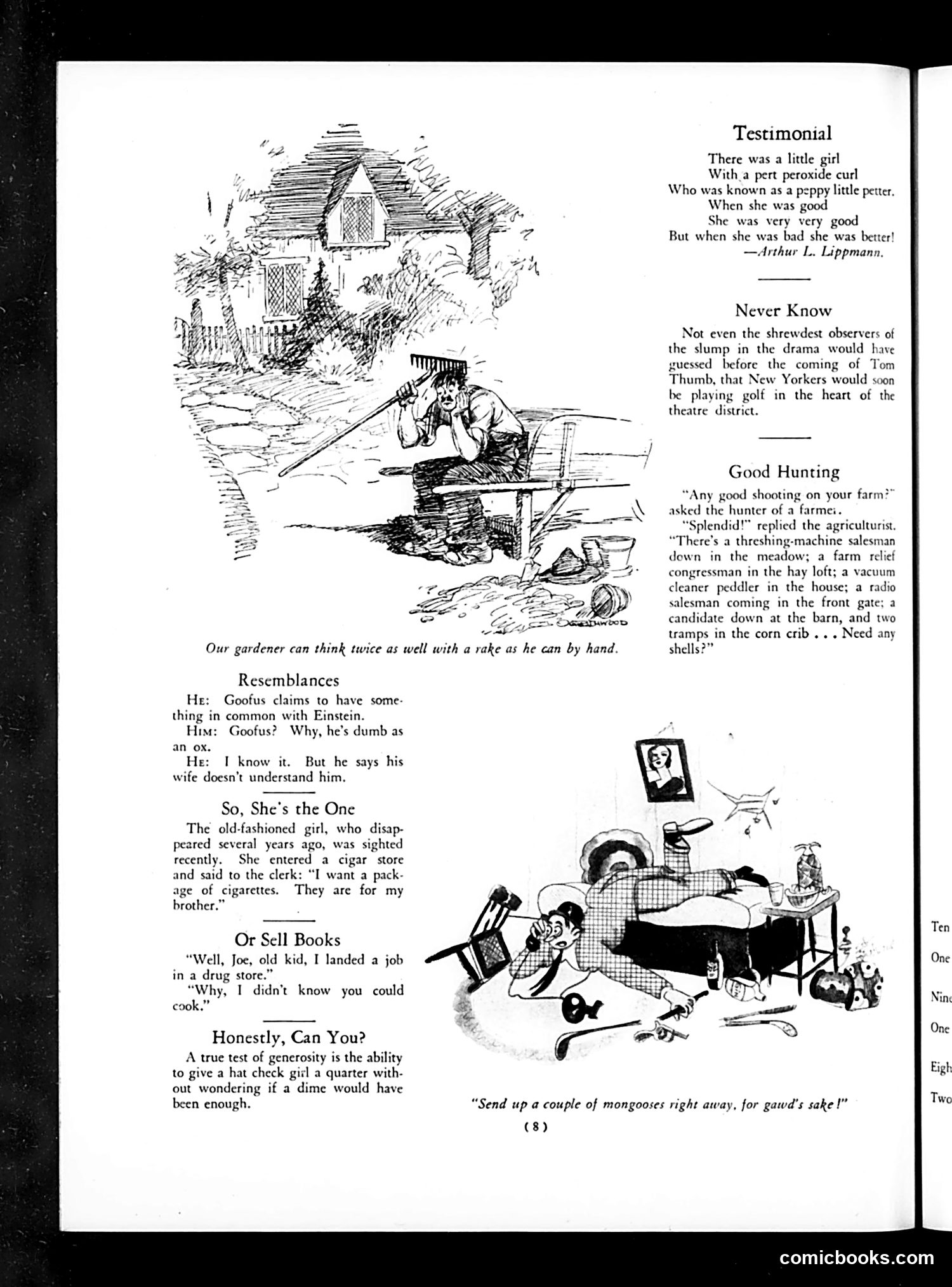
Analysis of Life Magazine Page This page contains several short humorous pieces and illustrations typical of early 20th-century satirical magazines. The main cartoon depicts a man in bed surrounded by domestic chaos and clutter, with the caption "Send up a couple of mongooses right away, for gaud's sake!" The joke satirizes urban apartment living—suggesting mongooses (known for hunting rodents) are needed to control the mess and vermin in a cramped living space. The smaller text pieces ("Never Know," "Good Hunting," "Resemblances," "Or Sell Books," "Honestly, Can You?") are brief anecdotal jokes about contemporary life—sales pitches, intellectual pretensions, and social observations. The top illustration shows a gardener with a rake, accompanying text about rural labor efficiency. Overall, the page mixes urban and rural comedy reflecting 1910s-1920s American life.
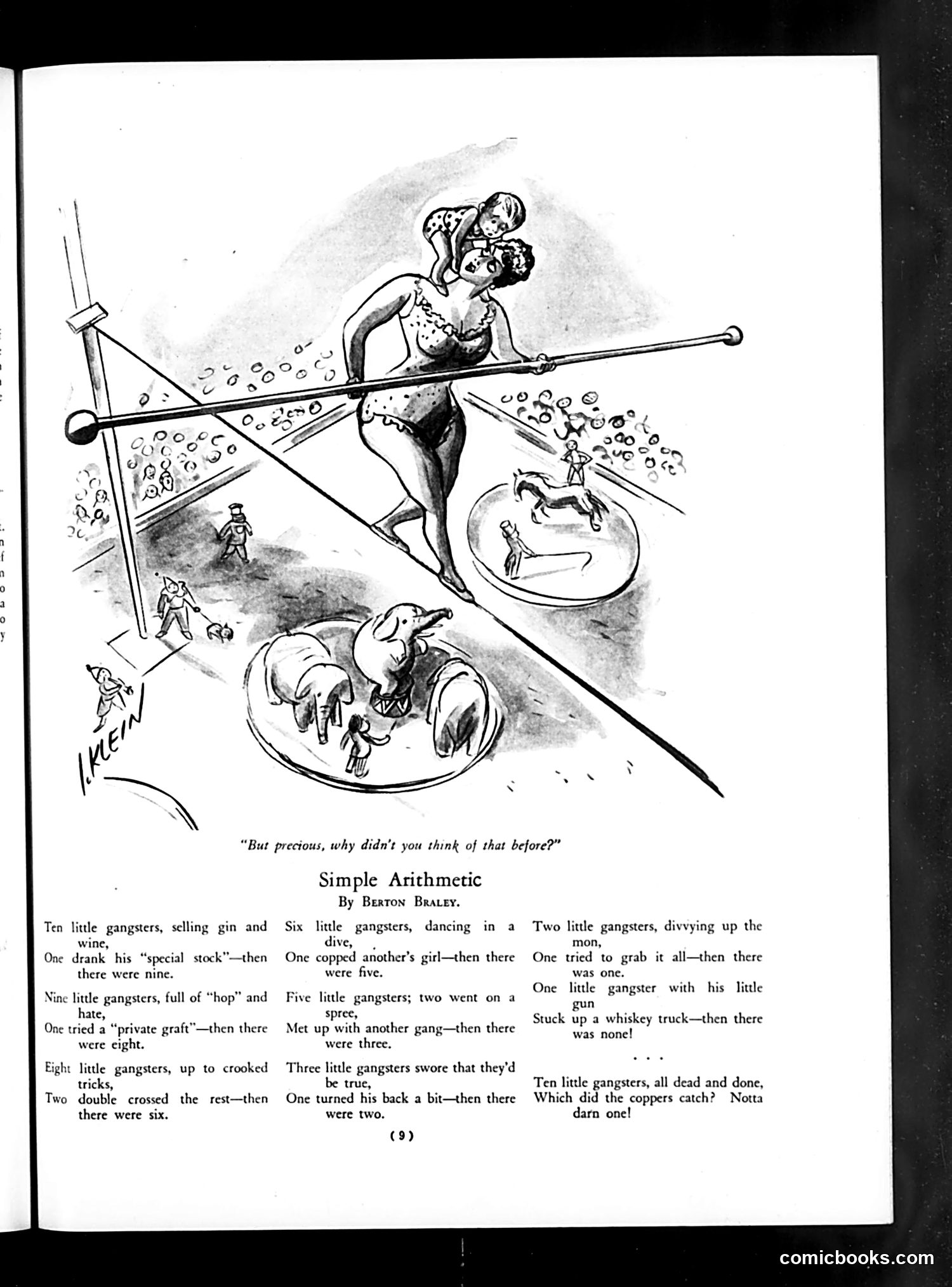
"Simple Arithmetic" by Berton Brealey This satirical poem uses dark humor to comment on urban gang violence and prohibition-era crime. The illustration depicts a scantily-clad woman juggling gangsters as circus performers, with police activity below—visualizing the chaotic criminal underworld. The poem traces "ten little gangsters" through a series of violent episodes: fights over women, gang rivalries, arrests, betrayals, and murders. Each stanza subtracts gangsters through increasingly brutal means (shootouts, truck violence, police action) until none remain. The final punchline—"Which did the coppers catch? Nota darn one!"—satirizes law enforcement's inability to control organized crime during Prohibition. The title "Simple Arithmetic" is ironic: the math of gangster life simply means death, with no accountability for those running the criminal operations.
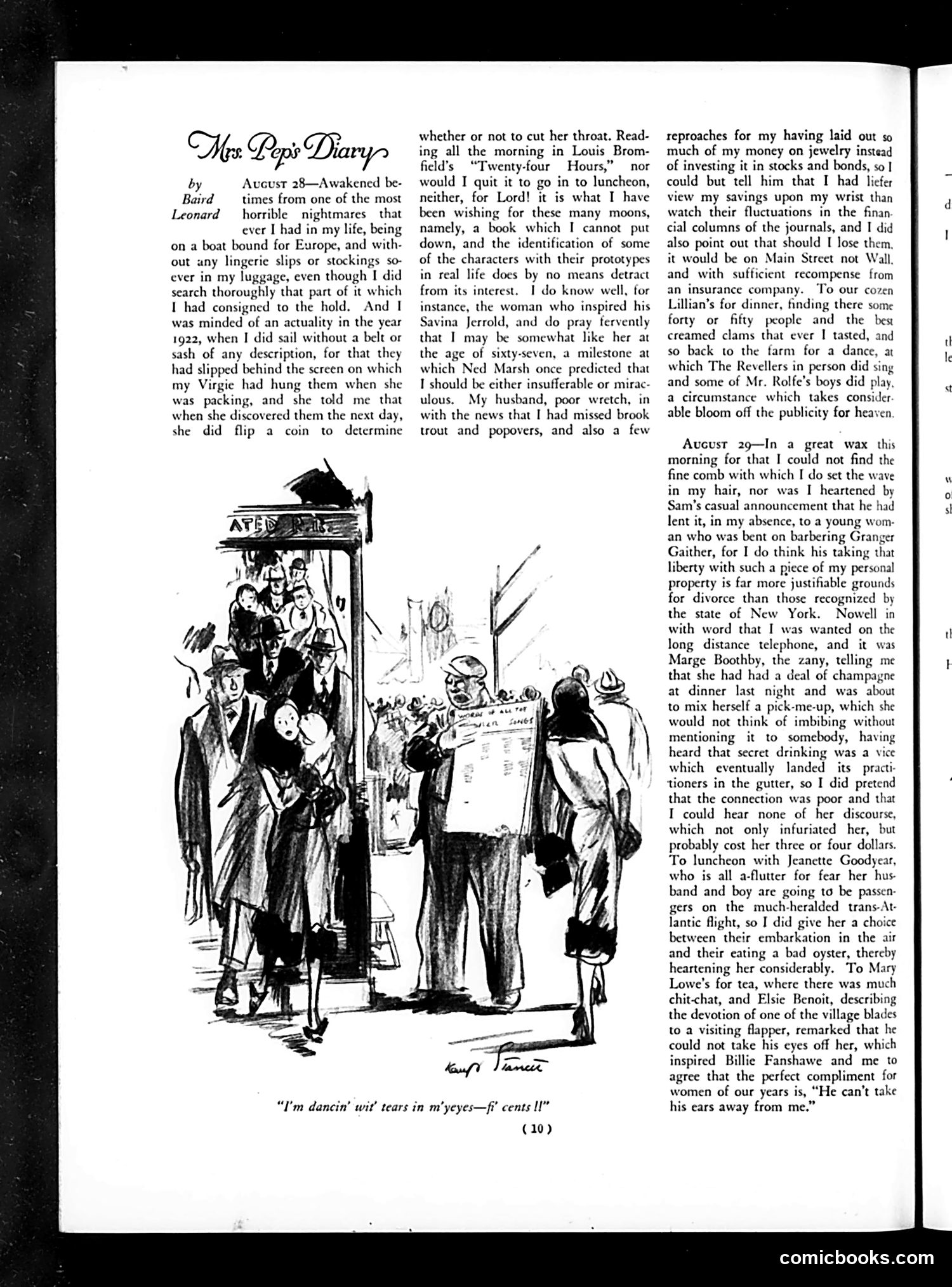
"Mrs. Pope's Diary" Commentary This is a humorous diary entry by "Baird Leonard" satirizing the social anxieties and complaints of a wealthy woman. The cartoon illustrates a street scene where the diarist encounters various acquaintances. The satire targets upper-class concerns: the diarist frets over jewelry investments versus stocks, worries about servants' behavior, complains about borrowed combs and champagne-fueled dinner guests, and obsesses over a young barber named Granger. She discusses transatlantic travel plans and social gatherings at fashionable tea rooms. The humor lies in the trivial nature of her grievances presented as major life events—a characteristic satirical approach Life magazine used to mock the preoccupations of the leisure class during this era. The cartoon's caption ("I'm dancin' wit' tears in m'eyes—fi' cents!!") suggests commentary on class contrast or entertainment venues.
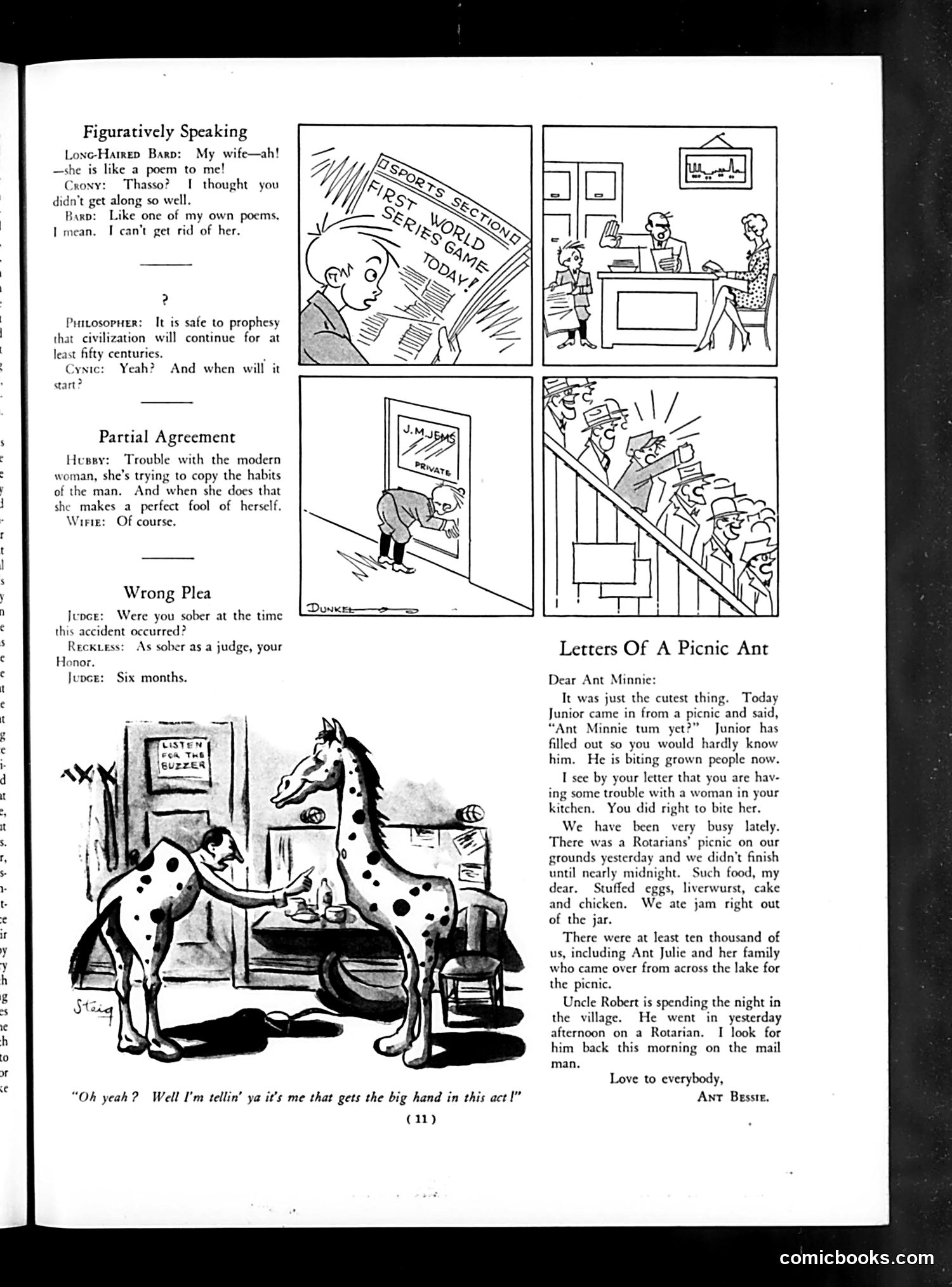
Content Analysis This page contains three distinct sections: 1. "Figuratively Speaking" - Brief humorous dialogues about poetry, civilization, and modern women's behavior. 2. Comic strip panels (top right) - Depicts what appears to be a sports or entertainment venue scene, though details are unclear from the image quality. 3. Horse cartoon (bottom left) - Two spotted horses at what appears to be a "Listen Buzzer" device. The caption reads: "Oh yeah? Well I'm tellin' ya it's me that gets the big hand in this act!" This satirizes performers arguing over who receives audience applause. 4. "Letters of a Picnic Ant" (right) - A humorous letter from "Ant Bessie" describing a Rotarians' picnic, using anthropomorphized ants as vehicles for gentle social satire about human leisure activities and domestic life. The overall tone is light, domestic humor typical of early-to-mid 20th century American magazine satire.
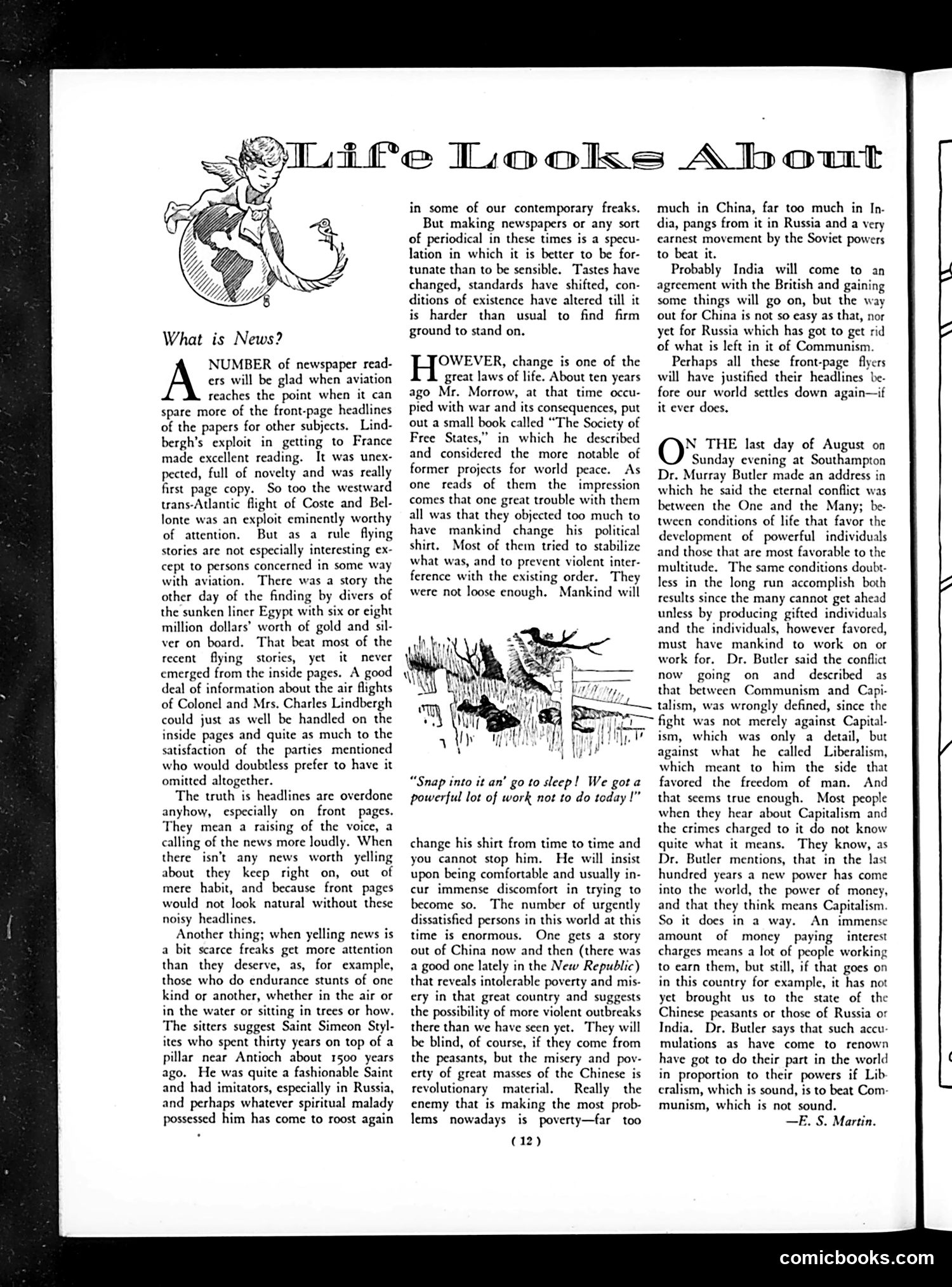
Analysis of "Life Looks About" Page This page discusses contemporary news standards and headline sensationalism. The main cartoon shows a figure in bed saying *"Snap into it an' go to sleep! We got a powerful lot of work not to do today!"*—satirizing worker laziness or apathy. The accompanying article critiques how newspapers overemphasize dramatic stories (like Lindbergh's flight or finding sunken treasure) while neglecting substantive coverage. The author argues that sensational headlines train readers to expect constant excitement, making serious news harder to report. The piece also discusses global unrest in China, Russia, and India, referencing communist and capitalist ideological conflicts. The author advocates for balanced reporting over sensationalism to maintain public understanding of complex geopolitical issues.
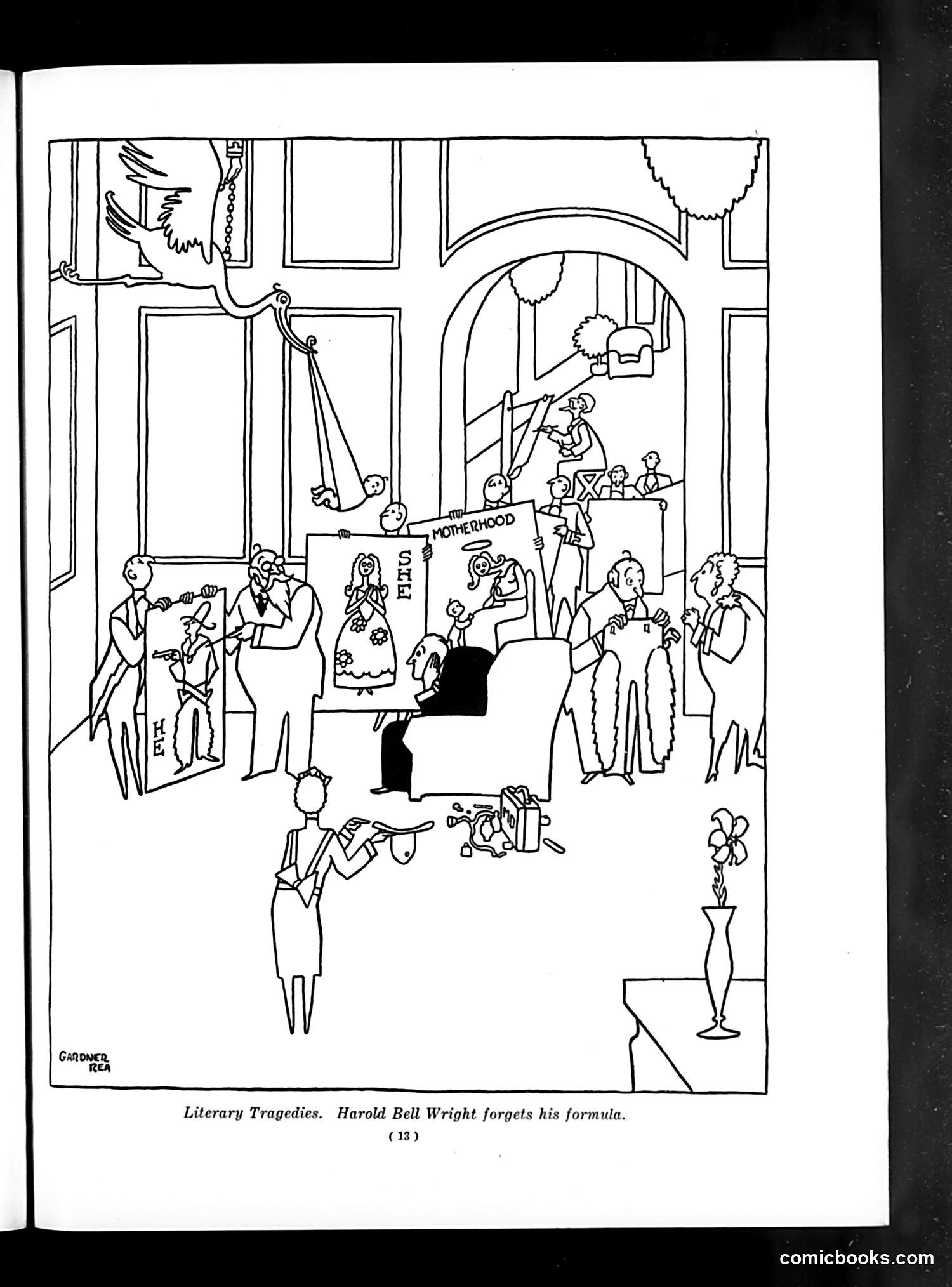
Analysis This is a single cartoon titled "Literary Tragedies. Harold Bell Wright forgets his formula." The image depicts a chaotic indoor scene—apparently a social gathering or party—with numerous figures in disarray. A sign reading "MOTHERHOOD" is visible, and there's a large black silhouette of what appears to be a bed or furniture in the center. The satire: Harold Bell Wright was a bestselling early-20th-century American novelist known for sentimental, moralistic stories emphasizing rural virtue and domestic values. This cartoon mocks him for abandoning his trademark formula—likely suggesting he wrote something unconventional or scandalous (possibly involving the "motherhood" theme shown). The chaotic scene and bedroom imagery imply his departure from wholesome themes created literary/social disorder. The cartoon ridicules Wright for straying from the predictable sentimentality his readers expected.
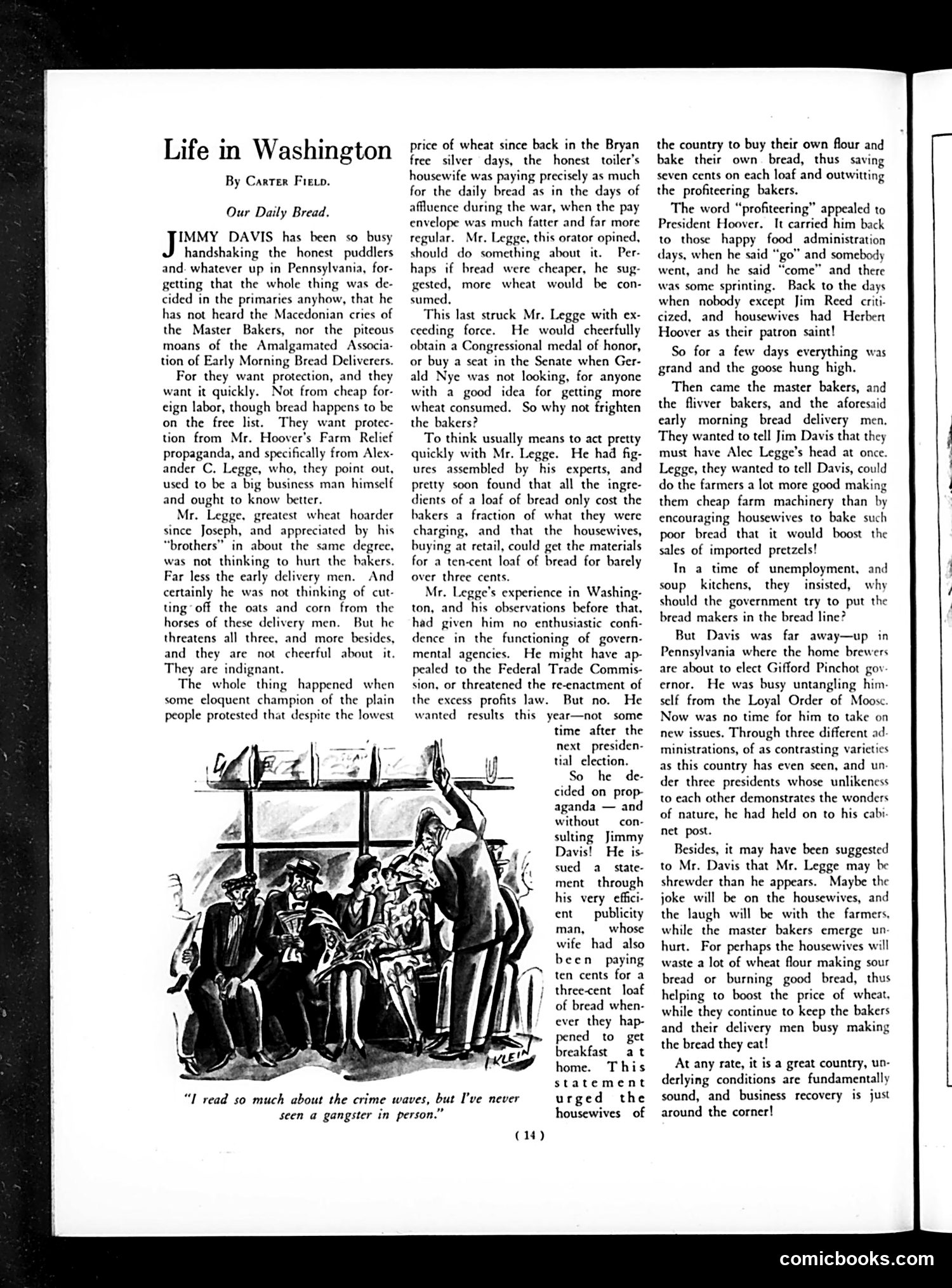
Analysis of "Life in Washington" by Carter Field This article satirizes wheat price inflation and profiteering during the post-WWI period. Jimmy Davis, representing honest bread deliverymen, confronts Alec Legge, a wheat hoarder exploiting scarcity. Legge exemplifies wartime profiteering—he manipulates grain supplies to artificially inflate bread prices while congressmen look the other way. The illustration shows Davis confronting Legge about unfair pricing. The text criticizes government inaction against such "crime waves" while ordinary housewives struggle affording basic bread. The satire targets both the profiteer and the administration's failure to regulate excess profits, suggesting that economic recovery requires controlling such speculation rather than allowing continued exploitation of essential goods.
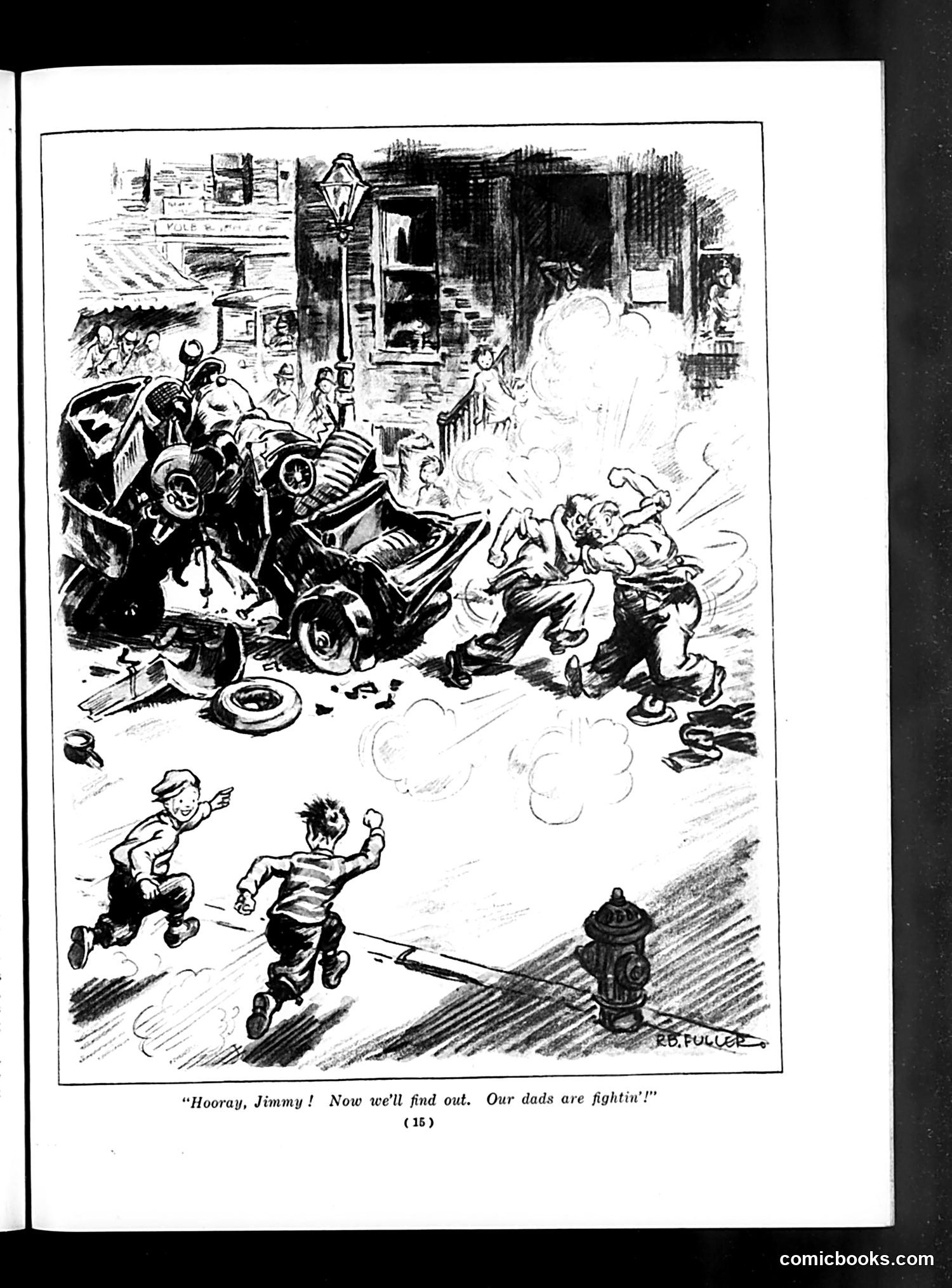
Cartoon Analysis This single-panel cartoon by R.B. Fuller depicts two young boys excitedly running toward a street scene of violent conflict. The caption reads: "Hooray, Jimmy! Now we'll find out. Our dads are fightin'!" The humor—and underlying social critique—comes from children enthusiastically rushing toward danger to witness their fathers in combat. The cartoon likely satirizes either street violence (gang fights or labor disputes common in early 20th-century urban America) or possibly WWI enthusiasm, where families had members actively fighting. The joke works on multiple levels: the children's innocent excitement contrasts darkly with the serious violence occurring, while implicitly criticizing the societal conditions that normalize such combat as entertainment for youth. It's social commentary wrapped in dark humor about urban conflict and its effects on communities.
Theatre Review by Baird Leonard This page contains two theatre reviews by Baird Leonard from *Life* magazine, not political cartoons. "The Second Little Show" criticizes a theatrical sketch about a guest at a super-service hotel. Leonard notes the production relies too heavily on expensive staging and elaborate sets rather than genuine wit. He praises some performers (C. Flippen, Al Trahan, Yakima Canutt) but finds the overall entertainment uninspired, particularly critiquing a song with poor lyrics. "Torch Song" reviews a cabaret-style performance exploring themes of sex and religion. Leonard finds it occasionally amusing but inconsistent, featuring a young singer and travelling entertainer. He notes the show's psychological observations about morality are forgettable despite occasional clever moments. Both reviews are straightforward theatrical criticism, not satire or political commentary.
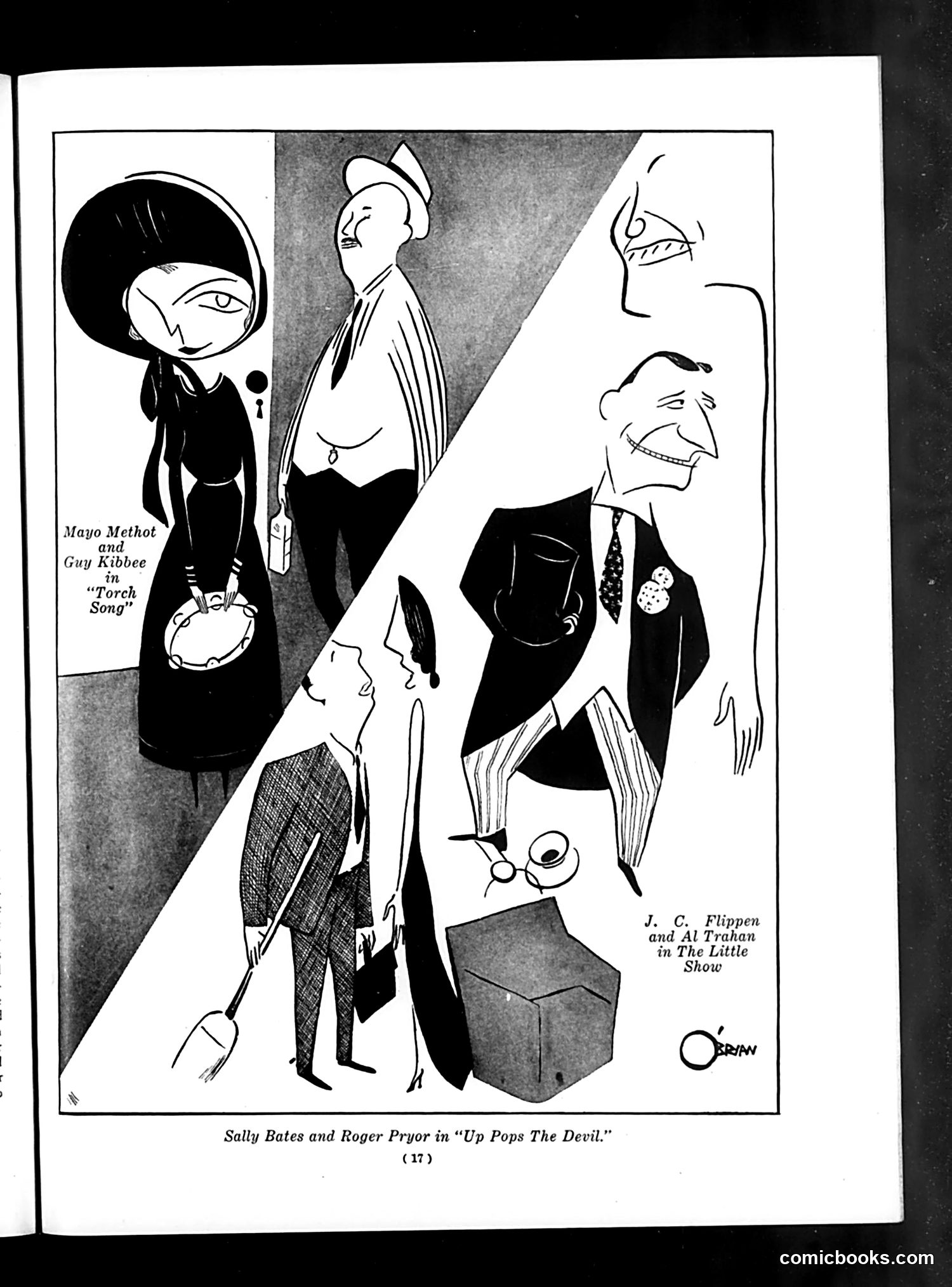
Analysis of Life Magazine Page This page features theatrical caricatures by artist Cesarin (signature visible), illustrating performers in three different shows: 1. "Torch Song" – Mayo Methot and Guy Kibbee (left figure with distinctive round head and formal attire) 2. "The Little Show" – J.C. Flippen and Al Trahan (top center, shown in period costume) 3. "Up Pops The Devil" – Sally Bates and Roger Pryor (bottom, the main focus) The caricatures use exaggerated features typical of early 1930s satirical portraiture—elongated faces, prominent noses, and theatrical poses. These appear to be entertainment reviews or promotional sketches rather than political satire, documenting Broadway theater productions of the era through visual humor and character mockery.
Movie Reviews by Harry Evans This page contains two film reviews from Life magazine's "Movies" column. "Monte Carlo": Evans praises Ernst Lubitsch's directorial cleverness, noting his skill at introducing subtle humor and avoiding clichéd situations. The review highlights a train scene with Jeanette MacDonald (Countess Vera von Conti) singing "Beyond the Blue Horizon," which Evans calls perfectly orchestrated. He appreciates the film's intelligent musical integration and comedic timing. "Old English": Evans celebrates George Arliss's performance in a lengthy scene with minimal dialogue, calling it a masterclass in physical acting. However, Evans critiques the overall film as dramatically thin—essentially a showcase for Arliss rather than a substantial story. The review includes a small illustration accompanying the Monte Carlo discussion.
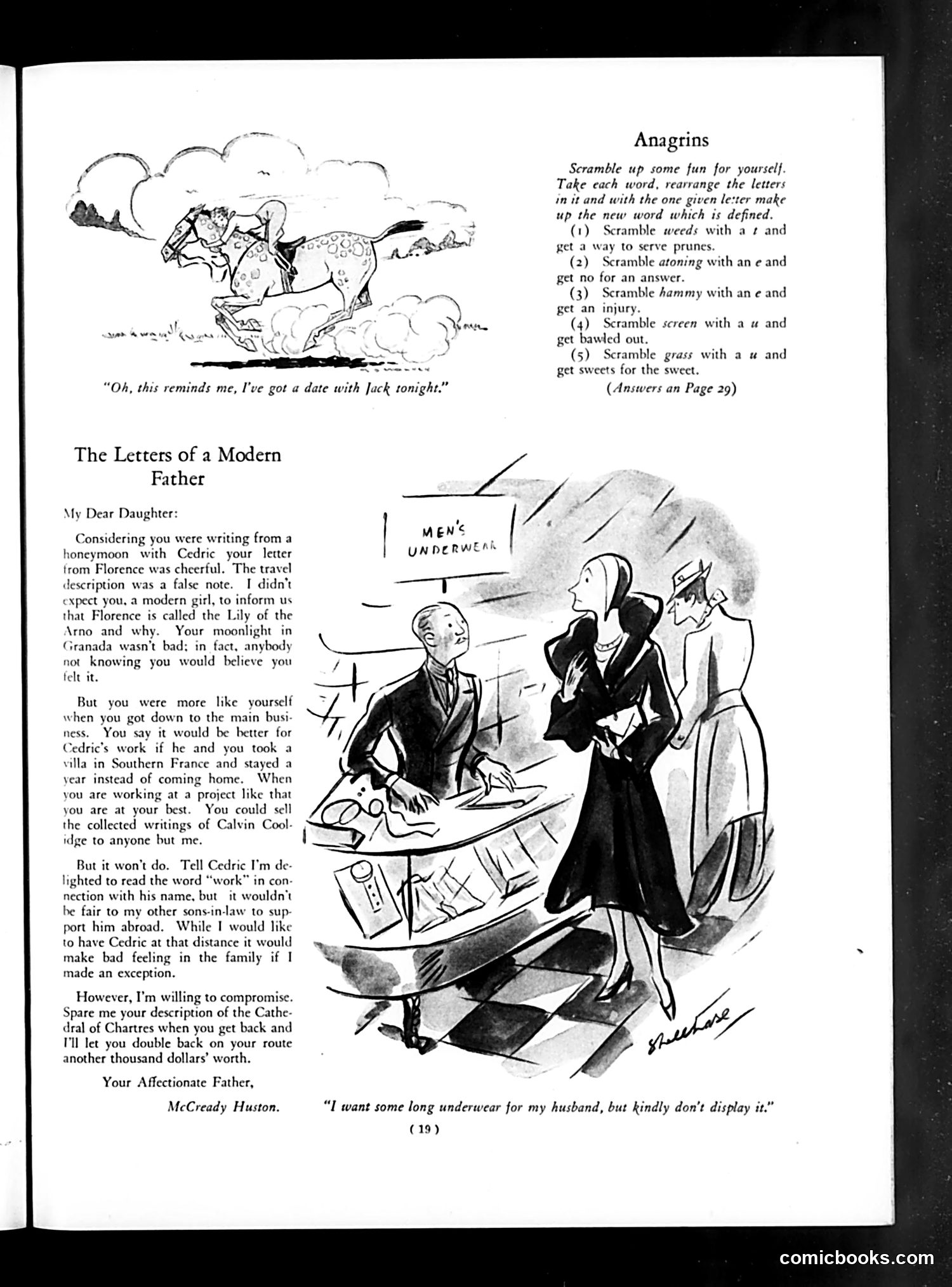
Analysis of Life Magazine Page Top Section - "Anagrins": A word puzzle game where readers rearrange letters to form new words with given definitions. This is a typical puzzle feature for magazine entertainment. Main Content - "The Letters of a Modern Father": A humorous letter from father McCready Huston to his newlywed daughter Cedric (presumably the husband). The satire targets post-WWI attitudes about marriage and work: The father initially approves of his daughter's "work" ethic but refuses to financially support the couple staying abroad, citing fairness to his other sons-in-law. He offers a compromise: he'll give her extra money if she spares him detailed travel descriptions upon return—mocking both verbose travel narratives and the expectation that wealthy fathers bankroll adult children's lifestyles. Bottom Cartoon: Shows a woman at a men's underwear counter requesting merchandise but asking the clerk not to display it—satirizing social prudishness about intimate apparel, even when purchasing it for legitimate purposes. The humor lies in the absurdity of the request.
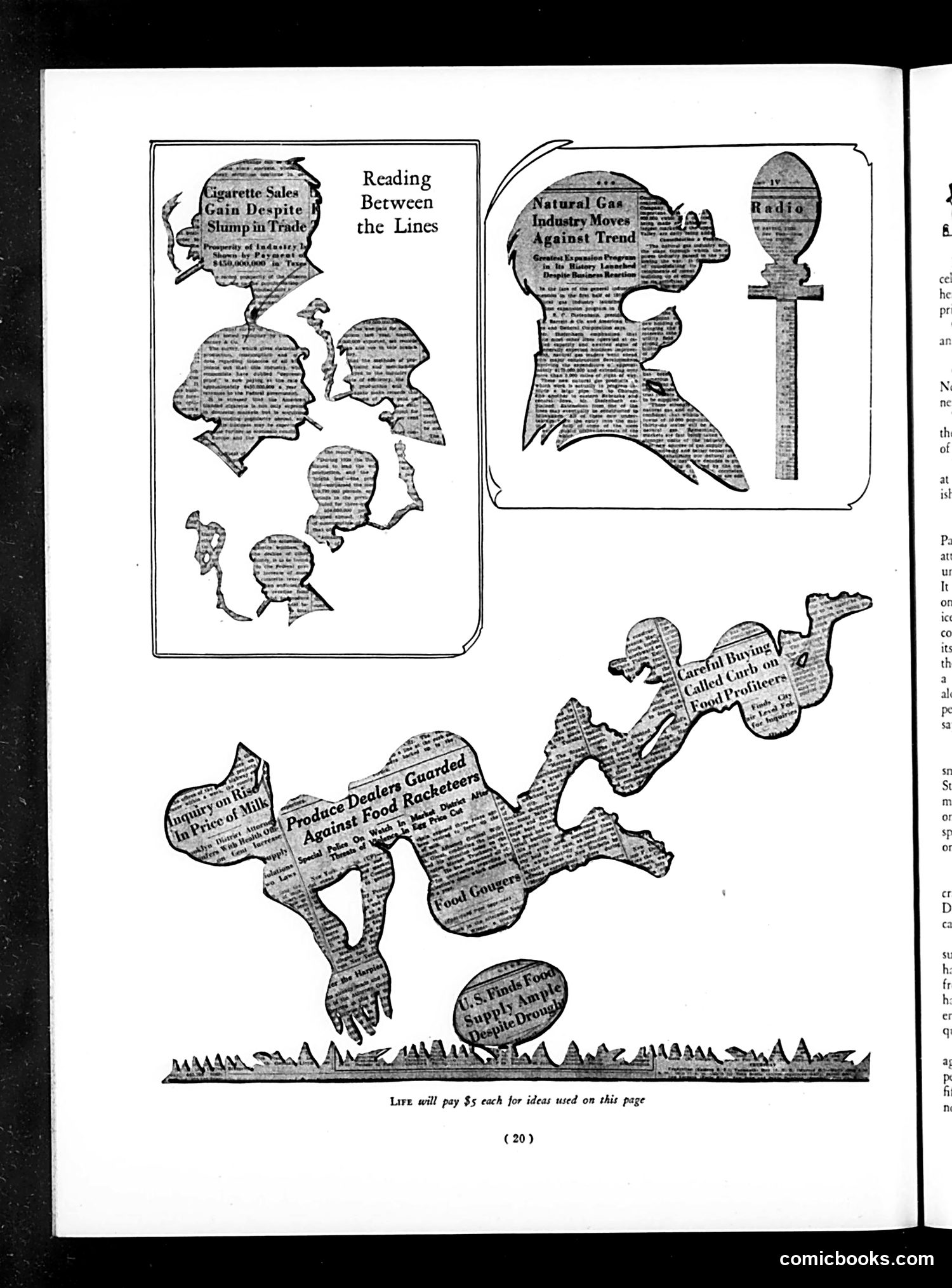
"Reading Between the Lines" - Life Magazine Satire Page This page presents newspaper-shaped silhouettes filled with article text, a common Life magazine satirical technique. The left panel titled "Cigarette Sales Gain Despite Slump in Trade" shows heads/profiles containing news stories, mocking how cigarette companies maintained sales during economic downturns. The right panel features industrial/business silhouettes: "Natural Gas Industry Moves Against Trend," a radio tower, "Careful Buying Called Cure for Food Profiteers," and references to "Food Counters" and "U.S. Floats Huge Supply Drought." These appear to critique various industries—energy, agriculture, food distribution—for either thriving during hardship or allegedly price-gouging consumers. The satire targets corporate interests that prospered while ordinary citizens struggled economically, suggesting these industries operated counter to public welfare. The note that "Life will pay $5 each for ideas" invited reader participation in social commentary.
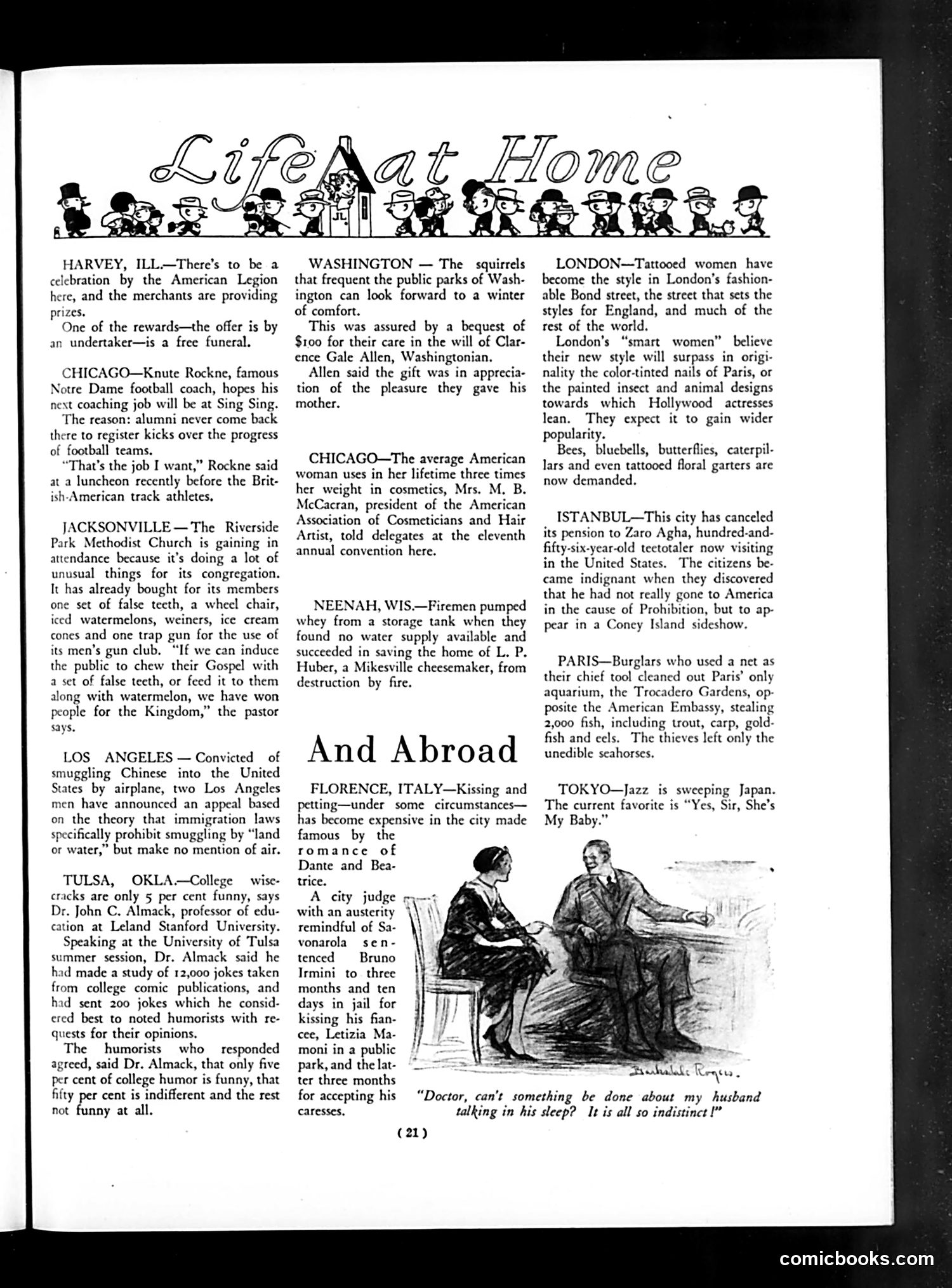
Life Magazine "Life at Home and Abroad" Page Analysis This page collects humorous news briefs from American cities and abroad, using absurdity and irony for satire. Domestic highlights: An undertaker offers a free funeral as a prize (dark humor about death); Knute Rockne, the famous Notre Dame football coach, jokes he'd prefer coaching at Sing Sing prison because alumni won't bother him there (mocking alumni interference in college sports); a church buys false teeth and trap guns to attract congregants (satirizing desperate religious recruitment). International items: Florence judges jail couples for public kissing (mocking puritanical morality); London society women adopt tattoos as fashion (ridiculing upper-class trend-chasing); Istanbul cancels a pension to a 156-year-old man (unclear context). The cartoon (bottom) shows a doctor and woman, with her complaining her husband "talks in his sleep"—standard domestic humor about marital annoyance. The page's overall tone mocks American provincialism, religious excess, sports obsession, and international pretension through brief, deadpan anecdotes.
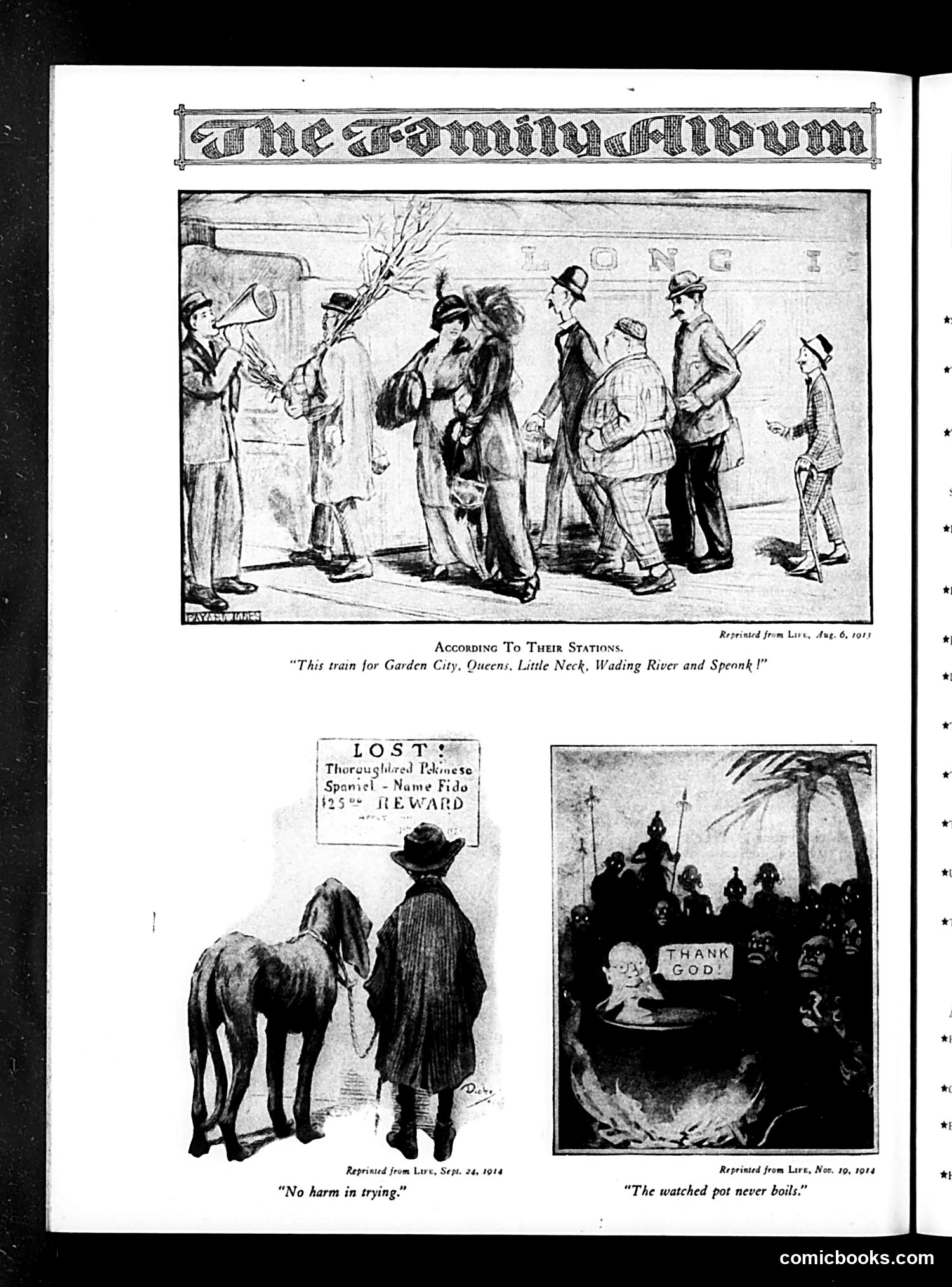
Life Magazine Satirical Cartoons (1914-1918) This page contains three unrelated satirical cartoons: Top cartoon (Aug. 6, 1918): A crowded train platform scene where a conductor announces destinations including "Garden City, Queens, Little Neck, Wading River and Speonk"—all real Long Island locations. The satire appears to mock the overcrowding or confusion of commuter rail service during this period. Bottom left (Sept. 24, 1914): A man posts a "Lost Dog" reward notice for a Pekinese spaniel named Fido. The caption "No harm in trying" suggests ironic commentary—possibly about the futility of such efforts or the man's optimism despite slim chances of recovery. Bottom right (Nov. 19, 1914): A figure sits in a large pot surrounded by onlookers saying "Thank God!" The caption "The watched pot never boils" inverts the common proverb, likely satirizing patience, waiting, or anxious anticipation during wartime uncertainty (1914 was early WWI).
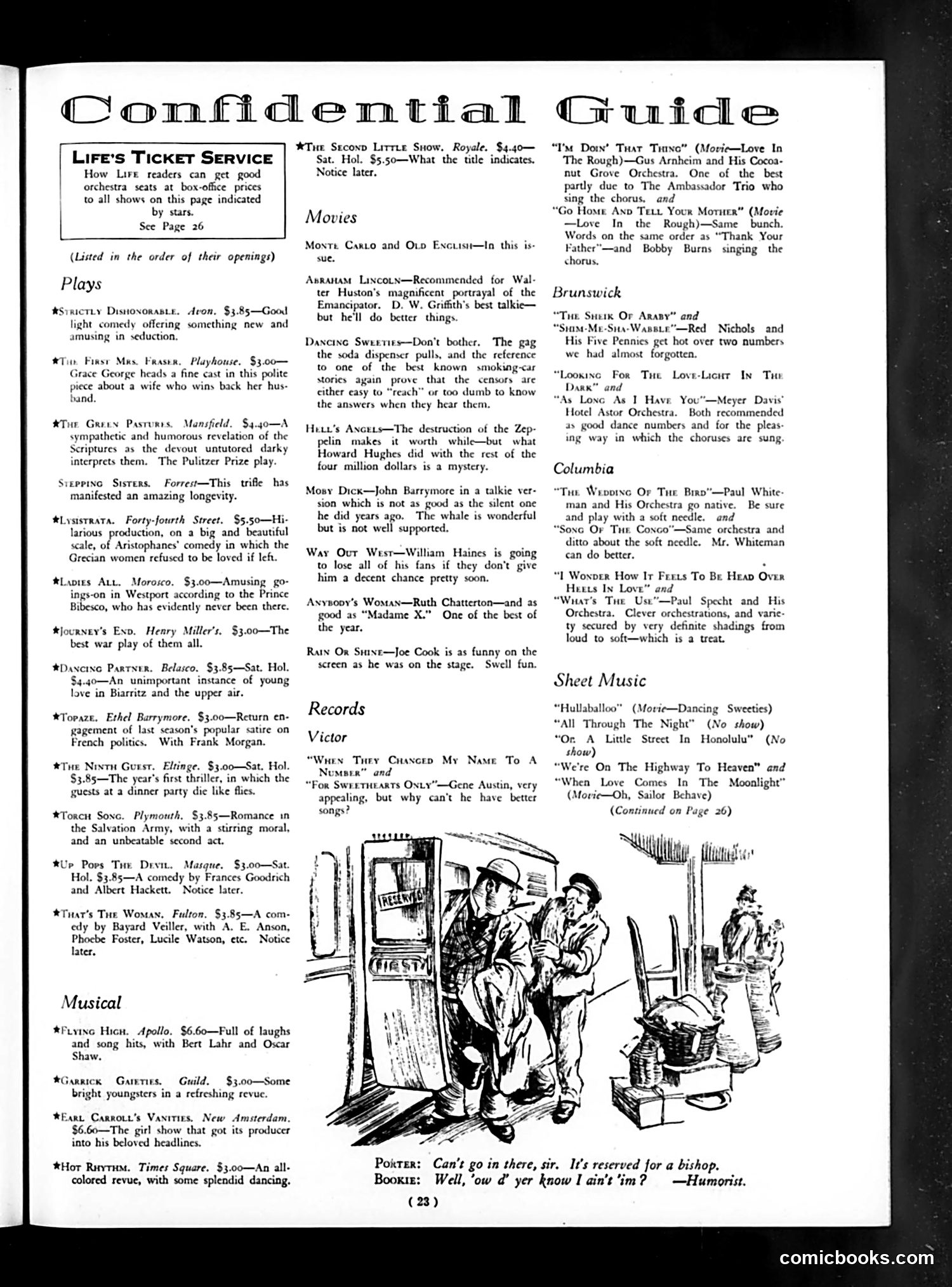
Analysis of Life Magazine Page Content This page is a theater and entertainment guide for Life magazine readers, listing current Broadway shows, movies, and recordings with prices and brief reviews. The cartoon at bottom shows two men at what appears to be a speakeasy or restricted venue during Prohibition. The "Poster" (doorman) refuses entry claiming it's "reserved for a bishop." The "Bookie" (patron) sarcastically responds, "Well, 'ow d' yer know I ain't 'im?"—the joke being that during Prohibition, even supposedly respectable people like bishops were suspected of secretly frequenting illegal establishments. The humor relies on the era's hypocrisy around alcohol prohibition and the assumption that moral authority figures weren't necessarily abstaining. The working-class accent suggests class commentary too—the bookie is the one making the clever riposte. The reviews themselves use coded language ("seduction," "unbeatable second act") typical of 1920s-era theater criticism.
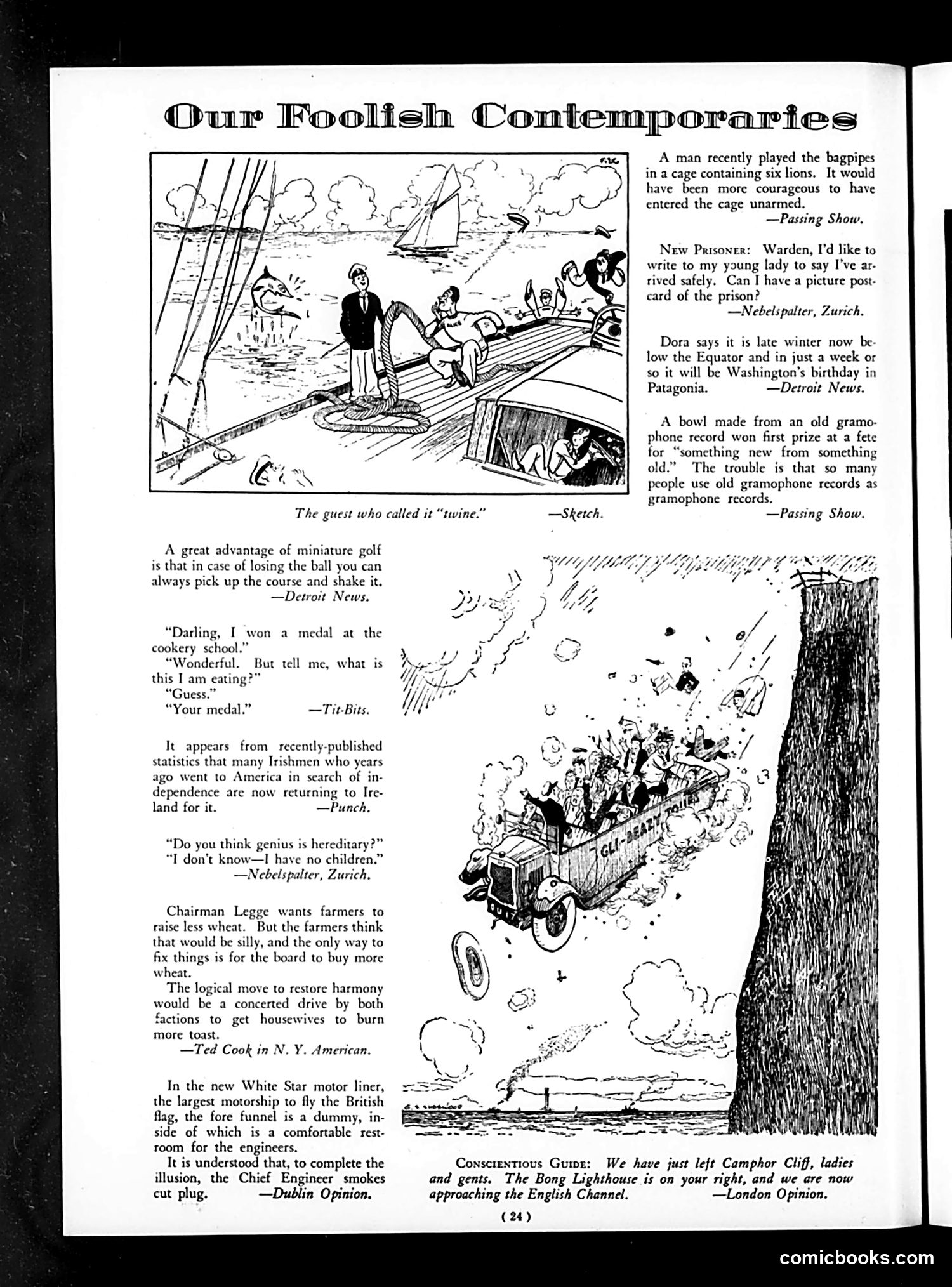
"Our Foolish Contemporaries" - Life Magazine Humor Page This is a compilation of brief satirical jokes and quips from various international publications, lampooning contemporary folly. Key items include: - Bagpipes in a lion cage: Mocking someone's reckless bravery - Irish emigration: A *Punch* joke suggesting Irishmen went to America seeking independence but are returning to Ireland for it—satirizing both Irish emigration patterns and Ireland's political status - Chairman Legge and wheat: Appears to reference grain policy debates, mocking bureaucratic contradictions between government directives and farmers' self-interest - White Star liner dummy funnel: Poking fun at elaborate ship design where engineers hide in a fake smokestack—absurd luxury - Conscientious Guide cartoon: A tour guide pointing out landmarks as the ship approaches the English Channel The page reflects 1920s-30s preoccupations: emigration, agricultural policy, industrial design, and British leisure travel. The humor relies on gentle absurdity and contemporary political references rather than sharp satire.
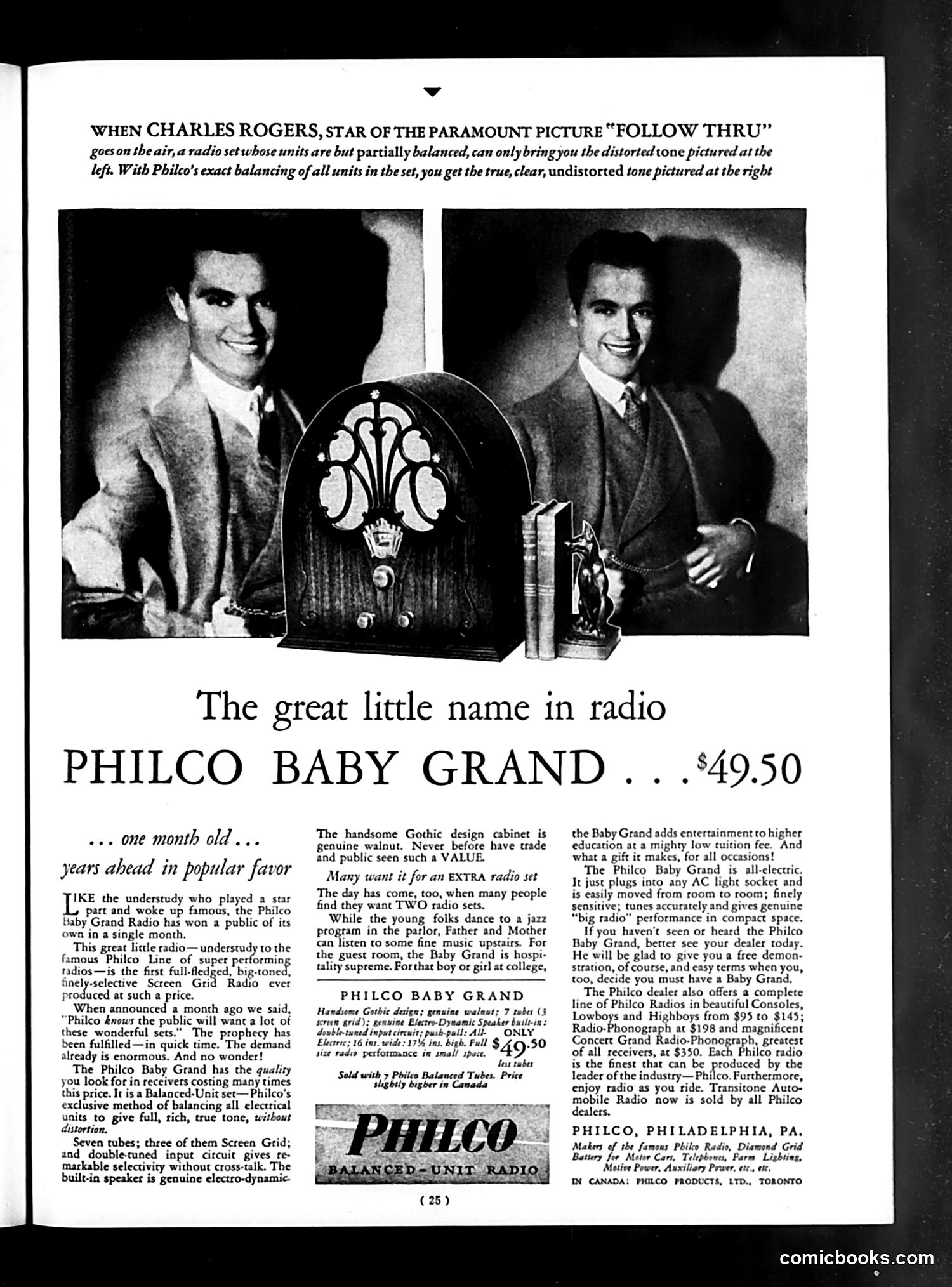
Philco Baby Grand Radio Advertisement This is not a cartoon or satire—it's a straightforward product advertisement for the Philco Baby Grand Radio, priced at $49.50. The page uses Charles Rogers, a star from the Paramount film "Follow Thru," as a celebrity endorser. The two photographs demonstrate Philco's "Balanced-Unit" technology: the left image shows distorted radio reception (on an unbalanced competitor's set), while the right shows clear reception with Philco's balanced tuning system. The ad emphasizes the radio's appeal to various household situations—young people dancing, parents listening upstairs, guest rooms, college students—positioning it as an affordable "extra" radio for American homes. Its compact Gothic cabinet design and all-electric operation (plugs into AC outlets) are highlighted as modern conveniences. This reflects 1920s-era radio commercialism, when radio ownership was expanding and manufacturers competed on audio quality and design.
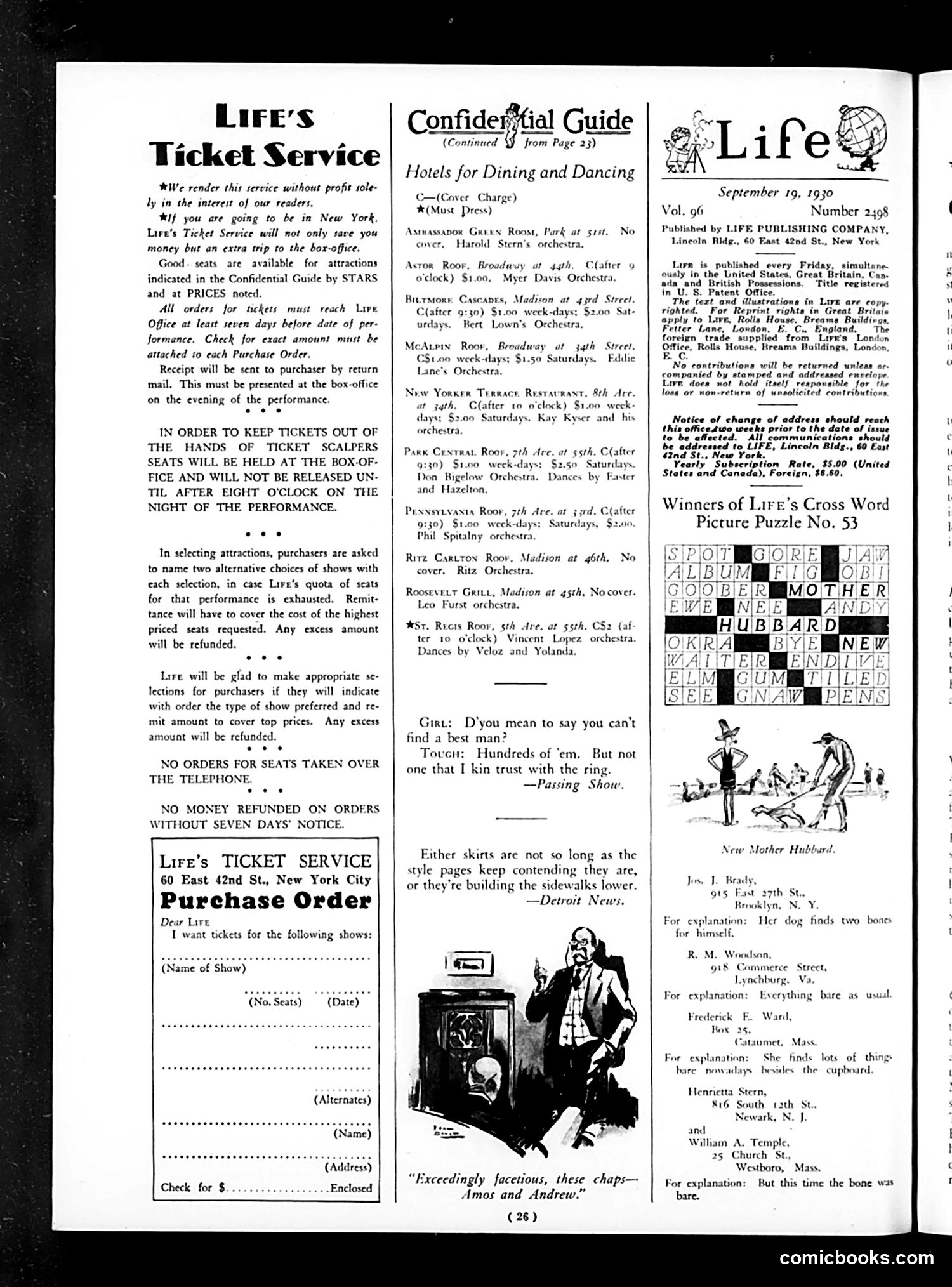
Life Magazine, September 19, 1930: Page Analysis This page is primarily administrative and advertising content rather than editorial satire. It consists of: 1. Life's Ticket Service: A detailed explanation of how readers could order Broadway theater tickets through Life magazine, with instructions about seat availability, refund policies, and ordering procedures. 2. Three brief jokes from other publications: - A groom unable to find a trustworthy best man to hold the wedding ring - A comment on women's hemlines versus sidewalk heights - A caption about two characters named "Amos and Andrew" being facetious The "Amos and Andrew" reference likely alludes to the popular minstrel-show stereotype characters common in 1930s entertainment, though the specific context here is unclear from the image alone. The page reflects 1930s urban life—theater culture, wedding customs, fashion commentary—but contains no significant political satire. It's primarily a service announcement and filler content typical of magazine publication.
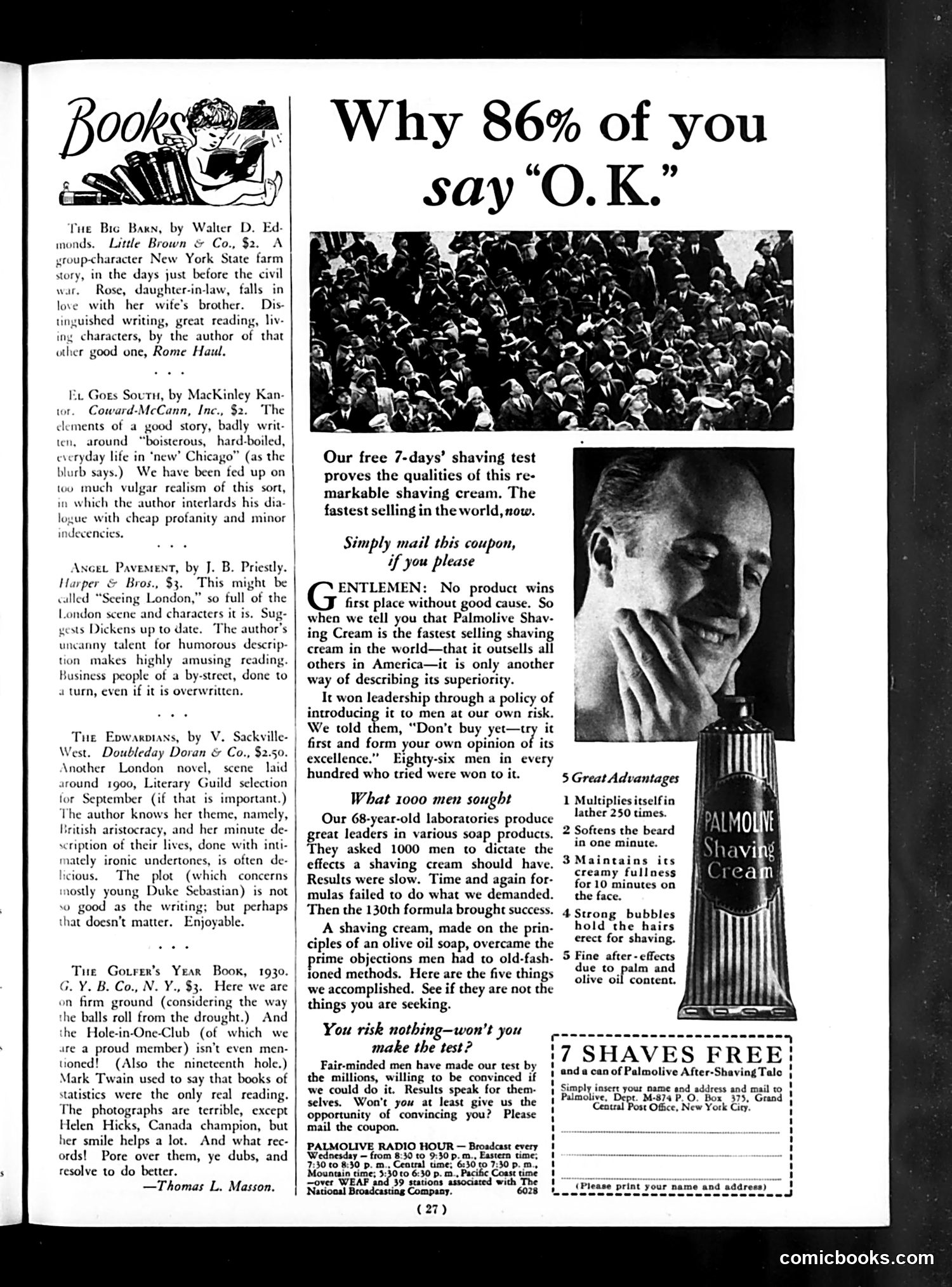
Analysis This page is primarily a book review section paired with a Palmolive Shaving Cream advertisement—not a political cartoon. The left column contains brief literary reviews by Thomas L. Masson of contemporary 1930 novels, offering terse judgments ("Enjoyable," "hard-boiled," "delicious"). The critic dismisses one book for "vulgar realism" and "cheap profanity," suggesting period literary tastes favored refined writing. The right side features a large advertisement claiming Palmolive is "the fastest selling shaving cream in the world." The copy employs a pseudo-scientific pitch: 86% of 100 men who tested it were "won to it"; the formula required 130 iterations to satisfy 1,000 men's specifications. The ad offers a risk-free 7-day trial, appealing to "fair-minded men" to test it themselves. No satire is present. This is straightforward 1930s advertising using testimonial and scientific-sounding claims to establish product superiority—typical marketing rhetoric of the era before modern FDA regulations on advertising claims.
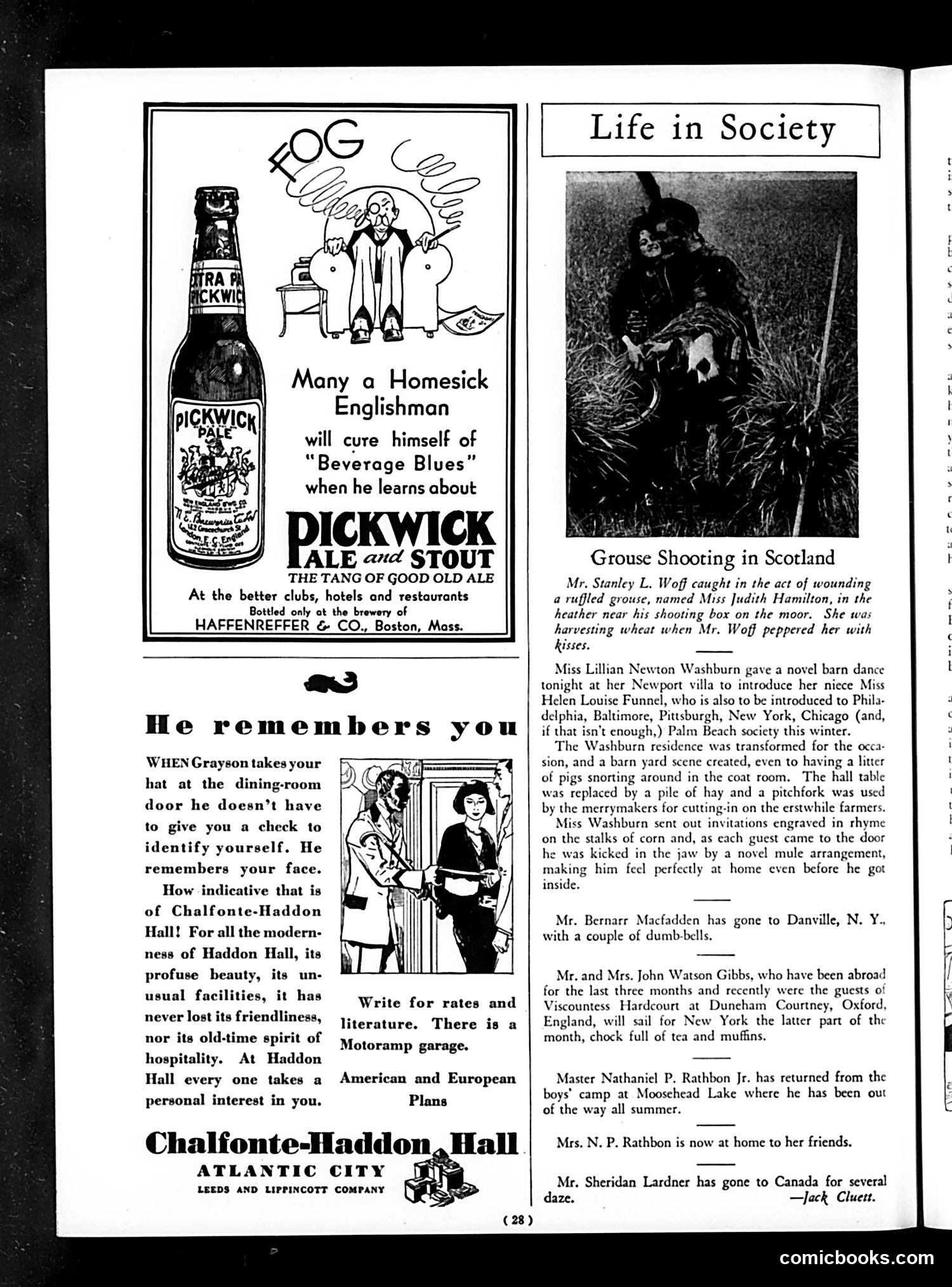
Explanation for Modern Readers This page contains two advertisements and a society column. The Pickwick Ale ad jokes that homesick Englishmen abroad can cure their "Beverage Blues" by drinking this Boston-brewed beer—playing on nostalgic longing for home comforts. The Chalfonte-Haddon Hall hotel ad emphasizes personal service: the doorman "Grayson" remembers guests' faces without needing hat-check stubs, suggesting old-fashioned hospitality despite modern amenities. The "Life in Society" column contains satirical gossip items mocking wealthy socialites' leisure activities. The "Grouse Shooting" entry puns absurdly on a woman named "Miss Judith Hamilton" being "peppered with kisses" during a hunt. The barn dance description ridicules nouveau-riche pretension—a Newport villa converted into a fake farmyard complete with pigs in the coat room and a mule that kicks guests. The satire targets the artificial rusticity wealthy people affected while vacationing.
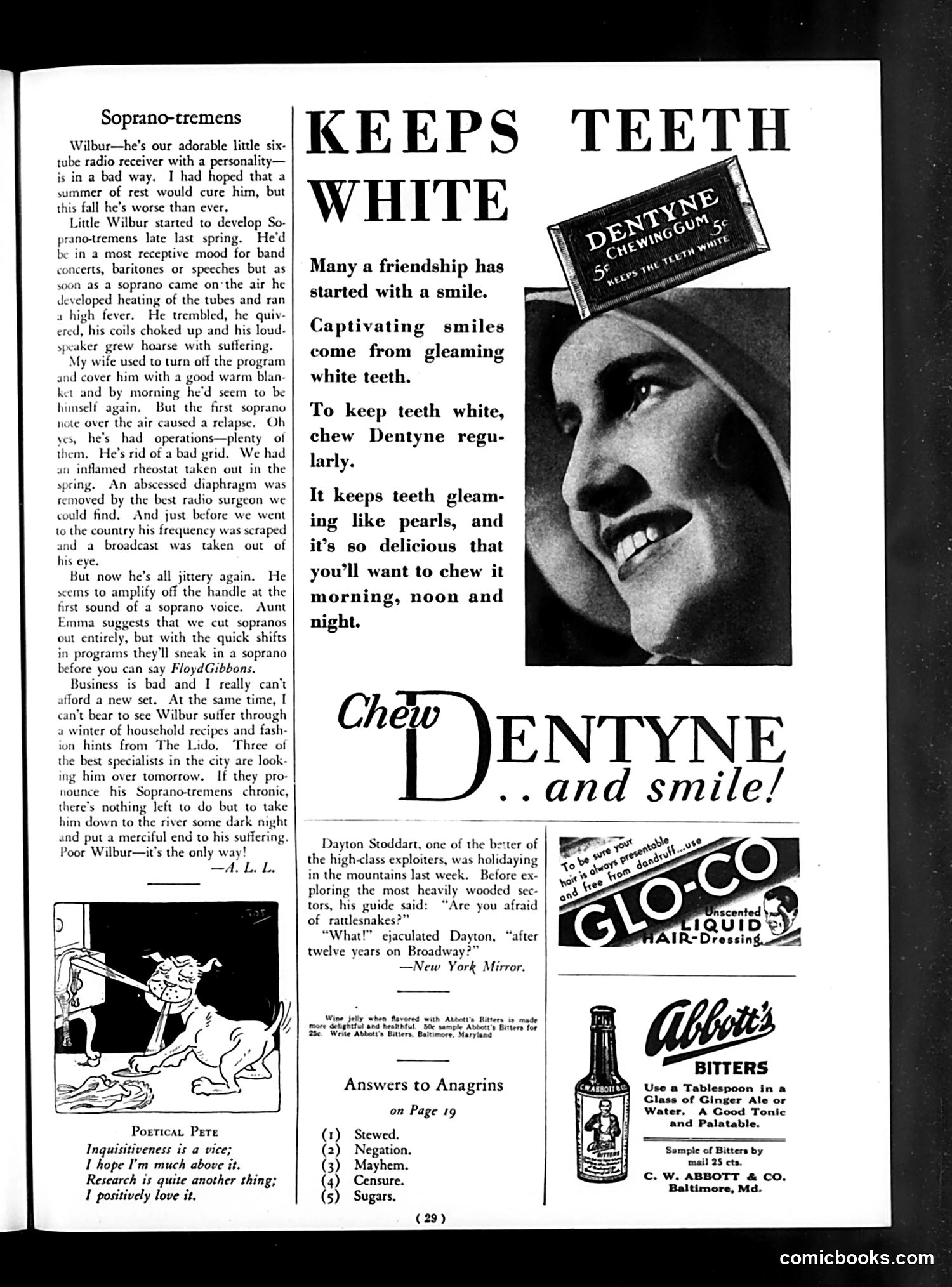
"Soprano-tremens" — A Radio Comedy from Life Magazine This page satirizes early 1920s radio ownership through a humorous disease metaphor. The main article describes "Wilbur," a six-tube radio receiver suffering from "Soprano-tremens" — an invented ailment where the radio malfunctions whenever soprano voices broadcast. The narrator treats the radio like a sick person, describing "operations," "surgeons," and organs (grids, rheostats, diaphragms) in medical terms while listing actual radio problems. The joke satirizes both radio technology's unreliability and the narrator's absurd over-attachment to his equipment. References to Floyd Gibbons (a famous radio commentator) and broadcast programming (band concerts, fashion hints from "The Lido") ground the satire in actual 1920s radio content. The page also includes a separate anecdote mocking Broadway sophistication, plus period advertisements for Dentyne gum and Abbott's Bitters. The cartoon's humor relies on readers' familiarity with early radio's frequent technical failures.
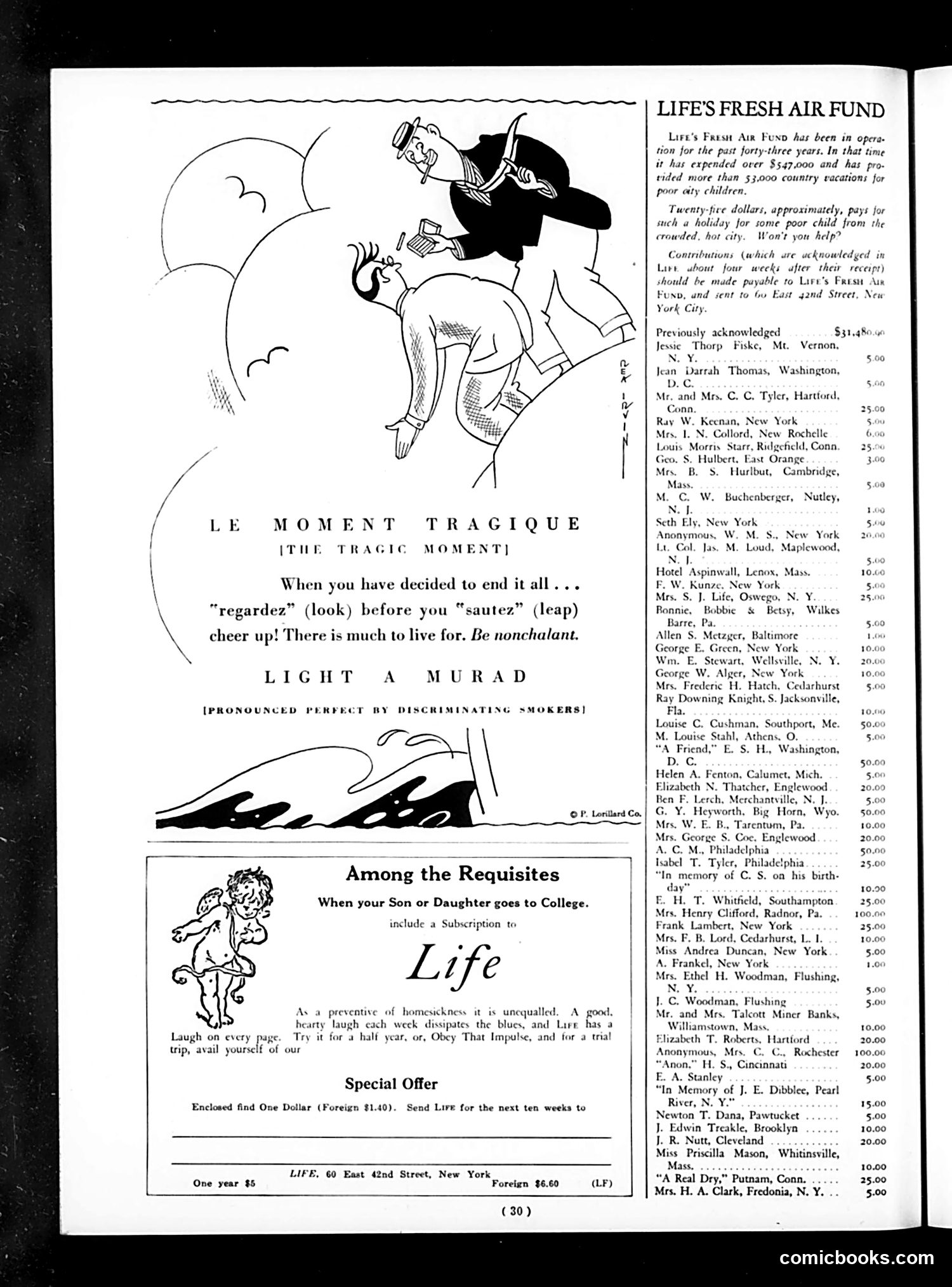
Analysis of Life Magazine Page This page contains satirical cartoons and advertising from an early 20th-century Life magazine. "Le Moment Tragique" cartoon: A darkly comic image of a suicidal figure on a ledge, with the caption urging them to "look before you leap" and "cheer up! There is much to live for." This is gallows humor—Life magazine was known for irreverent jokes about serious topics. "Light a Murad" advertisement: Below the suicide joke sits a cigarette ad, a jarring juxtaposition that itself becomes unintentional satire—the magazine literally suggests suicide prevention followed immediately by promoting a habit that kills. College subscription pitch: The page advertises Life subscriptions to homesick college students, claiming the magazine's humor cures depression. Fresh Air Fund: The bottom section lists donations to Life's charitable program providing country vacations for poor urban children—showing the magazine balanced dark humor with genuine philanthropic work. The overall effect captures early-1900s American sensibilities: irreverent, commercially aggressive, yet genuinely charitable.
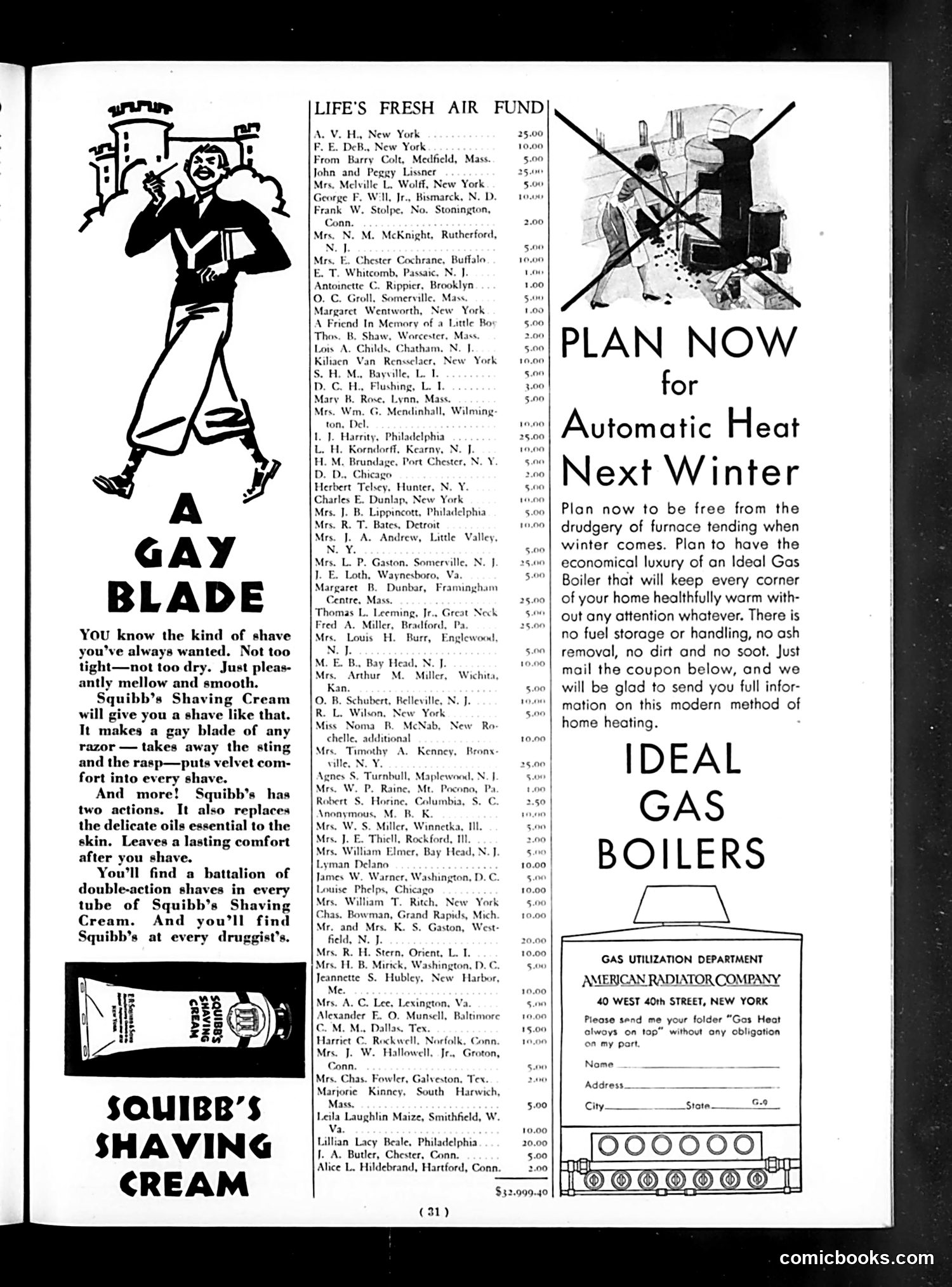
Analysis for Modern Readers This page combines two distinct elements: a shaving cream advertisement and a charitable fundraising list. The "Gay Blade" Advertisement (Left) The cartoon features a cheerful man in 1920s-style clothing promoting Squibb's Shaving Cream. The term "gay blade" was period slang meaning a carefree, well-groomed man—the word "gay" here means lighthearted, not referring to sexual orientation. The ad emphasizes comfort and smoothness, claiming the cream both protects skin oils and reduces razor irritation. Life's Fresh Air Fund (Center) This is a published donor list for *Life* magazine's charitable fund, which provided outdoor recreation for underprivileged urban children. The list shows hundreds of individual and organizational contributors with their donations, totaling over $32,000. This was a common philanthropic practice in early-20th-century publications. Ideal Gas Boilers Advertisement (Right) A separate ad promoting automatic home heating systems, targeting middle-class homeowners seeking modern convenience and comfort during winter months. The page is primarily advertising and fundraising content rather than satirical commentary.
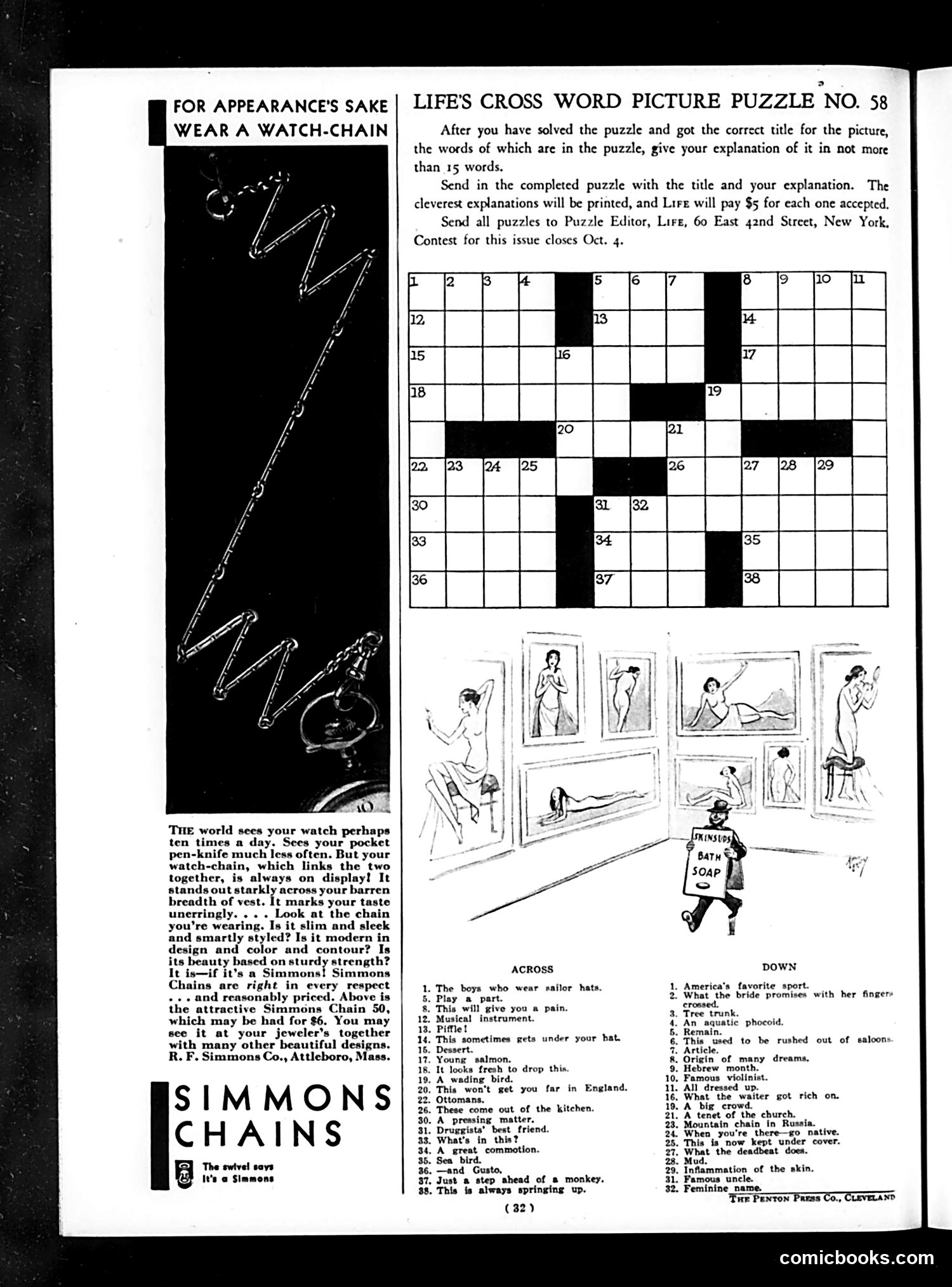
Analysis This page contains two unrelated items typical of Life magazine's format: Left side: Advertisement for Simmons watch chains. The copy emphasizes that watch chains are constantly visible and therefore communicate taste and style. It's a straightforward jewelry advertisement with no satirical content—just marketing positioning the product as a status symbol of refinement. Right side: A crossword puzzle contest. Solvers must complete the grid, then identify the picture's title and explain it in 15 words or fewer. Life offered $5 for the cleverest explanations published—a reader engagement strategy. The illustration below the puzzle (showing figures in what appears to be a bathing/showering scene) is the image to be interpreted. This is primarily an advertising and entertainment page rather than satirical commentary. The "satire" aspect of Life magazine is not evident here; instead, we see commercial promotion and a participatory puzzle contest designed to boost reader involvement and magazine sales.
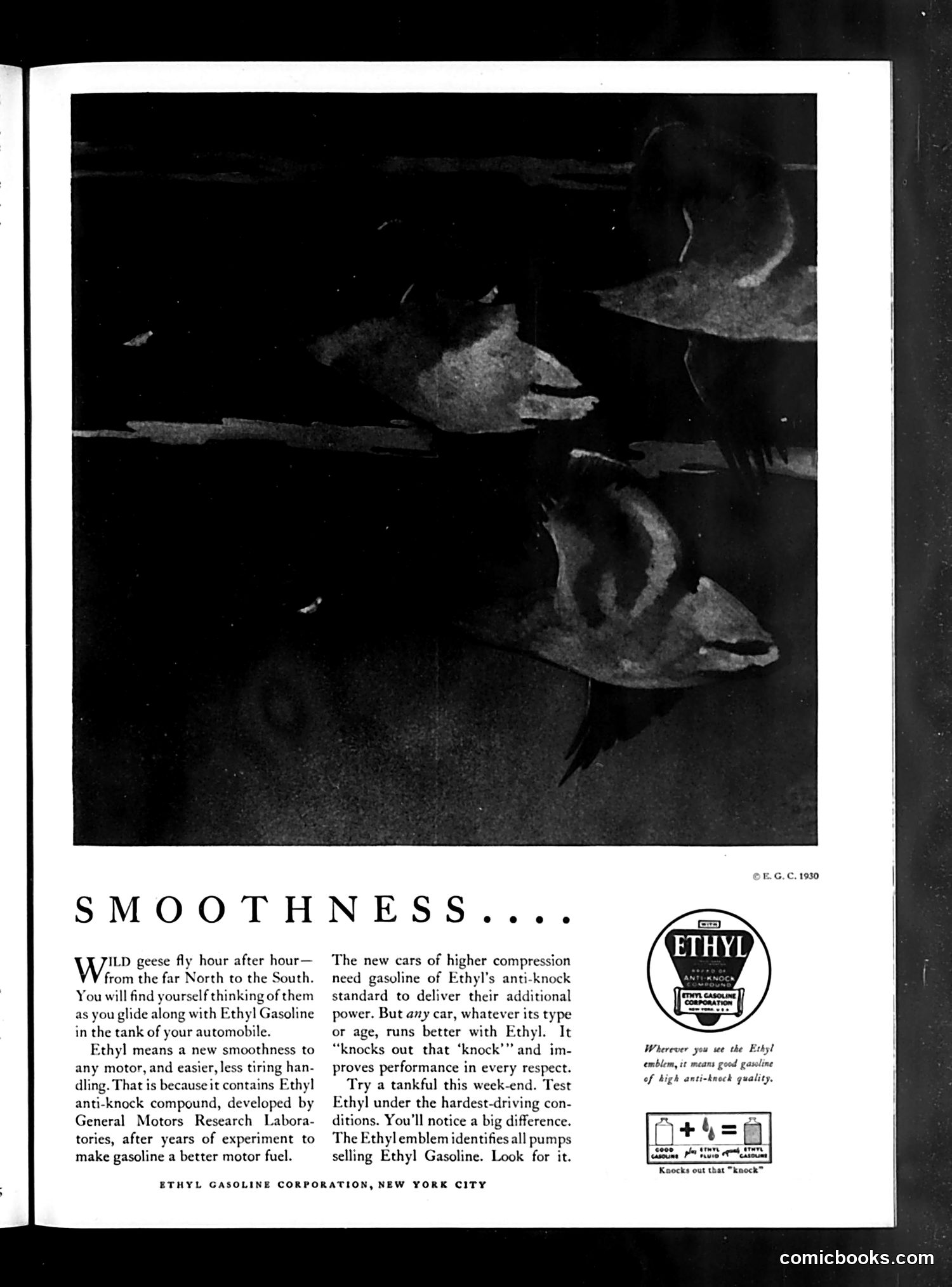
Analysis This is a 1939 advertisement for Ethyl Gasoline, not political satire. The page uses poetic imagery—wild geese flying south—as a metaphor for smooth, effortless driving. The ad promotes Ethyl's anti-knock gasoline additive (developed by General Motors Research Laboratories), claiming it eliminates engine "knock" (the pinging sound from fuel detonating prematurely in high-compression engines). The copy argues that newer cars with higher compression ratios require Ethyl's superior fuel, but emphasizes the product benefits any automobile. The photograph shows the textured surface of what appears to be automotive material or engine components, visually reinforcing the "smoothness" claim. There is no political content, caricature, or satire present—this is straightforward commercial advertising using lifestyle imagery and technical claims typical of 1930s-1940s marketing.
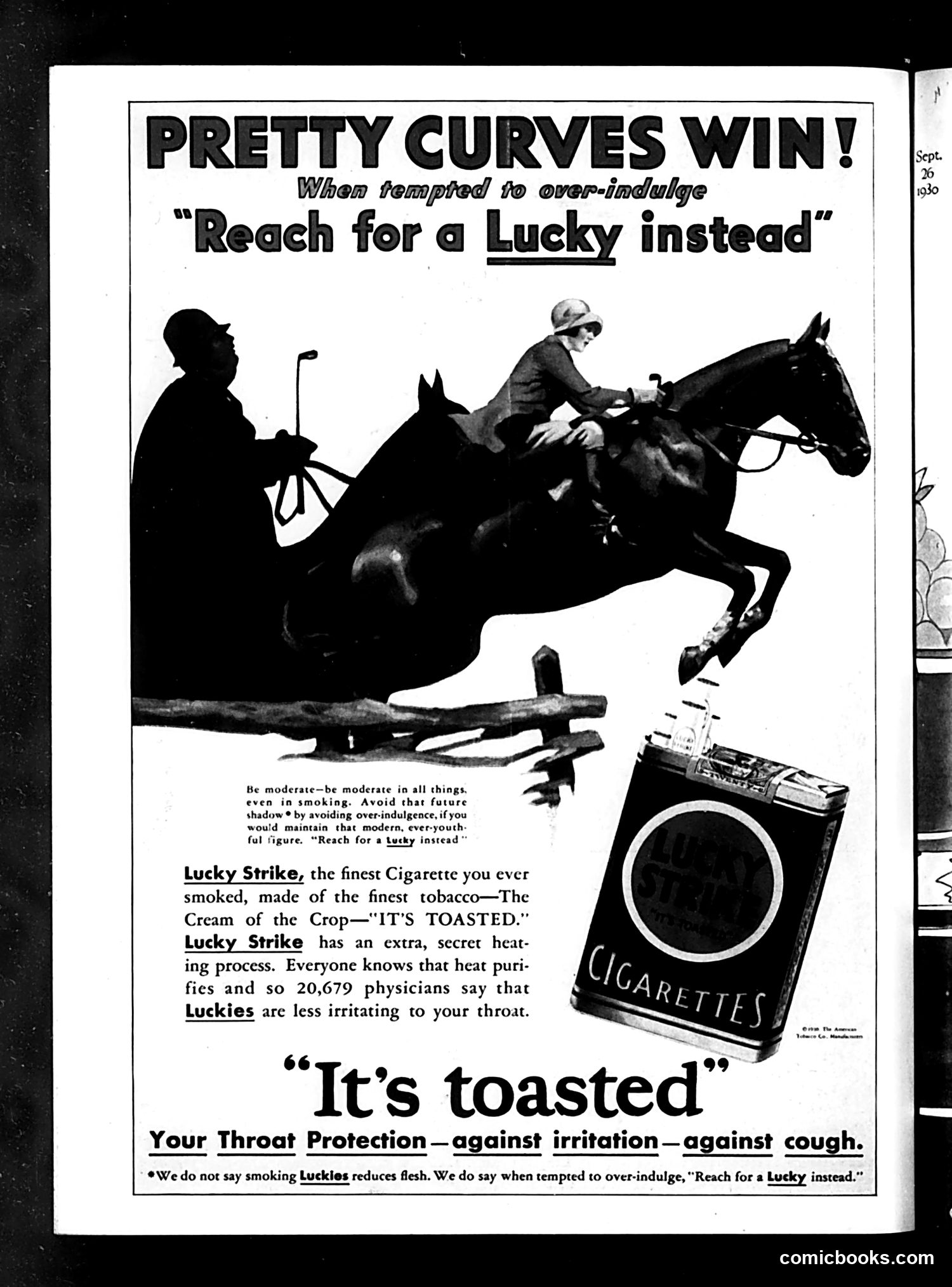
Analysis This is a Lucky Strike cigarette advertisement, not political satire. It uses a visual pun: a silhouetted woman on a horse jumping over an obstacle, paired with text equating weight gain ("that future shadow") with over-indulgence in food. The ad's pitch is cynical by modern standards—it suggests smoking Lucky Strikes instead of eating to maintain a slim figure. The headline "Pretty Curves Win!" appeals to 1920s-30s beauty standards emphasizing thinness. The ad claims 20,679 physicians endorse Luckies as less throat-irritating due to a "toasting" process. This is pure marketing; the fine print admits it doesn't reduce appetite, merely suggesting cigarettes as a substitute for food consumption. The overall message exploits weight anxiety while promoting smoking as diet control—a deeply problematic health claim by any standard.