life
Life — October 3, 1930
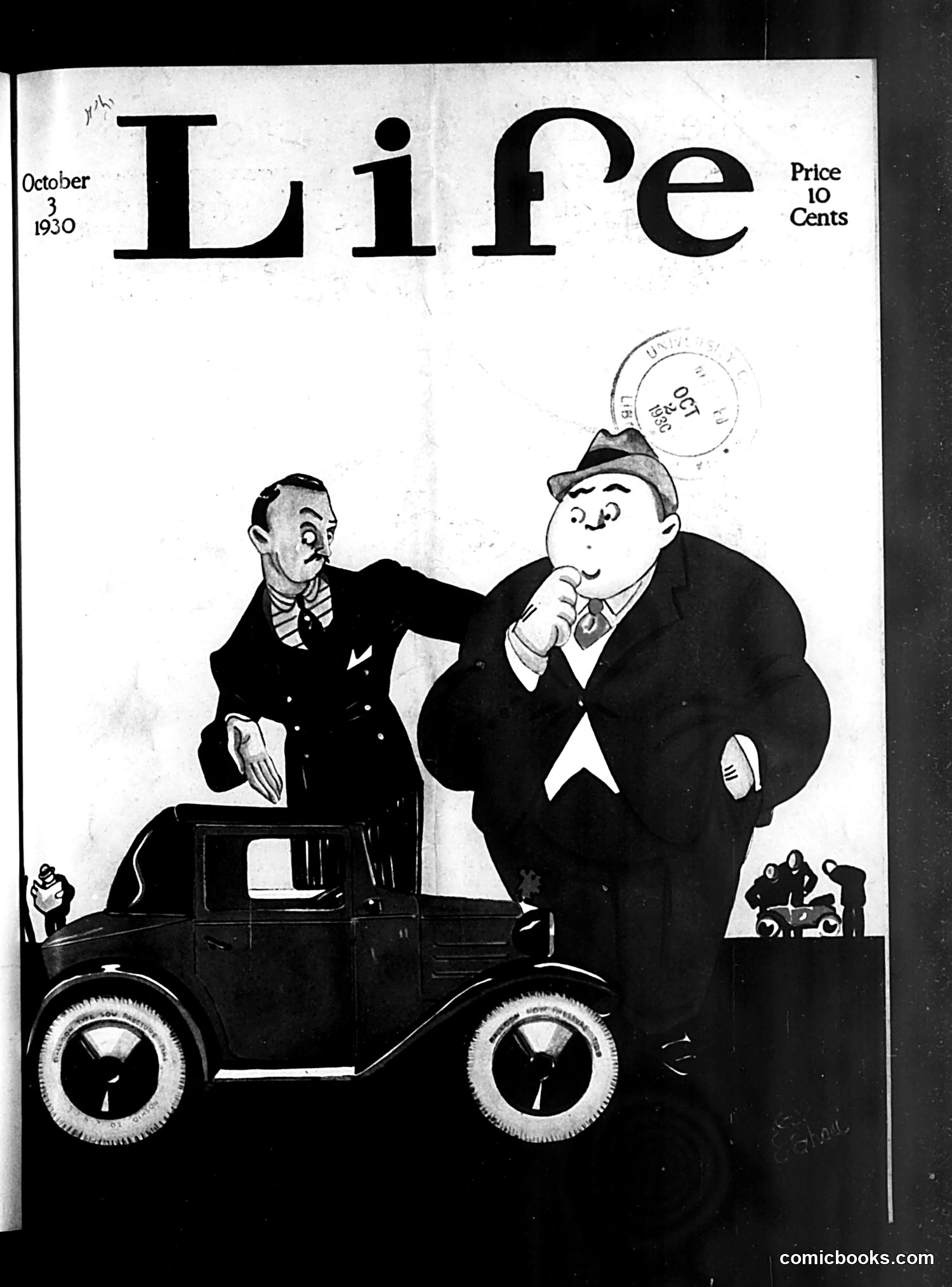
Analysis of Life Magazine Cover, October 3, 1930 This cover depicts two men with a small automobile. The figure on the right—a portly man in a fedora and suit—appears to be examining or consulting about the vehicle, while a thinner, more anxious-looking man stands beside him. The cartoon likely satirizes early automobile commerce or sales, possibly referencing used car dealers or automotive transactions during the Great Depression era (1930). The exaggerated facial expressions suggest deception or dubious dealing. The smaller figure's worried expression contrasts with the confident posture of the heavyset man, implying a power imbalance in their transaction. Without additional text visible, the specific political or social target remains unclear, though the timing suggests commentary on Depression-era commercial practices or consumer vulnerability.
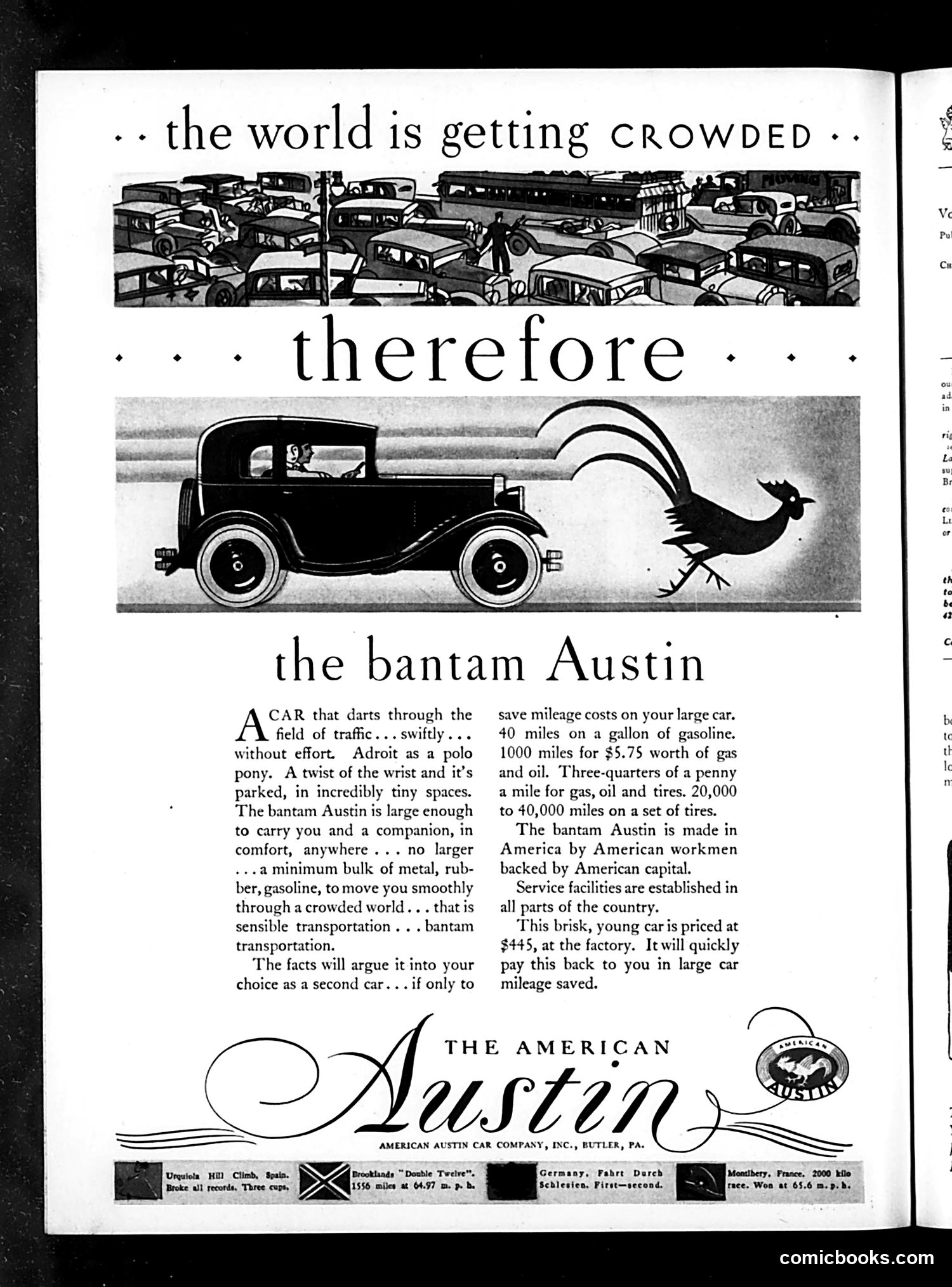
Analysis This is an advertisement for the American Austin Car, not a political cartoon. The ad uses social satire to sell a compact automobile. The Visual Argument: The top illustration shows congested traffic—many vehicles crammed together—establishing the problem: "the world is getting crowded." Below, a bantam Austin car is depicted with a rooster, implying agility and quick movement through chaos. The Pitch: The ad argues that a small, affordable car ($445) is "sensible transportation" for a crowded world. It emphasizes practicality: 40 miles per gallon, minimal maintenance costs, and maneuverability in tight spaces. The rooster symbolizes nimbleness—the car "darts through the field of traffic...swiftly...without effort." This reflects 1920s-30s automobile marketing responding to urban congestion by promoting economy and efficiency as virtues.
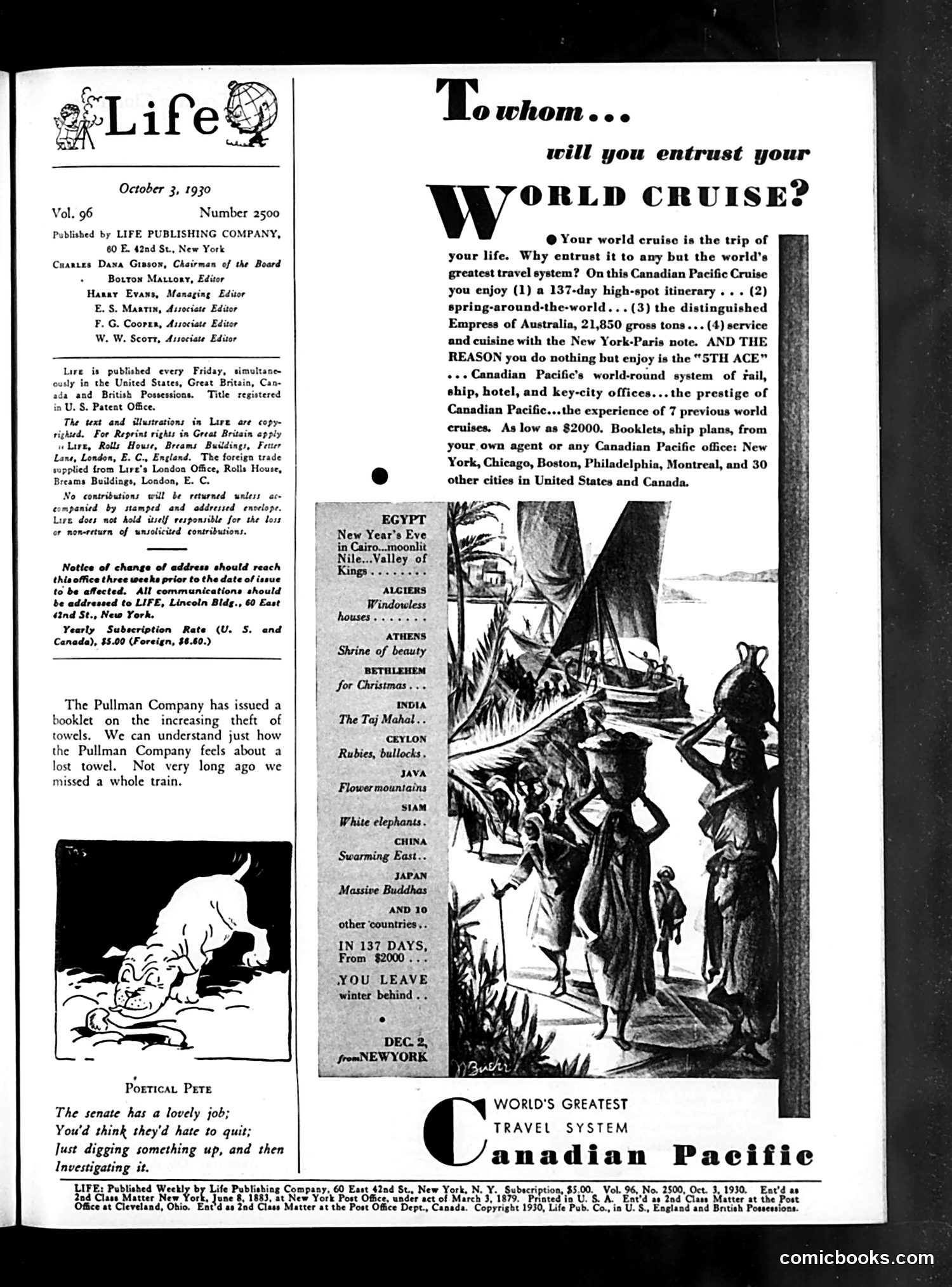
Analysis of Life Magazine Page, October 3, 1930 This page contains a satirical cartoon titled "Political Pete" and a full-page advertisement for Canadian Pacific's world cruise service. The cartoon depicts a figure (Pete) bent over, digging into ground labeled "investigating it." The accompanying verse mocks the Senate, suggesting senators have "a lovely job" but waste effort "digging something up, and then investigating it"—satire on Congressional investigations that appear performative or futile. The advertisement showcases exotic cruise destinations (Egypt, India, Japan, etc.), employing Orientalist imagery of turbaned figures and camels to market luxury travel. It promises escape from winter for $2,000, positioning world travel as an elite leisure activity during the Depression era. Together, the page contrasts political theatricality with escapist consumerism—two hallmarks of early 1930s American culture.
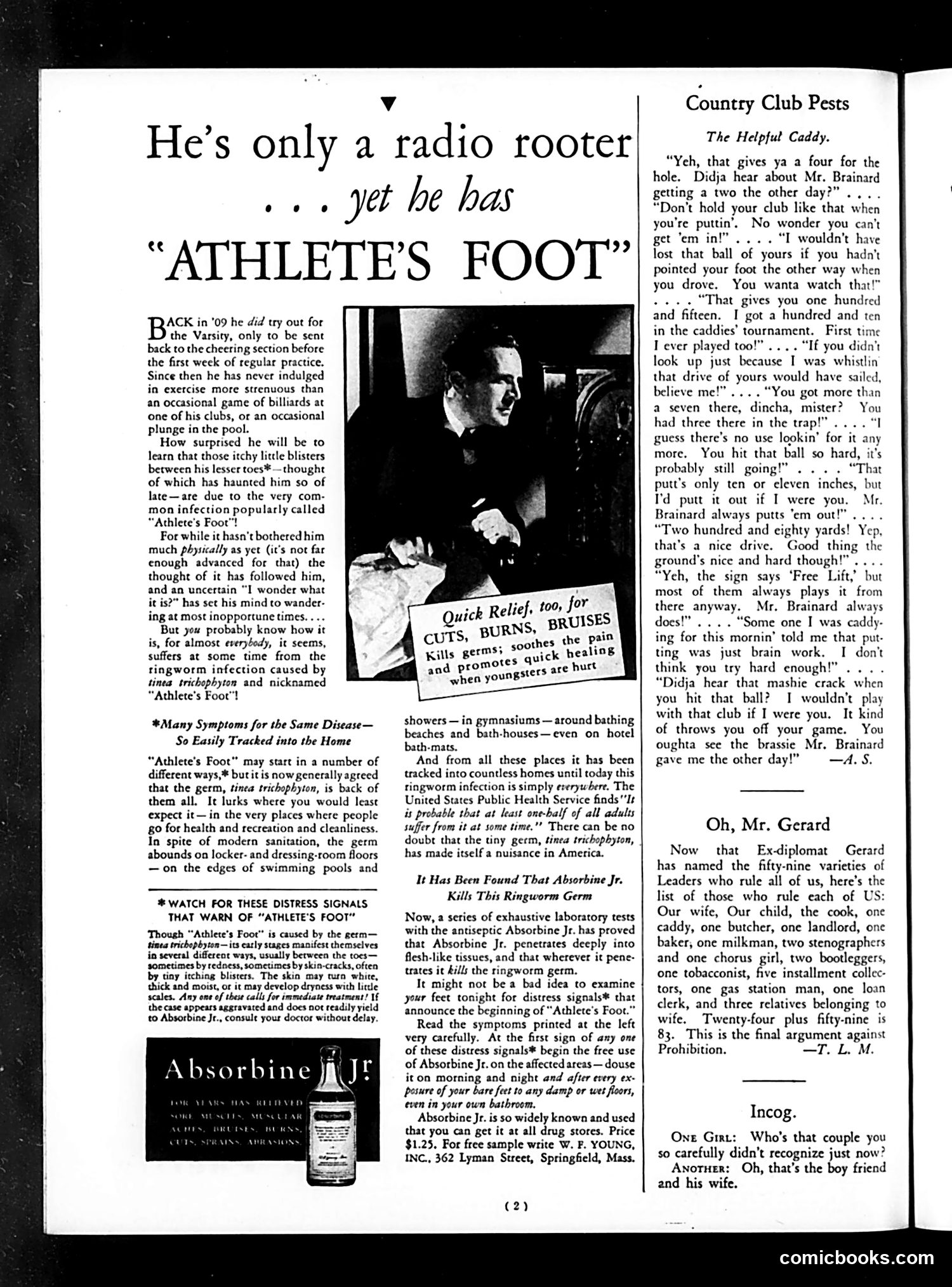
Page Analysis This page contains a medical advertisement disguised as editorial content for Absorbine Jr., a liniment product. The main visual shows a man applying the product to his foot. The headline jokes that someone is "only a radio rooter" (a sports fan who listens on radio rather than attending games) yet has contracted "Athlete's Foot"—a fungal infection. The satire plays on the irony: despite avoiding physical exertion at the ballpark, he still suffers the condition. The text explains that athlete's foot (caused by *tinea trichophyton* fungus) spreads in communal spaces like swimming pools and locker rooms. The ad claims Absorbine Jr. kills the ringworm germ and promotes healing. The right column contains brief comedic "Country Club Pests" anecdotes mocking pretentious golfers' boasting about their scores. This is primarily advertising masquerading as humor and health journalism.
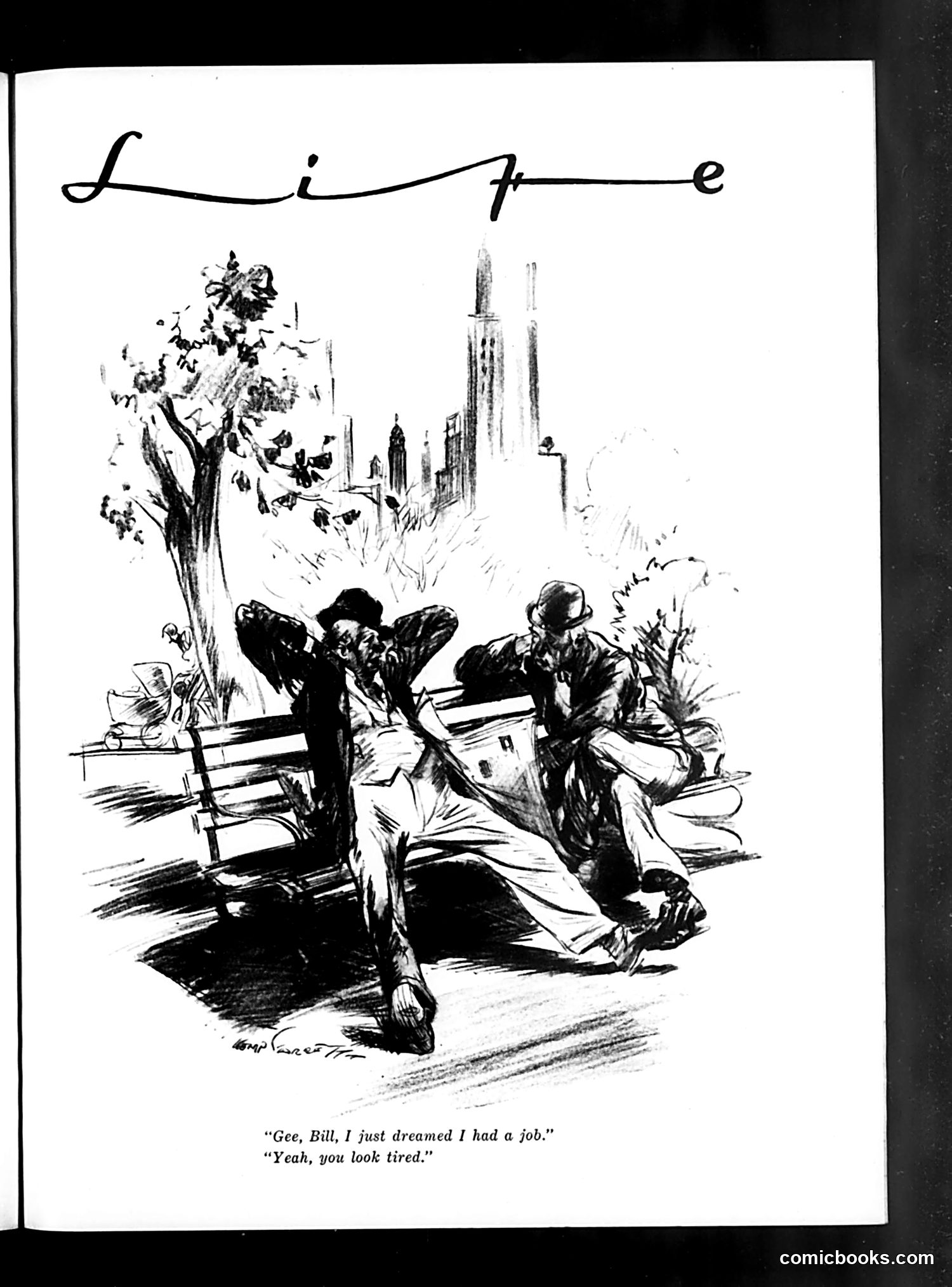
Analysis of "Life" Magazine Cartoon This is a single-panel cartoon showing two men on a park bench with a city skyline in the background. One man appears exhausted or sleeping, while the other sits beside him. The joke hinges on the caption: "Gee, Bill, I just dreamed I had a job." / "Yeah, you look tired." Context: This is Depression-era satire, likely from the 1930s. The humor satirizes unemployment and economic hardship—the joke is that merely *dreaming* about having a job is so exhausting that the man looks as worn out as if he'd actually worked. The punchline darkly suggests that joblessness has become so normalized that employment itself now seems like an unattainable fantasy. The tired appearance reflects both the psychological toll of prolonged unemployment and the physical deprivation accompanying it.
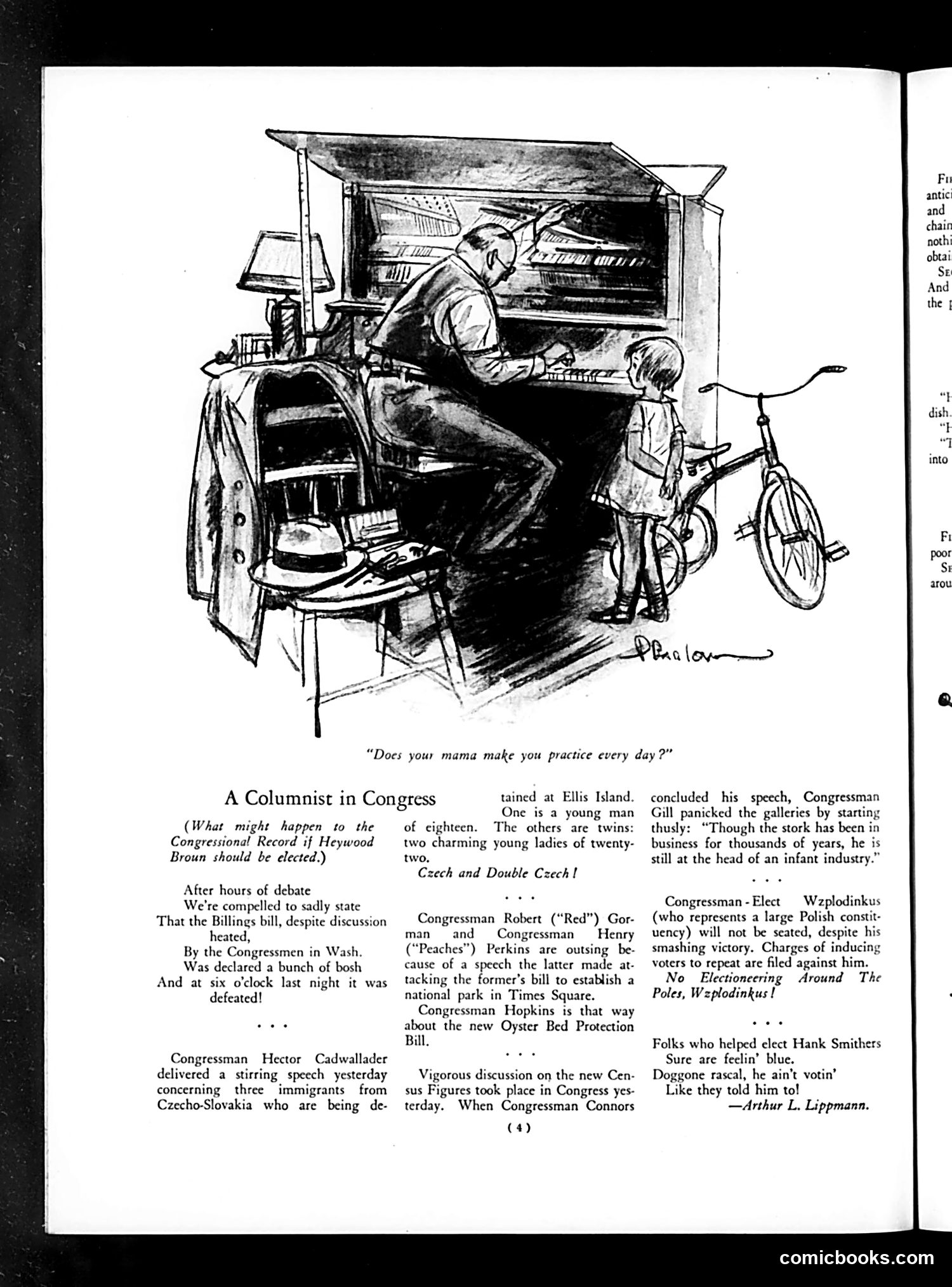
A Columnist in Congress The cartoon depicts a man at a piano inside a car, with a child standing outside holding a bicycle. The caption reads: "Does your mama make you practice every day?" The satire targets Congressman Hector Cadwallader, who delivered a speech about three Czech-Slovak immigrants. The article notes his "stirring speech" concerned immigrants being debated in Congress, specifically regarding a "Billings bill" that was defeated at six o'clock that night. The joke appears to be that Cadwallader's grand congressional speech—compared to practicing piano—was ultimately futile and pointless, since the bill he advocated for failed anyway. The cartoon mocks the disconnect between politicians' rhetorical efforts and actual legislative outcomes.
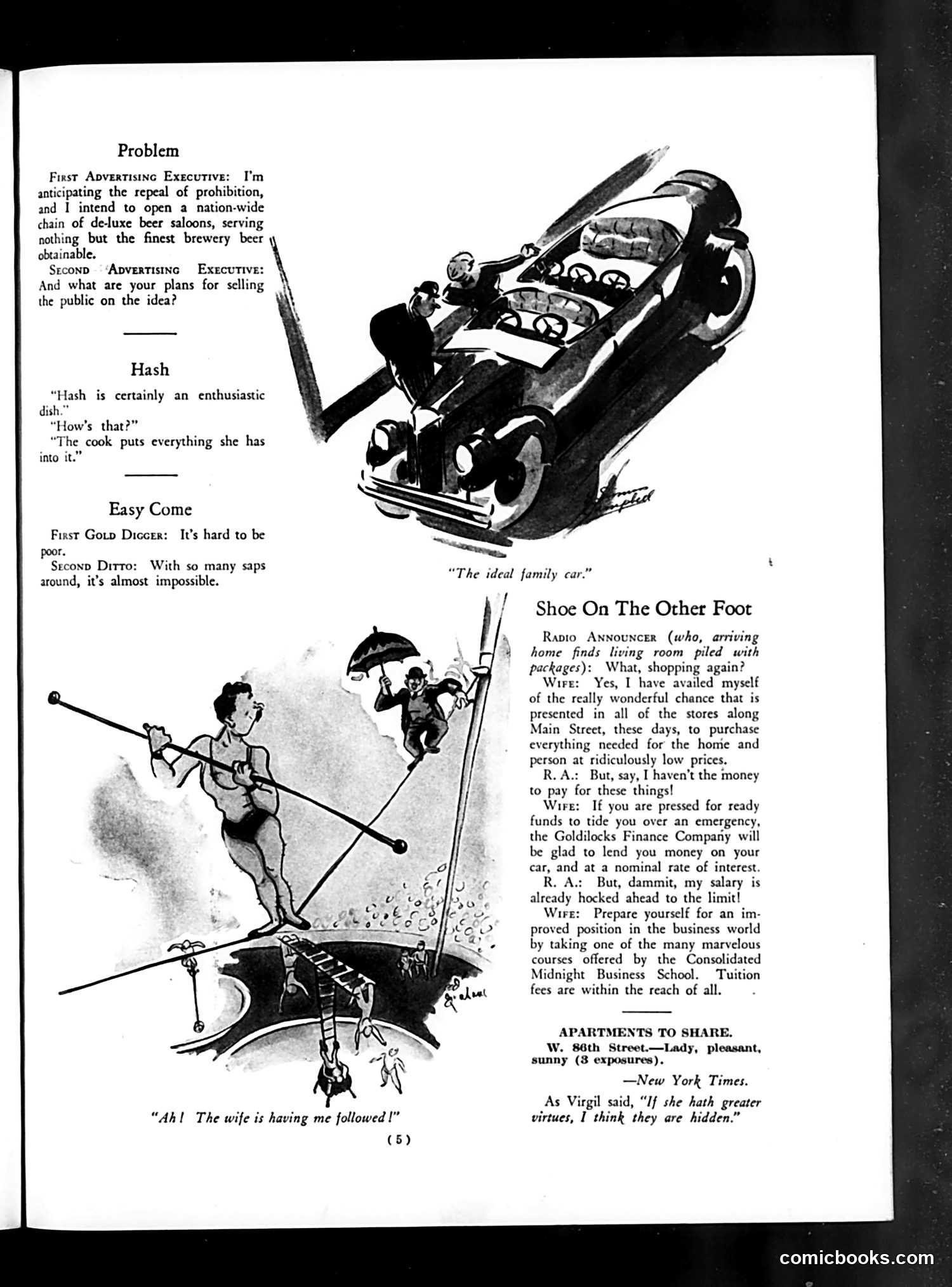
Analysis of Life Magazine Page This page contains three separate humor pieces satirizing 1920s-30s American life: "Problem": Two advertising executives discuss selling beer saloons after Prohibition's repeal—mocking the business opportunism expected when alcohol became legal again. "Hash": A brief joke about an "enthusiastic dish" where a cook puts everything into hash, playing on the word's double meaning. "Easy Come, Easy Go": A wealthy gold digger and ditty discuss poverty, suggesting financial instability among the rich. "Shoe On The Other Foot": The main satirical piece shows a radio announcer and his wife discussing his salary anxiety and her shopping habits during economic uncertainty. The cartoon below depicts a man skiing while his wife follows—captioned "Ah! The wife is having me followed!"—mocking domestic surveillance and marital tension. The humor reflects Depression-era anxieties about money, employment, and marriage.
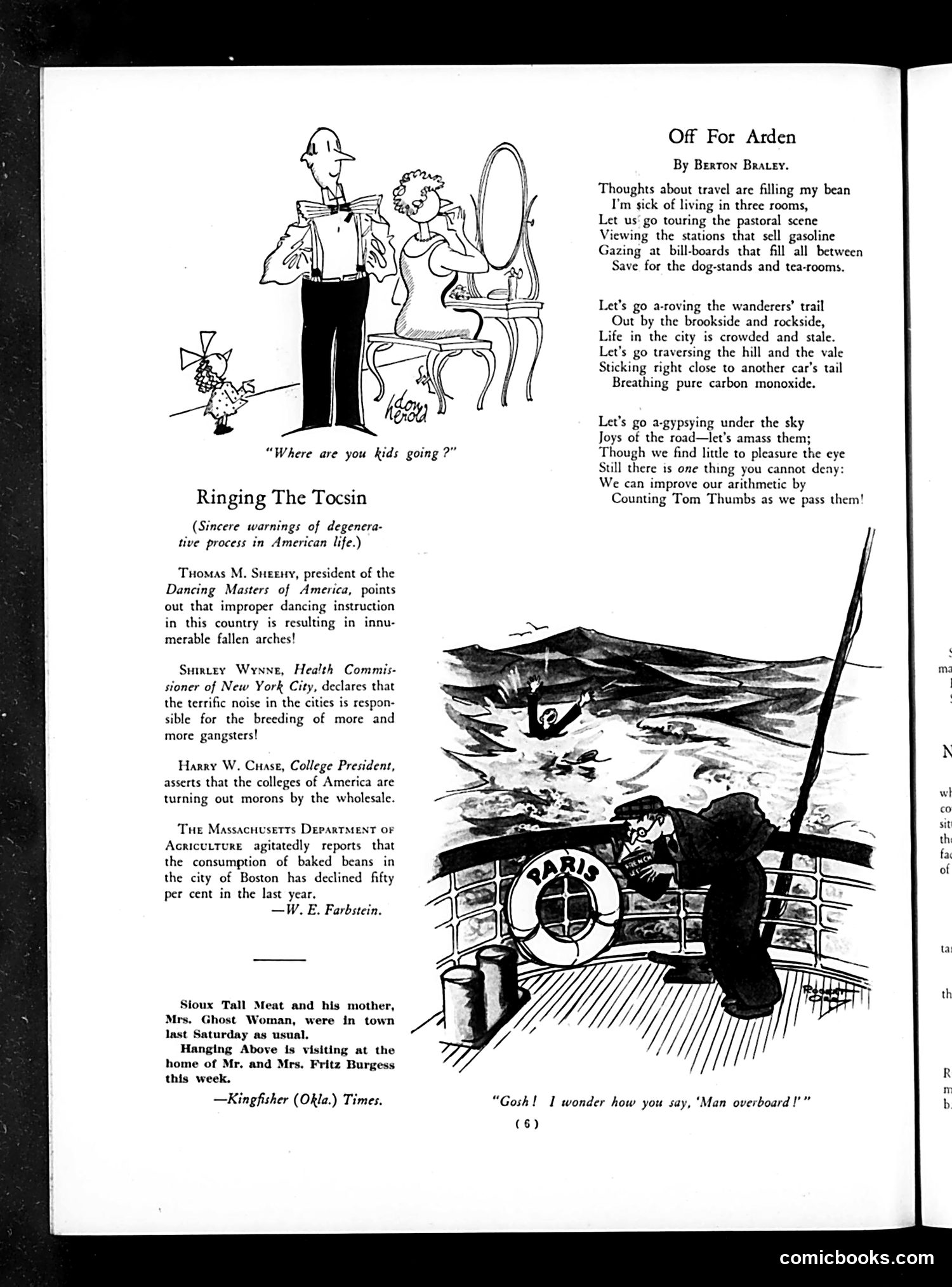
Analysis of Life Magazine Page This page contains two distinct satirical pieces: "Off For Arden" (top right) by Berton Braley is a poem mocking modern tourism—visitors traveling to see mundane urban sights (gas stations, billboards, dog stands) rather than natural beauty. It satirizes how city tourism has become artificial and polluted ("pure carbon monoxide"). "Ringing The Tocsin" (left) collects warnings from various authorities about American social decline: improper dancing causing fallen arches, city noise breeding gangsters, and colleges turning out "morons." These appear to be contemporary alarmist claims the magazine is mocking. The lower cartoon shows a ship captain saying "Man overboard!" with the caption "Gosh! I wonder how you say, 'Man overboard!'" It likely jokes about language barriers or international maritime confusion, though context is unclear without knowing the publication date.
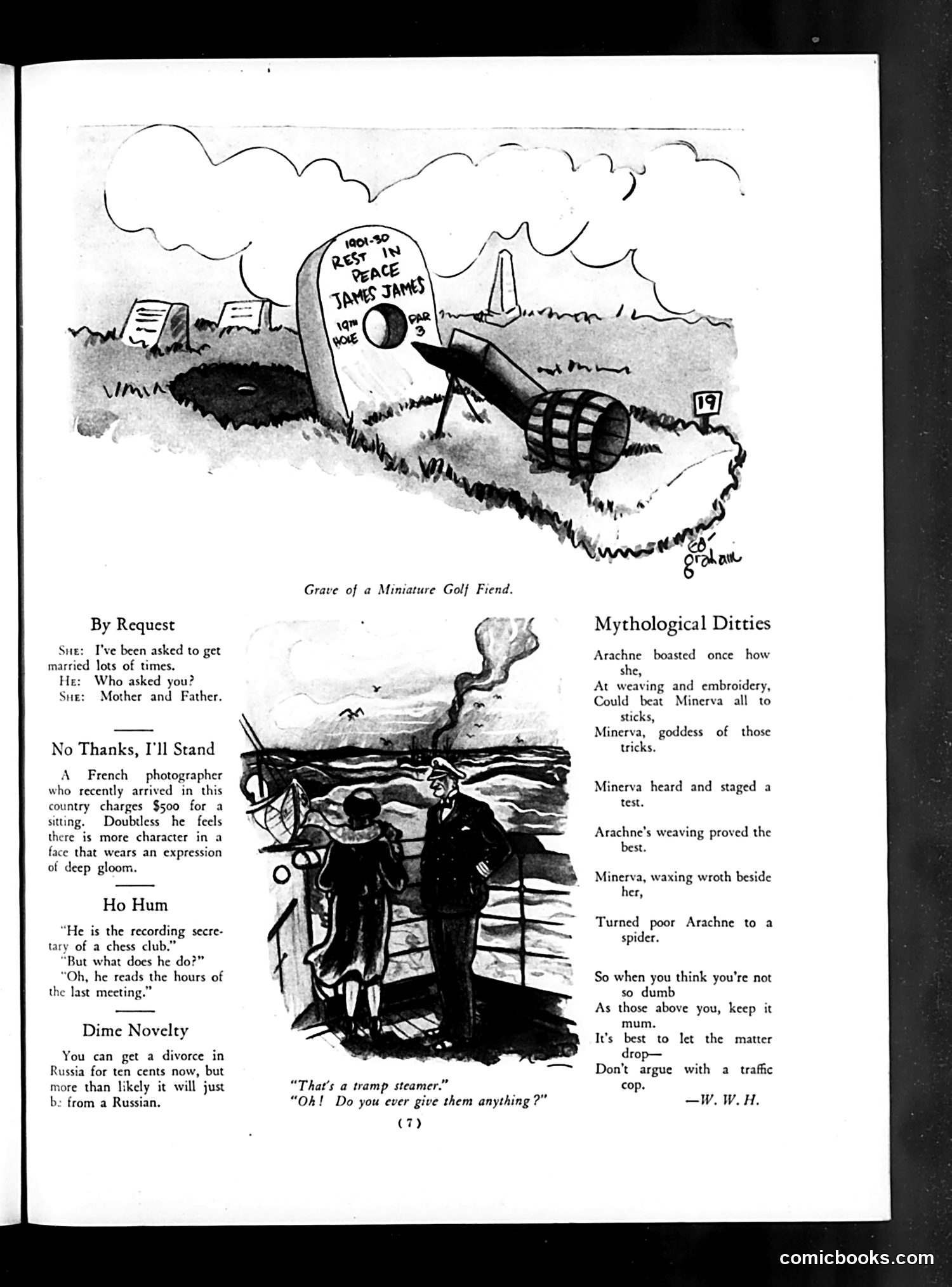
Page Analysis This page from *Life* magazine contains several short humor pieces and cartoons: "Grave of a Miniature Golf Fiend" shows a tombstone for "James James" among miniature golf obstacles, satirizing the obsessive popularity of miniature golf—a fad of the era. "By Request" and "No Thanks, I'll Stand" are brief comic dialogues about marriage proposals and professional photography rates, poking fun at social conventions. "Ho Hum" jokes about a chess club secretary's dull job. "Dime Novelty" comments on cheap Russian divorces. "Mythological Ditties" retells the Arachne myth in verse, satirizing hubris. The central cartoon depicts what appears to be vagrants or poor people near a tramp steamer, with dialogue about receiving charity. The humor targets class disparities and Depression-era poverty through dark satire.
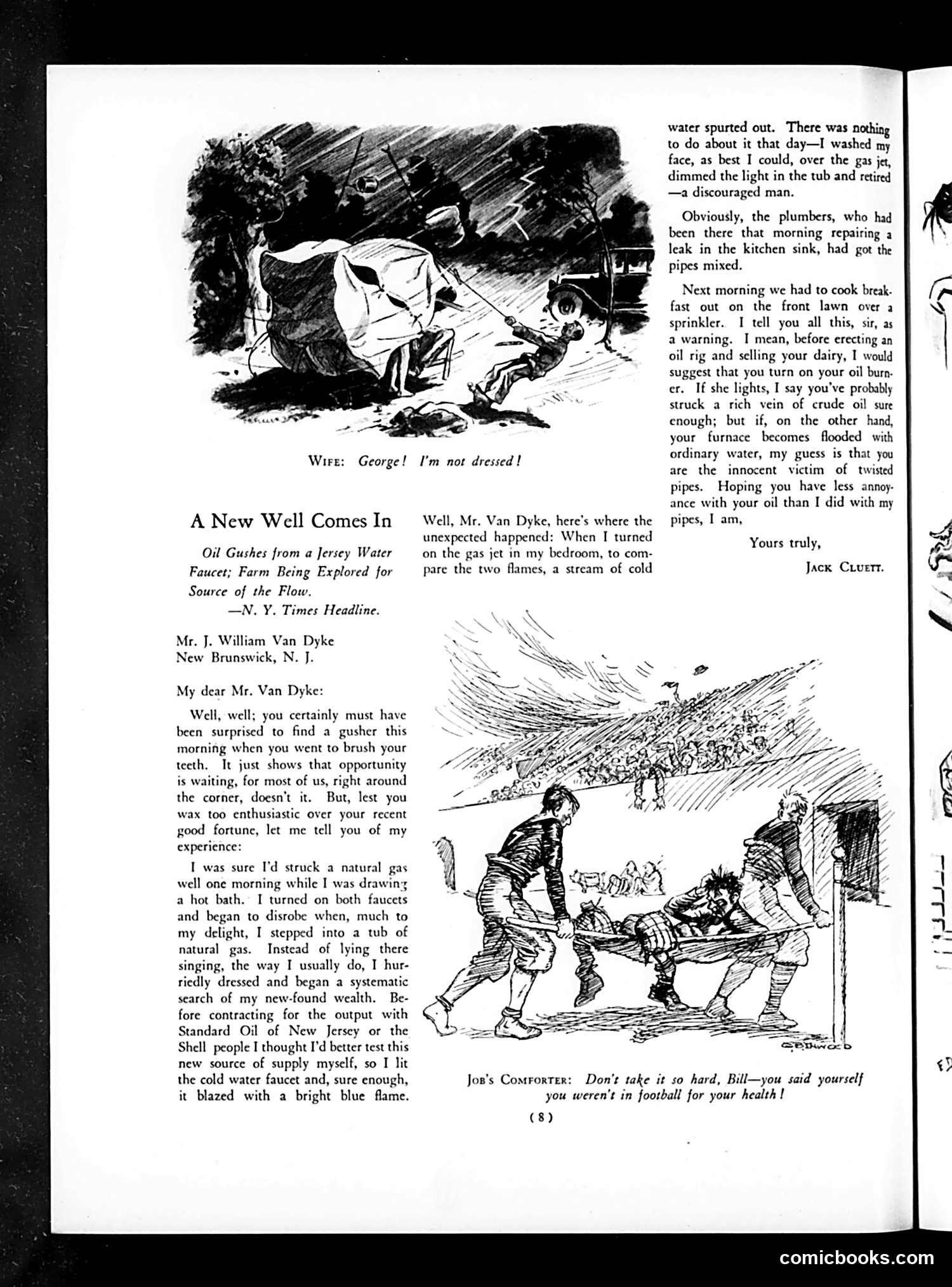
"A New Well Comes In" - Oil Boom Satire This page satirizes the oil boom phenomenon in 1920s New Jersey. The main letter, signed by "Jack Cluett," humorously warns Mr. Van Dyke about unexpected oil discoveries disrupting domestic life. The top illustration shows a wife ("George! I'm not dressed!") caught off-guard by an oil gusher erupting indoors—likely from plumbing mishaps when workers mixed pipes during repairs. The lower cartoon depicts men playing football near an oil derrick, with the caption mocking one player's excuse: "Don't take it so hard, Bill—you said yourself you weren't in football for your health!" The satire targets the chaotic, intrusive nature of sudden oil wealth—how industrial development disrupts ordinary life and domesticity without warning.
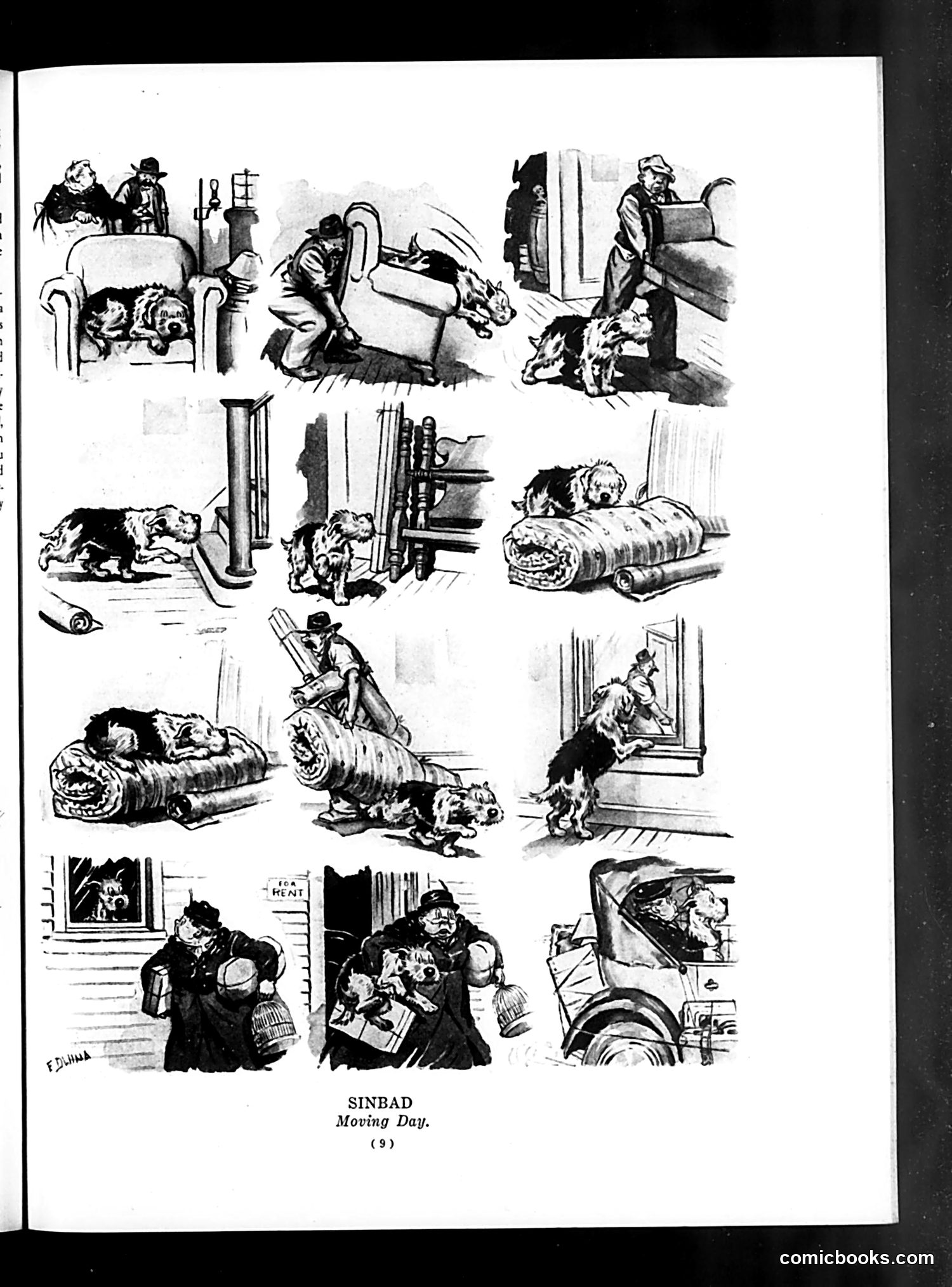
SINBAD Moving Day This is a humorous pictorial sequence titled "SINBAD Moving Day" showing a dog (Sinbad) being moved to a new residence. The twelve panels depict the chaos and mishaps of relocation through the dog's perspective and involvement. The joke satirizes the universal frustration of moving day—the animal encounters furniture, boxes, rolled carpets, and other moving equipment in various comedic situations. The panels show Sinbad interacting with household items, getting in the way, hiding, and creating disorder typical of pet behavior during relocations. This appears to be a lighthearted comic strip using a named character (the dog Sinbad) to humorously document the pandemonium that accompanies household moves, a relatable experience for the magazine's readers.
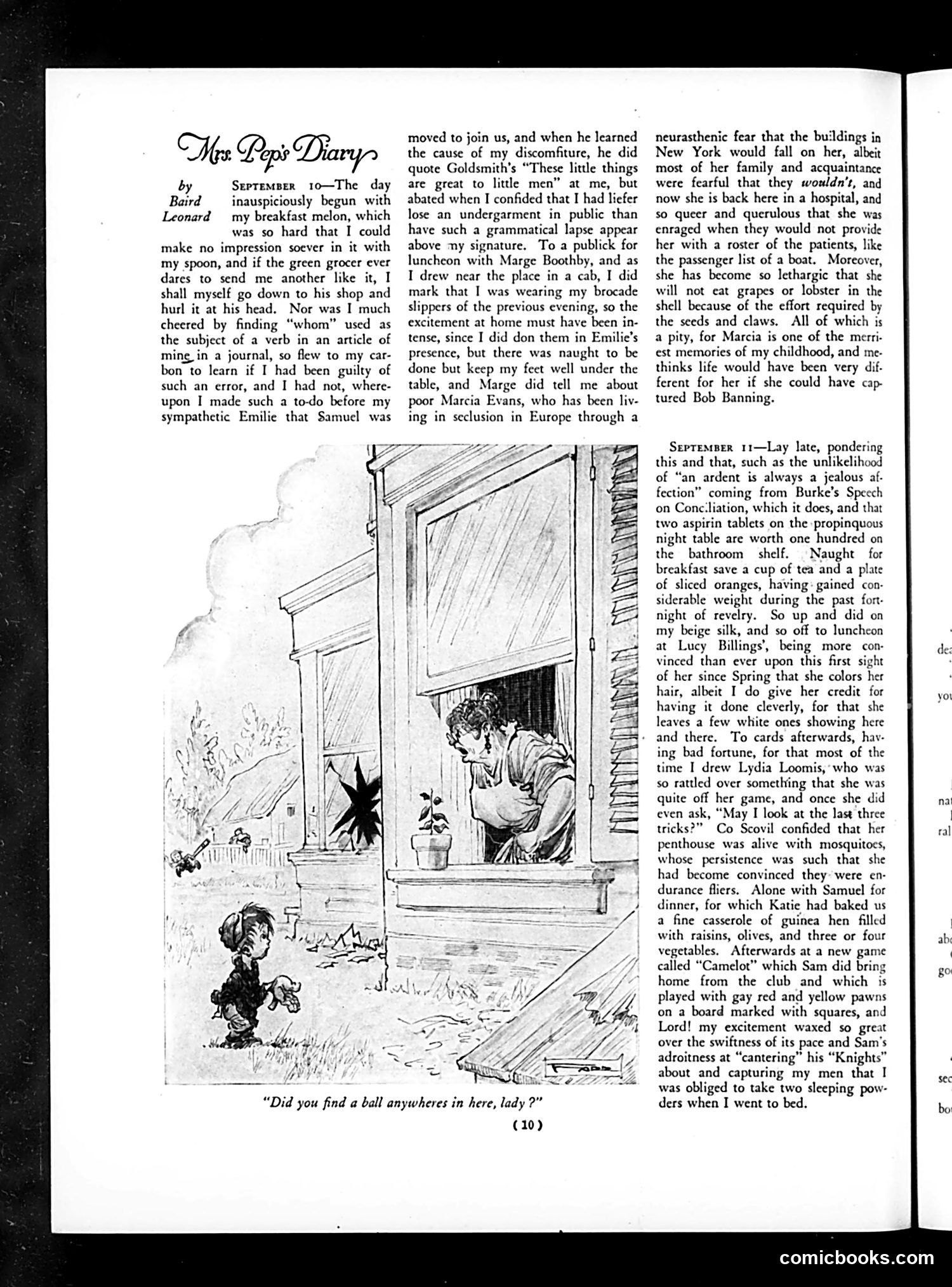
"Mrs. Pep's Diary" - Page Analysis This page is from a serialized diary column titled "Mrs. Pep's Diary" by Baird Leonard, dated September 10-11. The text describes mundane domestic frustrations: a failed molten breakfast, laundry mishaps, and social embarrassments at lunch. The accompanying illustration shows a woman at a window confronting what appears to be a child or small figure outside, with the caption: "Did you find a ball anywheres in here, lady?" The satire targets the frustrations of middle-class domestic life—burnt food, household help problems, and social anxieties about appearance and propriety. The humor derives from relatable everyday indignities rather than political commentary. This appears to be lifestyle/humor content aimed at contemporary homemakers navigating domestic management and social expectations.
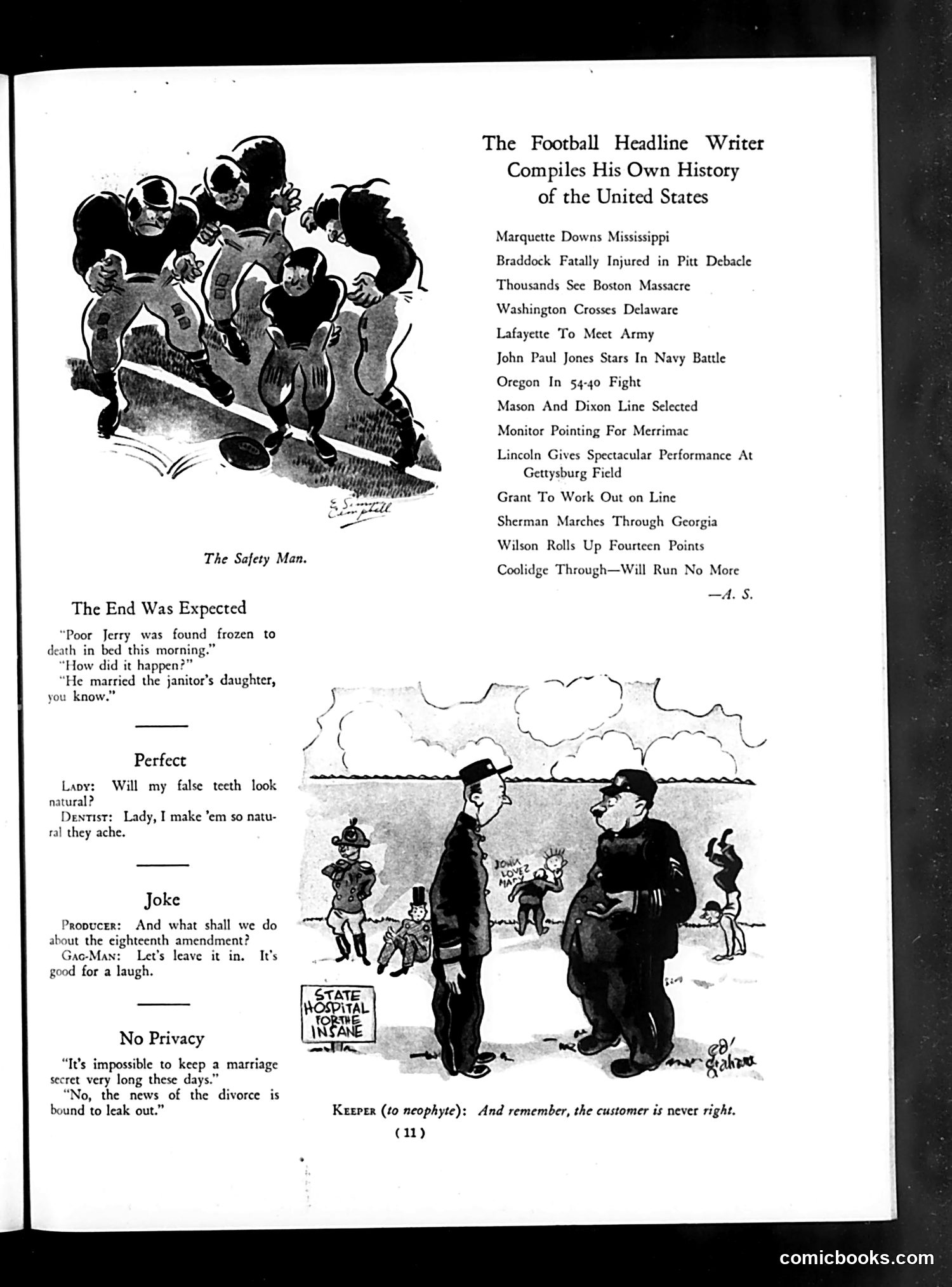
Analysis of Life Magazine Page This page contains satirical humor rather than political commentary. The main cartoon shows two men outside a "State Hospital for the Insane" discussing the "customer is never right"—a joke about institutional absurdity. Above are brief joke segments ("The End Was Expected," "Perfect," "Joke," "No Privacy") using common satirical formats of the era—playing on domestic situations, dentistry, and divorce gossip. The headline parody at top mocks how sports writers sensationalize events by reframing U.S. history as football headlines ("Washington Crosses Delaware," "Lincoln Gives Spectacular Performance at Gettysburg"). The left illustration titled "The Safety Man" shows football players, connecting to this sports-writing theme. The overall page is light humor and satire typical of Life magazine's early 20th-century comedic approach.
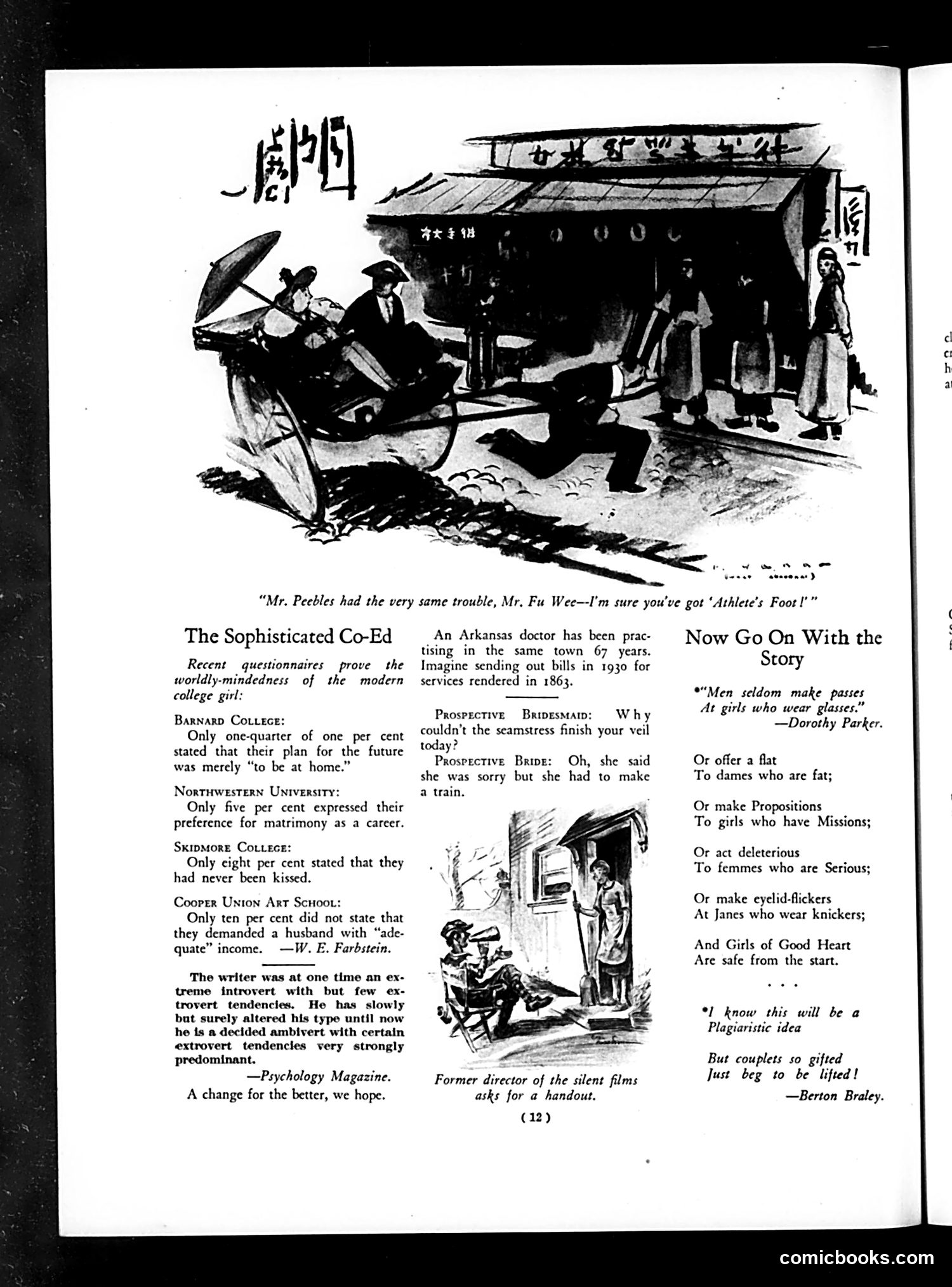
Analysis of Life Magazine Page This page contains satirical commentary on college life and modern dating customs. "The Sophisticated Co-Ed" section quotes surveys about college women's attitudes, suggesting they're cynical about marriage and independence. The humor targets educated women's changing social views—colleges reported low interest in matrimony as a career goal. The cartoon (top) depicts a street scene where someone mentions "Athlete's Foot," a fungal infection. The joke plays on double meanings and social awkwardness. "Now Go On With the Story" is Dorothy Parker verse mocking women who wear glasses or have other "flaws," offering sardonic suggestions about making themselves more marriageable—satirizing society's pressure on women to be attractive and compliant rather than serious or accomplished. The overall theme critiques 1920s gender expectations and the supposed "sophistication" of modern women.
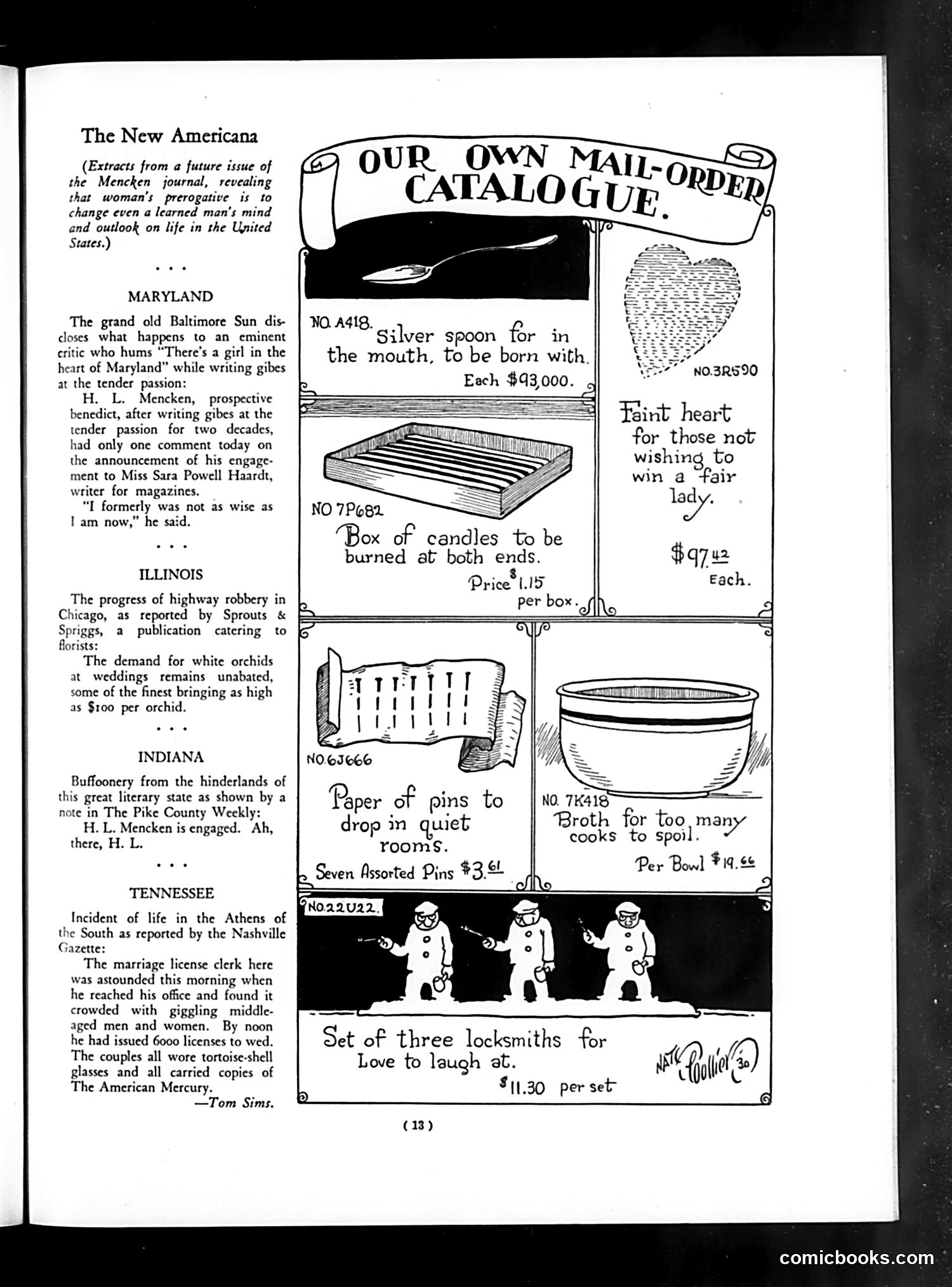
"Our Own Mail-Ordered Catalogue" - Life Magazine Satire This page satirizes absurd mail-order products through a fake catalog. The items mock contemporary social anxieties and gender roles: - Silver spoon for babies ($43,000): Mocks wealth disparities and materialistic parenting - Candles burned at both ends ($1.15): Idiom about unsustainable living habits - Paper of pins to drop quietly: Satirizes passive-aggressive domestic behavior (likely toward servants or family) - Broth for "too many cooks": References the proverb about spoiling results - Three locksmiths to "laugh at": Unclear reference, possibly mocking failed romance or infidelity The cartoon's humor relies on readers recognizing these as absurd "solutions" to human problems—critiquing consumer culture's false promise that products can solve social and emotional issues. The exorbitant prices emphasize the satire's targeting of wealthy readers.
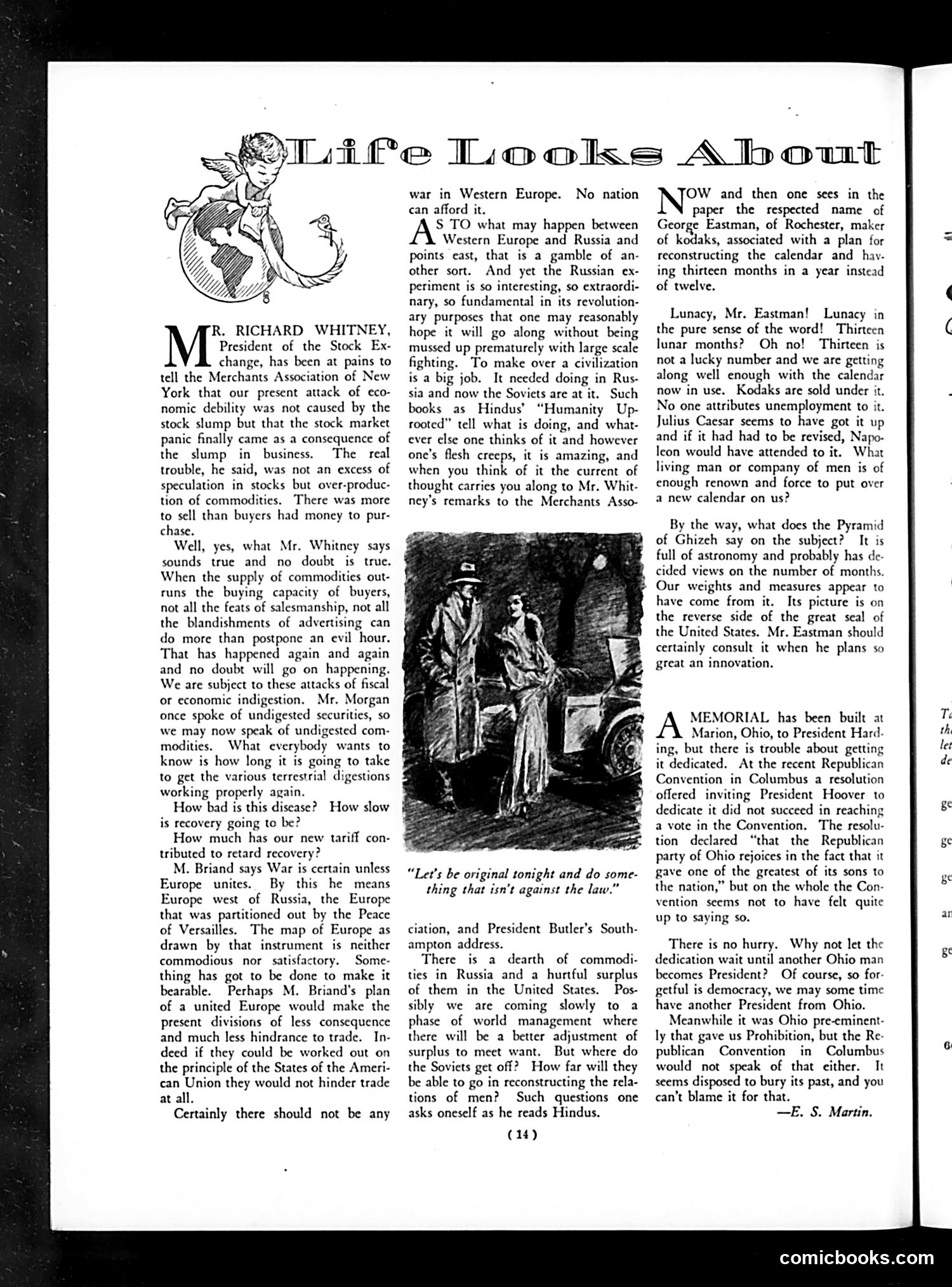
Analysis of Life Magazine Page This page contains editorial commentary rather than political cartoons. The main illustration shows two figures in what appears to be a casual, conspiratorial moment with the caption "Let's be original tonight and do something that isn't against the law." The illustration satirizes social behavior during Prohibition (indicated by the joke about doing something "against the law"). The cartoon suggests the widespread nature of law-breaking during this era—that illegal activities had become so normalized that choosing legal behavior seemed boring or unconventional. The surrounding text discusses economic issues including stock market speculation and trade policy, typical concerns of the 1920s. The page demonstrates how Life magazine combined satirical illustrations with serious economic and political commentary for its educated readership.
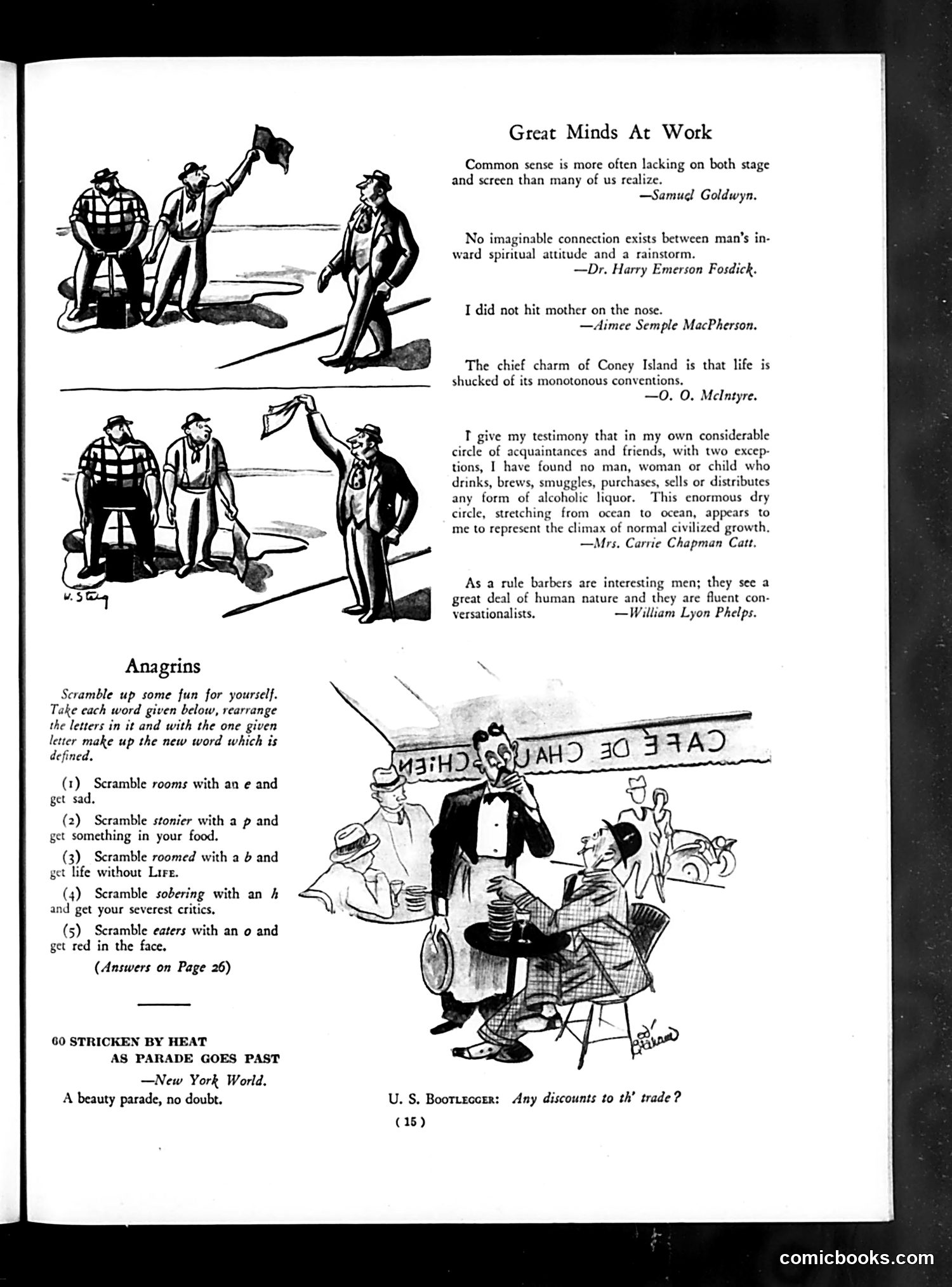
Analysis of Life Magazine Page The page contains two editorial cartoon sequences at the top, showing men in business attire with flags and surveying equipment, apparently depicting political or commercial negotiations or territorial disputes. The specific figures and conflict remain unclear without additional context. Below is an "Anagrins" word puzzle game for readers. The main cartoon shows a formally-dressed man at what appears to be a "Cafe de Chahire" (unclear spelling) with a woman, illustrating some social interaction. The caption references a "U.S. Bootlegger" asking about "discounts to th' trade"—clearly referencing Prohibition-era alcohol smuggling and black-market commerce. The page appears from the Prohibition era, satirizing both bootlegging operations and the social hypocrisy surrounding illegal alcohol trading.
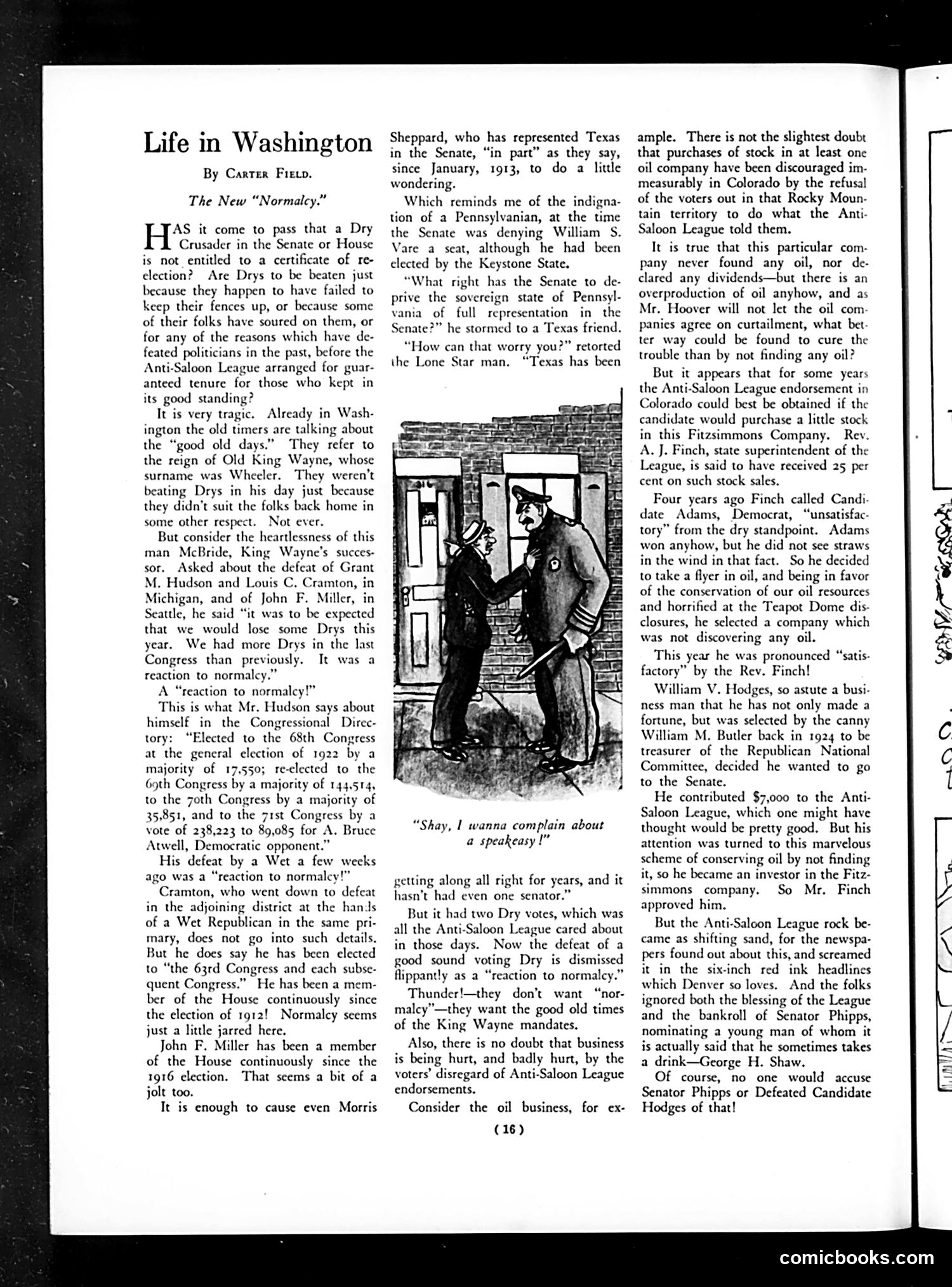
Cartoon Analysis: "Shay, I wanna complain about a speakeasy!" This cartoon depicts Prohibition-era politics. A figure (likely representing a dry/temperance advocate) complains to what appears to be a police officer or authority figure about an illegal speakeasy. The satire mocks the contradiction between Prohibition supporters' moral stance and their hypocrisy—the article's text discusses how the "Anti-Saloon League" and "Drys" gained political power by claiming moral superiority, yet enforcement proved ineffective or selective. The joke illustrates the era's widespread cynicism: despite Prohibition's legal status, speakeasies thrived openly, and activists' crusades appeared performative rather than genuinely reformist. The cartoon ridicules both the complainant's naiveté and the system's fundamental failure.
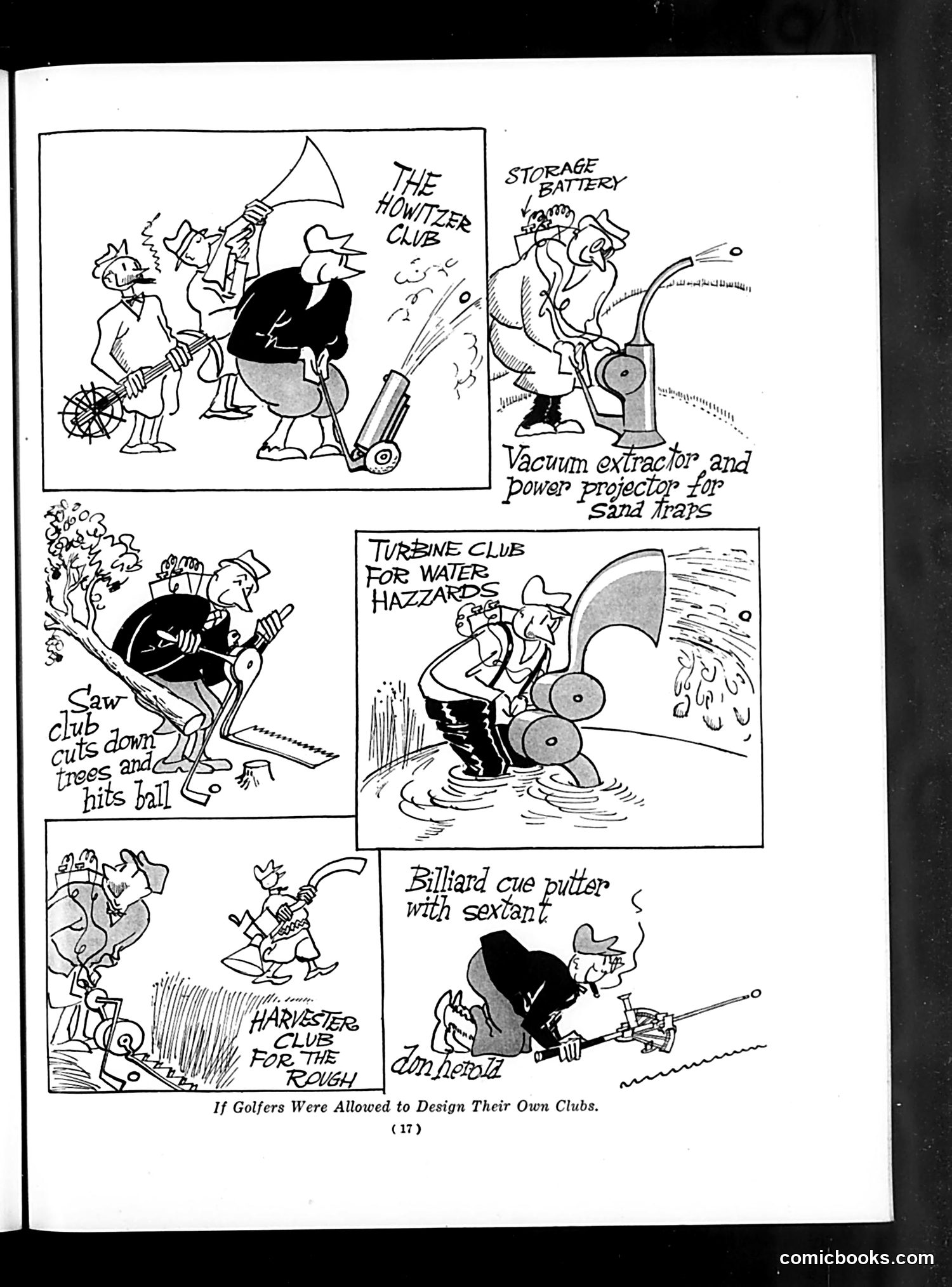
"If Golfers Were Allowed to Design Their Own Clubs" This satirical page presents absurd golf club designs imagined by creative (but impractical) golfers. Each panel mocks different golfing scenarios: 1. The Howitzer Club — A massive megaphone-like contraption for long drives 2. Storage Battery — Equipment for extracting sand from traps via vacuum and projector 3. Saw Club — A saw that "cuts down trees and hits ball" 4. Turbine Club for Water Hazards — A spinning turbine to blast through water 5. Harlester Club for the Rough — An agricultural harvester for tall grass 6. Billiard Cue Putter with Sextant — An overcomplicated aiming device The humor lies in exaggerating golfers' frustrations with common course obstacles by imagining increasingly ridiculous mechanical solutions—mocking both golf obsession and 1920s-era faith in technological innovation.
Theatre Review: "That's Gratitude" This is a theater review by Baird Leonard of a play by Frank Craven. The review discusses a comedy set in Hutchinson, Kansas, featuring characters including Mr. Craven (played by Robert Grant), who is a traveling road-show producer, and the Hutchinson household—a family consisting of a wife, two daughters, a fiancé, and servants. The reviewer praises the acting and characterizations as "splendid" and "perfect," calling it "a grand comedy." The plot involves Mr. Craven saving a man's life through a simple remedy, after which gratitude motivates various comedic complications throughout the household. The reviewer notes the play offers familiar, sophisticated American comedy in the tradition of Clare Briggs's humor.
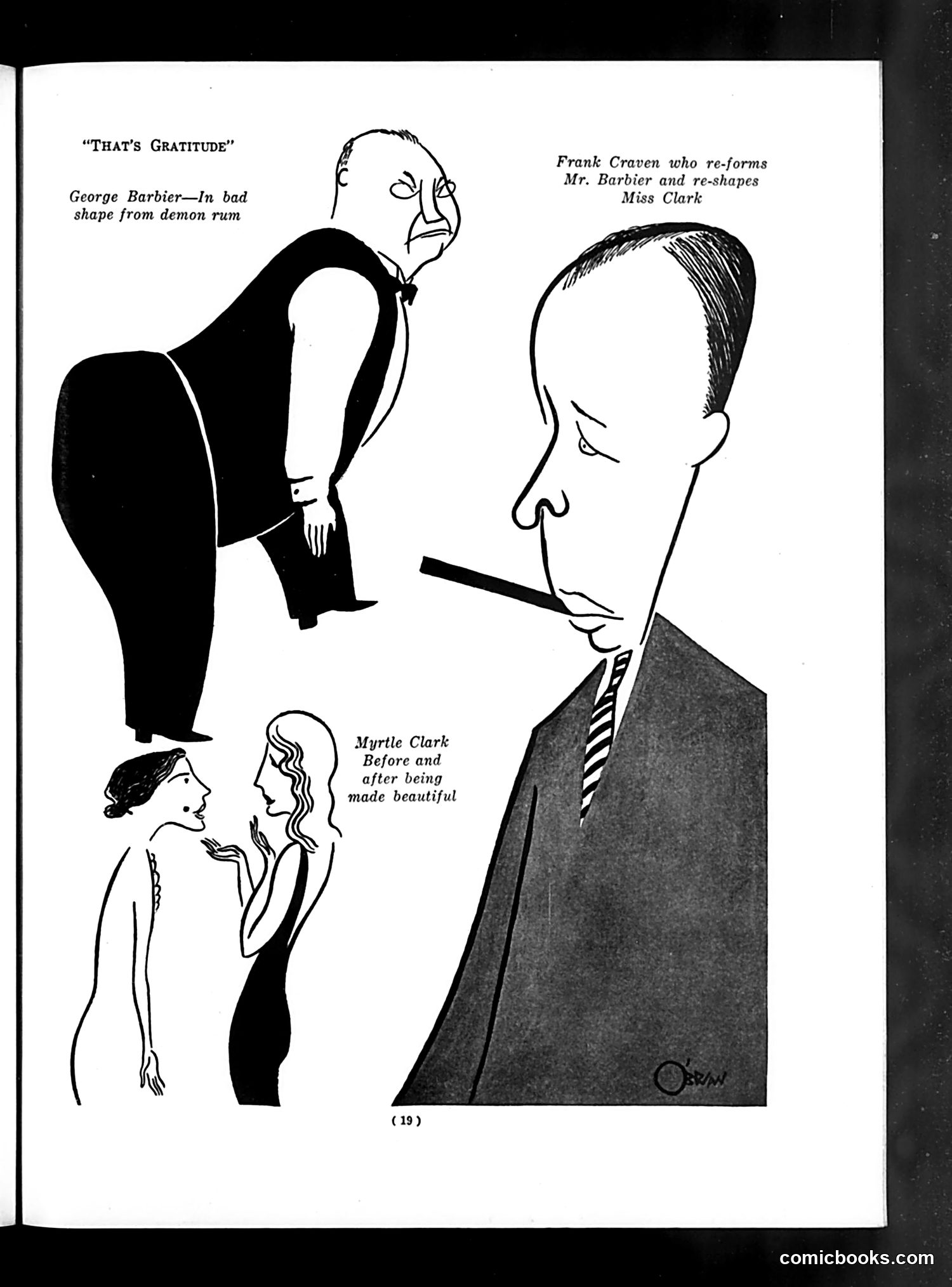
"That's Gratitude" This satirical cartoon mocks the transformative power of Hollywood and cosmetic intervention. The page shows three transformation narratives: George Barbier appears physically degraded ("in bad shape from demon rum"), depicted as a hunched figure—suggesting alcohol abuse has ravaged him. Frank Craven is portrayed as a reformer who physically "re-forms Mr. Barbier and re-shapes Miss Clark," suggesting Craven has the power to rehabilitate and remake people. Myrtle Clark is shown in a "before and after" sequence, transformed from plain to glamorous through Craven's intervention. The title "That's Gratitude" suggests ironic commentary: these people are supposedly grateful for being "fixed," yet the cartoon implies the shallowness of such physical/social makeovers. The satire critiques Hollywood's obsession with reshaping people's appearances and the vanity of those who submit to such transformations.
Movies by Harry Evane: Film Reviews This page contains movie reviews from Life magazine's film criticism section. The reviews discuss three films: "Outward Bound" - A Warner Brothers adaptation of a stage play about a young couple who attempt suicide by gas and find themselves on a ship carrying passengers to divine judgment. The reviewer praises the film's artistic ambition, acting (particularly Leslie Howard's screen debut), and direction, while noting its potentially controversial religious themes. The reviewer defends the film against those who might object to its casual treatment of the afterlife, clarifying it depicts the suicidal couple's mental experience rather than theological claims. "Follow Thru" and "Good News" - Brief mentions of two musical comedy adaptations, with the reviewer noting "Follow Thru" is recommended as good entertainment, while "Good News" receives a negative recommendation for being poorly adapted from stage to screen. The tone is sophisticated, addressing reader intelligence and praising studios brave enough to respect audience sophistication.
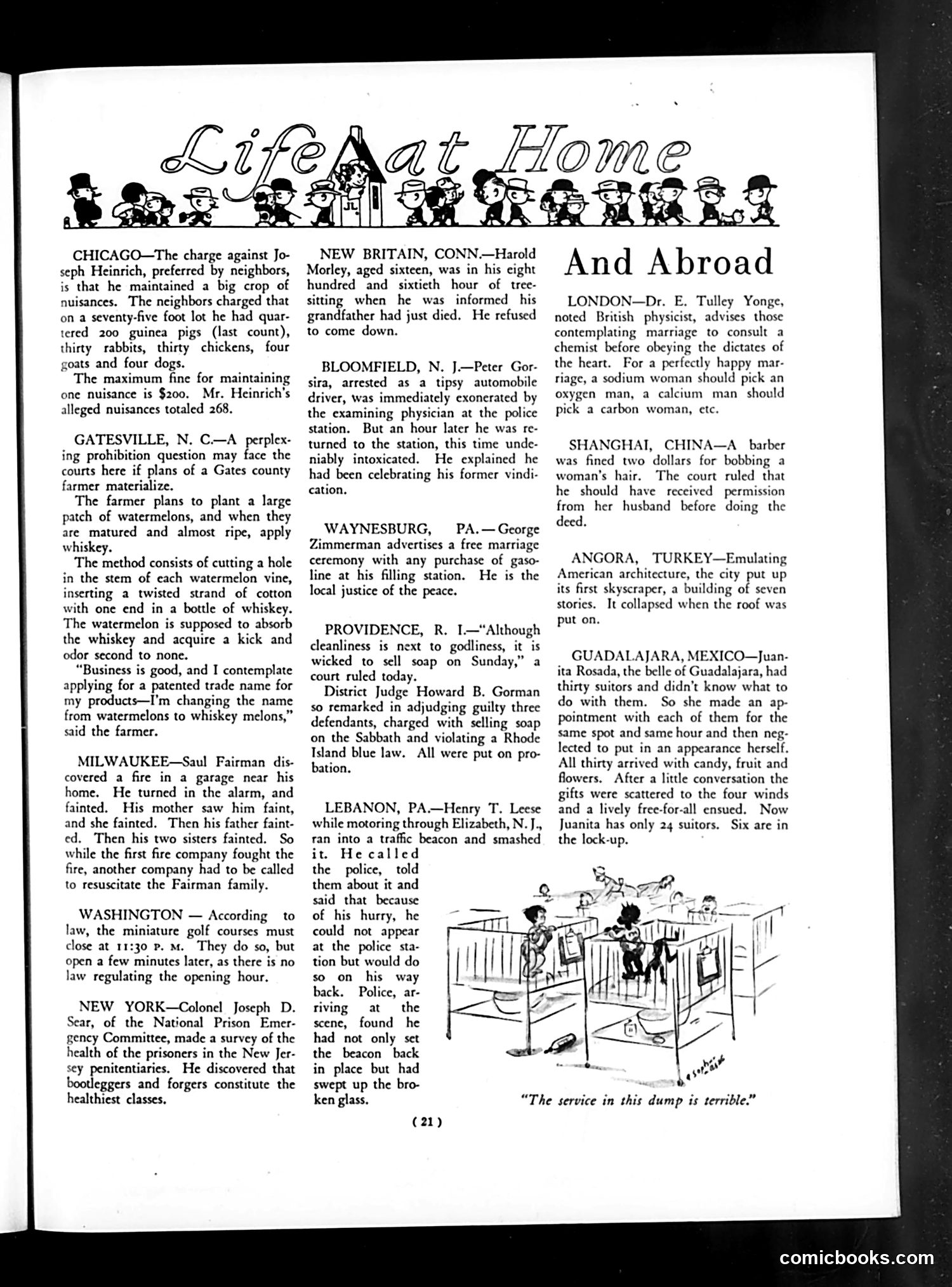
"Life at Home and Abroad" - Page Analysis This page collects humorous short anecdotes from American and international newspapers, typical of *Life* magazine's satirical format. The jokes mock absurdity in everyday life and legal systems: Domestic highlights: A Chicago man faces massive fines for keeping 268 animals on one lot. A North Carolina farmer plans to inject whiskey into watermelons to circumvent Prohibition. A Milwaukee family faints in succession during a fire emergency. Miniature golf courses exploitatively close at 11:30 PM then reopen minutes later, evading closing-hour laws. Ironically, the healthiest prisoners are bootleggers and forgers. International items include a British physicist advising chemical compatibility in marriage, and Shanghai penalizing women's bobbing hairstyles. The cartoon (bottom) shows babies in playpens with the caption "The jereice in this dump is terrible"—likely mocking negligent childcare conditions. Overall, the page satirizes regulatory loopholes, Prohibition enforcement failures, and arbitrary legal restrictions of the 1920s era.
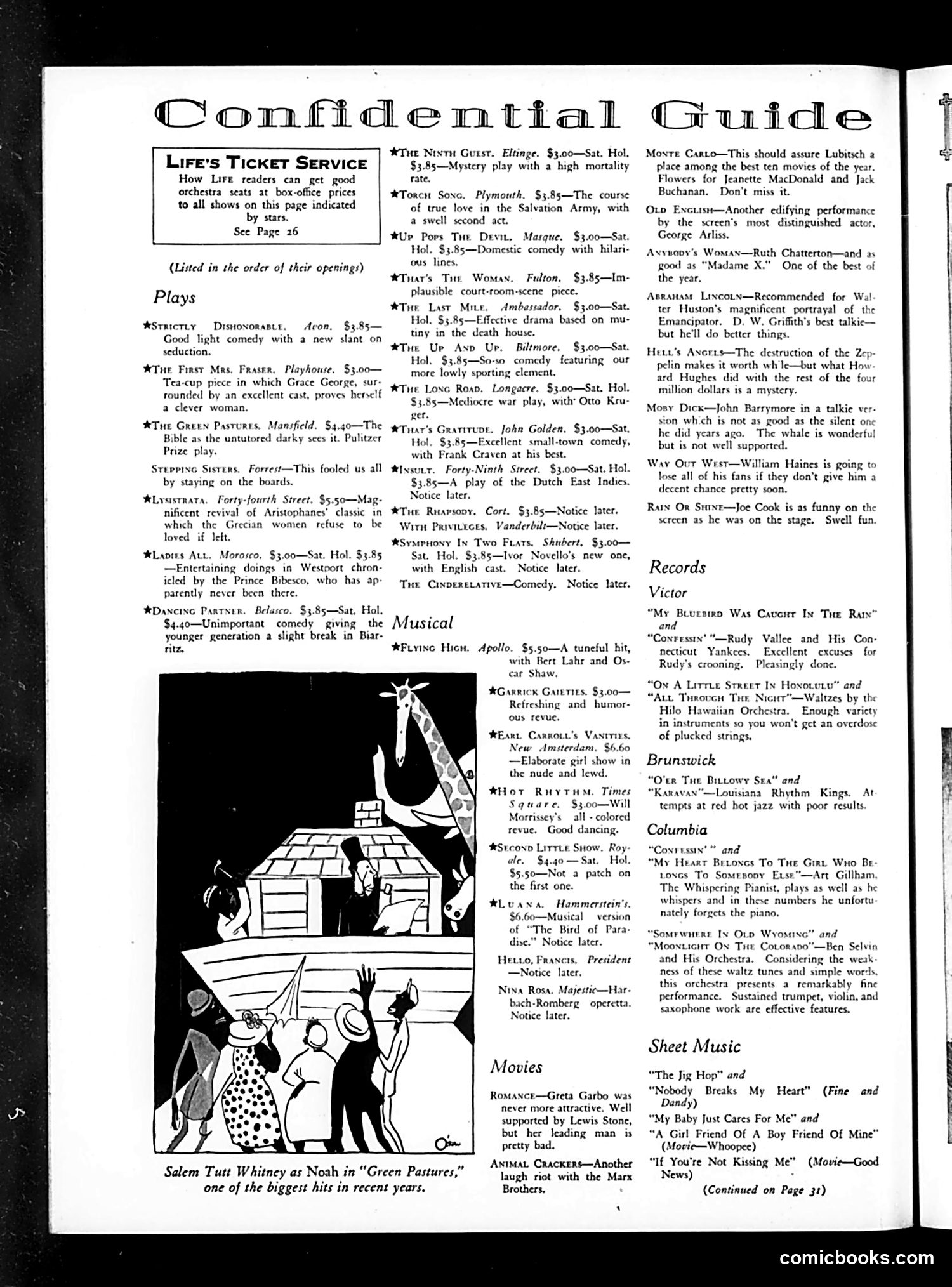
Explaining This Life Magazine Entertainment Guide Page This is a 1920s entertainment guide listing Broadway shows, musicals, and films with reviews and ticket prices. The page serves as a practical companion to Life magazine readers seeking cultural recommendations. Key Content: The cartoons (two illustrated panels at bottom left) appear to show theatrical scenes—one depicts "Salem Tutt Whitney as Noah in 'Green Pastures,'" referring to the Pulitzer Prize-winning play about biblical stories as interpreted by African American characters. This was a significant Broadway hit of the era. The reviews use period slang and social attitudes now dated—notably, the description of *Green Pastures* as "the Bible as the untutored darky sees it" reflects contemporary racial terminology and patronizing attitudes toward Black performers, even while the play achieved prestigious recognition. The function is straightforward: Life offered theater-goers curated recommendations, asterisks indicating where readers could purchase discounted orchestra seats through the magazine's service (detailed on page 26). This reflects 1920s urban entertainment culture and Life's role as a middlebrow guide for affluent theatergoers.
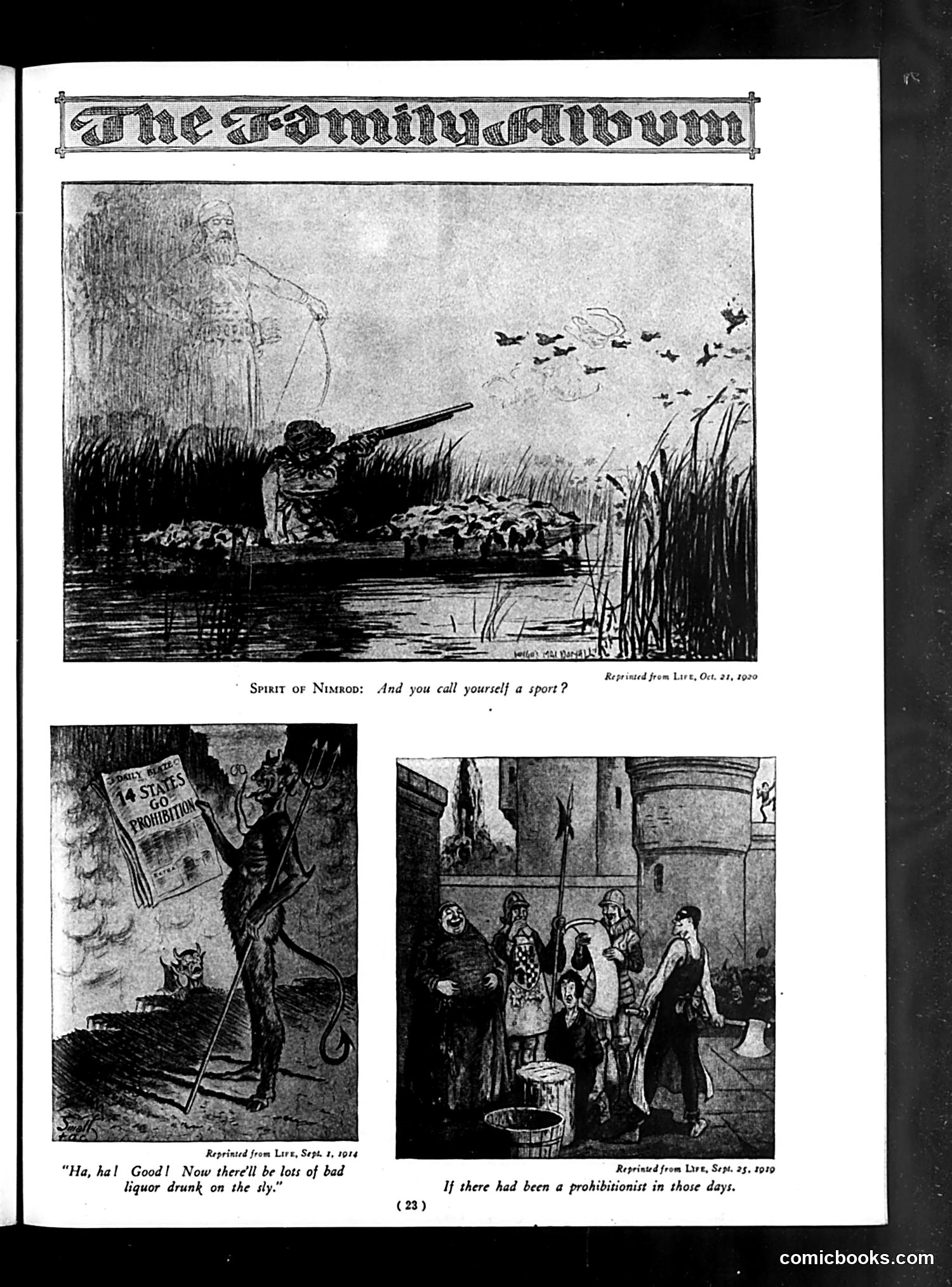
Analysis This page contains three cartoons satirizing Prohibition (the 1920-1933 alcohol ban in America). Top cartoon ("Spirit of Nimrod"): A skeletal Death figure looms over a hunter shooting at migrating birds, captioned "And you call yourself a sport?" — criticizing hunting as unsportsmanlike killing. Bottom left: A devil celebrates a "14 States Prohibition" law, saying liquor will now be "drunk on the sly" — suggesting Prohibition would drive drinking underground rather than eliminate it. Bottom right: Medieval figures gather in a dungeon, captioned "If there had been a prohibitionist in those days" — humorously implying alcohol consumption was universal throughout history, making Prohibition futile. The satire's point: These cartoons mock Prohibition as ineffective and hypocritical—it won't stop drinking, only create illegal markets and social problems. The historical references emphasize alcohol's inevitability in human society.
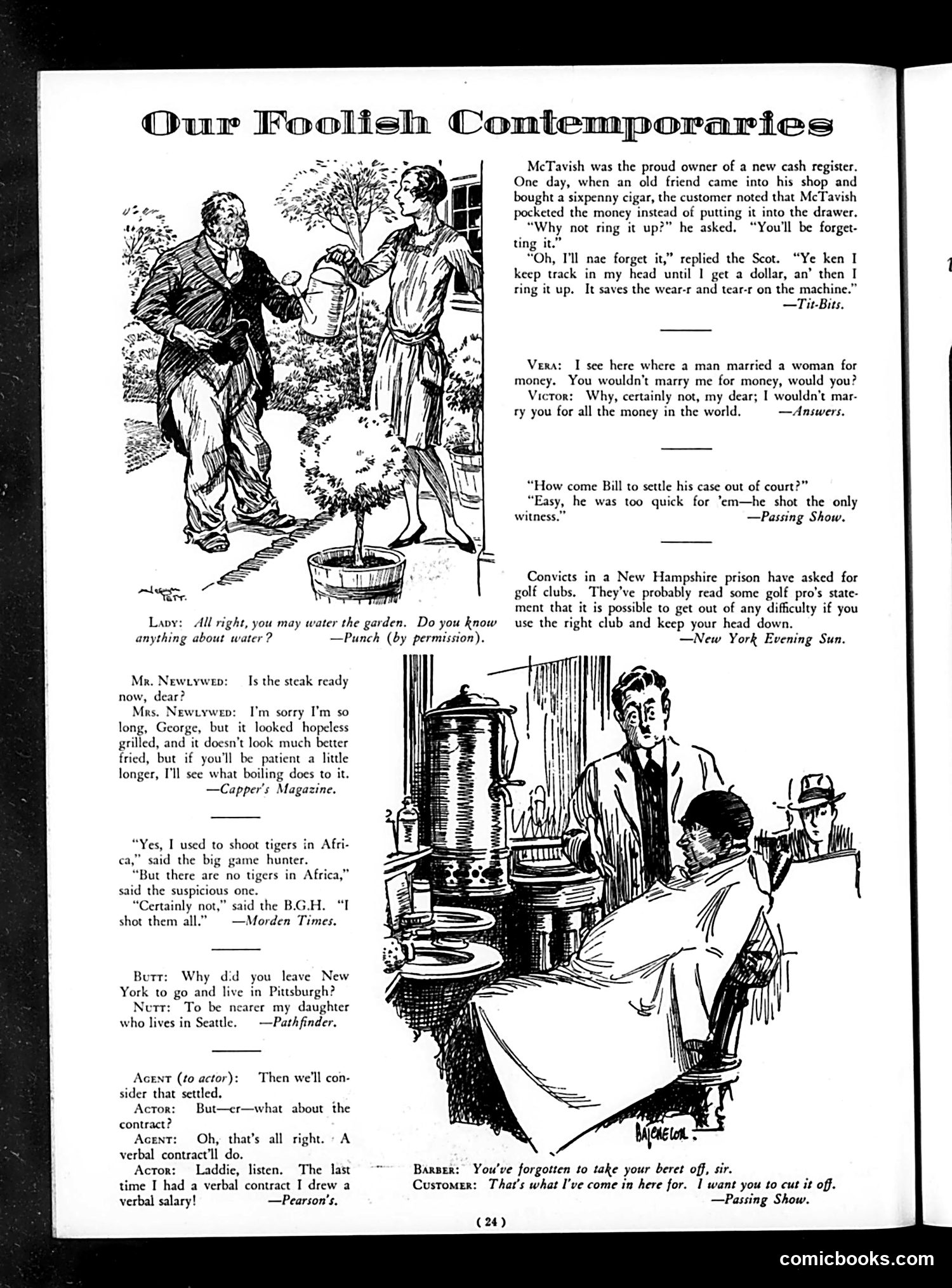
"Our Foolish Contemporaries" - Life Magazine Humor Page This page collects brief comic anecdotes satirizing human foolishness and illogic. Key examples: The Scottish shopkeeper mocks penny-pinching: McTavish avoids using his new cash register to "save wear and tear," instead tracking money mentally until he accumulates a dollar—defeating the register's purpose entirely. The engagement exchange jokes about mercenary marriage: Victor assures his fiancée Vera he wouldn't marry her for money, then claims he wouldn't marry her "for all the money in the world"—a backhanded insult disguised as romance. The barber cartoon (bottom right) depicts a customer requesting the barber cut off his beret, which he's forgotten he's wearing—absurd obliviousness played for humor. The tiger hunter boasts of African hunting while admitting he exterminated all tigers there, making his "accomplishment" impossible to verify. These jokes target vanity, absent-mindedness, contradictory logic, and exaggeration—universal human foibles transcending the 1920s era.
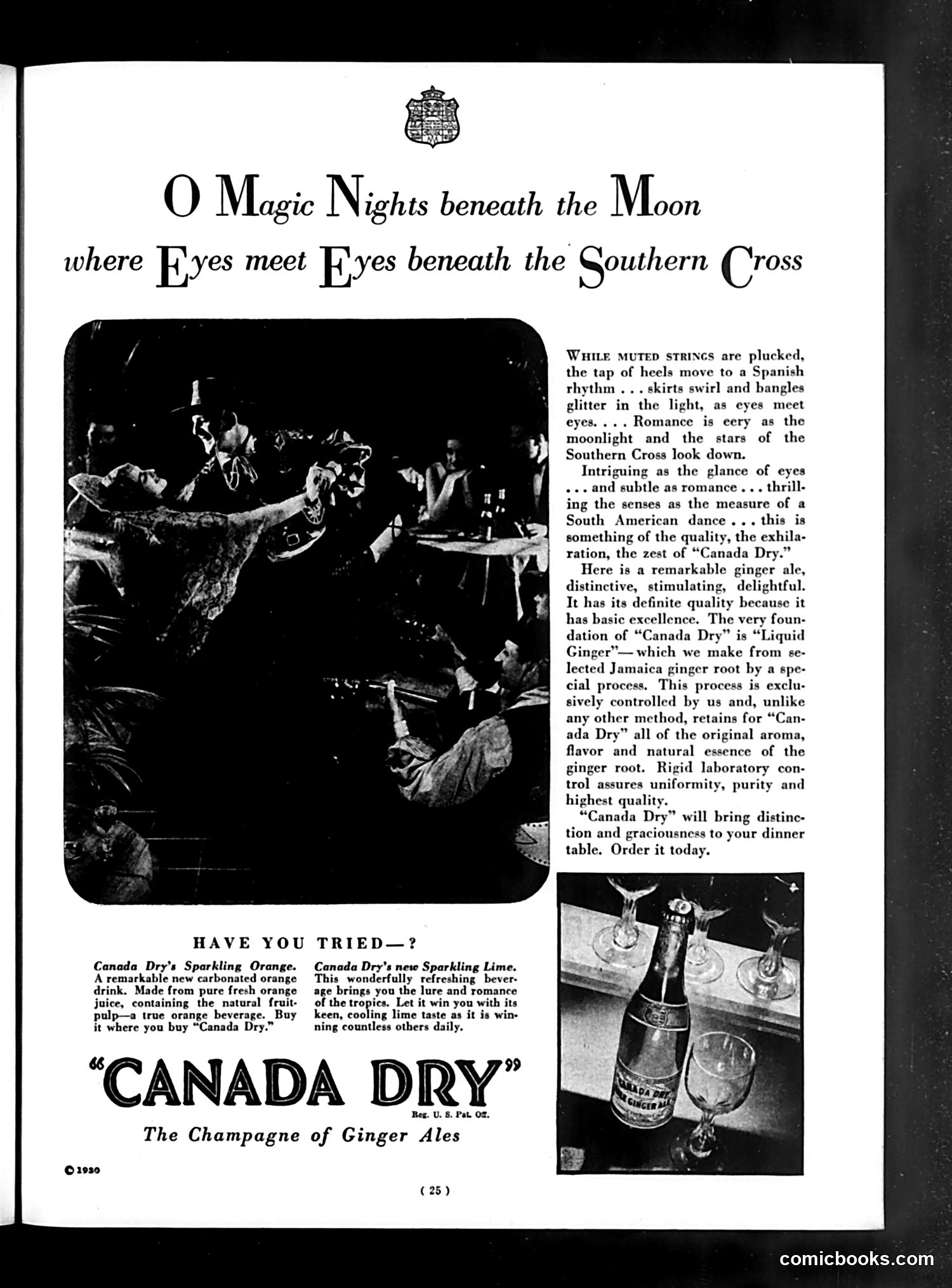
Canada Dry Advertisement (circa 1930) This is a product advertisement, not political satire. It promotes Canada Dry ginger ale and new sparkling beverages (orange and lime flavors). The page uses romantic imagery of South American nightlife—dancers under the Southern Cross constellation—to evoke exotic sophistication and glamour. The text associates the drink with Spanish rhythms, tropical romance, and elegance ("distinction and graciousness to your dinner table"). The advertisement emphasizes Canada Dry's manufacturing process using Jamaican ginger root through an exclusive "Liquid Ginger" method, positioning it as superior to competitors through scientific rigor and quality control. The secondary image shows the product bottle alongside cocktail glasses, appealing to upscale consumers during the Prohibition era's end (the ad is from 1930, shortly after repeal). The "Champagne of Ginger Ales" tagline suggests premium status—ginger ale was often consumed as an alternative to alcohol or as a mixer.
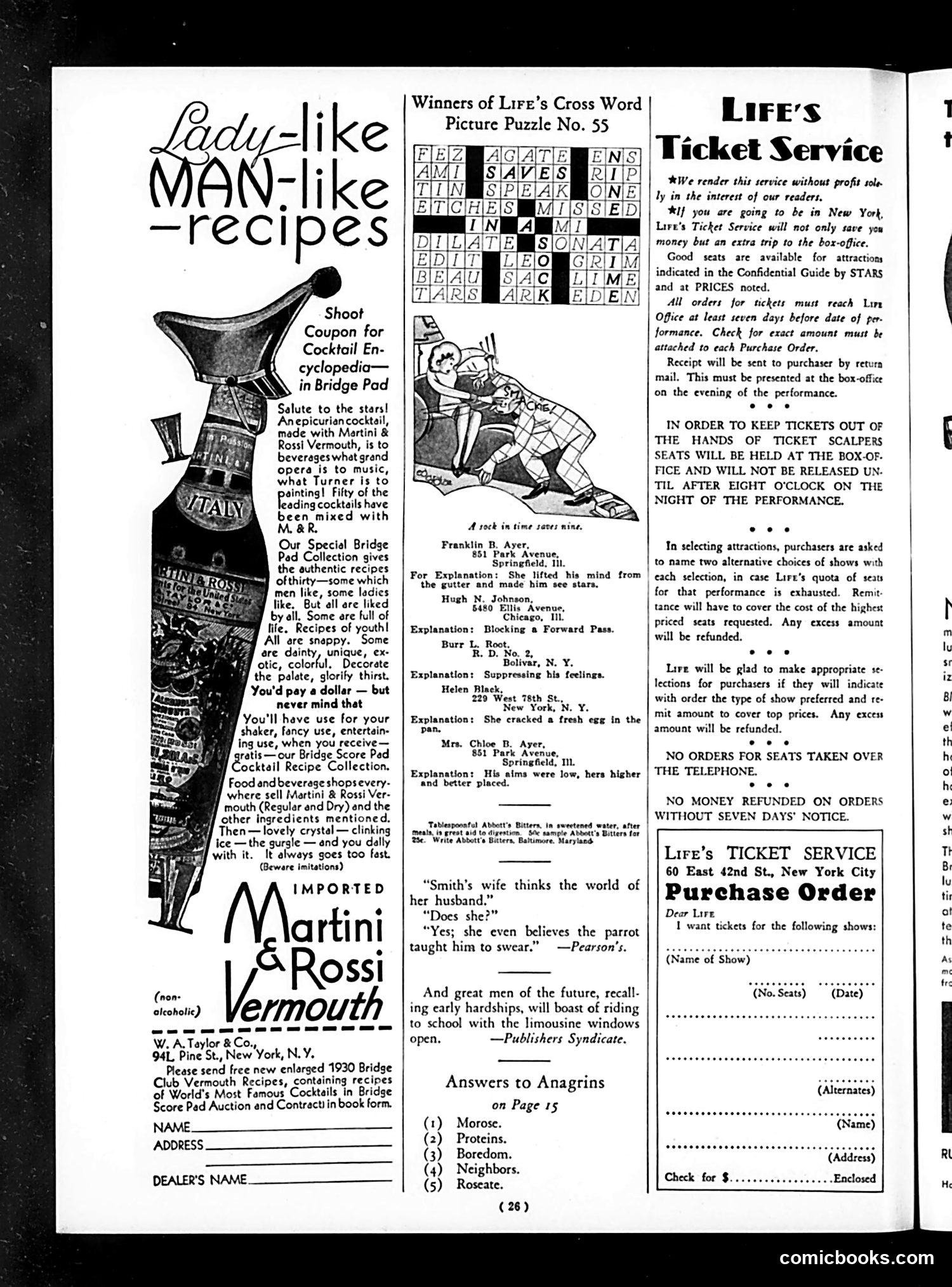
Analysis for Modern Readers This page is primarily advertising and service announcements, not political satire. The main content includes: 1. Martini & Rossi Vermouth ad (left): A liquor advertisement disguised as a recipe guide, targeting bridge players (a popular 1930s pastime). It promises 30 cocktail recipes in a "Bridge Pad" collection. The ad's language—comparing martinis to grand opera and Turner paintings—uses inflated cultural references to market alcohol as sophisticated entertainment. 2. Life's Ticket Service (right): A practical service announcement explaining how readers can purchase theater tickets through the magazine, with detailed policies about refunds, scalper prevention, and advance ordering requirements. 3. Minor content: A crossword puzzle results section, a few humor one-liners, and anaagram answers. The page reflects 1930s consumer culture: prohibition had recently ended (1933), and magazines monetized advertising while providing reader services.
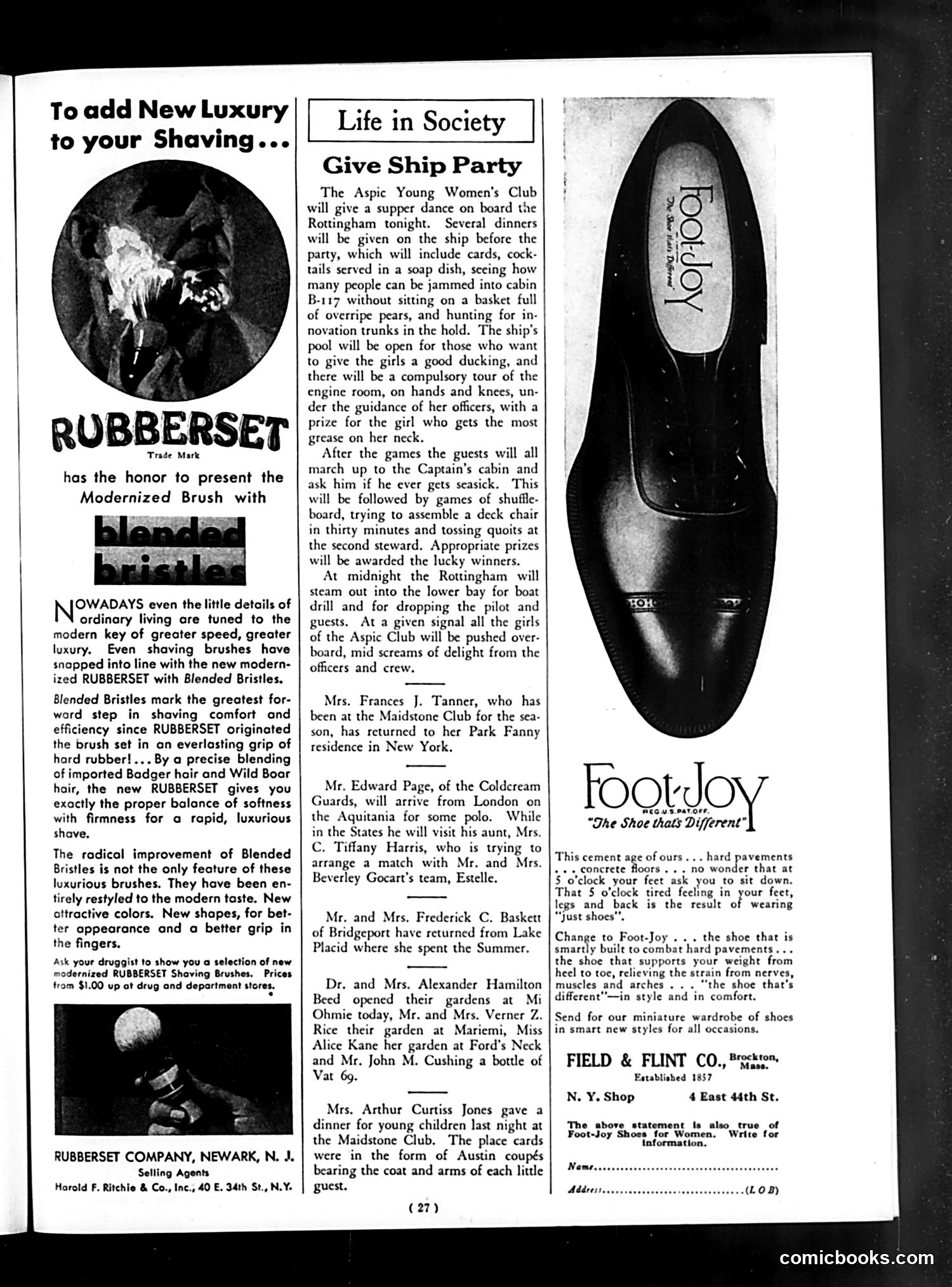
Analysis for Modern Readers This page contains advertisements and society gossip, not political cartoons. Left side: A Rubberset shaving brush ad emphasizing "modernization" and "luxury"—reflecting 1920s marketing language that positioned everyday products as fashionable upgrades. The "blended bristles" detail exemplifies how manufacturers sold minor improvements as major innovations. Center: A satirical "Life in Society" column mocking high-society yacht parties with absurdist humor. The "Give Ship Party" description ridiculously describes frivolous activities (jamming people into cabins, serving cocktails in soap dishes, deliberately pushing women overboard) to lampoon the pretentiousness and vapidity of wealthy social clubs. The tone suggests Life magazine's editorial stance criticizing the leisure class as ridiculous. Right side: A Foot-Joy shoe advertisement using pseudo-scientific language ("cement age," "concrete floors") to justify why their shoes are supposedly superior—a common advertising technique exploiting modern anxieties. The page reflects Life's dual role as both advertiser-supported publication and satirical social critic.
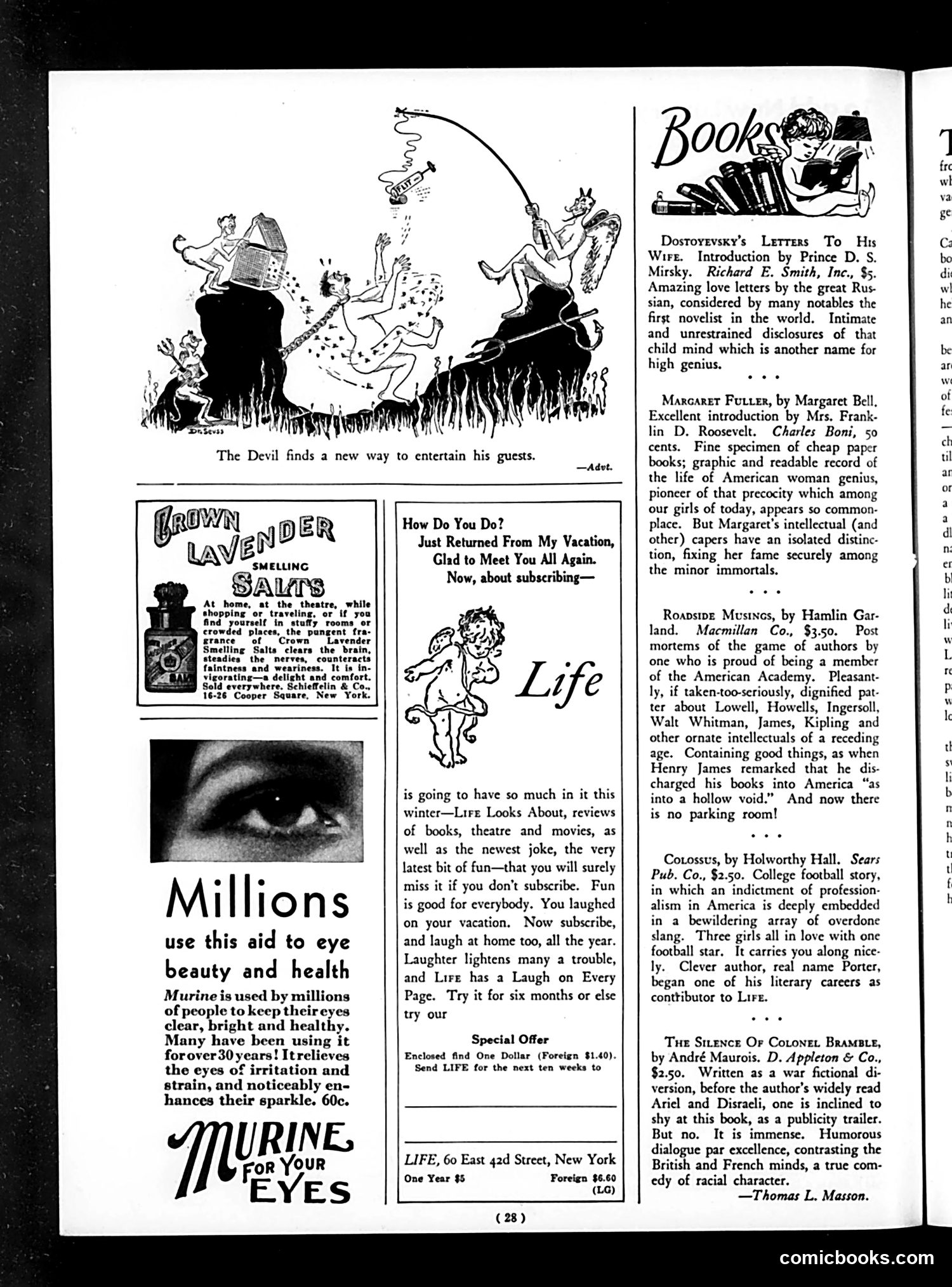
Analysis of Life Magazine Page The Main Cartoon depicts the Devil entertaining guests by having them fish in what appears to be a pond or body of water—a darkly humorous image suggesting hellish amusement. The caption reads "The Devil finds a new way to entertain his guests," implying commentary on modern leisure or entertainment trends, though the specific satirical target is unclear from the image alone. The Page's Primary Content is actually advertising and book reviews rather than political satire. Notable advertisements include Crown Lavender Smelling Salts and Murine eye drops—products marketed as aids to health and beauty. The "Life" Magazine Section promotes the publication itself as entertainment, claiming it offers jokes, theater reviews, and humor to lighten life's troubles. The Book Reviews discuss literary works including Dostoyevsky's letters and Margaret Fuller's biography, positioning the magazine as culturally sophisticated. The page reflects early 20th-century consumer culture and the magazine's role as both satirist and commercial advertiser.
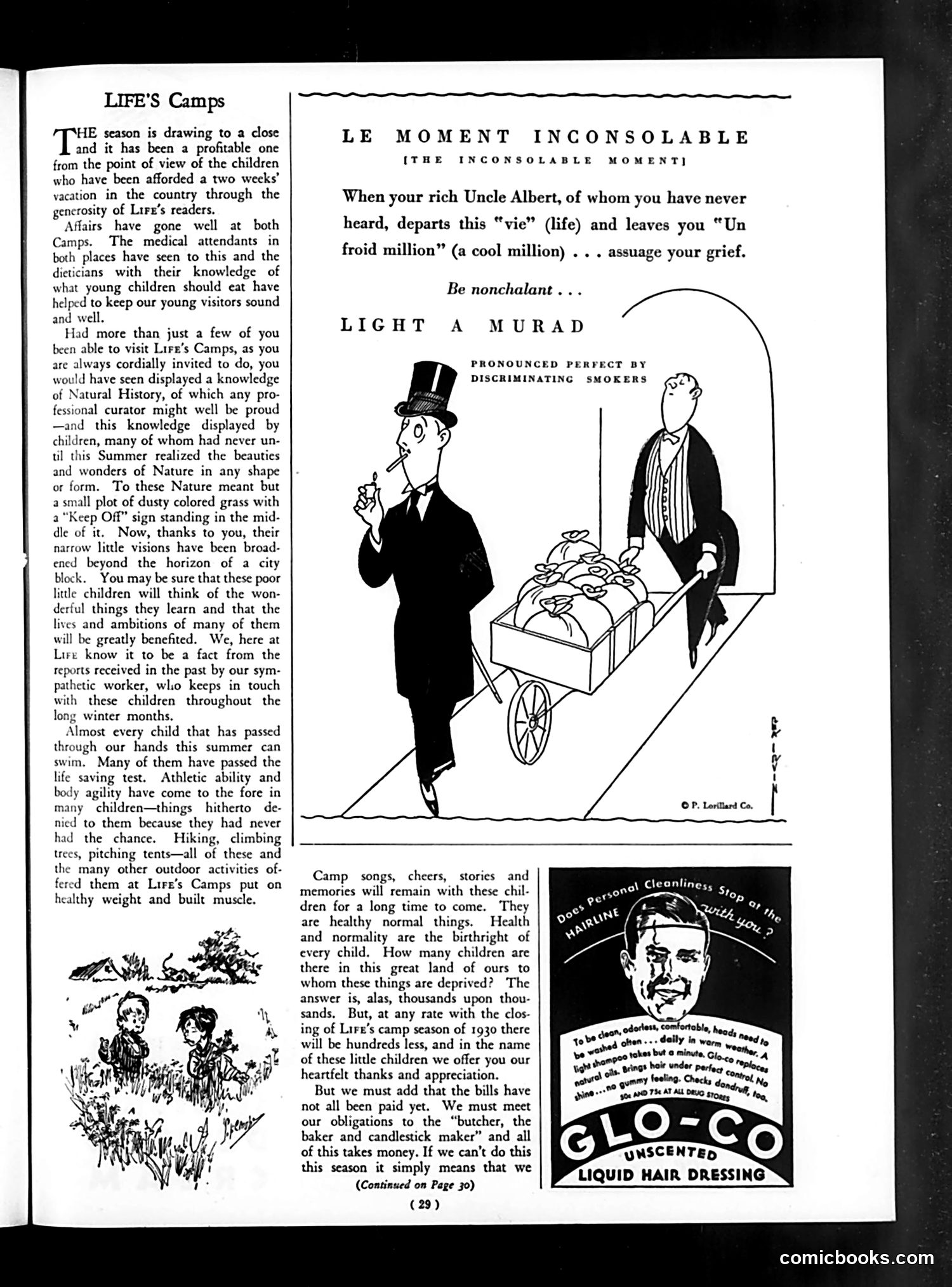
Analysis of Life Magazine Page (circa 1930) This page combines editorial content about Life magazine's charitable summer camps with satirical advertising. "Le Moment Inconsolable" Cartoon: A French-language satire depicting two men with a coffin on a cart. The joke mocks wealthy heirs: when a rich uncle dies unexpectedly, the grieving relative should "be nonchalant"—and light a Murad cigarette. The humor targets the callousness of inheritance-seekers who mask their financial joy at a relative's death behind false composure. Main Editorial: Life magazine celebrates its 1930 camp season, which provided poor urban children their first experience with nature, swimming, and outdoor activities. The text emphasizes social benefit and character-building, noting that hundreds of previously disadvantaged children now have expanded horizons. Context: This reflects Progressive-Era philanthropy common in the 1930s, where magazines positioned themselves as civic institutions. The juxtaposition of heartfelt camp coverage with cynical cigarette advertising creates ironic contrast typical of Life's satirical style.
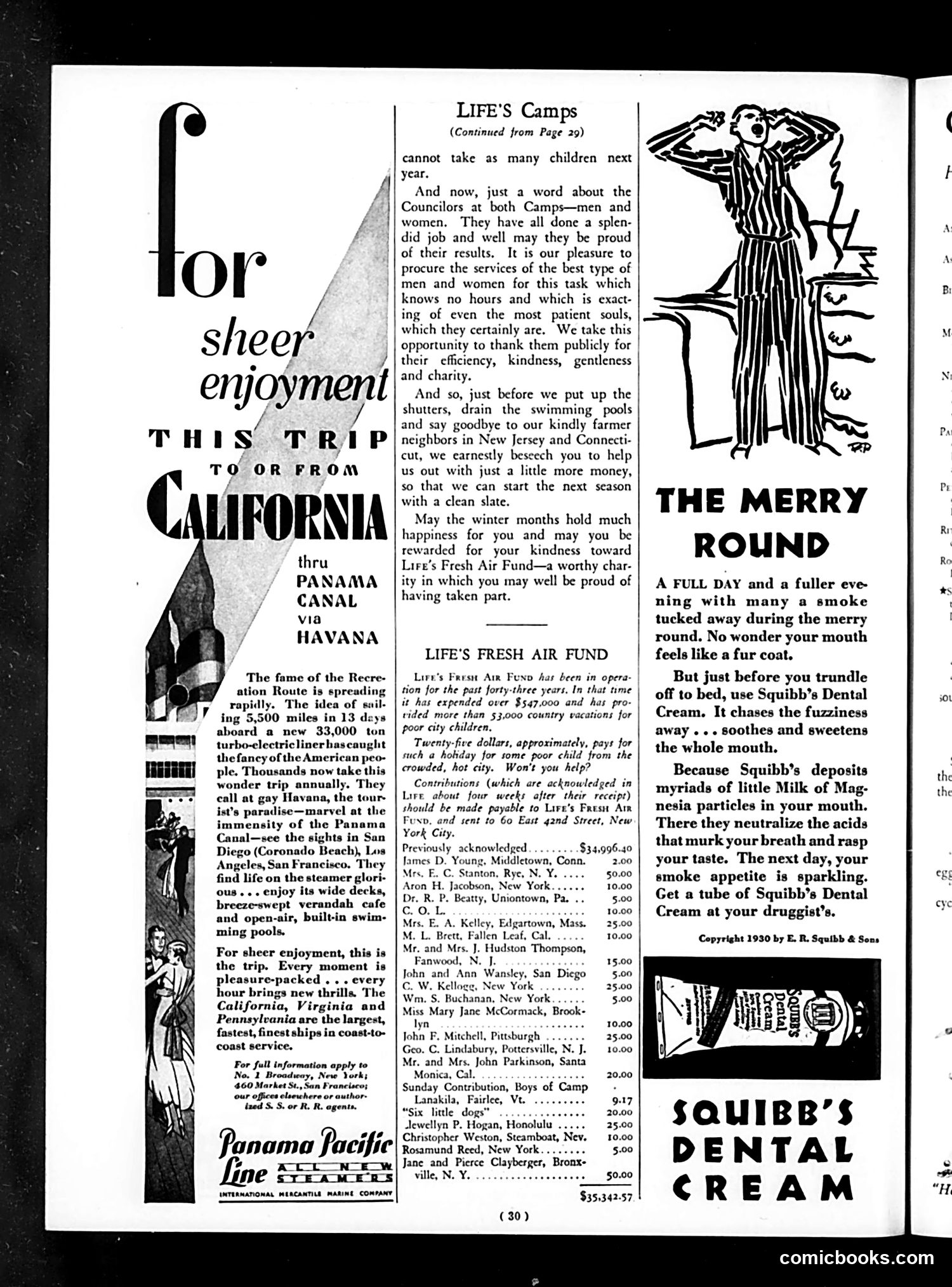
Page Analysis: Life Magazine Advertisement & Charity Content This page combines two distinct elements: a Panama Pacific steamship advertisement (left) and Life's Fresh Air Fund charity appeal (center/right). The cruise ad promotes leisure travel to California via Panama Canal and Havana—a luxury pleasure trip for affluent Americans, emphasizing "sheer enjoyment" and modern ship amenities (swimming pools, verandahs). The Fresh Air Fund section, by contrast, documents charitable work providing country vacations for poor urban children. It lists donations and notes the fund has distributed over $547,000 across 43 years, with $25 typically funding one child's holiday. The implicit satire: Juxtaposing luxury cruises for the wealthy with charity for impoverished children creates social commentary—highlighting class disparity during this era. The page also advertises Squibb's Dental Cream (right), a commercial product. The page reflects 1930s American consumer culture and philanthropic appeals.
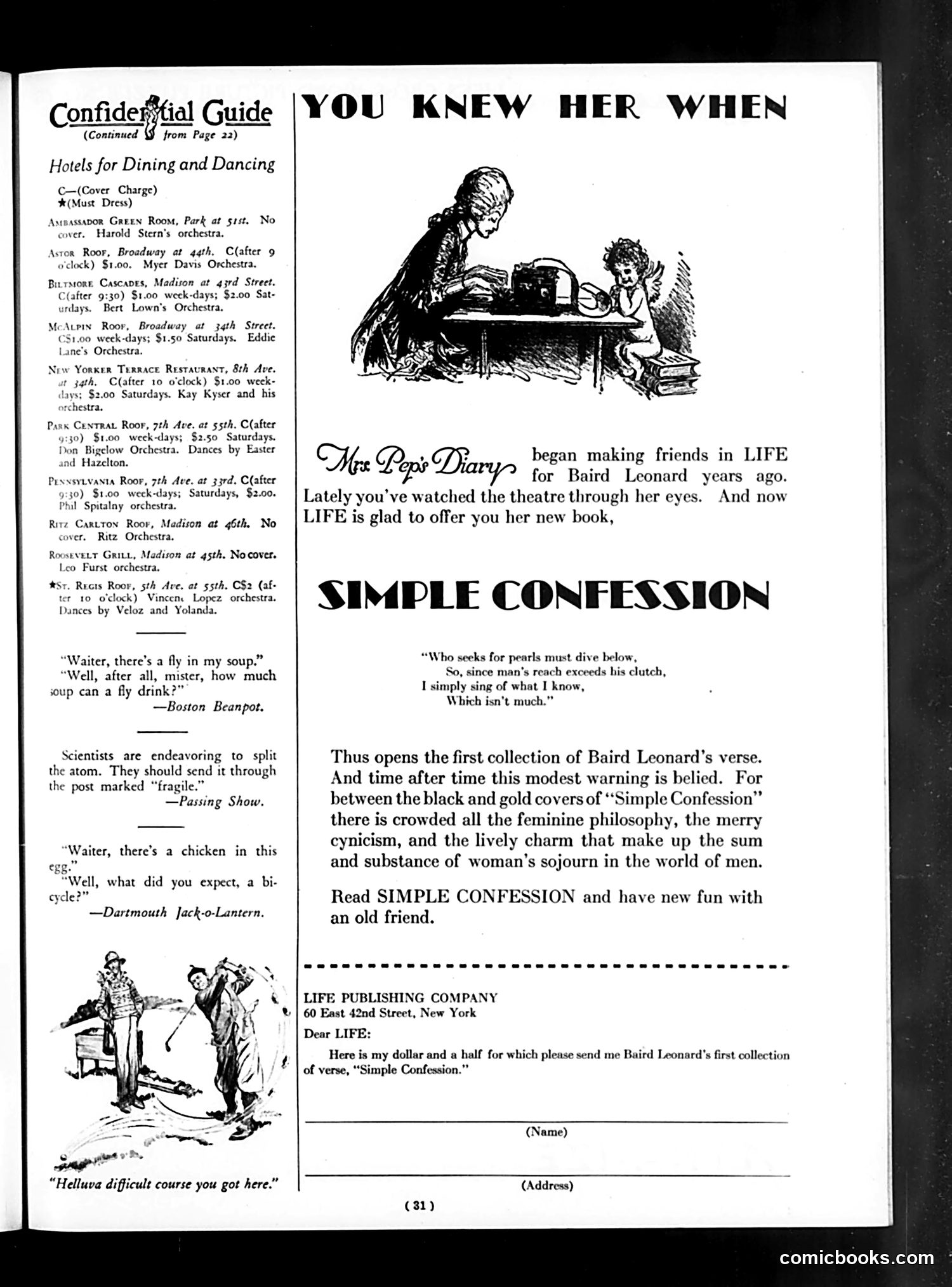
Analysis of This Life Magazine Page This page combines a restaurant guide with advertising for a poetry collection. The main content is a book advertisement for *Simple Confession* by Baird Leonard, presented as an introduction to readers familiar with her theatrical writings in Life magazine. The cartoon at top shows an older woman teaching a young girl to use a typewriter—illustrating Leonard's role as a mentor figure to Life's audience. Below are three unrelated jokes (typical filler for the era): - A waiter's comeback about a fly in soup - A joke about splitting atoms (referencing 1930s-40s atomic physics discussions) - A wordplay about a chicken in an egg The advertisement positions Leonard's verse collection as offering "feminine philosophy" and "merry cynicism" about women's experiences with men—marketing it as witty, relatable entertainment for female readers. The price was $1.50, and readers could order directly via the coupon. The left column simply lists New York dining and dancing venues with their cover charges and orchestras—practical tourist/entertainment information typical of Life's "Confidential Guide" feature.
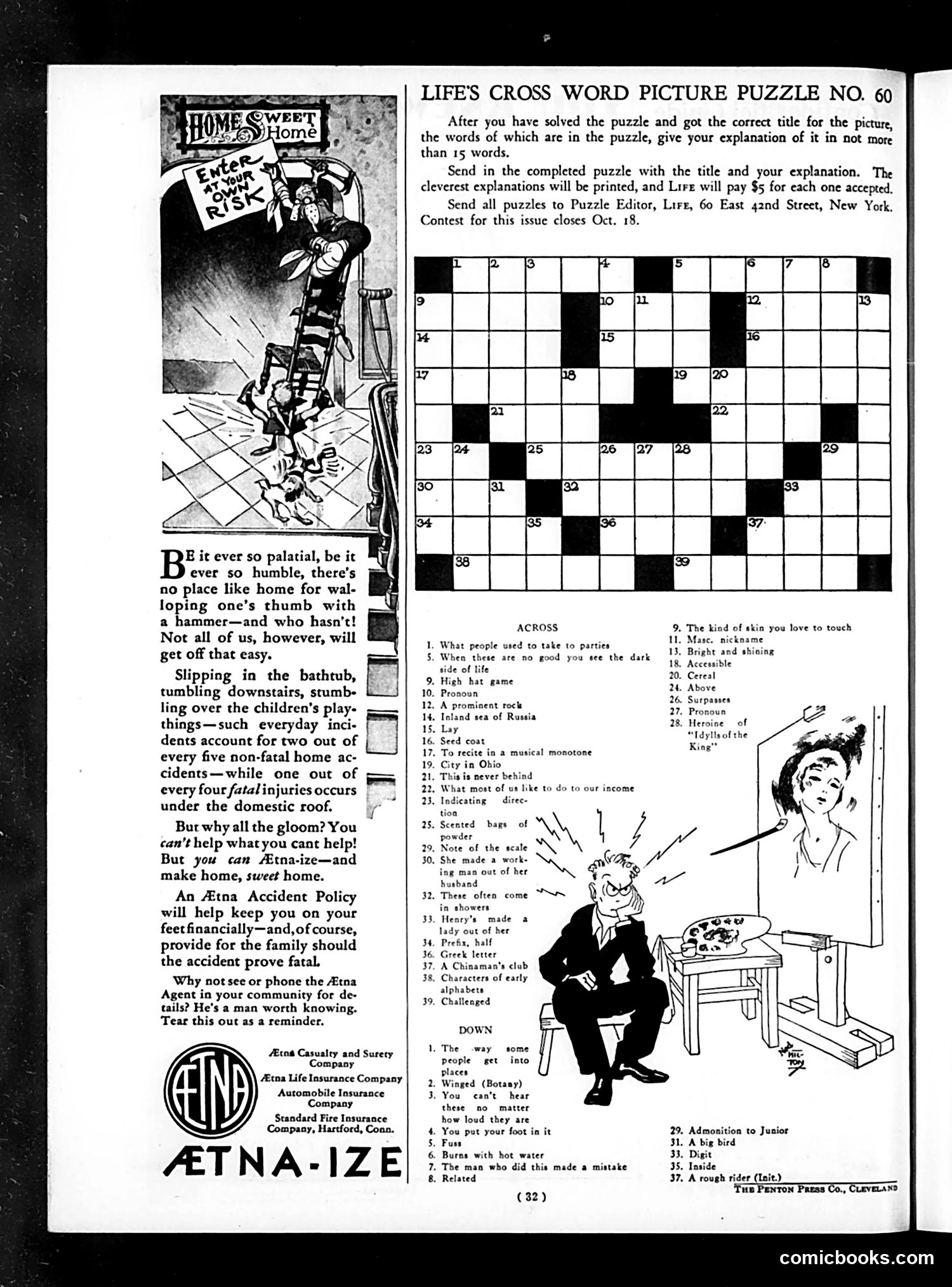
Life Magazine #60 Crossword Puzzle Advertisement (circa 1920s) This page combines a crossword puzzle contest with Ætna insurance advertising. The cartoon depicts a domestic accident—a man has apparently injured himself with a hammer while doing home repairs, shown tumbling or in distress. The accompanying text sardonically notes that home accidents are common: everyday incidents like bathroom slips and falls account for "two out of every five non-fatal" domestic accidents, while "one out of every four fatal injuries" happen at home. The satire's point: rather than mock these tragedies outright, Life uses dark humor to pivot toward Ætna's solution—an accident insurance policy ("Ætna-ize") to protect families financially when home mishaps occur. The ad plays on the period's tension between domestic idealization ("be it ever so humble, there's no place like home") and brutal reality: homes were actually dangerous places. The crossword puzzle was a reader engagement tool, with Ætna paying $5 for clever explanations—combining entertainment with advertising.
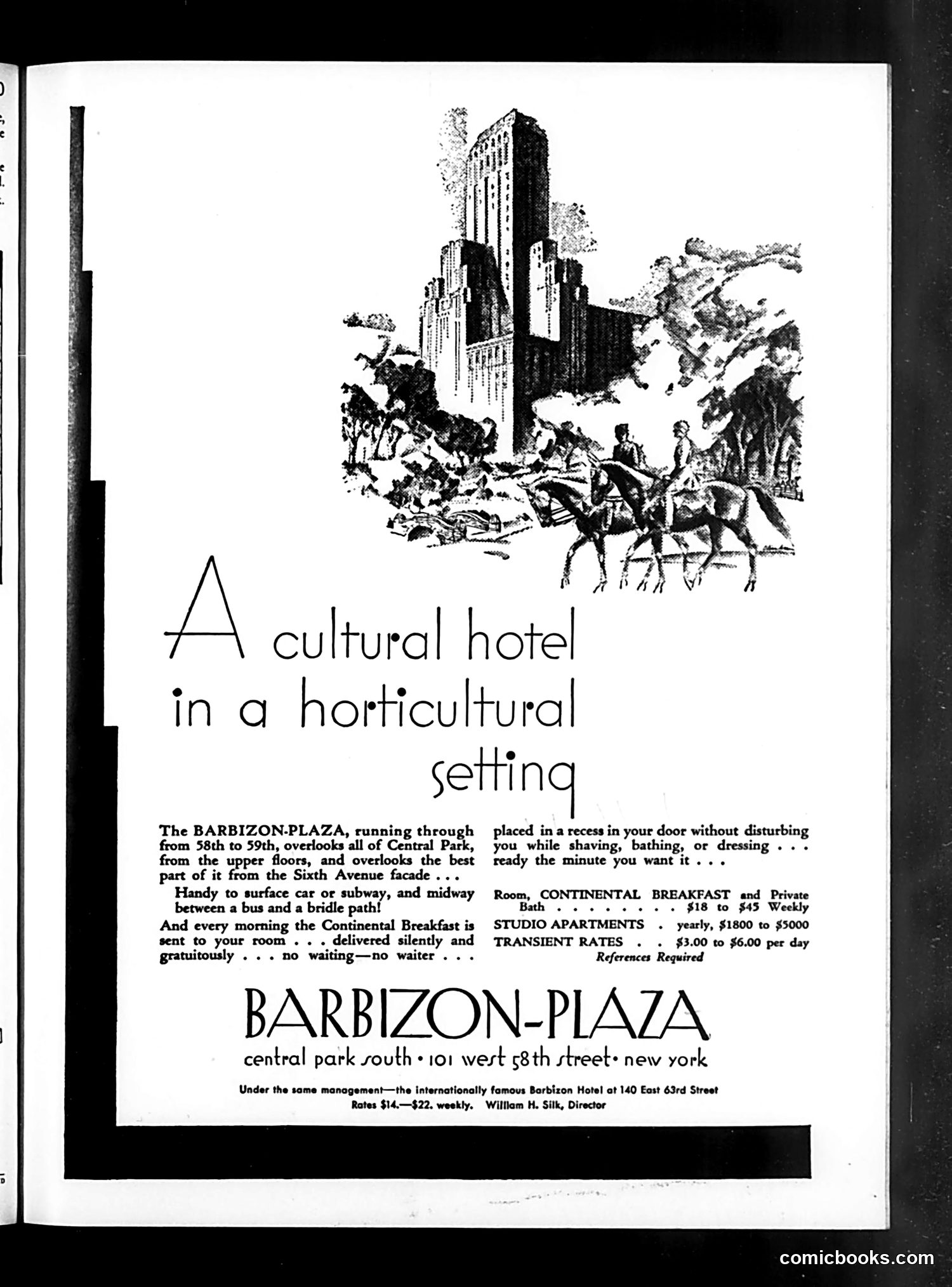
Advertisement Analysis This is primarily a hotel advertisement, not political satire. The Barbizon-Plaza promotes itself as a luxury Manhattan hotel (58th-59th Street, Central Park South) by emphasizing its cultural and recreational location. The illustration depicts a romanticized, almost fantastical scene: an elegant Art Deco building surrounded by pastoral imagery—horse riders, trees, and bucolic countryside—creating the title's concept of "a cultural hotel in a horticultural setting." The satire is gentle and self-aware: the ad playfully claims the hotel overlooks Central Park and is "midway between a bus and a bridle path," positioning itself as simultaneously urban and pastoral. The joke is the incongruity—selling New York City luxury through idealized rural imagery. The advertisement emphasizes modern conveniences (silent breakfast delivery to your door) at relatively affordable rates ($3-$6 daily transient rates). This appears to be a mid-20th-century publication targeting middle-to-upper-class travelers seeking cultured urban accommodation with pastoral appeal.
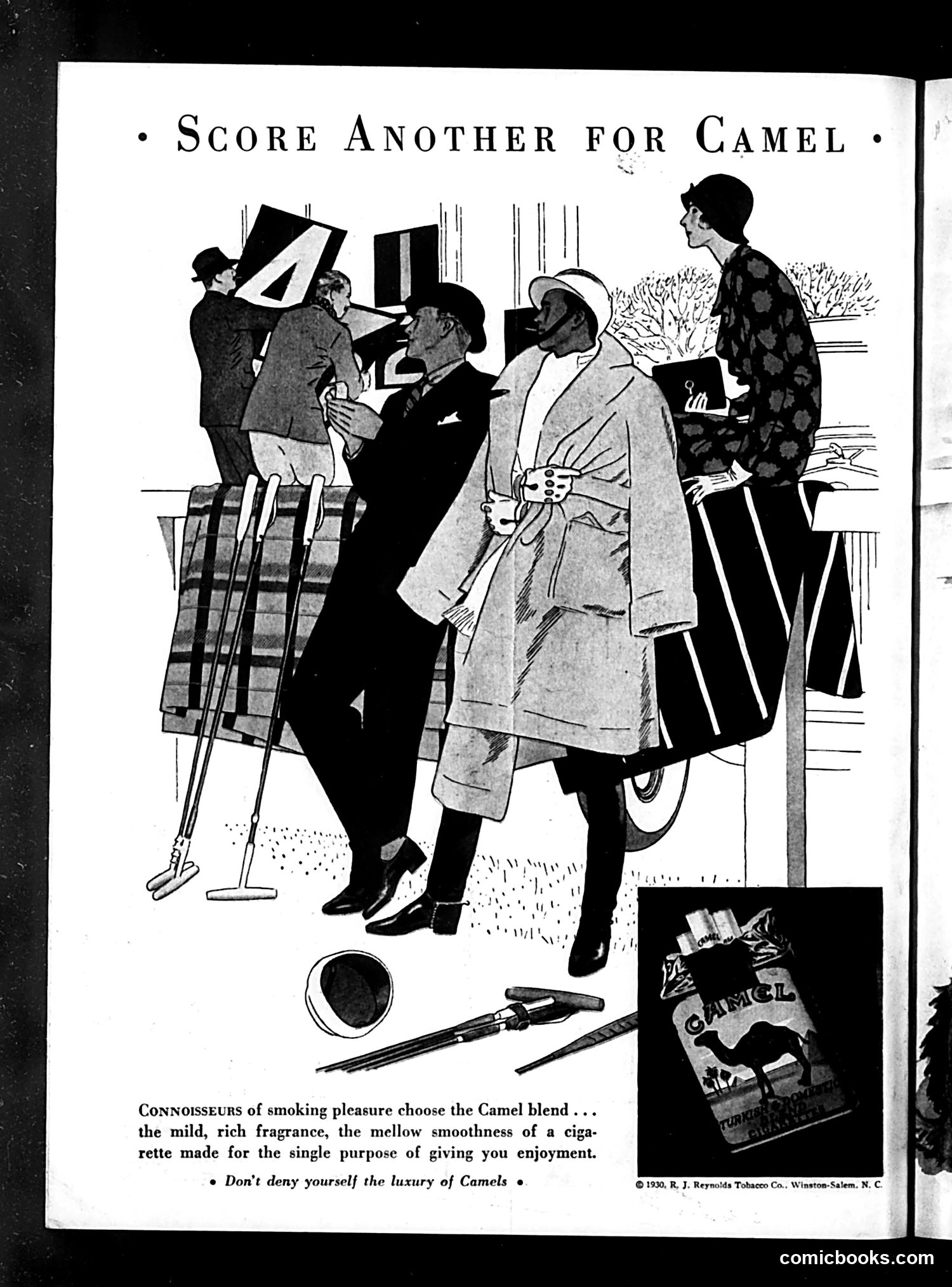
Analysis This is a Camel cigarette advertisement from 1930, not political satire. The page shows well-dressed people at what appears to be a social gathering, with golf clubs visible, examining or discussing cigarettes. The title "Score Another for Camel" uses a sports metaphor to suggest choosing Camel cigarettes is a "winning" decision. The ad targets affluent consumers ("connoisseurs"), emphasizing the cigarette's "mild, rich fragrance" and "mellow smoothness." The small Camel package image in the corner reinforces the brand. This reflects 1930s advertising culture before tobacco's health risks were widely acknowledged or regulated. The sophisticated imagery and lifestyle marketing were typical strategies to associate cigarettes with success and leisure.