life
Life — October 10, 1930
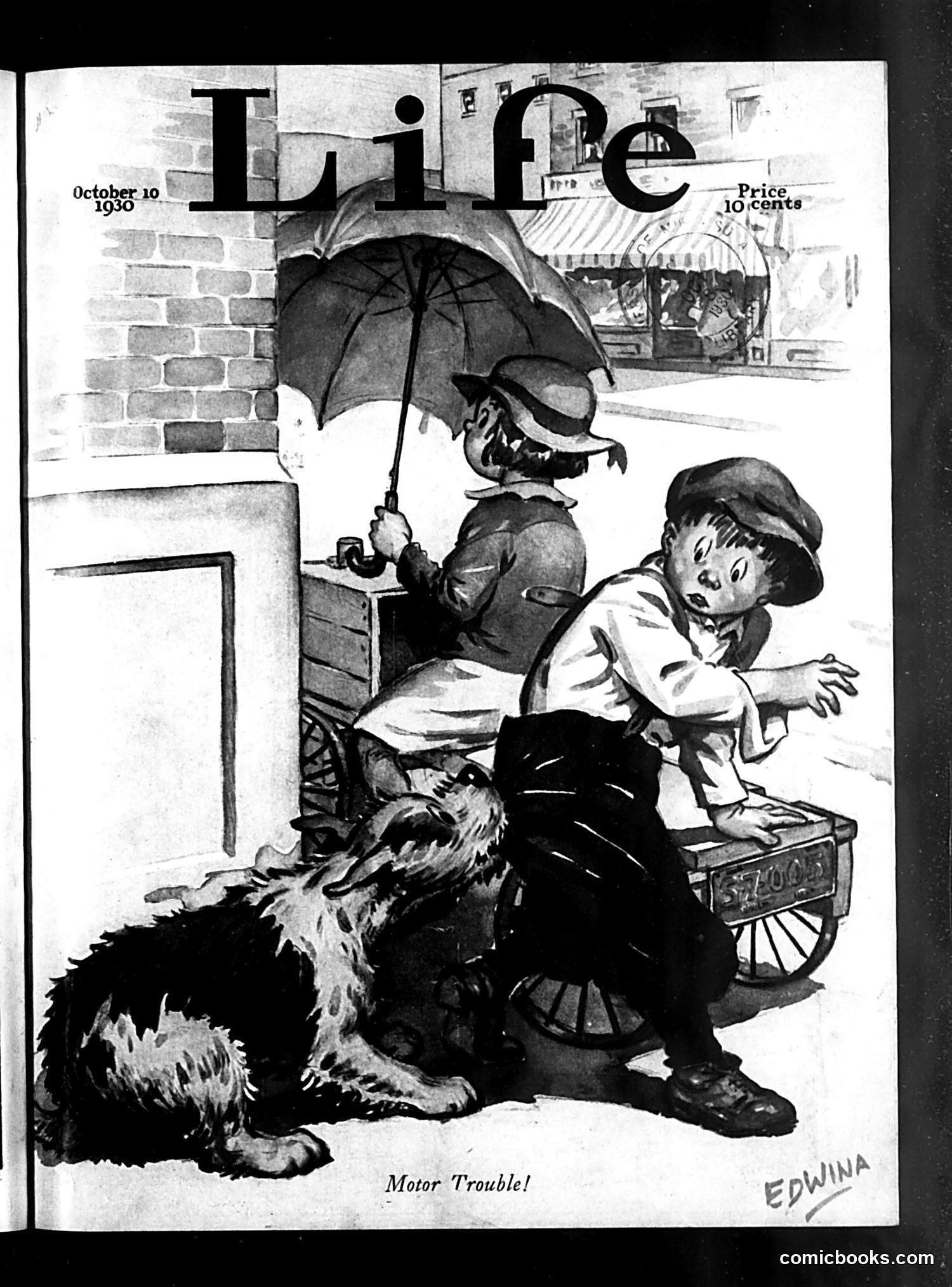
"Motor Trouble!" - Life Magazine, October 10, 1930 This cartoon satirizes early automobile culture and urban street life. Two men in hats share an umbrella during rain while standing with a small, scruffy dog next to what appears to be a delivery cart or early motorized vehicle (marked "$700"). The title "Motor Trouble!" suggests the joke concerns automotive problems or complications of motor transportation becoming common in urban settings. The wet conditions, the humble appearance of the figures, and their apparent inconvenience suggest satire about the gap between automobile ownership promises and the messy reality of early 1930s street life—just months before the Great Depression deepened. The cartoonist (signed "EDWINA") appears to be mocking the complications and indignities of modern motorized transport rather than celebrating it.
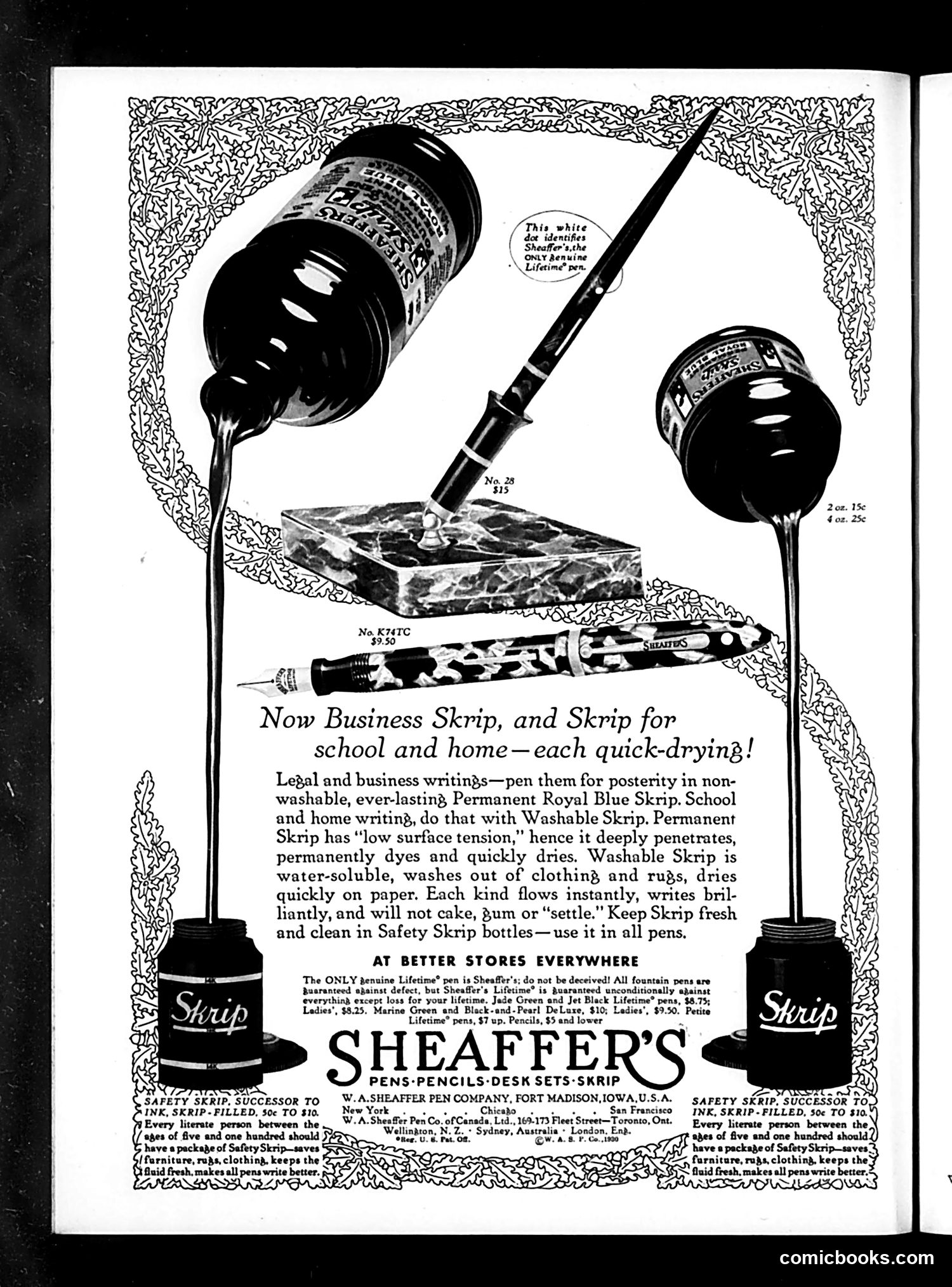
Analysis This is a vintage advertisement, not a political cartoon or satire. It promotes Sheaffer's "Safety Scrip" — a pen product line marketed for business, school, and home use. The ad emphasizes the ink's quick-drying properties and washability, showing bottles of ink being applied to paper and a paintbrush. The ornate border and formal layout are typical of 1920s-30s advertising design. The text highlights that Washable Scrip is "water-soluble" and "washes out of clothing and rugs," suggesting this was a practical selling point for families concerned about permanent ink stains. The pricing (2oz. 15¢, 4oz. 25¢) and distribution ("at better stores everywhere") were standard advertisement elements of the era. There is no political or social satire present—this is straightforward product marketing.
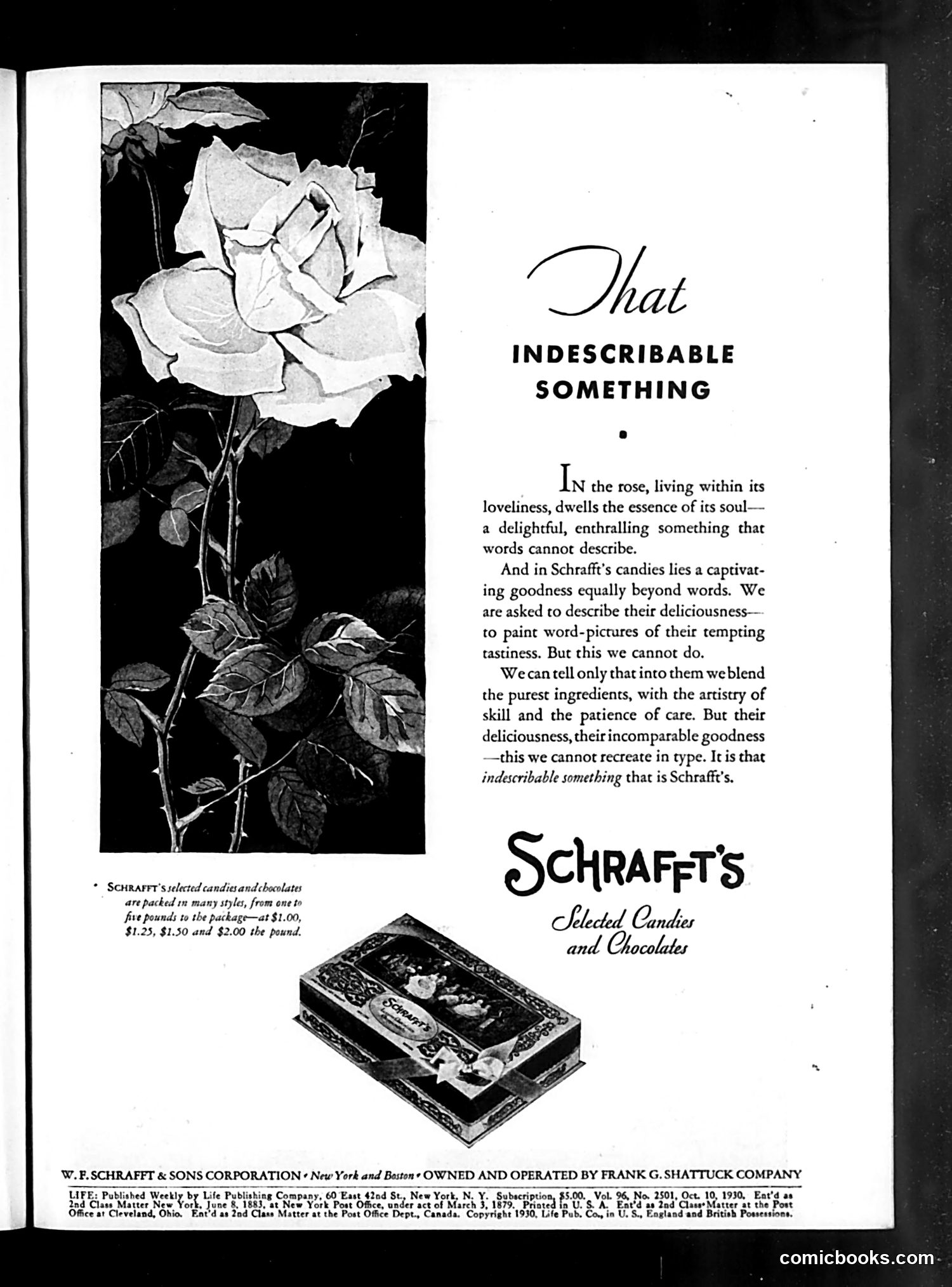
This page is primarily an advertisement for Schrafft's candies and chocolates, not political satire or a cartoon. The ad uses poetic language to market the product's appeal, comparing the "indescribable something" found in a rose to the indefinable quality of Schrafft's confections. The accompanying image shows a detailed botanical illustration of a rose against a dark background, meant to evoke luxury and beauty. The copy emphasizes that while Schrafft's ingredients and craftsmanship are evident, their ultimate deliciousness cannot be adequately described in words—only experienced. Pricing information ($1.00-$2.00 per pound) is provided at bottom. This is a straightforward luxury goods advertisement from Life magazine's advertising section, not commentary or satire.
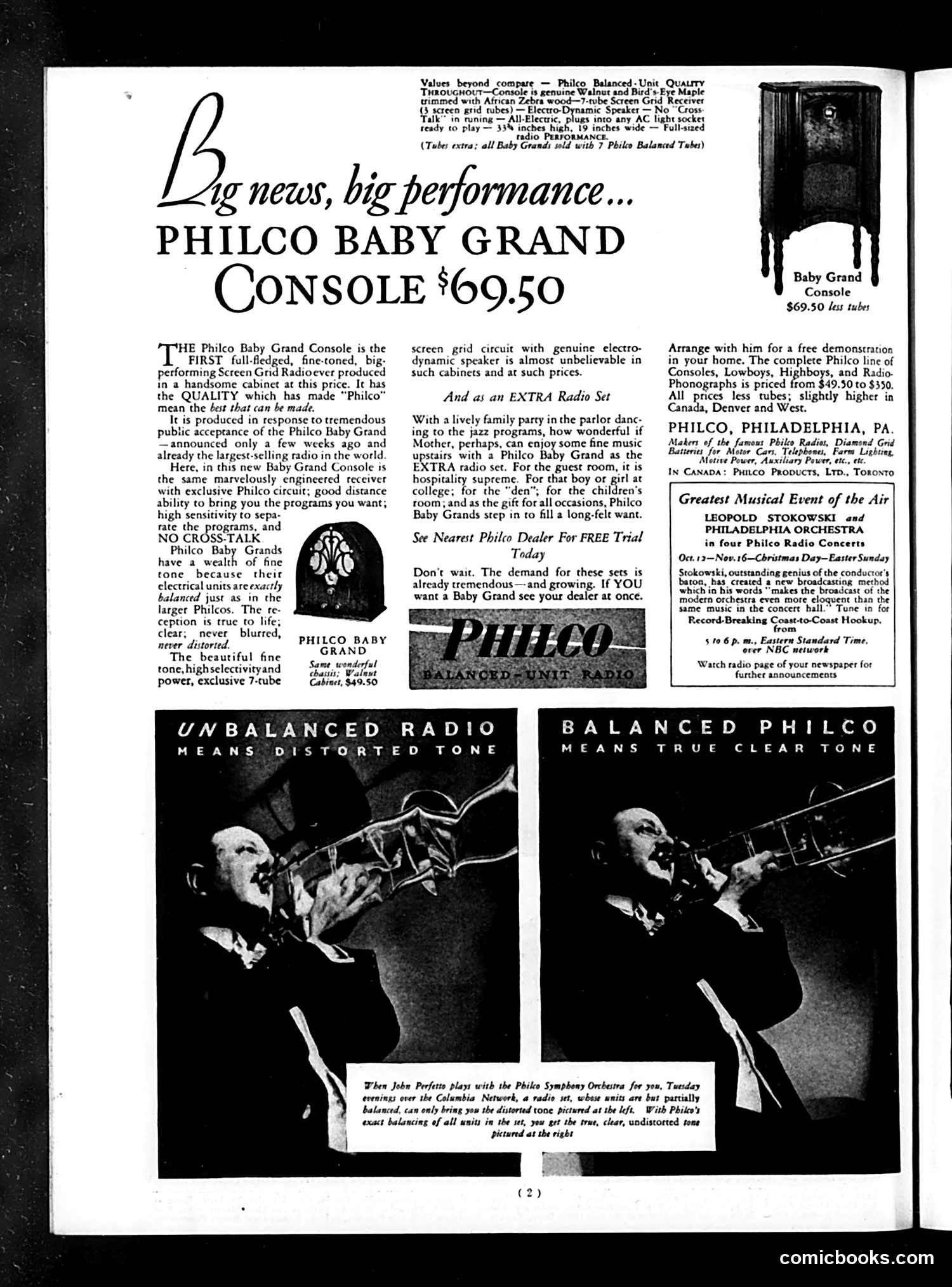
This page is primarily advertising, not satire or political content. It promotes the Philco Baby Grand Console radio ($69.50), emphasizing its superior sound quality and "balanced" audio reception compared to competitors. The lower portion includes a comparative demonstration: two photographs of a trumpet player labeled "Unbalanced Radio" (distorted tone) versus "Balanced Philco" (clear tone). This visual comparison illustrates the product's technical superiority. The advertisement features Leopold Stokowski and the Philadelphia Orchestra endorsement, leveraging classical music credibility to market the radio. There is no political cartoon or satire present. This is a straightforward consumer advertisement from what appears to be the 1920s-1930s, when radios were luxury goods and major household purchases.
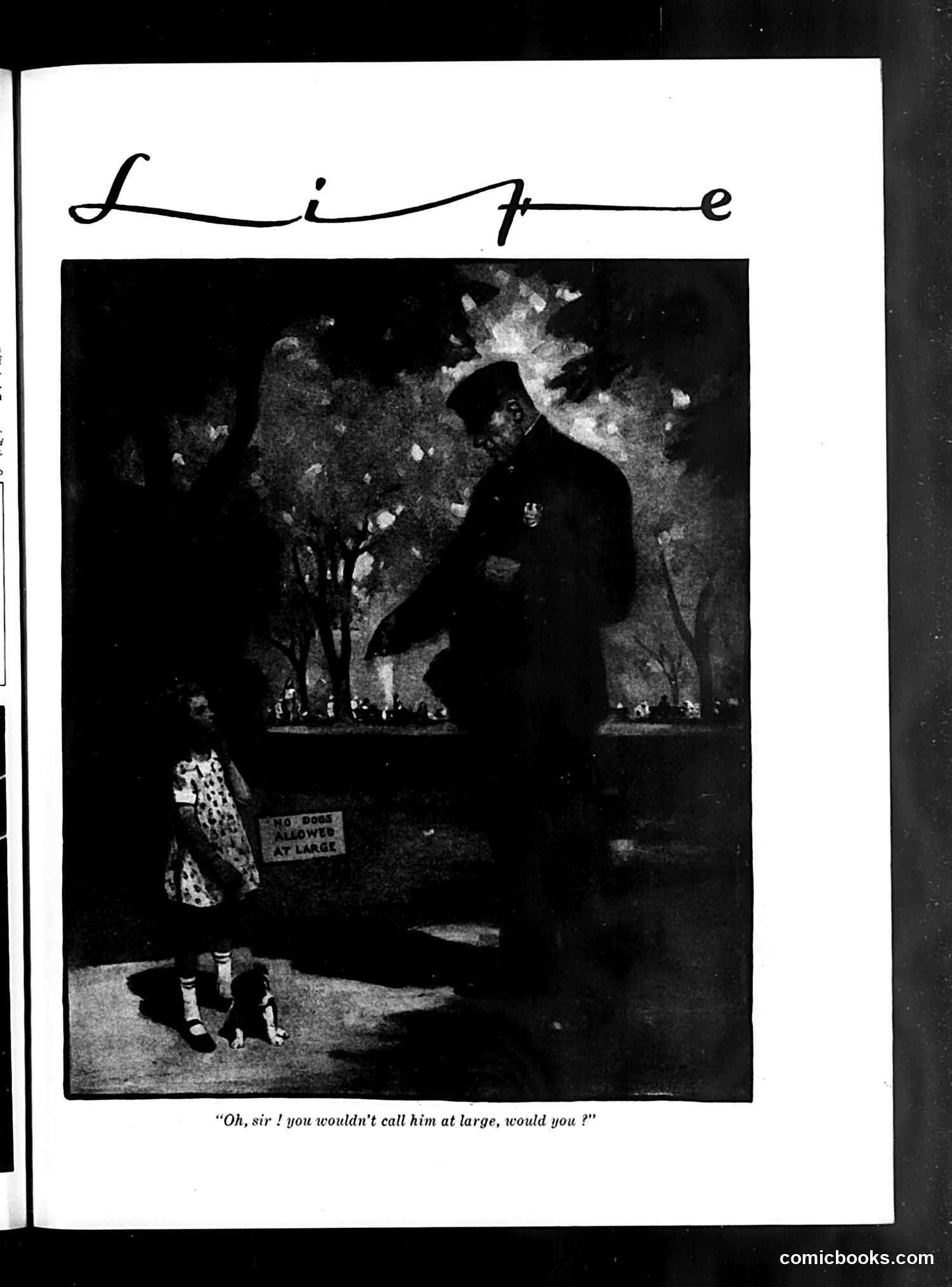
Analysis This appears to be a satirical illustration from *Life* magazine titled "Life" at the top. The black-and-white image shows a scene with a child in patterned clothing on the left, an adult figure in dark formal wear in the center, and what appears to be stage scenery or backdrop with illuminated elements in the background. The caption reads: "Oh, sir! you wouldn't call him at large, would you?" The visible text fragment "NO BOSS ALLOWED AT LARGE" on signage suggests this is satirizing workplace or social rules. The joke appears to concern someone's size or status being incompatible with restrictions—the caption implies the speaker is requesting that a "boss" figure not be called upon or summoned directly. Without additional context about the specific date or referenced events, the exact political/social target remains unclear, though it appears to mock authority figures or workplace hierarchies.
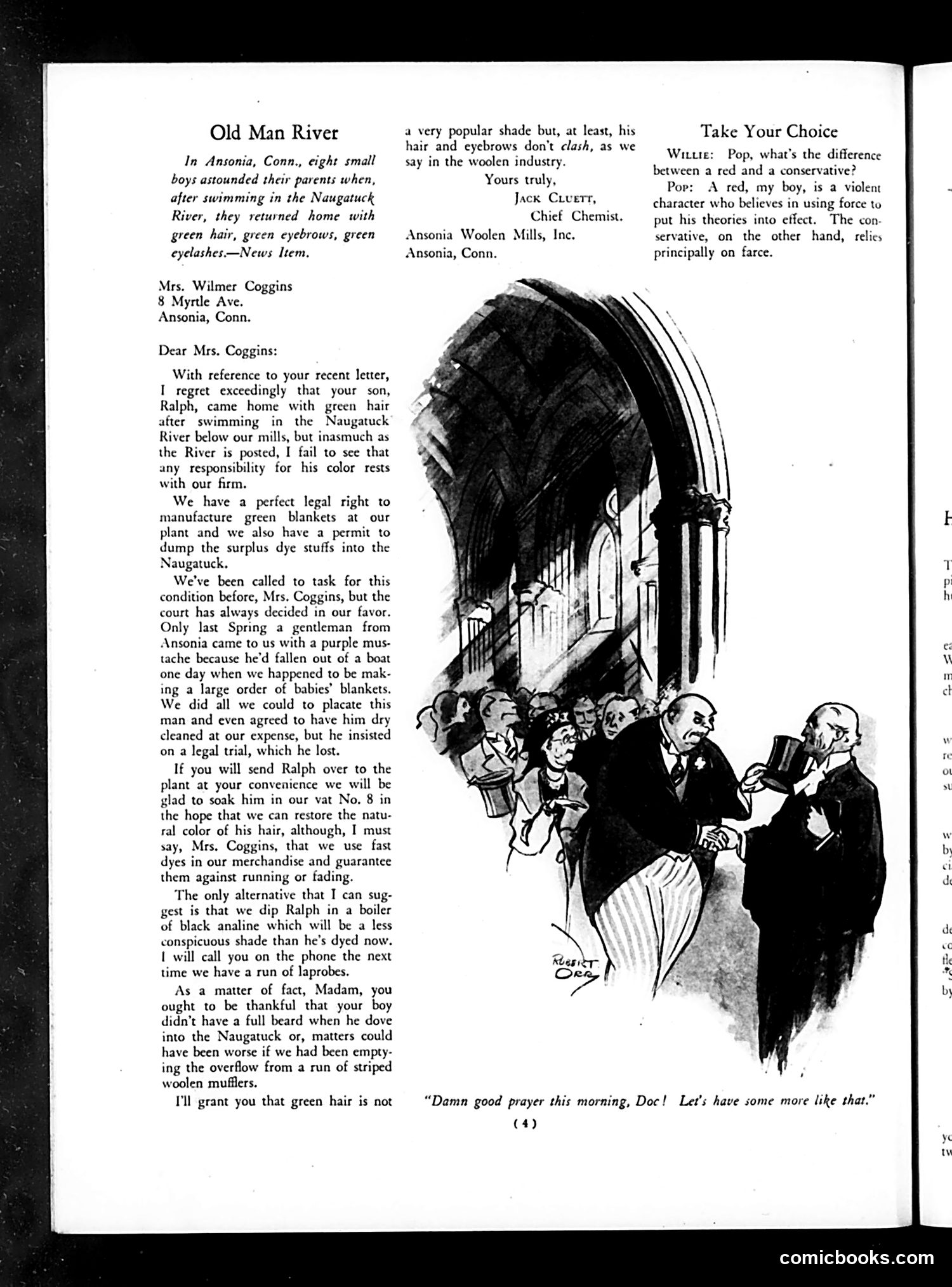
Analysis of This Life Magazine Page This page contains a letter from Jack Cluett, Chief Chemist at Ansonia Woolen Mills, responding to Mrs. Wilmer Coggins's complaint that her son Ralph returned home from swimming in the Naugatuck River with green hair and eyebrows. Cluett defends the mill, citing their legal right to manufacture green blankets and dump surplus dyes into the river. He offers solutions: soaking Ralph in their dye vat or dipping him in black analine dye. The tone is darkly humorous, treating the pollution as inevitable while mocking industrial disregard for environmental damage. The cartoon below depicts a clergyman offering prayer, apparently satirizing inadequate responses to industrial pollution—prayer being presented as society's only recourse against corporate negligence.
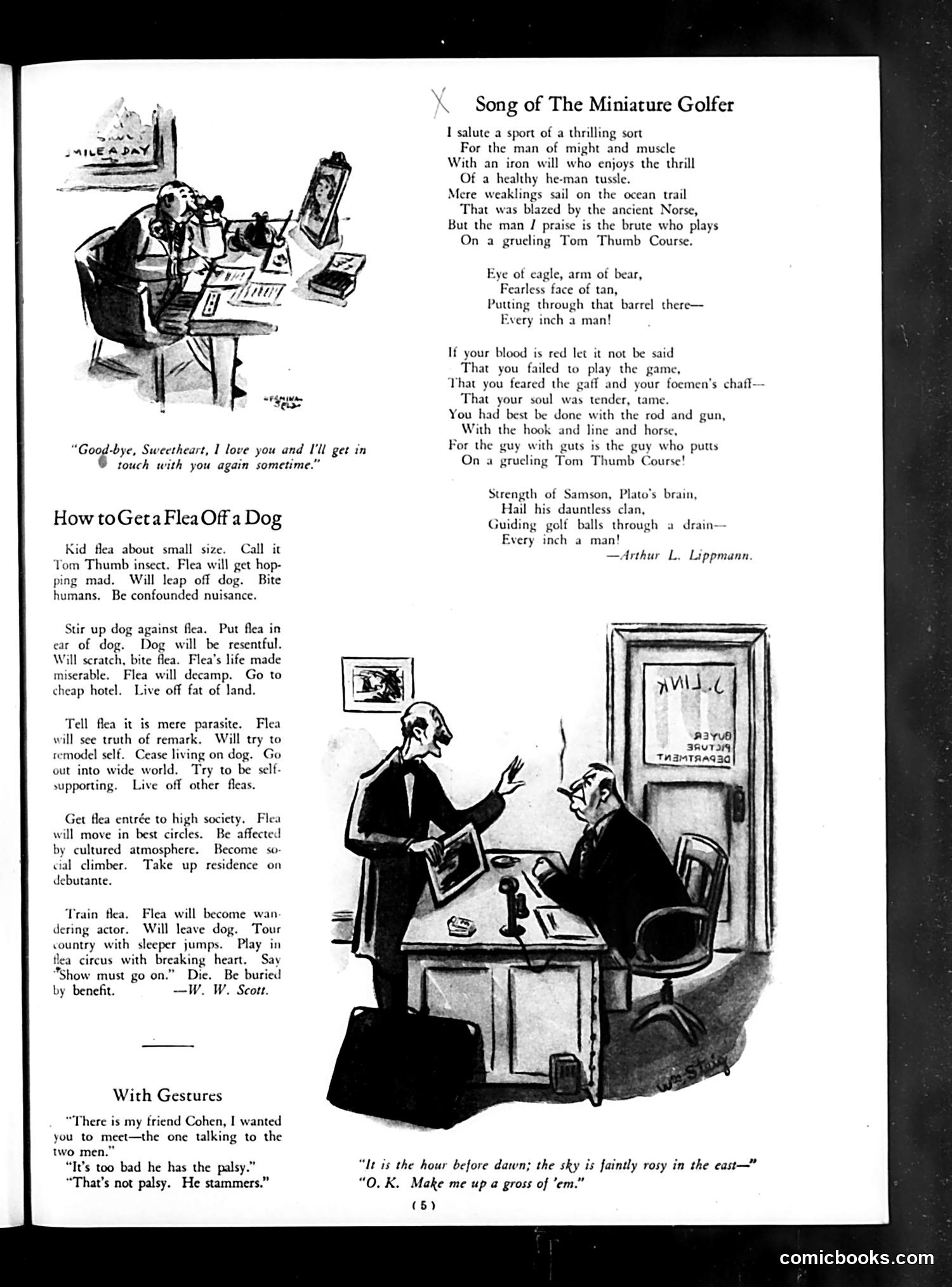
Analysis This page contains three distinct pieces of humor: 1. "Song of The Miniature Golfer" (top right): A humorous poem by Arthur L. Lappmann celebrating miniature golf as a sport for "the man of might and muscle." The satirical tone suggests miniature golf was a trendy leisure activity, and the poem mock-heroically compares it to ancient Norse adventures. 2. "How to Get a Flea Off a Dog" (left): A comedic piece attributed to W.W. Scott offering absurdist advice—calling the flea "Tom Thumb," stirring the dog, sending the flea to high society. The humor lies in treating flea removal as an elaborate social endeavor. 3. "With Gestures" and cartoon (bottom): A brief dialogue joke about someone's stammer being mistaken for palsy (paralysis), with accompanying illustration of two men in an office setting. The page represents typical early-20th-century satirical magazine humor mixing wordplay, visual gags, and social observation.
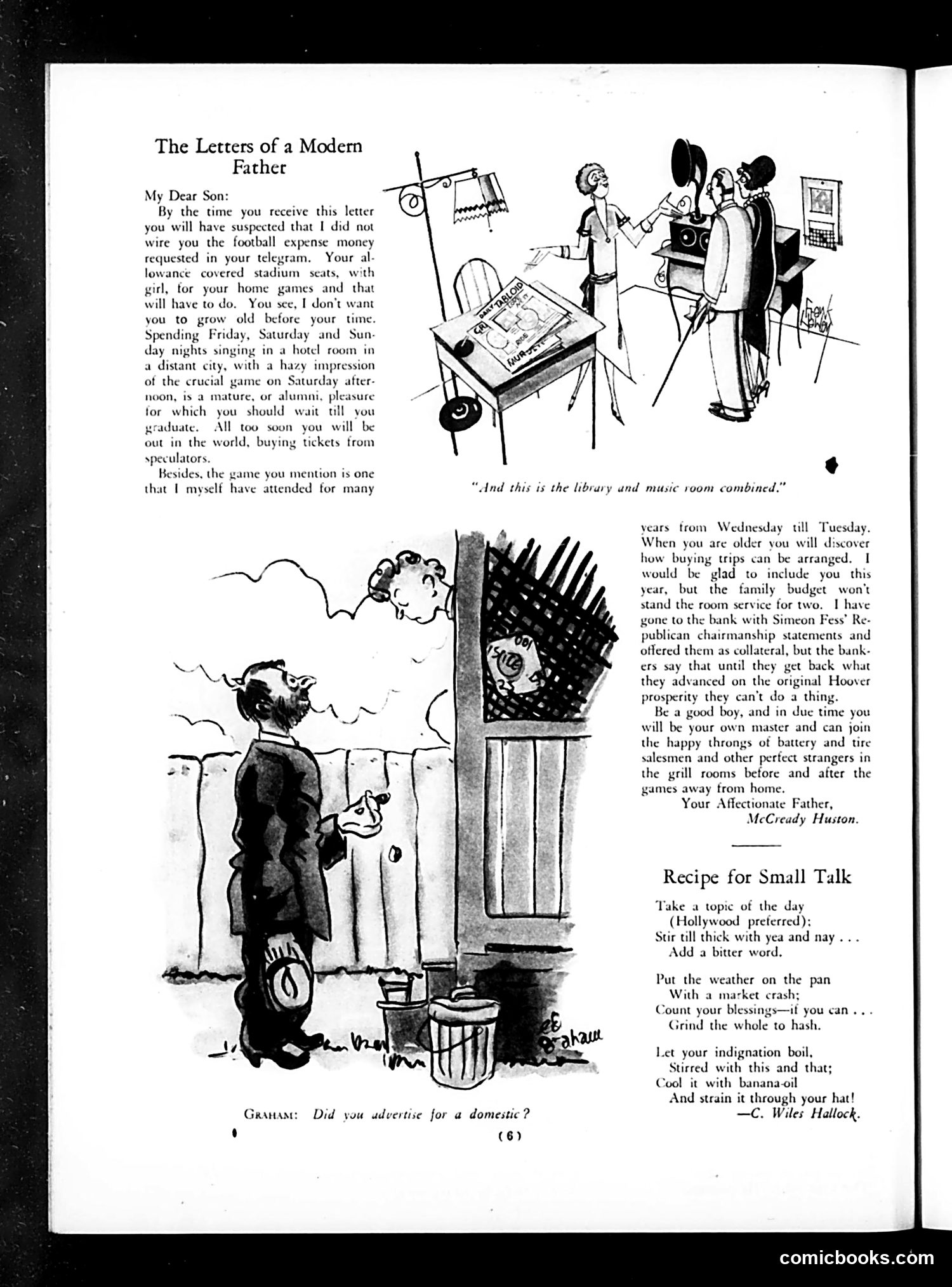
"The Letters of a Modern Father" - Satire on 1920s Youth Culture This page satirizes a father's disappointed letter to his son about wasted money on entertainment and sports. The top illustration shows a modern recreation room combining library and music space—representing the commercialized leisure activities the father criticizes. The lower cartoon depicts a young man at a window advertising for a domestic servant, captioned "Did you advertise for a domestic?" This jokes that the son is so financially irresponsible he needs household help to manage his affairs. The signature "McCready Huston" identifies the author. The piece mocks both the younger generation's spending habits on movies, football tickets, and hotel trips, and their inability to manage finances—a common theme in 1920s American satire about changing youth culture.
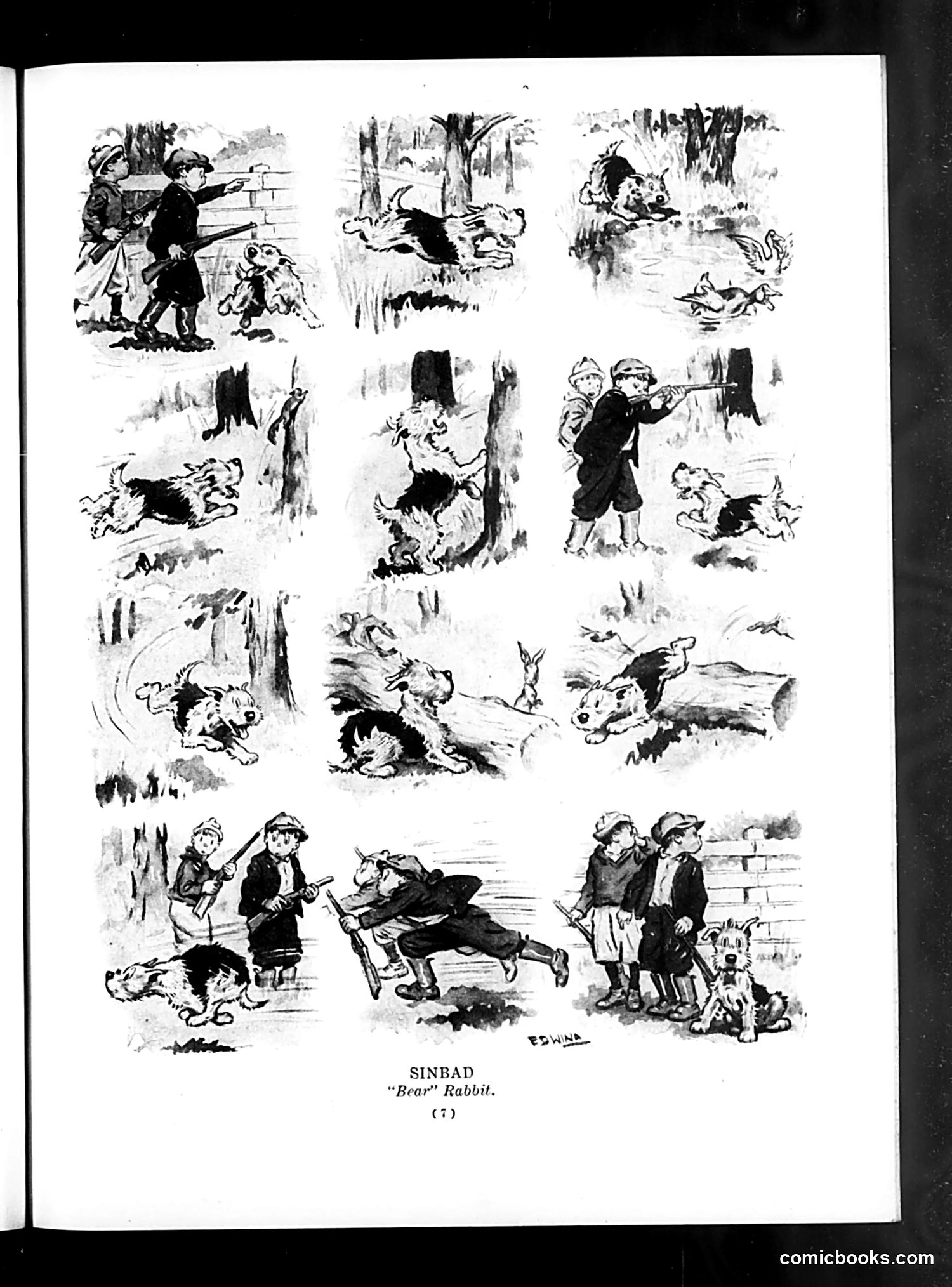
SINBAD "Bear" Rabbit This page presents a series of comic vignettes titled "SINBAD 'Bear' Rabbit," depicting anthropomorphic rabbits and children in various outdoor hunting and adventure scenarios. The cartoons appear to be satirizing exaggerated tall tales—likely referencing the legendary Sinbad character known for fantastical stories. The repeated motif of rabbits and small game suggests mockery of hunters' boastful exaggerations about their exploits. Each panel shows increasingly absurd or comedic situations: children hunting, animals in unlikely predicaments, and chaotic scenes. The "Bear Rabbit" title hints at an ironic juxtaposition—suggesting a rabbit portrayed with exaggerated, bear-like qualities or adventures. The style and subject matter reflect early 20th-century American humor targeting hunters' folklore and rural storytelling traditions.
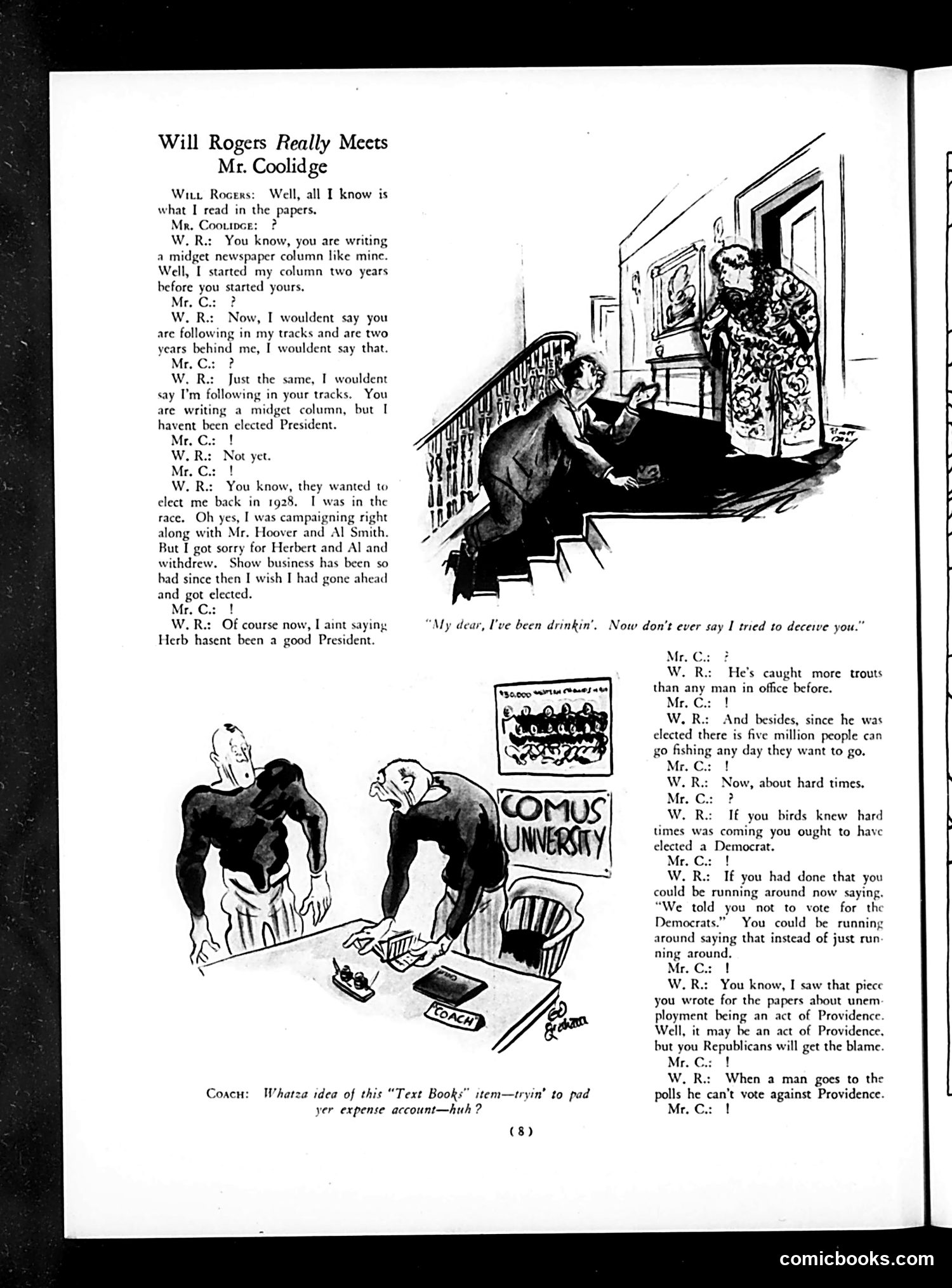
Analysis of "Will Rogers Really Meets Mr. Coolidge" This is a satirical dialogue between humorist Will Rogers and President Calvin Coolidge (referenced as "Mr. C."). Rogers claims to write a newspaper column similar to Coolidge's work, implying the President is merely a "midget" columnist. The conversation references the 1928 election, when Coolidge withdrew from the race. Rogers jabs that Coolidge's absence hurt "show business" (the economy), while defending Herbert Hoover's presidency against blame for hard times. The bottom cartoon depicts two figures (appearing to represent political coaches or handlers) examining expense accounts at "Comus University," satirizing wasteful spending or educational corruption. The satire targets both Coolidge's perceived mediocrity and the economic troubles following his presidency.
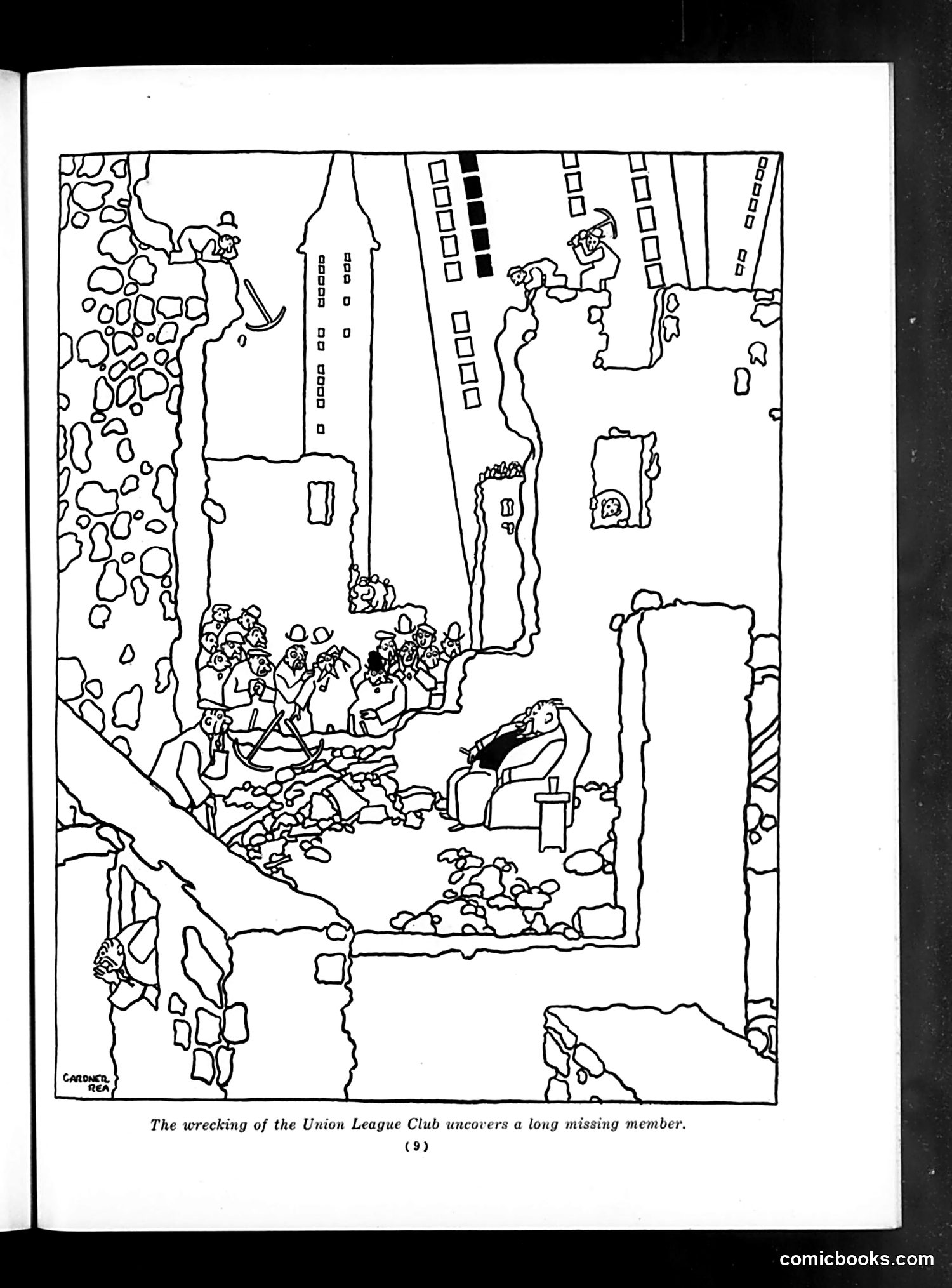
Political Cartoon Analysis This single-panel cartoon depicts the excavation or "wrecking" of a building, with the caption: "The wrecking of the Union League Club uncovers a long missing member." The joke appears to be about the Union League Club, a real civic organization, being demolished. The satire suggests that during the building's destruction, workers have discovered a member who had been missing or absent from the club for so long he was essentially "lost." The cartoonist (signed "Cesare") is making a humorous social commentary—likely poking fun at either the club's membership, the member's disappearance, or both. Without additional historical context, the specific individual referenced remains unclear, though the joke relies on readers' familiarity with the Union League Club and its members at the time of publication.
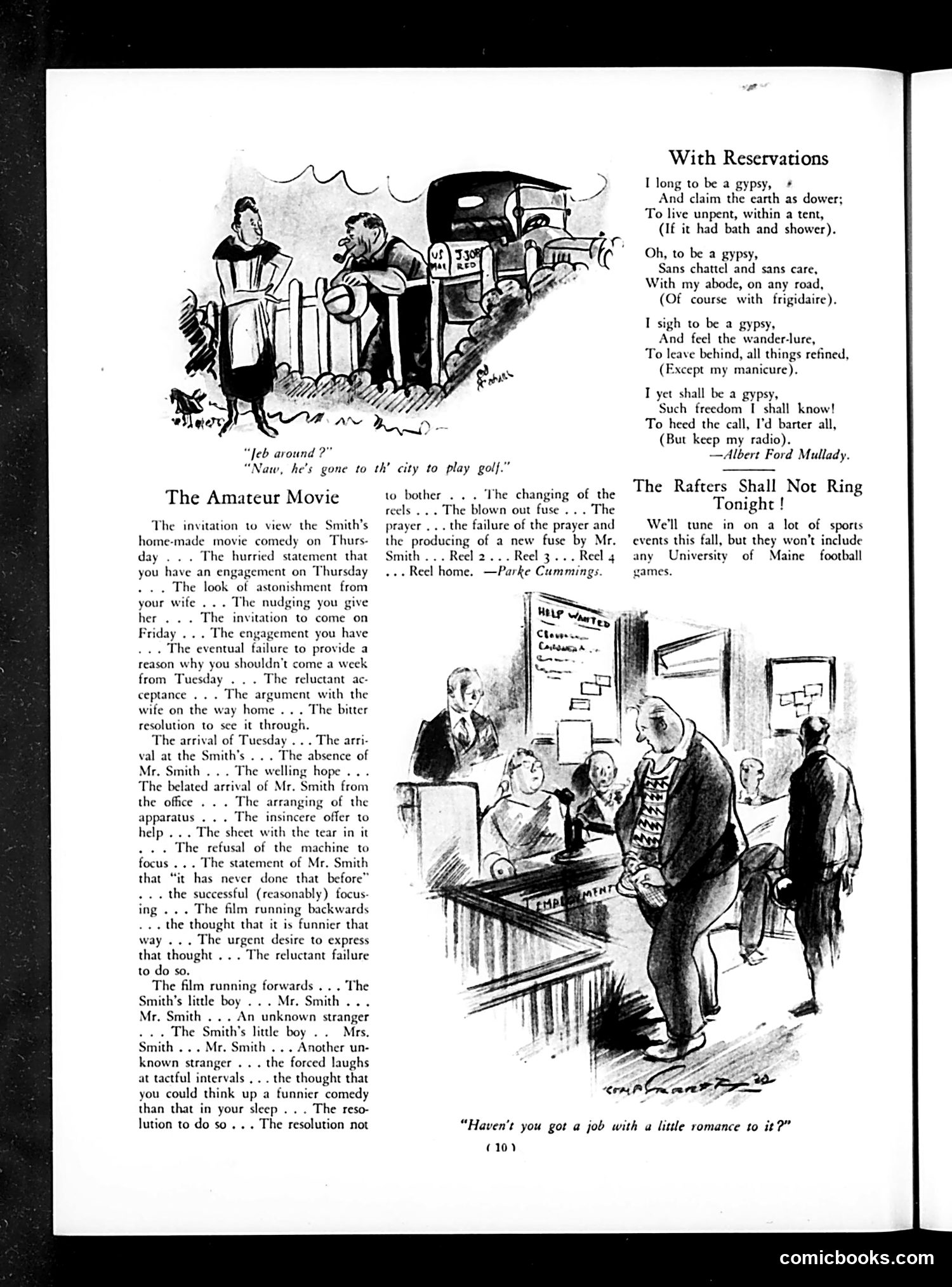
Analysis of Life Magazine Page This page contains two satirical pieces: "The Amateur Movie" (left) mocks the complications of making a home movie, listing absurd obstacles: the wife's astonishment, the nudging she gives, engagement failures, reluctant acceptance, and the machine's refusal to focus. The humor targets the frustrations of 1920s-30s home cinema equipment—unreliable, temperamental technology that promised easy family entertainment but delivered headaches. "The Rafters Shall Not Ring Tonight" (right cartoon) shows a job-placement office where an interviewer asks a woman, "Haven't you got a job with a little romance to it?" The satire critiques workplace segregation and limited opportunities for women—suggesting employers offered boring jobs to female applicants while implying romance (marriage) was their actual expected "career." Both pieces reflect period anxieties about technology and gender roles.
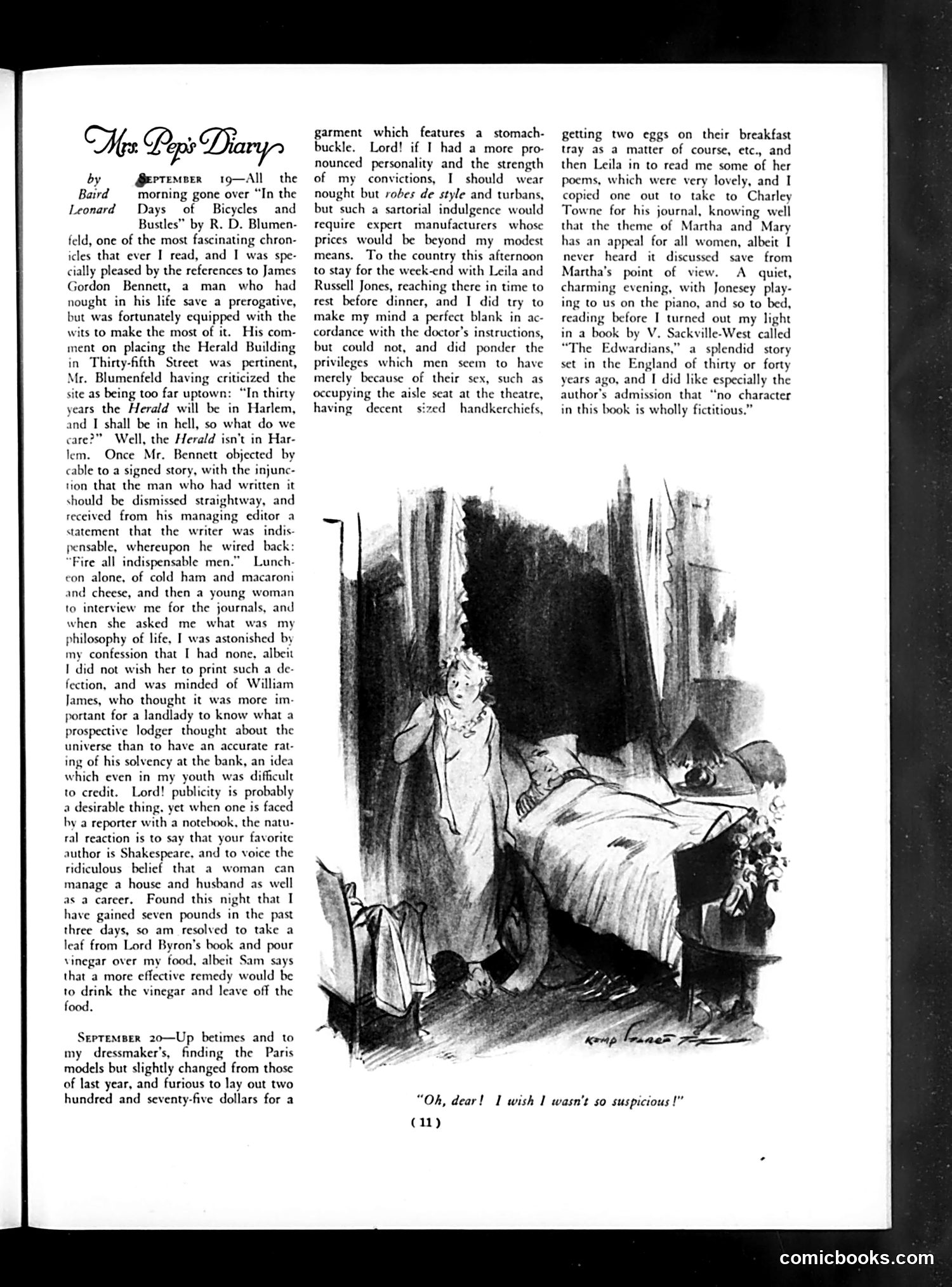
Mrs. Pep's Diary - September 19-20 This page presents a satirical diary entry by "Baird Leonard" mocking upper-class social pretensions. The main cartoon illustrates a domestic scene where a woman in bed remarks to a man, "Oh, dear! I wish I wasn't so suspicious!" The diary entry satirizes: - Social climbing: Mrs. Pep's anxiety about fashion and status symbols (expensive dressmakers, Paris models) - Workplace dynamics: Friction over where the *Herald* newspaper will be located - Gender roles: A woman interviewer questioning the author about his "philosophy of life," contrasting with period assumptions about women's intellectual capabilities - Publicity culture: Criticism of reporters and public disclosure of private matters The cartoon's caption suggests marital suspicion, likely playing on anxieties about infidelity or dishonesty common in satirical humor of this era.
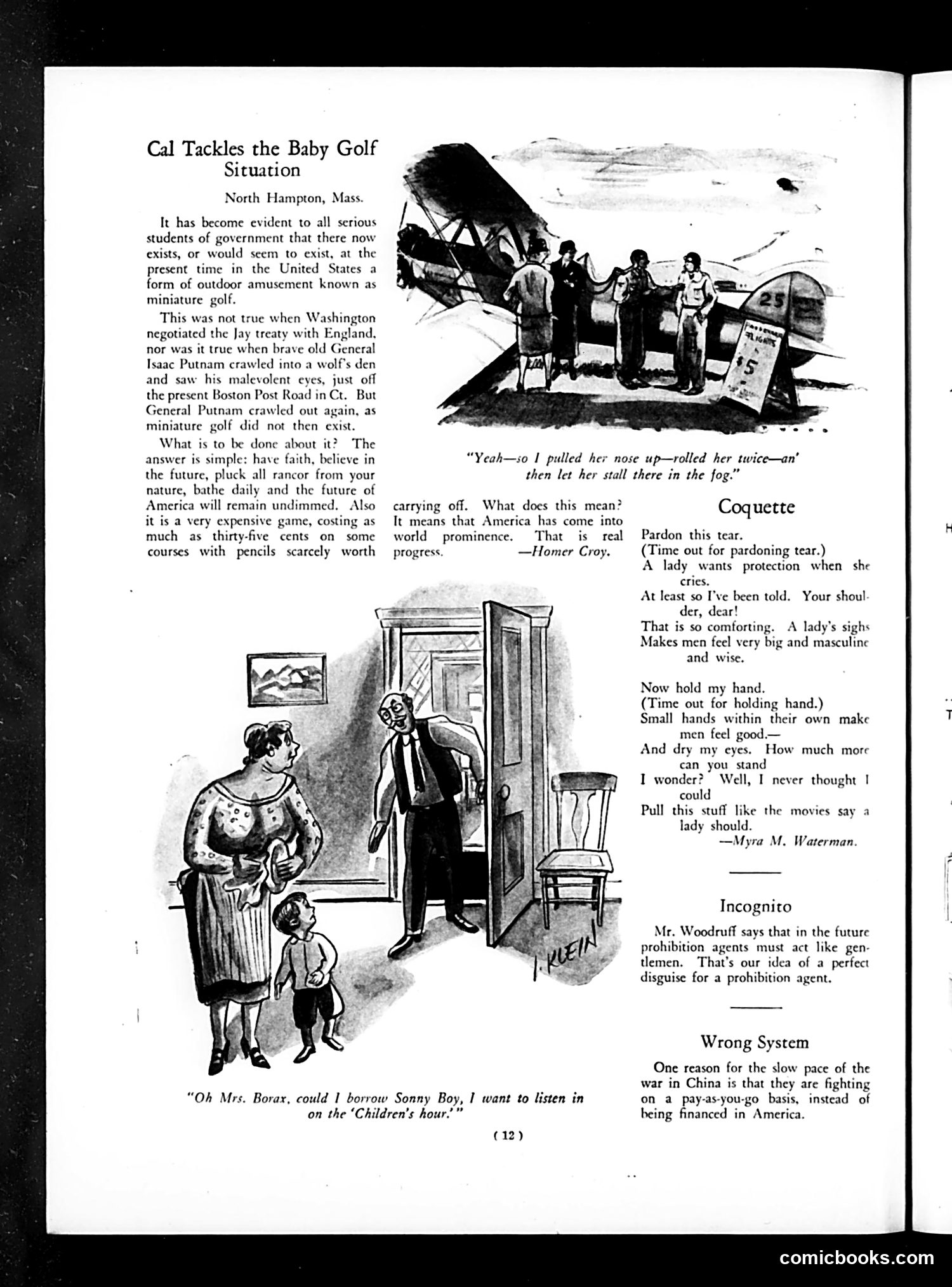
"Cal Tackles the Baby Golf Situation" This satire mocks miniature golf's sudden popularity in 1920s America. The article argues that miniature golf—an inexpensive outdoor amusement costing 30 cents per course—represents genuine American progress, contrasting with expensive, pencil-scarce alternatives. The top cartoon depicts tourists at a miniature golf course in North Hampton, Massachusetts, with one woman saying she "pulled her nose up—rolled her twice—an' then let her stall there in the fog," mocking the absurdity of the sport. The lower cartoon shows a woman asking to borrow a child to listen to "Children's hour" radio programming, satirizing domestic life anxieties. The page's smaller items (Coquette, Incognito, Wrong System) are brief humorous social observations typical of *Life* magazine's satirical format.
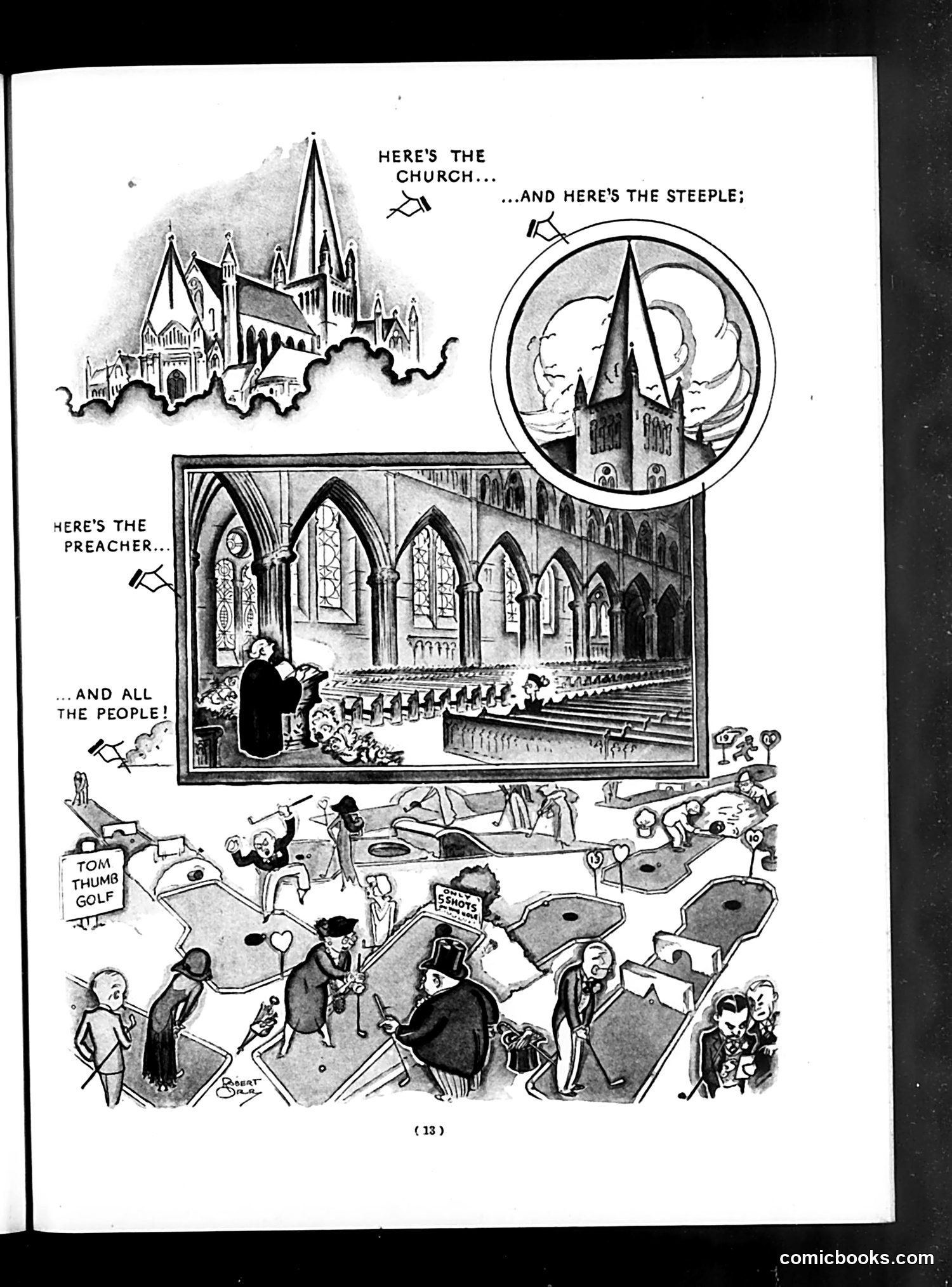
Cartoon Explanation This single-panel satirical cartoon critiques the disconnect between religious institutions and modern secular society. The labeled diagram shows "the church," "the steeple," "the preacher," and "all the people"—echoing a children's nursery rhyme structure ("Here's the Church"). However, the contrast is stark: inside the grand cathedral sits a solitary preacher addressing empty pews, while outside, crowds of people engage in leisure activities—golfing ("Thumb Golf"), socializing, and pursuing entertainment rather than attending services. The satire suggests that despite the church's architectural prominence and the preacher's presence, average people have abandoned religious observance for worldly pursuits. This reflects early-to-mid 20th century concerns about declining church attendance and secularization among urban populations.
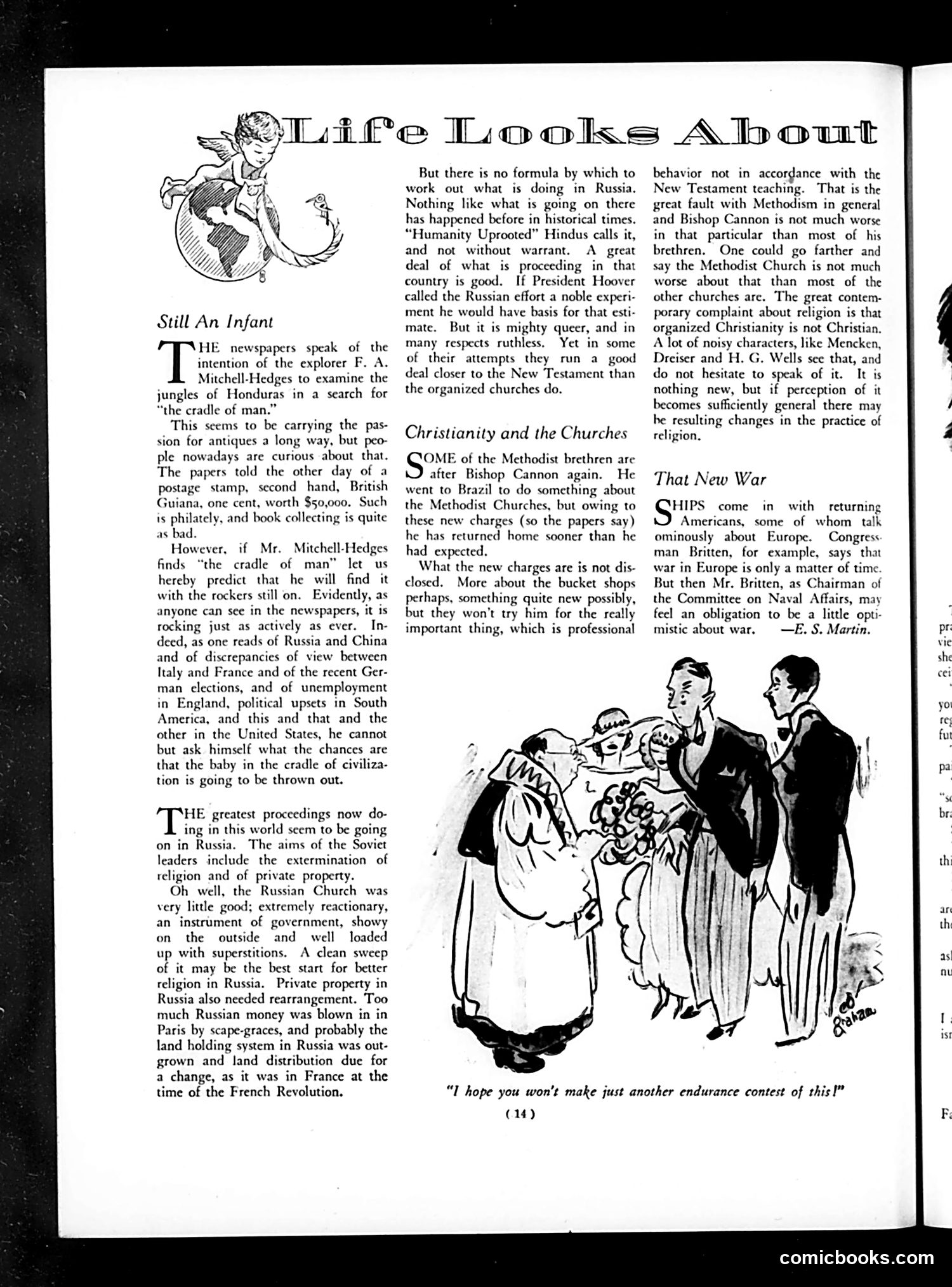
Analysis: Life Magazine Page - "Life Looks About" This editorial page discusses Russia's revolutionary upheaval and Methodist Church activities. The main cartoon depicts what appears to be two well-dressed men (likely diplomats or clergy) presenting an infant to a woman, captioned "I hope you won't make just another endurance contest of this!" The cartoon likely satirizes concerns about how Western institutions—whether churches or governments—might mishandle Russia's post-revolutionary "rebirth" as a nation. The infant symbolizes the struggling new Soviet state, while the skeptical woman questions whether the West will simply impose old approaches rather than genuinely help. The text criticizes both Soviet suppression of religion and organized Christianity's complacency about social issues, suggesting neither institution has adequate solutions for Russia's transformation.
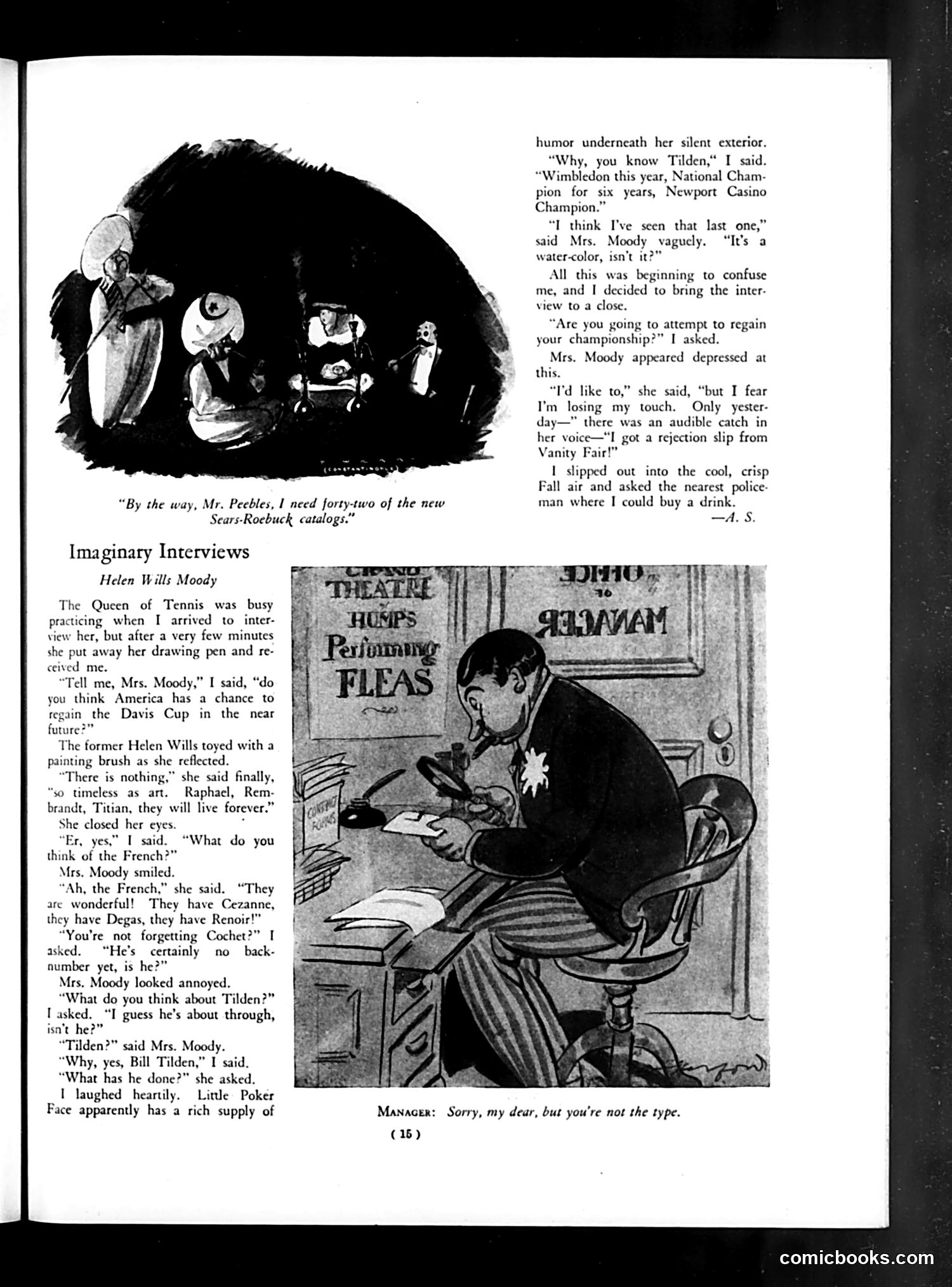
Analysis of "Imaginary Interviews: Helen Wills Moody" This page features a satirical interview with Helen Wills Moody, the dominant American tennis player of the 1920s-30s. The cartoonist mocks her by asking about current events—Davis Cup prospects, French artists, Bill Tilden (a famous male tennis player)—to which she gives dismissive or oddly tangential responses, revealing her as narrow-minded and socially oblivious despite her athletic fame. The top cartoon depicts a theatrical scene with performing fleas, illustrating the absurdist humor. The bottom cartoon shows a theater manager rejecting someone, captioning the page's satirical point: Mrs. Moody, despite her celebrity, isn't "the type" for serious cultural or intellectual engagement. The satire critiques how sports celebrities lack depth beyond their specific field.
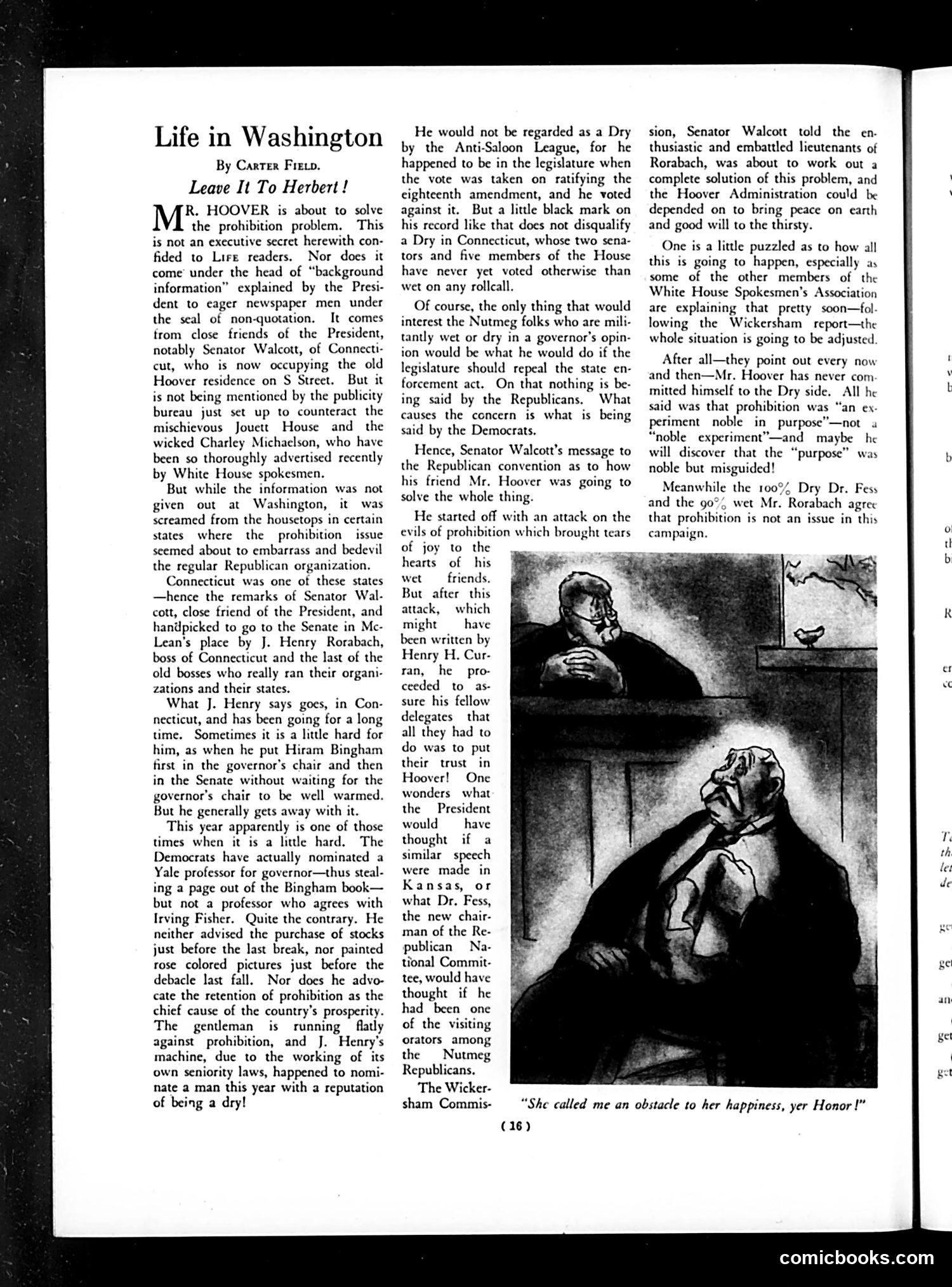
Analysis This page discusses Prohibition enforcement and political maneuvering around it. The text, by Carter Field, addresses President Hoover's approach to solving the prohibition problem, referencing Senator Walcott's claims that Hoover would solve it through Republican cooperation. The accompanying three-panel cartoon (captioned "She called me an obstacle to her happiness, yet Honor!") appears to satirize the contradiction between public declarations of support for Prohibition and private resistance to it. The figure shown seems to represent someone caught between conflicting demands—likely illustrating how politicians publicly championed Prohibition while privately doubting its viability or enforceability. The article notes that Democrats and Republicans disagreed sharply on Prohibition's actual causes and solutions, making it a central campaign issue. The satire mocks the hypocrisy embedded in these political positions.
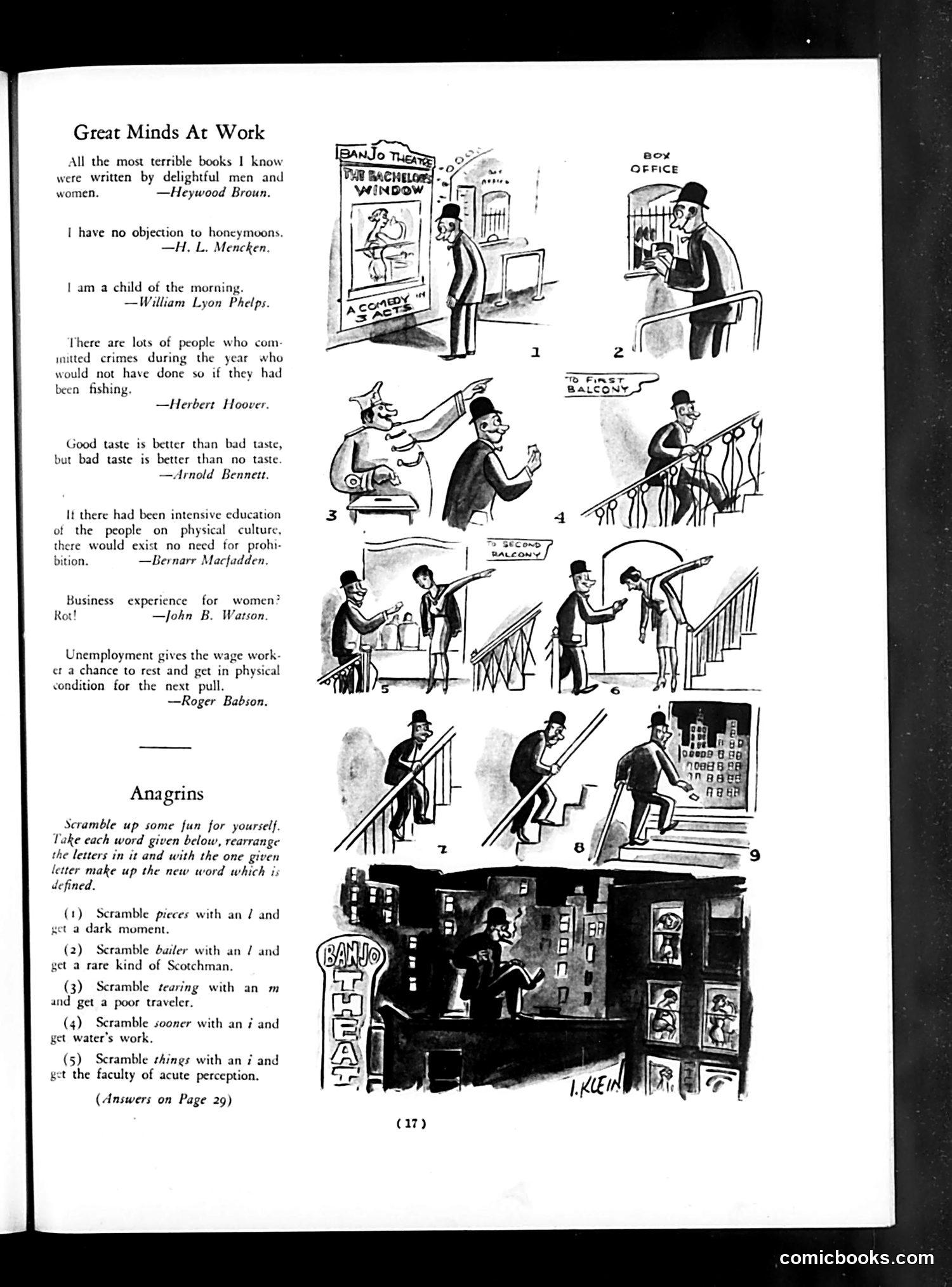
Analysis This page combines satirical quotes at top left with a visual comic strip and word puzzle. The strip (panels 1-9) depicts a man climbing stairs in increasingly dramatic fashion—slipping, falling, struggling upward. Panel 10 shows him entering a Banjo Theatre, presumably exhausted. The satire appears to mock the physical toll of urban life or economic hardship. The accompanying quotes from public figures (Heywood Broun, H.L. Mencken, William Lyon Phelps, Herbert Hoover, etc.) are witty observations on morality, taste, and social problems—typical Life magazine fare critiquing American society. The "Anagrins" puzzle invites readers to unscramble words for engagement. The cartoonist is I. Klein. Without knowing the specific historical moment, the stairs likely symbolize social or economic struggle common to Depression-era satire.
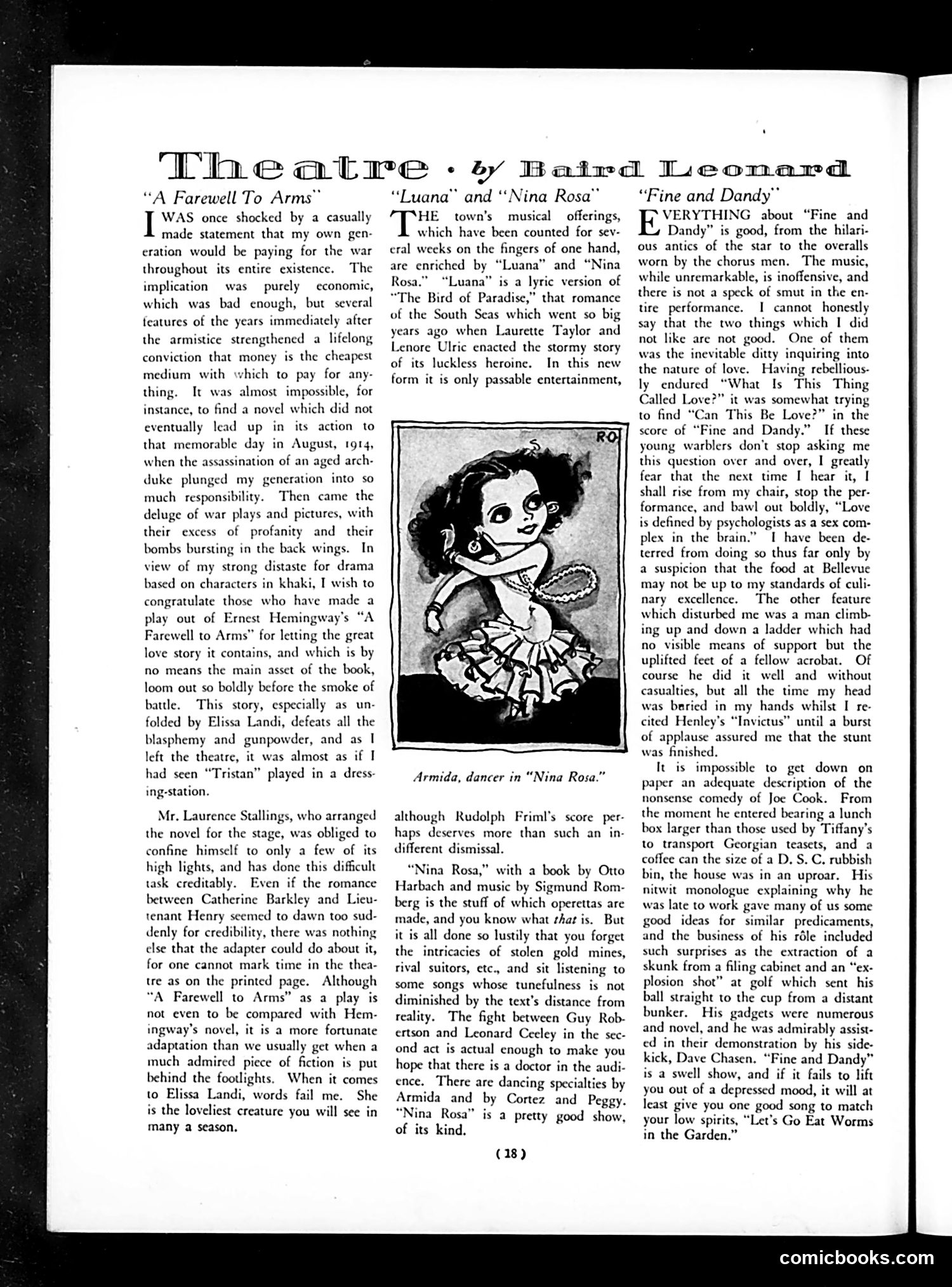
Analysis This page is a theatre review column by Baird Leonard, not a political cartoon. It discusses three Broadway productions: "A Farewell to Arms," "Luana" and "Nina Rosa," and "Fine and Dandy." The single image shows Armida, a dancer in "Nina Rosa"—a caricatured illustration typical of entertainment journalism of the era. Leonard's reviews are notably critical. He praises "A Farewell to Arms" for adapting Hemingway's novel successfully, but dismisses the other shows as formulaic operettas with forgettable music. His tone is witty and somewhat snobbish about popular entertainment, particularly mocking "Fine and Dandy" for its pedestrian plot and Joe Cook's vaudeville-style humor. This reflects 1930s cultural gatekeeping—critics distinguishing serious drama from lightweight commercial theatre.
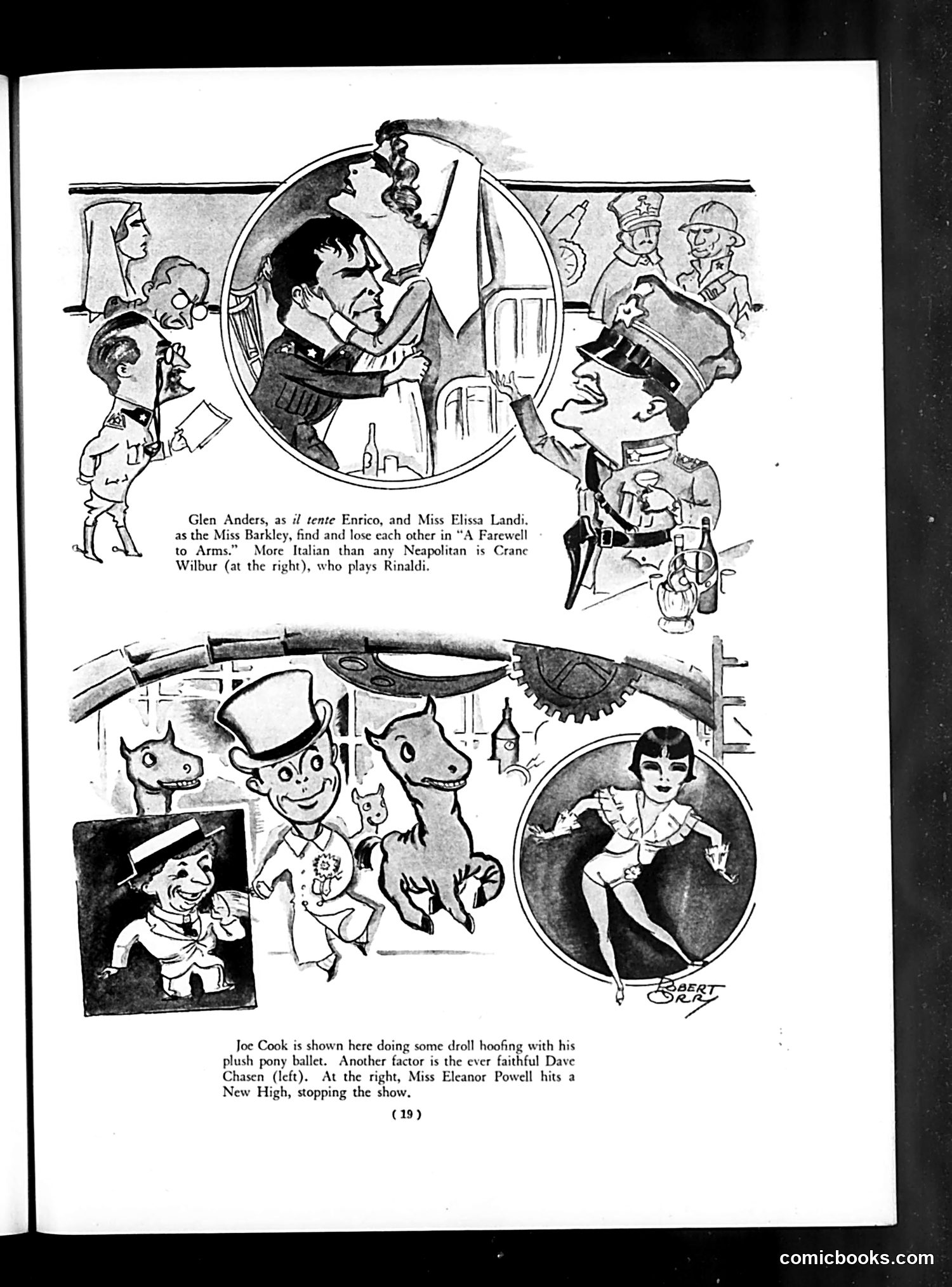
Analysis of Life Magazine Page This page reviews theatrical performances, likely from the 1930s. The top section mocks the film adaptation of Hemingway's *A Farewell to Arms*, caricaturing actors Glen Anders, Elissa Landi, and Crane Wilbur. The satire suggests Wilbur's performance as Italian character Rinaldi is exaggerated—"more Italian than any Neapolitan"—implying overwrought acting. The lower section showcases vaudeville/stage performers: Joe Cook (comedian performing with a trained pony), Dave Chasen (supporting actor), and dancer Eleanor Powell, whose performance supposedly "stops the show." The cartoonish illustrations emphasize comedic exaggeration typical of Life's satirical theater criticism. This reflects 1930s entertainment coverage mixing film and live performance reviews with humorous caricature.
"Movies by Harry Evans" - Life Magazine Film Reviews This page contains three film reviews from Life's movie column. The critic discusses: "Africa Speaks" - A travel documentary by explorer Paul Hoefler showing African wildlife. Evans praises the dramatic animal photography and a spectacular sequence of locusts devastating the landscape, but criticizes the misleading title since most animal sounds were added in post-production rather than recorded on location. He notes the Johnsons are attempting to make sound films ("talkies") of African life. "The Way of All Men" and "Dough Boys" - Reviews of Douglas Fairbanks Jr. and Buster Keaton films (text cut off). The writing reflects early 1930s film criticism, distinguishing between authentic documentary footage and theatrical embellishment—a concern as cinema technology advanced. The reference to "talkies" and synchronization indicates this is from the transitional era when sound was newly added to motion pictures.
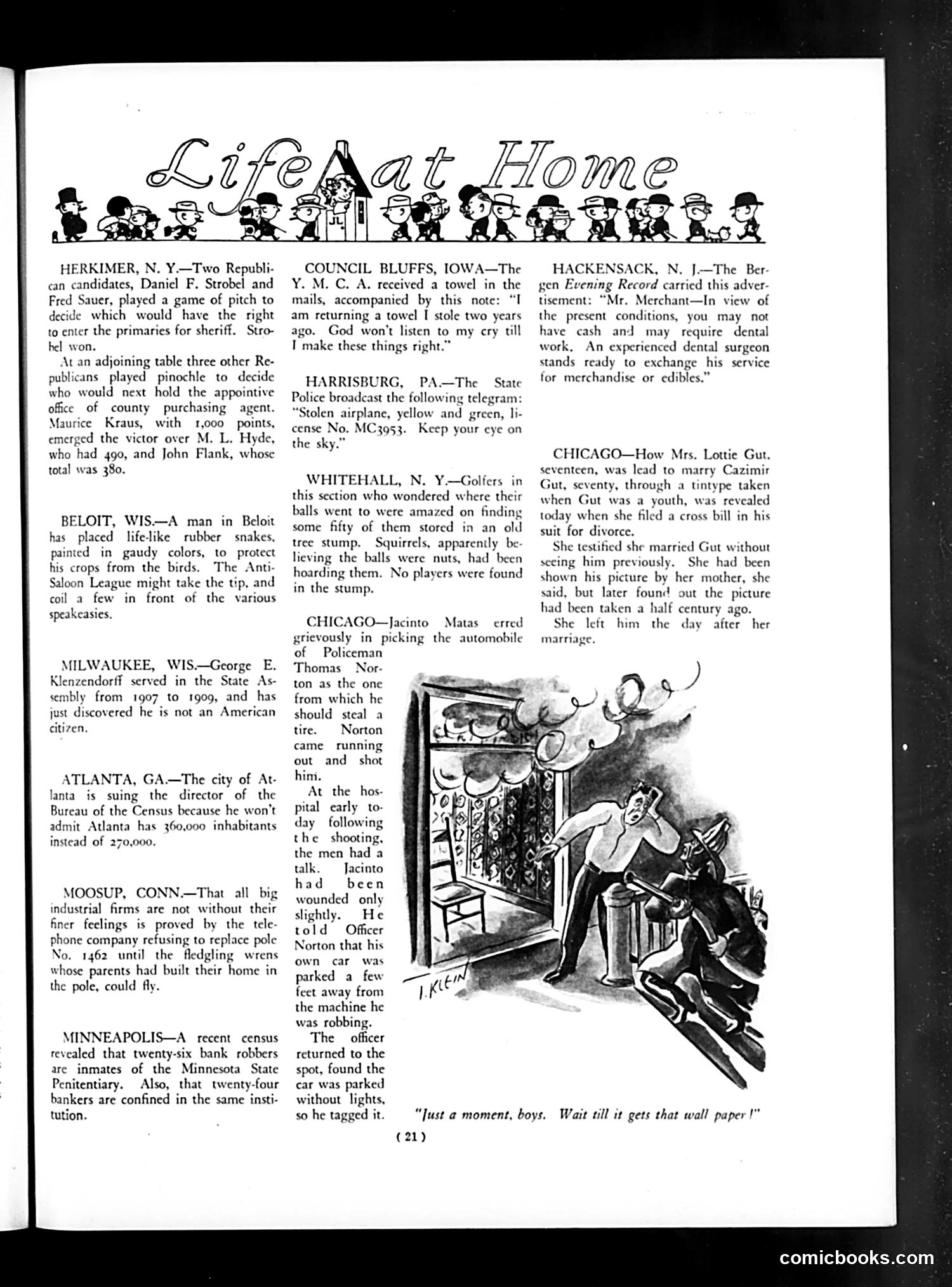
"Life at Home" Page Analysis This page collects humorous anecdotes from across America, structured as a satirical commentary on American society circa the 1920s-30s. Key themes: Political/civic absurdity: Republican candidates decide sheriff positions by playing card games; officials dispute census figures; a state legislator discovers he's not a citizen. Crime and justice irony: The Minneapolis item jokes that as many bankers as bank robbers are imprisoned—suggesting institutional corruption. A tire thief accidentally targets a policeman's car, who then tags the criminal's own unlit vehicle for a parking violation. Social hypocrisy: A penitent thief returns a stolen towel after years; a dental surgeon barters services for merchandise during economic hardship; a woman discovers her 70-year-old husband used a 50-year-old photograph to attract her. Human nature: Squirrels hoard golf balls; a phone company delays pole replacement to protect nesting wrens. The cartoon (bottom right) shows a burglar interrupted mid-heist, likely illustrating the Jacinto Matas story. The satire targets institutional incompetence, moral compromise, and the gap between appearances and reality in American life.
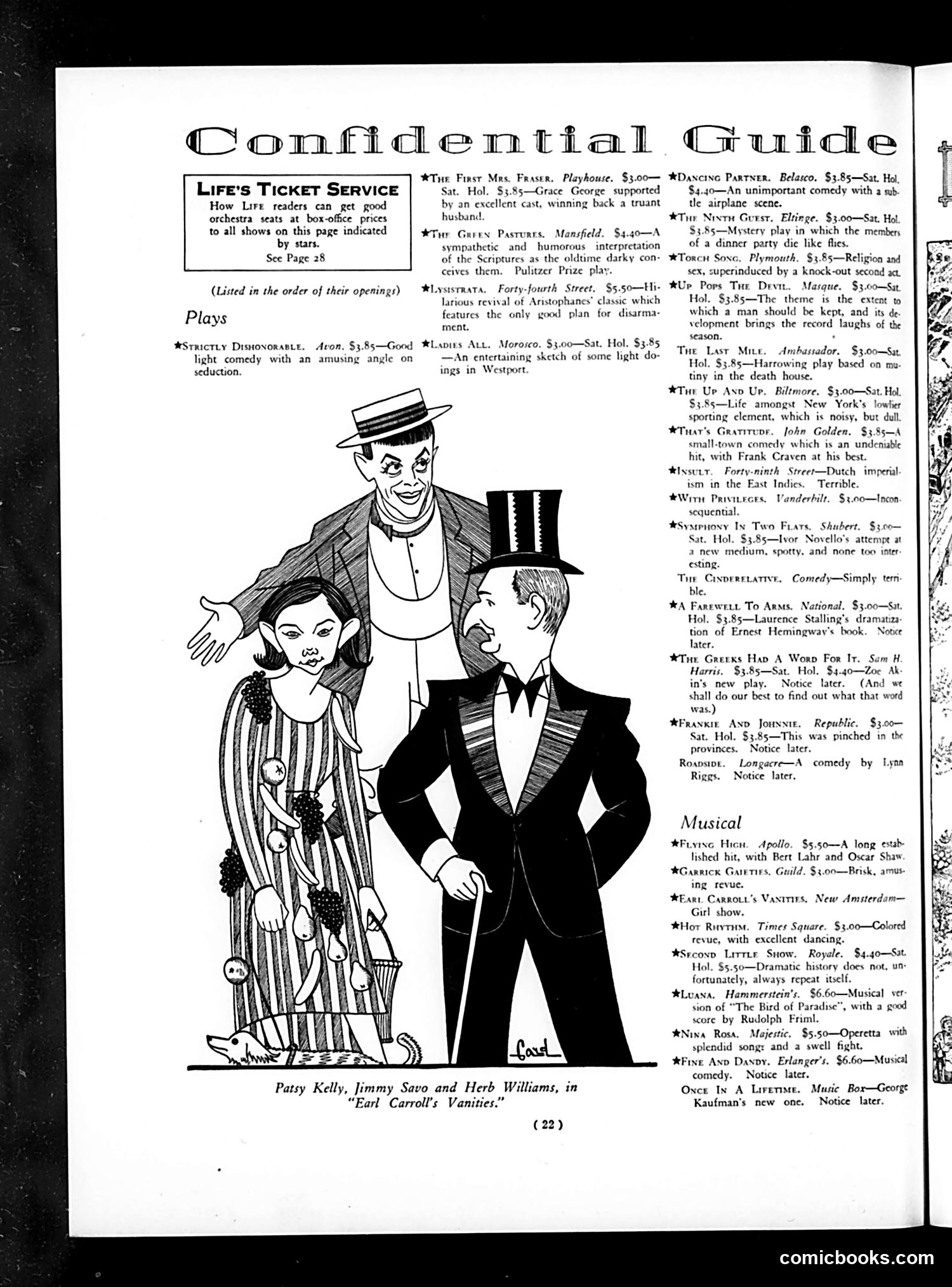
"Confidential Guide" Theater Listings This page is a theater guide from *Life* magazine, listing current Broadway productions with prices and brief reviews. The illustration shows three figures in formal 1920s attire—likely representing characters from Earl Carroll's *Vanities*, a popular musical revue of the era. The content is a straightforward entertainment listing rather than political satire. It provides theatergoers with orchestra seat prices, show locations, and punchy critical assessments of plays and musicals. Asterisks indicate shows where *Life* readers could obtain discounted tickets. Notable shows listed include Aristophanes' *Lysistrata* (a classical revival), Hemingway adaptation *A Farewell to Arms*, and the revue *Flying High*. The reviews range from complimentary ("undeniable hit") to brutally dismissive ("Simply terrible"). This reflects *Life*'s dual role as both entertainment guide and cultural arbiter for affluent New York audiences in the late 1920s.
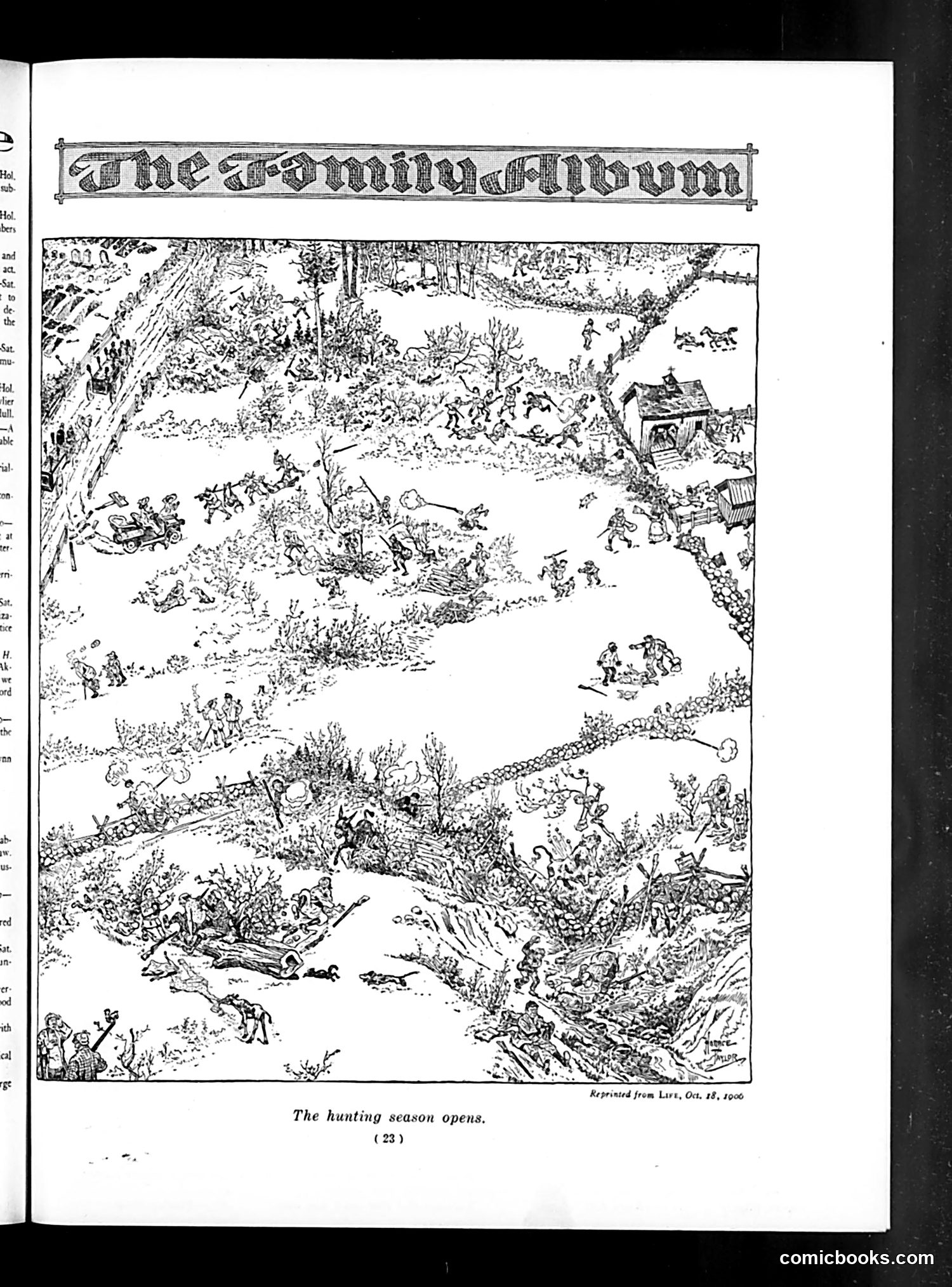
"The Hunting Season Opens" (Life, October 18, 1906) This illustration depicts a rural hunting scene with numerous figures scattered across a landscape with trees, water, and a small building. The title "The hunting season opens" appears to be a straightforward seasonal illustration rather than political satire. The detailed pen-and-ink drawing shows hunters, dogs, and various outdoor activities typical of autumn hunting. Multiple figures are positioned throughout the composition engaging in hunting pursuits. Without additional context from the magazine's editorial content, the specific satirical intent—if any—is unclear. The image may simply document seasonal recreation, or it could contain period-specific social commentary about class, sport, or rural life that would require knowledge of 1906 Life magazine's typical themes. The page number "(23)" suggests this is content from within an issue rather than a cover or special feature.
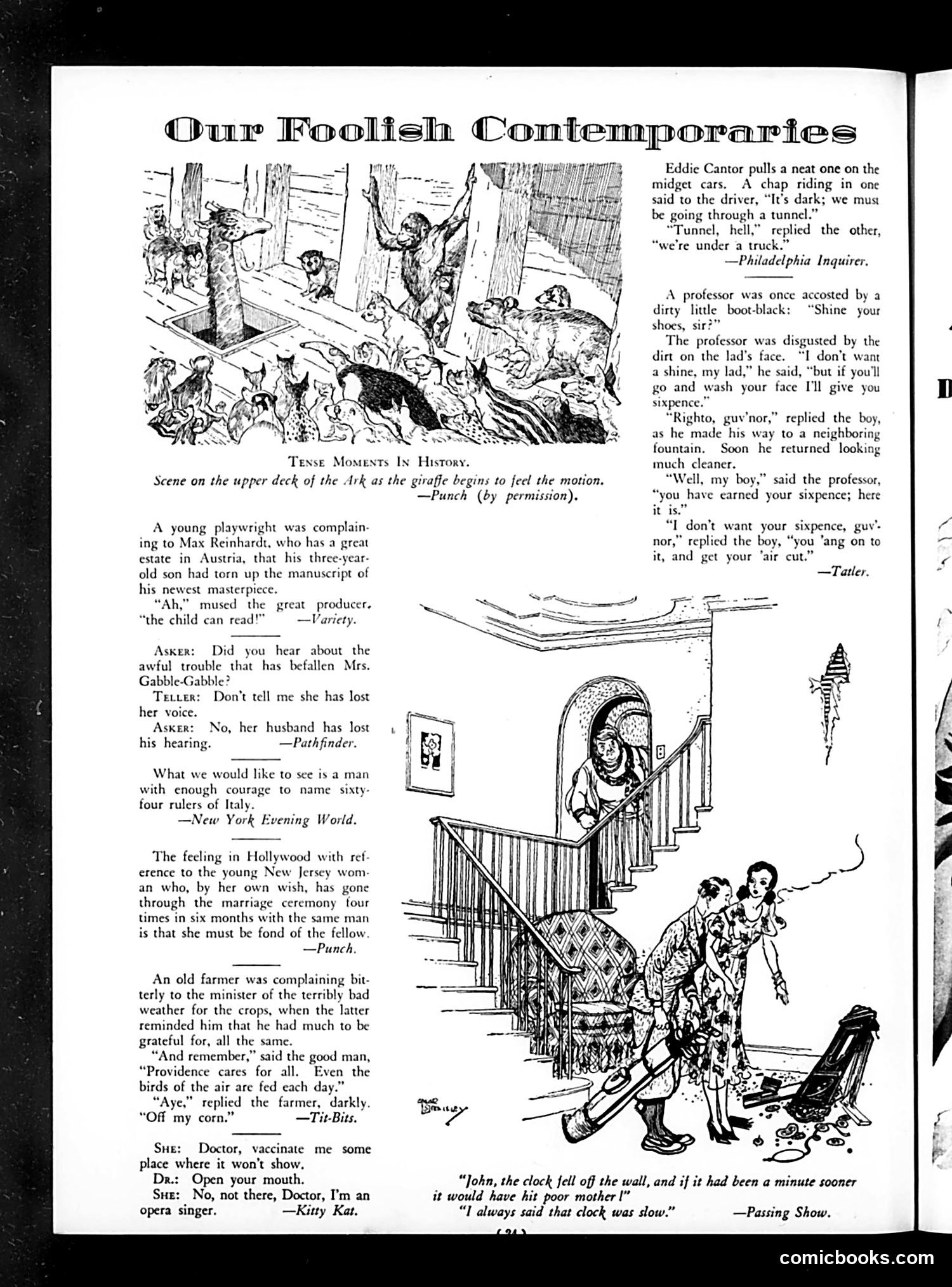
"Our Foolish Contemporaries" This page collects brief humorous anecdotes from various sources, typical of *Life* magazine's satirical format. The sketches mock human folly across different scenarios: Top cartoon: References Noah's Ark and seasickness—a visual gag about the giraffe experiencing motion sickness during the biblical flood. Text jokes include: - A producer's witty response to a child destroying a manuscript ("the child can read!") - A wife's hearing loss being preferable to her husband's deafness - A farmer complaining that Providence feeds birds—off his crops - An opera singer refusing a vaccine anywhere visible, including her mouth (implying vanity) - A shoe-shiner's dignity: refusing payment but asking the professor to get a haircut Bottom illustration: Shows children and broken household items—captioned with dark humor: a fallen clock nearly hit mother, but "that clock was slow" anyway. The overall effect satirizes human vanity, poor logic, and life's minor absurdities through working-class and domestic scenarios, reflecting early 20th-century humor sensibilities.
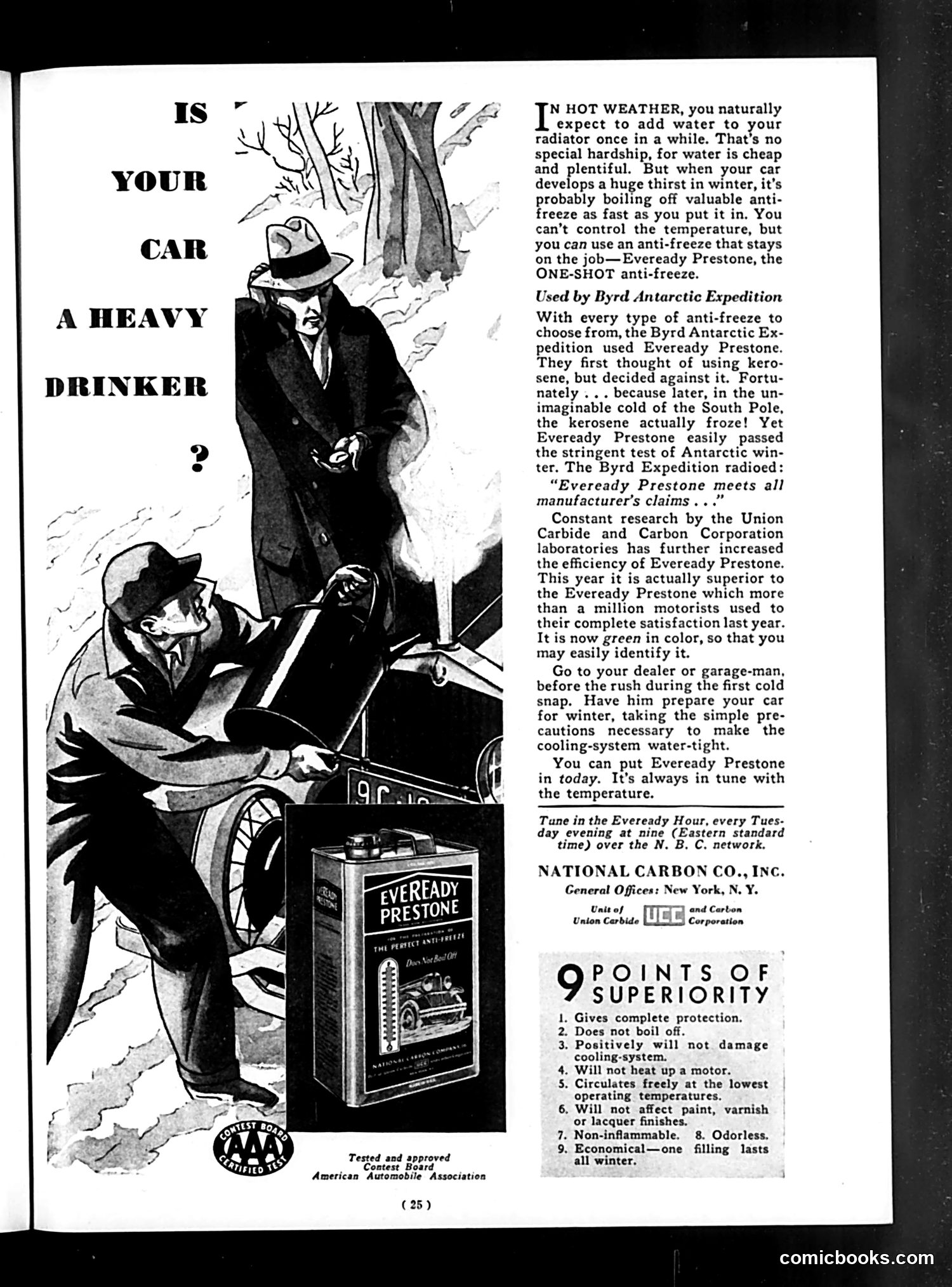
Analysis: Eveready Prestone Anti-Freeze Advertisement This is primarily a product advertisement, not political satire. The page promotes Eveready Prestone anti-freeze for automobiles. The illustration shows a man in winter clothing examining a frozen car radiator—a common winter problem for motorists. The headline "IS YOUR CAR A HEAVY DRINKER?" uses humor to describe vehicles that leak coolant in cold weather. The advertisement's main selling point references the Byrd Antarctic Expedition (likely Richard Byrd's famous polar flights of the late 1920s), claiming the product performed better than kerosene-based alternatives even in extreme cold. This real-world "test" serves as credibility evidence for consumers. The ad lists "9 Points of Superiority" and emphasizes the product is now green-colored for easy identification—a practical consumer detail. The page includes a radio promotion ("Tune in the Eveready Hour") and an American Automobile Association approval seal, standard marketing tactics of the era. This reflects 1920s-30s advertising strategy: combining humor, celebrity/expedition endorsement, and technical claims to market automotive products.
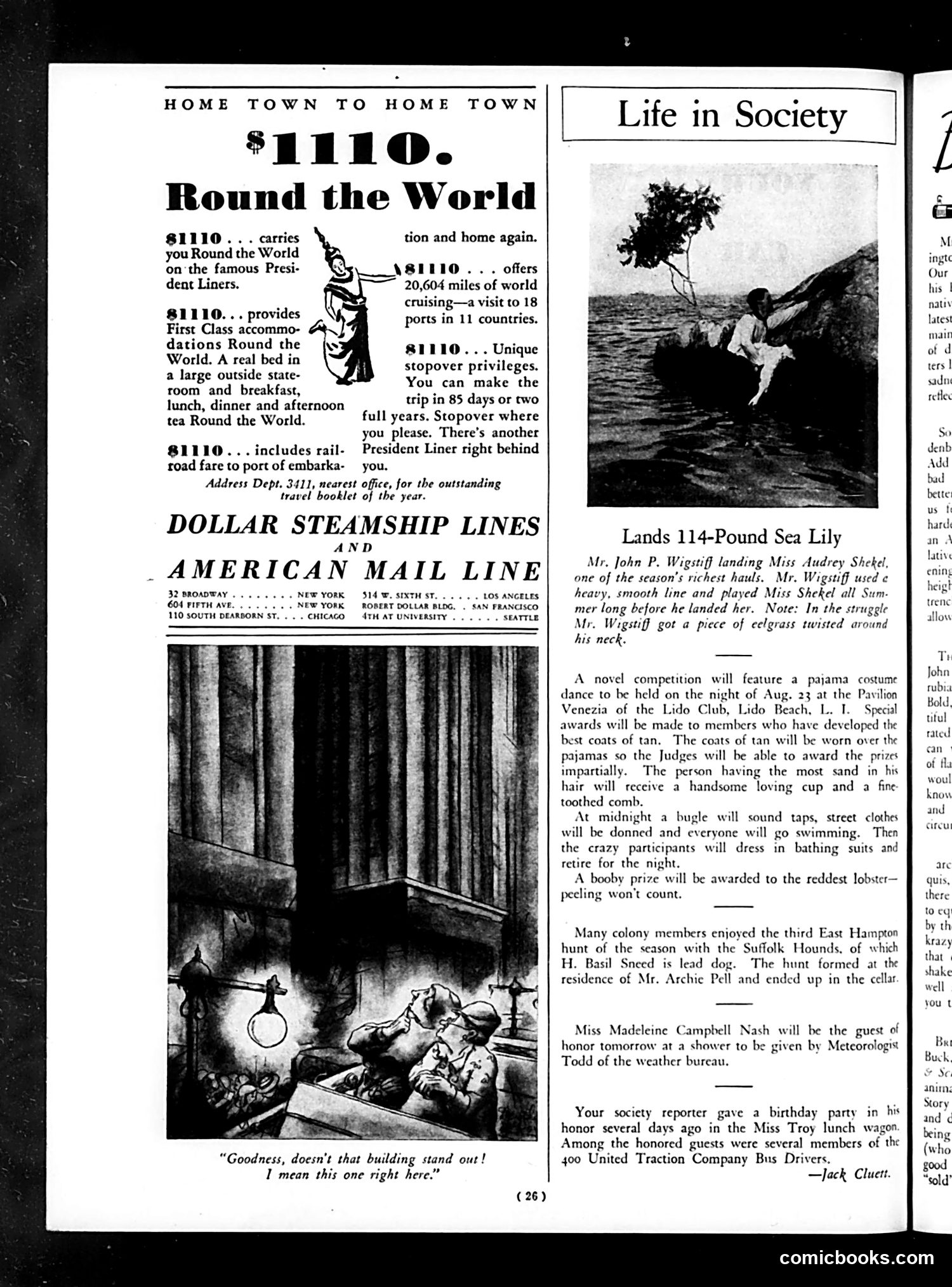
Life Magazine Page Analysis This page mixes advertisements with society column humor typical of 1920s-30s Life magazine. The Cartoon: The lower image depicts a basement scene with figures examining a hanging light fixture, with the caption "Goodness, doesn't that building stand out! I mean this one right here." This appears to be visual wordplay—someone is literally pointing out a building's architectural feature while in a basement, likely satirizing oblivious or misplaced commentary. "Life in Society": The right column parodies high-society gossip through absurdist humor. "Lands 114-Pound Sea Lily" mockingly describes a wealthy woman (Miss Audrey Shekel) as a fishing catch, with Mr. Wigstiff as the "fisherman." The pajama dance competition and other social events are described with exaggerated ridiculousness (rewarding sand in hair, "reddest lobster" prizes), satirizing the pretensions and vapidity of the wealthy leisure class. The final joke about "400 United Traction Company Bus Drivers" at a lunch wagon mockingly equates working-class people with high society's "400"—America's supposed social elite.
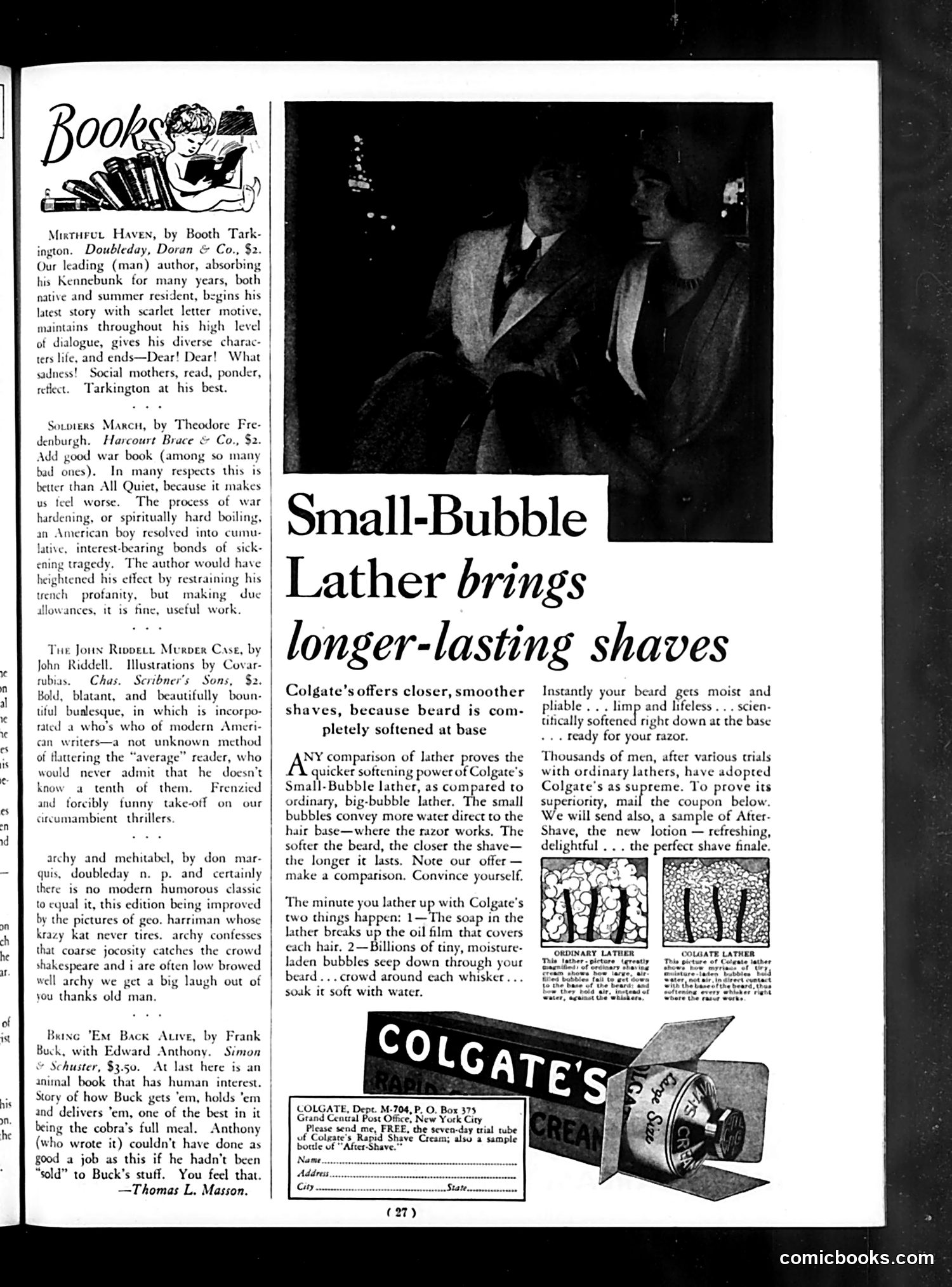
Page Analysis This page is primarily a book review section with an advertisement, not a political cartoon. The "Books" column reviews five contemporary titles (1920s-era): Booth Tarkington's *Mirthful Haven*, Theodore Fredenburgh's *Soldiers March*, John Riddell's *The John Riddell Murder Case*, don marquis's *archy and mehitabel*, and Frank Buck's *Bring 'Em Back Alive*. The dominant content is a Colgate's shaving cream advertisement featuring a photograph of men and explanatory text about "Small-Bubble Lather." The ad uses pseudo-scientific claims about bubble size and moisture penetration to market the product's shaving superiority—a typical early 20th-century advertising approach combining technical language with lifestyle aspiration. No political satire or caricature is present on this page. It represents Life magazine functioning as both cultural critic and advertising vehicle for consumer products.
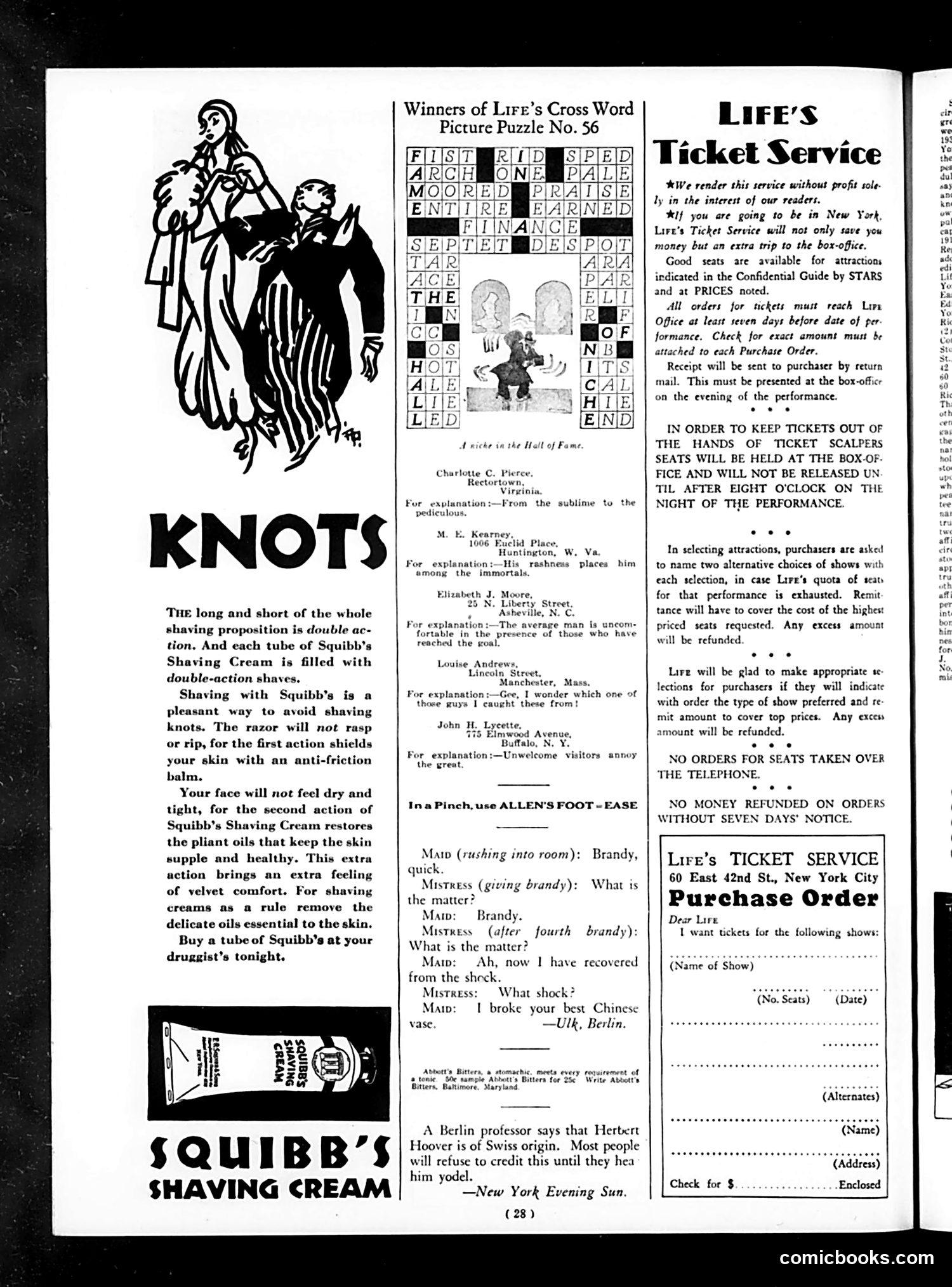
Life Magazine Page Analysis This page is primarily advertising and service content, not political satire. It contains: 1. Squibb's Shaving Cream ad (left): Standard product advertisement emphasizing "double-action" cream that both protects skin and restores natural oils. 2. Life's Crossword Puzzle winners (center): Readers' humorous explanations for puzzle answers, including a brief joke about Herbert Hoover's Swiss origin and yodeling—mild contemporary humor about the then-President. 3. Life's Ticket Service (right): A practical subscription service offering Broadway theater tickets without markup, with detailed ordering instructions and policies against scalpers. The page reflects 1920s-30s Life magazine content: consumer advertising, reader engagement through puzzles, and service offerings. The Hoover reference suggests this issue predates his 1929 stock market crash association, when he was still viewed with some humor rather than blame.
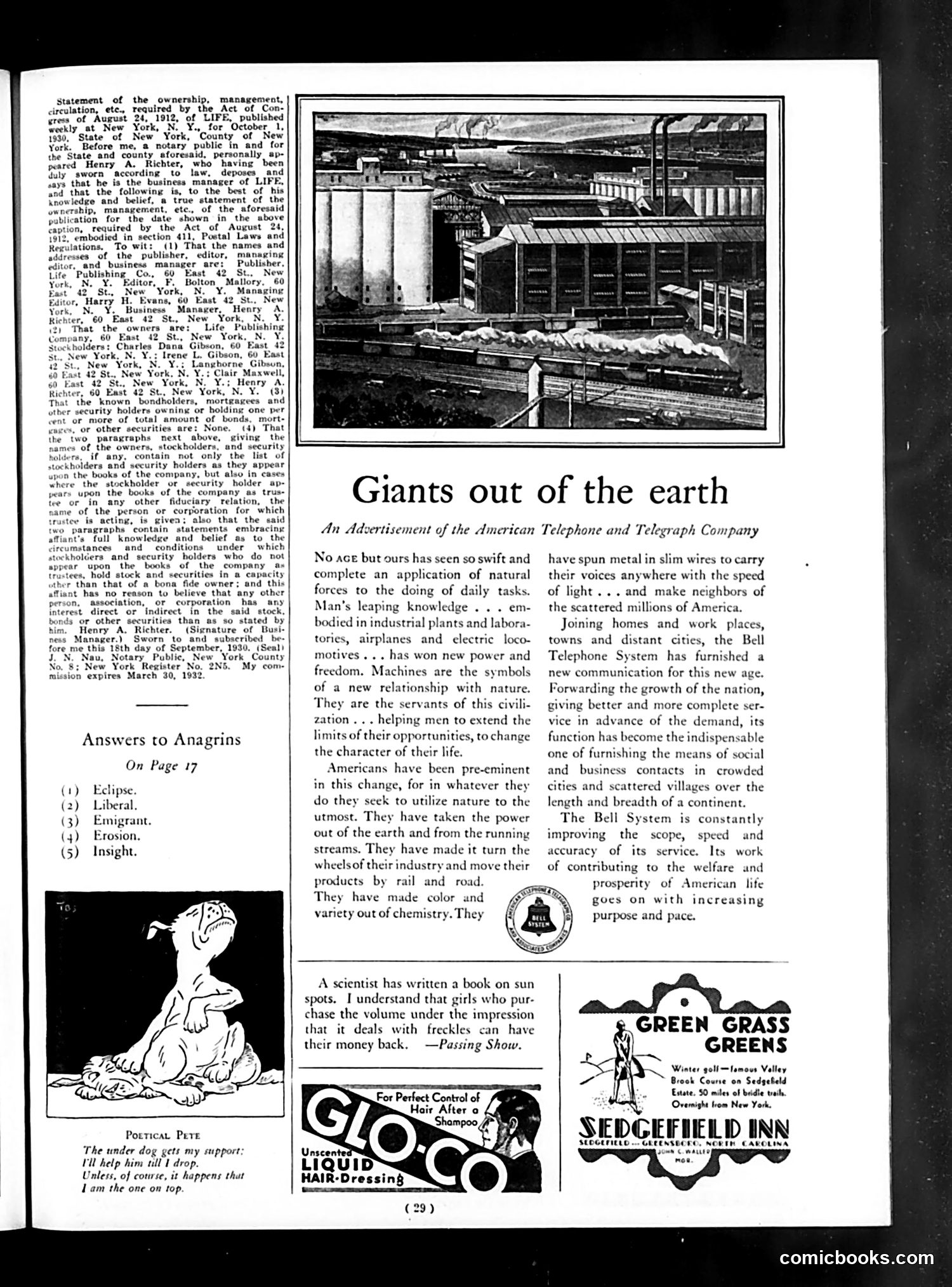
"Giants out of the Earth": AT&T Advertisement Analysis This page is primarily a corporate advertisement for American Telephone and Telegraph Company, disguised as inspirational editorial content about American progress. The ad celebrates how Americans have harnessed natural forces—water power, electricity—to mechanize industry and commerce. It portrays machines as liberating humanity, extending human opportunity and transforming daily life through technology. The imagery shows industrial infrastructure: factories, electrical transmission lines, railroad cars—the material backbone of AT&T's business. The rhetoric is grandiose, positioning American capitalists as masters over nature itself. The satire appears in the adjacent cartoon "Poetical Pete," which cynically undercuts the ad's noble framing: the underdog character promises to support the weak "unless... I am the one on top"—a frank admission that power hierarchies, not idealism, drive behavior. This provides ironic counterpoint to AT&T's claim that progress serves all Americans equally. The juxtaposition suggests skepticism about corporate claims of universal benefit, even as Life magazine accepts their advertising dollars.

Analysis of Life Magazine Page (October 10, 1930) This is primarily an advertising and content page, not a political cartoon. The dominant feature is a Dentyne chewing gum advertisement emphasizing that white teeth signify success and attractiveness—a common 1930s marketing strategy linking personal grooming to social advancement. The page includes several brief humor items (sourced from other publications like *Punch* and *Variety*), typical of Life's satirical format: jokes about a waiter mistaking whistling for a canary, confusion over Joe Doakes' theatrical commitment, and a quip from the Duchess of Atholl comparing women's knitting to men smoking. There's also a cartoon of a couple dining, and a separate illustration of office buildings with a caption about poverty. For modern readers: This reflects 1930s consumer culture where advertising aggressively marketed self-improvement products. The humor is gentle, often sourced internationally, and the Duchess of Atholl reference assumes readers recognized contemporary British aristocratic figures. The overall tone is light entertainment mixed with advertising—typical of Life's commercial-editorial hybrid model.
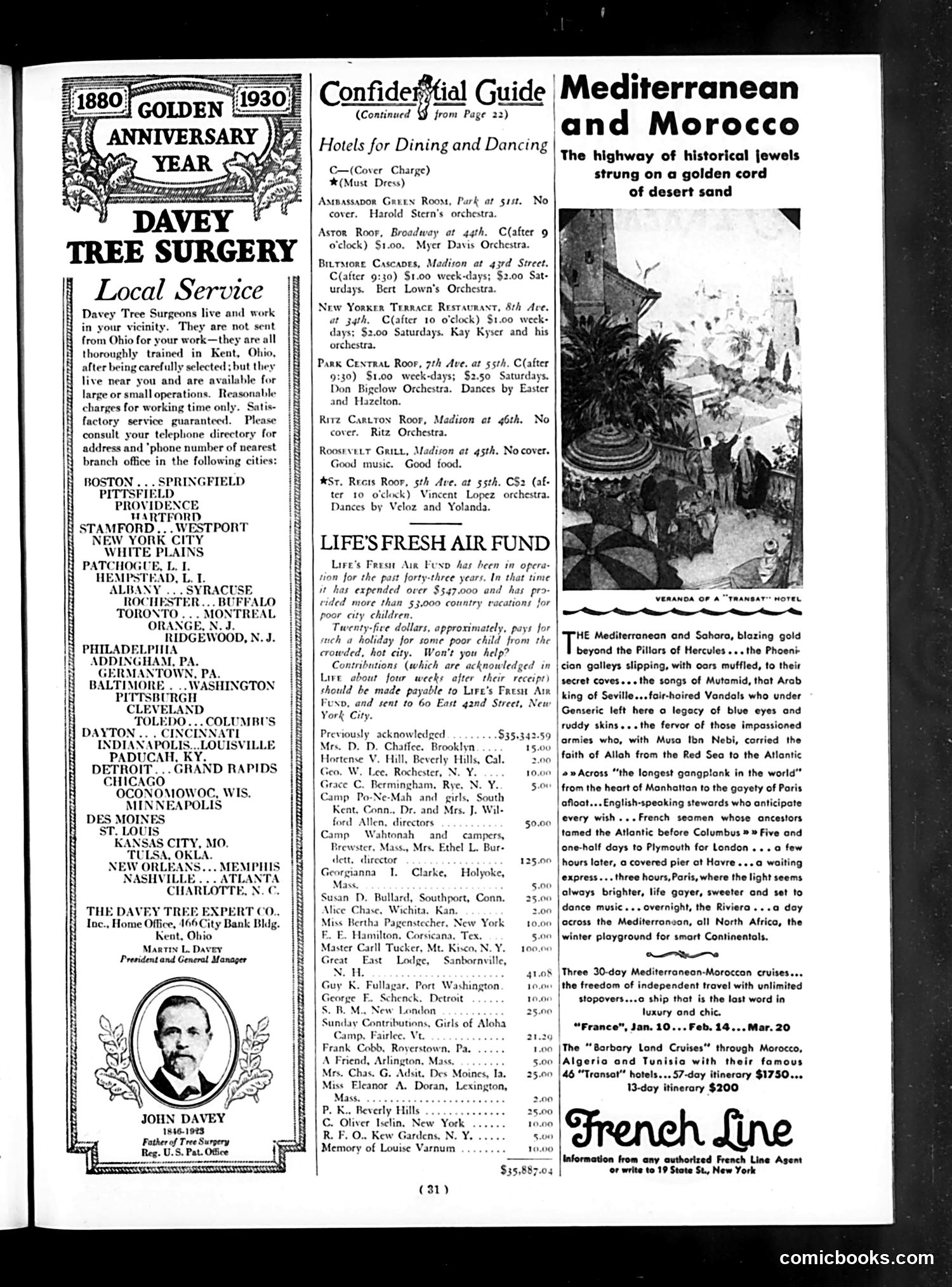
Analysis of Life Magazine Page (circa 1930) This page is primarily advertising and service listings, not political satire. It contains: Left side: Davey Tree Surgery advertisement (celebrating their 50th anniversary, 1880-1930) listing branch offices nationwide, plus a biographical note on founder John Davey. Center: A "Confidential Guide" listing upscale NYC restaurants and nightclubs with cover charges and orchestras—reflecting 1920s-30s Jazz Age nightlife culture during Prohibition's end. Right side: Advertisement for Mediterranean/Morocco cruises via French Line, promising exotic travel ("historical jewels...of desert sand") and luxury vacation experiences. Bottom: Life's Fresh Air Fund solicitation—a charitable campaign providing country vacations for poor urban children, with donor acknowledgments and contributions listed. The page reflects 1930 American consumer culture: tree care services, nightclub entertainment, luxury travel, and philanthropic giving—with no political cartoons or satire present.
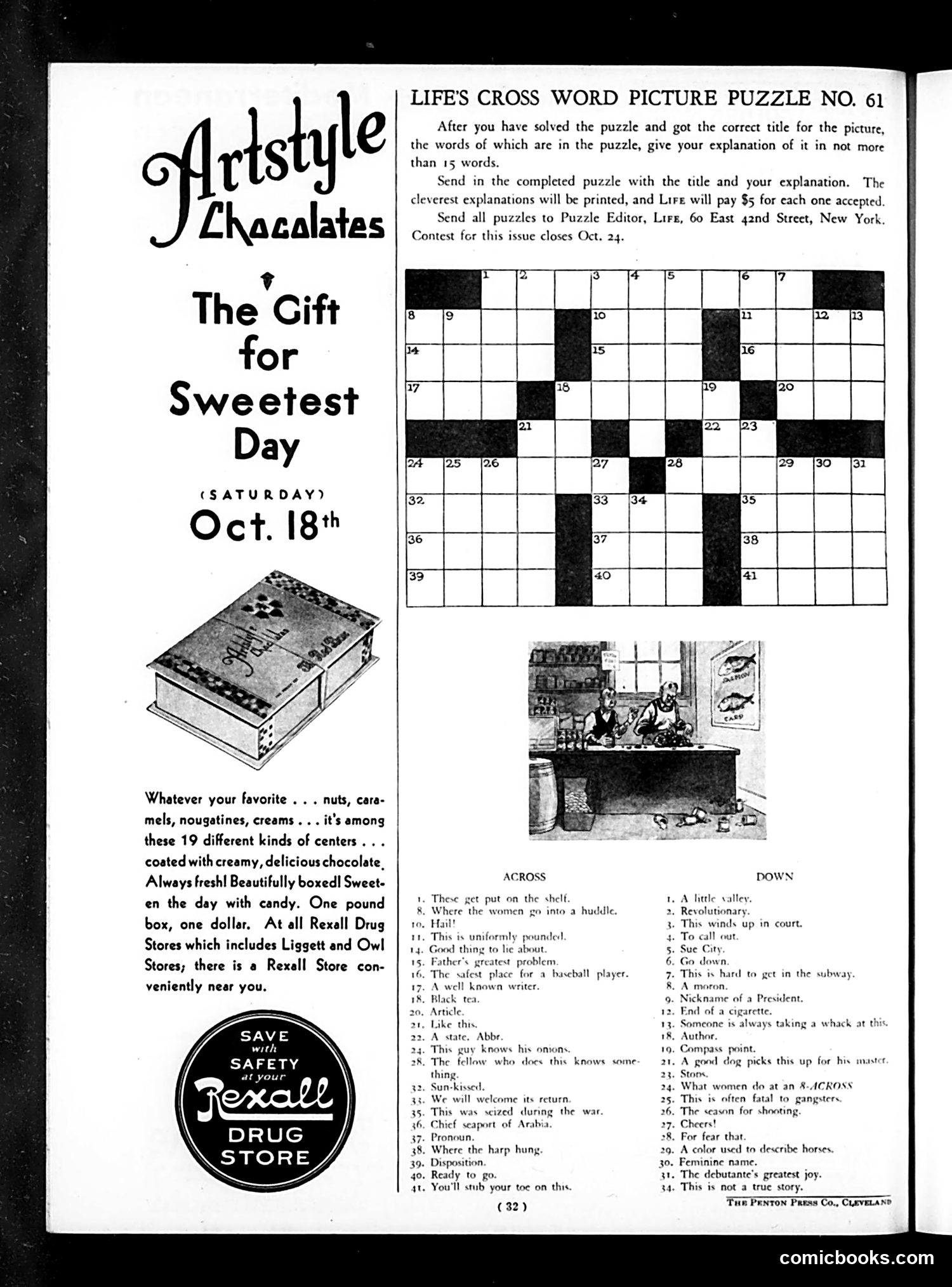
This page is primarily an advertisement for Artstyle Chocolates promoting "Sweetest Day" (October 18th), paired with a crossword puzzle contest. The puzzle itself is not satirical—it's a reader participation feature where solvers must identify the puzzle's title picture and submit clever 15-word explanations for a $5 prize. The ad emphasizes Artstyle's 19 chocolate varieties, positioning the one-pound box as an ideal gift for this obscure holiday. It directs readers to Rexall Drug Stores (including Liggett and Owl chains). The "Sweetest Day" promotion appears to be a commercial marketing effort rather than an established tradition at this time. The page contains no political satire or caricature—it's straightforward vintage advertising and entertainment content typical of Life magazine's commercial content sections.
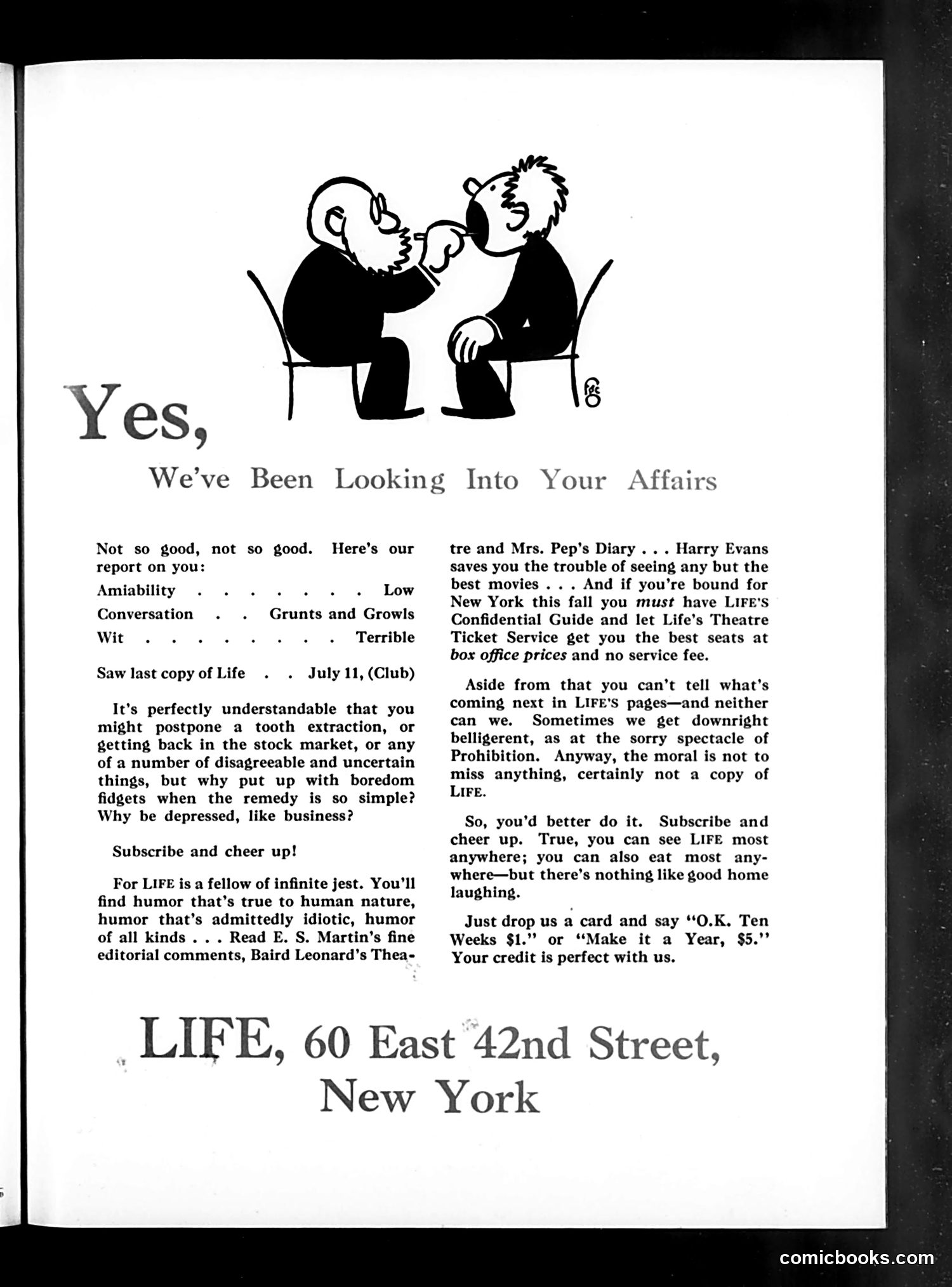
Analysis This is a subscription advertisement for *Life* magazine disguised as satirical commentary. The cartoon depicts two bearded men in conversation, likely representing the magazine's editors or personified "Life" itself confronting a potential subscriber. The "report" humorously critiques the reader's dull life—low amiability, poor conversation skills, terrible wit—then offers *Life* magazine as the cure for boredom and depression. The satire is self-aware: the magazine positions itself as antidote to life's tedium through humor, entertainment reviews (movies, theater), and unpredictable content. The ad references Prohibition (suggesting *Life's* editorial stance against it) and emphasizes that *Life* offers superior "home laughing" compared to experiencing entertainment elsewhere. Subscription options range from ten weeks ($1) to yearly ($5). The tone is characteristically early-20th-century American satirical humor—cheeky, irreverent, and self-promotional.
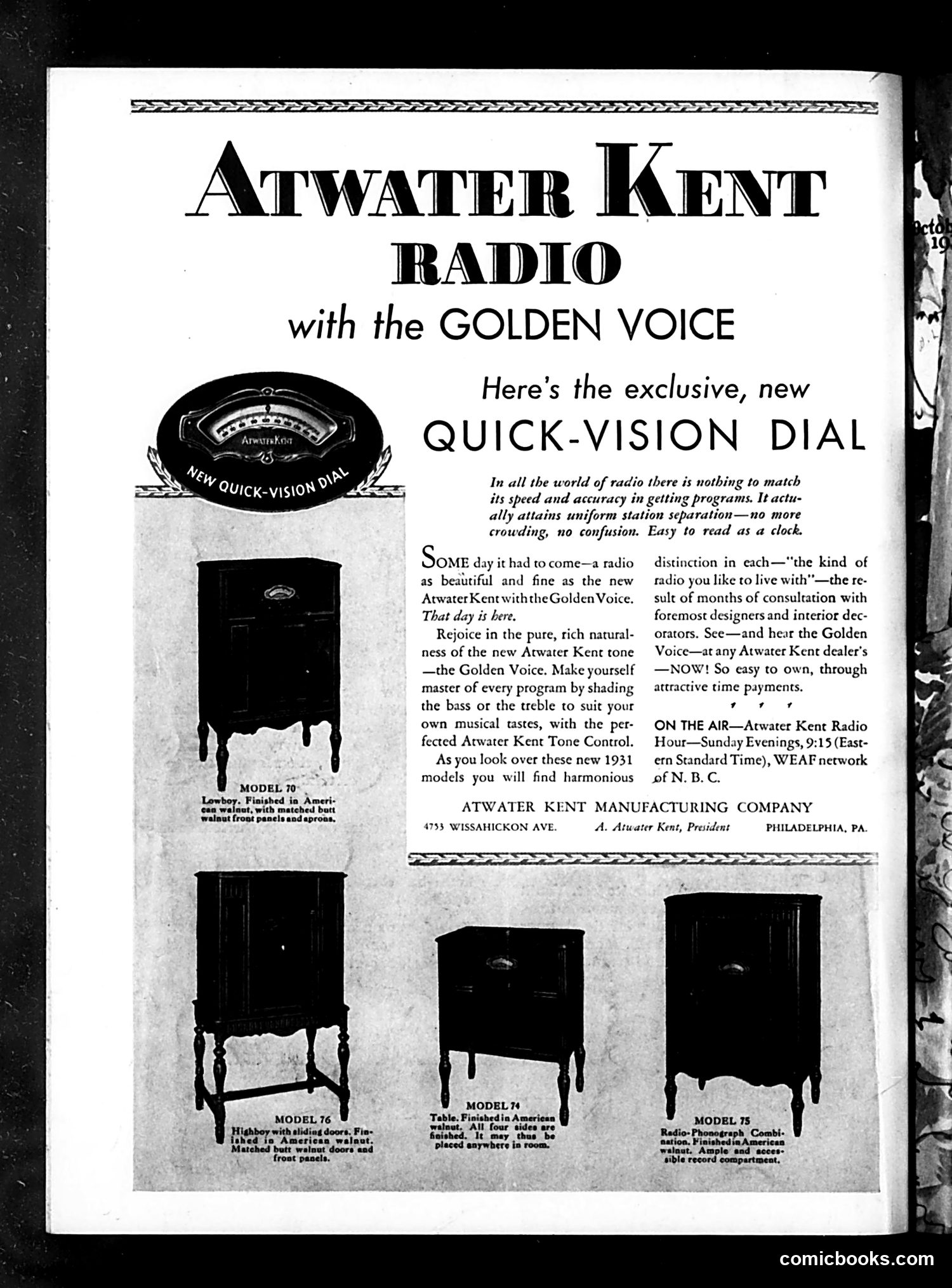
Atwater Kent Radio Advertisement (1931) This is purely advertising, not satire or political commentary. It promotes Atwater Kent radios, a major American manufacturer of the early 1930s. The "Golden Voice" is the brand's marketing slogan for superior sound quality. The key innovation advertised is the "Quick-Vision Dial"—a clock-like tuning mechanism claimed to eliminate station crowding and confusion, making radio selection faster and clearer. Three furniture-style radio models are displayed (70, 74, 75), emphasizing that radios were expensive cabinet pieces designed to match home décor. The ad highlights features like tone control, American walnut finishes, and "attractive time payments" (installment plans). The reference to the "Atwater Kent Radio Hour" on NBC's WEAF network confirms this was a major sponsor of national programming. This represents radio's golden age, when broadcast receivers were luxury items marketed as fine furniture for the home.