life
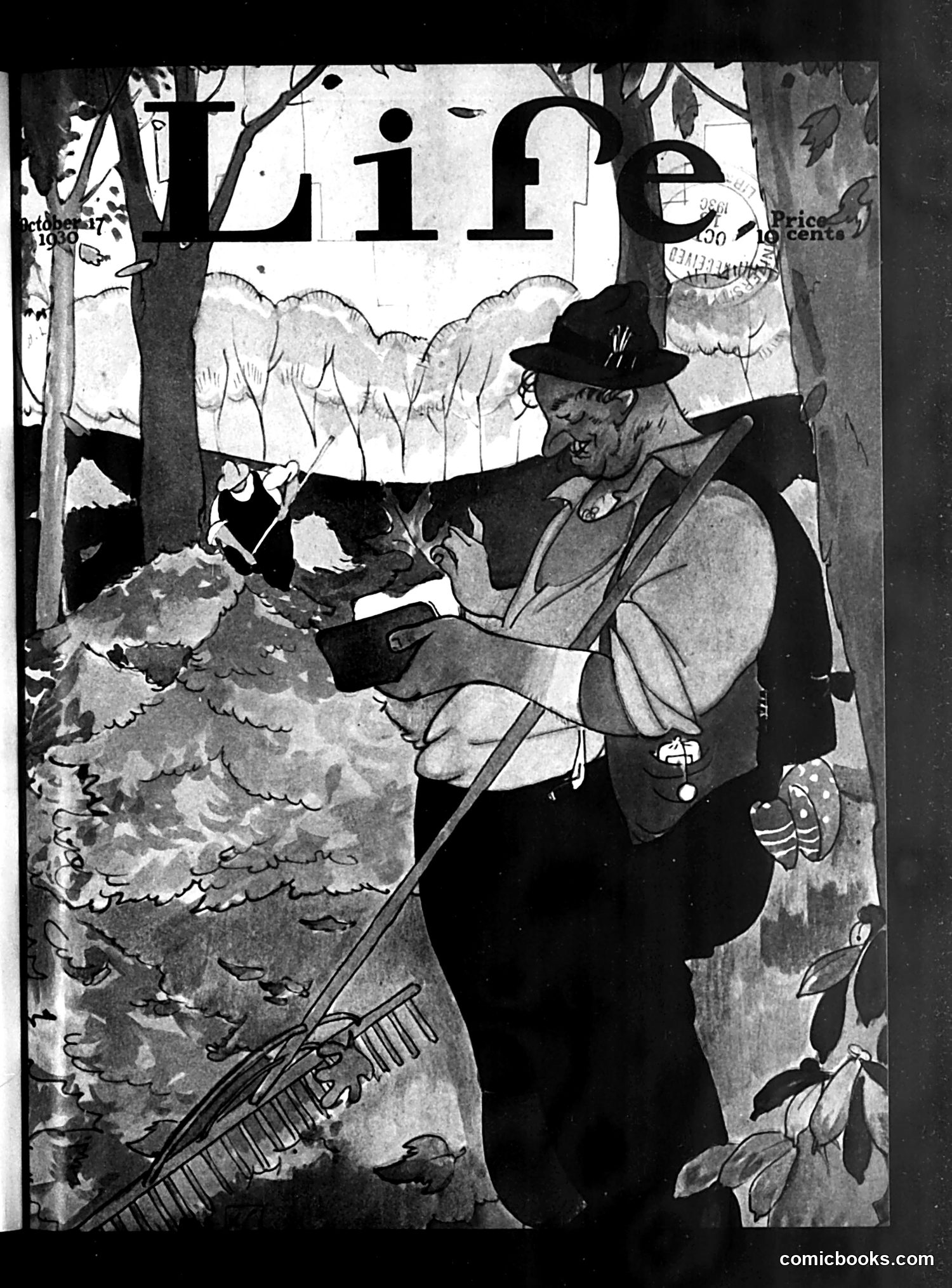
Life — October 17, 1930
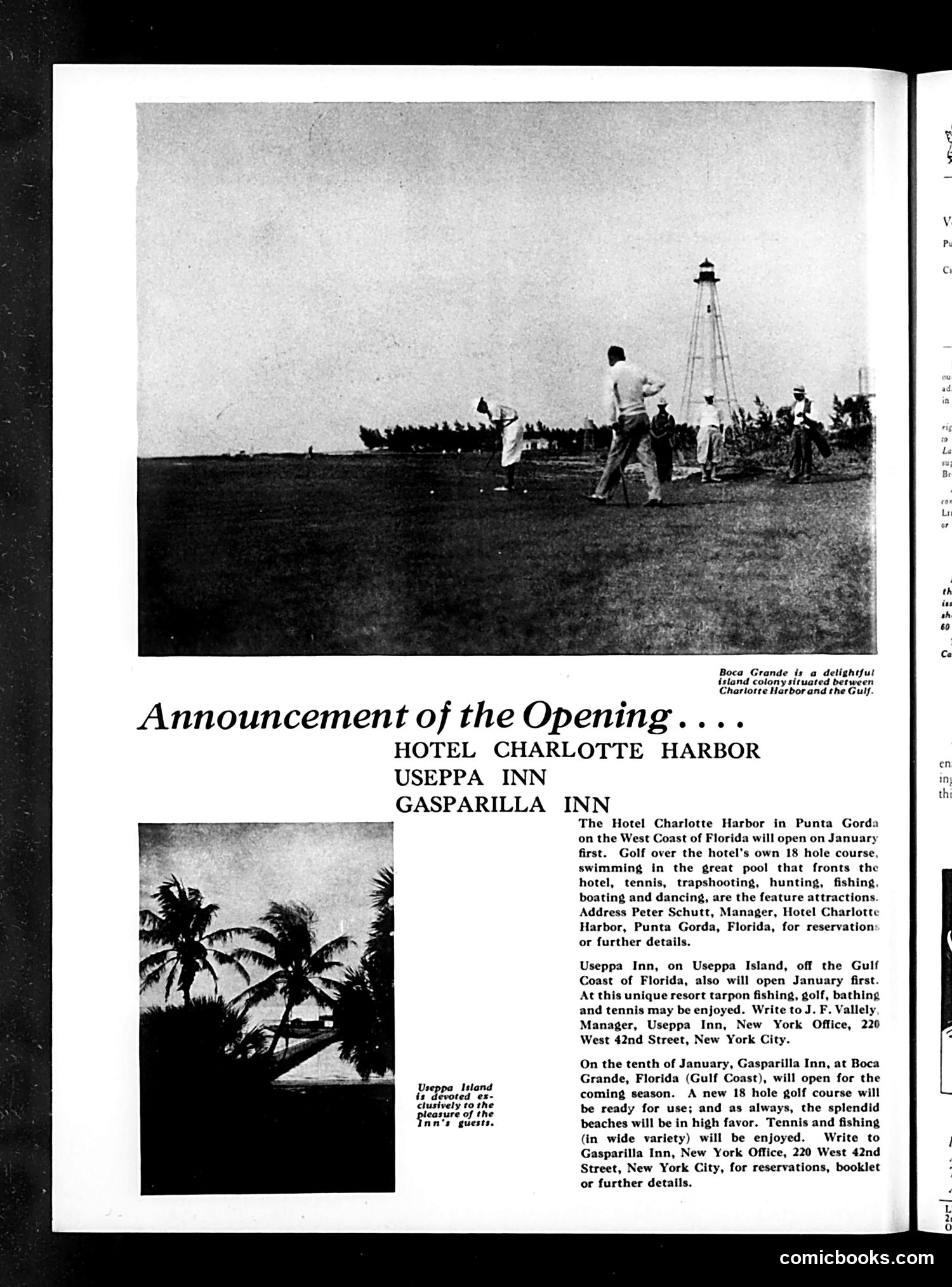
Analysis This page is primarily advertising, not political satire or editorial content. It announces the opening of three Florida resort hotels/inns scheduled to open in January: 1. Hotel Charlotte Harbor in Punta Gorda 2. Useppa Inn on Useppa Island (Gulf Coast) 3. Gasparilla Inn in Boca Grande Each resort promotes leisure amenities: golf courses, swimming, tennis, fishing, hunting, and boating. The top photograph shows what appears to be an early aviation or sporting event in a Florida landscape. The lower image depicts palm trees on Useppa Island. This reflects the 1920s Florida real-estate and tourism boom, when wealthy Americans invested heavily in developing coastal Florida as a winter destination. The advertisements target affluent readers seeking upscale vacation experiences.
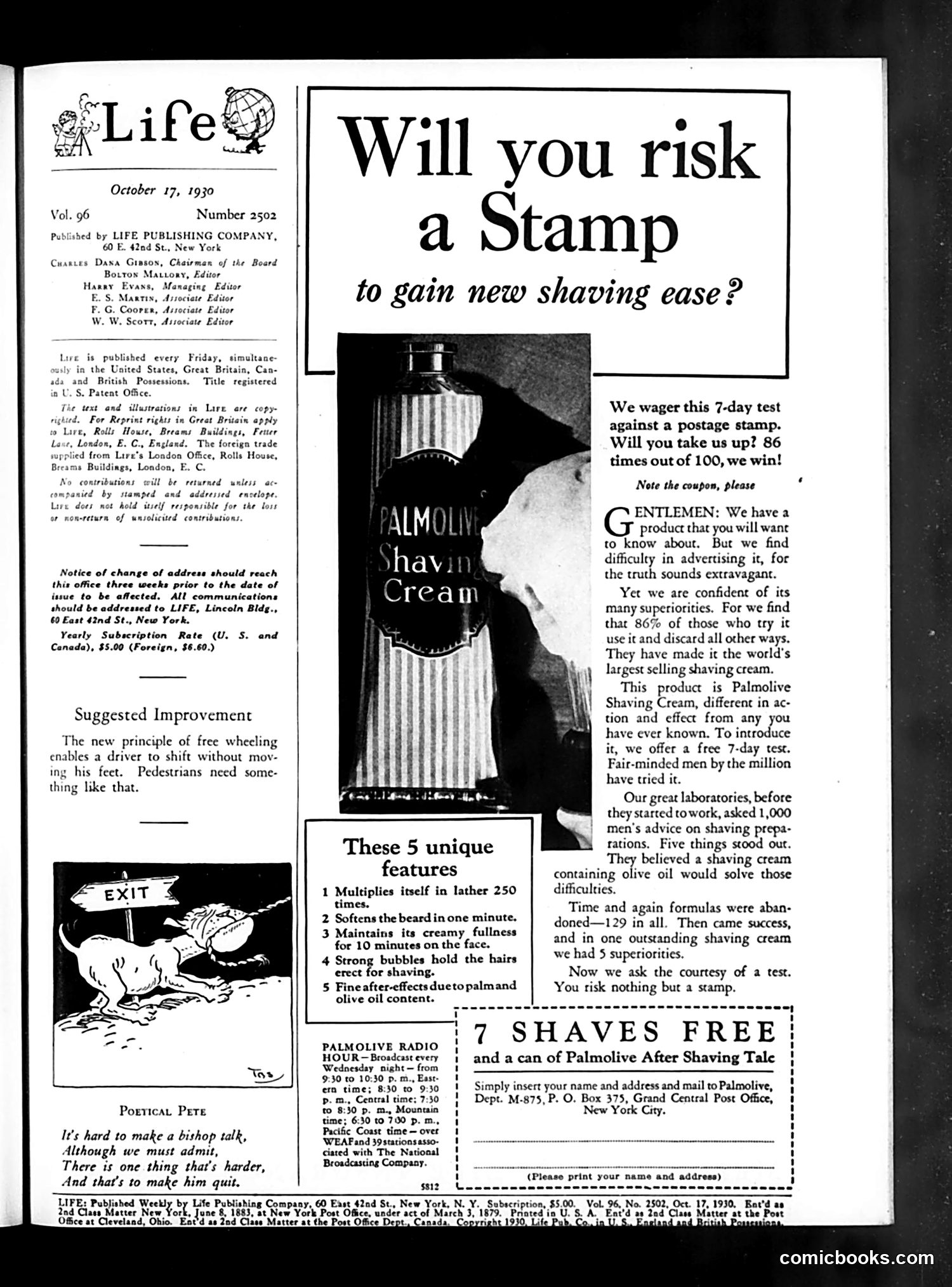
Analysis of Life Magazine Page, October 17, 1939 This page is primarily advertising content for Palmolive Shaving Cream, not satirical material. The main feature is a large product advertisement offering "7 shaves free" as a promotional giveaway. The only cartoon element is "Poetical Pete" (lower left)—a small, unrelated joke about bishops that has no political significance. It reads: "It's hard to make a bishop talk, / Although we must admit, / There is one thing that's harder, / And that's to make him quit." The page also includes a brief section titled "Suggested Improvement" about free-wheeling automobiles, but this is minor editorial content, not satire. The issue date (October 1939) places this during WWII's early stages, though nothing on this specific page reflects contemporary events.
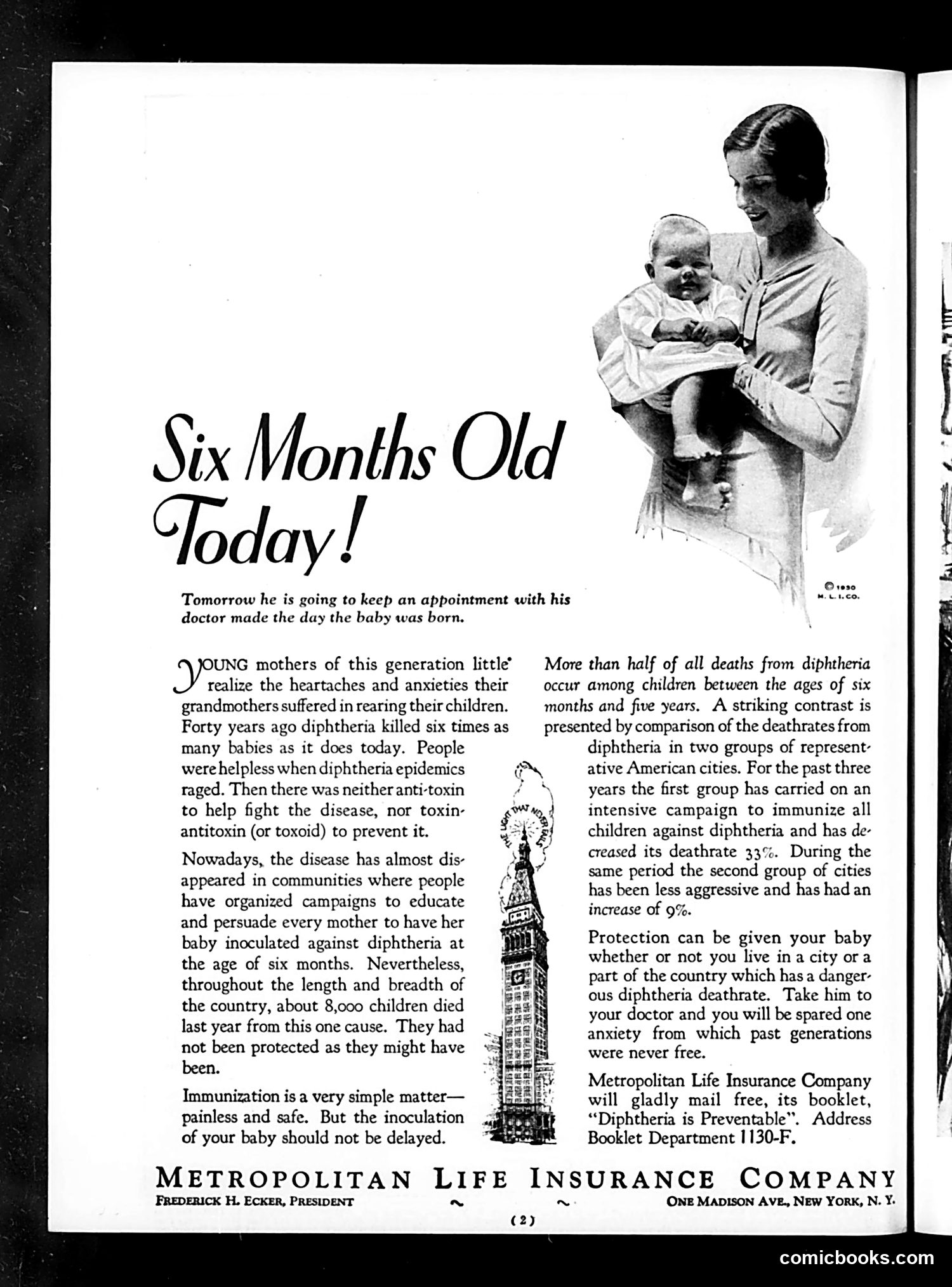
Analysis This is a public health advertisement, not satire or political cartoon. Metropolitan Life Insurance Company is promoting diphtheria immunization for infants. The image shows a mother holding a six-month-old baby. The text emphasizes that diphtheria was historically a major child killer—"forty years ago" it killed six times as many babies as it does currently. The advertisement credits organized public health campaigns with this success, noting that cities conducting aggressive immunization programs reduced diphtheria deaths by 13.5%, while less active cities saw only a 9% decrease. The ad urges mothers to take their babies to doctors for immunization at six months, framing it as a simple, safe procedure. It's essentially corporate-sponsored public health messaging encouraging vaccination—a striking contrast to modern vaccine hesitancy debates.
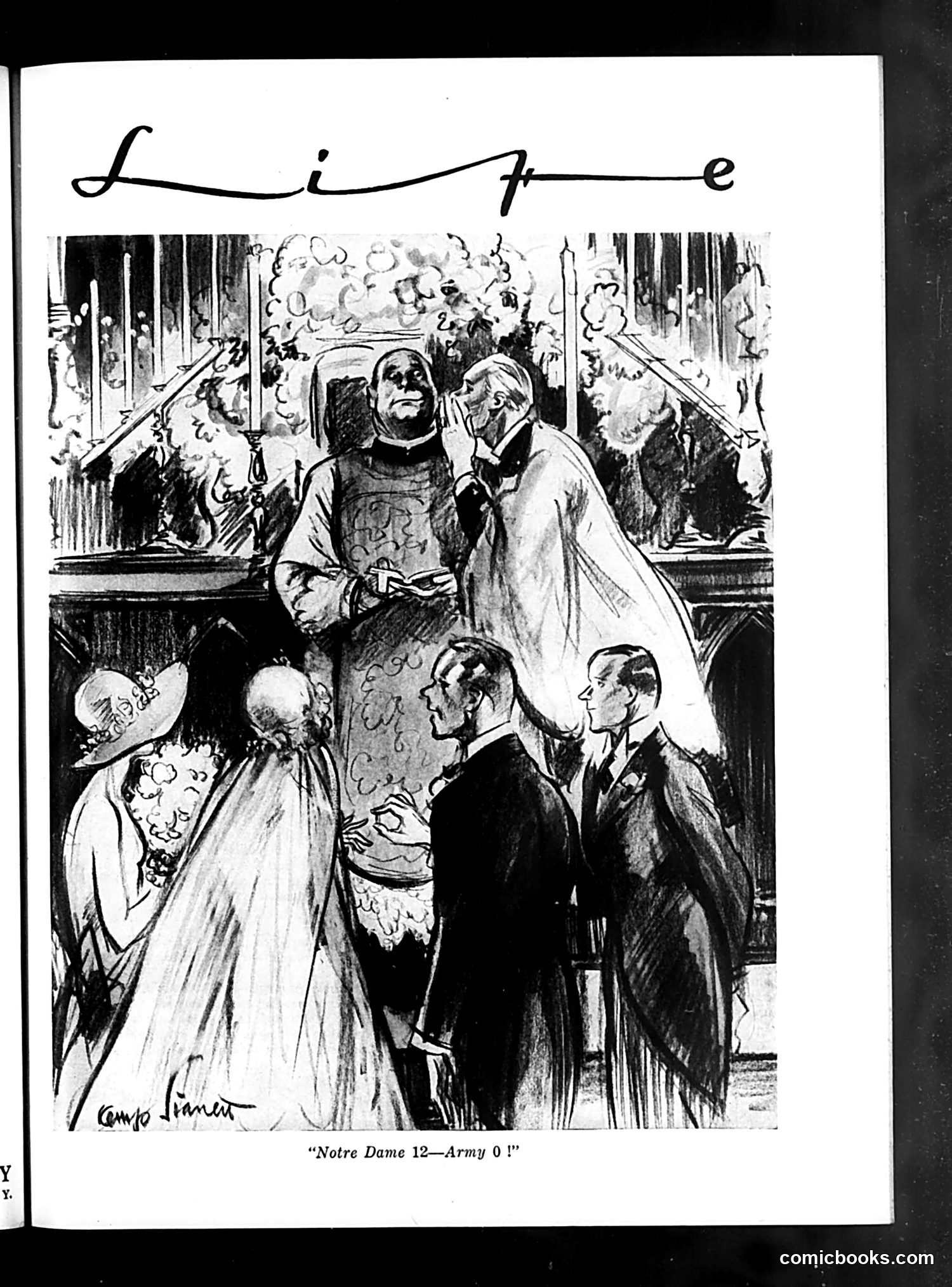
"Notre Dame 12—Army 0 1" This is a satirical cartoon about a college football game between Notre Dame and the Army. The caption score indicates Notre Dame defeated Army 12-0. The cartoon depicts what appears to be a religious or formal ceremony, with a figure in religious vestments (likely a priest or bishop) at the center, surrounded by well-dressed spectators and attendants. The artist seems to be satirizing the intensity and almost religious fervor surrounding college football, particularly this specific rivalry game. By framing the football victory as a quasi-religious spectacle complete with ceremonial figures and reverent crowds, the cartoonist mocks how Americans—and perhaps Catholics specifically, given Notre Dame's Catholic heritage—treated college football with quasi-spiritual devotion. The joke critiques the excessive cultural importance placed on athletics.
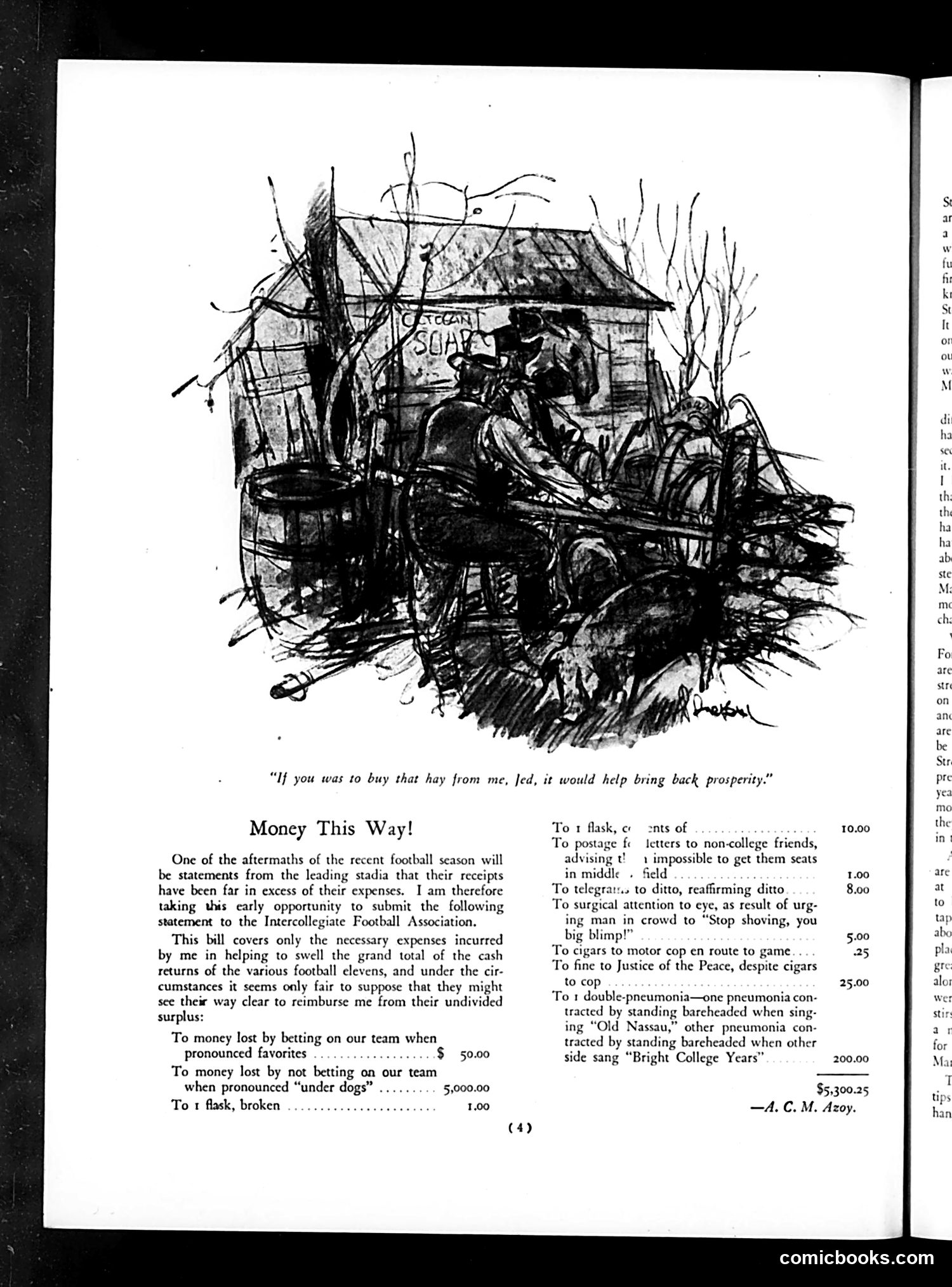
Analysis The cartoon depicts a beggar or street vendor hawking goods outside what appears to be a small shop or stall marked "SOAP." The accompanying article, "Money This Way!", satirizes university football stadiums seeking financial reimbursement from the Intercollegiate Football Association after the recent season. The cartoon illustrates the satire's central point: just as the beggar must hustle goods to survive, struggling stadiums are forced into undignified financial appeals. The list itemizes absurd "expenses" stadiums claim to justify reimbursement—from money lost through betting to double-pneumonia contracted by singers performing at games—mocking the transparently inflated justifications universities provide. The satire suggests universities are desperate and willing to claim any expense, no matter how ridiculous or tenuous, to recover losses from their football operations.
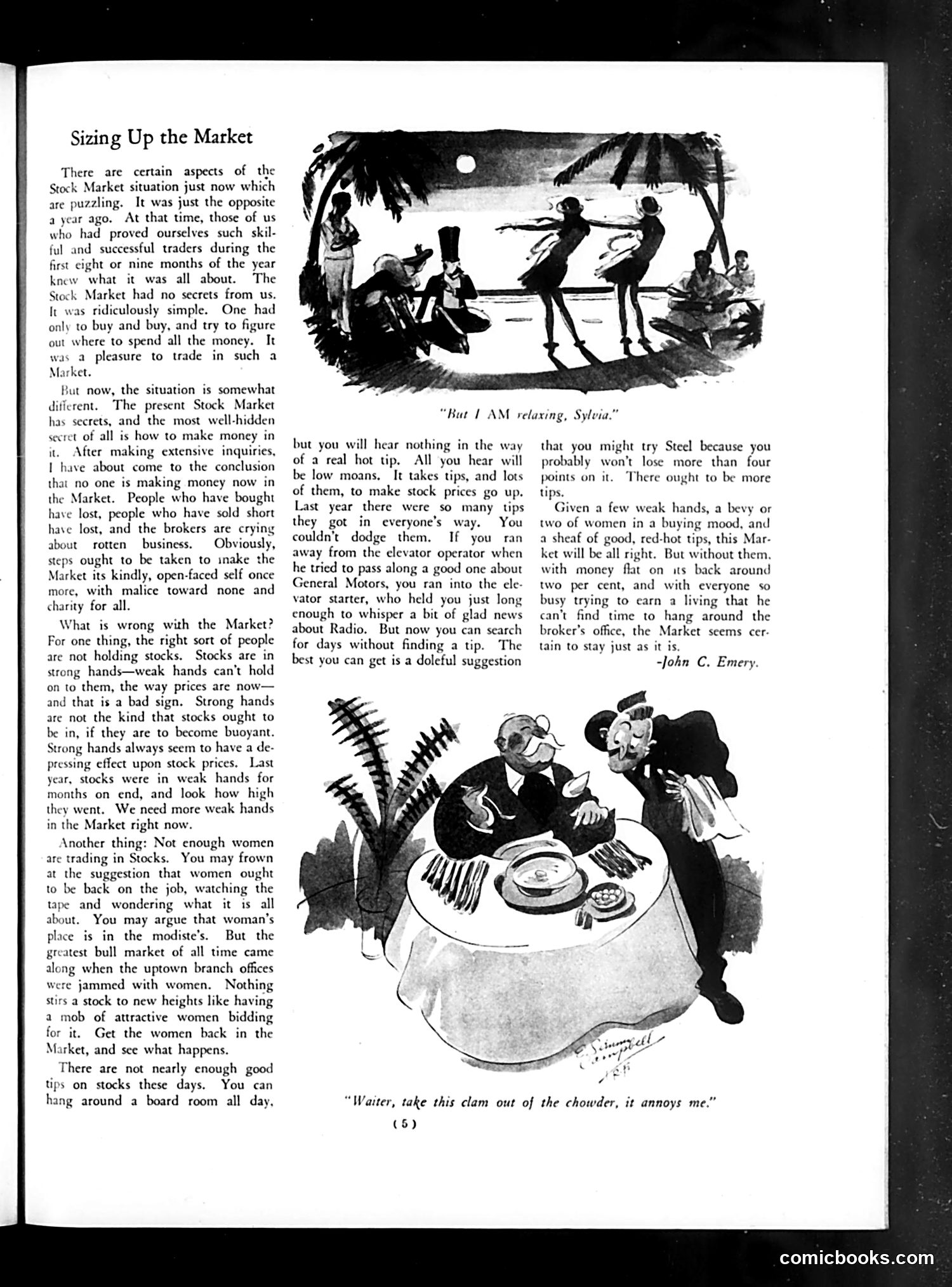
Analysis of "Sizing Up the Market" This page critiques 1920s stock market culture. The article argues the market lacks "secrets" and has become accessible to average people—which the author presents as problematic. He complains about excessive "tips" circulating everywhere and notes that weak financial hands are now dominant, which he views as unhealthy for prices. Most notably, the author argues women shouldn't be trading stocks. He claims women's participation represents a "bull market" peak and suggests removing them would improve conditions. This reflects period sexism—viewing female investors as frivolous speculators rather than serious participants. The lower cartoon mocks pretentious dining, with a waiter's deadpan complaint about clamshells—satirizing upper-class affectation, likely among the same nouveau-riche stock speculators discussed above.
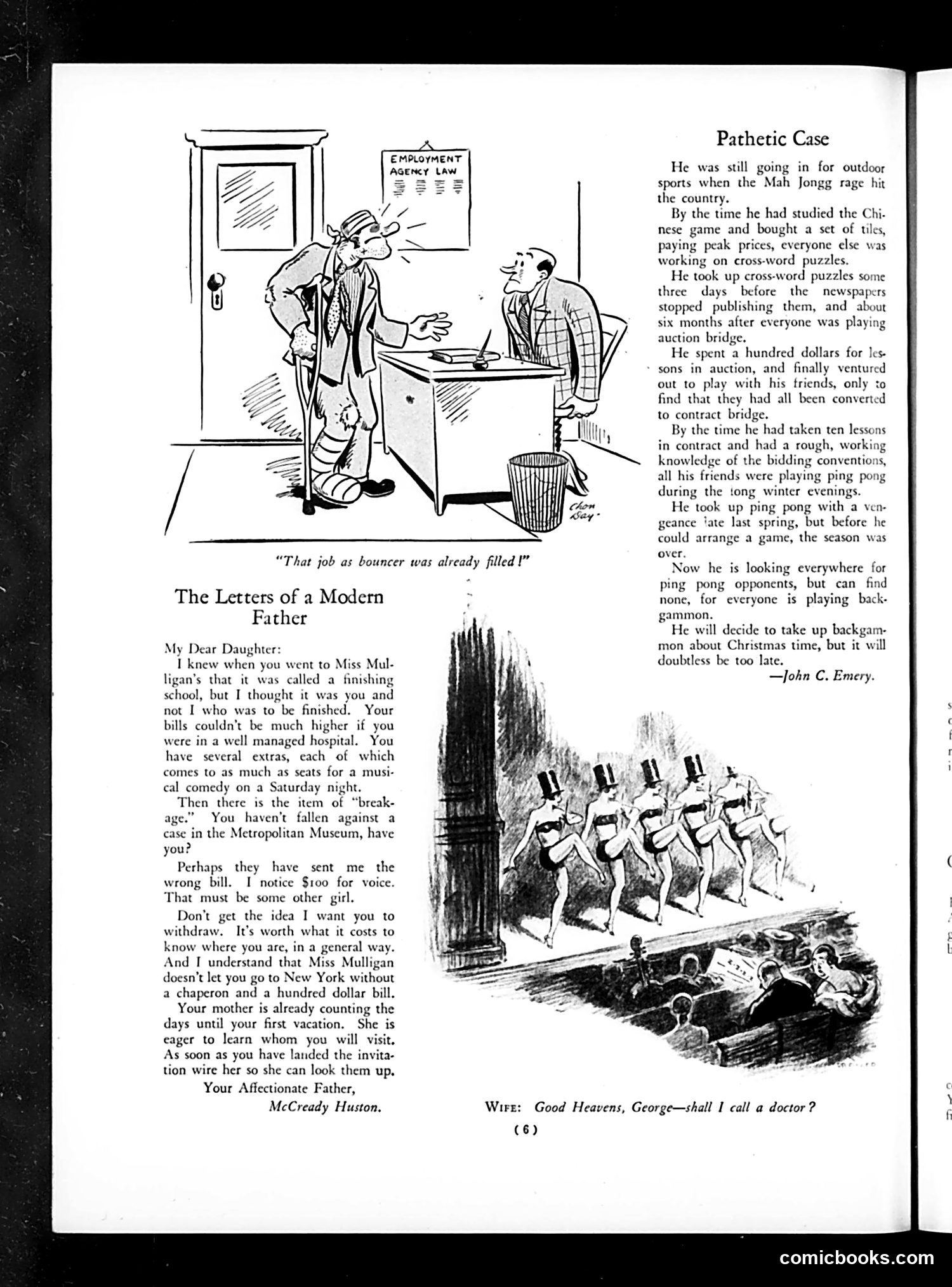
Page Analysis: Life Magazine This page contains two distinct pieces of humor: "That job as bouncer was already filled!" (top cartoon): An employment agency worker turns away a desperate job-seeker, suggesting the labor market was tight during this period (likely 1920s-30s). "The Letters of a Modern Father" (main text): A father writes to his daughter at finishing school, complaining about unexpected bills—tuition, museum damage claims, a $500 voice lesson bill, and a Metropolitan Museum "breakage" charge. The humor satirizes the expensive costs of educating wealthy daughters and the frivolous expenses (musical comedy tickets, etc.) that accumulate. The right-side story "Pathetic Case" mocks fickle leisure trends among the wealthy, following fads like mahjong and contract bridge before abandoning them. The overall theme: satirizing upper-class spending habits and the financial burdens of maintaining social status.
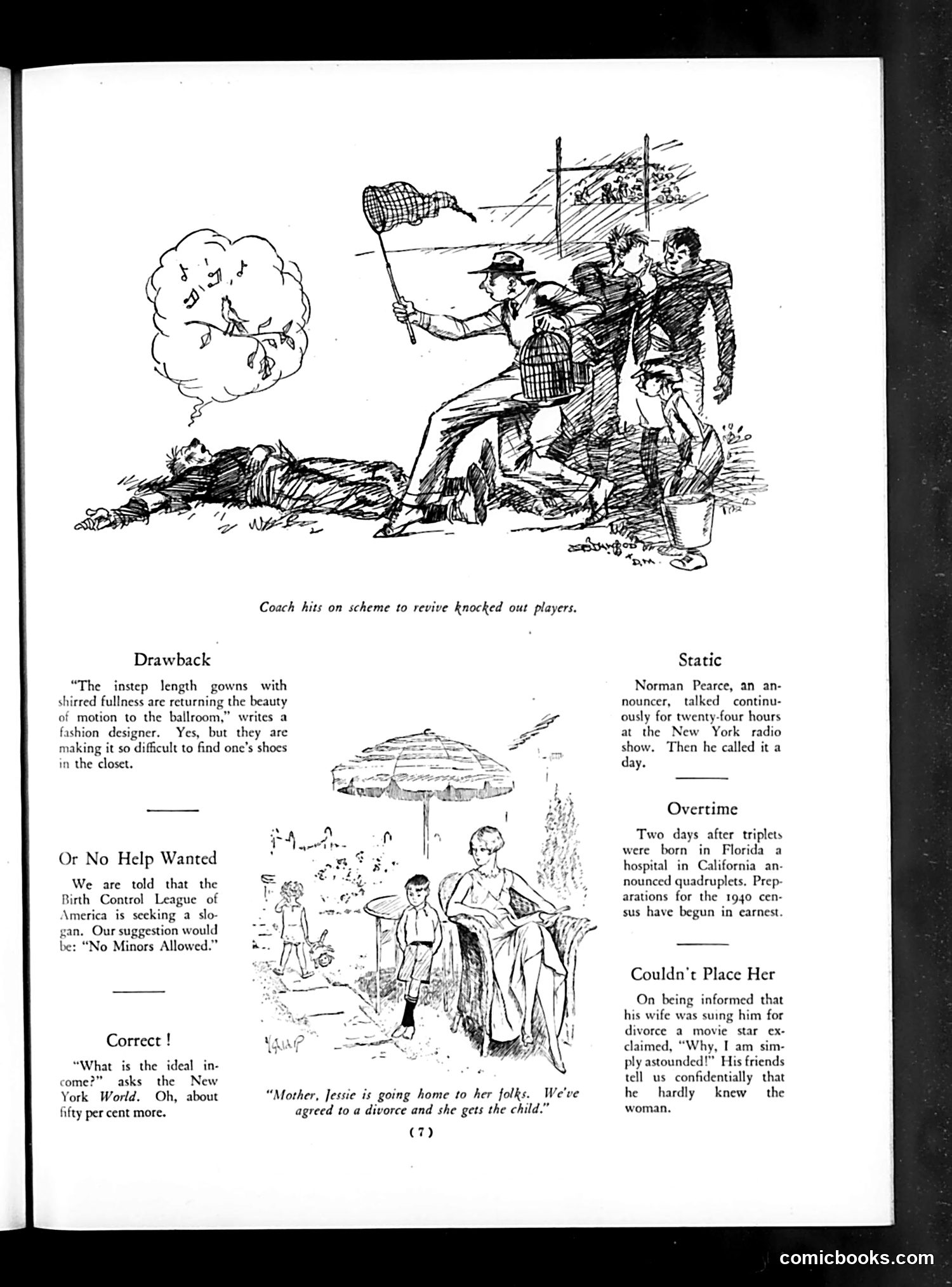
Analysis of Life Magazine Page The top cartoon satirizes a sports coach devising a scheme to revive knocked-out players—likely mocking overly elaborate or dubious athletic training methods of the era. Below are four brief humor items: "Drawback" mocks fashion designers praising long skirts' "beauty of motion" while acknowledging women can't easily find shoes to match them—a commentary on impractical fashion. "Or No Help Wanted" jokes about the Birth Control League's suggested slogan "No Minors Allowed"—wordplay on controlling reproduction versus excluding young people. "Correct!" presents a New York *World* question about ideal income, with the humorous answer being "fifty percent more." "Static" and other items are brief anecdotes about radio personalities and miscellaneous domestic situations. The page reflects 1930s-era social satire on fashion, politics, and daily life.
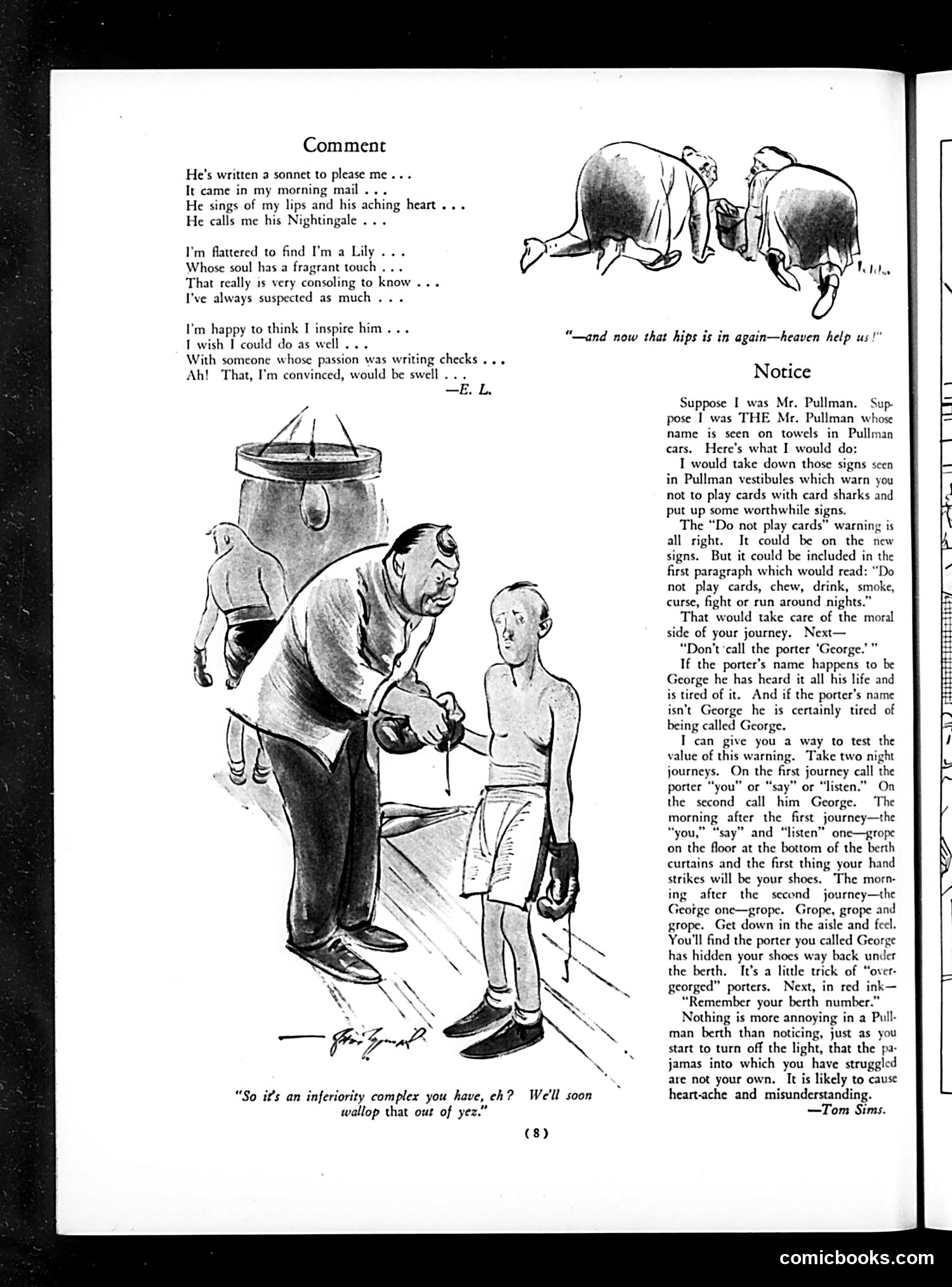
Analysis This page contains satirical commentary about train travel, specifically Pullman sleeping cars. The cartoon depicts a conductor confronting a passenger about an "inferiority complex," suggesting the passenger is uncomfortable with accommodations. The "Notice" section offers tongue-in-cheek advice for Pullman car passengers, mocking common annoyances of rail travel: porters' names (particularly "George," apparently a generic term), card-playing warnings, and the frustration of finding hidden luggage under berths. The satire targets both passenger complaints and railroad company pretensions. The "Comment" poem above reflects on romantic correspondence, seemingly unrelated to the main content. The overall humor derives from exposing the gap between the luxury Pullman cars promised and the cramped, annoying reality passengers experienced—poking fun at both travelers' expectations and the railroad industry's marketing.
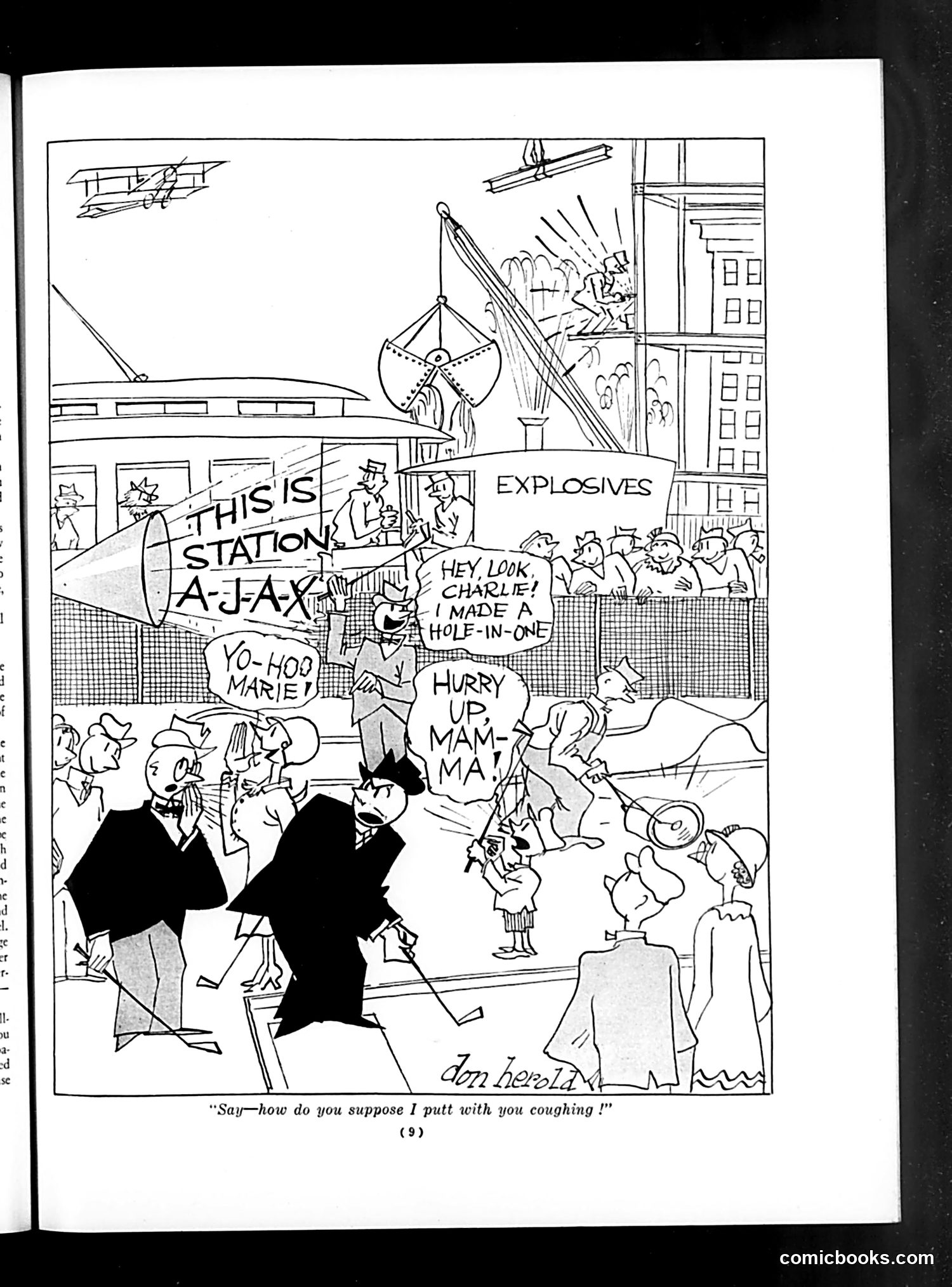
Cartoon Analysis This cartoon depicts the dedication of "Station A-JAX," an aircraft presumably designed for bombing ("Explosives" is marked on its fuselage). The scene shows what appears to be a public ceremony with dignitaries and crowds. The humor centers on a man in the foreground (drawn in solid black, suggesting prominence) who is coughing. Onlookers react with phrases like "Hey look, Charlie! Made a hole-in-one!" and "Hurry up, Mam-ma!" — treating his cough as if it caused the visible destruction in the background. The caption reads: "Say—how do you suppose I put with you coughing!" This satirizes military aviation, suggesting that a simple cough from an important person at a dedication ceremony caused more damage than the expensive new aircraft was meant to inflict. It's social/political satire mocking either the aircraft's ineffectiveness or the absurdity of military procurement.
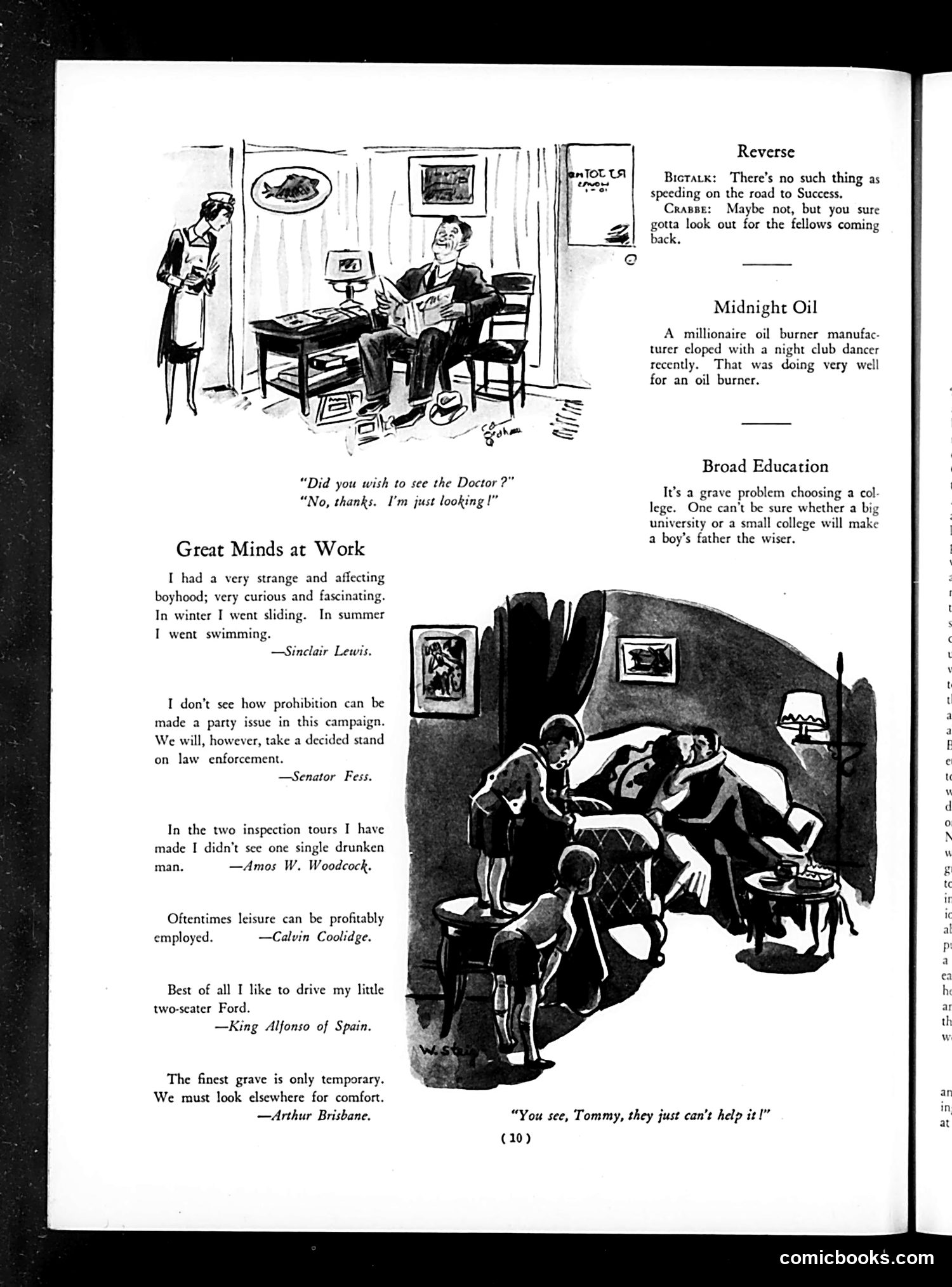
Analysis of Life Magazine Page This page contains several satirical short quotes and two cartoons mocking American social issues. Top cartoon: A woman asks a man at his desk "Did you wish to see the Doctor?" He replies "No, thank. I'm just looking!" — satirizing people who avoid medical care or procrastinate about health issues. Bottom cartoon: Titled "You see, Tommy, they just can't help it!" — depicts adults lounging and drinking in a living room while a child watches. This appears to satirize parental hypocrisy regarding alcohol during Prohibition: adults ignore or flout alcohol laws while lecturing children about behavior. The accompanying quotes from politicians and celebrities debate Prohibition's effectiveness. The overall page mocks the era's contradictions between law, enforcement, and actual behavior — a central theme in 1920s American satire.
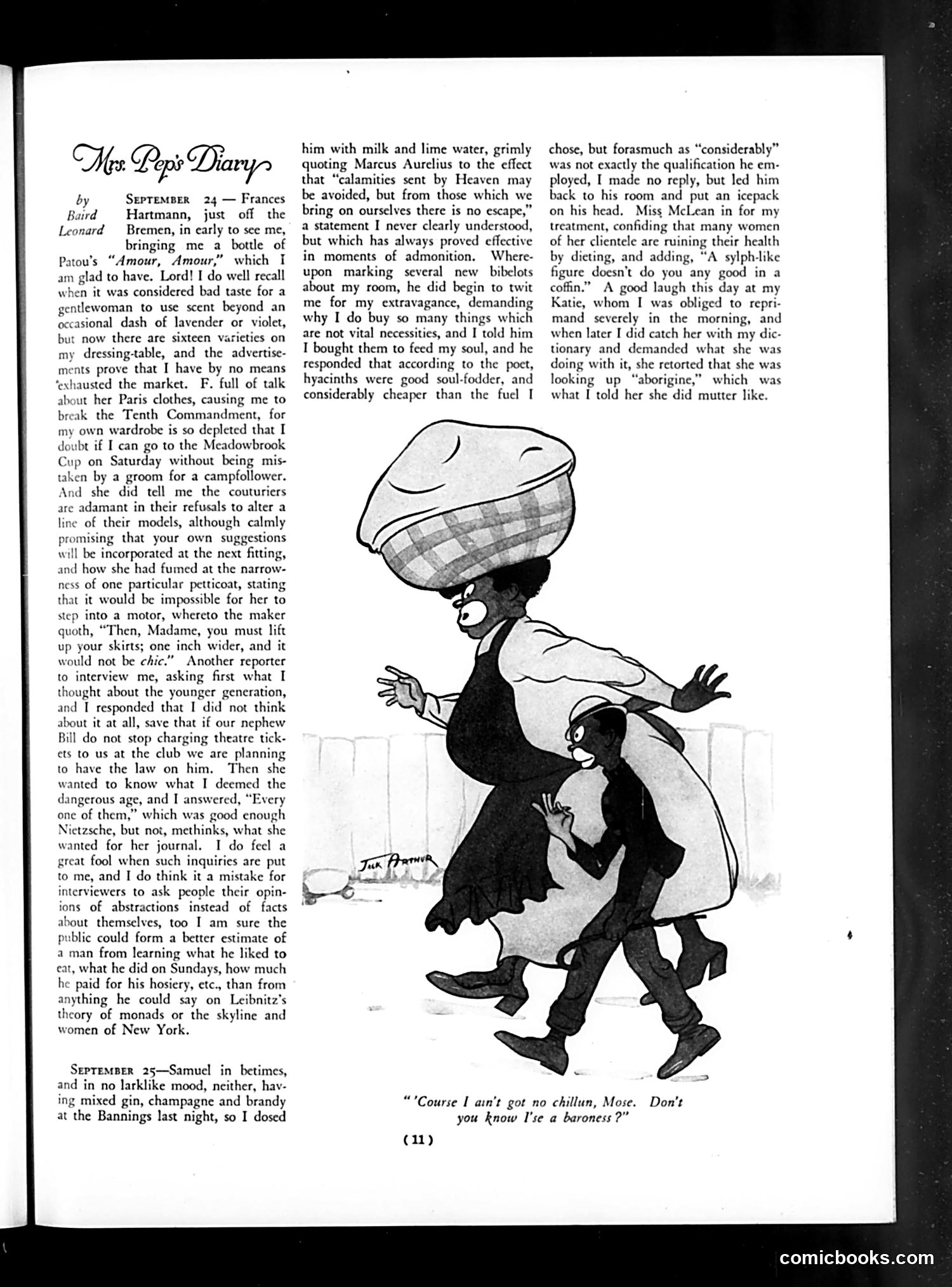
Analysis: "Mrs Pep's Diary" Page This is a diary entry page from *Life* magazine featuring social commentary on 1920s upper-class life. The text discusses fashion (couturier refusals to alter designs, petticoats), social events (the Meadowbrook Cup), and interviews about generational attitudes. The cartoon depicts two figures in exaggerated clothing—one wearing an oversized checkered hat—engaged in energetic movement. The caption reads: "Course I ain't got no chillion, Mose. Don't you know I'e a baroness?" This satirizes the social pretensions of wealthy Americans, likely mocking women who adopted aristocratic titles or foreign affectations to elevate their social standing. The cartoonish style and dialect emphasize the absurdity of such status-seeking behavior among the Jazz Age elite. The overall page ridicules upper-class vanity and social climbing.
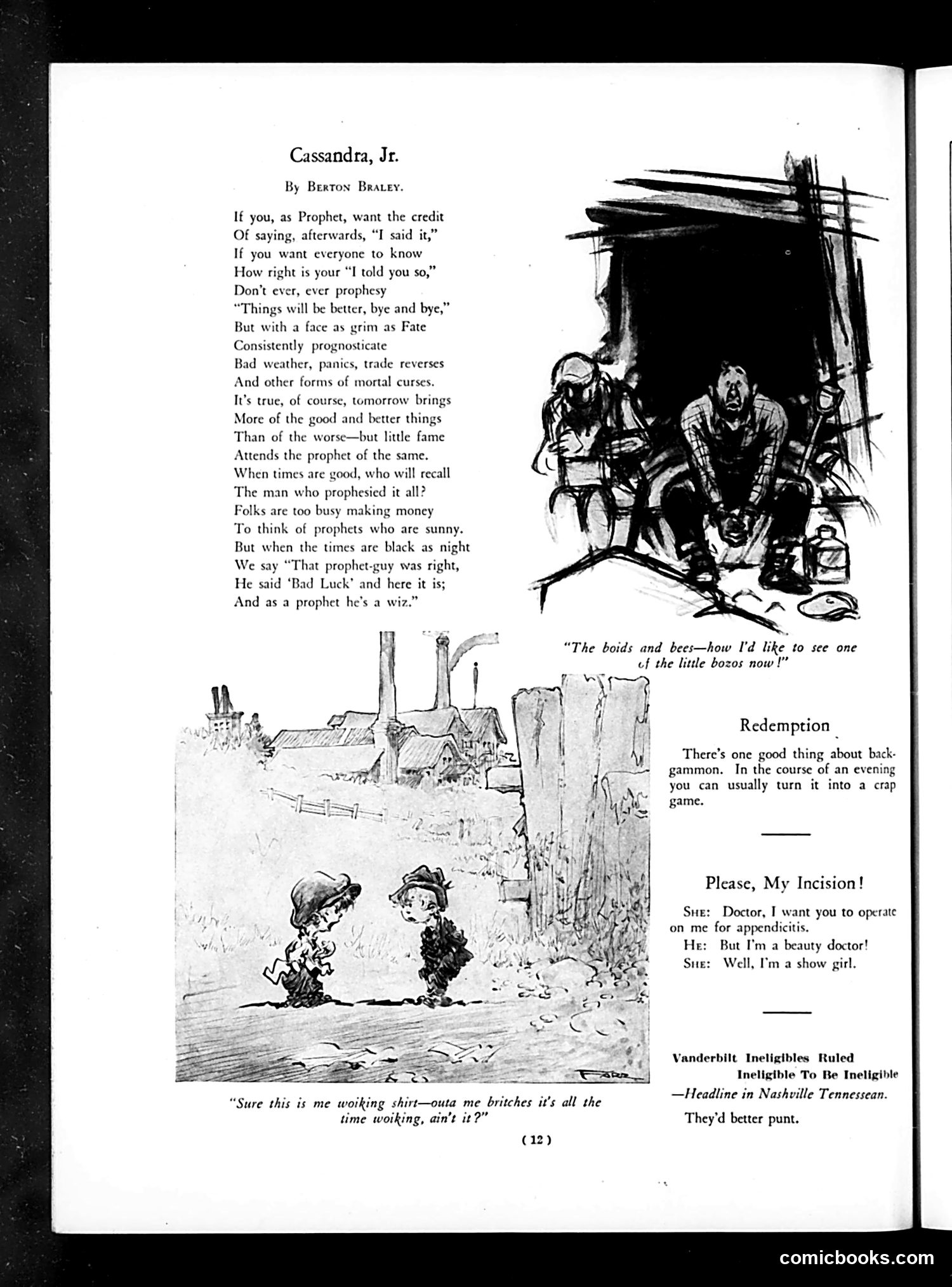
Analysis of Life Magazine Page This page contains a poem "Cassandra, Jr." by Berton Braley satirizing false prophets and pessimists. The poem mocks those who gain credit by repeatedly predicting doom ("bad weather, panics, trade reverses"), noting people remember them only during dark times. When conditions improve, their warnings fade from memory. The two cartoons below illustrate everyday life. One shows industrial factory work, with a character complaining about constant labor. The second features a domestic humor exchange between a doctor and show girl about appendix surgery. The page concludes with brief humor items, including a mock newspaper headline and doctor-patient joke. This reflects Life magazine's typical mix of social satire, illustration, and light comedy aimed at educated readers.
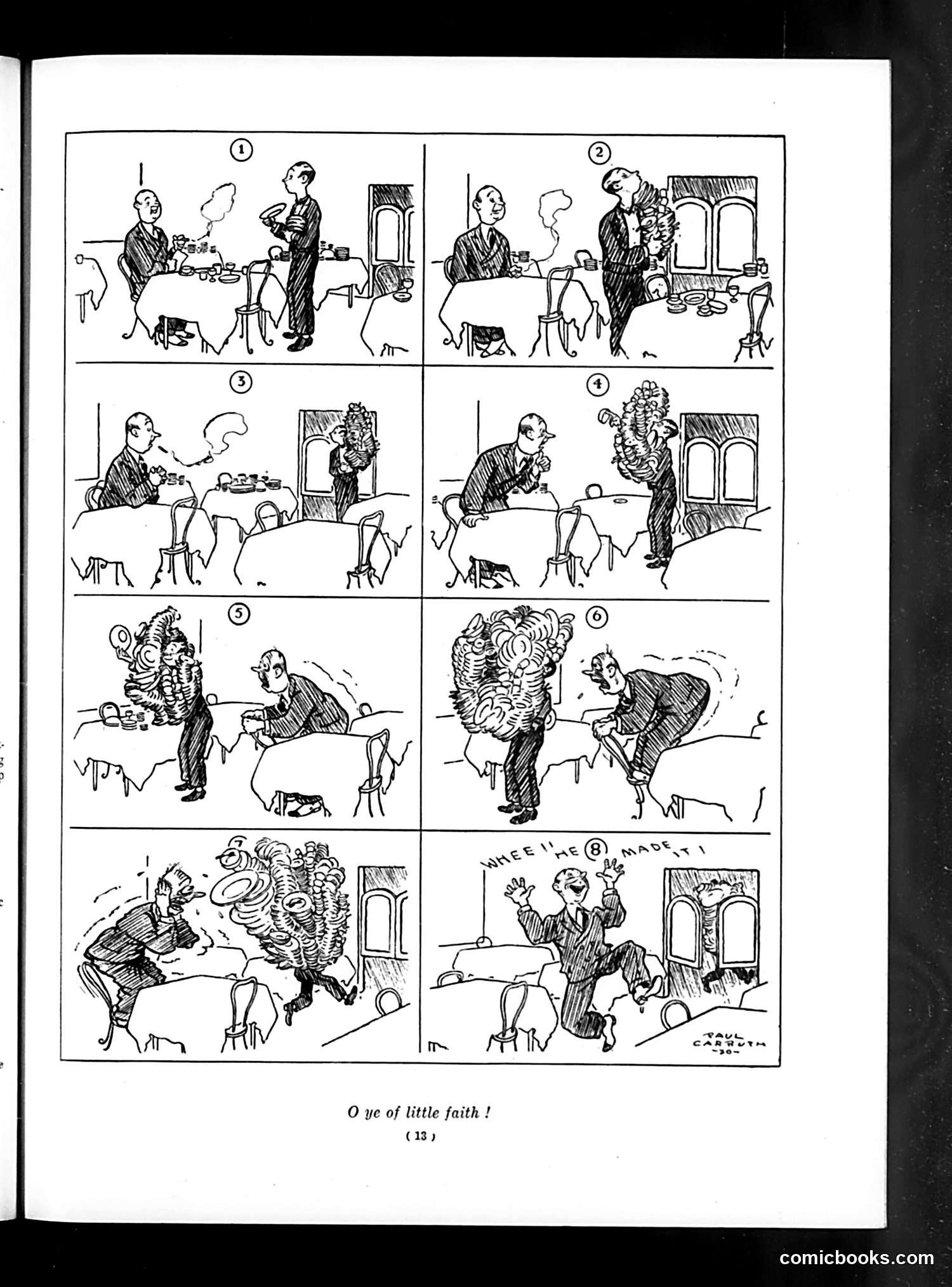
"O ye of little faith!" - A Satirical Comic Strip This eight-panel comic depicts a dining scene where a well-dressed man repeatedly encounters what appears to be an increasingly elaborate woman's elaborate hairstyle or hat at his dinner table. The title "O ye of little faith!" suggests irony about belief or trust. The progression shows the man's growing dismay as the woman's headpiece becomes progressively more ornate and outlandish, ultimately blocking his view entirely and disrupting the meal. In panel 8, he appears exasperated, with text reading "WHERE'S HE MADE IT!" The satire likely mocks fashionable women's hairstyles or hats of the era, which were notoriously large and impractical—here taken to absurd extremes. The comic ridicules both the fashion trend itself and women's perceived vanity in wearing such impractical adornments in public spaces like restaurants.
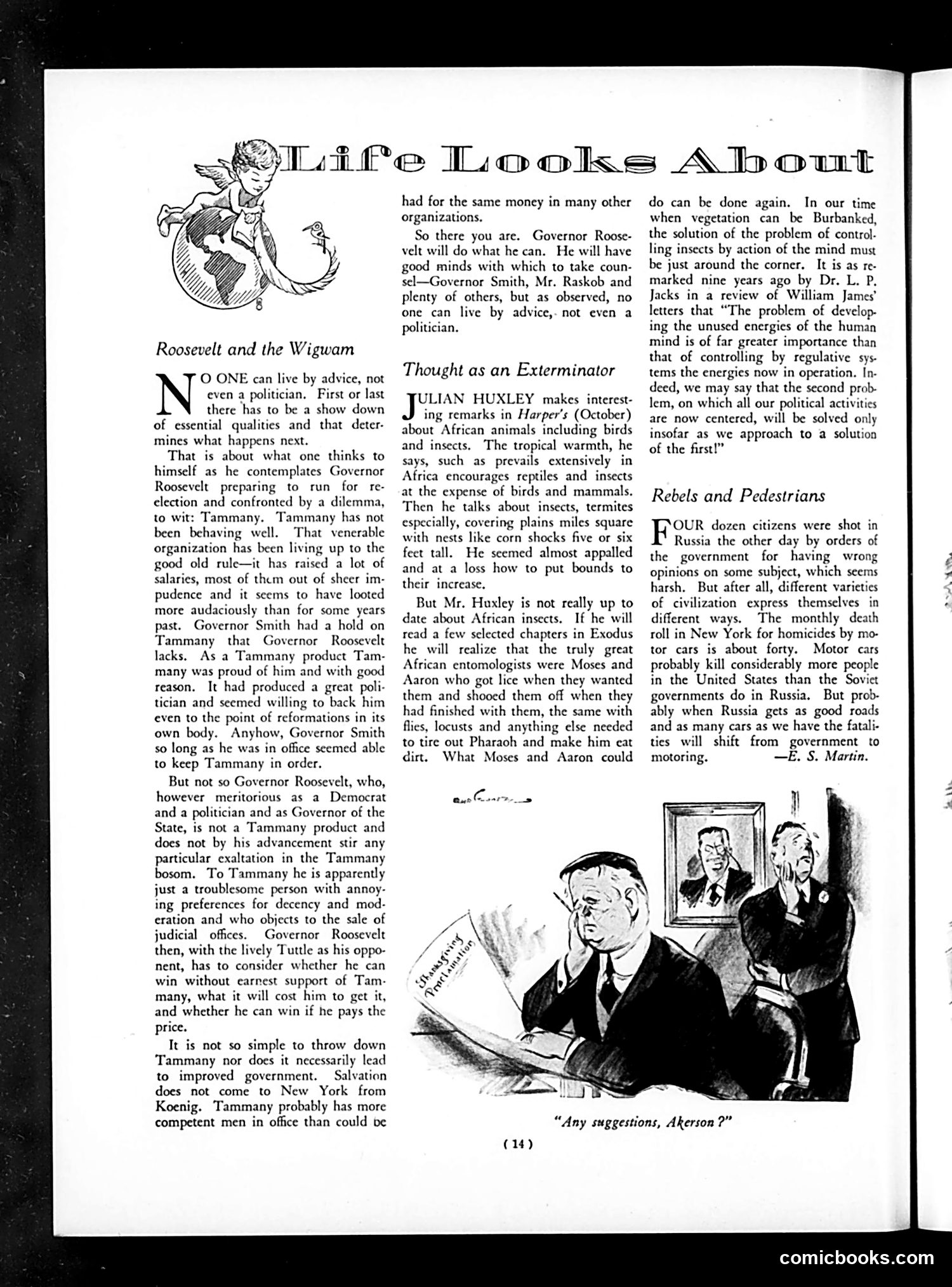
Political Cartoon Analysis This page from *Life* magazine contains two satirical pieces: "Roosevelt and the Wigwam" discusses Governor Roosevelt's political positioning, comparing him to "Tammany"—the notorious Democratic political machine. The text suggests Roosevelt is caught between supporting Tammany (depicted as troublesome) and winning without their backing, questioning whether he can succeed independently. "Rebels and Pedestrians" discusses Russian government shootings of citizens and compares Soviet motor vehicle fatalities unfavorably to American ones, making a dark joke about governmental efficiency. The cartoon at bottom shows a figure labeled "Akercon" being asked for suggestions, likely depicting political pressure or advice-seeking during a contentious moment. The specific identity of "Akercon" is unclear from the visible text alone.
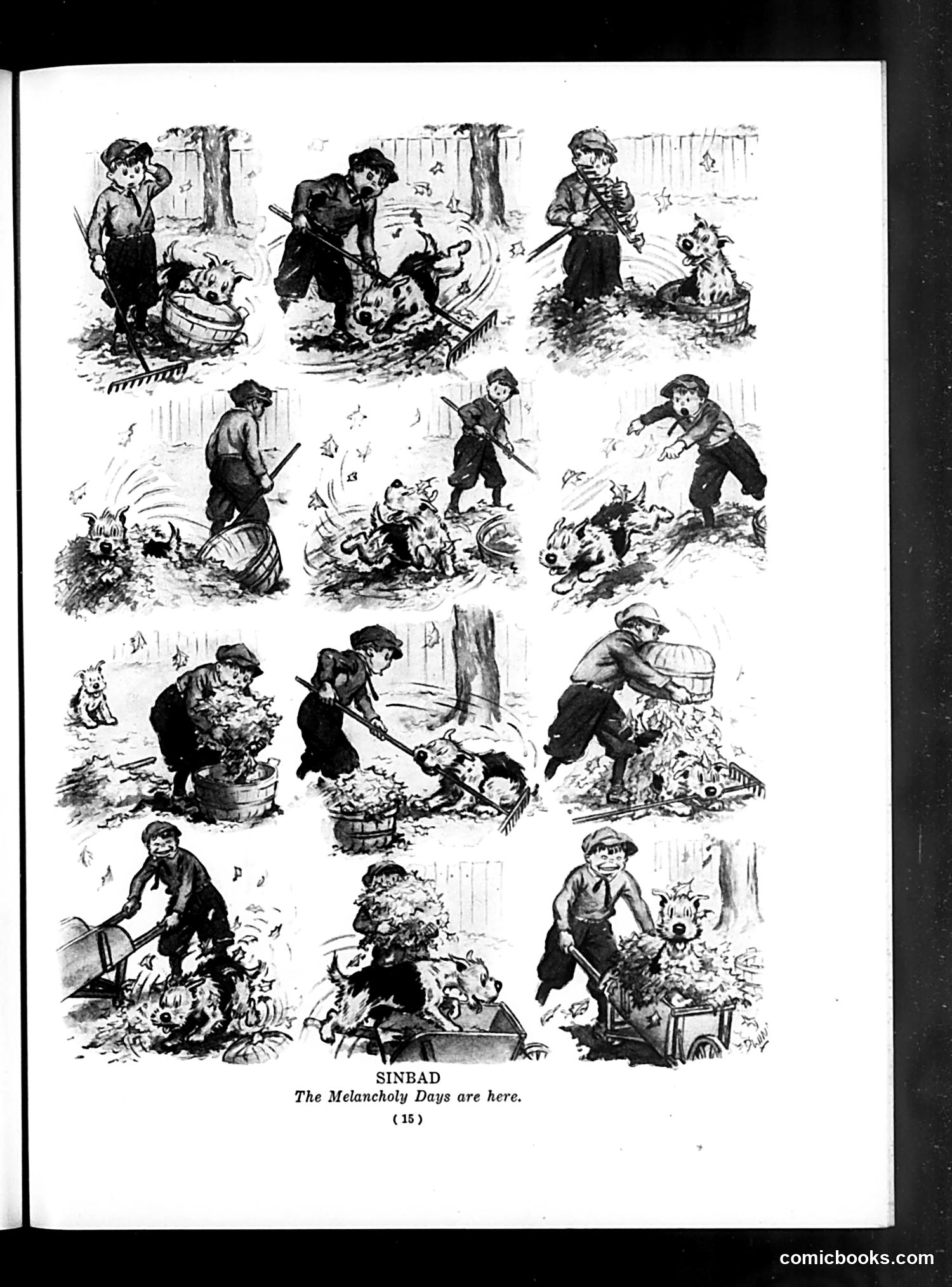
Analysis: "Sinbad - The Melancholy Days are here" This appears to be a humor illustration series featuring a character named Sinbad engaged in various autumn/fall cleaning and yard work activities. The title "The Melancholy Days are here" references the arrival of fall season—traditionally associated with melancholy in literature. The panel shows repeated vignettes of what appears to be the same character performing different domestic chores: raking leaves, hauling refuse in barrels and wheelbarrows, cleaning gutters, and dealing with yard debris alongside dogs. The repetition creates comedic effect through the monotony and labor-intensity of seasonal household tasks. This is straightforward domestic satire rather than political commentary—mocking the unpleasant work required when autumn arrives and winter preparations begin.
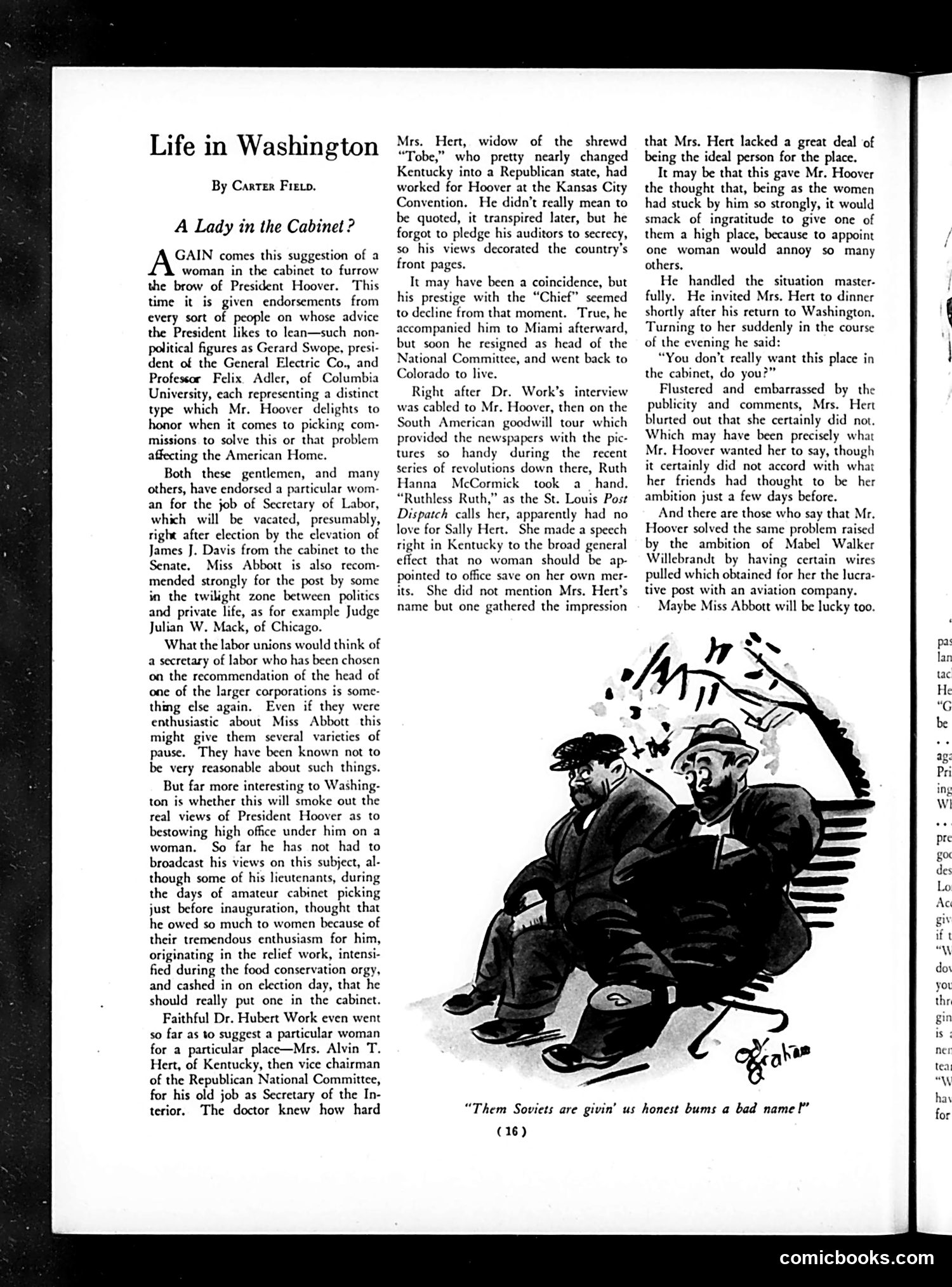
Political Cartoon Analysis: "Life" Magazine This cartoon satirizes President Hoover's consideration of appointing a woman to his cabinet. The article by Carter Field discusses whether Mrs. Alvin T. Hert of Kentucky might become Secretary of Labor—a groundbreaking possibility for the 1920s-30s. The cartoon depicts two men on a bench, with one saying "Them Soviets are givin' us honest bums a bad name!" The joke equates appointing a woman to high office with Soviet communist practices, reflecting conservative opposition to women in power. The satire targets those who view female leadership as un-American radicalism. The text reveals various powerful figures (Judge Mack, Miss Abbott) either supported or resisted the idea, reflecting genuine contemporary debate over women's political roles and labor union concerns about female cabinet members.
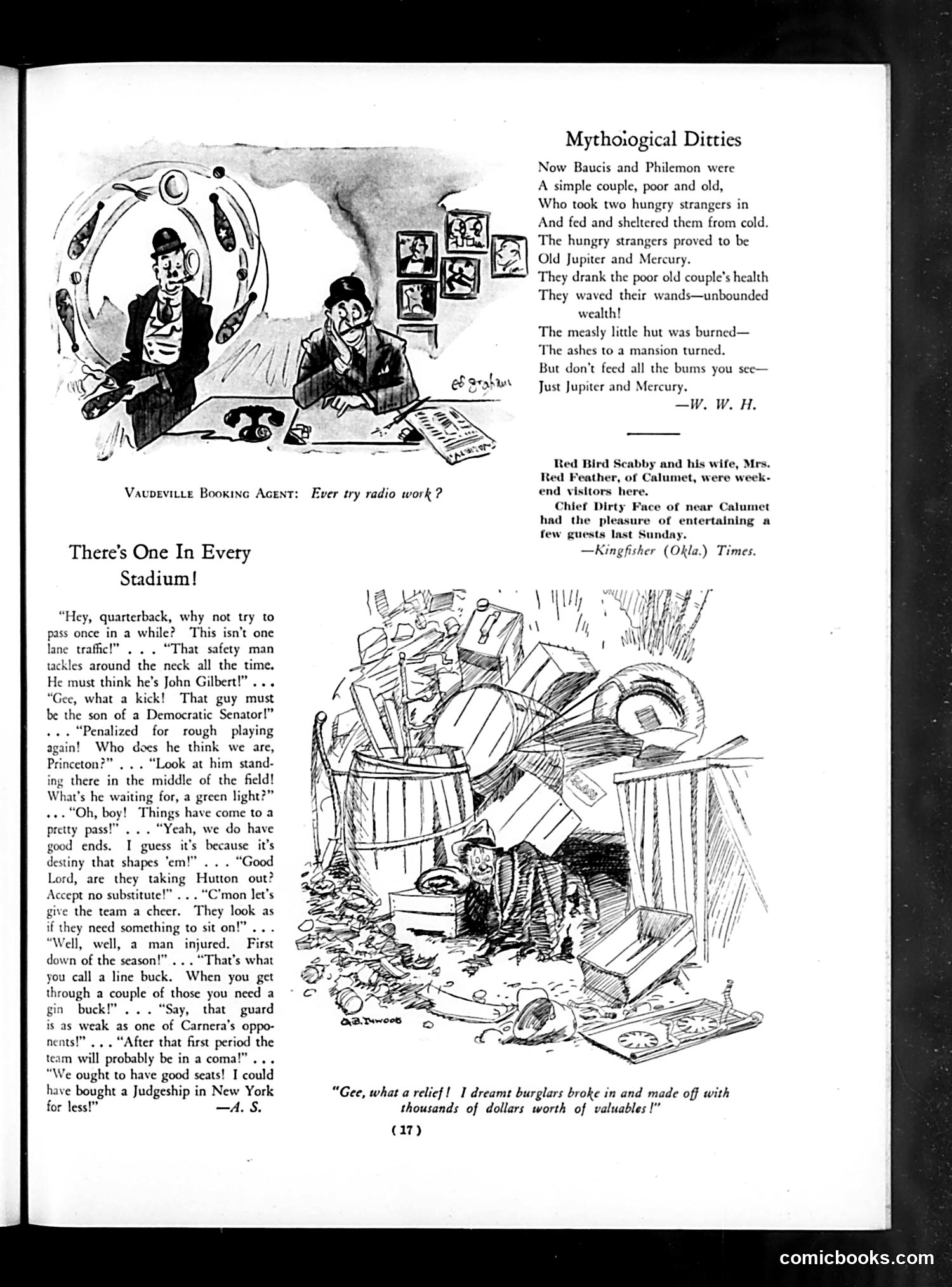
Explanation for Modern Readers This page contains two satirical pieces from *Life* magazine: "Mythological Ditties" (top) presents a verse mocking the Greek myth of Baucis and Philemon—a poor couple who entertained disguised gods Jupiter and Mercury. The satire suggests that even if you help wealthy people (represented by the gods), they won't actually help you in return. The joke: mythology promises divine reward for kindness, but reality delivers nothing. "There's One In Every Stadium!" (bottom) is a humorous monologue from a football spectator offering increasingly absurd commentary and complaints about the game—typical "armchair quarterback" behavior. The accompanying cartoon shows someone's cluttered apartment filled with junk, illustrating the chaos of the speaker's scattered thoughts. Both pieces mock pretension and unrealistic expectations in American life.
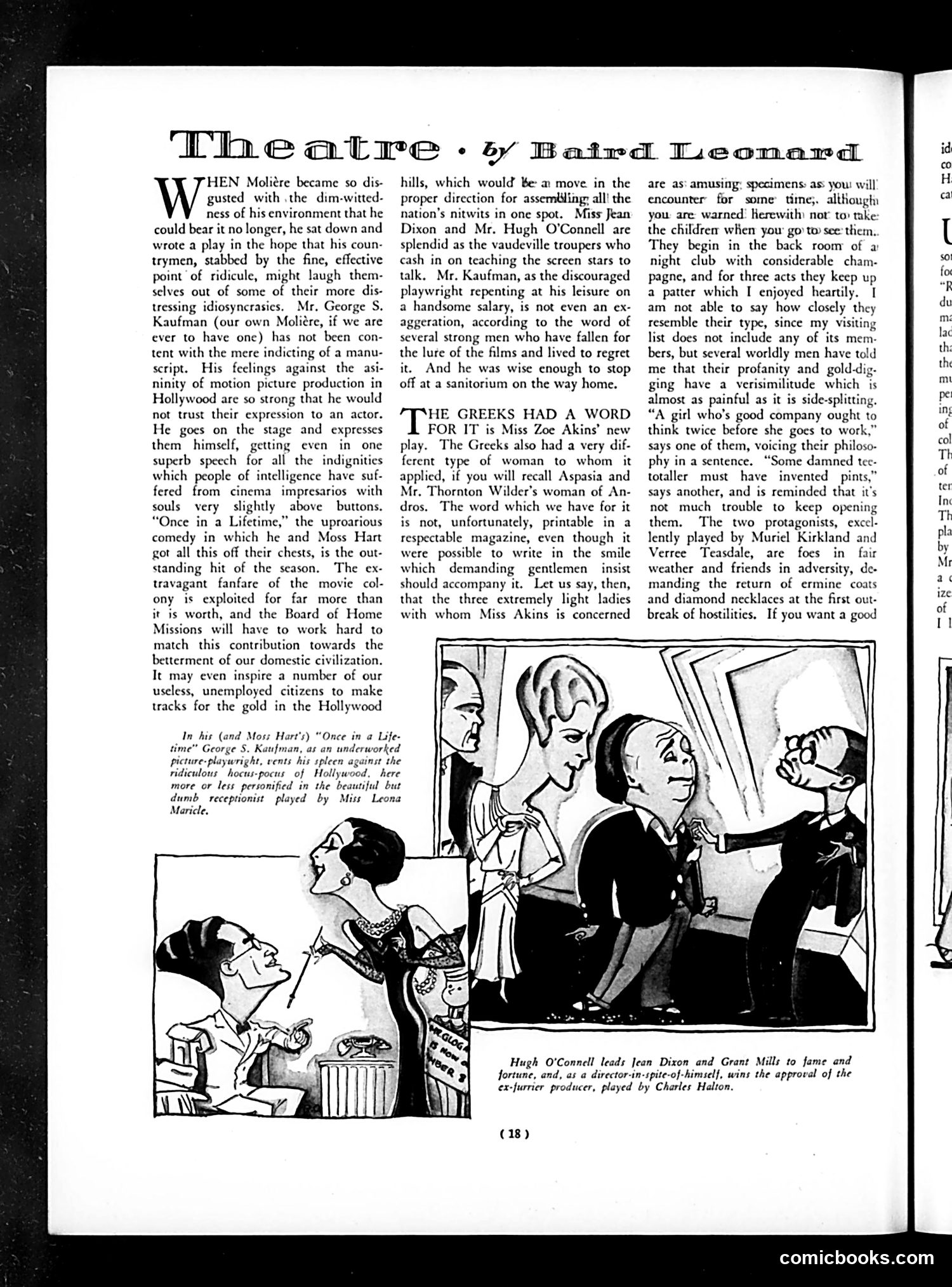
Theater by Baird Leonard This page critiques Molière's adaptation for modern theater, arguing that Hollywood's dismissal of serious drama has forced quality playwrights to compromise their work. The article praises Miss Zoe Akins's new play as refreshingly intelligent—a rarity in contemporary theater dominated by superficial comedies. The cartoons illustrate the satirical point: the left panel shows a producer or director dismissing serious dramatic work, while the right panel depicts theatrical figures in what appears to be a tense professional disagreement. The illustrations mock the entertainment industry's prioritization of commercial appeal over artistic merit, supporting the article's argument that serious playwrights must fight to maintain integrity against pressure from producers and audiences demanding lighter fare.
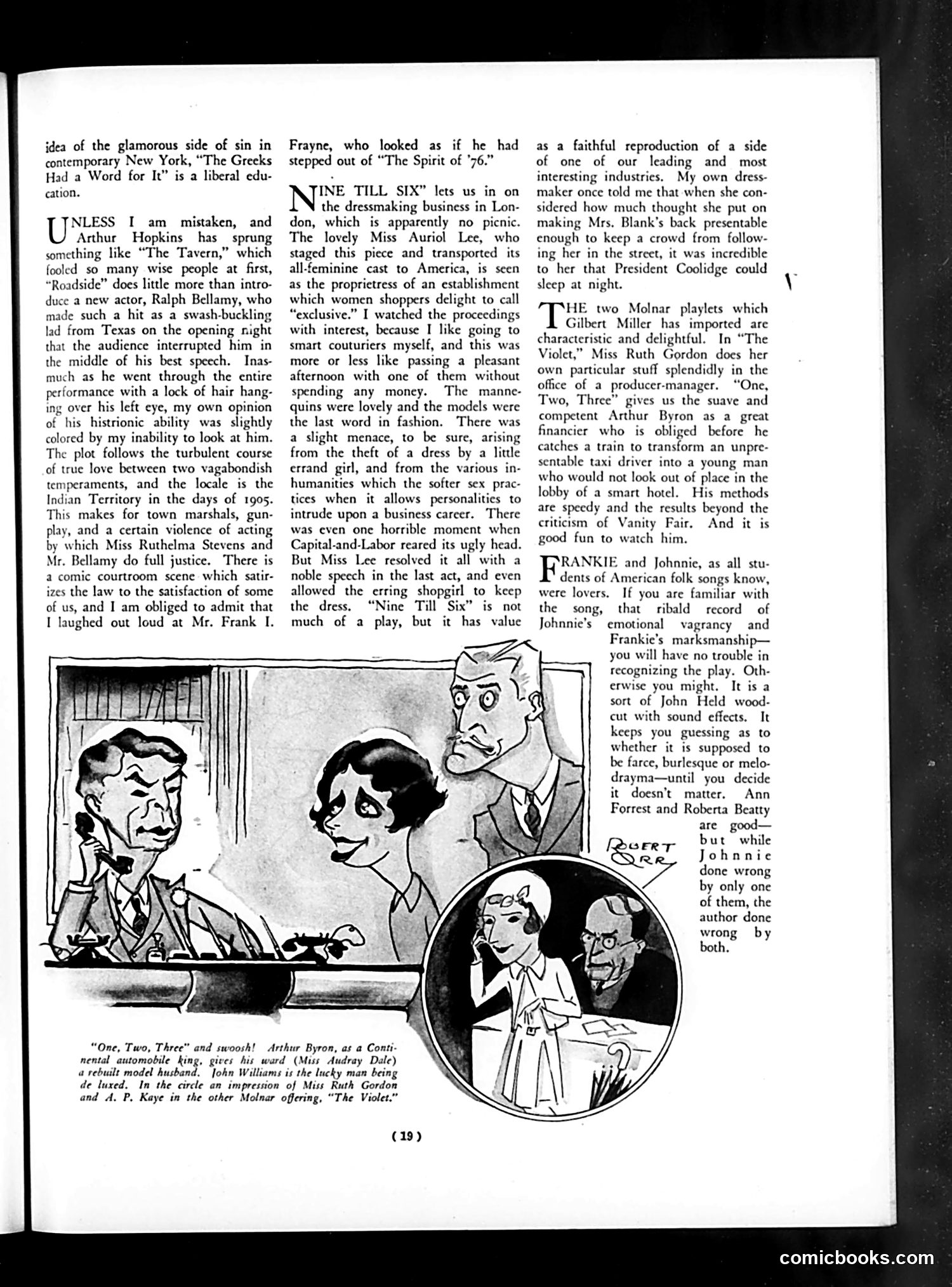
Analysis of This Life Magazine Page This page reviews several Broadway theatrical productions from the 1920s era. The main cartoon illustrates "One, Two, Three," a Molnar play where Arthur Byron (caricatured left) plays a financier who must quickly transform an unpresentable taxi driver into a presentable young man before catching a train. The circular inset shows the transformation's success. The reviews discuss contemporary plays including "Roadside" (featuring Ralph Bellamy), "Nine Till Six" (about London dressmaking), and Molnar playlets. The satire is gentle—mocking theatrical conventions rather than politics. References to "Capital-and-Labor" and President Coolidge are incidental commentary on contemporary society. The humor relies on knowing 1920s Broadway personalities and theatrical trends. For modern readers, the main point: these are theater reviews using caricature to humorously illustrate plot points and actor performances that were apparently well-known to Life's contemporary audience.
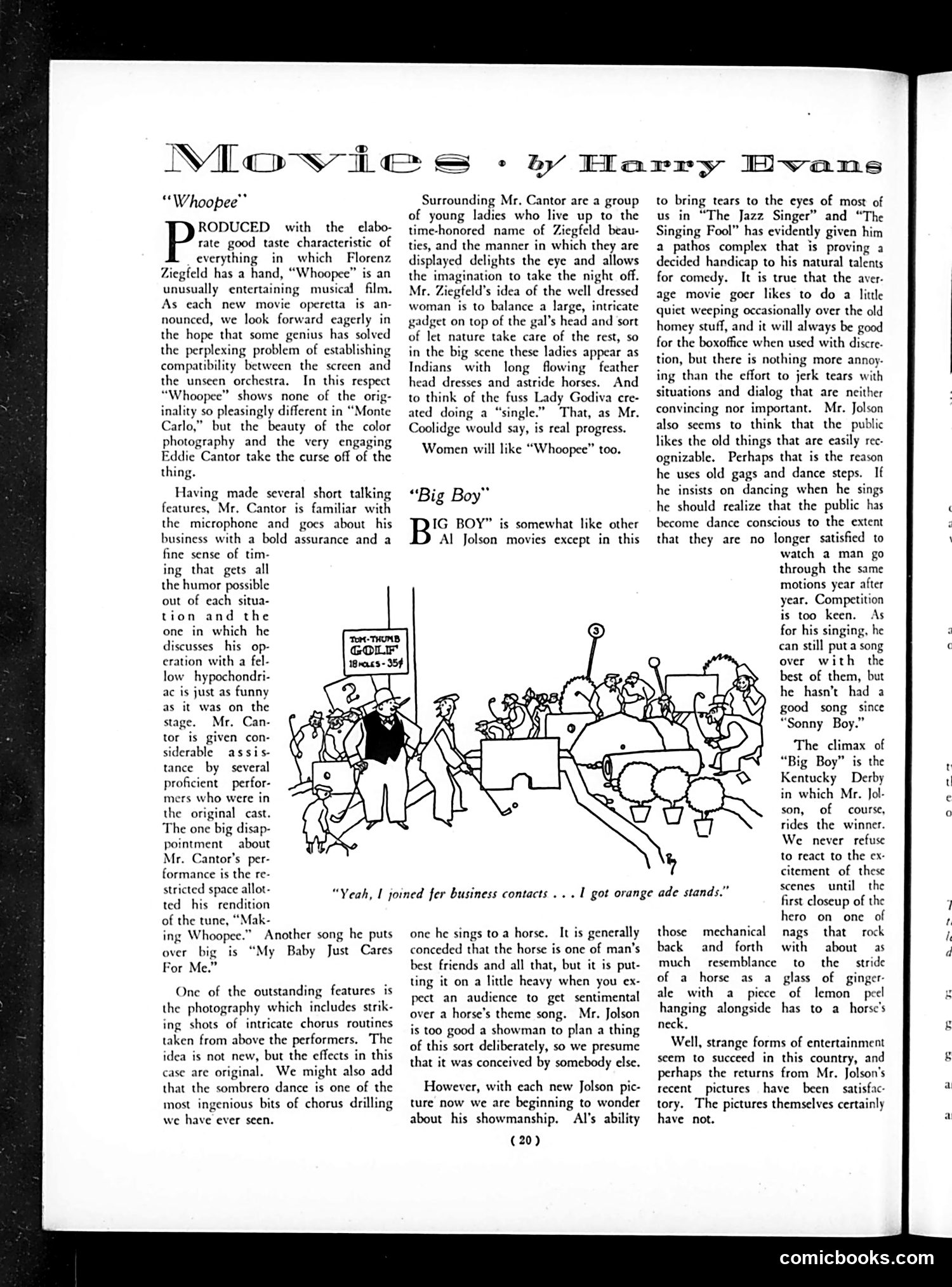
Movie Reviews: "Whoopee" and "Big Boy" This page contains two film reviews by Harry Evans. The first praises Eddie Cantor's musical comedy "Whoopee," produced by Florenz Ziegfeld, noting the superior color photography and Cantor's confident microphone presence, though criticizing limited screen time for his signature song. The reviewer appreciates the elaborate chorus work and Ziegfeld's scantily-clad "beauties" in Indian costumes. The second review critiques Al Jolson's "Big Boy," where Jolson sings to a horse. Evans argues that while Jolson excelled at emotional scenes in "The Jazz Singer" and "The Singing Fool," he's now overusing pathos in comedies where it doesn't belong. Evans suggests Jolson relies too heavily on recognizable, sentimental material rather than his natural comedic talents, undermining the film's entertainment value despite its boxoffice appeal.
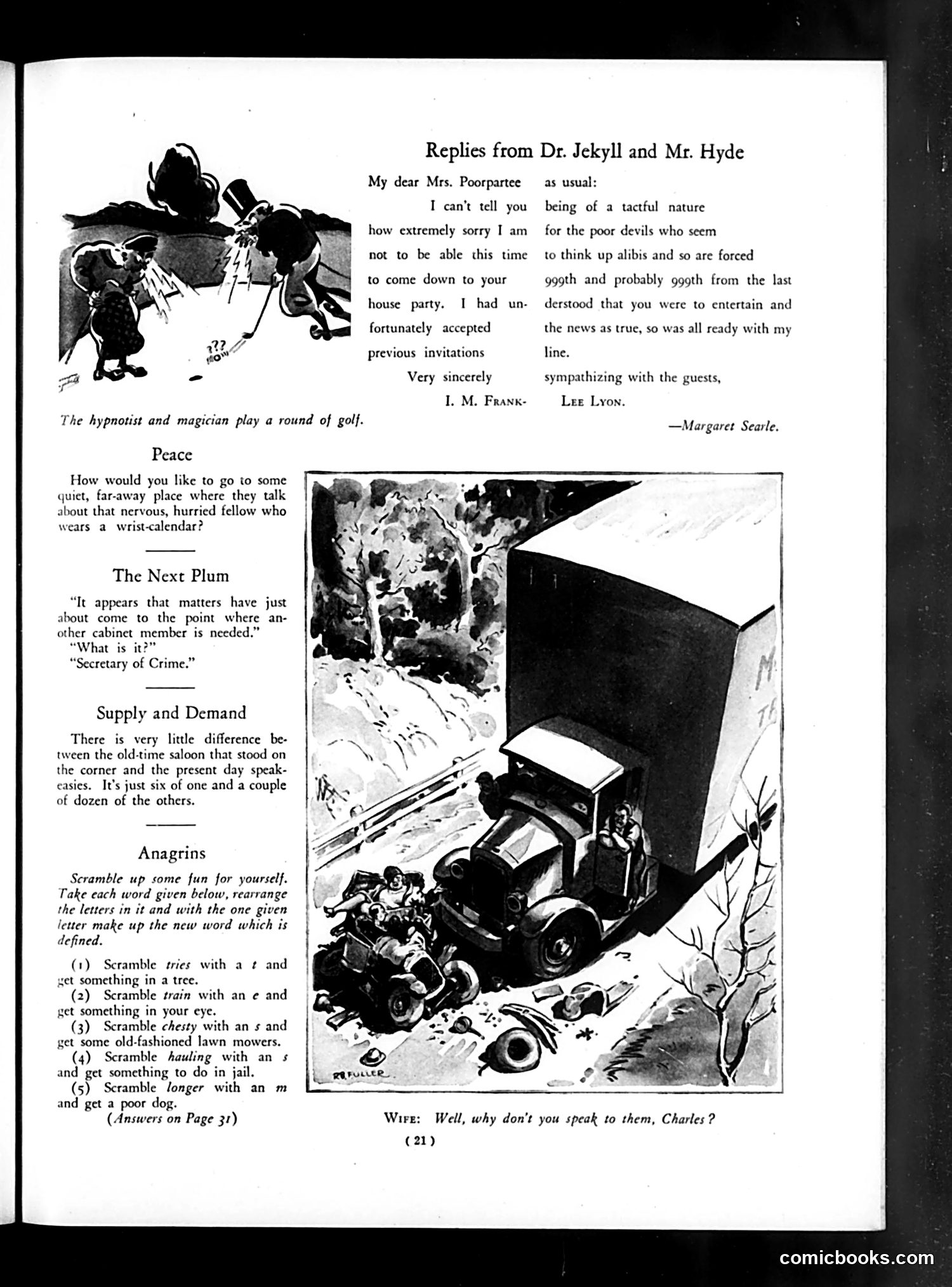
Analysis for Modern Readers The page contains multiple satirical pieces from Life magazine: Main Cartoon: Shows a truck that's crashed into a building. The caption "Wire: Well, why don't you speak to them, Charles?" suggests a wife blaming her husband for the accident—likely satirizing marital dynamics or the tendency to blame others. "Replies from Dr. Jekyll and Mr. Hyde": A humorous letter where someone (signed I.M. Frank and Lee Lyon) apologizes for missing a house party, blaming their dual nature. This references Robert Louis Stevenson's *Dr. Jekyll and Mr. Hyde*—using the famous literary character split-personality as a joke excuse for social unreliability. Other Pieces: Include quips about Prohibition-era speakeasies ("speak-casies"), a joke about needing a "Secretary of Crime" cabinet position (likely referencing scandals in government), and word-scramble puzzles. The overall tone satirizes 1920s-30s social anxieties: Prohibition, government corruption, and nervous modern life.
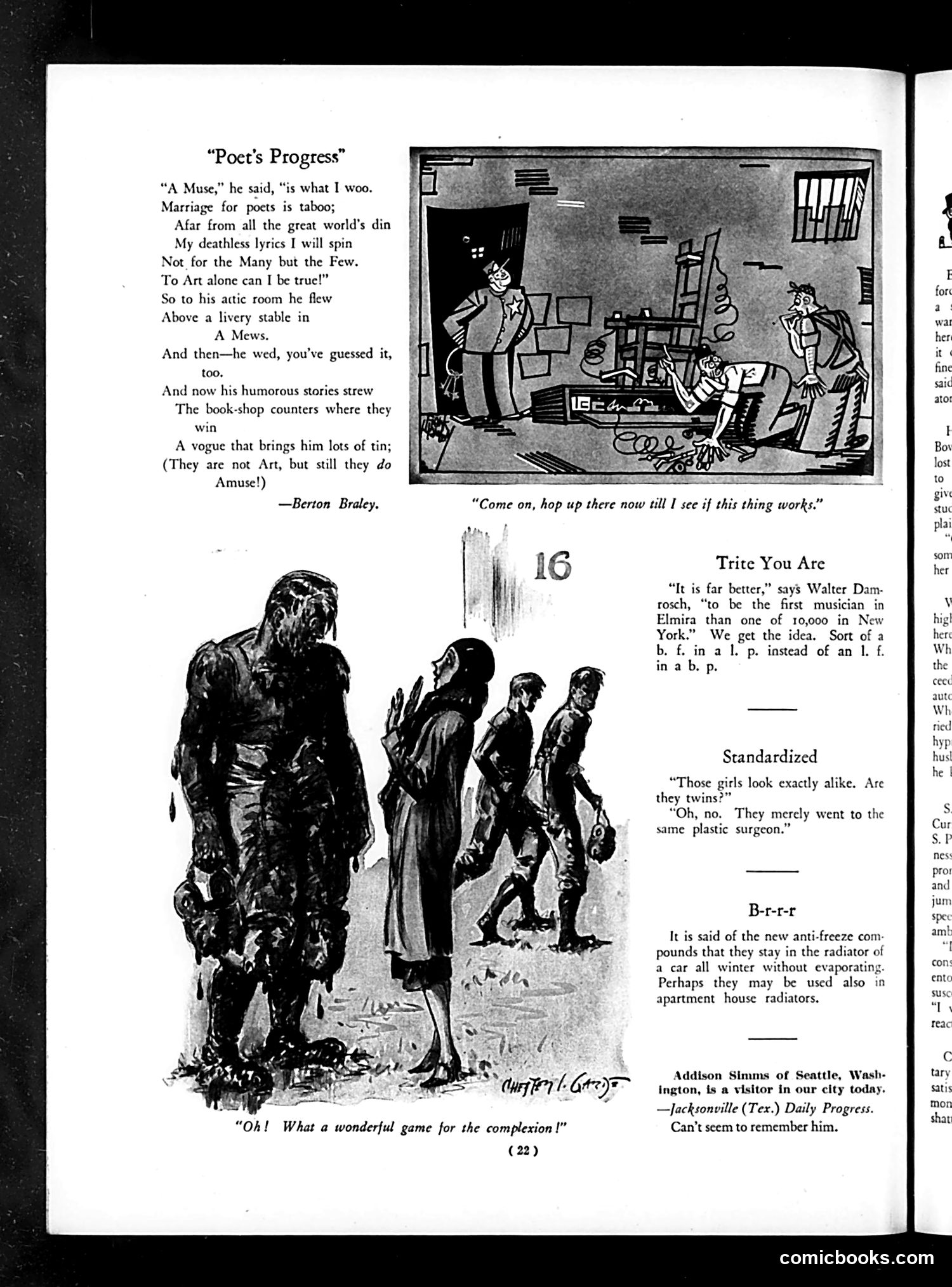
"Poet's Progress" Explained This page satirizes artistic pretension and compromised ideals. The poem by Berton Braley mocks a young poet who romanticizes artistic purity—claiming he'll write only for "the Few" in an attic garret, scorning commercial success. The cartoon illustrates his actual fate: he marries, abandons high art, and becomes a successful humorist writing popular stories for "book-shop counters." The joke is that his commercially successful, non-artistic work brings him wealth ("lots of tin"), while his original lofty ambitions proved unsustainable. The accompanying brief humor items mock standardization (identical plastic surgery results), pretentiousness (Walter Damrosch's small-pond philosophy), and consumer products, typical of Life magazine's satirical commentary on American society and values.
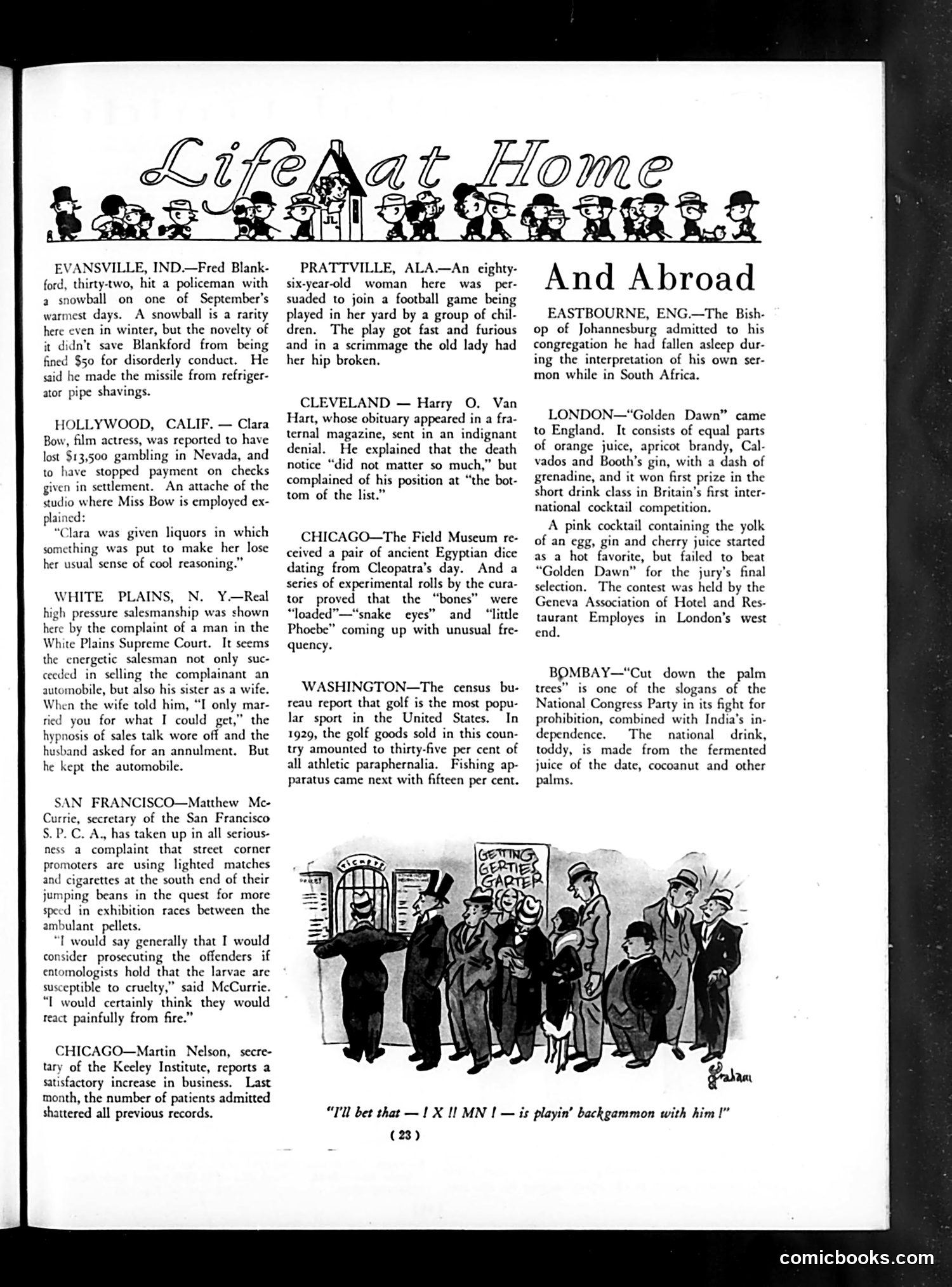
Political Context and Satire This "Life at Home and Abroad" page presents humorous anecdotes revealing social anxieties of early 1930s America. The cartoon depicts men outside what appears to be a speakeasy or gambling establishment during Prohibition, with the caption "'ll bet that — I X !! MN ! — it playin' backgammon with him!"—satirizing how men made excuses for frequenting illegal drinking venues by claiming innocent pastimes like backgammon. The text items mock various American foibles: a man prosecuted for a harmless snowball prank, actress Clara Bow's gambling losses (attributed to spiked drinks), high-pressure salesmen, animal welfare activists prosecuting "cruel" treatment of jumping beans, and the booming Prohibition-era Keeley Institute (addiction treatment). The international section notes a bishop sleeping during sermons and cocktail competitions—contrasting American excess with foreign propriety. Overall, the page satirizes Prohibition-era hypocrisy, commercial excess, and the gap between stated morals and actual behavior.
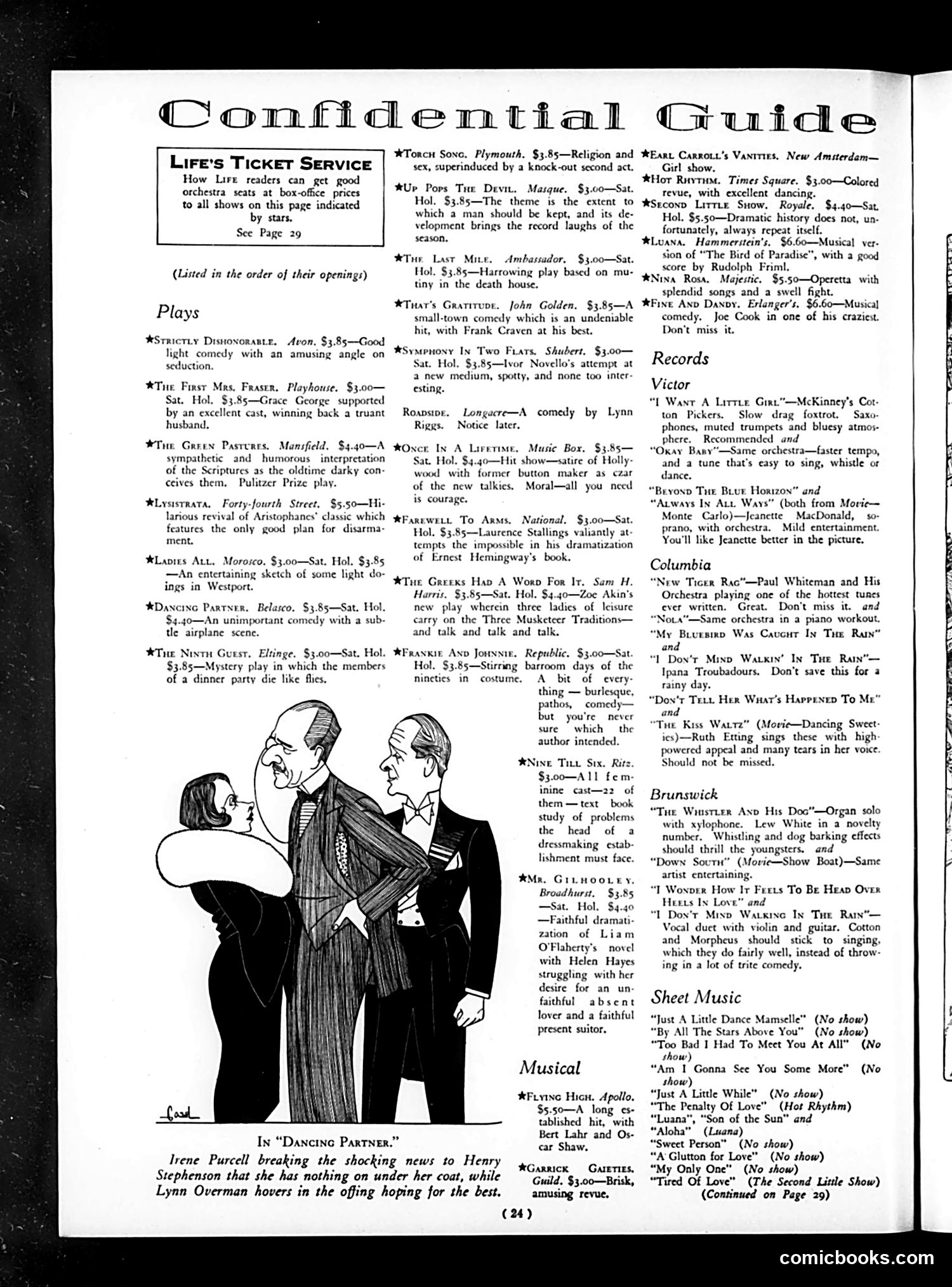
Cartoon Analysis: "Dancing Partner" The cartoon illustrates a scene from the play *Dancing Partner* at the Belasco Theatre. It shows actress Irene Purcell delivering shocking news to actor Henry Stephenson: that she is wearing nothing beneath her coat. Actor Lynn Overman lurks hopefully in the background. The humor relies on 1920s sexual innuendo and the scandalous nature of the revelation—risqué for the era. The cartoon captures a comedic moment of surprise and impropriety typical of theatrical farce. The caption's phrase "hoping for the best" suggests Overman's prurient interest in the situation. This reflects the Jazz Age's somewhat more permissive entertainment culture, where plays could reference such suggestive subjects, though still within bounds that would seem tame by modern standards. The cartoon serves as promotional material for the show, advertising its comedic appeal to Life magazine's readers.
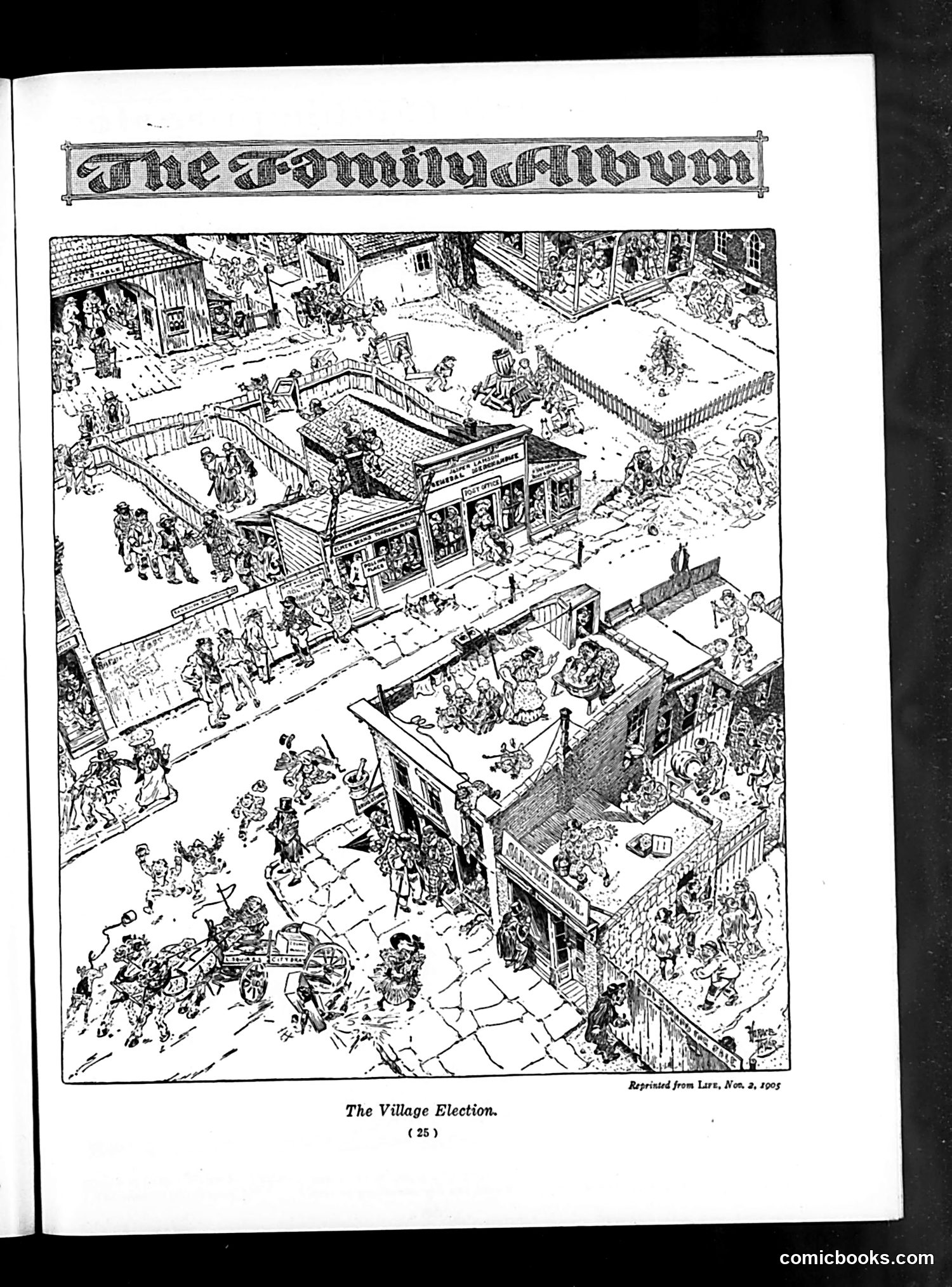
"The Village Election" (Life Magazine, November 2, 1905) This satirical illustration depicts a chaotic village election scene. The crowded street shows numerous townspeople engaging in what appears to be disorderly voting behavior—groups clustered around polling locations, some appearing to argue or jostle one another. Various storefronts and buildings line the street. The cartoon likely satirizes early 20th-century American local elections, which were frequently marred by corruption, voter intimidation, and general pandemonium. The dense, somewhat anarchic composition suggests commentary on how "democratic" village elections often devolved into confusion and unseemly conduct rather than orderly civic processes. Without identifying specific caricatured individuals or local figures, the piece appears to mock the pretense of small-town democratic virtue while depicting the messy reality of actual electoral participation among ordinary citizens.
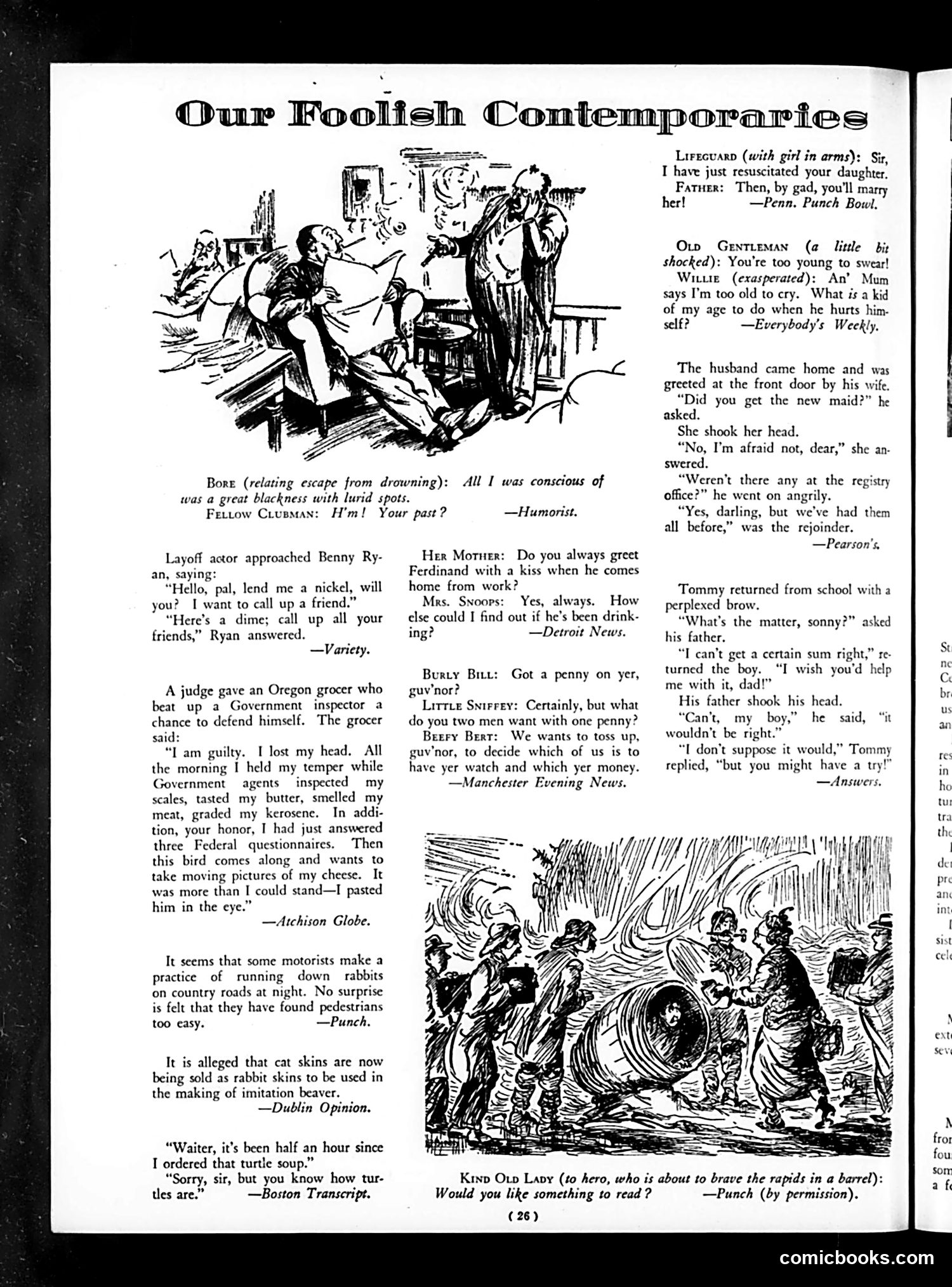
"Our Foolish Contemporaries" - Life Magazine Humor Page This page collects brief satirical anecdotes and jokes lampooning social absurdities of the era. Key targets include: Government overreach: A grocer's frustrated monologue describes inspectors tasting butter, grading kerosene, and Government questionnaires—depicting early 20th-century regulatory expansion as intrusive and exhausting. Marital dynamics: Multiple jokes mock wives' suspicions (checking husbands for drinking via kisses) and domestic servant troubles, reflecting period anxieties about household help and spousal trust. Class and propriety: A lifeguard rescuing a girl creates an awkward social obligation (forced marriage); a boy's frustration about age-appropriate behavior; refusals to help with homework reflect middle-class anxieties about decorum and responsibility. Absurdist observations: Motorists hitting rabbits, cat skins sold as rabbit fur for fake beaver—darkly humorous commentary on consumer fraud and careless modern life. The bottom illustration shows people bravely facing rapids in a barrel, a visual punchline to absurd courage. The page reflects early 1900s sensibilities about authority, commerce, and social proprieties.
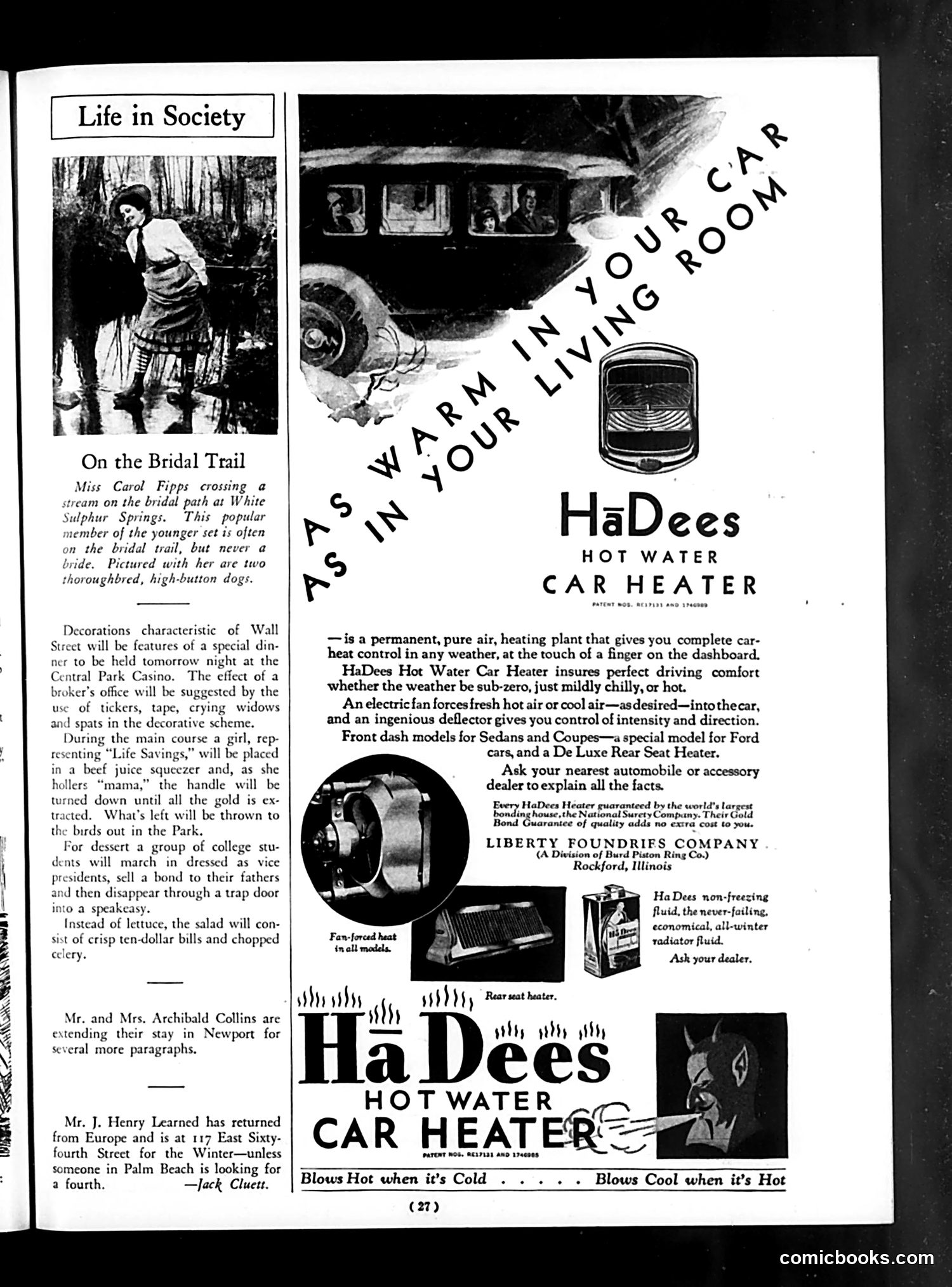
Life in Society Page Analysis This page is primarily advertising for the HaDees Hot Water Car Heater, with a brief "Life in Society" gossip column on the left. The society items are satirical quips about wealthy socialites: Miss Carol Fipps is mocked for frequenting "the bridal trail" but never actually marrying; a Wall Street dinner features crude satire about financial extraction (a woman representing "Life Savings" being squeezed in a juice press); college students dressed as vice presidents sell bonds then disappear into a speakeasy, satirizing both Prohibition-era hypocrisy and financial sleaze. The humor targets 1920s excess—wealth inequality, stock market speculation, and the contradiction between respectable society and hidden vice during Prohibition. The "Life Savings" bit particularly mocks how the wealthy extract value from ordinary people. The bulk of the page is the car heater advertisement, typical period automotive marketing emphasizing practical comfort features (heating control, deflectors).
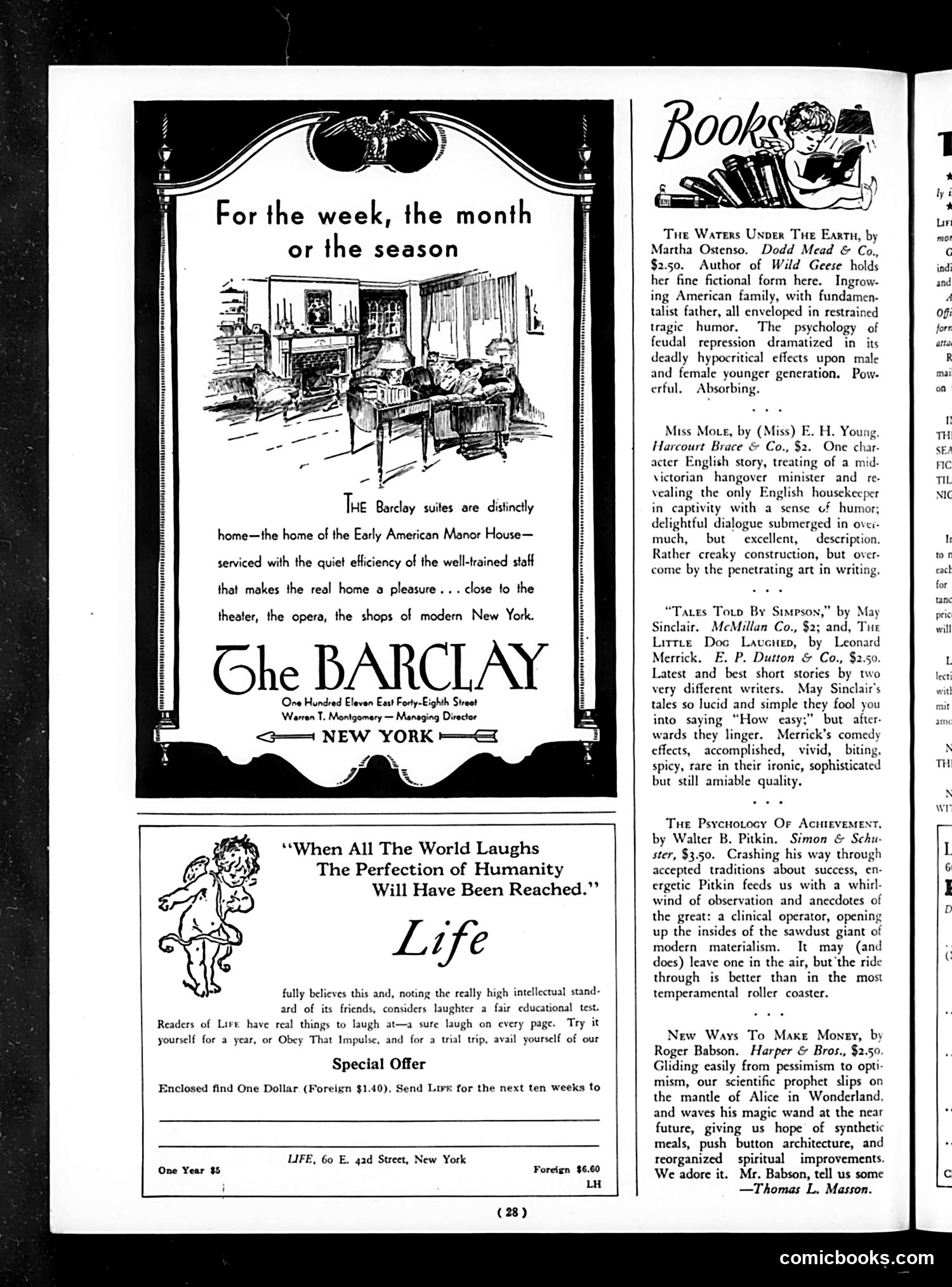
Life Magazine Page Analysis This page is primarily advertising and magazine promotion rather than political satire. The main content includes: 1. The Barclay Hotel advertisement (top): A luxury hotel pitch emphasizing comfort comparable to home, targeting affluent New Yorkers interested in theater and opera. 2. Life Magazine self-promotion (center): The publication advertises itself using a cherub illustration and the motto "When All The World Laughs / The Perfection of Humanity Will Have Been Reached." This reflects Life's identity as a satirical humor magazine that claims laughter is educational. 3. Book reviews (right column): Contemporary literary reviews of novels by Martha Ostenso, E.H. Young, May Sinclair, and others—typical editorial content for a magazine of this era. The page contains no political cartoons or social satire. It represents standard 1920s magazine content: luxury hospitality advertising, self-promotion, and literary criticism.
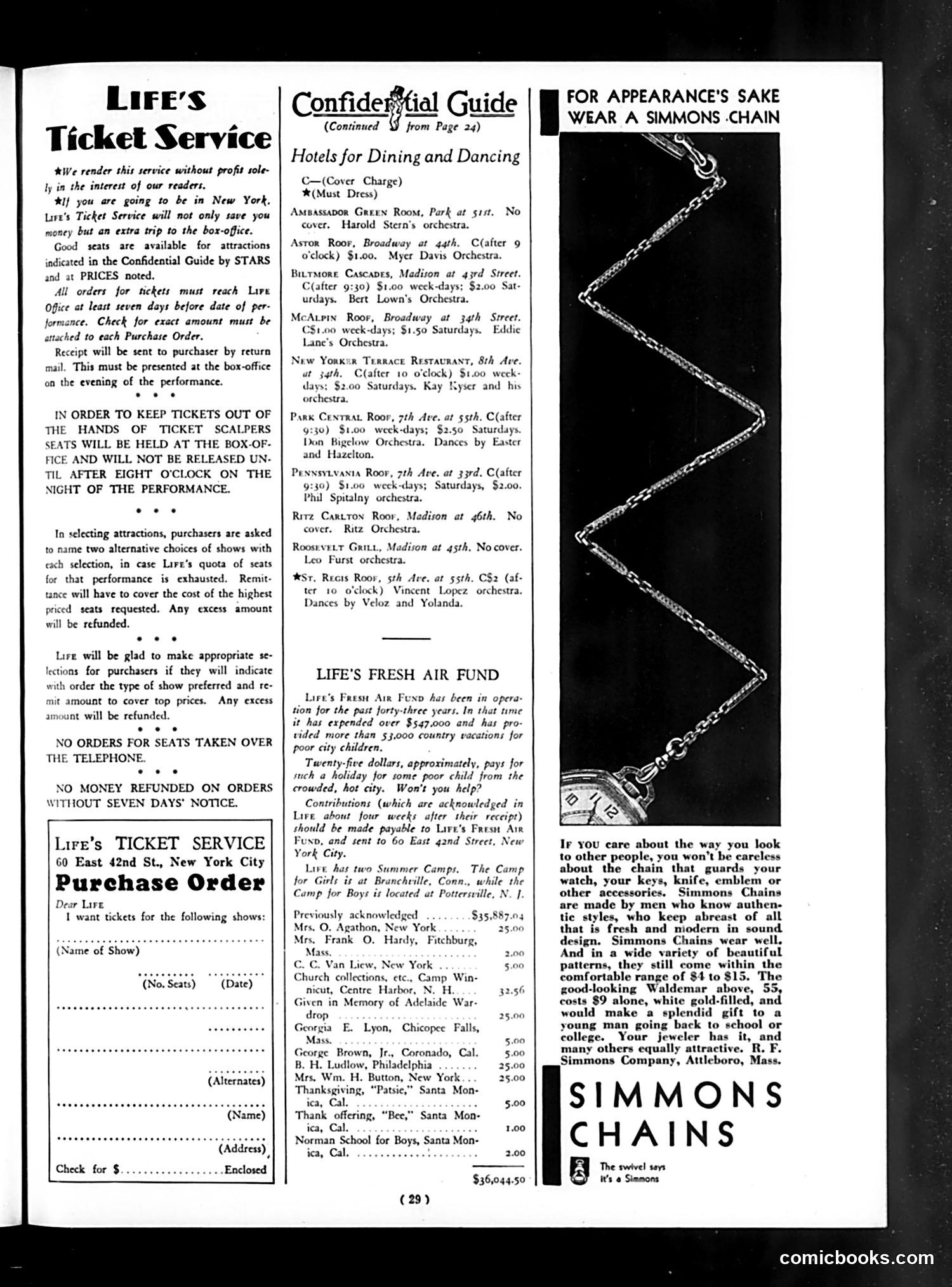
This page is primarily administrative and advertising content rather than political satire. It contains: Left side: Life magazine's ticket service information—a practical service allowing readers to order Broadway tickets by mail, with strict policies against scalpers and refund requirements. Center: A "Confidential Guide" listing New York City's upscale hotels with dining and dancing venues (1930s-era establishments like the Astor Roof and Ritz-Carlton Room), indicating the magazine's affluent readership. Right side: An advertisement for Simmons Chains jewelry, with text appealing to young men concerned with appearance and impression. Bottom center: Information about Life's Fresh Air Fund, a charitable initiative providing summer camp vacations for poor city children—demonstrating the magazine's philanthropic interests alongside its commercial focus. The page reflects Life's dual identity: a satirical publication for educated, affluent readers, while maintaining genuine charitable concerns.
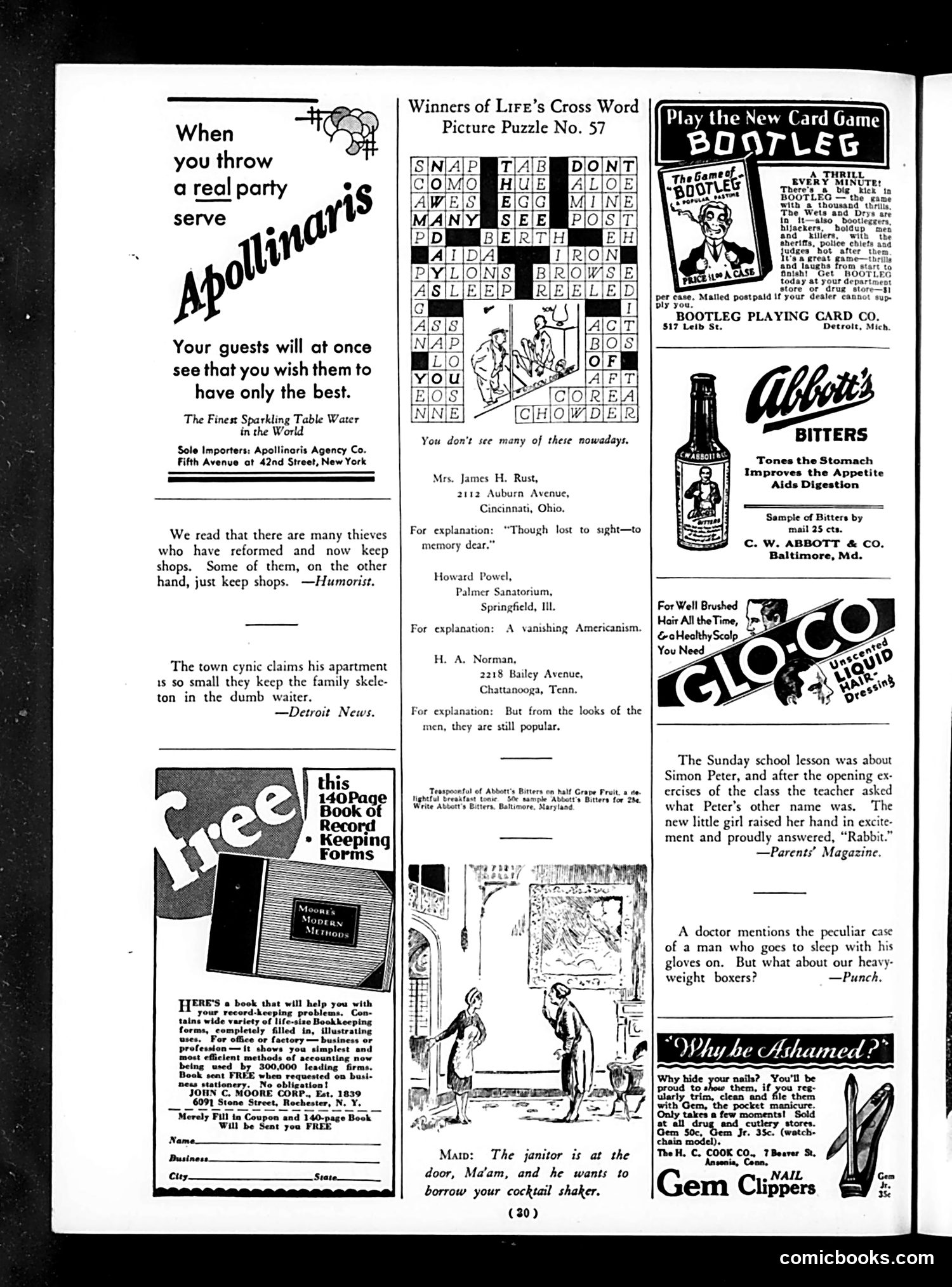
Life Magazine Page Analysis This page is primarily advertising and humor, typical of 1920s Life magazine content. The main cartoon (bottom center) depicts a maid informing her employer that a janitor has arrived requesting to borrow a cocktail shaker. This is satire about Prohibition-era hypocrisy: despite the legal ban on alcohol (1920-1933), servants and working-class people still seek alcohol, and middle-class employers possess it. The joke mocks the contradiction between official prohibition and widespread private drinking. The crossword puzzle answers above reference period-specific humor about "vanishing Americanism" and lost memories, likely alluding to pre-Prohibition nostalgia. Advertisements emphasize products marketed to aspirational middle-class consumers: Apollinaris water (imported luxury), Abbott's Bitters (medicinal alcohol loophole), and notably a "Bootleg" card game—directly commodifying Prohibition-era criminality as entertainment. The page collectively reflects 1920s consumer culture meeting legal alcohol prohibition, normalizing both the law's evasion and commercialization of its violation.
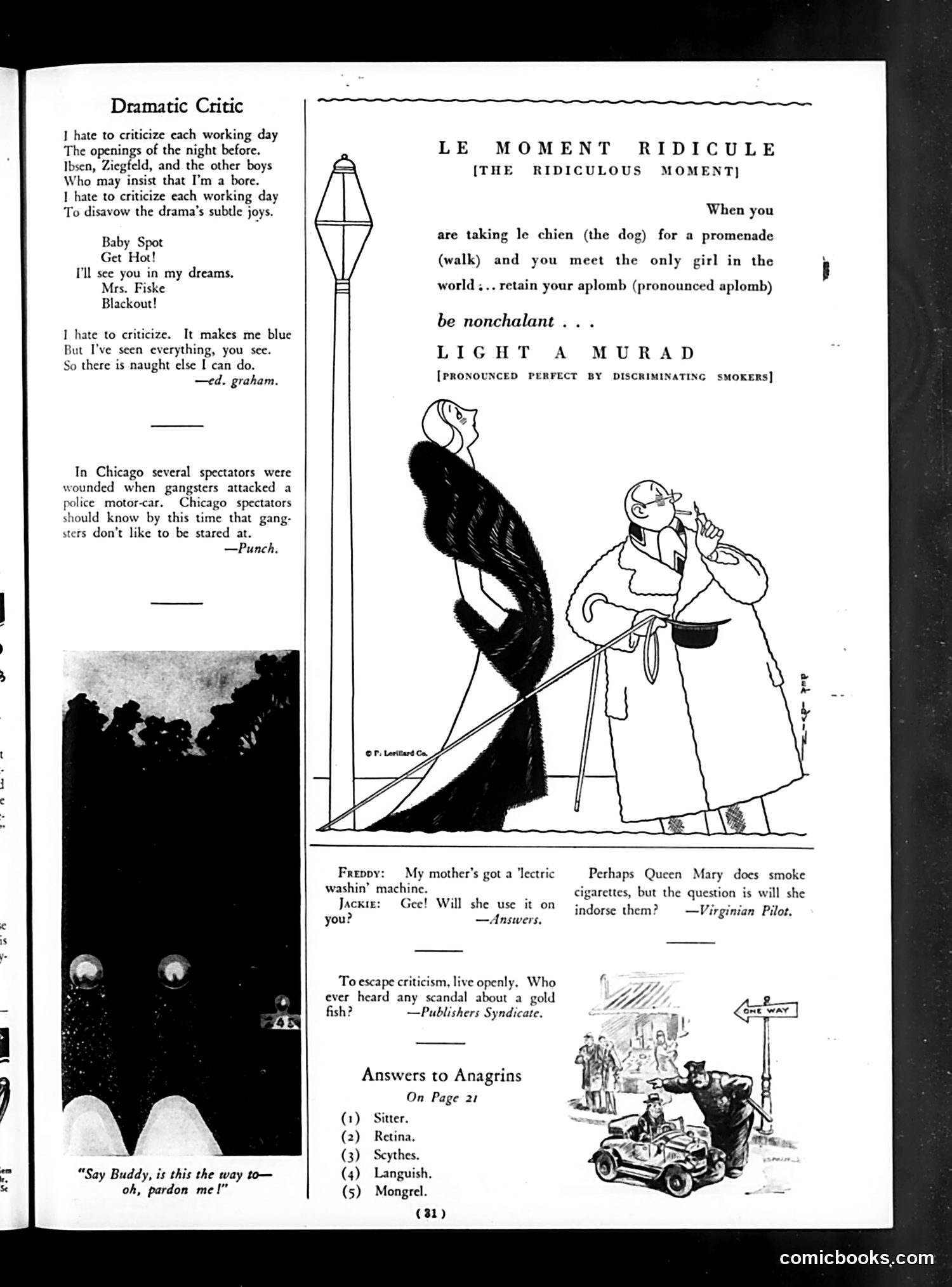
Life Magazine Page Analysis This page contains satirical commentary and humor typical of early 20th-century Life magazine. The main content includes: "Dramatic Critic" — A poem mocking theater critics who must attend every opening night, referencing theatrical figures like Ibsen and Ziegfeld, expressing fatigue with constant criticism. Chicago gangster joke — A dark quip from *Punch* magazine about spectators being wounded when gangsters attacked a police car, sarcastically suggesting Chicagoans should know not to stare at gangsters. "Le Moment Ridicule" — A humorous illustration about maintaining composure ("nonchalance") when encountering an attractive woman while walking your dog. This appears to be advertising copy for Murad cigarettes, suggesting smoking one maintains sophistication. Various one-liners — Including jokes about Queen Mary smoking cigarettes and a child's misunderstanding about an electric washing machine. The page exemplifies Life's blend of literary satire, social commentary, and advertising disguised as humor — common for the era.
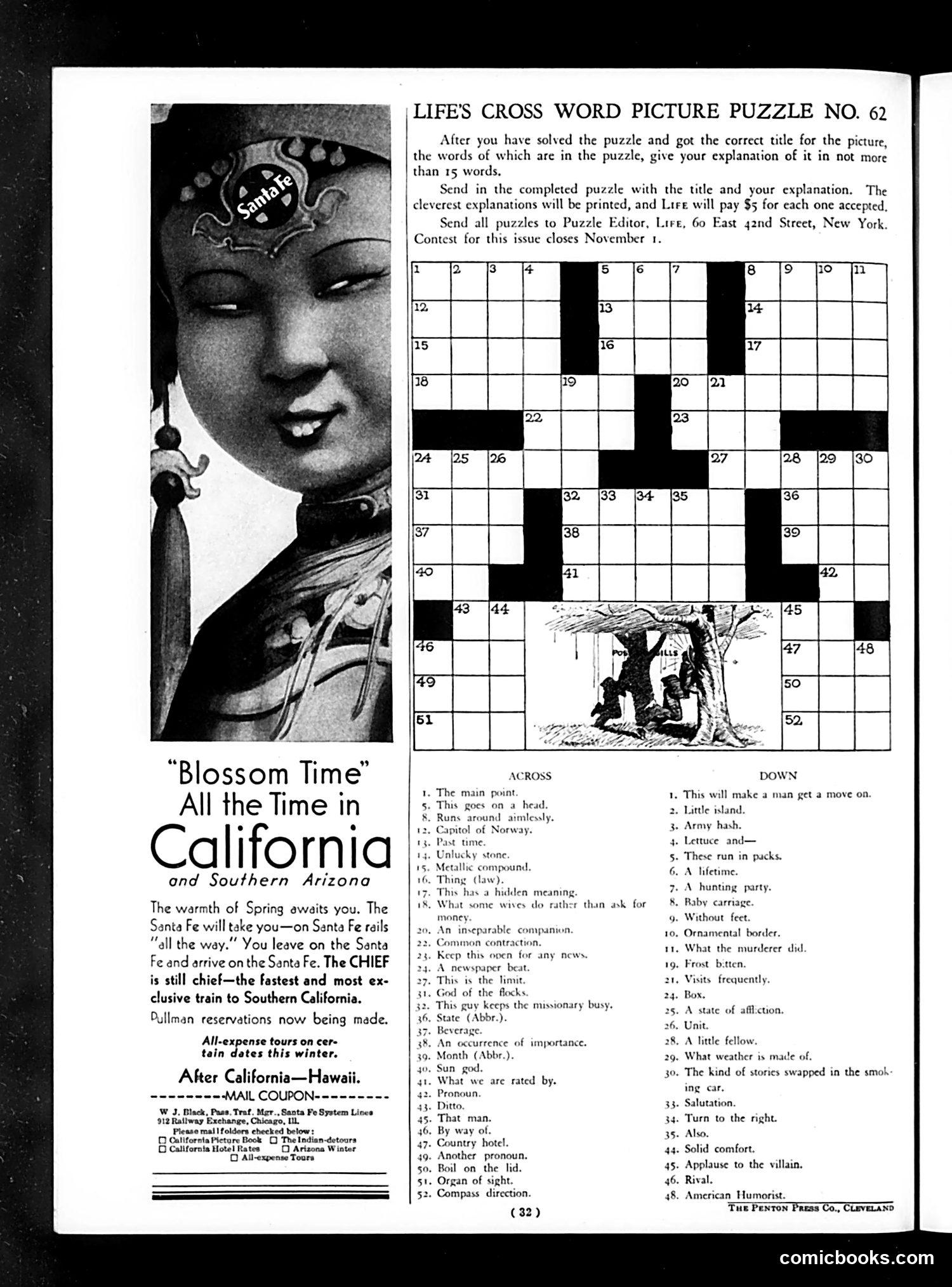
Life Magazine Puzzle Page Analysis This page is primarily advertising and entertainment content, not political satire. It contains: 1. A crossword puzzle ("Life's Cross Word Picture Puzzle No. 62") featuring a photograph of a woman's face with "Sample" text on her forehead. Solvers must identify the picture's title and explain it in 15 words to win $5. The puzzle clues are standard wordplay. 2. Tourism advertising for the Santa Fe Railway, promoting travel to California, Southern Arizona, and Hawaii. The "Blossom Time" headline emphasizes spring travel, with copy highlighting the *Chief* train as "the fastest and most exclusive train to Southern California." 3. A mail coupon offering travel brochures and hotel information. The page reflects 1920s-30s consumer culture—combining puzzle entertainment with aspirational travel marketing. The woman's image appears to be a generic "sample" rather than depicting any specific person or political figure. This is typical Life magazine filler content rather than satirical commentary.
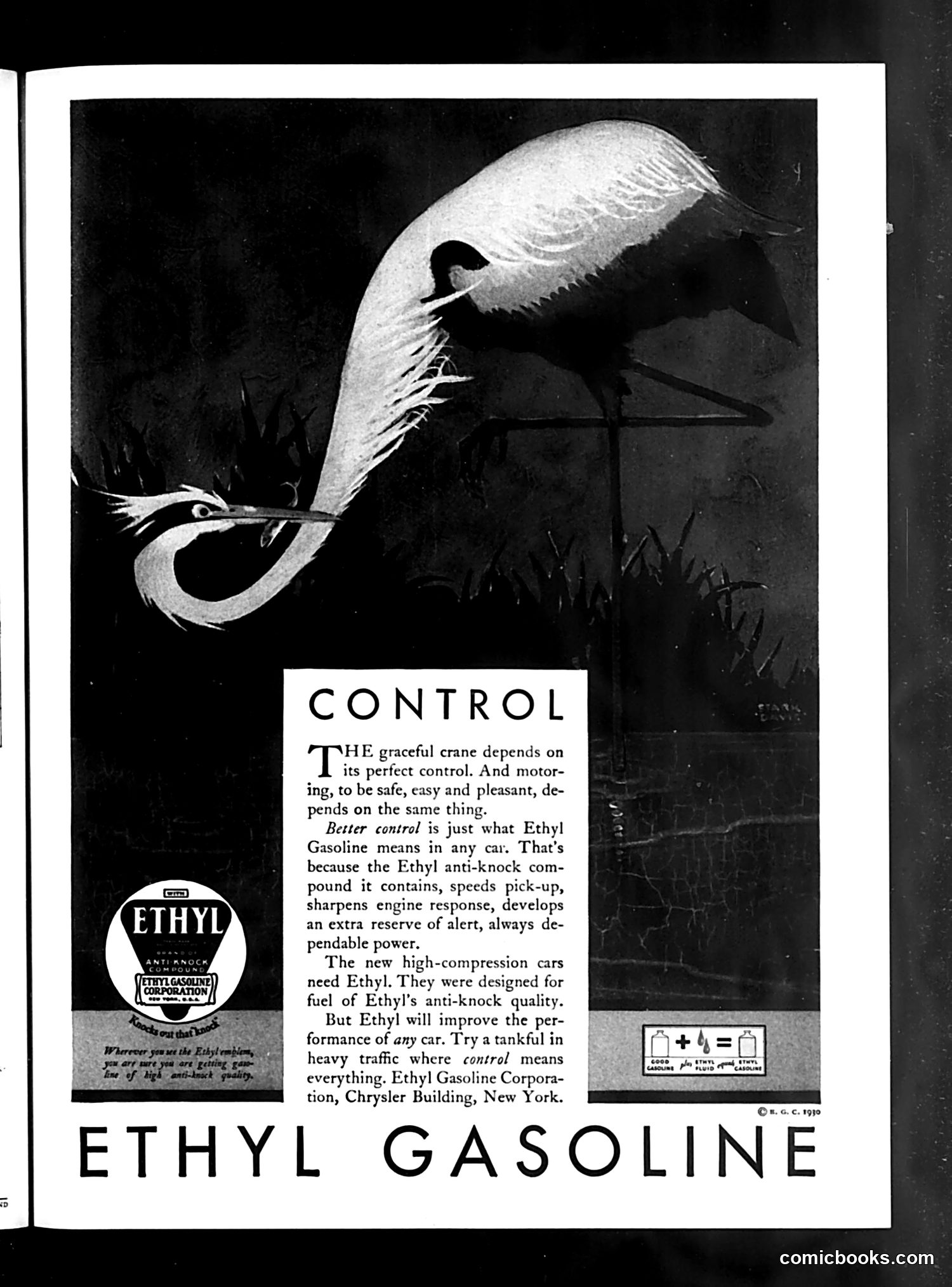
Analysis This is an advertisement, not satire or political commentary. The page promotes Ethyl Gasoline, a commercial fuel product from the Ethyl Gasoline Corporation. The crane image serves as a visual metaphor: just as a graceful crane depends on perfect control of its movements, automobiles depend on controlled engine performance. The ad argues that Ethyl's anti-knock compound provides superior "control"—faster acceleration, sharper engine response, and reliable power—particularly important for new high-compression engines. The copy appeals to safety and performance benefits, claiming Ethyl improves any car but is especially necessary for modern vehicles. The small logo indicates this is from circa 1930 (marked "© R.C.C. 1930"). For modern readers: This represents early automotive fuel marketing before widespread understanding of leaded gasoline's health dangers. Ethyl's anti-knock additive was actually tetraethyl lead—later recognized as highly toxic. The ad's emphasis on control and performance was standard advertising strategy of the era.
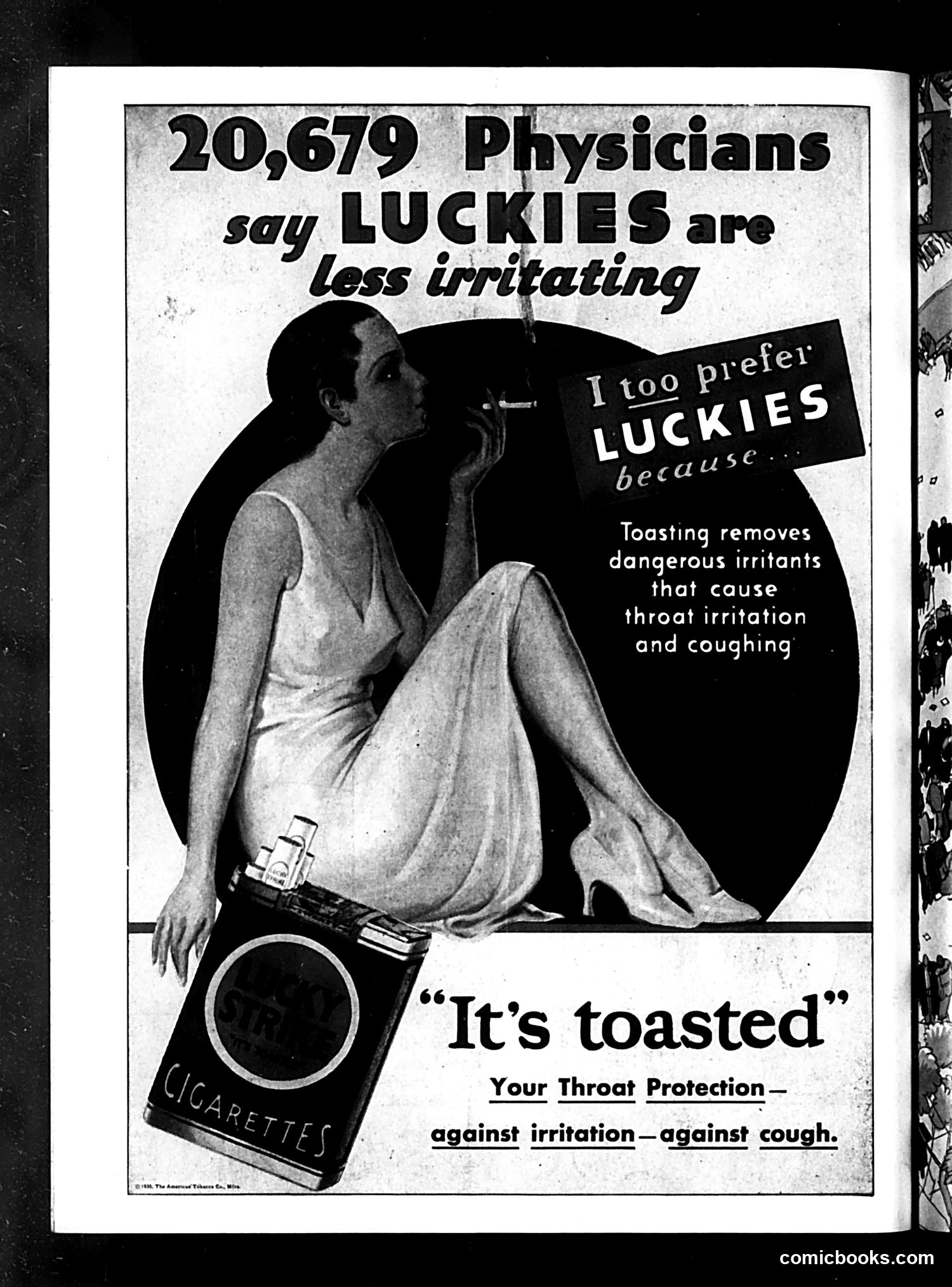
This is a cigarette advertisement, not satire or political commentary. Lucky Strike cigarettes claim that their "toasting" process removes irritants that cause throat problems. The ad cites "20,679 Physicians" endorsing the product—a marketing strategy common in early-to-mid 20th century tobacco advertising that exploited doctor credibility before the health dangers of smoking were publicly acknowledged. The glamorous illustration of a woman with a cigarette package reinforces the lifestyle appeal. The phrase "It's toasted" became Lucky Strike's signature marketing slogan, suggesting safety and care in manufacturing. For modern readers: This advertisement is historically significant as evidence of how tobacco companies deliberately misrepresented smoking as medically safe, using physician endorsements to build false credibility during an era before strict advertising regulations and public health warnings existed.