life
Life — October 24, 1930
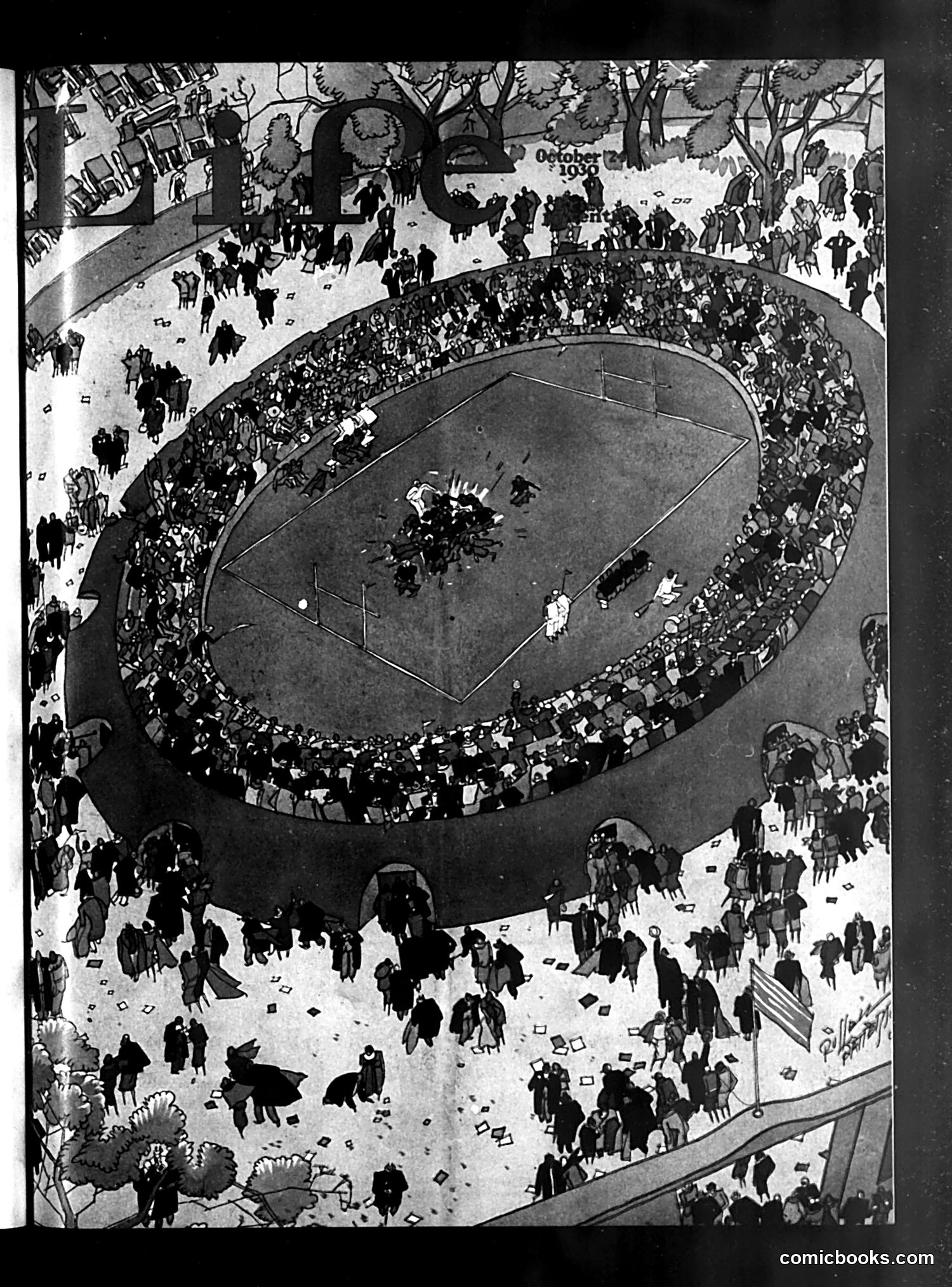
Analysis This is an aerial view of a baseball stadium dated October 1935, showing a packed crowd surrounding the diamond during what appears to be a World Series game. The illustration is a bird's-eye perspective drawing showing thousands of spectators filling the stands and surrounding grounds. The satirical point appears to be commentary on American enthusiasm for baseball during the Great Depression era. Despite economic hardship, masses of people gathered for this sporting event, suggesting baseball's role as a major public distraction and entertainment outlet. The dense crowd emphasizes both the sport's popularity and perhaps implicitly critiques American priorities during a time of economic hardship. The specific date (October 1935) likely marks a significant World Series game drawing exceptional attendance.
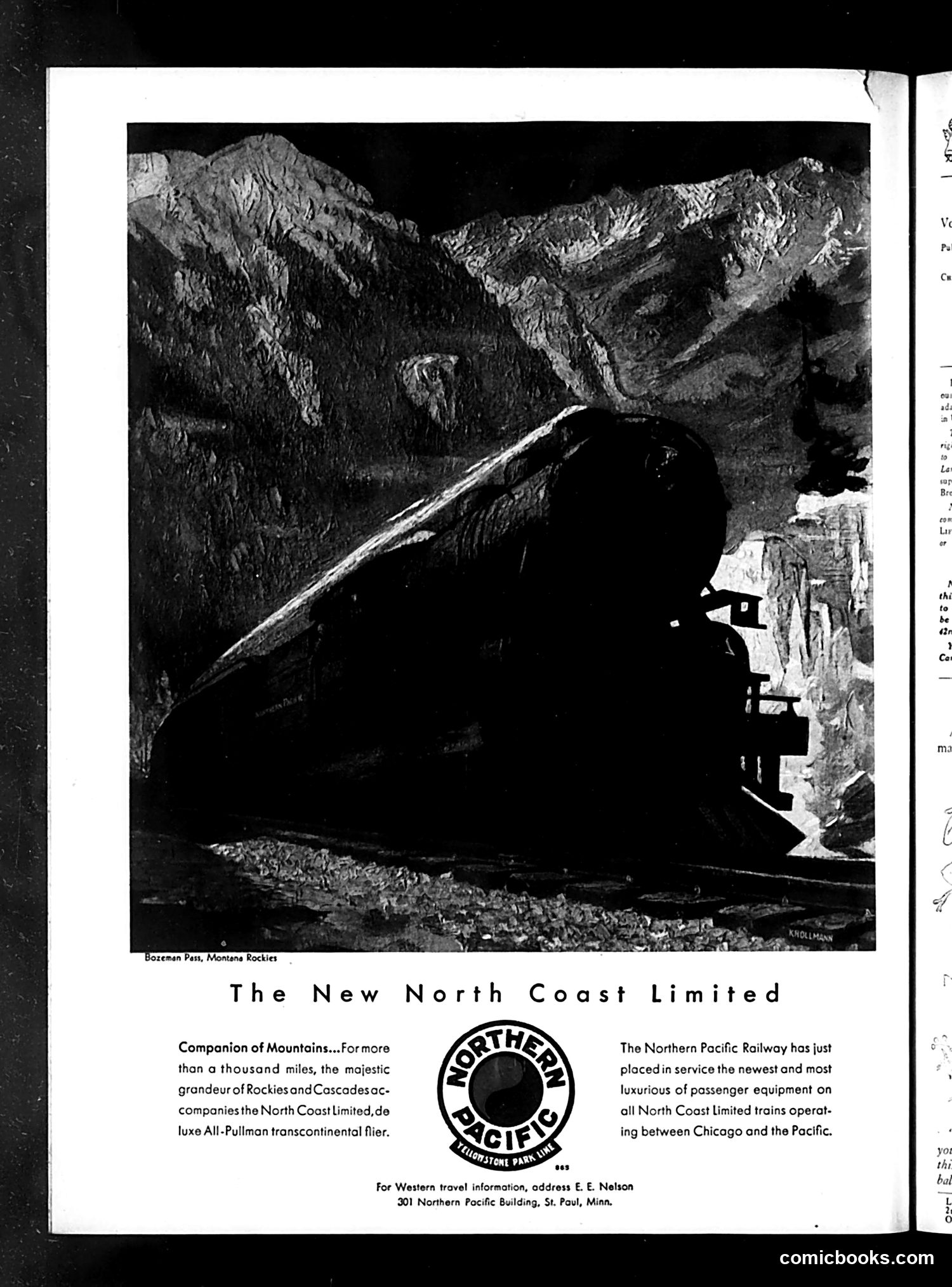
Analysis This is not a political cartoon or satirical content—it's a railroad advertisement. The page promotes the Northern Pacific Railway's "New North Coast Limited" passenger train service. The dramatic black-and-white photograph shows Bozeman Pass in the Montana Rockies, emphasizing scenic mountain travel between Chicago and the Pacific coast. The ad highlights the railway's new luxury all-Pullman equipment and positions train travel as a leisurely way to experience American wilderness. The Northern Pacific Railway logo and contact information for travel bookings appear below. This represents early-20th-century travel marketing that sold transportation by emphasizing romantic landscape experience—a common advertising strategy before air travel became dominant.
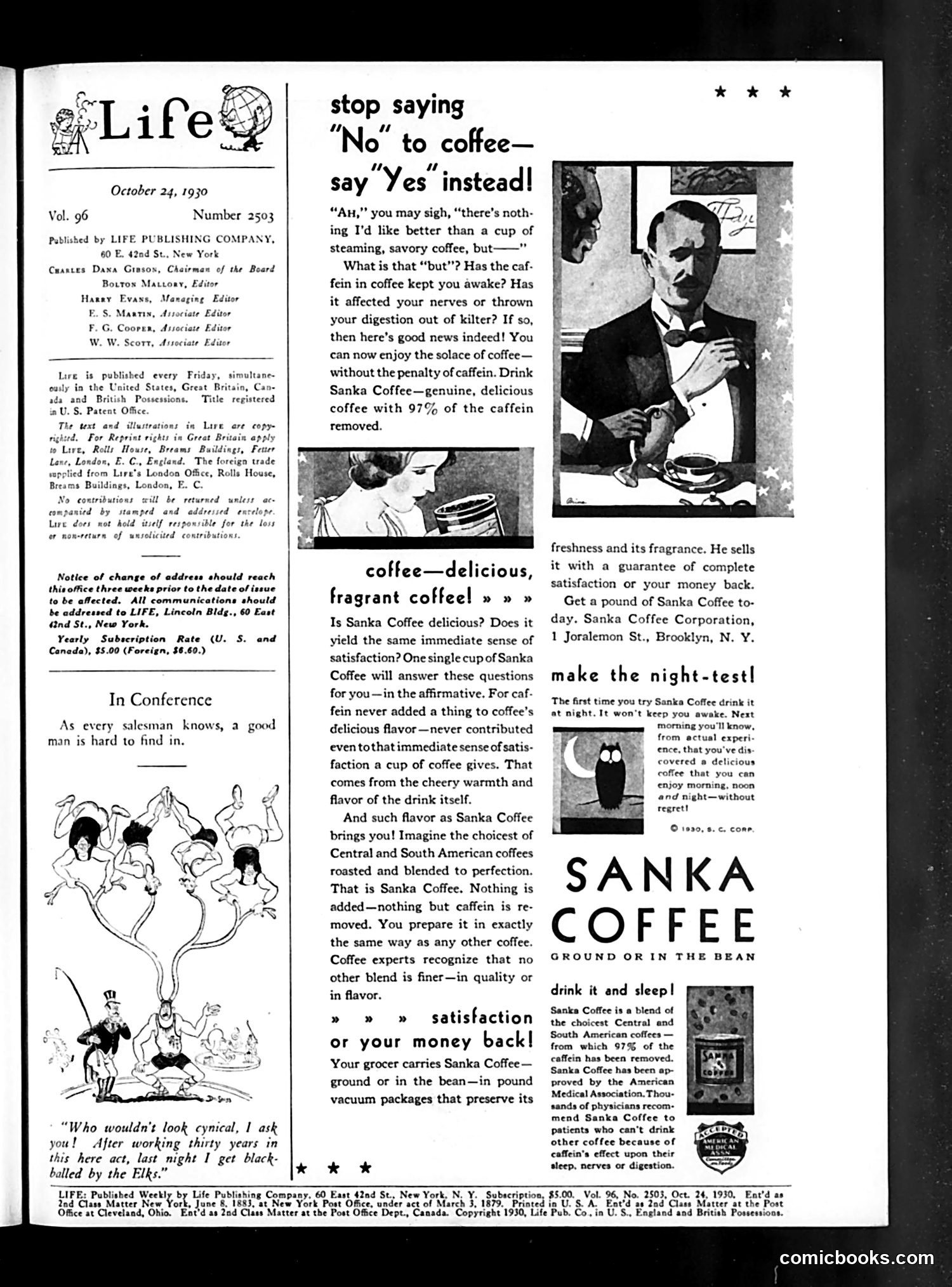
Content Analysis This page is primarily a Sanka Coffee advertisement, not political satire. The main content promotes decaffeinated coffee as a solution for people bothered by caffeine's effects on sleep and digestion. The cartoon on the left titled "In Conference" shows figures gathered around what appears to be a large coffee pot or vessel—likely representing consumers or businesspeople discussing coffee. The illustration style is whimsical rather than satirical. The advertisement's tagline "drink it and sleep!" addresses a genuine consumer concern from the era: caffeine's reputation for causing sleeplessness. By marketing caffeine-removed coffee, Sanka positions itself as solving this problem while preserving coffee's flavor and ritual. The page reflects 1930s consumer culture and early health-consciousness advertising, not political commentary.
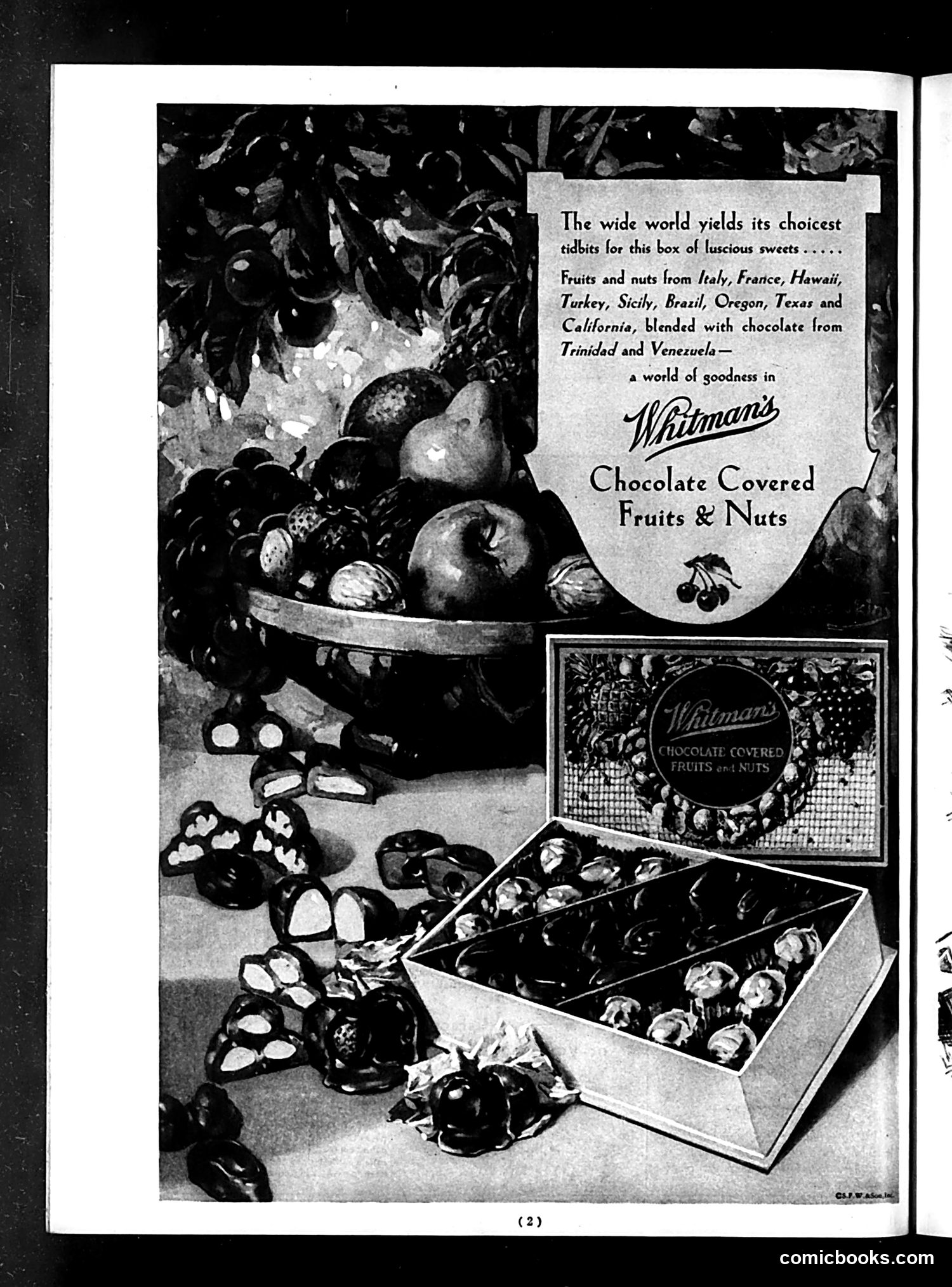
This is a product advertisement, not political satire or a cartoon. It promotes Whitman's Chocolate Covered Fruits & Nuts, emphasizing the global sourcing of ingredients: fruits and nuts from Italy, France, Hawaii, Turkey, Sicily, Oregon, Texas, and California, combined with chocolate from Trinidad and Venezuela. The advertisement uses an aesthetic common to early 20th-century luxury marketing—an overflowing cornucopia and elegant product packaging shown alongside individual candies. The tagline "a world of goodness in Whitman's" plays on the exotic, international ingredients as a selling point for affluent consumers. There is no political commentary or satire present. This is straightforward commercial advertising highlighting premium ingredients and global trade as markers of quality and desirability.
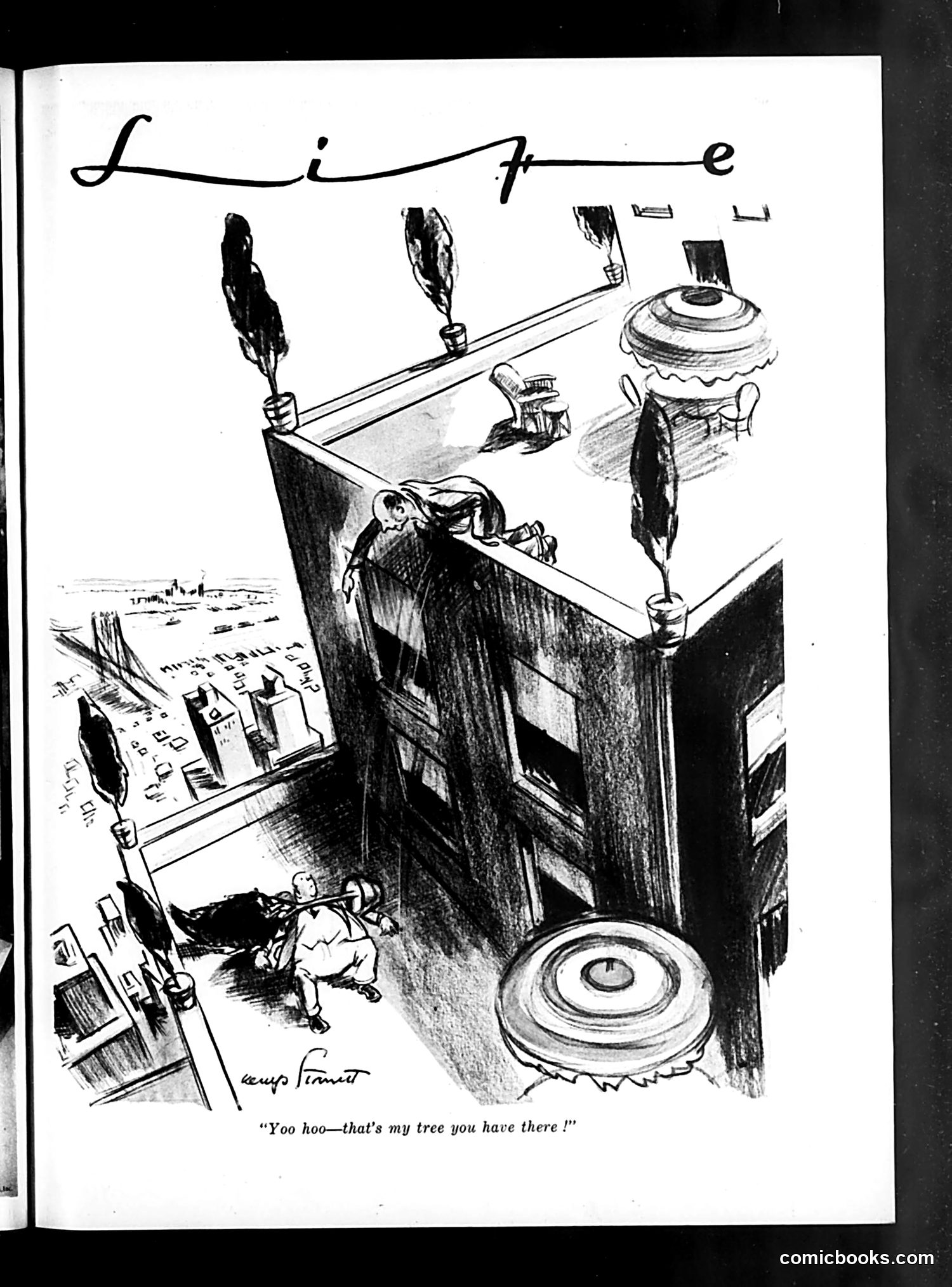
Analysis of "Life" Magazine Cartoon This cartoon depicts a domestic dispute over a Christmas tree. A woman leans out of a building window confronting a man below, exclaiming "Yoo hoo—that's my tree you have there!" The humor stems from a mistaken identity or ownership confusion about a Christmas tree. Below, figures appear to be moving or transporting the tree, seemingly unaware they've taken someone else's property. The man being addressed appears caught in the act. The cartoon satirizes the chaos of holiday shopping and decorating—a relatable middle-class concern about mix-ups during the busy Christmas season. The artist (appears to be signed, though unclear) captures the comedic awkwardness of neighbors or strangers accidentally claiming each other's holiday purchases, a timeless source of seasonal domestic humor.
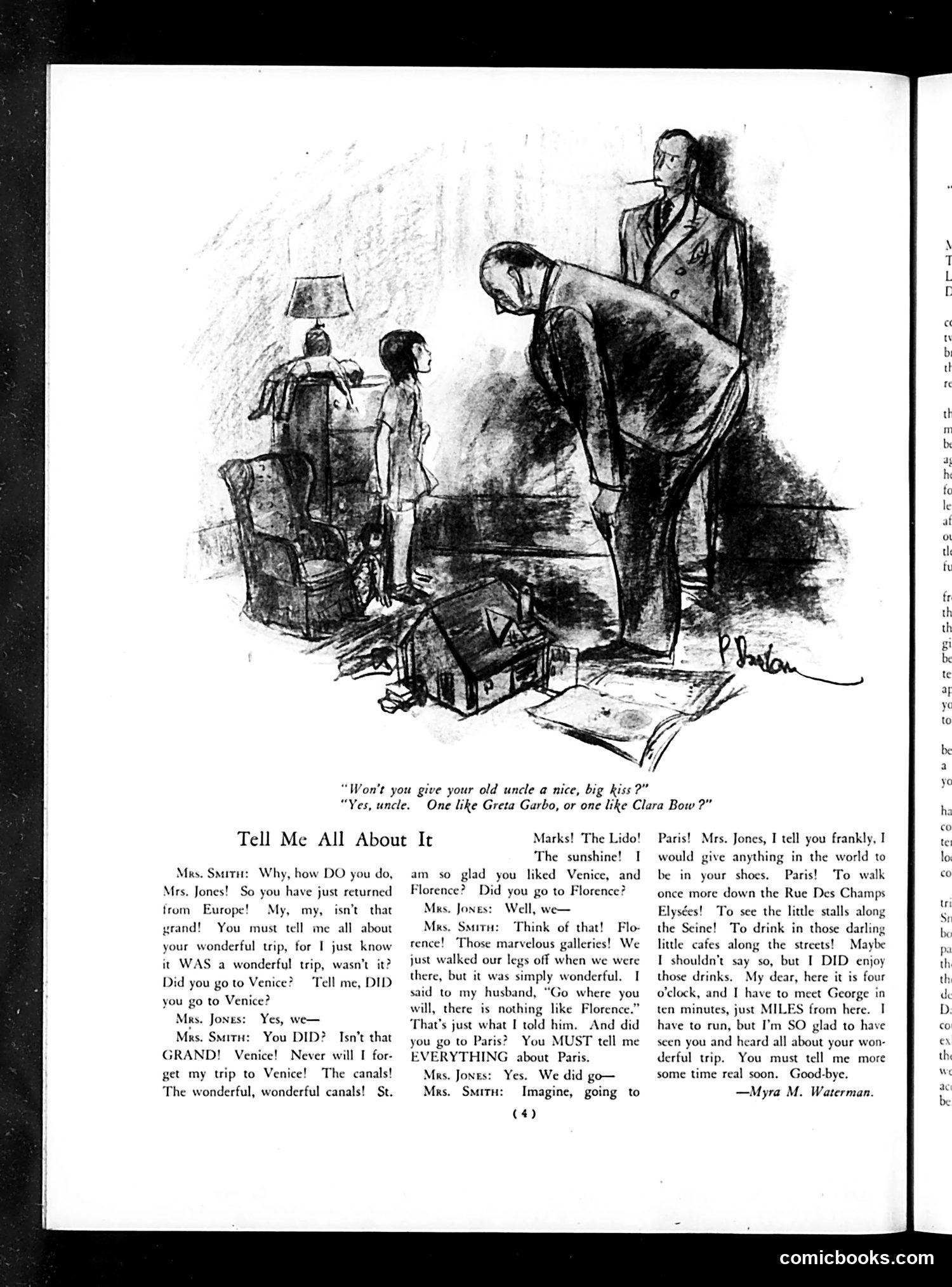
"Tell Me All About It" This is a domestic humor piece about travel bragging. Mrs. Jones has returned from a European trip and Mrs. Smith eagerly demands details about Venice, Florence, and Paris. The cartoon shows Mrs. Jones (standing, gesturing expansively) recounting her travels while Mrs. Smith sits listening intently. The satire targets the social convention of post-vacation boasting—Mrs. Smith's breathless insistence that Mrs. Jones describe "EVERYTHING about Paris" and her complaints about being left out ("Never will I forgive you!"). The humor lies in the relatable dynamic of friends who feel obligated to listen to exhaustive travel stories, with the punchline being Mrs. Jones's promise to share "more some time real soon."
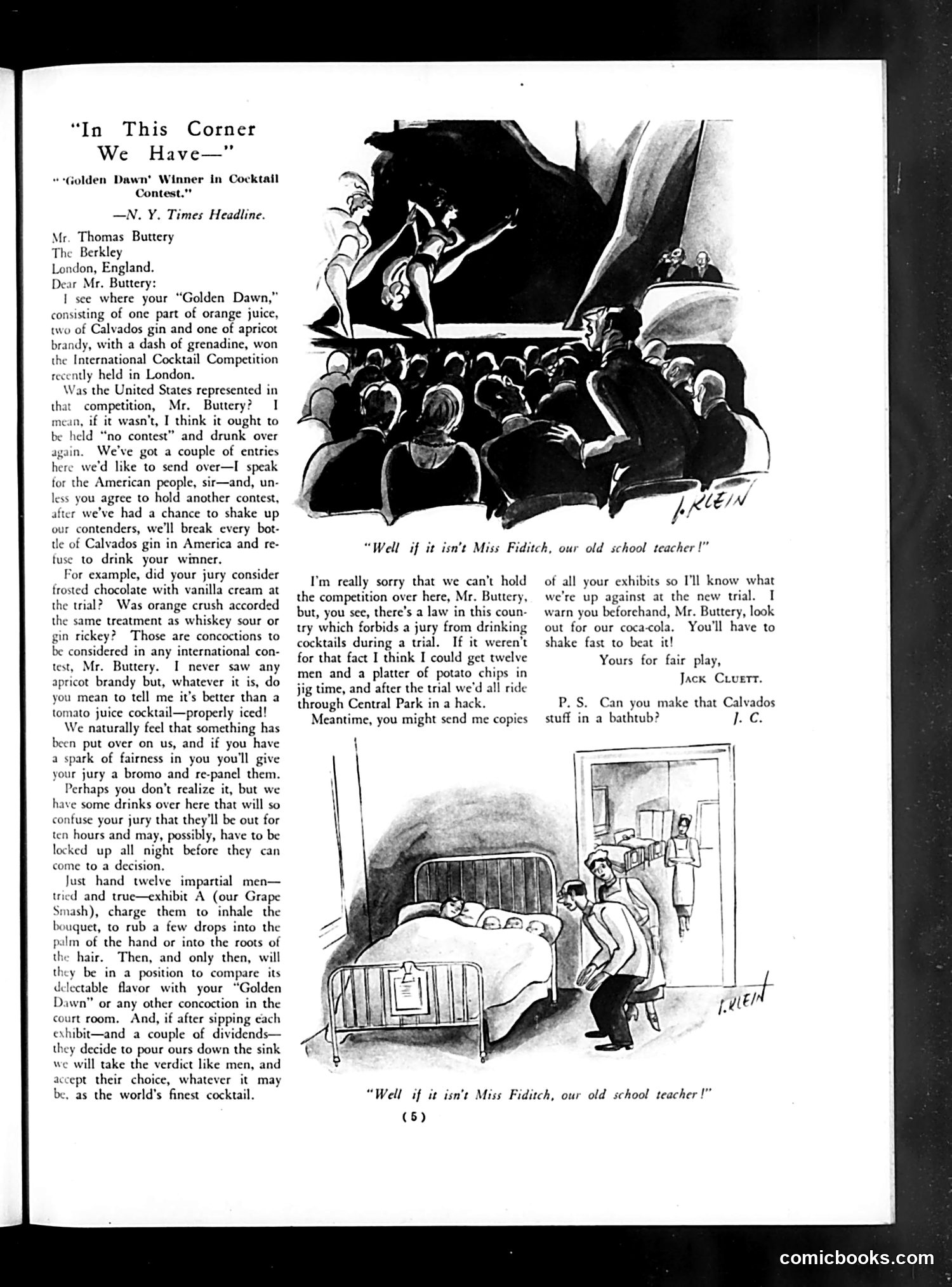
Analysis This page contains a letter to the editor about a cocktail competition and two cartoon illustrations with the same caption: "Well if it isn't Miss Fiditch, our old school teacher!" The cartoons' joke: The humor appears to center on an unexpected, somewhat awkward reunion with a former teacher in an inappropriate setting—the top cartoon shows her on what appears to be a theatrical stage, the bottom in what seems to be a bedroom. The caption's surprise ("Well if it isn't...") suggests the teacher has appeared in a place the cartoonist's audience would find comic or unseemly for a schoolteacher, implying she's changed circumstance or reputation since teaching. The accompanying letter discusses a "Golden Dawn" cocktail that won a London competition and proposes holding a similar contest in America, with humorous suggestions about jury procedures.
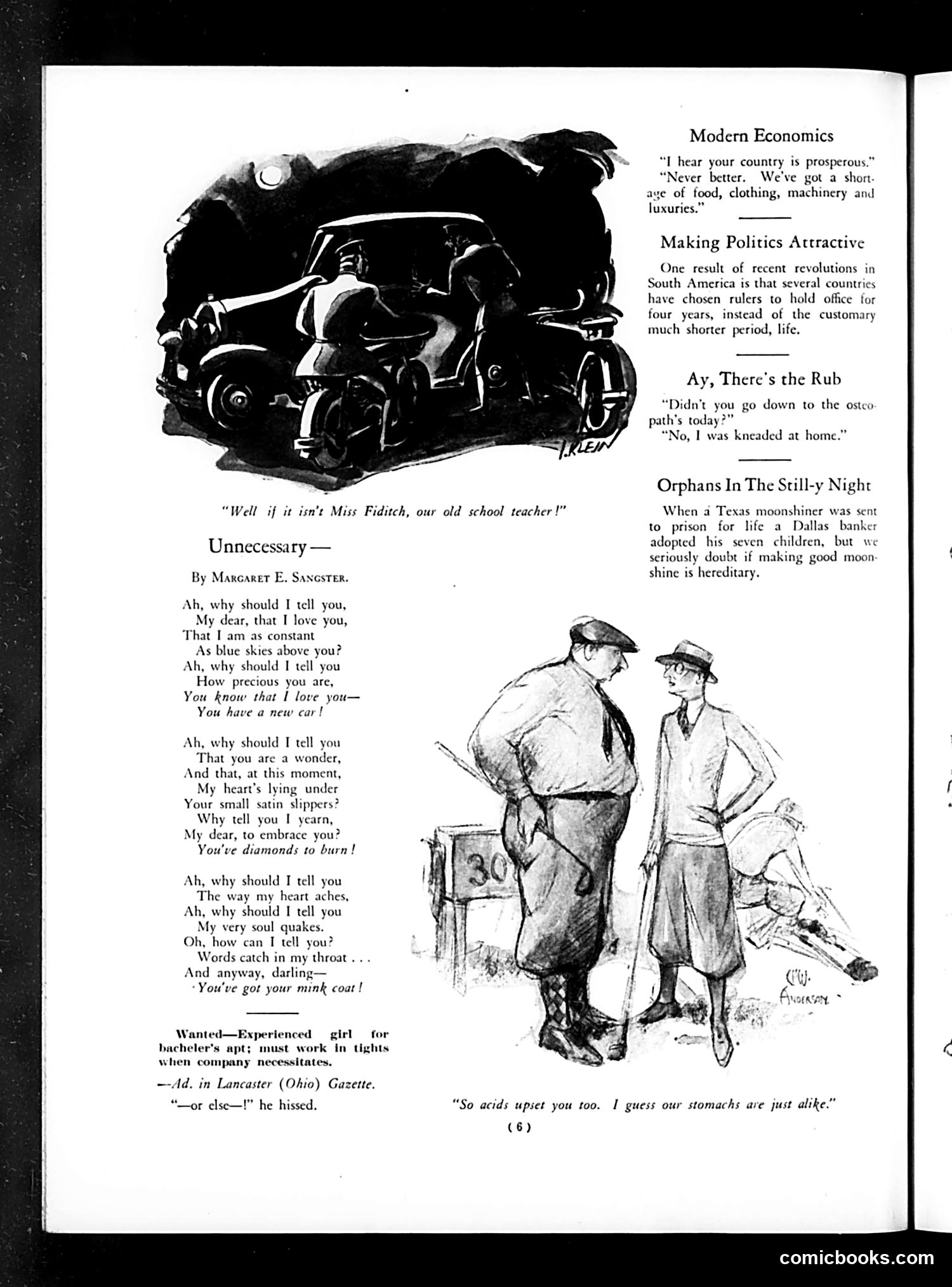
Page Analysis: Life Magazine Satire This page contains three separate humorous pieces: 1. "Unnecessary" — A poem by Margaret E. Sangster mocking overly sentimental romantic declarations, using ironic repetition to suggest that expressing love constantly becomes tedious rather than touching. 2. "Modern Economics" — A brief joke about economic scarcity, suggesting prosperous nations still lack basic goods (food, clothing, machinery, luxuries). 3. "Orphans In The Still-y Night" — An illustrated joke about a Texas moonshiner sent to prison who adopted seven children. The cartoon shows two men with a barrel; the caption suggests their "stomachs are just alike," implying the children were adopted primarily to help consume illegal whiskey rather than from genuine charitable motives. The humor targets both Prohibition-era bootlegging and questionable parenting.
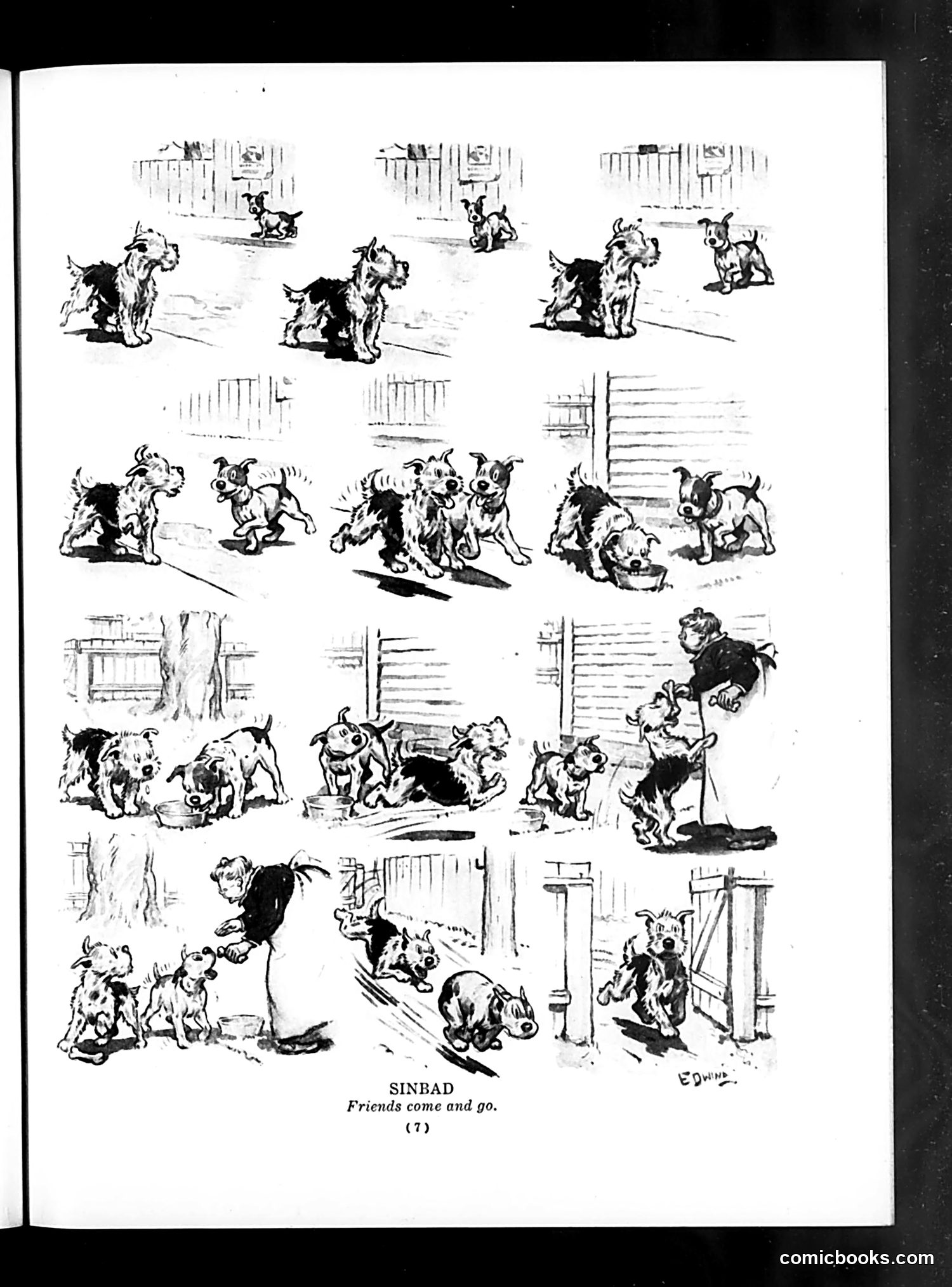
Sinbad: Friends Come and Go This is a comic strip titled "Sinbad" subtitled "Friends come and go," credited to what appears to be "E. Dirks" or similar (signature partially visible). The strip depicts a dog character (Sinbad) in various scenes with other dogs and people. The narrative appears to show Sinbad's changing relationships and social situations - dogs arriving and departing, interactions around food bowls, play and fighting, and what looks like someone taking away or removing dogs. The joke plays on the phrase "friends come and go" - literally showing multiple dogs appearing and disappearing from Sinbad's life throughout the scenes. It's gentle humor about the transient nature of animal friendships and the domestic chaos of having multiple dogs around.
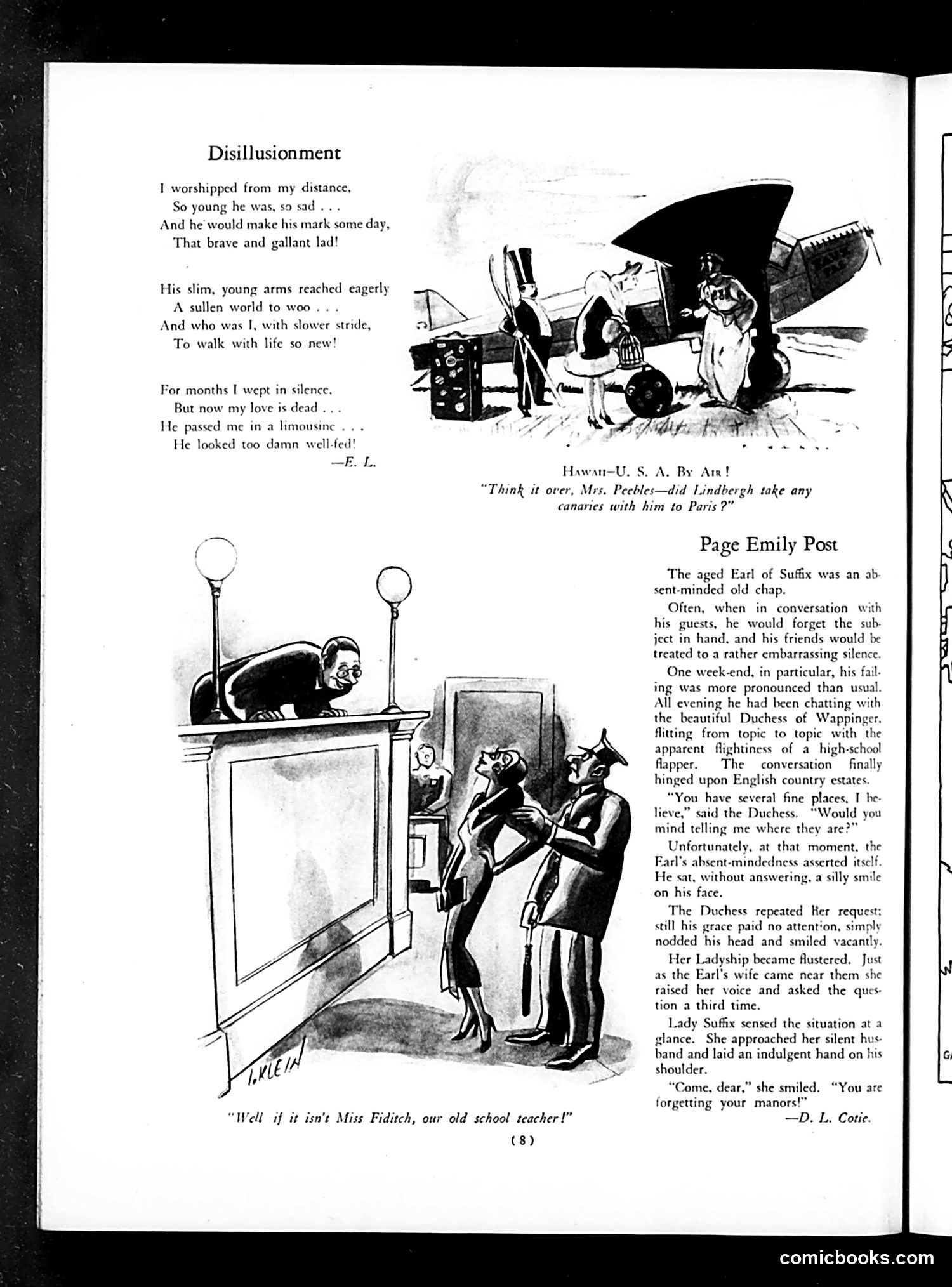
Page Analysis: Life Magazine This page contains two distinct pieces: 1. "Disillusionment" (poem by E.L.): A sentimental poem about a young man the narrator admired from afar, who promised greatness but ultimately disappointed—"He looked too damn well fed!" 2. "Page Emily Post" (by D.L. Cotte): A humorous social commentary featuring the Earl of Suffix, an absent-minded aristocrat. The cartoon illustrates a scene where the Earl fails to answer the Duchess of Wappinger's repeated questions about his English estates. His wife, Lady Suffix, must intervene, reminding him he's "forgetting your manors"—a pun on "manners." The satire mocks absent-minded upper-class pretension and social etiquette through wordplay about forgetting both proper behavior and actual property ownership.
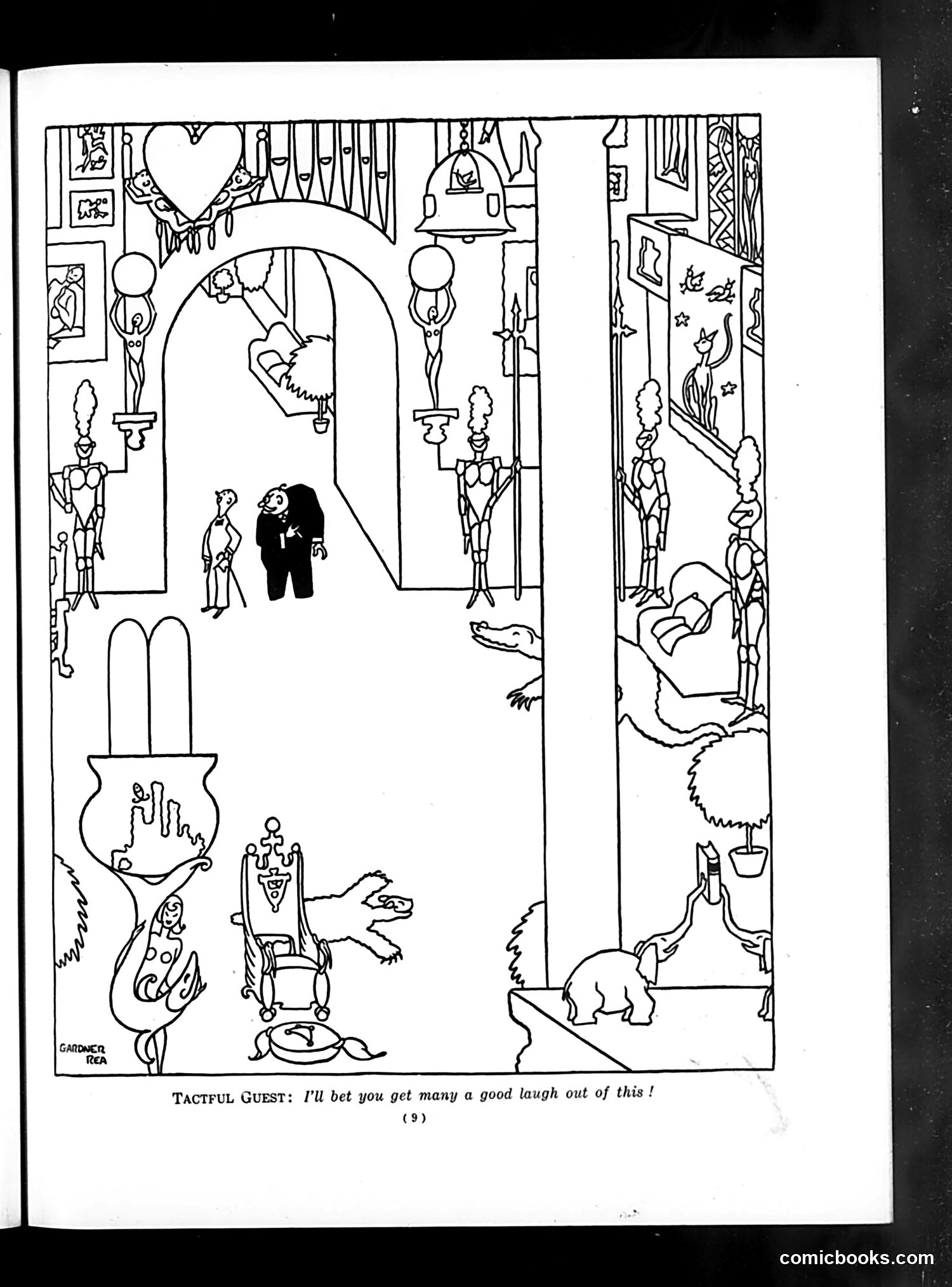
Analysis This is a single cartoon by Gardner Rea titled "Tactful Guest," with the caption: "I'll bet you get many a good laugh out of this!" The cartoon depicts a surreal, elaborate interior space filled with decorative statuary, potted plants, and ornamental objects. Two human figures (appearing to be a couple) stand in the center, while various grotesque or fantastical creatures—including what appear to be dinosaurs or prehistoric beasts—inhabit the same ornate room alongside them. The humor appears to derive from the absurdity of treating these monstrous creatures as ordinary household companions or decorative elements, much as one would accept unusual art or pets. The "tactful guest" presumably makes a polite comment about this bizarre collection, finding humor in the surreal juxtaposition of refined interior decoration with prehistoric or monstrous inhabitants.
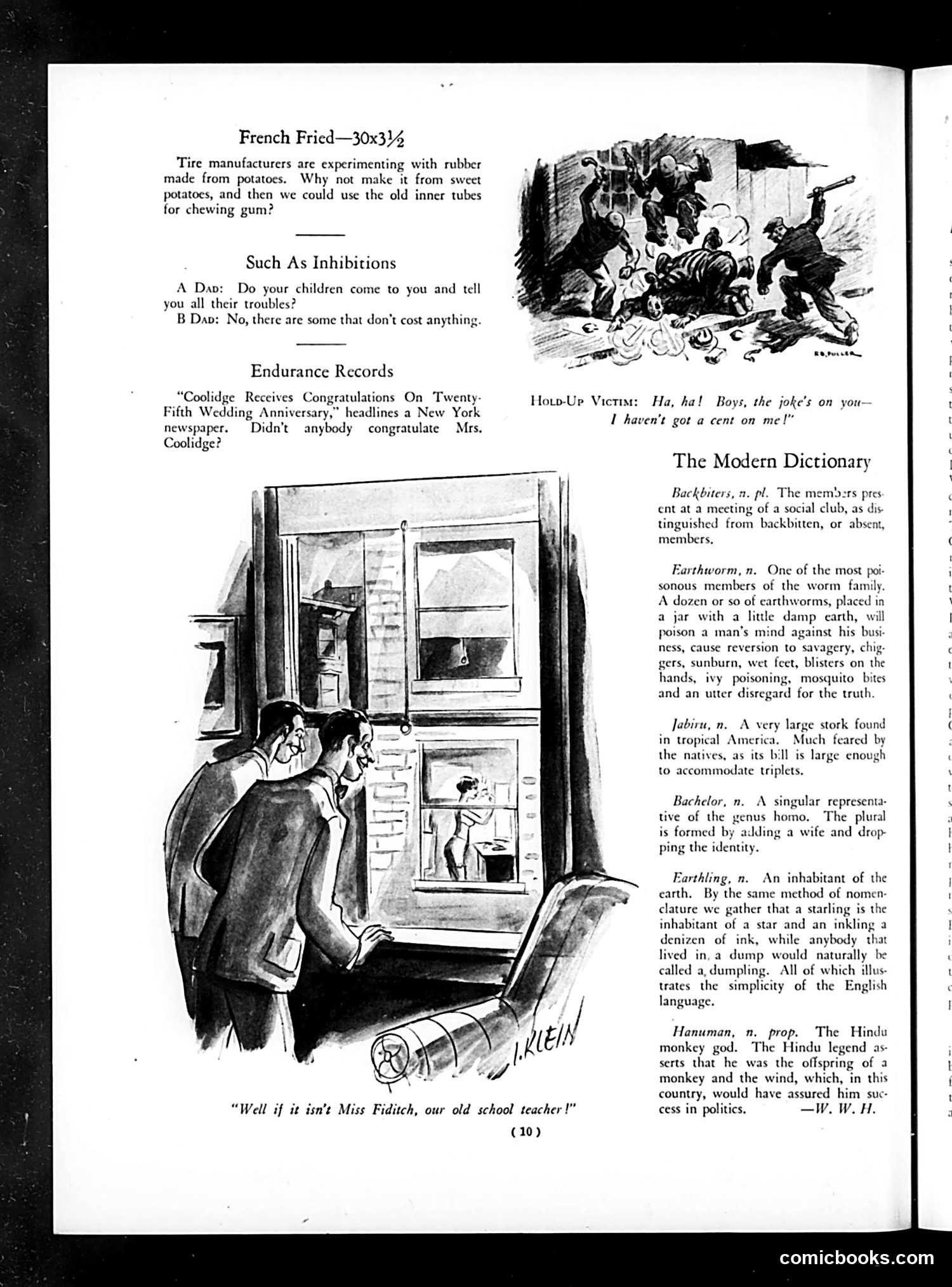
Analysis of Life Magazine Page This page contains several brief humorous items rather than a sustained political cartoon: 1. "French Fried" is a pun suggesting tire manufacturers use sweet potatoes instead of rubber, with the absurdist joke that old inner tubes could become chewing gum. 2. "Such As Inhibitions" presents a quick joke about parenting—one father claims his children confess their troubles; another claims his don't cost anything (implying they cause no problems). 3. "Endurance Records" mocks a newspaper headline about a 25th wedding anniversary that failed to congratulate the wife, suggesting indifference to marital achievement. 4. The main cartoon shows two men viewing a shop window displaying Miss Fiddich, "our old school teacher," suggesting she's become a mannequin or display figure—a gentle jab at aging or obsolescence.
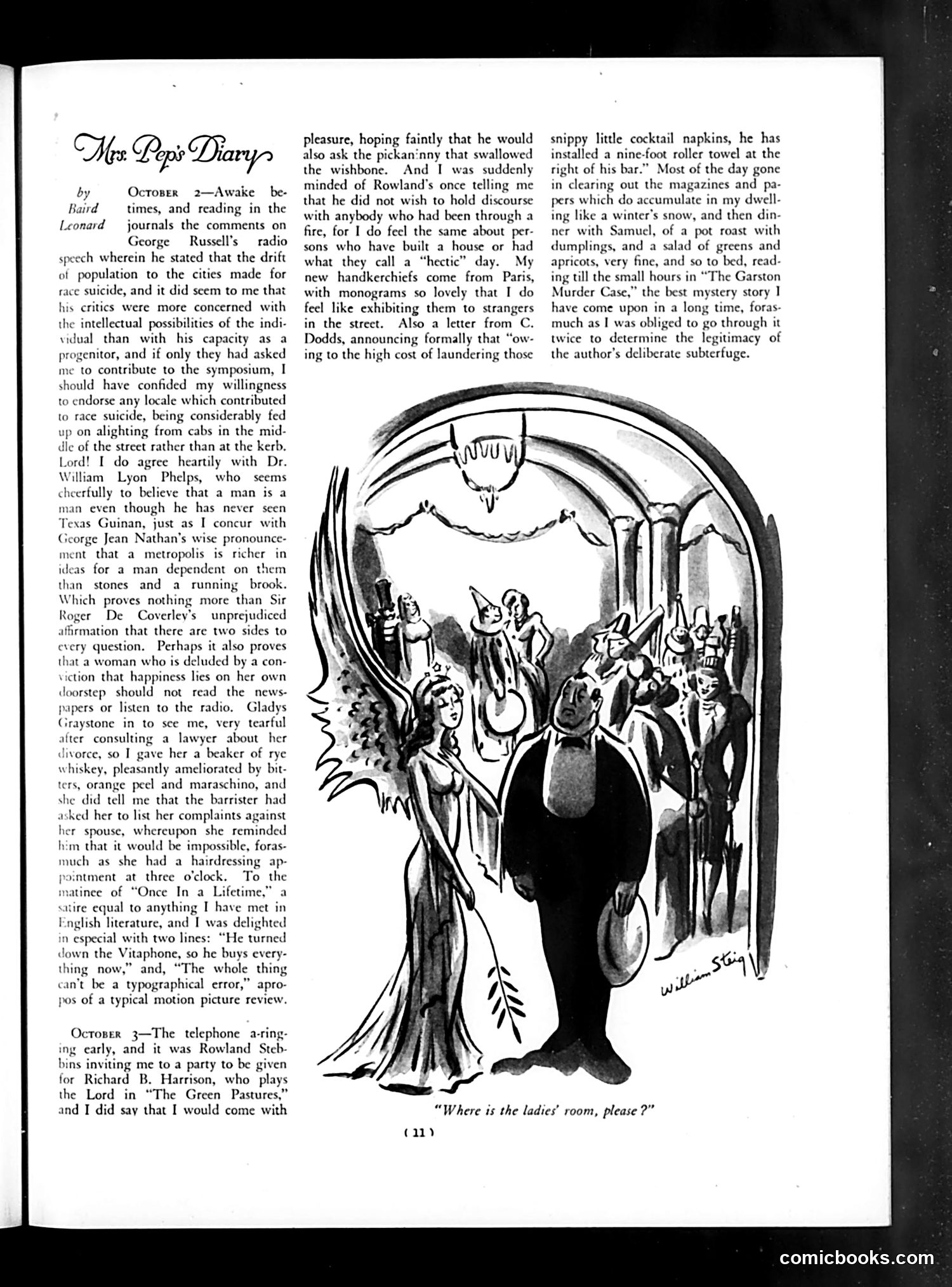
Analysis of "Mrs. Pep's Diary" Page This is a humorous diary entry by Haird Leonard from *Life* magazine. The illustration depicts a woman entering what appears to be a fancy hotel or establishment, asking "Where is the ladies' room, please?" The cartoon satirizes high-society pretension and class consciousness. The woman's formal dress and the ornate architectural setting suggest an exclusive venue. The joke likely concerns the awkwardness of navigating social spaces—asking such a basic question in an ostentatiously fancy environment exposes the gap between working-class reality and upper-class affectation. The accompanying text discusses various social observations about divorce lawyers, radio, and metropolitan life, maintaining the diary's gossipy, satirical tone about American urban society and class dynamics.
"Life in Washington" - Political Satire This is a two-scene satirical playlet mocking early 20th-century political maneuvering. Scene 1 depicts a conversation between the President and a visitor named Slaper, a "fat gentleman" wanting to run for senator against someone called Footman, with Republican party backing. The President plays coy about endorsing candidates. Scene 2 shows delegates wearing "Dry" (Prohibition) ribbons and Footman buttons confronting the President about Slaper spreading rumors that the President supports him—apparently to undermine Footman's candidacy through false claims. The satire targets political hypocrisy: politicians publicly maintaining neutrality while privately manipulating endorsements, and using misinformation to damage rivals. The Prohibition references suggest this reflects actual 1920s-era political debates.
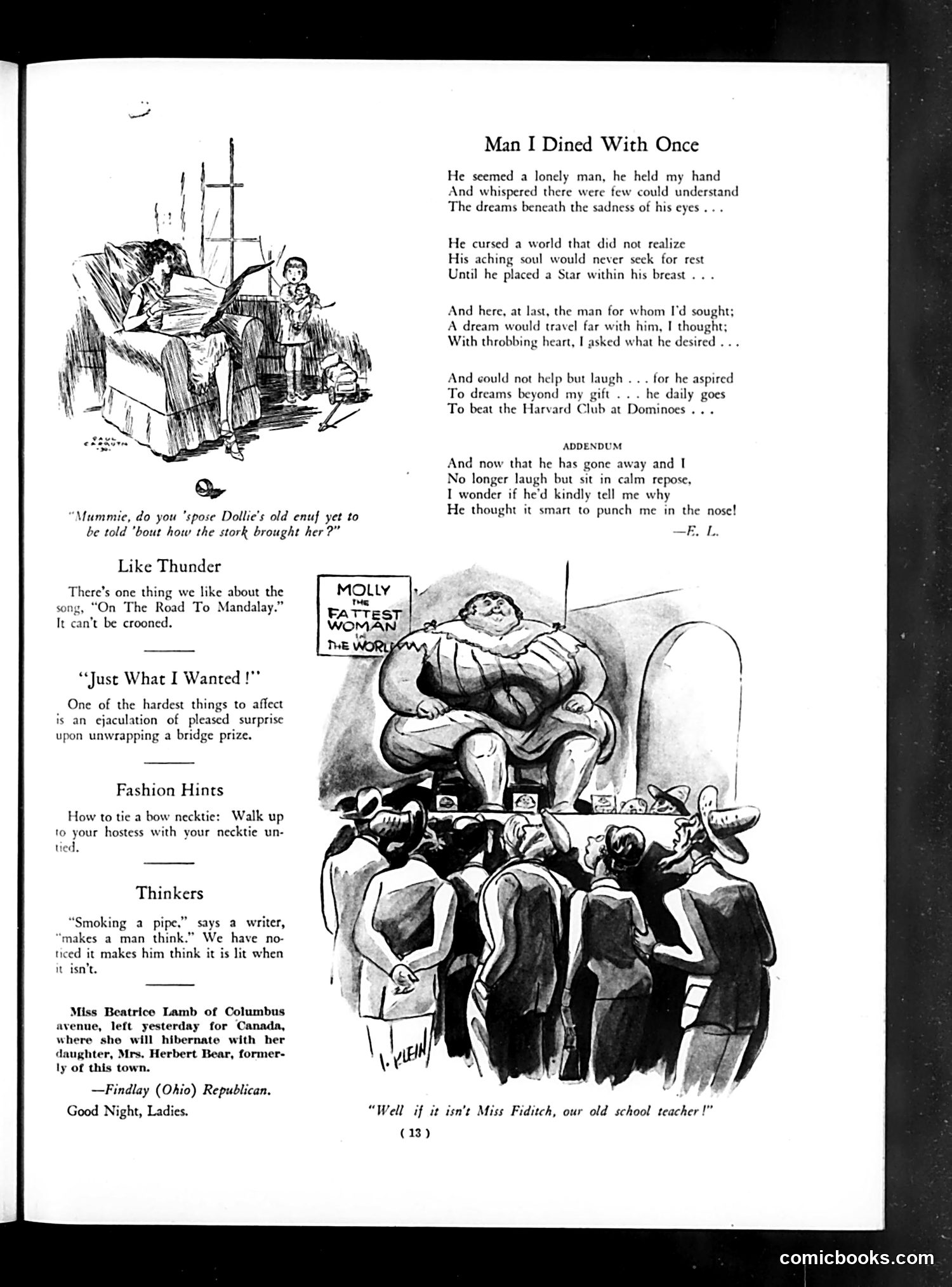
Analysis of Life Magazine Page Main Cartoon ("Well if it isn't Miss Fiditch, our old school teacher!"): This cartoon depicts a heavyset woman labeled "Molly" sitting elevated above a group of formally dressed people. The joke appears to be about an unexpected social encounter—someone recognizing a former schoolteacher in an unexpectedly prominent or embarrassing position. The satire mocks either social pretension, career advancement through questionable means, or the shock of seeing authority figures in undignified circumstances. The exact meaning of "Molly" and her elevated position remains unclear without additional context. Other Content: The page includes a sentimental poem "Man I Dined With Once," humor pieces like "Like Thunder" and "Just What I Wanted," plus miscellaneous social commentary items typical of Life magazine's satirical format. The cartoons and text suggest early-to-mid 20th century social commentary about class, propriety, and unexpected life changes.
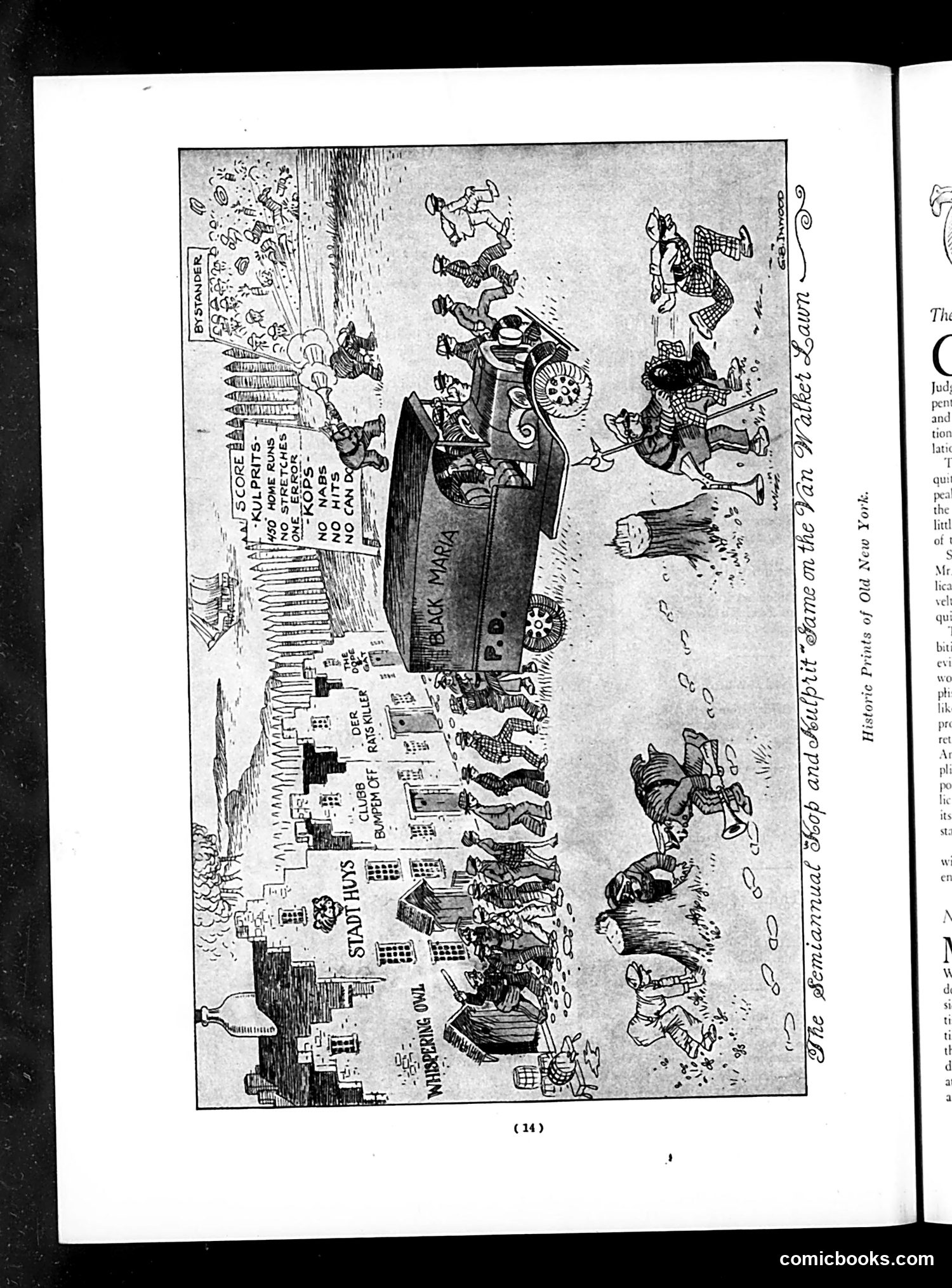
Political Cartoon Analysis This page contains a satirical illustration (rotated 90 degrees) depicting what appears to be a chaotic political or social scene. The central figure is a large character in formal dress emerging from or riding in what looks like a barrel or container labeled "PACK MARX" (unclear if this refers to Karl Marx or another figure). Various smaller figures surround this central character in apparent pandemonium—some appear to be politicians or public figures in caricatured form, with exaggerated features typical of early 20th-century satirical cartooning. The exact political context remains unclear without seeing the caption or accompanying article text, but this appears to satirize either political corruption, chaos, or a specific scandal involving powerful figures of the era. The barrel imagery may reference concealment or corruption.
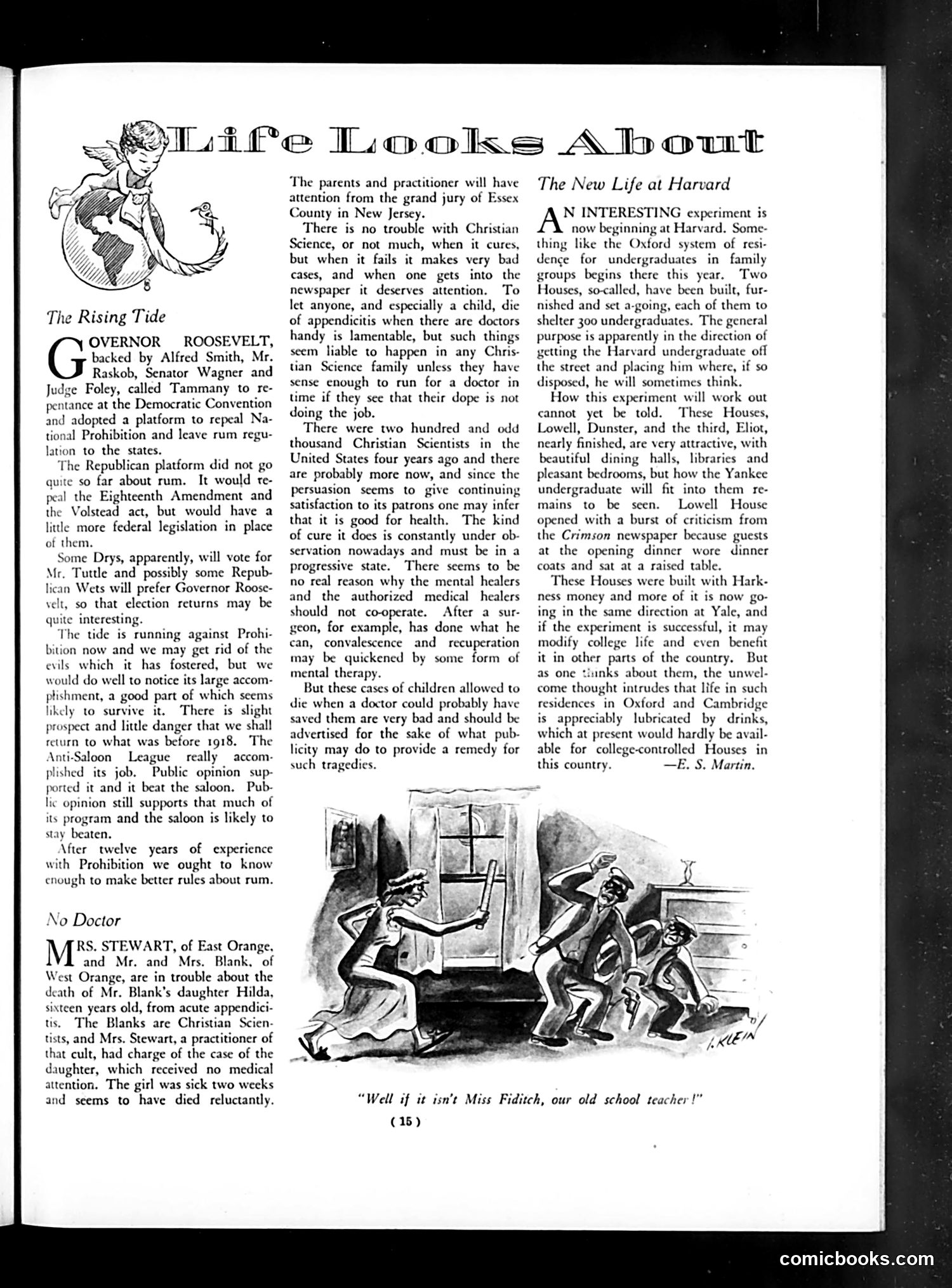
Analysis of Life Magazine Page This page discusses contemporary social issues from the early 20th century. The main sections address: "The Rising Tide" criticizes Prohibition enforcement and Christian Science medical practices, arguing both cause harm—particularly when children die from lack of medical care rather than receiving doctor treatment. "The New Life at Harvard" describes an experiment in undergraduate residential living, establishing Houses (Lowell, Dunster, Eliot) to improve college community life. "No Doctor" recounts a tragic case where a Christian Scientist child died from appendicitis without medical intervention, despite a doctor potentially saving her life. The cartoon depicts what appears to be children or figures in an outdoor scene, captioned "Well if it isn't Miss Fiditch, our old school teacher!"—likely a nostalgic or social commentary about education. The page criticizes religious medical practices that reject conventional medicine.
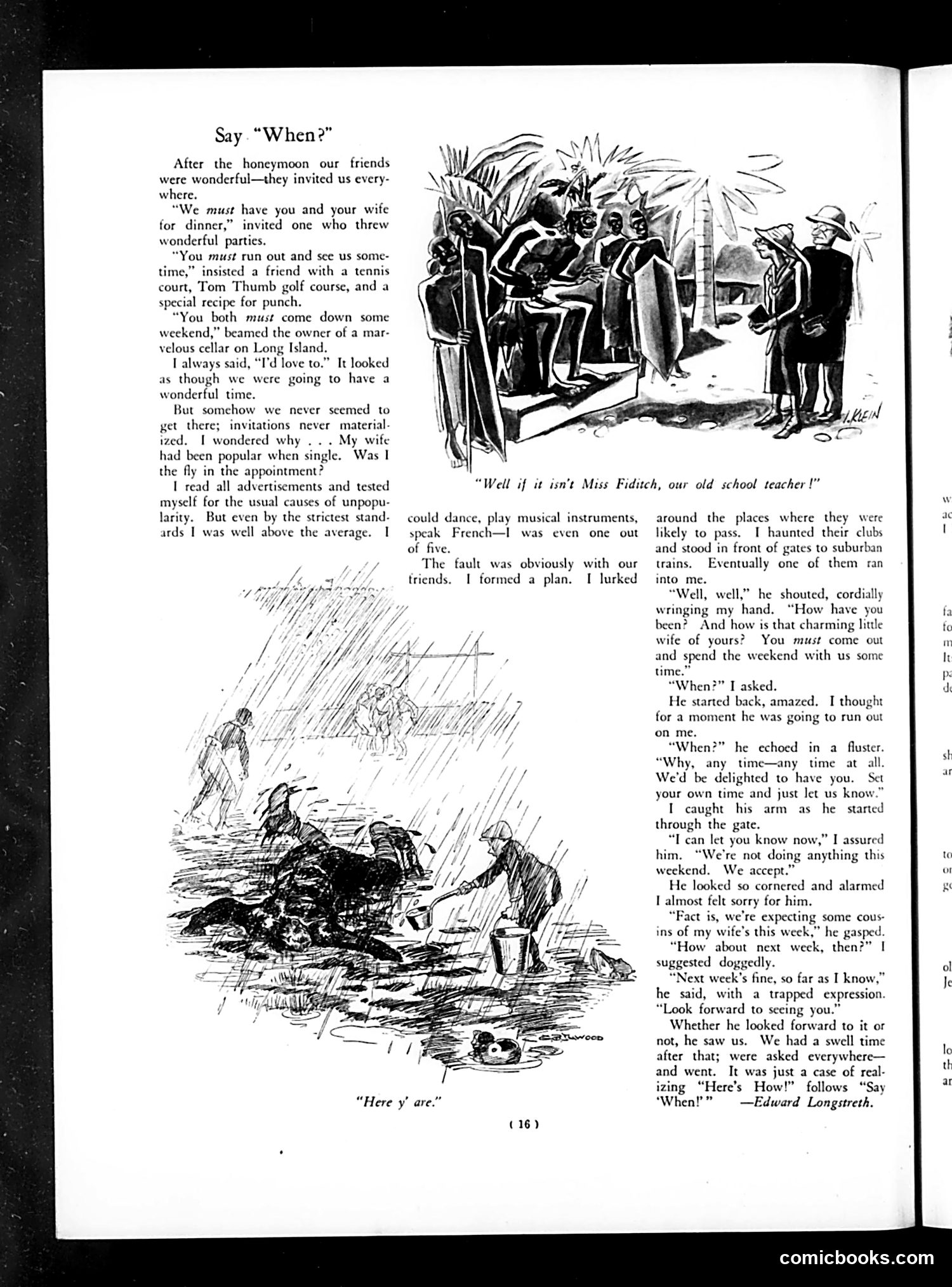
Analysis This page contains a humorous short story titled "Say 'When?'" by Edward Longstreth, illustrated with two ink drawings. The narrative satirizes social climbing and overeager hospitality among the wealthy. The story describes how the narrator and his wife repeatedly decline invitations from newly wealthy friends who constantly pressure them to visit—insisting they "must" come to dinners, tennis matches, and golf outings. The joke centers on the narrator's eventual strategy: he finally accepts, but then the eager hosts become flustered and evasive when he actually shows up, revealing their invitations were merely performative social gestures. The accompanying illustrations depict people in rain and a ragged outdoor scene, visualizing the story's themes of social awkwardness and the gap between offered hospitality and genuine welcome.
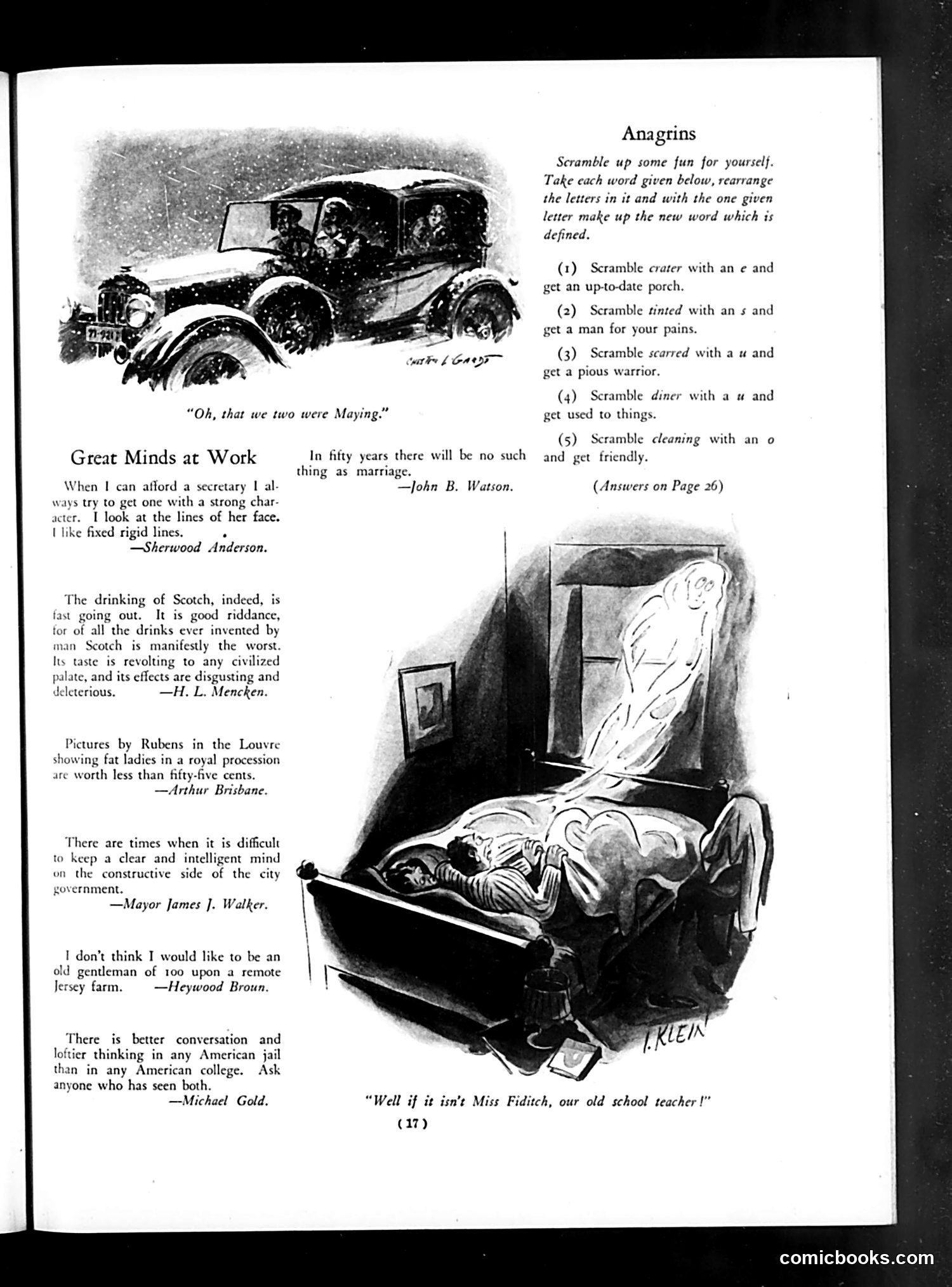
Analysis of Life Magazine Page The page contains two main elements: "Great Minds at Work" - A collection of witty quotes from notable figures (Sherwood Anderson, John B. Watson, H.L. Mencken, and others) mocking various subjects: marriage, Scotch whisky, art, city government, and American colleges versus prisons. The Cartoon - Depicts a bedroom scene where a man lies in bed while another figure stands at the window. The caption reads "Well if it isn't Miss Fiditch, our old school teacher!" The humor appears to play on an unexpected reunion or encounter with a former educator in a compromising situation, suggesting infidelity or illicit activity. The satire targets both domestic propriety and perhaps sexual hypocrisy of the era. The artist is credited as Klein. This page exemplifies early 20th-century satirical humor targeting social conventions and human folly.
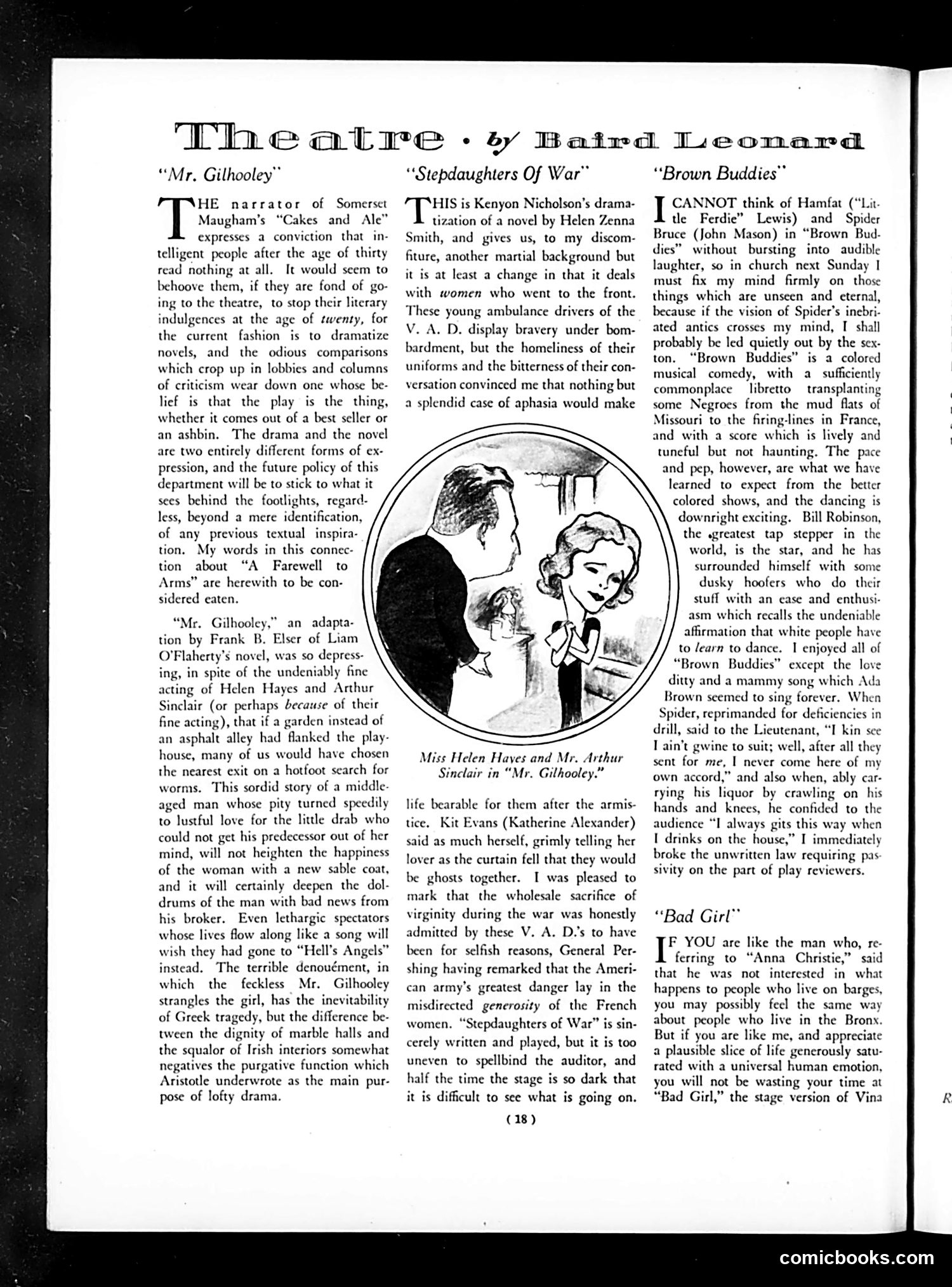
Theatre Reviews by Baird Leonard This page contains three theatre reviews with one accompanying illustration. The circular image shows Miss Helen Haver and Mr. Arthur Sinclair in a scene from "Mr. Gilhooley." The reviews discuss: 1. "Mr. Gilhooley" - An adaptation of Liam O'Flaherty's novel, praised for fine acting despite its depressing subject matter about a man's decline. 2. "Stepdaughters of War" - Kenyon Nicholson's drama about ambulance drivers in WWI. The reviewer finds it sincere but poorly staged and difficult to follow. 3. "Brown Buddies" - A colored musical comedy featuring Bill Robinson. The reviewer enjoys the dancing and entertainment value, though criticizes certain elements as dated. This is straightforward theatre criticism, not political satire.
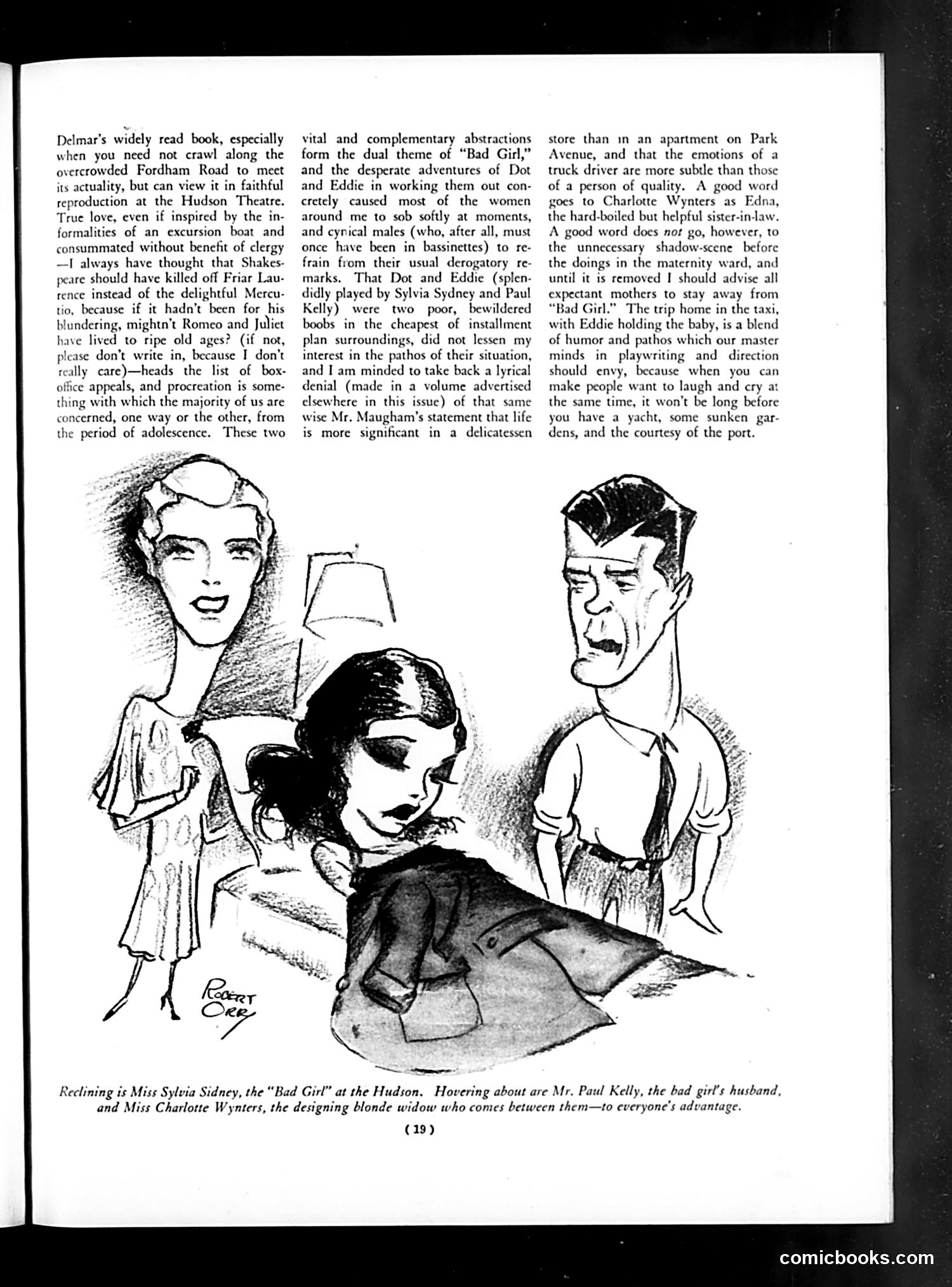
"Bad Girl" at the Hudson Theatre This is a theatre review for the play *"Bad Girl,"* starring Sylvia Sydney and Paul Kelly. The illustration shows the three main characters: Sydney as Dot (reclining), Kelly as her husband Eddie, and Charlotte Wynters as a "designing blonde widow" who creates romantic tension. The reviewer praises the play's emotional impact on audiences—women crying, cynical men restraining mockery—crediting its themes of love and procreation as universal human concerns. He particularly admires the taxi scene where Eddie holds their newborn baby, calling it an effective blend of humor and pathos that makes audiences simultaneously laugh and cry. The critic's main complaint is an unnecessary "shadow-scene" before the maternity ward sequence, which he advises expectant mothers to avoid. He also praises Wynters's performance as the sister-in-law. This reflects 1920s-30s theatrical criticism valuing emotional authenticity and working-class narratives.
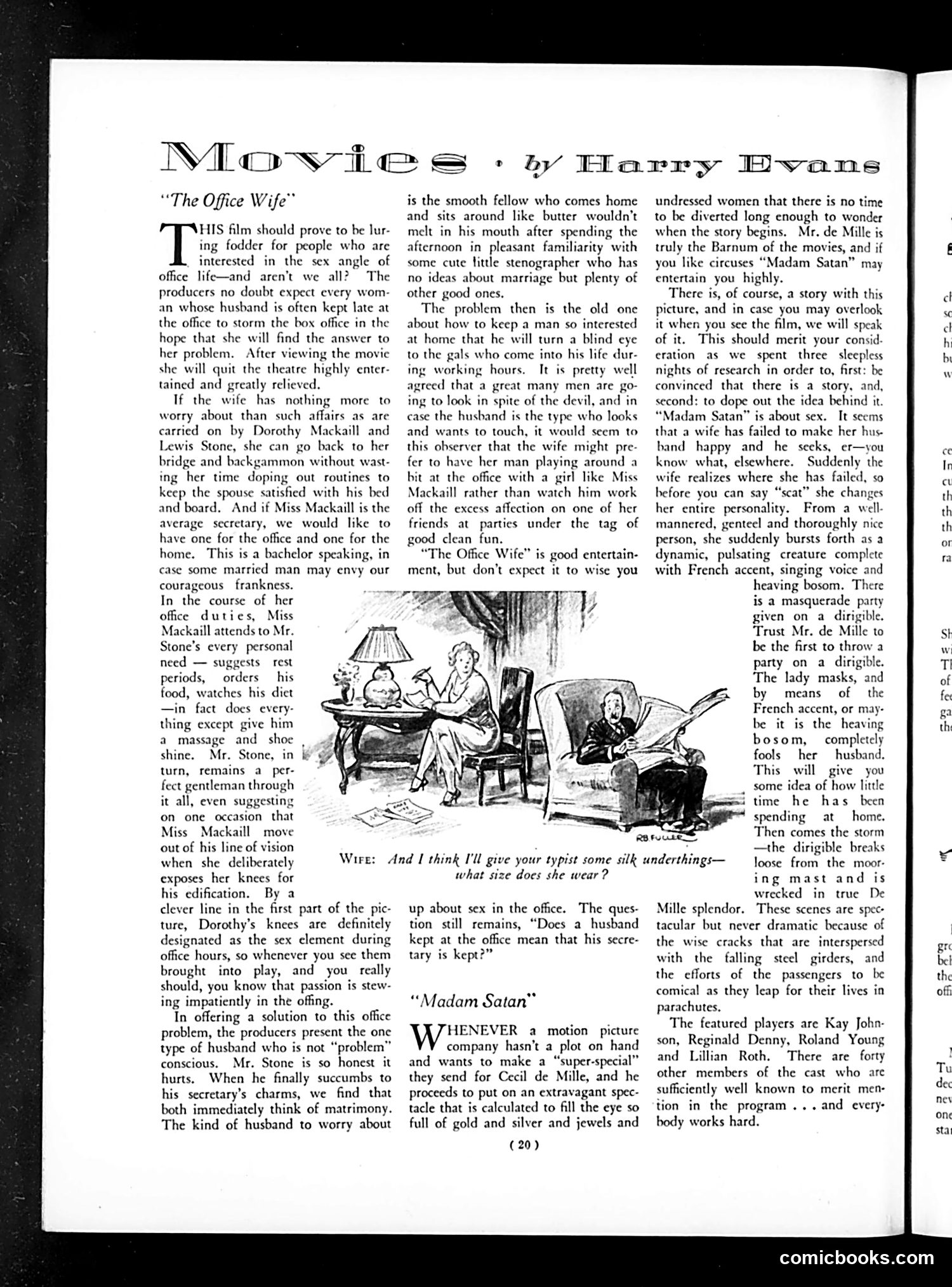
"The Office Wife" and "Madam Satan" — Life Magazine Film Reviews This page contains Harry Evans's film reviews of two 1920s movies. The main illustration depicts the central "problem" the first film addresses: marital jealousy over office affairs. The caption—"And I think I'll give your typist some silk underthings—what size does she wear?"—captures the reviewer's satirical point about husbands' temptations. Evans critiques "The Office Wife" (starring Dorothy Mackaill and Lewis Stone) as escapist entertainment for worried wives. He argues the film's "problem"—whether husbands succumb to secretaries—remains unresolved. Evans notes the film emphasizes the secretary's knees as the sexual element and cynically suggests wives might prefer their husbands flirt at the office rather than pursue affairs with friends at parties. The "Madam Satan" review dismisses Cecil B. DeMille's approach as spectacle-over-substance filmmaking—using lavish sets, jewelry, and "undressed women" to distract audiences from weak plots. Both reviews are tongue-in-cheek social commentary on marriage anxieties and Hollywood's formulaic entertainment strategies.
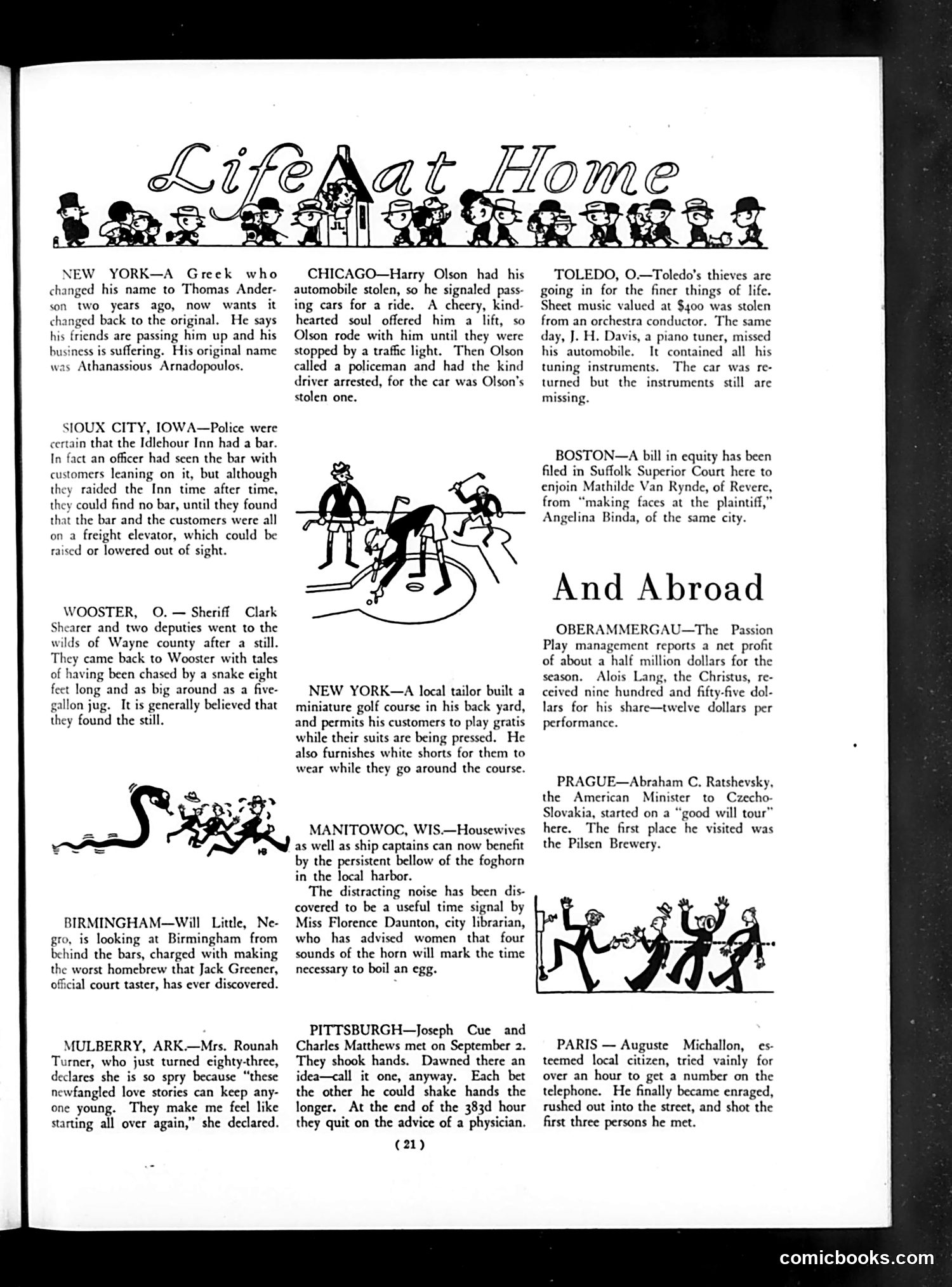
"Life at Home and Abroad" - Humorous Anecdotes Page This page from *Life* magazine presents brief, comedic news items satirizing American social quirks and absurdities circa the 1920s-30s. Domestic anecdotes mock Prohibition-era ingenuity (a hidden bar on a movable elevator; sheriffs' dubious snake stories covering still-hunting failures), ethnic assimilation anxieties (a Greek immigrant regretting his name change), and petty criminality (a man arresting his car thief posing as a helpful stranger). The cartoons illustrate these tales with simple line drawings of physical comedy—figures shaking hands endlessly, people running from snakes, couples dancing. International items humorously contrast American earnestness with foreign indifference: a U.S. minister's "goodwill tour" visiting a brewery first; a Parisian's telephone frustration ending in deadly violence—suggesting Europeans lack American restraint. The satire targets human folly universally: vanity, desperation, absurd persistence, and the gap between pretense and reality.
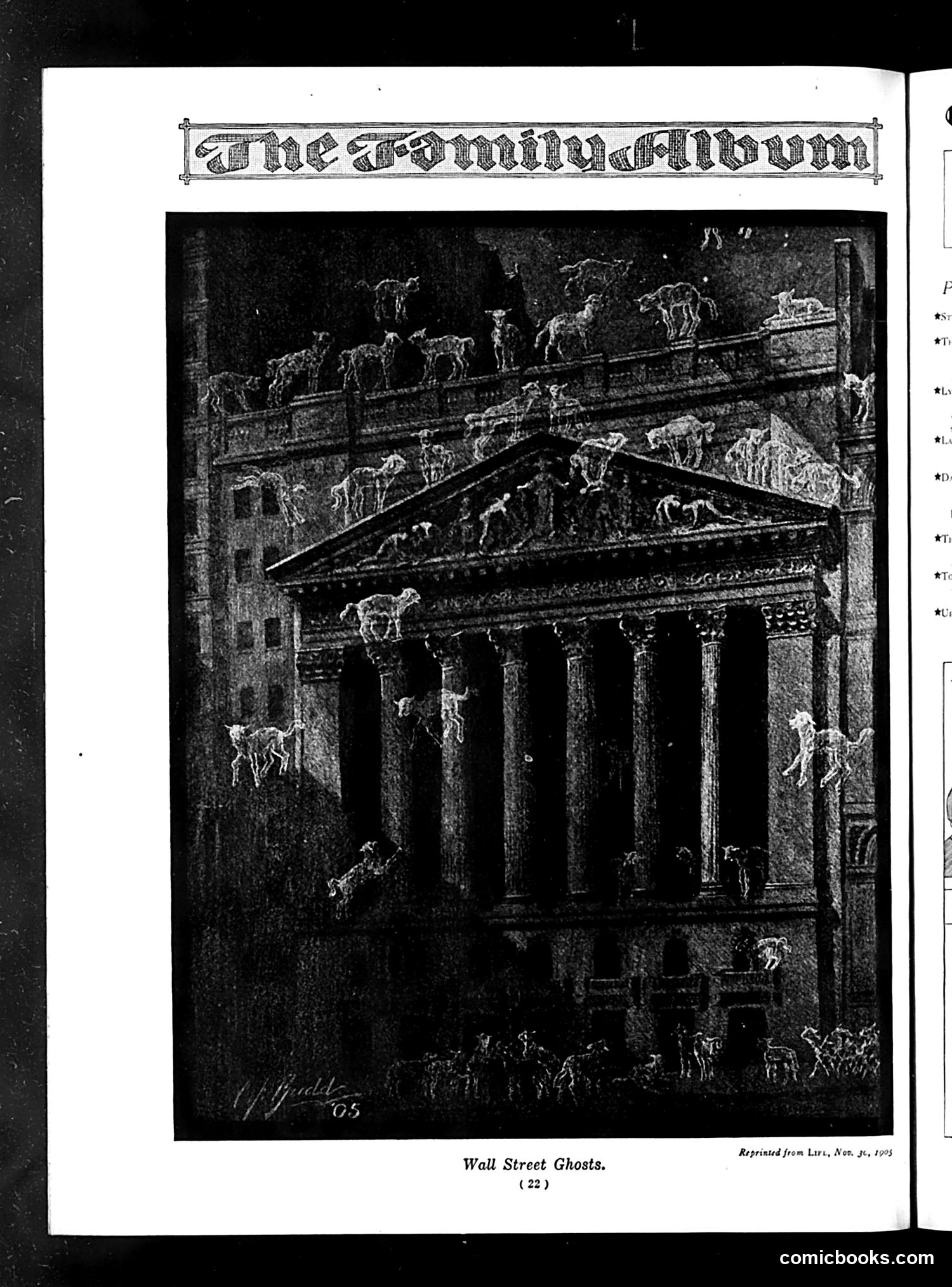
"Wall Street Ghosts" This satirical cartoon depicts a grand classical building (resembling the New York Stock Exchange) inhabited by ghostly figures—both on the structure itself and swarming around its base. The title "Wall Street Ghosts" suggests these are the spectral remnants of financial schemes or failed speculators. The image likely references the aftermath of financial collapse or scandal—possibly the 1903 period suggested by the date. The ghosts represent ruined investors or discredited financiers "haunting" Wall Street institutions. The classical architecture symbolizes the supposed solidity and respectability of financial markets, now revealed as hollow and populated by the wreckage of human ambition and loss. The cartoon satirizes how Wall Street perpetually recycles itself despite crashes, with past failures lingering as cautionary specters.
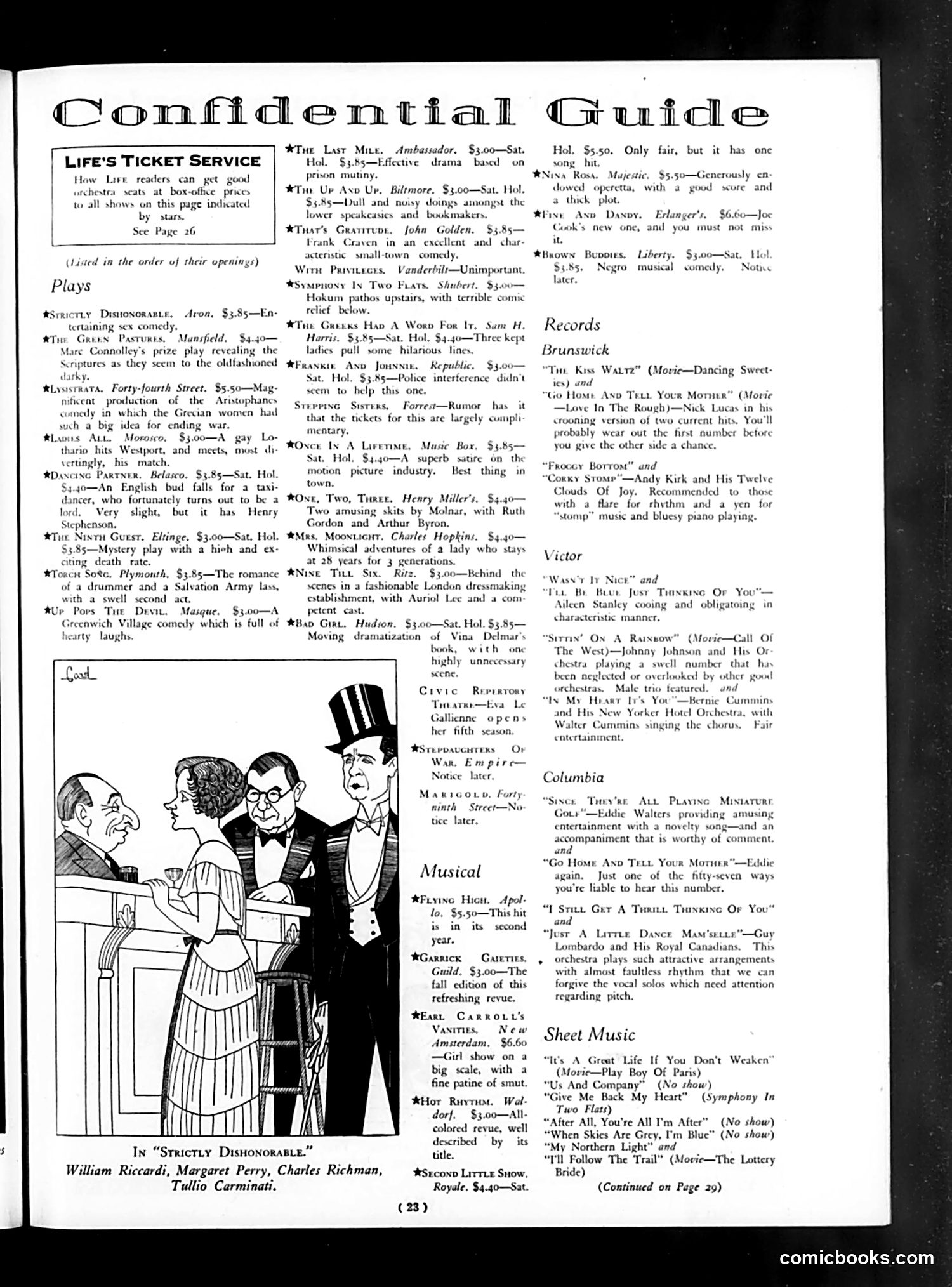
Analysis of Life Magazine Page This page is primarily a theatre and entertainment guide for New York City theatergoers, listing current Broadway shows with prices and brief critical reviews. The cartoon at bottom depicts three fashionably-dressed men (likely theatrical producers or socialites based on their formal attire and the top hat) with a woman in an elegant gown—a typical satirical representation of the leisure class. The reviews themselves contain the satire. Critics make cutting dismissals: "Dull and noisy doings," "Hokum pathos," tickets distributed as "complimentary" (implying worthlessness). One show is called "full of hearty laughs" at a Greenwich Village comedy—poking fun at lowbrow entertainment. The overall tone mocks both pretentious theatre productions and audiences, common targets for Life magazine's satirical voice in the 1920s. The "Confidential Guide" framing suggests insider knowledge—Life presenting itself as the arbiter of which shows are actually worth attending versus which are merely fashionable or desperate.
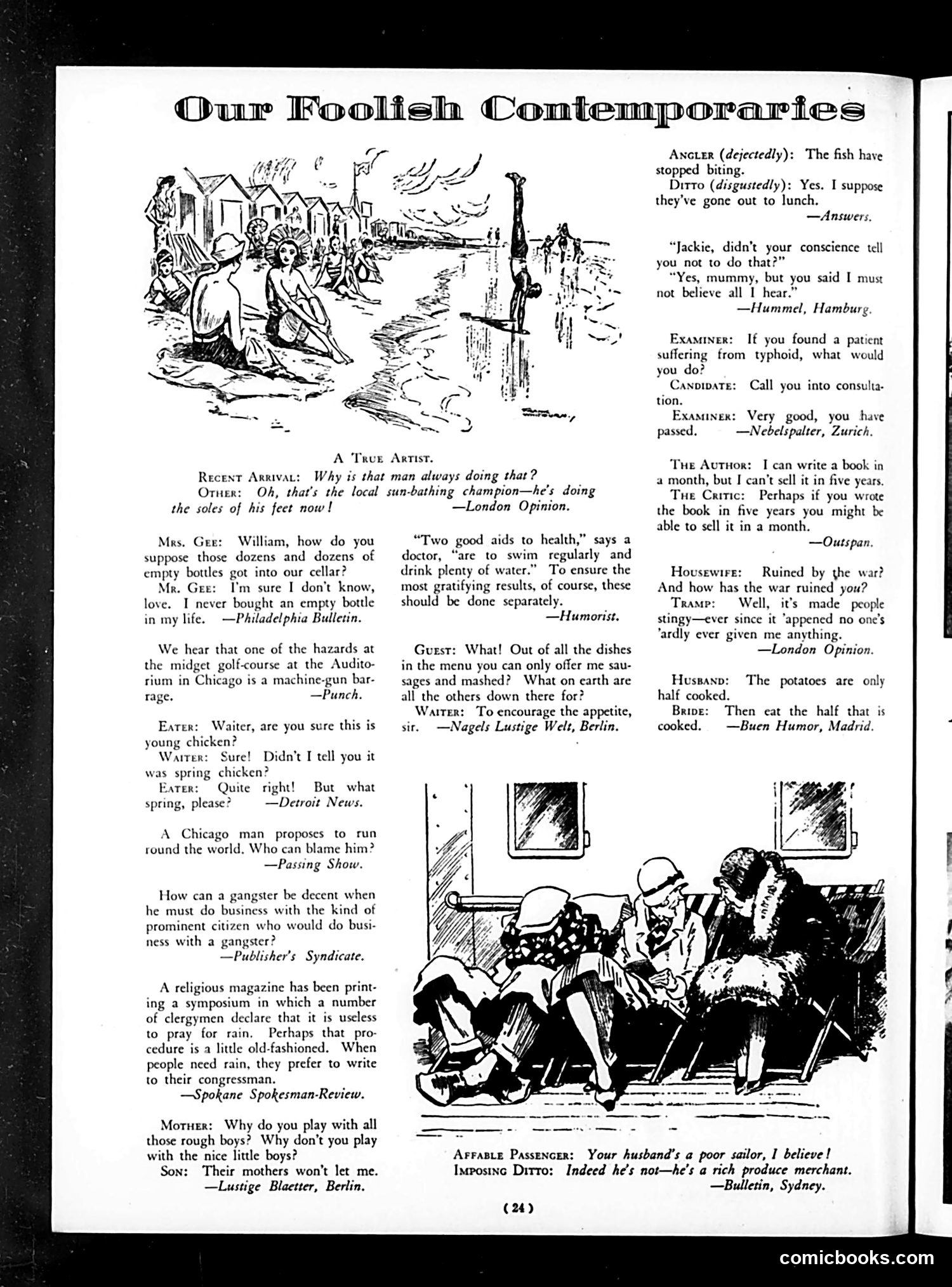
"Our Foolish Contemporaries" - Life Magazine Humor Page This is a compilation of brief satirical jokes and observations sourced from international publications, typical of Life magazine's humor format. The page mocks contemporary social absurdities through short anecdotes: Key themes: - Post-WWI economic hardship: References to empty bottles (Prohibition-era drinking), wartime poverty, and gangster activity suggest 1920s-30s America - Class and social pretension: A produce merchant falsely claims wealth; servants give evasive answers to employers - Institutional incompetence: Doctors, waiters, and examiners behave absurdly; one joke suggests citizens petition congressmen rather than pray for rain - War's aftermath: Beggars claim the war made people stingy The illustrated cartoon (bottom) depicts crowded train passengers in what appears to be working-class discomfort, reinforcing themes of economic strain and social discord. The sourcing from publications like *Punch*, *Lustige Blaetter*, and *Hummel* reflects international shared anxieties of the interwar period.
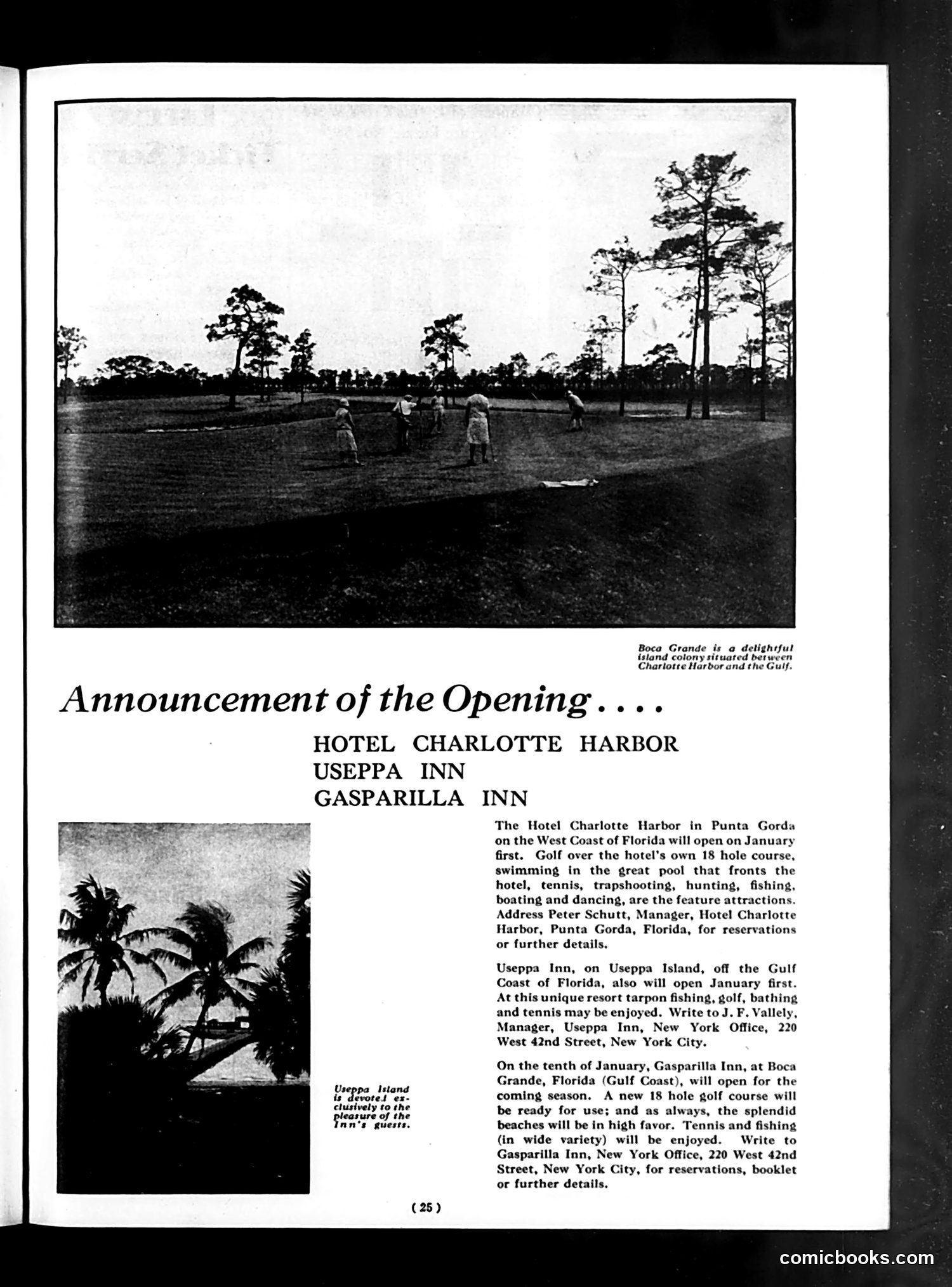
Analysis This page is primarily an advertisement, not political satire or editorial content. It announces the opening of three luxury Florida resort hotels—Hotel Charlotte Harbor, Useppa Inn, and Gasparilla Inn—all on Florida's Gulf Coast, opening in January (date unclear from text, but likely early 1920s based on the publication style). The photographs are promotional imagery: an upper landscape shot showing the resort grounds with tall pines and people, and a lower image of palm trees at Useppa Island. The text emphasizes recreational amenities: golf courses, swimming, fishing, tennis, hunting, and dancing—targeting wealthy leisure travelers. This reflects the Florida land and tourism boom of the early 20th century, when developers heavily marketed Florida as an exclusive vacation destination. The New York office addresses for reservations indicate the target market was wealthy northeastern Americans. There is no apparent satire, political commentary, or caricature on this page.
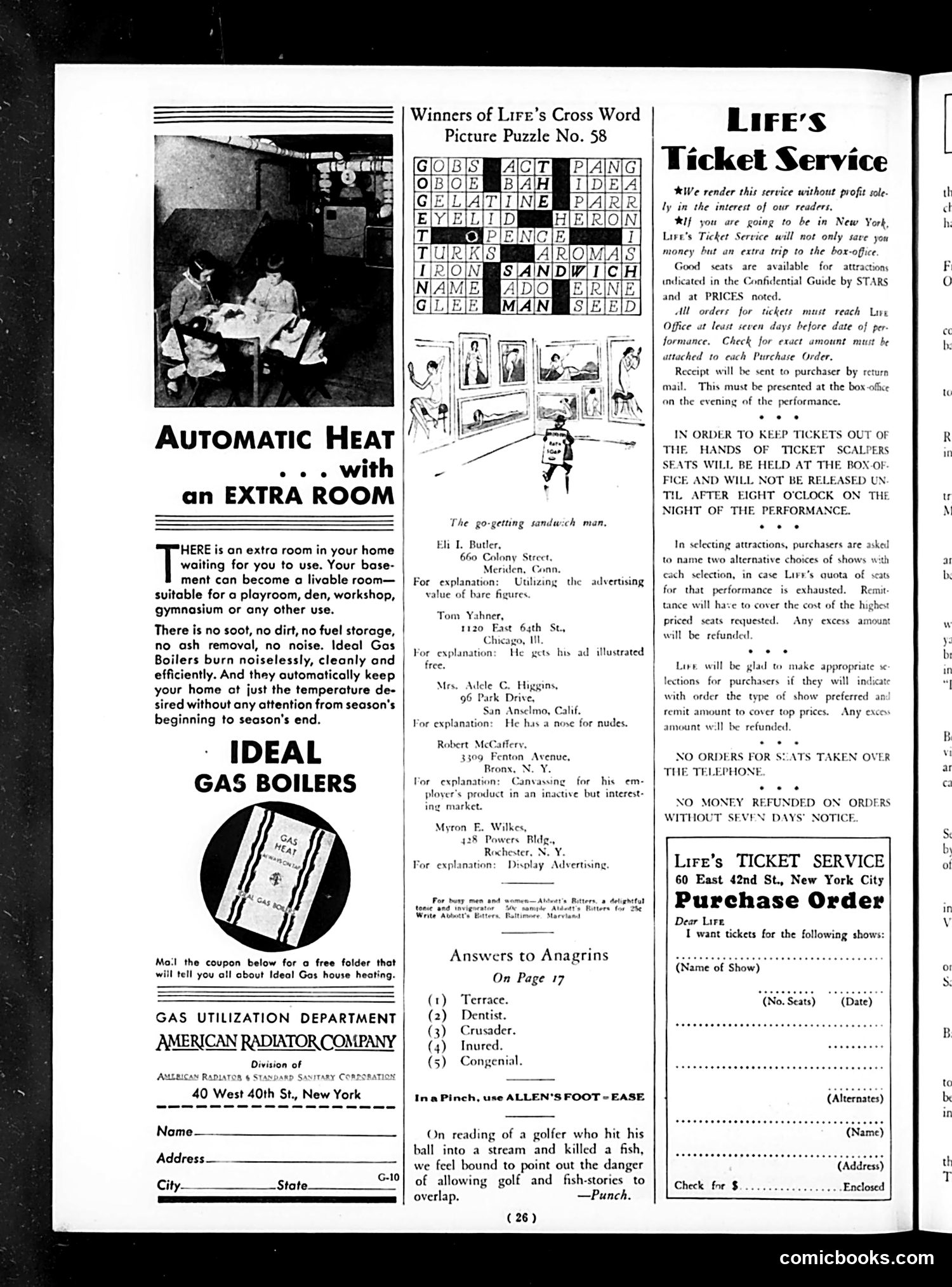
Life Magazine Page Analysis This page is primarily advertising and service announcements rather than editorial content. The dominant feature is an advertisement for Ideal Gas Boilers, emphasizing basement heating systems as a way to create extra livable space—reflecting mid-20th-century home improvement marketing. The upper right contains Life's Ticket Service, a practical booking service allowing readers to purchase theater tickets by mail, with strict anti-scalping measures (seats held until 8 PM performance night). The center shows puzzle-contest winners with humorous captions playing on double meanings—"go-getting sandwich man," "nose for nudes," "Display Advertising"—typical of Life's light comedic style. A small item at bottom from *Punch* magazine jokes about golf balls killing fish, warning against mixing golf and fishing stories. This reflects Life's dual nature: national humor magazine *and* practical consumer service provider for its affluent readership.
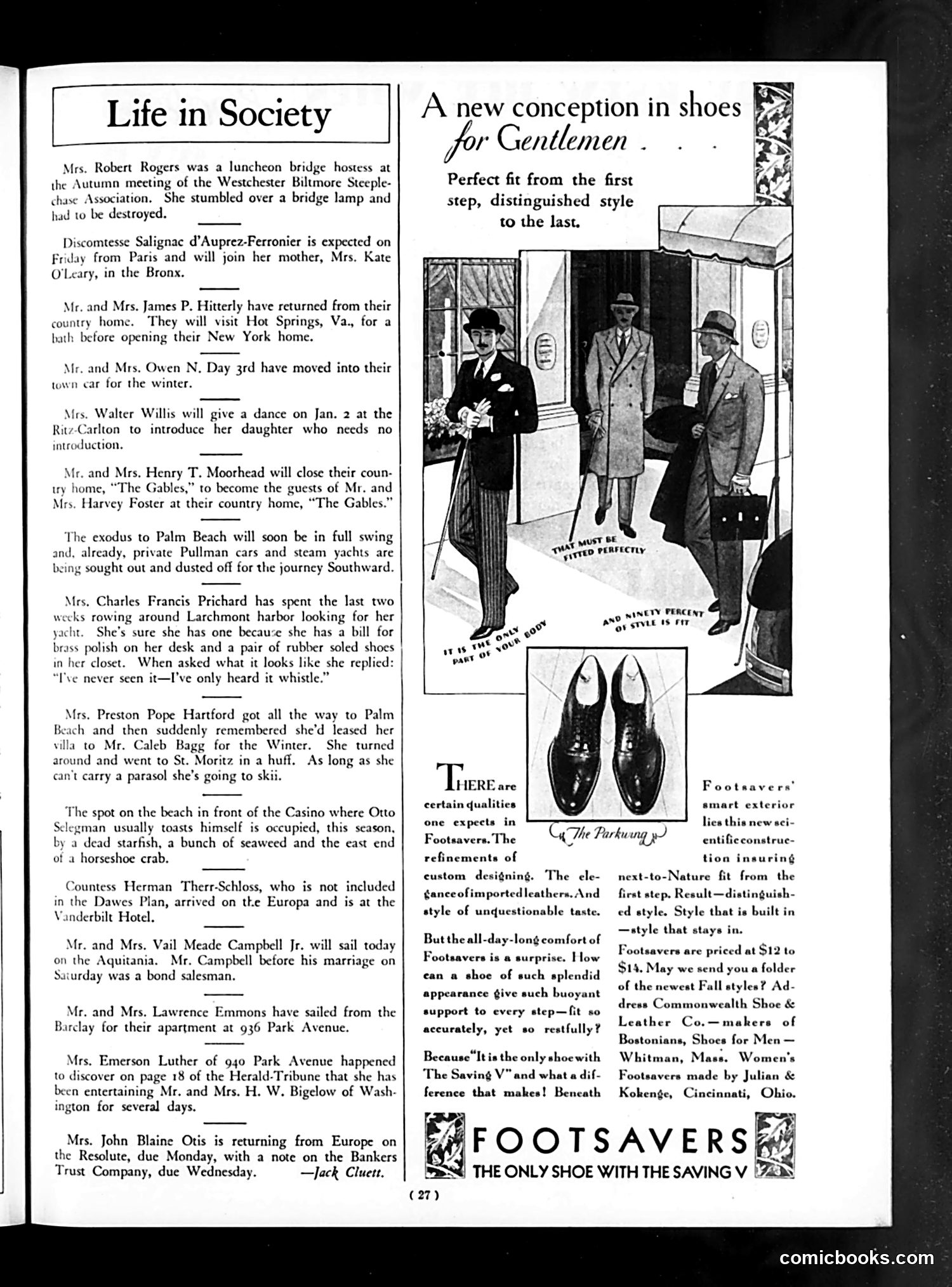
Life Magazine Page Analysis This page combines social satire with advertising. The "Life in Society" column satirizes wealthy New Yorkers through absurdist humor. The jokes mock upper-class excess and obliviousness: a woman "had to be destroyed" after a minor accident; someone searches for a yacht they've never seen; another leases her villa then impulsively flies to Switzerland rather than carry a parasol. A reference to "the Dawes Plan" (a 1924 economic arrangement) jokes that a countess falls outside even financial restructuring plans. The right side features a Footsavers shoe advertisement—a full commercial pitch typical of Life's era, showing gentlemen in suits examining the product. It emphasizes "The Saving V" construction feature and prices ($12-14), targeting professional men. The page represents Life's dual nature: satirical commentary on frivolous wealthy society alongside mainstream advertising, reflecting 1920s American magazine conventions.
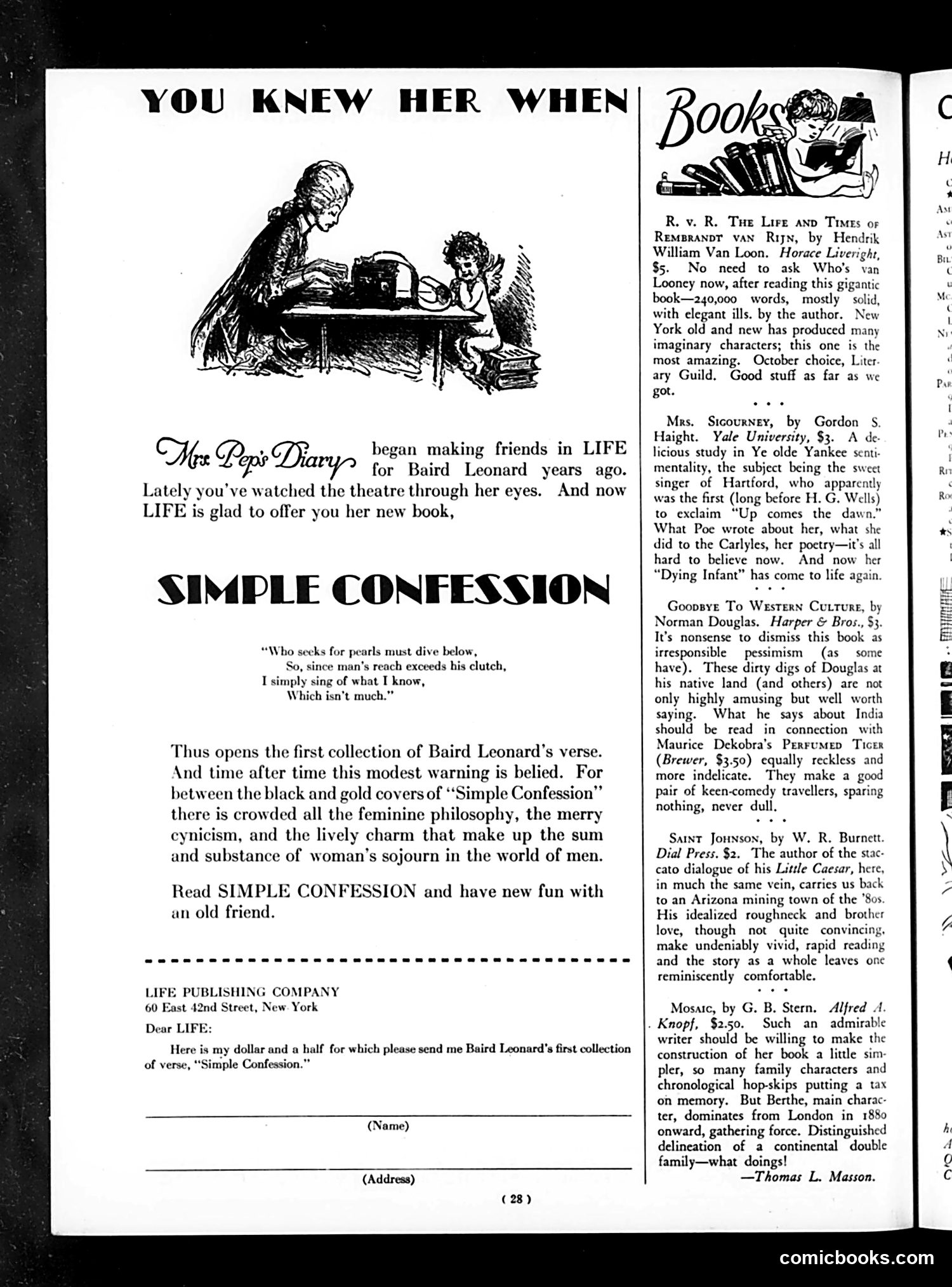
"Simple Confession" Advertisement & Book Reviews This page advertises poet Baird Leonard's first collection of verse, "Simple Confession," marketed to LIFE magazine readers who knew her as a theater critic. The illustration shows a woman writing at a desk—likely Leonard herself. The accompanying book reviews cover contemporary literary works, including biographies (Van Loon's Rembrandt), social criticism (Norman Douglas dismissing Western culture), and fiction set in the American West and Europe. The satire is gentle: Leonard's modest epigraph ("I simply sing of what I know, / Which isn't much") is immediately contradicted by praise for her "feminine philosophy" and "merry cynicism." The ad positions her as both familiar friend and accomplished artist to LIFE's educated readership—a common marketing strategy for literary works in 1920s magazines.
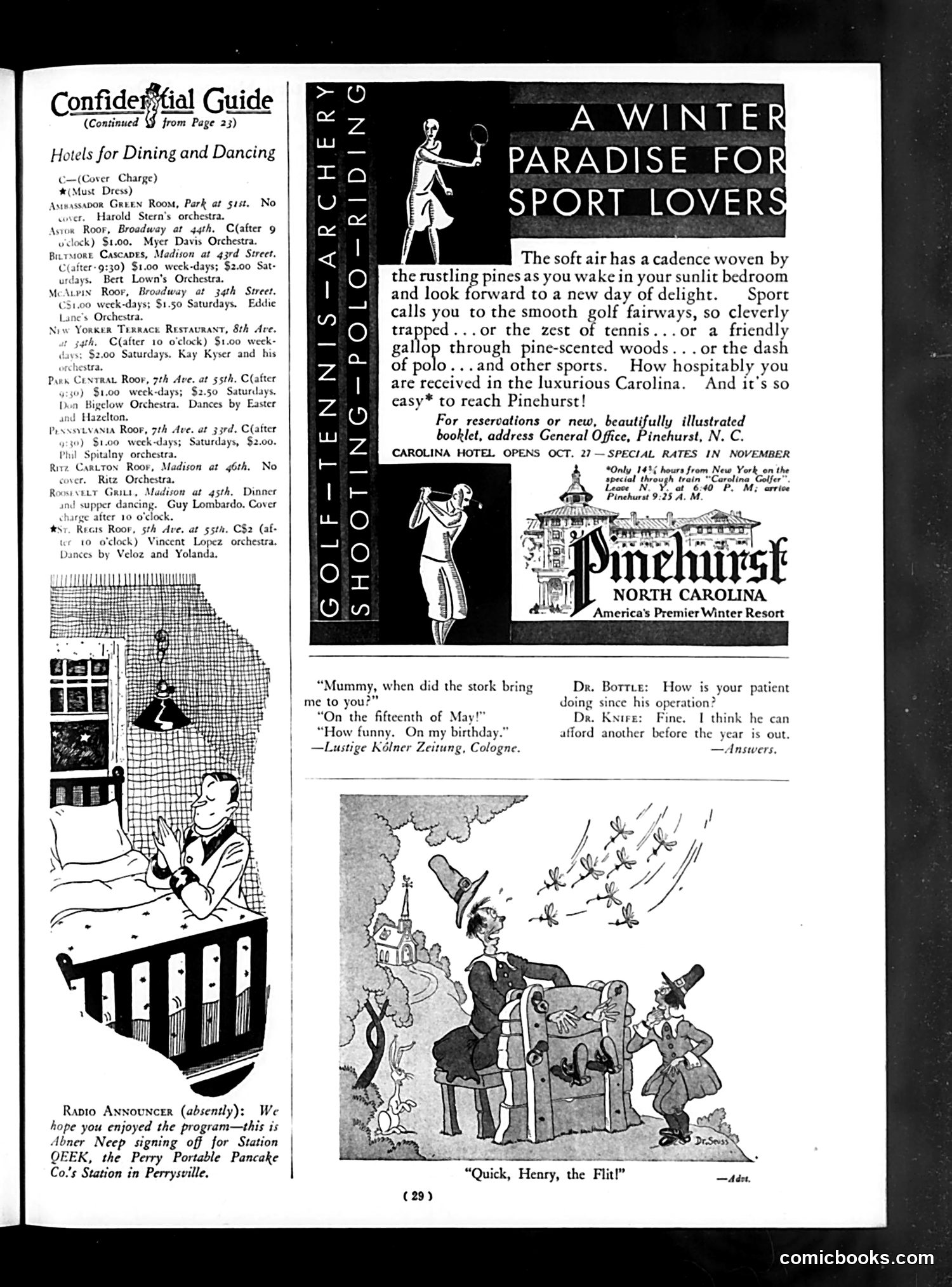
Analysis of Life Magazine Page Content This page mixes advertising with humor typical of 1920s Life magazine. The primary content is a Pinehurst resort advertisement promoting North Carolina as a winter sports destination—golf, polo, tennis, and archery for wealthy leisure travelers. The page includes three comic jokes: 1. A stork/birth timing joke playing on coincidental dates 2. A dark humor exchange between two doctors discussing a patient having repeated surgeries (implying unnecessary procedures for profit) 3. A cartoon captioned "Quick, Henry, the Flit!" showing a figure swatting flying insects—referencing Flit insecticide spray, whose slogan "Quick, Henry, the Flit!" was famous advertising copy of the era The left sidebar contains a radio station joke: an announcer absent-mindedly signs off for "Station QEEK" representing a fictional pancake company's broadcast affiliate in "Perrysville"—satirizing the commercialization and absurdity of early radio advertising. The humor throughout reflects period concerns: birth timing taboos, medical ethics skepticism, pest control, and commercialized media.
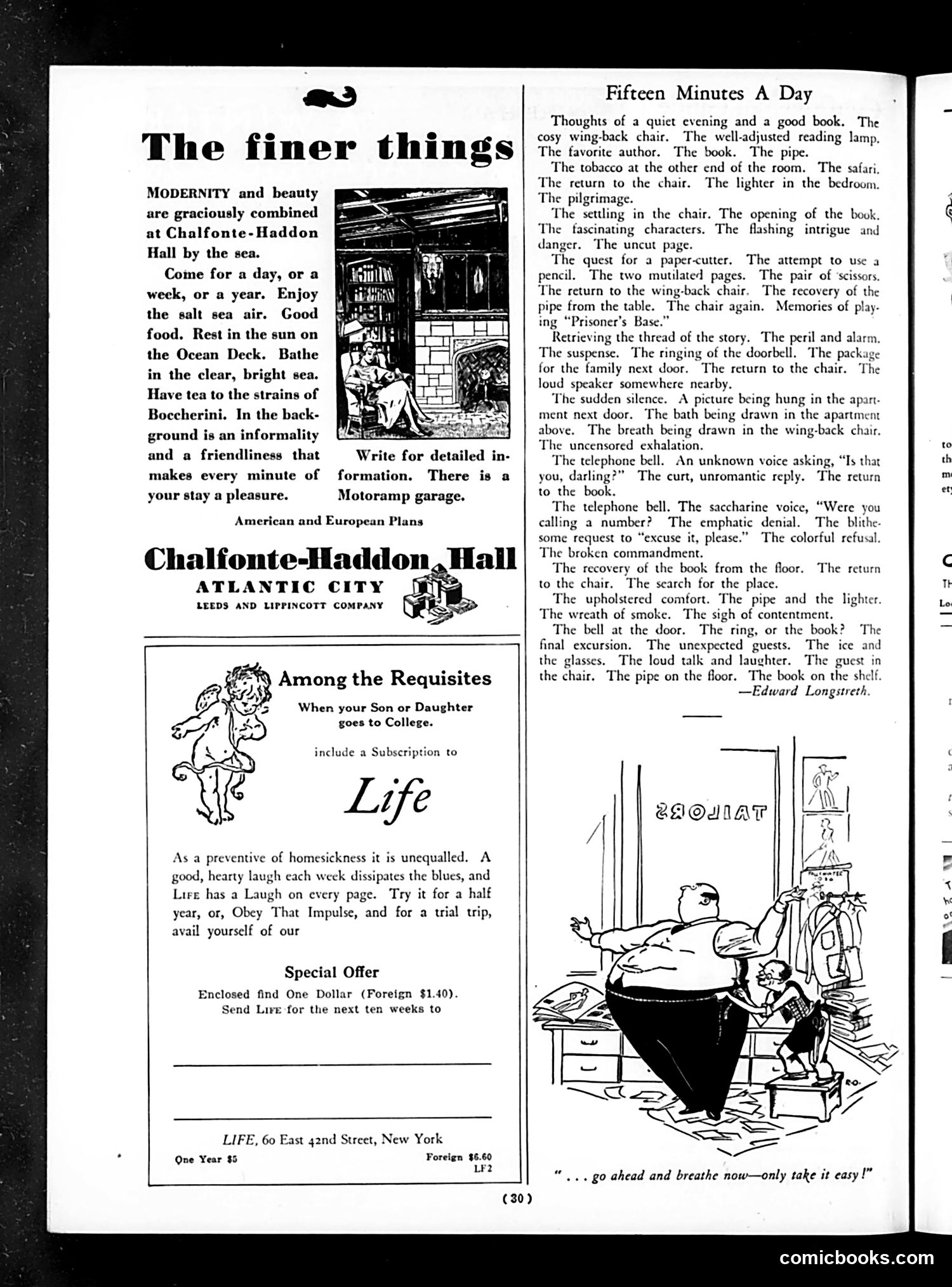
Life Magazine Page Analysis This page contains advertisements and humorous lifestyle content, not political satire. Top section: An ad for Chalfonte-Haddon Hall, a seaside resort in Atlantic City, emphasizing luxury and relaxation. Middle section: A subscription ad for *Life* magazine itself, marketed to parents sending children to college. It promises the magazine prevents homesickness through humor—"a good, hearty laugh each week dissipates the blues." Right column: "Fifteen Minutes A Day" by Edward Longstreth is a humorous essay-poem cataloging the *actual* experience of trying to read peacefully at home. The joke: a man settles into his wing-back chair to read, but is repeatedly interrupted—he can't find his pipe, needs scissors, gets phone calls, hears neighbors' activities. Each interruption sends him back to the chair, creating a comedic cycle of disturbance and return. Bottom cartoon: Shows a cluttered apartment with a large man amid chaos, captioned "go ahead and breathe now—only take it easy!"—satirizing cramped urban living. The page humorously reflects 1920s middle-class anxieties about leisure and domestic peace.
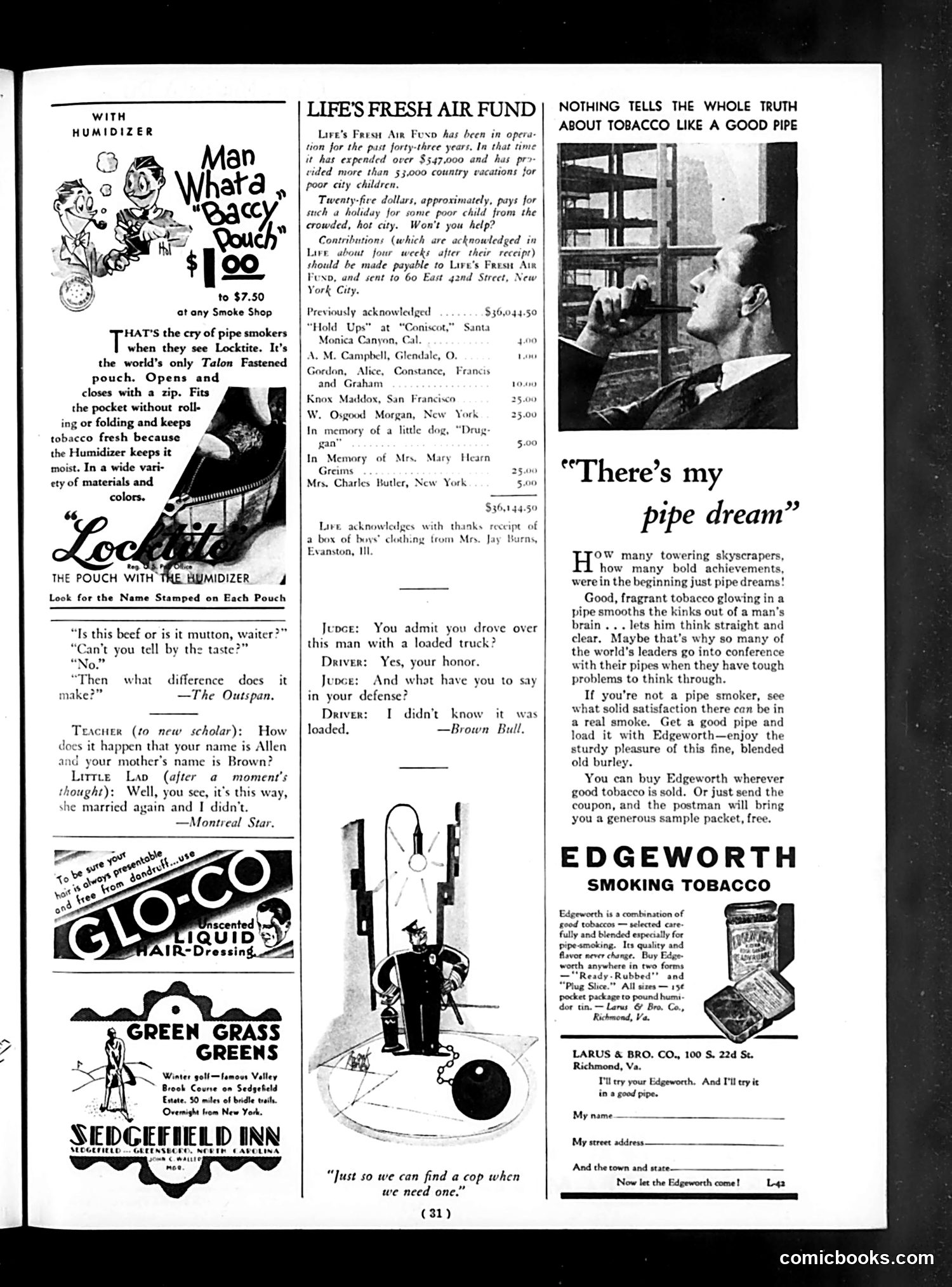
Analysis of Life Magazine Page Content This page mixes humor, charitable appeals, and tobacco advertising typical of early 20th-century magazines. Cartoons/Jokes: - "Man What a Baggy Pouch" advertises Locktite tobacco pouches with a zip closure - Brief humorous exchanges: a waiter unable to identify meat by taste; a child explaining his different last names after his mother remarried - A cartoon about needing police, accompanying a joke about a truck driver unaware he hit someone Life's Fresh Air Fund: A major charitable appeal requesting donations ($25 per donation) to fund country vacations for poor urban children—this was Life's genuine philanthropic initiative running 43+ years at this point. Edgeworth Tobacco Ad: The largest content promotes pipe smoking as conducive to clear thinking and achieving dreams, targeting male readers. It includes a coupon for free samples. Context: The page reflects an era when magazines openly promoted tobacco as a respectable, even aspirational product, while simultaneously supporting charitable causes.
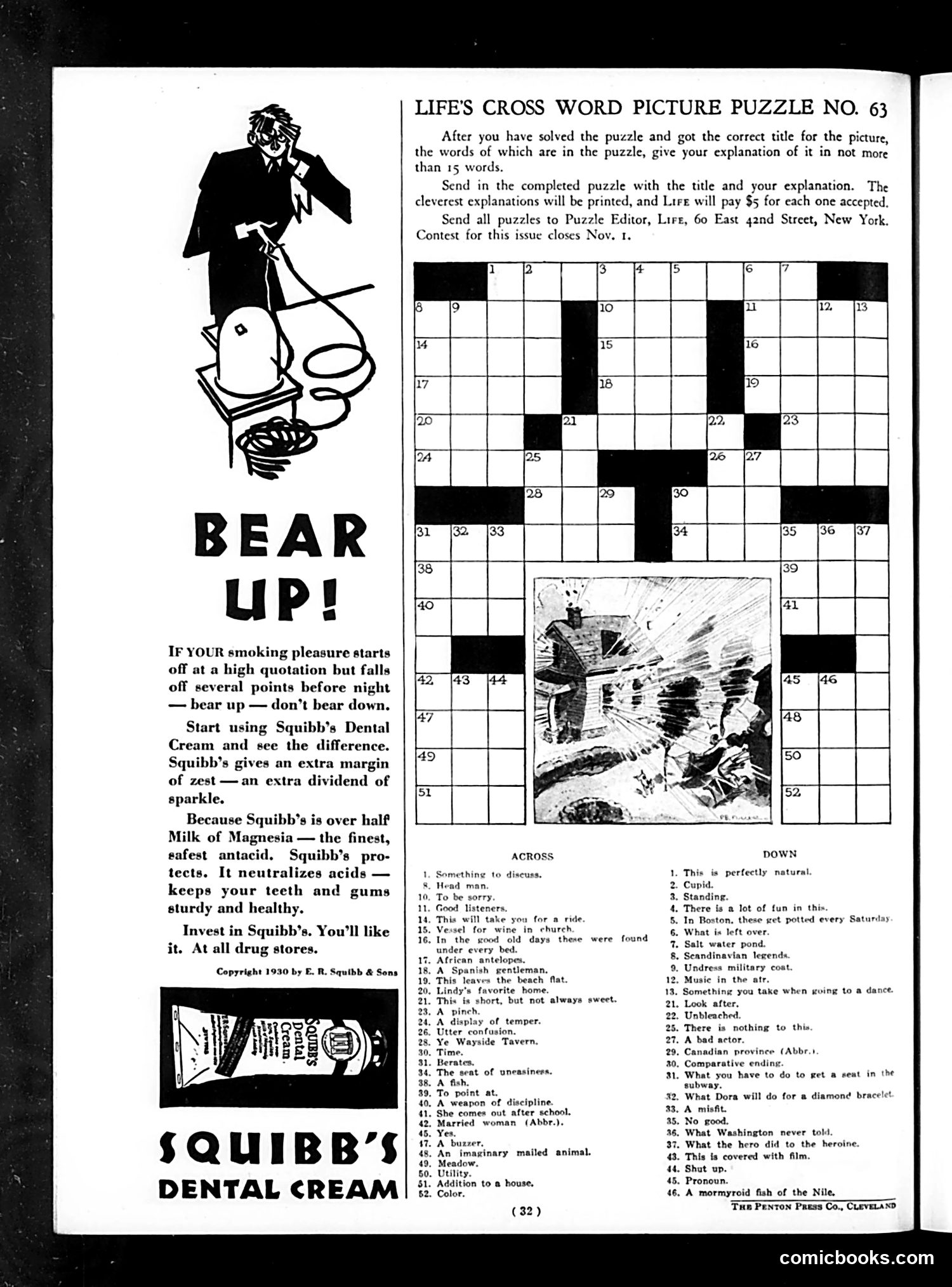
"Bear Up!" — A 1930 Squibb's Dental Cream Advertisement This page is primarily advertising, not political satire. The main content is a Squibb's Dental Cream ad featuring a cartoon man holding a toothbrush and looking distressed, accompanying copy that uses a clever wordplay: "Bear up—don't bear down." The joke plays on financial language ("quotation," "points") to suggest that smoking pleasure "falls off several points before night"—a veiled criticism of competitors' products. Squibb's, containing Milk of Magnesia, supposedly maintains consistent sparkle and freshness. The page also includes Life magazine's crossword-picture puzzle No. 63, an interactive contest offering $5 for clever explanations of a picture (visible but unlabeled in the layout). This was typical puzzle-magazine content of the era. The advertisement reflects 1930s consumer culture, when dental cream marketing emphasized chemical superiority and antacid properties—concerns that seem quaint today.
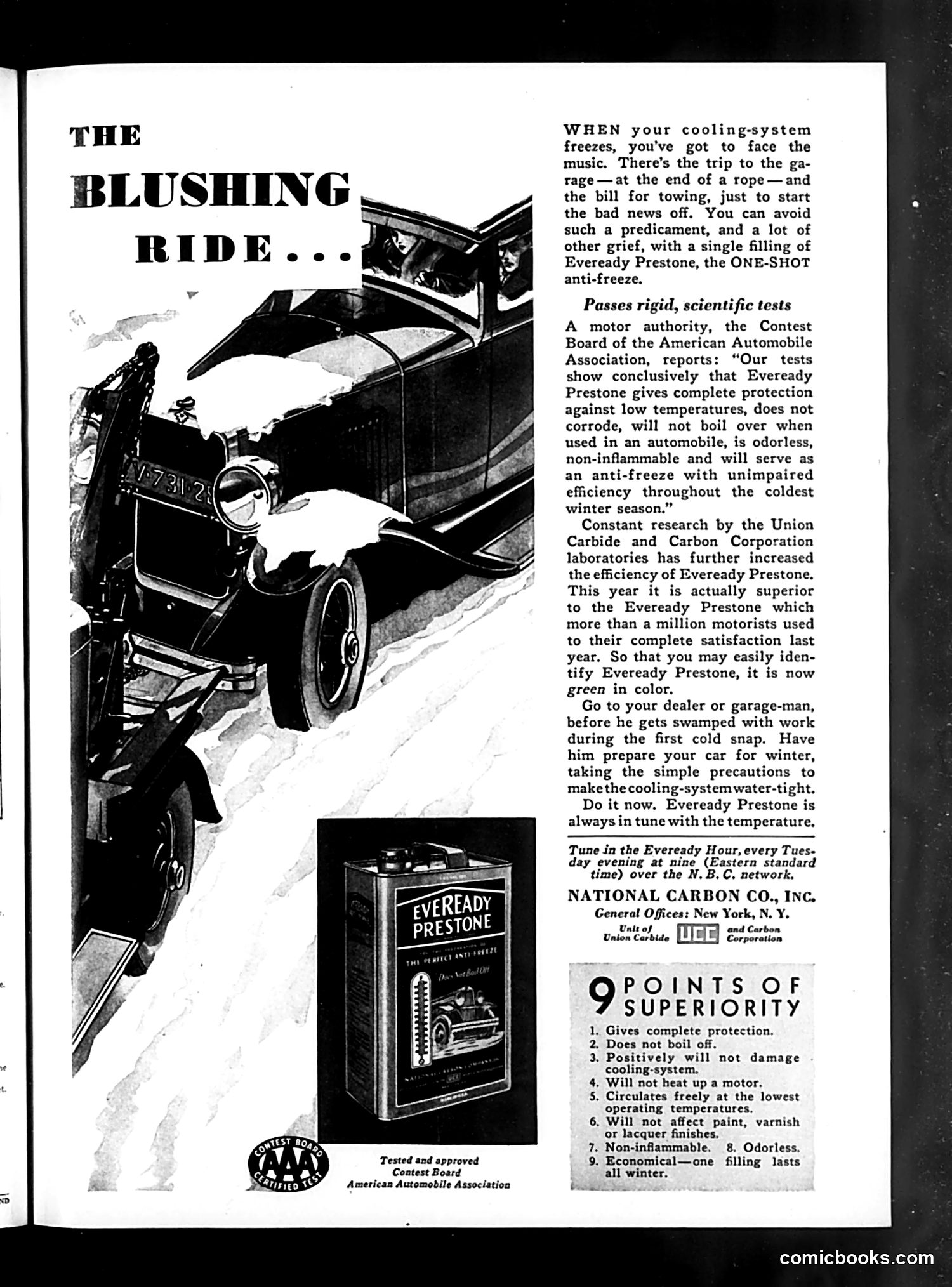
"The Blushing Ride" — Eveready Prestone Advertisement This is primarily a product advertisement, not satire or political commentary. The page promotes Eveready Prestone anti-freeze for automobiles. The "blushing ride" refers to the embarrassment of having your car's cooling system freeze in winter — forcing you to be towed (depicted in the illustration as a car being pulled behind a truck). The ad dramatizes this humiliation to sell the solution: a single filling of Eveready Prestone anti-freeze that prevents freezing. The advertisement emphasizes scientific credibility by citing the American Automobile Association's testing and approval. It highlights that Eveready Prestone is now "green in color" for easy identification, and lists "9 Points of Superiority" including that it won't corrode, boil over, or damage the engine. The product is positioned as preventative maintenance — buy it *before* the first cold snap to avoid shame and expensive towing bills. The ad also cross-promotes "The Eveready Hour" radio show on NBC.
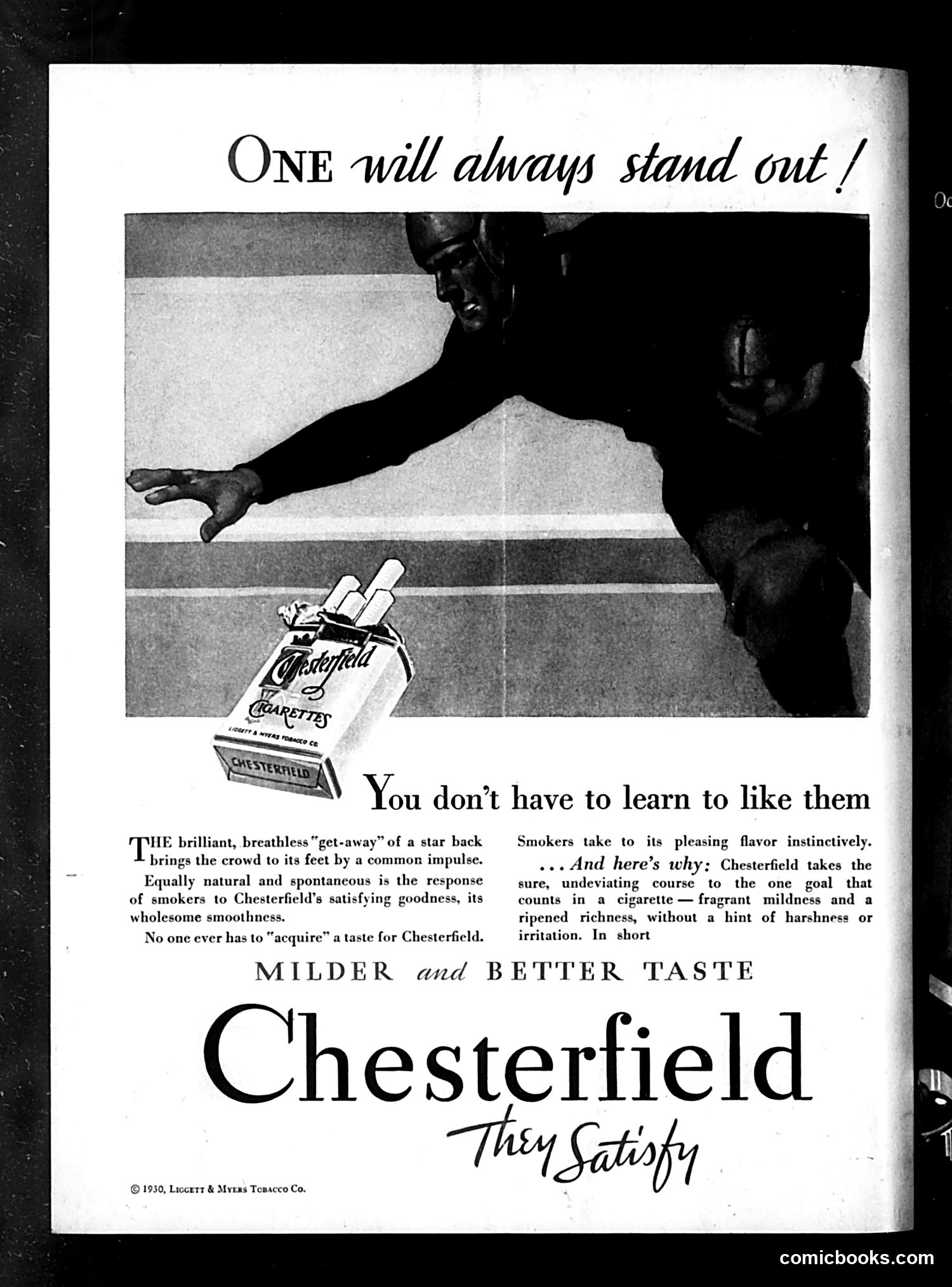
Analysis This is a Chesterfield cigarette advertisement, not a political cartoon. The image shows a football player in silhouette making a dramatic "get-away" move—an athletic reference meant to parallel smoking appeal. The ad's central claim is that liking Chesterfield cigarettes is as "natural and spontaneous" as a crowd's reaction to an impressive sports play. The copywriting argues smokers instinctively enjoy the brand's "milder and better taste" without needing to develop the habit over time. The dated 1930 copyright reveals this as vintage tobacco advertising from an era with virtually no health warnings or regulation. The athletic imagery and "natural impulse" framing reflect mid-century marketing strategies that associated cigarettes with vitality, spontaneity, and mainstream appeal—a far cry from modern anti-smoking campaigns.