life
Life — October 31, 1930
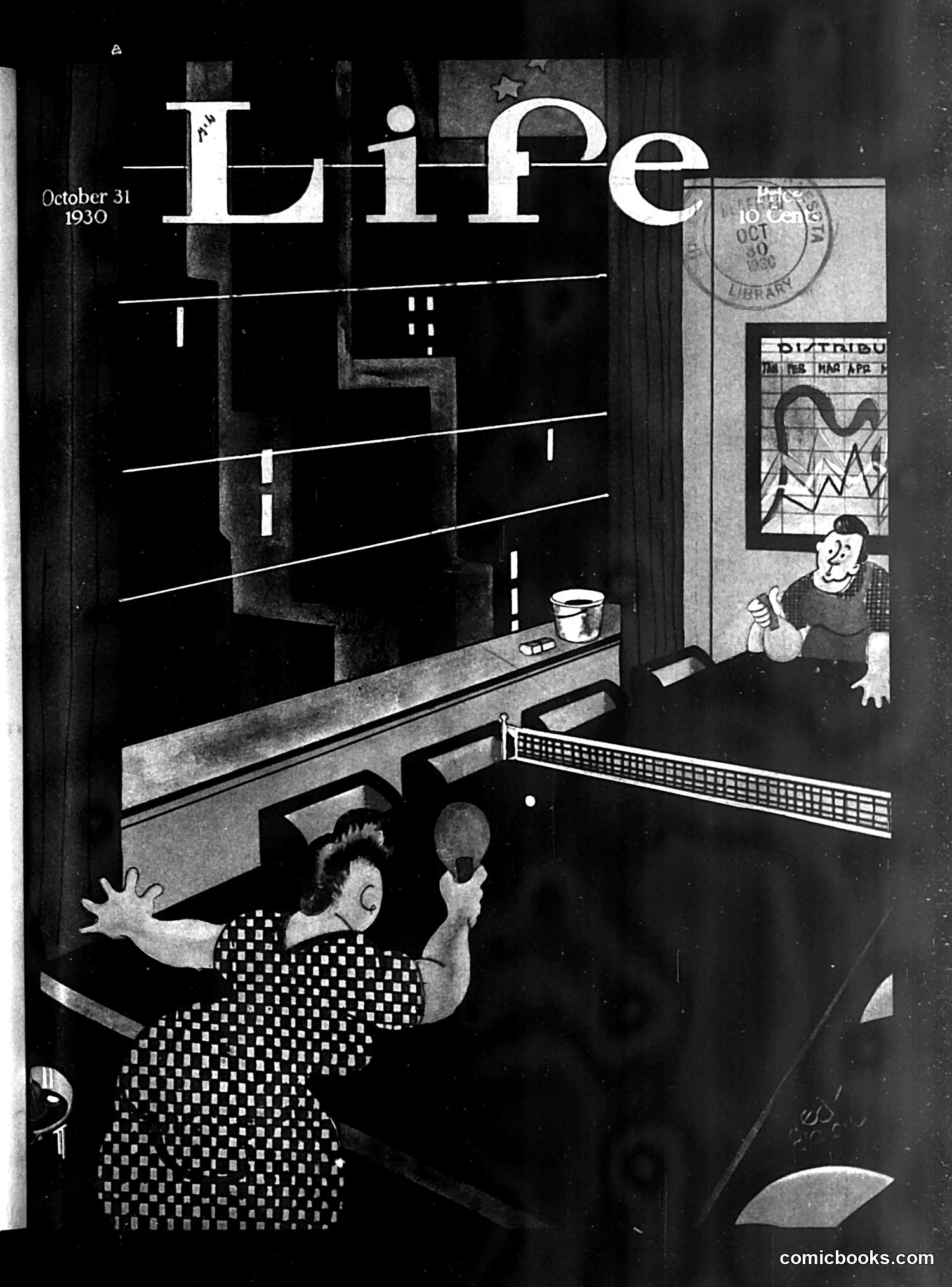
Life Magazine, October 31, 1930 This page appears to be a cover or title page for Life magazine's Halloween issue. The illustration shows a woman in a checkered dress playing ping-pong against a skeletal or death-like figure across the net. The scene takes place in what appears to be a basement or cellar setting, with another figure visible in a window above. The imagery likely plays on Halloween themes—the skeleton opponent and underground setting create an eerie, supernatural atmosphere. The ping-pong game may be a visual pun or metaphor, though without additional context, the specific satirical or political meaning isn't entirely clear from the image alone. The cartoon seems designed primarily for seasonal entertainment rather than political commentary.
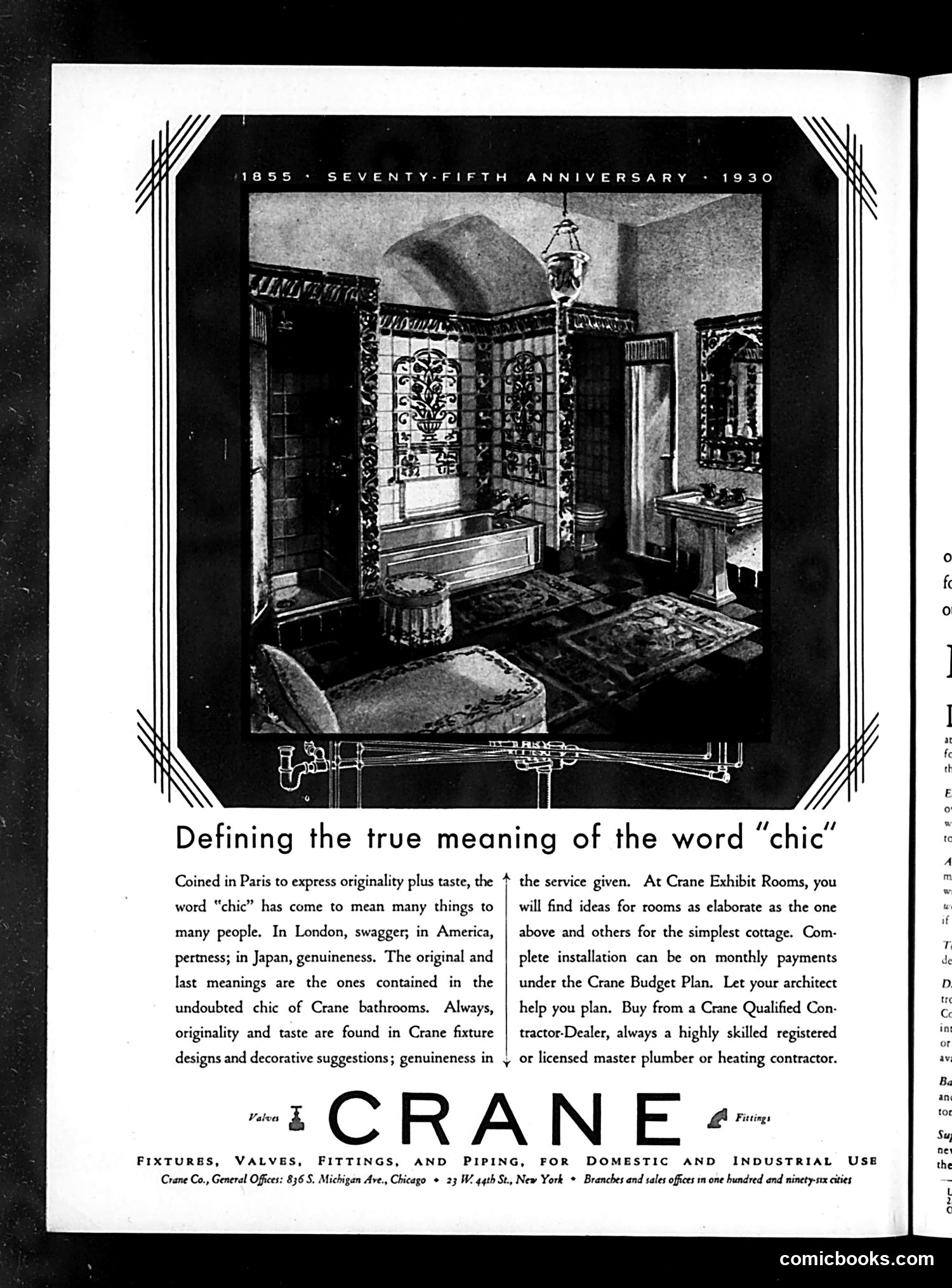
Content Analysis This page is primarily advertising, not editorial satire or political commentary. It is a 1930 advertisement for Crane plumbing fixtures, celebrating the company's 75th anniversary (1855-1930). The image shows an elaborate bathroom interior with ornate fixtures and decorative elements. The ad's text plays on the word "chic" — claiming that Crane bathrooms embody true sophistication and taste, contrasting how the term means different things in different cultures (Paris, London, America, Japan). The satire, if present, is subtle: the ad humorously suggests that owning Crane bathroom fixtures is the ultimate expression of refinement and "originality plus taste." It's aspirational marketing that conflates luxury plumbing with cultural sophistication — a gentle mockery of consumer desires during the prosperous late 1920s.
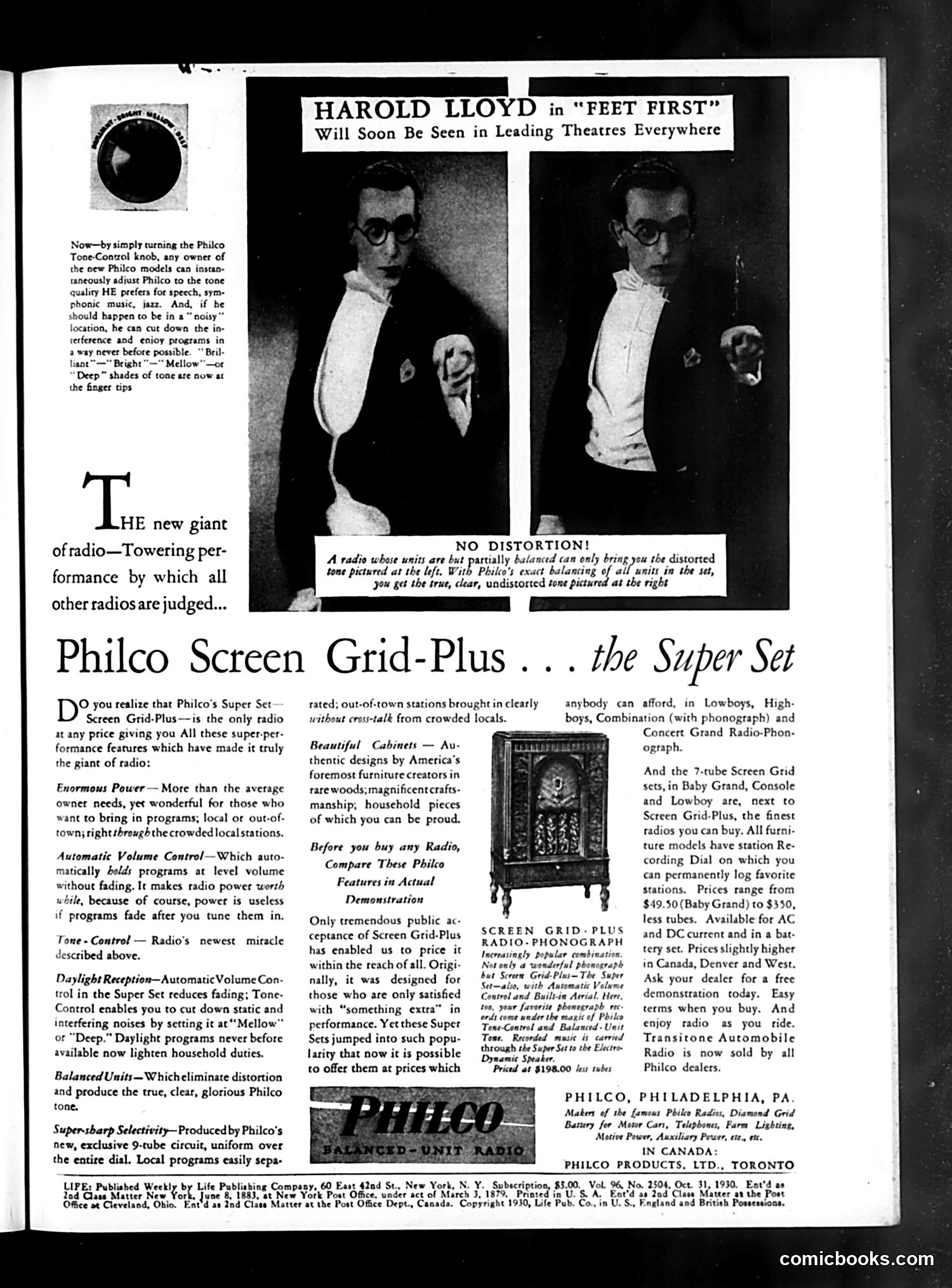
This page is primarily advertising for Philco radios, not political satire. The top section features Harold Lloyd, the famous silent-film comedian, promoting Philco's "Feet First" film. The accompanying images show Lloyd demonstrating the radio's tone control feature—illustrating how users can adjust audio quality regardless of broadcast conditions. The bulk of the page advertises the Philco Screen Grid-Plus "Super Set," highlighting features like automatic volume control, tone control, and balanced units that eliminate distortion. The advertisement emphasizes the radio's quality and affordability across different models. This reflects 1920s-1930s consumer culture when radio technology was rapidly advancing and celebrities endorsed products to build brand trust among American households.
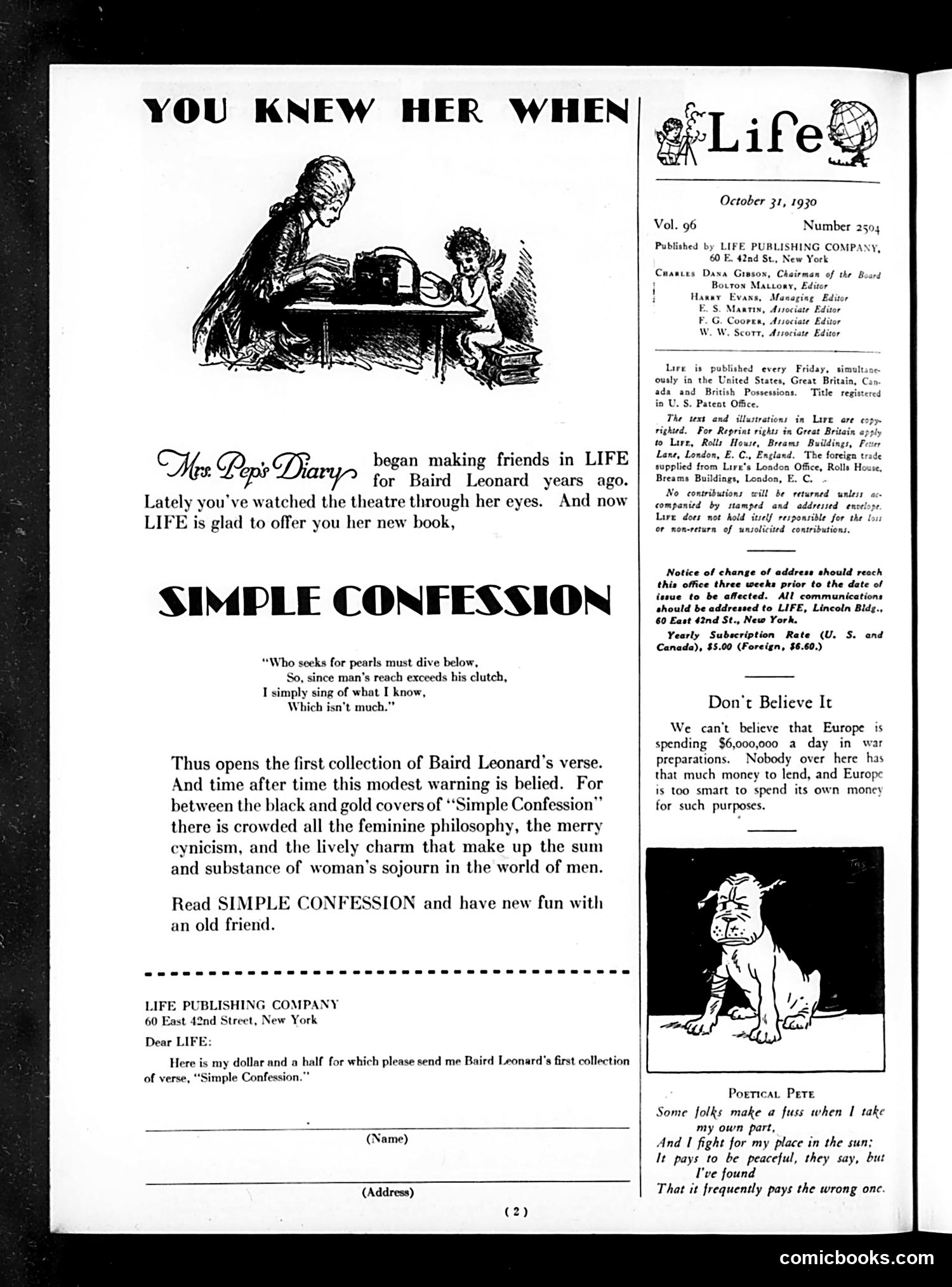
Analysis of Life Magazine Page (October 31, 1930) This page is primarily advertising and editorial matter rather than political satire. The left side promotes "Simple Confession," a new poetry collection by Baird Leonard, featuring Mrs. Pep's Diary. The advertisement includes a subscription coupon for the book ($1.50). The right side contains "Political Pete," a short poem with an accompanying cartoon of a dog wearing a hat. The verse appears to satirize political fence-sitting—someone who claims neutrality ("fuss when I take my own part") while actually benefiting from conflict ("It pays to be peaceful...but I've found that it frequently pays the wrong one"). This likely mocks politicians or public figures avoiding clear stances on contemporary issues during the Depression era.
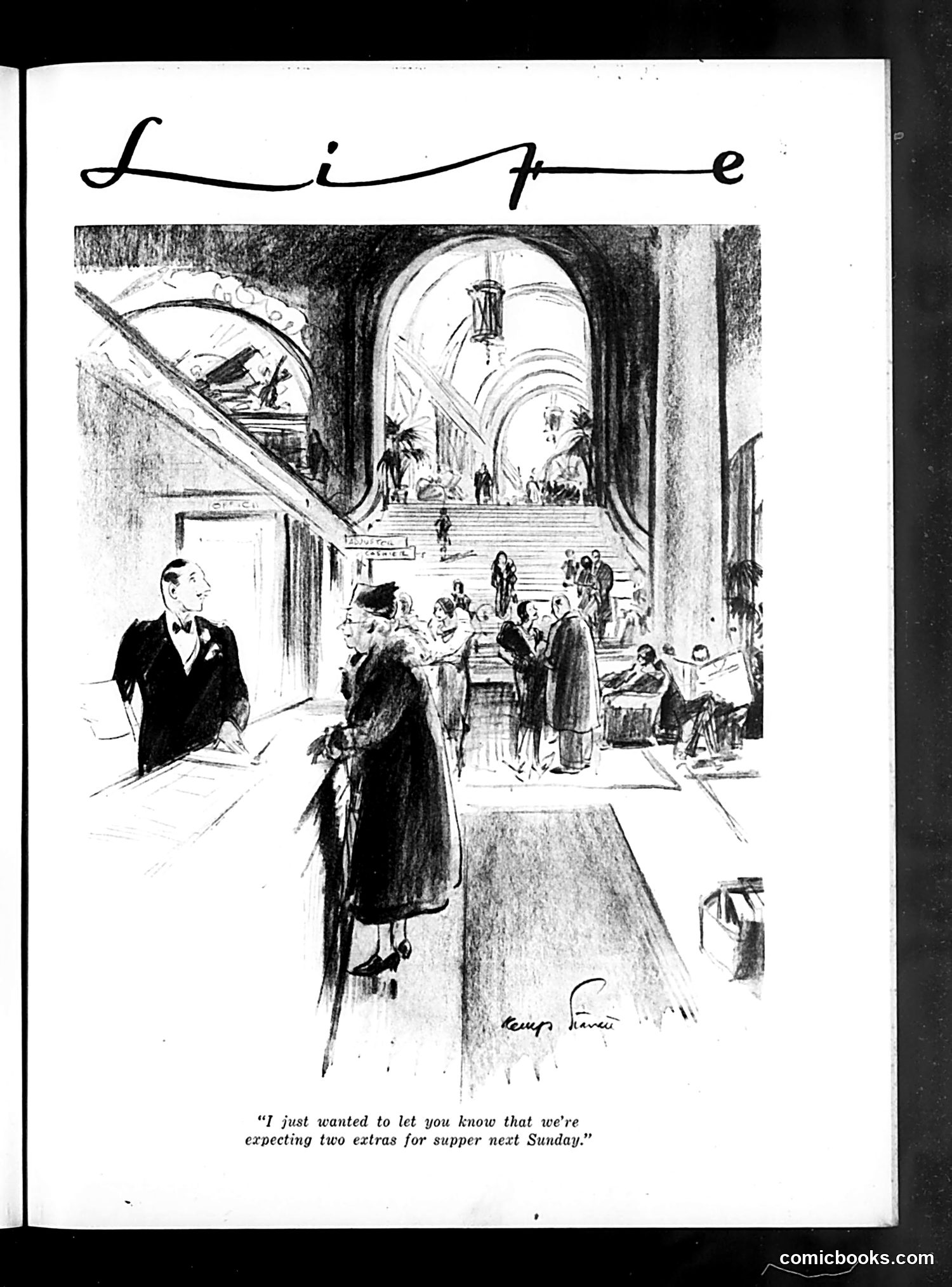
Life Magazine - "Expecting Two Extras for Supper Next Sunday" This appears to be a single-panel cartoon set in what looks like a grand European cathedral or public building with arched ceilings. A well-dressed man in formal attire addresses a woman, announcing they're "expecting two extras for supper next Sunday." The humor likely stems from the formal announcement of additional dinner guests in an ornate, solemn architectural setting—creating an absurd contrast between the grandiose surroundings and mundane domestic conversation about meal planning. Without additional context about the publication date or specific historical references, the cartoon's deeper satirical meaning remains unclear. It may reference contemporary social customs or class anxieties about entertaining, but this cannot be confirmed from the visible image alone.
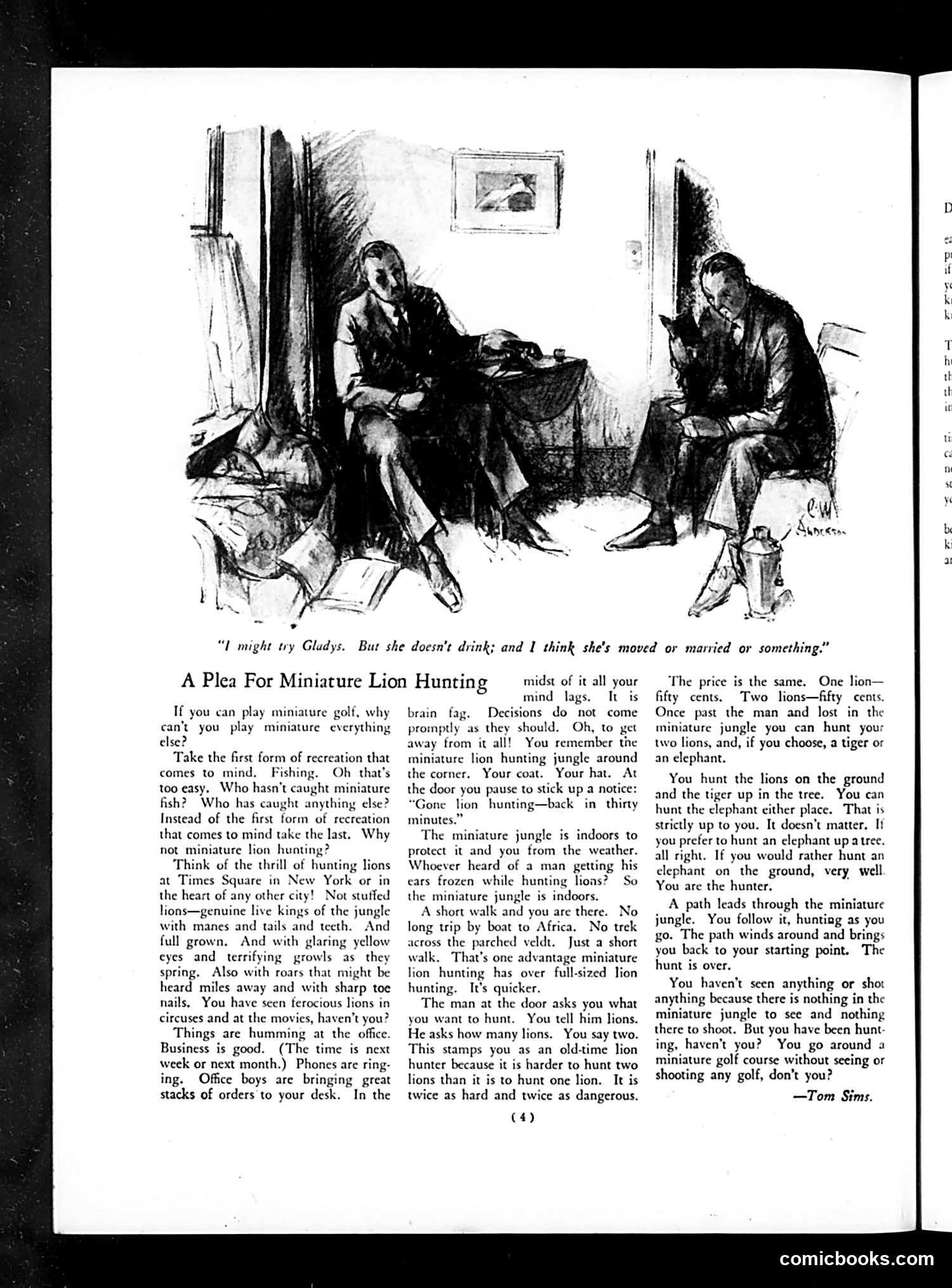
Analysis of "A Plea For Miniature Lion Hunting" This is a humorous essay by Tom Sims satirizing the tedious monotony of office work. The accompanying sketch shows two men in an indoor setting, illustrating the piece's central conceit. Sims argues that if miniature golf can be a recreational fad, why not "miniature lion hunting" as office entertainment? He describes an absurd indoor jungle hunt—tracking lions in a small space, with predetermined rules about where elephants and tigers can be positioned. The satire targets the boredom and repetitiveness of modern business life ("hunts at the office. Business is good..."). By proposing an increasingly ridiculous alternative recreation, Sims mocks how office workers seek escape from monotonous routines through fashionable pastimes like miniature golf, suggesting even fabricated danger would be preferable to their actual work environment.
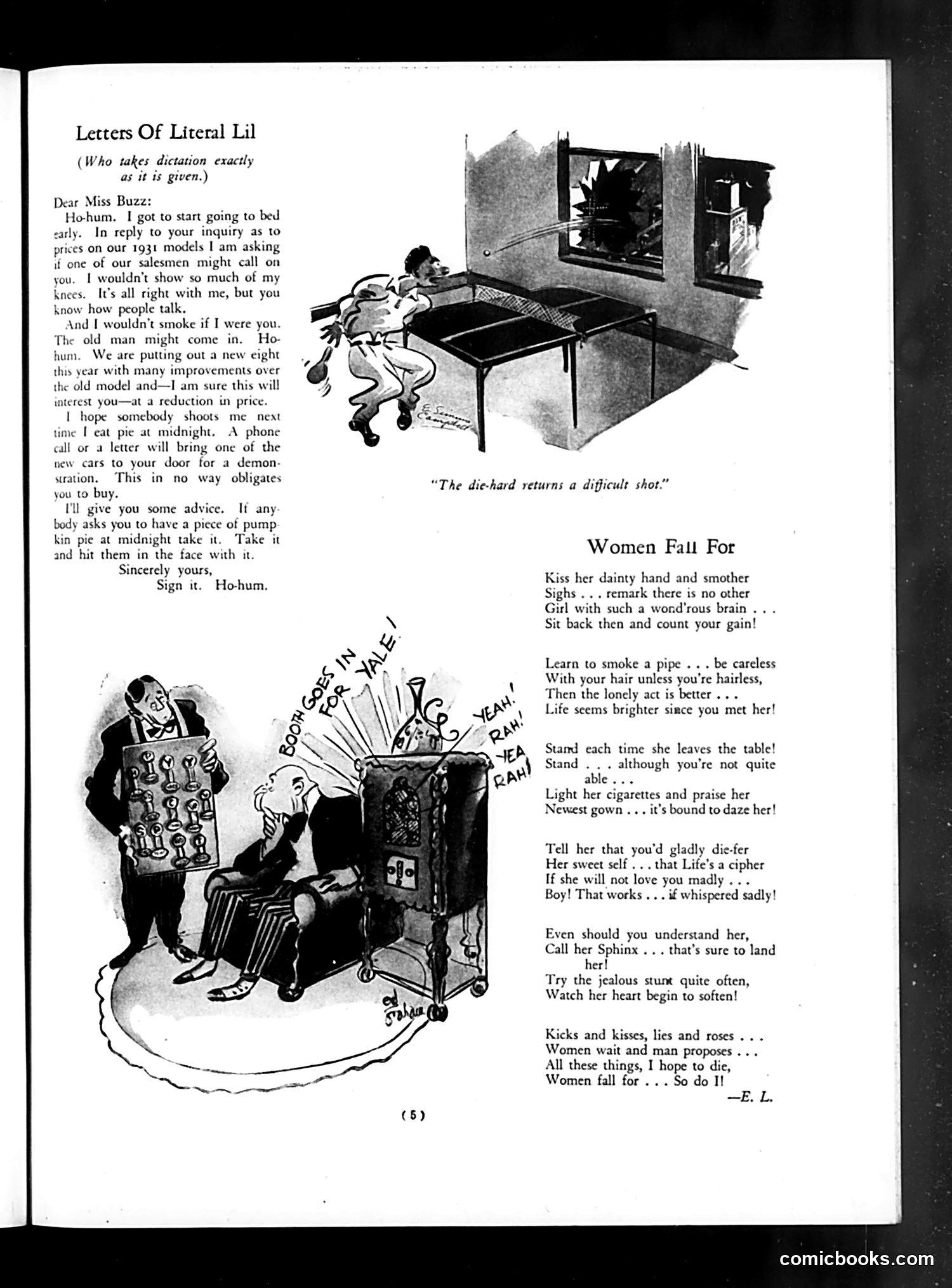
Analysis of Life Magazine Page This page contains two distinct pieces of period humor: "Letters of Literal Lil" features a mock letter from "Ho-hum" to "Miss Buzz" about automobile sales, written in the deadpan style of someone taking figurative language literally. The accompanying cartoon shows a man being hit in the face—illustrating the letter's advice to literally "hit them in the face" with a pumpkin pie. "Women Fall For" is a satirical poem by E.L. offering tongue-in-cheek dating advice to men. It lists manipulative tactics (praising her, standing when she leaves, complimenting her dress, feigning jealousy, calling her "Sphinx") as surefire ways to win women's affection. The satire mocks both shallow romantic strategies and the era's assumptions about female psychology. Both pieces exemplify Life magazine's humor style: absurdist literalism and gentle social satire.
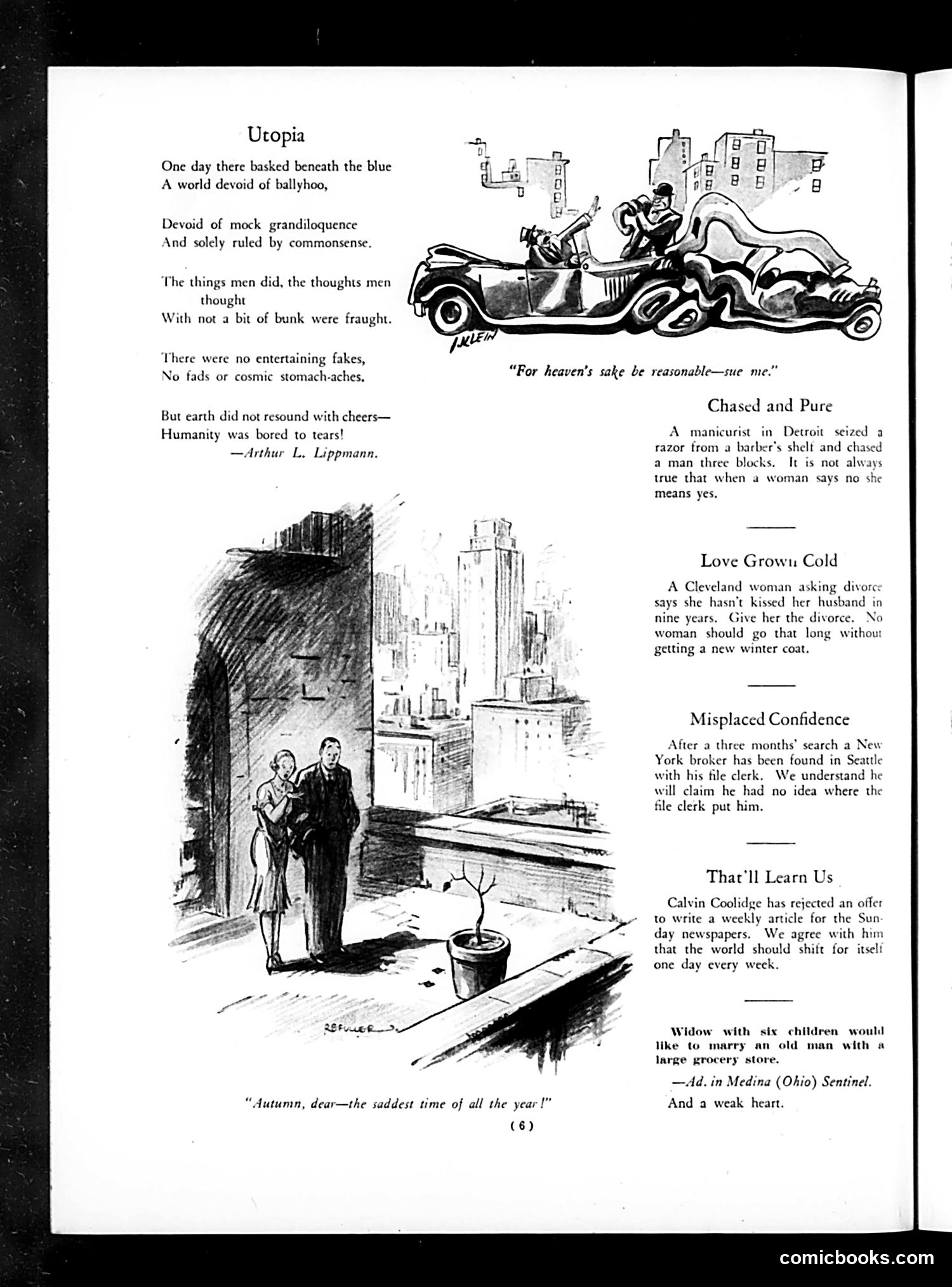
Page Analysis: Life Magazine Satire This page contains miscellaneous humor and social commentary typical of Life magazine. The top section features Arthur L. Lappmann's poem "Utopia," satirizing an imagined world governed by pure reason and common sense—contrasting sharply with actual human folly. The illustration below depicts an autumn street scene with the caption "Autumn, dear—the saddest time of all the year!"—likely romantic sentiment about seasonal melancholy. The right column offers brief, cynical observations on contemporary life: a manicurist chasing a man with a razor, a woman seeking divorce after nine years without affection, a missing New York broker, and Calvin Coolidge rejecting a newspaper column offer. These reflect 1920s social anxieties about relationships, disappearances, and celebrity figures, presented as sardonic one-liners.
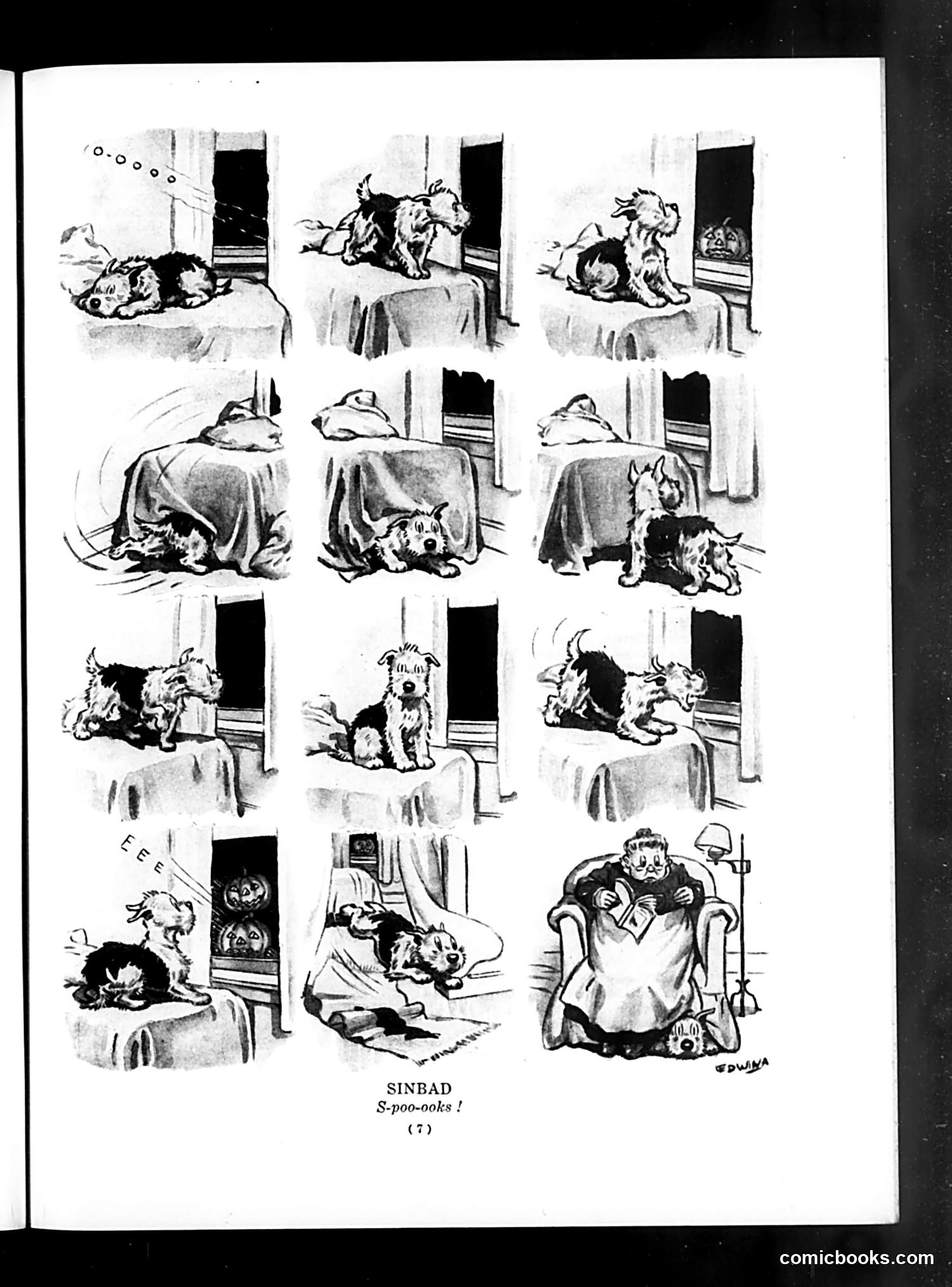
Sinbad "Spook-ooks!" Comic Strip This is a sequential comic strip titled "Sinbad" showing a humorous domestic scene. The narrative follows what appears to be a man in bed who is startled by increasingly visible supernatural or frightening apparitions entering through a doorway. The strip progresses from subtle disturbances (indicated by dotted lines suggesting movement or sounds) to increasingly obvious ghostly or monstrous visitors. The man's reactions escalate from mild concern to apparent terror in the final panel, where he's shown cowering in a chair, seemingly traumatized. The joke appears to play on the contrast between the man's initial skepticism about supernatural occurrences and his eventual panic when confronted with undeniable evidence. The title "Spook-ooks!" is a pun referencing both "spooks" (ghosts) and the sound of fright.
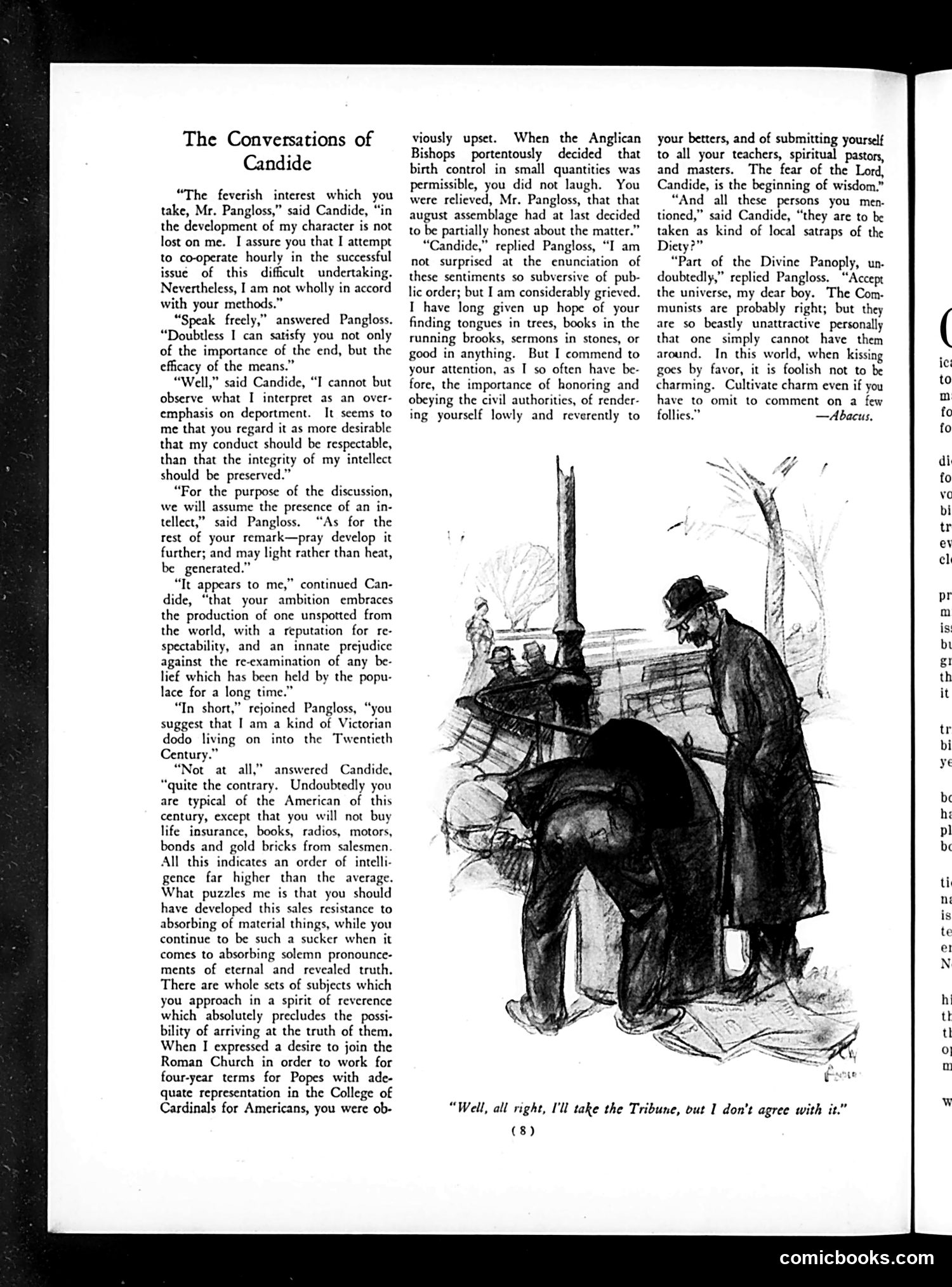
"The Conversations of Candide" - Life Magazine Satire This page presents a satirical dialogue between two characters: Candide (likely referencing Voltaire's naive optimist character) and Pangloss (Voltaire's fatalistic philosopher from the same novel). The cartoon depicts two men in discussion near what appears to be a newsstand or street corner. The satire critiques American materialism and intellectual complacency in the 20th century. Candide accuses Americans of rejecting philosophical and religious engagement in favor of consuming commercial goods (insurance, radios, bonds). Pangloss defends American optimism and suggests Candide is merely a "Victorian dodo" out of touch with modern times. The exchange mocks how modern Americans prioritize material comfort over serious intellectual or spiritual inquiry, updating Voltaire's 18th-century satire for contemporary American society.
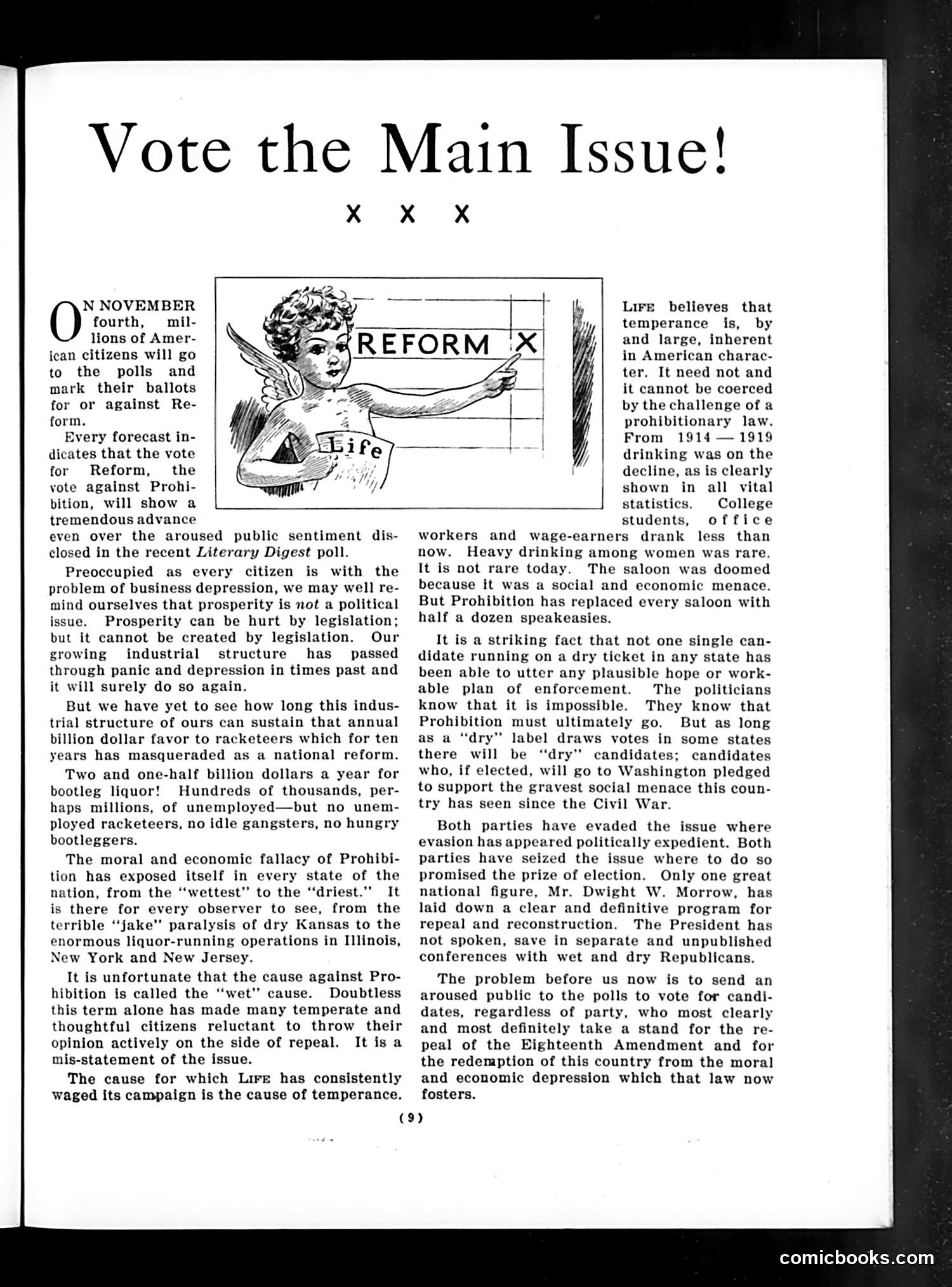
Analysis This Life magazine page advocates for voting "Reform" (repeal of Prohibition) in the November election. The central image shows a winged female figure labeled "Life" holding a banner marked "REFORM" with an X, encouraging readers to mark their ballot for repeal. The accompanying article argues that Prohibition has failed morally and economically, citing increased crime, bootlegging, and unemployment. It criticizes both major political parties for avoiding the issue and praises President Dwight D. Eisenhower for taking a clear stance on repeal and reconstruction. The satire emphasizes Prohibition's hypocrisy: it claimed to reduce drinking but instead created organized crime, corruption, and social decay. The article calls for voters to support candidates who will repeal the Eighteenth Amendment and restore economic prosperity.
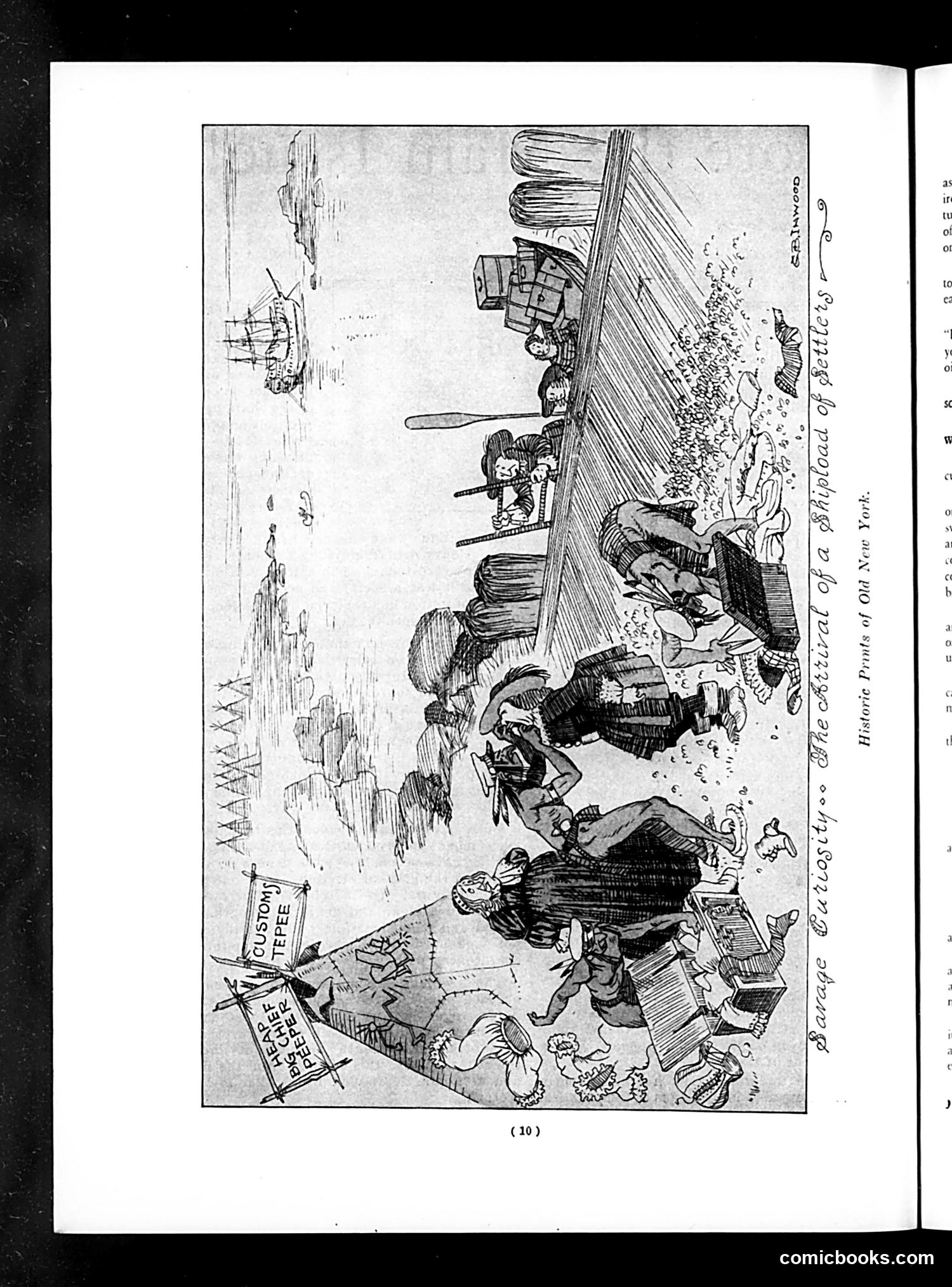
Analysis of Historical Cartoon This page contains a single satirical illustration titled "A Successful Bid of Petticoats" (subtitle references "Printed on New York"). The cartoon appears rotated and depicts a crowded street scene with multiple figures engaged in what seems to be a commercial or social transaction. The visible text references "Custom House" and "Broker," suggesting commentary on commercial or governmental corruption. The cartoon likely satirizes either: - Corruption in New York's custom house operations - Women's economic participation or influence in business dealings - Social climbing through material acquisition The "petticoats" reference indicates gender-based satire, possibly mocking women's economic power or manipulative social tactics of the era. However, without clearer identification of specific individuals or knowing the exact publication date, the precise political target remains unclear. The crowded composition emphasizes chaos or disorder in the depicted transaction.
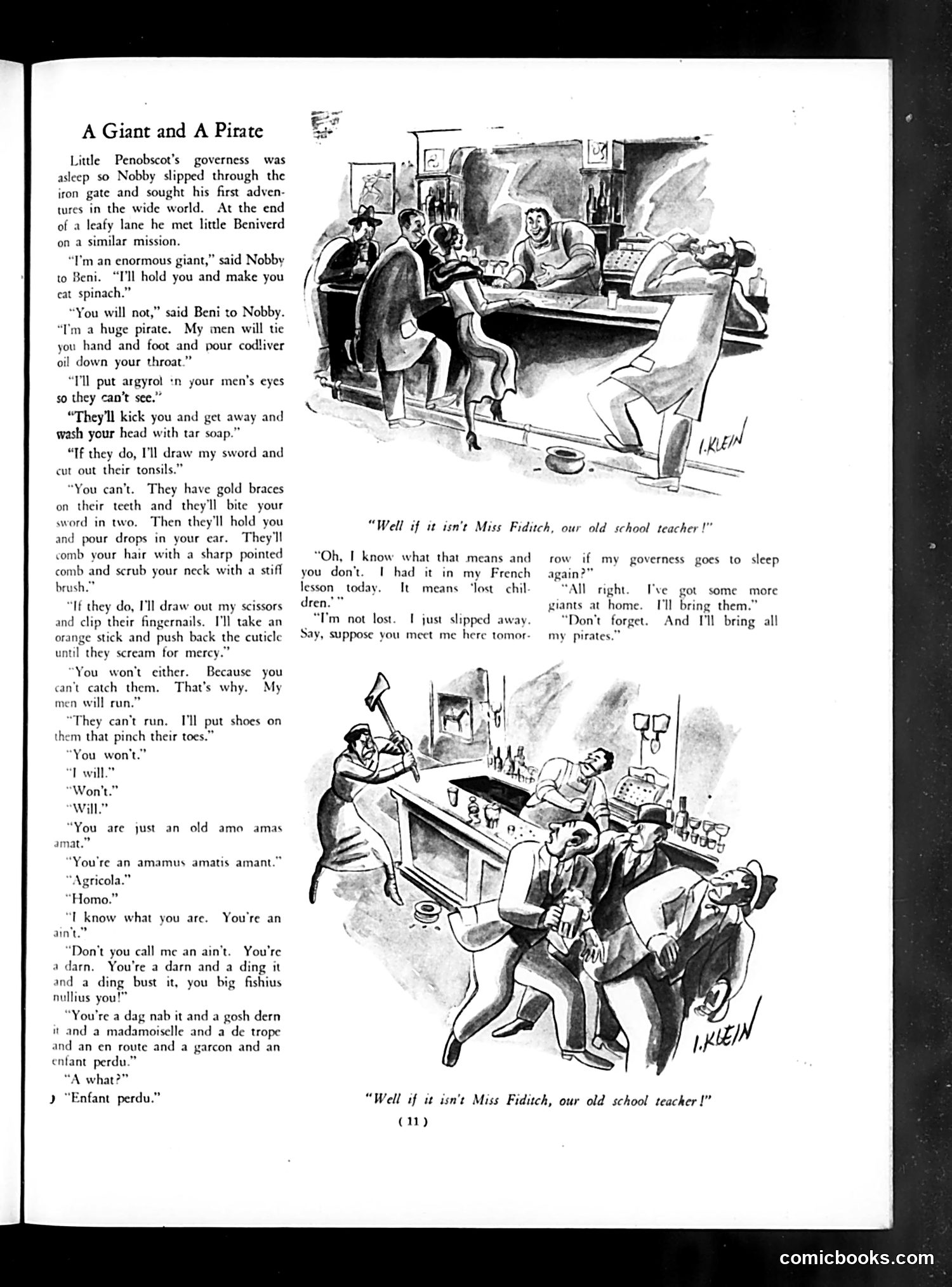
"A Giant and A Pirate" - Life Magazine Satire This page contains a humorous story with two accompanying cartoons. The narrative depicts a confrontation between "Nobby" (an "enormous giant") and "Beni" (a pirate captain), with escalating threats that become increasingly absurd—each character one-upping the other's threats of violence. The second cartoon shows what appears to be a schoolroom scene captioned "Well if it isn't Miss Fidach, our old school teacher!" suggesting a comedic reunion or case of mistaken identity. The satire appears to target exaggerated masculine bravado and one-upmanship—a common theme in early 20th-century American humor. The dialogue mocks overwrought toughness through repetitive, increasingly ridiculous insults and counter-threats. The cartoonist (signed "I. Klein") uses physical comedy and absurdist escalation to satirize posturing and bluster.
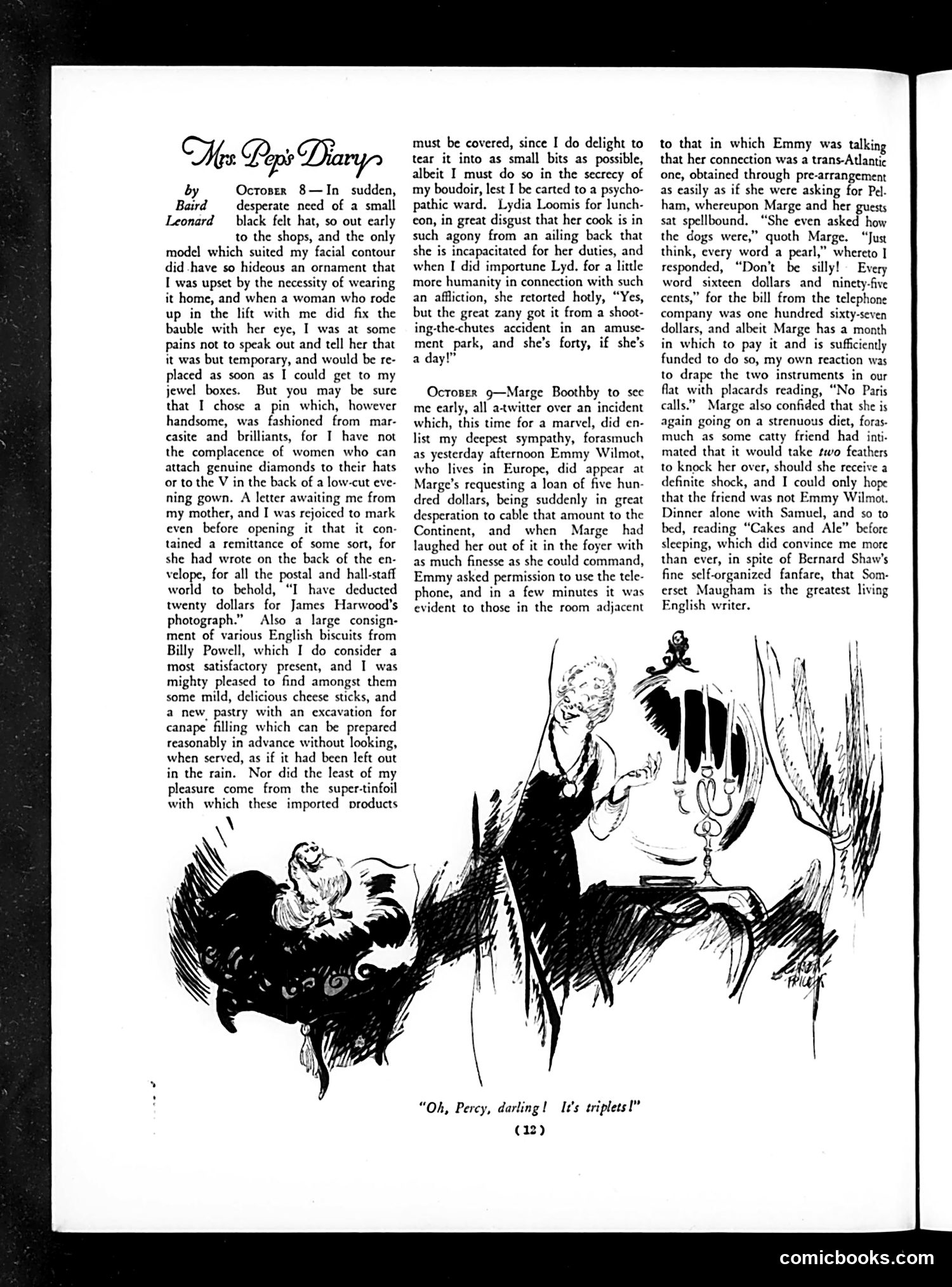
Mrs. Pop's Diary Entry Analysis This page from *Life* magazine presents a society gossip column ("Mrs. Pop's Diary") by Baird Leonard, dated October 8-9. The accompanying illustration depicts two women in what appears to be a social interaction. The diary entries reference various upper-class social situations: acquiring a fashionable black hat, visiting shops, and handling financial matters like loans and telephone bills. The text mentions specific named individuals (Emmy Wilmot, Marge Boothby, Lydia Loomis, Samuel) engaged in typical wealthy-circle activities—social gatherings, financial arrangements, and the complications of maintaining appearances. The illustration's caption reads "Oh, Percy, darling! It's triplets!" suggesting domestic or romantic comedy. The overall content satirizes upper-class society manners, financial concerns, and social hierarchies typical of early 20th-century American satire.
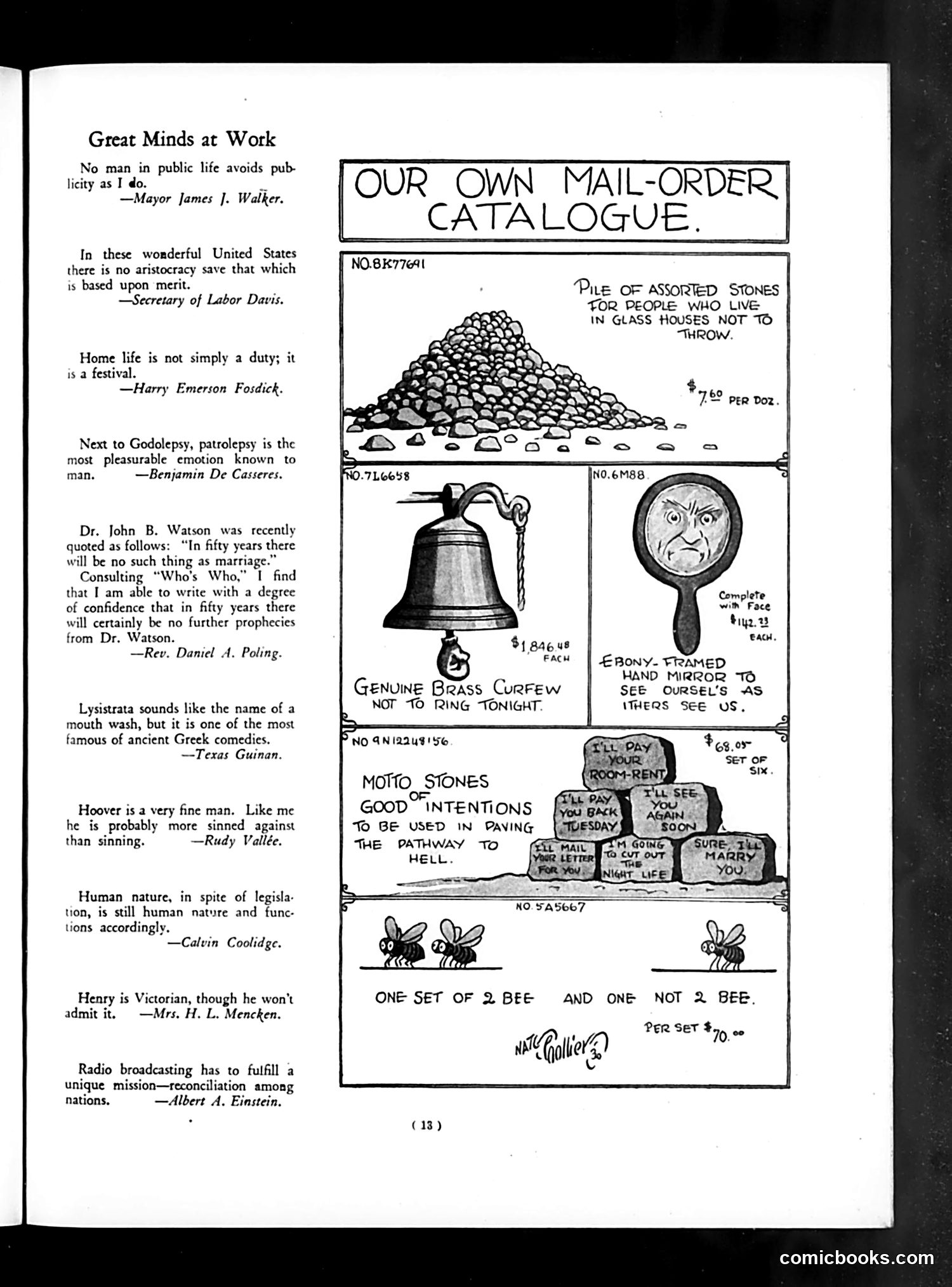
Analysis This page contains a humorous mail-order catalog section titled "Our Own Mail-Order Catalogue," presenting absurd novelty items as satire. Key items include: 1. Pile of Assorted Stones — for people in glass houses who shouldn't throw them (a visual pun on the proverb) 2. Genuine Brass Curfew — "not to ring tonight" (likely satirizing curfew restrictions, possibly WWI-era) 3. Ebony-Framed Hand Mirror — to see oneself "as others see us" (referencing Burns's poem about self-awareness) 4. Motto Stones — with cynical phrases like "I'll pay your rent" and "I'm going to cut out night life," mocking broken promises 5. Bee Sets — a visual joke on "2 bee" (to be) and "not a bee" The humor targets human hypocrisy, failed intentions, and social pretense through mock product listings.
Analysis of "Life Looks About These Ills of Ours" This editorial page discusses economic depression and proposed remedies. The illustration shows a figure (possibly representing Commerce or Industry) cradling what appears to be a baby or small figure, suggesting nurturing the economy. The text references George Russell, an Irish poet-philosopher on a U.S. lecture tour, advocating rural life over urban migration. It mentions Henry Ford and Herbert Hoover (implied as President) as proponents of industrial solutions to economic problems. The article debates whether spending money on goods and factories, or alternatively shifting agricultural surplus, offers better relief. It skeptically questions whether either approach will meaningfully address the depression, while acknowledging that maintaining confidence and consumption matters during economic hardship. The satire critiques competing ideological remedies for systemic economic problems.
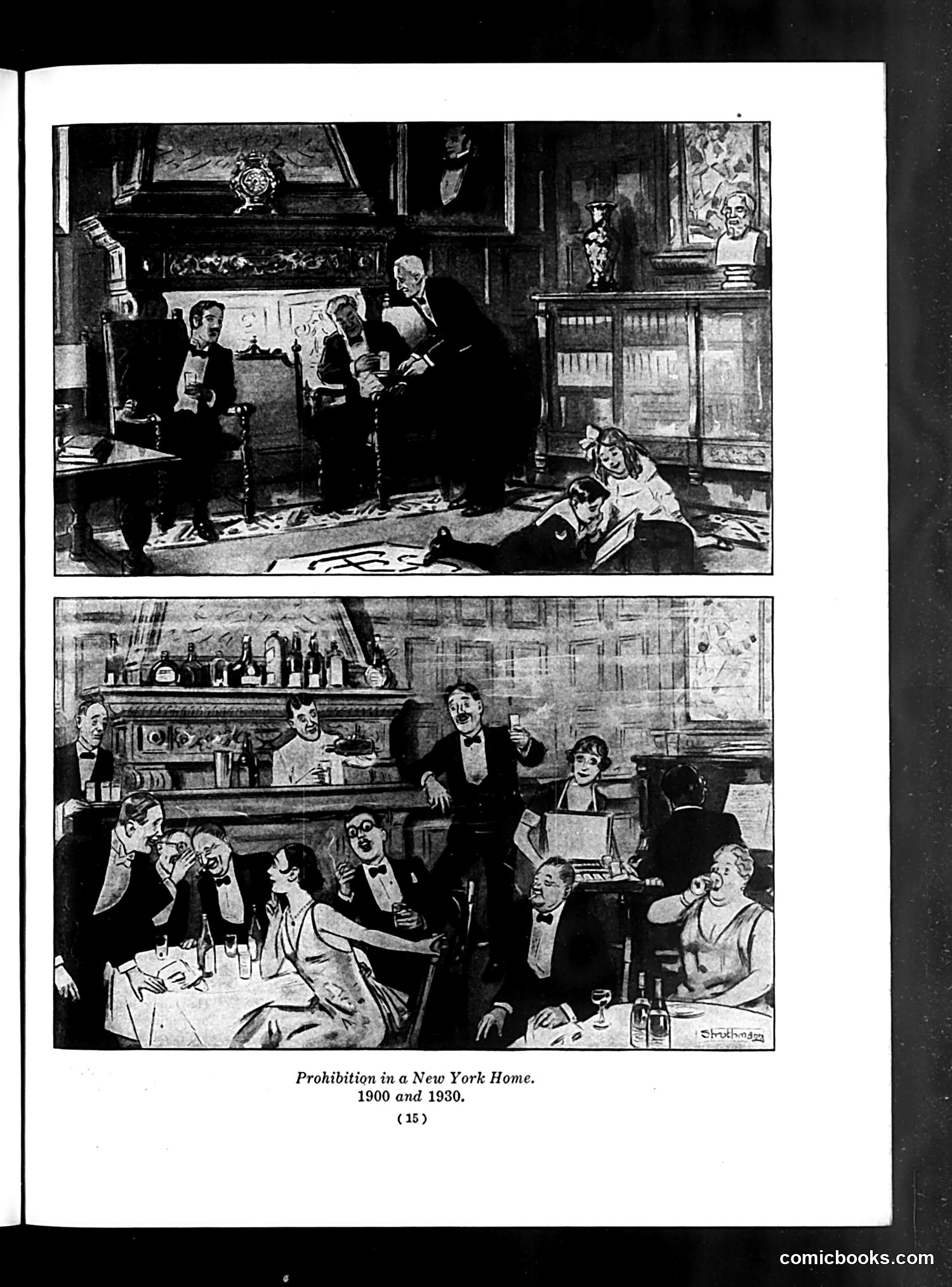
"Prohibition in a New York Home: 1900 and 1930" This two-panel satirical cartoon contrasts attitudes toward alcohol across three decades of American history. The top panel (1900) depicts a refined, formal household where well-dressed gentlemen drink discreetly in an elegant parlor—alcohol is socially acceptable among the upper class. The bottom panel (1930) shows the same setting transformed into chaotic revelry during Prohibition (1920-1933). Despite the federal ban on alcohol, the home has become a wild speakeasy with guests openly drinking, dancing, and celebrating. The contrast satirizes Prohibition's failure: rather than eliminating drinking, the law drove it underground and made it more lawless and excessive, particularly among those wealthy enough to ignore it. The cartoon mocks Prohibition's ineffectiveness and unintended consequences.
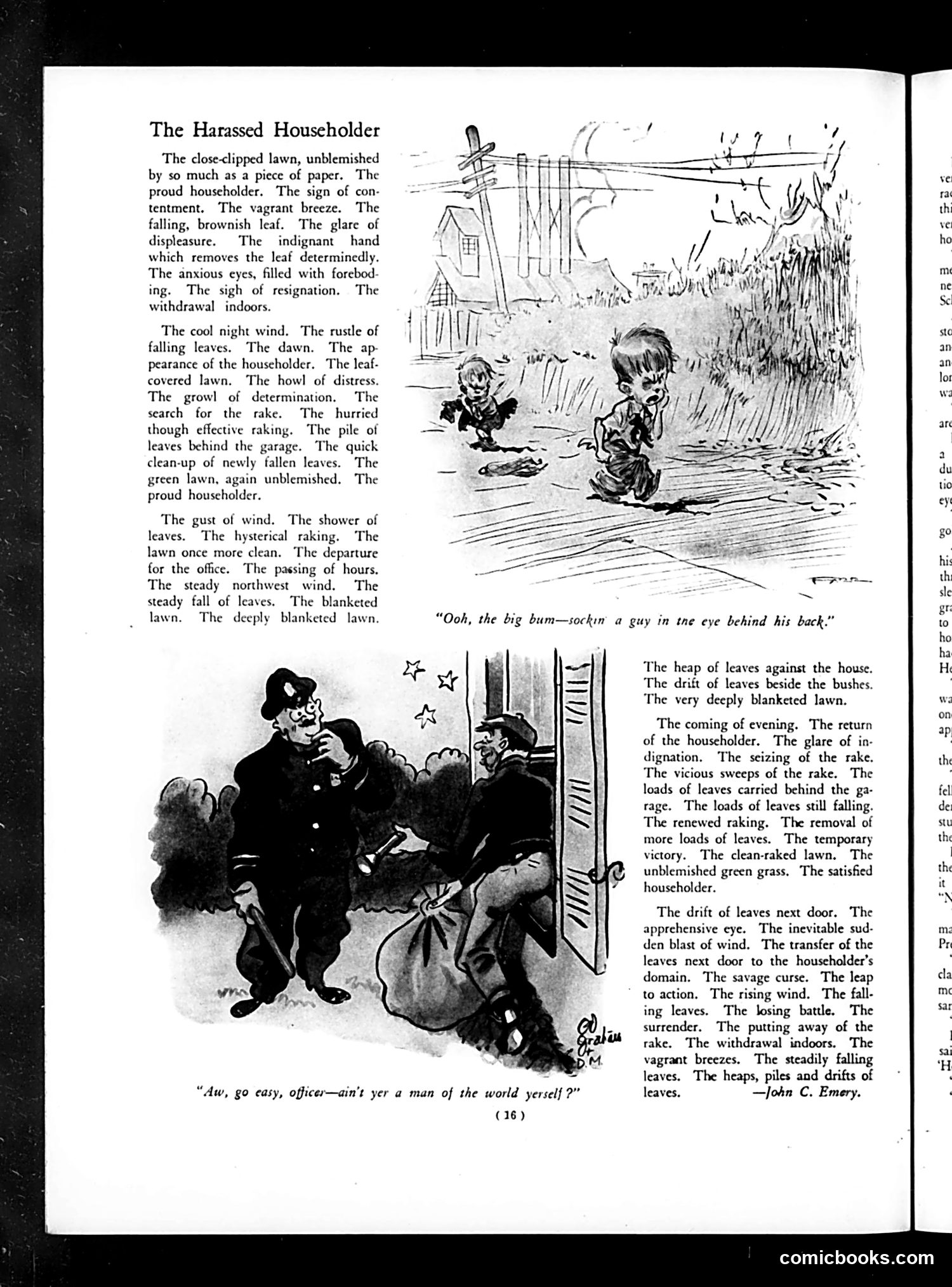
"The Harassed Householder" This satirical piece by John C. Emery depicts the endless autumn chore of leaf-raking. The top illustration shows children playing in scattered leaves while a homeowner struggles with the task. The bottom cartoon shows an officer (likely a police officer or authority figure) confronting an exhausted man, with the caption "Aw, go easy, officer—ain't yer a man of the world yerself?" The satire targets the relentless, Sisyphean nature of fall yard maintenance—leaves constantly accumulate faster than they can be removed. The householder's despair at this futile battle, combined with the humorous plea to the officer, suggests societal sympathy for the homeowner's frustration. The piece captures a universal domestic frustration with little humor or escape.
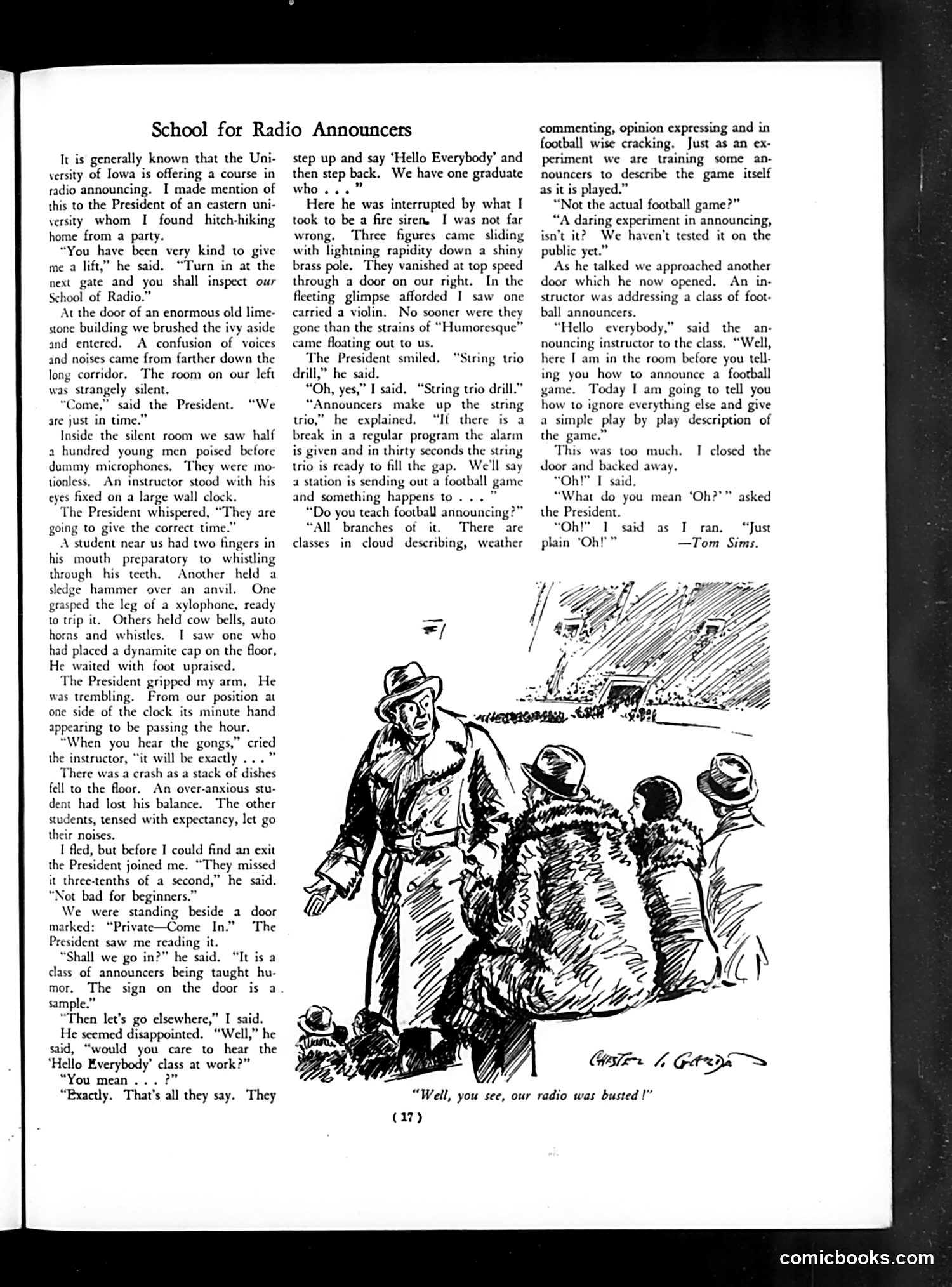
Analysis of "School for Radio Announcers" This is a humorous article about the University of Iowa's radio announcing course. The text satirizes the absurd training methods, describing students practicing with unlikely sound-effect props: fingers whistling through teeth, sledge hammers on anvils, cow bells, and dynamite caps. The accompanying cartoon illustrates the chaos: a disheveled instructor demonstrates football play-by-play announcing to students while surrounded by sound-effect paraphernalia (visible as the bulky mass in the drawing). The caption "Well, you see, our radio was busted!" explains why they're resorting to such primitive, physically chaotic methods. The satire mocks both early radio broadcasting's technical limitations and the improbable techniques required to create convincing sound effects before modern recording technology. It's poking fun at the improvised, sometimes ridiculous nature of early broadcast production.
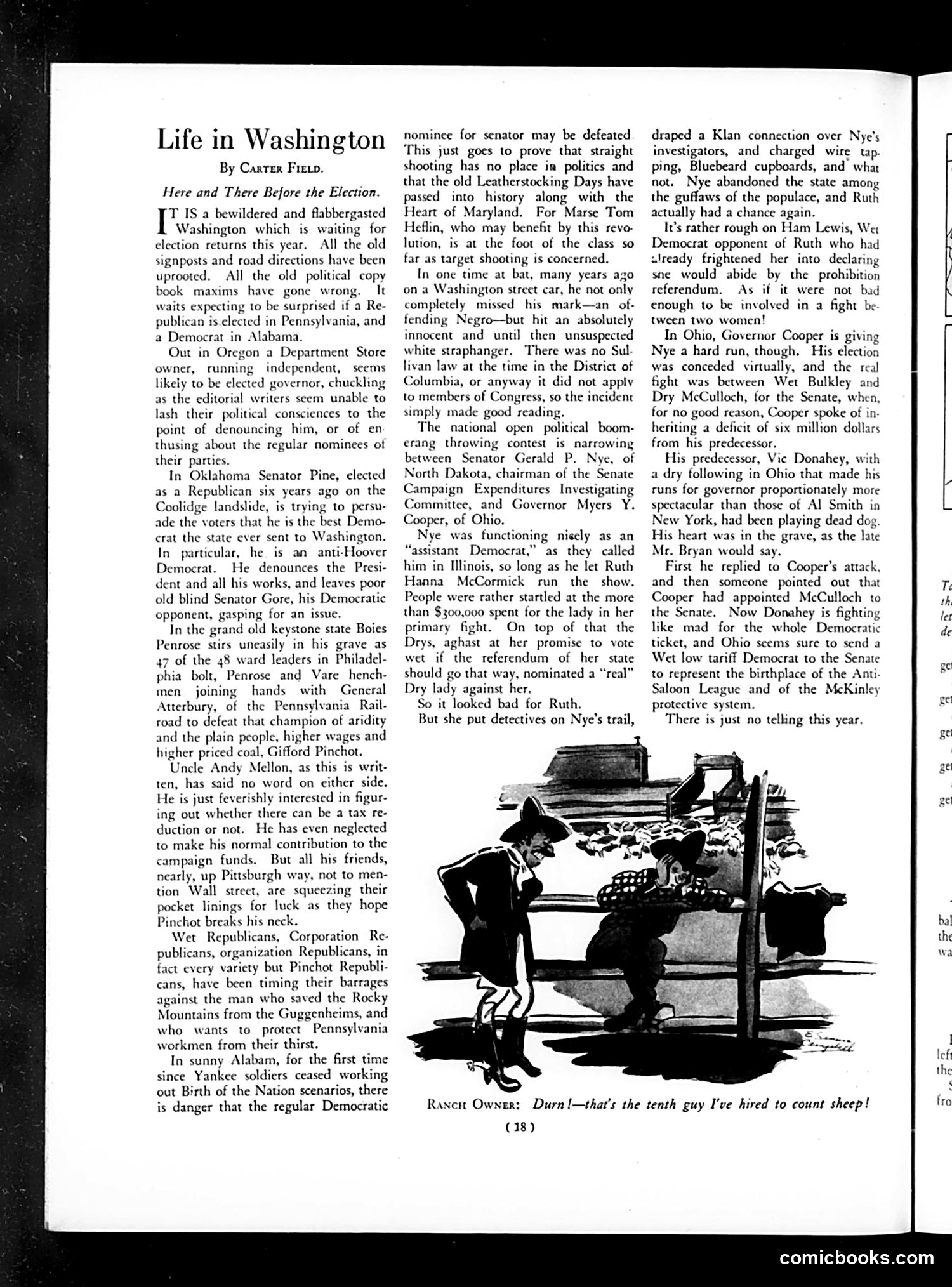
Analysis This page from *Life* magazine contains a political commentary column by Carter Field titled "Life in Washington: Here and There Before the Election." The cartoon below depicts a ranch owner confronting a disheveled worker, saying "Durn!—that's the tenth guy I've hired to count sheep!" The visual joke satirizes incompetence or laziness—the worker appears to have fallen asleep while supposedly counting sheep (a task meant to induce sleep). The column discusses various 1930s political figures and election dynamics, including Senator Gerald P. Nye and Governor Myers Y. Cooper of Ohio. The text references campaign controversies, political maneuvering, and Democratic-Republican tensions. Without publication date visible, the specific context remains somewhat unclear, but the overall tone is satirical commentary on contemporary political personalities and their activities.
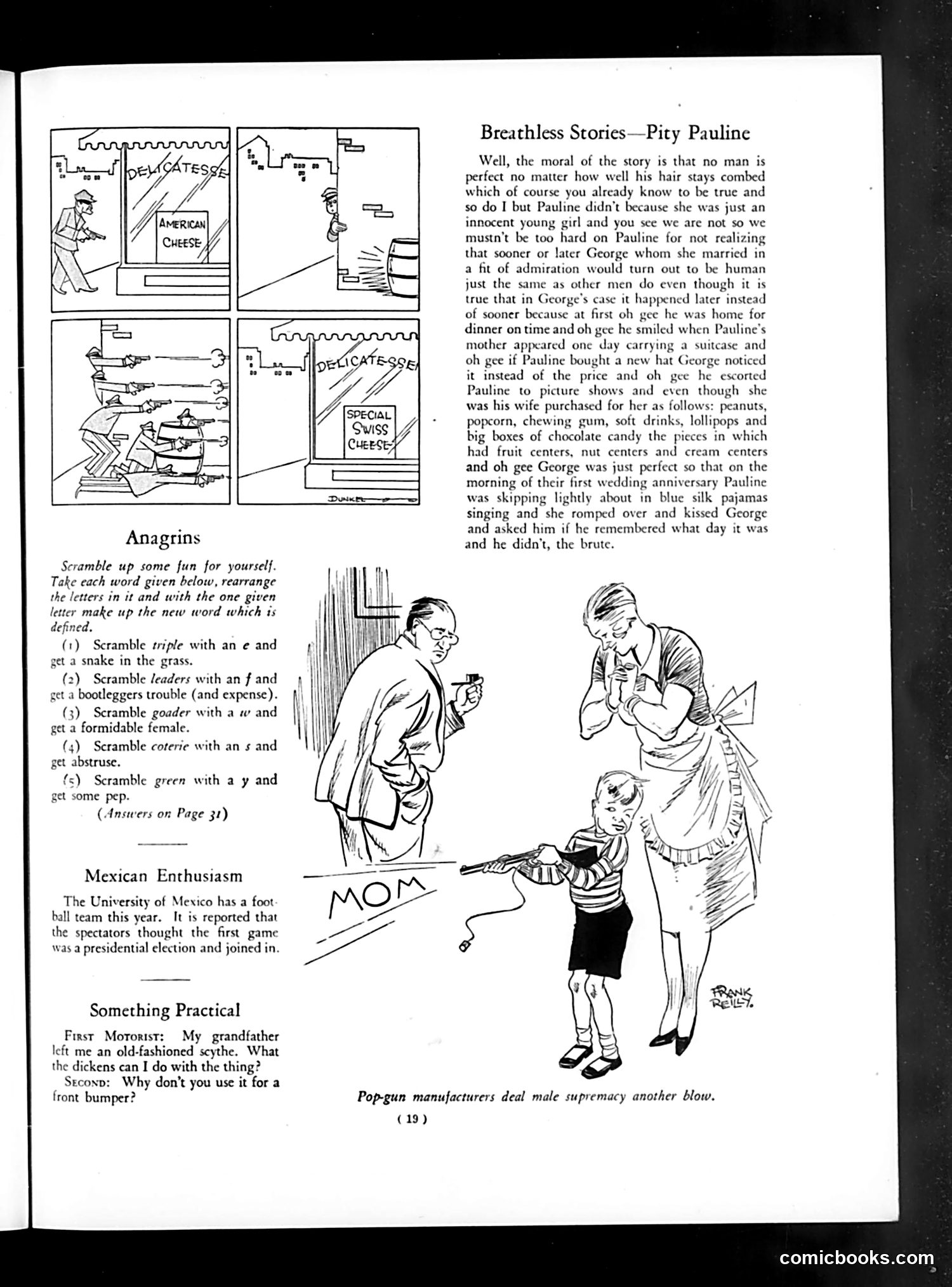
Explanation for Modern Readers This page contains several satirical pieces typical of early 20th-century *Life* magazine humor: "Breathless Stories—Pity Pauline" mocks melodramatic serialized fiction (likely referencing "Perils of Pauline"). The satire critiques how women in these stories are portrayed as naive and forgiving, while husbands become indifferent after marriage. George initially courts Pauline attentively but forgets their anniversary—the "brute" of the title. The prose style parodies breathless pulp fiction. "Mexican Enthusiasm" jokes that Mexican football spectators were so rowdy they mistook the game for a presidential election, poking fun at perceived Latin American political volatility. "Something Practical" is a simple joke about automotive innovation—using an old scythe blade as a car bumper. The bottom cartoon shows a woman and child with a pop-gun toy, captioned "Pop-gun manufacturers deal male supremacy another blow"—satirizing anxieties about toys or products that might empower women or challenge male dominance.
Theatre Review: "Solid South" by Richard Bennett This is a theatre review by Baird Leonard of Richard Bennett's play "Solid South." The critic discusses Bennett's portrayal of Major Bruce Follansbee, a financially ruined Alabama plantation owner clinging to antebellum Southern aristocratic traditions despite material decline. The satire targets post-Reconstruction Southern pride and hypocrisy: Follansbee speaks grandly of chivalry while verbally abusing his household; he boasts of hospitality while mortgaged and impoverished; he lectures about Southern honor while drinking servants' liquor and drawing guns on guests. The play also mocks Southern attitudes toward women (insisting his daughter-in-law remain devoted to a dead husband; opposing his granddaughter's employment) and Southern politics (his sister Geneva urges visitors to "vote the straight Democratic ticket"). Leonard argues the caricature, though exaggerated, reflects genuine Southern attitudes he personally knows, making it social commentary rather than mere farce.
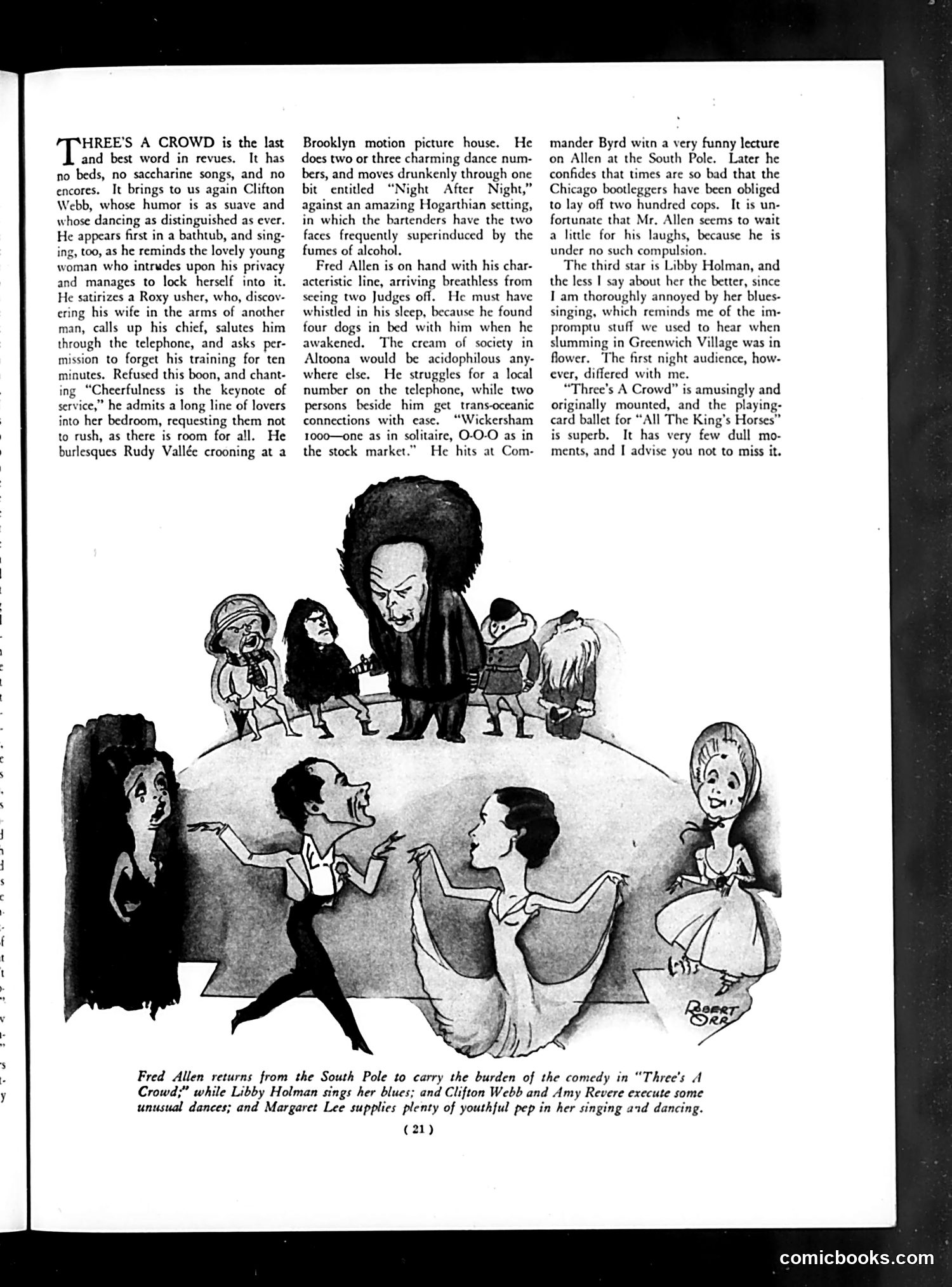
"Three's a Crowd" Review (Life Magazine) This is a theater review, not political satire. The text and cartoon promote a 1930 Broadway revue featuring comedians Clifton Webb and Fred Allen, singer Libby Holman, and dancers. The cartoon illustrates comedic sketches: Webb appears in a bathtub scene with an intruding woman; Allen performs his trademark rapid-fire joke delivery (the caption notes he arrives "breathless"). The exaggerated caricatures emphasize physical comedy and slapstick humor typical of 1920s-30s revue theater. Allen's jokes reference contemporary concerns—unemployment ("bootleggers have been obliged to lay off two hundred cops") and explorer Richard Byrd's South Pole expedition. Holman's "blues-singing" apparently divides audiences; the reviewer finds it tedious, though opening-night crowds disagreed. The review is largely promotional, encouraging readers not to miss the show. The cartoon visualizes the performers' comedic styles rather than making political points.
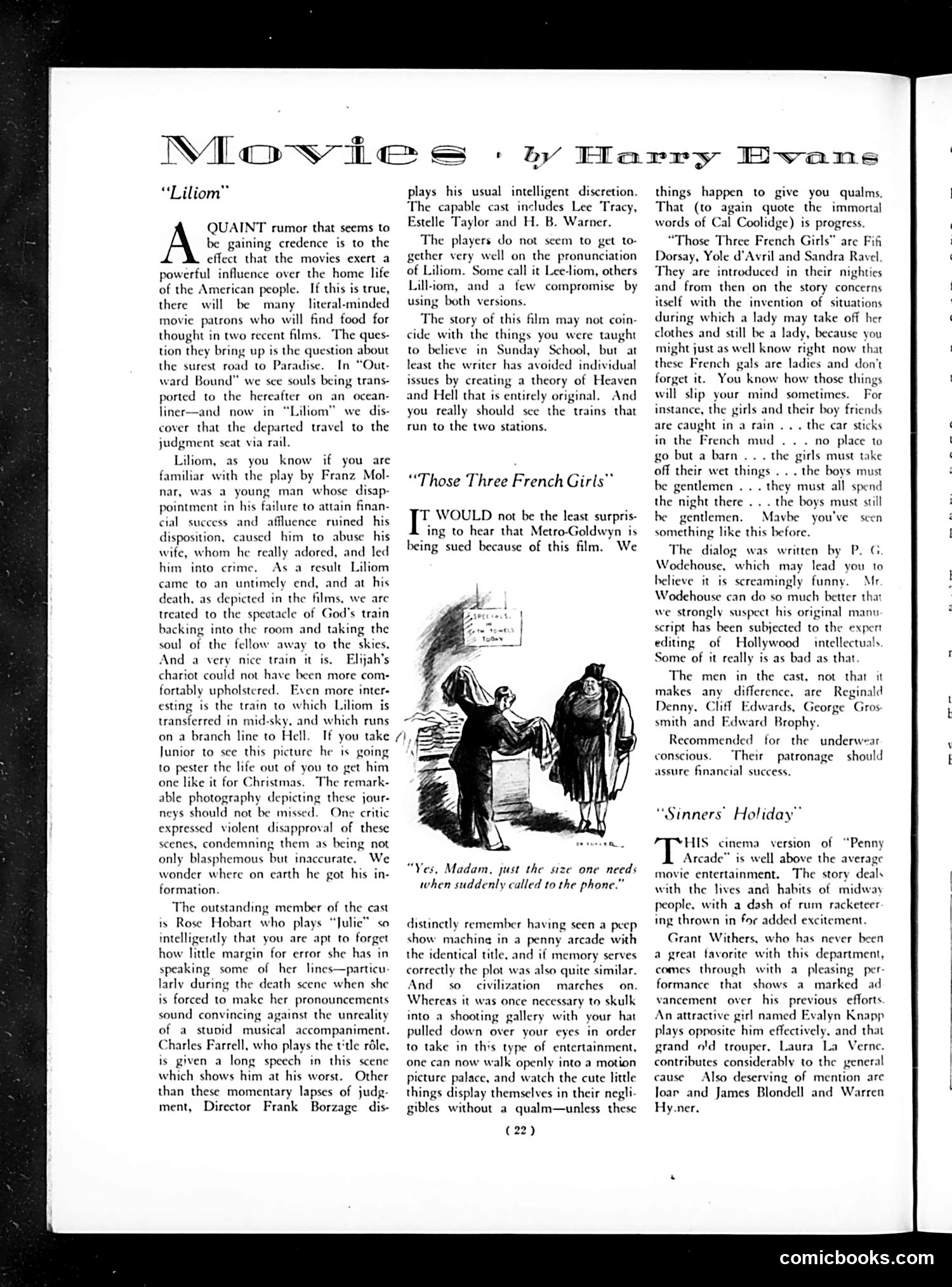
Movie Reviews from Life Magazine This page contains film reviews by Harry Evans covering three 1930s movies. "Liliom" is reviewed as an adaptation of Franz Molnár's play about a financially desperate man whose failure ruins his marriage and leads to crime. Evans notes the film's unusual theological imagery—depicting heaven and hell via trains—which he finds entertainingly unconventional, even if blasphemous by traditional standards. He praises Rose Hobart's intelligent performance but criticizes Charles Farrell's overwrought delivery. The review is lighthearted about cast members mispronouncing the title. "Those Three French Girls" is dismissed as derivative, appearing to plagiarize a penny arcade peep show machine's title and plot. Evans sarcastically observes that cinema now allows public viewing of scantily-clad women where such entertainment once required furtive visits to disreputable venues—marking "progress" in civilization's permissiveness. The cartoonish illustration accompanying the French Girls review depicts figures in period dress, supporting the era's entertainment content being discussed.
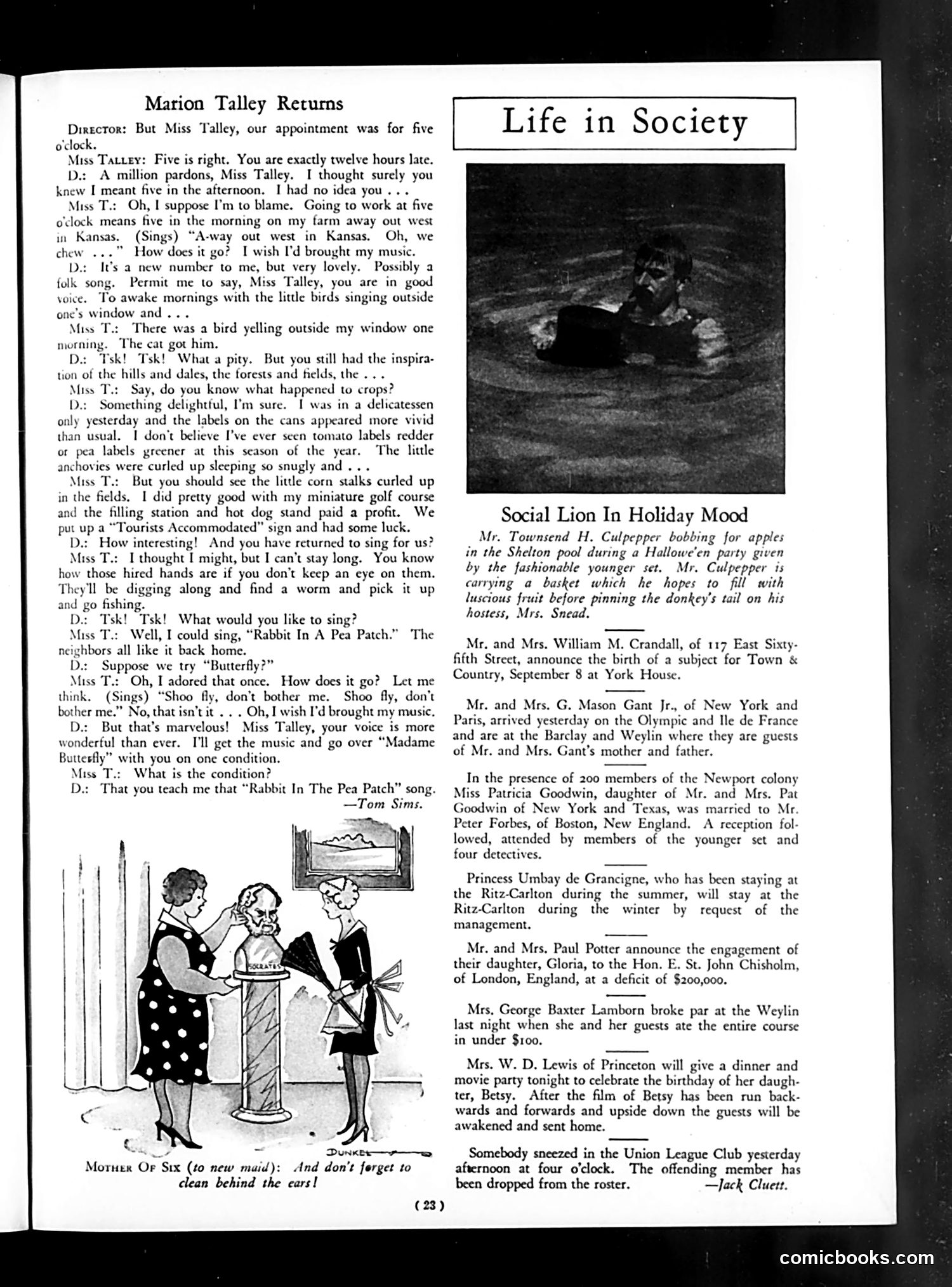
Explanation for Modern Readers The page satirizes Marion Talley, a famous American opera singer of the 1920s-30s, who was celebrated for her rustic Kansas farm background. The dialogue mocks the romantic idealization of rural life: a director gushes about "little birds singing" and inspirational "hills and dales," while Talley bluntly describes dead birds, failed crops, and her side businesses (mini golf course, hot dog stand). She confuses song lyrics and can't remember her own music—undercutting the myth of her natural, unspoiled talent. The cartoon below shows three fashionable women—likely society figures—in 1920s dress. The "Life in Society" section provides gossipy high-society announcements about wealthy New Yorkers and Newporters: engagements, births, arrivals. The tone is both celebratory and subtly mocking (note: "four detectives" attended a wedding, suggesting either crime concerns or the absurd pretension of such events). Together, the page contrasts rural sentimentality with urban sophistication, deflating both through satire.
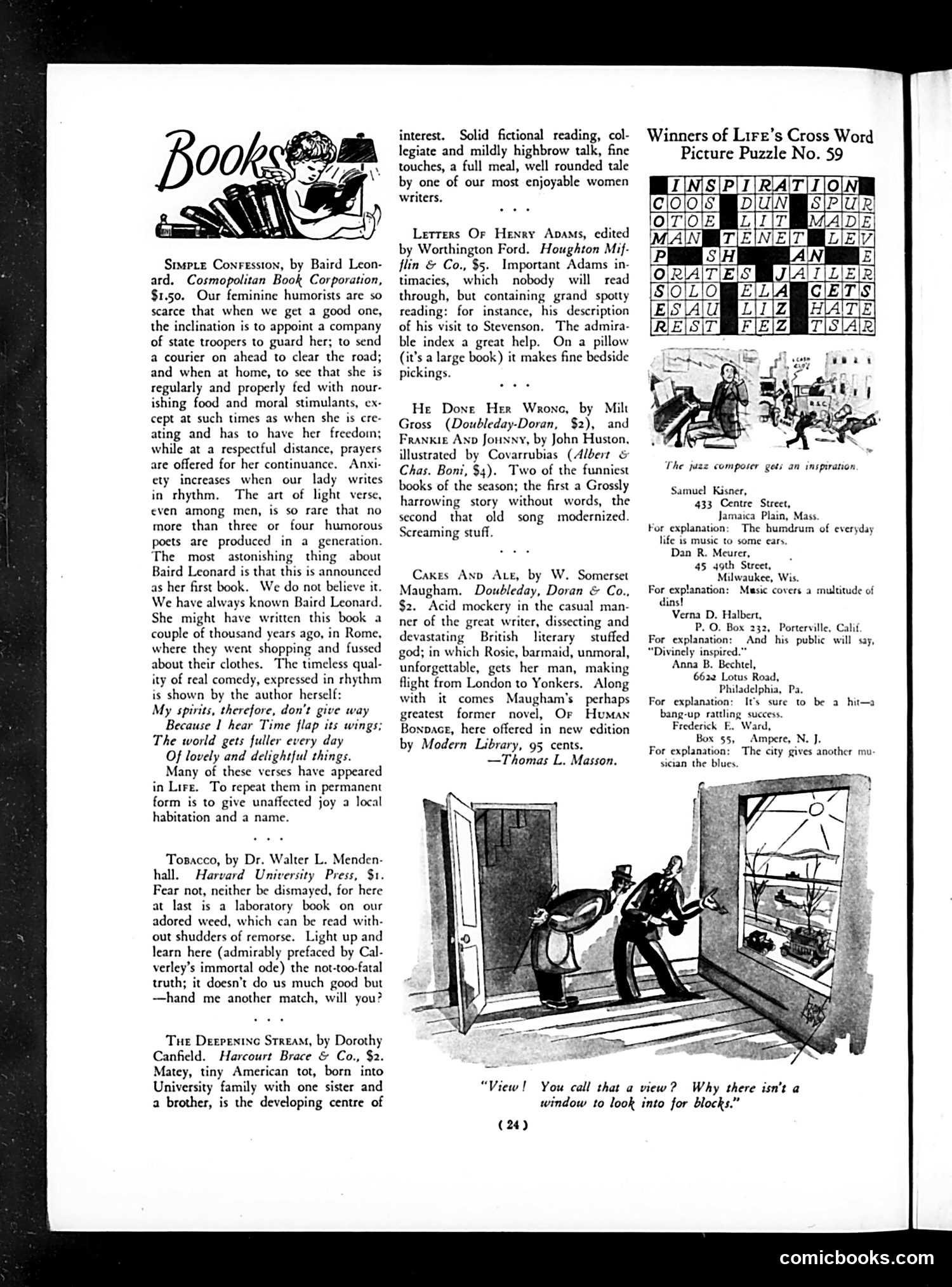
Life Magazine Book Review Page Analysis This page from Life magazine contains book reviews and a cartoon. The main cartoon depicts two men at a doorway—one departing, one remaining inside. The departing man says "View! You call that a view? Why there isn't a window to look into for blocks." The joke satirizes modern apartment living in crowded urban areas, likely New York City. The humor plays on the real estate agent's euphemistic language ("view") versus the reality: in densely built neighborhoods, windows often face other buildings with no actual scenery to see. This reflects early 20th-century concerns about cramped urban housing and deceptive rental practices. The page also features book reviews by Thomas L. Masson, covering works by Baird Leonard, W. Somerset Maugham, and others—typical middlebrow literary fare of the period. The crossword puzzle solution section indicates this was a family magazine with multiple entertainment features.
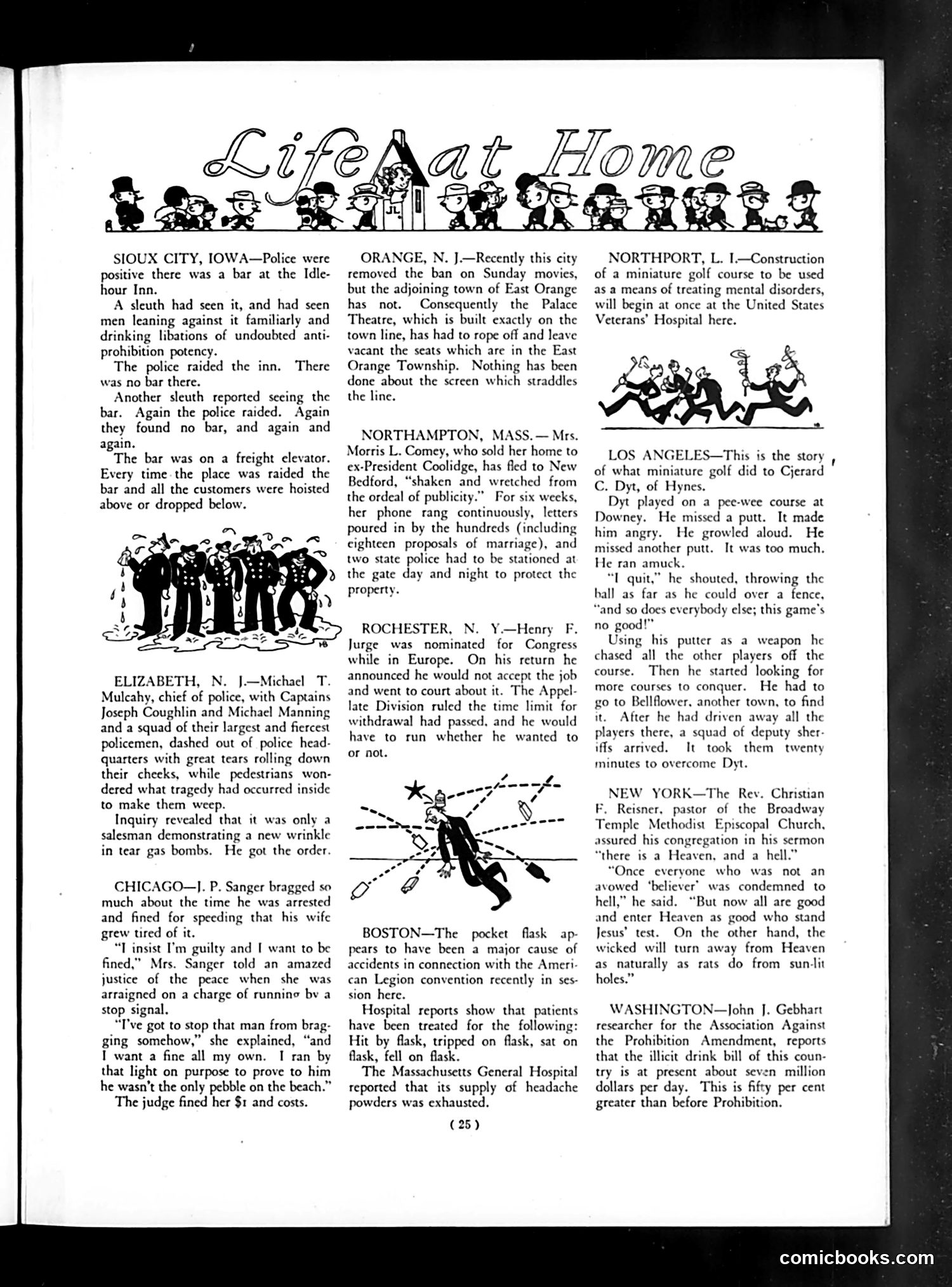
Life Magazine "Life at Home" Page Analysis This page presents humorous anecdotes satirizing Prohibition-era America and contemporary social issues. Key items: Prohibition Enforcement: The Sioux City bar on a freight elevator mocks ineffective Prohibition enforcement—police repeatedly raid but find nothing because the bar mechanically rises/falls to evade detection. This satirizes the cat-and-mouse game between authorities and illegal alcohol operators. Tear Gas: A police demonstration of tear gas bombs so emotional it makes officers weep—comedy from the new technology's potency. Miniature Golf Craze: Two stories highlight the era's fad. One notes the Veterans' Hospital using it therapeutically for mental disorders; another describes a man who became so enraged losing at mini-golf that he attacked other players with his putter and went "amuck" (violent rampage). Pocket Flask Injuries: Boston Legion convention casualties from flask-related accidents (hitting, tripping, sitting on flasks) satirizes alcohol culture's dangers, with hospitals overwhelmed. The cartoons illustrate these written anecdotes with period-appropriate illustrations of figures in action or distress, reinforcing the comedic tone through visual exaggeration.
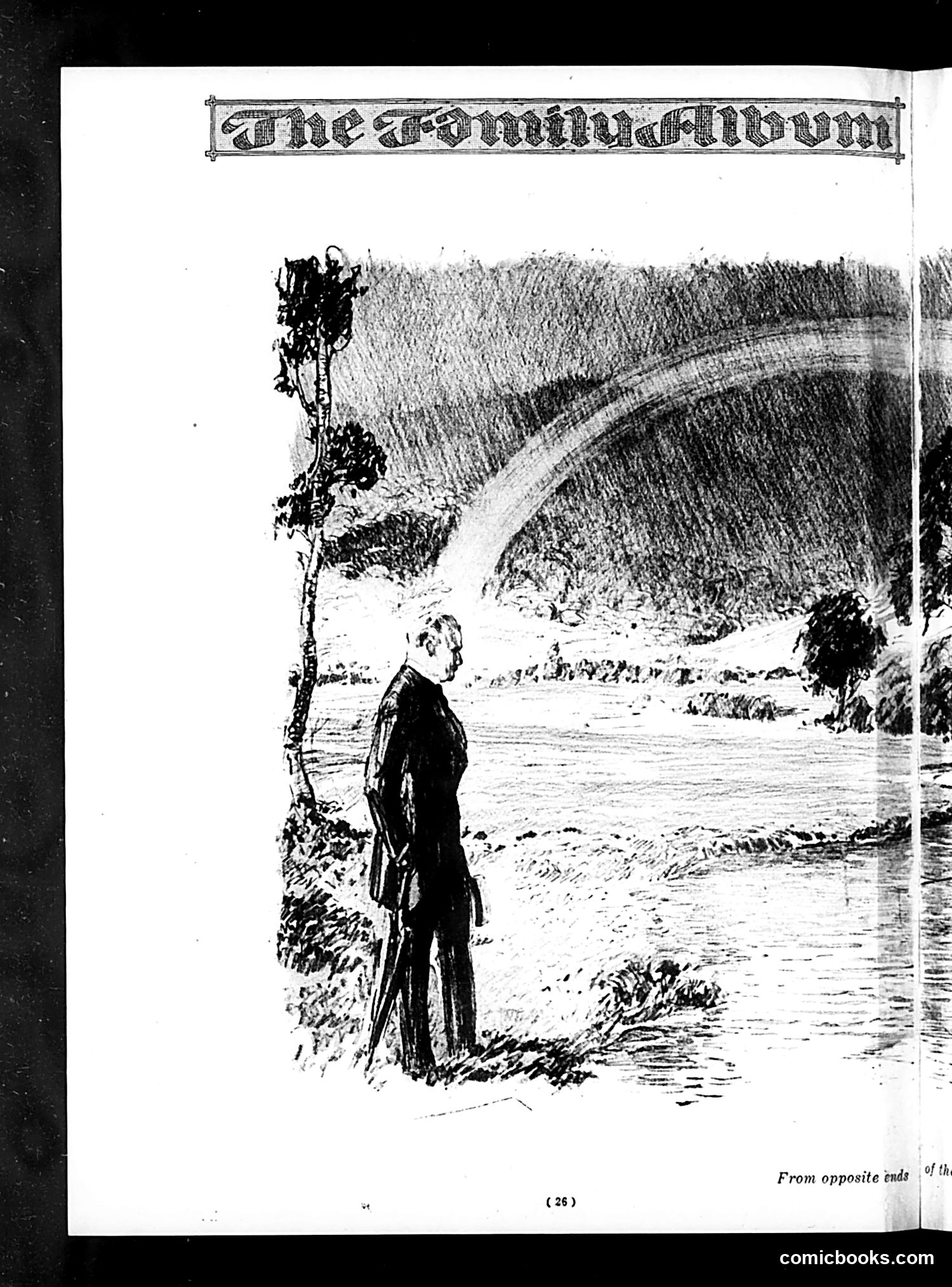
Analysis This page shows a dramatic illustration of a solitary figure in dark clothing standing by a river, gazing at a forested landscape with steep cliffs or hills. The figure appears contemplative or melancholic, positioned near what looks like a birch tree. The caption reads "From opposite ends," but without additional context on this page, the specific satirical or political meaning is unclear. This could be part of a serialized story or cartoon commentary, but the image alone—a romantic or nostalgic landscape scene—doesn't reveal obvious satire or caricature typical of *Life* magazine's political content. The page number (25) and partial text suggest this is a middle section of a larger work, making interpretation difficult without surrounding pages.
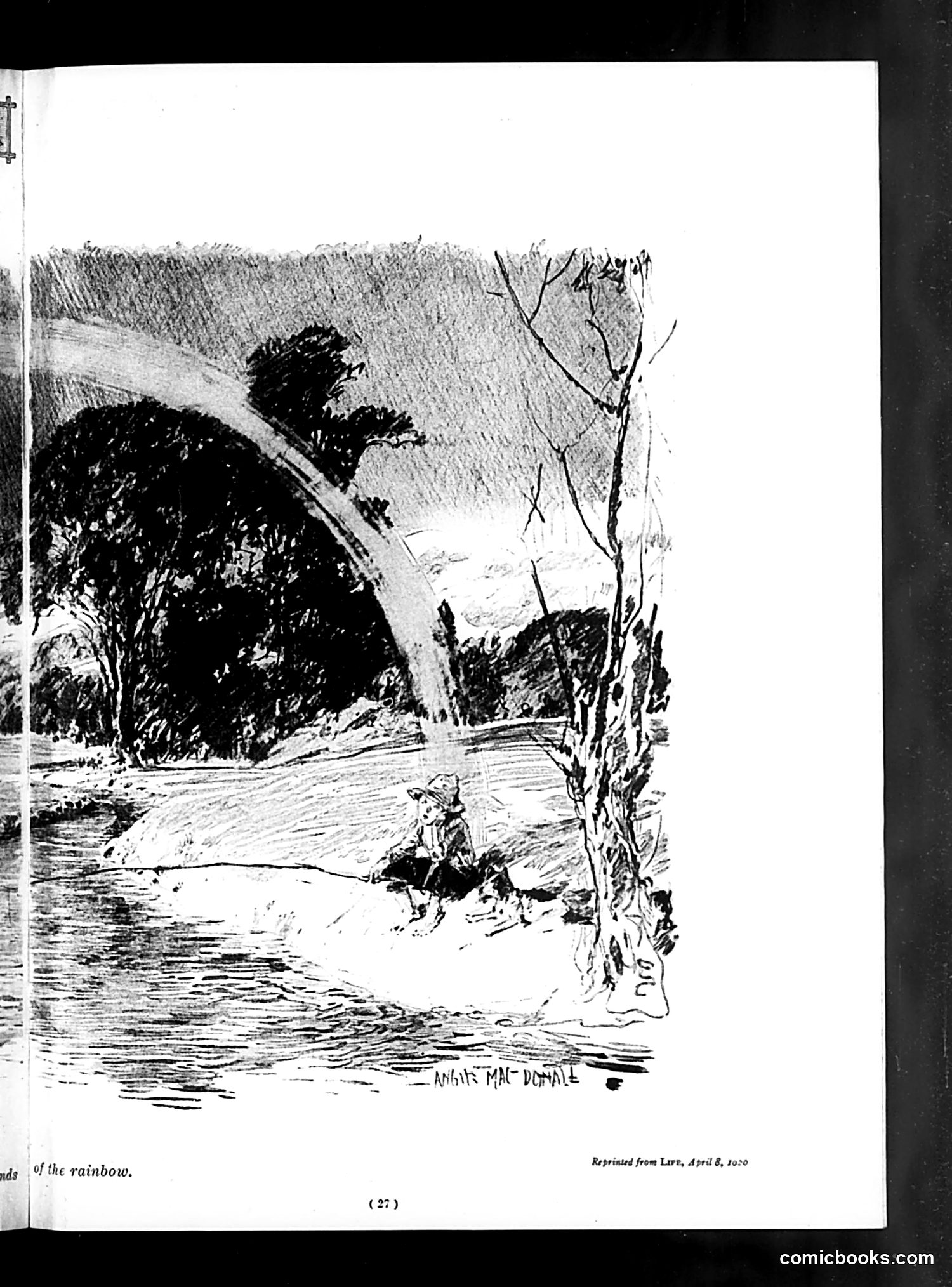
Analysis This is a pen-and-ink illustration reprinted from *Life* magazine (April 8, 1920). The image depicts a solitary figure seated by a river or stream, beneath a tall tree, with mountainous terrain in the background. The style is naturalistic rather than satirical. The caption references "the rainbow" and the artist's signature appears to read "Nihus [?] Doramle" (OCR unclear). Without additional context from surrounding text or clearer identification of the artist, the specific satirical point or political commentary is unclear. It appears to be either a poetic landscape illustration or possibly an allegorical figure, but the exact meaning and any contemporary reference it may contain cannot be determined from the image alone.
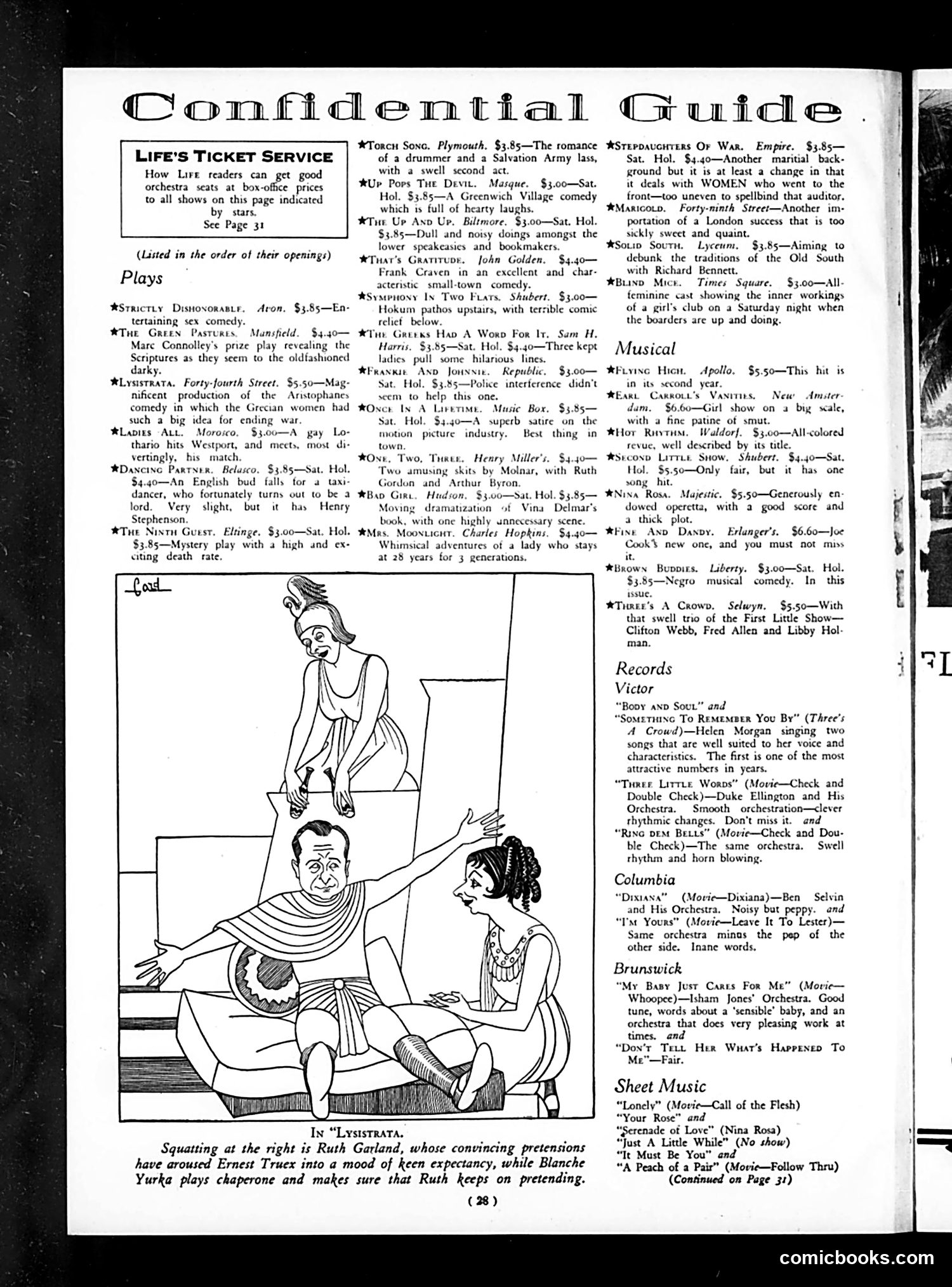
"Lysistrata" Cartoon Explanation This cartoon illustrates Aristophanes' ancient Greek comedy *Lysistrata*, described on the page as a "magnificent production" at the Forty-fourth Street Theatre. The play's plot involves Greek women withholding sexual intimacy to force men to end war. The cartoon depicts the play's central dynamic: a woman (Ruth Garland, identified in the caption) sits above a man (Ernest Truex), maintaining a pose of seductive pretense while another woman (Blanche Yurka) acts as "chaperone" to ensure the deception continues. The caption's phrase "convincing pretensions" and "keeps on pretending" directly reference the play's satirical premise—women using sexual promise as negotiating power. For modern readers: this 1930s Life magazine review treats an ancient anti-war comedy as current entertainment, assuming audiences would recognize both the classical reference and find humor in its battle-of-the-sexes premise.
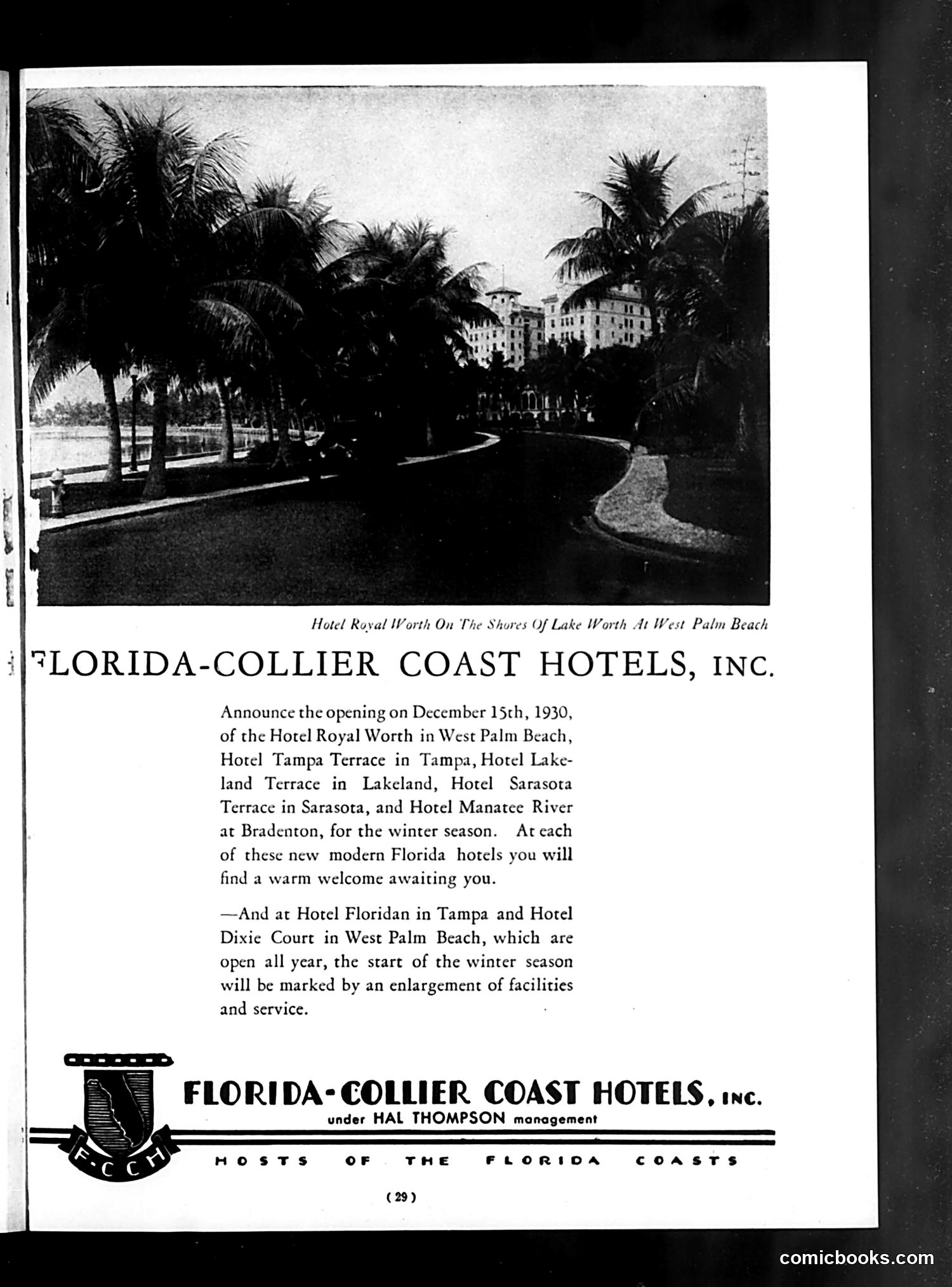
This is primarily a hotel advertisement, not a political cartoon. It announces the December 15, 1930 opening of multiple Florida hotels by Florida-Collier Coast Hotels, Inc., under manager Hal Thompson. The page features a photograph of the Hotel Royal Worth in West Palm Beach, showing palm trees lining a curved driveway leading to a multi-story hotel building on Lake Worth's shore. The image conveys luxury and tropical appeal. The timing is significant: this advertisement appeared during the Great Depression (which began in 1929). The fact that a hotel company was confidently opening five new properties and enlarging existing ones in late 1930 suggests either optimism about Florida's tourism industry or perhaps indicates this was published before the full economic catastrophe became apparent. The "warm welcome" language targets winter-season visitors seeking escape to Florida's climate. This is essentially promotional material for upscale seasonal accommodations, not satirical content.
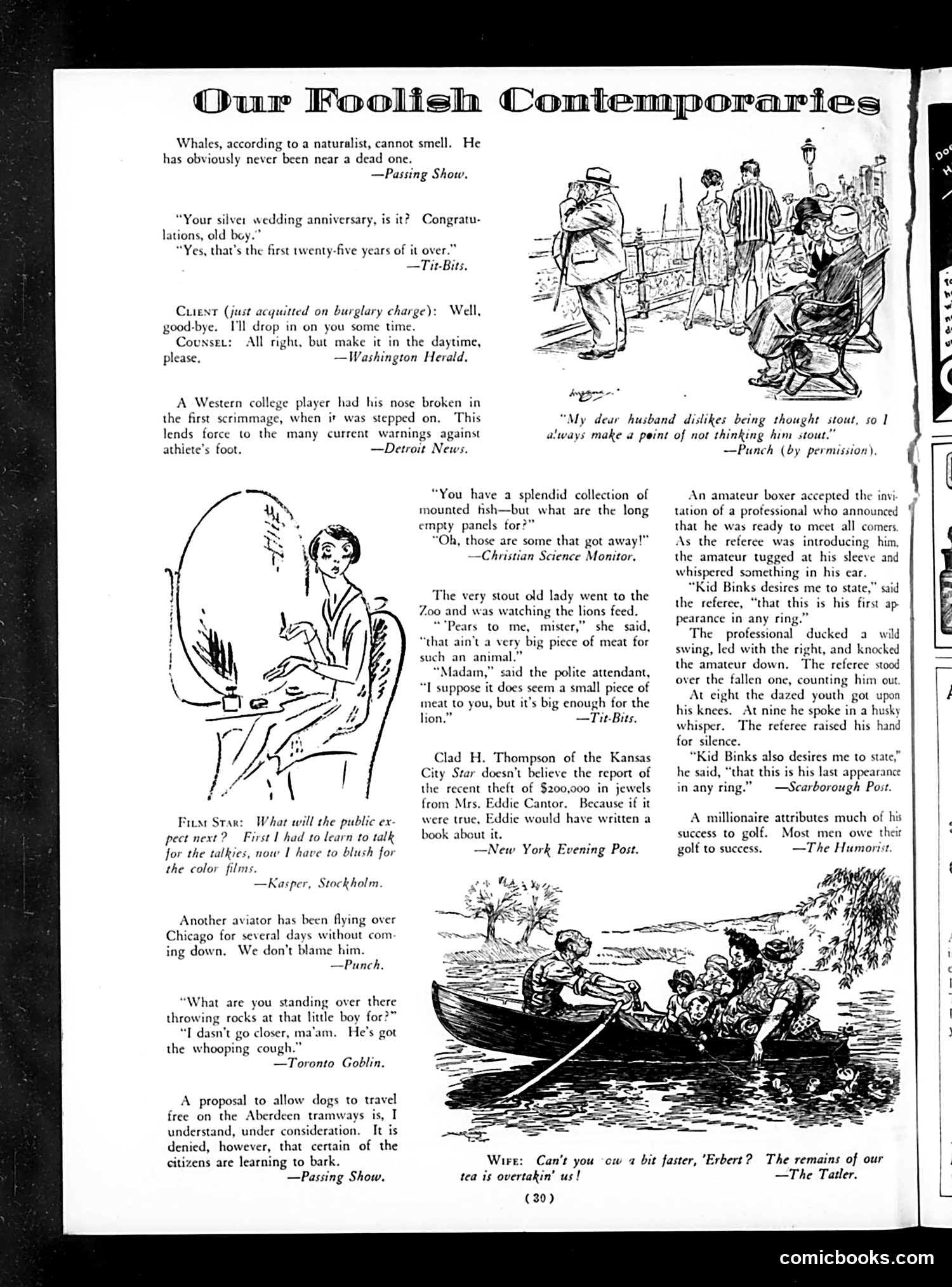
"Our Foolish Contemporaries" — Life Magazine Humor Page This is a humor compilation page featuring short jokes and quips from various publications, plus illustrated cartoons. The content reflects early-to-mid 20th century satirical comedy: Key jokes include: - A burglary suspect joking about visiting his lawyer during daytime (avoiding suspicion) - A film star complaining about learning to "blush for color films" (early sound/color film technology anxieties) - An aviator flying over Chicago indefinitely (Depression-era commentary on escaping urban life) - A stout woman at the zoo finding the lion's meat portion inadequate (self-deprecating humor about her own appetite) - A reference to Eddie Cantor's jewel theft, doubting it happened because "Eddie would have written a book about it" (celebrity self-promotion satire) - A boxing match where the amateur's referee announces it's his "last appearance in any ring" after being knocked down - A boating scene with tea being spilled The humor targets contemporary absurdities: technology adoption, celebrity vanity, class anxieties, and physical comedy. No specific political figures are identified.
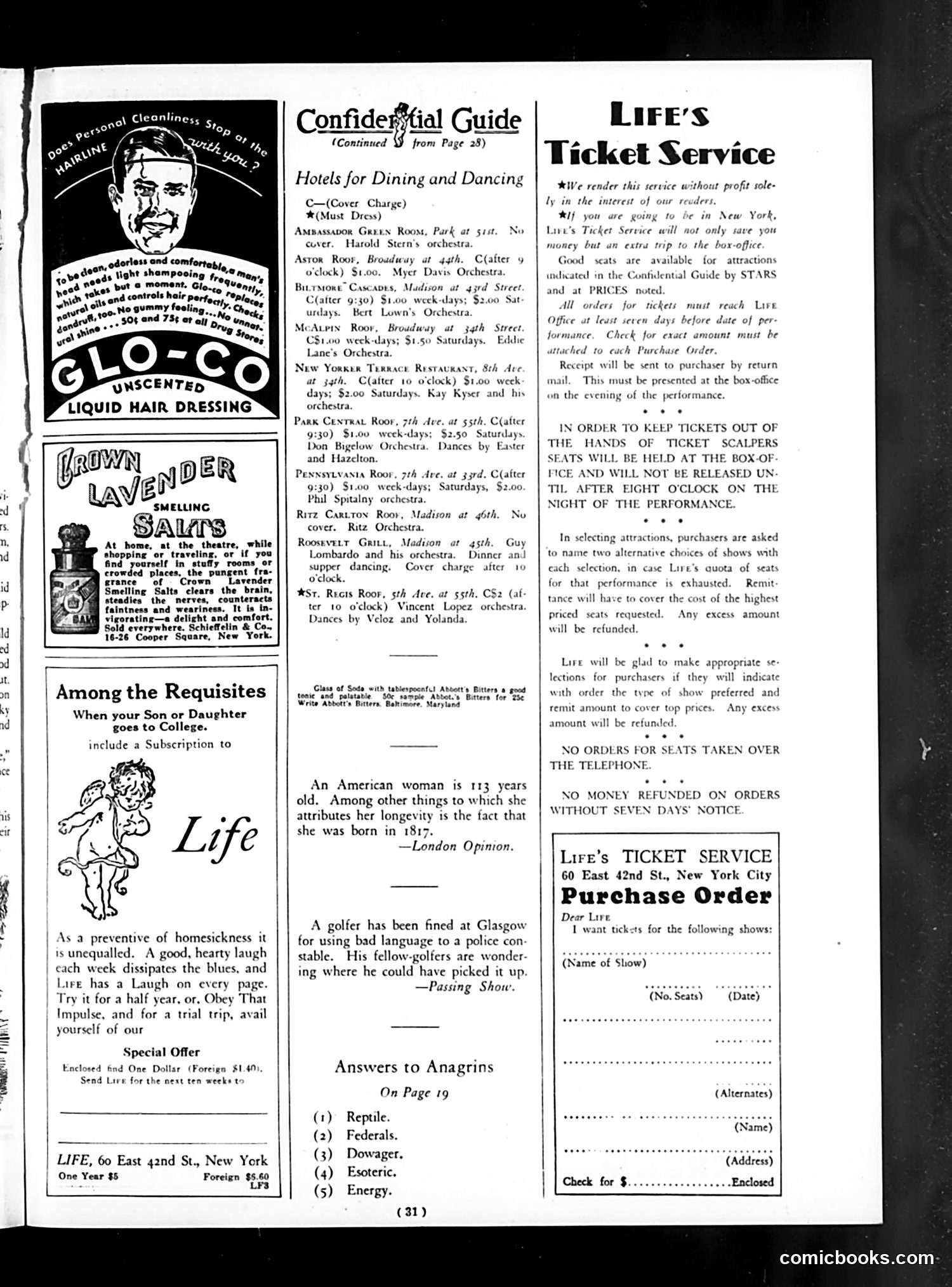
Analysis of Life Magazine Page Content This page is primarily advertising and service information rather than political satire or editorial cartooning. The left side contains three ads: Glo-Co Hair Dressing (with a man's face emphasizing personal grooming), Crown Lavender Smelling Salts (marketed as a remedy for fainting and nervousness), and a Life magazine subscription pitch targeting college-bound students, promoting laughter as a cure for homesickness. The center features a "Confidential Guide" to 1920s New York nightlife venues—hotels with dancing and dining, listing cover charges and orchestras (Guy Lombardo, Myer Davis, etc.). The right side is Life's Ticket Service, offering to purchase theater tickets for readers without profit, with detailed ordering instructions and warnings against scalpers. The scattered quotations are light humor: an old woman's longevity tied to being born in 1817 (a joke about her age), and a golfer fined for swearing. Overall context: This appears to be a 1920s–1930s era magazine catering to urban, entertainment-seeking readers with disposable income.
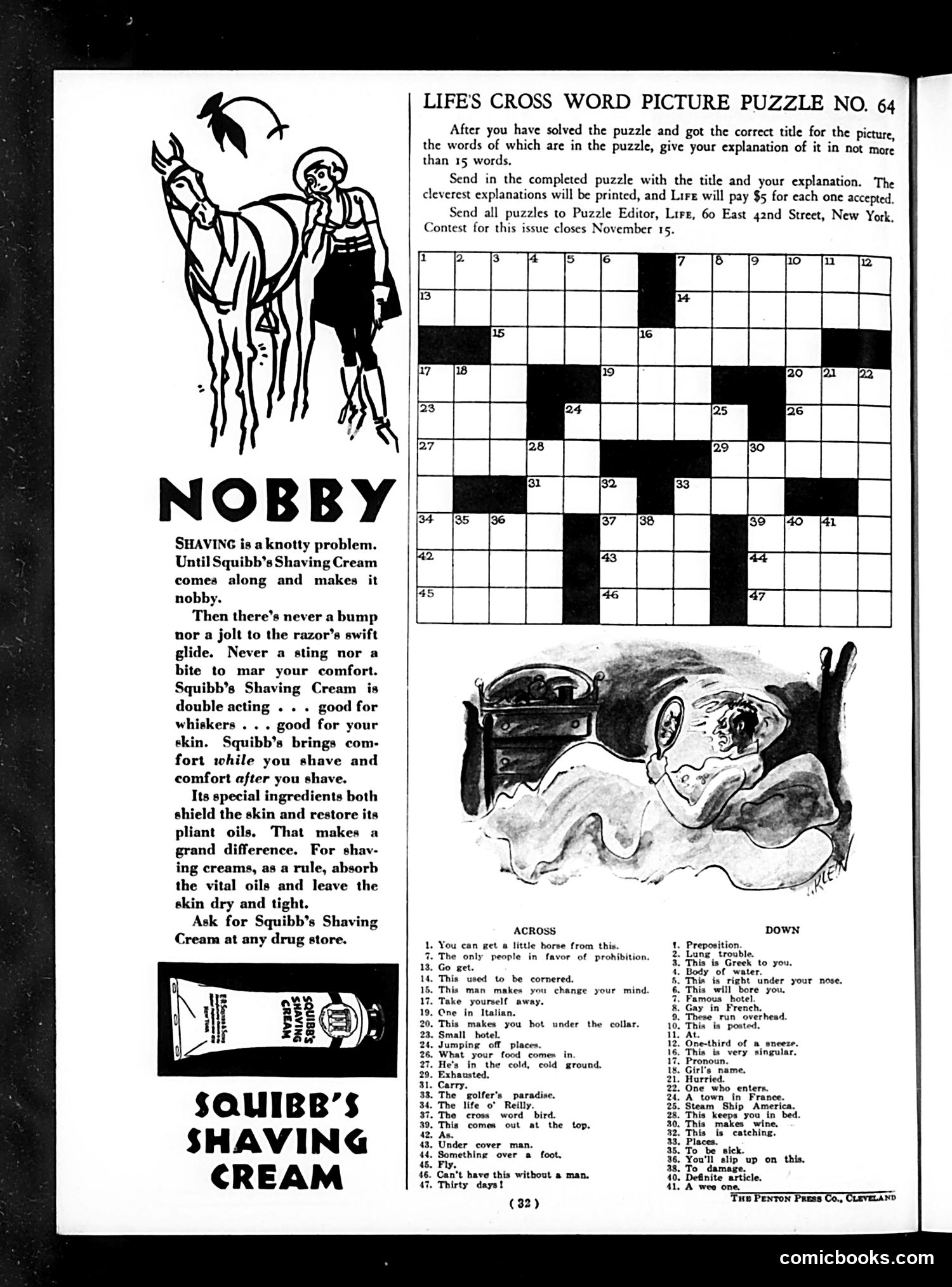
Life Magazine Crossword Puzzle Page Analysis This page is primarily a reader-participation crossword puzzle contest (#64) paired with a Squibb's Shaving Cream advertisement. The puzzle itself contains no overt satire or political commentary. Solvers must identify a picture's title using crossword clues, then submit explanations (max 15 words) for payment ($5 per accepted entry). The contest deadline was November 15. The advertisement dominates the left side, depicting a man shaving comfortably beside a horse. The copy emphasizes Squibb's cream's benefits: preventing razor bumps, irritation, and skin dryness—positioning it as a superior product to competitors. The horse illustration appears merely decorative, fitting the era's advertising style. One clue references "prohibition" (clue 2 across: "The only people in favor of prohibition"), suggesting this predates Prohibition's repeal (1933), indicating the puzzle dates to the 1920s or early 1930s. The page is advertisement and entertainment content, not satirical commentary.
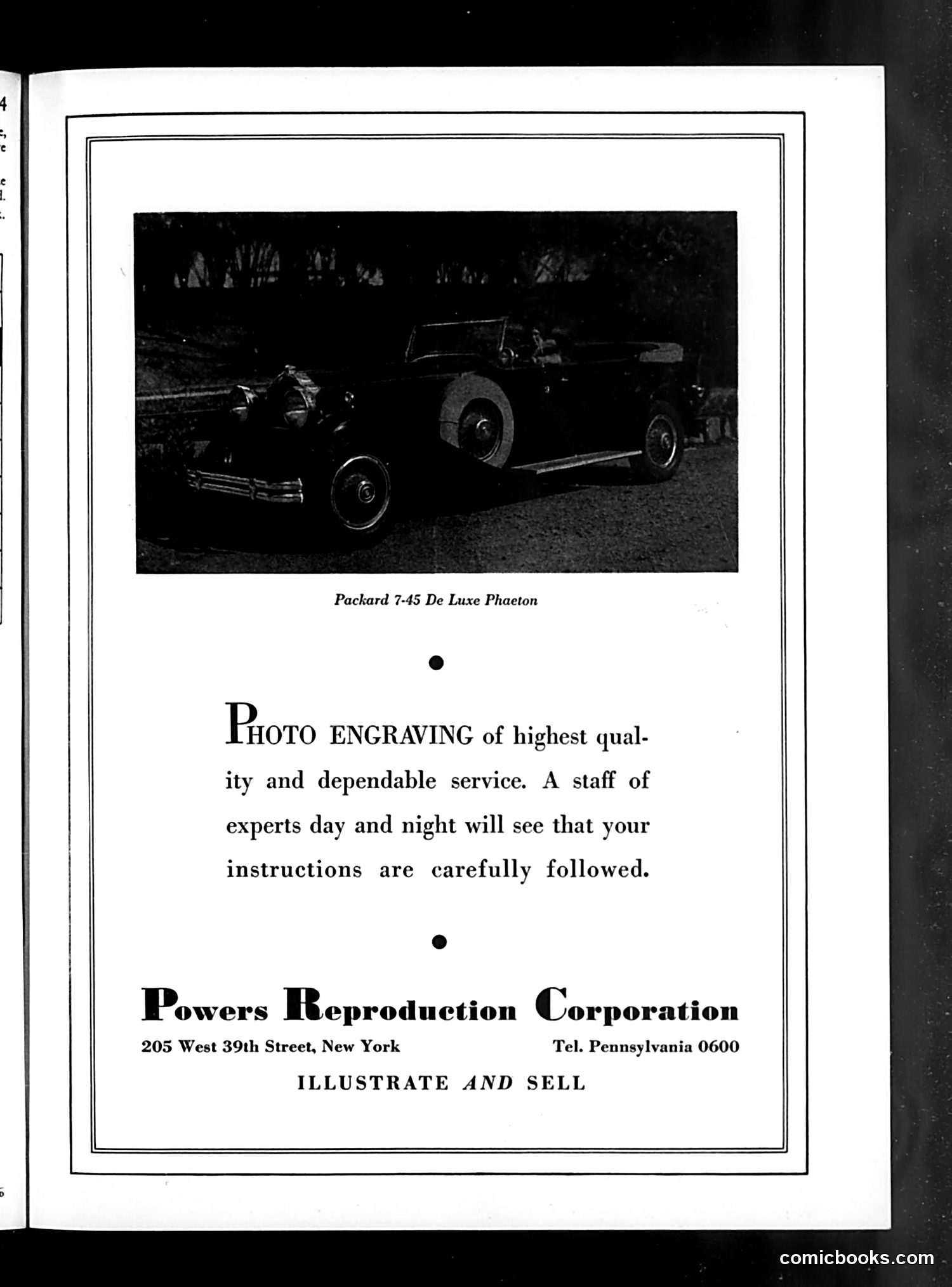
This is primarily an advertisement page, not satirical content. It features a photograph of a Packard 7-45 De Luxe Phaeton automobile and promotes the services of Powers Reproduction Corporation, a photo-engraving business located in New York. The advertisement appeals to commercial clients who need high-quality reproductions of photographs (like the car image shown) for printing and sales purposes. The "illustrate and sell" tagline suggests the company helped businesses market products through professionally engraved images. There is no political satire or cartoon humor present. This appears to be straightforward commercial advertising from what was likely a 1920s-era publication, demonstrating how businesses used photo-engraving technology to reproduce images in print media before modern photography methods became standard.
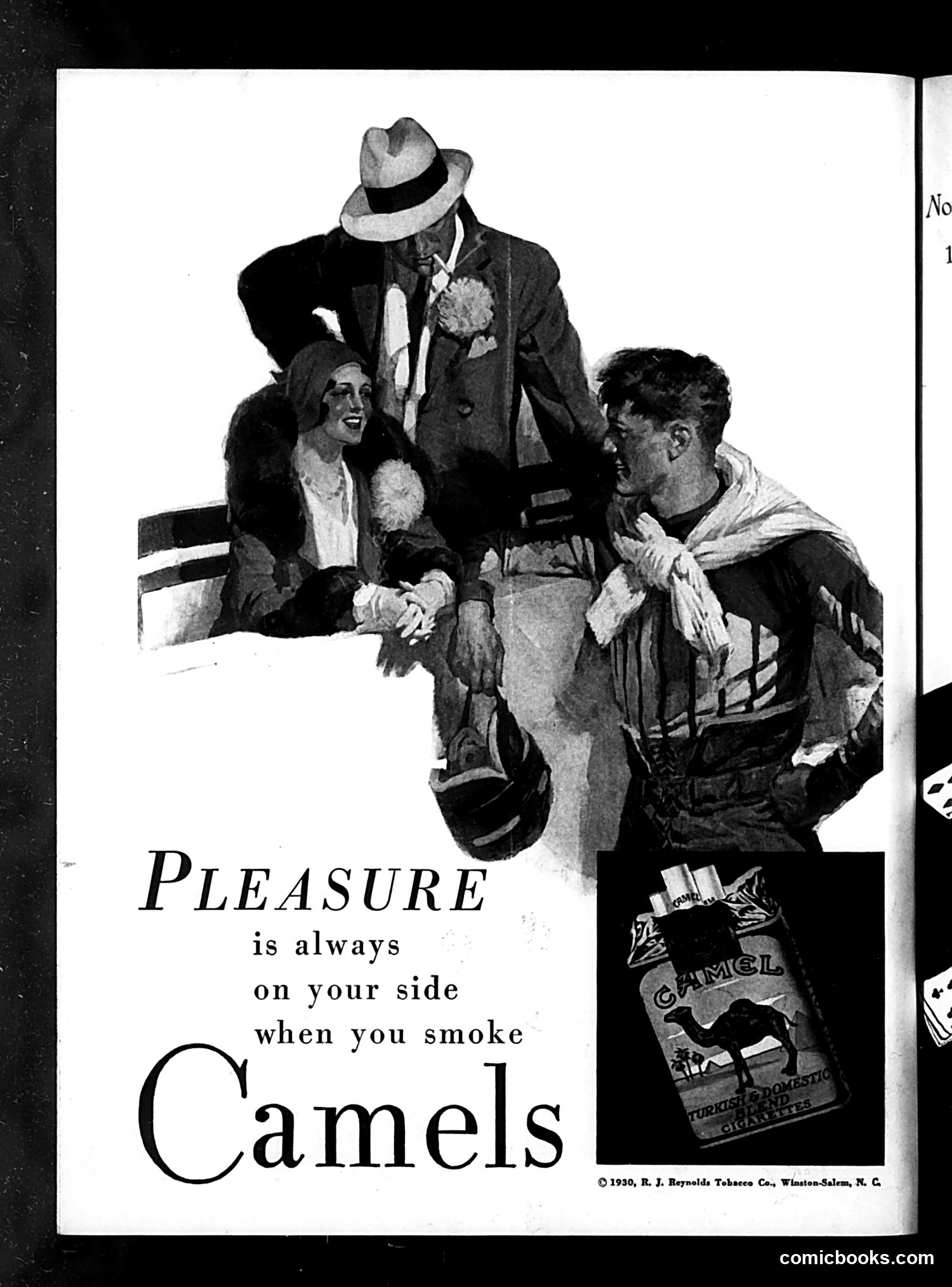
Camel Cigarette Advertisement (1930) This is a Camel cigarette advertisement, not satire or editorial content. The image shows three stylized figures in 1920s-30s attire in what appears to be a social scene. The ad's tagline—"Pleasure is always on your side when you smoke Camels"—uses the figures to suggest that smoking cigarettes enhances social enjoyment and companionship. The composition implies smoking facilitates social bonding and leisure. The copyright notice (1930, R.J. Reynolds Tobacco Co.) confirms this is commercial advertising that ran in *Life* magazine. By modern standards, this represents an era when tobacco advertising made explicit health and pleasure claims now prohibited, and when such ads were considered acceptable magazine content for general audiences.