life
Life — November 7, 1930
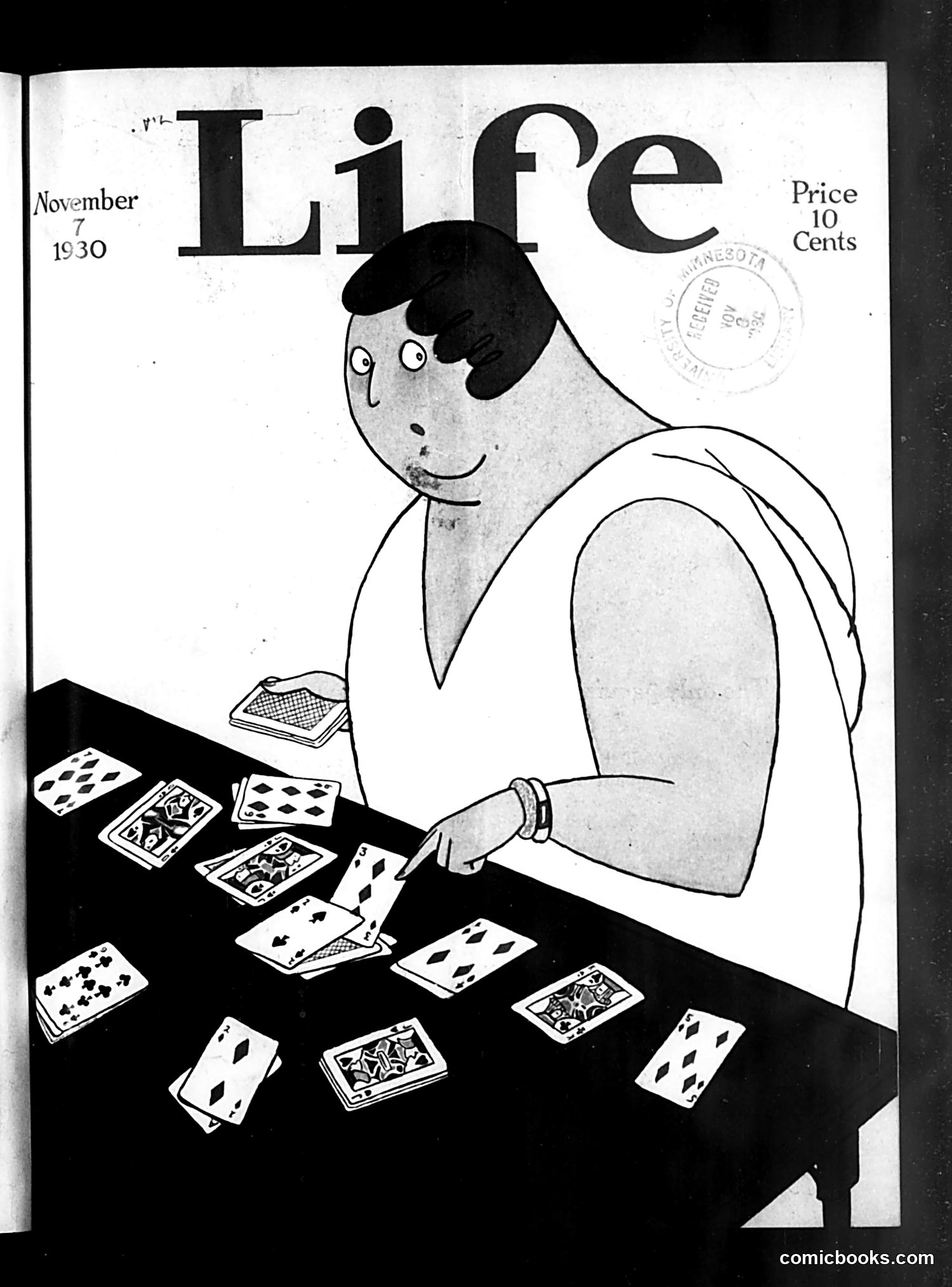
Life Magazine Cover, November 7, 1930 This cover depicts a generic figure engaged in card games or fortune-telling, surrounded by playing cards spread across a table. The character has an uncertain, somewhat anxious expression while holding cards and appears to be either playing or divining. Given the 1930 date—the year after the stock market crash—this likely satirizes gambling and financial speculation. The card-playing imagery probably references the reckless betting and speculation that preceded the 1929 market collapse. The figure's worried expression suggests commentary on Americans' continued risky financial behavior or obsession with games of chance during the Great Depression's early months. The satire warns against gambling mentality in uncertain economic times, a timely social critique for Depression-era readers.
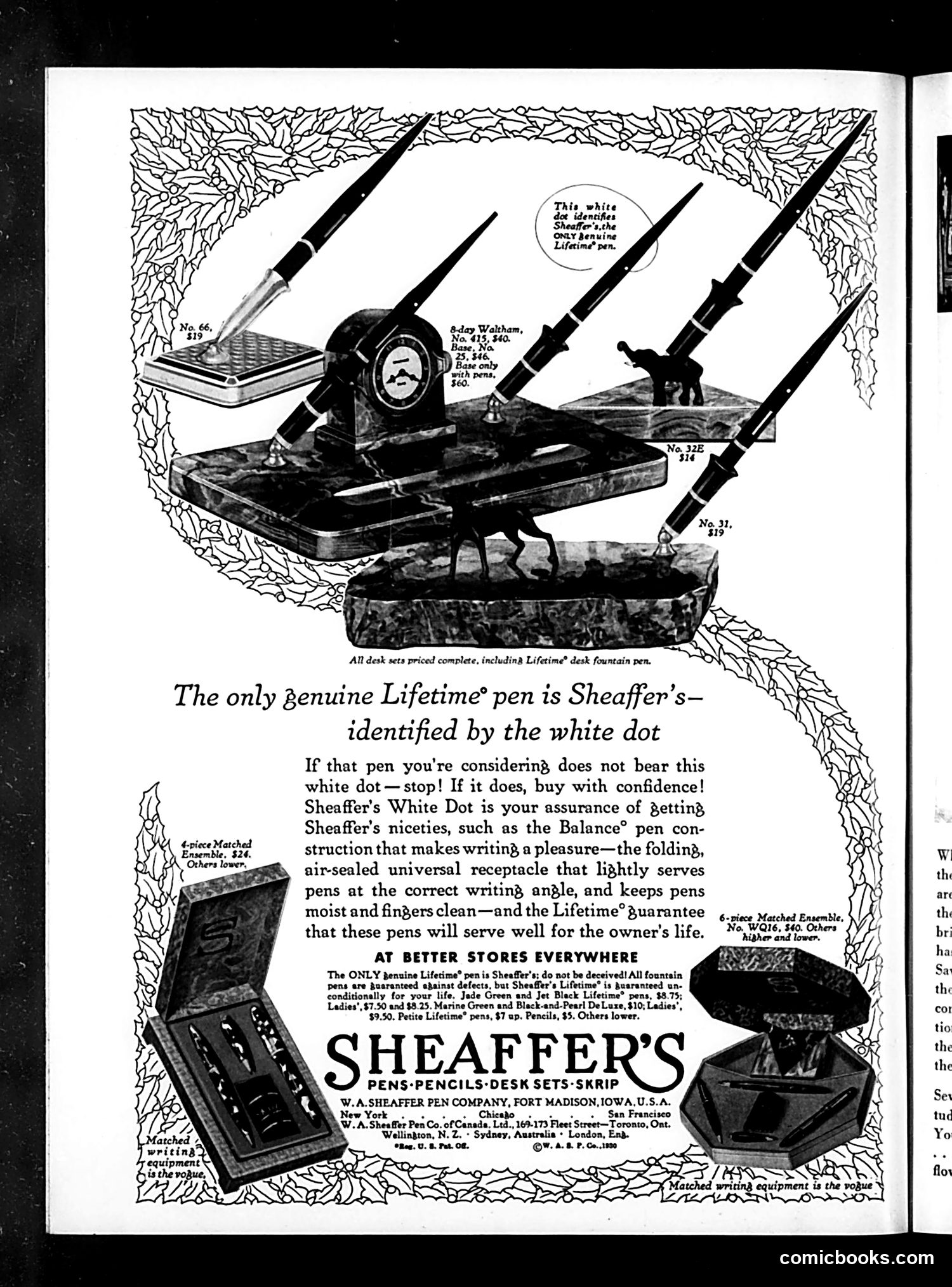
This is a Sheaffer's Pen Advertisement This is not a political cartoon or satire—it's a full-page advertisement for Sheaffer's fountain pens and writing sets from the W.A. Sheaffer Pen Company of Fort Madison, Iowa. The page uses visual humor typical of 1920s-30s advertising: elaborate mechanical drawings of different pen models arranged in an ornate frame with decorative borders. The central message emphasizes that genuine Sheaffer pens are identified by a "white dot" mark, distinguishing them from counterfeits. The ad highlights features like the "Lifetime" guarantee, the pen's construction for comfort, and matched desk sets. Text urges consumers to verify authenticity before purchasing. This appears in Life magazine, which accepted substantial advertising revenue alongside its satirical editorial content.
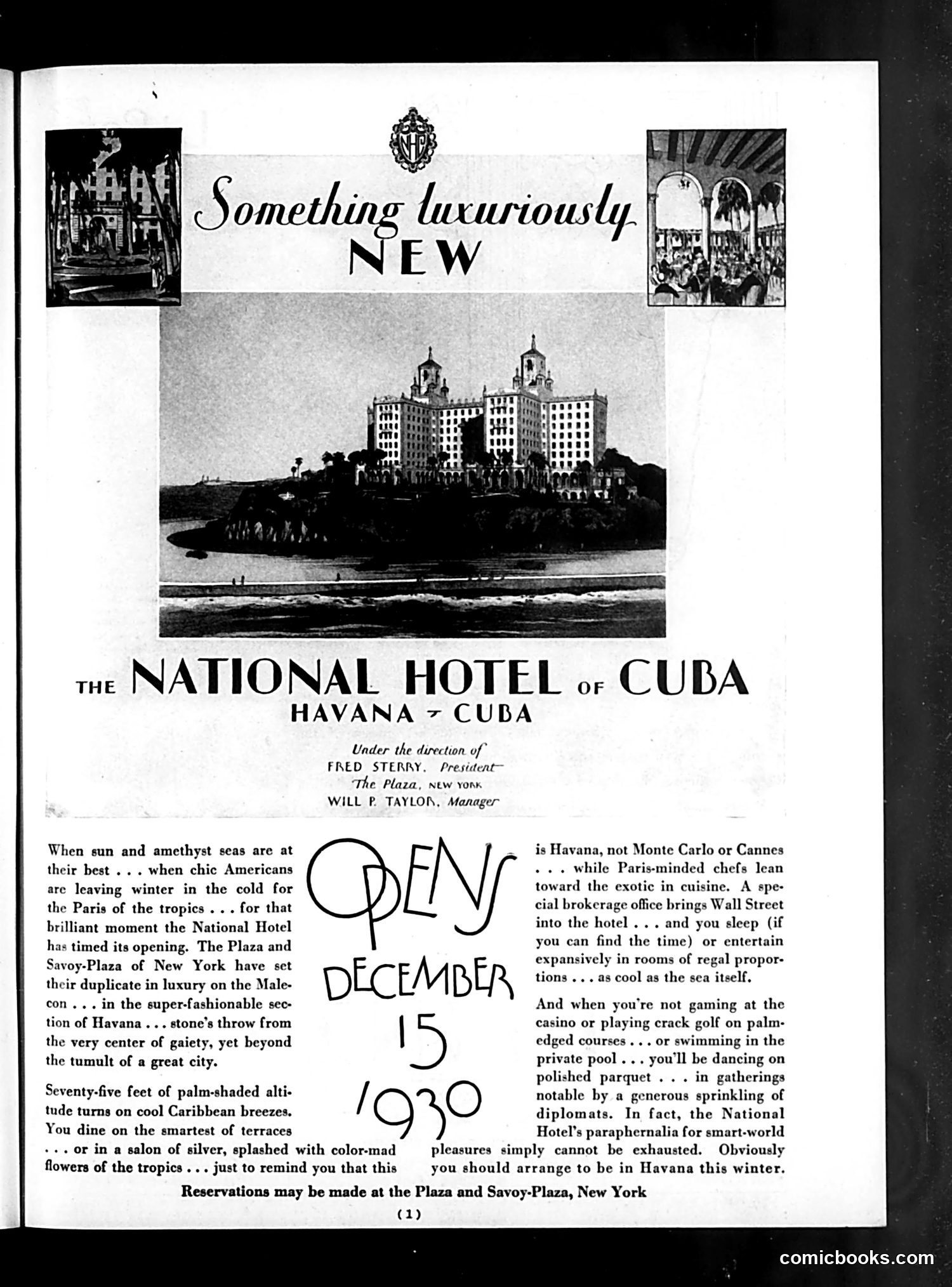
Analysis This is primarily an advertisement, not a political cartoon. It announces the opening of the National Hotel of Cuba in Havana on December 15, 1930, under Fred Sterny's direction and management by Will P. Taylor. The two small decorative images (left and right) appear to be architectural or scenic details of the hotel and its surroundings, not satirical caricatures. The ad targets wealthy Americans, positioning Havana as a luxurious alternative to European winter destinations (Monte Carlo, Cannes, Paris). It emphasizes amenities: Caribbean elegance, gaming, golf, swimming, and dining—appealing to "chic Americans" seeking tropical luxury. The page is essentially a travel/hospitality advertisement for the leisure class, not satire or political commentary. The "opening December 15, 1930" date places this during the Great Depression, marking Cuba as a destination for the still-affluent.
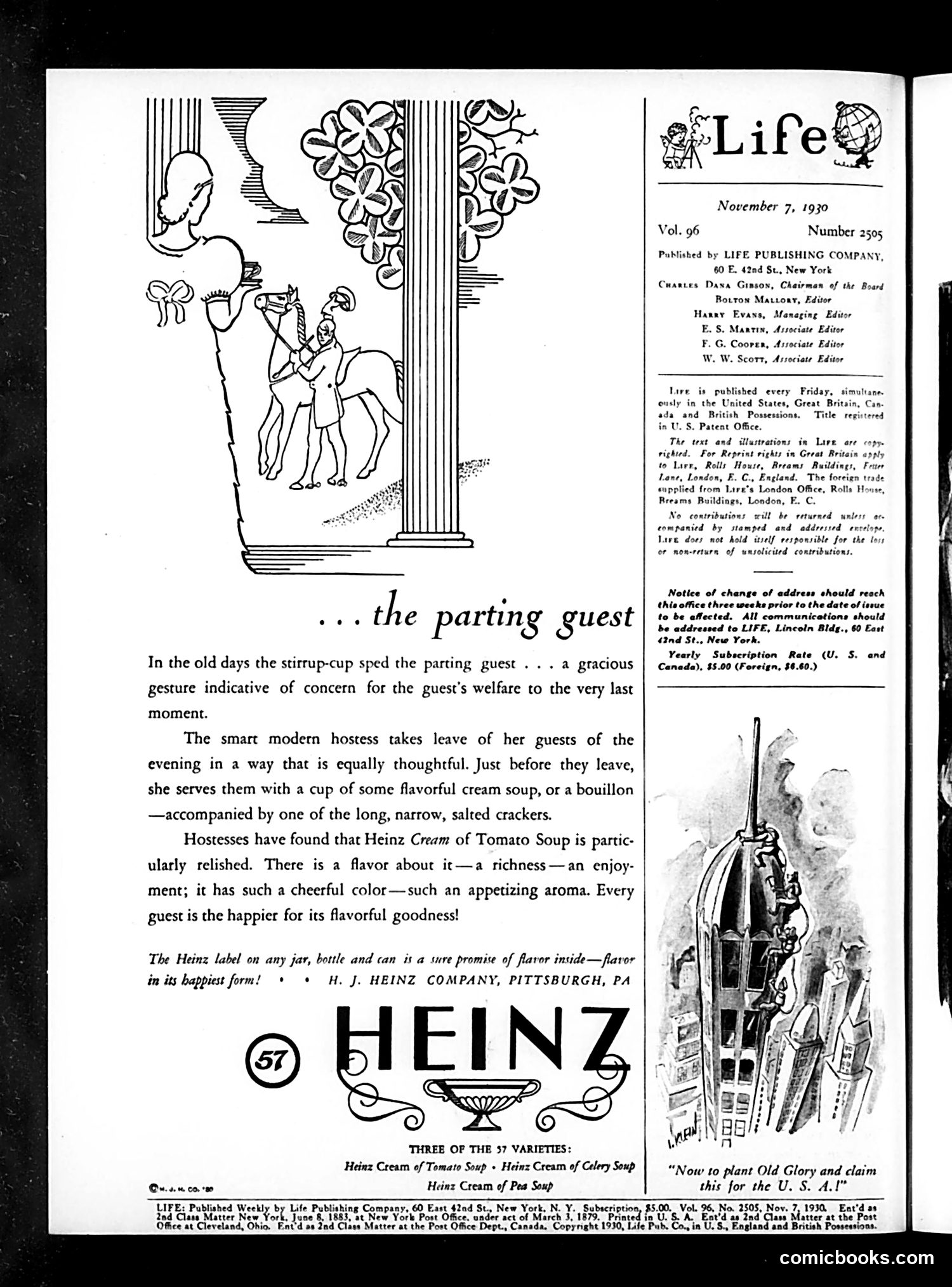
Analysis This page is primarily an advertisement for Heinz soup, not political satire. The main illustration depicts a historical scene labeled "the parting guest" — referencing an old custom where hosts gave departing guests a stirrup-cup (a farewell drink) to show concern for their welfare. The ad's text draws a parallel: just as old hosts were thoughtful, modern hostesses should serve Heinz Cream of Tomato Soup before guests leave. The soup is presented as equally thoughtful and refined. The right-side illustration appears to show early American colonial or frontier figures, possibly referencing historical precedent for the custom. This is advertising content using historical nostalgia to market soup as a mark of good hospitality—not political commentary.
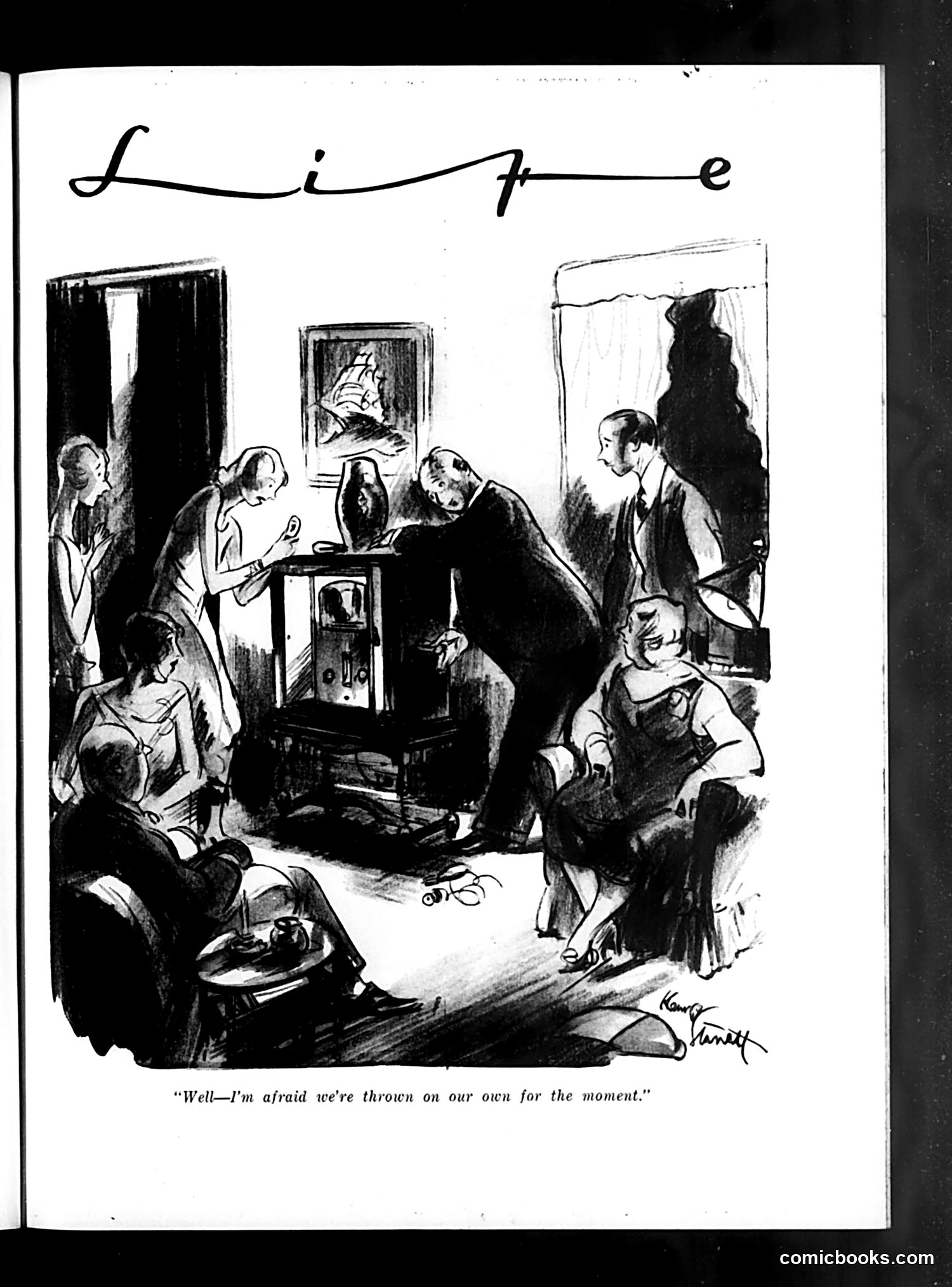
Analysis of "Life" Cartoon This cartoon depicts a family gathered around an early radio set—the central focal point of the composition. The caption reads: "Well—I'm afraid we're thrown on our own for the moment." The satire comments on how radio was beginning to dominate American domestic life. Before this technology, families entertained themselves through conversation, games, or reading. The joke suggests that when the radio malfunctions or is unavailable, the family is suddenly left without entertainment and must rely on their own resources—an uncomfortable prospect, implying they've become dependent on this new medium for leisure. This reflects early-20th-century anxieties about technology's impact on family interaction and self-reliance.
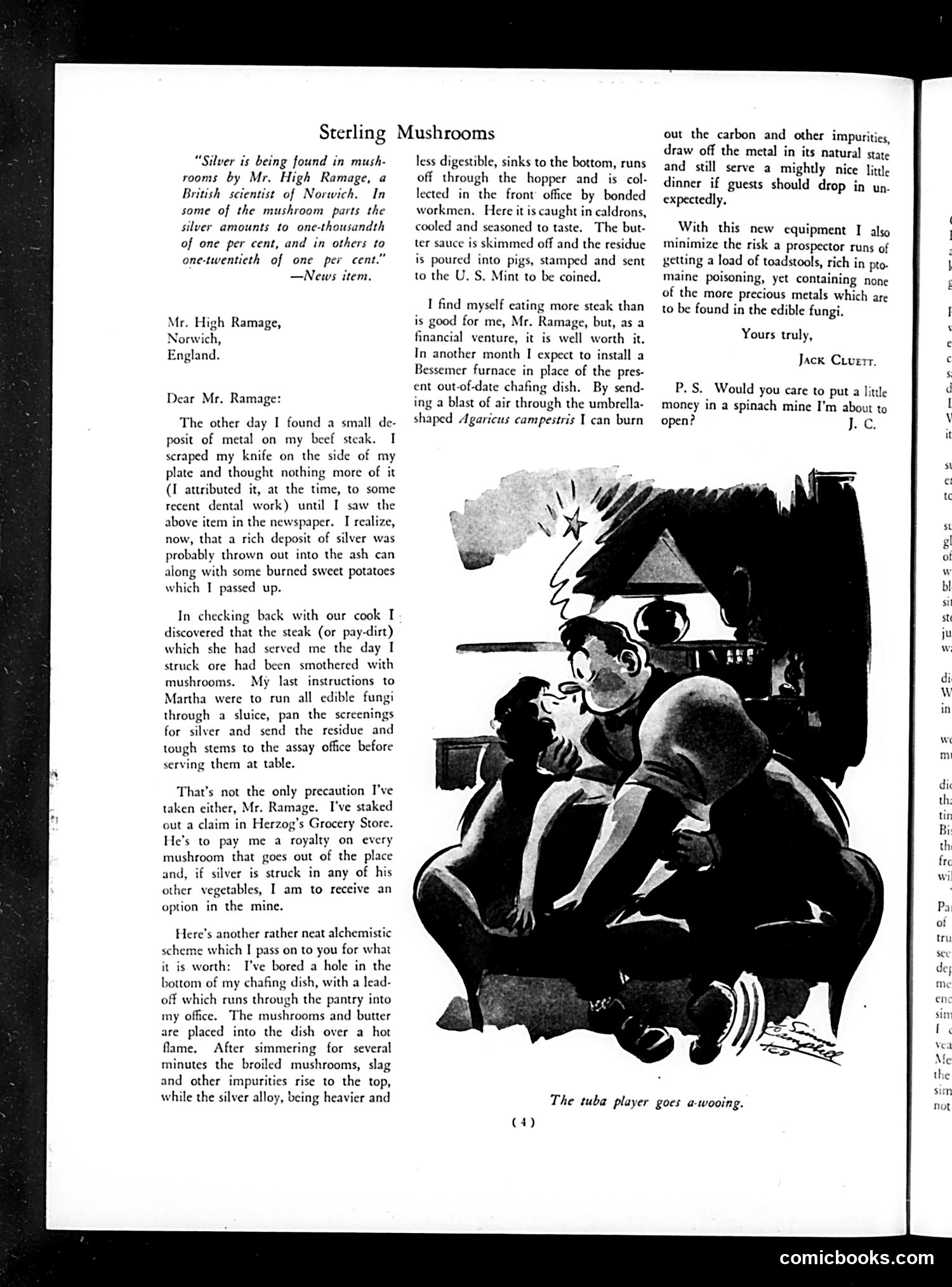
Sterling Mushrooms - Satirical Cartoon Analysis This page features a humorous letter about finding silver in mushrooms, accompanied by a cartoon titled "The tuba player goes a-wooing." The cartoon depicts a rotund man playing a large tuba while courting a woman, who appears somewhat alarmed or unimpressed by his musical performance. The humor lies in the physical comedy—the tuba's size dwarfs the musician, and the exaggerated body language suggests the absurdity of serenading someone with such an unwieldy instrument. The letter above satirizes schemes to extract precious metals from common foods. Jack Cluett humorously describes processing mushrooms to collect silver residue, treating the notion seriously while clearly meant as satire of get-rich-quick schemes and dubious "alchemy." Both elements mock impractical ideas popular during this era.
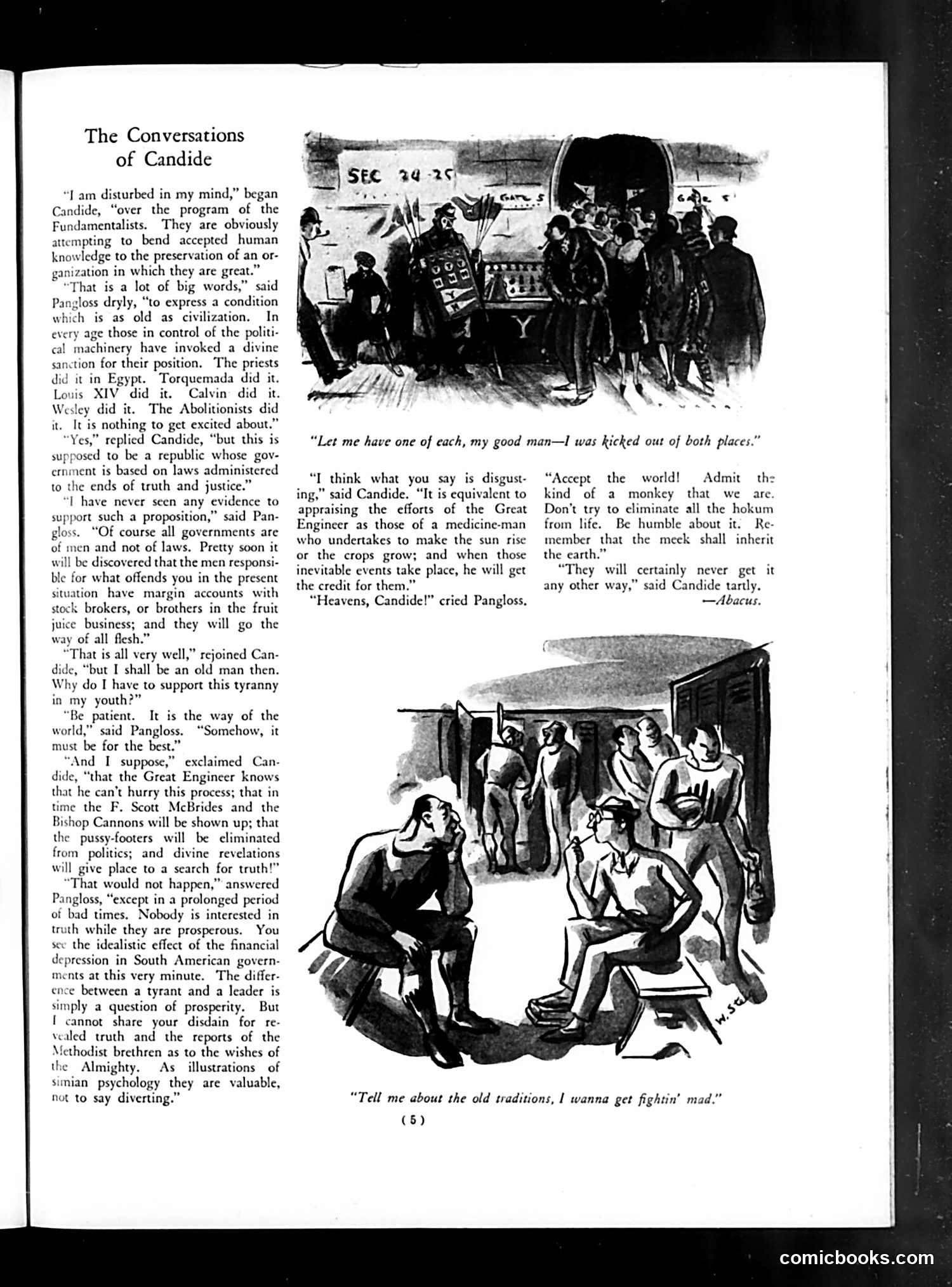
Analysis of "The Conversations of Candide" This page adapts Voltaire's *Candide*, using the philosophical novella's satirical framework to critique early 20th-century American optimism about progress and social reform. The satire: Candide and Pangloss debate whether governments actually serve justice or merely invoke it rhetorically. Pangloss defends the "Great Engineer" (likely representing industrial/technological progress), arguing inevitable events will eventually justify themselves. Candide counters that the meek won't inherit the earth through patience alone. The point: The illustrations show ordinary people in working-class settings, contrasting with grand philosophical talk. The satire suggests American elites use grandiose rhetoric about progress and inevitable improvement to pacify workers and the poor—a critique of complacency masquerading as optimism during an era of labor unrest and inequality.
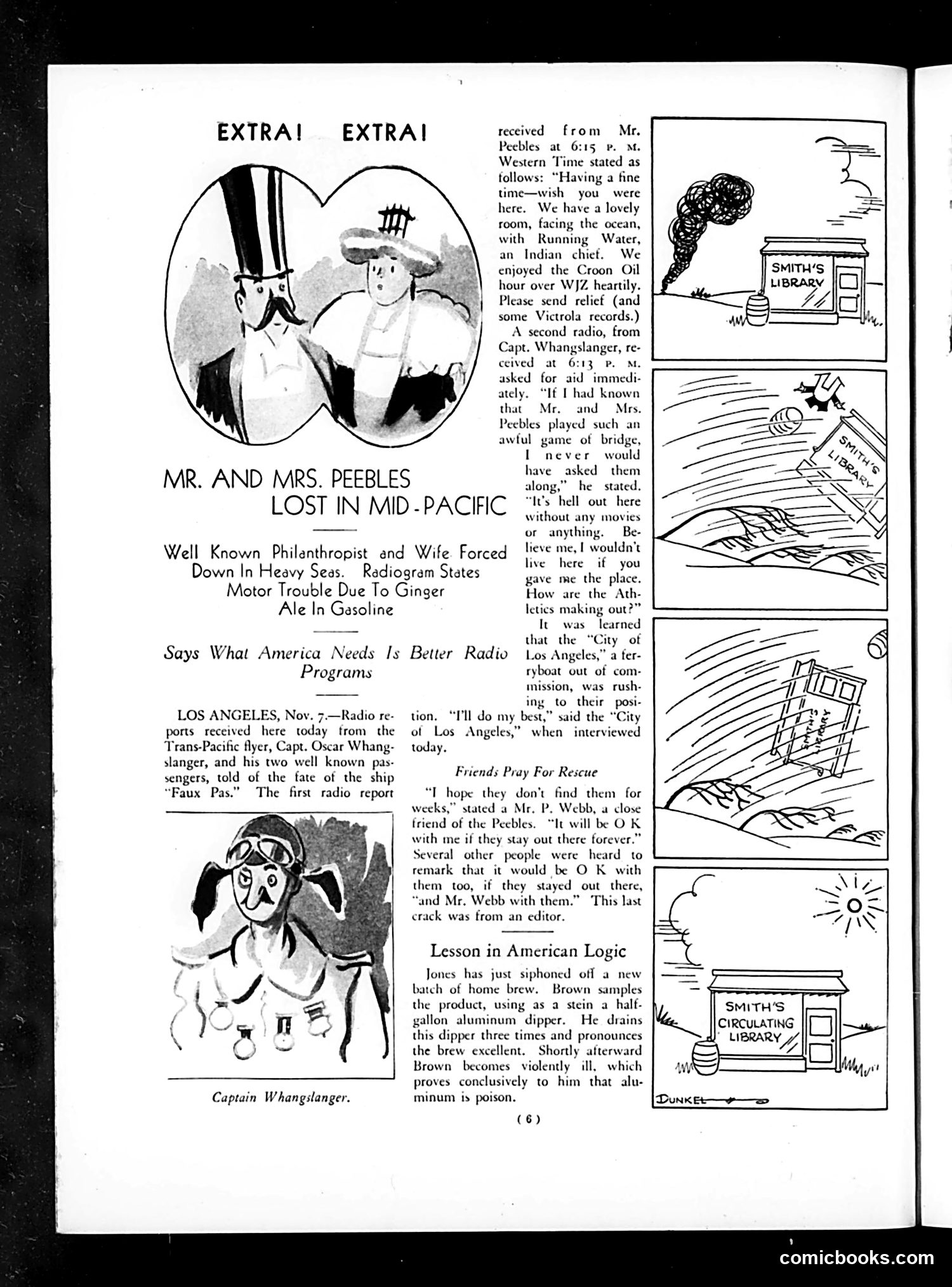
Analysis This page reports on Mr. and Mrs. Peebles, a well-known philanthropist couple lost at sea aboard the trans-Pacific liner "City of Los Angeles." The headline notes motor trouble attributed to ginger ale in the gasoline—a satirical jab at Prohibition-era fuel adulteration. The cartoon's humor operates on multiple levels: Captain Whanglanger (the ship's captain, caricatured) receives radio pleas for help and complaints about entertainment (bridge games, lack of movies). The satire mocks both the stranded wealthy travelers' complaints and Depression-era concerns about frivolous leisure. The right-side comics strip about Smith's Circulating Library and a comic sequence showing Smith's library being abandoned in the ocean extends the joke: even in disaster, Americans worry about accessing entertainment and consumer goods. The underlying message critiques American materialism and entertainment dependency.
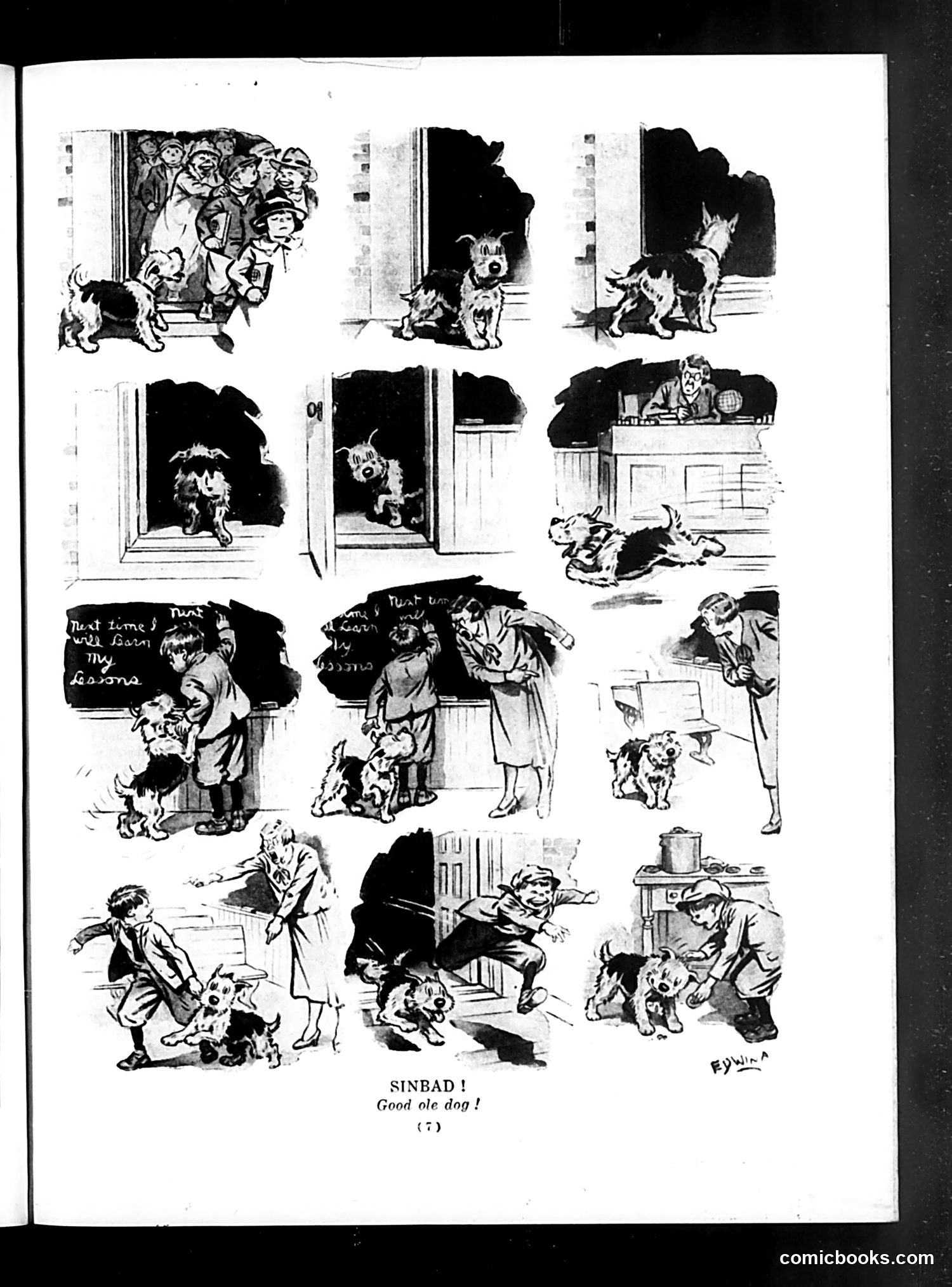
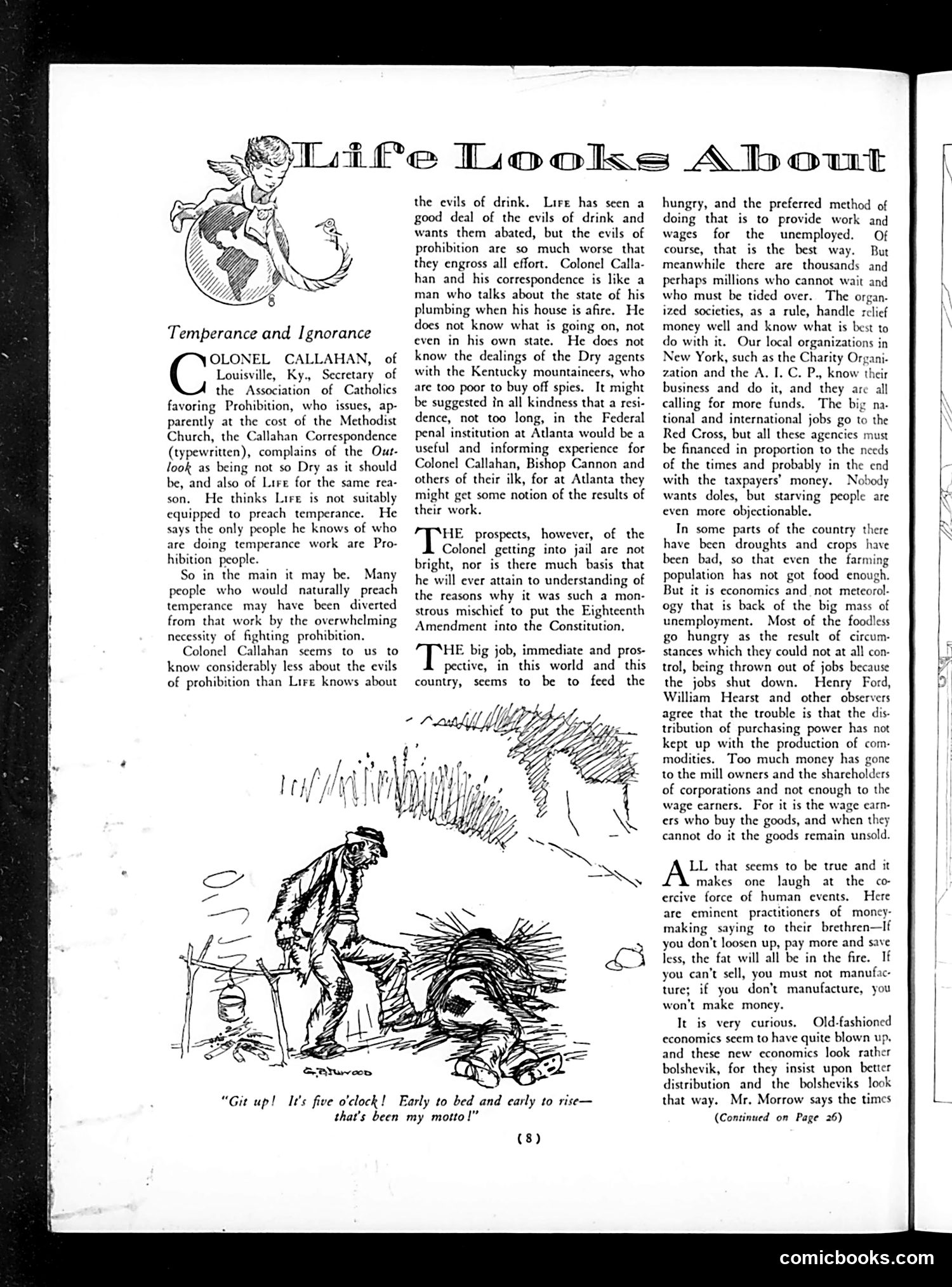
Analysis of "Life Looks About: Temperance and Ignorance" This page critiques Prohibition's failures. Colonel Callahan, a Catholic leader favoring Prohibition, complains that Life magazine inadequately addresses temperance issues. The author responds that Life knows Prohibition advocates better than the policy's actual effects. The cartoon illustrates the disconnect between Prohibition's promises and reality. The ragged, impoverished man represents those harmed by economic consequences of the alcohol ban—job losses, unemployment, and poverty. The caption's ironic motto ("Early to bed and early to rise") mocks Prohibition moralists who blamed poverty on moral failings rather than economics. The article argues Prohibition failed because it didn't address underlying economic distribution problems. Wealthy industrialists hoarded purchasing power while workers couldn't afford goods, causing economic collapse—a critique predating the Great Depression.
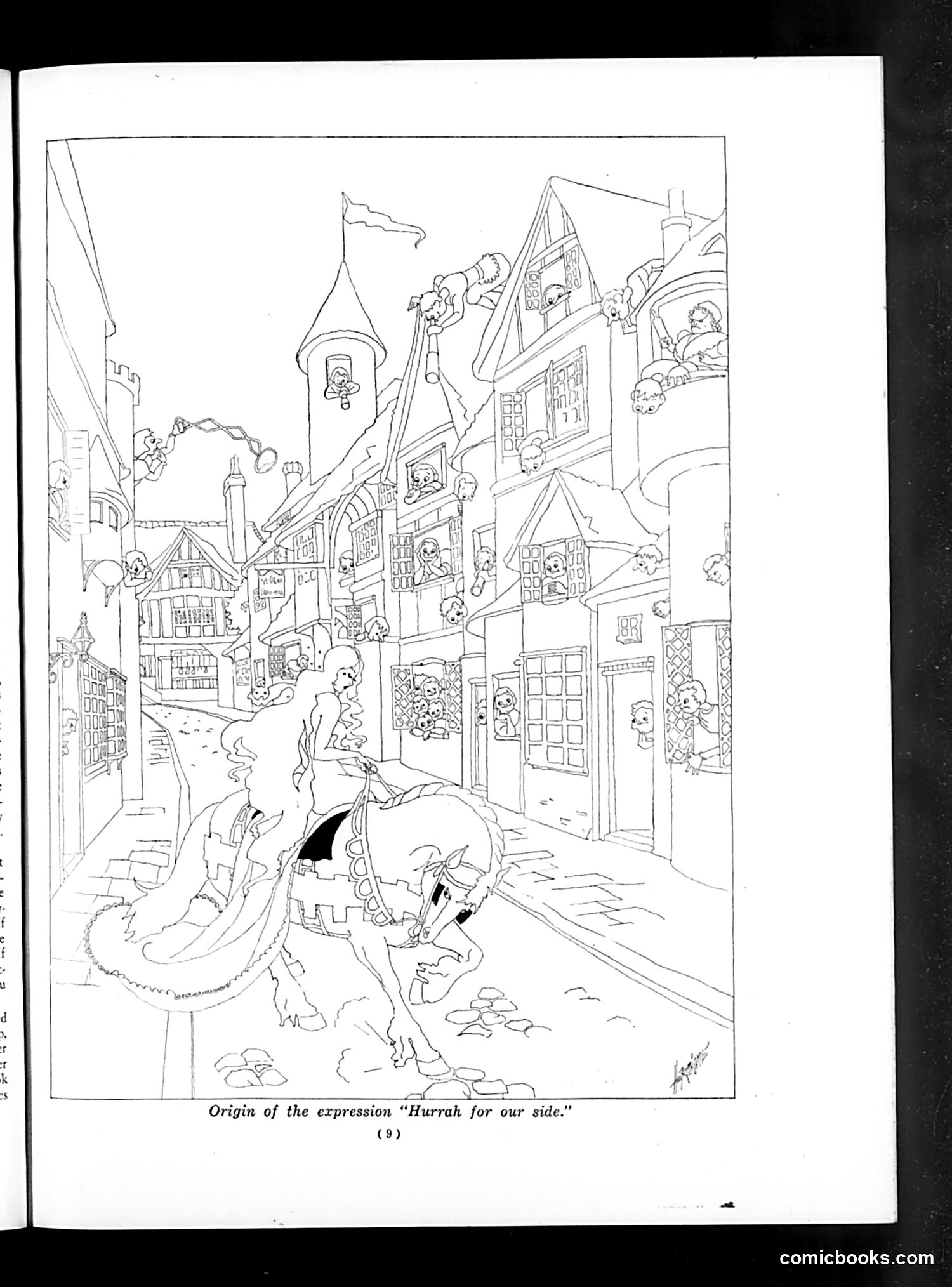
"Origin of the expression 'Hurrah for our side'" This satirical cartoon depicts a medieval or fantasy town scene where a dragon appears to be attacking or terrorizing the inhabitants. Citizens are shown fleeing, watching from windows, and reacting from various vantage points throughout the fortified buildings. The caption explains the "origin" of the phrase "Hurrah for our side" — suggesting the expression emerged from situations where people cheer for their own group regardless of objective circumstances. The cartoon satirizes blind partisan loyalty: townspeople are apparently cheering their "side" (their town/faction) despite facing a clear, immediate threat (the dragon). The joke critiques how people support their group reflexively, without rational evaluation of actual dangers or merits. It's commentary on tribalism and mindless allegiance to one's in-group.
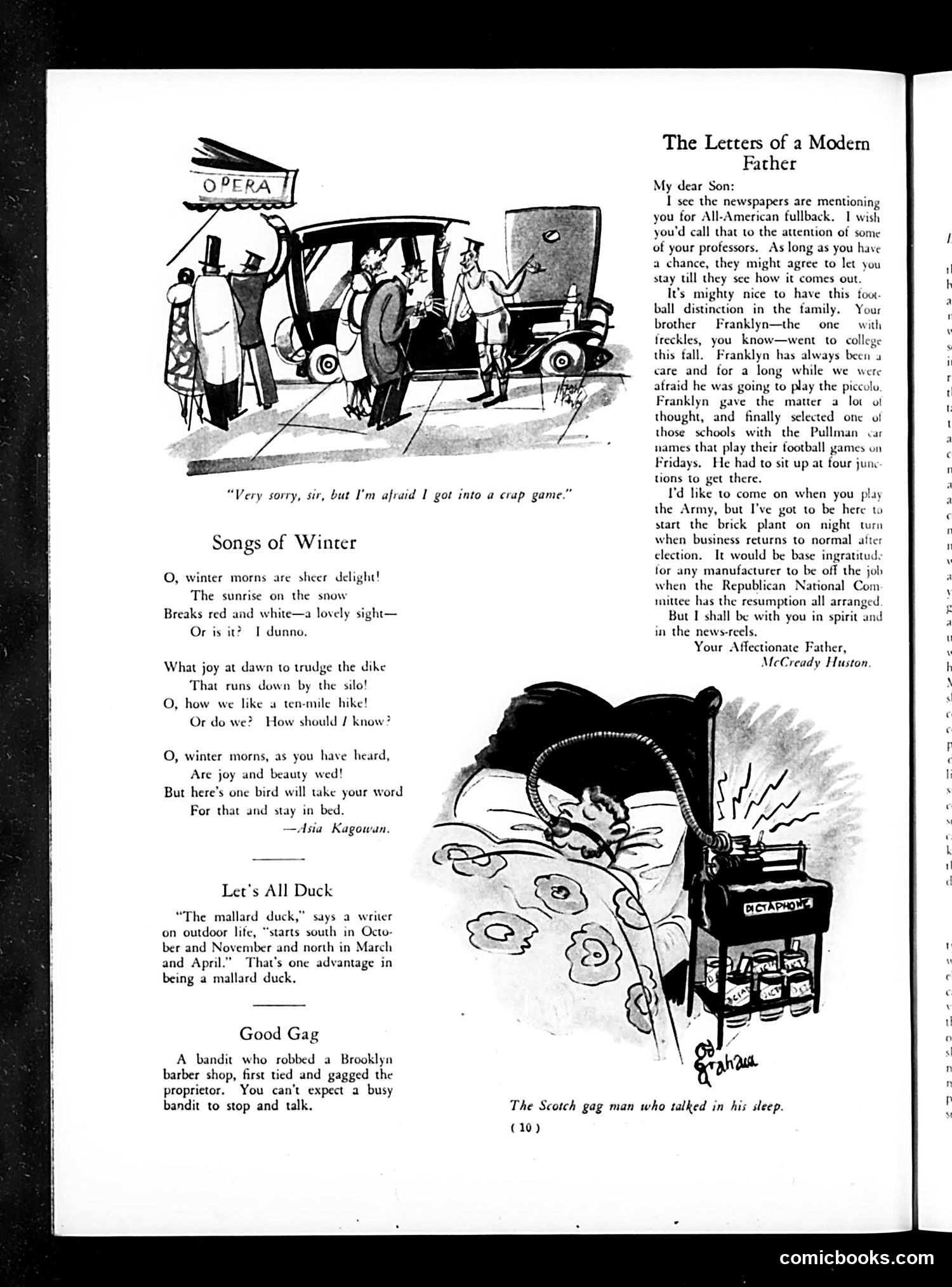
Analysis This page contains three distinct pieces rather than integrated cartoons: Top cartoon: Shows people outside an opera house with the caption "Very sorry, sir, but I'm afraid I got into a crap game." The joke satirizes urban leisure—someone has been distracted by gambling instead of attending the cultural event, suggesting the allure of illegal betting over respectable entertainment. "Songs of Winter" and "Let's All Duck": These are humorous verse and prose pieces about winter activities and duck hunting, not political content. Bottom cartoon: Depicts "The Scotch gag man who talked in his sleep," illustrating a joke about someone inadvertently revealing secrets while sleeping—a common vaudeville/comedy trope of the era. The Scottish stereotype and the octopus imagery remain unclear without additional context. The page is primarily entertainment-focused satire rather than political commentary.
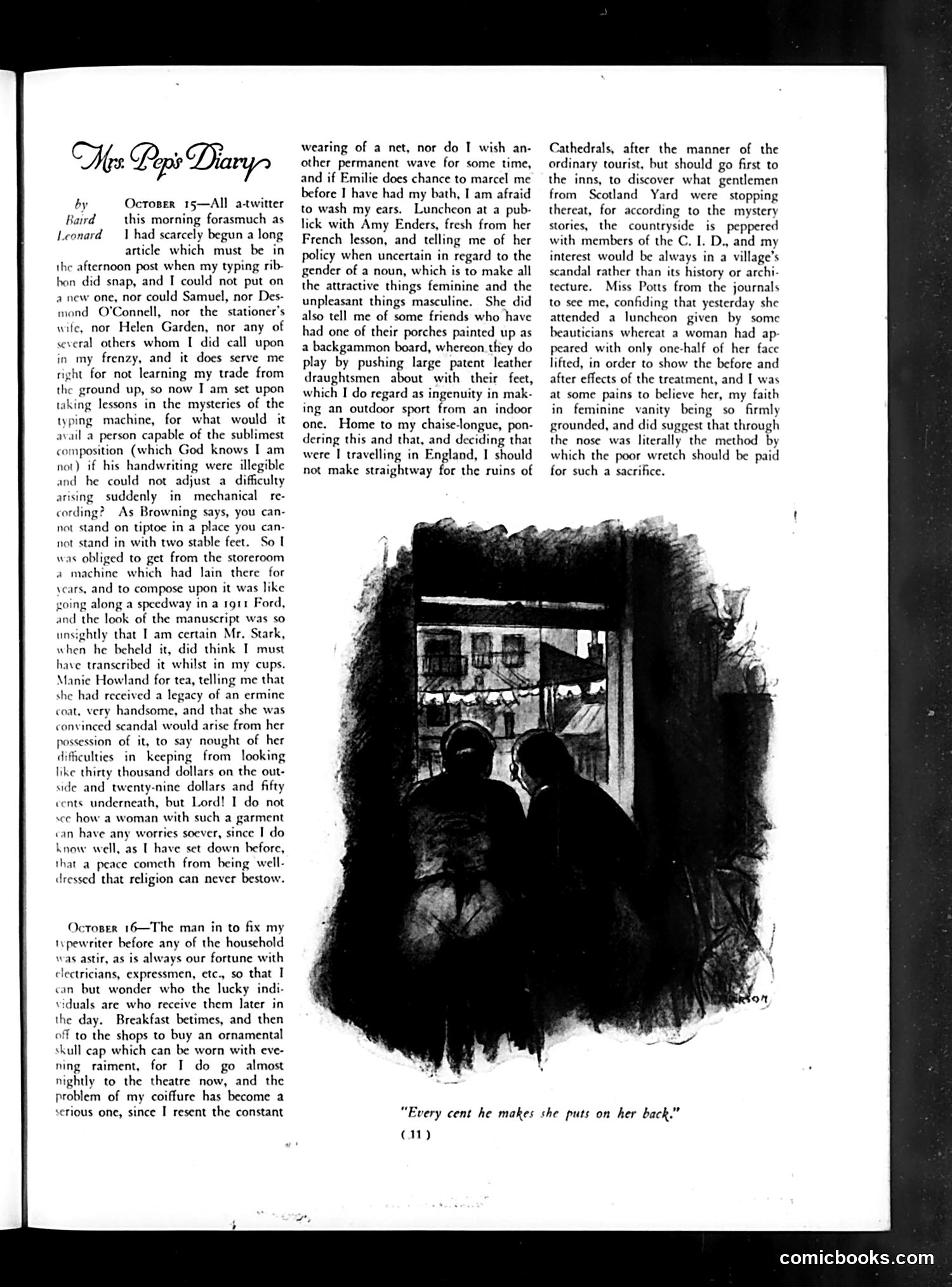
Mrs. Pep's Diary Page Analysis This page presents a diary entry by "Mrs. Peps" dated October 15-16, discussing social observations and personal concerns—her typescript troubles, wardrobe anxieties, and domestic inconveniences with tradespeople. The accompanying illustration shows a silhouetted figure at a doorway with the caption "Every cent he makes she puts on her back." This satirizes a common domestic complaint of the era: wives' allegedly excessive spending on clothing and fashion, especially hats and coats. The "Every cent" phrase reflects period anxiety about women's consumer spending and financial independence. The diary's rambling, gossipy tone and the illustration work together as gentle social satire on middle-class women's preoccupations with fashion, propriety, and domestic management—typical *Life* magazine humor of the early 1900s.
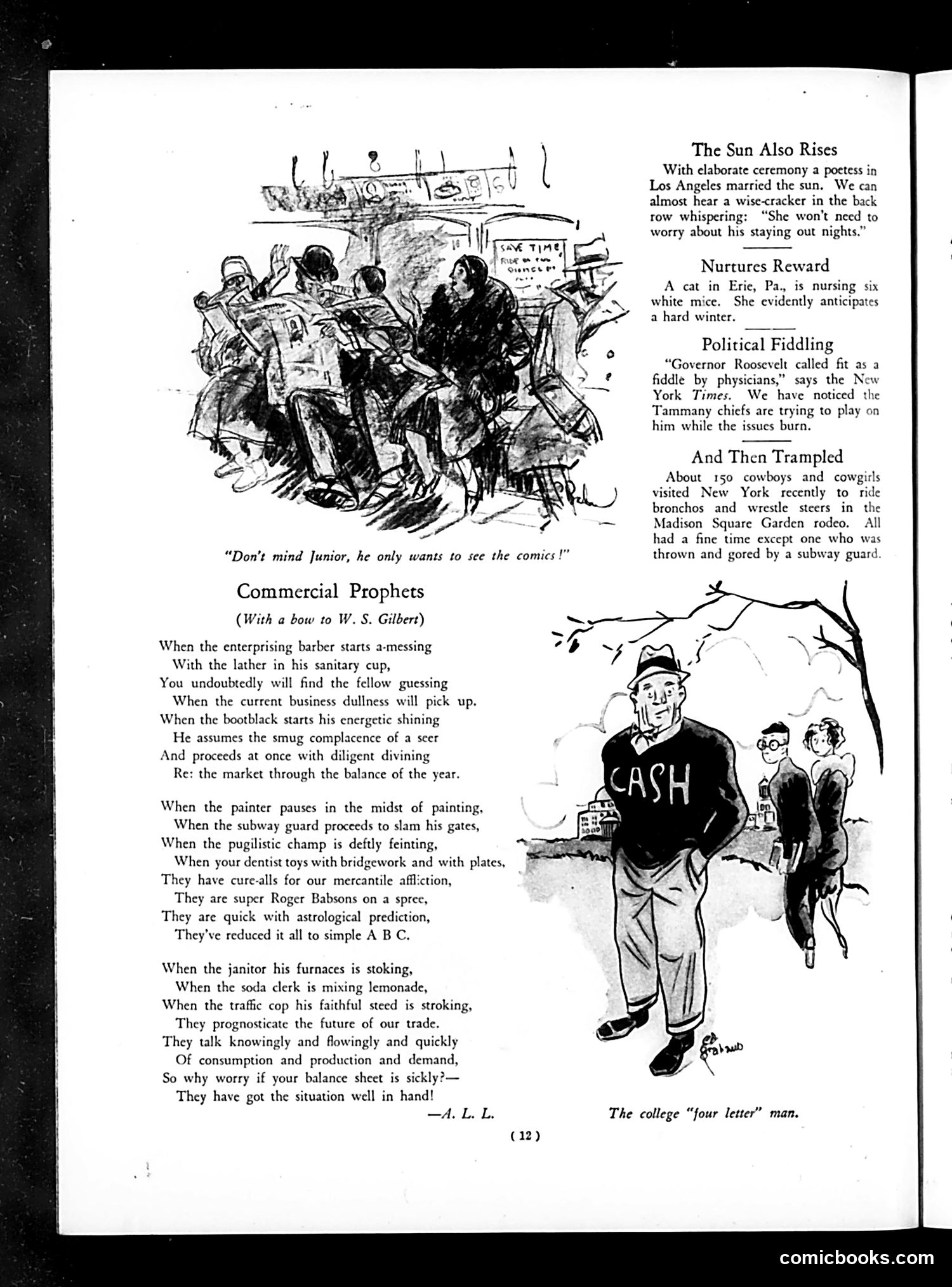
Analysis This page contains humor pieces satirizing early 20th-century American life. The main illustrated poem, "Commercial Prophets," mocks fortune-tellers and business prognosticators who claim to predict economic trends. The poem's satire suggests these "prophets"—barbers, painters, janitors, etc.—speak with unwarranted authority about markets and business cycles, reducing complex economic analysis to simple superstition ("A B C"). The accompanying cartoons illustrate lighter social observations: one shows a father unconcerned about his son staying out at night, another depicts a cat nursing mice before winter, and the bottom cartoon shows a college athlete ("four letter man") carrying cash, likely satirizing athlete compensation or financial status. The overall tone is gently mocking of American commercial culture and social pretension.
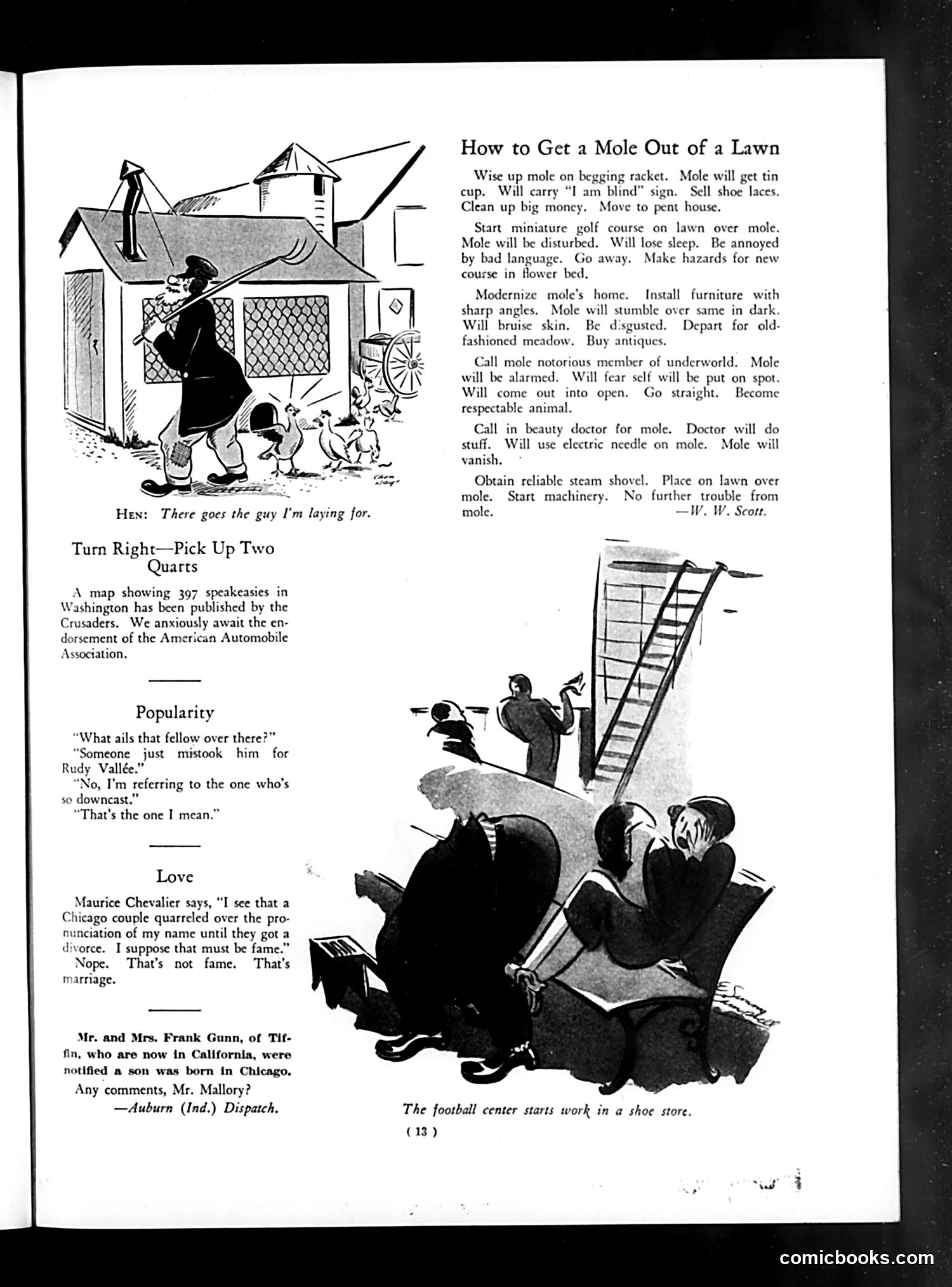
"How to Get a Mole Out of a Lawn" — Satirical Guide This is a humorous pseudo-advice column mocking elaborate, impractical solutions to a simple problem. The satirist (W. W. Scott) suggests absurd methods: setting up a miniature golf course, modernizing the mole's home with sharp furniture, calling underworld criminals to intimidate it, hiring a beauty doctor with an electric needle, or using a steam shovel. The joke targets early-20th-century Americans' tendency toward over-complicated, technology-dependent "solutions" rather than practical fixes. It's also gentle social satire about wealth and status-seeking (the mole learning "bad language," acquiring "antiques"). The accompanying cartoon shows a woman attempting these ridiculous schemes outside her house, illustrating the absurdity. The caption "There goes the guy I'm laying for" suggests bemused neighbors watching the chaos.
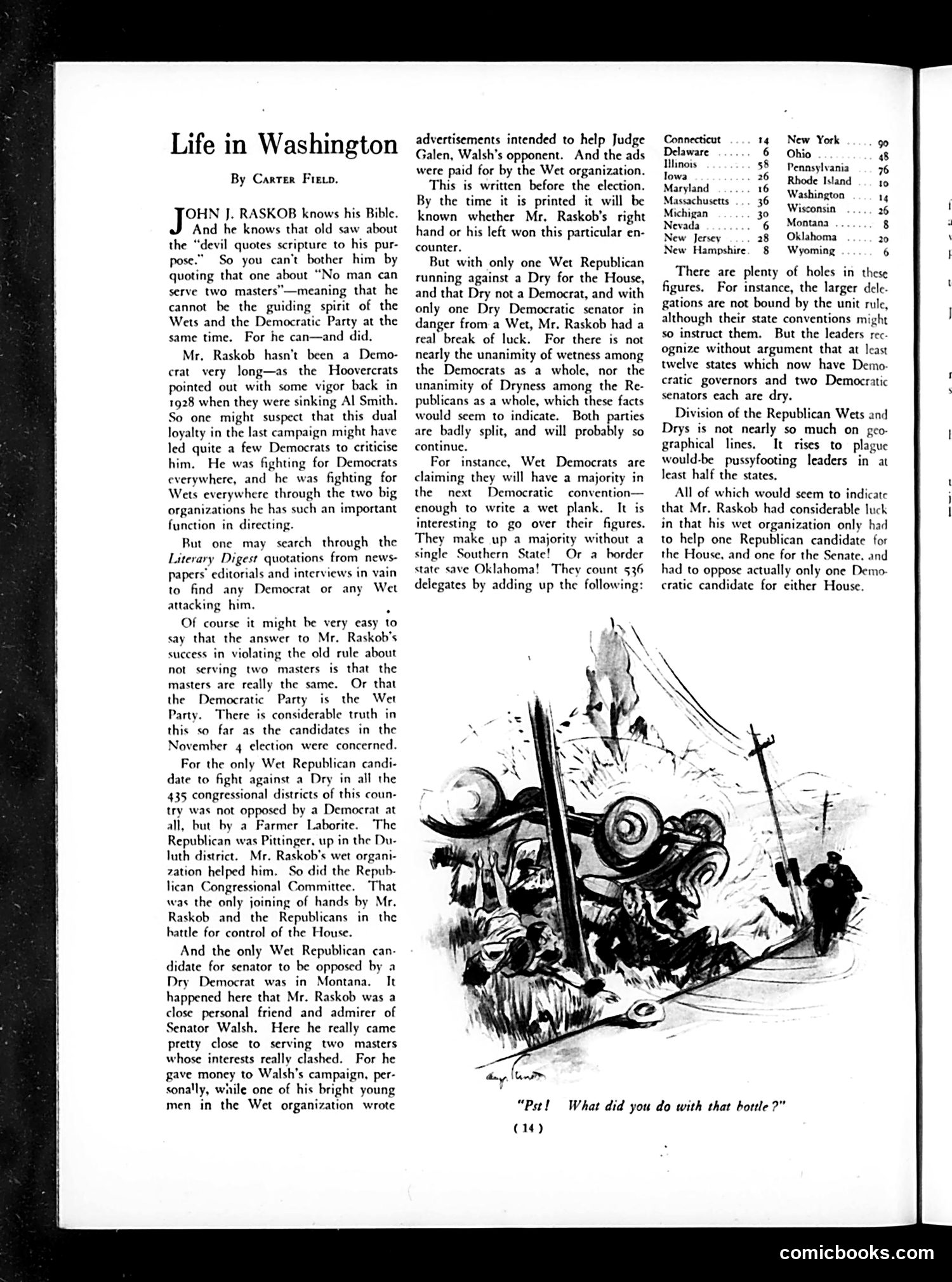
Analysis of "Life in Washington" by Carter Field This page satirizes John J. Raskob, the Democratic National Committee chairman, for his contradiction in serving both the "Wet" (pro-alcohol) and Democratic causes simultaneously during Prohibition debates. The article argues Raskob hypocritically funded Democratic candidates while also supporting Republican "Wets" opposing Prohibition—notably in Montana against a "Dry Democrat." The cartoon depicts a crashed car with the caption "Put! What did you do with that bottle?"—a visual pun on Raskob's conflicted loyalties. The wreckage suggests his political maneuvering has caused damage. The page references the 1928 election, Prohibition politics, and the tension between wet/dry factions cutting across party lines. The satire highlights Raskob's attempts to influence elections on both sides regarding alcohol policy.
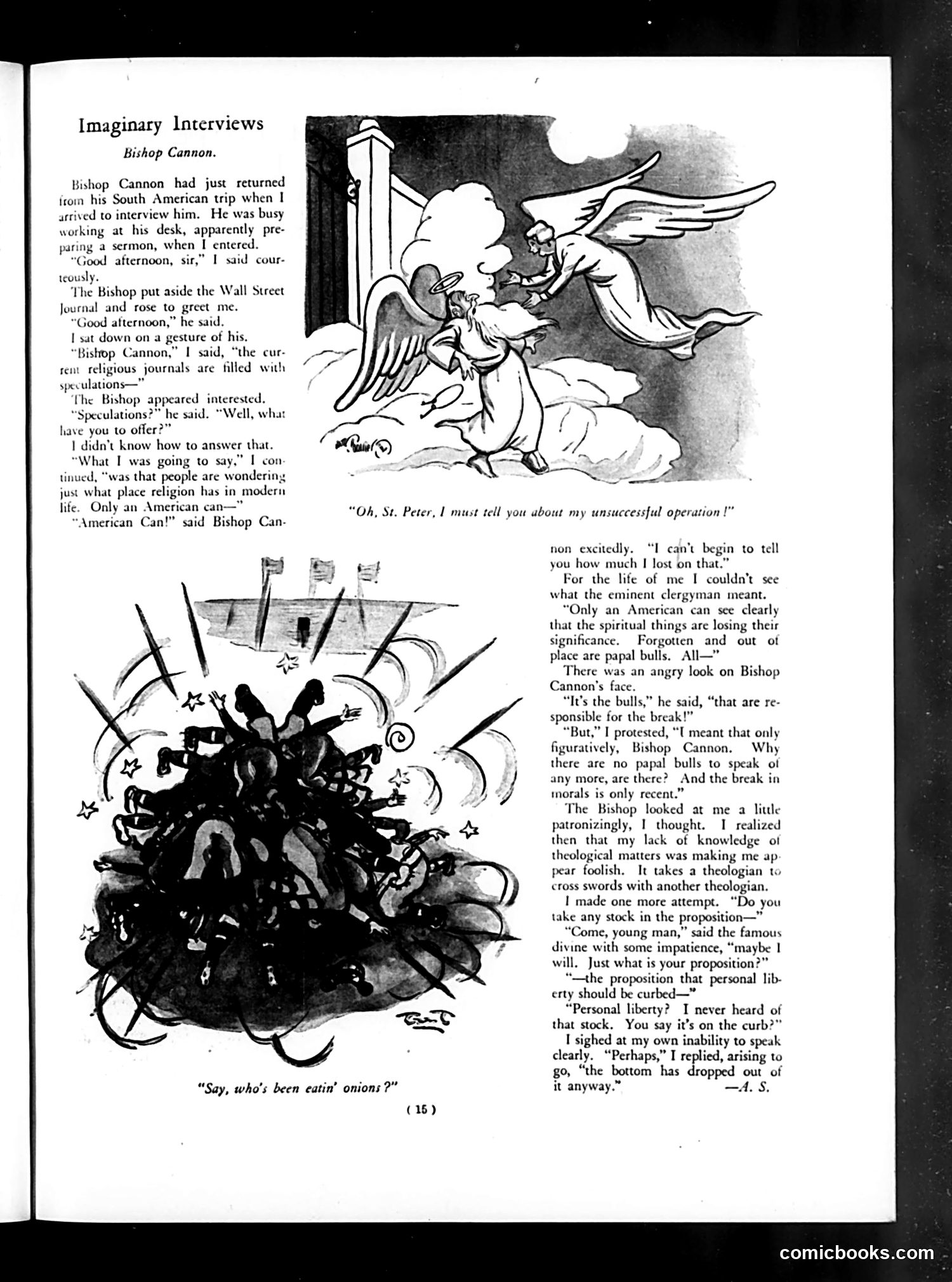
"Imaginary Interviews: Bishop Cannon" This satirical piece mocks Bishop James Cannon Jr., a prominent Methodist clergyman known for aggressive moral crusading. The interview depicts the narrator struggling with the Bishop's theological arguments about "speculation" and religious decline in modern America. The humor centers on the Bishop blaming "papal bulls" and "personal liberty" for moral breakdown—positions that appear absurdly disconnected from reality. The lower cartoon showing chaotic "onions" suggests the mess resulting from such rigid moralizing. The satire targets fundamentalist religious leaders of the 1920s-30s who blamed urban secularism and individual freedom for societal problems, while the interviewer represents the average American finding such positions disconnected and somewhat ridiculous. The piece gently ridicules religious extremism as out-of-touch with modern life.
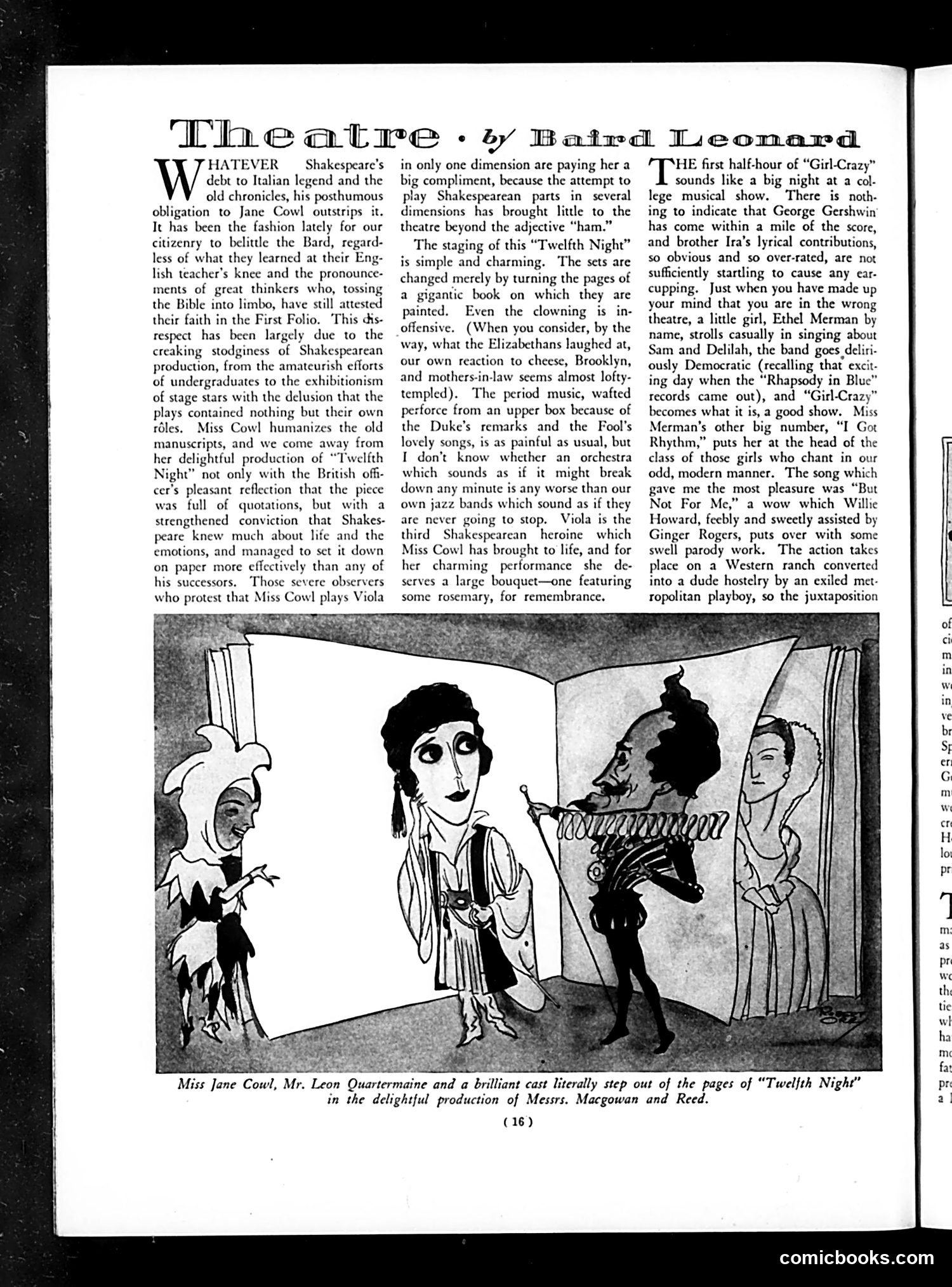
Analysis of Life Magazine Theatre Review Page This page reviews a production of Shakespeare's "Twelfth Night," praising Miss Jane Cowl's humanistic approach to the script. The review criticizes earlier Shakespeare productions for their "amateurish" quality and excessive reverence, contrasting them with this "delightful production" by Messrs. Macgowan and Reed. The illustration shows four figures "stepping out of the pages" of the play—a visual metaphor for how successfully the production brings Shakespeare's characters to life. The cartoon demonstrates the reviewer's point: skilled direction and performance can make classic theatre feel immediate and vital, rather than dusty and academic. The piece celebrates modern theatrical innovation while defending Shakespeare against charges that his plays are inherently dull.
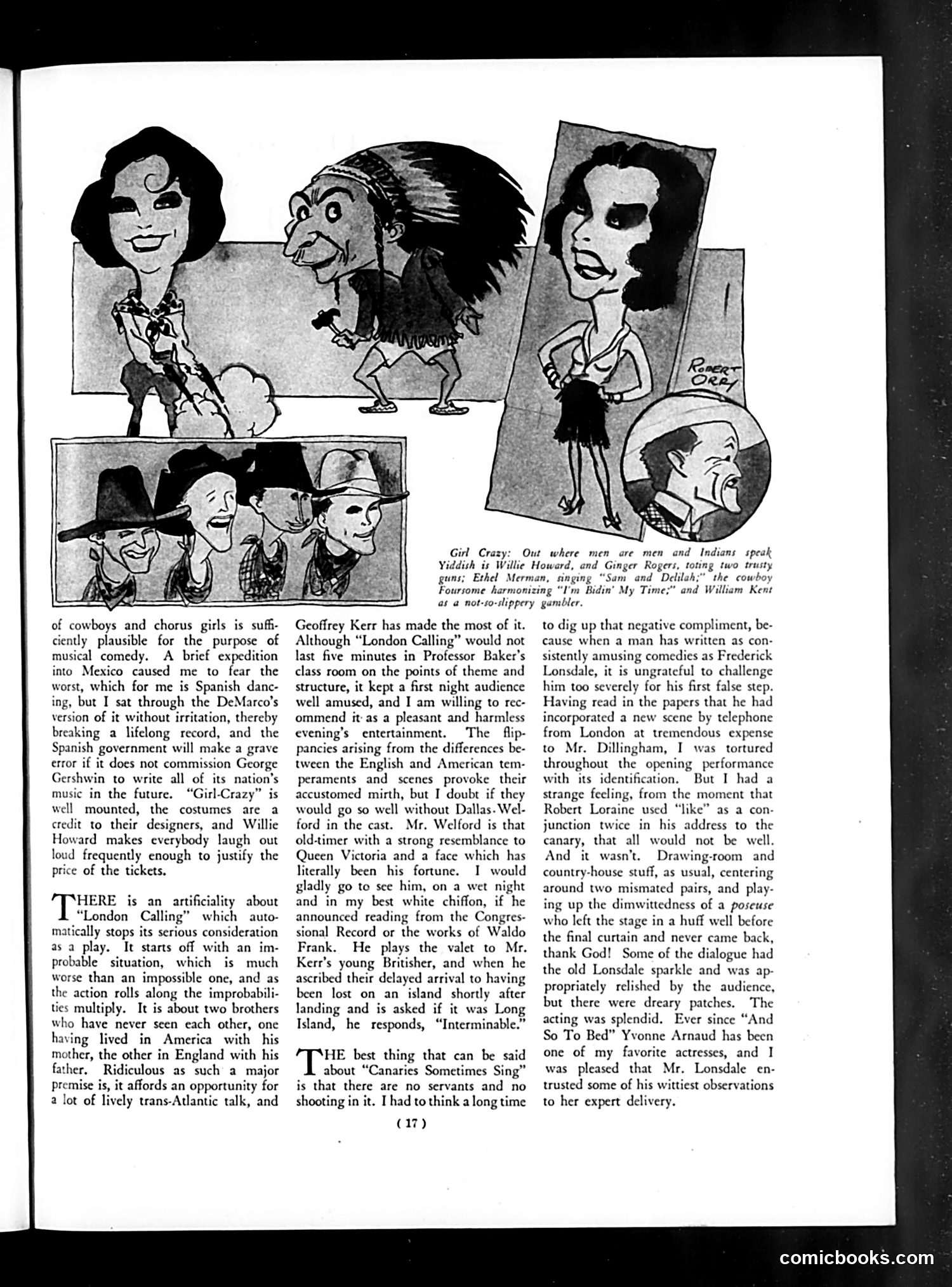
Analysis of Life Magazine Page This page reviews the musical comedy "Girl Crazy," which the text describes as set in Mexico with cowboys and chorus girls. The cartoon at top shows caricatured cast members, including exaggerated facial features typical of 1920s-30s satirical art. The review praises the show's entertainment value while critiquing "London Calling," another production, for its pretentious artificiality. The text mentions performers like Willie Howard, Ginger Rogers, and William Kent. The reviewer expresses particular appreciation for Yvonne Arnaud's acting and Frederick Lonsdale's witty dialogue, though noting some awkward moments in the script. The overall tone suggests "Girl Crazy" succeeds as lighthearted entertainment despite its thin plot, making it worth the ticket price—the magazine's primary purpose in reviewing Broadway productions.
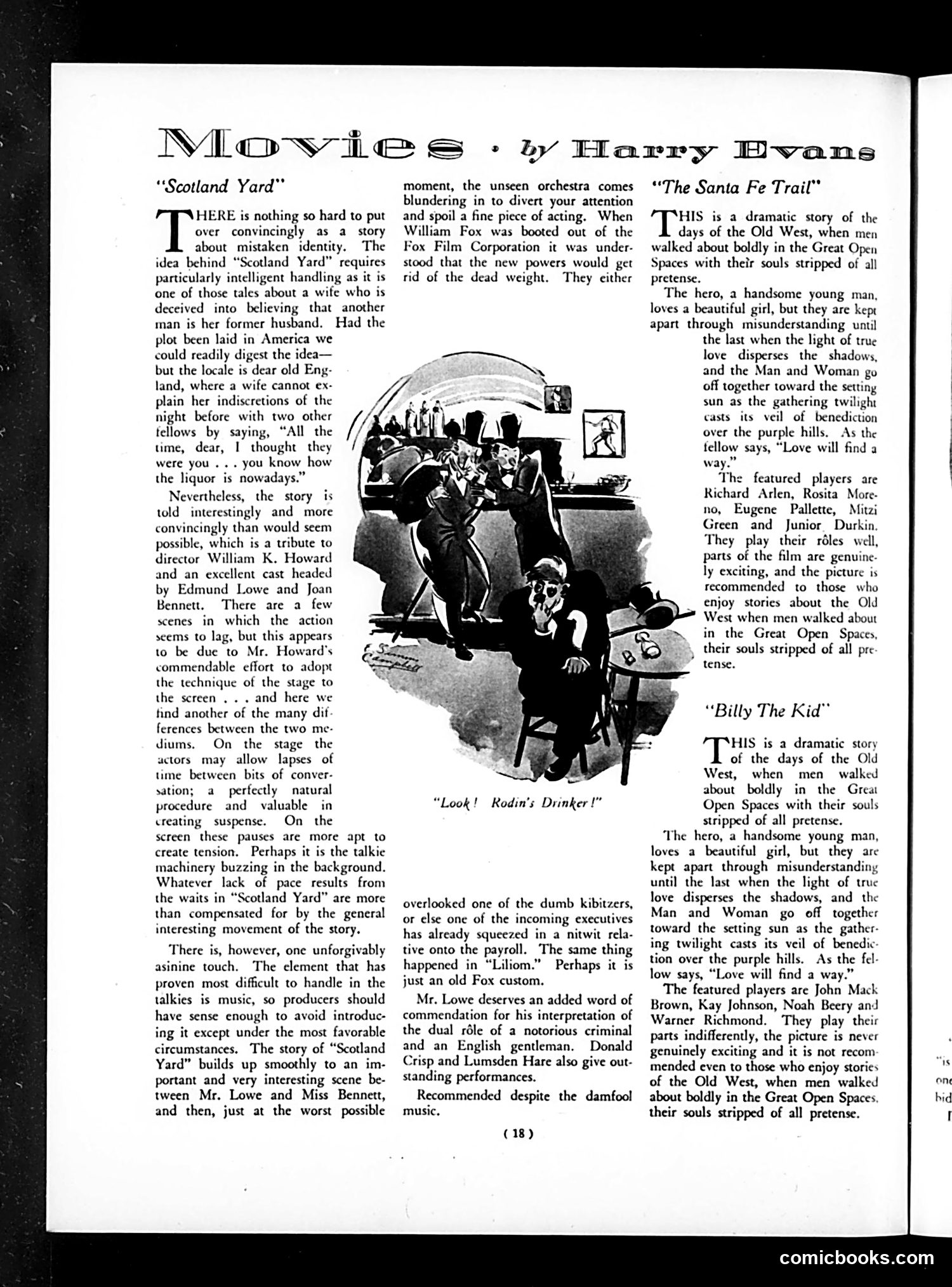
Movie Reviews by Harry Evans This page contains three film reviews by Harry Evans from Life magazine. The central illustration shows a stagecoach scene labeled "Look! Rodin's Drinker!" — a visual pun comparing a figure in the scene to Rodin's famous sculpture "The Thinker," but depicting someone drinking instead of thinking. The reviews cover three films: "Scotland Yard," "The Santa Fe Trail," and "Billy the Kid." Evans critiques their adaptation of stage techniques to screen, praising director William K. Howard's efforts in "Scotland Yard" while noting that all three Westerns feature similar plotlines about young men and women separated by misunderstanding in the Old West landscape. The tone is professional film criticism typical of early-to-mid twentieth-century entertainment journalism.
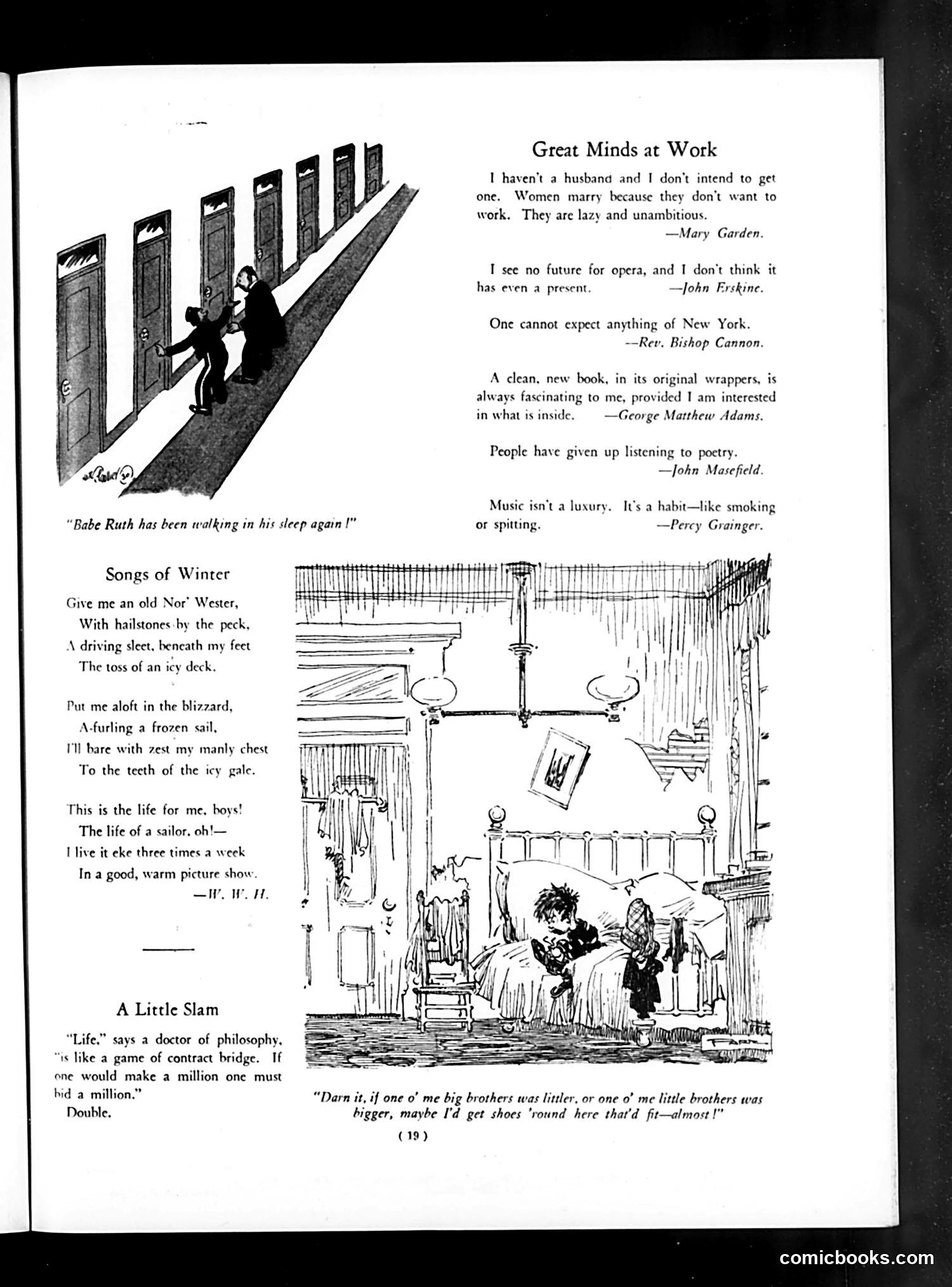
Page Analysis: Life Magazine Satire This page contains two main satirical elements: "Great Minds at Work" quotes famous cultural figures making pessimistic or contradictory statements—Mary Garden dismissing marriage as laziness, John Erskine declaring opera's death, Bishop Cannon criticizing New York. The satire lies in presenting these "great minds" uttering surprisingly negative or sweeping pronouncements, likely mocking the pretensions of celebrity intellectuals or their habit of making grandiose pronouncements. "Songs of Winter" parodies the romantic ideal of rugged sailor life. The poem celebrates hardship and danger—blizzards, frozen sails, icy gales—but the punchline reveals the speaker only experiences this "three times a week / In a good, warm picture show." This mocks both the fantasy of adventure cinema and people who romanticize dangerous lives from comfortable distance. The bottom cartoon shows children discussing shoe sizes, with one lamenting sibling height differences prevent hand-me-down shoes from fitting. It's gentle domestic humor about poverty's indignities.
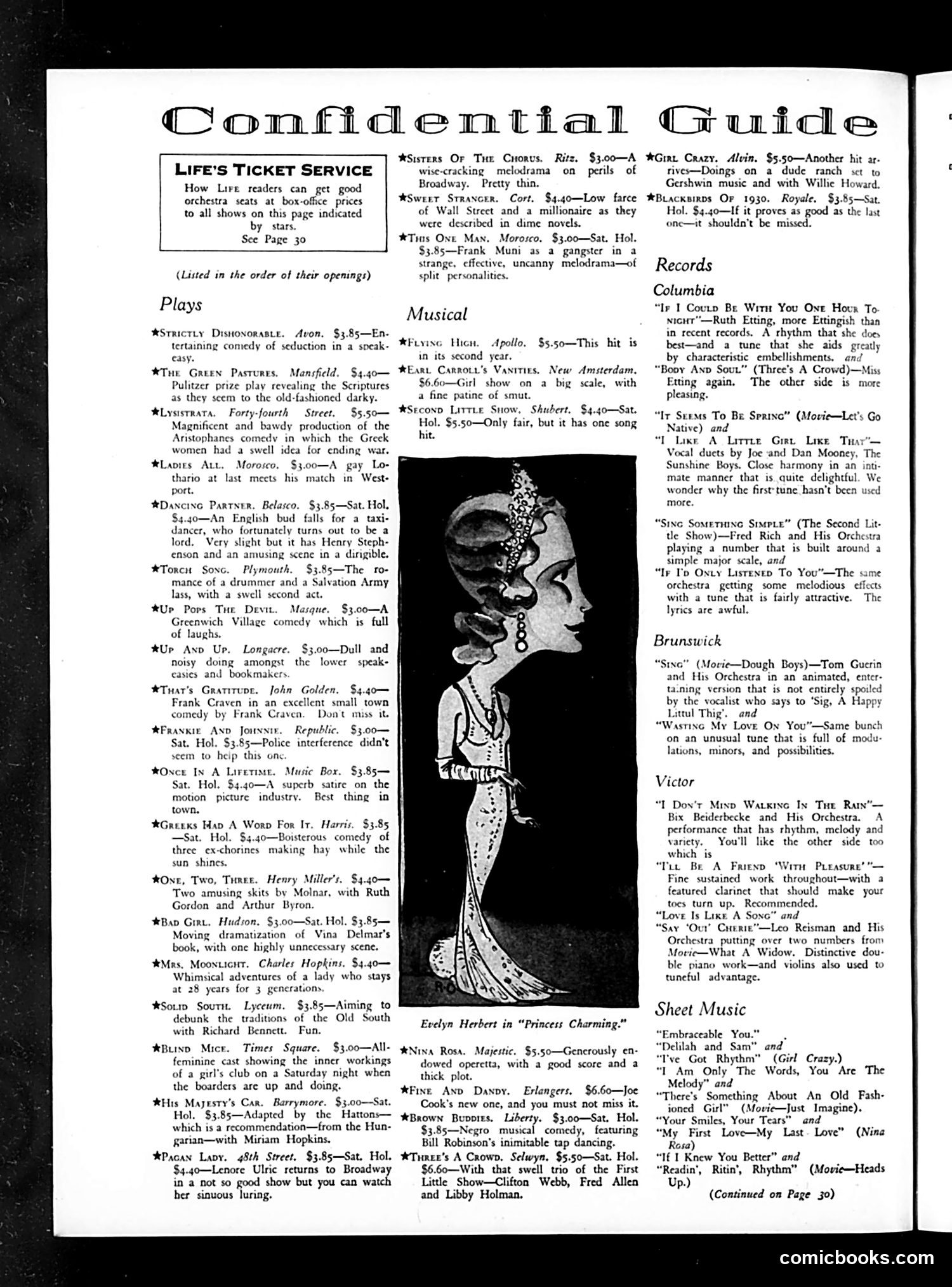
What This Page Means to Modern Readers This is a theater guide and review page from Life magazine, listing Broadway shows, musicals, and recordings available in what appears to be the late 1920s or early 1930s. The illustration shows Evelyn Herbert, a popular musical theater star, in costume for "Princess Charming." The detailed captions reviewing each show offer period satire: reviews mock plots as simplistic ("Low farce...described in dime novels"), note racial stereotypes casually ("old-fashioned darky"), and praise bawdy comedies as entertainment highlights. The ticket service advertised at top offered readers discounted orchestra seats—a marketing perk for the magazine's subscribers. Key context for modern readers: This reflects an era when Broadway dominated American entertainment, when theatrical reviews mixed casual prejudice with enthusiasm for lowbrow humor, and when magazines directly sold access to cultural events as a subscriber benefit. The tone is unapologetically gossipy and class-conscious about "speakeasies" and wealthy characters.
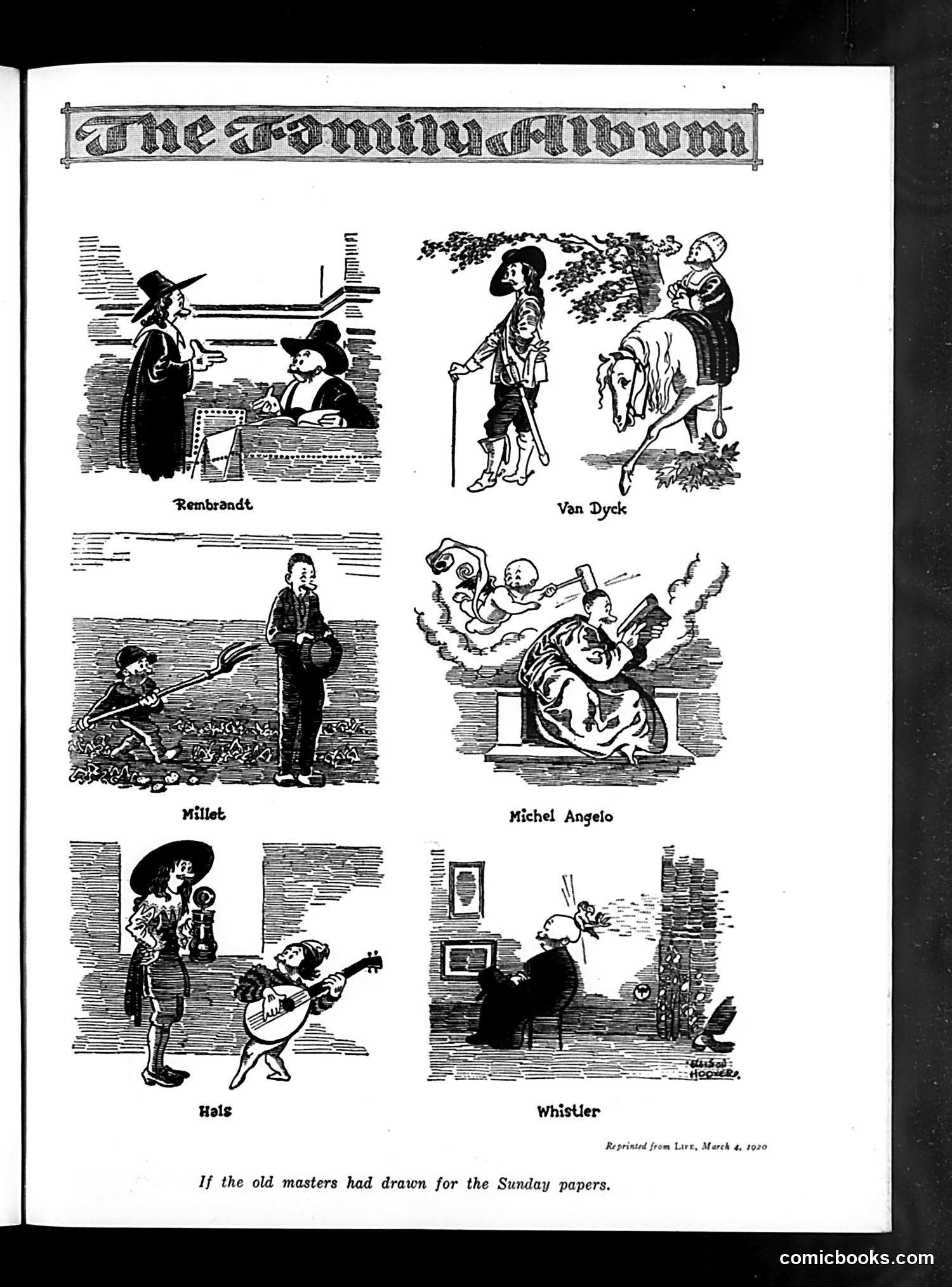
"The Sunday Afternoon" - Old Masters as Comic Artists This page presents six illustrated panels imagining famous historical artists drawing for Sunday newspaper comics. Each panel caricatures a master artist's distinctive style applied to modern, humorous subject matter: - Rembrandt: Depicts his characteristic chiaroscuro (light/shadow contrast) - Van Dyck: Shows his elegant portrait style in a comic scenario - Millet: References his rural, working-class subject matter - Michel Angelo: His dynamic, muscular figure style - Hals: His loose brushwork and character studies - Whistler: His spare, atmospheric aesthetic The satirical premise—"if the old masters had drawn for the Sunday papers"—humorously suggests that great historical artists, if alive in the 1920s, might have applied their sophisticated techniques to popular comic entertainment. It's a witty commentary on the gap between fine art and commercial comic illustration of the era.
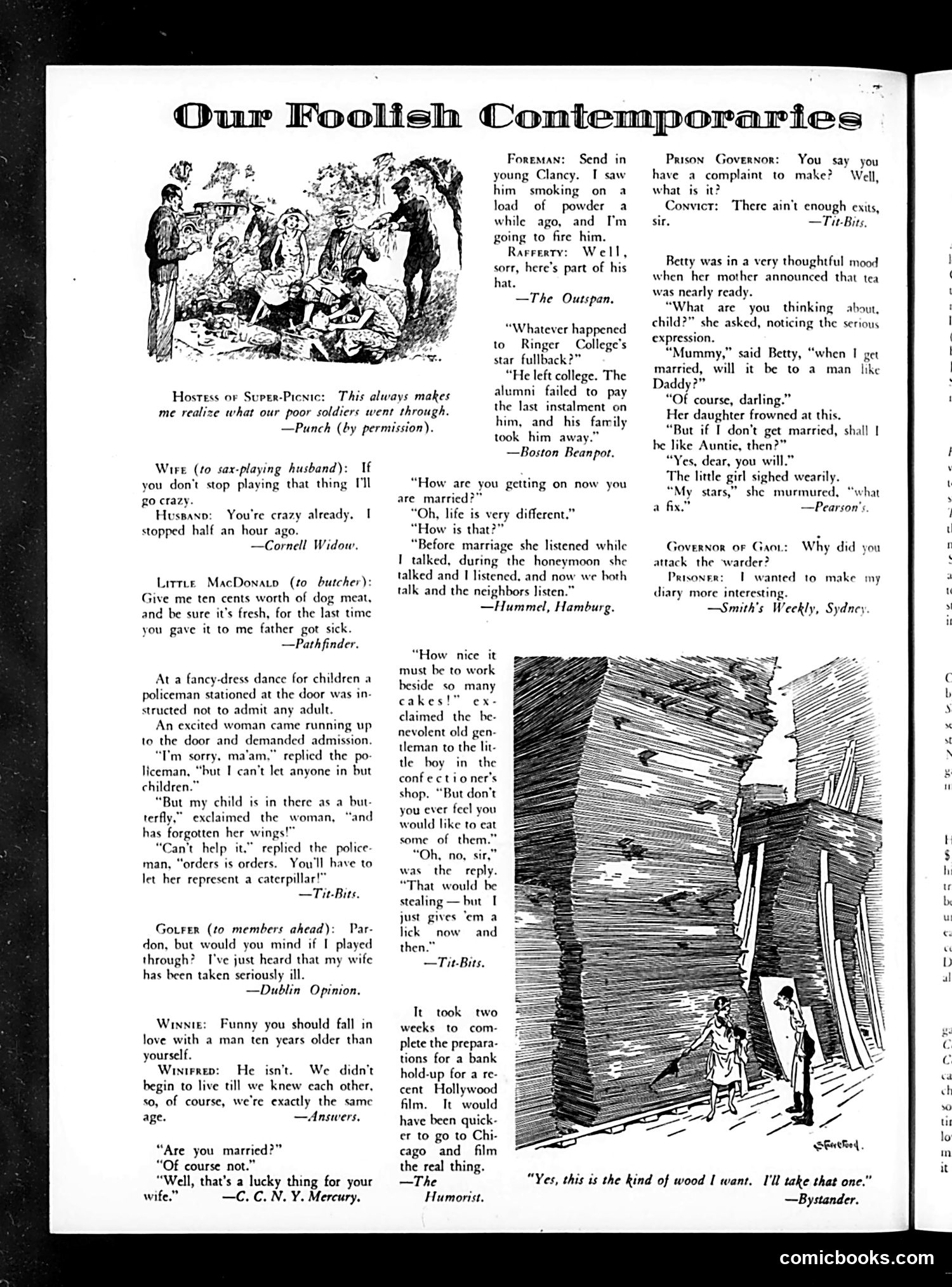
"Our Foolish Contemporaries" - Life Magazine Humor Page This page collects brief jokes and comic anecdotes from various sources, satirizing everyday social absurdities of the early-to-mid 20th century. The humor targets: Marital discord: Husbands and wives bickering over trivial matters (saxophone playing, post-honeymoon dynamics where neighbors now listen to both talk). Social pretension: A woman demanding admission to a children's costume party, upset her daughter forgot fairy wings. Class and labor: A butcher selling dog meat; a factory foreman firing a worker for smoking near powder; prisoners and warders. Illogical reasoning: A confectioner's boy claiming he doesn't eat cakes because it would be "stealing," yet licks them. Gender roles and marriage: A girl anxious about becoming unmarried like "Auntie"; assumptions about wife's luck regarding unmarried men. The largest illustration (right side) appears unrelated to text—showing figures examining or selecting wood. The page's overall tone is lighthearted social observation rather than political commentary.
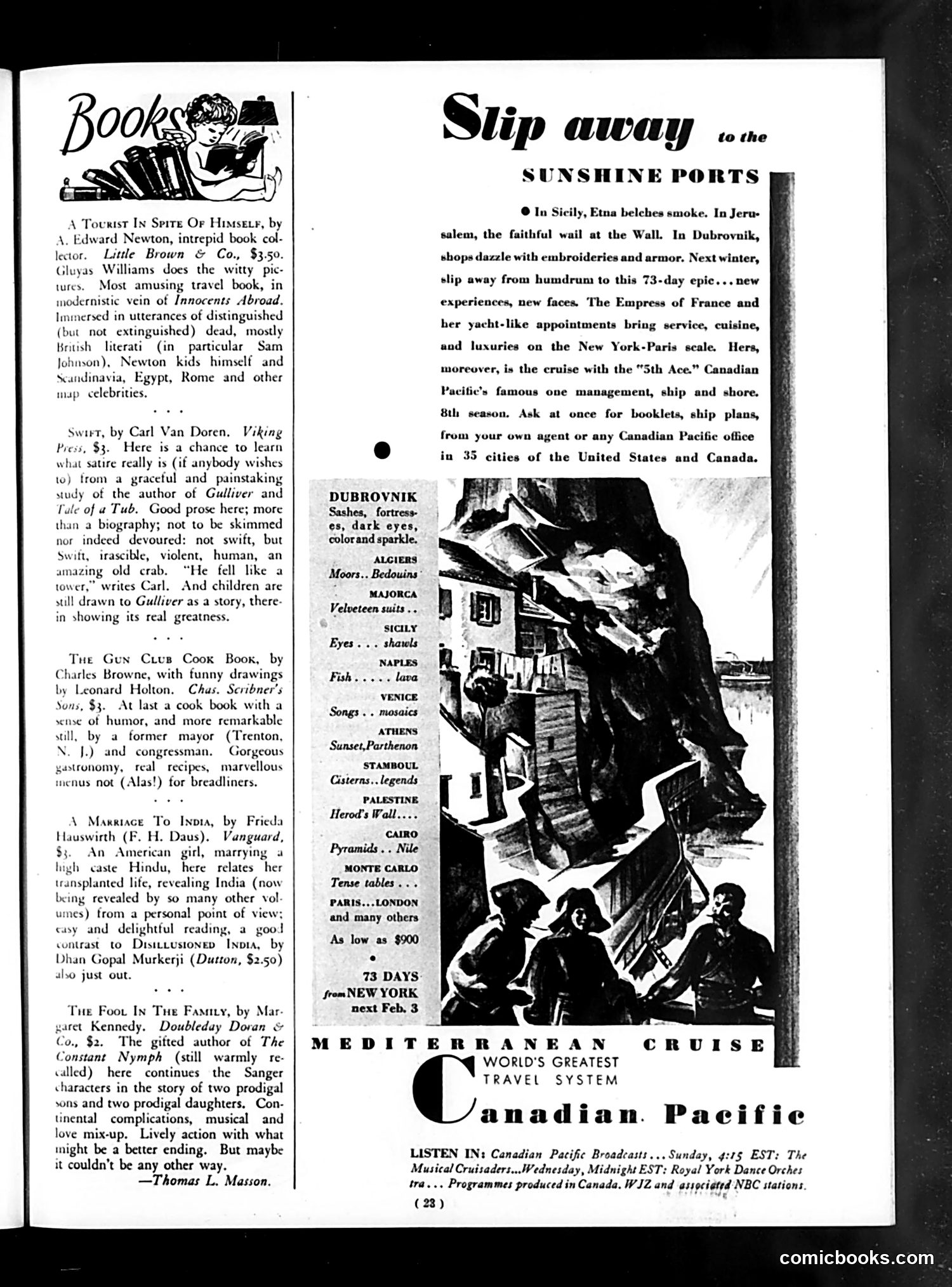
Life Magazine Page Analysis This page is primarily book reviews and advertising, not political satire. The left column reviews five recent books, including works on travel, Jonathan Swift's biography, a humorous cookbook, and novels about India and family drama. The reviews are by Thomas L. Masson and emphasize wit and entertainment value. The right side is a Canadian Pacific cruise advertisement for a 73-day Mediterranean voyage departing February 3 from New York. It lists exotic ports (Sicily, Jerusalem, Dubrovnik, Egypt, Athens, Istanbul, Cairo, Monte Carlo, Paris) with brief evocative descriptions (sashes, pyramids, mosaics, legends). The ad emphasizes luxury service comparable to the "New York-Paris scale" and costs as low as $900. There is no political cartoon or satire on this page. It represents typical 1920s-30s Life magazine content: literary commentary aimed at educated readers alongside glamorous travel promotion for affluent audiences.
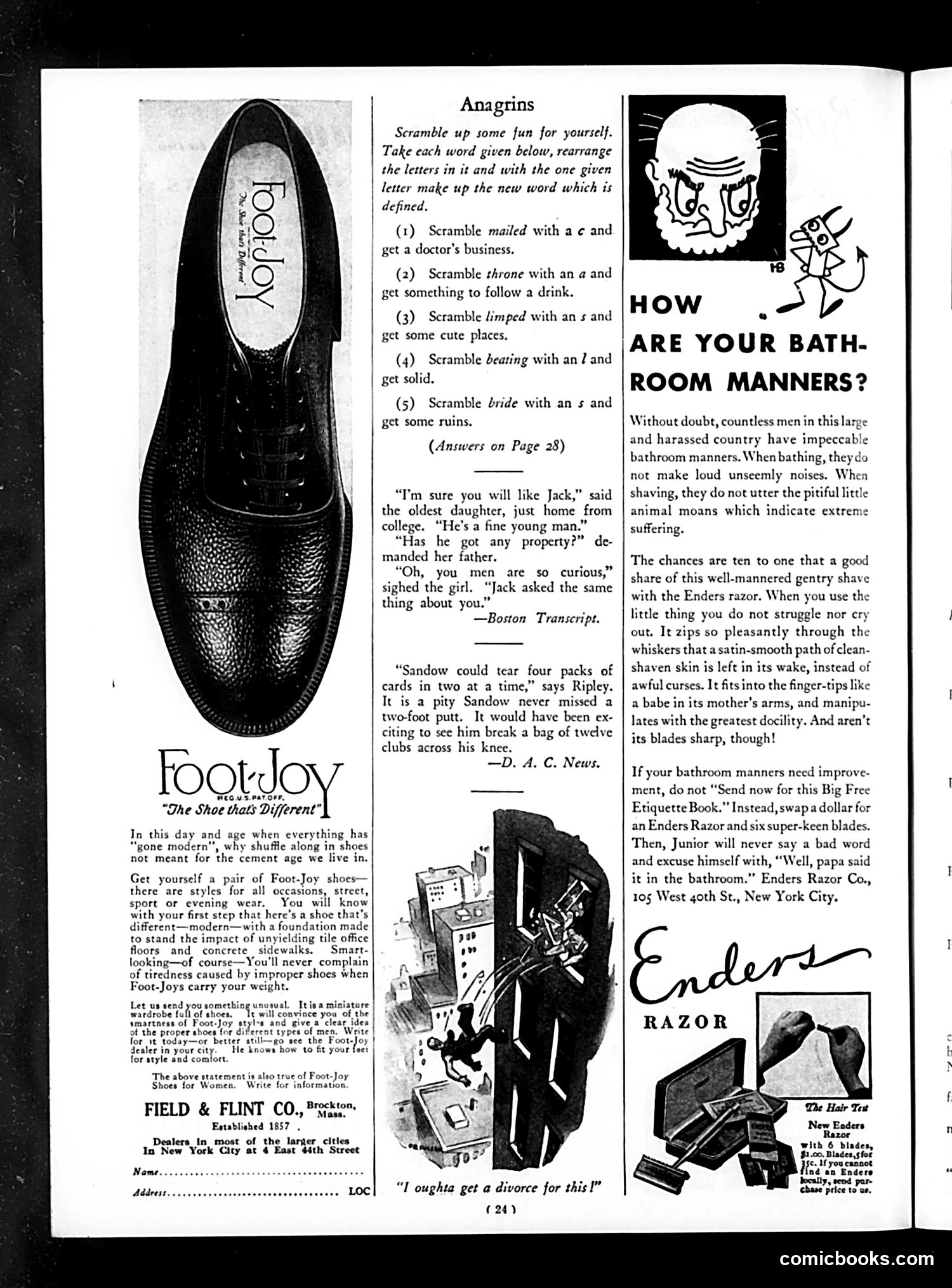
Life Magazine Page Analysis This page combines humor, puzzles, and advertising typical of early 20th-century Life magazine. Content overview: The page features three main sections: A Foot-Joy shoe advertisement (left), humor pieces and an anagram puzzle (center), and advertisements for Enders Razor and bathroom etiquette advice (right). Key humor pieces: - A brief joke about a daughter defending her fiancé's lack of property—the father's question about wealth mirrors the boyfriend's identical concern, creating ironic role-reversal comedy. - A sports quip about Sandow (likely Eugen Sandow, famous strongman) tearing cards—joking that his strength would be useless at golf. - A cartoon captioned "I oughta get a divorce for this!" showing exaggerated bathroom chaos, playing on marital frustration. Social context: The Enders Razor advertisement uses "bathroom manners" as a humorous hook, suggesting that proper shaving technique (without cursing) reflects genteel behavior—satirizing middle-class anxieties about masculine decorum and self-control.
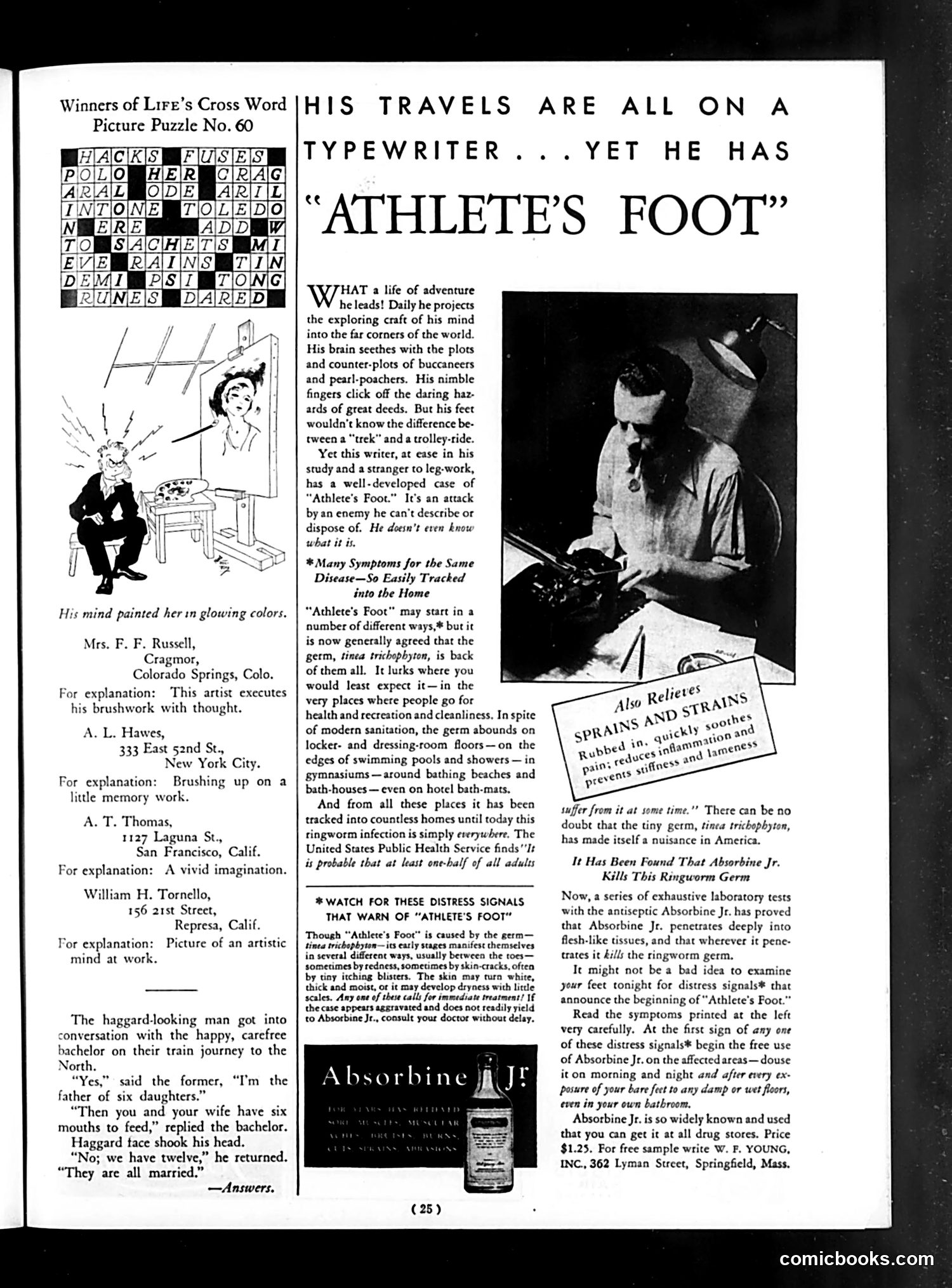
Analysis of This Life Magazine Page This page combines a crossword puzzle contest with health-focused advertising. The main article satirizes a sedentary writer who travels mentally through imagination and typewriter but physically remains desk-bound—yet somehow develops "Athlete's Foot," a fungal infection typically acquired through active recreation (gyms, pools, locker rooms). The humor lies in the irony: a man whose feet "wouldn't know the difference between a 'trek' and a trolley-ride" has contracted an ailment associated with athletes and active people. He's baffled by this paradox. The article then pivots to advertising copy for Absorbine Jr., a patent medicine, claiming the fungus is "everywhere" and citing the U.S. Public Health Service to suggest half of all adults suffer from it. This transforms the satirical setup into a sales pitch, leveraging anxiety about cleanliness and modern sanitation to promote the product. The surrounding content—a crossword puzzle and jokes—fills remaining space typical of Life's miscellaneous humor format.
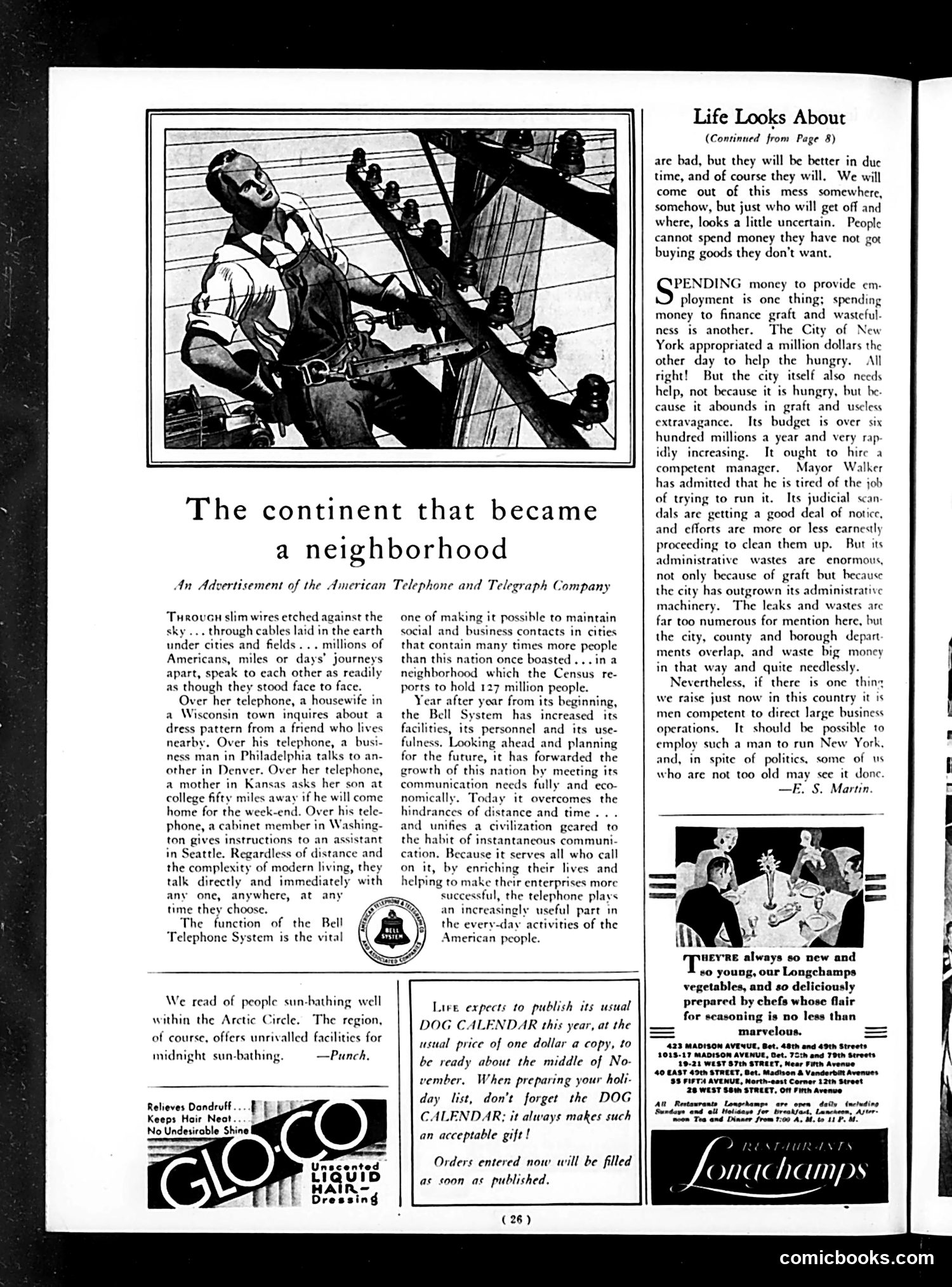
Analysis for Modern Readers This page contains a Bell Telephone System advertisement disguised as editorial content, plus unrelated commentary on New York City governance. The Main Advertisement ("The continent that became a neighborhood") The ad celebrates telephone technology's ability to connect distant Americans instantaneously—a housewife consulting a friend about a dress pattern, a cabinet member instructing an assistant across the country. The rhetorical point: the telephone has made America function as one unified community despite vast distances and a population of 127 million. The Political Commentary The right column critiques New York City Mayor Jimmy Walker (implied but not named). The author argues the city wastes money through graft and administrative bloat—the budget exceeds $600 million annually and departments overlap wastefully. While Walker acknowledges being "tired" of running the city, the columnist demands competent management rather than mere charity spending on the hungry. Historical context: This appears from the early 1930s (Depression era), when Walker faced corruption scandals and eventually resigned in 1932. The page also includes minor humor (Arctic sun-bathing) and product ads (Gloo hair product, Longchamps restaurants).
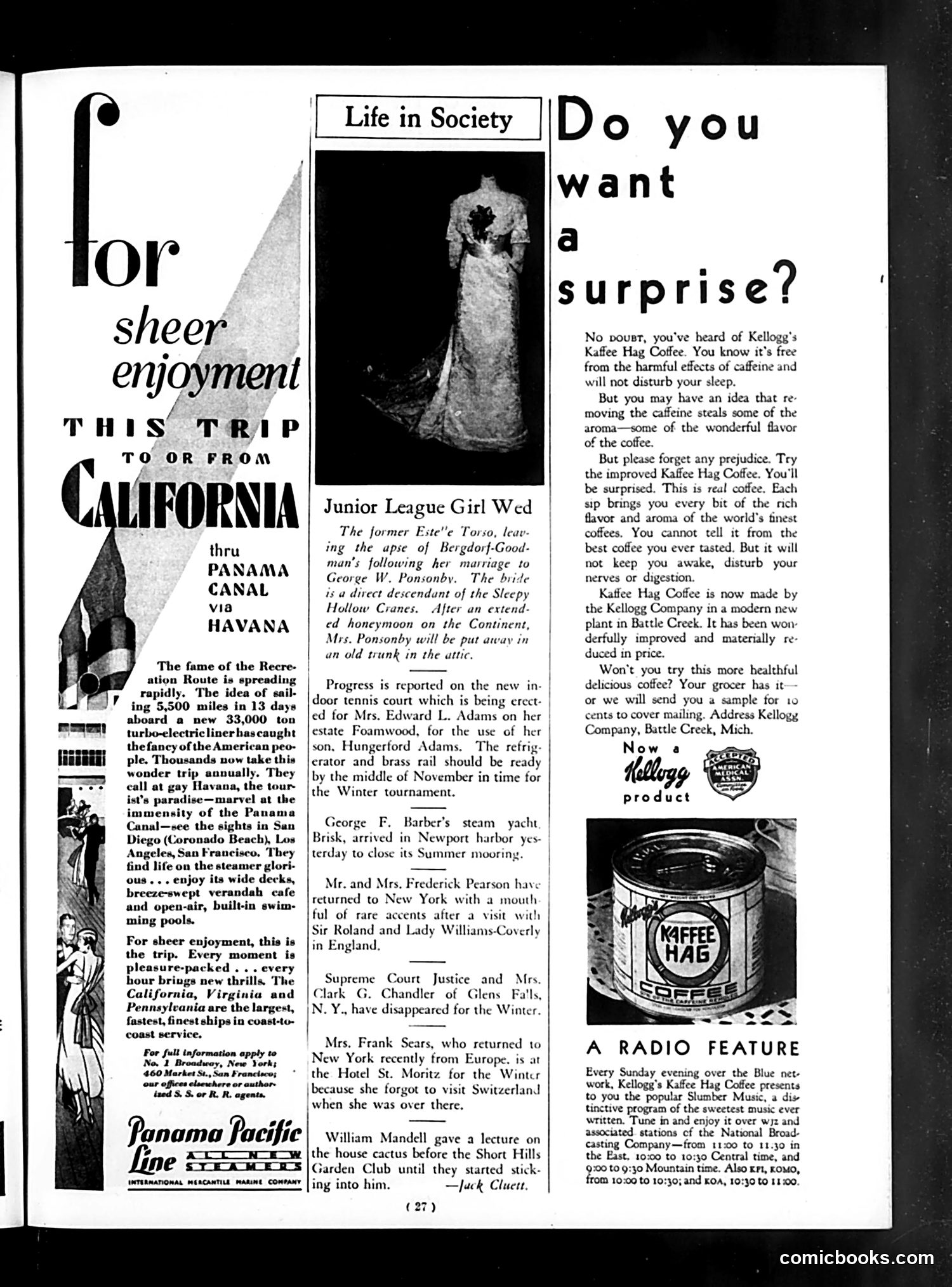
Analysis of Life Magazine Page This page combines society gossip with travel and product advertising, typical of Life's satirical approach to high society. The "Life in Society" section mocks wealthy socialites through brief, witty blurbs. The featured item ridicules a Junior League girl's marriage to "George W. Ponsonby," sarcastically noting she's a descendant of Washington Irving's fictional "Sleepy Hollow Cranes" and will be "put away in an old trunk in the attic"—suggesting she'll become a forgotten relic after marriage. Other items chronicle the trivial comings and goings of the wealthy: tennis courts under construction, yacht arrivals, and winter travel plans. The advertisements (Panama Pacific cruise line, Kaffee Hag decaffeinated coffee) occupy significant space. The satire lies in Life's juxtaposition of breathless society reporting with commercial appeals, implying both target the same leisure class. The overall tone satirizes American aristocratic pretension and conspicuous consumption during what appears to be the 1920s-30s era.
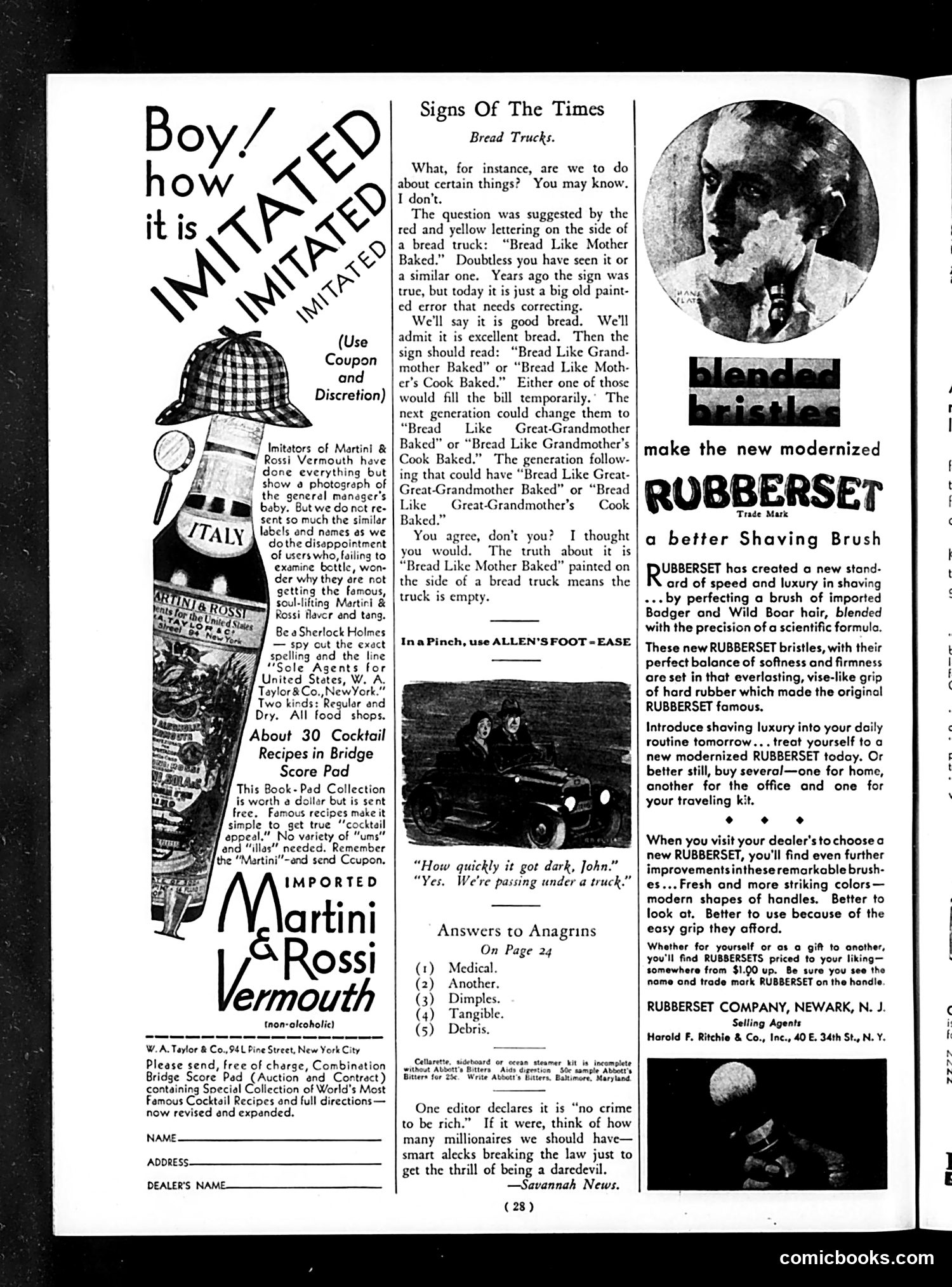
"Signs of the Times: Bread Trucks" – A 1920s-30s Social Commentary This satirical piece mocks the advertising slogan "Bread Like Mother Baked" appearing on commercial bread delivery trucks. The author's joke: the phrase has become outdated. Since store-bought bread has replaced home baking, "Mother" no longer bakes bread—only grandmothers do. He humorously suggests bread companies must constantly update slogans each generation ("Great-Grandmother Baked," then "Great-Great-Grandmother Baked") to stay truthful. The dark punchline: "Bread Like Mother Baked" painted on a truck means the truck is empty—a play on the absurdity of claiming homemade quality for industrial product. The piece reflects nostalgia for home cooking while acknowledging modernization's displacement of traditional domestic labor. It's gentle social satire about marketing disconnect from reality—a timeless advertising critique.
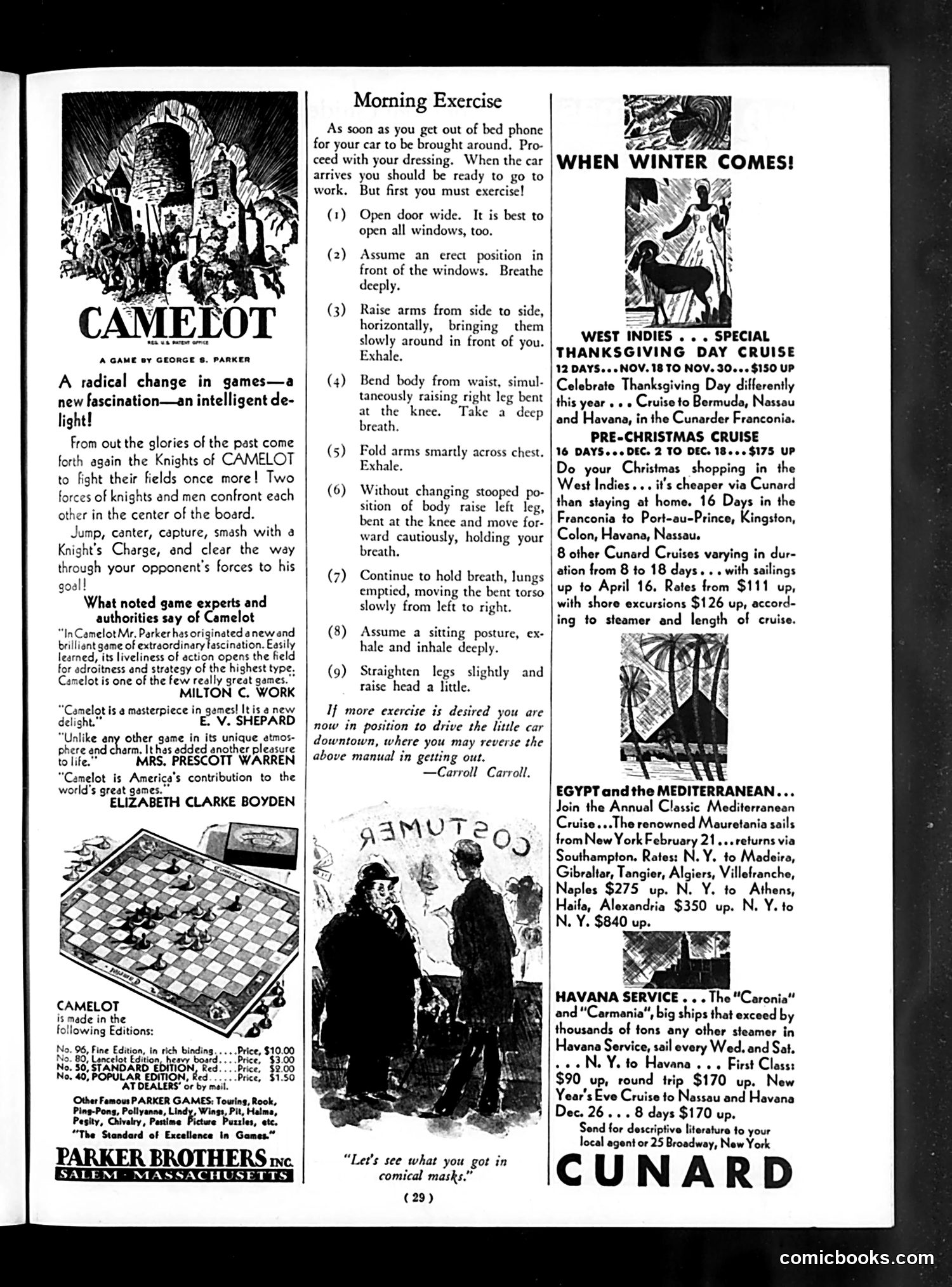
Analysis of Life Magazine Page Content This page combines entertainment and advertising from what appears to be the 1920s-30s era. Left side: Advertisement for "Camelot," a board game by Parker Brothers featuring medieval Knights of the Round Table theme. Testimonials from game experts praise its innovation and strategic gameplay—marketing it as an intellectual alternative to simpler pastimes. Center: Satirical humor piece titled "Morning Exercise" by Carroll Carroll. The joke mocks the wealthy leisure class's obsession with efficiency and automobiles. The "exercises" are absurdly minimal (arm raises, leg lifts) deliberately designed to fit between waking and driving "the little car downtown"—satirizing how the rich compress health routines into their rushed schedules while depending on motorized convenience. Right side: Luxury cruise advertisements for Cunard Line, promoting Thanksgiving and Christmas cruises to Bermuda, Nassau, Havana, Egypt, and the Mediterranean—clearly targeting affluent readers. The page reflects 1920s-30s consumer culture: intellectual games, satirical commentary on modern convenience-obsessed lifestyles, and aspirational travel marketing.
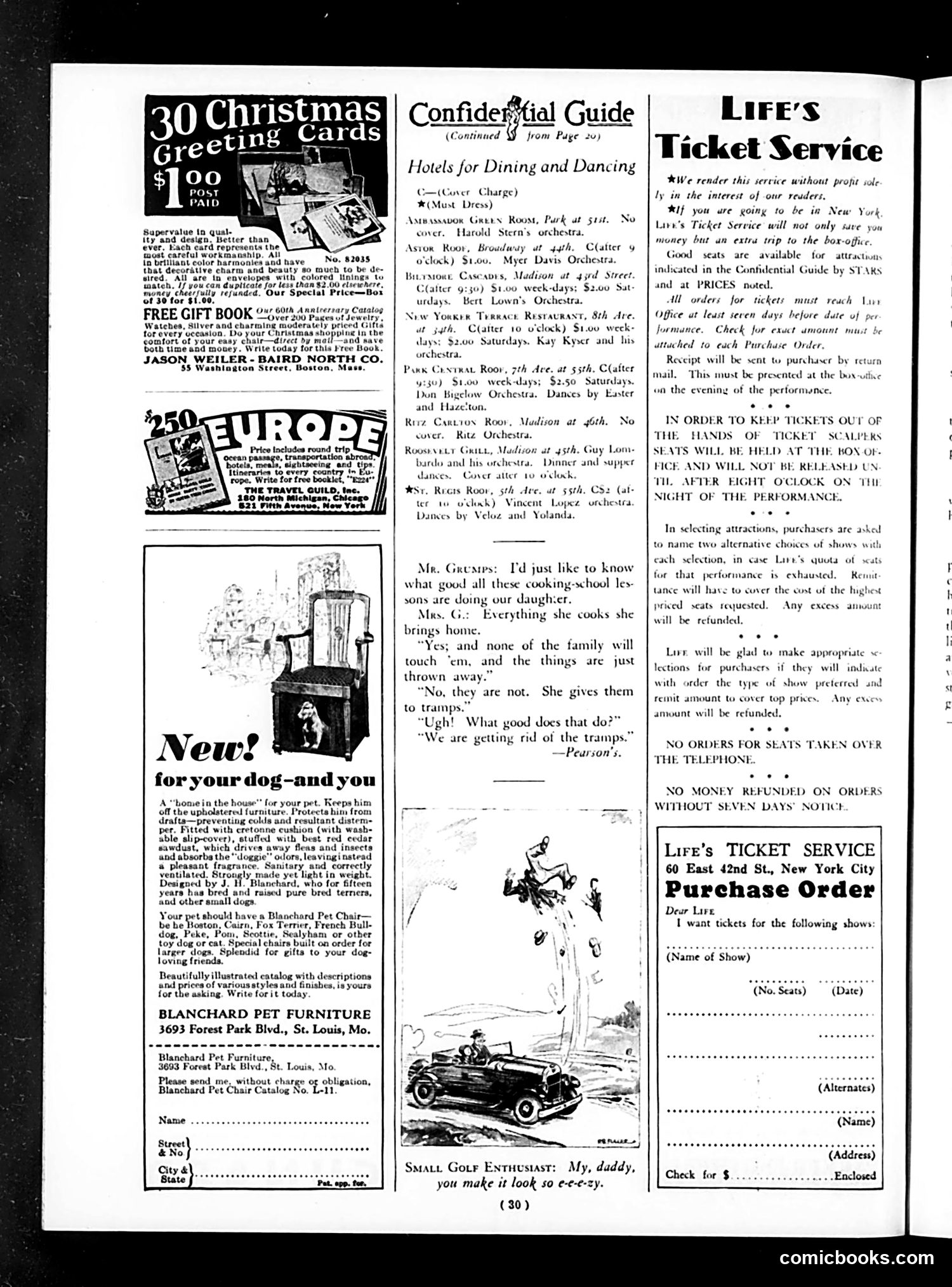
Life Magazine Page Analysis This page is primarily advertisements and service information, not political satire. The main content includes: 1. Christmas cards ad ($1 for 30) 2. Travel and Europe booking ads 3. Blanchard Pet Furniture ad — a dog bed/chair for small pets, positioned as practical furniture that protects upholstery and prevents fleas 4. Life's Ticket Service — a reader service offering Broadway theater tickets 5. Two brief joke cartoons: - A cooking school joke: A daughter takes cooking lessons but gives her inedible results to tramps. The punchline plays on "getting rid of the tramps" — an uncharitable dark humor suggesting homeless people are a nuisance. - A golf joke about a child watching his father play The page reflects 1920s-30s consumer culture and attitudes. The "tramps" joke reflects period indifference toward poverty; the pet furniture ad reveals class anxieties about maintaining respectable homes.
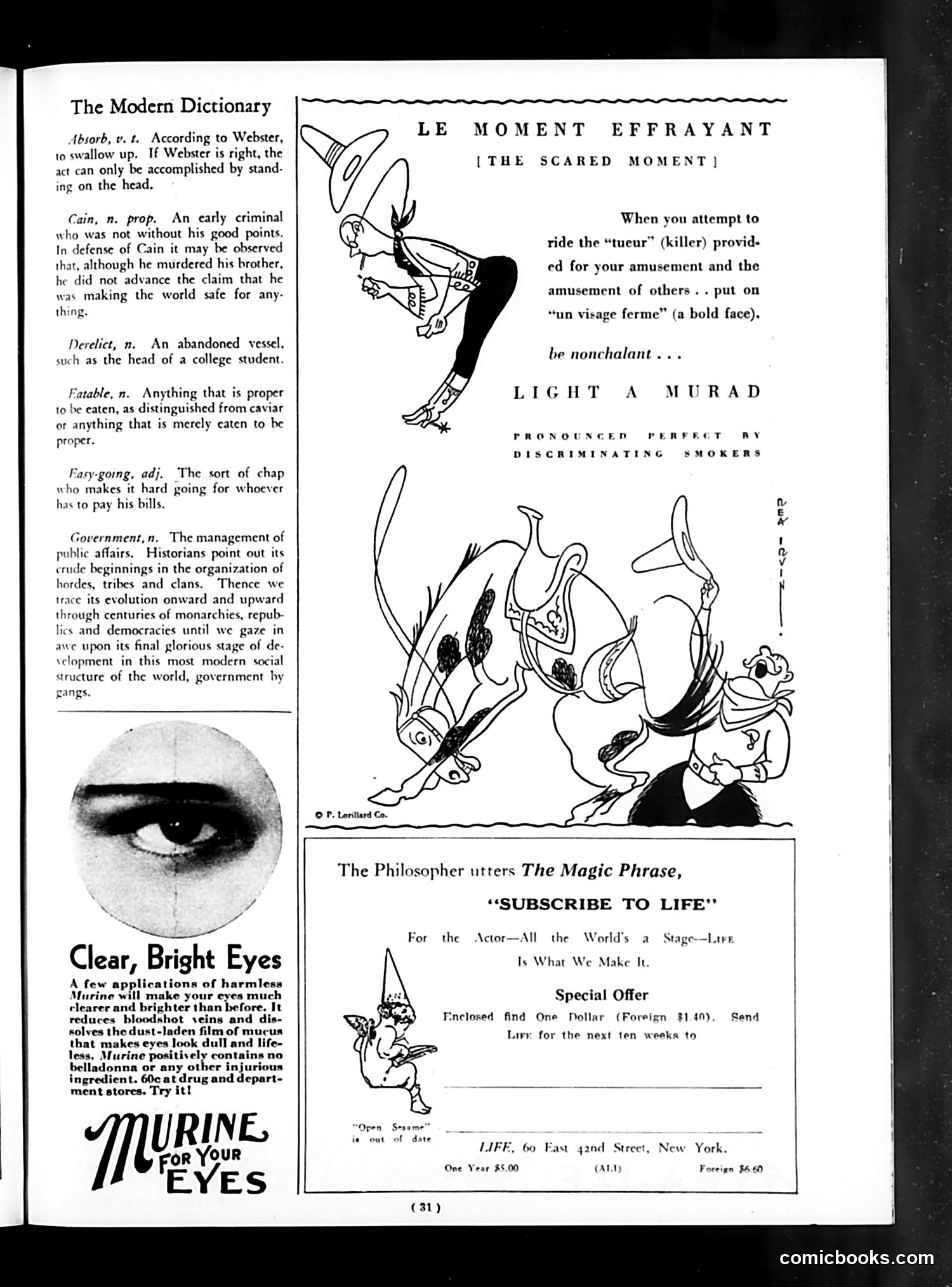
Analysis of Life Magazine Page This page mixes satirical dictionary definitions with period advertisements. The "Modern Dictionary" section offers tongue-in-cheek commentary on contemporary society—notably defining "Government" as having evolved to "government by gangs," a cynical reference to organized crime's influence in American politics during the Prohibition era (likely 1920s-1930s). The cartoons illustrate French phrases: "Le Moment Effrayant" shows someone on a mechanical bull ride ("tueur"/killer), advising a bold face despite fear. "Light a Murad" depicts a figure performing acrobatics, promoting cigarettes to discriminating smokers. The advertisements—Murine eyedrops and Murad cigarettes—reflect era-typical product claims (harmless ingredients, sophistication). The "Subscribe to Life" section jokes that Life magazine itself is "the magic phrase," positioning satire as life's essential commentary. The overall tone is irreverent, mocking both politics and consumerism through humor and caricature typical of Life's satirical approach.
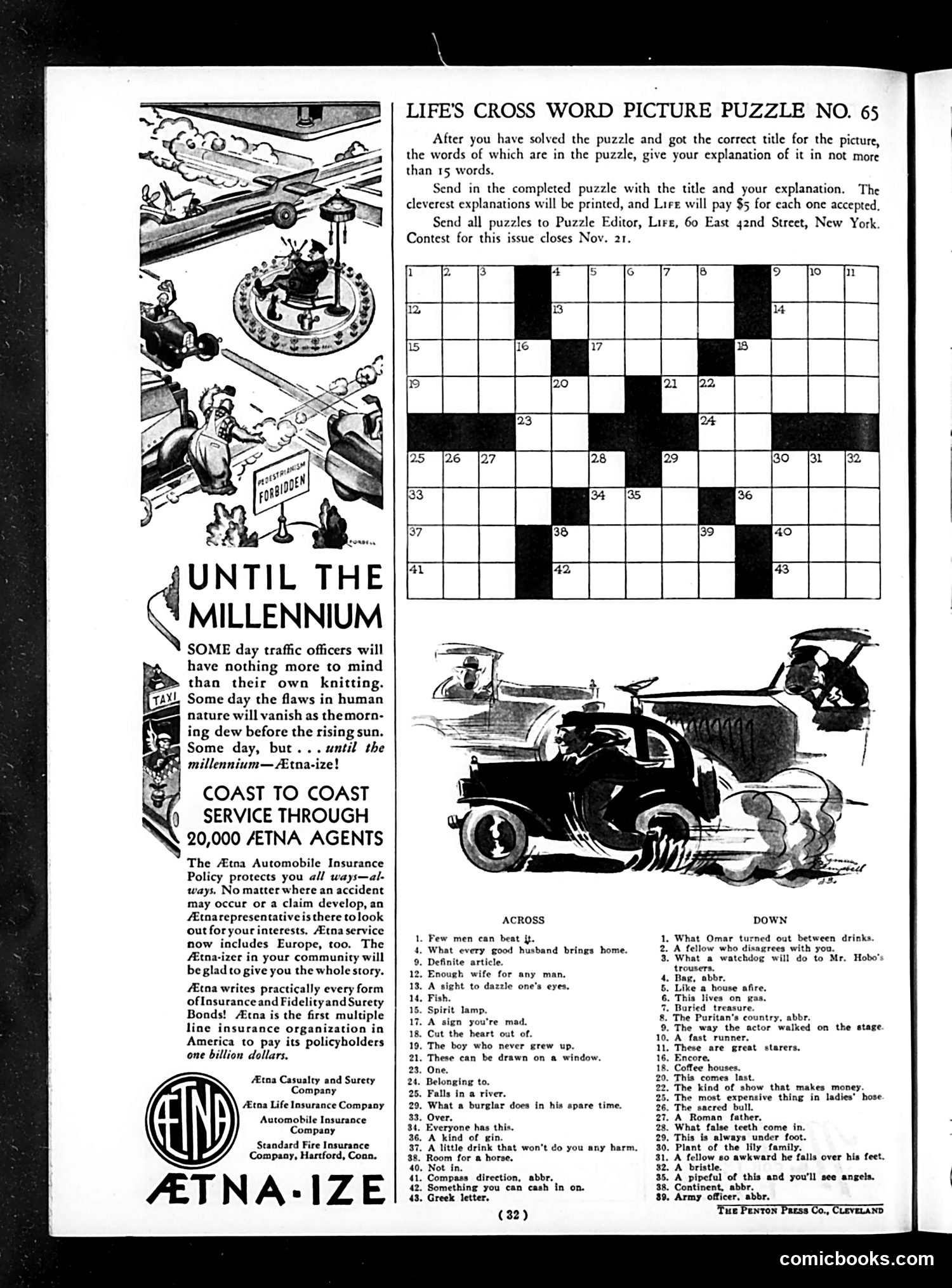
Analysis of Life Magazine Page This page is primarily advertising and puzzle content, not political satire. The main feature is a crossword puzzle (#65) with a whimsical illustration titled "Until the Millennium." The cartoon depicts chaotic traffic/driving scenes, satirizing the idea that perfect traffic safety will only exist in some distant utopian future. The accompanying text humorously suggests that traffic officers will have "nothing more to mind than their own knitting" and human flaws will vanish "as the morning dew"—implying these are impossible dreams. The satire here is gentle social commentary: modern driving is so dangerous and chaotic that orderly traffic seems as unrealistic as the mythical "millennium." The bulk of the page advertises Ætna Insurance, emphasizing nationwide coverage through 20,000 agents. The company claims to be America's first multi-line insurer and notes it has paid policyholders one billion dollars—positioned as industry leadership and trustworthiness during what appears to be the early 20th century automobile era.
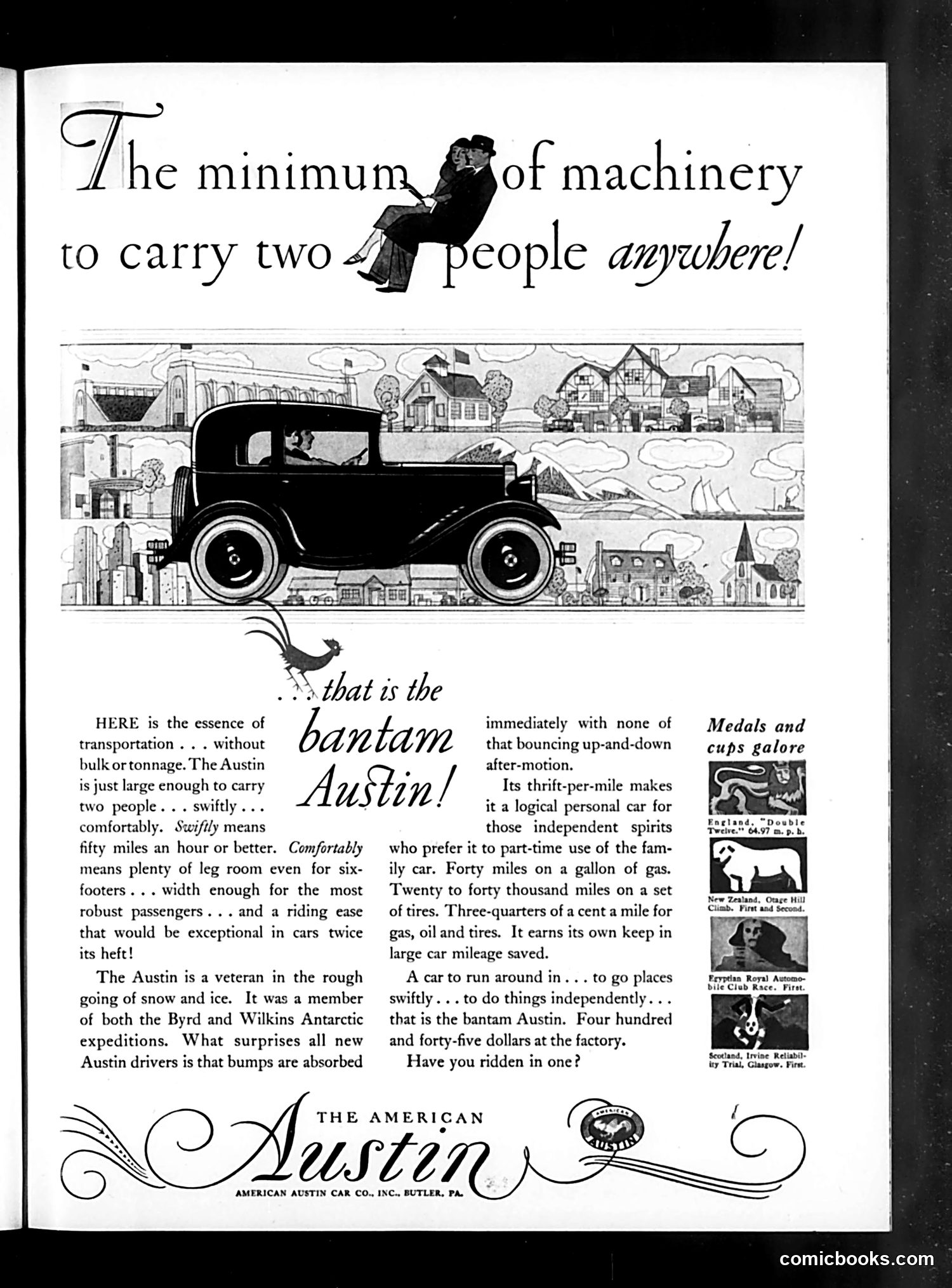
Analysis This is an advertisement for the American Austin automobile, not political satire. The page promotes the Austin as an economical, compact "bantam" car suitable for independent drivers. The illustration shows a small, practical vehicle positioned against a backdrop of American infrastructure and landmarks. The headline emphasizes minimal machinery for maximum portability—appealing to buyers seeking efficiency. Key selling points highlighted: - Two-person capacity at affordable price ($445) - Fuel economy (40 mpg) - Durability (Antarctic expedition credentials) - Smooth ride despite small size - Independence from family car sharing The medals/cups sidebar references racing accomplishments to build credibility. The tone positions the Austin as ideal for "independent spirits"—likely targeting individuals and small households seeking economical personal transportation during the interwar period when such compact cars were novelties in America. This is straightforward automotive marketing, not editorial commentary.
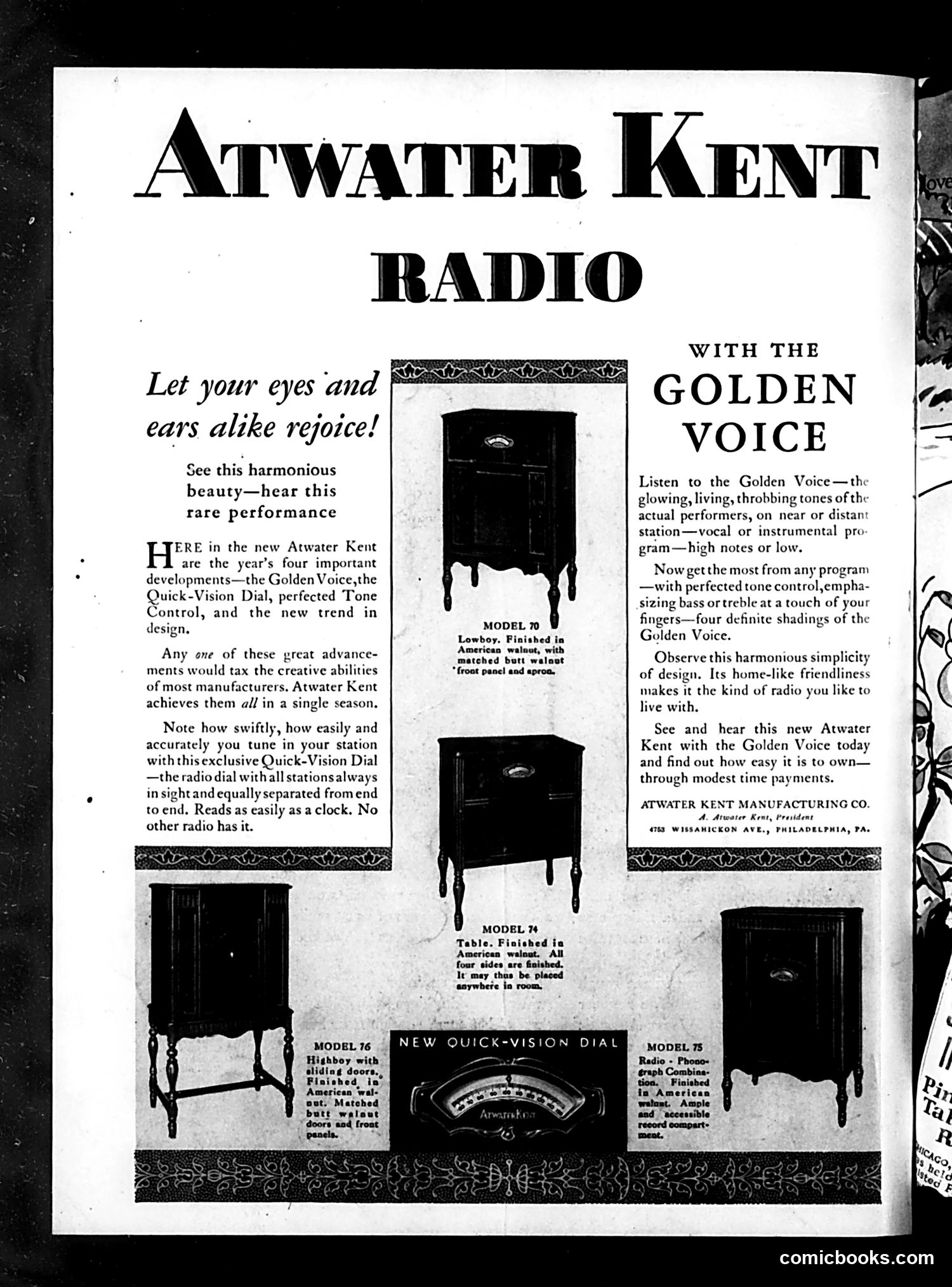
Analysis This is not a cartoon or satire—it's a straightforward radio advertisement from what appears to be the 1920s-early 1930s. Atwater Kent Manufacturing Company promotes their new radio models, emphasizing four technological innovations: the "Golden Voice" (improved sound quality), the "Quick-Vision Dial" (easier tuning), tone control, and aesthetic design. The ad shows five cabinet styles (Models 70, 74, 75, and 76) appealing to different home décor preferences—from lowboys to tables to phonograph combinations. The messaging targets middle-class consumers: radios are now affordable through "modest time payments," beautify the home, and offer superior performance. The phrase "Let your eyes and ears alike rejoice" reflects the era's enthusiasm for radio as both furniture and entertainment technology. This represents the radio's transition from technical novelty to domestic necessity during the early 20th century.