life
Life — November 14, 1930
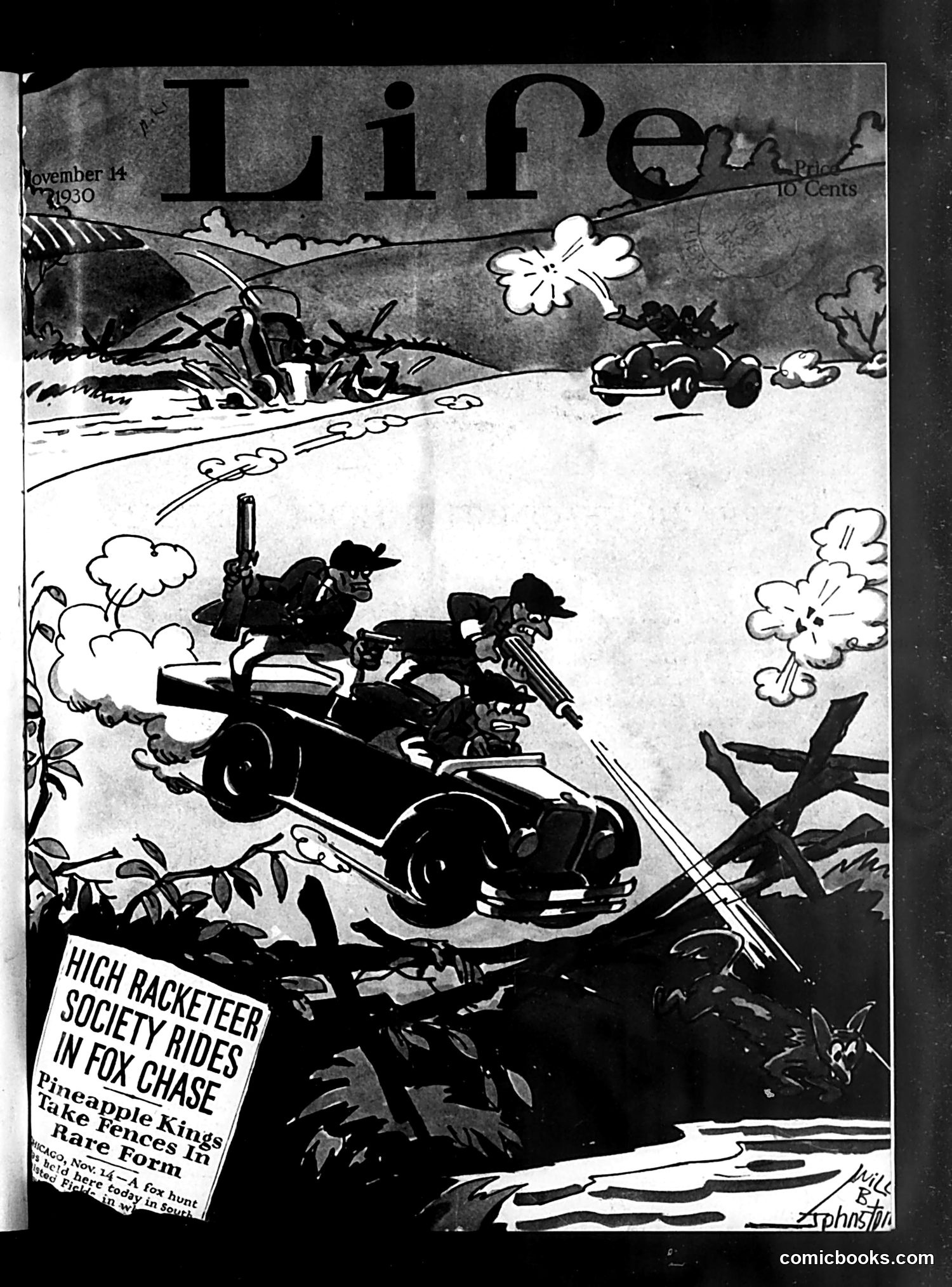
Life Magazine Cover - November 14, 1930 This is the cover of Life magazine's satirical issue. The main illustration depicts a chaotic car chase scene with figures in a vehicle firing weapons while pursuing what appears to be a fox (visible in the lower right). The headline reads "HIGH RACKETEER SOCIETY RIDES IN FOX CHASE" with additional text mentioning "Pineapple Kings," "Fence In," and "Rare Form." The satire appears to conflate traditional fox hunting (an upper-class sport) with 1920s-30s gangster activity and "racketeering" (organized crime). The "pineapples" likely refers to grenades, a period slang term. The joke suggests wealthy "high society" individuals are indistinguishable from violent criminals in their behavior—treating hunting like a mob hit, complete with firearms and explosives.
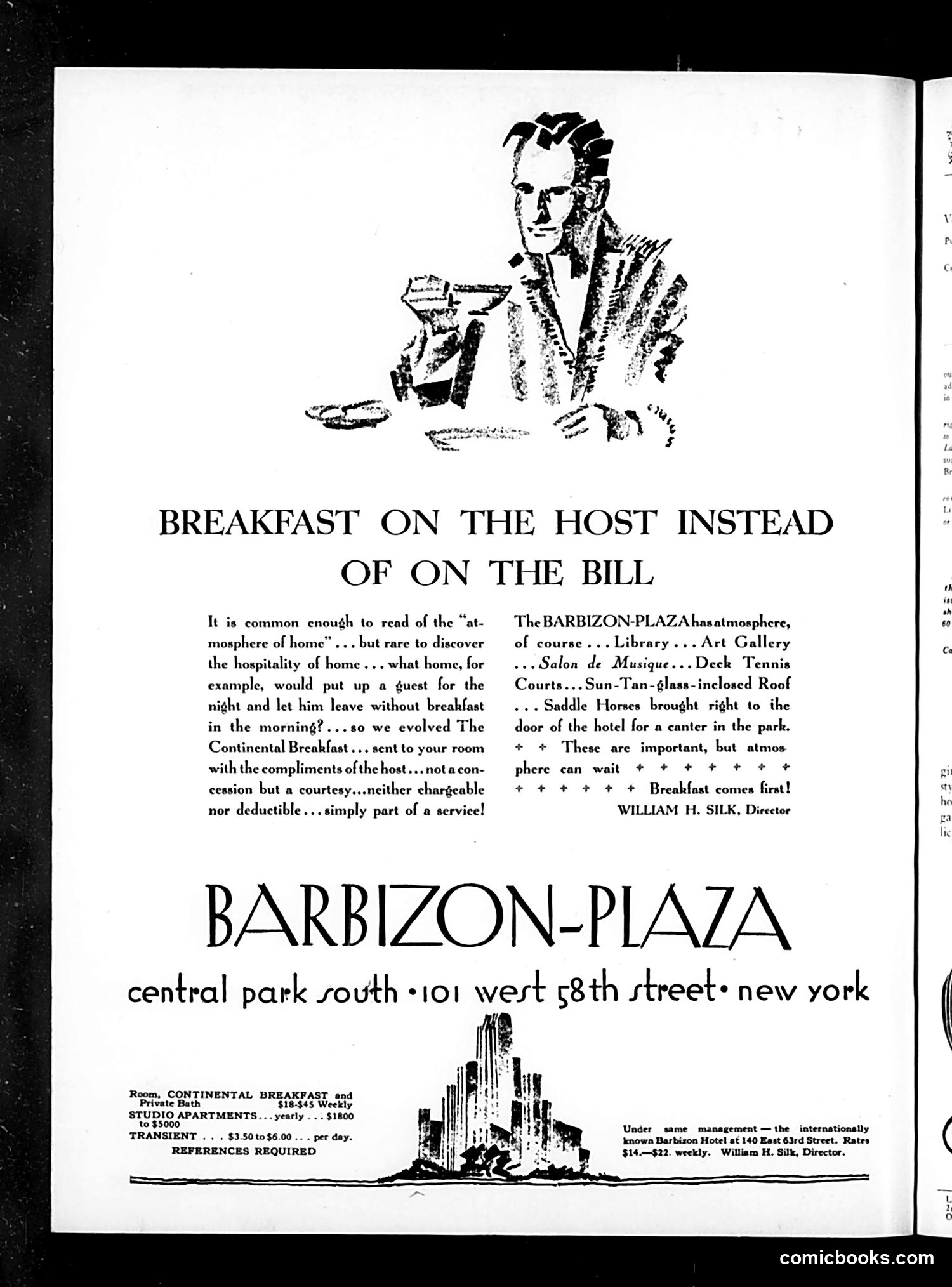
Barbizon Plaza Hotel Advertisement This is primarily a hotel advertisement, not political satire. It promotes the Barbizon-Plaza on Central Park South in New York City. The sketch depicts a man at breakfast—the advertisement's central concept. The copy humorously addresses a practical hospitality issue: guests were sometimes sent to their rooms without complimentary breakfast, then charged for it separately. The Barbizon-Plaza positions its "Continental Breakfast" as a courteous service included with accommodation, not an additional bill. The hotel highlights amenities (library, art gallery, tennis courts, saddle horses) and quotes Director William H. Silk emphasizing that "Breakfast comes first!"—a tongue-in-cheek promise that hospitality begins with feeding guests. Room rates and references are listed at bottom. This reflects early-20th-century luxury hotel marketing strategies.
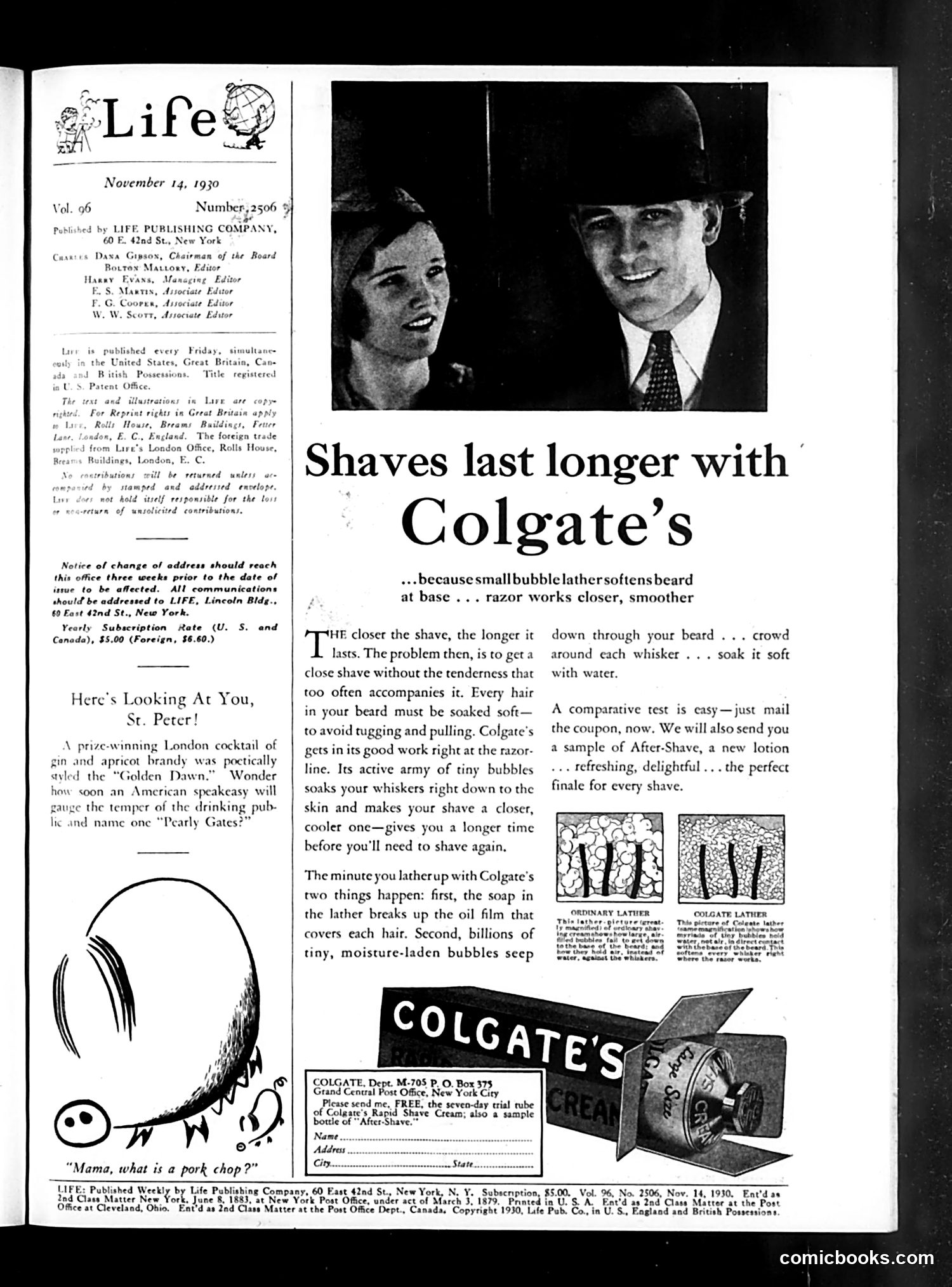
Analysis: Colgate's Shaving Cream Advertisement This page is primarily a Colgate's shaving cream advertisement with minimal satire content. The main visual shows a couple (woman on left, man on right in hat) above the headline "Shaves last longer with Colgate's." The ad's central claim is that Colgate's lather softens beard hair at the base, allowing razors to work more closely and smoothly, resulting in longer-lasting shaves. The only cartoonish satire appears at bottom left: a simple sketch of a face with exaggerated stubble and the caption "Mama, what is a pork chop?" — a mild joke suggesting the unshaven beard resembles the coarse texture of a pork chop. The page includes comparative diagrams of ordinary versus Colgate lather, a mail-in coupon, and product images. This is essentially commercial content, not political satire.
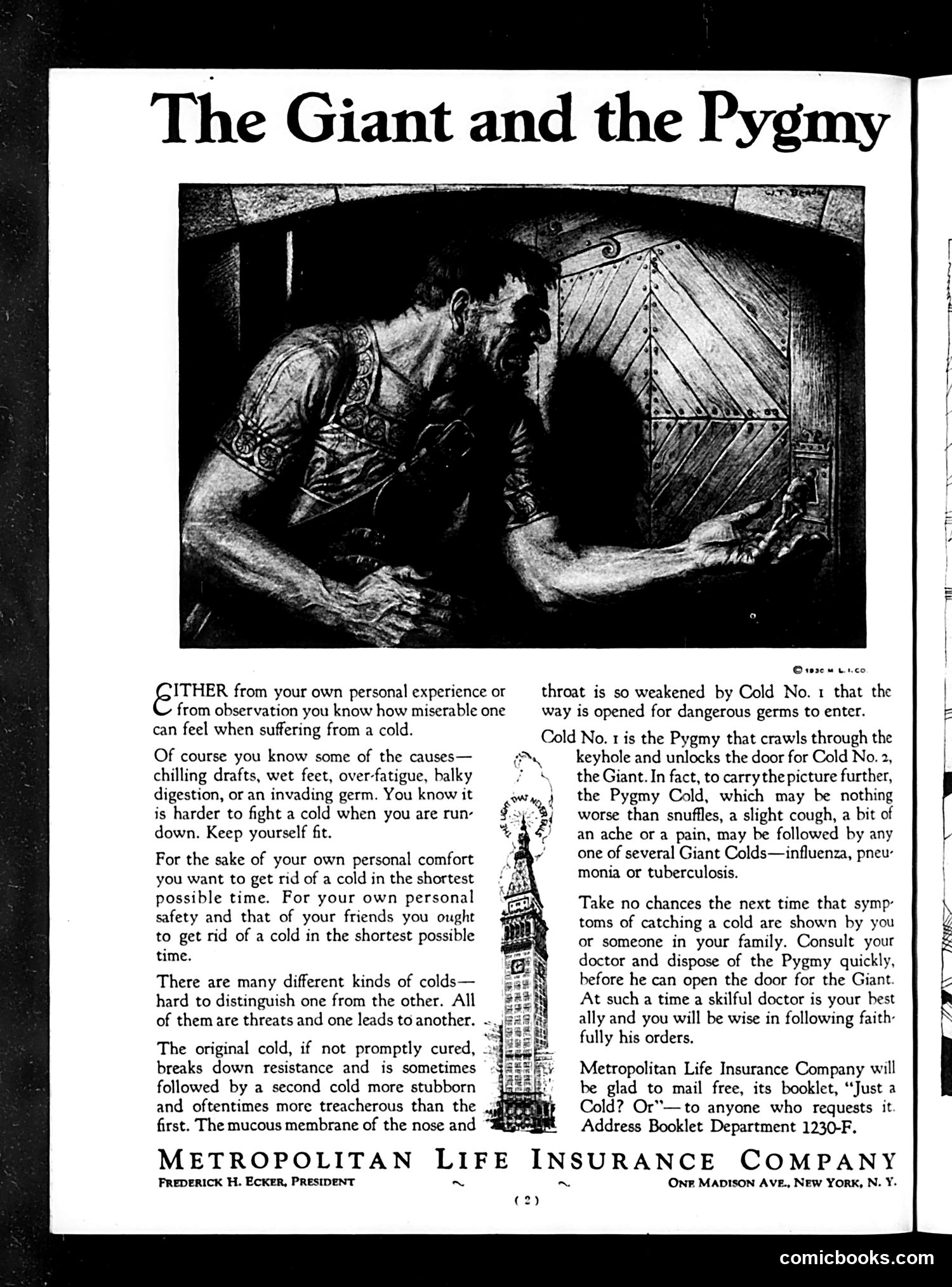
"The Giant and the Pygmy" - Medical Allegory Advertisement This is a Metropolitan Life Insurance Company advertisement using medical allegory. The illustration depicts a large bearded man (the "Giant") being menaced by a tiny figure (the "Pygmy"), representing how a small, initial cold can lead to serious illness. The satire works by inverting normal power dynamics: the tiny "Pygmy Cold" is portrayed as dangerously deceptive, potentially opening the door to more severe infections like influenza, pneumonia, or tuberculosis (the "Giant Colds"). The text warns readers not to dismiss minor cold symptoms, advising prompt medical consultation. This reflects early 20th-century health messaging when infectious diseases were serious threats. The advertisement uses dramatic narrative to encourage life insurance customers to prioritize preventive health care and doctor visits.
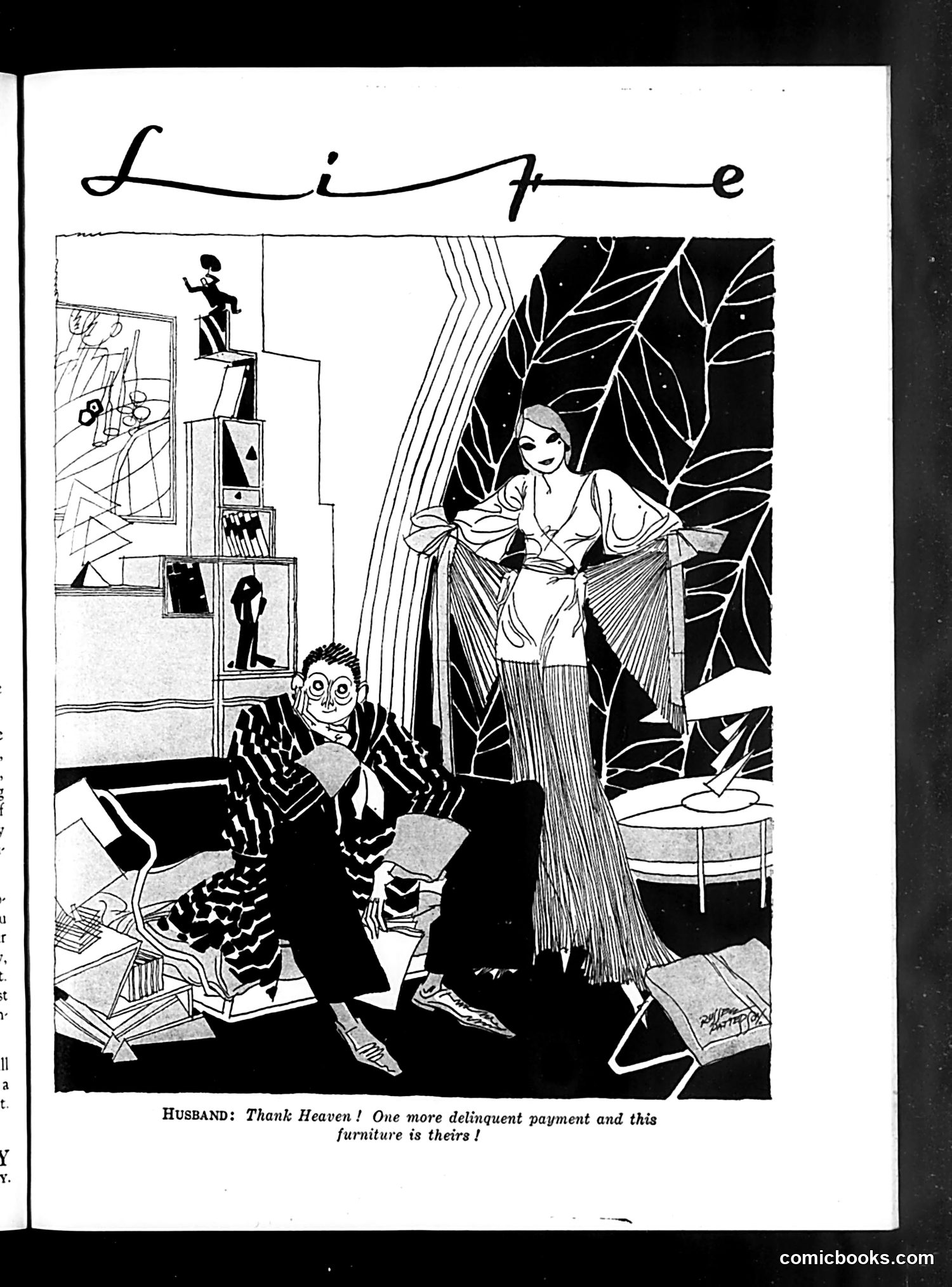
"Life" Cartoon Analysis This cartoon satirizes marital financial struggles during what appears to be the early-to-mid 20th century. The husband, dressed formally and wearing glasses, sits surrounded by bills and financial documents, expressing relief that "one more delinquent payment" will result in creditors taking the furniture—implying he welcomes losing possessions to escape debt obligations. The wife stands elegantly in an elaborate interior with fashionable curtains and decorative plants, seemingly oblivious to or unconcerned with the family's financial crisis. The contrast between her refined appearance and the husband's stress highlights the satire: the wife's expensive tastes and home furnishings have contributed to the family's debt problems, yet she remains detached from the consequences. The joke reflects contemporary anxieties about consumer debt and marital discord over spending habits.
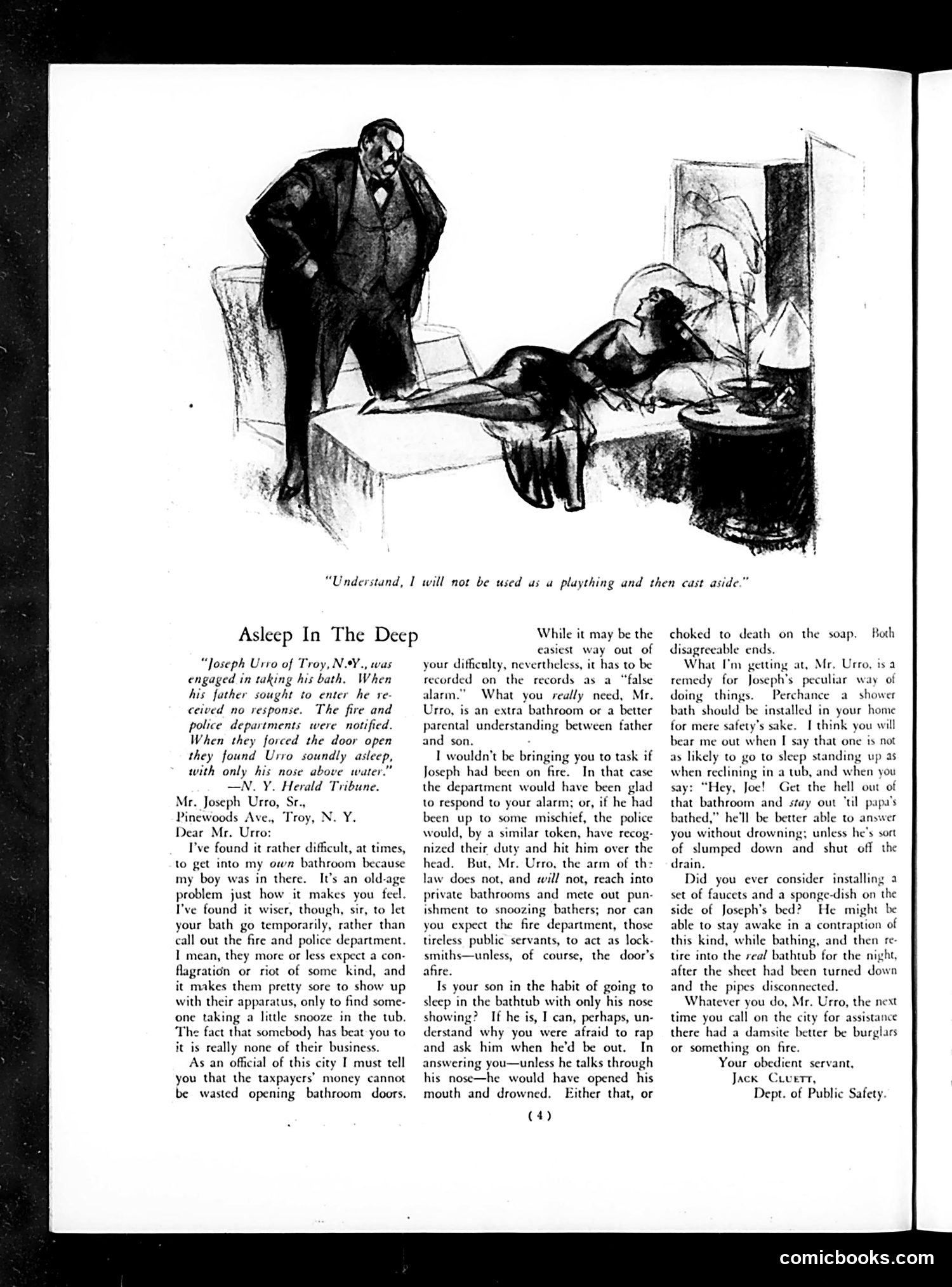
"Asleep in the Deep" This satirical piece mocks a real incident involving Joseph Urro of Troy, New York, whose father couldn't wake him to exit the bathtub. The illustration shows a man standing over someone asleep in a bathtub—the dangerous situation referenced. The satire targets bureaucratic absurdity: when authorities investigated, they blamed Urro's "deep sleep" rather than addressing the genuine hazard. Jack Cluett from the Department of Public Safety responds with tongue-in-cheek advice, essentially refusing city responsibility for bathroom safety by suggesting private solutions (extra bathrooms, faucets, sponges). The joke is that officials deflect from a legitimate public safety concern through ridicule and circular logic, protecting taxpayer money while ignoring obvious dangers of unresponsive sleepers in bathtubs.
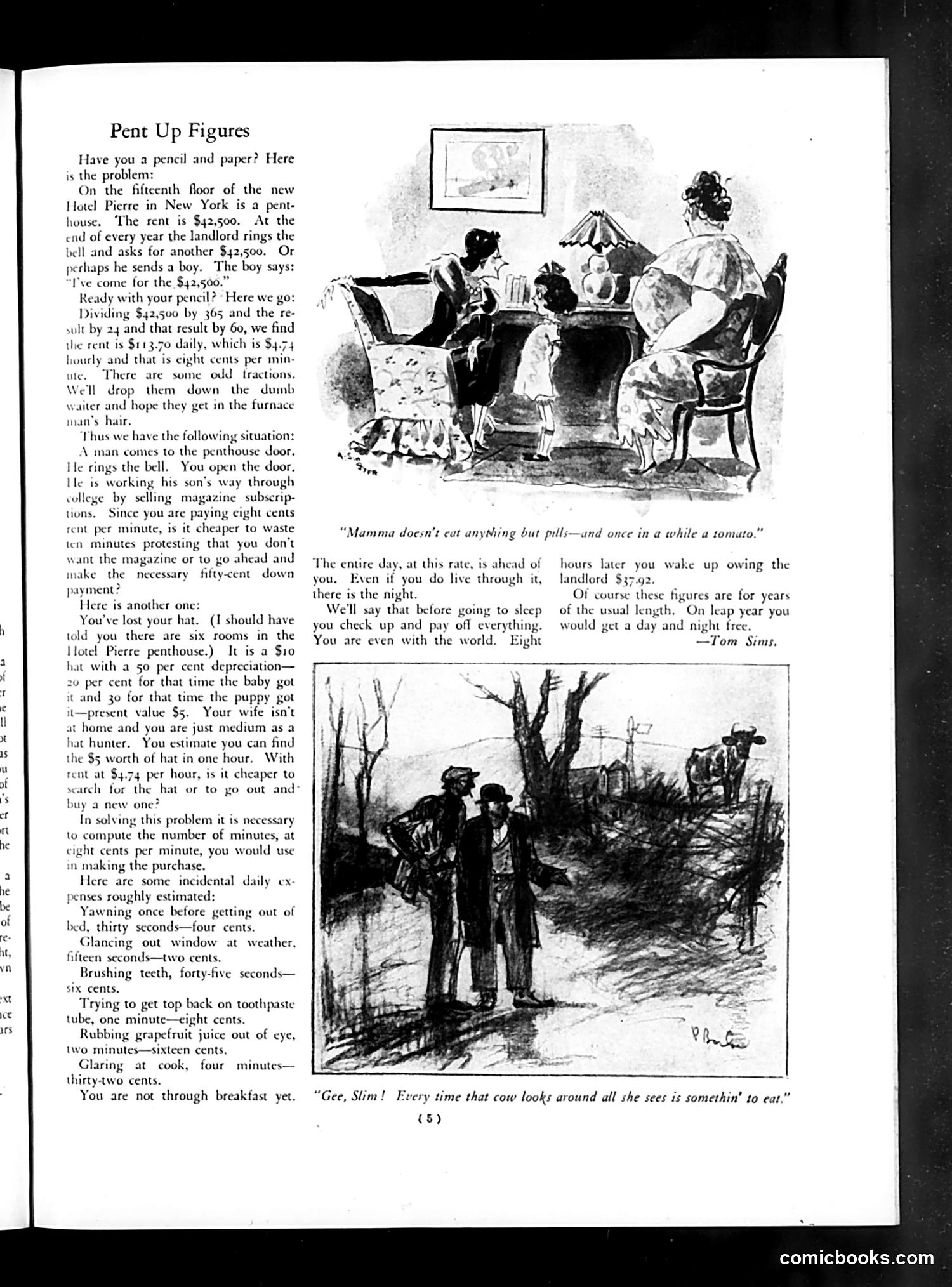
"Pent Up Figures" - Life Magazine Satire This page presents mathematical puzzles about household economics disguised as humor. The main scenario concerns a penthouse tenant at New York's Hotel Pierre paying $12,500 yearly rent—an astronomical sum for the era. The satire targets wealth inequality and the cost of living. The article mocks the absurdity of calculating daily expenses (rent breaks down to $34.24 daily) while listing incidental costs like toothpaste and grapefruit juice. The cartoon shows a wealthy woman telling her cook "Mamma doesn't eat anything but pills—and once in a while a tomato," sardonically suggesting the rich must economize despite obscene housing costs. The lower cartoon's caption about a cow is unrelated commentary on rural life.
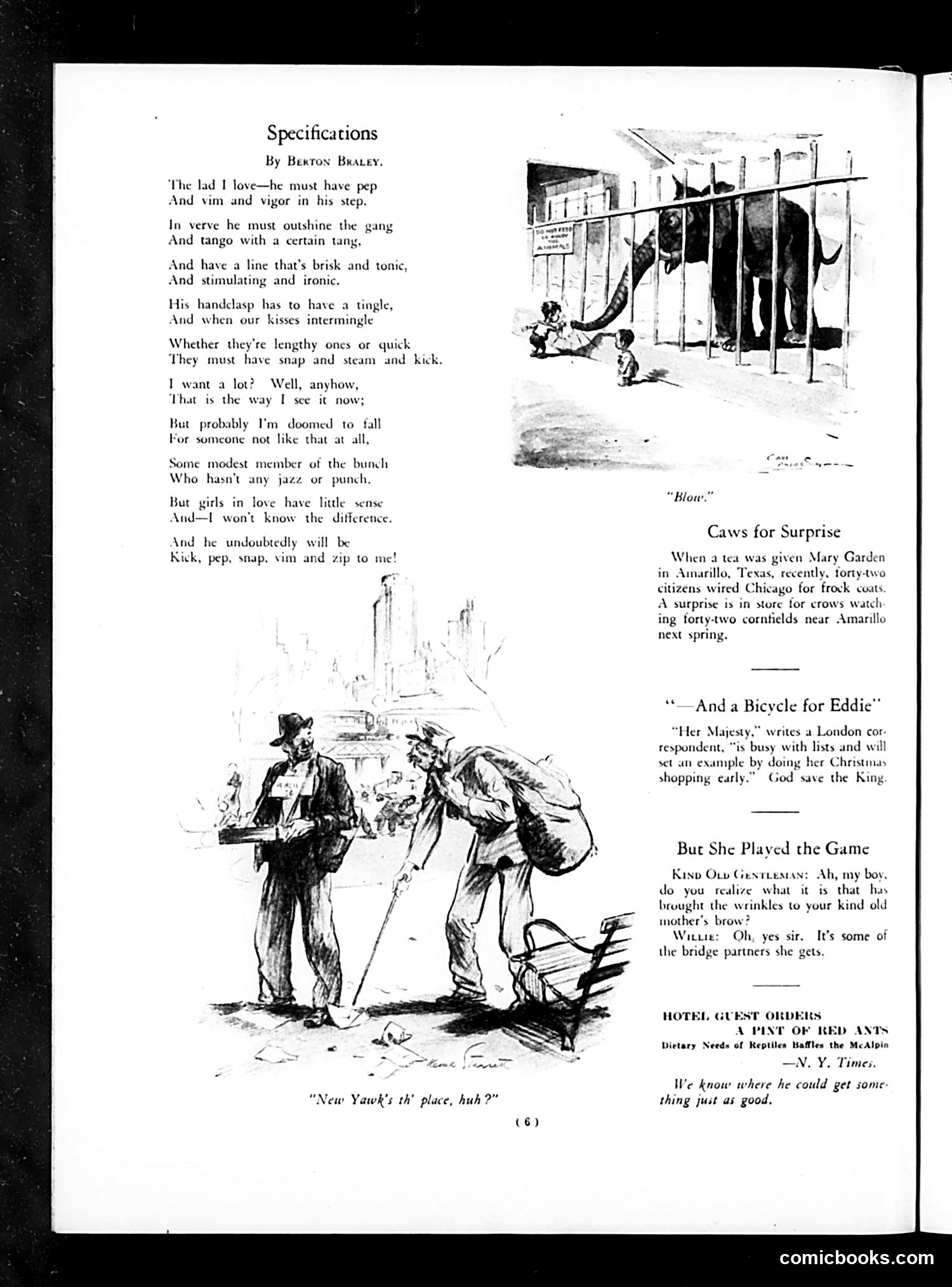
Analysis of Life Magazine Page This page contains a poem titled "Specifications" by Berton Braley describing idealized masculine qualities in a romantic partner—someone with "pep," "vim and vigor," wit, and physical affection ("kick, pep, snap, vim and zip"). The accompanying sketch depicts two men in conversation, captioned "New Yawk's th' place, huh?" The cartoon satirizes masculine braggadocio and male bonding, likely mocking exaggerated expectations about finding ideal romantic partners. The right column contains brief humorous anecdotes unrelated to the cartoon: one about cattle sent to Texas, another about Christmas shopping, and a dialogue about bridge game difficulties. The overall page reflects early-20th-century American humor about dating, masculinity, and domestic life, targeting middle-class expectations.
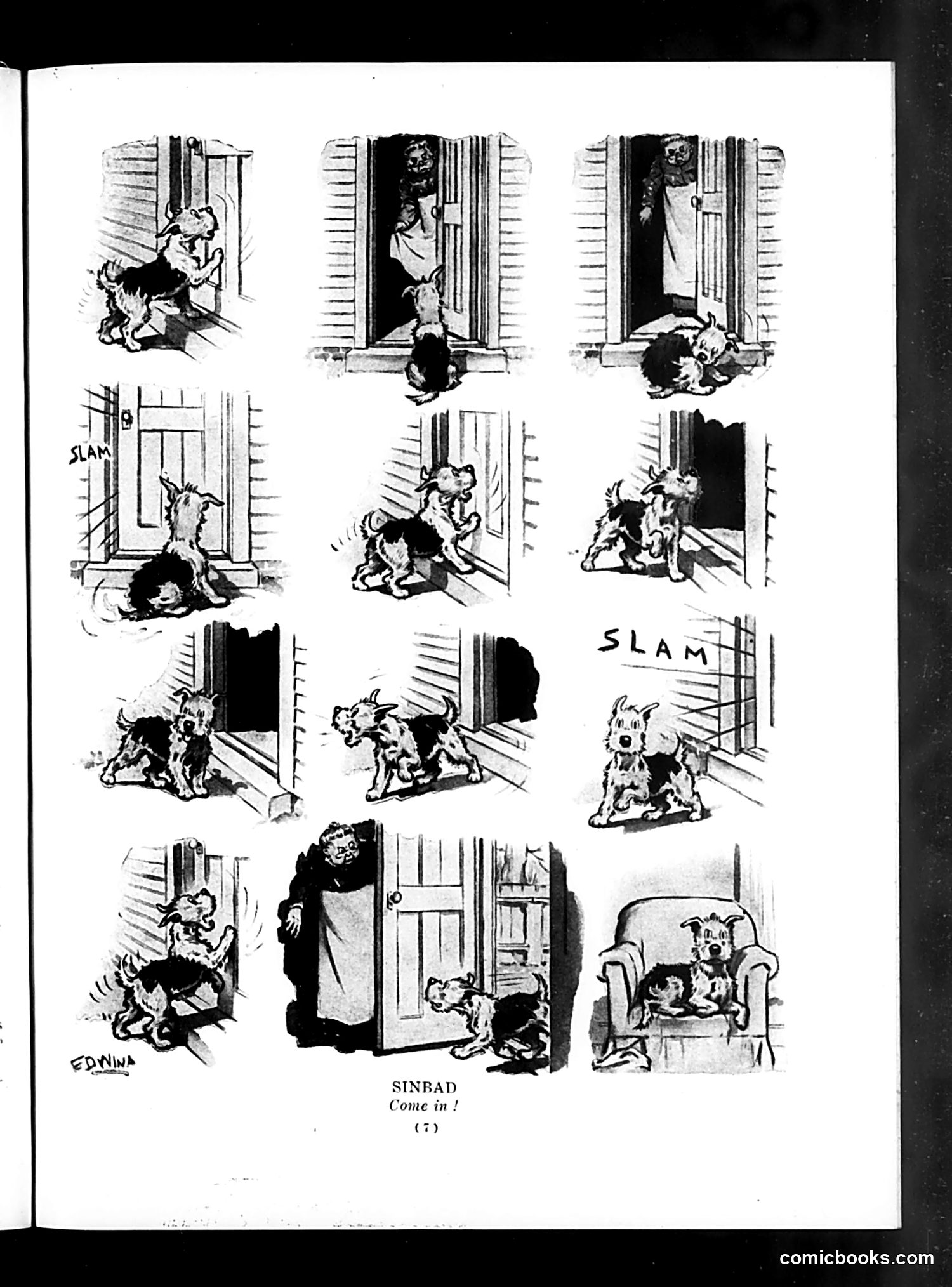
"Sinbad: Come In!" Comic Strip Analysis This is a sequential comic strip featuring a small dog named Sinbad repeatedly trying to enter a house through a door, while a woman (apparently the homeowner) repeatedly closes it on him—often slamming it forcefully, as indicated by the "SLAM" sound effects. The humor is physical comedy: the dog persistently attempts entry despite repeated rejections, while the exasperated woman grows increasingly frustrated. The strip demonstrates a common domestic scenario of the early-to-mid 20th century—an unwanted pet or animal pestering a homeowner. The joke relies on slapstick timing and the dog's determination contrasted against human irritation. The artist's signature "EDWINA" appears in the lower left. This represents straightforward comic entertainment rather than political satire.
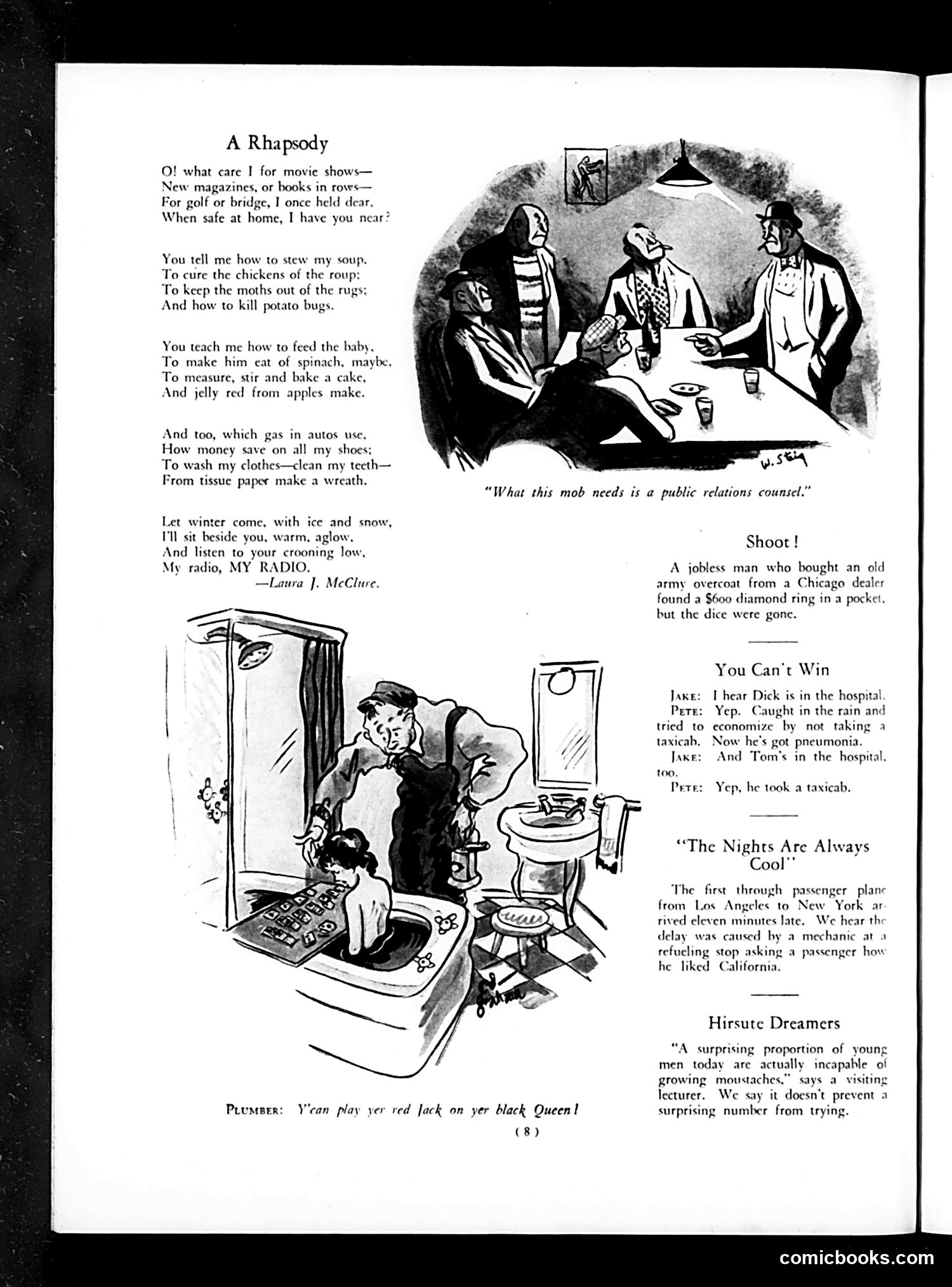
Analysis of Life Magazine Page "A Rhapsody" is a poem by Laura J. McClure celebrating domestic radio as entertainment and companionship—a relatively new technology at the time. The speaker values radio over expensive entertainments like movies or golf. The main cartoon shows four men discussing public relations, with the caption "What this mob needs is a public relations counsel." This satirizes how businesses were increasingly hiring PR specialists to manage their public image and corporate messaging. Lower cartoons include brief humorous anecdotes ("You Can't Win," "Shoot!," "The Nights Are Always Cool," "Hirsute Dreamers") and a plumbing joke. These are typical Life magazine filler—quick, topical gags about everyday life and current social trends. The page reflects 1920s-30s concerns: new technology adoption, corporate image-making, and social awkwardness.
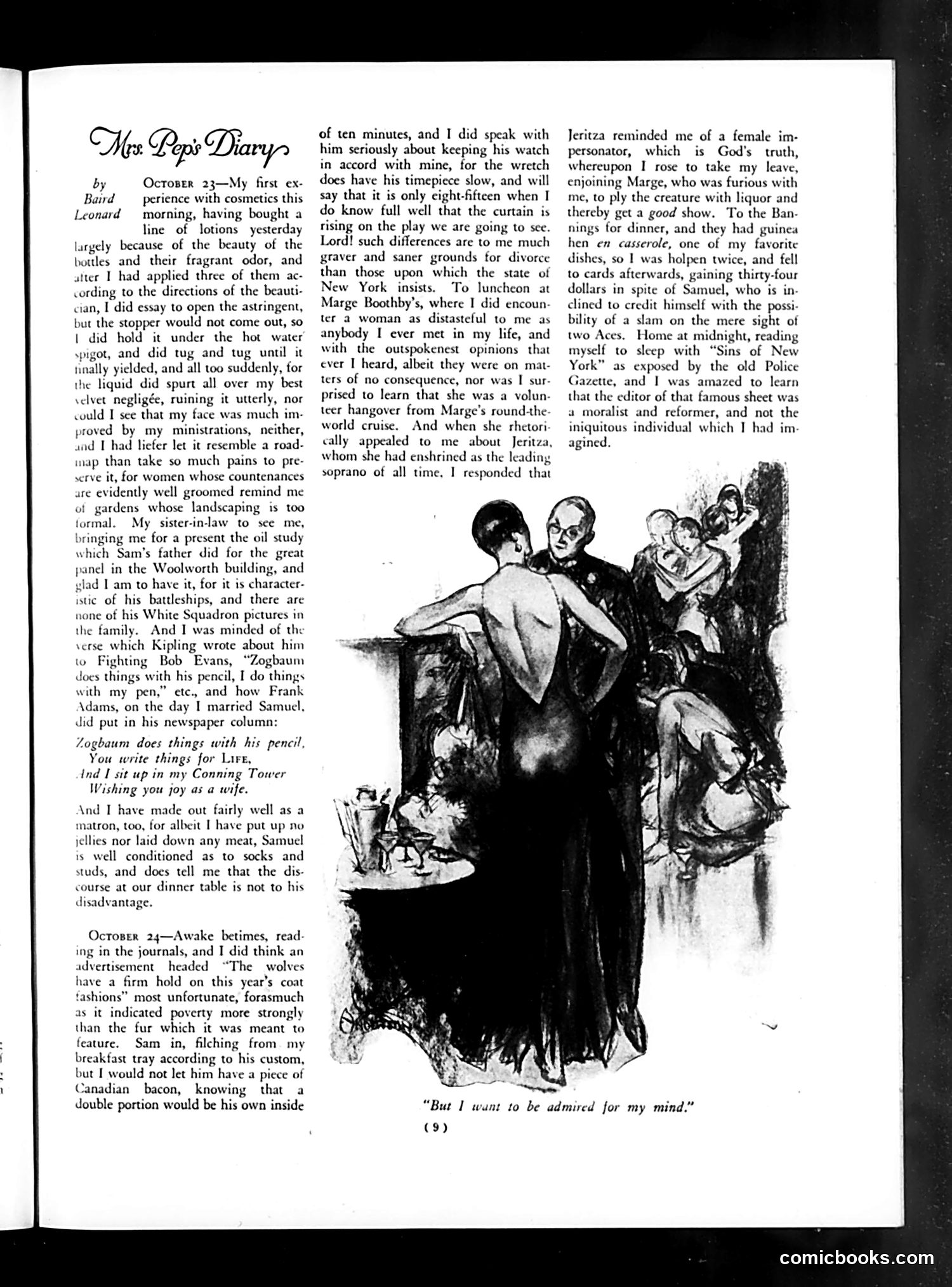
Analysis of "Mrs. Pep's Diary" Page This is a diary entry from a satirical column titled "Mrs. Pep's Diary" by Baird Leonard, dated October 23-24. The accompanying sketch illustrates a social scene with multiple figures in what appears to be an interior setting. The diary entries mock upper-class social conventions and marital dynamics. Mrs. Pep discusses cosmetics, divorce grounds in New York, and encounters with a "distasteful" woman at Marge Boothby's lunch. She references a soprano named Jeritza and critiques a "Sins of New York" exposé in a police gazette. The illustration's caption reads "But I want to be admired for my mind," suggesting ironic commentary on women claiming intellectual merit while engaged in superficial social posturing. The satire targets affluent New York society's pretensions and women's contradictions between stated values and actual behavior.
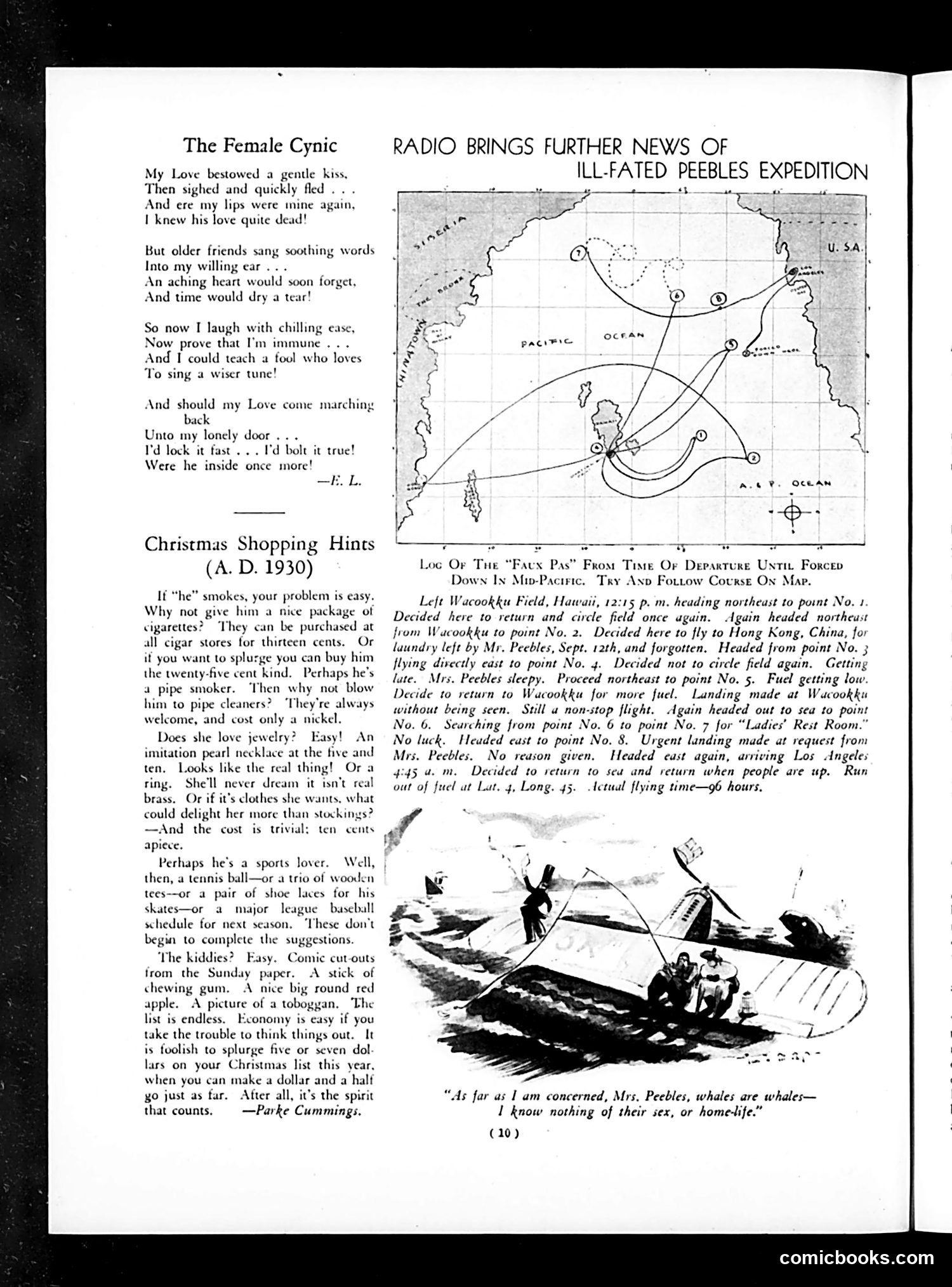
Analysis of Life Magazine Page (circa 1930) This page contains three distinct items: 1. "The Female Cynic" — A poem by E.L. about romantic disillusionment, where a woman decides to harden her heart after a lover's departure, adopting cynicism as self-protection. 2. "Christmas Shopping Hints (A.D. 1930)" — Humorous gift suggestions attributed to Parke Cummings, offering economical Depression-era alternatives (comic cuts, chewing gum, shoelaces) with tongue-in-cheek commentary about making "a dollar and a half go just as far." 3. "Radio Brings Further News of Ill-Fated Peebles Expedition" — A satirical story with accompanying map and illustration. It mocks an expedition member (Mrs. Peebles) lost in the Pacific, with radio reports of repeated failed landing attempts. The cartoon caption quotes her dismissive attitude toward whales, suggesting absurdist humor about her plight. The overall tone reflects 1930s Depression-era satire: economical, cynical, and comedic about misfortune.
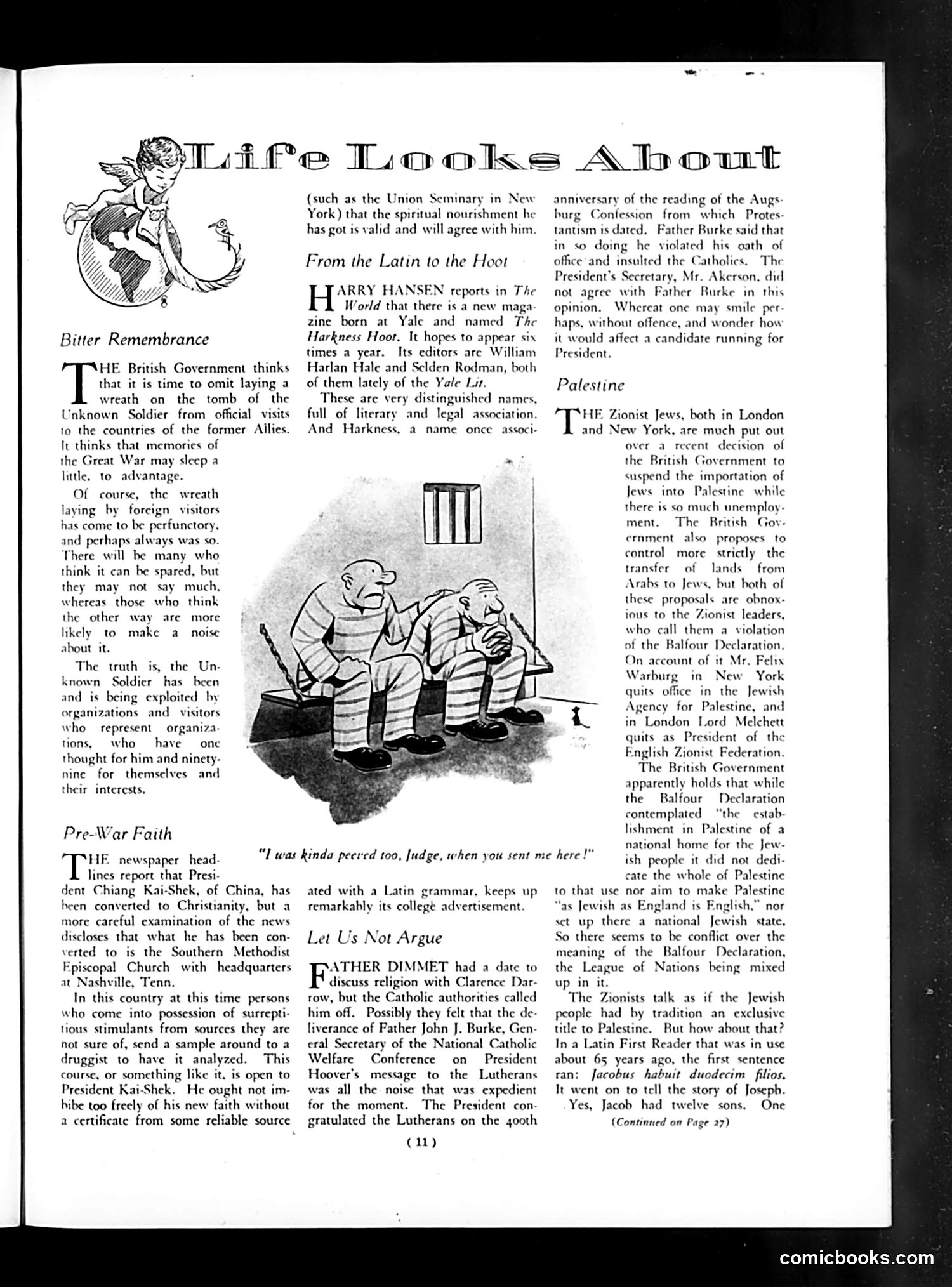
Analysis of "Life Looks About" Page This satirical page from *Life* magazine contains several commentary sections on contemporary issues. The central cartoon depicts two men in prison stripes behind bars, with the caption "I was kinda peeved too, judge, when you sent me here!"—likely satirizing judicial inconsistency or hypocrisy. The page addresses: British war memorials policy, a new Yale magazine called *The Harkness Hoot*, Chinese leader Chiang Kai-Shek's reported conversion to Christianity (presented skeptically), the Zionist movement's conflict with British Palestine policy, and Father Dimmet's religious debates with the Catholic authorities. The tone is consistently critical of authority figures and institutional claims, using humor to question their credibility and motives.
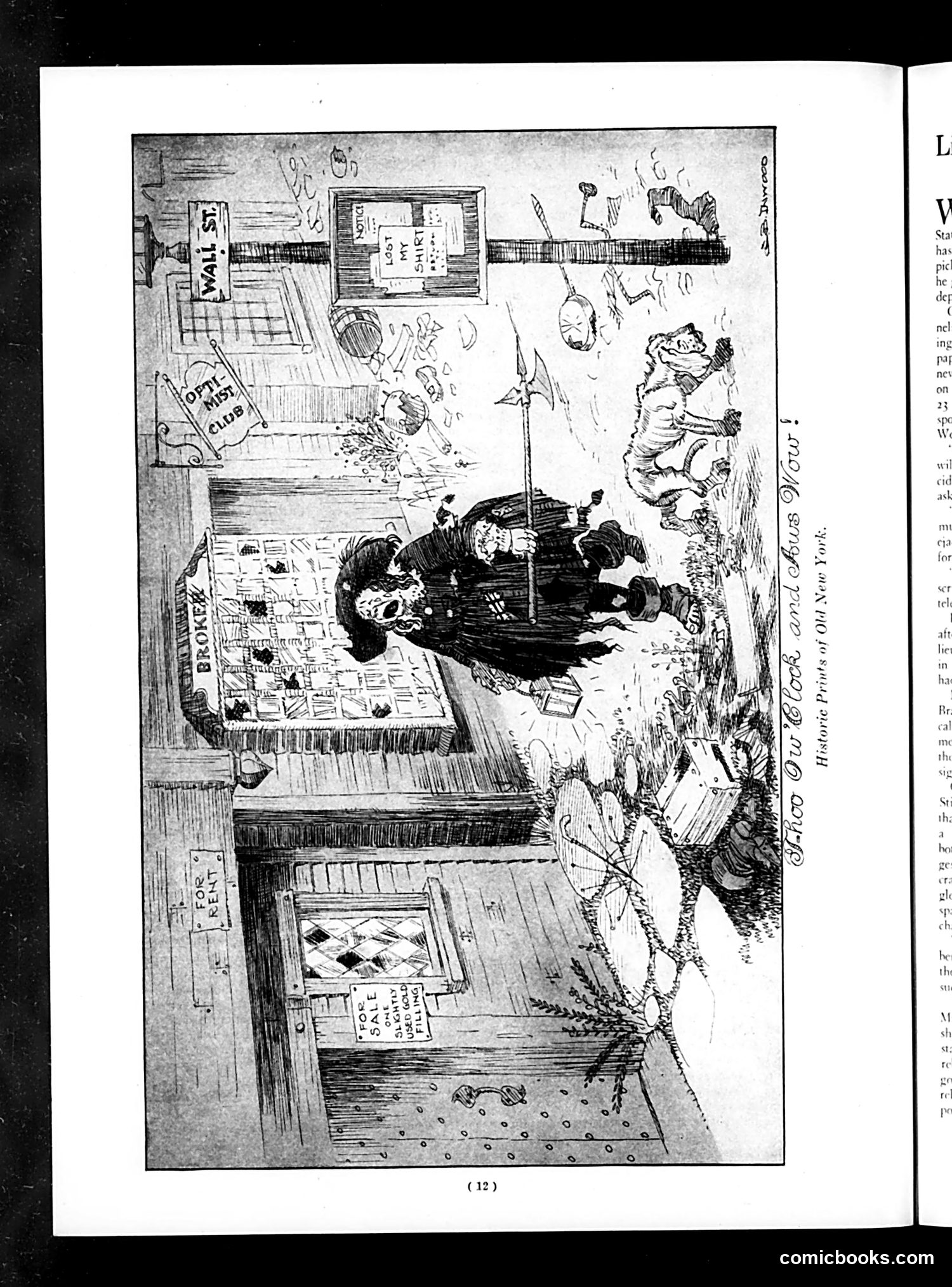
Analysis This is a single satirical cartoon titled "Our Stock and Odds" (subtitle appears to reference New York Park). The image depicts a chaotic indoor scene—likely a stock exchange or financial trading floor—viewed from above. A central figure in dark clothing (appears to be a broker or trader) stands amid scattered papers and documents labeled with stock listings and prices. The cartoon satirizes the frenetic, disorganized nature of stock market trading and financial speculation. Papers fly everywhere, suggesting chaos and disorder. The perspective and composition emphasize the madness of trading activity. This reflects early 20th-century criticism of Wall Street's speculative practices and the apparent irrationality of financial markets—themes that Life magazine frequently mocked through such cartoons.
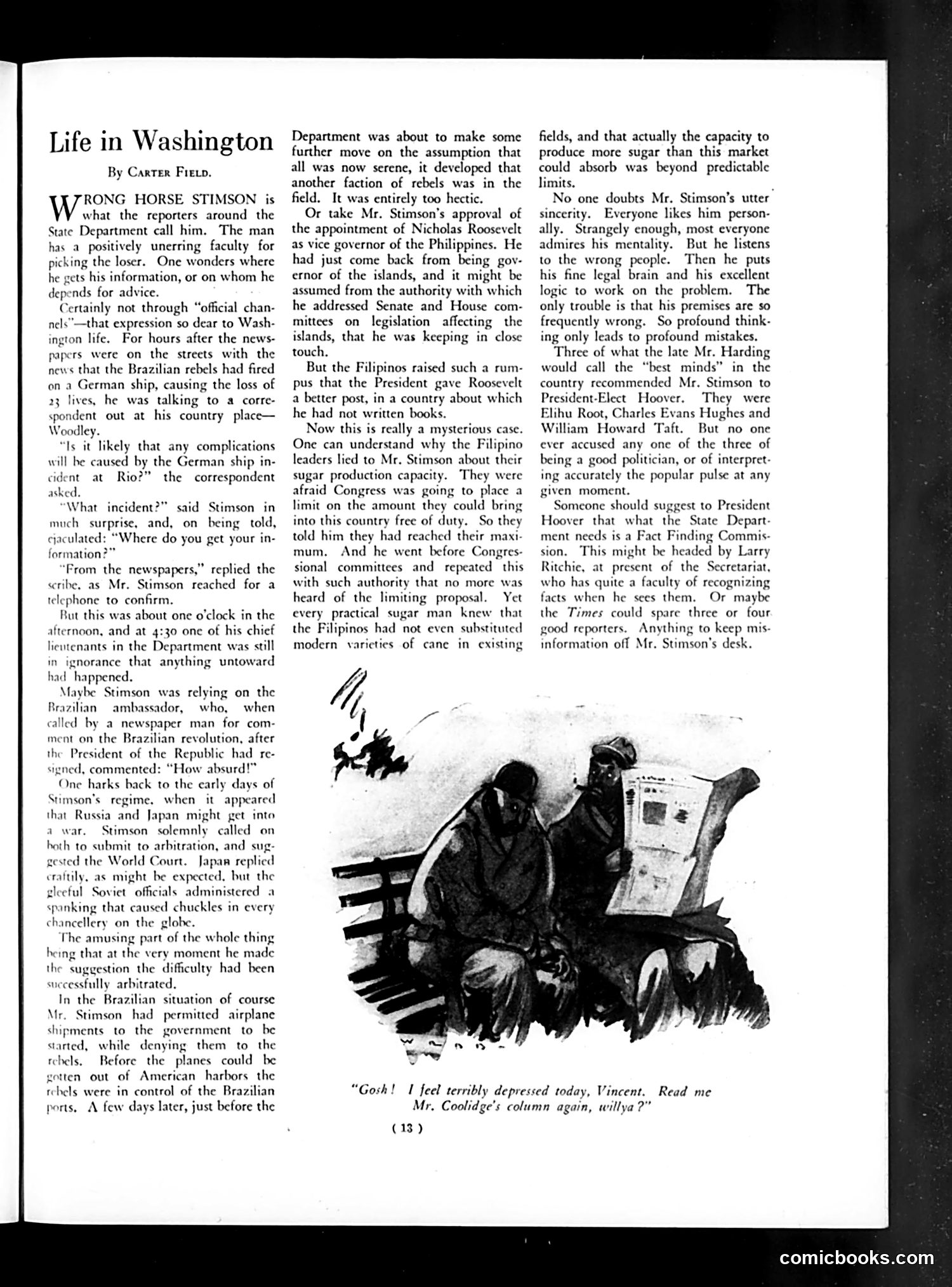
Political Cartoon Analysis This cartoon depicts a character reading a newspaper while appearing distressed. The caption reads: "Gosh! I feel terribly depressed today, Vincent. Read me Mr. Coolidge's column again, will ya?" The satire targets Calvin Coolidge's newspaper column, suggesting it was so boring or uninspiring that reading it repeatedly would only deepen one's depression. This mocks Coolidge's public persona as famously taciturn and dull—a running joke during his presidency (1923-1929). The cartoon's humor relies on the contrast between expecting uplifting reading material and Coolidge's characteristically dry, monotone writing style. It reflects contemporary criticism that Coolidge lacked charisma or inspirational qualities as a public figure, making his written words particularly tedious to his audience.
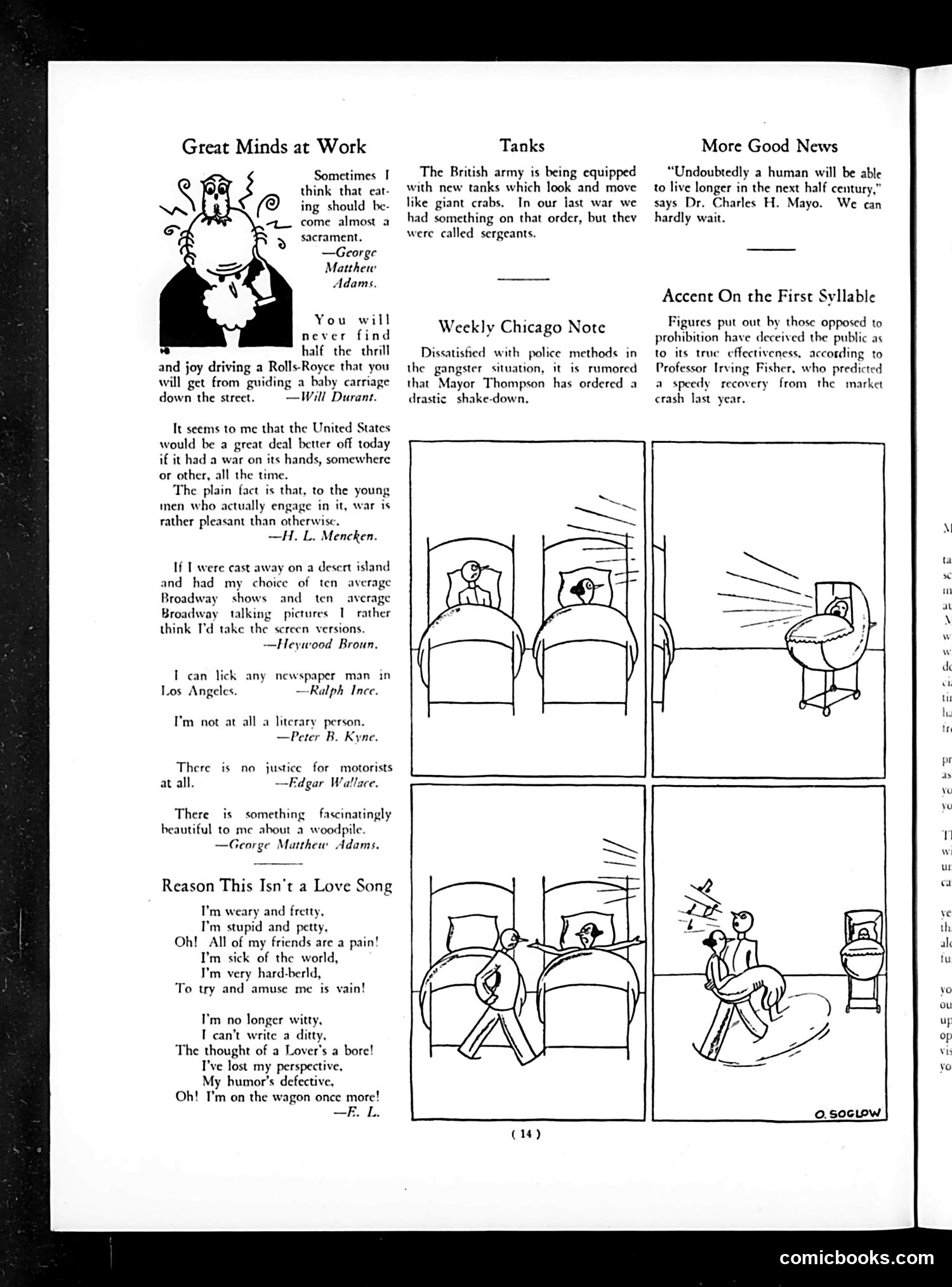
Analysis of Life Magazine Page This page contains humorous quotations under "Great Minds at Work" and a four-panel comic strip by O. Soglow depicting a domestic noise complaint scenario. The comic's joke concerns a neighbor's complaints about a baby's crying. Two people lie in bed while a baby cries in an adjacent room; in subsequent panels, the frustrated neighbor emerges and confronts them. The final panel shows the neighbor returning to find the baby's cradle now positioned outside their door—a retaliatory prank suggesting petty escalation of domestic disputes. The accompanying quotes represent early 20th-century notable figures (George Matthew Adams, Will Durant, H.L. Mencken, etc.) offering cynical or whimsical observations about war, motorists, and social conditions. The humor relies on recognizable domestic frustration and the absurdist solution of relocating the problem to the complainer's own threshold.
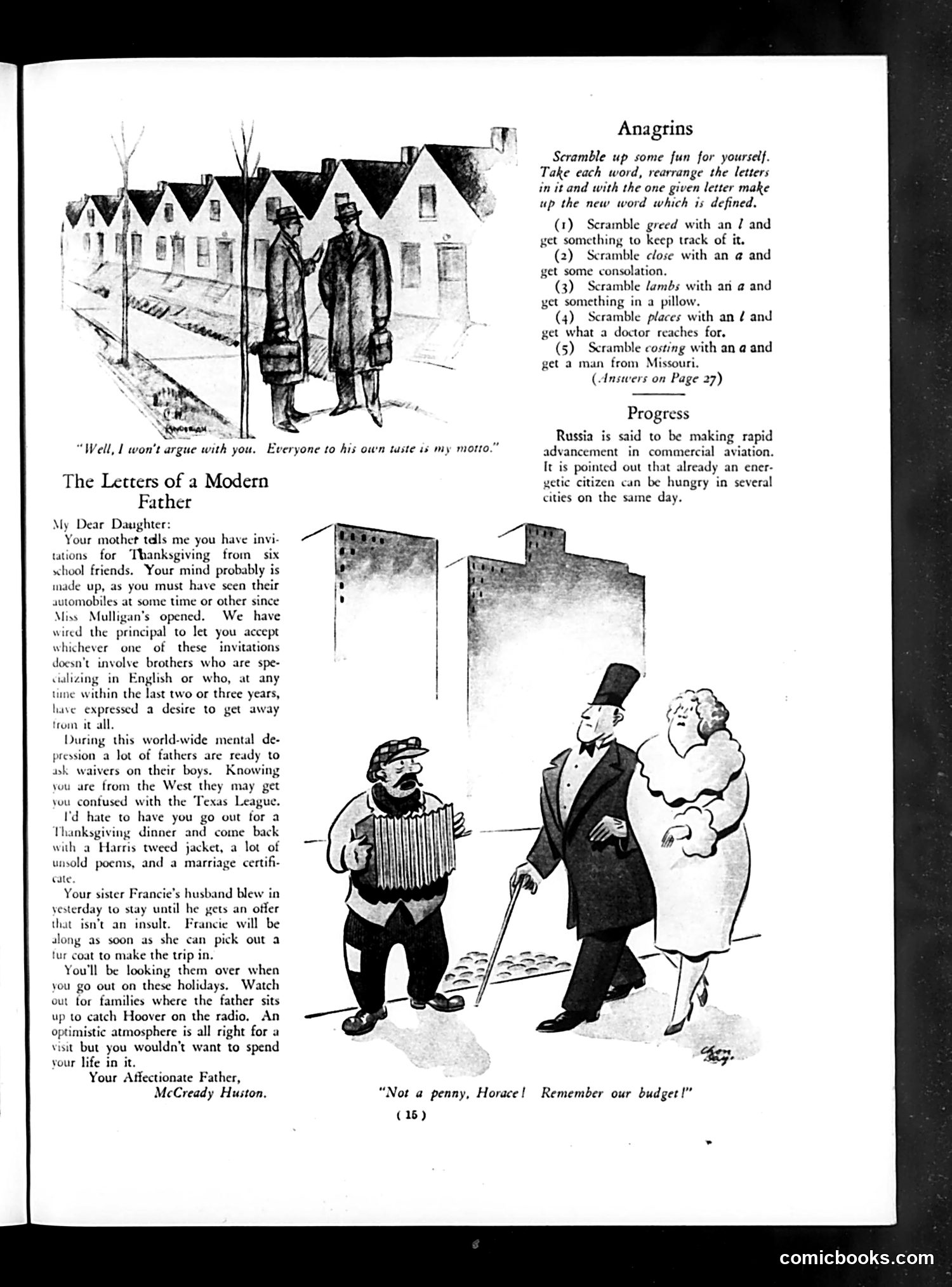
Analysis of Life Magazine Page "The Letters of a Modern Father" is a humorous piece presenting a father's advice to his daughter about Thanksgiving invitations. The satire critiques Depression-era social anxieties: fathers worry their children will be confused by regional differences (mentioned are "Texas Leaguers"), and they're concerned about the appearance of family stability during economic hardship. The bottom cartoon shows a couple (Horace and his wife) declining an expensive outing—she reminds him "Not a penny, Horace! Remember our budget!" This illustrates 1930s Depression-era financial constraint as a domestic reality, where even modest spending required careful negotiation between spouses. Both pieces gently satirize how economic depression infiltrated everyday family decisions and middle-class social pretensions.
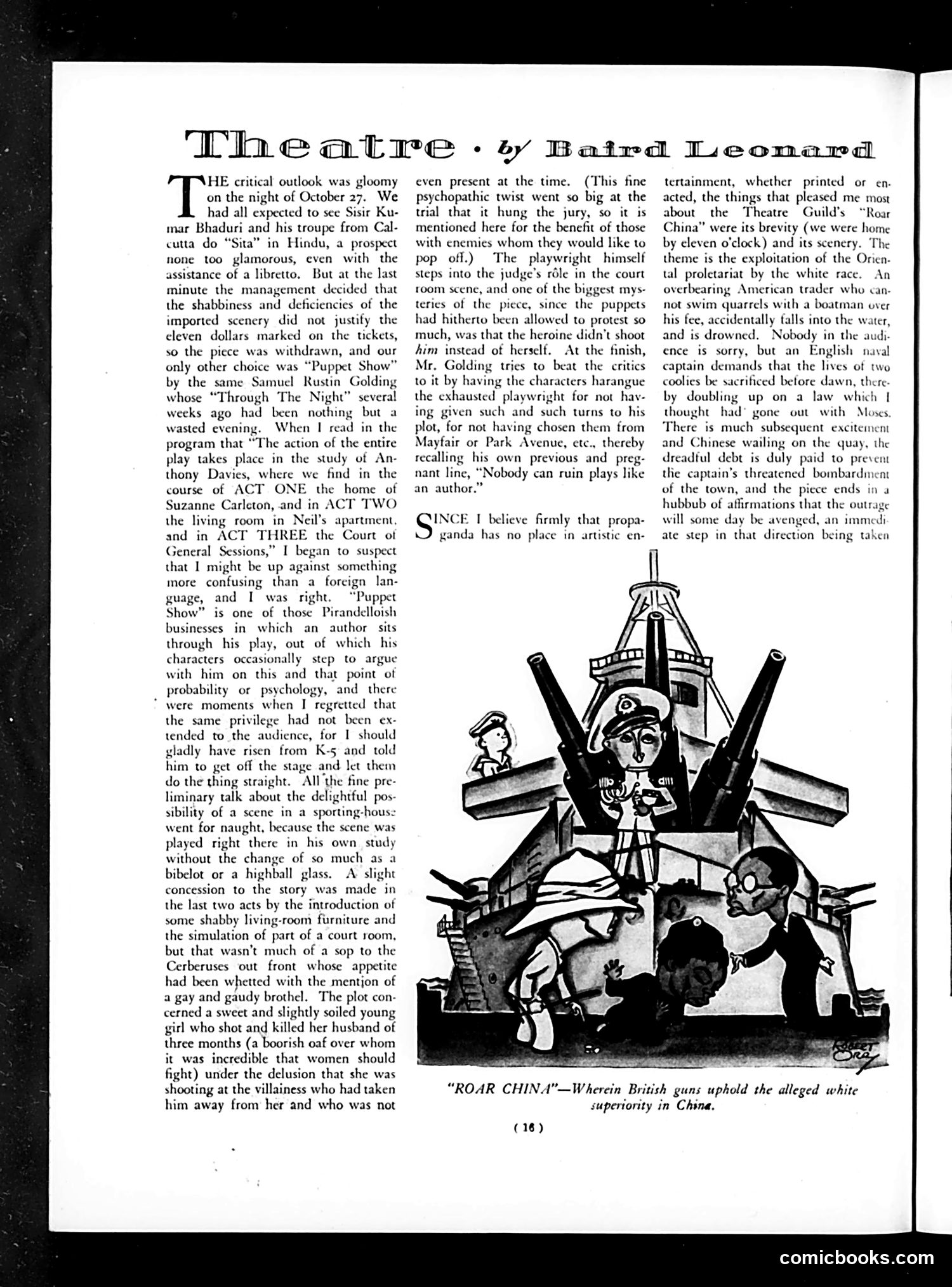
Analysis of "Theatre" by Baird Leonard This theater review critiques a play called "Puppet Show" by Samuel Knobel. The reviewer faults the play for being confusing and overly self-conscious—the author essentially sits onstage arguing with his own characters about plot and psychology rather than letting the story unfold naturally. The accompanying illustration for "Roar China!" depicts British military power (guns, warship) asserting "white superiority in China." This appears to reference a play about Western imperialism in Asia, likely referencing real colonial conflicts of the era. The reviewer argues against propagandistic theater, believing art should entertain rather than preach ideology—whether that's author self-indulgence or political messaging. Both plays discussed apparently failed by prioritizing concept over genuine dramatic engagement.
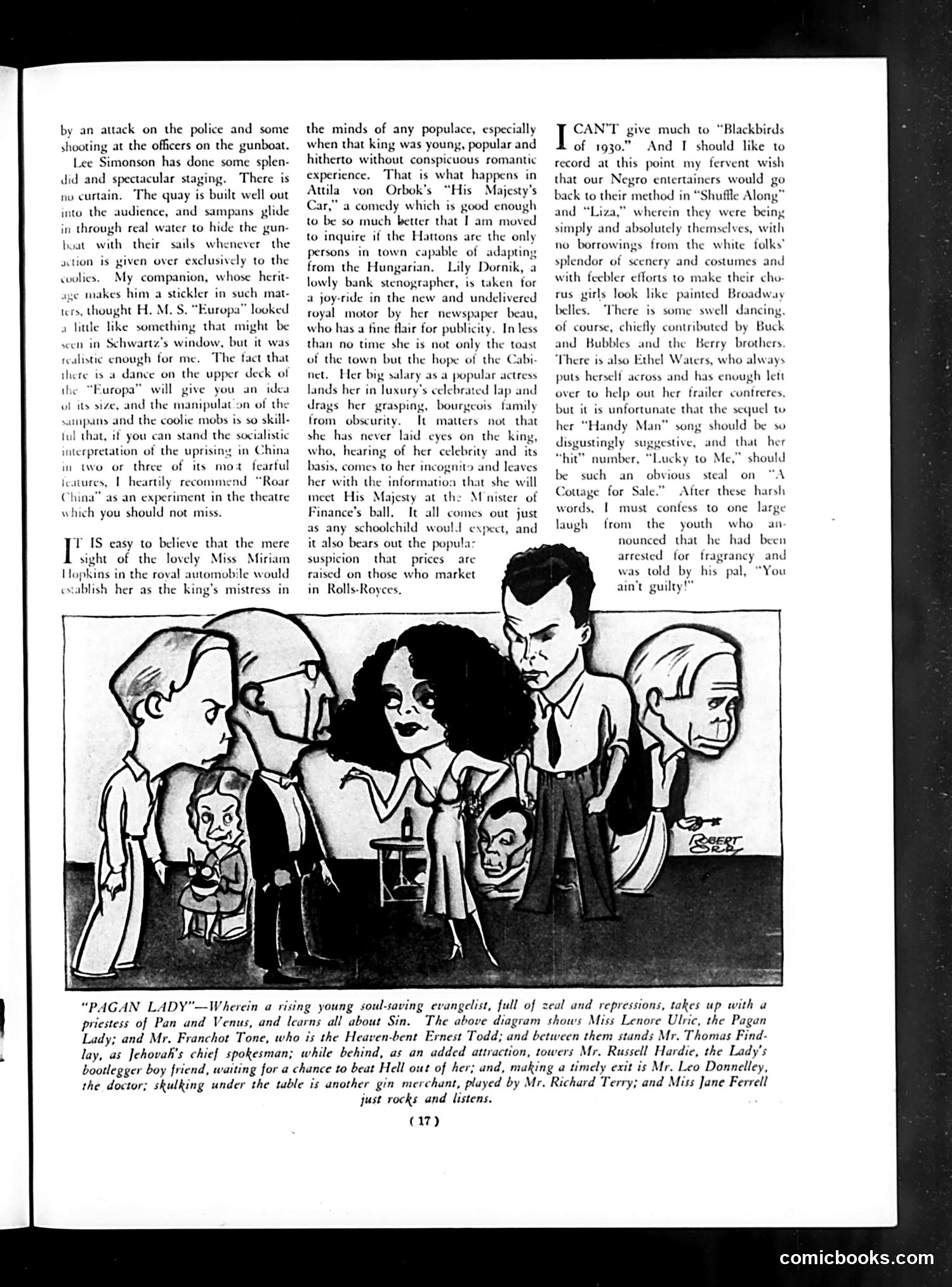
Analysis of "Pagan Lady" Cartoon Page This page reviews a 1930s film called "Pagan Lady," a romantic drama featuring actress Lenore Ulric. The cartoon caricatures the film's plot and cast, including Ernest Todd and other actors named in the caption. The satire mocks the film's melodramatic storyline—a "riling young soul-saving evangelist, full of zeal and repressions" becoming entangled in romantic complications. The exaggerated facial expressions and crowded composition emphasize the overwrought emotional drama typical of early sound films. The surrounding text critiques both the film and contemporary entertainment trends, including comments about "Blackbirds of 1930" and criticism of how Black entertainers were portrayed in mainstream theater.
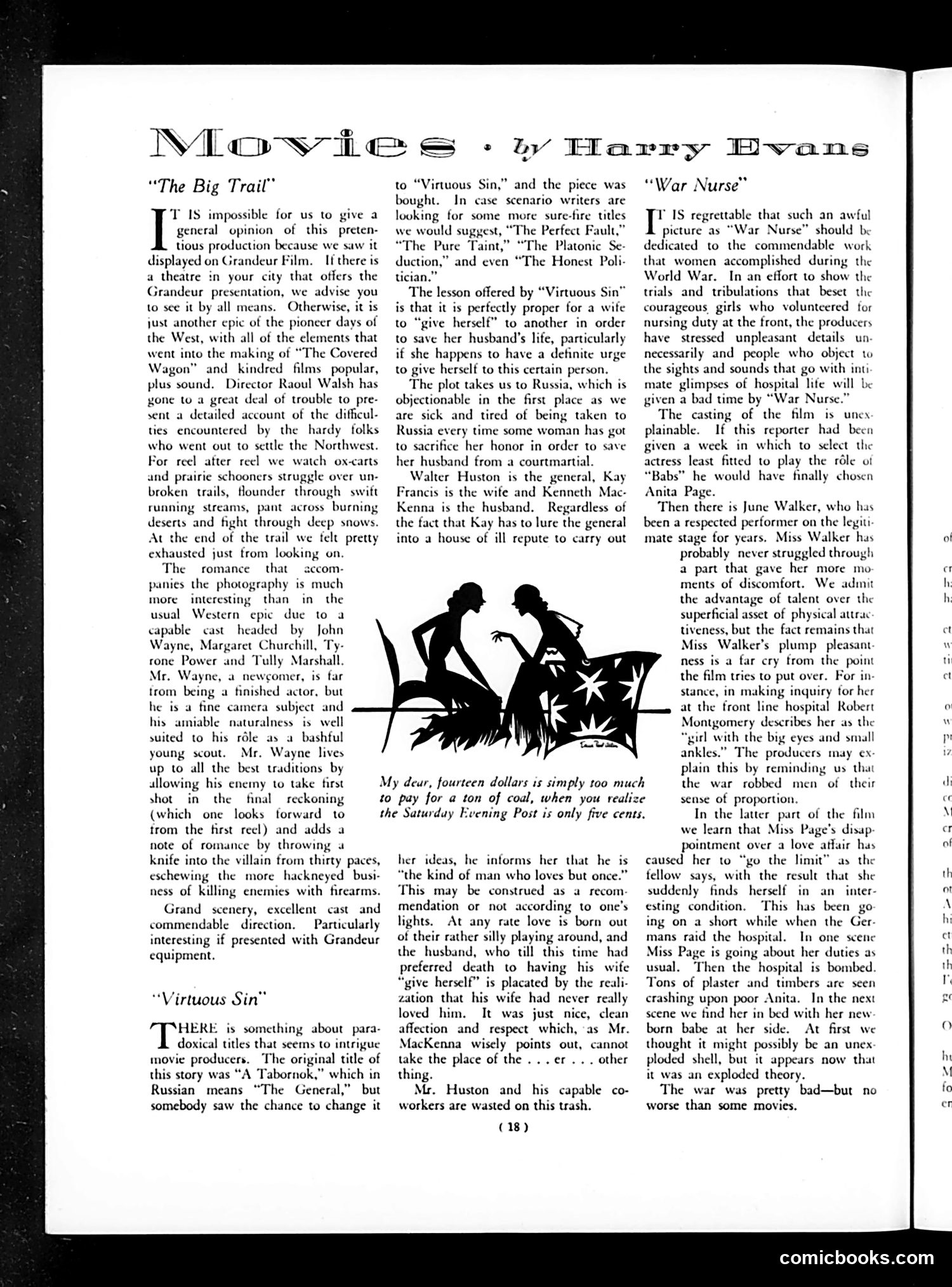
Movie Reviews by Harry Evans This page contains film reviews rather than political cartoons. The central silhouette illustration shows two figures in an intimate moment, accompanying reviews of three films: "The Big Trail," "Virtuous Sin," and "War Nurse." Evans critiques these movies with mixed results. "The Big Trail" earns qualified praise for its Western epic scope and cast (including John Wayne), despite narrative shortcomings. "Virtuous Sin" is criticized for its plot—a wife sacrificing her honor to save her husband—as implausible and morally questionable, particularly regarding the Russian setting. "War Nurse" receives the harshest treatment for depicting uncomfortable details of women nurses' wartime experiences, though Evans acknowledges some performances, particularly June Walker's, as competent despite the problematic material.
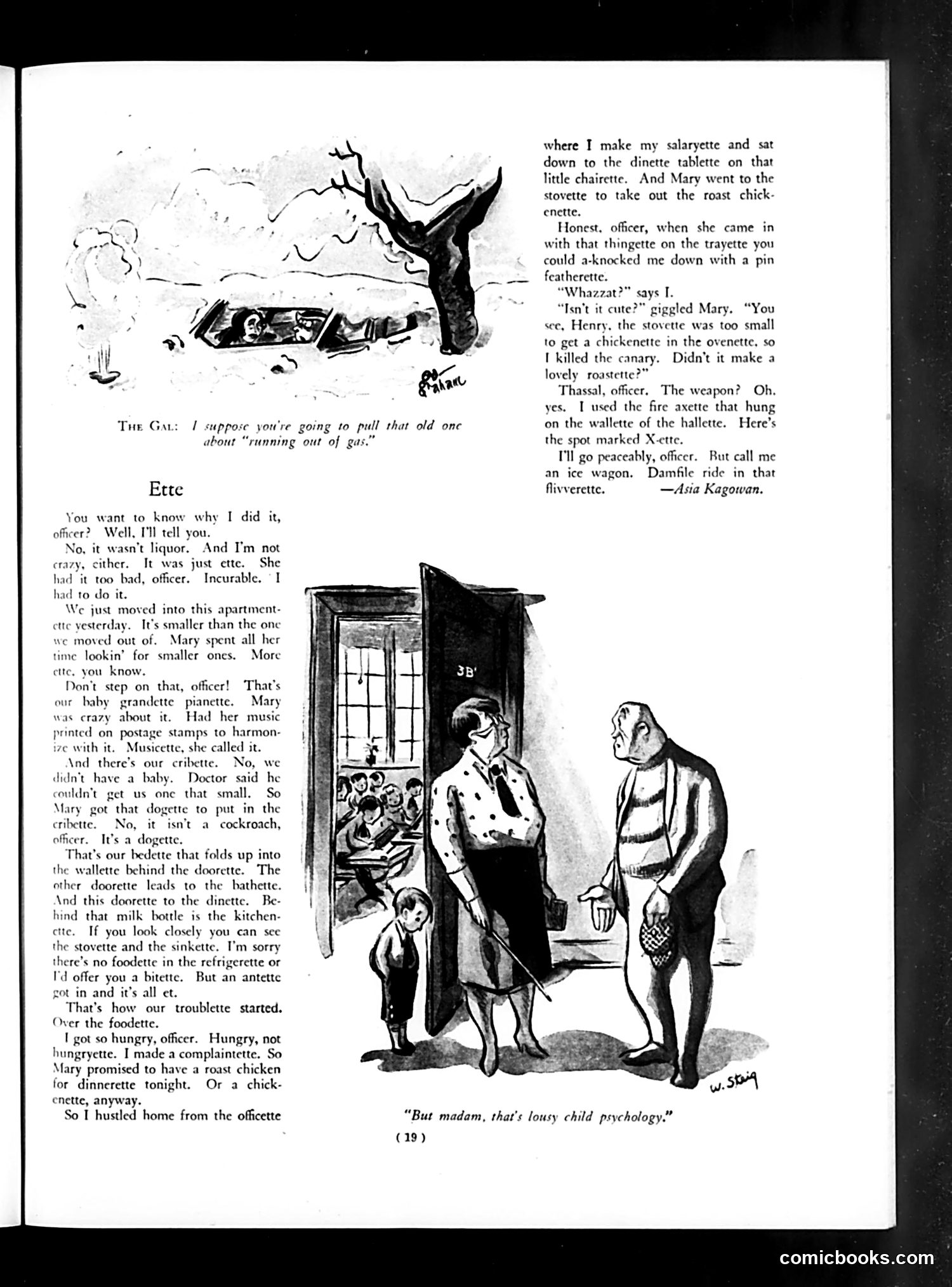
"Ette": A Satire on 1920s Miniaturization Craze This humorous story by Asia Kagowanis a satire on the 1920s obsession with miniature and compact living spaces—"ette" being a diminutive suffix applied to everything. The unnamed narrator, a husband, confesses to an officer that he murdered his wife Mary over a domestic dispute. The joke operates on two levels: first, it mocks the era's trend toward smaller apartments and "labor-saving" compact designs marketed to urban dwellers. Mary's obsession with constantly downsizing—smaller furniture, a tiny dog instead of a baby, compressed living quarters—drives the household to absurdity. Second, the story darkly satirizes how this cramped, efficiency-obsessed lifestyle creates domestic tension. When Mary serves him roasted canary instead of chicken (because the stove was too small for proper poultry), the husband snaps. The cartoon below shows a woman at a doorway with children, with the caption "But madam, that's lousy child psychology"—likely commenting on modern parenting trends. The satire targets both consumer culture's promise of convenience and the psychological strain of modern urban living.
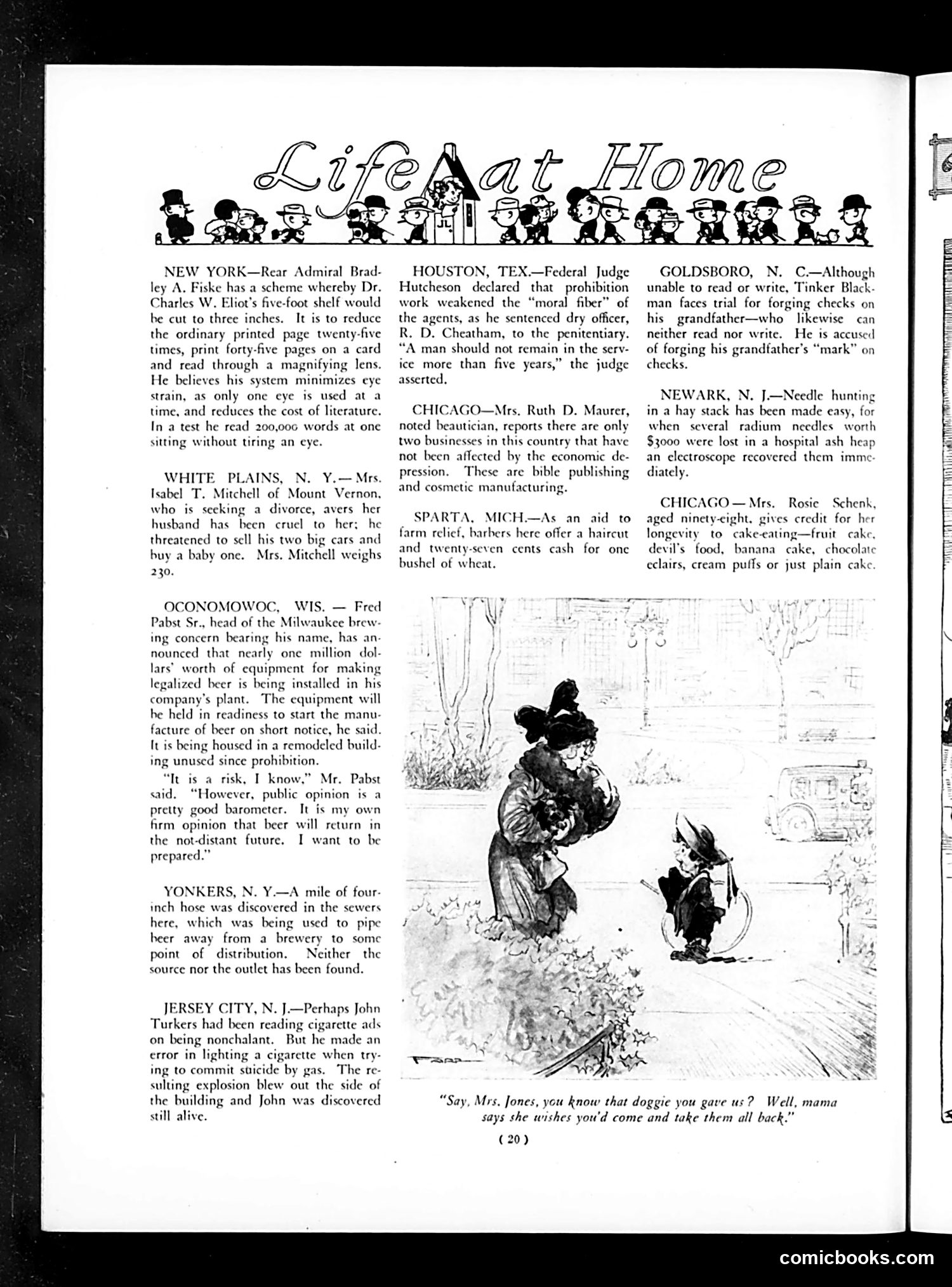
"Life at Home" Page Analysis This page from *Life* magazine presents a series of humorous short anecdotes about American life, likely from the Prohibition era (references to beer manufacturing's return and illegal distribution). The cartoon at bottom depicts a woman returning unwanted puppies to a neighbor—a visual joke about an unexpected "gift" becoming a burden. The text items satirize various situations: Admiral Fiske's scheme to shrink books onto cards; a heavy woman divorcing her husband over replacing luxury cars; beer magnate Pabst preparing for Prohibition's repeal; discovered brewery hoses in sewers; a suicide attempt foiled by a cigarette explosion; a judge criticizing Prohibition agents' morality; economic depression affecting all businesses except Bible publishing and cosmetics; desperate bartering of haircuts for wheat; and an illiterate man forging his equally illiterate grandfather's mark. These vignettes mock American society's absurdities—desperation, greed, hypocrisy around Prohibition, and the Depression's effects—through deadpan reporting of genuine oddities.
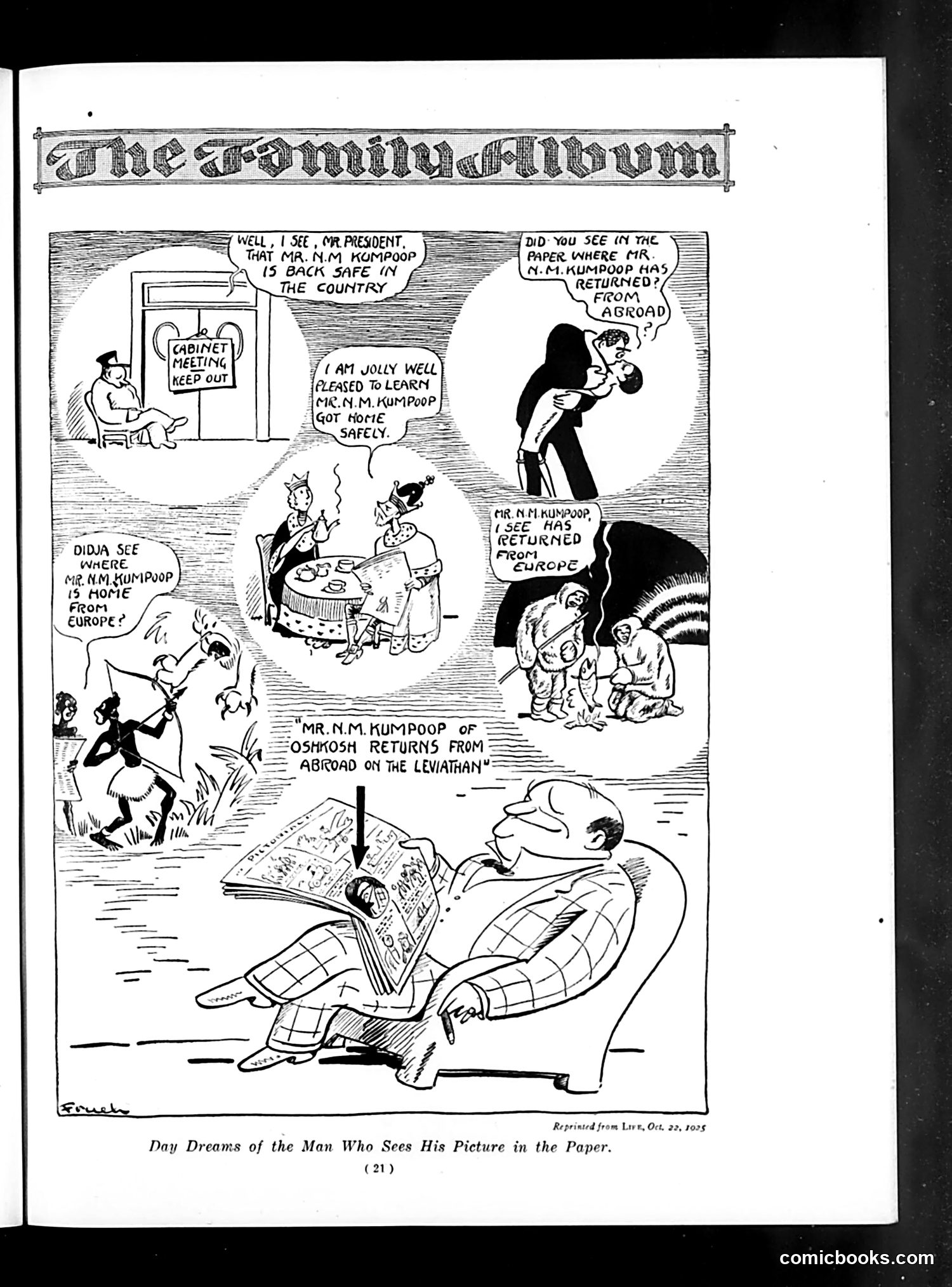
"The Pomona Kingdom" - Life Magazine Cartoon Analysis This is a satirical comic from Life magazine (October 22, 1925) titled "Day Dreams of the Man Who Sees His Picture in the Paper." The cartoon depicts a man daydreaming after seeing himself mentioned in a newspaper. The fictional character "Mr. N.M. Kumpoop" has apparently returned from Europe, and the man imagines increasingly grandiose scenarios: a cabinet meeting being held about his safe return, a presidential reception, children asking where he's been, and finally—in the bottom panel—him relaxing contentedly while reading about himself. The satire targets ordinary people's vanity and self-importance when they achieve minor press coverage. The absurdly inflated reactions (presidential concern, widespread public interest) contrast humorously with what was likely a small newspaper mention, mocking how people exaggerate their own significance based on minimal media attention. The joke remains timeless: the human tendency toward narcissistic fantasy when briefly noticed by the press.
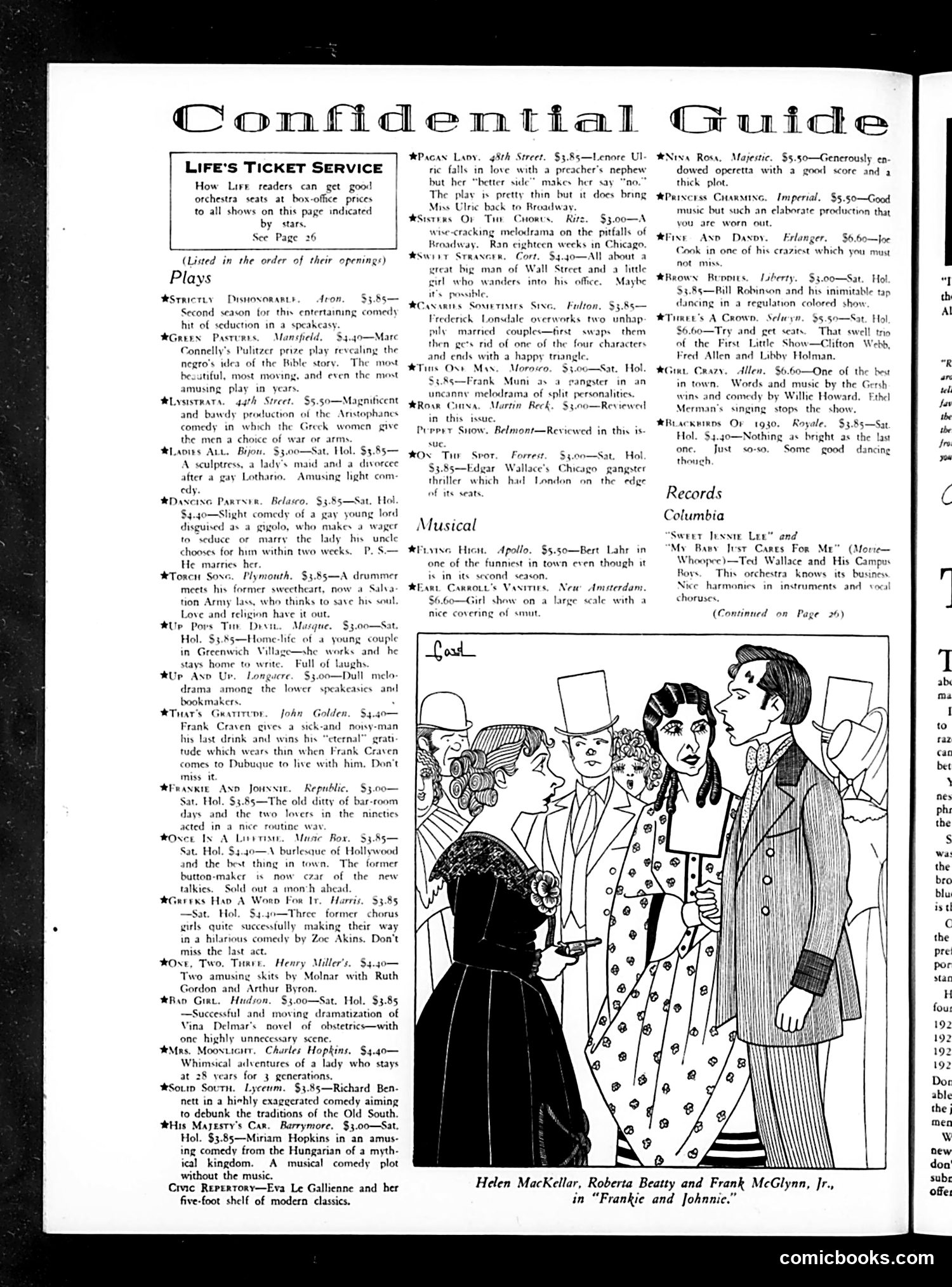
Understanding This Life Magazine Page This page from Life magazine features a theater guide listing Broadway shows with prices and brief reviews. The illustration at the bottom depicts four fashionably dressed figures—identified as Helen MacKellar, Roberta Beatty, and Frank McGlynn, Jr.—in a scene from the play "Frankie and Johnnie." The cartoon itself isn't political satire but rather theatrical promotion. The drawing shows stylized 1920s-30s fashion and what appears to be a dramatic or comedic theatrical moment, likely illustrating the "old ditty of bar-room days and the two lovers in the nineties" that the text describes. The page primarily serves as entertainment journalism—advertising Broadway productions with ticket prices and Life's subscriber discount service. This reflects the magazine's role as a guide to urban leisure and culture for educated, theater-going readers of the era.
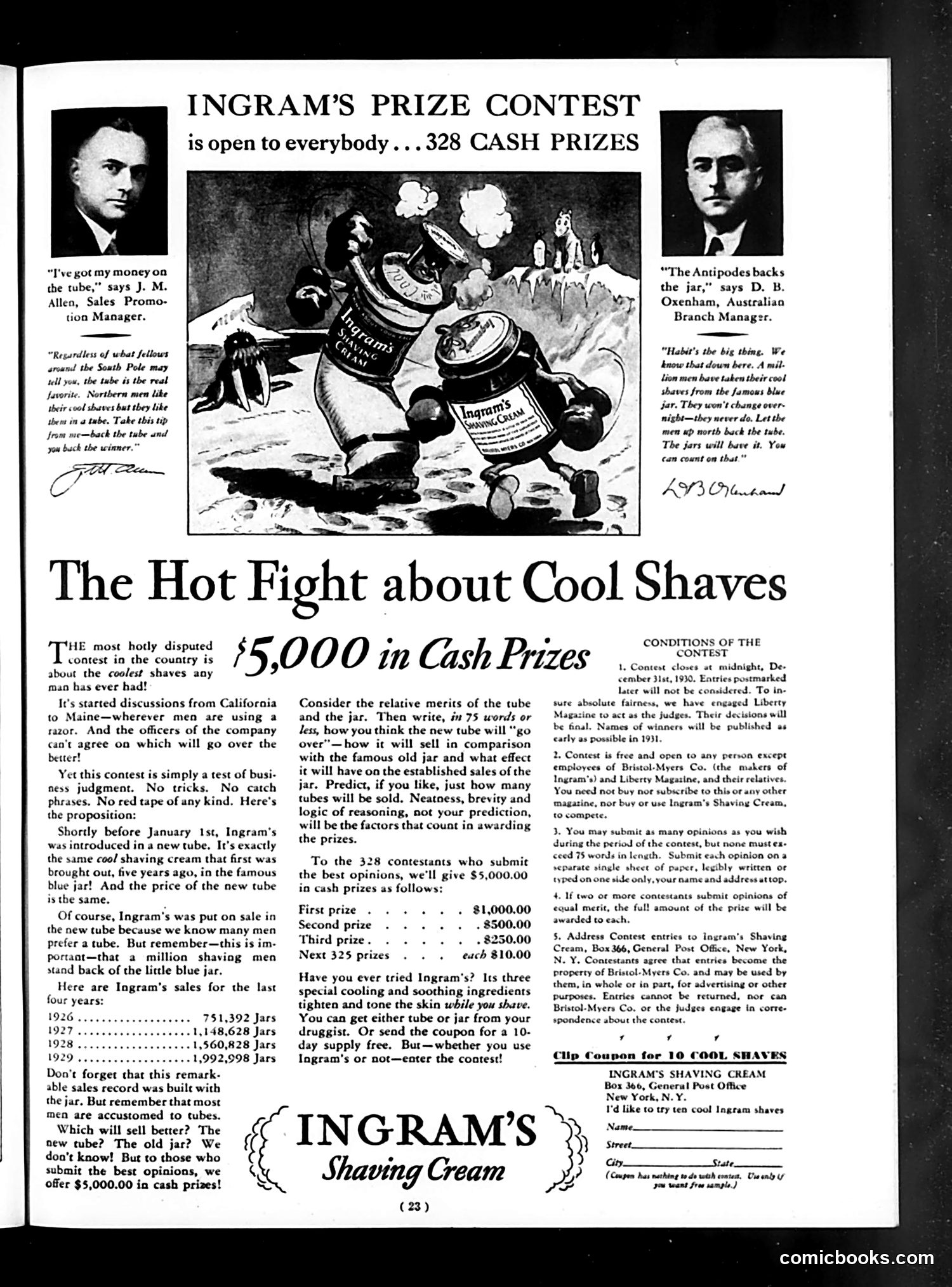
Ingram's Shaving Cream Contest Advertisement This is primarily advertising copy, not political satire. The page promotes Ingram's Shaving Cream's contest offering $5,000 in cash prizes. The central "cartoon" depicts an Antarctic or polar scene with competing shaving products (tube and jar) in conflict, illustrating the company's internal debate: which packaging will outsell the other—the traditional jar (which has sold well for five years) or a newly introduced tube format? The quoted managers on either side represent this genuine business dispute: J.M. Allen backs the tube; D.B. Oxenham from the Australian branch champions the jar, citing consumer habit. The contest invites consumers to predict which format will succeed in 75 words or fewer. Winners receive cash prizes based on opinion quality, not prediction accuracy. The joke: A major corporation genuinely cannot decide which product will sell better, so they crowdsource the answer via a public contest—presenting uncertainty as entertainment while gathering market research.
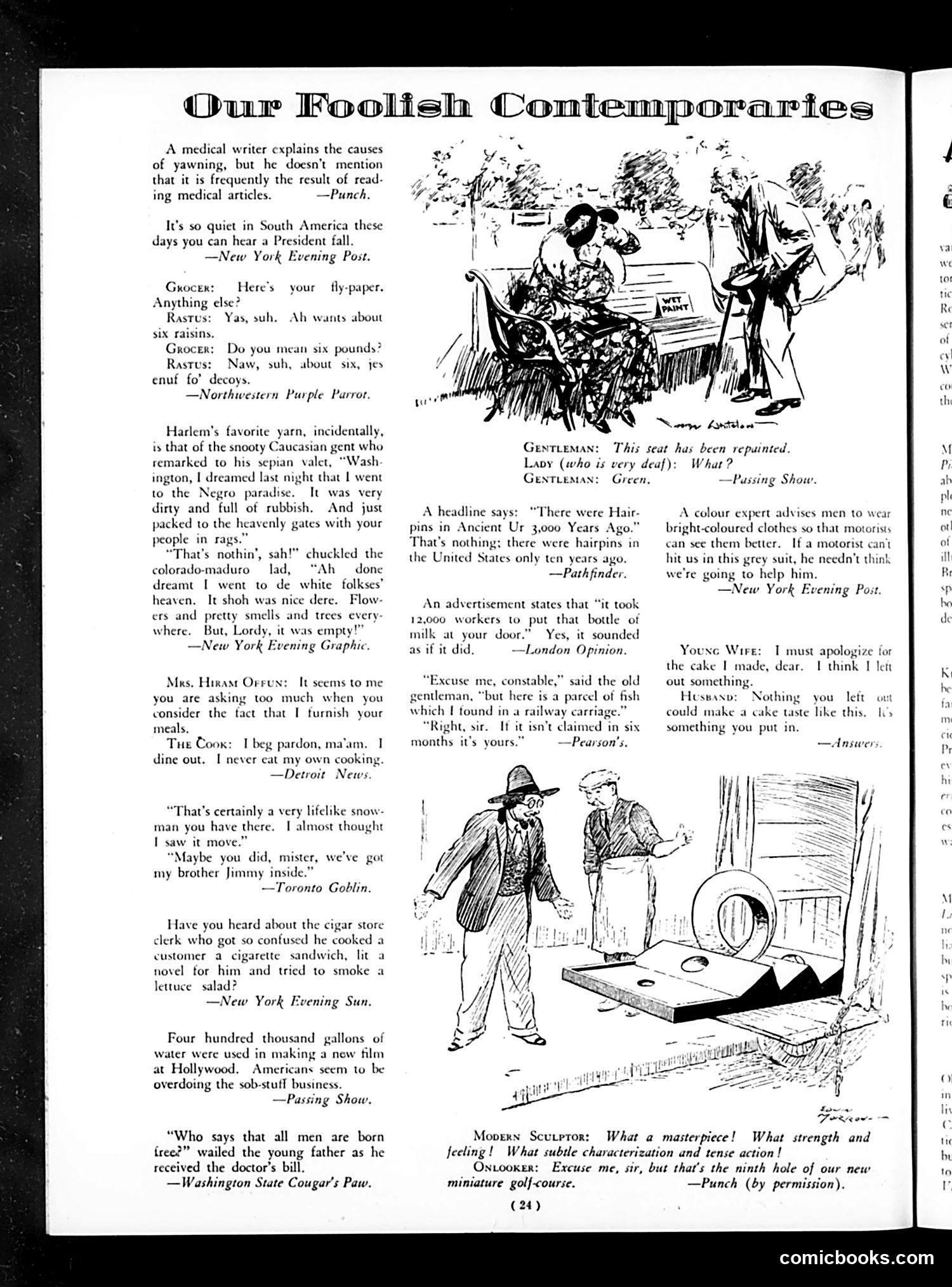
"Our Foolish Contemporaries" - Life Magazine Satire Page This page collects brief humorous quips and cartoons mocking contemporary absurdities. Key targets include: Racial humor: A dialogue between a grocer and "Rastus" (a stereotypical Black character) uses racist dialect to joke about buying raisins as "decoys"—a reference to duck hunting. Another piece features offensive dialogue between a white employer and Black servant about heaven. Social commentary: Jokes mock medical writing, South American political instability, Hollywood excess, and high medical costs ("received the doctor's bill"). Cartoons: One shows a couple examining repainted furniture; another depicts someone mistaking a miniature golf hole for sculpture, praising its "masterpiece" quality ironically. The page's title—"Our Foolish Contemporaries"—signals that Life is satirizing modern society's absurdities through reprinted newspaper witticisms. The racist content reflects the casual prejudice normalized in 1920s American publications.
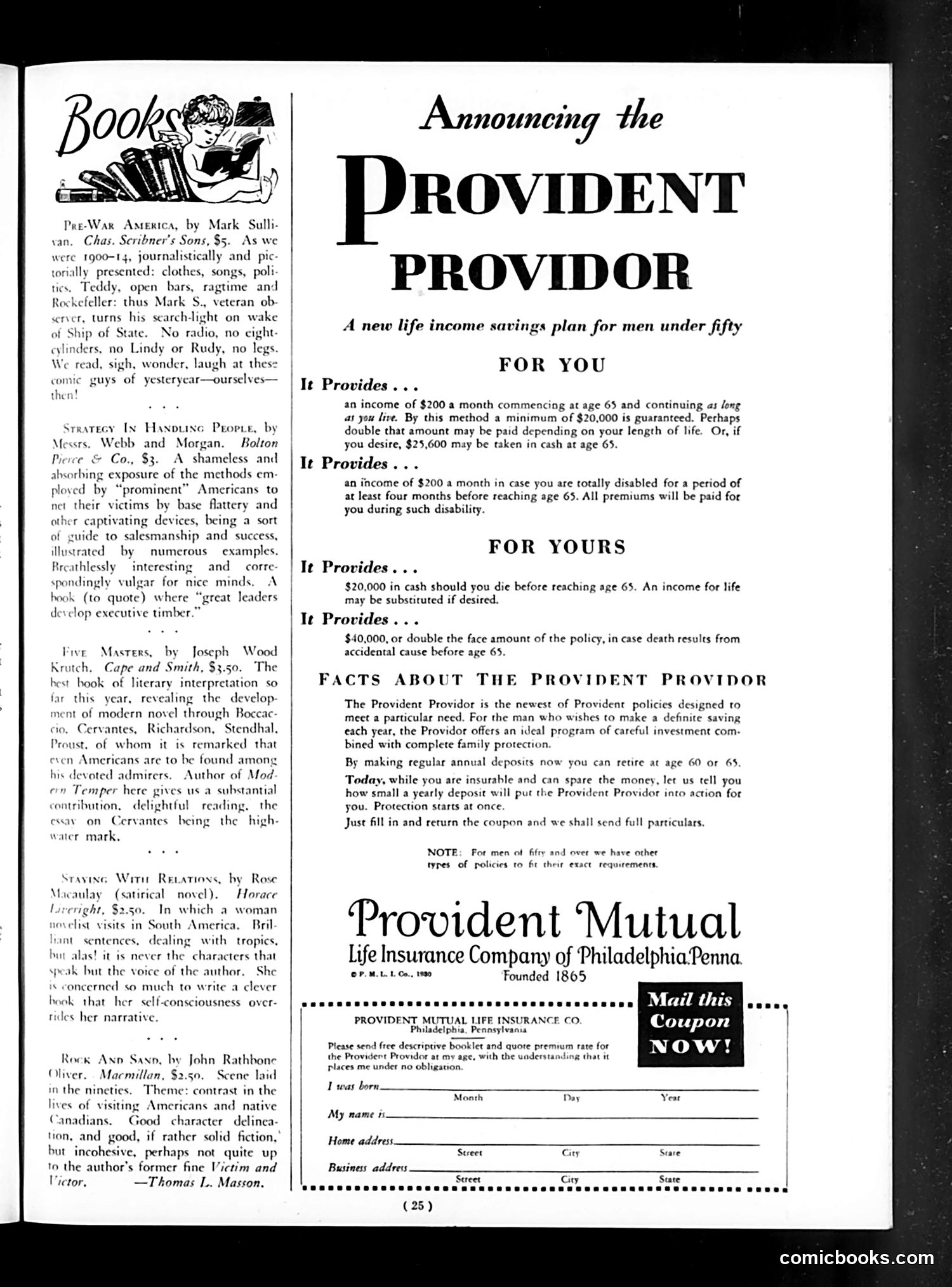
Understanding This Life Magazine Page This page contains book reviews on the left and a full-page insurance advertisement on the right—there are no political cartoons present. The left side reviews five books from the 1920s, including Mark Sullivan's *Pre-War America* (nostalgically examining 1900-1914 American life, mentioning Teddy Roosevelt and Rockefeller) and Joseph Wood Krutch's *Five Masters* (literary analysis). The reviews are written in the casual, mildly sarcastic tone typical of Life magazine's book section. The right side advertises the "Provident Providor," a life insurance product targeting men under fifty. It promises monthly income starting at age 65, disability coverage, and death benefits. The ad uses typical insurance sales language ("Protection starts at once") and includes a mail-in coupon. The page represents ordinary Life magazine content: consumer book criticism paired with commercial advertising—nothing satirical or political about the insurance ad itself.
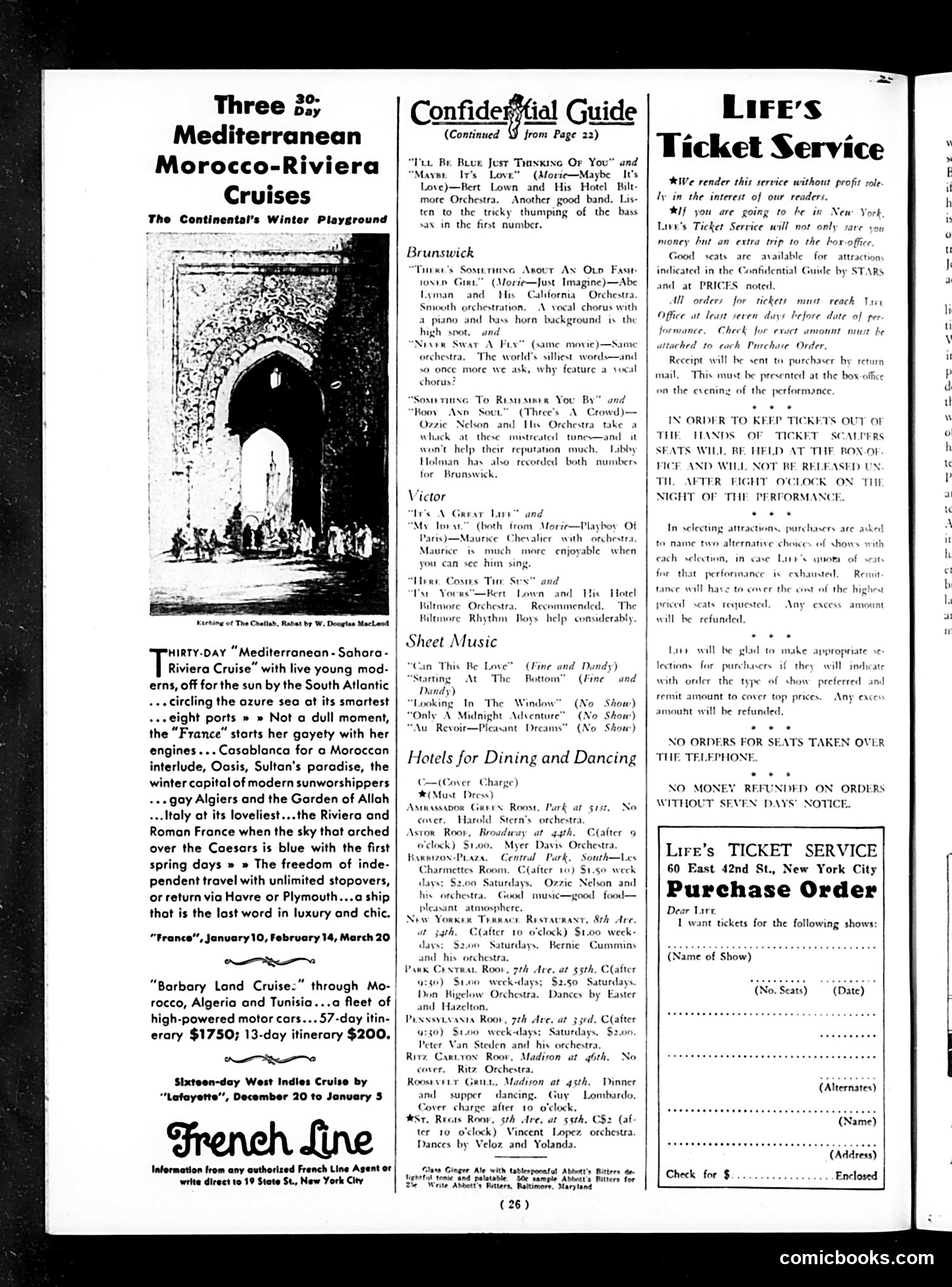
Analysis This page is primarily advertising and entertainment listings, not political satire. The main image shows the Chellah, Rabat (a historic gate in Morocco), illustrating cruise advertisements for the French Line's Mediterranean voyages. The "Confidential Guide" is a music and entertainment column reviewing current phonograph records and sheet music, plus listings for NYC dining and dancing venues with orchestras. The page reflects 1920s leisure culture: luxury cruise tourism to exotic (colonial) destinations, popular dance music and orchestras, and upscale hotel dining. References to movies like "Just Imagine" and "Playboy of Paris" date this to that era. There is no political cartoon or satire visible here—this is a commercial and cultural lifestyle page targeting wealthy readers interested in travel, entertainment, and nightlife.
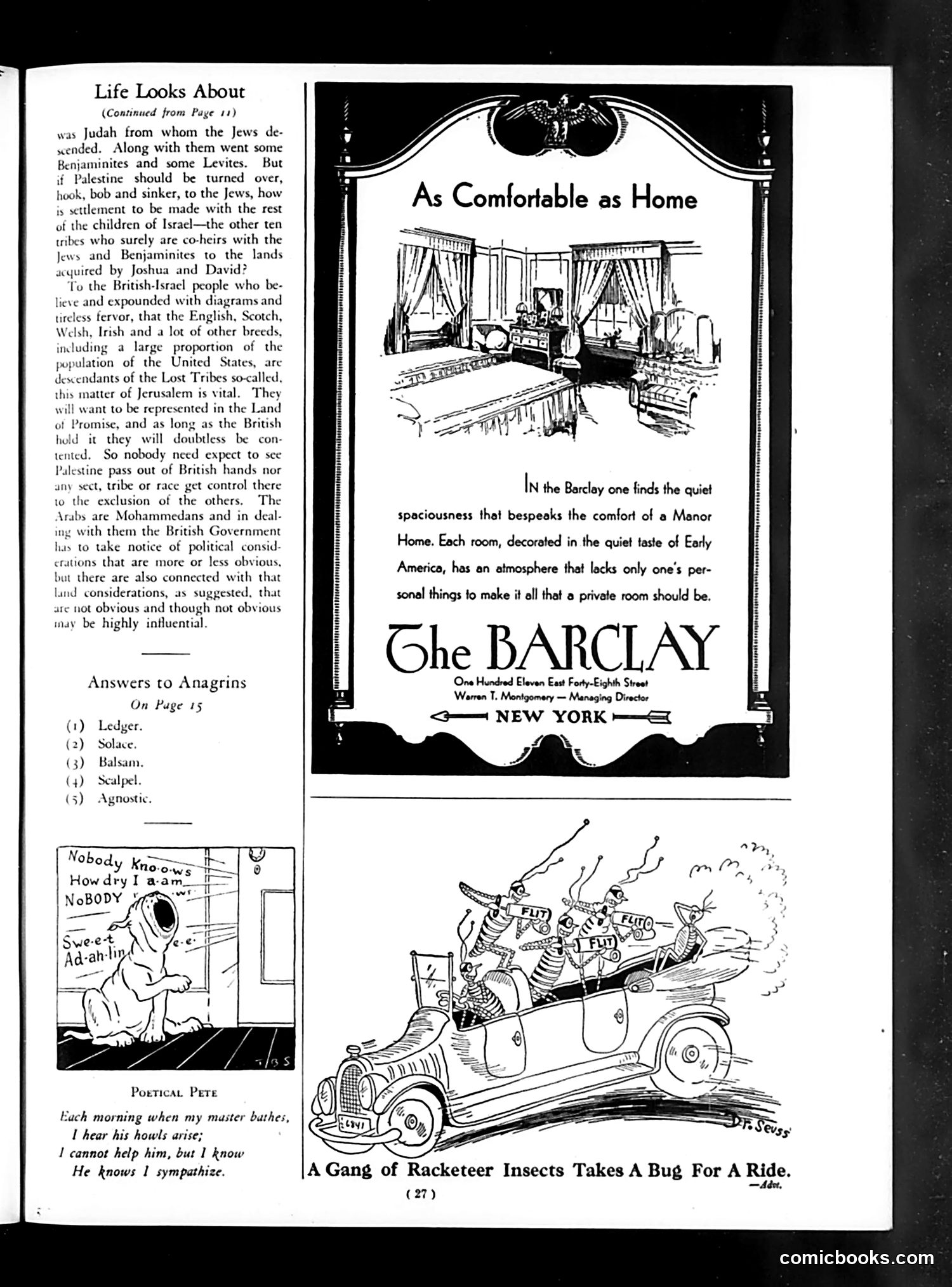
Analysis of Life Magazine Page Content This page contains three distinct elements: "Political Pete" cartoon: A small comic strip showing a dog listening to his master's morning bath routine. The joke is sentimental—the dog hears his owner howling (presumably from cold water) and sympathizes, though he cannot help. It's gentle domestic humor typical of early 20th-century magazines. "A Gang of Racketeer Insects Takes A Bug for A Ride": A whimsical illustration by Dr. Seuss showing anthropomorphized insects in a car, apparently "kidnapping" another bug. This is pure absurdist humor—no political content, just playful surrealism characteristic of Seuss's early work. Main article text: Discusses the British-Israel theory (a fringe belief that British peoples are descended from the Lost Tribes of Israel) and its implications for Palestine's future under British control. The article argues Britain will retain Palestine partly because of this ideological investment among some British populations. The page is primarily advertising (Barclay Hotel) and light entertainment rather than sharp political satire. The serious Palestine discussion is offset by whimsical cartoons.
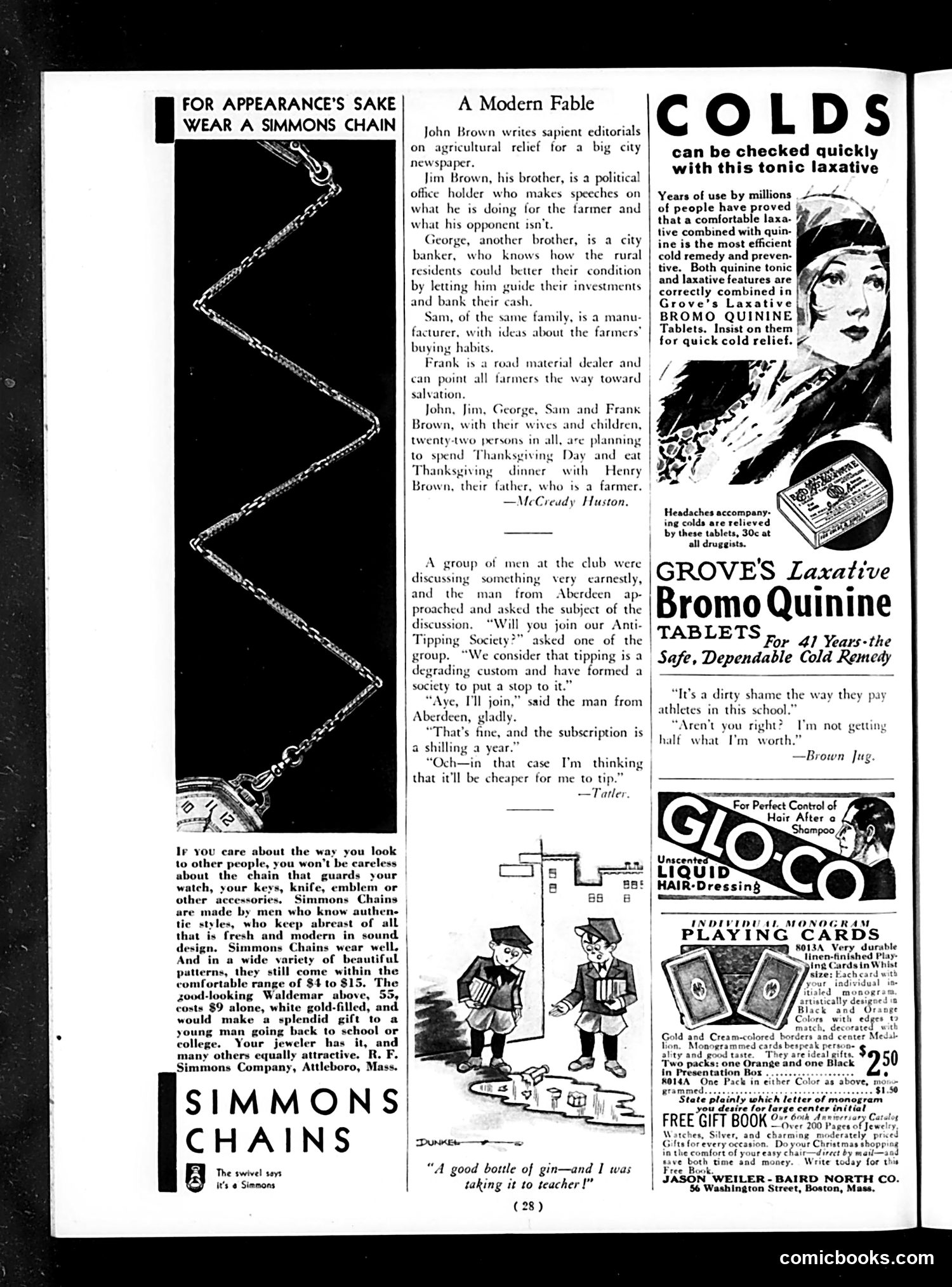
Page Analysis: Life Magazine This page mixes advertising with satirical content. The main satirical piece is "A Modern Fable" by McCready Huston. It satirizes the hypocrisy of urban professionals who claim to help farmers while actually exploiting them for personal gain. The Brown family exemplifies this: John writes editorials about farm relief, Jim makes political speeches supporting farmers, George (a banker) guides their investments, Sam manufactures goods for them, and Frank sells road materials—all profiting from the very people they claim to serve. The joke is that these five brothers and their families descend on their father Henry (the actual farmer) for Thanksgiving, their true motives and self-interest exposed. A secondary joke depicts Scottish frugality: an Aberdeen man agrees to join an "Anti-Tipping Society" until learning the membership costs more than tipping would. The remainder consists of period advertisements for Simmons watch chains, Bromo Quinine cold tablets, Gloco hair dressing, playing cards, and jewelry—typical of early 20th-century magazines blending editorial content with commercial promotion.
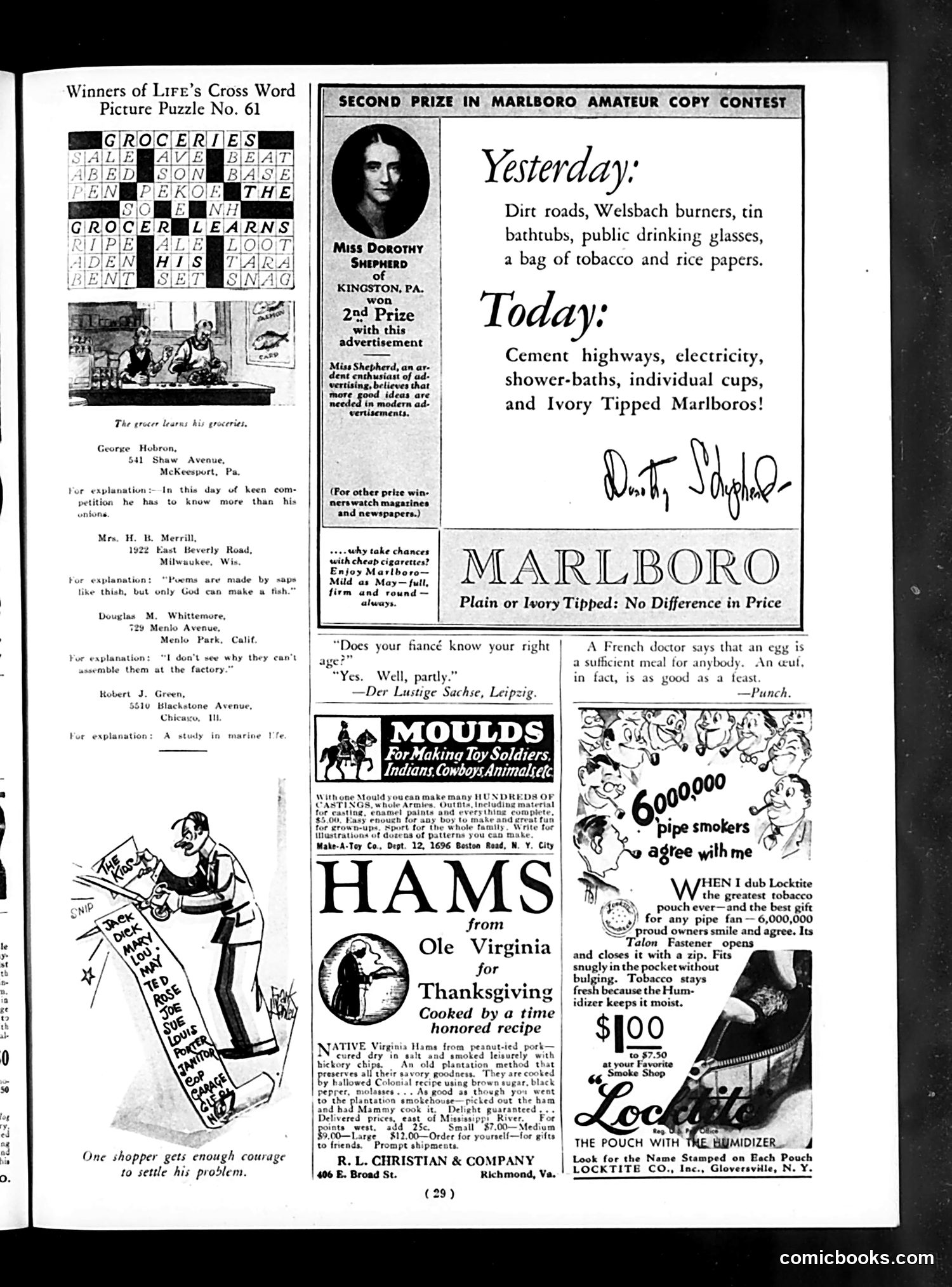
Analysis: Life Magazine Page Content This page primarily showcases advertisements and contest winners rather than political cartoons, though it contains social commentary through advertising copy. The Marlboro ad (second prize winner) uses before-and-after contrast to promote cigarettes: "Yesterday" lists outdated rural inconveniences (dirt roads, Welsbach burners, tin bathtubs), while "Today" celebrates modern progress—cement highways, electricity, shower-baths—culminating in "Ivory Tipped Marlboros" as a marker of contemporary sophistication. The joke treats cigarettes as emblematic of modern civilization. Other ads include Moulds toy soldiers, Virginia hams, and Locktite tobacco pouches—standard Depression/early-1930s consumer goods advertising. The page also features crossword puzzle winners from Life's contest, with their explanations of puzzle clues—a common reader-participation feature. These demonstrate how ordinary Americans engaged with the magazine's intellectual content. The overall tone reflects 1920s-30s optimism about consumerism and technological progress.
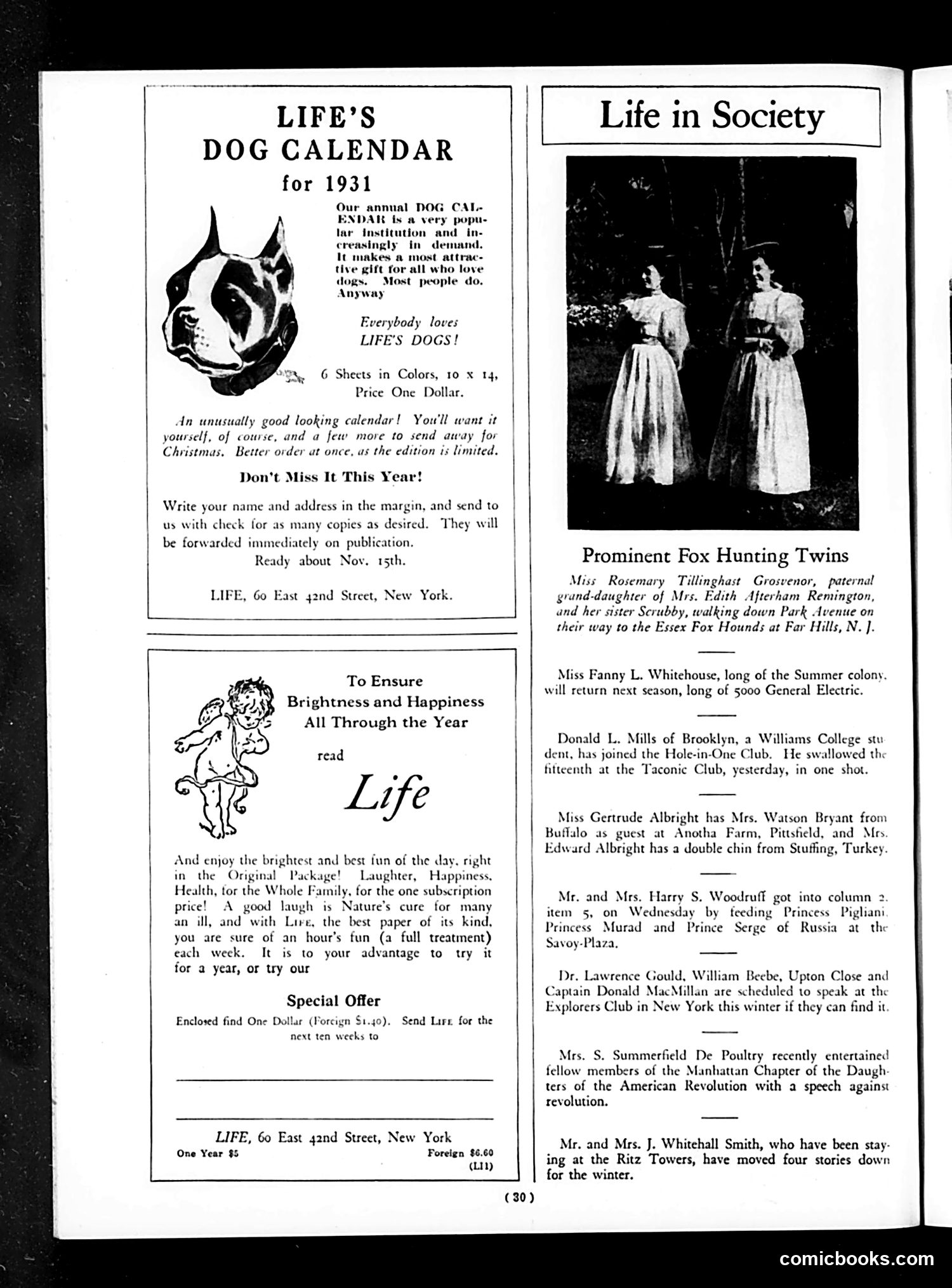
Life Magazine Page (1931): Advertisements and Society Notes This page consists primarily of advertisements and social gossip, not political satire. The left side advertises Life's 1931 Dog Calendar (a gift item featuring colored dog illustrations) and promotes Life magazine subscriptions. The right side, titled "Life in Society," contains humorous society column items about wealthy New York socialites—typical of Life's satirical coverage of high society. The humor is gentle mockery: items poke fun at the elite through deadpan reporting of trivial incidents (a man swallowing a golf ball, feeding Russian princes at a hotel, moving down four stories at the Ritz "for winter"). The satire targets upper-class pretension and absurdity rather than politics. The page reflects Life's dual role as both consumer product advertiser and satirist of American social life during the Depression era.
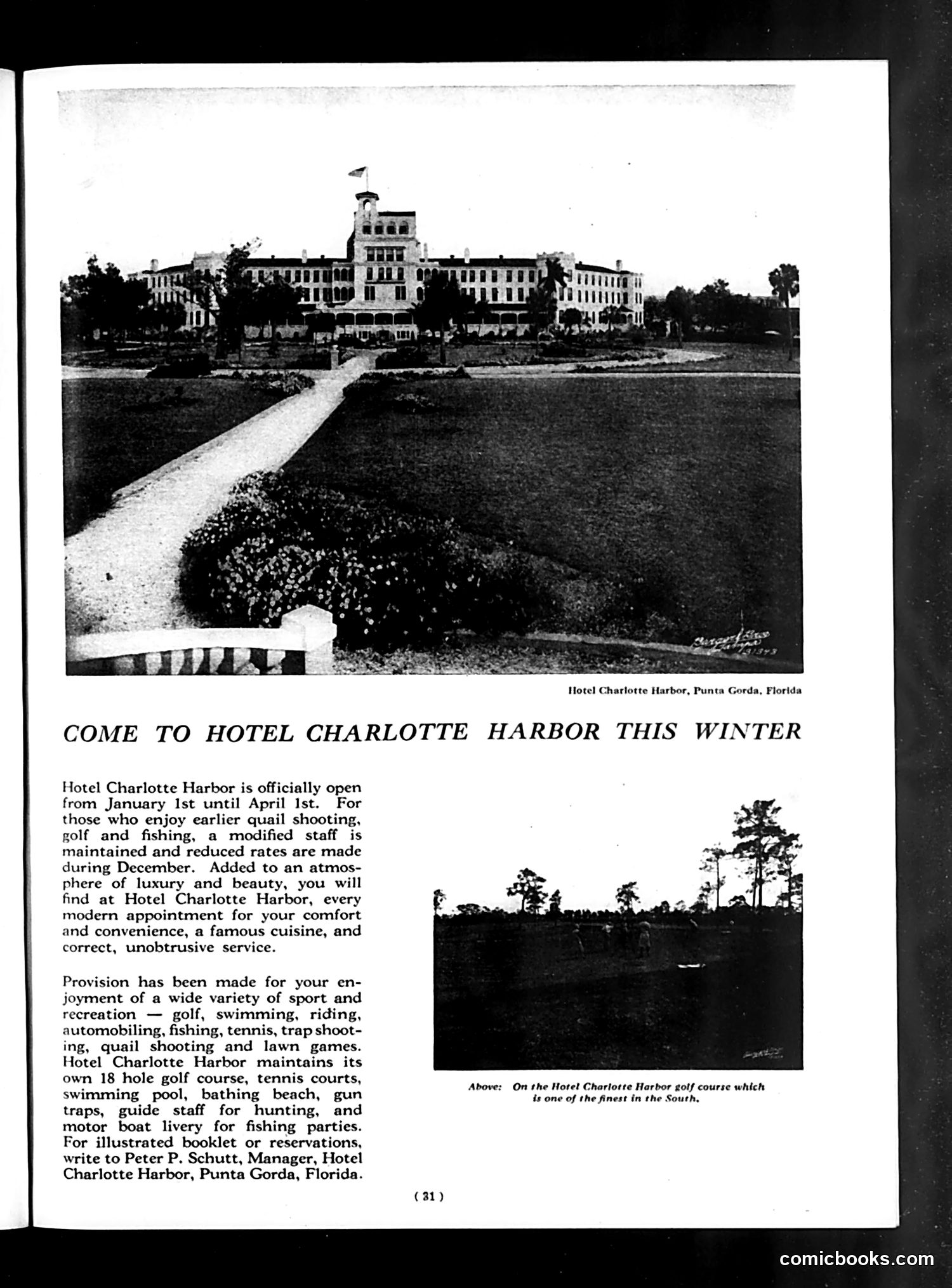
Analysis This is not a cartoon or satire—it's a straightforward hotel advertisement. The page features promotional material for the Hotel Charlotte Harbor in Punta Gorda, Florida, targeting wealthy winter visitors. The text emphasizes luxury amenities (18-hole golf course, swimming pool, tennis courts) and leisure activities (quail shooting, fishing, hunting, riding). The phrase "officially open from January 1st until April 1st" indicates this was a seasonal resort catering to affluent northerners escaping winter. The two photographs show the grand hotel building and its golf course, designed to showcase the property's upscale facilities. The contact information for manager Peter P. Schutt enables direct reservations. This represents early-20th-century Florida tourism marketing, when the state was developing as a winter destination for the wealthy. There is no political commentary or satire present.
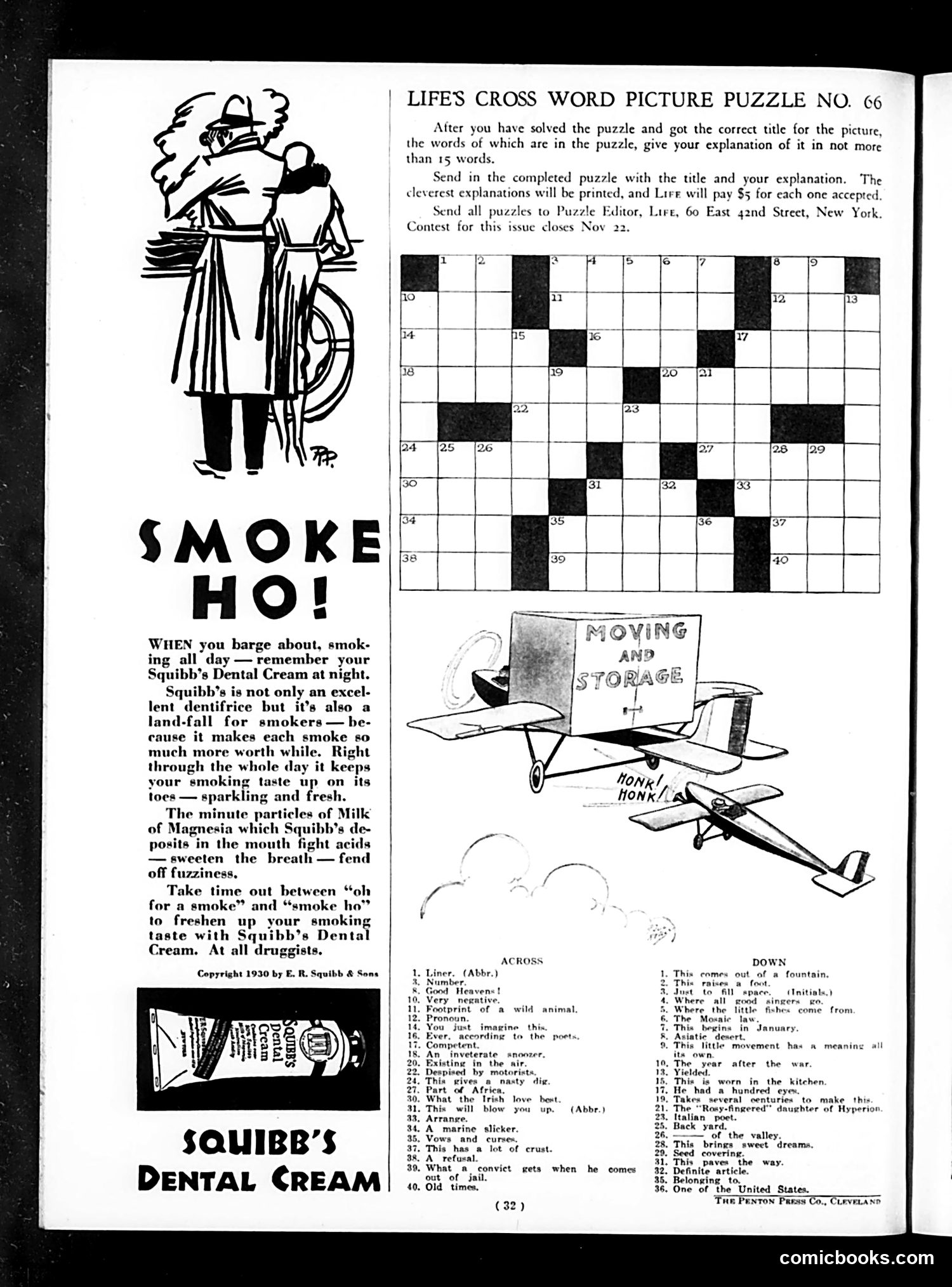
Life Magazine Puzzle Page No. 66 (1930) This page combines a crossword puzzle contest with advertising. The main content is a crossword-picture puzzle where solvers must identify a picture's title using words found in the grid, then submit explanations for potential $5 payment. The advertisement for Squibb's Dental Cream (left side) uses humor to target smokers. The illustration shows a woman with a cigarette, and the pitch argues that Squibb's toothpaste enhances smoking pleasure by keeping one's "smoking taste" fresh throughout the day. Its Milk of Magnesia ingredient supposedly counteracts smoking's unpleasant effects—acidic breath, fuzzy mouth-feel. This reflects 1930s attitudes: smoking was socially normalized and heavily advertised, even marketed through dental hygiene. The ad cleverly frames toothpaste not as a corrective for smoking's damage, but as an *enhancement* to the smoking experience itself—a pitch unthinkable by modern health standards. The airplane cartoon with "Moving and Storage" appears to be unrelated editorial illustration.
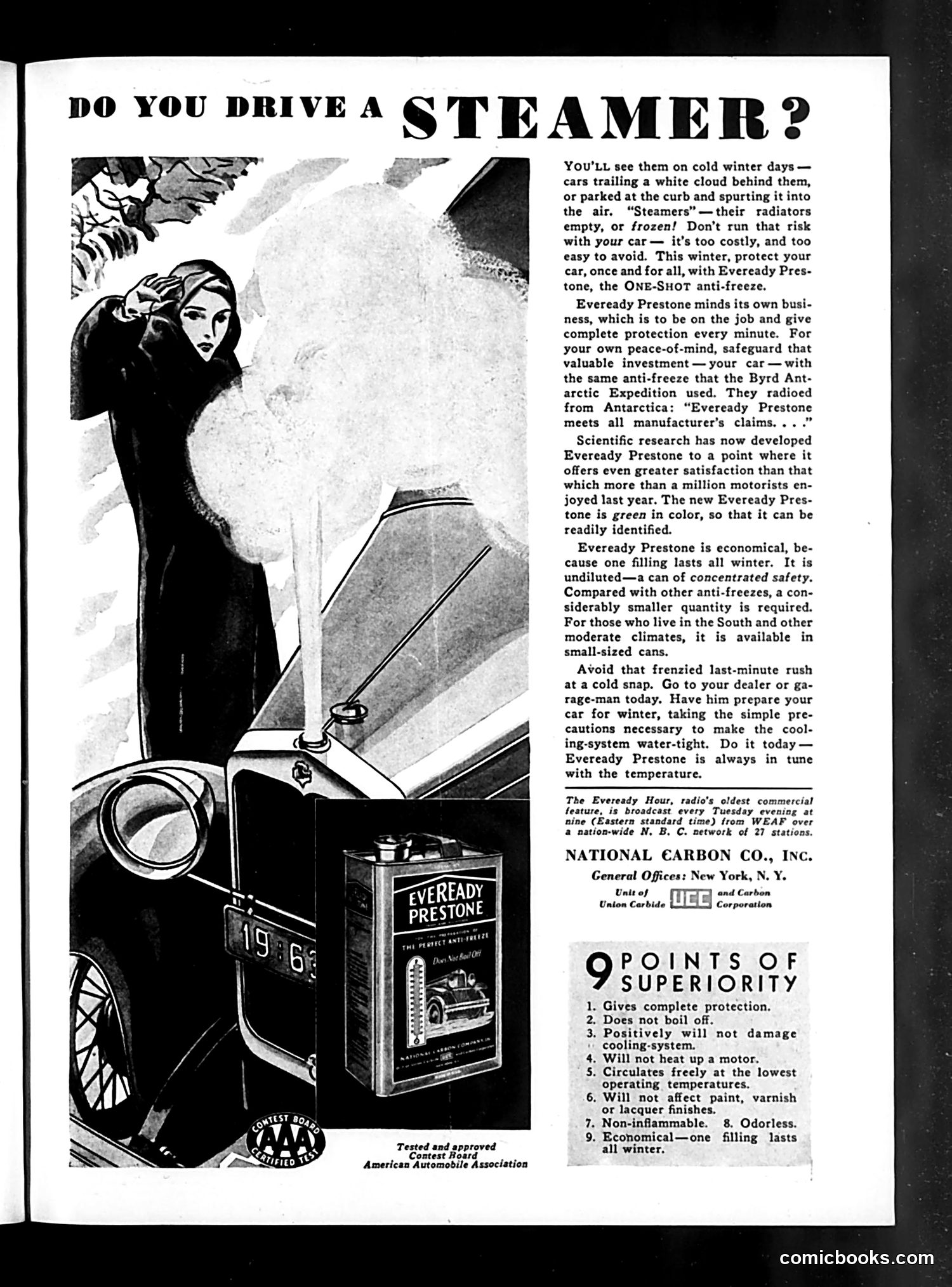
Analysis: Eveready Prestone Anti-Freeze Advertisement This is not a cartoon or satire, but a straightforward product advertisement for Eveready Prestone anti-freeze, marketed by National Carbon Co., Inc. The page depicts a 1920s-era automobile with a woman in period dress observing a "steamer"—a car whose frozen radiator produces a visible cloud of vapor. The ad's humor is gentle: it warns against the embarrassing, costly problem of engine freeze-up in winter. The advertisement emphasizes durability and prestige by referencing the Byrd Antarctic Expedition, positioning the product as expedition-tested and trustworthy. It lists nine superiority points and encourages preemptive winter preparation rather than last-minute panic. The tone is typical period advertising: practical consumer advice wrapped in appeals to prudence, economy, and status. There is no political content or social satire present—this is purely commercial messaging aimed at car owners facing genuine winter maintenance challenges before modern heating systems.
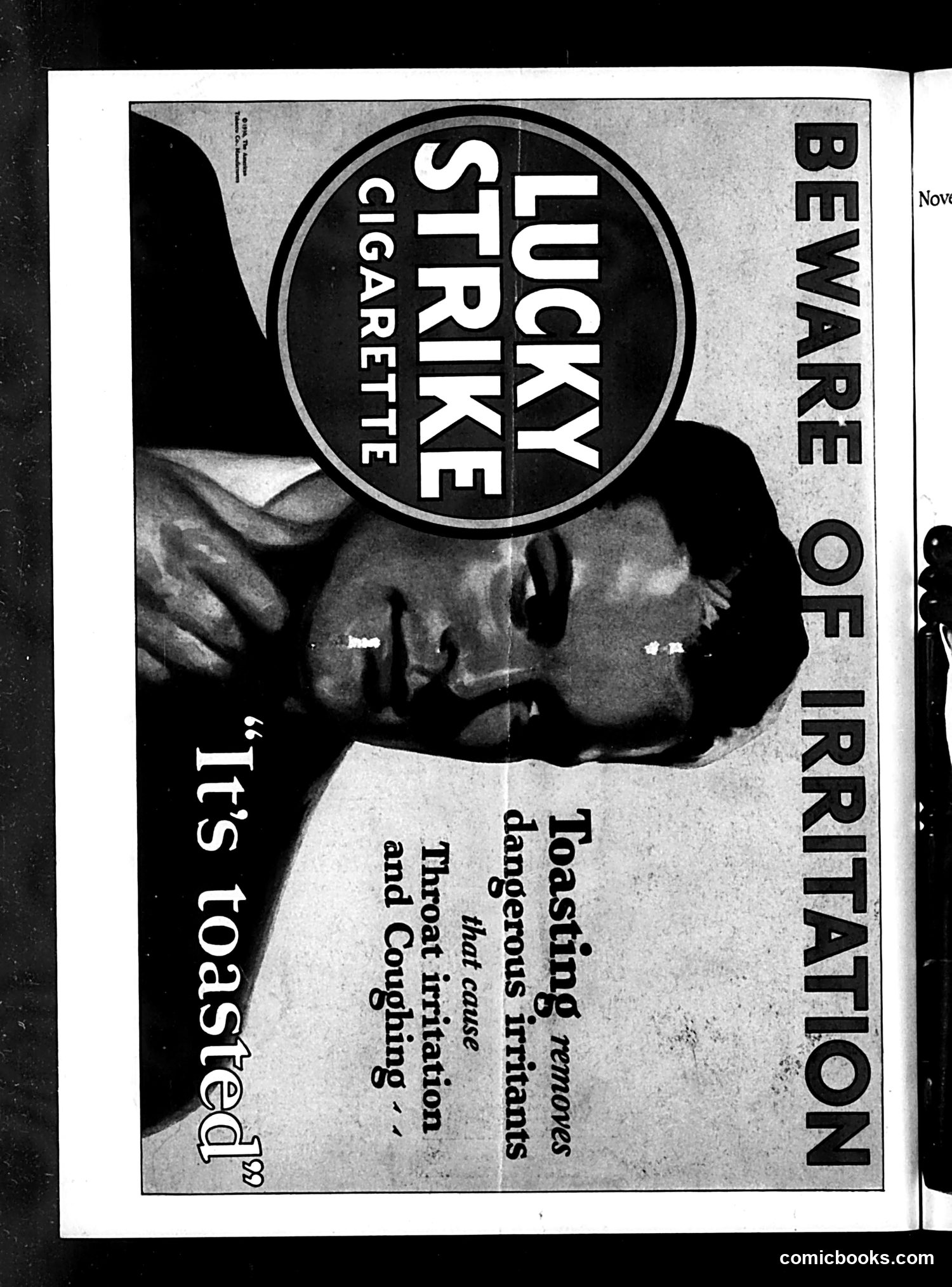
Advertisement Analysis This page is primarily a cigarette advertisement for Lucky Strike, not political satire. The circular seal dominates the image, containing text about "Lucky Strike Cigarettes Chicago." The ad's central claim—that "toasting removes dangerous irritants that cause throat irritation and coughing"—represents a common early tobacco marketing strategy. Manufacturers promoted their manufacturing processes as health improvements, a technique used before cigarettes' health dangers were widely acknowledged. The image shows what appears to be a romantic couple, typical of mid-20th century advertising that associated smoking with sophistication and intimacy. The tagline "It's toasted" emphasizes the brand's distinctive roasting process as a selling point differentiating Lucky Strike from competitors. This reflects pre-1960s tobacco advertising, when such health-adjacent claims were legal and commonplace.