life
Life — November 28, 1930
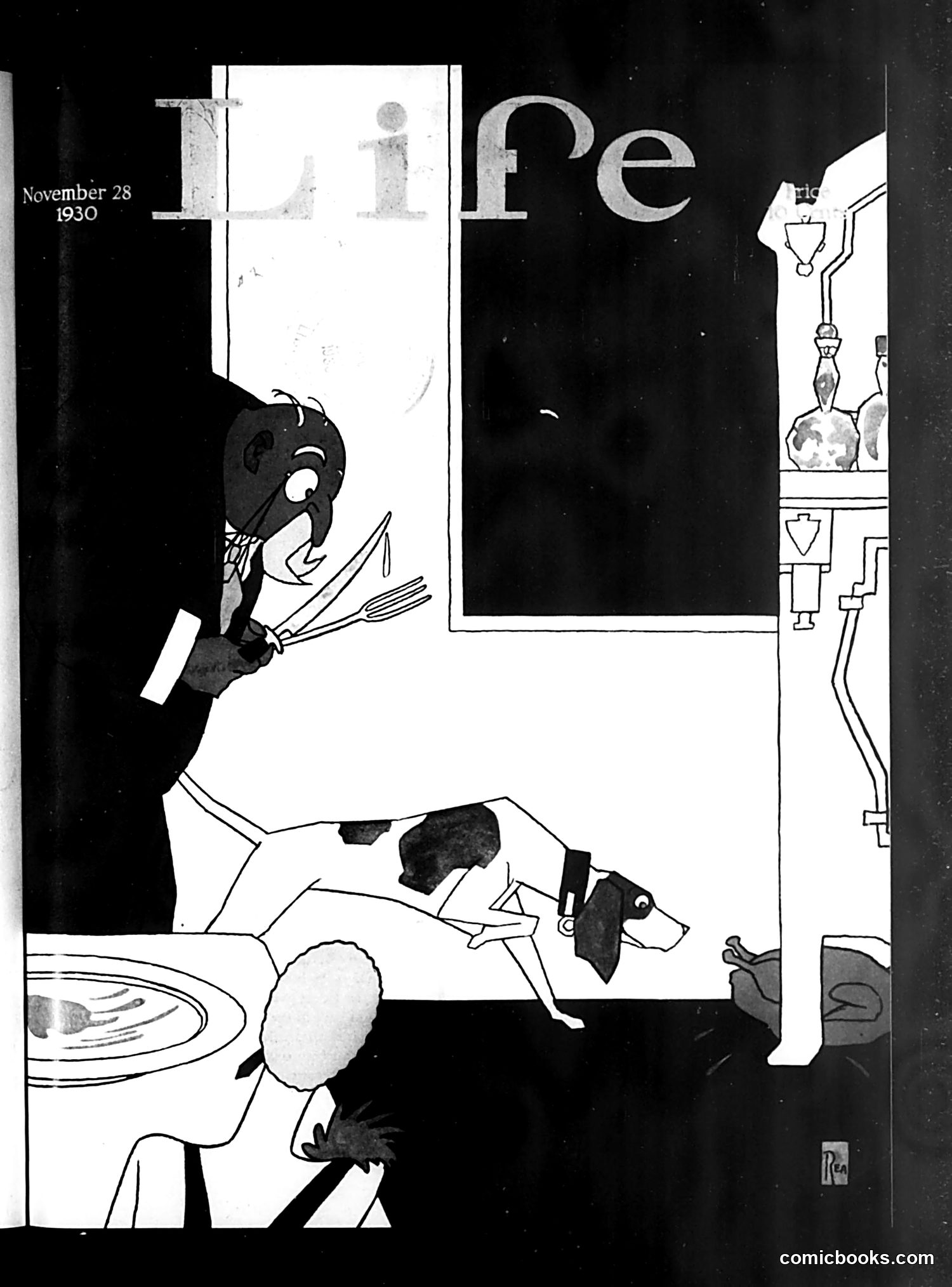
Life Magazine, November 28, 1930 This is a satirical cartoon depicting a domestic kitchen scene. A caricatured figure with exaggerated features peers around a doorway holding what appears to be cooking utensils (fork and knife), while another figure lies on the kitchen floor. The style and racial caricature suggest this reflects 1930s-era stereotypes. The exact satirical meaning is unclear without additional context, but the scene appears to satirize domestic chaos or cooking mishaps. The laboratory equipment visible on the right suggests possible commentary on kitchen science or experimentation. The partial text "pe" (possibly "Life") is visible but incomplete. The illustration's style and caricature techniques are consistent with 1930s American satirical cartooning, though the specific social or political commentary intended remains ambiguous from the image alone.
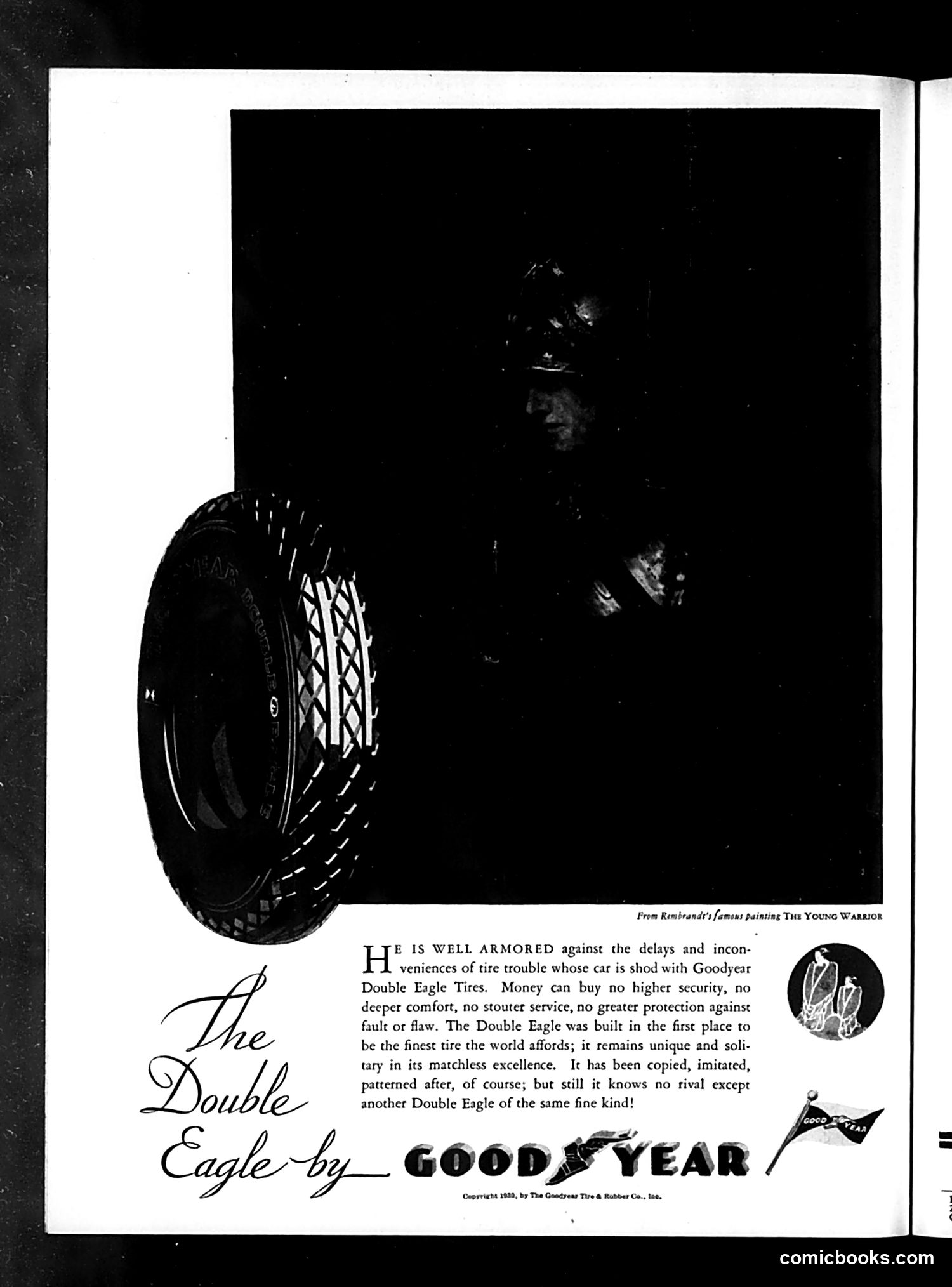
Analysis This is a Goodyear tire advertisement, not political satire. The page features a large product image of a Goodyear Double Eagle tire on the left side. The advertisement's text emphasizes the tire's reliability and superiority, claiming it offers unmatched security against "delays and inconveniences of tire trouble." The copy asserts the Double Eagle is "the finest tire the world affords" and "remains unique and solitary in its matchless excellence," while acknowledging competitors have attempted imitation. A small illustration labeled "From Rembrandt's famous painting THE YOUNG WARRIOR" appears at top, though its connection to tire marketing is unclear—possibly suggesting timelessness or classical quality. This is straightforward commercial advertising with no satirical political content.
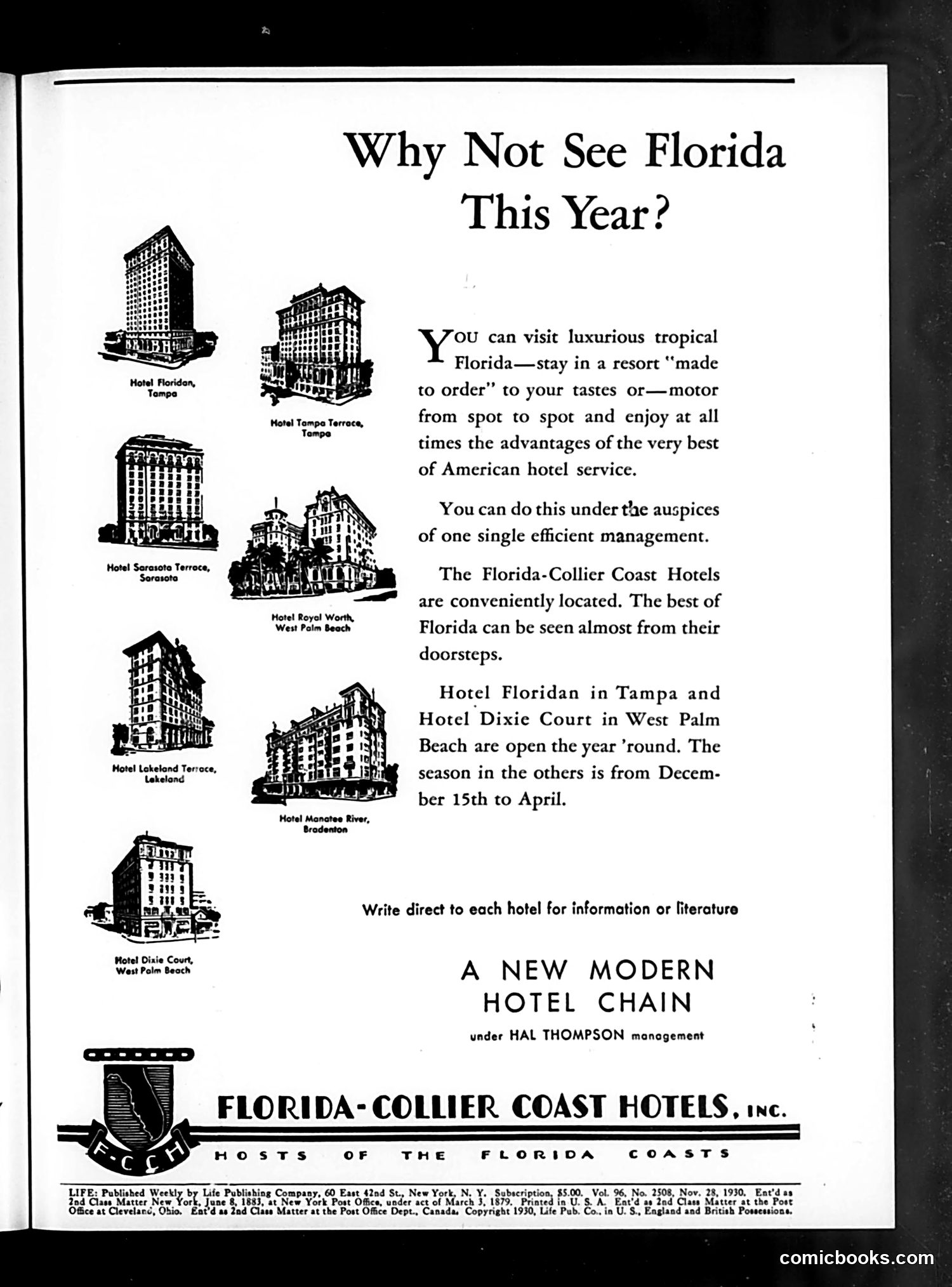
Analysis This is not a cartoon or satirical content — it is a straightforward advertisement for Florida-Collier Coast Hotels, Inc., a hotel chain operating under manager Hal Thompson. The page promotes seven hotels located in Florida: Hotel Floridian (Tampa), Hotel Tampa Terrace, Hotel Sarasota Terrace (Sarasota), Hotel Royal Worth (West Palm Beach), Hotel Lakeland Terrace (Lakeland), Hotel Manatee River (Bradenton), and Hotel Dixie Court (West Palm Beach). The ad emphasizes convenience, luxury amenities, year-round availability (two hotels open year-round; others December 15–April), and centralized management. Small architectural illustrations accompany each hotel listing. The footer identifies this as appearing in *Life* magazine, Vol. 96, No. 2508, November 28, 1930.
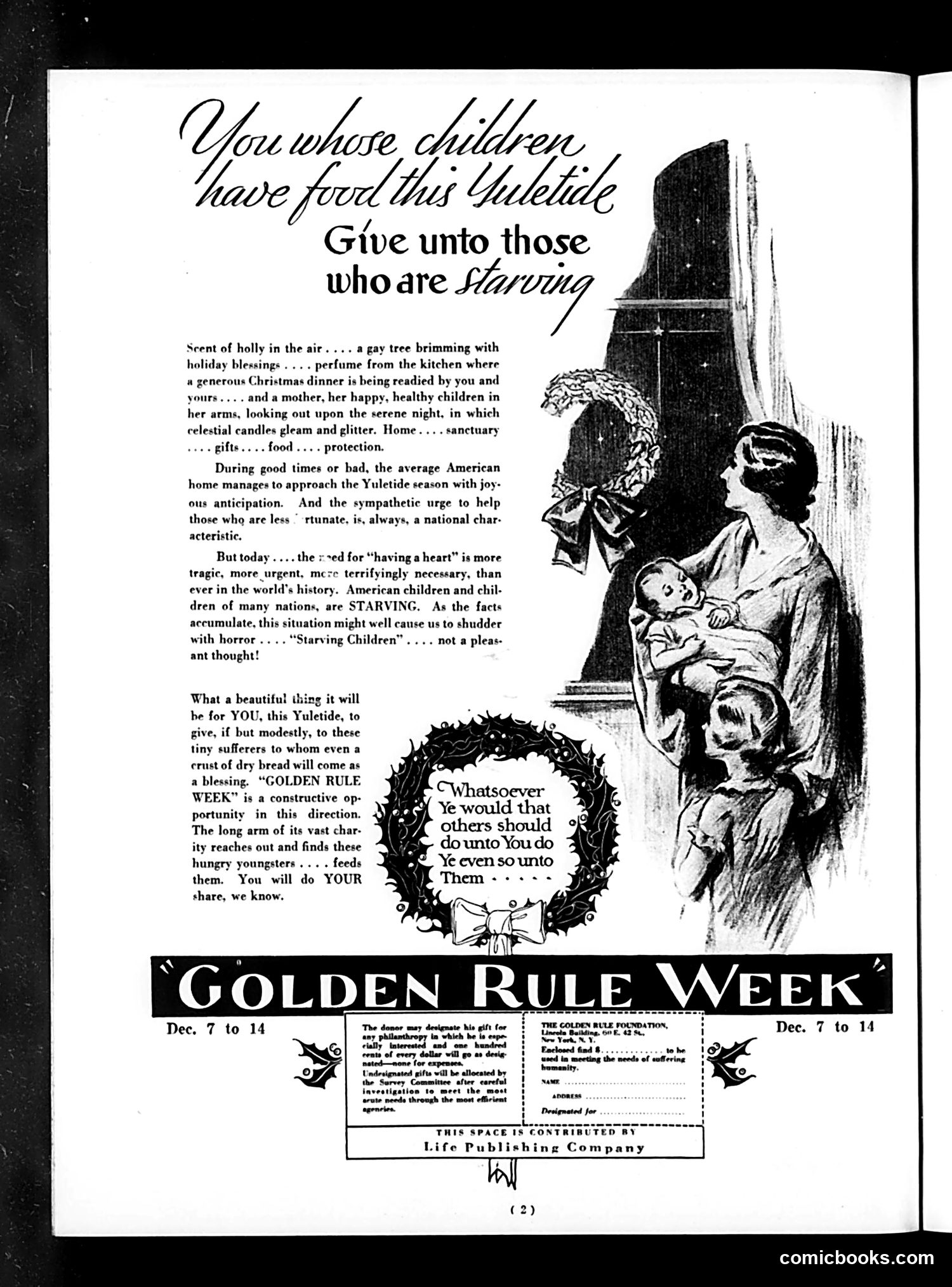
Golden Rule Week Advertisement This is a charitable appeal, not political satire. The page advertises "Golden Rule Week" (December 7-14), a campaign promoting Christian charity during the holiday season. The central message appeals to affluent Americans: those whose children have food should donate to starving children elsewhere. The illustration shows a mother and child at a window with Christmas decorations, contrasting with the implicit image of hungry children outside. The campaign explicitly references international child starvation ("American children and children of many nations, are STARVING"), likely referencing post-WWI humanitarian crises in Europe and Asia. The "Golden Rule" framing ("Whatsoever ye would that others should do unto You...") invokes Christian obligation to wealthy readers, positioning charitable giving as both moral duty and practical response to global suffering.
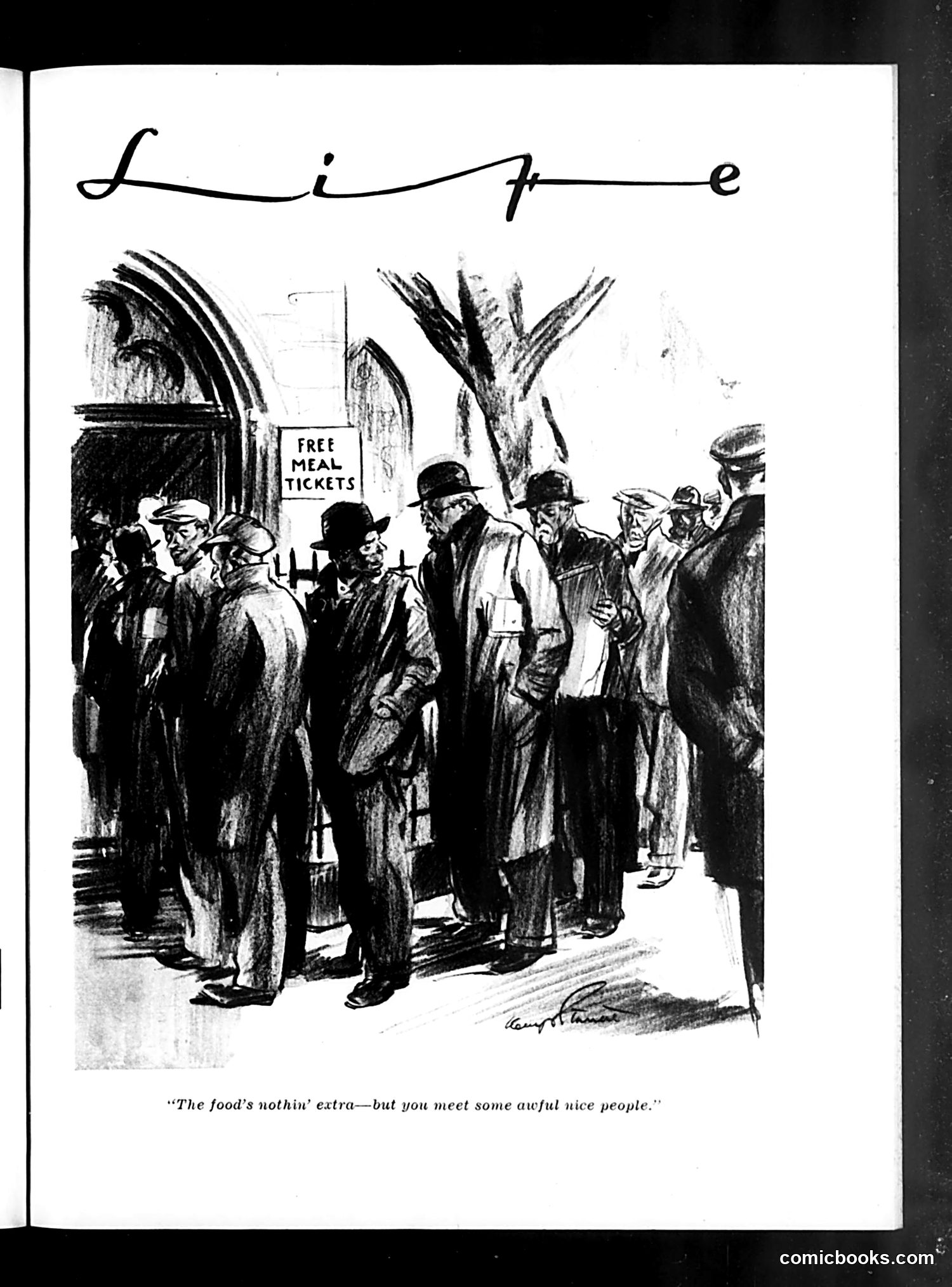
"Life" Magazine Cartoon Analysis This single-panel cartoon depicts a queue of men outside a venue offering "FREE FAIR TICKETS." The caption reads: "The food's nothin' extra—but you meet some awful nice people." The satire targets Depression-era charitable institutions or public events that distributed free food and entertainment to the unemployed and poor. The joke's cynicism suggests that while the meal itself is unremarkable ("nothin' extra"), the real value lies in the social interaction—meeting fellow destitute citizens. The cartoon likely comments on how such charitable efforts, while well-intentioned, offered minimal material relief. Instead, attendees gained mainly companionship and the temporary dignity of a public gathering. The crowded queue emphasizes widespread need during economic hardship.
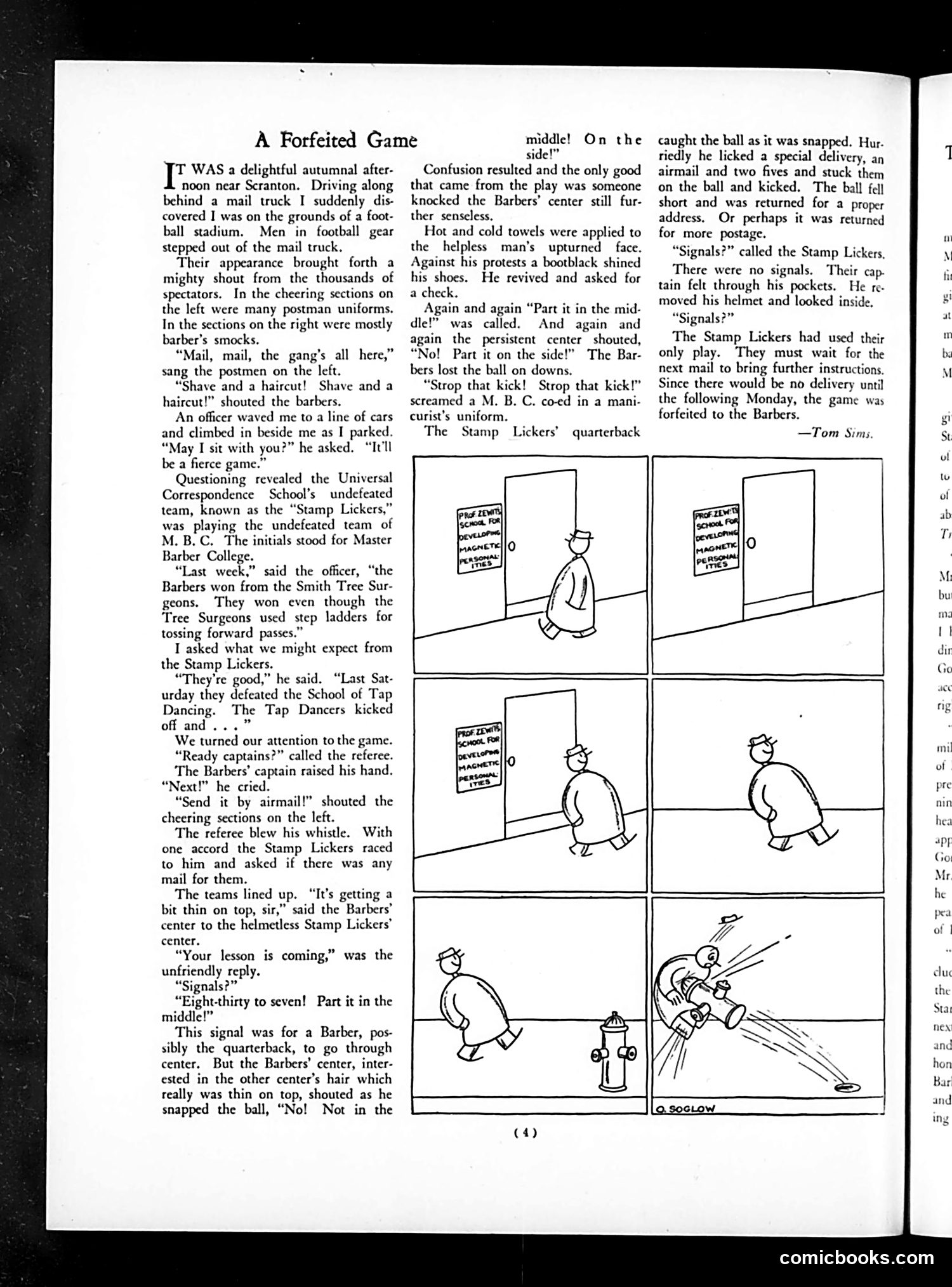
"A Forfeited Game" - Explanation This is a humorous sports story about a football game between two schools: the "Stamp Lickers" (Universal Correspondence School) and the "Barbers" (Master Barbers College). The narrative describes confusion during the match that results in a forfeit. The accompanying comic strip shows the apparent cause: the Stamp Lickers' quarterback attempts to deliver a signal by mailing it, following the strip's literal interpretation of "airmail." The final panel depicts the signal arriving via mail carrier mid-game—too late to be useful. The satire mocks correspondence schools (then legitimate but widely ridiculed) by suggesting they conduct activities, even football, through mail delivery. The joke plays on "stamp lickers" (a derogatory term for mail workers) and the absurdity of time-delayed communication in real-time sports competition.
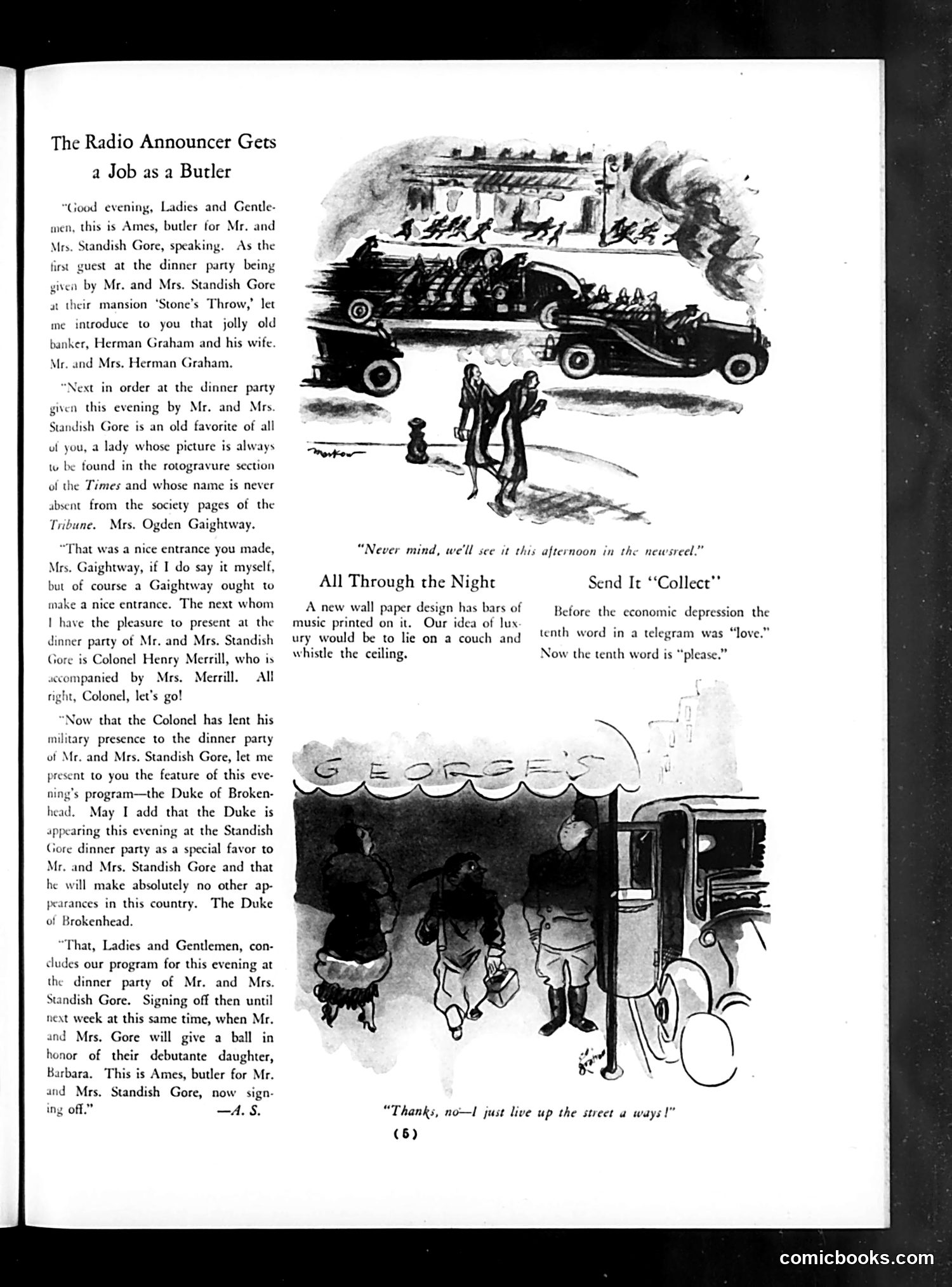
Content Analysis This page contains two separate satirical pieces from *Life* magazine: "The Radio Announcer Gets a Job as a Butler" (top): A humorous story where a radio announcer named Ames, introducing guests at a dinner party, treats the occasion like a broadcast performance—over-dramatizing introductions for the Standish Gore household. The satire mocks radio announcers' theatrical delivery and pretension when applied to everyday social settings. "All Through the Night" and "Send It 'Collect'" (bottom): Two brief, unrelated items. The first discusses wallpaper with musical notes printed on it. The second references Depression-era economics, noting that "please" has become the tenth word in telegrams (people now asking politely rather than demanding), reflecting the economic hardship of the period. The cartoons use visual humor to accompany these social observations about broadcasting culture and economic conditions.
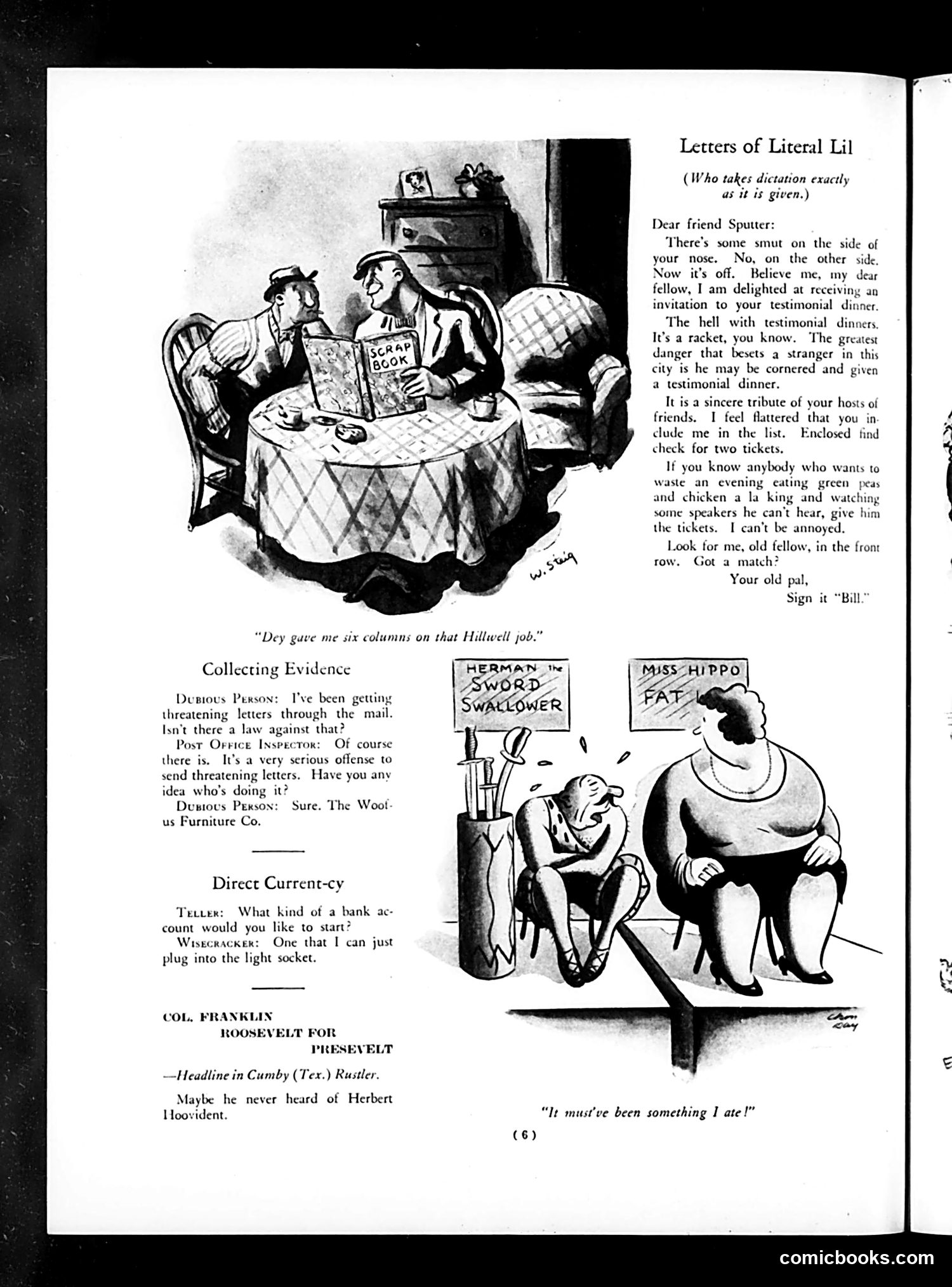
Analysis of Life Magazine Page This page contains three separate humorous items typical of early 20th-century Life magazine: 1. "Letters of Literal Li" - A mock letter from "Bill" declining a testimonial dinner invitation with comic complaints about the event format. 2. "Collecting Evidence" - A brief dialogue between a Demon's Person and Post Office Inspector about threatening letters, satirizing bureaucratic response to threats. 3. "Direct Current-cy" - A banker/teller joke about opening a bank account with a plug-in socket. 4. "Col. Franklin Roosevelt Presents" - References a headline, possibly satirizing Theodore Roosevelt's political presence (though the OCR suggests "Hoosevelt"). The bottom cartoon shows two figures labeled "Herman the Sword Swallower" and "Miss Hippo Fat," appearing to be sideshow performers—satirizing circus attractions or vaudeville acts. These represent typical Life magazine humor: social commentary, wordplay, and caricature targeting public figures and contemporary absurdities.
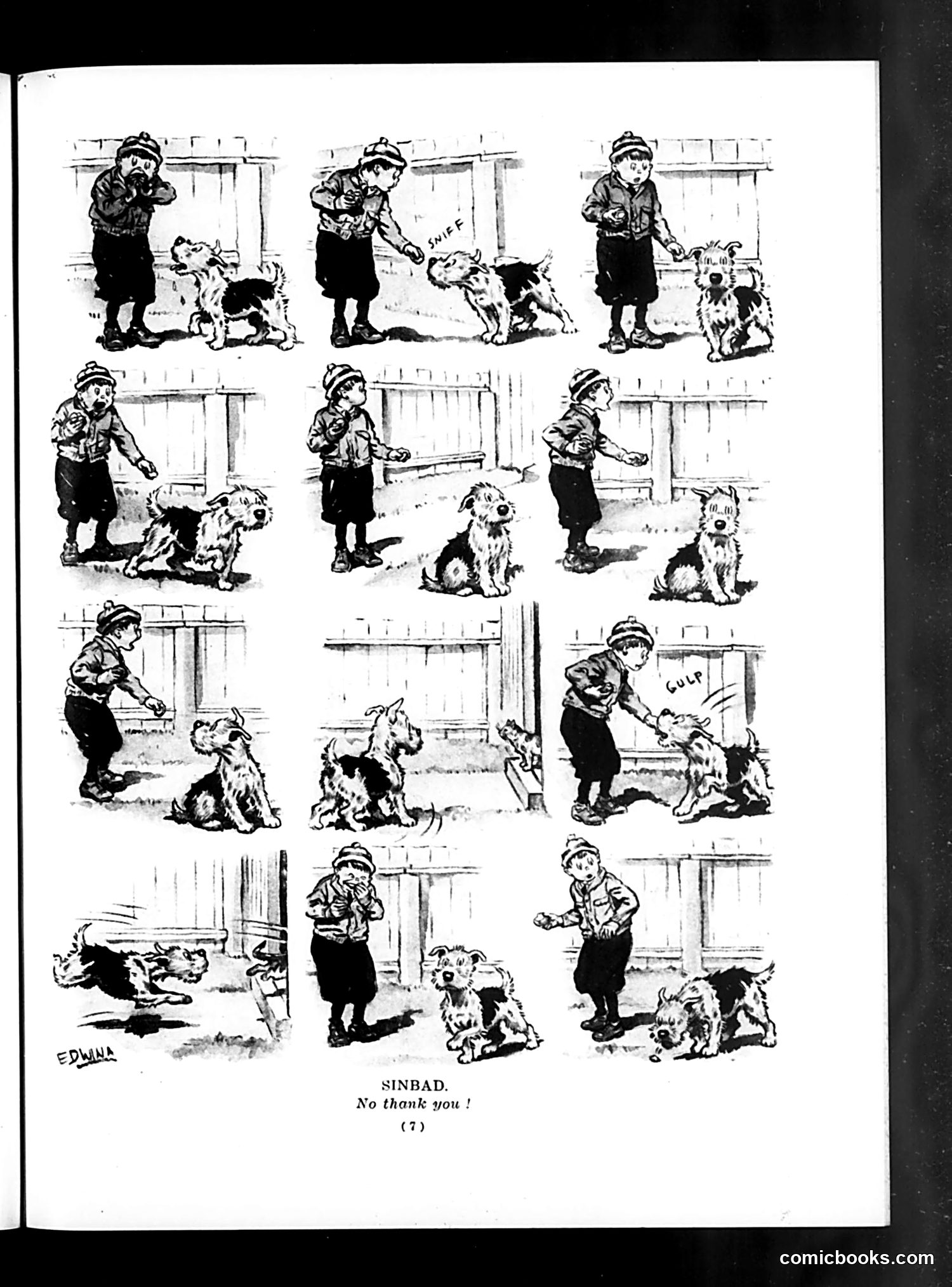
"Sinbad: No thank you!" This comic strip by E. Pud (visible signature) depicts a child repeatedly refusing a dog's friendly advances and affection. In each panel, the child rebuffs the eager dog—pushing it away, turning aside, or declining interaction—while the dog persistently seeks the child's attention and companionship. The title "No thank you!" suggests the satire targets ingratitude or rudeness toward genuine kindness. For a modern reader, this appears to be gentle social commentary on how people (represented by the child) reject sincere, loyal devotion (the dog's behavior). It may mock those who spurn authentic friendship or assistance, portraying such rejection as foolish or ungracious. The repetition emphasizes the point through accumulated examples of the child's discourtesy.
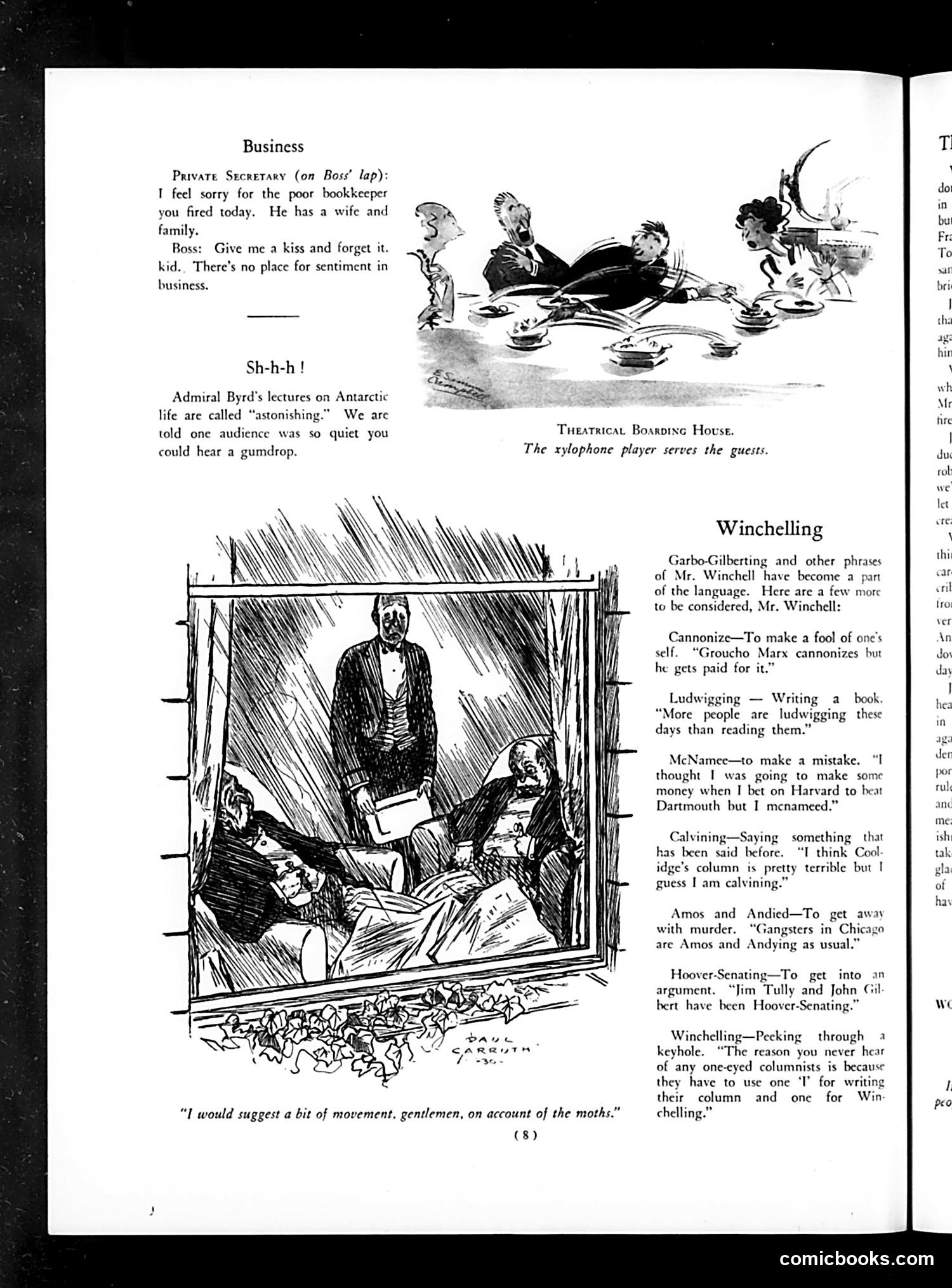
Satire Explanation This page contains two unrelated humor pieces from *Life* magazine. "Business" (top): A brief satirical exchange where a boss callously fires a bookkeeper and tells him to forget sentiment—"There's no place for sentiment in business." The accompanying cartoon shows a xylophone player at a theatrical boarding house, illustrating the absurdist caption about serving guests. "Winchelling" (bottom): This defines slang terms associated with Mr. Winchell, apparently a prominent columnist or public figure. The cartoon depicts voyeurism through a window, illustrating "Winchelling" as peeping through keyholes. Terms like "Cannonize," "Ludwigging," and "McNamee" reference other well-known writers or personalities whose names have become verbs for their characteristic behaviors. The satire mocks how influential media figures' names become part of common speech.
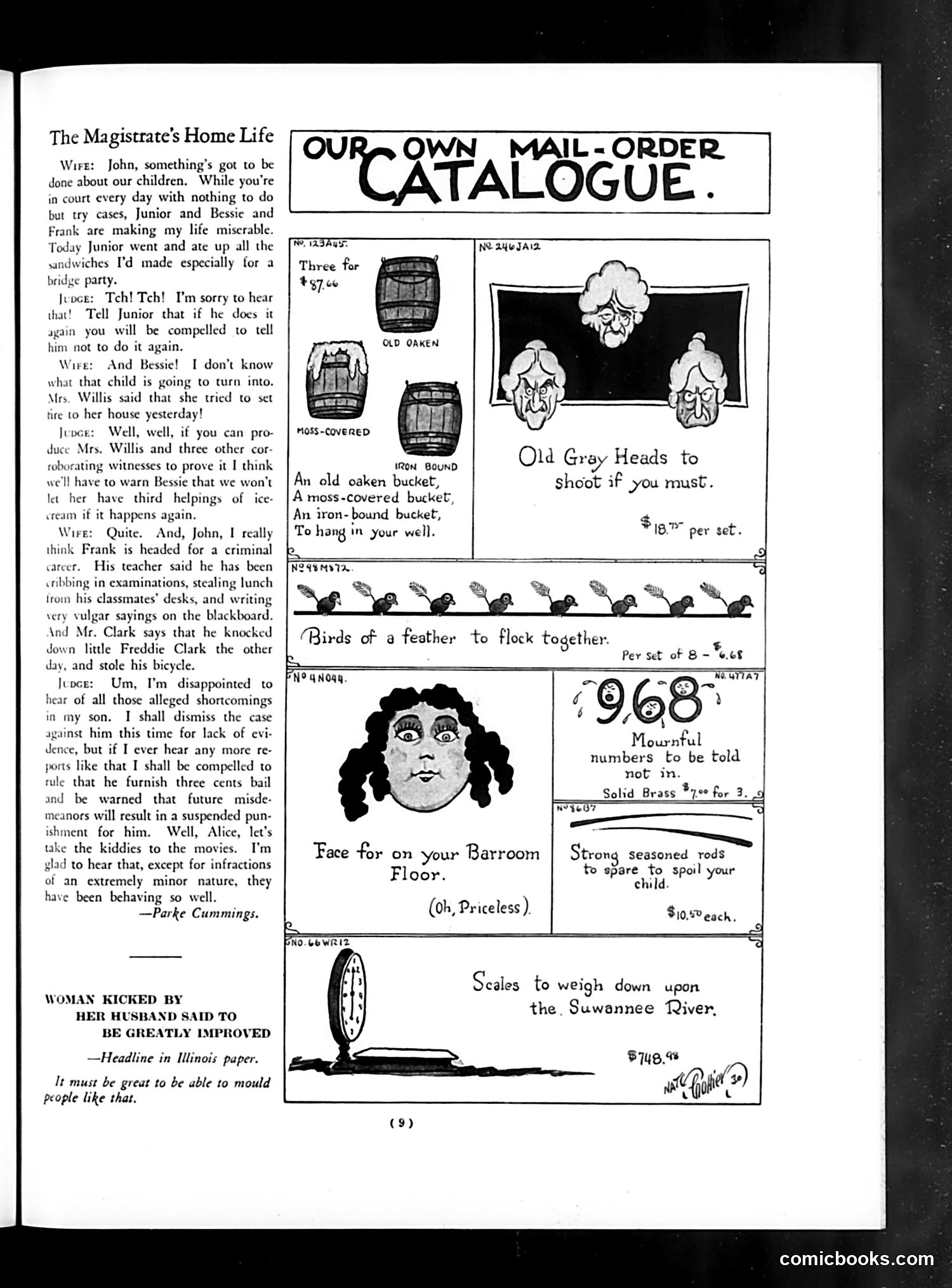
"Our Own Mail-Order Catalogue" - Life Magazine Satire This is a humorous fake mail-order catalog parodying the popularity of actual mail-order shopping catalogs (like Sears or Montgomery Ward) in early-20th-century America. The items satirize parenting frustrations and domestic life: - "Old Gray Heads" to shoot if disciplining children fails - "Birds of a feather to flock together" (suggesting children are like unruly birds) - A "Face for on your Barroom Floor" (mocking drunken patrons) - "Strong seasoned rods to spare to spoil your child" (caning implements) - Scales to weigh children down in the Suwannee River (dark joke about drowning misbehaving children) The catalog format allows Life to mock contemporary parenting struggles, marital discord, and social anxieties through absurdist humor. The joke relies on readers' familiarity with actual catalogs and shared exasperation with family life.
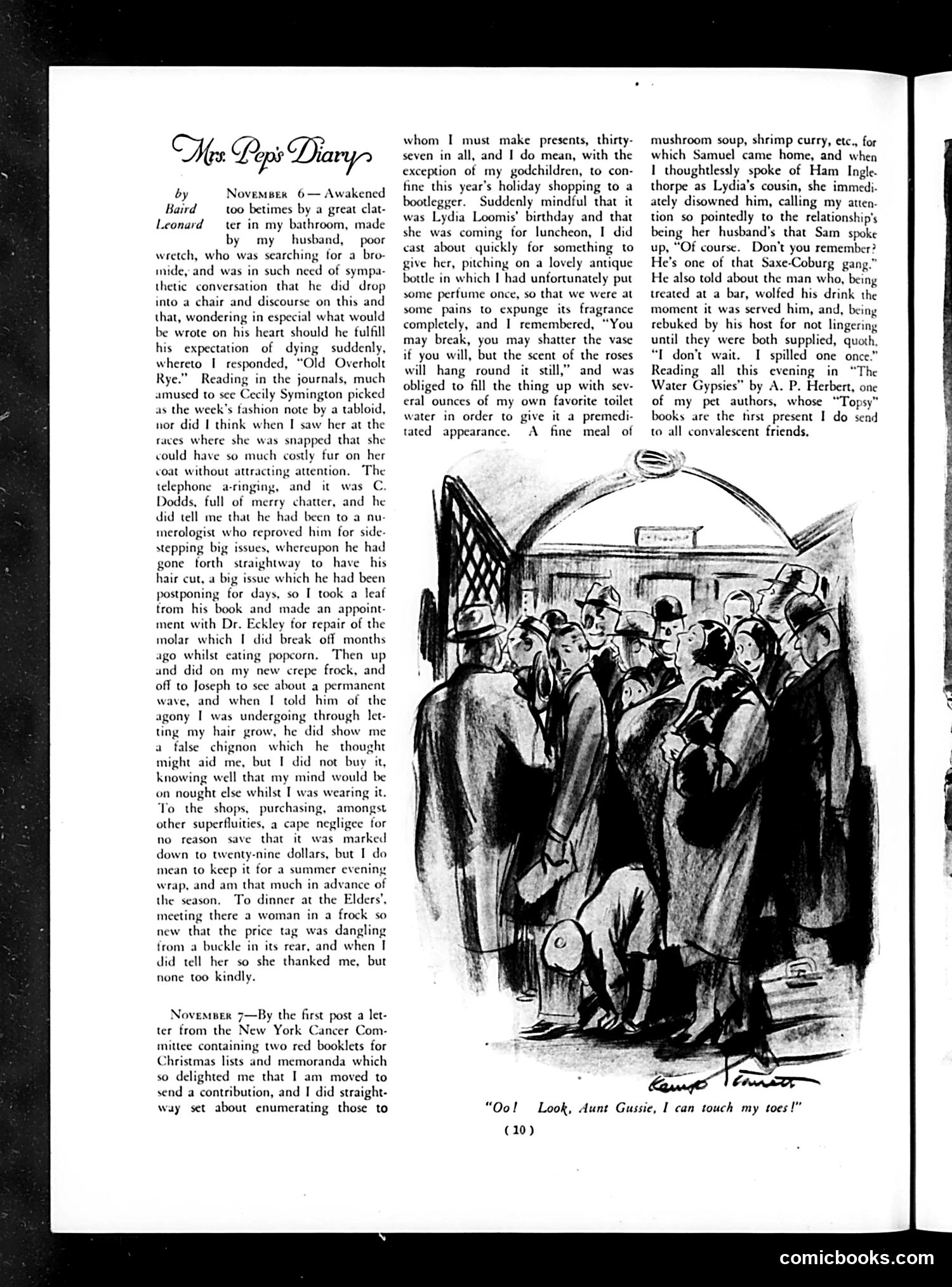
Analysis of "Mrs. Pop's Diary" Page This is a humorous diary entry by Hazel Leonard, dated November 6-7, describing domestic life during the holiday shopping season. The accompanying cartoon illustrates a crowded, chaotic scene with the caption "Oo! Look, Aunt Gussie, I can touch my toes!" The humor targets: 1. Holiday shopping madness — the narrator's frantic gift-buying and attempts to manage a crowded schedule 2. Spousal complaints — her husband's various annoyances and demanding behavior 3. Crowded department stores — the cartoon depicts a sardine-like mass of holiday shoppers pressed together indoors, showing the physical chaos of seasonal retail 4. Child behavior — the child's gleeful observation about physical contact in the crush of bodies The satire gently mocks the stress, overcrowding, and absurdity of pre-Christmas shopping culture and domestic life.
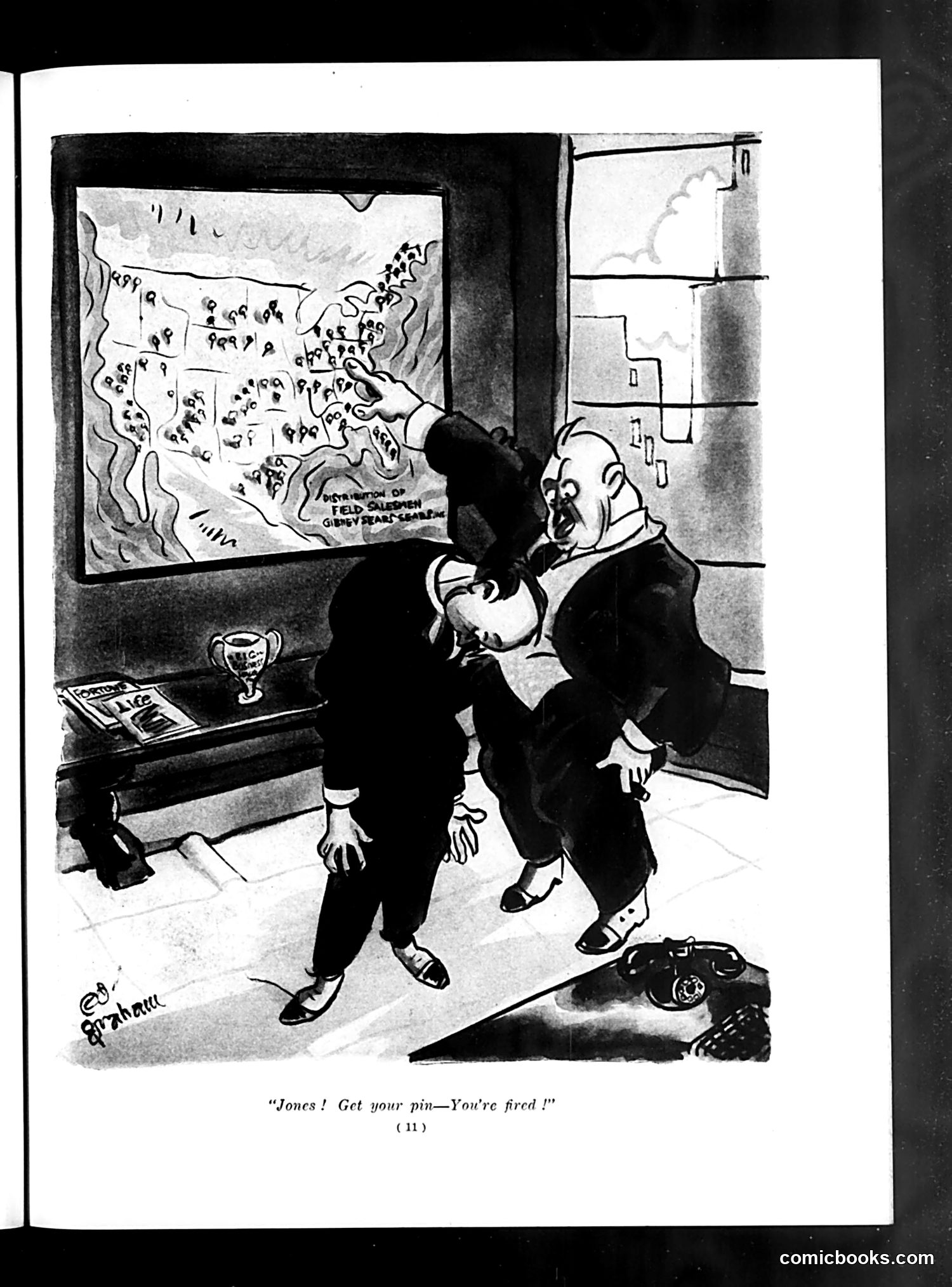
Analysis of Political Cartoon Page This single-panel cartoon shows two men in an office examining a wall map labeled "Distribution of Field Salesmen [Gibson Brand Cigars]." One man (appearing to be a boss or superior) points at the map while speaking to "Jones," saying "Jones! Get your pin—You're fired!" The joke plays on the double meaning of "pin"—both the literal pins used to mark salesmen locations on the map, and the figurative "get your pin" as slang for receiving notice of termination. The humor derives from the casual, almost cheerful manner in which the firing is delivered, treating a serious consequence as a routine office task. This appears to be corporate/business satire mocking workplace dynamics and the impersonal nature of employment decisions.
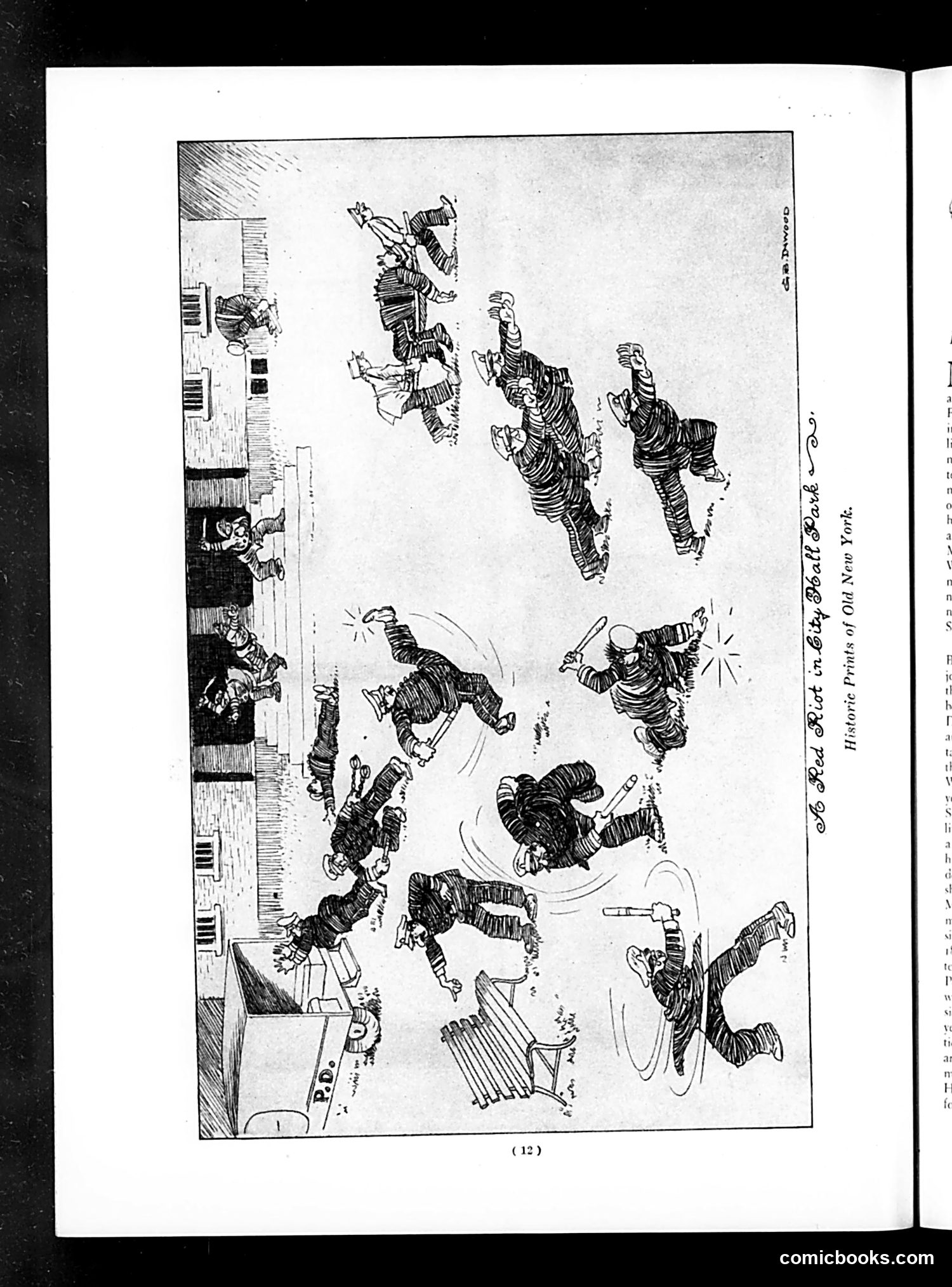
Political Cartoon Analysis This appears to be a satirical cartoon depicting police or military figures in striped uniforms engaged in chaotic street violence. The image shows multiple armed officers wielding clubs and engaging in physical altercations with civilians near what appears to be a building or storefront marked "P.D." (likely Police Department). The cartoon likely satirizes police brutality or overly aggressive law enforcement tactics of its era. The exaggerated, dynamic poses and the emphasis on multiple officers attacking simultaneously suggests criticism of disproportionate police response or violent crowd control methods. Without a visible date or caption identifying specific historical events, the exact incident referenced remains unclear, but the satire clearly condemns aggressive policing practices through visual exaggeration and dark humor typical of *Life* magazine's editorial content.
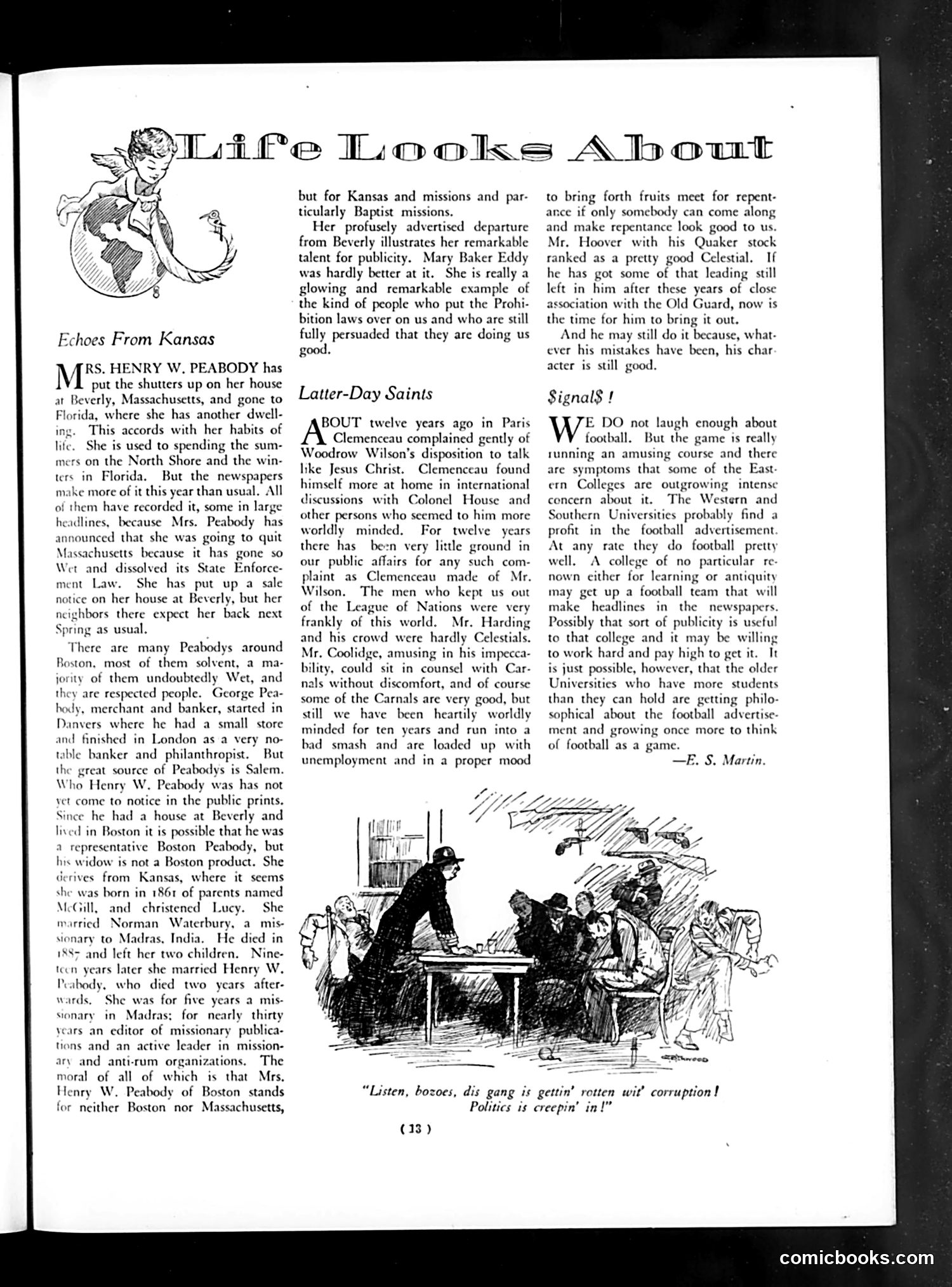
Analysis of Life Magazine Page This page contains three editorial articles rather than political cartoons. The "Signals!" section critiques college football's growing commercialization and excessive publicity at American universities. The author argues that while football provides entertainment value, colleges risk losing educational focus by prioritizing athletic recruitment and newspaper headlines over academics. The accompanying illustration depicts what appears to be a political or administrative figure speaking to others, with a caption referencing "corruption" and "politics creeping in"—likely satirizing how commercial and political interests infiltrate institutional spaces. The other sections discuss missionary work and Kansas residents' experiences, reflecting early-twentieth-century American concerns with Prohibition enforcement and religious missions.
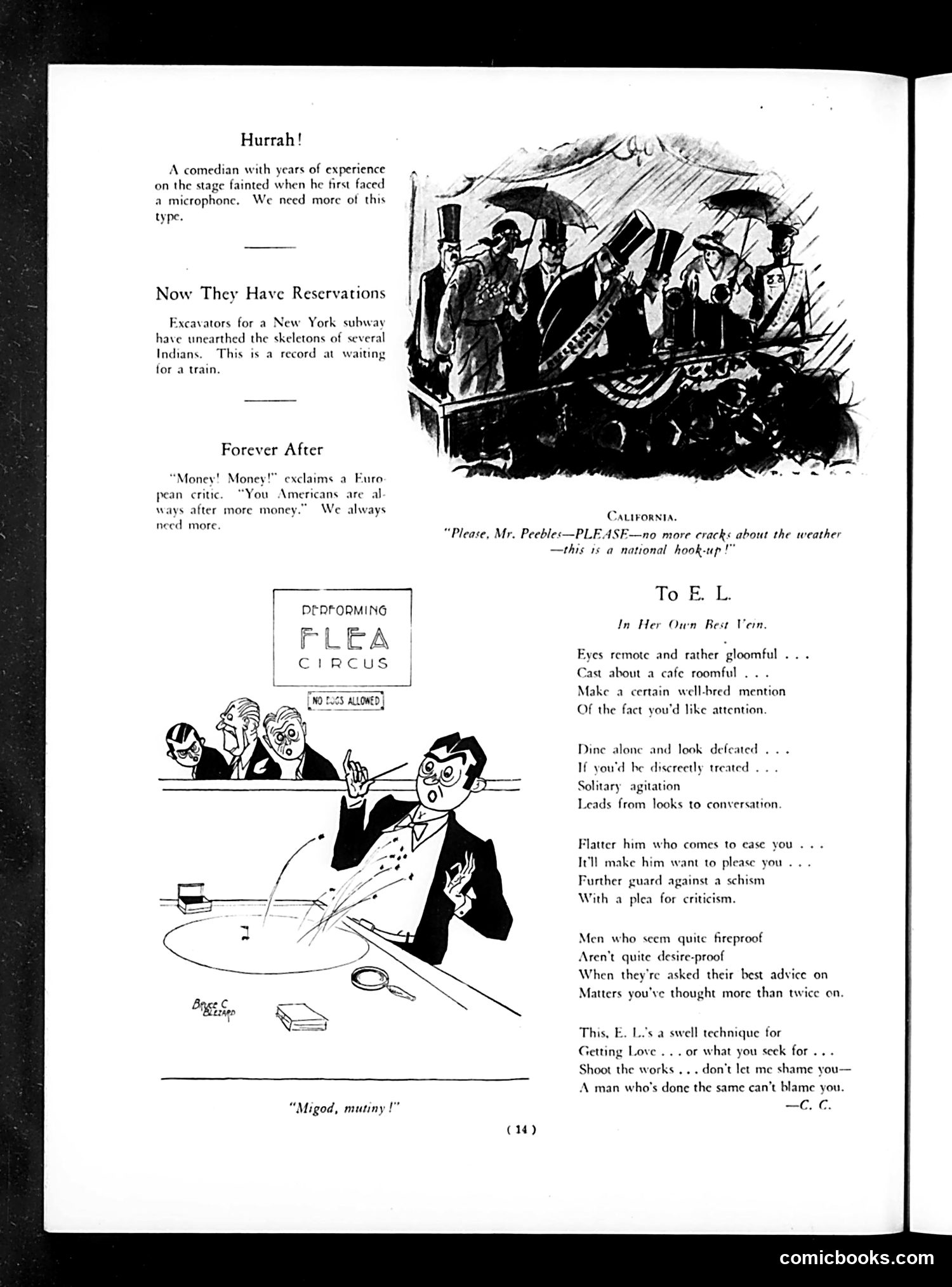
Analysis of Life Magazine Page This page contains three separate humor pieces: 1. "Hurrah!" - A brief joke about comedians needing microphone experience, suggesting early broadcast radio was still novel. 2. "Now They Have Reservations" - A cartoon about subway excavators unearthing Native American skeletons, joking grimly that these remains were "waiting for a train"—satirizing both infrastructure development and the displacement of Indigenous peoples. 3. "Performing Flea Circus" - A cartoon showing a performer unable to control fleas in his act, with spectators watching his failure. The caption "Migod, mutiny!" suggests the fleas have rebelled. 4. "To E.L. In Her Own Best Vein" - A poem offering sardonic advice about romance and maintaining dignity in relationships. The page reflects early 20th-century American humor—mixing physical comedy, racial insensitivity, and cynical observations on modern life.
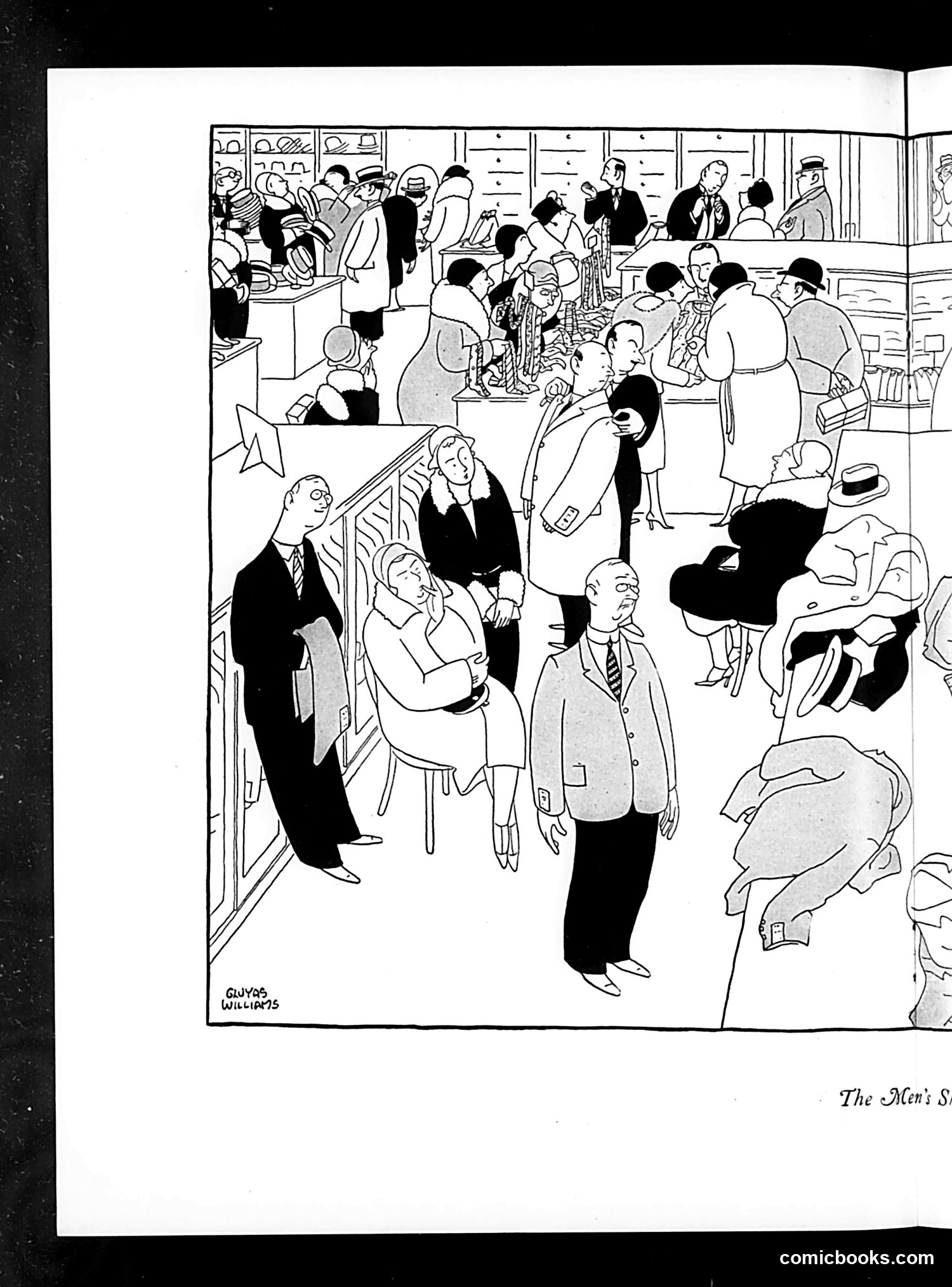
"The Men's S[hop]" - A Crowded Department Store Scene This cartoon by Gluyas Williams depicts a bustling men's clothing department, likely from the 1920s-30s era based on the artistic style and fashion. The humor appears centered on the chaos of retail shopping: customers browse hats and suits while salesmen attend to multiple patrons simultaneously. The scene satirizes the crowded, somewhat disorganized nature of department store shopping during this period. The title fragment "The Men's S[hop]" suggests this illustrates a specific retail establishment or shopping experience. Williams's characteristic detailed linework captures dozens of individualized figures in various poses—trying on hats, examining merchandise, waiting for service—conveying both the energy and mild pandemonium of busy commercial spaces. The satire likely mocks the overwhelming sensory experience of urban retail culture for contemporary readers.
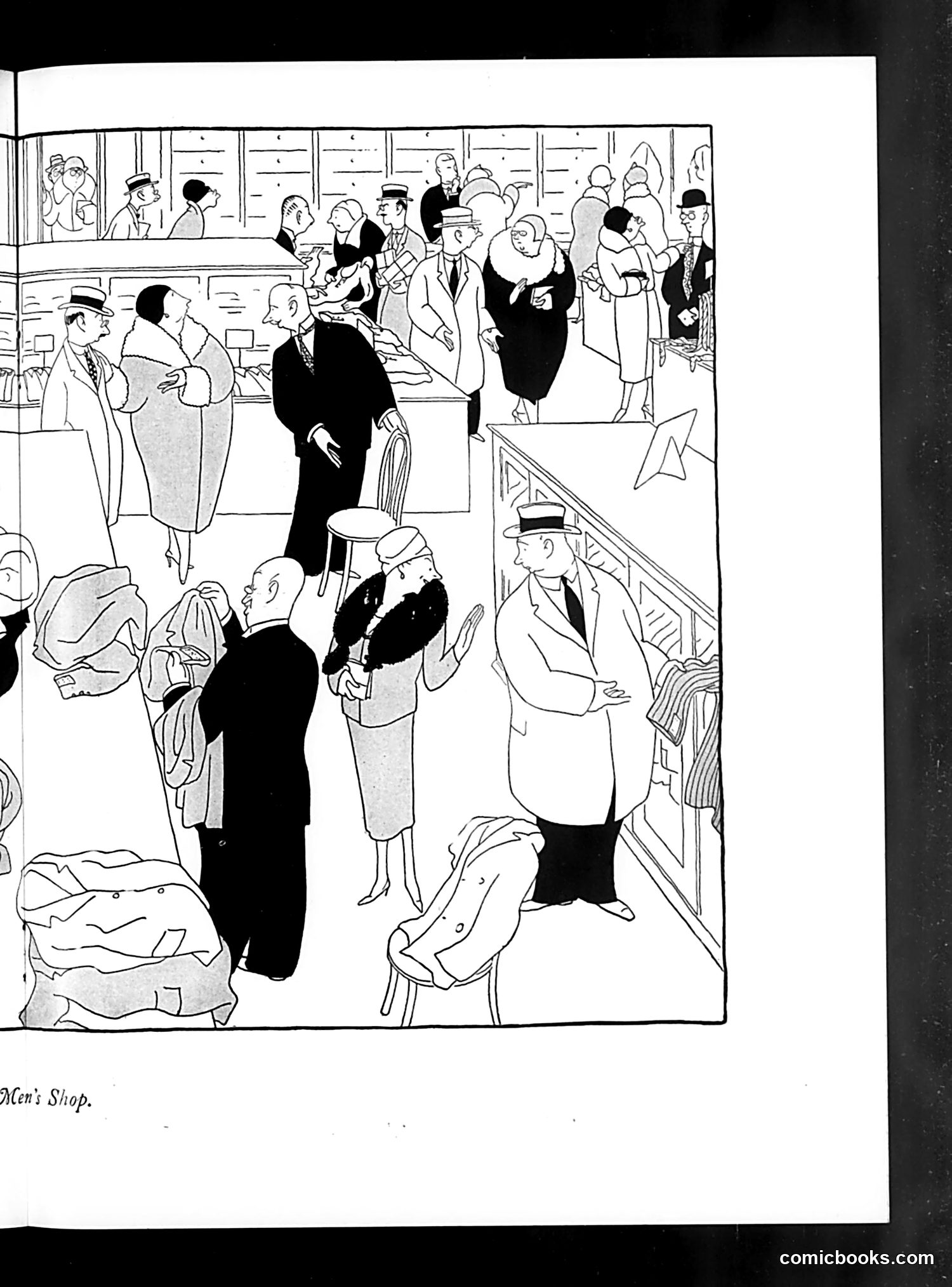
Men's Shop This cartoon depicts a crowded men's clothing store, likely from the early-to-mid 20th century based on the art style and fashion. The scene shows numerous male and female customers browsing and shopping, with clerks assisting patrons. The satire appears to target the chaos and crowding of retail shopping, possibly during a sale or holiday season. The varied dress and body types of the customers—some appearing portly or fashionably dressed—suggests social commentary on consumer culture and shopping behaviors of the era. Without additional context or caption text visible, the specific political or social critique remains unclear, though it likely comments on American consumerism or retail commercialism during this period.
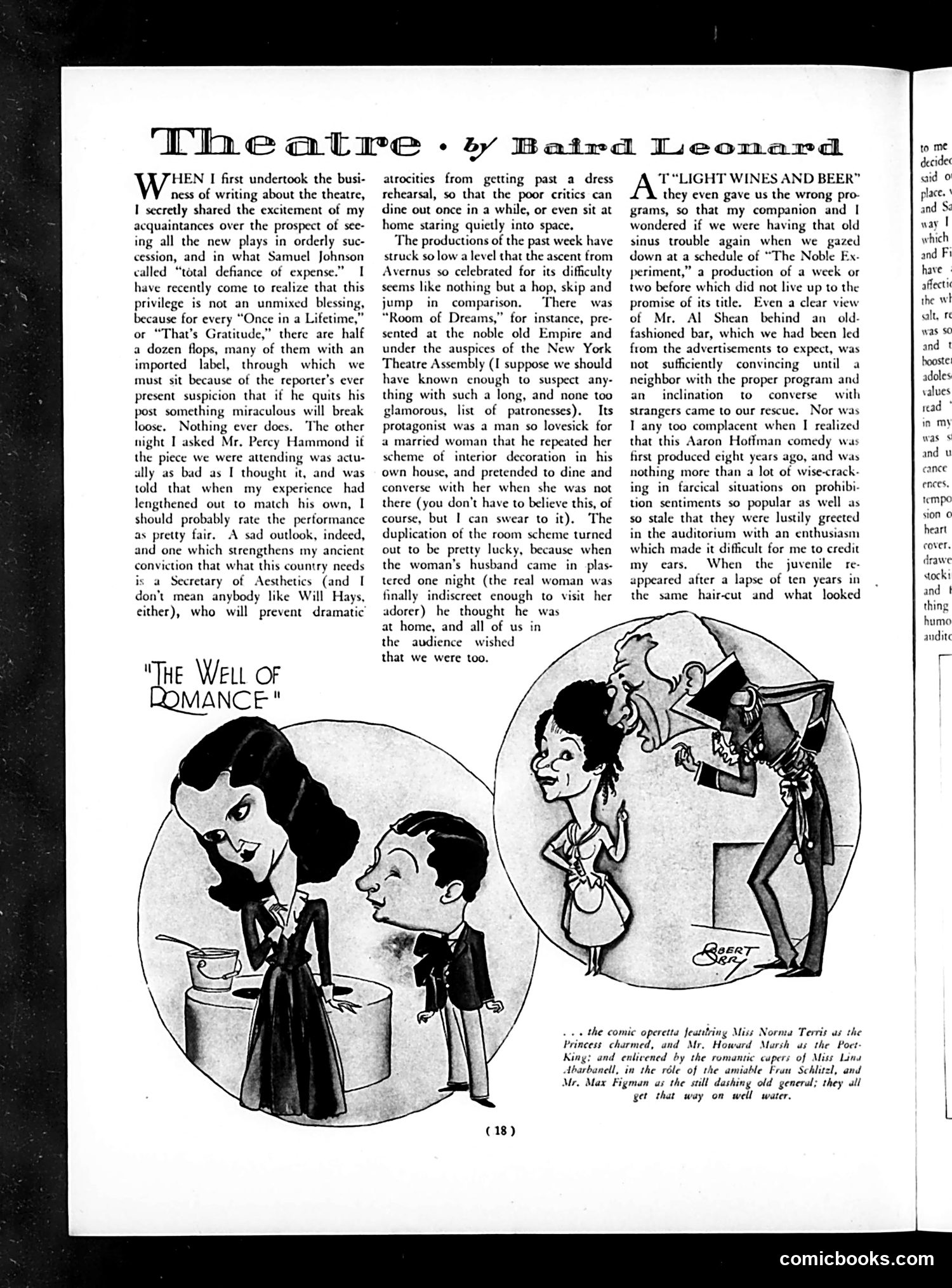
Theatre Review: "The Well of Romance" This is a theatre review by Baird Leonard critiquing a production called "The Well of Romance." The two cartoons illustrate scenes from the play, drawn by an artist signed "Cesare." The left cartoon shows a woman and man at what appears to be a romantic moment near a well or fountain. The right cartoon depicts what the caption identifies as "the comic operetta" featuring Miss Norma Terris and Mr. Howard Marsh in leading roles, with supporting performances by Miss Lina Abarbanell, Fran Schnitzel, and Max Figman. Leonard's review criticizes the production's shallow plotting and weak dramatic execution, describing it as lacking substance despite romantic themes.
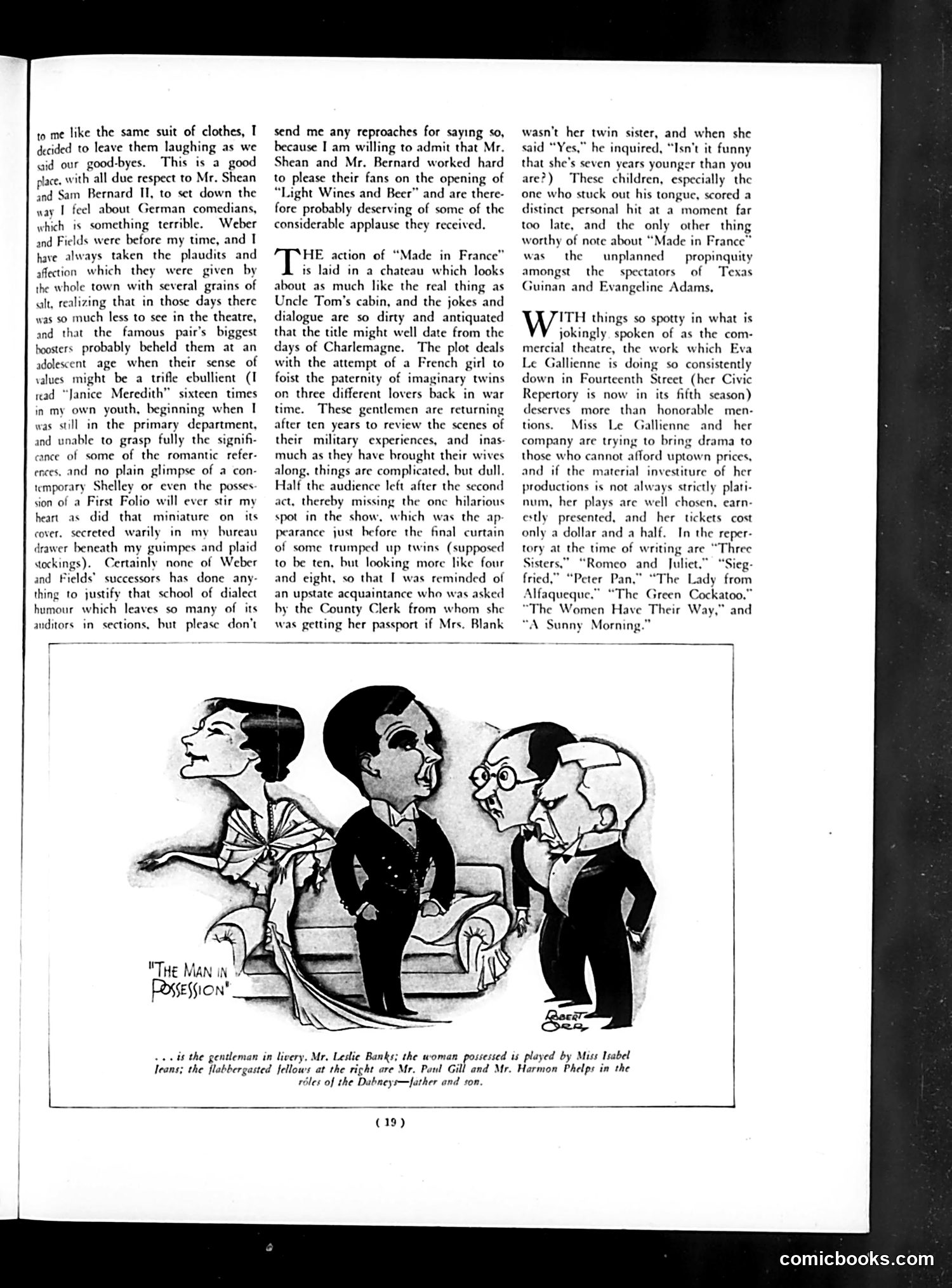
Analysis of Page Content This page contains theater reviews from *Life* magazine critiquing several Broadway productions. The cartoon illustrates "The Man in Possession," featuring Leslie Banks as a gentleman in livery and Paul Gill and Harmon Phelps as flustered onlookers. The text criticizes German-dialect comedians (referencing Weber and Fields, earlier vaudeville stars), dismisses "Light Wines and Beer" as mediocre, and harshly pans "Made in France"—a farce about French twins involving three wartime lovers. The reviewer notes the audience exodus after act two. The notable detail: Texas Guinan (a famous nightclub hostess/performer) and Evangeline Adams (a renowned astrologer) happened to attend simultaneously—an amusing coincidence the reviewer highlights. The page concludes praising Eva Le Gallienne's Fourteenth Street Repertory theater for making quality drama accessible to working-class audiences who cannot afford expensive uptown productions.
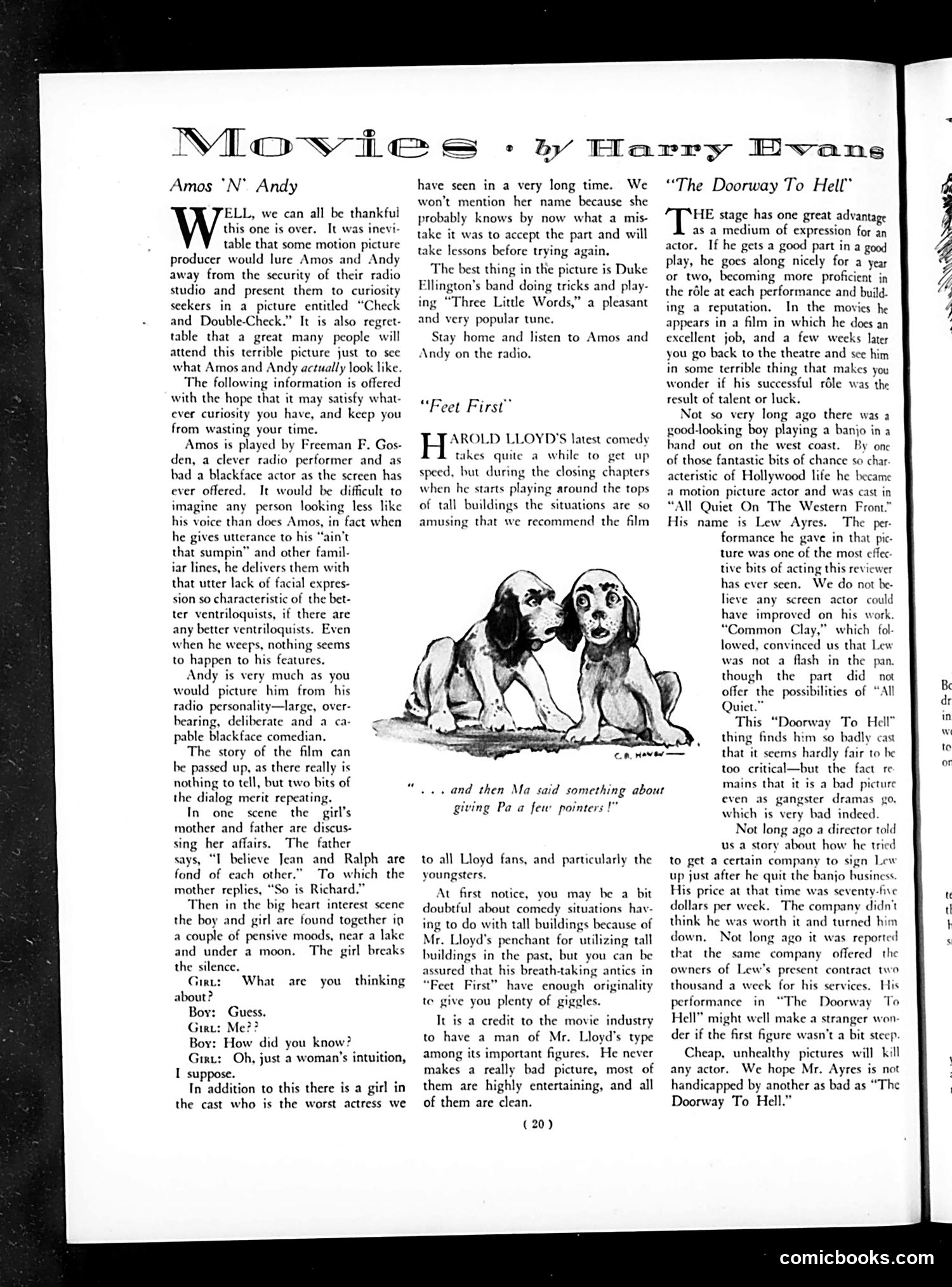
Explanation for Modern Readers This page reviews three films featuring blackface performers. The critic dismisses "Check and Double-Check" (featuring the radio comedy duo Amos 'n' Andy) as a terrible picture, calling Freeman Gosden's blackface performance particularly poor—lacking facial expressiveness even during emotional scenes. The dialogue samples provided are crude and unfunny. The page also reviews Harold Lloyd's "Feet First" and "The Doorway to Hell" more favorably. What modern readers should know: This represents 1930 entertainment criticism that casually accepted blackface performance as normal while critiquing its execution. The racist practice of white actors in blackface playing Black characters for comedy was standard in early cinema. The critic's focus on technical performance quality rather than the inherent offensiveness of the format reflects the era's racial attitudes. This page documents now-condemned entertainment practices presented matter-of-factly to contemporary audiences.
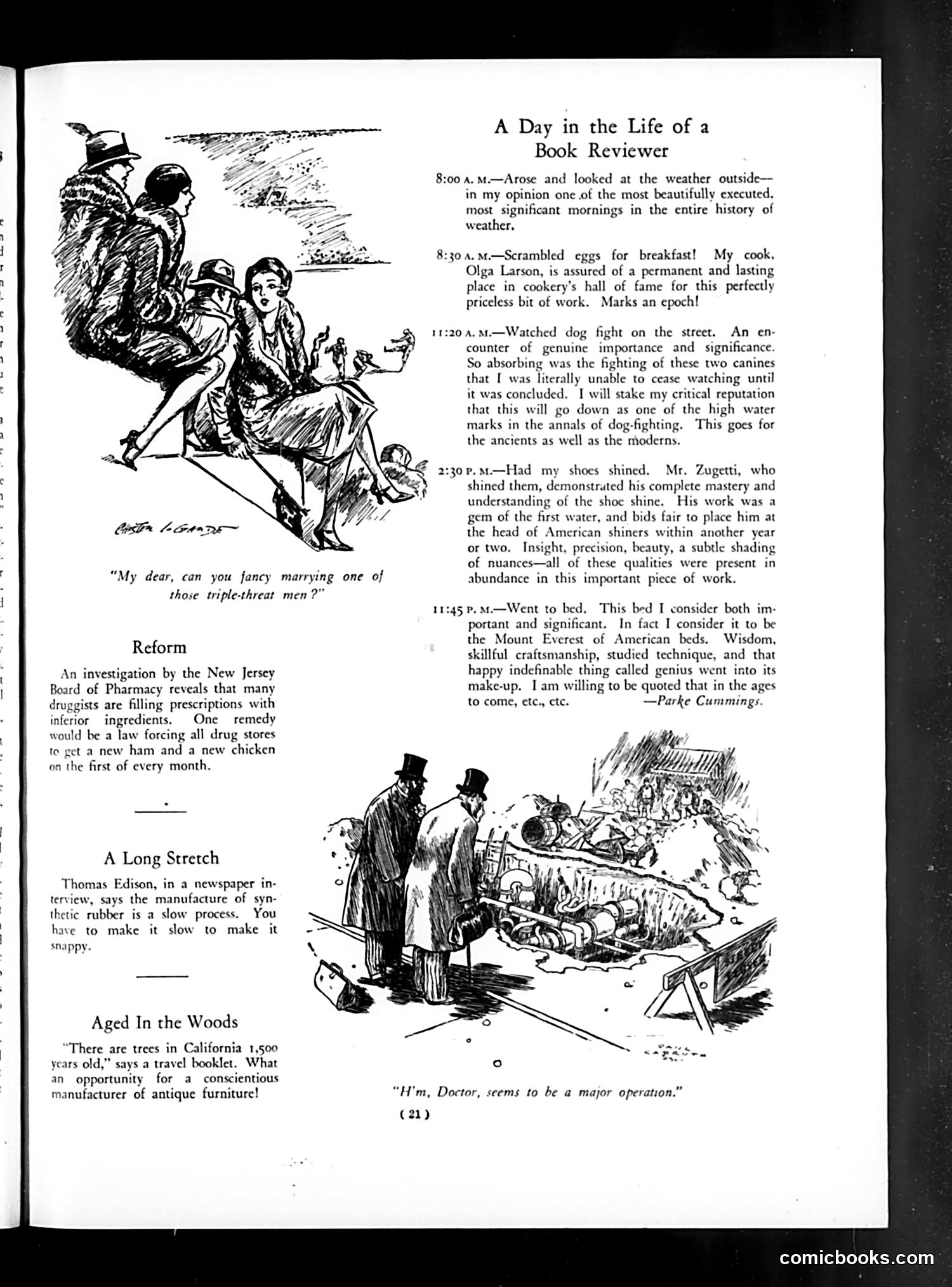
"A Day in the Life of a Book Reviewer" This satirical piece mocks pretentious book critics and intellectuals who treat trivial, everyday occurrences with grandiose, flowery language. The reviewer breathlessly describes mundane events—scrambled eggs, a dog fight, shoe shining, going to bed—as epochal moments worthy of historical significance and critical analysis. Each activity receives overwrought praise ("Mount Everest of American beds," "high water marks in the annals of dog-fighting"). The joke targets the absurdity of literary criticism and highbrow culture, where critics elevate ordinary subjects to profound importance through excessive vocabulary and pseudo-intellectual posturing. By applying this breathless reverence to breakfast and shoe shines, Life satirizes how disconnected literary elites are from reality, finding "significance" in everything while saying nothing meaningful.
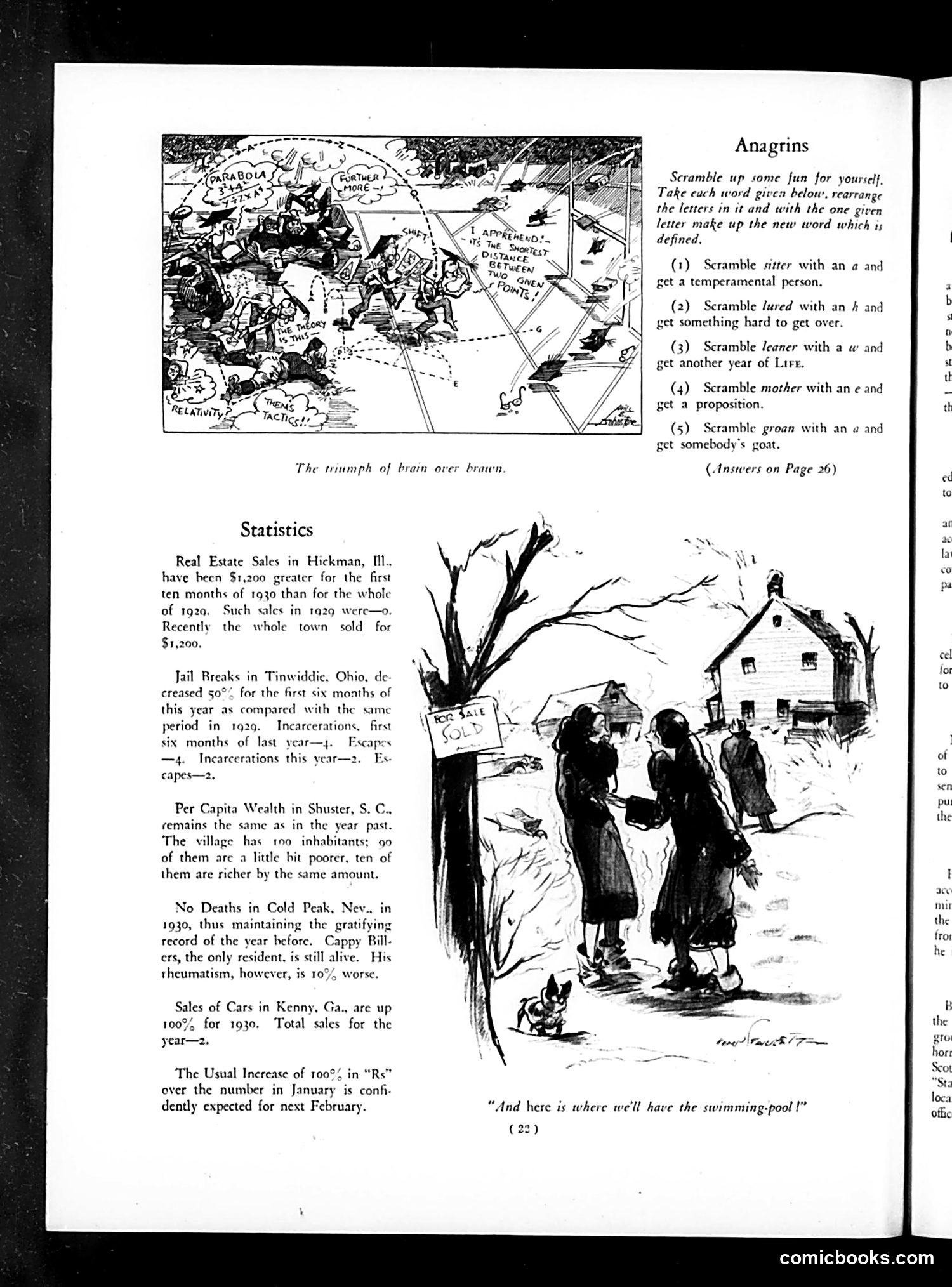
"The Triumph of Brain Over Brawn" and Great Depression Satire The top cartoon mocks pseudo-statistical claims about small-town prosperity during the Great Depression. The "Statistics" section uses absurdist humor to expose how misleading economic reporting can be: Hickman, Illinois sold for only $1,200 total; Tinwiddie's jail breaks "decreased" because almost no one was arrested or escaped; Shuster maintained "same wealth" while 90% got poorer and 10% got richer; Kenny's car sales "doubled" to a grand total of two vehicles. The bottom cartoon shows a family viewing a foreclosed farmhouse, with the realtor ironically promising "here is where we'll have the swimming-pool!" — a joke about selling worthless Depression-era properties with absurd optimism. Together, these pieces satirize how statistics were manipulated and false hope was peddled during economic collapse. The humor comes from exposing the gap between official claims and harsh reality.
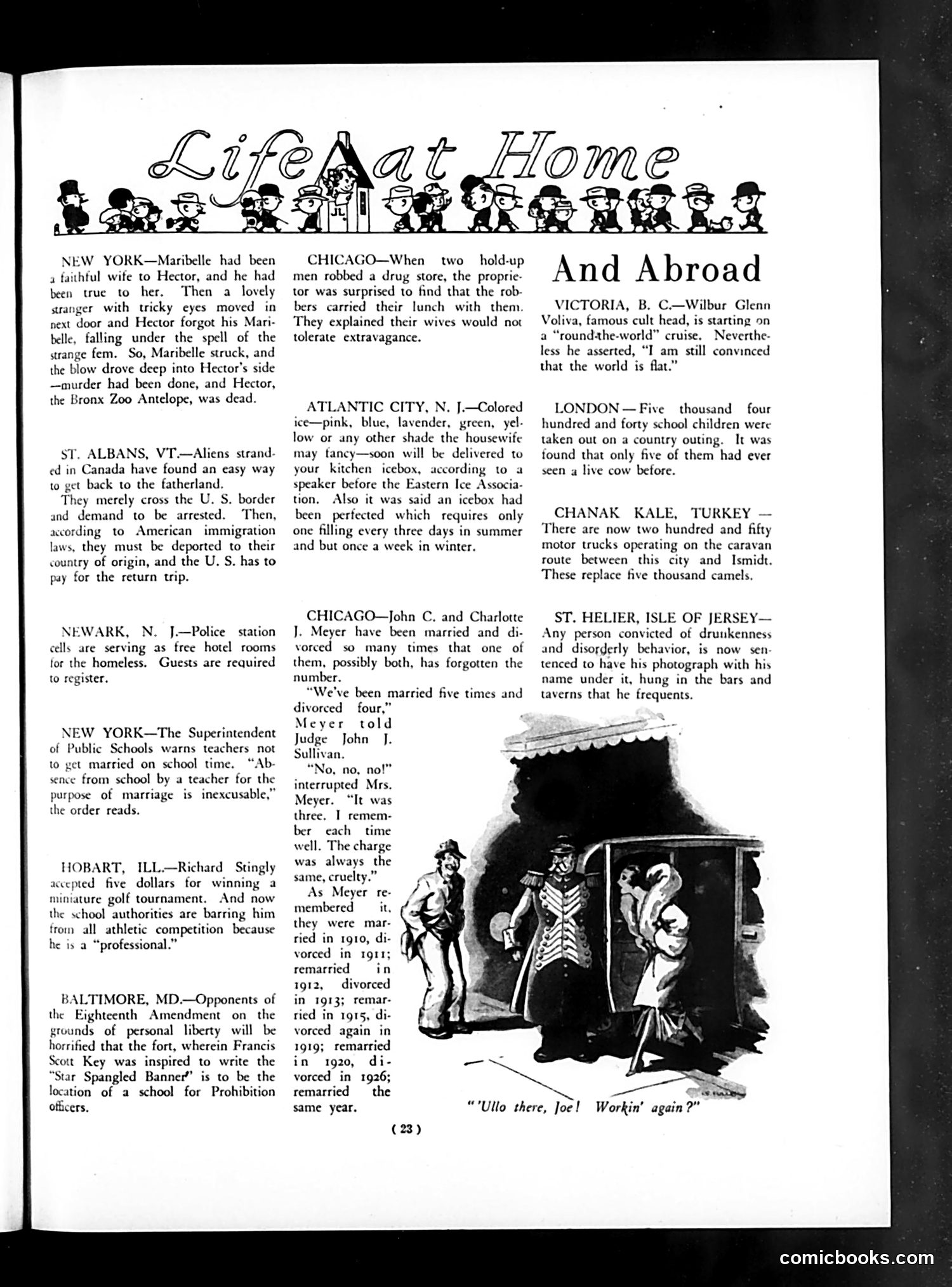
Analysis of Life Magazine Page This page collects humorous anecdotes from around North America and abroad, mostly satirizing social absurdities and bureaucratic logic of the era (appears to be 1920s, given Prohibition references). Key satires include: - Marital revolving door: A Chicago couple married and divorced multiple times, unable to agree on the count—mocking marital instability and casual divorce. - Immigration loophole: Aliens exploit U.S. deportation law as free transportation home, satirizing government inefficiency. - Police as innkeepers: Newark stations shelter homeless "guests"—mocking administrative absurdity. - Strict school policy: Teachers forbidden to marry during school hours—mocking rigid institutional rules. - Flat-earth cult leader: Wilbur Voliva cruises the world despite insisting it's flat—obvious hypocrisy. - Urban children ignorant of rural life: London schoolchildren never saw live cows—satirizing urban isolation. The cartoon shows a repeat offender greeting someone, captioned "Workin' again?"—likely referencing crime or jail recidivism. Overall, the page uses anecdote-based humor to mock modern society's contradictions.
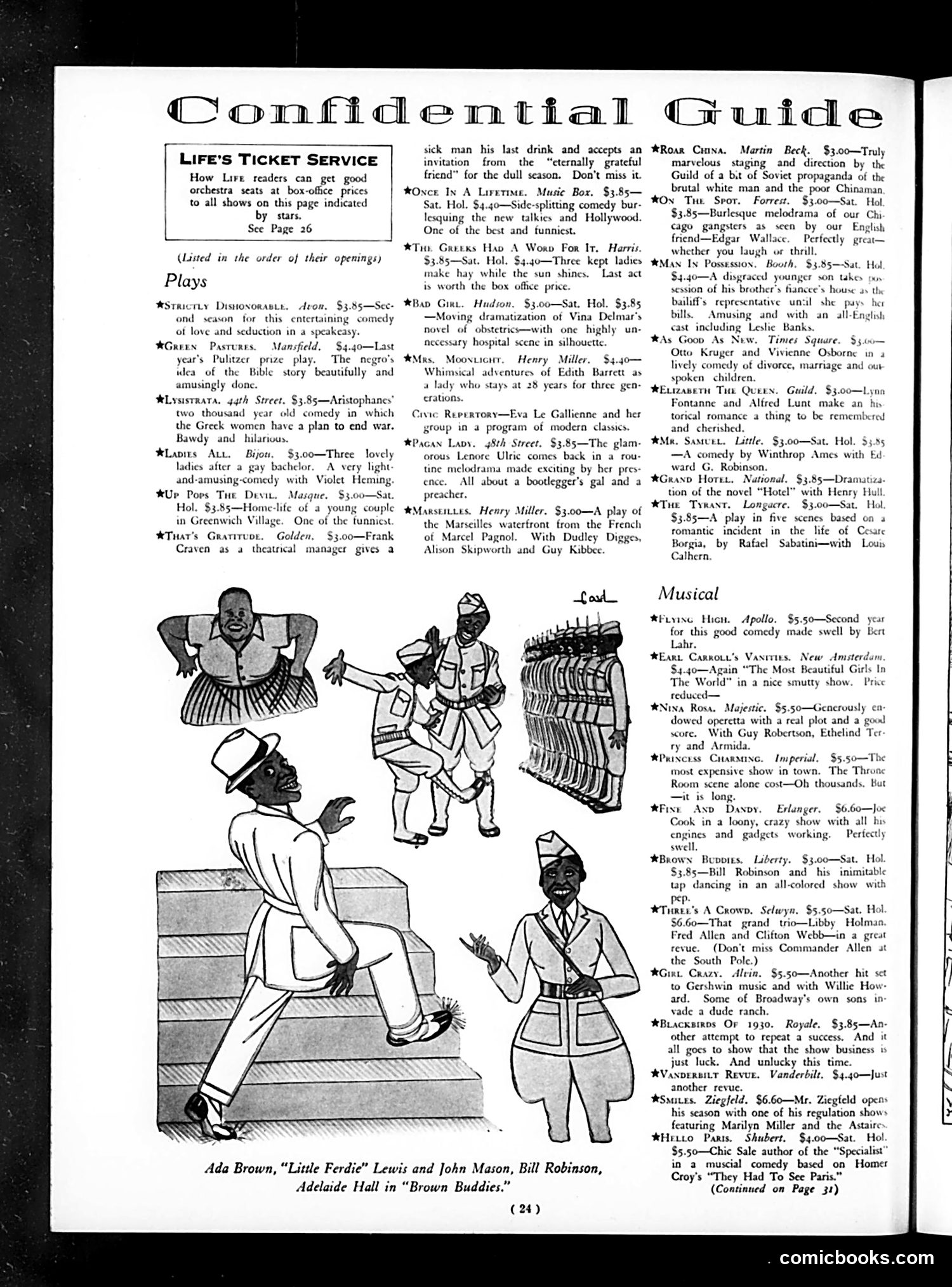
Confidential Guide Page Analysis This page is primarily a theater listing and review guide for Broadway shows, not a political cartoon. The content consists of: 1. Play reviews with ticket prices and performance details (marked with stars for Life's ticket service) 2. Musical reviews (bottom section) 3. One illustration showing performers from "Brown Buddies" - featuring Ada Brown, "Little Ferdie" Lewis, John Mason, Bill Robinson, and Adelaide Hall The illustration depicts Black performers in what appears to be a minstrel-style show, reflecting the theatrical conventions of the early 1930s. "Brown Buddies" was an actual all-Black musical revue. The reviews reference contemporary entertainment: talking pictures ("talkies"), speakeasy comedies (Prohibition era), Soviet propaganda films, and gangster burlesques reflecting 1920s-30s American culture. This is entertainment journalism, not political satire—a service guide helping readers find Broadway tickets and decide which shows to attend.
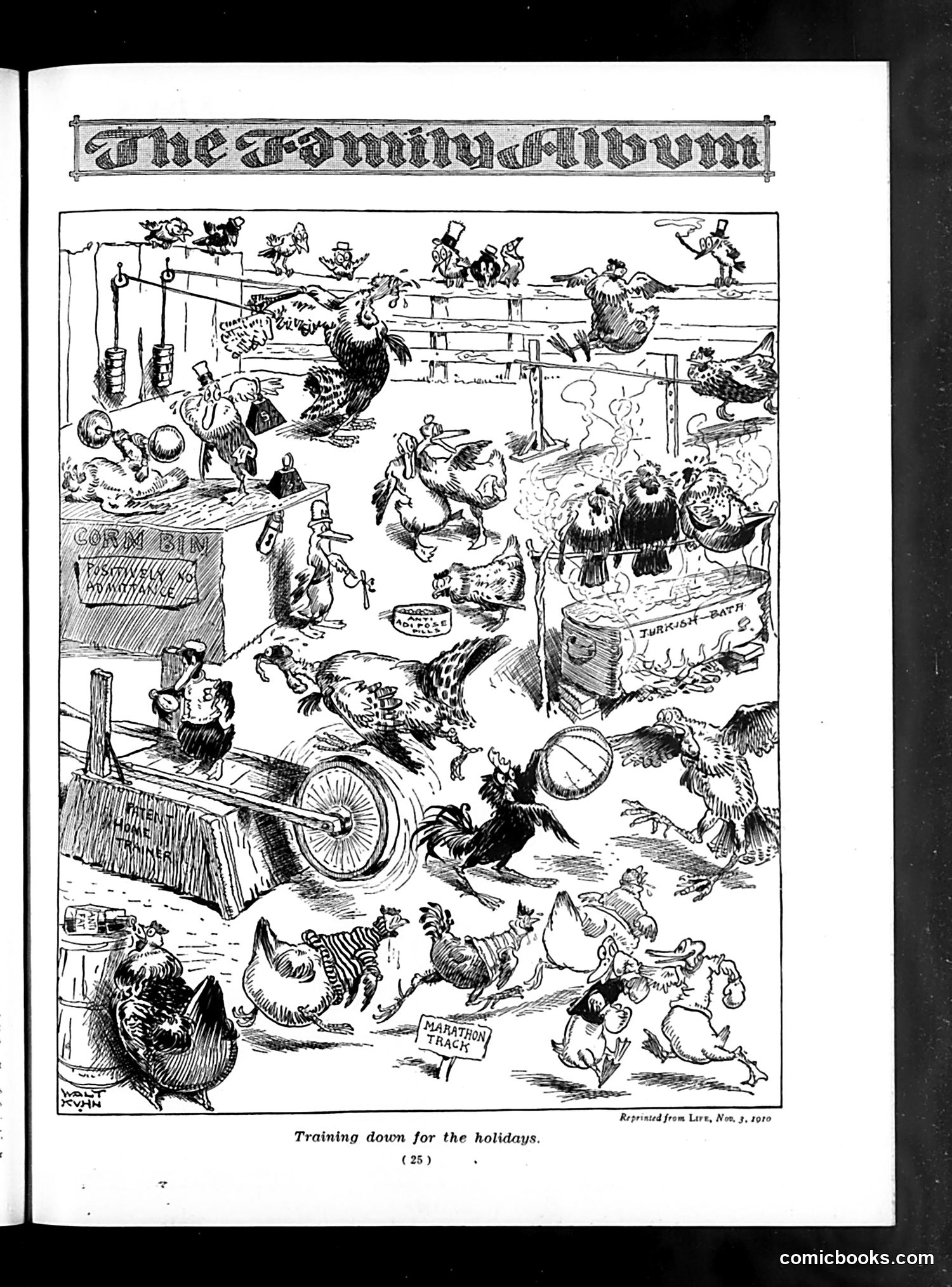
"Training Down for the Holidays" (Life Magazine, November 3, 1910) This satirical cartoon depicts a chaotic animal circus or carnival scene, titled "Training down for the holidays." The image shows various animals—roosters, chickens, horses, and birds—engaged in acrobatic performances and athletic activities: jumping through hoops, performing on equipment, and being put through rigorous training routines. The satire likely mocks the contemporary trend of intensive holiday preparation and over-scheduling. By depicting animals being literally "trained down" (exhausted through training), the cartoon suggests humans similarly exhaust themselves preparing for the holiday season through shopping, entertaining, and other frantic activities. The visual chaos and absurdity emphasize the ridiculousness of this holiday hysteria.
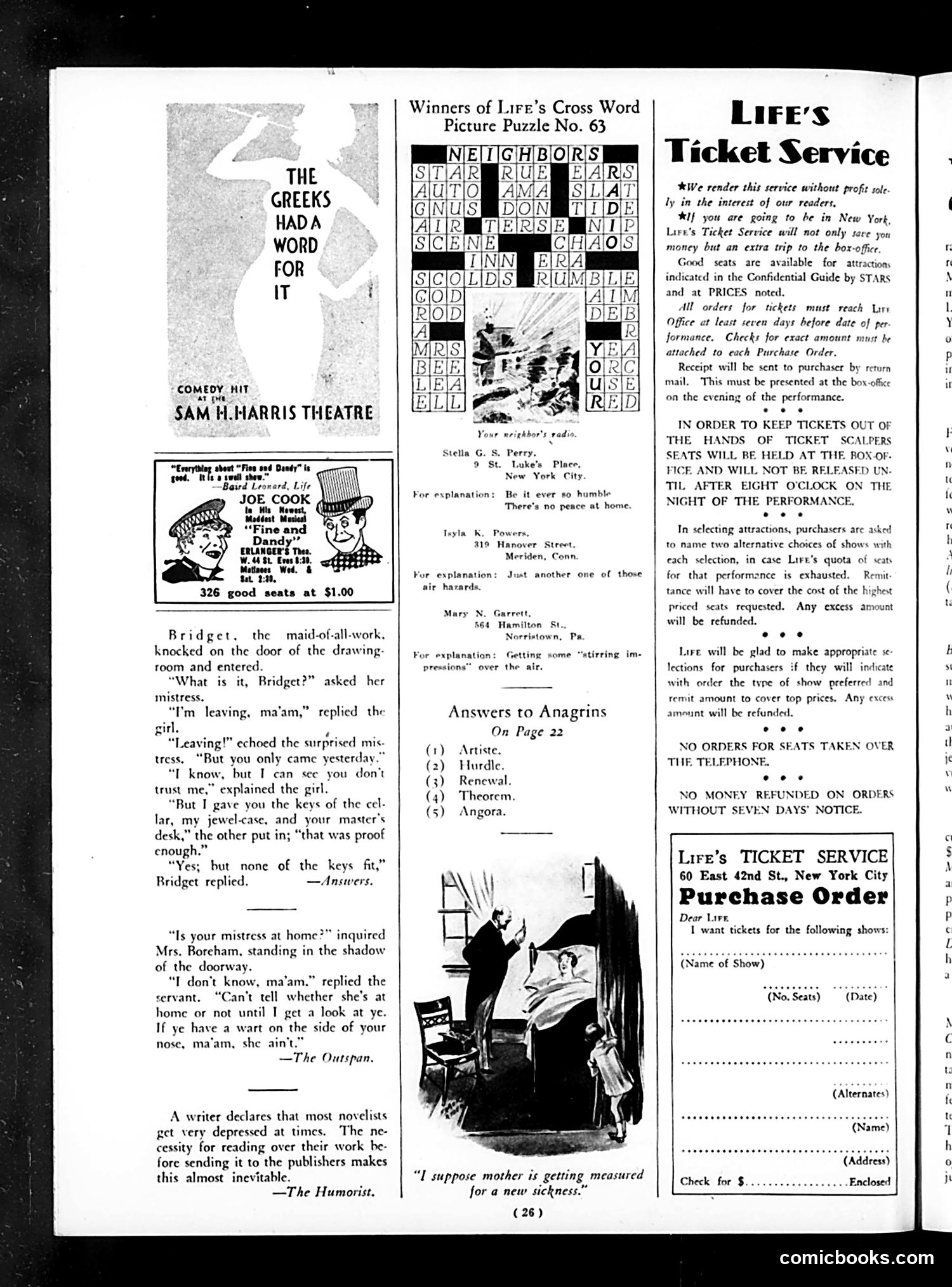
Life Magazine Page Analysis This page mixes theatrical advertising with humorous short jokes typical of Life magazine's satirical format. Main Content: The large advertisement promotes "The Greeks Had a Word for It," a comedy at the Sam H. Harris Theatre, featuring Joe Cook. The phrase references something unsayable in polite company—likely infidelity or moral impropriety—a common comedic reference of the era. Humor Sections: Three brief jokes mock domestic servants and housewives: - "Bridget" quits because the mistress gave her keys to the cellar and jewels, but none of the keys actually fit—mocking both the servant's suspicion and the mistress's careless trust - A caller tries to identify a woman by whether she has a wart, suggesting shallow social pretense - A joke about "mother getting measured for a new sickness" plays on radio programs (popular new technology) causing domestic anxiety Life's Ticket Service: A practical advertisement offering theatergoers advance ticket purchasing through Life magazine—a service reflecting pre-internet consumer convenience. The page represents early 20th-century mass media: theatrical promotion, domestic humor based on class dynamics, and innovative consumer services.
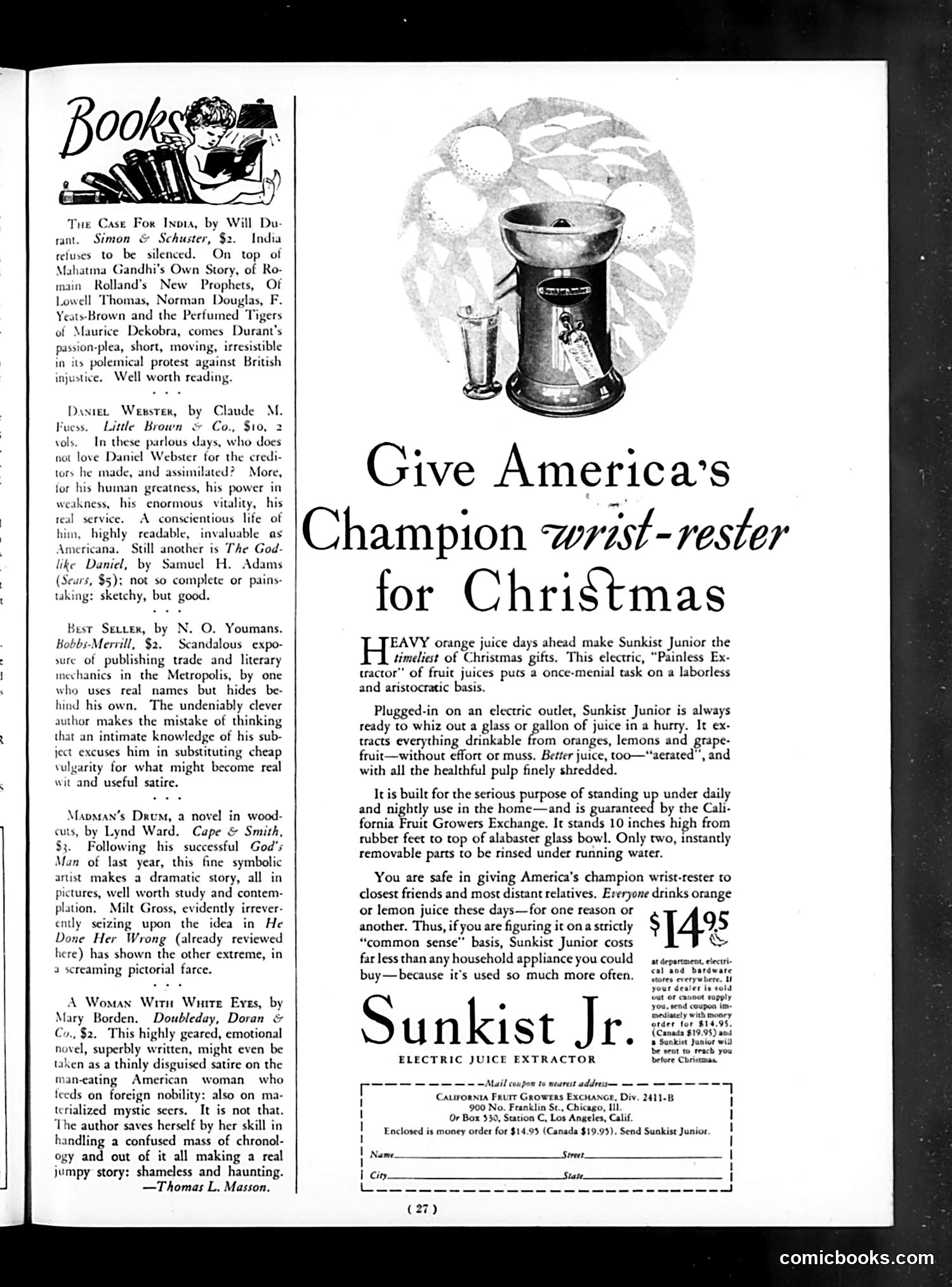
Analysis of Page Content This page is primarily a book review section (left side) paired with a product advertisement (right side). There are no political cartoons or satirical commentary to analyze. The left column reviews five books from what appears to be the late 1920s or early 1930s, including works about India and British imperialism (Durant's *Case for India*), biography (Webster), and literary satire. The tone is literary criticism, not satire. The right side features an advertisement for the Sunkist Jr. electric juice extractor, marketed as a Christmas gift. The ad uses class-conscious language ("aristocratic basis," "Champion wrist-rester") to pitch a luxury appliance that automates juice extraction. The illustration shows the device with oranges above it. In summary: This is a standard magazine page mixing book reviews and advertising—not satirical content requiring historical explanation.
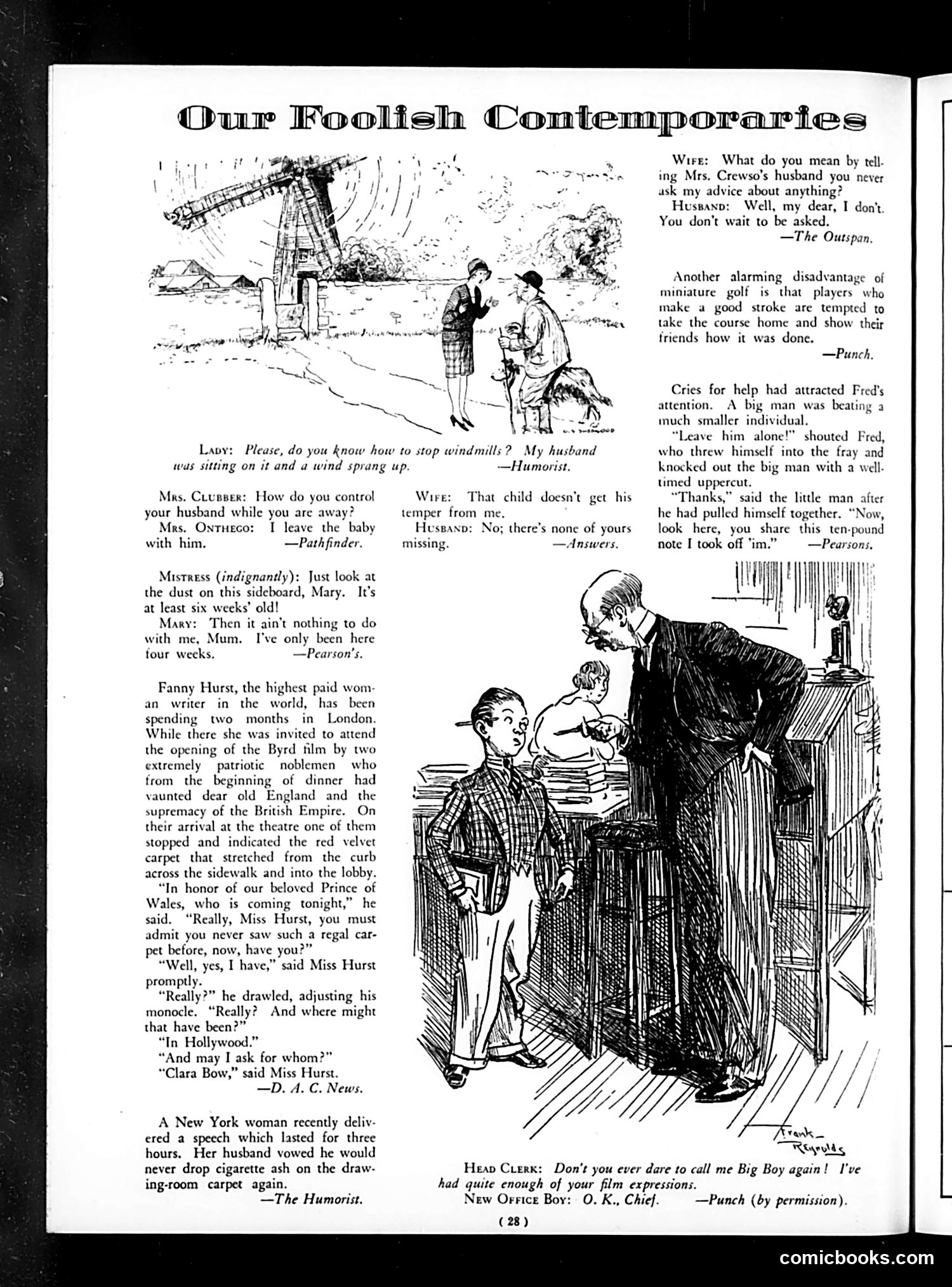
"Our Foolish Contemporaries" - Life Magazine Humor Page This page collects brief satirical anecdotes mocking domestic life and contemporary follies. Key humor themes include: Marriage absurdities: A husband claims he never asks his wife's advice because she volunteers it constantly; a wife can't control her husband away from home, so leaves their baby with him as a restraint. Miniature golf trend: The joke mocks the 1920s-30s miniature golf craze—enthusiasts became so proud of good shots they'd take the course home to show friends. Fanny Hurst anecdote: This mocks British patriotic pretension. Two British noblemen patronizingly show the American writer (Fanny Hurst, a real famous writer) an ornate red carpet supposedly honoring the Prince of Wales, expecting American awe. She deflates them by revealing she'd seen similar carpets in Hollywood—for actress Clara Bow—implying American entertainment rivals British royalty in spectacle. Class humor: A small man who avoids a beating later demands his attacker share a ten-pound note "he took off 'im," revealing petty theft as his real concern. The page satirizes marital dynamics, consumer trends, and Anglo-American cultural attitudes typical of early 20th-century British humor magazines.
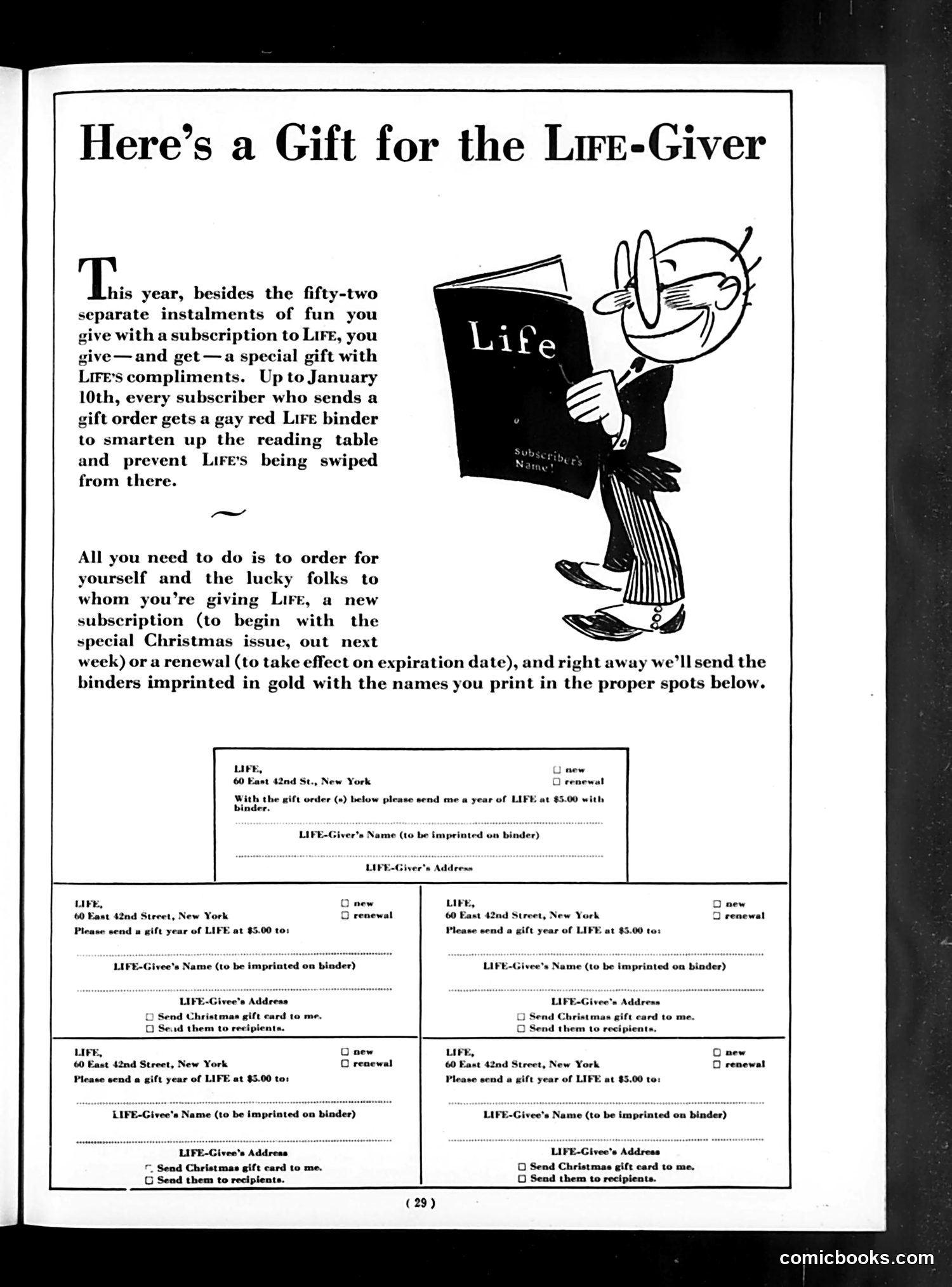
Analysis This is primarily a subscription advertising page, not satirical content. The illustration shows a cheerful cartoon figure holding a *Life* magazine binder—the actual product being promoted. The "gift" being advertised is a red *Life* binder (a magazine holder) offered free to subscribers who give gift subscriptions during the Christmas season, valid through January 10th. The binder could be personalized in gold with the giver's name. The joke in the headline—"gift for the Life-Giver"—is a mild pun: the person giving *Life* subscriptions as gifts receives the binder as their own gift. The binder's practical purpose was to protect magazines from being "swiped from" reading tables, a common problem in homes and offices. The page contains multiple identical order forms allowing subscribers to purchase multiple gift subscriptions at $5.00 each with personalized binders imprinted with names.
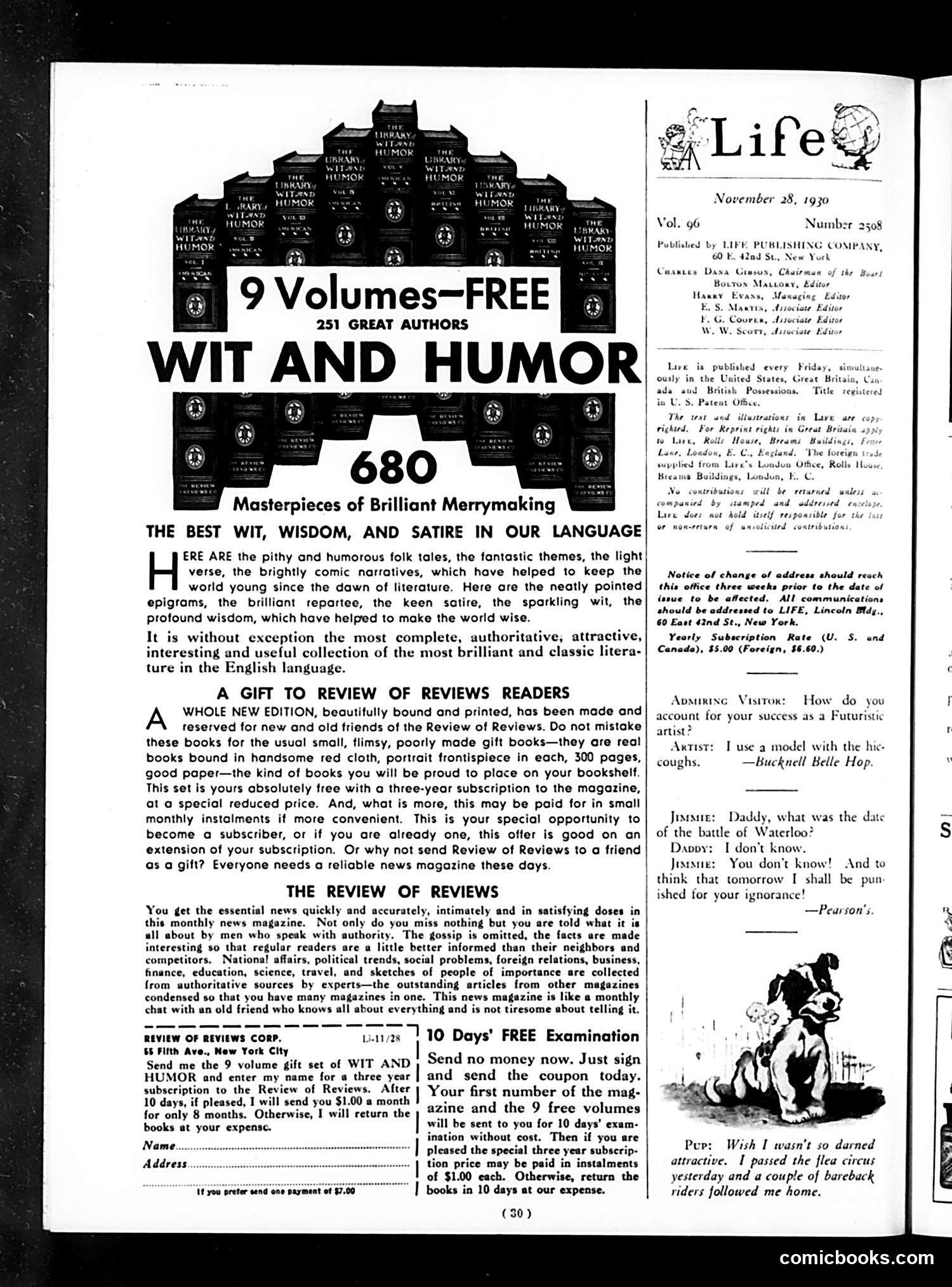
Analysis of This Life Magazine Page (November 28, 1930) This page is predominantly advertising and subscription promotion rather than editorial content or political cartoon. The main visual element—a pyramid of book spines labeled "The Library Wizard Humor"—is a commercial advertisement, not satire. It promotes a nine-volume gift set of wit and humor literature being offered free to new subscribers of *Review of Reviews* magazine. The page includes subscription pitches from both publications, emphasizing the bundled offer and flexible payment plans ($1.00 monthly installments). The small comic vignette at bottom right depicts a couple with a police officer—likely a lighthearted joke about courtship or legal trouble—but it's a generic illustration unrelated to specific political commentary. The textual humor ("Pearson's" quote about ignorance and punishment) represents the period's style of parlor wit, not contemporary satire. In summary: This is a commercial page with period advertising, not political or social commentary requiring historical context.
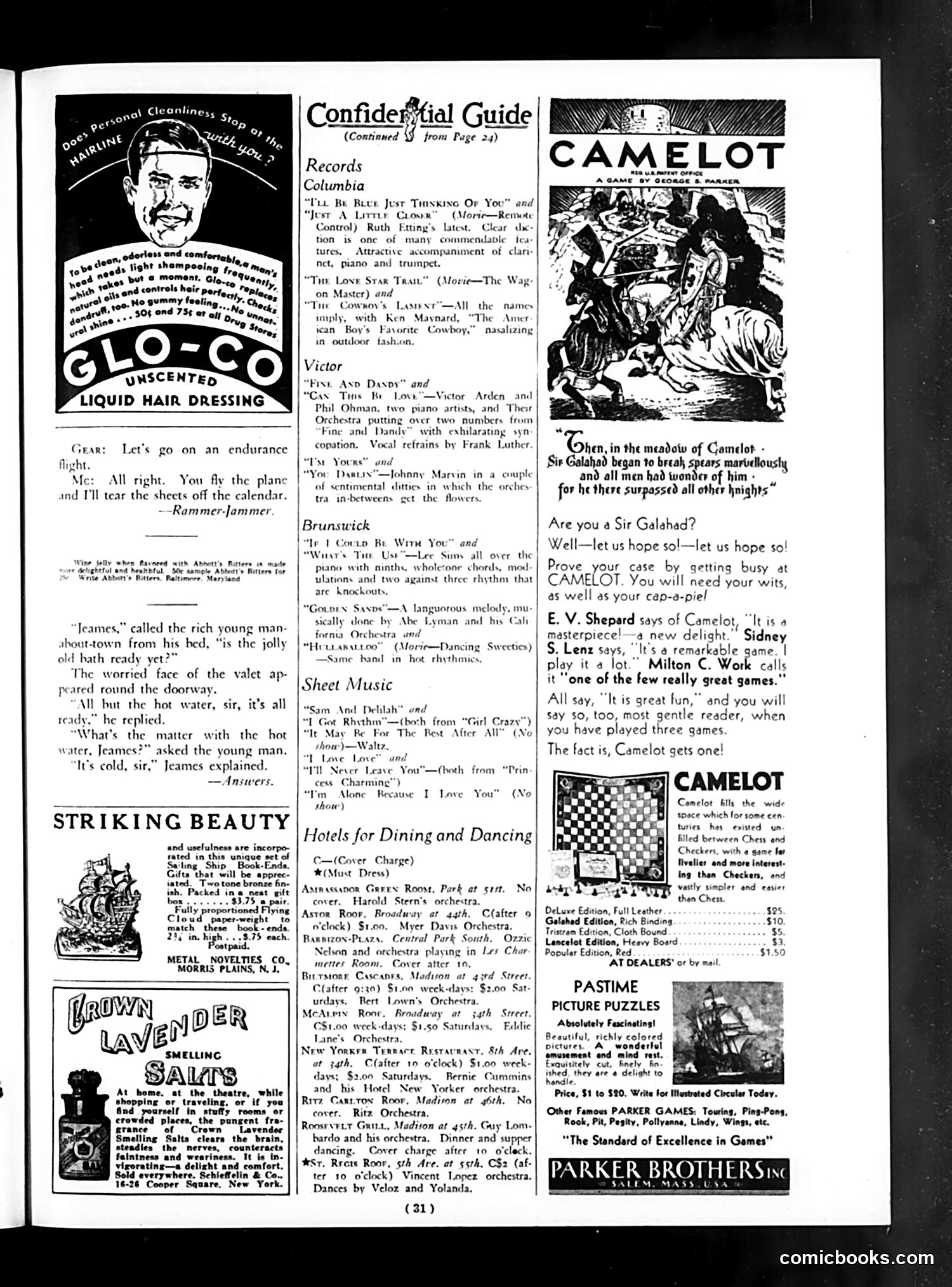
Analysis for Modern Readers This page is primarily advertising and entertainment listings, not political satire. The content includes: Main Features: - Hair dressing and novelty product ads (Glo-Co, Crown Lavender Salts, book-ends) - Two brief comic jokes: one about an endurance flight where a couple tears calendar sheets (implying extended intimate time), and one where a valet misunderstands "hot water" as literally cold water - Entertainment guide listings for phonograph records (Columbia, Victor, Brunswick labels), sheet music, and NYC hotels with dining/dancing Historical Context: These are typical 1920s-30s Life magazine contents—lighthearted domestic humor, consumer products marketed to middle-class readers, and entertainment guidance for the era's popular music and nightlife venues. There is no political cartoon or satirical commentary visible on this page. It's a standard entertainment/lifestyle section of a general-interest magazine.
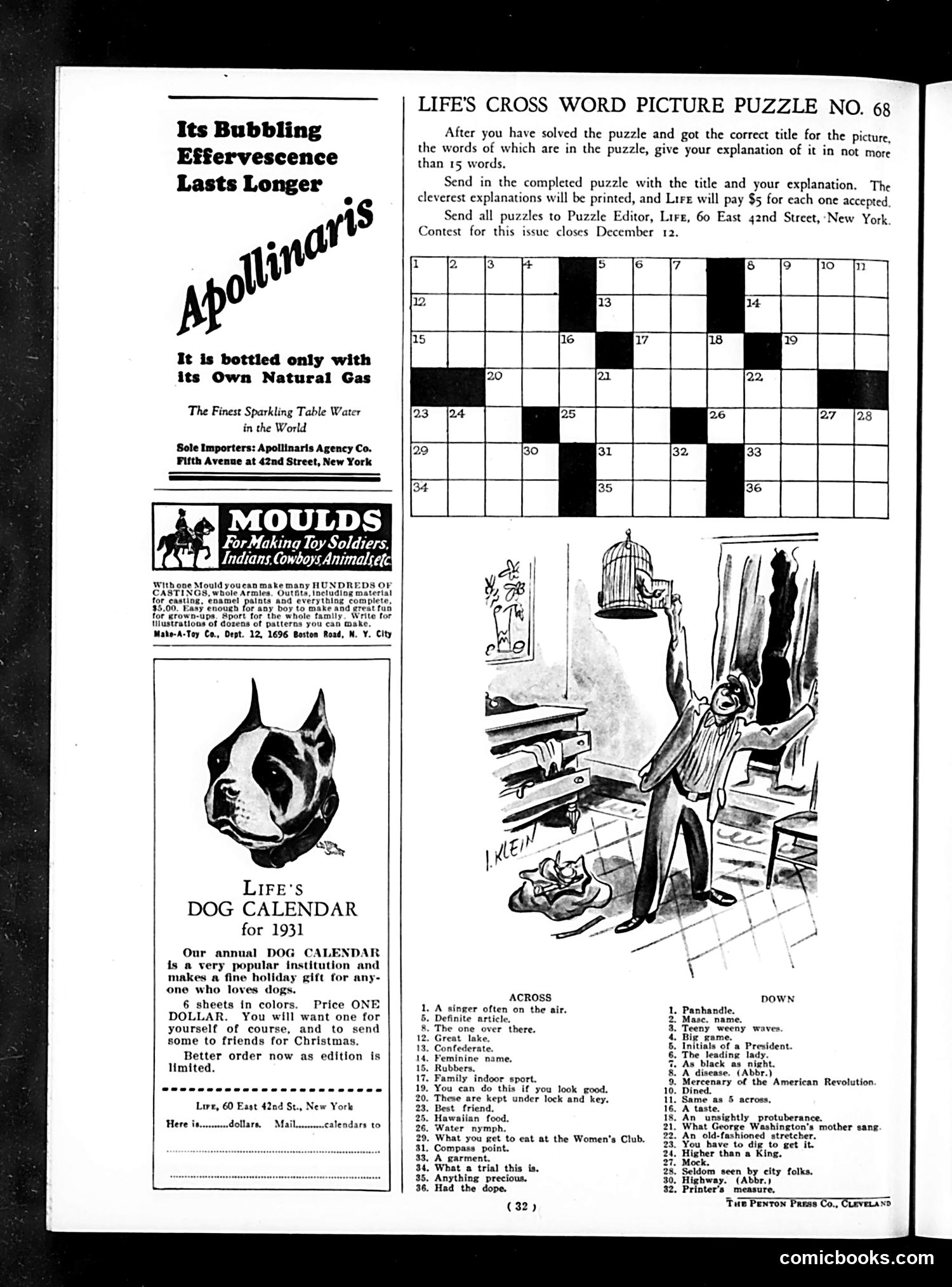
Analysis of Life Magazine Page (circa 1930) This page is primarily advertising and entertainment content, not editorial satire. The political cartoon element is minimal. The main illustration shows a humorous domestic scene: a woman in what appears to be exasperation or distress in a messy room, with a birdcage visible—likely depicting a comedic domestic mishap or marital situation. The cartoon's specific meaning is unclear without the puzzle solution, as readers were expected to solve the crossword-picture puzzle to understand the intended title and joke. The page otherwise features period advertisements (Apollinaris sparkling water, toy soldier molds, a dog calendar) and a reader participation puzzle contest offering $5 for clever explanations. This represents Life's hybrid model: satirical commentary mixed with commercial content and interactive puzzles designed to engage subscribers. The modest $5 prize and December 12 deadline indicate this was a regular recurring feature.
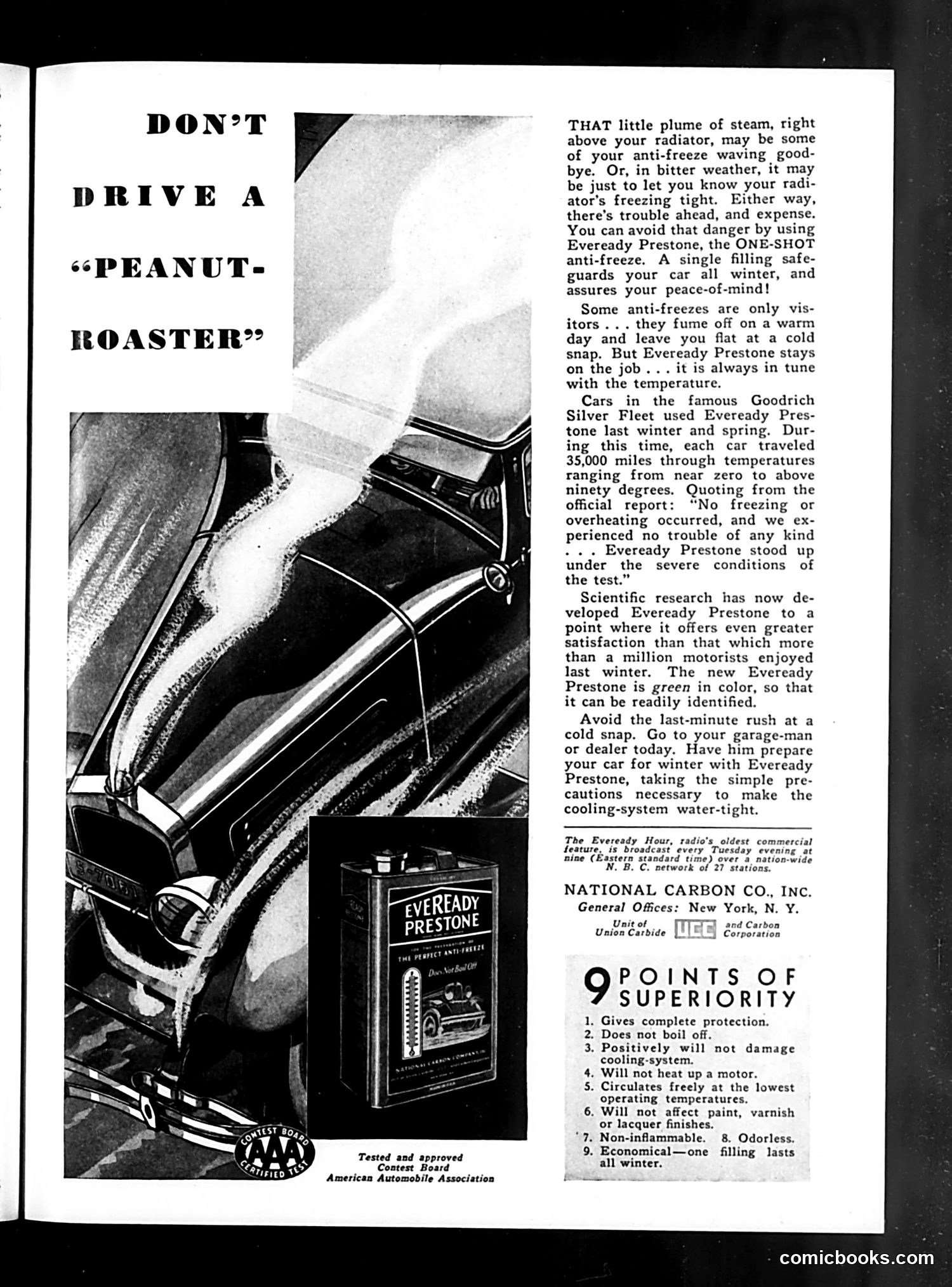
Analysis This is primarily an advertisement for Eveready Prestone antifreeze, not a political cartoon. The "satire" is commercial rather than editorial. The headline "Don't Drive a 'Peanut-Roaster'" is a colloquial warning about cars that overheat or freeze—metaphorically describing a vehicle damaged by inadequate antifreeze protection. The accompanying image shows a frosted/iced-over car in winter conditions, visually demonstrating the problem the product solves. The advertisement emphasizes that inferior antifreeze products are unreliable (they "fume off" and leave drivers stranded), while Eveready Prestone stays effective across extreme temperature ranges. It references the "famous Goodrich Silver Fleet" test case—cars that traveled 35,000 miles in temperatures from near-zero to 90 degrees without freezing or overheating issues. The nine "points of superiority" list the product's claimed benefits. This represents typical mid-20th-century automotive advertising, where winter car maintenance was a genuine seasonal concern before modern engine technology.
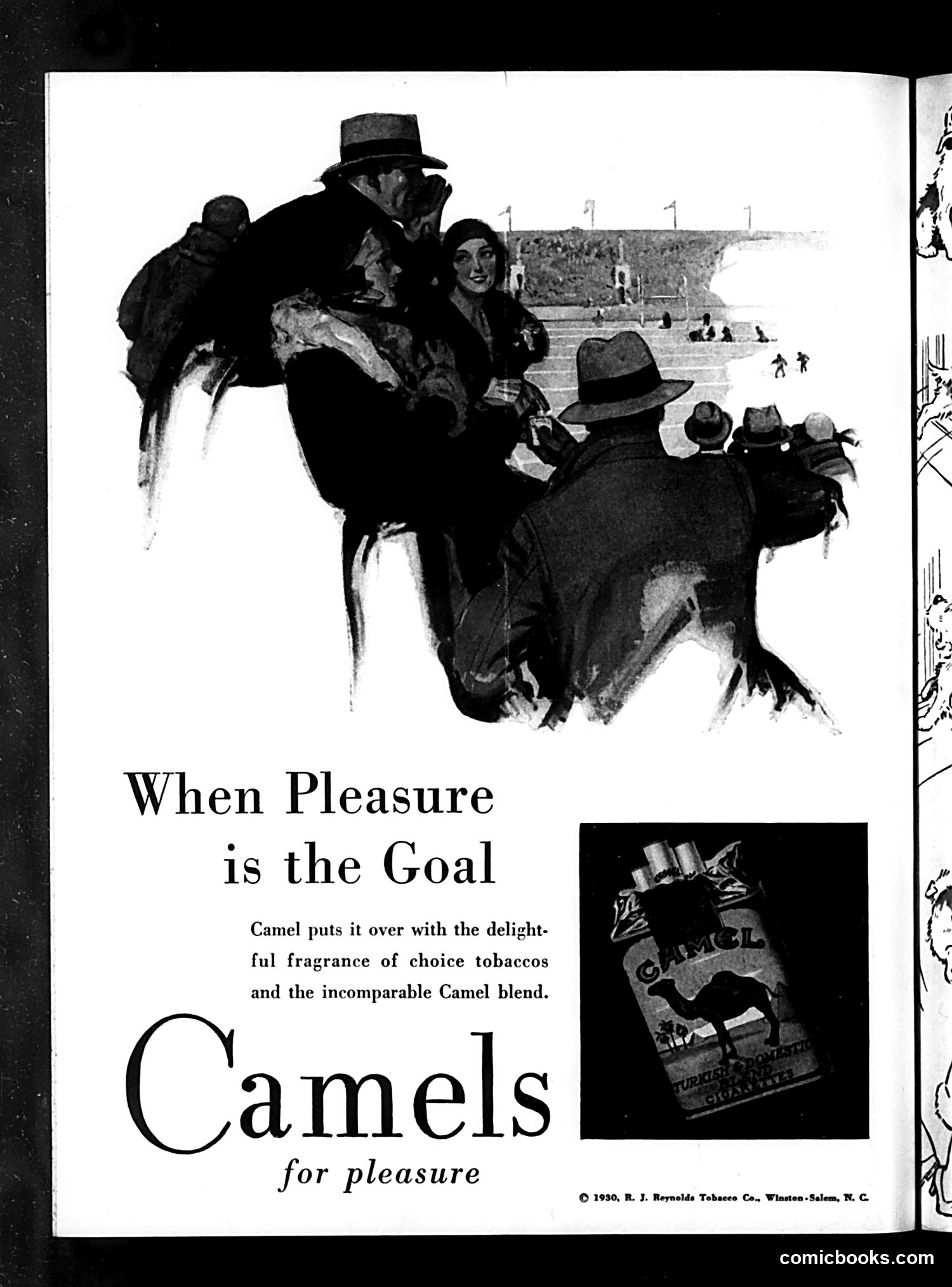
Analysis This is a cigarette advertisement, not satire or political commentary. Dated 1930, it's a Camel cigarettes ad from *Life* magazine. The illustration shows well-dressed figures at what appears to be a sporting event or stadium (visible in background). The advertisement's message is straightforward marketing: Camel cigarettes deliver pleasure through quality tobacco and blending. For modern readers, the significant historical context is that this represents pre-regulation cigarette advertising—an era before health warnings were required and before widespread public knowledge of smoking's dangers. The casual association of smoking with leisure, pleasure, and social sophistication was standard advertising practice. The 1930 copyright and prominent brand placement reflect advertising norms that would later be heavily restricted due to public health concerns. This page exemplifies how cigarettes were openly marketed as aspirational lifestyle products in early 20th-century American media.