life
Life — December 5, 1930
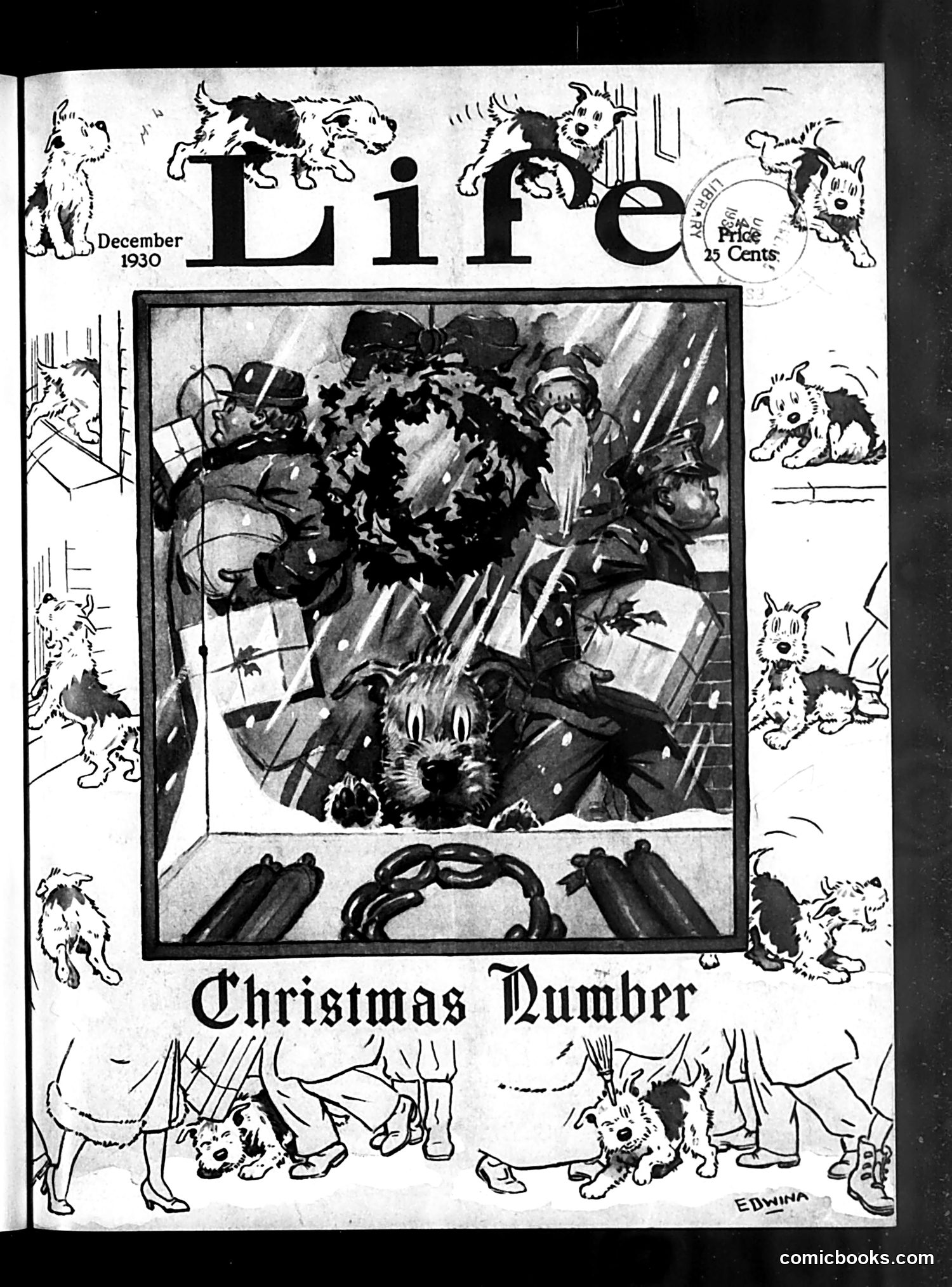
Life Magazine Cover, December 1930 (Christmas Number) This is the cover of Life's Christmas issue from December 1930, during the Great Depression. The central illustration shows Santa Claus surrounded by small dogs in what appears to be a chimney or confined space, packed tightly with Christmas gifts and holiday items. The decorative border features multiple small terrier-type dogs in various playful poses, suggesting this issue likely contains humorous dog-related content or illustrations—a popular feature in Life magazine. The 25-cent price reflects early Depression-era costs. The overall composition emphasizes the crowded, chaotic nature of holiday preparations, possibly satirizing commercial excess or the cramped domestic chaos of Christmas, rendered through the whimsical imagery Life was known for.
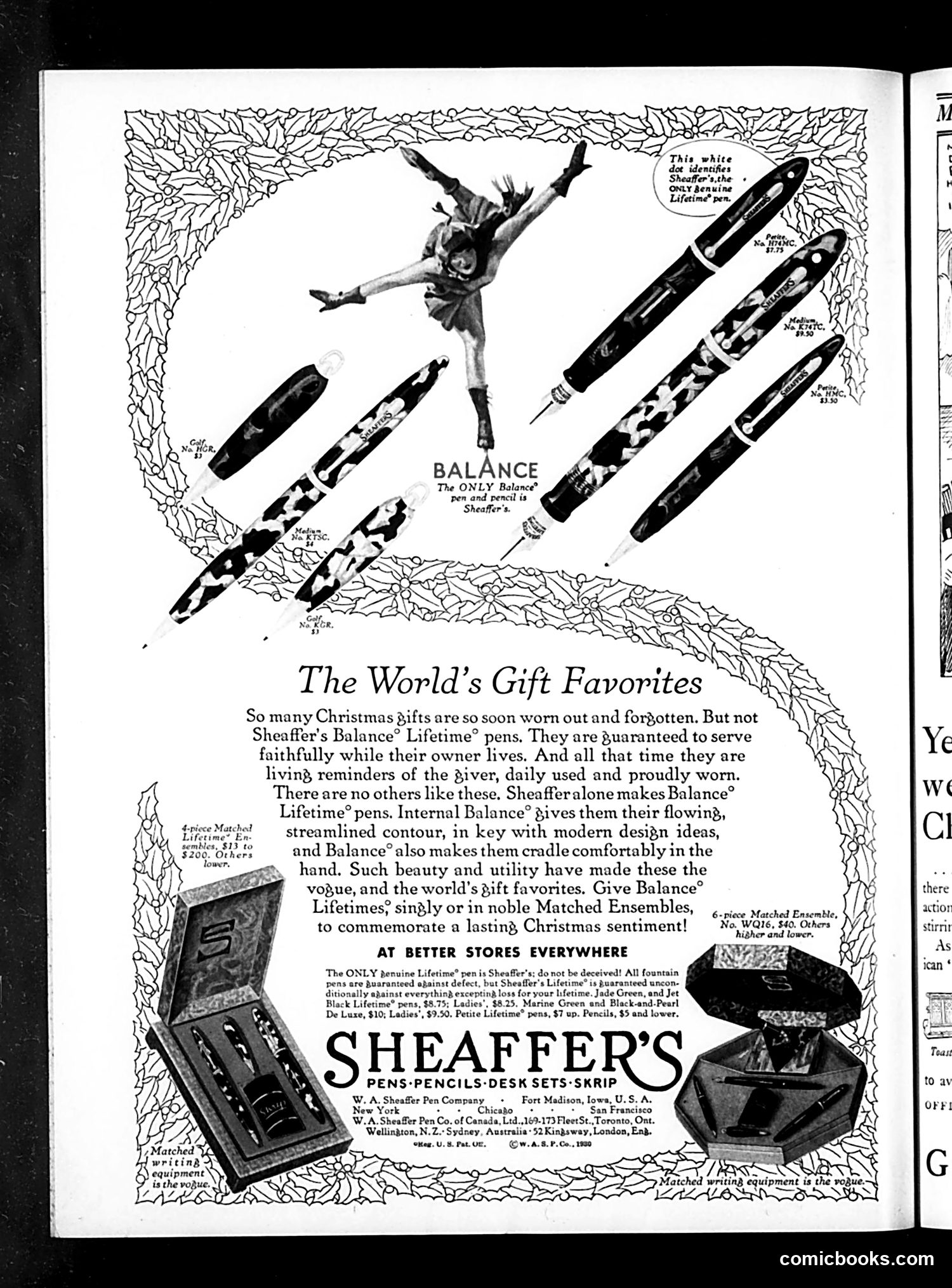
Sheaffer's Pens Advertisement This is a commercial advertisement, not political satire. It promotes Sheaffer's Balance fountain pens and pencils as Christmas gifts. The ad features a stylized illustration of a female dancer in a dynamic pose, serving as a visual metaphor for the pens' qualities: "balance," grace, and streamlined elegance. The surrounding decorative border and the dancer's balanced posture reinforce the brand name "Balance." The text emphasizes durability ("Lifetime" guarantee) and design quality as reasons these pens make superior gifts compared to other Christmas presents that wear out quickly. Multiple pen styles are displayed, along with matching "Matched Ensembles" in presentation boxes. The ad targets mid-to-upper-class consumers seeking prestigious gift items, positioning Sheaffer pens as timeless luxury goods available "at better stores everywhere."
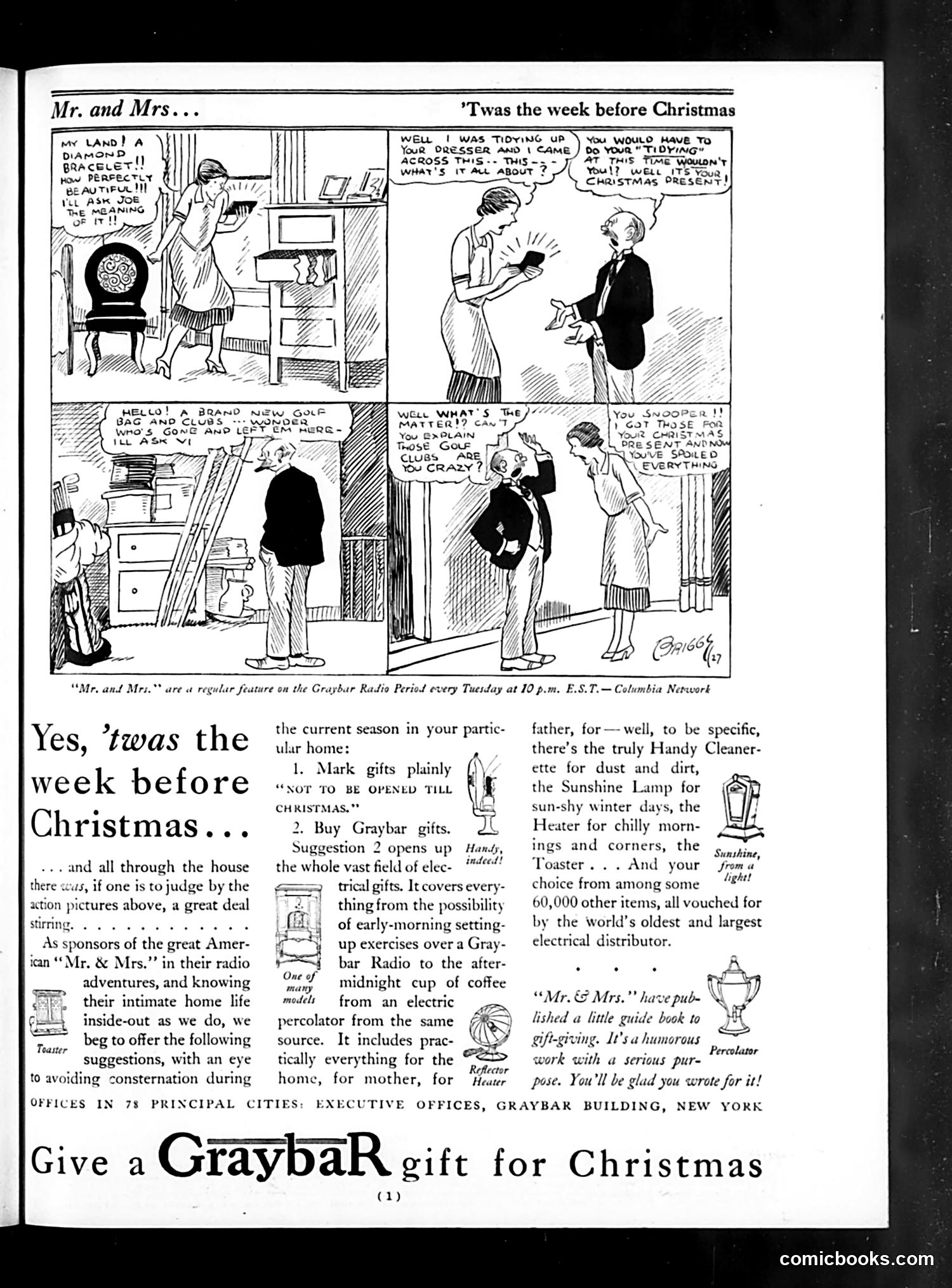
"Mr. and Mrs." Comic Strip Analysis This page is primarily a Graybar Electric Company advertisement disguised as editorial content. The comic strip "Mr. and Mrs." depicts a domestic scene where a husband receives golf clubs as a Christmas gift, then discovers his wife has also given him expensive electrical appliances (toaster, heater, lamp, percolator). The satire targets consumer culture and marital dynamics of the era: the husband's enthusiasm for leisure goods (golf) contrasts with the wife's practical, domestic-focused gifts. The joke suggests wives redirect spending toward home electrification—positioning Graybar products as the "sensible" Christmas choice. The strip functions as soft-sell advertising, presenting electrical appliances as desirable, modern gifts appropriate for the "inside-out" domestic life of radio listeners.
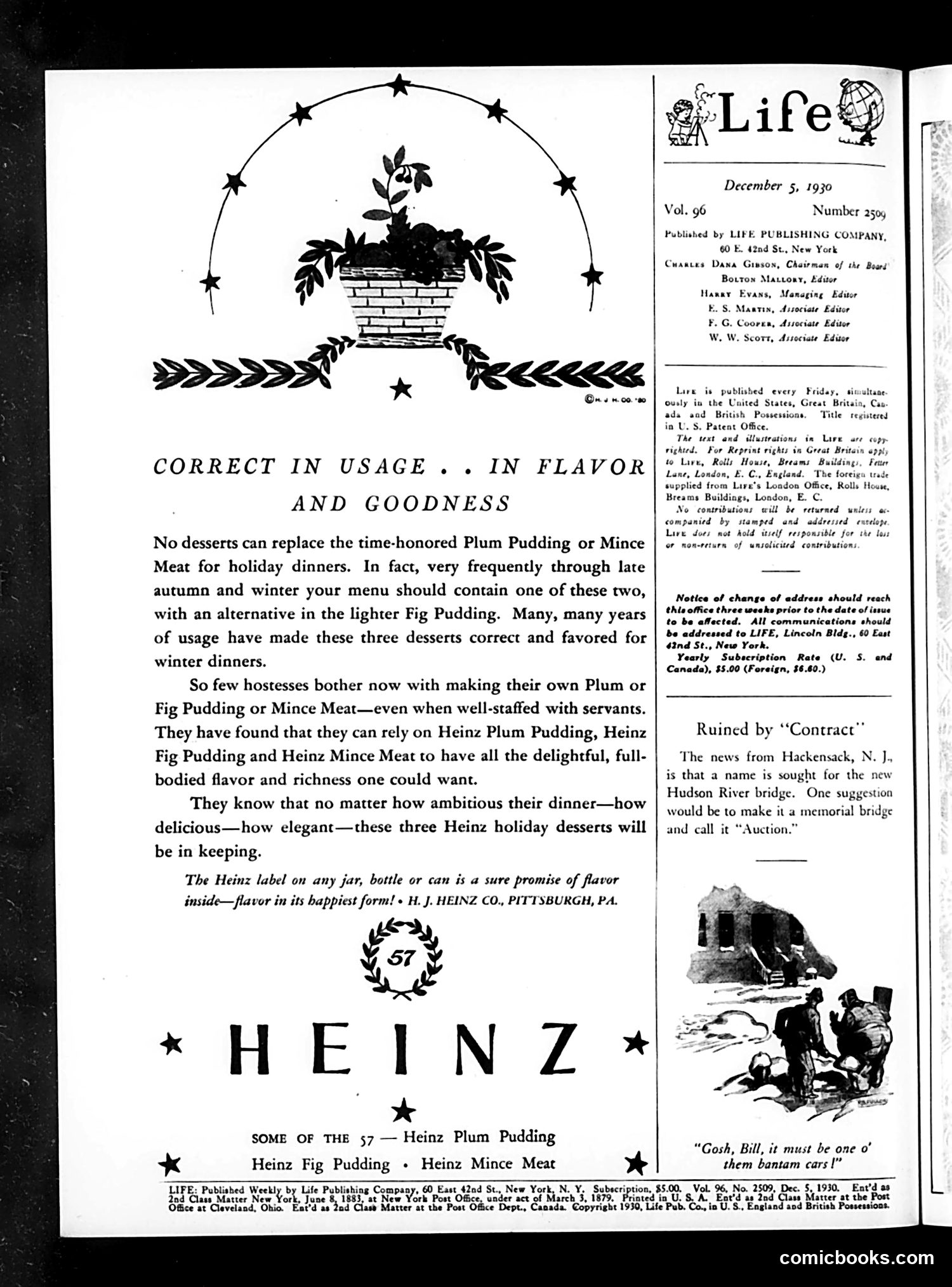
Analysis This page is primarily a Heinz food advertisement, not political satire. The left side promotes Heinz Plum Pudding, Fig Pudding, and Mince Meat as convenient holiday dessert alternatives to homemade versions. The ad emphasizes that these prepared products offer the same "delightful, full-bodied flavor" as labor-intensive homemade desserts—appealing to busy hostesses who might lack servant help. The right side contains Life magazine's masthead and notices. Below that is a small cartoon captioned "Gosh, Bill, it must be one of them bantam cars!" showing figures examining what appears to be a tiny vehicle—likely satirizing the novelty of compact automobiles becoming available. This is a commercial publication page mixing advertising with light humor, not political commentary.
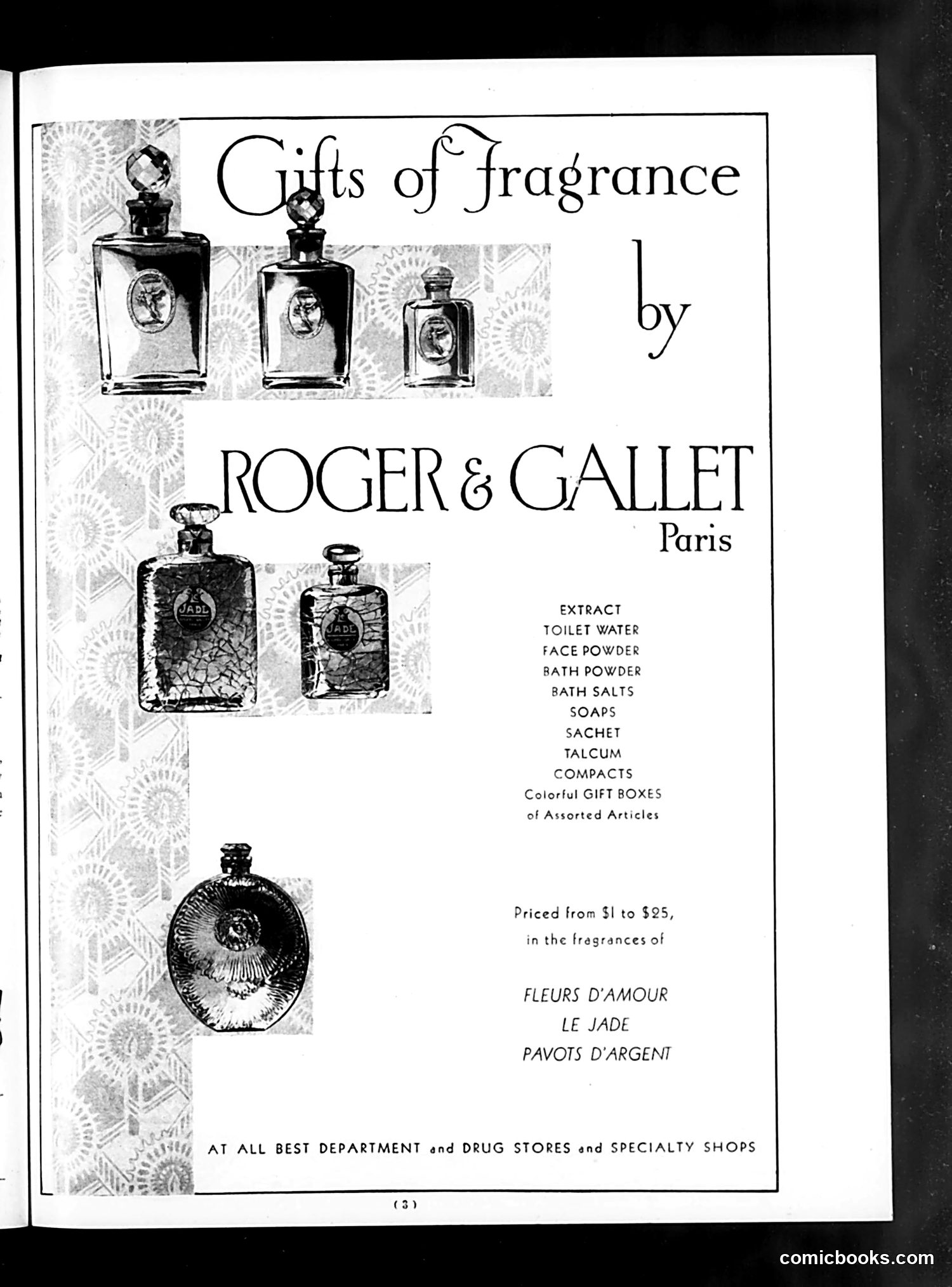
This is an advertisement, not a cartoon or satirical content. It promotes "Gifts of Fragrance by Roger & Gallet Paris," a French perfume and toiletry company. The page displays various perfume bottles and bath products in elegant line drawings against a decorative background pattern. The ad lists product types (extract, toilet water, face powder, bath powder, soaps, sachets, talcum, compacts) and three fragrance names: "Fleurs d'Amour," "Le Jade," and "Pavots d'Argent." Pricing ranges from $1 to $25. The advertisement targets upscale consumers, emphasizing the French origin and luxury positioning typical of early 20th-century fragrance marketing in American magazines. Distribution is noted as department stores, drug stores, and specialty shops.
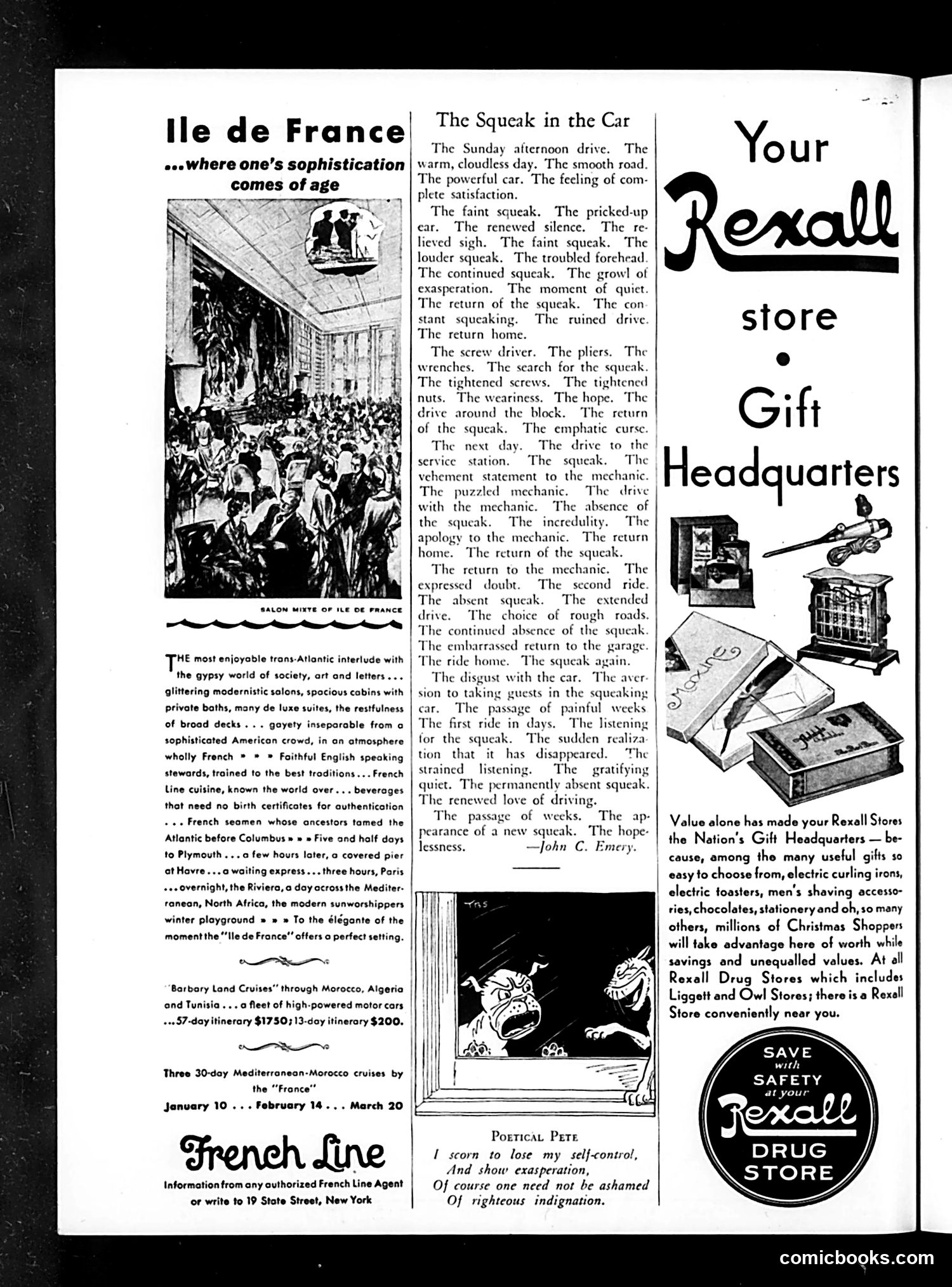
Page Analysis: Life Magazine (Vintage) This page combines travel advertising with humorous fiction and commercial ads. "The Squeak in the Car" is a comedic short story by John C. Emery about a Sunday drive ruined by an annoying car squeak. The narrative humorously catalogs the owner's escalating frustration—visiting mechanics, attempting repairs, enduring awkward social situations—all centered on an unidentifiable noise. The repetition of "squeak" emphasizes the mundane domestic irritation that spirals into obsession. The cartoon below (labeled "Poetical Pete") appears to show cartoon characters in distress, though its specific reference is unclear from the visible image. The remaining content includes a French Line cruise advertisement and Rexall Drug Store gift merchandise ads—typical mid-century magazine filler promoting consumer goods and travel services.
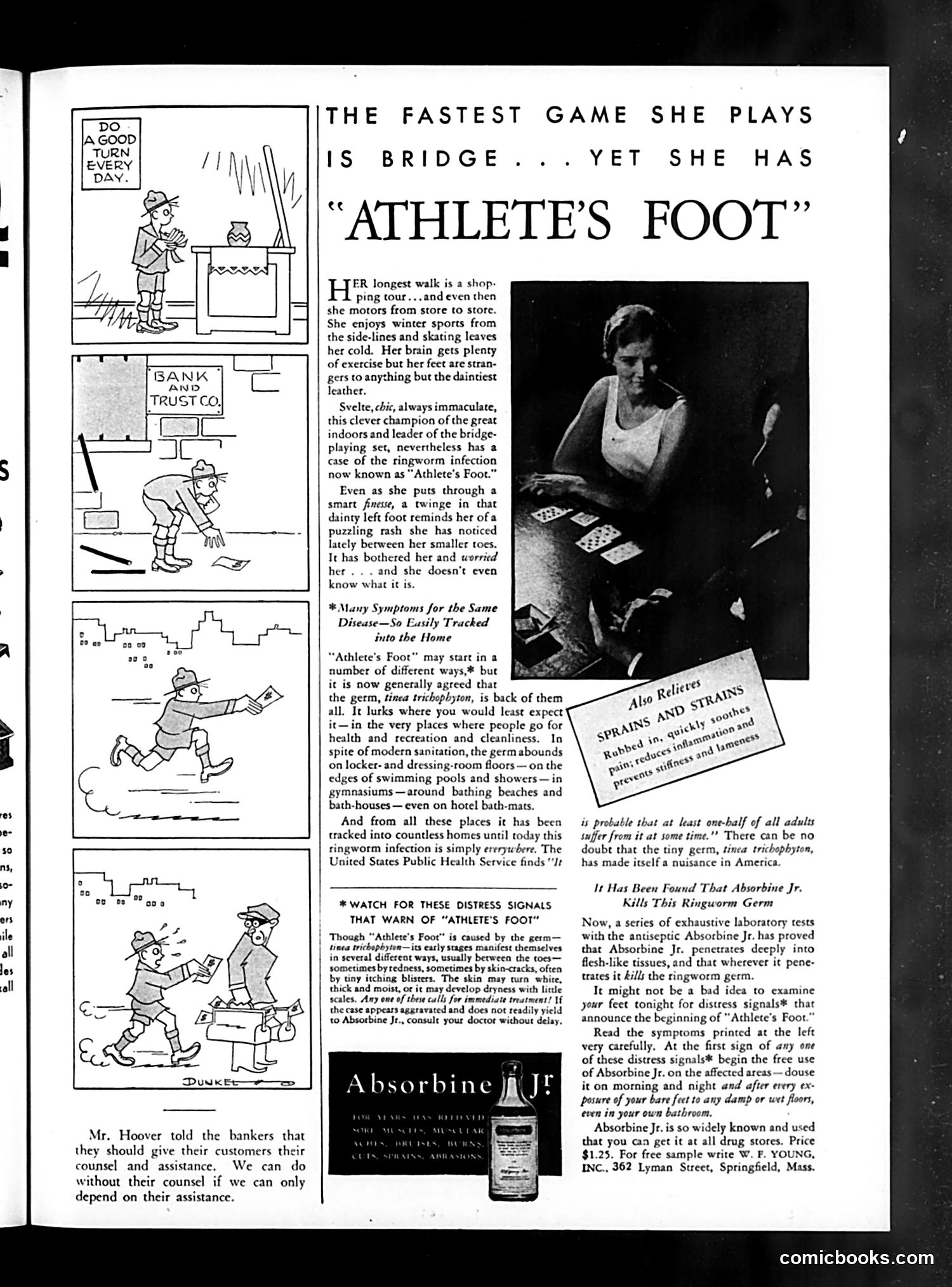
Analysis of Life Magazine Page This page combines social satire with medical advertising. The left side shows four comic panels depicting a man conducting financial/banking business while experiencing foot discomfort—he's shown wincing, limping, and struggling through errands. The satire targets the contradiction between professional competence and physical ailment. The right side explains "Athlete's Foot," a fungal infection, noting it spreads in communal spaces (pools, gyms, hotels, bathhouses). The irony is that a sedentary banker—not an actual athlete—suffers this condition, undermining assumptions about who contracts such infections. Below runs an advertisement for Absorbine Jr., a patent medicine treatment, capitalizing on the medical information provided above it. This typical early-20th-century magazine layout merged humor with commerce.
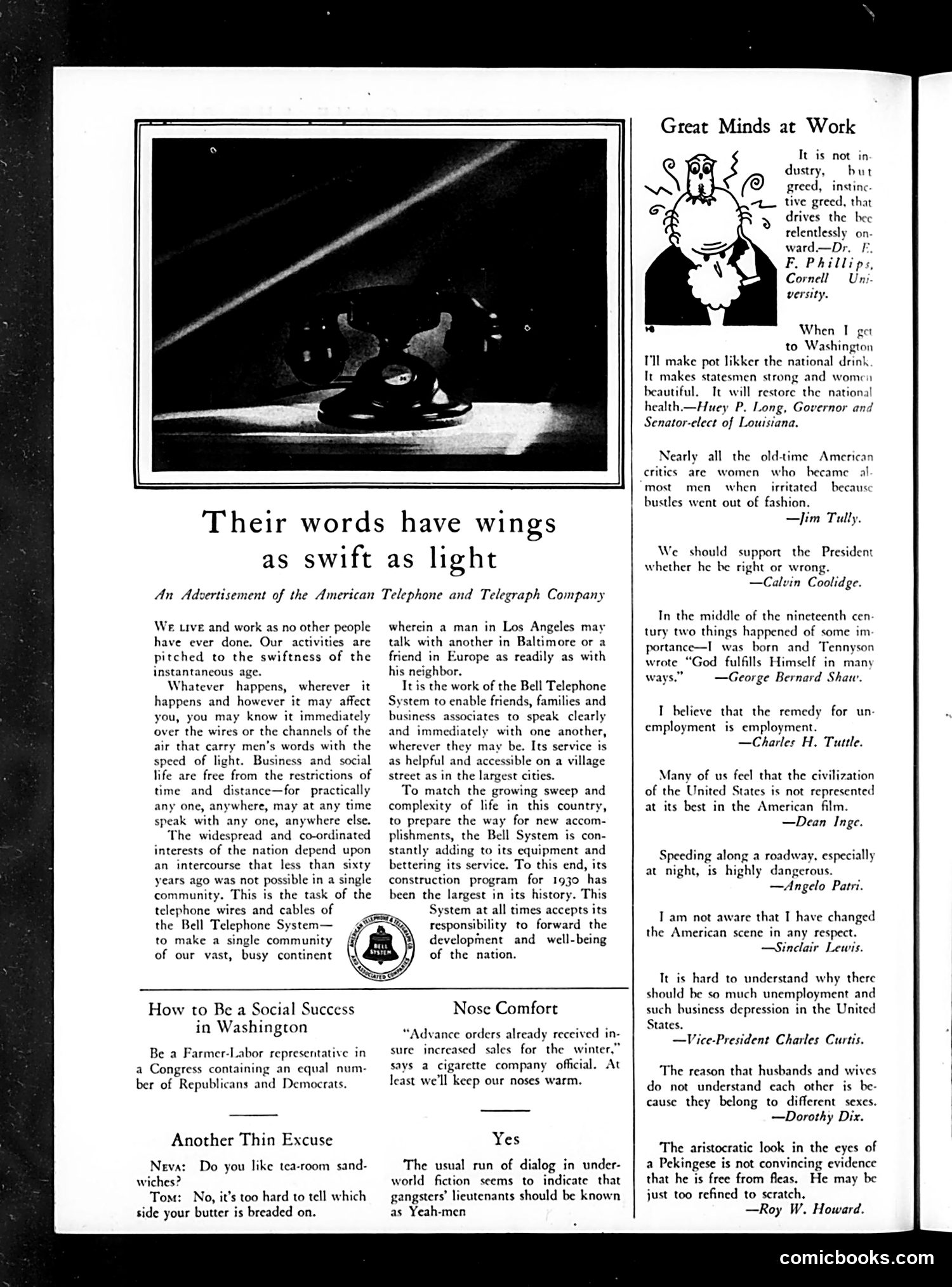
Analysis This page is primarily an advertisement for American Telephone and Telegraph Company (Bell Telephone System), occupying the top half with the headline "Their words have wings as swift as light." The accompanying image shows what appears to be people in an interior space, illustrating the ad's message about instantaneous long-distance communication connecting people across the continent. The right column contains unrelated quotations from public figures (F. Phillips from Cornell, Huey P. Long, Jim Tully, Calvin Coolidge, and others) offering brief opinions on various topics—unemployment, fashion, patriotism, and social matters. Below are brief humorous exchanges ("How to Be a Social Success in Washington," "Nose Comfort," "Another Thin Excuse," "Yes"), presenting satirical quips rather than substantive jokes. The page is essentially a hybrid of corporate advertising and opinion/humor content, typical of Life magazine's format during this era.
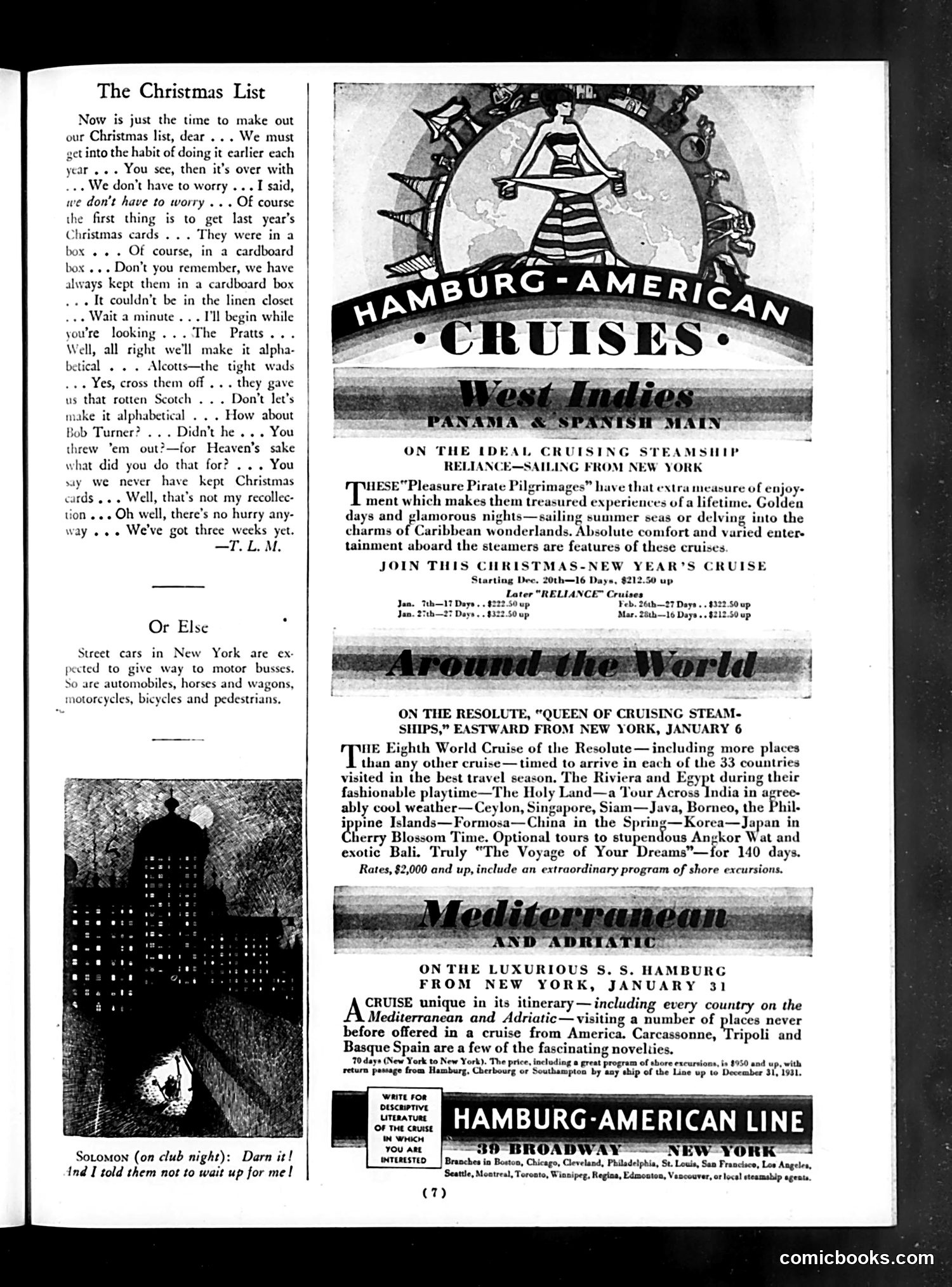
Analysis This page is primarily advertising and editorial content rather than political satire. The left column contains a humorous short piece titled "The Christmas List" about procrastinating on holiday card-sending, written by T. L. M. Below it is a brief satirical note titled "Or Else" mocking New York street traffic chaos. The bulk of the page features Hamburg-American Line cruise ship advertisements promoting luxury vacations to the West Indies, around the world, and the Mediterranean. A cartoon illustration shows a stylized woman in a striped dress advertising the cruises. The single editorial cartoon depicts Solomon on a ship saying "Darn it! And I told them not to wait up for me!" — a mild joke about someone extending their cruise vacation unexpectedly. The content reflects 1920s leisure culture and transatlantic travel marketing.
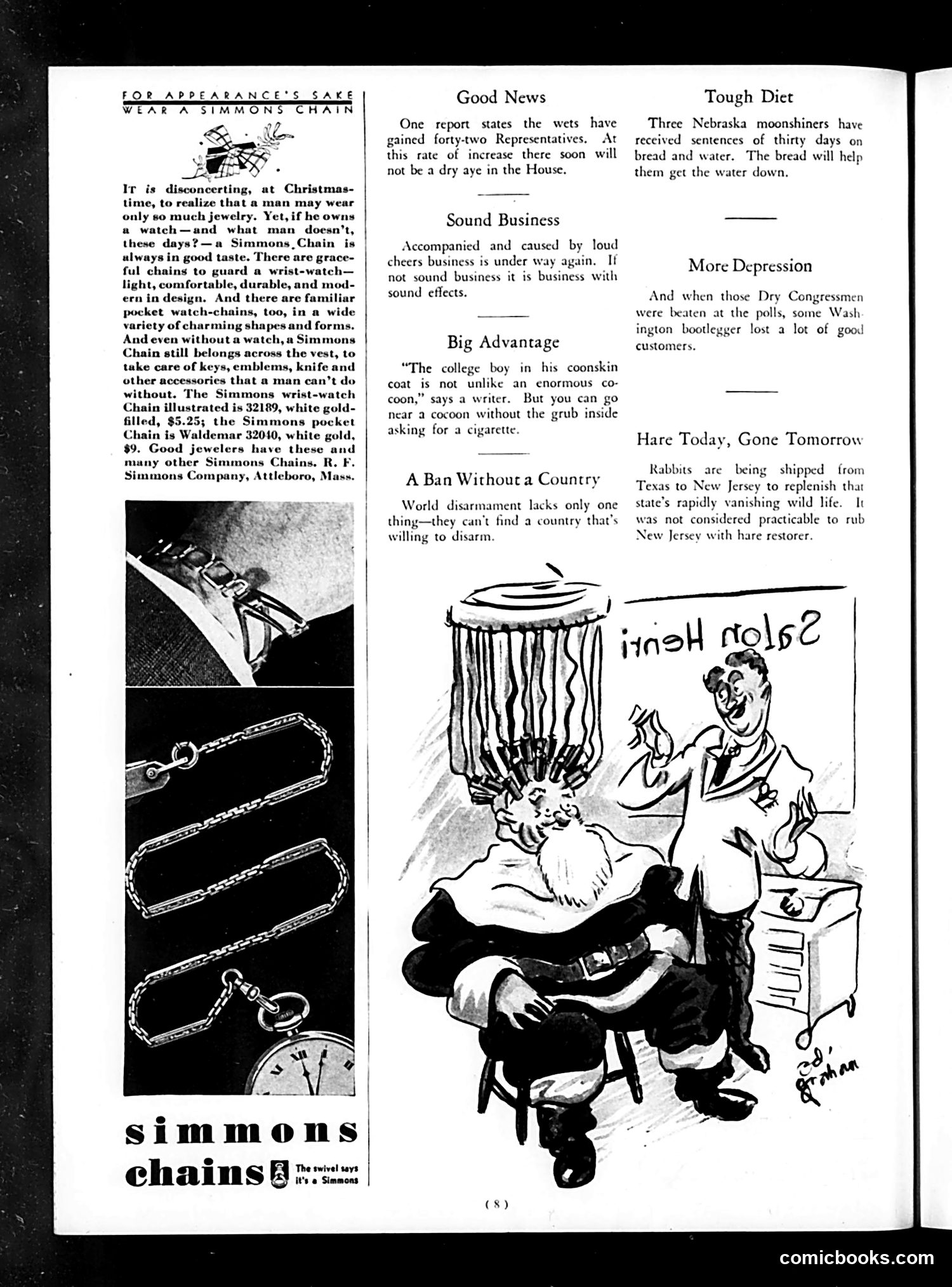
"Hare Today, Gone Tomorrow" Cartoon Analysis The cartoon depicts a man being force-fed or having something shoved down his throat by what appears to be a rabbit or hare character. The caption reads "Hare today / gone to[morrow]" — a pun on the common expression "here today, gone tomorrow." The accompanying text explains that rabbits are being shipped from Texas to New Jersey to replenish that state's vanishing wild hare population, noting it was "not considered practicable to rub New Jersey with hare restorer." The cartoon satirizes this wildlife restocking effort through physical comedy: the man is being force-fed rabbits as an absurdist "solution" to the hare shortage — mocking both the restocking program and New Jersey's ecological decline during the Depression era.
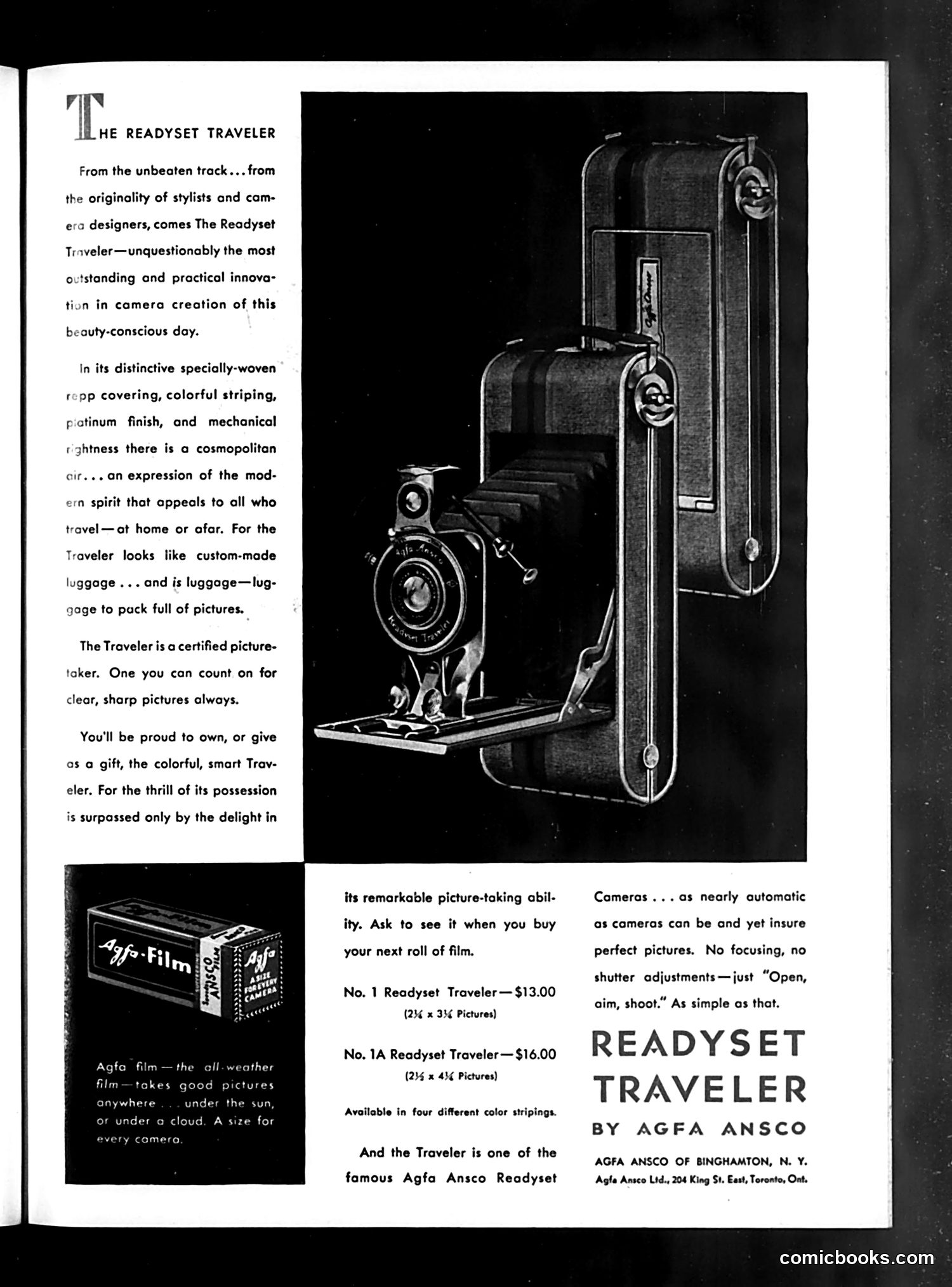
This page is primarily a product advertisement, not political satire or a cartoon. It promotes the Readyset Traveler, a folding camera by Agfa Ansco designed for portable photography. The ad emphasizes the camera's practical appeal to tourists and travelers, highlighting its compact "specially-woven rapp covering, colorful striping, platinum finish," and automatic operation ("Open, aim, shoot"). The text positions it as aspirational lifestyle merchandise—something "you'll be proud to own, or give as a gift." The image shows the camera alongside sample film and luggage, targeting mid-century consumers interested in travel and leisure photography. This reflects the post-WWII boom in consumer camera technology and recreational travel culture.
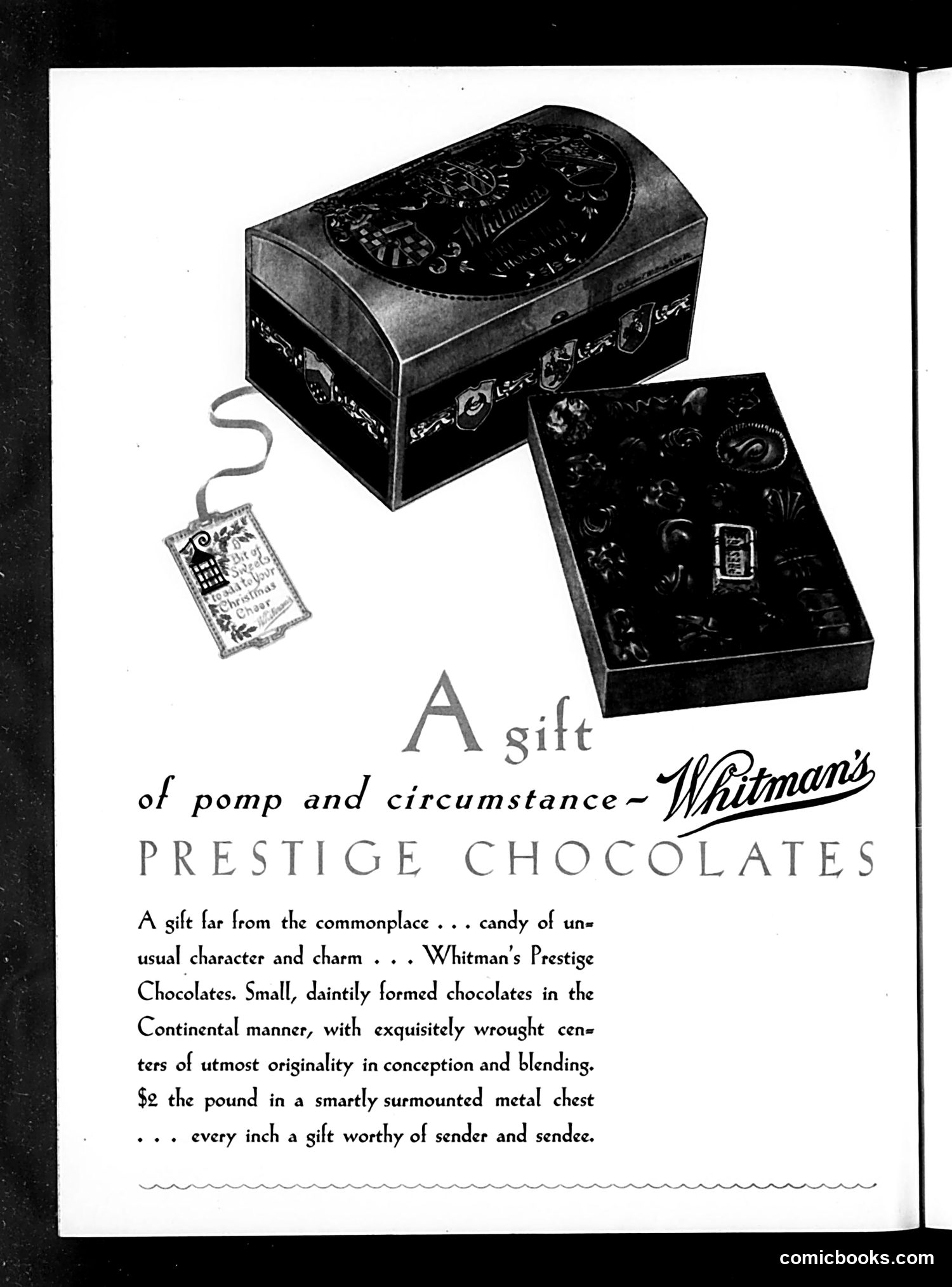
Analysis This is a vintage advertisement, not a cartoon or satire. It promotes Whitman's Prestige Chocolates as an upscale gift item. The ad emphasizes luxury and sophistication through several visual and textual elements: - An ornate metal chest containing the chocolates, presented as an elegant container - References to "Continental manner" and "exquisite" craftsmanship, appealing to aspirations of European refinement - The phrase "a gift of pomp and circumstance" positions the chocolates as a prestigious, formal gift - Pricing at "$2 the pound" suggests premium quality for the era - Language like "unusual character and charm" and "gift worthy of sender and sendee" targets gift-givers seeking to impress The small gift tag visible in the image reinforces the product's positioning as a high-end present. This represents early-20th-century advertising strategy emphasizing taste, refinement, and social status.
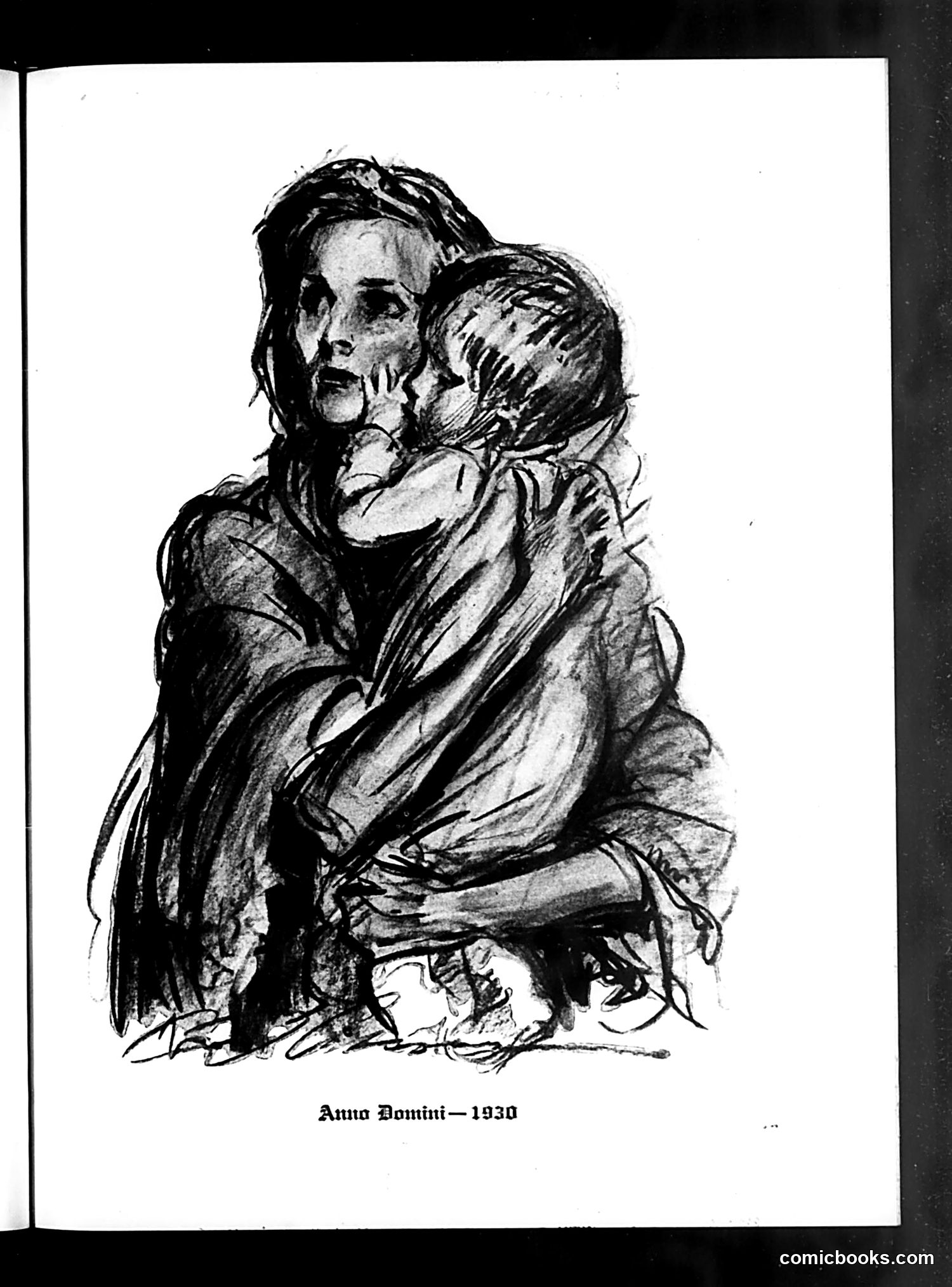
Analysis of "Anno Domini—1930" This ink sketch depicts a woman holding a child, dated 1930. The Latin title "Anno Domini" (meaning "in the year of") creates ironic commentary on motherhood and family life during the Great Depression era. The drawing's expressionistic style—with heavy, rough linework—conveys emotional weight rather than sentimentality. The woman's weary, contemplative expression and the child's dependence suggest the burdens of parenthood during economic hardship. The work appears to be social commentary on Depression-era family struggles, poverty, and maternal responsibility. Without additional context from the magazine issue, the specific satirical target remains unclear, though the piece likely criticized either economic conditions affecting families or contemporary attitudes toward motherhood and welfare.
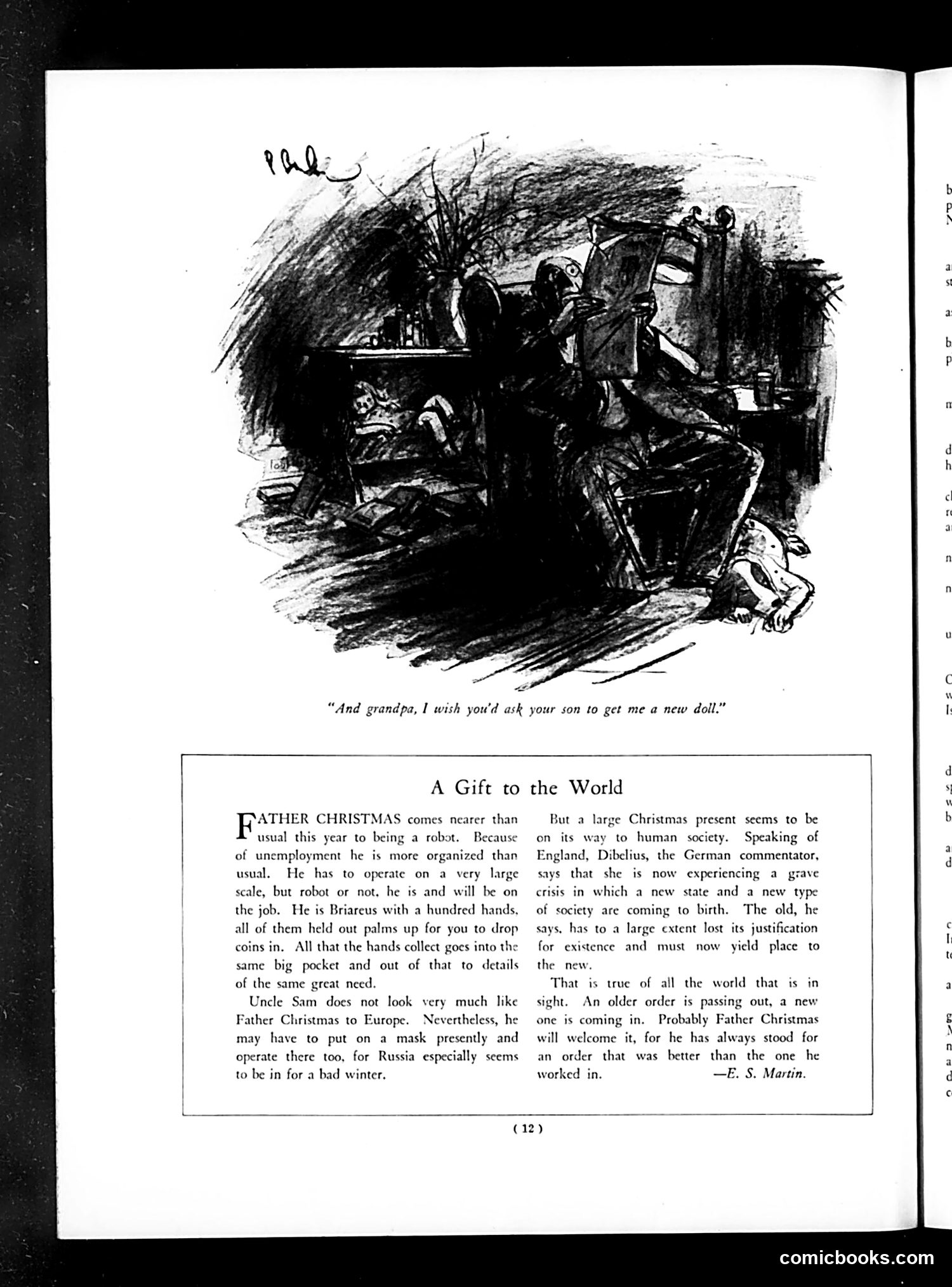
Explanation The cartoon depicts an elderly man (likely representing a grandfather) with a doll, captioned: "And grandpa, I wish you'd ask your son to get me a new doll." The accompanying article, titled "A Gift to the World," uses this image as a segue into political commentary. It discusses how Father Christmas (personified Uncle Sam) approaches Europe during economic hardship caused by unemployment. The piece suggests that America, despite its own struggles, must provide aid to Europe—particularly Russia, which "seems to be in for a bad winter." The satire criticizes American isolationism by suggesting the U.S. cannot ignore European suffering. The worn doll symbolizes economic exhaustion; the grandfather figure represents an America depleted by Depression but still expected to give aid. The article, attributed to E.S. Martin, advocates for international responsibility over self-interest during global crisis.
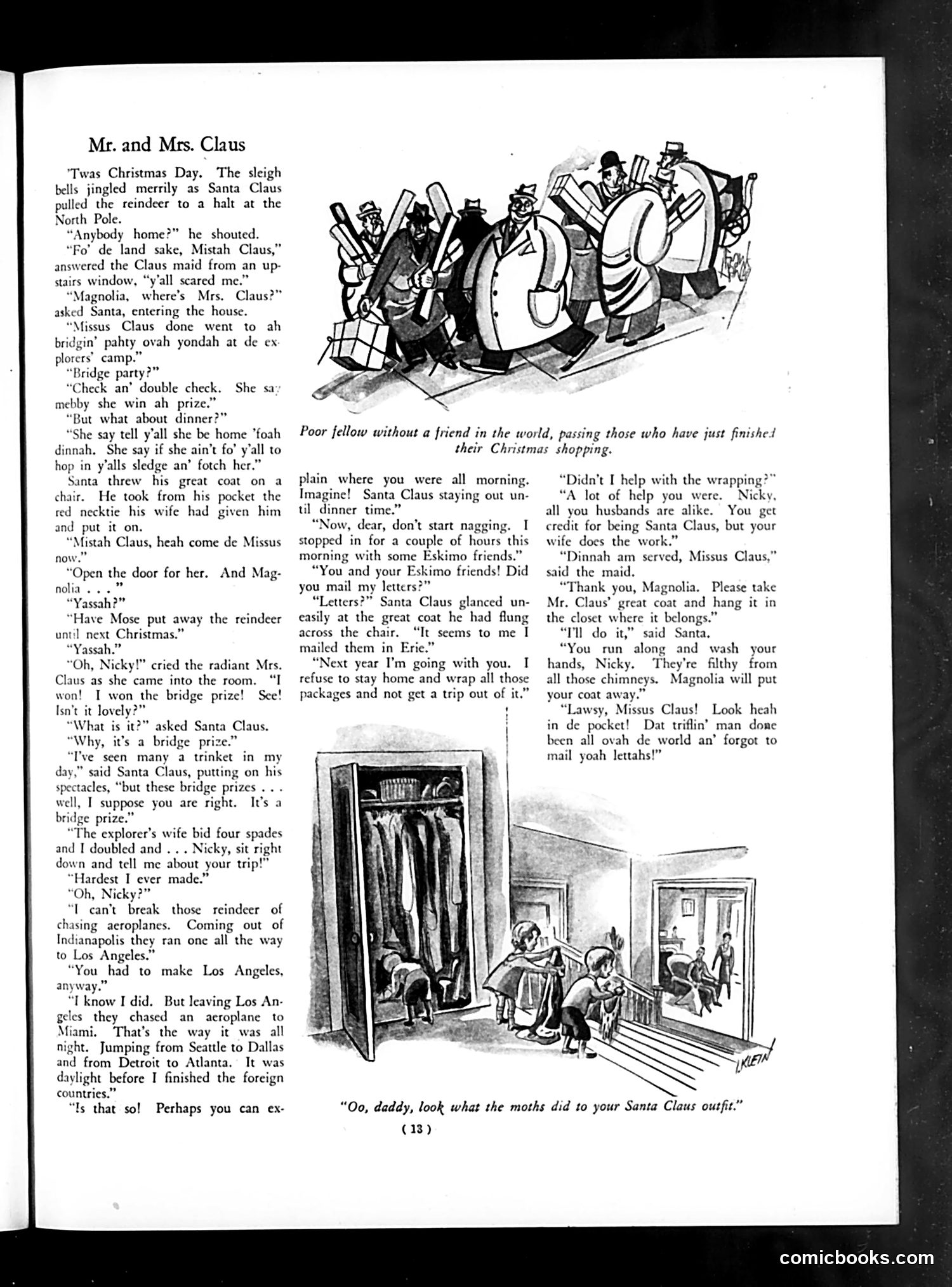
"Mr. and Mrs. Claus" This story-with-illustrations depicts Santa Claus and Mrs. Claus on Christmas Day. Santa has been out delivering presents and returns home exhausted. Mrs. Claus scolds him for missing Christmas dinner and neglecting household duties like wrapping presents. The satire plays on mid-20th-century domestic gender roles: despite Santa's grueling worldwide mission, his wife expects him to also handle shopping, wrapping, and household chores. The bottom illustration shows children discovering moth damage to Santa's red suit in the closet—a humorous consequence of his absence and Mrs. Claus's apparent neglect of proper storage. The story satirizes unrealistic expectations placed on husbands while highlighting the underappreciated labor of wives managing the home.
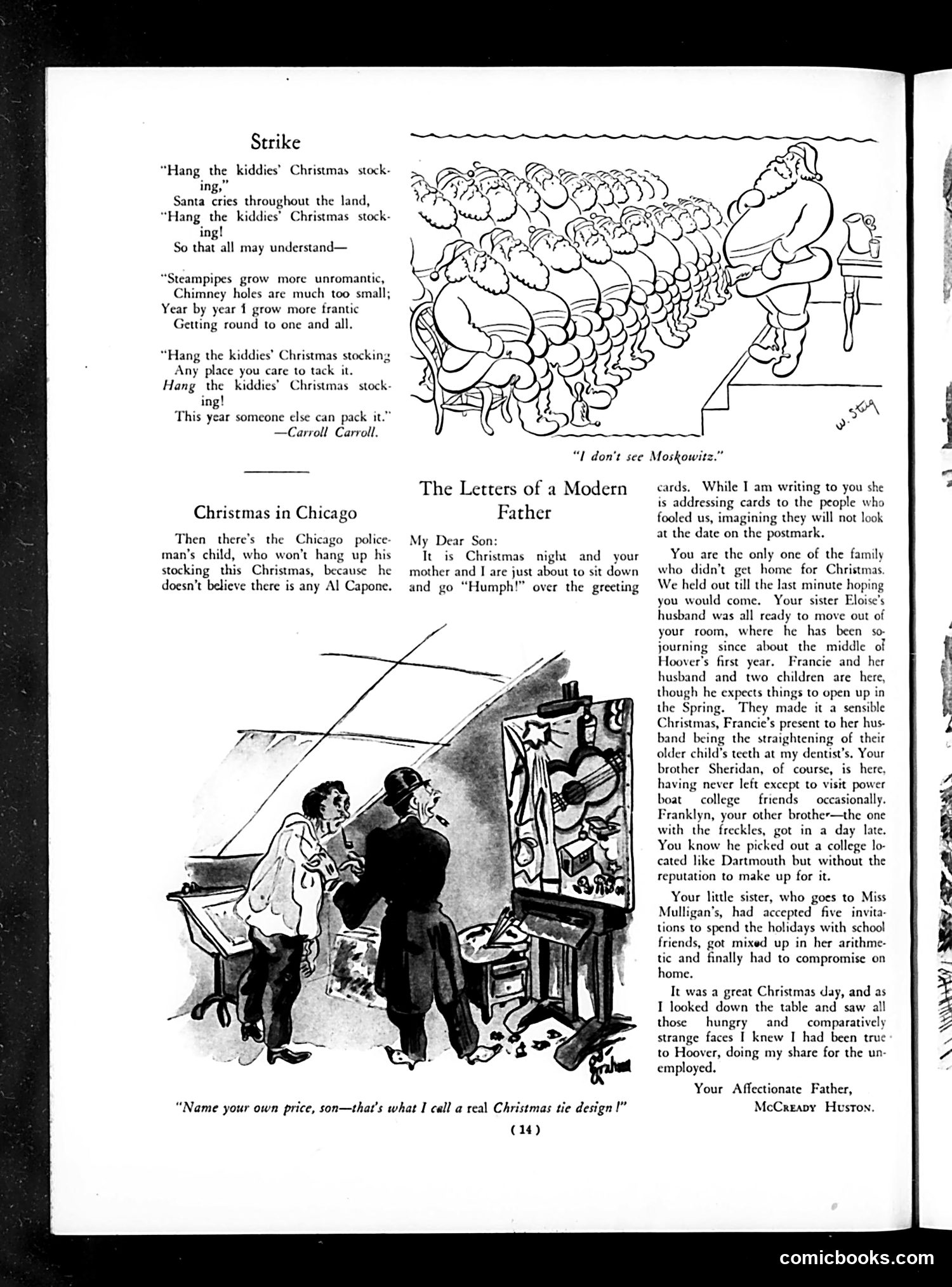
Analysis of Life Magazine Page This page contains two separate satirical pieces about Christmas during economic hardship (likely the Great Depression era). "Strike" (top): A cartoon mocking Santa Claus and Christmas commercialism. The poem suggests Santa's appeals to "hang the kiddies' Christmas stocking" have become tired and repetitive, with people growing "more frantic" yet "more small" each year. The visual shows an exhausted Santa amid an endless queue of children. "Christmas in Chicago" (bottom): The cartoon depicts a father figure showing his son an abstract/modern painting, with the caption about naming your own price—satirizing both modern art's incomprehensibility and Depression-era desperation where people must sell possessions at any price. "Letters of a Modern Father": A letter describing a sparse family Christmas where relatives gather not from joy but necessity, having lost homes or prospects. The tone suggests economic displacement and reduced circumstances. All pieces use dark humor about Christmas during economic crisis.
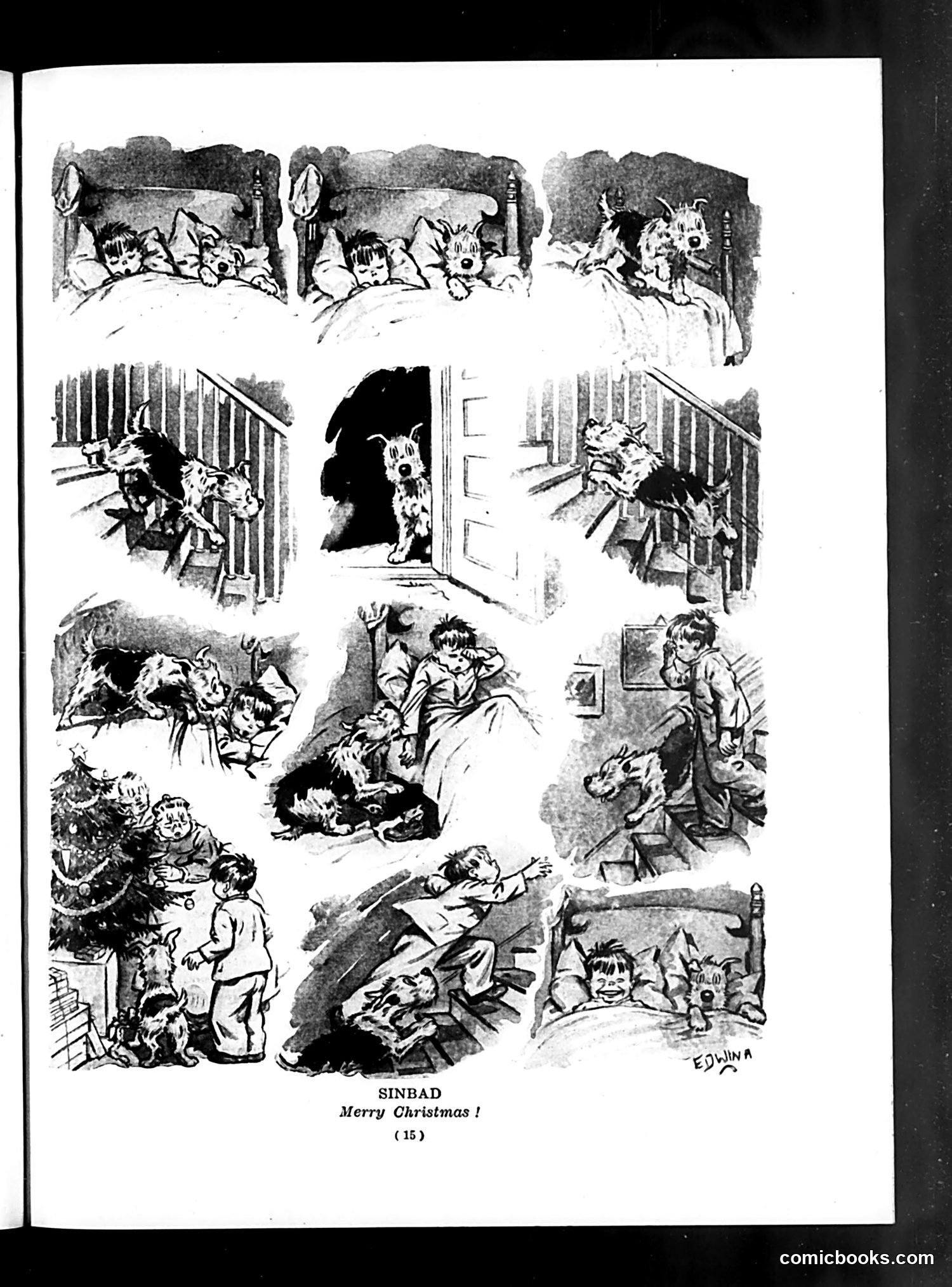
Sinbad Christmas Cartoon Analysis This is a humorous illustrated sequence titled "Sinbad—Merry Christmas!" featuring children and what appears to be a dog or animal character in various Christmas scenarios. The panels show domestic holiday scenes: children in beds (likely expecting Santa), someone at a doorway, children with presents, Christmas tree decoration, and bedtime moments. The satire appears to play on the *Arabian Nights* tale of Sinbad by applying his adventure-filled narrative structure to mundane Christmas domesticity. The joke is the contrast between Sinbad's fantastical voyages and the simple, repetitive family rituals of Christmas—suggesting children's Christmas experiences echo mythic adventure stories in their imaginations. The artist is credited as "EDWINA" at bottom right.
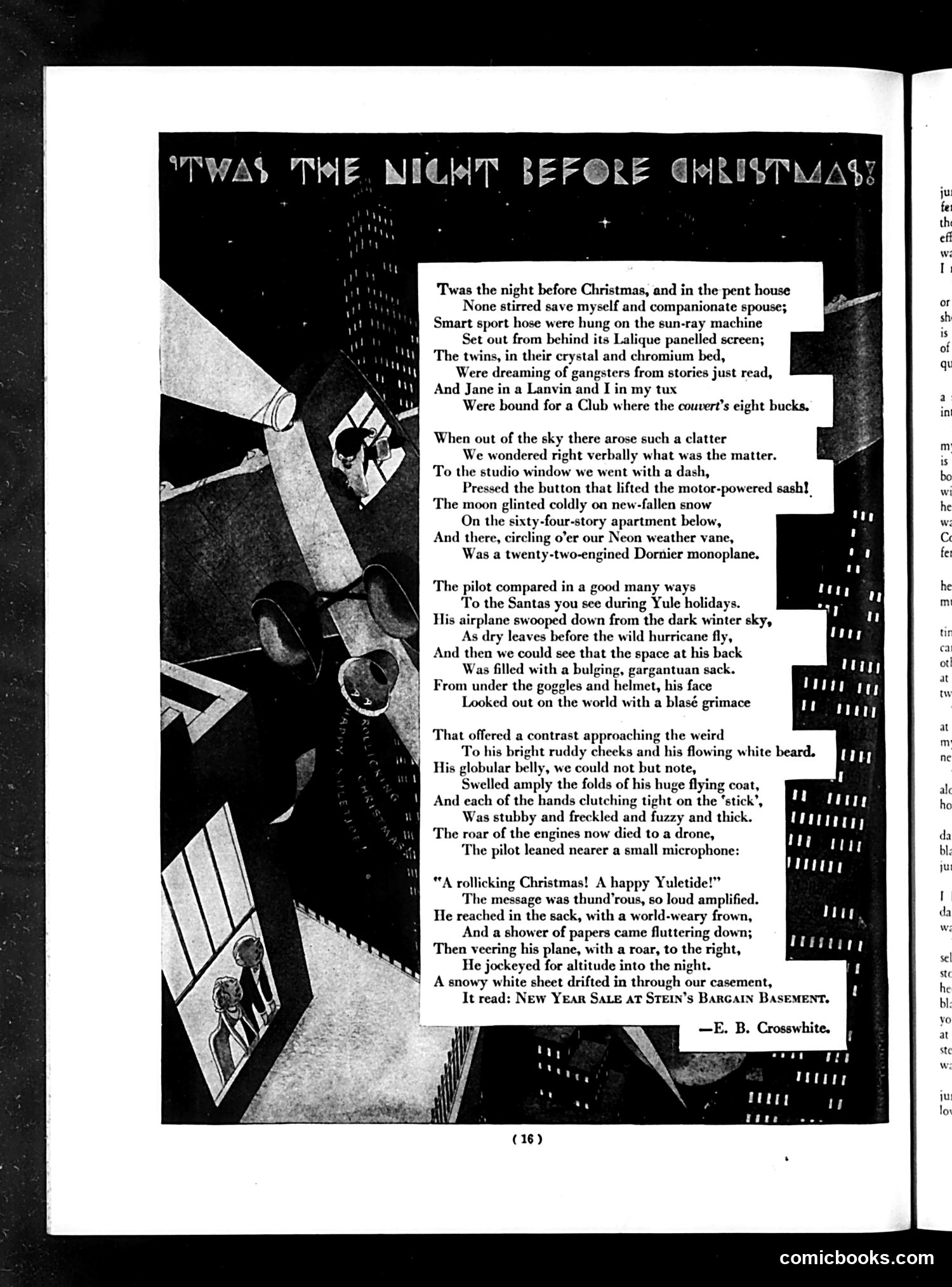
This is "'Twas the Night Before Christmas," a modernized parody by E. B. Crosswhite. The illustration shows a futuristic apartment building with an airplane visible outside, depicting a sci-fi reimagining of the classic holiday poem. The satire updates Clement Clarke Moore's 1823 poem for contemporary readers by replacing traditional Christmas imagery with 1920s-30s modern technology: a "twenty-two-engined Dornier monoplane" substitutes for Santa's sleigh, a "motor-powered sash" for windows, and "Neon weather vane" for decorations. The pilot wears goggles and delivers via airplane rather than reindeer. The joke targets how rapidly technology was transforming daily life, presenting an absurdly mechanized future Christmas as both amusing and slightly unsettling—poking fun at modernity's encroachment on tradition.
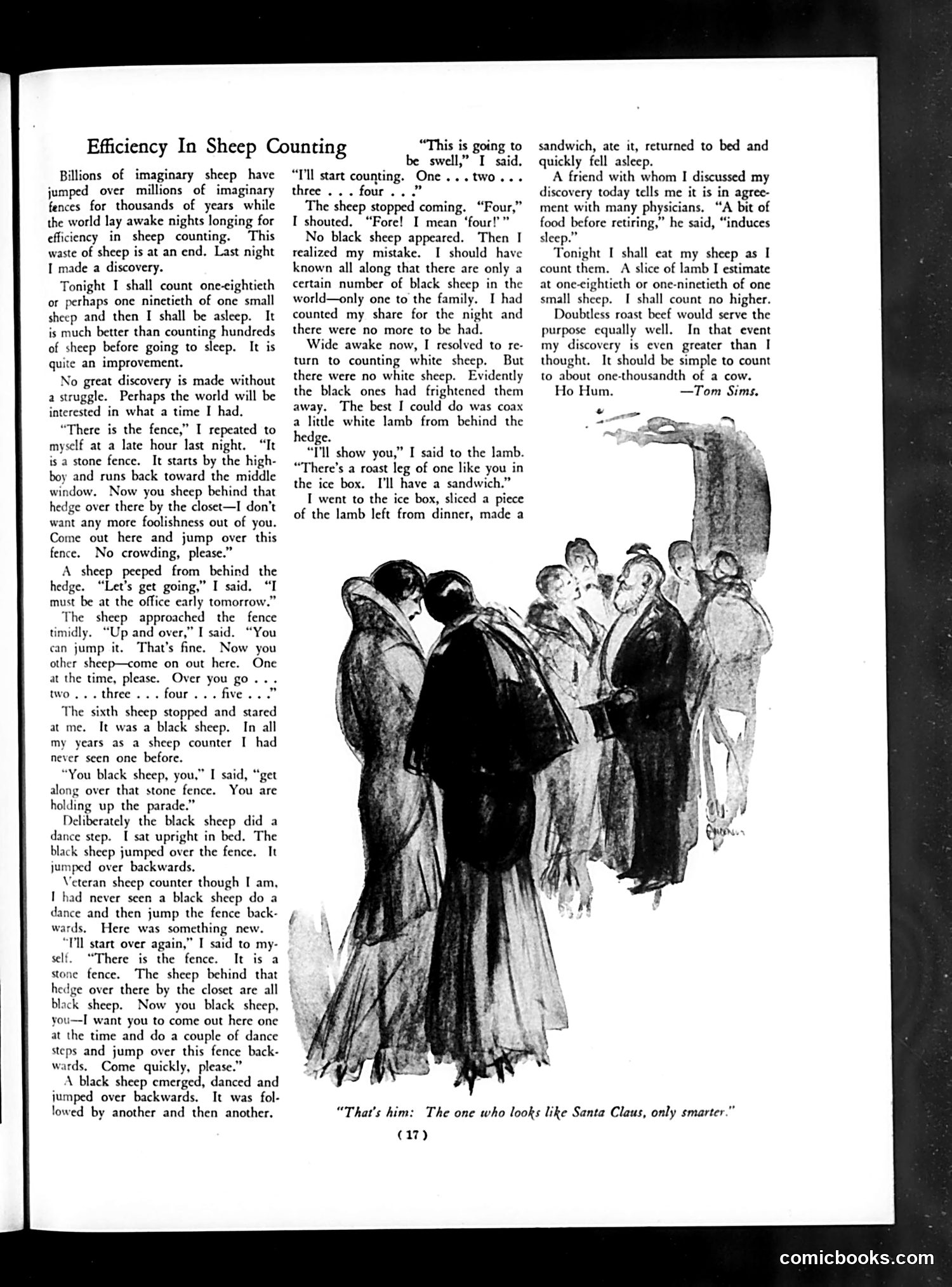
Efficiency in Sheep Counting This is a humorous short story about an insomniac's attempt to count sheep for sleep. The narrator starts counting sheep but encounters complications: black sheep appear unexpectedly, disrupting the count; sheep refuse to cooperate with jumping over fences in orderly fashion; and the narrator grows increasingly frustrated with the traditional remedy. The illustration shows a group of figures (appearing to be people in period clothing) gathered together, with a caption identifying one as "the one who looks like Santa Claus, only smarter." The satire gently mocks the widespread folk belief that counting sheep guarantees sleep, suggesting this "efficient" method often fails in practice due to real-world complications and the sheep's lack of cooperation with human expectations.
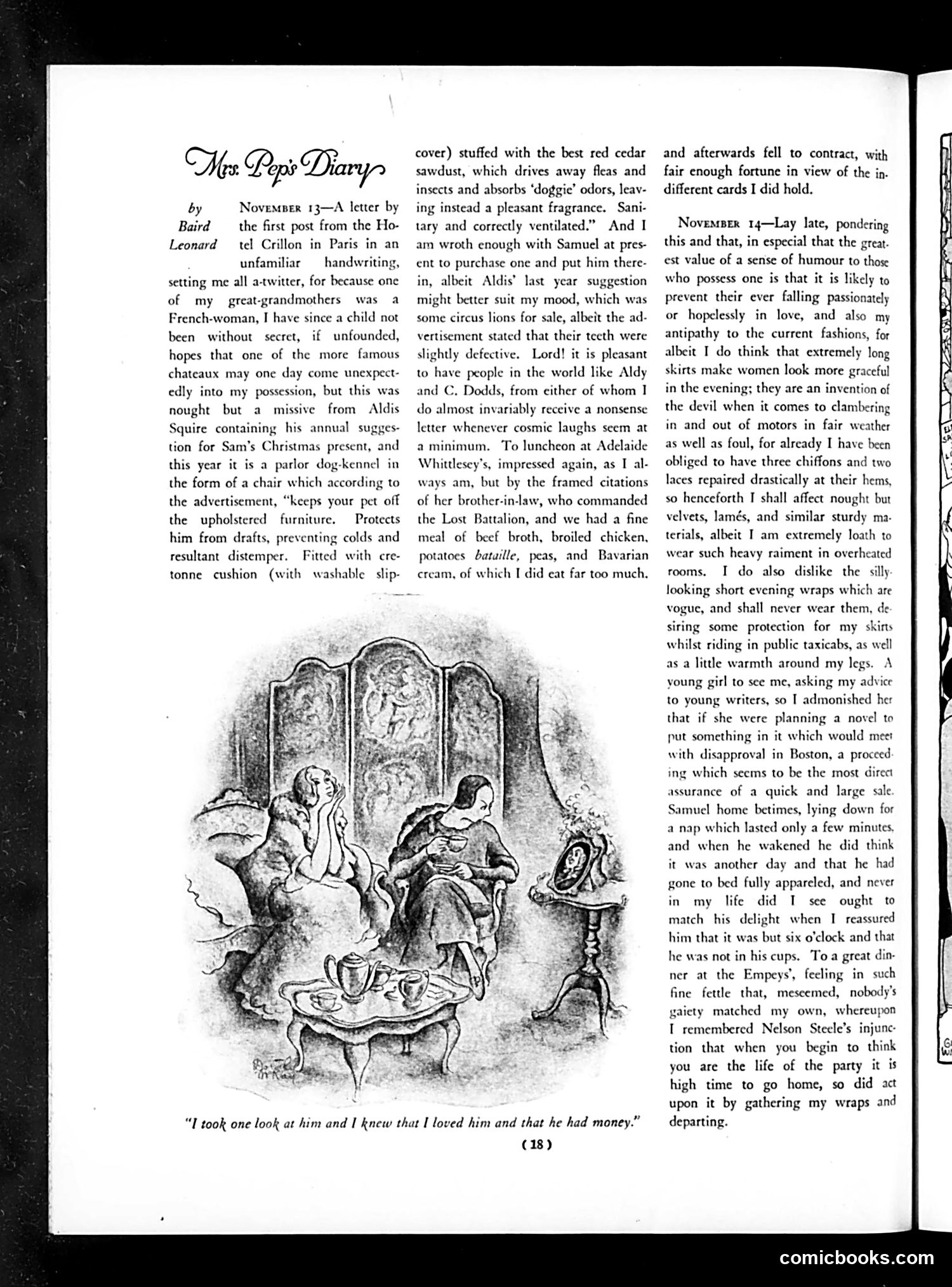
Analysis of "Mrs. Pepsi Diary" Page This is a humorous diary entry from *Life* magazine's satirical column. The illustration depicts a social gathering—likely a dinner party or salon—with well-dressed figures in Victorian or Edwardian-era clothing seated around furniture. The diary entry mocks upper-class social pretensions and fashionable concerns: the writer complains about long skirts, evening wraps, and riding in taxicabs, while praising furniture that "keeps your pet off the upholstered furniture." The satire targets the frivolous preoccupations of wealthy society women and their obsession with status symbols and fashion trends. The caption quote—"I took one look at him and I knew that I loved him and that he had money"—reveals the era's satirical commentary on marriage motivated by wealth rather than genuine affection. The overall tone mocks materialistic romanticism among the wealthy.
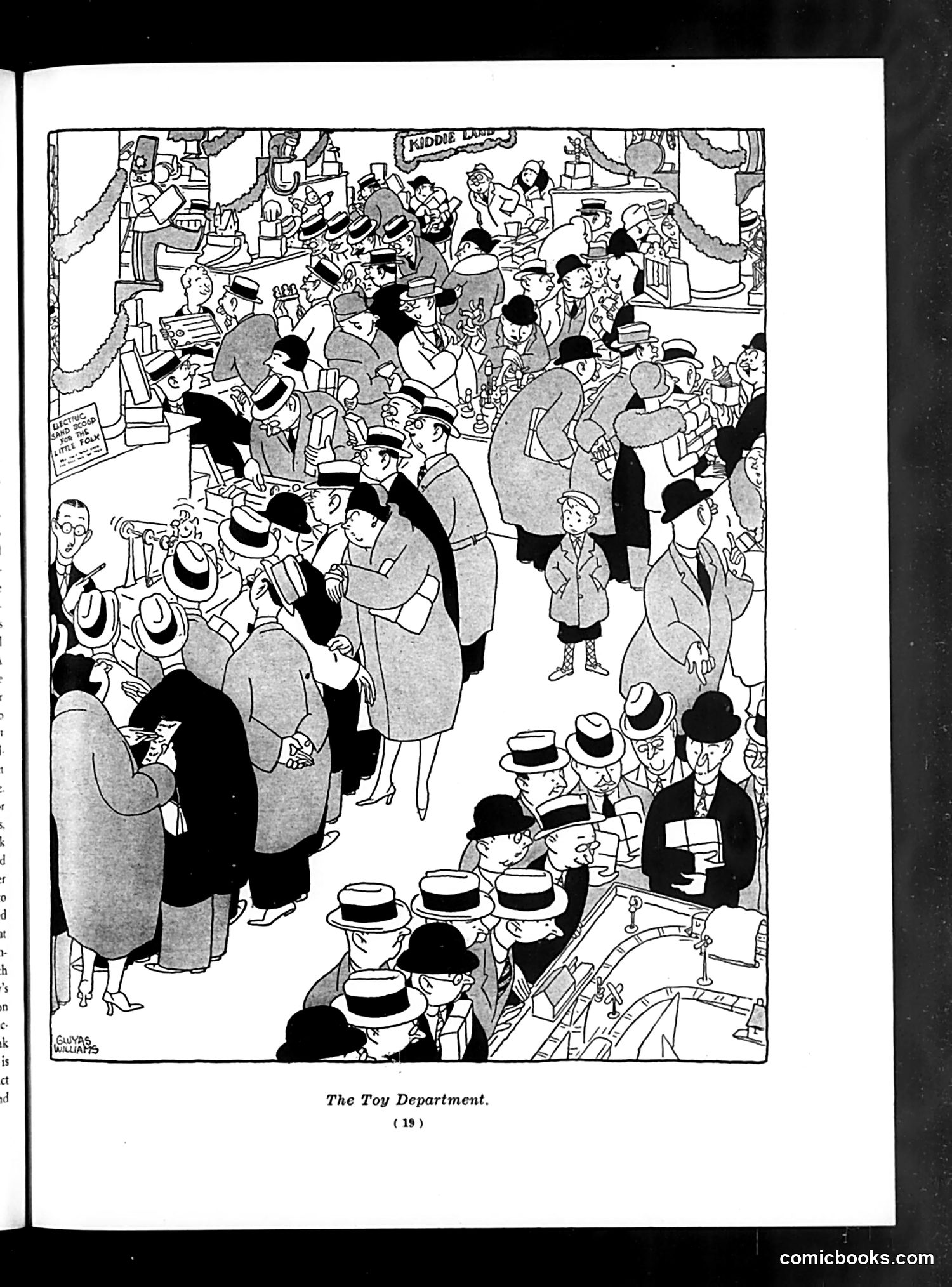
"The Toy Department" This cartoon by Guylas Williams depicts a crowded toy department during what appears to be the holiday shopping season. The illustration satirizes the chaotic shopping experience: well-dressed men and women in 1920s-30s attire jostle amid displays and merchandise. The humor lies in the contrast between adult dignity and childlike behavior—grown men and women are depicted pushing, crowding, and competing for toys with the same enthusiasm children would display. The packed, disorderly scene mocks consumerism and holiday shopping mania, showing respectable citizens abandoning composure for material goods. The artist's signature "Guylas Williams" appears in the lower left. This type of social commentary was characteristic of *Life* magazine's satirical approach to American consumer culture and modern manners.
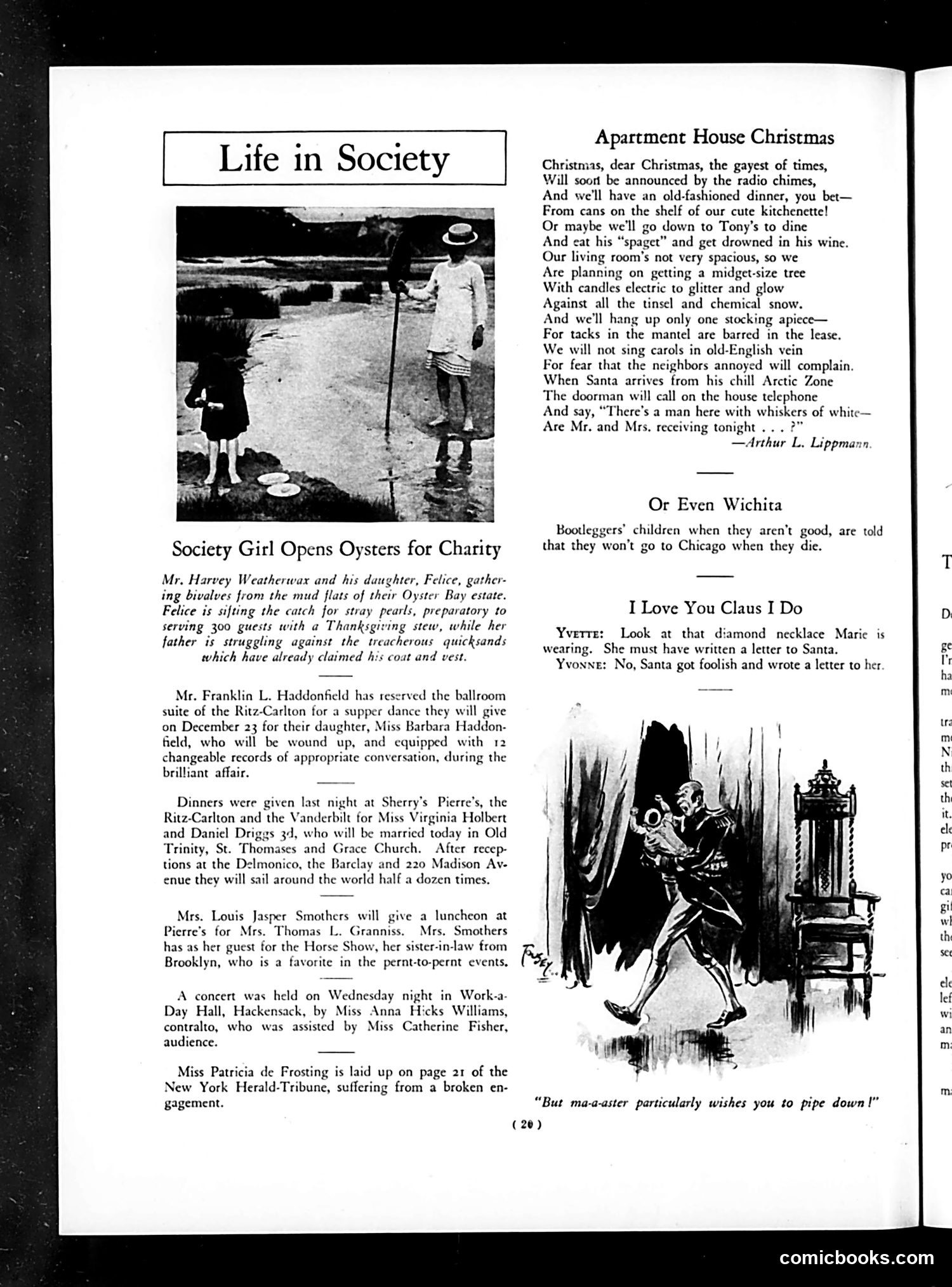
Analysis of Life Magazine Page This page satirizes wealthy Manhattan society through mock-serious reporting and verse. The "Society Girl Opens Oysters for Charity" photo-caption mocks the pretensions of the rich: a socialite named Felice sifts oysters for pearls while her father sinks into quicksand—absurd imagery suggesting the frivolity and danger of upper-class pursuits. Other items ridicule debutante culture, elaborate wedding circuits, and social climbing. The poems mock apartment-dwelling urbanites and their constrained Christmas celebrations—canned dinners, electric candles, midget trees, and doormen announcing Santa. The satire suggests postwar urban claustrophobia and artificiality replacing genuine tradition. A final joke references Prohibition-era gangsters ("bootleggers' children"), implying ill-gotten wealth infiltrating high society. The humor targets the wealthy's shallow materialism, social pretension, and the gap between their aspirations and mundane reality.
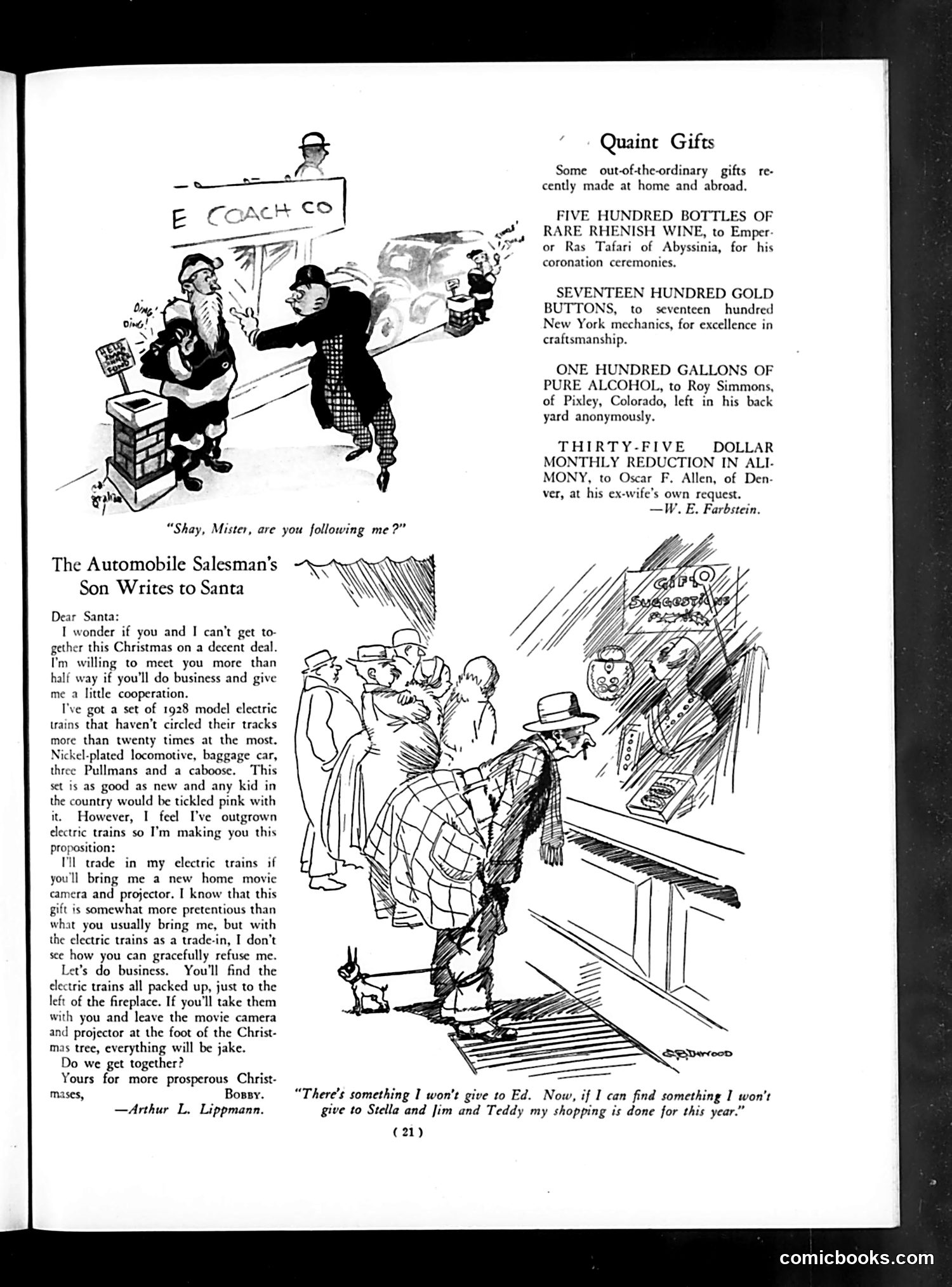
Page Analysis: Life Magazine Satirical Content Top Section - "Quaint Gifts": A humorous list of extravagant or absurd gift-giving, likely mocking excessive wealth and peculiar generosity. References include Emperor Ras Tafari of Abyssinia (modern Ethiopia), New York mechanics receiving gold buttons, and notably, 100 gallons of alcohol left anonymously in Colorado—a clear reference to Prohibition-era bootlegging, making this appear to be from the late 1920s. Main Cartoon - "The Automobile Salesman's Son": A child writes to Santa proposing a "trade-in" deal for his electric trains, using sales language he's picked up from his father. The satire mocks how commercial thinking—typical of automobile salesmen's negotiating tactics—has infiltrated even children's Christmas wishes. The boy treats Santa like a dealer, complete with "let's do business" language. Both sections satirize American consumer culture and commercialism overtaking traditional values during the prosperous but materialistic 1920s.
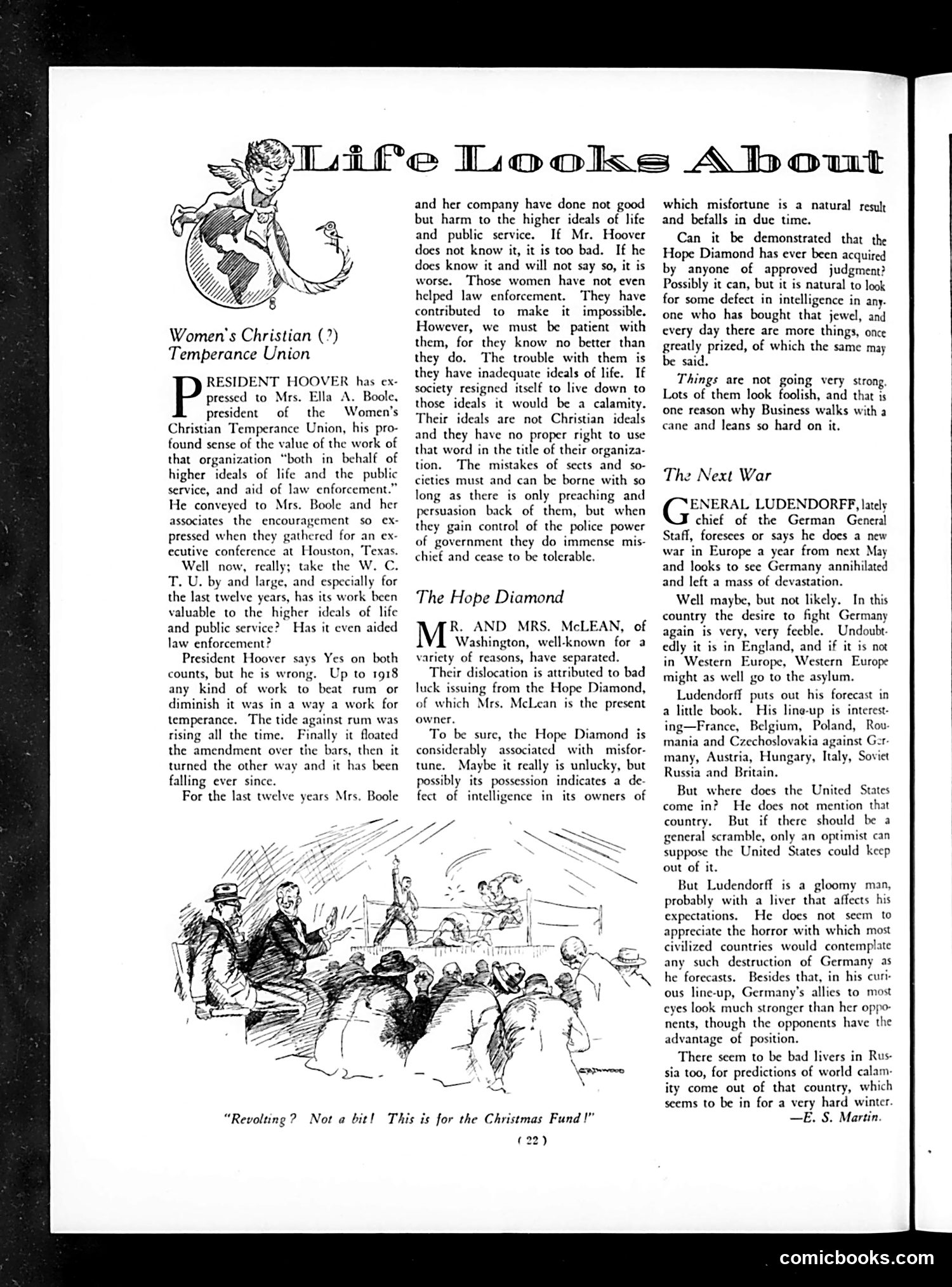
"Life Looks About" - Page Analysis This page contains three satirical columns critiquing contemporary figures and issues: Women's Christian Temperance Union: Life attacks President Hoover's praise of the WCTU, arguing the organization has actually *harmed* rather than helped law enforcement since Prohibition's 1918 passage. The author claims the WCTU's "inadequate ideals" and misuse of police power have made enforcement impossible. This reflects post-Prohibition disillusionment—the amendment (ratified 1919) had become widely seen as a failed, unenforceable policy creating criminal activity. The Hope Diamond: A brief satire suggesting that ownership of the famously "cursed" Hope Diamond indicates poor judgment. The piece cynically notes many once-prized things now "look foolish." The Next War: Life skeptically dismisses General Ludendorff's prediction of European war within a year, noting America has no desire to fight Germany again, though England and Western Europe might. The cartoon shows charity collection, with the caption suggesting Christmas fundraising, not "revolting."
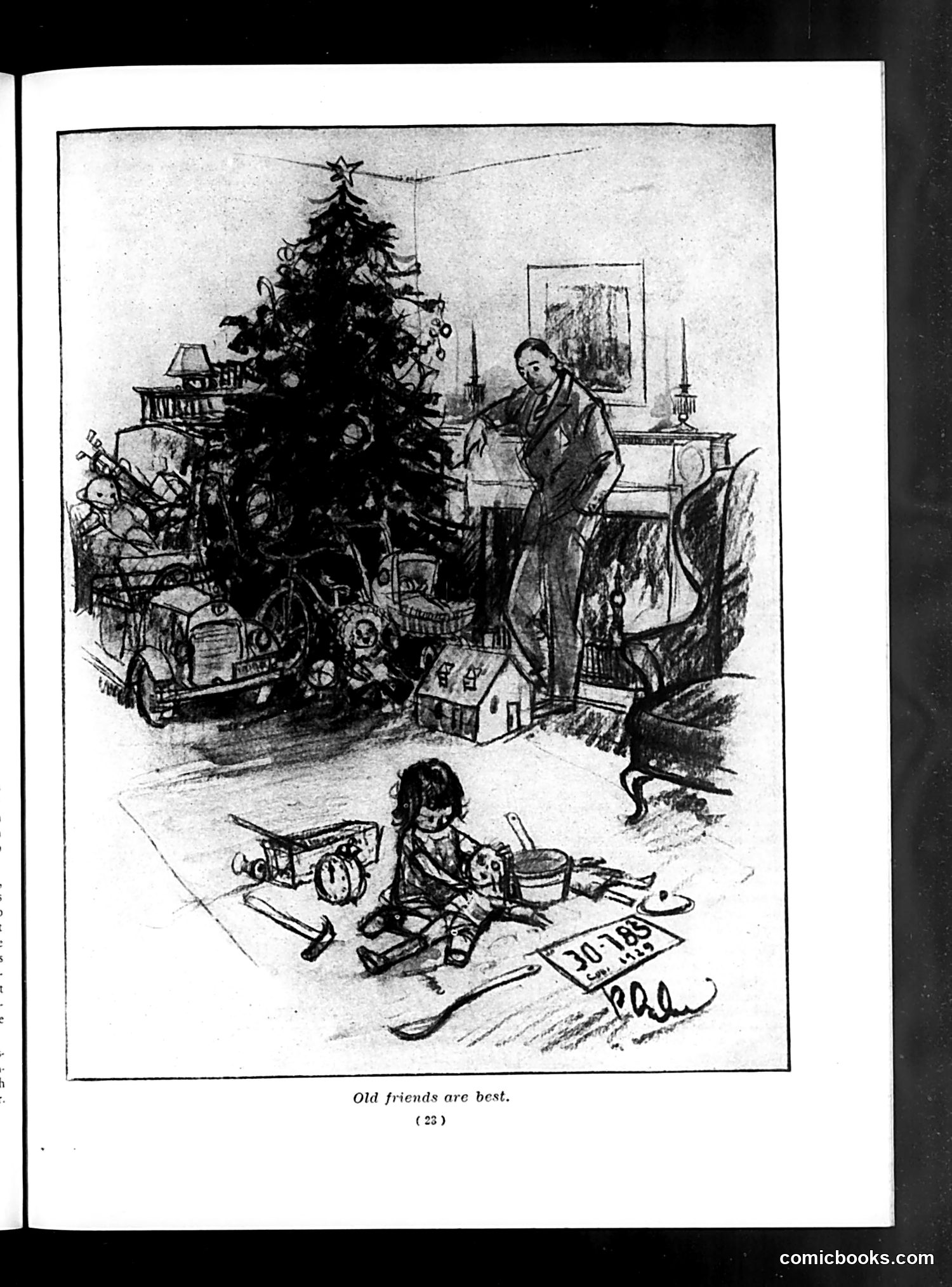
Analysis of "Old Friends Are Best" This illustration depicts a Christmas morning scene contrasting wealth and childhood nostalgia. An adult man stands in an elegant parlor decorated with an elaborate Christmas tree and expensive furnishings, watching a child playing on the floor surrounded by simple, worn toys—a toy wagon, drum, and other modest playthings. The satire's point appears to be that the child finds greater joy and contentment in humble, traditional toys ("old friends") than in material luxury. This reflects early-20th-century sentimental values about childhood innocence and the superiority of simple pleasures over ostentatious consumption. The caption suggests a philosophical message about cherishing nostalgic, familiar things rather than constantly pursuing new acquisitions—a commentary on consumerism and authenticity during the Gilded Age era.
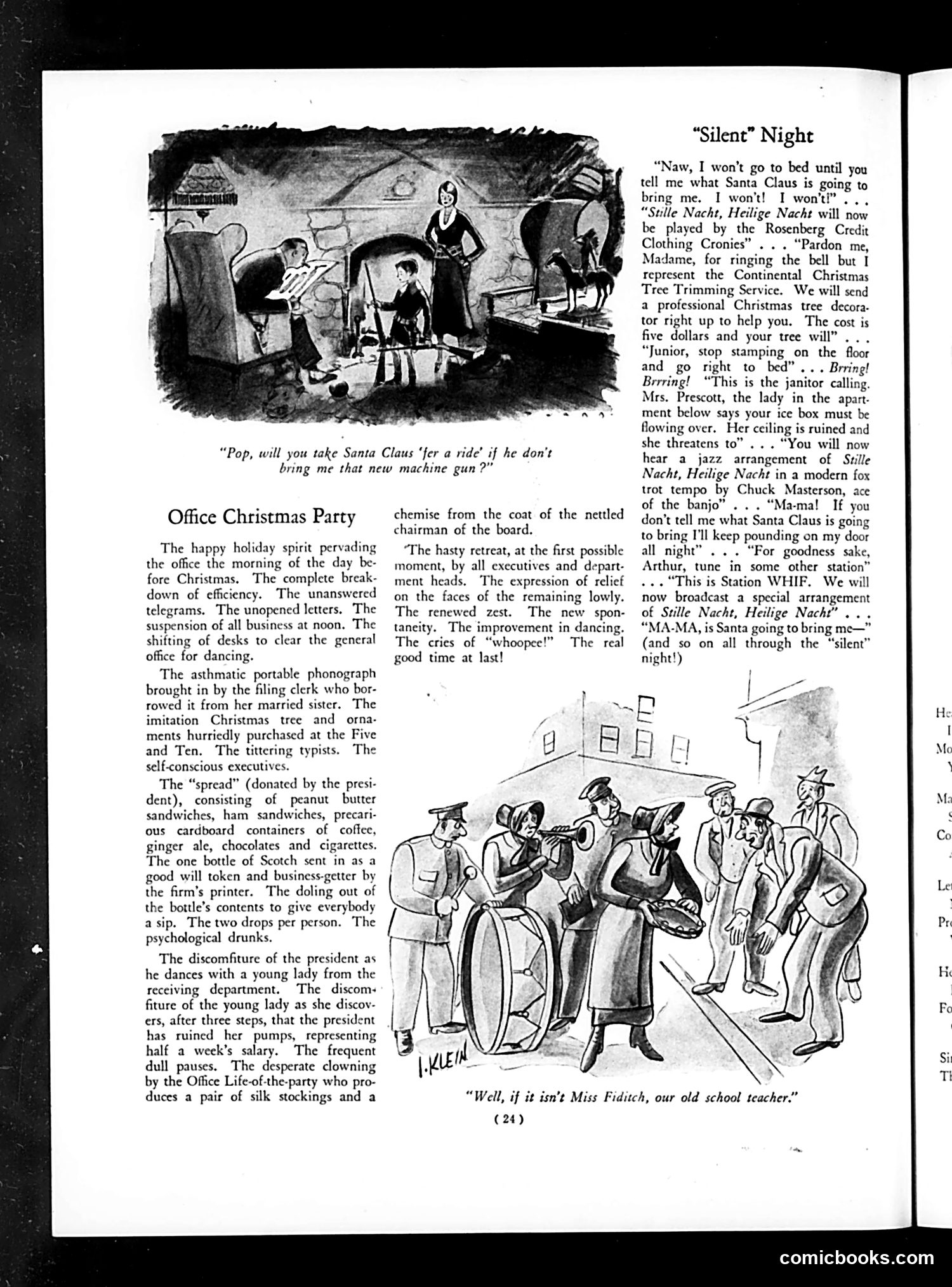
Explanation for Modern Readers This page contains two separate satirical pieces about Christmas disruptions: "Silent Night" mocks the ironically *loud* chaos of a modern apartment building on Christmas Eve. The joke is that the famous "Silent Night" carol plays repeatedly on the radio while a child refuses to sleep, a neighbor complains about a leaking ice box, a Christmas tree service rings the doorbell, and various domestic interruptions create pandemonium. The repeated broadcast of the song emphasizes the contrast between the carol's peaceful message and actual holiday bedlam. "Office Christmas Party" humorously catalogs the breakdown of workplace professionalism: bosses awkwardly dancing and ruining employees' shoes, meager refreshments, forced fun, and executives eagerly fleeing once the "real" good time begins—implying workers enjoy themselves only after management leaves. Both pieces satirize how modern commercial Christmas disrupts rather than brings peace and quiet.
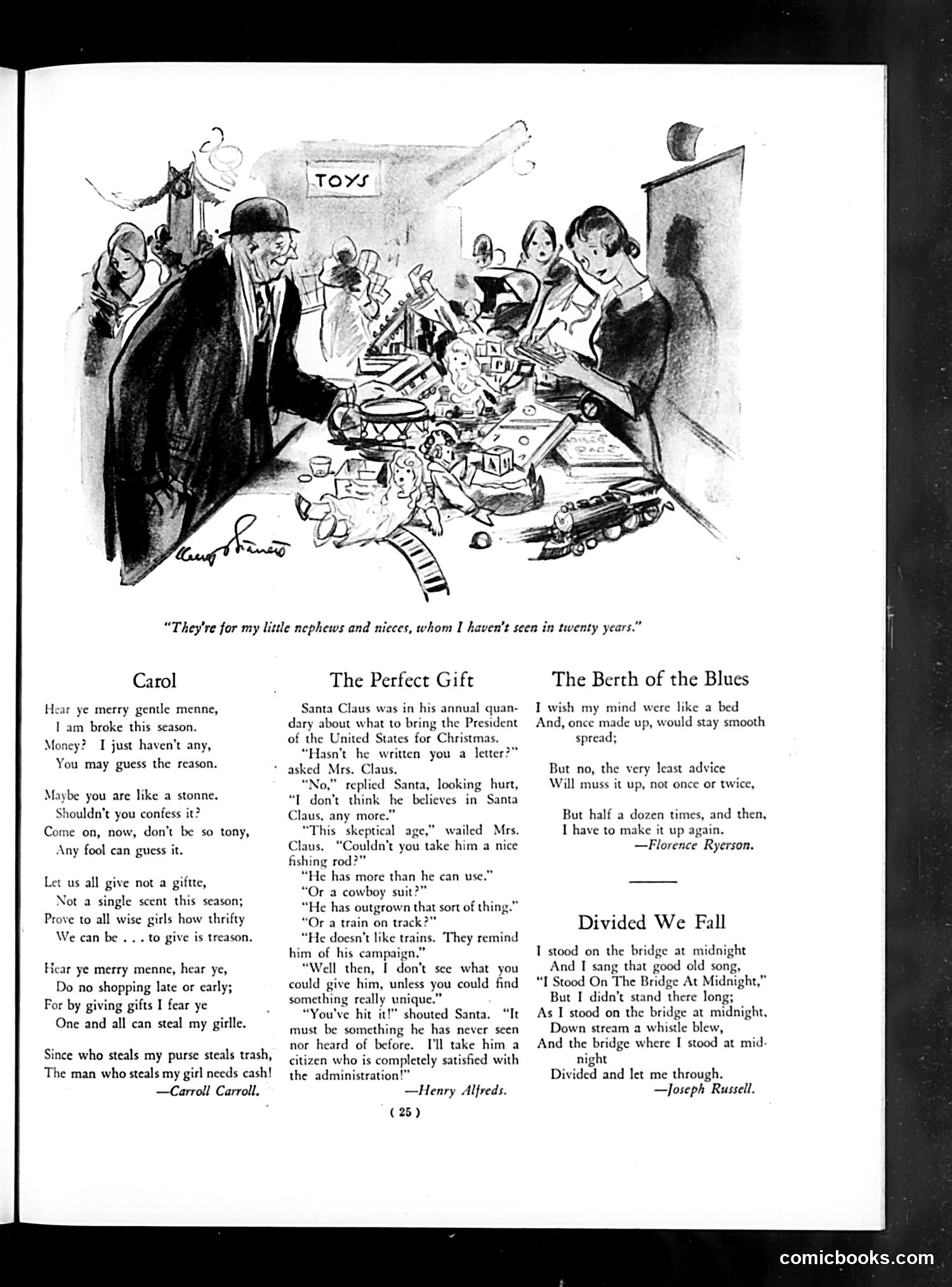
Cartoon Analysis: "They're for my little nephews and nieces..." The top cartoon satirizes gift-giving during economic hardship. A well-dressed man presents toys to relatives while claiming financial necessity. The "TOYS" sign visible in the cluttered scene suggests he's making expensive purchases despite professed poverty—the humor lies in this contradiction. The accompanying verse and prose pieces extend the theme: "Carol" mocks the excuse of poverty while secretly fearing gift-giving will attract romantic rivals; "The Perfect Gift" jokes about finding a gift for a President completely satisfied with his administration (clearly meant as impossible satire of the current administration); and the remaining poems use tired wordplay about indecision and ambivalence. The overall page satirizes social hypocrisy around Christmas spending and contemporary political satisfaction—typical of *Life* magazine's gentle, middle-class humor. The specific President referenced remains unclear without a date, though the tone suggests criticism of an unpopular administration.
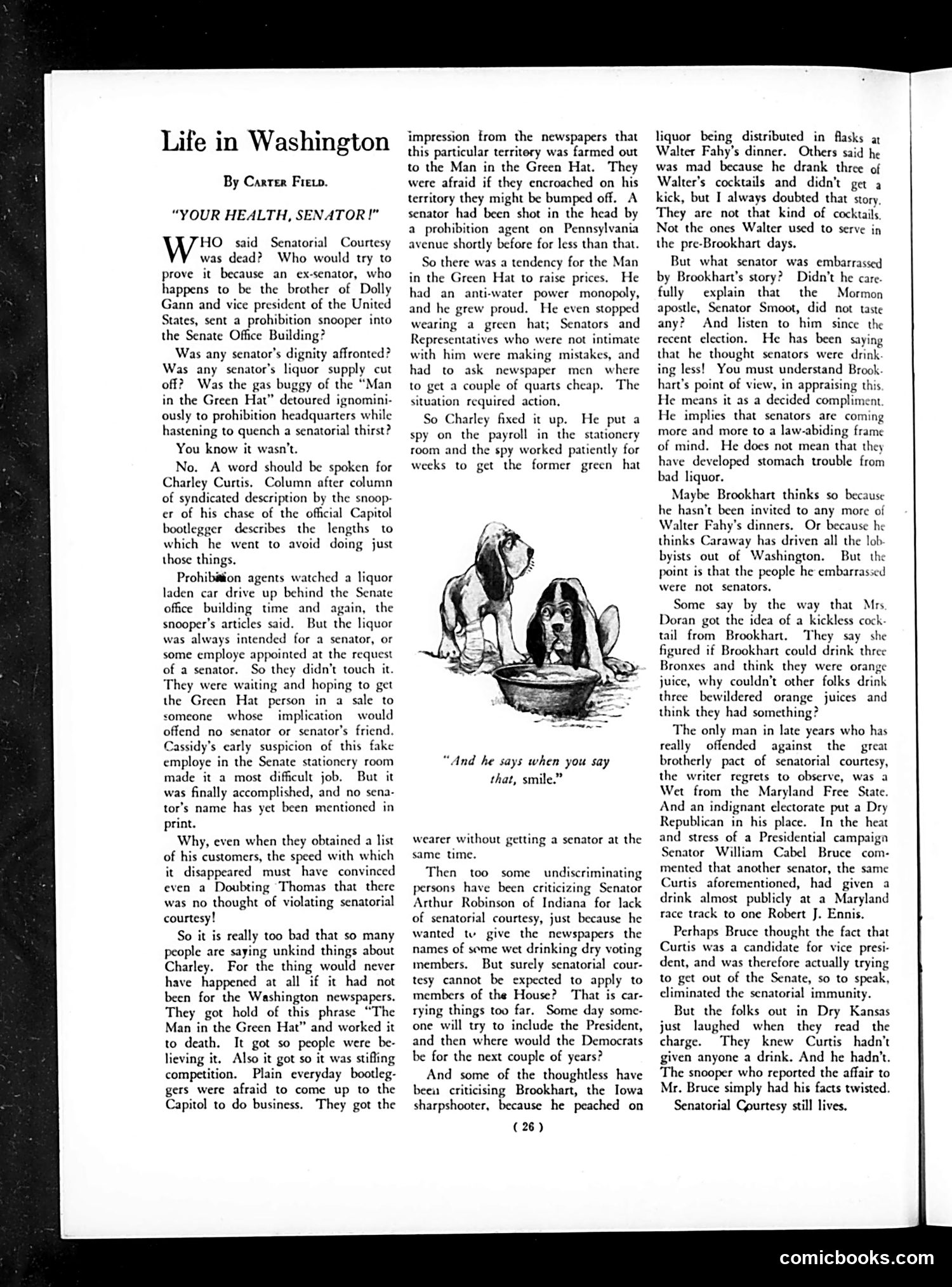
Analysis of "Life in Washington" Satire This column by Carter Field satirizes Prohibition-era hypocrisy among U.S. Senators during the late 1920s. Key figures and context: - Vice President Charles Curtis (brother of Dolly Gann) sent a prohibition agent into the Senate Office Building to catch bootleggers—nominally enforcing Prohibition laws passed in 1920 - "The Man in the Green Hat" = a Capitol bootlegger who supplied senators with illegal liquor - The satire exposes that senators maintained "senatorial courtesy"—protecting each other from prosecution while allowing enforcement against ordinary bootleggers and competitors The joke: Field mocks senators' selective enforcement: prohibition agents carefully avoided arresting any senator or their appointee, waiting weeks to catch the Green Hat supplier *without* implicating officials. Field sarcastically praises this restraint as admirably protecting senatorial dignity, while criticizing colleagues (Robinson, Brookhart) who actually named drinking legislators. The point: Senators enjoyed protected access to illegal liquor while public Prohibition remained nominally law—a perfect example of class-based legal immunity masked by polite euphemism.
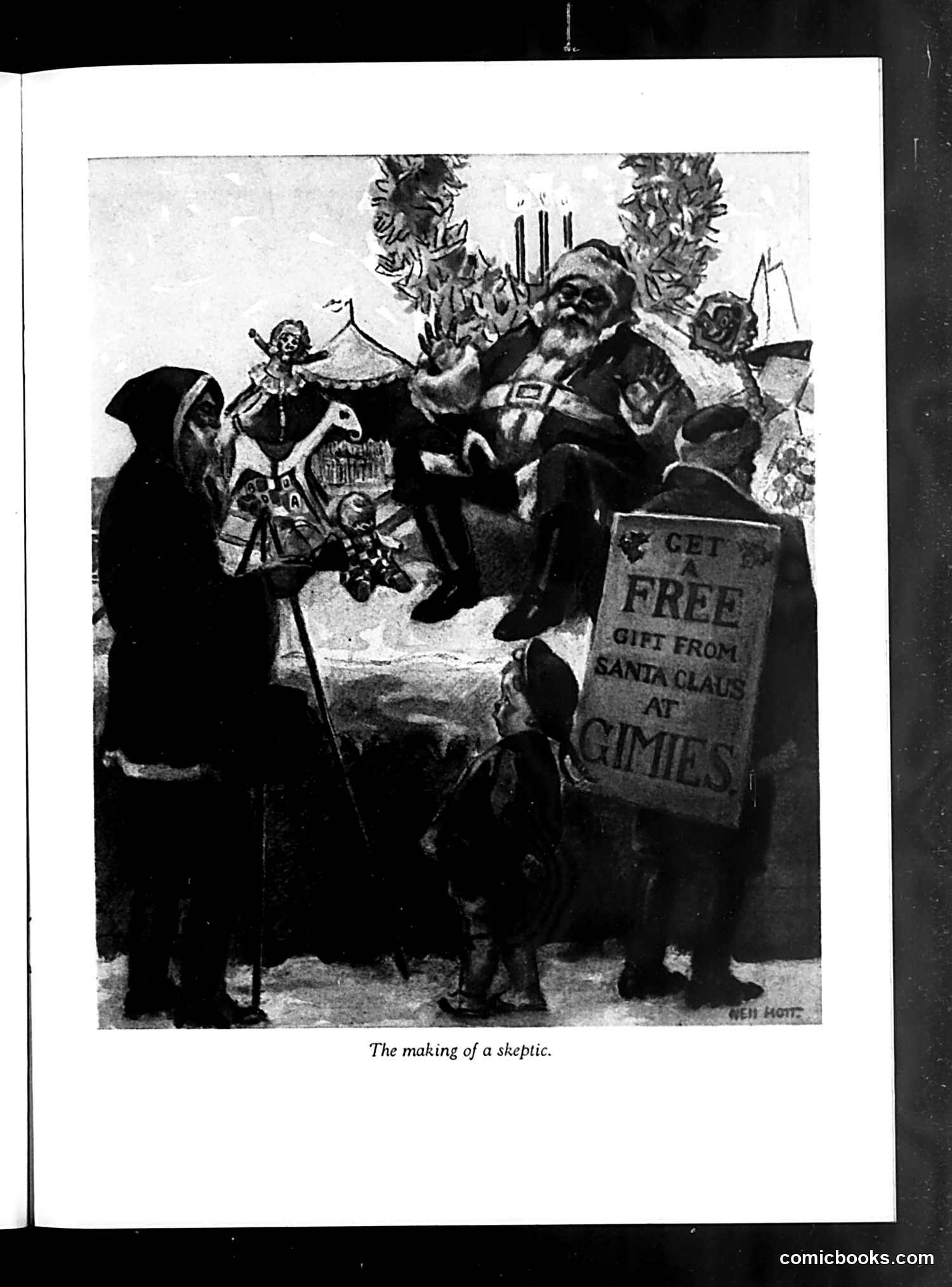
"The Making of a Skeptic" This satirical cartoon depicts Santa Claus being filmed or photographed by what appears to be a film crew, with a sign advertising "GET A FREE GIFT FROM SANTA CLAUS AT GIMMES." The image critiques commercial exploitation of Christmas traditions and the loss of childhood wonder. The satire suggests that Santa Claus—a figure meant to represent magic and generosity—has been reduced to a marketing tool for retail consumption ("GIMMES"). The presence of cameras and the artificial staging implies that the authentic Santa experience has been replaced by commercialized spectacle. The title "The making of a skeptic" indicates that children exposed to this transparent commercialism would naturally become cynical about Santa and holiday traditions. This reflects early-to-mid 20th-century concerns about advertising's corrupting influence on American culture and childhood innocence.
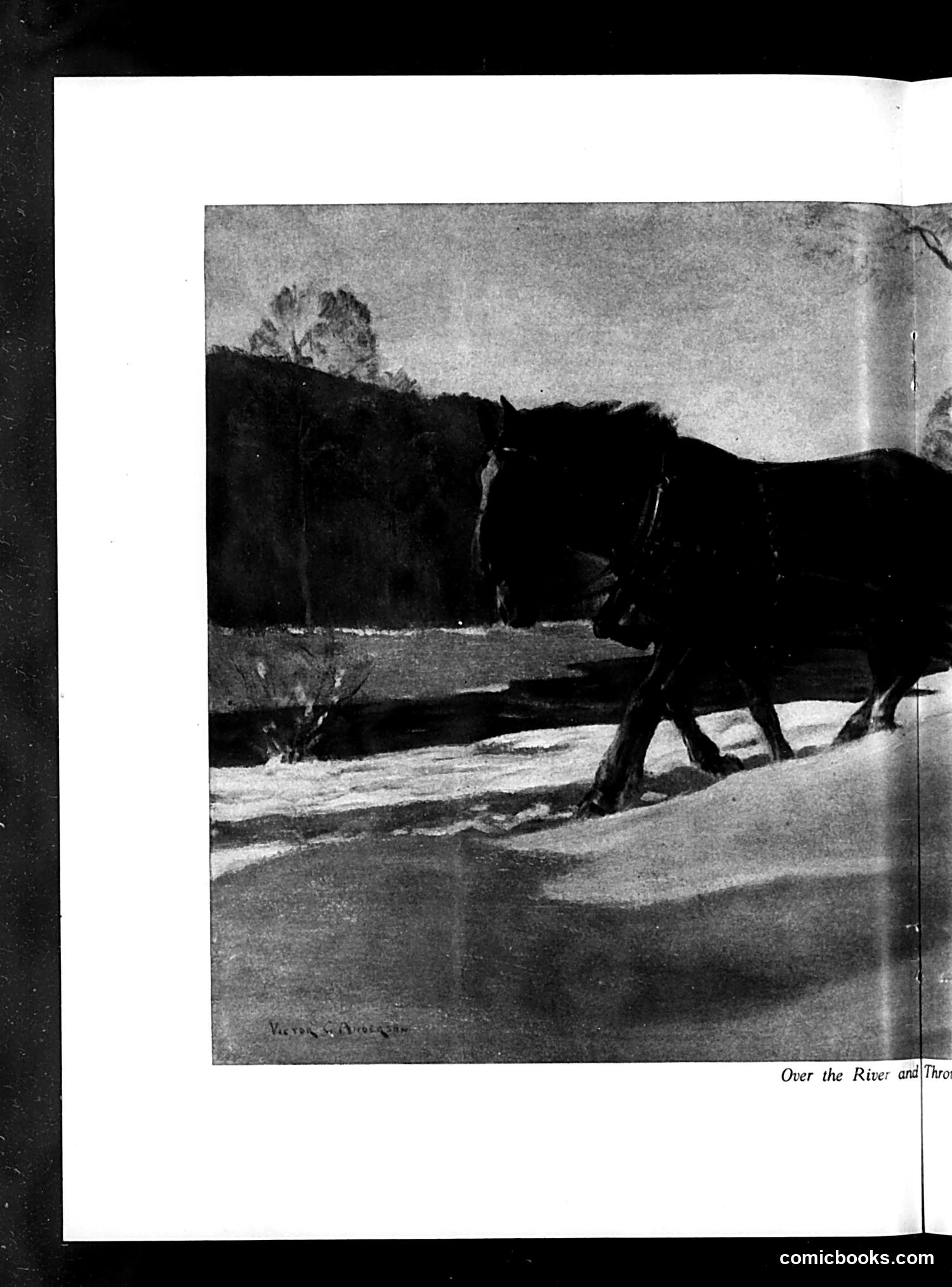
Content Analysis This appears to be a page from Life magazine featuring a black and white photograph with the caption "Over the River and [text cut off]." The image shows what appears to be a horse-drawn cart or wagon crossing or near a river, with wooded terrain visible in the background. The photograph has the grainy quality typical of early-to-mid 20th century publication. Without the complete caption text or additional context from surrounding content, I cannot definitively identify the specific satirical or political reference intended. The phrase "Over the River and..." suggests a literary or proverbial allusion, but the incomplete caption prevents me from determining the exact satirical point or what figure or event this may be referencing. More of the page context would be needed for accurate interpretation.
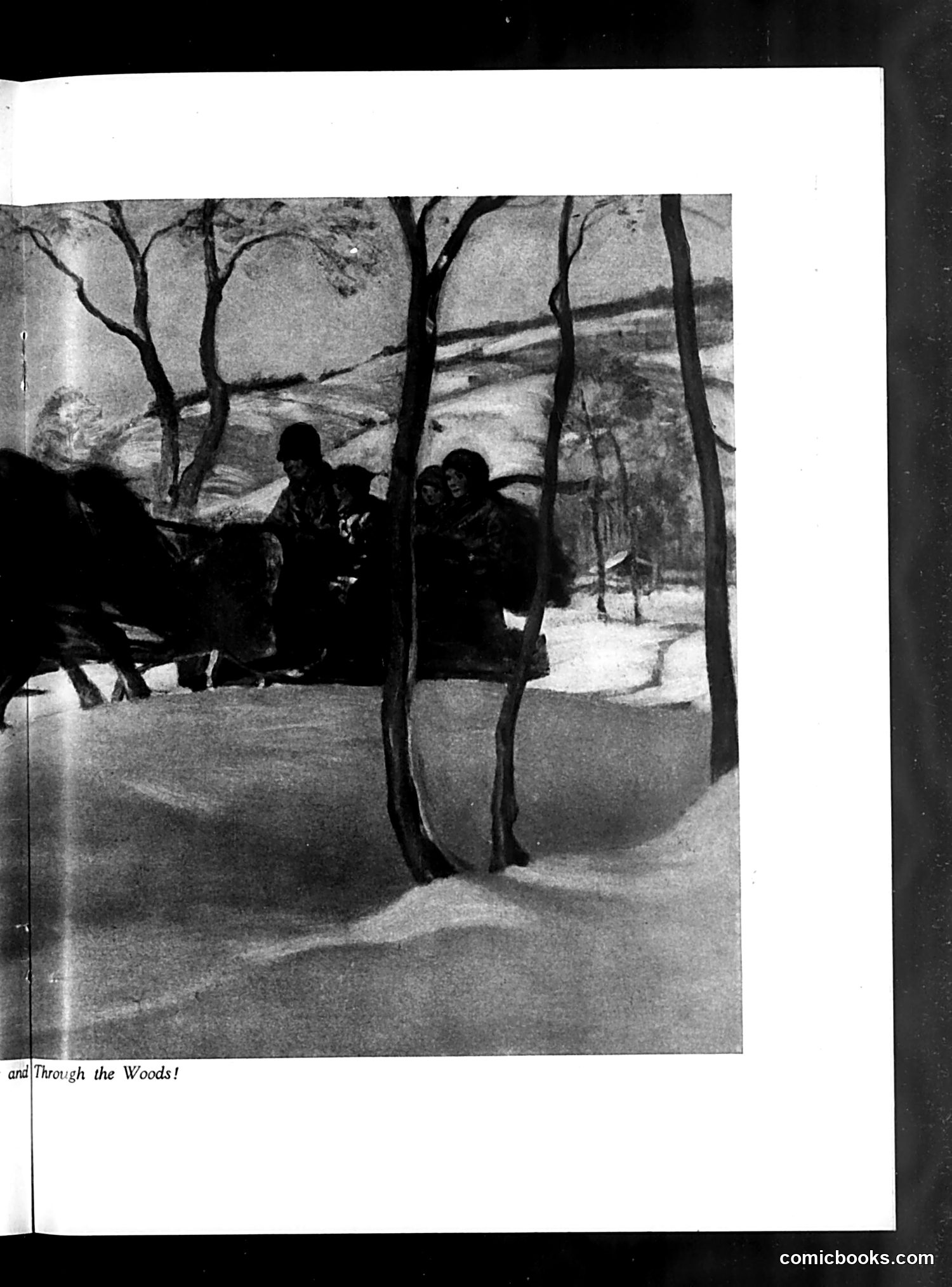
"Through the Woods!" This appears to be a winter scene caption from *Life* magazine showing figures trudging through snow among bare trees. The image is grainy and silhouetted, making specific identification difficult. The caption "Through the Woods!" suggests a journey or struggle through difficult terrain—likely metaphorical commentary on contemporary hardship or adversity. The figures are bundled against cold, emphasizing endurance through harsh conditions. Without additional context or clearer visibility of details, the specific political or social reference remains unclear. It could reference wartime conditions, economic hardship, or a contemporary news event from *Life*'s publication period, but the image alone doesn't definitively establish which. The tone suggests perseverance through adversity as the central theme.
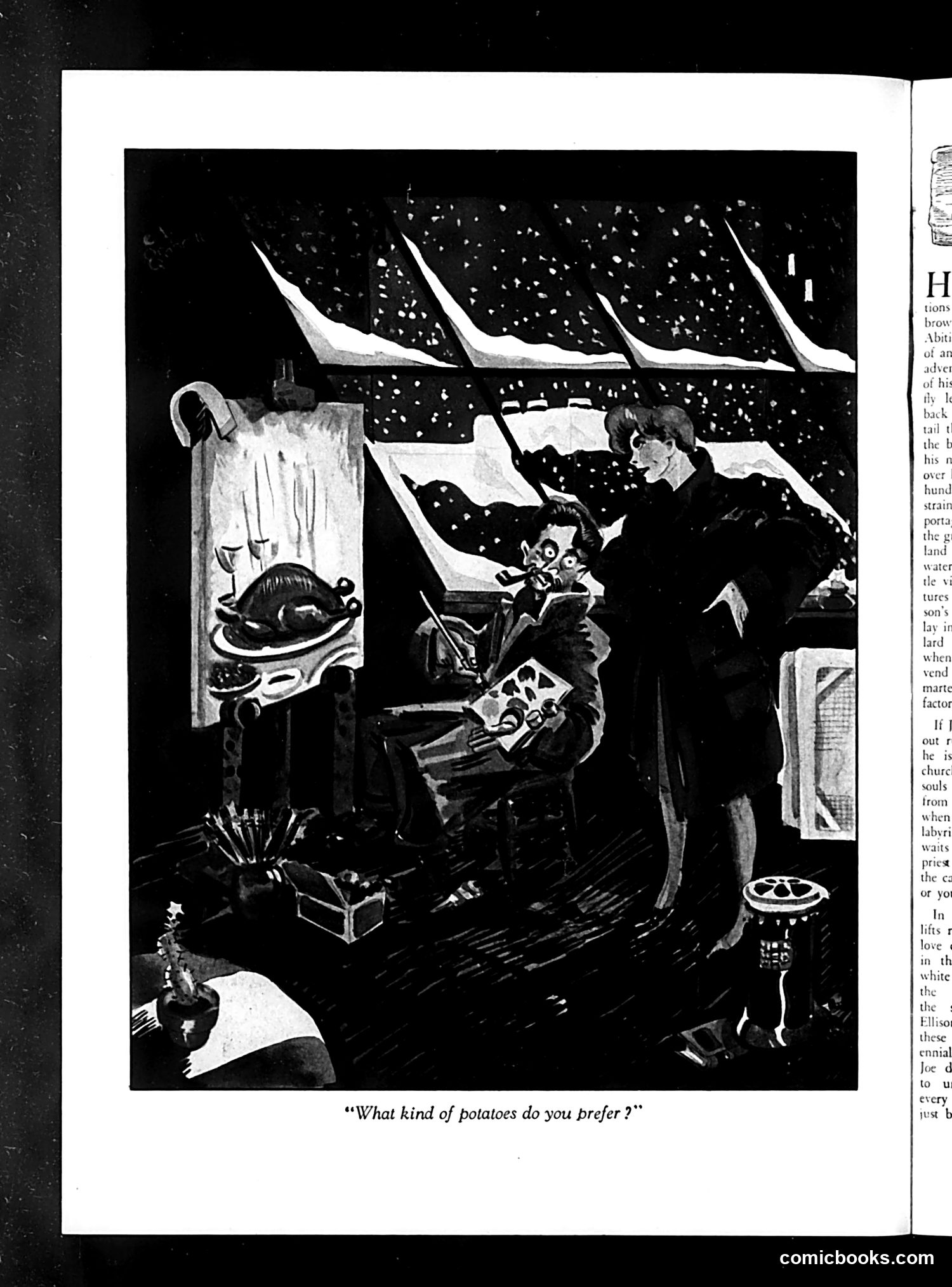
Cartoon Analysis This is a single-panel cartoon depicting what appears to be a spaceship or futuristic vessel interior, with large circular windows showing a starry sky. Inside, two figures—one seated and one standing—converse, with the caption asking "What kind of potatoes do you prefer?" The humor derives from the absurdist juxtaposition: in a sophisticated sci-fi setting depicting advanced space travel, the mundane domestic question about potato preferences seems jarringly out of place. This satirizes how human concerns remain trivially ordinary even amid fantastic technological advancement. The cartoon likely mocks the gap between futuristic aspirations and everyday reality—no matter how far we venture into space, we're still preoccupied with basic domestic matters. The style and starfield suggest this is early-to-mid 20th century science fiction satire from *Life* magazine.
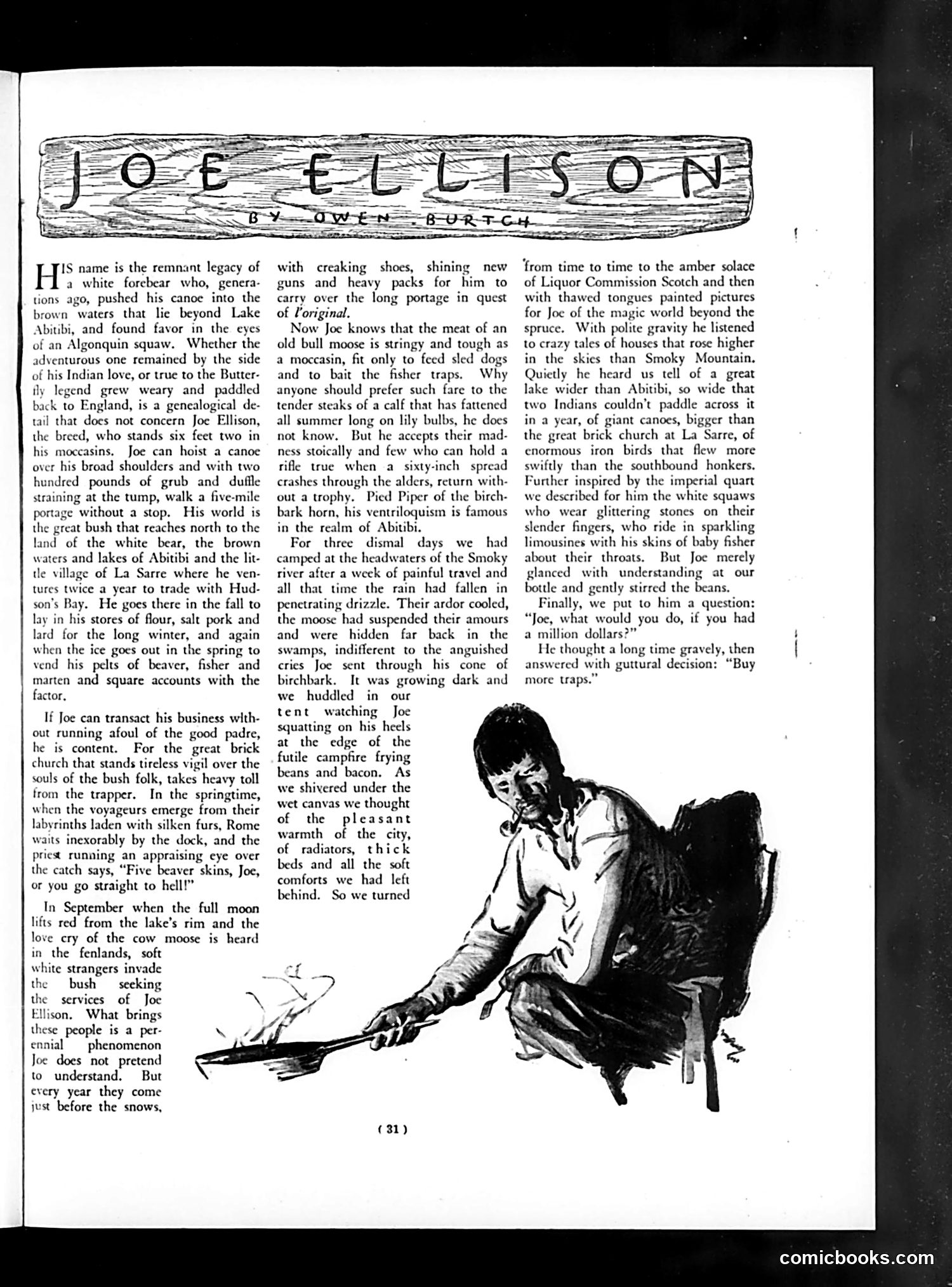
"Joe Ellison" - Content Analysis This is a short story (not political satire) about Joe Ellison, a mixed-race trapper of Indigenous and European descent living in the Canadian bush near Lake Abitibi. The narrative celebrates Joe as a skilled, self-sufficient guide and hunter who serves wealthy sport hunters seeking moose. The story's social context reflects early 20th-century attitudes: Joe is portrayed respectfully as competent and dignified, yet the text uses dated terminology ("breed," reference to his mother as "Algonquin squaw") and emphasizes his contentment within a colonial hierarchy—answering to the Hudson's Bay Company "factor" and the Catholic Church, which extracts payment from his beaver catches. The illustration shows Joe at a campfire. The narrative's irony centers on wealthy outsiders' romantic notions of wilderness life versus Joe's practical understanding—they seek trophy moose while he knows old bull meat is worthless except for dog food.
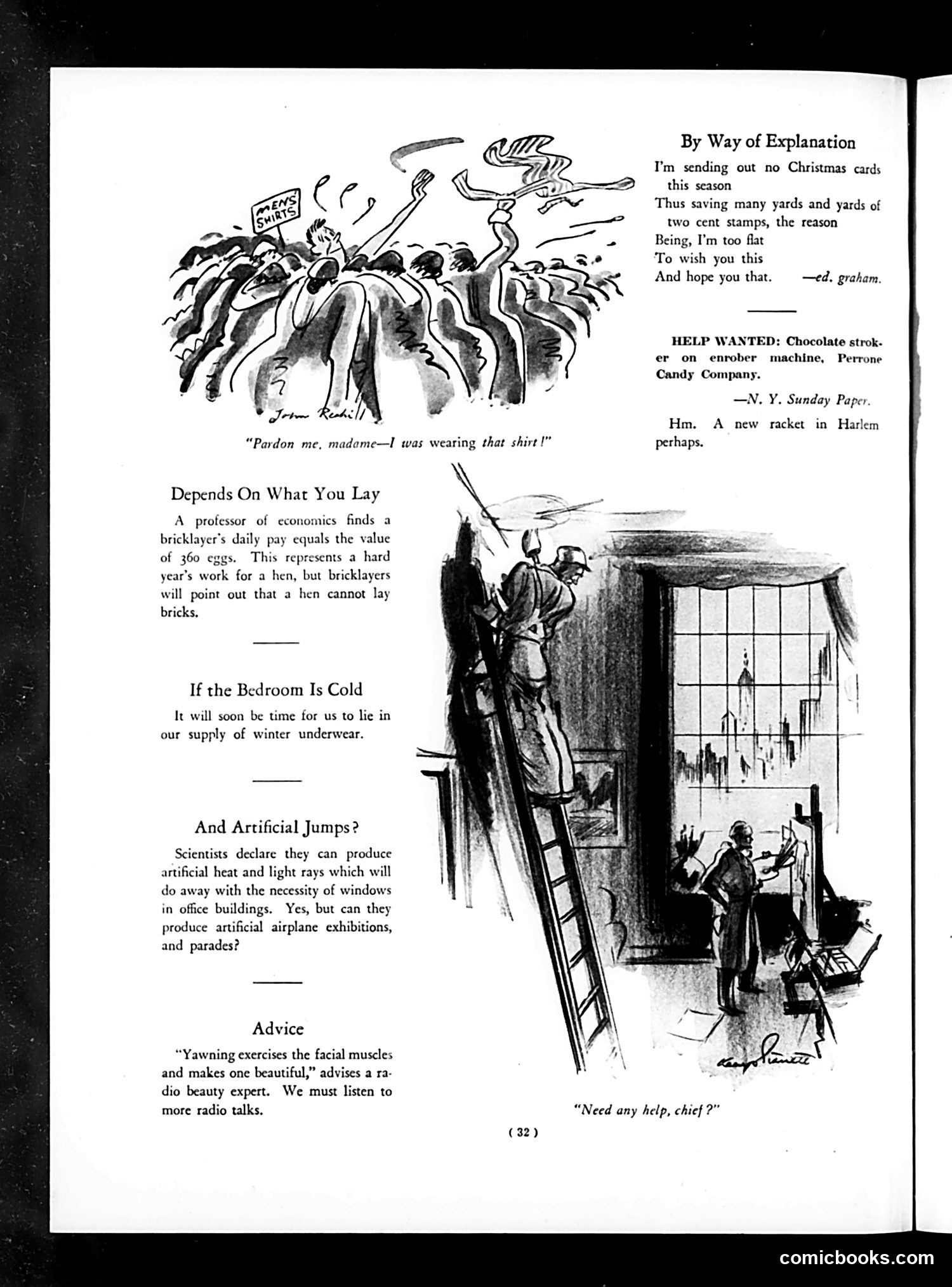
Explanation of Life Magazine Page Content This page collects brief satirical commentary on contemporary issues, typical of Life's format in the early 20th century. Top cartoon ("Pardon me, madame—I was wearing that shirt!"): Shows someone caught in a crowd wearing another person's shirt, satirizing urban crowding or pickpocketing. "By Way of Explanation": The author humorously announces skipping Christmas cards due to financial hardship ("too flat"—broke), saving postage costs during economically tight times. Smaller items include job listings and witty observations: - "Depends On What You Lay" jokes that economists equate a bricklayer's pay to 360 eggs' value—absurd since hens can't lay bricks - "If the Bedroom Is Cold" quips about needing winter underwear stockpiles - "And Artificial Jumps?" sarcastically questions whether scientists can create artificial parades if they produce artificial light and heat Bottom cartoon ("Need any help, chief?"): Depicts someone climbing a ladder through a window into an office, likely representing burglary or workplace absurdity. The page exemplifies Life's satirical approach to economic hardship, technology skepticism, and urban life.
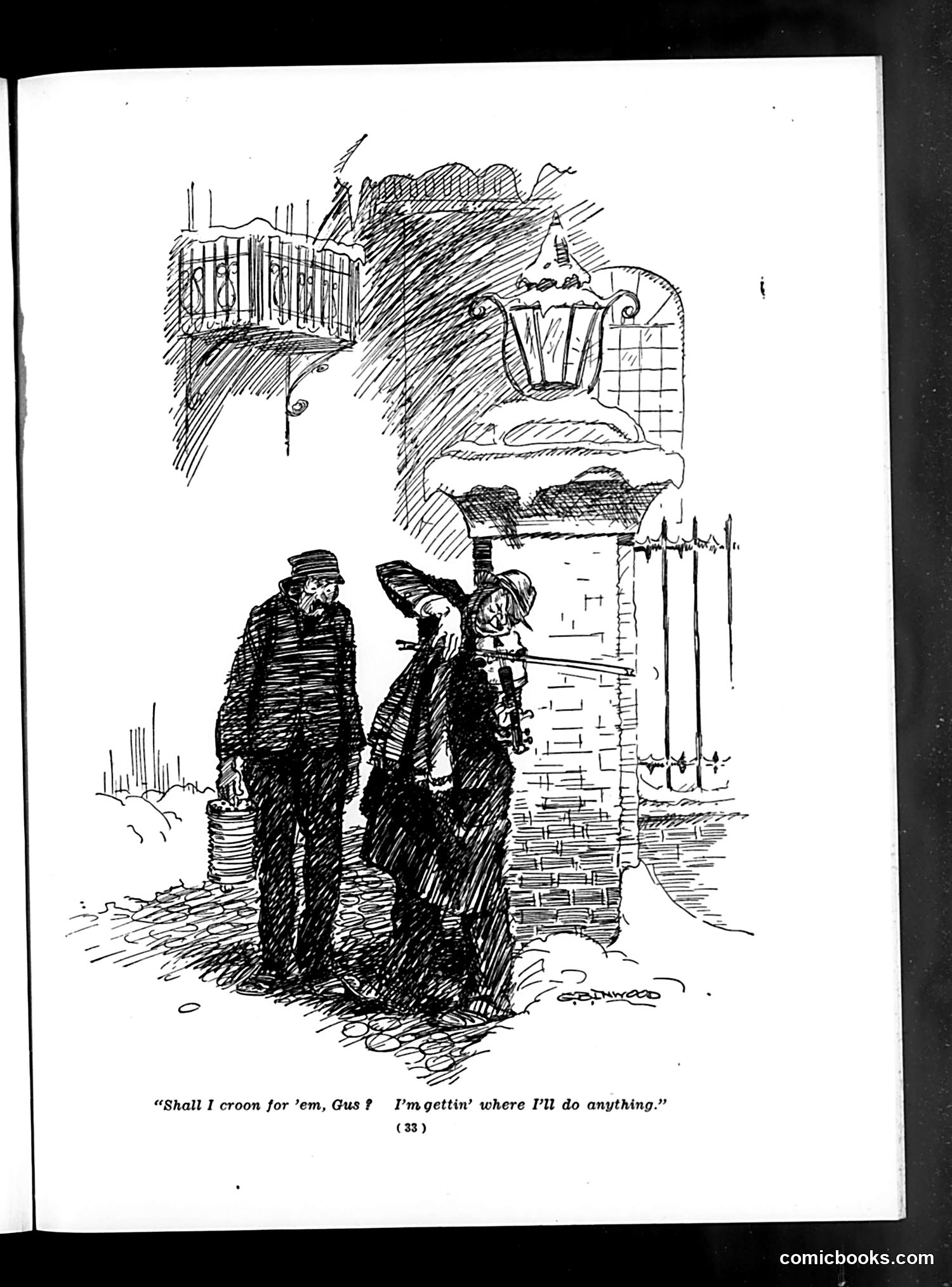
This is a single-panel cartoon satirizing entertainment industry desperation during what appears to be the Depression era. Two men in worn clothing stand outside a building. One asks the other (presumably named Gus) whether he should "croon" for an audience—referring to the popular singing style of the 1930s. The second man's response, "I'm gettin' where I'll do anything," suggests both characters have become so economically desperate they'll debase themselves through any form of entertainment work for survival. The cartoon mocks how entertainers were forced to compromise their dignity and artistic standards under financial pressure. The shabby setting and threadbare clothing emphasize their poverty.
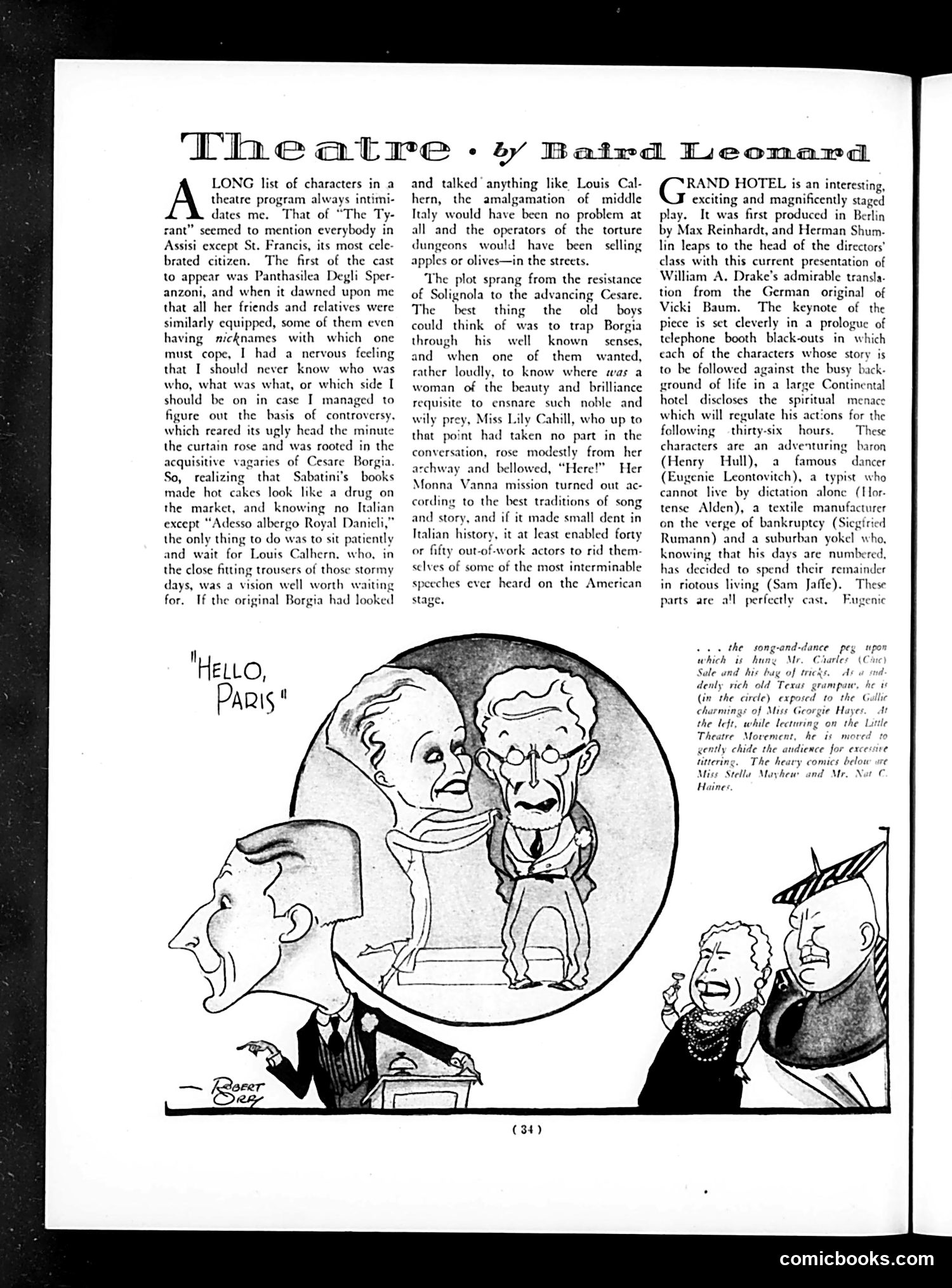
Theater Review Page Analysis This Life magazine theater review column by Baird Leonard discusses two Broadway productions: "The Tyrant" concerns a historical drama about Cesare Borgia, based on Rafael Sabatini's novels. Leonard humorously complains about the impossibly long cast list of Italian Renaissance characters, admitting he cannot follow the plot. The review's real focus is actor Louis Calhern, whom Leonard praises effusively—suggesting that Calhern's attractiveness and charm in tight Renaissance costumes made the confusing historical drama worthwhile to watch. "The Grand Hotel" is praised as an exciting, well-staged production translated from a German original by Vicki Baum, directed by Herman Shumlin. It features an ensemble cast playing various Continental hotel guests experiencing personal crises over thirty-six hours. The cartoon labeled "Hello, Paris" appears to illustrate the theatrical review's observations, featuring caricatured theater-goers and performers, though the specific reference is unclear from the image alone.
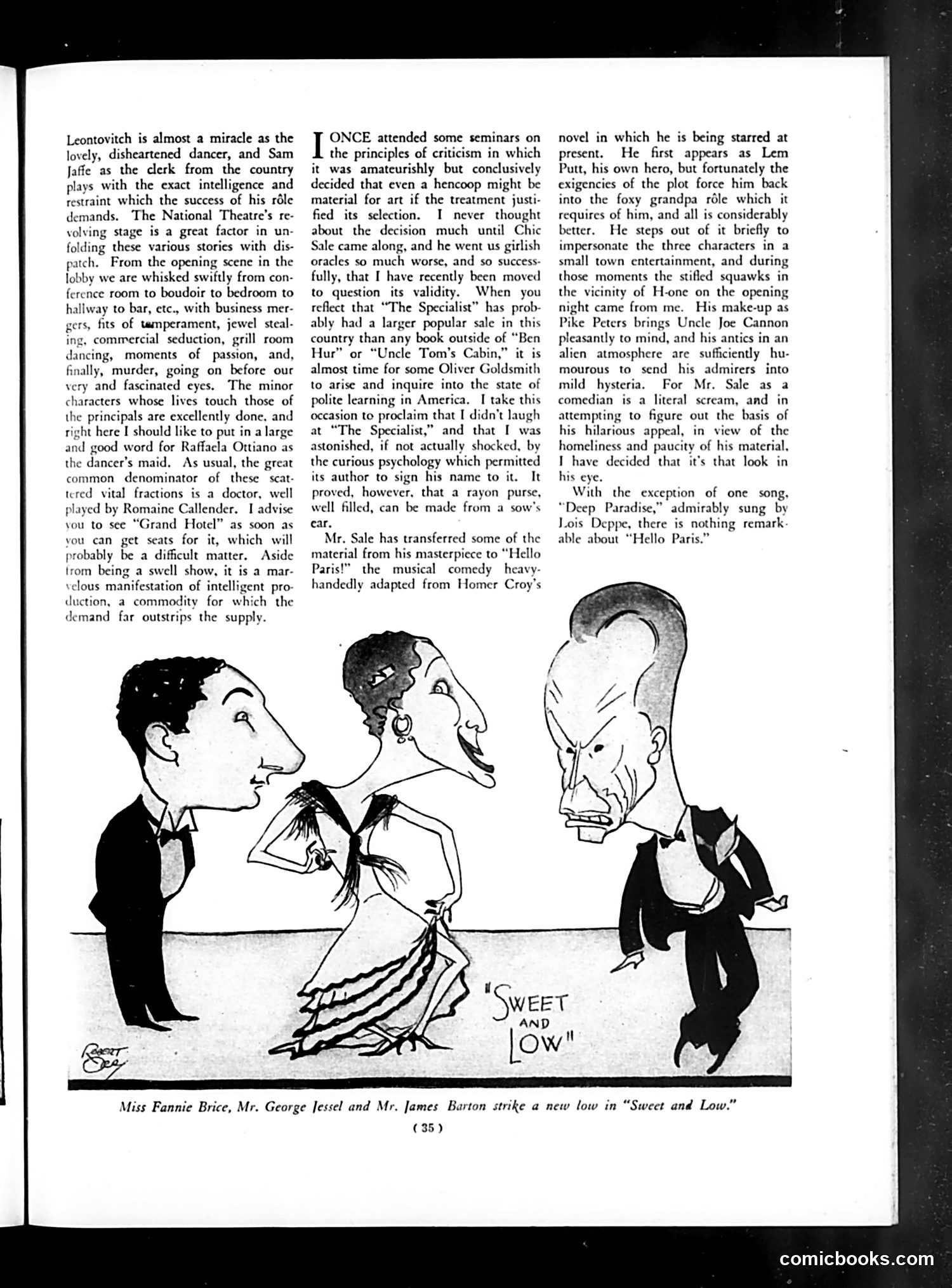
Analysis of This Life Magazine Page This page contains theater reviews, not political cartoons. The caricature at bottom illustrates a review of the musical "Sweet and Low," featuring performers Miss Fannie Brice, George Jessel, and James Barton. The exaggerated facial features are typical theatrical caricature style of the era—a common way magazines depicted entertainers. The main text reviews several Broadway productions: "Grand Hotel" (praised for intelligent staging and acting), "The Specialist" (criticized as vulgar despite its commercial success), and "Hello Paris!" (a musical starring Chic Sale, deemed entertaining primarily for Sale's physical comedy and distinctive facial expressions rather than script quality). The satire is cultural commentary: the reviewer questions why crude material succeeds commercially while questioning American "polite learning." The caricature reinforces this—depicting the performers with deliberately unflattering features to suggest the show trades on broad, unsophisticated humor rather than artistic merit.
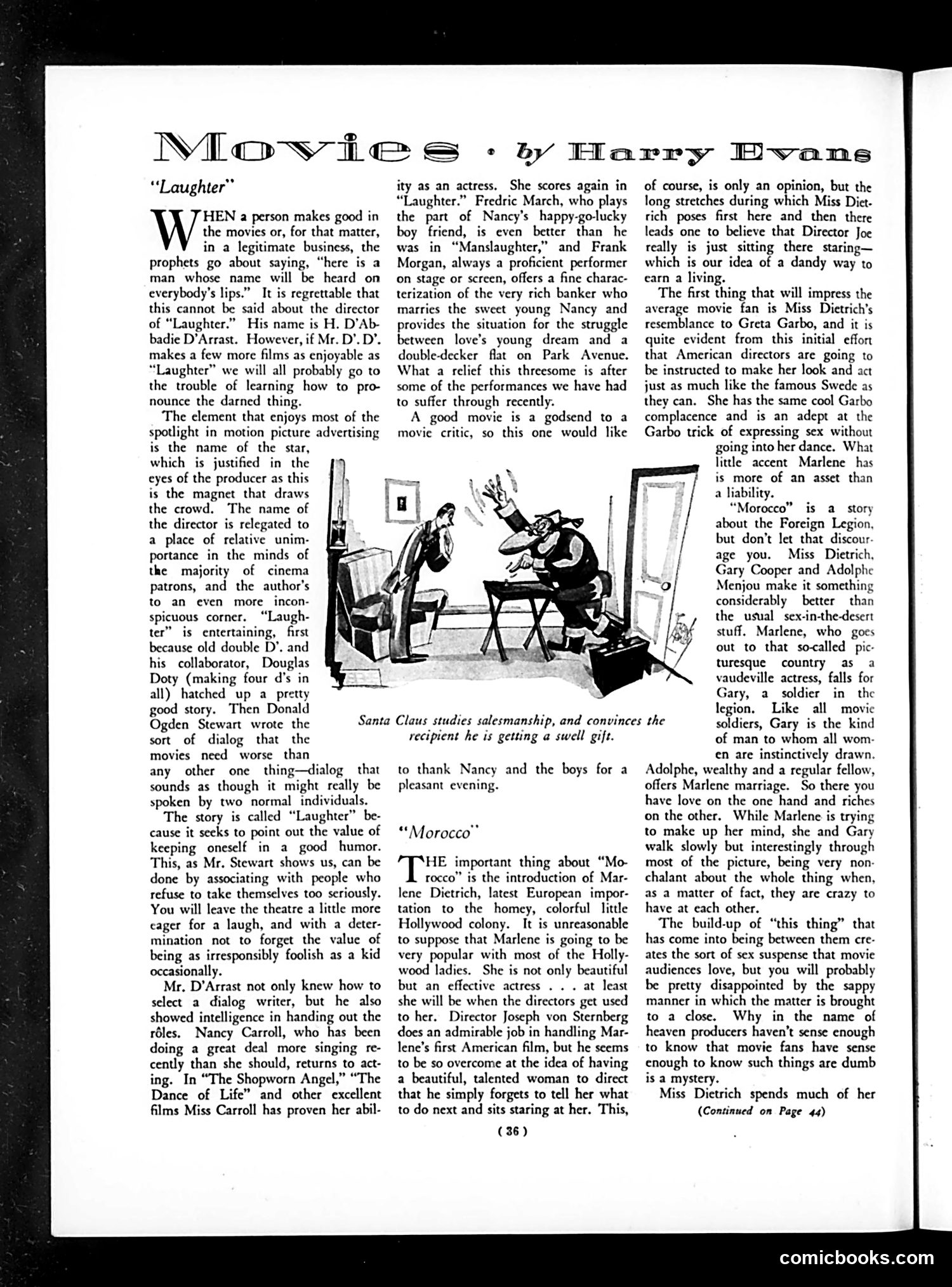
Analysis for Modern Readers This page reviews three films from the late 1920s, focusing on the often-overlooked contributions of directors and screenwriters to cinema's success. "Laughter": The critic celebrates director H. D'Abbadie D'Arrast (humorously noting his difficult name) for selecting quality collaborators—screenwriter Douglas Doty and dialogue writer Donald Ogden Stewart. The film stars Nancy Carroll and Fredric March in a romantic comedy about balancing love's idealism with practical reality. The satire gently mocks how studios emphasize star names in advertising while relegating directors to obscurity. "Morocco": The review introduces Marlene Dietrich as a striking new European import, while subtly critiquing director Joseph von Sternberg for being so dazzled by her beauty that he neglects actual direction—he simply "poses" her rather than directing her performance. The implication is that even talented actresses need proper guidance. The overall point: quality filmmaking requires more than star power; it depends on capable directors, writers, and creative collaboration.
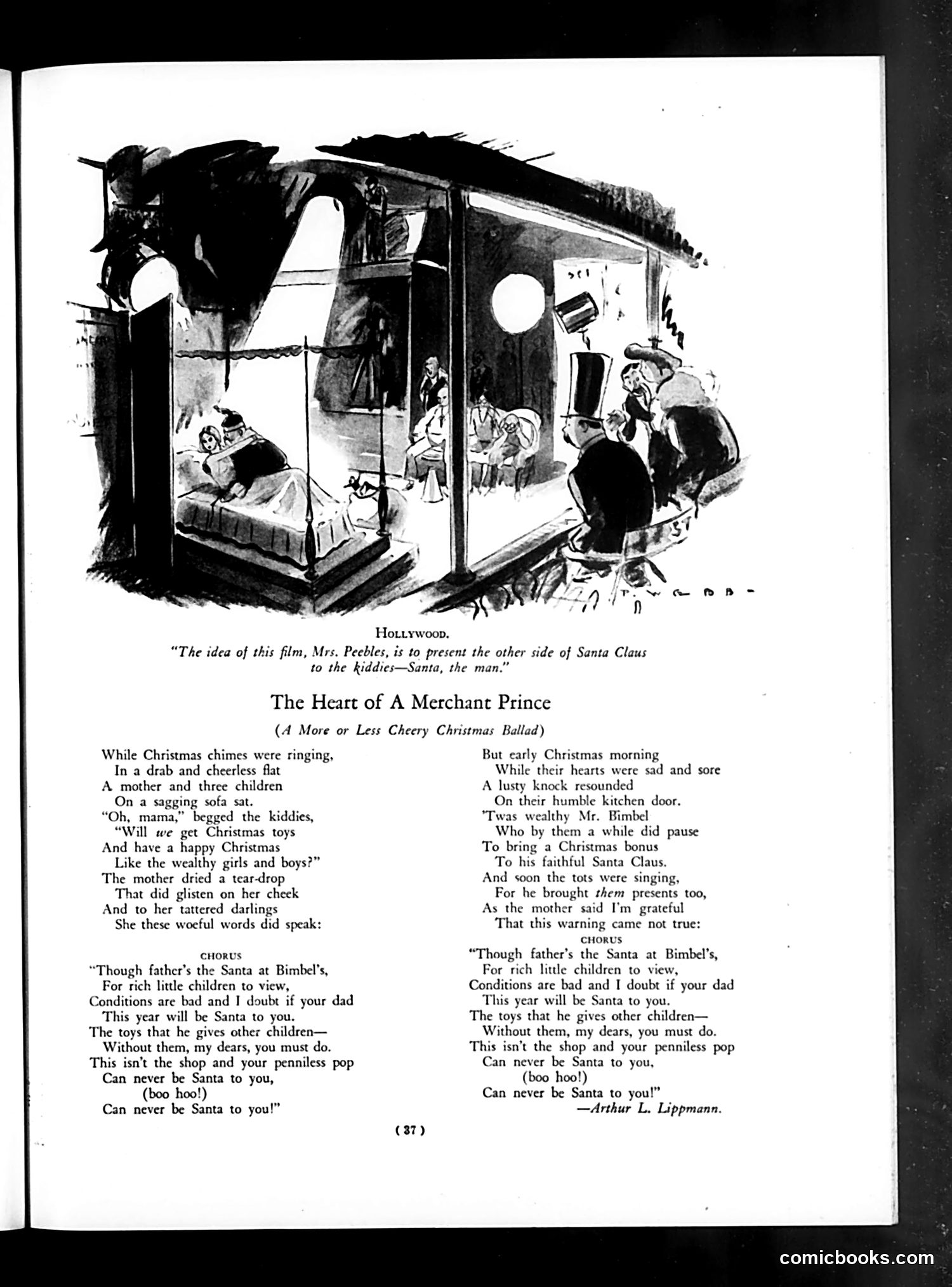
Explanation for Modern Readers This page combines a Hollywood satire with a sentimental Christmas story. The top cartoon mocks a film executive pitching an idea to present "the other side of Santa Claus"—cynically stripping away the magic for children. Below it, Arthur L. Lippmann's ballad "The Heart of a Merchant Prince" tells of a poor family whose father works as a department store Santa (at "Bimbel's"). The parents fear he cannot afford Christmas gifts for his own children while providing toys to wealthy customers' kids. The moral twist: the store owner rewards the faithful employee with a bonus, allowing the father to give presents after all, restoring hope. The satire targets class inequality and commercialism—the irony that retail Santas earn money displaying gifts for rich children while their own families struggle. The "happy ending" suggests paternalistic capitalism's redemptive power, though it relies on the wealthy owner's charity rather than fair wages. The piece reflects early-20th-century anxiety about holiday consumerism and economic inequality.
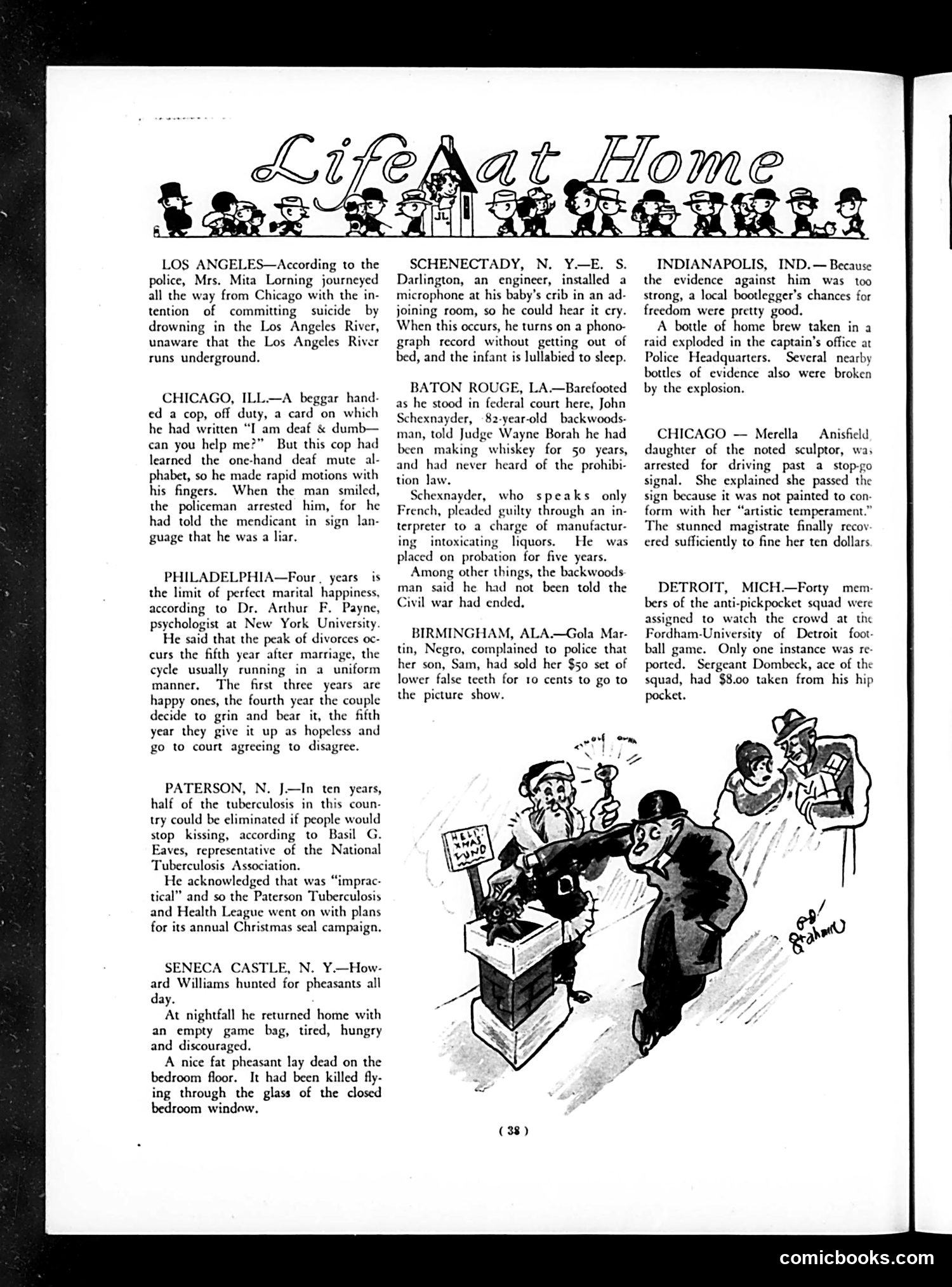
"Life at Home" - Satirical Vignettes (circa 1920s) This page presents brief humorous anecdotes from American cities, satirizing human folly and social absurdities of the era. Each item mocks specific ironies: The cartoons (center-right) illustrate some stories—appearing to show comedic domestic or public situations rendered in exaggerated caricature style typical of the period. Key satirical targets include: - Prohibition-era bootlegging (multiple mentions of whiskey-making and "home brew") - Marital discord (the Philadelphia psychologist noting marriages peak at year three, then fail) - Urban incompetence (anti-pickpocket officer robbed; police arresting honest beggar) - Pretentious absurdity (wealthy woman excused for traffic violation due to "artistic temperament") - Bureaucratic irony (bootlegger's evidence destroys itself in police custody) The overall tone is gentle mockery of American life's everyday contradictions and human nature's inconsistencies, typical of *Life* magazine's satirical approach during this period.
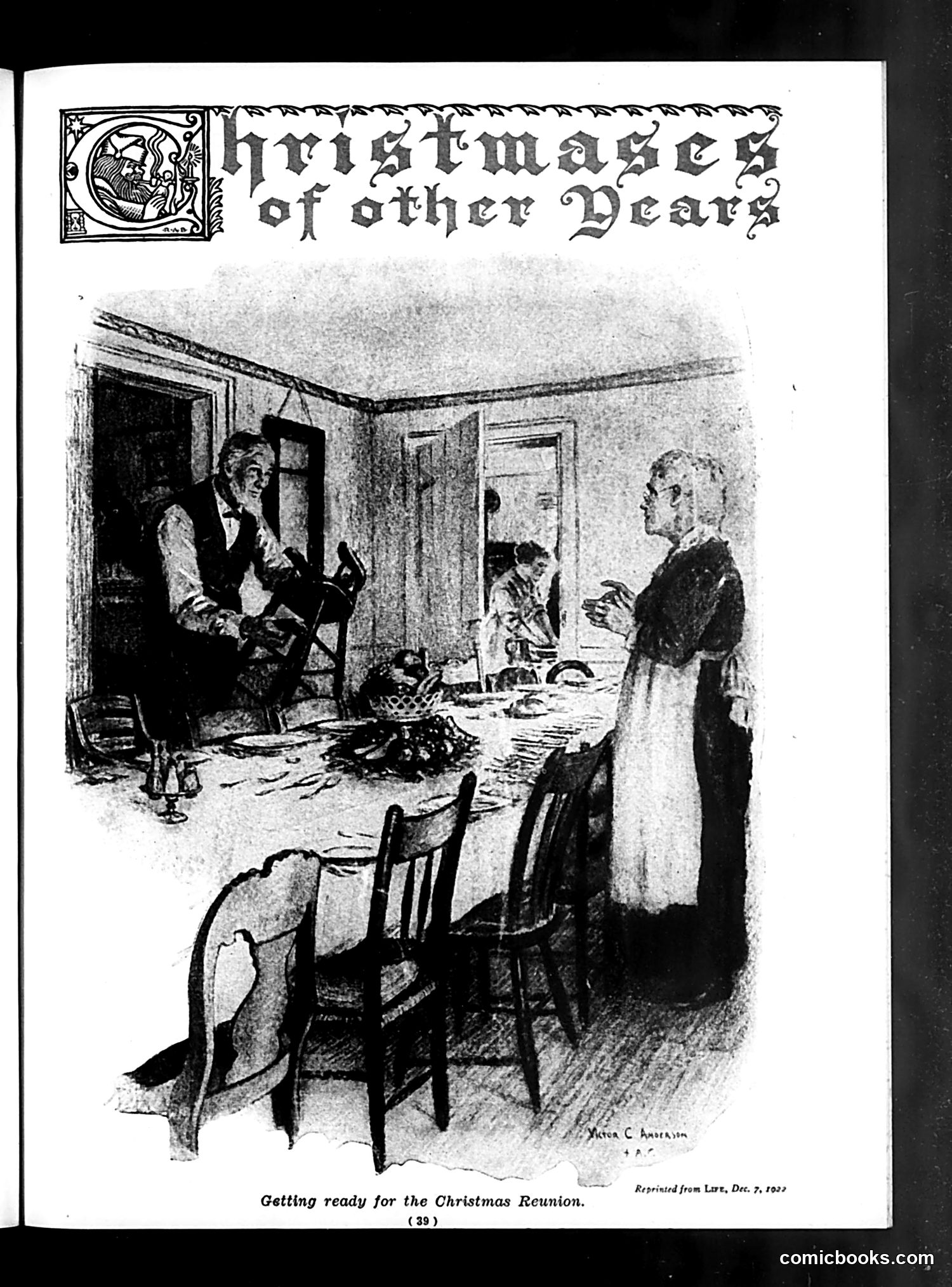
"Getting Ready for the Christmas Reunion" This illustration depicts a domestic scene of holiday preparation. A woman stands at right, apparently directing or observing activities. A man sits at left in a chair, and another figure appears in a doorway. The room contains furniture and household items scattered about, suggesting preparations underway. The caption "Getting ready for the Christmas Reunion" suggests this depicts family members preparing for a holiday gathering. The scene appears to satirize the domestic labor and coordination involved in hosting holiday events—likely poking fun at the chaos, effort, or tension surrounding Christmas entertaining. The illustration's style and the 1922 date indicate this reflects early 20th-century American middle-class domestic life and attitudes toward family celebrations. Without additional context from the original magazine, the specific satirical point remains somewhat unclear, though it likely comments humorously on holiday hospitality customs of that era.
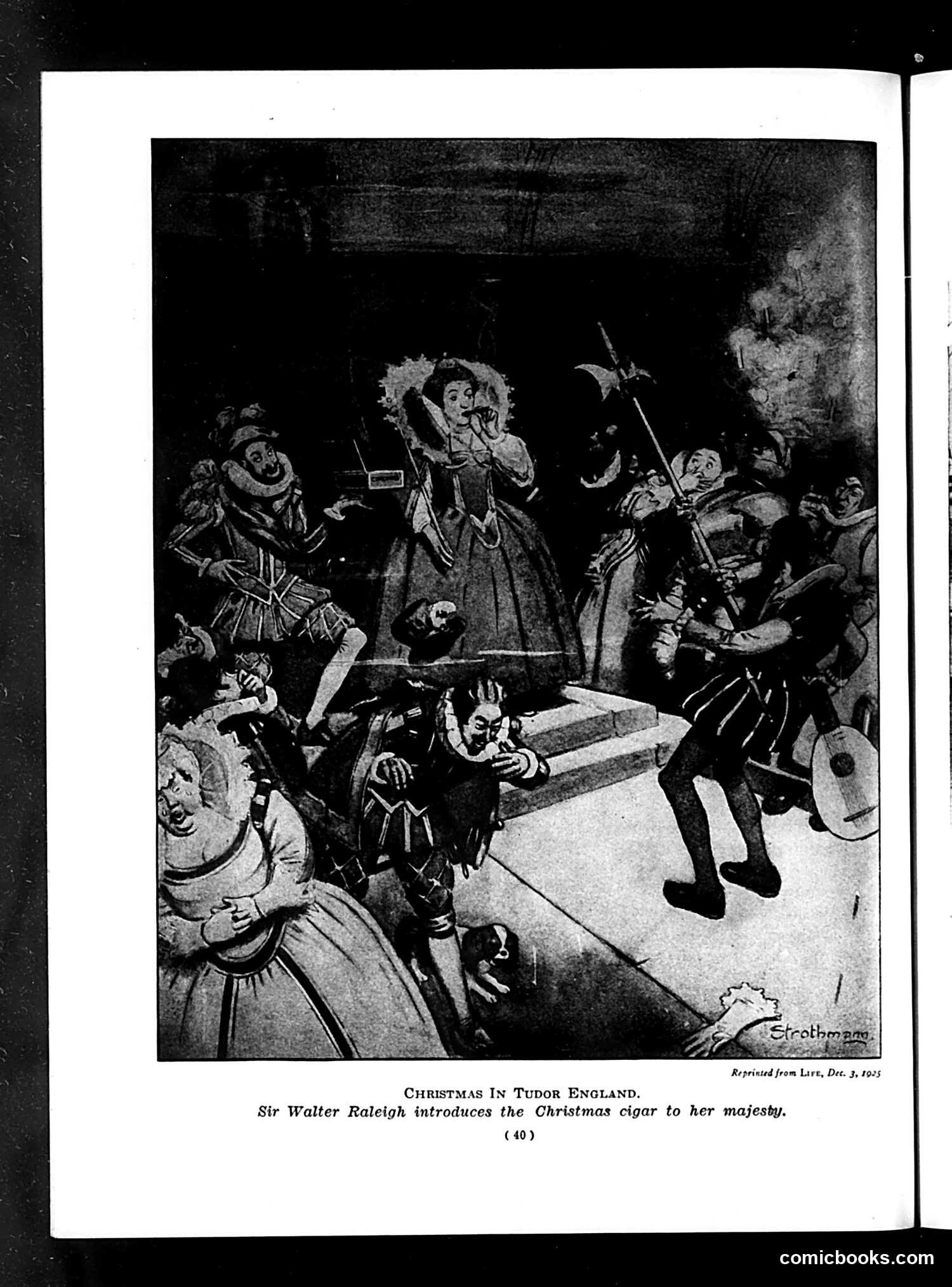
Explanation for Modern Readers This is a historical satire depicting Sir Walter Raleigh presenting a cigar to Queen Elizabeth I at a Tudor Christmas court. The humor operates on multiple levels: Historical Reference: Raleigh was famous for introducing tobacco to England from the New World in the late 1500s. The Joke: The cartoon imagines this momentous introduction happening during a formal royal Christmas celebration, with courtiers in elaborate Tudor dress reacting with shock and fascination to this exotic novelty. Social Satire: The piece likely mocks both the pretentiousness of court life and the absurdity of how "refined" society adopts new luxuries—here, the Queen and nobility treating a colonial product as a sophisticated gift worthy of royal attention. The date (December 3, 1925) places this in the 1920s, when Life magazine frequently used historical scenarios to comment on contemporary culture and social pretensions.
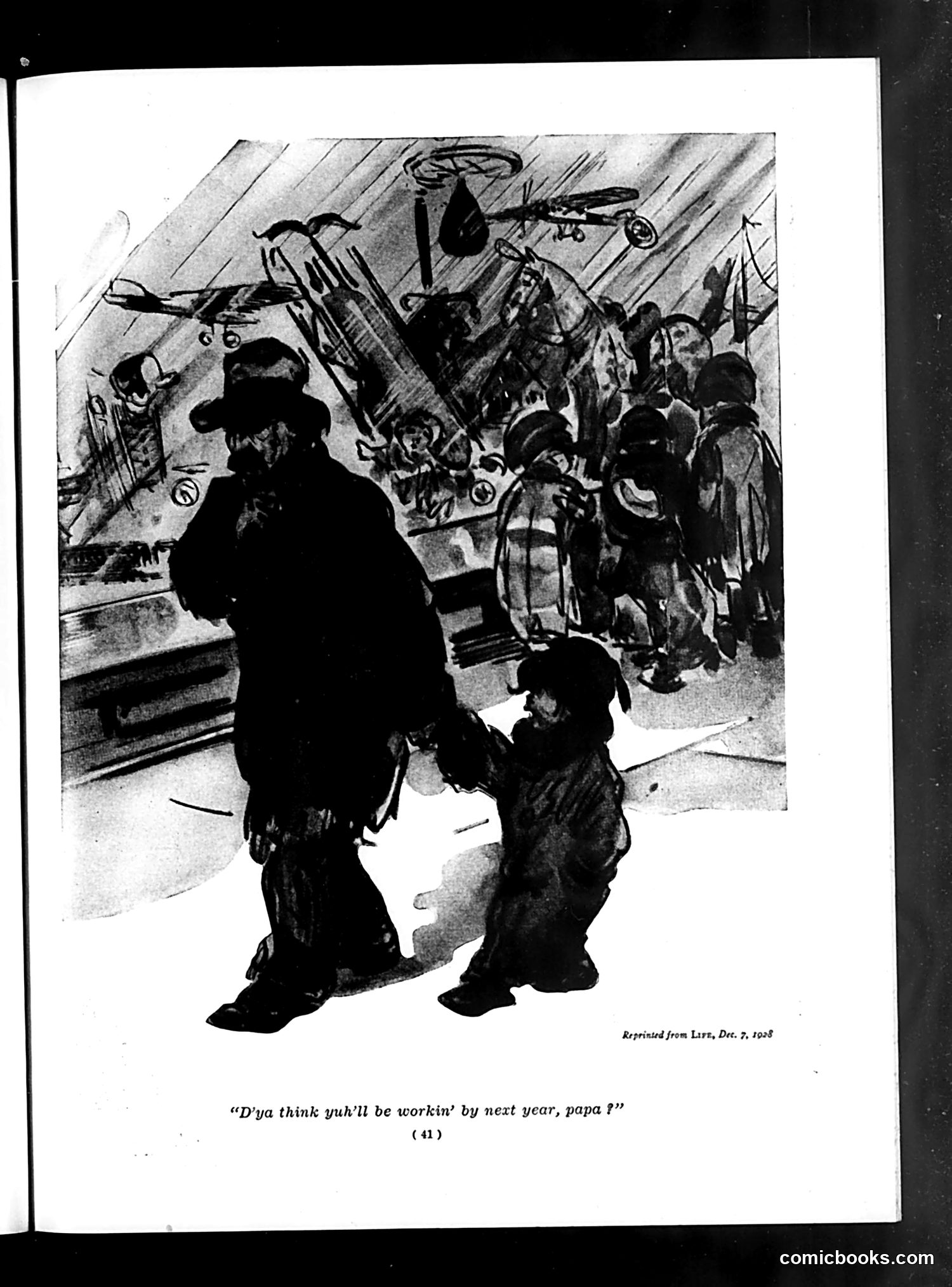
Political Context of This 1928 Life Magazine Cartoon This cartoon, reprinted from Life magazine (December 7, 1928), depicts an adult and child in what appears to be an aircraft hangar or industrial workspace. The child asks the father, "D'ya think yuh'll be workin' by next year, papa?" The timing is significant: this was published just weeks after the October 1929 stock market crash that triggered the Great Depression. However, the cartoon's December 1928 date suggests it may reference earlier economic anxieties or labor instability. The silhouetted figures and industrial setting emphasize working-class vulnerability—the child's question reflects widespread concerns about job security and economic hardship facing ordinary families during this era of economic uncertainty.
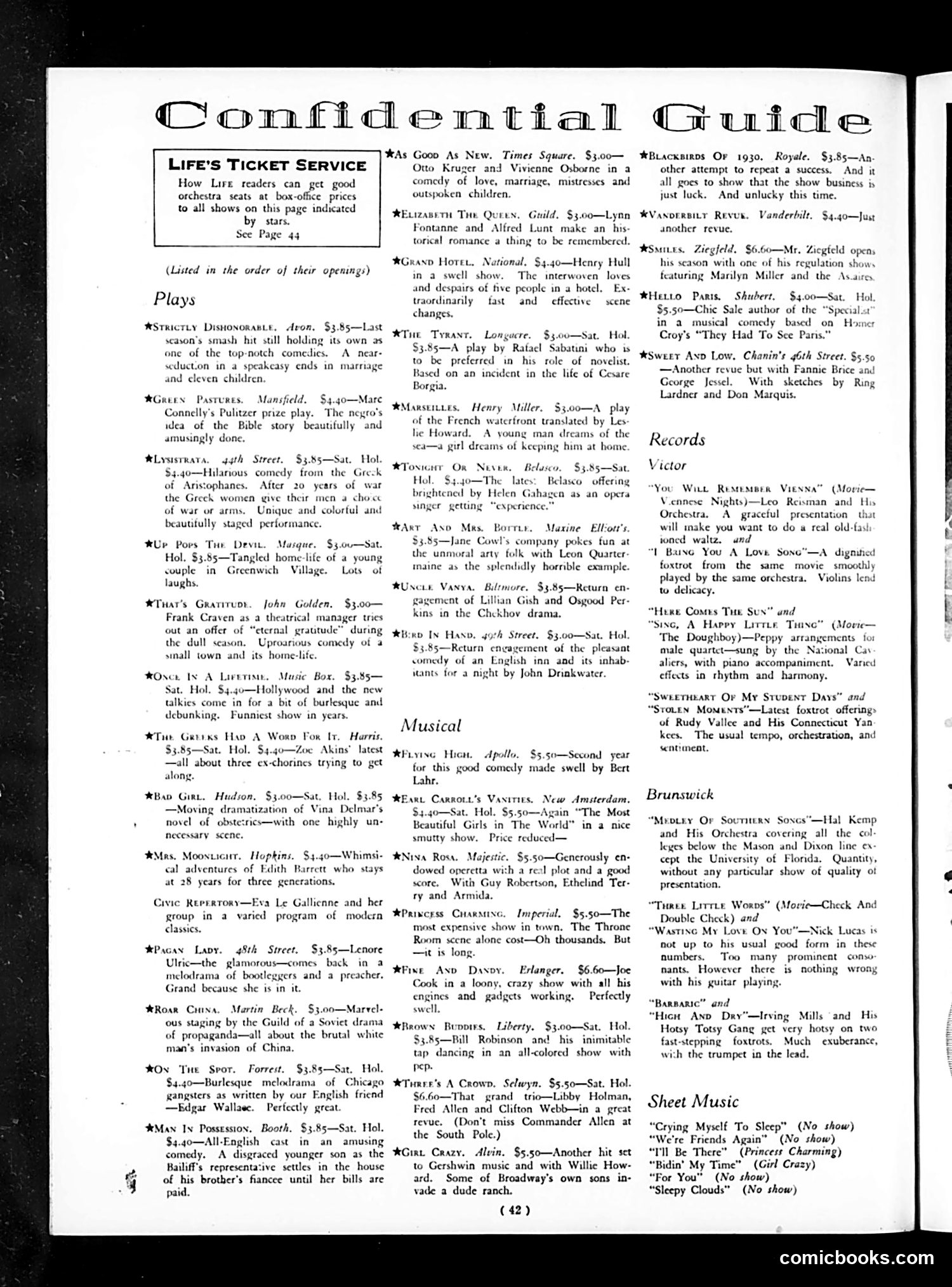
Life Magazine Theater Guide (c. 1930) This page is a theater listing and review guide, not a political cartoon. It's a practical service for Life magazine readers, showing Broadway plays and musicals currently running in New York City. The listings include brief synopses and star ratings (indicated by asterisks). Notable entries show the era's theatrical interests: classical adaptations (*Lysistrata*, *Uncle Vanya*), contemporary comedies about modern life (*Once in a Lifetime* satirizes Hollywood talkies), and serious dramas (*Red China* reflects 1920s-30s fascination with Soviet propaganda art). The "Confidential Guide" header humorously suggests insider knowledge. Prices range from $3.00-$6.60, with Saturday/holiday premiums noted. This reflects a thriving Broadway theater culture before television displaced live performance as primary entertainment.
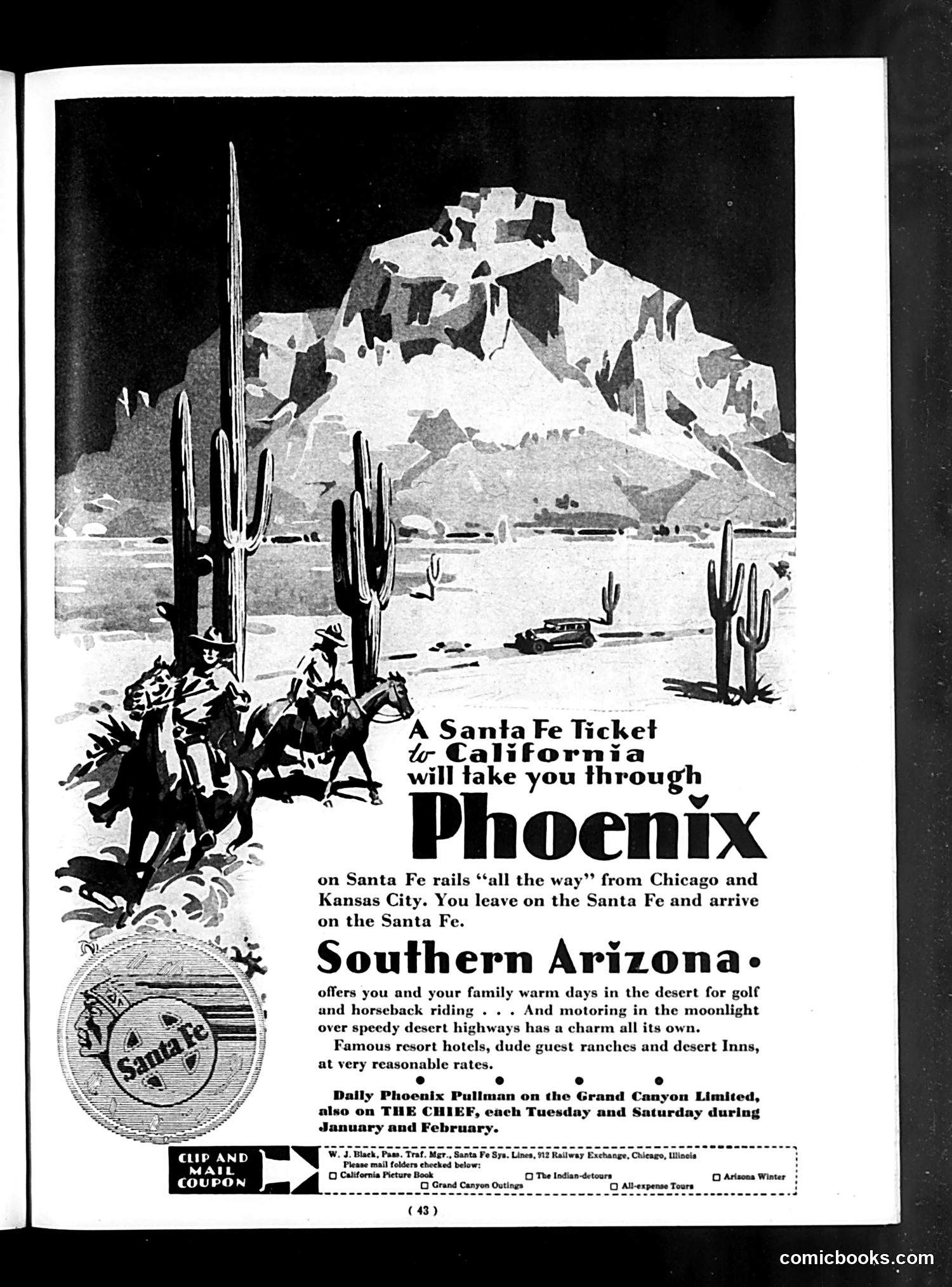
Analysis This is a travel advertisement, not a political cartoon. The page promotes Santa Fe Railway travel to Phoenix and Southern Arizona. The imagery depicts a romanticized American Southwest: saguaro cacti, desert mountains, a cowboy on horseback, and what appears to be a vintage automobile—all evoking adventure and leisure. The visual style is typical 1920s-30s promotional art. The appeal: The ad targets affluent travelers seeking winter escape, golf, horseback riding, and "moonlight motoring" through exotic desert landscapes. It emphasizes convenience (direct Santa Fe rail service from Chicago/Kansas City) and affordability ("very reasonable rates") at resort hotels and dude ranches. The "clip and mail coupon" format was standard for this era's advertising. The reference to "THE CHIEF" and "Grand Canyon Limited" trains indicates specific scheduled services. This reflects early American automobile and rail tourism marketing—selling the Southwest as an accessible, glamorous destination for middle to upper-class travelers.
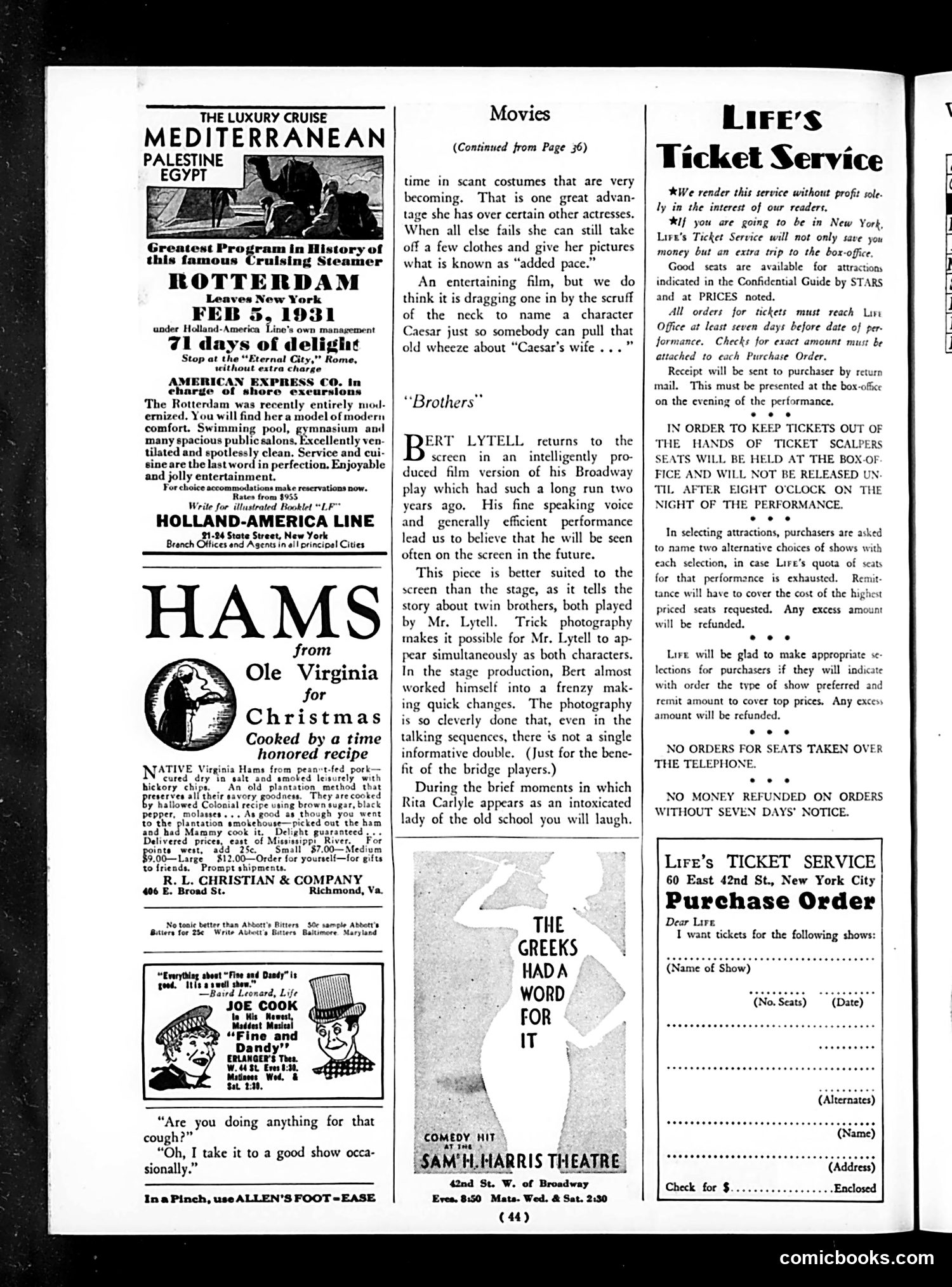
Life Magazine Page Analysis (circa 1931) This page is primarily advertising and service content rather than political satire. The main elements are: Advertisements: - Holland-America cruise line promoting luxury Mediterranean voyages - Virginia ham company marketing holiday gifts - Theater ads for Broadway shows ("Fine and Dandy," etc.) Movie Reviews: The film criticism section reviews "Brothers," starring Bert Lytell—a talkie adaptation of his Broadway play featuring trick photography allowing one actor to play twin brothers simultaneously. The reviewer notes this cinematic technique worked better than the stage version's quick-change challenges. Life's Ticket Service: A substantial portion advertises Life magazine's own theatrical ticket-ordering service, emphasizing convenience and savings for New York theatergoers. Minor Humor: A small cartoon depicts a cough remedy conversation, typical of period advertising humor. The page reflects 1931 American consumer culture: luxury travel, holiday gift-giving, Broadway entertainment, and early talking picture technology.
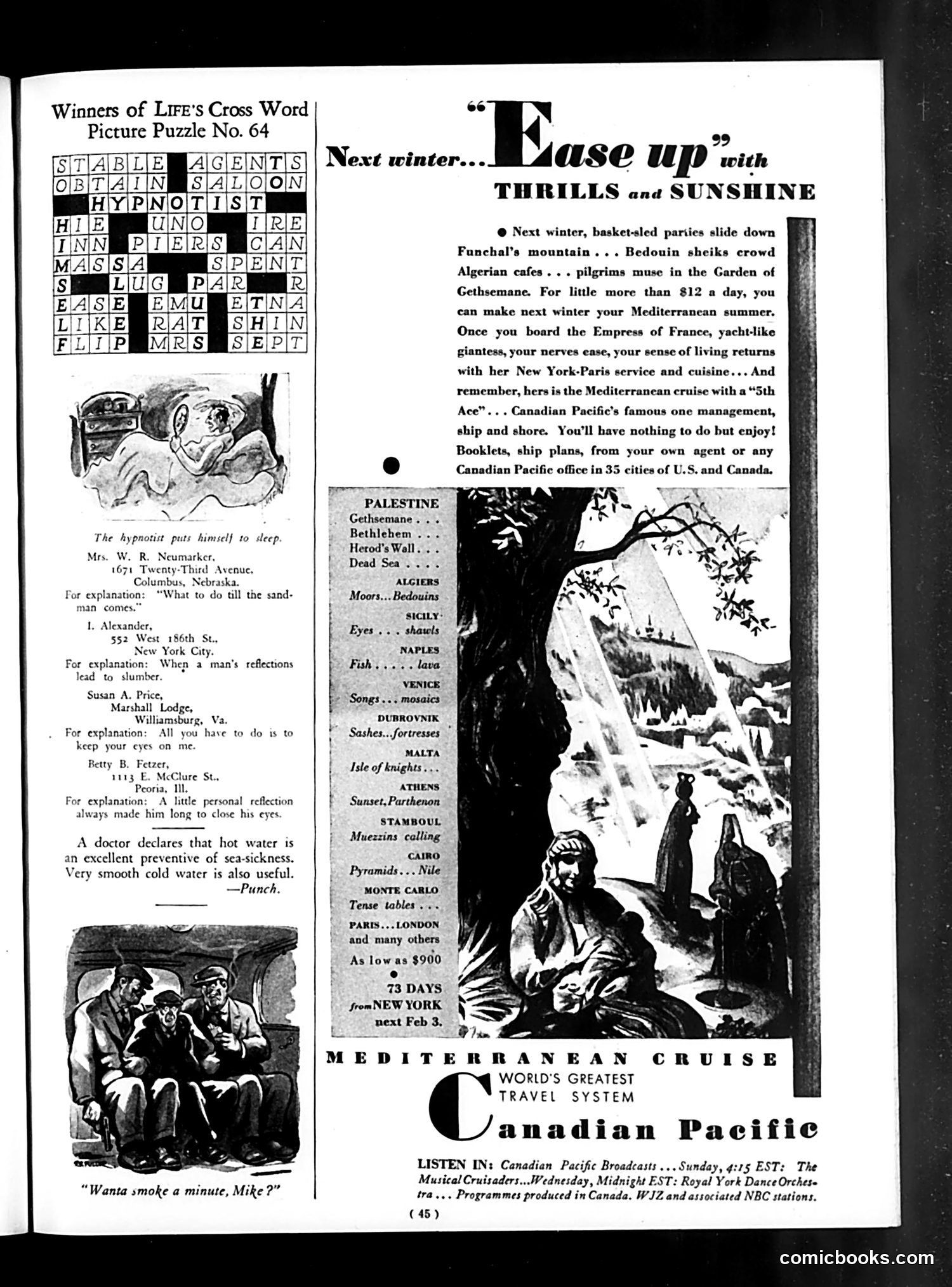
Analysis for Modern Readers This page combines a crossword puzzle contest (upper left) with a 1920s-era travel advertisement (right side). The crossword winners' cartoons use visual puns: "The hypnotist puts himself to sleep" shows a hypnotist nodding off, while "Wanta smoke a minute, Mike?" depicts men in confined quarters—these illustrate the puzzle answers about slumber and close observation. The dominant advertisement promotes Mediterranean cruises on the Canadian Pacific's *Empress of France*, marketed as affordable luxury (from $900 for 73 days). It lists exotic destinations—Palestine, Sicily, Egypt, Monaco—appealing to wealthy Depression-era travelers seeking escape and sophistication. The ad's tagline "Ease up" with "thrills and sunshine" typifies interwar leisure marketing: leisure as restorative medicine and status symbol. The detailed destination list ("Bedouin sheiks," "Garden of Gethsemane," "Pyramids") emphasizes cultural tourism and colonial-era exoticism. This reflects 1930s assumptions: Mediterranean travel as accessible yet glamorous, and non-Western locations as picturesque backdrops for Western enjoyment.
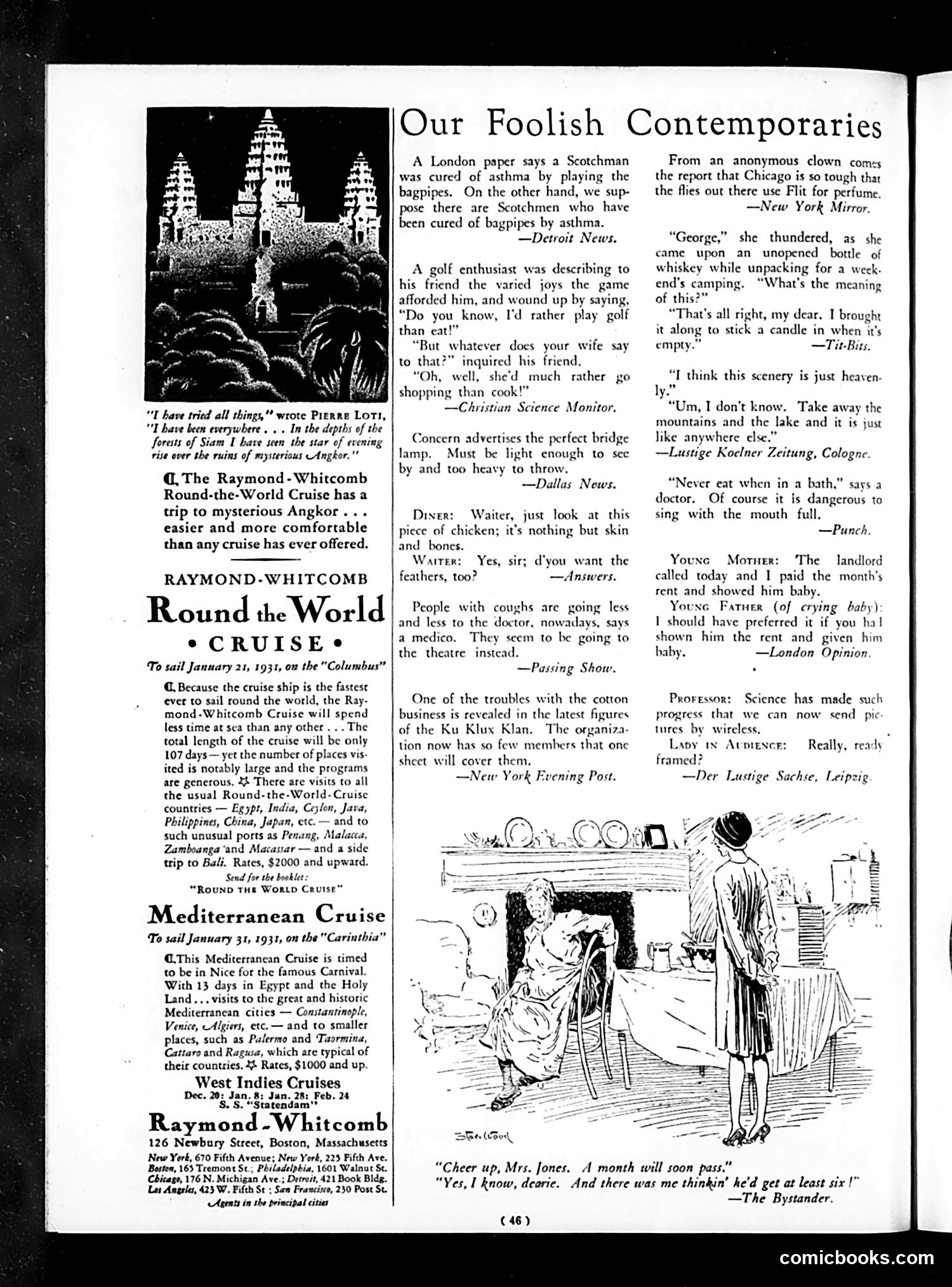
Explanation for Modern Readers This page is primarily advertising for luxury cruises by Raymond-Whitcomb travel company (1931), featuring trips to exotic destinations like Egypt, India, Japan, and the Mediterranean. The "Our Foolish Contemporaries" section is a humor column reprinting jokes and witty observations from newspapers worldwide. These are gentle satirical jabs at everyday absurdities: - A Scotsman cured of asthma by bagpipes (playing on Scottish stereotypes) - A golfer who prefers golf to eating (excessive hobby obsession) - A Ku Klux Klan joke about membership decline so severe "one sheet will cover them" (darkly mocking the organization's shrinking numbers) - Various domestic comedy scenarios (wives, shopping, cooking) The accompanying cartoon shows a woman consoling another about hardship passing, with the caption referencing a husband who'll "get at least six it" — likely referring to infidelity or a jail sentence. The humor reflects 1930s sensibilities: snobbish, domestic-focused, and occasionally risqué by period standards. The page serves dual purposes: selling aspirational travel while entertaining readers with syndicated jokes.
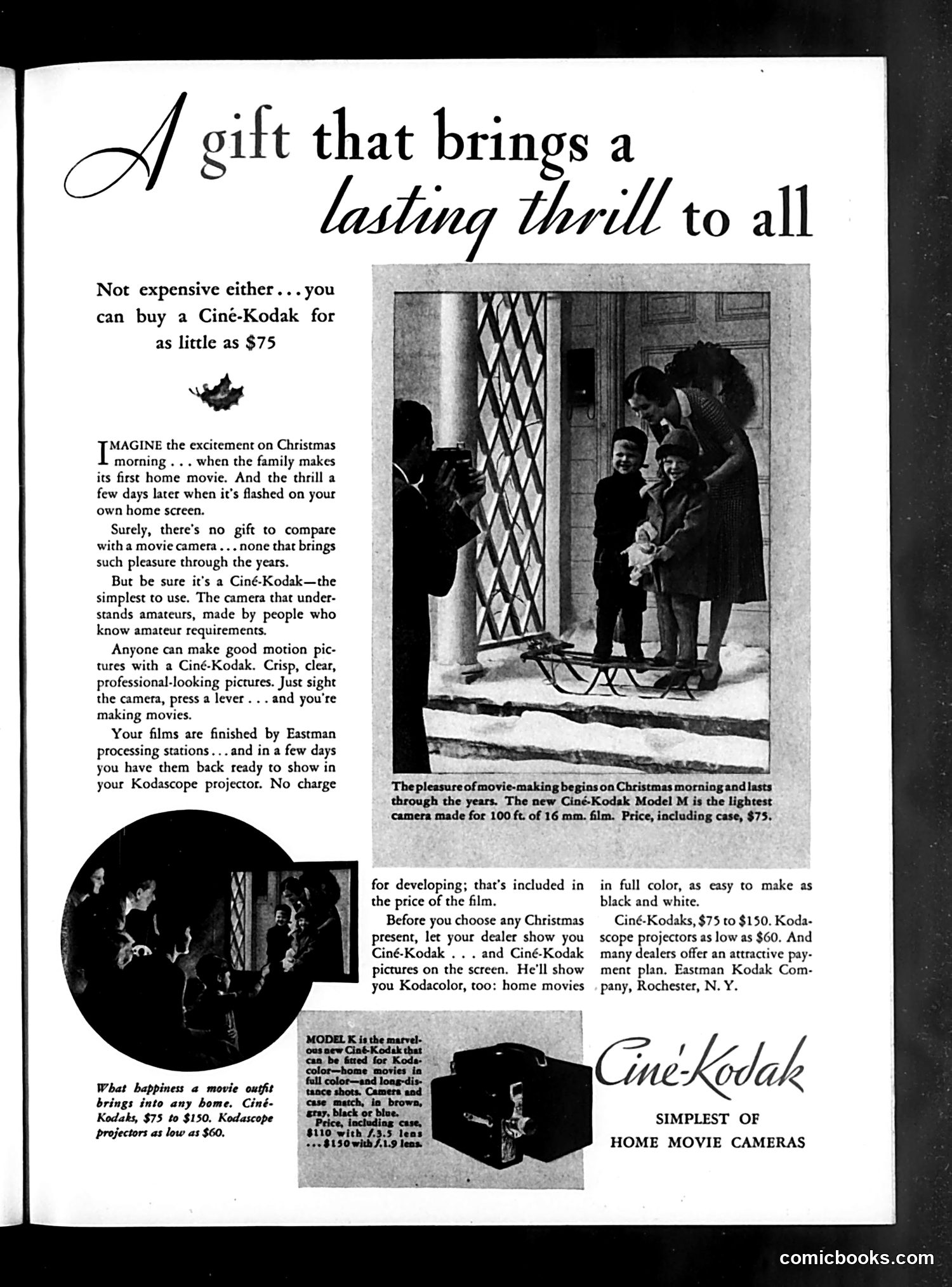
Analysis This is not a cartoon or satire, but rather a Kodak advertisement disguised as editorial content—a common practice in mid-20th century magazines. The page promotes Ciné-Kodak home movie cameras (priced $75–$150) by appealing to postwar American family values. The photographs show a family recording Christmas morning and children being filmed, emphasizing how home movies create lasting memories. The "gift" framing suggests this is aspirational consumer goods marketing: movie-making positioned as accessible to ordinary families, not professionals. The emphasis on simplicity ("anyone can make good motion pictures") and Eastman's processing services (which generate recurring revenue) reveals the business model. For modern readers, this reflects a specific historical moment when consumer technology and family documentation were emerging as markers of middle-class status and domestic happiness. The gendered framing—families gathered for male-operated camera—is typical of 1950s advertising conventions.
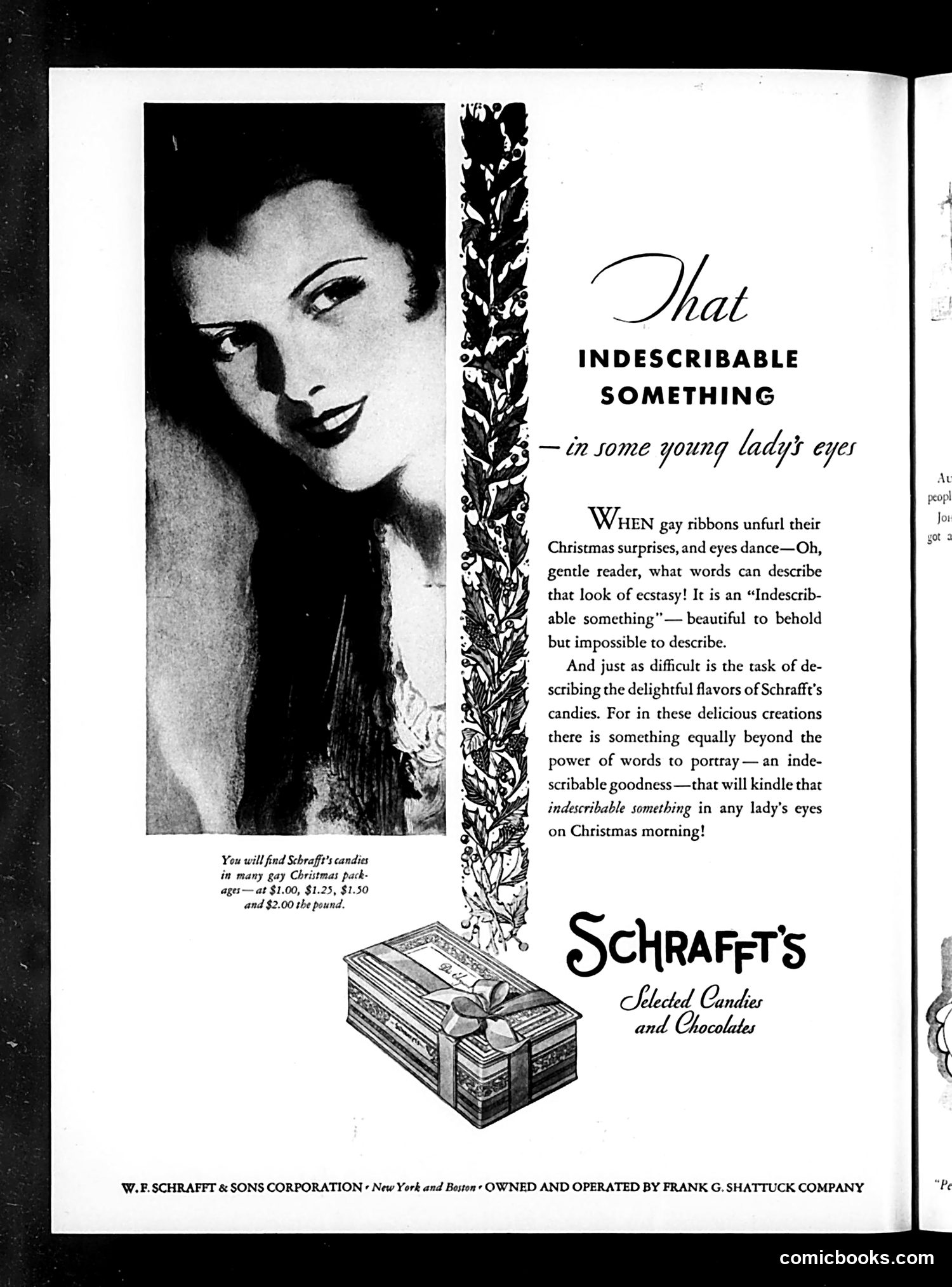
Analysis This is a full-page advertisement, not satire or political content. It's a Schrafft's candies ad from Life magazine's advertising section. The page features a glamorous photograph of a young woman's face in profile, used to evoke romantic emotion. The ad's strategy is poetic rather than humorous: it argues that Schrafft's chocolates produce an indefinable emotional response—an "indescribable something"—similar to the indescribable beauty captured in the woman's expression. The text explicitly compares the difficulty of describing the woman's look of ecstasy to the impossibility of describing Schrafft's candy flavor. The implicit message: giving these candies as a Christmas gift will produce that same magical look of joy in a lady's eyes. This reflects early 20th-century advertising conventions: associating luxury goods (especially candies) with romance, femininity, and emotional gratification. There is no political commentary or caricature present.
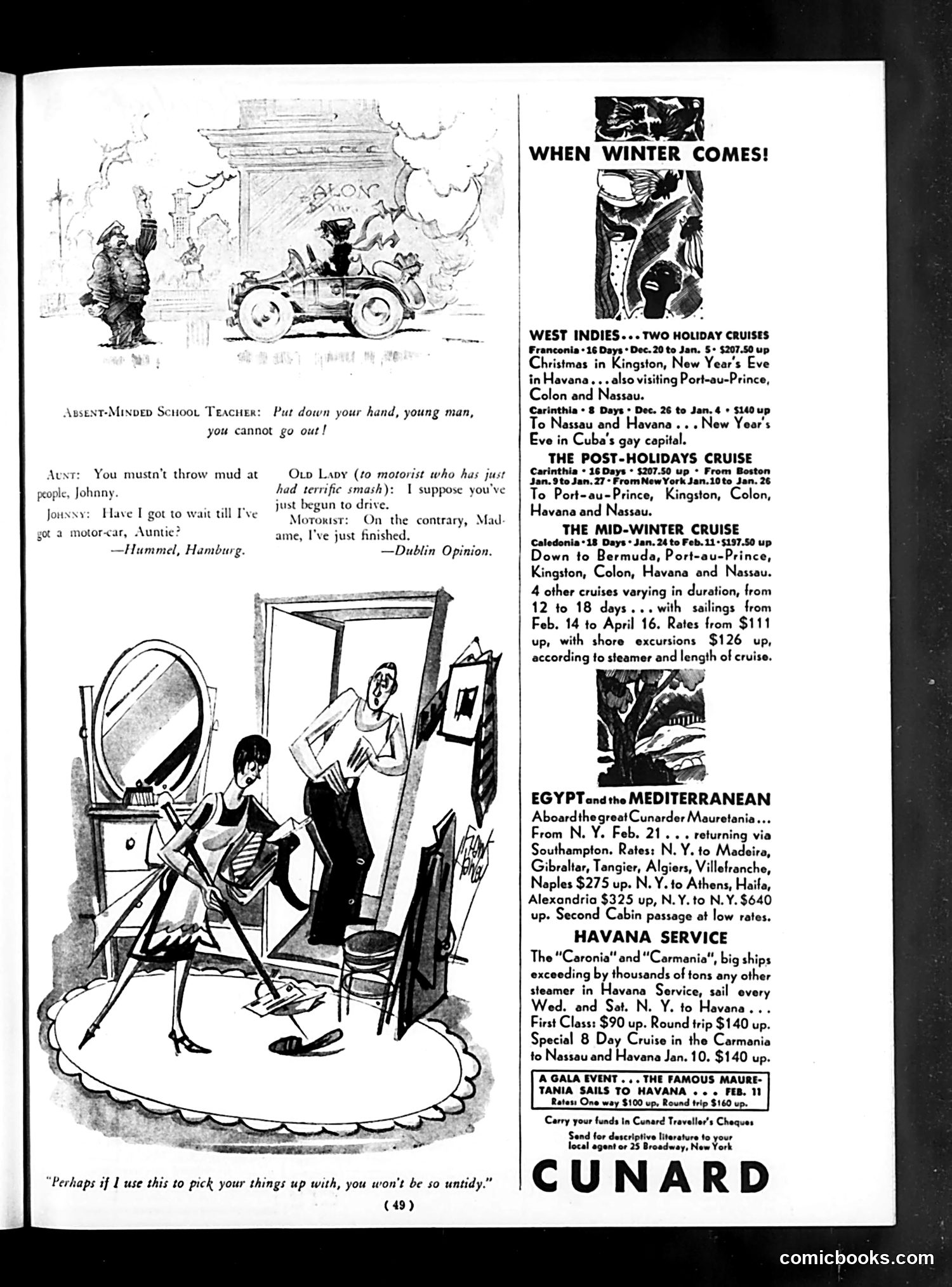
Analysis for Modern Readers This page contains three brief humorous cartoons about early automobile culture, plus extensive cruise ship advertising. The cartoons' humor: 1. School scene: A teacher forbids a student from leaving class, establishing authority. 2. Aunt and motorist: An aunt comments on a car crash, suggesting the driver has "just begun" driving—the motorist's reply that he's "just finished" is dark humor implying the accident was catastrophic or fatal. 3. Johnny and Auntie: A boy asks if he must wait until he owns a motor-car before doing something (implied: growing up/independence). This reflects early-1900s anxiety about automobiles as symbols of adult status and freedom. Context: These jokes assume readers are familiar with automobiles as still-novel, dangerous machines piloted by inexperienced drivers. The humor trades on contemporary fears about automotive safety and the car's cultural significance as a marker of adulthood and modernity. The page is otherwise dominated by Cunard cruise line advertisements targeting wealthy winter travelers.
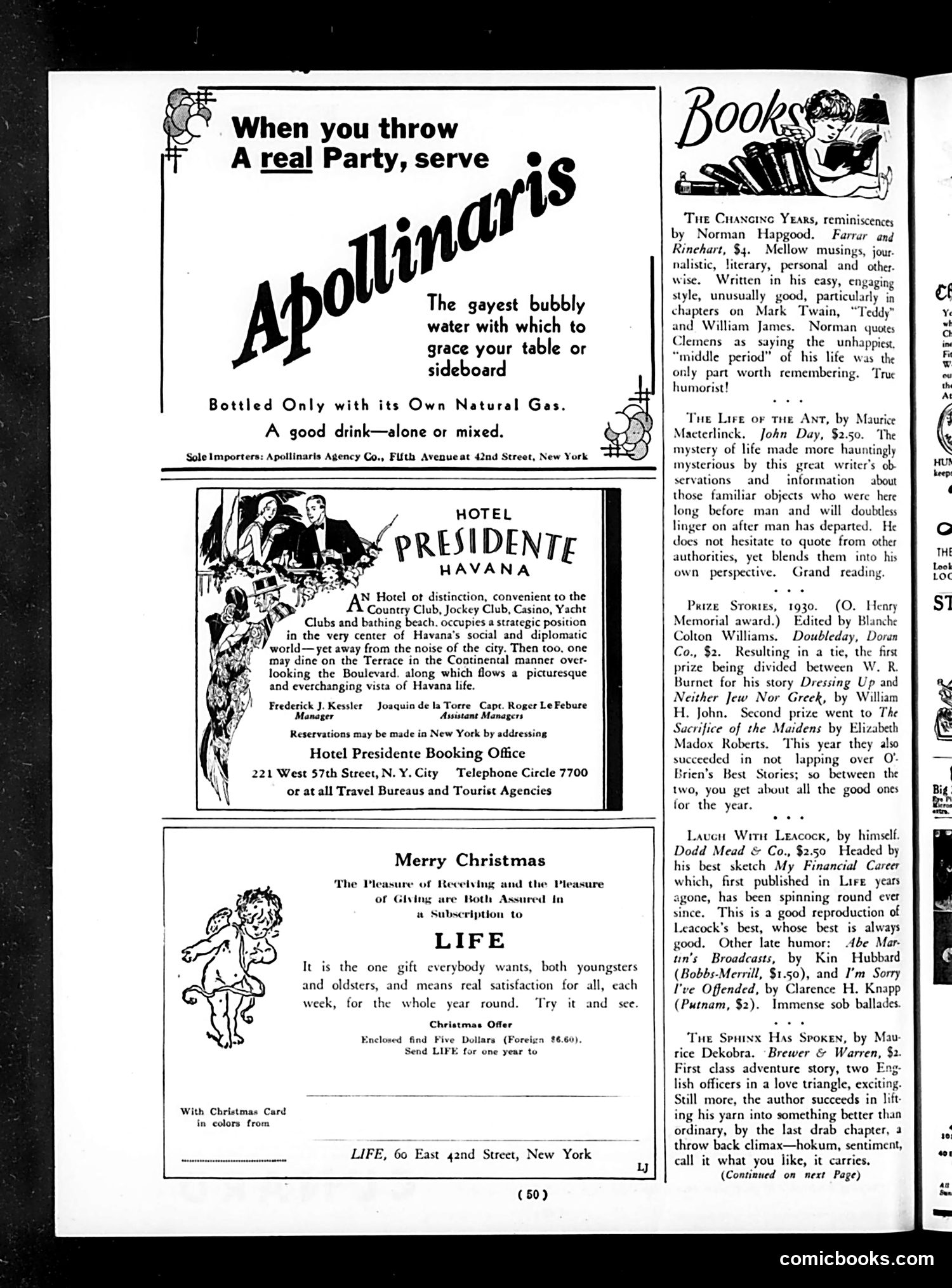
Analysis of Life Magazine Page This page is primarily advertising and book reviews, not political satire. It contains three distinct sections: Advertisements: - Apollinaris (sparkling water): Promotes the product as appropriate for entertaining, emphasizing its natural carbonation and versatility as a mixer - Hotel Presidente, Havana: Targets wealthy travelers, highlighting its central location among Havana's elite social venues (country clubs, yacht clubs) - Life Magazine subscription: A Christmas gift offer at $5/year Book Reviews Section: The right column reviews contemporary 1930 publications including works by Norman Hapgood, Maurice Maeterlinck, and Stephen Leacock—presenting middlebrow literary fare typical of the era. No political cartoon or satire is present. This appears to be a standard magazine page mixing advertisements with cultural commentary, reflecting 1930s American consumer culture and leisure pursuits for affluent readers.
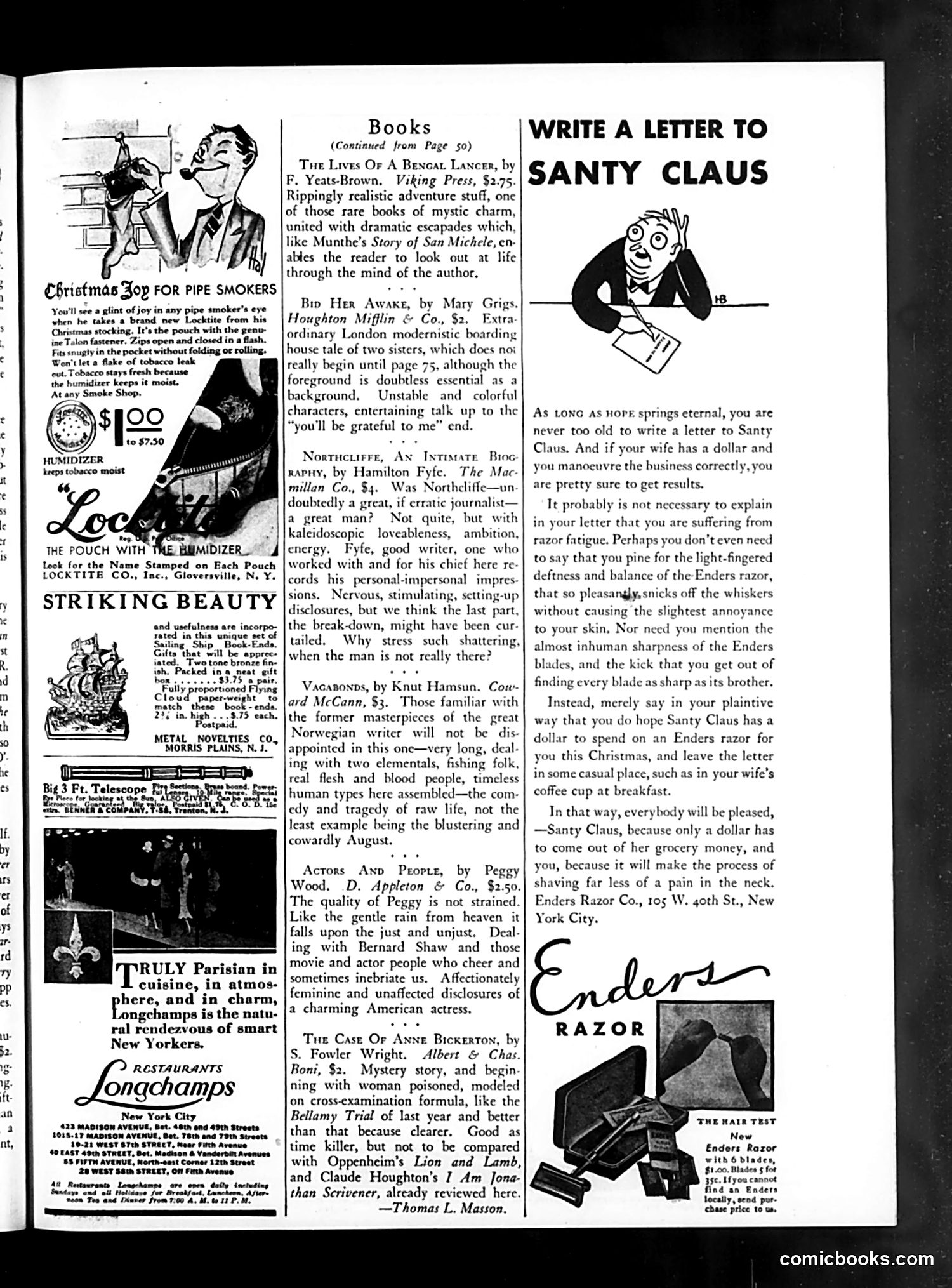
Analysis for Modern Readers This page is primarily advertising and book reviews, not political satire. The main content includes: Advertisements: - Locktite tobacco pouches (with humidifier feature) - Metal novelties (sailing ship gifts) - Longchamps restaurants in New York "Write a Letter to Santy Claus" Section: A humorous advice column encouraging wives to hint to Santa that their husbands need an Enders Razor for Christmas. The joke relies on period-specific male grooming anxieties—the text playfully suggests razors will ease "razor fatigue" and cure various masculine complaints. It's gentle product placement masquerading as marital advice. Book Reviews: Short reviews of contemporary novels, including works by F. Yeats-Brown and Norwegian author Knut Hamsun. The cartoons are minimal and serve purely decorative/advertising purposes rather than offering social commentary. This is a commercial magazine page from approximately the 1920s-30s, dominated by consumerist appeals.
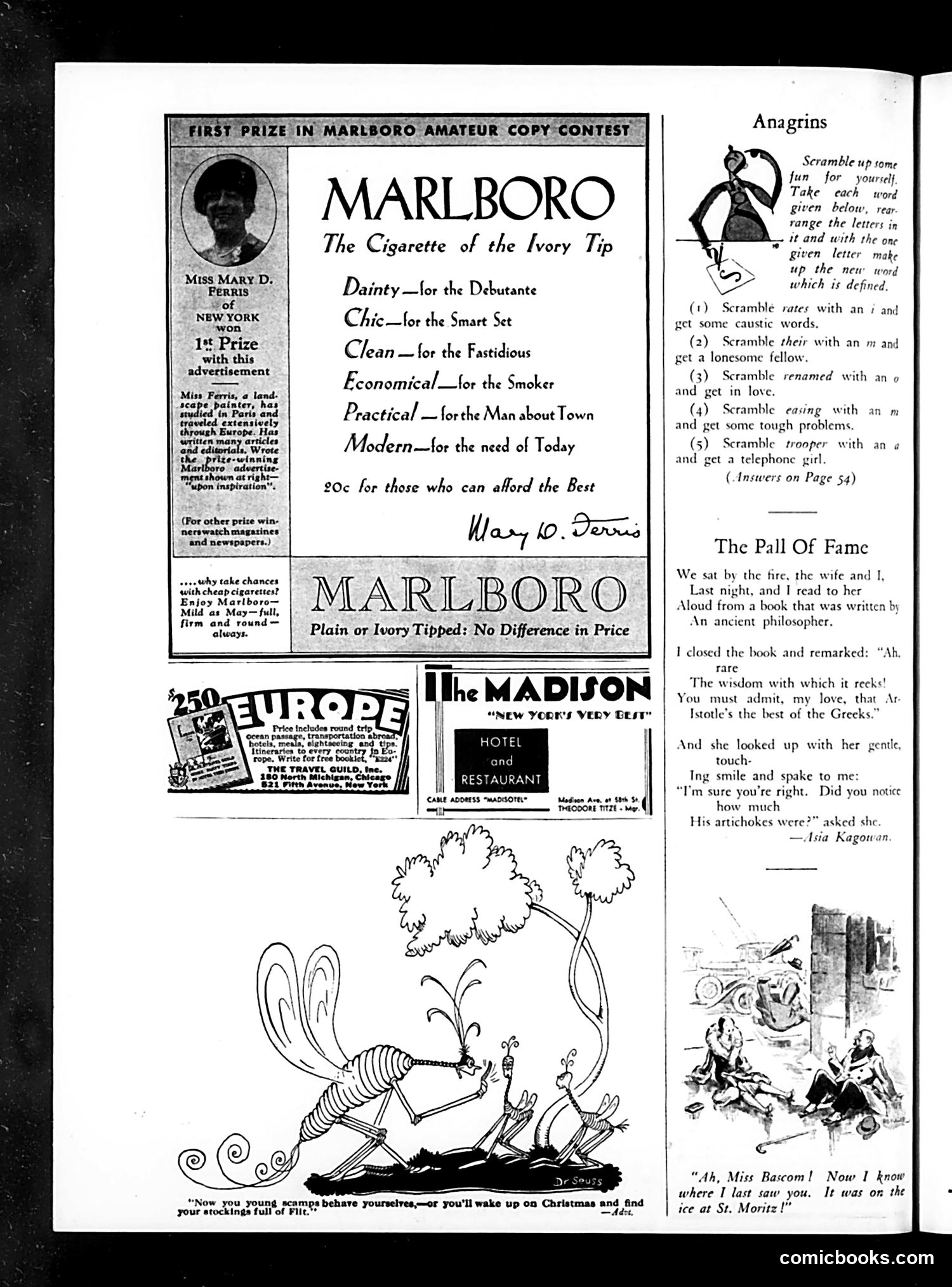
Analysis for Modern Readers This page from *Life* magazine contains primarily advertising and light humor content, not political satire. The main elements are: 1. Marlboro cigarette ad (top): Won first prize in a contest. Appeals to different demographics ("Dainty for the Debutante," "Chic for the Smart Set"). The endorsement by Mary D. Ferris, a landscape painter, adds prestige. At 20¢, it's positioned as a premium product. 2. Bottom cartoon by Cesare: A humorous threat—parents warning misbehaving children they'll receive "Flit" (an insecticide brand) in their Christmas stockings instead of gifts. This is a joke playing on Flit as an undesirable "gift." 3. Literary/humor pieces: "The Pall of Fame" (a poem about Aristotle's artichokes—a joke about missed details) and "Anagrams" (a word puzzle). 4. Hotel and travel advertisements fill remaining space. The page reflects 1920s consumer culture and light magazine humor rather than political commentary.
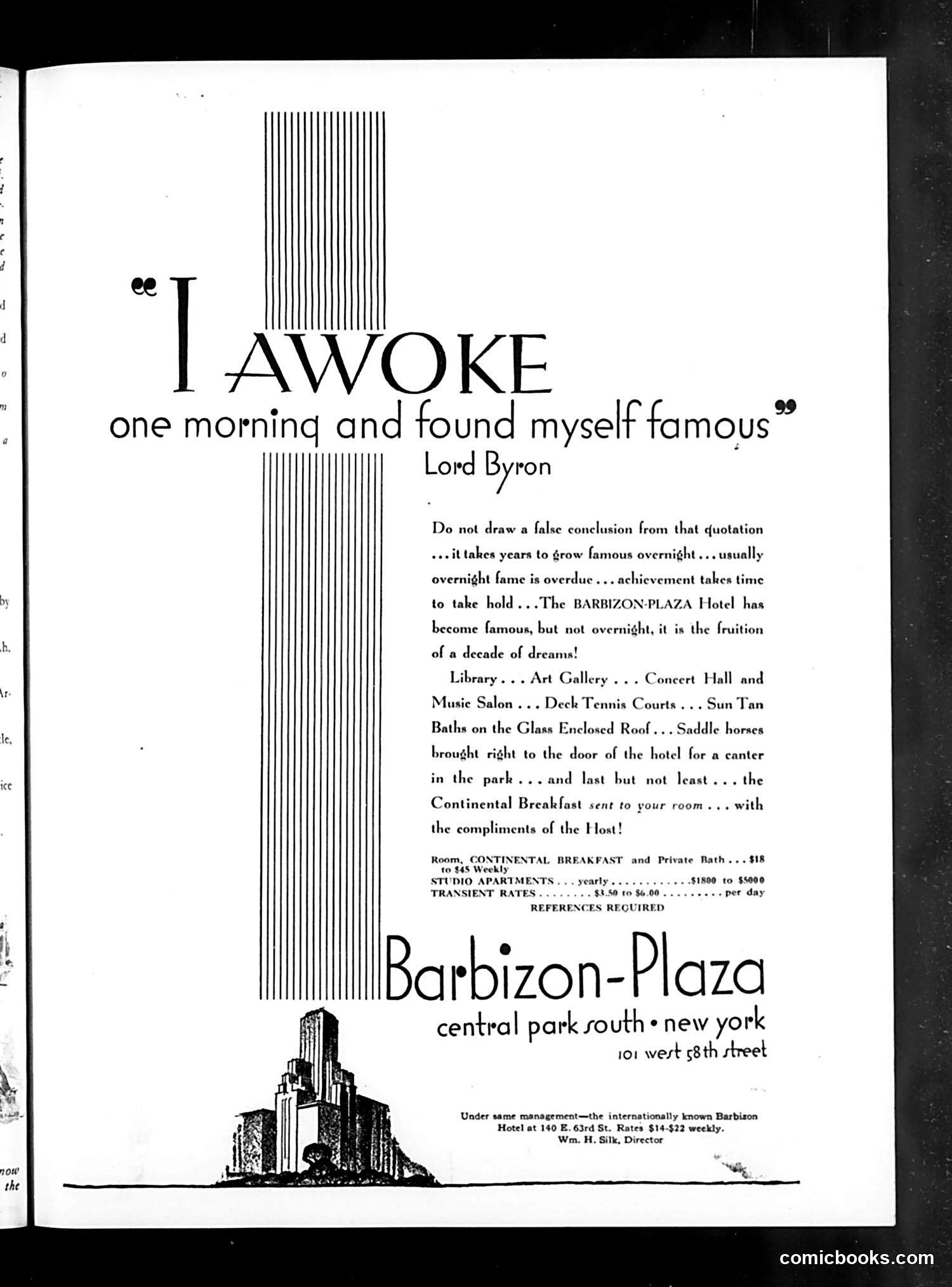
Analysis This is a hotel advertisement, not a cartoon. The Barbizon-Plaza uses Lord Byron's famous quote—"I awoke one morning and found myself famous"—as a clever marketing device. The ad's strategy is to draw a distinction: Byron's fame came overnight, but the Barbizon-Plaza's reputation took a decade of quality service to build. This positions the hotel as offering *genuine* prestige earned through amenities (library, art gallery, tennis courts, sun-tan baths, riding horses, room service breakfast) rather than mere novelty. The subtext appeals to affluent New York residents (Central Park South location) seeking tasteful luxury. The mention of "references required" and pricing ($18-$45 weekly for rooms, $1,800-$5,000 yearly for studio apartments) signals exclusivity. The smaller note about the original Barbizon Hotel at 140 E. 63rd St. suggests this is an advertisement for an established luxury brand expanding its presence in 1920s-30s New York.
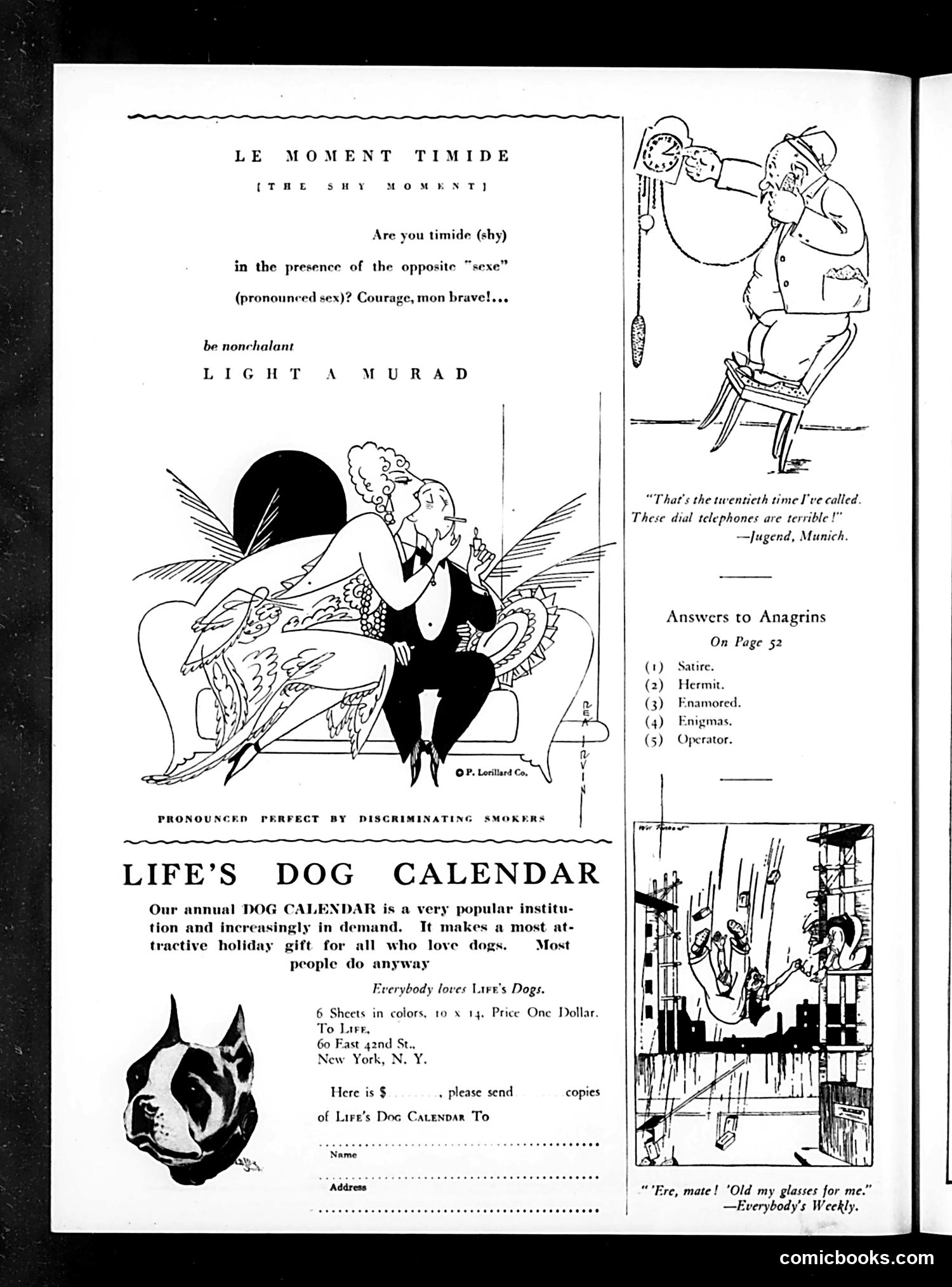
Explanation for Modern Readers This page contains vintage advertisements and satirical cartoons from *Life* magazine. Top left cartoon: A French-themed advertisement for Light Murad cigarettes. It depicts a man nervously approaching a woman, using the French concept of "timidité" (shyness) as humor. The joke plays on social awkwardness around romantic encounters—encouraging men to smoke cigarettes as a way to appear confident ("nonchalant") when approaching women. This reflects early 20th-century gender dynamics and smoking culture. Bottom section: Two items: (1) An advertisement for *Life's* annual dog calendar—a novelty gift product; (2) A cartoon about early dial telephones, showing frustration with this new technology. The humor comes from the complaint about calling the twentieth time, suggesting unreliable connections or difficulty operating dial phones, which were then still relatively new and unfamiliar to users. All content reflects period-specific anxieties: romantic awkwardness, consumer goods marketing, and technology adoption challenges.
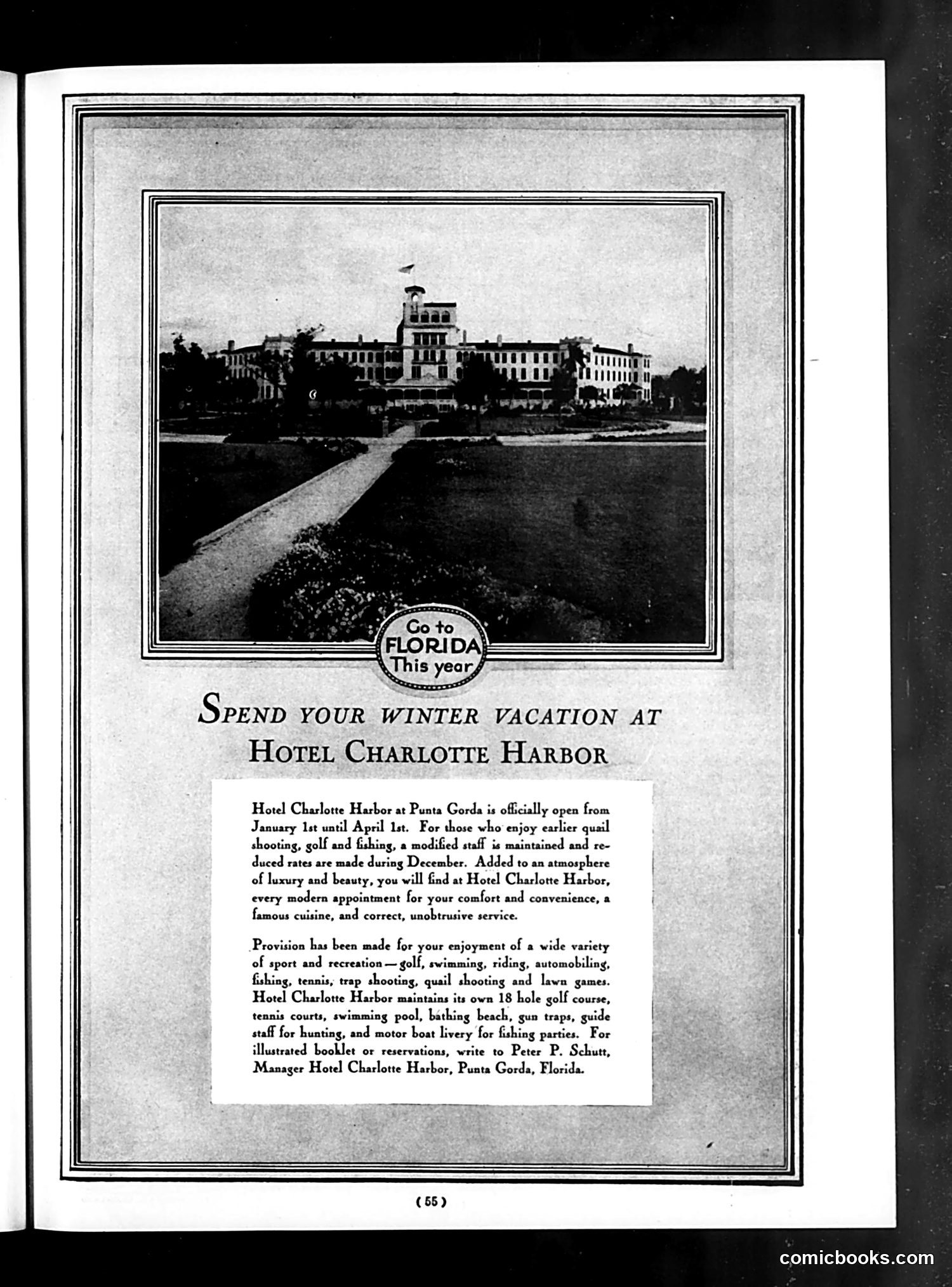
Analysis This is a hotel advertisement, not a political cartoon or satire. It's a full-page promotional piece for Hotel Charlotte Harbor in Punta Gorda, Florida, aimed at wealthy winter tourists. The image shows the hotel's waterfront facade—a substantial multi-story building with a central tower, photographed across a body of water with a causeway or pier in the foreground. The text emphasizes luxury amenities and recreational activities (golf, hunting, fishing, tennis) available to guests during the winter season (January-April, with December rates reduced). It appeals explicitly to leisure travelers seeking upscale accommodations and outdoor sports. The "Go to FLORIDA This year" seal is a straightforward tourism promotion, not satirical commentary. This reflects early-20th-century American travel marketing targeting affluent East Coast visitors seeking warm-weather escape.
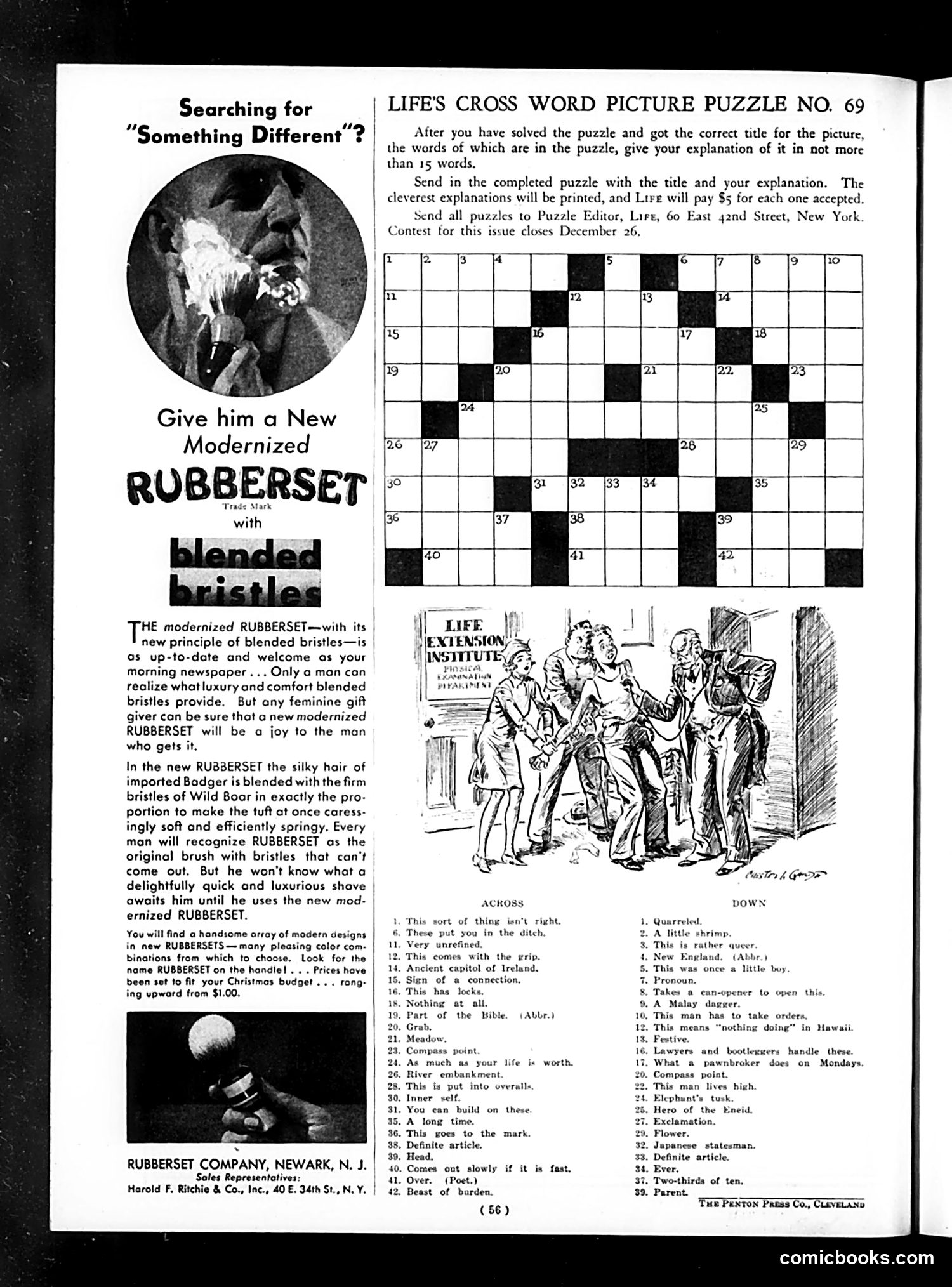
Life Magazine Page Analysis This page is primarily advertising and puzzle content, not political satire. The main advertisement promotes Rubberset shaving brushes—a modernized grooming product featuring blended badger and boar hair bristles. The accompanying illustration shows an elderly man's face, presumably to demonstrate the product's quality for a masculine audience. The ad's appeal is straightforward consumer marketing: positioning the brush as a luxury gift suitable for Christmas shopping. Below the ad is Life's crossword picture puzzle No. 69—a regular entertainment feature where readers solve a crossword to reveal a hidden picture, then submit their own explanations for prizes ($5 per accepted entry). The puzzle clues and grid are visible, along with an illustration showing what appears to be a scene at a "Life Extension Institute." This represents typical 1920s-30s magazine content: consumer advertising mixed with reader-participation puzzles designed to increase engagement and encourage submissions.
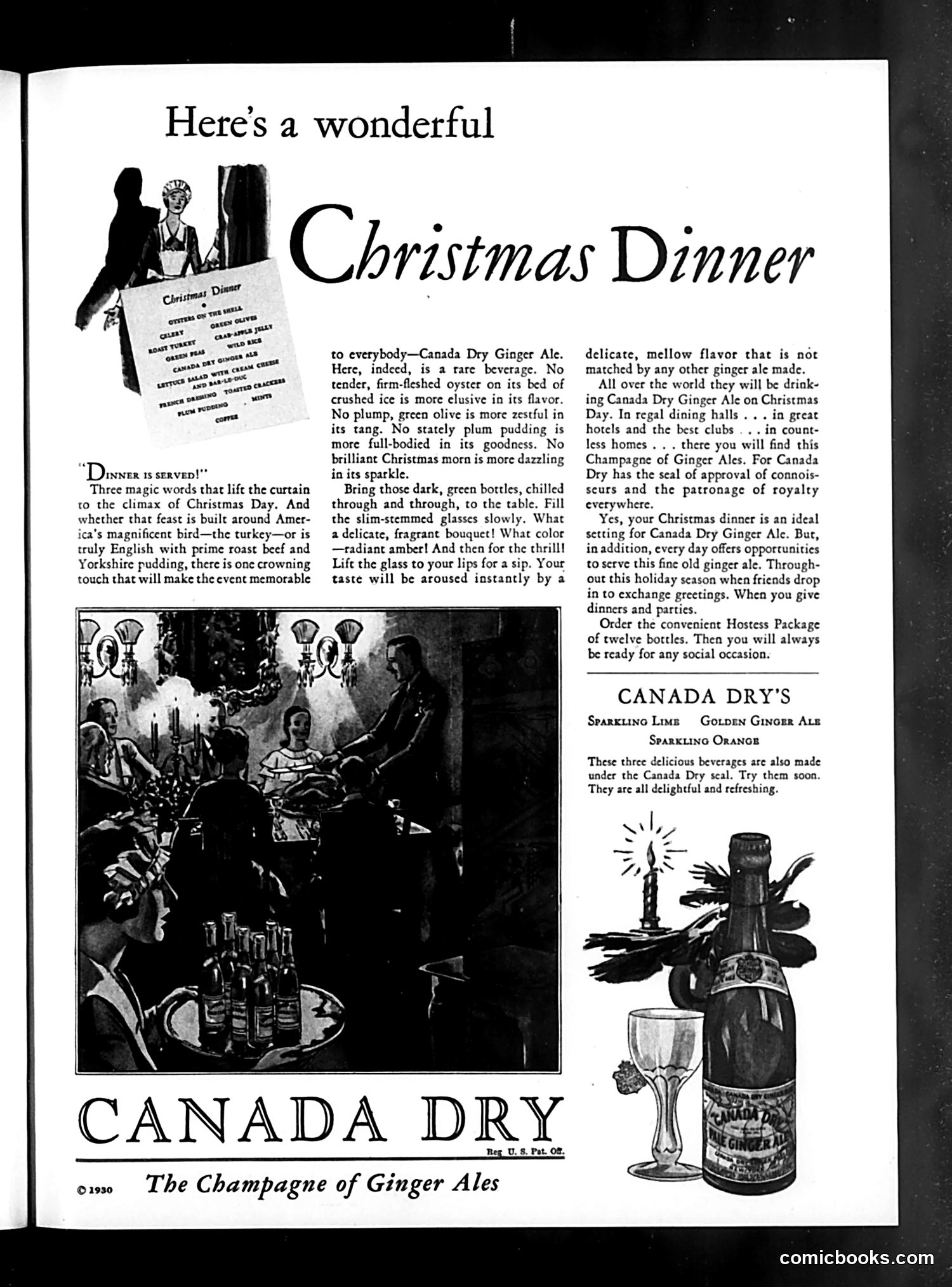
Analysis This is a 1930 advertisement, not satire or political commentary. It promotes Canada Dry Ginger Ale as the essential beverage for Christmas dinner. The page features: Visual content: A festive dinner party scene showing elegantly dressed guests enjoying beverages, and a product shot of a Canada Dry bottle with a champagne glass. Marketing message: The ad positions ginger ale as a luxury item—"The Champagne of Ginger Ales"—claiming it's served in "regal dining halls," "great hotels," and "the best clubs." It appeals to aspirational consumers by emphasizing refinement and social status. Key selling points: The text uses sensory language ("delicate, fragrant bouquet," "radiant amber") and compares the beverage favorably to fine foods (oysters, olives, plum pudding) to justify its premium positioning. Context for modern readers: This reflects Depression-era marketing that emphasized sophistication and status through consumption, even as many Americans faced economic hardship. Ginger ale was marketed as an accessible luxury good.
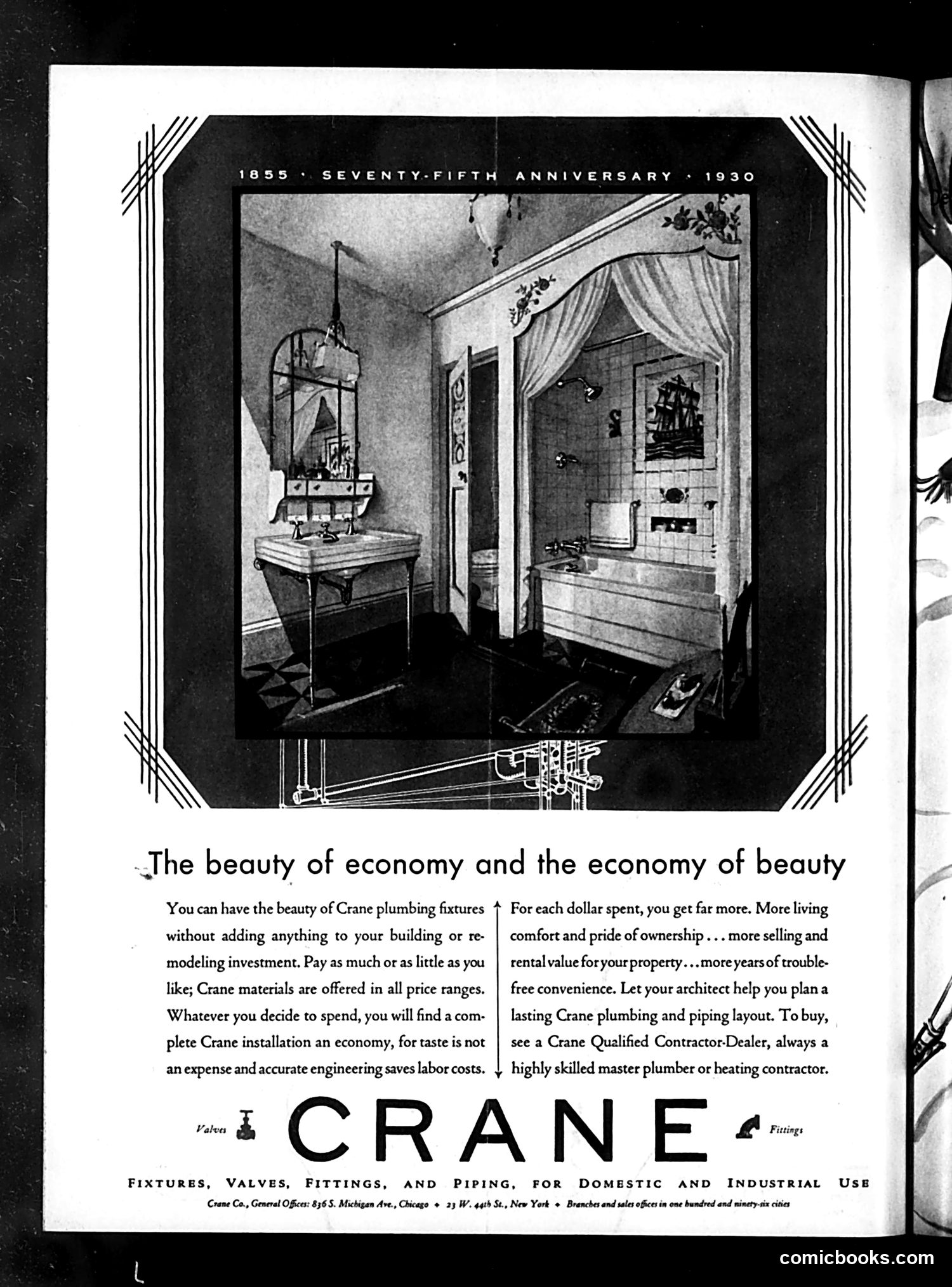
Analysis This is not a cartoon or satirical content—it's a full-page advertisement for Crane plumbing fixtures, commemorating the company's 75th anniversary (1855-1930). The image shows a stylized 1930s bathroom with a pedestal sink, bathtub, and decorative elements like curtains and ship artwork. The ad's headline, "The beauty of economy and the economy of beauty," plays on the idea that quality plumbing fixtures enhance a home's value and appeal without excessive expense. The text emphasizes that Crane products come in various price ranges, offer durability and "trouble-free convenience," increase property rental and resale value, and should be installed by qualified Crane contractors. This is straightforward advertising copy aimed at homeowners and builders—not satire. The page reflects 1930s consumer marketing: combining aesthetic appeal with practical economic arguments to justify home improvement purchases during the Depression era.