life
Life — December 26, 1930
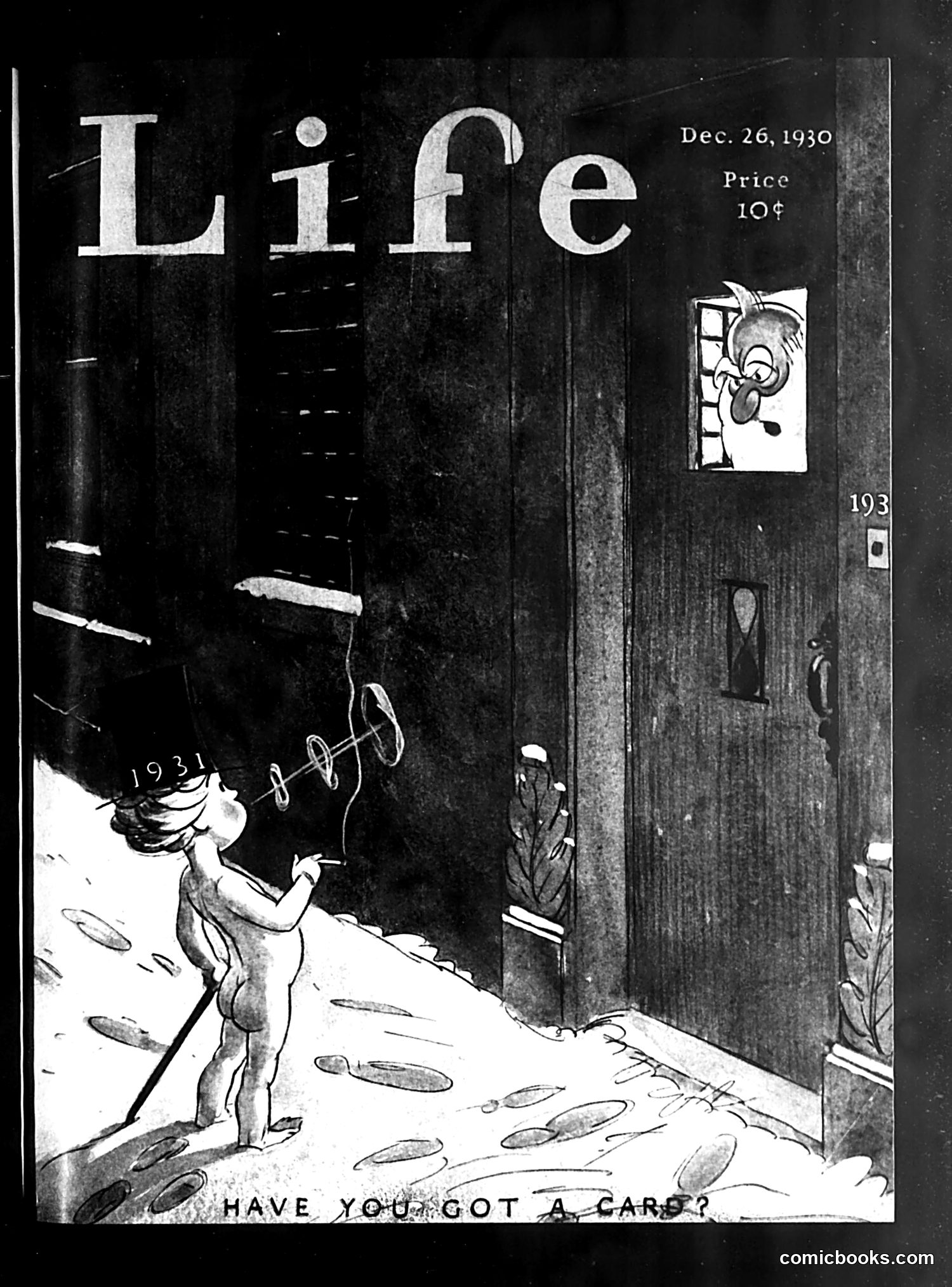
Life Magazine, December 26, 1930 This is a cover illustration featuring a cartoon character (appears to be a stylized human figure) standing in snow, holding a ski pole or similar winter equipment, with footprints visible in the snow behind them. The character has an exaggerated, cartoonish appearance typical of 1930s illustration style. The caption reads "HAVE YOU GOT A CAR?" — referencing automobile ownership during the Great Depression era. The joke likely satirizes the disconnect between winter leisure activities (skiing, winter sports) and economic reality; the figure appears to be trudging through snow on foot, prompting the sarcastic question about car ownership. This reflects Depression-era humor about widespread poverty and the contrast between wealthy leisure pursuits and common people's struggles.
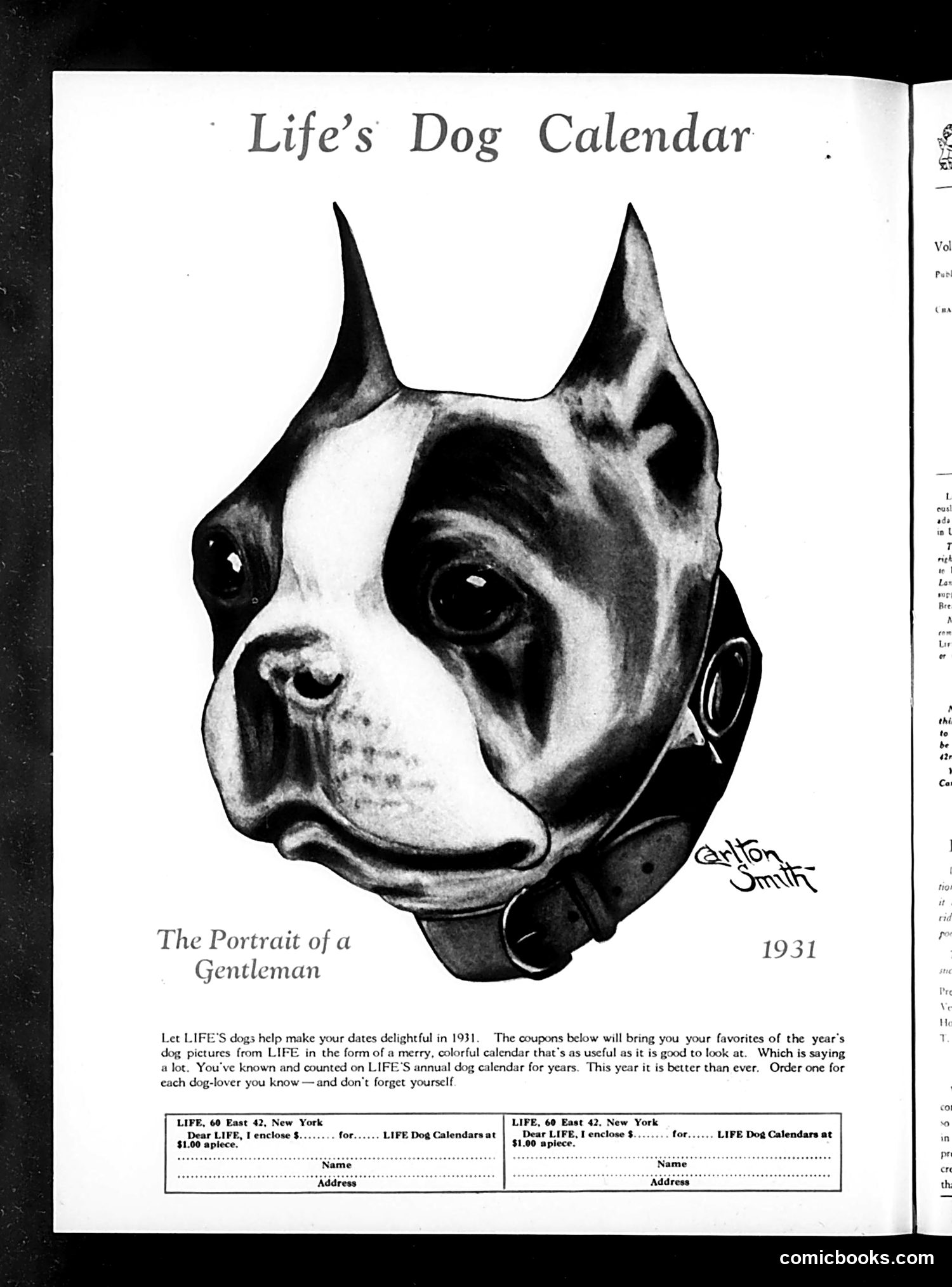
Life's Dog Calendar (1931) This page is primarily an advertisement for a calendar product, not a political cartoon. The 1931 "Life's Dog Calendar" features a detailed portrait of a Boston Terrier or similar breed, titled "The Portrait of a Gentleman." The illustration is signed by Carlton Smith. The "joke" is gentle wordplay: the dog is presented as a refined "gentleman," appealing to pet owners' affection for their animals. The ad copy promises that LIFE magazine's dog pictures will "help make your dates delightful" and offers readers an opportunity to order calendars. This reflects 1931 consumer culture—using cute animal imagery to promote products—rather than containing political satire. It's essentially a mail-order advertisement disguised as editorial content.
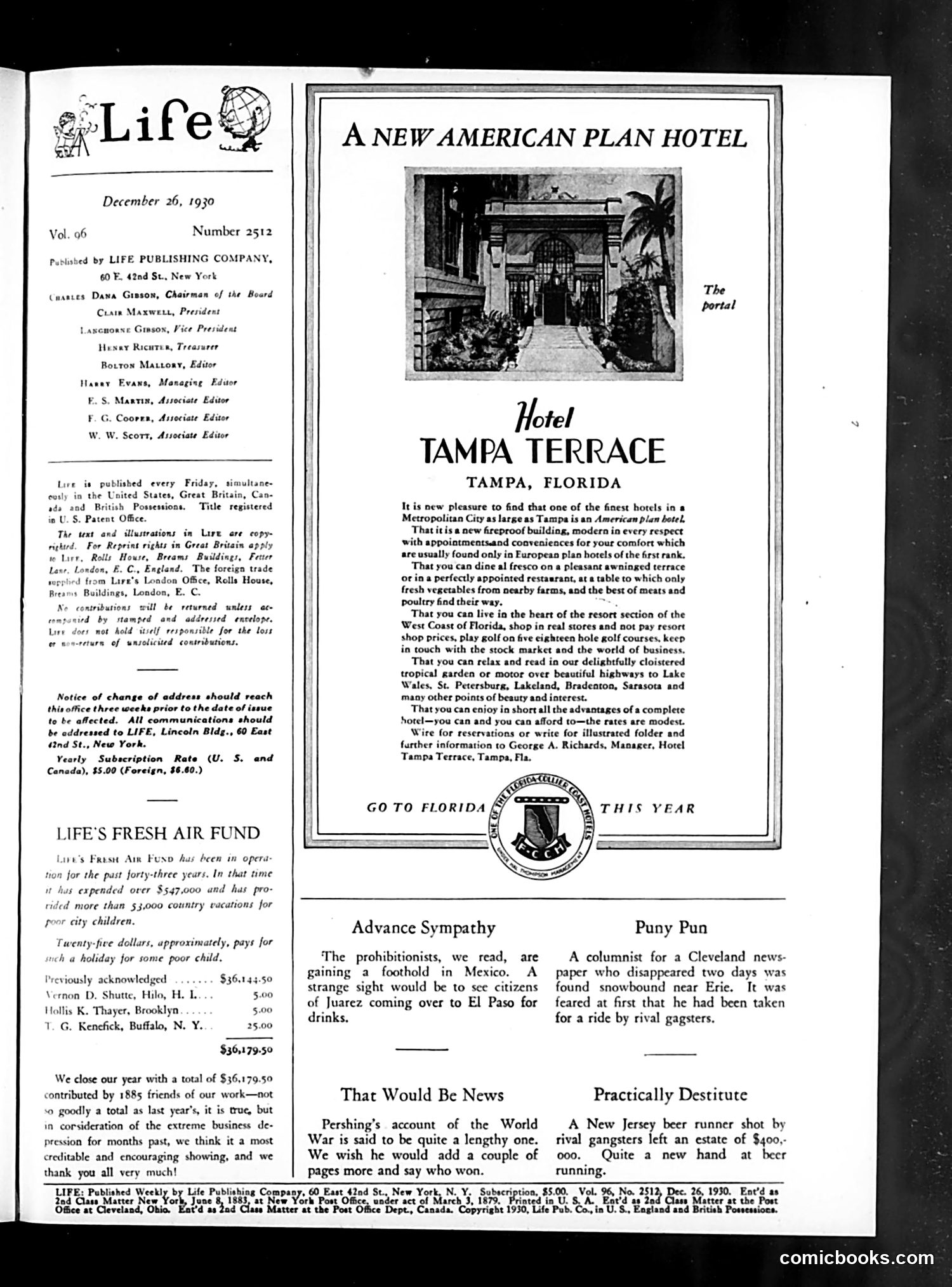
Page Content Analysis This page is primarily advertising and editorial content, not political satire. The main feature is a full-page advertisement for the Hotel Tampa Terrace in Tampa, Florida—promoting its European-style amenities, dining, and leisure activities as an upscale destination. Below the ad are four brief humor items: 1. "Advance Sympathy" jokes about prohibitionists gaining a foothold in Mexico and citizens crossing into El Paso for drinks—referencing Prohibition's unpopularity. 2. "Puny Pun" and "That Would Be News" are light wordplay items. 3. "Practically Destitute" describes a beer runner shot by rival gangsters. The page reflects 1930 concerns: Prohibition's enforcement, gangster violence, and the tourism industry promoting Florida as a vacation destination.
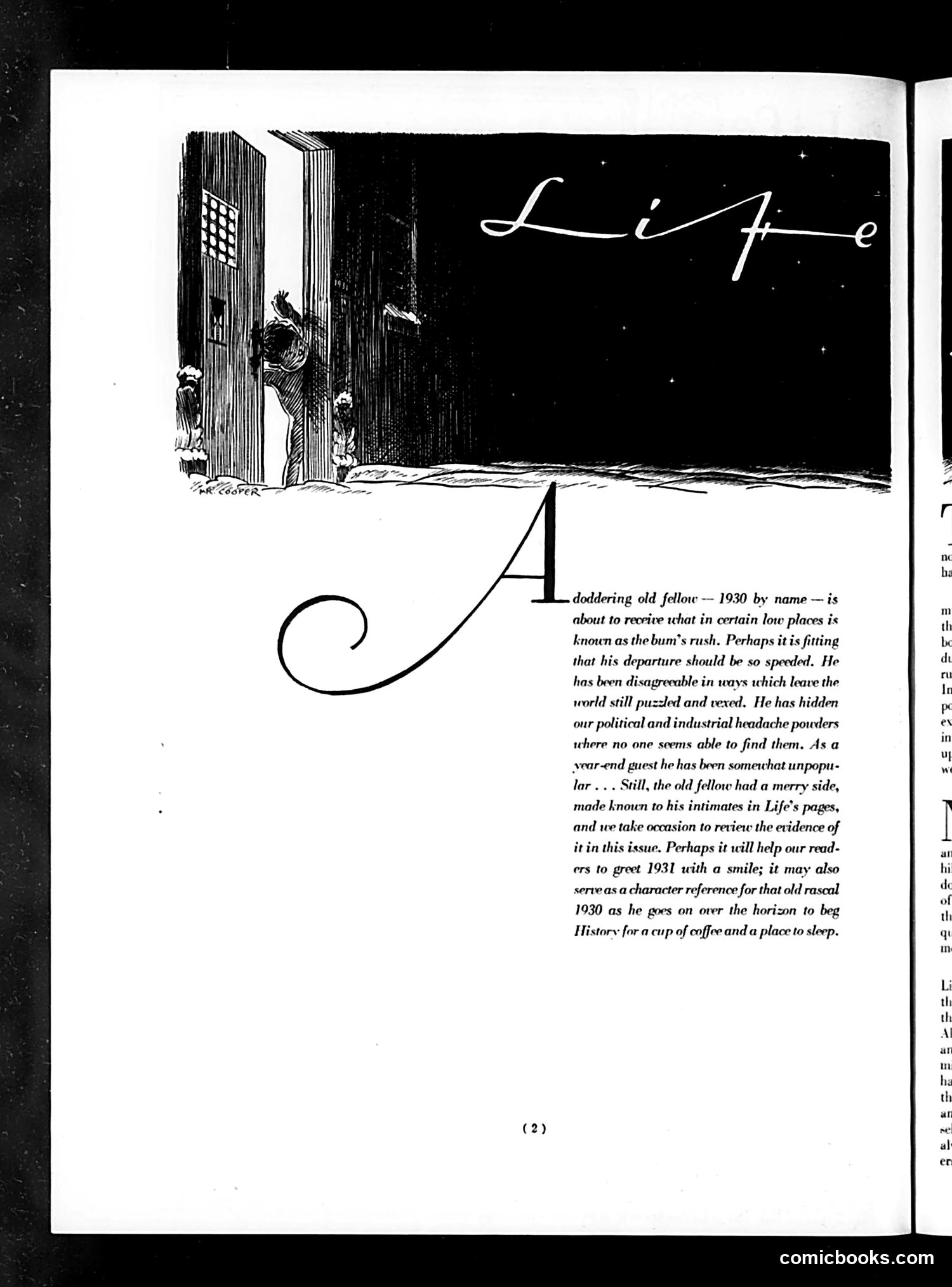
Analysis This page is a title page or introductory section for *Life* magazine, featuring an illustration and accompanying essay about a recurring character. The sketch shows figures at a doorway, with the word "Life" in elegant script above. The text discusses "a doddering old fellow — 1930 by name" who is departing, presumably as the year 1930 ends and 1931 begins. The passage uses personification, treating the year itself as a character with personality traits—"disagreeable," having "hidden our political and industrial headache powders," yet possessing "a merry side." This is New Year's satirical commentary: the magazine bids farewell to 1930 (marked by economic hardship following the 1929 crash) with wry humor, while greeting 1931 with cautious hope. The "old fellow" is literally the year being personified, a common editorial device in period magazines.
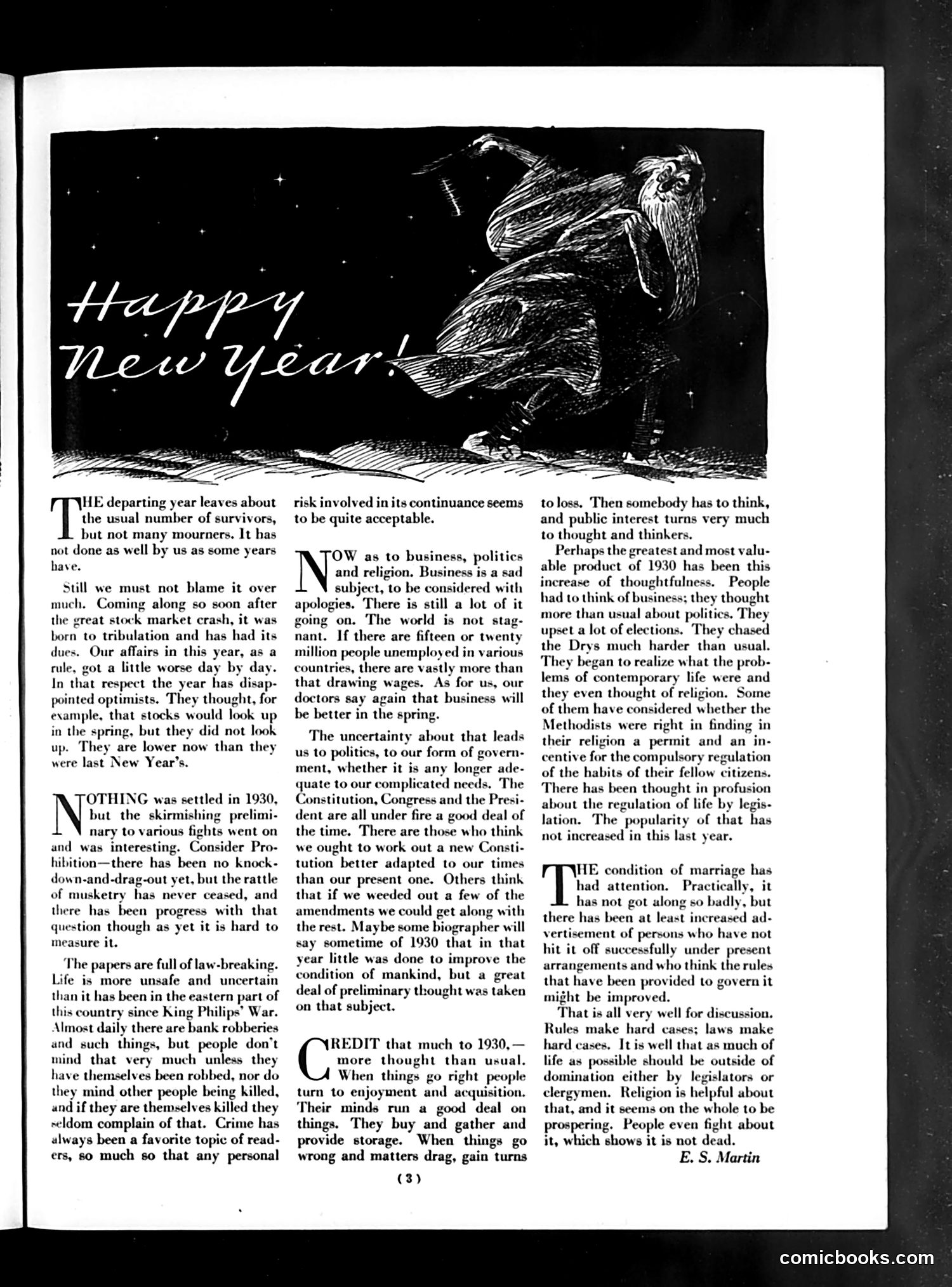
Life Magazine Page Analysis This is an editorial essay titled "Happy New Year!" by E.S. Martin, illustrated with a woodcut of what appears to be a rat or similar creature looking upward against a starry night sky. The piece is a reflective New Year's commentary on 1930, discussing the year's disappointments—the stock market crash, unemployment, and general uncertainty—while acknowledging that life has always contained hardship and danger. Martin argues that rather than blame 1930 entirely, society should recognize ongoing problems in business, politics, and religion that demand thought and reform. The essay encourages readers not to despair but to engage in serious consideration of contemporary issues, suggesting that difficulty can spark useful public discourse about governance, marriage law, and social regulation.
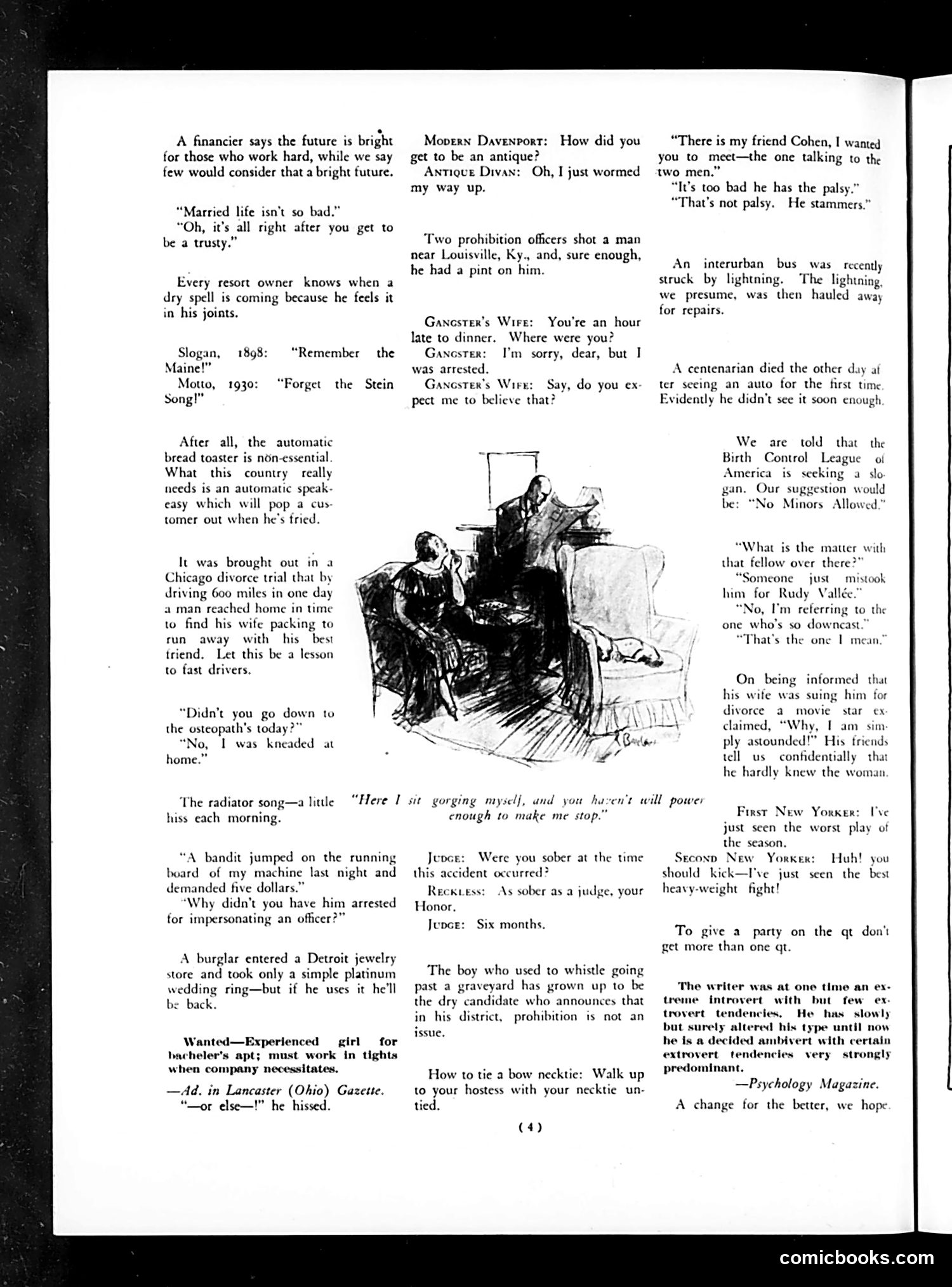
Analysis of Life Magazine Page This page contains humorous anecdotes and a single illustration rather than political cartoons. The central sketch shows two figures in what appears to be a domestic dispute or serious conversation, captioned: "Here I sit gorging myself, and you haven't will power enough to make me stop." The surrounding text consists of brief satirical jokes targeting 1920s American life, including references to Prohibition (officers shooting a man with a hidden pint), divorce proceedings, and social manners. One item mocks the Birth Control League's proposed slogan "No Minors Allowed." The humor relies on period-specific concerns: Prohibition enforcement, automobile accidents, and changing social attitudes toward marriage and divorce. The overall tone is light satirical commentary on contemporary American society and customs, typical of Life's editorial approach during this era.
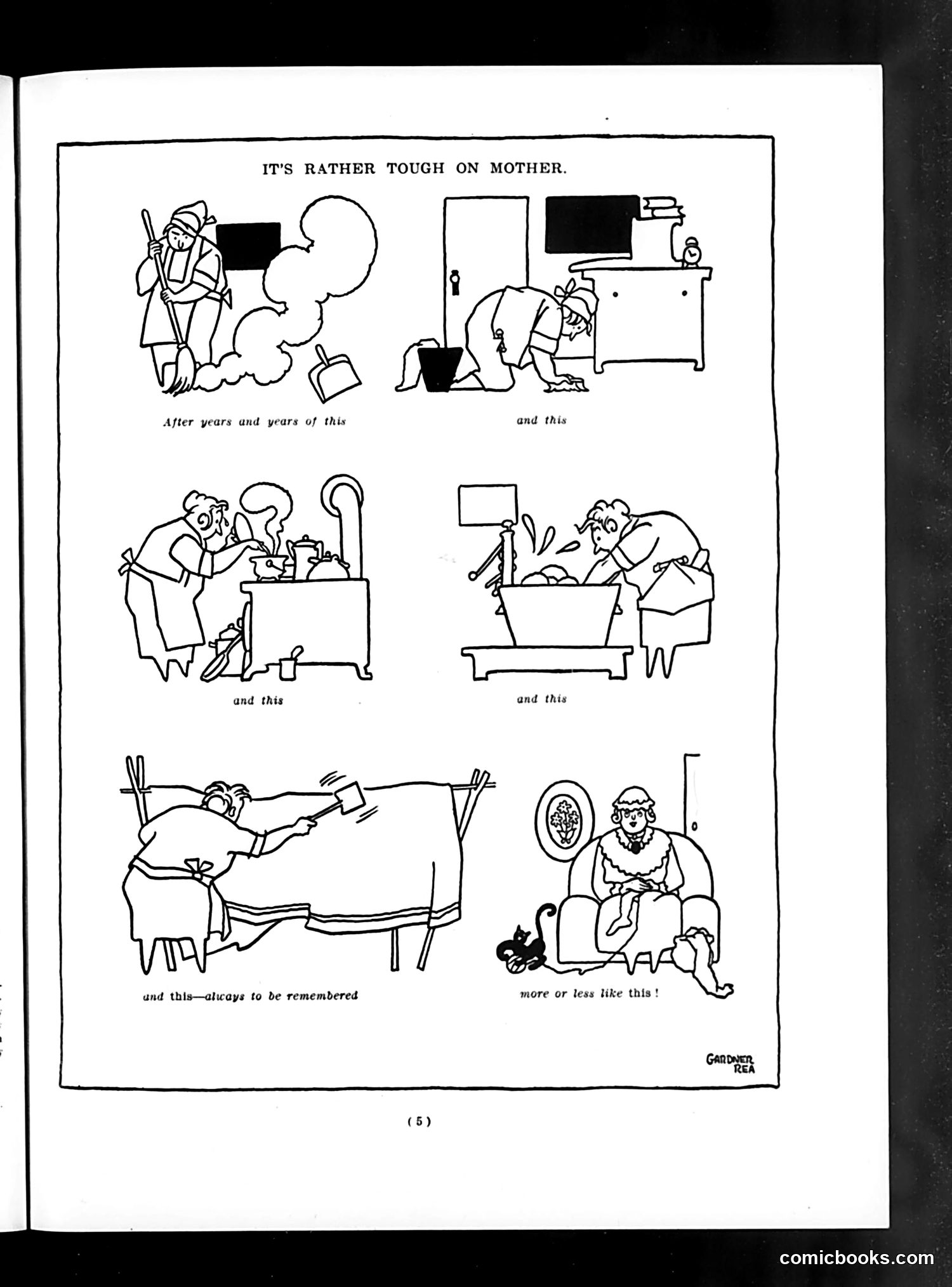
"It's Rather Tough on Mother" - Analysis This satirical comic by Gardner Rea depicts the life progression of motherhood, contrasting youthful labor with aging domesticity. The sequence shows: - Top panels: A young mother managing military/wartime duties alongside household work - Middle panels: Cooking and bathing children - Bottom left: Exhausted laundry work ("always to be remembered") - Bottom right: An elderly woman sitting alone, worn out The satire's point: Despite decades of relentless domestic labor—child-rearing, cooking, cleaning, laundry—mothers end up in diminished circumstances, seemingly forgotten or marginalized. The title's understated tone ("rather tough") ironically underscores the serious toll motherhood takes. The contrast between young vigor and elderly exhaustion critiques how society undervalues maternal labor and fails to provide dignity or security in old age.
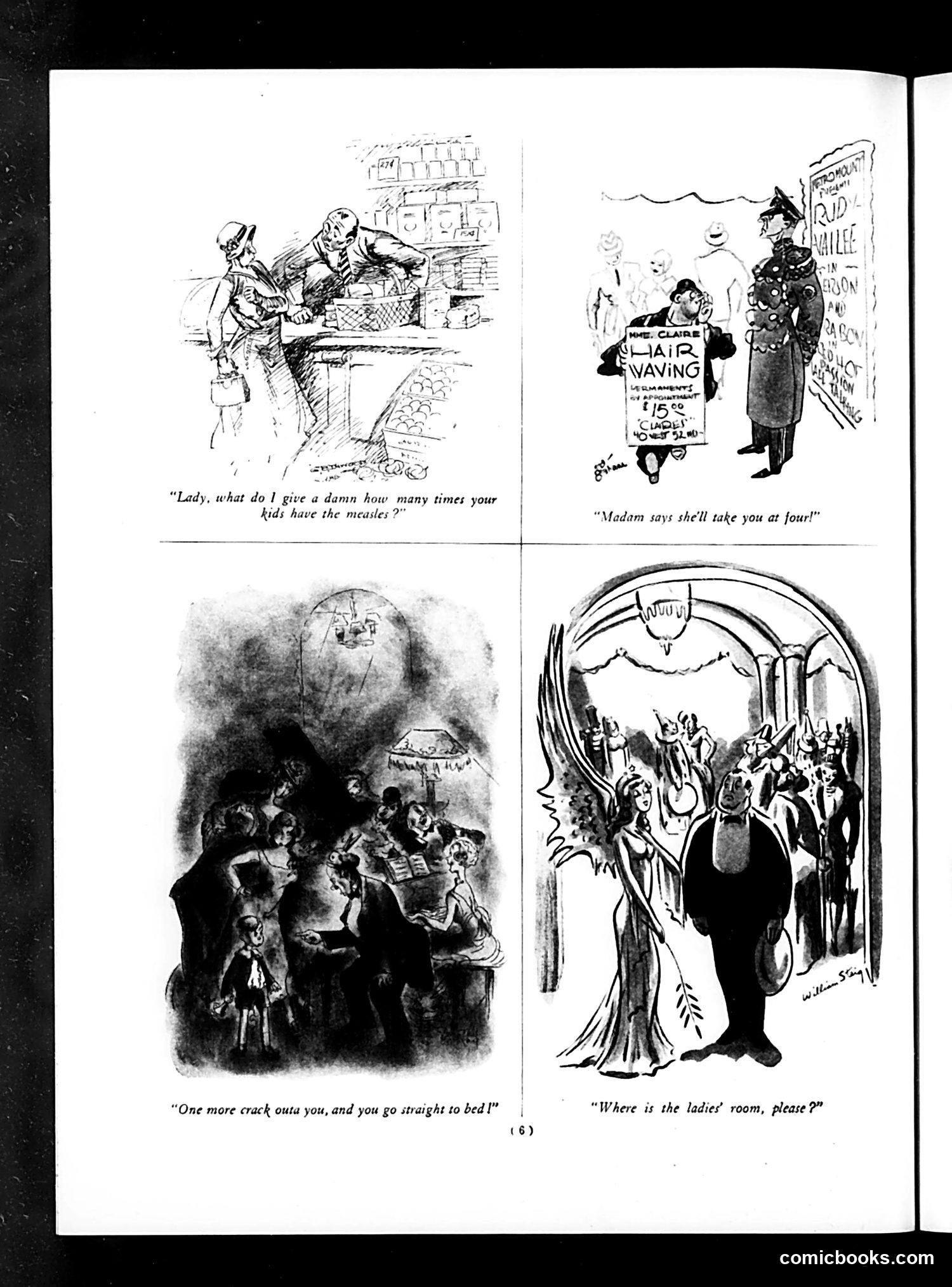
Analysis of Life Magazine Page This page contains four unrelated comic vignettes satirizing everyday life: 1. Top left: A doctor asks a woman how frequently her children have measles—implying she's had them multiple times, a common childhood disease in this era. 2. Top right: A hair-waving salon scene where a uniformed officer (appears to be a doorman or security guard) is told a client will be ready "at four"—satirizing the lengthy time required for salon services. 3. Bottom left: Parents threaten a misbehaving child with bedtime as punishment for "one more crack"—typical domestic discipline humor. 4. Bottom right: Someone asks directions to "the ladies' room" in what appears to be a church or formal venue—a social etiquette joke. These are gentle domestic humor comics typical of Life magazine's satirical approach to middle-class American life and social conventions.
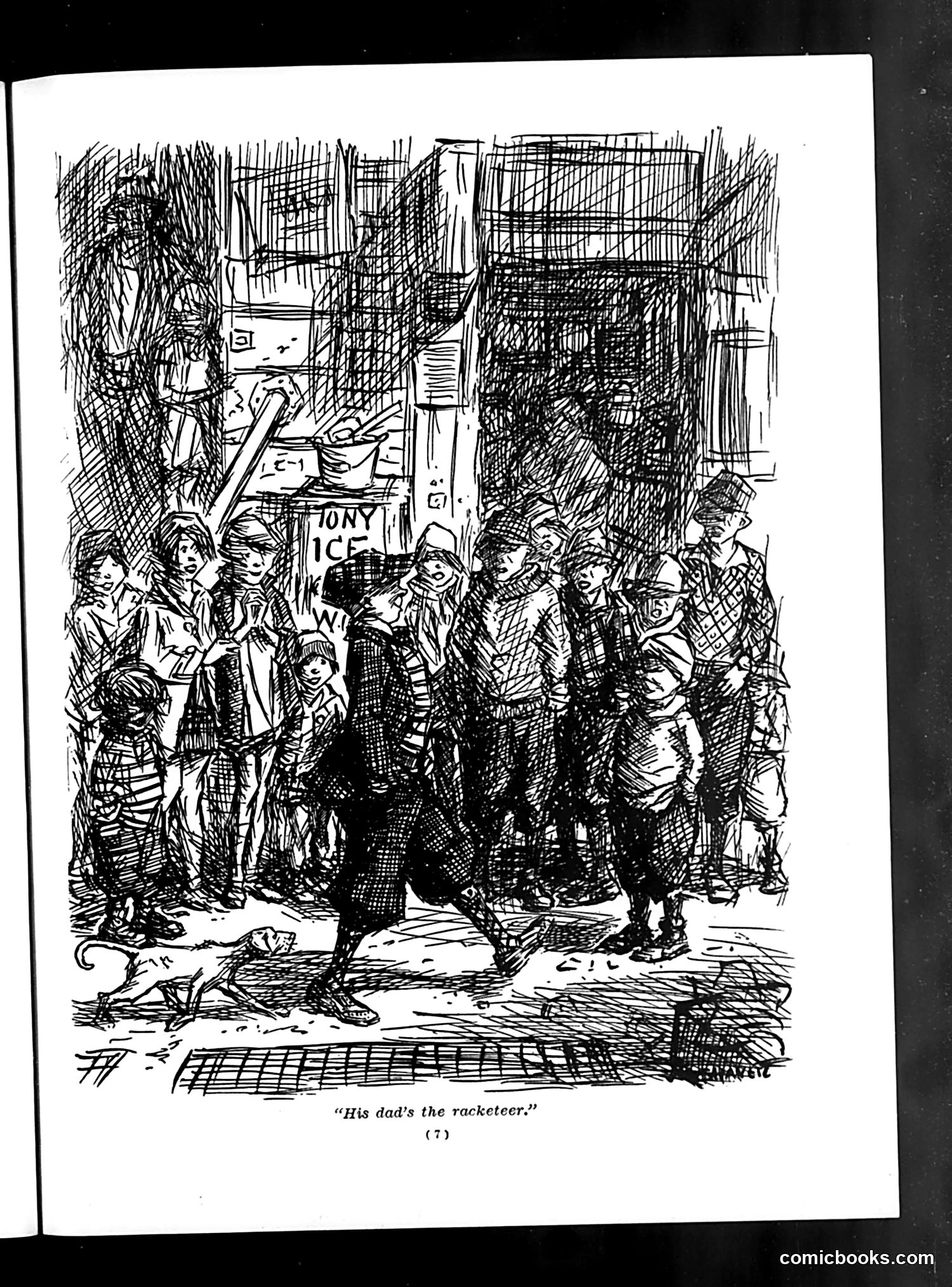
"His dad's the racketeer." This cartoon depicts a street scene with a crowd of children and adults gathered around what appears to be a Tony's Ice stand. The caption quotes one child identifying another's father as "the racketeer." The satire targets organized crime and racketeering during Prohibition era America. The joke operates on multiple levels: it shows how pervasive organized crime had become in urban neighborhoods that even children casually reference it, and it suggests that a racketeer could afford to set up a visible business (an ice stand) without legal consequence. The cartoon implies the normalization of criminal enterprise in everyday city life—that racketeering had become so commonplace, children discussed it openly as a matter-of-fact neighborhood fact.
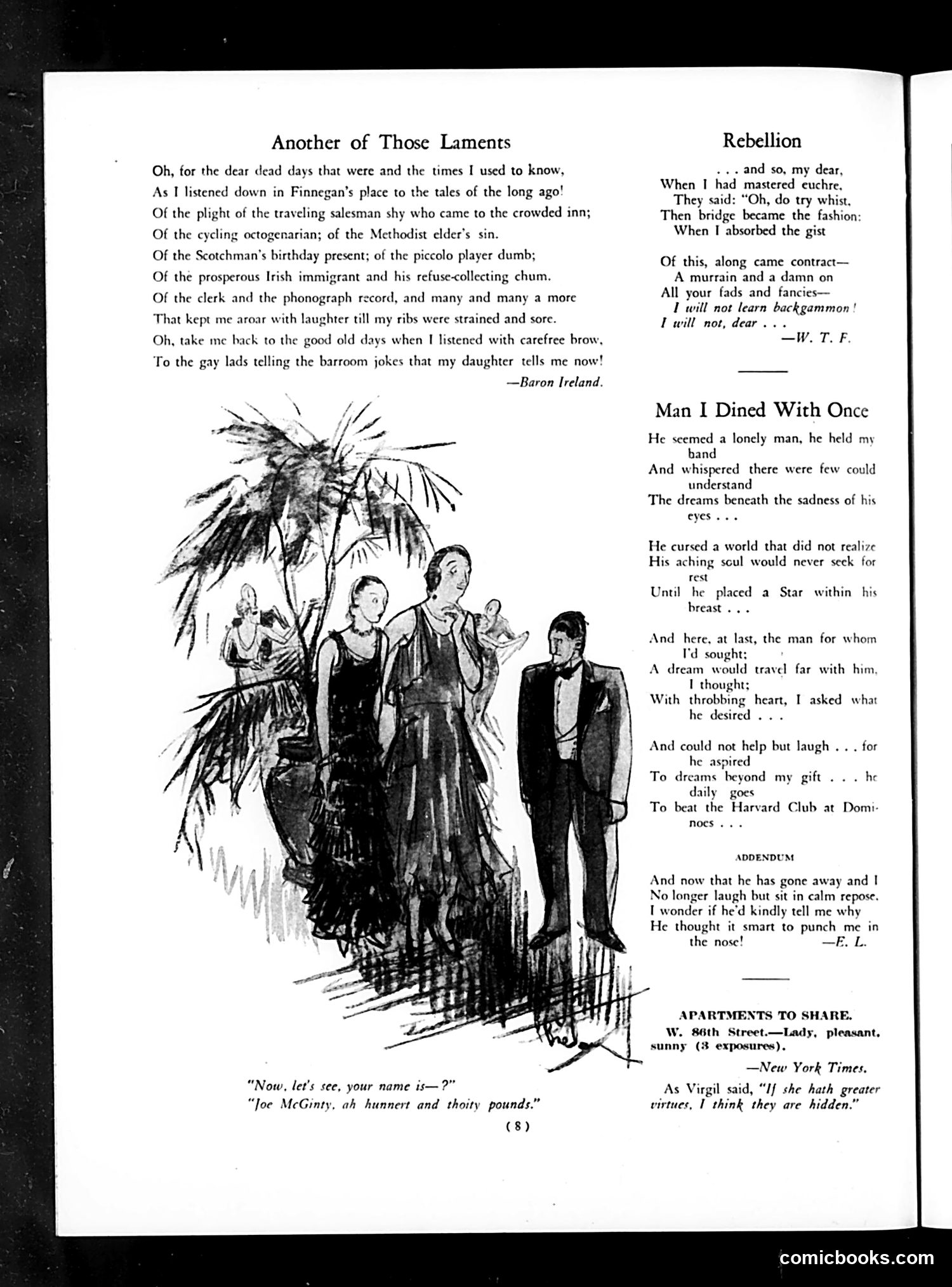
Analysis of This Life Magazine Page This page contains three literary pieces rather than political cartoons. The main illustration depicts a social scene with well-dressed figures and a woman in an elaborate feathered hat, accompanying the poem "Man I Dined With Once." The poems express nostalgia and social commentary typical of early 20th-century Life magazine's satirical style. "Another of Those Laments" by Baron Ireland mocks various social types (Methodist elders, traveling salesmen, Irish immigrants, cyclists) and laments lost "good old days." "Rebellion" by W.T.F. appears to critique conformity. The final section advertises apartments to share, quoting Virgil. The overall tone reflects upper-class urban American society's self-aware humor about modern life, pretension, and social change—characteristic of Life's satirical approach during this era.
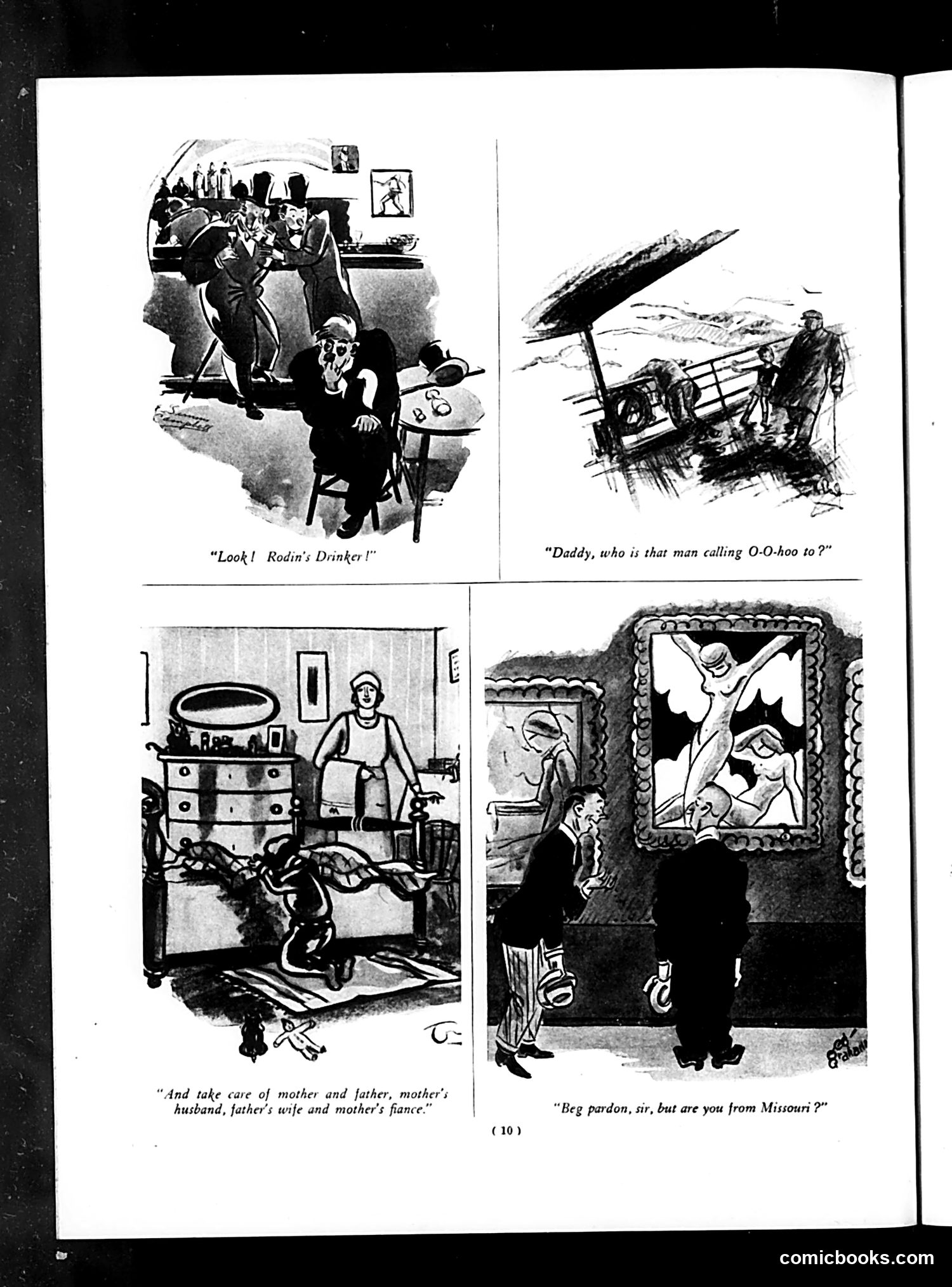
Analysis of This Life Magazine Page This page contains four satirical cartoons from Life magazine's humor section, each depicting domestic or social scenarios: 1. "Look! Rodin's Drinker!" - Mocks pretentious art appreciation by comparing a drunk man's posture to Rodin's famous sculpture. 2. "Daddy, who is that man calling O-O-hoo to?" - Likely satirizes early radio or telephone communication, with a child misunderstanding technical jargon as personal address. 3. "And take care of mother and lather..." - Shows a child's mishearing of a parent's instructions, creating comedic confusion. 4. "Beg pardon, sir, but are you from Missouri?" - References the phrase "Show-Me State," implying skepticism or gullibility stereotypically associated with Missouri residents. These represent typical early 20th-century American humor: wordplay, domestic misunderstandings, and gentle mockery of regional stereotypes.
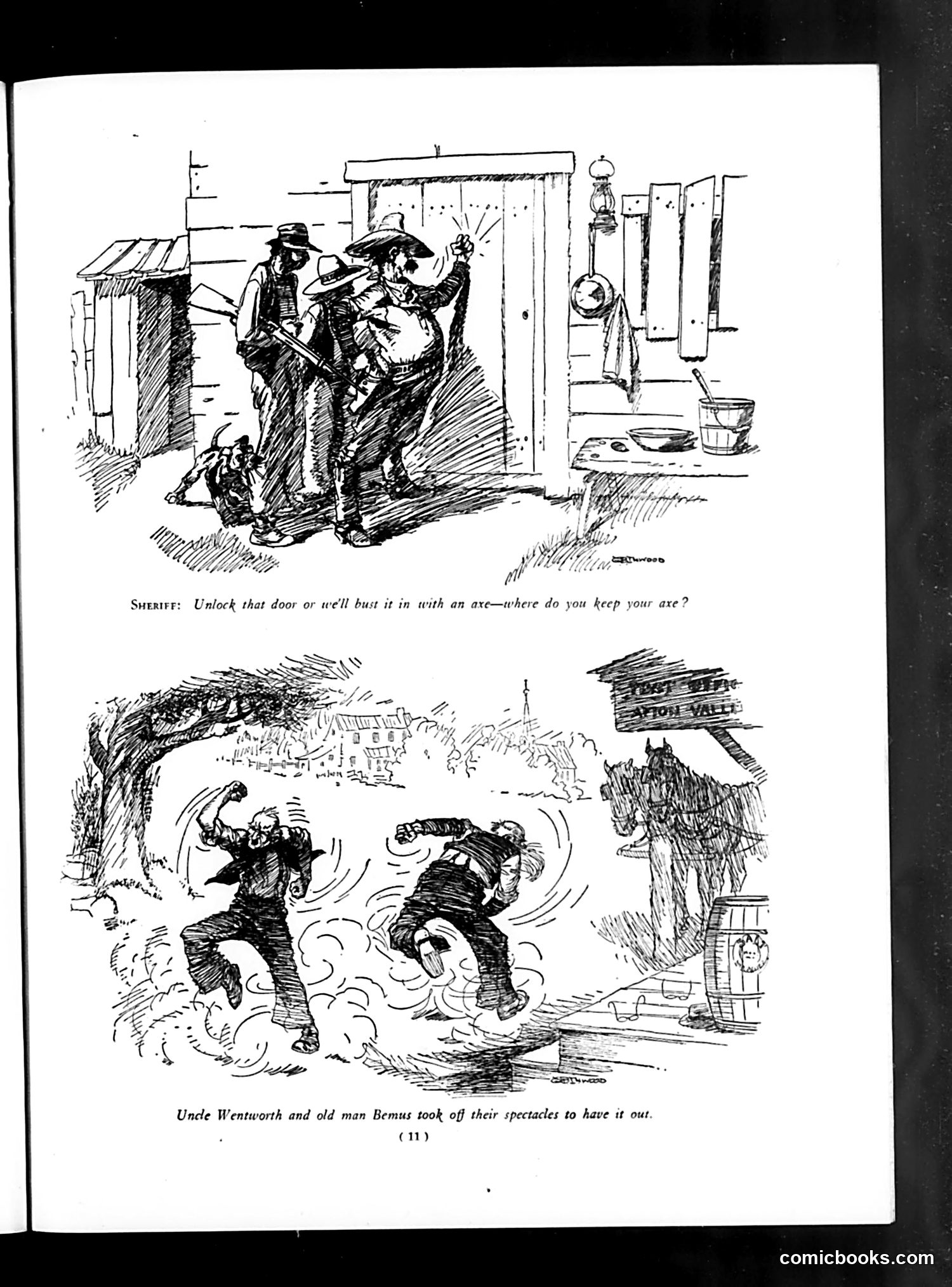
Analysis This page contains two comic panels from Life magazine's satirical humor section. Top panel: A sheriff confronts men at a cabin door, demanding they unlock it or he'll break it down with an axe. The joke plays on the men's predicament—they're trapped inside, unable to comply with the threat. Bottom panel: Two men labeled "Uncle Wentworth and old man Bernus" have removed their spectacles during a dust-up (fight) in front of a "Lost Gulch Valley" sign, suggesting they're having a brawl and can't see properly without their glasses. The humor derives from the physical comedy of older men fighting while disoriented. Both panels appear to be Western-themed slapstick humor typical of Life's early-20th-century comic content, featuring physical comedy and absurd situations.
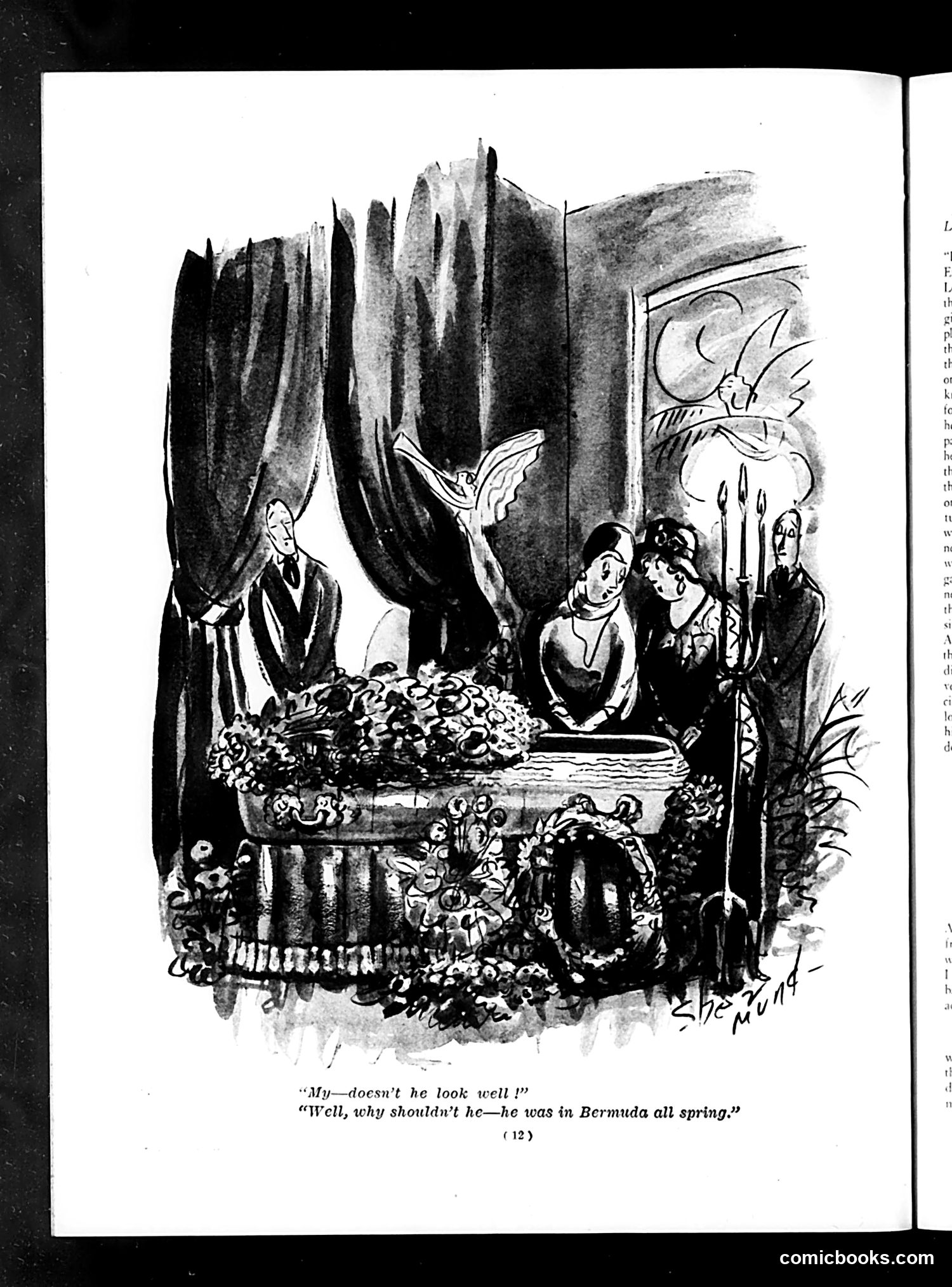
Analysis This cartoon depicts a funeral scene. The caption reads: "My—doesn't he look well!" / "Well, why shouldn't he—he was in Bermuda all spring." The satire targets wealthy Americans who spent leisure time in Bermuda during spring. The joke suggests that someone who vacationed in Bermuda should appear well-rested and healthy upon return, yet apparently does not—implying either the vacation was disappointing or the person's appearance has deteriorated despite the supposed restorative benefits of tropical leisure. The elaborate funeral setting, with mourners, flowers, and draped curtains, presents this as a dark humor piece mocking upper-class vacation culture and unfulfilled expectations of health and rejuvenation. The cartoonist's signature appears to read "Shermund."
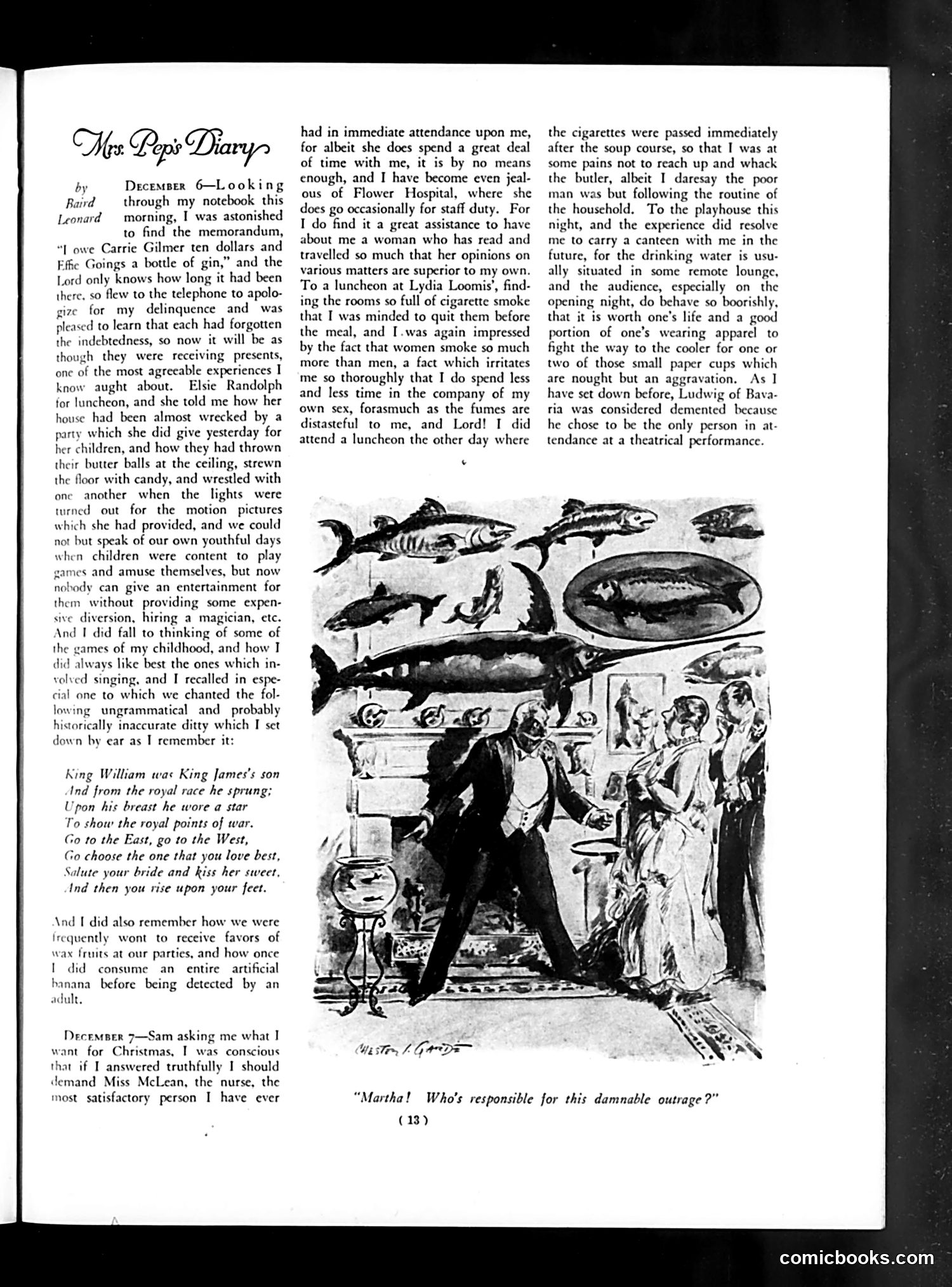
Analysis of "Mrs. Pep's Diary" Page This is a diary entry page from *Life* magazine (December 6-7), featuring satirical observations about early 20th-century social customs. The main illustration shows what appears to be a formal dinner party where fish have inexplicably appeared on the table alongside human guests—a visual absurdist joke about dining etiquette gone wrong. The accompanying text references cigarette smoking (particularly women smoking in public), theatrical attendance, and childhood games. A verse about "King William" appears to be nostalgic doggerel the diarist recalls. The cartoon's humor operates through the juxtaposition of civilized dinner formality with the ridiculous intrusion of fish, likely mocking pretentious social rituals or the chaos underlying polite society. The caption reads: "Martha! Who's responsible for this damnable outrage?"
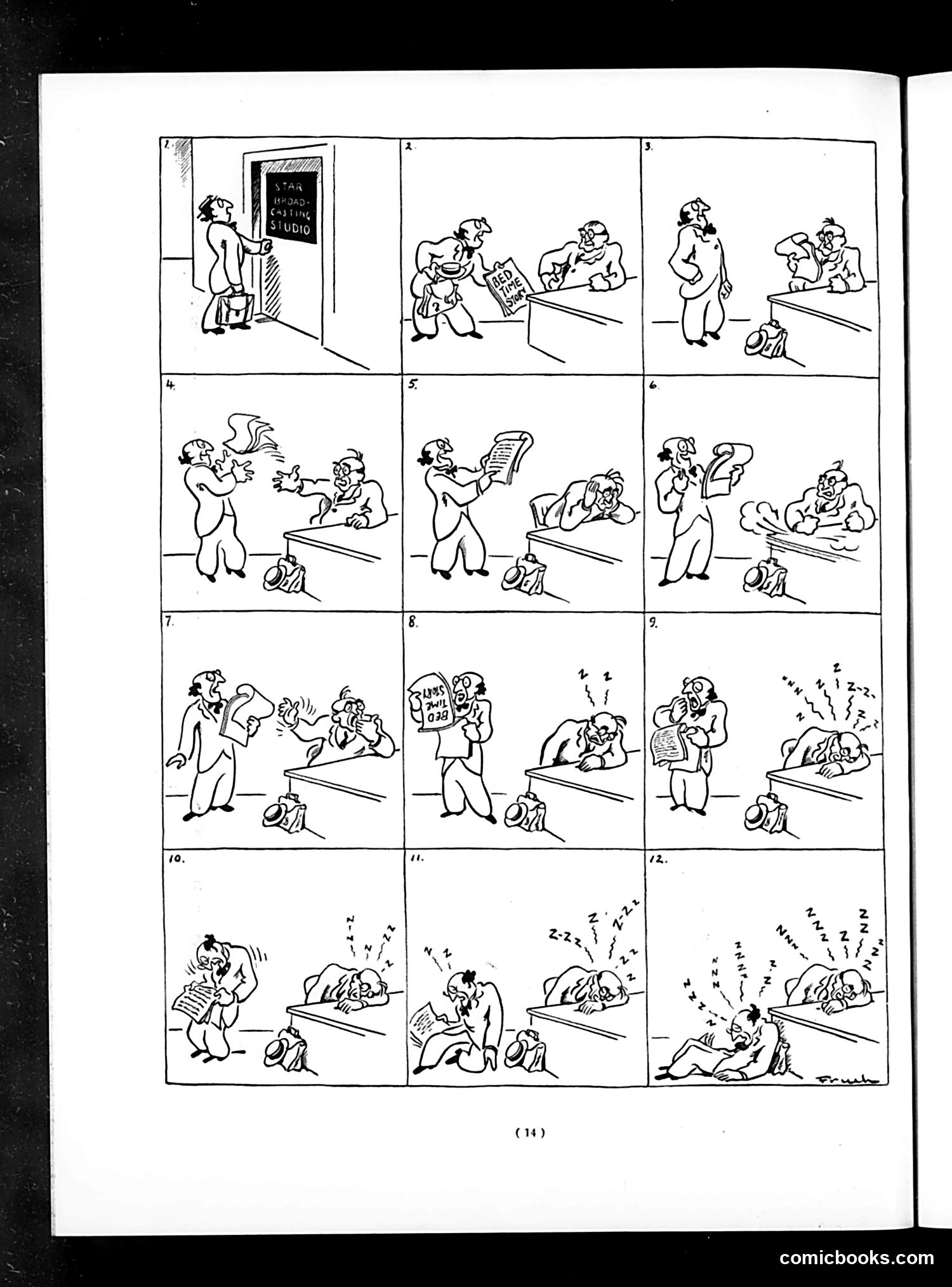
Comic Strip Analysis This is a sequential comic strip showing a man entering a "Broadcast Casting Studio" and auditioning for radio work. The narrative follows his increasingly desperate attempts to impress casting directors: he presents himself confidently (panels 1-3), performs with exaggerated gestures (4-6), grows frustrated as they ignore him (7-9), and finally exhausts himself completely (10-12), ending unconscious while the directors sleep through his performance. The satire targets the radio broadcasting industry's gatekeeping and the humiliation of aspiring performers competing for limited opportunities. It mocks both the audition process's arbitrary nature and the indifference of industry gatekeepers. The joke's modern equivalent would be streaming or social media auditions—the desperate pursuit of visibility before unimpressed judges.
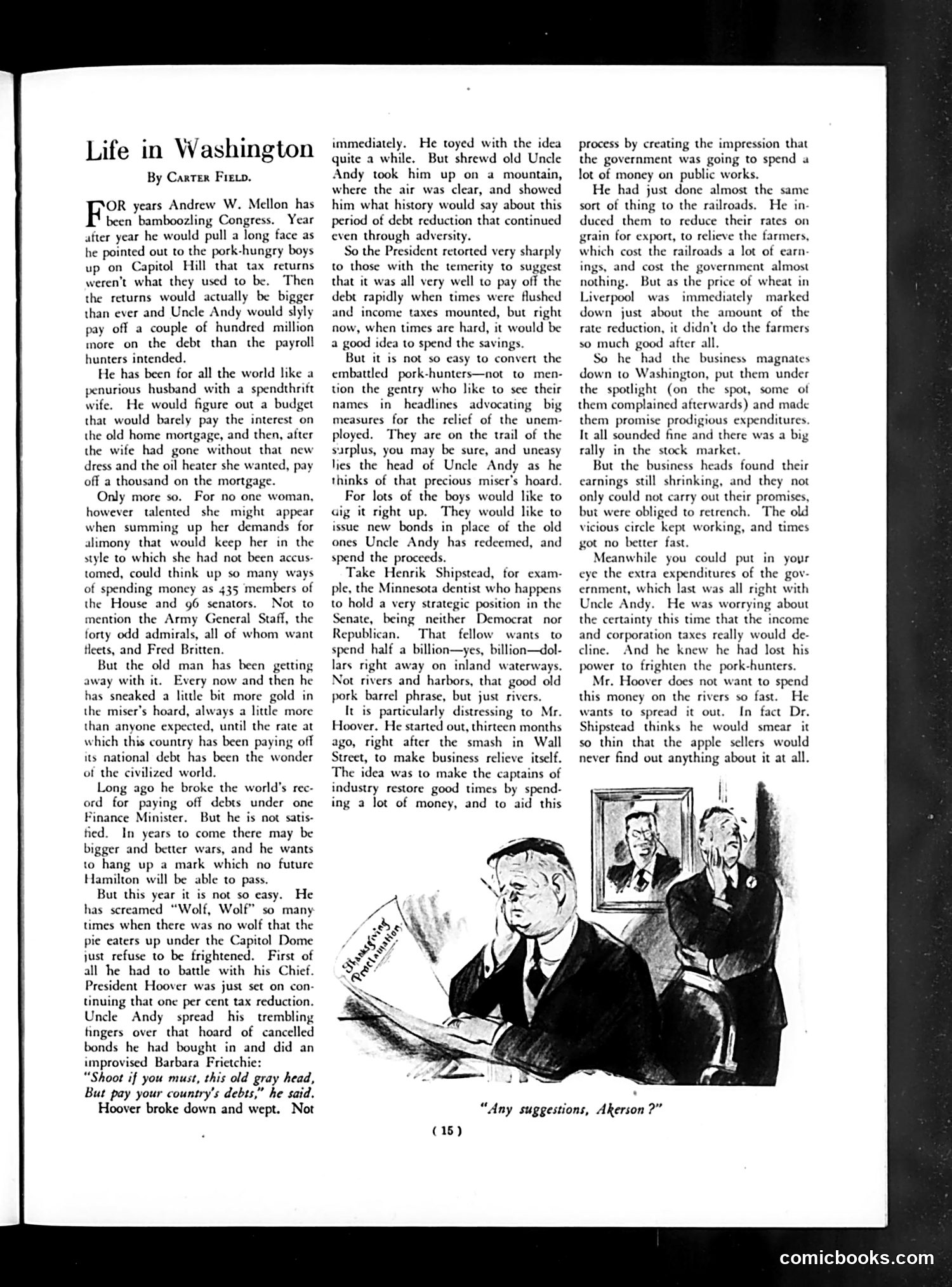
Political Cartoon Analysis The cartoon depicts a conversation between two figures examining what appears to be a financial document labeled "HOOVER'S DEBT REDUCTION" (visible in the illustration). One man holds papers while another observes, with a framed portrait visible on the wall behind them. The caption reads: "Any suggestions, Akerson?" This satirizes President Hoover's efforts to reduce the national debt during the Great Depression era. The cartoon mocks the administration's debt-reduction strategy by suggesting desperation—asking "Akerson" (likely referring to a Hoover aide or advisor) for suggestions, implying the policies are failing or inadequate. The tone is skeptical about whether Hoover's financial measures could actually address the economic crisis facing America.
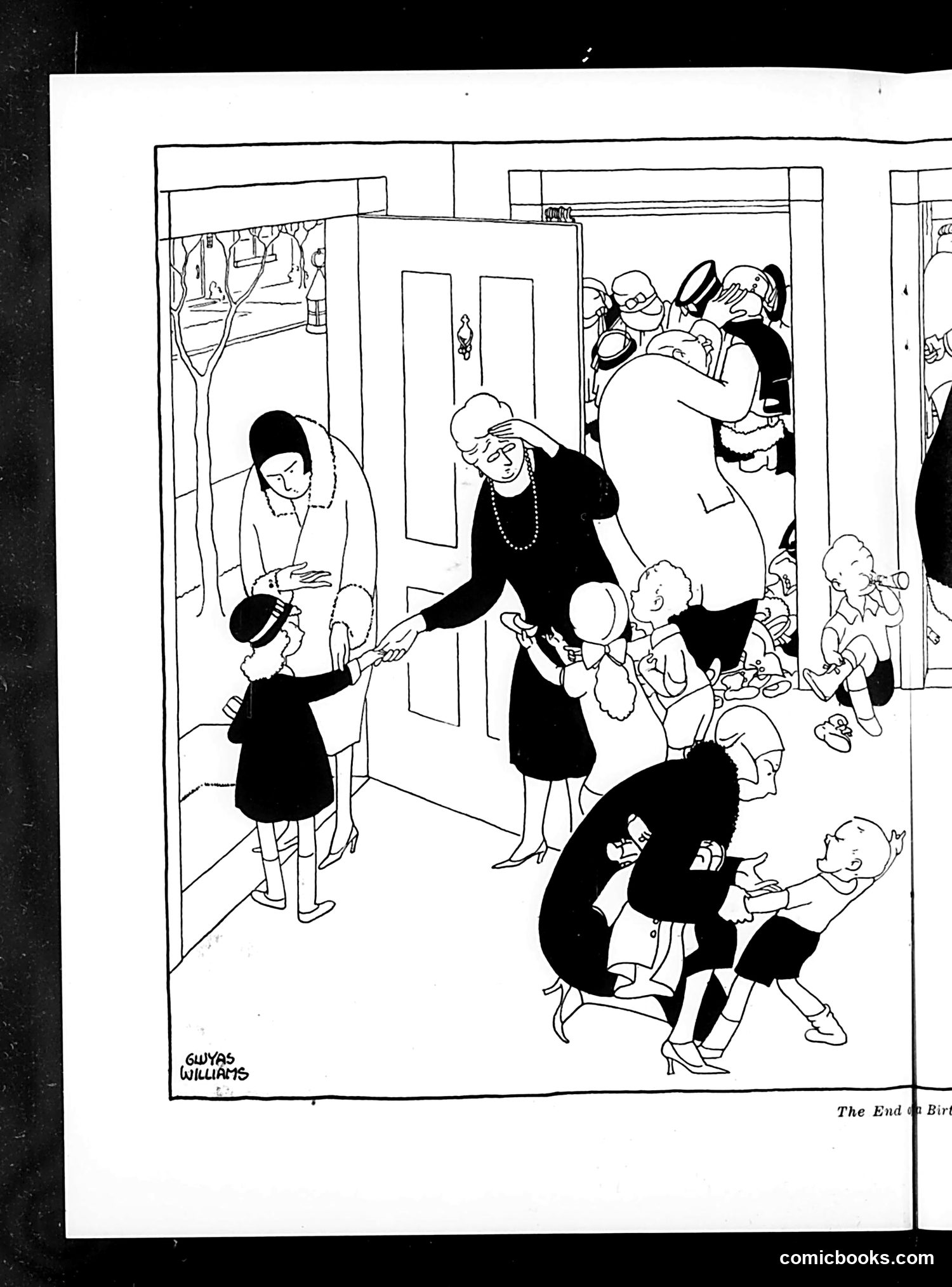
Analysis This cartoon by Gluyas Williams depicts a crowded interior scene—apparently a daycare or nursery facility—where multiple adults supervise numerous small children. The adults appear to be engaged caregivers managing the chaos of many toddlers. The caption fragment visible reads "The End of Bir[th]" (likely "The End of Birth Control"), suggesting this satirizes concerns about increased birth rates or population growth. The crowded, somewhat chaotic scene with overwhelmed-looking supervisors likely comments on anxieties about overpopulation or the consequences of reduced birth control access—a topical social issue in early-to-mid 20th century America. Williams' style emphasizes the visual humor of the crowded domestic space rather than sharp political critique, typical of *Life* magazine's satirical approach to social commentary.
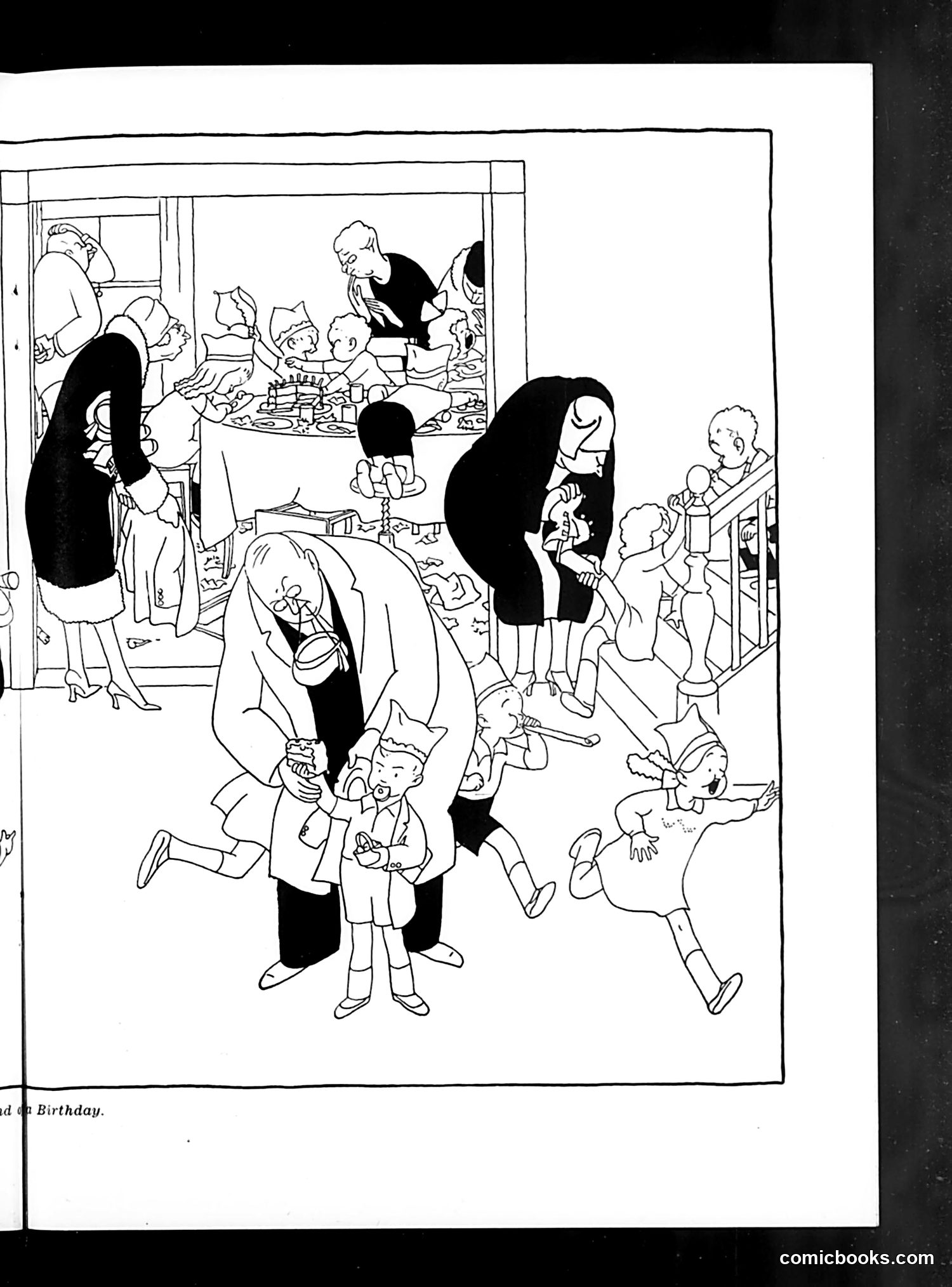
Analysis This appears to be a satirical illustration of a chaotic children's birthday party. The scene depicts adults (women in dark clothing, likely representing stern authority figures or chaperones) attempting to manage numerous unruly children engaged in various activities—eating, playing, running around—in what looks like a home setting with a dining room visible in the background. The satire likely targets the challenging reality of managing children's parties, contrasting the idealized vision of orderly celebration with the actual pandemonium that ensues. The exaggerated expressions and frantic poses of both adults and children emphasize the comedic chaos. The partial text visible ("...d of Birthday") suggests this illustration accompanies an article or humorous commentary about children's birthday entertainment.
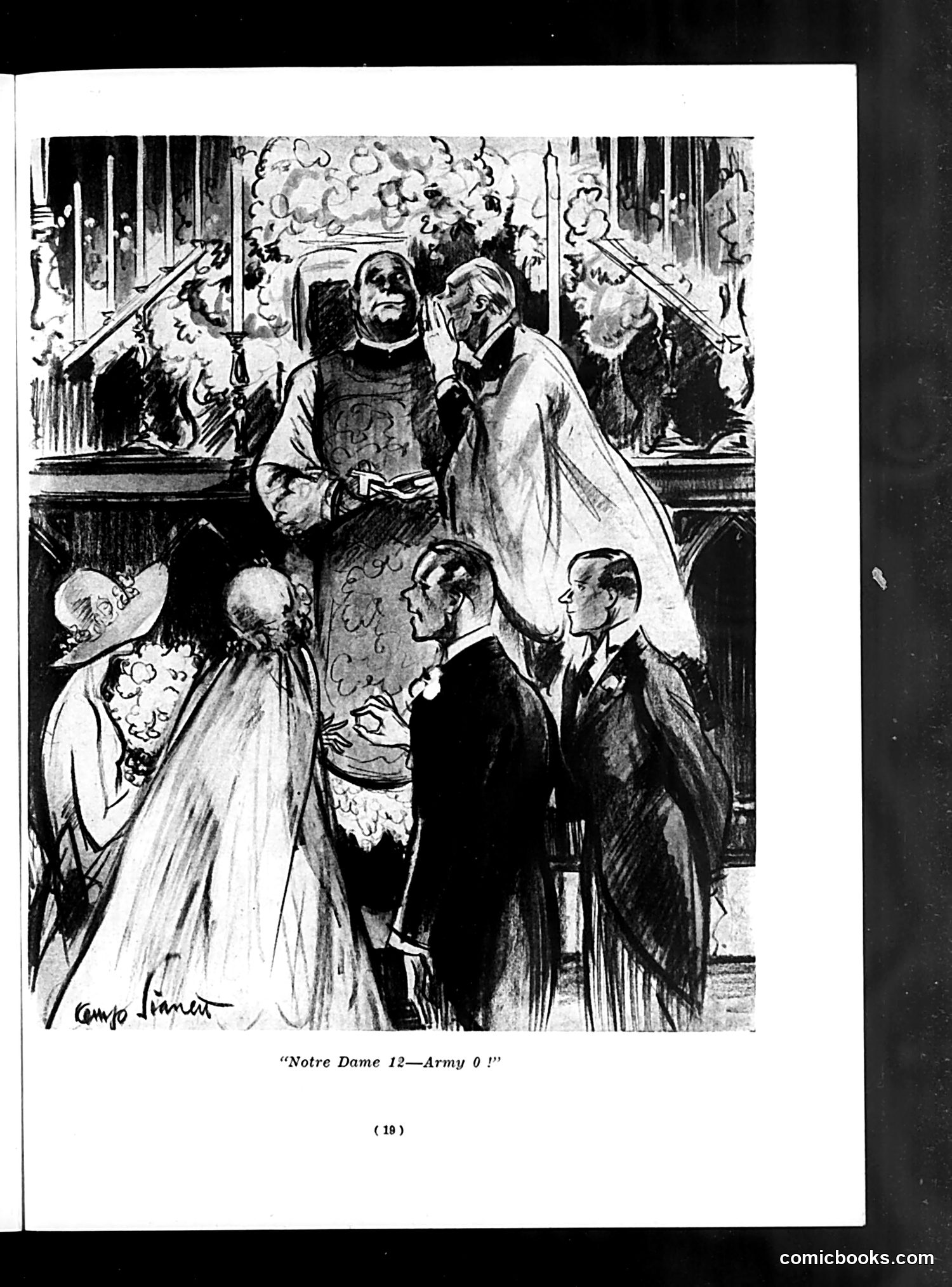
Analysis of "Notre Dame 12—Army 0!" This cartoon by Cesare Immel satirizes a college football game between Notre Dame and Army. The caption suggests Notre Dame defeated Army 12-0, apparently an upset or significant victory. The scene depicts what appears to be a formal social gathering or victory celebration, with elegantly dressed figures in formal attire and cloaks observing the event. The setting resembles a cathedral or grand hall, with spectators visible in galleries above. The satire likely mocks either the Army's unexpected defeat or the pretentious social atmosphere surrounding college football culture—treating a sporting event with the gravity of a formal religious or state ceremony. The cartoon captures early 20th-century American fascination with college football as a major cultural event worthy of high society's attention.
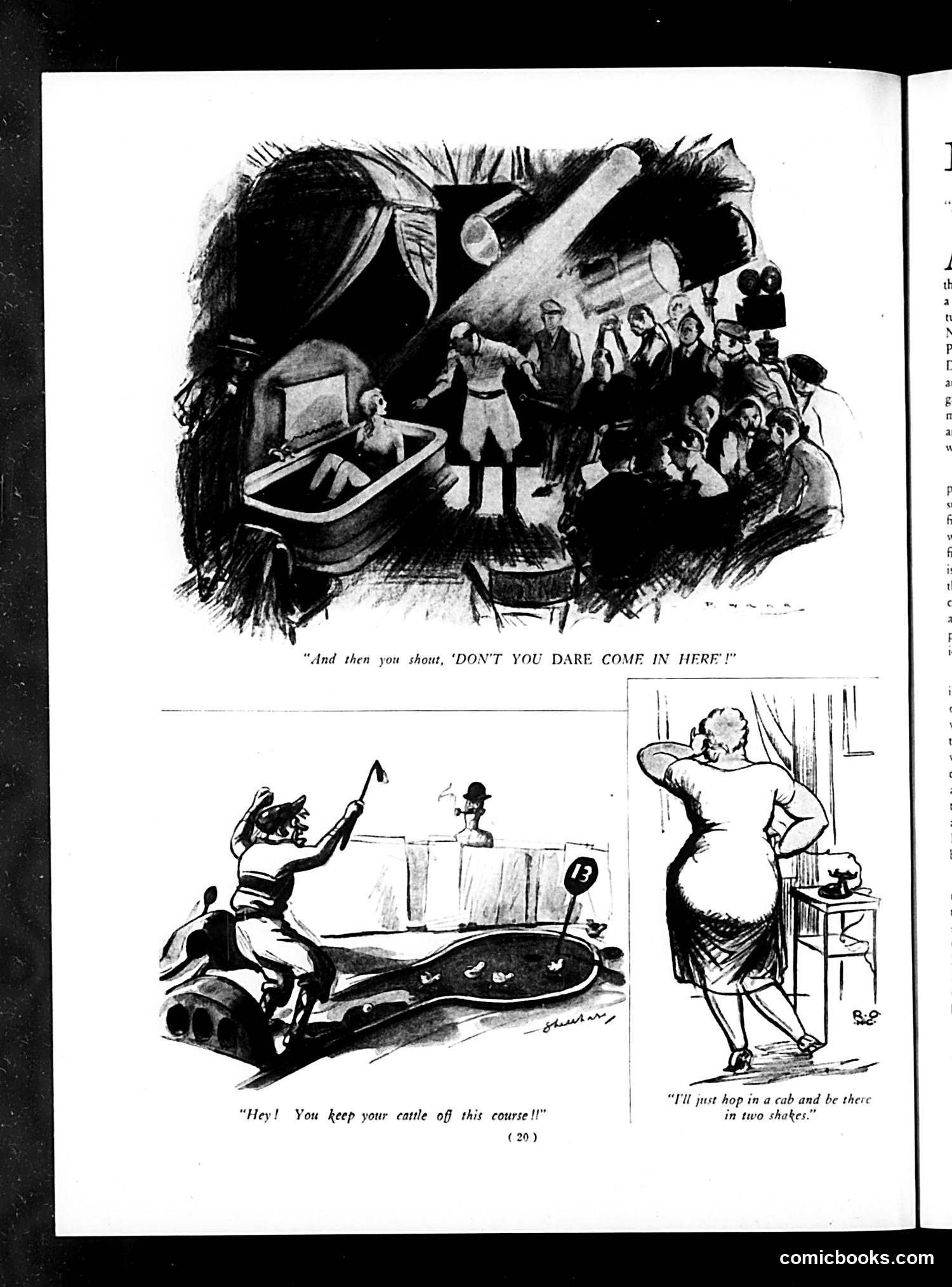
Three Cartoons on Gender and Social Behavior This page contains three separate cartoons satirizing gender roles and romantic/social dynamics: 1. Top cartoon: A theatrical scene where a woman (center stage) delivers the line "Don't YOU DARE COME IN HERE!" — apparently establishing boundaries or authority in a dramatic confrontation. 2. Bottom left: A golf course scene where a man on horseback shouts at another golfer: "Hey! You keep your cattle off this course!!" — likely mocking incompetence or rustic behavior intruding on refined sport. 3. Bottom right: A woman at her vanity mirror says she'll meet someone "in two shakes" via taxi — depicting casual attitudes toward punctuality or romantic arrangements. The cartoons appear to satirize social pretension, gender conflict, and changing modern manners in early-to-mid 20th century America, though specific historical context remains unclear without publication date.
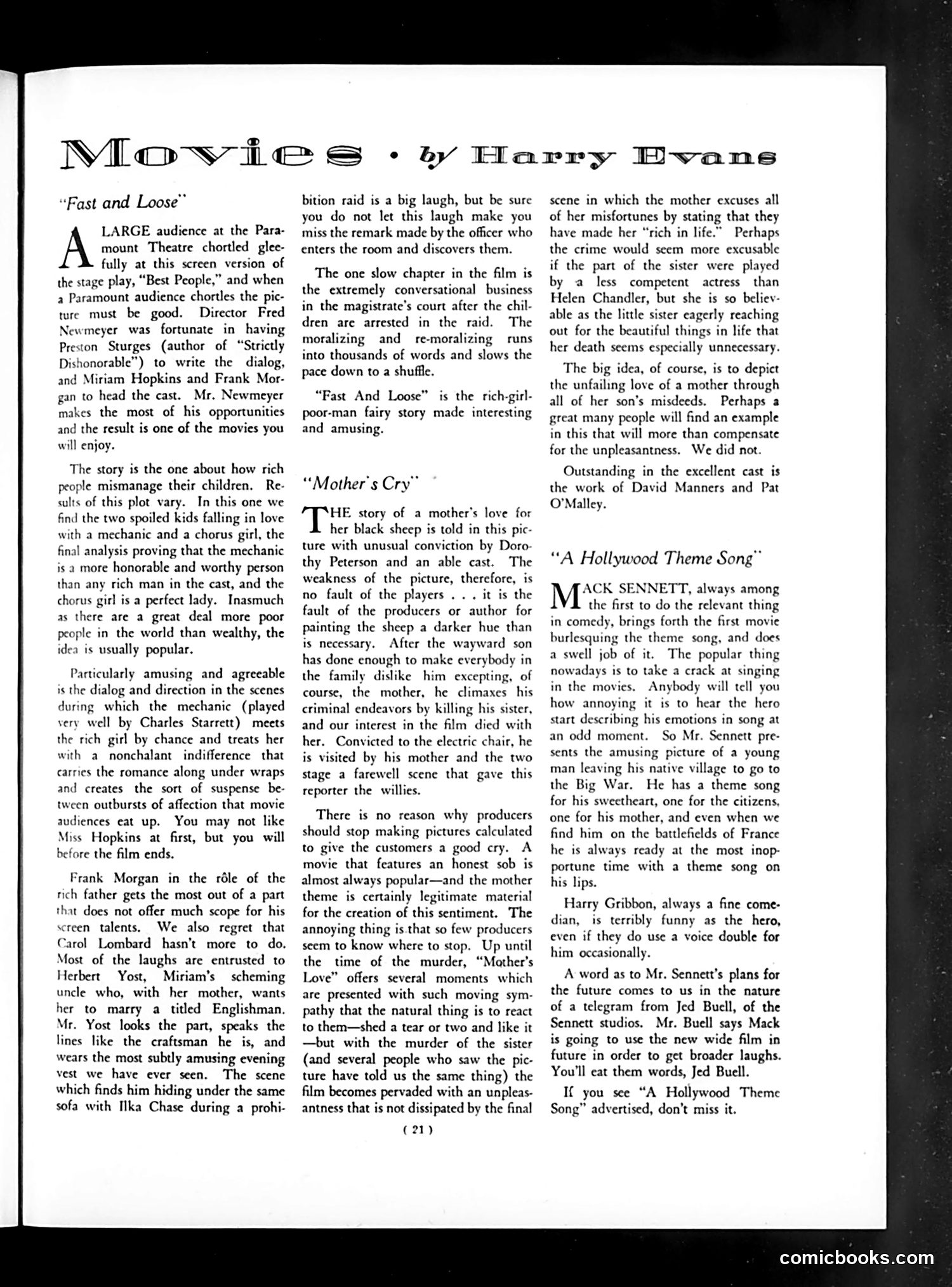
Movie Reviews by Harry Evans (Life Magazine) This page contains two film reviews from Life's movie column. The first reviews "Fast and Loose," a romantic comedy where rich children fall in love with working-class people (a mechanic and chorus girl), ultimately suggesting the poor are more honorable than the wealthy—a populist theme the reviewer notes appeals to audiences since "there are a great deal more poor people in the world than wealthy." The second reviews "Mother's Cry," a melodrama about maternal love starring Dorothy Peterson. The critic praises the performances but faults the producers for making the plot excessively dark: the wayward son commits murder and faces execution, which the reviewer argues kills audience interest. The critic argues producers don't know when to stop with tear-jerking sentiment, wasting legitimate material by overdoing the tragedy. Both reviews reflect 1920s-30s cinema conventions and middle-class entertainment values.
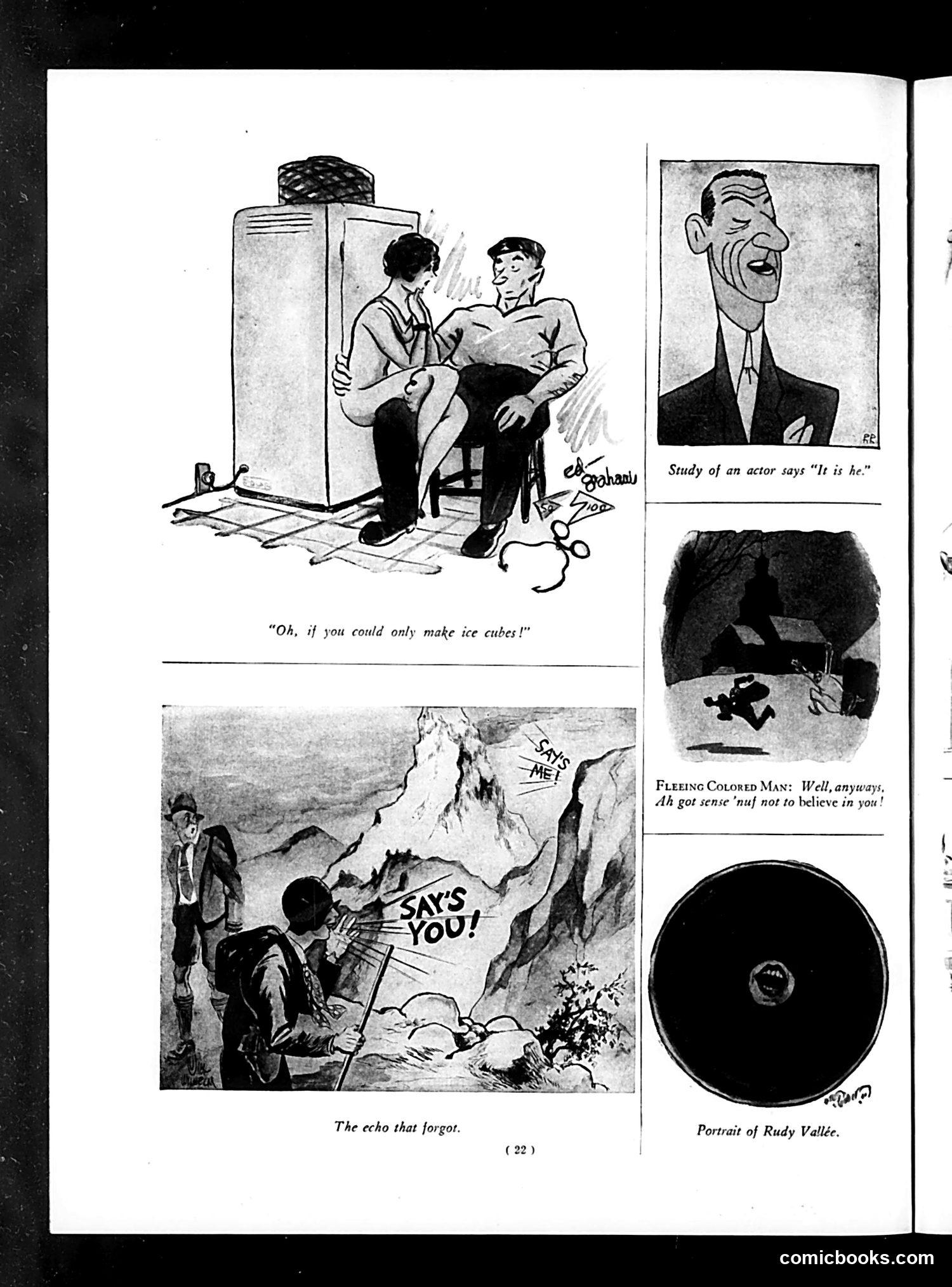
This page from *Life* magazine contains several cartoons and illustrations. The top cartoon, captioned "Oh, if you could only make ice cubes!" depicts a domestic scene where a woman gestures at a large refrigerator while speaking to a man—likely satirizing early refrigerator marketing or domestic aspirations. Below, "The echo that forgot" shows a figure in a canyon calling out "Says you!"—a visual pun on the phrase. On the right side is a caricatured "Study of an actor says 'It is he'"—a theatrical portrait study. Below that, "Fleeing Colored Man" contains a racial caricature with dialect speech, typical of the era's unfortunately common racist imagery in publications. At bottom is a "Portrait of Rudy Vallée," the famous 1920s-30s singer and entertainer, shown as a circular image—likely a phonograph record or publicity portrait. The page reflects 1920s-30s American popular culture and humor conventions, including the period's pervasive racial stereotyping.
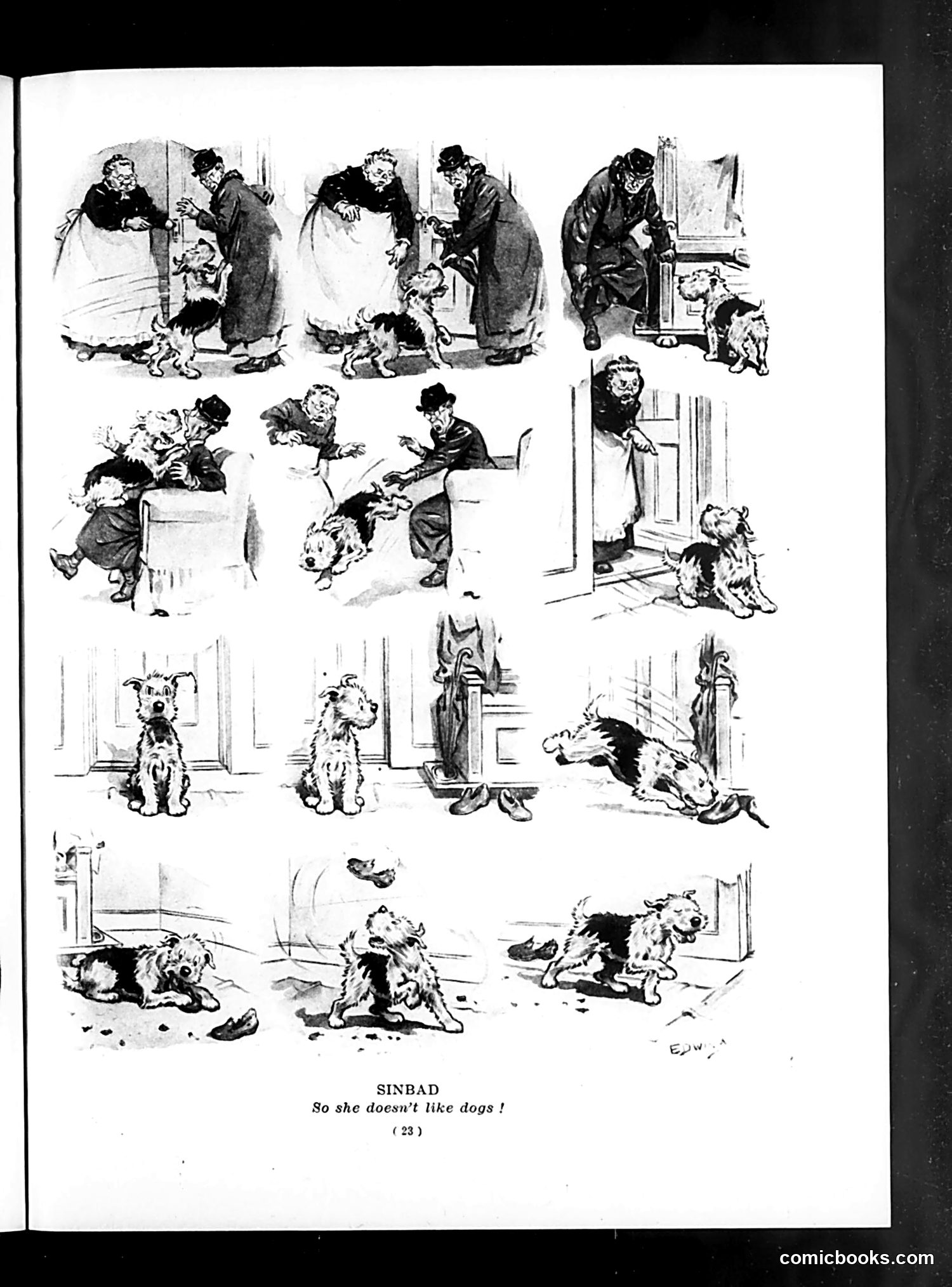
This is a humorous illustrated sequence titled "Sinbad: So she doesn't like dogs!" The comic shows a series of encounters between what appears to be a man and woman, with dogs featured prominently throughout. The narrative appears to depict a courtship scenario where the woman dislikes dogs, creating comedic situations. The top panels show the man attempting to manage or hide dogs during interactions with the woman. The middle and lower panels show various dogs in different states—sitting, playing, or causing mischief—apparently sabotaging the man's romantic efforts. The humor relies on the physical comedy of dogs undermining the man's attempts to impress a dog-averse woman, a relatable domestic comedy premise. The page number "(23)" suggests this is part of a longer serialized story in Life magazine.
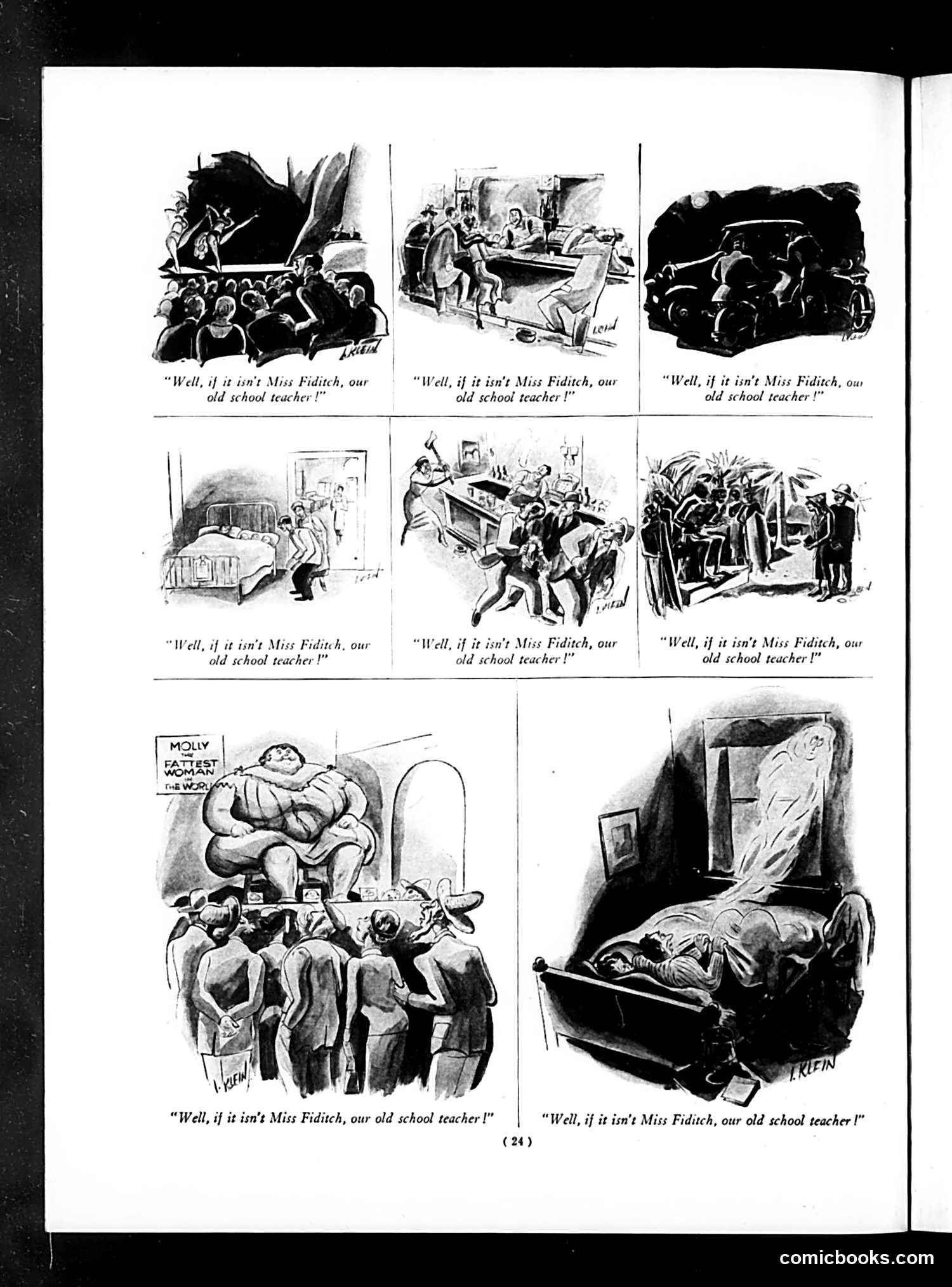
"Miss Fiditch, Our Old School Teacher" This is a comic series showing various unlikely scenarios where people encounter their former teacher Miss Fiditch—in a theater audience, on a boat, in a car, at a nightclub, as "the fattest woman in the world" at a circus sideshow, and in a coffin at a funeral. The joke is the running gag: no matter how absurd or inappropriate the setting (a burlesque show, a death bed), characters greet her with the same bland, polite phrase. The humor relies on the contrast between Miss Fiditch's dignified, respectable role as a schoolteacher and the ridiculous or undignified contexts where she's unexpectedly "discovered." It satirizes social awkwardness and the absurdity of maintaining conventional politeness in surreal situations.
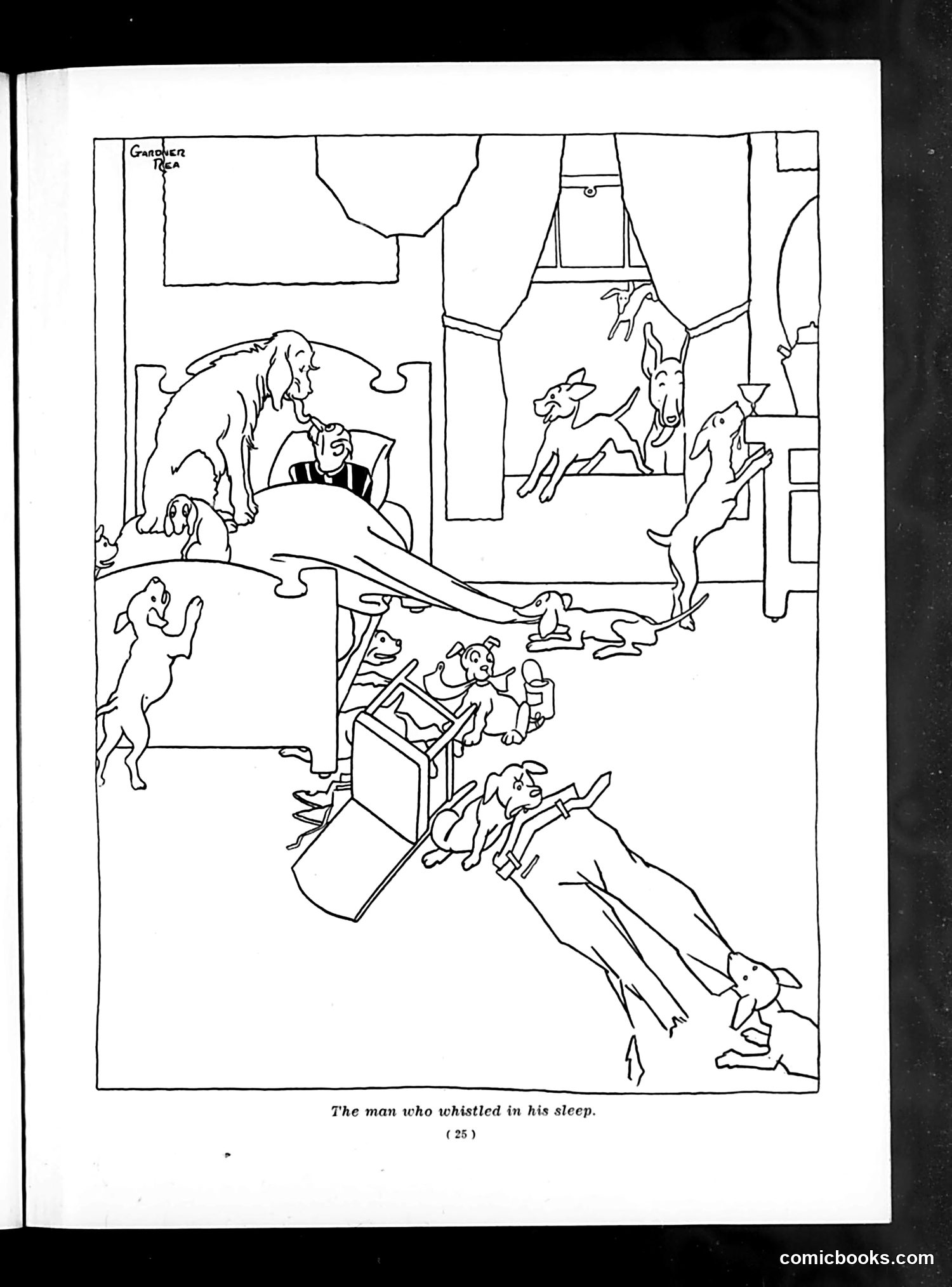
"The Man Who Whistled in His Sleep" This single-panel cartoon depicts a domestic chaos scenario. A man lies sleeping on a bed while dozens of dogs—large and small—have invaded his home across multiple rooms. The dogs are jumping on furniture, climbing on people, and creating general mayhem throughout the house. One person sits up in bed appearing distressed, while another figure is sprawled on the floor surrounded by dogs. The caption suggests the man's innocent habit of whistling while asleep has attracted all these dogs, creating a humorous exaggeration of cause-and-effect. This appears to be a straightforward comedic illustration rather than political satire—the joke relies on visual absurdity and relatable domestic disruption rather than commentary on current events or public figures.
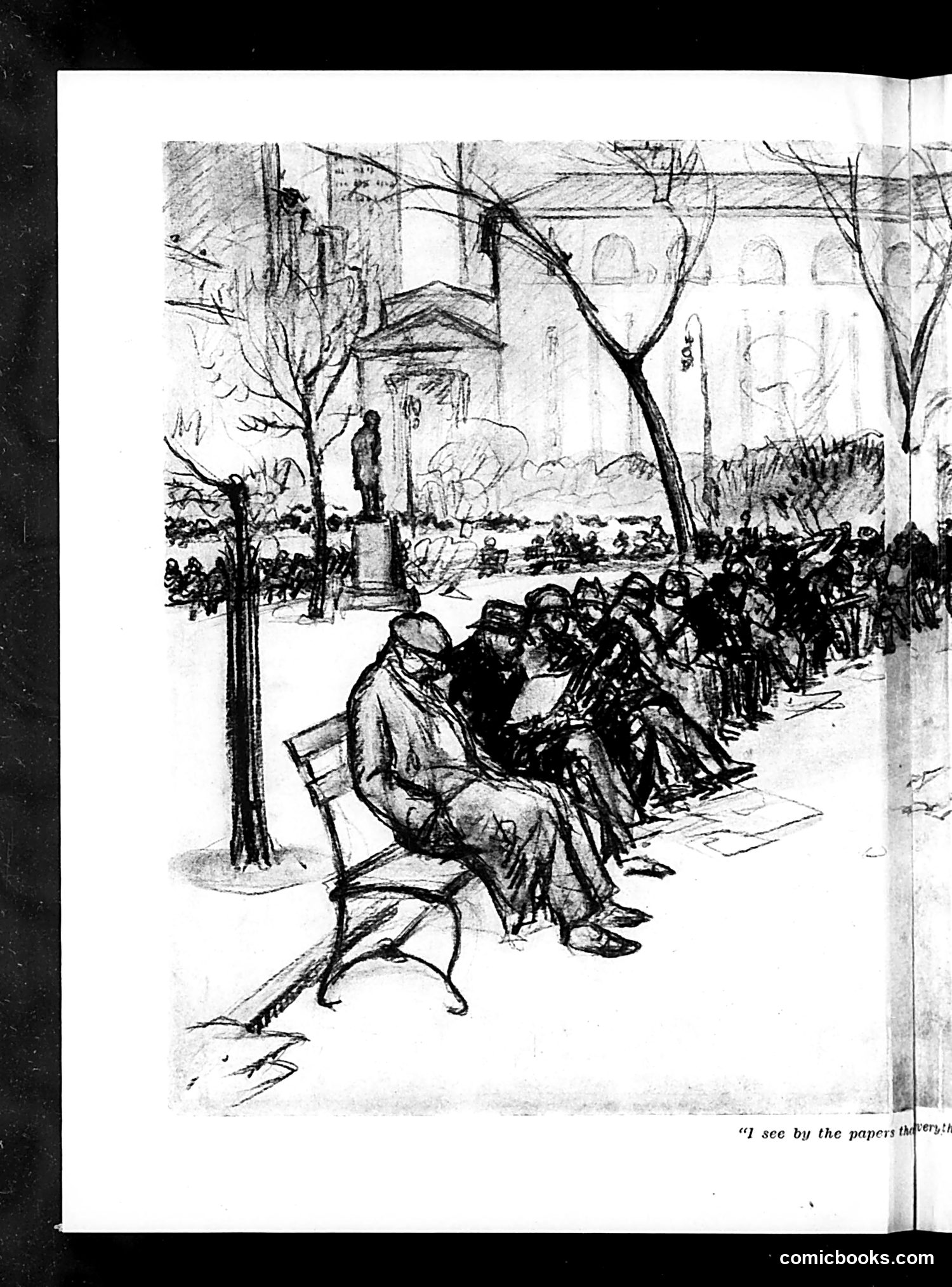
Analysis This is a sketch depicting a line of people sitting on benches in what appears to be a public square or plaza, with bare winter trees and a large building in the background. The figures are rendered in dark ink with period clothing suggesting early-to-mid 20th century. The caption reads: "I see by the papers th[at]..." (text cuts off), suggesting social commentary based on newspaper reports. The scene appears to depict unemployment or public relief—people waiting or gathered in a civic space, likely during economic hardship. The satirical point seems to be commentary on unemployment, poverty, or public assistance, with the incomplete caption implying ironic observation of official reports versus visible street-level reality. However, without the complete caption and without certain context about which Life magazine issue this is from, I cannot definitively identify the specific historical event or political target being satirized.
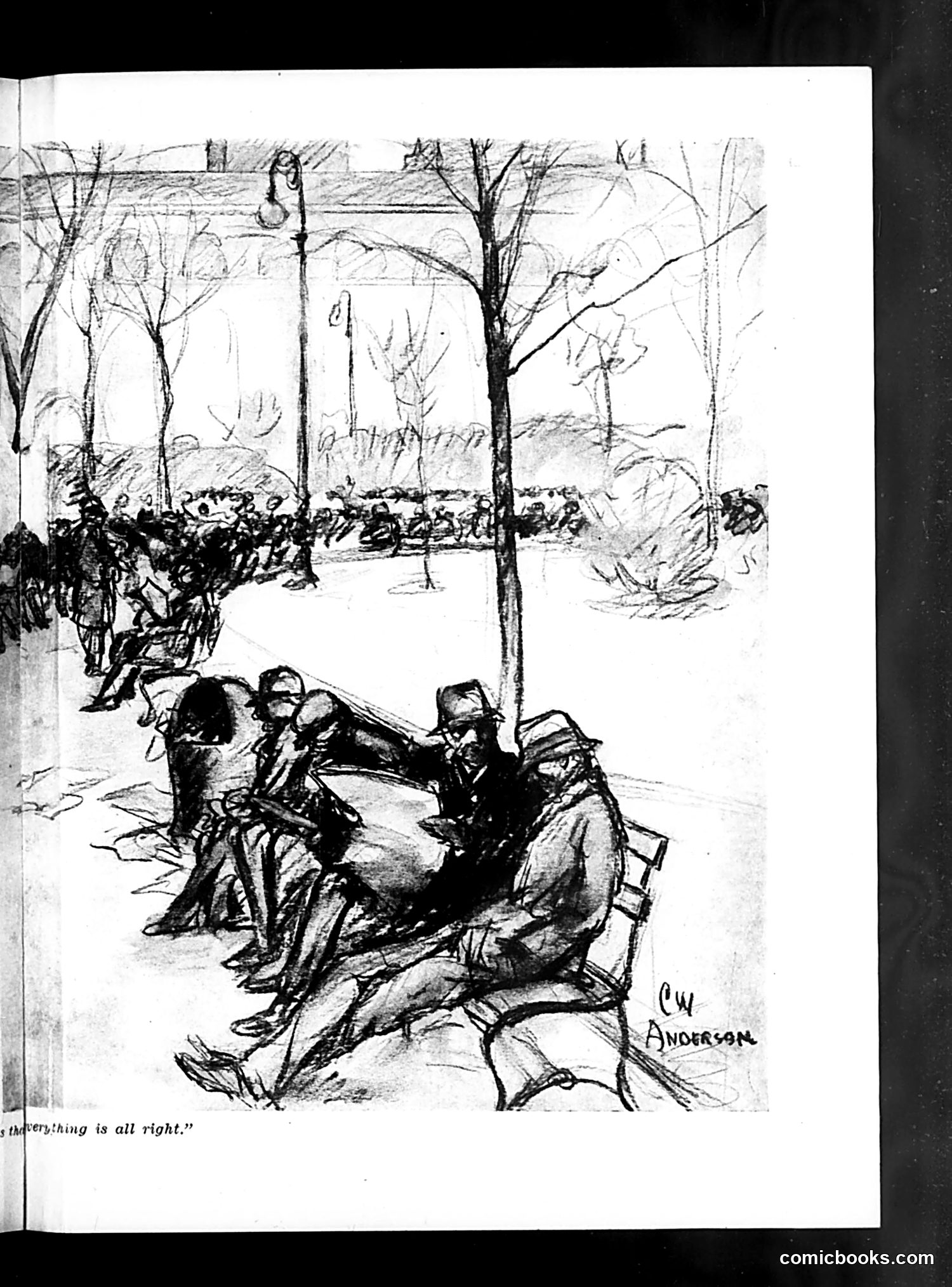
Analysis This sketch by C.W. Anderson depicts a park or public square scene with bare winter trees. In the foreground, several men in hats and coats sit or stand together in casual conversation. In the background, a larger crowd of figures gathers near what appears to be a public structure or bandstand. The visible caption fragment reads "everything is all right," suggesting ironic commentary—likely contrasting the casual, leisurely scene with some contemporary social or economic crisis. Given Life magazine's satirical tradition, this probably comments on public indifference or government reassurance during difficult times (possibly referencing 1920s-1930s economic or social turmoil). The juxtaposition between the calm foreground and anxious-seeming crowd behind implies disconnect between official narratives and actual public concern.
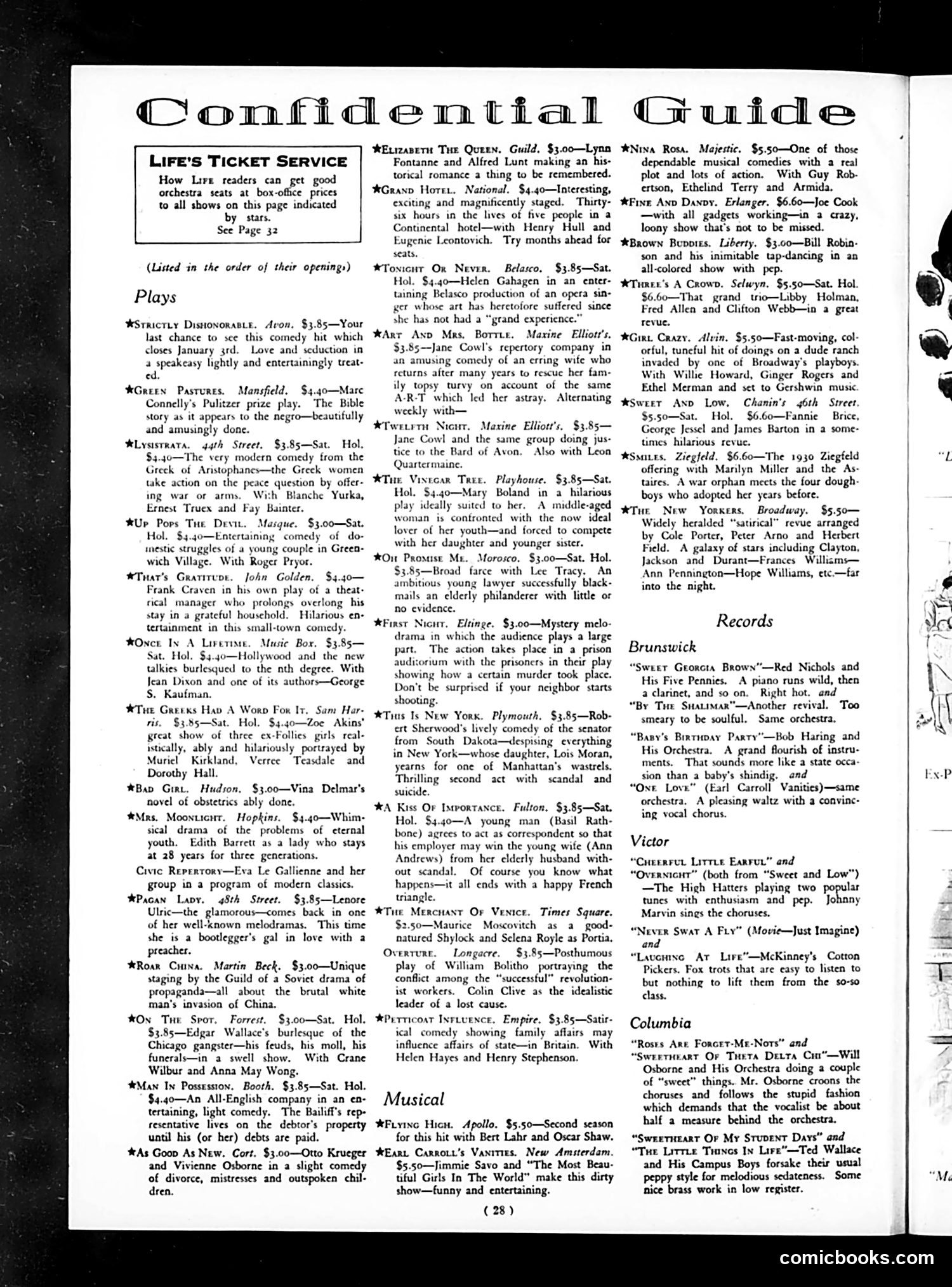
Analysis of Life Magazine Theater Guide Page This page is primarily a theater listing and review guide, not a political cartoon. It's a "Confidential Guide" to Broadway shows currently playing, arranged alphabetically by theater. The content reflects 1920s-30s entertainment culture: reviews of plays, musicals, and revues with ticket prices and brief synopses. Notable entries include: - "Green Pastures" (noted as a Pulitzer Prize winner)—described as the Bible story "as it appears to the negro"—reflecting period attitudes - Multiple references to famous performers: Jane Cowl, Fannie Brice, Ginger Rogers, Ethel Merman - A satirical Cole Porter revue ("The New Yorkers") arranged by humorist Peter Arno - Record reviews of contemporary orchestras The sidebar "Life's Ticket Service" offers readers access to box-office seats, indicating Life's role as a lifestyle/entertainment magazine for affluent readers. This is primarily consumer advertising and cultural commentary, not satire or political content.
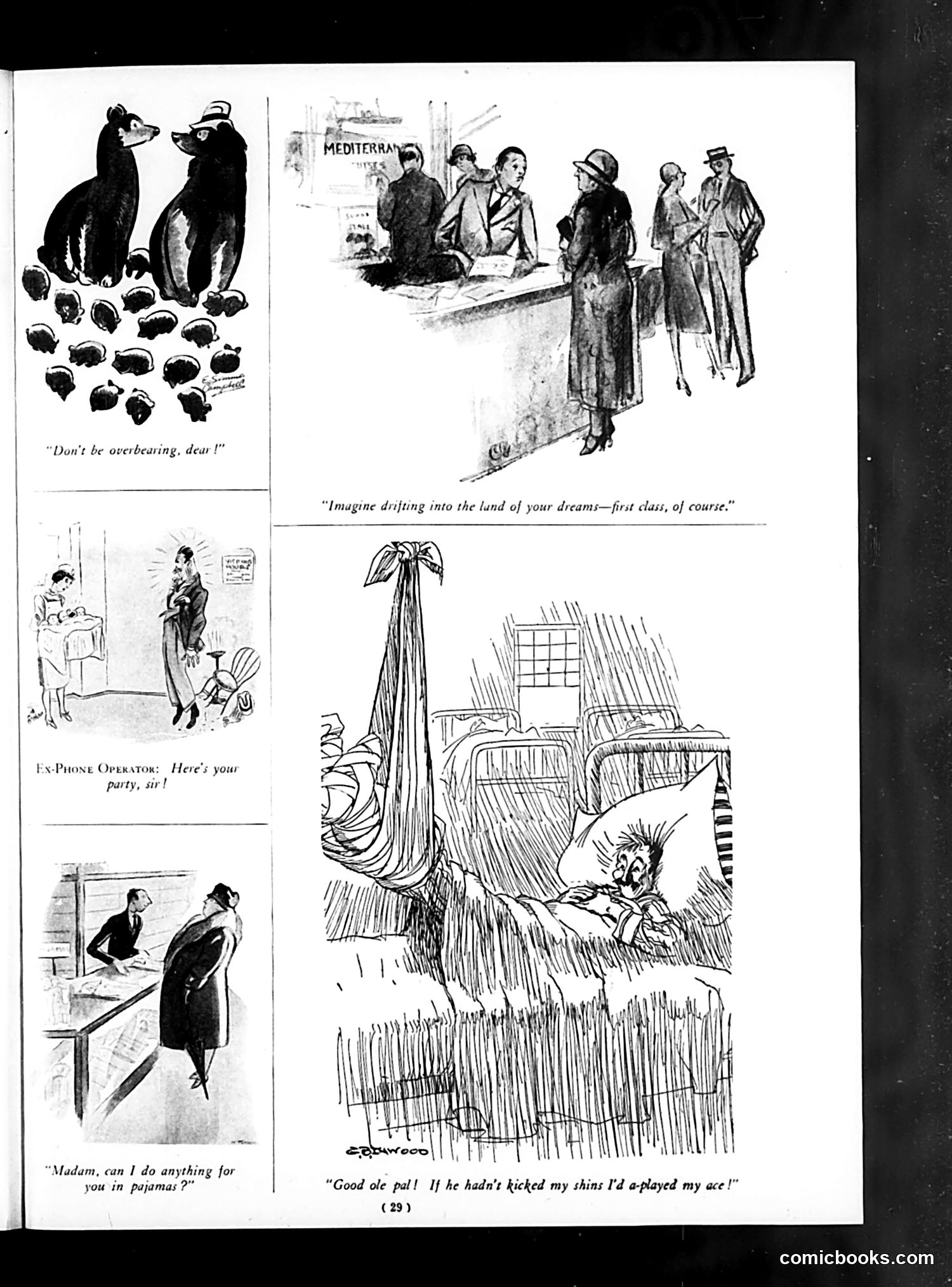
Page Analysis This page contains four separate cartoons satirizing early 20th-century social situations: 1. Top left: Two bears with fish below, captioned "Don't be overbearing, dear!"—a pun on bear behavior and marital dynamics. 2. Top right: A ship labeled "Mediterranean" with passengers, captioned about "drifting into the land of your dreams—first class, of course"—mocking wealthy tourists and travel aspirations. 3. Middle left: An ex-phone operator offering party services, and another scene with someone asking "Madam, can I do anything for you in pajamas?"—both playing on changing women's social roles and innuendo. 4. Bottom right: A bedroom scene captioned "Good ole pal! If he hadn't kicked my shins I'd a-played my ace!"—depicting a card game disrupted by violence, likely satirizing male friendships or gambling culture. The humor relies on wordplay, social observation, and period-appropriate innuendo rather than political commentary.
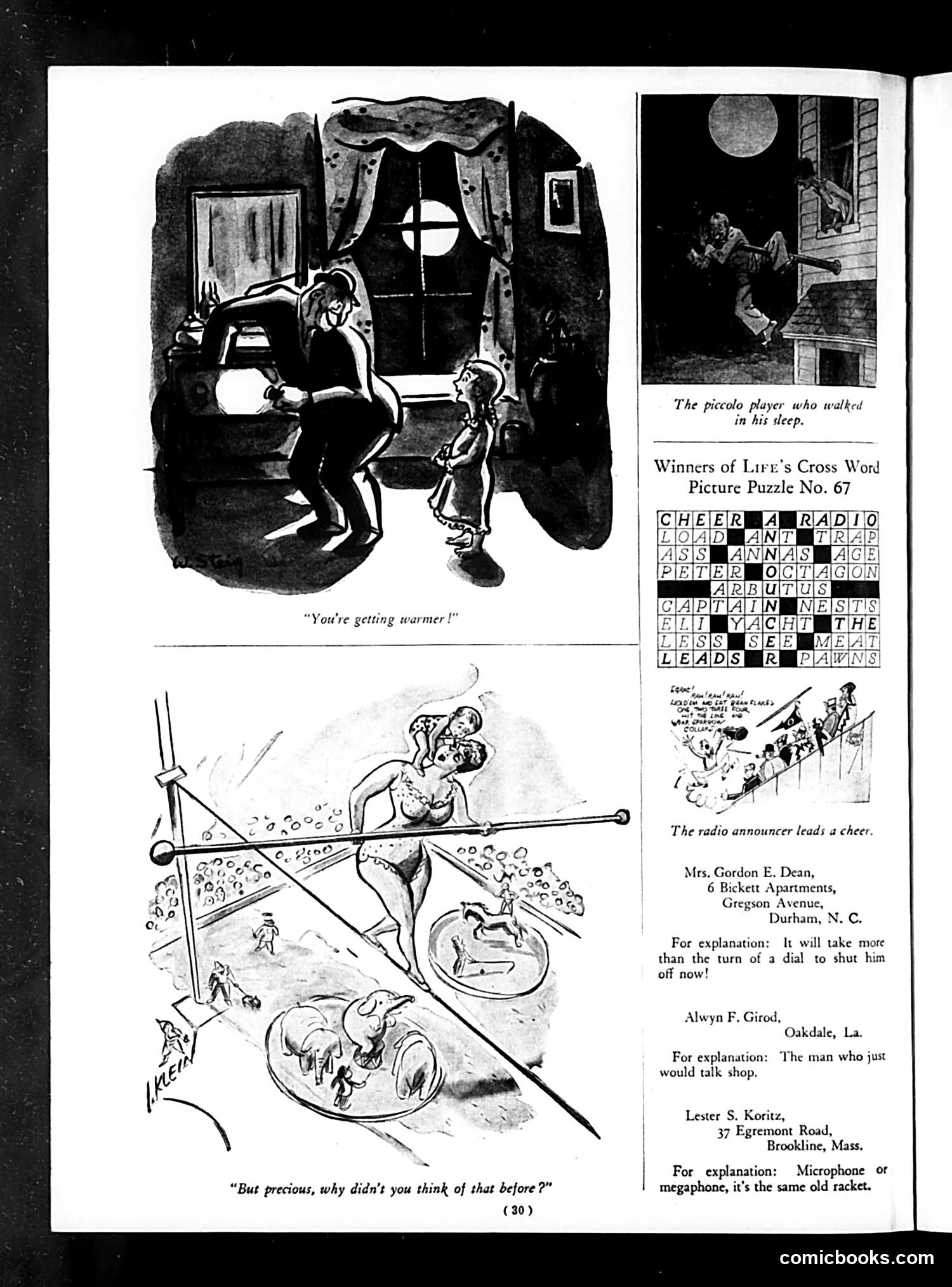
Life Magazine Cartoon Page Analysis This page showcases Life's Cross Word Picture Puzzle No. 67, featuring humorous cartoon illustrations with reader-submitted explanations for the jokes. The top cartoon depicts a couple playing a parlor game ("You're getting warmer!"), likely a hide-and-seek variant popular in the 1920s-30s. The larger bottom cartoon, titled "But precious, why didn't you think of that before?", uses a magnifying glass or amplification device as visual metaphor. The winning explanations joke about contemporary technology: a radio announcer who can't be turned off despite "turning the dial," and a microphone being a "racket"—implying radio broadcasting was either inescapable or a con. These cartoons satirize modern technology's intrusion into domestic life and the era's fascination with radio as a new mass medium. The "racket" reference likely comments on radio's commercialism or the loud, invasive nature of amplified sound.
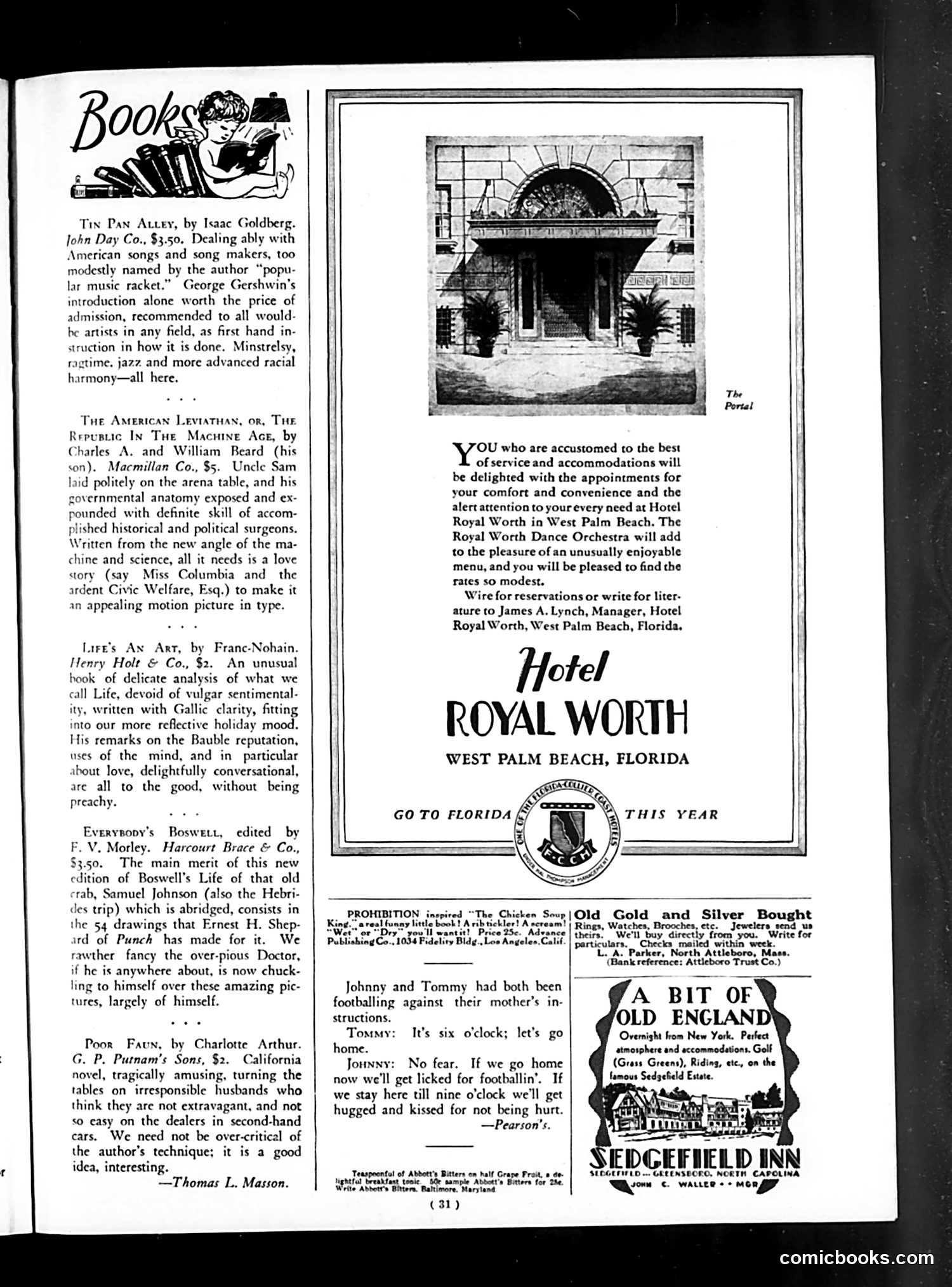
Life Magazine Page Analysis This page is primarily book reviews and advertisements rather than political cartoons. The main content includes reviews of five books on diverse topics: American popular music (Tin Pan Alley), American political history (The American Leviathan), philosophy (Life's An Art), and literature. The only humorous content is a brief joke at the bottom from *Pearson's* magazine about two boys, Johnny and Tommy, who deliberately stay out late playing football. The humor lies in their reasoning: returning home early means punishment for breaking their mother's rules, but staying out until 9 p.m. means they'll receive affection instead—because their mother will be relieved they weren't seriously injured. This reflects early 20th-century parenting attitudes and child safety concerns. The page otherwise features hotel and product advertisements typical of the era.
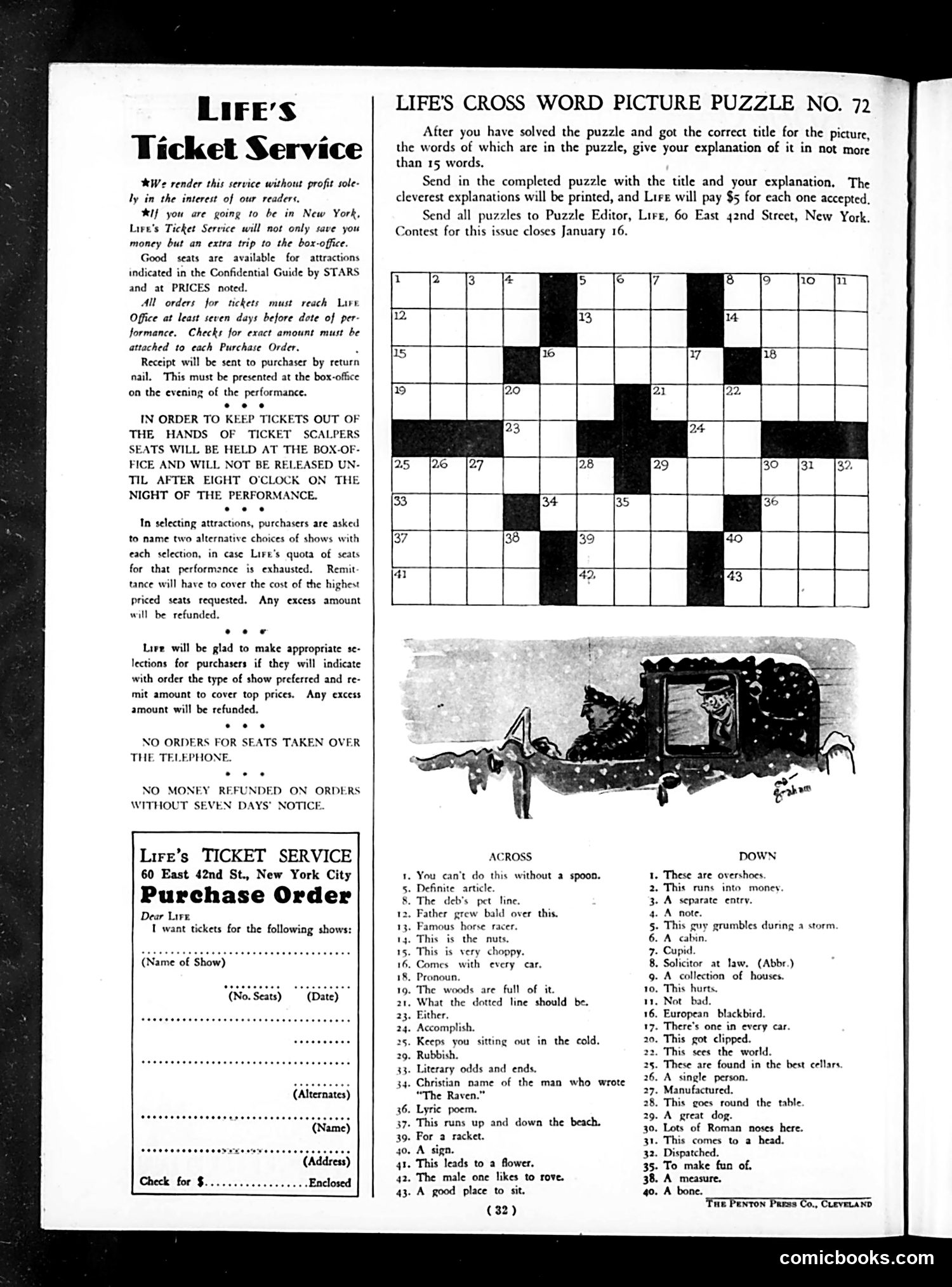
This page is primarily advertising and service content, not political satire. It contains: 1. Life's Ticket Service (left column): An advertisement offering theater ticket purchasing for New York shows, with terms like holding seats until 8 PM to prevent scalping. 2. Crossword Picture Puzzle No. 72 (right side): A recreational puzzle contest where solvers identify a picture's title and explain it in 15 words or fewer, with $5 payment for accepted explanations. 3. A small illustration showing what appears to be people in a car or vehicle, likely the picture puzzle's subject. The page reflects 1920s-30s Life magazine's dual purpose: satirical commentary mixed with lifestyle services for urban, affluent readers. The crossword clues contain period vernacular ("the deb's pet line," "rubbish") but contain no political content—just leisure entertainment and practical services.
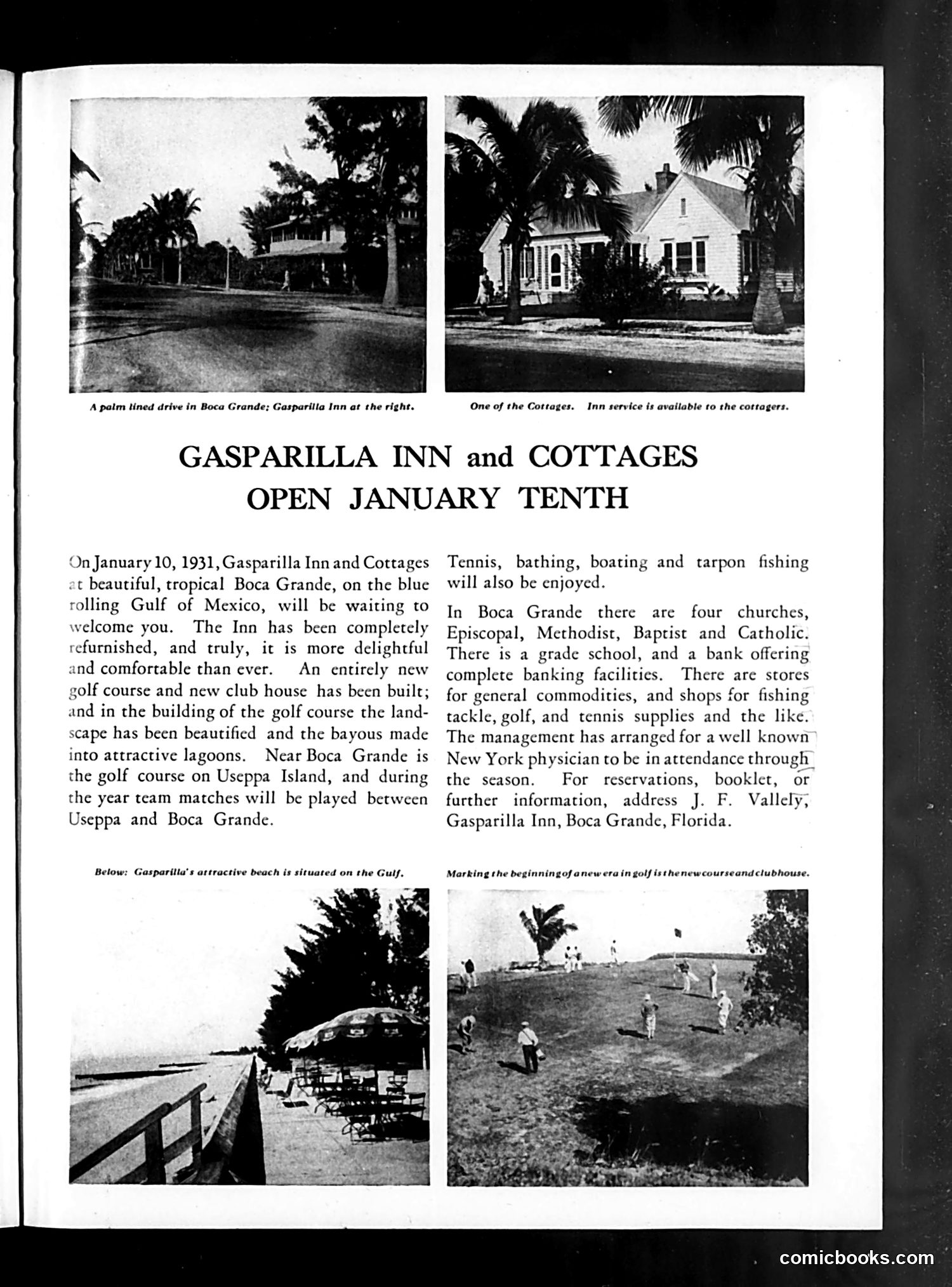
This is not a cartoon or satire page This is a straightforward real estate and tourism advertisement for the Gasparilla Inn and Cottages in Boca Grande, Florida, announcing its January 10, 1931 opening. The page contains four photographs showing the palm-lined drive, a cottage, the beach, and the new golf course, accompanied by promotional text highlighting amenities: golf, tennis, bathing, boating, tarpon fishing, churches, schools, banking, and a resident New York physician. There is no political satire, caricature, or joke here. This appears to be a paid advertisement placed in *Life* magazine to market a luxury Florida resort destination to wealthy readers during the early Depression era—when such vacation spots remained accessible to the affluent.
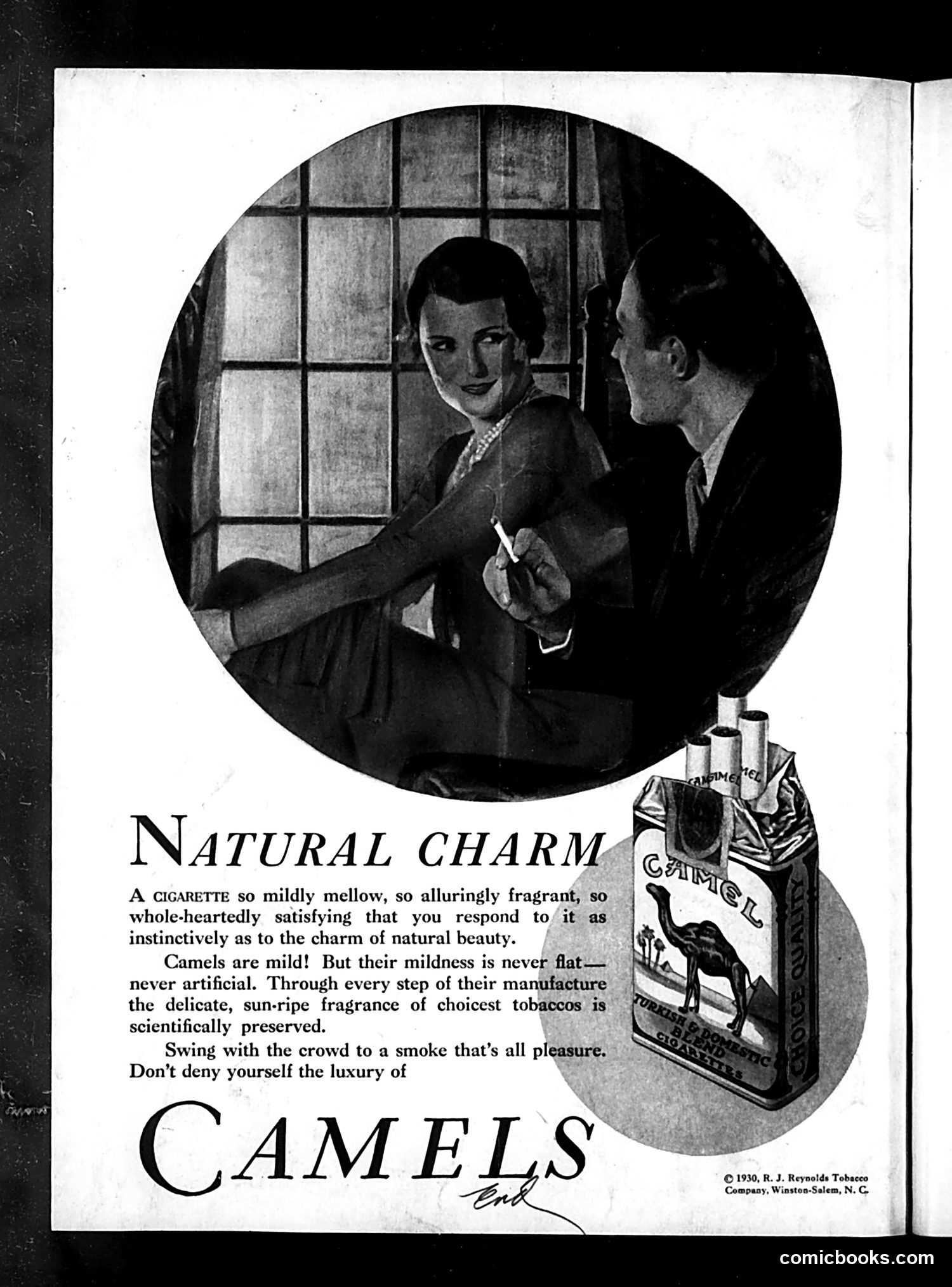
Analysis This is a Camel cigarette advertisement, not political satire. Dated 1930, it uses a romantic scene—a well-dressed couple in an intimate moment by a window—to market cigarettes through appeals to "natural charm" and sophistication. The ad employs typical 1930s advertising rhetoric: claims that Camels are "mildly mellow" and "scientifically preserved," positioning smoking as a marker of luxury and social desirability. The image associates cigarettes with romantic allure and upper-class leisure. For modern readers: this exemplifies pre-health-warning tobacco marketing that freely promoted smoking without mentioning addiction or health risks—practices now illegal in most Western countries. The "natural beauty" framing ironically disguised an addictive product through aspirational imagery.

I can see this is a blank or nearly blank page from what appears to be a historical publication. The only visible text is "comicbooks.com" at the bottom, which is a modern watermark added during digitization and not part of the original Life magazine page. Without any visible cartoon imagery, satirical content, text, or other editorial material on the page itself, I cannot identify figures, political references, or the point of any satire. This appears to be either a blank page, a title page, or an advertising page from the original publication that has not reproduced clearly in this scan. To provide meaningful historical and satirical analysis, I would need a page with visible cartoon artwork or readable text content.