life
Life — January 2, 1931
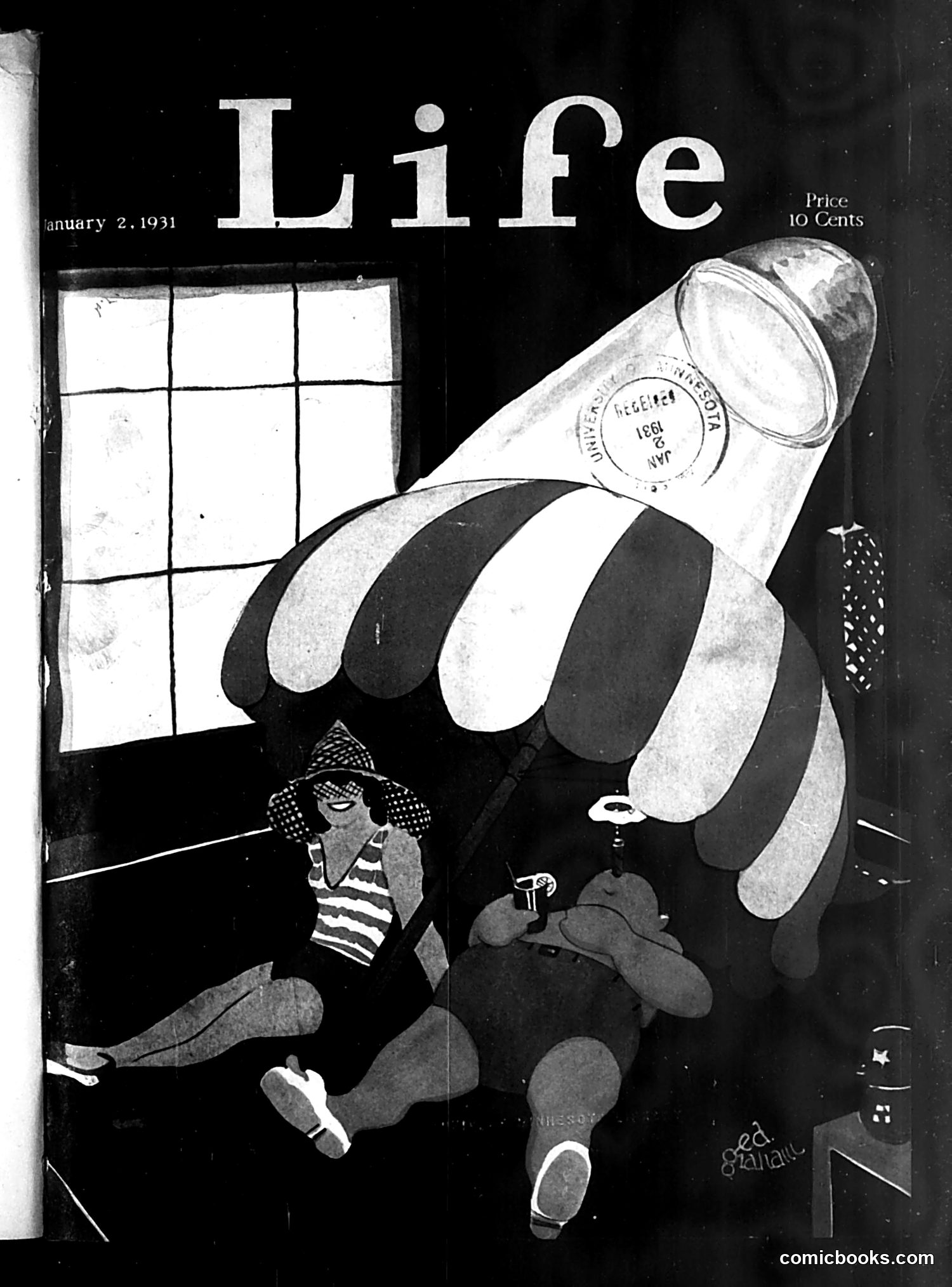
Life Magazine Cover Analysis (January 2, 1931) This is a Life magazine cover from early 1931, during the Great Depression. The illustration shows a large striped hot-air balloon descending toward a window where a woman in a hat sits below. The balloon appears to represent inflated economic optimism or speculation—a common metaphor during this period of financial crisis. The satire likely critiques either false hopes about economic recovery or the disconnect between wealthy speculators and ordinary citizens suffering during the Depression. The woman's positioned below, watching the balloon descend, suggests ordinary people witnessing the collapse of inflated financial schemes or promises. The 10-cent price reflects Depression-era affordability for this satirical weekly magazine.
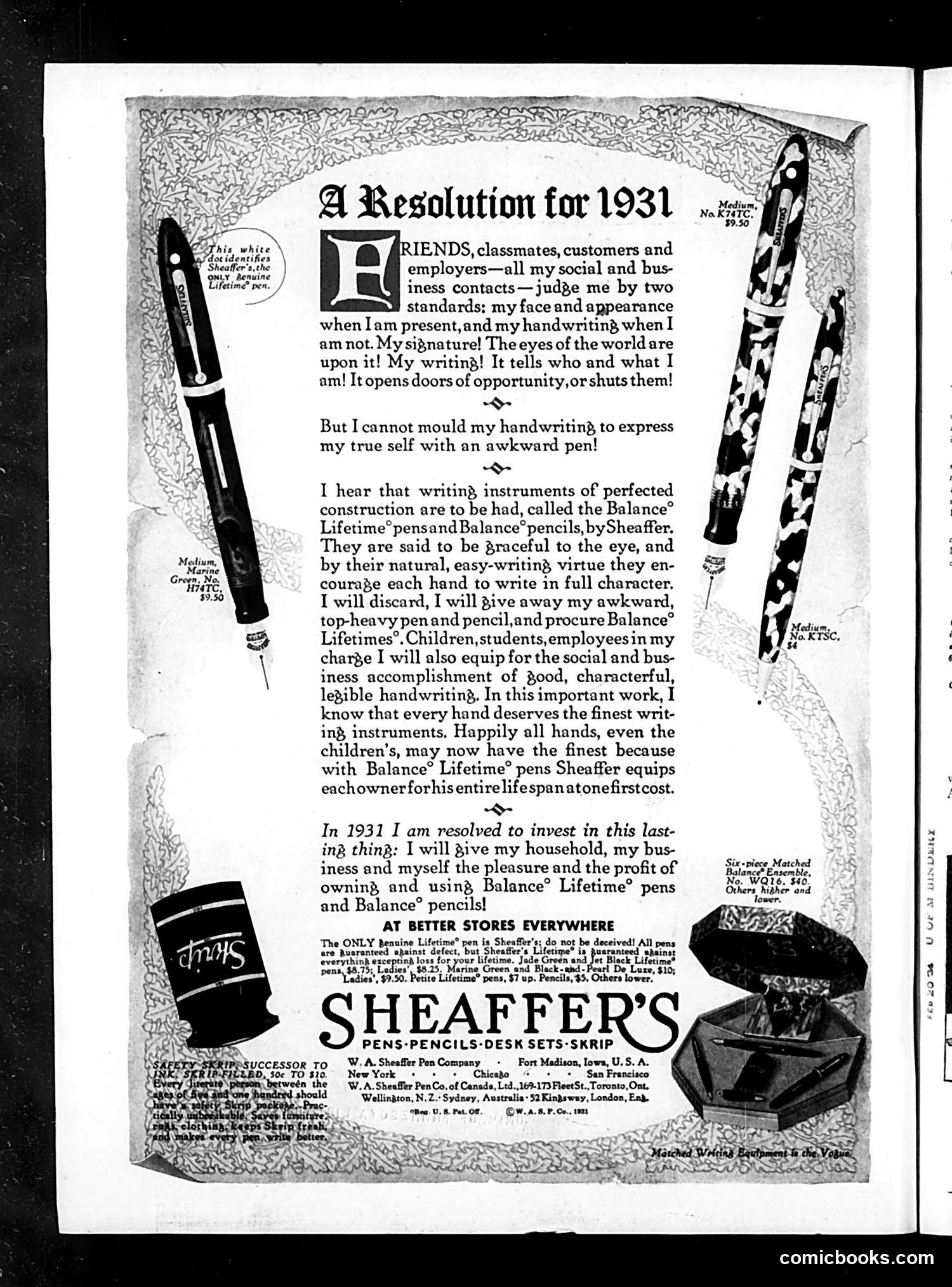
Analysis This is not a political cartoon or satire—it's a full-page advertisement for Sheaffer fountain pens and pencils, presented as a "Resolution for 1931." The ad uses a first-person narrative where someone pledges to improve their handwriting and professional appearance by using Sheaffer's "Balance Lifetime" writing instruments. The text argues that handwriting reflects character and opens doors professionally, so investing in quality pens is worthwhile. The decorative borders, ornate pen illustrations, and earnest tone are typical of 1930s advertising designed to appeal to middle-class aspirations about self-improvement and social mobility during the Depression era. There is no political content or satire—simply commercial persuasion framed as a New Year's resolution.
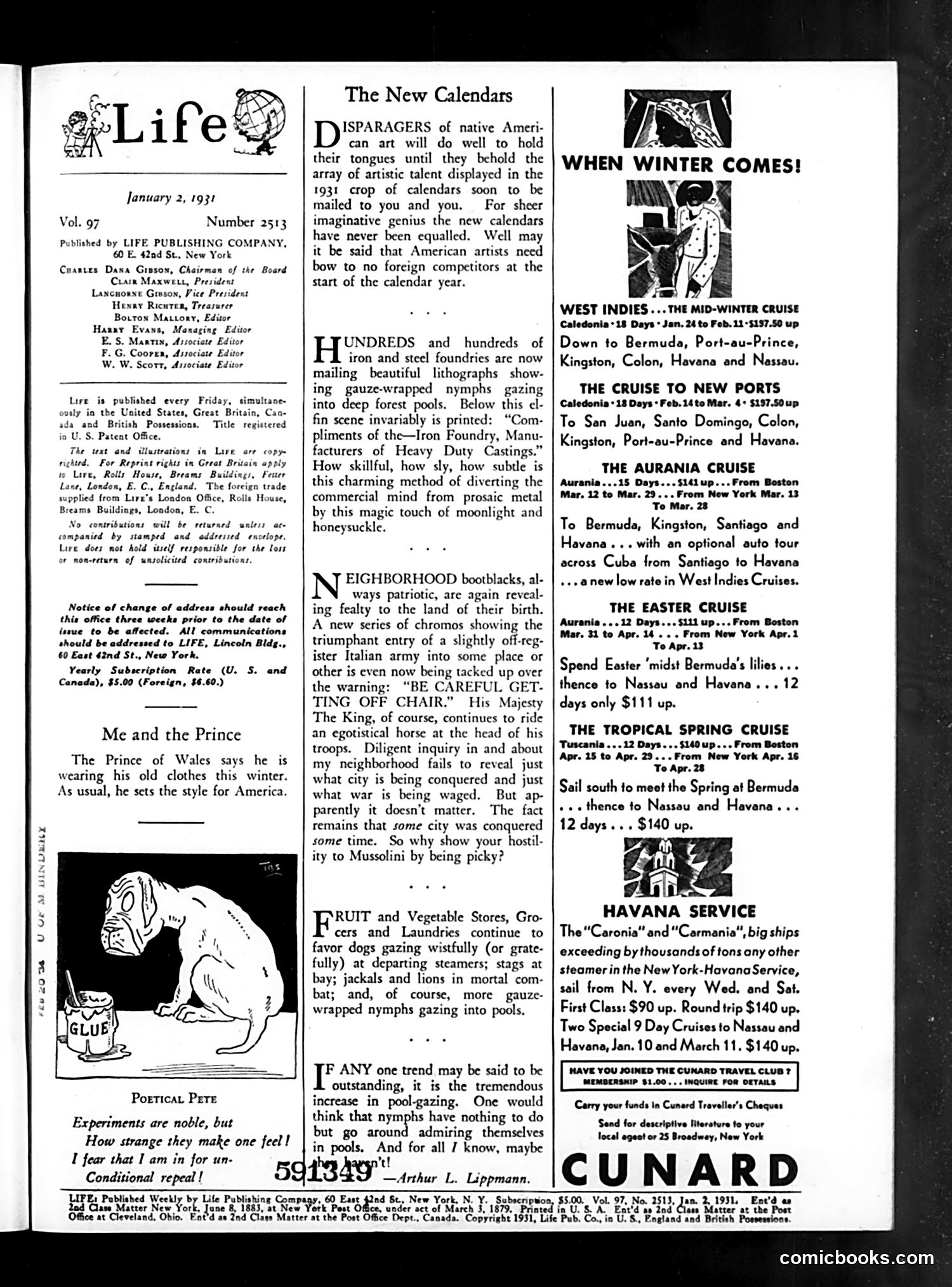
Political Cartoon Analysis: "Poetical Pete" This cartoon depicts a figure labeled "Poetical Pete" sitting beside a waste bucket, appearing disheveled and distressed. The accompanying caption reads: "Experiments are noble, but / How strange they make one feel! / I fear that I am fit for / Conditional repeal!" The satire targets someone—likely a public figure of 1931—who engages in social "experiments" (possibly referencing Prohibition or economic policies of the Depression era). The joke plays on the figure's pretentious language ("poetical") contrasted with their undignified, deteriorated condition, suggesting their noble ideals have failed miserably in practice. The reference to "conditional repeal" hints at reversing failed policies, while the waste bucket emphasizes the messy, unsuccessful outcome of their experimental approach to governance or social reform.
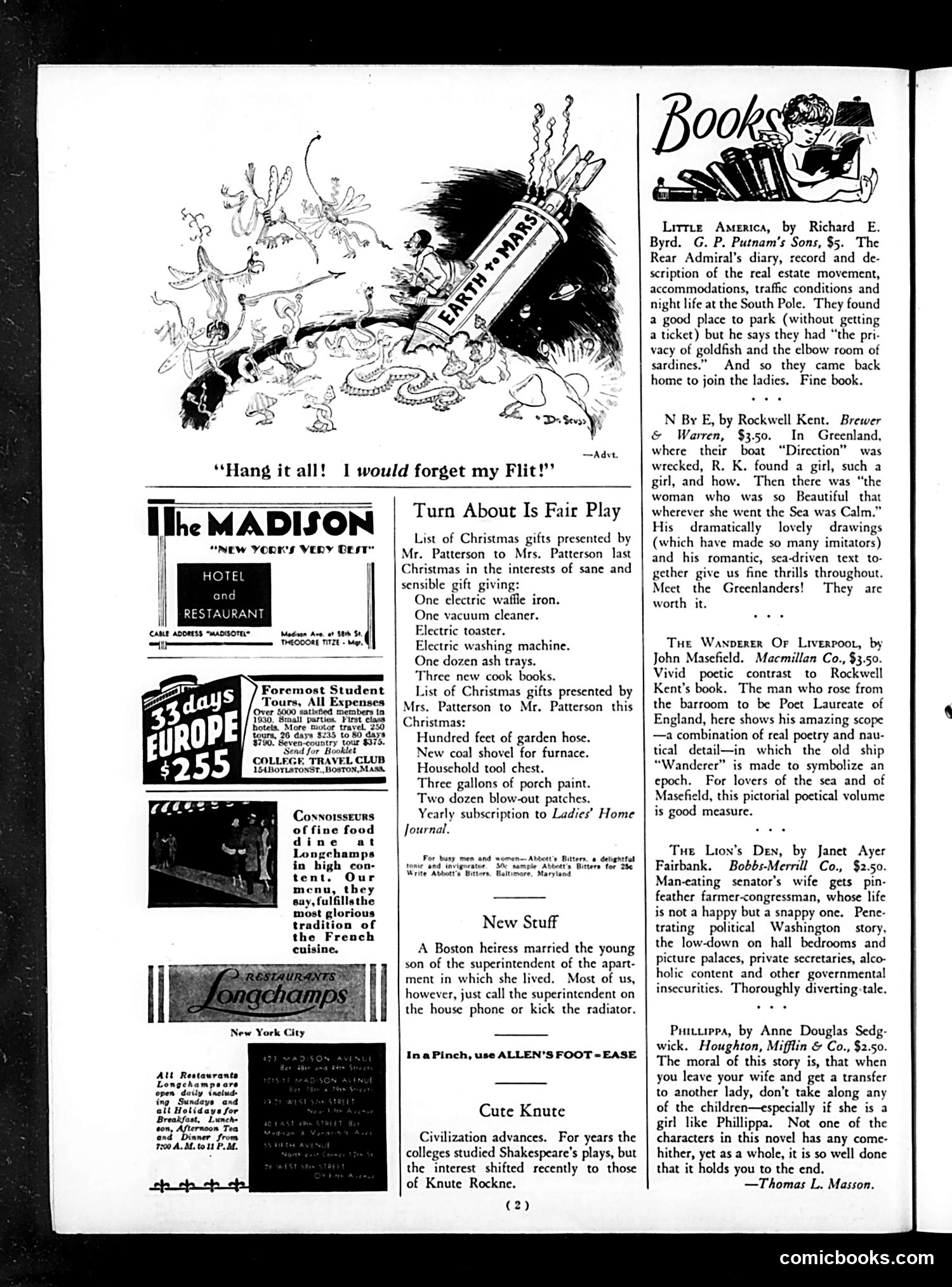
Political Cartoon Analysis The main cartoon shows a figure labeled "EARTH BOUND" being struck by or colliding with what appears to be a large explosive device or firecracker. The character appears distressed, with the caption "Hang it all! I would forget my Flit!" This is a satirical reference to Flit insecticide, a popular commercial product of the era. The joke plays on the contrast between mundane consumer concerns (remembering to buy bug spray) and catastrophic events (the "Earth Bound" explosion). It's social satire mocking how advertising had conditioned Americans to prioritize commercial products even in absurd scenarios. The cartoon satirizes consumerism and the pervasiveness of advertising in American life during this period.
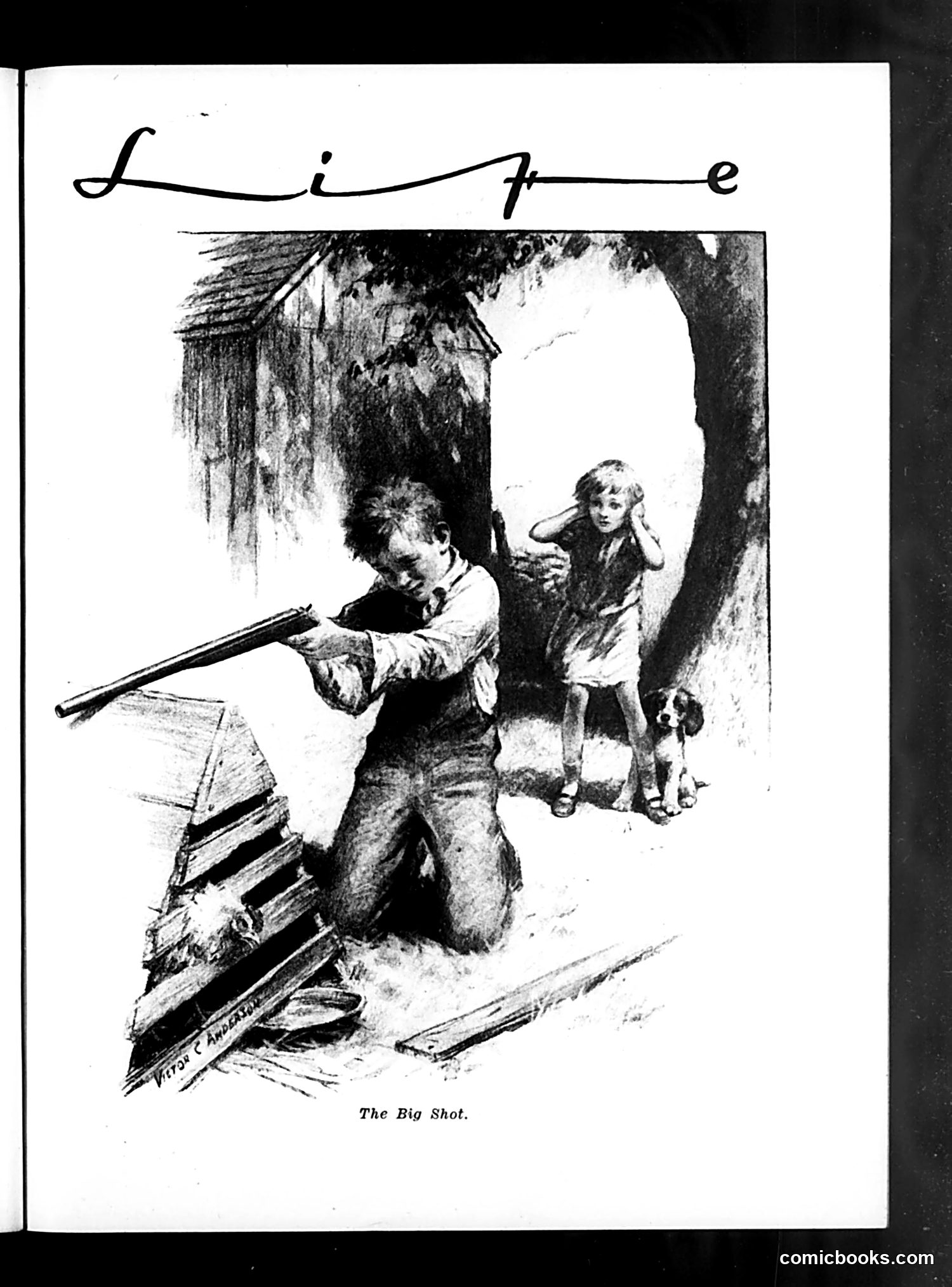
"The Big Shot" This illustration shows a man kneeling and aiming a rifle through what appears to be a tunnel or archway, while a child stands nearby observing. The title "The Big Shot" is ironic—the man appears to be taking aim at something with great effort and ceremony, suggesting he considers himself important or dangerous. The satire likely mocks someone who imagines himself more powerful or significant than he actually is. The child's presence and casual observation underscore this: what the man treats as a momentous "big shot" is merely a curiosity to an innocent bystander. Without additional context or visible attribution, the specific political figure or event referenced is unclear, but the overall message critiques inflated self-importance or false bravado.
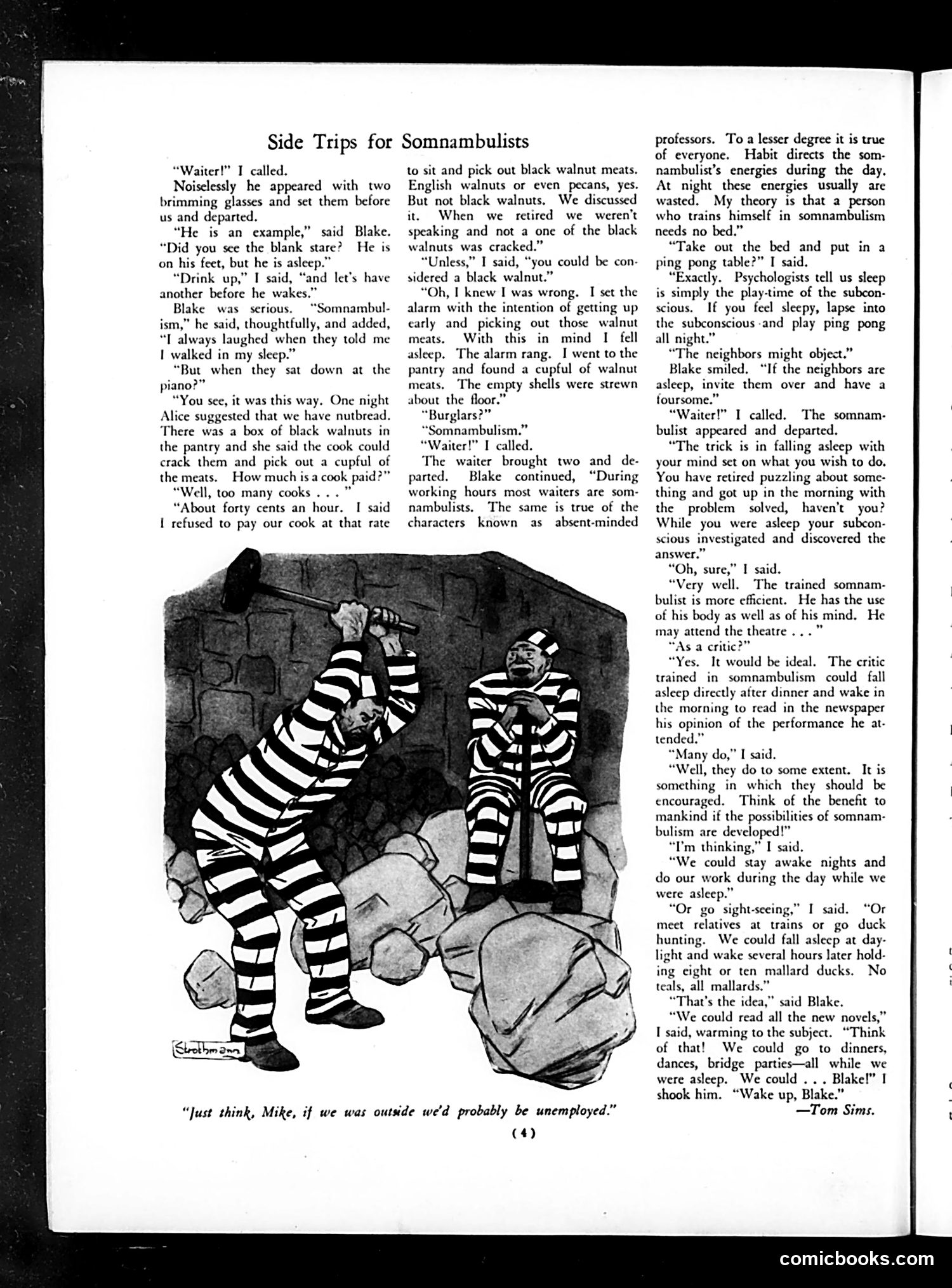
"Side Trips for Somnambulists" This is a humorous short story by Tom Sims about two men (Blake and the narrator) discussing the theoretical benefits of somnambulism—sleepwalking. They propose absurd "side trips" one could take while asleep: picking walnuts, attending theater, going duck hunting, reading novels, or dining and dancing. The accompanying illustration shows two striped-pajama-clad figures sleepwalking, with the caption: "Just think, Mike, if we was outside we'd probably be unemployed." The satire mocks both pseudo-intellectual discussions of habit and productivity, and contemporary economic anxiety—suggesting that even sleeping people could lose their jobs during what appears to be an economic downturn. The joke relies on Depression-era unemployment fears.
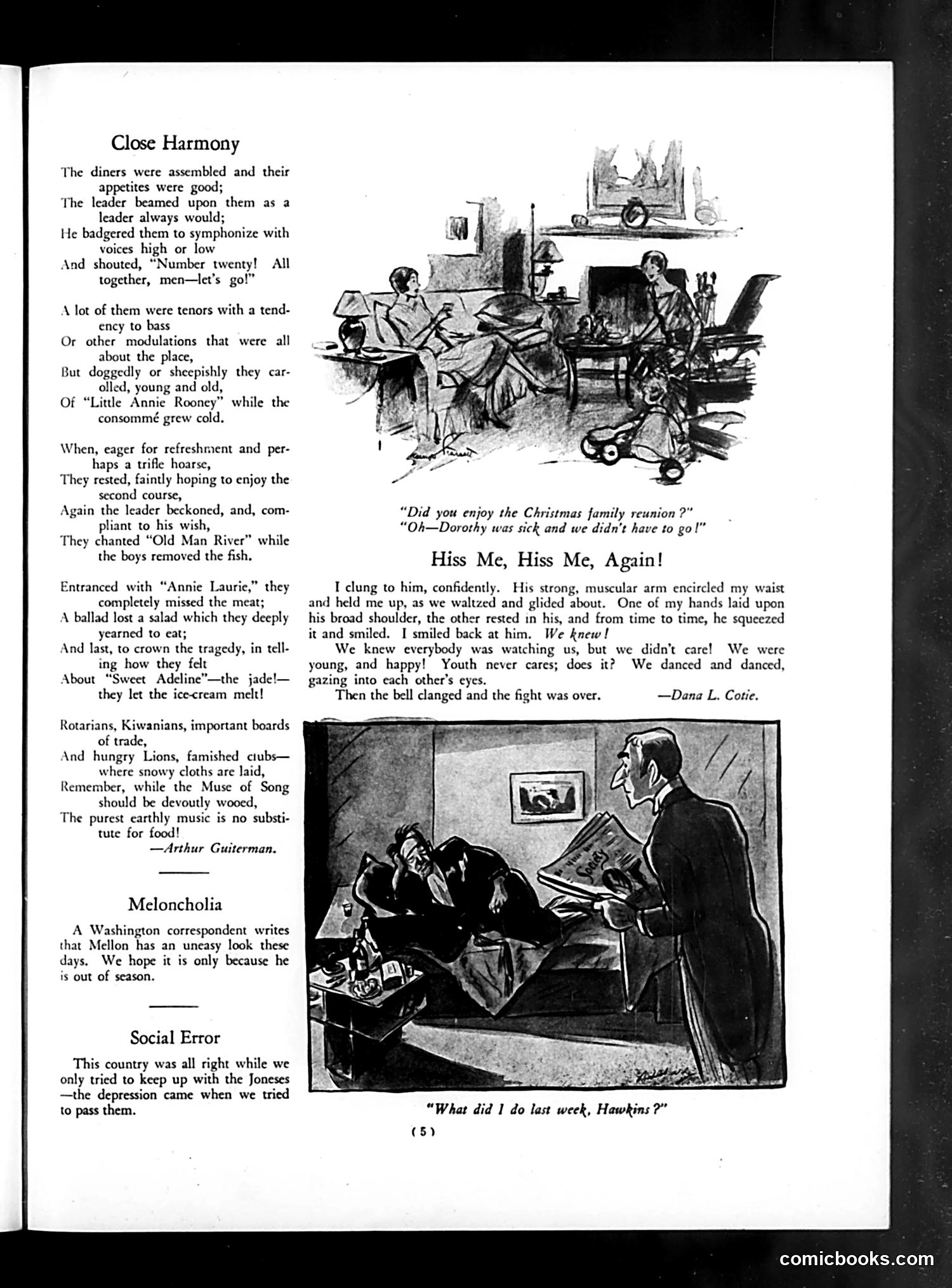
Page Analysis: Life Magazine This page contains three separate pieces of social commentary: 1. "Close Harmony" (poem by Arthur Guiterman): A nostalgic critique of a formal dinner where diners sang together—songs like "Little Annie Rooney" and "Old Man River." The satire targets how such gatherings attempted forced conviviality among social clubs (Rotarians, Kivanians, Lions) despite their fundamentally commercial nature. 2. "Hiss Me, Miss Me, Again!" (Dana L. Cotte): A romantic vignette about young people at a dance, celebrating youthful passion and freedom from social observation. 3. "Meloncholia": A brief note suggesting Washington, D.C. appears melancholic because melons are out of season—a mild, absurdist joke. 4. "Social Error": Commentary on economic anxiety; the country "worked" during prosperity but depression followed attempts to "keep up."
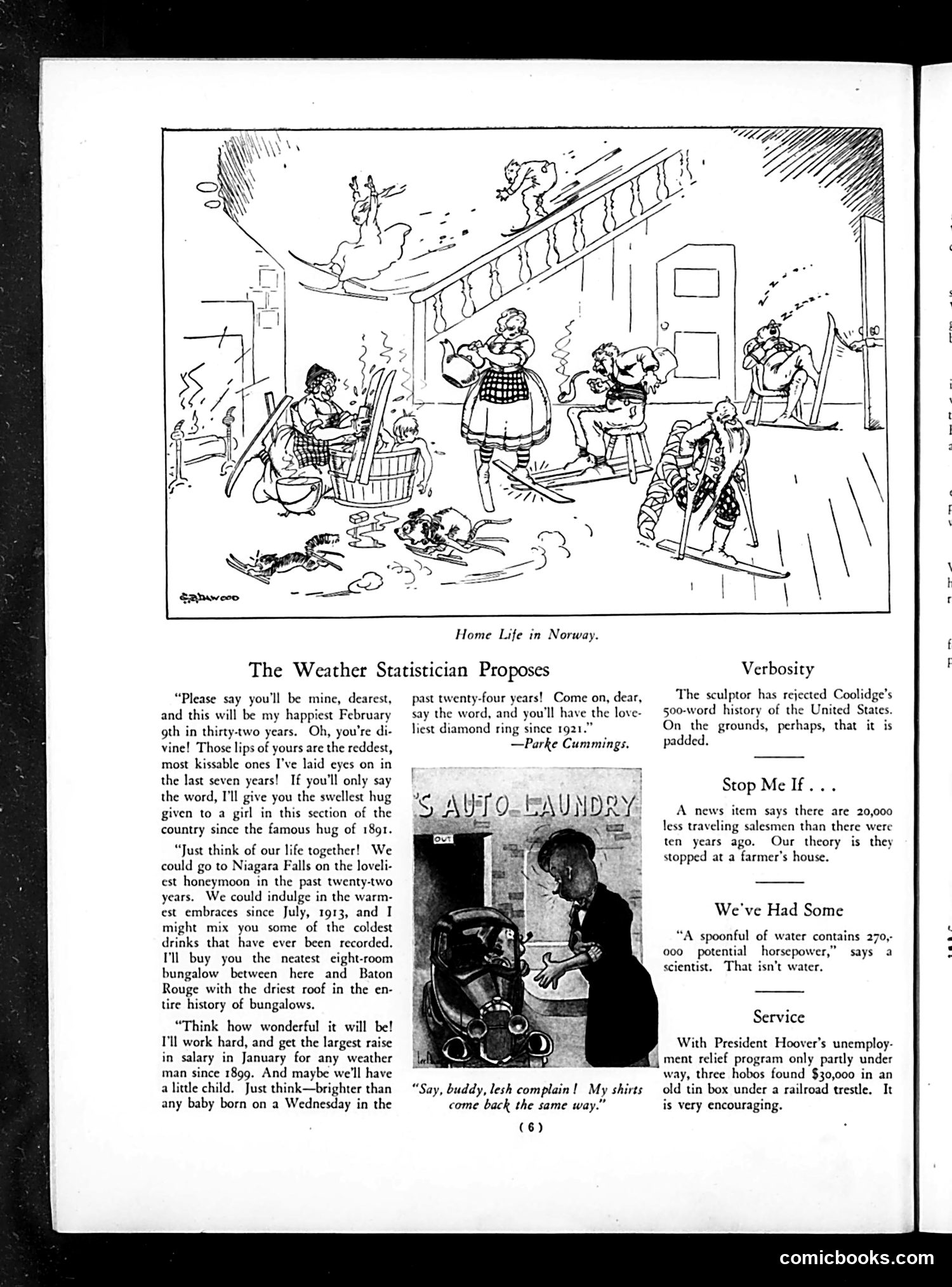
Analysis The top cartoon depicts "Home Life in Norway" and illustrates a humorous domestic scene with skiers, though the specific satirical point isn't entirely clear from the image alone. The main text feature is "The Weather Statistician Proposes"—a comic monologue where a weather official proposes marriage to his sweetheart, using meteorological metaphors and promises. He references his anticipated salary increase and career success, offering romantic inducements like Niagara Falls and a bungalow. Below are several brief humor snippets under headings like "Verbosity," "Stop Me If...," and "We've Had Some," typical of Life magazine's satirical format—short jokes poking fun at contemporary absurdities, including a jab at President Hoover's unemployment relief efforts. The "Auto-Laundry" illustration shows a laundry service interaction, captioned with dialogue about shirt cleaning.
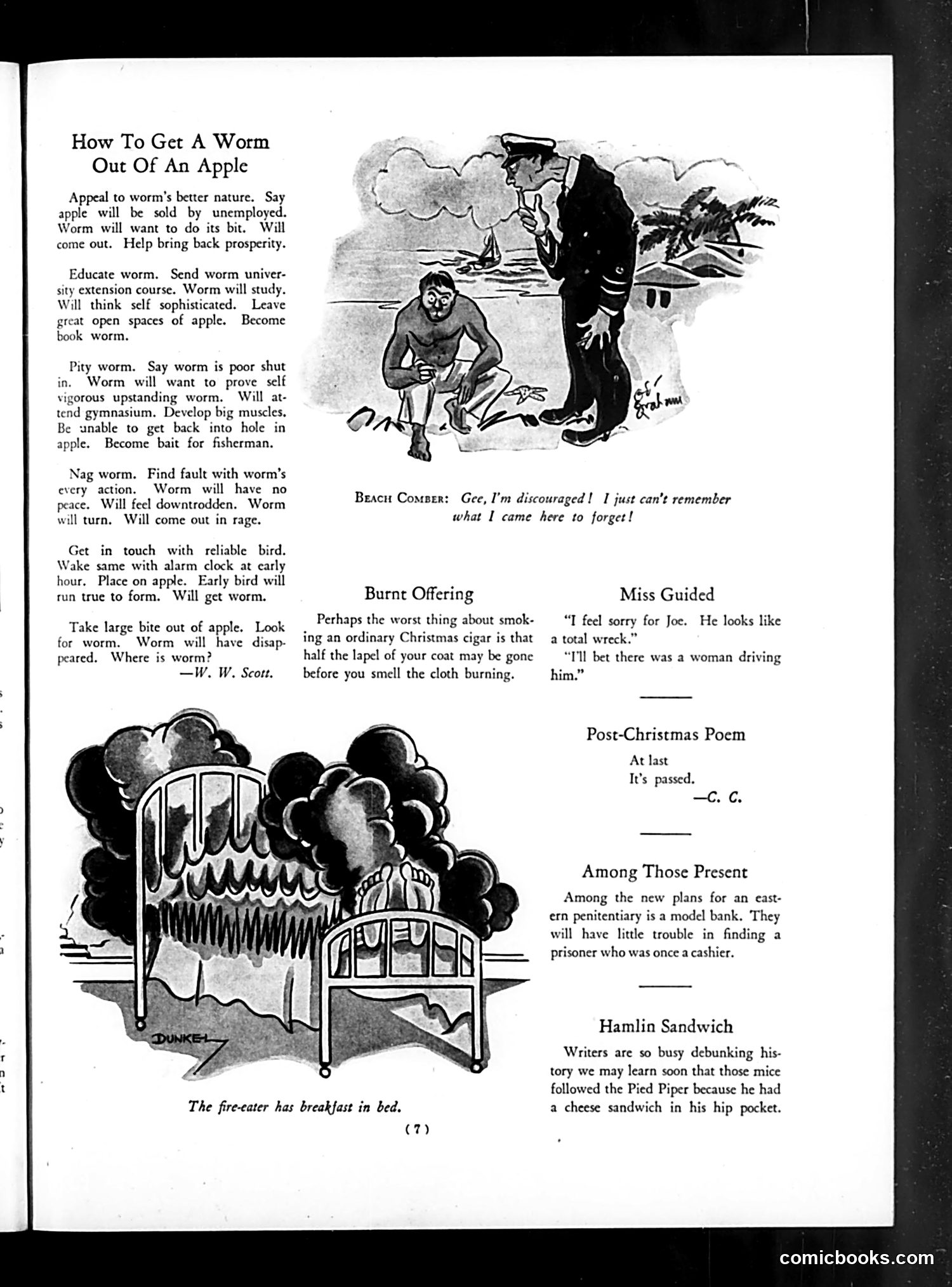
Page 7 Analysis: Life Magazine Humor Section This page contains several short satirical pieces and cartoons typical of Life's humor section. "How To Get A Worm Out Of An Apple" offers absurdist advice (appeal to the worm's nature, educate it, pity it, nag it, etc.). The accompanying cartoon shows a well-dressed man and small figure, likely depicting the humorous futility of the elaborate schemes described. "The fire-eater has breakfast in bed" cartoon shows a figure in bed surrounded by flames—a visual pun on the term "fire-eater," likely mocking someone stubborn or quarrelsome. The other brief items—"Beach Comber," "Burnt Offering," "Miss Guided," "Post-Christmas Poem," "Among Those Present," and "Hamlin Sandwich"—are short witty observations or one-liners on contemporary social situations, typical of the magazine's satirical format.
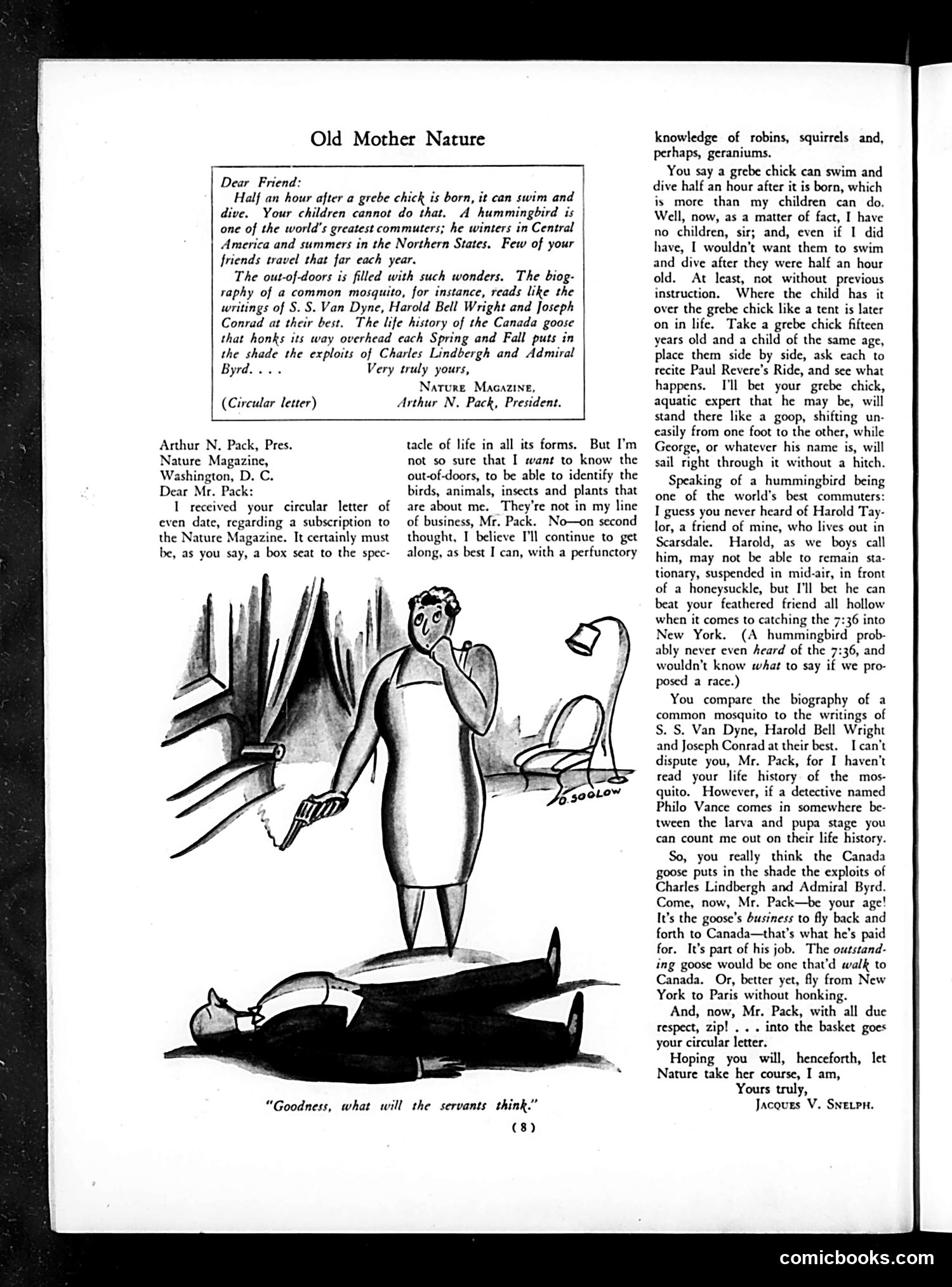
Analysis This page from *Life* magazine presents a satirical exchange about nature observation. Arthur N. Pack, president of Nature Magazine, writes a circular letter praising nature study, claiming children can identify birds and learn outdoors. Jacques V. Snelph responds with pointed sarcasm. The cartoon shows a bewildered figure surrounded by nature while holding what appears to be a guidebook—illustrating Snelph's central joke: that Pack romanticizes nature knowledge while ordinary people struggle to identify basic wildlife. Snelph mocks Pack's lofty claims by comparing a mosquito's biography to famous naturalists' works, and sarcastically suggests Canada geese should "fly back and forth to Canada" as their job. The satire targets the gap between idealistic nature-study propaganda and reality—the messiness and difficulty of actual outdoor observation.
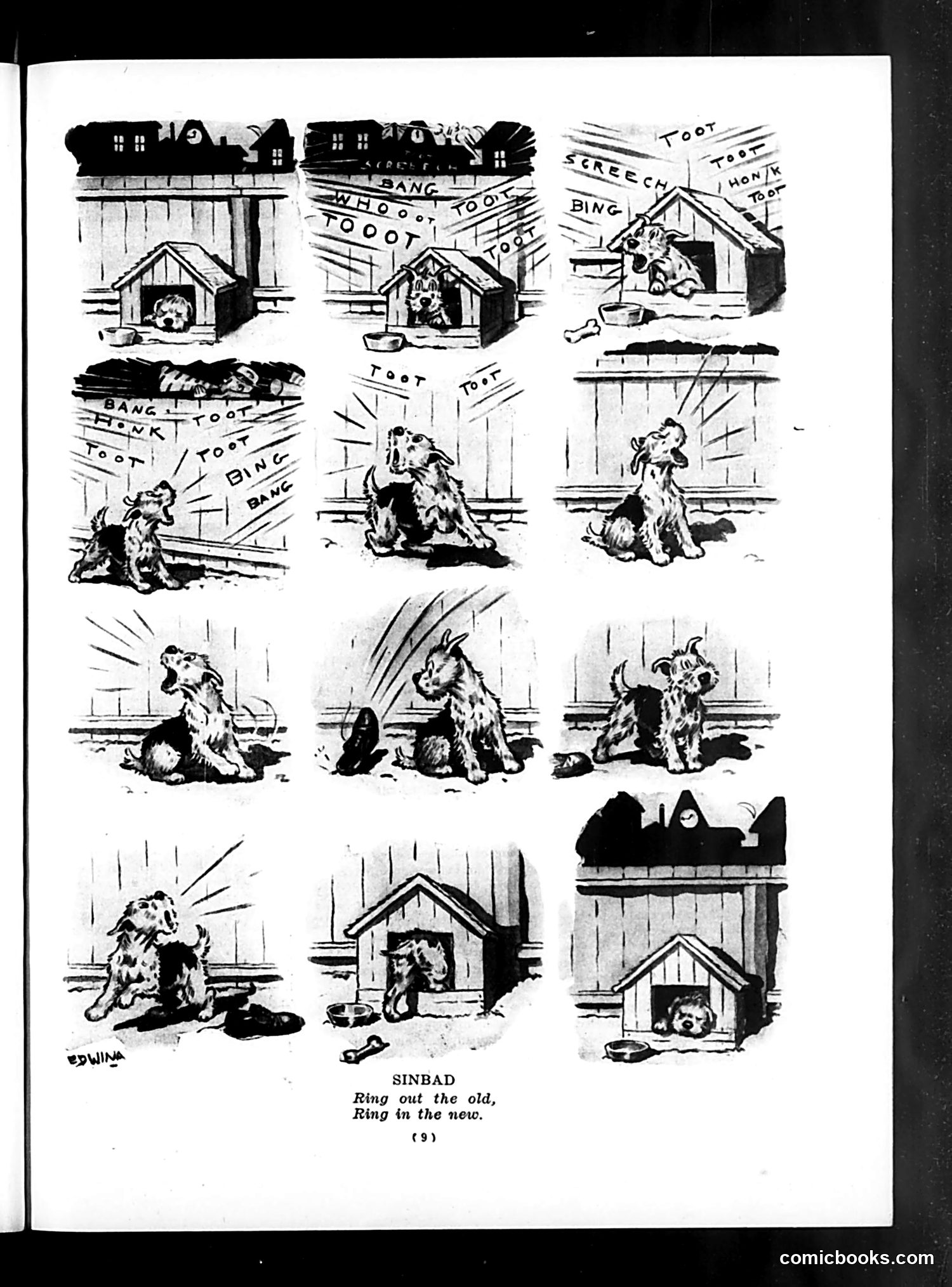
Analysis of "Sinbad" Comic Strip This comic strip depicts a dog named Sinbad in various scenes around kennels and doghouses, with sound effects like "TOOT," "WHOOO," "HONK," "BANG," and "SCREECH" accompanying the action. The caption reads: "Ring out the old, / Ring in the new." This appears to be a New Year's-themed satire using the dog as a central figure. The repetitive barking and noise-making likely represents the loud, chaotic celebration associated with New Year's Eve and the transition between years. The various kennel scenes suggest domestic life disrupted by celebratory commotion. The humor derives from depicting the dog's bewildered reactions to the cacophony of holiday noise-making, a relatable experience for readers anticipating year-end festivities.
"Life Looks About" - Page Analysis This page contains three opinion essays rather than political cartoons. The masthead illustration shows a cherub or cupid figure, decorative rather than satirical. The essays discuss: 1. "Alarums and Excursions" - Criticizes the Manning-Lindsey controversy (an altercation between two clergy members) as unhelpful public distraction. The author argues such disputes distract from substantive issues and that the Bishop of New York's involvement was an inappropriate intrusion into ecclesiastical matters. 2. Sinclair Lewis's remarks - Notes Lewis's Stockholm address about American novel-reading habits since 1914, mentioning his Nobel Prize. 3. "Education, Catch-as-catch-can" - Discusses contemporary education criticism, referencing Abraham Flexner's educational reforms and autobiographies by Churchill and Balfour as examples of practical versus institutional education. This is opinion journalism, not satire or cartooning.
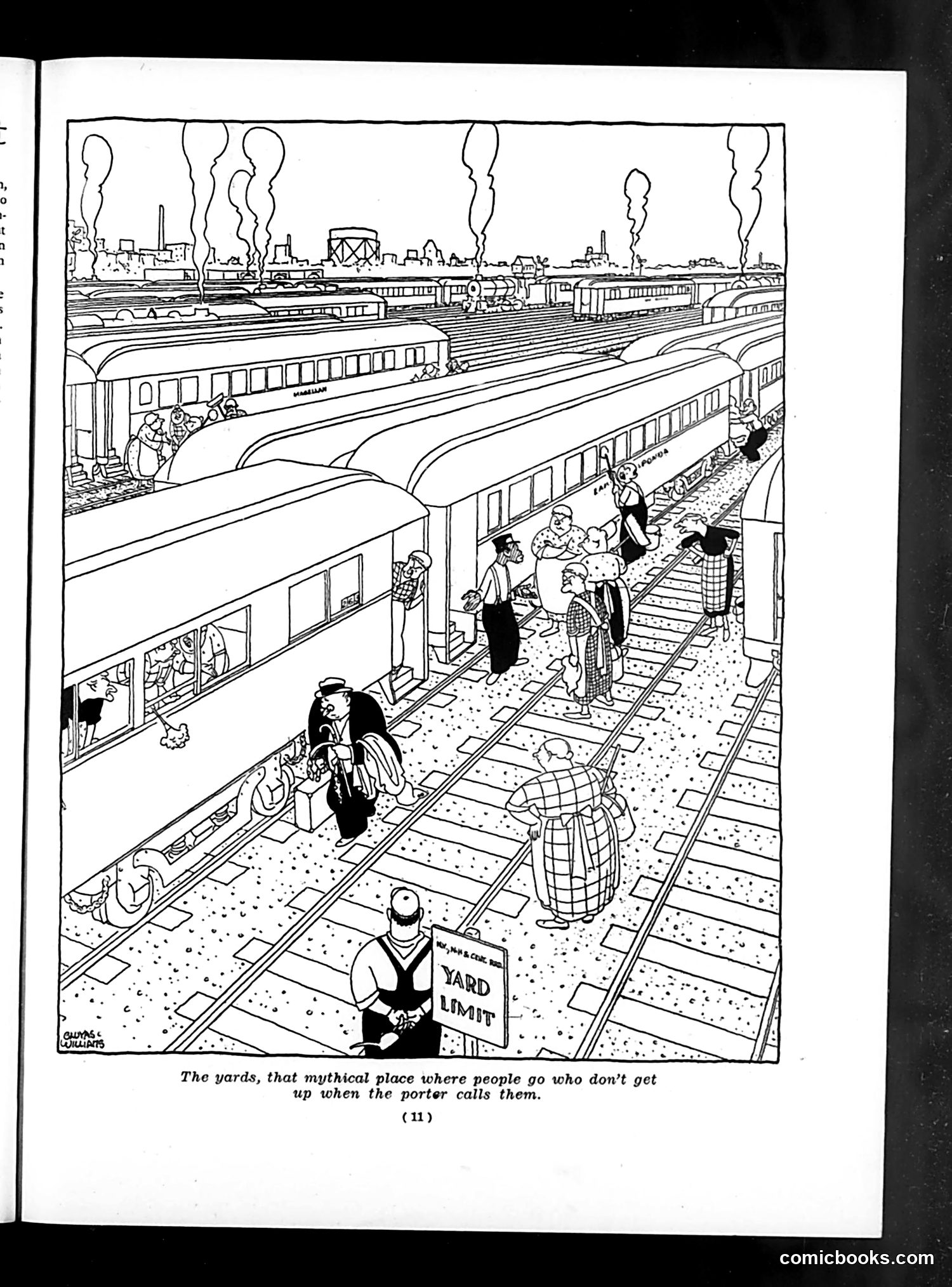
Analysis This is a single-panel cartoon depicting a busy railroad yard with multiple trains and passengers. The caption reads: "The yards, that mythical place where people go who don't get up when the porter calls them." The joke is straightforward social satire about train travel etiquette. The cartoon humorously suggests that the "yards" (where trains are serviced and stored) is a kind of purgatory for passengers who oversleep or ignore the porter's wake-up call during overnight train journeys. The cartoon depicts the chaos and confusion that would result if numerous sleepy passengers missed their stops, with people scattered across multiple trains and platforms in disarray. It's a lighthearted jab at the common travel mishap of sleeping through one's destination, a particular concern during the era of overnight passenger rail service when porters would notify sleeping passengers of their stops.
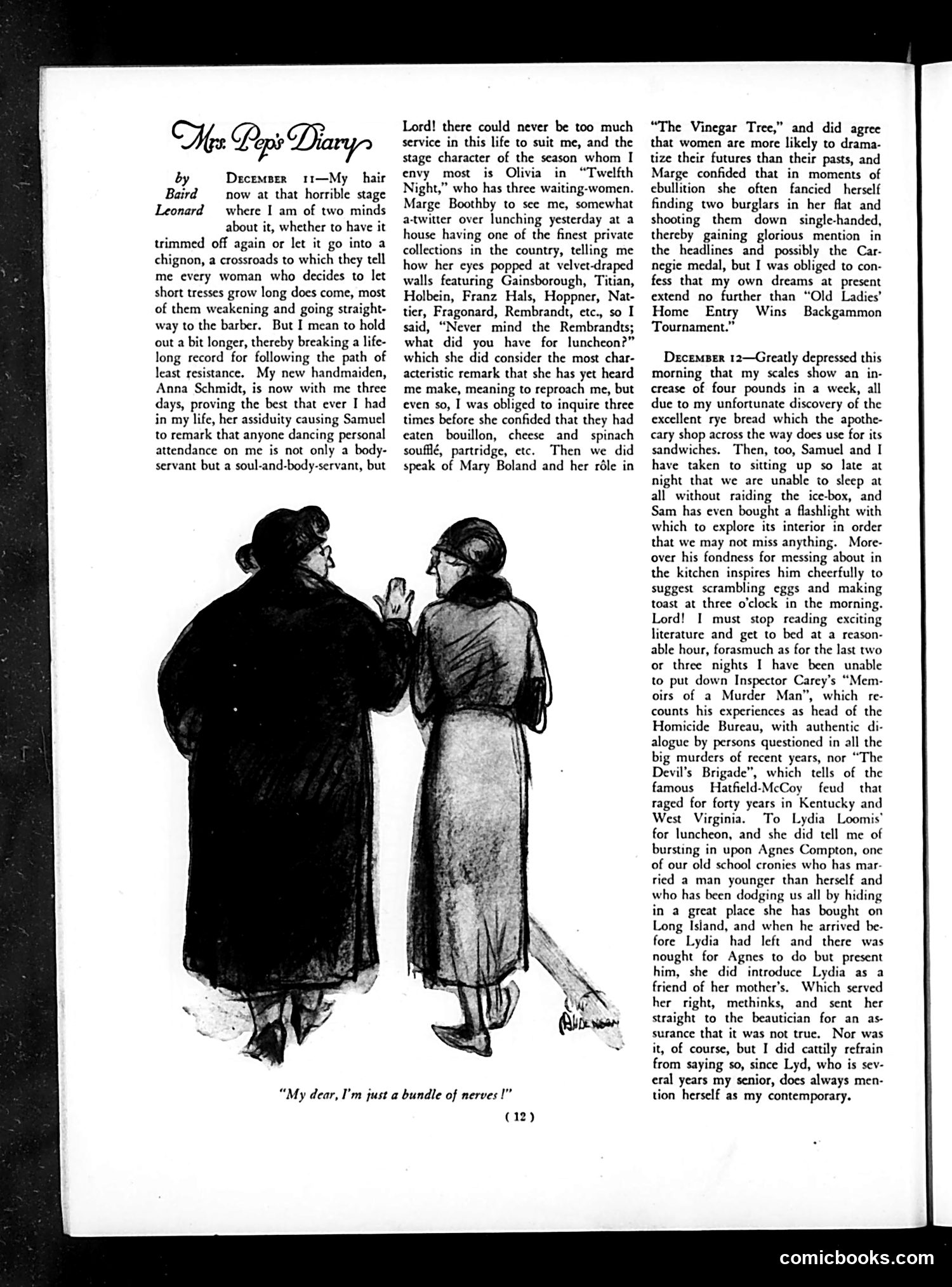
Mrs. Pep's Diary - December 11-12 This page presents a satirical diary entry by "Baird Leonard" documenting social observations and domestic complaints. The illustration shows two women in conversation, with the caption "My dear, I'm just a bundle of nerves!" The entry mocks upper-class social pretensions: the diarist complains about hairstyles, visits to homes with famous art collections, and gossip about acquaintances' romantic entanglements. References include critiques of women dramatizing trivial matters ("The Vinegar Tree") and complaints about servants' behavior. The December 12 entry humorously catalogs domestic anxieties—weight gain, expensive bread, insomnia, and her husband's late-night kitchen activities—depicting the narrator as perpetually neurotic and self-absorbed. The satire targets affluent women's neurotic concerns and social obsessions during the early 20th century.
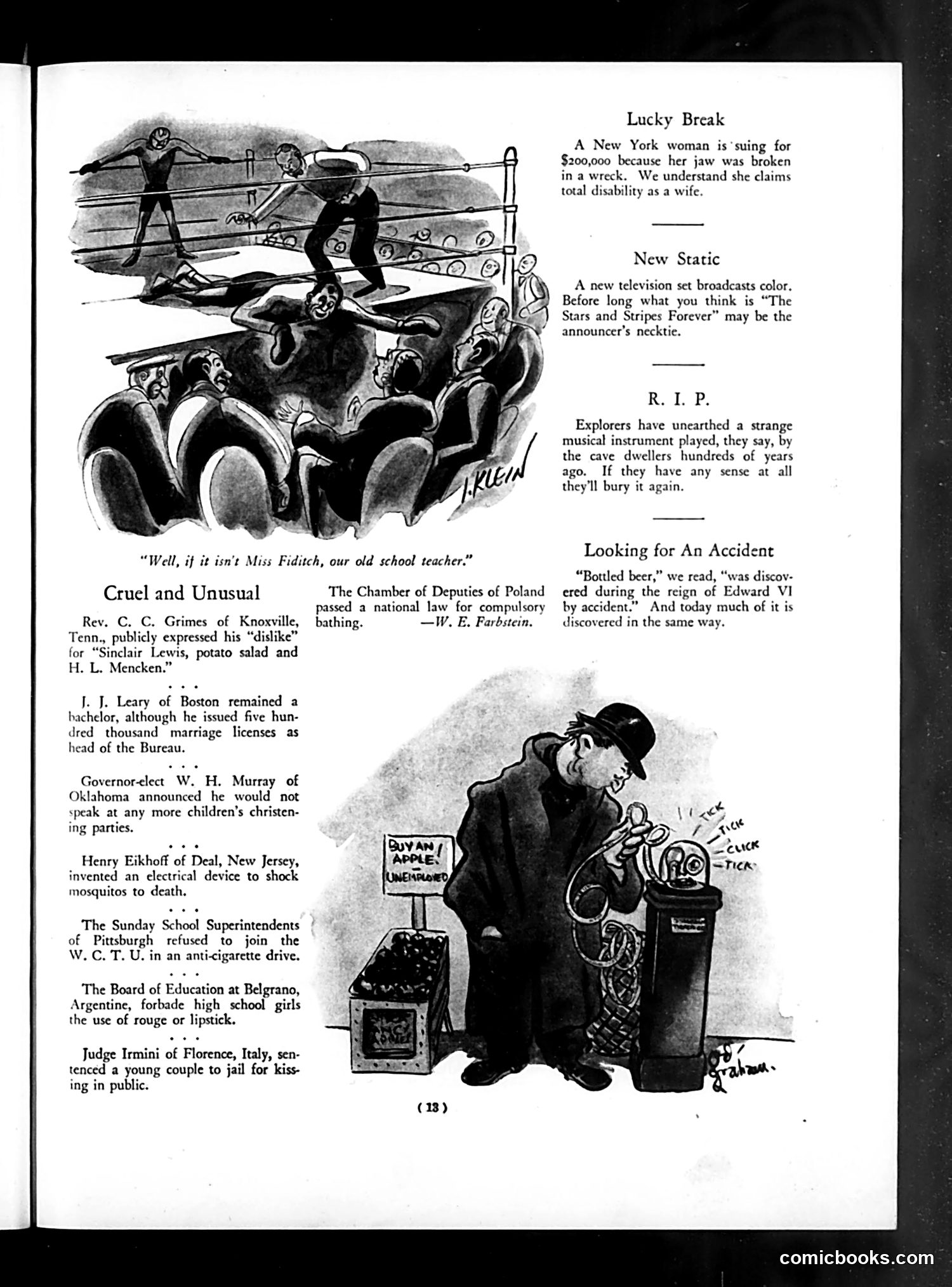
Content Analysis This page from *Life* magazine contains several brief satirical news items and two cartoon illustrations. The main cartoon at bottom depicts a man at a broken slot machine labeled "Buy an Apple Underneath" with sound effects ("Click," "Tick"). This references Depression-era apple selling—unemployed men famously sold apples on streets during the 1930s economic crisis. The broken machine satirizes this as a failed business venture, suggesting even this desperate income source doesn't work reliably. The upper cartoon shows a schoolroom scene captioned "Well, it it isn't Miss Fiditch, our old school teacher"—appearing to mock someone's unexpected reappearance in an awkward context, though the specific reference remains unclear. The surrounding text items are brief humorous anecdotes about unusual laws, inventions, and social absurdities from various locations, typical of *Life*'s satirical format.
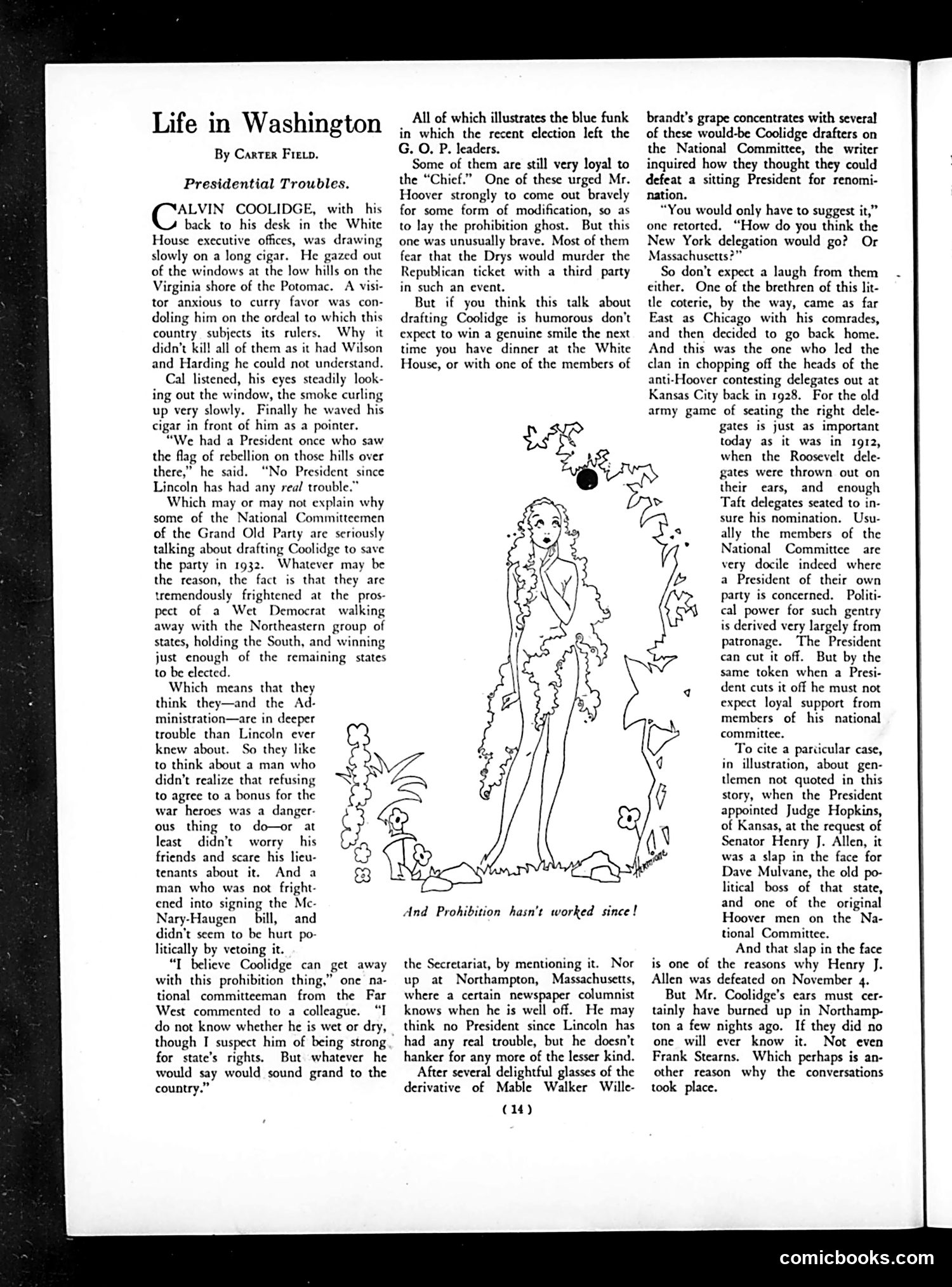
Analysis of "Life in Washington" Page This satirical article by Carter Field critiques President Calvin Coolidge's political vulnerability heading into the 1932 election. The central cartoon depicts a tree labeled "And Prohibition hasn't worked since!" — showing prohibition as a dead, leafless trunk with small figures at its base, symbolizing the failed policy's devastation. The text discusses Republican Party leaders' fears that Coolidge cannot defeat a "Wet Democrat" (one opposing prohibition), threatening their electoral dominance. Field notes that party insiders worry about losing northern states and are considering alternatives. The article illustrates how patronage and party loyalty — rather than principle — drives National Committee members' political calculations regarding Coolidge's viability as a candidate.
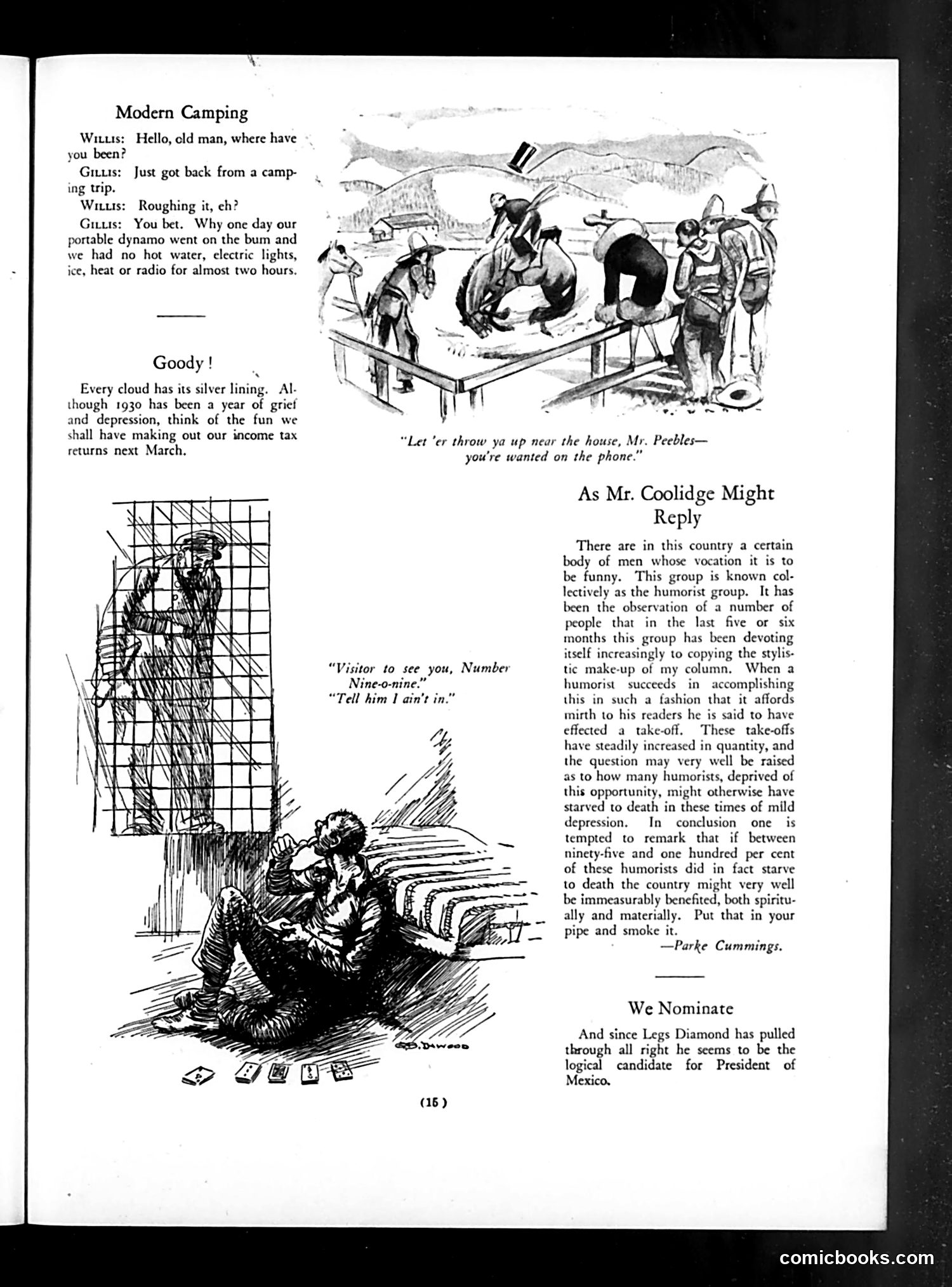
Analysis of Life Magazine Page This page contains satirical humor about American life during what appears to be the Great Depression era (referenced as "1930" in the "Goody!" section). The top cartoon mocks "Modern Camping"—a dialogue between Willis and Gillis depicts camping as a luxury experience where one day their "portable dynamo" broke down, leaving them without water, electricity, ice, heat, or radio. The satire criticizes the increasing mechanization and comfort-dependency of supposedly "roughing it" outdoor recreation. The lower cartoon and accompanying essay titled "As Mr. Coolidge Might Reply" discusses humorists and their role during economic depression, suggesting that humor columnists may be compensating for widespread hardship. The final section nominates "Legs Diamond" (a notorious 1920s gangster) for President of Mexico—absurdist political satire typical of Life's irreverent style.
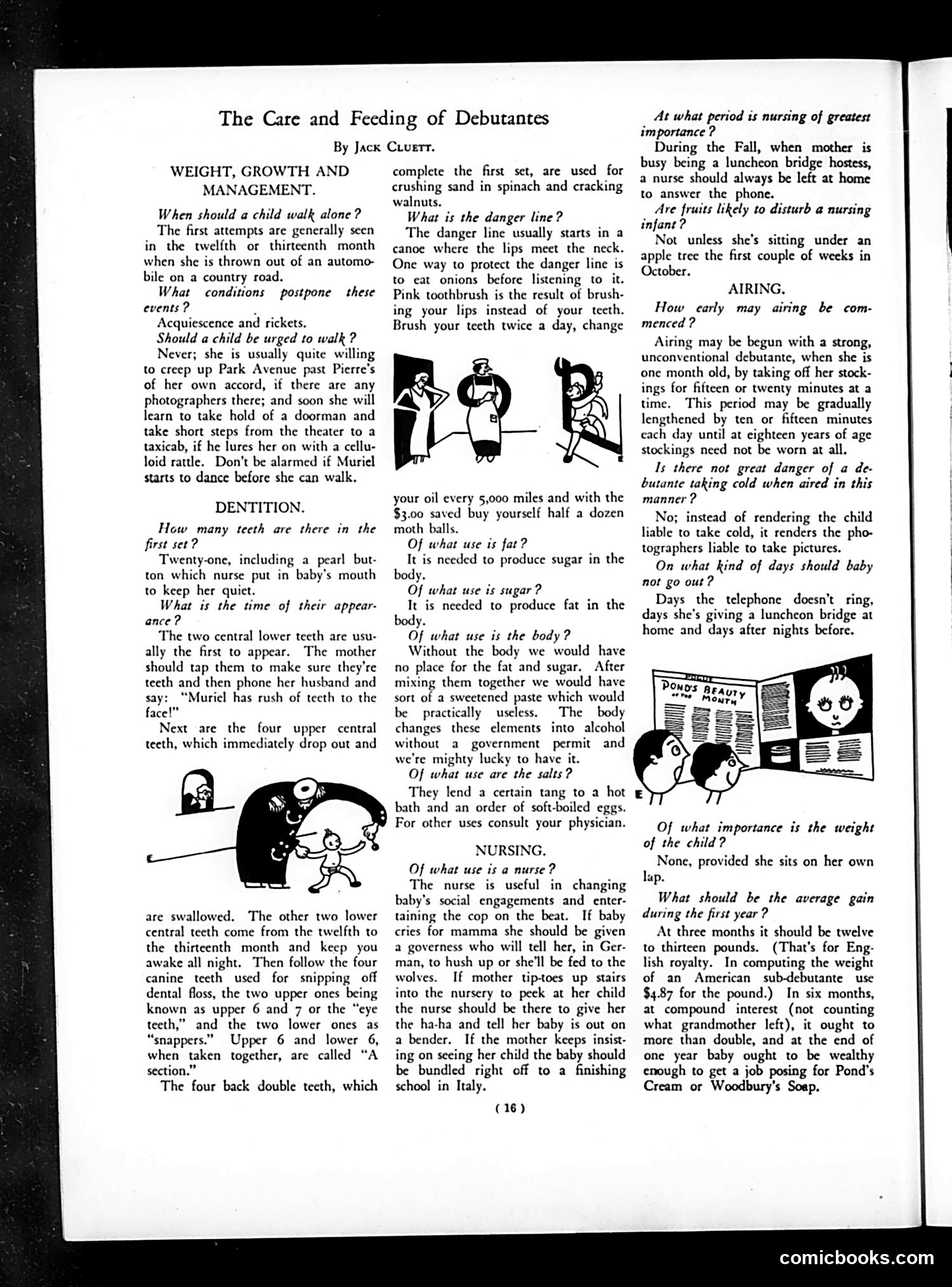
Analysis of "The Care and Feeding of Debutantes" This is a satirical advice article by Jack Cluett about young women making their social debut in high society. The illustrations show humorous scenarios depicting challenges debutantes face. The cartoons mock the absurdities of debutante culture: one shows a woman being thrown from an automobile (commenting on reckless behavior), another depicts dental concerns during social seasons, and a third illustrates a nurse attending to social obligations. The article's tongue-in-cheek Q&A format satirizes the overly detailed guidance given to young wealthy women entering society—covering everything from walking properly to weight gain expectations. References to "luncheon bridge at home" and finishing schools in Italy reflect the elite social world being gently ridiculed. The overall tone suggests this exclusive ritual is both taken seriously and absurd.
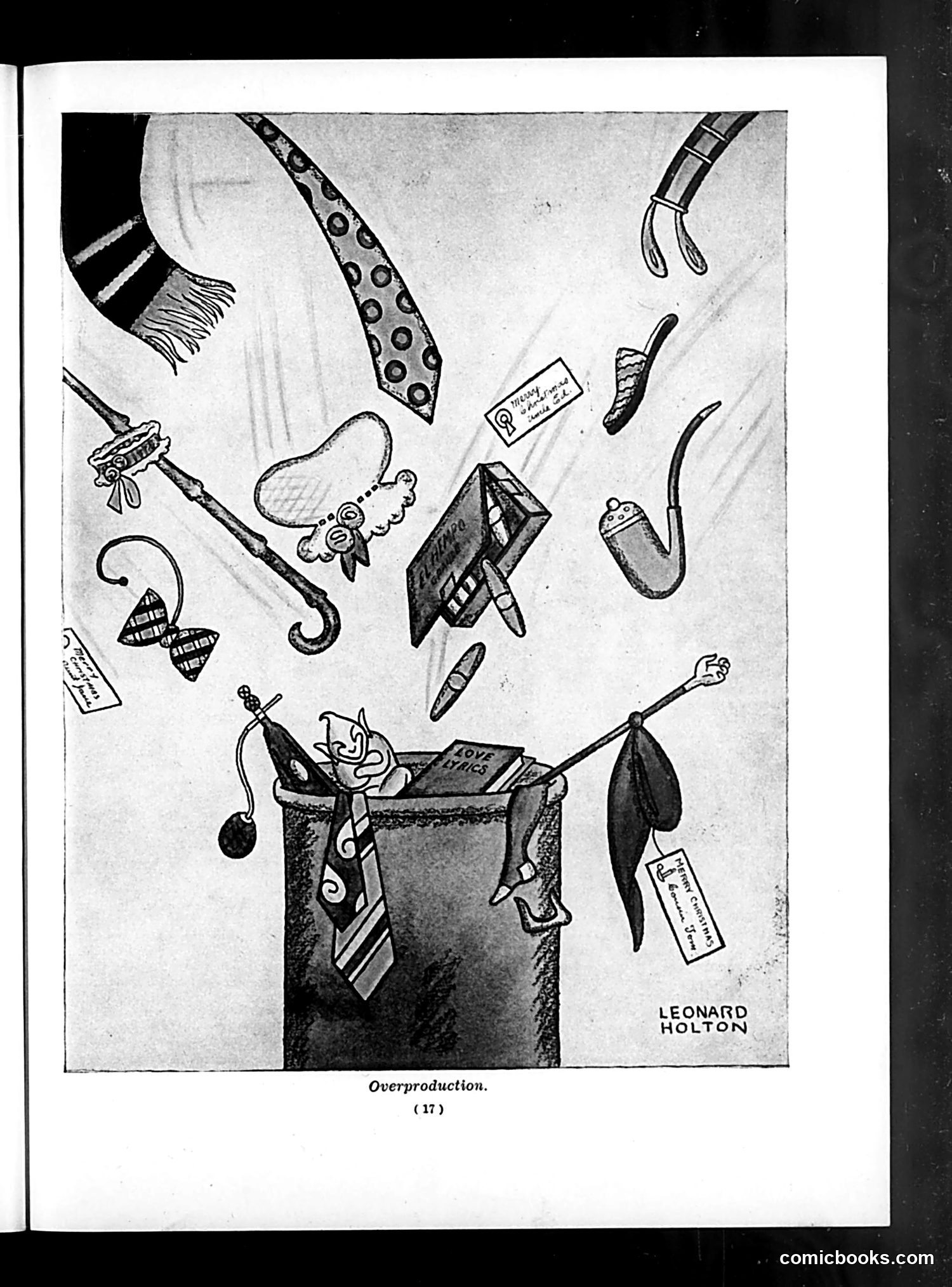
"Overproduction" by Leonard Holton This cartoon satirizes excess production of consumer goods, likely from the 1920s economic boom era. A cornucopia-like trash can overflows with products—ties, shoes, pipes, umbrellas, cosmetics, and other manufactured items—being literally thrown away or discarded by hands at the top of the composition. The satire critiques American manufacturing's tendency to produce far more goods than consumers actually need or can purchase. The title "Overproduction" and the waste depicted suggest concern about inefficient economics: factories churning out excessive inventory that cannot be sold, leading to waste and economic instability. This reflects contemporary anxieties about capitalist excess and market saturation that would intensify with the 1929 stock market crash.
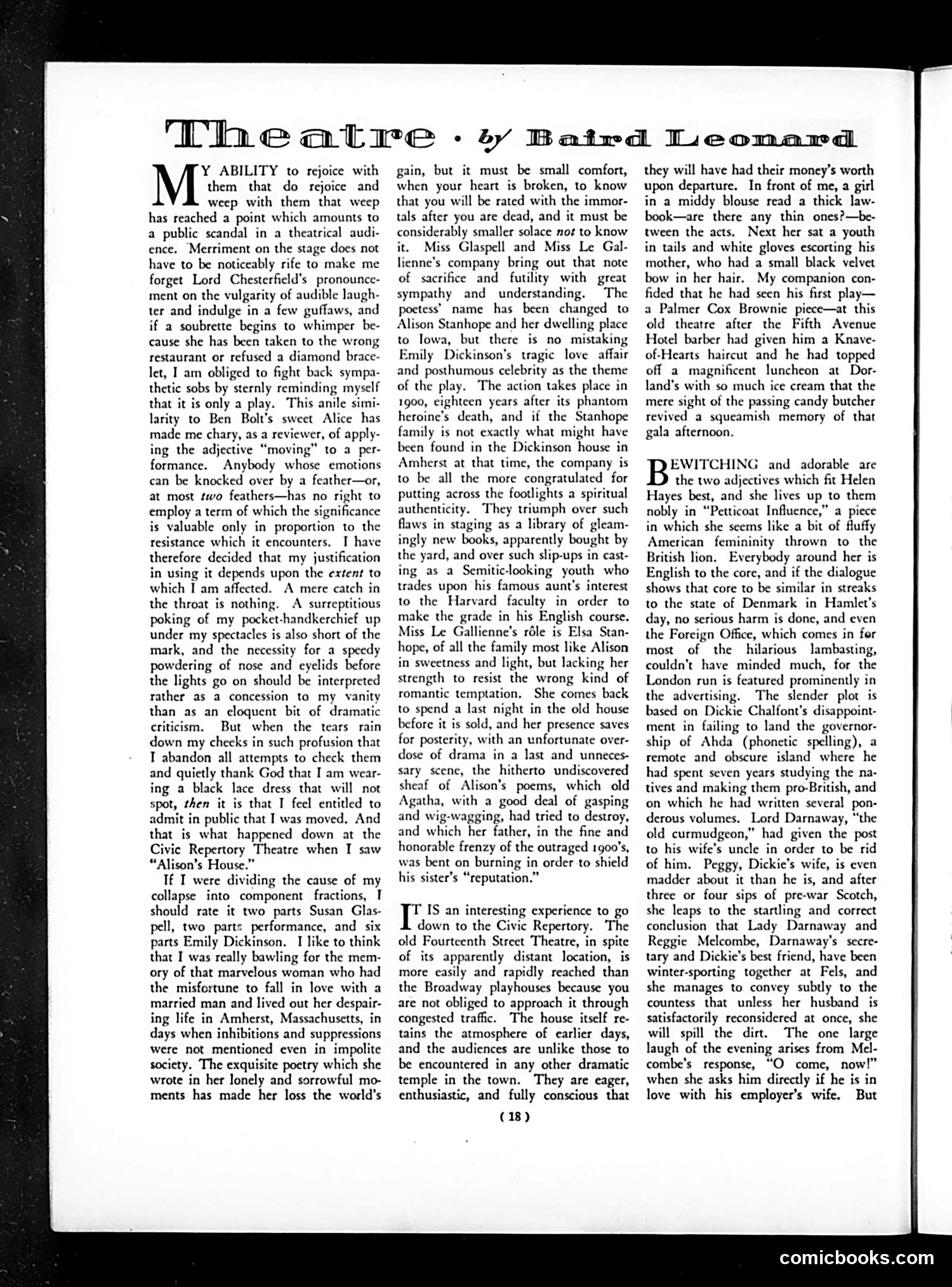
This appears to be a theater review page from Life magazine, titled "Theatre" by Baird Leonard. The text discusses several theatrical productions, including "Alison's House" (which the reviewer saw at the Civic Repertory Theatre) and references to other plays like "Petticoat Influence." The review mentions specific performers and plot points, discussing themes of family drama, sacrifice, and theatrical authenticity. The reviewer critiques the emotional effectiveness of certain performances and staging choices. However, I cannot identify any political cartoons or caricatures on this page. The image shows a text-heavy magazine page with traditional typography and column layout—this is a straightforward theater criticism article, not a satirical cartoon or illustrated content. The satire, if present, would be embedded in Leonard's critical commentary about the theatrical productions themselves.
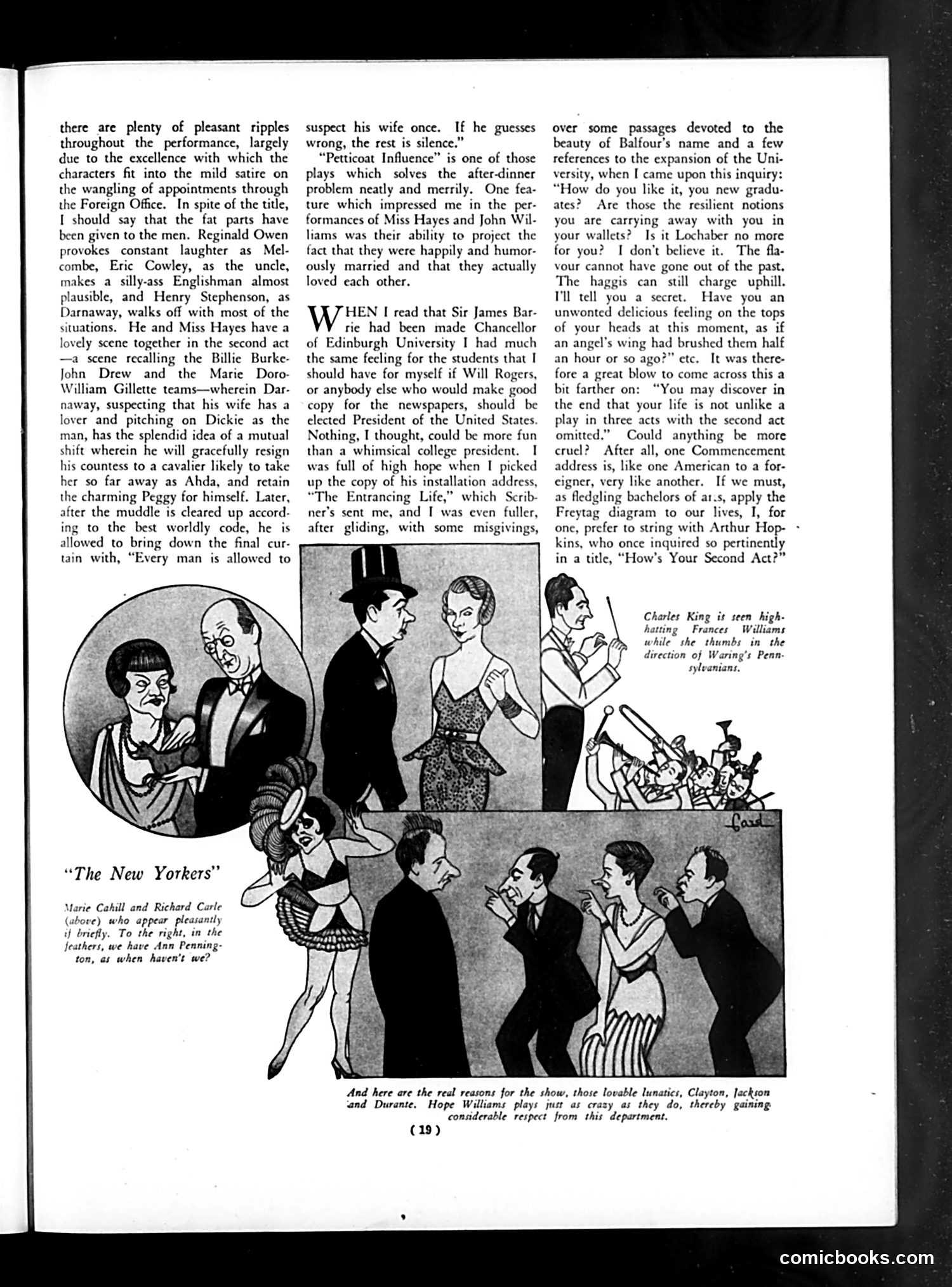
Life Magazine Page Analysis This page contains theater reviews and satirical commentary typical of Life magazine's entertainment coverage. "The New Yorkers" section reviews a Broadway musical featuring Marie Cahill and Richard Carle (appearing "pleasantly if briefly"), with Ann Pennington in featured roles. The cartoons mock the show's "real reasons"—comedians Clayton, Jackson, and Durante—suggesting audiences attended despite rather than because of the plot. The main essay humorously contrasts Life's disappointment with James M. Barrie's (author of *Peter Pan*) installation address as Chancellor of Edinburgh University. The writer expected whimsical wit from Barrie but found pretentious Scottish nostalgia and, worse, the depressing metaphor that life resembles a three-act play "with the second act omitted"—suggesting midlife is missing. The satire criticizes how even brilliant minds produce generic commencement platitudes. The page exemplifies Life's 1920s-30s focus: theatrical gossip, gentle celebrity mockery, and intellectual commentary on high-culture figures.
Movie Review Analysis: "The Blue Angel" (Life Magazine) This is a film review by Harry Evans, not a political cartoon. It discusses a 1930 German-language film featuring Emil Jannings and Marlene Dietrich, directed by Josef von Sternberg. The satire targets the film's apparent creative strategy: Evans notes the filmmakers deliberately filled scenes featuring Jannings's "broken English" with shots of Dietrich in revealing costumes, essentially using her body to distract from the actor's limited English-language ability. The reviewer mocks this cynically—noting Dietrich appears nearly naked throughout and sings two songs—suggesting the studio prioritized sex appeal over coherent storytelling. Evans also ridicules Jannings's acting, noting his repetitive "go-mad-and-die" performance where he must "crow like a rooster," calling it "nerve-wracking." The review's underlying critique: the film compensates for weak performances with spectacle rather than substance.
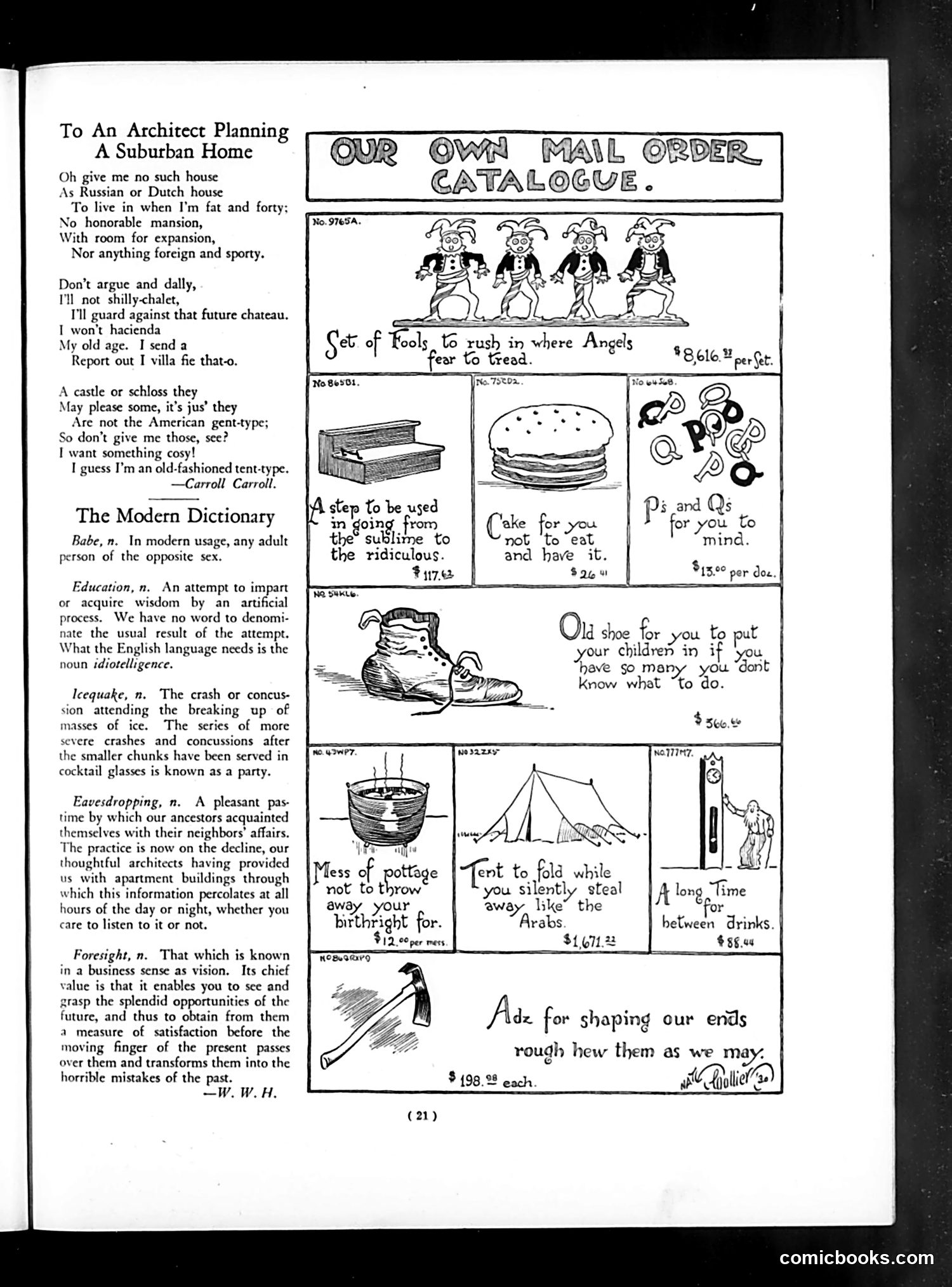
Life Magazine Satire Page Analysis This page combines poetry, dictionary definitions, and a mock mail-order catalog—all satirizing American consumer culture and suburban aspirations circa the 1920s-30s. The Poetry (by Carroll Carroll) mocks architectural pretension: the speaker rejects grandiose European-style homes (châteaus, haciendas, schloss castles) as un-American, demanding instead a humble, "cosy" dwelling. The satire targets both ostentatious wealth-display and the affected language used to describe it. "The Modern Dictionary" offers tongue-in-cheek redefinitions exposing social absurdities: "Babe" reduces modern romance to mere physical attraction; "Education" suggests schools fail at their stated purpose; "Icequake" jokes about Prohibition-era drinking; "Eavesdropping" mourns lost gossip replaced by apartment living; "Foresight" cynically notes we only regret past decisions. The Mail-Order Catalog parodies consumer culture with absurd items: foolish advice, inedible cake, P's and Q's, old shoes for children, pottery, tents, and an axe—all useless "solutions" to life's problems, mocking the era's mail-order shopping craze and false promises of commercial products. The overall message: modern American life is pretentious, foolish, and commercially manipulative.
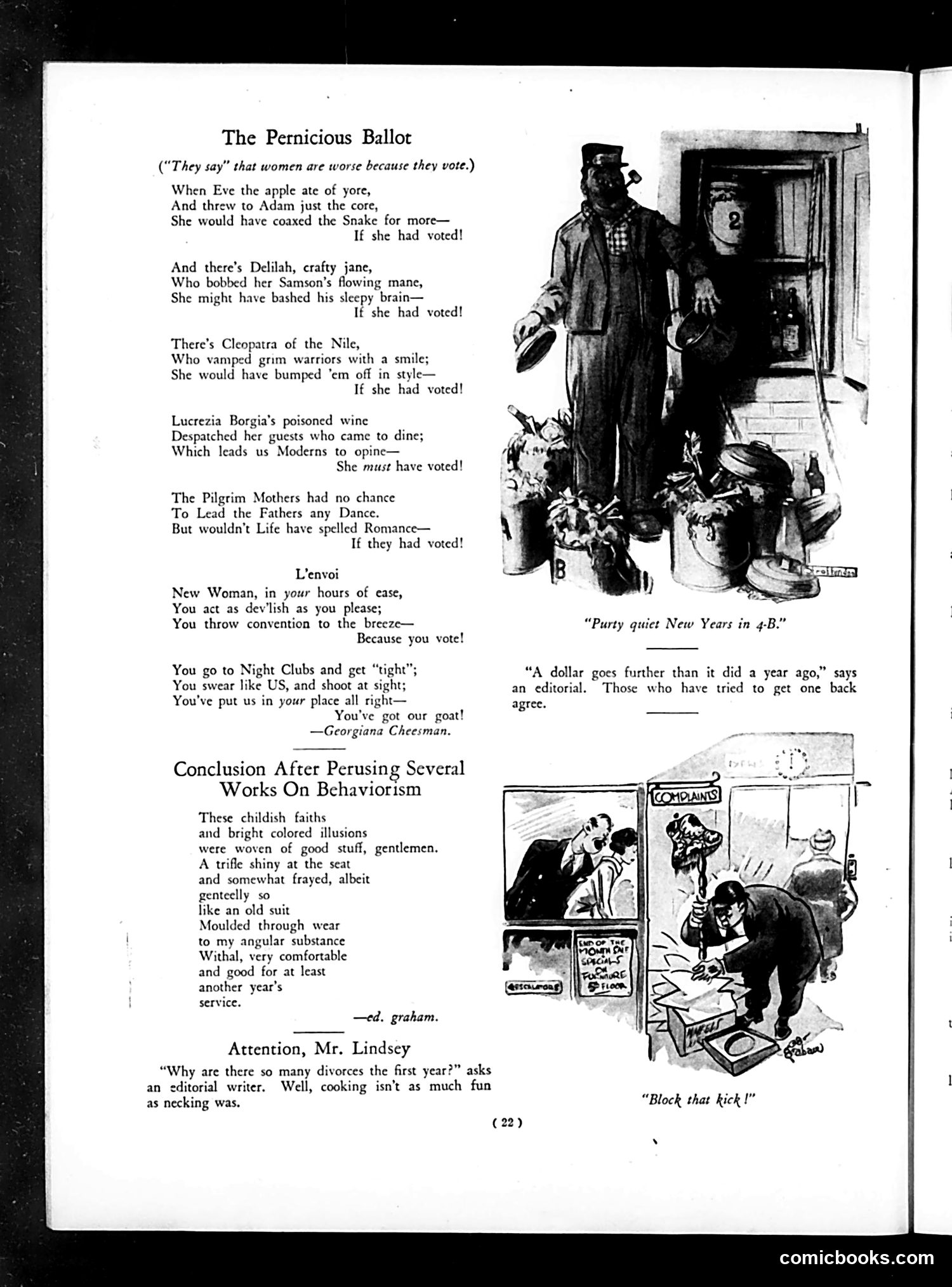
"The Pernicious Ballot" — Satire on Women's Suffrage This page satirizes anti-suffrage arguments by inverting them. The poem "The Pernicious Ballot" (attributed to Georgiana Cheesman) mocks claims that women voters would be destructive. It lists historical female figures—Eve, Delilah, Cleopatra, Lucrezia Borgia—suggesting their notorious acts would have been *worse* if they'd had voting power, thereby ridiculing the premise that voting causes moral decline. The "L'envoi" section flips the argument: modern women who vote now attend nightclubs, drink, and curse—implying that voting hasn't made them worse; they're simply exercising freedoms. The accompanying illustration "Purty quiet New Years in 4-B" shows a domestic scene, undercutting fears of female chaos. Lower sections offer unrelated satirical pieces on behaviorism and divorce rates. This appears to be pro-suffrage satire, mocking exaggerated fears about women's political participation during the early 20th-century suffrage debate.
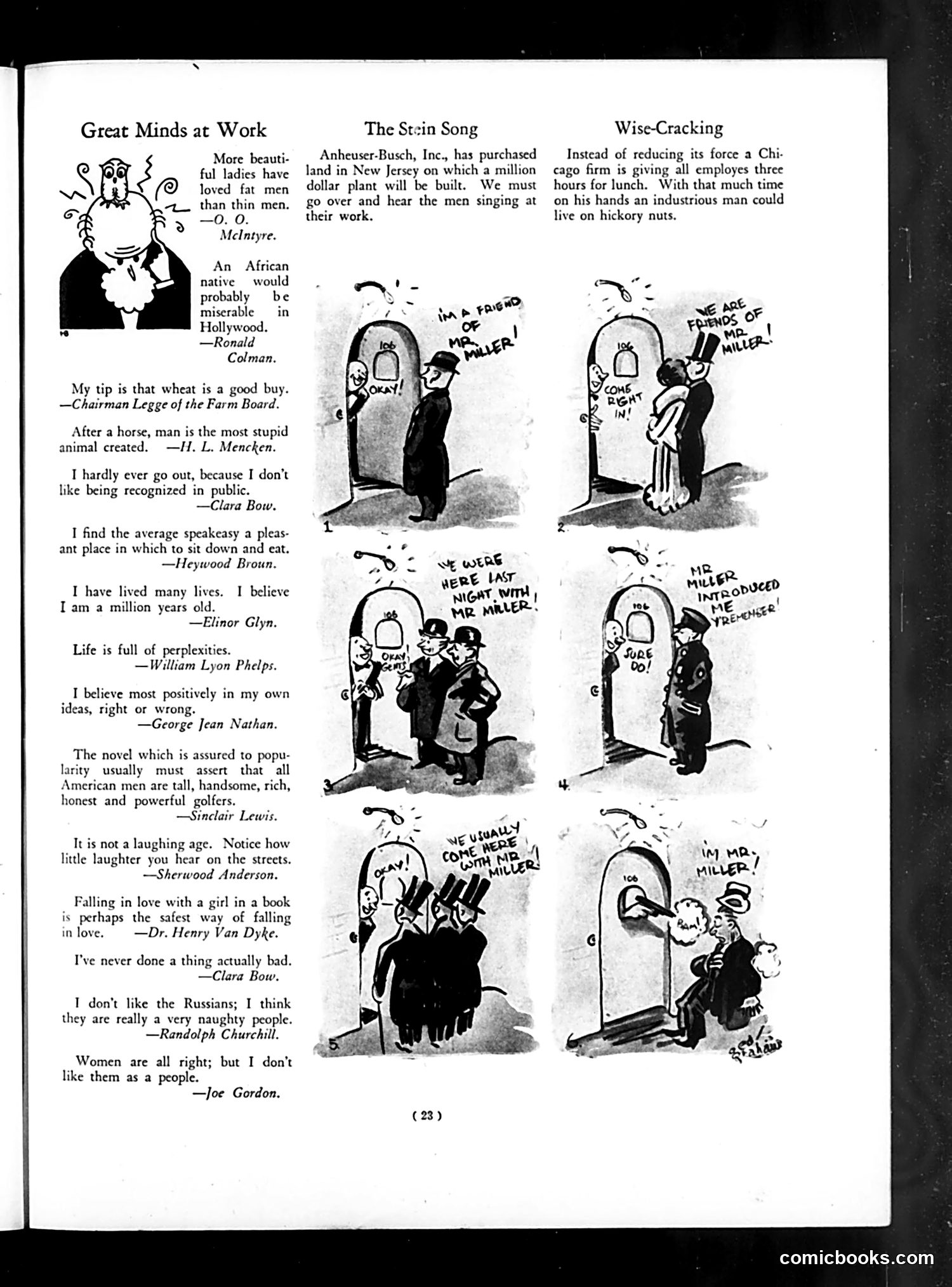
Explanation for Modern Readers This page from *Life* magazine satirizes celebrity culture and corporate practices of the era (appears to be 1920s-early 1930s). Left column ("Great Minds at Work"): Famous actors, writers, and public figures are quoted making banal or contradictory statements. The satire mocks celebrity culture by presenting their pronouncements as shallow wisdom—a pointed commentary on how the public treats entertainers as serious thinkers. Center ("The Stein Song"): References Anheuser-Busch's expansion during Prohibition (1920-1933), when alcohol was illegal. The cartoon satirizes the company's claims about workers "singing at their work"—likely mocking corporate propaganda about happy factory workers, or possibly alluding to how the brewery continued operating despite federal law. Right ("Wise-Cracking"): A Chicago firm gives workers three-hour lunch breaks instead of laying them off. The joke suggests workers are so underpaid they'd need that much time to survive on minimal food like hickory nuts—dark satire about labor conditions and inadequate wages. All three sections mock institutional hypocrisy and empty rhetoric of the period.
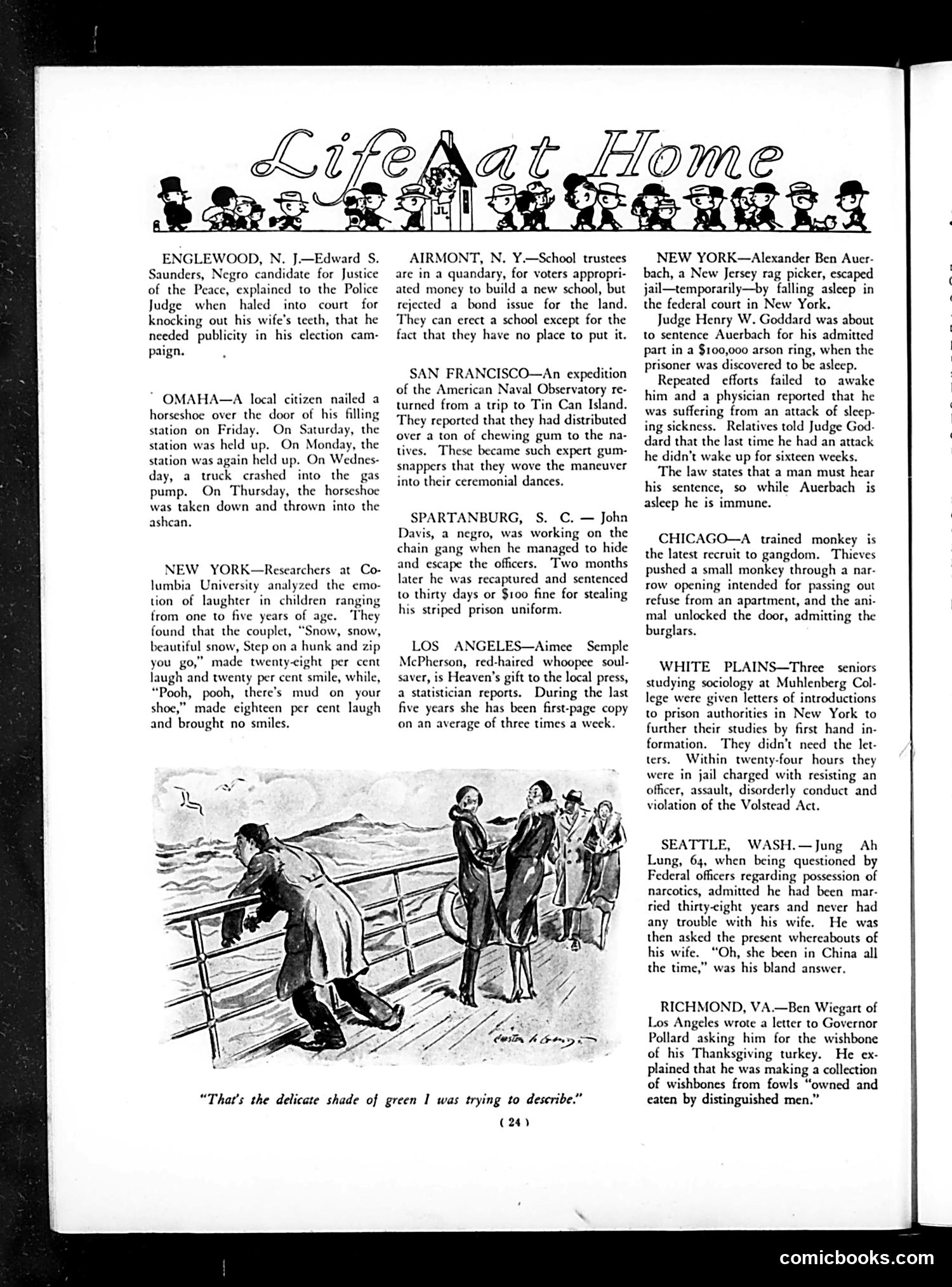
"Life at Home" — Understanding the Satire This page from *Life* magazine presents humorous short anecdotes mocking American society's absurdities. The cartoon (center) depicts a ship scene with the caption about "delicate shade of green," likely satirizing pretentious artistic description. The text items ridicule various social failures: a Black political candidate using domestic violence for publicity; superstitious reliance on horseshoes; academic studies of children's laughter; bureaucratic incompetence (building a school with no land); and legal/social ironies (a prisoner escaping sentencing through illness, a monkey burglar, college students jailed while studying prisons). Notable is the casual racist language ("negro"), reflecting the magazine's 1920s-era casual prejudice. The humor targets incompetence, hypocrisy, and institutional absurdity across American life—from politics to academia to law enforcement—presenting modern readers a snapshot of period attitudes and social anxieties.
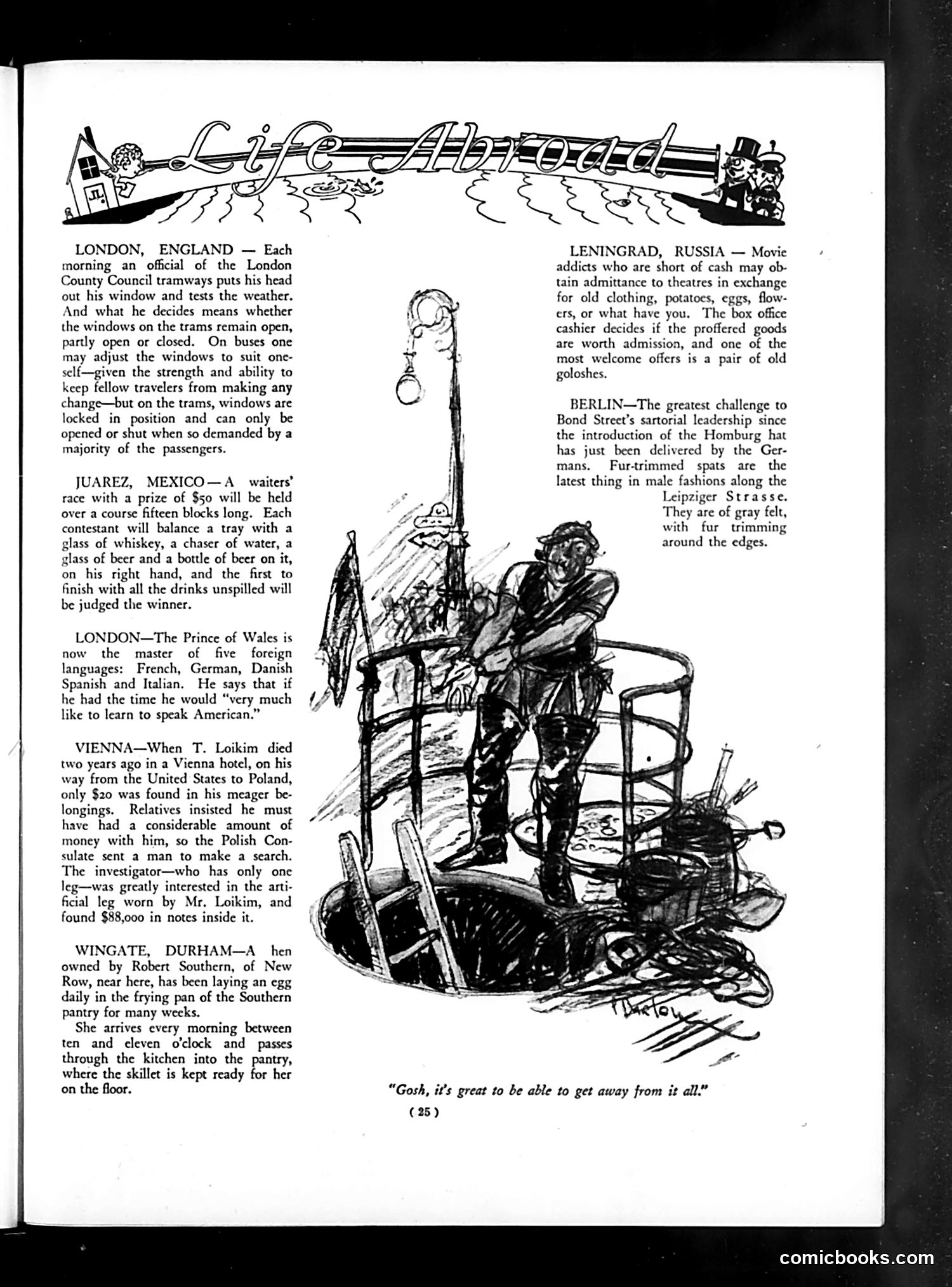
Life Magazine Humor Page Analysis This page collects international news briefs with satirical commentary on cultural quirks and absurdities. The large cartoon depicts a weary figure escaping via hot-air balloon, captioned "Gosh, it's great to be able to get away from it all"—suggesting the accumulated oddities described make one want to flee. The items mock various nations: London's bureaucratic control of tram windows; Mexico's precarious waiter races; the Prince of Wales humorously expressing desire to learn "American" (implying it's distinct from English); Vienna's Soviet-style poverty hiding a fortune in a prosthetic leg; a hen laying eggs in a frying pan; Leningrad's barter system for movie admission (reflecting Soviet-era scarcity); and Berlin adopting fur-trimmed spats as fashion. The humor operates through incongruity and gentle xenophobia typical of 1920s-30s American satirical magazines—portraying foreign customs as charmingly peculiar or absurd to American readers. The escape fantasy reinforces this worldly-weary tone.
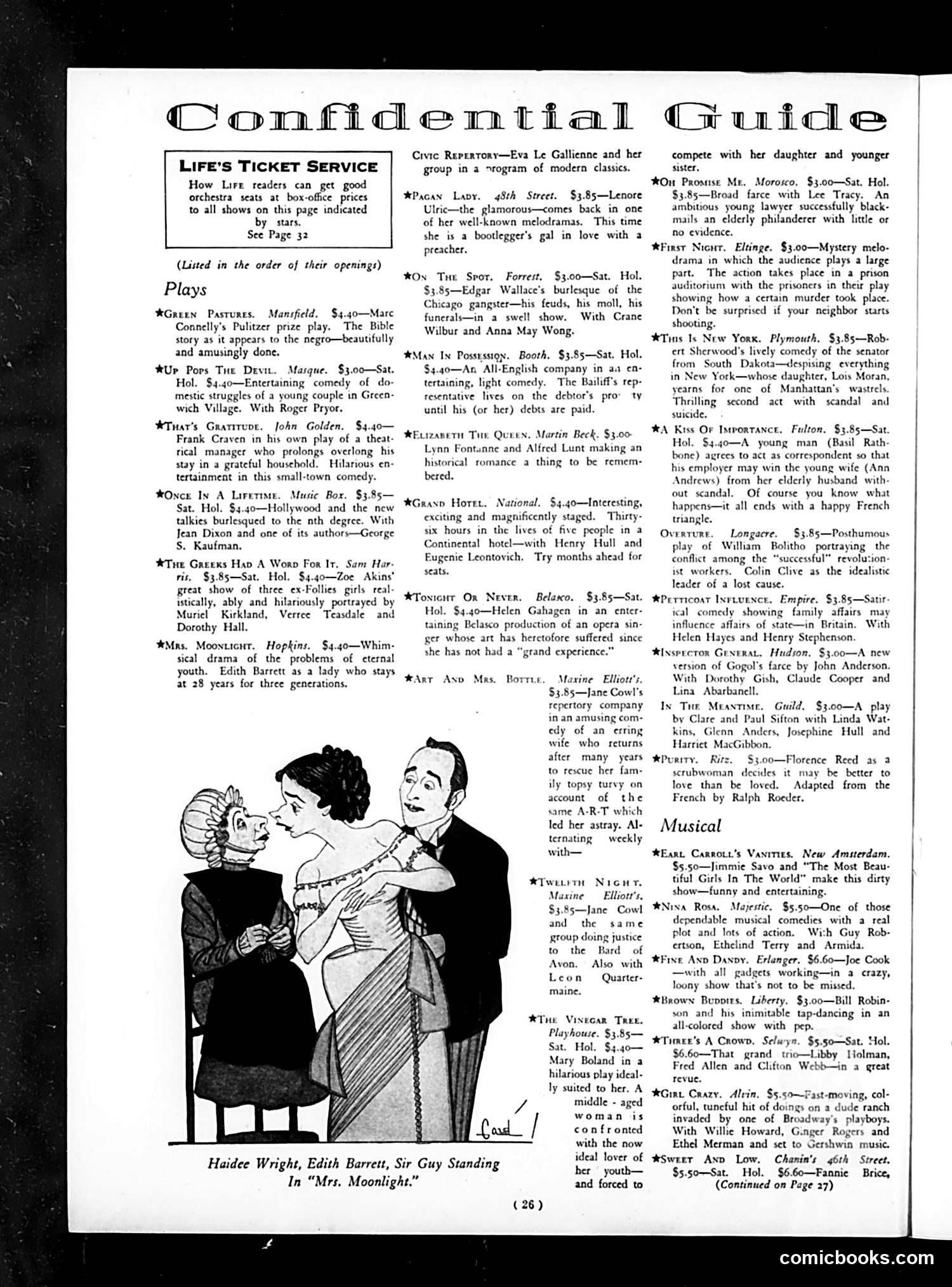
Analysis of This Life Magazine Theater Page This is a theater guide page from Life magazine, listing Broadway shows with prices and brief reviews. The central cartoon illustrates a scene from "Mrs. Moonlight" (Hopkins Theater) featuring actors Haidee Wright, Edith Barrett, and Sir Guy Standing. The cartoon depicts an elderly woman confronting a middle-aged couple—likely representing the "eternal youth" comedy premise mentioned in the text. The show's plot involves a woman who mysteriously remains 28 years old for three generations, creating awkward romantic and social situations. The page itself is primarily utilitarian content: a theatergoer's guide with show listings, prices, and brief synopses. The satire is gentle—poking fun at theatrical trends (Hollywood mockery in "Once in a Lifetime," gangster burlesques) rather than making sharp political commentary. The advertising banner for "Life's Ticket Service" indicates this guide served a practical purpose for readers seeking Broadway entertainment during what appears to be the early 1930s.
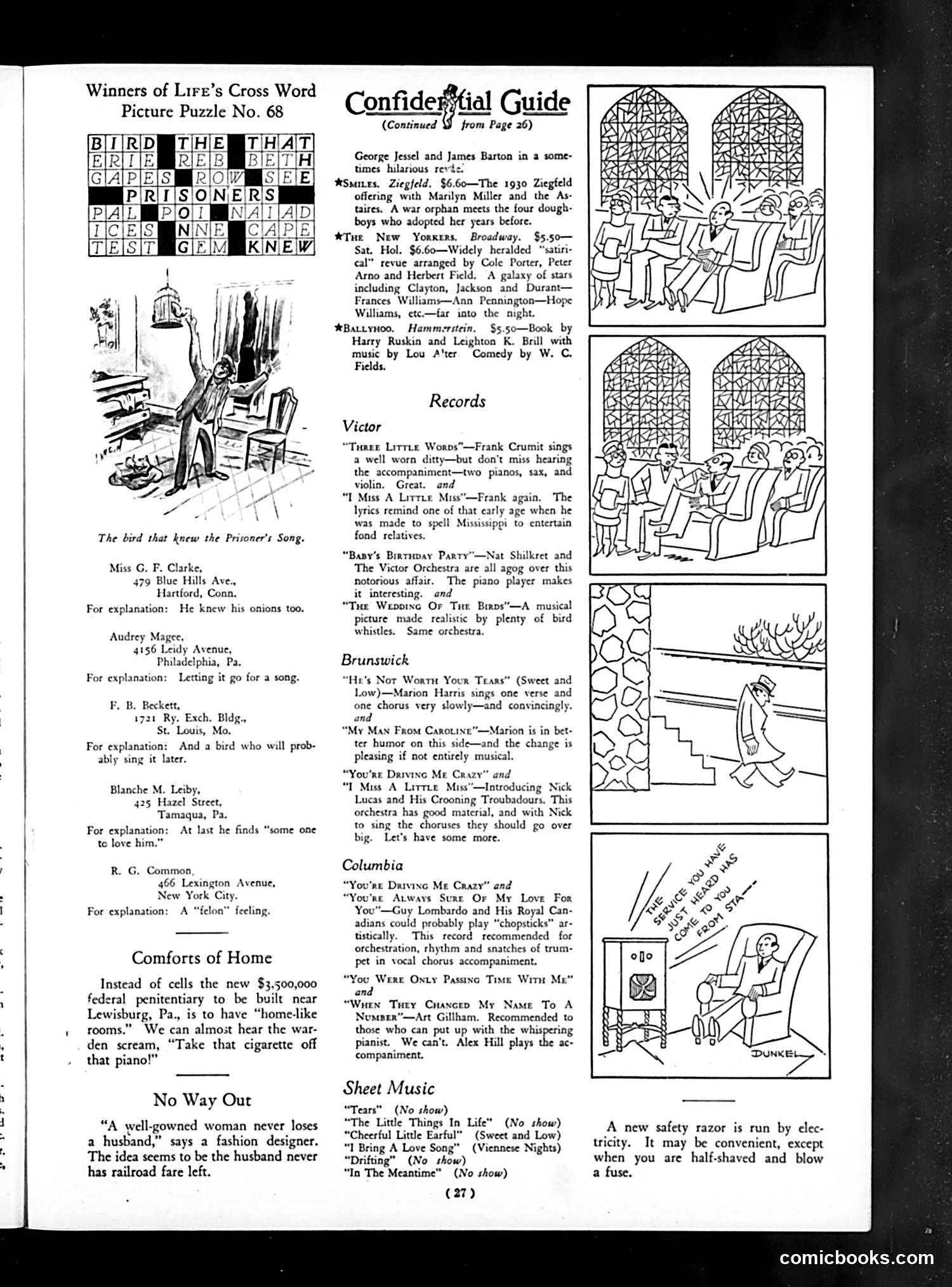
Analysis of Life Magazine Page Content This page from Life magazine (circa 1930) contains mostly entertainment and consumer content rather than political satire: Crossword Puzzle Winners: The top section shows reader submissions explaining a visual pun—"the bird that knew the Prisoner's Song"—a play on the 1924 song title using bird imagery. "Comforts of Home" & "No Way Out": Brief satirical quips about a new federal penitentiary being built with "home-like rooms" (mock outrage) and a fashion designer's claim that well-dressed women don't lose husbands (implied joke: husbands flee financial ruin). Entertainment Reviews: The bulk of the page catalogs 1930 Broadway shows, phonograph records, and sheet music—standard consumer guide content listing performers like Marilyn Miller, the Astaires, and various orchestras. Closing Joke: A pun about an electric safety razor potentially causing mishaps mid-shave. This is primarily a lifestyle/entertainment guide page, not political commentary. The humor is genteel and domestic rather than satirical about current events.
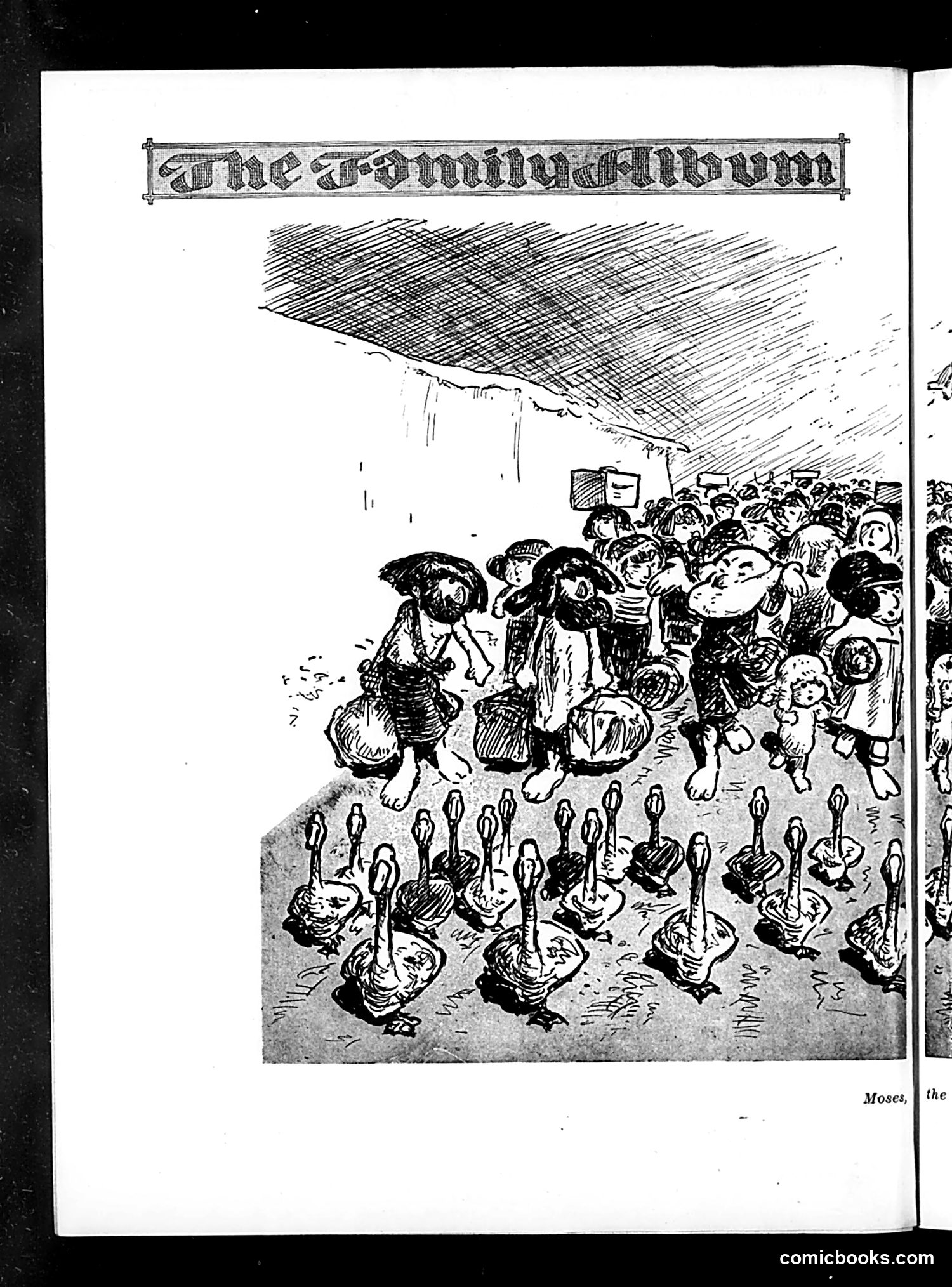
"The Toadying Aubaine" - Cartoon Analysis This appears to be a satirical illustration titled "The Toadying Aubaine" from Life magazine. The cartoon depicts a crowd of people gathered around numerous toadstools or mushroom-like figures sprouting from the ground. The figures in the crowd seem to be bowing or showing deference to these mushroom growths. The satire likely critiques obsequious behavior or sycophancy—the "toadying" referenced in the title. The mushrooms may represent something viewed as worthless or absurd that people nonetheless fawn over. Without additional context about the publication date or specific political figures involved, the exact target of ridicule remains unclear, though the visual metaphor suggests mockery of blind public worship or deference to something undeserving of respect.
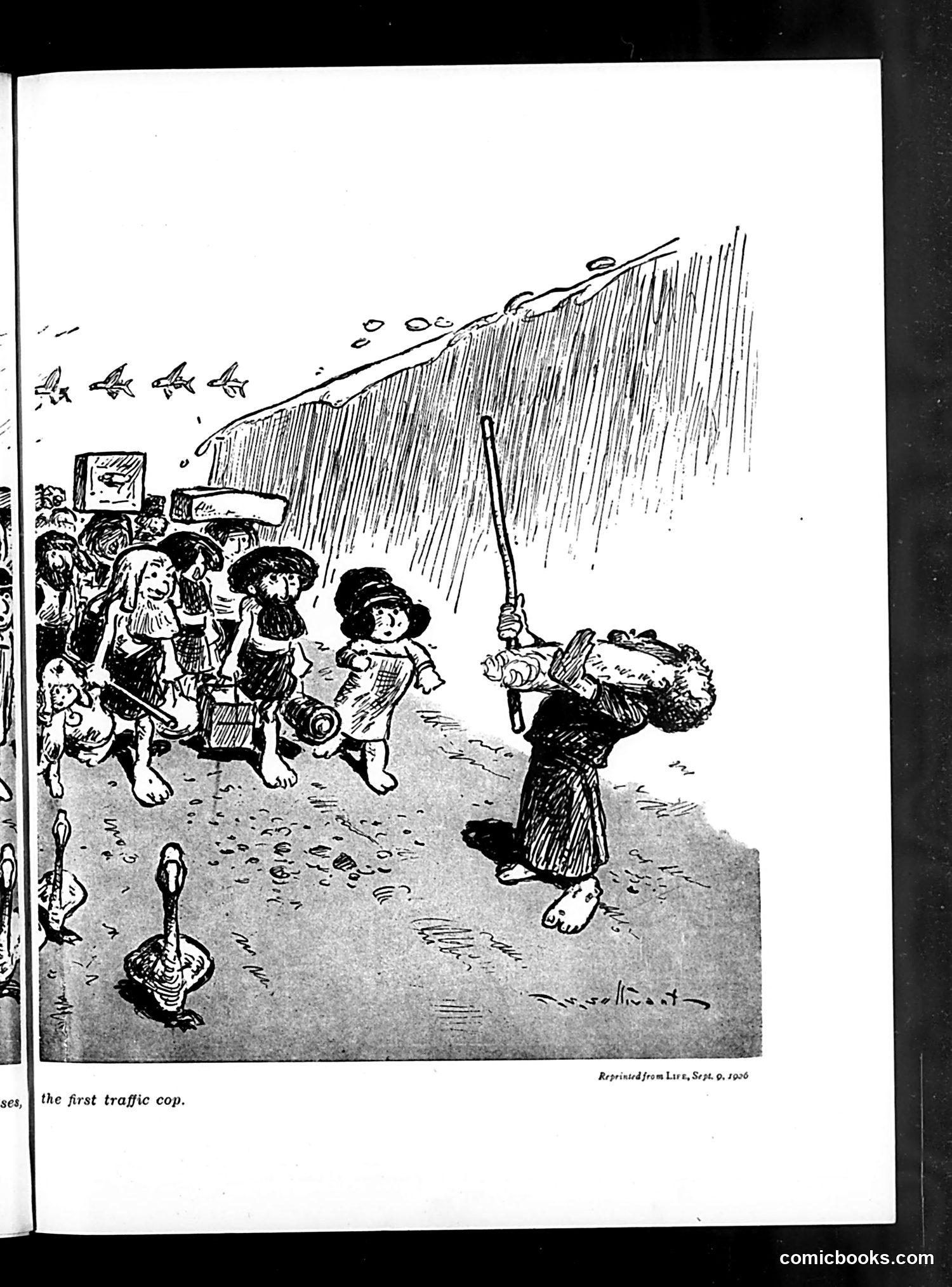
"The First Traffic Cop" This cartoon, reprinted from *Life* magazine (Sept. 6, 1906), depicts a figure wielding a large net or pole to corral a group of small characters resembling children or cherubs. The caption identifies this as "the first traffic cop." The satire appears to comment on early automobile traffic management in American cities. The small figures likely represent pedestrians or street activity from a pre-traffic-regulation era, while the figure with the net suggests the emerging need for law enforcement to control urban street chaos. The birds flying overhead and sparse street markings reinforce the sense of a newly motorized city struggling with organization. This reflects early-1900s anxieties about automobile technology disrupting traditional street use and requiring new forms of social order and police authority.
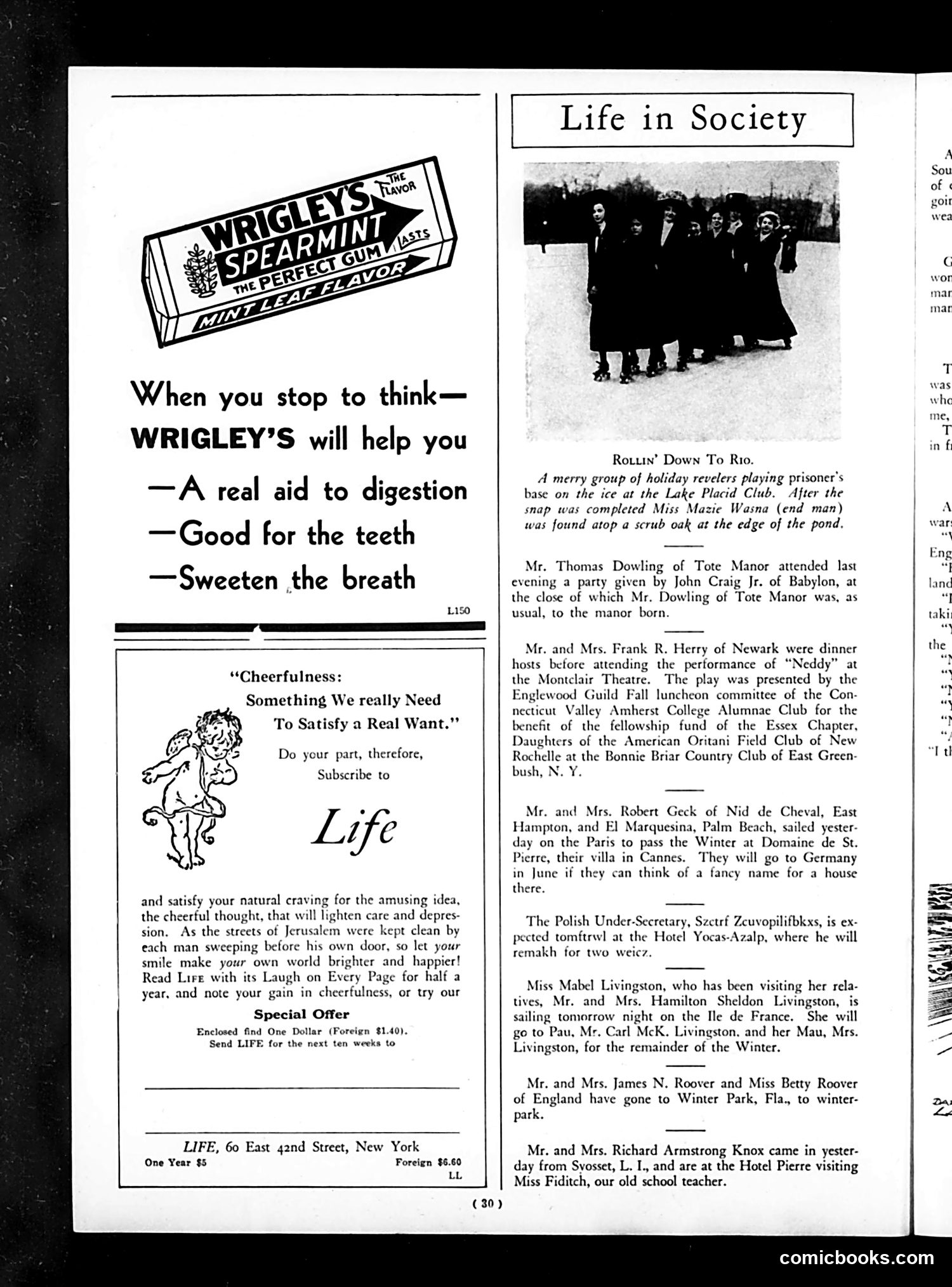
Life Magazine Page Analysis This page combines advertising (left side) with society gossip (right side), typical of Life magazine's format. The Wrigley's gum advertisement uses straightforward product claims—digestive aid, dental health, breath freshening—common marketing language of the era. Below it, Life promotes its own magazine through a subscription pitch, arguing that reading their "laugh on every page" provides cheerfulness as a remedy for life's depression and care. This reflects 1920s-30s optimism that humor and lightheartedness were morally valuable and psychologically beneficial. The "Life in Society" section contains satirical society gossip. The humor lies in absurdist details: people playing prisoner's base on ice, someone landing "atop a scrub oak"; a man becoming "manor born" (wordplay on "manner born"); elaborate charity luncheon chains; and deliberately garbled Polish names. The satire mocks wealthy society's pretentious activities and convoluted social hierarchies through deadpan absurdity.
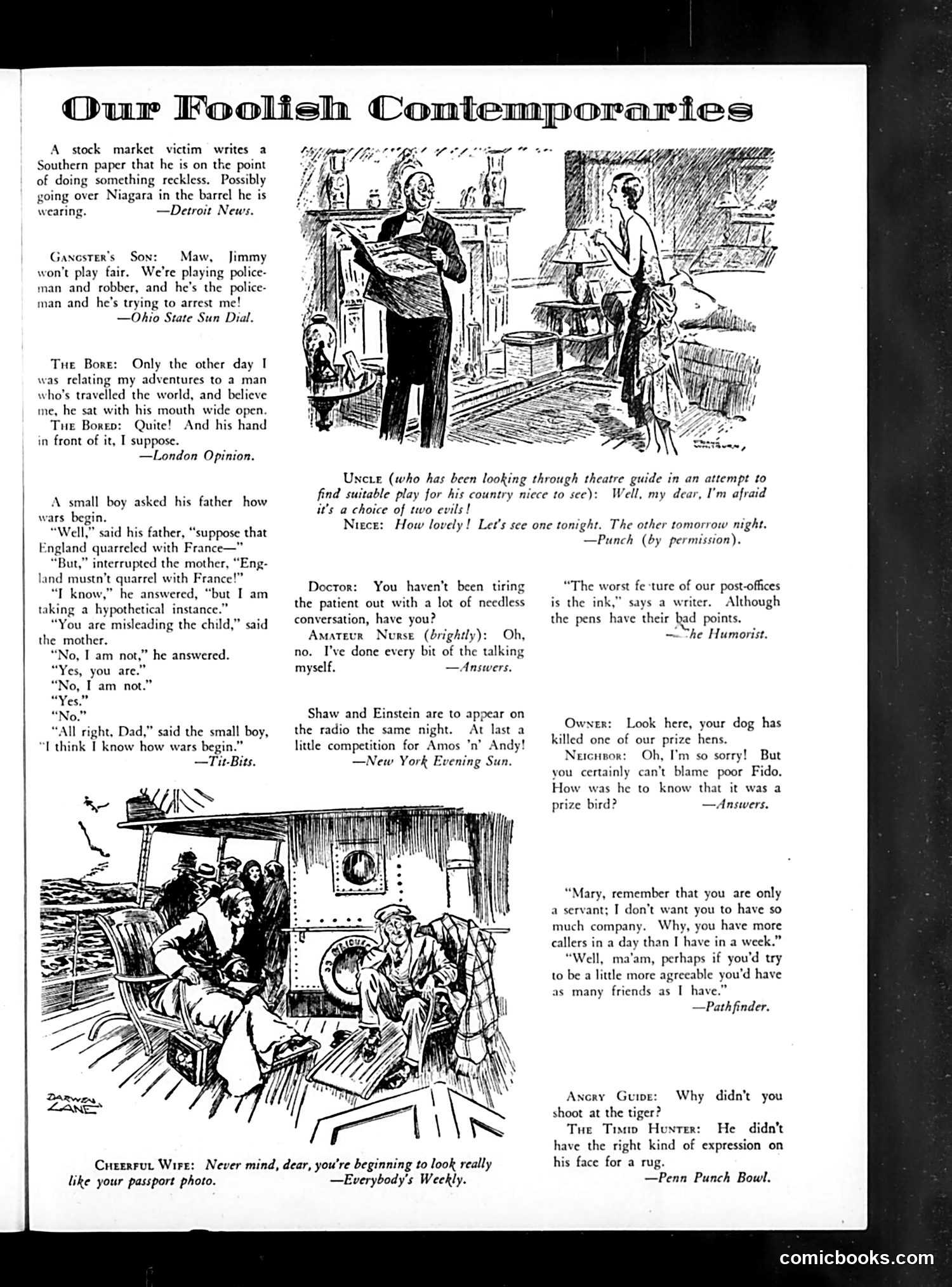
"Our Foolish Contemporaries" - Life Magazine Humor Page This is a collection of brief satirical jokes and comic anecdotes targeting everyday social absurdities of the era. Key targets include: Social commentary: A stock market victim contemplating suicide by barrel over Niagara Falls (referencing economic desperation); a child's logic about war that exposes parental hypocrisy; servant-master class dynamics where a maid's superior social skills embarrass her employer. Contemporary references: A joke about radio competition between Shaw and Einstein appearing opposite "Amos 'n' Andy" (a popular radio show). Visual gags: A cartoonist's spouse joking about his passport photo appearance; a timid hunter avoiding a tiger lacking proper "expression" for a rug. The humor is genteel and observational—mocking pretension, logical inconsistency, and social pretense rather than crude satire. The page reflects Life's role as a magazine of urbane wit for educated readers during what appears to be the 1920s-30s.
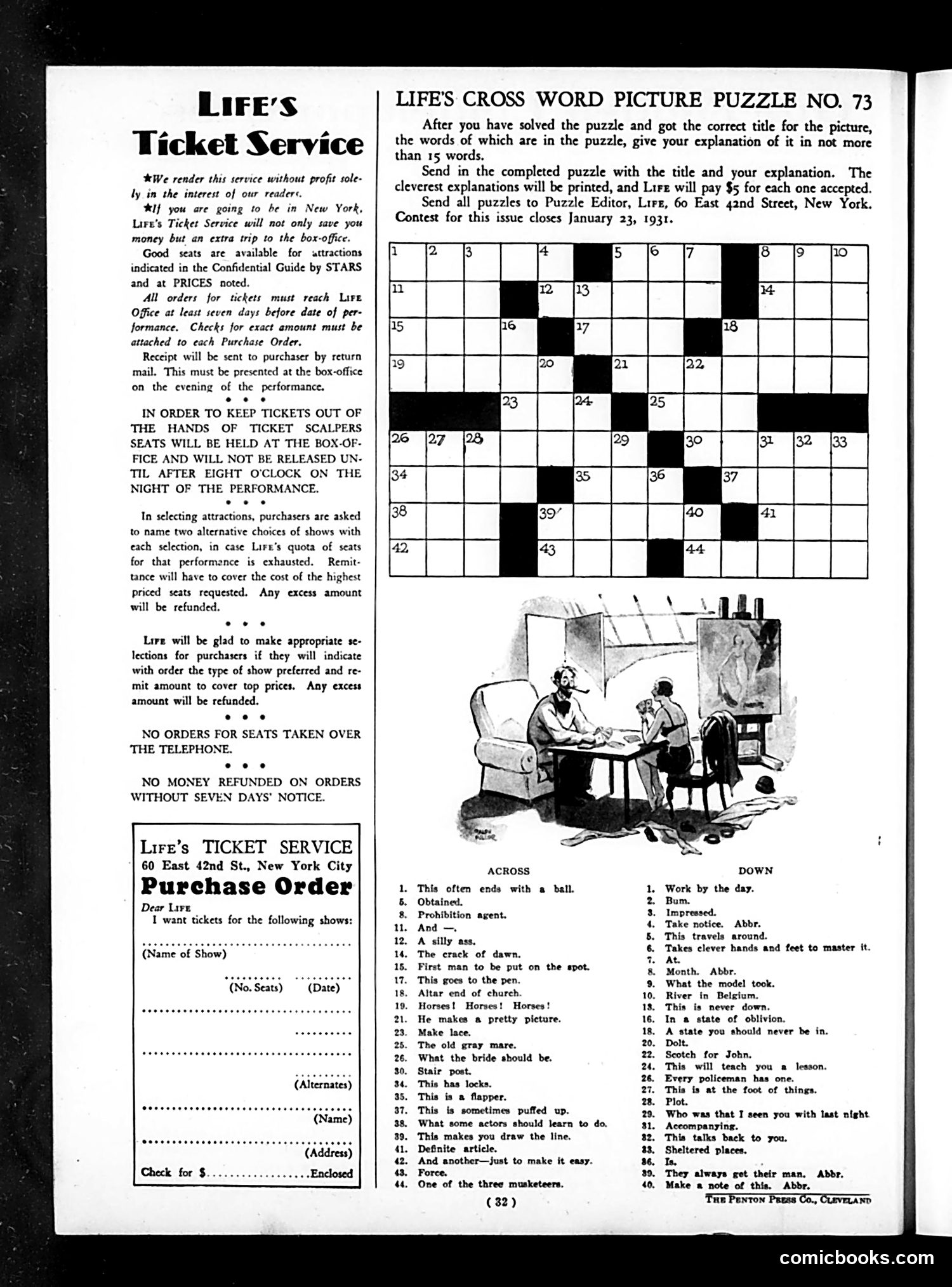
Life Magazine Crossword Puzzle Page (1931) This page is primarily advertising and contest material rather than satirical content. It presents Life's Ticket Service (offering Broadway theater ticket purchases) and announces "Life's Cross Word Picture Puzzle No. 73"—a reader competition where solvers must identify a picture's title and explain it in 15 words or fewer for a $5 prize. The small cartoon illustration shows two men at a table in what appears to be a domestic interior, likely the unsolved puzzle image itself. The page is dominated by service information: ticket ordering procedures, contest rules, and crossword clues (both Across and Down). This reflects 1930s Life magazine's dual function as satirical publication and lifestyle service for affluent urban readers, particularly those attending Broadway performances in New York City. The contest deadline was January 23, 1931.
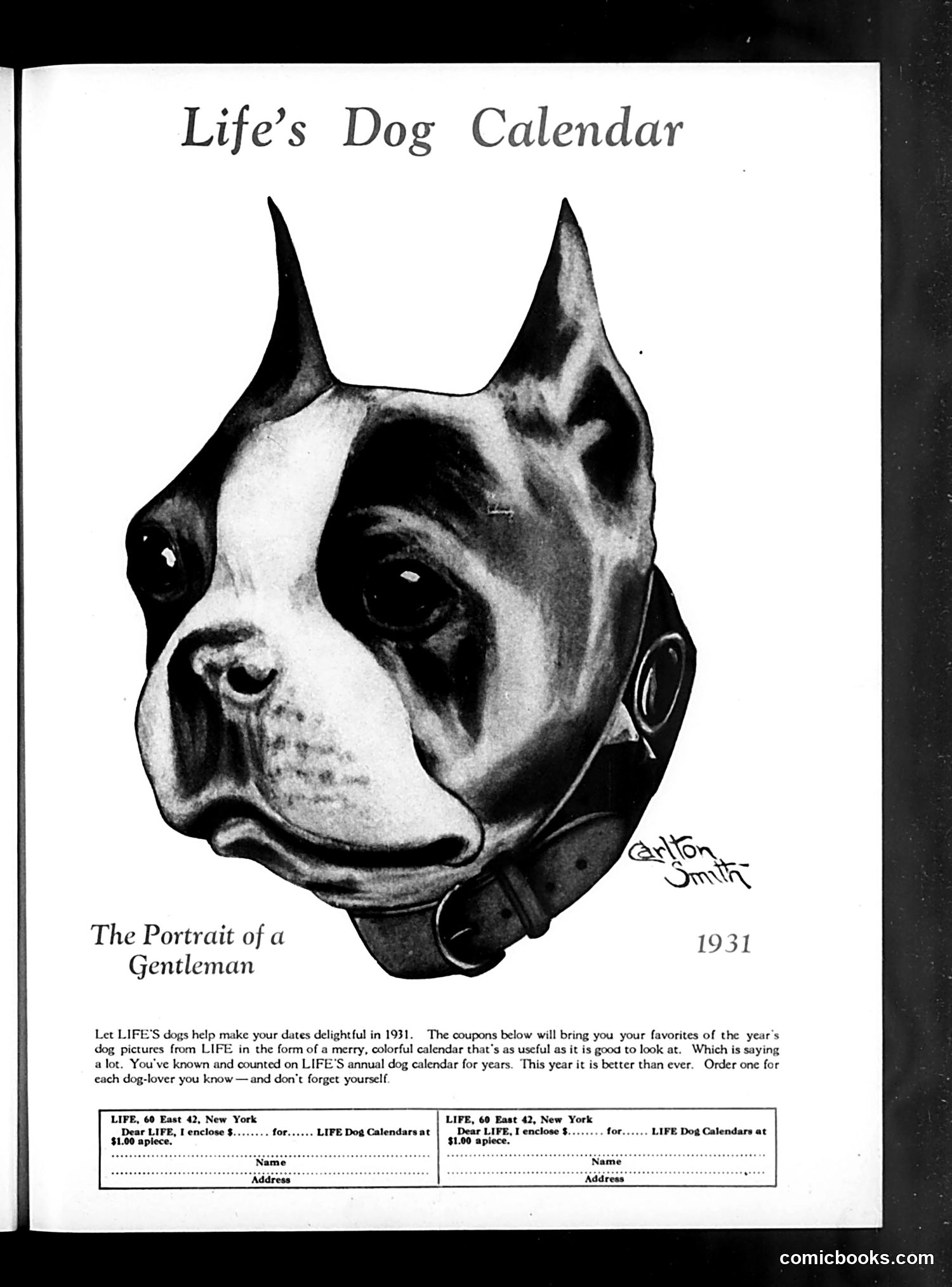
Life's Dog Calendar (1931) This is primarily an advertisement for Life magazine's 1931 dog calendar, not a political cartoon. The page features a portrait illustration of a Boston Terrier or similar breed wearing a collar, signed by artist "Carlton Smith." The subtitle, "The Portrait of a Gentleman," is a humorous play on aristocratic portraiture conventions—elevating a dog to genteel status. This reflects 1930s popular culture's sentimental anthropomorphization of pets. The text pitches the calendar as a gift for "dog-lovers," emphasizing that Life's annual dog calendars were established popular merchandise. At $1.00 per copy, it was a modest luxury during the Depression year of 1931. The two order coupons at the bottom allowed readers to purchase multiple calendars as gifts. No satire or political commentary appears present—this is straightforward commercial promotion.
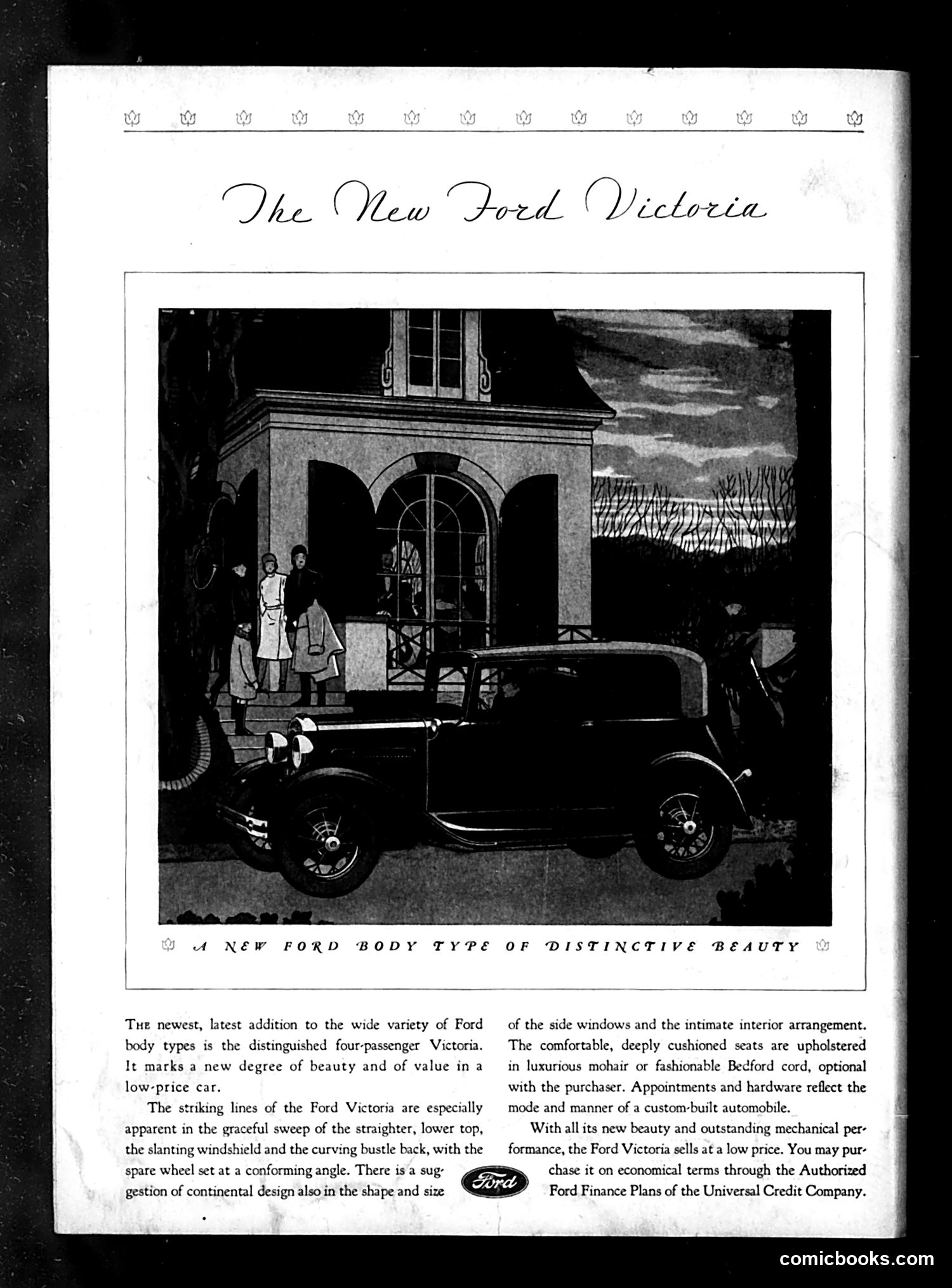
This is not a cartoon or satirical content—it's a straight automobile advertisement for the Ford Victoria, a four-passenger car model. The page features a photograph of the vehicle parked in front of a house with well-dressed figures nearby, accompanied by promotional text. The ad emphasizes the car's "distinctive beauty," luxurious interior (mohair or Bedford cord upholstery), stylish design elements (curved bustle back, slanting windshield), and—crucially—its affordable price point. The sales pitch targets middle-class buyers by promising custom-built quality at "low price" with financing available through Ford's credit company. This reflects the 1920s-30s auto industry's strategy of making automobiles accessible to ordinary consumers rather than just the wealthy. There is no satire here—this is earnest commercial promotion typical of *Life* magazine's advertising content during this era.

I can see this is a very dark, low-contrast image from what appears to be a historical publication. The page is almost entirely black with only faint grayscale imagery visible on the right side and a white margin on the left. While there is OCR text mentioning "comicbooks.com" at the bottom, I cannot reliably make out the actual cartoon illustrations, text content, or identifying details that would allow me to explain the satire, political references, or historical context to a modern reader. To provide accurate analysis following your rules, I would need a clearer, higher-contrast version of this page where the artwork and text are legible.