life
Life — January 9, 1931
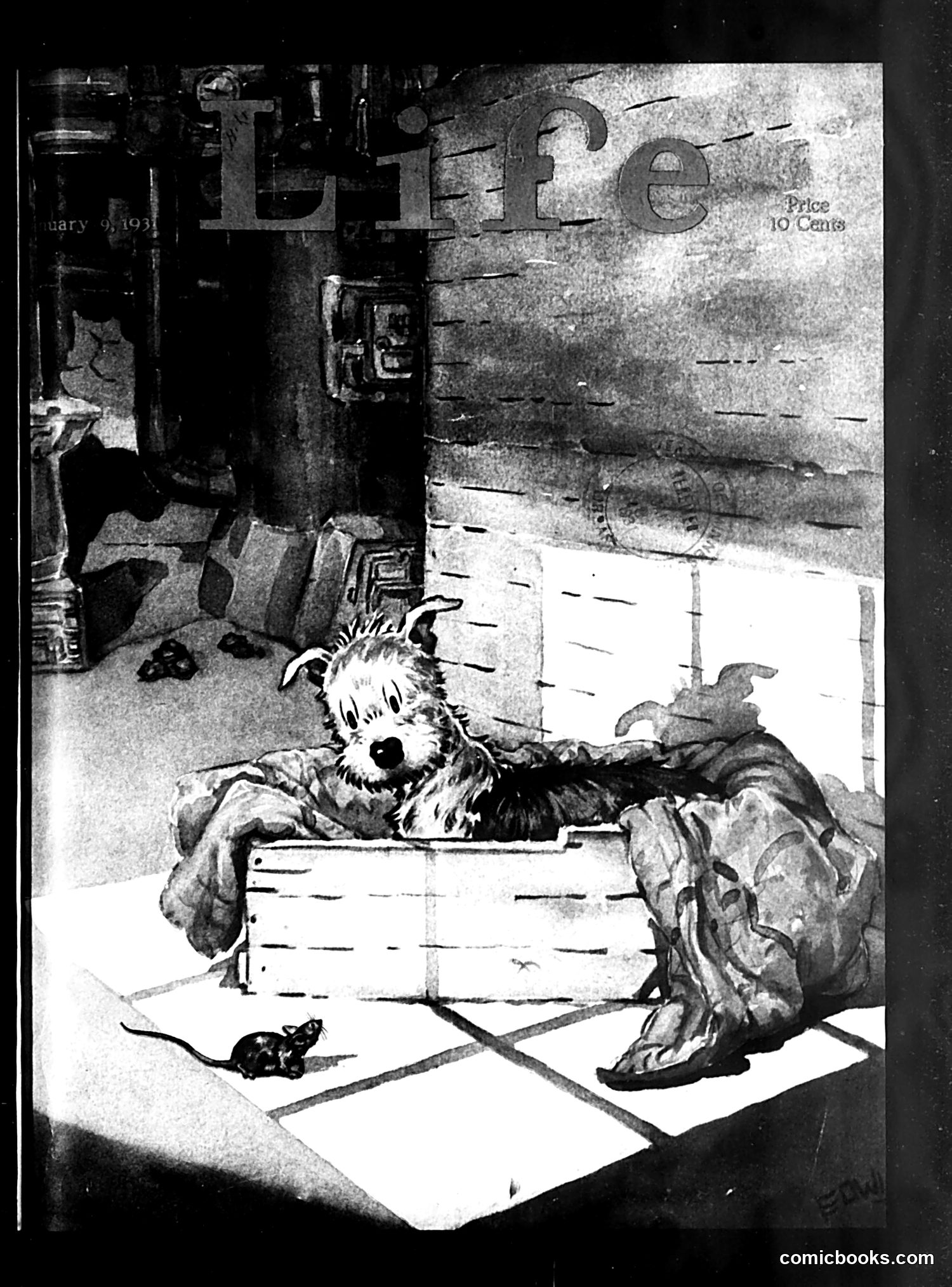
Life Magazine Cover Analysis This is the cover of *Life* magazine from January 9, 1931 (price 10 cents). The illustration shows a scruffy terrier dog sitting in a wooden crate or box, with a small mouse nearby on the floor. The dog appears alert and somewhat disheveled. The cartoon likely plays on the common phrase about dogs chasing mice—a classic predator-prey relationship used metaphorically in satire. Without additional context from the magazine's contents, the specific political or social reference remains unclear. It could comment on economic conditions (the Depression era), business rivalries, or general human foibles using the dog-and-mouse dynamic as visual metaphor. The humorous tone suggests social satire typical of *Life's* editorial approach.
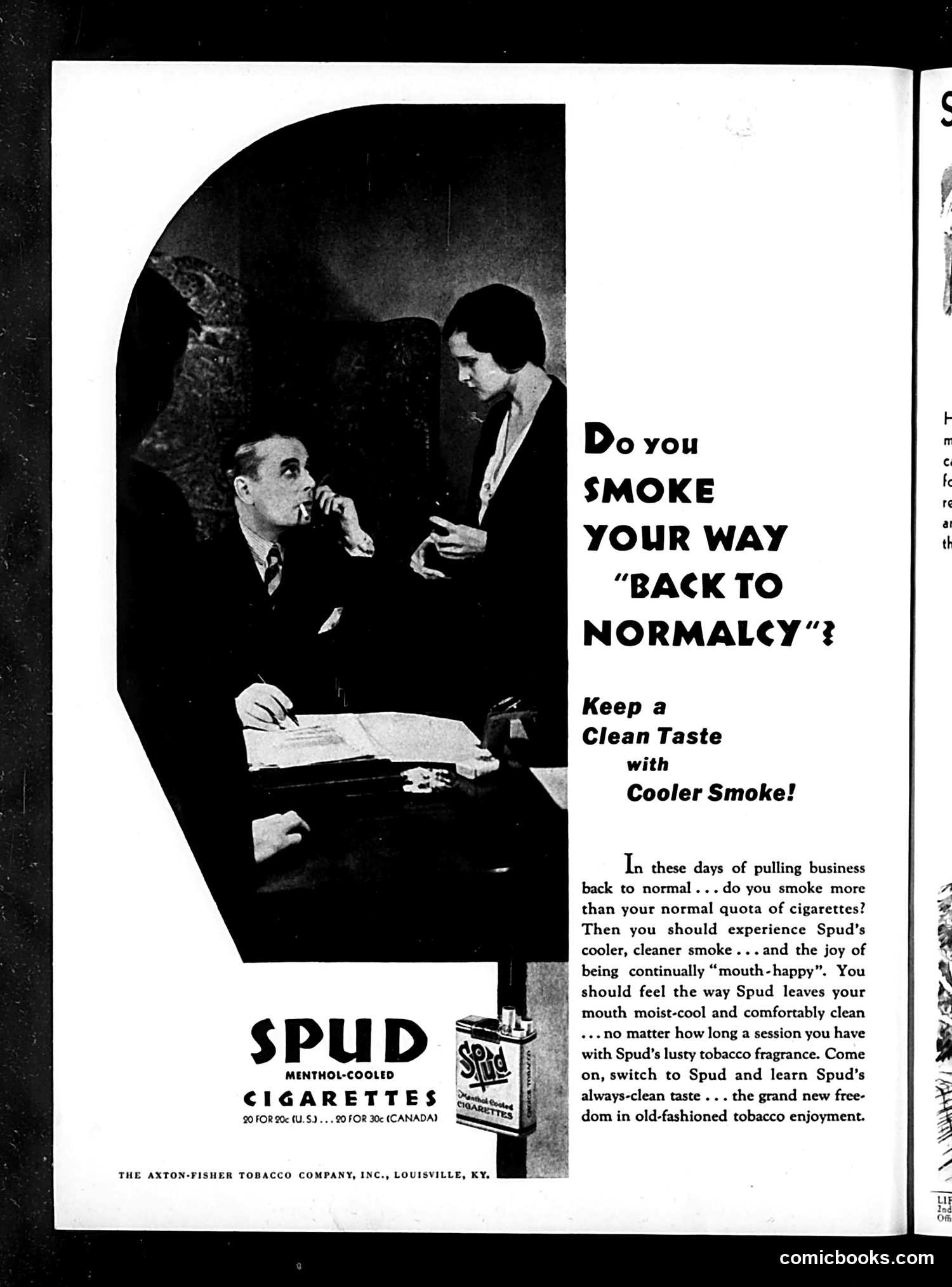
This is a cigarette advertisement for Spud menthol cigarettes, not satire. The image shows two businessmen in an office setting—one seated at a desk smoking, the other standing nearby. The ad's headline asks "Do you SMOKE YOUR WAY 'BACK TO NORMALCY'?" The phrase "back to normalcy" was Warren G. Harding's 1920 campaign slogan, suggesting this ad dates to that era. The advertisement markets Spud's menthol-cooled cigarettes as a solution for heavy smokers experiencing fatigue from excessive smoking during the return to normal business activity after World War I. The pitch emphasizes that menthol provides a "clean taste" and "moist-cool" sensation, allowing continued heavy smoking without throat irritation.
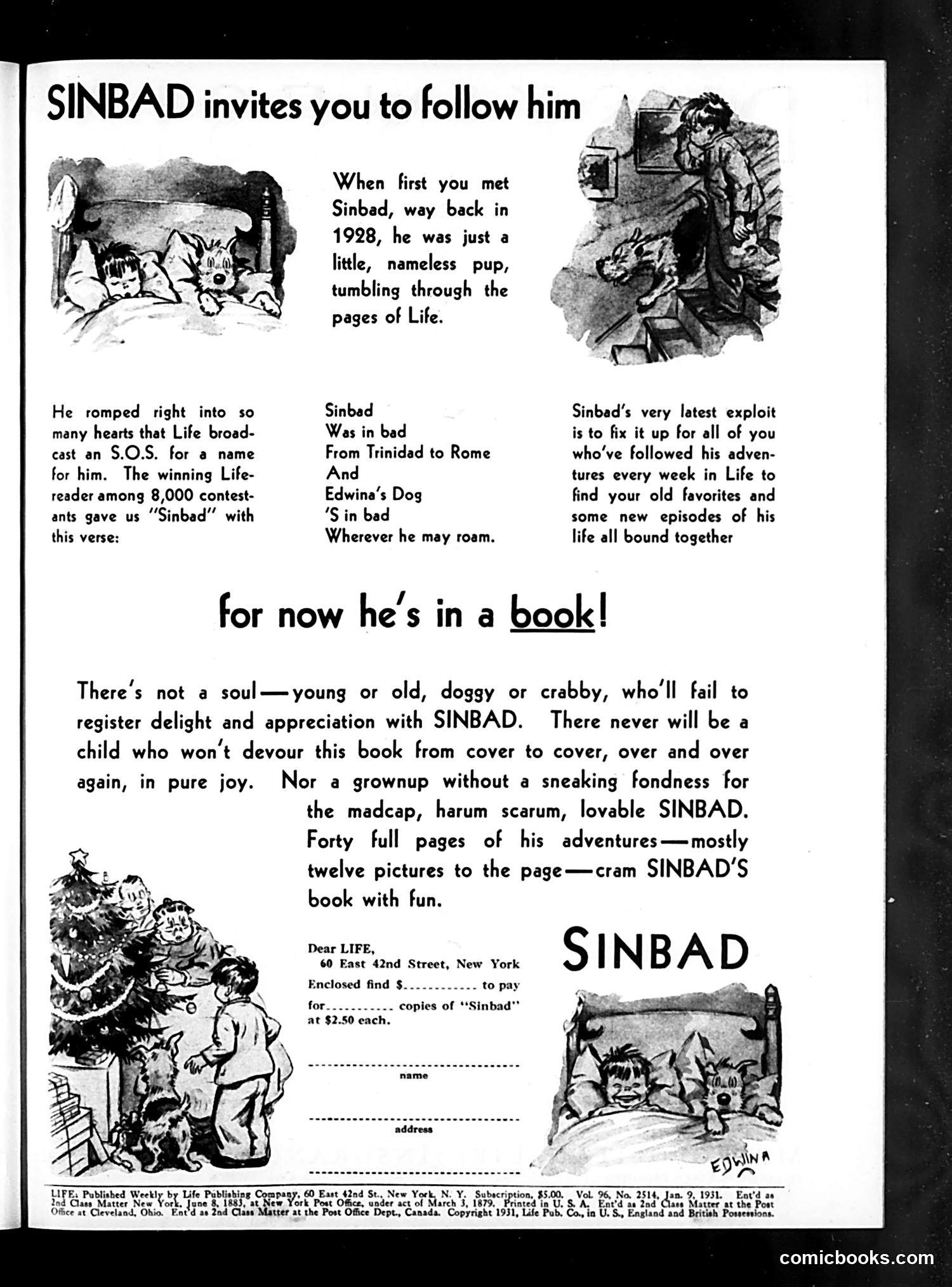
Advertisement for Sinbad Book (Life Magazine, 1931) This is a book advertisement, not political satire. It promotes a 40-page children's book about "Sinbad," a fictional character who debuted in Life magazine in 1928 as an unnamed puppy character. The ad traces Sinbad's journey from obscurity to popularity—he "romped right into so many hearts" that Life readers voted him a name through an S.O.S. contest. The character apparently had adventures spanning locations like Trinidad and Rome, becoming beloved enough to warrant a published collection. The advertisement uses humorous language ("madcap, harum scarum, lovable SINBAD") and promises "forty full pages of his adventures—mostly twelve pictures to the page." Books cost $2.50 each, ordered through Life's New York office. This reflects 1930s marketing: leveraging a magazine's popular recurring character into commercial merchandise.
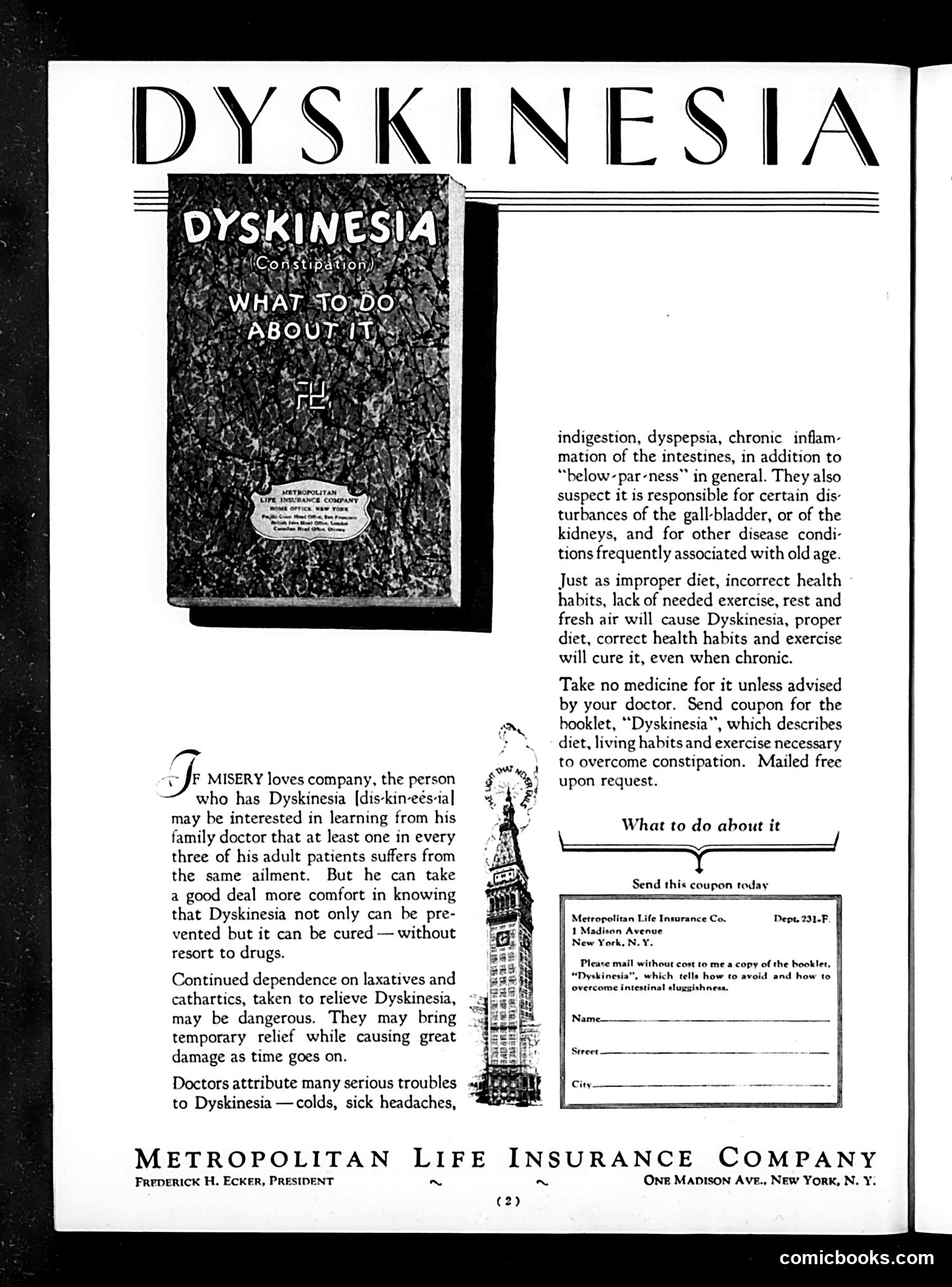
Analysis This page is primarily advertising, not satire or editorial content. It's a Metropolitan Life Insurance Company advertisement promoting a free booklet about "Dyskinesia" (constipation). The ad uses a common early 20th-century marketing strategy: presenting a medical condition as widespread ("at least one in every three adult patients suffers"), then positioning the company's free literature as a solution. The copy emphasizes that dyskinesia can be cured through diet, exercise, and healthy habits—without drugs—though readers should consult their doctor. The decorative elements (clock tower illustration, vintage typeface) are period advertising design. There's no political satire here; this reflects the era's tendency for insurance companies to distribute health guidance as a marketing tool to build consumer trust and goodwill.
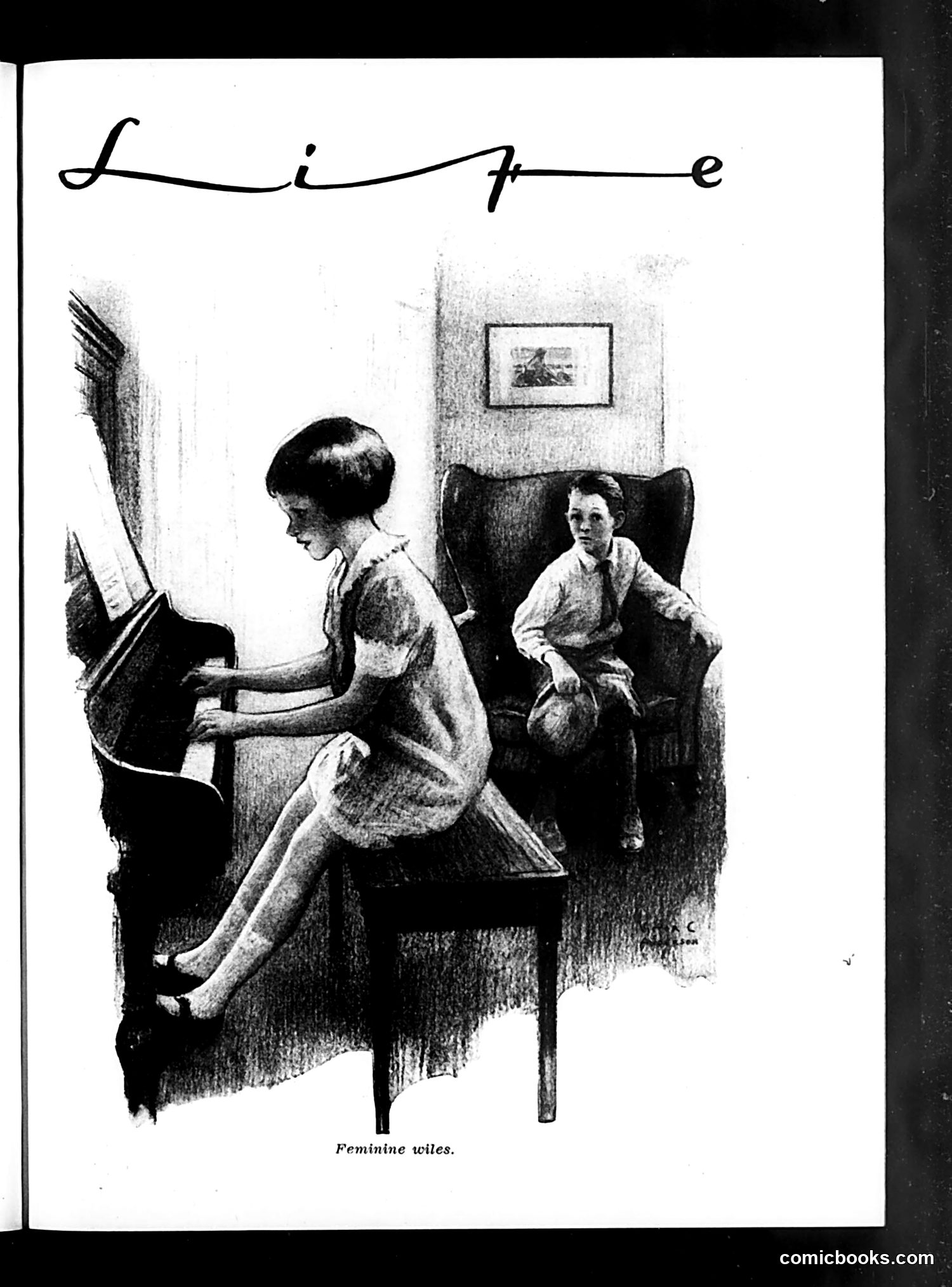
"Feminine Wiles" - Life Magazine Cartoon This cartoon satirizes women's manipulation tactics in domestic life. The illustration shows a woman at a piano while a man sits in an armchair, watching her with apparent skepticism or wariness. The caption "Feminine wiles" suggests the woman is deliberately using charm or performance (playing music) to influence or manipulate the man's behavior or decisions. The satire targets early 20th-century gender dynamics—the assumption that women employed calculated charm or emotional appeals rather than direct communication to get their way. It mocks both female "manipulation" and male susceptibility to it, reflecting period anxieties about women's growing social influence and autonomy during this era.
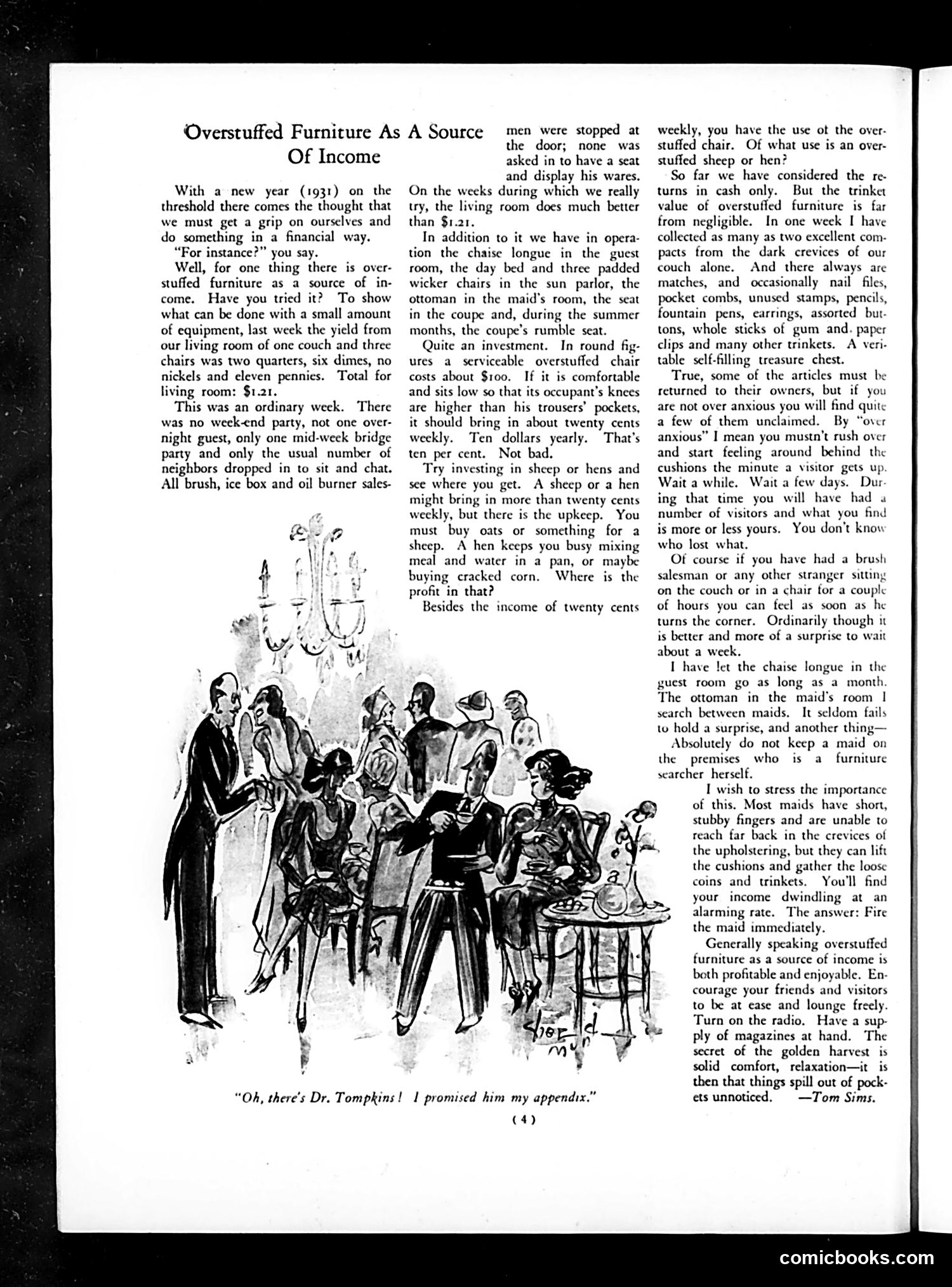
"Overstuffed Furniture As A Source Of Income" This 1931 satirical article advises Depression-era readers on monetizing household furniture by renting it out. The accompanying cartoon depicts a crowded parlor scene where numerous guests lounge on overstuffed chairs and sofas—the humor lies in the absurd density of people packed into one room. The article's tongue-in-cheek "advice" suggests charging visitors small fees to sit on furniture, use the ottoman, or leave items in coat pockets. It playfully warns that maids with "short, stubby fingers" might steal loose coins hidden in upholstery, and recommends firing them immediately if valuables go missing. The satire targets the financial desperation of ordinary Americans during the Great Depression, mocking improbable schemes to generate income from ordinary household items.
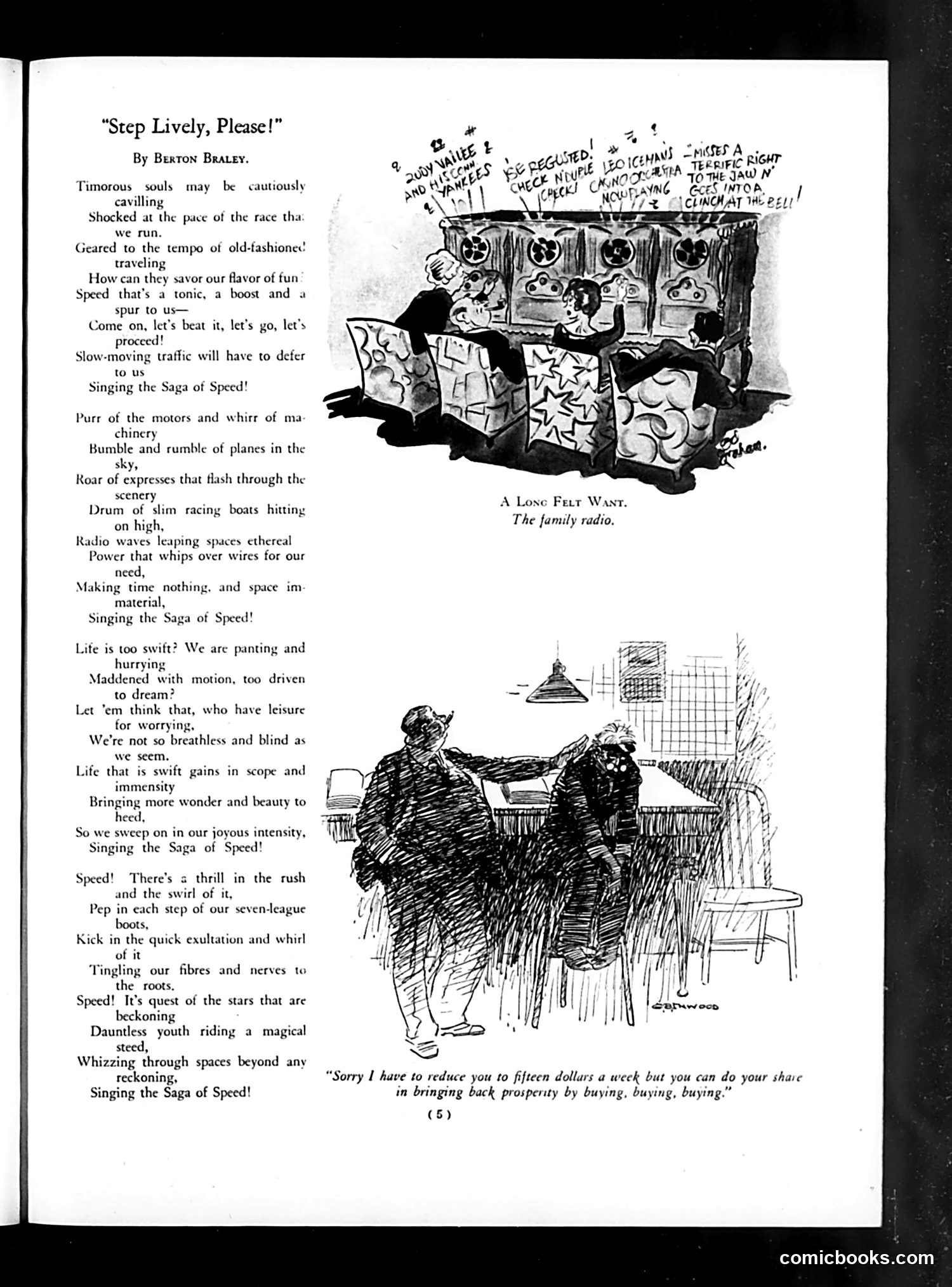
Analysis of "Step Lively, Please!" by Bekton Bealey This page satirizes modern society's obsession with speed and constant motion. The poem "Singing the Saga of Speed" mocks contemporary culture's worship of velocity—from fast cars and planes to radio waves—suggesting people are overstimulated and losing leisure. The top illustration shows a chaotic "family radio," depicting how technology overwhelms domestic life with noise and stimulation. The lower cartoon illustrates the economic consequence: a husband apologizes to his wife for reducing her allowance, but suggests she compensate by increased consumption ("buying, buying, buying"). This satirizes how 1920s consumer culture pressured people to constantly purchase goods to stimulate the economy, even while wages stagnated—a prescient critique of consumer capitalism's contradictions.
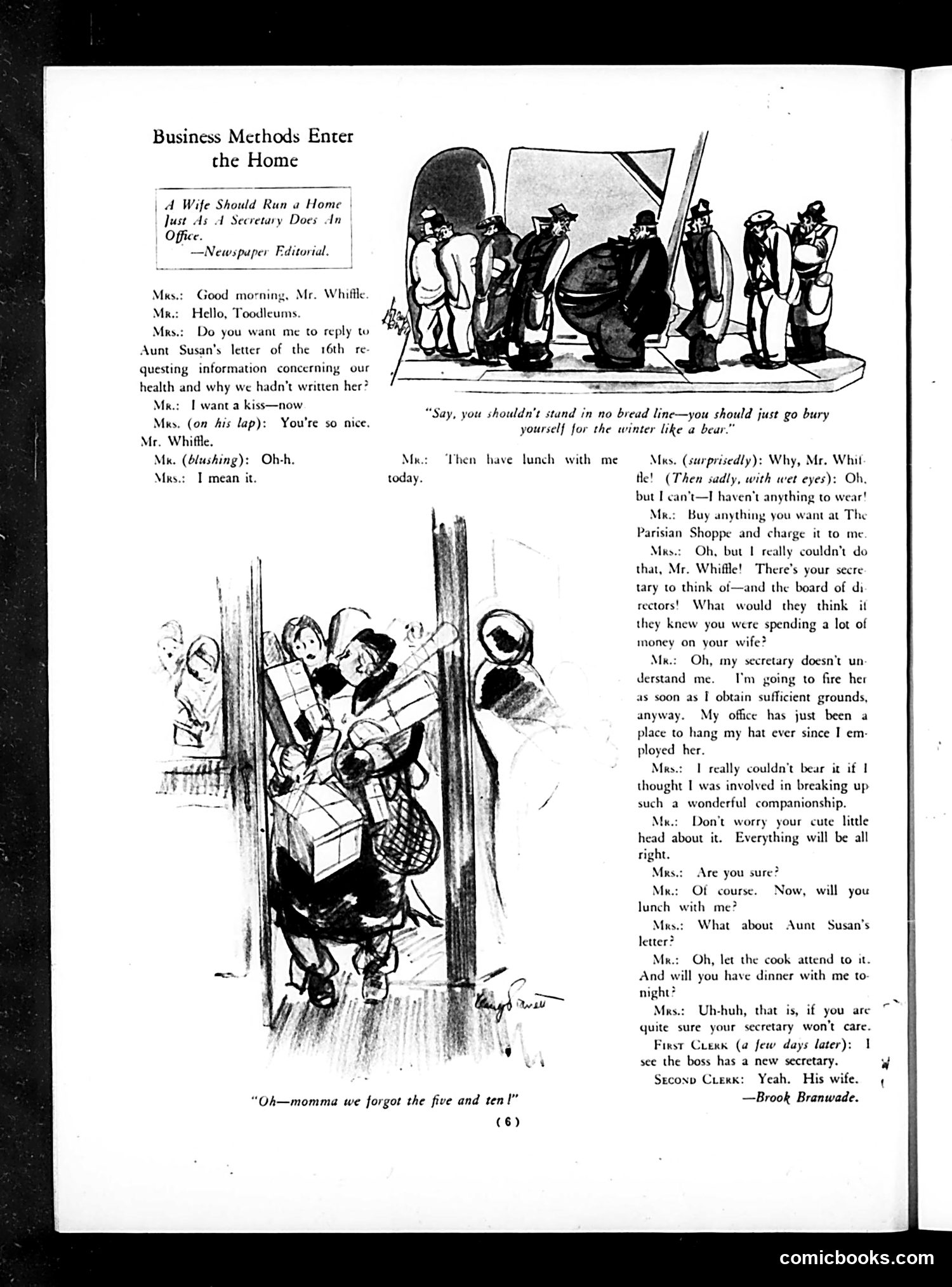
"Business Methods Enter the Home" This satirical sketch mocks the intrusion of corporate management practices into domestic life. Mr. Whittle, a businessman, treats his wife like an office secretary—demanding she handle correspondence, requesting kisses "on schedule," and planning to fire her for spending too much money, just as he would terminate an employee. The comedy derives from applying harsh business terminology and efficiency standards to marriage. Mrs. Whittle's distress at being treated as disposable staff, and her husband's casual threat to replace her, satirizes how turn-of-the-century corporate culture prioritized profit and cost-cutting above human relationships. The accompanying cartoon depicts workers struggling with packages, captioned "Oh—momma we forgot the fire and ten!"—suggesting domestic chaos when business logic displaces traditional household management.
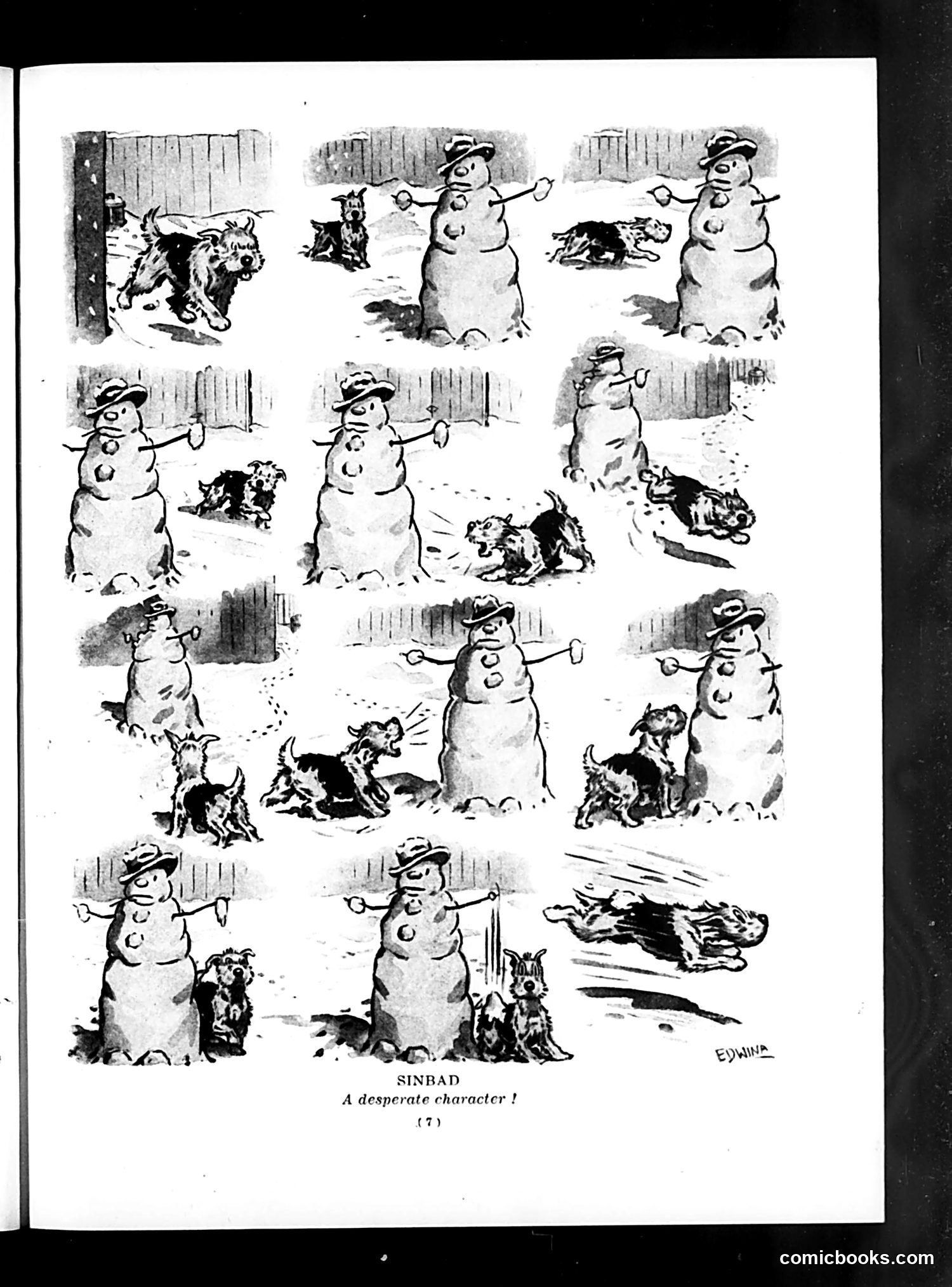
"Sinbad: A Desperate Character!" This is a comic strip sequence by artist Edwina showing a snowman being repeatedly harassed by small dogs. In each panel, the snowman attempts to shoo away or defend himself against the persistent canines while maintaining his winter attire (hat and stick arms). The dogs continually attack or circle around him despite his gestures of protest. The humor appears to derive from the snowman's futile attempts to maintain dignity and control of his own space against determined animal aggression. The title "A desperate character" suggests the snowman's growing exasperation. This is likely satirizing human frustration with pest animals or persistent nuisances—a relatable domestic scenario played out through anthropomorphized winter scenery.
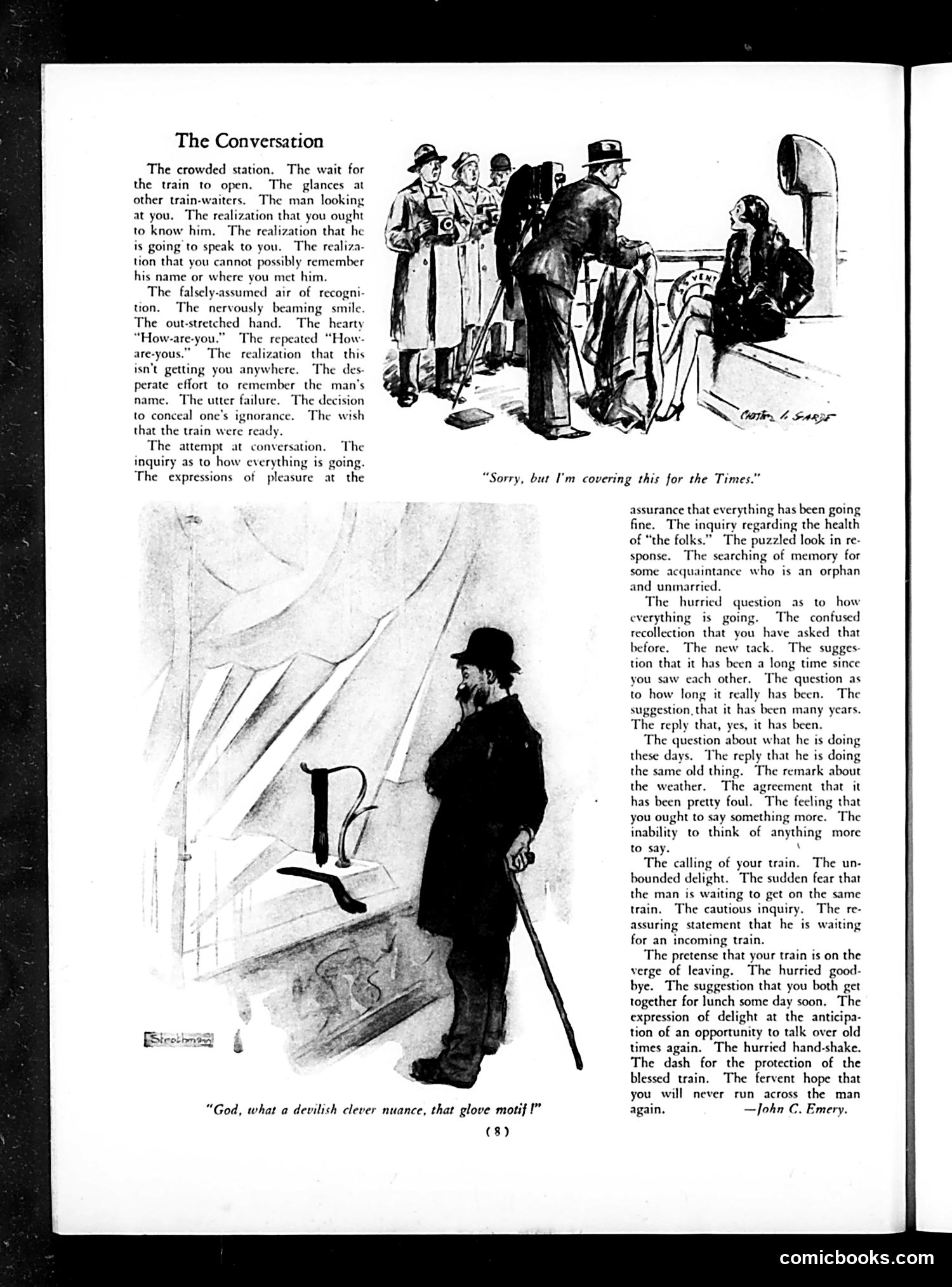
"The Conversation" - Life Magazine This page illustrates awkward social encounters at a train station. The top cartoon shows a group of travelers attempting conversation with someone they vaguely recognize—capturing the anxiety of forced social interaction with half-remembered acquaintances. The text humorously catalogs the discomfort: false recognition, nervous smiling, desperate pleasantries about weather, and mutual relief when the train arrives. The lower illustration depicts a solitary elderly man with a cane, captioned with a quote about "devilish clever nuance" and a glove. The full narrative (right column) suggests this represents the bittersweet goodbye between reunited acquaintances—the pretense, the hurried farewell, and the slim hope of never meeting again. This is gentle satire on social awkwardness and the performative nature of casual human interaction.
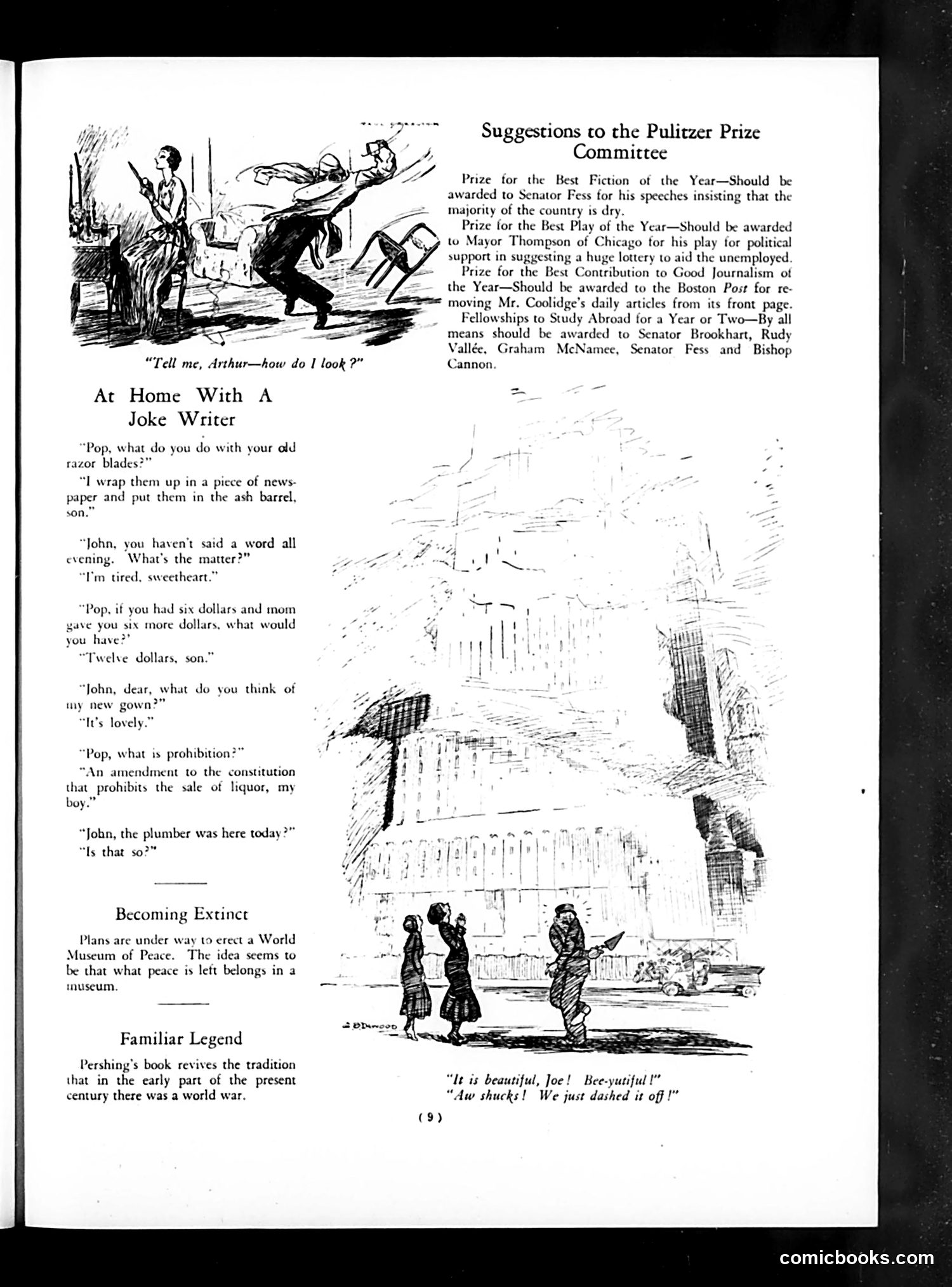
Analysis of Life Magazine Page This page contains three separate short humor pieces and illustrations, not political cartoons. "At Home With A Joke Writer" is a domestic comedy sketch showing a father and son exchanging quips about everyday topics—razor blades, prohibition (the constitutional ban on alcohol sales), and a plumber's visit. The humor relies on the son's deadpan replies and the father's attempts at witty banter. "Becoming Extinct" briefly notes plans for a World Museum of Peace, sarcastically observing that peace belongs in a museum because it's nearly extinct. "Familiar Legend" mentions Pershing's book reviving the tradition that in the early 20th century there was a world war—likely referencing WWI and General John Pershing's memoirs. The illustrations are generic domestic scenes without specific caricatures or political figures.
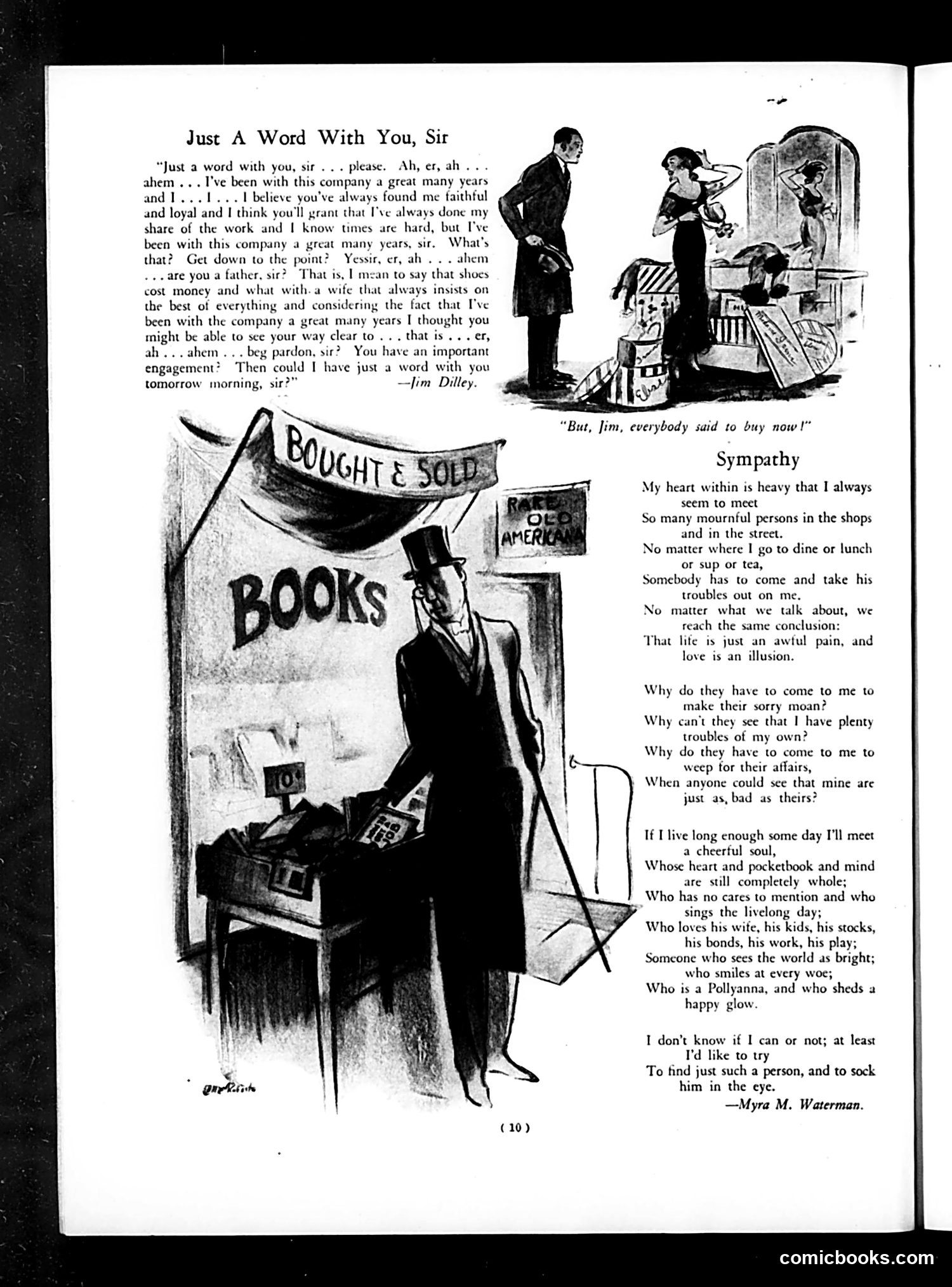
Analysis "Just A Word With You, Sir" (top cartoon): A man asks his employer for a private conversation. He mentions being a long-time, faithful employee but now faces financial hardship—he has a father needing shoes and a wife demanding the best of everything. He's asking for a raise or loan. The boss dismisses him with "But, Jim, everybody said to buy now!"—satirizing how wealthy employers deflect workers' genuine hardship by repeating popular economic catchphrases about consumer spending, rather than addressing wage stagnation. "Bought & Sold" (left cartoon): A businessman stands amid books labeled "Old America," suggesting he's literally buying and selling the nation's values and heritage, depicted as commodities. This critiques wealthy industrialists' perceived corruption of American ideals through monopolistic practices. "Sympathy" (poem, right): Complements the cartoons, expressing exhaustion with hearing others' troubles while having one's own burdens.
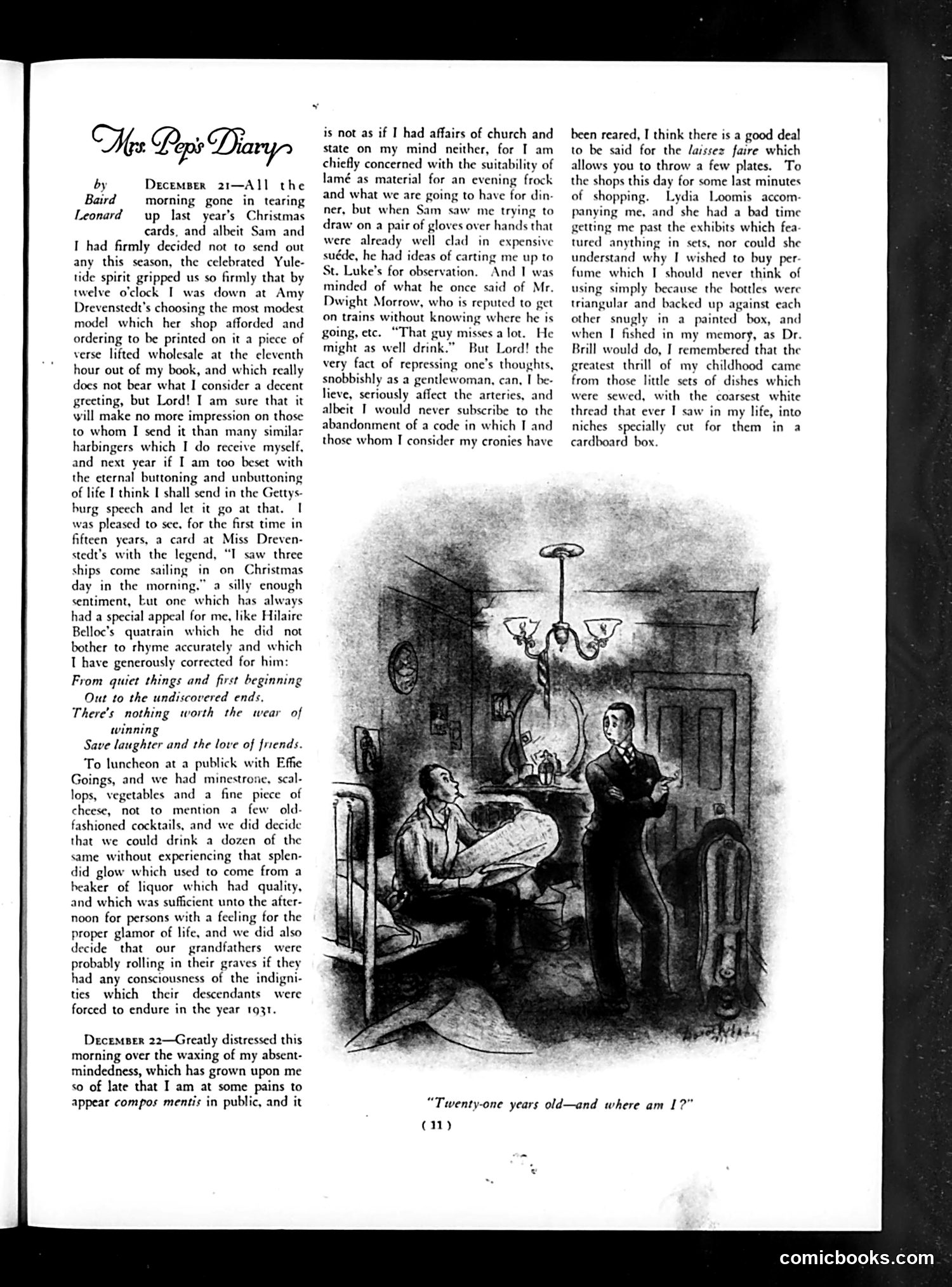
Mrs. Pepps Diary - December 21-22 This is a personal diary entry by "Baird Leonard" describing holiday preparations and social activities. The illustration shows a domestic scene with a woman in bed and another figure standing nearby, under a chandelier. The accompanying caption reads: "Twenty-one years old—and where am I?" The satire appears to target the disappointment of unfulfilled expectations in women's lives—the contrast between youthful dreams and adult reality, particularly regarding marriage and social position. The woman's rhetorical question suggests resignation or regret about her current circumstances. The diary format allows the author to comment on 1930s social conventions, domesticity, and women's limited life options, using gentle humor to critique the era's restrictive gender roles.
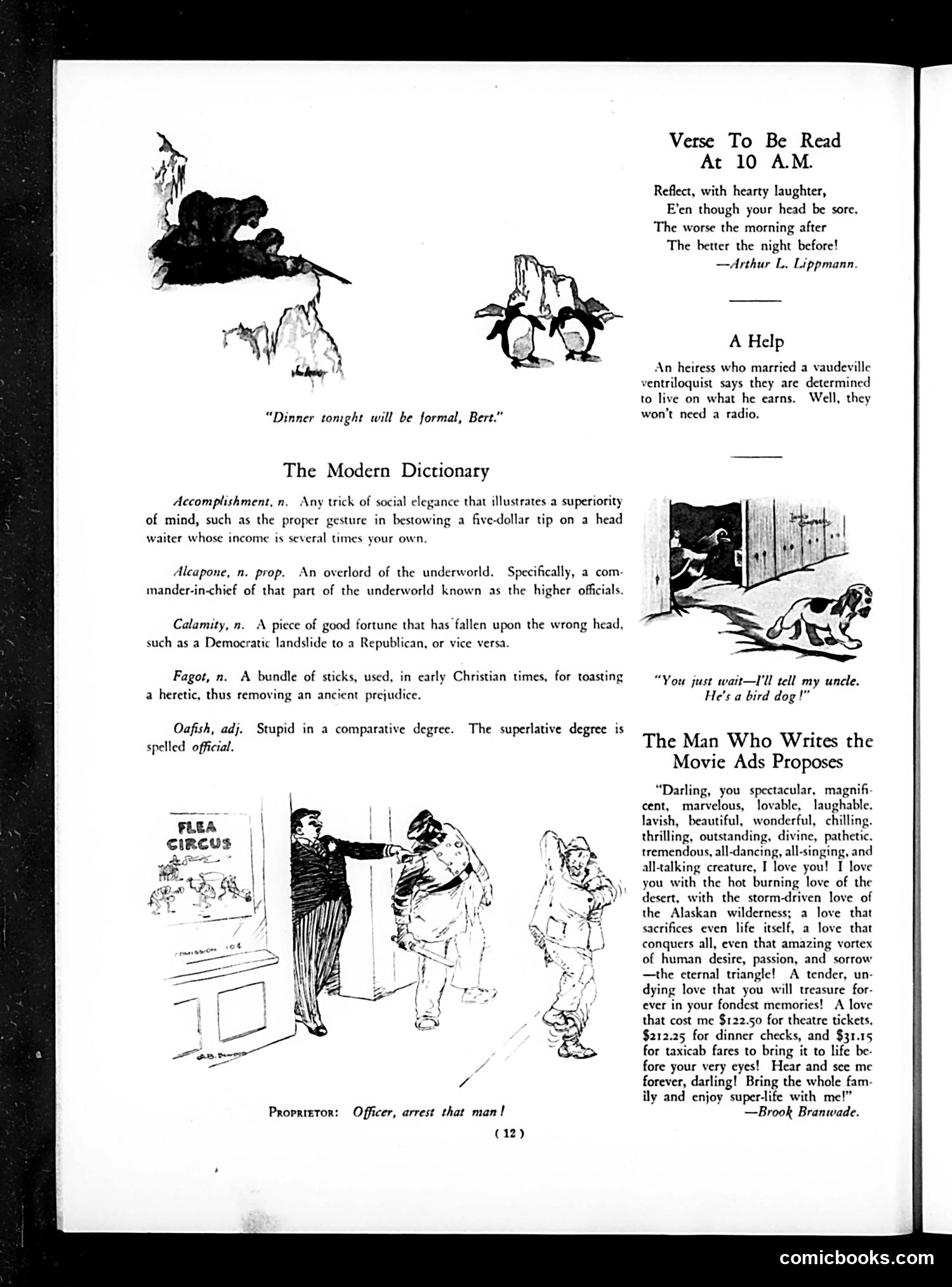
Analysis of Life Magazine Page This page contains humor pieces rather than political cartoons. The main content includes: "The Modern Dictionary" — satirical definitions mocking 1920s social pretension and underworld slang, including terms like "Accomplishment" (tipping generously) and "Alcapone" (underworld overlord—a clear reference to Al Capone during Prohibition). "A Help" — a brief joke about an heiress marrying a ventriloquist who'll support her through his earnings, so they won't need a radio (unclear reference to wireless technology expectations). "The Man Who Writes Movie Ads Proposes" — parodies the overwrought, hyperbolic language used in movie advertising of the era, with a flowery love proposal by "Brook Branaude" listing absurdly specific costs for theater experiences. The cartoons are lighthearted social satire typical of 1920s Life magazine humor.
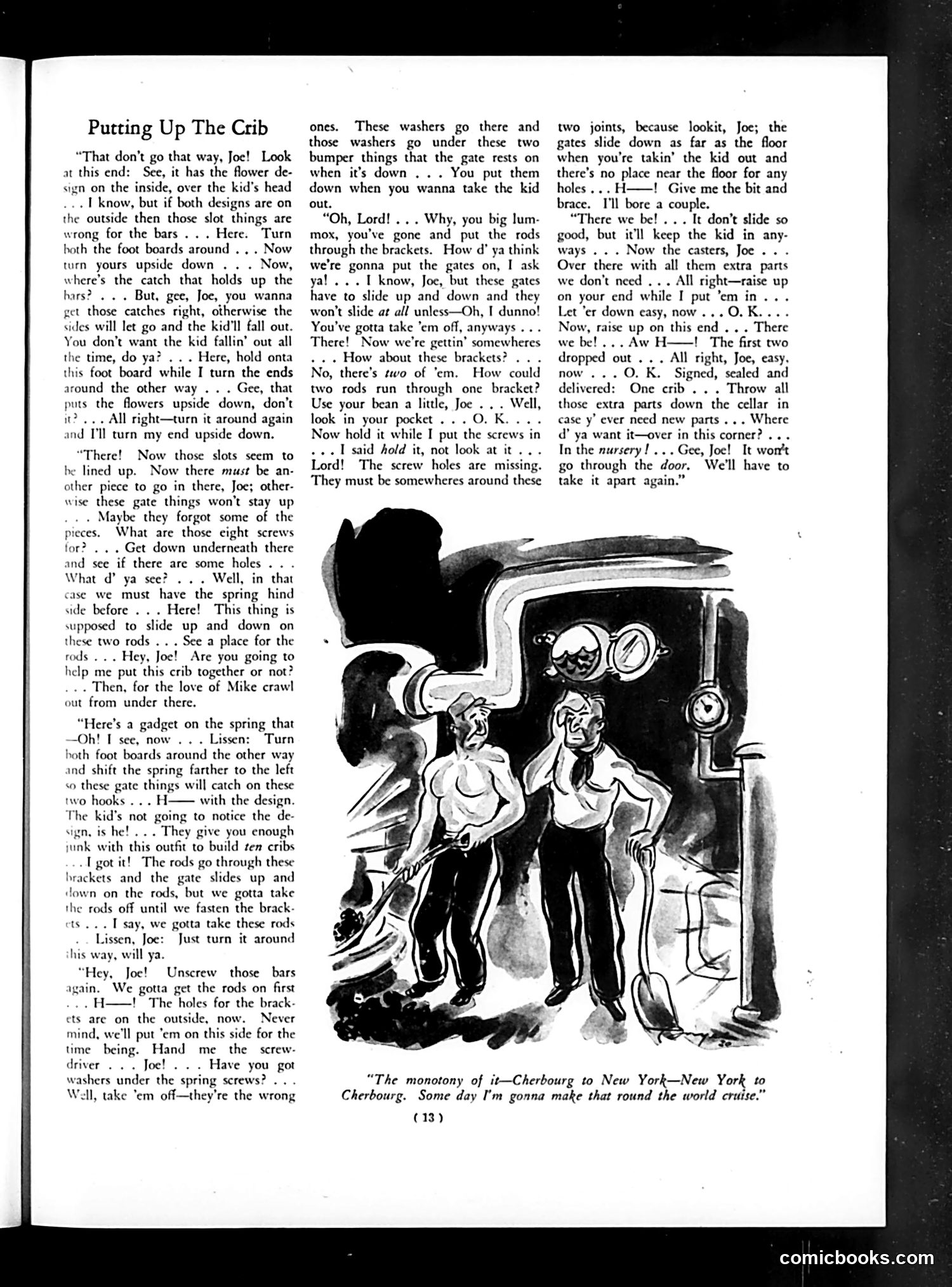
"Putting Up The Crib" - Life Magazine Page This page contains humorous domestic instructions for assembling a baby crib, written as dialogue between two characters (Joe and presumably his wife). The text is a comedic complaint about the frustration of flat-pack furniture assembly—a timeless domestic comedy scenario. The accompanying cartoon illustrates the absurdity: it shows a couple struggling with crib parts while two women (appearing to be neighbors or friends) observe from inside what looks like a car or viewing window, commenting on "the monotony of it—Cherbourg to New York—New York to Cherbourg. Some day I'm gonna make that round the world cruise." The satire contrasts the couple's domestic frustrations with the bystanders' leisure aspirations, mocking both suburban life's tedious obligations and people's escapist fantasies about world travel.
Analysis of "Life Looks About" Page The masthead illustration depicts a cherub or cupid figure juggling what appears to be money and a scythe—symbolizing the tension between wealth and death, likely commentary on economic hardship. The page contains four opinion columns addressing contemporary issues: 1. The Banks - criticizes bank robberies and closures due to economic collapse 2. Change in Governments - discusses political instability in South America and Spain 3. High Church - debates Episcopal Church leadership disputes in New York 4. That Popular Vote and Perilous Efficiency - discuss the Eighteenth Amendment (Prohibition) and its effects on work efficiency The overall tone is satirical political commentary on American and international governance, economics, and social policy during what appears to be the Prohibition era.
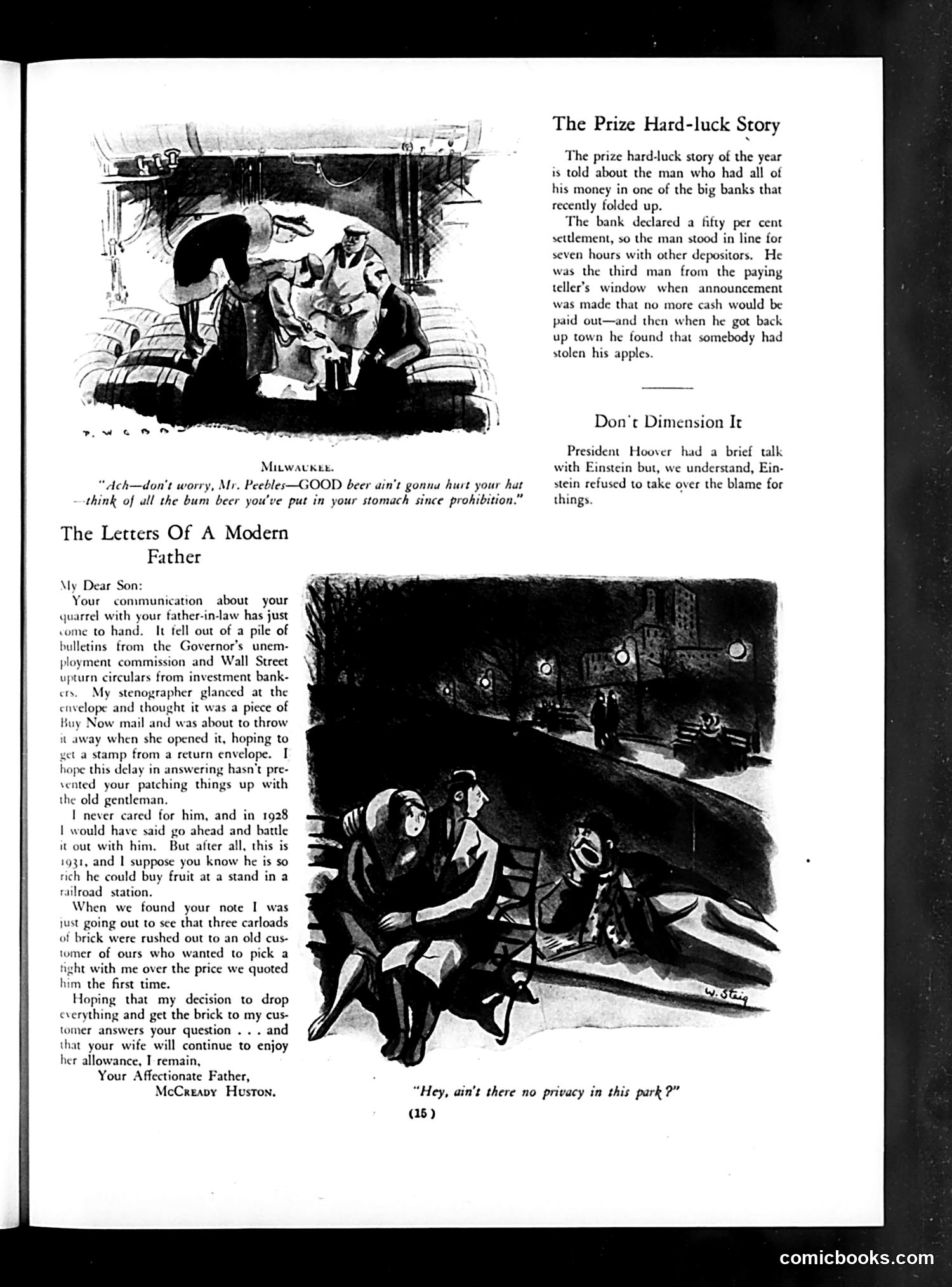
Analysis of Life Magazine Page "The Prize Hard-Luck Story" satirizes bank failures during what appears to be the Depression era. A man waited seven hours at a failed bank for a 50% settlement on deposits, only to return home and find his apples stolen—a tragicomic punchline about compounding misfortunes. "The Letters of a Modern Father" presents a father's letter to his son regarding a dispute with the father-in-law, mentioning 1928 and "batling it out." The tone suggests pre-marital conflict and the father's somewhat detached, humorous acceptance. The Milwaukee cartoon shows a tavern scene where someone reassures "Mr. Peebles" that prohibition-era beer won't harm him, darkly joking about stomach contents since alcohol's ban. The park cartoon depicts couples in a public space with the caption "Hey, ain't there no privacy in this park?"—commenting on crowding and lack of personal space in urban recreation areas.
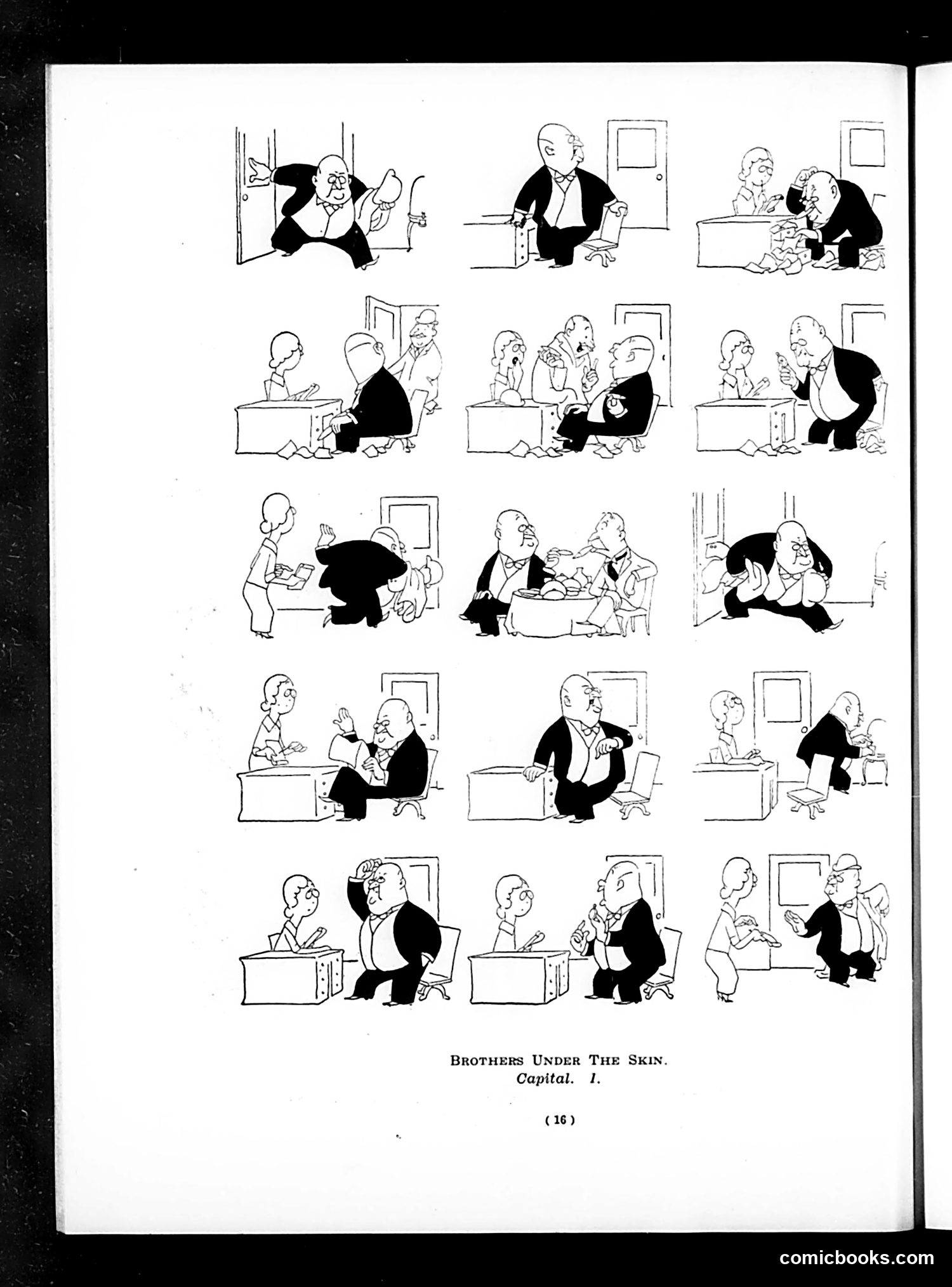
"Brothers Under the Skin: Capital. 1." This political cartoon series satirizes the relationship between capitalists and workers, suggesting they are fundamentally "brothers"—meaning equally complicit or hypocritical despite their opposing classes. The sequential panels depict a wealthy businessman (shown in black suit, exaggerated features) interacting with a smaller worker or laborer across various office and business settings. The repetitive scenarios appear to show the businessman alternately dominating, dismissing, or manipulating the worker through different tactics—gesturing dismissively, refusing requests, or conducting business dealings. The title's ironic "brothers" framing suggests that despite their class differences, both capitalist and worker are morally compromised or share complicity in exploitative systems. This reflects early-20th-century socialist or labor-movement critiques of capitalism's inherent class conflict.
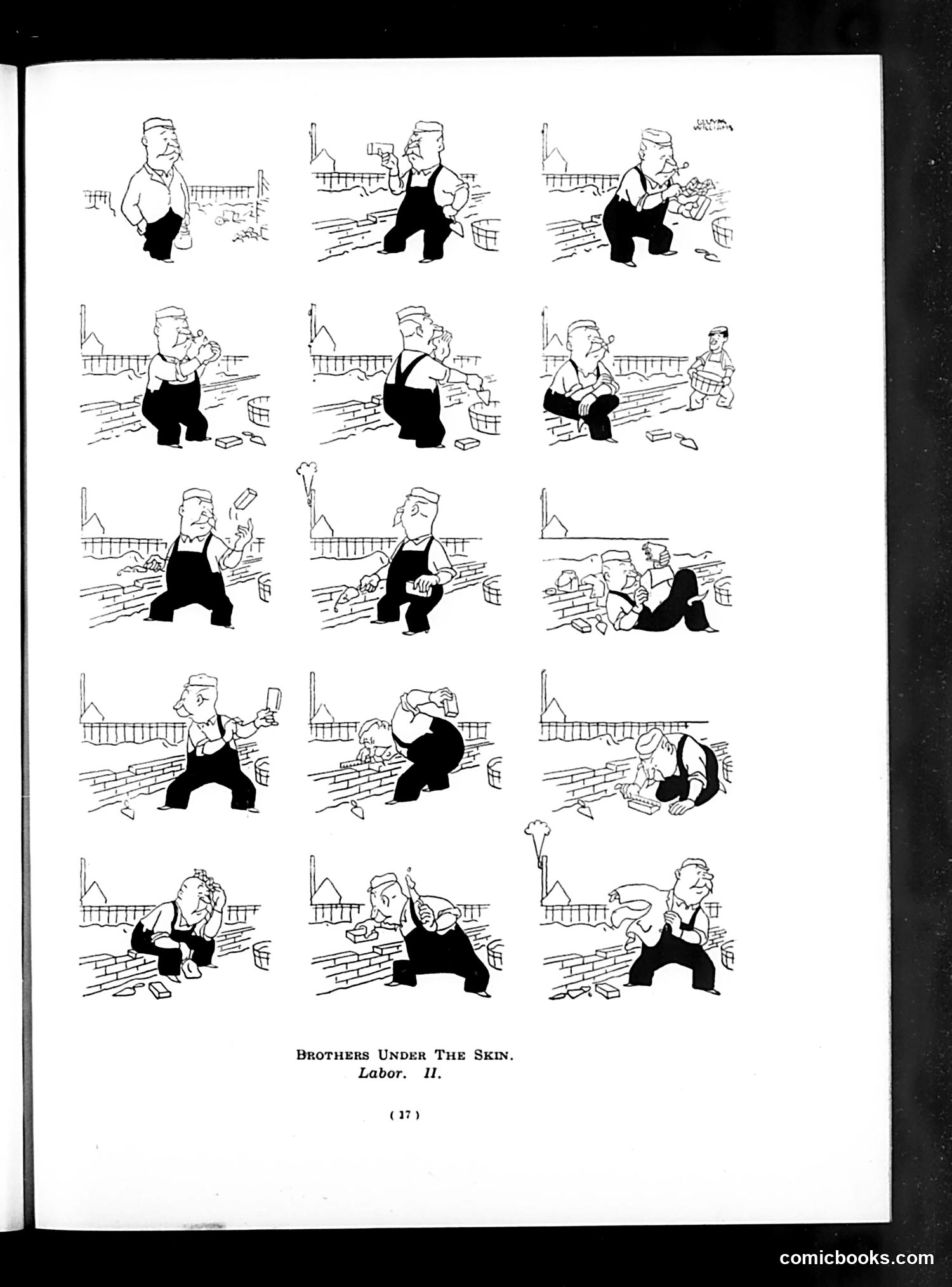
"Brothers Under the Skin" - Labor II This is a 15-panel sequential comic strip satirizing labor disputes. The title "Brothers Under the Skin" appears to be ironic commentary on class conflict. The cartoon shows a single worker in work clothes and cap repeatedly engaged in physical altercations—fighting, struggling, falling, and brawling—across the panels. The setting appears to be an industrial or construction site with fencing visible in the background. The satire likely comments on labor violence or internal conflict within the labor movement itself. The repeated, escalating physical confrontations suggest either: - Violent strikes or labor-management clashes - Infighting between different labor factions or unions - The brutal nature of industrial working conditions The ironic title suggests these "brothers" (workers) are divided rather than united, contradicting labor solidarity ideals that were important to early 20th-century American politics.
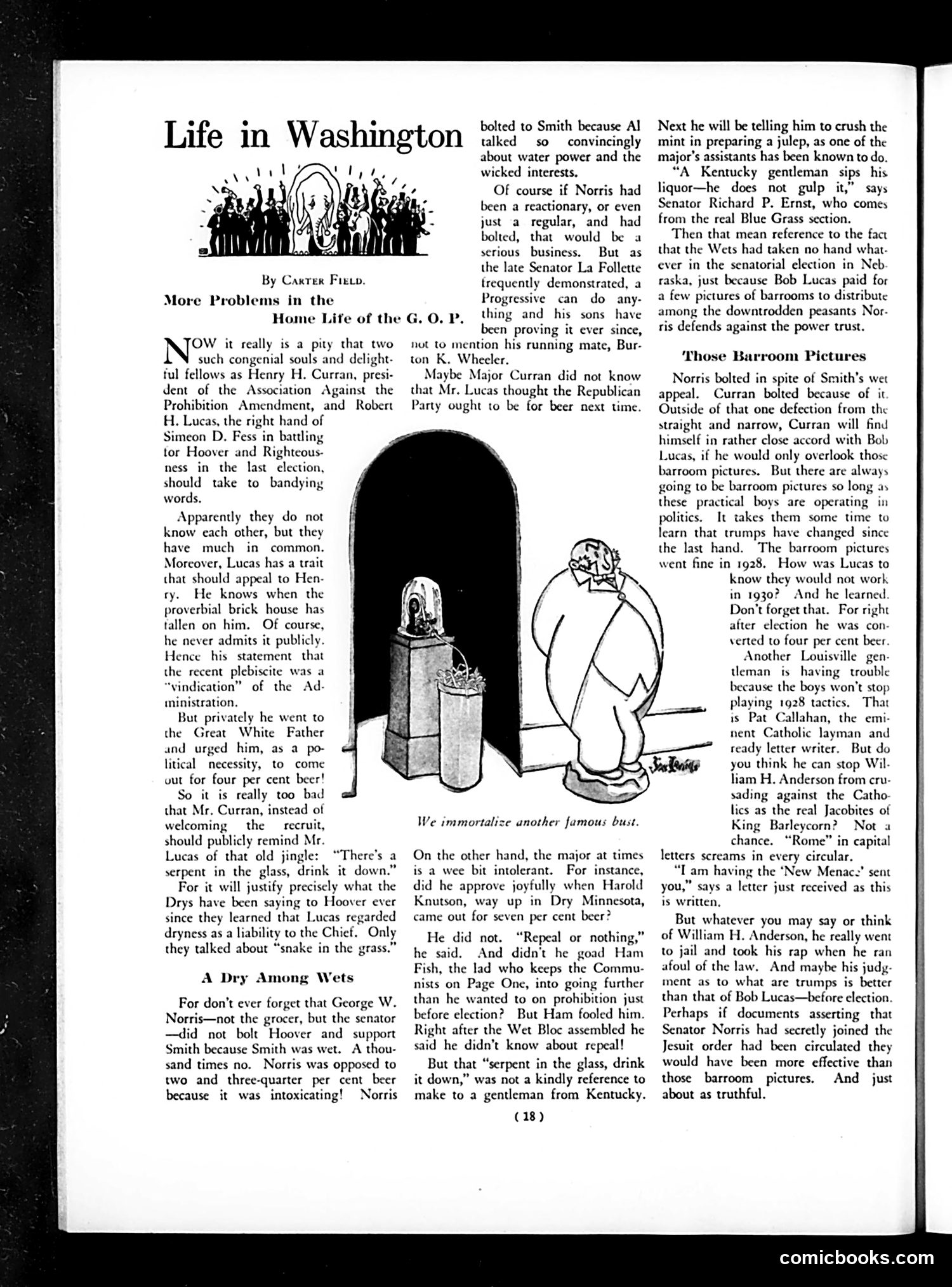
"Life in Washington" - Political Satire (circa 1930) This satirical column by Carter Field critiques Republican political infighting during Prohibition. The central cartoon depicts a nude, rotund figure squatting over chamber pots—a crude visual metaphor for the messy internal conflicts within the GOP. The text discusses how Republican politicians like Henry H. Curran and Robert H. Lucas—despite ostensibly supporting Prohibition—actually disagreed on its enforcement and beer regulation. The satire highlights hypocrisy: these leaders publicly championed "dryness" while privately maneuvering for political advantage and tolerance of alcohol. The caption "We immortalize another famous bust" puns on both sculptural busts and the slang term for failure, mocking Republican leadership as both comical and ineffectual during this politically fractious period.
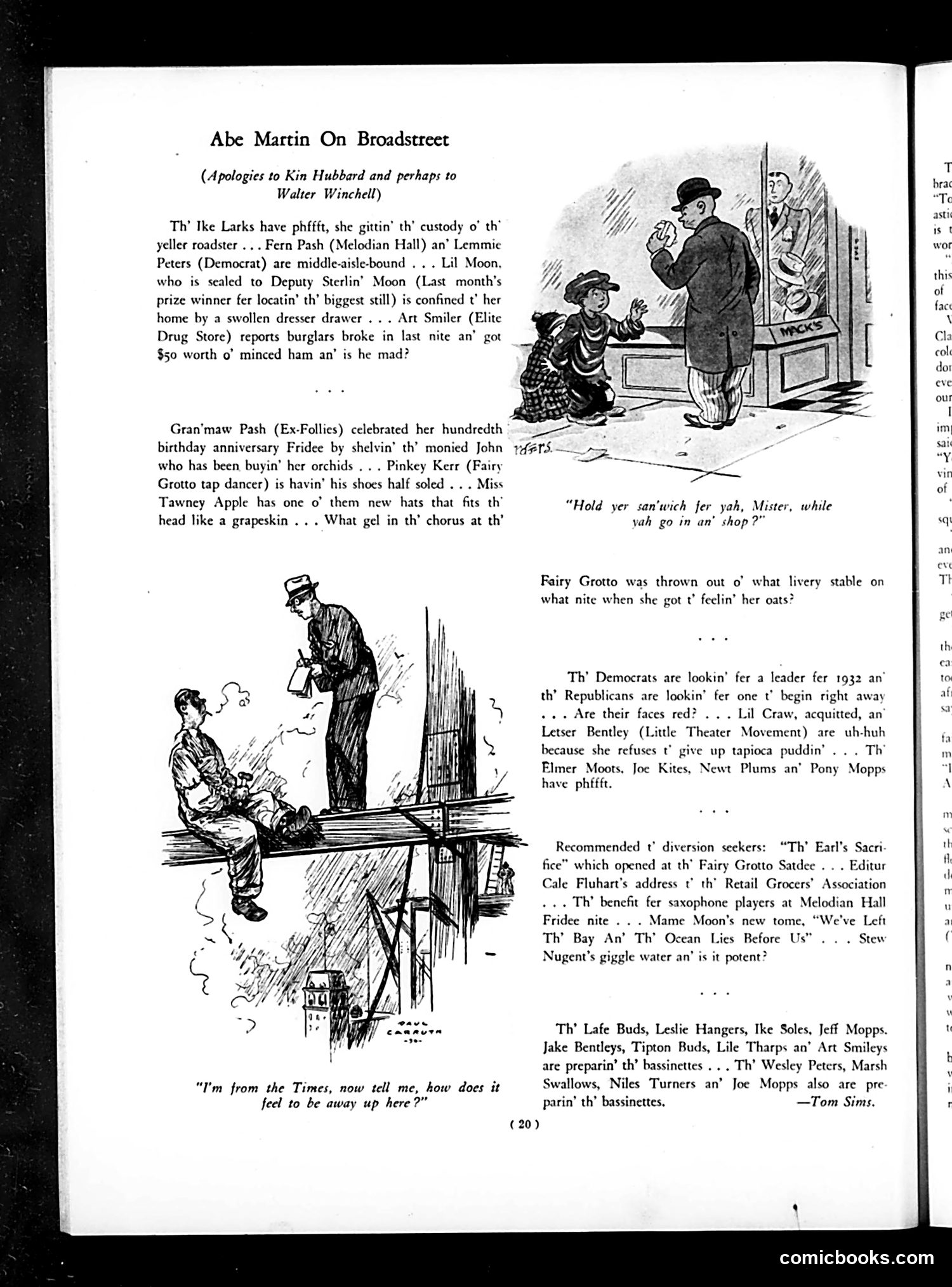
"Abe Martin On Broadstreet" This is a satirical gossip column mimicking the style of humorist Kin Hubbard's "Abe Martin" rural commentary and Walter Winchell's celebrity gossip reporting. The column blends small-town scandal with period slang ("phffft" = relationships ending, "oats" = wild behavior). The cartoons illustrate typical situations: one shows a street vendor asking a shopper to hold his sandwich while he shops; another depicts someone claiming to be from "the Times" asking an uncomfortable question from a high perch. The gossip targets local characters (many appear fictional) with punny names (Lil Moon, Fern Pash, Pinkey Kerr), mixing genuine social commentary—Democrats seeking a 1932 leader, Republicans wanting immediate leadership—with absurd personal details and small-venue entertainment notices. The humor relies on contrast between Winchell-style breathless reporting and deliberately mundane, rural content, satirizing both gossip journalism's pretensions and small-town life itself.
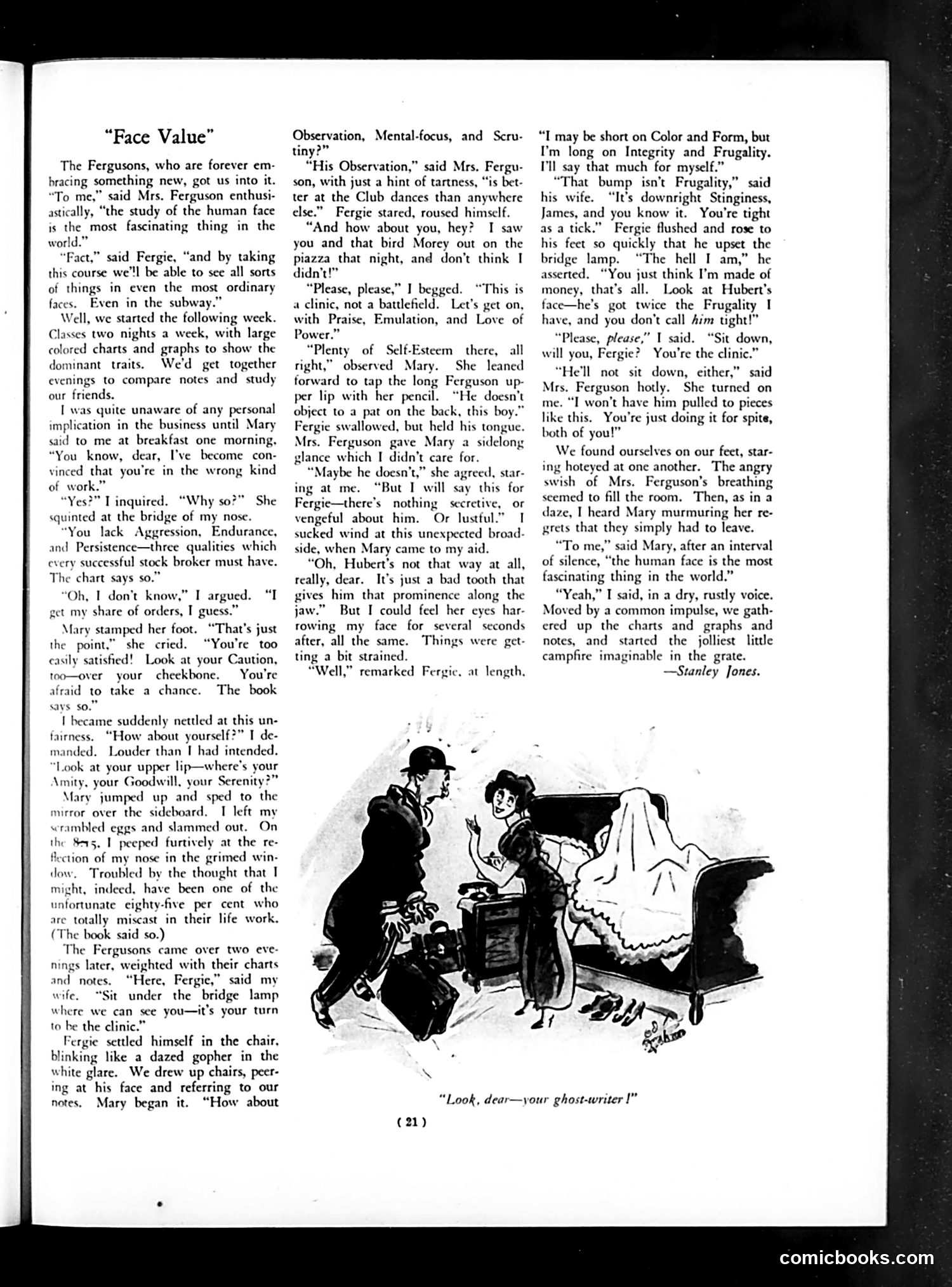
"Face Value" - Satire of Pseudoscientific Personality Analysis This satirical short story mocks the 1920s-30s fad of physiognomy — the pseudoscientific belief that facial features reveal character traits. The Fergusons take a "course" teaching them to read faces using charts and "dominant traits." The humor lies in the chaos that ensues: the narrator's wife uses the system to criticize him (lack of aggression, too cautious), he retaliates by analyzing *her* face, and when they apply the "clinic" method to the Fergusons themselves, the analysis becomes a thinly-veiled excuse to air marital grievances and insults. The illustration shows the Fergusons being scrutinized under bright light—literally subjected to the humiliating "scientific" examination. The caption "Look, dear—your ghost-writer!" is unclear but suggests mockery of the analytical pretension. The satire targets how people misuse pseudoscience to justify personal criticism while maintaining a veneer of objective "study."
Life Magazine Movie Reviews: Silent Films Era This page contains movie reviews by Harry Evans from Life magazine, discussing three films. The reviews praise performances by character actors and child performers. "Passion Flower" celebrates Zasu Pitts's comedic talents and a precocious child actor (Dickie Moore, age 3-4) who steals scenes. A notable joke involves the child mishearing "Our Father which art in Heaven" as referring to his mother's lover—dark humor about infidelity masquerading as innocent childish misunderstanding. "The Royal Family" reviews a film adaptation of a stage play about the Barrymore theatrical dynasty. It praises Fredric March's impersonation of John Barrymore and notes that transferring stage successes to film typically diminishes their appeal—but this production succeeded. The reviews exemplify 1920s-30s film criticism's focus on individual performances and comedic timing, treating cinema as recorded theater rather than a distinct medium.
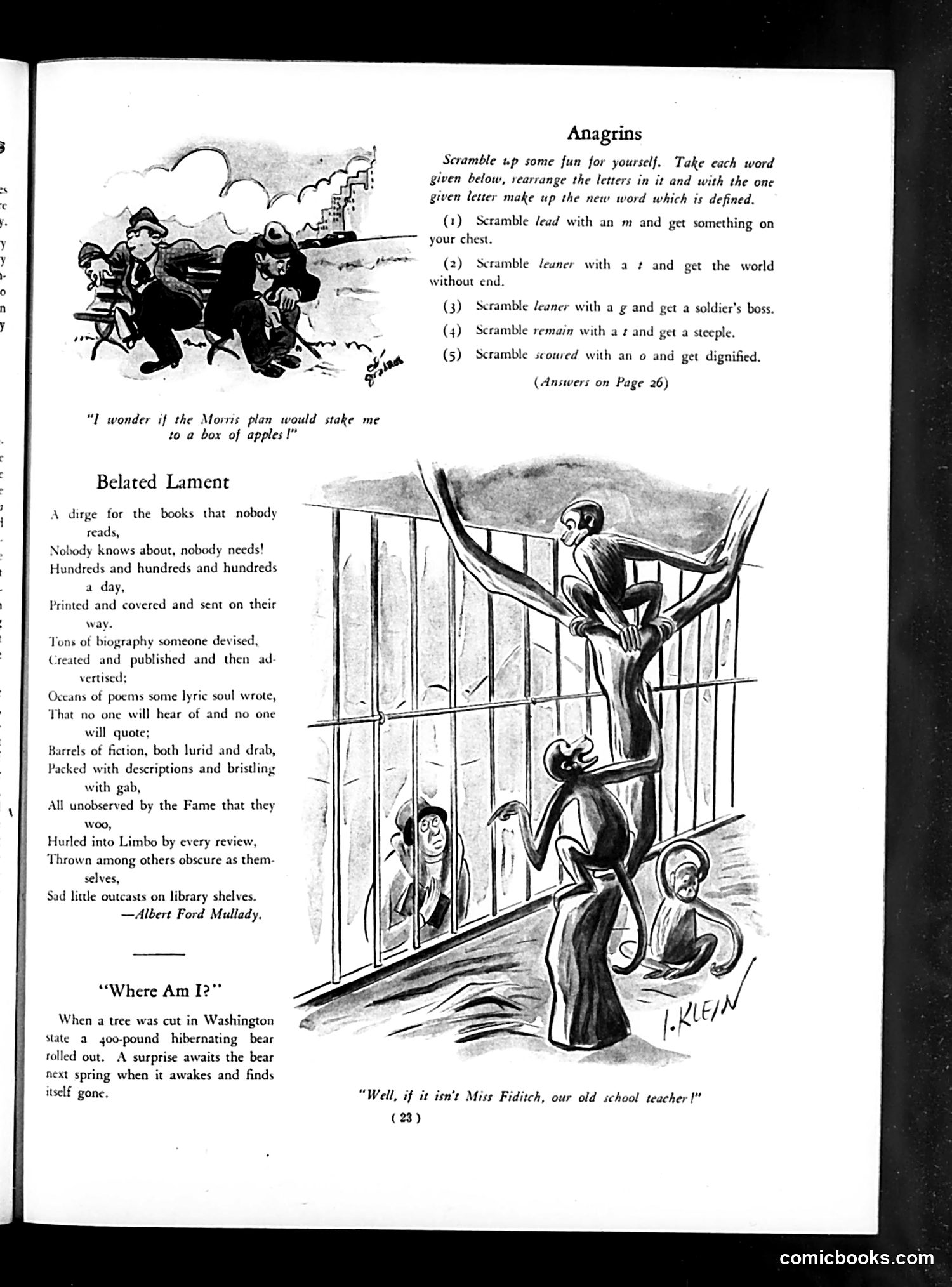
Life Magazine Page Analysis This page contains three distinct humor pieces typical of early 20th-century Life magazine: Anagrins (top): A word puzzle game where readers rearrange scrambled letters to form new words based on definitions—pure recreational content, no satirical intent. "Belated Lament" (middle): A poem by Albert Ford Mullady lamenting the thousands of books published daily that nobody reads—criticizing both publishing overproduction and the obscurity awaiting most authors. The satire targets the publishing industry's inability to distinguish quality from mediocrity. "Where Am I?" (bottom): A humorous anecdote about a hibernating bear found inside a felled Washington tree, joking about the bear's disorientation upon awakening to find itself gone—simple absurdist humor with no political content. The cartoon illustration (lower right) shows monkeys in a library cage, captioned with a reunion joke. Its connection to surrounding content is unclear but likely comments on animal behavior or library patrons.
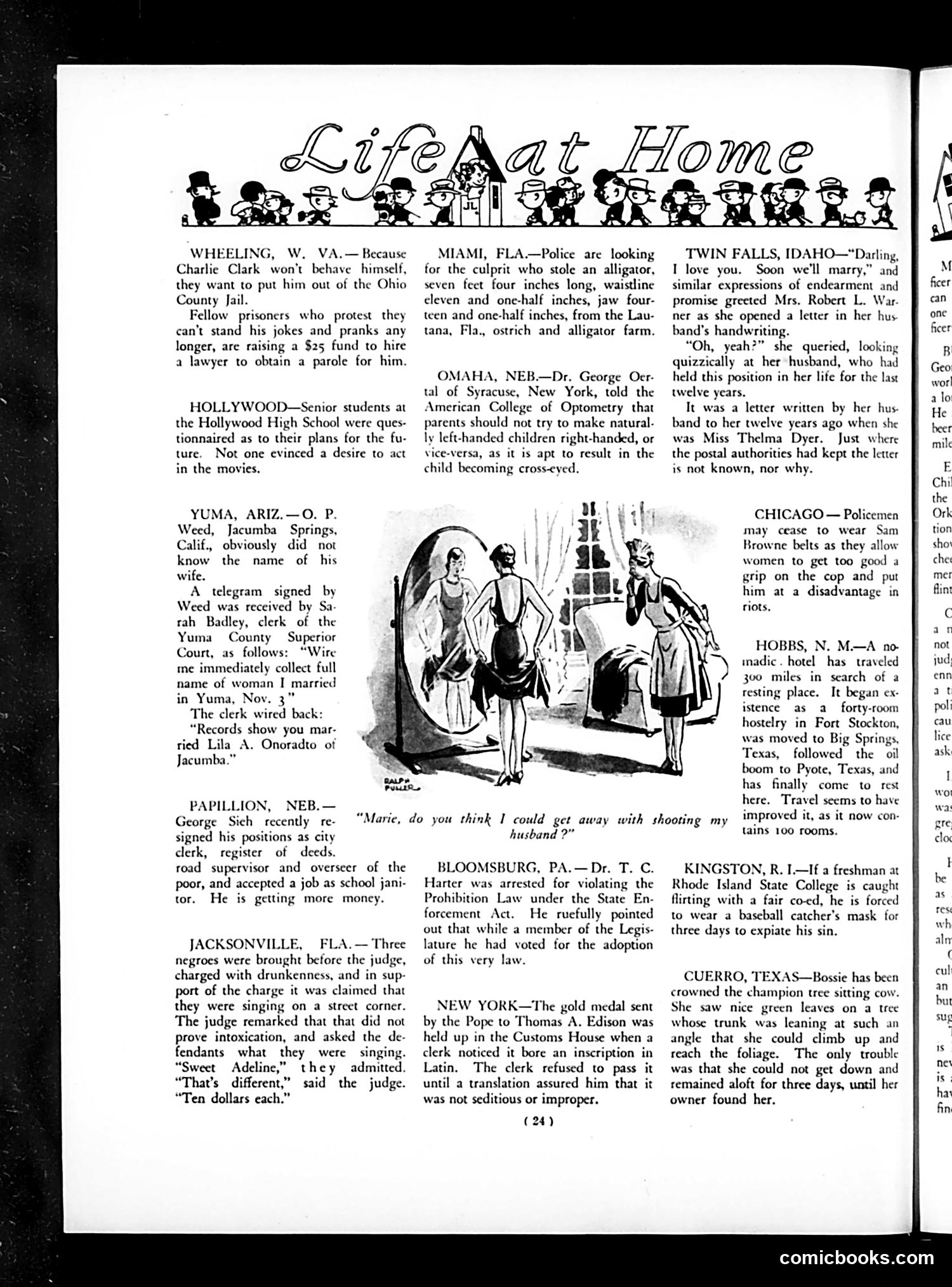
Life Magazine "Life at Home" Page Analysis This page collects humorous anecdotes from across America, typical of *Life* magazine's satirical reporting style. The single cartoon depicts a woman asking her husband, "Marie, do you think I could get away with shooting my husband?"—a joke about marital discord presented as domestic dark humor. The accompanying text story concerns a delayed letter: a husband's love letter from twelve years prior, written before his marriage, was somehow misdelivered and finally reached his wife decades later. Her skeptical "Oh, yeah?" reaction satirizes the absurdity of receiving old romantic promises in the present day. Other anecdotes mock Prohibition-era hypocrisy (a legislator who voted for the law arrested for violating it), bureaucratic absurdity (a customs clerk demanding translation of the Pope's Latin inscription), and casual racial prejudice (the judge's joke about "Sweet Adeline" being "proof" of intoxication). The page reflects 1920s-30s American life and contemporary social attitudes, some deeply offensive by modern standards.
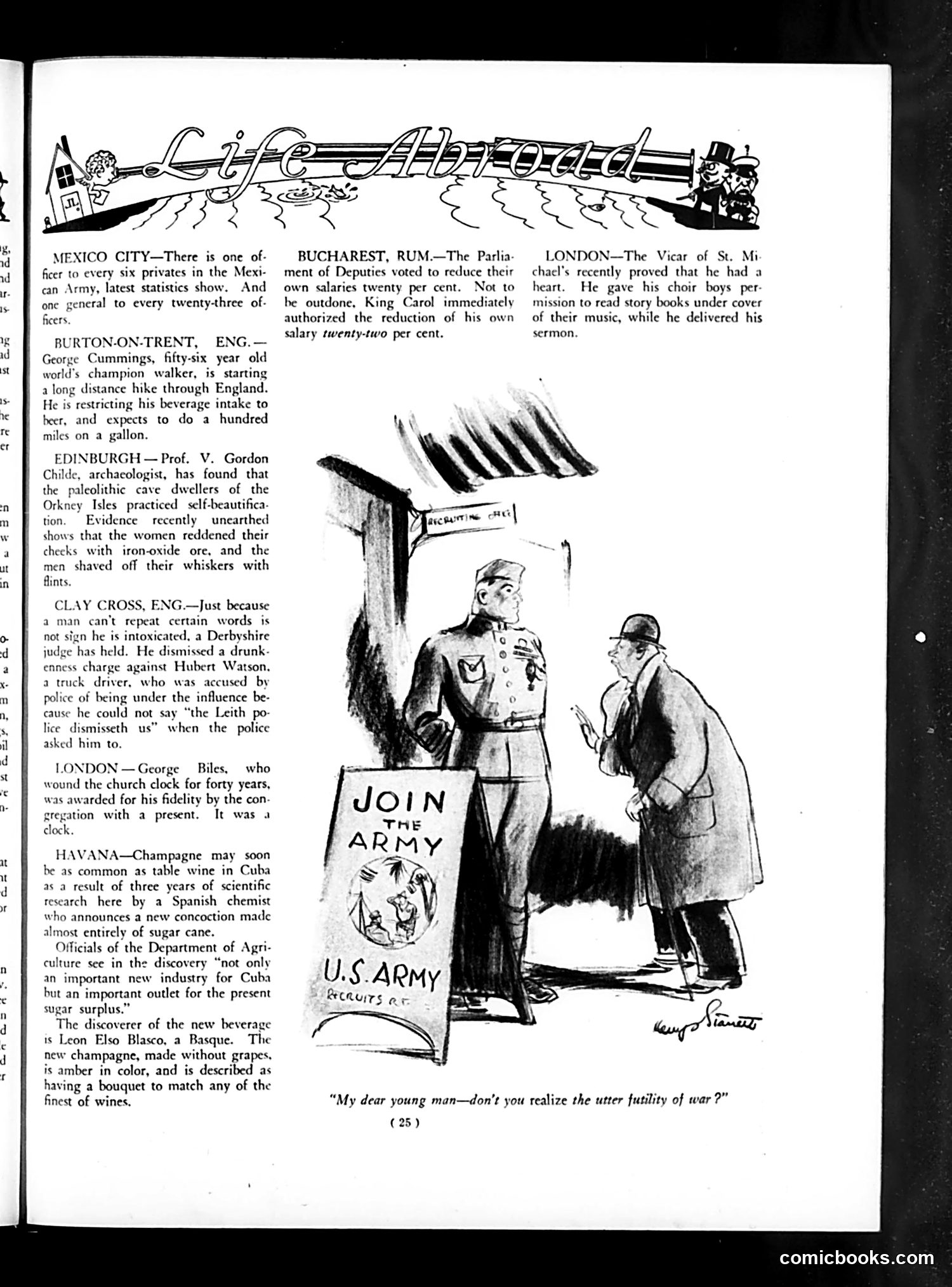
"The Utter Futility of War" This political cartoon depicts an elderly civilian (likely a pacifist or war-weary citizen) lecturing a young soldier in uniform at a U.S. Army recruitment booth. The old man's caption expresses skepticism about military service and armed conflict. The satire works on multiple levels: The irony is that while the civilian philosophizes about war's futility, he's standing directly in front of active Army recruitment signage—suggesting that despite such intellectual objections, recruitment and military preparation continue regardless. The cartoon likely critiques naive pacifism or idealistic anti-war sentiment as ineffectual against the machinery of military institution, or conversely, mocks the recruitment efforts themselves as tone-deaf to legitimate moral questions about warfare. Given Life magazine's satirical nature, the target of the joke—whether the pacifist or the military—remains deliberately ambiguous, reflecting contemporary debates about American military involvement (likely WWI era or interwar period).
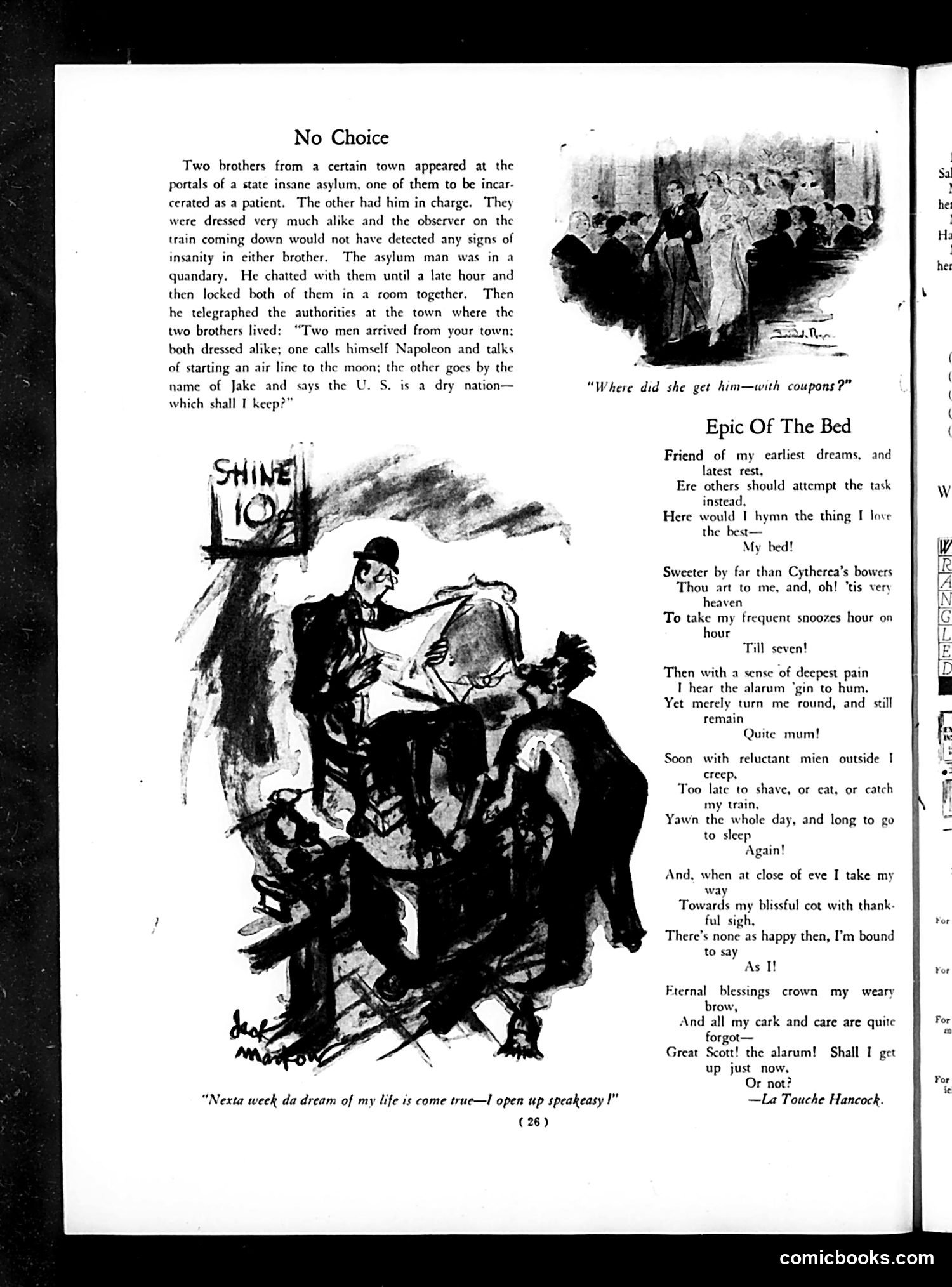
Explanation for Modern Readers "No Choice" is a short humorous anecdote about an asylum superintendent unable to distinguish which of two identically dressed brothers is actually insane. One claims to be Napoleon and wants to start an airline to the moon; the other says the U.S. is a "dry nation" (reference to Prohibition). The joke's point: both claims sound equally delusional, so the superintendent can't tell who the actual patient is. The satire mocks both mental illness diagnosis and Prohibition-era absurdities. "Epic of the Bed" is a comedic poem by La Touche Hancock celebrating bed as life's greatest pleasure, humorously contrasting the joy of sleeping with the misery of waking to an alarm clock and facing daily obligations. The closing line references opening a "speakeasy" (illegal bar during Prohibition), suggesting the speaker prefers bed to even breaking the law. Both pieces reflect 1920s American humor about Prohibition's unpopularity and everyday domestic complaints.
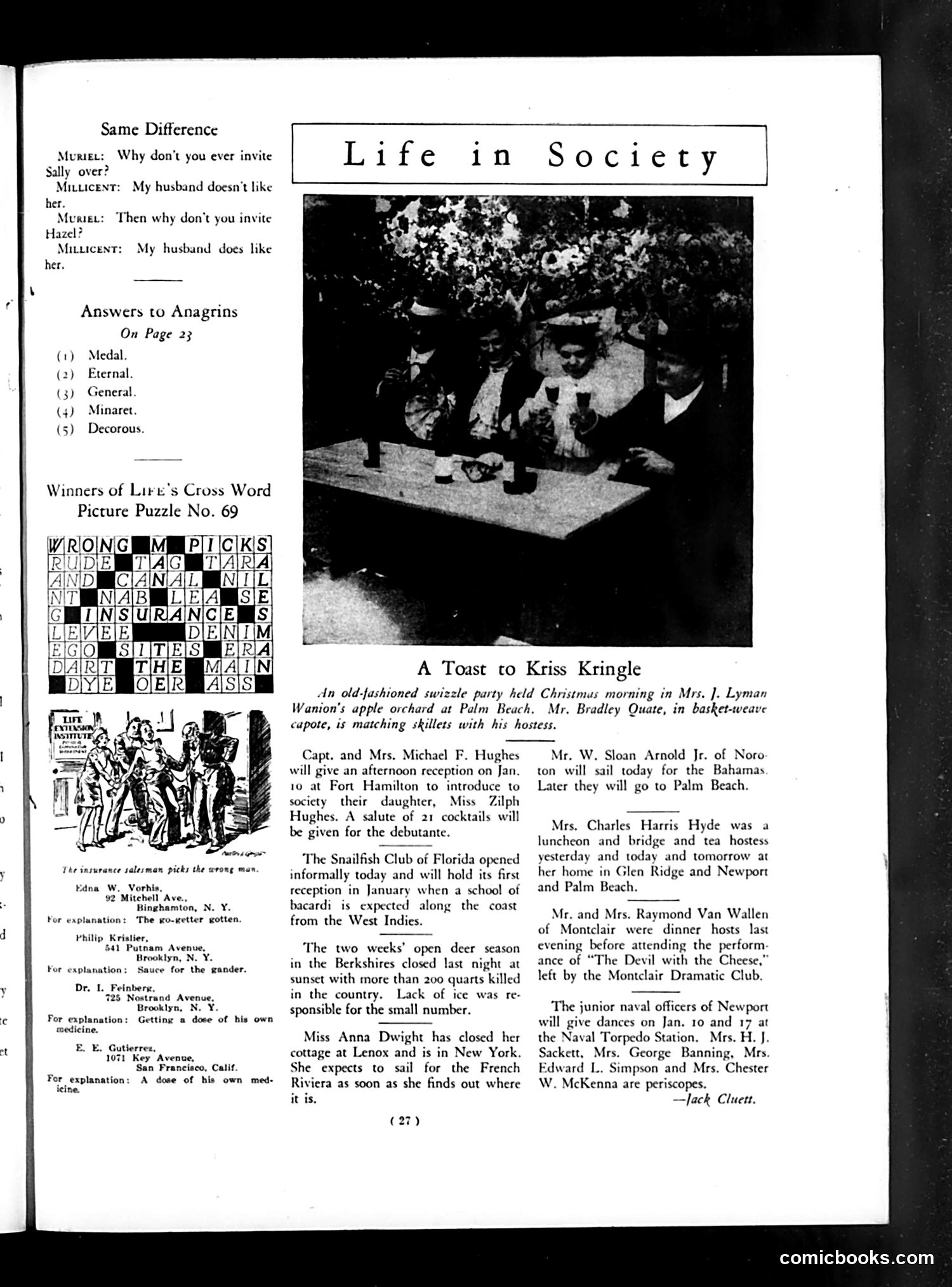
Content Analysis This page contains three distinct sections: "Same Difference" (top left): A brief joke about social hypocrisy. Two women discuss why they don't invite certain friends—one won't invite Sally because her husband dislikes her; the other won't invite Hazel because her husband *does* like her. The humor lies in the absurdity: either way serves as an excuse to exclude someone. Puzzle Solutions and Contest Winners (left column): Life magazine's crossword puzzle answers and names of readers who correctly solved Picture Puzzle No. 69. These were common reader-engagement features in early 20th-century magazines. "A Toast to Kriss Kringle" (right side): A society gossip column reporting on wealthy individuals' holiday activities and upcoming social events in fashionable locations (Palm Beach, the Berkshires, Newport). The humor appears gentle, poking fun at upper-class excess—references to "21 cocktails" at a debutante's party and "200 quarts killed" during deer season suggest satirical commentary on wealthy indulgence, though the tone is affectionate rather than biting.
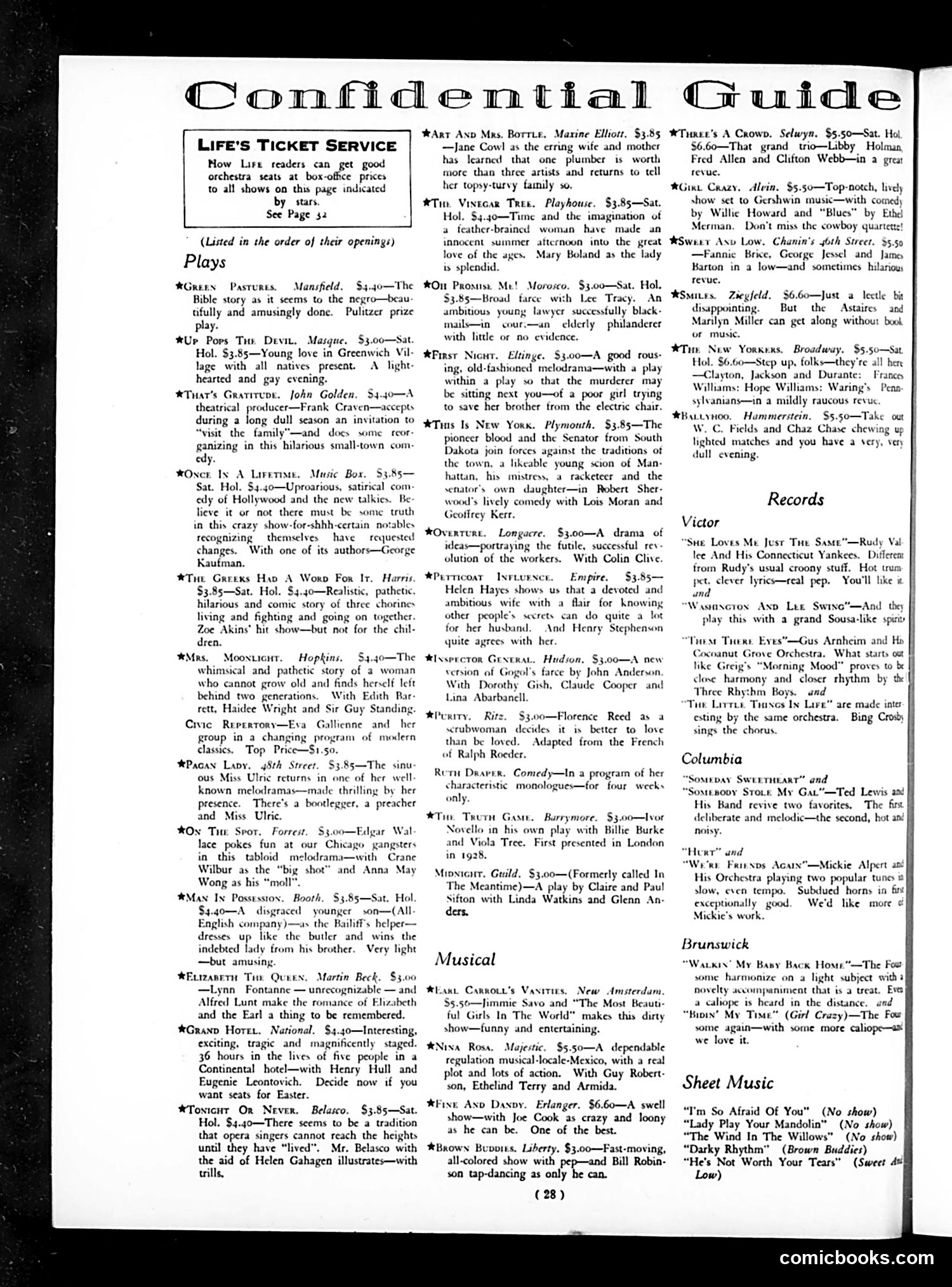
"Confidential Guide" Theater Listings Page This is a theater guide page, not a political cartoon. It lists Broadway shows currently running, with prices and brief plot descriptions. The asterisks (*) indicate shows where *Life* magazine readers could obtain discounted orchestra seats through the publication's ticket service. The page includes plays ranging from serious drama (*Green Pastures*, a Pulitzer Prize winner about Black religious life) to light comedies and musicals. Notable entries mock contemporary subjects: *Once in a Lifetime* satirizes Hollywood and "talkies" (early sound films); *On the Spot* satirizes Chicago gangsters; and *Tonight or Never* plays on the cliché that opera singers must "live" (experience life/romance) to perform authentically. The layout reflects 1920s entertainment culture and *Life*'s role as an urban, sophisticated entertainment guide for theatergoers.
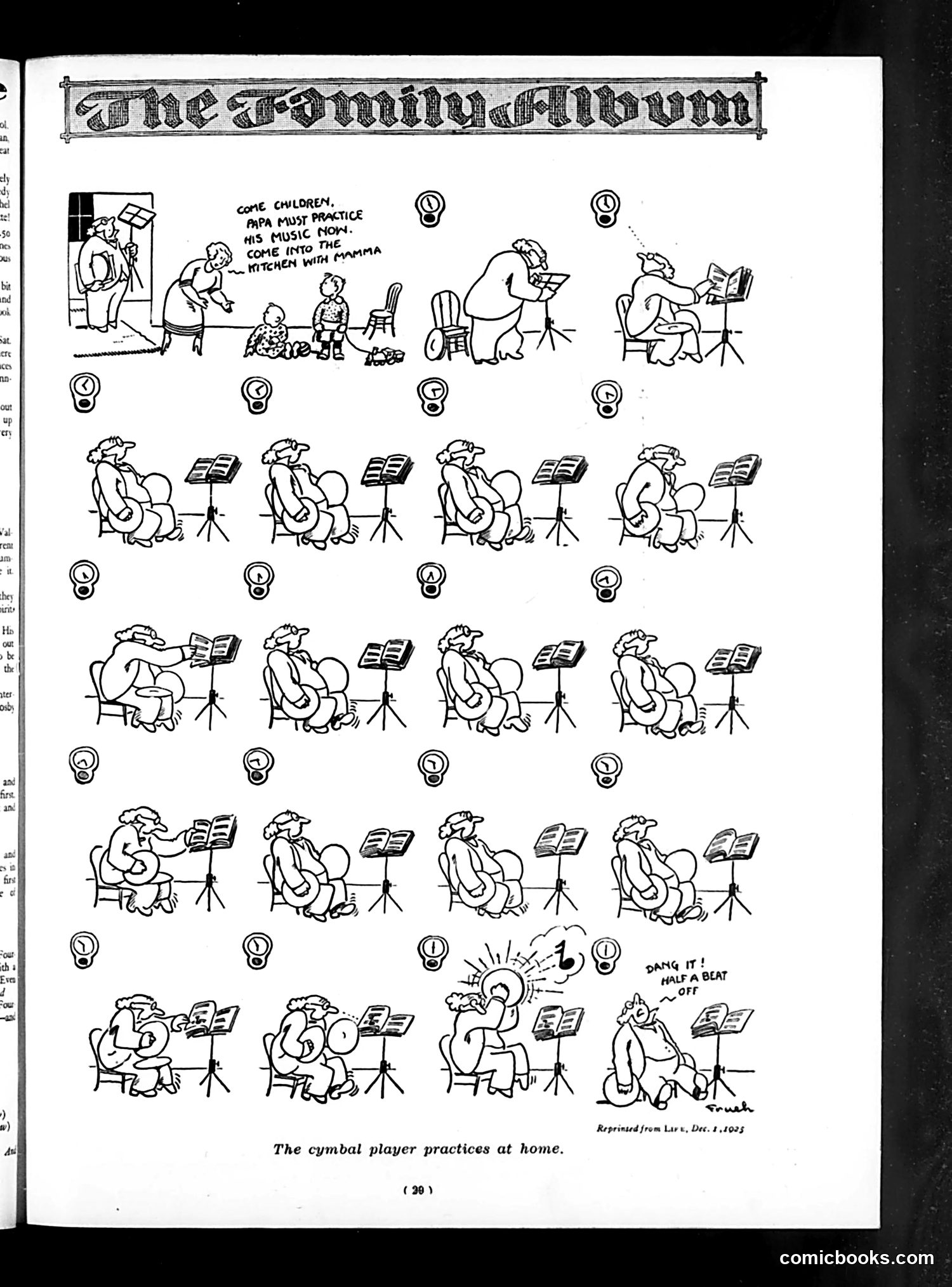
"The Cymbal Player Practices at Home" This is a humorous comic strip showing the domestic chaos caused by a musician practicing cymbals. The narrative arc (shown with numbered panels marked by speaker symbols) begins with a father announcing music practice to his family, then progresses through increasingly frantic scenes of him playing cymbals while his family reacts with visible distress—covering ears, grimacing, and appearing overwhelmed. The final panel shows the musician himself frustrated, exclaiming "DANG IT! HALF A BEAT OFF!"—the joke being that after all this domestic disruption, he's still unhappy with his performance. It's satire on the discord between a musician's perfectionism and the suffering inflicted on those around him during practice.
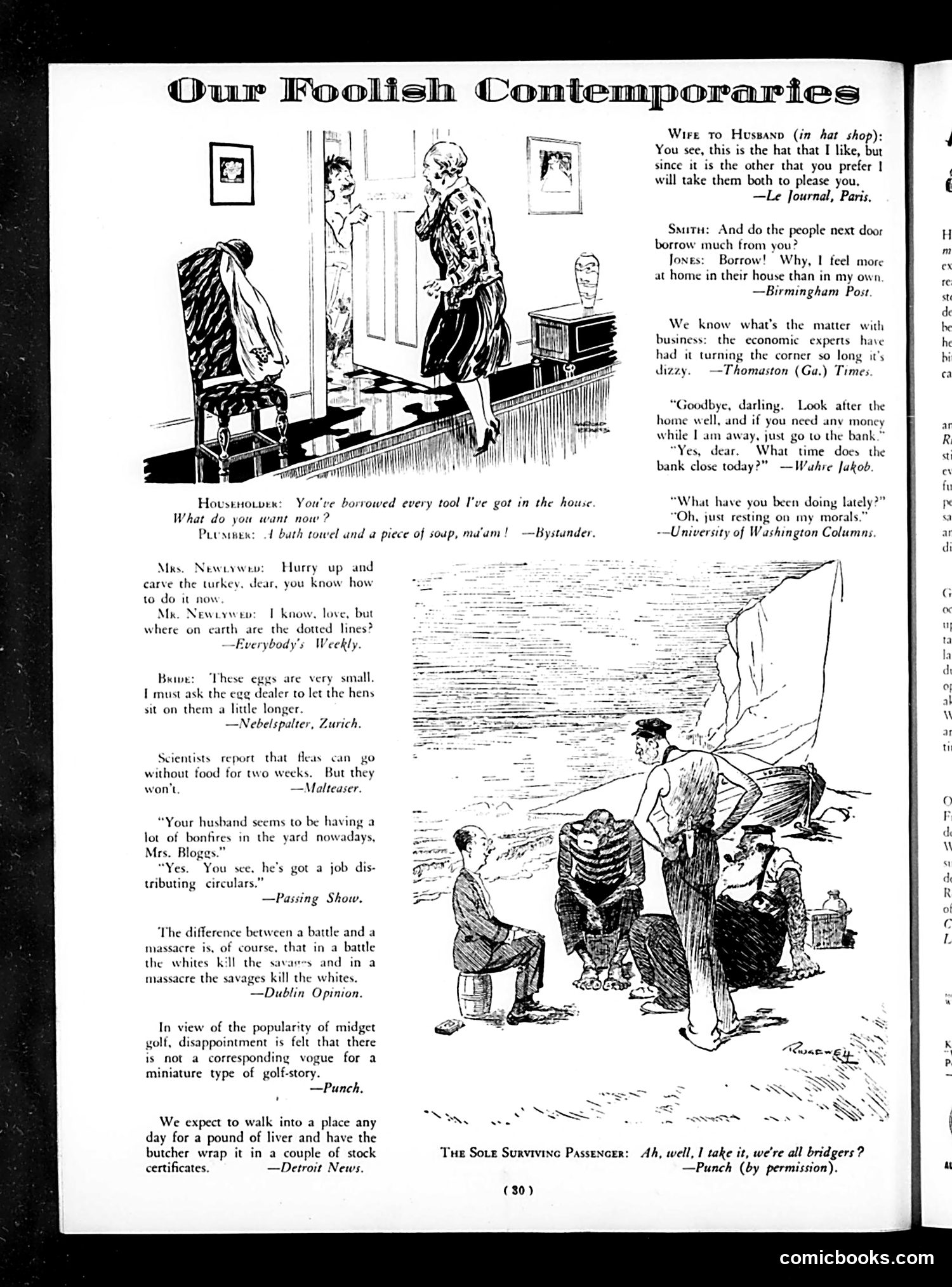
Our Foolish Contemporaries This page collects brief satirical jokes from international publications, mocking everyday social absurdities of the era (likely 1920s-30s). Key satirical targets: - Borrowing culture: A neighbor repeatedly borrows tools, eventually asking for a bath towel and soup—absurd desperation. - Gender roles: A wife asks her husband where the "dotted lines" are on the turkey, implying she needs instructions even for basic cooking tasks. - Economic anxiety: References to stock certificates as change, business "turning corners" endlessly, wives asking when banks close to access funds—all reflecting post-WWI economic instability. - Marital dynamics: A wife compromises by buying *both* hats to please her husband; another feels more at home borrowing from neighbors than her own house. - Class commentary: The "sole surviving passenger" cartoon (bottom) appears to reference shipwreck survivors, with someone joking "we're all bridgers"—unclear context but suggests dark humor about social collapse. The humor relies on recognizing how economic hardship, rigid social conventions, and marital friction created absurd daily situations.
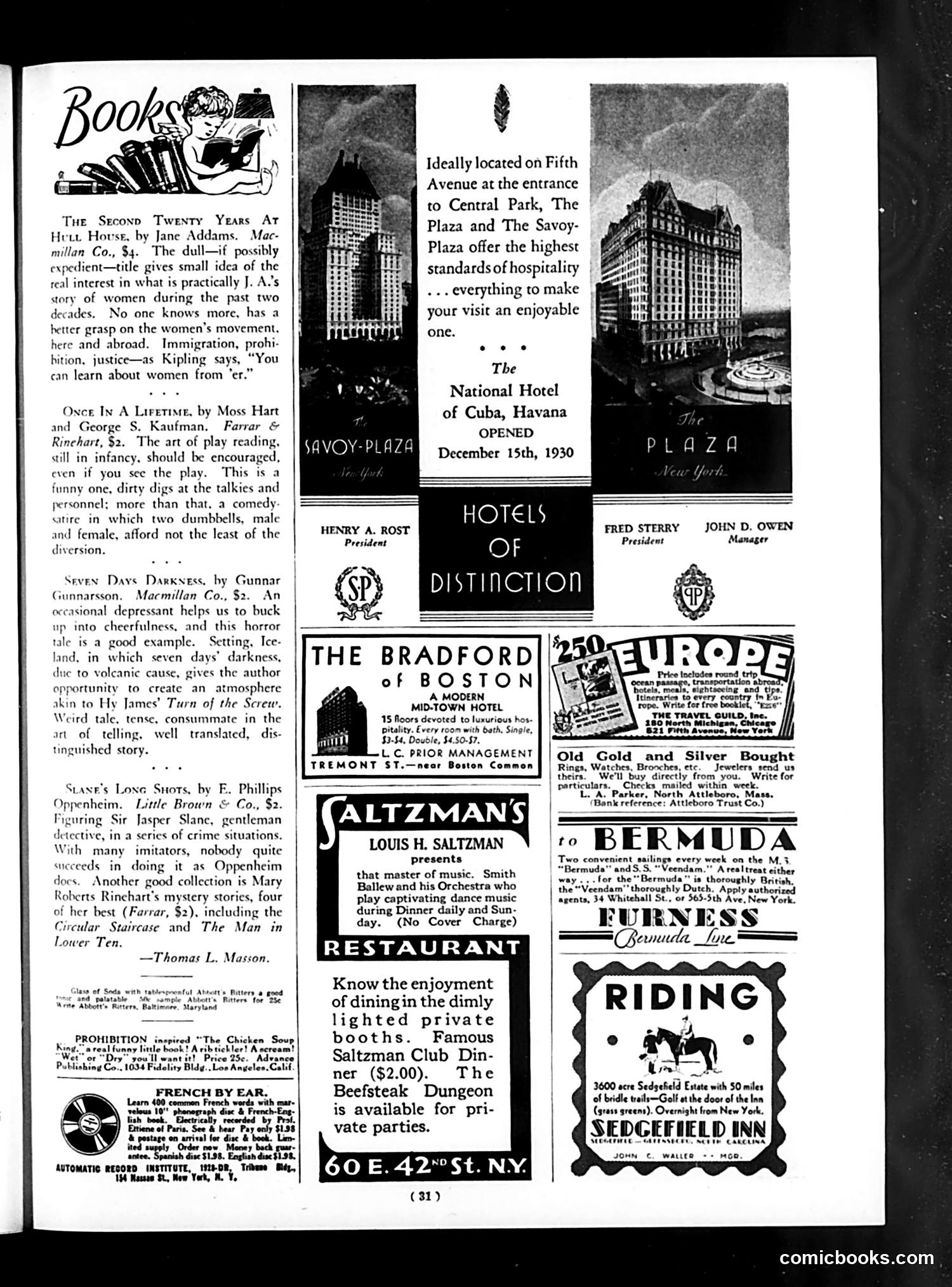
Analysis of Life Magazine Page This page is primarily book reviews and advertisements, not a political cartoon. The book section (left side) reviews recent publications including Jane Addams' memoir about women's movements, a comedy about the film industry ("dirty digs at the talkies"), and mystery novels. Reviewer Thomas L. Masson offers brief critical assessments of these works for educated readers. The advertisements showcase luxury hotels and travel services—the Plaza and Savoy-Plaza in New York, the Bradford in Boston, a Cuban resort, and Bermuda cruises. There's also an ad for Saltzman's restaurant with live music, a riding inn in North Carolina, and a precious metals buyer. The only satirical element is subtle: the book reviews mock contemporary entertainment (particularly film) and literary trends, while the ads reflect Depression-era aspirations toward leisure and travel for the wealthy. The page reflects *Life* magazine's target audience of educated, affluent readers circa 1930.
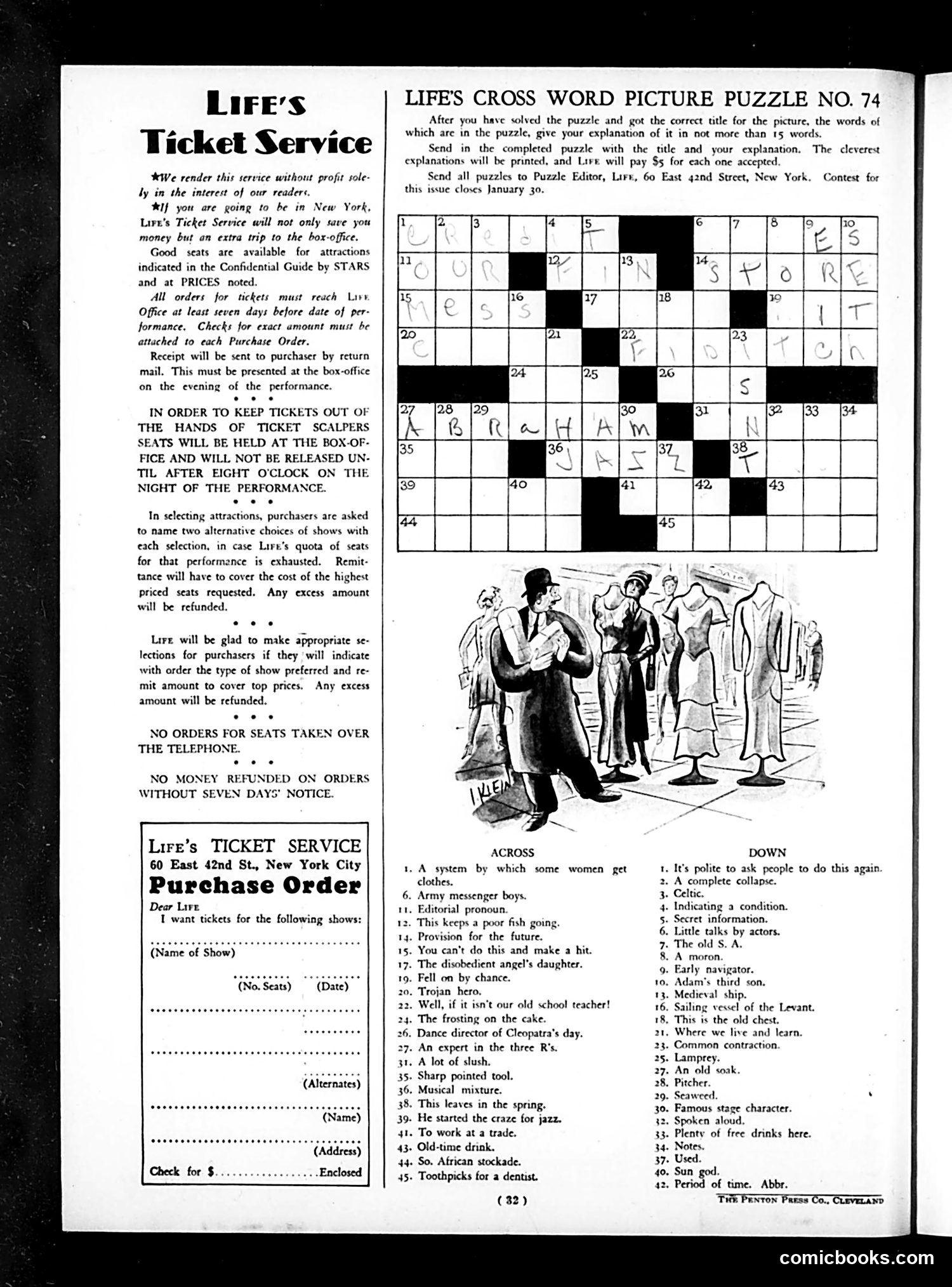
Life Magazine Ticket Service & Crossword Puzzle Page This page is primarily administrative/service content rather than satirical commentary. It advertises Life magazine's ticket service for New York theatrical attractions, with detailed ordering instructions and policies—notably that seats won't be released until 8 PM on performance night to prevent scalping. The cartoon accompanying the text depicts a ticket scalper or broker in a top hat conducting transactions with patrons on a street, illustrating the ticket-resale problem the service aimed to prevent. The scalper's predatory role—buying up seats at face value to resell at inflated prices—was a common urban nuisance Life's readers would recognize. The page also features a crossword puzzle contest with modest prize money ($5). The clues reflect 1920s-30s vernacular and cultural references (jazz craze, theatrical terminology, period slang), designed for contemporary readers' amusement.
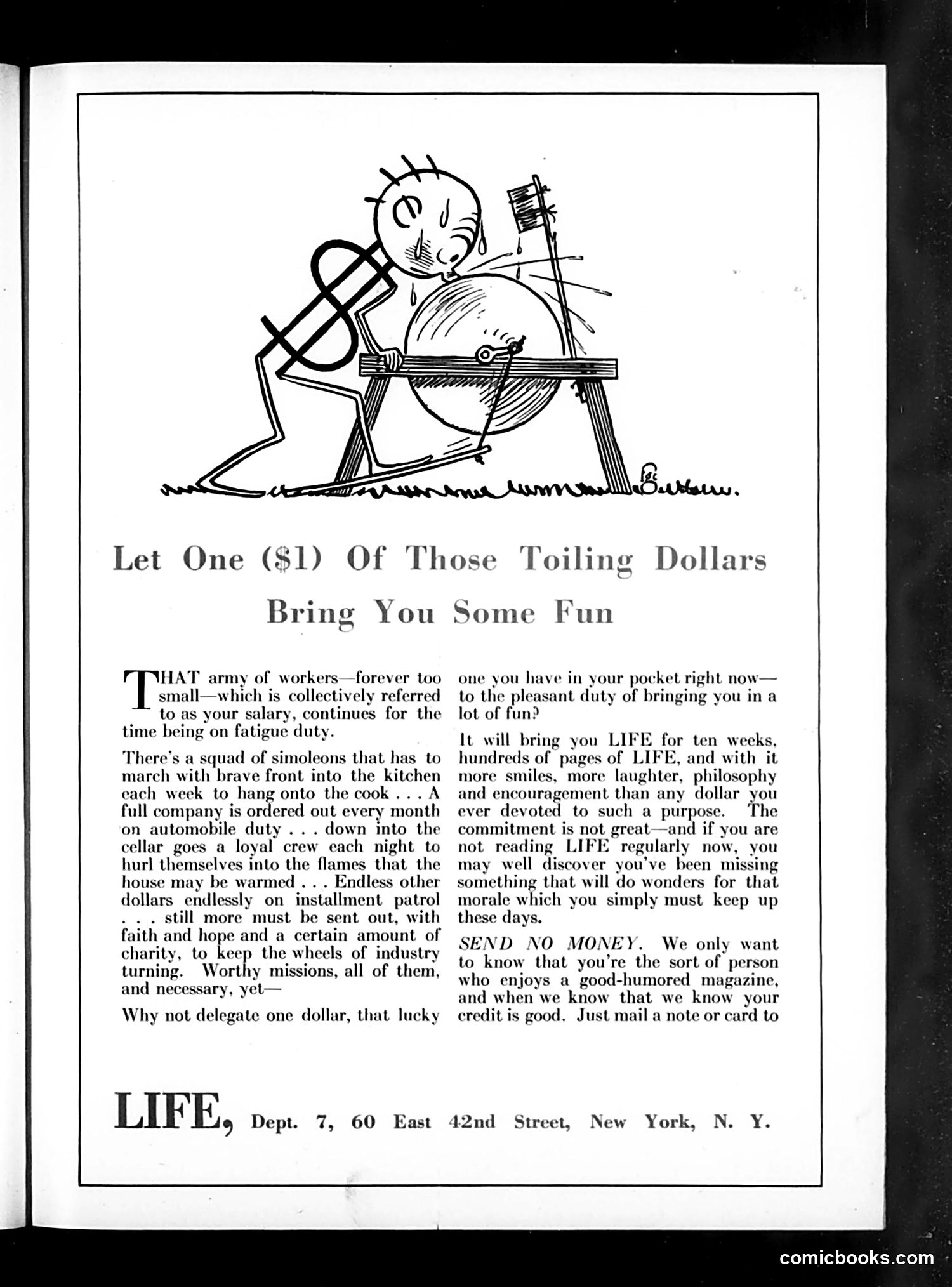
Analysis of Life Magazine Advertisement This is a subscription pitch for *Life* magazine disguised as humorous social commentary. The cartoon depicts a harried figure juggling various financial obligations—represented as soldiers—including household expenses (cook, automobile, heating), installment payments, and industrial contributions. The satire addresses working-class financial strain: a person's salary is perpetually stretched thin across necessary expenses. The advertisement then proposes that dedicating just one dollar to a *Life* subscription offers disproportionate value—ten weeks of entertainment and morale-boosting content. The phrase "send no money" reflects a credit-based subscription model: *Life* trusts readers' character and creditworthiness based on their interest alone. This was likely aimed at Depression-era or post-war audiences needing affordable respite from economic anxiety. The underlying joke: among all those draining financial obligations, surely one dollar for humor and philosophy is justified.
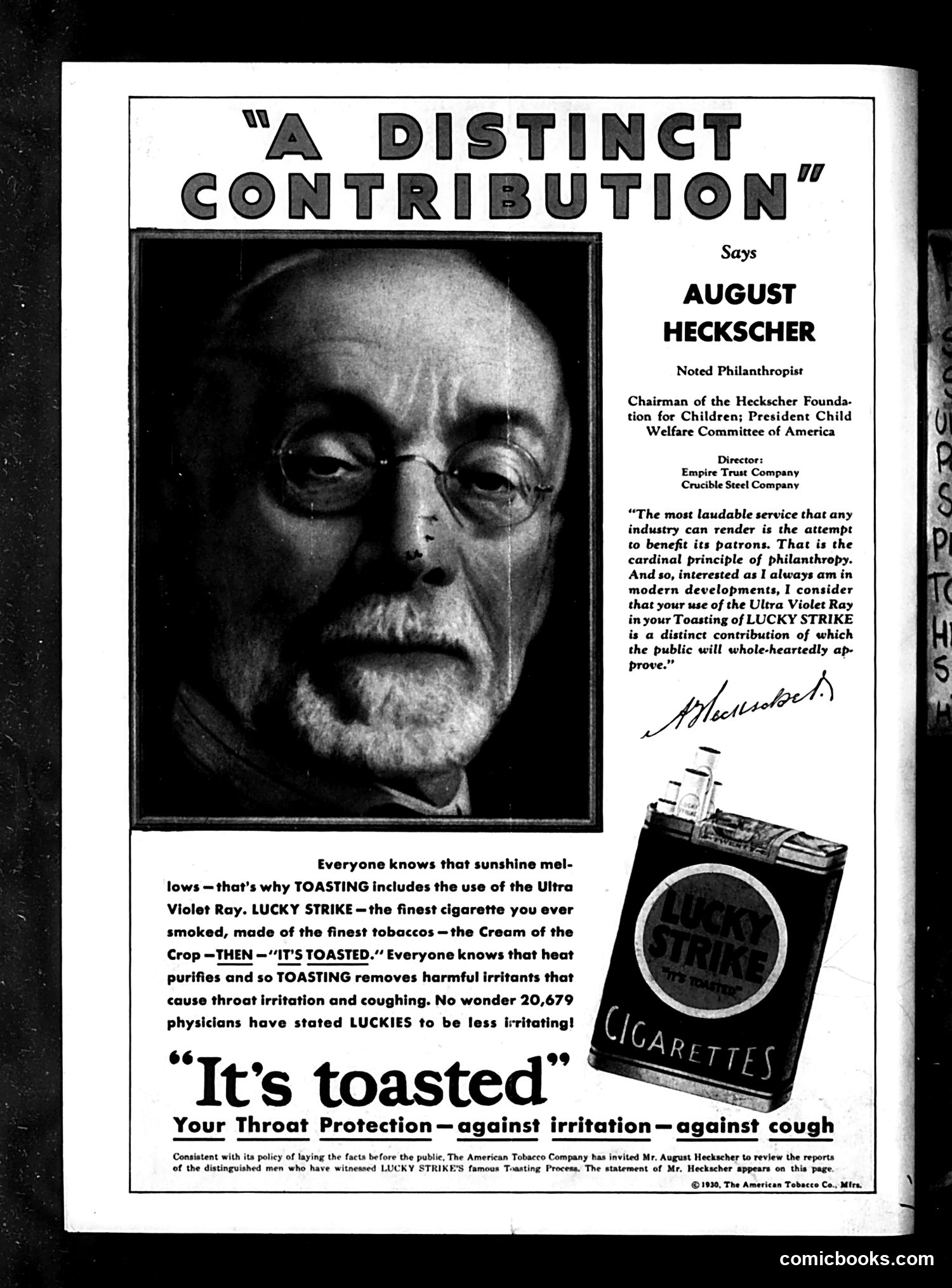
What This Page Means This is advertising masquerading as editorial endorsement, not satire. Lucky Strike cigarettes secured a testimonial from August Heckscher, a prominent philanthropist and children's welfare advocate, endorsing their "toasting" process as a health benefit. The ad claims toasting removes "harmful irritants" and cites 20,679 physicians supporting Lucky Strikes as "less irritating"—a precursor to the famous 1950s "I'd rather fight than switch" campaigns that made dubious health claims. For modern readers: This represents an era before cigarette regulation, when tobacco companies could invoke doctors and philanthropists to legitimize smoking as health-conscious. The pseudo-scientific language ("Ultra Violet Ray," "purifies") and celebrity/authority endorsement were standard tobacco marketing tactics. By today's standards, these claims would be illegal; then, they were persuasive. The page reveals how corporations exploited public trust in experts before disclosure requirements existed.