life
Life — January 16, 1931
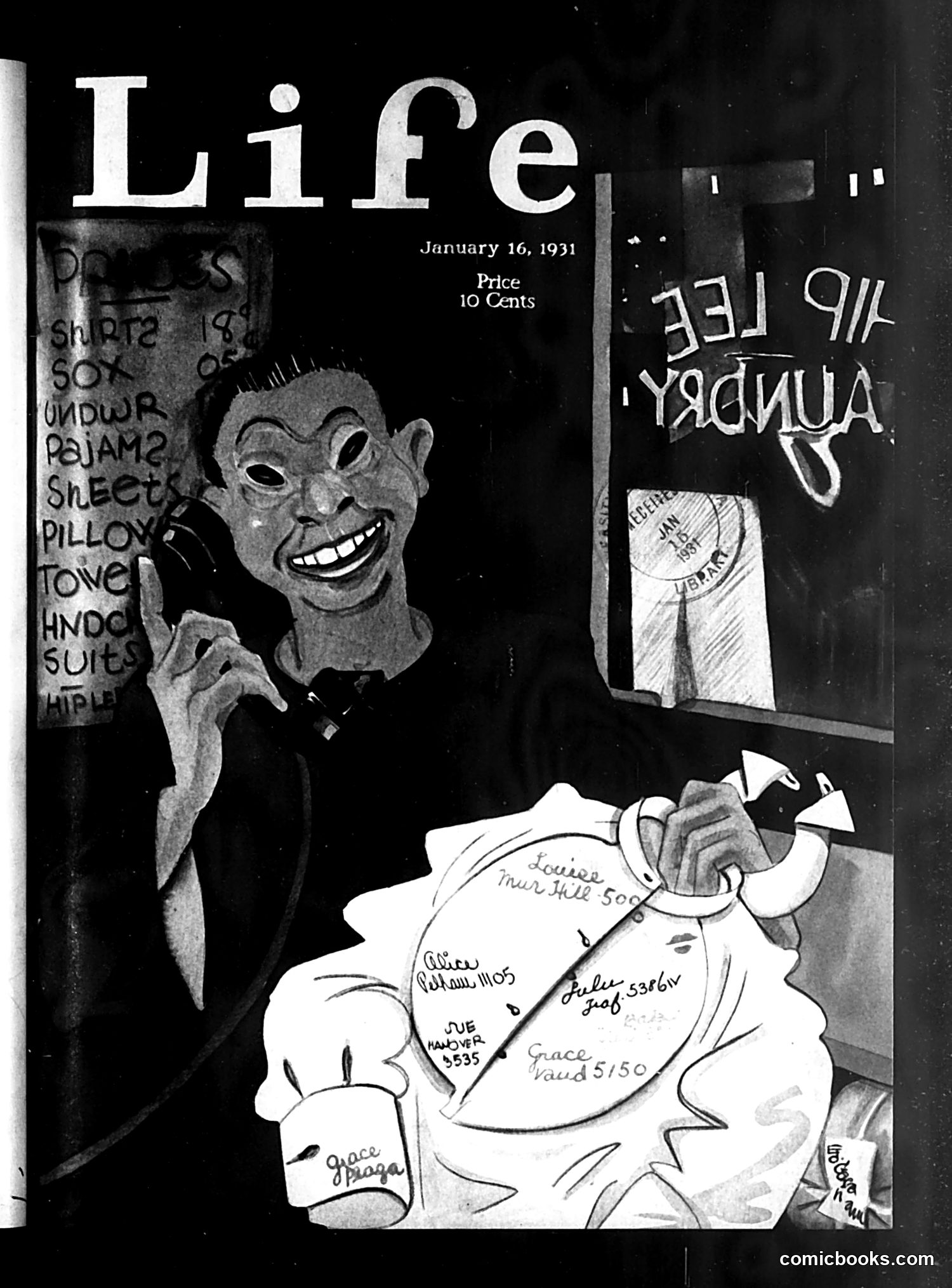
Life Magazine Cover Analysis — January 16, 1931 This cover satirizes the economic hardship of the Great Depression through a grotesque caricature of a cheerful figure holding a telephone, surrounded by handwritten labels on clothing items listing prices and names (some illegible, but appearing to reference various garments and household goods). The grotesque, grinning face with exaggerated features suggests manic cheerfulness despite dire circumstances—a commentary on forced optimism during financial collapse. The labeled items with prices suggest either a pawn shop inventory, secondhand sales, or personal belongings being sold for survival. The juxtaposition of the figure's artificial smile with the economic desperation implied by the pricing labels creates bitter satire about maintaining composure while facing financial ruin during the Depression era.
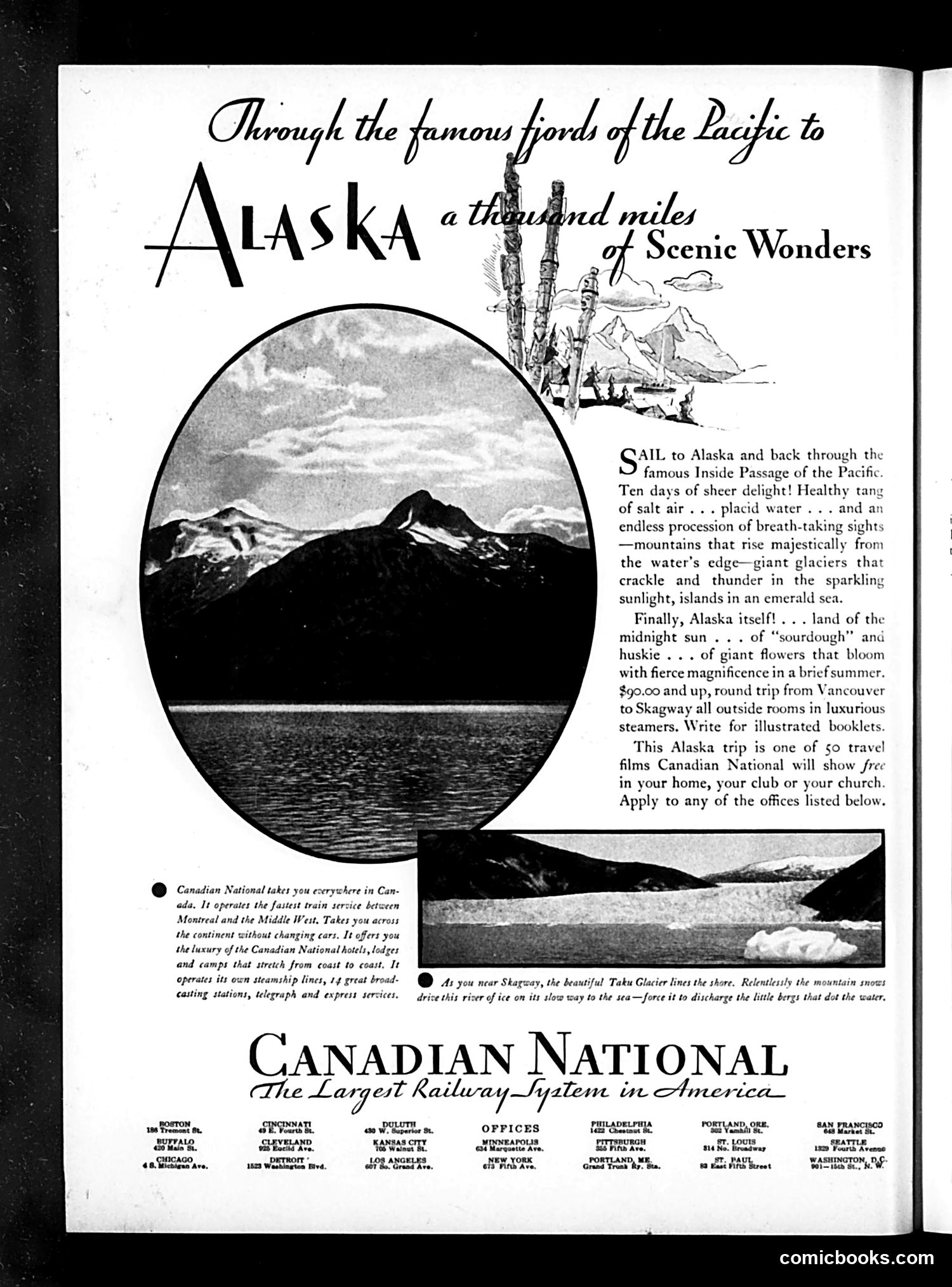
This is a travel advertisement, not a political cartoon. Canadian National Railways promotes Alaska tourism through the "Inside Passage of the Pacific," emphasizing scenic attractions: mountains, glaciers, islands, and the midnight sun. The ad targets affluent travelers with a $90 round-trip offer from Vancouver to Skagway aboard "luxurious steamers." It notes Canadian National operates "the fairest train service" in Canada and offers travel films free to homes, clubs, and churches. The page features a large circular photograph of snow-capped mountains reflected in water, plus a smaller rectangular image of Taku Glacier. The design employs dramatic landscape imagery typical of 1920s-30s travel marketing to appeal to leisure travelers seeking natural wonders and adventure.
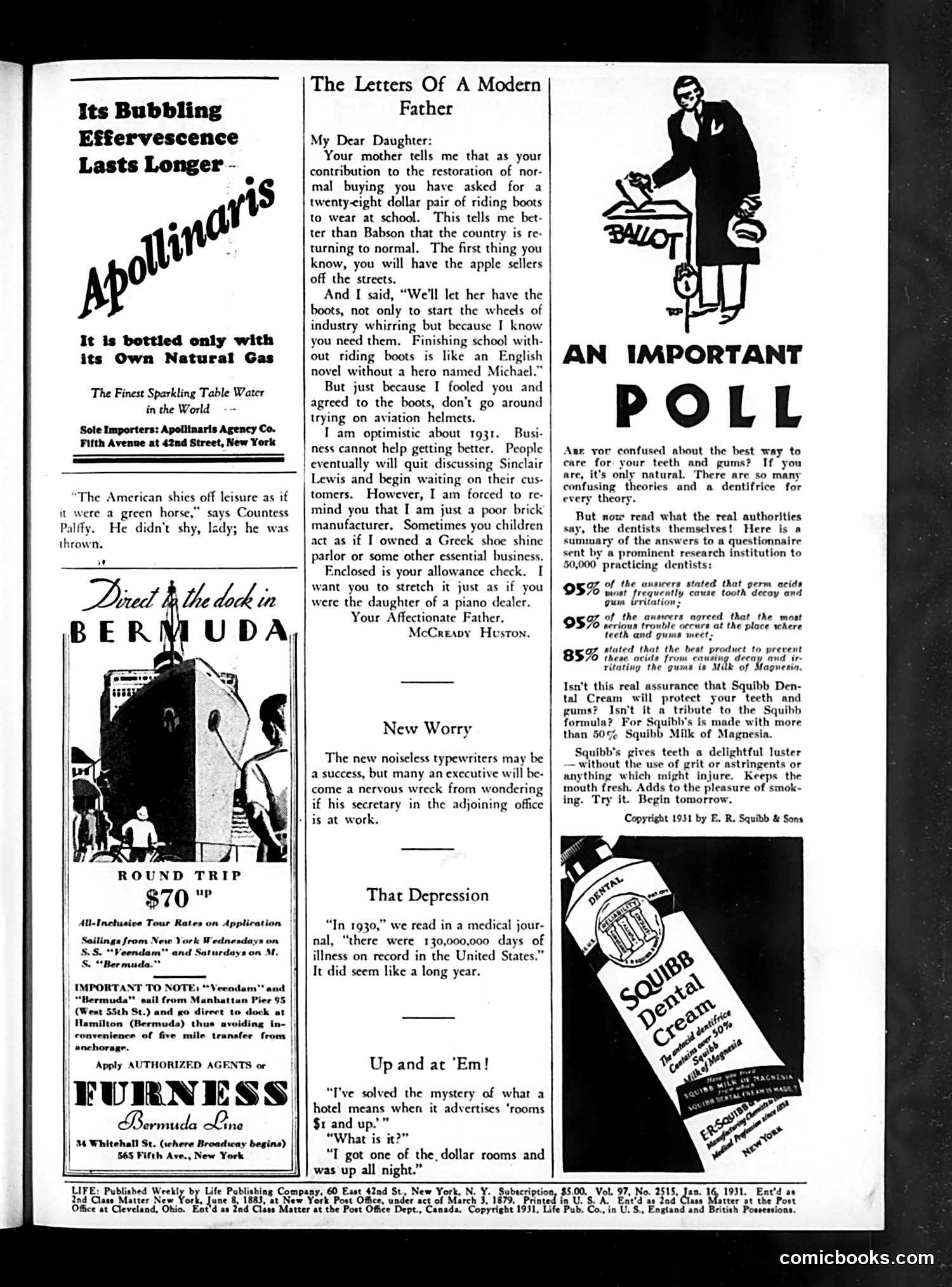
Analysis of Life Magazine Page (January 16, 1931) This page contains mostly advertisements and advice columns rather than political cartoons. The main content is "The Letters of a Modern Father," where a father responds to his daughter's request for expensive riding boots ($28) during economic hardship. He permits them reluctantly, reasoning that consumer spending helps industry recover—a notable perspective given this is January 1931, early in the Great Depression. The "Important Poll" discusses tooth decay prevention based on dentist surveys—a straightforward health advertisement. Other ads promote Apollinaris sparkling water, Bermuda travel, and Squibb Dental Cream. The page reflects 1931 consumer culture and emerging health-consciousness, with little satirical commentary visible. The father's economic rationalization is the closest to social commentary on Depression-era spending habits.
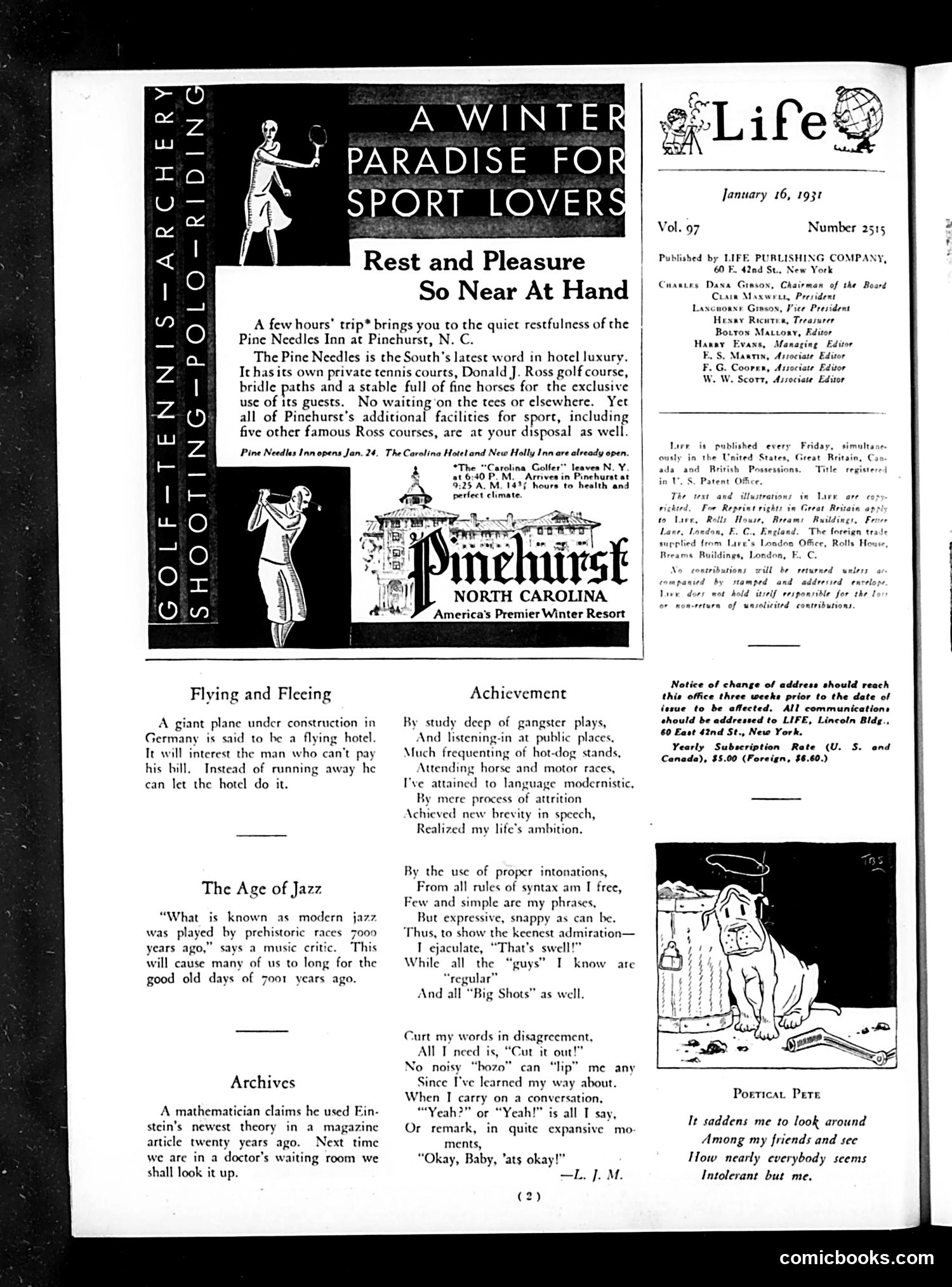
Analysis of Life Magazine Page (January 16, 1931) This page is primarily a title/contents page and advertisement layout rather than political satire. The dominant feature is a large advertisement for Pinehurst, North Carolina, marketed as "America's Premier Winter Resort" offering golf, tennis, and horseback riding. The small cartoon labeled "Poetical Pete" (bottom right) shows a disheveled man and appears to be gentle humor about social awkwardness—the caption expresses feeling like an outsider among friends. This is personal rather than political satire. Other content includes brief humorous pieces ("The Age of Jazz," "Archives," "Achievement") offering mild social commentary typical of 1931 Life magazine's lightweight style—nothing indicating serious political satire on this particular page.
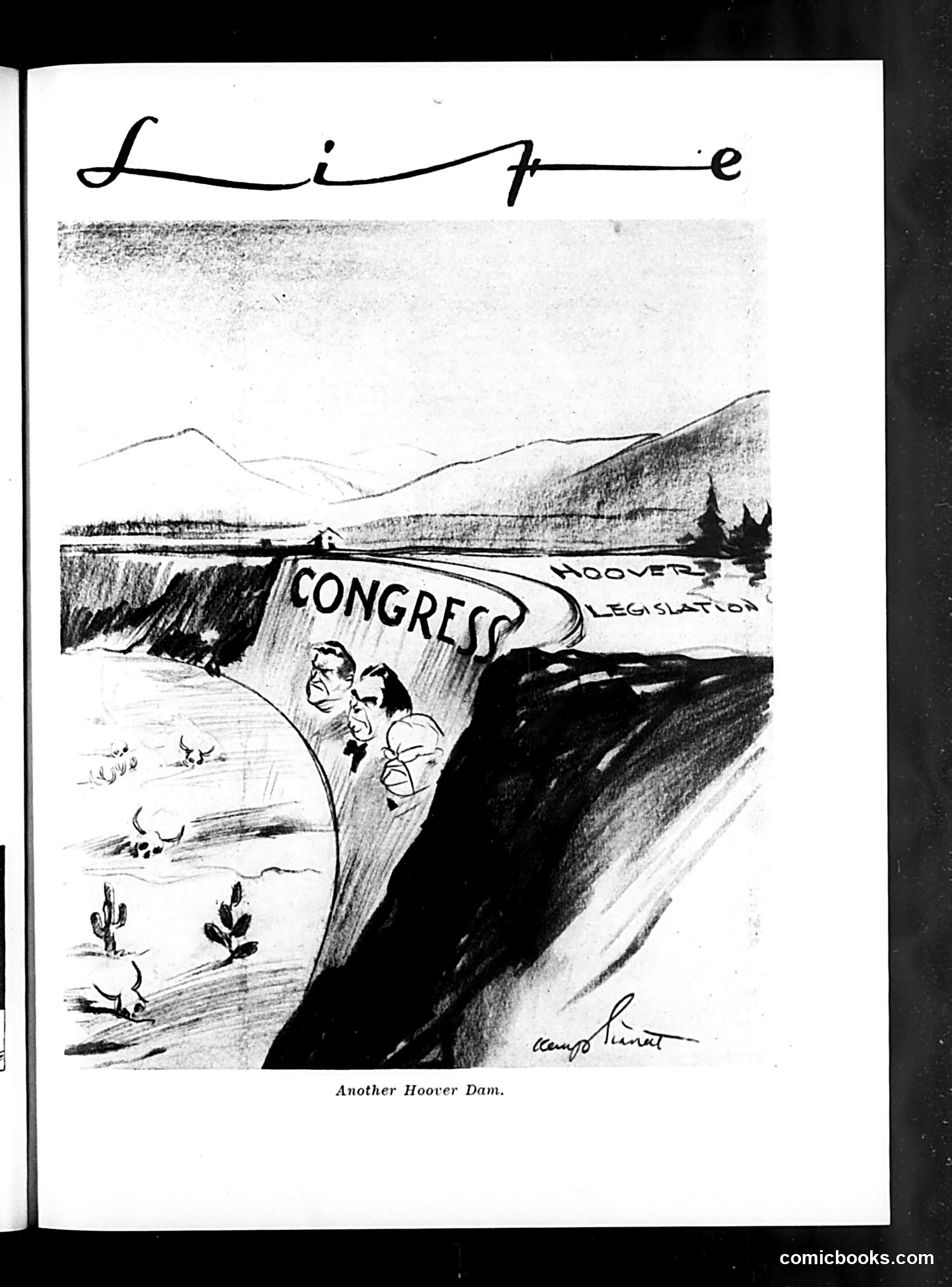
"Another Hoover Dam" - Political Cartoon Analysis This cartoon satirizes Congress's reluctance to fund infrastructure projects during the Hoover administration (1929-1933). Two Congressional figures huddle beneath a banner labeled "CONGRESS" while standing on the edge of a massive dam, with "HOOVER LEGISLATION" visible on the landscape beyond. The satire suggests Congress is timidly hesitant or resistant to President Herbert Hoover's legislative proposals—specifically major public works like dam construction. The figures appear anxious or uncertain, implying Congress lacks courage or commitment to support such ambitious government projects. The title "Another Hoover Dam" sarcastically comments on Congress's apparent inability or unwillingness to authorize additional major construction initiatives, despite the precedent of Hoover Dam's success.
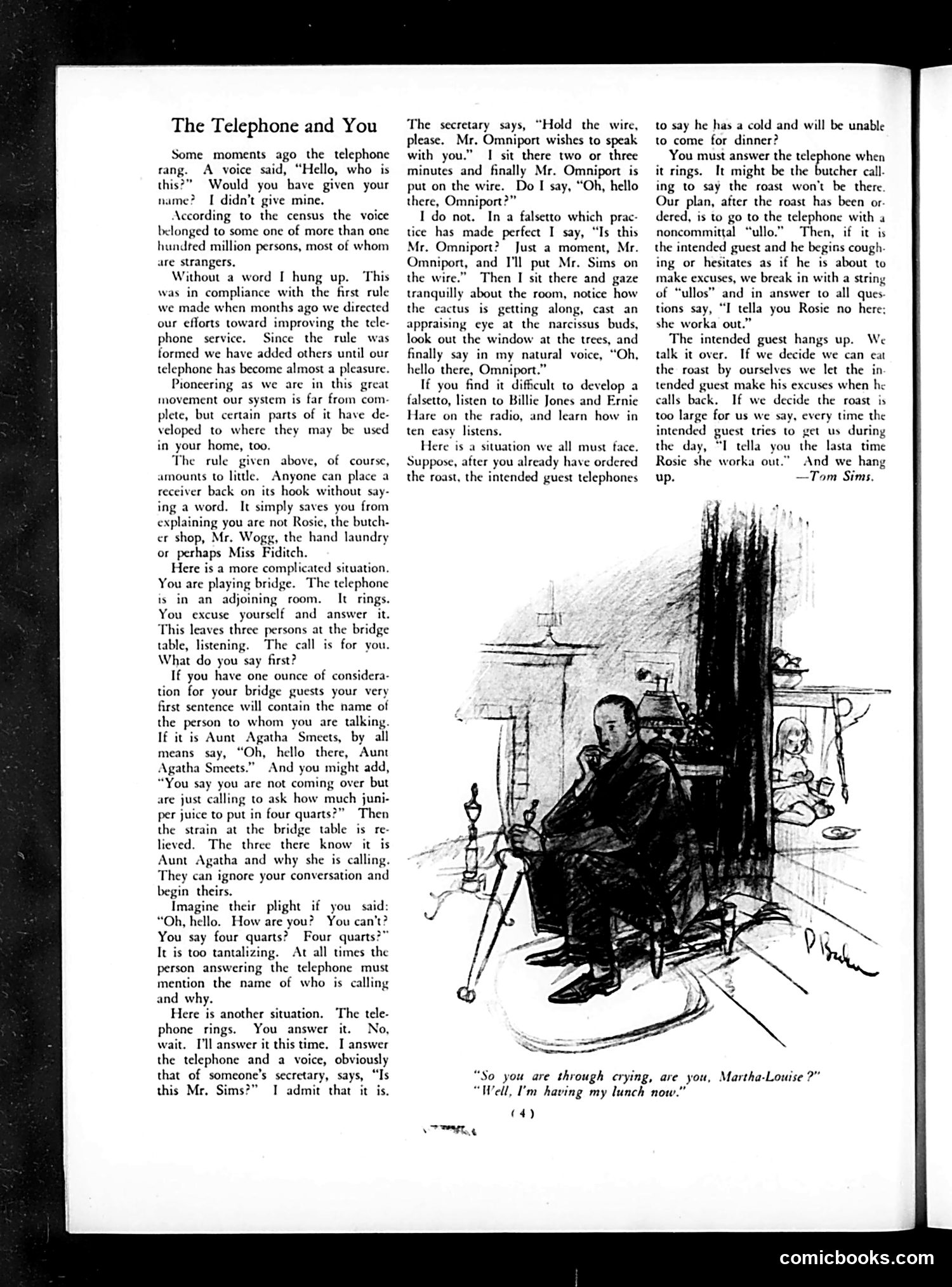
"The Telephone and You" - Life Magazine This satirical article offers etiquette advice for telephone users, a then-novel technology. The accompanying cartoon illustrates the awkwardness of telephone interruptions during social gatherings. The piece humorously catalogs common telephone scenarios—mistaken identity calls, interrupting bridge games, dealing with secretaries—and the social confusion they create. Key advice: always identify yourself and why you're calling; don't leave guests hanging; acknowledge the caller's name and purpose. The cartoon shows a man at lunch, seemingly caught mid-conversation on the telephone while sitting alone, capturing the absurdity of being interrupted during meals. The caption joke—"So you are through crying, are you, Martha-Louise?" / "Well, I'm having my lunch now"—illustrates the social disruption and awkward exchanges telephones introduce into everyday life. This reflects early-20th-century anxieties about intrusive technology and changing social norms.
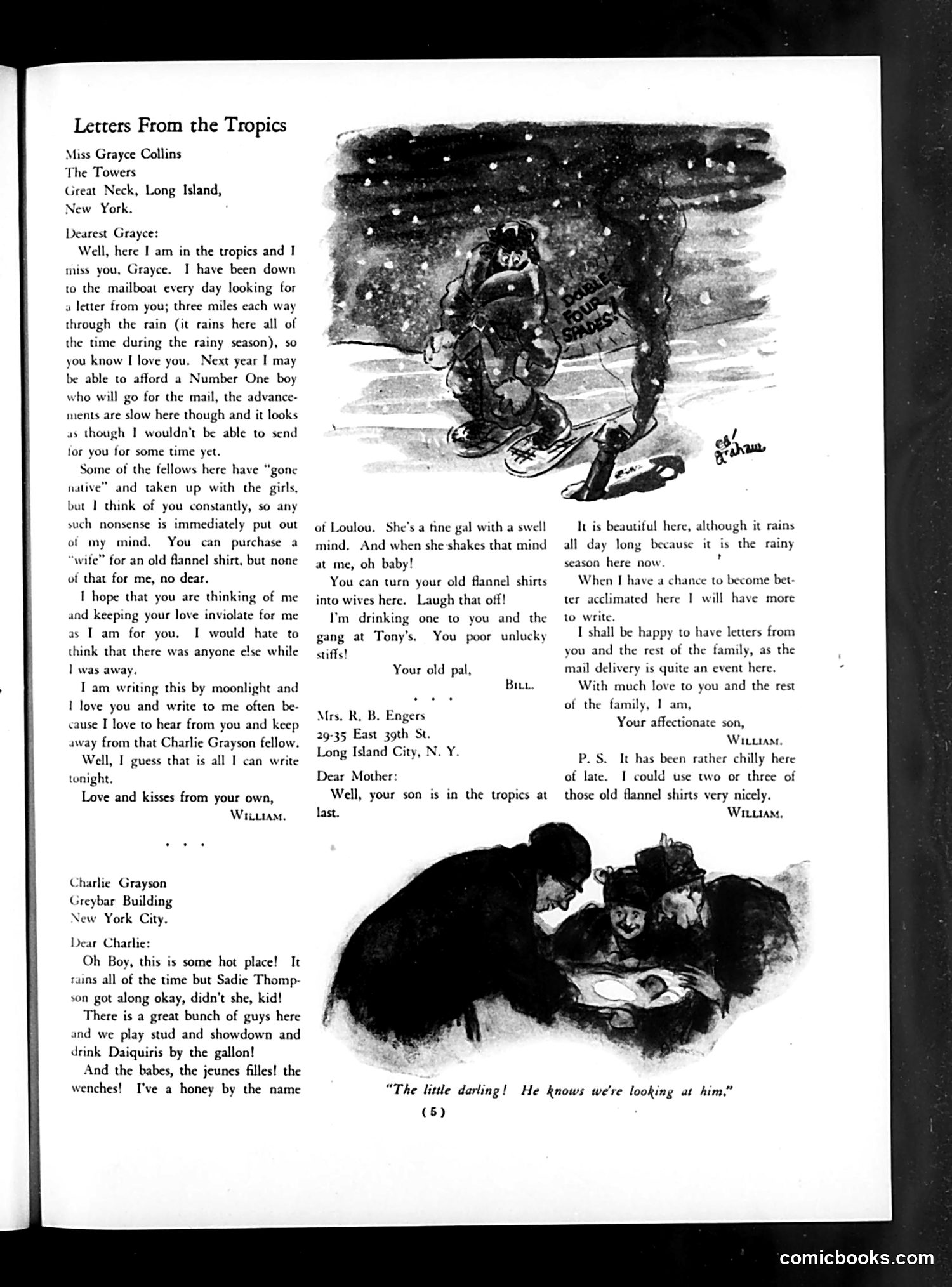
Analysis of "Letters From the Tropics" Page This page features personal correspondence rather than political cartoons. Three letters describe life in tropical locations, illustrated with two sketches. The letters are from William (in the tropics), Bill (at Toni's), and Charlie Grayson (in New York City). They humorously describe tropical hardships—constant rain, isolation, and romantic longing—contrasted with homesickness and casual complaints about weather and social life. The two illustrations show: (1) people sheltering under what appears to be a tree during heavy rain, and (2) a domestic scene with adults and a child, captioned "The little darling! He knows we're looking at him." This is light satirical humor about expatriate life and family correspondence, typical of Life magazine's early 20th-century humor. No specific political references are evident.
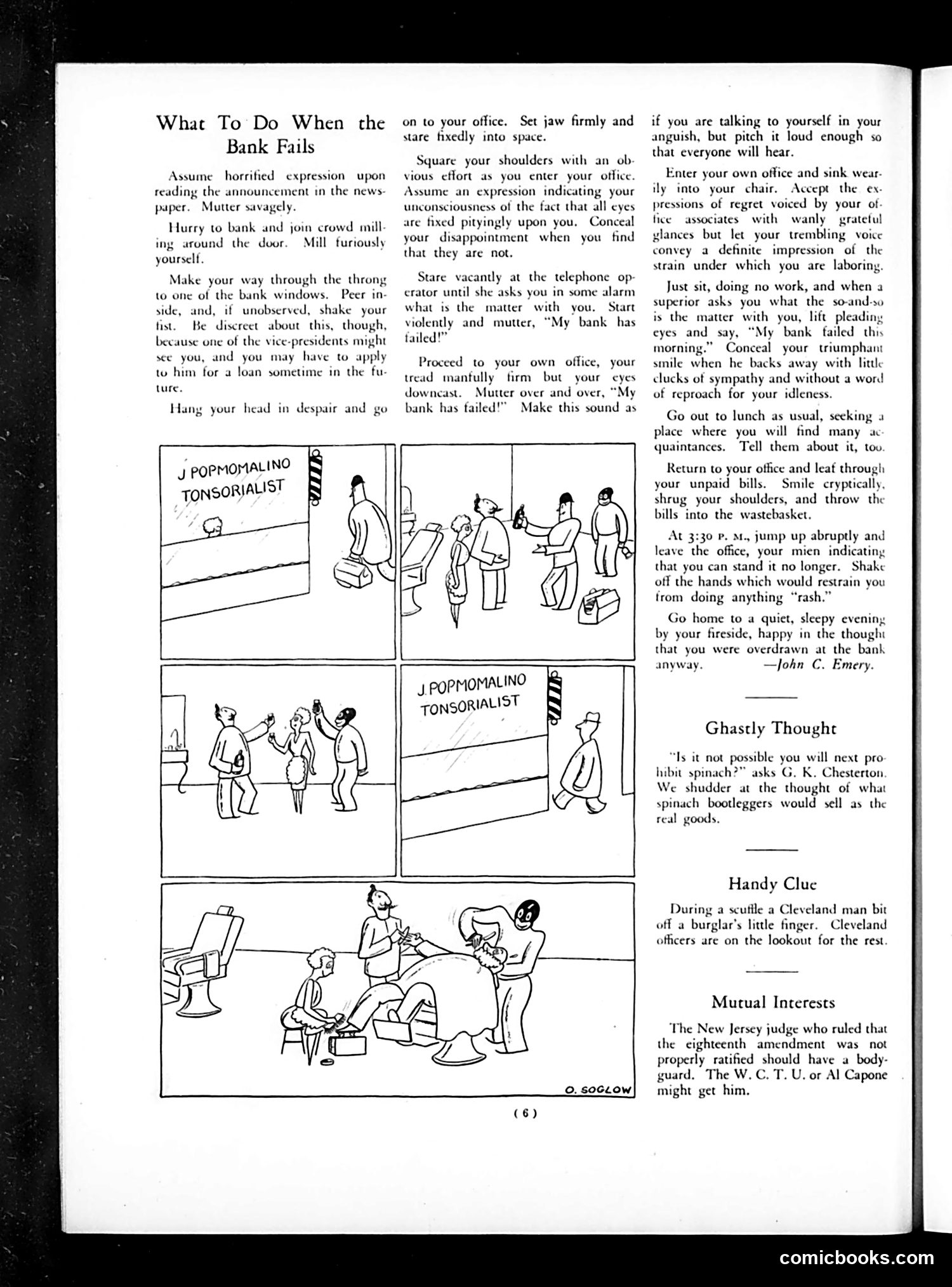
Analysis of "What To Do When the Bank Fails" This satirical article by John C. Emery humorously advises readers on maintaining composure during a bank failure—a serious concern during the Great Depression era. The accompanying comic strip (artist signed "O. Soglow") depicts office workers discovering their bank has collapsed, showing them crowding outside the "J. Popmomalino Tonsorialist" (likely a barber shop serving as a front). The satire mocks both the panic that bank failures inspired and suggests the absurdity of pretending normalcy in crisis. The advice to sit calmly, stare into space, and go home "happy in the thought that you were overdrawn" darkly jokes about financial ruin. The brief accompanying items ("Ghastly Thought," "Handy Clue," "Mutual Interests") continue the cynical, comedic tone typical of Life magazine's social commentary.
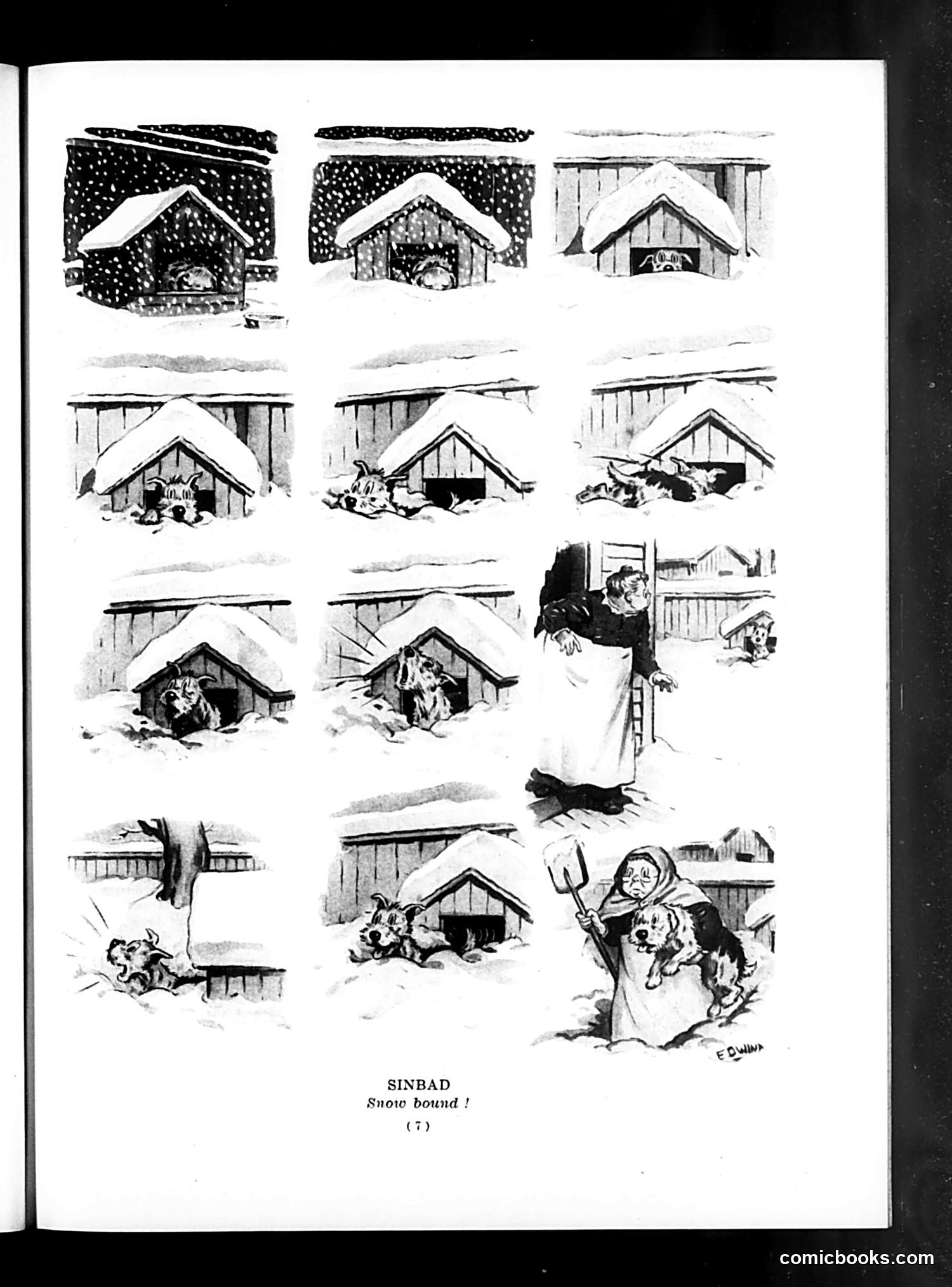
"Sinbad—Snow Bound!" Comic Strip Analysis This appears to be a sequential comic strip featuring a character named Sinbad dealing with snowfall. The strip shows a narrative progression through multiple panels (arranged in a 3x4 grid plus additional panels) depicting what seems to be: - A figure (Sinbad) in progressively snowy conditions around doghouses - Dogs appearing in various panels, some being shoveled or dug out - A woman in winter clothing (appears to be helping or reacting to the snow) - Increasing chaos and comedy as snow accumulates The humor derives from slapstick winter situations—dogs and humans struggling with snow, buried structures, and comedic mishaps typical of early-20th-century Life magazine's humorous content. The title "Snow bound!" indicates the central joke: characters trapped or immobilized by winter weather conditions.
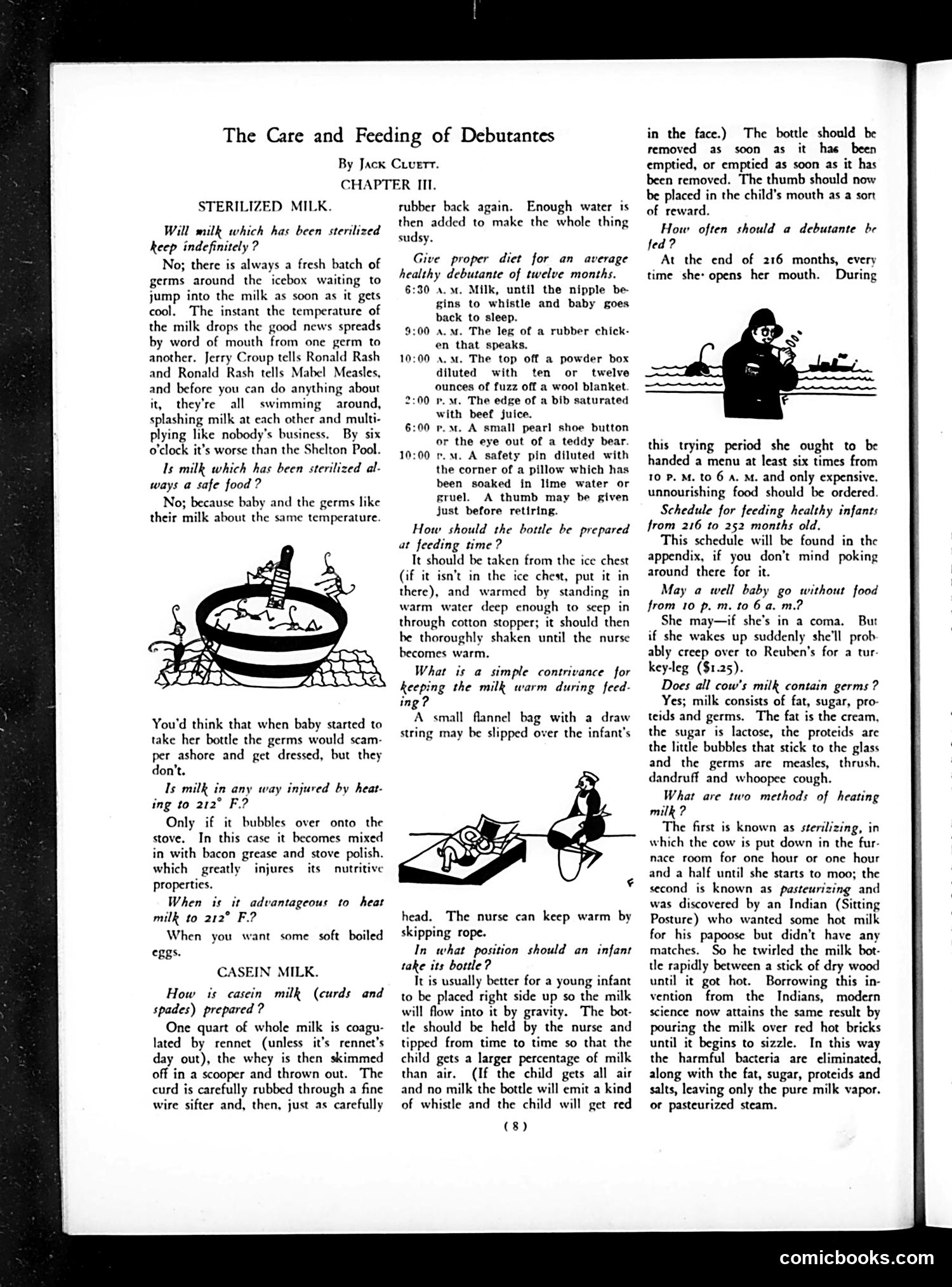
Analysis This is an instructional article titled "The Care and Feeding of Debutantes" by Jack Cunliffe, presented as satirical advice. The page discusses practical childcare topics—sterilized milk preparation, feeding schedules, casein milk processing—but frames them humorously as if managing a debutante (a young woman of marriageable age from an upper-class family) were equivalent to infant care. The accompanying illustrations show babies in various domestic situations. The satire appears to mock both the dependency and helplessness attributed to debutantes in society while also gently ribbing actual infant care practices. By treating sophisticated young women as infants requiring elaborate feeding protocols and constant attention, the piece satirizes both debutante culture and perhaps overly-complicated childcare advice of the era.
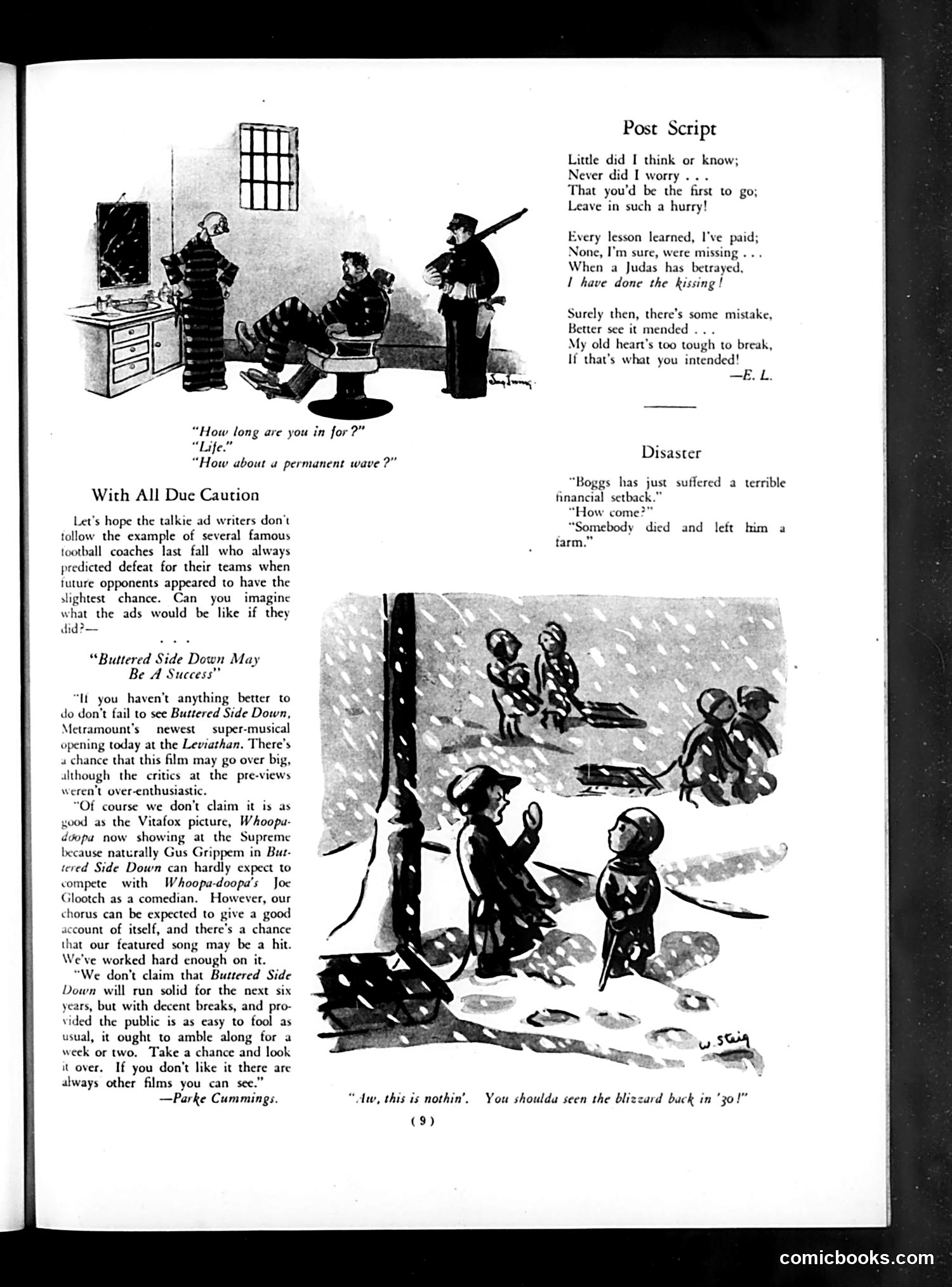
Analysis of Life Magazine Page This page contains three distinct pieces: "Post Script" (top right): A poem about betrayal and heartbreak, seemingly responding to a romantic transgression ("When a Judas has betrayed, / I have done the kissing!"). "With All Due Caution" (left column): A satirical article mocking sports writers and advertisers who make overconfident predictions. It warns against ads claiming certain success, using football coaches as an example of famous failed predictors. "Disaster" (center): A brief joke where someone lost a farm due to financial setback, followed by an illustration of children playing in snow, with one saying "Aw, this is nothin'. You shoulda seen the blizzard back in '30!" The snow scene appears designed to humorously contrast children's resilience with adult financial catastrophe—a likely Depression-era commentary on hardship.
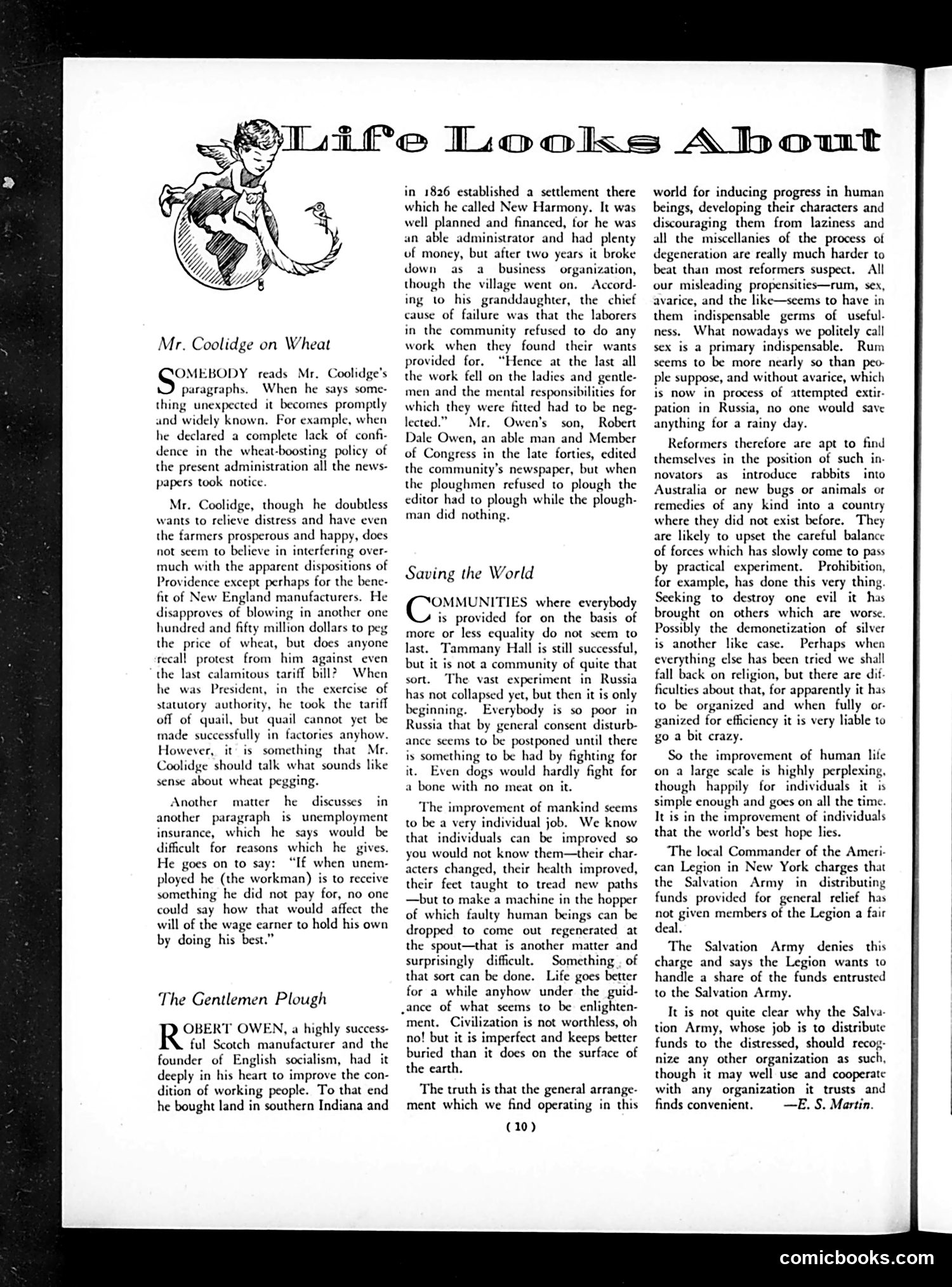
"Life Looks About" - Page Analysis This page contains three separate articles critiquing social reform movements. The illustration shows a cherub-like figure (labeled "Mr. Coolidge on Wheat") examining a wheat stalk—satirizing President Coolidge's wheat policies. The articles discuss: 1. Mr. Coolidge's wheat policies - The author criticizes Coolidge's inconsistent stance on agricultural tariffs, suggesting his administration's wheat-boosting policies lacked credibility. 2. Utopian communities - Mocking experiments like New Harmony (Robert Owen's failed 1826 settlement) and Russian communalism as naive attempts to reorganize society. 3. The Salvation Army - Questioning whether the organization should receive public relief funds, highlighting disputes over how charitable money should be distributed. The overall tone suggests skepticism toward both government and idealistic reform efforts.
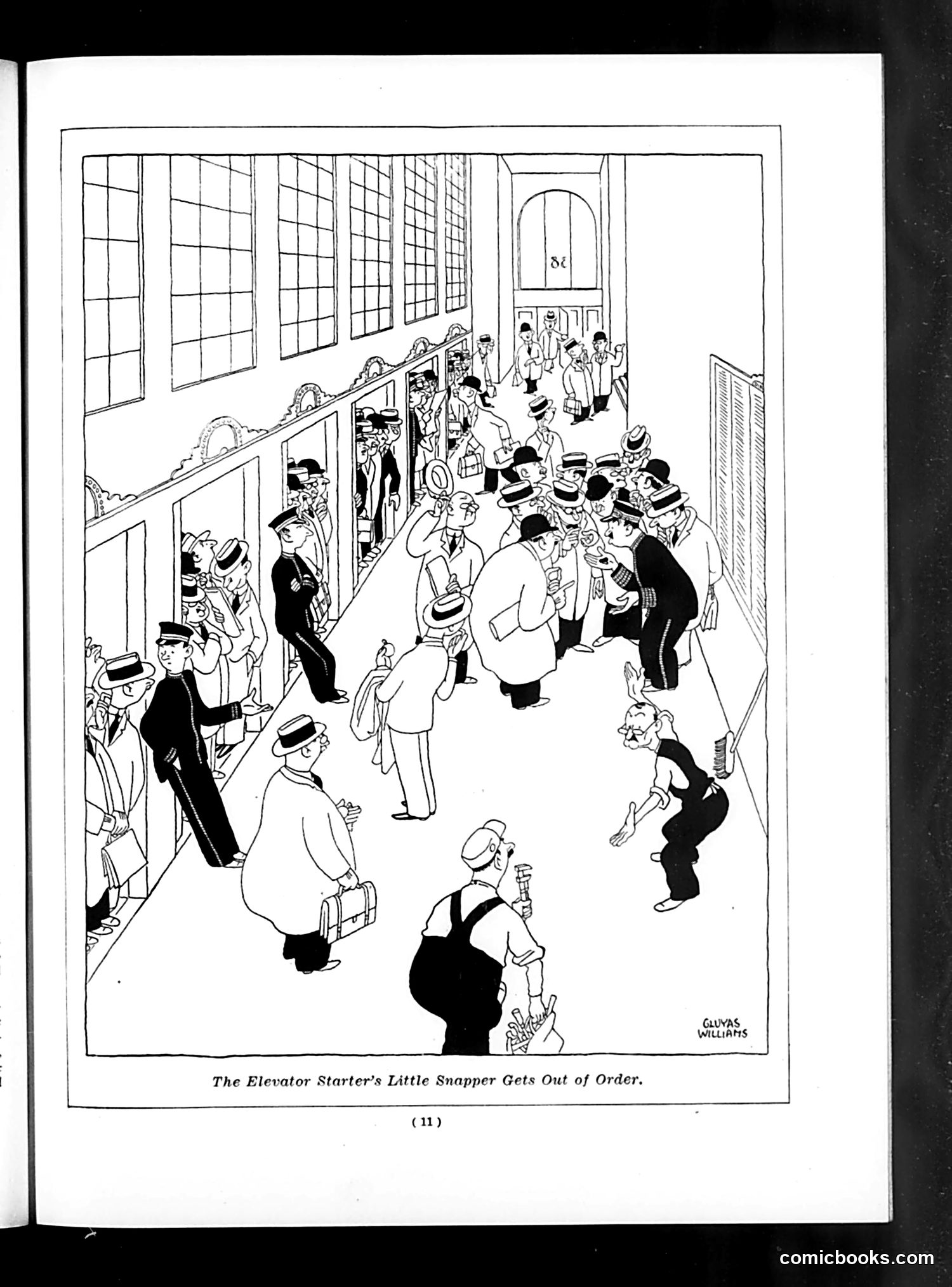
"The Elevator Starter's Little Snapper Gets Out of Order" This cartoon depicts a crowded elevator lobby or building entrance in what appears to be the early 20th century. The scene shows well-dressed men in suits and hats, with one central figure appearing to cause disruption or chaos among the crowd. The title suggests the "snapper" (a young, sassy person—likely a elevator starter's child or employee) is misbehaving or acting out of control in a public space. The humor appears to target class dynamics and workplace hierarchies of the era, poking fun at how a low-ranking employee's unruly child might embarrass their parent or disrupt the orderly conduct expected in formal business settings. The crowded, chaotic composition emphasizes the social disruption caused by this one uncontrollable figure.
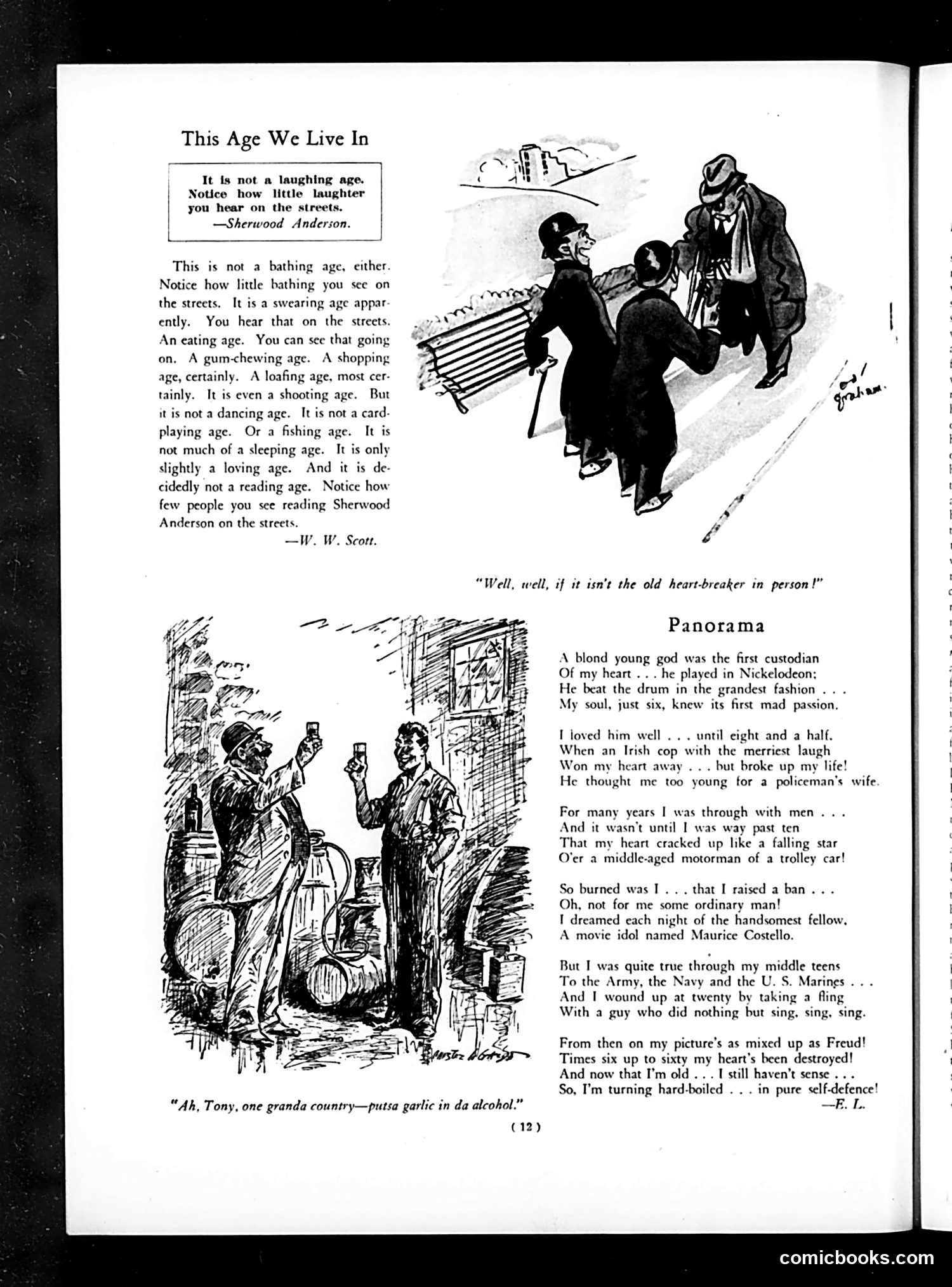
Analysis of Life Magazine Page This page contains social commentary rather than political cartoons. The top section, "This Age We Live In," quotes writers Sherwood Anderson and W. W. Scott critiquing modern American life as joyless—lacking laughter, bathing, dancing, card-playing, fishing, sleeping, and reading. The accompanying sketch shows men on a street bench, illustrating urban tedium. The lower cartoon depicts two men exchanging drinks, captioned with Italian slang about garlic and alcohol, likely satirizing immigrants or ethnic stereotypes common to 1920s-30s American humor. The poem "Panorama" recounts a woman's romantic misadventures, from a childhood crush through multiple relationships to her cynical present state. Overall, the page reflects Depression-era pessimism about modern life's diminished pleasures and emotional fulfillment.
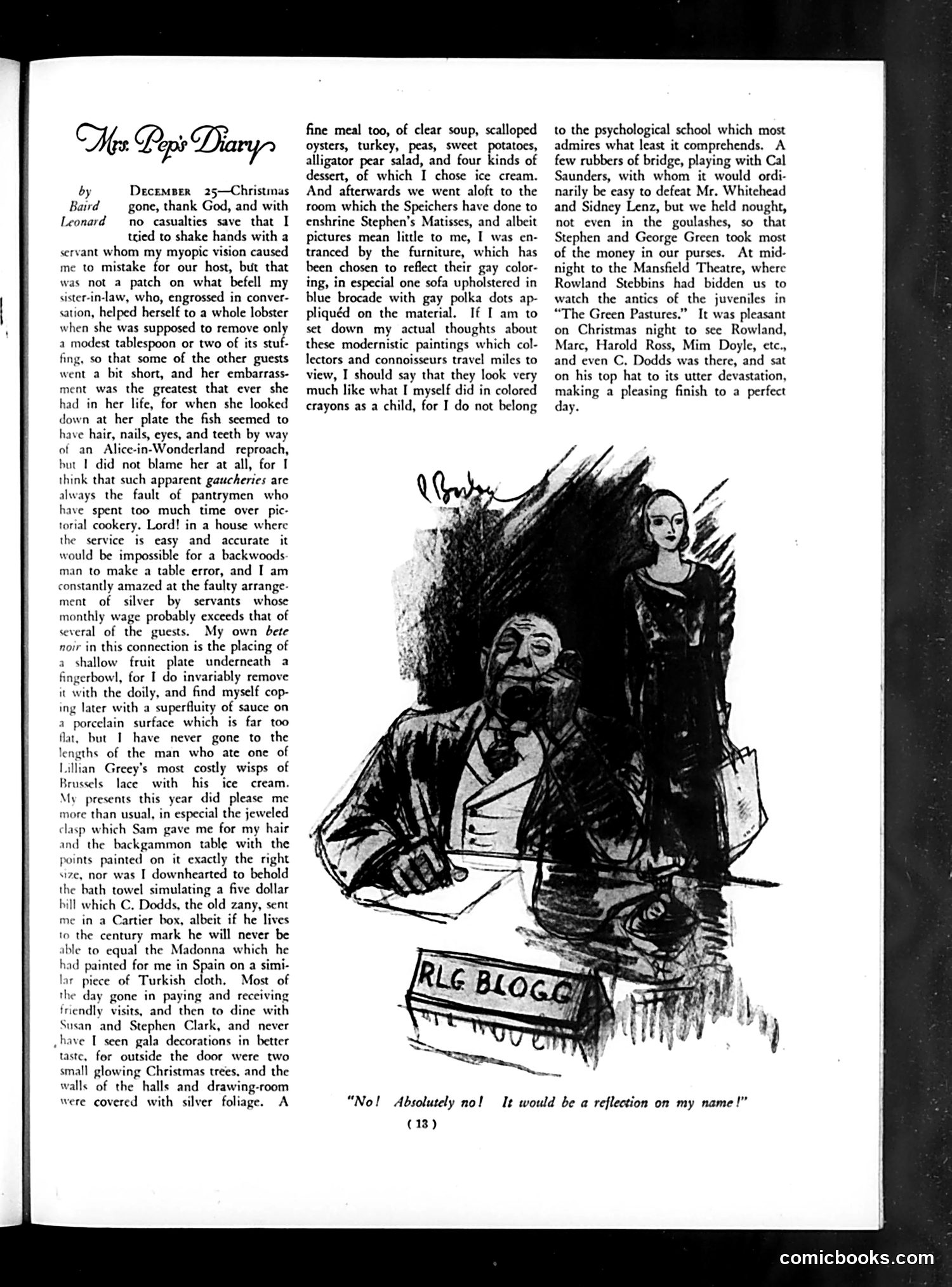
Analysis This page from *Life* magazine's "Mrs. Pepys' Diary" column (dated December 25—Christmas) contains a satirical illustration accompanying a diary entry about holiday entertaining. The sketch shows a caricatured figure labeled "R.L.G. BLOGG" presenting what appears to be a painting or artwork, with the caption: "No! Absolutely no! It would be a reflection on my name!" The satire targets pretentious amateur artists. The diary text criticizes hosts who display modernist paintings by amateur painters at dinner parties, comparing them unfavorably to children's crayon work. The "R.L.G. Blogg" figure likely represents a vain, mediocre artist insisting his poor work be displayed despite its obvious lack of merit—the joke being that refusing to hang it would somehow damage his reputation, when the work itself already does.
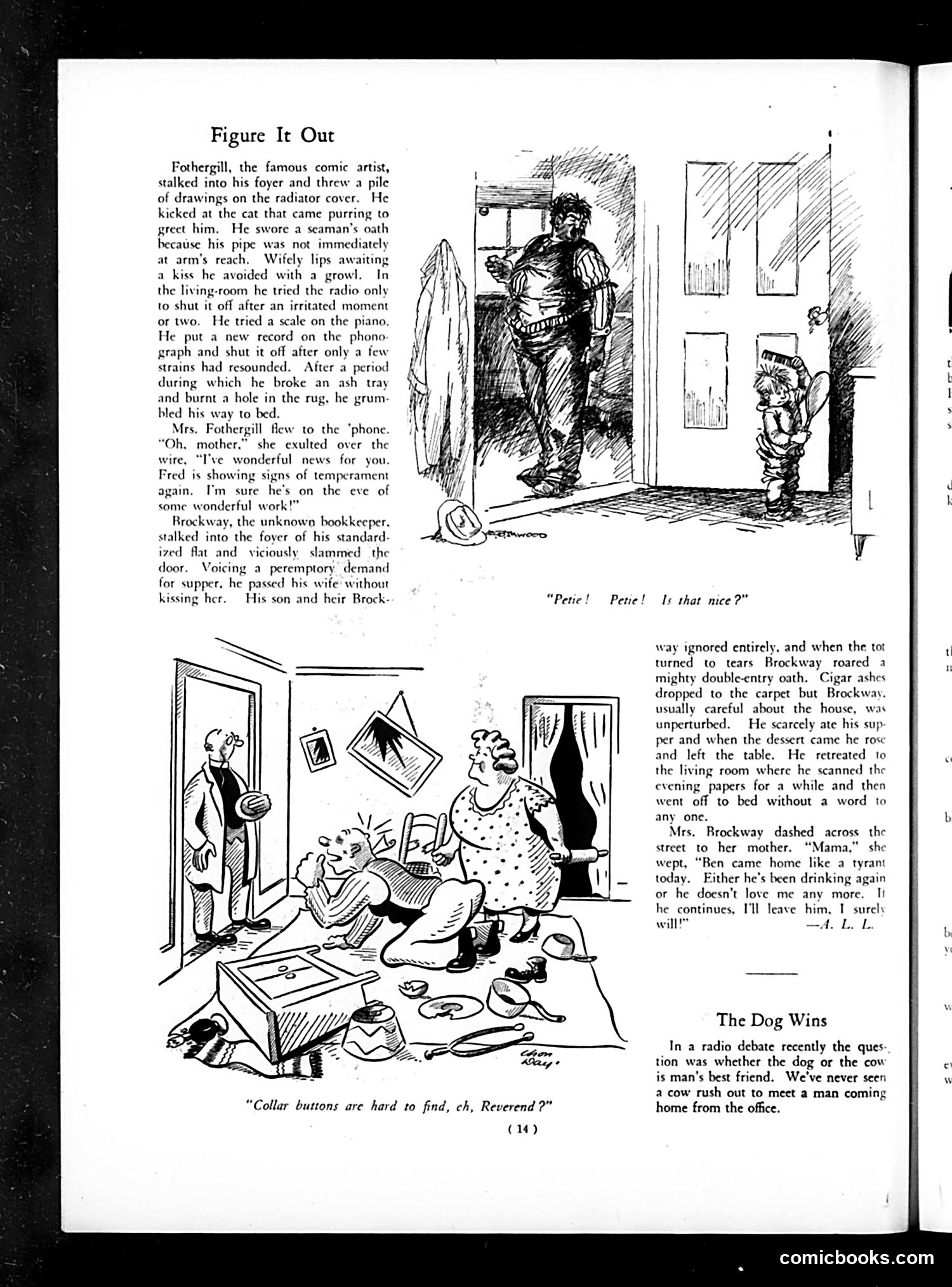
Explanation for Modern Readers This page presents two humorous domestic scenes satirizing early 20th-century household life. The top cartoon shows a man (Fothergill) returning home to find his wife upset about household disruptions he's caused—a broken rug, damaged furniture, and general chaos. The bottom cartoon depicts similar domestic disorder with scattered drawings and art supplies, captioned "Collar buttons are hard to find, ch, Reverend?"—apparently mocking a clergyman's disorganized home. The satire targets husbands who create household chaos through carelessness or hobbies while wives maintain order. The "Figure It Out" title suggests readers should recognize these relatable domestic conflicts. The humor relies on exaggerated visual mess and the tension between domestic ideals and reality—common themes in early Life magazine's satire of middle-class family life.
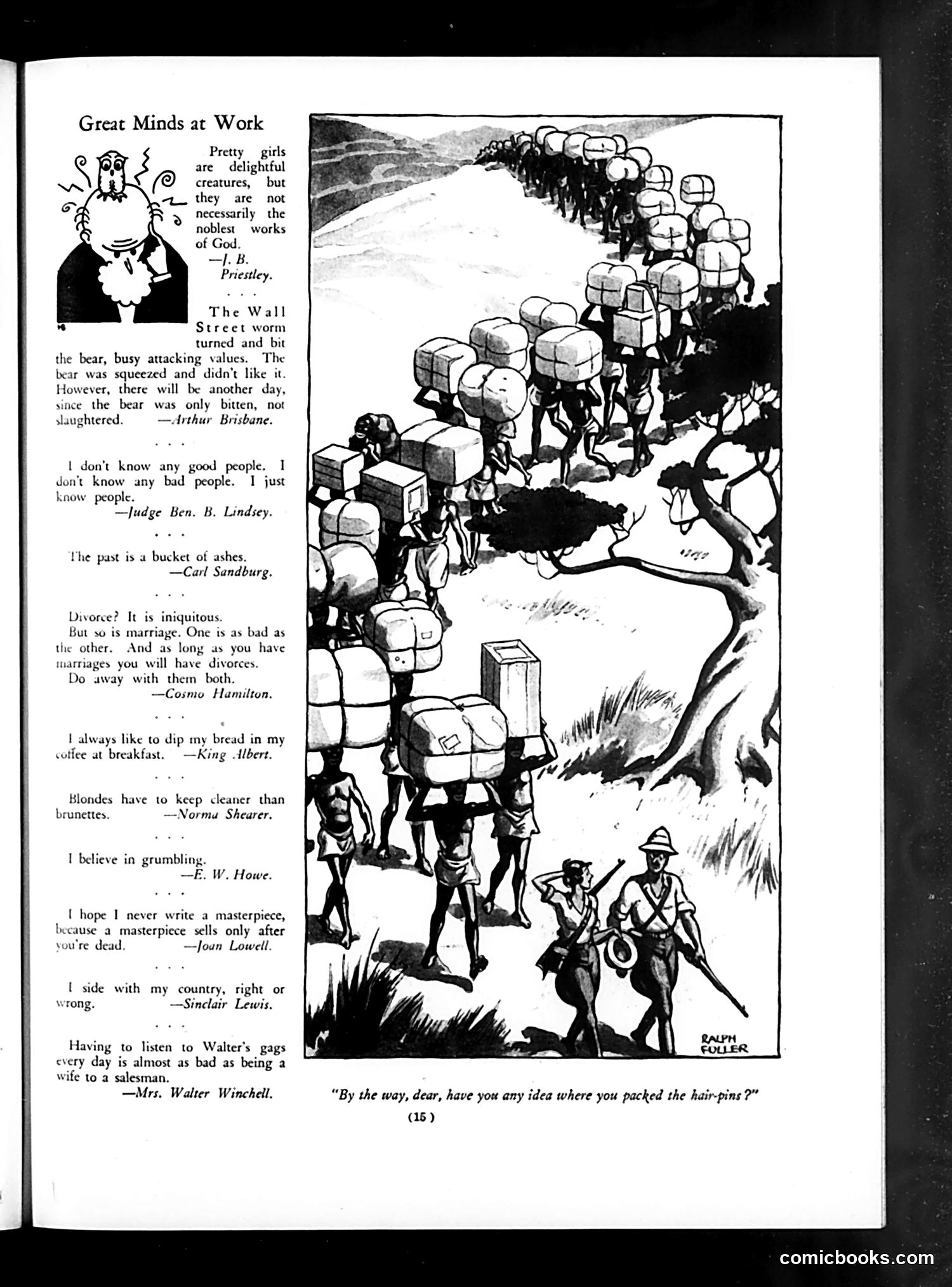
"Great Minds at Work" - Life Magazine Page This page collects witty quotations attributed to famous figures alongside a political cartoon by Ralph Coller. The main illustration depicts a long line of porters or laborers carrying heavy loads up a mountain path, with armed soldiers or officials accompanying them. The caption—"By the way, dear, have you any idea where you packed the hair-pins?"—suggests absurdity amid arduous labor: while people struggle with burdensome loads, someone casually inquires about trivial domestic items. The page likely satirizes either colonial exploitation, wartime logistics, or the disconnect between leadership and those doing physical labor. Without a visible date or context, the specific historical reference remains unclear, though the imagery evokes imperialism or military campaigns from the early-to-mid 20th century.
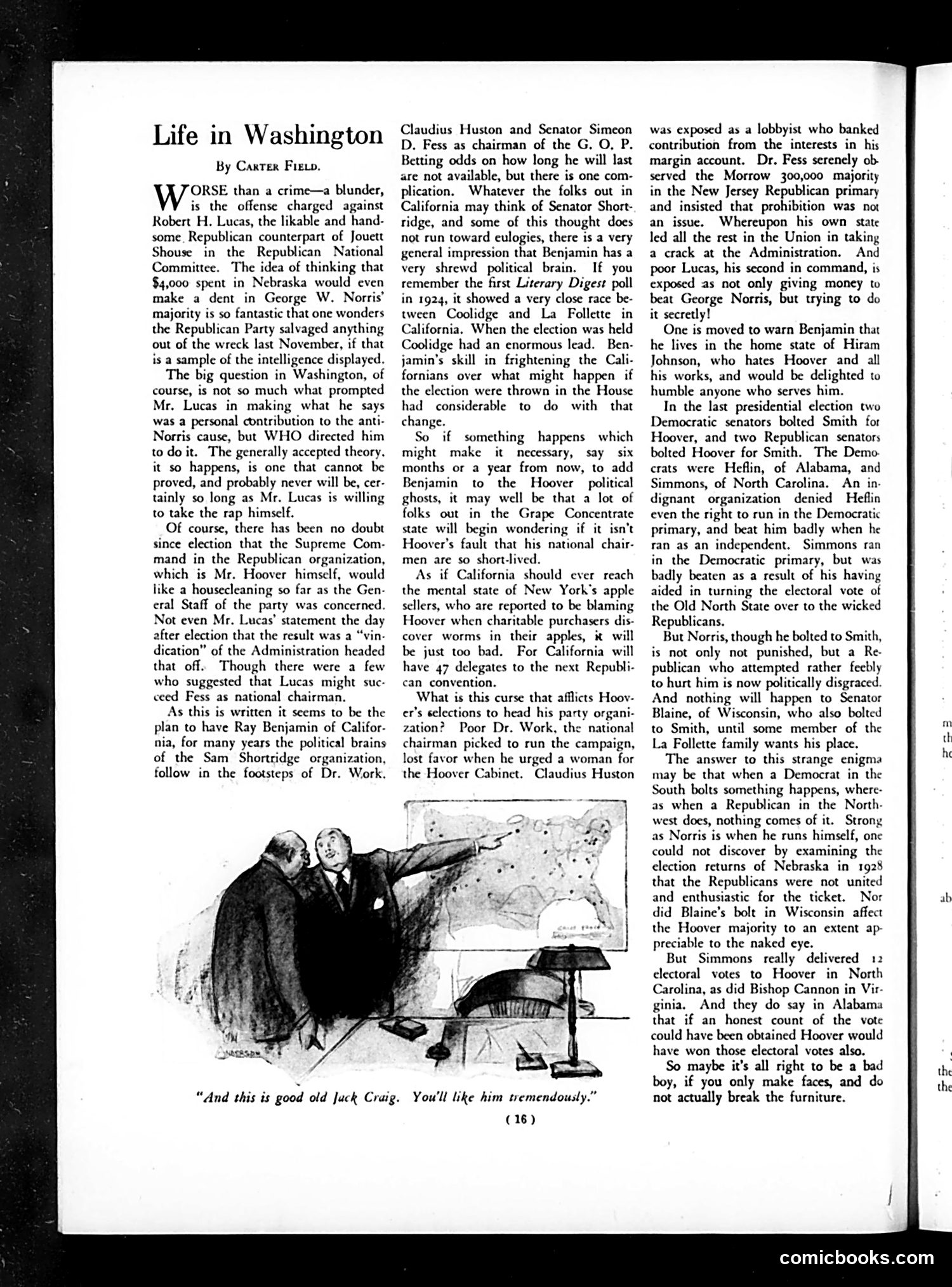
Political Cartoon Analysis: "Life in Washington" This Carter Field column satirizes Republican political corruption during the Hoover administration. The cartoon depicts two men examining a map, with the caption "And this is good old Jack Craig. You'll like him tremendously"—likely mocking backroom political appointments. The text discusses Robert H. Lucas, a Republican operative accused of laundering anti-Administration contributions through intermediaries. Field argues the GOP leadership knew of this scheme but ignored it. The article criticizes how Benjamin's political organization operated, suggesting Hoover's team would add California delegates through questionable means rather than face electoral defeat. The satire targets the hypocrisy of Republican claims of clean governance while tolerating obvious financial malfeasance and machine politics.
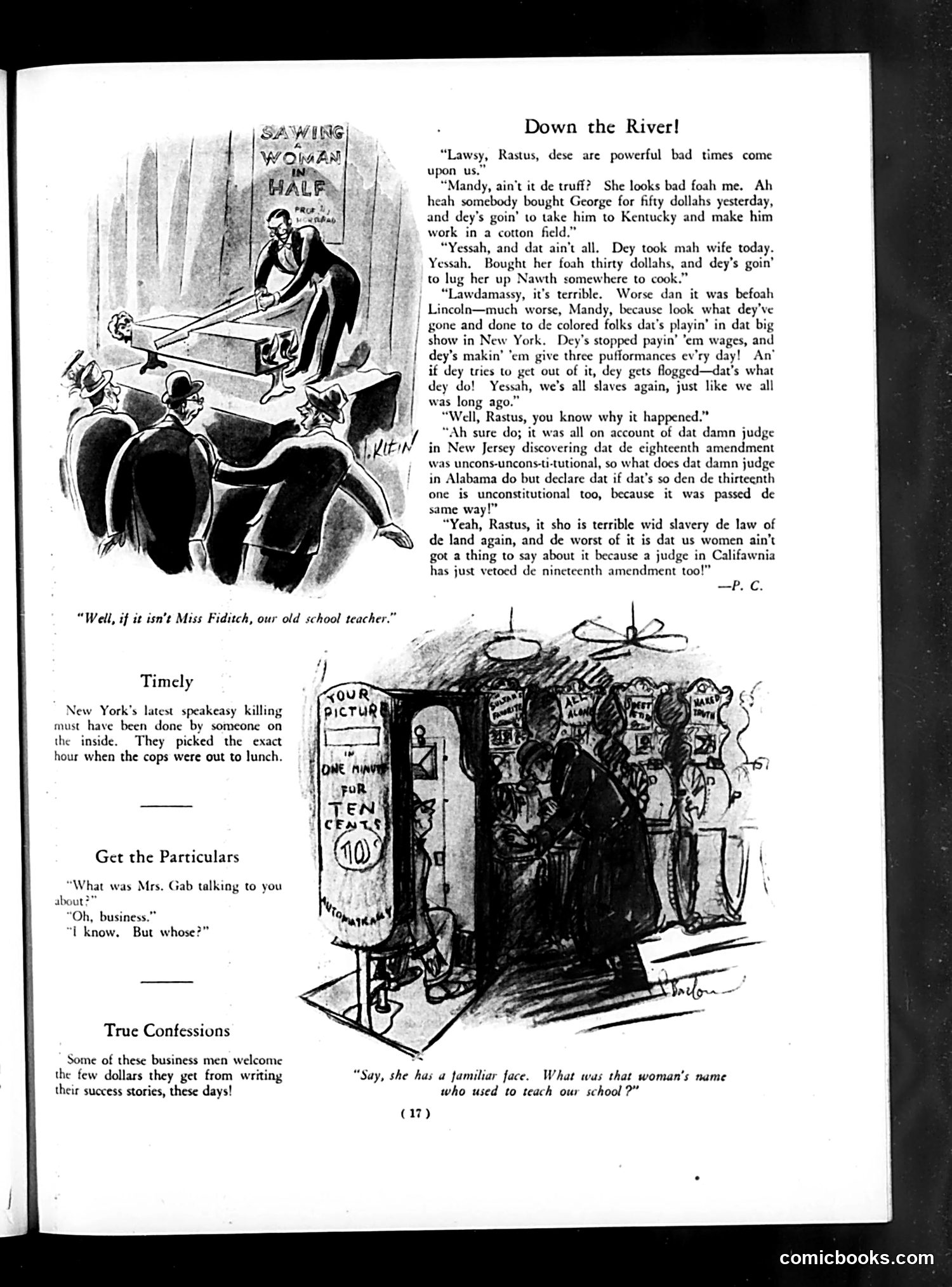
Political Satire Analysis The main cartoon "Down the River!" satirizes slavery and racial injustice through dialect-heavy dialogue between Black characters discussing the horrors of slavery, forced labor sales, and constitutional amendments. The figures appear to represent enslaved people lamenting recent legal setbacks—likely referencing late 19th-century rollbacks of Reconstruction-era protections. The lower cartoon shows a speakeasy during Prohibition, with the caption joking that the proprietor has "a familiar face" resembling a former schoolteacher—suggesting respectable community members were operating illegal alcohol businesses. The smaller text items ("Timely," "Get the Particulars," "True Confessions") are brief satirical quips mocking contemporary events and hypocrisy. The page uses humor to critique both historical injustice and current social contradictions.
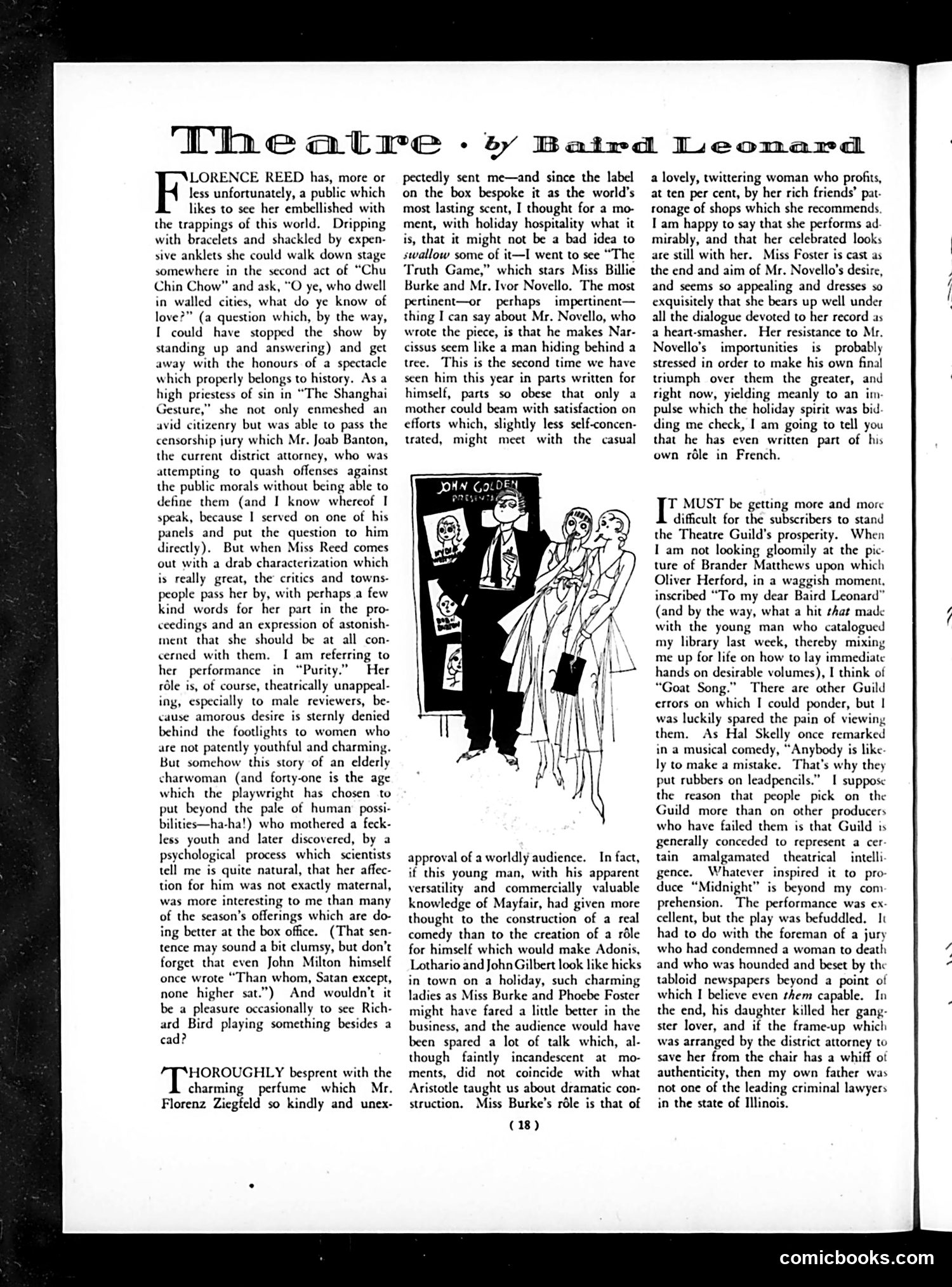
Theatre Review by Baird Leonard This page is a theatre review discussing Florence Reed's performance in "The Shanghai Gesture" and other productions. The illustration shows a man in formal attire viewing portraits on a wall, while several women in 1920s dress observe him. The review criticizes the Theatre Guild's recent productions, suggesting they're losing their reputation for quality. It discusses performances by Miss Billie Burke, Mr. Novello, and others, evaluating their dramatic abilities. The cartoon appears to comment on theatrical taste and audience appreciation—likely satirizing how theatre producers and critics judge performances. The specific references to "Purity" and various plays suggest this is critiquing contemporary Broadway standards and whether commercial success reflects artistic merit. The tone is somewhat dismissive of theatrical trends of the era.
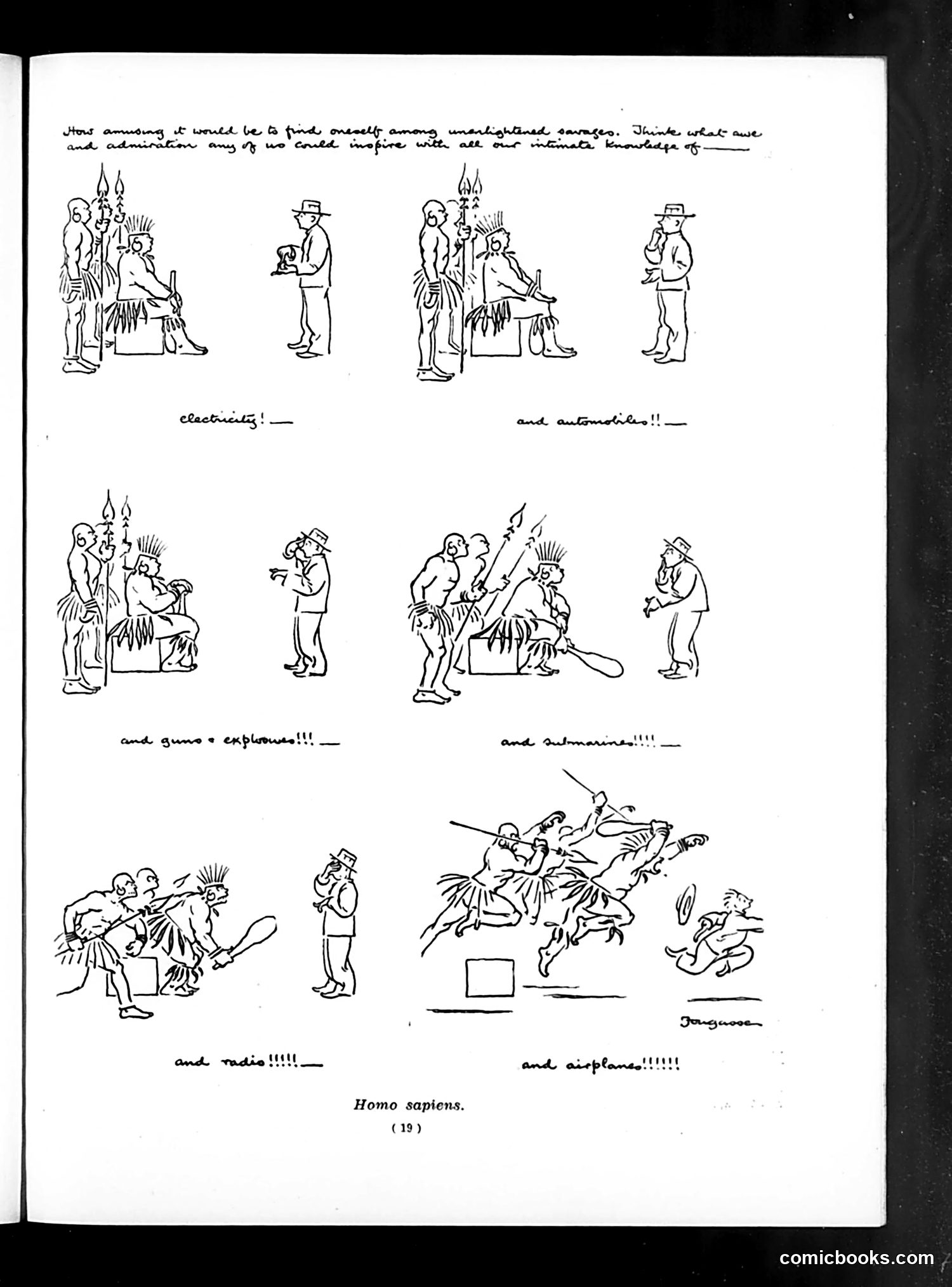
"Homo sapiens" - Satirical Progress of Civilization This cartoon satirizes human technological advancement through six panels showing increasingly destructive innovations: 1. Electricity - figures wielding electric tridents 2. Automobiles - a man with an early car 3. Guns & Explosives - violent chaos with weapons 4. Submarines - underwater warfare 5. Radio - aerial communication technology 6. Airplanes - aerial combat The opening text (partially legible) suggests amazement that such destructive "savages" possess technological knowledge. The satirical title "Homo sapiens" (mankind/wise man) ironically undercuts itself—the cartoon argues humans use intelligence primarily for warfare and destruction rather than peaceful purposes. This reflects early-20th-century anxieties about industrialization and military technology making warfare increasingly destructive. The escalating chaos in each panel emphasizes the joke: each new invention merely creates new methods of human violence.
"Reaching for the Moon" Film Review This is a movie review by Harry Evans in *Life* magazine, critiquing Douglas Fairbanks' 1930 film "Reaching for the Moon." Key Points: Fairbanks appears in modern dress rather than his typical costume-adventure roles (Zorro, Robin Hood). Evans argues this showcases Fairbanks' actual personality—his real appeal to audiences, not elaborate costumes. The plot involves a wealthy Wall Street gambler whom actress Bebe Daniels bets she can make fall for her. The film mixes slapstick (Mack Sennett-style comedy on an ocean liner) with romantic scenes. Notable elements: Edward Everett Horton plays the valet; Elsie Janis wrote additional dialogue. Evans praises the performances but criticizes inconsistent filmmaking—cheap-looking sets alongside expensive production values. The satire: Evans gently mocks both the film's chaotic plot and Hollywood's tendency to rely on tired formulas (servants advising masters, love potions) while praising competent acting that makes clichés seem fresh.
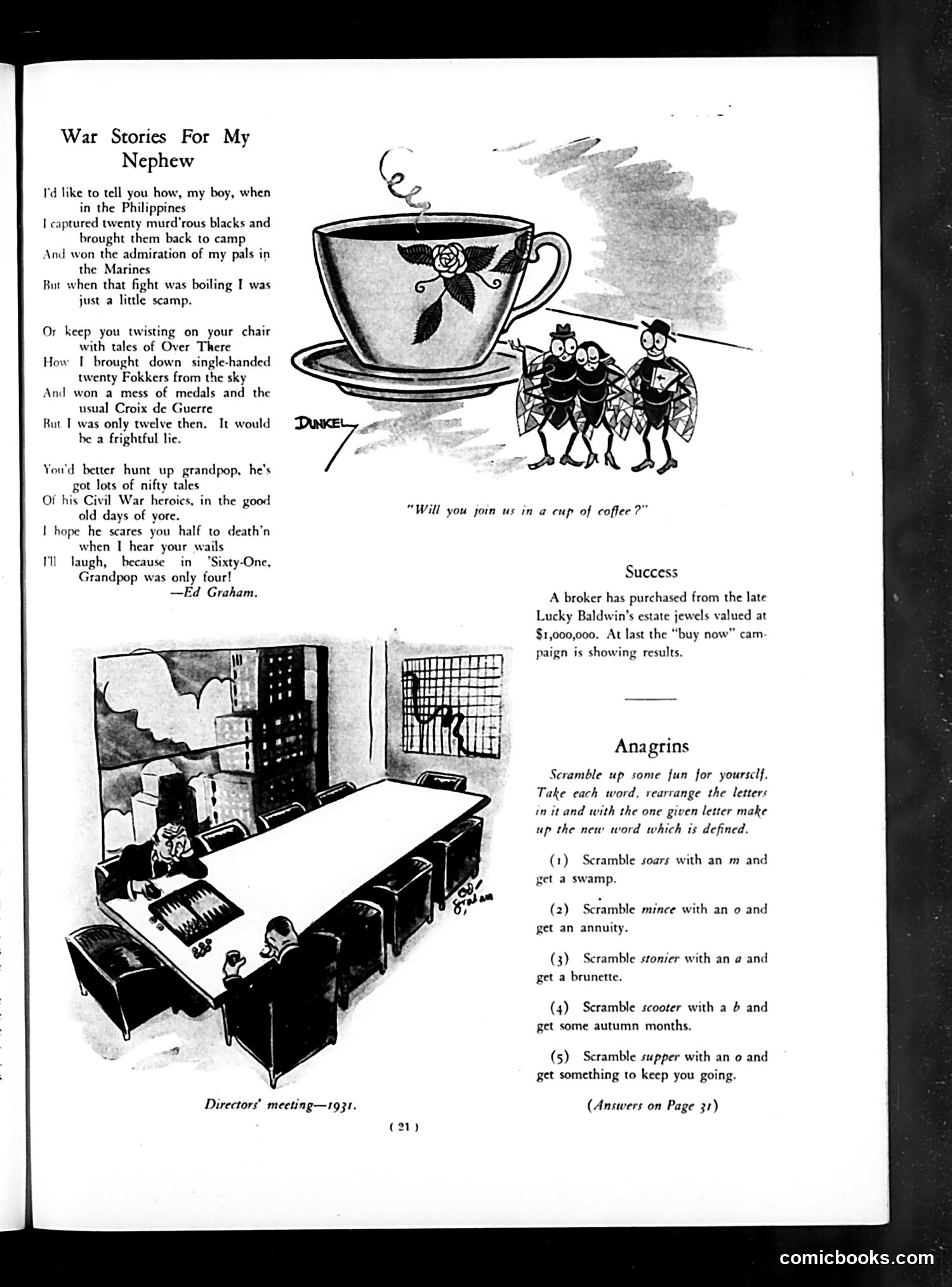
Life Magazine Page Analysis This page contains Ed Graham's humorous poem mocking exaggerated war stories. The narrator claims he could brag about capturing enemies in the Philippines or shooting down German fighter planes ("Fokkers") during World War I, but admits he was too young during those conflicts to have actually participated. The joke's twist: he suggests asking his grandfather for *real* war stories—but grandpa was only four years old during the Civil War, so he couldn't have fought either. The cartoon above shows three small figures (likely Germans or enemy soldiers, given the visual style) asking to join someone for coffee—a gentle, absurd contrast to violent military narratives. The page also includes period word puzzles ("Anagrins") and an unrelated business joke about Depression-era consumer spending. The satire gently deflates jingoistic war boasting while highlighting how generations recycle exaggerated heroic narratives.
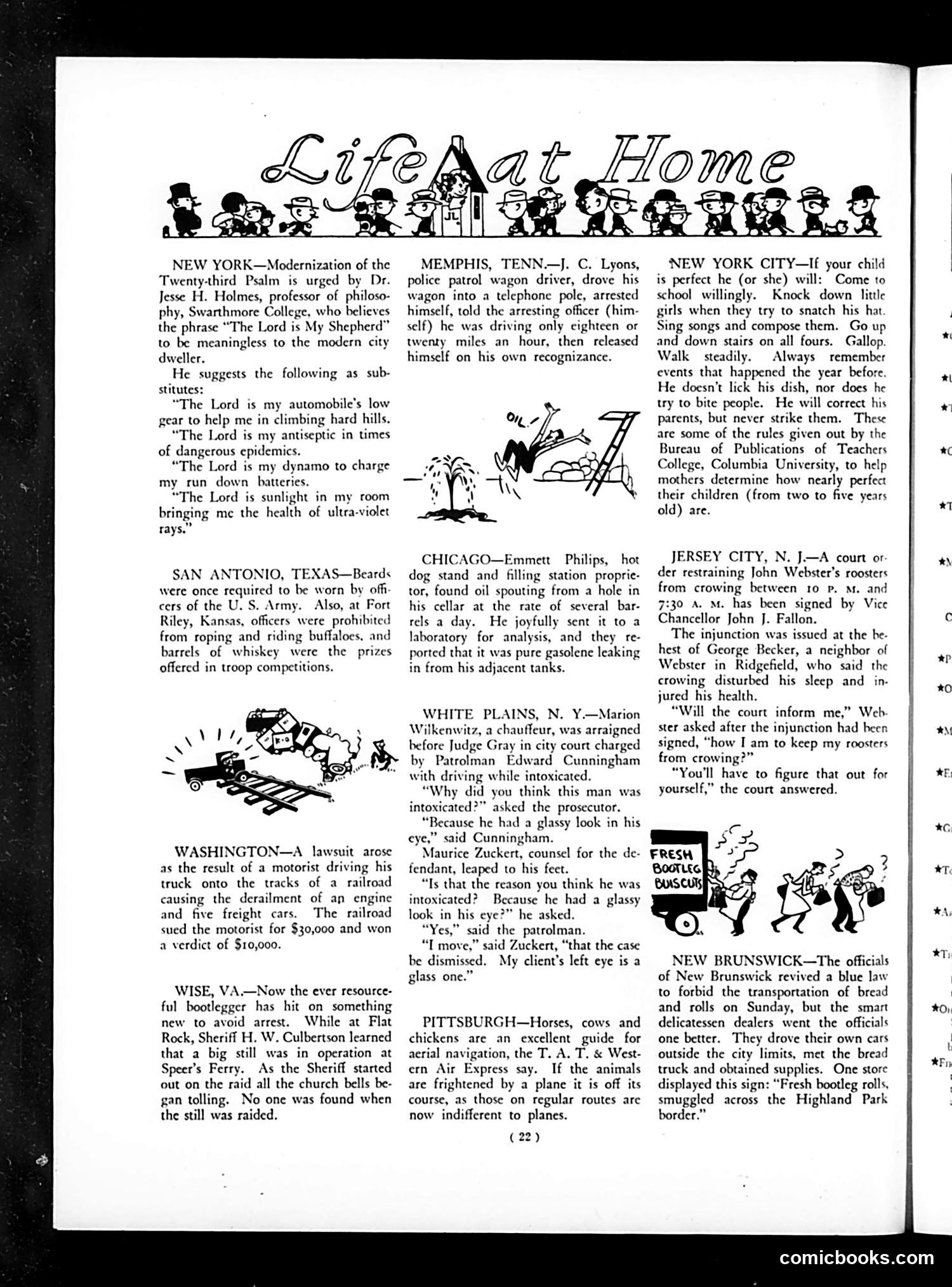
"Life at Home" - Satirical News Digest This page compiles humorous anecdotes from across America, poking fun at modern life's absurdities. Key satirical targets include: Dr. Holmes's modernized Psalm: A professor's attempt to make religious text "relevant" by replacing "The Lord is my Shepherd" with "The Lord is my automobile's low gear"—mocking how modernization strips spiritual meaning into mechanical utility. The perfection checklist: Teachers College's list of traits for "perfect" toddlers (crowing like roosters, licking dishes, composing songs) reveals how institutional authorities generate comically unrealistic standards for child-rearing. Legal absurdities: A rooster injunction and a dismissed drunk-driving case where the defendant's glass eye defeats the prosecution illustrates bureaucratic overreach and judicial pedantry. Other anecdotes—the self-arrested patrol wagon driver, the bootlegger warned by church bells—highlight small-town irony and human comedy rather than serious criticism.
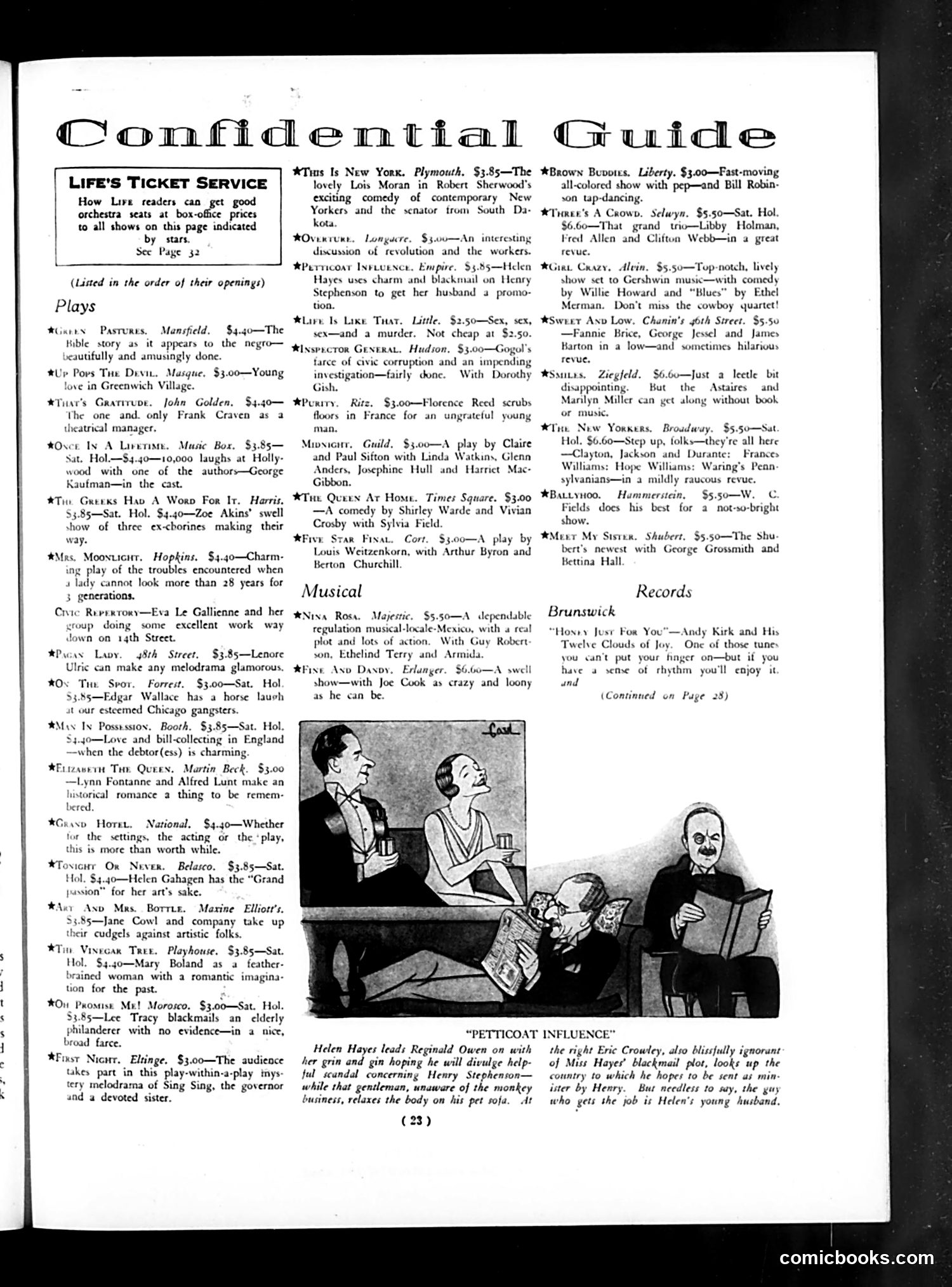
"Petticoat Influence" Cartoon Analysis This cartoon illustrates a domestic comedy scenario typical of 1920s theatre reviews. The image shows a man reading a newspaper while a woman lounges nearby—a visual joke about marital dynamics and feminine persuasion in domestic life. The caption "PETTICOAT INFLUENCE" references the era's common comedic trope of wives manipulating husbands through charm or wiles rather than direct argument. Helen Hayes (identified in the text as leading in "Petticoat Influence") plays a character who uses "charm and blackmail" to get her husband a promotion—the review's phrase encapsulates the cartoon's theme. This reflects 1920s assumptions about gender relations: women as indirect operators within male-dominated spheres, using femininity as currency. The cartoon accompanies theatre listings and reviews, illustrating how contemporary Broadway comedies depicted and reinforced these social attitudes about marital power dynamics through humor.
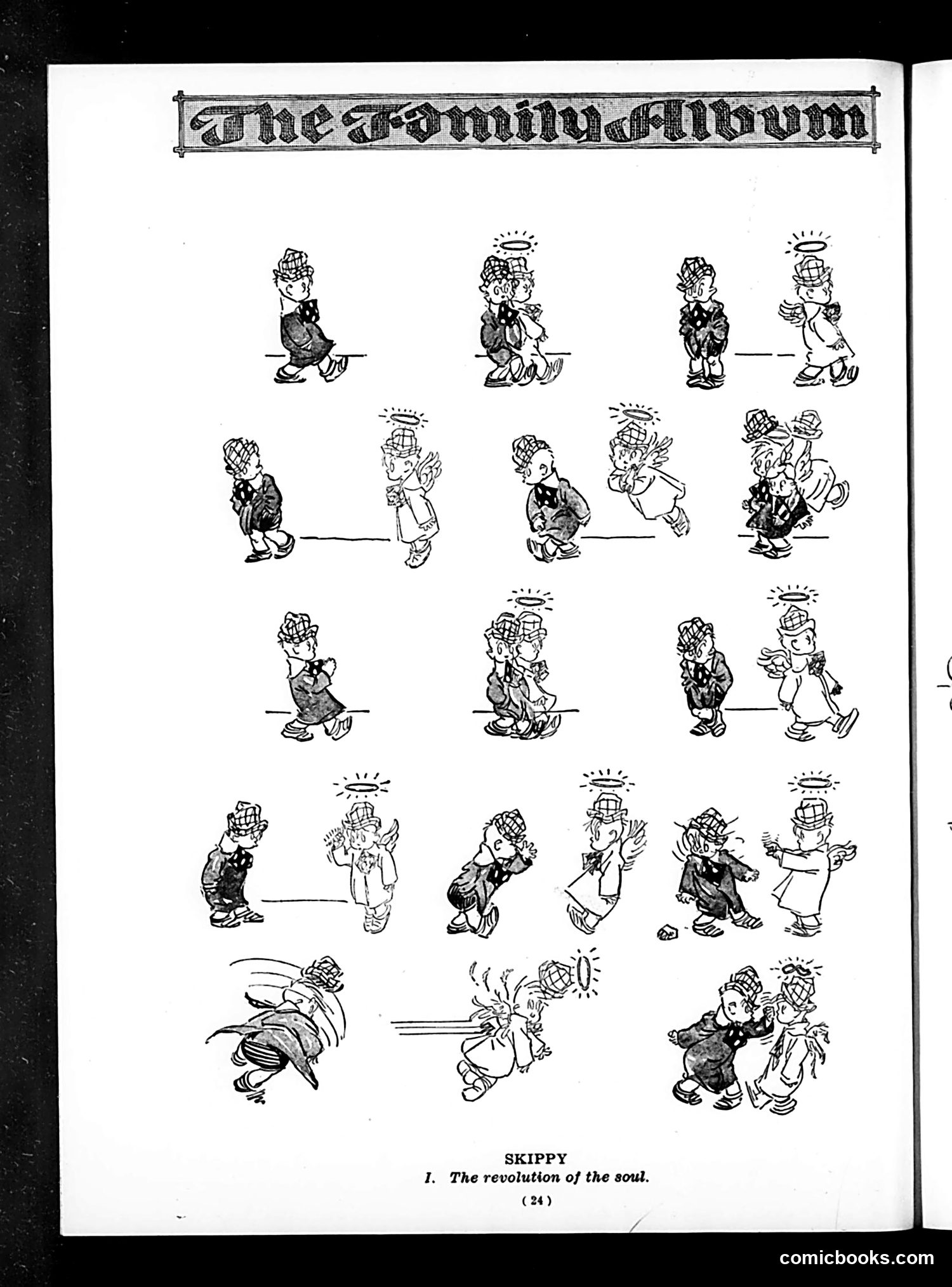
This page presents a comic strip titled "Skippy" subtitled "The revolution of the soul." The sequential panels show a young character (Skippy) in various interactions with what appears to be an angelic or celestial figure (indicated by the halos). The progression depicts transformations or moral/spiritual changes—the character moves from mischievous or earthly behavior toward more virtuous conduct, suggested by the halo imagery and the figure's increasingly ethereal appearance. The satire likely mocks the sudden, dramatic "spiritual awakenings" or moral conversions that were popular themes in American culture. By showing Skippy's exaggerated transformation through these comic panels, the cartoonist humorously critiques the notion of instant moral reformation, suggesting such changes are fleeting or absurd rather than genuine.
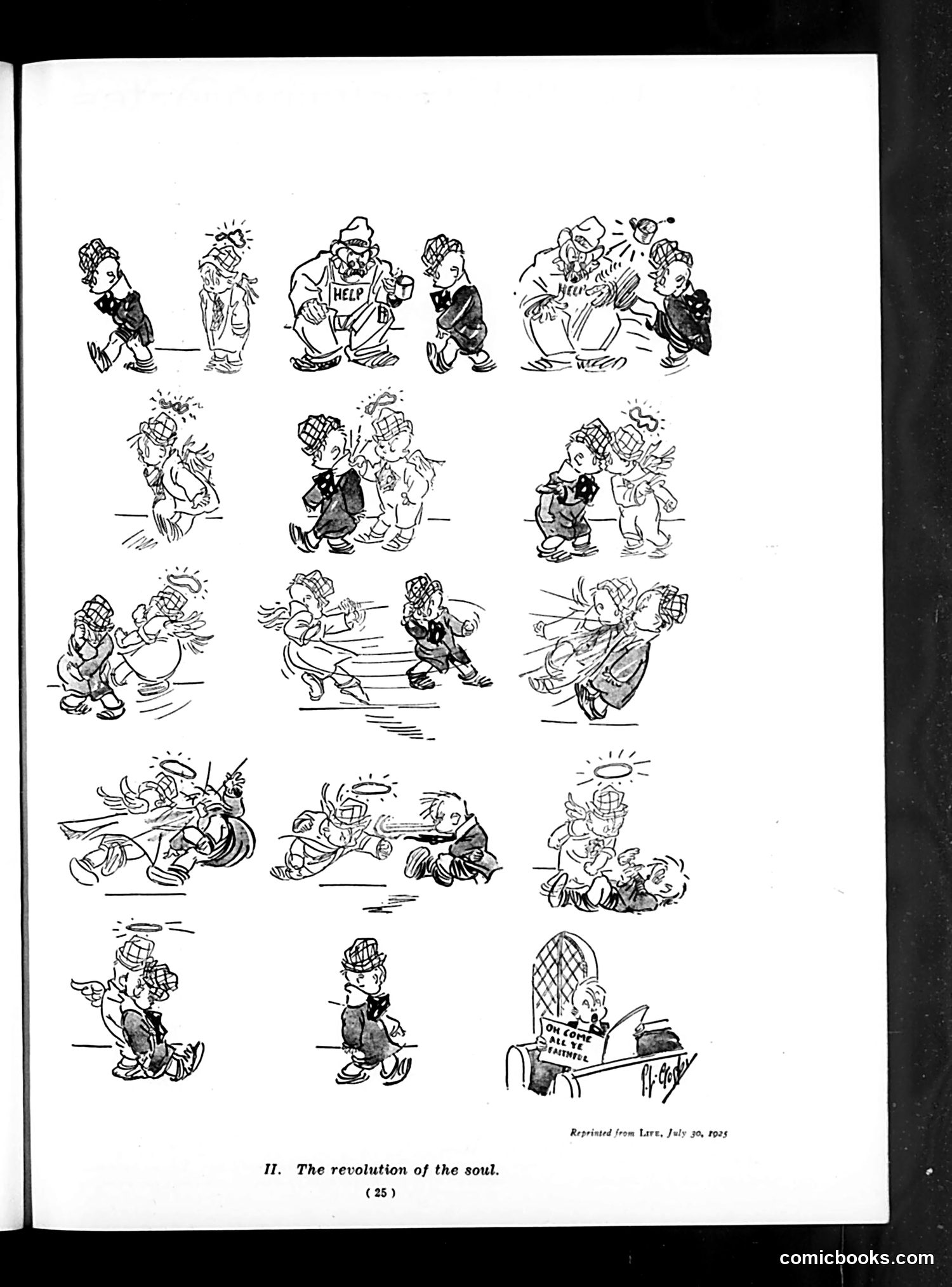
"The Revolution of the Soul" - Life Magazine Cartoon Analysis This is a sequential cartoon strip depicting what appears to be a domestic conflict or altercation between a couple. The title "The revolution of the soul" suggests ironic commentary on marital discord or personal upheaval. The narrative progresses from initial confrontation through escalating physical comedy—pushing, pulling, fighting, and chaos—ultimately ending with one figure knocked into or through what appears to be a chair or furniture. The satire likely mocks romantic or marital strife as a form of personal "revolution," treating domestic quarrels with exaggerated physical slapstick. Without clearer identifying details, the specific social commentary remains unclear, but the piece appears to ridicule contemporary relationship dynamics through humorous violence, typical of 1920s Life magazine's comedic approach.
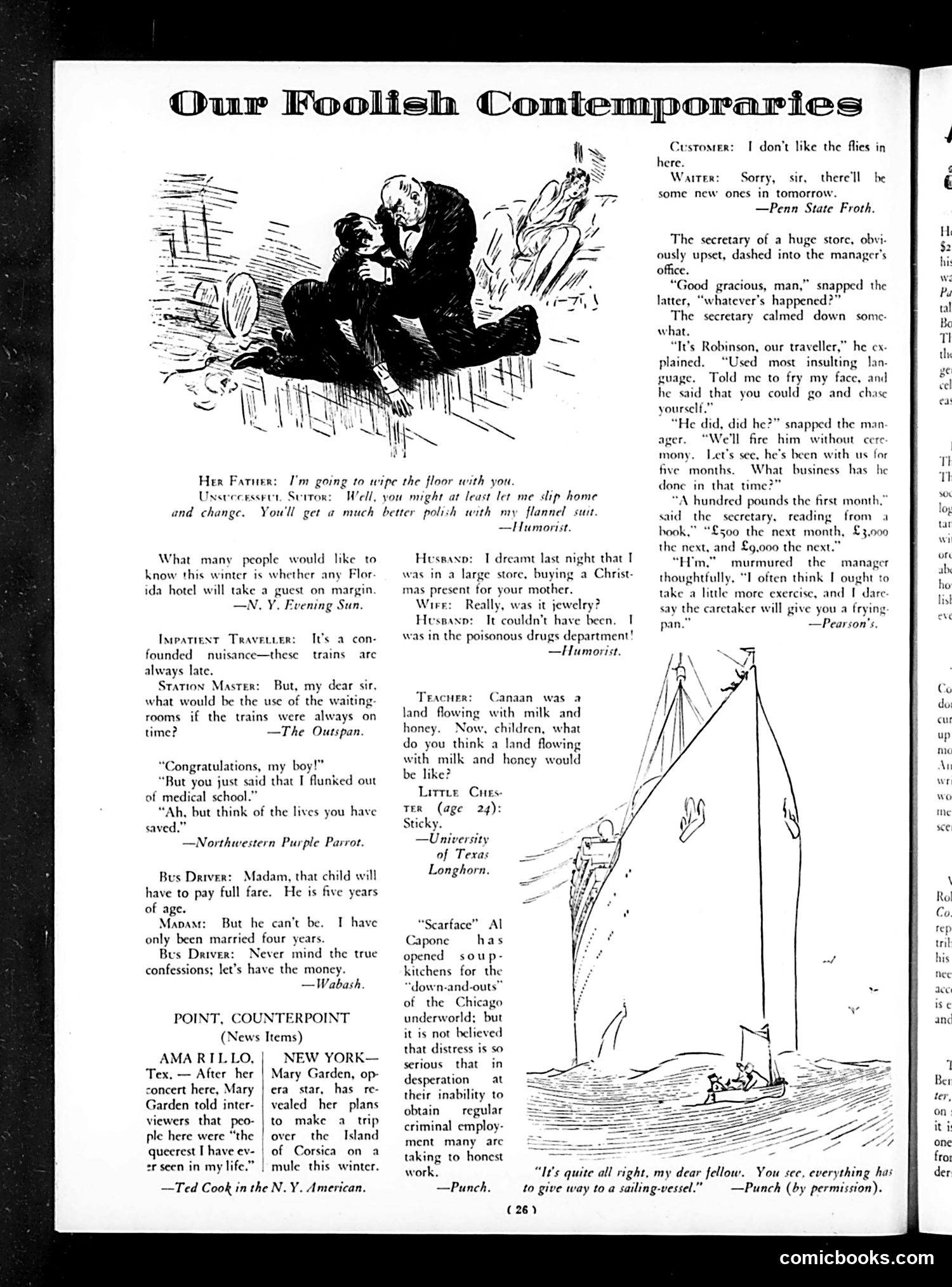
"Our Foolish Contemporaries" – Life Magazine Humor Page This page collects brief satirical jokes and comic vignettes mocking contemporary social absurdities. Key targets include: Marital discord: A husband threatens violence over a son's school failure, then boasts about "saving lives" by flunking out of medical school—absurd logic masking domestic anger. Gender relations: A husband's nightmare about buying poison for his wife (rather than jewelry) jokes darkly about marital resentment. Class hypocrisy: A profitable traveling salesman is nearly fired for rudeness, until his sales figures reveal his value—satirizing how profit excuses bad behavior. Capitalism's contradictions: Al Capone's soup kitchens for the underworld are presented as evidence criminals won't accept charity—mocking both Capone's PR and society's blind spots about poverty. Bureaucratic absurdity: Train stations justify waiting rooms by keeping trains perpetually late; bus drivers exploit technicalities. The humor depends on exposing hidden logic—the gap between stated values (morality, punctuality, fairness) and actual practice (profit-driven, self-interested behavior).
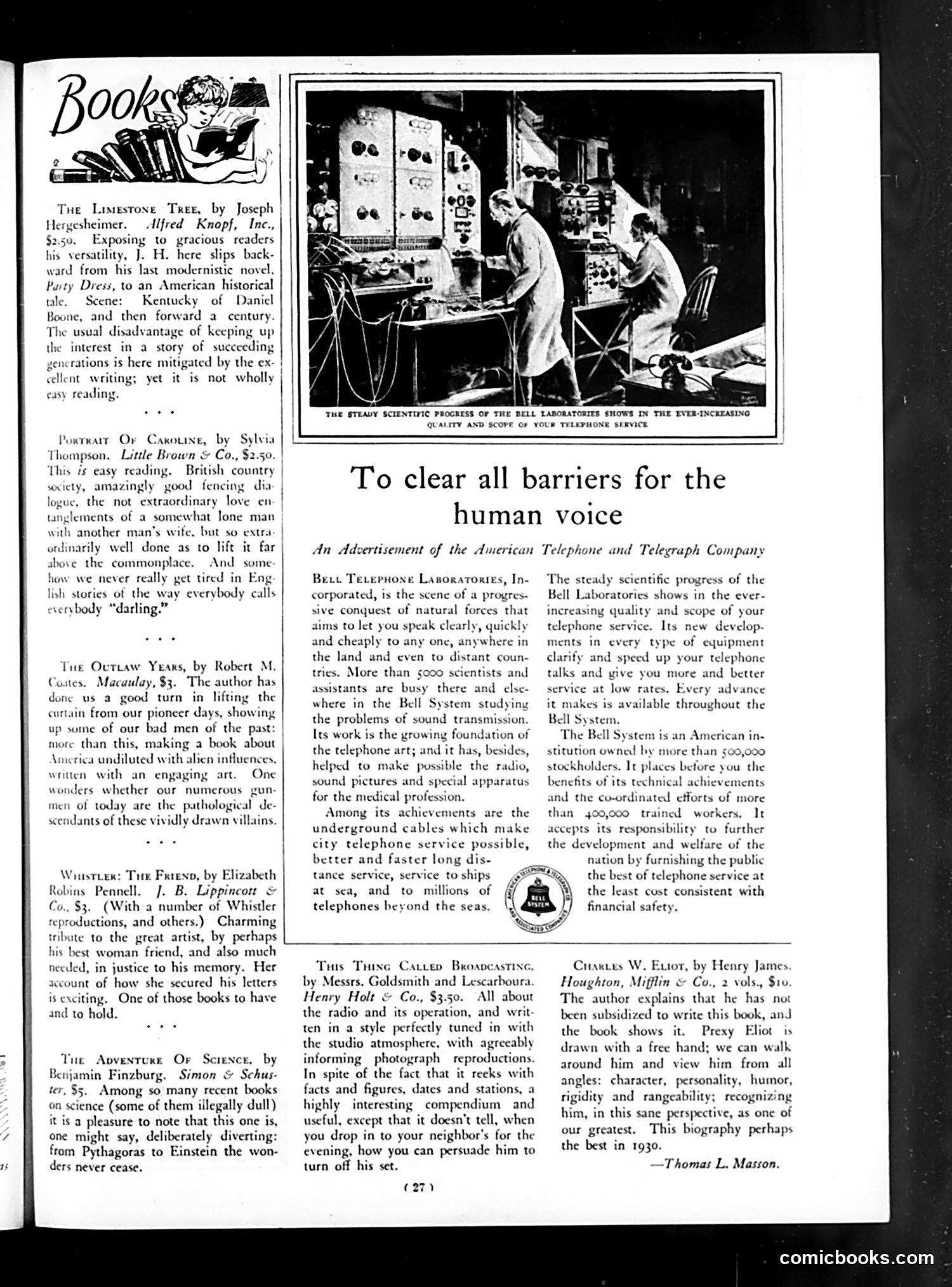
Analysis: Life Magazine Page (circa 1930) This is primarily a book review page with a large Bell Telephone advertisement, not a political cartoon. The left column contains brief reviews of contemporary novels—*The Limestone Tree*, *Portrait of Caroline*, *The Outlaw Years*, *Whistler: The Friend*, and *The Adventure of Science*—typical of Life's literary criticism section. These are straightforward book notices with no satirical intent. The dominant image and text is a corporate advertisement for Bell Telephone Laboratories. It features a photograph of scientists working with telephone equipment and promotes Bell's research efforts. The headline "To clear all barriers for the human voice" emphasizes technological progress in communication. There is no satire or political commentary visible on this page. It represents Life's dual function as both a satirical magazine and a venue for paying advertisements—in this case, a prestige corporate ad emphasizing American technological achievement and scientific progress during the early Depression era.
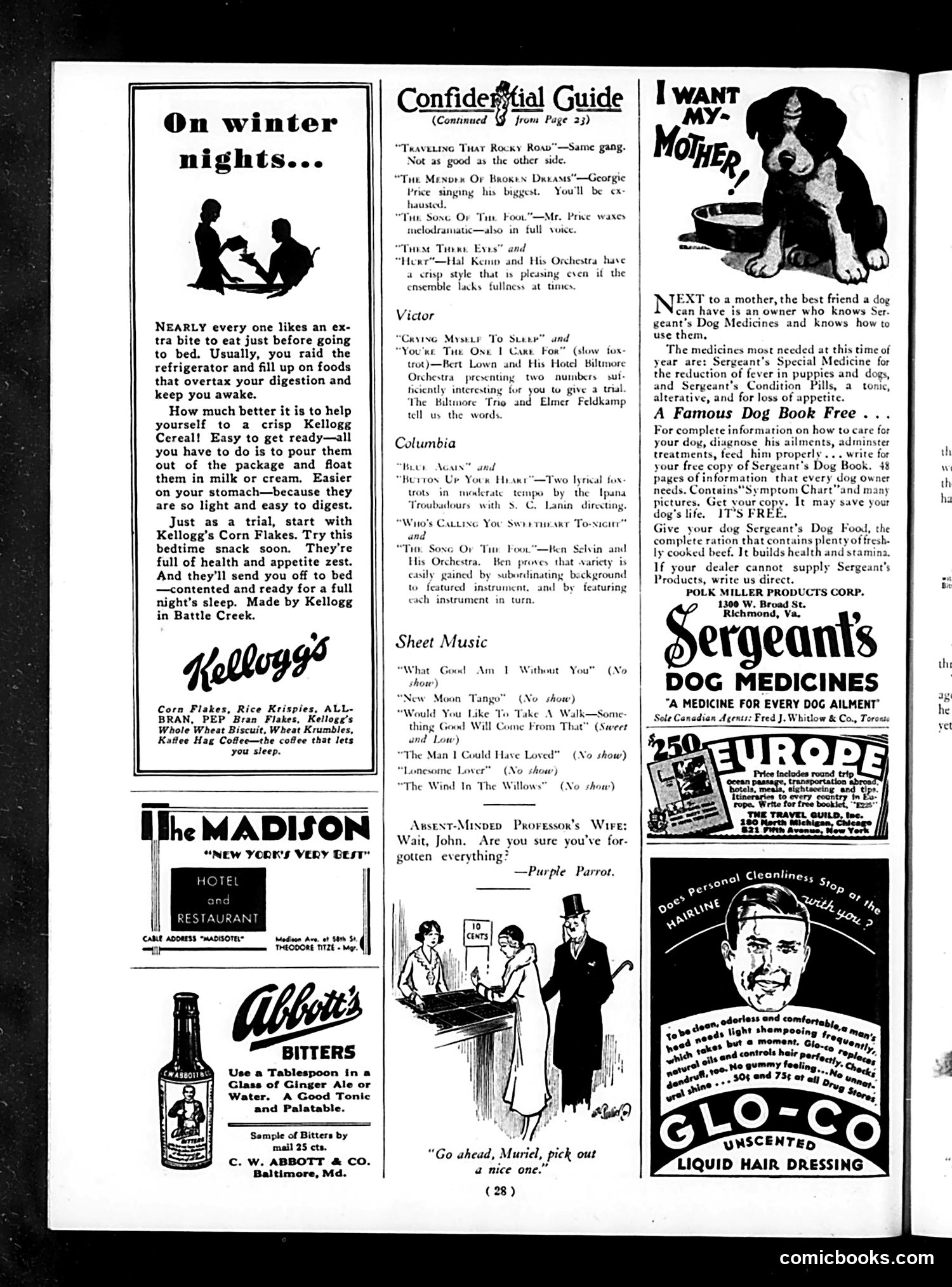
This page is primarily advertisements and entertainment listings, not political satire. The content includes: Main Features: - Kellogg's cereal ad promoting light bedtime snacks - Confidential Guide (entertainment column reviewing recordings on Victor and Columbia labels, and sheet music) - A brief cartoon showing a couple selecting something at what appears to be a restaurant or shop, with the caption "Go ahead, Muriel, pick out a nice one"—a light domestic humor piece with no political content - Various product advertisements (Abbotts Bitters, The Madison Hotel, Sergeant's Dog Medicines, Glo-Co hair dressing) Note: This is a standard magazine page of the early-to-mid 20th century mixing entertainment reviews with commercial advertising. There is no identifiable political cartoon or satirical commentary visible.
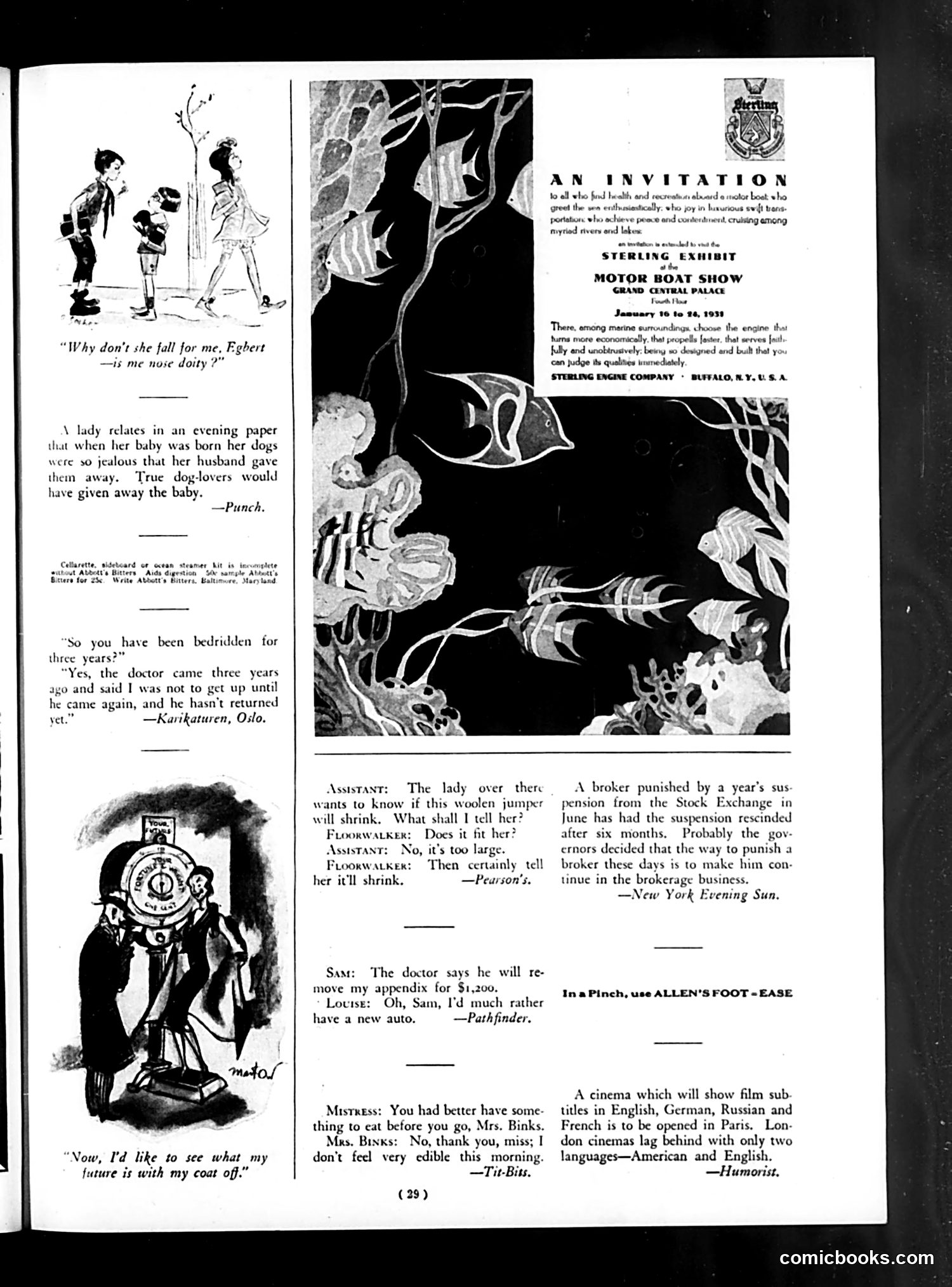
This page from *Life* magazine (dated January 1938) contains several brief satirical jokes and quips typical of the publication's humor section: The cartoons mock social absurdities: a child's crude pickup line about his nose; a lady who gave away her dogs (rather than baby) out of jealousy; a patient bedridden for three years because his doctor never returned to release him. The written jokes target everyday hypocrisy and incompetence—a shopkeeper advising a customer that an ill-fitting jumper will shrink (when it won't); a wife preferring a new car to appendix surgery; a woman claiming she's not "edible" before traveling; and stock brokers being "punished" by continued work in their profession. A final quip mocks Paris's multilingual cinema while suggesting London's cinema uses only "American and English"—implying American dominance or that British English barely counts as separate. The page also includes a Sterling Engine advertisement for a 1938 Motor Boat Show, positioning the ad among the humor content.
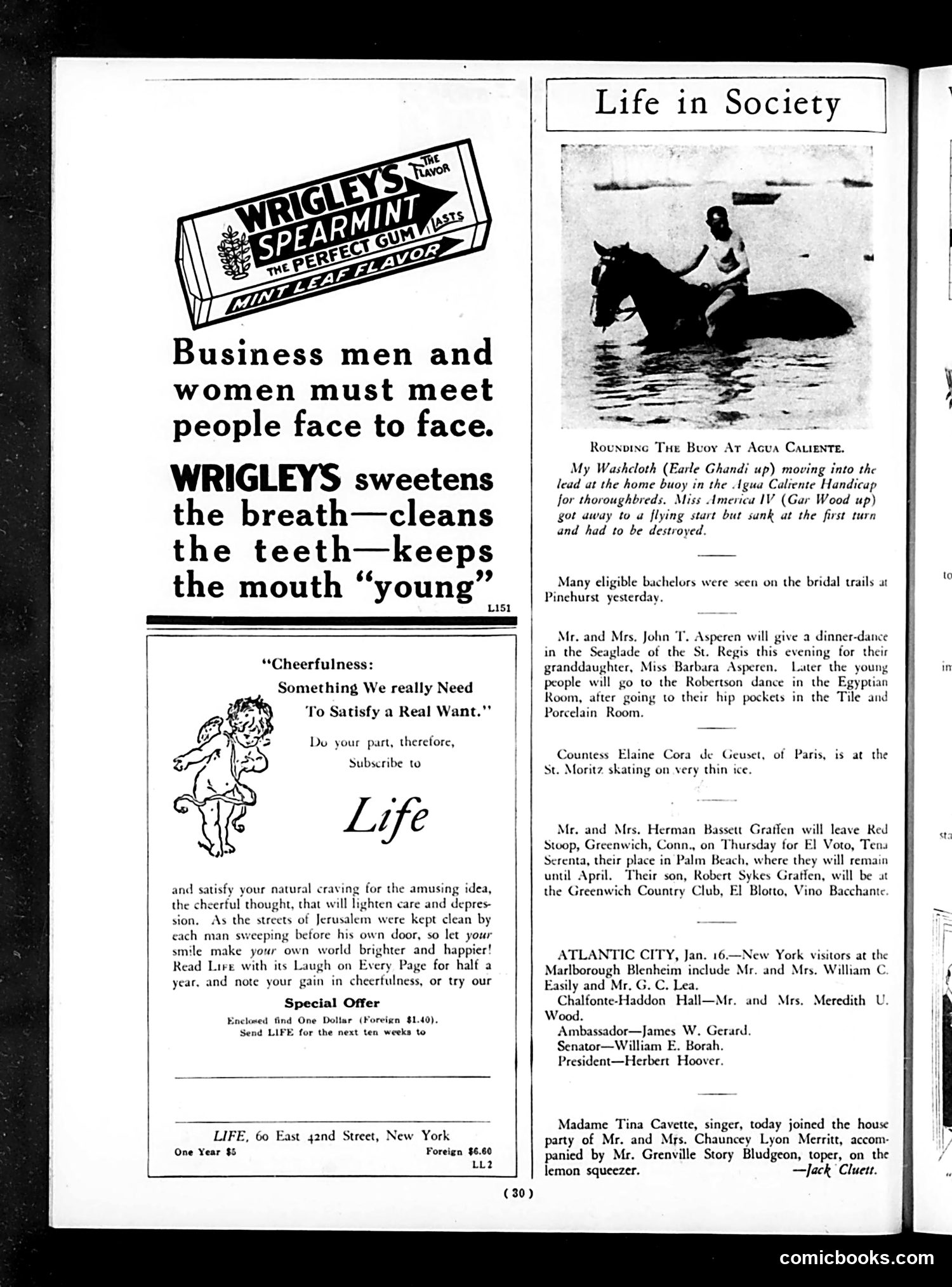
Life Magazine Page Analysis This page contains two distinct sections: a Wrigley's gum advertisement and a "Life in Society" gossip column. The Advertisement uses a common 1920s marketing pitch: business success requires fresh breath, so chew Wrigley's. Below it, a subscription appeal for *Life* magazine itself claims humor and "cheerfulness" are moral necessities—a somewhat tongue-in-cheek pitch comparing reading the magazine to community service. The Society Column satirizes wealthy elite social life through mock-serious reporting. The humor lies in absurd invented names ("El Blotto, Vino Bacchante," "Gar Wood," "the lemon squeezer") and ridiculous incidents (a racehorse named "My Washcloth" sinking during a race). The column gently mocks the pretentiousness and frivolous excess of high society—their constant parties, resort travel, and self-importance—by treating trivial social movements as newsworthy. This was *Life*'s trademark satirical approach to the wealthy.
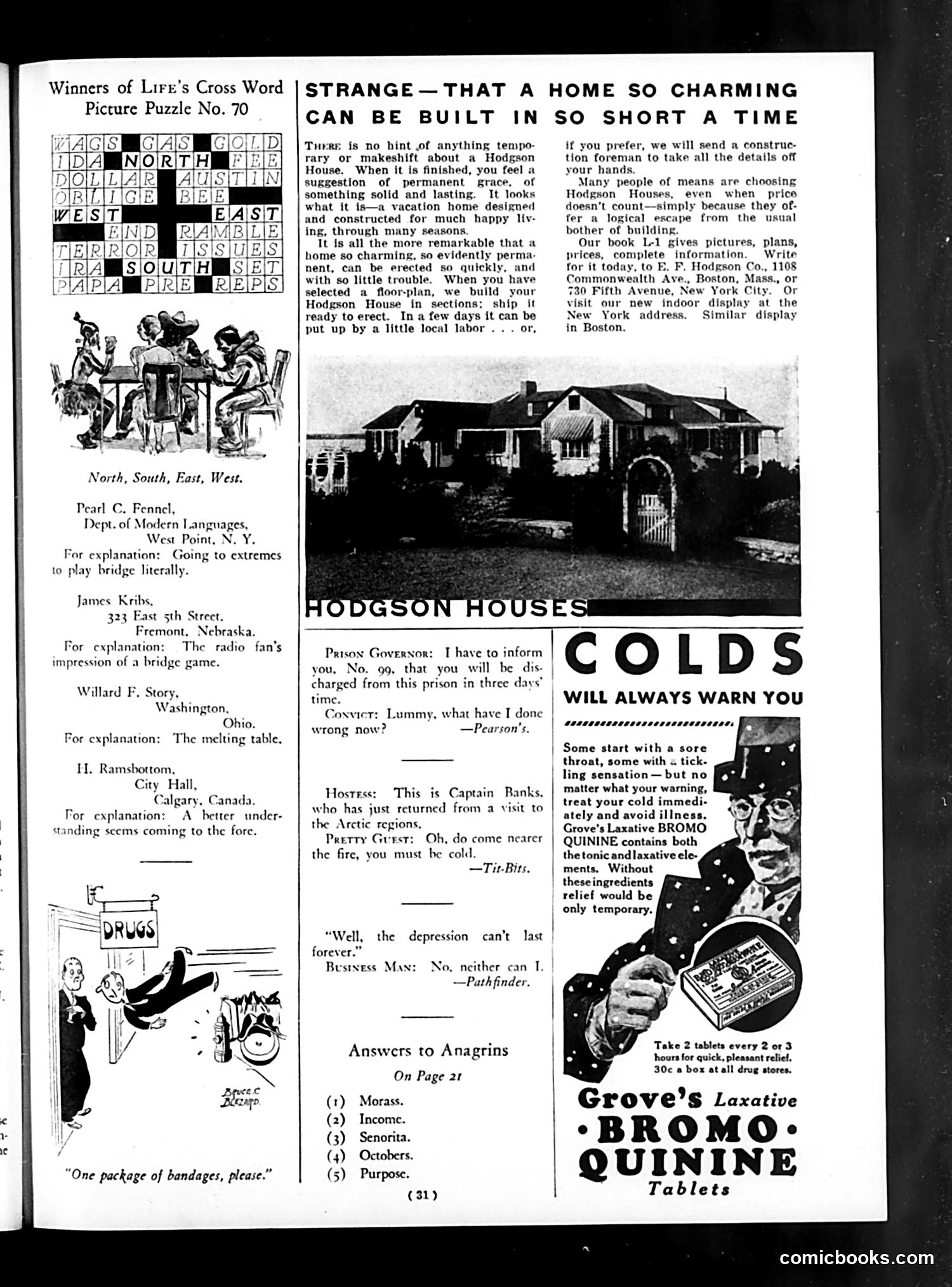
Life Magazine Page Analysis This page mixes puzzle winners, period humor, advertising, and social commentary typical of 1930s Life magazine. The Cartoons/Humor: The page features several brief jokes: a prison inmate upset about unexpected early release; a hostess inviting an Arctic explorer closer to the fire (implying he's cold); and a businessman noting the Depression won't last—neither will he (dark Depression-era humor about economic despair and potential suicide). The Hodgson House Advertisement: Promotes prefabricated homes marketed to wealthy customers as convenient vacation properties that avoid "the usual bother of building." The pitch emphasizes speed and simplicity despite appearing permanently constructed. The Bromo-Quinine Ad: Standard 1930s cold remedy advertisement using medical-sounding language about treating symptoms. The product contains both laxative and tonic elements—typical of era medicines making broad health claims. The page primarily serves as a snapshot of 1930s advertising, popular humor sensibilities, and consumer culture during economic hardship.
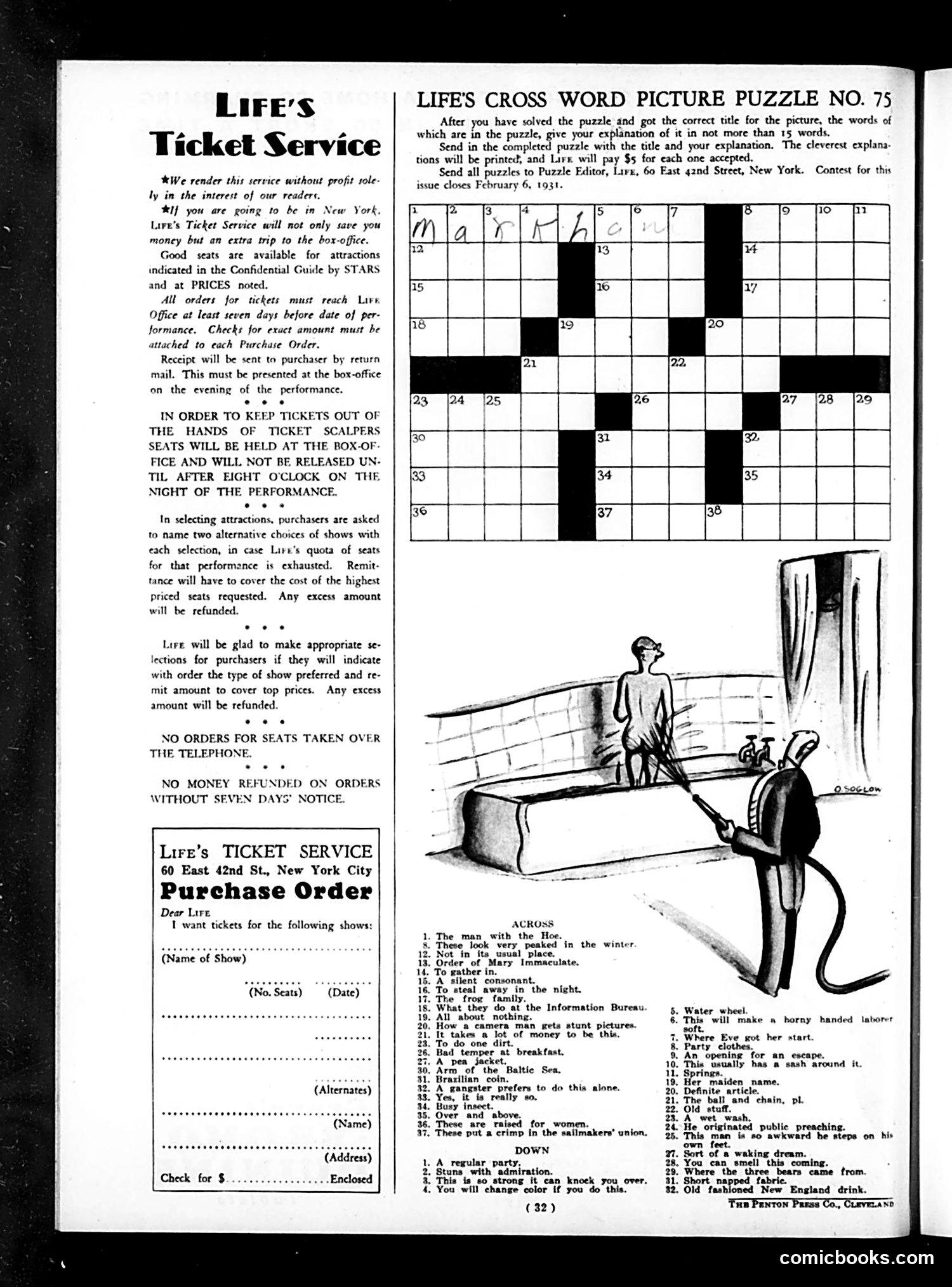
Life Magazine Crossword Puzzle Page (1931) This page is primarily advertising and a contest feature, not political satire. It presents Life's Ticket Service (offering Broadway theater tickets) alongside a crossword puzzle game. The cartoon shows two figures on what appears to be a large log or pipe—likely illustrating one of the puzzle clues, "The Man with the Hoe" (referencing Millet's famous painting). One figure stands atop while another climbs or clings below, presumably depicting labor or manual work. The puzzle itself is a "picture puzzle" where solving crossword clues reveals an image and title. Readers submitted explanations (15 words max) for contest prizes. The clues reference 1931 American culture: Depression-era themes ("sad temper at breakfast"), labor ("gangster prefers to do alone"), and popular knowledge. This reflects Life's dual function as satirical magazine and lifestyle/entertainment guide for affluent urban readers—the ticket service catering to Broadway audiences while puzzles provided intellectual amusement.
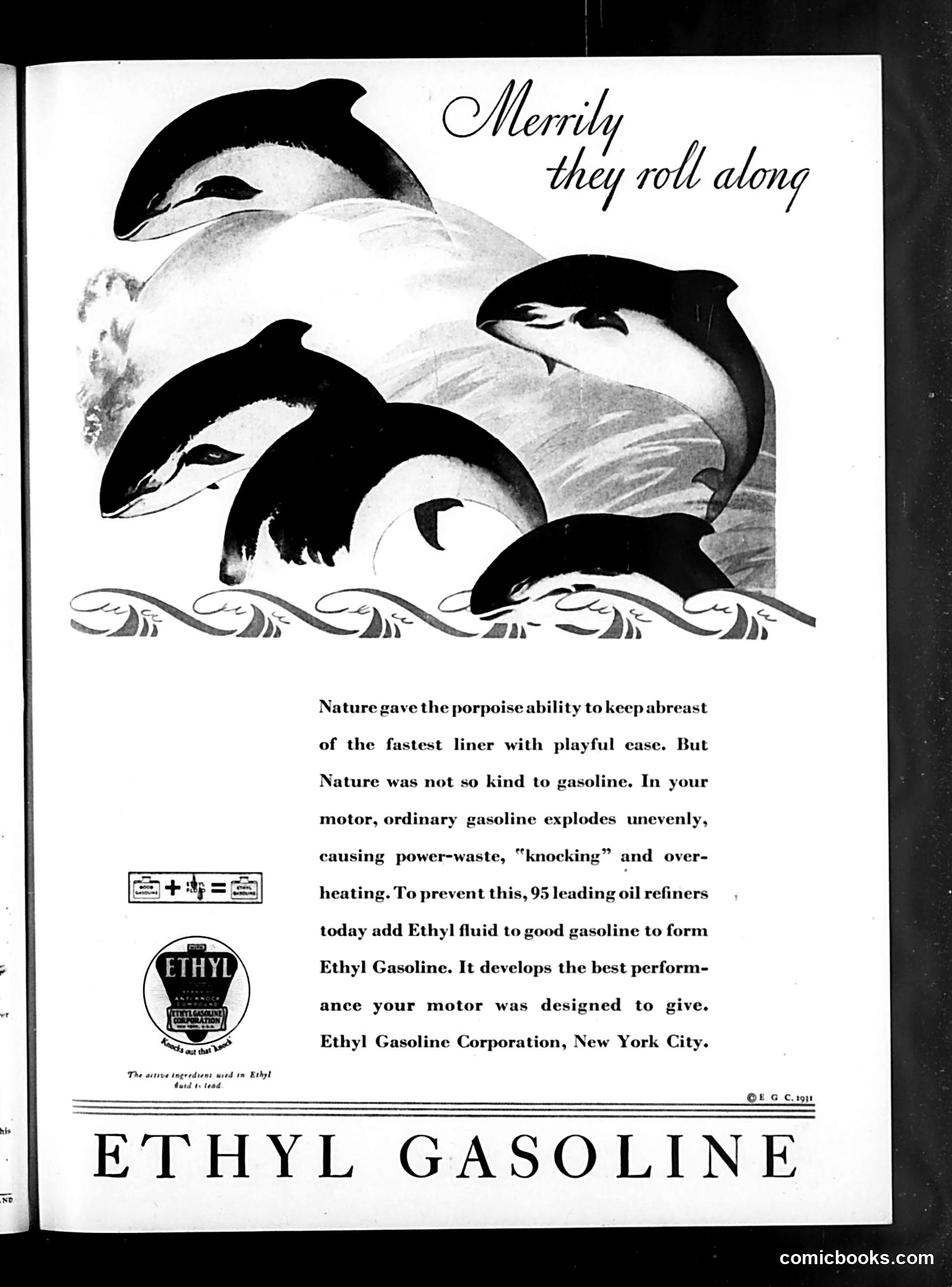
Analysis This is a full-page advertisement, not satire or editorial content. It promotes Ethyl Gasoline, a commercial fuel product. The illustration shows porpoises leaping alongside waves with the caption "Merrily they roll along"—a metaphor for smooth, effortless motion. The ad argues that while nature gave porpoises graceful speed, it didn't help gasoline perform smoothly in engines. The text explains that ordinary gasoline causes "knocking" and power-waste through uneven combustion. The solution: adding "Ethyl fluid" (tetraethyl lead) to create Ethyl Gasoline, which supposedly delivers optimal motor performance. Historical context modern readers miss: This advertisement predates widespread knowledge of lead's toxicity. Tetraethyl lead was added to gasoline for decades before being phased out in the 1970s-80s due to serious environmental and health dangers. The ad represents an era when such additives were marketed as technological progress without safety scrutiny.
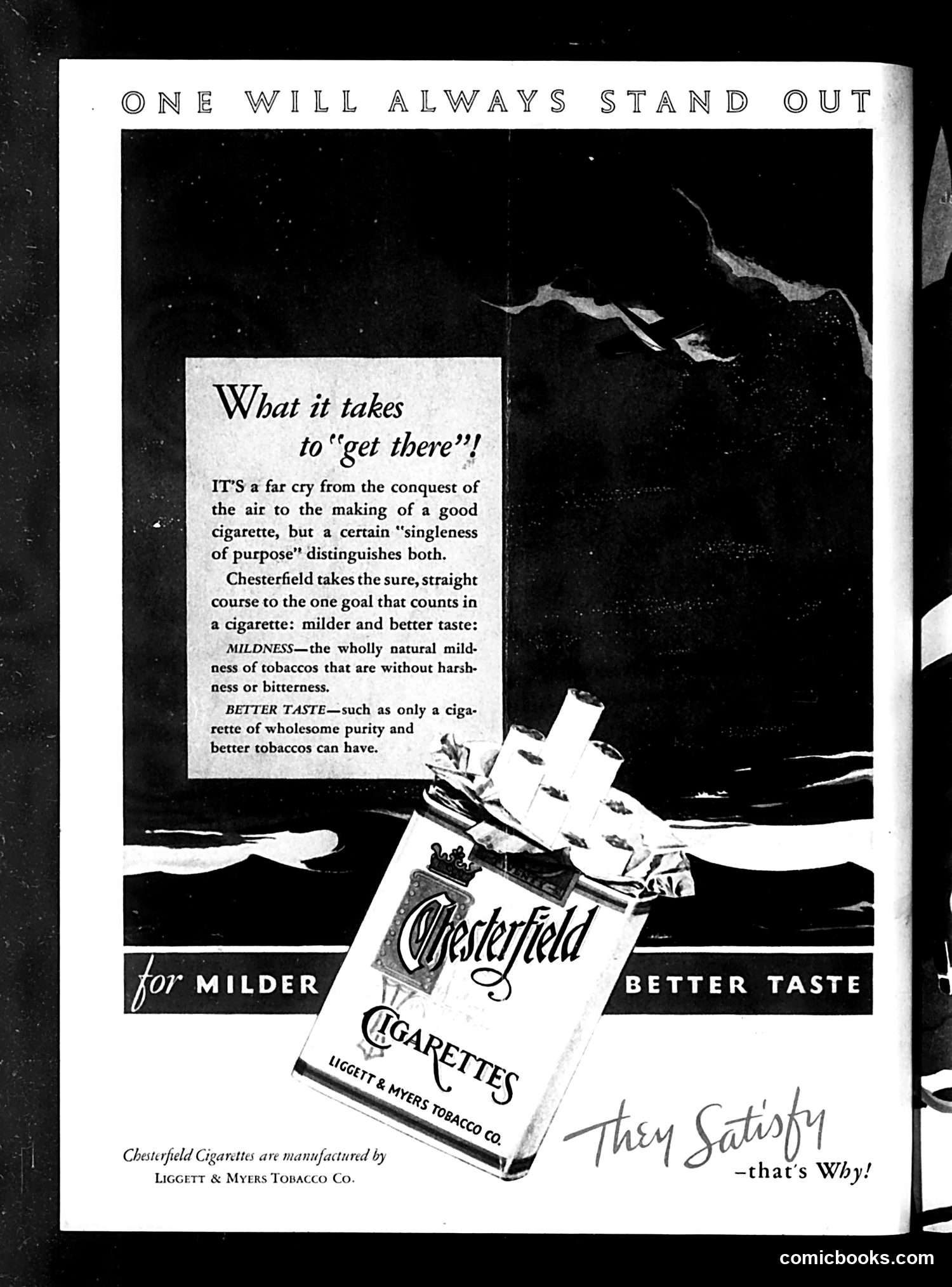
Analysis This is a cigarette advertisement, not political satire. The page promotes Chesterfield cigarettes by drawing a parallel between aviation achievements ("conquest of the air") and cigarette quality. The ad claims that just as one airplane "will always stand out," Chesterfield cigarettes distinguish themselves through "singleness of purpose"—delivering mildness and better taste. The text emphasizes natural tobacco without harshness or bitterness. A modern reader should note: this represents pre-1960s advertising, when cigarette health dangers were not yet widely acknowledged in mainstream marketing. The aspirational imagery linking cigarettes to achievement (aviation) was standard practice. The manufacturer is identified as Liggett & Myers Tobacco Co. There is no cartoon or satire present—this is straightforward product advertising typical of mid-20th century magazines.