life
Life — January 23, 1931
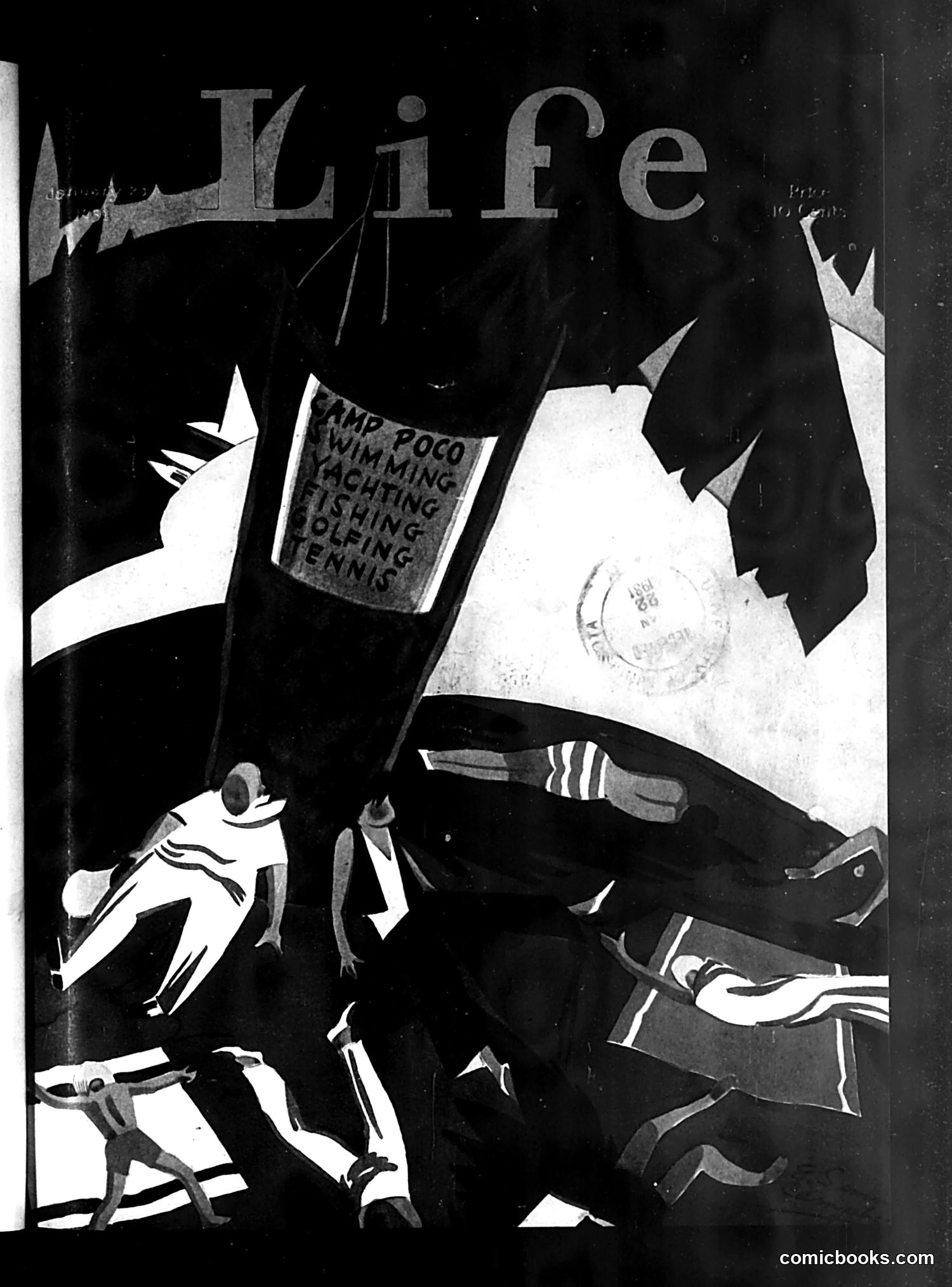
Analysis of Life Magazine Page This appears to be a cover or advertisement page from Life magazine featuring the word "Life" prominently at the top. The illustration depicts stylized figures engaged in recreational activities listed on a banner: "SWIMMING, YACHTING, FISHING, GOLFING, TENNIS." The artwork shows people in period bathing suits and athletic wear enjoying leisure pursuits, rendered in a bold, high-contrast Art Deco or modernist style typical of early-to-mid 20th century design. The composition satirizes or celebrates leisure culture and upper-class recreational pursuits of the era. Without additional context or readable captions, the specific satirical message remains unclear, though the juxtaposition of "Life" with affluent leisure activities suggests commentary on American lifestyle, wealth, or social class of that period.
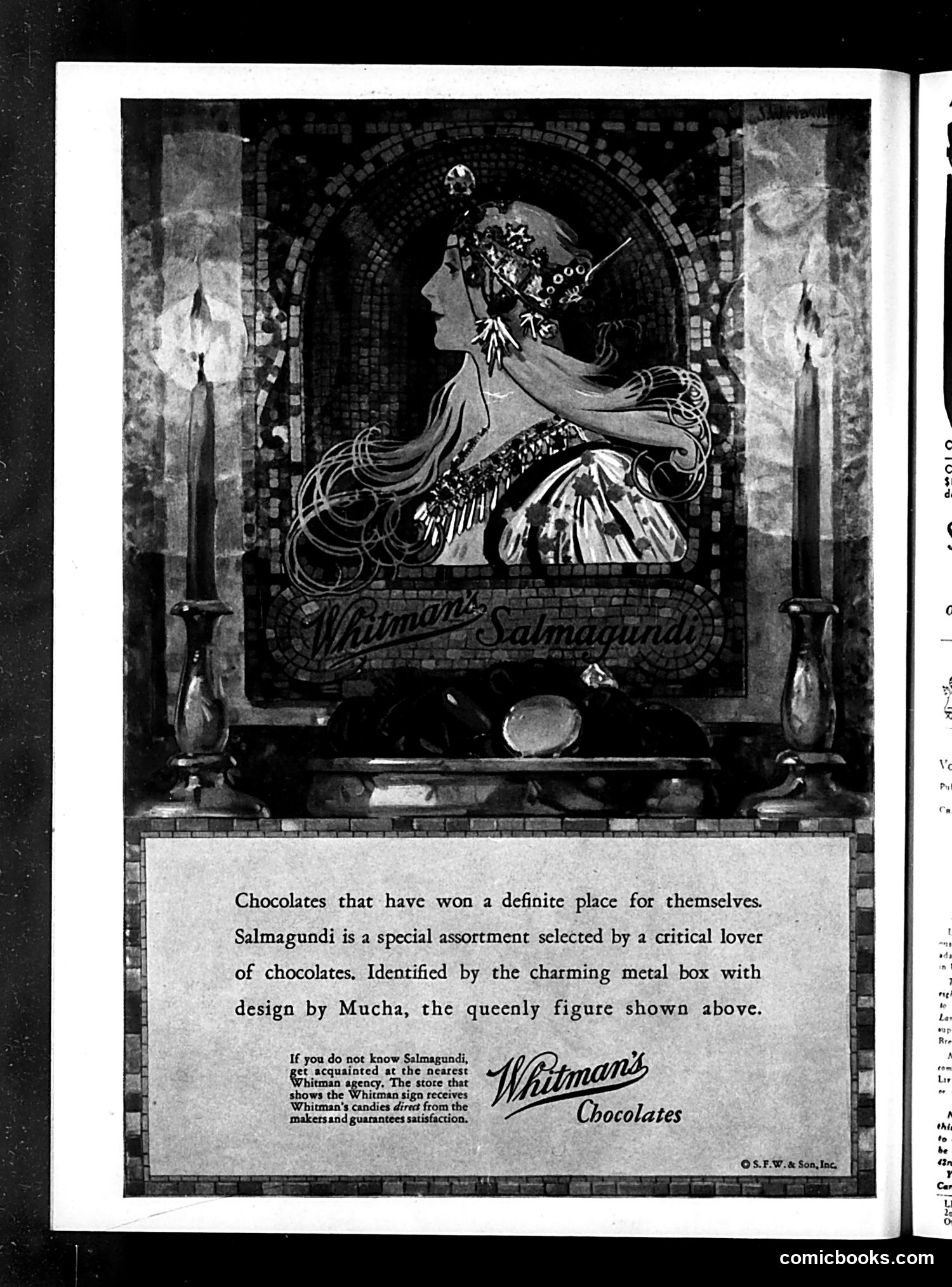
Advertisement Analysis This is a Whitman's Chocolates advertisement, not political satire. The page features an Art Nouveau-style illustration by Mucha showing an elegantly dressed woman in profile, wearing ornate jewelry and a feathered garment, framed by a decorative mosaic arch with candelabras. The ad promotes "Salmagundi," a special chocolate assortment in a decorative metal box. The text emphasizes that these are "chocolates that have won a definite place for themselves," positioning Salmagundi as a premium product selected by discerning chocolate lovers. The advertisement instructs consumers to find Salmagundi at "Whitman agency" stores displaying the Whitman sign, which "guarantees satisfaction." This is pure commercial marketing using artistic design to convey luxury and refinement.
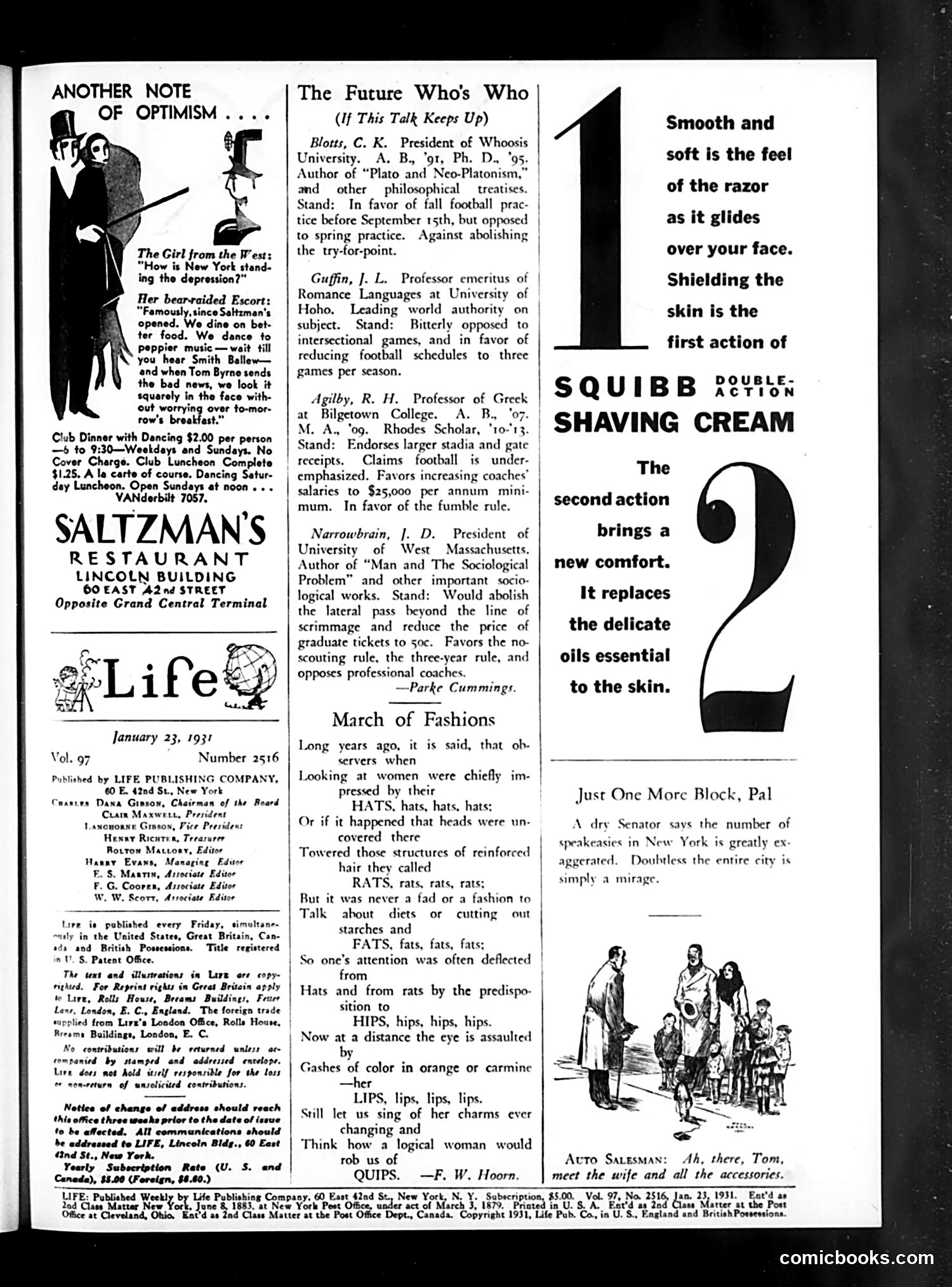
"Another Note of Optimism" Cartoon Analysis This cartoon depicts a well-dressed man in a top hat appearing to juggle or balance precariously while looking distressed. The caption references "The Girl from the West" saying "How is Now York standing the depression?" and her boyfriend's response about dancing to "pepper music" while worrying about food. The satire targets the contrast between outward appearances of normalcy and the underlying anxiety of the Great Depression (the page is dated January 23, 1932—deep in the crisis). The title "Another Note of Optimism" is ironic: despite economic collapse, people maintain social routines and pretend everything is manageable, even as they worry privately about basic necessities. The unsteady juggling posture visually reinforces this precarious balancing act.
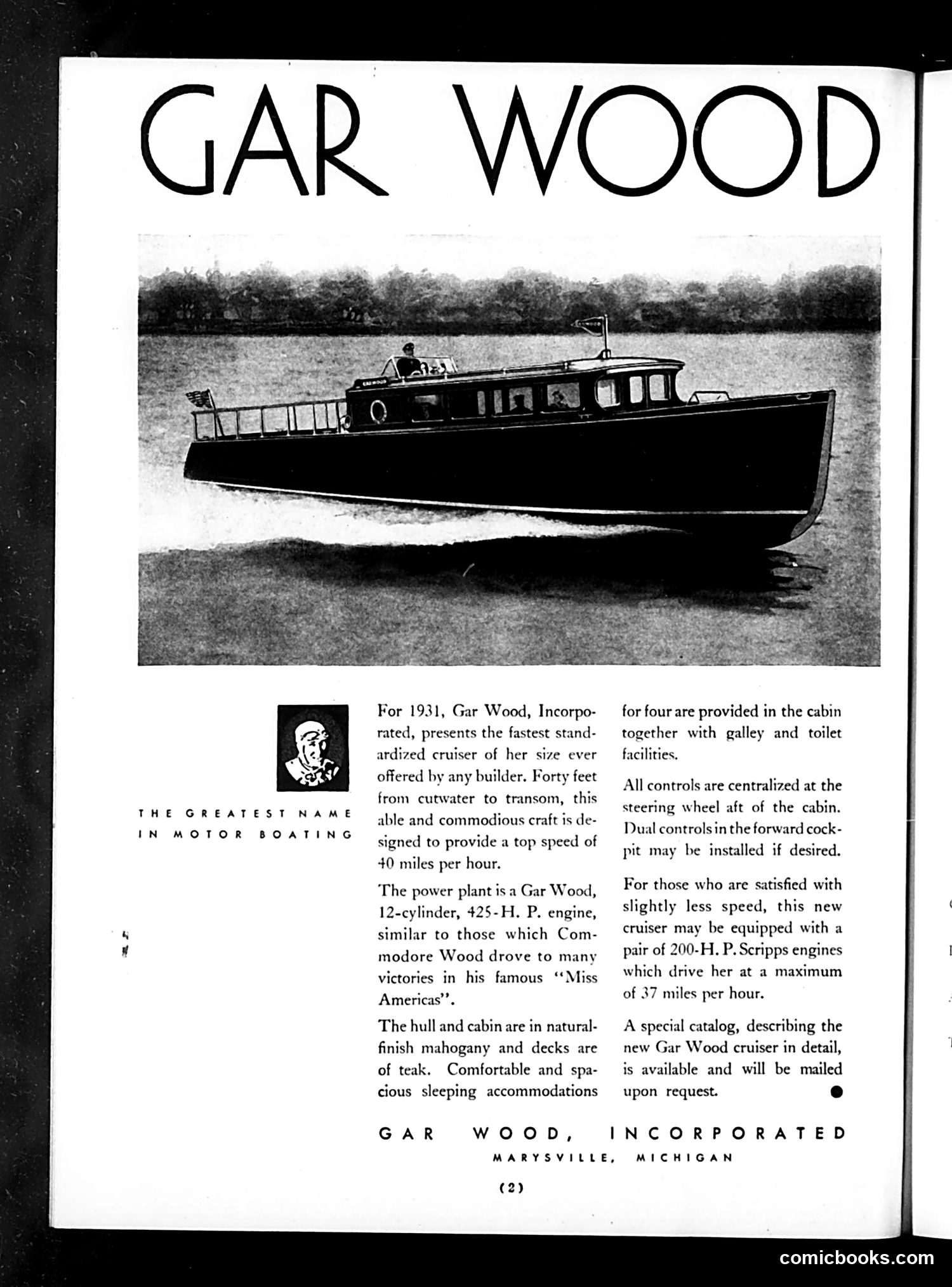
Analysis This is a product advertisement, not political satire or a cartoon. It promotes the Gar Wood speedboat cruiser for 1931, manufactured in Marysville, Michigan. The small illustration in the left margin appears to be a generic mascot or brand emblem (a face in a circle), labeled "The Greatest Name in Motor Boating." The advertisement emphasizes the boat's speed (40 mph maximum with its 12-cylinder engine), luxury features (mahogany hull, teak decks, sleeping accommodations), and customization options. It references Commodore Wood's "Miss America" racing victories to establish brand prestige. There is no satire or political content—this is straightforward 1931 commercial advertising highlighting engineering and leisure lifestyle appeal to wealthy consumers during the Depression era.
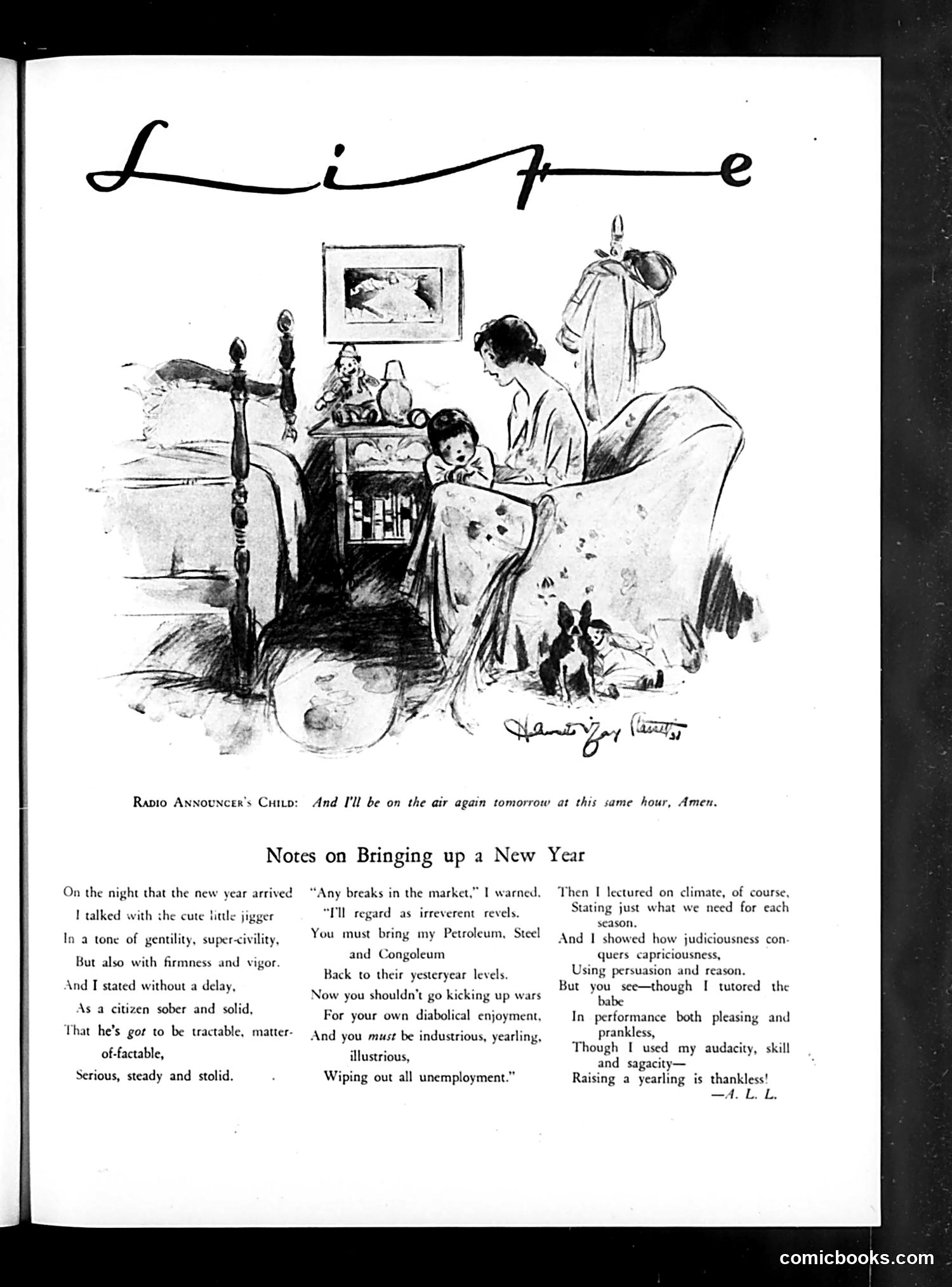
Analysis This page from *Life* magazine features a satirical poem titled "Notes on Bringing up a New Year." The illustration shows a mother with children in a domestic interior, likely representing the "New Year" as a child being raised. The poem humorously presents advice for training the incoming year like a disciplined child—keeping it "tractable, matter-of-factable, / Serious, steady and solid." The speaker warns against economic instability ("breaks in the market"), unemployment, and war, advocating instead for industrial productivity and virtuous behavior. The satire mocks the optimistic notion that one can simply "raise" a new year properly through moral instruction, ignoring larger economic and political forces. It reflects anxiety about post-war economic conditions and social stability during the early 1920s.
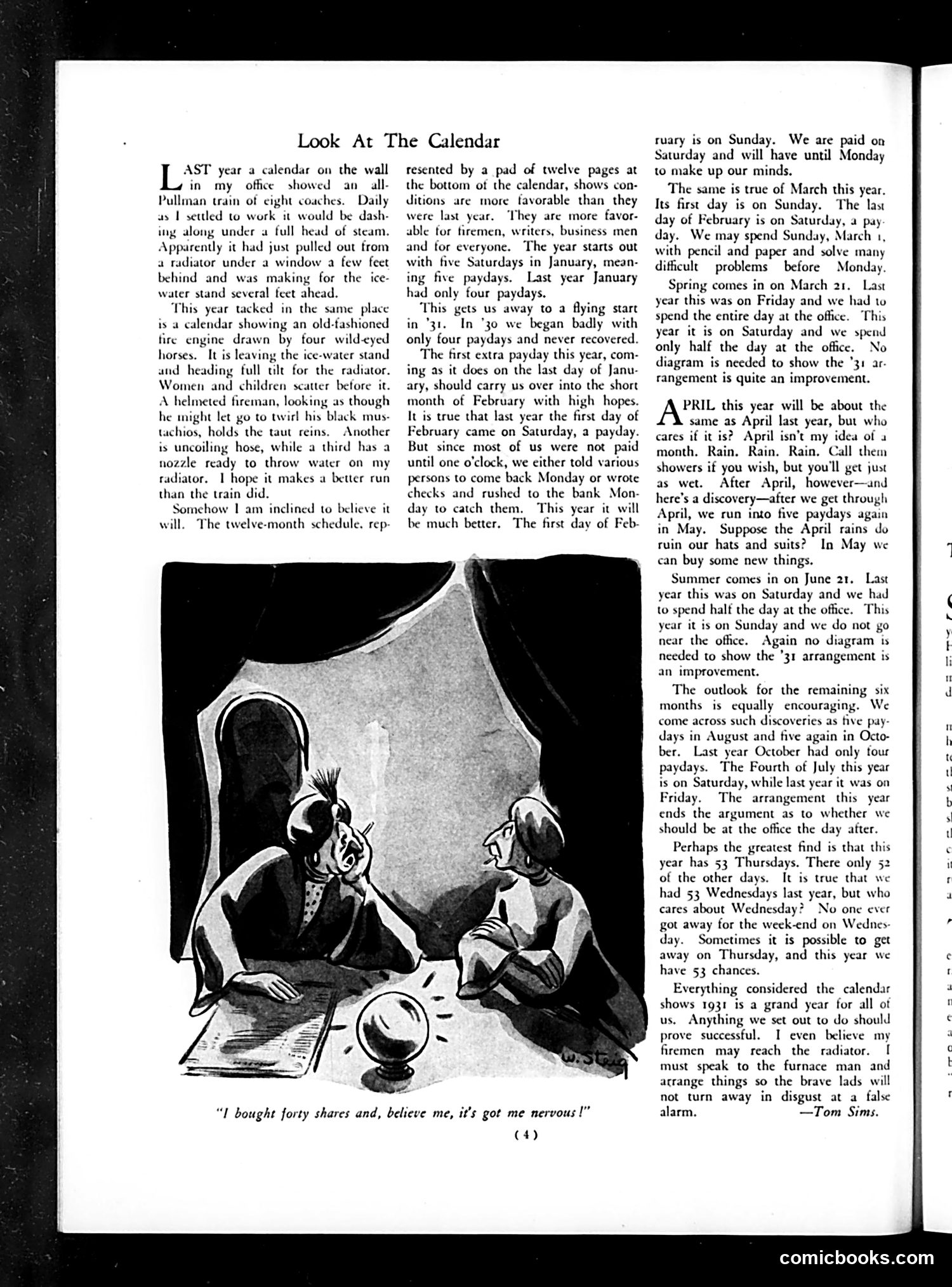
Analysis This page is a humorous essay titled "Look At The Calendar" about how the calendar year 1931 affects office workers' schedules and paydays. The accompanying cartoon illustrates two office workers examining a calendar with concern, with one saying "I bought forty shares and, believe me, it's got me nervous!" The satire plays on the 1931 context: this was during the Great Depression following the 1929 stock market crash. The cartoon jokes about how ordinary workers became amateur stock investors, hoping to recoup losses or build wealth, only to find their nervousness about stock performance now tied to calendar quirks affecting their actual paychecks. The essay's focus on "five paydays" versus "four paydays" in different months reflects the financial anxiety of Depression-era workers managing tight budgets where even one missing paycheck mattered significantly.
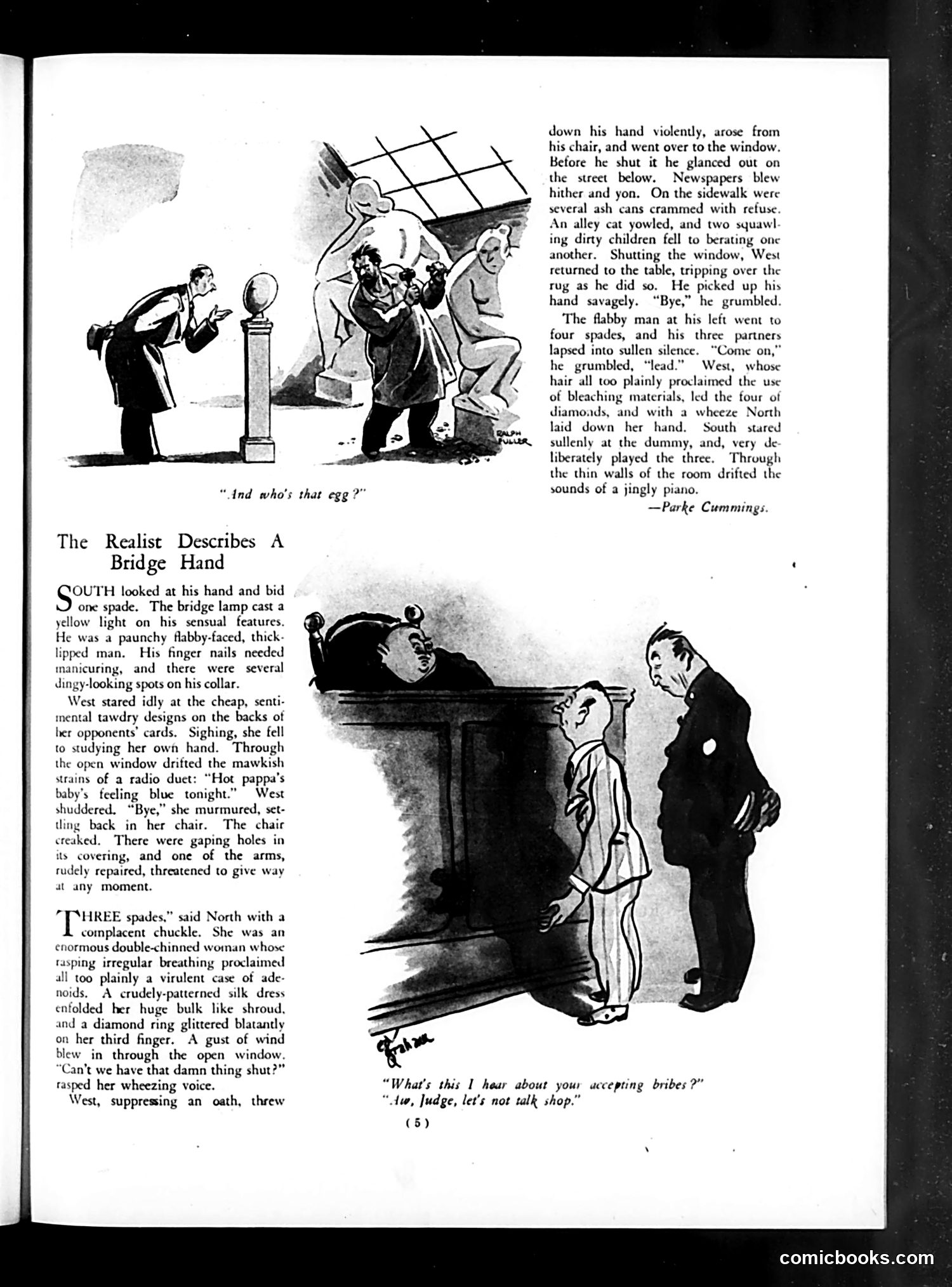
"The Realist Describes A Bridge Hand" This page depicts a bridge card game scene. The narrative describes South examining his hand while West observes the cheap, sentimental card designs. The story emphasizes physical details—South's "paunchy flabby-faced" appearance, his dirty fingernails, West's bleached hair—all rendered unsympathetically. The cartoons illustrate bridge players in unflattering circumstances: one shows a man outside with an ash can, another depicts what appears to be a bribe-related conversation ("What's this I hear about your accepting bribes?"). The satire targets the pretensions of bridge as a "refined" game while depicting its actual players as working-class, morally compromised individuals. By focusing on physical ugliness and corruption, the piece mocks the gap between bridge's genteel reputation and the rough reality of those who play it.
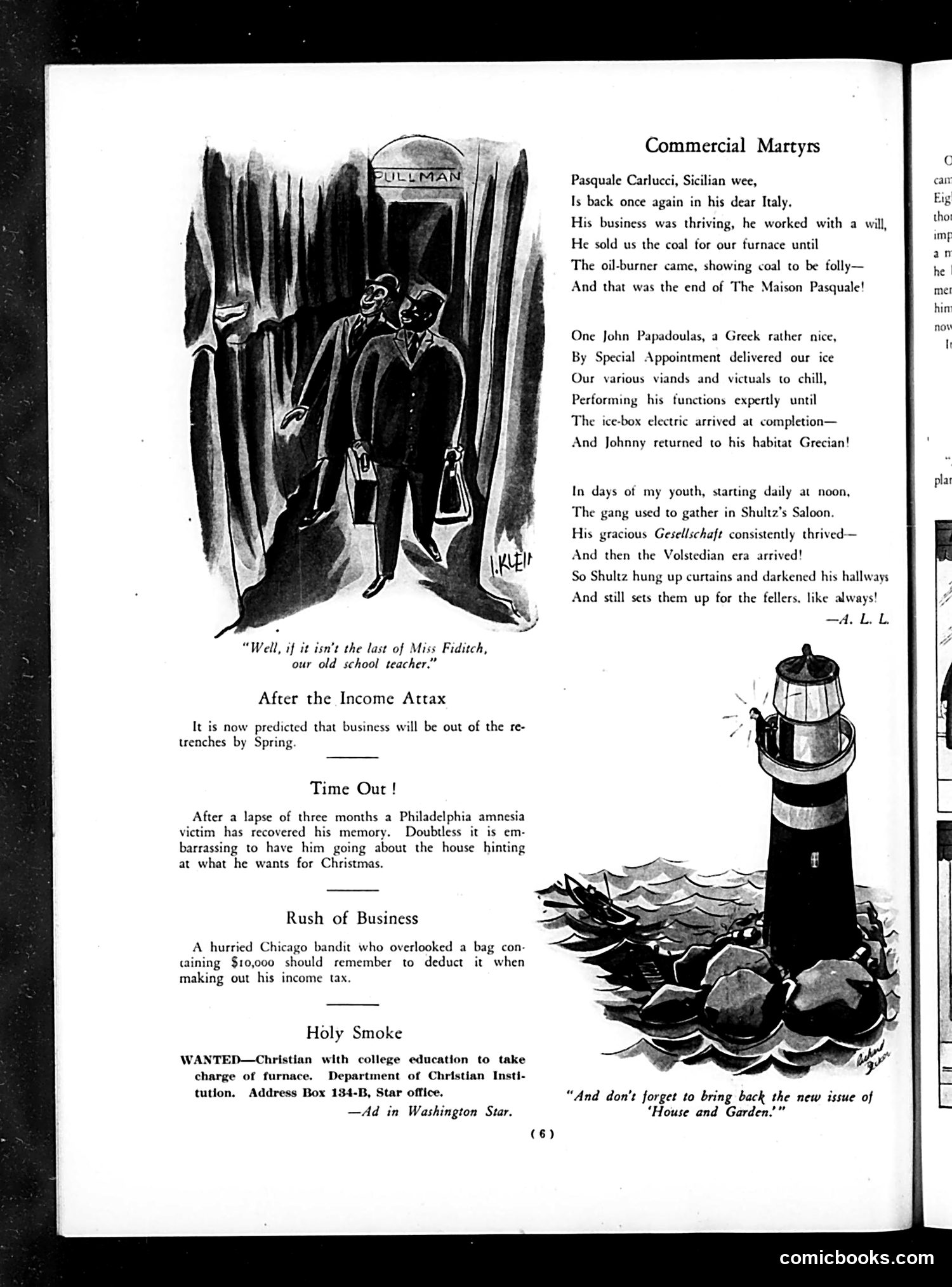
Analysis of Life Magazine Page This page contains humorous short pieces and an advertisement rather than a unified political cartoon. The main illustrated item, "Commercial Martyrs," features a sketch of men in an elevator labeled "Pullman." The poem mocks various tradesmen—an Italian coal seller (Pasquale Carlucci), a Greek ice-box delivery man (John Papadoulas), and a saloon keeper (Schultz)—whose businesses have failed or been disrupted, likely due to Prohibition or economic changes. The other brief items ("After the Income Attax," "Time Out," "Rush of Business," "Holy Smoke") are satirical one-liners about contemporary urban life—income taxes, amnesia, Chicago crime, and religious institutions seeking workers. The page reflects early 20th-century American immigrant commerce and social anxieties.
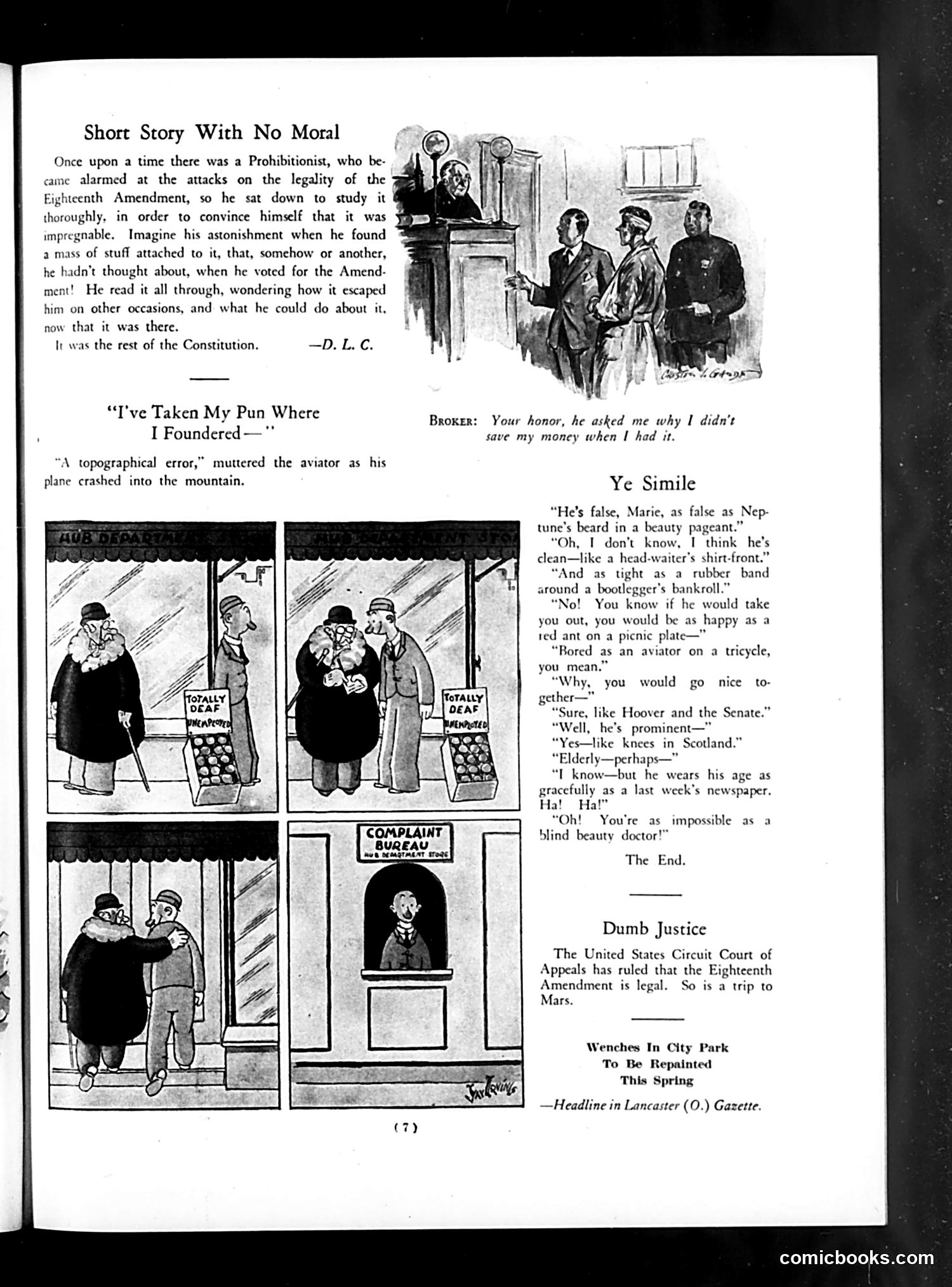
Political Satire from Life Magazine This page contains several short satirical pieces from a Prohibition-era Life magazine. "Short Story With No Moral" mocks a Prohibitionist who discovers the Eighteenth Amendment has loopholes—satirizing the difficulty of enforcing alcohol bans. "I've Taken My Pun Where I Foundered" shows a four-panel comic about a deaf man repeatedly visiting a complaint bureau, likely satirizing bureaucratic incompetence and the absurdity of deaf individuals filing complaints they cannot hear responses to. "Ye Simile" uses comparative descriptions (false as Neptune's beard, tight as a bootlegger's bankroll) to humorously characterize someone, referencing bootleggers—illegal alcohol distributors during Prohibition. "Dumb Justice" briefly notes a court ruling that the Eighteenth Amendment is legal, sarcastically calling it "a trip to Mars."
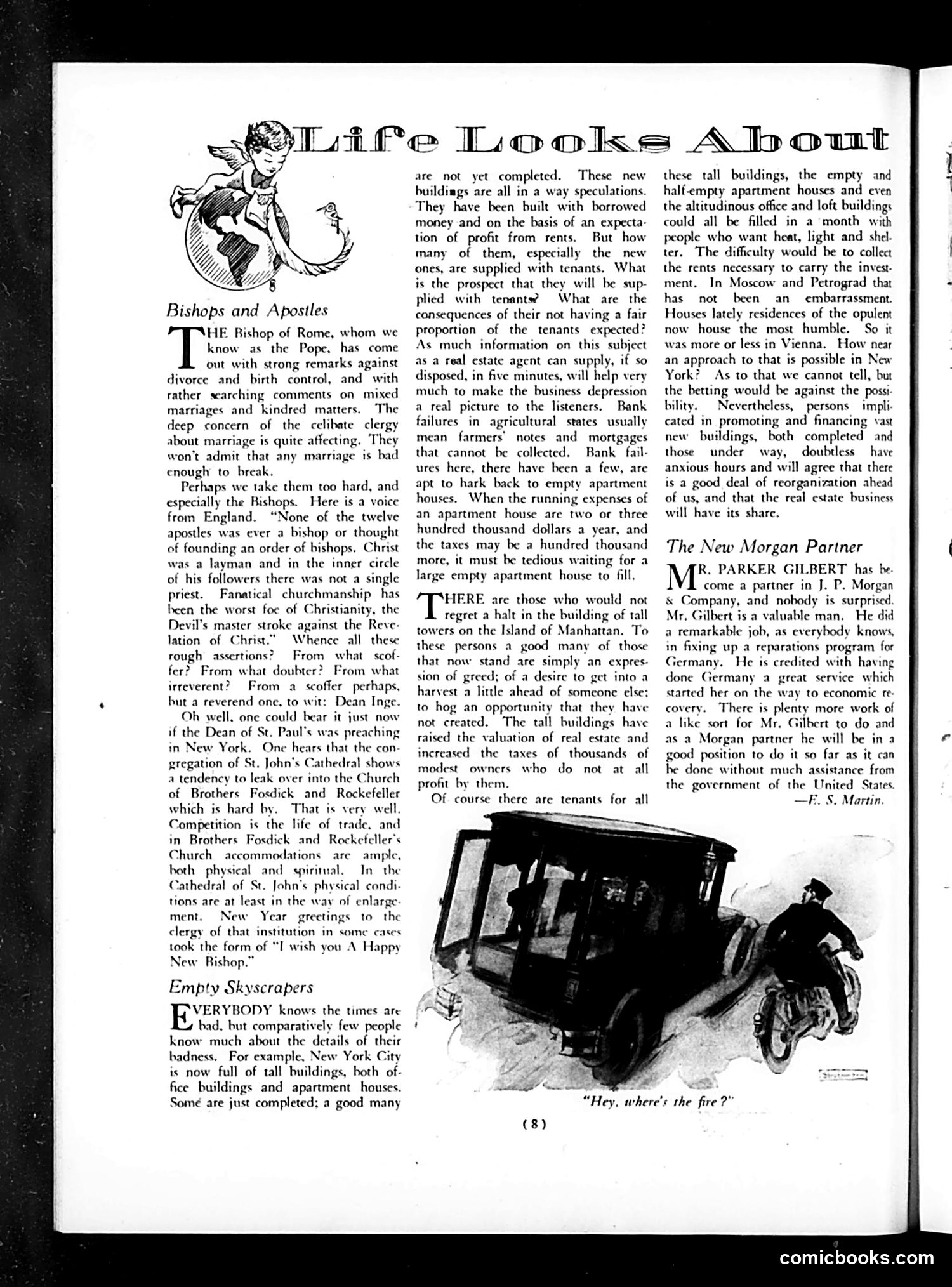
Analysis of Life Magazine Page This page contains satirical commentary on 1920s American issues rather than political cartoons. "Bishops and Apostles" critiques clerical hypocrisy regarding marriage and divorce, likely referencing the Bishop of Rome's strong anti-divorce stance while acknowledging real-world difficulties of failed marriages. "Empty Skyscrapers" discusses New York City's real estate crisis—numerous tall buildings standing partially vacant or incomplete due to over-speculation and difficulty filling them with tenants. The text notes banks have failed on agricultural properties and apartment buildings remain unfilled despite high operating costs. "The New Morgan Partner" announces Parker Gilbert joining J.P. Morgan & Company to oversee reparations work in post-WWI Germany. The illustration captioned "Hey, where's the fire?" depicts someone on a motorcycle, likely satirizing reckless driving behavior.
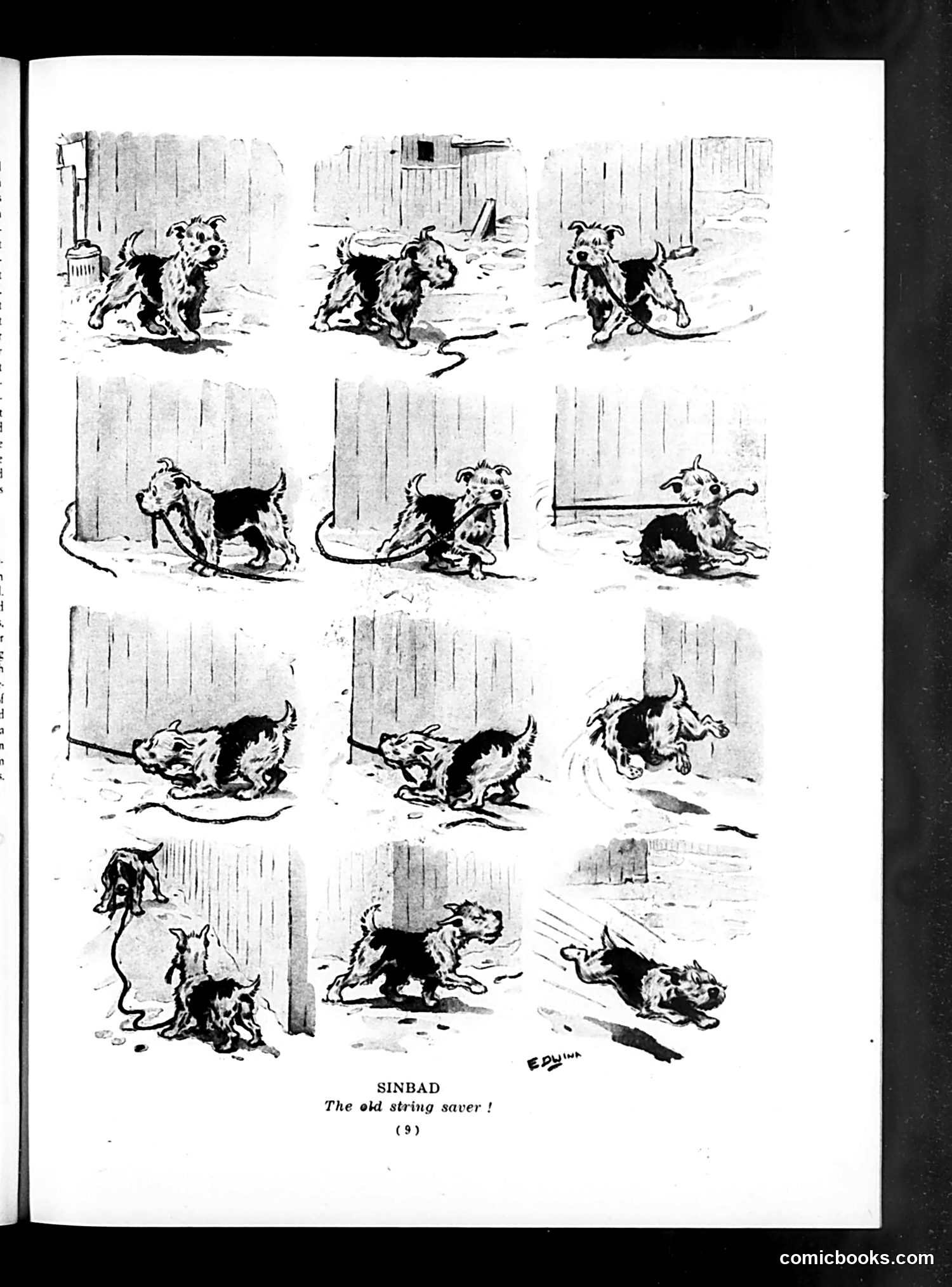
"Sinbad: The Old String Saver" This is a humorous illustrated sequence by E. Shinn showing a dog discovering and repeatedly playing with an old piece of string. The comic follows the dog through twelve panels as it finds the string, chases it, tangles with it, and continues entertaining itself with it in various ways around a wooden-fenced yard. The joke plays on the relatable observation that dogs often derive endless amusement from simple, worthless objects—in this case, just an old string—rather than fancy toys. The title "The Old String Saver" appears to reference the dog's resourcefulness in making entertainment from discarded materials. It's gentle, observational humor about animal behavior that would appeal to any pet owner.
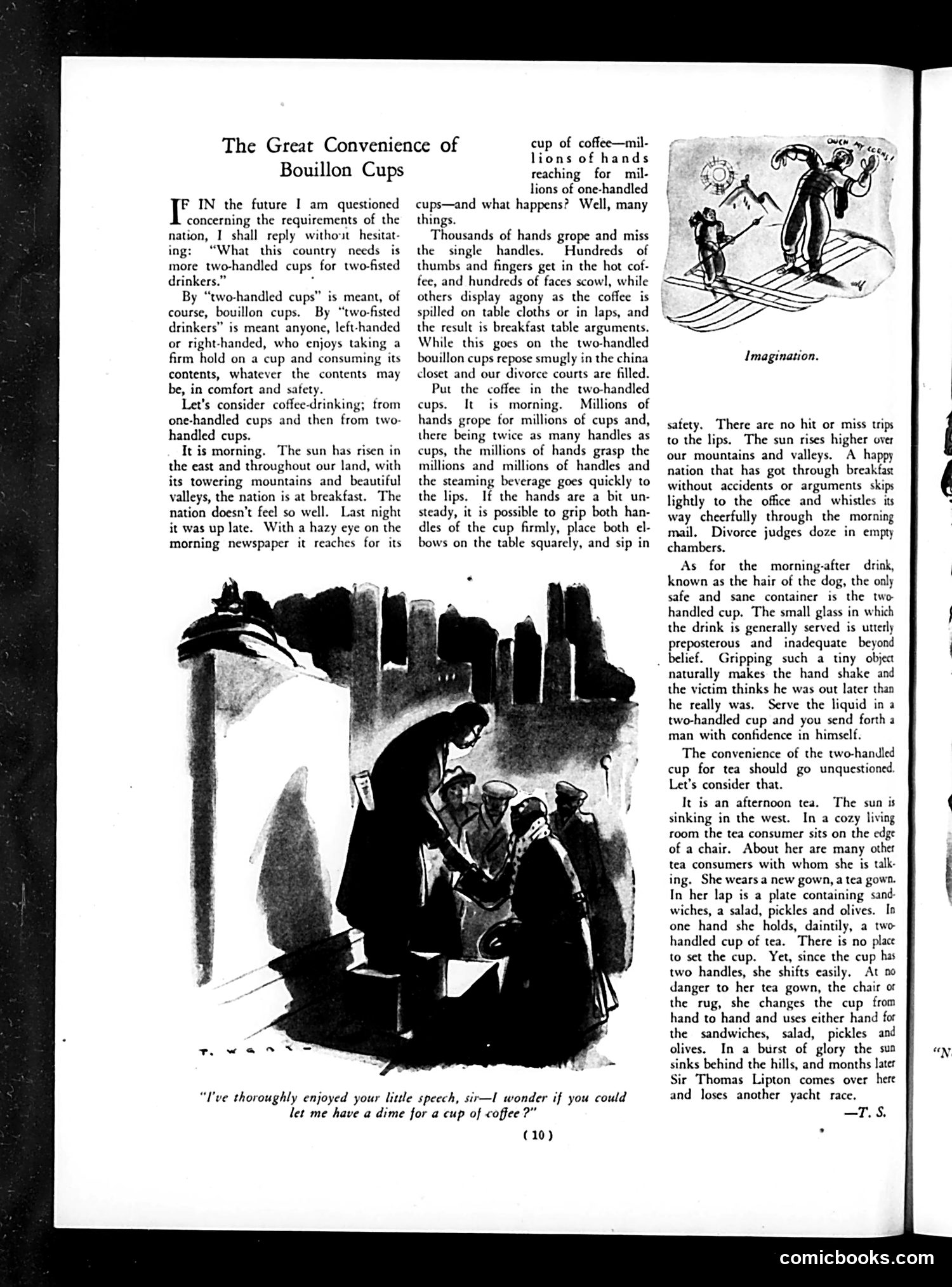
"The Great Convenience of Bouillon Cups" This is a humorous satirical essay arguing for two-handled cups as a practical solution to everyday problems. The author uses exaggerated examples to mock social inconvenience: coffee drinkers missing single handles, spilled beverages causing "breakfast table arguments," and divorce court cases allegedly resulting from such accidents. The cartoon illustrations show crowded urban scenes—likely New York City given the skyline—depicting the chaos of one-handed cup drinking. The essay then extends the joke to afternoon tea, describing how a two-handled cup would allow women to eat finger foods while drinking without risk to their clothing. The satire gently mocks both the triviality of modern inconveniences and the earnestness with which people debate domestic solutions. The byline indicates this is by T.S. (author unclear).
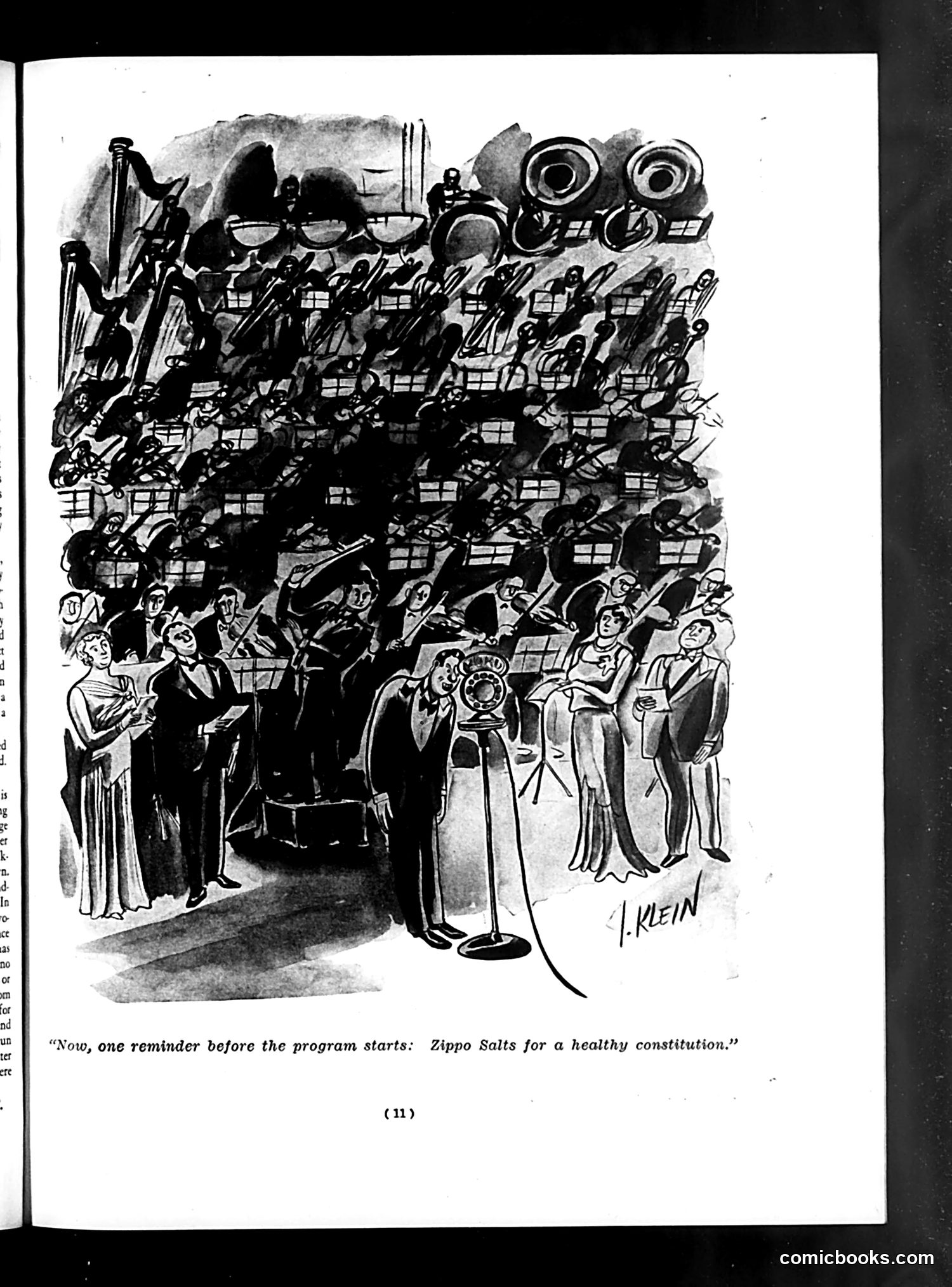
Analysis of Life Magazine Cartoon This cartoon by I. Klein depicts a large orchestra or musical ensemble performing before an assembled audience of well-dressed patrons. The caption reads: "Now, one reminder before the program starts: Zippo Salts for a healthy constitution." The satire appears to mock the commercialization of entertainment and health products in early-to-mid 20th century America. The joke juxtaposes a serious, formal musical performance with an absurd health product advertisement (Zippo Salts), suggesting that even cultural events cannot escape commercial marketing. The conductor's announcement treats the product endorsement as a routine program note, satirizing how advertising permeated even sophisticated venues and how health products were aggressively marketed to consumers through any available medium.
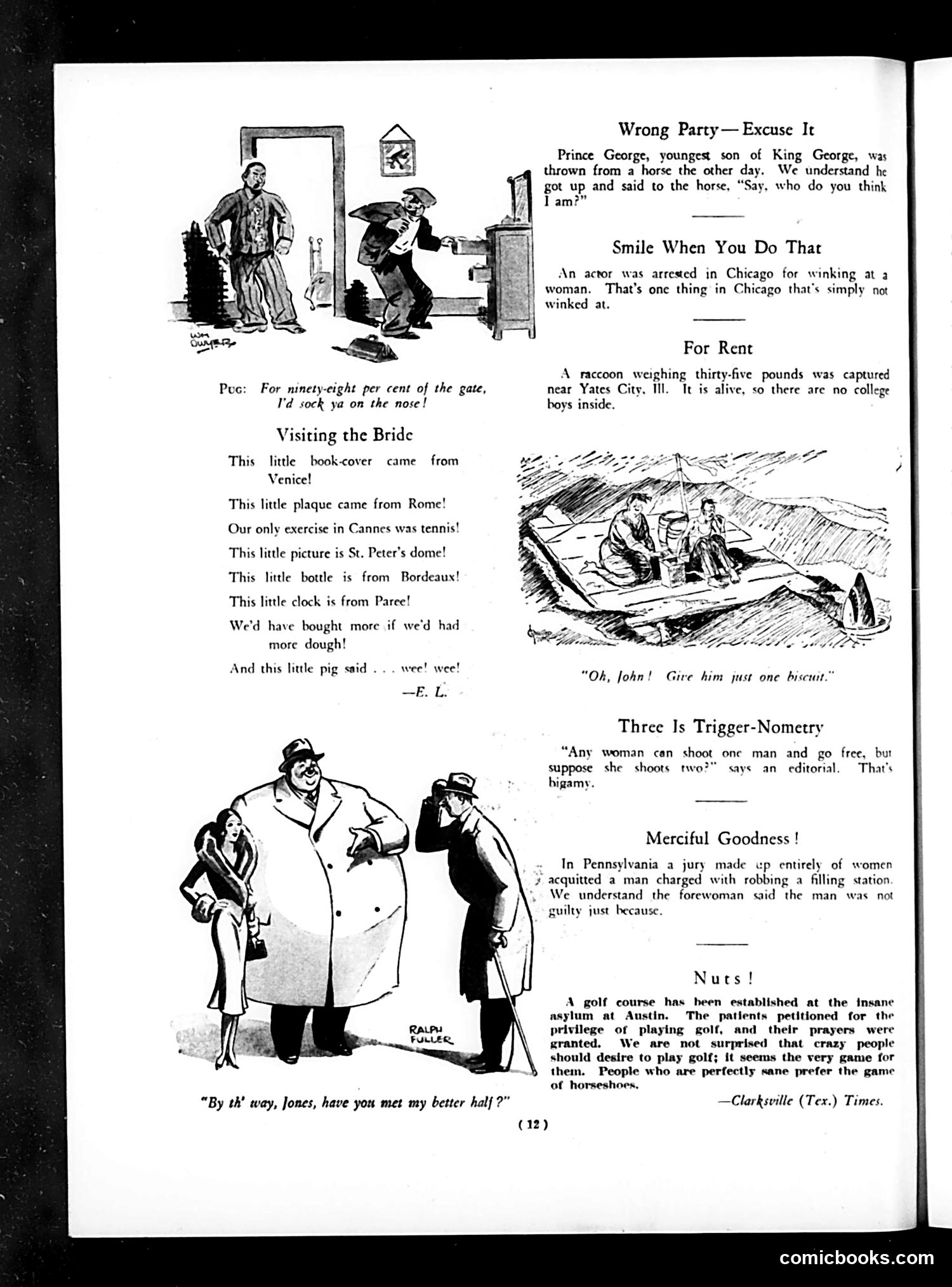
Page Analysis This page contains several brief satirical items typical of Life magazine's humor section: Top cartoon: Shows a gatekeeper charging admission. The joke plays on the phrase "put on the nose"—the gatekeeper wants payment for entry. "Visiting the Bride": A humorous poem about honeymoon souvenirs from European cities (Venice, Rome, Cannes, etc.), ending with a pig making animal sounds. The joke: newlyweds overspent on travel souvenirs and can't afford much. "By th' way, Jones" cartoon: A man asks another if he's met "my better half"—referring to his wife as an object of possession, a period-typical marital joke about wives. The remaining items are brief social commentary: Prince George's horse incident, an actor arrested in Chicago, a captured raccoon, and observations about gender, shooting, jury decisions, and a golf course at an asylum—all reflecting early 20th-century attitudes and concerns.
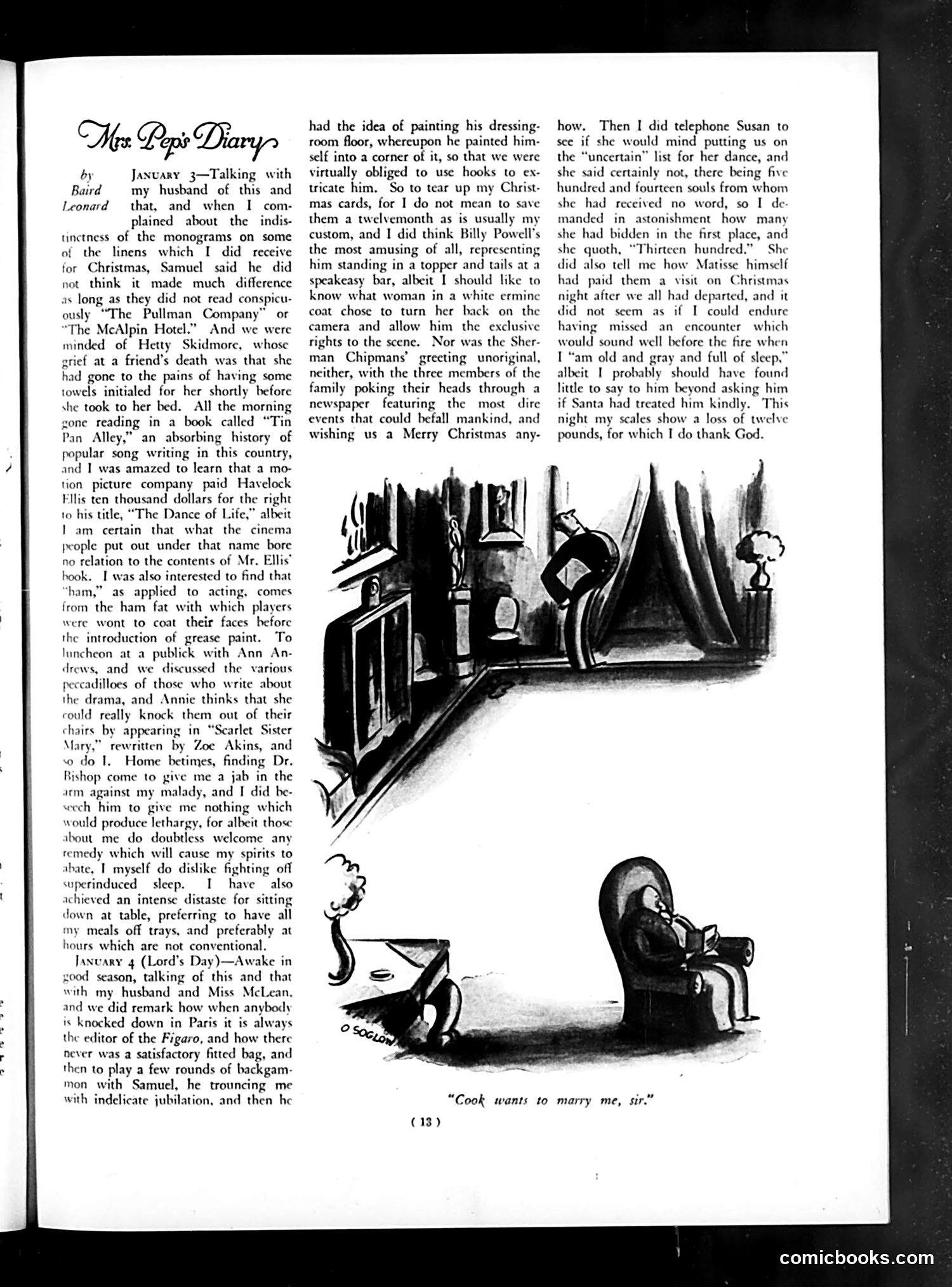
Mrs. Peps' Diary - January 3-4 This page is from "Mrs. Peps' Diary," a humor column by Leonard that satirizes upper-class social pretensions. The text discusses theatrical absurdities—including an actor painting a dressing room floor and arguments about Christmas card etiquette—and mentions film industry figures like Billy Powell and Hedy Sedlmore. The two illustrations appear to be standalone gag cartoons unrelated to the diary text: one shows an interior hallway scene, the other depicts a cook proposing marriage to someone (captioned "Cook wants to marry me, sir"). These seem designed as light domestic humor for early 20th-century *Life* magazine readers, reflecting period anxieties about servants and household staff relationships rather than specific political commentary.
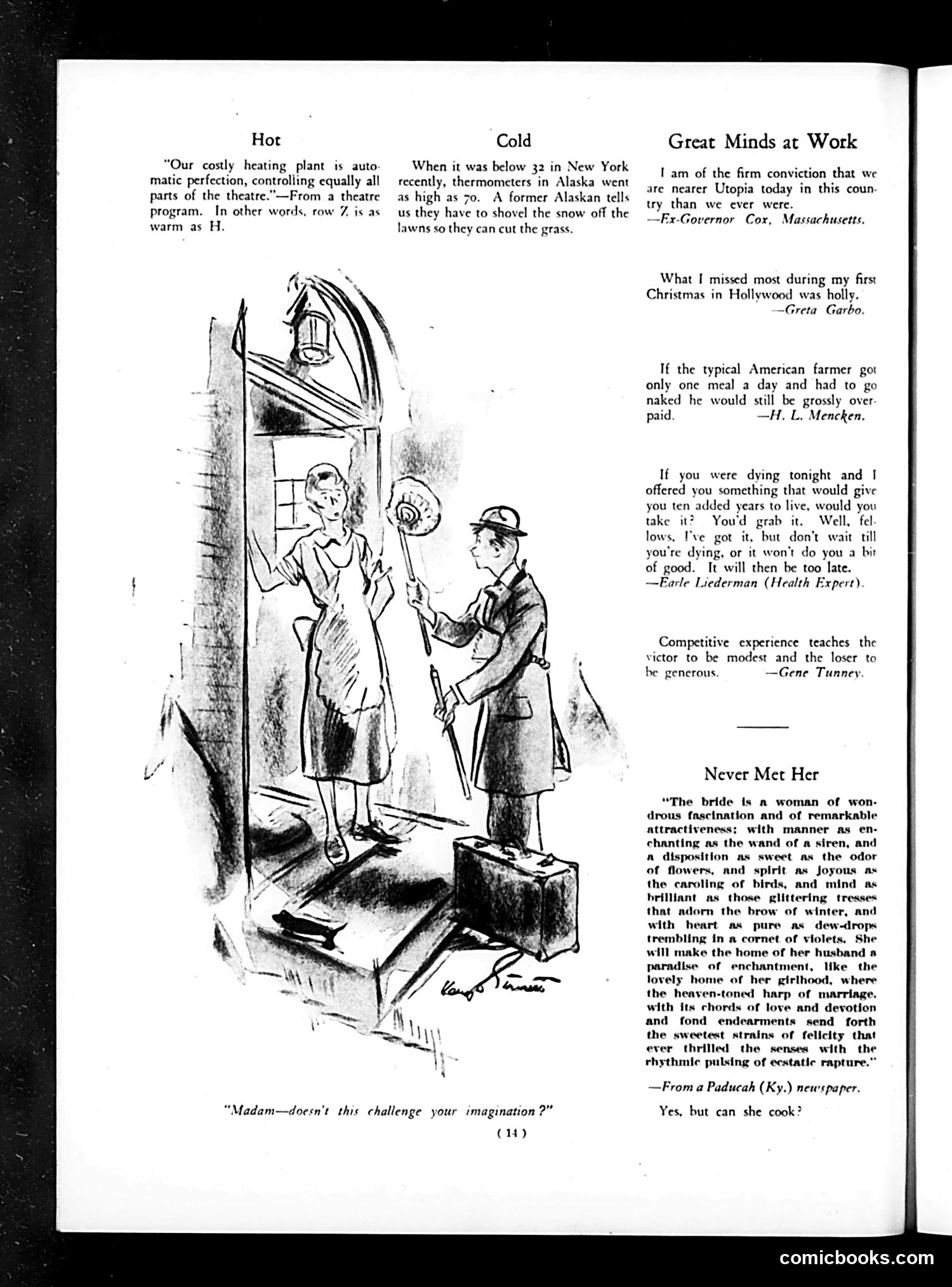
Analysis of Life Magazine Page This page contains a cartoon captioned "Madam—doesn't this challenge your imagination?" showing a man at a woman's doorstep holding what appears to be a plumbing or heating pipe fixture. The joke plays on the double meaning of "challenge your imagination"—the man is either a tradesman making an awkward pickup line, or the woman is being asked to imagine/believe some implausible explanation for his visit. The surrounding "Great Minds at Work" section collects witty quotes from public figures (Governor Cox of Massachusetts, Greta Garbo, H.L. Mencken, and others). The page also includes a "Never Met Her" section describing an idealized bride, likely satirizing romanticized marriage literature or wedding announcements, with the punchline "Yes, but can the cook?"—suggesting practical concerns override romantic ideals.
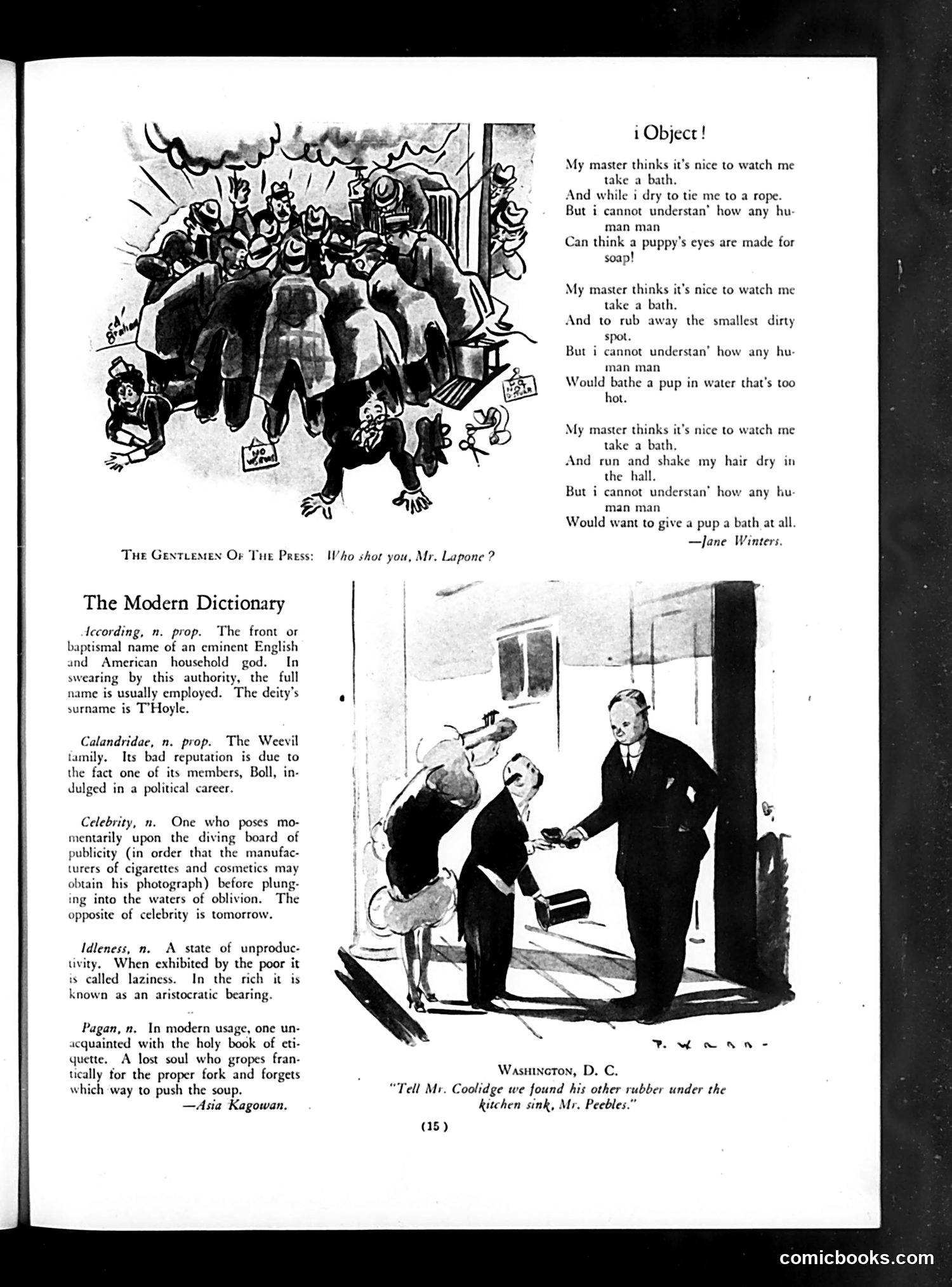
Analysis Top Cartoon: "The Gentlemen of the Press: Who shot you, Mr. Lapone?" depicts journalists crowding around what appears to be a shooting victim. This satirizes sensationalist press behavior—the cartoonist mocks reporters' aggressive pursuit of scandal and crime stories, treating tragedy as entertainment fodder. Bottom Cartoon (Washington, D.C.): Shows two men discovering a rubber item under a kitchen sink, with one saying "Tell Mr. Coolidge we found his other rubber under the kitchen sink, Mr. Peebles." This appears to reference President Coolidge through a double-entendre joke about "rubbers" (likely condoms or galoshes), though the specific political context is unclear to modern readers. "The Modern Dictionary" section provides satirical definitions mocking society, press, and celebrity culture of the era.
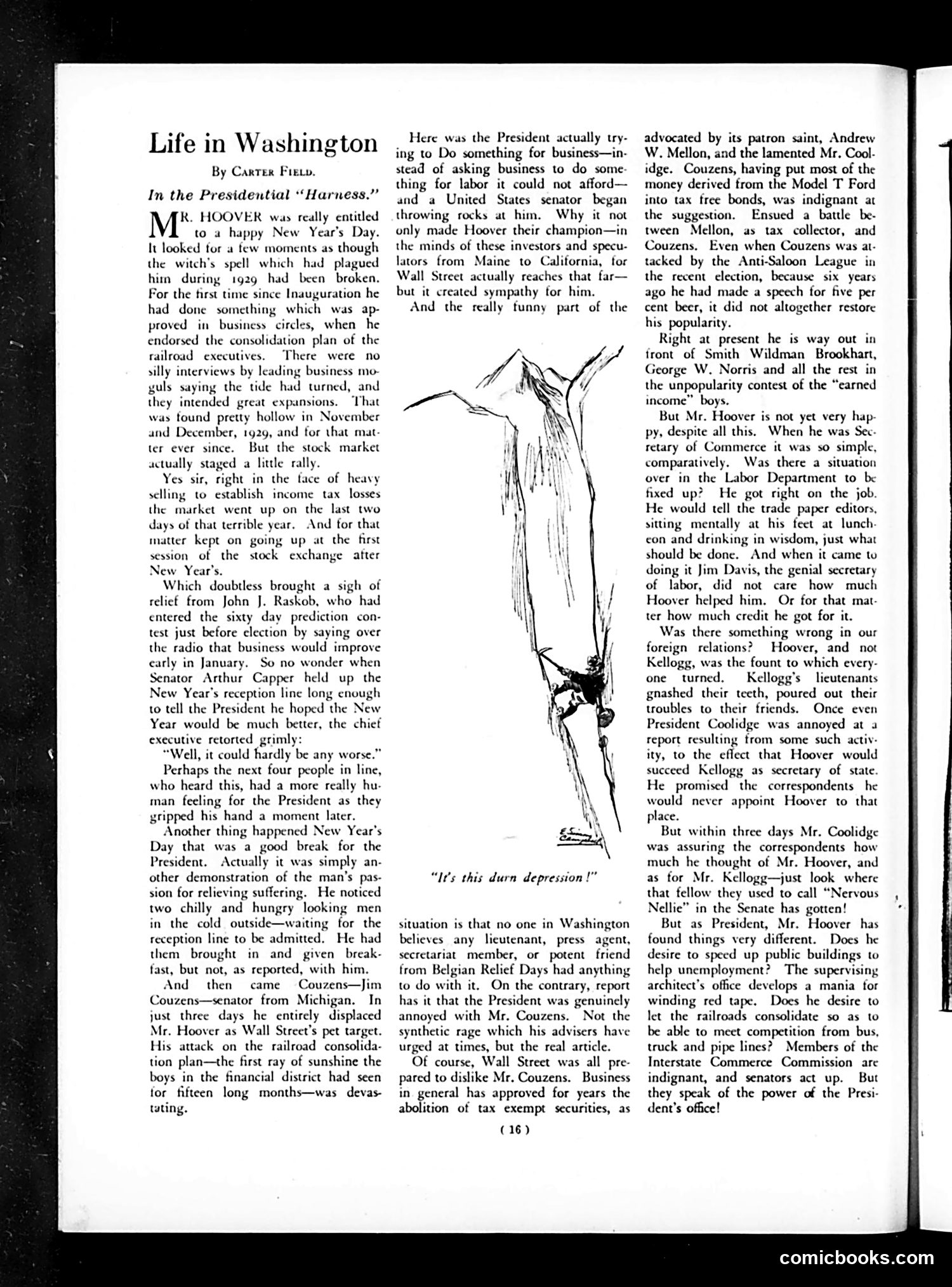
Analysis of "Life in Washington" Page This satirical column by Carter Field discusses President Hoover's unpopularity during the economic crisis. The accompanying sketch depicts a figure (likely Hoover) hanging by a thread labeled "It's this darn depression!"—a visual metaphor for his political precariousness. The text mocks Hoover's failed attempts to reassure business leaders about economic recovery. Field describes how Hoover's various initiatives (railroad consolidation, public building projects) were either ineffective or unpopular. The column references criticism from Wall Street figures and businessmen like Mr. Couzens, and notes that even Hoover's supporters like Secretary Kellogg had become liabilities. The overarching point: Hoover's presidency is hanging by a thread as the Great Depression deepens and his credibility erodes.
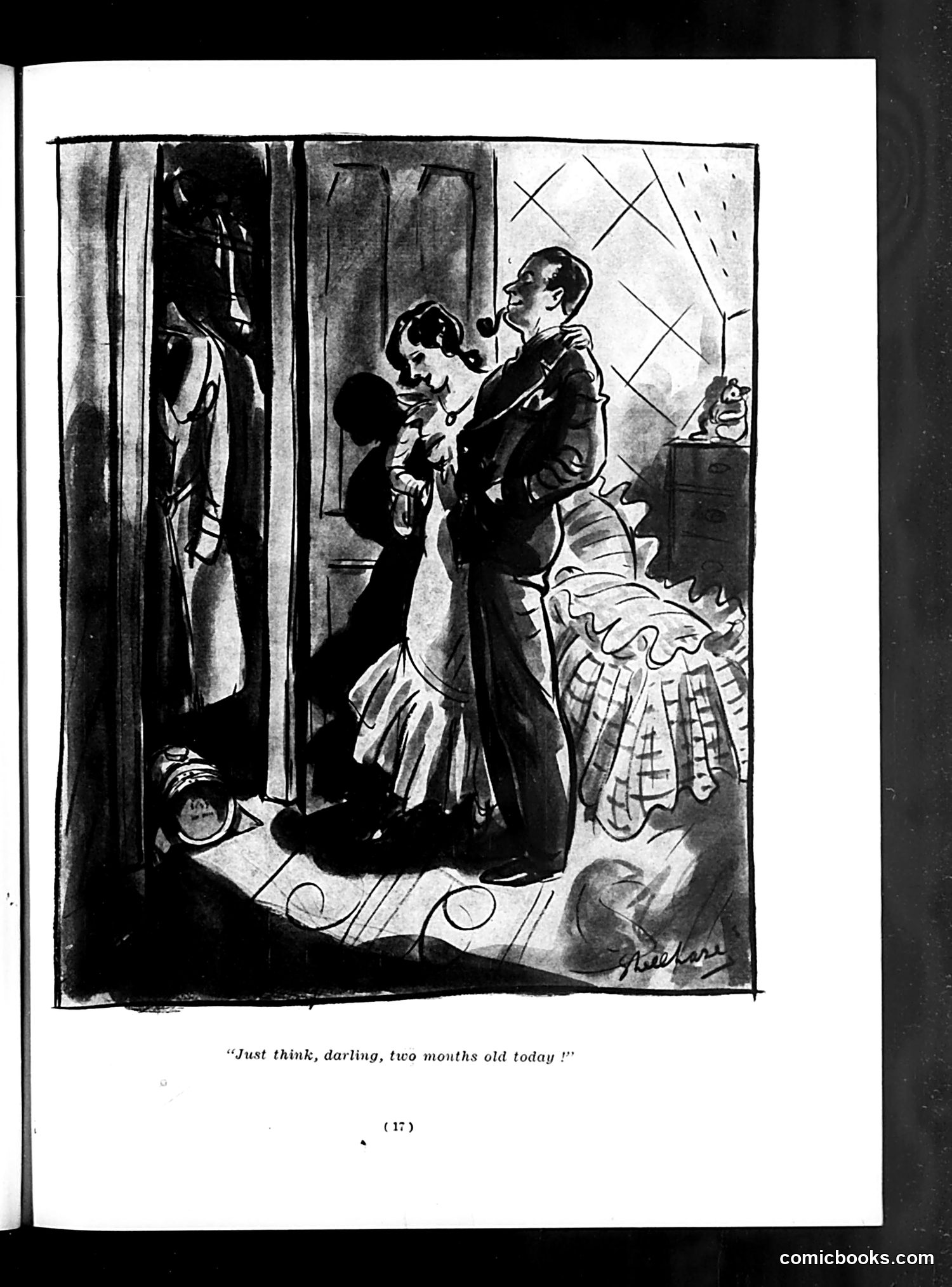
Analysis This is a domestic humor cartoon from *Life* magazine's early satirical tradition. The scene depicts a well-dressed couple in a bedroom with a new infant. The man addresses his wife with the caption: "Just think, darling, two months old today!" The humor is gentle and observational rather than political. It satirizes the mundane milestone-marking that new parents engage in—the tendency to celebrate small increments of a baby's age ("two months") with the same enthusiasm one might reserve for major occasions. The cartoon pokes fun at how parenthood transforms ordinary time passages into noteworthy events. The detailed bedroom setting and fashionable clothing suggest this targets middle-class readers of the era, making the domestic observation relatable to the magazine's audience.
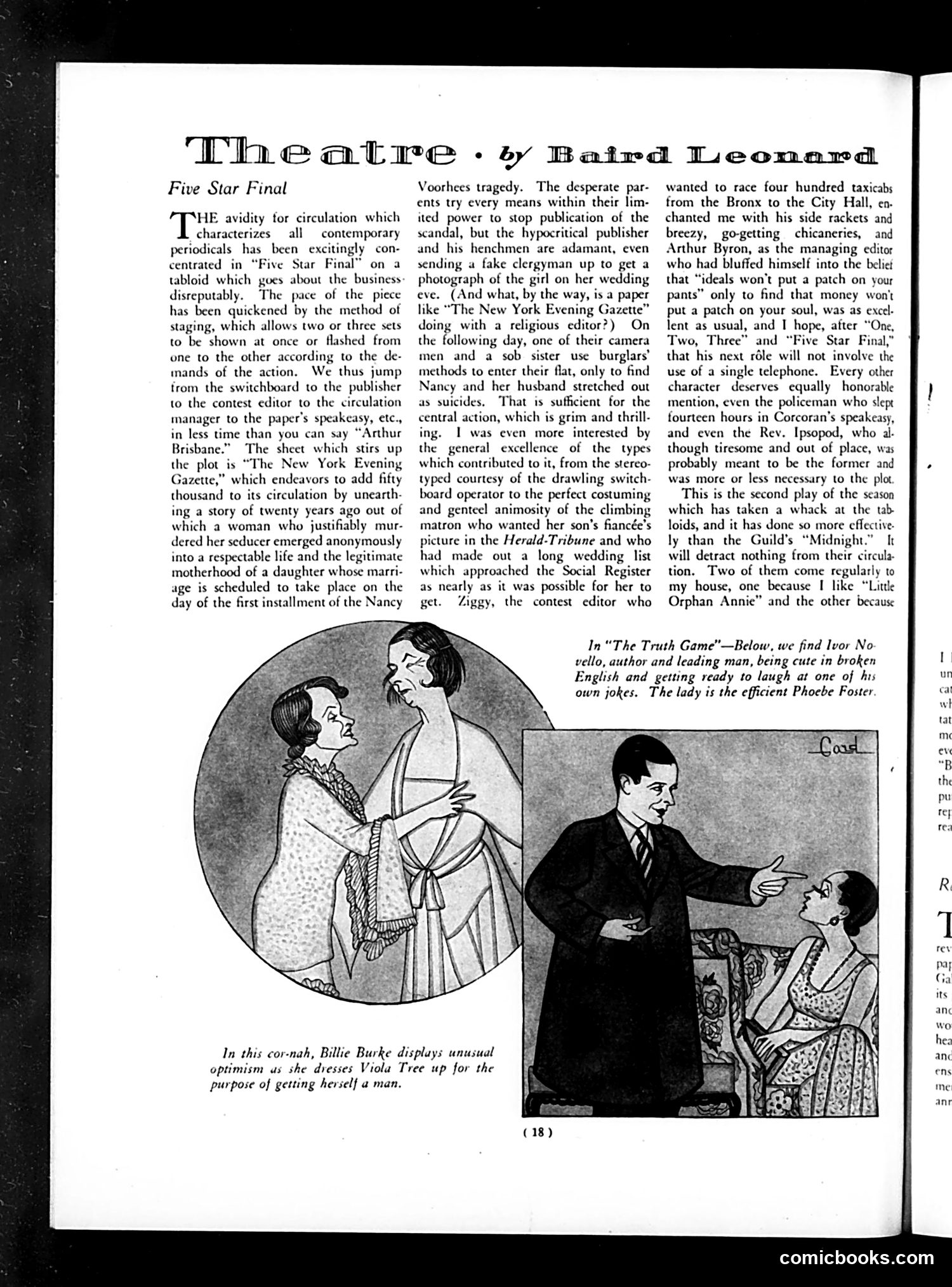
Analysis of "Theatre" by Baird Leonard This theatre review discusses "Five Star Final," a play about newspaper sensationalism. The column critiques how modern periodicals—specifically referencing *The New York Evening Gazette*—exploit scandal for circulation. The plot involves a woman who justifiably murders her seducer, but the scandal-hungry publisher and editor attempt to suppress it. The reviewer satirizes the hypocrisy: these same publications relentlessly pursue salacious stories while claiming ethical standards. The two accompanying illustrations show scenes from plays currently running in New York, including "The Truth Game" (featuring actors Ivor Novello and Phoebe Foster) and what appears to be a scene with Billie Burke. The satire targets 1920s-30s tabloid journalism's appetite for scandal while maintaining false respectability.
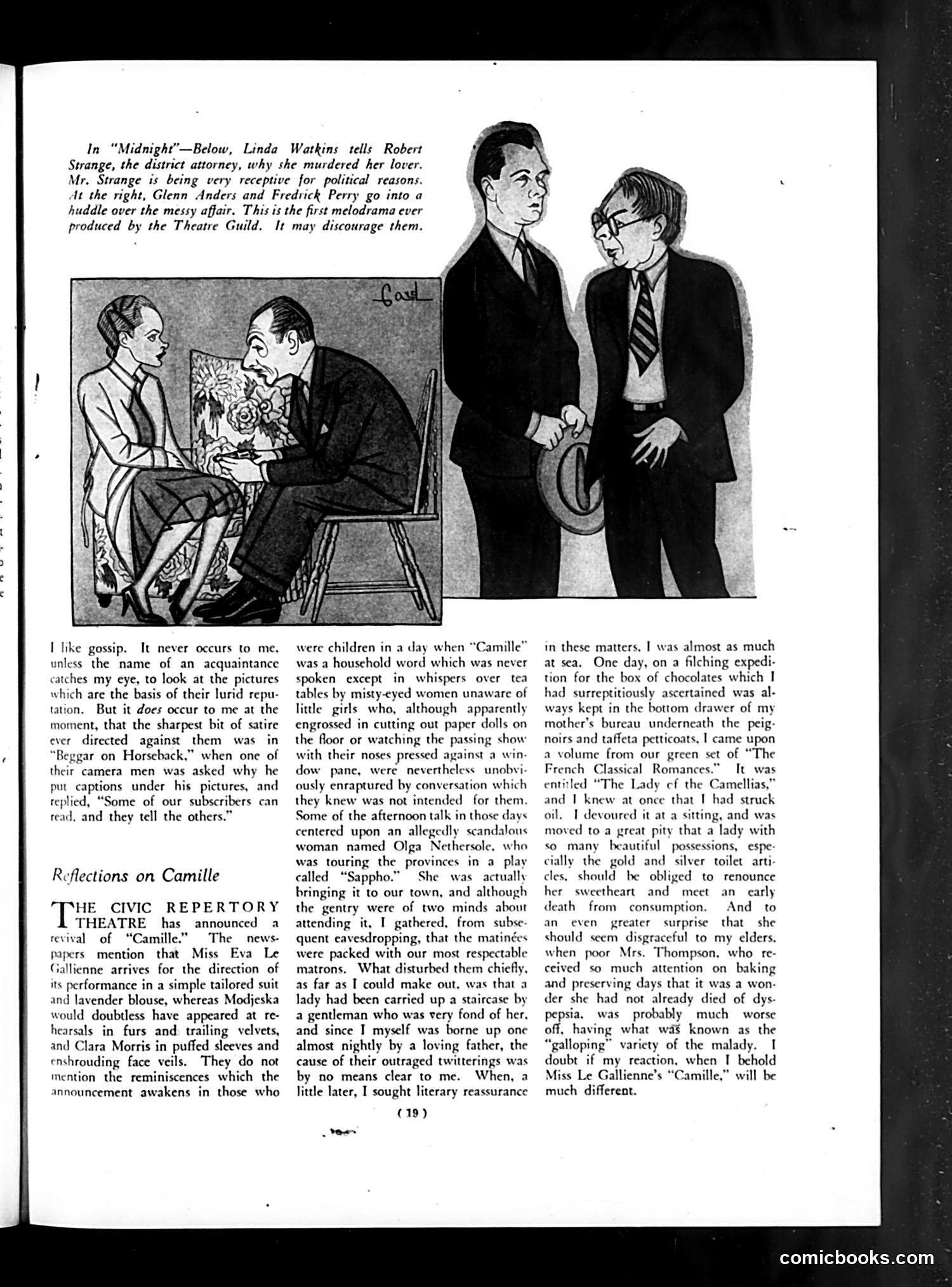
Explanation for Modern Readers This page contains two distinct pieces: Upper Section - Theater Review: Two cartoon panels satirize the Theatre Guild's first melodrama, "Midnight." The left panel shows actress Linda Watkins confessing a murder to a district attorney; the right shows two men (Glenn Anders and Fredrick Perry) discussing the scandal. The satire is directed at the Theatre Guild's decision to produce such sensational material—implying this lowbrow melodrama contradicts their typically more artistic reputation and "may discourage them." Lower Section - Essay: The author reflects on the 1920s theatrical revival of "Camille," contrasting how past actresses (Modjeska, Clara Morris) performed with elaborate costumes versus Eva Le Gallienne's simple tailored approach. The essay nostalgically recalls childhood scandal surrounding actress Olga Nethersole's tour in "Sappho"—which caused outrage among respectable matrons over a scene of a man carrying a woman upstairs. The author notes the irony: her own father carried her nightly without controversy, yet the theatrical version scandalized audiences. The piece humorously suggests moral hypocrisy in Victorian-era theater audiences.
"Movies" by Harry Evans - Life Magazine Movie Reviews This page contains film reviews from Life magazine's "Movies" column by Harry Evans, covering four films from the silent/early sound era. The reviews discuss: 1. "The Right To Love" - Praising Ruth Chatterton's acting, with a notable emphasis on a new "Noiseless Recording" sound technology by Western Electric, marking a technical advance in early talking pictures. 2. "Paid" - An adaptation of the stage play "Within The Law," highlighting Joan Crawford's dramatic abilities and noting it's superior to her previous roles measured by "her ability to appear presentable in swell gowns and furs, or in practically no clothes at all"—a subtle criticism of how studios exploited female stars. 3. "The Lash" - Featuring Richard Barthelmess in a post-Mexican-American War story where he plays a proud Mexican character ("Native Son") who becomes an outlaw resisting American encroachment. The reviews reflect 1920s attitudes toward cinema as entertainment, emphasizing plot, acting talent, and emerging sound technology as markers of quality.
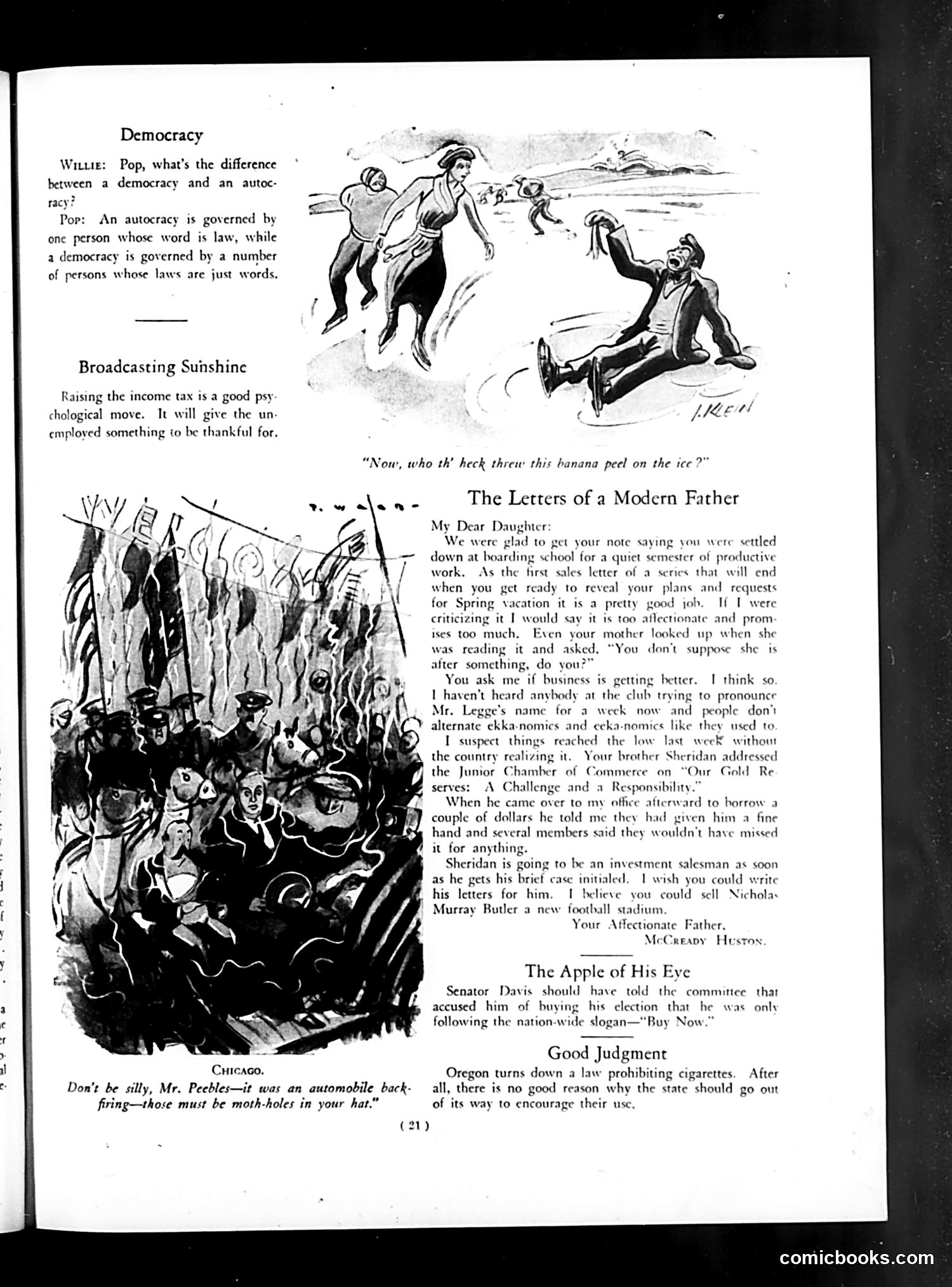
Life Magazine Page Analysis This page contains several satirical pieces mocking American society and politics circa early 20th century. The "Democracy" joke contrasts autocracy (one person's word = law) with democracy (many people's words = merely words), suggesting democratic lawmakers are ineffectual. The ice-skating cartoon depicts someone slipping on a banana peel, with the caption humorously asking who threw it—a classic slapstick scenario. "The Letters of a Modern Father" satirizes business culture and family dynamics. References to "Mr. Legge" and economists (spelled "ekka-nomics") suggest economic confusion during a recession. The son Sheridan exemplifies corporate superficiality: he gives impressive speeches about gold reserves but immediately borrows money afterward. The daughter's letter home is mockingly portrayed as financial manipulation. The "Apple of His Eye" piece sarcastically suggests Senator Davis bought his election while following the popular consumer slogan "Buy Now"—equating political corruption with commercial culture. The final cartoon humorously misattributes moth-holes in a man's hat to automobile backfiring, a joke about mechanical vehicles causing collateral damage.
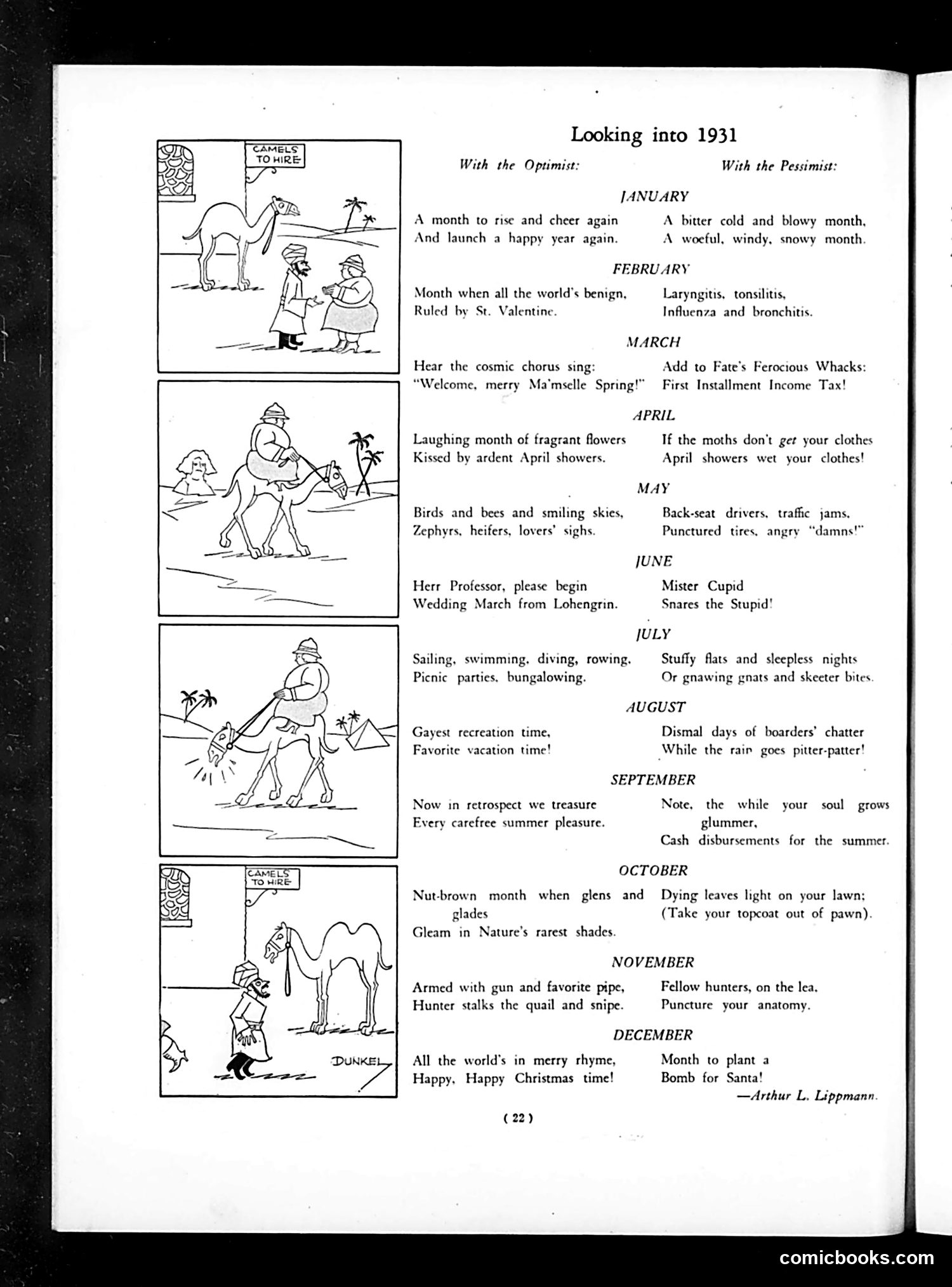
"Looking into 1931": A Pessimist's Calendar This humorous piece by Arthur L. Lippmann presents a month-by-month comparison contrasting an optimist's rosy view of 1931 with a pessimist's darker reality. The accompanying cartoon panels show figures enjoying leisure activities (camel rides, dancing, fishing) that reinforce the optimist's perspective. However, the text systematically undermines each month with practical complaints: January brings flu season, March reminds readers of income tax obligations, April showers ruin clothes, May brings traffic and tire punctures, June involves unwilling marriages, July features insect bites, summer ends with depleted finances, and November threatens hunting accidents. The final December entry—"Month to plant a Bomb for Santa!"—darkly jokes about economic despair and social unrest, likely referencing 1931's economic depression and associated anxieties about radical politics. The satire targets both naive optimism and genuine hardship facing ordinary Americans facing the Great Depression.
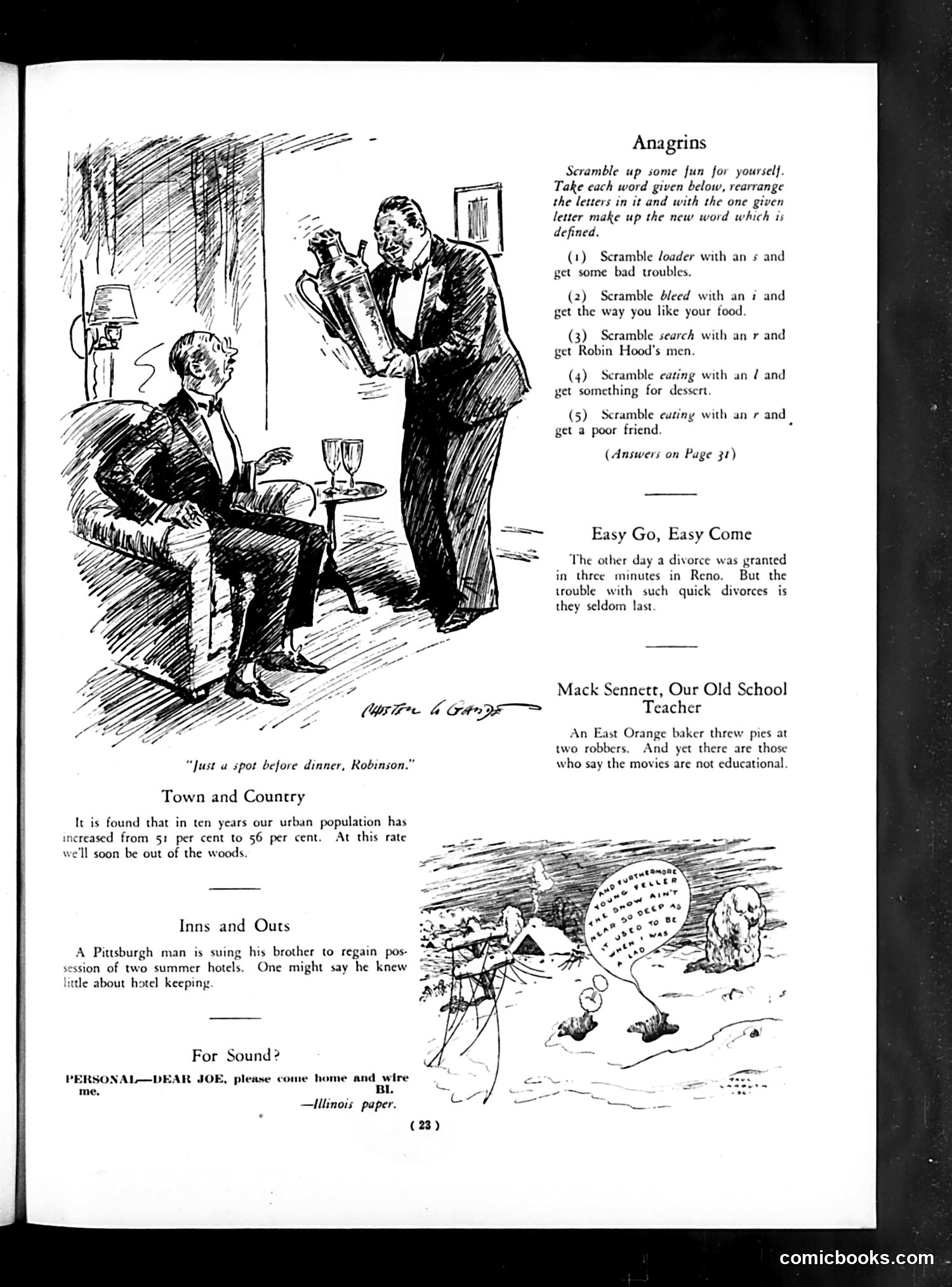
Life Magazine Page Analysis This page contains various humorous items typical of early 20th-century American satirical magazines: Main cartoon (top): Shows a waiter presenting a bottle to a seated diner, captioned "Just a spot before dinner, Robinson." The joke likely plays on the word "spot"—perhaps suggesting alcohol during Prohibition era or a double entendre about dining etiquette. Anagrins section: A word puzzle game where readers unscramble letters to form new words—light entertainment content. Short humor items: Satirical observations about contemporary life, including: - Urban population growth trends - Quick divorces in Reno (then famous for lax divorce laws) - A Pittsburgh property dispute between brothers - A reference to Mack Sennett (famous silent film director), joking that pie-throwing is "educational" Bottom cartoon: Shows an ant with a tennis racket playing against an insect, seemingly illustrating absurdist humor. Personal ad: A classified message with implied domestic drama. Overall, the page mixes wordplay, social commentary, and visual gags typical of Life's satirical approach to American culture.
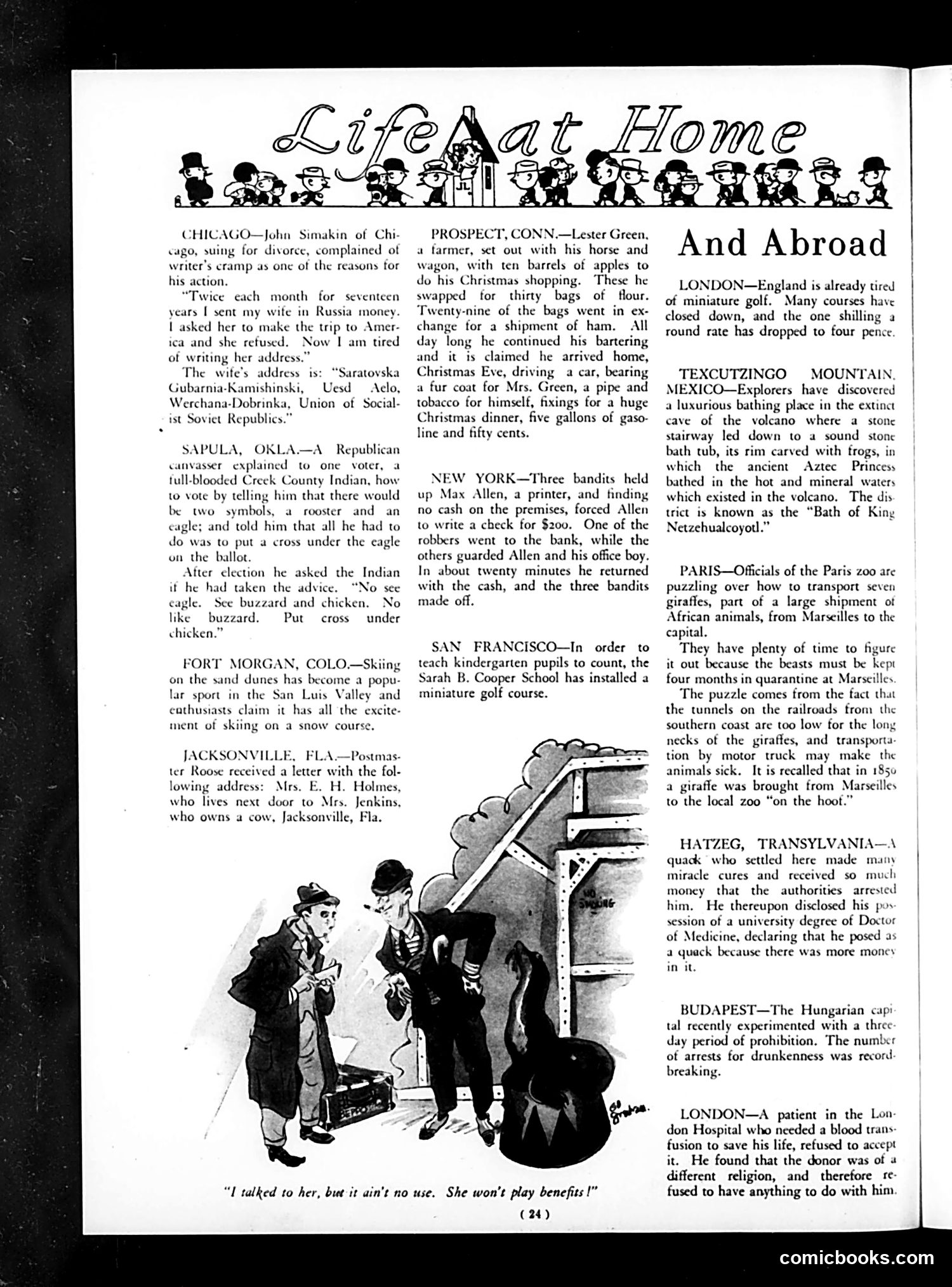
"Life at Home and Abroad" - Page Analysis This page from *Life* magazine presents a collection of humorous brief anecdotes about odd human behavior and absurd situations, organized geographically. The main cartoon depicts a man and woman at what appears to be a theater box office or similar venue, with the caption: "I talked to her, but it ain't no use. She won't play benefits!" This likely satirizes women's resistance to attending theatrical benefit performances—social obligations dressed as entertainment. The text items showcase comedic human folly: a Chicago man divorcing his wife over the burden of her Russian address; a Creek Indian misunderstanding voting instructions and selecting a "buzzard" instead of an eagle; clever bartering transforming apples into a car and luxuries; and criminals writing checks during robberies. The international section parodies faddish trends (miniature golf's rapid decline in London) and logistical absurdities (transporting giraffes whose necks are too tall for railway tunnels). The humor relies on understatement, irony, and the assumption that readers find human stubbornness, miscommunication, and bureaucratic incompetence amusing.
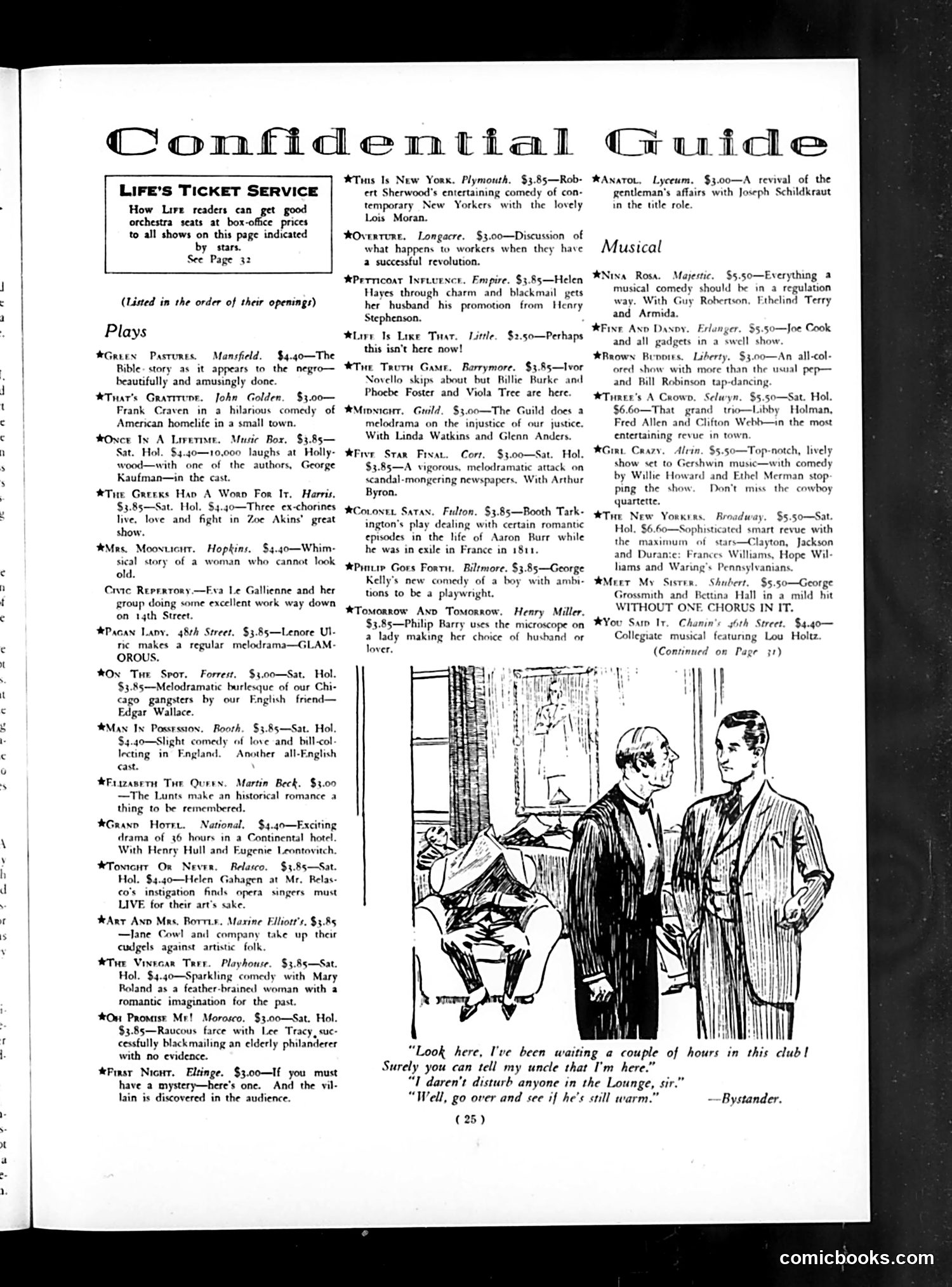
Explanation for Modern Readers This page is a theater guide listing Broadway shows and musicals with ticket prices (circa 1920s-30s). The illustration shows two men in a club—one seated, one standing—with dialogue about waiting for an uncle in "the lounge." The cartoon's humor is mild social satire: the seated man has been waiting hours for his uncle and doesn't want to disturb him by announcing his presence in the club's lounge area. The standing man reassures him the uncle is probably still there ("warm"). The joke relies on understated British comedy—a concern with propriety and not creating a fuss, typical of the period's humor style. The text lists theatrical offerings including reviews. Notable entries reference Aaron Burr, newspaper scandal-mongering, workers' revolutions, and social justice themes—reflecting the 1920s theatrical interest in contemporary social issues. Many entries are marked with asterisks, indicating Life magazine offered discounted tickets through their service (explained on page 32, referenced above).
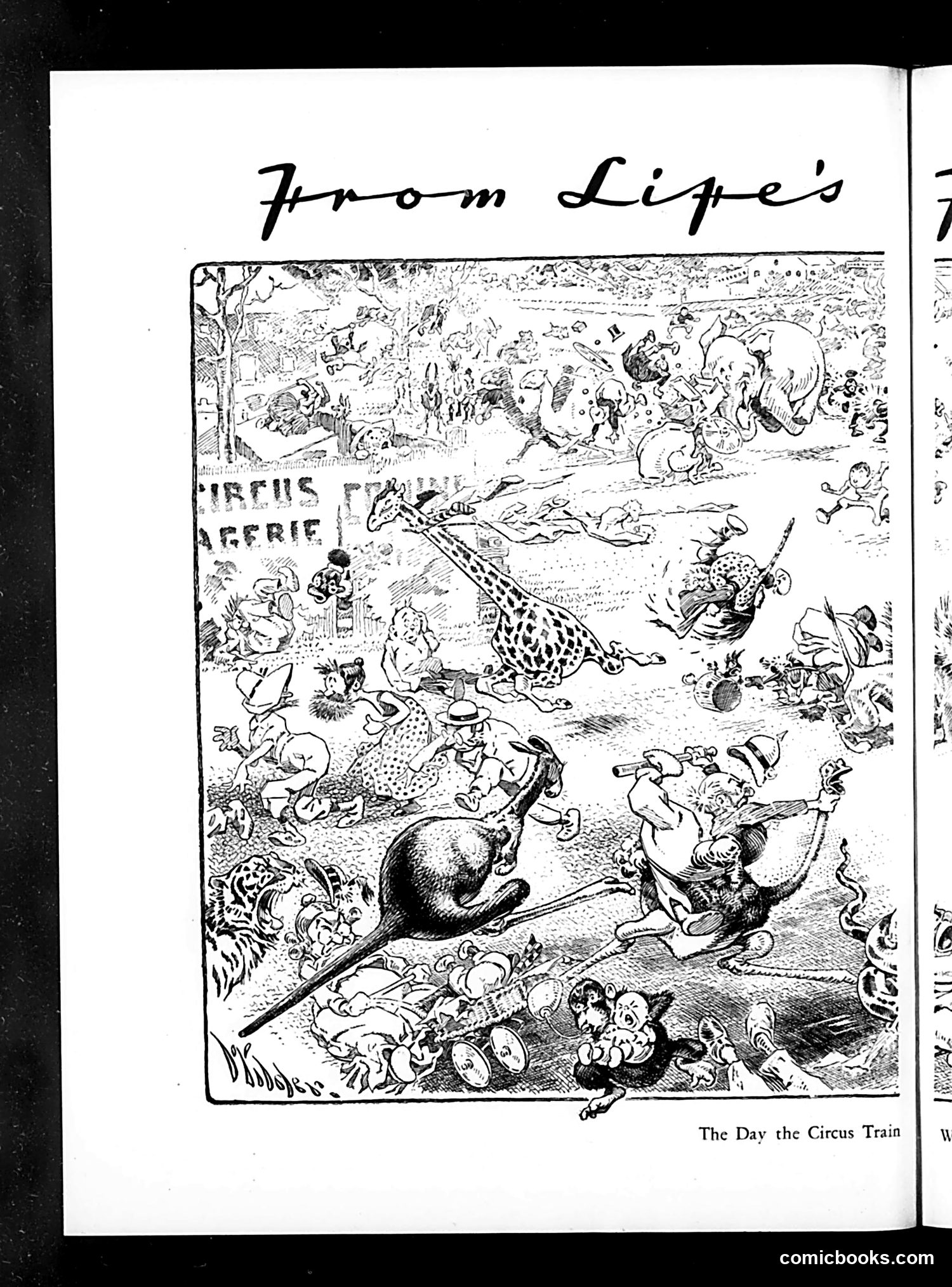
"The Day the Circus Train" from Life Magazine This illustration shows a chaotic scene titled "From Life's" depicting what appears to be a circus arrival or parade gone comically wrong. The image features numerous cartoon characters in frenetic activity—some figures appear to be circus performers or animals (including what looks like a giraffe), while others seem to be townspeople reacting to the circus's arrival. The satire likely mocks the spectacle and disorder that accompanied traveling circuses in early 20th-century America—the excitement, confusion, and disruption these events caused in small towns. The crowded composition with exaggerated, slapstick-style action emphasizes the carnival atmosphere and general mayhem. Without a visible date or clearer text, the exact historical event being referenced remains unclear, but this represents Life magazine's characteristic satirical humor about American popular culture and everyday life.
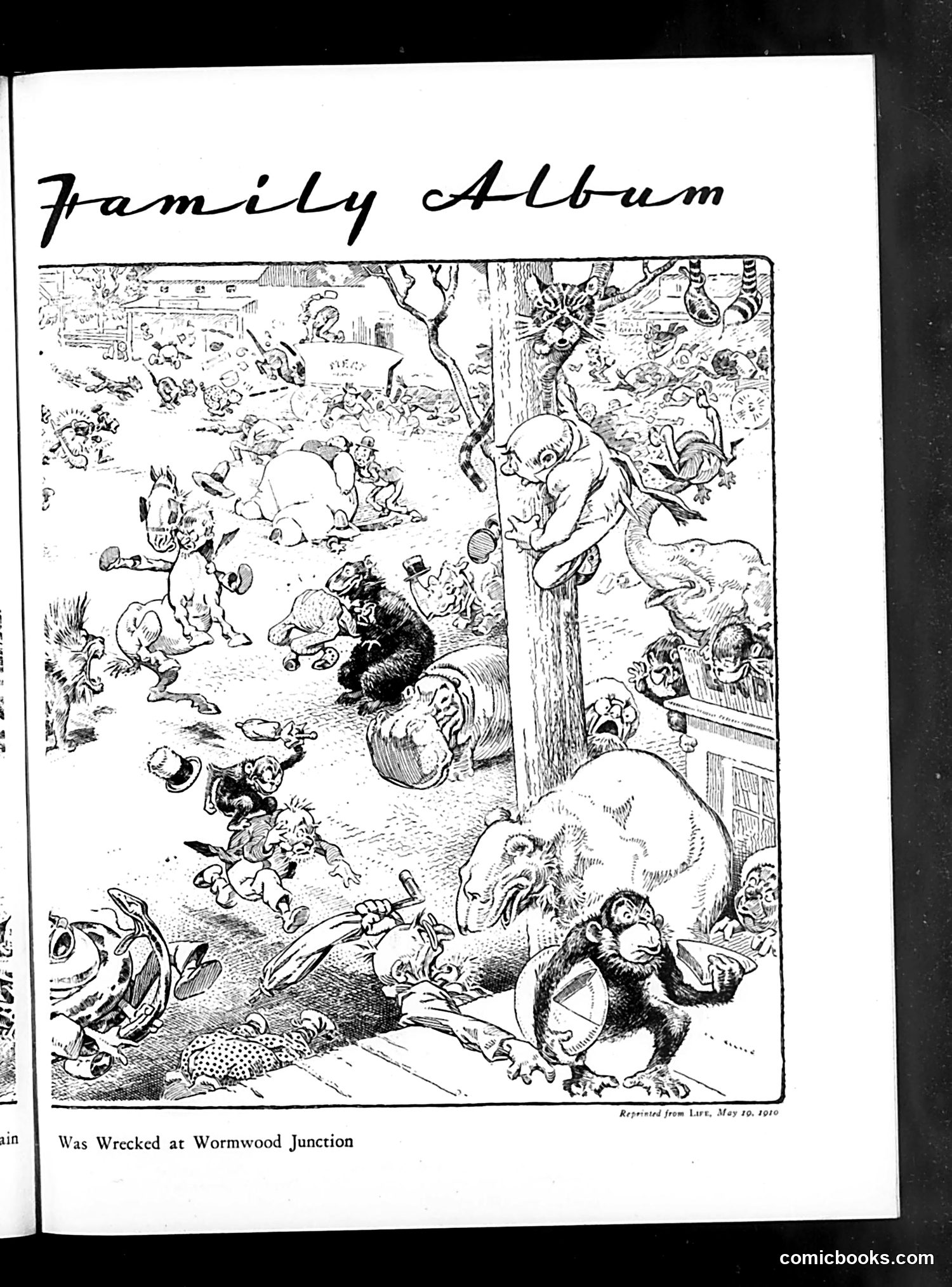
Family Album: "Was Wrecked at Wormwood Junction" This is a satirical illustration from Life magazine (reprinted May 10, 1910) depicting chaos at a railway junction. The crowded scene shows anthropomorphized animals and characters in distress amid wreckage, suggesting a train accident. The cartoon appears to be social commentary on railway safety or incompetence—a relevant concern in early 20th-century America when train accidents were frequent public disasters. The chaotic composition, with numerous figures scrambling amid debris, emphasizes the disorder and danger of the incident. The title "Wormwood Junction" is likely fictional, though the specific reference is unclear. The work satirizes either railway companies' negligence or the sensationalism surrounding such disasters, typical of Life magazine's mocking approach to contemporary social issues.
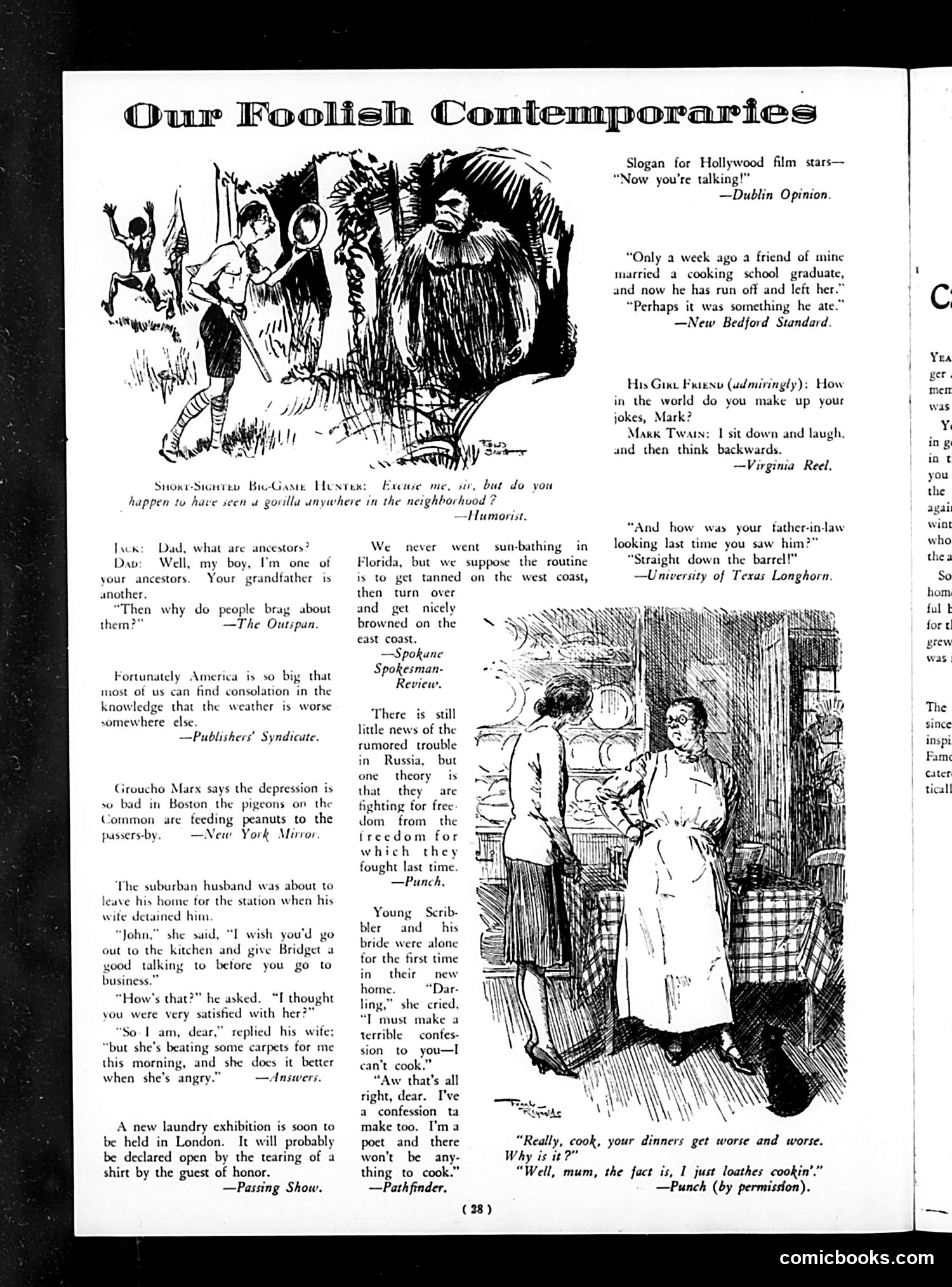
"Our Foolish Contemporaries" - Life Magazine Humor Page This page collects brief jokes and humorous anecdotes satirizing contemporary social foibles. Key themes include: Marriage & domestic life: Multiple jokes mock newlyweds discovering incompatibilities (a cooking school graduate wife, a husband learning his bride can't cook), reflecting post-WWI anxieties about changing gender roles and marital expectations. Celebrity culture: A dig at Hollywood stars' hollow catchphrases ("Now you're talking!"). Class/servant dynamics: A joke about a suburban husband instructing domestic help, reflecting period class attitudes. Depression-era hardship: A Groucho Marx quip about Boston's economic collapse so severe "pigeons feed peanuts to passersby" (inverting normal charity). Ancestry/American identity: A father-son joke deflating Americans' obsession with genealogy. The page's title—"Our Foolish Contemporaries"—frames these as satirical observations of modern absurdities, typical of Life's sophisticated humor aimed at educated readers. The cartoons and jokes reflect 1930s preoccupations with marriage, class, economic collapse, and social pretension.
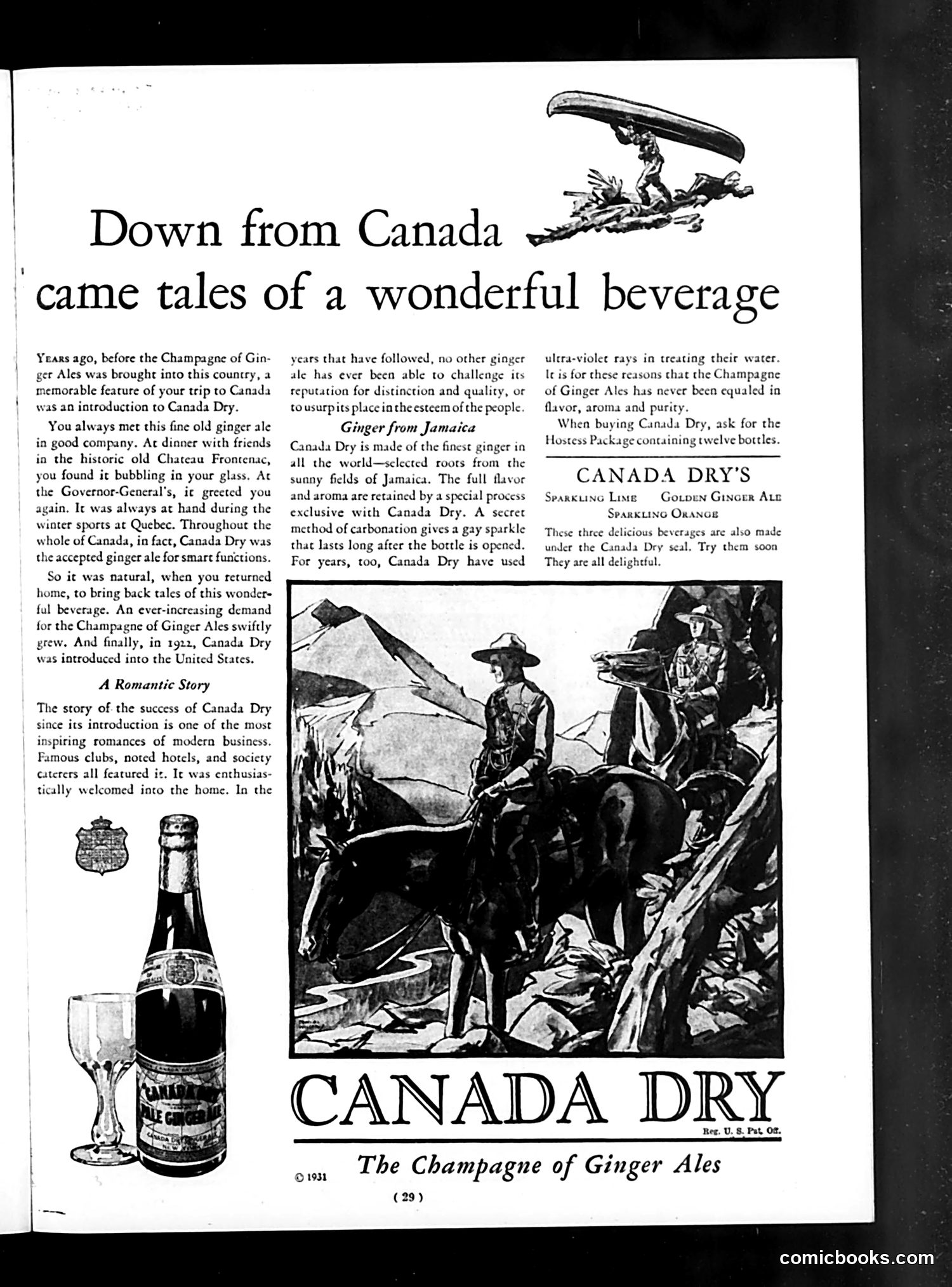
Canada Dry Advertisement (1931) This is a product advertisement, not political satire. It promotes Canada Dry ginger ale to American consumers by emphasizing its Canadian origin and prestige. The Appeal: The ad uses romantic nationalism—claiming the beverage was discovered by wealthy Americans visiting Canada (Chateau Frontenac, the Governor-General's residence, winter sports in Quebec). This creates aspirational appeal: drinking Canada Dry connects you to elegant Canadian society. The Image: The illustration depicts Canadian figures (likely Mounties or frontier settlers) in a mountainous landscape, reinforcing the product's "authentic Canadian" mystique. Historical Context: Published in 1931, this targets post-Prohibition America (Prohibition ended December 1933). The ad emphasizes ginger ale as a sophisticated alternative beverage, using "Champagne of Ginger Ales" as its slogan. The emphasis on Jamaica-sourced ginger, secret carbonation methods, and UV water treatment suggests quality competition in the emerging soft-drink market. No satire is present—this is straightforward marketing using romantic Canadiana imagery to sell a commercial product.
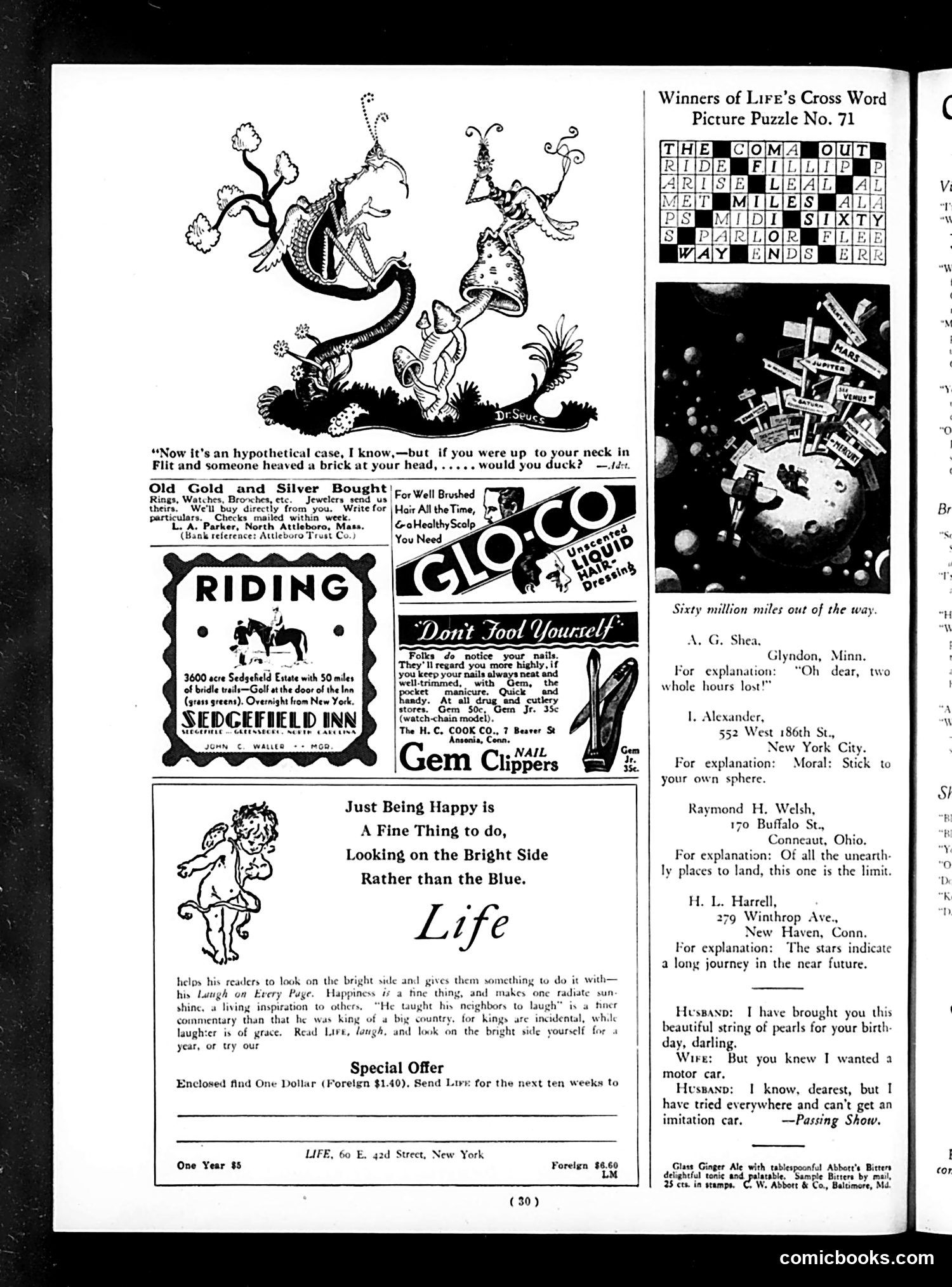
Life Magazine Page Analysis This page from *Life* magazine consists primarily of advertisements and puzzle winners rather than editorial cartoons. The top cartoon by Dr. Seuss depicts whimsical creatures and poses a humorous hypothetical question about self-preservation instinct—a lighthearted joke about human nature rather than political satire. The bulk of the page features commercial ads (Old Gold jewelry, Sedgefield Inn, Glooco hair product, Gem nail clippers) and a subscription promotion for *Life* itself, emphasizing the magazine's mission to help readers "look on the bright side" and find happiness through humor. The right column lists winners of a crossword-picture puzzle with their locations and explanatory answers. At the bottom is a brief joke about marital discord: a husband gives pearls instead of the requested motor car—a commentary on consumer desire and gender expectations in this era. The page reflects early 20th-century magazine culture: mix of humor, advertising revenue, and reader engagement through contests.
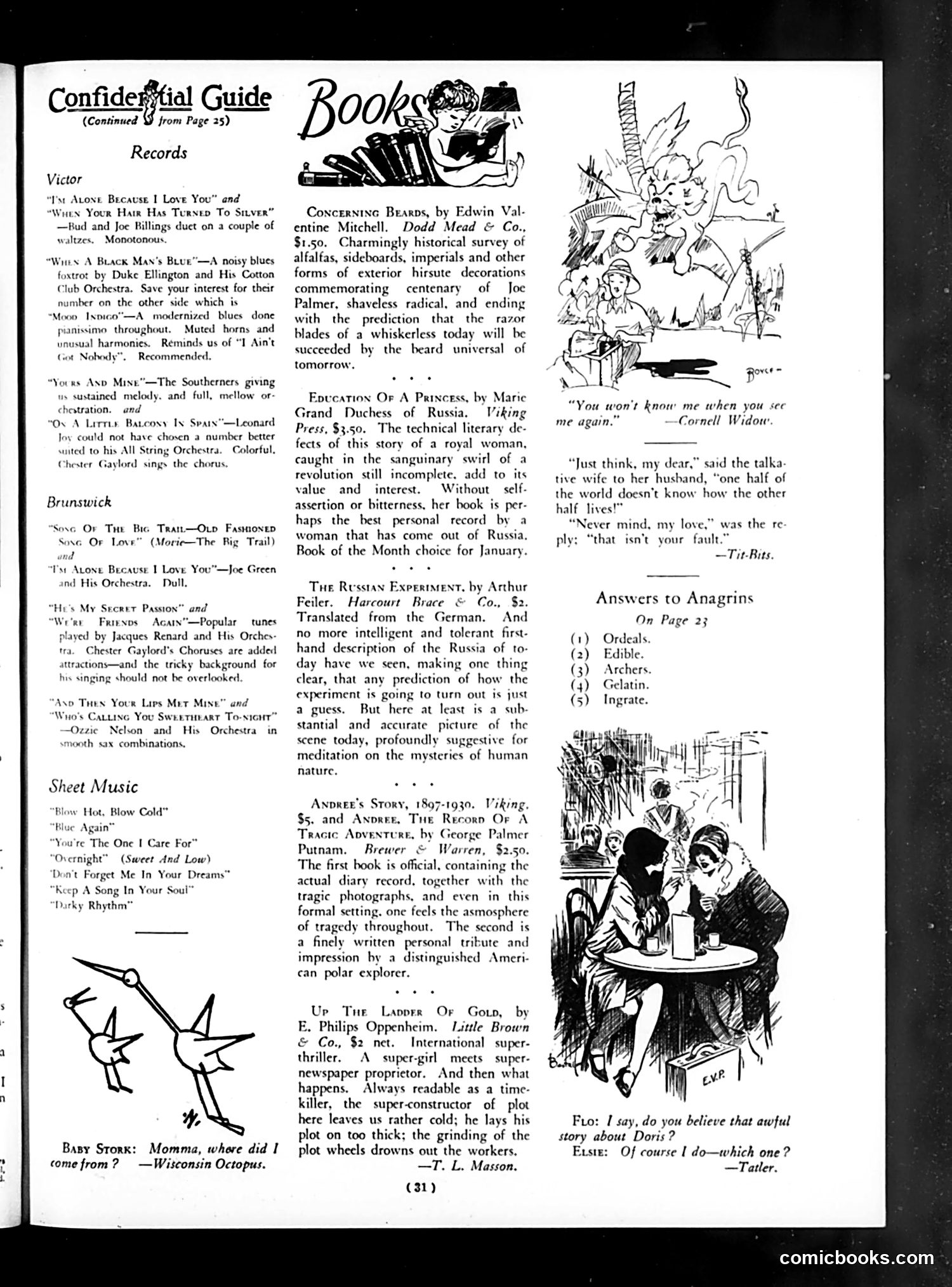
Political & Social Context for Modern Readers This page from *Life* magazine is primarily a book and music review section, not political satire. It contains: Book Reviews: Recommendations for current publications, including works on Russian revolution and politics (Feiler's "Russian Experiment"), a Russian Grand Duchess's memoir, and explorer accounts. Music Reviews: Evaluations of phonograph records and sheet music, featuring Duke Ellington and other contemporary jazz/dance artists. Cartoons: Two small illustrations—one showing a child's mishap with household items (top right), another depicting adults in conversation (bottom right)—appear to be humorous vignettes rather than political commentary. The page reflects 1920s American cultural interests: jazz popularity, fascination with the Russian Revolution's aftermath, and entertainment industry developments. The tone is lighthearted and consumer-focused, typical of *Life* magazine's entertainment and lifestyle coverage during this era.
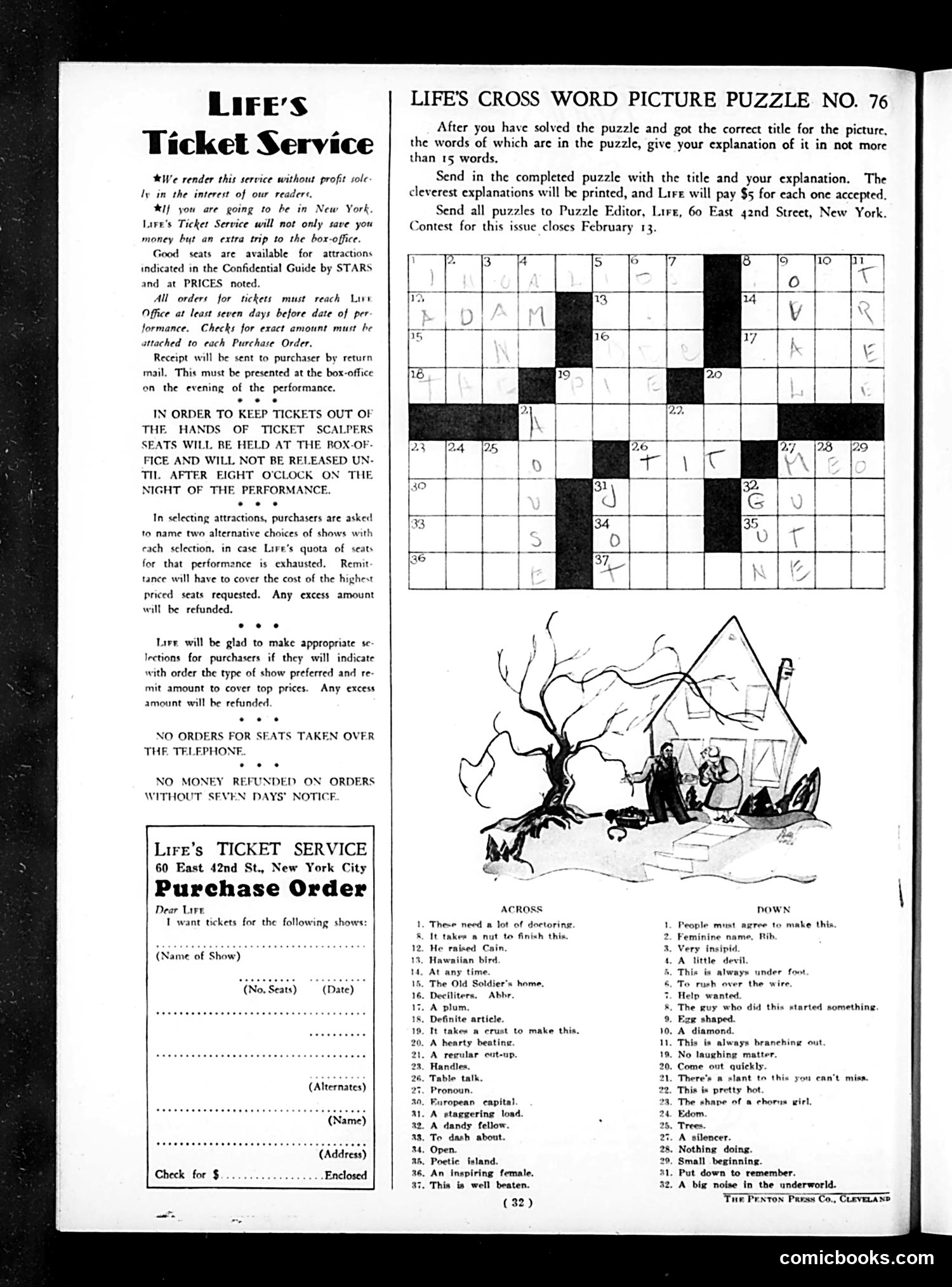
Life Magazine Crossword Puzzle Page This page is primarily advertising and service content rather than editorial satire. It features: 1. Life's Ticket Service: A business service offering theater tickets in New York City, designed to prevent ticket scalping. The terms emphasize booking procedures, seven-day advance notice requirements, and that seats won't be released until 8 PM on performance night. 2. Cross Word Picture Puzzle No. 76: A reader-participation game where solvers complete a crossword, then submit a 15-word explanation of the resulting picture. Life paid $5 for accepted explanations—a modest contest prize. 3. The illustration: Shows what appears to be a gnarled tree near a rustic house, likely the puzzle's answer image (unclear what the final picture title should be). This is a service/entertainment page typical of Life magazine's era, mixing promotional content with reader engagement activities rather than political or social commentary.
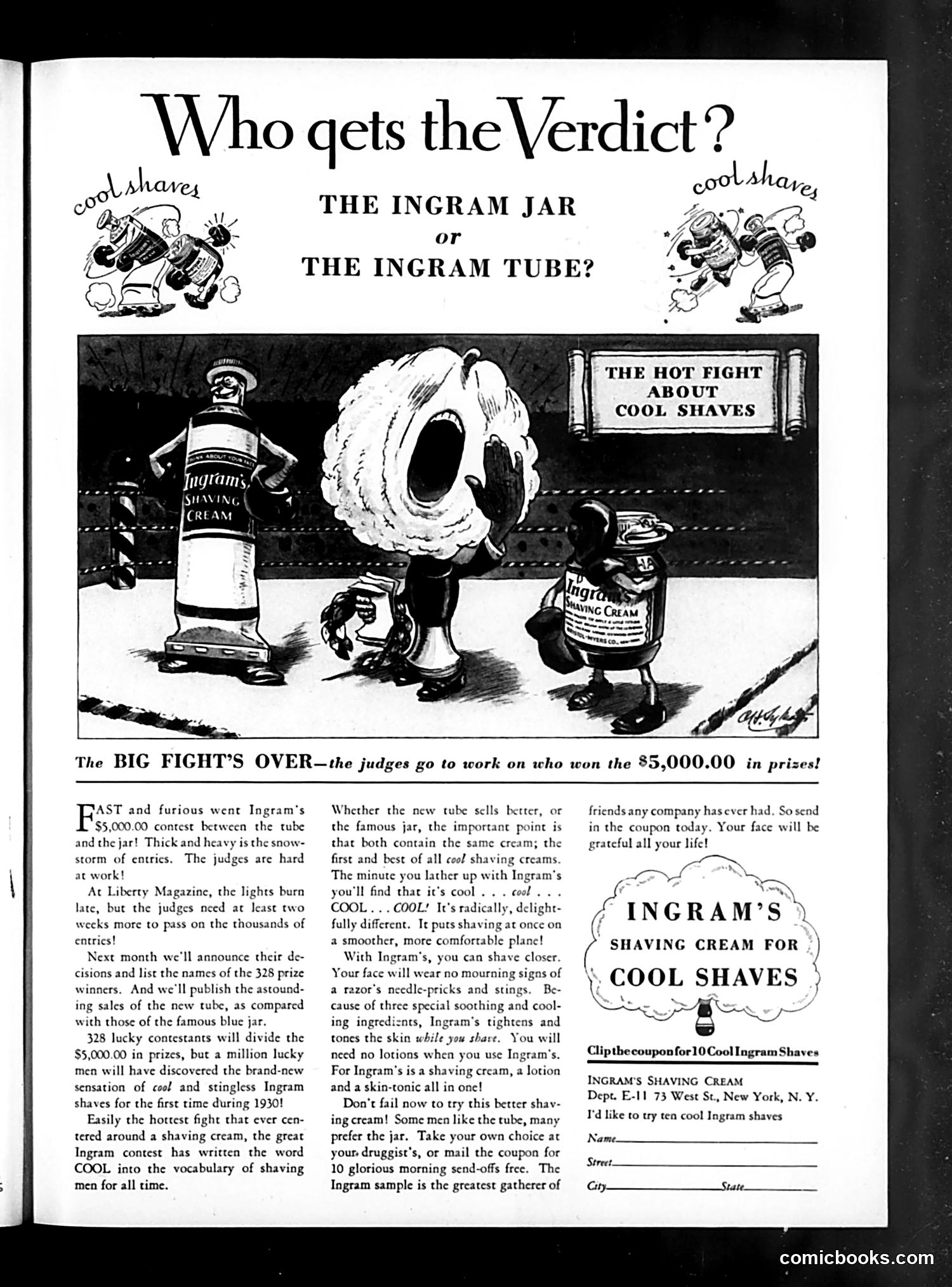
Analysis for Modern Readers This is primarily an advertisement for Ingram's Shaving Cream, not political satire. The page uses a playful "contest" narrative to market the product. The "Cartoon" Setup The illustration depicts a boxing ring where a jar and tube of shaving cream are anthropomorphized as competitors in a fight. This is humorous product positioning: Ingram's is promoting both packaging formats simultaneously while framing their market introduction as an entertaining "battle." The Marketing Context In 1930, Ingram's launched a major advertising campaign offering $5,000 in prizes (substantial money during the Depression) to consumers who entered a "contest" judging whether the new tube or traditional jar was superior. The campaign cleverly generated consumer engagement while promoting the innovation of tube packaging. The Joke The real "verdict" is that both formats contain identical cream—the contest itself is somewhat tongue-in-cheek marketing theater designed to create buzz and brand loyalty. This reflects early 20th-century advertising's shift toward entertainment-based consumer engagement rather than straightforward product claims.
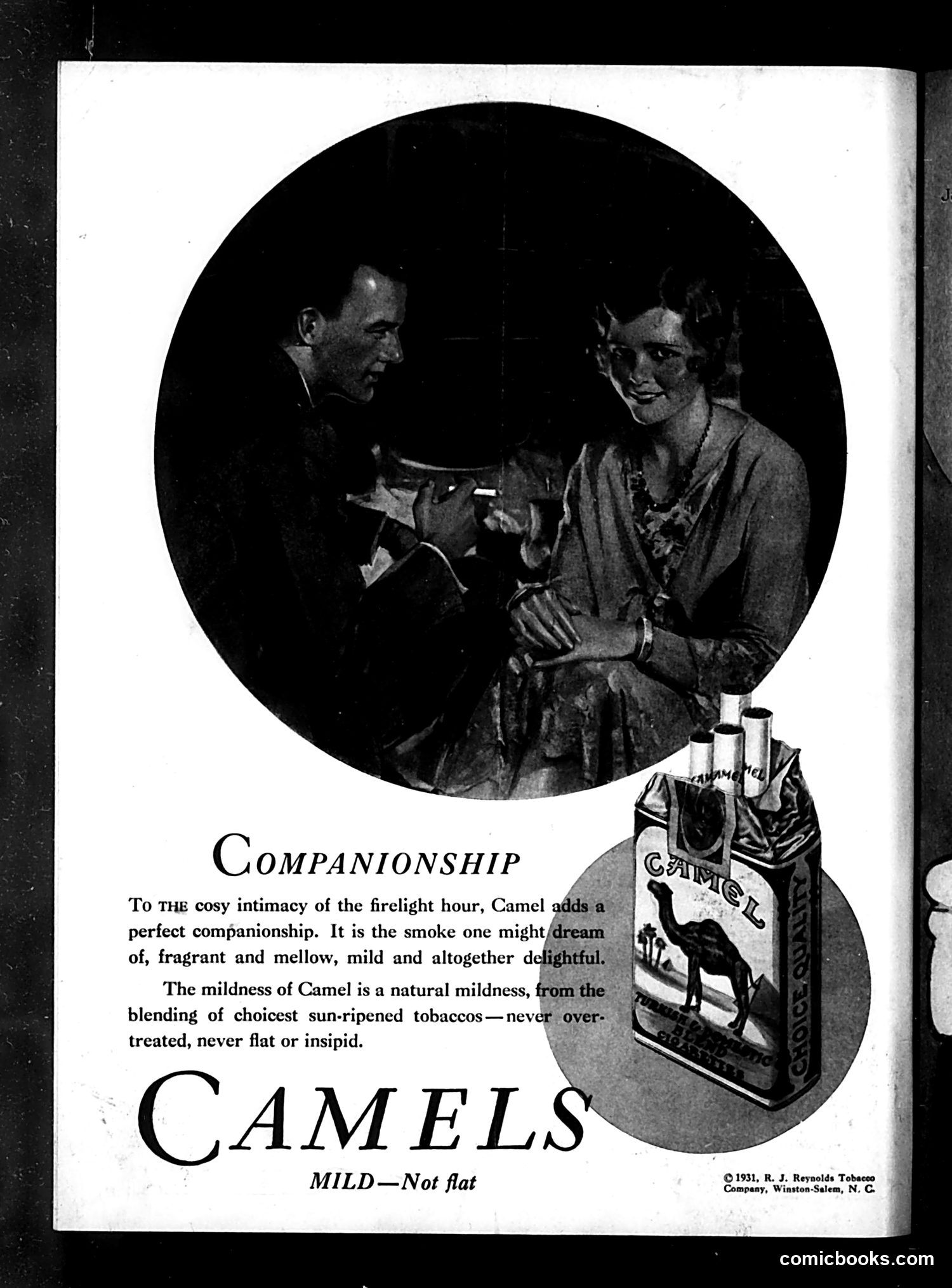
This is a Camel cigarette advertisement from 1931, not satire. It depicts a man and woman in intimate conversation by firelight, with a pack of Camel cigarettes positioned below. The ad copy emphasizes "companionship" and "cosy intimacy," positioning smoking as a romantic, social activity. The tagline "MILD—Not flat" suggests Camels offered a superior smoking experience compared to competitors. The imagery romanticizes cigarettes as enhancing personal connection and leisure. This represents typical early-20th-century tobacco marketing before health warnings, when cigarettes were openly advertised in mainstream publications targeting both men and women through appeals to sophistication and social bonding.