life
Life — February 6, 1931
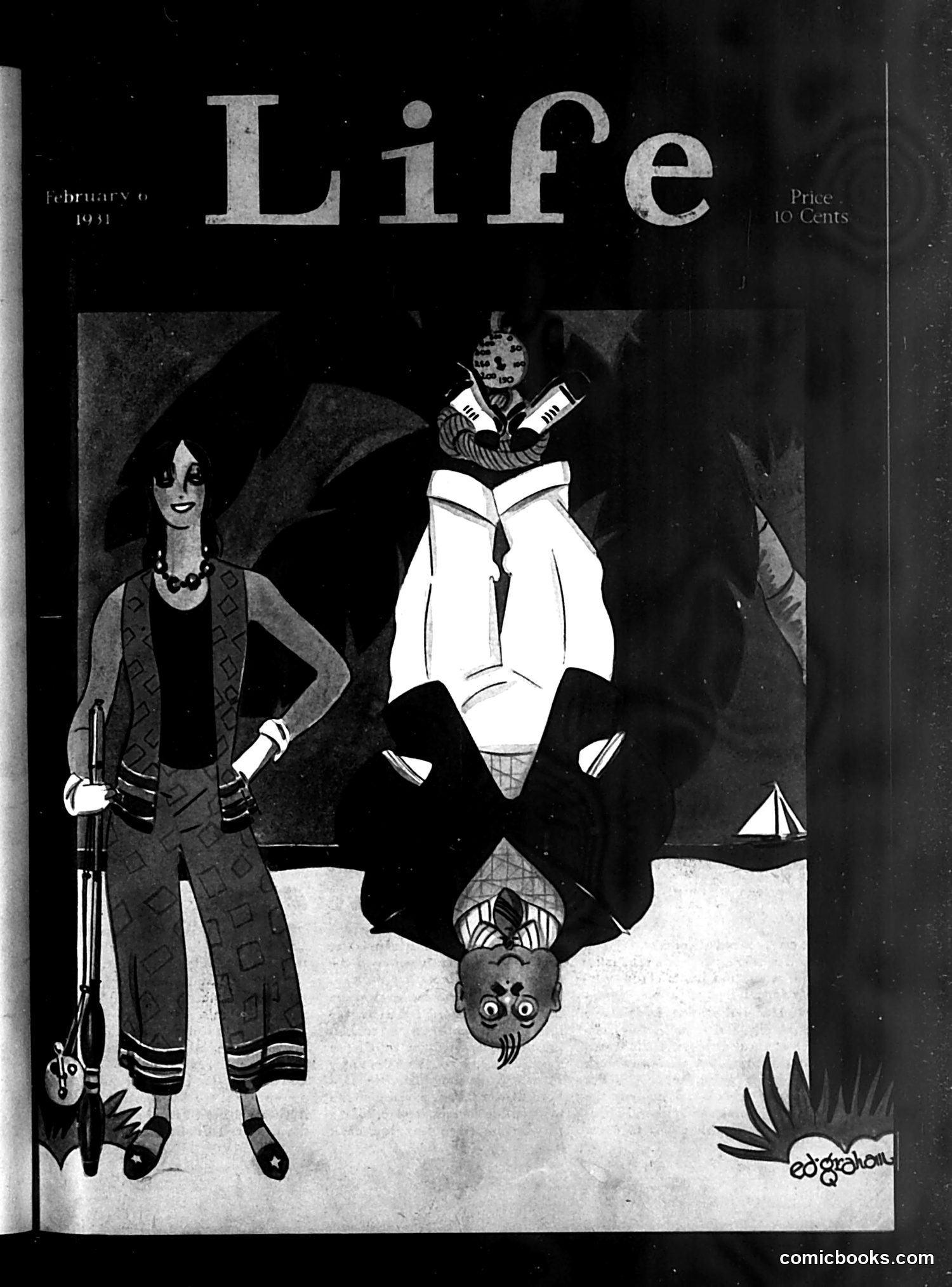
This is the cover of Life magazine from February 6, 1911, priced at 10 cents. The illustration depicts two figures in an Art Deco style: a woman on the left wearing exotic clothing with a headpiece and holding what appears to be a rifle, and an upside-down figure in the center wearing white bloomers or knickers with a large bow, holding books labeled "art" and "life." The satire likely comments on contemporary debates about women's roles—possibly mocking either the "New Woman" movement (women seeking education and independence) or fashionable exotic trends. The upside-down posture and exaggerated presentation suggest ridiculing modern women's fashion or social pretensions. Without additional context from the magazine's contents, the specific target remains unclear, though it reflects early 20th-century attitudes toward changing gender norms.
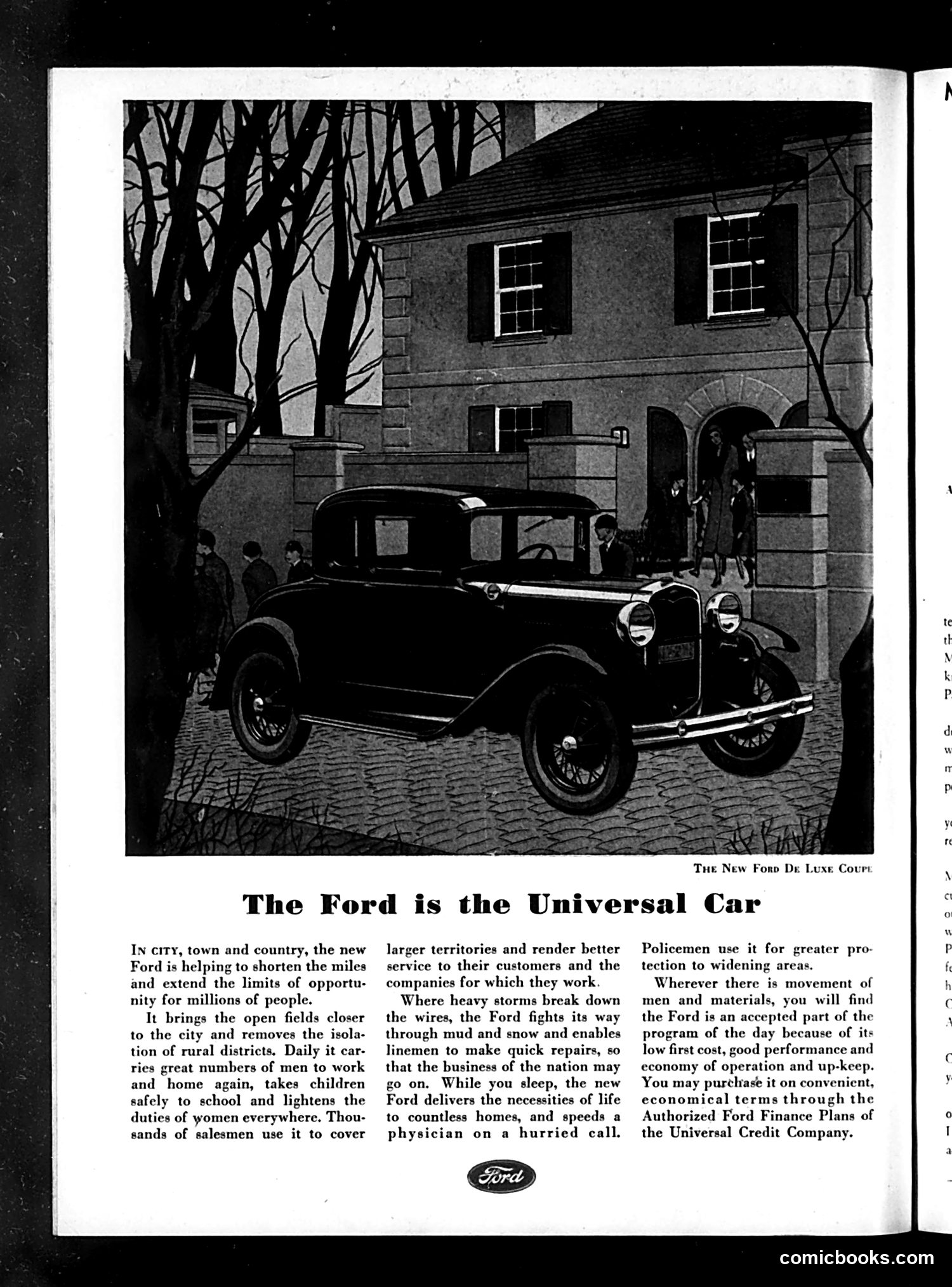
Analysis This is a Ford automobile advertisement, not a political cartoon. The page features a photograph of a Ford De Luxe Coupe parked in front of a brick building, accompanied by promotional text. The ad's messaging emphasizes Ford's role as "the Universal Car" — claiming it serves all social classes and professions across rural and urban America. The text highlights practical benefits: extending business opportunities, enabling doctors to make house calls, helping policemen patrol wider areas, and providing affordable transportation through the Universal Credit Company financing plan. The accompanying image of well-dressed people near the vehicle suggests aspirational middle-class status. This reflects 1920s-era marketing positioning the automobile as essential to modern American life and social mobility, rather than a luxury item.
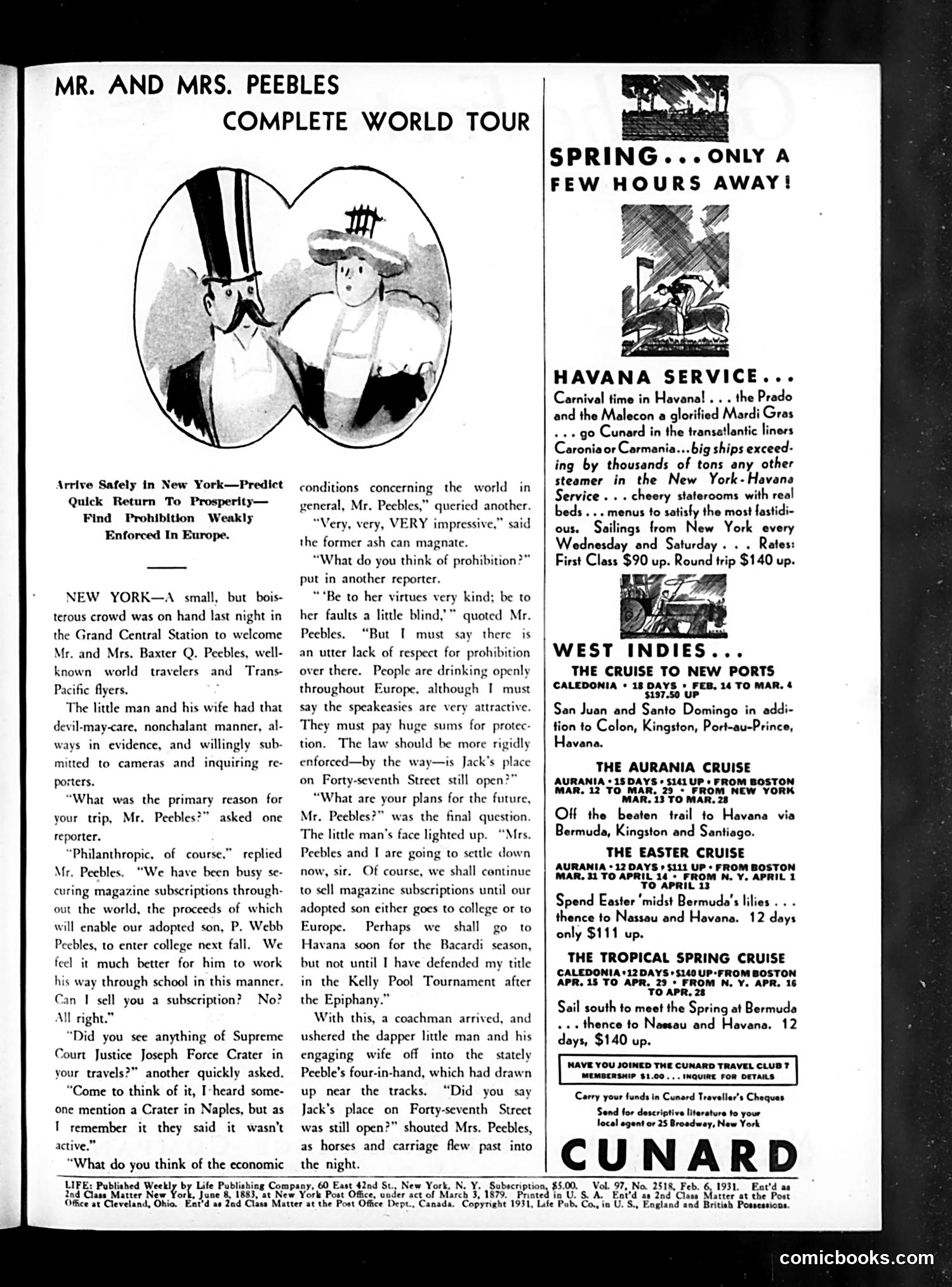
Analysis This page is primarily advertising for Cunard cruise lines, not political satire. The main cartoon depicts Mr. and Mrs. Baxter Q. Peebles, fictional wealthy world travelers, returning to New York. The accompanying article humorously describes their globe-trotting lifestyle and their plans to settle down—though they'll continue traveling for magazine subscriptions and their adopted son's education. The satire gently mocks the pretensions of wealthy Americans who travel constantly and use their voyages to appear cultured and philanthropic. References to Prohibition-era drinking in Europe and competitive leisure activities (like the "Kelly Pool Tournament") reflect 1931 concerns about wealthy Americans' behavior abroad. The page primarily showcases Cunard's various cruise offerings: Caribbean routes, Easter cruises, and spring voyages to Bermuda and Havana.
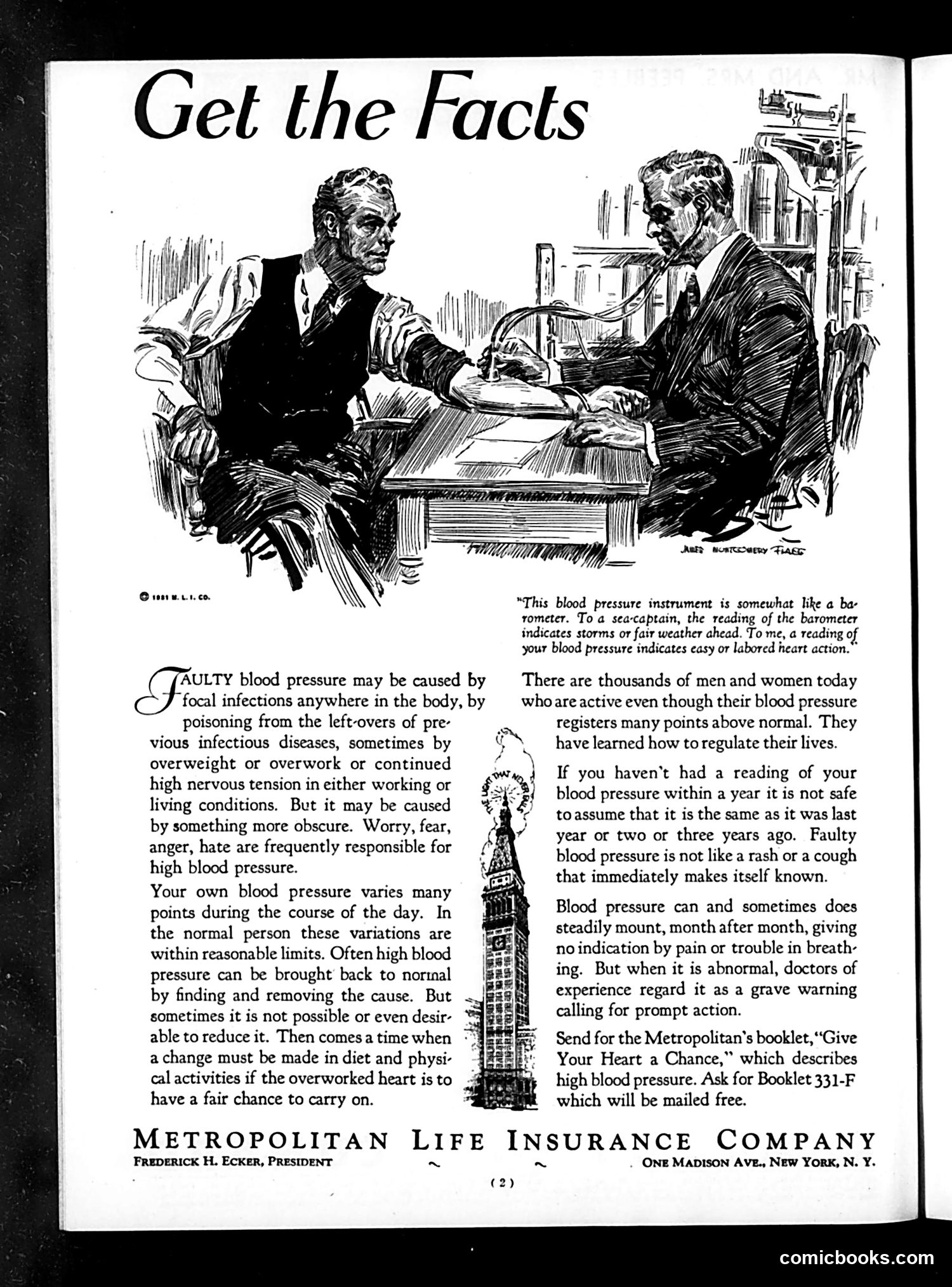
"Get the Facts" - Metropolitan Life Insurance Advertisement This is a health education advertisement, not political satire. The illustration shows two men in business attire discussing blood pressure measurement—one appearing to explain the instrument to the other, likely a doctor and patient. The text warns readers about faulty blood pressure caused by infections, overweight, overwork, stress, and emotional states (worry, fear, anger, hate). It emphasizes that blood pressure fluctuates normally but can dangerously accumulate over time without obvious symptoms, requiring regular medical monitoring. The advertisement promotes Metropolitan Life Insurance's free booklet "Give Your Heart a Chance" (Booklet 331-F) as health education, positioning insurance companies as public health advocates—a common early 20th-century corporate strategy linking life insurance to preventive medicine awareness.
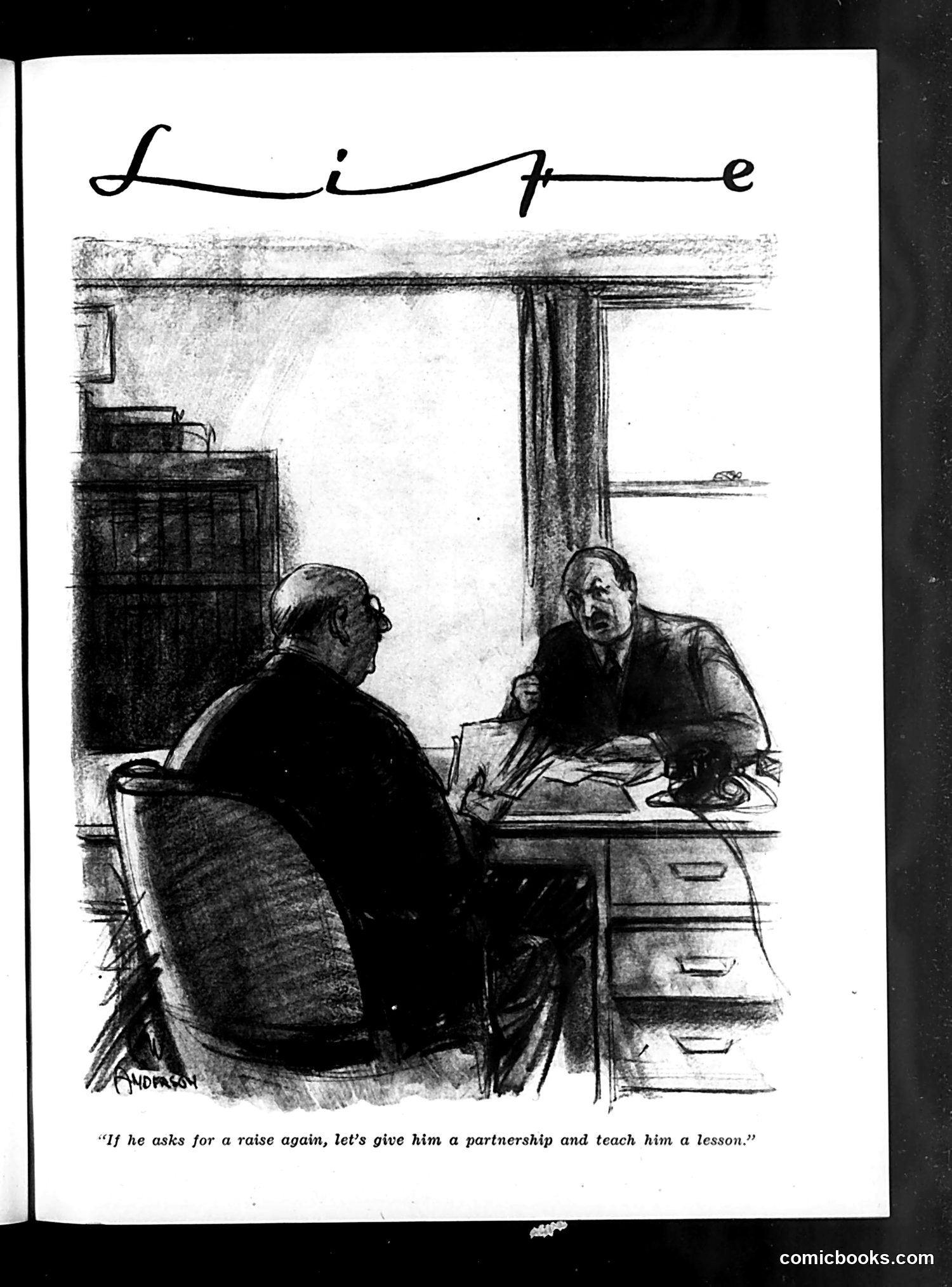
Cartoon Analysis This cartoon depicts a workplace conversation between two men at a desk, with the caption: "If he asks for a raise again, let's give him a partnership and teach him a lesson." The satire targets management's cynical approach to employee demands. Rather than granting a straightforward salary increase, the bosses propose offering a "partnership"—which sounds generous but is actually a trap. By making the employee a partner, they shift him from salary to profit-sharing, likely reducing his guaranteed income while increasing his responsibility and risk. The phrase "teach him a lesson" makes the punitive intent explicit. The cartoon critiques how employers manipulate language and false promotions to avoid legitimate wage increases, using the appearance of advancement to actually disadvantage workers.
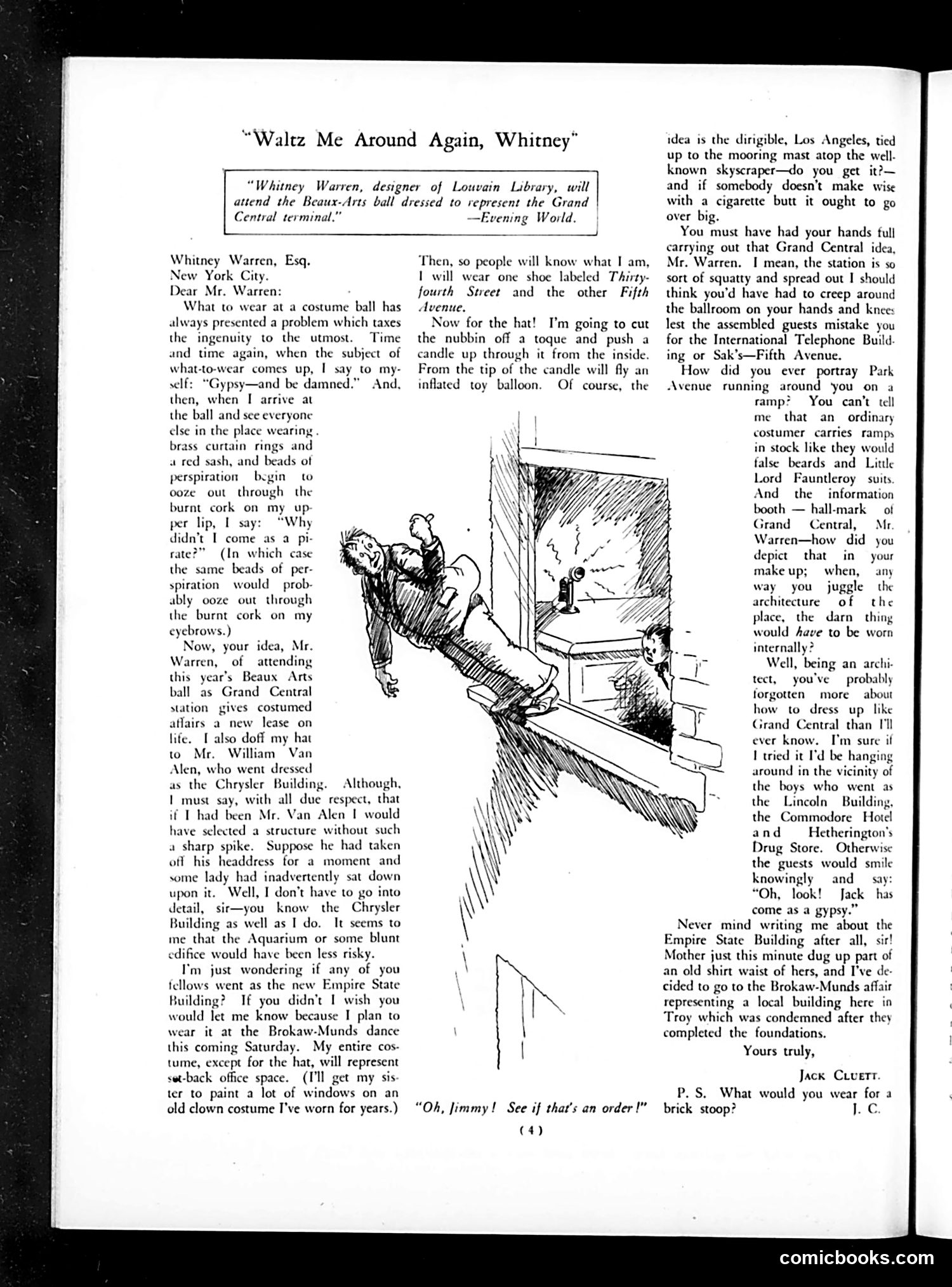
Analysis of "Waltz Me Around Again, Whitney" This page features a letter from Jack Cluett to Whitney Warren, an architect, about costume ideas for the Beaux Arts Ball at Grand Central Terminal. The accompanying illustration shows a figure in an exaggerated costume tumbling or falling through a window or architectural opening. The satire mocks Warren's proposal to create an elaborate Grand Central-themed costume. Cluett humorously critiques the impracticality—suggesting the costume would be so architecturally complex that guests would mistake Warren for a gypsy, and noting that wearing the building itself would be physically impossible and absurd. The title references a popular song, adding comedic irony. The joke targets pretentious architectural ambition and the difficulty of translating grand designs into wearable reality.
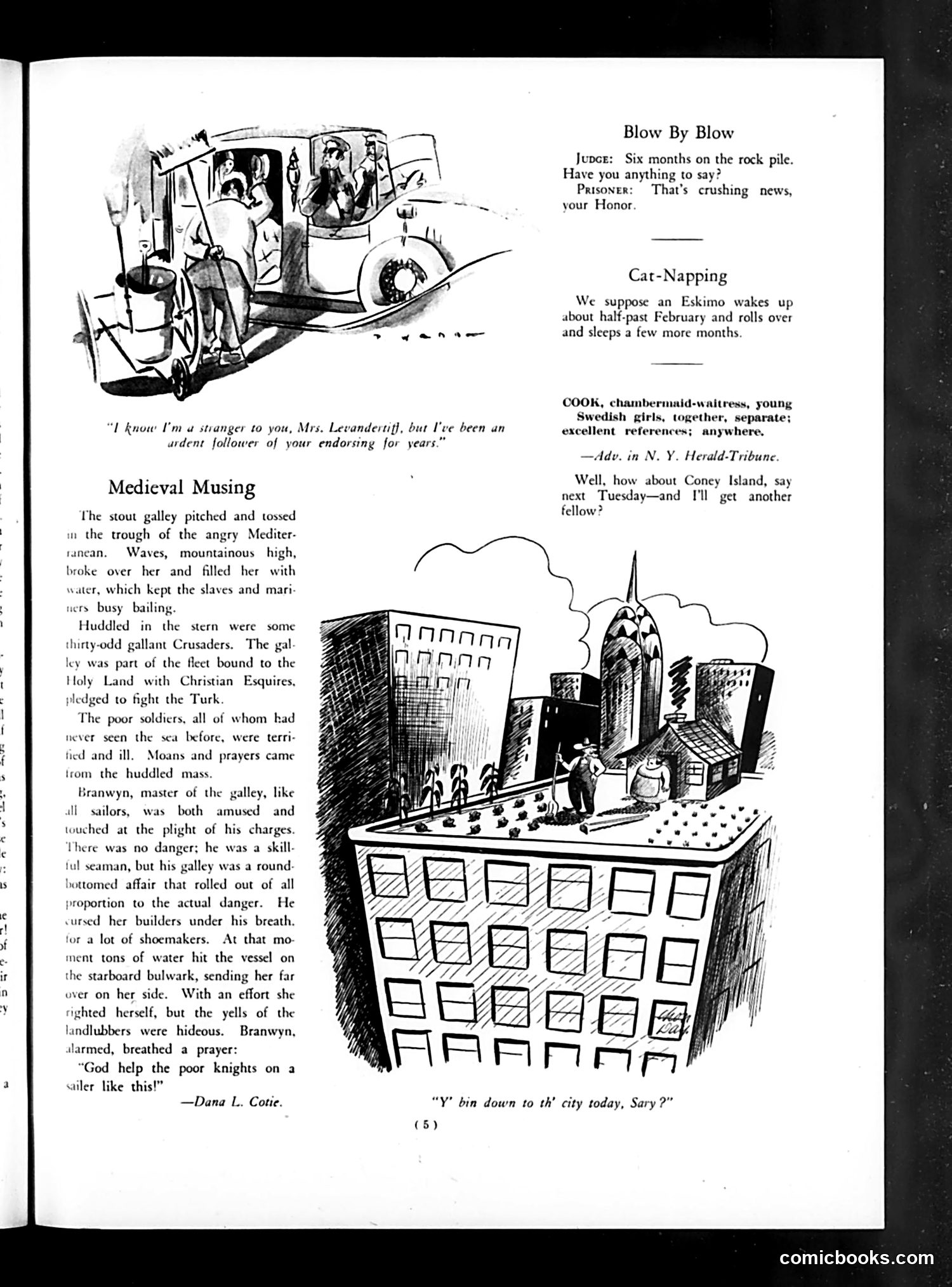
Analysis of Life Magazine Page This page contains several distinct satirical pieces: "Blow By Blow" shows a judge sentencing a prisoner to six months on a rock pile—a hard labor punishment. The prisoner's quip about "crushing news" is a pun on the literal rock-crushing work. "Car-Napping" jokes that an Eskimo might sleep through winter and wake in February to find their car stolen—playing on the stereotype of extreme Arctic hibernation. "Medieval Musing" is a longer narrative poem by Dana L. Cotie about Crusaders on a galley ship during a storm. It depicts religious soldiers terrified during rough seas, with their captain Branwyn cursing under his breath while praying. The cartoons use wordplay and exaggeration typical of early 20th-century American humor magazines to satirize justice systems, regional stereotypes, and historical irony.
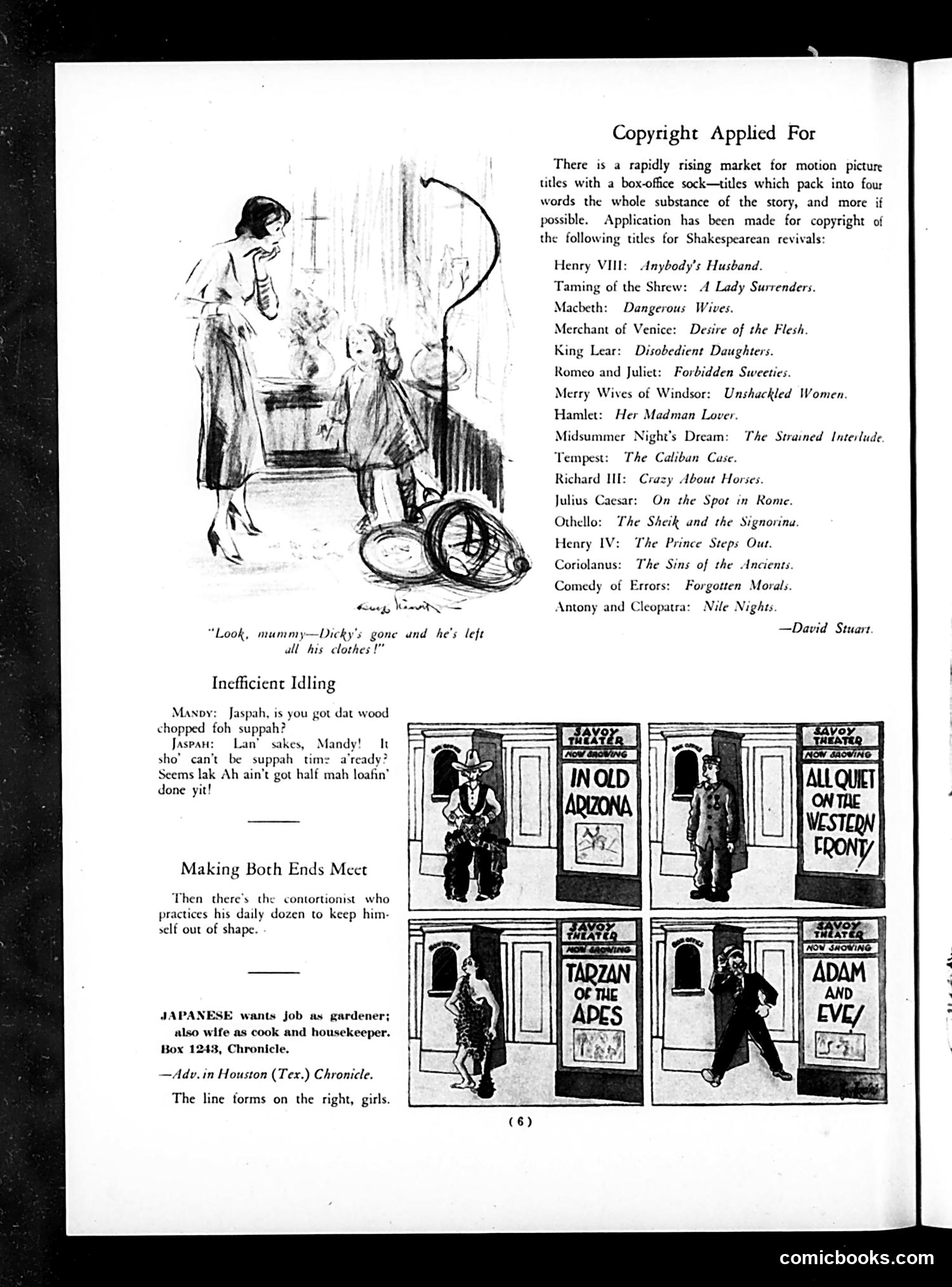
Page Analysis This page contains three distinct sections: Top: A sketch titled "Copyright Applied For" listing Shakespeare play adaptations for motion pictures—showing how classical works were being rapidly adapted for film with sensational titles ("Forbidden Sweetness" for Romeo and Juliet, "Unhackled Women" for Merry Wives of Windsor, etc.). The accompanying cartoon depicts a mother and child viewing discarded clothes, captioned "Look, mummy—Dicky's gone and he's left all his clothes!" Middle: Brief humor pieces including "Inefficient Idling" (dialogue about chopped wood) and "Making Both Ends Meet" (about daily exercise routines). Bottom: A comic strip sequence showing figures posing before movie posters for films like "In Old Arizona," "Tarzan of the Apes," and "Adam and Eve"—satirizing early silent film titles and theatrical promotion. The overall theme critiques Hollywood's commercialization of entertainment through sensationalized adaptations and marketing.
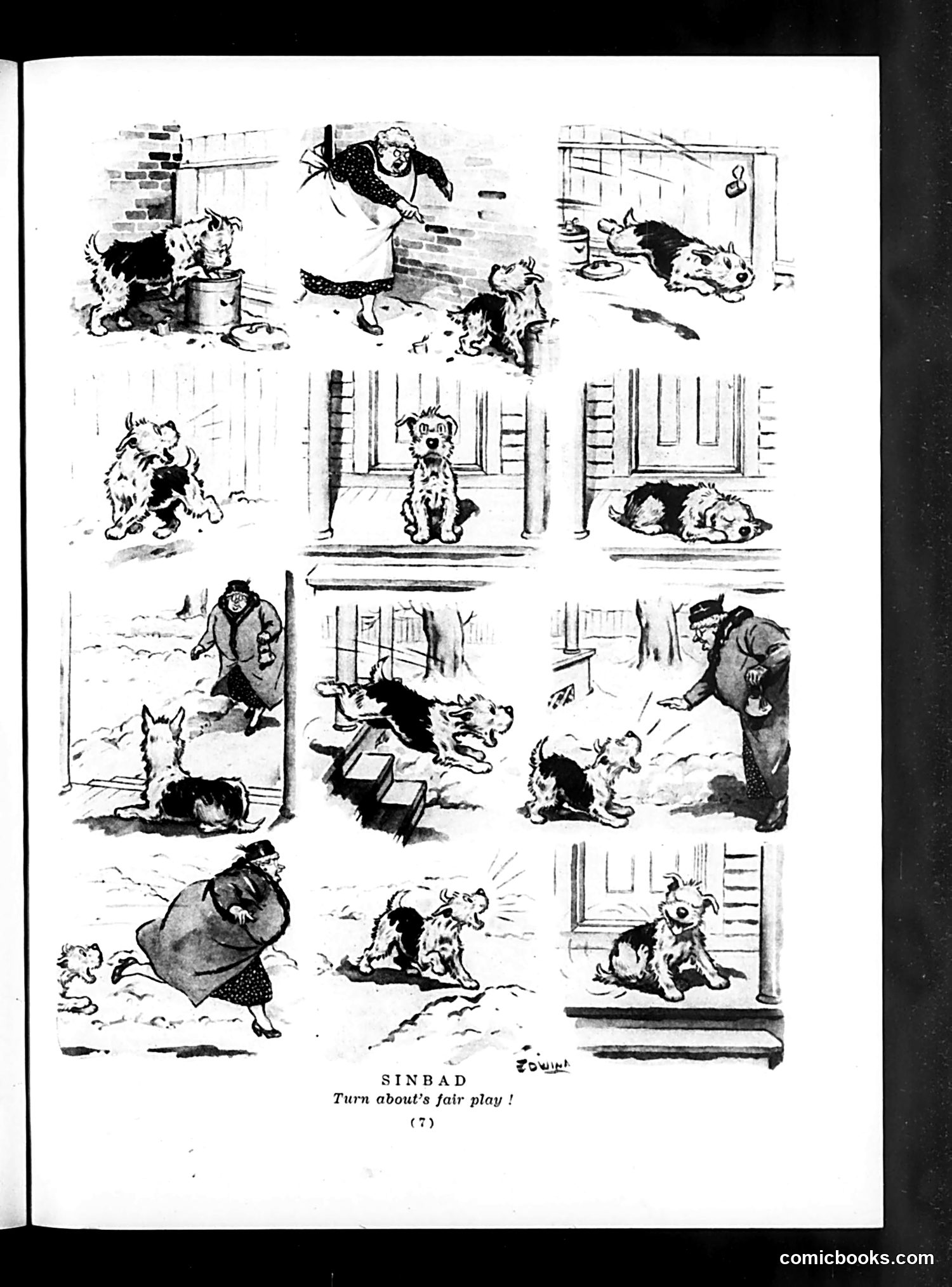
Sinbad Comic Strip Analysis This is a multi-panel comic strip titled "Sinbad" with the caption "Turn about's fair play!" The strip depicts a series of comedic interactions between what appears to be Sinbad (a character recognizable from adventure tales) and various dogs in domestic settings. The humor relies on role reversals: dogs chase Sinbad through streets, into homes, and around people in positions of authority (likely police or officials). The "turn about's fair play" caption suggests the joke is that Sinbad—typically a figure of adventure and authority in his own stories—is now being pursued and harassed, much as he might pursue others. The strip appears to be early 20th-century satirical comedy using slapstick and visual gags rather than political commentary.
Analysis of "Life Looks About" Page This is a political commentary page discussing government relief efforts, likely from the Great Depression era. The cherub illustration at top left is decorative. The text references William Neverdo's proposal for a Cromwell (apparently a revolutionary governmental restructuring), which the author finds surprisingly radical coming from a conservative. The piece discusses tension between the President and Senate over relief funding and appropriations. Key figures mentioned include Frank Vanderlip (discussing banking failures and economic depression causes) and E. S. Martin (the apparent author). The satire critiques governmental inefficiency, the discrepancy between executive and legislative branches on relief spending, and debates over whether capitalism itself requires reform. The overall tone suggests frustration with bureaucratic gridlock during economic crisis.
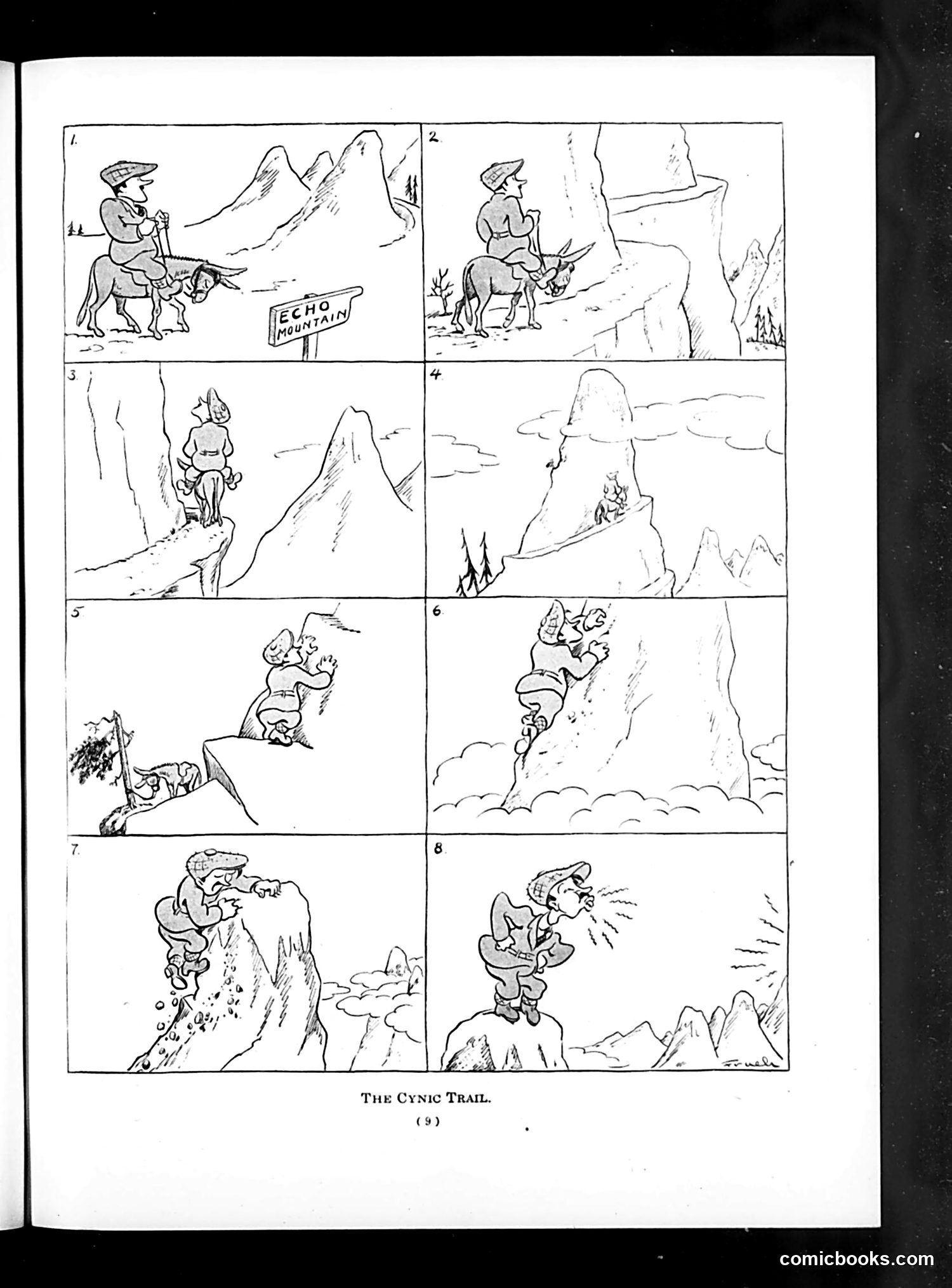
The Cynic's Trail This eight-panel comic strip appears to satirize mountain tourism and the experience of hiking. A figure on horseback/donkey encounters "Echo Mountain" (panel 1-2), then climbs increasingly steep terrain through panels 3-4. By panels 5-6, the character struggles dramatically on near-vertical rock faces. Panels 7-8 show the exhausted climber at the summit, apparently disappointed or underwhelmed by the destination. The satire likely targets the contrast between romantic expectations of mountain adventure versus the grueling, unglamorous reality—a common theme in Life magazine's humor. The title "Cynic's Trail" reinforces this deflation of idealism. The progression from eager start to bedraggled finish critiques both tourism marketing and human folly in pursuing difficult goals for minimal reward.
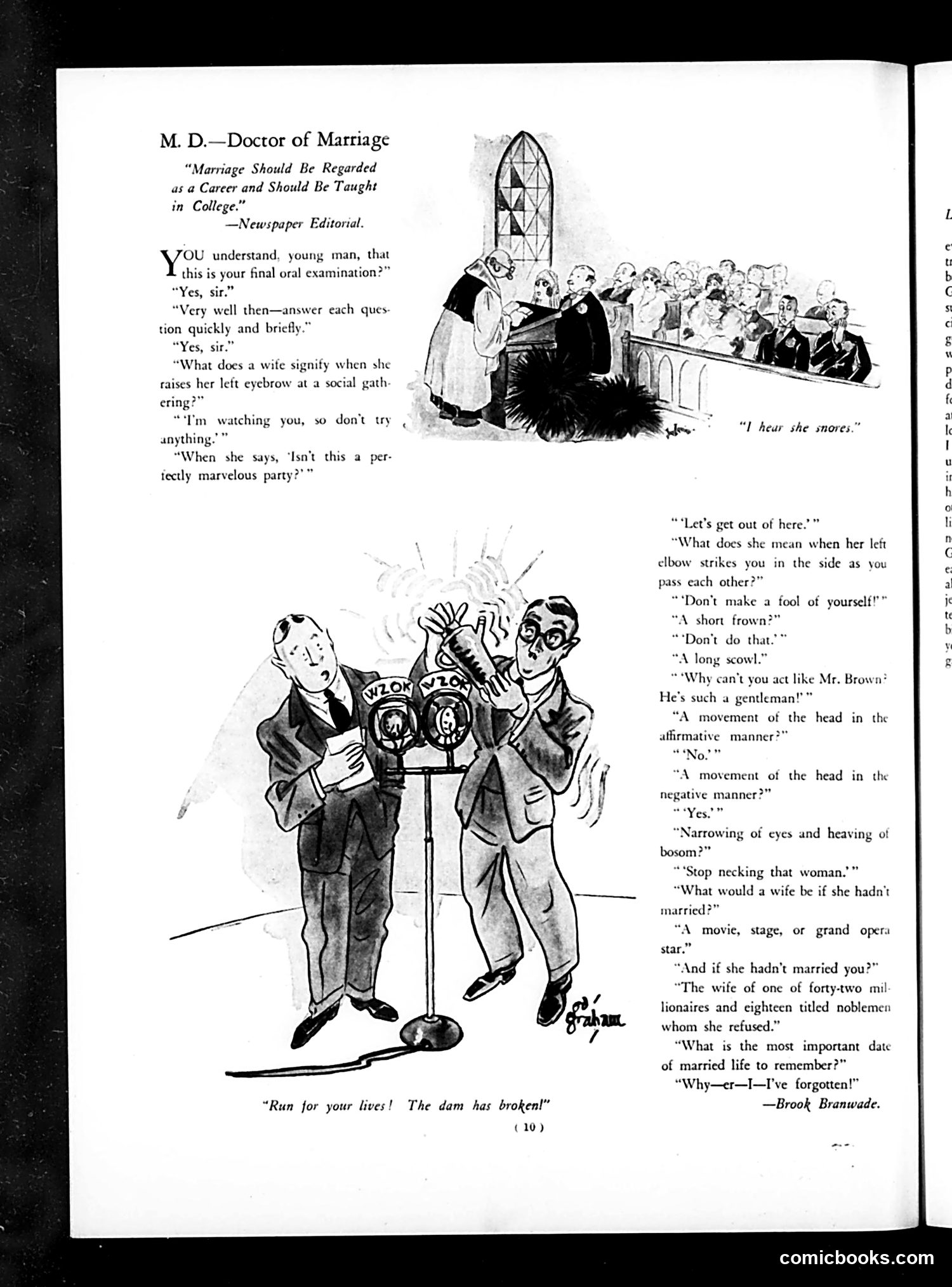
"M.D.—Doctor of Marriage" This satirical piece mocks the idea (from a newspaper editorial) that marriage should be taught in college. The top cartoon shows an oral examination on marriage conducted like an academic degree. The bottom cartoon depicts two men at what appears to be a microphone or examination apparatus, labeled "Run for your lives! The dam has broken!"—suggesting marital knowledge is overwhelming or dangerous. The accompanying dialogue humorously presents absurd "exam questions" about wife behavior: eyebrow raises, left elbows striking, social gatherings, and comparisons to movie stars. The satire critiques both the notion that marriage can be systematized into an academic subject and contemporary gender roles and marital expectations. The piece suggests marriage is fundamentally chaotic and unpredictable, not teachable.
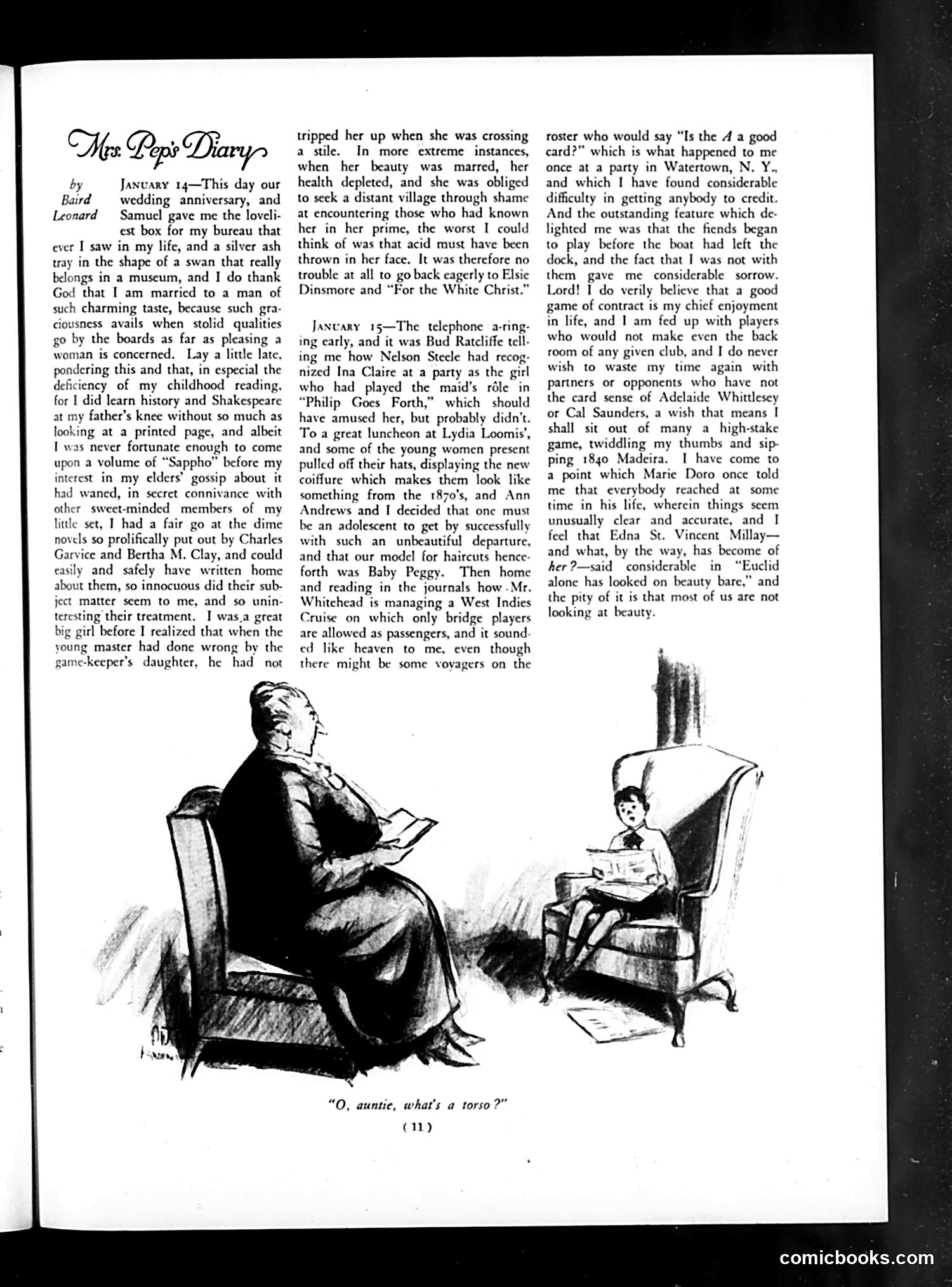
"Mrs. Peps Diary" - Social Commentary on Beauty Standards This page presents "Mrs. Peps Diary," a satirical column by Baird Leonard mocking early 20th-century social conventions. The cartoon illustrates the entry's theme: an elderly woman asks a young girl, "O, auntie, what's a torso?" The humor targets contemporary beauty obsessions and fashion. Mrs. Peps describes how women's appearances determined their social worth—beauty could launch a woman socially, while aging or illness caused humiliating social exclusion. She critiques how fashionable clothing (like 1870s-style hats) made women look ridiculous, and mocks the superficiality of contract bridge games as upper-class entertainment. The cartoon's child innocently questioning "torso" suggests bewilderment at adult vanity—the satire's central point.
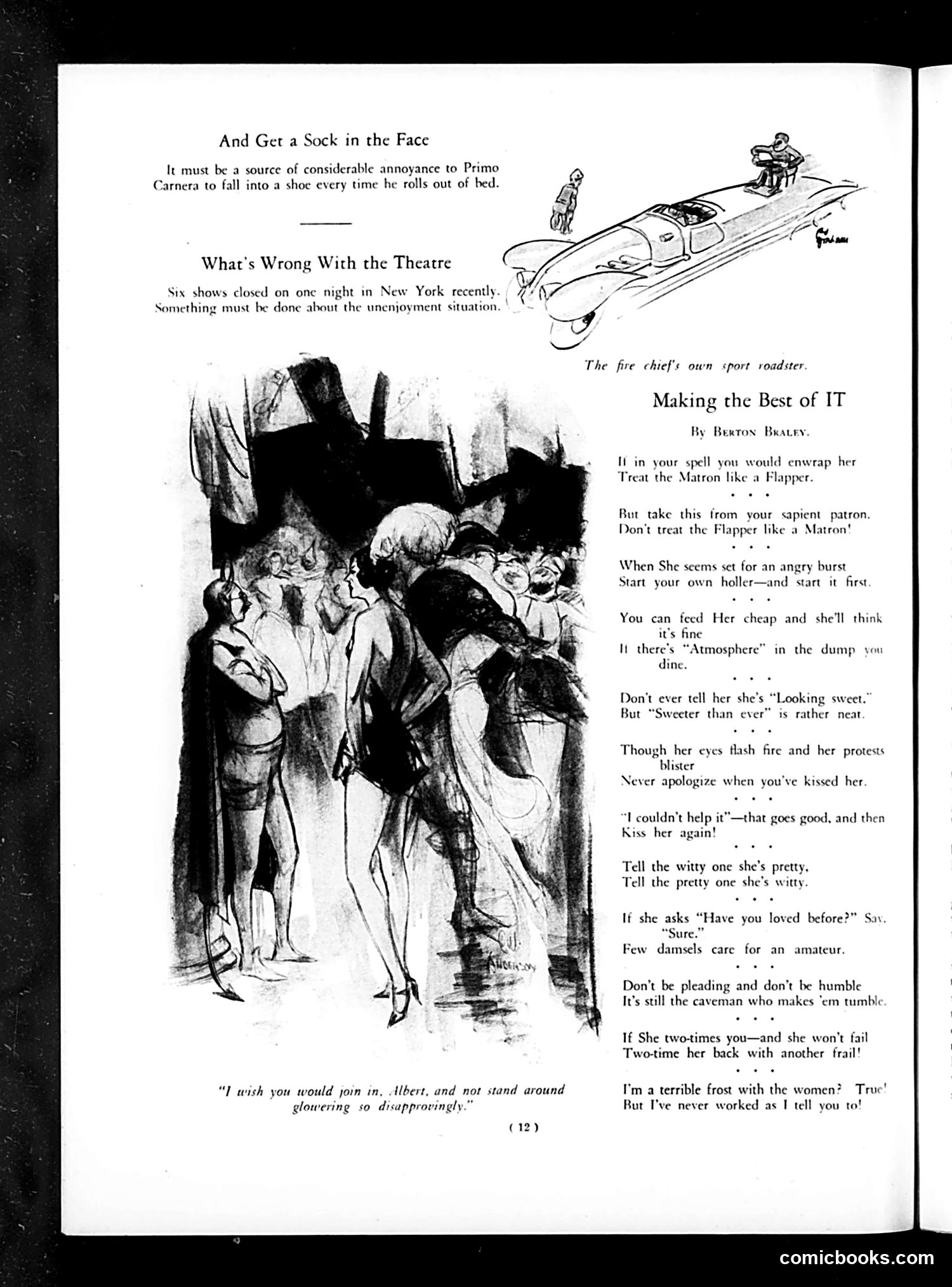
Analysis of Life Magazine Page This page contains two distinct pieces: "What's Wrong With the Theatre" (left): A sketch showing a crowded theatrical scene with figures in period dress. The caption quotes someone saying "I wish you would join in, Albert, and not stand around glowering so disapprovingly." This satirizes theater attendance and audience behavior during what appears to be a poorly-received performance. "Making the Best of IT" (right): A poem by Berton Braley offering cynical dating advice to men pursuing women, with tips like "treat the Matron like a Flapper" and "don't be pleading and don't be humble." The tone is satirical, mocking superficial male strategies in courtship. Top illustration: A whimsical drawing of "The fire chief's own sport roadster"—appears to be unrelated humorous content about a novelty vehicle.
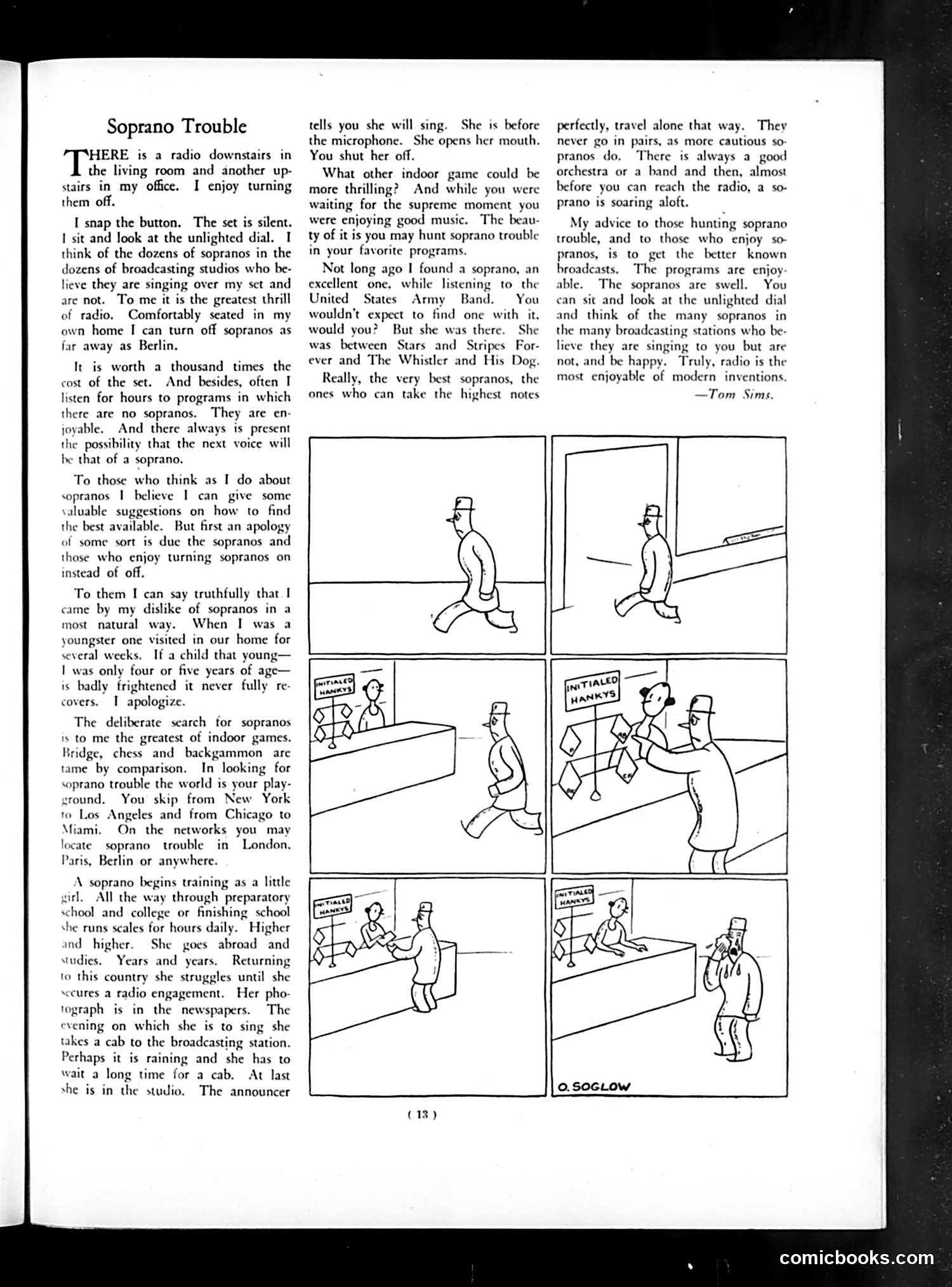
"Soprano Trouble" Analysis This page is a humorous essay by Tom Sims about finding soprano singers on radio broadcasts. The accompanying comic strip by O. Soglow depicts a man searching for a soprano on the radio—he frantically runs through various rooms in what appears to be a broadcasting station, encountering different people and scenarios (including what look like music lessons and administrative offices marked "INITIALS HANKY'S"). The satire targets the difficulty of locating quality soprano performances during radio programming. The essay notes that sopranos are rare on broadcasts and often disappointing, making the search frustrating. Soglow's visual gag shows this literal hunt through a building as absurdist comedy—the persistence required to find decent soprano singing on air is depicted as an almost impossible physical quest.
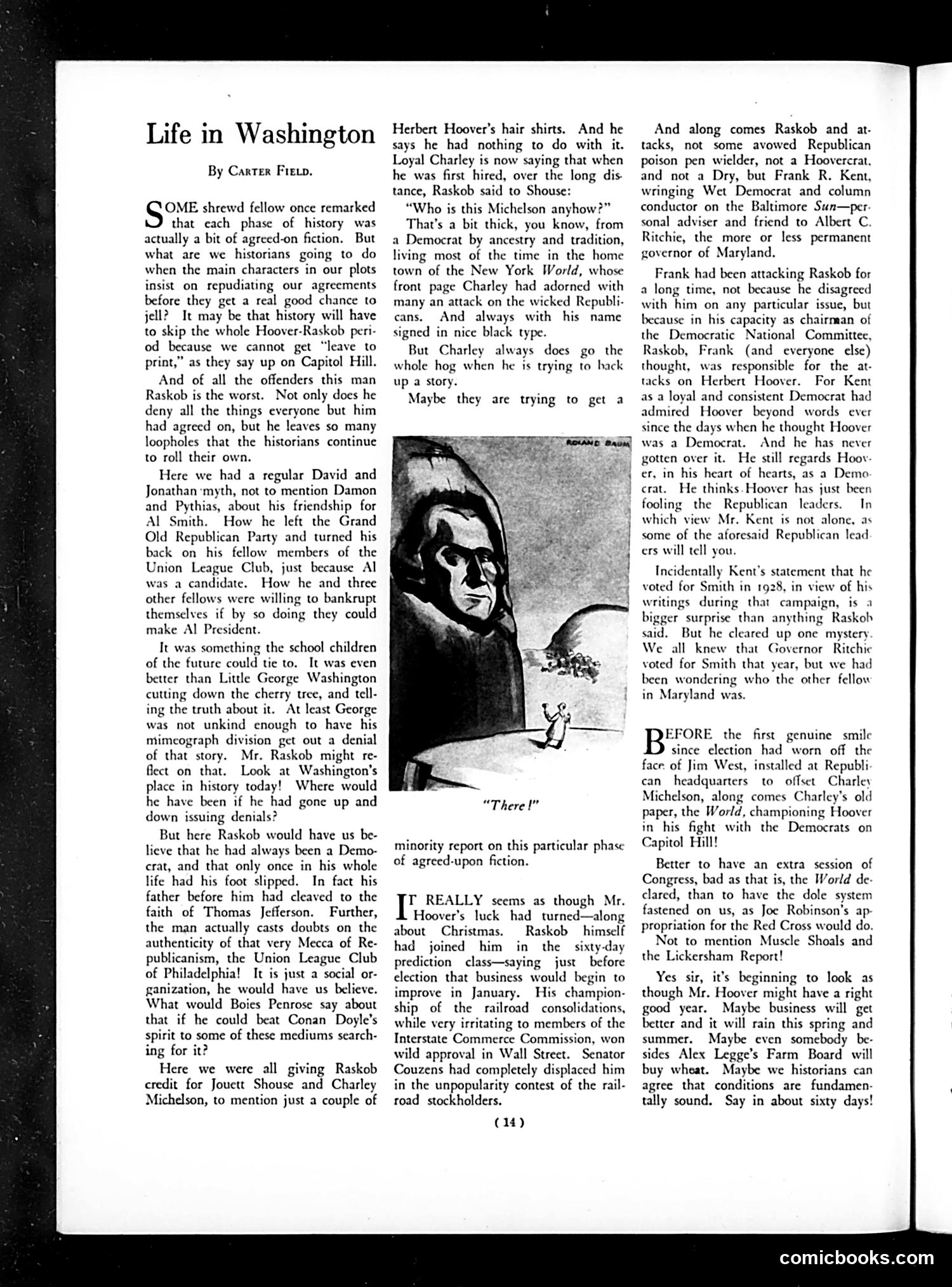
Analysis of "Life in Washington" Page This satirical column by Carter Field discusses Washington political infighting, particularly involving Herbert Hoover and Democratic operatives. The accompanying caricature labeled "There!" appears to depict a political figure, though the image quality makes precise identification difficult. The text reveals tensions over Hoover's past Democratic affiliations and his leadership of Republican initiatives. Field criticizes Louis Raskob (Democratic National Committee chairman) for attacking Hoover, while praising Frank R. Kent (Baltimore Sun columnist) as a fair observer. The satire mocks the era's partisan warfare—specifically how politicians weaponized personal history and party loyalty. References to the Union League Club and railroad consolidation controversies indicate specific 1920s-era political battles over business regulation and party realignment.
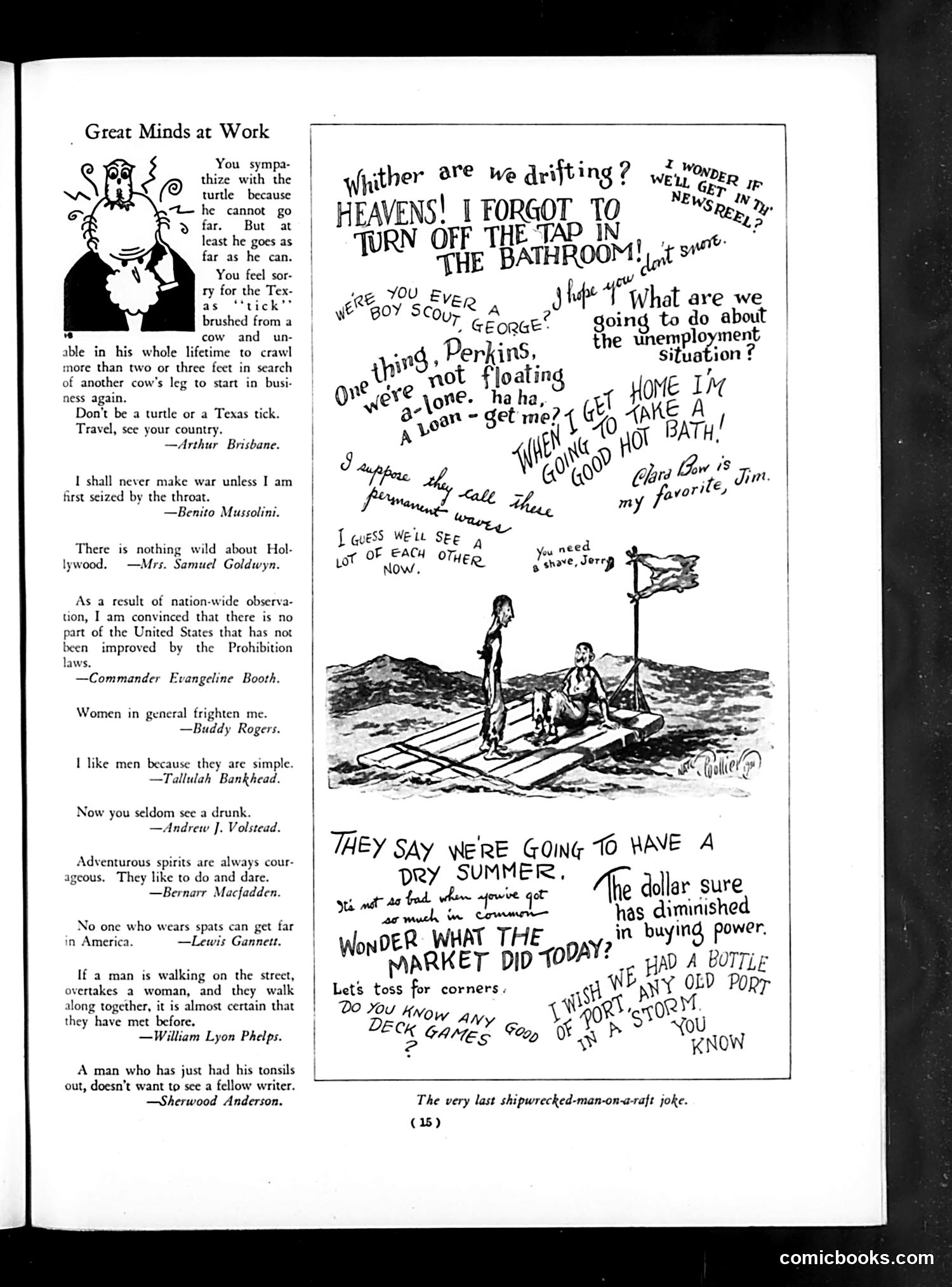
"Great Minds at Work" - Life Magazine Satire Page This page satirizes contemporary concerns through a shipwrecked-raft cartoon and quotations. The main cartoon depicts two marooned figures discussing mundane worries—unemployment, market conditions, prohibition's effects on liquor supplies—despite their desperate survival situation. The humor lies in the ironic contrast: stranded on a raft, they obsess over economic anxieties rather than immediate peril. The left column collects brief satirical quotes from public figures (Mussolini, Goldwyn, Rogers) mocking various social issues: prohibition's failure, gender relations, class pretension, and social hypocrisy. Together, the content critiques how Americans remain fixated on Depression-era economic and social problems even when facing existential crisis—a commentary on collective anxiety and misplaced priorities during the 1930s.
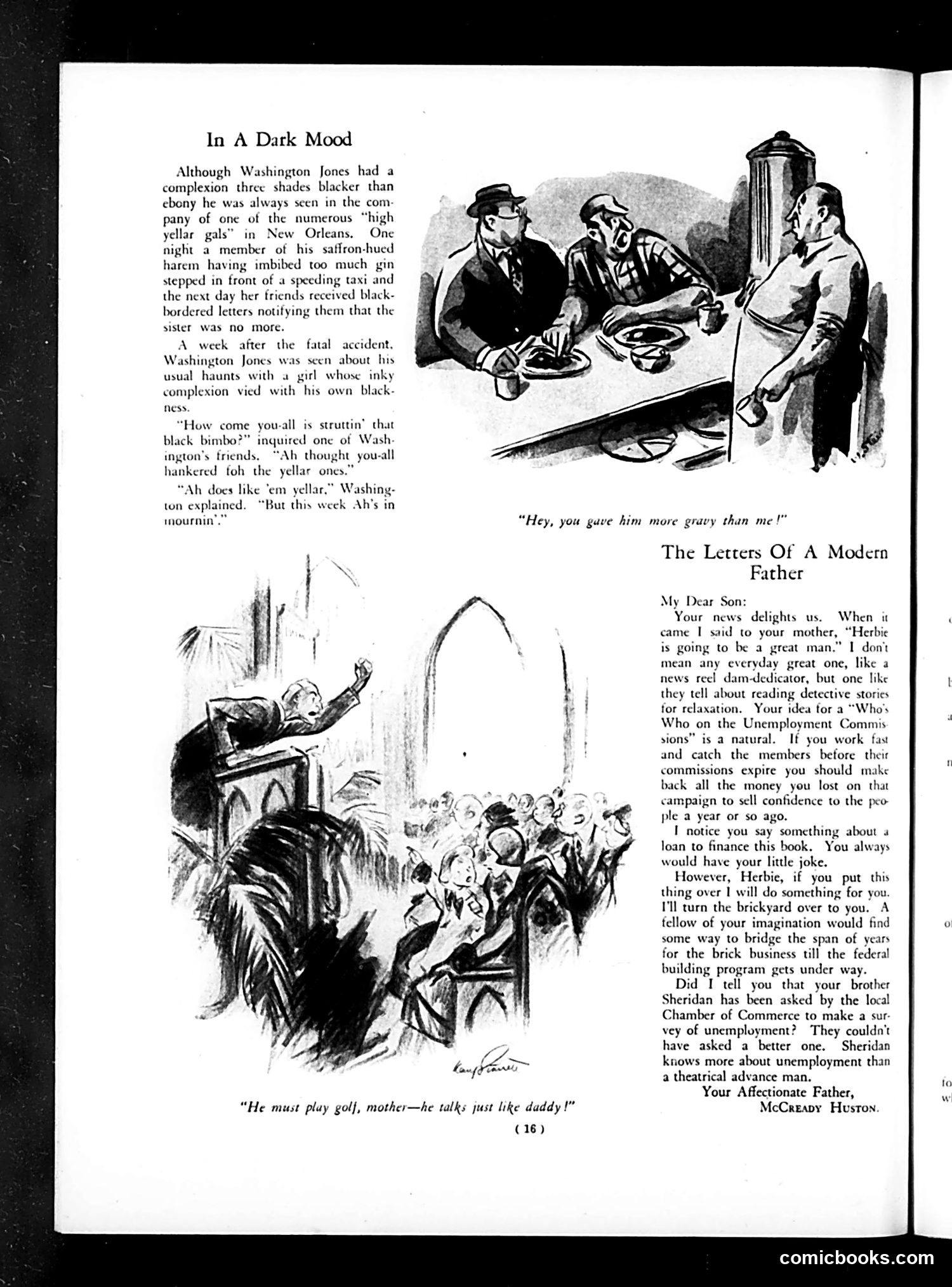
Analysis of This Life Magazine Page "In a Dark Mood" (top story): References Washington Jones, a Black man with notably dark complexion, who frequented New Orleans establishments. The story describes him receiving blackmail letters after his sister's death. The humor relies on racial stereotyping—specifically playing on complexion-based discrimination within the Black community itself, a reflection of colorism prevalent at the time. "The Letters of a Modern Father" (right column): A fatherly letter to his son "Herbie" offering worldly advice about business schemes, unemployment surveys, and book financing—satirizing both parental pomposity and Depression-era economic anxieties. The two political cartoons (left side) appear to critique public figures or social conditions, though specific identities aren't legible in this reproduction.
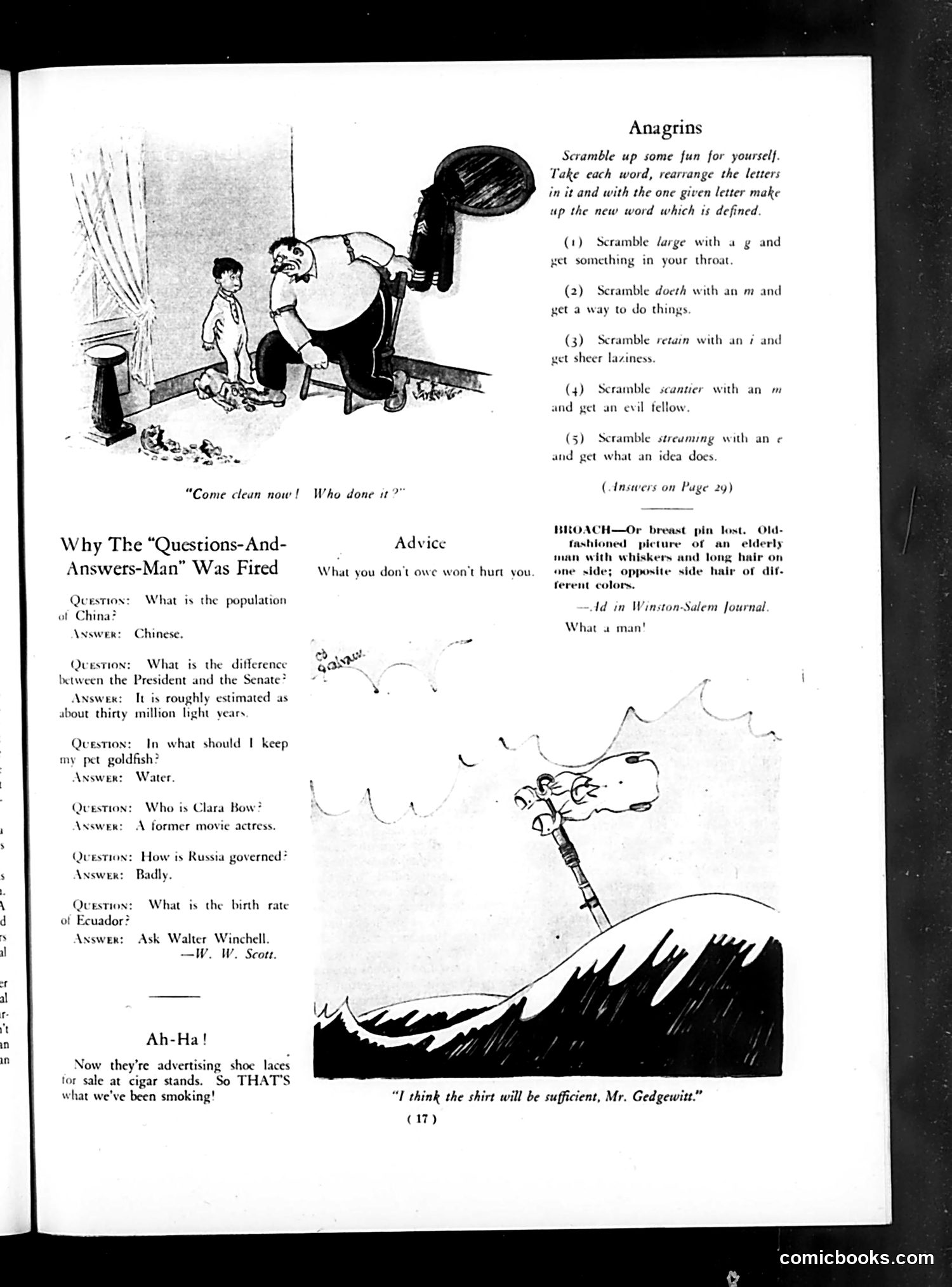
Analysis of Life Magazine Page This page combines humor sections typical of early-to-mid 20th century Life magazine. "Anagrams" is a word puzzle where readers rearrange letters to form new words with humorous definitions (e.g., "scramble large with a g" to get something in your throat). "Why The 'Questions-And-Answers-Man' Was Fired" satirizes a newspaper advice columnist through absurd Q&A exchanges—deliberately giving ridiculous non-answers to legitimate questions (China's population answered as "Chinese"; Russia's governance as "Badly"). The joke mocks both the format and perhaps a specific real columnist's poor advice. "Ah-Ha!" contains a brief consumer joke about shoe laces being sold at cigar stands, suggesting unexpected product placement. The bottom cartoon shows a figure (Mr. Gedgewitt, apparently) in a dangerous situation, suggesting the caption's understatement is ironic—a shirt won't sufficiently protect him.
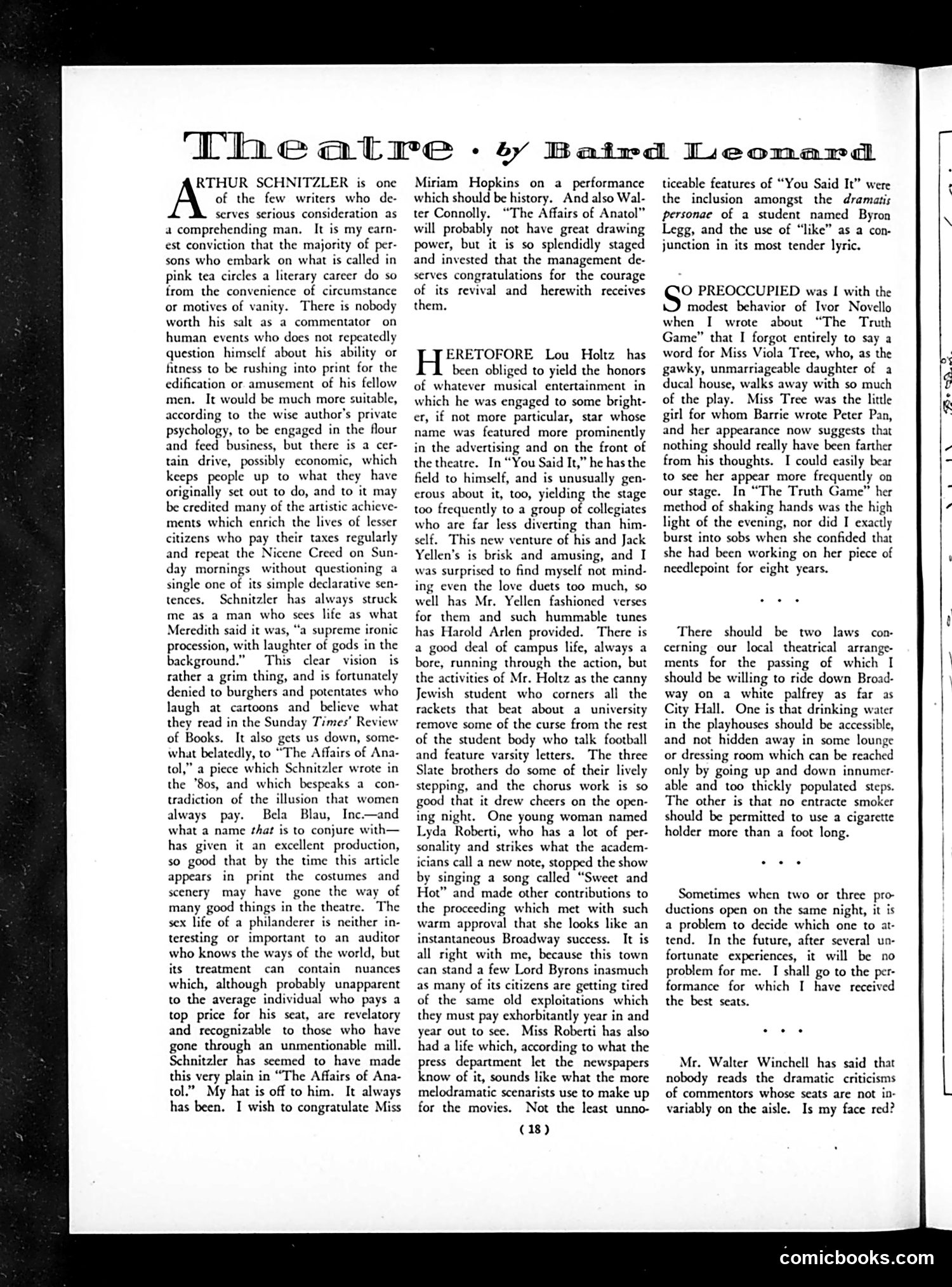
Theatre by Baird Leonard This page is a theatre review column, not a political cartoon. The author discusses several Broadway productions, including "You Said It" and "The Affairs of Anatol," praising Arthur Schnitzler's work and critiquing various performances. Key points include praise for Miriam Hopkins' performance and Walter Connolly's staging, discussion of Lou Holtz's comedic talents, and commentary on Viola Tree's appearance in "Peter Pan." The author also mentions issues with local theatres—specifically requesting two laws: one allowing white-collar patrons to avoid Broadway crowds by attending City Hall (apparently a theater venue), and another permitting cigarette smoking in theatre lobbies. The piece focuses on theatrical merit and practical theatre-going concerns rather than political satire.
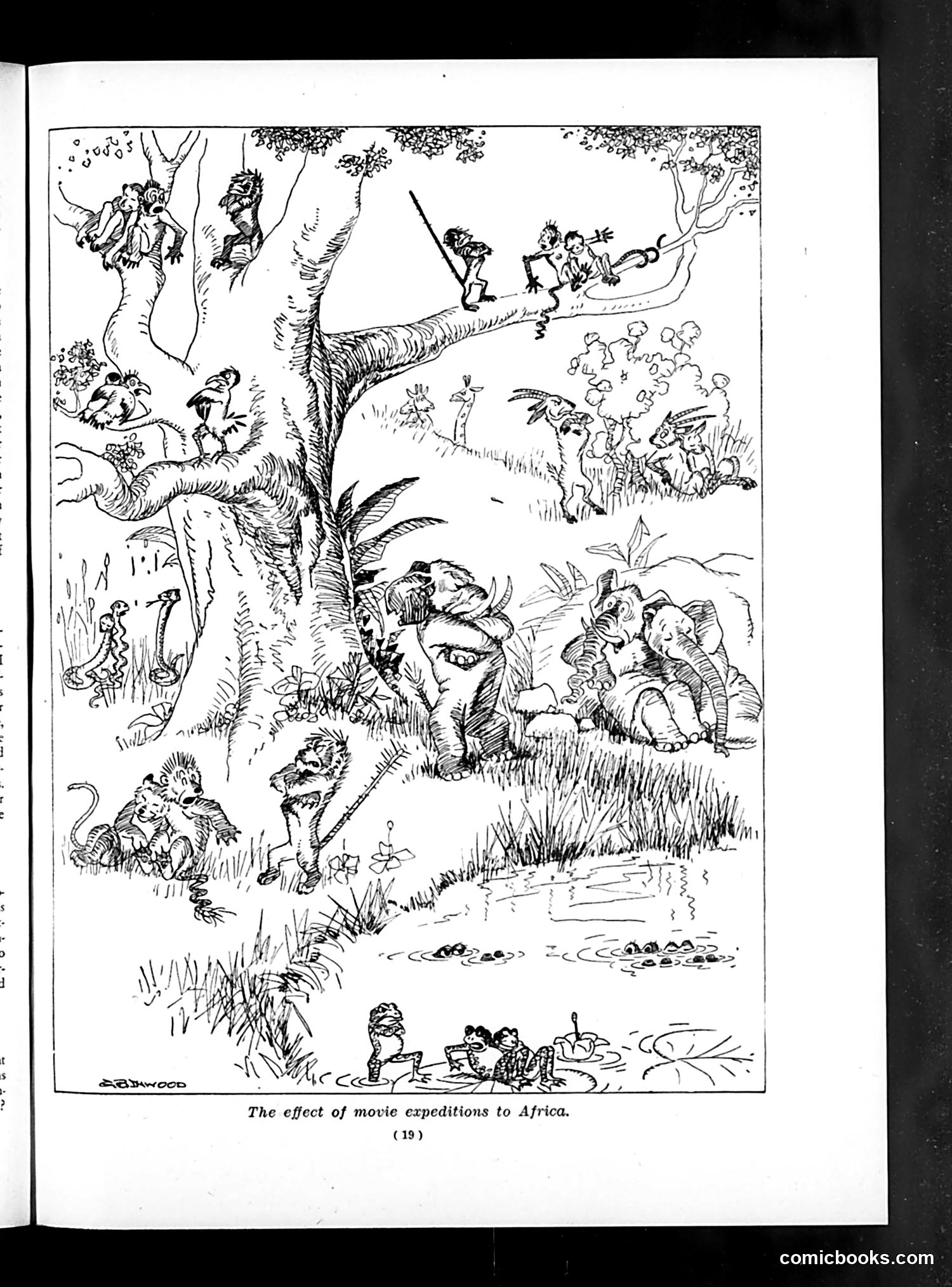
"The Effect of Movie Expeditions to Africa" This satirical cartoon mocks film production companies that sent movie crews to Africa in the early 20th century. The image depicts chaos: African wildlife and people are shown panicked and fleeing from the intrusion of filmmakers and their equipment. Large animals (appearing to be elephants or other game) are disturbed, vegetation is trampled, and indigenous populations scatter in disarray. The satire criticizes how these expeditions disrupted African ecosystems and communities for entertainment purposes. The cartoon suggests that "movie expeditions" caused unnecessary upheaval and chaos rather than producing anything of genuine value. The humor derives from exaggerating the destructive consequences of bringing Hollywood's commercial interests into pristine African environments—a pointed critique of colonial-era resource extraction and exploitation justified as "progress" or "culture."
Movie Reviews by Harry Evans - Life Magazine This page contains film reviews of three movies: "One Heavenly Night," "No Limit," and "The Bat Whispers." The critic praises Evelyn Laye's beauty and singing in "One Heavenly Night," though he criticizes the contrived musical numbers typical of early sound films. He particularly lauds comedian Leon Erroll's performance in an art gallery scene involving physical comedy. For Clara Bow's "No Limit," Evans adopts a defensive tone, acknowledging the actress's recent scandal (the "Bow-Devoe trial"). He argues that entertainers' unconventional personal lives shouldn't disqualify their professional work, noting that theatrical talent often accompanies such "irregularities" of "Temperament." The reviews reflect Hollywood's early sound era challenges—integrating music naturally into narrative—and the era's gossip culture around celebrity scandals affecting audience perception and critical reception.
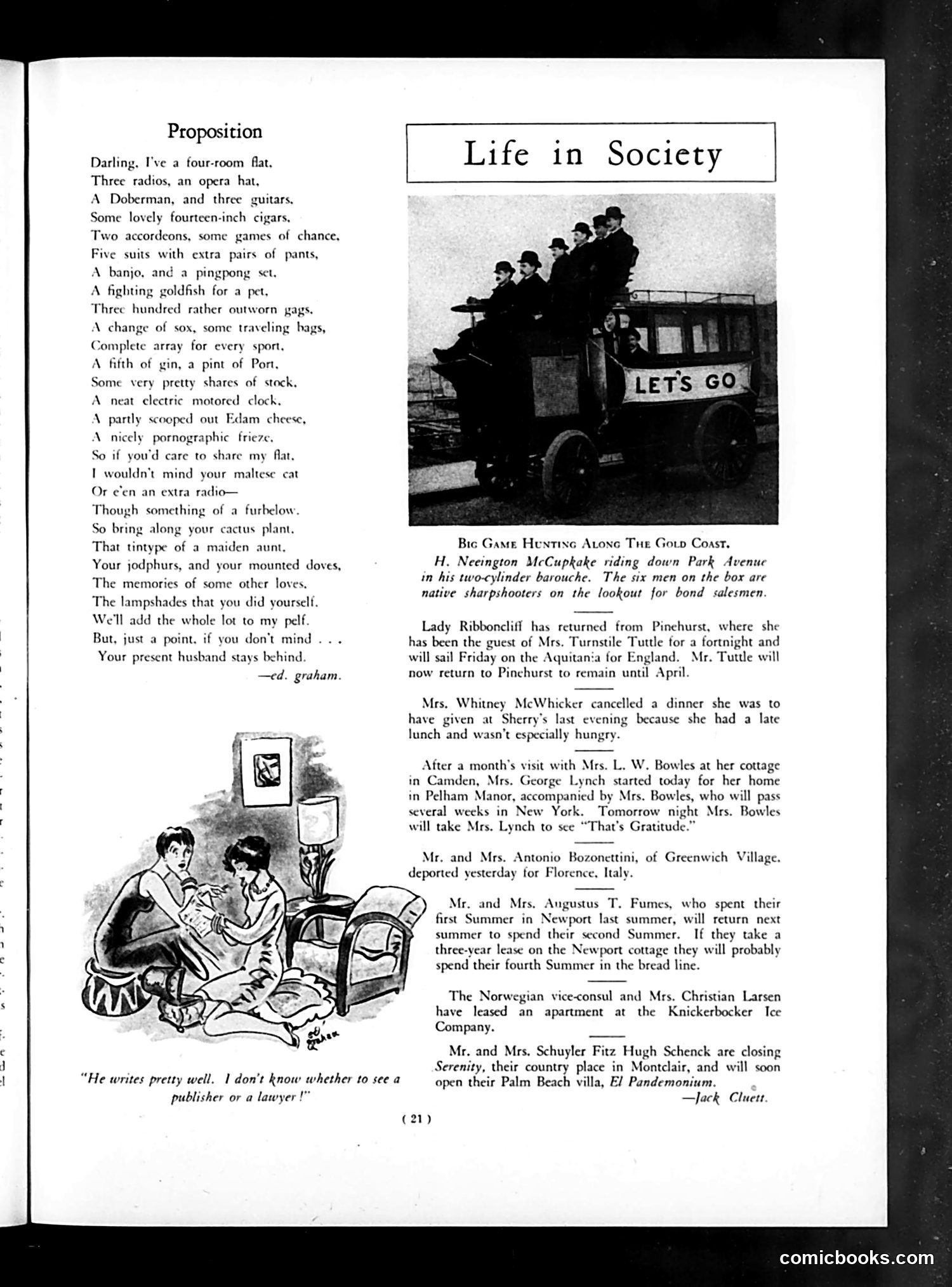
Explaining This Life Magazine Page This page contains two distinct satirical pieces targeting wealthy society: "Proposition" (left): A humorous poem by Ed. Graham listing a bachelor's possessions—radios, liquor, stock shares, sporting equipment—as inducements for a woman to share his flat. The joke: he'll accept her belongings too, but demands one condition: "Your present husband stays behind." This mocks both materialistic courtship and casual infidelity among the idle rich. "Life in Society" (right): Mockery of high-society gossip columns. The satirical items ridicule wealthy New Yorkers through absurd details: a man hunting "bond salesmen" from a carriage, a woman canceling dinner because she ate late, and most pointedly, a couple who spent their first summer in Newport and will "probably spend their fourth Summer in the bread line"—predicting financial ruin. This lampoons both the pretensions of society elites and the economic precarity lurking beneath their display. The cartoon shows a woman admiring a man's writing, unable to distinguish whether he's talented enough for publishing or crooked enough for law—a dig at literary and professional standards.
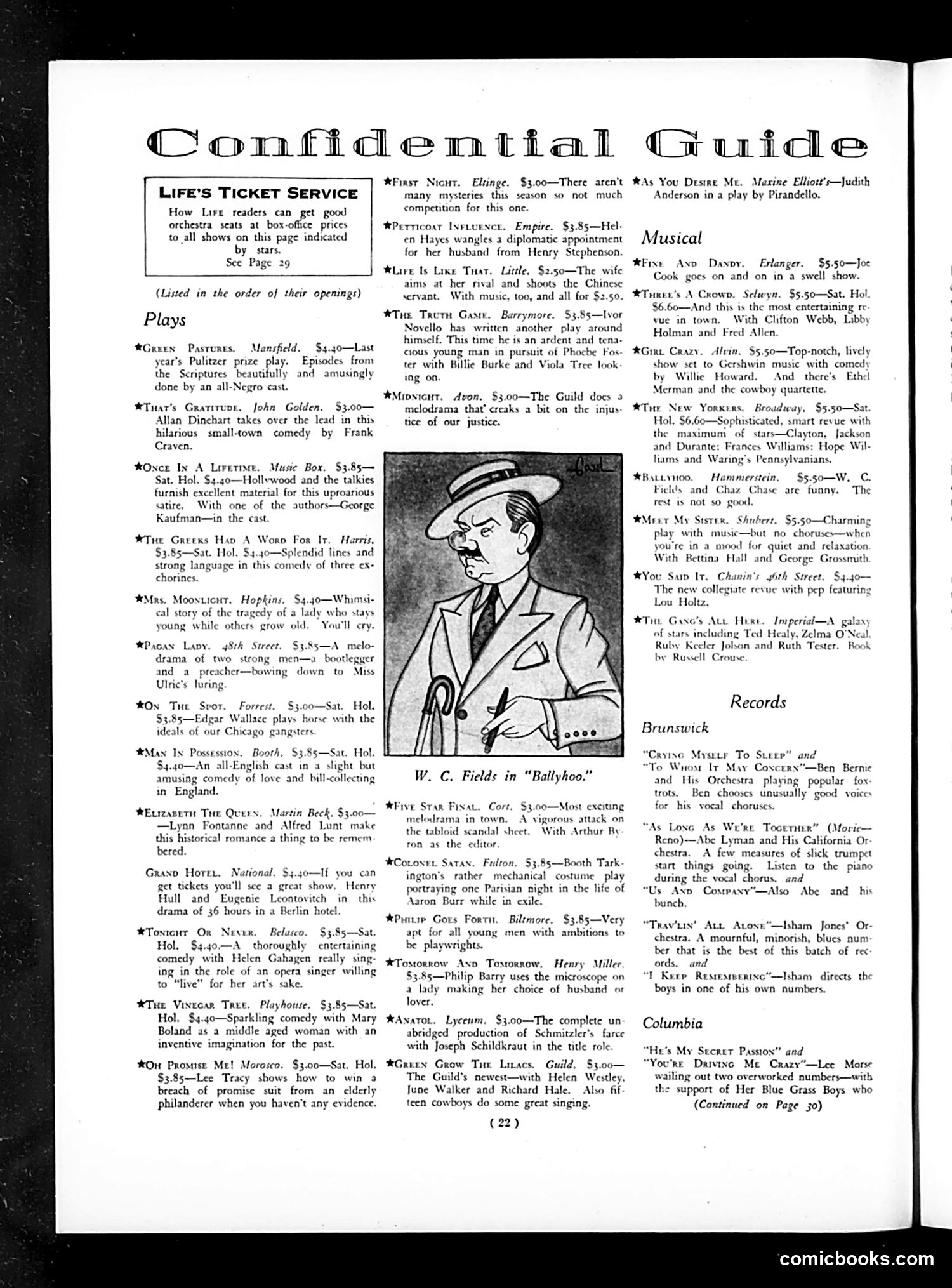
Confidential Guide Analysis This page is a theater guide listing Broadway plays with ticket prices and brief reviews, not a political cartoon. The single illustration shows W.C. Fields (a famous comedian of the era) in character from the play "Ballyhoo." The guide itself contains no satire or political commentary—it's a practical service for *Life* magazine readers, offering discounted theater tickets through the magazine's box-office arrangement. The reviews are brief entertainment critiques noting cast members, plot themes, and whether shows feature music or comedy. The "Confidential" header is tongue-in-cheek—suggesting insider access to good seats at regular prices. This reflects 1920s-30s Broadway culture when theatrical entertainment was a major urban pastime and magazine partnerships with theaters were common marketing tools.
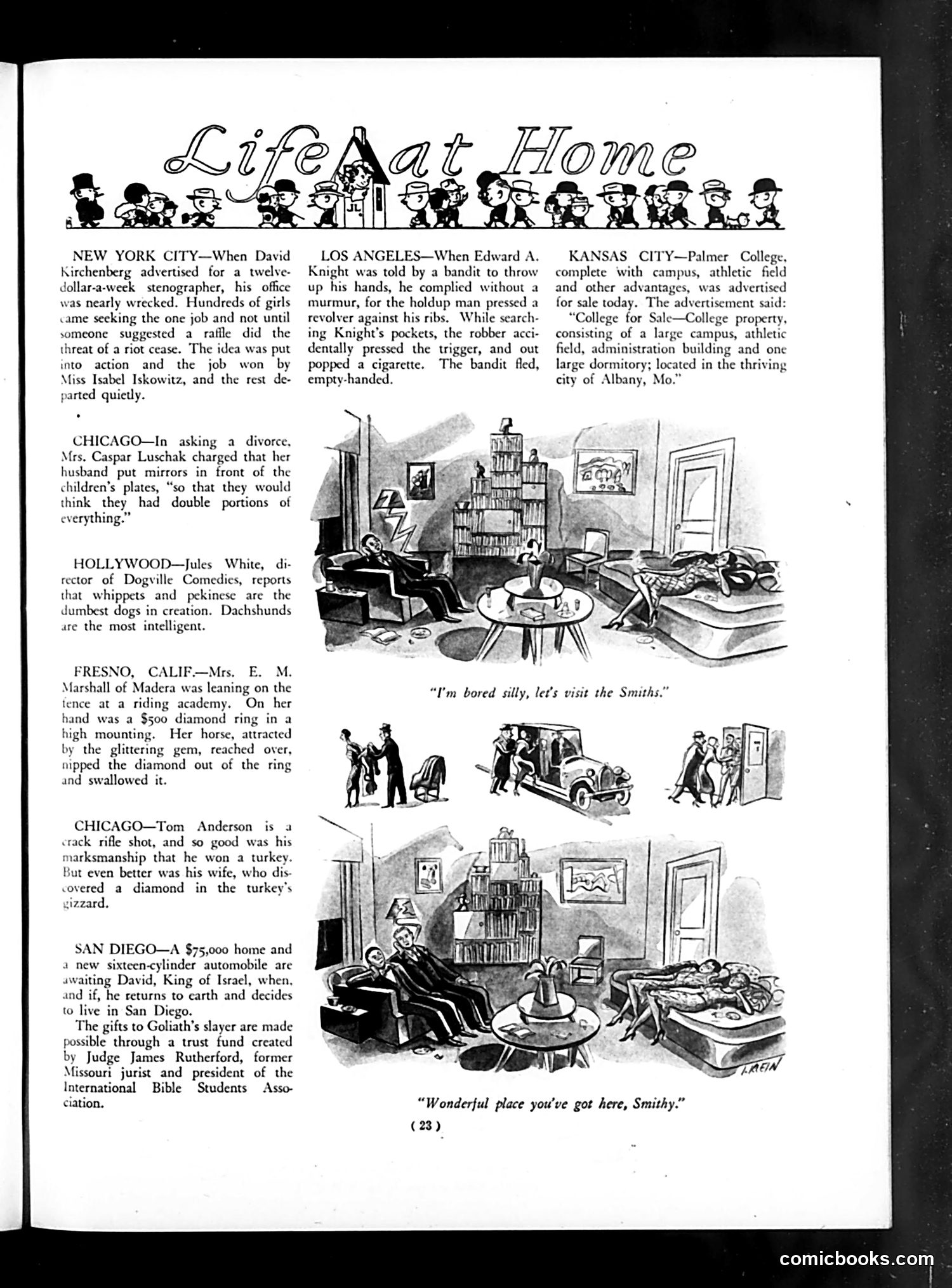
Life Magazine "Life at Home" - Page Explanation This page collects humorous anecdotes from various American cities, presented as satirical "news briefs." The cartoons illustrate two stories about social visiting. Key content: - A stenographer job shortage so severe a raffle was needed to prevent riots - A divorce case where a husband used mirrors to deceive children about food portions - A horse that ate a $500 diamond ring from a woman's hand - A holdup where a "gun" discharged only a cigarette - A college advertised for sale in a town it doesn't actually occupy The cartoon satire: The two illustrated panels show the same living room scene with the caption "I'm bored silly, let's visit the Smiths" (top) and "Wonderful place you've got here, Smithy" (bottom). The joke satirizes obligatory social visits between families—the boredom of entertaining guests and the performative politeness required, regardless of actual enthusiasm. The repetition emphasizes the tedium of conformist social obligation in 1920s middle-class life.
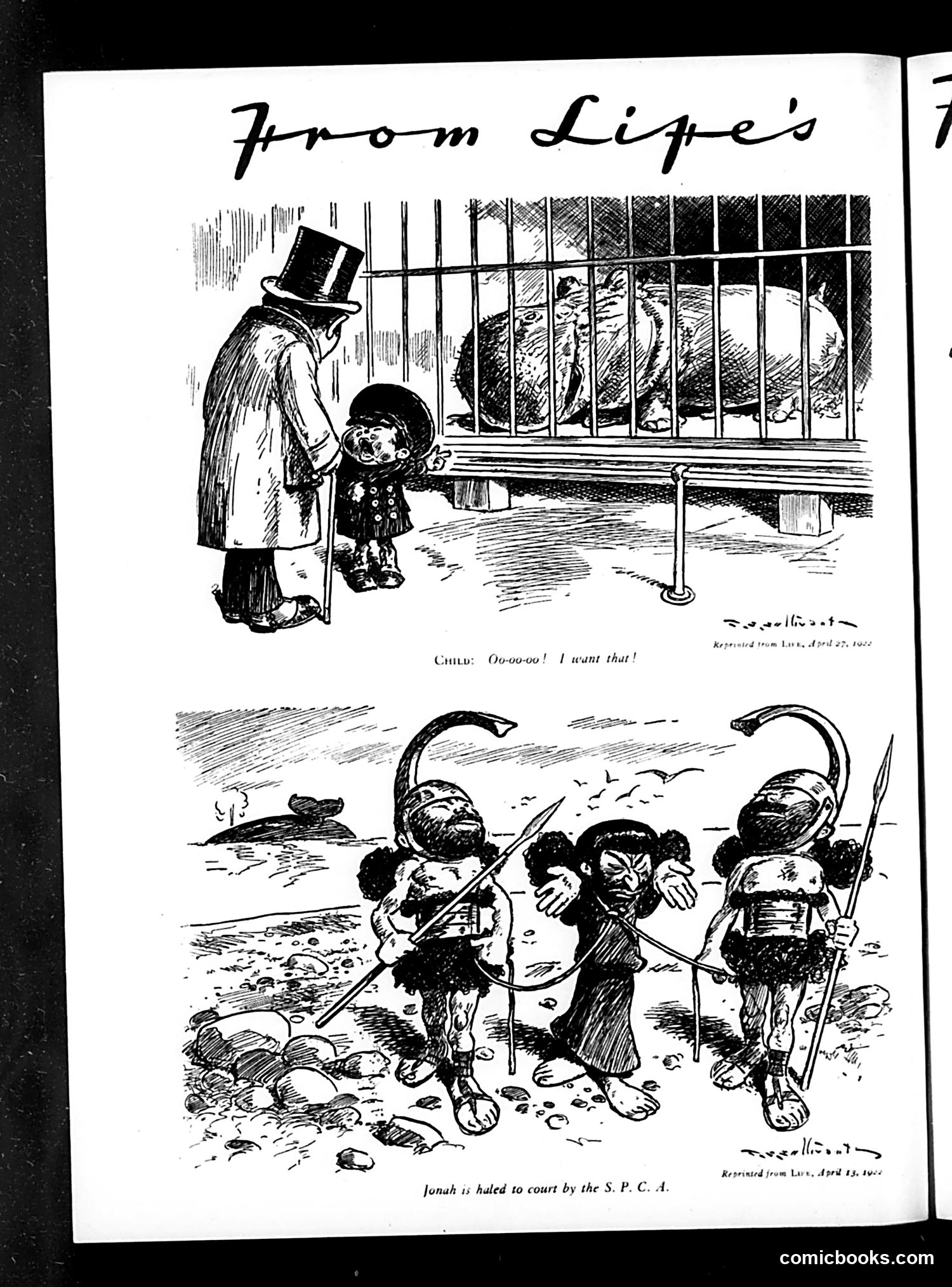
"From Life's" - Political Cartoon Analysis This page contains two satirical cartoons from *Life* magazine (April 13, 1924). Top cartoon: A well-dressed man and child view caged animals at what appears to be a zoo. The child says "Oo-oo-oo! I want that!" This likely satirizes wealthy parents indulging children's consumerist desires. Bottom cartoon: Titled "Jonah is haled to court by the S.P.C.A.," it depicts the biblical figure Jonah being prosecuted by the Society for the Prevention of Cruelty to Animals—presumably for his famous ordeal in the whale. This is a humorous anachronism: applying modern animal-welfare legislation to a religious allegory, mocking either overzealous animal-rights activism or the absurdity of retroactively judging biblical narratives by contemporary standards.
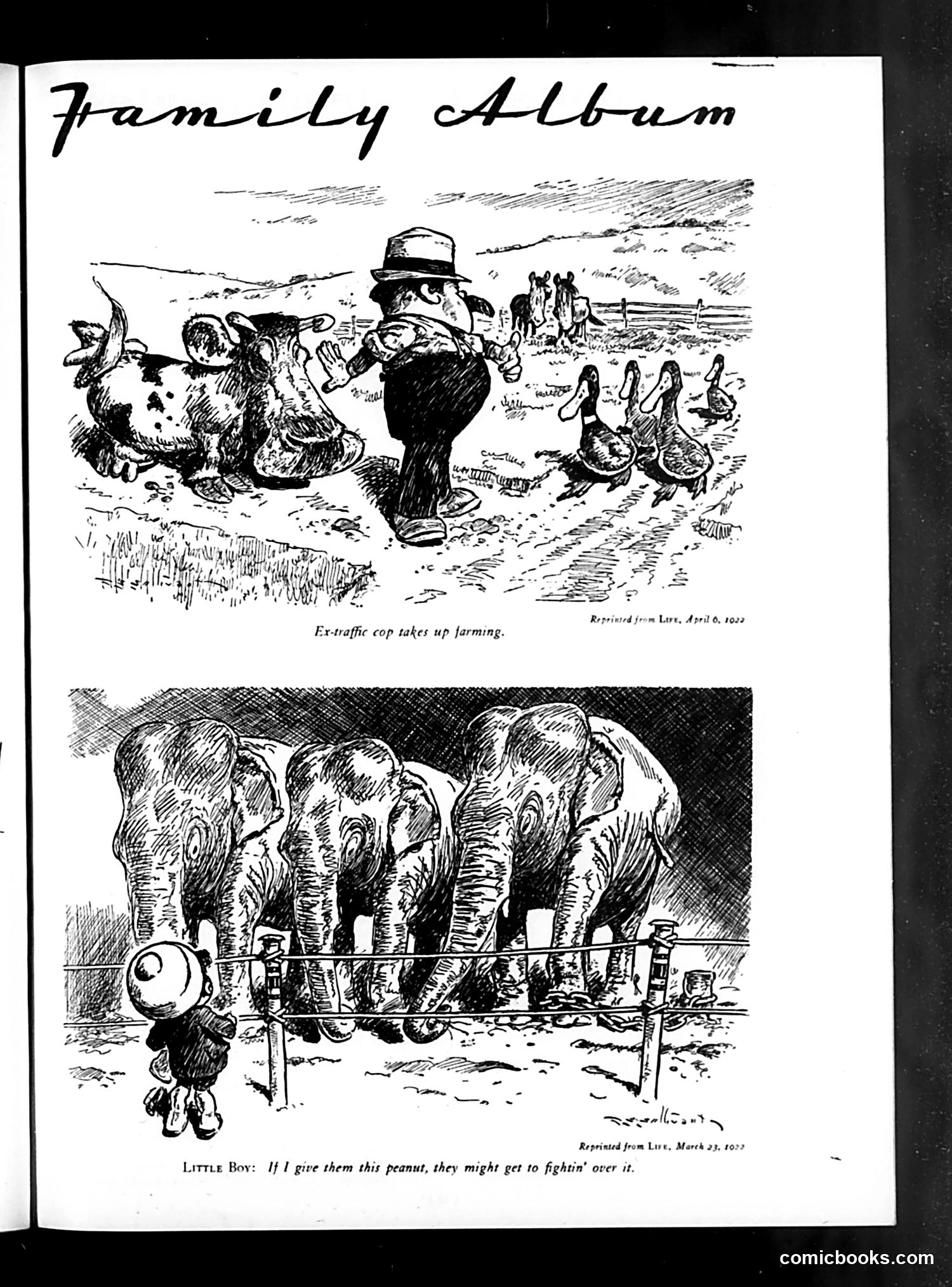
Political Cartoon Analysis This page contains two satirical cartoons from Life magazine (1922). The top cartoon depicts an ex-traffic cop attempting to farm, surrounded by animals (cow, chickens, ducks). The humor lies in the contrast between urban law enforcement and rural agricultural work—suggesting the former cop is out of his element. The bottom cartoon shows a small boy offering a peanut to elephants, with the caption suggesting he expects them to fight over it. This appears to be satirizing either political rivalries or labor disputes of the era, using the elephants as stand-ins for competing factions who might turn violent over minor inducements. The joke reflects anxiety about social conflict and suggests how easily parties can be manipulated into conflict. Both cartoons use anthropomorphic or exaggerated scenarios to comment on American social conditions in the early 1920s.
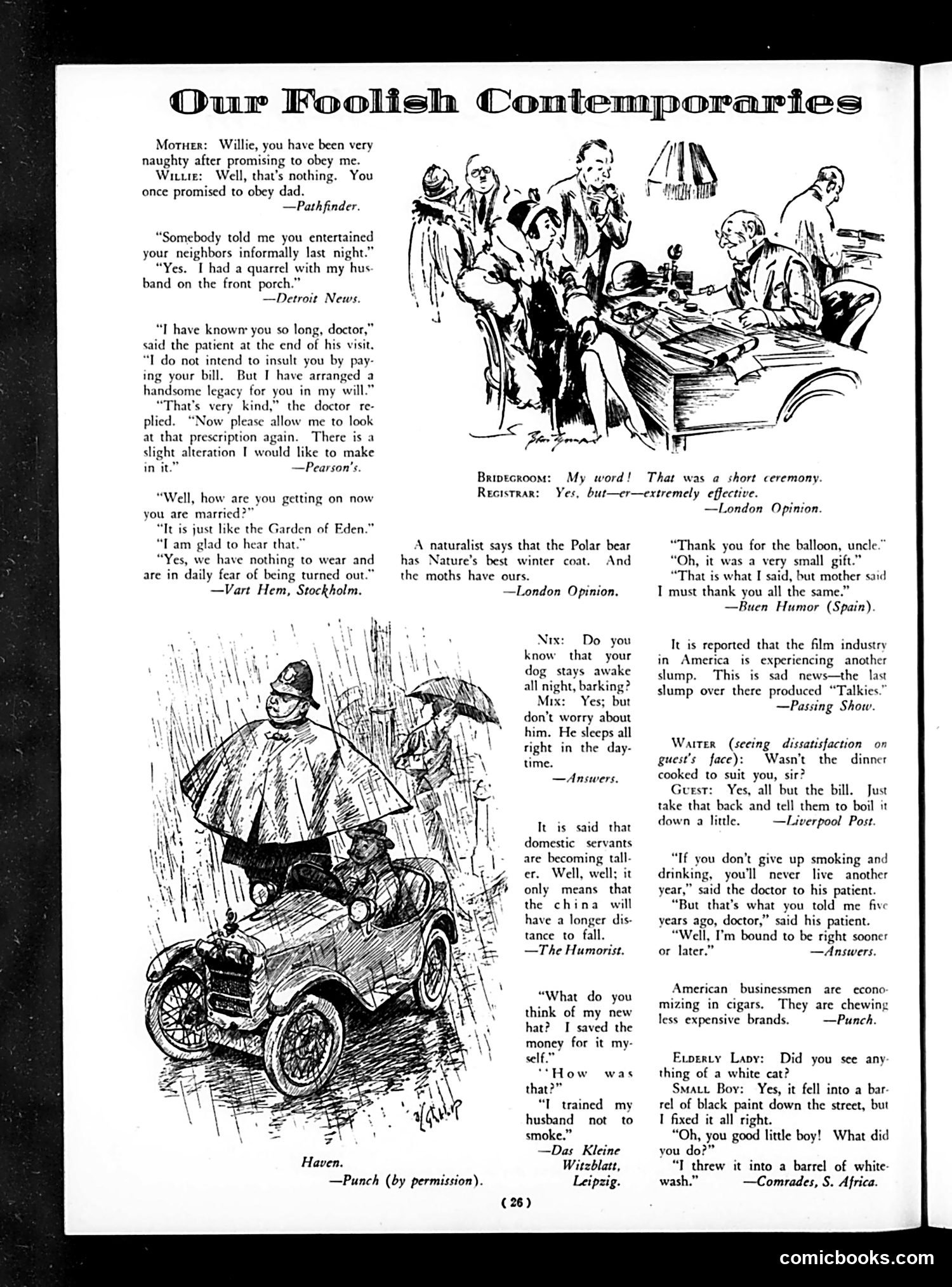
"Our Foolish Contemporaries" - Life Magazine Humor Page This is a collection of short jokes and comic anecdotes from international sources, typical of Life magazine's satirical format. The page mocks social conventions and human nature through brief exchanges: Key themes: - Marriage satire: Jokes about wives disobeying husbands (inverting traditional authority); newlyweds with nothing to wear; a husband trained to not smoke - Class humor: Doctors motivated by money; servants becoming taller (so more china breaks); complaints about restaurant bills - Everyday absurdities: A dog that barks at night but sleeps during day; a naturalist comparing polar bear coats to moth-eaten clothing; film industry producing poor "Talkies" - Dark wit: A doctor altering prescriptions after learning about a inheritance; a child "fixing" a white cat by painting it white The cartoon illustration (lower left) shows a vehicle in rain, labeled "Haven," likely accompanying one of the jokes. Sources credited include *Punch*, *Pathfinder*, *Detroit News*, and international publications, reflecting Life's cosmopolitan humor approach.
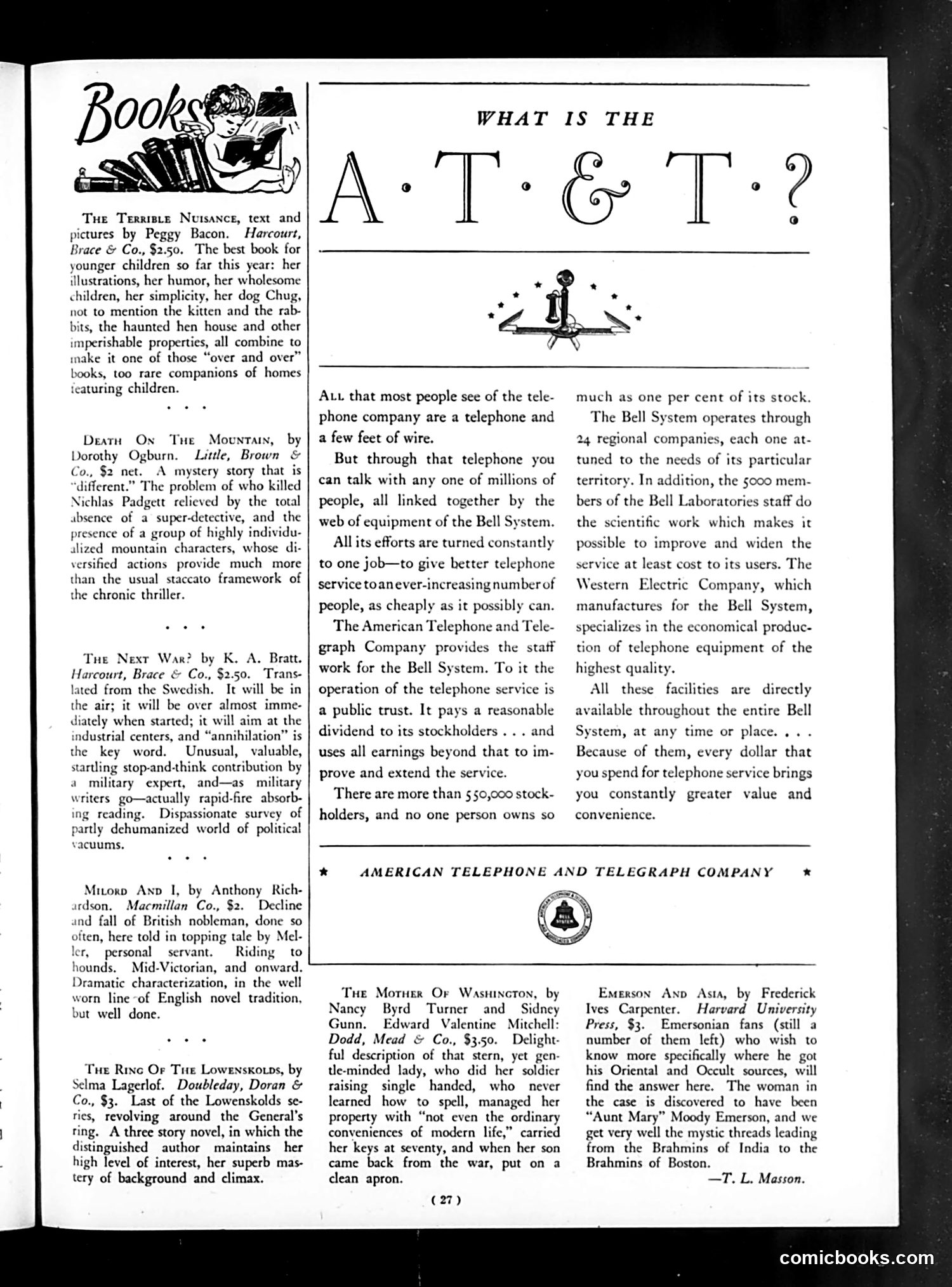
What This Page Shows This is a book review page mixed with corporate advertising. The left column reviews five recent books, including children's literature and mysteries. The dominant content is a large AT&T advertisement disguised as an article. The ad's headline "WHAT IS THE A·T·&T·?" presents the company as answering a fundamental question. The text emphasizes AT&T's role as a "public trust" serving millions through interconnected telephone networks, operated by 24 regional companies and Bell Laboratories. It stresses that no single stockholder controls much of the company—a defensive posture likely responding to contemporary antitrust concerns or monopoly criticism. The ad showcases AT&T's scale, efficiency, and technological innovation while portraying the company as serving the public interest rather than private profit. This type of branded content was common in mid-century magazines, blending editorial and advertising to build corporate reputation. The bottom mentions other books including one on Washington and Asian studies.
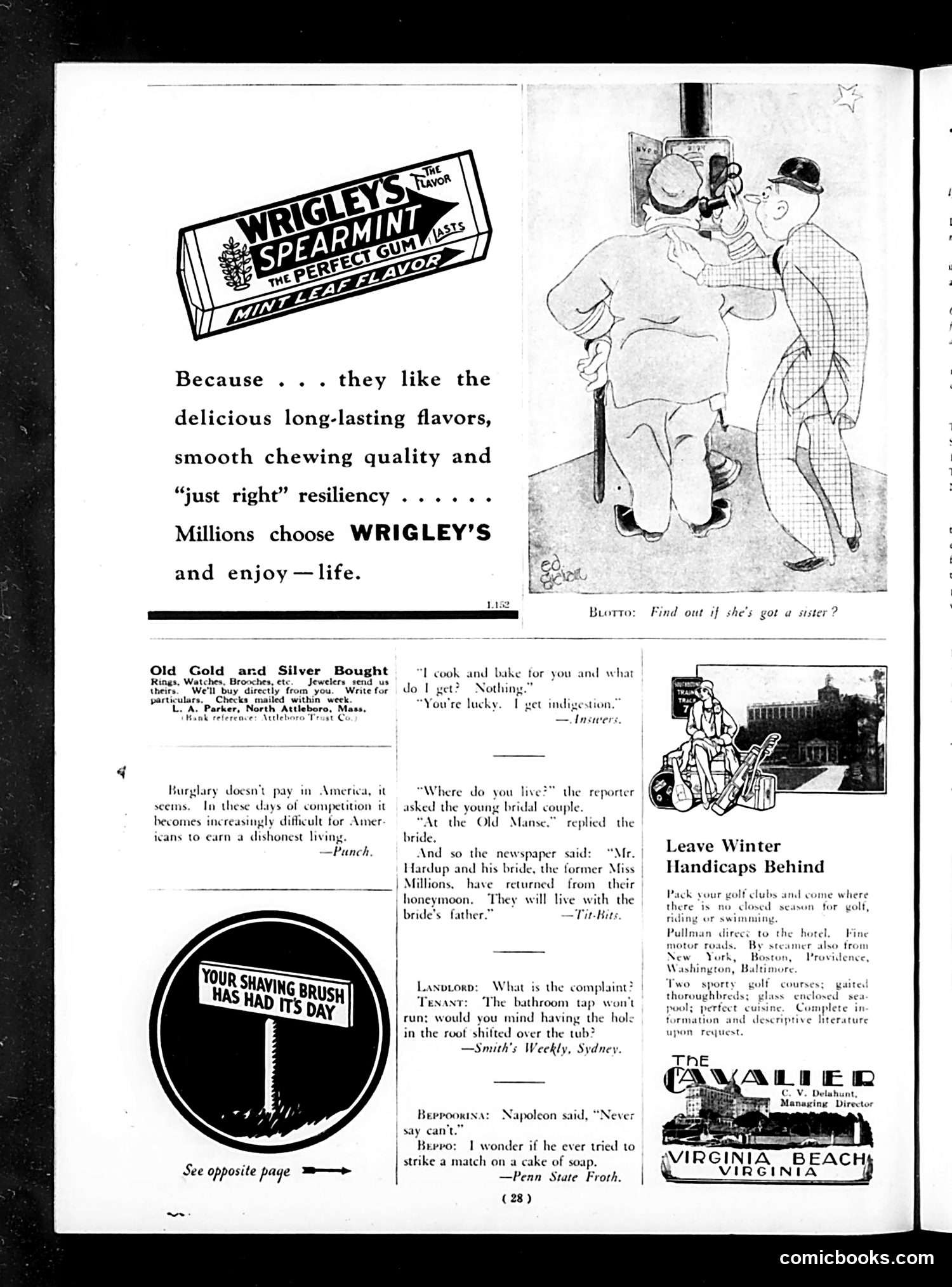
Analysis of Life Magazine Page This page is primarily advertising and humor fillers rather than political cartooning. The main Wrigley's gum ad uses a cartoon couple—a portly man and woman in period dress—to advertise chewing gum's appeal. The caption "Find out if she's got a sister?" is flirtatious humor typical of the era's advertising style. The page contains several short joke excerpts from various publications (Punch, Answers, Tit-Bits, Smith's Weekly, Penn State Froth): - A joke about American burglary being unprofitable due to competition - Domestic humor about cooking/indigestion - A newly-married couple living with the bride's father (financial hardship joke) - A landlord/tenant complaint about plumbing - A Napoleon quote joke about never admitting defeat There's also a shaving brush advertisement ("Your shaving brush has had its day"). The page reflects early-20th-century magazine format: mixed commercial content, reprinted jokes from international sources, and light social satire about marriage, poverty, and domestic life—nothing politically substantive.
Life Magazine, February 6, 1931: Page Analysis This page is primarily administrative and advertising content rather than political satire. It contains: Left side: Life's Ticket Service purchase order form—a practical service allowing readers to order theater tickets by mail from Life's office in New York City, with detailed instructions about advance notice, seat selection, and refund policies. Center: Masthead and publication information for Life Publishing Company, listing executives and copyright details. Right side: "Life's Financial Letter"—economic commentary on recent bank clearings showing a 29% decrease in New York from the previous month. The writer humorously notes that while comparative year-over-year data would be expected, statistics from 1921 are lost, making true comparison impossible. This reflects 1931 Depression-era financial anxiety. Bottom right: A circular advertisement for a shaving product ("So Why Not Shave") with an arrow directing readers to the next page. The page reflects early-1930s concerns: economic uncertainty, urban entertainment access, and consumer services.
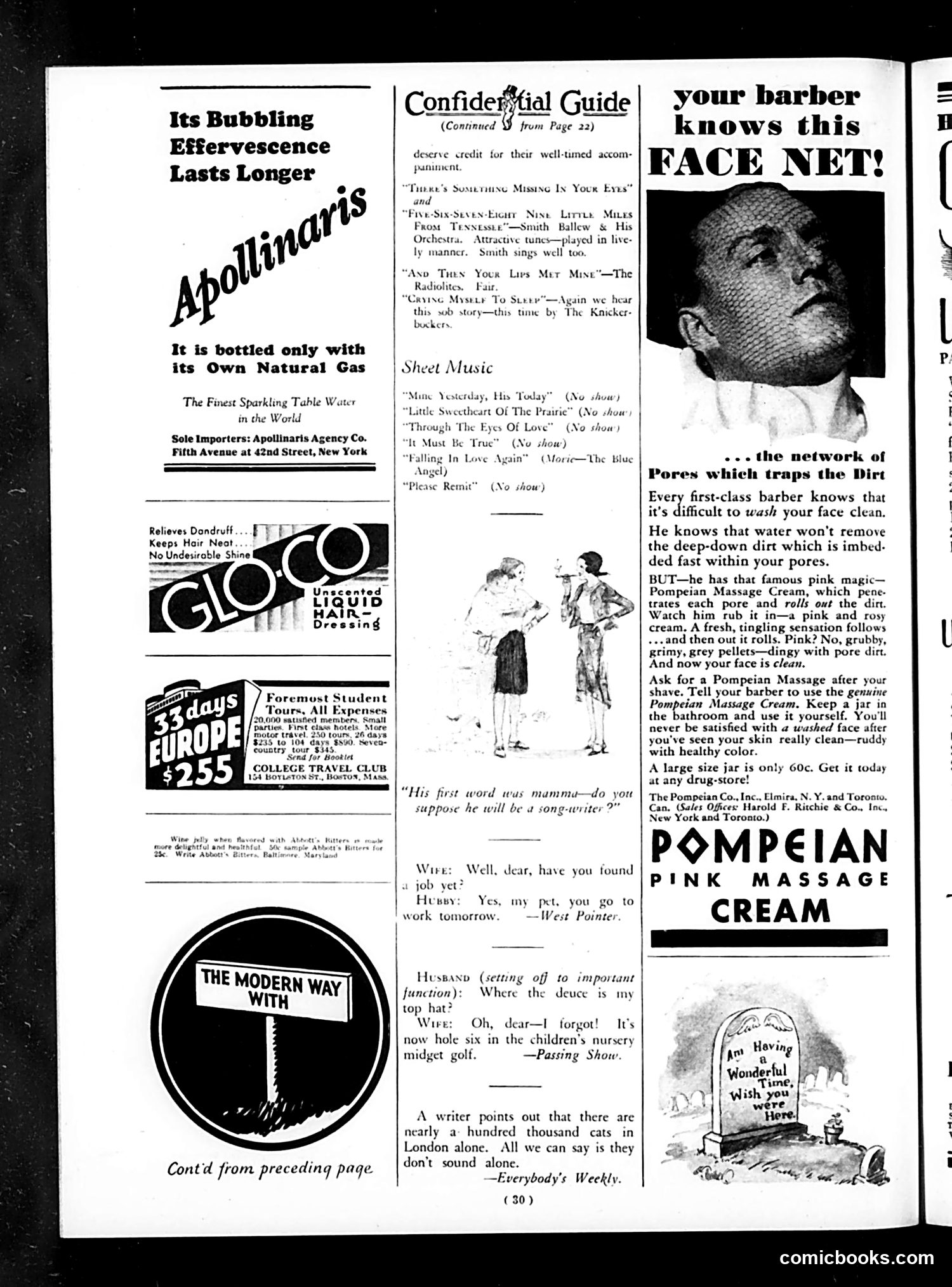
Explanation for Modern Readers This page is primarily advertising and filler content from Life magazine, with minimal satirical cartoons. The main humor comes from brief joke exchanges about domestic life: - A wife asks her husband if he found a job; he replies he's going to work tomorrow (implied unemployment joke) - A husband can't find his top hat because his wife forgot—she's using it as a hole in their children's miniature golf course (absurdist domestic humor) - A quip about London cats being numerous but quiet The page is dominated by product advertisements: Apollinaris sparkling water, Gloco hair product, a student travel club, and prominently, Pompeian Pink Massage Cream—a skincare product marketed to men through their barbers, claiming to extract deep pore dirt. The barber illustration demonstrates the product's appeal to masculinity and grooming standards of the era. There's no significant political content—this is a typical magazine page mixing light domestic comedy with advertising.
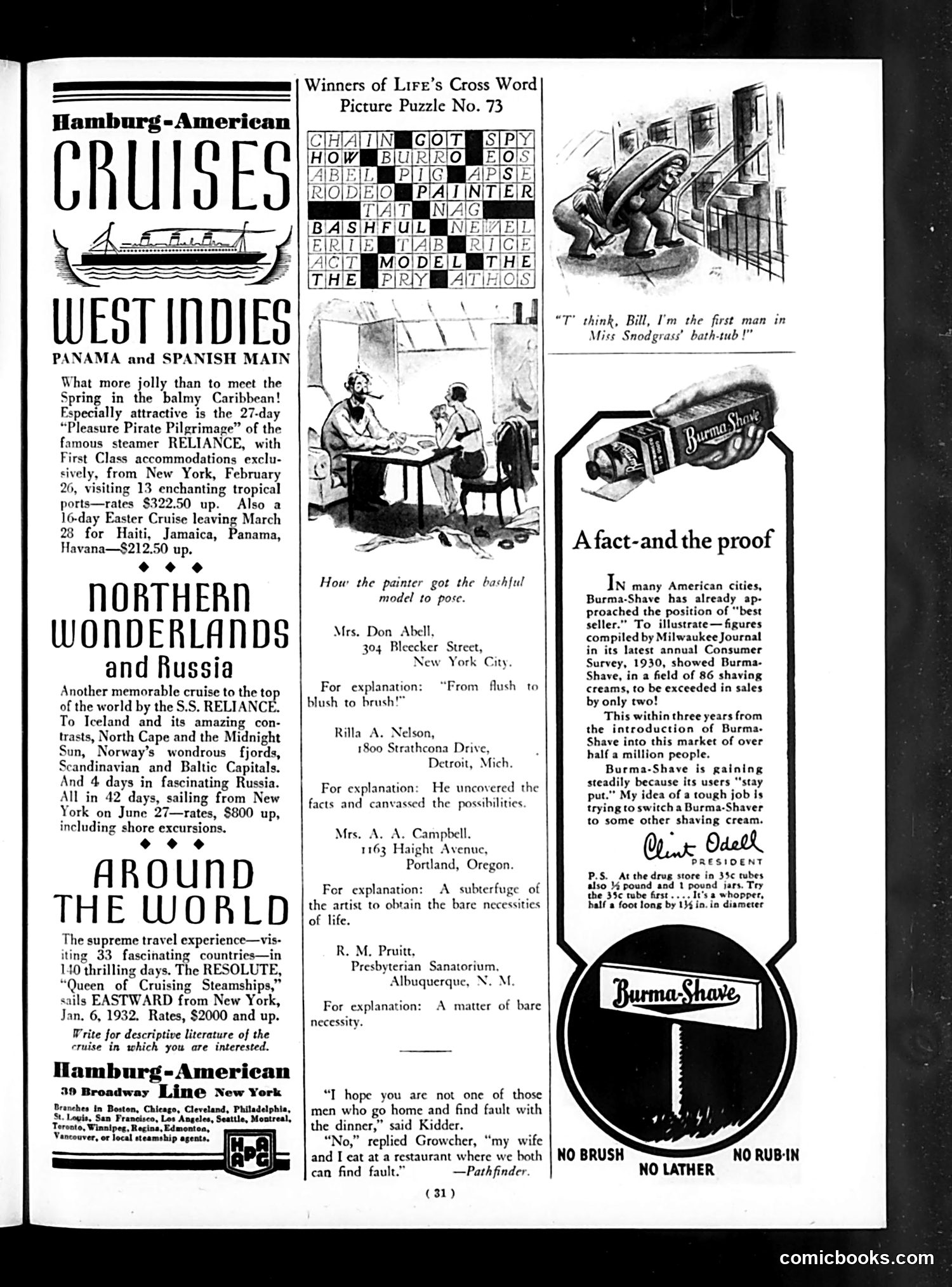
Page Analysis: Life Magazine Advertisement and Humor This page is primarily advertising and light humor rather than political satire. It contains: Cruise Ship Ads (left): Hamburg-American Line promoting luxury cruises to the Caribbean, Northern Europe/Russia, and around the world—typical 1930s travel marketing targeting wealthy Americans. Crossword Picture Puzzle Winners (center): Life magazine prints reader-submitted explanations for a cartoon showing a painter with a bashful female model. The winning captions use puns ("from flush to blush to brush") and double entendres about the artist getting the model to remove clothing ("bare necessities"). Burma-Shave Advertisement (right): A shaving cream company boasts sales success, claiming to rank third among 86 brands within three years. The ad emphasizes customer loyalty and convenience (available in small tubes at drugstores). Brief Humor (bottom): A restaurant joke where a couple bonds by complaining about food together. The page reflects 1930s consumer culture—luxury travel marketing and competitive advertising for mass-market grooming products. There is no significant political content.
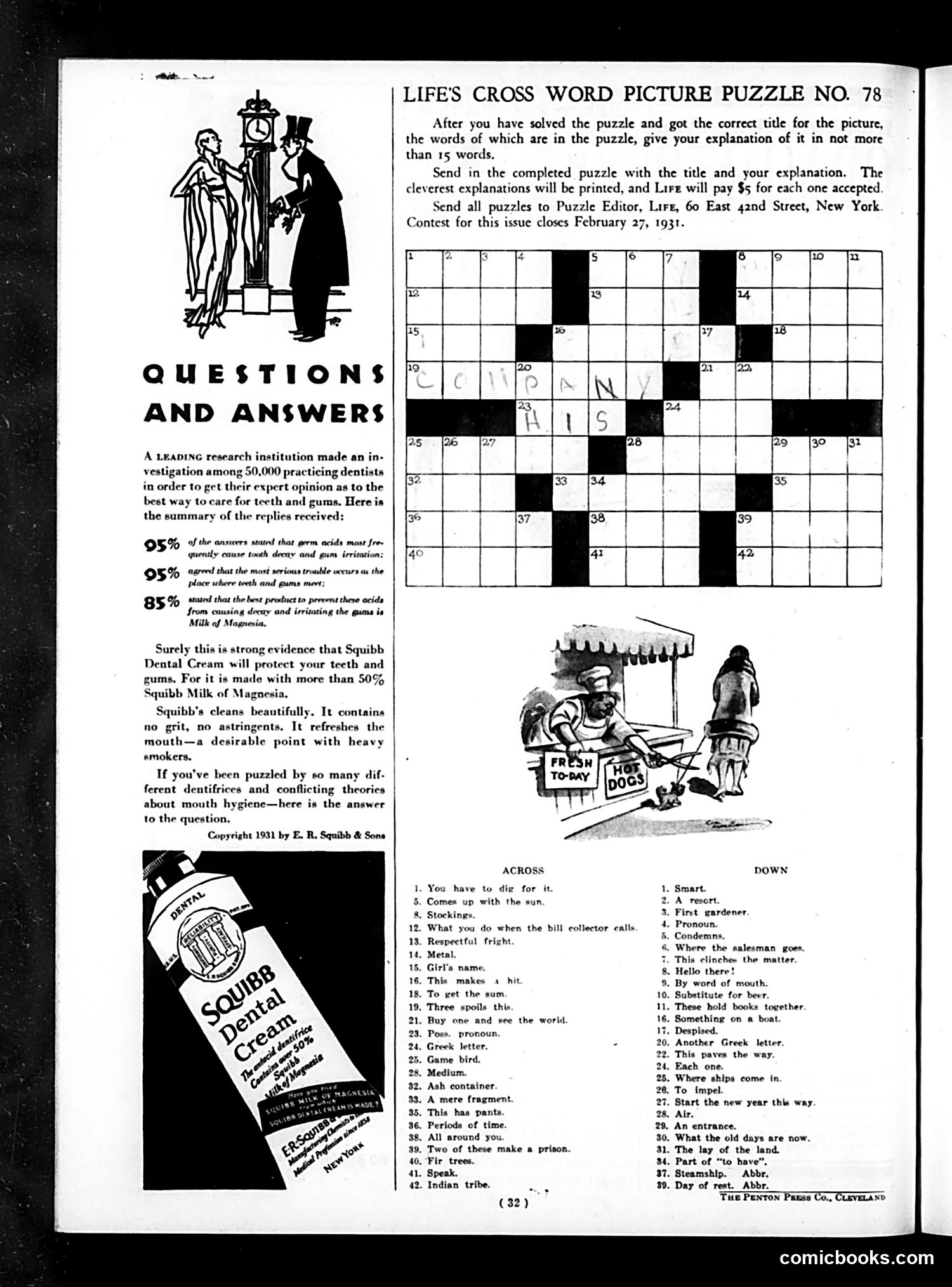
Life Magazine Page Analysis (1931) This page contains two distinct elements: a crossword puzzle contest and a Squibb Dental Cream advertisement disguised as editorial content. The "Questions and Answers" section presents survey results claiming 95% of 50,000 dentists recommend products with Milk of Magnesia to prevent tooth decay and gum irritation. Squibb Dental Cream, the advertiser notes, contains over 50% such product. The satire/context modern readers miss: This represents 1930s "advertorial" marketing—blurring advertising and journalism. The fake survey lends false scientific credibility. No actual independent verification is suggested. The dental care claims reflect pre-fluoride-era dentistry, when milk of magnesia was genuinely promoted as a gum protectant. The hot-dog vendor cartoon (bottom right) is unrelated—likely filler or separate advertisement. The crossword puzzle offers $5 for contest entries, a common engagement tactic of the era.
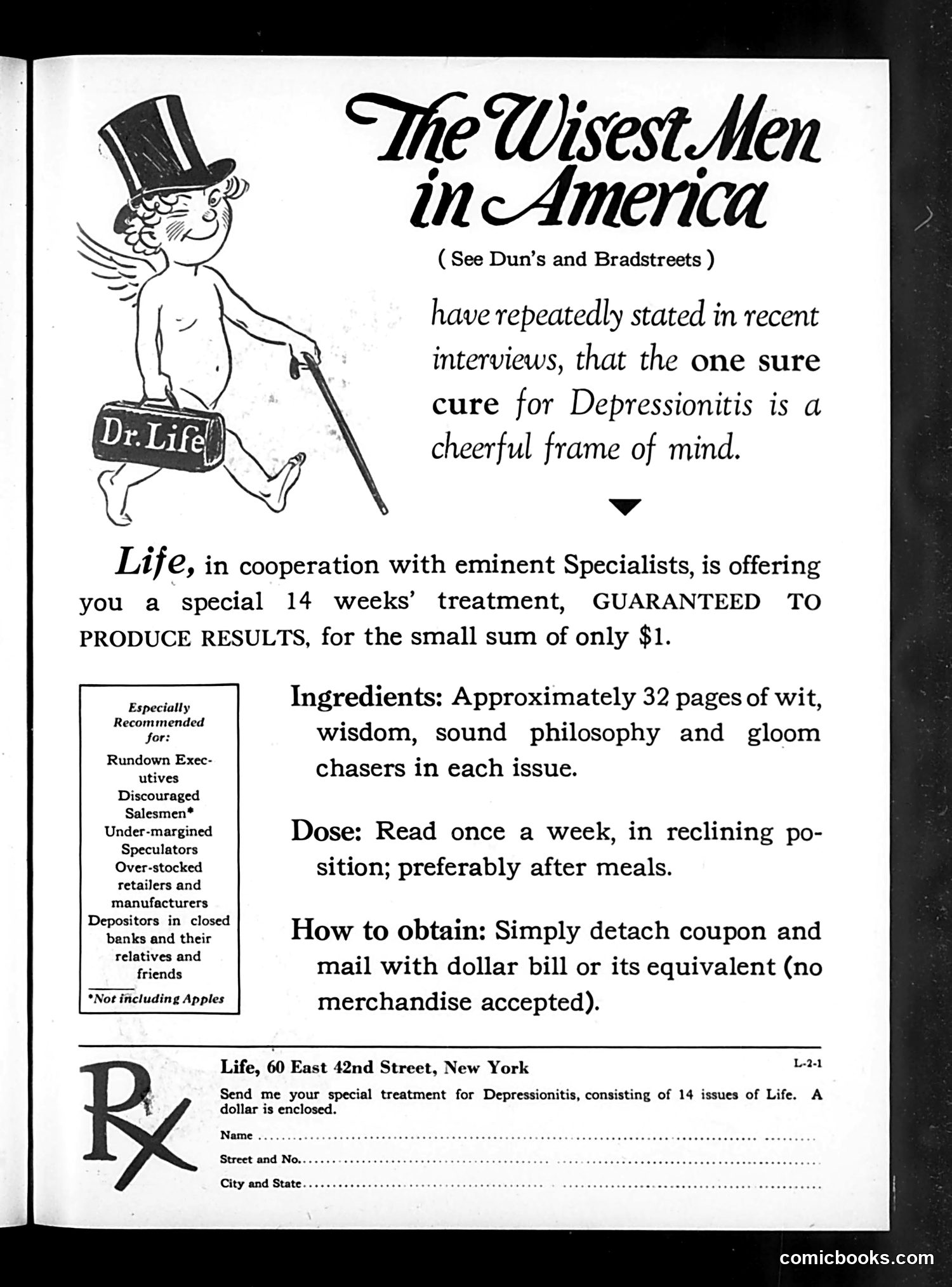
Analysis for Modern Readers This is a satirical advertisement from *Life* magazine mocking the Great Depression era's popular wisdom that positive thinking could cure economic hardship. The ad parodies medical advertising conventions, presenting *Life* magazine itself as a "treatment" for "Depressionitis"—a made-up disease representing depression caused by the economic crisis. The joke targets wealthy businessmen and "wisest men in America" (referenced via *Dun's and Bradstreets*, a business directory) who claimed cheerfulness alone could solve the Depression. The recommended patients list (rundown executives, discouraged salesmen, speculators) satirizes those hit hardest by the crash. The cartoon's winged cherub-like figure carrying a "Dr. Life" bag reinforces the mock-medical framing. By offering the magazine as a literal prescription—to be read weekly "after meals" like medicine—*Life* ridicules the era's oversimplified solutions to systemic economic collapse, while cleverly promoting its own satirical content as the real antidote to despair.
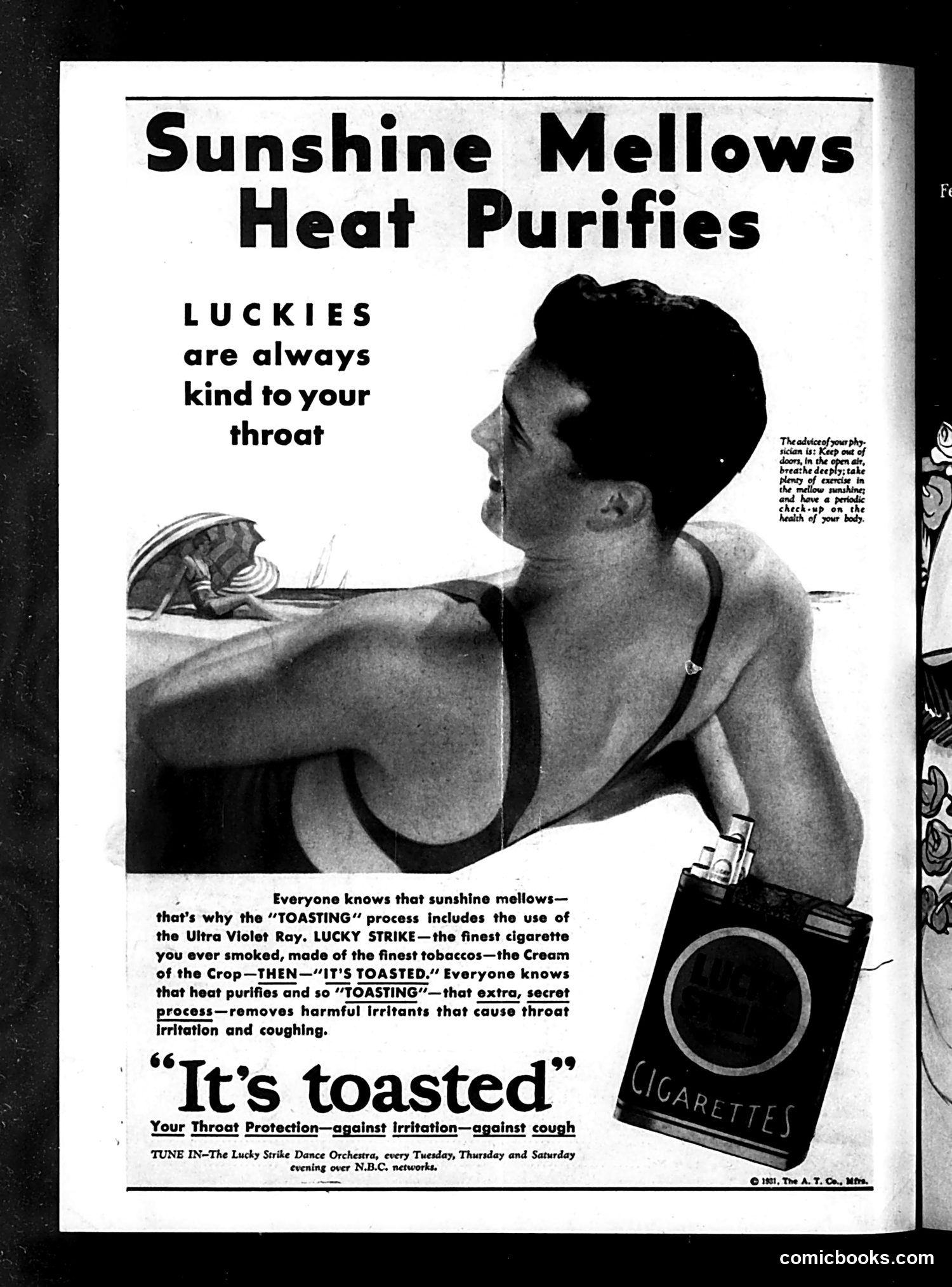
Lucky Strike Cigarette Advertisement Analysis This is a cigarette advertisement, not political satire. It promotes Lucky Strike brand cigarettes to a mid-20th century American audience. The ad features a shirtless man holding a cigarette, using the appeal of health and masculinity to market smoking. The central claim—"It's toasted"—suggests that a special "toasting process" using ultraviolet rays removes harmful irritants, protecting the throat against cough and irritation. Why this matters historically: This represents the tobacco industry's pre-regulation marketing strategy. Cigarettes were openly advertised as *health products*, with pseudo-scientific claims about heat "purifying" tobacco. The "toasting" process was presented as protective rather than merely a flavor choice. Modern readers should recognize this as false advertising—claims later proven entirely baseless once smoking's genuine health dangers became scientifically established and legally acknowledged. The casual linking of sunshine, heat, and health protection exemplifies how brazenly misleading cigarette marketing was before regulation.