life
Life — February 13, 1931
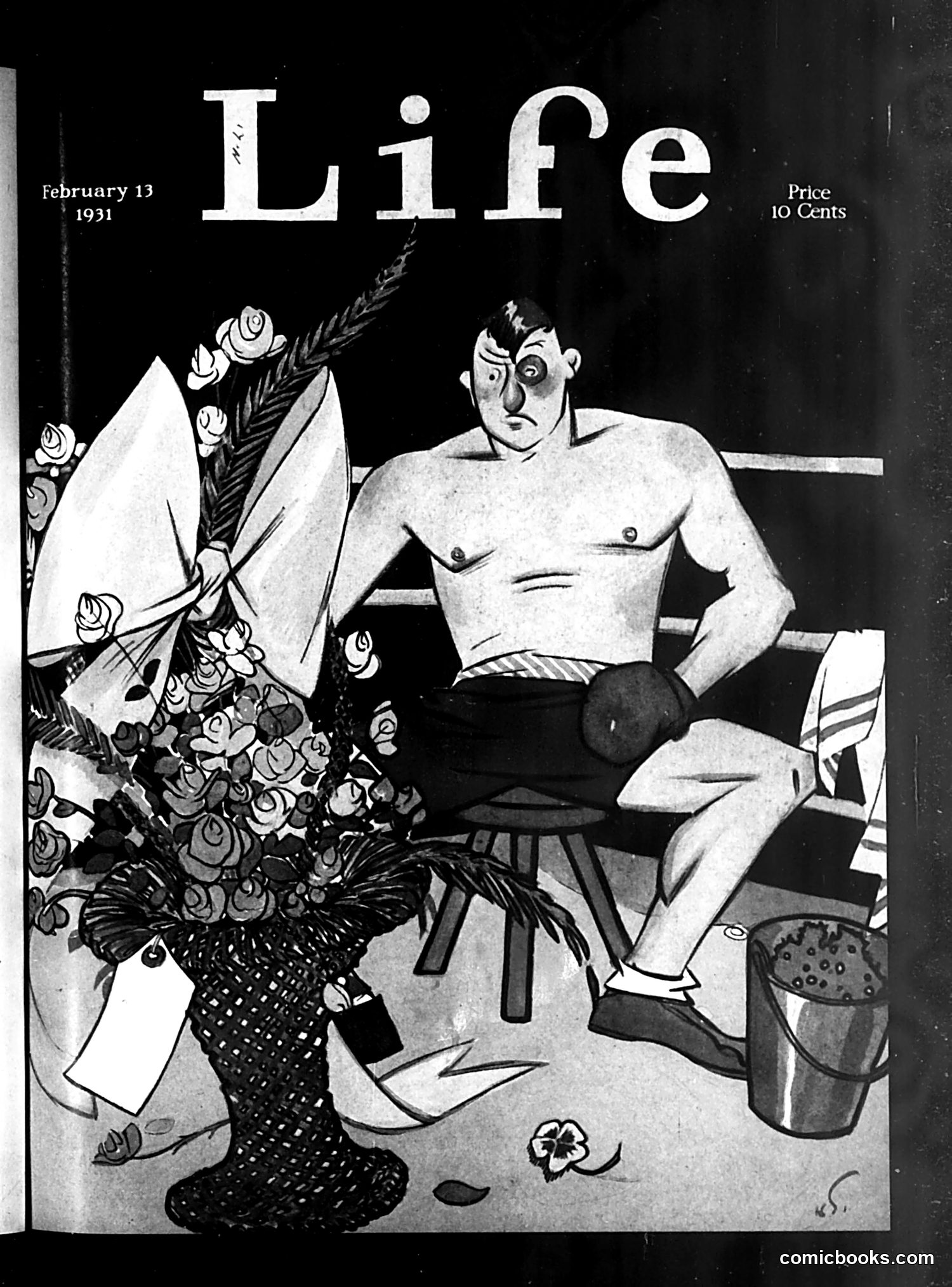
Life Magazine Cover, February 13, 1931 This cover depicts a muscular, shirtless boxer sitting in a chair, holding boxing gloves. He has an exaggerated facial expression with dramatic makeup or scarring, suggesting either a caricature or someone in theatrical costume. The figure is surrounded by flowers in a basket and decorative elements, creating an incongruous contrast between masculine boxing imagery and romantic/feminine floral presentation. The satire likely comments on romantic entanglement or distraction from athletic pursuits—the flowers and domestic setting humorously undermine the boxer's tough, athletic identity. This was a common Depression-era satirical device: mocking how romance or domesticity could derail a man's professional ambitions or masculine persona. The specific boxer's identity remains unclear from the image alone.
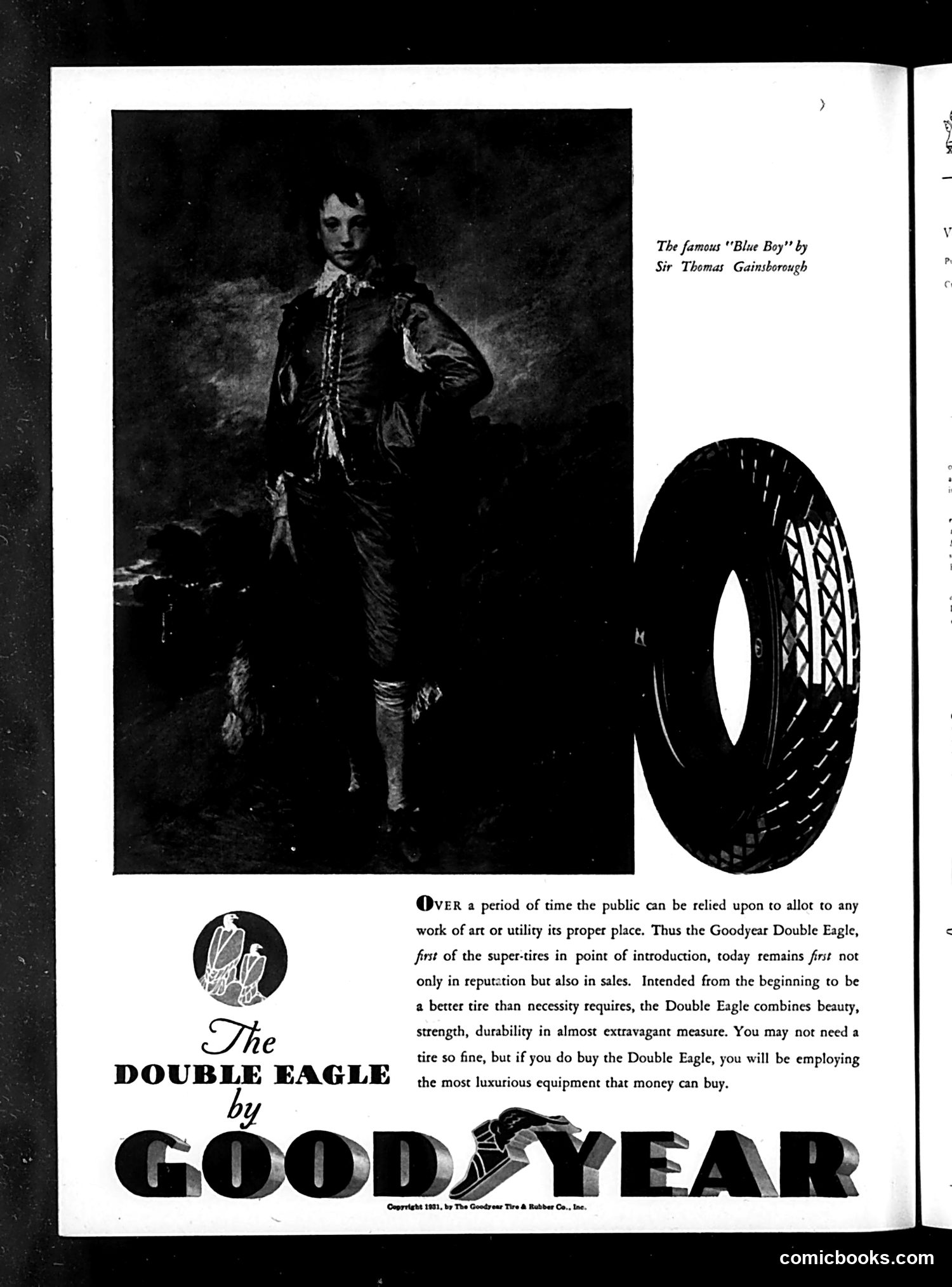
Analysis This page is primarily a Goodyear tire advertisement, not political satire. It features a famous painting—"The Blue Boy" by Sir Thomas Gainsborough (noted in the caption)—repurposed as marketing copy. The ad argues that just as the public recognizes and trusts great artworks, Goodyear's "Double Eagle" tire has earned similar reputation and sales leadership through quality. The painting's elegant young subject in blue clothing serves merely as a visual anchor for the message about reliability and luxury. The tire image on the right shows the product itself. The text claims the Double Eagle combines "beauty, strength, durability" better than competitors, positioning it as a premium choice. This is straightforward product advertising exploiting cultural prestige, not commentary on politics or social issues.
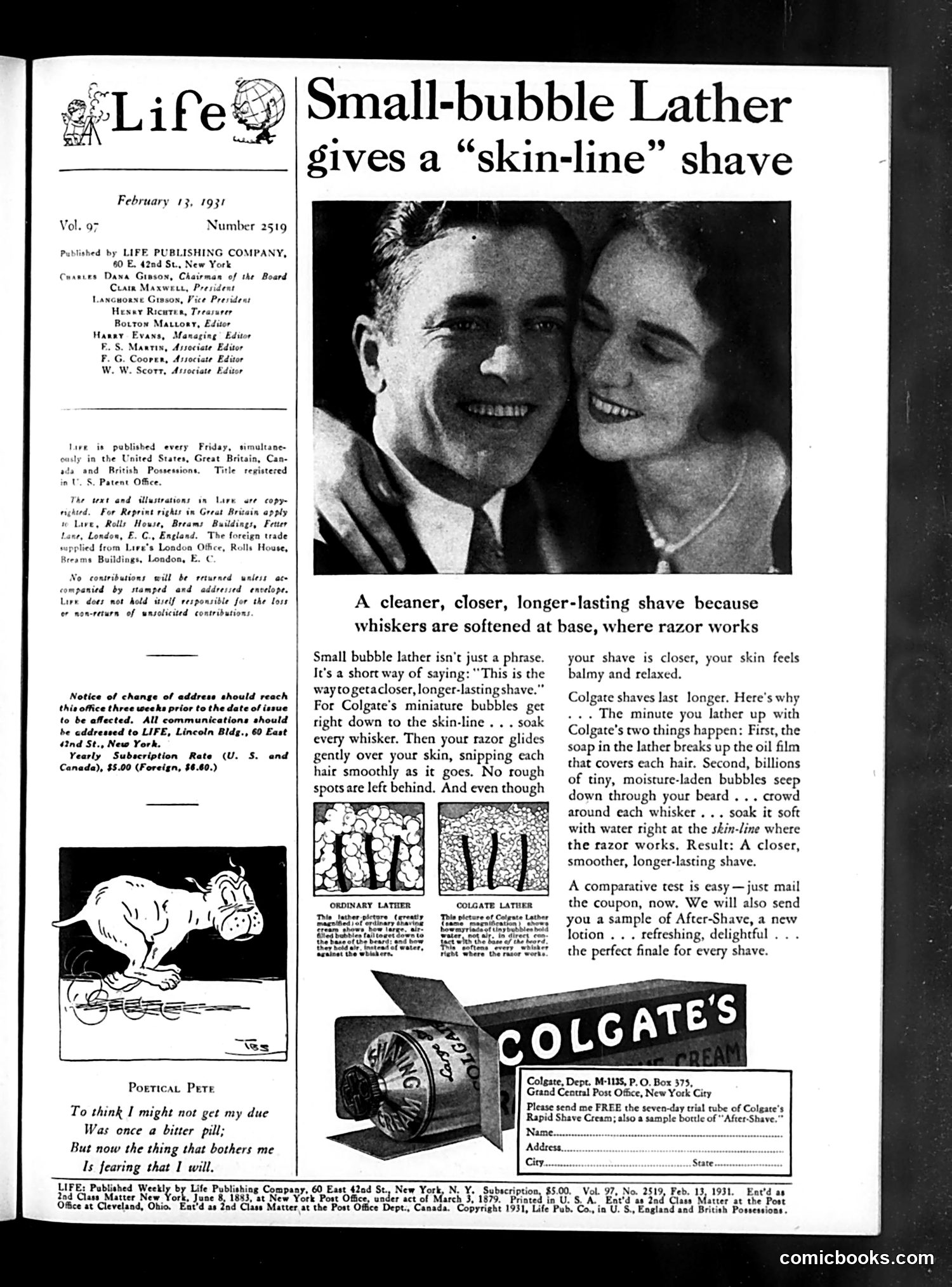
Analysis This page is primarily advertising, not political satire. It features a Colgate shaving cream advertisement promoting their "small-bubble lather" for a closer shave. The only cartoon element is "Poetical Pete" at bottom left—a small humorous verse about bitter pills and fear, unrelated to the ad. The cartoon itself is generic comic filler, not satirical commentary. The advertisement uses comparative product photography (ordinary vs. Colgate lather) and testimonial photographs of two smiling men to demonstrate the superiority of Colgate's formula. The "skin-line" shave concept—where soap softens whiskers at their base—was the product's selling point. This reflects 1931 advertising conventions: visual product comparison and social aspiration through personal grooming.
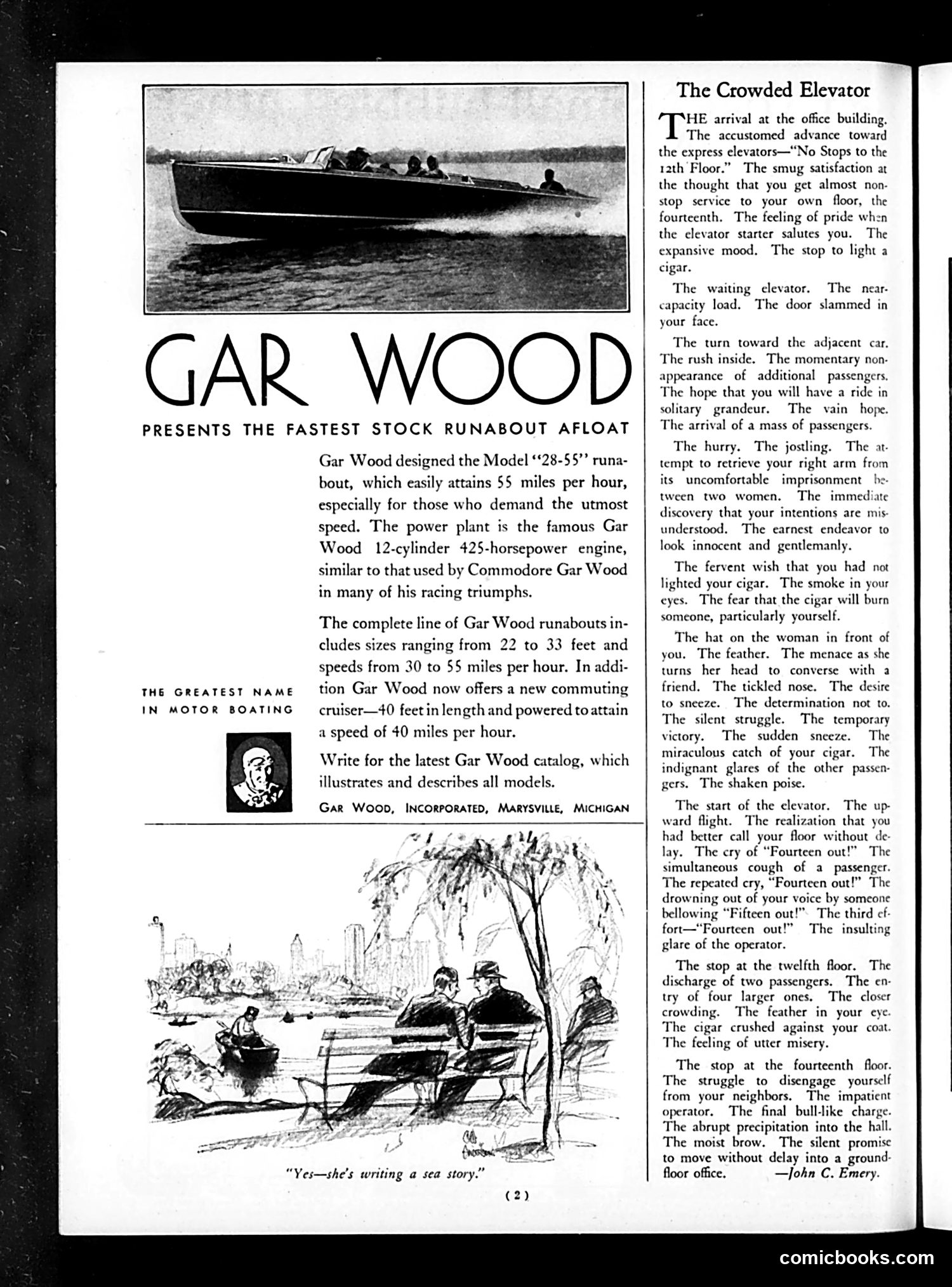
"The Crowded Elevator" - Analysis This page is primarily a Gar Wood speedboat advertisement (left side) paired with humorous editorial content (right side). "The Crowded Elevator" is a satirical narrative poem by John C. Emery that mockingly catalogs the petty indignities and social awkwardness of riding a packed office building elevator. The humor derives from treating mundane annoyances—door-slamming, crowding, accidentally touching strangers, cigar smoke, feathers from women's hats—with exaggerated dramatic language, as if describing genuine catastrophes. The accompanying sketch depicts people relaxing by water, likely contrasting leisure with the urban office grind described in the text. The satire targets modern urban office culture and the claustrophobic experience of shared public transportation—a relatable complaint for the magazine's presumably urban, white-collar readership.
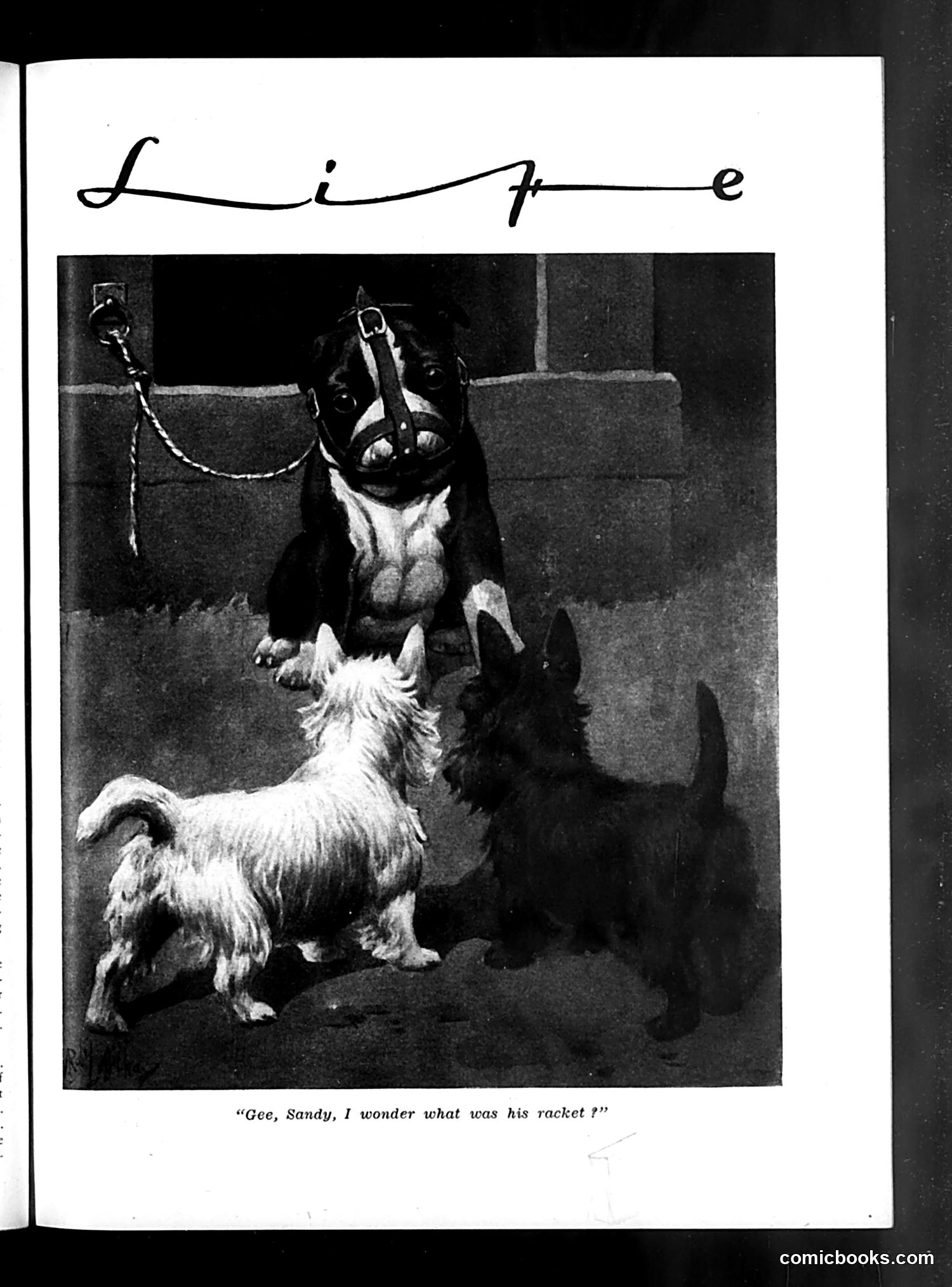
Analysis This page from *Life* magazine shows a humorous domestic scene rather than political satire. The image depicts two small dogs—one white and fluffy, one black—interacting with a larger dog wearing a muzzle and collar with a rope leash, positioned against a brick wall. The caption reads: "Gee, Sandy, I wonder what was his racket?" The joke relies on anthropomorphizing the dogs as characters gossiping about a third dog. The muzzled dog's restraint and equipment suggest it has been troublesome or dangerous, prompting the smaller dogs' speculation about its criminal or problematic "racket" (slang for illicit activity or scheme). This is gentle humor playing on the dogs' assumed conversational judgment of their peer.
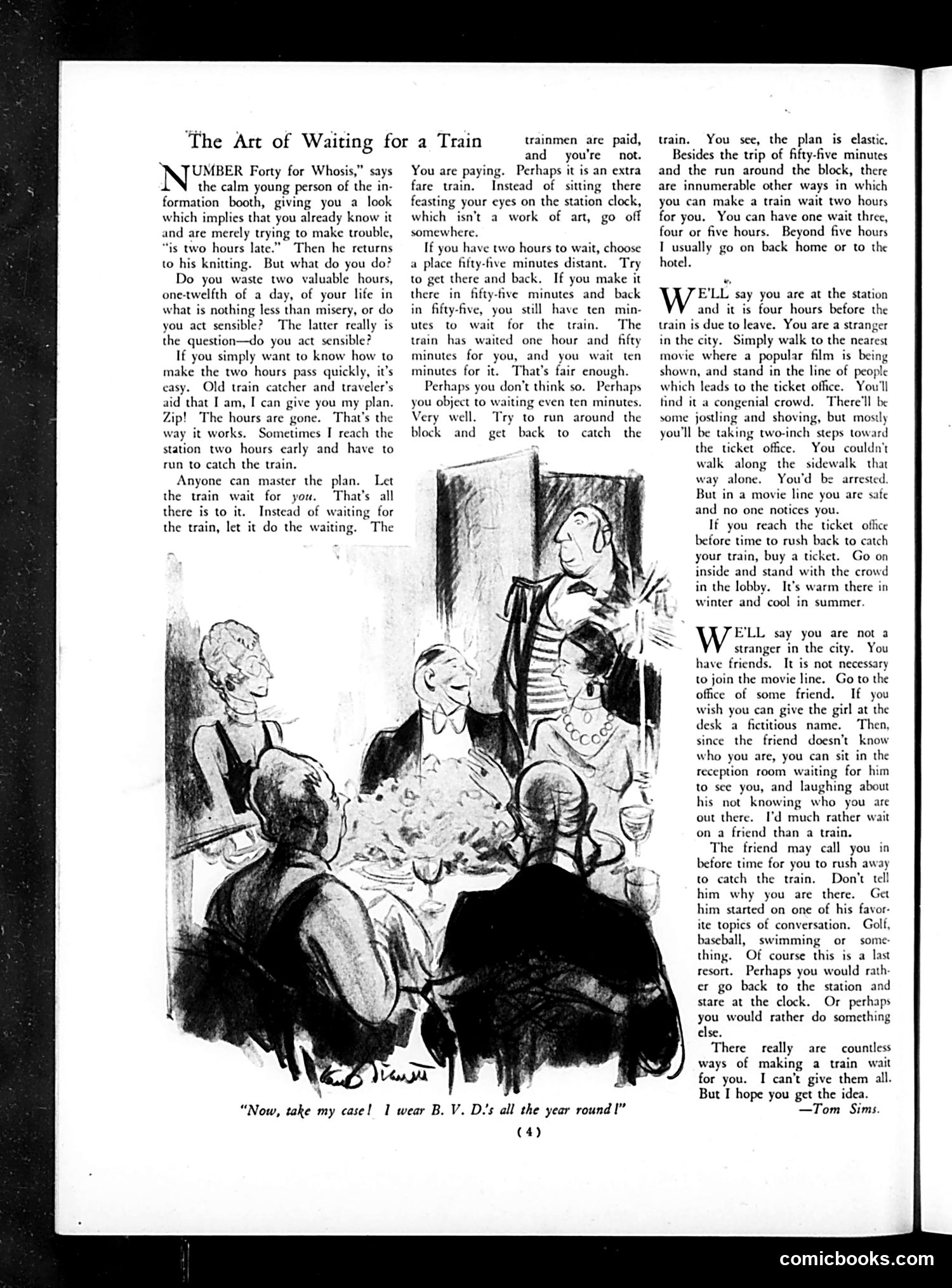
Analysis: "The Art of Waiting for a Train" This is a humorous advice article by Tom Simi about how to pass time while waiting for trains—a common experience for early 20th-century travelers. The accompanying illustration shows people dining and socializing at what appears to be a station restaurant or hotel. The satire is gentle: the article mocks the tedium of train delays by offering increasingly absurd suggestions (walk around the block, go to a movie, visit friends with a fake name). The joke is that waiting for trains was genuinely annoying and time-consuming in this era, so the author provides increasingly elaborate ways to avoid actually sitting at the station. The cartoon caption about wearing "B.V.D.'s all year round" is an advertisement reference to the underwear brand, a typical Life magazine style of mixing content with product placement.
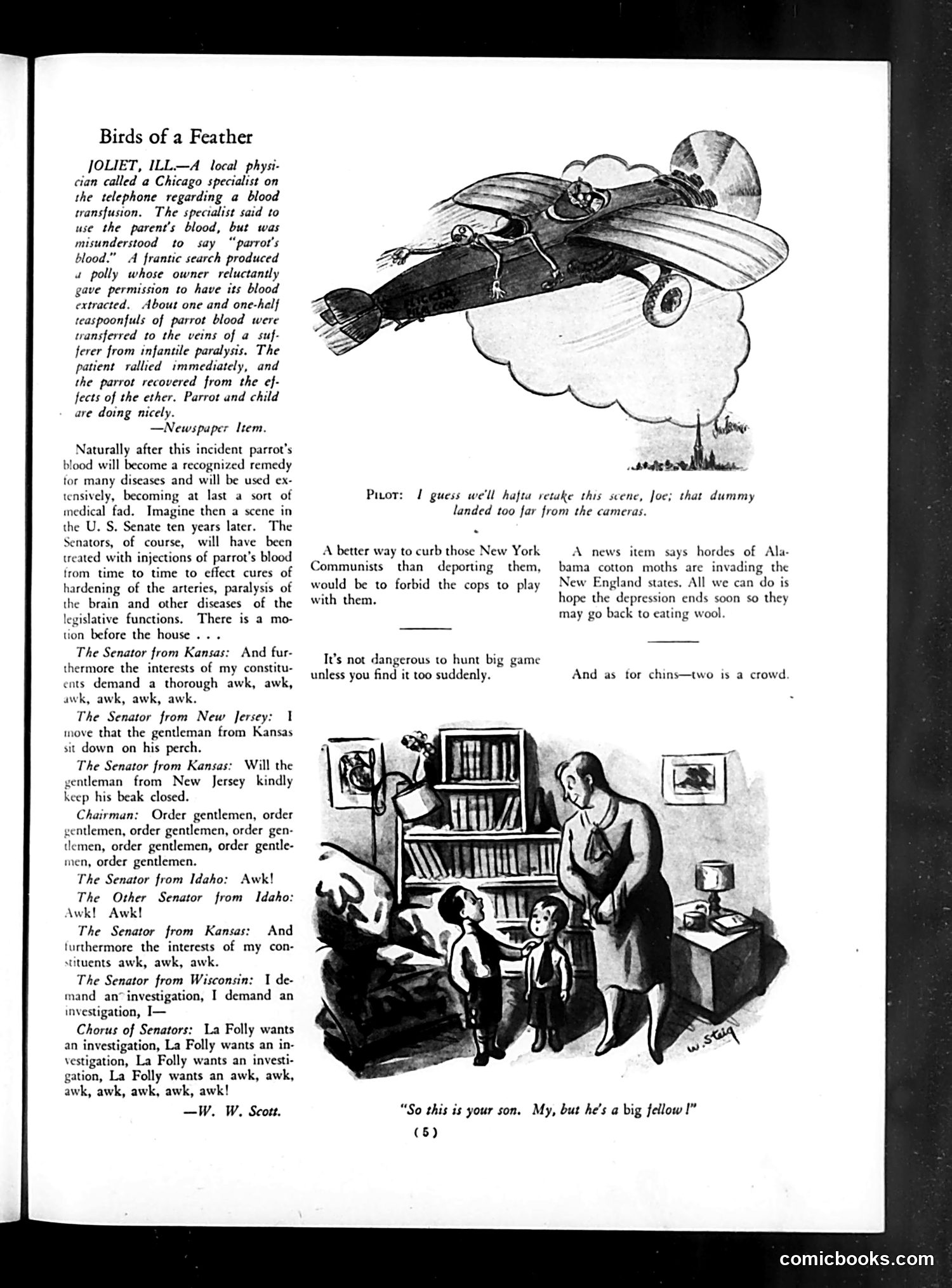
Analysis of "Birds of a Feather" Page This page contains two distinct satirical pieces: Upper section: A humorous anecdote about a Chicago physician who mistakenly used parrot blood for a human infant's transfusion, successfully curing infantile paralysis. The satire mocks both medical incompetence and bureaucratic response—the piece predicts U.S. Senators will eventually receive parrot-blood treatments for various ailments, followed by absurdist dialogue where senators repeatedly demand "investigations" and "awks." Lower cartoon: Shows a mother introducing her large son to visitors at a bookshelf, saying "So this is your son. My, but he's a big fellow!" The joke's point remains unclear from context alone, but likely comments on child development, parenting, or social awkwardness of the era. Both pieces use exaggeration and wordplay typical of Life magazine's satirical style targeting medical and political institutions.
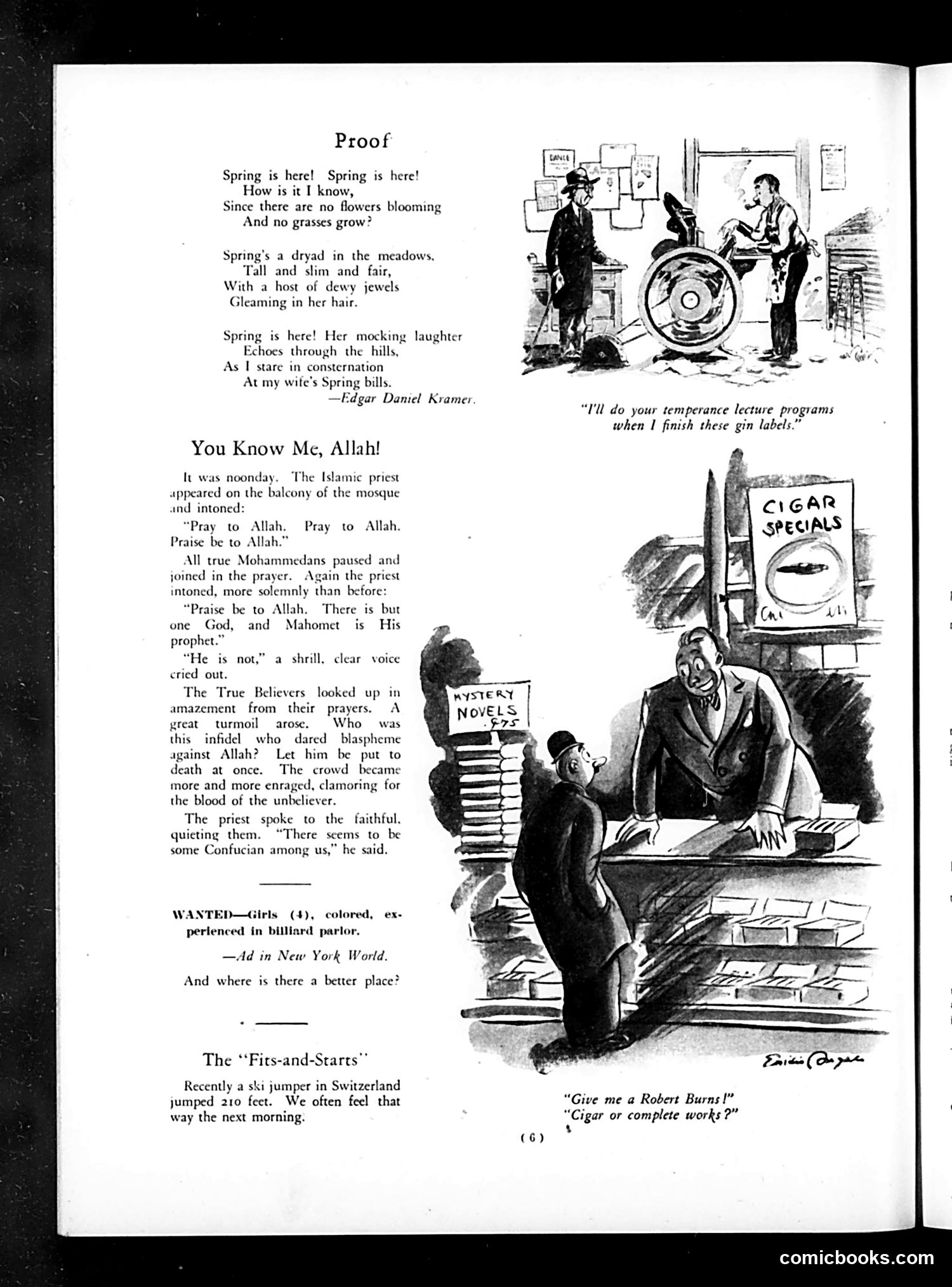
Analysis of Life Magazine Page This page contains three distinct pieces of humor: 1. "Proof" poem (top left): A spring-themed poem by Edgar Daniel Kramers, accompanied by a cartoon showing a man lecturing about temperance while labeling gin bottles—satirizing hypocrisy of those preaching morality while engaged in illicit alcohol production (likely referencing Prohibition-era bootlegging). 2. "You Know Me, Allah!" (center-left): A story mocking religious intolerance, depicting a Muslim prayer call interrupted by someone shouting blasphemy, leading to mob violence. The priest's closing line suggests finding "some Confucian among us," satirizing prejudice and religious extremism. 3. Two cartoons (right): One depicts a man requesting "a Robert Burns" cigar while surrounded by mystery novels and cigar advertisements—likely wordplay on the Scottish poet Burns. The bottom cartoon shows similar commercial/literary confusion. The page satirizes hypocrisy, religious intolerance, and commercial absurdity typical of 1920s American life.
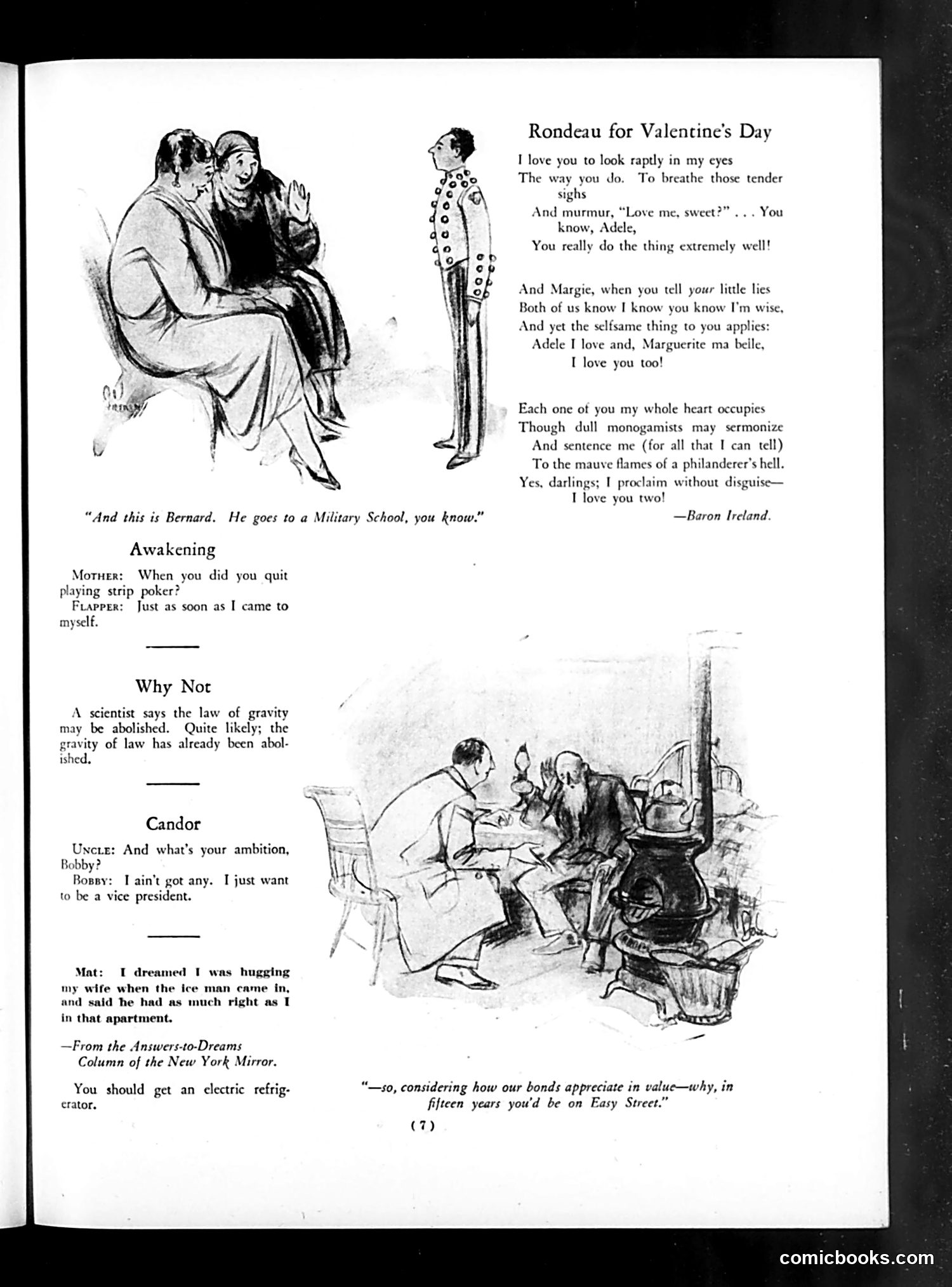
Analysis of Life Magazine Page This page contains several short satirical pieces and illustrations typical of early 20th-century *Life* magazine humor. "Rondeau for Valentine's Day" by Baron Ireland is a poem addressing multiple romantic partners (Adele, Margie/Marguerite), celebrating polyamorous love while mocking monogamous "sermons." "Awakening" jokes about a man quitting poker—a common vice. "Why Not" sarcastically suggests gravity itself might be abolished. "Candor" features an uncle-nephew exchange where the nephew's ambition is merely becoming "vice president." The bottom illustration shows what appears to be a landlord or creditor discussing unpaid bonds with tenants, with a caption about appreciating property values over fifteen years. These pieces mock romantic excess, gambling, scientific pretension, ambition, and financial obligations—typical *Life* magazine social satire.
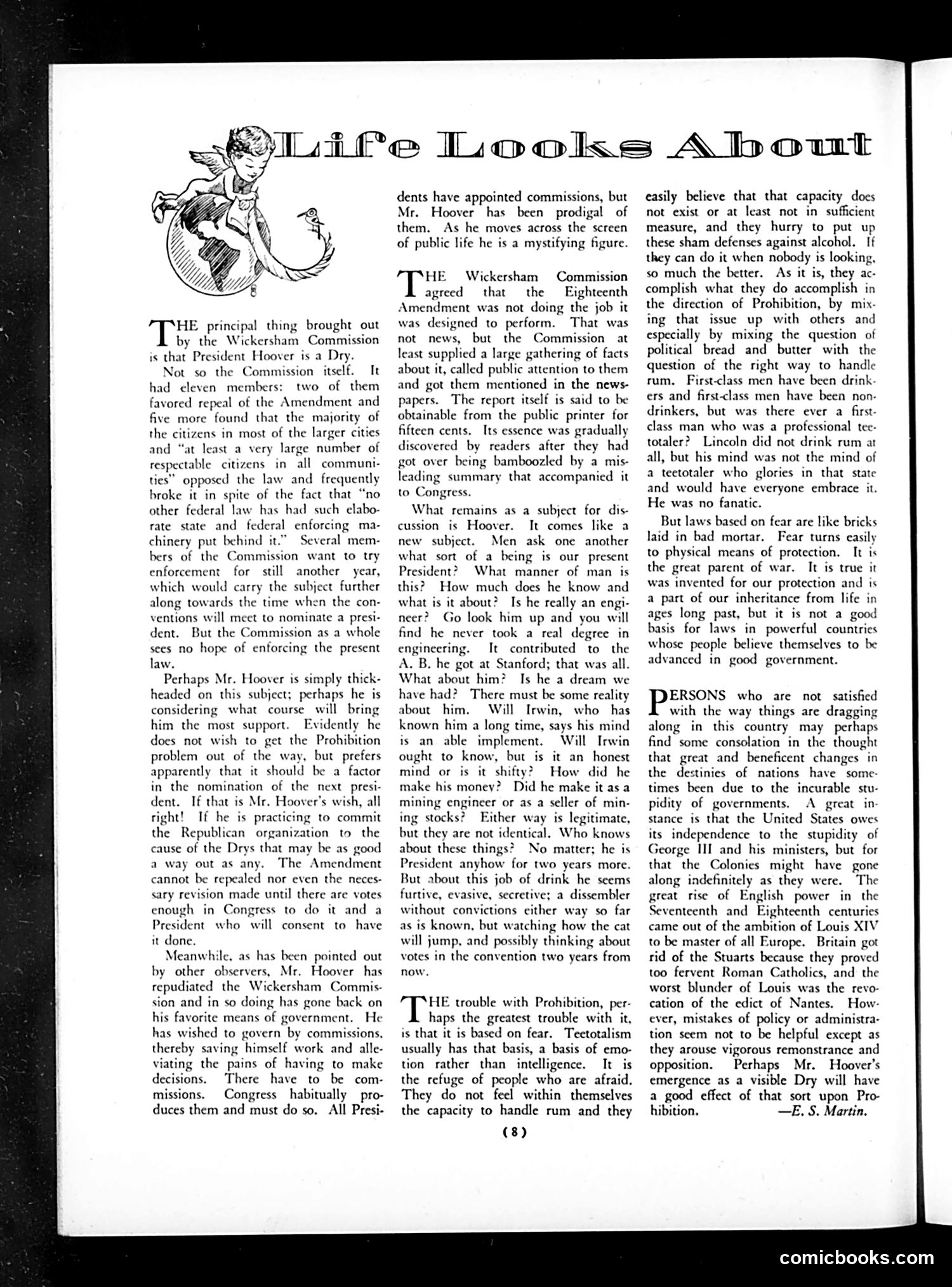
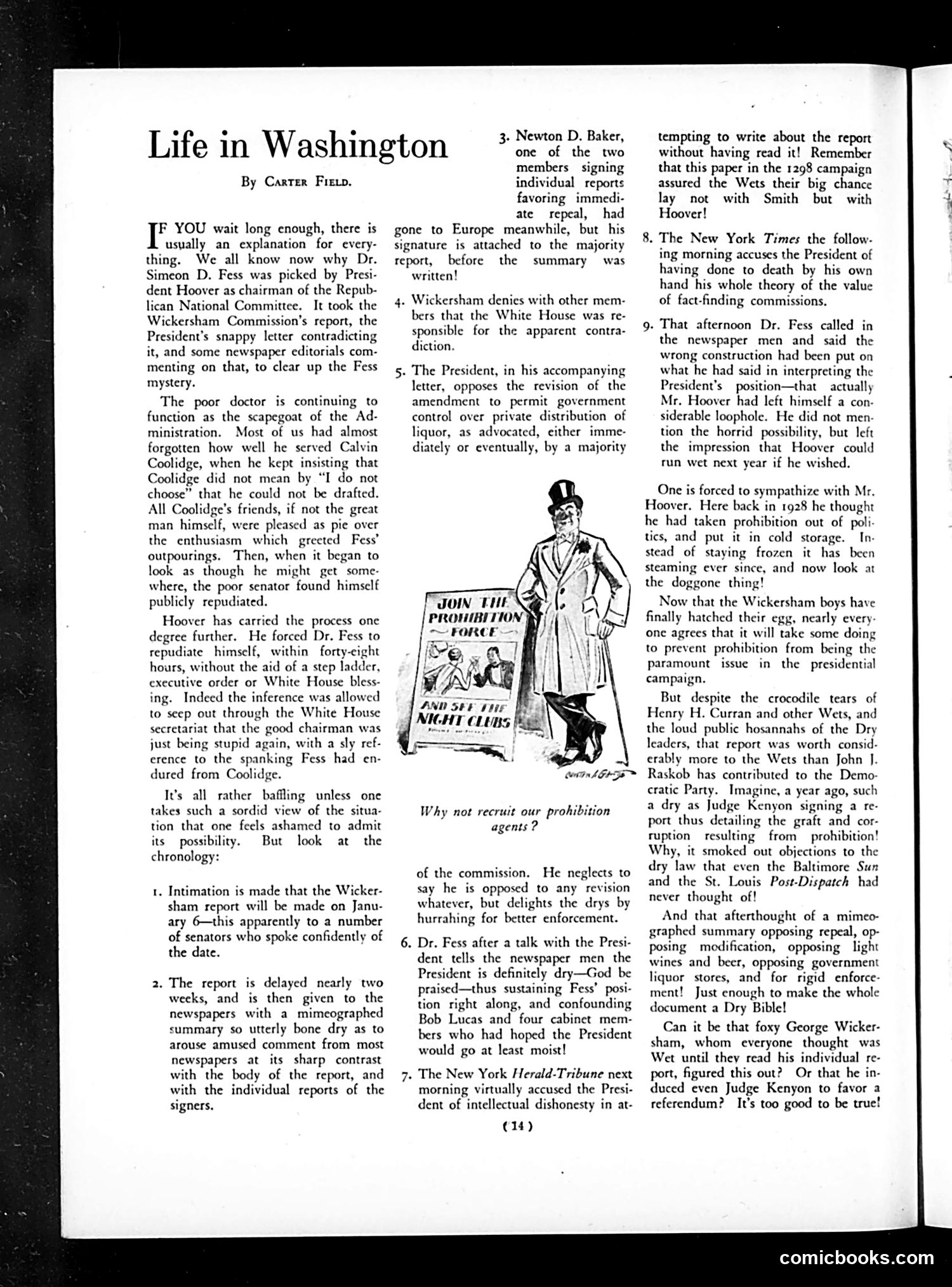
Analysis of "Life Looks About" This page is an editorial essay critiquing President Hoover's approach to governance, particularly regarding Prohibition enforcement. The illustration shows a cherub-like figure examining something with a magnifying glass—likely representing scrutiny of political matters. The text argues that Hoover relies excessively on commissions rather than direct action, using the Wickersham Commission (which investigated Prohibition) as an example. The author criticizes this as evasive leadership, claiming commissions allow presidents to avoid accountability while appearing to address problems. The essay also discusses Hoover's background as an engineer and questions whether his qualifications suit the presidency. It ultimately suggests Hoover's cautious, commission-based approach reflects fear-based governance rather than confident leadership—a subtle critique of his administrative style during the early Depression era.
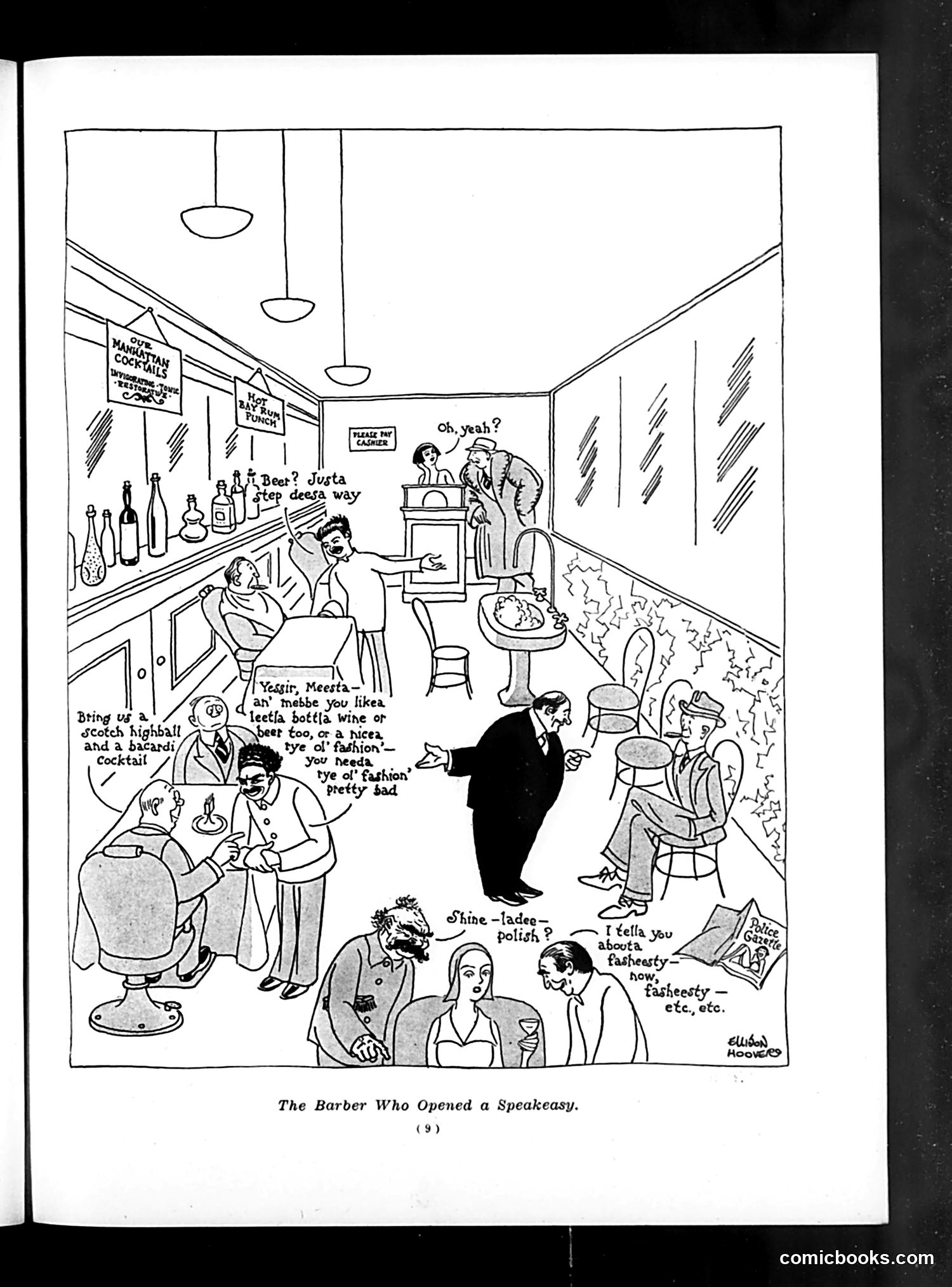
"The Barber Who Opened a Speakeasy" This cartoon satirizes Prohibition-era speakeasies—illegal bars operating during the 1920s alcohol ban. The title suggests a barber has disguised his establishment as a front for serving drinks. The scene depicts a crowded, lively illegal bar with patrons enjoying cocktails and beer. Dialogue bubbles reference typical speakeasy offerings: "Scotch highball," "beer," and fashion advice alongside drinks—suggesting the establishments' role as social gathering spots beyond mere drinking. The man in the center (fully blackened in figure) appears to be the proprietor or a server. The casual mingling and visible alcohol bottles on shelves mock both the public's disregard for Prohibition laws and authorities' difficulty enforcing them. The cartoon satirizes how ordinary businesses circumvented Prohibition through creative disguises and community complicity.
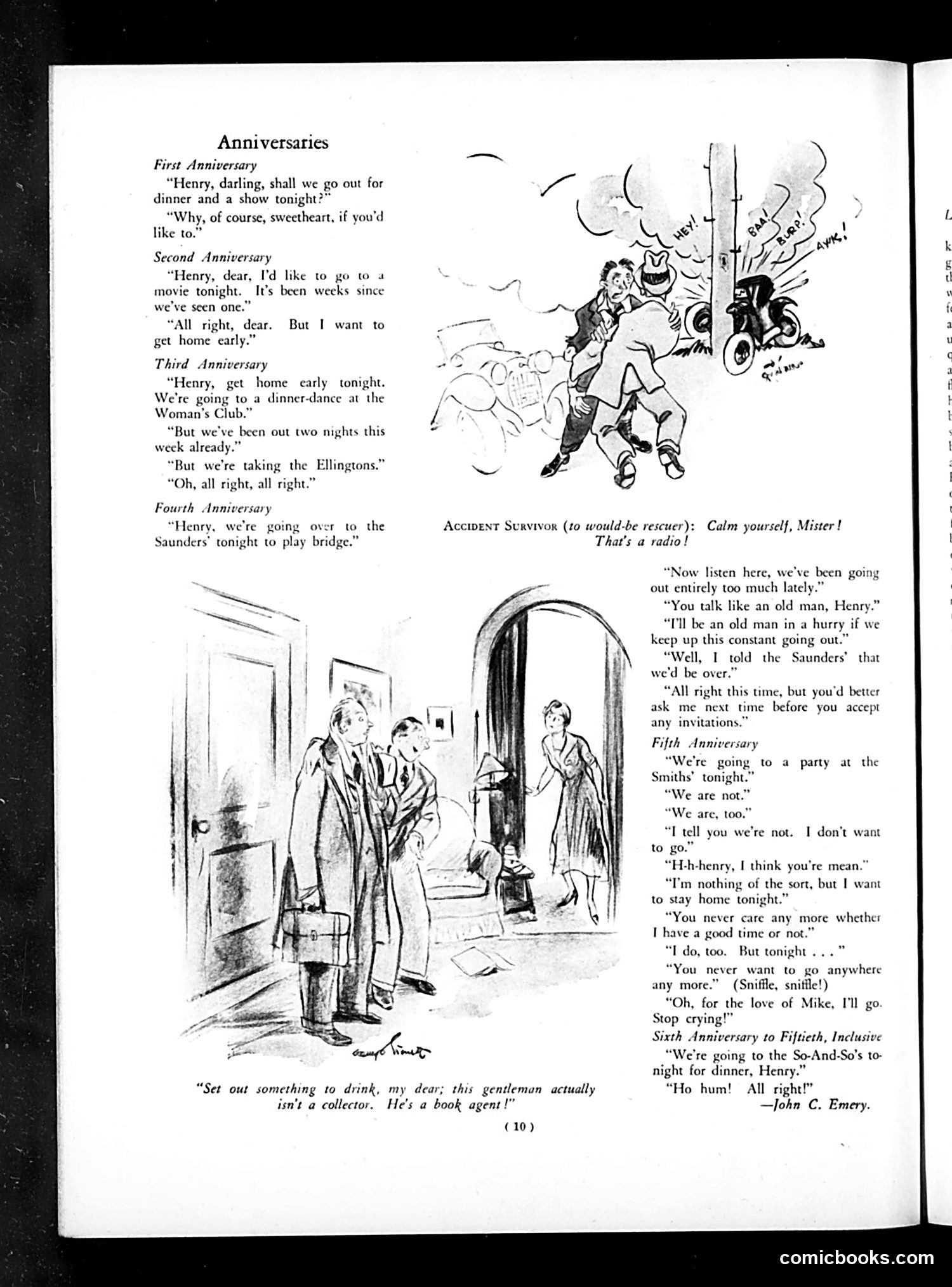
"Anniversaries" - Life Magazine Satire This page satirizes the deteriorating domestic life of a married couple named Henry and his wife over six anniversaries. Each entry shows the couple's plans becoming increasingly modest and strained: - First through Fourth: Dinners, movies, and social outings gradually replace each other - Fifth Anniversary: Open conflict—the wife refuses to attend a party, accusing Henry of not caring about her happiness - Sixth Anniversary: A humorous resolution at a restaurant ("So-And-So's") The accompanying illustrations depict domestic scenes of marital tension and disconnect. The satire targets the gradual erosion of romance and effort in marriage, suggesting that couples become complacent and argumentative over time. The humor lies in the universal relatability of this decline—a commentary on how initial excitement gives way to routine obligation and resentment.
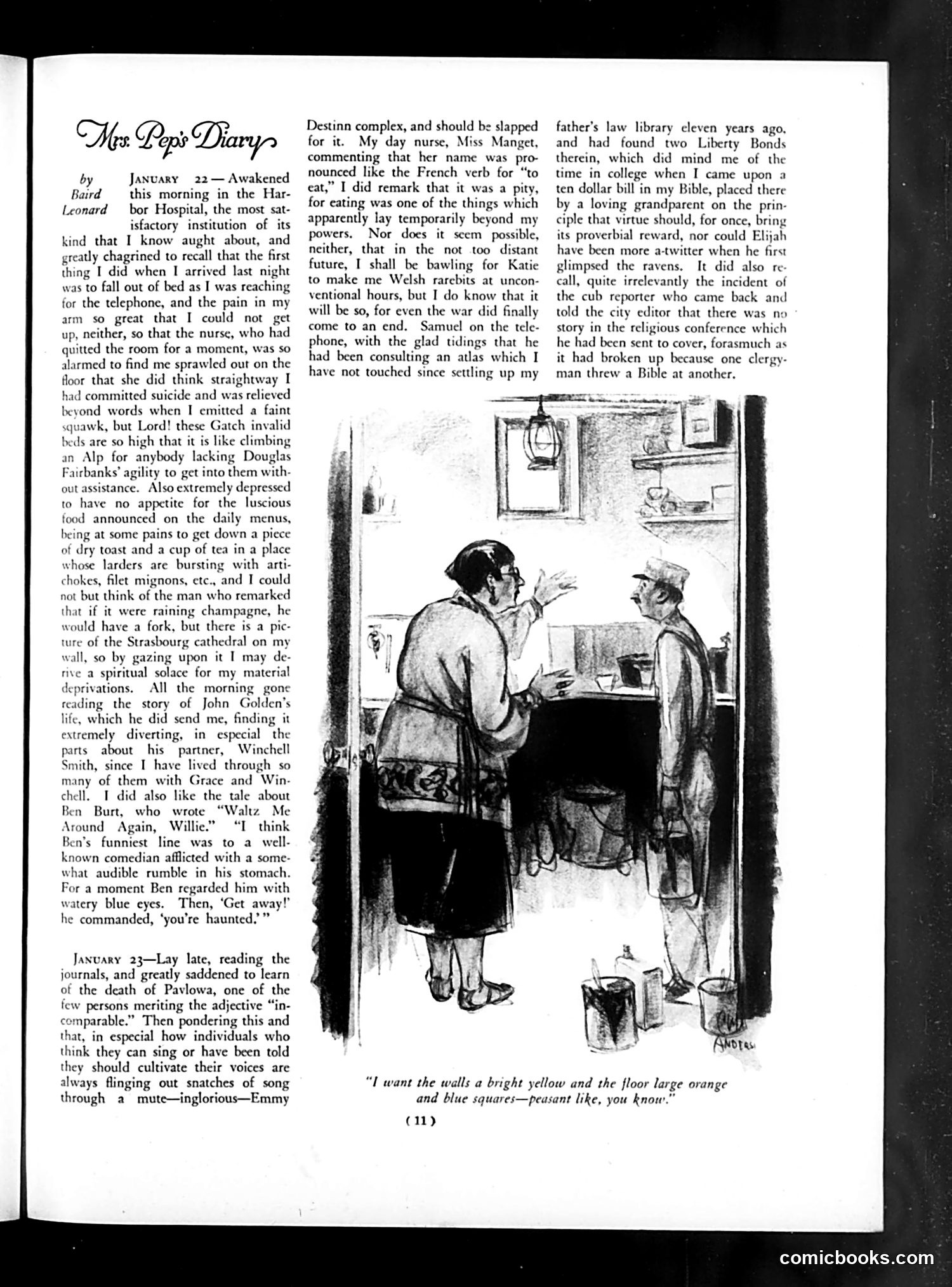
Analysis of "Mrs. Peps Diary" Page This page contains a diary entry dated January 22-23, presenting a humorous domestic narrative in the style of early 20th-century British satirical humor. The accompanying illustration shows two working-class figures—likely a tradesman and a customer or client—discussing interior decoration. The cartoon caption reveals the joke: the character speaking (appearing to be a decorator or tradesman) proposes an aesthetically jarring color scheme: "bright yellow" walls, "large orange and blue squares"—described as "peasant like." The satire targets both the speaker's questionable taste and the absurdity of attempting to impose sophisticated aesthetic principles onto humble working-class interiors. The humor lies in the clash between pretentious decorative aspirations and practical, modest circumstances.
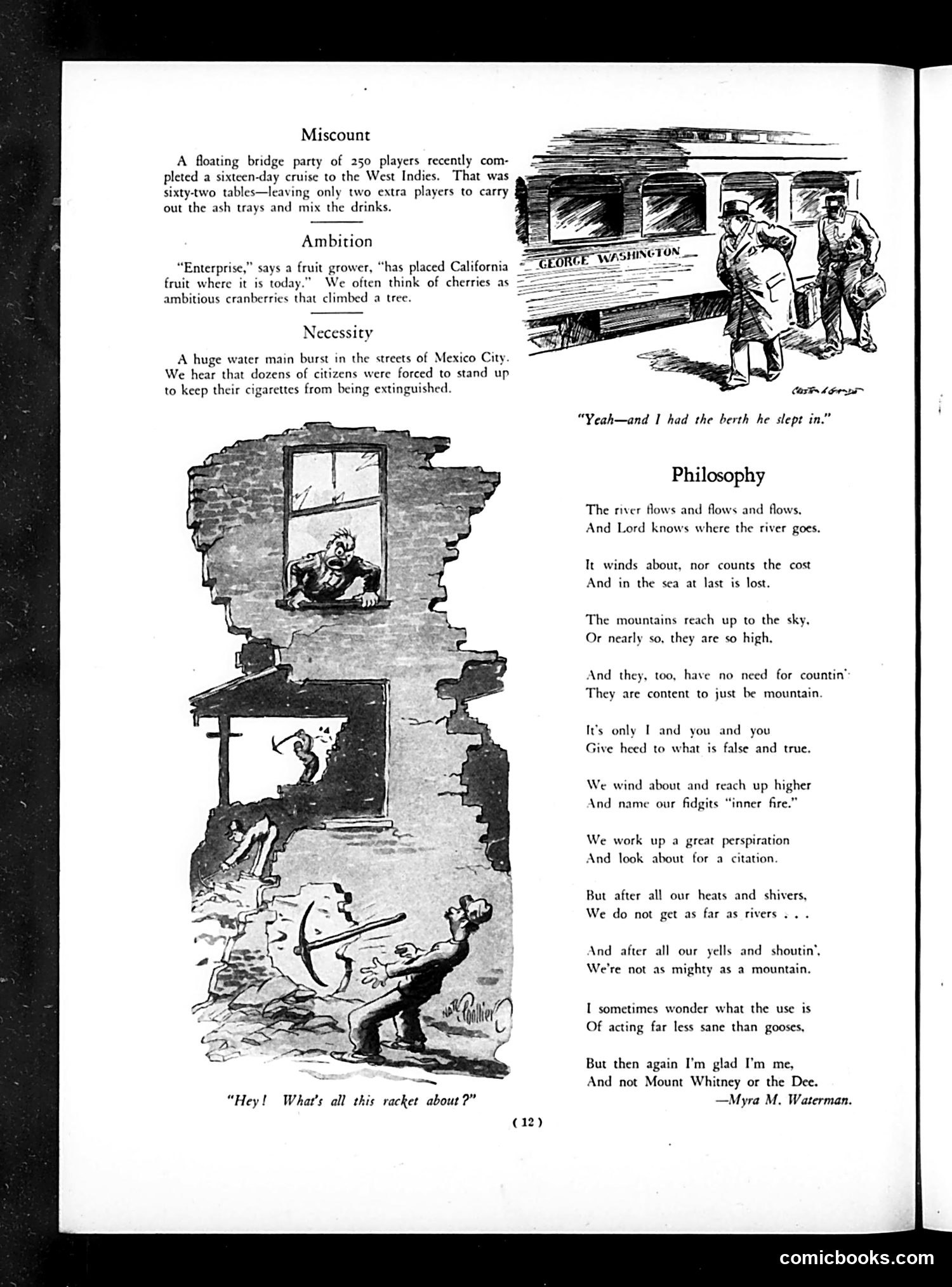
Analysis of Life Magazine Page 12 This page contains three brief humorous anecdotes ("Miscount," "Ambition," "Necessity") and a poem titled "Philosophy" by Myra M. Waterman. The two cartoons illustrate the anecdotes: one shows a floating bridge party on a cruise ship (the "George Washington"), satirizing wealthy leisure activities; the other depicts a multi-story building with people in various situations, captioned "Hey! What's all this racket about?"—likely mocking urban living complaints. The "Philosophy" poem uses nature imagery (rivers, mountains) as metaphors for accepting life's uncertainties and limitations. The concluding lines humorously suggest contentment with one's ordinary existence rather than aspiring to greatness—a modest, self-deprecating philosophy typical of 1920s-era American humor.
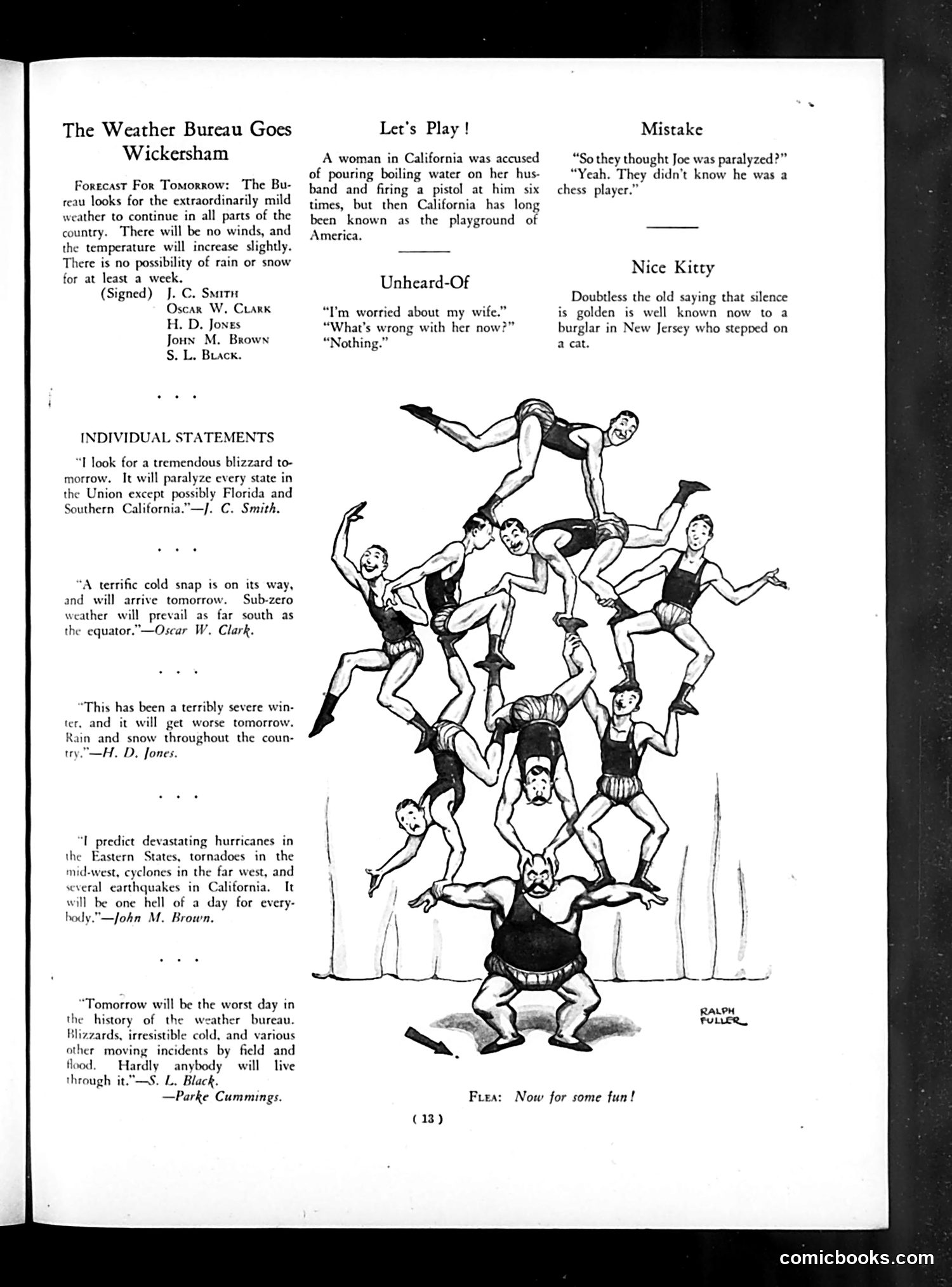
Analysis This page from *Life* magazine contains weather forecasts and humor pieces, not political cartoons. "The Weather Bureau Goes Wickersham" satirizes the U.S. Weather Bureau's forecasting accuracy by presenting wildly contradictory predictions from five officials (J.C. Smith, Oscar W. Clark, H.D. Jones, John M. Brown, S.L. Black). Each predicts opposite conditions—blizzards versus mild weather, rain versus clear skies—mocking the bureau's unreliability. The central illustration shows acrobats stacked in a human pyramid, captioned "FLEA: Now for some fun!" This is a classic circus/vaudeville gag about fleas performing acrobatic feats. The smaller pieces ("Let's Play," "Unheard-Of," "Mistake," "Nice Kitty") are brief joke segments typical of *Life*'s humor format—wordplay and unexpected punchlines rather than topical satire.
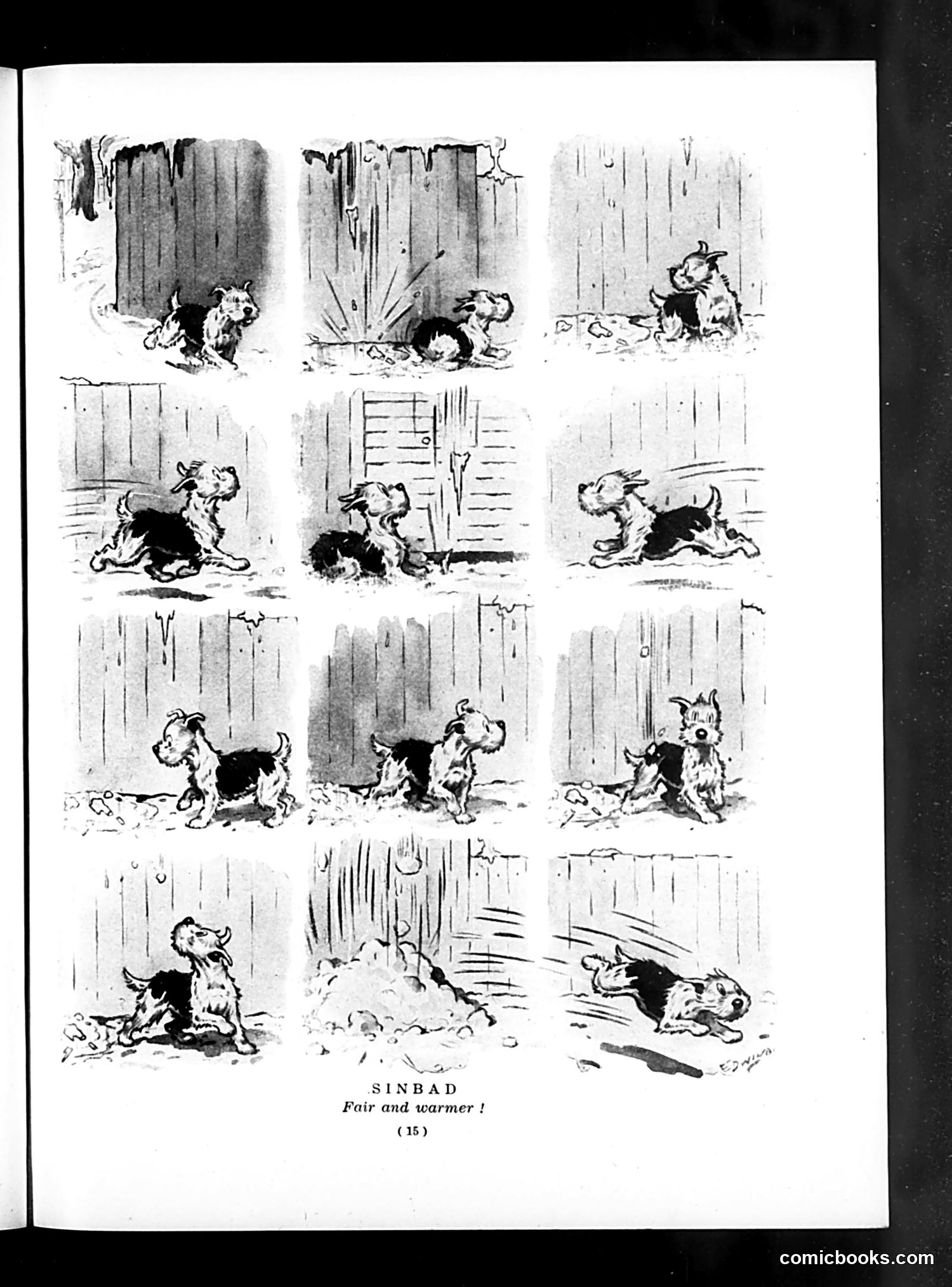
SINBAD: Fair and warmer! This is a twelve-panel comic strip featuring a small dog character in various scenes within what appears to be a wooden enclosure or yard. The strip is titled "SINBAD" with the subtitle "Fair and warmer!" (page 15). The panels show the dog in different poses and situations—digging, jumping, running, and playing—seemingly progressing through increasingly energetic or frantic behavior. The "fair and warmer" subtitle likely refers to improving weather conditions, with the comic illustrating how a dog responds to warmer, fairer weather with increased activity and playfulness. This appears to be a simple observational humor strip about animal behavior rather than political satire.
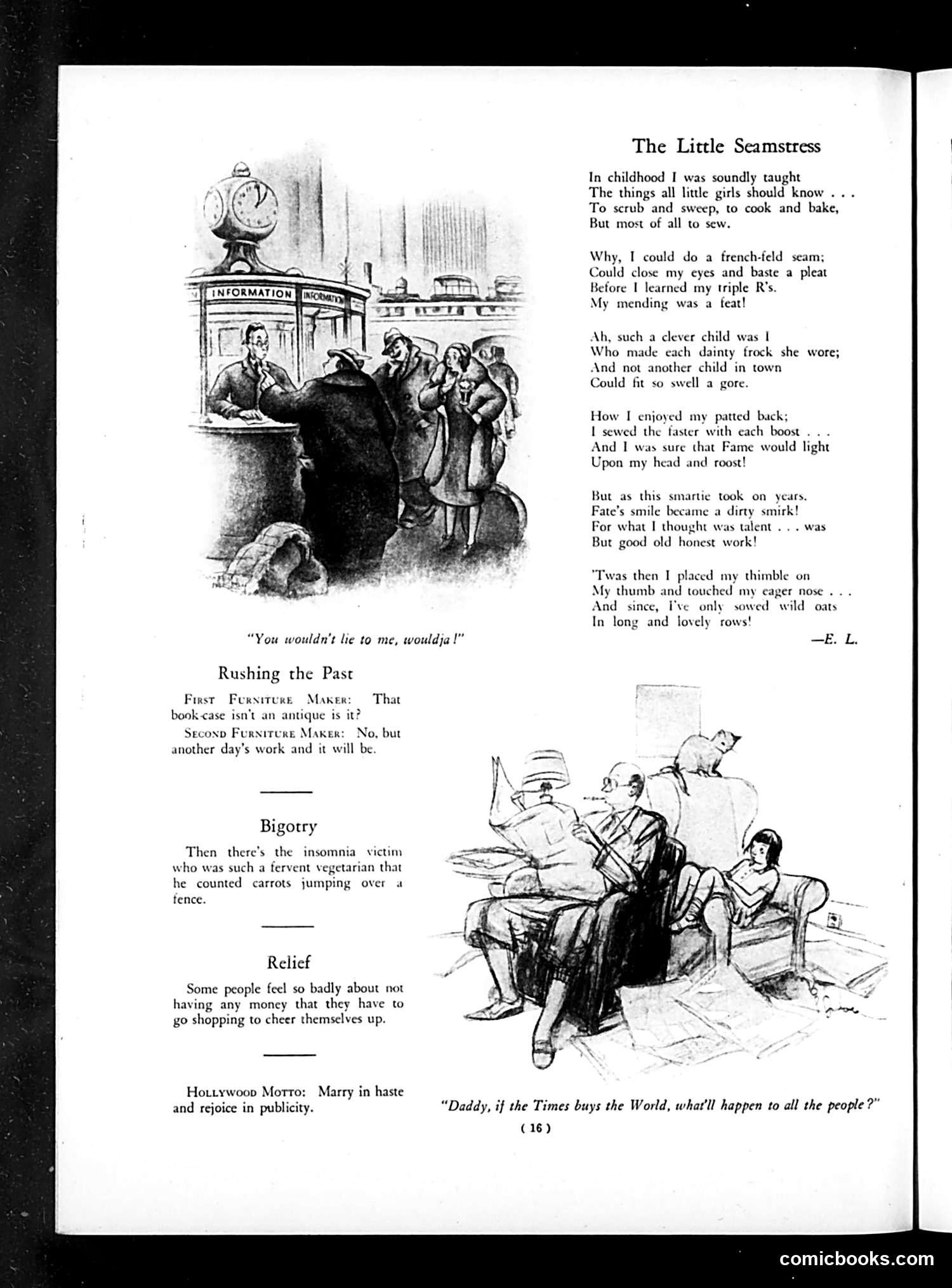
Explanation of Page Content This page contains three brief satirical pieces and illustrations typical of *Life* magazine's humor: 1. "The Little Seamstress" (poem, bylined E.L.): A nostalgic narrative about a girl trained in sewing who initially felt superior to her skill, but eventually found fulfillment in "honest work." The tone is wryly self-aware about youthful ambition versus reality. 2. "Rushing the Past": A two-line joke about furniture makers debating whether a bookcase has become an antique—commentary on rapid commercialization and obsolescence. 3. Brief satirical items ("Bigotry," "Relief," "Hollywood Motto"): One-liner jokes about a vegetarian counting jumping carrots, people shopping for emotional relief, and Hollywood's marriage-for-publicity culture. The cartoons illustrate these pieces with period-appropriate social satire aimed at middle-class American readers.
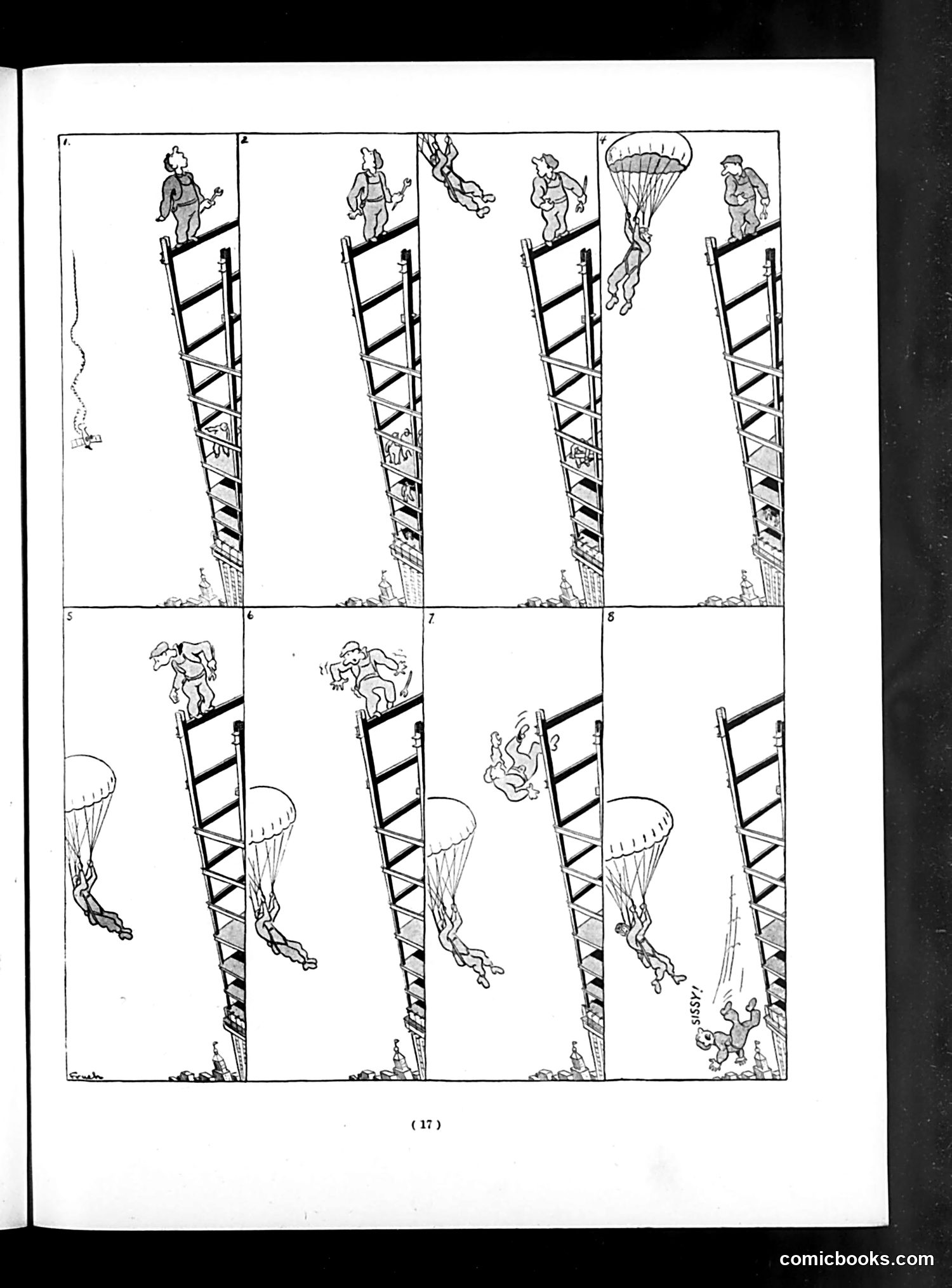
Analysis This page shows a sequential comic strip depicting a figure climbing an extremely tall ladder while carrying a parachute. The progression shows the climber ascending higher and higher, eventually deploying the parachute and descending—suggesting they've reached such an extreme height that parachuting down becomes necessary. The satire appears to comment on ambition taken to absurd extremes. The figure climbs laboriously up an impractically tall ladder (representing struggle or aspiration), only to eventually abandon the effort and parachute back down, implying the futility or impracticality of such an endeavor. Without visible text labels or clear caricatured features, I cannot identify the specific figure or determine whether this references a particular political figure or contemporary event. The cartoon's broader point seems to mock excessive ambition or futile striving.
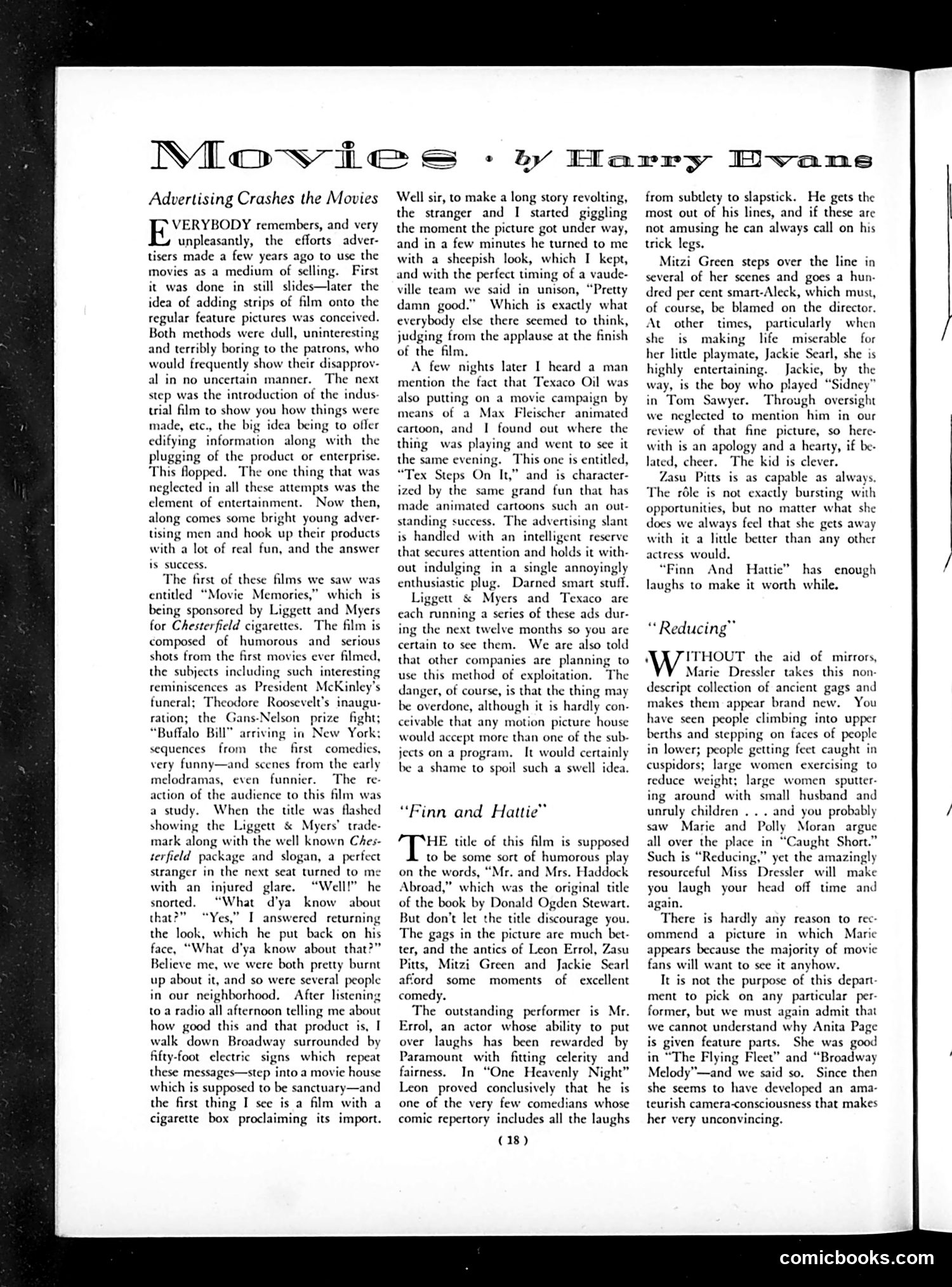
This is a film review page titled "Movies" by Harry Evans from Life magazine. The page contains three movie reviews discussing advertising tie-ins in cinema, animated shorts featuring Texaco Oil products, and feature films including "Finn and Hattie" and "Reducing." The reviews critique how films are being used to advertise consumer products, with Evans expressing both amusement and mild disapproval. He discusses animated cartoons by Liggett & Myers and Texaco as examples of advertising integrated into entertainment. The reviews mention performers like Leon Errol, Zasu Pitts, Jackie Scarl, and Marie Dressler, evaluating their comedic abilities. Evans generally praises the entertainment value while acknowledging the commercial exploitation occurring in motion pictures of this era.
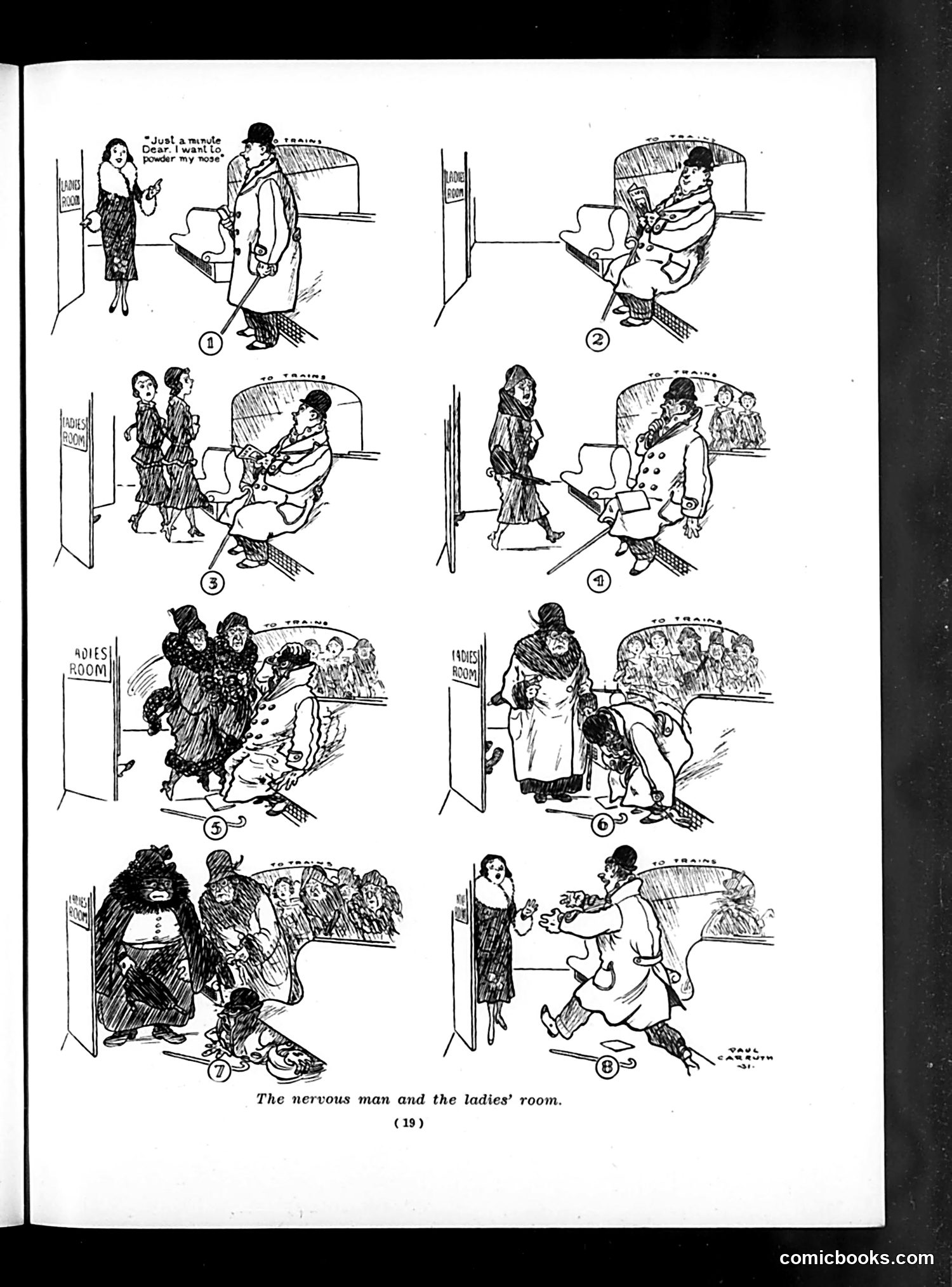
"The Nervous Man and the Ladies' Room" This is an 8-panel satirical comic strip depicting a man's increasingly frantic attempts to retrieve something (apparently powder for his nose) from a ladies' room. The humor relies on the social taboo of a man entering a women's bathroom space. The progression shows: (1) him asking permission, (2) attempting entry alone, (3) encountering women, (4-5) the situation spiraling into chaos with multiple women appearing, (6-8) complete pandemonium with crowds of shocked women. The satire targets both the nervousness of the "modern man" and the implied scandal of gender boundary violations in early 20th-century social spaces. The ladies' room was a private sanctuary; a man's intrusion represents a comedic violation of strict Victorian-era propriety and gender separation norms that contemporary readers would have found shocking and hilarious.
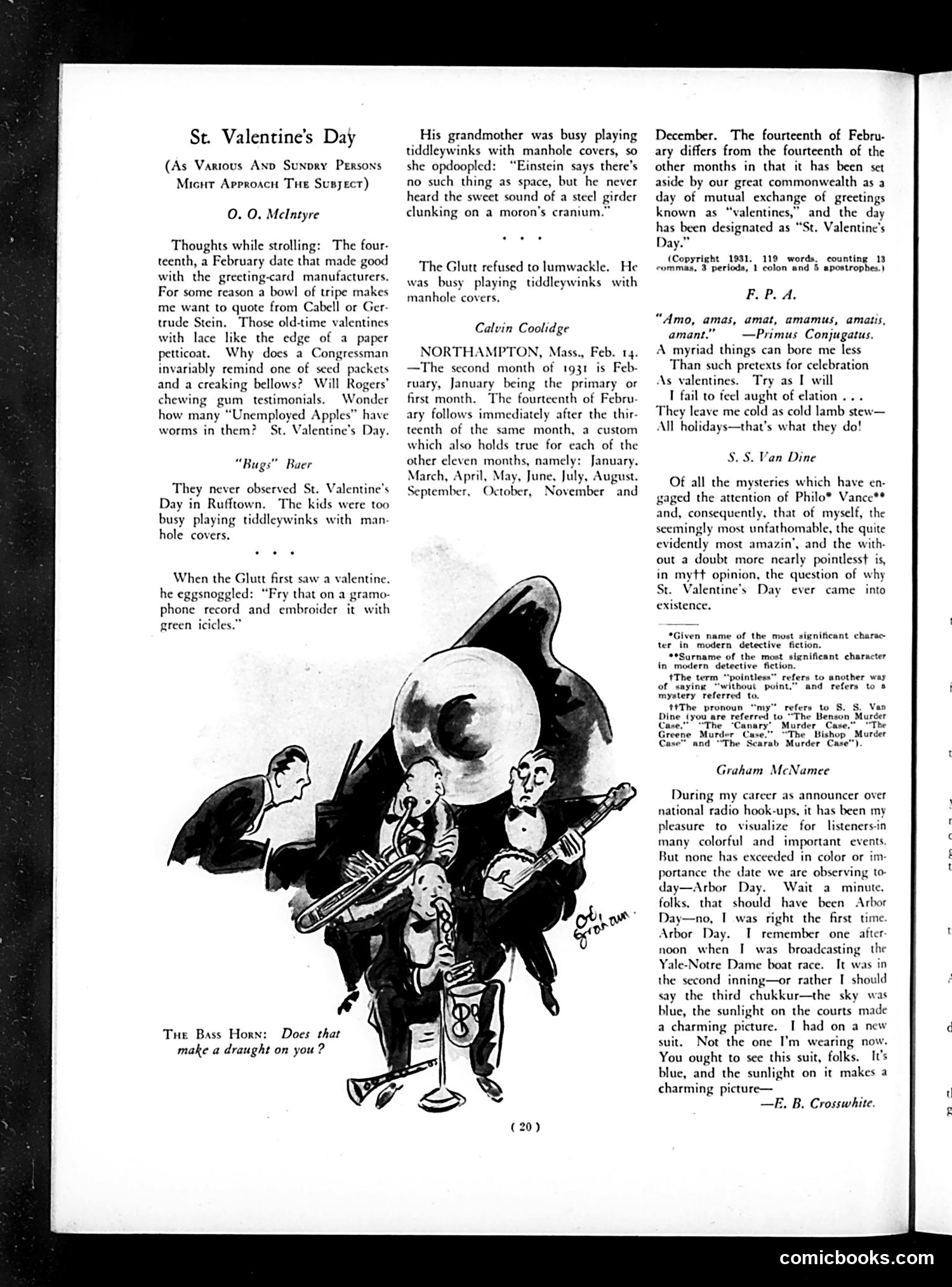
St. Valentine's Day Page Analysis This satirical page parodies various public figures' takes on Valentine's Day through exaggerated commentary: O.O. McIntyre offers stream-of-consciousness musings on February 14th, mixing highbrow literary references (Cabell, Gertrude Stein) with absurdist observations about congressmen and apples. The cartoon shows musicians playing bass horns—likely mocking pretentious Valentine's Day sentimentality through deliberately nonsensical dialogue using made-up words ("opdoopled," "lumwackle"). Calvin Coolidge's section brutally satirizes the famously taciturn president by having him laboriously explain that February 14th follows February 13th, that it's called Valentine's Day, etc.—presenting obvious facts as profound observations. F.P.A., S.S. Van Dine, and Graham McNamee sections mock literary and radio celebrities by having them either dismiss Valentine's Day pretentiously or confuse it with other holidays (Arbor Day). The overall satire targets both the commercialization of Valentine's Day and the self-important pronouncements of prominent public figures about trivial matters.
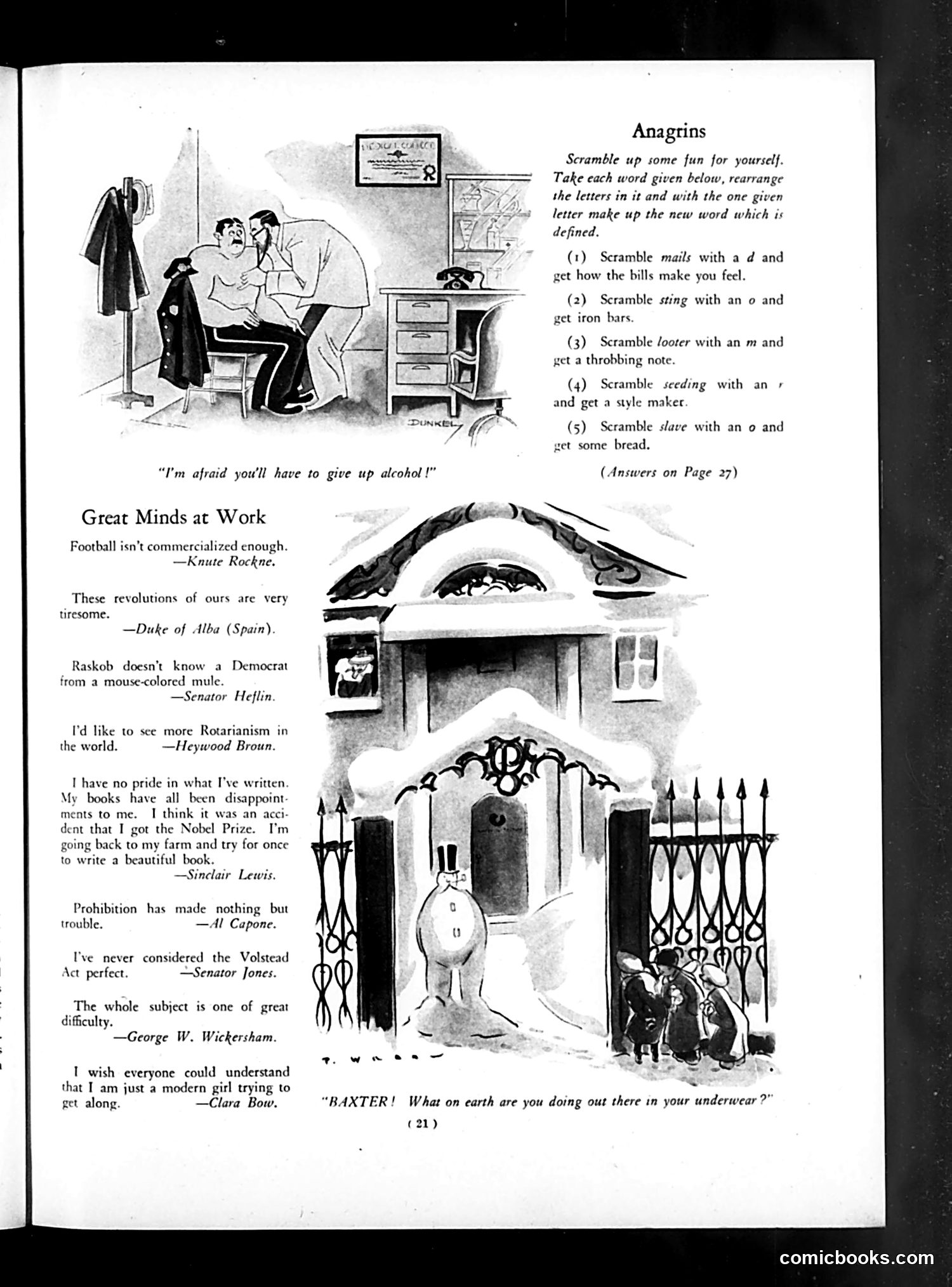
Analysis of This Life Magazine Page The page contains two distinct sections: Top cartoon: A domestic scene where a man sits at a desk while a woman in a coat stands nearby. The caption "'I'm afraid you'll have to give up alcohol!'" suggests marital tension over drinking—likely referencing Prohibition era concerns about alcohol consumption and its domestic consequences. "Great Minds at Work" section: A satirical compilation of quotes from prominent 1920s-30s figures (Knute Rockne, Duke of Alba, Senator Heflin, Sinclair Lewis, Al Capone, Senator Jones, George Wickersham, and Clara Bow). Each quote is deliberately contradictory or absurd—a sports coach saying football needs *more* commercialization, Al Capone claiming Prohibition causes trouble. The satire mocks these public figures' pomposity and inconsistency. Bottom cartoon: Shows a figure in underwear outside a grand house at night, with someone calling from inside. The humor relies on embarrassment and unclear context—"what on earth are you doing out there?" The page blends word puzzles, political satire, and domestic comedy typical of Life magazine's humor content from this era.
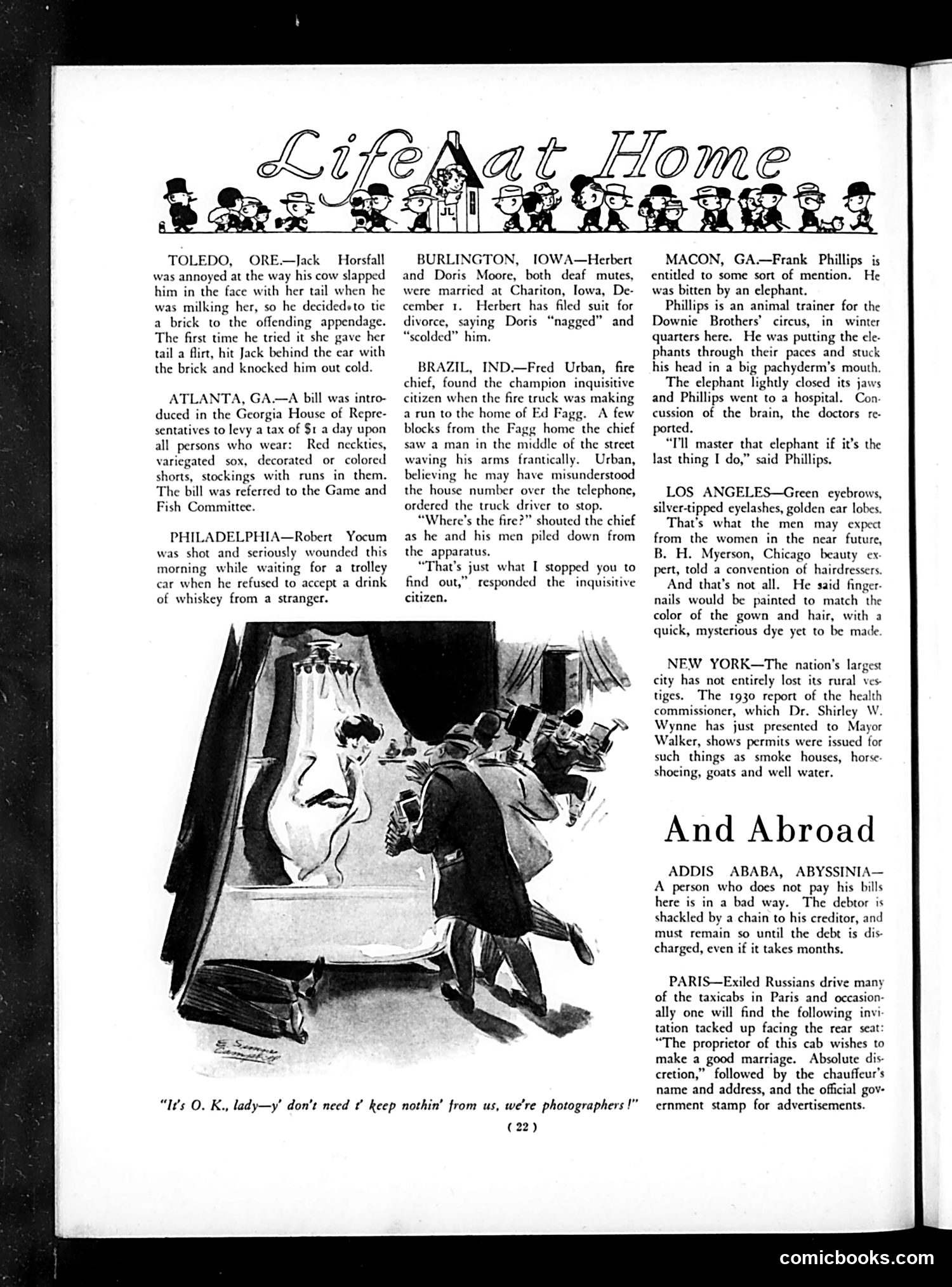
Life Magazine "Life at Home and Abroad" Page Analysis This page collects humorous anecdotes from across America and abroad, typical of Life's satirical "news briefs" format. The cartoon depicts photographers confronting a woman, with the caption "'It's O.K., lady—y' don't need t' keep nothin' from us, we're photographers!'" This satirizes the era's invasive paparazzi culture and photographers' presumed entitlement to access private subjects. The domestic stories mock American absurdities: a man tying a brick to a cow's tail (backfiring literally), Georgia proposing taxes on unfashionable clothing (referred to the "Game and Fish Committee" as a joke), and a deaf-mute divorce over "nagging"—suggesting communication isn't the real issue. International items contrast American life with exotic customs: Abyssinian debt slavery and Russian émigrés in Paris advertising for wives via taxi advertisements—highlighting both the strangeness of foreign practices and European displacement after the Russian Revolution. The overall tone celebrates American eccentricity while gently mocking both domestic peculiarity and foreign "otherness."
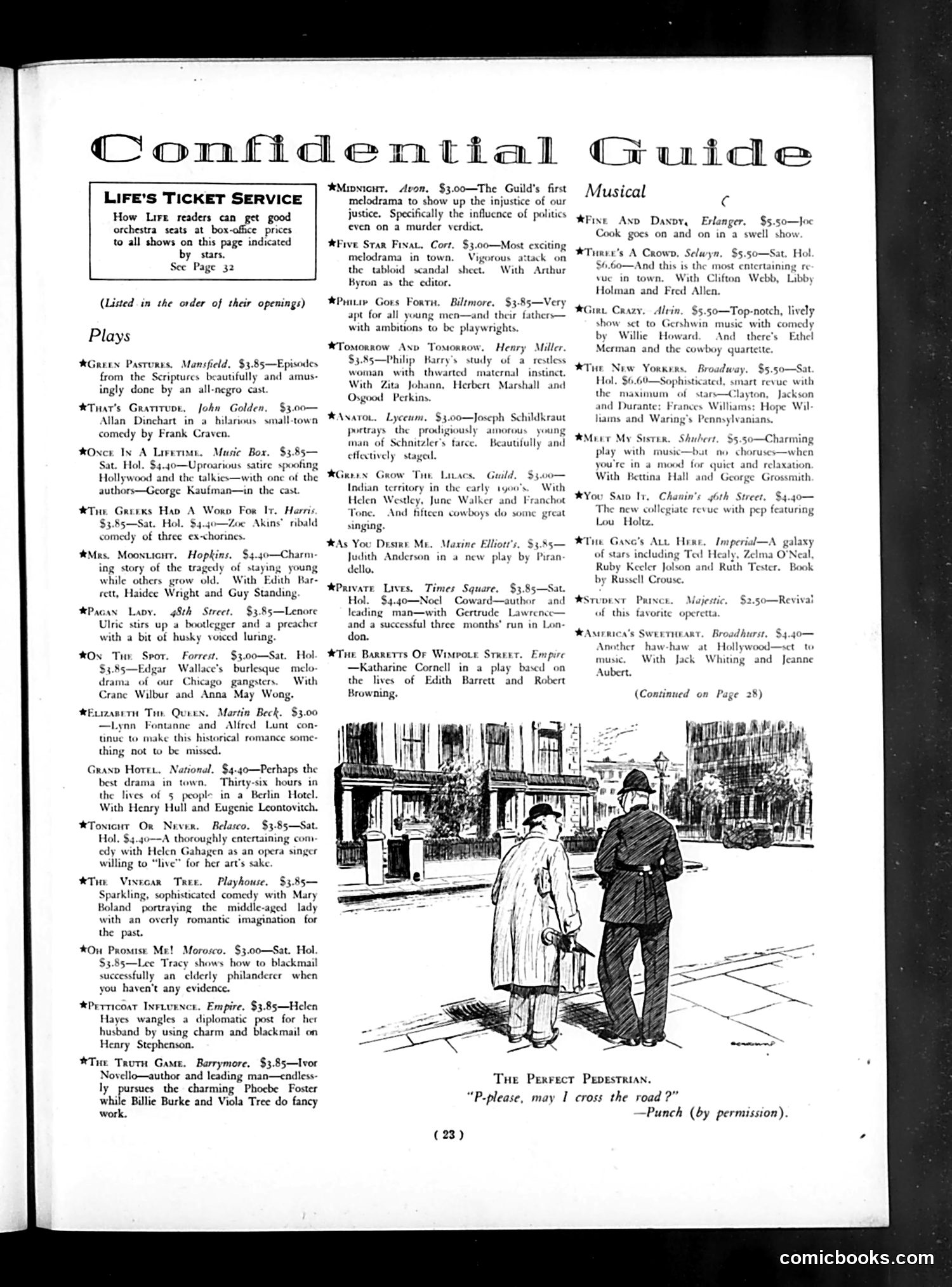
The Perfect Pedestrian Cartoon The cartoon depicts a portly gentleman in formal attire approaching a woman on a city street, asking "Please, may I cross the road?" The humor lies in the role reversal: typically, a woman might ask a man for assistance crossing the street—a gentlemanly courtesy reflecting 1920s gender conventions. Here, the man is asking the woman, inverting expected social dynamics. The "perfect pedestrian" title suggests the satire targets either changing gender roles in the Jazz Age or perhaps mocks exaggerated politeness. The caption credits *Punch* magazine, indicating this was reprinted from British humor. The surrounding content lists theatrical productions and Life magazine's ticket service, placing this cartoon among entertainment reviews typical of the era's magazine format.
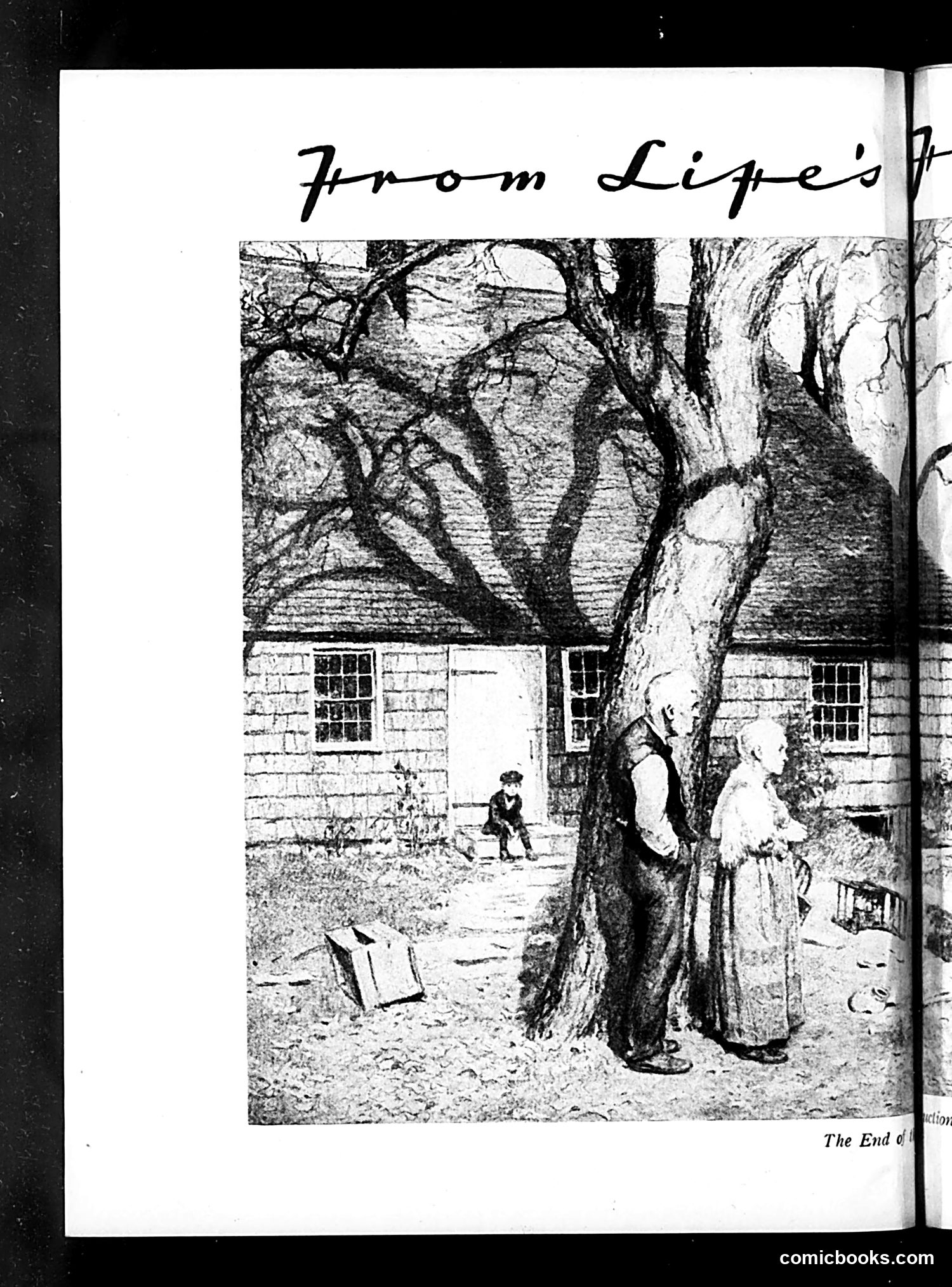
Analysis This page shows a section titled "From Life's" with a black-and-white illustration depicting a rural scene. The image shows what appears to be an elderly woman and man near a large tree outside a modest wooden cottage, with another figure visible in the background near the house. The OCR text is largely corrupted and unreadable, making it difficult to determine the specific satirical point. Without legible caption text or article content, I cannot confidently identify what social or political commentary this illustration intended to convey. The scene appears genre-based—possibly depicting rural American life or domestic themes common to early-to-mid 20th century satirical magazines—but the specific joke or reference remains unclear from the image alone.
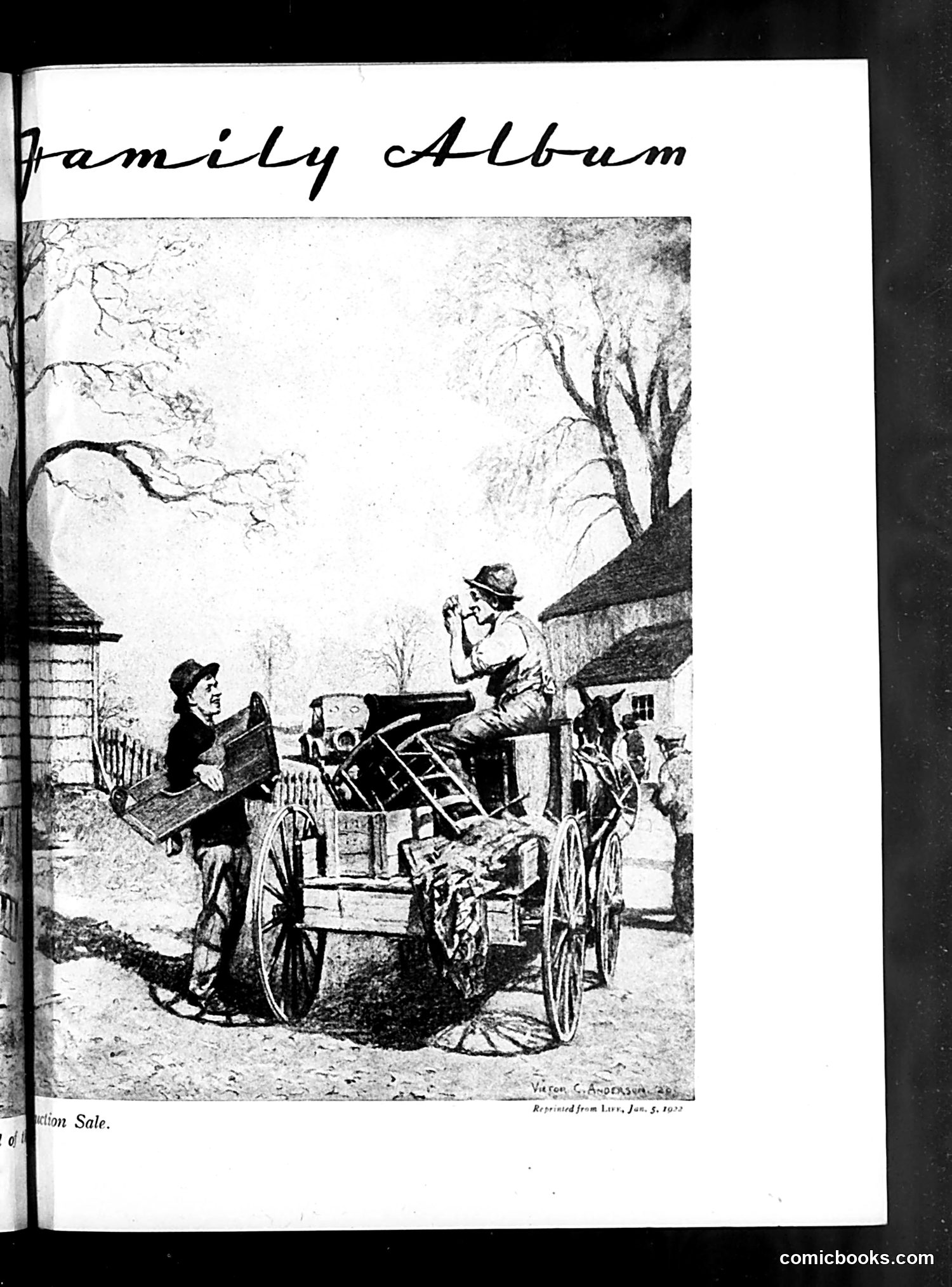
Family Album: Auction Sale This page shows a satirical illustration titled "Family Album" depicting a street auction scene. A man stands on an elevated platform (an auctioneer's block) striking an exaggerated pose while smoking a pipe, gesturing dramatically. A woman below holds what appears to be a newspaper or broadside, observing the spectacle. Period buildings and bare trees suggest a rural or small-town setting. The humor likely satirizes either: - The pretentiousness of someone being "auctioned off" or displayed publicly - Commentary on desperation during economic hardship when people sold possessions - Social climbing or ridiculous self-promotion The signature indicates this is by Victor C. Anderson. Without clearer context about Life magazine's publication date or surrounding content, the specific social/political target remains unclear, though the theatrical mockery of the auctioneer's exaggerated behavior suggests satire of showmanship or social pretense.
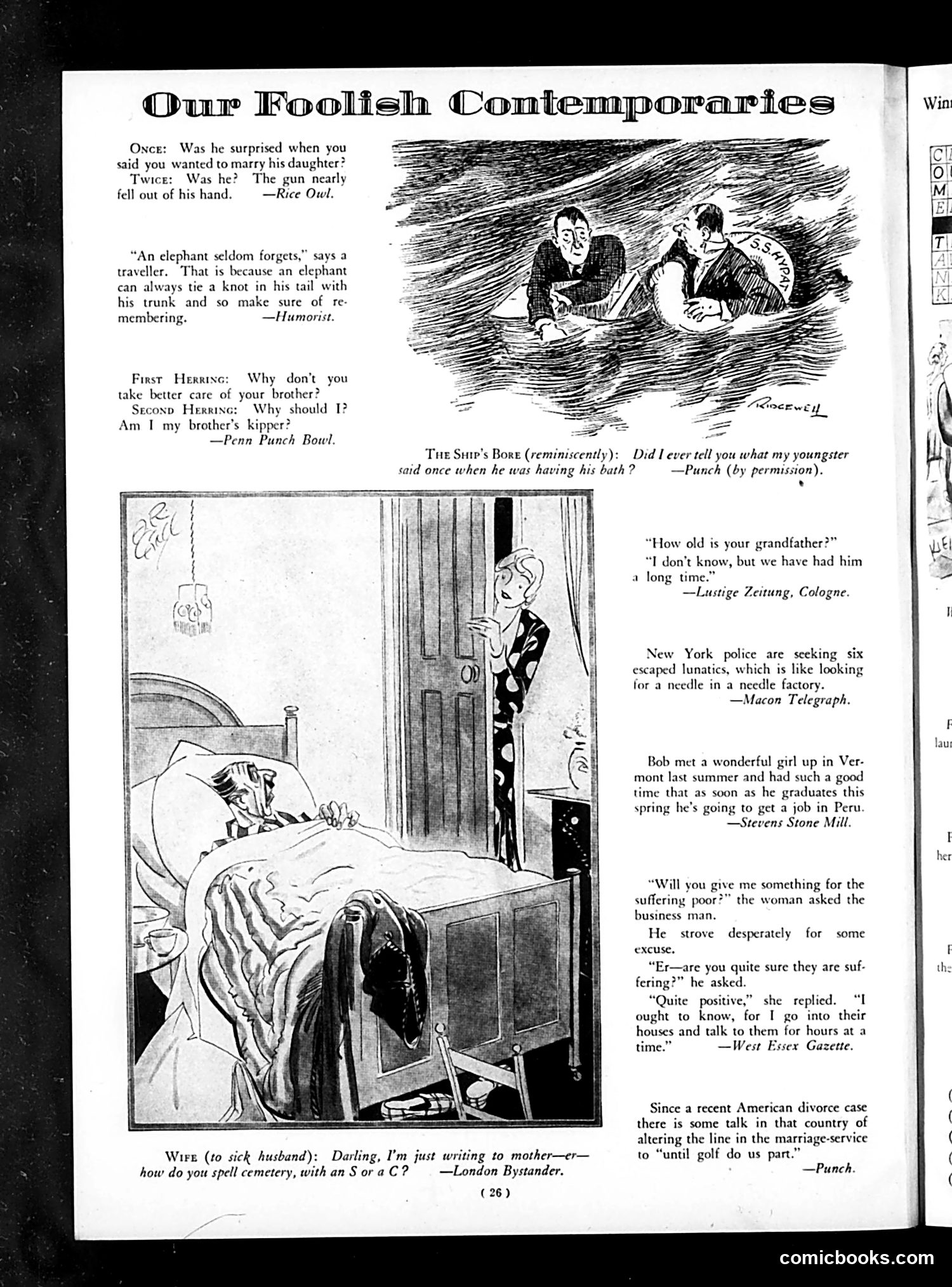
"Our Foolish Contemporaries" – Life Magazine Humor Page This page collects brief jokes and one cartoon from various contemporary publications, mocking social absurdities of the era. The main cartoon depicts a wife asking her bedridden husband how to spell "cemetery"—with an S or C—while writing to his mother. The humor lies in the dark implication that she's contemplating his death. Other quips satirize: - Parental authority: A father's shock at a suitor wanting to marry his daughter (the "gun nearly fell out" suggests the cliché of fathers threatening suitors) - Moral hypocrisy: A businessman questioning whether poor people actually suffer, dodging charity - Matrimonial trends: Recent American divorce cases prompting talk of changing marriage vows to "until golf do us part"—mocking how leisure activities rival marriage commitment The page's title, "Our Foolish Contemporaries," frames these as satirical observations of modern society's contradictions, collecting humor from publications across America and Europe.
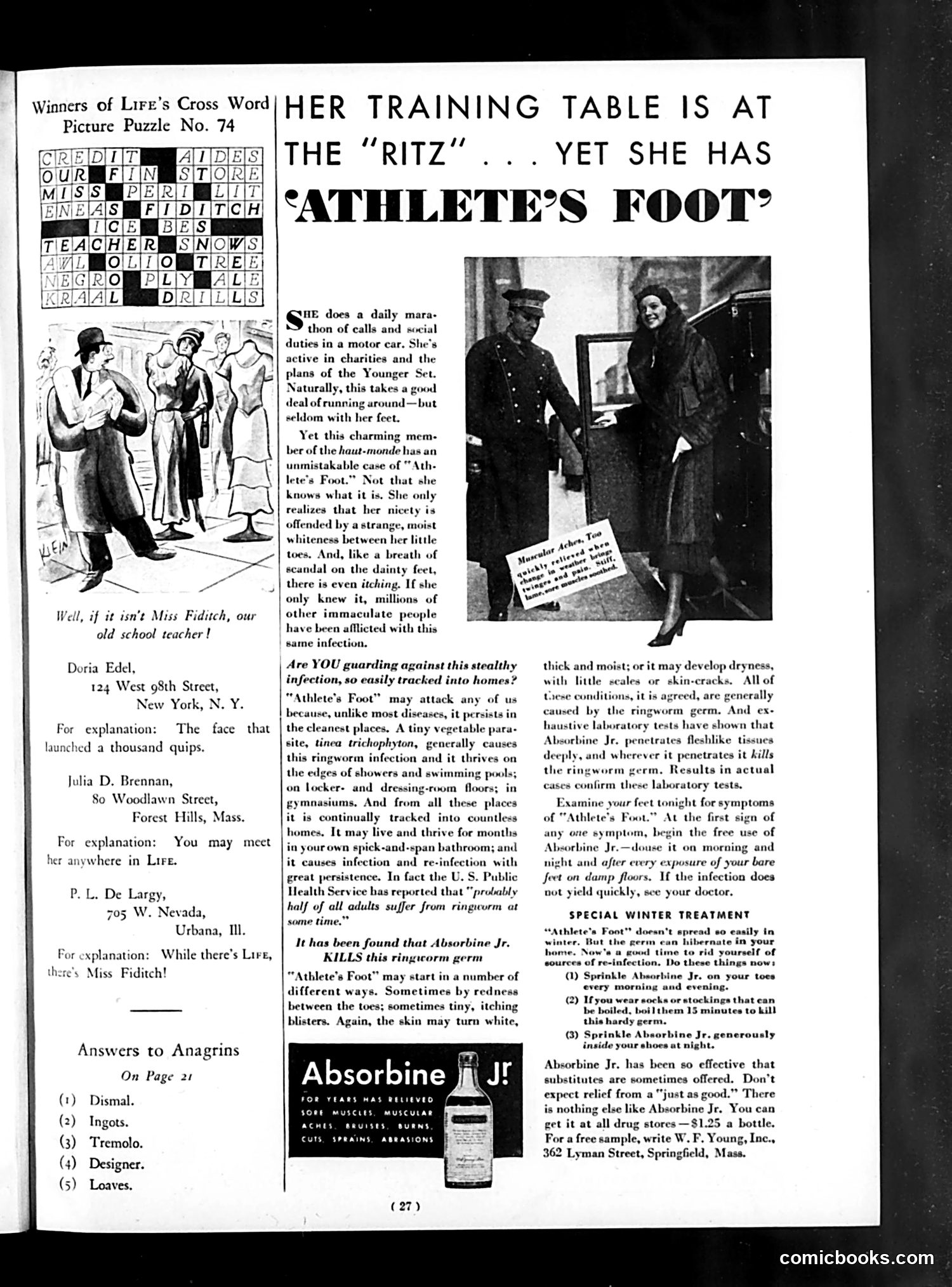
Analysis for Modern Readers This page combines a crossword puzzle solution (left) with a satirical advertisement (right). The cartoon joke mocks the incongruity of high-society life: a wealthy woman ("haut-monde"—high society) who maintains an expensive lifestyle—training at the exclusive Ritz hotel, active in charity work—yet suffers from "Athlete's Foot," a fungal infection typically associated with athletes and gymnasium use, not socialites. The satire works by highlighting the gap between her genteel image and an unglamorous physical reality. The text emphasizes how the infection spreads in "cleanest places" and affects "millions," making it a democratic affliction that spares no social class. This frames the Absorbine Jr. advertisement that follows: the product can discreetly treat this embarrassing condition affecting even the wealthy and respectable. The ad is both practical health information and subtle class commentary—even the Ritz-trained cannot escape common human ailments.
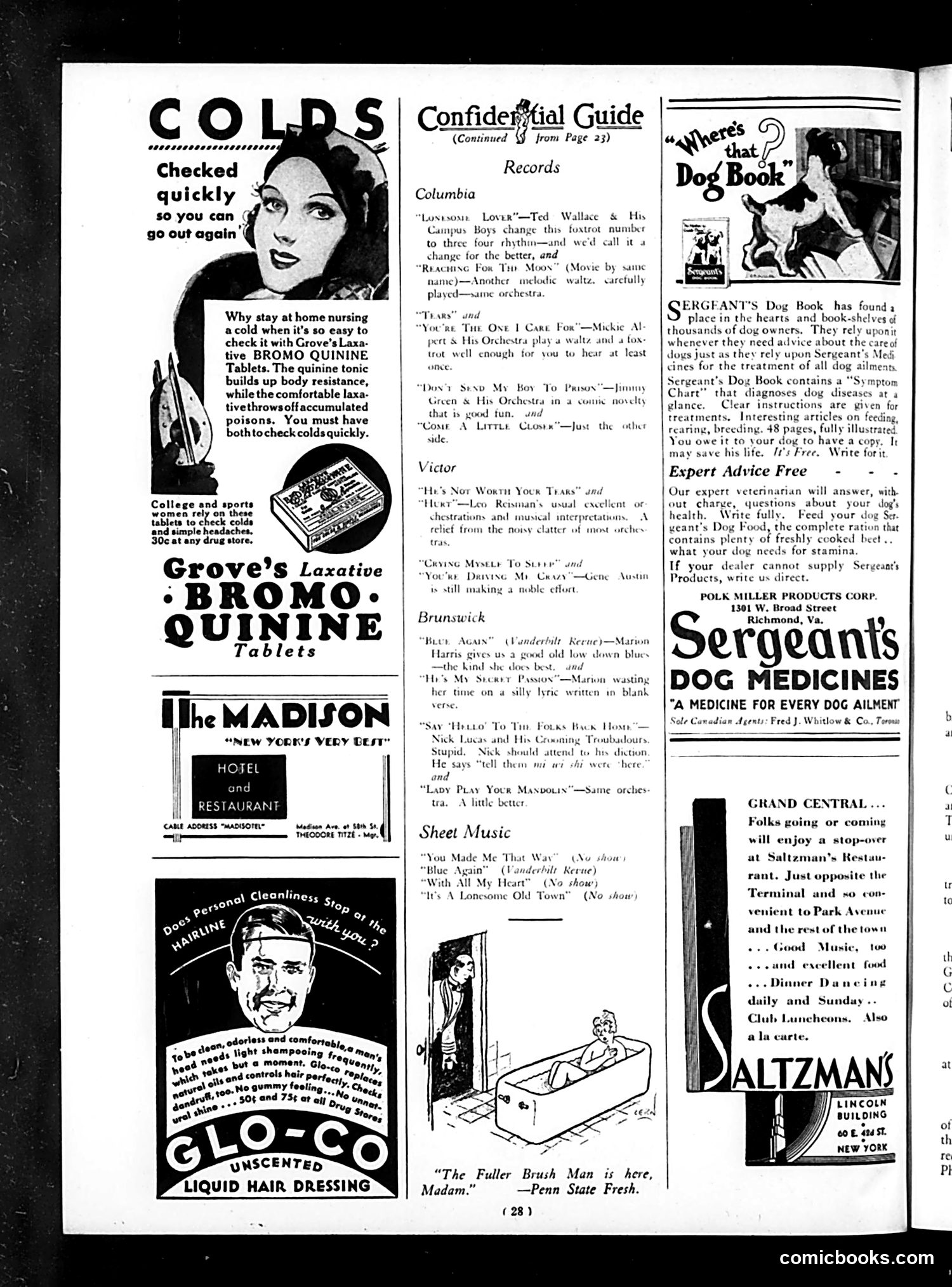
Analysis of This Life Magazine Page This is primarily an advertising page with minimal satirical content. The page consists almost entirely of commercial advertisements typical of 1920s American magazines. The ads promote: - Grove's Bromo Quinine (cold/flu remedy) - Glo-Co liquid hair dressing - The Madison Hotel in New York - Sergeant's Dog Medicines and dog care products - Saltzman's Restaurant near Grand Central Terminal The only potential humor appears in the small illustration captioned "The Fuller Brush Man is here, Madam"—a reference to the Fuller Brush Company's door-to-door salesmen, a stock figure of mild domestic comedy at the time. The page also includes record and sheet music listings from Columbia, Victor, and Brunswick labels. There is no significant political satire or social commentary on this page—it reflects the era's consumer culture and emerging mass advertising techniques rather than editorial commentary.
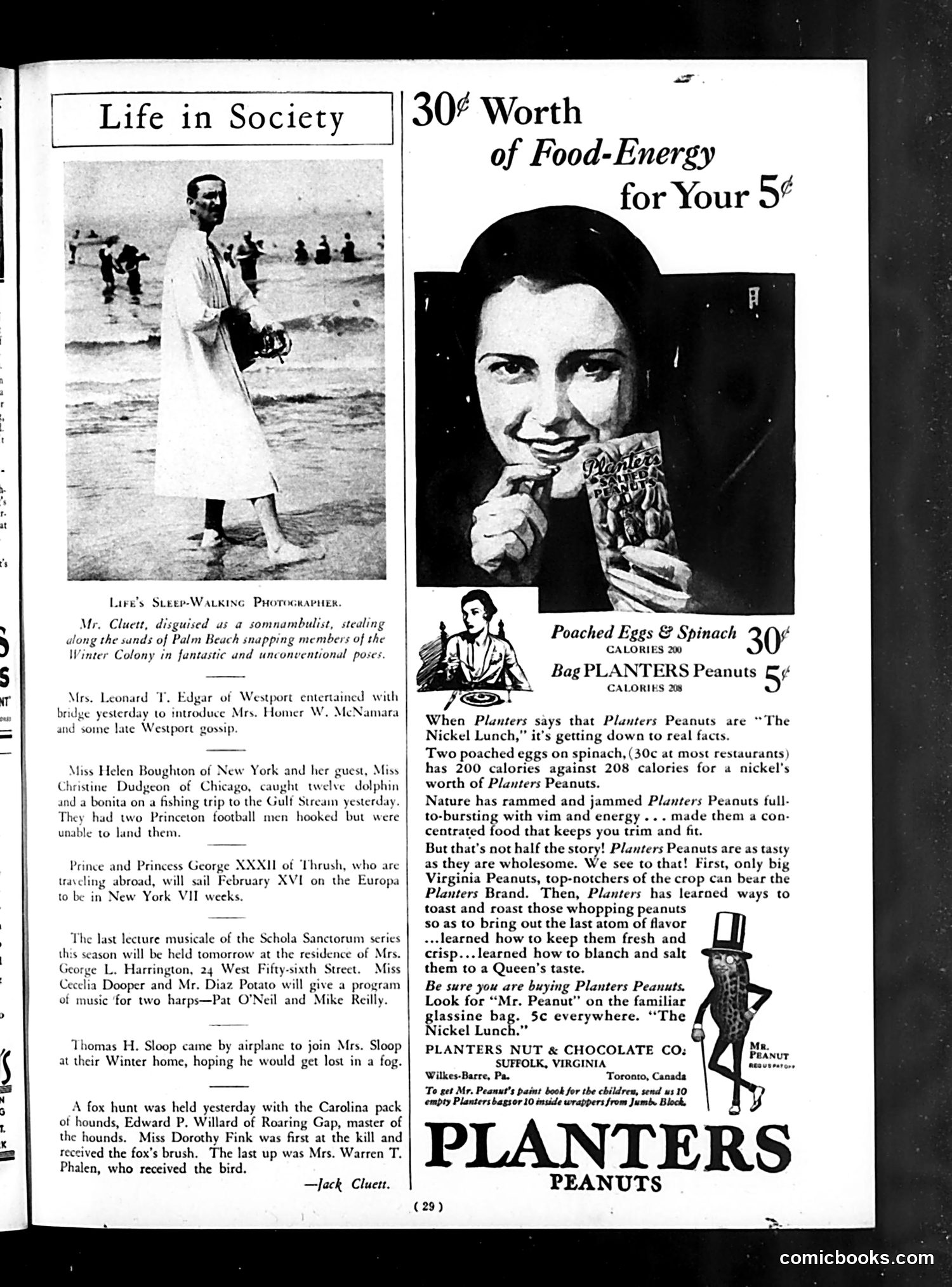
"Life in Society" Page Analysis This page contains two distinct elements: a satirical "society column" and a commercial advertisement. The Satire (Left Side): Jack Cluett's "Life's Sleep-Walking Photographer" column mocks wealthy Winter Colony socialites through absurdist humor. The jokes rely on exaggeration and incongruity—Mr. Cluett photographing people in "unconventional poses," a fishing trip where two Princeton football players were "hooked but unable to be landed" (treating men like fish), and Thomas H. Sloop hoping to "get lost in a fog" during his wife's visit. The mock-formal names and descriptions satirize the pretentiousness of high society gossip columns, suggesting the wealthy live in a ridiculous, disconnected world worthy of mockery. The Advertisement (Right Side): Planters Peanuts promotes its product using nutritional comparison—poached eggs and spinach (30¢) contain 200 calories versus 208 calories in a nickel's worth of peanuts, branding peanuts as "The Nickel Lunch." The famous Mr. Peanut mascot endorses the product's quality and value.
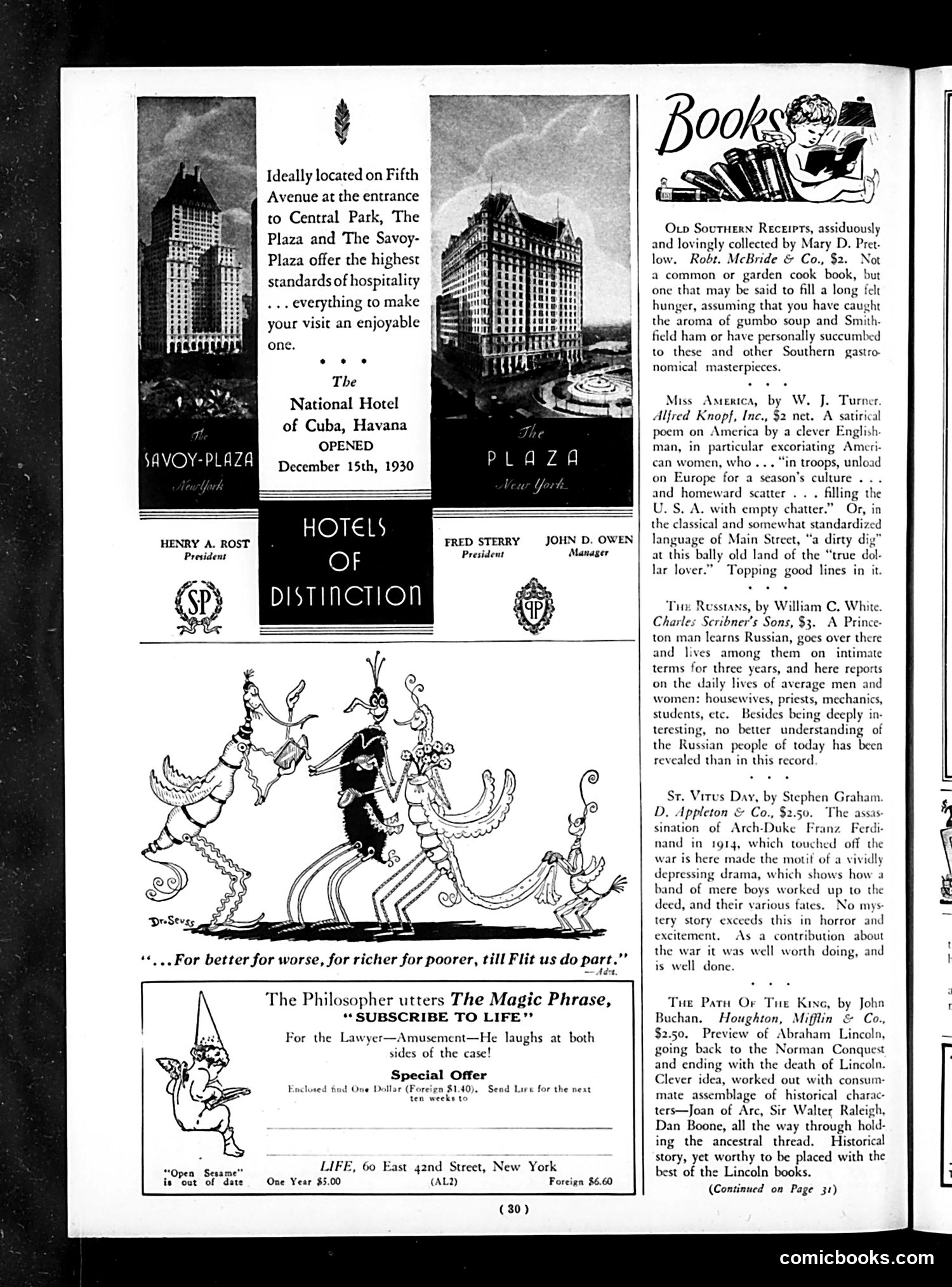
Analysis of Life Magazine Page Content This page is primarily advertising and book reviews, not political satire. The top section advertises luxury hotels—the Savoy-Plaza and Plaza in New York, and the National Hotel in Havana (opened December 1930)—emphasizing their prestigious Fifth Avenue location near Central Park. The cartoon by Dr. Seuss (signed lower left) depicts whimsical creatures in a conga line with the caption "...For better for worse, for richer for poorer, till Flit us do part." This is a playful pun on marriage vows, advertising Flit insecticide spray—a popular consumer product of the era. Below that, "The Philosopher" promotes Life magazine subscriptions, using a jester figure to suggest the publication appeals to diverse readers (lawyers, the amused) across political divides. The right column contains book reviews covering Southern cooking, a satirical poem criticizing American tourists, Russian culture, World War I history, and American history—typical literary content for this era's Life magazine.
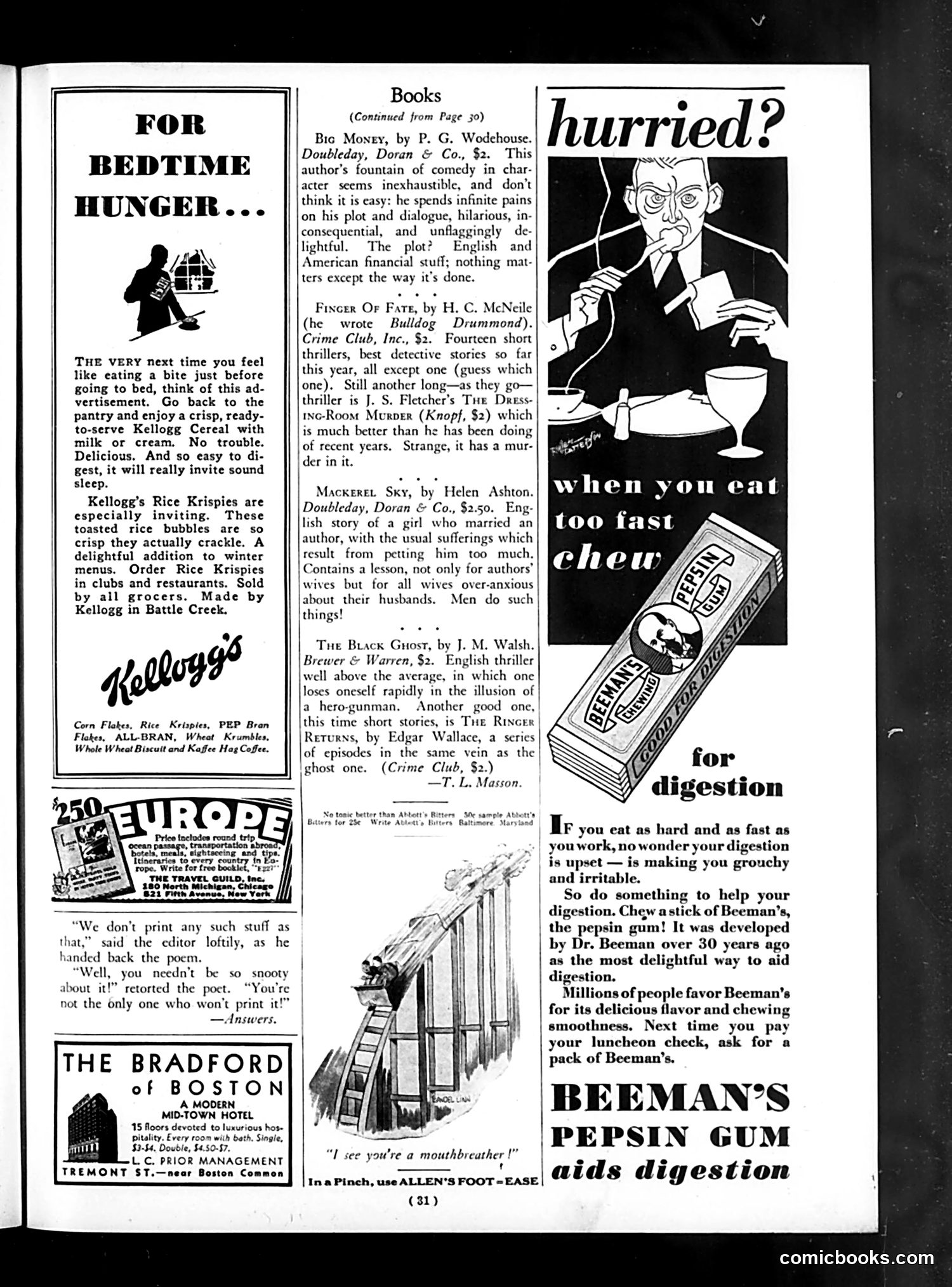
Life Magazine Page Analysis This page is primarily advertising and book reviews rather than political satire. The content includes: Main Features: - Kellogg's cereal advertisement promoting Rice Krispies for bedtime digestion - Book reviews covering detective fiction and comedy novels by P.G. Wodehouse and others - A small humorous anecdote about a rejected poet - Beeman's Pepsin Gum advertisement targeting workers with poor digestion from eating too quickly - Hotel and travel advertisements The Humor: The small cartoon/anecdote shows an editor rejecting a poet's work dismissively, with the poet retorting that the editor isn't the only one refusing publication—mild satire on literary gatekeeping, not political commentary. Historical Context for Modern Readers: This reflects 1920s-30s concerns: digestive health from fast eating, the prevalence of patent medicines (pepsin gum), and literary magazines' gatekeeping role. The ads assume readers' primary concerns are work productivity and convenient nutrition. This is a typical magazine page blending entertainment, literature criticism, and consumer advertising.
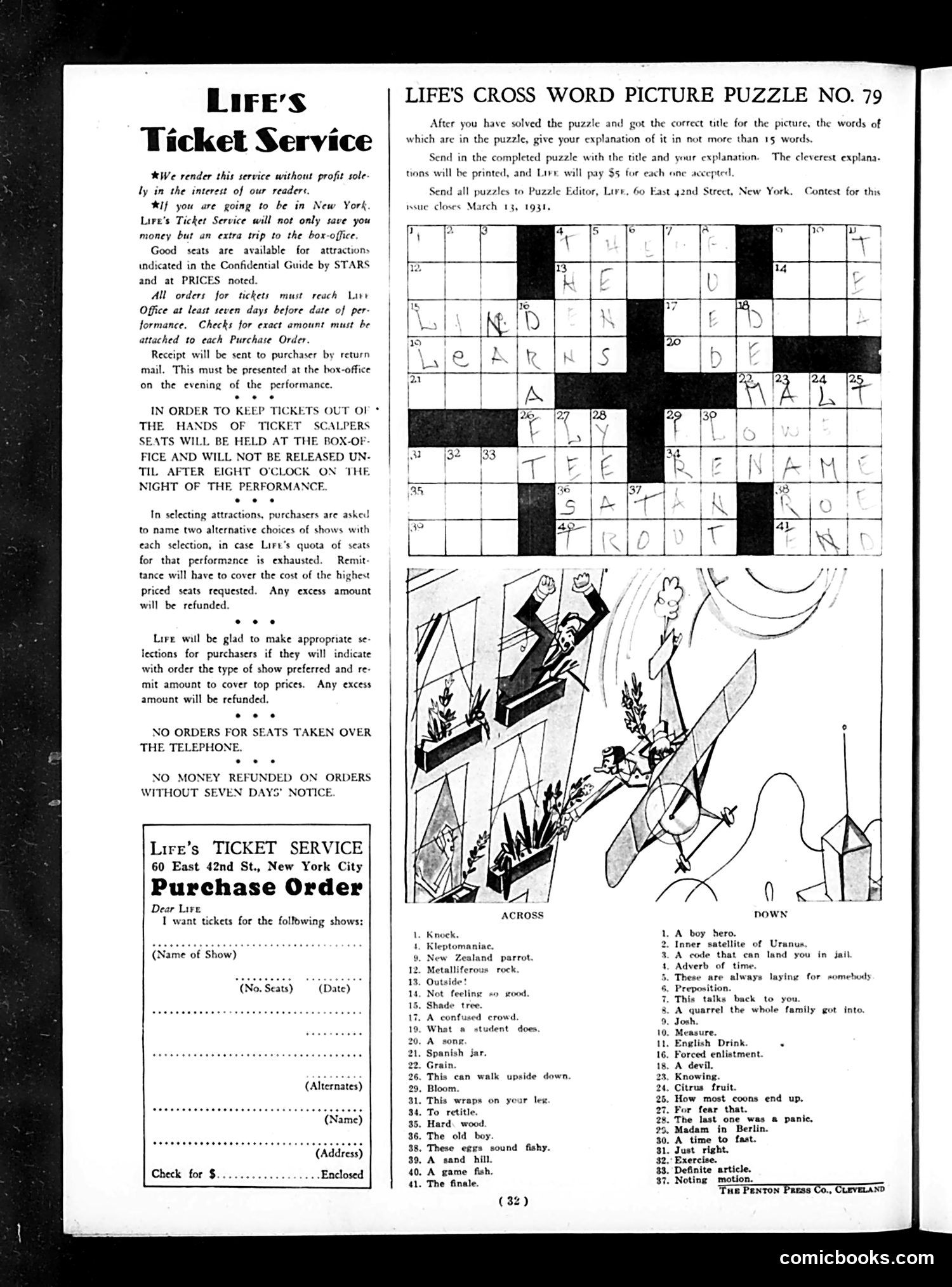
Life Magazine Page Analysis This page contains two distinct sections: Left side: Life's Ticket Service advertisement and purchase order form. This was a legitimate reader service where Life magazine helped subscribers obtain theater tickets in New York City—a practical convenience before modern online ticketing, addressing the problem of ticket scalpers by holding seats at box offices until performance night. Right side: A crossword picture puzzle (#79) featuring a cartoon illustration below the grid. The cartoon depicts figures on what appears to be a steep incline or mountainside with wind-blown vegetation, suggesting struggle or difficulty navigating treacherous terrain. The puzzle asks solvers to identify the picture's title in 15 words or fewer, with $5 payment for the cleverest explanations. The satirical point of the cartoon illustration remains unclear without solving the crossword—the visual metaphor likely comments on contemporary social or political struggle, common to Life's satirical tradition, but specific meaning requires identifying the puzzle's solution title.
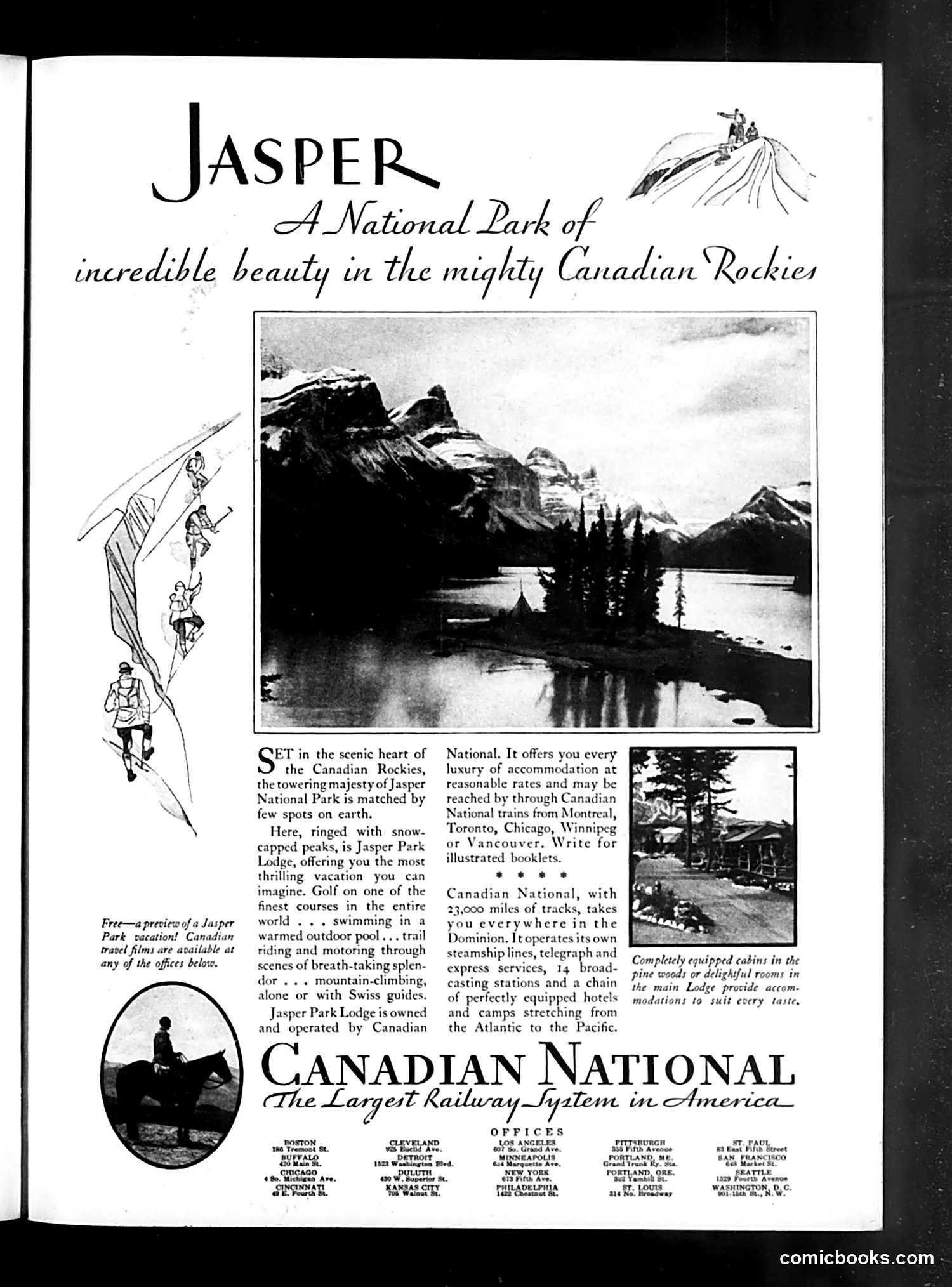
Jasper National Park Advertisement This is primarily a travel advertisement, not satire. It promotes Jasper National Park in the Canadian Rockies as a luxury vacation destination, operated by Canadian National Railway. The page features: - Scenic photographs of mountain peaks and a pristine lake - Illustrations of tourists hiking and enjoying outdoor activities (mountain climbing, golf, swimming, horseback riding) - Lodge amenities advertised as equipped with comfortable cabins and rooms - Transportation details: Canadian National trains connect major North American cities (Montreal, Toronto, Chicago, Vancouver) - Corporate boasting: Canadian National claims 23,000 miles of track, steamship lines, telegraph services, and a chain of hotels The implicit message: leisure travel and outdoor recreation are now accessible to middle-class Americans and Canadians via modern rail infrastructure. The "thrilling vacation" positioning suggests Jasper represents aspirational tourism for the era. No political satire is evident—this is straightforward corporate marketing promoting both a destination and the railway company operating it.
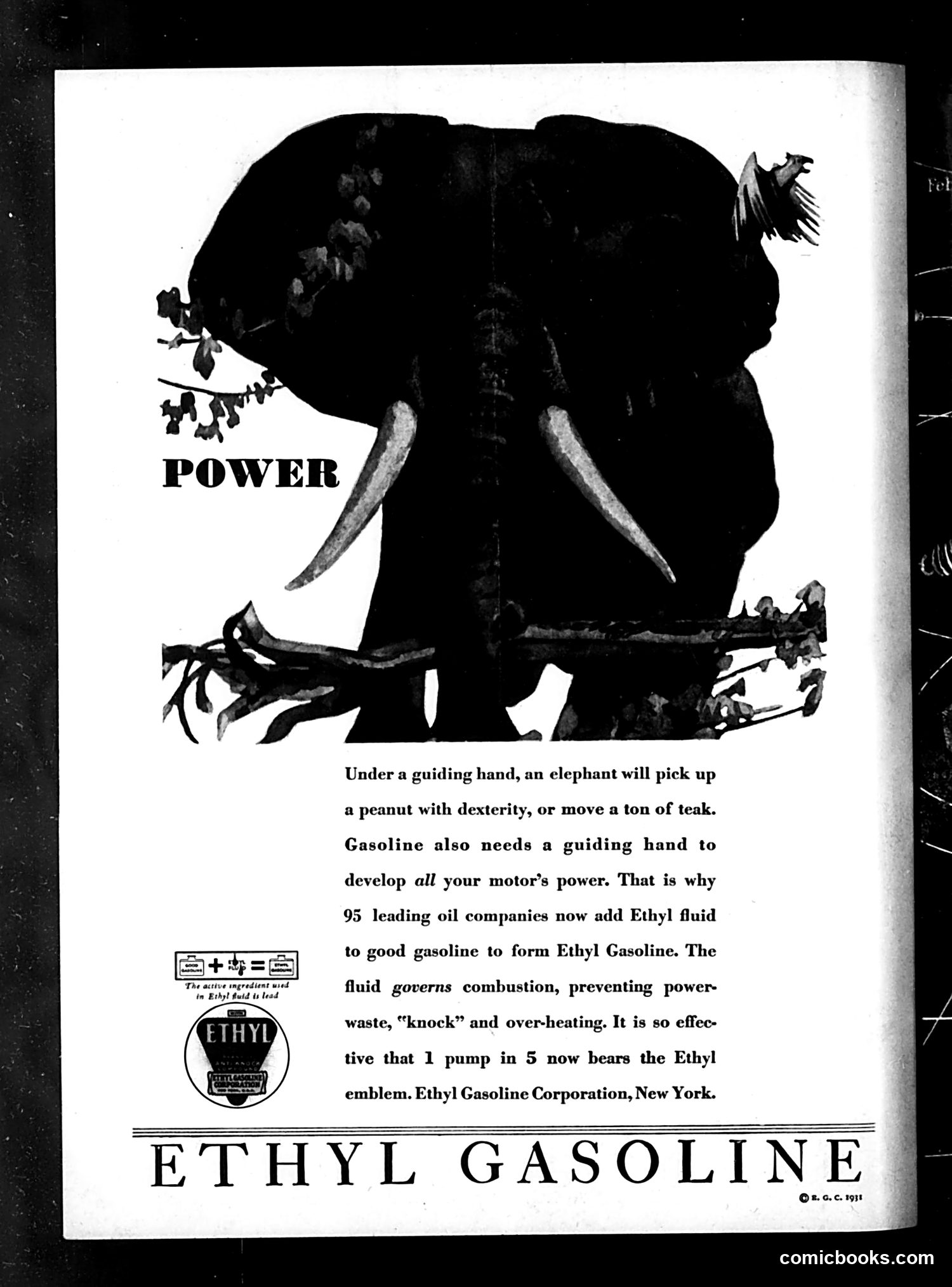
Analysis This is advertising, not satire—a 1938 product pitch for Ethyl Gasoline by the Ethyl Gasoline Corporation. The elephant silhouette serves as an analogy: just as an elephant needs a "guiding hand" to perform precise tasks (picking up a peanut or moving heavy teak wood), gasoline needs a chemical additive (Ethyl fluid) to function optimally. The ad claims this additive controls combustion, prevents engine "knock" (pre-ignition), and stops overheating. The pitch emphasizes market penetration: "95 leading oil companies" now use Ethyl fluid, and "1 pump in 5" displays the Ethyl emblem. This targets motorists concerned about engine performance during the Depression era, positioning Ethyl as the premium solution for developing full engine power. The elephant metaphor—comparing fuel additives to animal training—would resonate with Depression-era readers but appears quaintly paternalistic to modern audiences.