life
Life — February 20, 1931
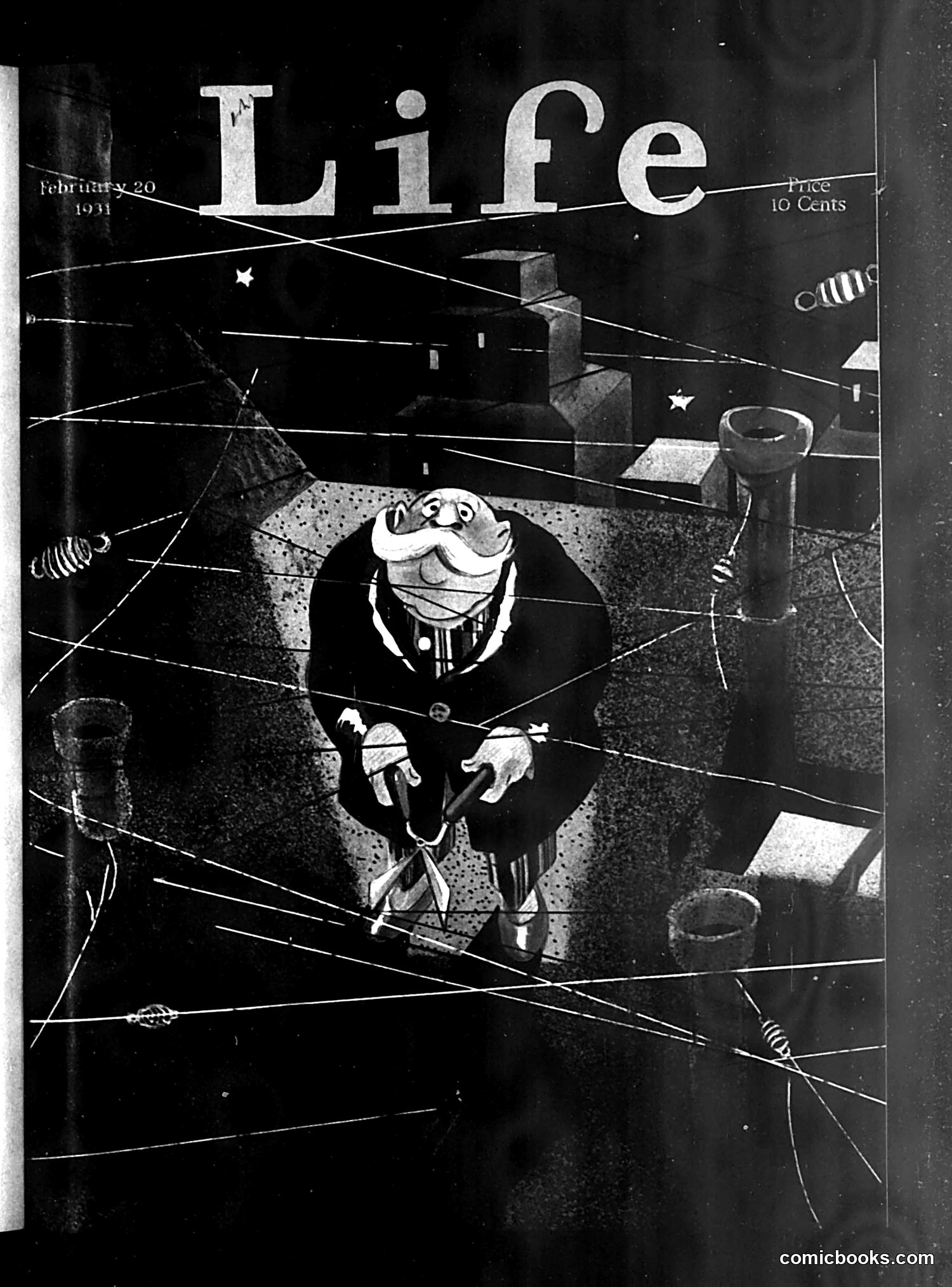
Life Magazine Cover - February 20, 1931 This is a Life magazine cover from February 1931 featuring a caricatured character with an exaggerated mustache and formal attire, positioned centrally with various objects arranged around him in a geometric composition. The figure appears to be a satirical representation, likely of a political or public figure from that era, though the specific identity cannot be definitively stated from the image alone. The cover's artistic style uses dramatic perspective lines and scattered objects (vessels, geometric shapes) creating a somewhat surreal or theatrical arrangement. The "Life" masthead and "10 Cents" price notation frame the composition. Without additional context beyond what's visible, the exact satirical intent remains unclear, though the exaggerated facial features suggest commentary on a contemporary political or social figure.
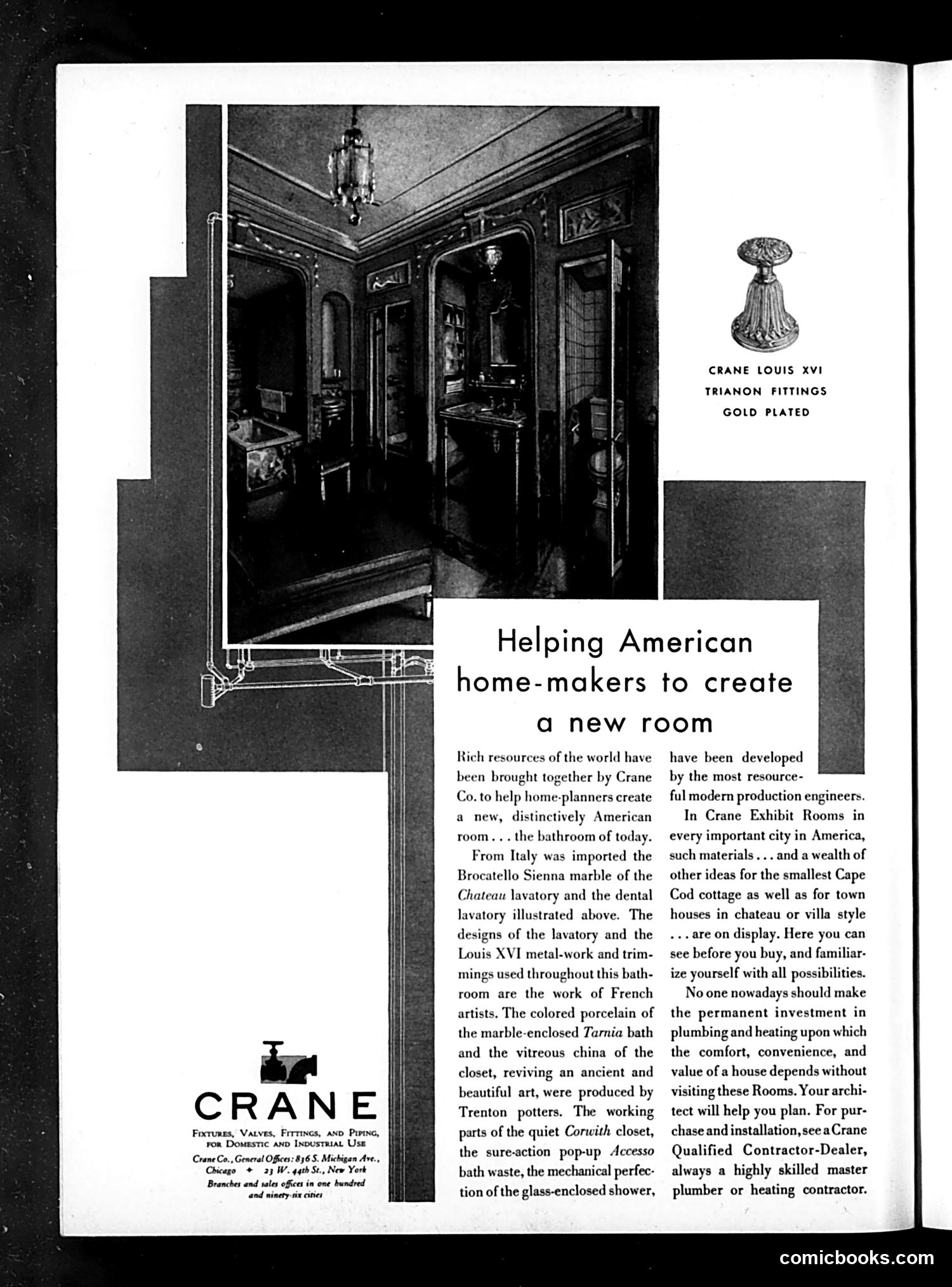
This page is primarily advertising content, not satire or political commentary. It features a Crane Co. advertisement for bathroom fixtures and plumbing supplies. The main image shows an elegantly appointed 1920s-30s bathroom with Italian marble, French metalwork, and Trenton pottery. The text promotes Crane's "Exhibit Rooms" in major American cities where homeowners could view and plan bathroom renovations before purchasing. It emphasizes that this was a new concept—allowing customers to see options in advance rather than committing blindly. The gold-plated "Trianon Fittings" shown at top represent the luxury end of Crane's product line. The advertisement targets affluent homemakers interested in modernizing their homes with quality imported materials and American manufacturing expertise.
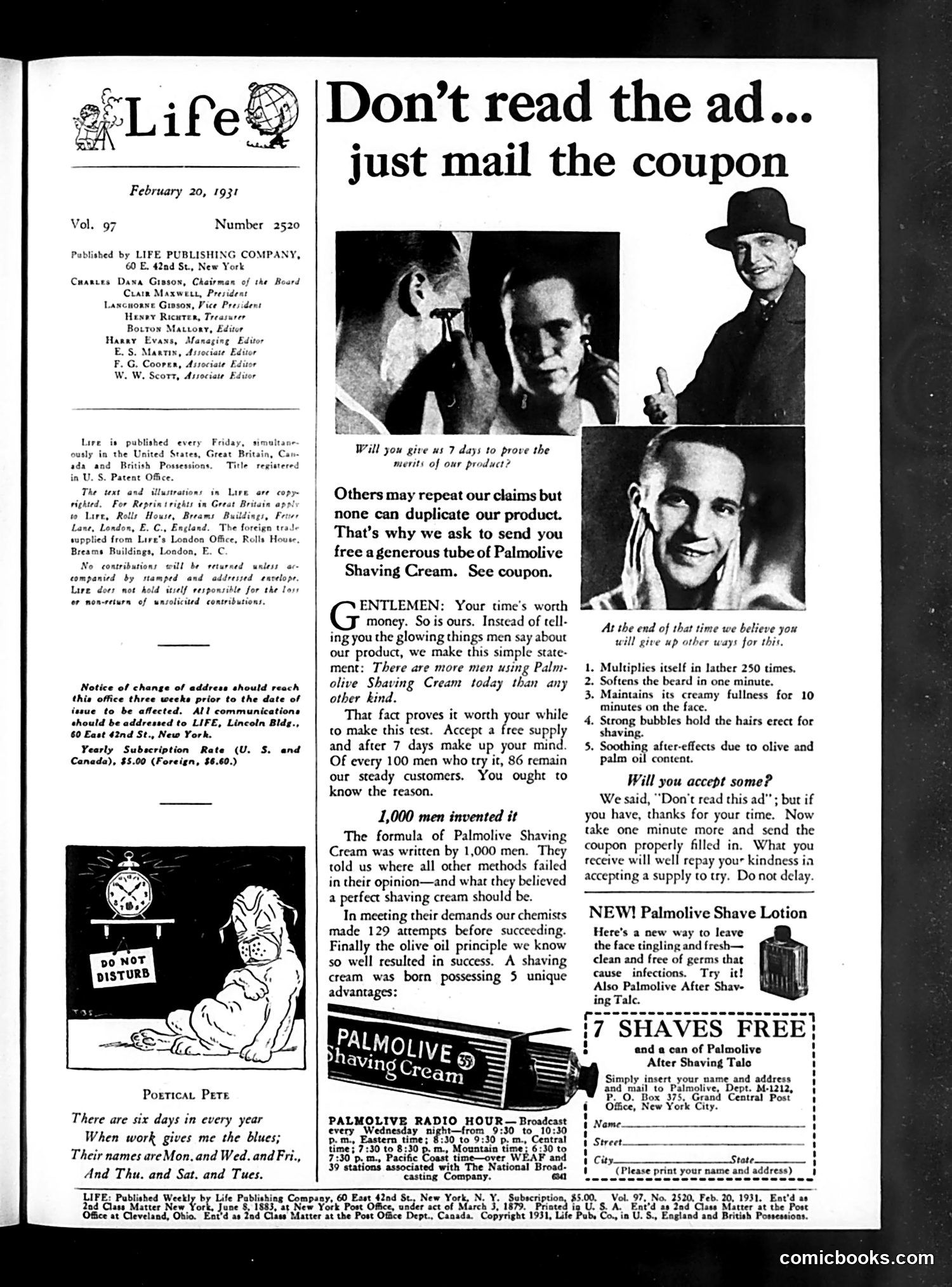
Political Pete and Palmolive Advertisement This page contains two unrelated items: Left side: "Political Pete" cartoon shows a figure labeled "DO NOT DISTURB" sleeping through political events. The accompanying verse states there are six days in each week when such a person doesn't follow politics—only Monday, Wednesday, Friday, Thursday, Saturday, and Tuesday. The joke satirizes someone so detached from current events that they miss political news every single day, making their claimed disinterest absurd and hypocritical. Right side: Palmolive Shaving Cream advertisement featuring testimonials from men claiming the product's superiority. The ad offers a free sample and uses the headline "Don't read the ad...just mail the coupon"—a humorous meta-advertisement that acknowledges reader reluctance while promoting their product's alleged uniqueness among shaving creams.
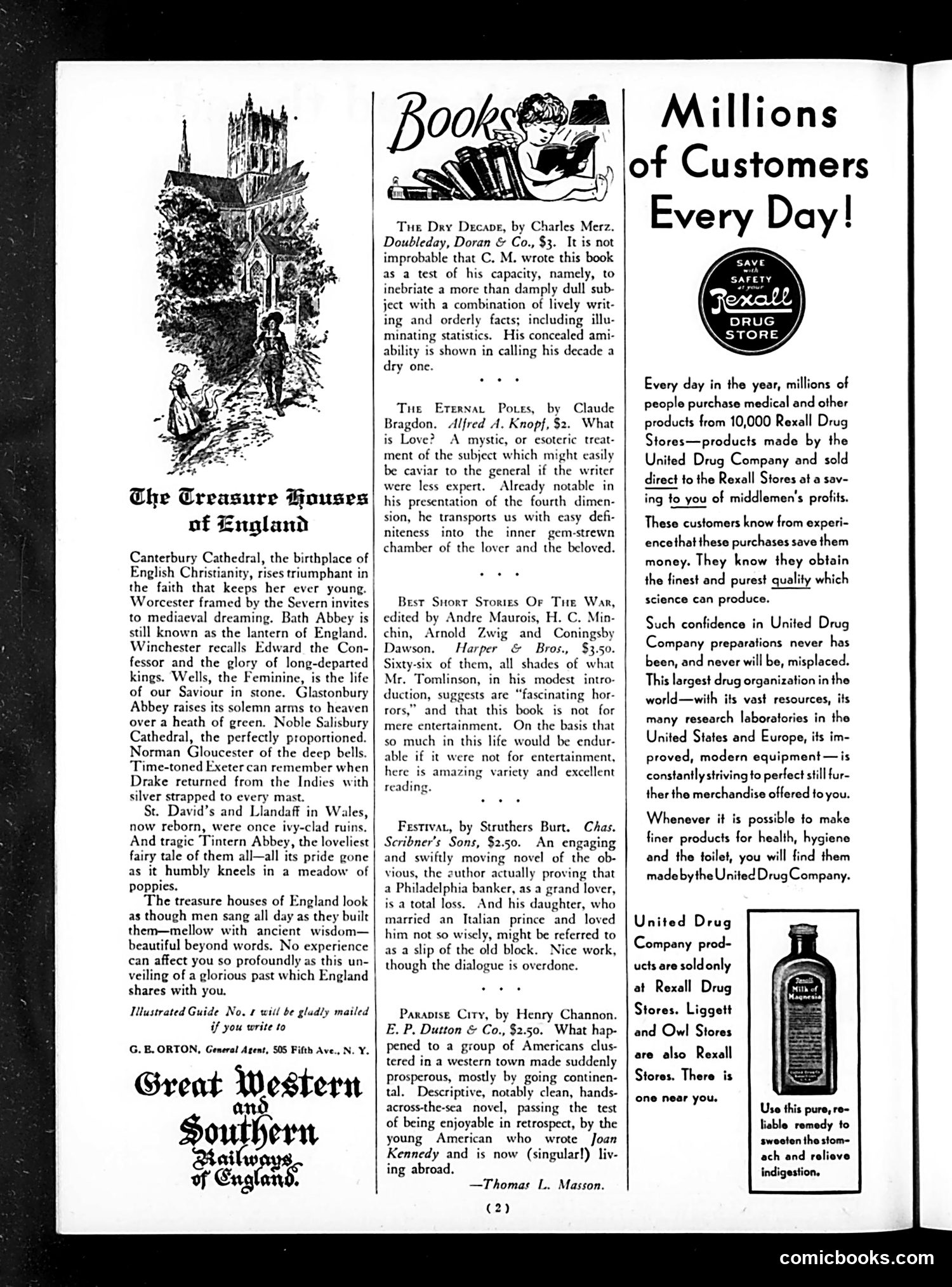
Content Analysis This page is primarily advertising and book reviews, not political satire. The left side features an illustrated article titled "The Treasure Houses of England," celebrating English cathedrals and historic architecture like Canterbury Cathedral and Bath Abbey—presented nostalgically as repositories of cultural wisdom. The center contains book reviews by Thomas L. Mason, discussing recent literary works. The right side is a Rexall Drug Store advertisement emphasizing that millions of customers daily purchase products from 10,000 Rexall locations nationwide. The ad promotes the United Drug Company's size, research capabilities, and product quality, positioning Rexall as trustworthy and accessible. This reflects early 20th-century consumer culture marketing and nostalgia for European heritage among American readers.
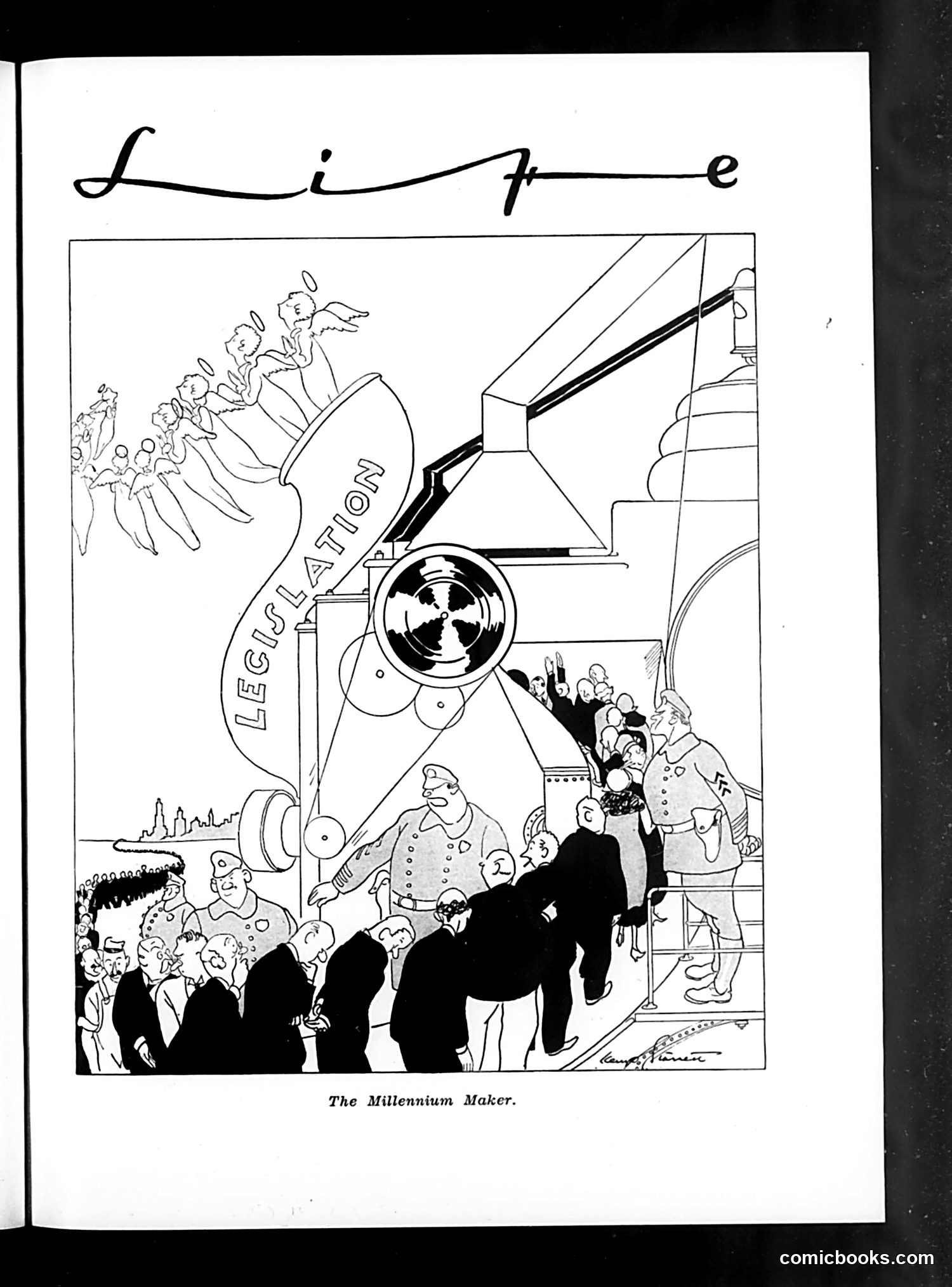
"The Millennium Maker" - Life Magazine Cartoon This political cartoon satirizes electricity and technological progress as a transformative force. The title "Millennium Maker" and the word "LEGISLATION" on the machine suggest that electrical technology—represented by this imposing industrial apparatus with its large turbine—is being positioned as a solution to society's problems, even utopian salvation. The cartoon depicts crowds of formally-dressed dignitaries and citizens gathering around this machine, some ascending toward it hopefully. The imagery suggests both optimism about technology's potential and skepticism about over-reliance on mechanical solutions for social progress. This reflects early-20th-century debates about whether technological advancement alone could create a better future, or whether such faith was misplaced.
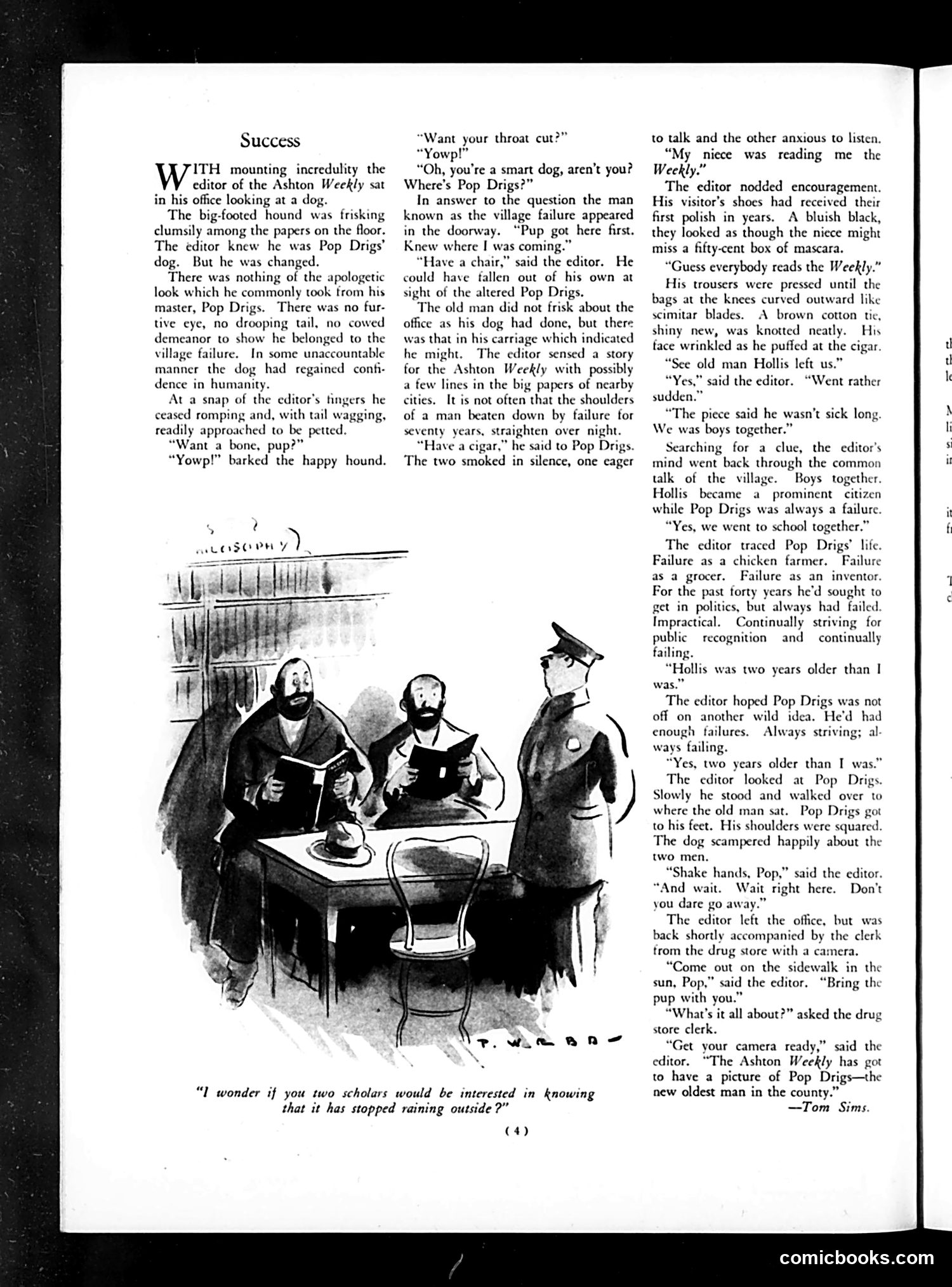
"Success" - A Story About Pop Drigs This is a short story titled "Success" by Tom Simi, accompanying a cartoon illustration. The narrative follows an editor who discovers an old dog named Pop Drigs in his office—a dog that once belonged to the village failure, Hollis. The story uses Pop Drigs as a metaphor for failure and redemption. The editor learns that Hollis, despite forty years of striving, repeatedly failed as a farmer, grocer, and inventor. Through this reflection, the editor recognizes a parallel between his own struggling ambitions and Hollis's lifelong pattern of failure. The editor then photographs Pop Drigs for the Ashton *Weekly*, positioning the old dog as "the new oldest man in the county"—a humorous twist suggesting that persisting through perpetual failure might itself constitute a kind of success.
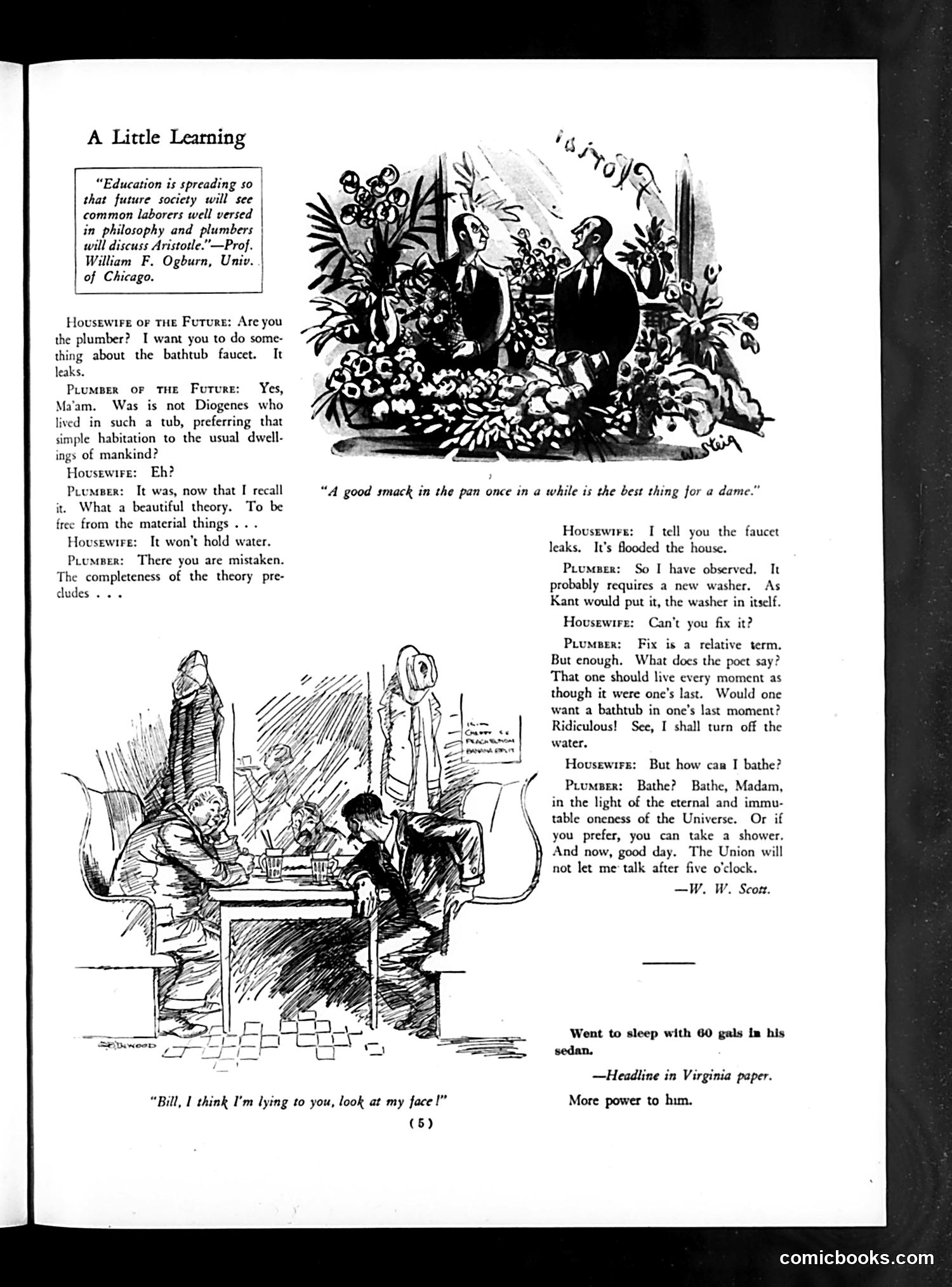
"A Little Learning" - Life Magazine Satire This page satirizes philosophical pretension versus practical reality. The dialogue features a Housewife of the Future and a Plumber of the Future debating whether a bathtub without functioning plumbing represents enlightened simplicity or impractical idealism. The plumber invokes Diogenes and Kant, arguing that material comfort ("the washer in itself") matters despite philosophical theory. The housewife's complaint—the faucet leaks—grounds the joke in everyday practicality triumphing over abstract thought. The cartoon mocks both educated elites who romanticize poverty and trade workers who condescend to intellectuals. The lower cartoon shows domestic chaos, reinforcing that real life demands pragmatic solutions, not philosophical posturing. The satire critiques how "a little learning" produces absurd pretension detached from functioning reality.
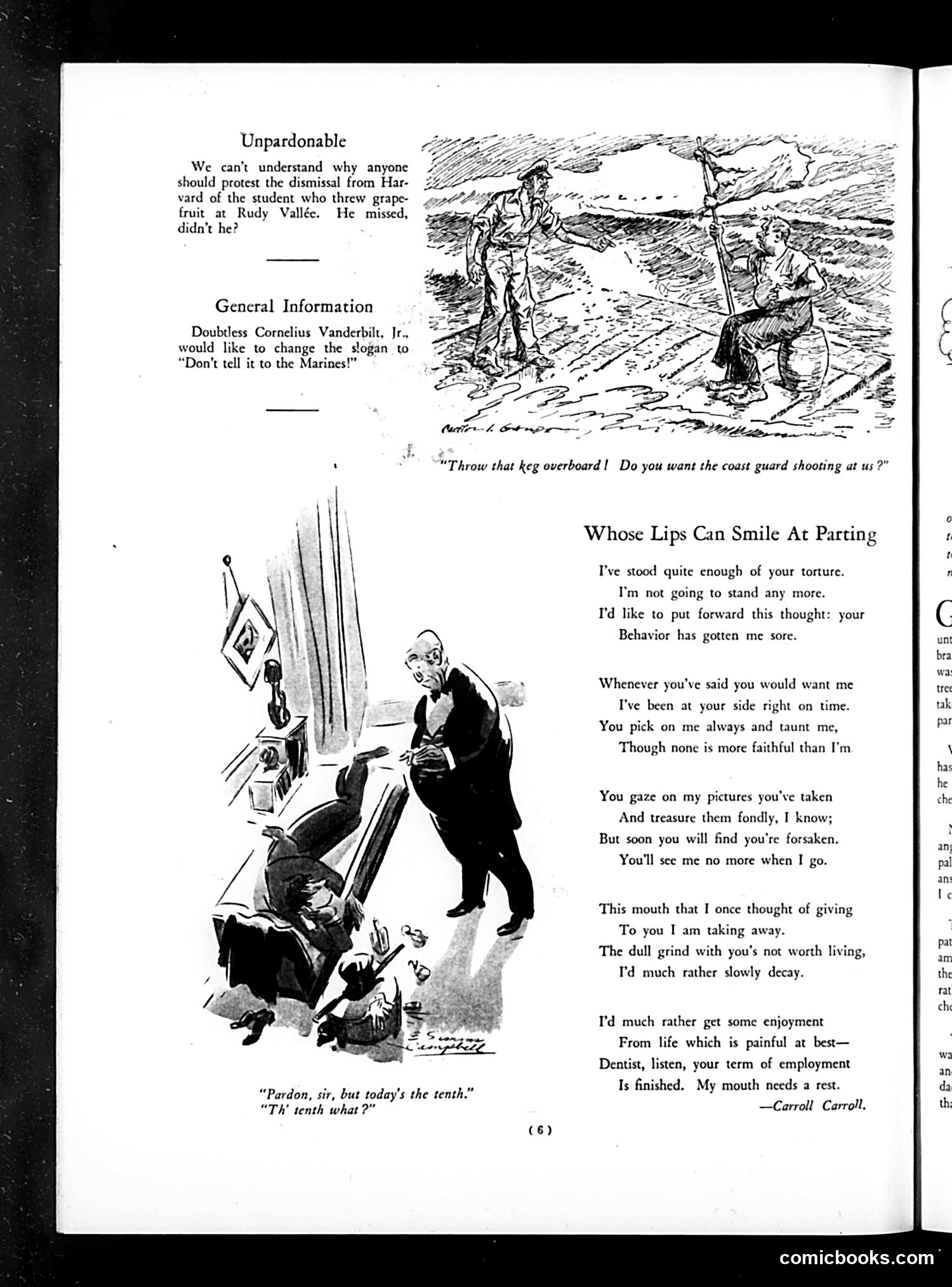
Explanation for Modern Readers The page contains two unrelated satirical pieces: "Unpardonable" (top left): A brief joke mocking Harvard student Rudy Vallée for missing grapefruit at lunch—absurdist humor about a minor dining mishap. Lower cartoon: A dentist sits reading while a patient lies in the chair. The caption "Pardon, sir, but today's the tenth" / "Th' tenth what?" suggests the patient is complaining about payment timing or overdue bills—satirizing a dentist's indifference to patient discomfort or financial disputes. "Whose Lips Can Smile At Parting" (right): A poem by Carroll Carroll addressed to a departing employee (possibly a dentist, given context), expressing frustration with mistreatment and announcing resignation. The speaker reclaims their dignity by leaving rather than endure continued disrespect. The page satirizes workplace exploitation and professional callousness common to early 20th-century service industries.
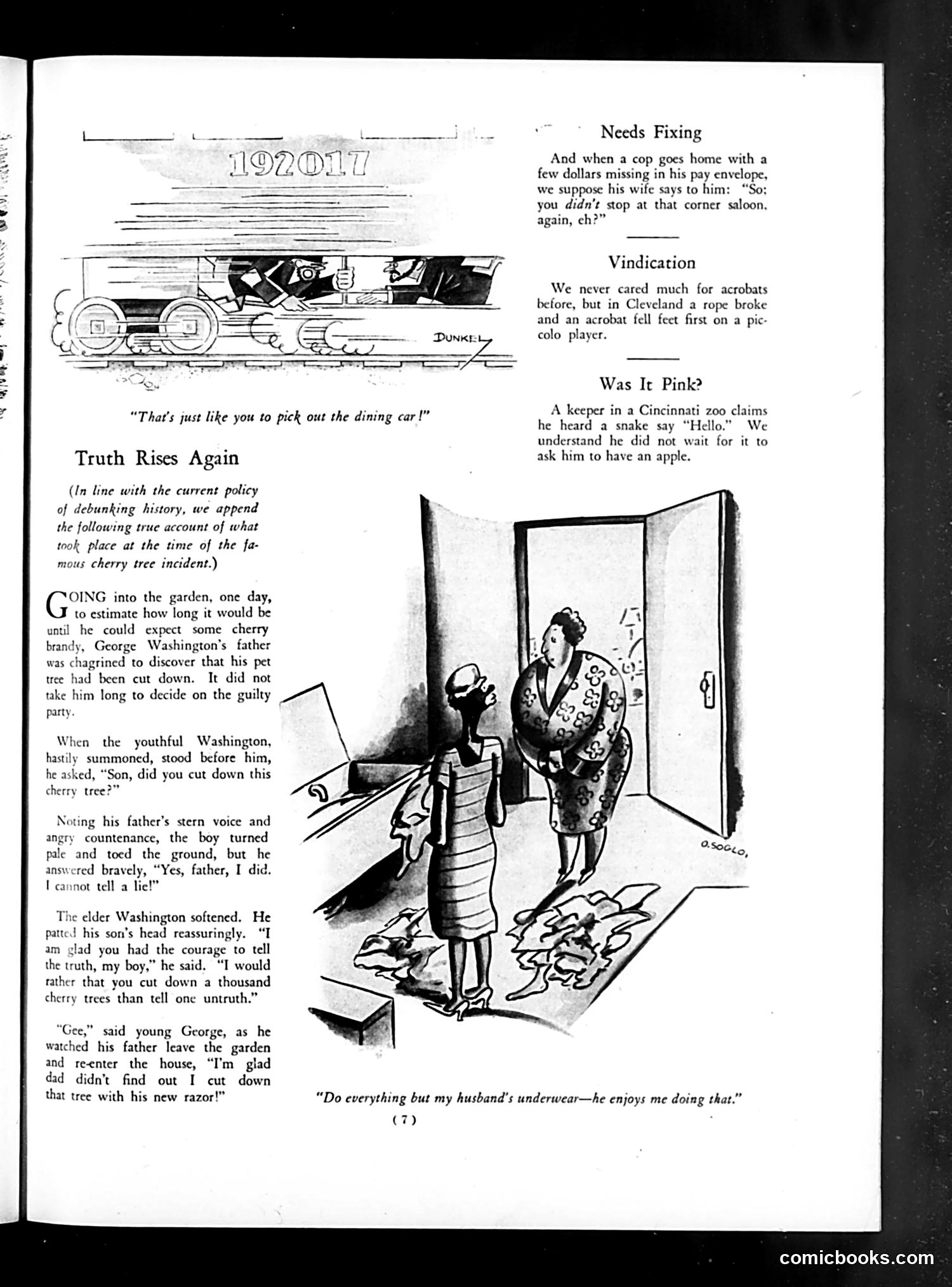
Analysis of Life Magazine Page This page contains three satirical humor pieces typical of early 20th-century Life magazine: 1. "Truth Rises Again": A retelling of the George Washington cherry tree legend, reframed as Washington *not* cutting down the tree with his father's new razor. The satire mocks the famous (apocryphal) story of young Washington's honesty, suggesting the original tale itself is a lie being "debunked" by the magazine. 2. "Needs Fixing": A brief joke about a police officer's missing pay. 3. "Vindication" and "Was It Pink?": Short quips about acrobats and a talking snake. The cartoon shows a domestic scene with a woman displaying what appears to be clothing or laundry to a visitor, captioned about the husband's underwear—a joke about marital embarrassment and domestic life typical of the era's humor magazines.
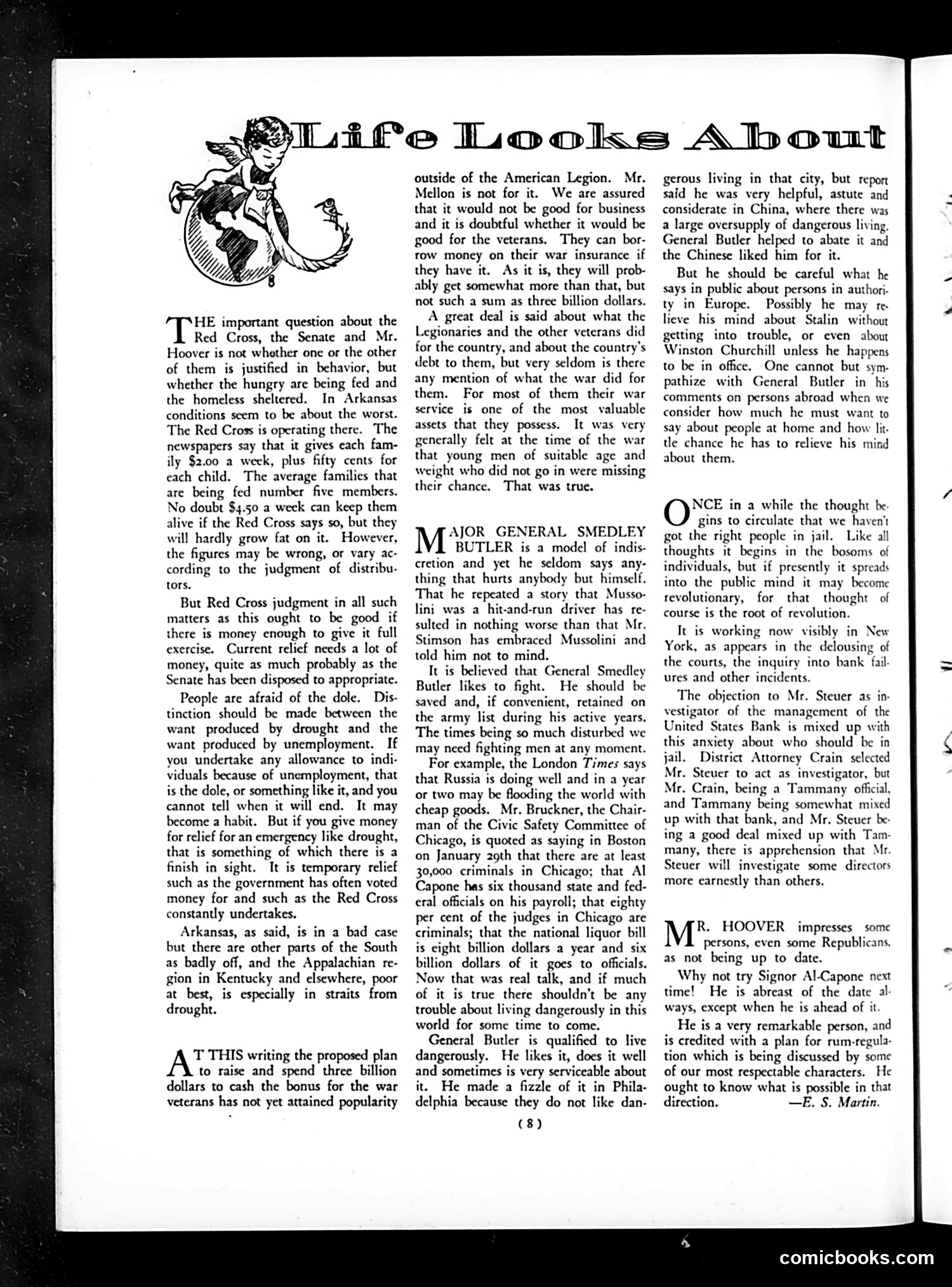
Analysis of "Life Looks About" Page This page from *Life* magazine contains opinion columns signed by "E.S. Martin" discussing contemporary 1920s issues. The small illustration at the top shows a cherub or cupid figure, which is *Life*'s recurring mascot. The columns address: Red Cross operations in Arkansas during drought; debate over a three-billion-dollar war bonus for veterans; General Smedley Butler's character and fitness for command; alleged corruption in Chicago (judges, officials, criminals on payroll); and President Hoover's approach to governance. The satire is indirect—primarily critical commentary rather than visual caricature. The tone suggests skepticism toward government efficiency, veteran bonus proposals, and urban corruption, while noting Hoover's tendency to act when ahead of public opinion.
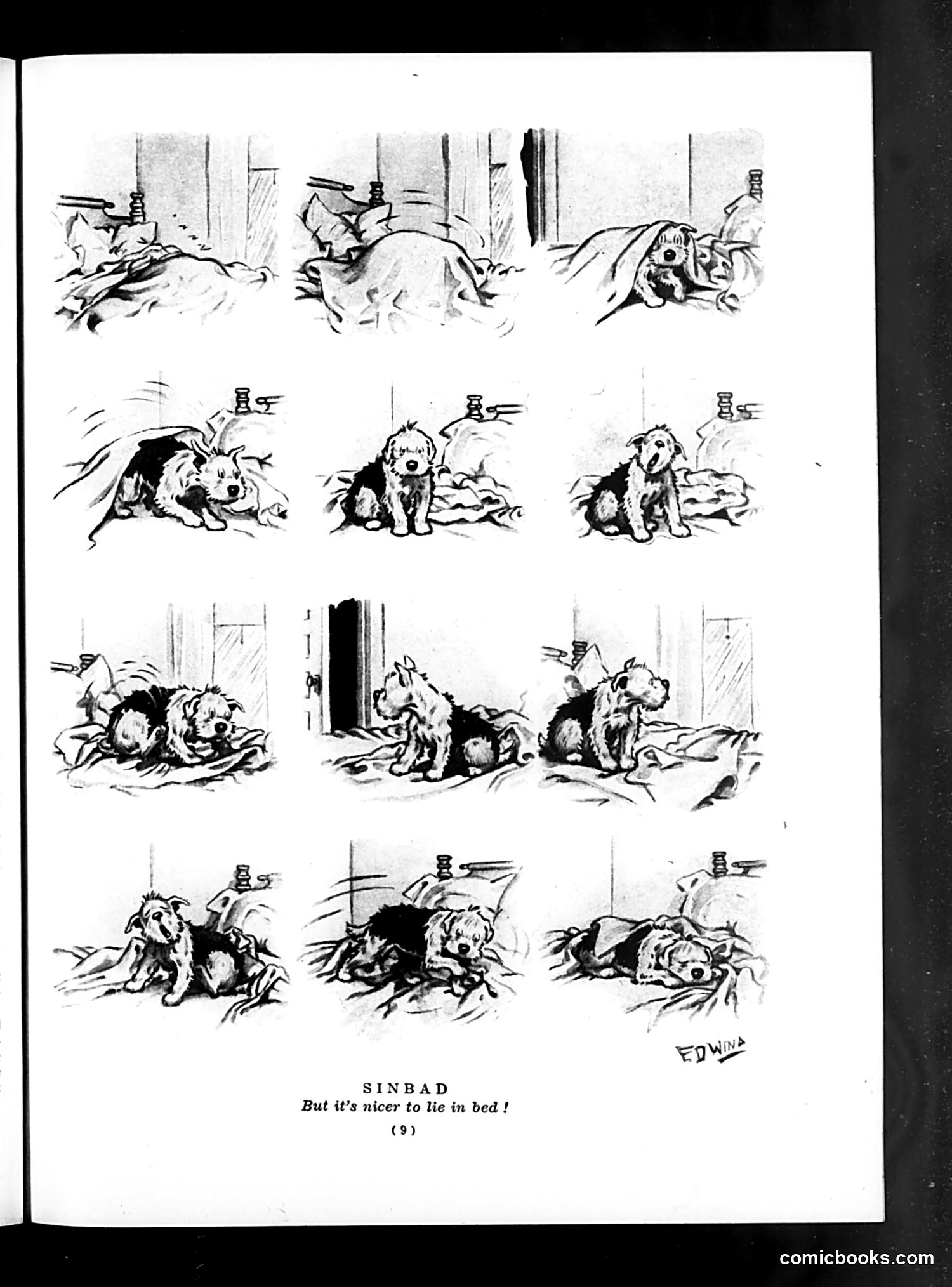
"Sinbad: But It's Nicer to Lie in Bed!" This is a sequential comic strip featuring Sinbad, the legendary sailor from Arabian Nights tales. The strip shows a humorous domestic scene where Sinbad—traditionally depicted as an adventurous voyager facing exotic dangers—is contrasted with the comfort of simply staying in bed. The joke plays on Sinbad's famous reputation for perilous adventures across fantastical lands. Here, the cartoon subverts expectations by suggesting that despite all those legendary exploits, ordinary bed rest is actually preferable. It's a relatable bit of humor about preferring comfort and laziness to adventure—a common theme in early 20th-century American comic satire. The artist's signature reads "ED WINN" (visible lower right).
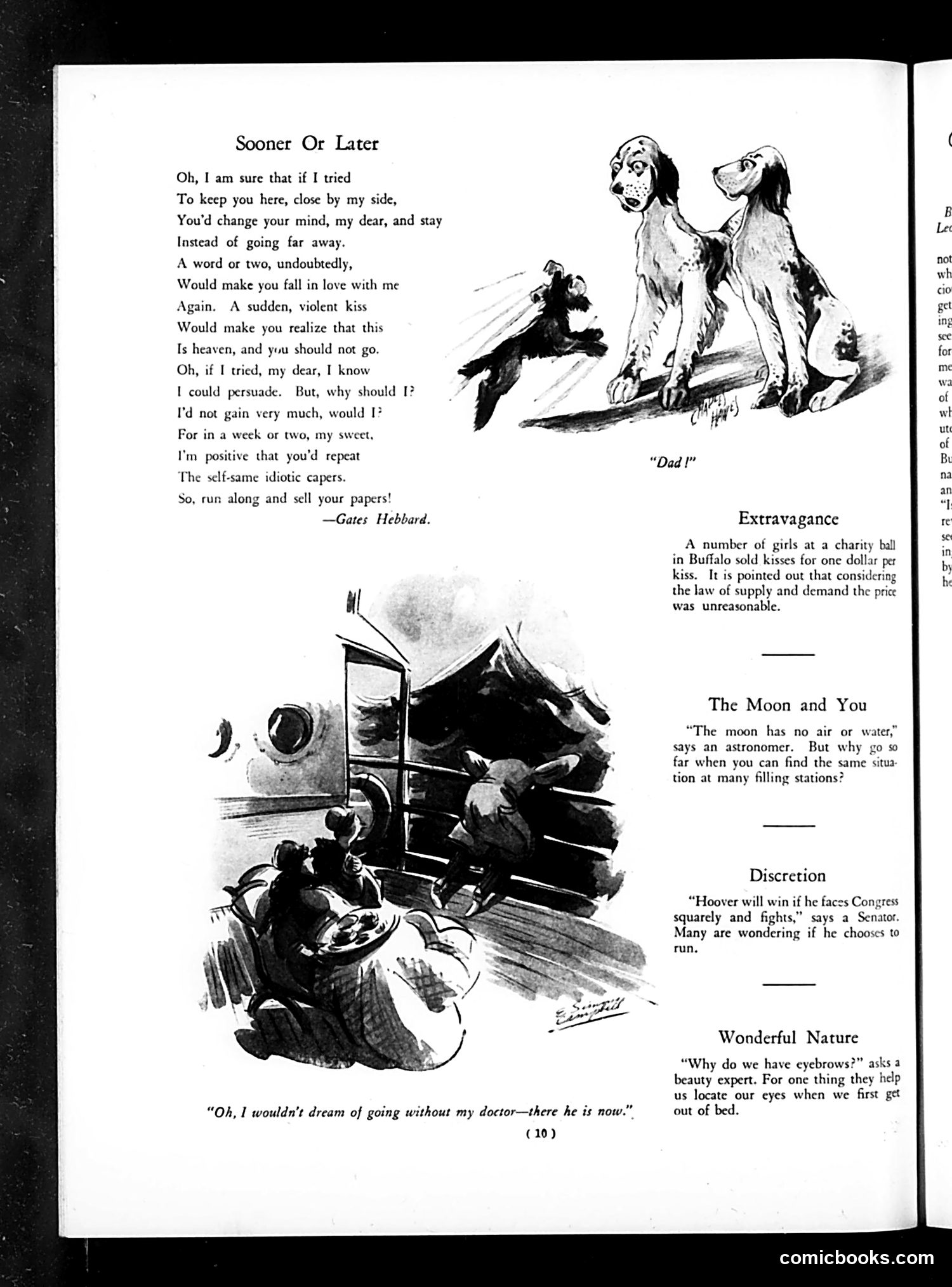
Analysis of Life Magazine Page This page contains humorous short pieces and cartoons typical of Life's satirical format. The top poem "Sooner Or Later" by Gaëls Hebbard, accompanied by a dog cartoon labeled "Dad!", uses romantic rejection humor—a speaker tries to convince someone to stay, predicting they'll return within weeks repeating "idiotic capers." Below, a cartoon captioned "Oh, I wouldn't dream of going without my doctor—there he is now" shows a car crash with a doctor visible in the wreckage, joking darkly that the doctor is conveniently present during disaster. The right column contains brief humor items: "Extravagance" mocks wartime price-gouging at a charity ball; "The Moon and You" jokes about moon travel versus gas stations; "Discretion" references Hoover (likely Herbert Hoover) and Congressional elections; "Wonderful Nature" makes a light observation about eyebrows.
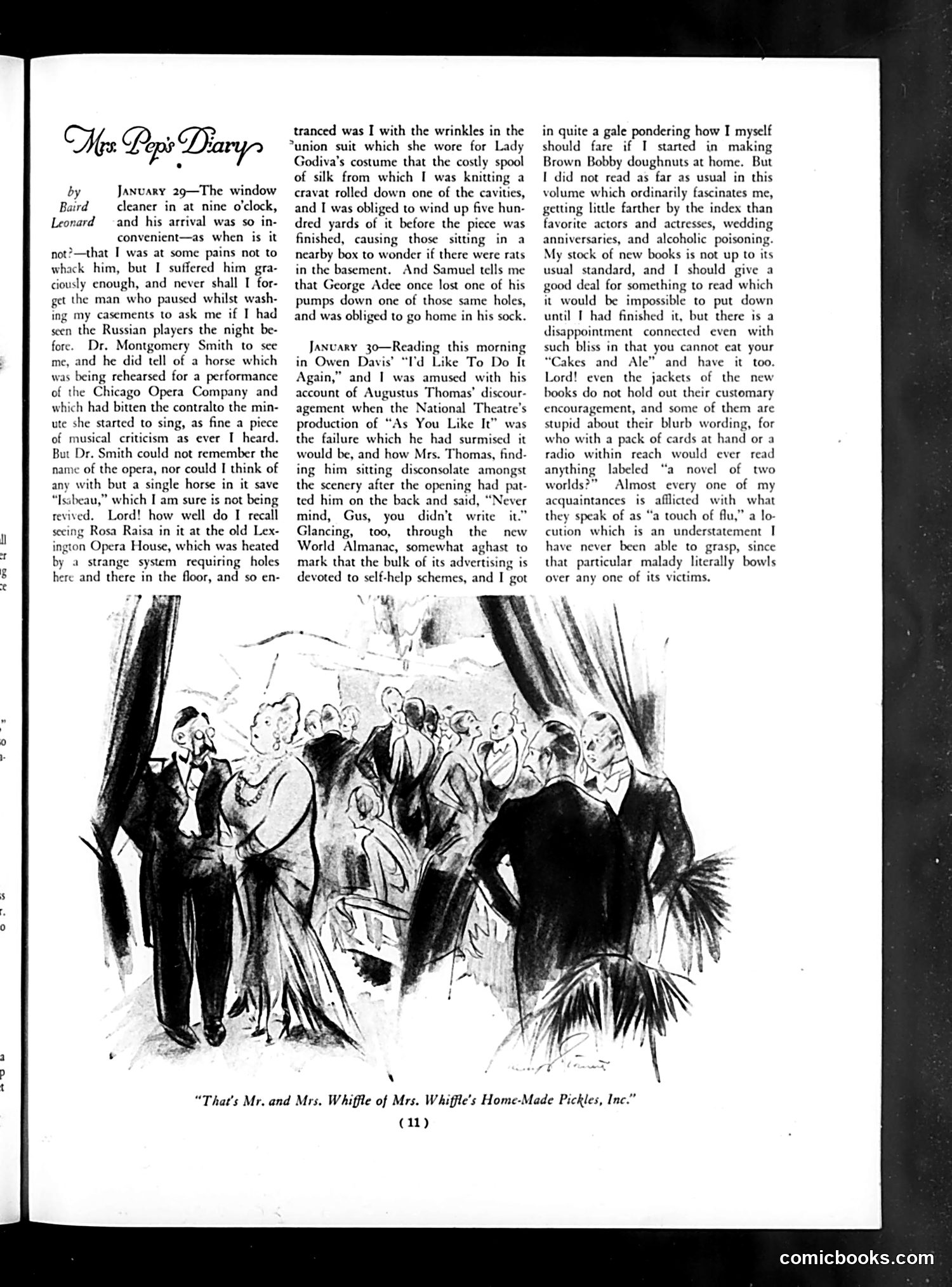
Mrs. Peps Diary Entry Analysis This is a diary entry by "Baird Leonard" dated January 29-30, describing theatrical and social observations. The accompanying illustration depicts what appears to be a formal social gathering or theatrical event, showing well-dressed figures in evening wear. The diary references specific theatrical productions ("As You Like It," "I'd Like To Do It Again") and discusses Augustus Thomas's involvement with the National Theatre. It also critiques the *World Almanac* for advertising "self-help schemes." Without additional context about the specific date of this *Life* magazine issue, the precise theatrical references, and who "Mrs. Peps" represents, I cannot definitively identify the satirical targets. The content appears to mock contemporary theater pretensions and commercial advertising practices, but the specific figures and events remain unclear from this page alone.
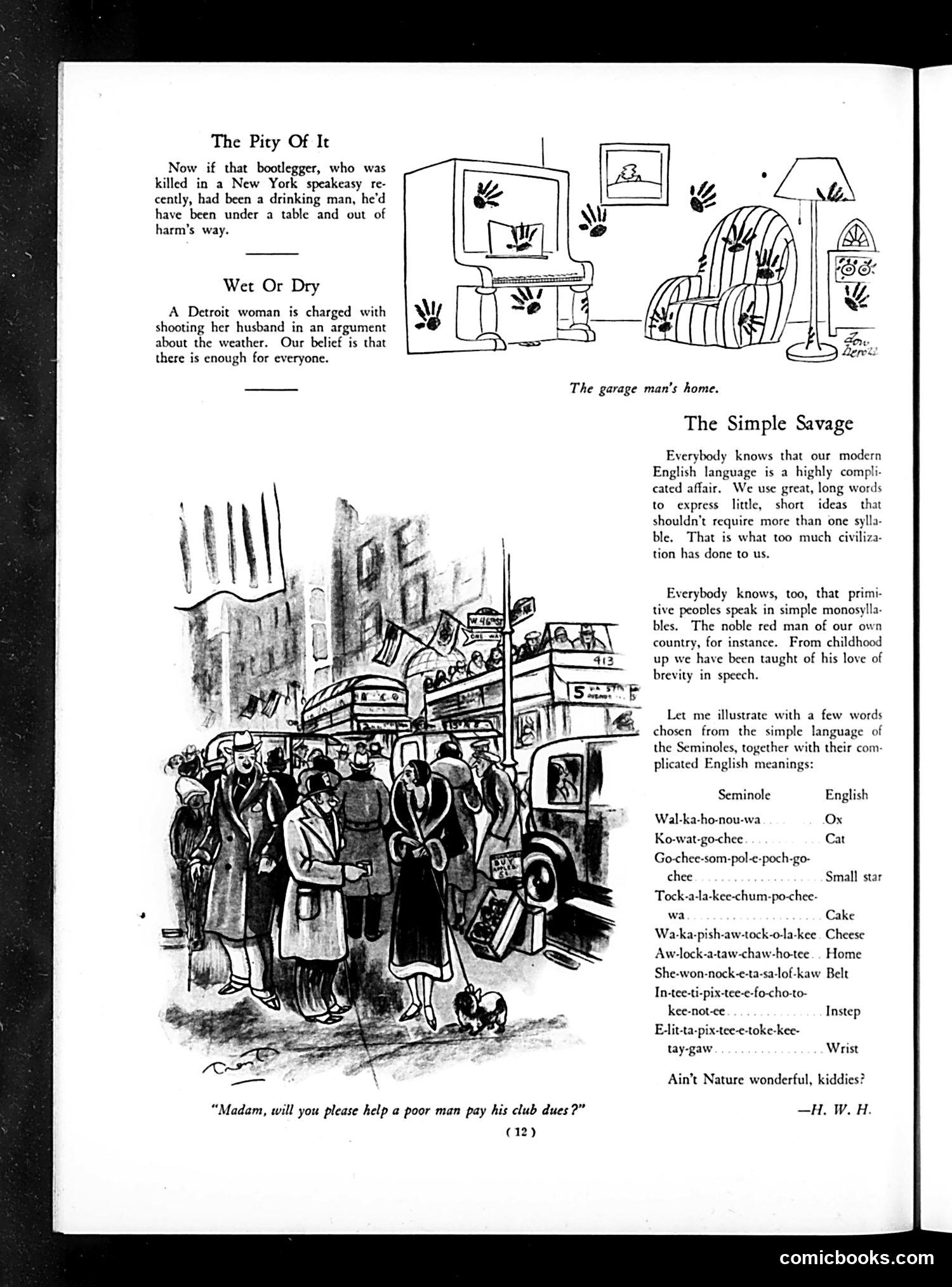
Analysis of Life Magazine Page This page contains three distinct pieces: 1. "The Pity Of It" and "Wet Or Dry": Brief satirical news items mocking a bootlegger's death in New York and a Detroit woman shooting her husband during a weather argument—commentary on Prohibition-era violence and domestic disputes. 2. "The garage man's home": A cartoon showing handprints covering a man's living space (TV, furniture, walls), satirizing either messy living conditions or perhaps a commentary on working-class domesticity. 3. "The Simple Savage": The main feature criticizes English as overly complicated. It contrasts English with Seminole language, listing Seminole words and their English translations. The accompanying street scene cartoon illustrates ordinary urban life, supporting the article's ironic premise that "primitive" languages are actually simpler than modern English—a critique of linguistic complexity in civilization.
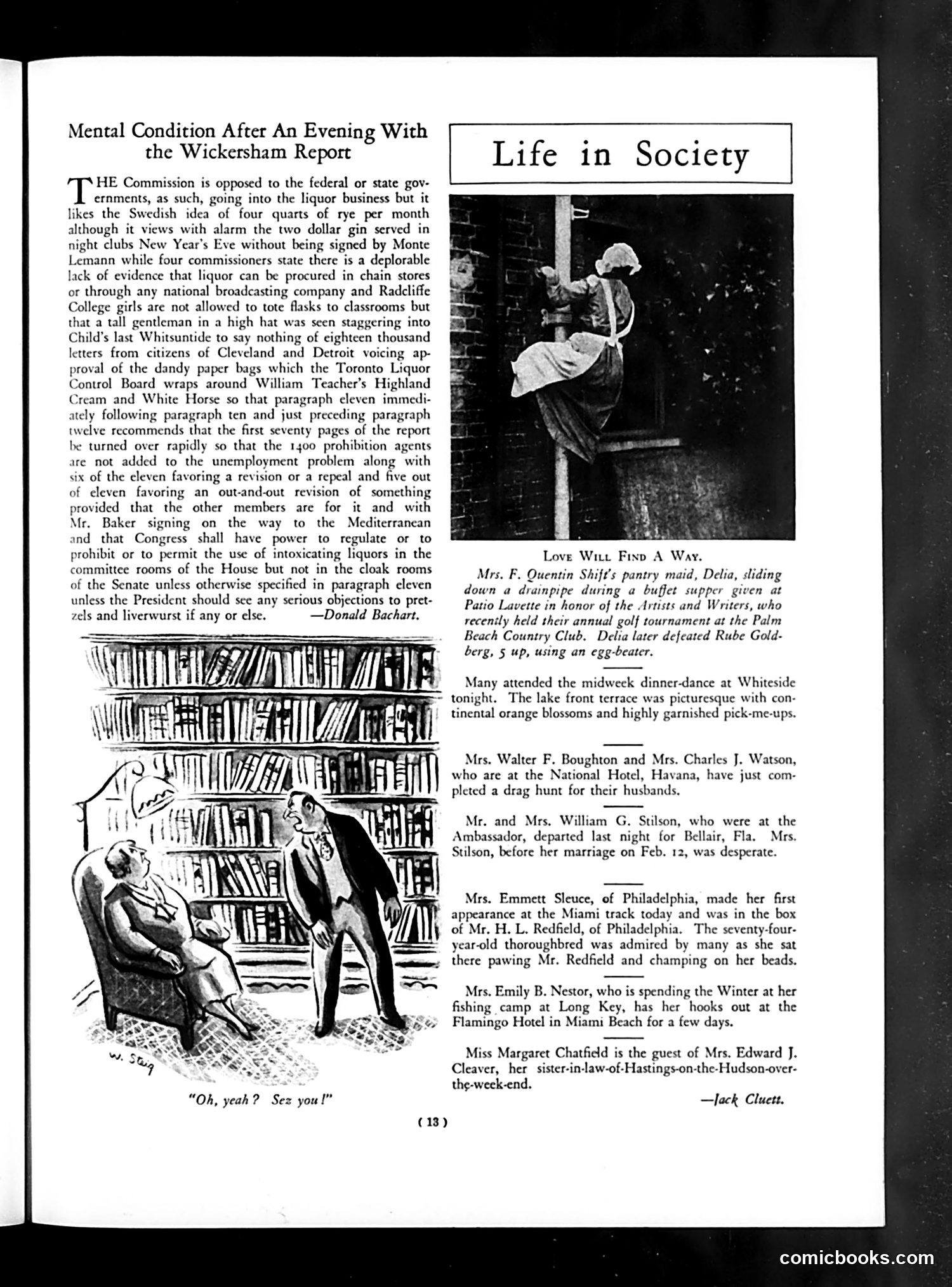
Cartoon Analysis The main cartoon shows two men in a library: one seated, one standing and gesturing. The caption reads "Oh, yeah? See you!" This appears to be satirizing a domestic or social disagreement, likely reflecting post-Prohibition era tensions. The article "Mental Condition After An Evening With the Wickersham Report" references the Wickersham Commission's recent report on alcohol enforcement—a contentious 1931 document on Prohibition's failures. The cartoon mocks how discussions of this divisive report might cause arguments between people, capturing the social friction the Prohibition debate created. The "Life in Society" column below documents high-society social events, providing counterpoint to the satirical commentary above about national policy debates affecting everyday Americans.
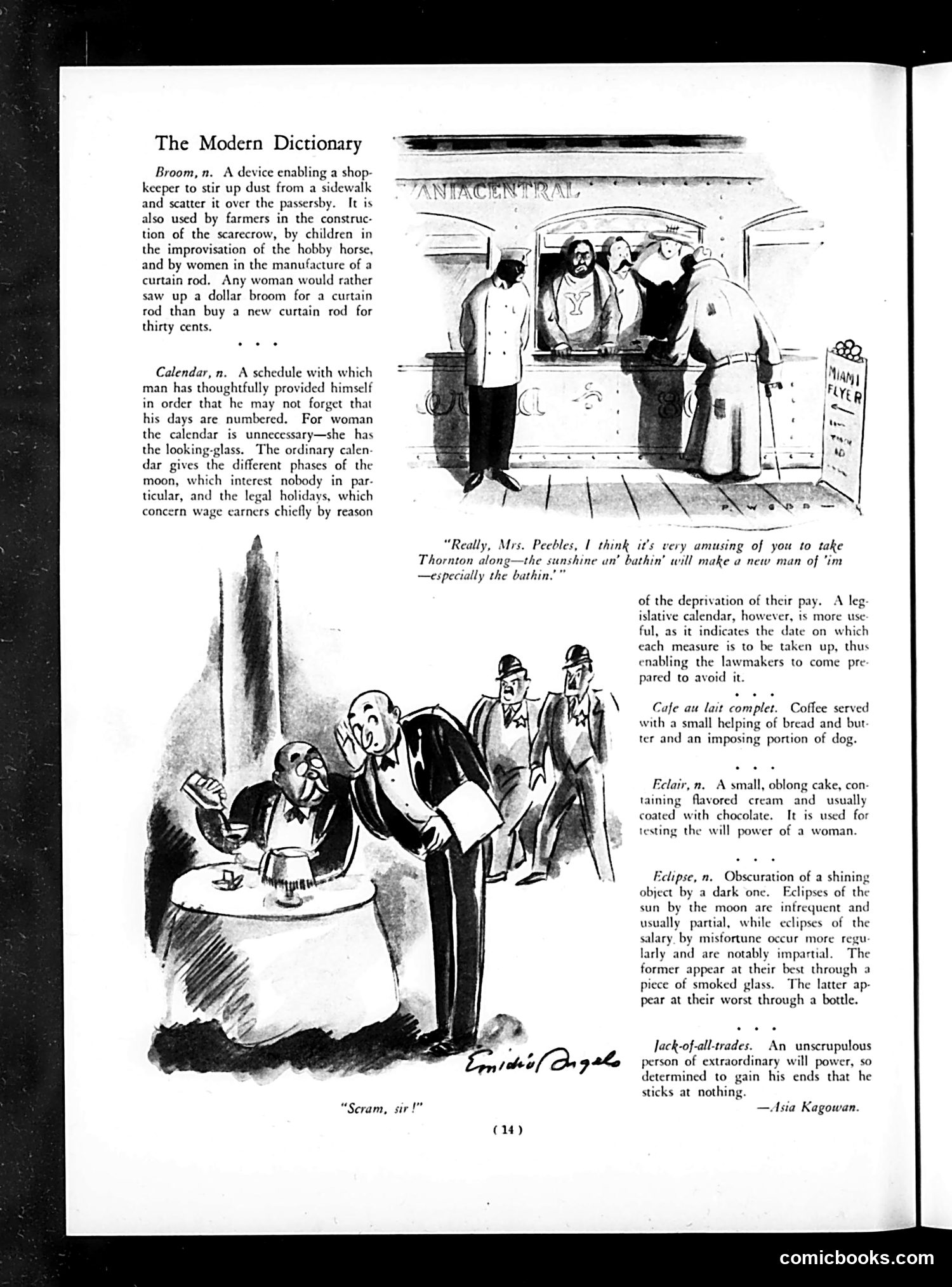
"The Modern Dictionary" - Page Analysis This page from *Life* magazine presents humorous dictionary definitions alongside two cartoons. The top cartoon shows passengers at what appears to be a transit station, with one woman suggesting a man take along "Thornton" for "sunshine an' bathin'" to make "a new man of 'im." The lower cartoon depicts a waiter serving a seated diner while other waiters stand in the background. The caption reads "Scram, sir!" — likely satirizing restaurant service dynamics. The dictionary entries mock contemporary social conventions: a "broom" is defined with ironic commentary about women's domestic roles, and "calendar" jokes about women needing calendars less than mirrors. The definitions employ satirical exaggeration typical of *Life*'s social commentary, critiquing gender norms and class distinctions of the era.
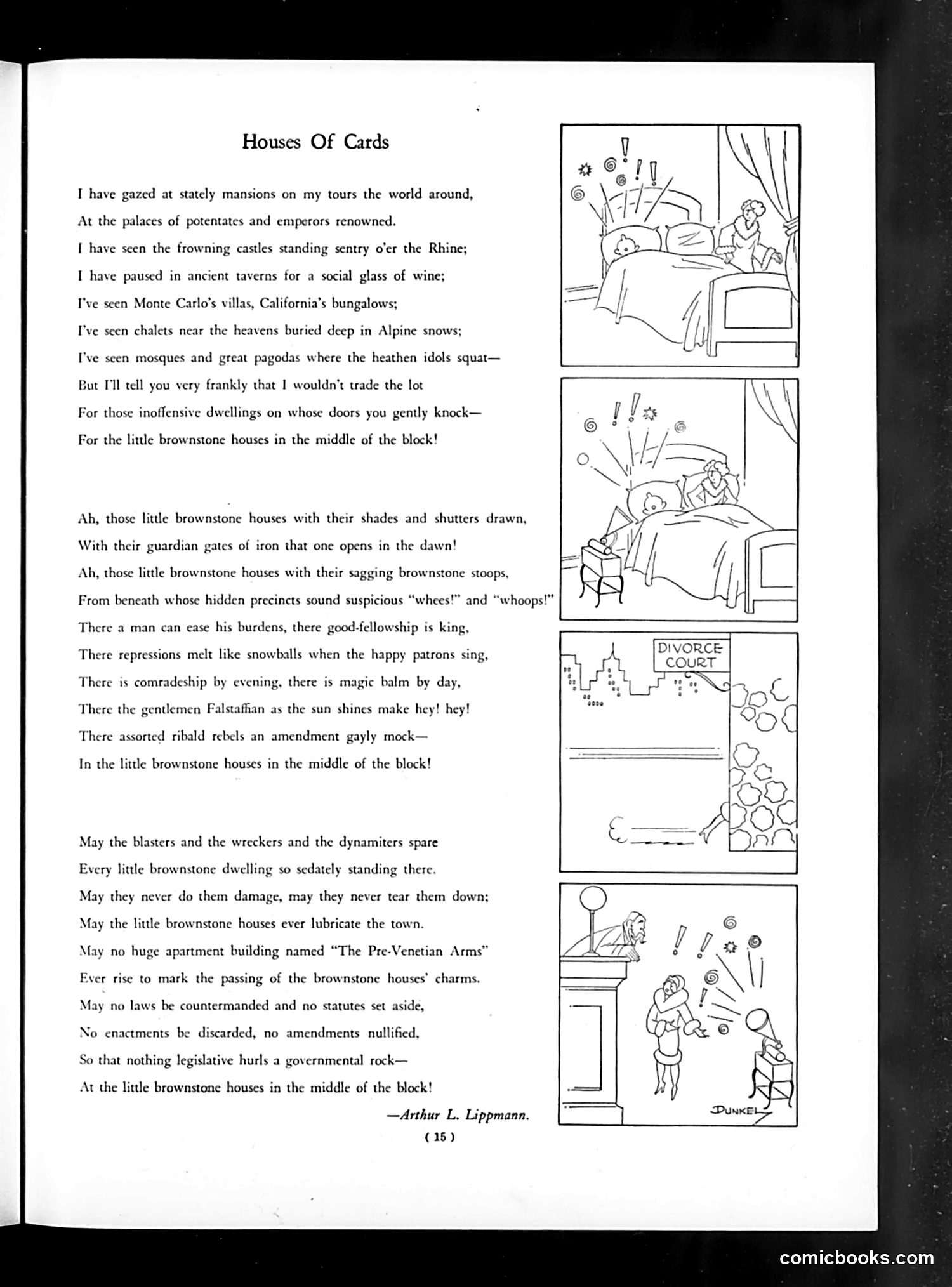
"Houses of Cards" by Arthur L. Lippmann This poem celebrates modest brownstone apartment buildings in urban neighborhoods over grandiose mansions worldwide. The poet contrasts "stately mansions," castles, and exotic palaces with humble "little brownstone houses in the middle of the block." The accompanying cartoons illustrate domestic life in these apartments: people in bedrooms, a divorce court scene, and neighbors in close quarters. The satire critiques materialistic society while celebrating working-class community. The final stanzas humorously invoke protection for these "sedately standing" buildings against "masters and wreckers and dynamiters"—likely referencing urban development pressures and real estate speculation of the era. The point: ordinary neighborhood homes foster genuine human connection and "good-fellowship" superior to wealth and pretense.
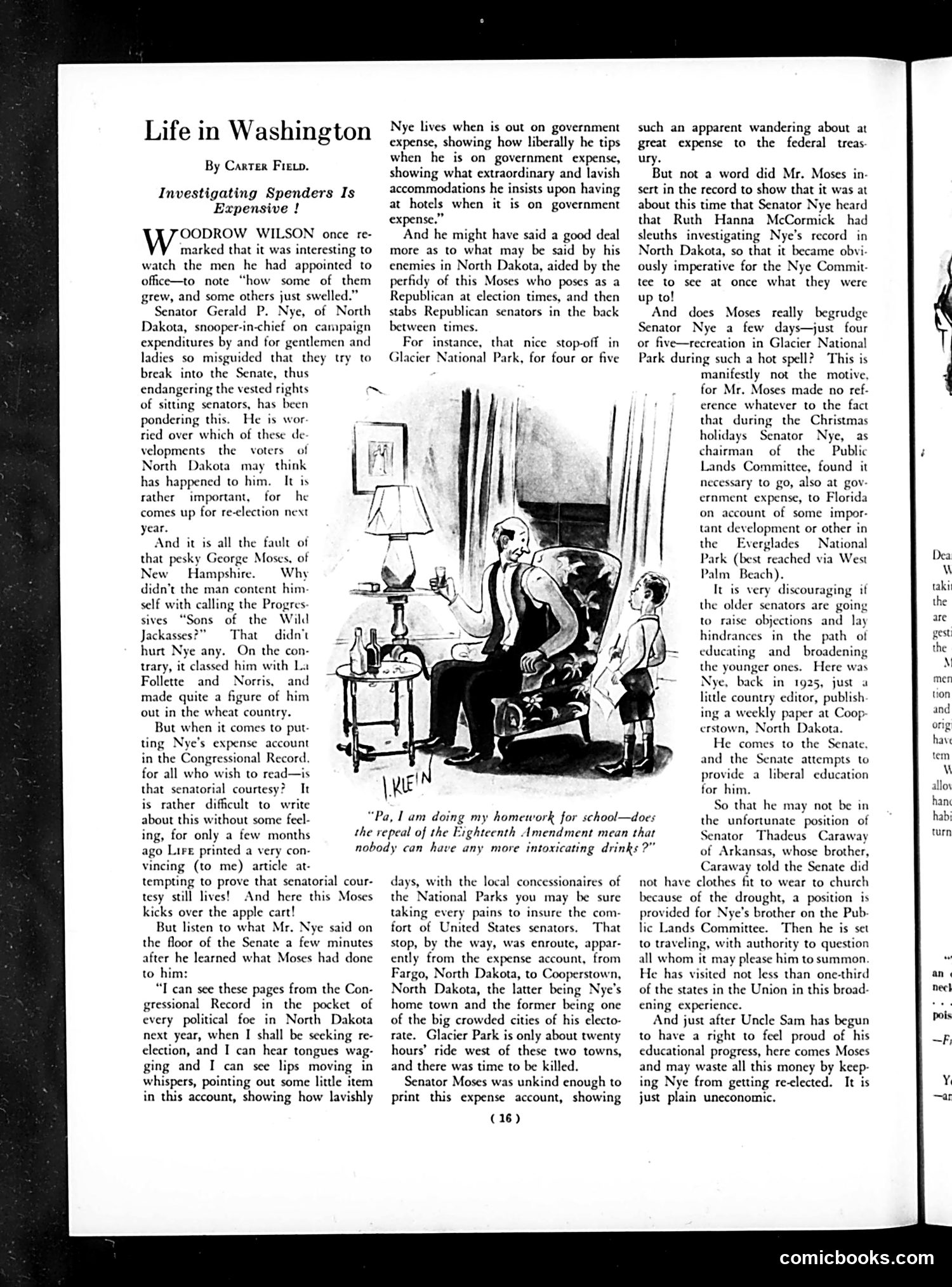
Political Satire: Senator Gerald Nye's Government Expenses This 1920s Life magazine article by Carter Field satirizes Senator Gerald P. Nye of North Dakota for lavish government-funded travel expenses, particularly trips to Glacier National Park. The cartoon depicts Nye lounging luxuriously in a hotel room while a child asks: *"Pa, I am doing my homework for school—does the repeal of the Eighteenth Amendment mean nobody can have any more intoxicating drinks?"* The satire works on two levels: Nye, apparently a Prohibition supporter, ironically spends taxpayer money on indulgent trips. Field argues Nye shouldn't lecture other senators about fiscal responsibility given his own extravagant expense accounts. The article suggests Nye is a hypocrite—morally preachy while personally profligate with public funds.
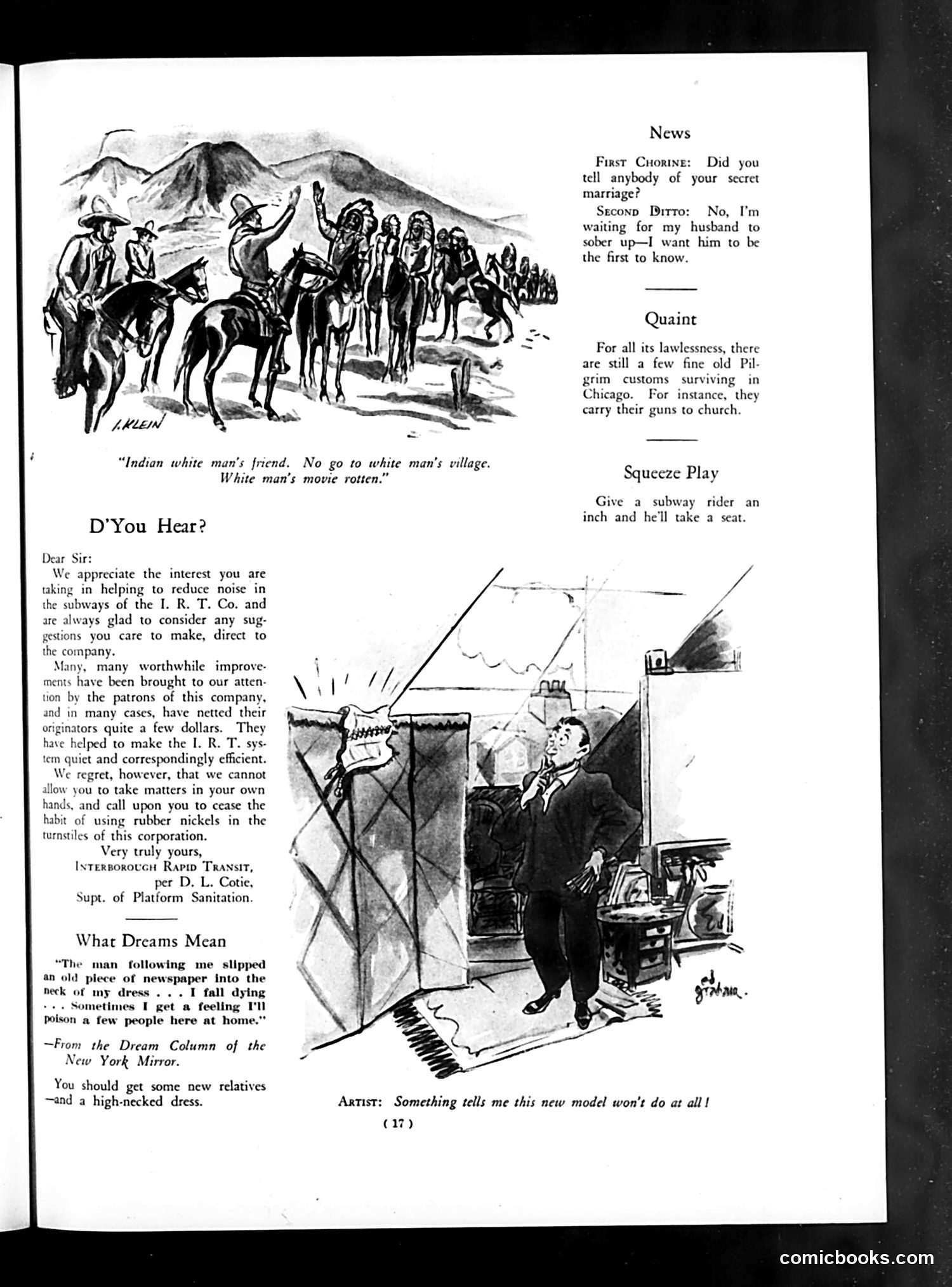
Analysis of Life Magazine Page This page contains several satirical pieces: "Indian white man's friend" (top): A cartoon mocking Western movie tropes—showing Native Americans on horseback with the caption critiquing how Hollywood depicts them as villains ("go to white man's village. White man's movie rotten"). The joke satirizes how films portrayed Indigenous peoples one-dimensionally. "D'You Hear?": A letter from the Interborough Rapid Transit company requesting readers stop using rubber nickels in subway turnstiles, suggesting patrons have been inserting counterfeit coins as a prank or form of protest against transit fares. "Squeeze Play" (bottom cartoon): An artist complains about a new subway car model being ineffective—the overcrowded condition is so tight that passengers are squeezed against each other, making the new design pointless. These reflect early 20th-century urban American concerns: entertainment stereotypes, transit infrastructure, and commuter frustrations.
Analysis This page is a theatre review column titled "Theatre" by Baird Leonard. It contains no cartoons or political satire, but rather critical commentary on contemporary Broadway productions from what appears to be the 1920s-1930s era. The reviews discuss several plays including Pirandello's "As You Desire Me," Lynn Riggs' "Green Grow the Lilacs," Noël Coward's "Private Lives," and others. Leonard critiques performances, costumes, and productions, offering both praise and skepticism about various theatrical efforts. The column represents Life magazine's role as a cultural arbiter, reviewing entertainment for educated urban readers. There is no political cartoon content on this page—it is purely theatrical criticism and commentary.
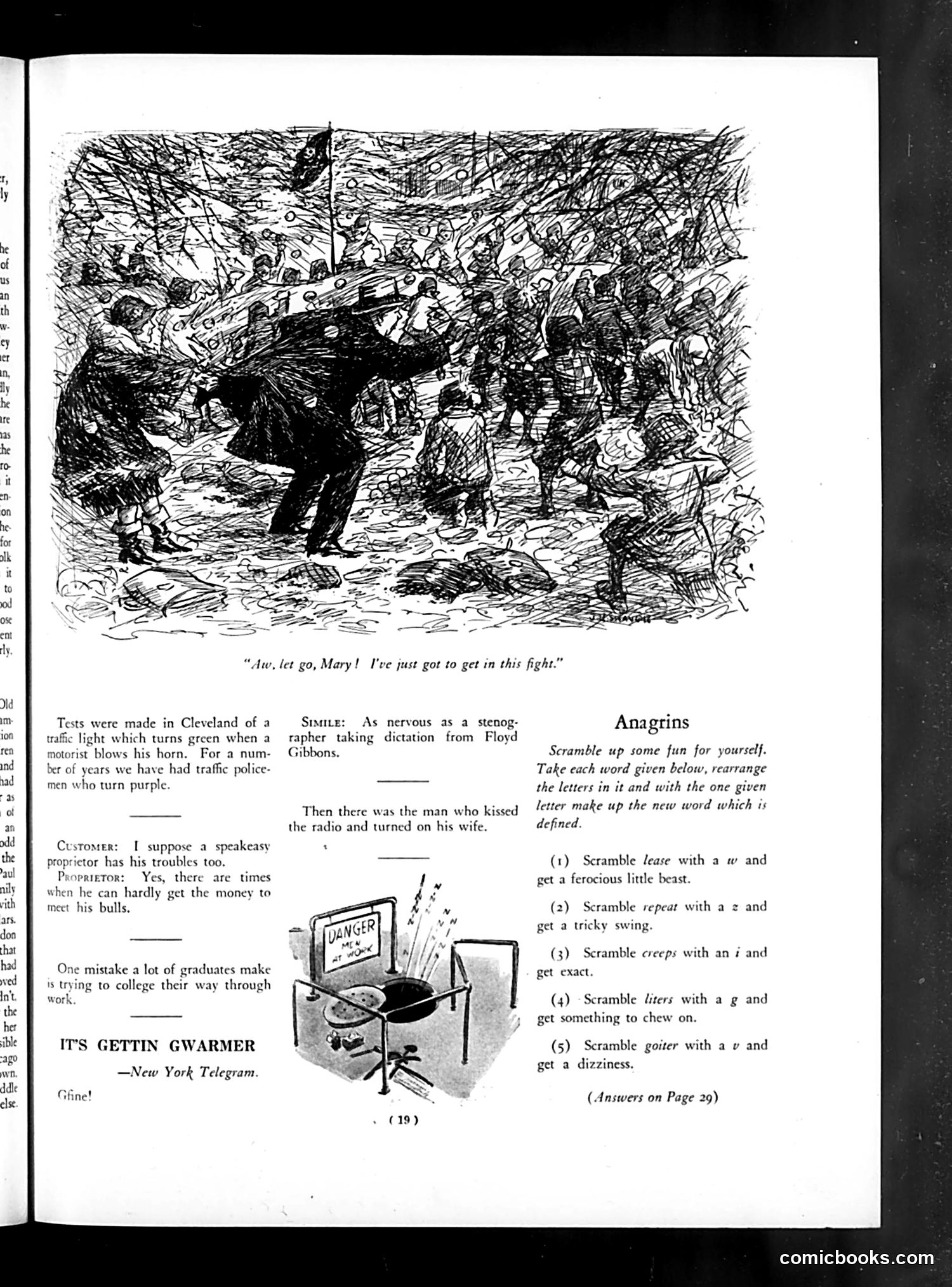
Analysis of Life Magazine Page The main cartoon depicts a domestic quarrel where a man insists on joining a street fight despite his wife's protests—a commentary on masculine aggression and poor priorities. The surrounding humor pieces satirize 1920s-30s American life: - Traffic lights & police: Mocks new traffic technology and police who became angry ("turn purple") enforcing rules - Speakeasy owner troubles: References Prohibition-era illegal bars and their financial difficulties with bribes ("bulls" = police) - College graduates: Jokes about those struggling to work their way through college (reversing the phrase awkwardly) - Radio/marriage joke: Plays on the novelty of radio technology and marital discord The Floyd Gibbons reference alludes to a famous nervous radio broadcaster of the era. The page is primarily entertainment content—wordplay puzzles and humorous observations about contemporary urban life, technology adoption, and social anxieties of the Prohibition and Depression periods.
Movie Reviews by Harry Evans - Life Magazine This page contains film reviews in Harry Evans's sardonic style. Evans critiques three films: "Trader Horn" receives qualified praise for its authentic African wildlife footage and native scenes, though Evans notes the story degenerates into a conventional love triangle. He credits director W.S. Van Dyke and cinematographer Clyde De Vinna. "Fighting Caravans" is savagely dismissed. Evans mocks its predictable Western formula: Gary Cooper as scout hero, Lily Damita as love interest, stock characters (Tully Marshall and Ernest Torrence as "old scouts"), drunken shenanigans, and obligatory Indian battles. His repeated refrain—"there is no reason why"—underscores his contempt for the film's existence. "Illicit" explores a couple who enjoy playful make-believe (role-playing games) before marriage, but lose this spark afterward—Evans's critique of how matrimony kills romance. The reviews exemplify Life's caustic entertainment criticism, employing witty understatement and repetition to demolish mediocre Hollywood productions.
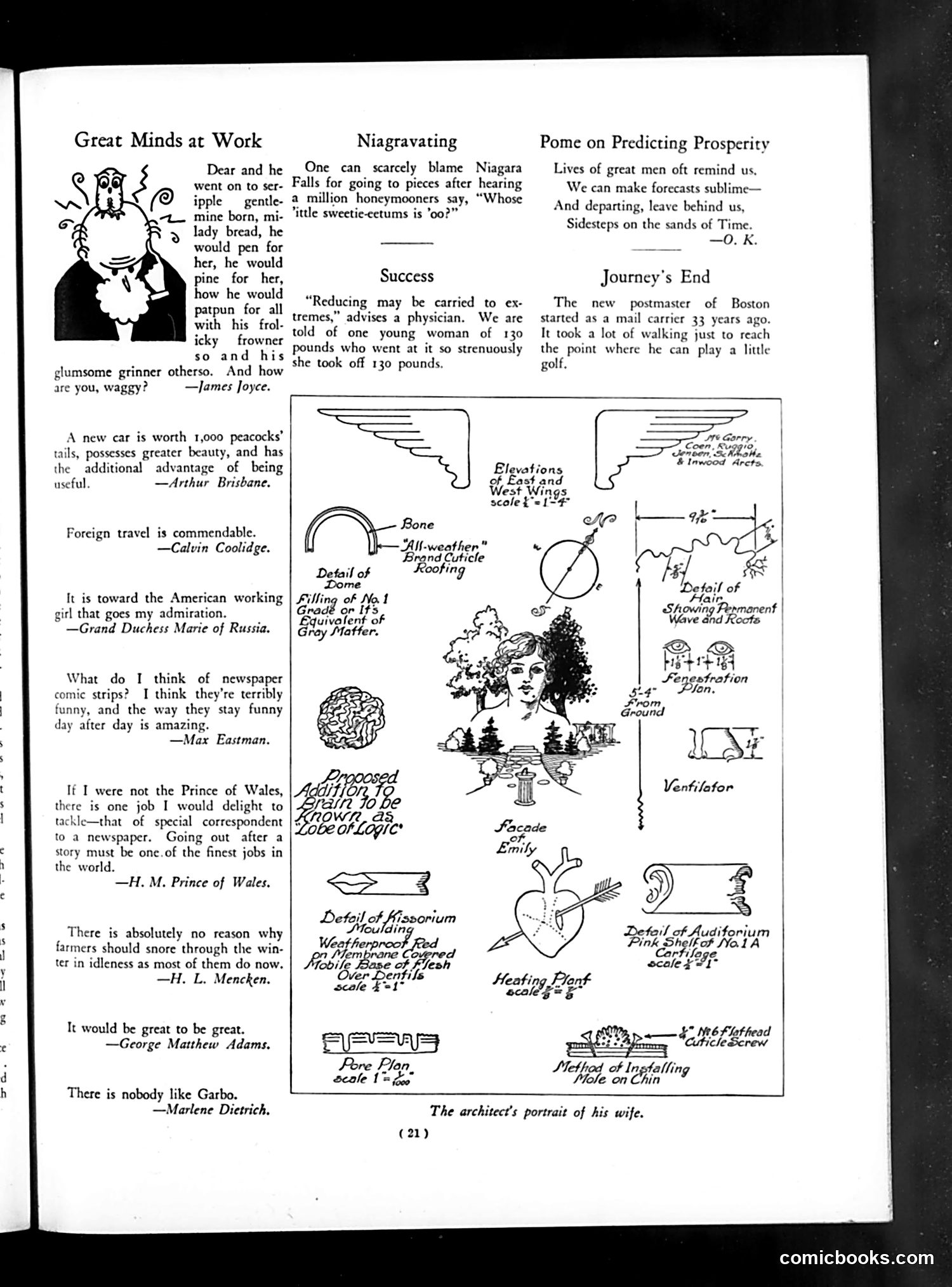
"The Architect's Portrait of His Wife" This page is a collection of satirical quotes and jokes typical of *Life* magazine's humor. The central cartoon shows architectural blueprints and technical drawings arranged to form a woman's face—a visual pun on "the architect's portrait of his wife." The satire is clear: the architect reduces his wife to mechanical specifications and building plans, treating her as a construction project rather than a person. This reflects early 20th-century gender satire about marriage as transactional and wives as domestic fixtures to be engineered rather than appreciated as individuals. The surrounding "Great Minds at Work" section features witty one-liners attributed to celebrities (James Joyce, Calvin Coolidge, the Prince of Wales, etc.), mocking their self-importance and platitudes. The humor relies on recognizing these public figures and finding their quoted sentiments either vapid or amusingly contradicted by context—such as the "Niagravating" joke about Niagara Falls being disturbed by honeymooners' baby-talk.
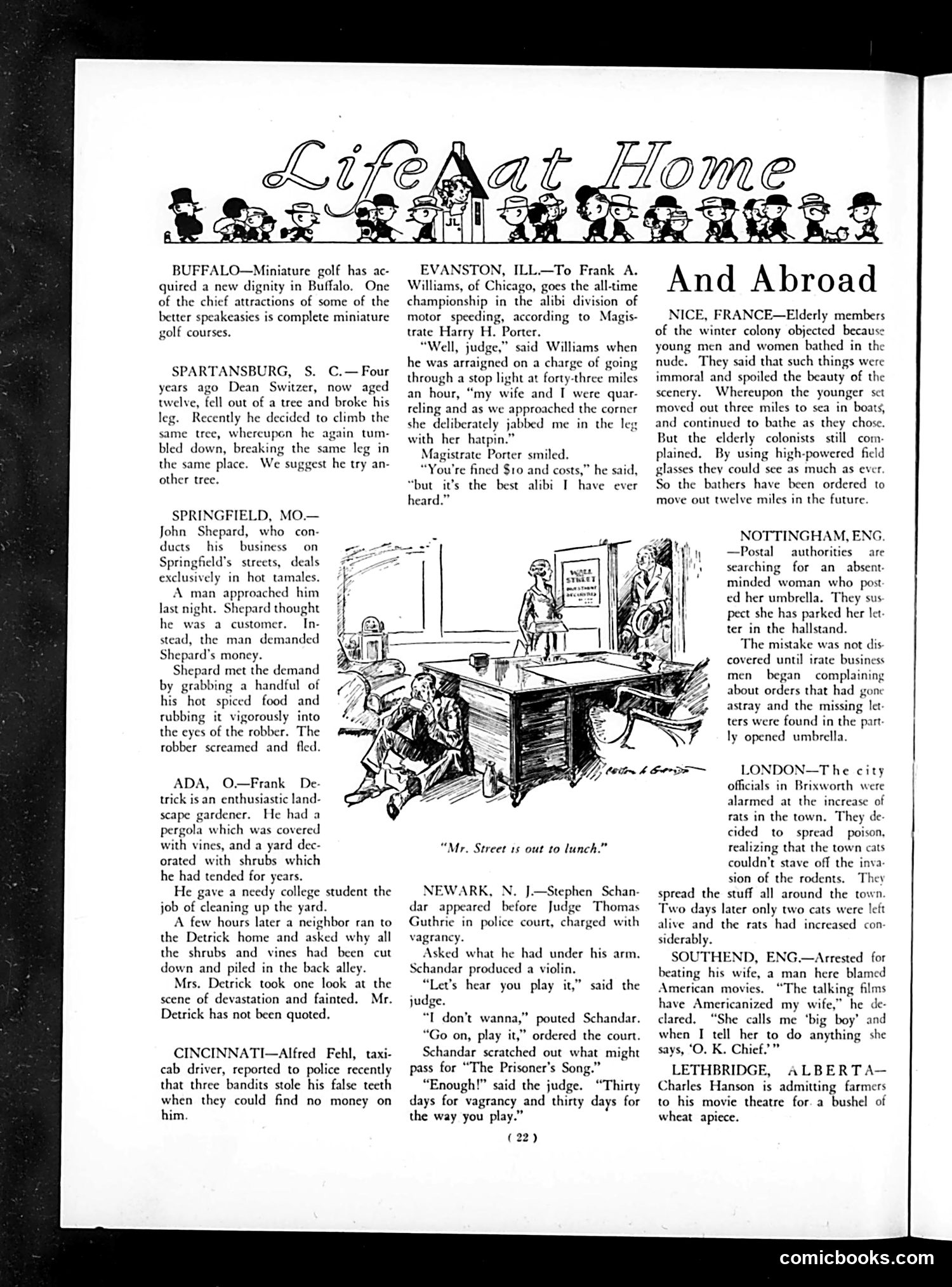
Life Magazine "Life at Home and Abroad" Page This page from *Life* magazine collects humorous anecdotes from American and European towns—a common feature showcasing oddities and human folly for satirical effect. The cartoon illustrates a domestic scene where "Mr. Street is out to lunch"—likely depicting a wife discovering her husband's absence, with visual humor in the family's reaction. The text items mock everyday absurdities: a boy breaking the same leg falling from the same tree twice; a hot-tamale vendor using his product as self-defense against robbery; a taxi driver robbed of his false teeth; a motorist blaming his wife for speeding violations. International stories involve nude bathing French colonists and British postal workers finding letters inside umbrellas. The satire targets human irrationality, poor judgment, and life's petty embarrassments. These brief, punchy items reflect *Life*'s role as a humor magazine capturing the ridiculous situations ordinary people encountered during the Prohibition era and beyond.
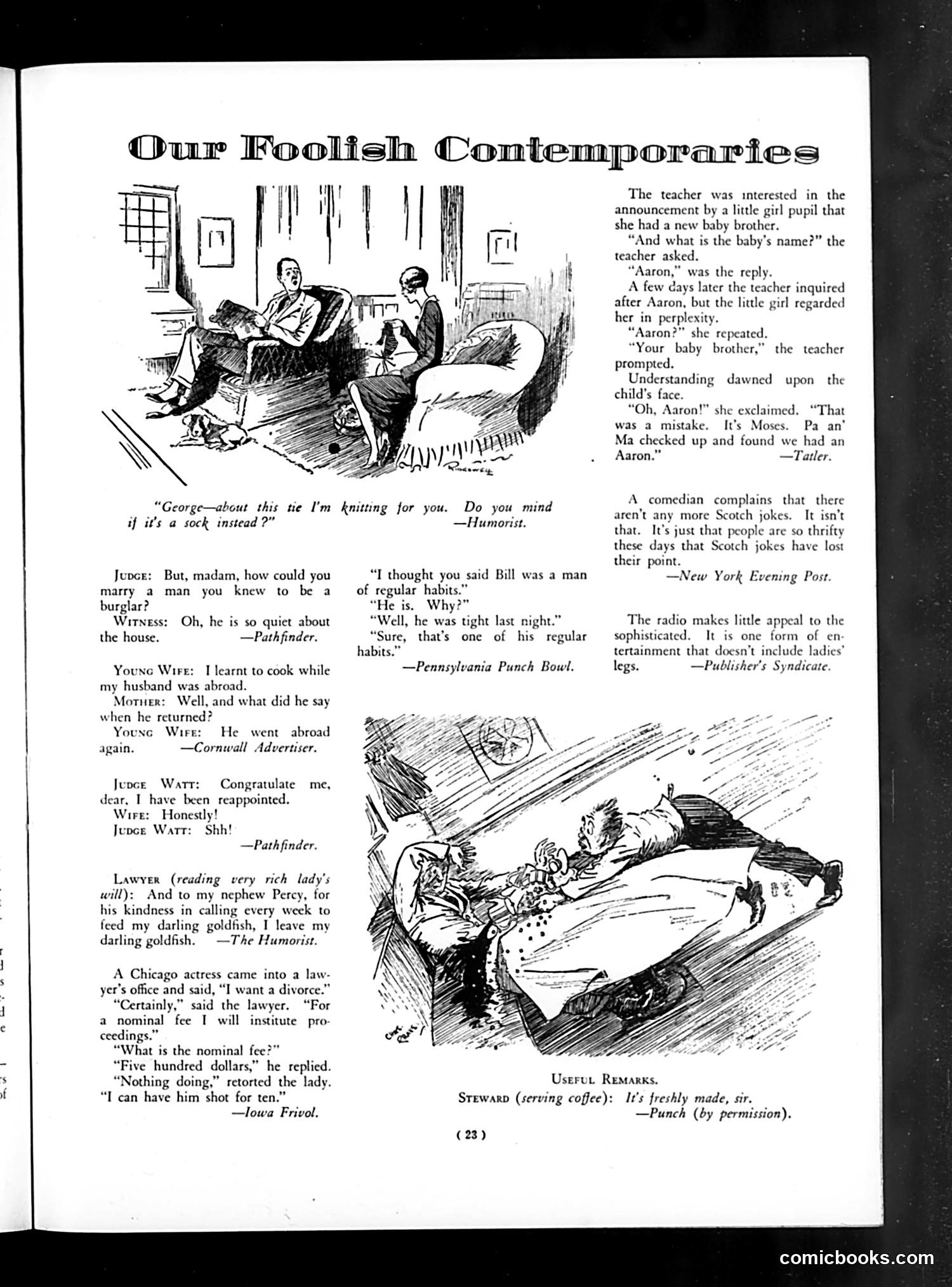
"Our Foolish Contemporaries" - A Page of Satirical Jokes This page from *Life* magazine collects brief humorous anecdotes mocking human folly. Key jokes include: The burglar husband: A judge questions how a woman married a known burglar; she replies he's "quiet about the house"—the absurdity being that domestic quietness doesn't excuse criminality. The cooking wife: A young wife learns to cook while her husband travels abroad; when he returns, he leaves again—satirizing either her poor cooking or his restlessness. The judge's reappointment: A judge boasts of reappointment; his wife's skeptical "Honestly?" suggests corruption or undeserved favor. The actress's divorce: A Chicago actress prefers shooting her husband ($10) to paying a lawyer's $500 divorce fee—dark humor about both legal costs and marital desperation. The baby's name mix-up: Parents confuse their baby's biblical name (Aaron/Moses), mocking careless parenthood. The page also includes brief social commentary on Scotch jokes becoming pointless due to thriftiness, and radio's lack of appeal to the "sophisticated."
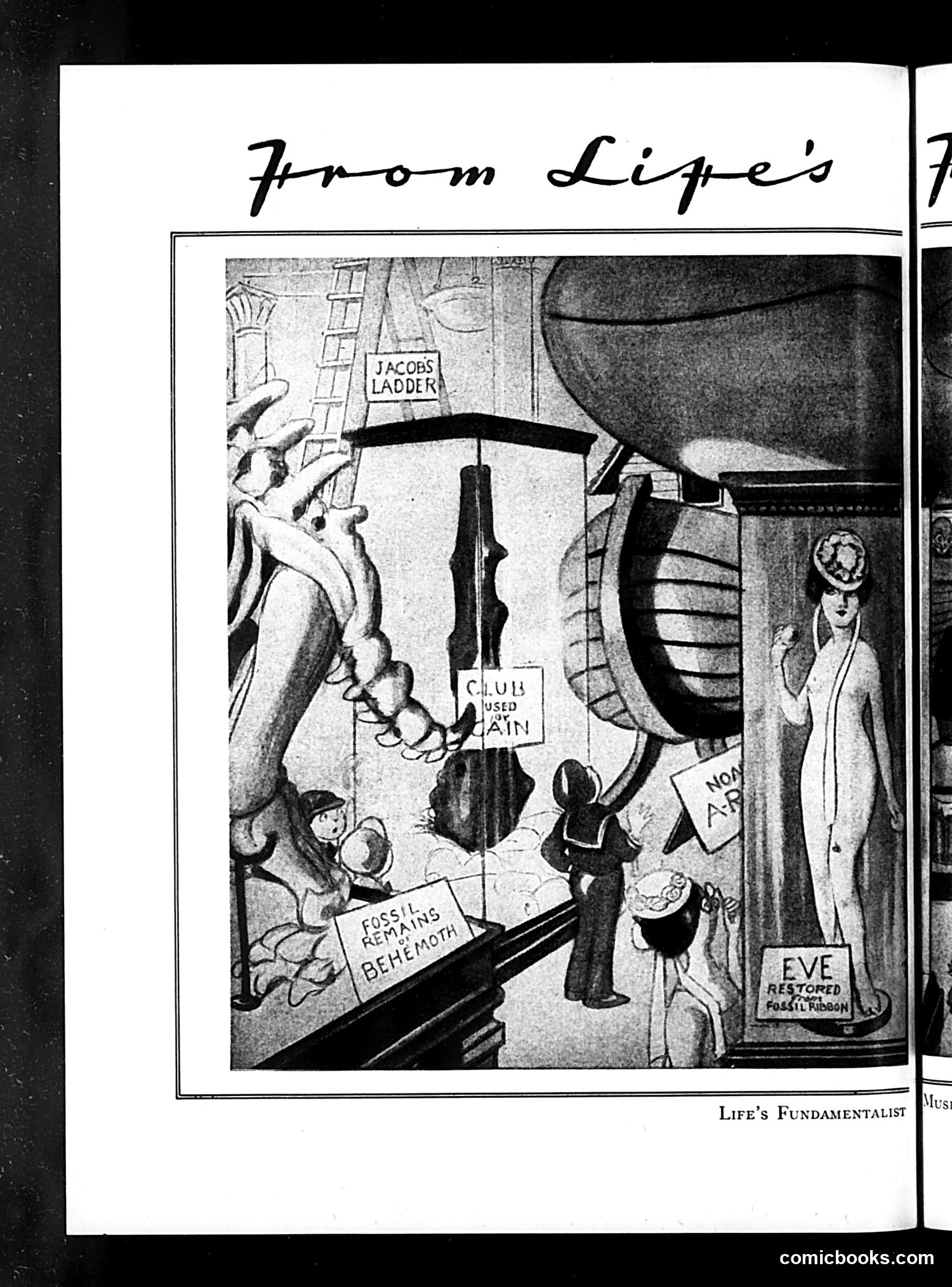
"Life's Fundamentalist" Cartoon Analysis This satirical cartoon critiques religious fundamentalism through visual contradiction. The caption "Life's Fundamentalist" appears ironic—the figure labeled "EVE RESTORED TO FOSSIL RIBBON" represents a fundamentalist interpretation of human origins. The cartoon depicts a museum or educational setting where various evolutionary artifacts and tools are displayed ("Jacobs Ladder," "Fossil Remains Behemoth," "Club Used Again"). The central absurdity: a fundamentalist visitor rejects scientific evidence of evolution while surrounded by it. The "Eve Restored" figure suggests fundamentalists cling to literal Biblical creation despite contradicting scientific reality. Labels like "Fossil Remains" and the ladder imagery reference both evolutionary progress and Biblical references, highlighting the clash between religious literalism and modern paleontological understanding. The satire mocks fundamentalist denial of evolution during the 1920s-era "science vs. religion" cultural debate.
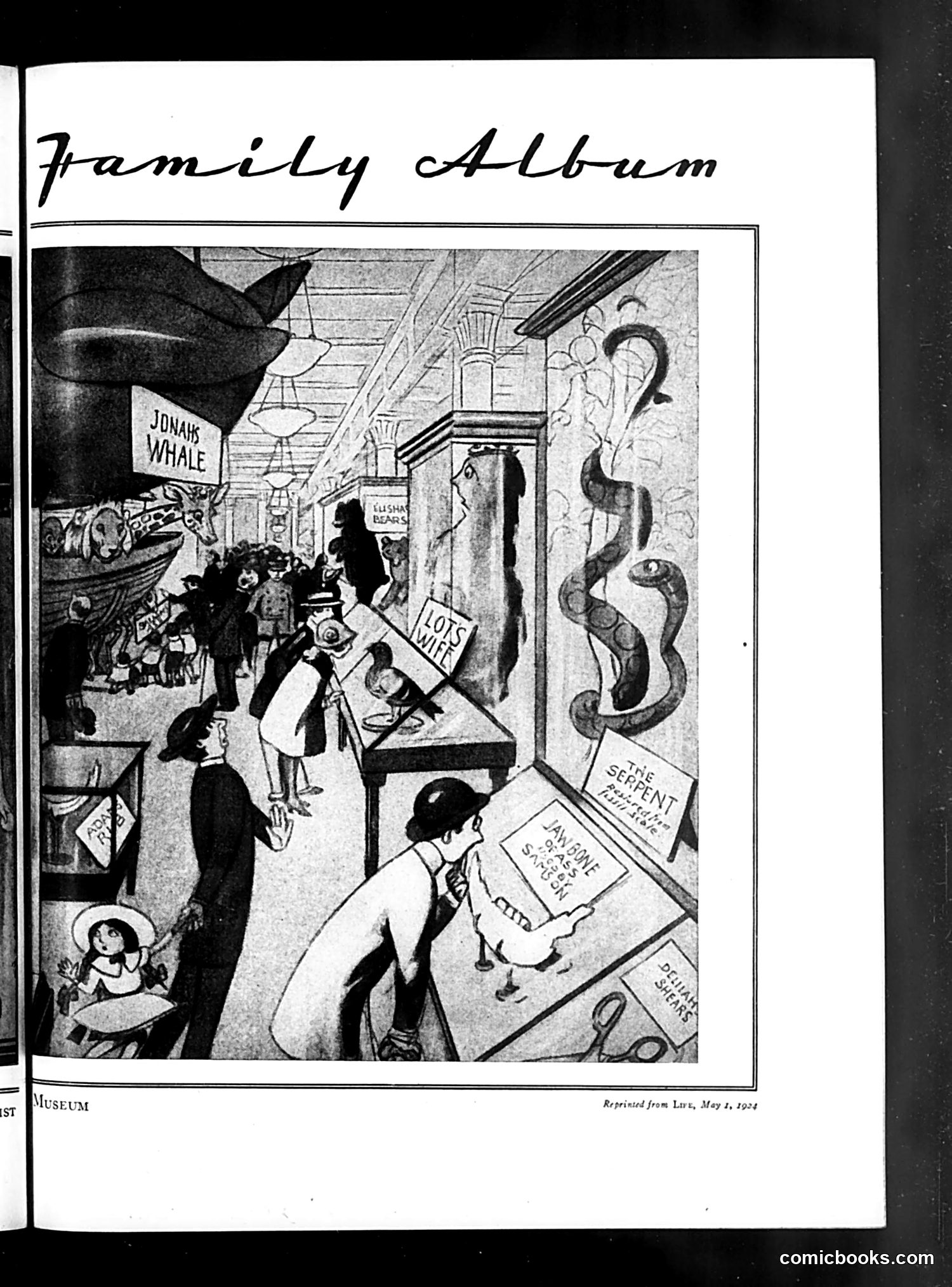
Family Album Cartoon Analysis This satirical illustration depicts a museum or exhibition space displaying various "exotic" attractions typical of early 20th-century entertainment venues. The signs visible include "Jonah's Whale," "Lusitania Beasts," "Lot's Wife," and references to scents and shrunken heads. The cartoon satirizes the popular practice of displaying oddities and curiosities—both real and fabricated—as educational entertainment. The well-dressed visitors examining these exhibits represent the public's fascination with sensationalism marketed as culture or knowledge. The satire critiques both the exploitative exhibition industry and the gullible audiences willing to pay for dubious attractions. This reflects 1920s skepticism toward unchecked commercialism and consumer credulity during a period of rapid industrialization and mass entertainment expansion.
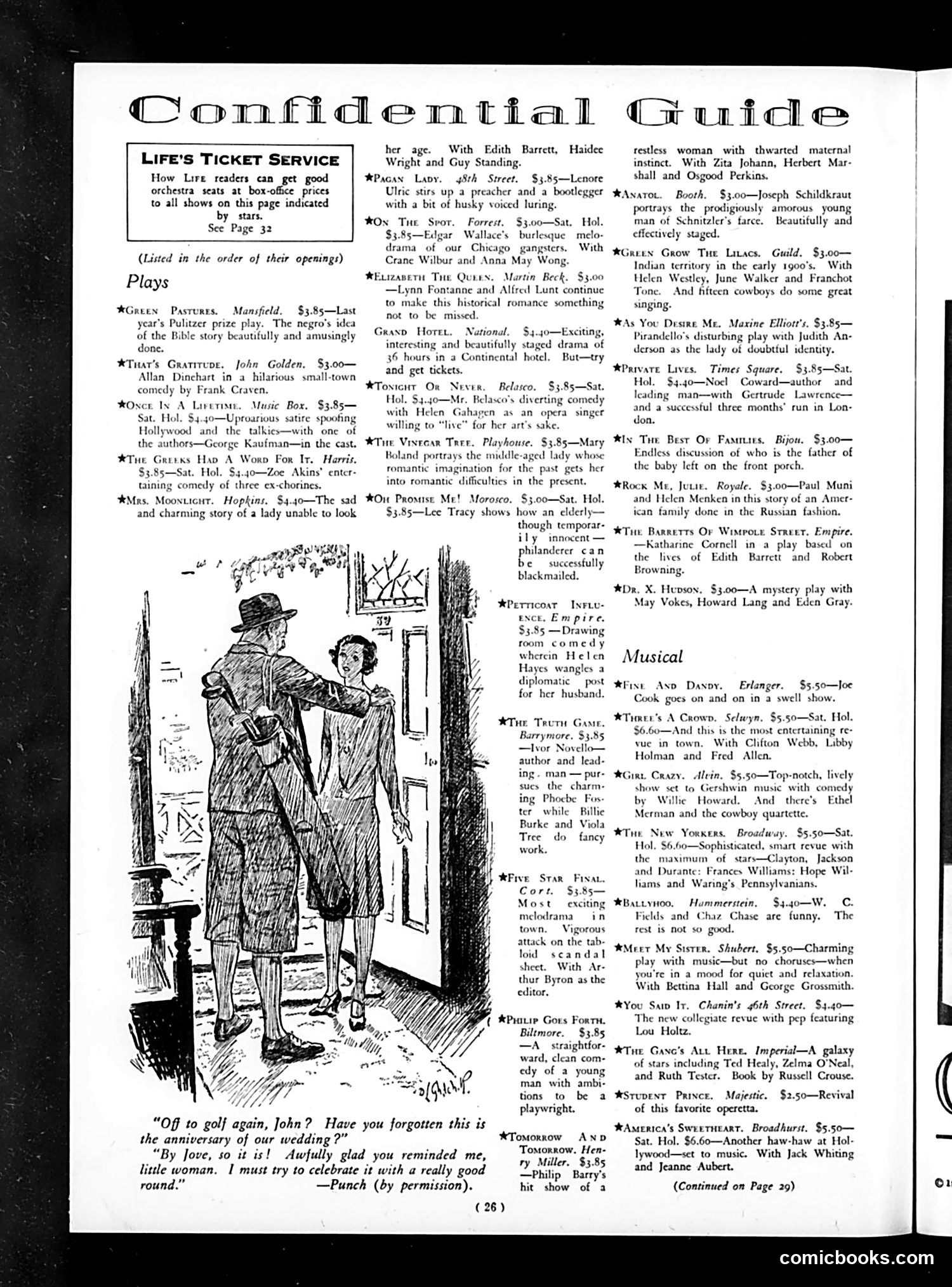
Cartoon Analysis The cartoon depicts a married couple in their home. The husband, focused on his golf plans, has forgotten their wedding anniversary. When his wife reminds him, he responds by promising to "celebrate it with a really good round"—meaning a round of golf, not romantic celebration. The joke satirizes male obliviousness and misplaced priorities in marriage. The husband interprets "celebrate" literally (as exercise) rather than understanding his wife's implicit expectation of romantic attention. It's a gentle domestic satire common to *Life* magazine's humor, poking fun at husbands who prioritize leisure activities over marital obligations. The surrounding page is a theater guide listing Broadway shows with ticket prices and brief reviews—this cartoon serves as a light comedic interlude within the entertainment-focused content.
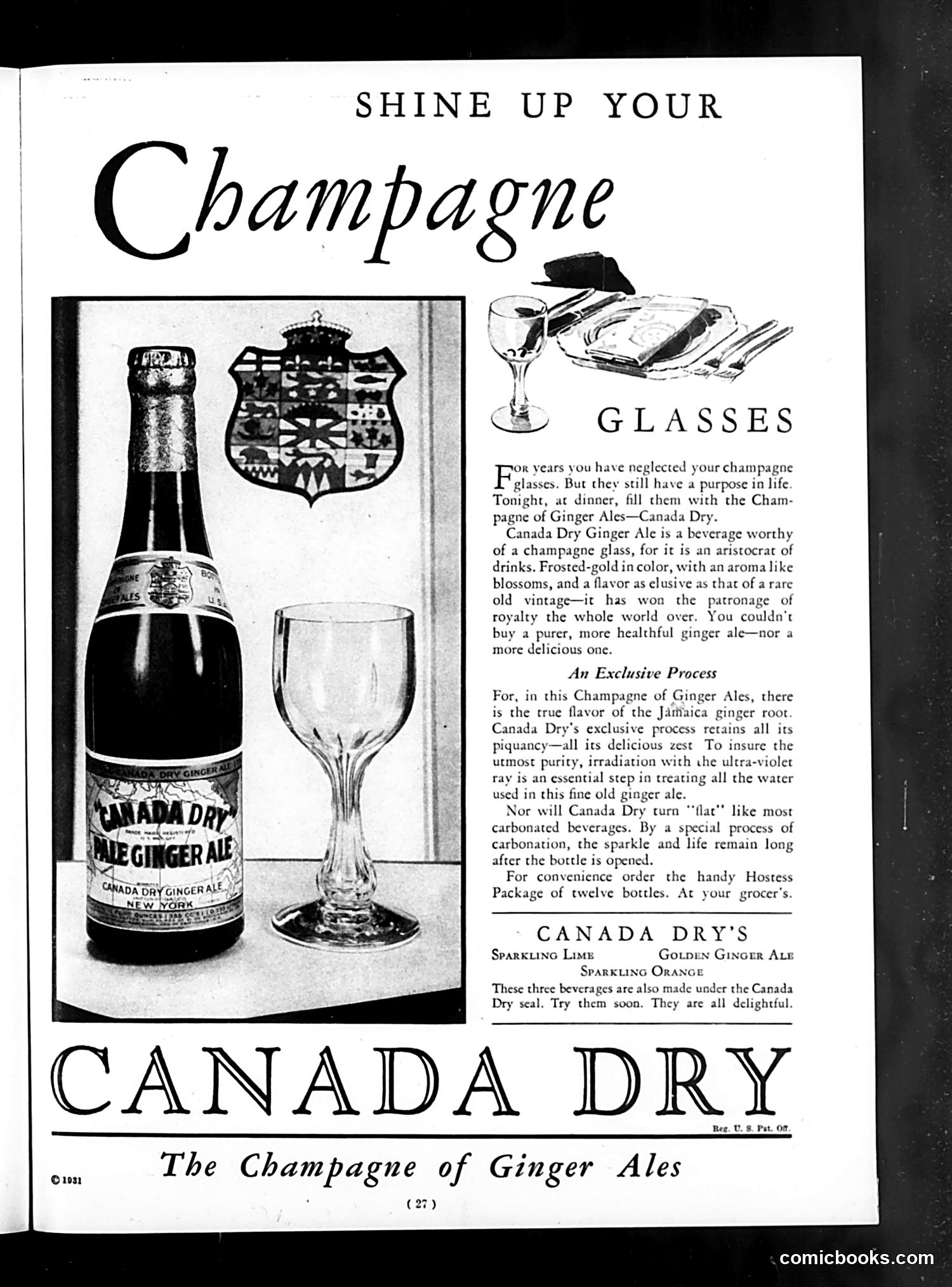
Canada Dry Advertisement (1931) This is primarily a product advertisement, not political satire. It promotes Canada Dry ginger ale during Prohibition (the ad notes the copyright date as 1931). The "joke" addresses a specific historical moment: Americans owned fancy champagne glasses but couldn't legally drink champagne. The ad's humor comes from suggesting ginger ale—a legal substitute beverage—as worthy of these neglected luxury glasses. The tagline "The Champagne of Ginger Ales" plays on this irony. The image shows an elegant bottle, champagne flute, and fine dining items. Text emphasizes the drink's "aristocratic" qualities, purity through UV treatment, and lasting carbonation—positioning ginger ale as a premium substitute for actual champagne during alcohol prohibition. This reflects 1930s American consumer culture and the ironic demand for upscale non-alcoholic beverages during the Prohibition era (1920-1933).
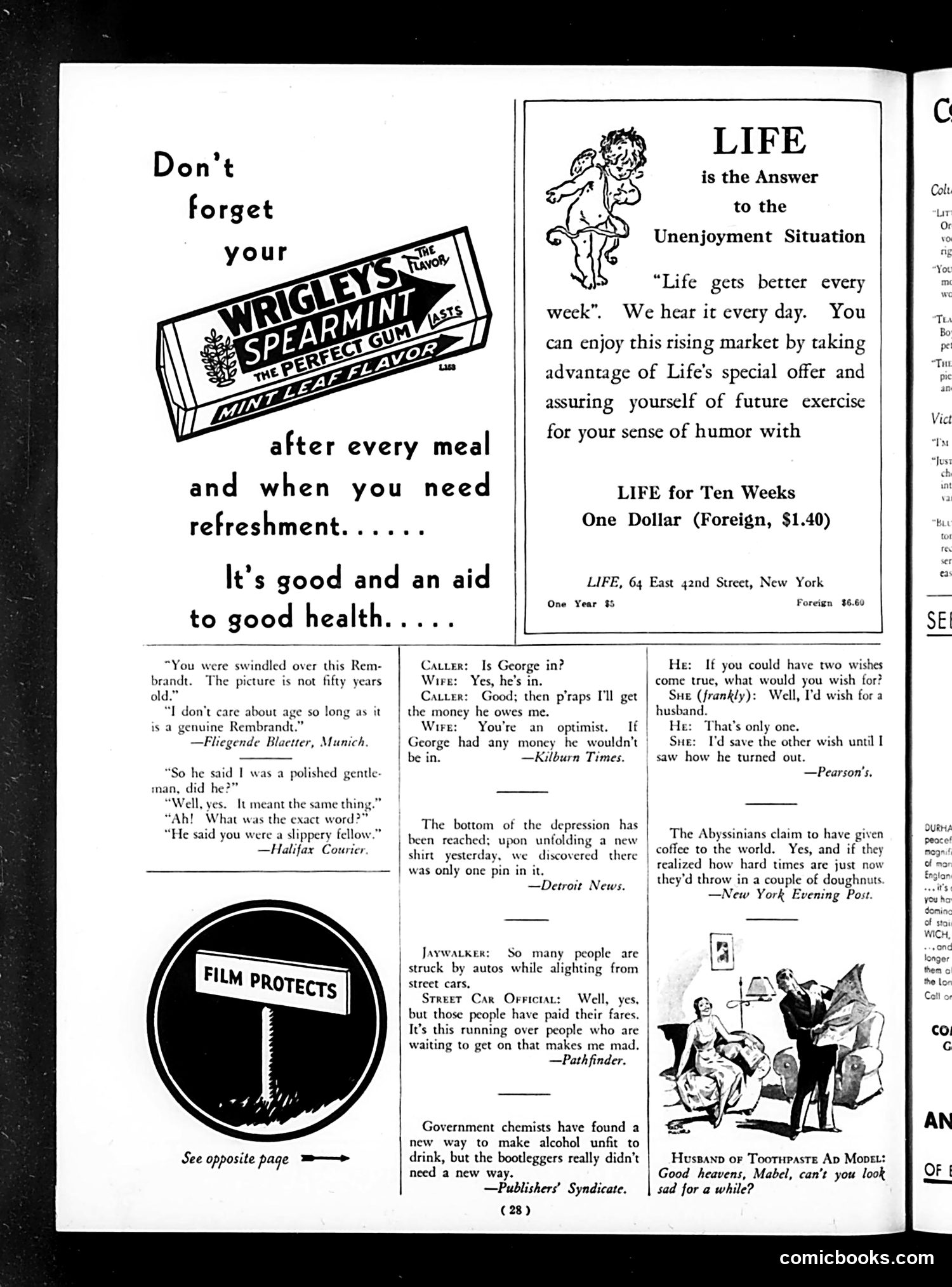
Life Magazine Page Analysis This page combines advertisements with satirical jokes typical of Life magazine's format. The main content includes: Advertisement (top right): A Life magazine subscription offer, framing the publication itself as the antidote to depression-era gloom. The tagline "Life gets better every week" ironically promises humor as relief from economic hardship. Humorous Quotes (center and right): Brief jokes on various topics—art forgery, debt collection, street car accidents, alcohol prohibition and bootlegging, and marriage. These reflect 1930s concerns: economic desperation (people unable to pay debts), Prohibition's failure, and marital skepticism. Left side: An advertisement for Wrigley's Spearmint gum, promoting it as health-promoting refreshment. Film Protection Logo: A circular emblem (bottom left) advertising film protection, with reference to "opposite page." The page captures Depression-era American humor: cynical, economically anxious, yet employing quick wit. The jokes assume readers share understanding of contemporary social problems—debt, Prohibition, dangerous urban transit, and matrimonial doubt.
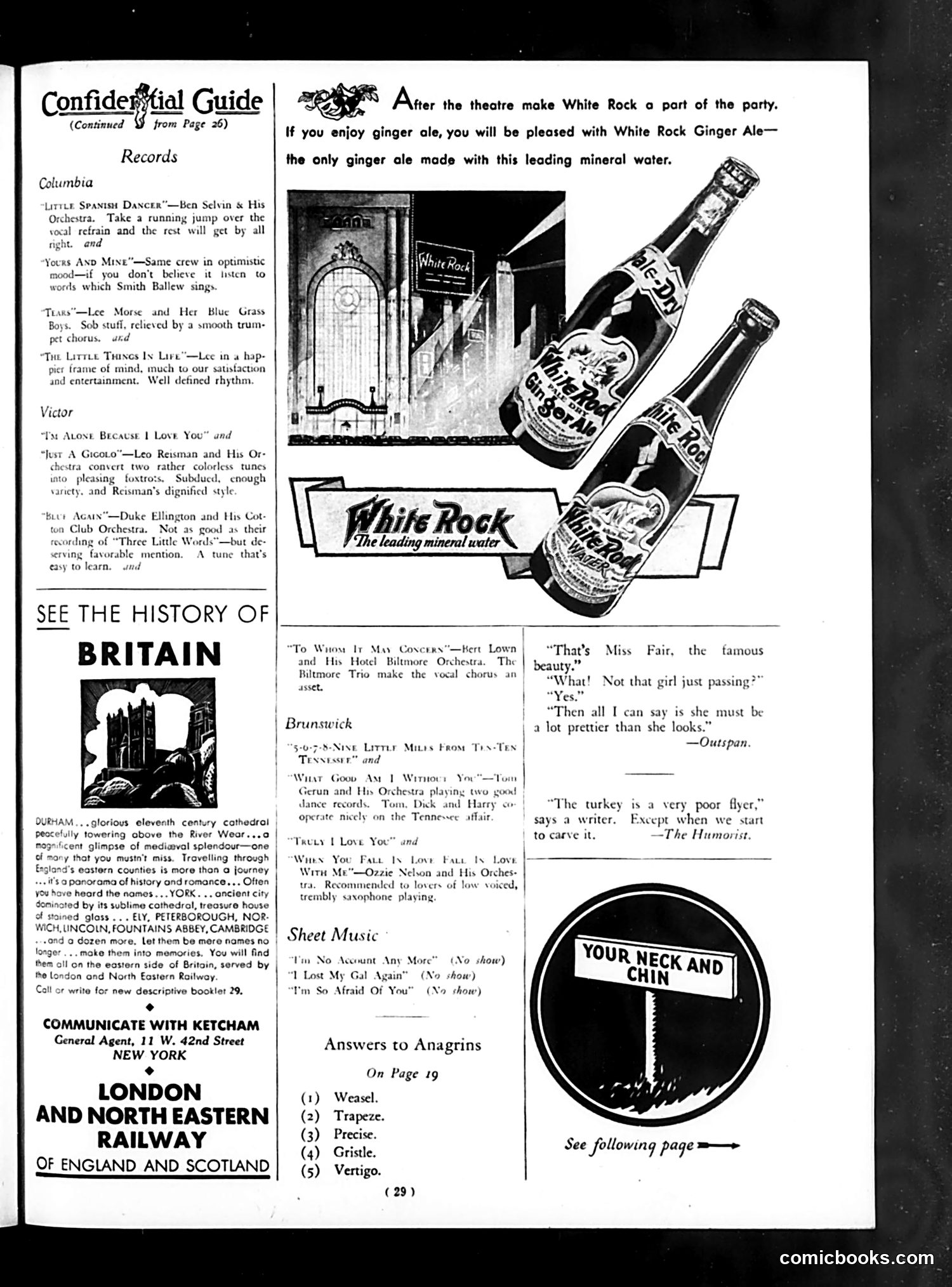
Life Magazine Page Analysis This page is primarily advertising and entertainment content, not political satire. The main elements are: White Rock Ginger Ale Advertisement: The dominant feature shows two bottles of ginger ale with the tagline "the leading mineral water." The ad includes a small dialogue joke about an attractive woman passing by, using the product as a social lubricant for post-theater entertaining. Record Reviews: A "Confidential Guide" section reviews popular phonograph records from Columbia, Victor, and Brunswick labels, critiquing jazz and dance music performances by orchestras like those led by Ben Selvin and Duke Ellington. Travel Advertisement: "See the History of Britain" promotes the London and North Eastern Railway, encouraging tourism to English cathedrals and historical sites. Sheet Music Listings: Three song titles offered, with "(No show)" notations. Miscellaneous: Includes anagrins puzzle answers and a small cartoon about turkey carving. The page reflects 1920s-era consumer culture—records, travel, beverages—with light, apolitical humor typical of Life magazine's entertainment sections.
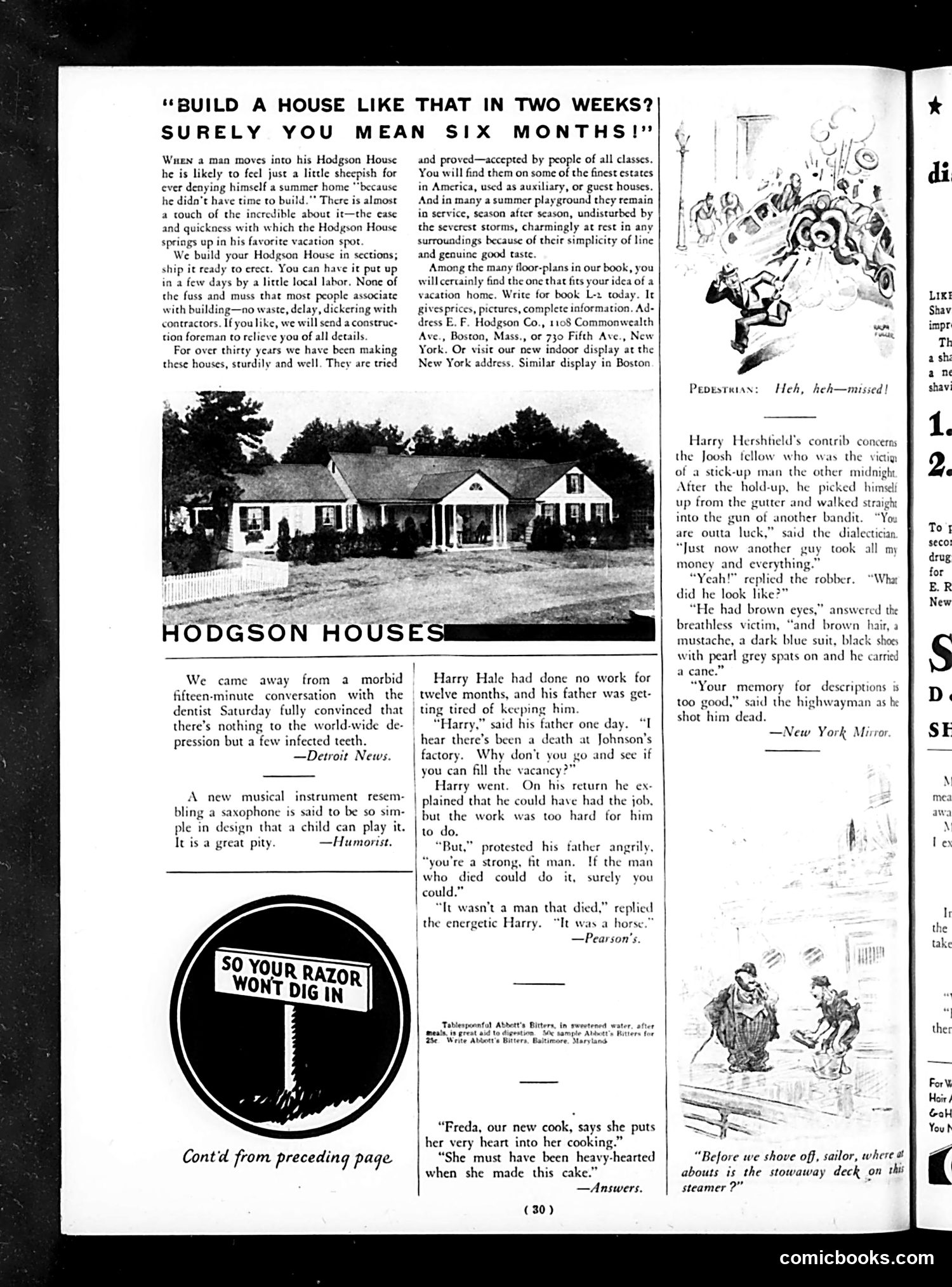
Life Magazine Page Analysis This page contains advertising and humor content rather than political cartoons. The main feature is a Hodgson House advertisement—a prefabricated home company promoting quick assembly (days, not months). The headline jokes that skeptics would assume "two weeks" means "six months," satirizing both consumer doubt about the product and the gap between marketing claims and reality. Below are three separate jokes from different sources: 1. A dentist joke blaming depression on infected teeth 2. A quip about a saxophone-like instrument so simple children can play it ("great pity") 3. A longer anecdote about "Harry" who claims a dead *horse* (not a man) held a factory job he couldn't fill—gentle satire of work-avoidance excuses There's also a Harry Hershfield cartoon (mentioned in text) about a robbery victim who's robbed twice in succession, and various other brief humor items. The page reflects 1920s-30s light satire: workplace anxiety during economic hardship, consumer skepticism toward mass-produced goods, and gentle ethnic humor. No specific political figures or events are referenced.
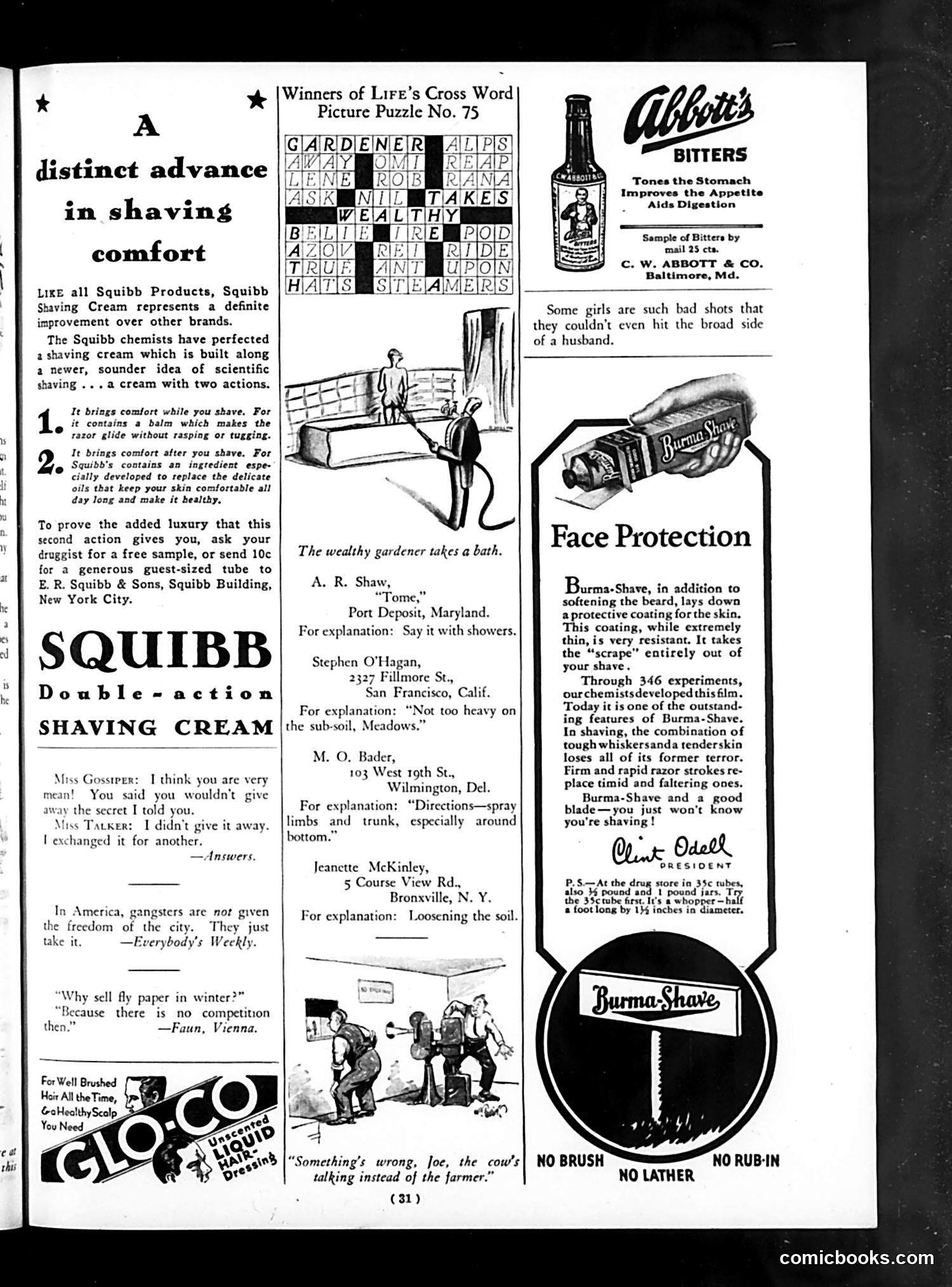
Life Magazine Page Analysis This page is primarily advertising content interspersed with humor. The main advertisements are for shaving products (Squibb Shaving Cream and Burma-Shave), Abbott's Bitters, and Gloco hair product. The non-advertising content includes: Humor pieces: Brief jokes about gossip, gangsters in America, and selling fly paper in winter—typical early 20th-century light satirical fare with punchy punchlines. Crossword puzzle winners: Reader submissions explaining a Life crossword puzzle answer ("The wealthy gardener takes a bath" = "Say it with showers"). These are wordplay jokes based on common phrases. One cartoon shows a confused farmer saying "Something's wrong, Joe, the cow's talking instead of the farmer"—a simple rural humor joke about role reversal. The page reflects 1920s-era advertising culture and gentle, pun-based humor rather than sharp political satire. There are no identifiable caricatures or political references.
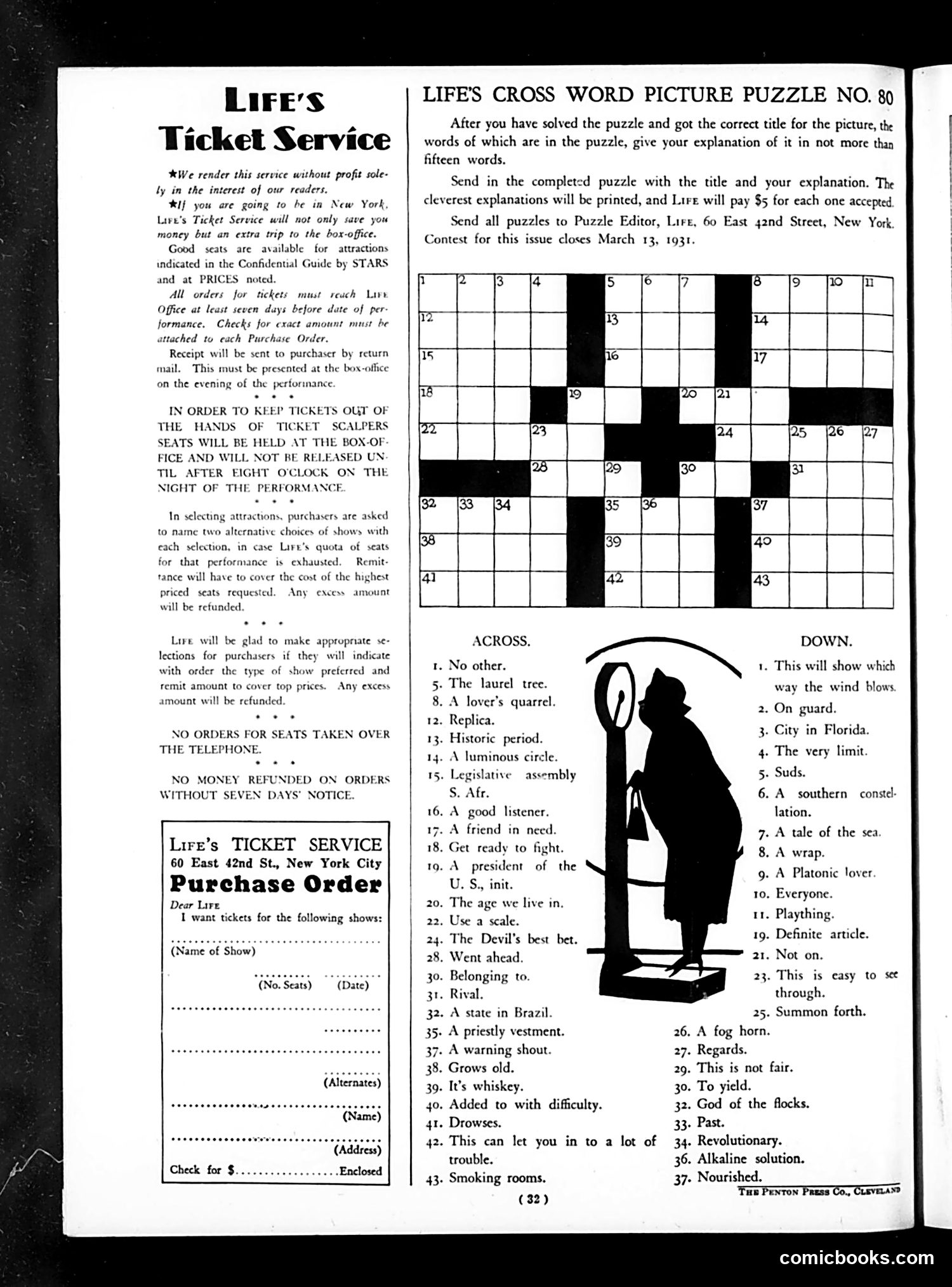
Life Magazine Page Analysis (1931) This page is primarily administrative and promotional content, not political satire. It contains: 1. Life's Ticket Service (left column): An advertisement for Life magazine's theater ticket ordering service for New York shows. It emphasizes convenience, anti-scalping measures, and the requirement for advance orders with checks. 2. Crossword Picture Puzzle #80 (right): A reader competition where solvers identify a picture's title from crossword clues, then submit explanations for $5 payment. The puzzle itself is not visible in detail—only the grid and clue lists appear. 3. Purchase Order Form: A tear-out coupon for readers to request tickets. The silhouetted illustration accompanying the puzzle shows what appears to be a woman in 1930s dress, though the actual picture being referenced is unclear from this reproduction. No political satire is present—this is standard magazine service content and reader engagement.
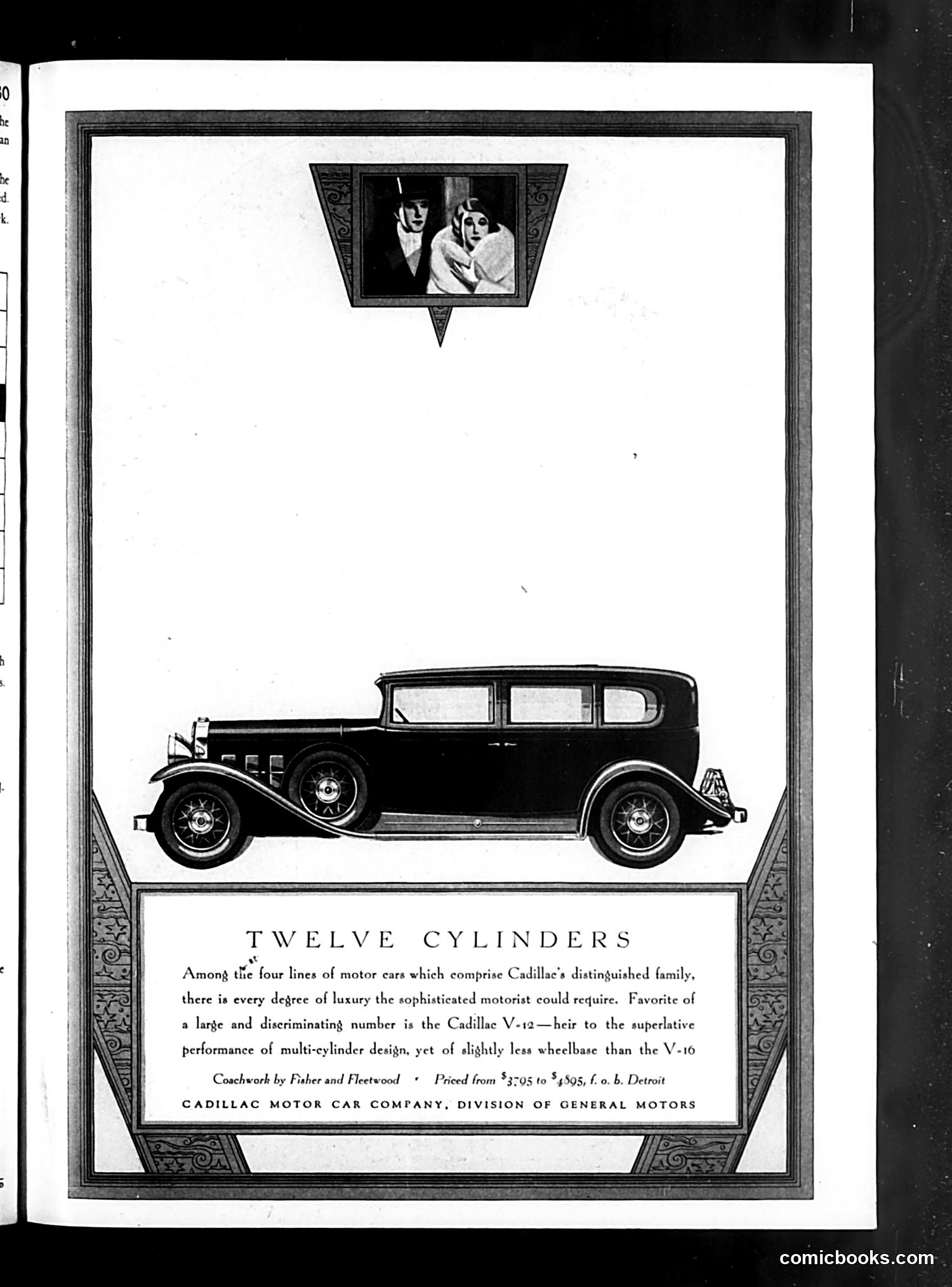
This is primarily a Cadillac automobile advertisement, not political satire. The page features a luxury car advertisement from what appears to be the 1920s-1930s era. The decorative Art Deco border frames a side-profile illustration of a sleek Cadillac sedan. Above the car is a vignette showing two well-dressed figures (a man and woman), suggesting the vehicle's appeal to affluent, sophisticated buyers. The text emphasizes the V-12 engine as the flagship model within Cadillac's product line, positioning it as a status symbol for "discriminating" motorists. Price points ($3,705-$4,895) indicate this was luxury goods marketing targeting the wealthy. The "Life" magazine platform here served as a venue for high-end advertising to educated, affluent readers—this reflects 1920s consumer culture and automobile marketing during America's automotive boom.
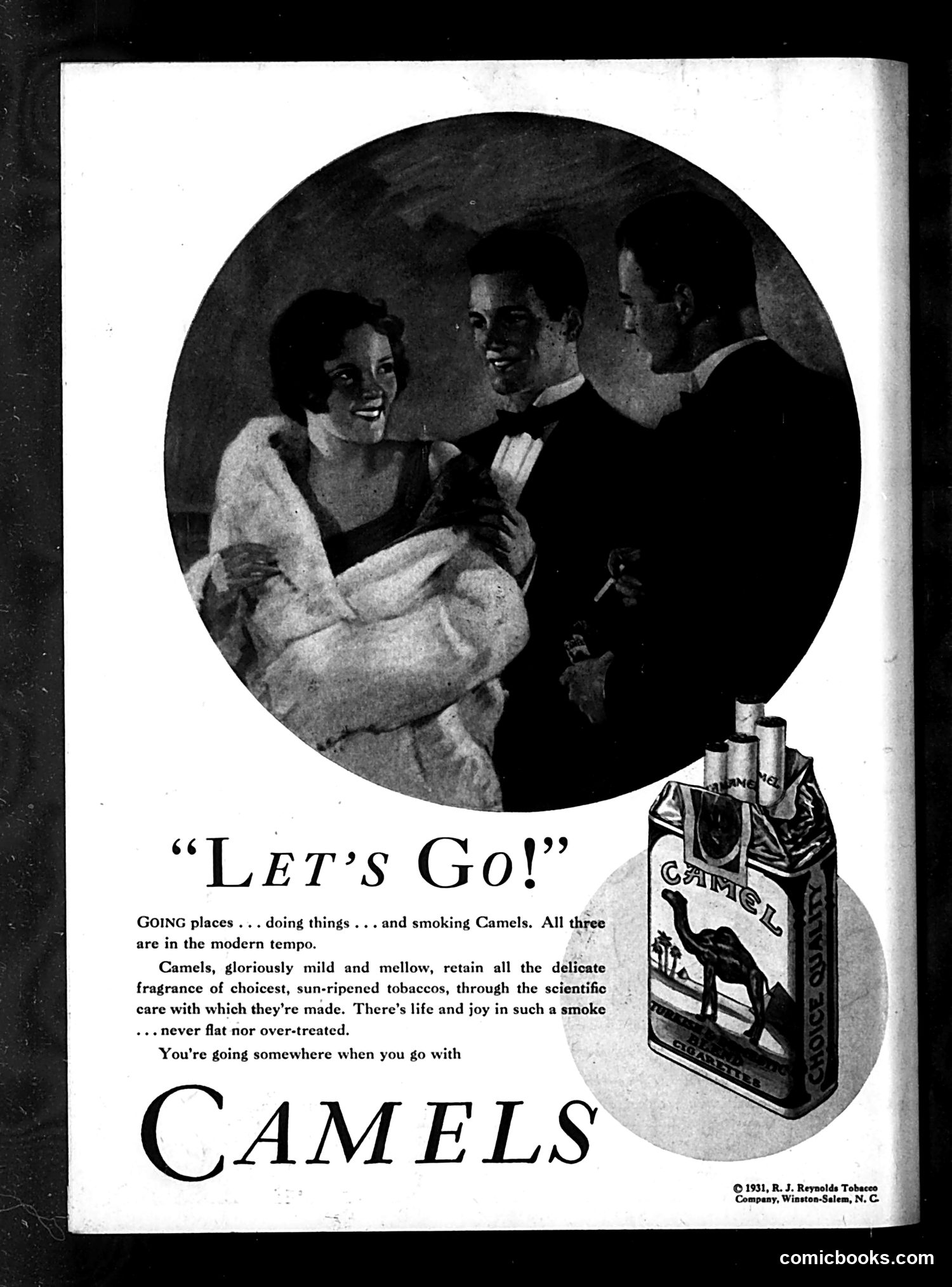
Analysis This is a Camel cigarette advertisement, not satire or political commentary. The 1931 ad depicts three well-dressed people in formal attire (tuxedos and an evening gown) in a circular vignette, appearing to be at a social gathering. The ad's messaging associates smoking Camels with an active, modern lifestyle—"going places" and "doing things." It emphasizes the cigarettes as "mild and mellow," positioning them as sophisticated and refined. Modern context: This represents pre-warning-label tobacco advertising that freely marketed cigarettes as glamorous and healthful (noting "scientific care"). The gendered imagery normalizes smoking across social classes. Such advertisements were common in mid-20th-century magazines before tobacco advertising restrictions took effect.