life
Life — February 27, 1931
Analysis This appears to be a satirical illustration from Life magazine showing a formally dressed figure (wearing a bow tie and formal jacket) whose head is replaced by or emerging from a circular portrait. The circular inset depicts a figure in a dynamic pose. The composition uses stark black-and-white contrast typical of early-to-mid 20th century satirical cartooning. The formal attire suggests this targets a public figure or type—possibly a politician or society figure being critiqued for having their public persona (the formal dress) misaligned with their actual character or actions (depicted in the circular portrait). However, without visible text identifying the subject or clearer context clues, I cannot definitively state who is being satirized or what specific event or social commentary this addresses. The style suggests pre-1950s publication.
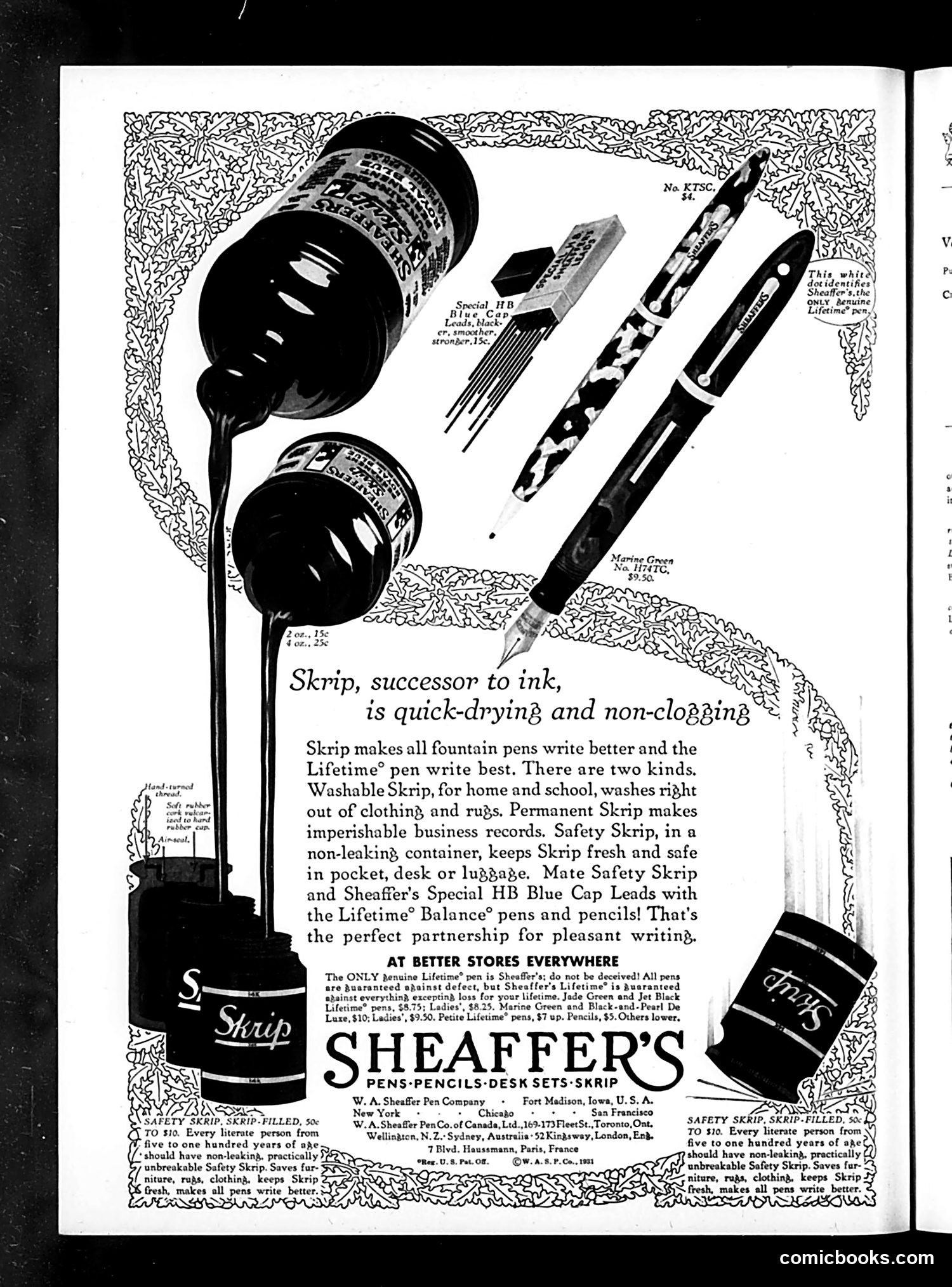
Sheaffer's Skrip Advertisement This is a product advertisement, not a political cartoon. It promotes Skrip ink and related writing products from the W.A. Sheaffer Pen Company (Fort Madison, Iowa). The ad emphasizes that Skrip is "quick-drying and non-clogging," positioning it as superior to traditional ink. It highlights two variants: Washable Skrip for home/school use (washes from clothing), and Permanent Skrip for business records. The ad also promotes Sheaffer's Lifetime® pens as the ideal pairing with Skrip. The decorative border and illustrated bottles/pens are typical 1920s-30s advertising design. There is no satire or political content—this is straightforward commercial messaging appearing in *Life* magazine.
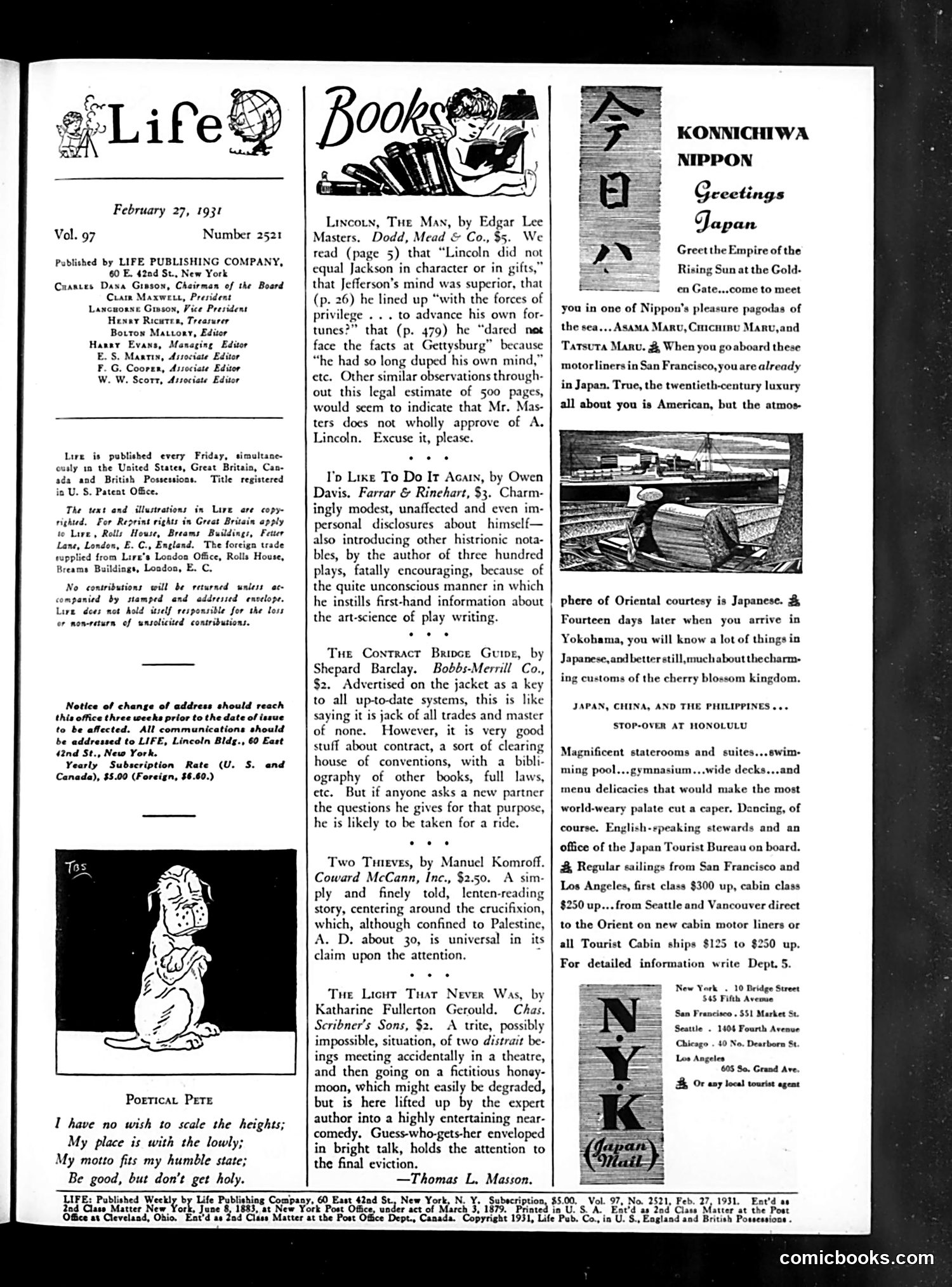
"Poetical Pete" Cartoon Analysis This small cartoon depicts a figure labeled "Poetical Pete" with an accompanying verse by Thomas L. Mason. The illustration shows a portly man in what appears to be Victorian-era dress, depicted in a humorous, somewhat unflattering style typical of Life magazine's satirical approach. The accompanying quatrain is self-deprecating doggerel about Pete's modest stature and humble status, ending with the ironic advice to "Be good, but don't get holy." The satire appears to target pretentious or affected poetic affectation—mocking someone who fancies himself a poet despite lacking genuine talent or distinction. The crude verse and caricature work together to undercut any literary pretensions Pete might harbor.
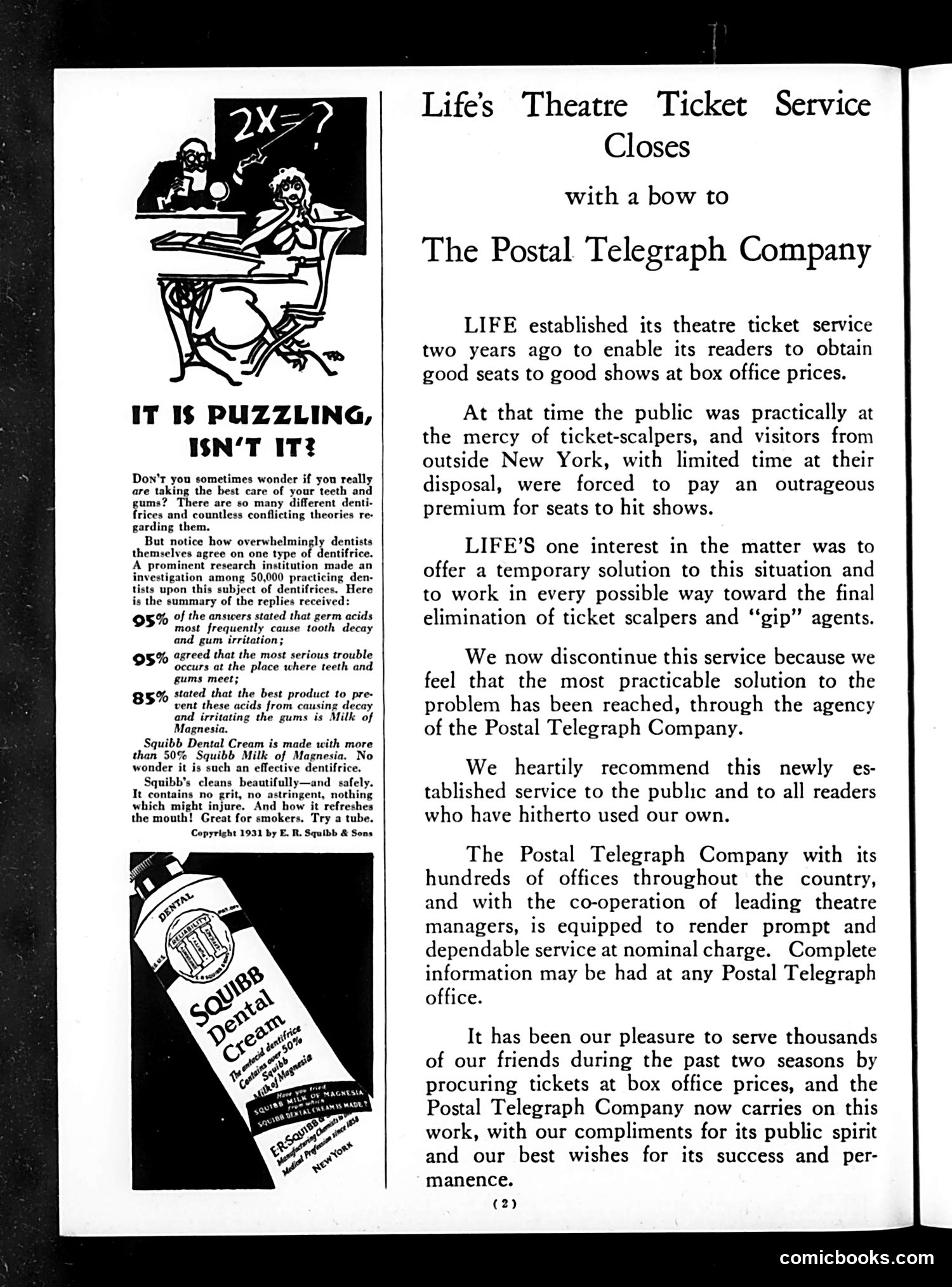
Analysis This page announces Life magazine's closure of its theater ticket service, transferring it to the Postal Telegraph Company. The left side contains two advertisements unrelated to the main announcement: 1. Top ad: A satirical dental hygiene piece showing a confused student at a blackboard ("2X=?"), mocking conflicting dentistry theories. It promotes Squibb Dental Cream, claiming 95% of dentists agree it prevents decay—a common advertising trope of the era using dubious statistical claims. 2. Bottom ad: A Squibb Dental Cream tube advertisement, emphasizing it contains no grit or astringents. The main text explains Life created its ticket service two years prior to combat ticket scalpers exploiting theater-goers, particularly out-of-town visitors. Having achieved this goal through Postal Telegraph's intervention, Life now discontinues its own service, endorsing the telegraph company's superior nationwide infrastructure for this purpose.
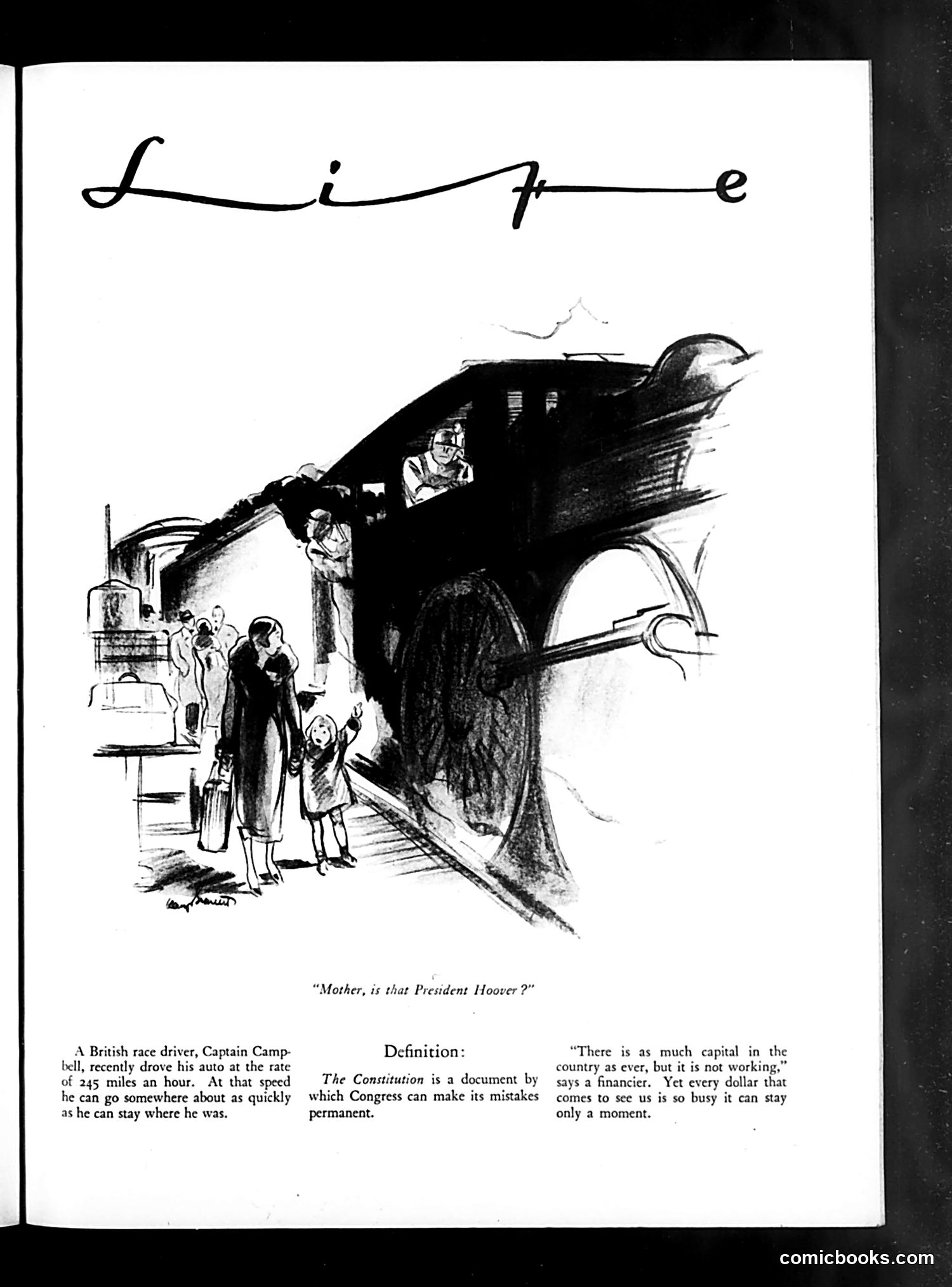
Analysis of "Life" Magazine Page This page contains a political cartoon captioned "Mother, is that President Hoover?" showing a large airplane with passengers boarding. The satire appears to reference President Herbert Hoover's response to the Great Depression. The accompanying text mentions a British race driver exceeding safe speed limits, paired with a definition mocking the Constitution as "a document by which Congress can make its mistakes permanent." The cartoon likely satirizes Hoover's rapid policy responses or escapes during the Depression crisis—the "speed" motif connecting the reckless driver story to Hoover's administration. The financial quote about idle capital suggests criticism of economic mismanagement during this economic crisis.
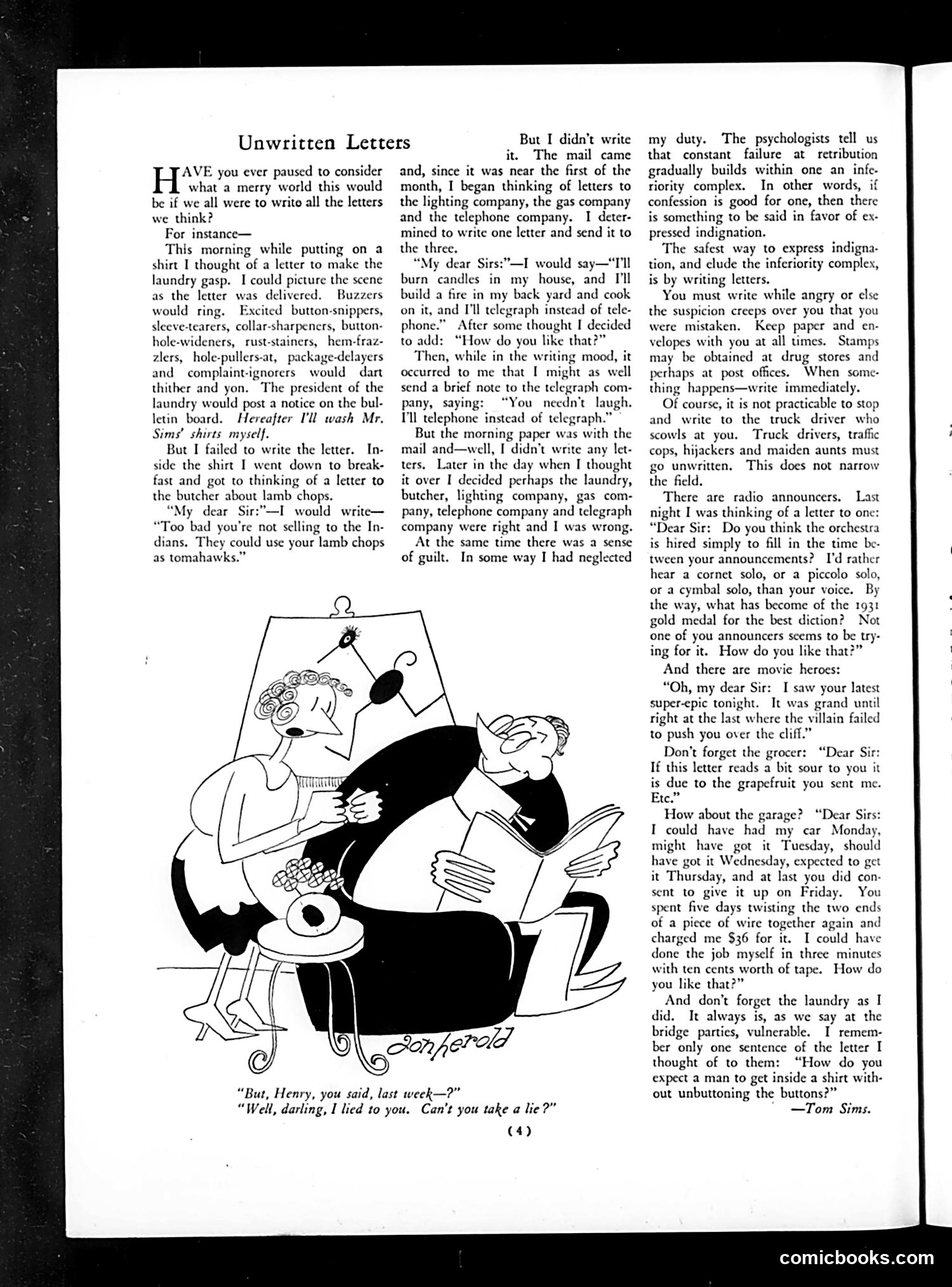
"Unwritten Letters" by Tom Simi This satirical article humorously catalogs the letters the author *meant* to write but never did—complaints to various utilities and service providers (laundry, gas, telephone, telegraph companies, garages, radio stations). The accompanying cartoon depicts a couple in a domestic setting, with the caption: "But, Henry, you said, last week—? Well, darling, I lied to you. Can't you take a lie?" The satire targets the gap between intention and action—how people frequently *plan* to lodge complaints or have difficult conversations but avoid the actual effort. The cartoon's punchline about a lie reinforces this theme of avoidance and marital accommodation. It's commentary on everyday procrastination and conflict-avoidance in both professional consumer interactions and personal relationships.
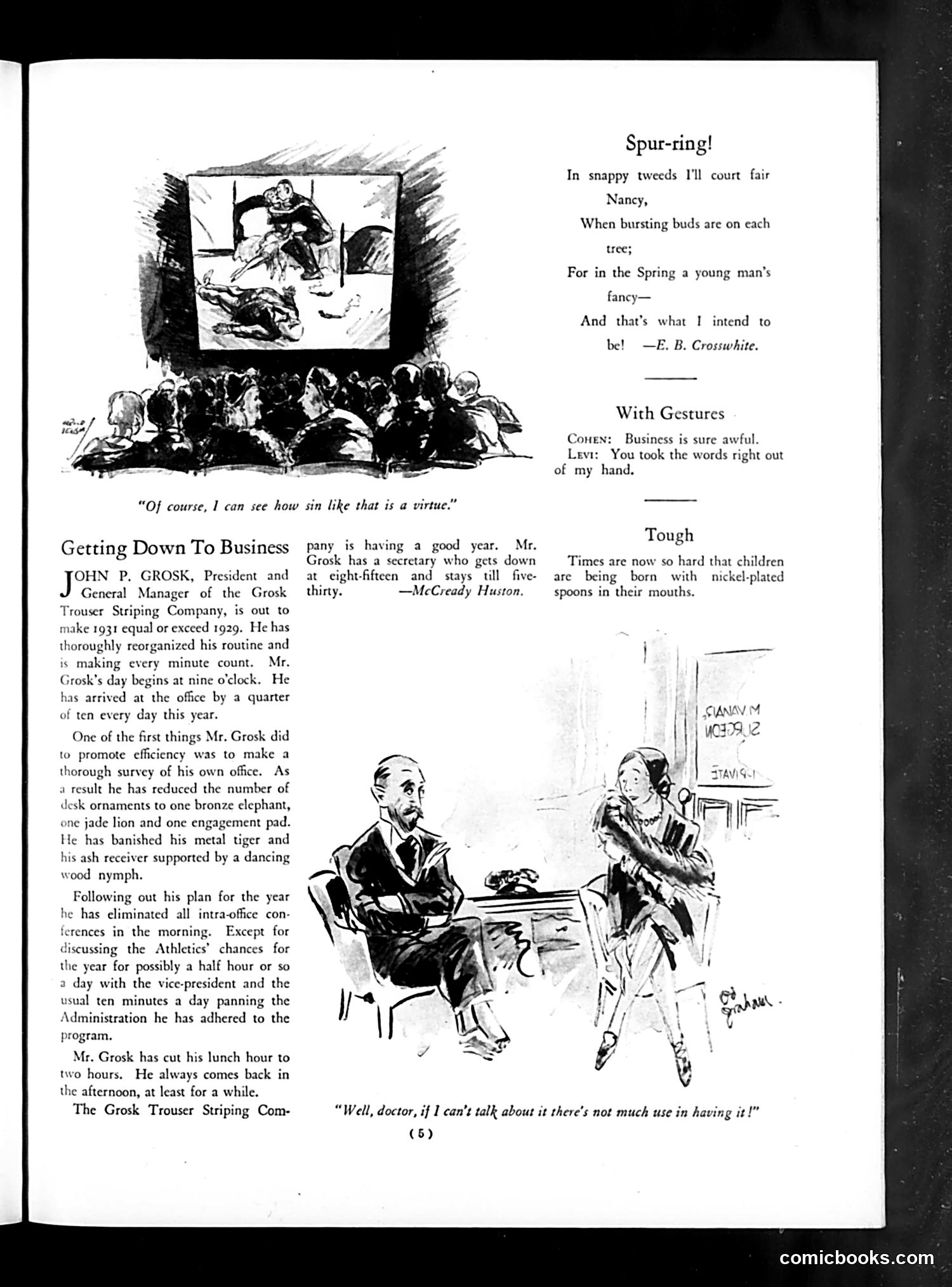
Analysis of Life Magazine Page This page contains three distinct items: 1. "Spur-ring!" — A brief poem by E.B. Croswhite about courting a woman named Nancy in spring, with an illustration of a couple in a window. 2. "Getting Down To Business" — An article about John P. Grosk, president of the Grosk Trouser Striping Company, describing his efficiency methods for running his business. The article highlights how he's streamlined operations by eliminating desk ornaments and cutting his lunch hour. 3. "With Gestures" and "Tough" — Two single-panel cartoons with brief humorous captions about everyday situations (business stress and children with spoons). The page represents typical Life magazine content: light humor, social commentary, and business-world satire presented through text and illustration rather than hard political commentary.
"Life Looks About" — Page Analysis This page contains three editorial sections without illustrated cartoons, but rather written commentary on contemporary issues. "Confusion In Relief" discusses Congressional assistance for unemployed veterans and drought sufferers, praising the Red Cross's work while questioning the government's approach. "Acquittals" addresses recent court cases involving Bishop Cannon (Methodist leader), another bishop, and General Smedley Butler, arguing that mercy was inappropriately shown in these trials. "General Wood" and "More Feet of Clay" discuss General Leonard Wood's autobiography and Edgar Lee Masters's biography of Lincoln, examining how public figures' legacies are constructed and sometimes diminished by biographical revelation. The page reflects 1920s-30s concerns with veteran welfare, religious scandal, and how historical figures are remembered.
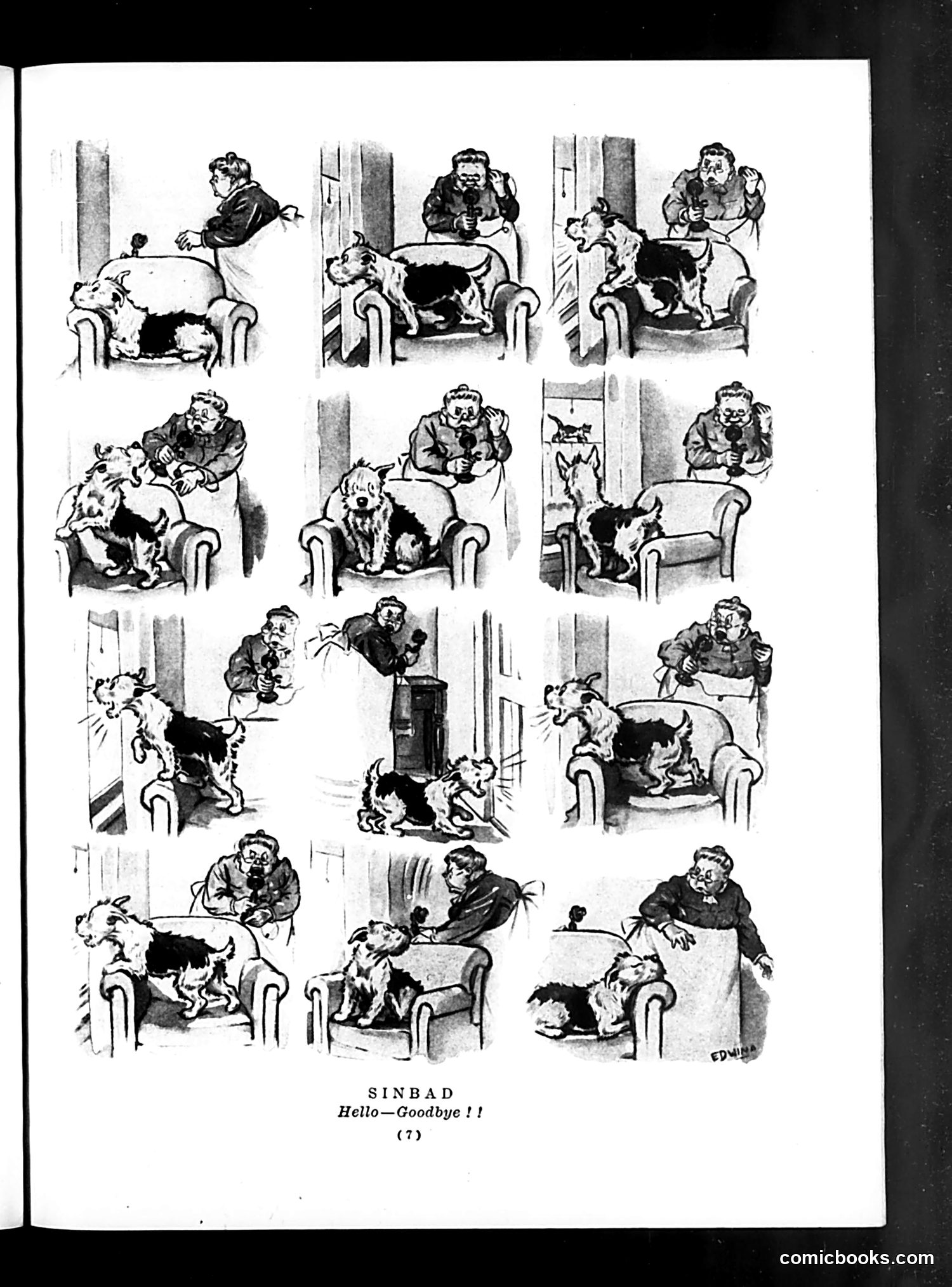
"Sinbad: Hello—Goodbye!!!" This is a sequential comic strip showing a man repeatedly encountering a small dog in his armchair. The strip depicts a cycle: the man discovers the dog sitting in his chair, attempts to remove or shoo it away through various methods (pointing, chasing, using a broom or newspaper), but the dog persistently returns to the same spot. The humor derives from the futile repetition—the man's escalating frustration contrasts with the dog's stubborn refusal to stay gone. The title "Hello—Goodbye" suggests the man's greeting is immediately followed by the dog's reappearance, creating an endless, comedic loop. This likely satirizes domestic annoyances or the impossibility of training a stubborn pet, resonating with early 20th-century American household humor.
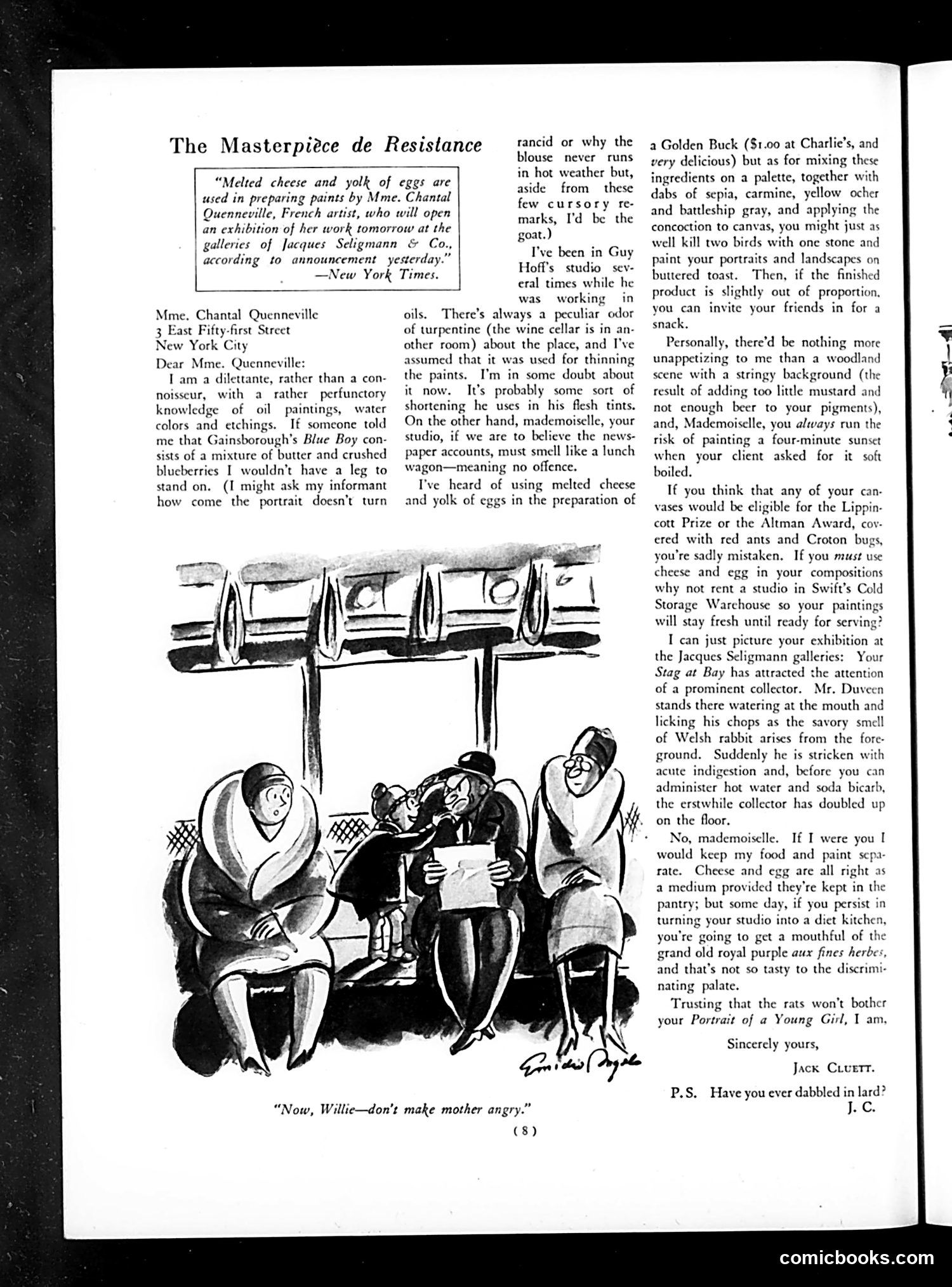
Analysis of "The Masterpiece de Resistance" This is a satirical letter to painter Mme. Chantal Quenneville, who apparently uses unconventional ingredients—melted cheese and egg yolks—in her paintings. The writer, Jack Cluett, humorously critiques her work and artistic pretensions. The cartoon below depicts three bundled figures on what appears to be a train or trolley, with the caption "Now, Willie—don't make mother angry." The specific reference is unclear without additional context, but the bundled appearance and domestic drama suggest social satire about class, family dynamics, or travel conditions. The broader satire mocks avant-garde or experimental artists and their questionable techniques, while also poking fun at art world pretension and collectors' gullibility regarding unconventional materials and methods.
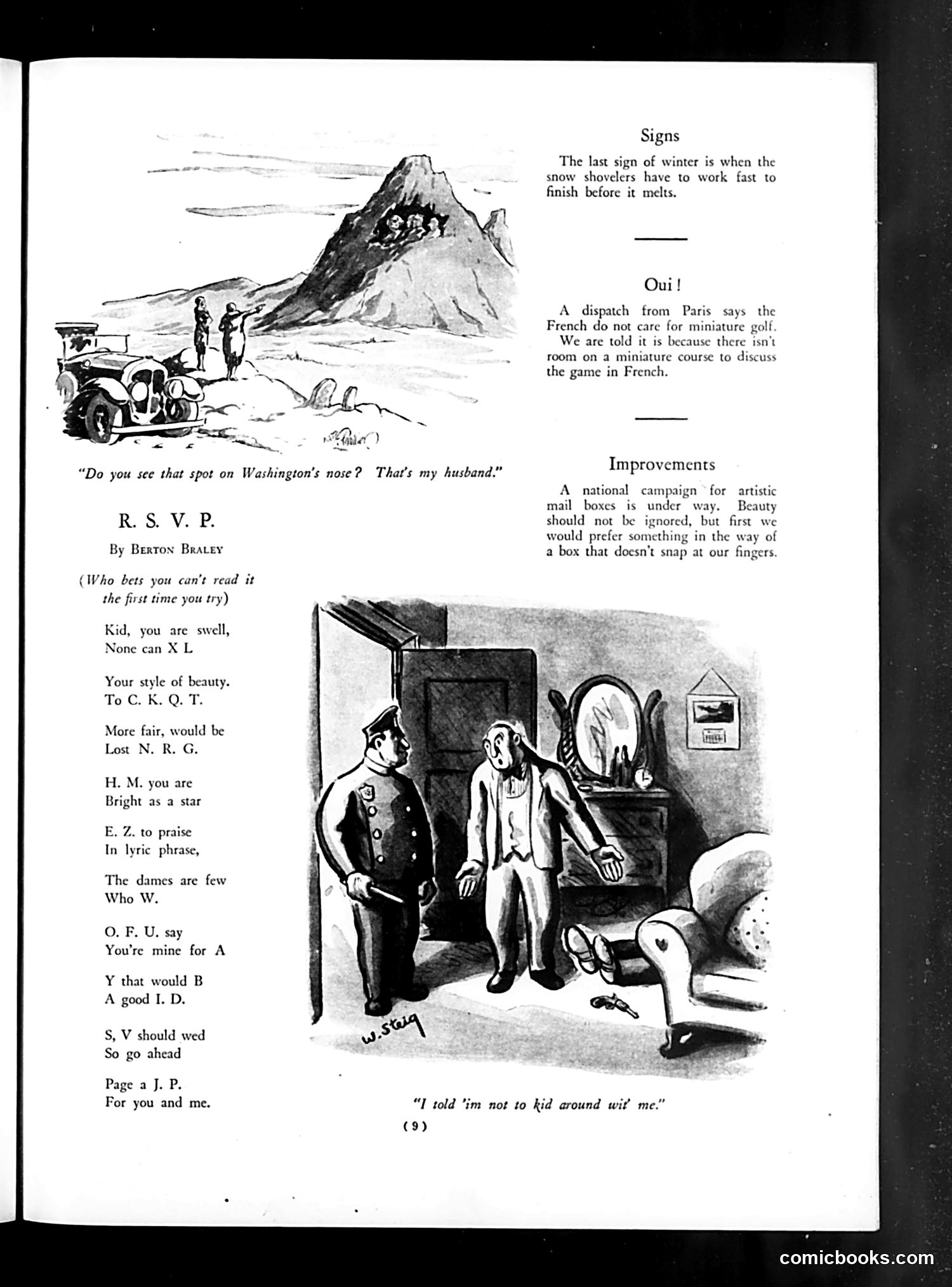
Analysis of Life Magazine Page This page contains three distinct pieces: 1. Top cartoon: A woman points to a snow-capped mountain peak, claiming it's her husband's nose—a visual gag about Washington's Monument or a caricatured politician with an exaggerated nose. 2. "R.S.V.P." poem by Berton Braley: A playful verse using abbreviations and acronyms as punchlines (X L, C.K.Q.T., Lost N.R.G., etc.), creating double meanings. It's lighthearted wordplay mocking formal invitation responses. 3. Bottom cartoon: Shows two men examining what appears to be broken/damaged mail boxes or postal equipment, with the caption "I told 'im not to kid around wif me." This satirizes the proposed campaign for artistic mail boxes mentioned in the "Improvements" section—implying resistance to aesthetic changes in utility items. The page reflects 1920s-era American humor and social commentary.
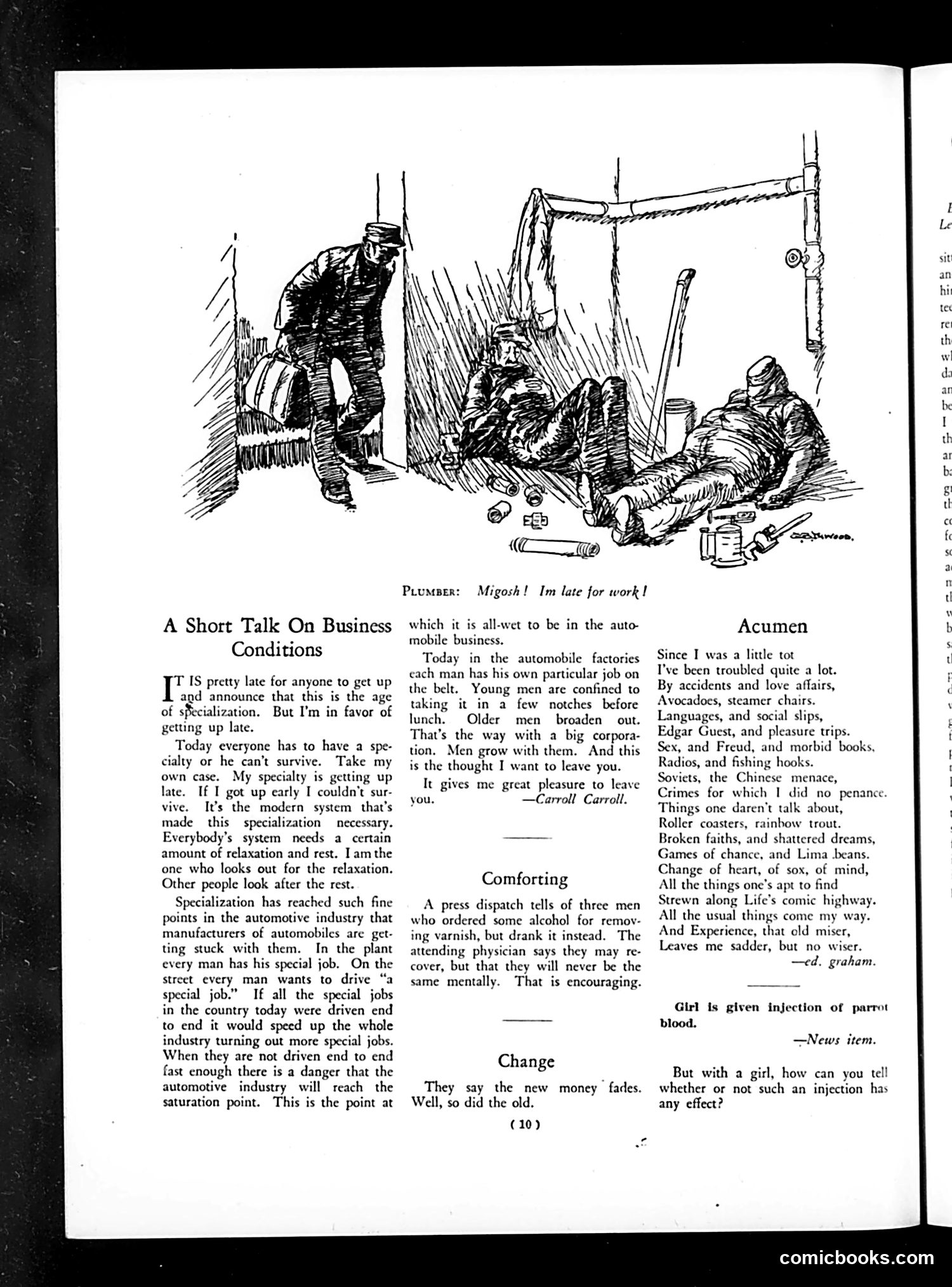
Analysis The cartoon at top shows a plumber arriving late to work, with the caption "Migosh! I'm late for work!" This illustrates the article "A Short Talk On Business Conditions" below it. The article argues that modern specialization in industries like automobiles has created a saturation problem. The author contends that when every worker specializes in one narrow task, the entire system depends on everyone doing their job on time. The plumber's tardiness becomes emblematic of this vulnerability—if specialized workers don't arrive when expected, the whole operation fails. The satire critiques both industrial efficiency obsession and the precarious interdependence it creates. Rather than celebrating specialization's supposed progress, the piece suggests it makes business conditions fragile and dependent on perfect punctuality from every participant.
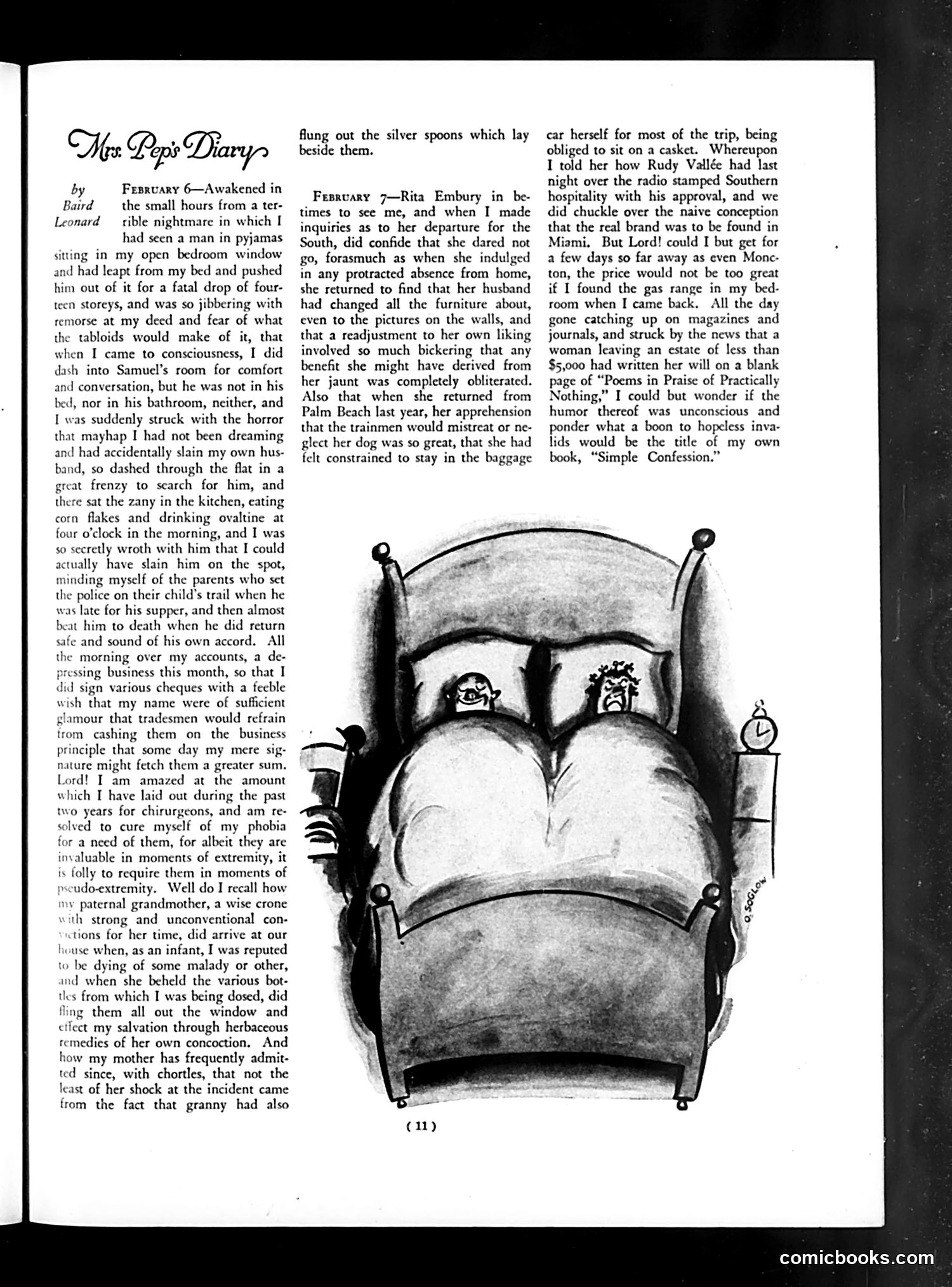
Analysis of "Mrs. Peps Diary" Page This page contains a diary entry by humorist Baird Leonard dated February 6-7, recounting domestic mishaps: a nightmare about her husband, discovering her furniture rearranged upon his return from travel, and financial anxieties about unpaid bills and a woman who sold her story for $5,000. The accompanying illustration shows a woman in bed with an exaggerated terrified expression, eyes wide and mouth open in distress—visually representing the "terrible nightmare" described in the text's opening line. The humor derives from relatable domestic anxieties: spousal neglect, home disorder, and financial insecurity during what appears to be the early 20th century. The cartoon amplifies the emotional reaction for comedic effect, capturing a moment of marital anxiety.
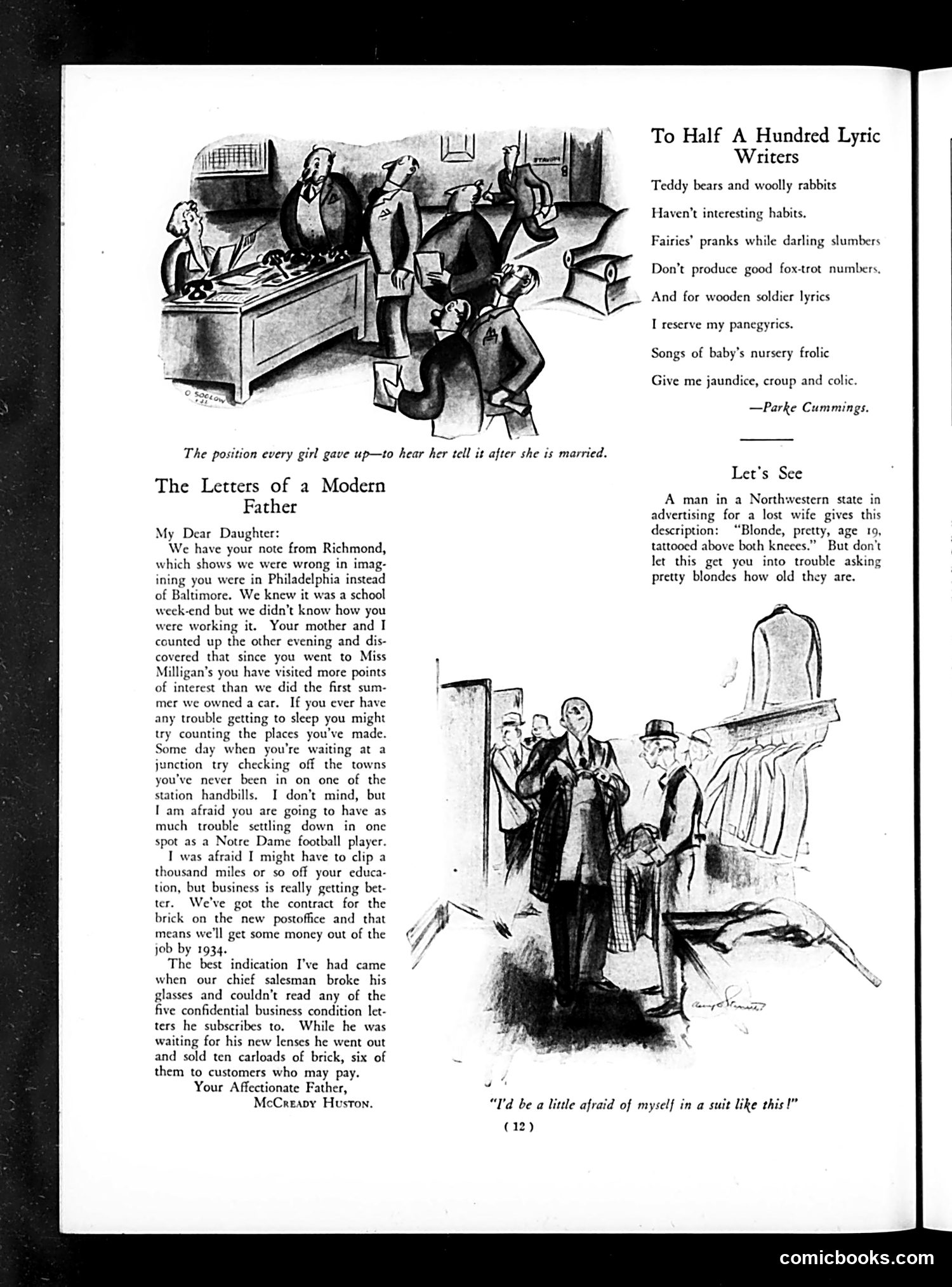
Analysis of Life Magazine Page This page contains two separate pieces of satire: "To Half A Hundred Lyric Writers" (top right) is Parke Cummings' poem mocking sentimental song lyrics popular in the 1920s-30s. He dismisses songs about "teddy bears and woolly rabbits," "fairies' pranks," and "baby's nursery frolic," reserving his preference for rougher subjects like "jaundice, croup and colic"—satirizing the gap between saccharine commercial songwriting and more authentic subject matter. "The Letters of a Modern Father" presents a father's letter to his daughter, humorously detailing her travels since leaving home. The satire targets her constant movement between destinations and the family's business struggles during what appears to be the early 1930s (recession era). The accompanying cartoon illustrates anxieties about a young woman's independent traveling habits.
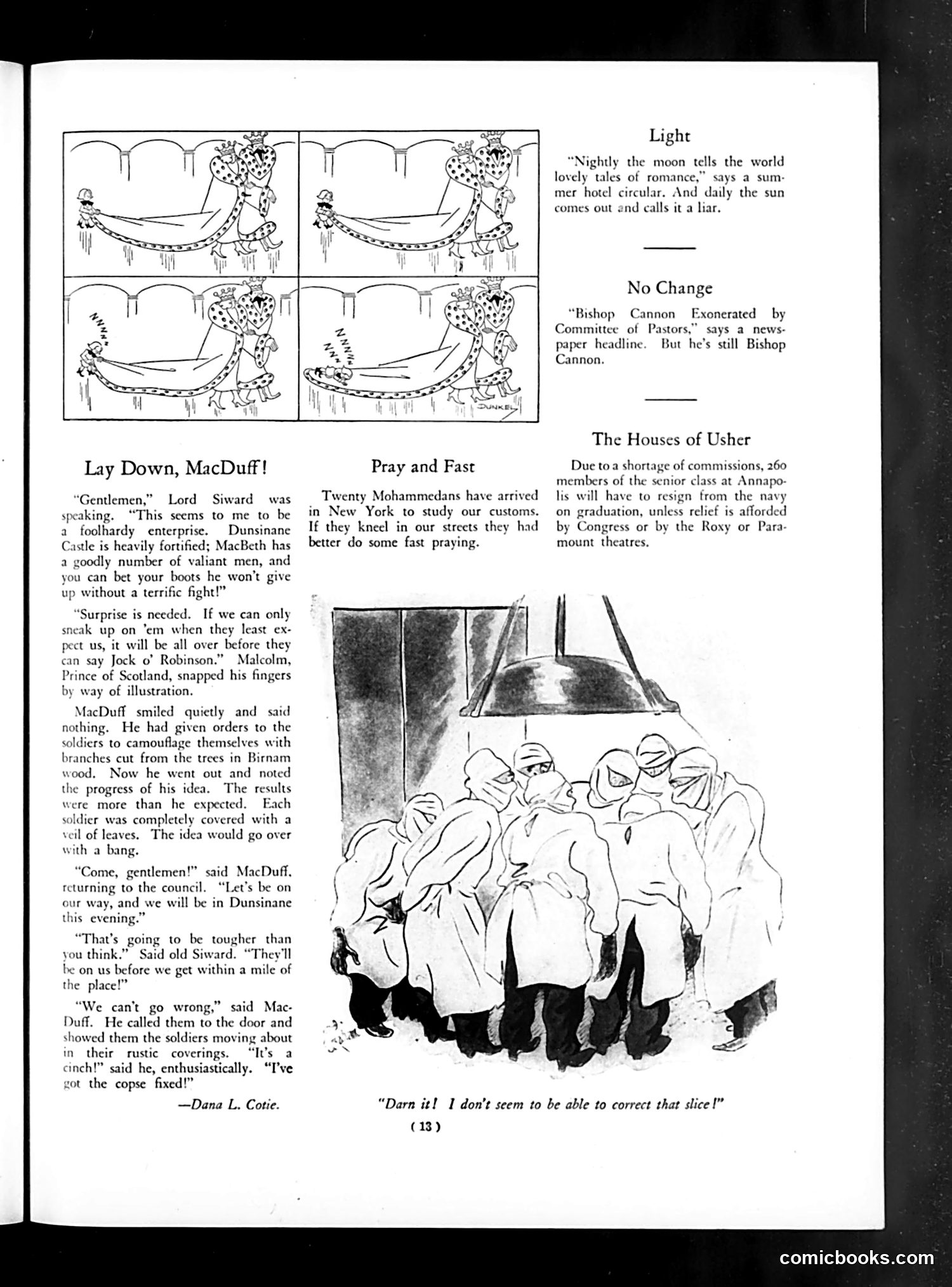
Analysis of Life Magazine Page This page contains three distinct sections: "Lay Down, MacDuff!" is a fictional narrative (by Dana L. Cowie) about a Scottish military strategy. Lord Siward and MacDuff plan a surprise attack on Dunsinane Castle by disguising soldiers with tree branches for camouflage. The story references Shakespeare's *Macbeth*, playing on the famous "Lay on, Macduff" line. Brief news items comment on current events: a hotel circular claiming moonlight is romantic (satirizing tourist marketing), a bishop's exoneration that changes nothing, and military recruitment challenges. "Pray and Fast" notes Mohammedan visitors studying American customs in New York, with a cartoon showing bundled figures in what appears to be cold weather. The illustration at bottom shows soldiers in camouflage, captioned with a joke about correcting "that slice."
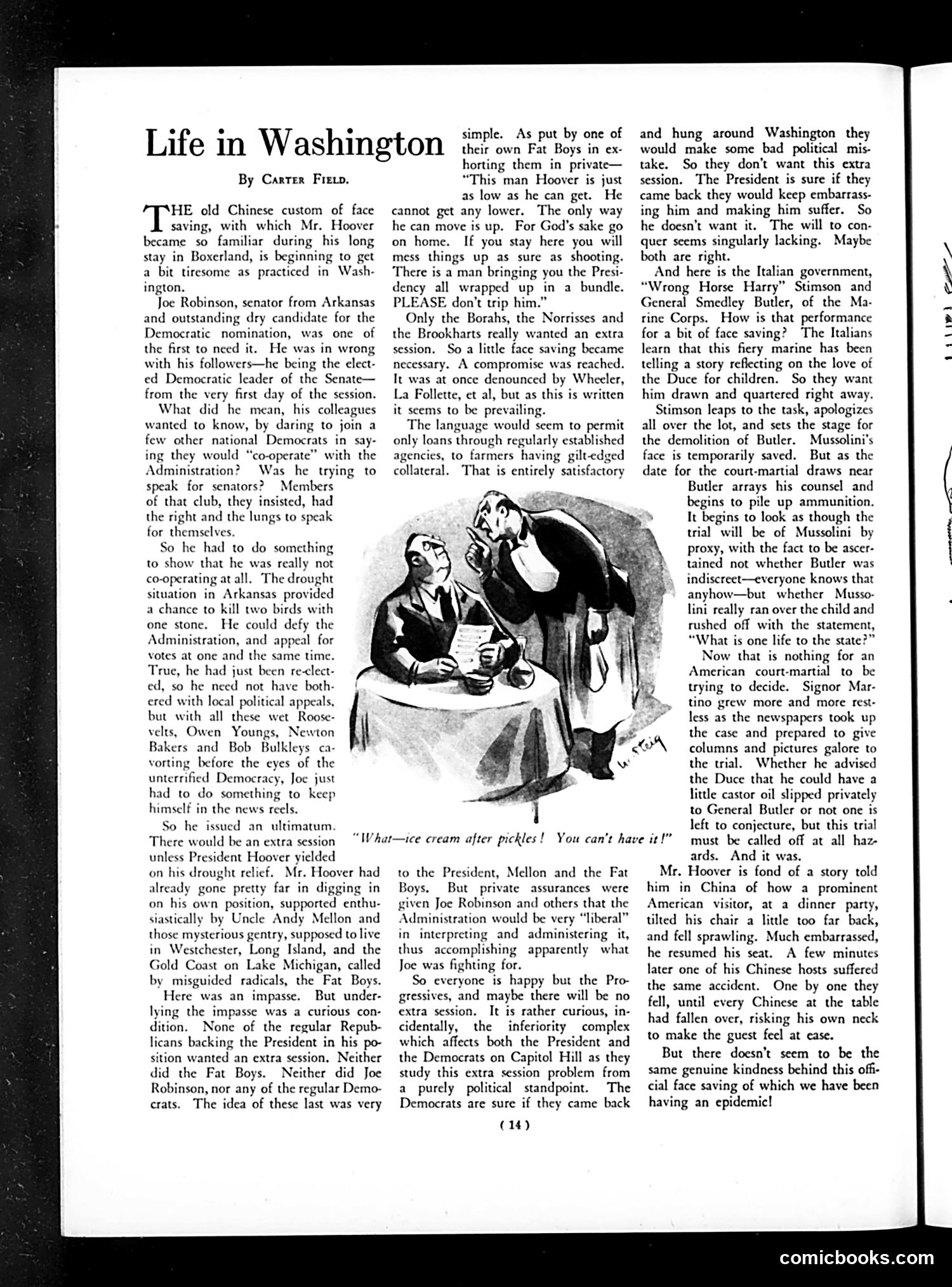
"Life in Washington" - Political Satire Analysis This Carter Field column satirizes President Hoover's handling of Democratic congressional opposition during an extra legislative session. The accompanying cartoon depicts two figures in conversation, with the caption "What—ice cream after pickles! You can't have it!" The satire centers on Hoover's political predicament: he needs Democratic cooperation but simultaneously opposes their agenda. The "ice cream after pickles" metaphor suggests incompatible political positions—Democrats won't support his policies after he's opposed theirs. Field mocks various political figures (Senator Robinson, "Fat Boys," Stimson, Butler) and their attempts at "face-saving" compromises. The broader joke is that all parties are pretending cooperation while pursuing contradictory goals—a fundamentally impossible political situation that exposed the absurdity of Hoover's legislative strategy during economic crisis.
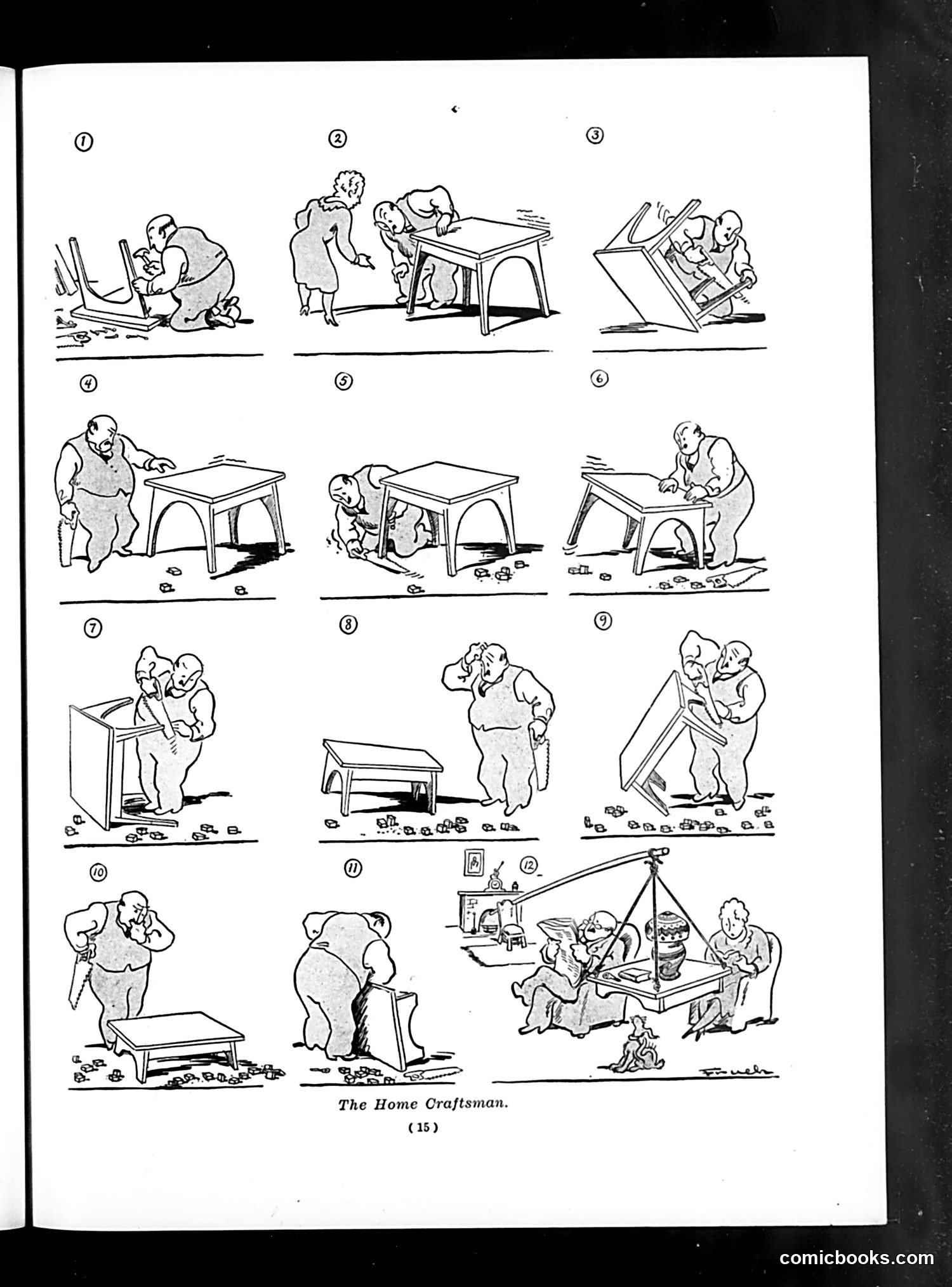
"The Home Craftsman" This satirical comic strip depicts a man attempting DIY furniture construction with comedic incompetence. The sequence shows him: 1. Beginning work with scattered materials 2. Struggling through various stages of assembly 3. Creating increasingly unstable, broken furniture pieces 4. Eventually producing a comically oversized or dysfunctional final product The satire targets amateur home craftspeople—likely a growing trend during the early-to-mid 20th century when DIY culture was expanding. The humor comes from the gap between ambitious intention and disastrous execution, with each panel showing progressive failure. The final panel suggests either spectacular disaster or an absurdly impractical result from his efforts. The joke mocks men who undertake home improvement projects without proper skill or planning, a timeless theme that resonated with Life magazine's middle-class readership.
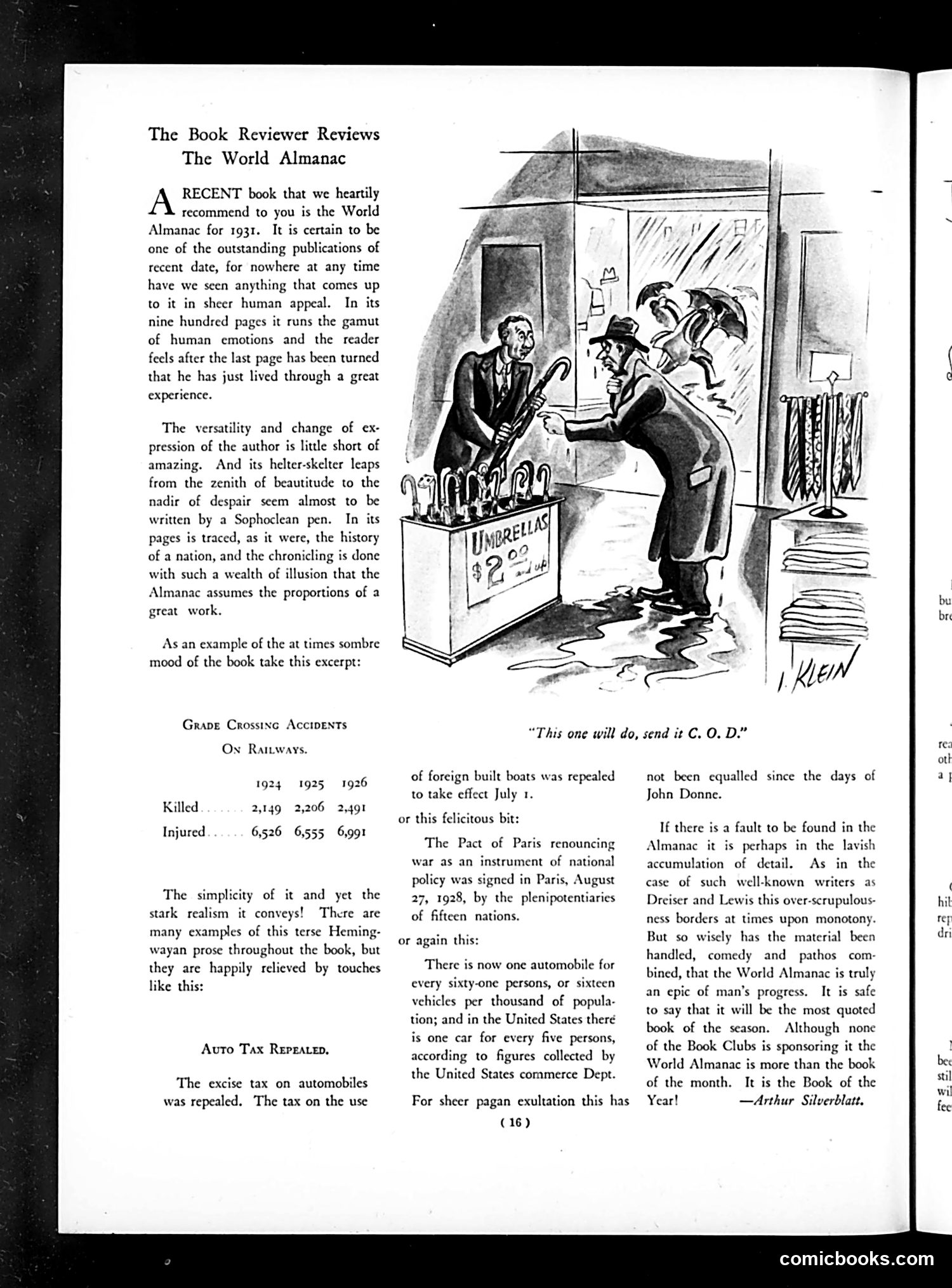
Cartoon Analysis: "This One Will Do, Send it C.O.D." This cartoon by Klein satirizes street commerce during what appears to be the 1920s-30s. A street vendor selling umbrellas for $2 (marked on his cart) aggressively pitches to a well-dressed customer during rain. The joke plays on the vendor's opportunistic sales tactics—capitalizing on poor weather to sell inferior or overpriced goods. The phrase "send it C.O.D." (cash on delivery) suggests the customer is reluctant to pay upfront, implying skepticism about the umbrella's quality or value. The cartoon critiques urban street hustlers and their deceptive marketing practices common during this era, when unregulated street vending allowed vendors to exploit customers in need.
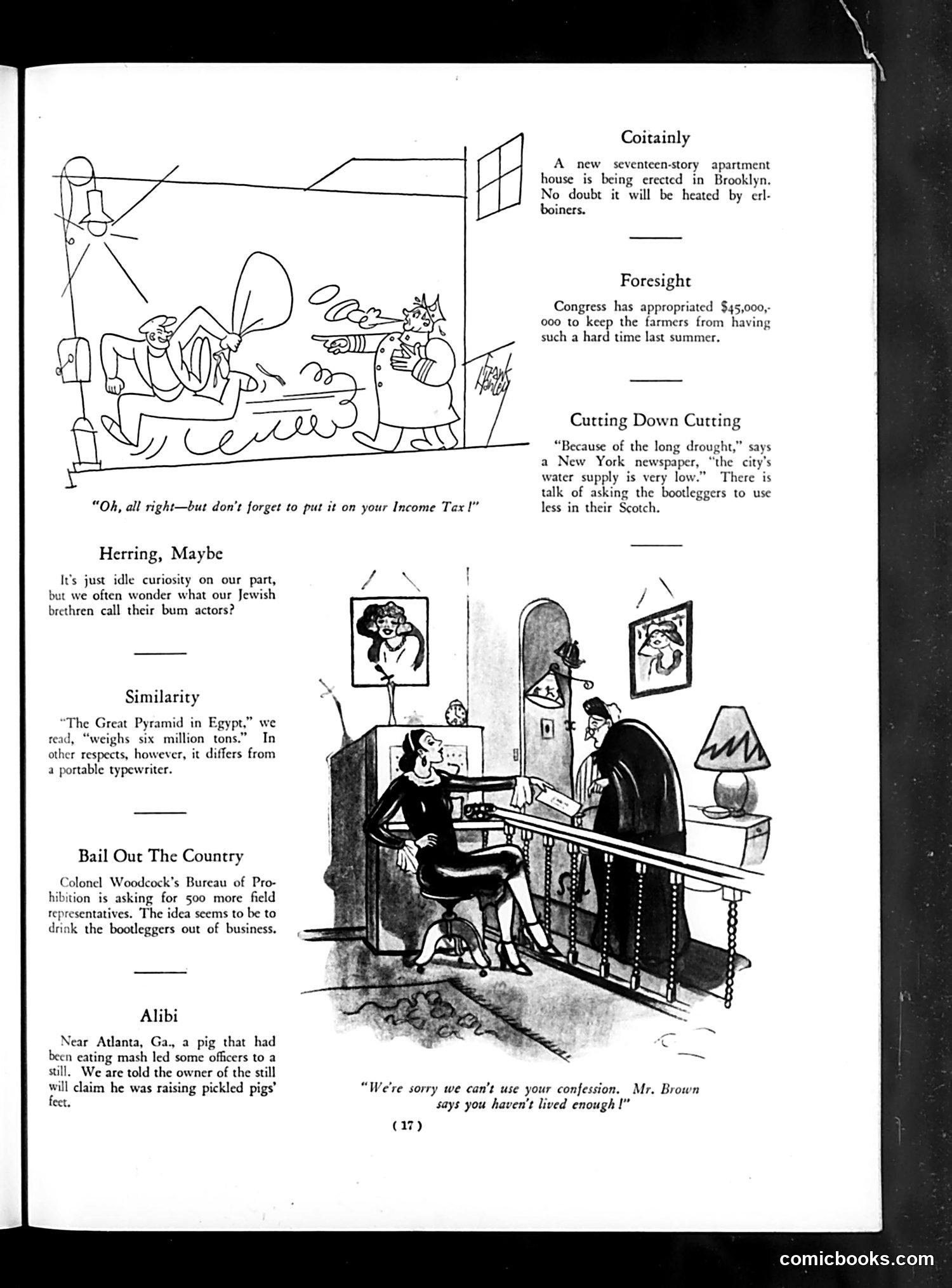
Analysis of Life Magazine Page This page contains several brief satirical commentary pieces typical of Life's style, plus two cartoons. Top cartoon: Shows a couple at leisure with the caption "Oh, all right—but don't forget to put it on your Income Tax!" This satirizes the newly implemented income tax system, suggesting people tried to deduct entertainment expenses. Bottom cartoon: Depicts a confession scene where a priest tells a penitent "We're sorry we can't use your confession, Mr. Brown—says you haven't lived enough!" This mocks the idea that confession requires sufficient sinful experience to be worthwhile. The brief text pieces comment on Brooklyn heating systems, farmer subsidies, water shortages, Jewish terminology, Prohibition enforcement, and a pig that consumed mash (alcohol byproduct)—all contemporary early-20th-century American social issues.
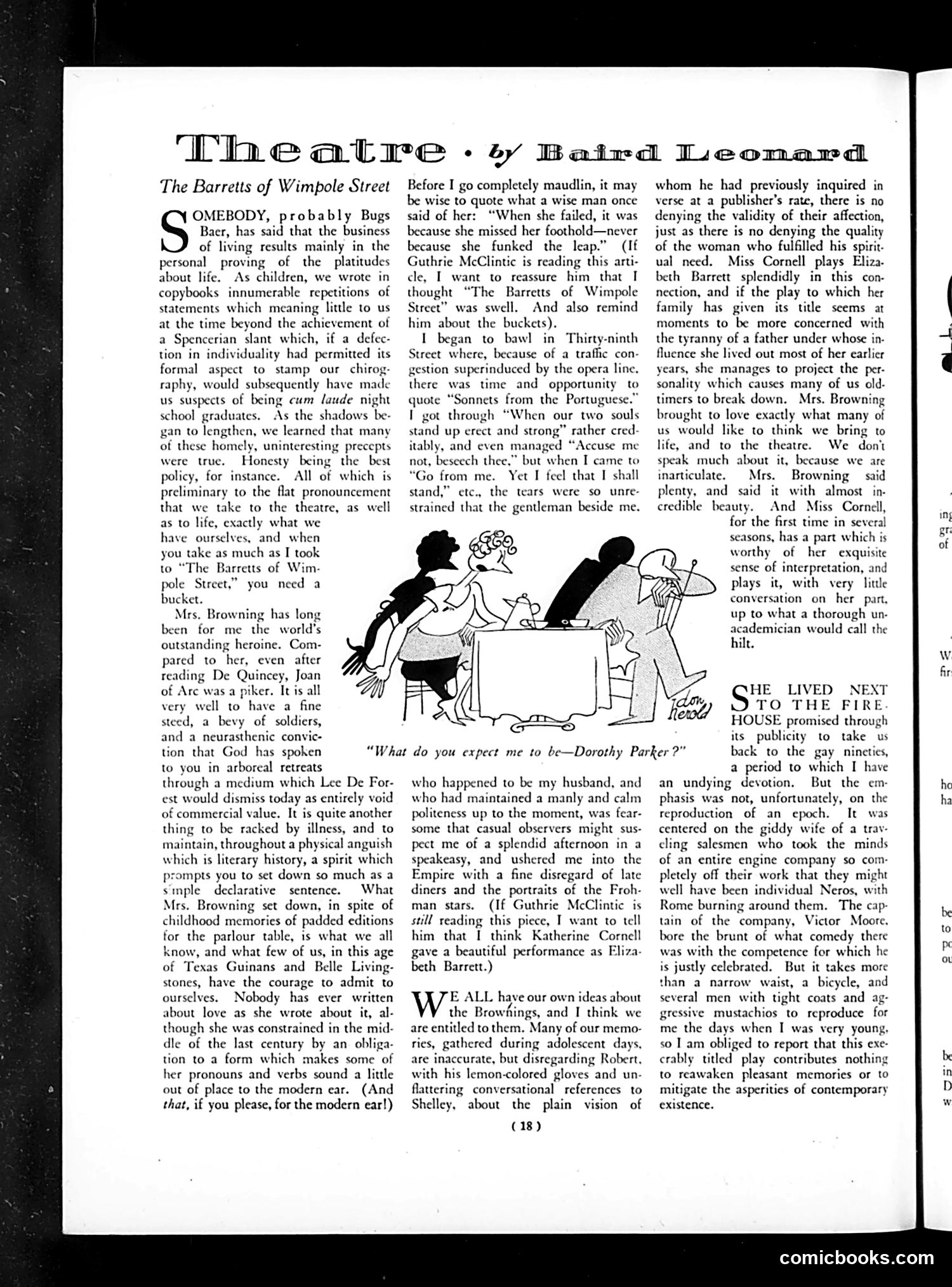
Analysis of "The Barretts of Wimpole Street" Theatre Review This is a theatre review by Baird Leonard discussing a stage production of *The Barretts of Wimpole Street*. The accompanying cartoon depicts a dinner scene with figures in silhouette, captioned "What do you expect me to be—Dorothy Parker?" The cartoon likely references Dorothy Parker, the famous American wit and critic known for her sharp, acerbic commentary. The caption suggests someone is being compared unfavorably to Parker's standard of cleverness or brilliance—implying the person cannot match Parker's legendary intelligence and wit. The review praises the production's cast, particularly Mrs. Browning (the actress playing Elizabeth Barrett Browning) and Miss Cornell, noting their excellent performances and emotional depth in this drama about the famous poet.
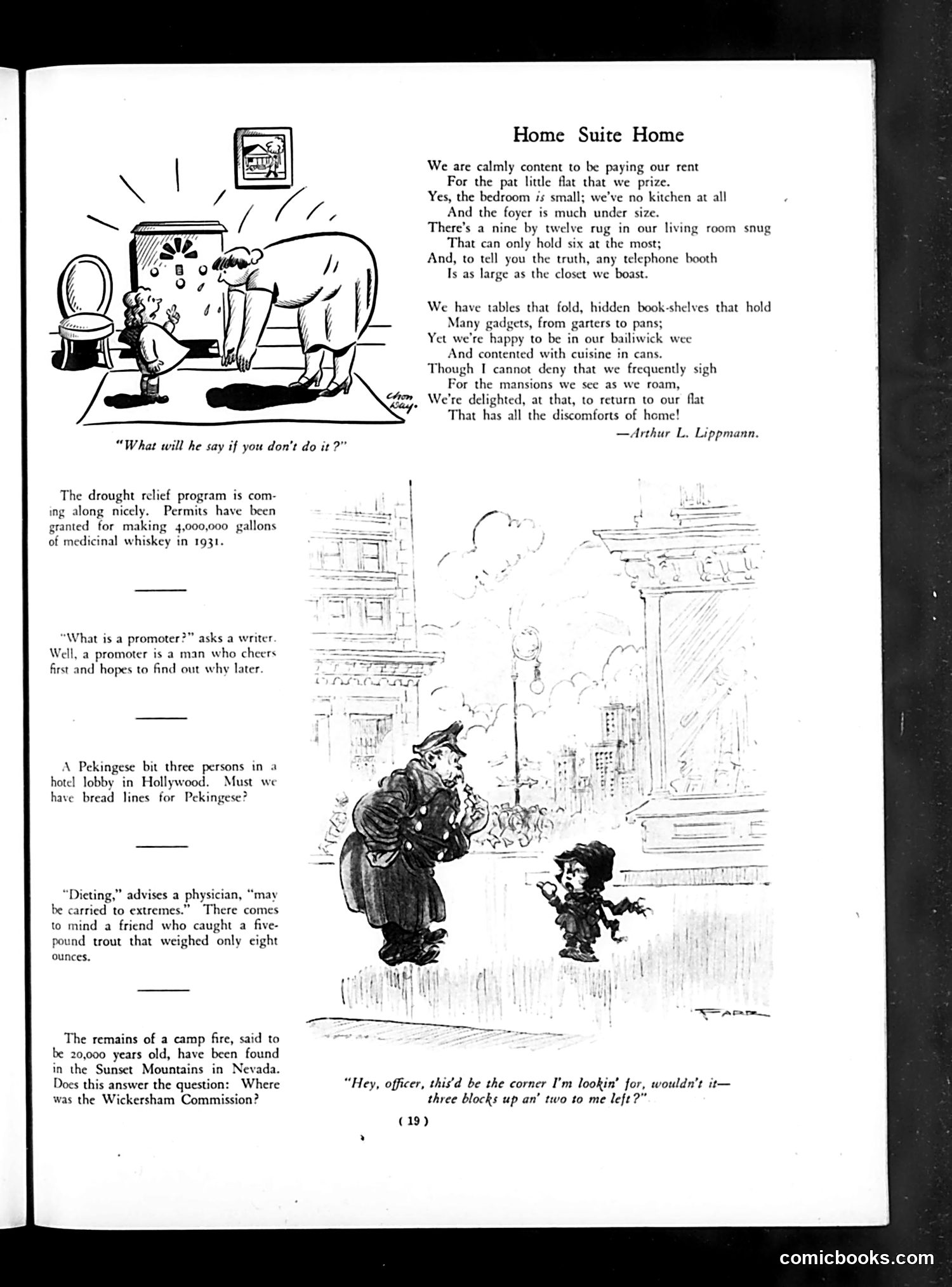
Life Magazine Page Analysis Top Section: A humorous poem titled "Home Suite Home" celebrates contentment in a cramped apartment—tiny bedroom, no kitchen, minimal closet space—while acknowledging yearning for mansions. The accompanying cartoon shows a small person confronting a large cow indoors, captioned "What will he say if you don't do it?"—the joke's logic unclear without more context. Bottom Section: Contains brief satirical items typical of Life's format: - A jab at Prohibition's hypocrisy: the government grants permits for "medicinal whiskey" production (4 million gallons in 1931), despite alcohol being banned - A definition of "promoter" mocking optimistic businessmen - Absurdist humor about a Pekingese dog attacking people - A joke about extreme dieting - A reference to the Wickersham Commission (which investigated Prohibition enforcement) The large cartoon depicts a small man asking a police officer for directions using imprecise measurements ("three blocks up an' two to me left"), satirizing either poor urban navigation or dialect humor common to the era.
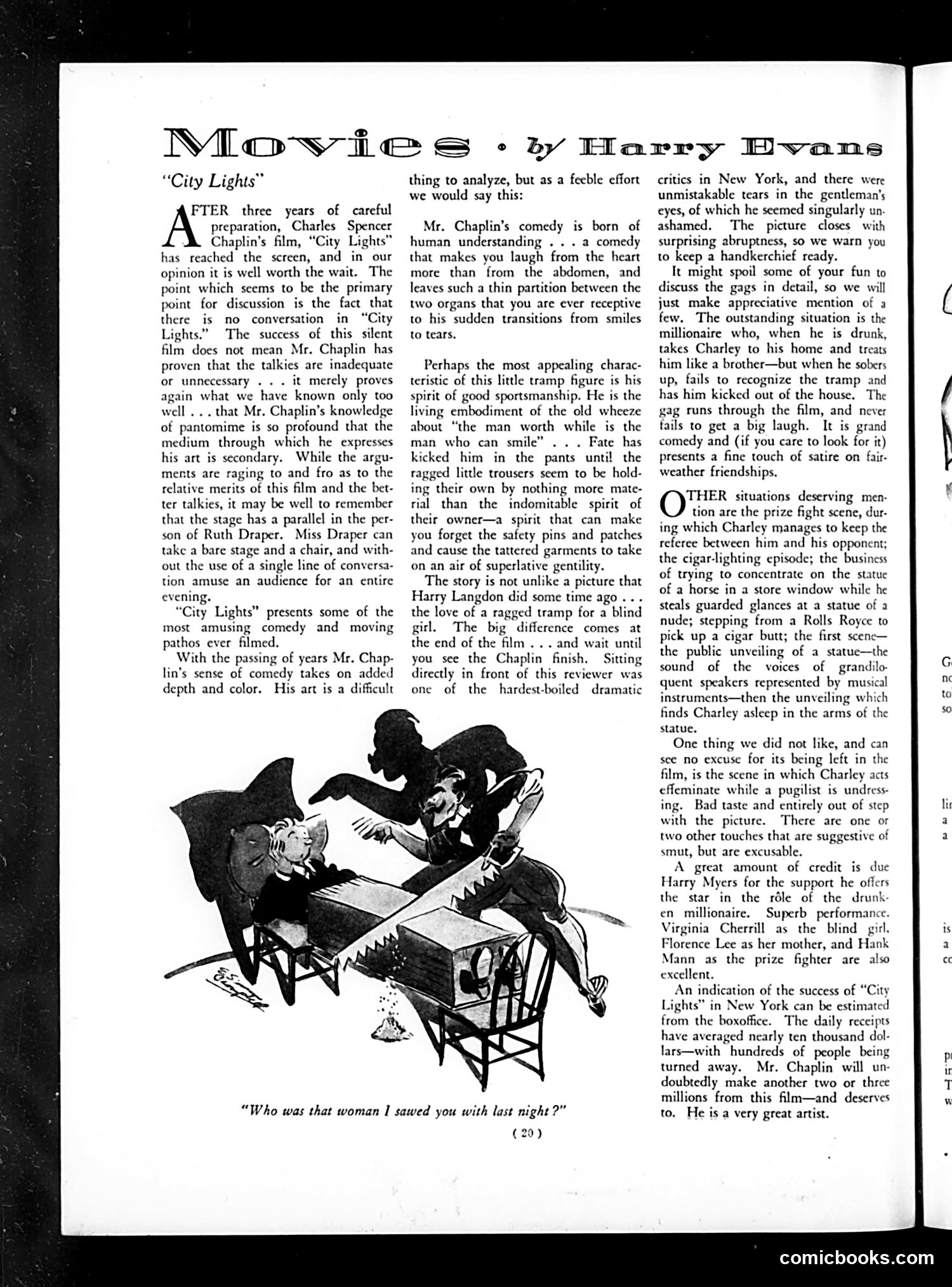
"City Lights" Film Review Analysis This is Harry Evans's review of Charlie Chaplin's silent film "City Lights." The accompanying illustration depicts a scene from the film showing Chaplin's iconic "Tramp" character in interaction with another figure. The Key Point: Evans defends silent film's artistic validity against the emerging "talkies" (talking pictures), arguing Chaplin's pantomime mastery transcends dialogue. The Tramp's appeal lies in his "spirit of good sportsmanship"—a ragged underdog who maintains dignity and humor despite hardship, embodying the idea that "the man worth while is the man who can smile." The Satire/Humor: The film's central gag involves a drunk millionaire befriending the Tramp generously, then cruelly rejecting him when sober—satirizing fair-weather friendships and class hypocrisy. Evans notes even hardened New York critics wept at the film's ending, underscoring how Chaplin balances comedy with genuine pathos, making audiences laugh "from the heart" rather than merely the abdomen.
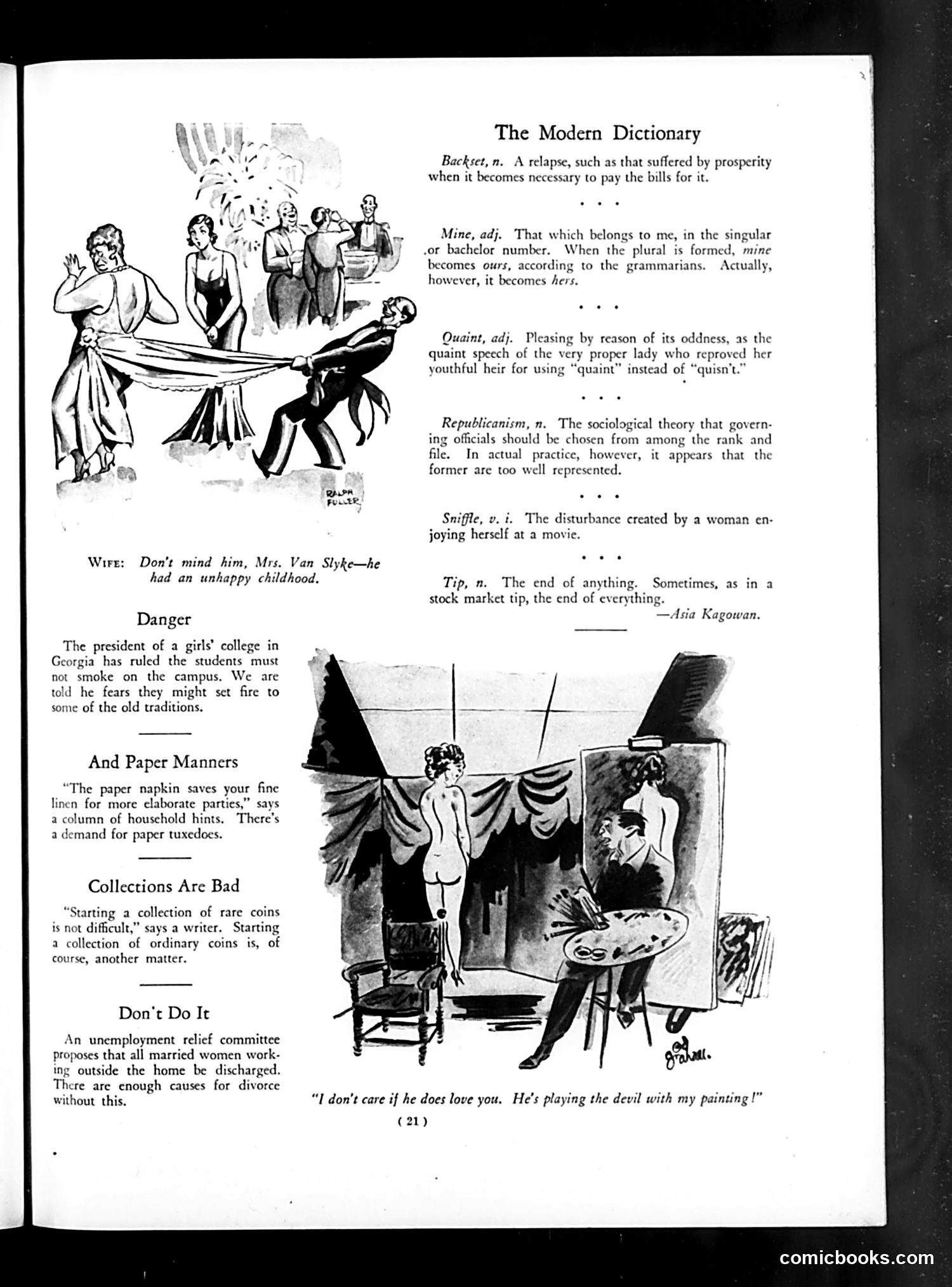
Explanation of Life Magazine Page Content This page from *Life* magazine contains satirical definitions and commentary on 1920s-30s American social issues. The Modern Dictionary mocks contemporary grammar and social hypocrisy through humorous definitions. "Mine" jokes that when a woman marries, her husband's possessions become "hers"—commentary on women's legal status in marriage. "Republicanism" satirizes the gap between democratic ideals (choosing leaders from ordinary citizens) and reality (elites still dominate). "Sniffle" takes a dig at women's emotional behavior at movies. The lower cartoons and text snippets address period concerns: - A college rule banning student smoking on campus (fears about corrupting "old traditions") - Paper napkins replacing fine linens (commercialization of etiquette) - Coin collecting commentary (wealth/status anxiety) - An unemployment proposal to fire married working women (economic hardship and gender politics) The bottom cartoon shows a couple; the wife protests her husband "playing the devil" with her painting—likely satirizing male indifference to women's creative ambitions or domestic discord over hobbies. The overall tone is gently cynical about gender relations, class pretense, and social change.
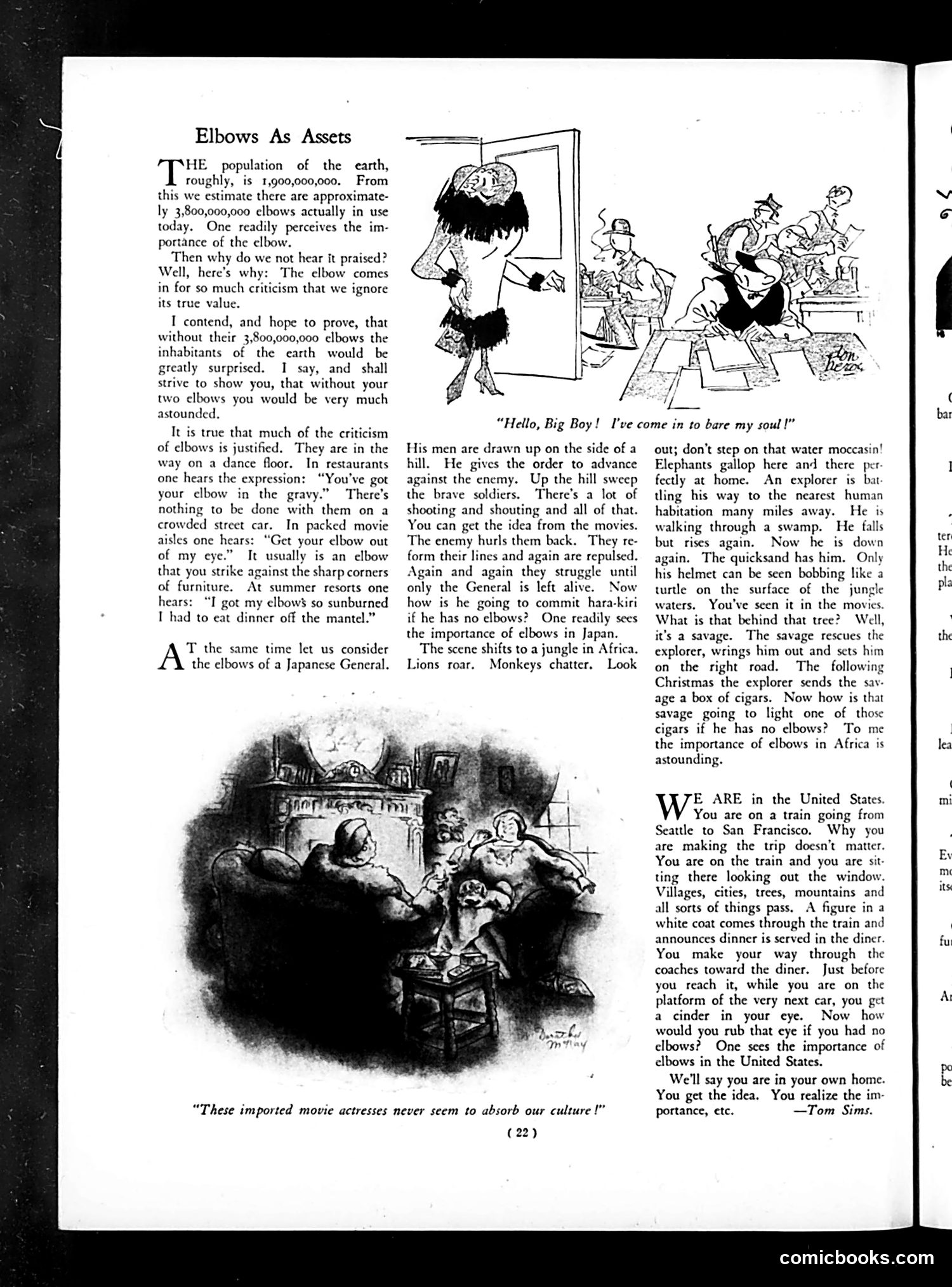
"Elbows As Assets": A Satirical Essay on Overlooked Value This humorous essay by Tom Sims uses absurdist logic to argue that elbows, despite being criticized as social nuisances, are actually essential assets worthy of praise. The piece catalogs complaints about elbows in everyday life (dancing, dining, crowded spaces, sunburns) before pivoting to exotic scenarios where they become vital: a Japanese general performing ritual suicide, an African explorer escaping quicksand and lighting cigars, and an American train passenger removing cinders from their eye. The cartoon accompanying it—showing a woman and man in what appears to be a domestic or social setting—likely reinforces the domestic humor theme. The caption about "imported movie actresses" suggests satire about cultural attitudes during this era. The satire's point: society takes essential things for granted until forced to imagine life without them. It's playful social commentary wrapped in deliberate absurdity, typical of *Life* magazine's irreverent humor.
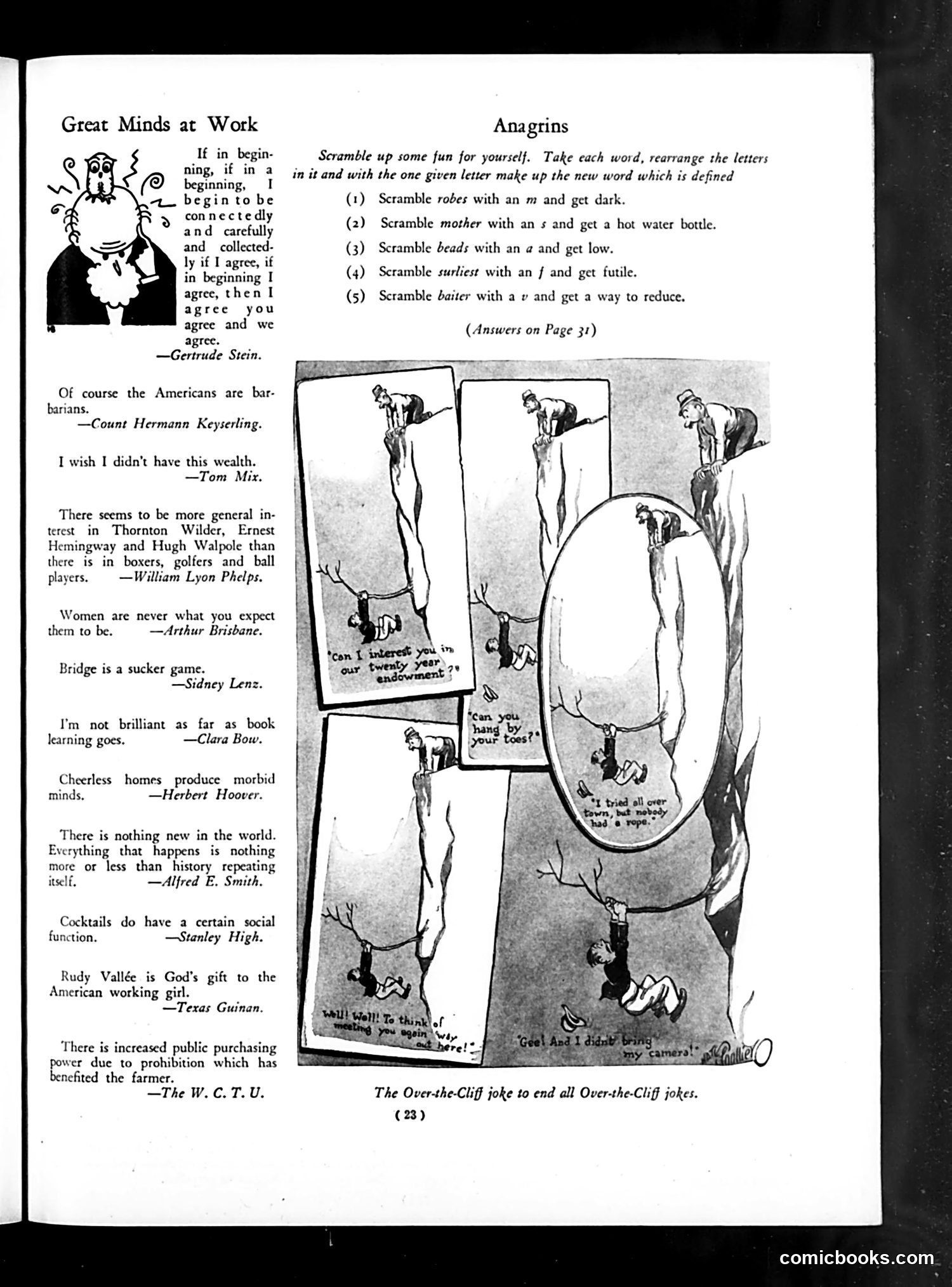
Explanation for Modern Readers This 1920s *Life* magazine page combines two sections: "Great Minds at Work" satirizes famous contemporary figures by quoting their supposedly profound statements, which range from pretentiously abstract (Gertrude Stein on agreement) to contradictory or vapid claims. The humor lies in mocking celebrities and intellectuals—from silent film star Clara Bow to politician Alfred E. Smith—for their self-important or nonsensical public utterances. "The Over-the-Cliff Joke" is a visual comic strip depicting a repeated gag: a man repeatedly attempts to interest a woman in various activities ("Can I interest you in our twenty-year endowment?"), only to have her respond by pushing him off a cliff. The humor derives from slapstick absurdity and the darkly comedic premise that rejection always results in the same violent punchline—playing on the era's fondness for exaggerated physical comedy. Both sections exemplify *Life*'s satirical approach to 1920s American celebrity and popular entertainment.
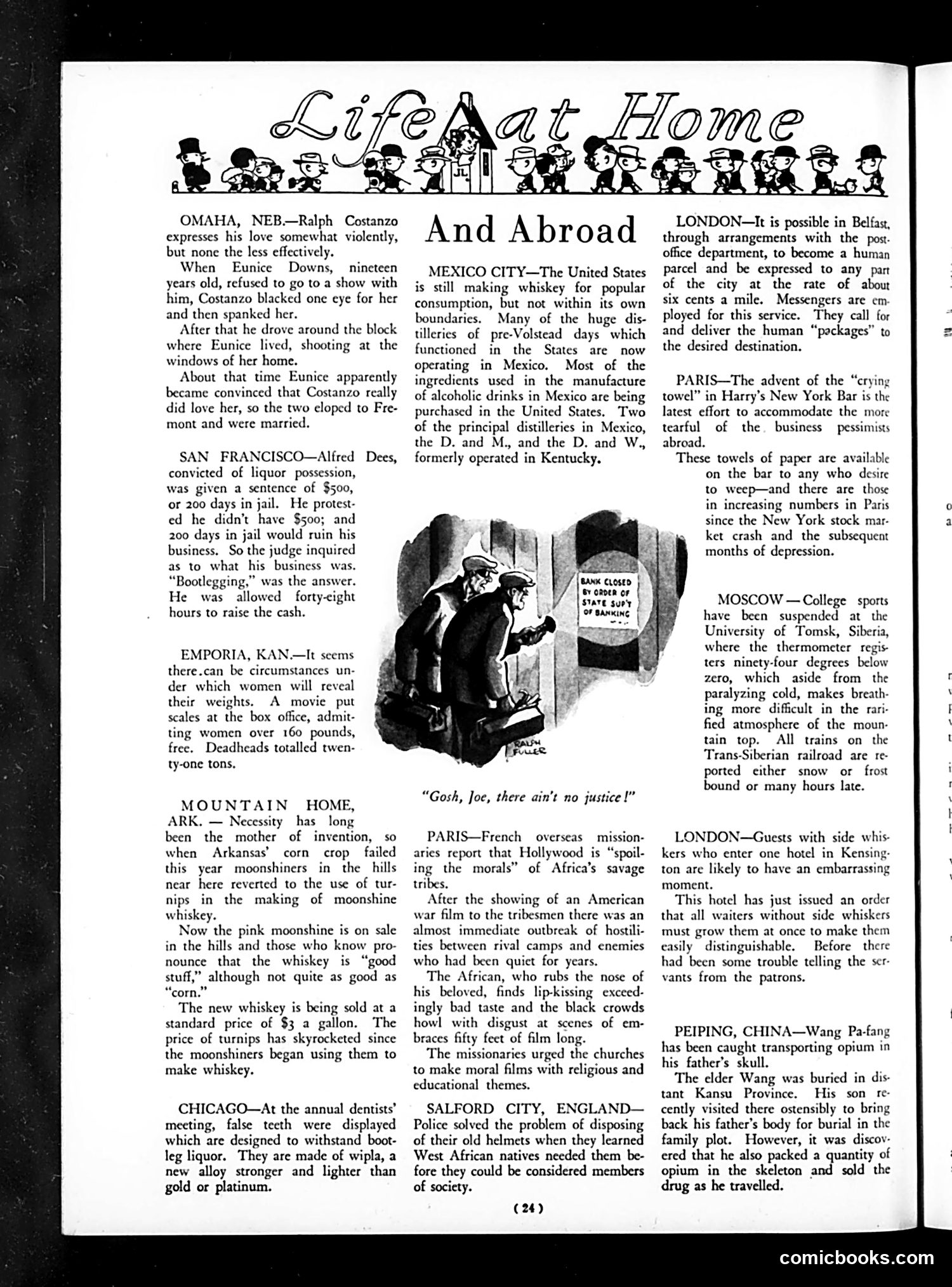
"Life at Home and Abroad" Page Analysis This page collects humorous anecdotes satirizing Prohibition-era America and contemporary international absurdities. The cartoon depicts two men at a bank marked "CLOSED BY ORDER OF STATE SUPT OF BANKS," with the caption "Gosh, Joe, there ain't no justice!" This mocks the irony of bank failures during economic hardship while bootleggers thrive. Domestic stories ridicule Prohibition's unintended consequences: Arkansas moonshiners substituting turnips for corn; dentists designing false teeth to withstand bootleg liquor; a bootlegger so prosperous he can raise $500 bail instantly. The Omaha relationship story and movie theater anecdote provide lighter comedic relief. International items lampoon American cultural export (Hollywood "corrupting" African tribes) and absurd solutions to practical problems (British police dumping old helmets to West African natives; Paris bars selling "crying towels" to depressed businessmen). The overall theme: modern civilization produces ridiculous problems and equally ridiculous responses.
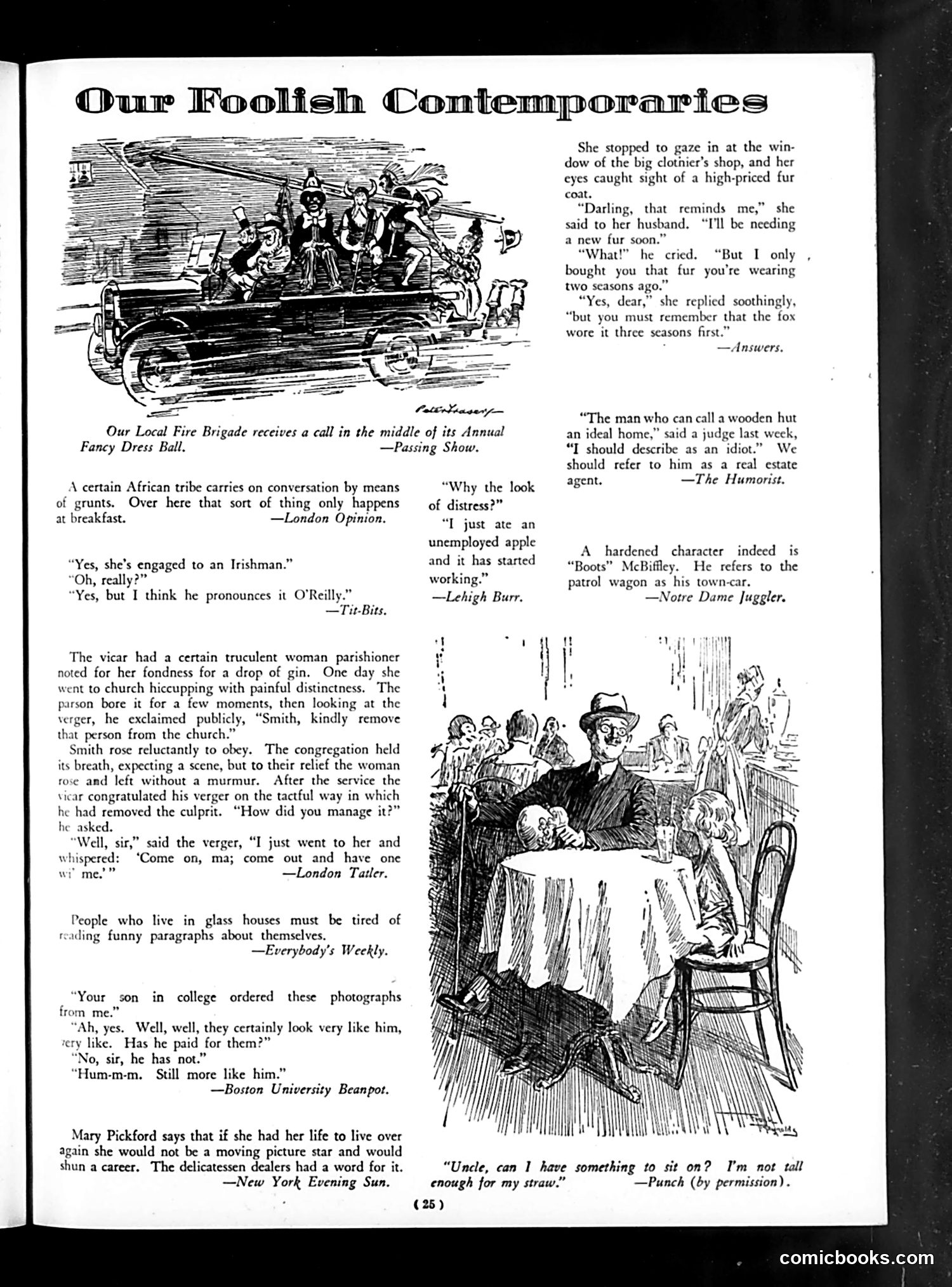
"Our Foolish Contemporaries" - Life Magazine Humor Page This is a collection of short jokes and quips satirizing contemporary follies. Key examples: The fur coat joke mocks women's fashion extravagance—a wife demands a new fur coat every two seasons, justifying it by noting the original fox wore it first. The satire targets both female materialism and husbands' resigned acceptance. The fire brigade cartoon shows firefighters in fancy dress costumes receiving an emergency call mid-ball—visual humor about conflicting duties. The various brief anecdotes ridicule specific types: an Irish pronunciation joke, a drunk parishioner removed from church, people in glass houses (privacy hypocrisy), a college son ordering unpaid photographs, and Mary Pickford rejecting stardom. The bottom illustration shows a child too short to reach a straw in a drink—gentle humor about childhood frustrations. The page's title—"Our Foolish Contemporaries"—indicates Life's editorial stance: gentle mockery of modern manners, gender relations, and social pretensions typical of early 20th-century American satire.
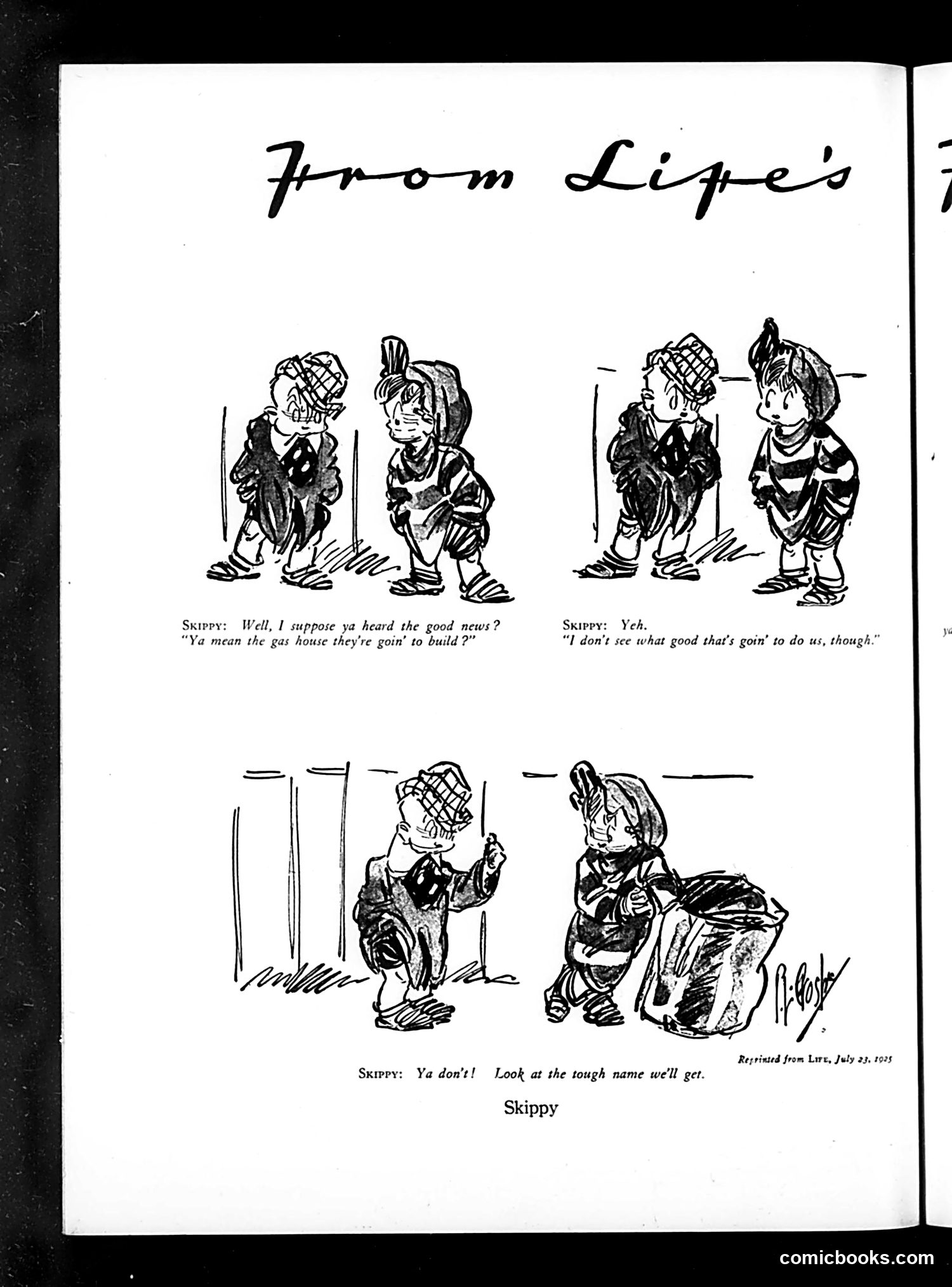
"Skippy" Comic Analysis This is a 1925 comic strip from *Life* magazine featuring the character Skippy, a streetwise kid. The joke concerns a proposed gas house being built in the neighborhood. Two children discuss the construction news. One asks what good a gas house does for them—a fair practical question. Skippy's response reveals the real appeal to street kids: the building will give their neighborhood a tough, rough reputation ("the tough name we'll get"). The humor satirizes how working-class urban youth valued street credibility and dangerous associations over actual community benefits. A gas house—industrial, polluting, and associated with rough labor—becomes desirable not for utility but for the hardened image it confers. The strip gently mocks both childish status-seeking and the gritty urban environment these kids inhabited.
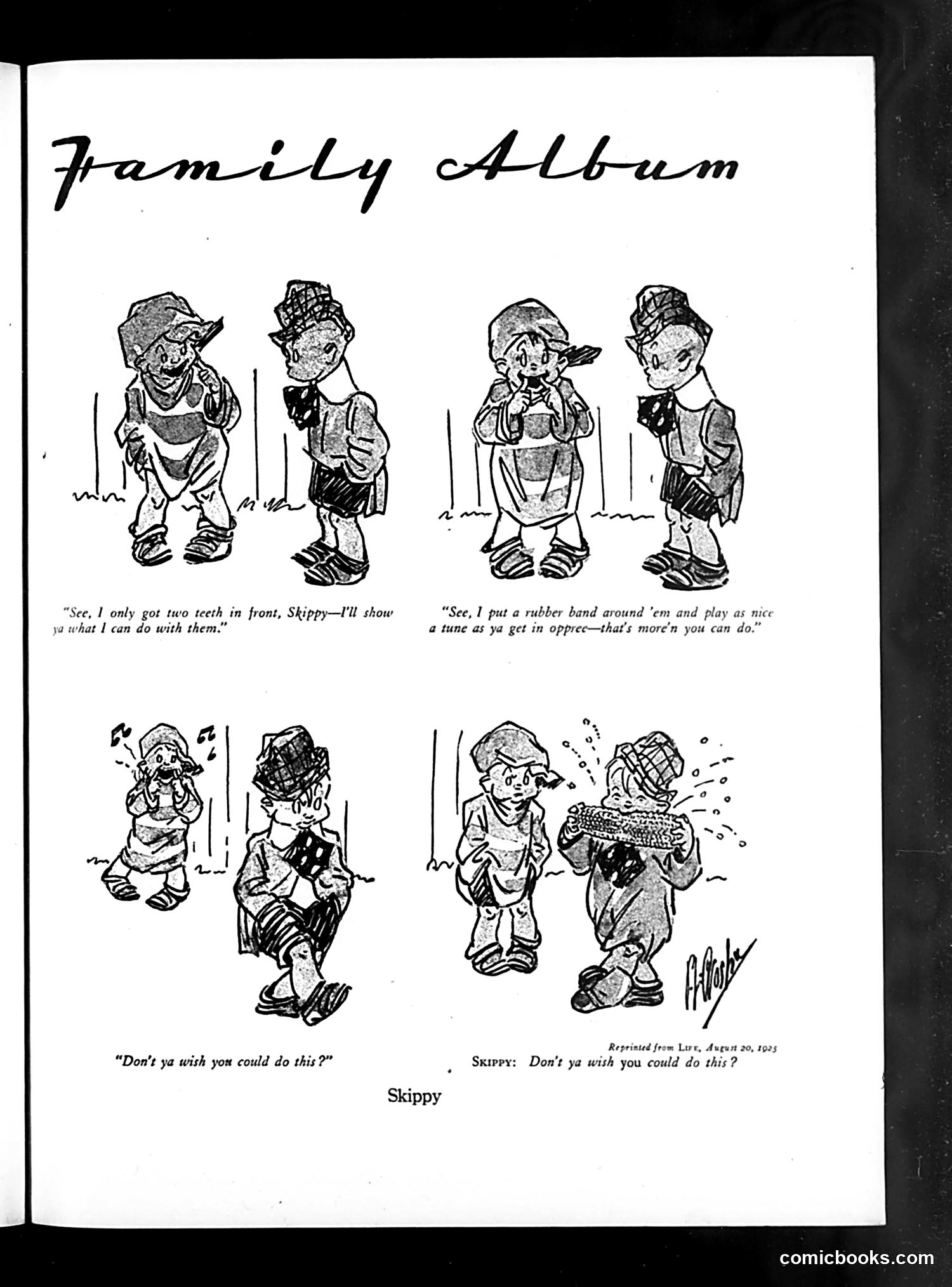
"Skippy" Comic Strip Analysis This is a humor strip featuring two young boys named Skippy and another character, likely from the 1920s comic "Skippy" by Percy Crosby. The strip depicts childish pranks and tooth-related antics typical of early 20th-century children's humor. The joke centers on physical peculiarities: one boy demonstrates gap teeth and shows off tricks he can perform with them (likely making whistling or clicking sounds). The second boy responds by putting a rubber band around his teeth to mimic the effect, claiming he can play tunes with it—thereby one-upping the first boy's boast. The final panel shows one boy catching a fish, with the caption "Don't ya wish you could do this?"—suggesting escalating competitive displays of (dubious) skills among boys. The humor relies on crude physical comedy and juvenile one-upmanship, typical of early newspaper comic strips aimed at family audiences.
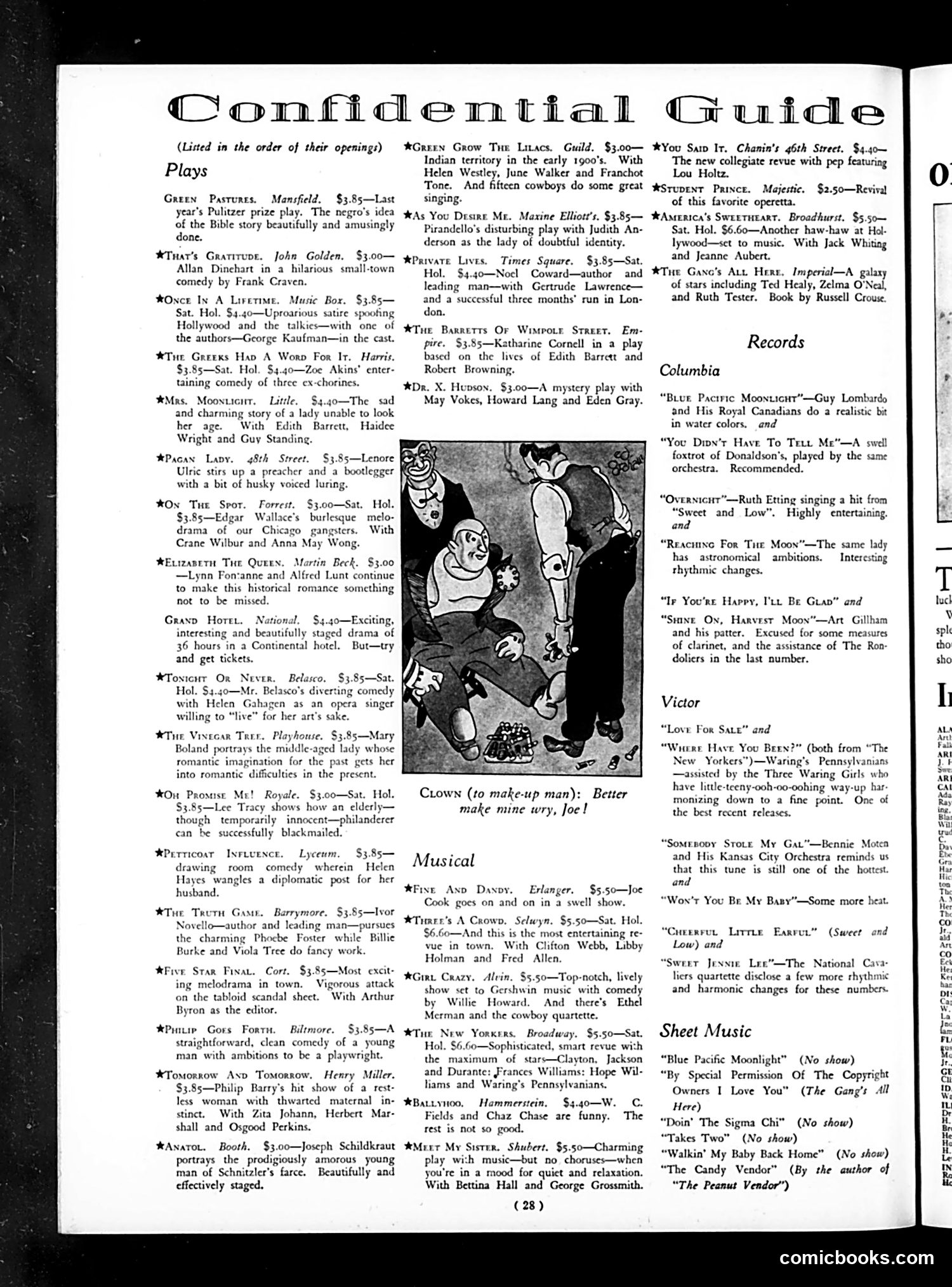
"Clowns (To Make-Up Man): Better Make Mine Wry, Joe!" This page is a theater guide listing Broadway plays with prices and brief descriptions. The cartoon shows three theatrical clowns or comedians in exaggerated makeup and costume, addressing a makeup artist named Joe. The humor appears to be a self-referential joke about theatrical performance itself: the clowns are requesting their makeup be made "wry" (twisted, sour-faced) rather than conventionally cheerful—a commentary on comedians' craft and the irony that making people laugh often requires portraying sadness or grotesque expressions. The image illustrates the performative nature of comedy in 1920s theater, where physical appearance and makeup were central to comedic effect.
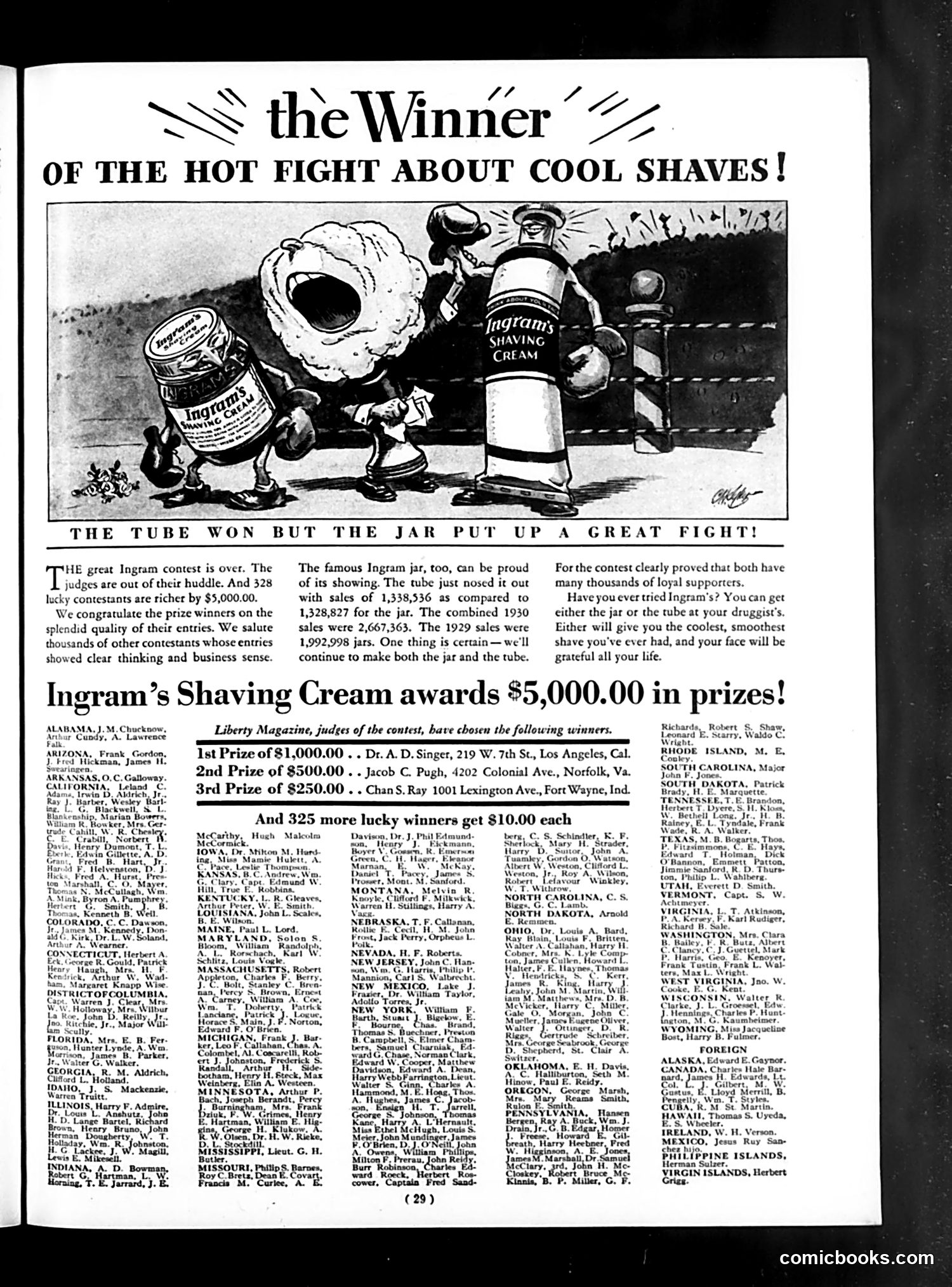
Ingram's Shaving Cream Contest Advertisement This page announces results of a major 1930 marketing contest by Ingram's Shaving Cream, judged by *Liberty Magazine*. The cartoon depicts a boxing match between a tube and jar of shaving cream—the two product formats competing for sales dominance. The joke: The tube "won" the sales competition (1,338,536 vs. 1,328,827 units), but the jar "put up a great fight," emphasizing both remain valuable products. This anthropomorphizes packaging into combatants. The context: This reflects 1930s consumer product marketing, when manufacturers used contests and dramatic narratives to drive sales. The "hot fight" framing made a mundane business outcome entertaining and memorable. The bulk of the page lists 328 prize winners across U.S. states and territories, with first prize being $1,000. This was significant money during the Depression, incentivizing consumer participation and brand loyalty through the contest mechanism.
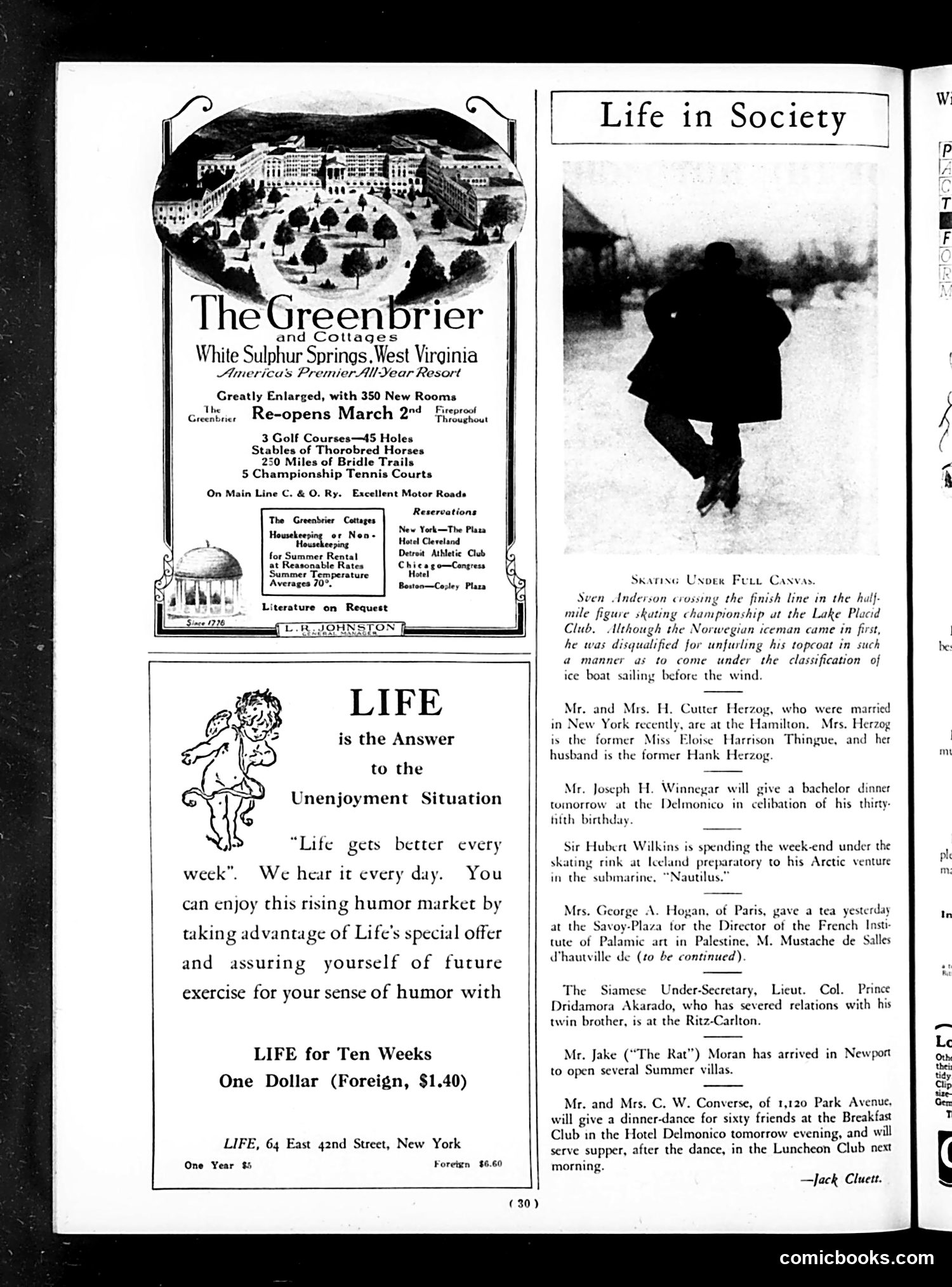
Explanation for Modern Readers This page combines resort advertising with Life magazine's satirical "Life in Society" gossip column and humor. The Greenbrier ad (top left) promotes a luxury West Virginia resort reopening with 350 new rooms—typical 1920s-30s advertising. The "LIFE is the Answer" cartoon (center-left) uses a cherub figure to satirize the magazine itself as a remedy for unhappiness. The tagline "Life gets better every week" mocks both optimistic platitudes and Life's own marketing pitch for subscriptions at one dollar for ten weeks. The "Skating Under Full Canvas" photo caption (right) is pure absurdist humor—it mocks society-page reporting by describing figure skater Sven Anderson's disqualification for "unfurling his topcoat" as "ice boat sailing," treating a coat-flap as a sailing violation. This exemplifies Life's style: taking trivial high-society events and treating them with mock-serious sports commentary for comedic effect. The "Life in Society" section reports fabricated or exaggerated names and events in the same deadpan manner.
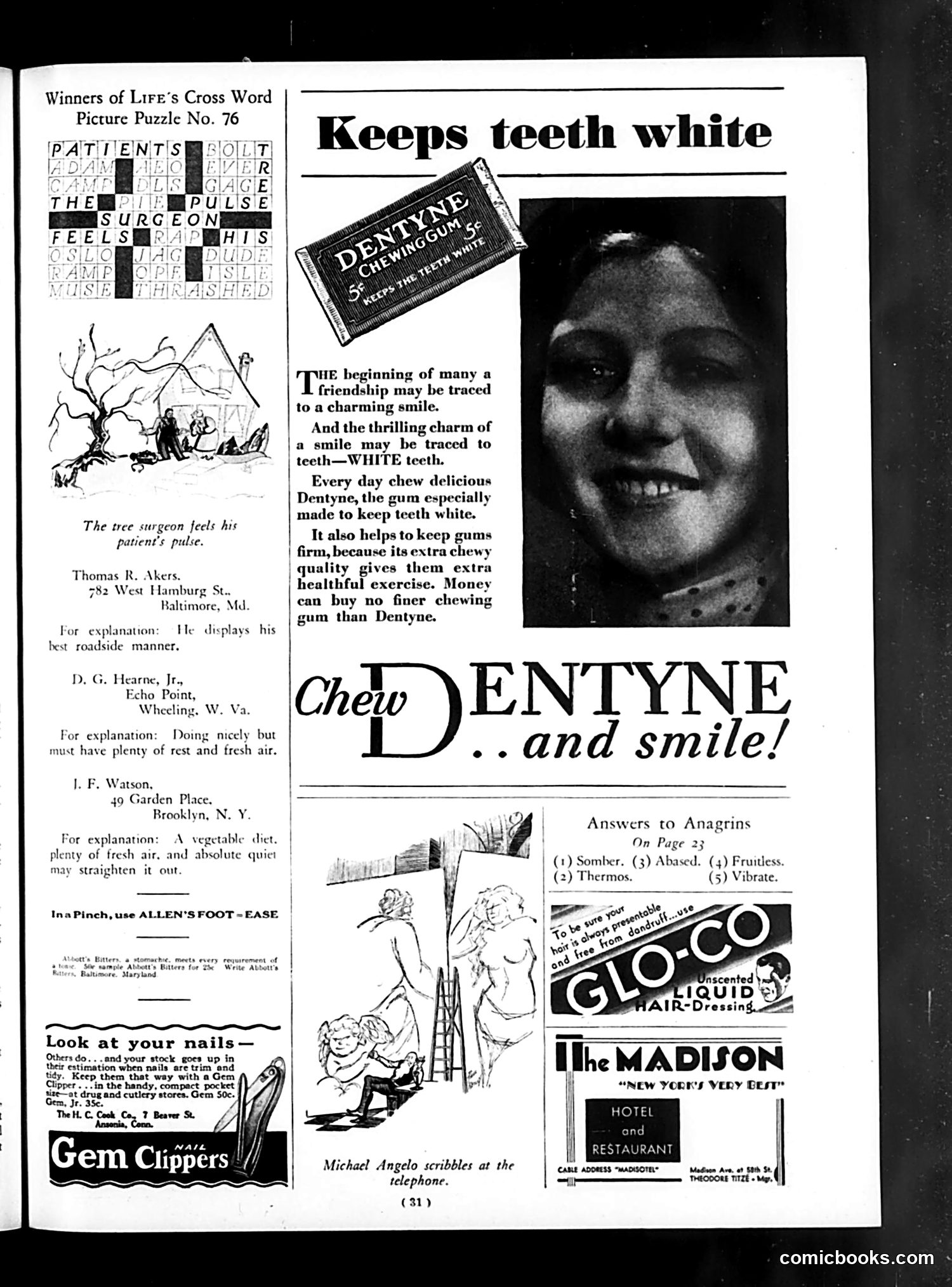
Analysis for Modern Readers This page is primarily advertisements and contest winners, not political satire. The main content shows winners of Life magazine's crossword puzzle contest (No. 76), with three explanations for a cartoon depicting "a tree surgeon feeling his patient's pulse." The cartoon joke plays on the double meaning: a tree surgeon treating a sick tree like a medical doctor treats a patient—displaying "bedside manner" to the tree. The humor is gentle wordplay rather than social commentary. The bulk of the page consists of period advertisements: Dentyne chewing gum (emphasizing whitening teeth), Allen's Foot-Ease, Gem Clippers (nail care), Glo-Co hair dressing, and The Madison Hotel. These ads are typical of early 20th-century Life, which blended humor, contests, and advertising. There is no significant political or satirical content here—it's a typical magazine filler page showcasing consumer products and reader participation contests.
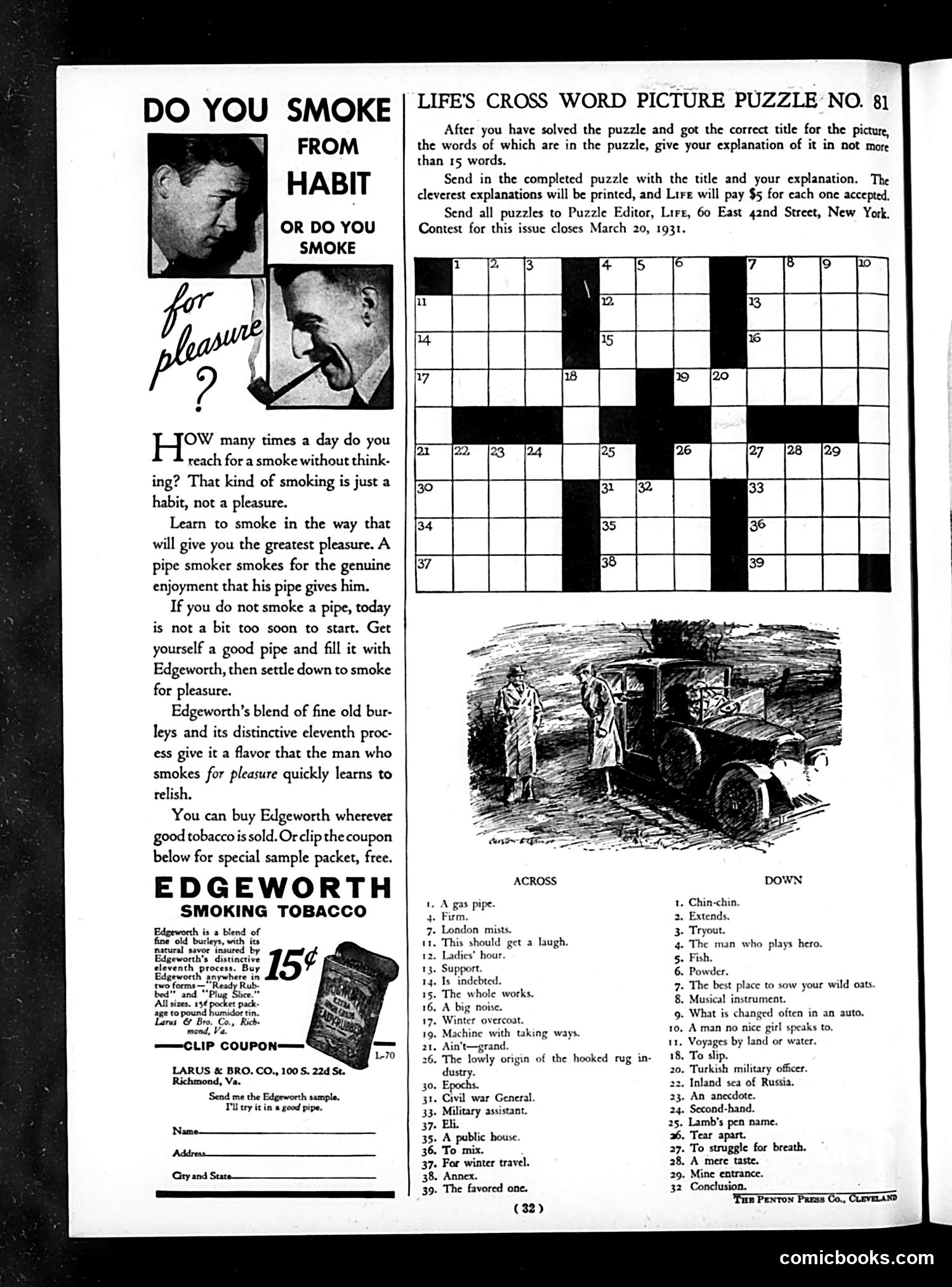
Life Magazine, March 1931: Anti-Smoking Advertisement & Crossword Puzzle This page combines a public health message with product advertising—a contradiction typical of the era. The left side features an anti-smoking PSA, arguing that casual, habitual smoking is mere addiction, not pleasure. It advocates switching to pipe smoking, framed as more intentional and enjoyable. This moralizing tone reflects 1930s health concerns about smoking dependency. However, the advertisement immediately contradicts this message by promoting Edgeworth brand pipe tobacco, claiming its special "eleventh process" creates superior flavor for "pleasure smoking." The ad even offers a free sample coupon. The right side is a crossword puzzle contest tied to a rural/agricultural illustration (showing a truck and farm scene), with $5 prizes for clever solutions—a common reader engagement tactic. The irony: Life simultaneously warns against smoking habit while selling the very product it recommends as the "solution," revealing how advertising and editorial content coexisted uneasily in Depression-era magazines.
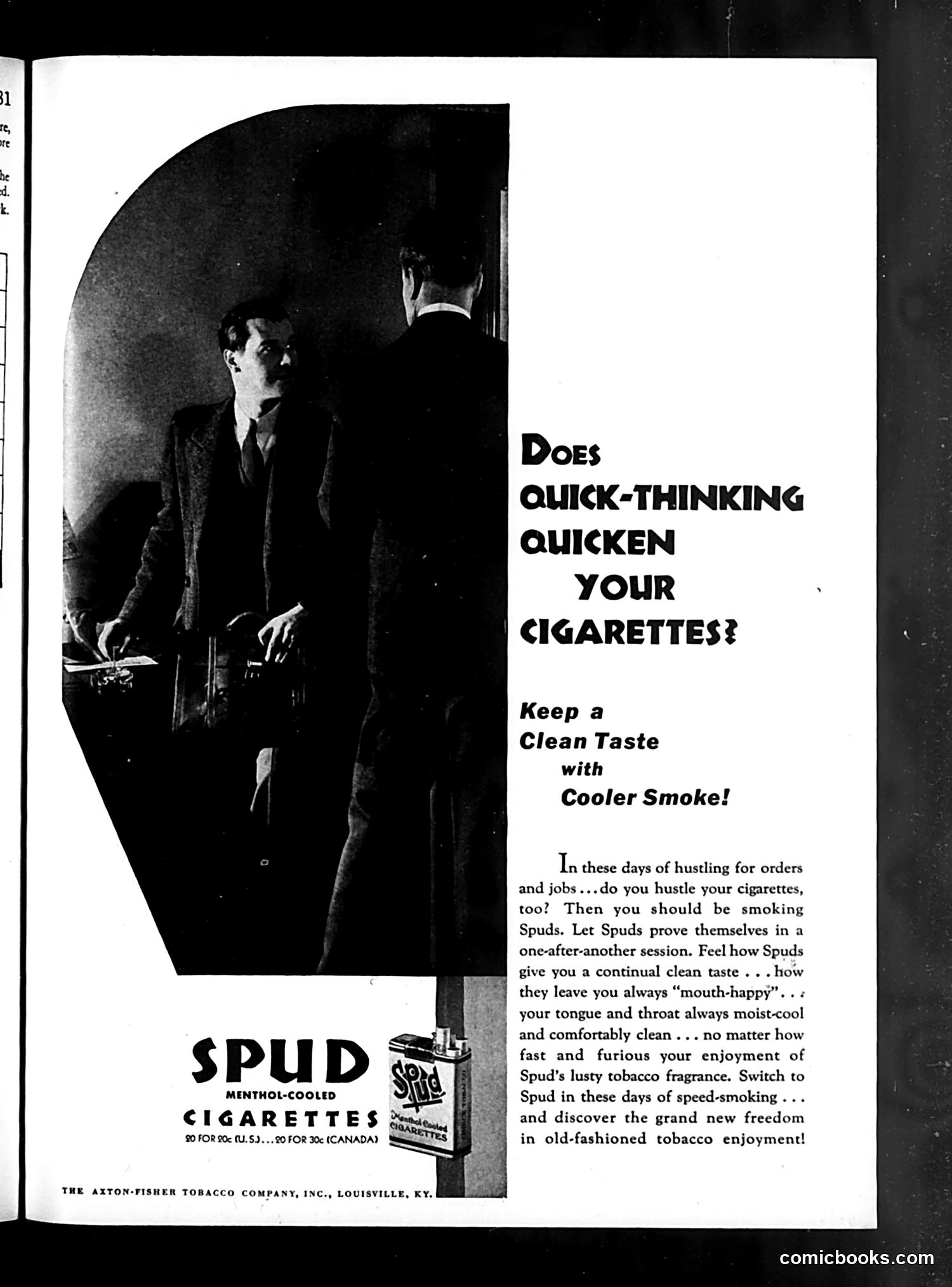
Spud Cigarettes Advertisement This is a cigarette advertisement, not satire or political commentary. It promotes Spud menthol-cooled cigarettes to a Depression-era audience. The image shows a businessman in an office setting, likely representing the "hustling" worker referenced in the copy—someone working hard during economically difficult times ("these days of hustling for orders and jobs"). The ad's pitch targets this anxious worker: if you hustle your job, you should also "hustle" your cigarettes by smoking Spuds rapidly. The selling points are menthol cooling, a "clean taste," and keeping your mouth moist and comfortable during continuous smoking. The price point (20 cigarettes for 20 cents in the US) suggests mass-market affordability. The overall message frames smoking as a practical companion to modern, fast-paced work life—normalizing continuous cigarette consumption as a workplace necessity.
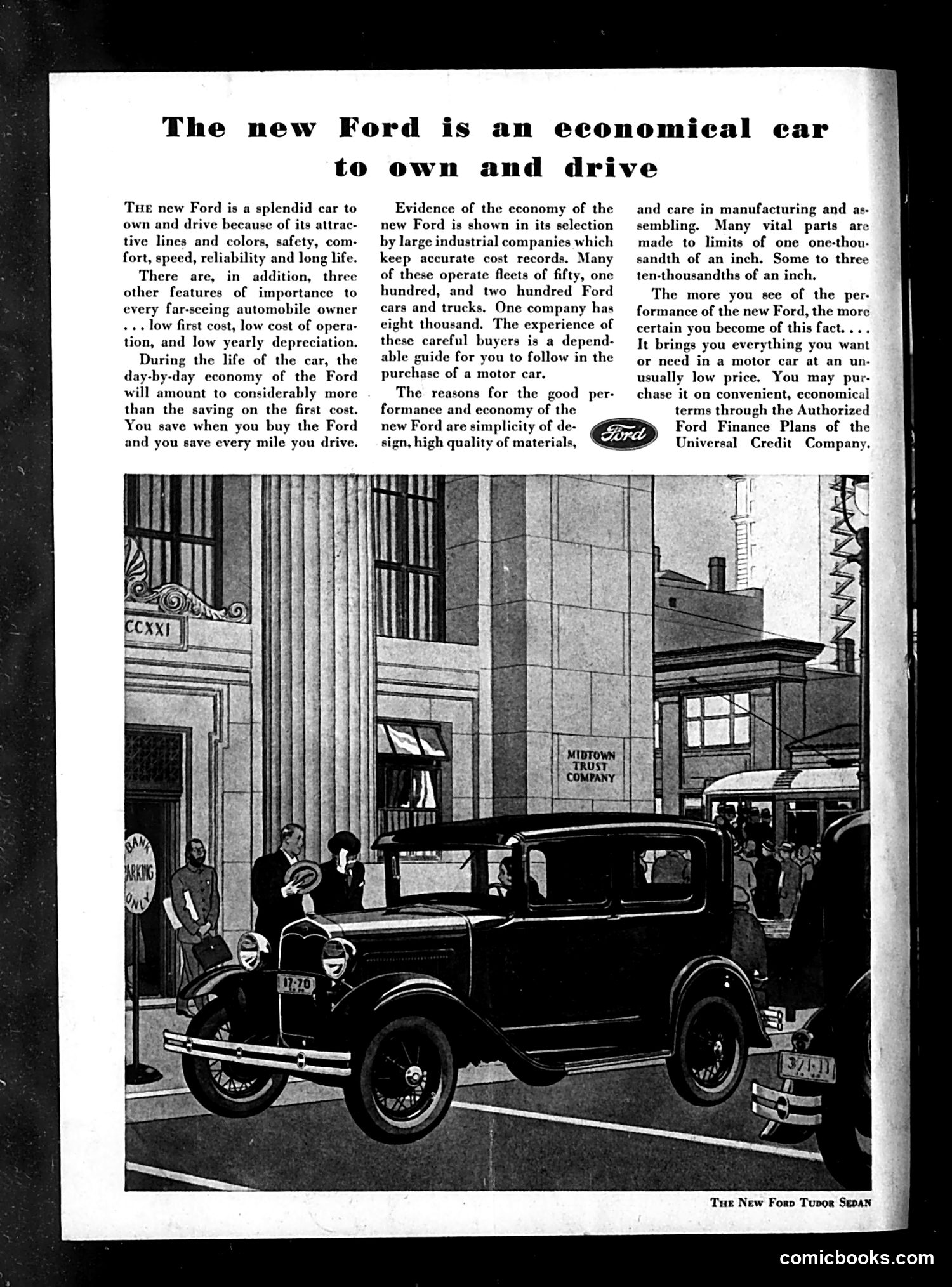
Analysis This is a Ford automobile advertisement, not a political cartoon. The page promotes the new Ford as economical to own and operate, emphasizing low purchase price, operational costs, and depreciation. The illustration shows a Ford Tudor Sedan parked on a city street outside what appears to be a bank (marked "TRUST COMPANY"), surrounded by well-dressed pedestrians and other vehicles. This imagery suggests the car's appeal to respectable, middle-class urban professionals. The advertisement's claims—simplicity of design, manufacturing precision, and fleet adoption by large companies—are presented as evidence of reliability and value. The reference to "Authorized Ford Finance Plans" indicates Depression-era consumer credit options. For modern readers: this represents 1920s-30s advertising positioning the mass-produced Ford as practical transportation for ordinary Americans, contrasting implied affordability against more expensive competitors.

I cannot reliably identify specific figures or satirical content from this image. The page is extremely dark and low-contrast, making text and visual details difficult to discern clearly. While I can see there appears to be a spiral or circular design element on the right side and some vertical marks on the left edge, I cannot confidently identify any cartoon characters, political figures, or specific satirical messages. The OCR text provided is largely illegible characters and doesn't offer contextual information to interpret the content. To accurately explain this page's meaning to a modern reader, I would need a clearer, higher-contrast version of the source material.