life
Life — March 6, 1931
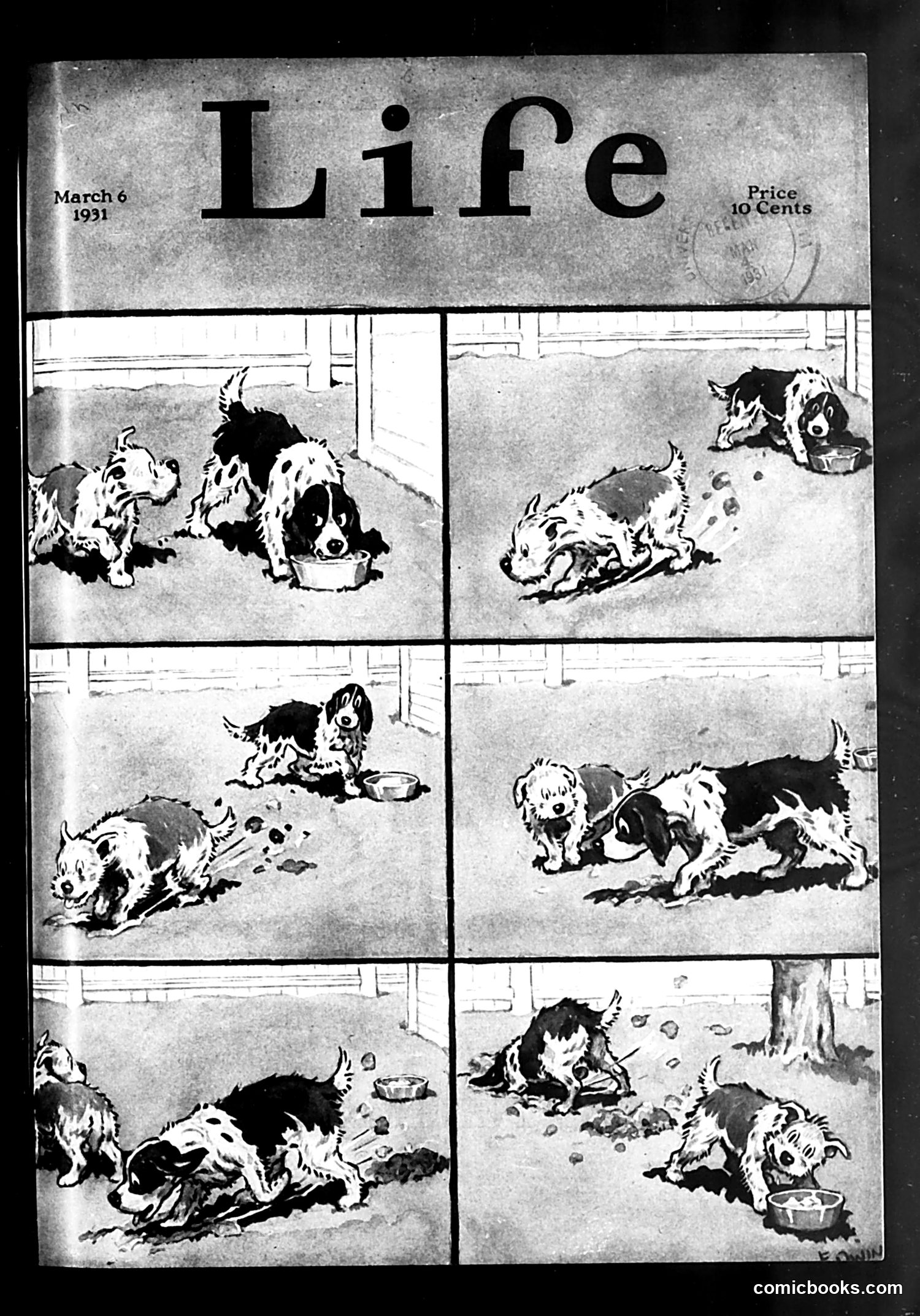
Life Magazine Cover, March 6, 1931 This is a six-panel comic strip depicting several small dogs (appearing to be terriers or similar breeds) competing for food from bowls. The narrative progresses from the dogs gathering peacefully around shared bowls, to pushing and shoving, to one dog dominating the food while others are excluded or displaced. Given the 1931 publication date (during the Great Depression), this appears to be social satire about economic competition and resource scarcity. The dogs likely represent people or classes competing for limited food and resources during widespread poverty. The visual joke shows how cooperation breaks down when necessities become scarce—a commentary on Depression-era desperation and the struggle for survival among the working poor.

Analysis This is primarily advertising content, not satire or political commentary. The page promotes the Canadian National Railway's "5-day Triangle Tour of the Canadian Rockies and Kitwanga." It features scenic photographs of mountain landscapes and Indigenous totem poles, along with descriptive text highlighting destinations like Jasper National Park and the "River of Clouds." The ad emphasizes leisure travel opportunities available to American club and church groups, offering free promotional films about Canadian scenery. The "strange land of the totem" reference reflects early 20th-century exoticization of Indigenous cultures for tourist appeal. This is straightforward travel marketing rather than satirical content—typical of Life magazine's advertising pages from this era.
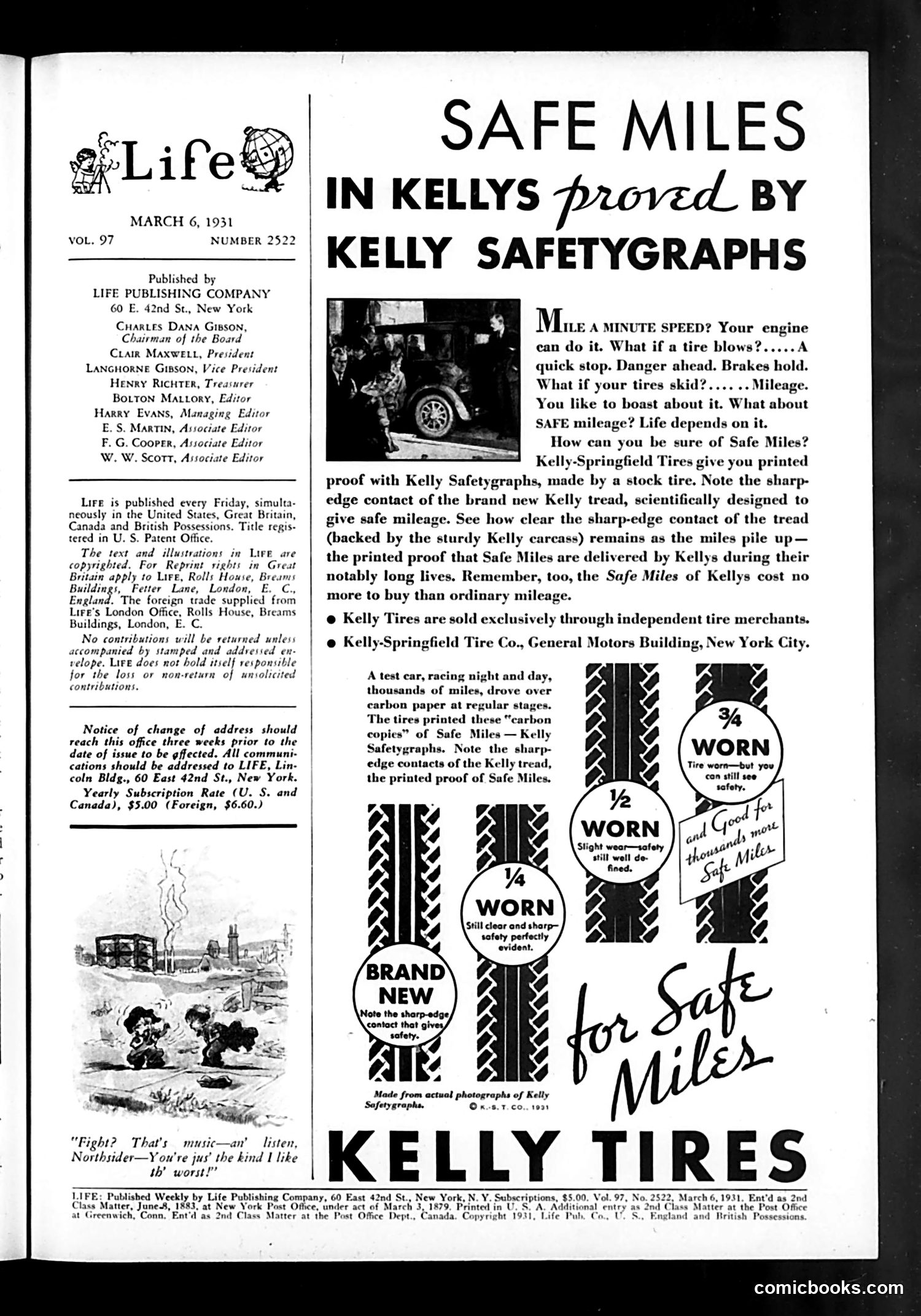
Analysis This page is primarily advertising, not satire or political commentary. It's a 1931 Life magazine ad for Kelly Tires promoting their "Safe Miles" tire technology. The content uses a visual demonstration technique: photographs of tire treads at different wear stages (brand new, 1/4 worn, 1/2 worn, 3/4 worn) to prove Kelly tires maintain safety performance throughout their lifespan. The accompanying text uses fear-based marketing—asking readers "What if a tire blows?" and "What if your tires skid?"—to persuade them that Kelly tires deliver reliable "Safe Miles" at no premium cost. The small cartoon at bottom left appears unrelated to the tire ad and may be a magazine feature.
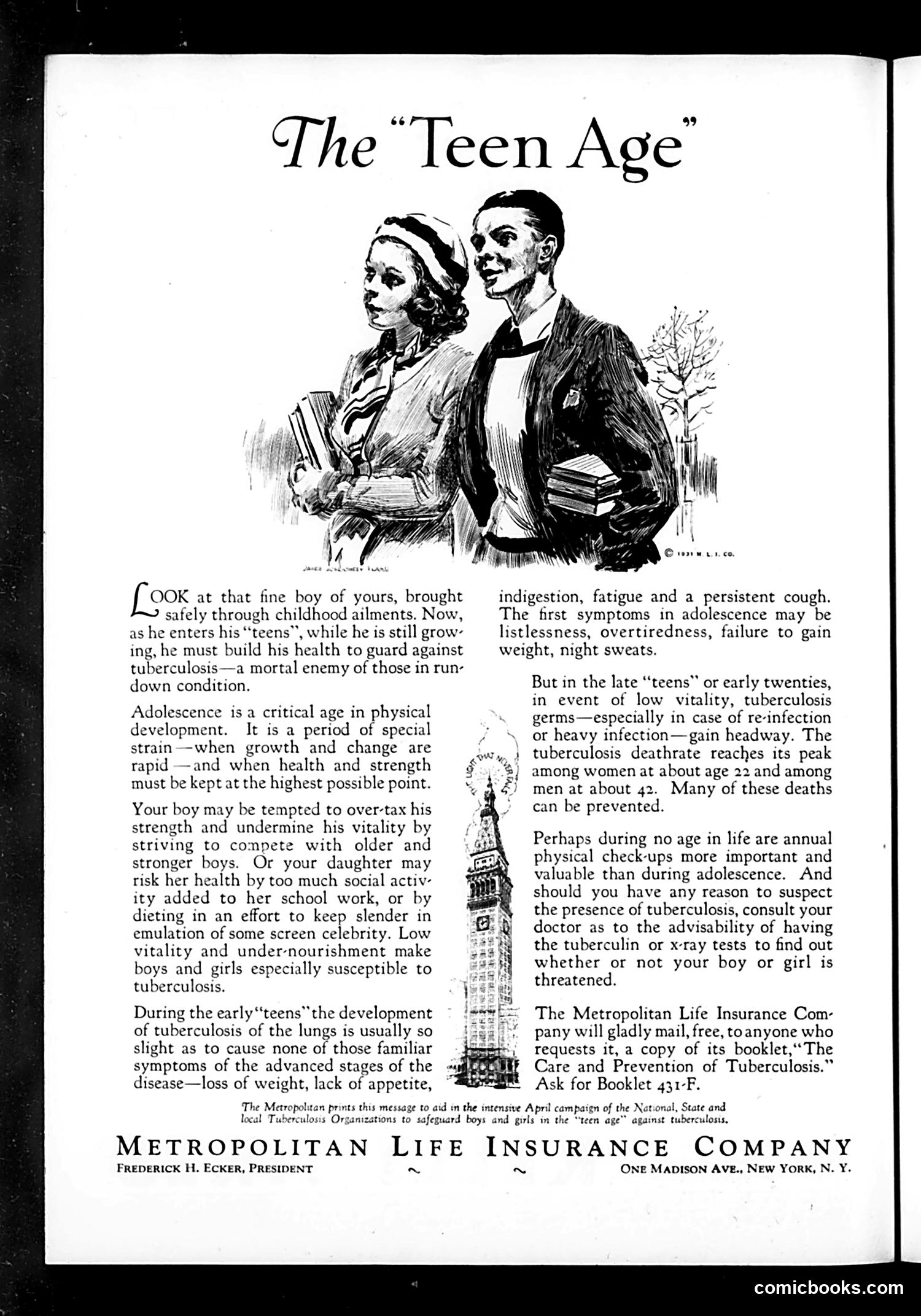
Analysis This is not a satirical cartoon page, but rather a public health advertisement by Metropolitan Life Insurance Company addressing tuberculosis risk in teenagers. The illustration shows a well-dressed young man and woman, representing healthy adolescents. The accompanying text warns parents that the "teen age" is a critical health period when tuberculosis—then a major killer—poses particular danger due to rapid physical development and potential overexertion from social activities or school work. The message is straightforward health advocacy: teens need physical check-ups, proper nutrition, and rest to build resistance against tuberculosis. The company offers a free booklet on tuberculosis prevention. This reflects the early 20th-century context when TB was epidemic and insurance companies positioned themselves as civic health educators, not satirists.
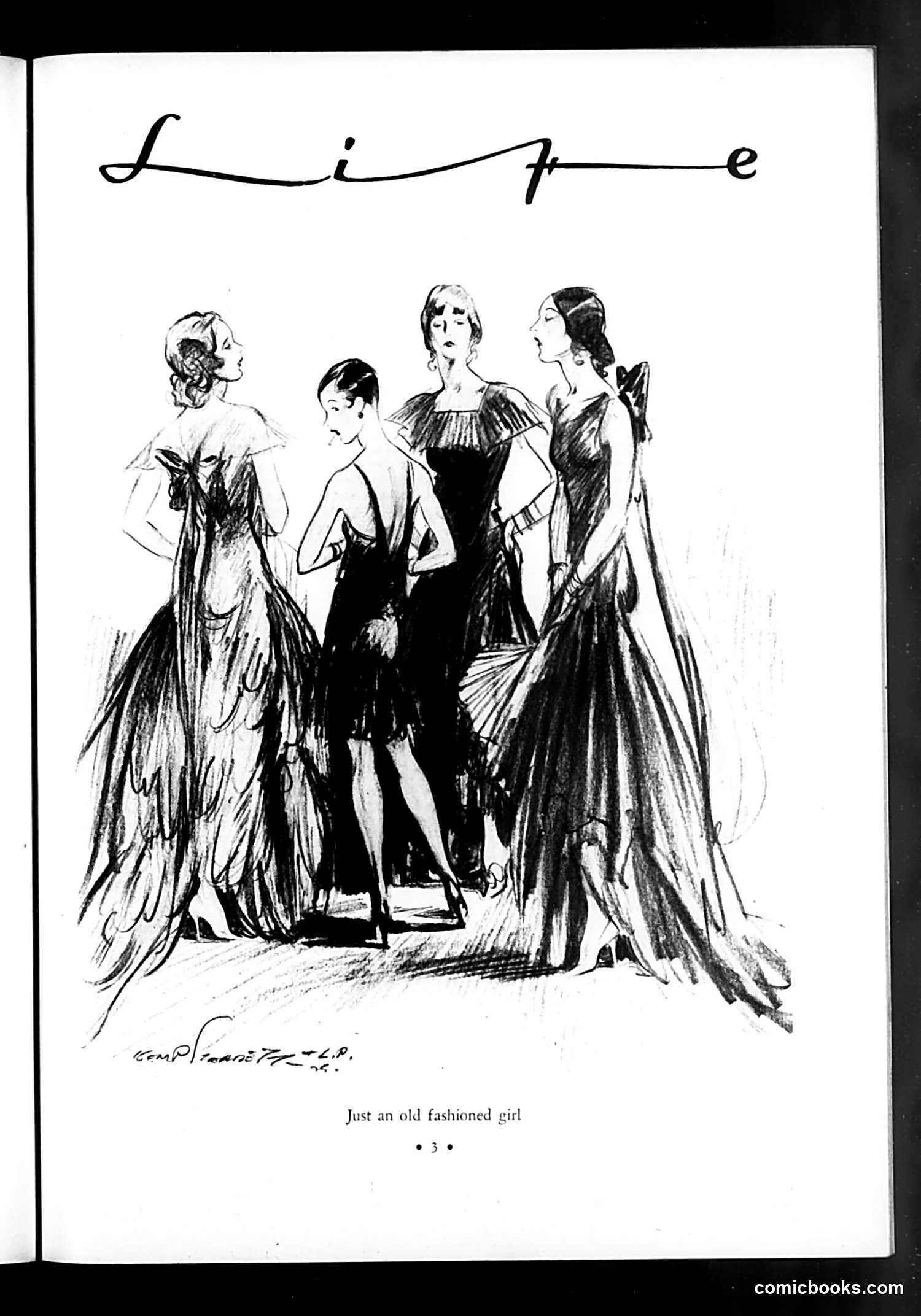
Analysis of "Life" Magazine Page This page from *Life* magazine features an illustration titled "Just an old fashioned girl" showing four women in elegant evening wear from what appears to be the 1920s era. The sketch depicts women in fashionable flapper-style dresses with flowing fabrics and period hairstyles. The satire likely mocks the contrast between traditional femininity and the modern "flapper" movement of the 1920s. The title's ironic tone suggests the illustration critiques women who claim to embody old-fashioned values while actually displaying contemporary fashion and attitudes. The elegant, somewhat exaggerated poses and styling emphasize the disconnect between nostalgic self-presentation and actual modern behavior—a common satirical theme in *Life* magazine's commentary on changing social norms and women's roles during this era.
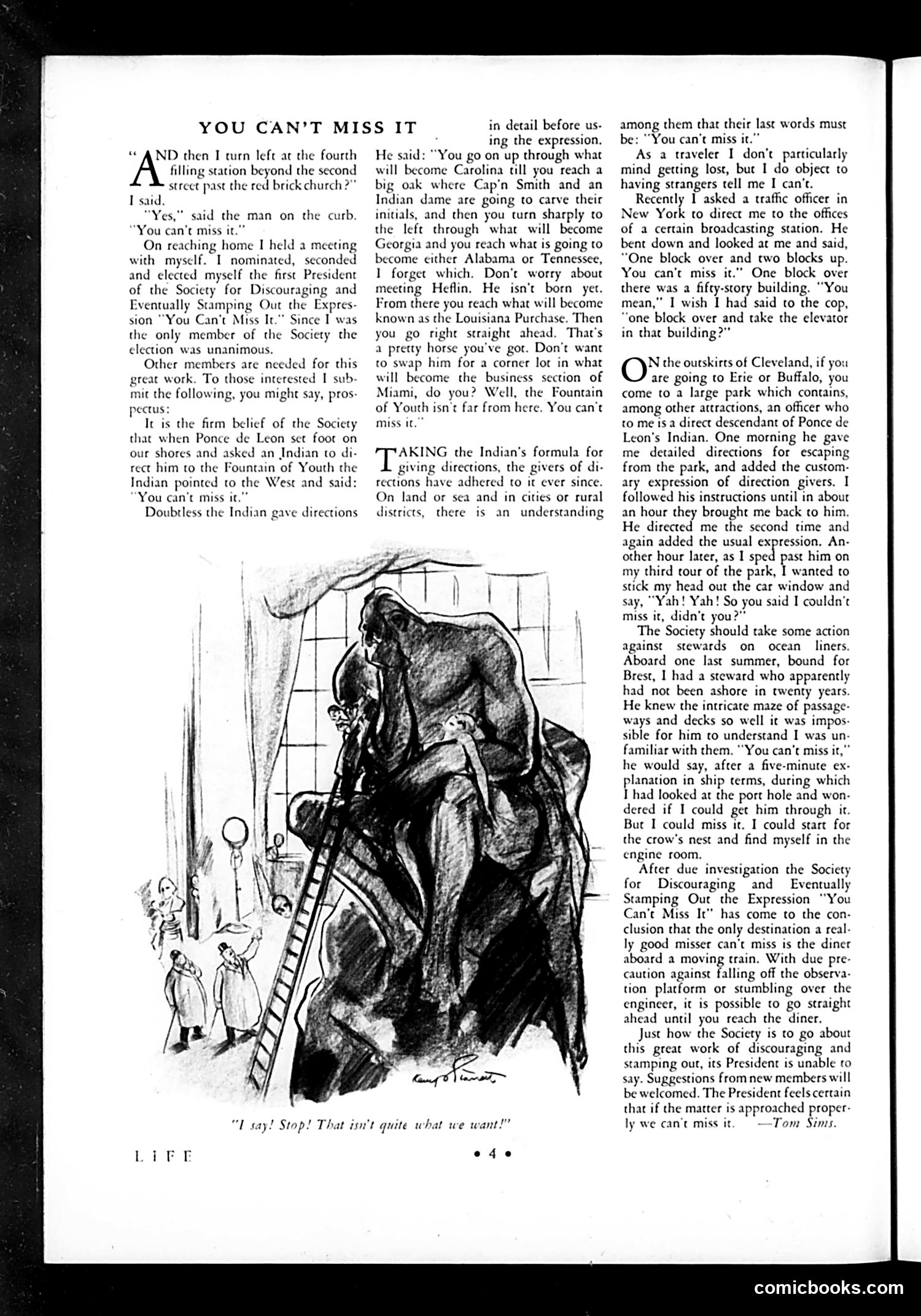
Analysis of "You Can't Miss It" This satirical piece by Tom Simi mocks the phrase "You can't miss it" as useless directions. The article traces how this expression became standardized through an apocryphal story: a Native American allegedly gave directions to the Fountain of Youth, telling someone to "go right straight ahead" and turn at various landmarks that would eventually become Alabama, Tennessee, and the Louisiana Purchase—clearly absurd, retroactive geography. The accompanying cartoon depicts people attempting to follow poorly-marked directions, with a massive figure towering over them. The satire criticizes how this meaningless phrase persists despite being demonstrably unhelpful. The piece concludes by suggesting that "You can't miss it" is the only reliable destination on a moving train's diner car—a final joke about inescapable, unavoidable outcomes versus genuinely useful guidance.
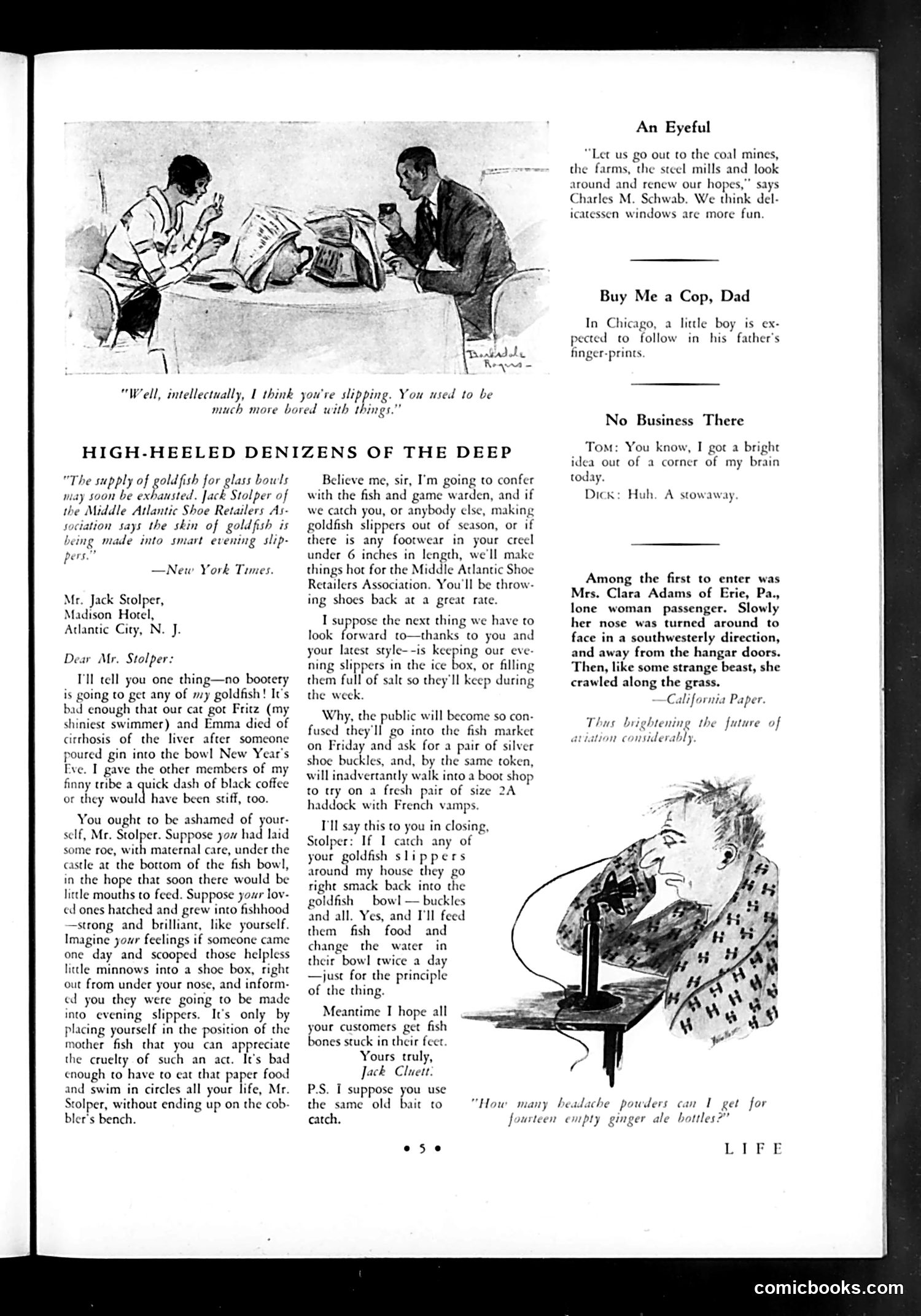
Analysis of Life Magazine Page Top Cartoon: Shows a man and woman at a table. The woman says the man is "slipping" intellectually and "used to be much more bored with things." This appears to be satirizing how intellectual pursuits or growing interests can damage romantic relationships—the joke being that boredom was actually preferable to a partner. Main Article: "High-Heeled Denizens of the Deep" is a humorous letter-exchange mocking the Middle Atlantic Shoe Retailers Association's proposal to make goldfish slippers. The satirist Jack Closett ridiculously elaborates on this absurd product idea, suggesting goldfish would need salt water maintenance and warning of confusion with actual fish markets. Bottom Section: Contains brief humorous items ("Buy Me a Cop, Dad," "No Business There") and a cartoon about headache powders.
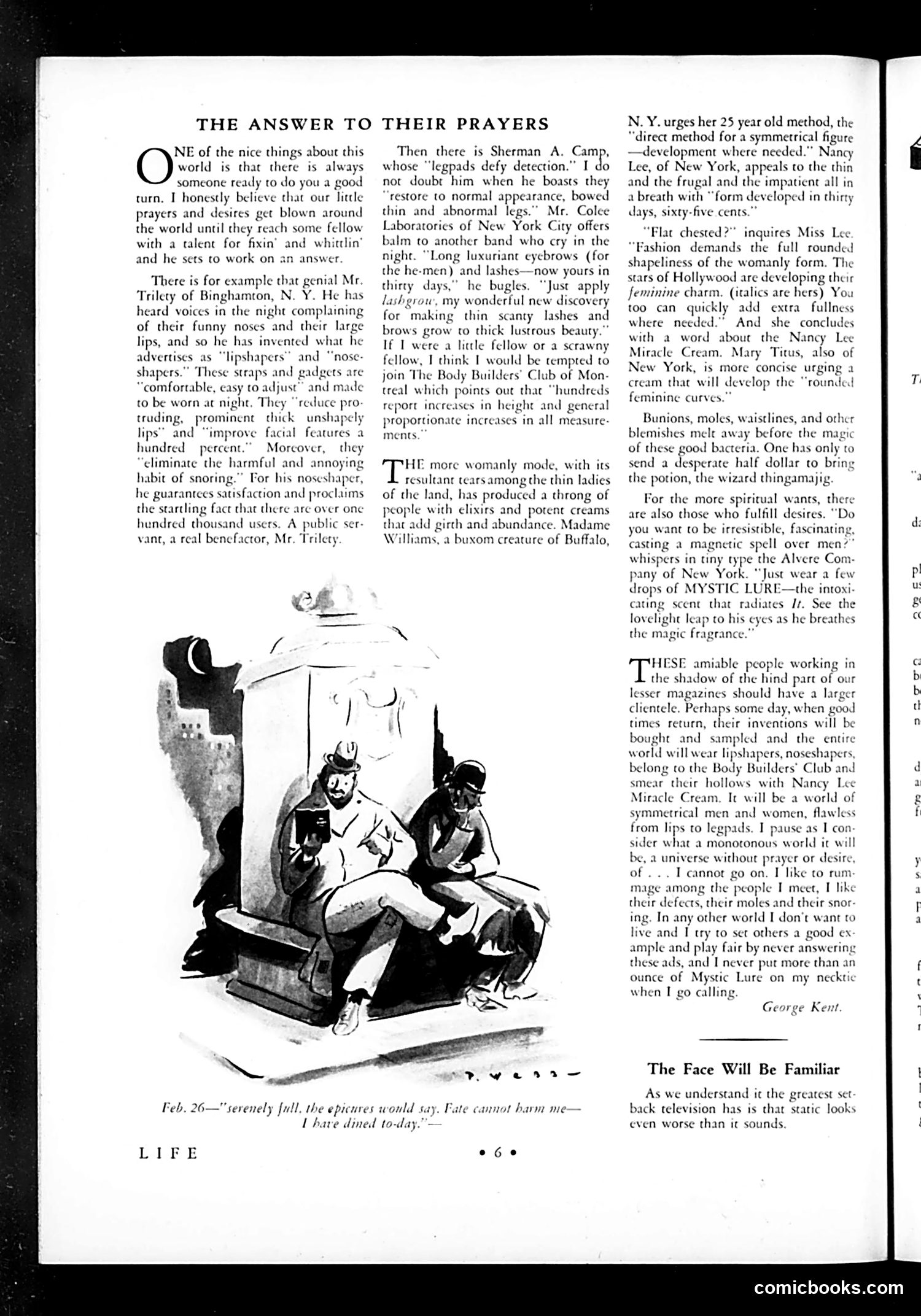
Analysis of Life Magazine Page This page satirizes beauty product advertising and the absurd claims made by cosmetic companies in early 20th-century magazines. The left column mocks Mr. Trilby, a fictional beautician who sells dubious products like "Noseshapers" and "lipshapers" to desperate consumers. The cartoon illustrates gullible women consulting with what appears to be a quack doctor or charlatan, suggesting the comedic desperation behind such purchases. The right column continues the satire, mentioning specific fake products like "Nancy Lee Miracle Cream" and "Mystic Lure" perfume—absurdly promised to make women "irresistible" to men. The article's conclusion by George Kent critiques how these magazine ads prey on insecurities, noting he refuses to promote such fraudulent products despite their prevalence in publications like Life itself.
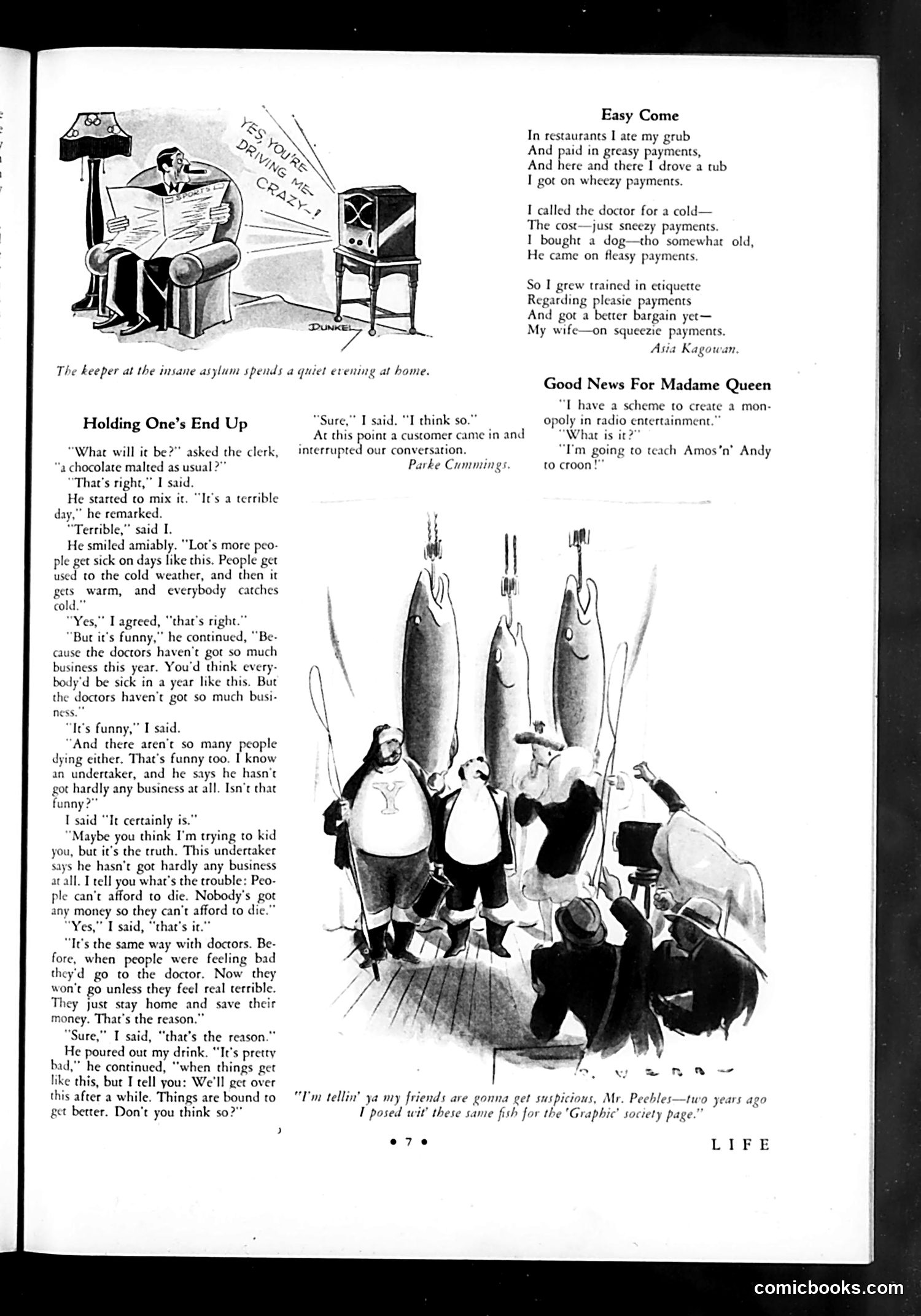
Page Analysis: Life Magazine Humor This page contains three separate humorous pieces typical of Life's satirical content: 1. "Holding One's End Up": A dialogue-based joke about a clerk ordering a chocolate malt during bad weather. The humor derives from economic anxiety—the customer and clerk discuss how illness and death reduce business, noting people can't afford to die because "nobody's got any money so they can't afford to die." This reflects Depression-era financial stress, where even mortality was economically problematic. 2. "Easy Come": A poem about accumulating debt through installment payments—buying dogs and tubs on "wheezy payments," exemplifying consumer credit culture's burden. 3. "Good News For Madame Queen": A brief exchange about radio monopoly schemes, likely satirizing corporate consolidation. The cartoons humorously depict financial hardship and consumer debt anxiety prevalent in this era.
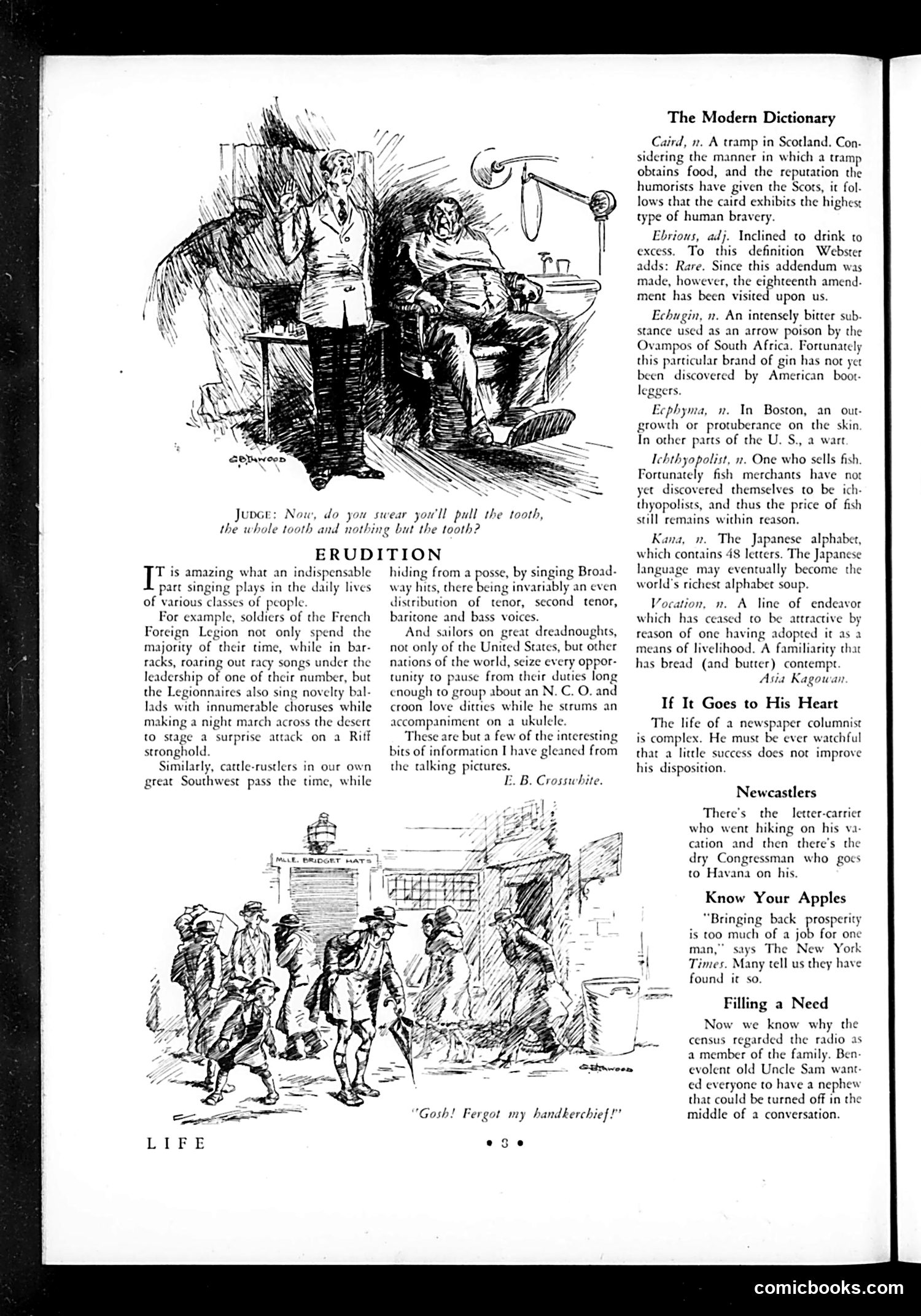
Life Magazine Page Analysis This page contains two satirical cartoons and dictionary definitions mocking various human behaviors and professions. The top cartoon depicts a judge interrogating someone about tooth extraction, with the caption "Now, do you swear you'll pull the tooth, the whole tooth and nothing but the tooth?" It satirizes courtroom oath-taking by applying it absurdly to dentistry. The bottom cartoon shows men outside what appears to be a building, with one saying "Gosh! Forgot my handkerchief!" This appears to mock absent-minded forgetfulness or social awkwardness. "The Modern Dictionary" section humorously defines occupations and conditions—including "caird" (Scottish tramp), "ebrious" (habitual drunkard), "ichthyopolist" (fish seller), and others—offering satirical commentary on various social types and their characteristics. The overall page uses humor to critique human folly and social pretension.
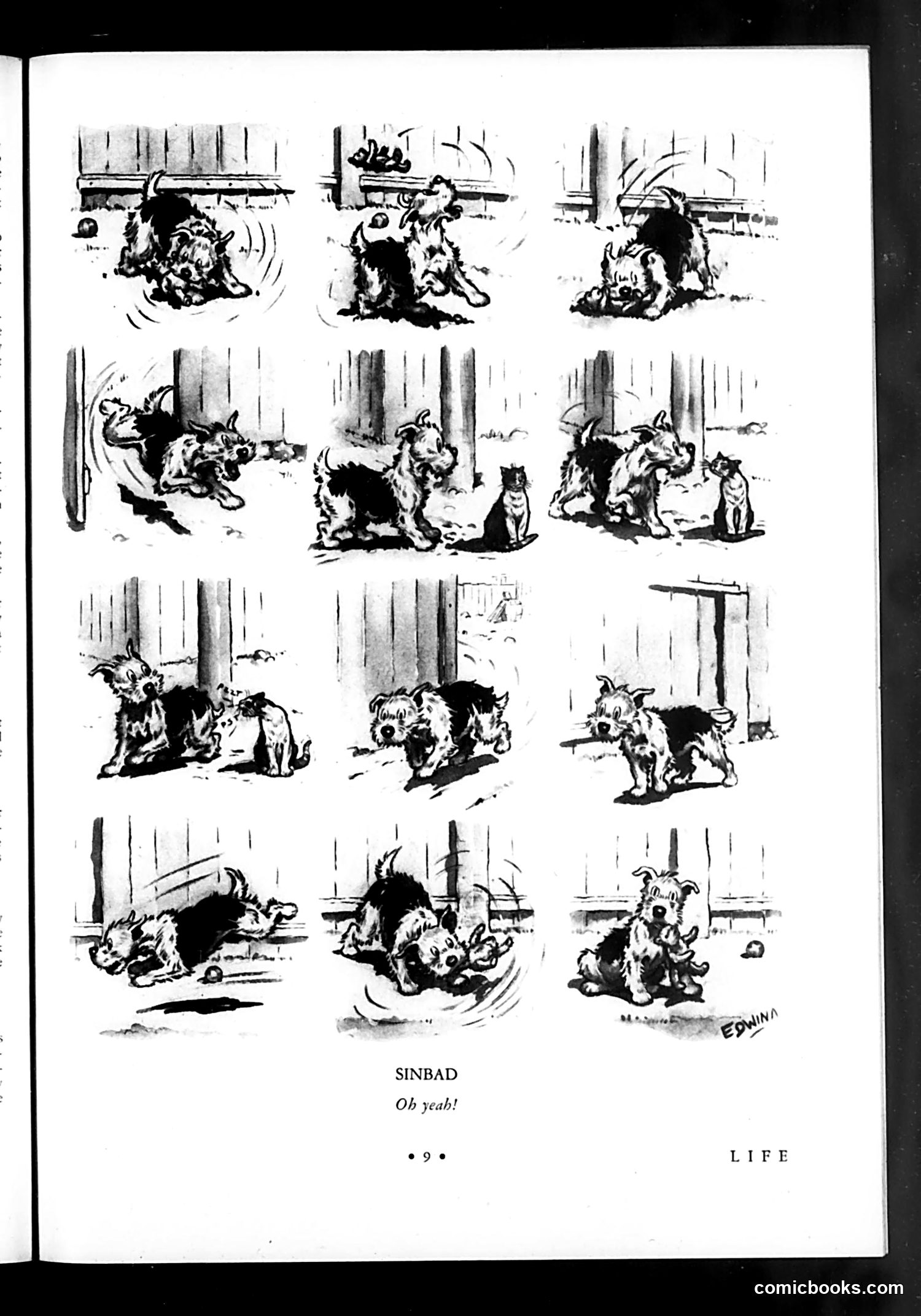
Analysis of "Sinbad" Comic Strip This is a comic strip titled "Sinbad" with the caption "Oh yeah!" showing a shaggy dog character in various scenes around what appears to be a dock or waterfront setting with wooden posts and railings. The strip depicts slapstick humor involving the dog getting into physical mishaps—being knocked around, tangled up, and generally roughhoused by its environment and circumstance. The humor is purely visual and physical rather than satirical. Without additional context about what "Sinbad" references or represents (whether it's a character from Arabian tales, a contemporary public figure, or simply a named dog character), the specific political or social commentary, if any, remains unclear from the image alone. The humor appears to be general comedic entertainment rather than pointed satire.
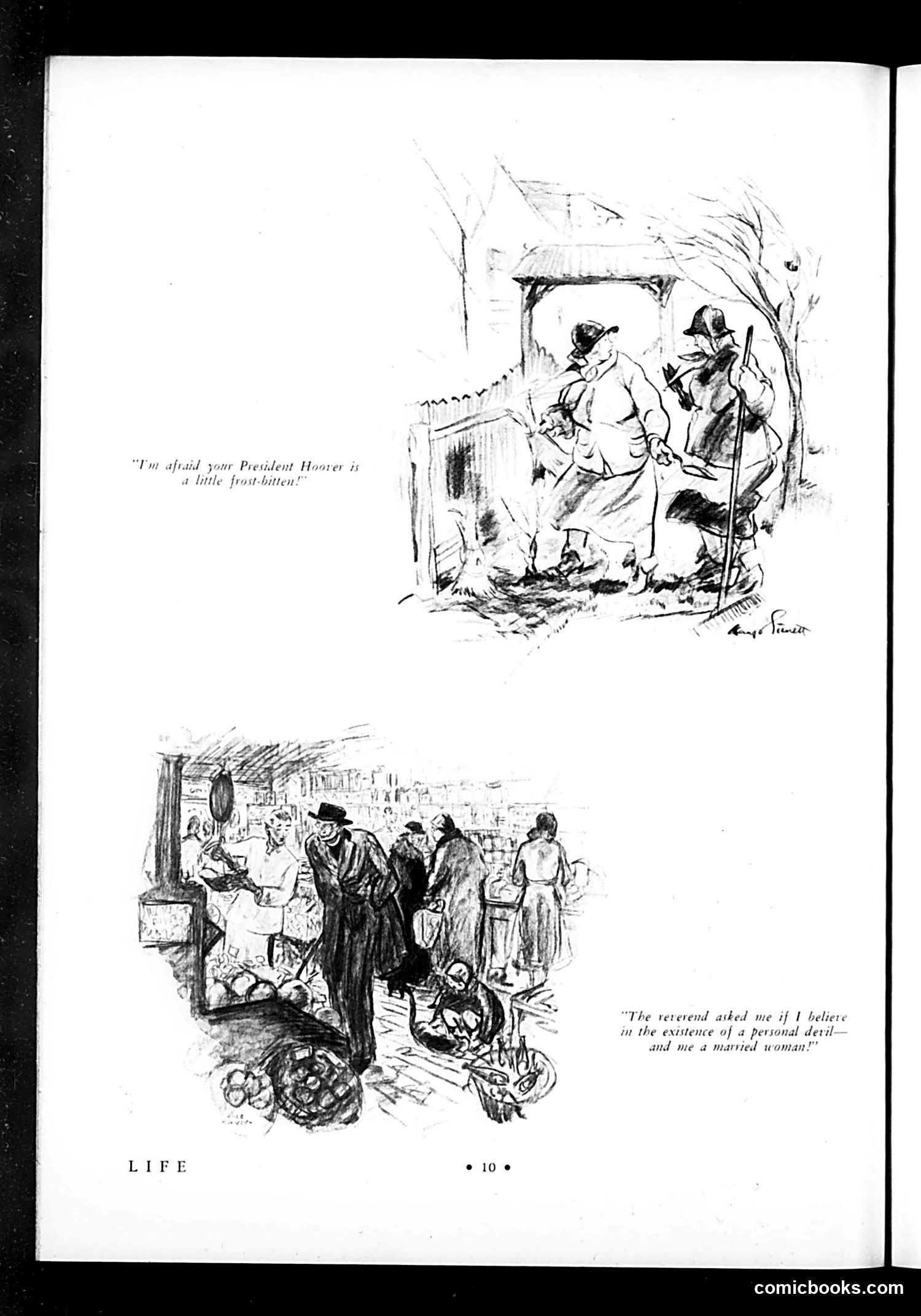
Life Magazine Page 10 - Political Satire This page contains two cartoons satirizing President Hoover during what appears to be the Great Depression era. Top cartoon: Someone warns that "President Hoover is a little frost-bitten"—likely referring to Hoover's cold, detached public persona during the economic crisis, or his perceived indifference to citizens' suffering. Bottom cartoon: A reverend asks a married woman if she "believes in the existence of a personal devil," and she responds by mentioning her husband—dark humor suggesting domestic unhappiness. The crowded street scene implies widespread social struggle. Both cartoons employ cynical humor typical of Life's satirical approach, combining personal domestic troubles with broader social commentary about the era's hardships and leadership failures.
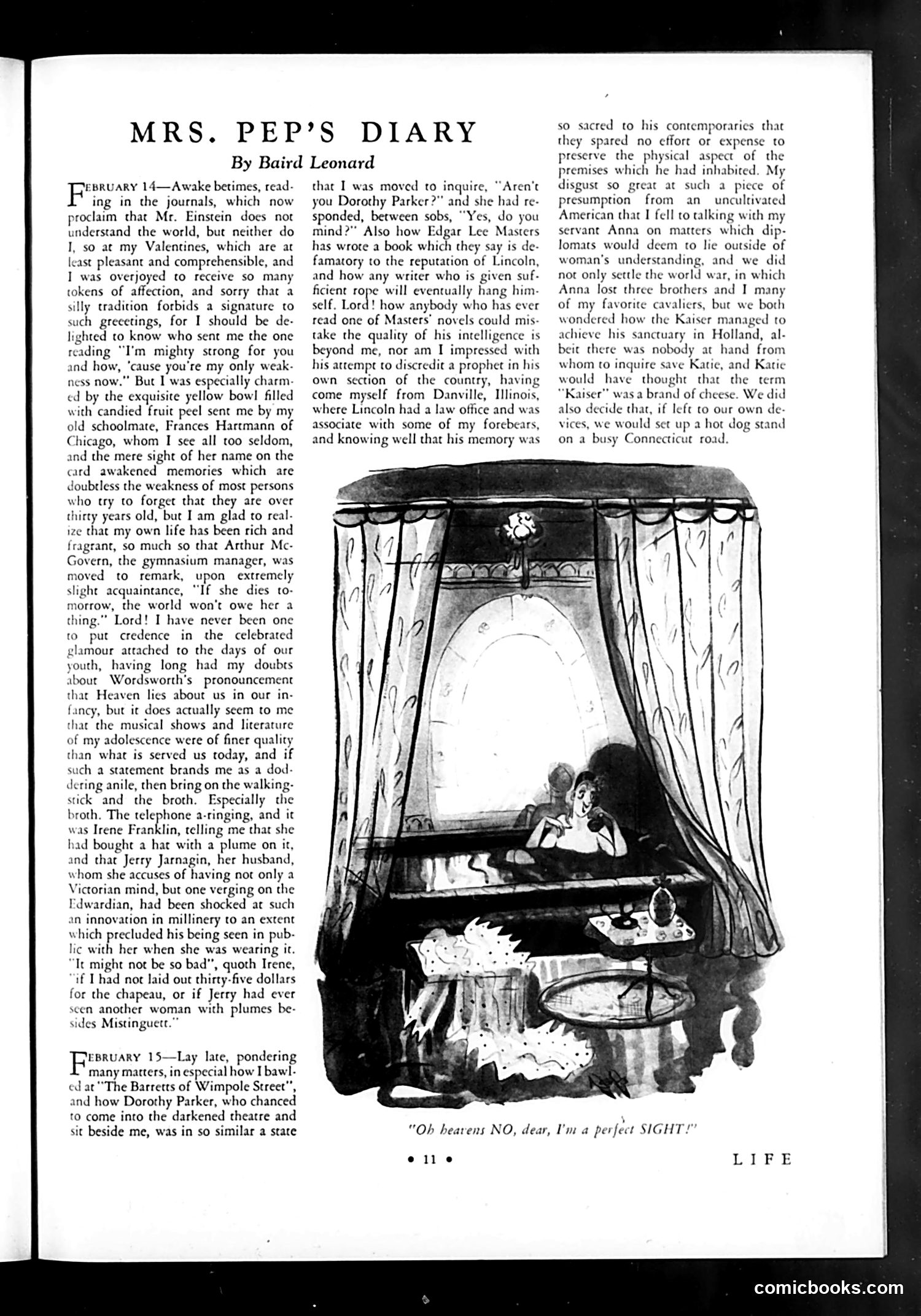
Analysis This page from *Life* magazine presents "Mrs. Pep's Diary" by Baird Leonard, a satirical column about high society and cultural pretensions. The illustration depicts a woman in an elegant bedroom, with the caption "Oh heavens NO, dear, I'm a perfect SIGHT!" The cartoon satirizes upper-class vanity and concern with appearances. The woman, positioned before her mirror in an ornate four-poster bed with expensive furnishings, expresses alarm at her appearance despite obvious luxury and refinement surrounding her. The diary entries reference acquaintances like Dorothy Parker and concerns about fashion (plumes on hats) and social status, mocking the superficial preoccupations of wealthy women. The overall satire targets the disconnect between material comfort and constant anxiety about social presentation among the privileged class.
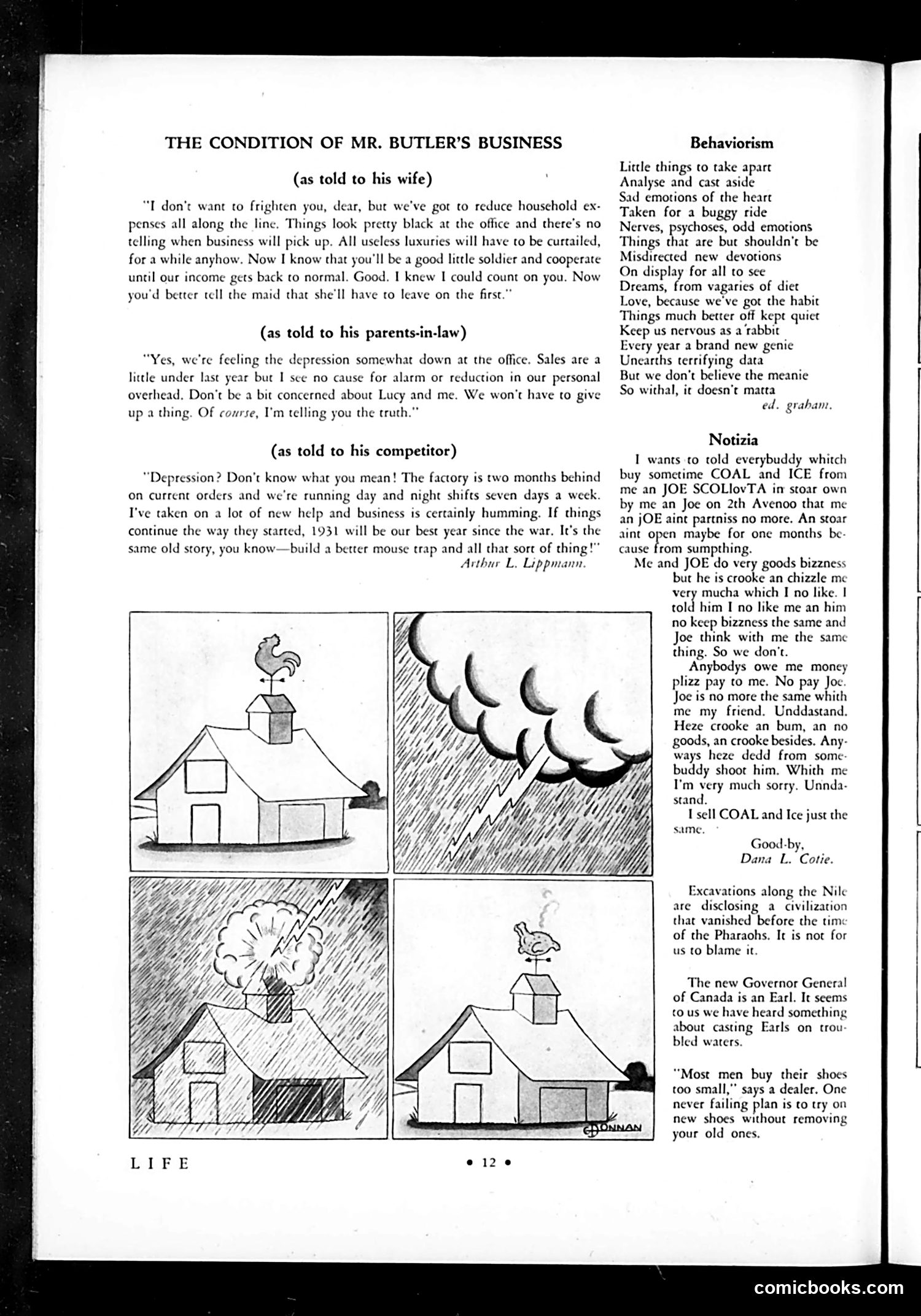
Analysis This page satirizes Mr. Butler's contradictory statements about his business during the Great Depression. The same man tells his wife things "look pretty black," reassures his in-laws there's "no cause for alarm," and boasts to competitors that 1931 will be "our best year since the war." The four-panel cartoon (credited to Cesare Cunnan) depicts a small house being progressively destroyed by increasingly severe weather—rain, hail, lightning, and finally what appears to be a tornado—while a weathervane remains optimistically positioned atop the roof. This visual metaphor mocks Butler's disconnected optimism amid deteriorating conditions. The satire exposes how businessmen publicly projected confidence during the Depression while privately acknowledging crisis—a gap between propaganda and reality that Life's readers would recognize from their own experiences.
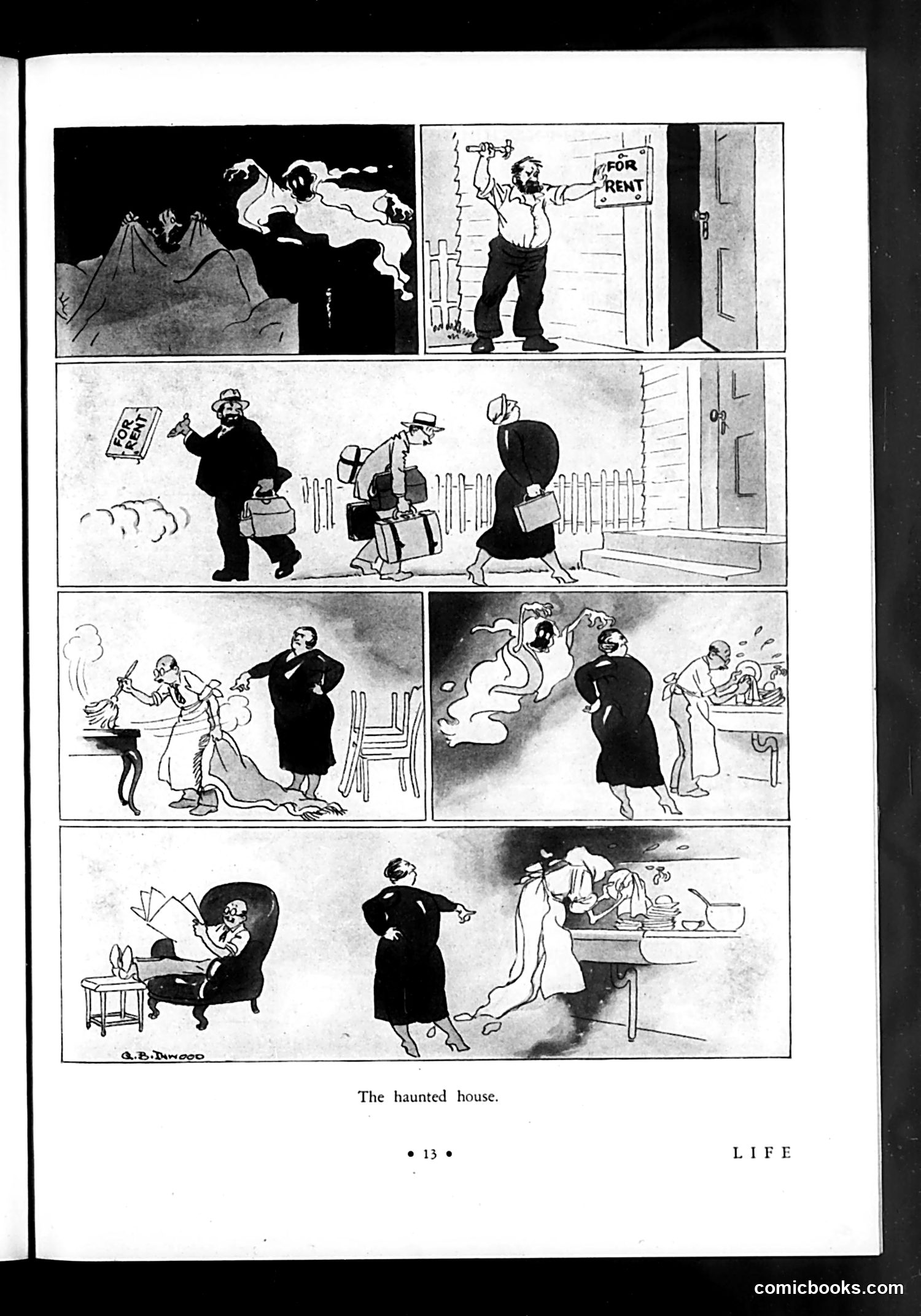
"The Haunted House" - Life Magazine Comic This is a multi-panel comic titled "The Haunted House" by C.P. Duazzo (signed lower left). It depicts the classic trope of a supernatural haunting through comedic sequential art. The narrative follows residents and prospective renters encountering various ghostly disturbances: floating supernatural figures in the first panel, a landlord renting a "For Rent" property despite its haunted reputation, families with luggage arriving and departing in succession, indoor chaos (overturned furniture, flying objects), and finally a woman cooking calmly while ghosts swirl around her—suggesting she's either unaffected or has accepted the house's paranormal nature. The satire likely mocks both gullible renters and unscrupulous landlords willing to rent obviously problematic properties. It's straightforward visual humor with no specific political commentary evident.
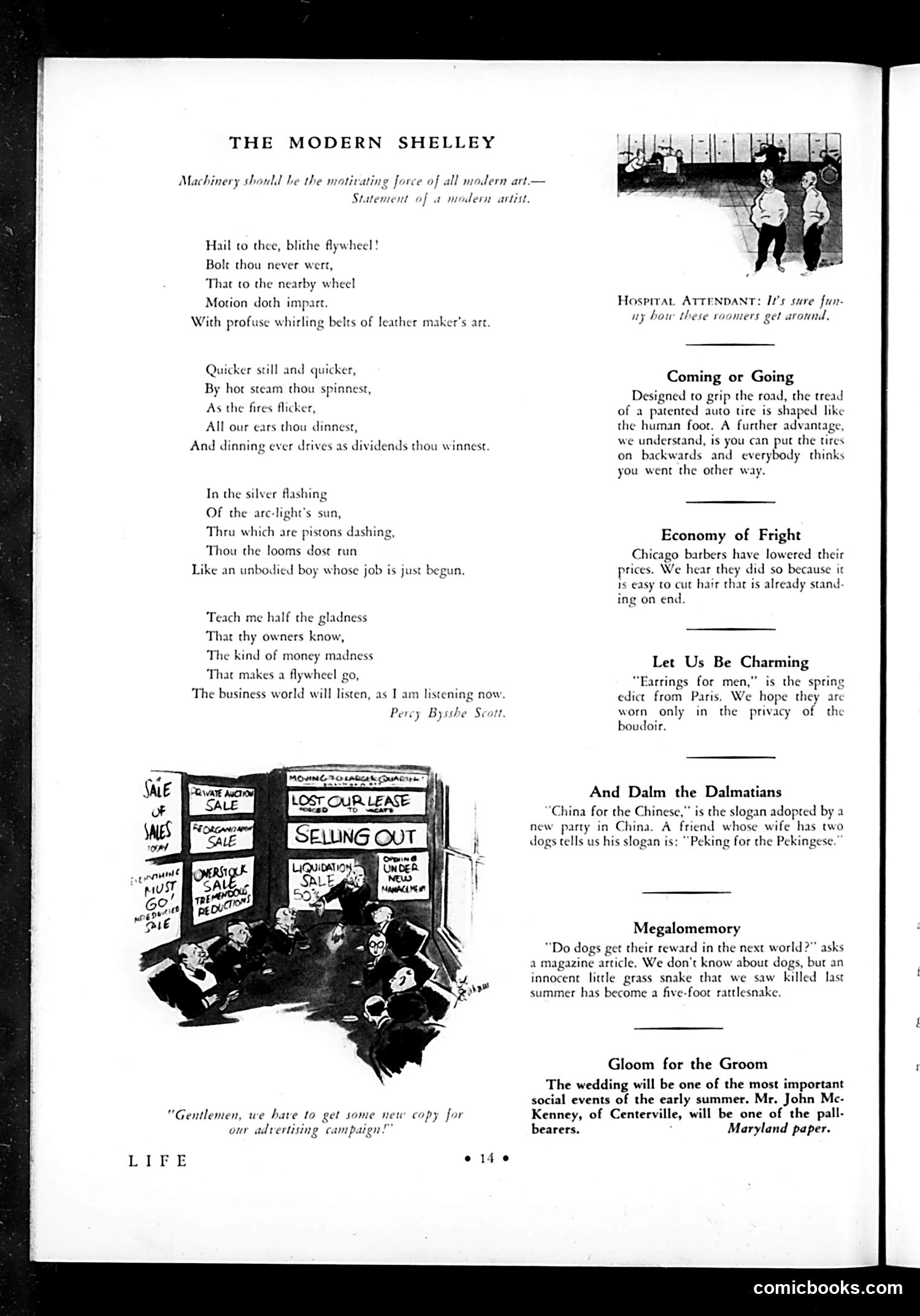
"The Modern Shelley" Page Analysis This page presents a poem by Percy Bysshe Scott celebrating industrial machinery—specifically automobiles and flywheels—as inspirational subjects for modern art, departing from Romantic-era nature poetry. The main cartoon depicts businessmen in a crowded office frantically gathering documents labeled "SELLING OUT," "LOST OUR LEASE," and "LIQUIDATION SALE." One figure declares they need "new copy for our advertising campaign." The satire contrasts Scott's lofty celebration of industrial progress with the mundane reality of commercial desperation. The businessmen aren't inspired by machinery's poetry—they're scrambling to survive economic pressures. The cartoon mocks both modern advertising's pretensions and the gap between artistic ideals and business survival instincts during what appears to be an economic crisis.
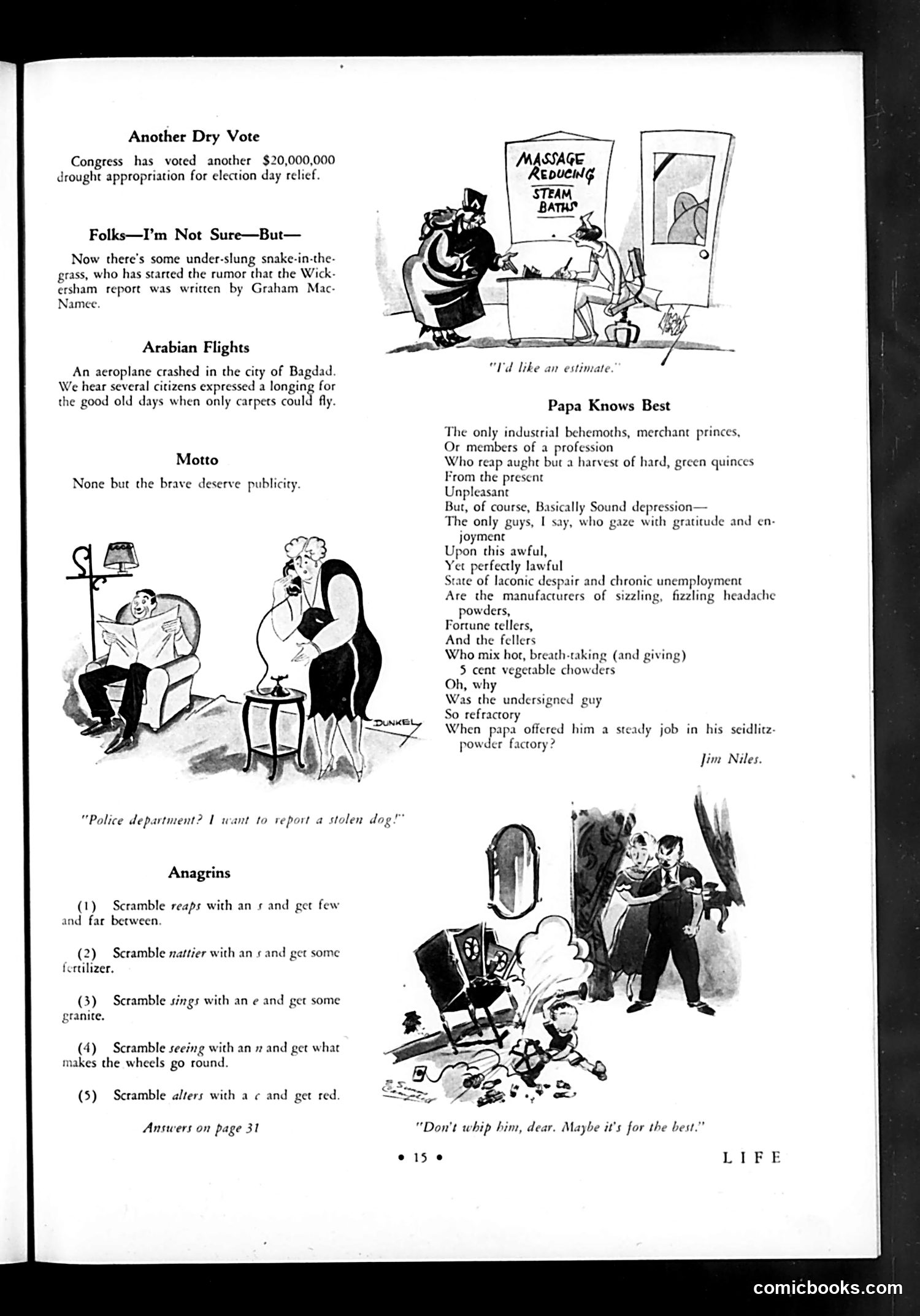
Political Satire from Life Magazine This page contains satirical commentary on Depression-era economic hardship and government relief efforts. "Another Dry Vote" mocks Congress's $20 million "election day relief" appropriation—suggesting politicians vote for relief measures as empty gestures rather than genuine solutions. "Arabian Flights" jokes darkly about an airplane crash in Baghdad, with nostalgia for when "only carpets could fly"—implying modern aviation is dangerous compared to mythical safety. "Papa Knows Best" by Jim Niles is a lengthy verse satirizing industrial leaders and merchants who blame workers for Depression unemployment while profiting from remedies like headache powders and vegetable chowders—"basically sound" in their view despite widespread suffering. The cartoons mock both government ineffectiveness and capitalist profiteering during economic crisis.
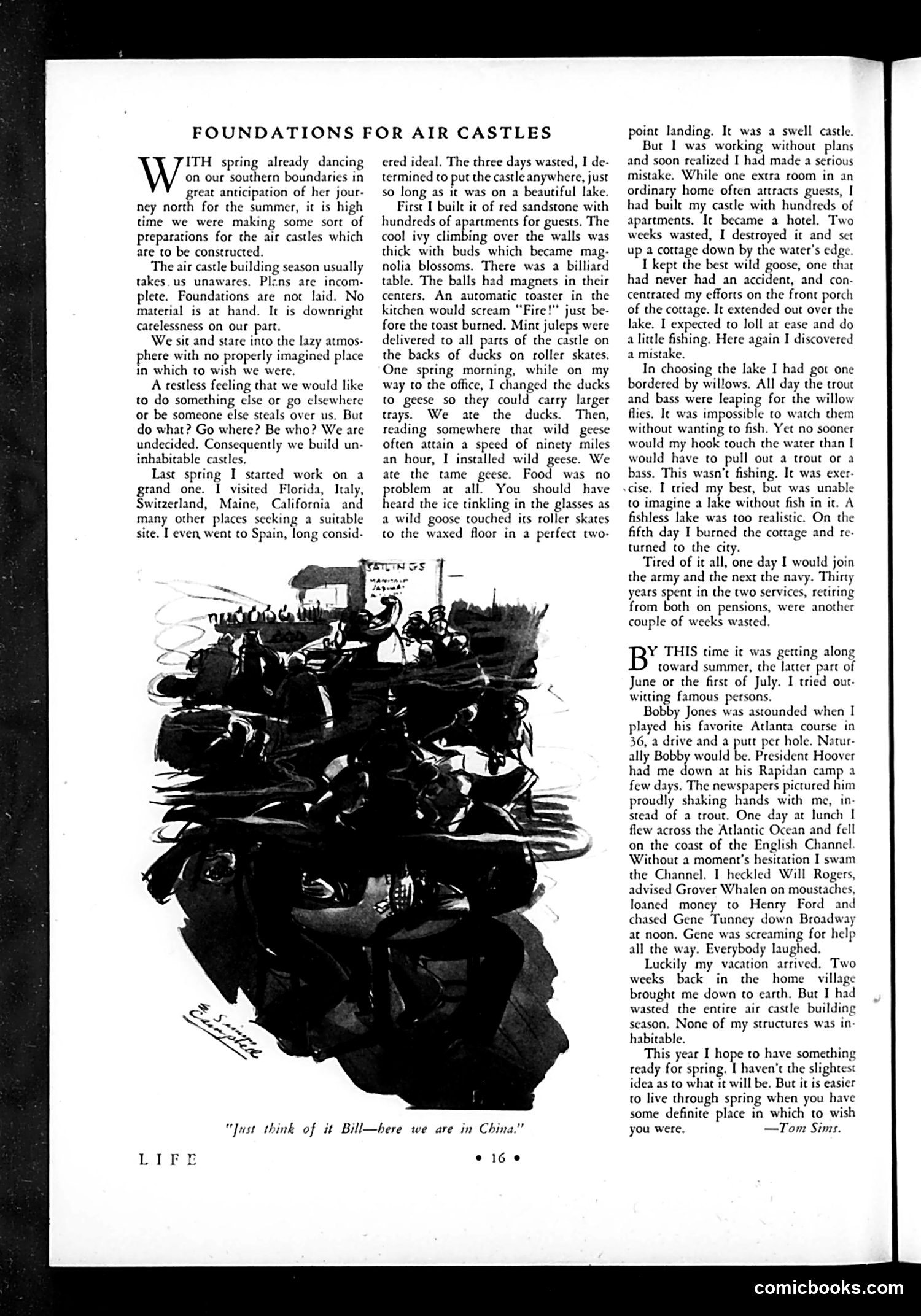
Analysis of "Foundations for Air Castles" This is a humorous article by Tom Sims about his attempts to build elaborate recreational structures (castles) at various locations. The central illustration depicts a chaotic, crowded scene of people and equipment piled together, captioned "Just think of it Bill—here we are in China." The satire targets the impracticality of Sims's grandiose building schemes. He describes constructing elaborate castles with hundreds of apartments, billiard tables, and automated features—all of which fail catastrophically. The "air castles" reference is a period idiom meaning unrealistic dreams or fantasies. The humor lies in the gap between his ambitious vision and disastrous reality: structures sink, burn down, or prove uninhabitable. The final caption suggests even his vacations derail his projects, capturing the futility of his endeavors.
"Life Looks About" - Page Analysis This page from *Life* magazine presents three political commentary sections: "The Pope's Broadcast" satirizes the Vatican's expensive radio broadcast ($180,000), questioning whether the expenditure justified the Pope's messaging. The piece mocks both the broadcast itself and suggests the Church uses advertising strategically—comparing it to other institutions' propaganda efforts. "Voice of the Ladies" reports on a women's patriotic organization's resolution opposing any political party seeking to overthrow the U.S. Government. The satire targets the resolution as simultaneously vague and unnecessarily alarmist. "The War Debts" and "Birth Control" sections discuss Senator Smoot's views on war reparations and Senator Gillett's bill exempting physicians from contraception information laws. The cartoonish angel header adds light satirical tone to what are otherwise serious political debates of the 1920s era.
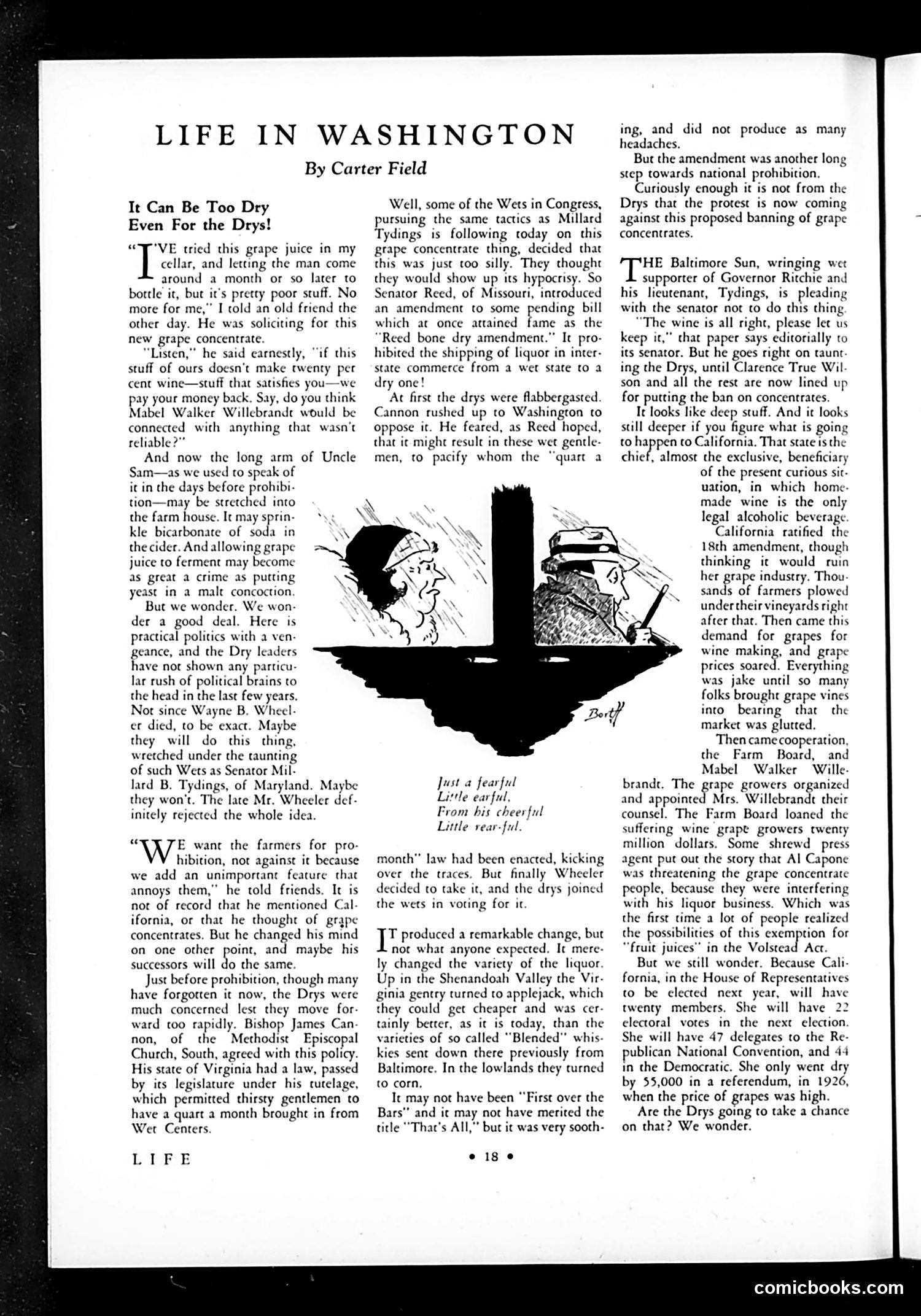
Explanation of "Life in Washington" by Carter Field This satirical article discusses Prohibition-era politics, specifically efforts to ban grape juice concentrates. The cartoon depicts a fearful figure (likely representing grape industry interests or Prohibition opponents) fleeing from what appears to be California or a wine-producing region. The satire targets the contradiction in Prohibition enforcement: while grape juice concentrate was technically legal, winemakers used it to circumvent alcohol bans. Senator Reed (Missouri) and others pushed an amendment to restrict these concentrates, which the article mocks as both ineffective politics and economically damaging to grape farmers. The piece criticizes how Prohibition's enforcement created absurd loopholes and how competing interests—farmers, prohibitionists, and winemakers—manipulated the law, revealing the impracticality of the Prohibition experiment itself.
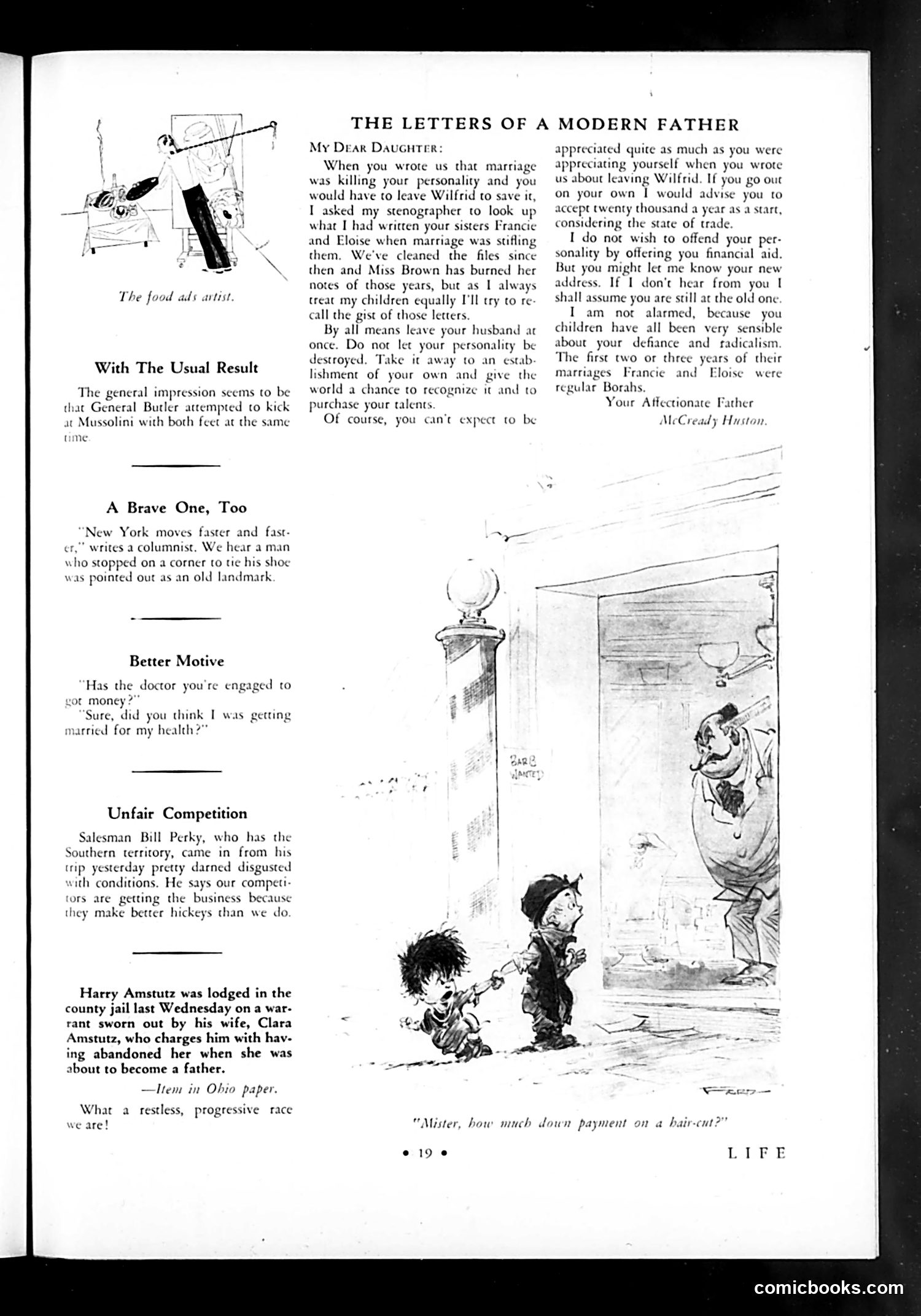
Analysis of Life Magazine Page This page contains satirical short pieces mocking early 1920s American social trends: "The Letters of a Modern Father" satirizes the "New Woman" movement. The father writes to his daughter, who wants to leave her husband to preserve her "personality." He dryly advises her to expect only $20,000 yearly support and sarcastically notes his other daughters (Francie and Eloise) made similar demands during their marriages, calling them "regular Borahs" (likely referencing Borah, suggesting radical feminism). The satire targets women claiming marriage destroys their identity while expecting financial support. Other brief items mock various social absurdities: a man tying his shoe becomes a "landmark" in fast-paced New York; a doctor is pursued for money rather than health; a salesman complains competitors outsell him by giving better "hickeys" (bruises); and an Ohio newspaper reports a man jailed for abandoning his pregnant wife—the joke being the wife is described as "about to become a father." The cartoon below shows two figures negotiating payment for a haircut, likely mocking commerce or bargaining culture. The overall theme: modern American society is chaotic and contradictory.
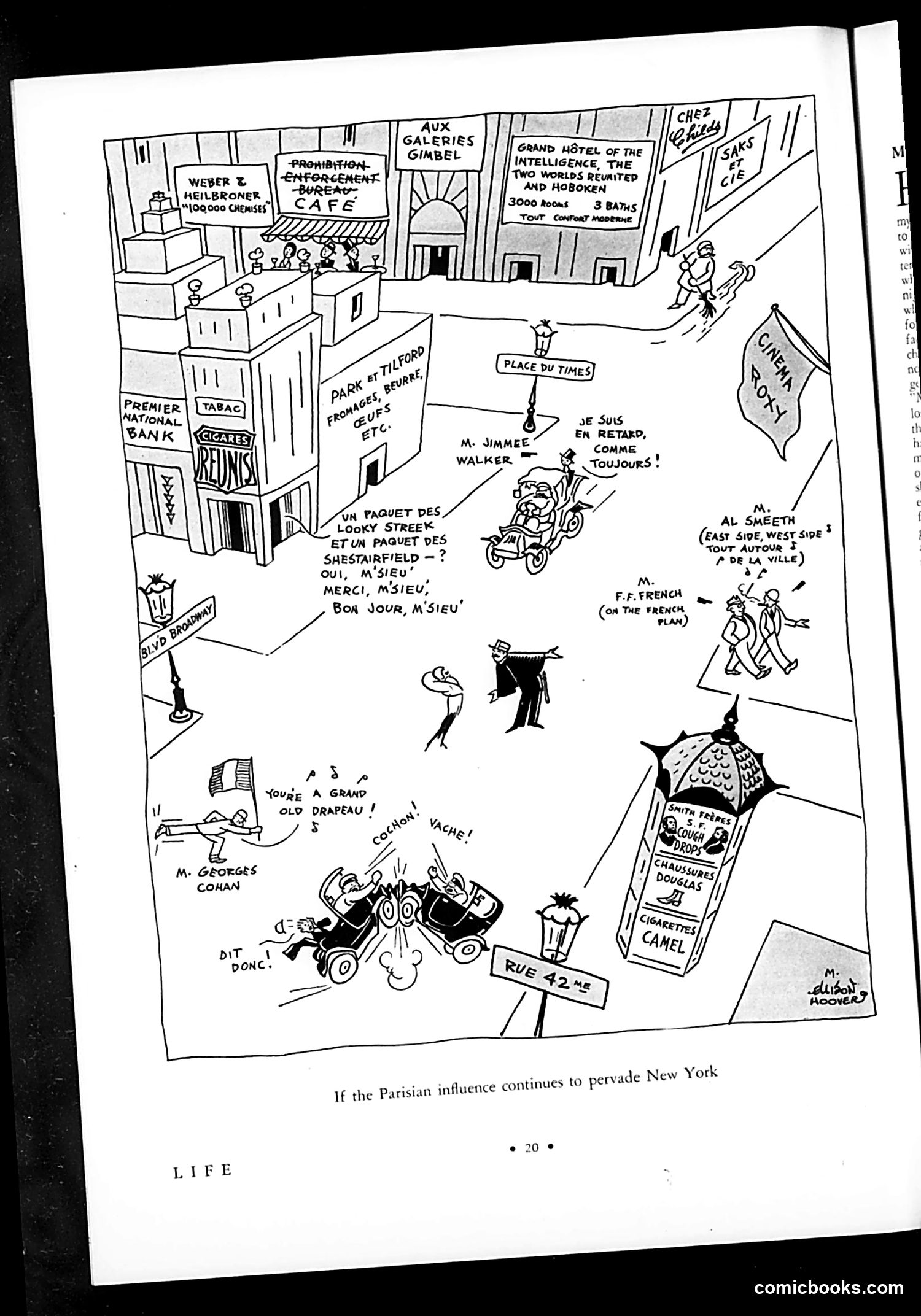
Cartoon Analysis: "If the Parisian Influence Continues to Pervade New York" This satirical map depicts an imagined New York City transformed by French cultural influence. The cartoon shows recognizable Manhattan locations (Place du Times, Rue 42, etc.) rechristened with French names and populated by French-speaking characters and establishments—cafés, tobacconists, and hotels advertising Parisian amenities. The humor targets early 20th-century anxieties about European—particularly French—cultural dominance in America. Named figures like "M. Jimmy Walker" (likely NYC's mayor), "M. Georges Cohan" (playwright/performer), and "M. F.F. French" appear as Francophiles, while the street chaos and exaggerated accents mock French mannerisms. The caption's conditional phrasing ("if...continues") suggests satirical warning: American identity risks erasure through unchecked foreign influence. This reflects period concerns about immigration, cosmopolitanism, and preserving "American" culture—common themes in early Life magazine satire.
Theatre Review: Life Magazine, 1931 This is a theater review column by Baird Leonard covering two Broadway productions. "Mysteries of 1931" describes a magic show at the Eltinge Theatre featuring the Rajah Raboid (a mind-reader) and La Pollette (a magician). The reviewer humorously recounts attending, curious about the psychic's abilities. While impressed by La Pollette's standard magic tricks (producing animals, pulling silk from bowls), the reviewer is skeptical of the Rajah's "mind-reading," suspecting a coded system with a planted accomplice in the audience, though observing none. Audience members received eerily accurate personal revelations—one woman learned her husband's actual infidelity. "Heat Wave" is a separate review of a play about British colonists in tropical settings, where men drink constantly and women play tennis while everyone complains about the climate. The page contains no political cartoons—it's entirely theater criticism with satirical observations about popular entertainment and human gullibility.
Analysis: Harry Evans' Movie Reviews in Life Magazine This page contains three film reviews by Harry Evans for Life magazine, critiquing contemporary Hollywood films. The writing is satirical commentary on both the movies themselves and broader cultural attitudes. "Inspiration" reviews Greta Garbo's performance, praising her talent while mocking her co-star Robert Montgomery's portrayal of a "narrow-minded, conceited prude" who judges the female lead for her romantic past. Evans uses humor (interrupting to shoo away a child) to highlight the film's prudish morality—the male character's hypocritical behavior mirrors societal double standards about women's sexuality. "Girls Demand Excitement" criticizes a college film depicting male students as "woman-haters" forming a club against co-education. Evans finds the premise absurdly unrealistic. "Scandal Sheet" discusses a journalism story, mocking sensationalism in newspapers. The reviews exemplify 1920s-30s Life magazine's function: intelligent satire targeting both film industry conventions and contemporary social hypocrisy, particularly regarding gender and morality standards.
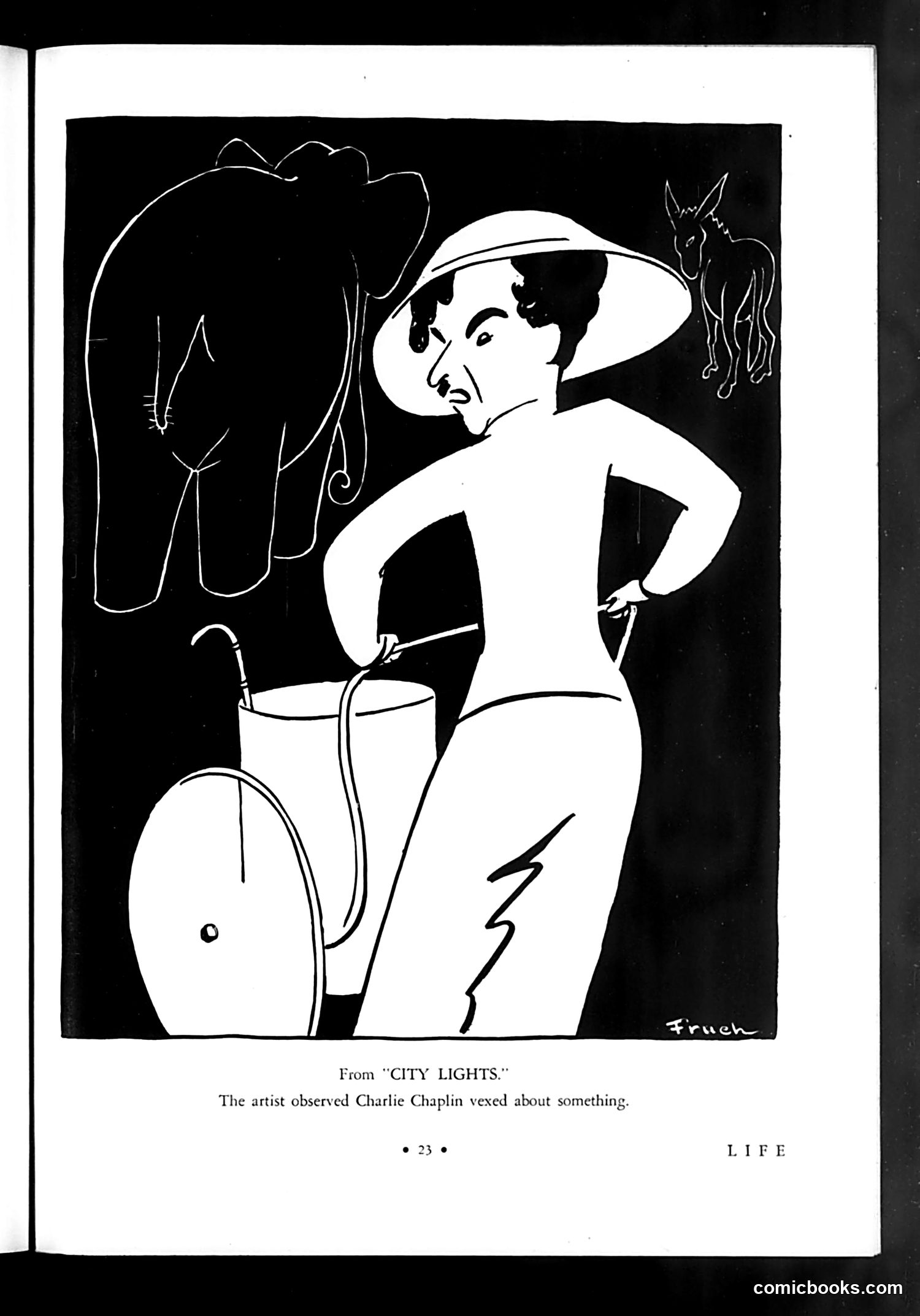
Commentary on the Cartoon This is a satirical drawing from Life magazine referencing Charlie Chaplin's 1931 film "City Lights." The caption states the artist observed Chaplin appearing annoyed about something. The cartoon depicts a woman in minimal clothing posing with a motorcycle and sidecar, while animals (an elephant and goat) appear in the background. The humor likely plays on Chaplin's famous "Tramp" character and the film's romantic plot. The exact reason for Chaplin's supposed vexation isn't entirely clear from the image alone—it may reference a specific scene, Chaplin's personal life, or contemporary gossip about the filmmaker. The artist's signature appears to read "Frueh," suggesting this is a professional caricature by a known magazine illustrator of the era.
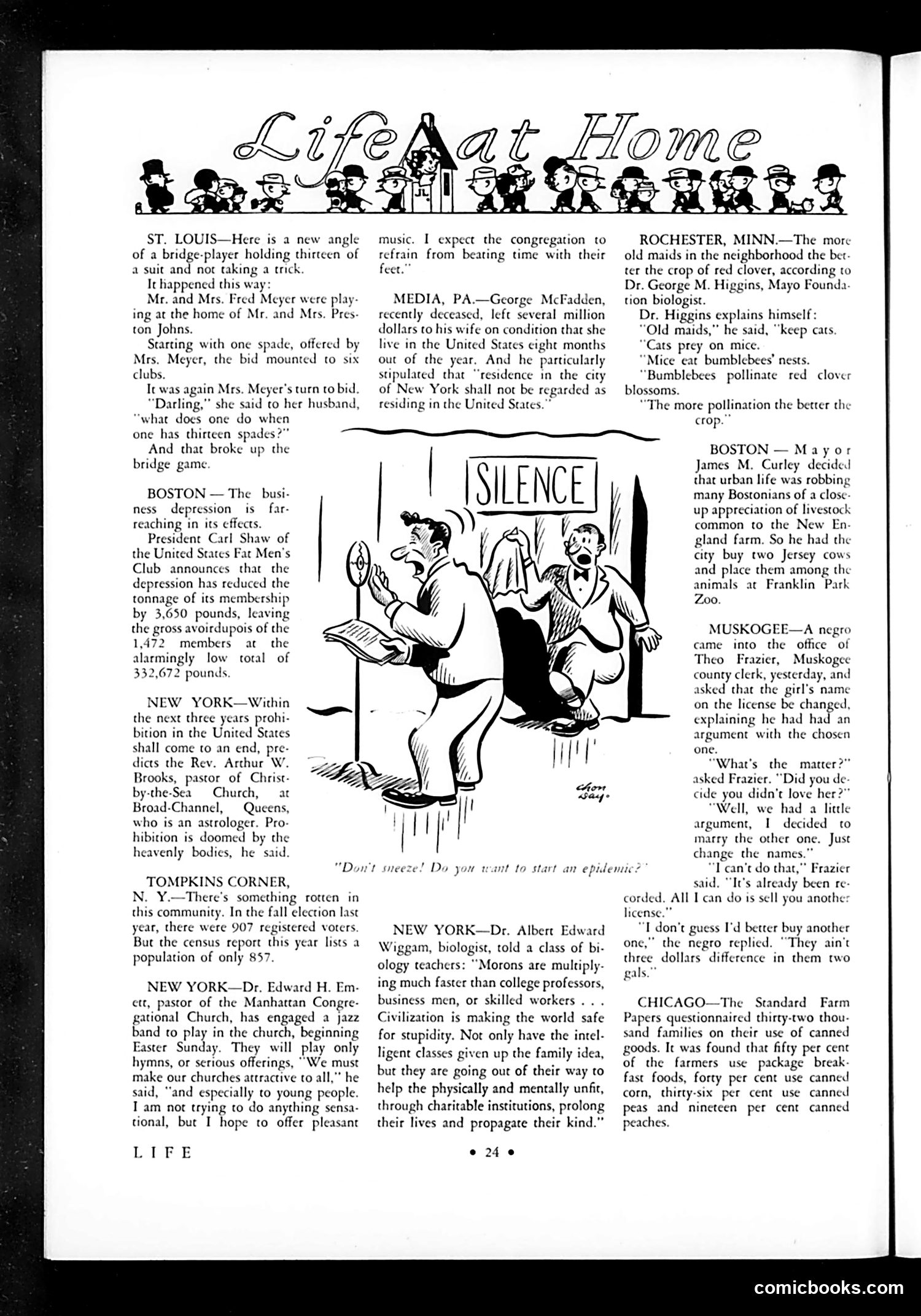
Explanation for Modern Readers This "Life at Home" column is a humor section featuring short anecdotes from American towns. The central cartoon depicts two men confronting each other with a "SILENCE" sign, illustrating the caption: "Don't sneeze! Do you want to start an epidemic?" — likely referencing 1920s public health anxiety about disease transmission. The surrounding text items are satirical observations on contemporary issues: bridge-playing marital dynamics, the economic depression's effect on a "Fat Men's Club," concerns about Prohibition ending, eugenics fears (a biologist warning that "morons" reproduce faster than educated people), and small-town absurdities like a mayor placing cows in a zoo or a clerk unable to change a wedding license name. The humor relies on period-specific anxieties—economic collapse, health scares, prohibition debates, and pseudo-scientific racial theories—presented as lighthearted gossip rather than serious commentary.
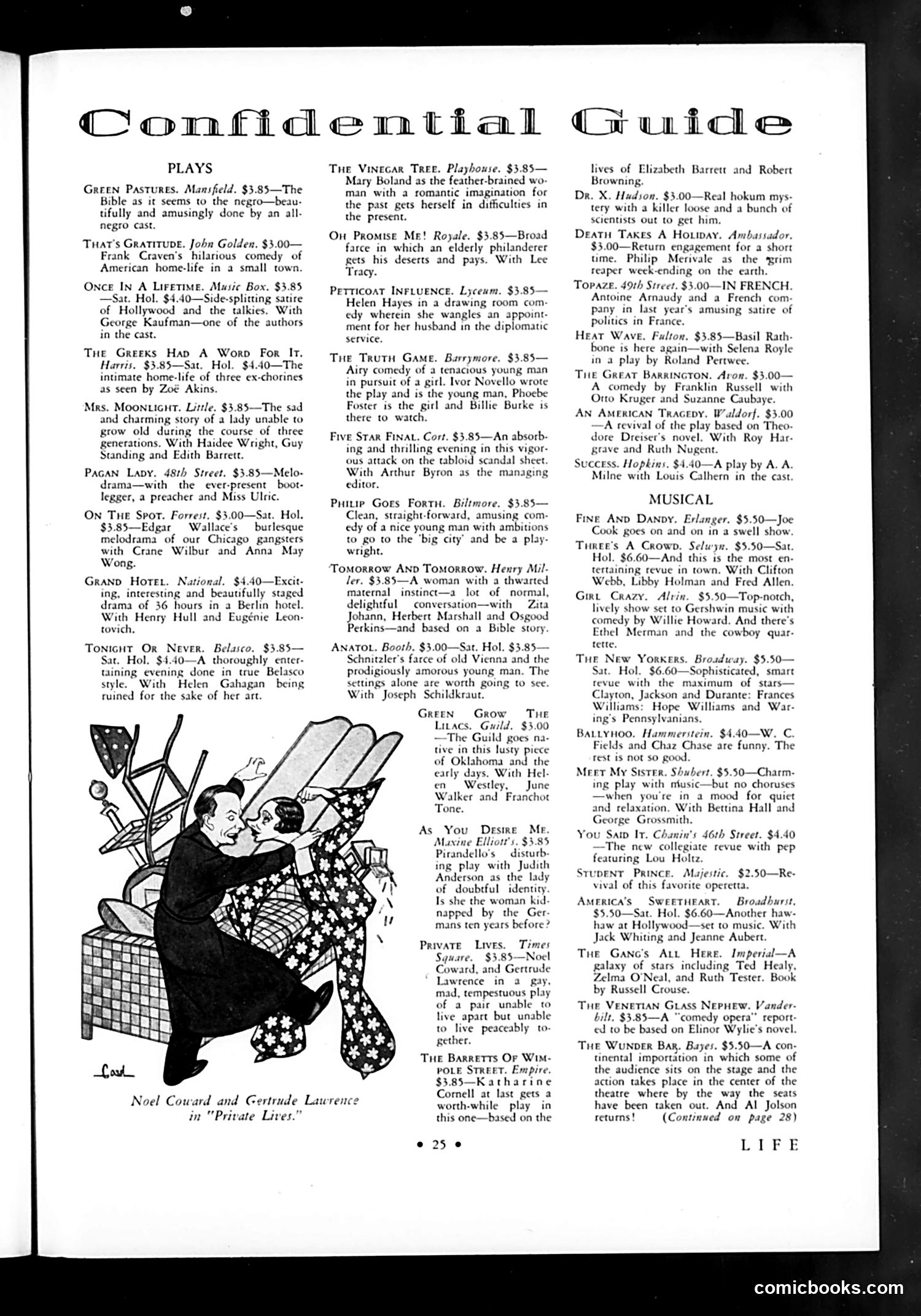
What This Page Shows This is a theater guide from *Life* magazine listing Broadway plays with brief reviews and ticket prices (roughly $3-4, with Saturday/holiday premiums). The accompanying illustration depicts Noel Coward and Gertrude Lawrence in *Private Lives*, a contemporary comedy about an estranged couple who reunite and engage in witty, tempestuous banter. The cartoon captures the play's central appeal: Coward's sophisticated, rapid-fire dialogue and the glamorous chemistry between the two stars. The exaggerated poses and patterned costumes convey theatrical flair and emotional volatility—the "mad, tempestuous" relationship described in the text guide. For modern readers: this represents pre-Depression Broadway entertainment aimed at affluent audiences, showcasing the era's taste for urbane, adult comedies and literary adaptations over slapstick or moralizing drama.
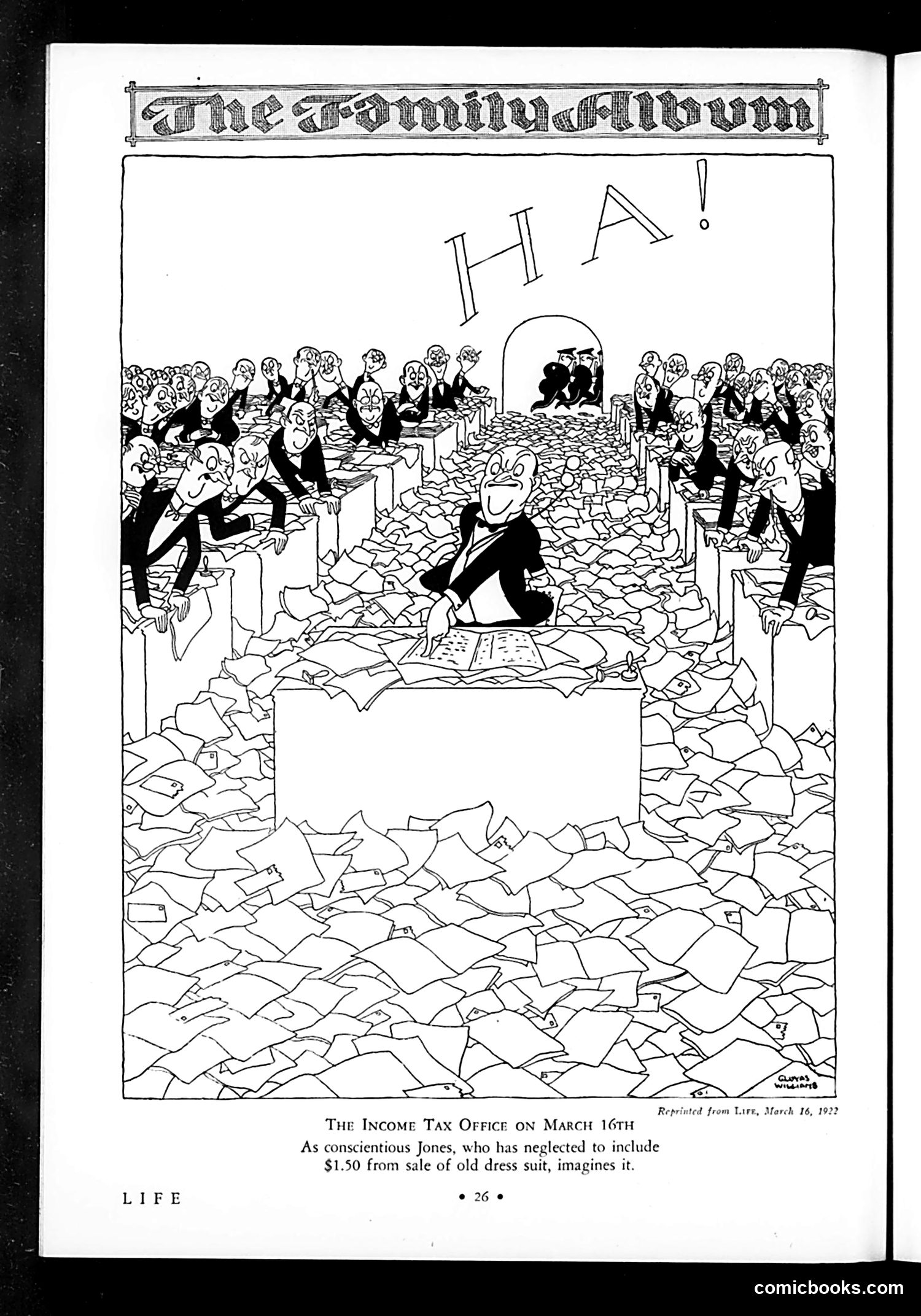
This cartoon satirizes anxiety about tax compliance and the income tax system. It depicts a man named Jones imagining his visit to the Income Tax Office as a nightmarish bureaucratic hellscape—the floor is literally covered in papers and documents, while suited officials surround him. The humor lies in the exaggeration: Jones is catastrophizing over a minor omission of just $1.50 from a dress suit sale, yet imagines himself surrounded by an overwhelming sea of paperwork and stern-faced tax authorities. The cartoon reflects early-20th-century American attitudes toward the then-relatively-new federal income tax (established 1913), depicting it as an intimidating, confusing system that inspired disproportionate fear in ordinary citizens. The satire mocks both Jones's neurotic conscience and the tax system's perceived complexity and severity.
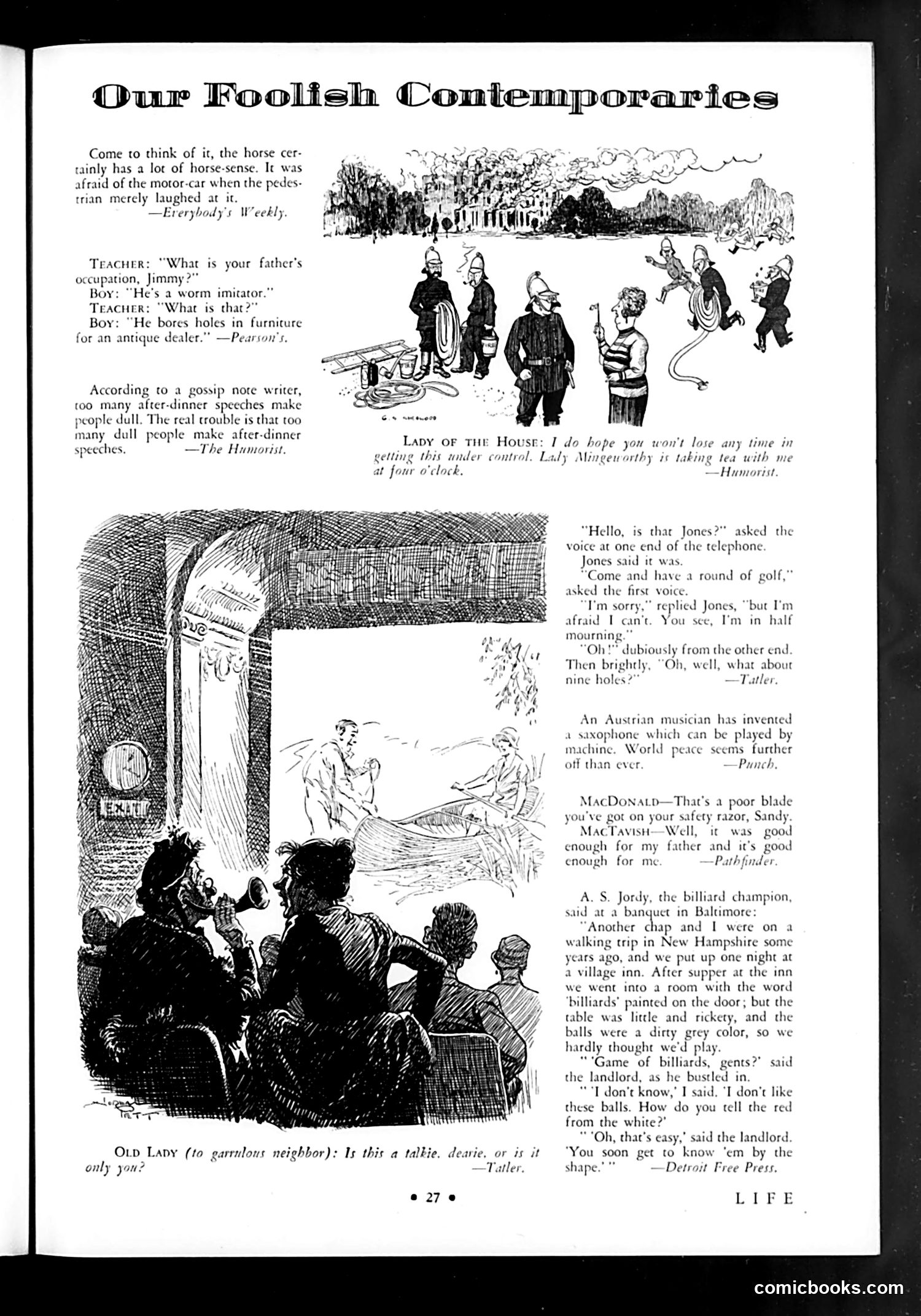
Our Foolish Contemporaries This page collects brief humorous anecdotes and jokes from various contemporary sources, satirizing human foolishness rather than political figures. The jokes mock: pedestrians ignoring motor-car dangers while horses sensibly feared them; a boy whose father bores holes in furniture as a "worm imitator" for antique dealers; after-dinner speakers being inherently dull; someone in "half mourning" refusing golf invitations; an Austrian machine-played saxophone while world peace remains distant; Scotsmen reusing worn razors; and a billiard hall where patrons identify worn grey and red balls "by shape" rather than condition. The page's title "Our Foolish Contemporaries" indicates these represent common modern absurdities and social pretensions. The large bottom illustration shows people at a talkie (early sound film), with a gossipy neighbor interrupting—mocking cinema-goers' inconsiderate behavior. These are gentle social satires targeting everyday human foibles rather than specific political targets.
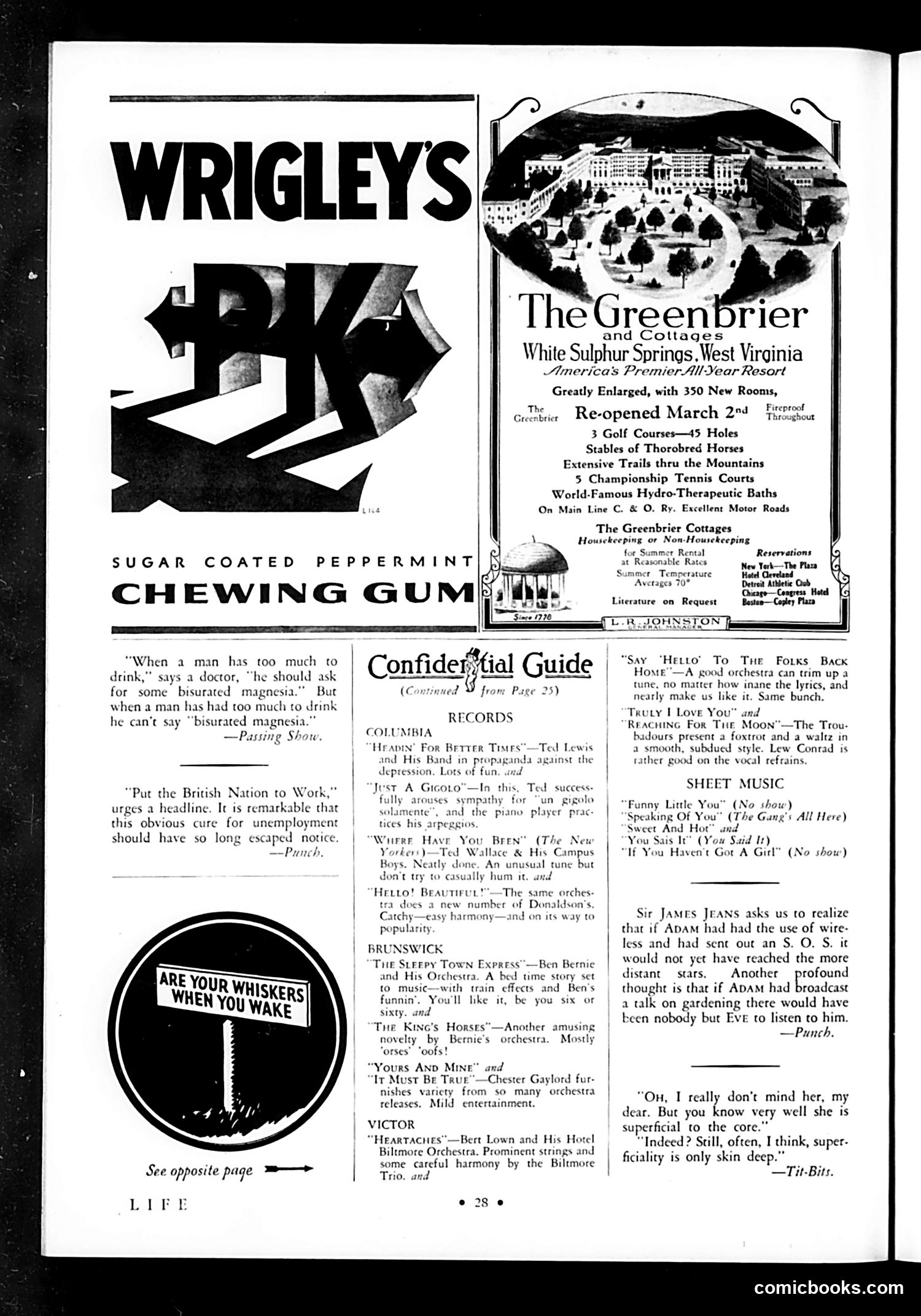
Life Magazine Page Analysis This page is primarily advertising and entertainment content rather than political satire. The main elements are: Advertisements: Wrigley's chewing gum (top left) and The Greenbrier resort in White Sulphur Springs, West Virginia (top right). "Confidential Guide" section: A music and entertainment column reviewing phonograph records and sheet music from labels like Columbia and Victor, featuring popular orchestras of the era (Ted Lewis, Ben Bernie, Chester Gaylord). Humorous quotes: The page includes brief jokes/quips from publications like *Passing Stone* and *Punch* about drinking, unemployment policy, and social behavior—typical of Life's satirical style but not tied to specific political figures or events. Bottom cartoons: Small comic panels with captions about superficiality and relationships. The circular advertisement ("Are Your Whiskers When You Wake") references grooming products. Overall, this is a typical 1920s Life magazine page mixing consumer advertising with light entertainment and mild social humor.
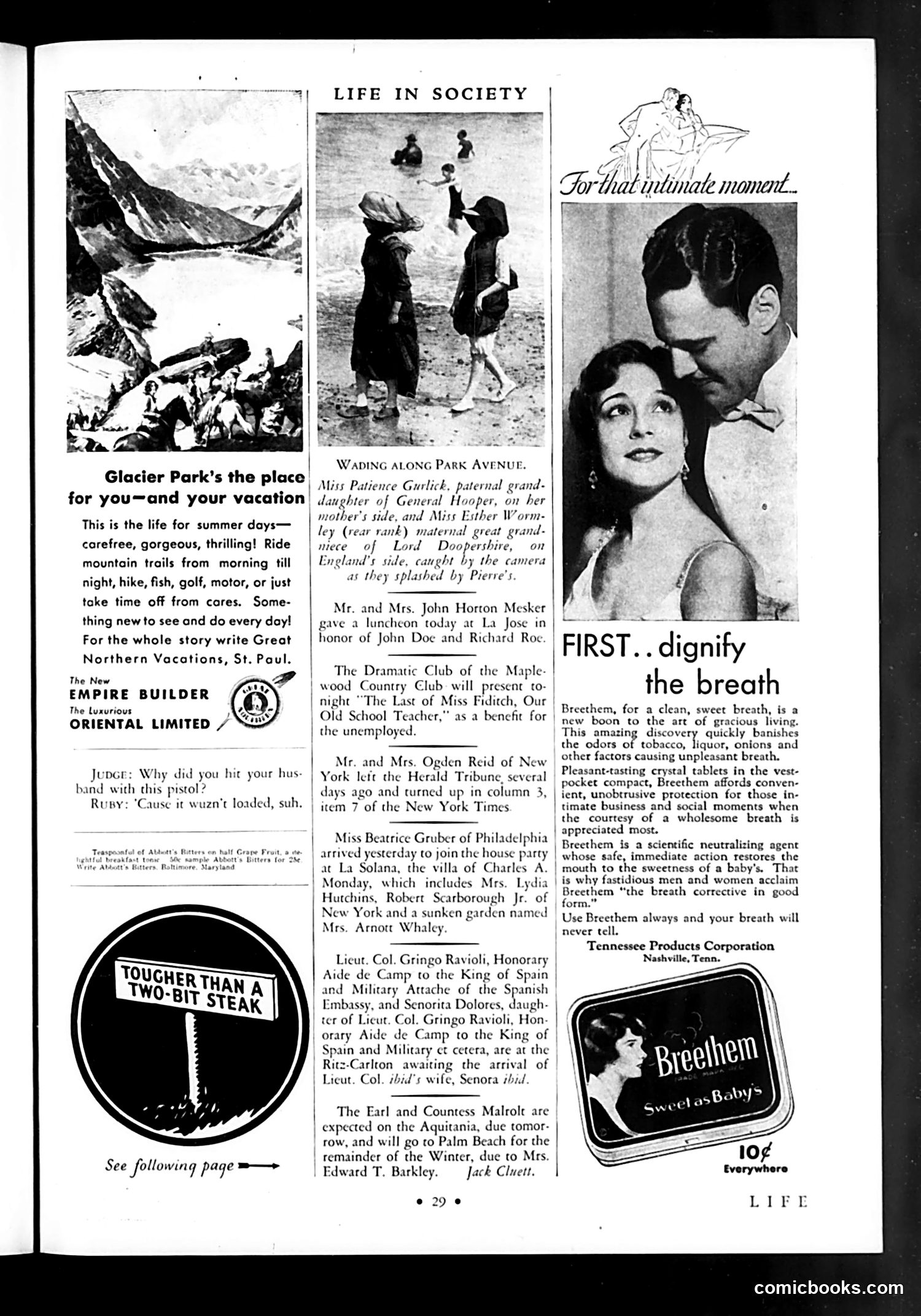
Life Magazine Page Analysis This page mixes society gossip with advertisements and contains one small joke cartoon. The "Life in Society" section satirizes high-society chitchat by listing tediously elaborate introductions (e.g., "Miss Patience Gurlick, paternal granddaughter of General Hooper...") and gossipy announcements about wealthy people's movements and social events—the humor lying in the absurd pretentiousness and verbosity of such reporting. The single cartoon shows a judge questioning a woman about shooting her husband. Her response—"'Cause it wuzn't loaded, suh"—is a crude racial stereotype joke (indicated by the dialect spelling), implying she's annoyed the gun misfired rather than regretting the act itself. The advertisements promote Glacier Park tourism and Breethem breath mints, the latter using romance imagery to sell the product's social utility. The page reflects 1920s-30s magazine conventions combining satire, casual bigotry, and consumer advertising.
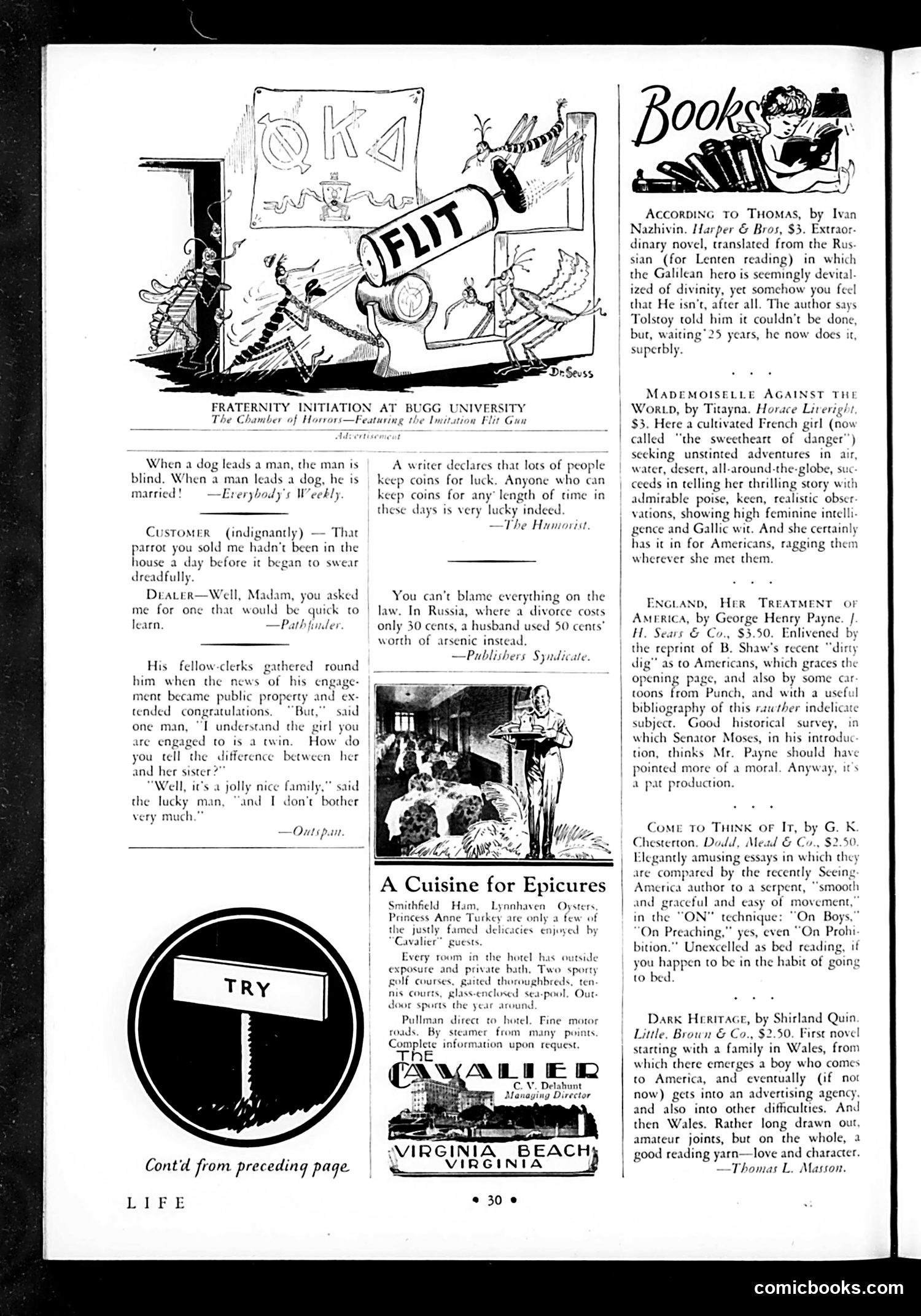
Life Magazine Page Analysis This page combines humor and book reviews typical of 1920s Life magazine. The Main Cartoon ("Fraternity Initiation at Bugg University") depicts college hazing, showing initiates being subjected to pranks—one involving a large syringe labeled "FLIT" (a popular insecticide brand). The satire mocks the absurdity and danger of fraternity initiation rituals. Below are brief jokes about marriage and relationships—a dog leading a man means he's blind; a man leading a dog means he's married (implying loss of freedom). Another jokes about a man with an identical twin fiancée who admits he doesn't bother distinguishing between them, suggesting marital indifference. The book reviews section covers contemporary literature, including works about religion, adventure, and Anglo-American relations. One review notes a book comparing Americans to a serpent—"smooth and graceful"—reflecting 1920s international cultural commentary. The page reflects era-typical humor about domesticity and college culture alongside literary discussion.
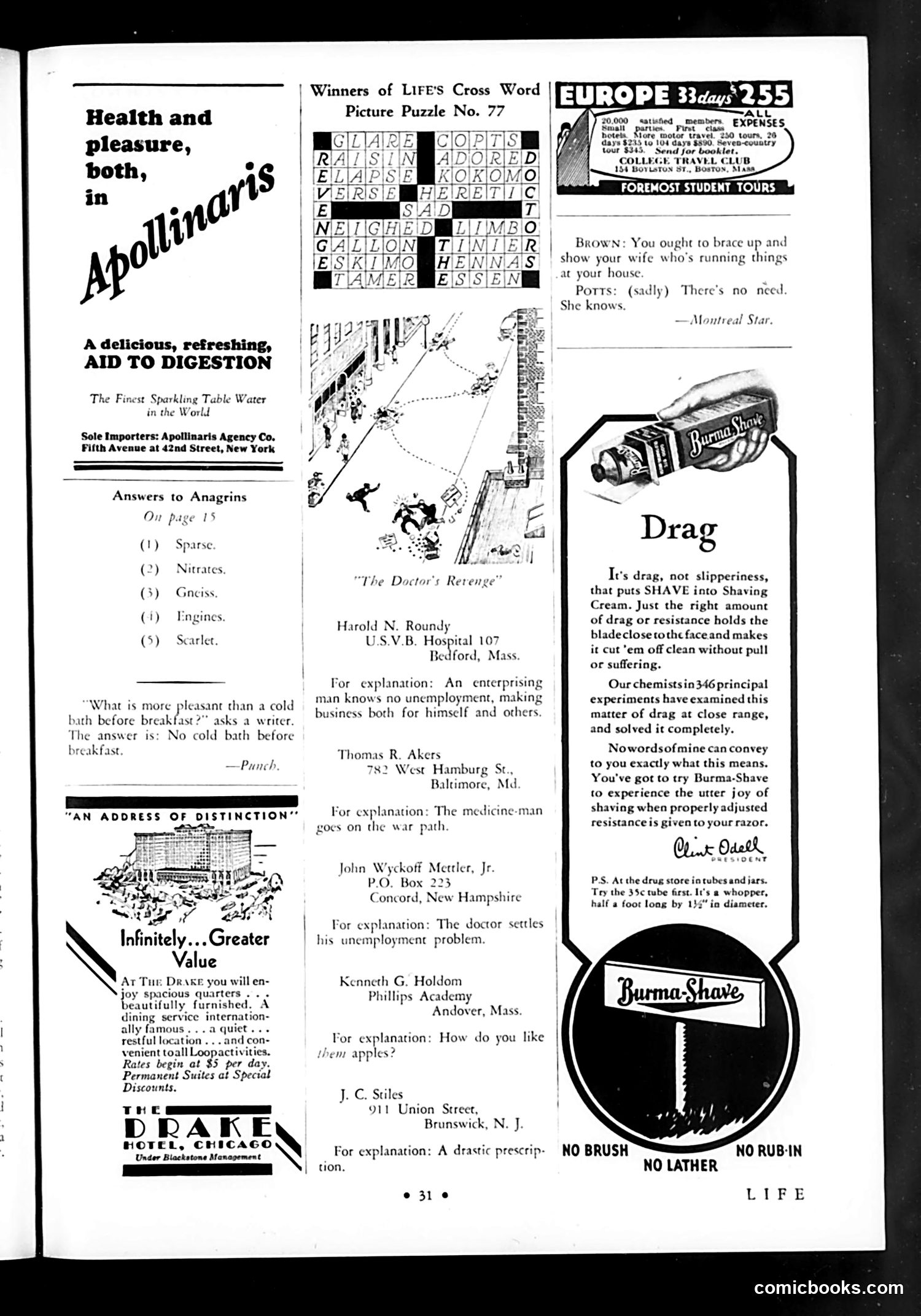
Content Analysis: Life Magazine Page 31 This page is primarily advertising and puzzle answers, not political satire. Key content: Main features: - Apollinaris sparkling water ad (digestive aid) - Answers to a crossword puzzle from page 15 - Drake Hotel Chicago advertisement - Burma-Shave shaving cream ad (prominent, with detailed explanation of "drag" in shaving) - Europe travel tour ad - Brief humor exchanges (Brown/Potts dialogue about marital authority) What's notable for modern readers: The Burma-Shave ad reveals 1920s-30s marketing: the company funded actual chemical experiments (346 "principal experiments") to justify product claims—an early example of pseudo-scientific advertising. The humor in Brown/Potts suggests dated gender dynamics (husband worried about appearing weak to wife). The page reflects interwar American consumer culture and advertising techniques rather than political commentary.
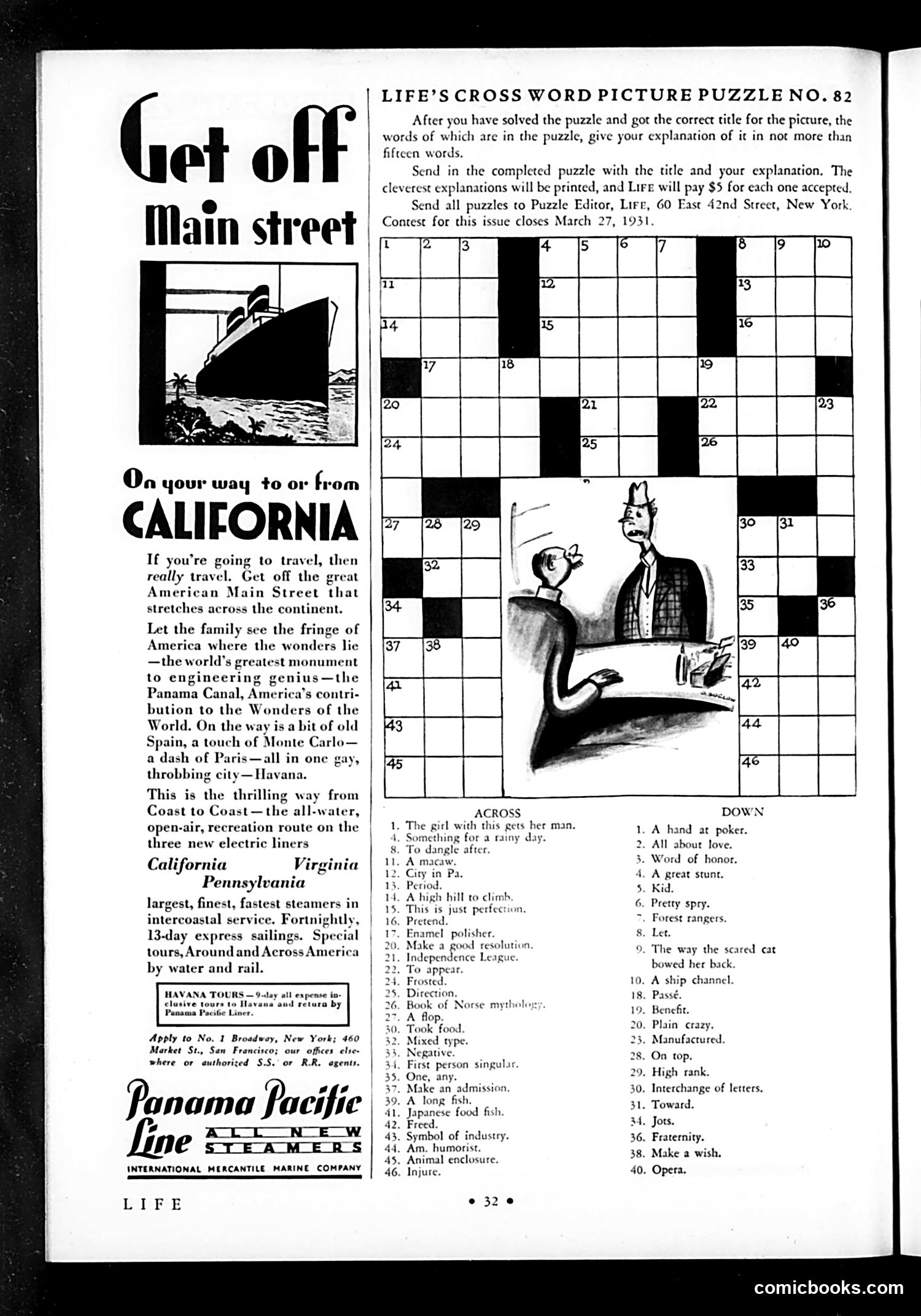
Analysis This page is primarily advertising with an embedded puzzle contest, not political satire. The main content promotes Panama Pacific Line steamships for travel from the U.S. East Coast to California via Cuba and the Panama Canal. The advertisement emphasizes leisure travel, exotic destinations (Havana, Monte Carlo references), and the engineering marvel of the Panama Canal. The cartoon shows a man pointing at or presenting something to a woman—likely illustrating the puzzle's theme, though without solving the crossword, the specific reference is unclear. The image appears generic to the travel/adventure context rather than satirical. The puzzle itself is a commercial contest: readers solve the crossword, identify the cartoon's title, and submit explanations for a $5 prize. This was a common Life magazine feature in 1931. No political figures or satire are evident on this page—it's straightforward commercial promotion disguised as entertainment.
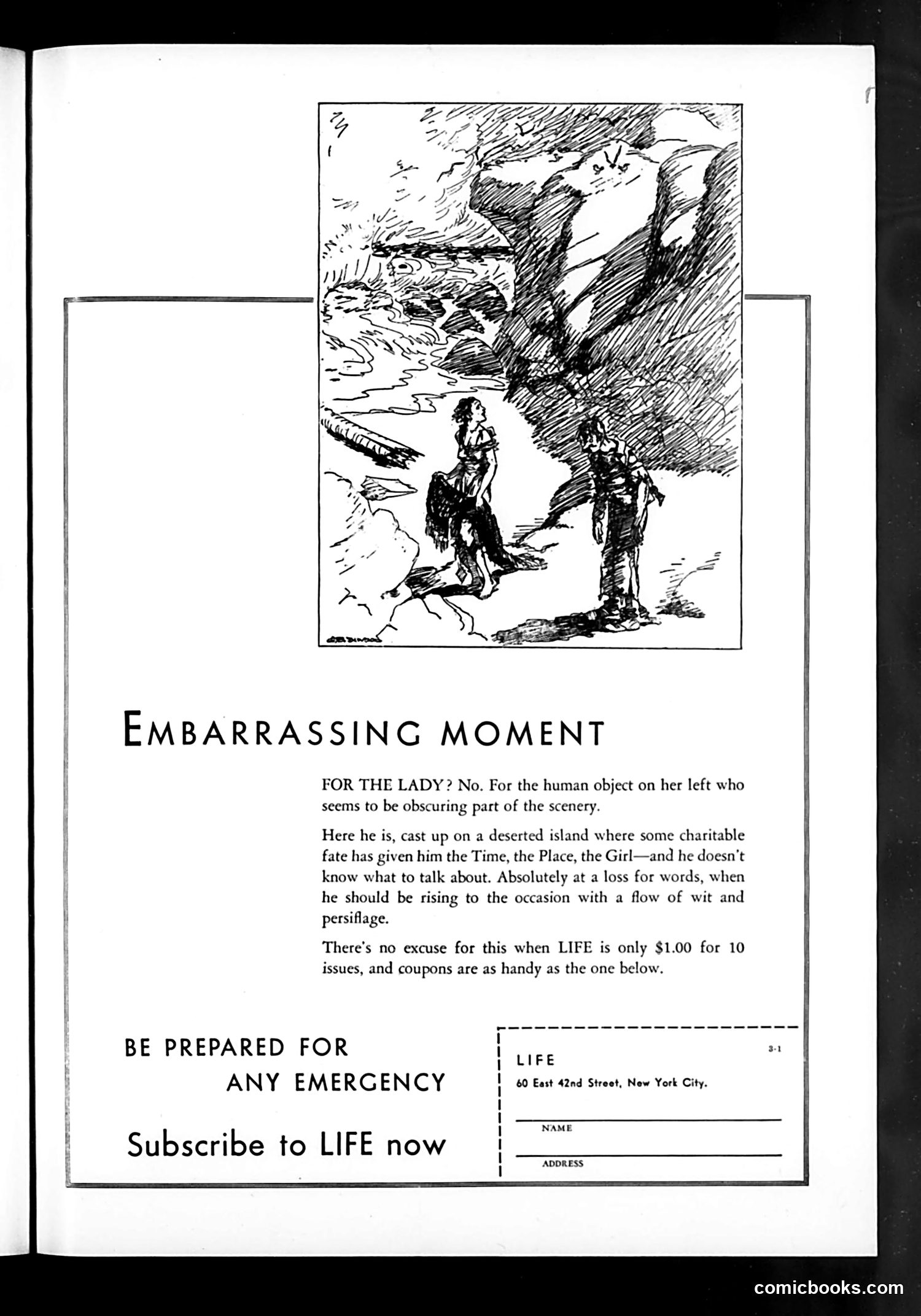
"Embarrassing Moment" - Life Magazine Advertisement This is a satirical advertisement disguised as a cartoon. The sketch shows a man and woman on a deserted island—a romantic scenario—but the man appears tongue-tied and socially awkward, unable to make conversation. The joke: he's unprepared for this "emergency" moment because he lacks the wit and conversational skill (called "persiflage") needed to impress the lady. The advertisement's punchline cleverly pivots this social anxiety into a sales pitch: subscribe to Life magazine for only $1 per 10 issues, so you'll be "prepared for any emergency" with interesting material to discuss. The satire targets male social ineptitude while using romantic comedy tropes to sell magazine subscriptions. It's tongue-in-cheek advertising that assumes readers recognize the cliché of the tongue-tied suitor on an island paradise.
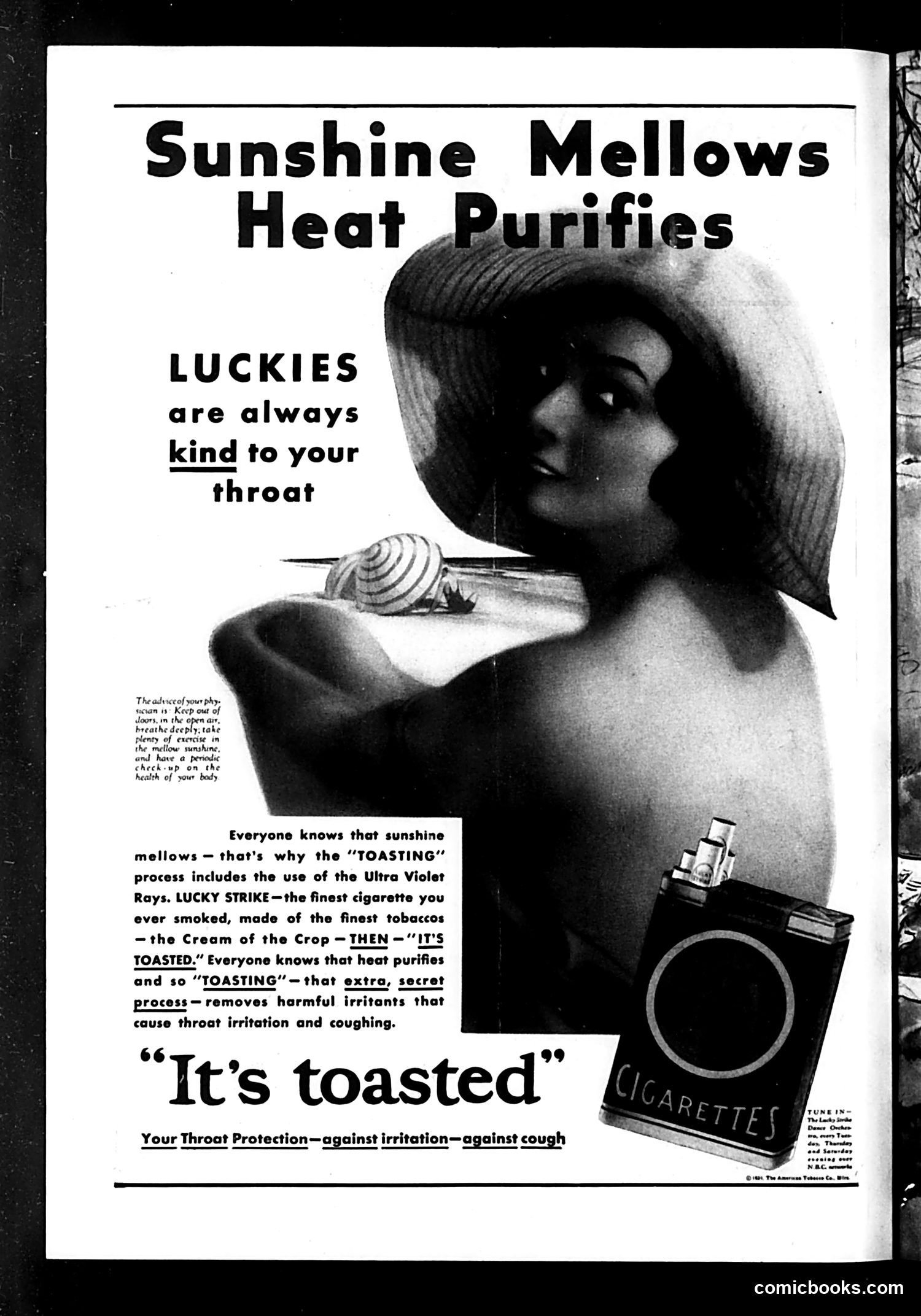
Lucky Strike Cigarette Advertisement This is a cigarette advertisement, not satire—though modern readers will find it darkly ironic. It promotes Lucky Strike cigarettes by falsely claiming they're good for your throat. The ad uses pseudo-scientific reasoning: sunshine "mellows" things, so Lucky Strike's "toasting" process (using ultraviolet rays) similarly purifies tobacco and removes "harmful irritants." The accompanying image shows a woman holding a snail in sunshine, visually reinforcing the "mellowing" concept. The tagline "It's toasted" emphasizes throat protection "against irritation—against cough." The historical context: This represents mid-20th-century tobacco marketing before cigarette health dangers were widely acknowledged or regulated. Manufacturers made unsubstantiated health claims to reassure consumers. Modern readers recognize this as dangerous misinformation—cigarettes cause throat irritation and coughing, not prevent it.