life
Life — March 13, 1931
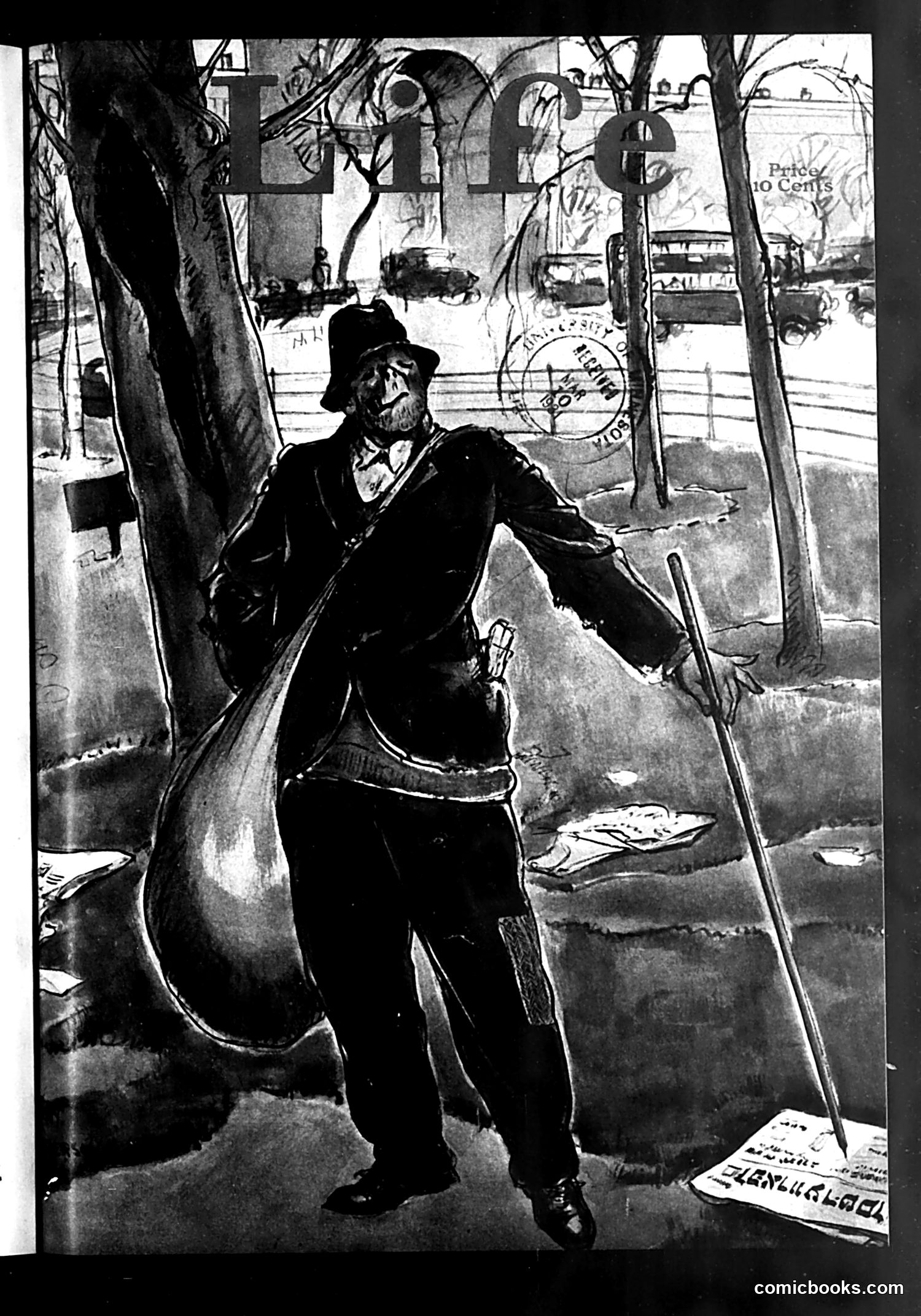
Analysis This appears to be a political cartoon from Life magazine featuring a caricatured military or uniformed figure wielding a large club or bludgeon. The figure wears a hat and formal military-style clothing with a belt. The setting shows a park or public space with trees and vehicles visible in the background. The cartoon's satire seems to target authoritarian violence or police/military overreach, given the prominent display of the weapon as the figure's defining characteristic. Without clearer text or dating information visible on this page, I cannot definitively identify the specific historical figure, political event, or social issue being referenced. The style suggests early-to-mid 20th century American satirical commentary, likely commenting on abuse of power or militarism, but specific context remains unclear from the image alone.
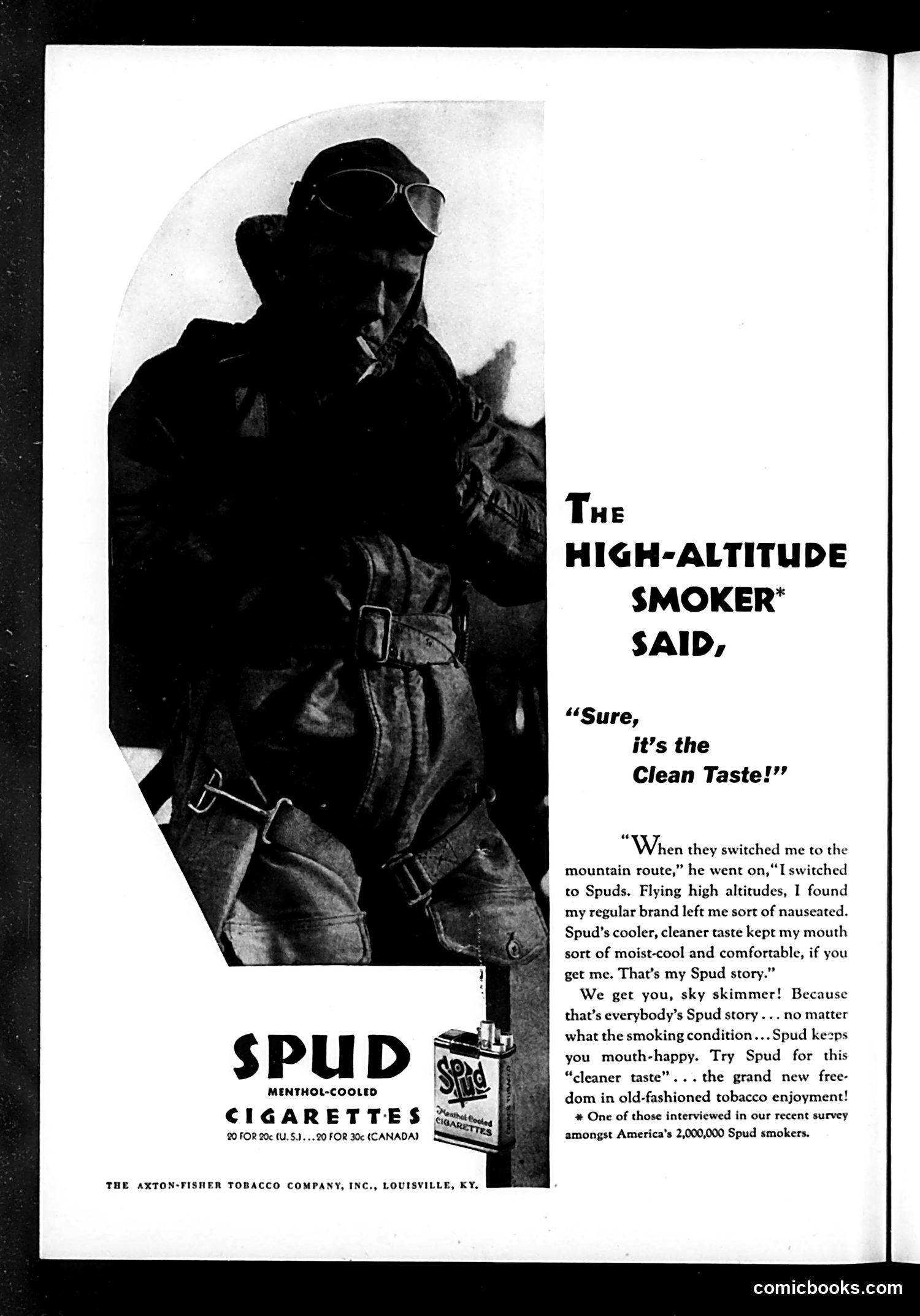
This is a vintage advertisement for Spud menthol-cooled cigarettes, not satirical content. The ad features a high-altitude pilot or mountain climber in full gear with goggles, positioned as a testimonial endorser. The "high-altitude smoker" claims that switching to Spud cigarettes resolved nausea caused by his regular brand, praising the product's "clean taste" and cooling menthol properties. The advertisement targets adventurous consumers by associating the product with extreme conditions and rugged pursuits. It includes pricing information (90 for 50¢ U.S.; 90 for 30¢ Canada) and is credited to the Axton-Fisher Tobacco Company in Louisville, Kentucky. This reflects mid-20th century cigarette marketing strategies that leveraged aspirational lifestyles and false health claims.
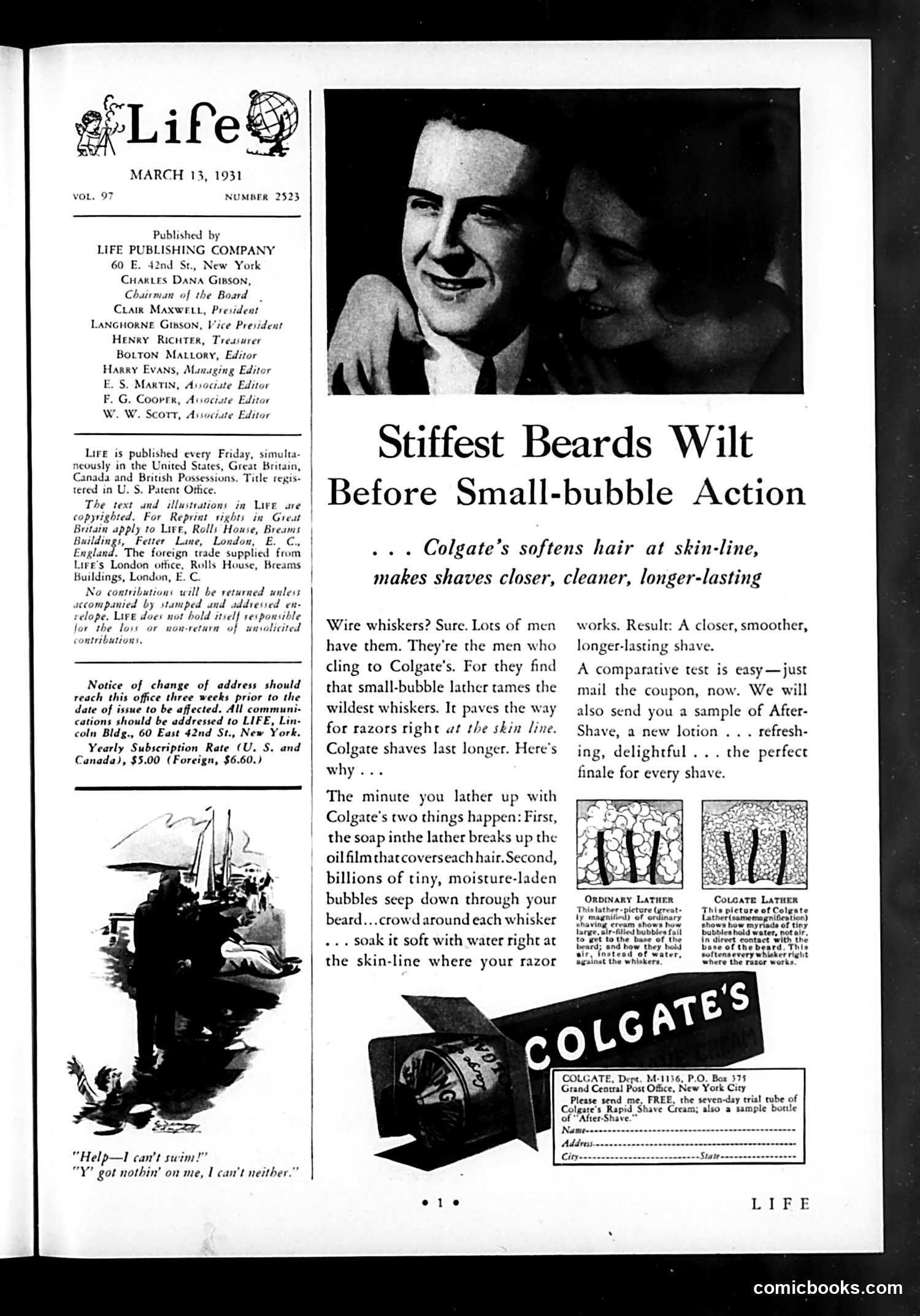
Page Analysis This page is primarily a Colgate shaving cream advertisement disguised as editorial content, a common advertising practice in 1931 Life magazine. The main cartoon (lower left) shows a drowning figure crying "Help—I can't swim!" while another responds "V' got nothin' on me, I can't neither." This appears to be a generic humorous cartoon unrelated to the advertisement. The featured advertisement uses comparative diagrams to illustrate how Colgate's "small-bubble" lather supposedly differs from ordinary lather, claiming it softens whiskers and enables closer shaves. The ad includes a coupon offering free samples. The smiling man's photograph at top right likely represents a satisfied customer testimonial, typical of advertising conventions of the era.
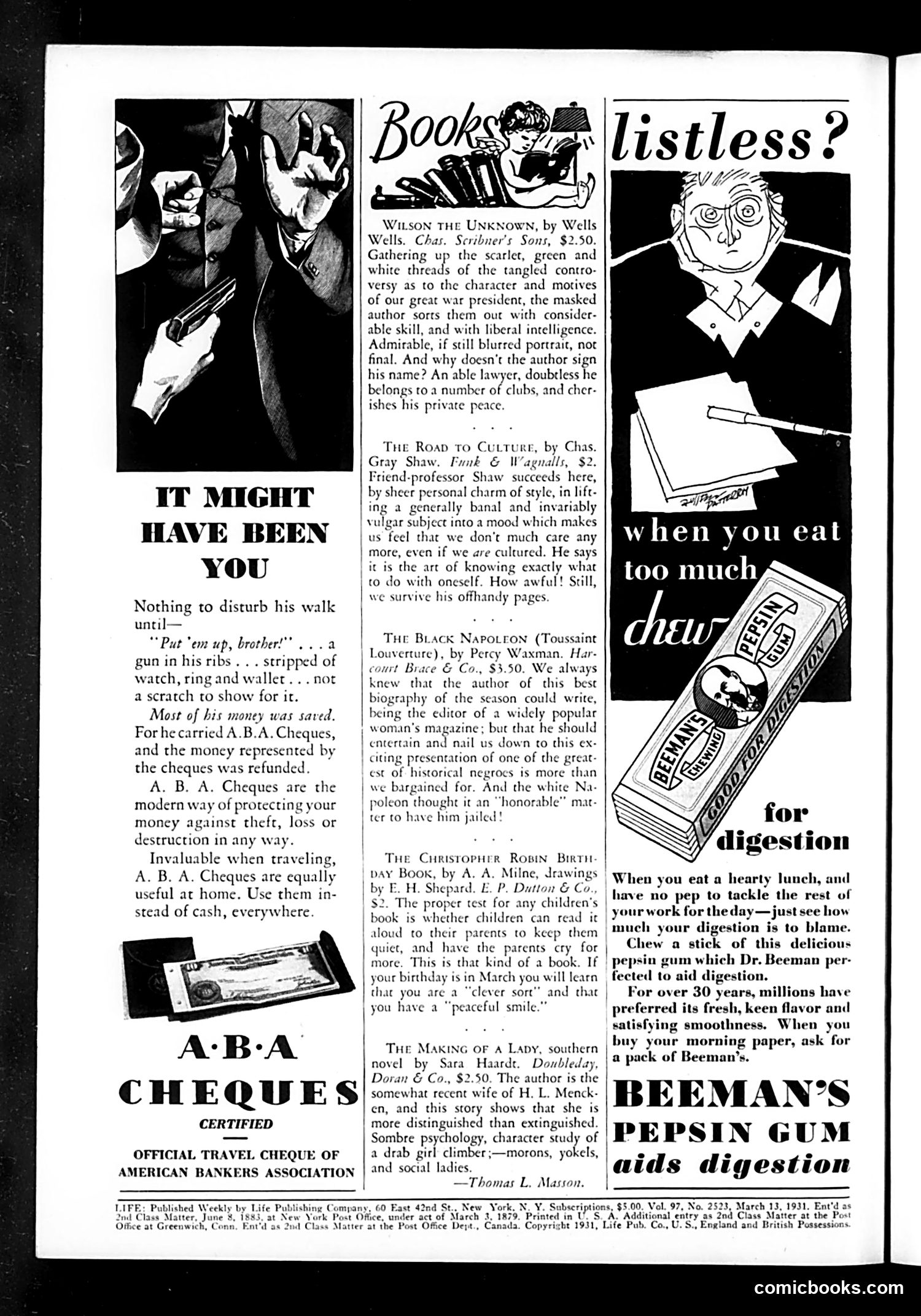
"It Might Have Been You" Cartoon Analysis This political cartoon satirizes vulnerability to theft and crime. The image shows a well-dressed man who has been robbed—stripped of valuables like his watch, ring, wallet, and even the cheques from his ribs. The accompanying text emphasizes the shocking ease of such theft: "nothing to disturb his walk" before the robbery. The satire's point: the cartoon promotes A.B.A. Cheques (traveler's cheques from the American Bankers Association) as protection against theft. By depicting a man left with nothing after robbery, the ad argues these certified cheques are the "modern way of protecting your money" while traveling—safer than carrying cash, which offers no recourse if stolen.
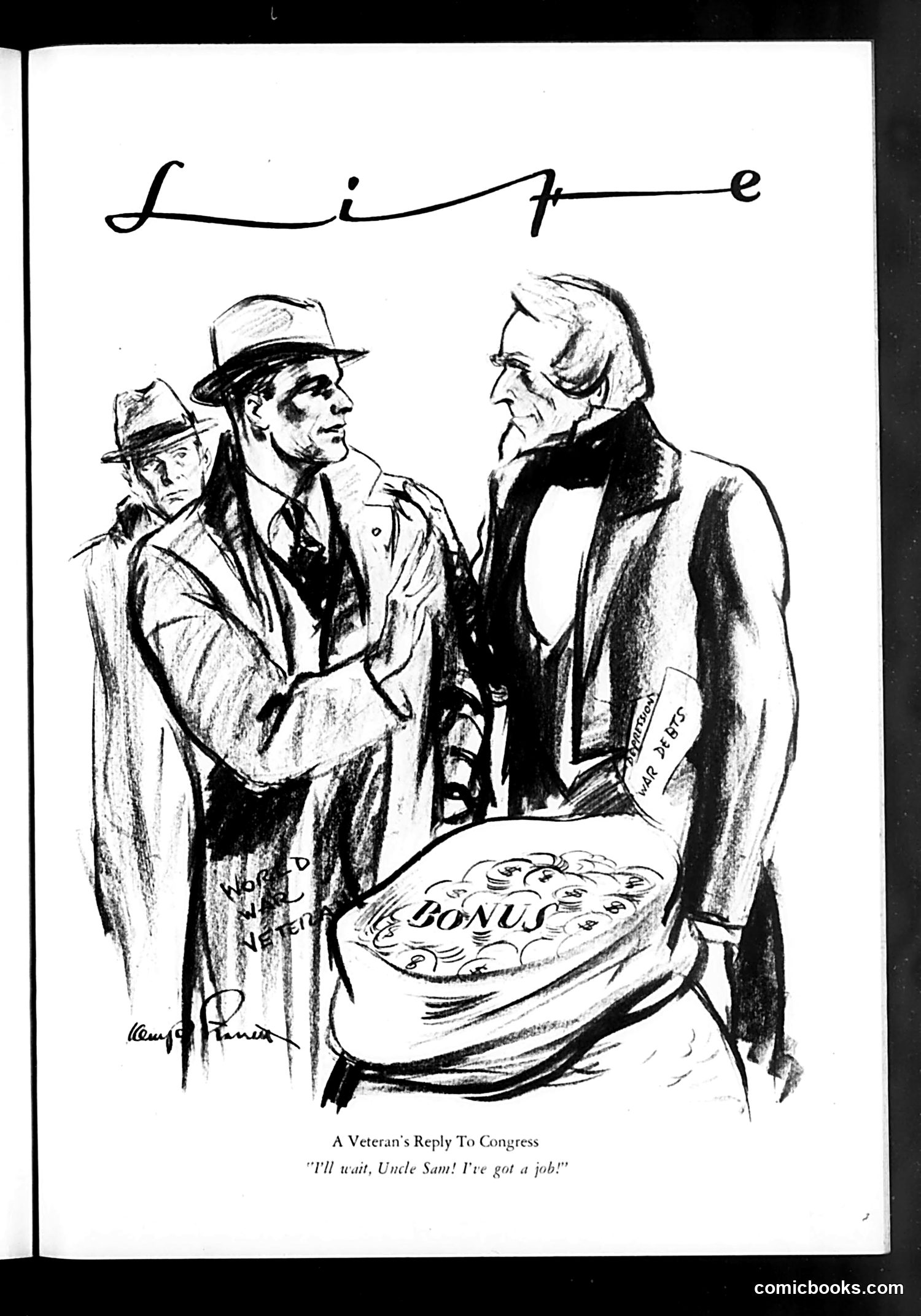
"A Veteran's Reply to Congress" This cartoon depicts a World War I veteran (center, in military attire) confronting a well-dressed congressman (right) who offers a "Bonus" — likely referring to the contentious Veterans' Bonus debate of the 1920s-30s, when Congress debated compensating soldiers for wartime service. The veteran's reply — "I'll wait, Uncle Sam! I've got a job!" — expresses sardonic frustration. Rather than accept delayed bonus payments, the veteran asserts he's found employment, implying Congress's promises ring hollow. A younger soldier stands behind him (left), witnessing the exchange. The satire critiques Congress's stalling tactics on veteran benefits while working veterans struggle economically. The cartoon champions veterans' dignity and self-reliance while mocking government delay.
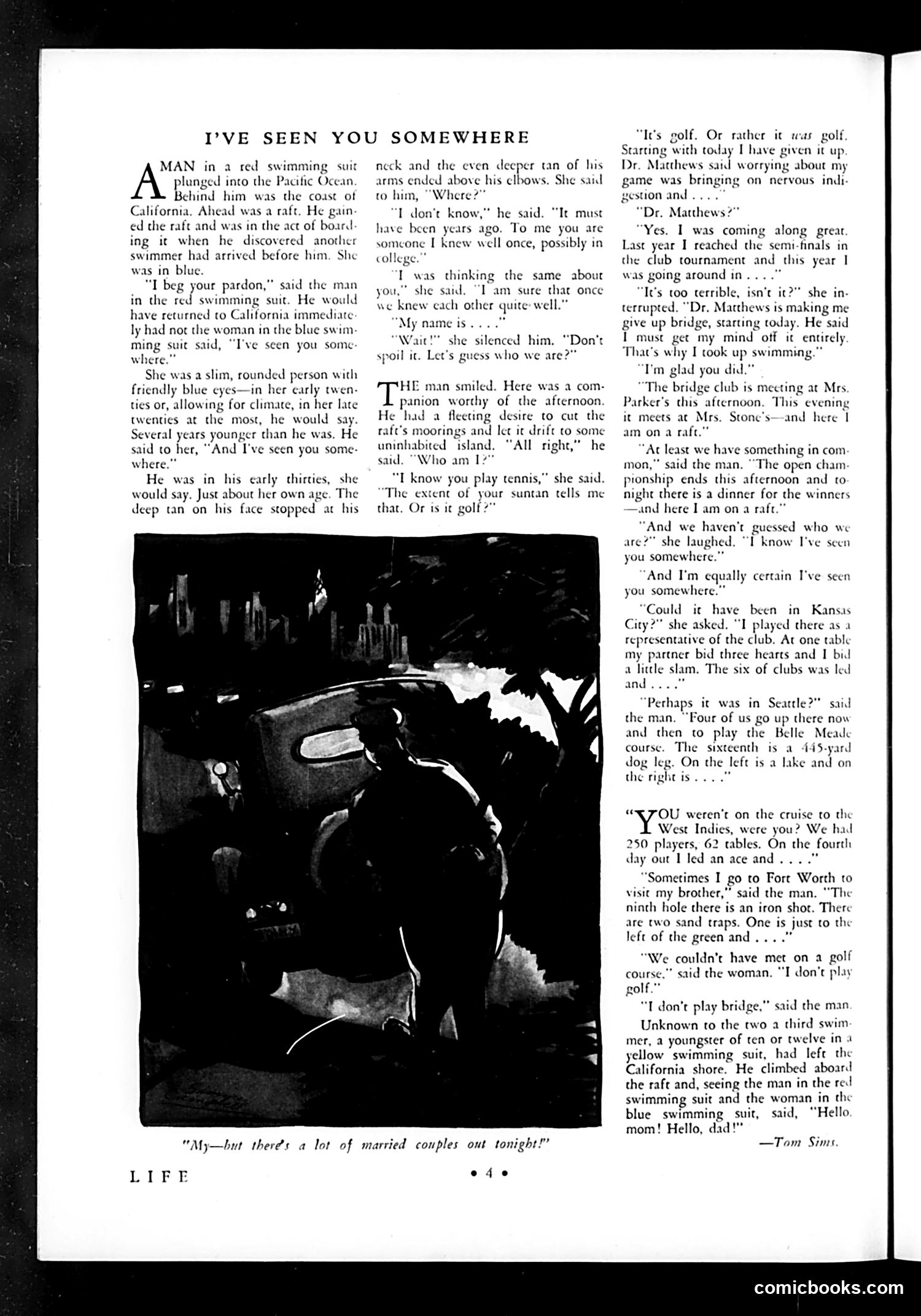
Analysis of "I've Seen You Somewhere" This page presents a short story illustrated with a single photograph. The narrative depicts a chance encounter between a man in a red swimming suit and a woman in a blue suit who meet on a Pacific Ocean raft. Each claims to recognize the other from somewhere. The story humorously traces their failed attempts to place each other through various locations: California, college, a club tournament, Kansas City, Seattle, a cruise to the West Indies, and Fort Worth. Despite multiple shared reference points across different settings and social contexts, neither can definitively identify where they've met. The accompanying photograph shows two figures on what appears to be a raft, illustrating the story's opening premise. The humor derives from the common social awkwardness of partial recognition and the increasingly absurd accumulation of potential meeting places.
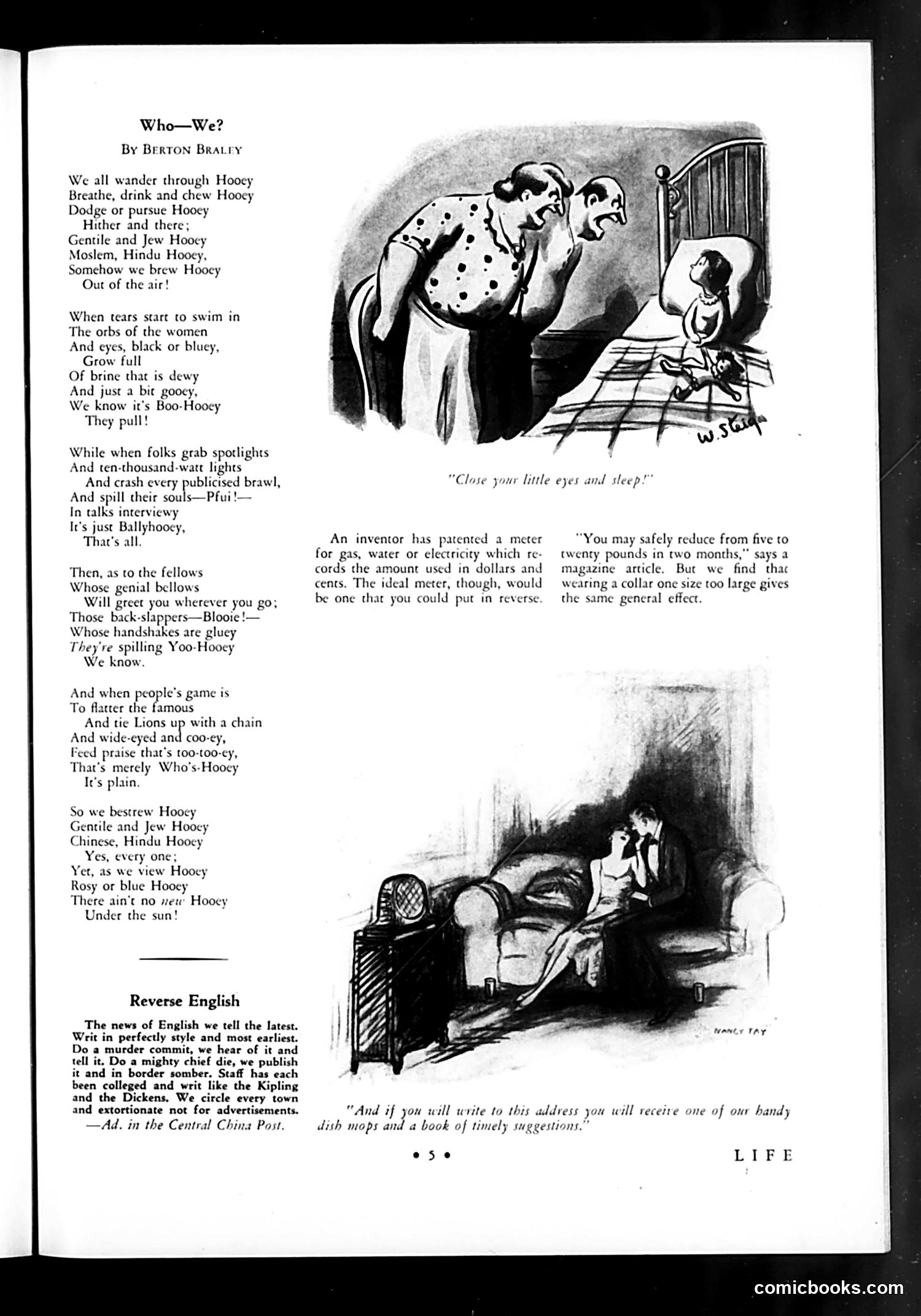
"Who—We?" by Berton Braley This satirical poem mocks American hypocrisy regarding identity and behavior. The verse contrasts public self-perception with actual conduct: Americans claim moral superiority while engaging in "Hooey"—deception, flattery, and shallow performance. The two accompanying cartoons illustrate this theme. The upper sketch shows an adult telling a child to "Close your little eyes and sleep"—suggesting willful ignorance or innocence maintained through deception. The lower cartoon depicts someone reclining with a radio, likely referencing how mass media and entertainment distract from or obscure uncomfortable truths. The poem's final message is that American society constantly practices "Who's Hooey"—self-deceptive flattery and false presentation—regardless of ethnicity or class. It's a critique of widespread American insincerity.
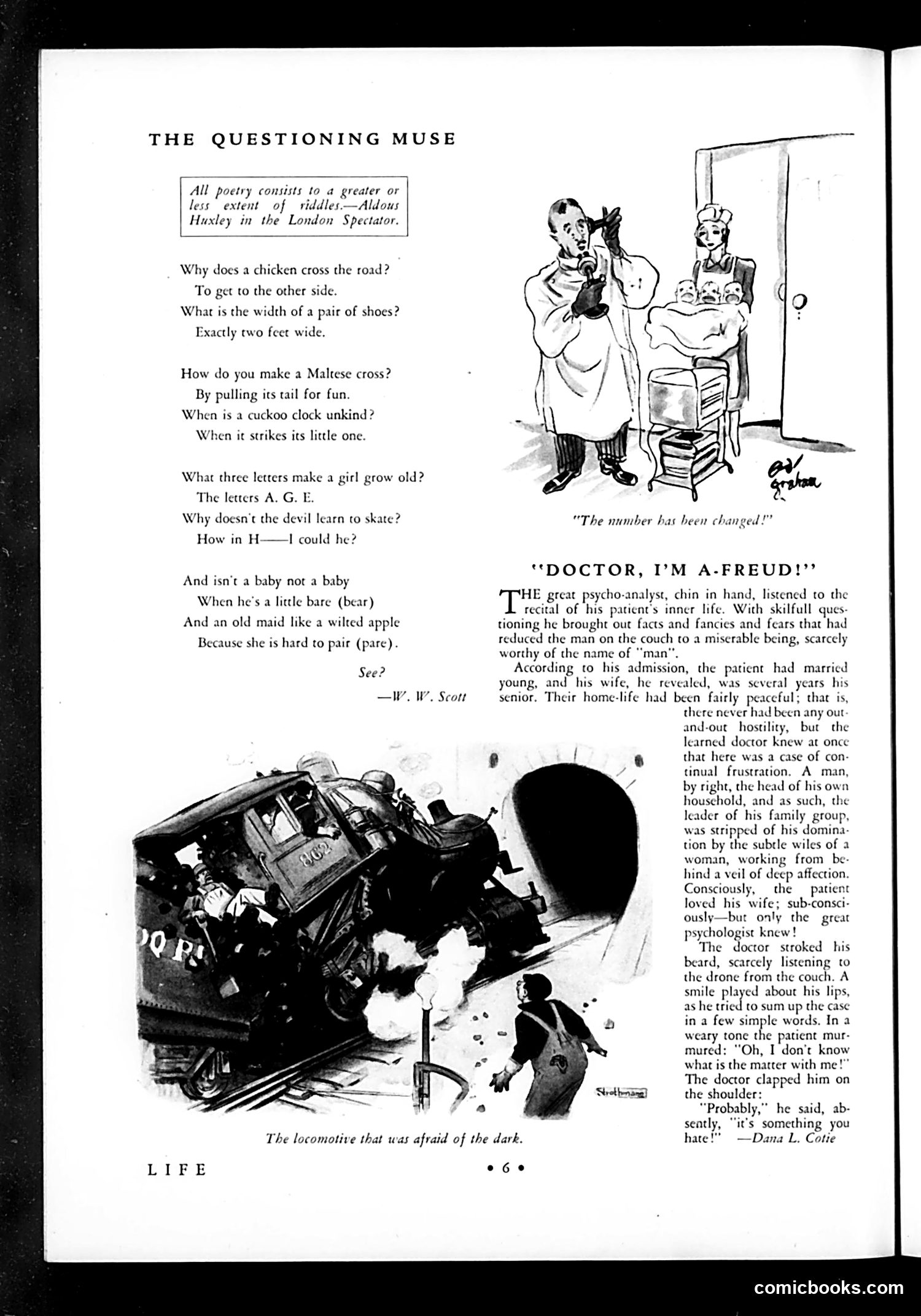
Analysis of Life Magazine Page This page contains two distinct sections: "The Questioning Muse" (top left) presents riddling jokes and wordplay in the style of W.W. Scott, typical of early 20th-century humor magazines. The jokes rely on puns ("bare/bear," "parc/pare") and literal interpretations of common riddles. "Doctor, I'm A-Freud!" (right side) is a satirical story mocking psychoanalysis. The title puns on Sigmund Freud's name. The narrative describes a psychoanalyst treating a patient whose marital frustration stems from his wife's domination—a common satirical critique of psychology's emerging popularity. The accompanying illustration of a derailed locomotive appears to be a visual metaphor for the patient's psychological state. The overall page reflects early-20th-century skepticism toward Freudian psychology, presenting it as both pretentious and absurd through humor.
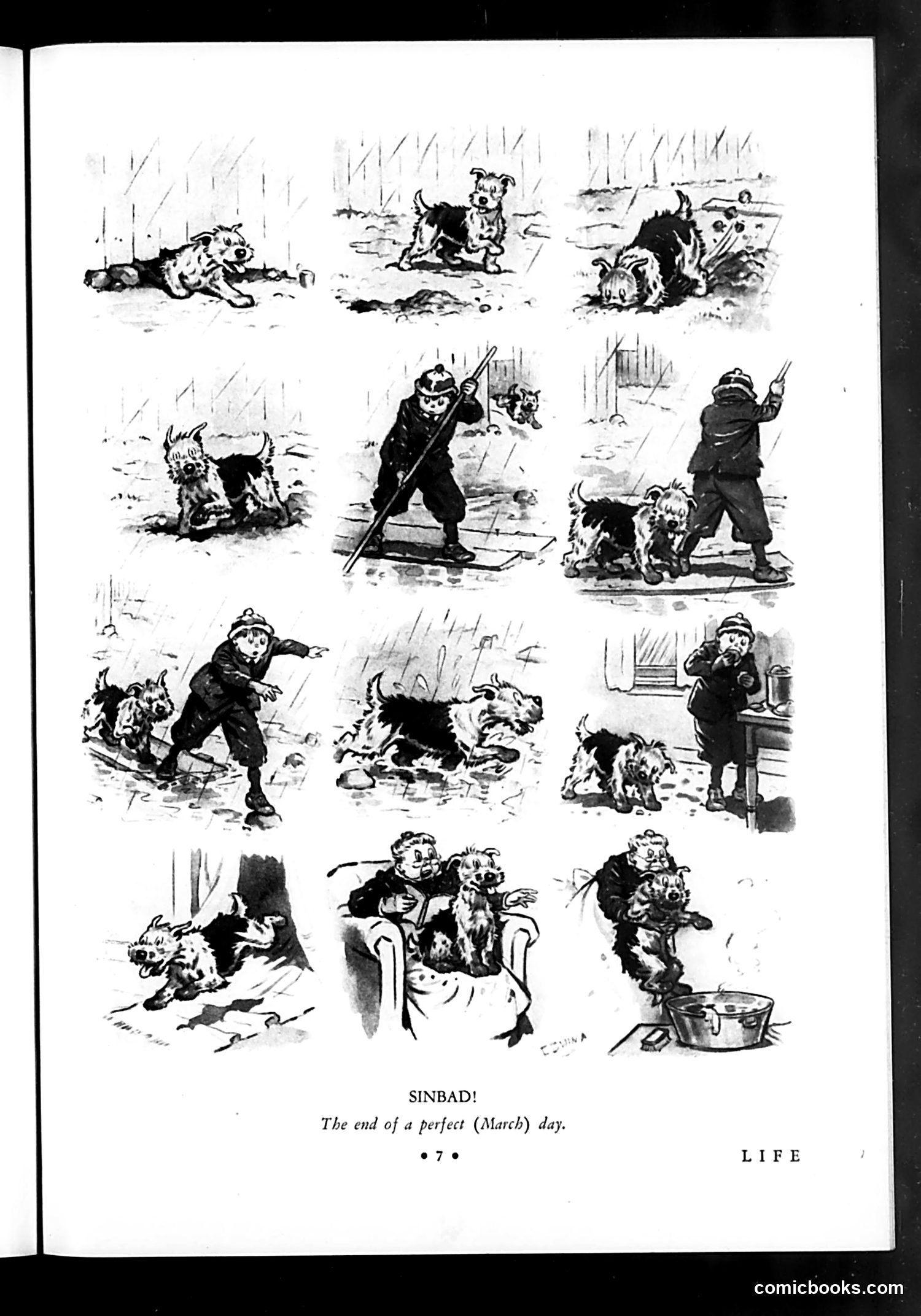
"Sinbad! The End of a Perfect (March) Day" This is a humorous illustrated sequence from *Life* magazine showing a dog's eventful day. The title references both the fictional sailor Sinbad and the popular 1910 song "The End of a Perfect Day." The comic strips depict a terrier experiencing various misadventures: playing in rain and mud, encountering other dogs, interacting with a soldier or policeman, being chased, and finally returning home exhausted and bedraggled. The final panels show the dog with its owner—appearing muddy, wet, and thoroughly worn out. The satire humorously contrasts the owner's perspective of a "perfect day" with the dog's chaotic reality of outdoor adventures, dirt, and troublemaking. It's a gentle commentary on the gap between human expectations and animal behavior.
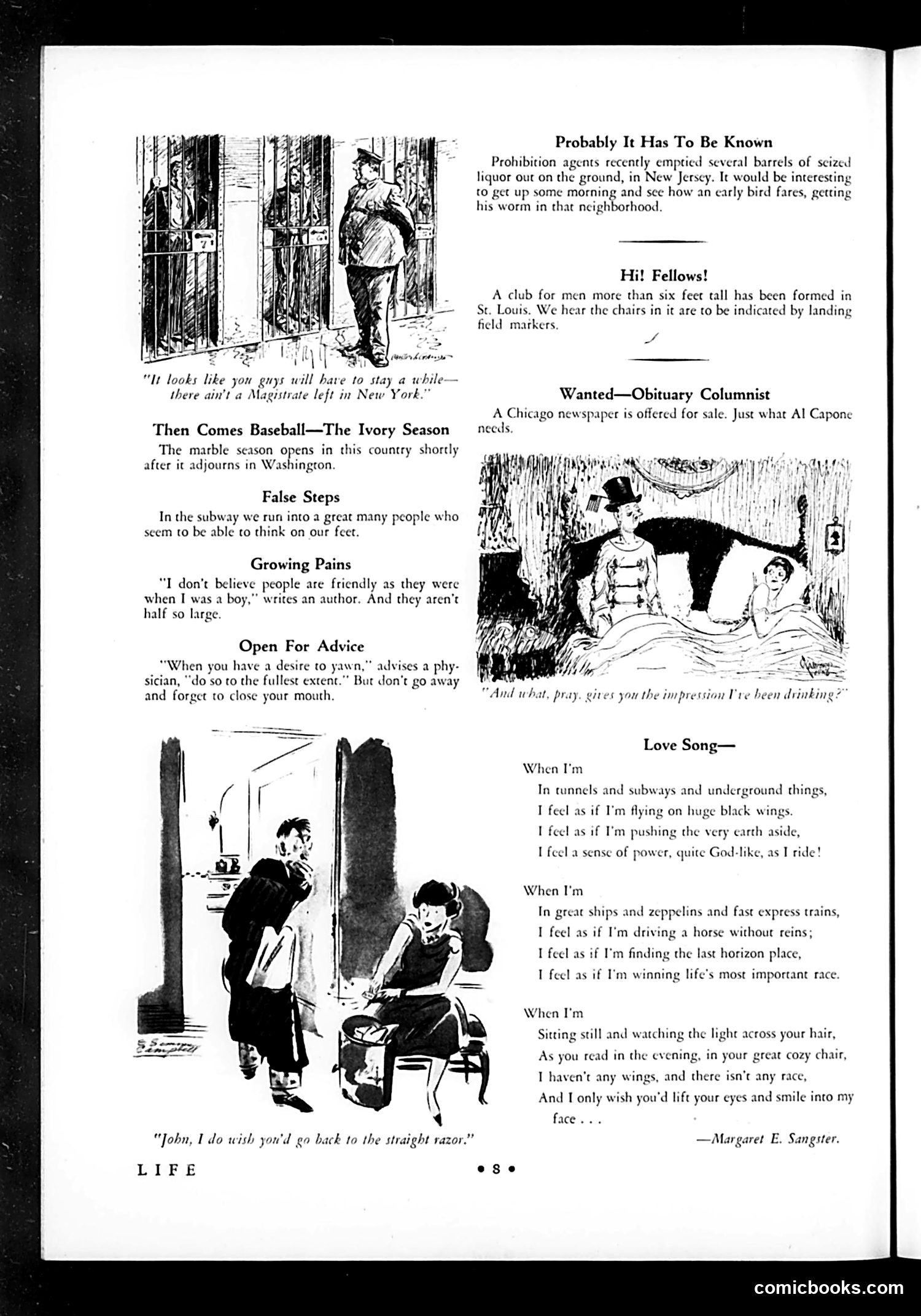
Analysis of Life Magazine Page This page contains several short humorous pieces and illustrations typical of early 20th-century satirical journalism. Top cartoon: A man carrying empty liquor bottles encounters police, joking that "magistrates" have disappeared from New York—sarcastically suggesting Prohibition enforcement has made legal authority vanish. Middle cartoon: Shows a man in bed asking a woman "what pray, gives you the impression I've been drinking?"—a domestic humor piece about a husband denying inebriation. Bottom cartoon: Depicts two men, one asking the other to "go back to the straight razor"—likely referencing safety razors versus traditional straight razors, used humorously in a personal grooming context. The page also includes brief humorous observations about baseball, subway crowds, and growing pains, concluding with Margaret E. Sangster's "Love Song"—a sentimental poem about romantic longing.
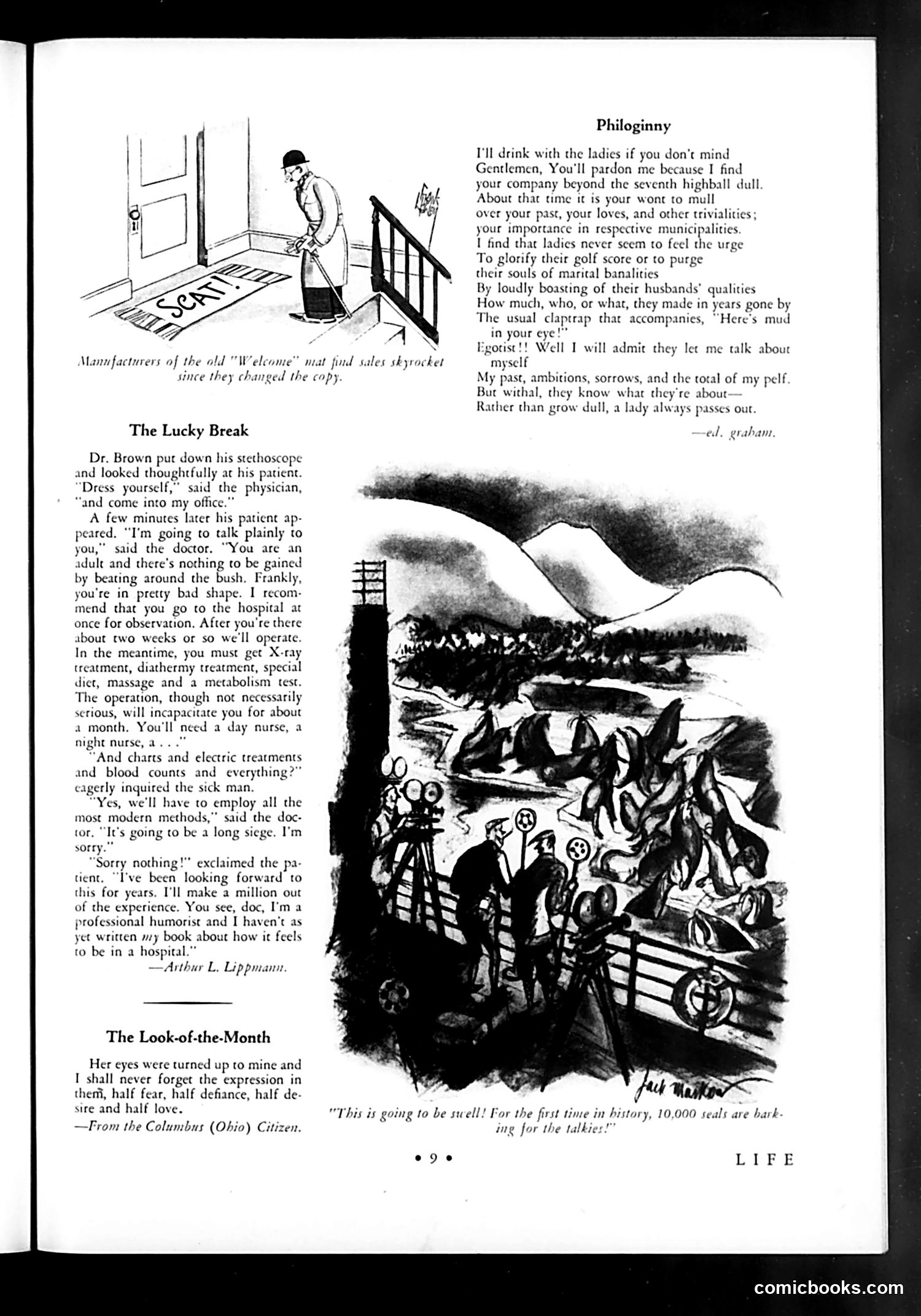
Explanation for Modern Readers This page contains three separate pieces of humor: 1. Top cartoon: Shows a man at a doormat labeled "Welcome" that has apparently worn out from overuse. The caption jokes that sales of these doormats have skyrocketed "since they changed the copy"—suggesting the worn-out welcome reflects a social commentary on hospitality or perhaps business conditions. 2. "The Lucky Break": A humorous anecdote by Arthur L. Lippmann about a patient visiting Dr. Brown. The doctor delivers bad news about the patient's health condition while matter-of-factly recommending hospitalization and various treatments. The joke's punchline involves the patient being a professional humorist looking for material about hospital experiences. 3. "The Look-of-the-Month": A brief poetic quote about a woman's romantic expression. The page reflects early-to-mid 20th century Life magazine's blend of light satire and social observation.
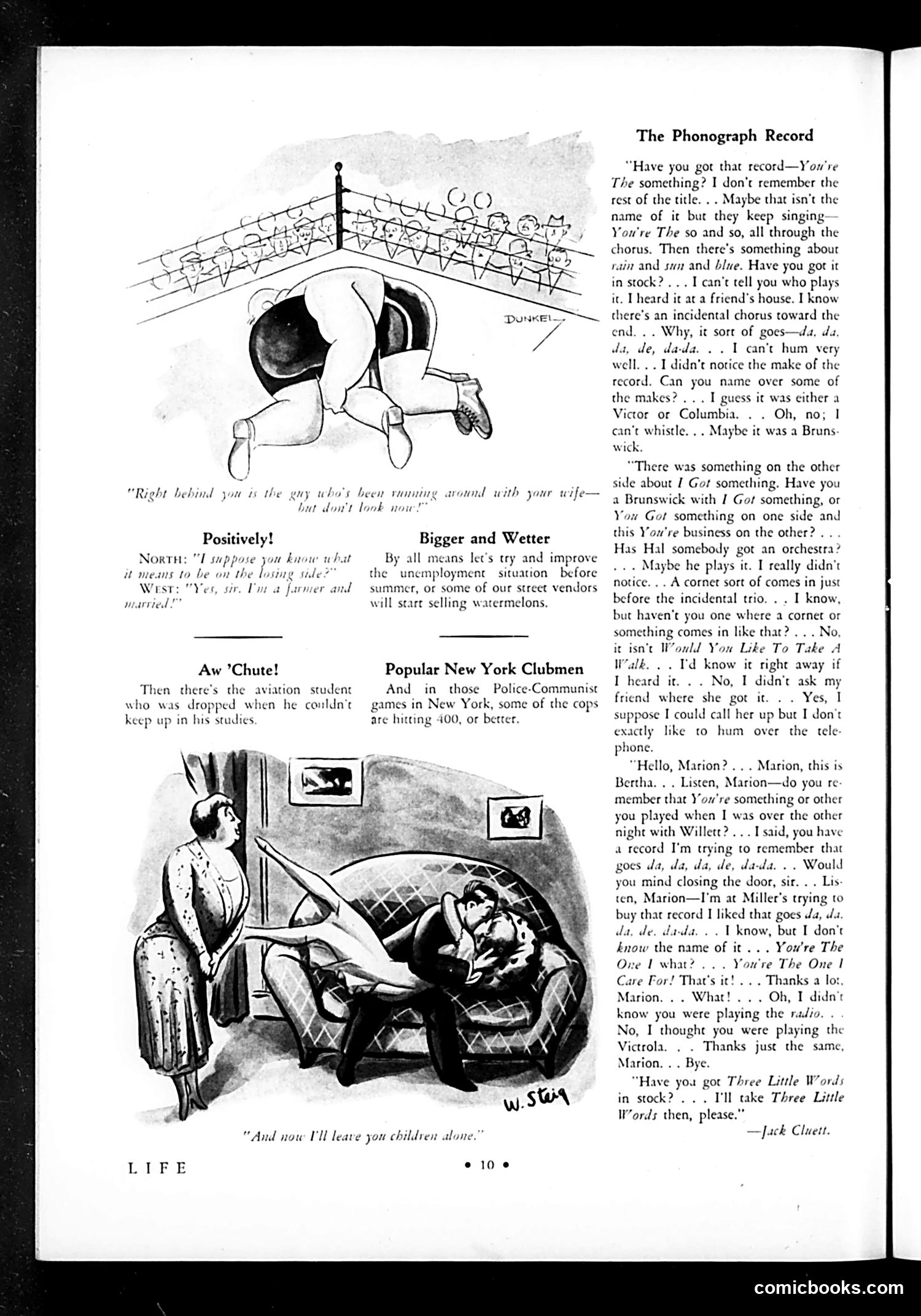
Analysis of Life Magazine Page 10 This page contains humorous anecdotes and cartoons about everyday life circa the 1920s-30s era. The main cartoon by W. Steig depicts a domestic scene where a man relaxes while a woman stands nearby, with the caption "And now I'll leave you children alone." The surrounding text sections are brief comedic vignettes: - "Positively!" jokes about assuming someone's profession - "Aw 'Chute!" mocks an aviation student who failed his studies - "Bigger and Wetter" suggests improving unemployment by street vendors selling watermelons - "Popular New York Clubmen" references police corruption in NYC, where cops allegedly cheat at games The extended "Phonograph Record" section humorously depicts someone trying to identify a song over the telephone—a comedic reflection on the era's phonograph technology and popular music culture. The satire gently mocks everyday social situations and period-specific technologies.
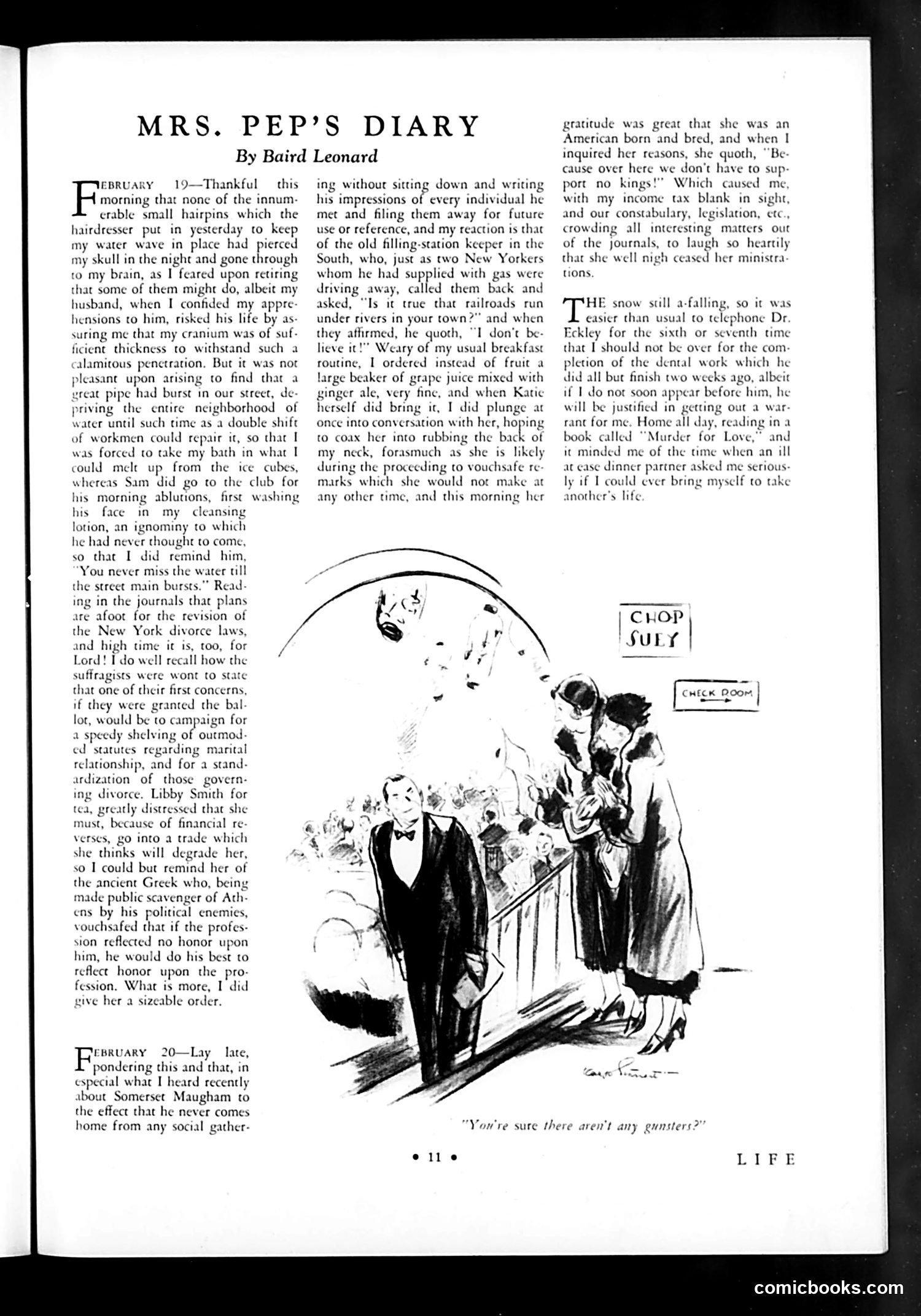
"Mrs. Pep's Diary" by Baird Leonard This page presents a humorous domestic diary entry from February 19-20. The illustration shows a formal dinner scene with the caption "You're sure there aren't any gunnels?" The joke appears to satirize anxious upper-class social anxiety during Prohibition era (references to "gas" and contraband suggest alcohol concerns). Mrs. Pep worries about hosting properly while her husband deals with practical city inconveniences like water mains and ice delivery. The "gunnels" caption likely puns on "gun-running" or smuggling, with the hostess nervously asking guests whether illegal alcohol will be present at their dinner party—reflecting the criminal element that Prohibition introduced into respectable social gatherings.
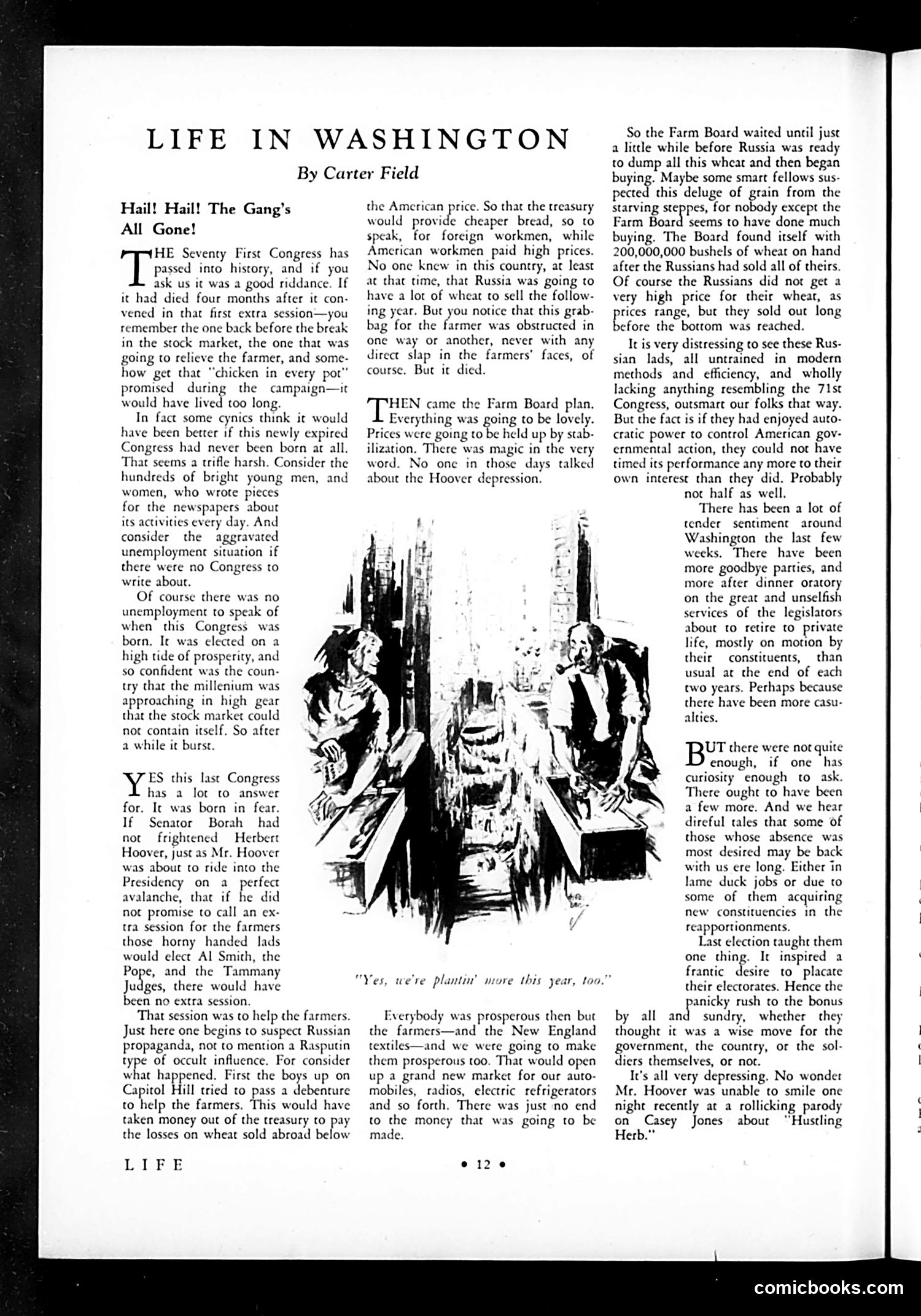
Political Commentary on the Farm Board This page satirizes the Farm Board's wheat policy during the early Depression era. The main cartoon depicts farmers discussing crop strategy, with the caption "Yes, we're plantin' more this year, too." The satire targets the government's failed agricultural intervention: the Farm Board accumulated massive wheat surpluses (200,000,000 bushels mentioned) while trying to stabilize prices through artificial support. Rather than reducing production, farmers—following the Board's guidance—planted even more, worsening the glut. The text criticizes how this scheme benefited nobody except possibly "smart fellows" involved in the deception. It portrays the intervention as inefficient compared to market forces, and suggests the Board's methods resembled—ironically—the inefficient Soviet agricultural approach the article mentions. The overall point: government meddling created worse problems than it solved.
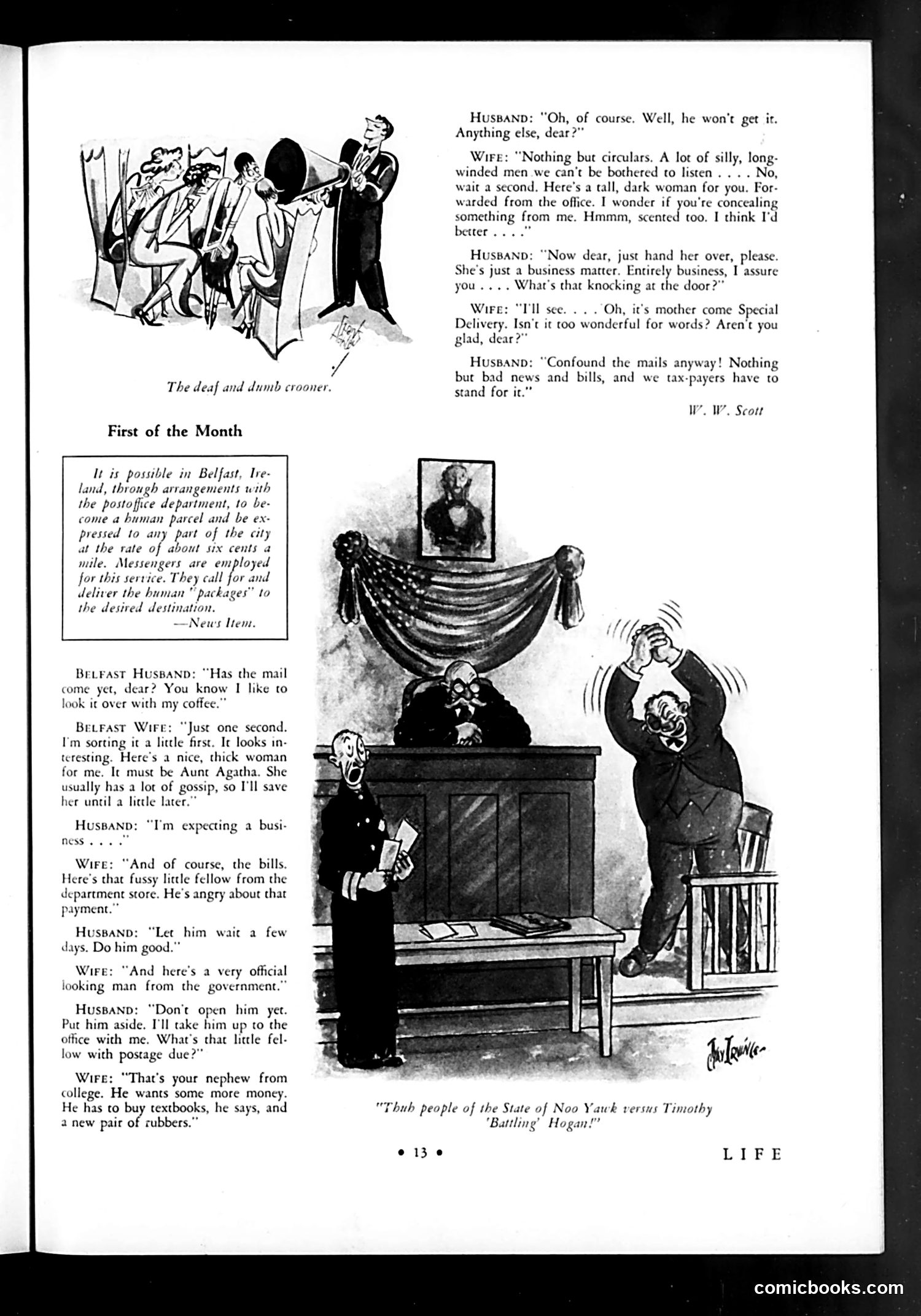
Political Cartoon Analysis This page contains two satirical pieces from *Life* magazine about bureaucratic annoyances. "First of the Month" depicts a Belfast husband and wife discussing incoming mail—bills, business correspondence, and a package from their nephew at college requesting money for textbooks and rubbers (shoes). The joke satirizes the predictable monthly arrival of unwanted financial obligations: bills, complaints from tradesmen, and requests from relatives. The lower cartoon, captioned about "the State of New York versus Timothy 'Battling' Hogan," shows a boxing-themed courtroom scene. It appears to satirize a legal case, likely a famous boxing match dispute or litigation. The specific reference to "Battling" Hogan and New York suggests a real sports-related lawsuit, though the exact case is unclear without additional context.
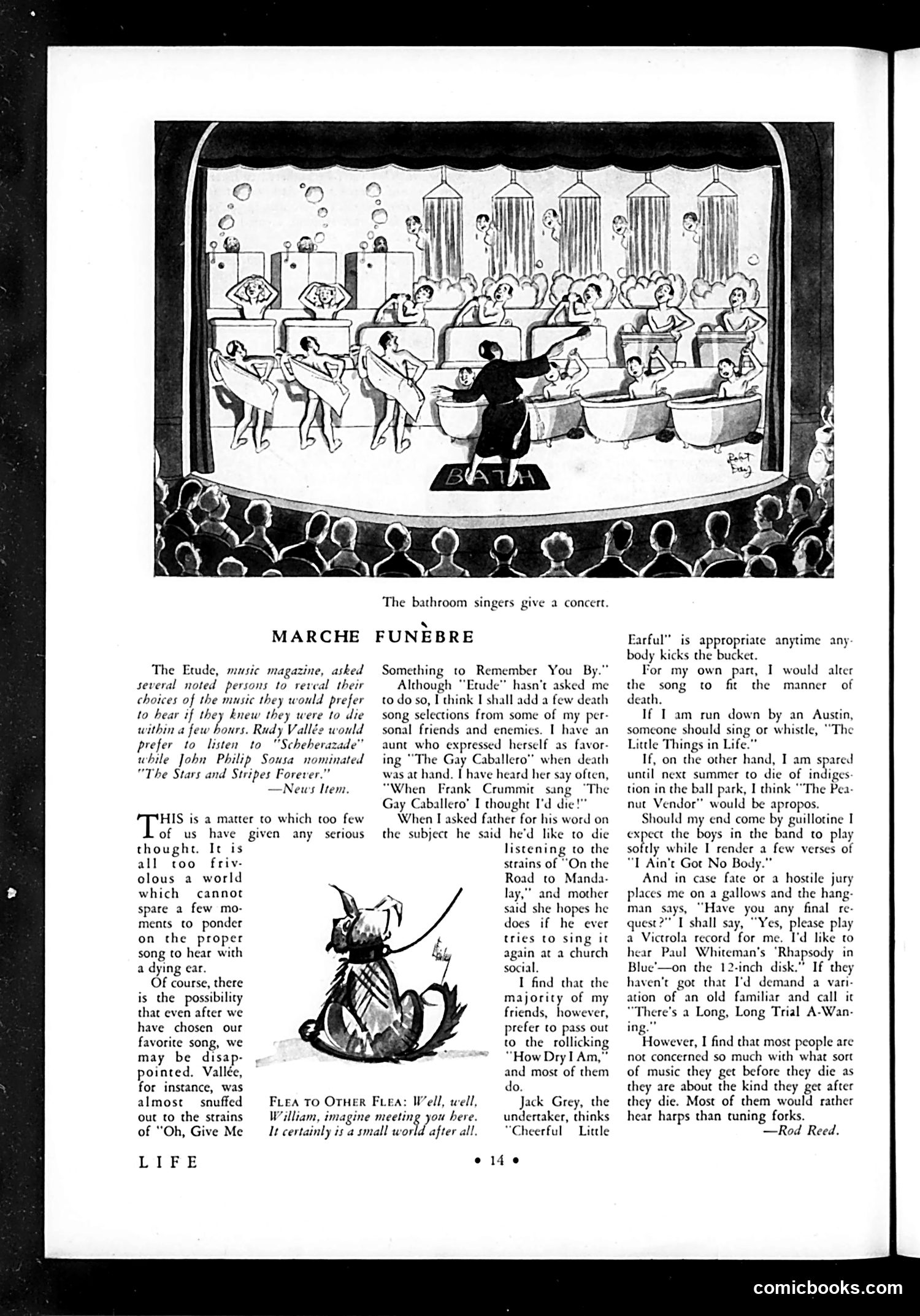
Analysis This page contains a satirical article titled "Marche Funèbre" (Funeral March) discussing what music people prefer to hear before death. The accompanying cartoon, "The Bathroom Singers Give a Concert," depicts an absurdist stage scene where bathtub performers entertain an audience in an elegant concert hall. The satire critiques the gap between aspirational high culture and mundane reality. The "bathroom singers"—typically amateur, unselfconscious performers—are presented in a formal concert setting, mocking both pretentious concert culture and the everyday person's actual relationship with music. The article argues most people care little about the "proper" music they should prefer, instead favoring rollicking popular songs like "How Dry I Am." The humor targets both elite cultural pretensions and ordinary people's genuine tastes.
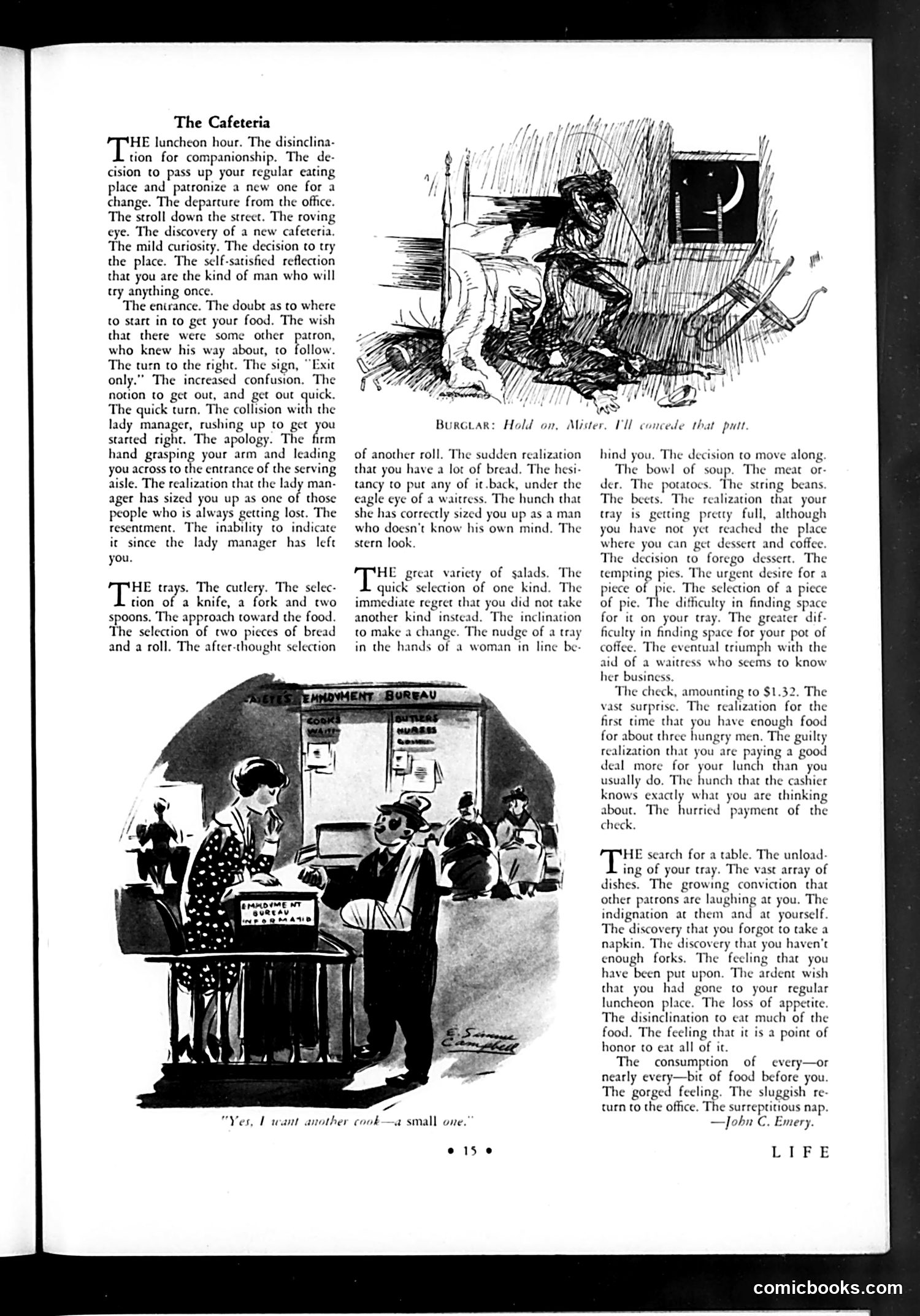
"The Cafeteria" by John C. Emery This satirical essay humorously chronicles the anxieties of a office worker's lunch hour at a cafeteria—a relatively new dining concept at the time. The piece mocks the social discomforts: uncertainty about where to begin eating, collision with the lady manager, navigating crowded trays, selecting from limited options, and the final shock of the bill ($1.32). The two illustrations capture key moments: one shows a flustered diner apologizing to a stern manager ("Hold on, Mister. I'll concede that pint"), and another depicts the chaos at the food counter with a customer requesting "a small one." The satire targets modern urban dining culture and the awkwardness of impersonal, efficient eating spaces replacing traditional restaurants—a common concern during the early twentieth-century mechanization of American life.
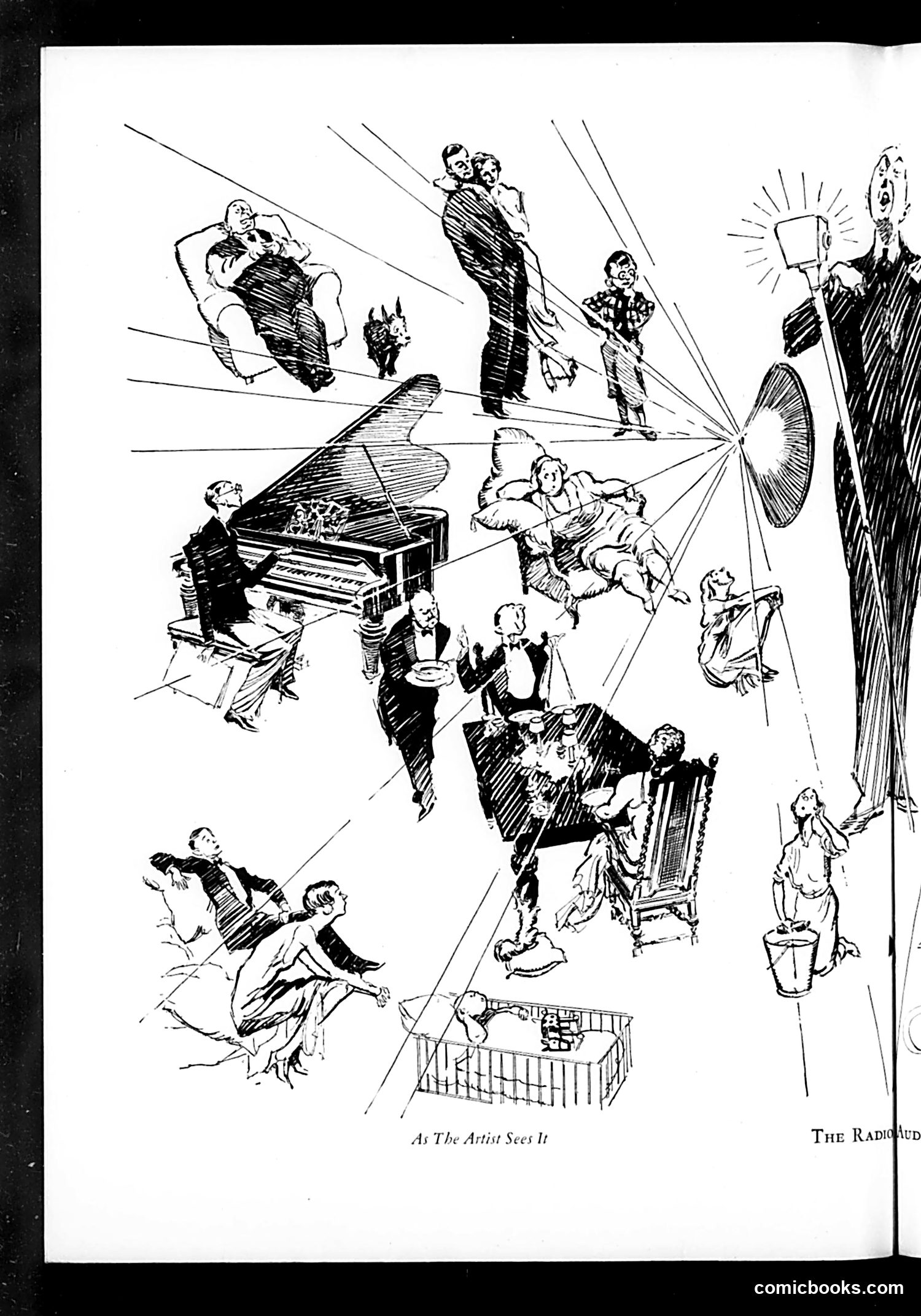
"As The Artist Sees It" - The Radioed This satirical cartoon depicts radio broadcasting's transformative impact on entertainment and culture. The central image shows a grand piano with a pianist, surrounded by radiating lines suggesting broadcast signals. Figures positioned around these lines represent various audiences receiving the same performance simultaneously—people in homes, on streets, and in various settings all connected to this single source. The title "The Radioed" (partially visible) appears to reference how radio was "radiofying" or transforming traditional entertainment delivery. Rather than requiring audiences to attend live concerts, radio democratized access to performances, allowing mass simultaneous consumption. The cartoon satirizes both the marvel and disruption of this new technology—how radio fundamentally altered where, when, and how people experienced music and entertainment in the early 20th century.
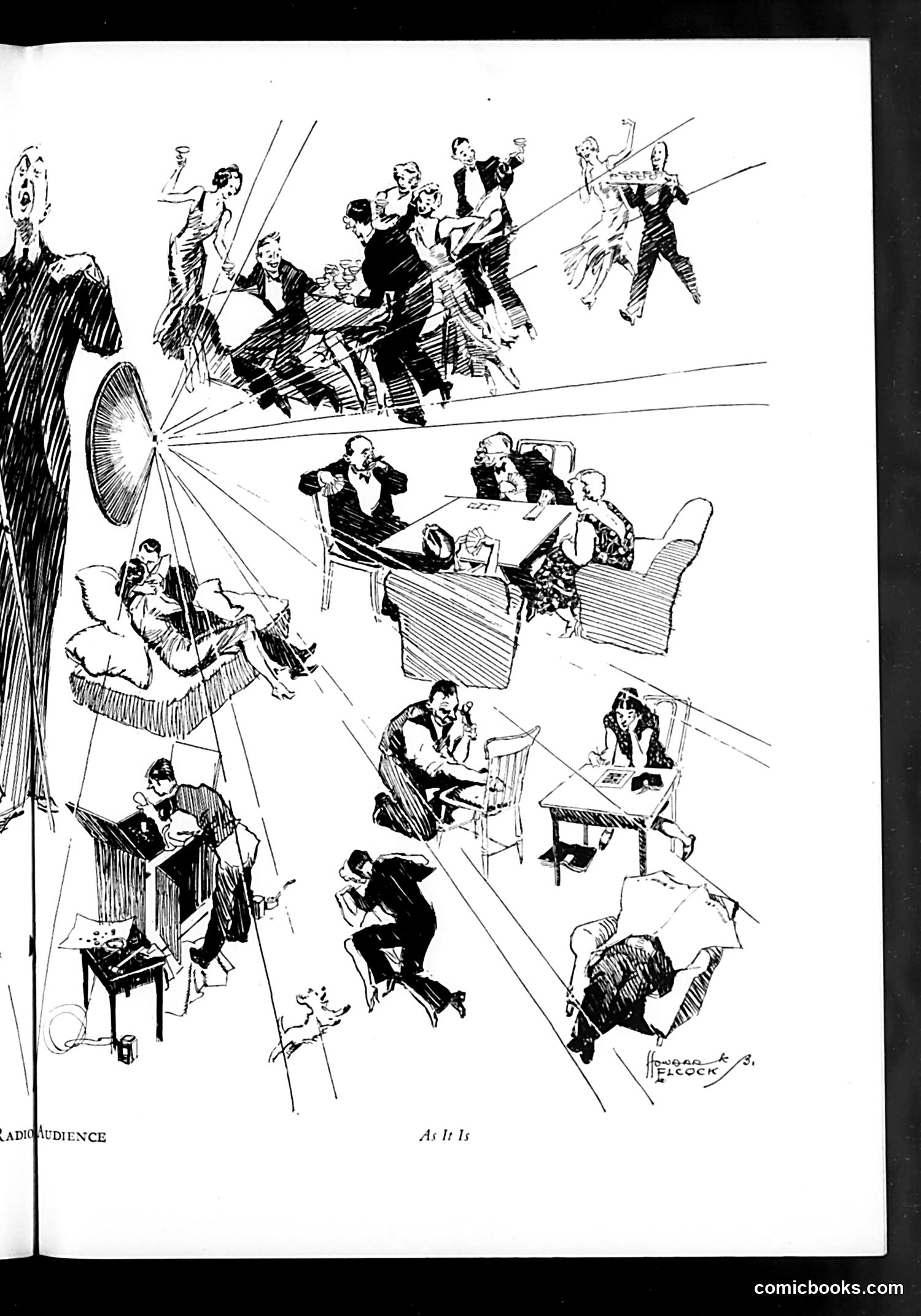
"As It Is" - Radio Audience Satire This cartoon satirizes the invisible nature of radio broadcasting and listening. The large eye on the left represents the broadcaster or network looking down on dispersed listeners below. The scattered figures—some at desks, some in chairs, some reclining—depict audience members in various locations and postures, all receiving the same broadcast simultaneously yet in isolation. The satire likely critiques radio's peculiar social dynamic: despite reaching mass audiences, listeners experience entertainment alone or in small groups, creating an odd disconnect between the broadcaster's singular vision and the fragmented, invisible reception below. The title "As It Is" suggests this is the modern reality of entertainment consumption—impersonal yet pervasive.
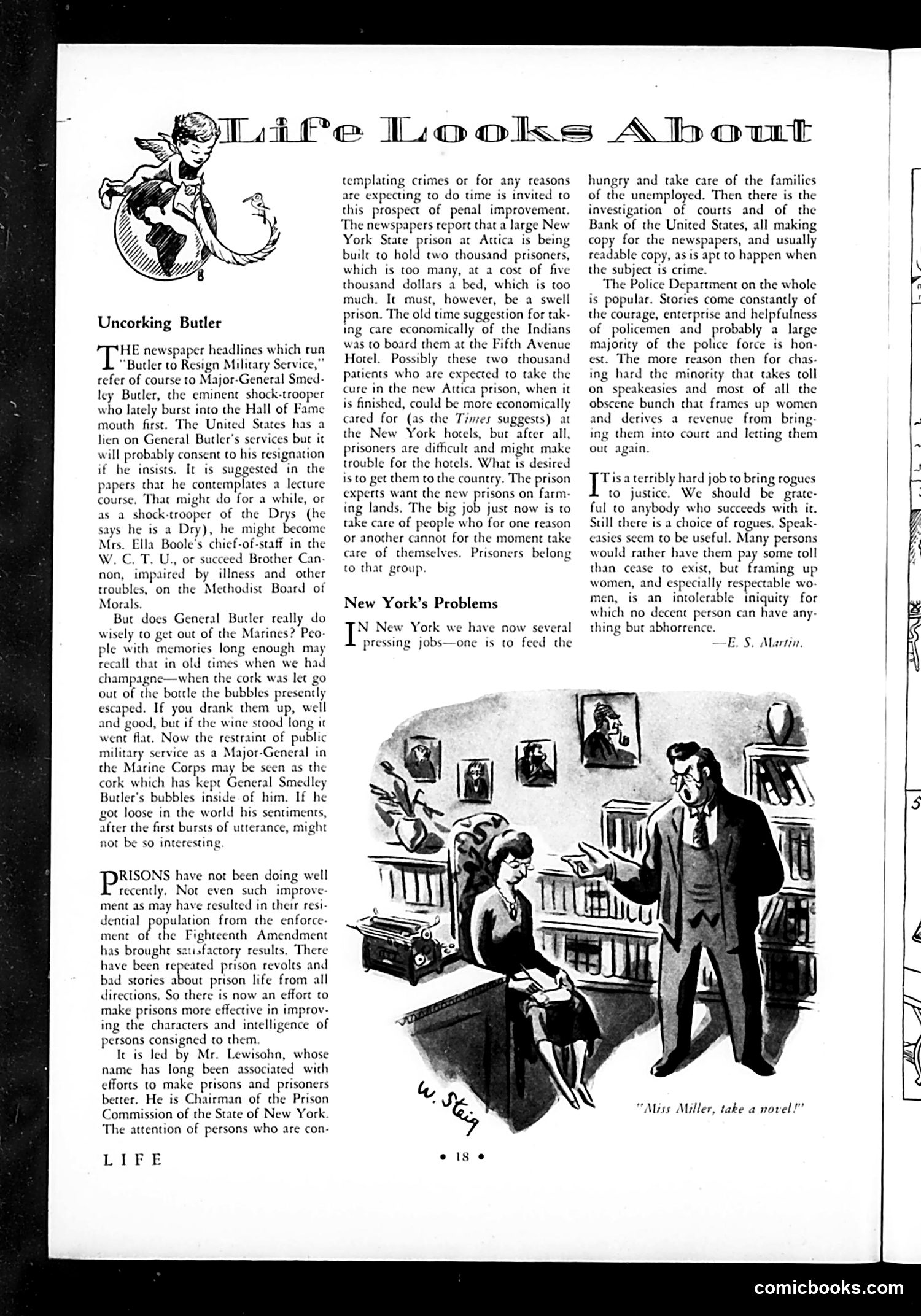
"Life Looks About" - Page Analysis This page from *Life* magazine contains three opinion pieces on social issues. The main cartoon (bottom) shows a domestic scene captioned "Miss Miller, take a novel!" It depicts a woman at a typewriter and a man gesturing toward bookshelves, apparently suggesting she should read fiction rather than write it—a satirical jab at gender discrimination in publishing. The text sections address: 1. "Uncorking Butler" - Commentary on General Smedley Butler's potential resignation from military service, questioning whether he truly understands the Marines' problems. 2. "New York's Problems" - Discussion of prison reform efforts in New York State, led by Chairman Lewisohn of the Prison Commission, addressing overcrowding and inmate rehabilitation. The page reflects early 20th-century concerns about institutional reform and women's professional opportunities.
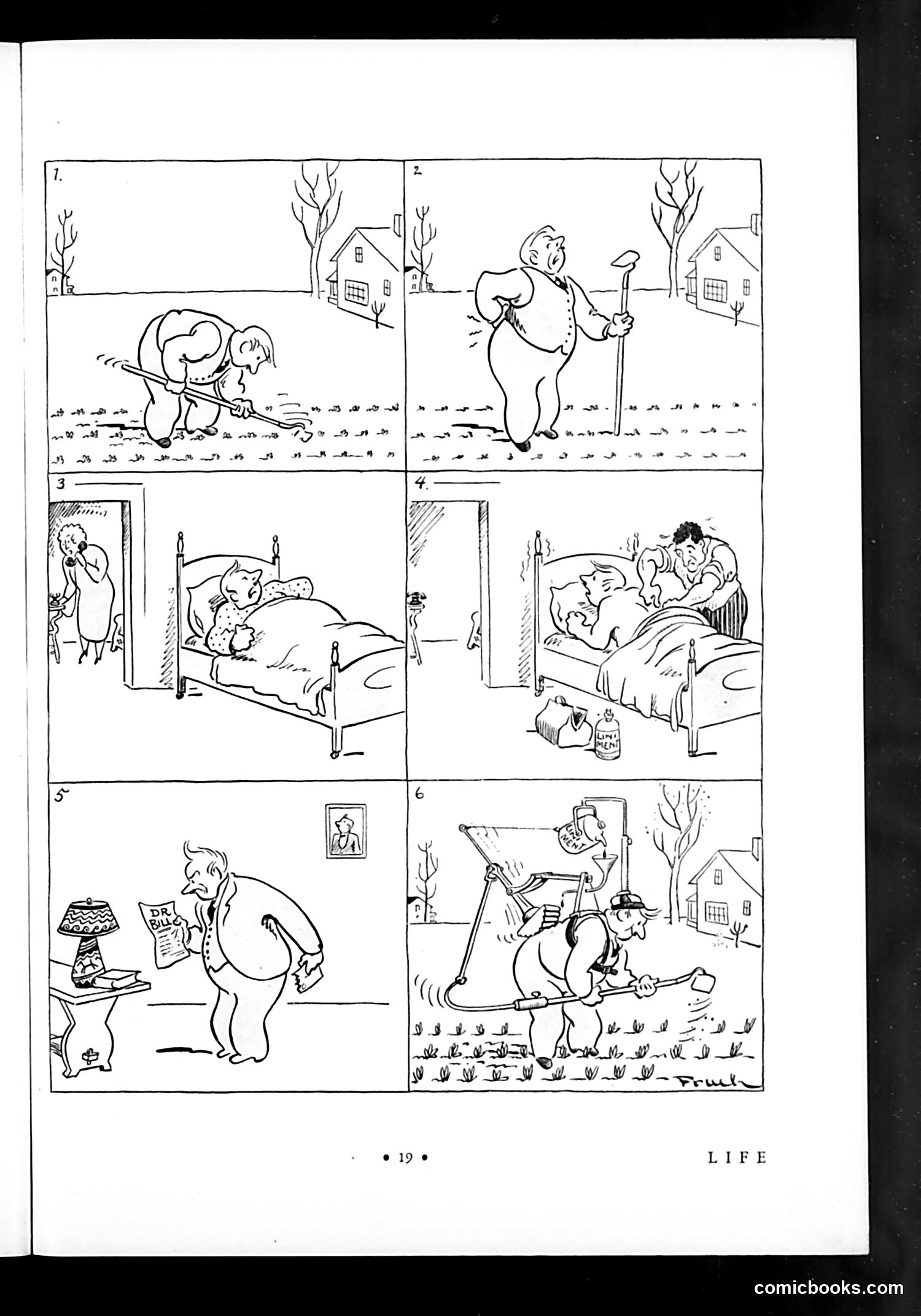
"The Tired Businessman" Comic Strip This appears to be a six-panel domestic humor comic from *Life* magazine, a popular satirical publication. The strip follows a rotund middle-aged man through a day: 1-2: He digs in his yard, apparently gardening or doing outdoor chores 3-4: He comes home to find children in his bed, disrupting his rest 5: He reads the newspaper indoors, seemingly trying to relax 6: He's shown being physically abused or exhausted by household duties The satire targets the harried "tired businessman" archetype—a common figure in early-to-mid 20th century American humor. The joke emphasizes how domestic life, children, and household responsibilities exhaust middle-class men despite their efforts to find peace and leisure time. This reflects period anxieties about work-life balance and domestic expectations.
Theatre Reviews by Baird Leonard This page contains theatre criticism from *Life* magazine reviewing three Broadway productions. "The Great Barrington": Leonard critiques a play about a snobbish modern family obsessed with their colonial ancestry. The plot reveals scandalous secrets in the family's past—"skeletons in the cupboard"—a metaphor for hidden family shame. Leonard praises the satire mocking genealogical pretension and warns "Colonial Dames" members against prying into their family archives, as their ancestors may have been "rascals." He appreciates the robust historical characters but finds the contemporary plot repetitive and tedious. "The Venetian Glass Nephew": Adapted from Elinor Wylie's novel and set to music by Eugene Bonner, Leonard finds it overly precious—beautiful to look at but shallow in execution, comparing it to "well-meaning individuals" drawing from deep wells with shallow pitchers. The reviews exemplify early 20th-century theatre criticism emphasizing plot construction, casting, and social commentary.
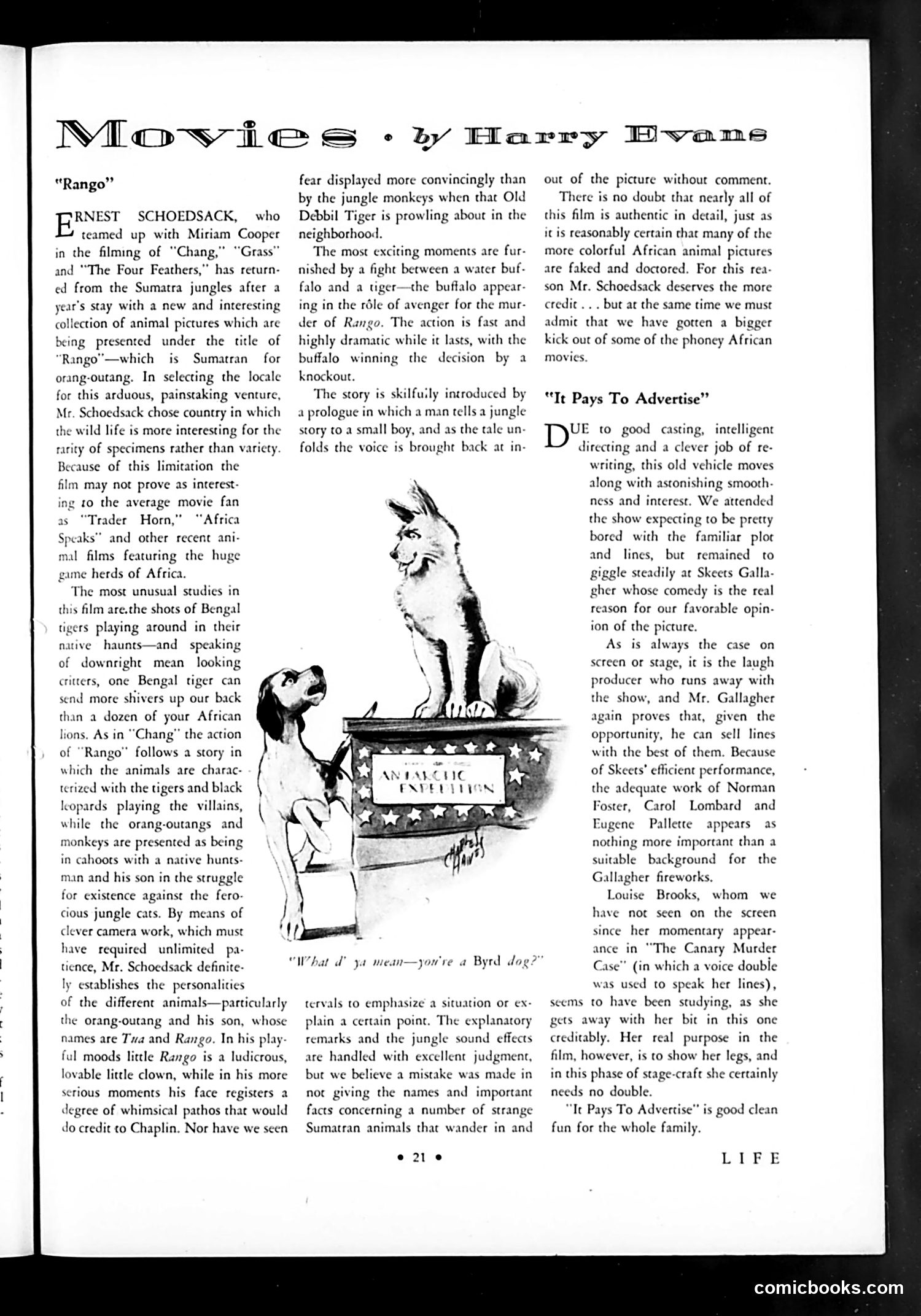
Life Magazine Movie Review Page This is a movie review column by Harry Evans covering two films: "Rango" and "It Pays to Advertise." The illustrated cartoon shows a dog sitting at what appears to be a podium or stand labeled "ANIMAL EXHIBITION," with the caption "What d'ya mean—you're a Byrd dog?" This is a visual joke playing on words: the dog is being challenged about being a "Byrd" dog, likely referencing Richard Evelyn Byrd, the famous polar explorer, or possibly mocking someone's claim to exotic animal credentials. The cartoon supports the review's discussion of how animal films present animals with anthropomorphic personalities. The reviews themselves are straightforward: "Rango" is praised for authentic jungle footage and animal characterization (with the young orangutan compared to Chaplin), while "It Pays to Advertise" is deemed a remake made worthwhile by Skeets Gallagher's comedic performance. This reflects 1920s cinema enthusiasm for exotic animal documentaries and remake adaptations.
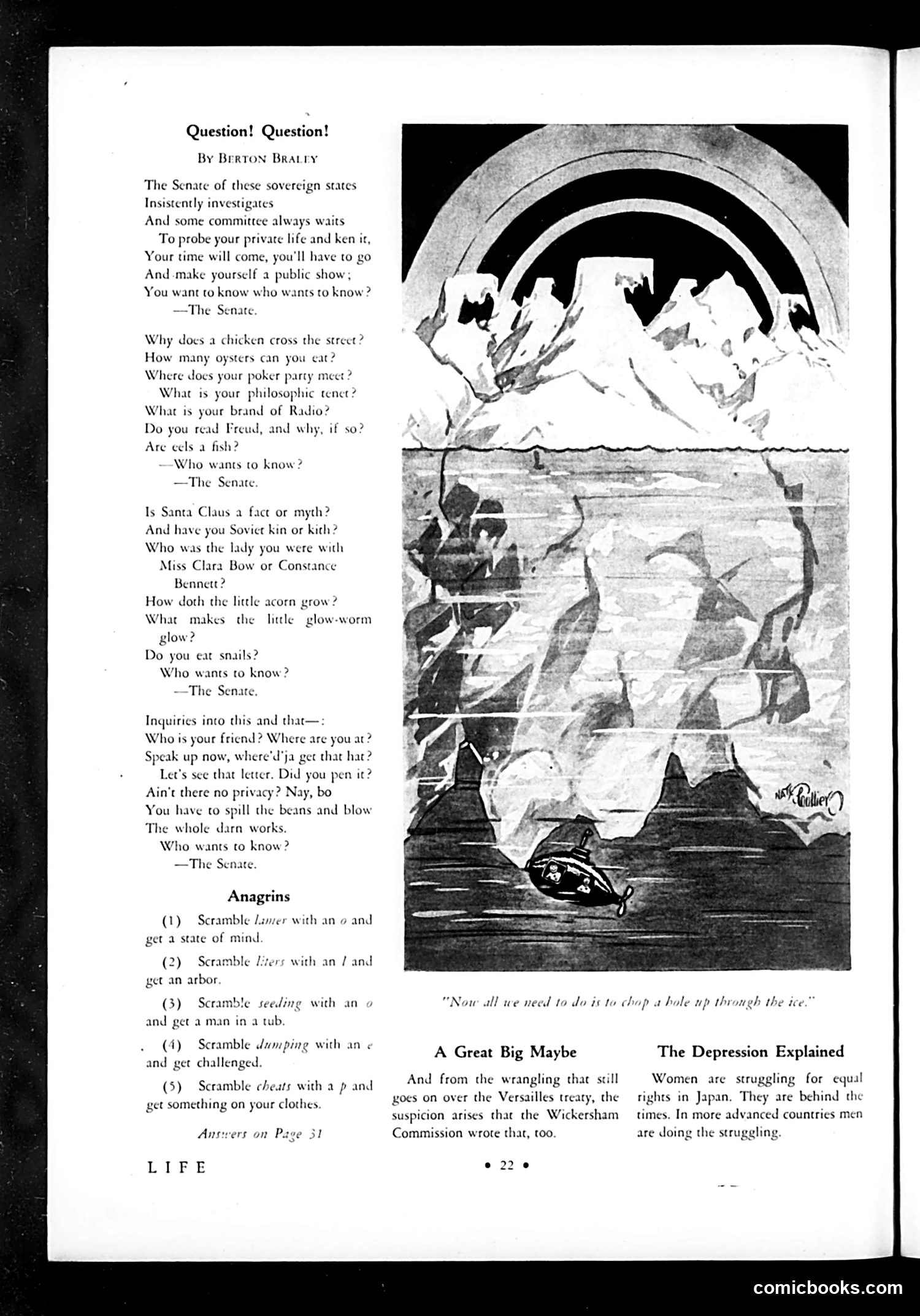
"Question! Question!" - Political Satire on Senate Investigations This poem by Berton Bratley satirizes aggressive Congressional Senate investigations into citizens' private lives. The repeated refrain "Who wants to know?—The Senate" mocks the invasive questioning committees conduct, treating trivial personal details (poker games, radio preferences, dining habits) as state business. The cartoon shows a figure drowning or struggling under an avalanche of papers—likely representing the burden of scrutiny and paperwork demands from Senate investigations. The caption notes "not all we need to do is chop a hole up through the ice," suggesting citizens are trapped by bureaucratic overreach. This appears to reference 1920s Senate investigations (possibly Teapot Dome or similar scandals), when committees aggressively probed citizens' affairs. The satire criticizes loss of privacy and the absurdity of government intrusion into mundane personal choices, framing it as drowning citizens in red tape.
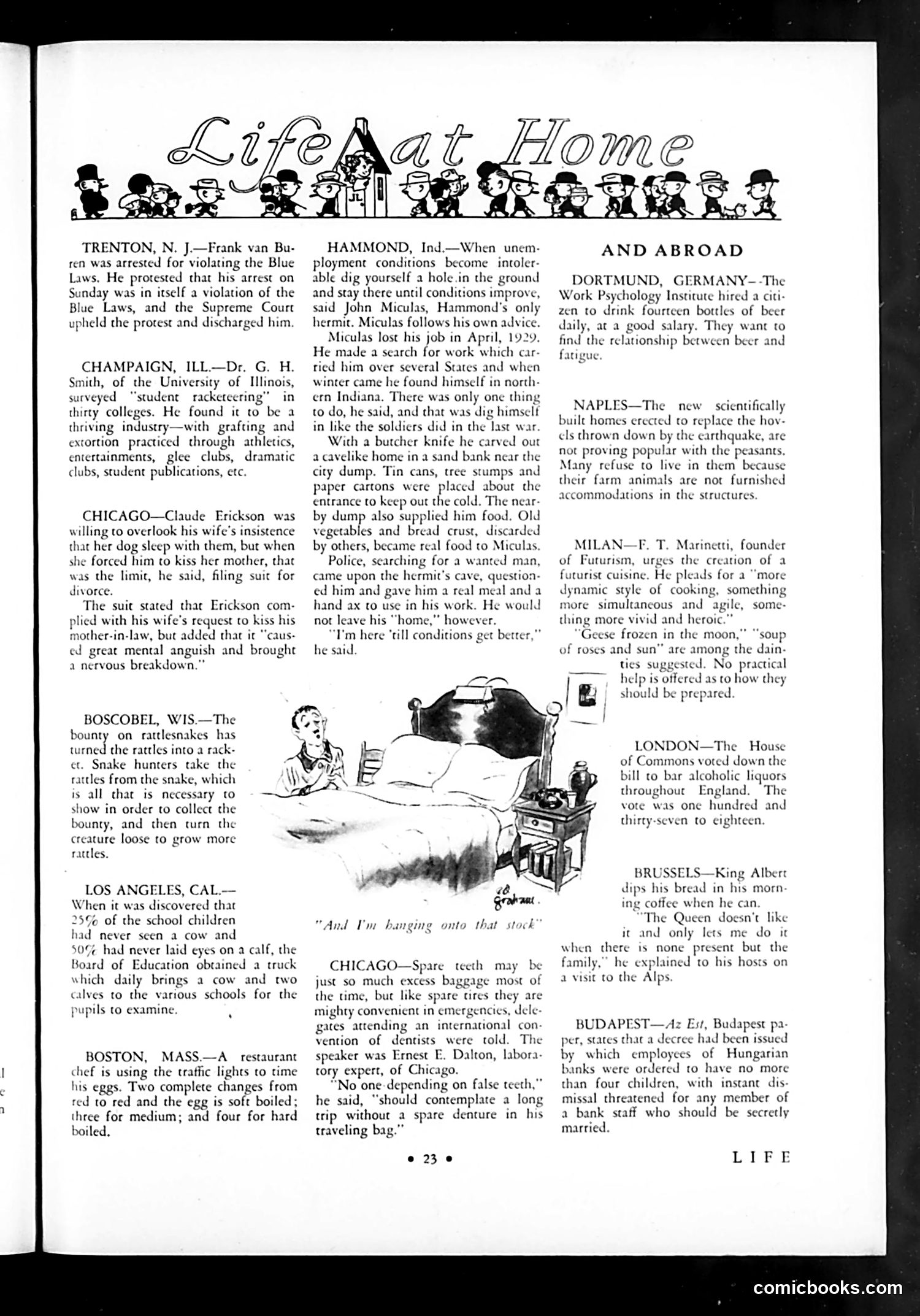
Analysis of "Life at Home and Abroad" (c. 1930) This is a humor column of brief anecdotes from American and European cities. The main cartoon depicts a man in bed with the caption "And I'm hanging onto that stock"—a topical reference to the 1929 stock market crash, suggesting people refusing to sell investments despite financial ruin. The text items satirize contemporary American absurdities: "student racketeering" in colleges (fraud schemes), a man divorcing his wife over her insistence he kiss her mother (exaggerated legal theater), Blue Laws enforcement paradoxes, and a hermit choosing unemployment relief to idleness. The "spare teeth" story mocks impractical travel advice. International items mock emerging social policies: a German factory hiring beer drinkers to study intoxication's effects on productivity, and Italian peasants rejecting modernist housing because it lacks animal accommodations. The humor targets both Depression-era social dysfunction and the era's bizarre pseudo-scientific schemes, reflecting Life magazine's sardonic commentary on contemporary life.
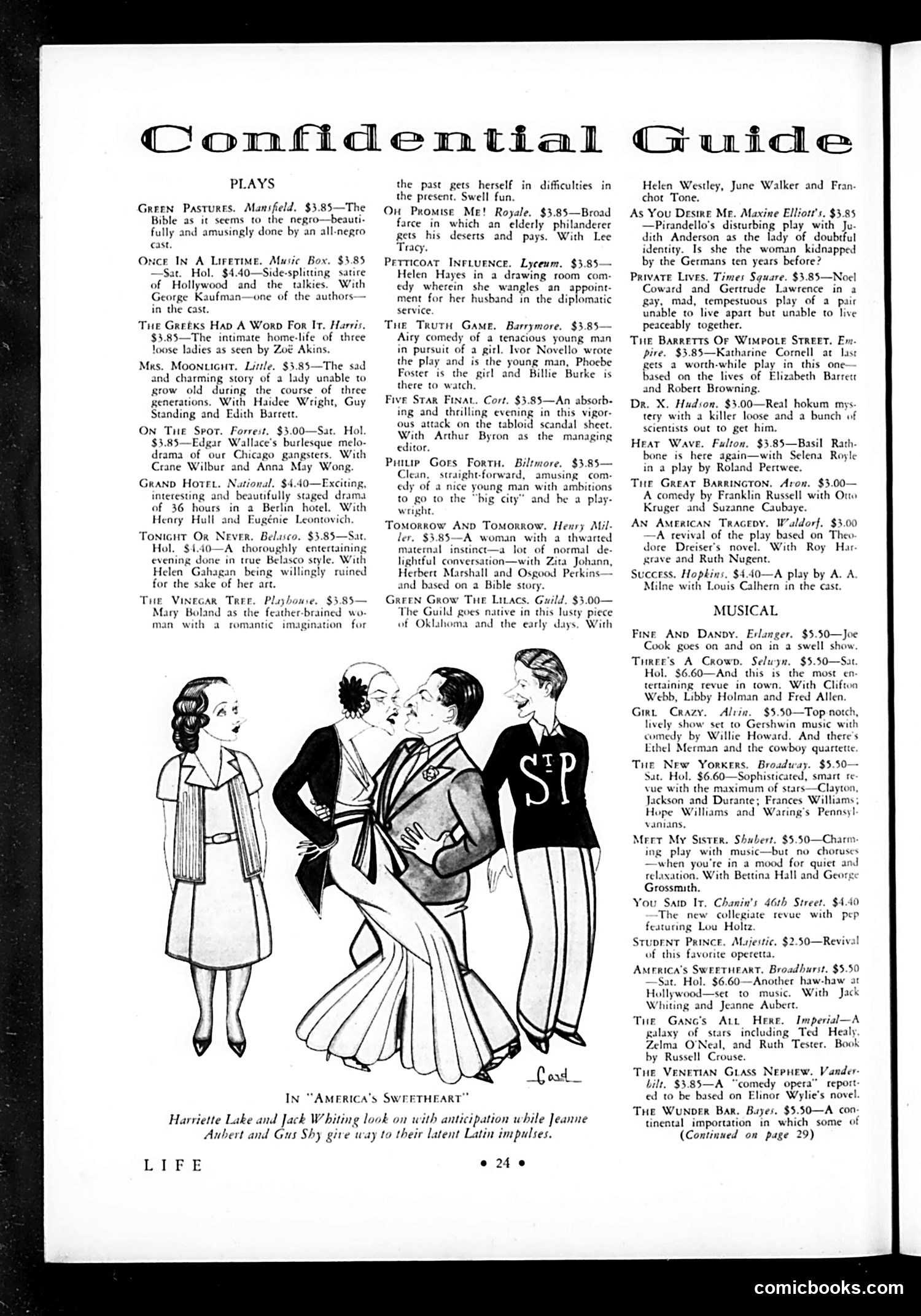
Analysis of Life Magazine Page: "Confidential Guide" This page is primarily a theater listing guide for Broadway productions, not a political cartoon. The small illustration by Carl (signed lower left) depicts a scene from "America's Sweetheart," a Broadway show. It shows three figures in 1920s-style clothing in a flirtatious moment—the caption notes "Harriette Lake and Jack Whiting look on with anticipation while Jeanne Aubert and Gus Shy give way to their latent Latin impulses." The humor is mild and social rather than political: it gently mocks romantic/sensual behavior by attributing it to "Latin impulses"—a period stereotype about Mediterranean cultures being more passionate. The theatrical listings showcase Broadway's commercial offerings, ranging from serious drama (*Green Pastures*, *Private Lives*) to comedies and melodramas, with prices and cast information for entertainment-focused readers.
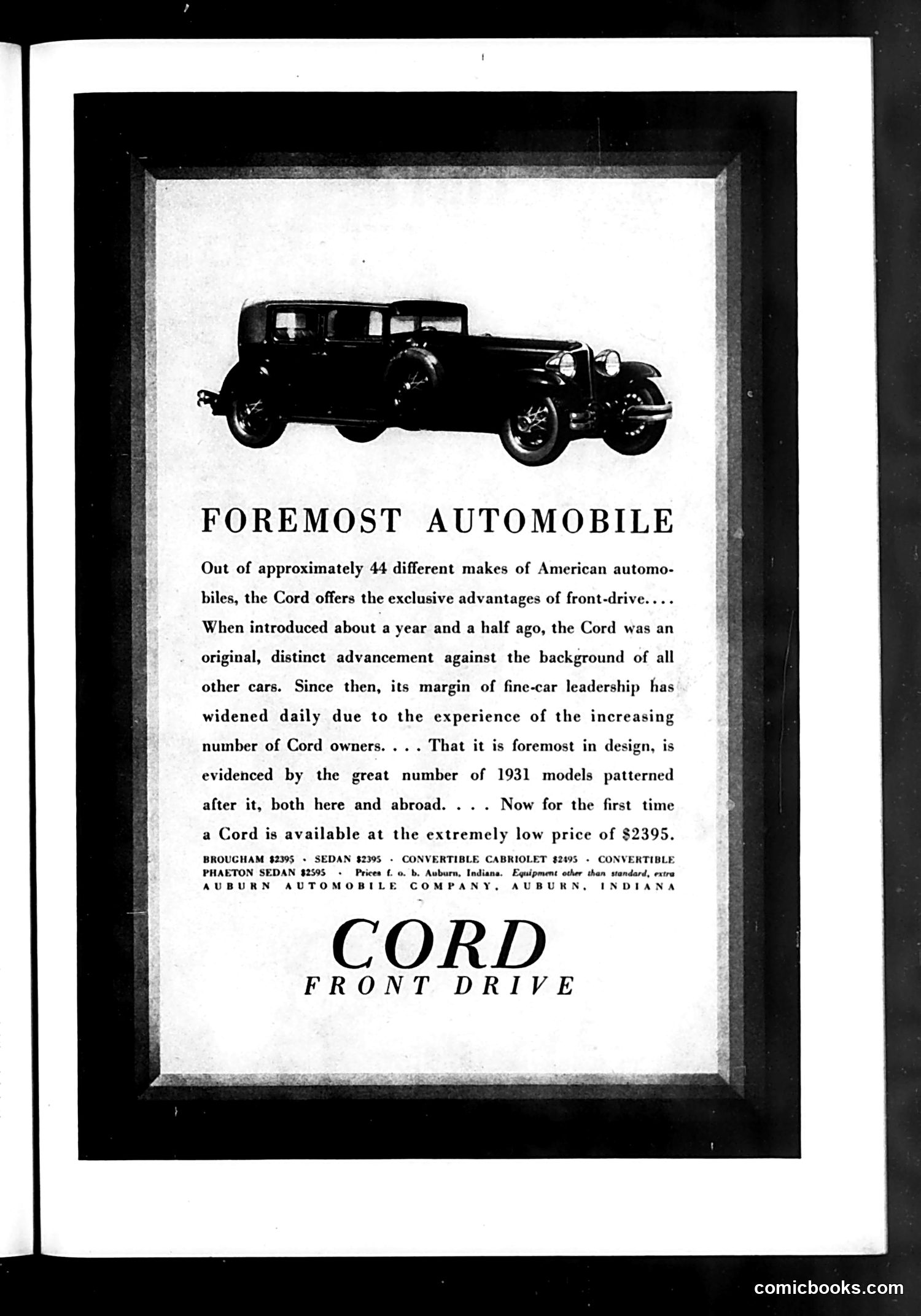
Analysis This is not a cartoon or satire—it's a straightforward automobile advertisement for the Cord automobile, manufactured by Auburn Automobile Company in Auburn, Indiana. The ad promotes the Cord's front-wheel drive as an innovative feature that competitors have begun copying (noting that "1931 models patterned after it" exist both domestically and internationally). The advertisement emphasizes the car's design leadership and claims it represents "foremost" automotive advancement. The key selling point is the price: $2,395—described as "extremely low" for a fine car at the time. Various body styles are listed (brougham, sedan, convertible cabriolet, phaeton sedan), with prices ranging from $2,395 to $2,595. This appears to be from around 1930-1931 based on the model year references and the historical context that front-wheel drive was indeed a notable innovation in that era. The ad makes no satirical or political commentary—it's purely commercial promotion.
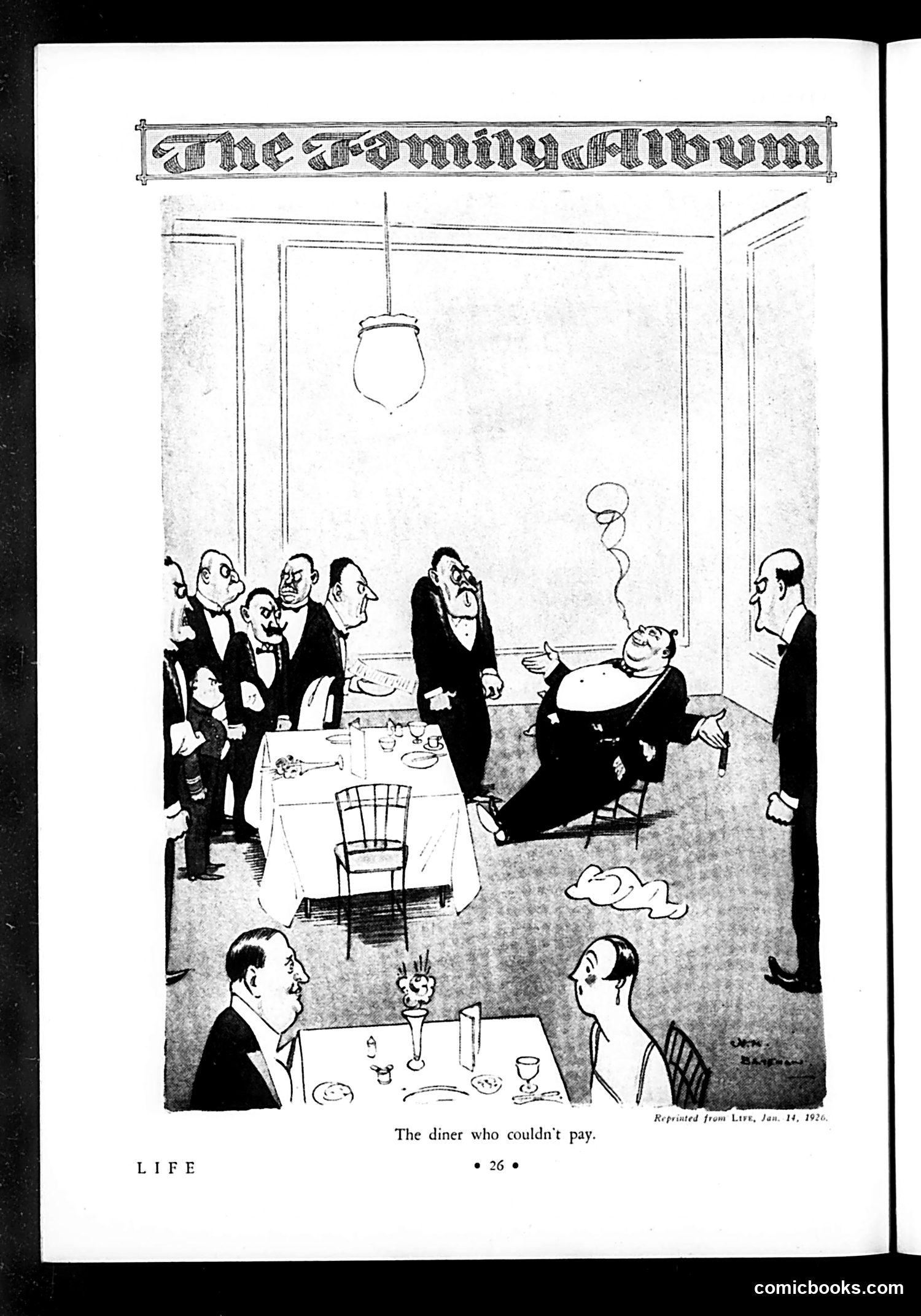
"The Diner Who Couldn't Pay" This cartoon satirizes a dining scenario common in the 1920s. The scene shows a restaurant where a well-dressed man sits at a table, apparently unable or unwilling to pay his bill. Multiple waiters and staff members surround him with confused or concerned expressions, while other diners observe the awkward situation. The humor derives from the social embarrassment and awkwardness of being unable to settle one's account in a formal dining establishment. The exaggerated reactions of the staff—their bewildered faces and body language—emphasize the uncomfortableness of the moment. This reflects 1920s class anxieties and the importance placed on maintaining respectability and financial propriety in public settings. The cartoon plays on readers' recognition of this potentially humiliating social predicament.
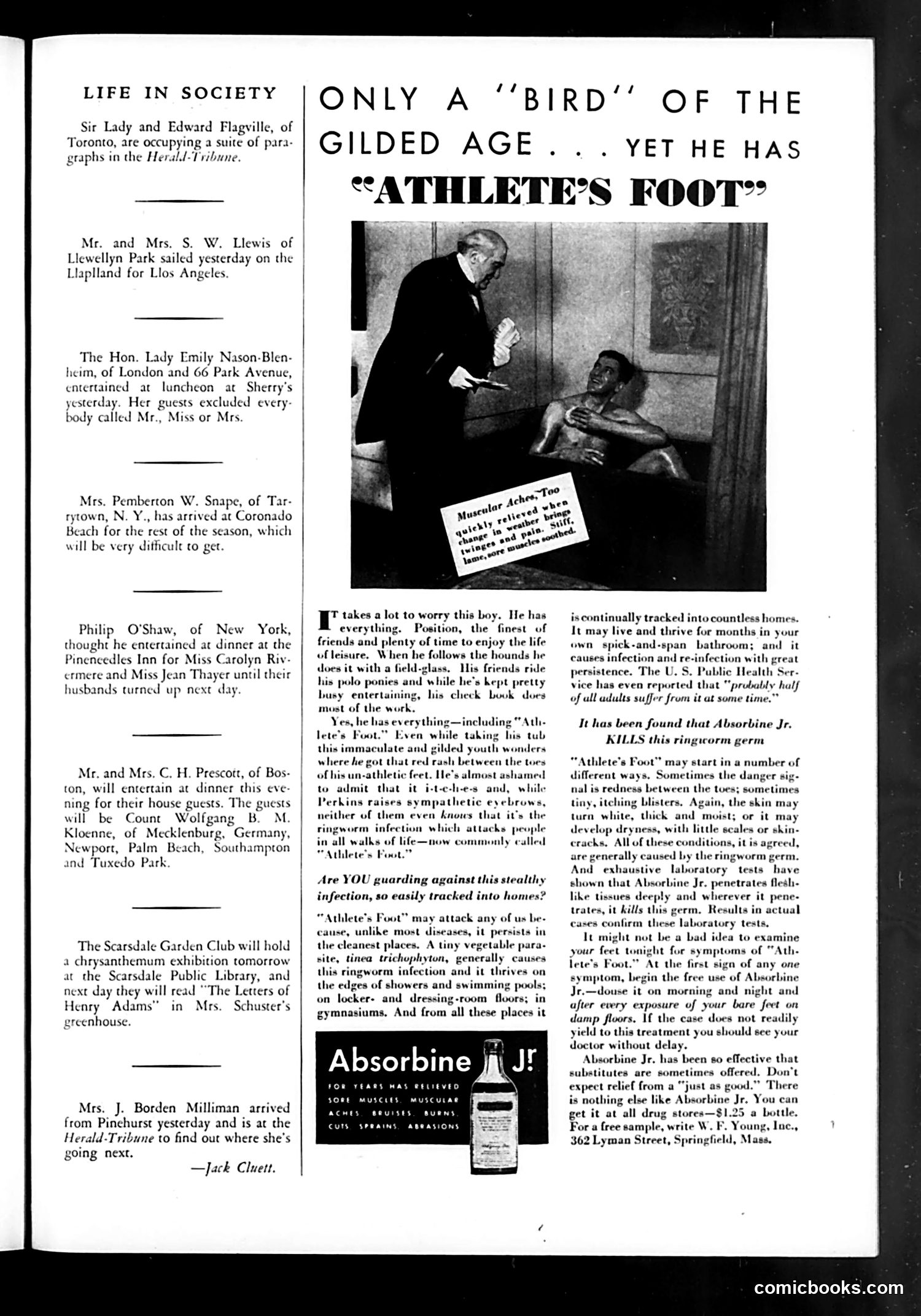
"Athlete's Foot" Advertisement Disguised as Social Satire This page combines society gossip with a disguised advertisement for Absorbine Jr., a fungal infection treatment. The left column satirizes wealthy "Gilded Age" socialites through Jack Cluett's witty gossip items—mocking their pretentious names, constant travel between exclusive resorts (Newport, Palm Beach, Tuxedo Park), and trivial concerns. The main feature uses this wealth-and-leisure theme as setup for an advertisement: a wealthy, idle gentleman has "everything"—except he's contracted "Athlete's Foot," a contagious ringworm infection. The satire's point: this embarrassing fungal infection doesn't discriminate by class; even the privileged catch it from public facilities (showers, pools, gymnasium floors). The ad then pivots to fear-based marketing, claiming the infection "persists in the cleanest places" and "half of all adults suffer from it," before promoting Absorbine Jr. as the solution that "kills this ringworm germ." This represents early 20th-century advertising strategy: embedding product promotion within entertainment content.
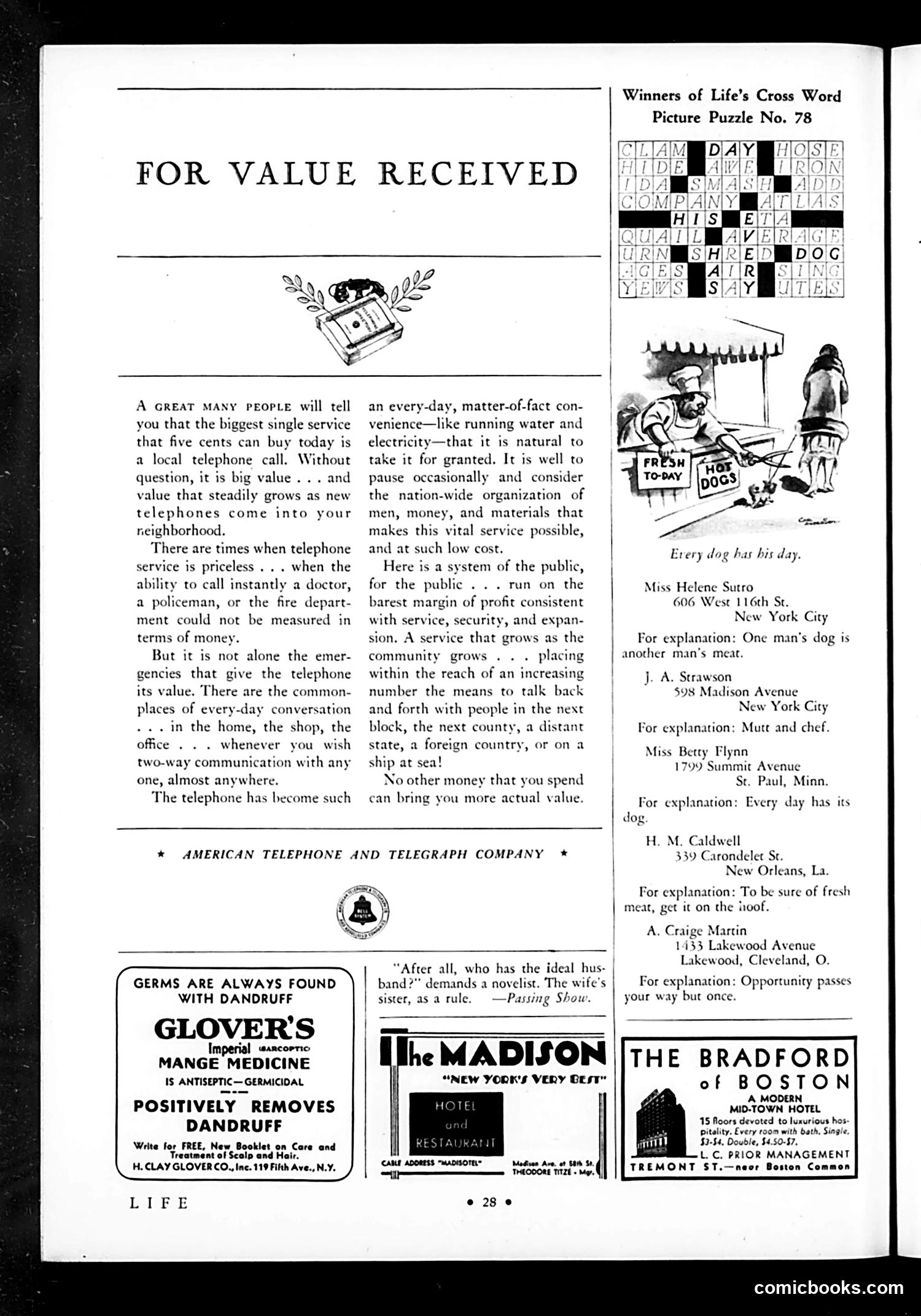
Analysis of Life Magazine Page This page is primarily a corporate advertisement for AT&T disguised as editorial content. The lengthy "For Value Received" text argues that telephone service represents exceptional value—five cents buys vital emergency access (doctors, police, fire) and everyday convenience at minimal profit margins. The accompanying cartoon shows a hot dog vendor and child, illustrating the puzzle answer "Every dog has his day"—a common idiom meaning everyone gets their turn at good fortune. This visual appears designed to make the serious telephone advocacy feel lighter and more relatable to readers. The page also features a crossword puzzle contest and period advertisements (Glover's dandruff treatment, hotels, restaurants). Context for modern readers: This represents pre-WWII corporate PR strategy—AT&T justified its near-monopoly by emphasizing public service and affordability, positioning itself as a patriotic utility rather than profit-driven enterprise. The blend of advertising with editorial and puzzles was standard magazine practice of the era.
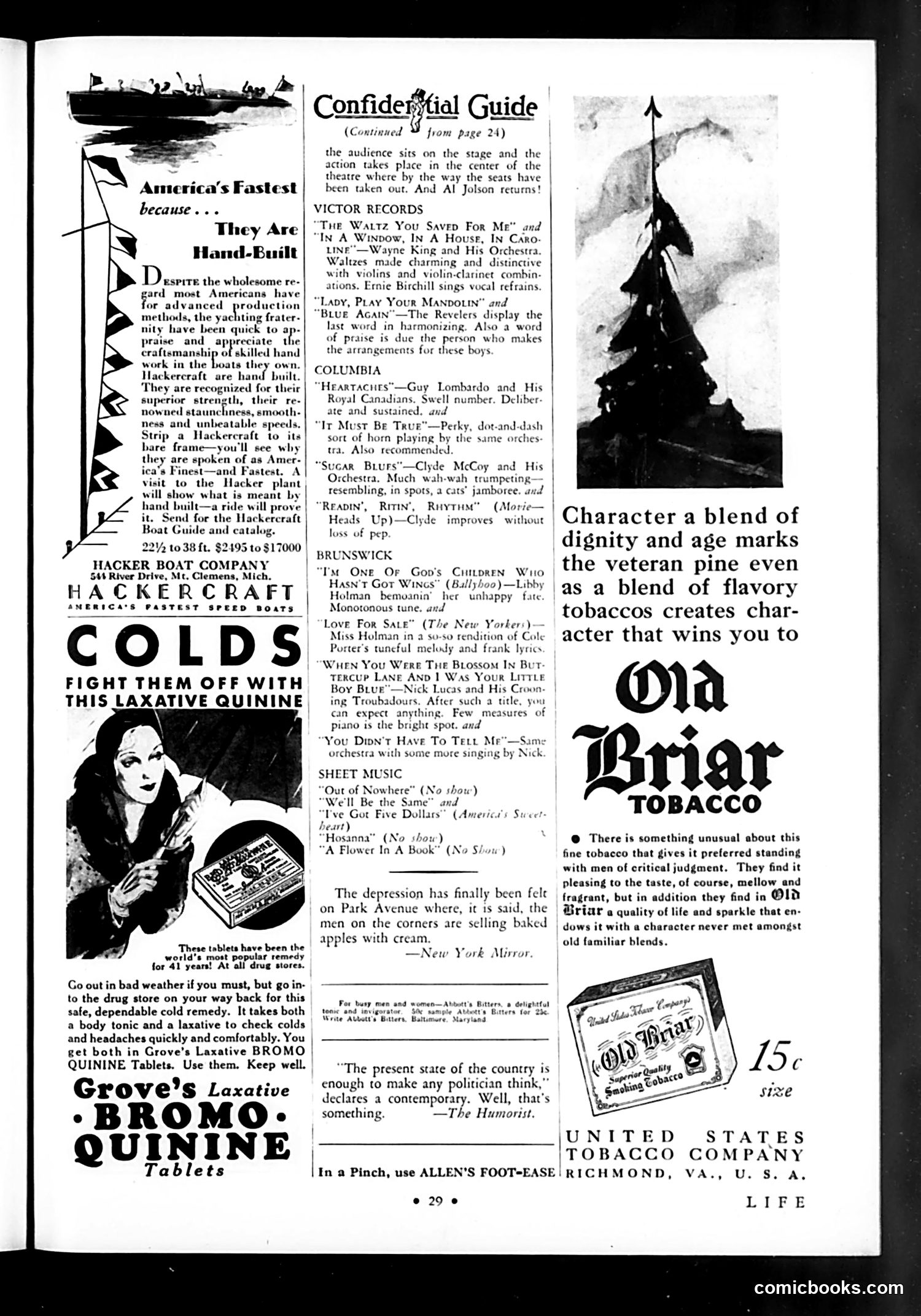
Life Magazine Page Analysis This page is primarily advertising, with a "Confidential Guide" music review section as secondary content. The main advertisements are: - Hackercraft boats: Emphasizes "hand-built" craftsmanship over mass production, appealing to wealthy yacht owners during the Depression era - Grove's Bromo Quinine: A cold remedy marketed as safe and effective - Old Briar Tobacco: Positioned as a quality product for discriminating smokers The music reviews cover Victor, Columbia, and Brunswick records—typical early 1930s popular entertainment (dance orchestras, crooners like Libby Holman and Nick Lucas). One satirical element: a brief quote mocking politicians: "The present state of the country is enough to make any politician think...Well, that's something." This reflects Depression-era cynicism about political leadership's competence. The page reflects 1930s consumer culture, where quality craftsmanship and established brands offered reassurance during economic uncertainty.
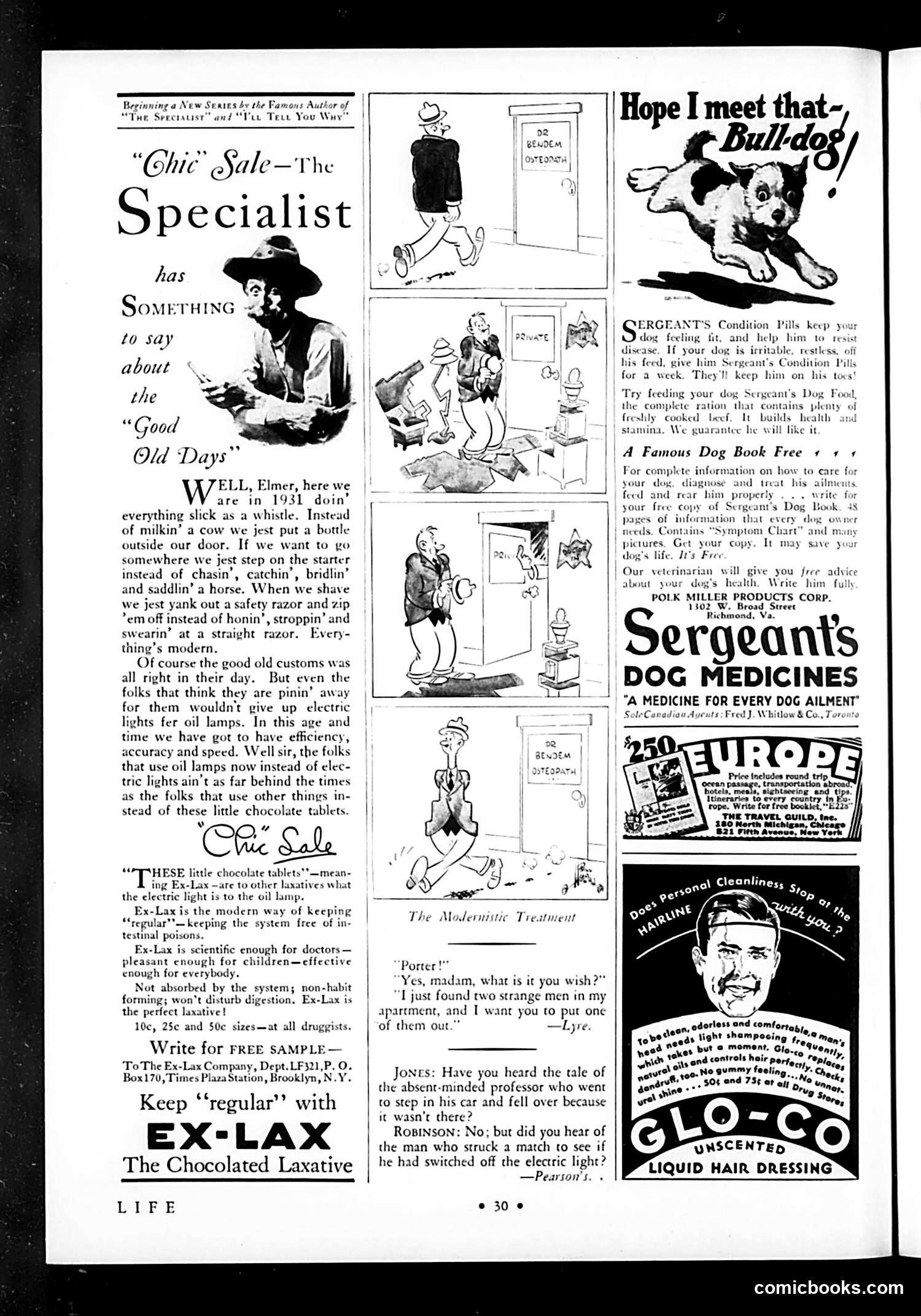
Explanation for Modern Readers This page is primarily advertising, not political satire. The main content is a series of advertisements disguised as editorial content, a common 1931 practice. "Chic Sale's The Specialist" (left column) uses a rural character comparing modern conveniences—electric lights, cars, safety razors—to laxatives. The joke equates Ex-Lax chocolate tablets with progress, positioning them as the "modern" solution to digestive regularity versus old-fashioned methods. It's a nostalgic, Americana-flavored pitch rather than satire. The cartoons (center) show a man repeatedly entering and exiting a bathroom, illustrating the product's reliability in a comedic way. The page also includes standalone jokes about absent-minded professors and electric lights—period humor relying on electricity still being somewhat novel and befuddling. Right side carries additional product ads: Sergeant's Dog Medicines, travel services, and Glo-Co hair dressing. This reflects early-20th-century advertising's strategy of embedding pitches within entertainment and folksy narratives rather than direct appeals.
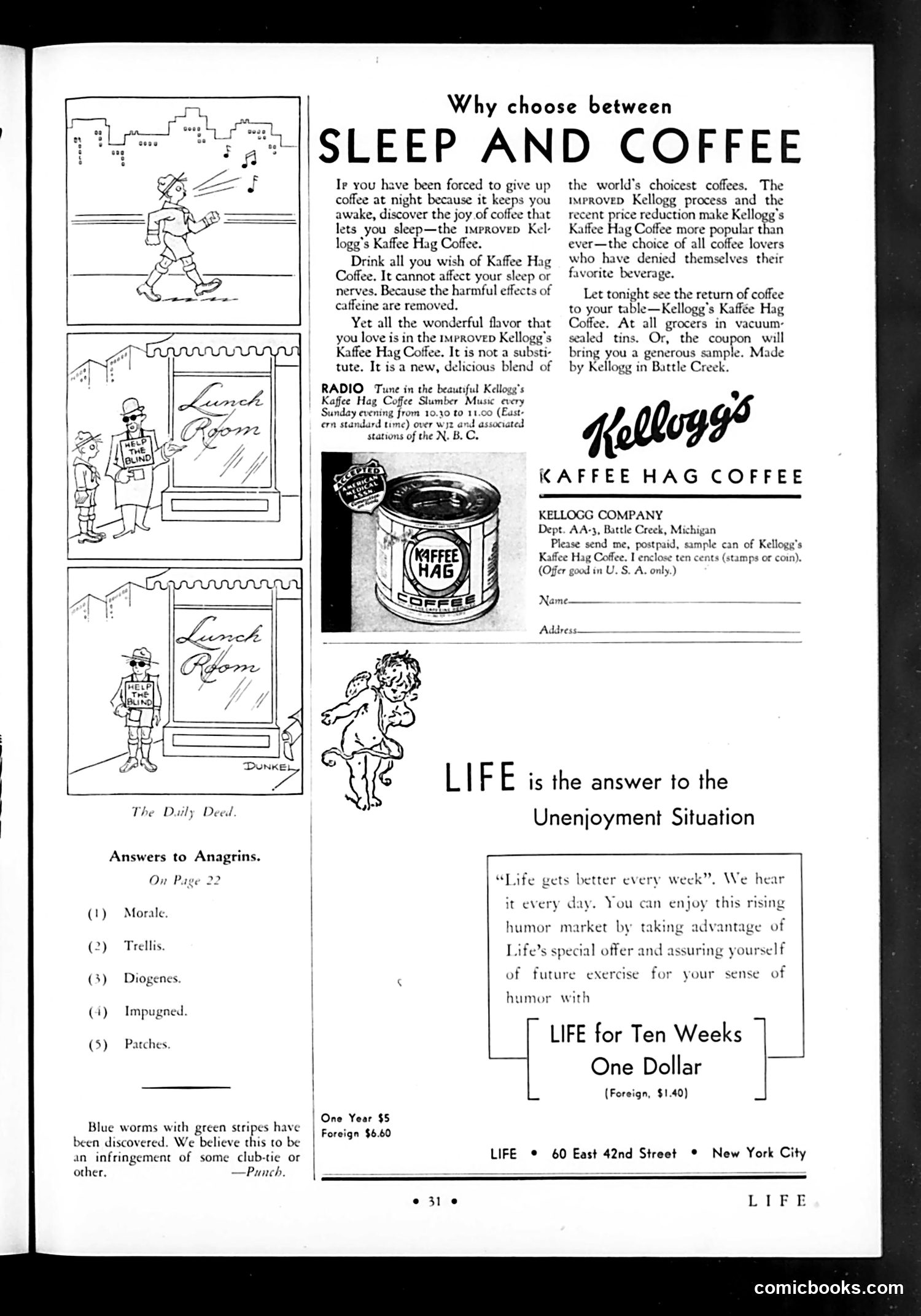
Analysis of Life Magazine Page 31 This page is primarily advertising and filler content rather than satirical cartooning. The dominant feature is a Kellogg's Kaffee Hag Coffee advertisement addressing a real consumer problem: caffeine kept people awake at night. The ad promises decaffeinated coffee that delivers flavor without sleep disruption—a genuine product innovation for the era. The accompanying cartoon panels ("The Daily Deed") humorously show a man repeatedly visiting a lunch room, suggesting coffee's addictive appeal. Below is a LIFE magazine subscription ad making light of economic hardship ("Unenjoyment Situation"), offering ten weeks for one dollar as an affordable escape through humor during what appears to be Depression-era economic anxiety. The page also includes minor filler: anaagram answers and a joke from *Punch* magazine about blue worms with green stripes (absurdist humor). The content reflects 1930s advertising and magazine culture—mixing genuine product benefits with humor to encourage consumption during economically difficult times.
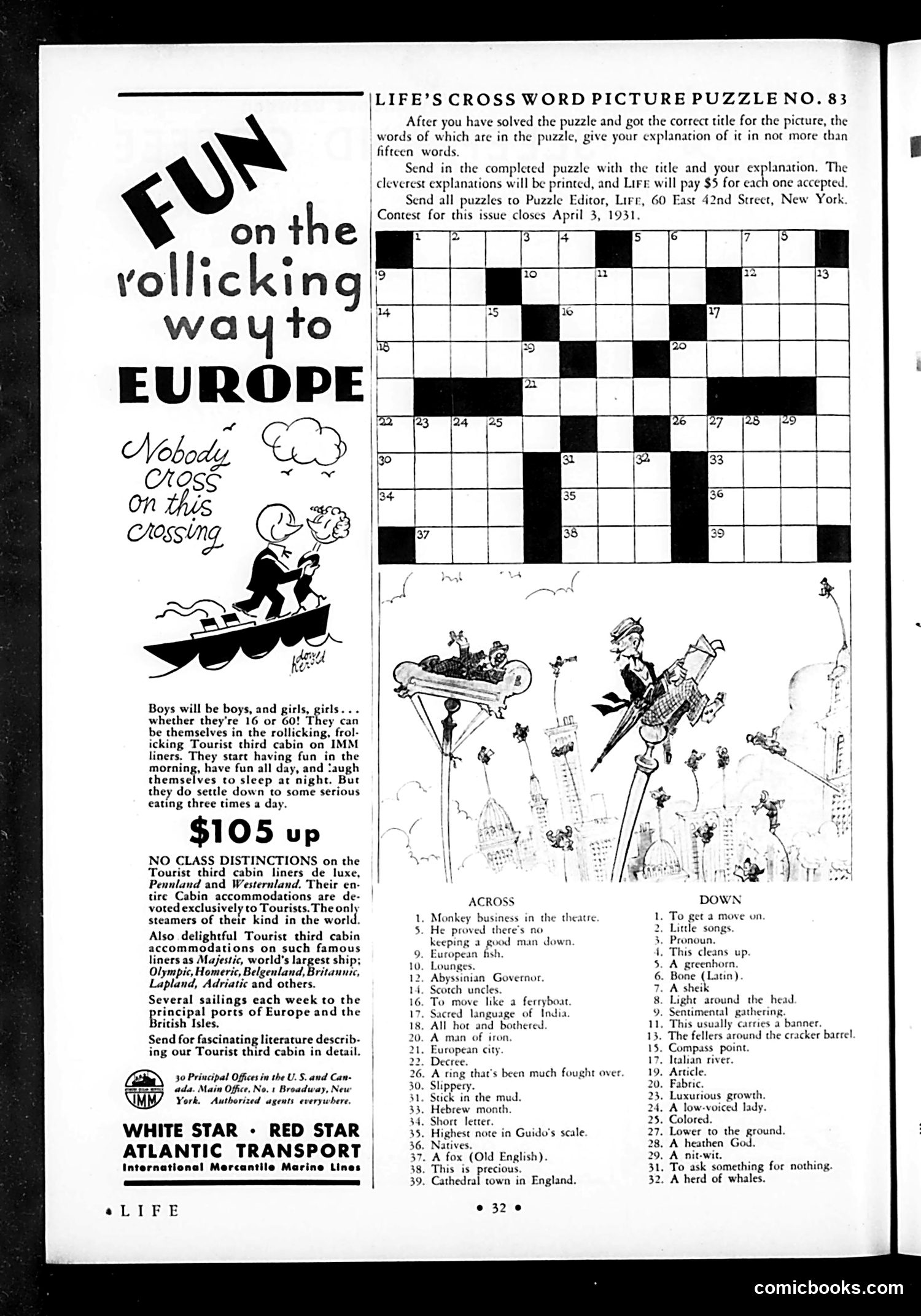
Life Magazine Crossword Puzzle Page (1931) This page advertises transatlantic ship travel while promoting a reader-submitted crossword puzzle contest. The left side features a cartoon of a couple in a rollicking boat, illustrating the carefree fun promised by tourist-class ocean liners to Europe—a vacation opportunity marketed to middle-class Americans. The advertisement emphasizes that "boys will be boys" aboard these ships: passengers can enjoy themselves freely during the day but settle down for serious meals. It highlights that tourist cabins on lines like the *Pennland* and *Westerlant* offer "no class distinctions"—a significant selling point during the Depression era, suggesting egalitarian leisure. The crossword puzzle itself functions as entertainment and engagement strategy; Life promised $5 payments for clever explanations of the completed puzzle's title, encouraging reader participation and submission.
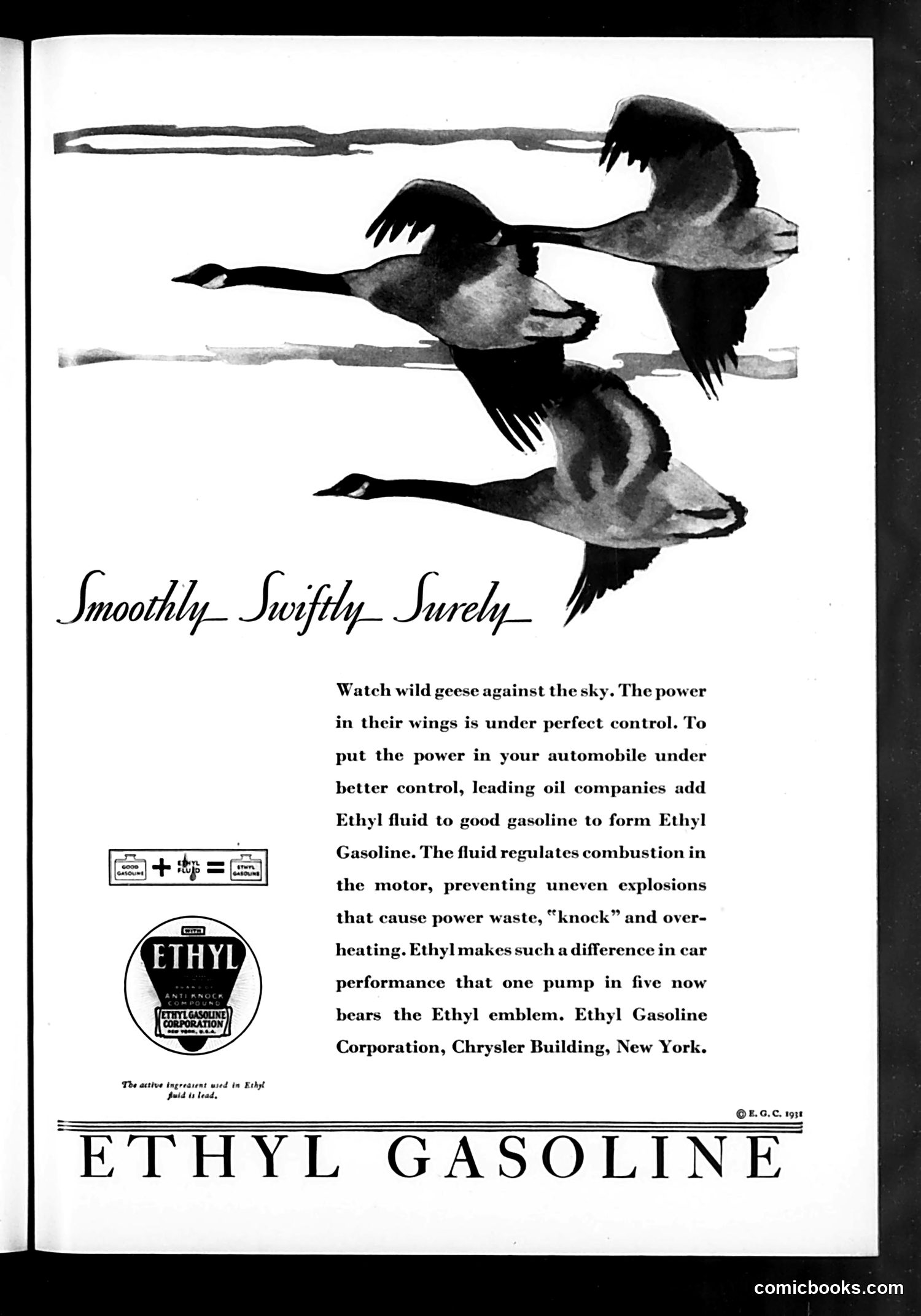
Ethyl Gasoline Advertisement (1938) This is a product advertisement, not satire. The page promotes Ethyl Gasoline, a fuel additive by the Ethyl Gasoline Corporation. The imagery compares wild geese flying in controlled formation to an automobile engine running smoothly. The text explains that Ethyl fluid—added to gasoline—regulates combustion, preventing engine "knock" (rough, uneven explosions) and overheating, thereby improving car performance and fuel efficiency. The phrase "one pump in five now bears the Ethyl emblem" suggests the product's market success by 1938. Historical context: This advertisement predates widespread knowledge of tetraethyl lead's severe health and environmental dangers. Ethyl fluid was actually a lead-based anti-knock compound that wouldn't be phased out of gasoline until decades later due to its toxicity.
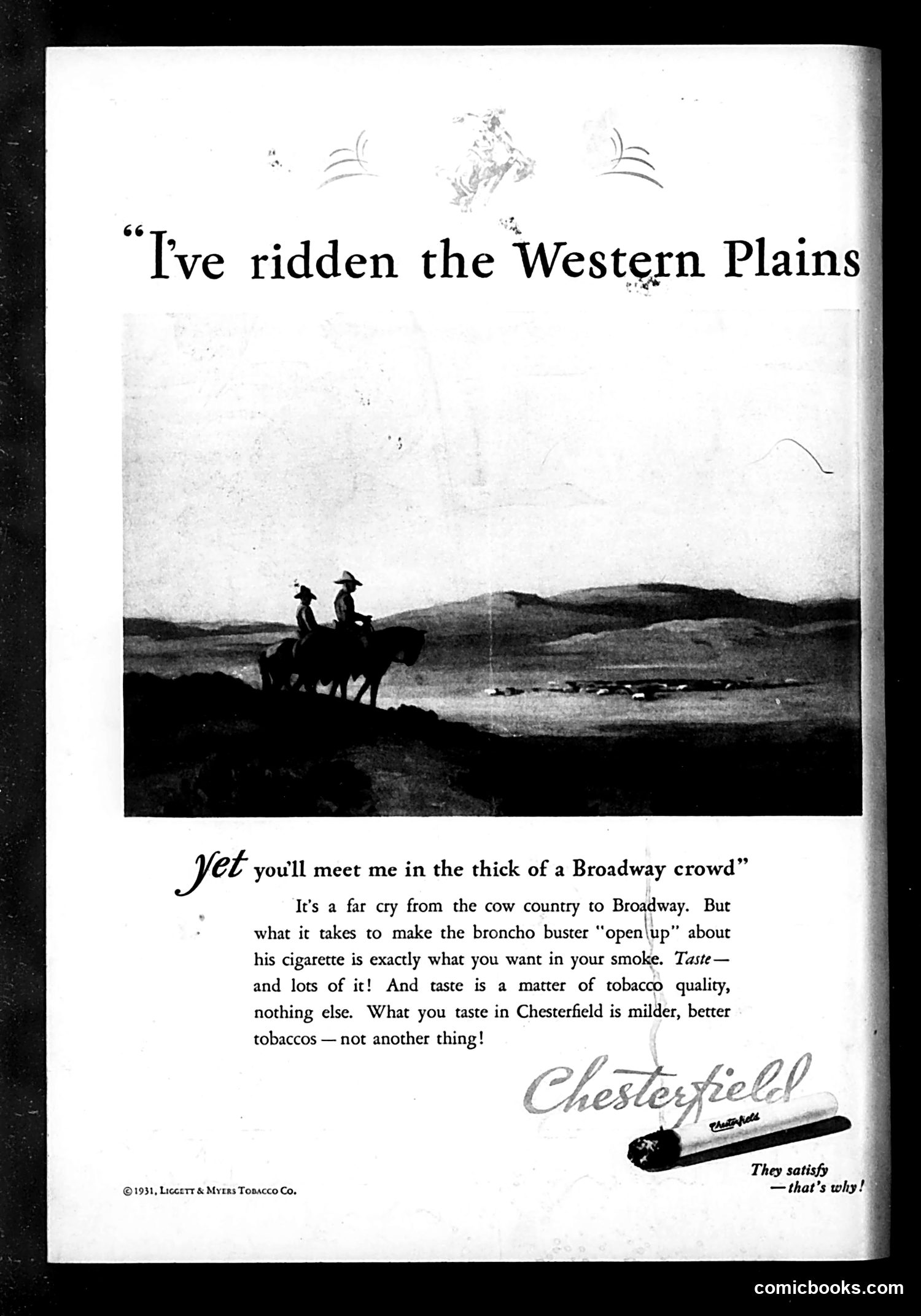
Analysis This is a Chesterfield cigarette advertisement, not satire or political commentary. It uses the popular "cowboy/Western" cultural imagery of the 1930s to market cigarettes. The ad depicts two cowboys on horseback overlooking the Western Plains, then contrasts this rural image with Broadway (representing urban sophistication). The text claims that what makes a rugged "broncho buster" smoke Chesterfields—superior tobacco quality and mild taste—is exactly what urban consumers want too. The appeal bridges working-class Western identity with aspirational urban modernity. The phrase "They satisfy—that's why!" emphasizes quality tobacco as the sole selling point. Context for modern readers: This represents pre-regulation tobacco advertising that openly marketed cigarettes without health warnings, using lifestyle imagery and masculine frontier iconography to create desire. Such ads were commonplace in American magazines through the mid-20th century.

I appreciate your detailed instructions, but I must be honest: this image is almost entirely black with only a white edge visible on the left side. The contrast and clarity are insufficient for me to discern any cartoon figures, text, or satirical content that would allow me to provide accurate historical analysis. While the OCR text references "comicbooks.com," I cannot see enough detail in the actual image to identify specific figures, political references, or the intended satire. To give you an accurate explanation meeting your standards, I would need a clearer, higher-contrast version of this page. I apologize I cannot be more helpful with this particular image.