life
Life — March 20, 1931
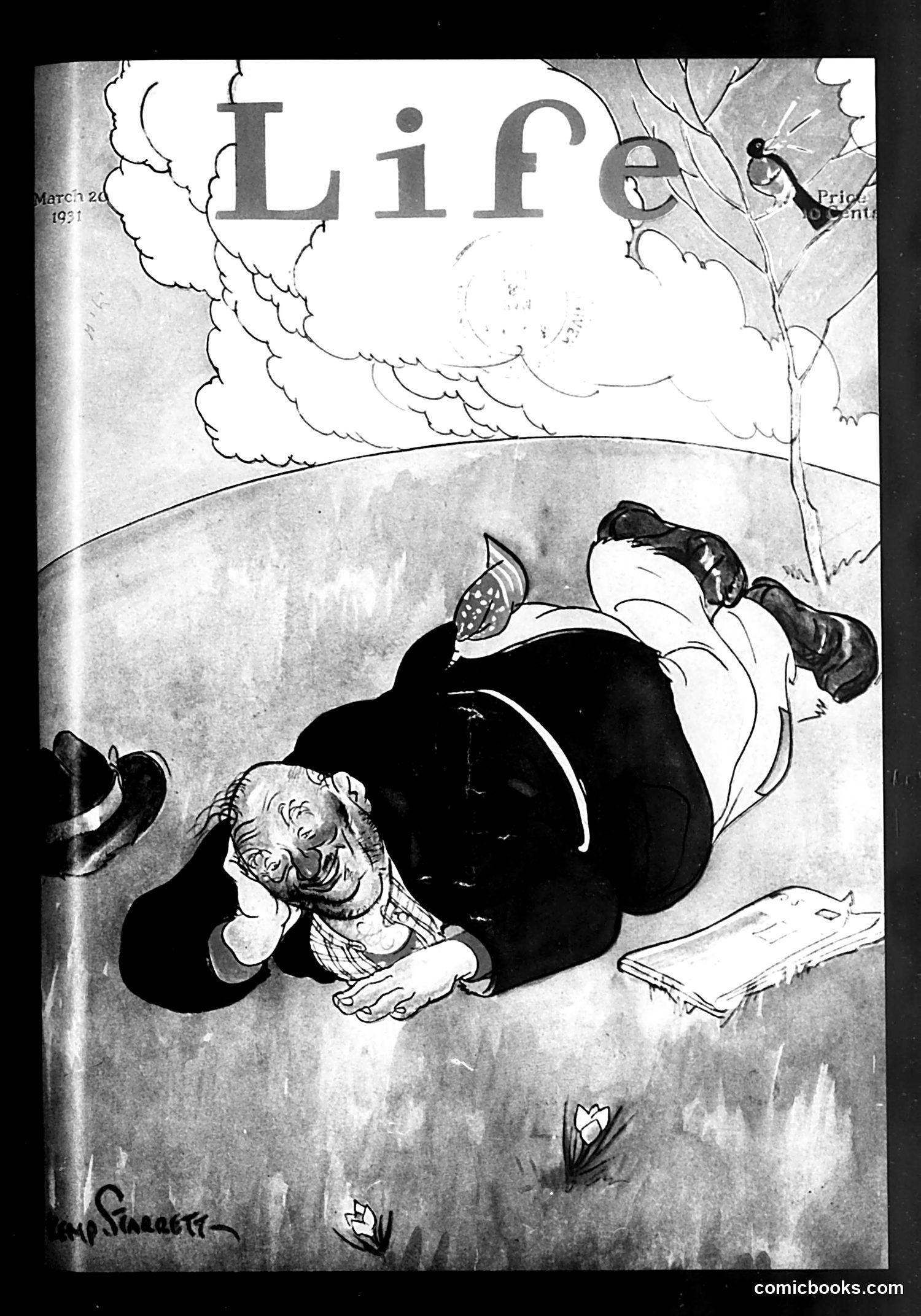
Life Magazine Cover Analysis This appears to be a Life magazine cover from March 1921 (visible in upper left corner). The main illustration shows a portly, older man lying on his back in what appears to be a relaxed, undignified pose on the ground, surrounded by spring foliage and bare tree branches. The word "Life" dominates the top in large letters. The figure's exaggerated features and corpulent form suggest satirical caricature, likely of a specific public figure or type of person representing a social commentary relevant to 1921. Without clearer identifying details visible, I cannot definitively name the subject, though the artistic style and composition suggest commentary on wealth, leisure, excess, or political figures of the post-WWI era. The spring setting may be thematically significant—perhaps suggesting renewal or rebirth in post-war America.

Analysis This is not a cartoon or satirical content—it's a straightforward advertisement for Crane plumbing fixtures, likely from the 1920s-1930s based on the styling and design language. The page features: - A photograph/illustration of a modern bathroom layout with labeled plumbing components - Technical diagrams showing pipe installation and plumbing systems - A smaller product image of a "Doherty-Brekm Humidifying Radiator" The text promotes Crane's "Exhibit Rooms" where consumers could view bathroom fixtures in color and white, emphasizing that consulting a Crane-qualified contractor ensures proper installation and cost savings. There is no satire, political content, or humor intended here. It's purely commercial advertising designed to encourage bathroom modernization through professional installation.
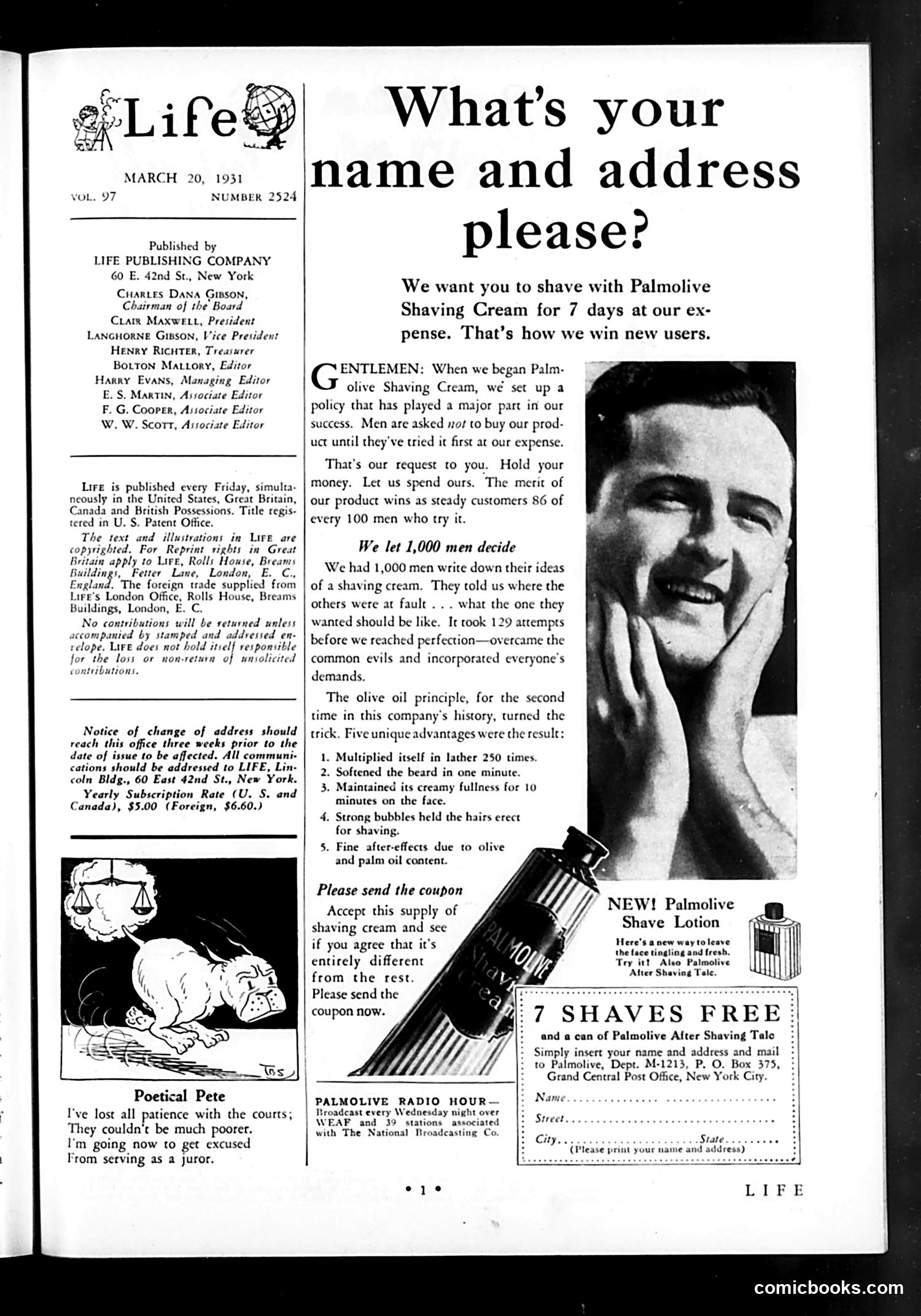
"Poetical Pete" Cartoon Analysis This single-panel cartoon by "Cesare" (visible signature) depicts a judicial scales symbol above a dejected dog labeled "Poetical Pete." The accompanying verse reads: "I've lost all patience with the courts; / They couldn't be much poorer. / I'm going now to get excused / From serving as a juror." Context: This is satire about jury duty and public frustration with the court system, likely referencing widespread complaints about lengthy trials or poor judicial administration in 1931. The anthropomorphized dog represents an everyday citizen exhausted by civic obligation. The joke plays on "poetical"—Pete expresses his frustration poetically—while mocking both his desire to escape duty and, implicitly, the courts' inefficiency that makes such escape appealing to citizens.
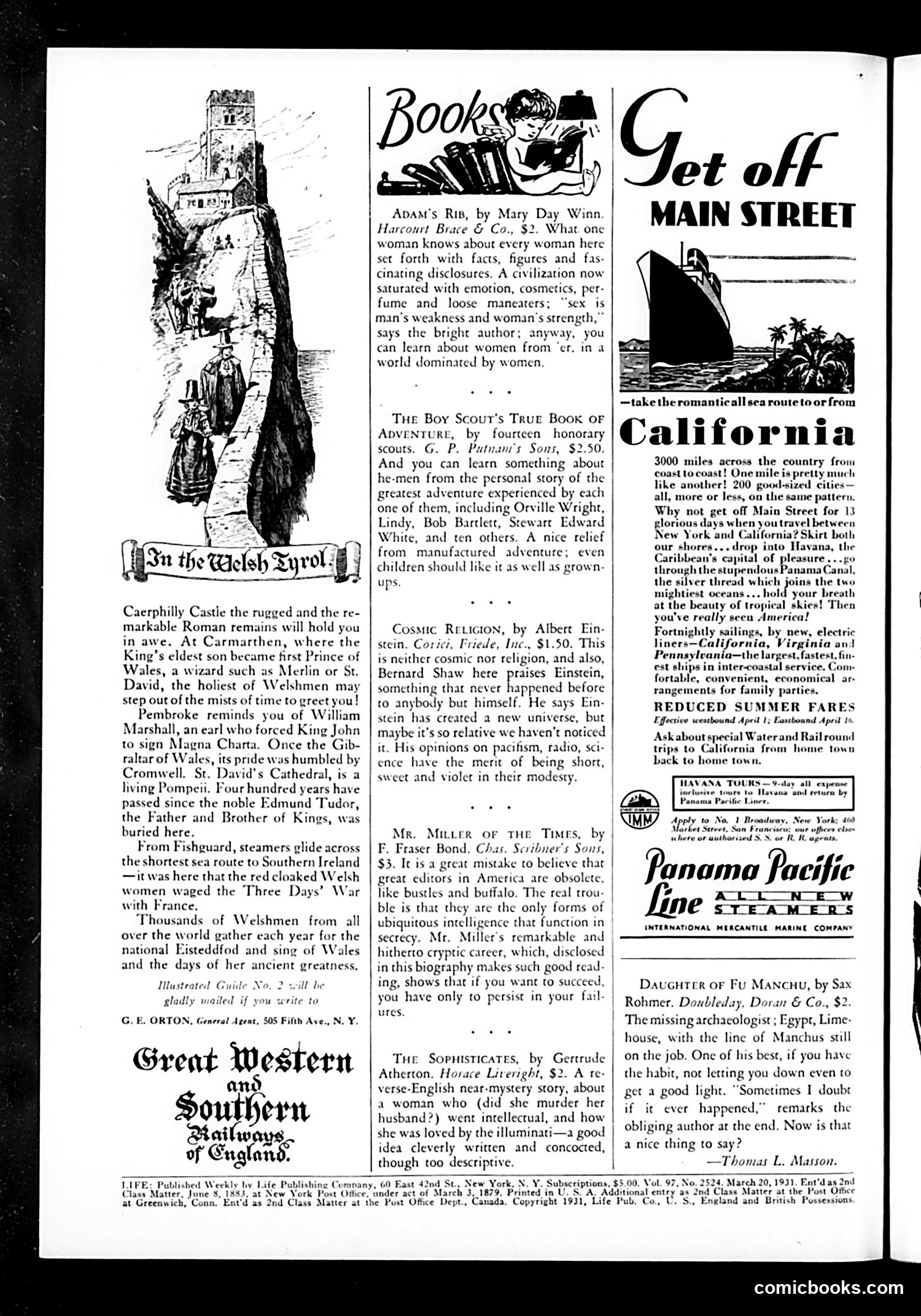
Analysis This page is primarily a book review section with accompanying advertisements rather than political satire or cartoons. The left side features an illustration labeled "In the Welsh Tyrol" showing a castle and travelers, accompanying a travel guide review about Wales and historical sites like Caernarvon Castle. The central "Books" section reviews five literary works, including Mary Day Winn's *Adam's Rib* (about women's roles), a Boy Scout adventure book, and works by Albert Einstein and F. Fraser Bond on cosmic religion and journalism. The right side advertises California travel and the Panama Pacific Line steamship service, emphasizing leisure travel opportunities. There are no political cartoons or satirical figures visible. This appears to be a standard magazine page from March 1921 mixing book reviews with travel and transportation advertising—content typical of *Life* magazine during this era.
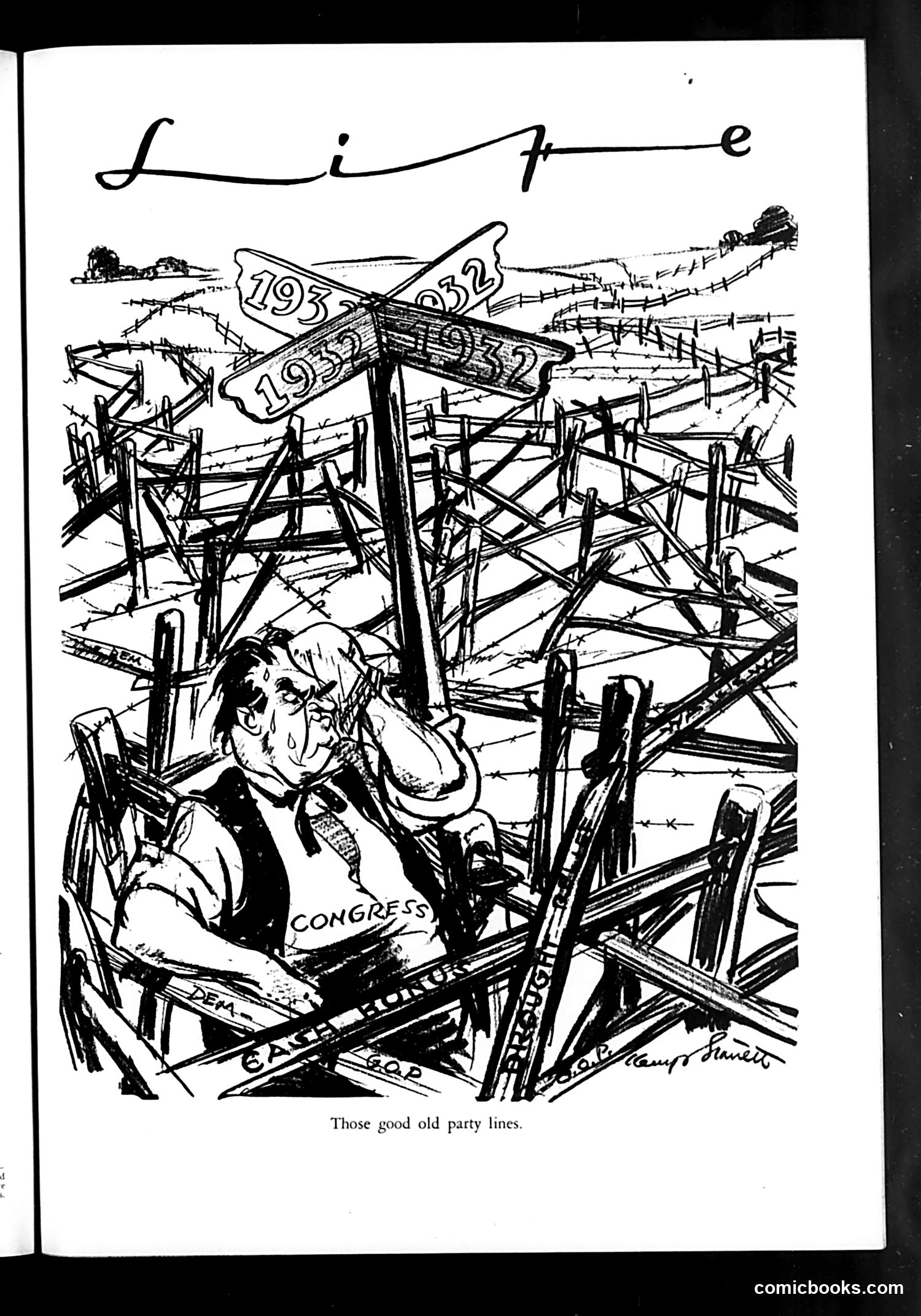
Political Cartoon Analysis This is a satirical cartoon titled "Those good old party lines." The image depicts a figure labeled "Congress" trapped within a complex maze of interconnected fence rails and posts, each labeled with years (1932, 1933) and political party abbreviations ("G.O.P." visible). The figure appears distressed or confined. The satire critiques how Congressional members are constrained by rigid party loyalty and political factionalism during the early 1930s—likely referencing Depression-era gridlock. The "party lines" are depicted literally as physical barriers that trap and restrict Congress's ability to act freely or independently. The cartoon suggests that partisan divisions prevent effective governance, with lawmakers imprisoned by their own party affiliations rather than serving broader public interests.
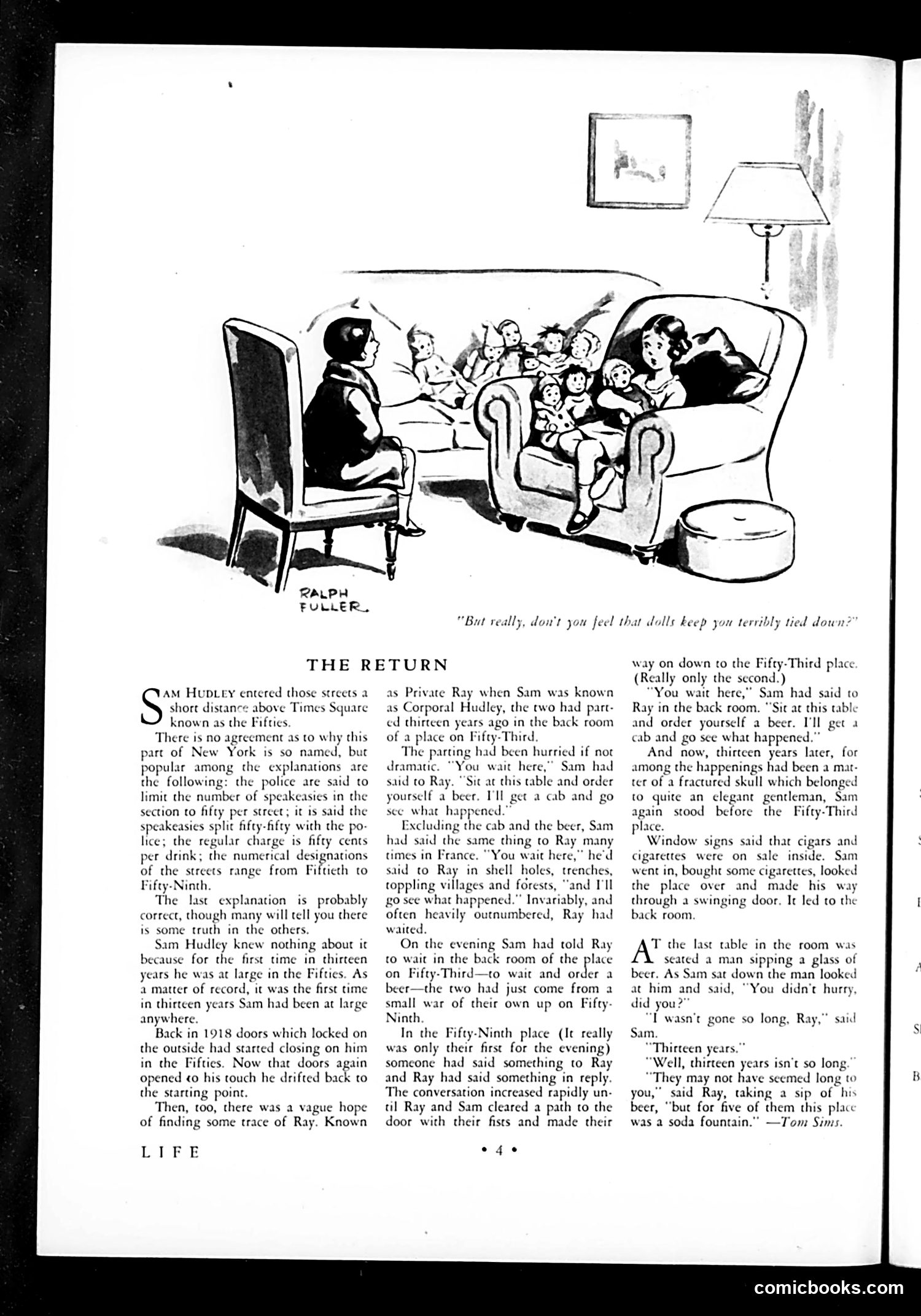
Analysis: "The Return" by Ralph Fuller The Cartoon: The cartoon depicts a woman sitting alone on a chair facing a sofa crammed with numerous dolls and small figures. The caption reads: "But really, don't you feel that dolls keep you terribly tied down?" The Satire: This is likely satirizing the anxiety some women felt about motherhood and domestic responsibility during this era. The joke presents an absurd inversion: the woman treats dolls (not children, but their substitutes) as burdensome dependents. The satire appears to mock either women who complain about childcare duties or, conversely, societal expectations that women eagerly embrace unlimited domesticity. The crowded sofa emphasizes how overwhelming such responsibilities could feel, making it commentary on women's limited autonomy within domestic life. The accompanying short story "The Return" concerns two men reuniting in New York.
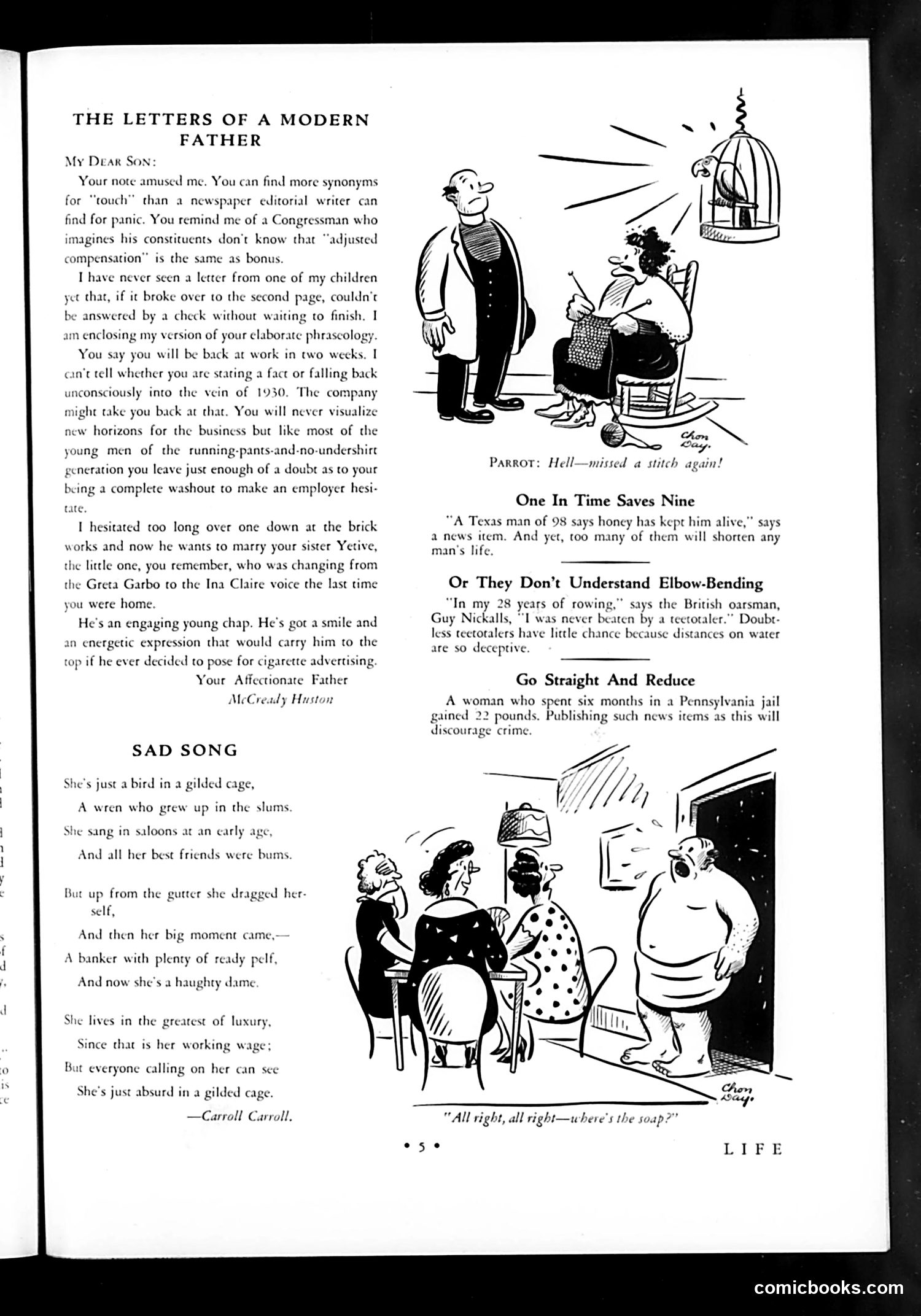
Analysis of Life Magazine Page This page contains three distinct pieces of social satire: "The Letters of a Modern Father" mocks generational disconnect—a father complains his son uses elaborate business jargon like "adjusted compensation" instead of plain language like "bonus," and worries about young men becoming "running-pants-and-no-undershirt" degenerates. "Sad Song" is a cautionary poem about a woman who rose from poverty through a banker's marriage, now trapped in luxury despite her humble origins—satirizing both social climbing and the constraints of wealth. "Go Straight and Reduce" presents a cartoon joke: a woman gained 22 pounds during six months in jail, and the caption sardonically frames publishing this as crime prevention—mocking newspapers' sensationalism and absurd moral lessons. The cartoons critique pretension, generational anxiety, and media manipulation typical of 1920s American society.
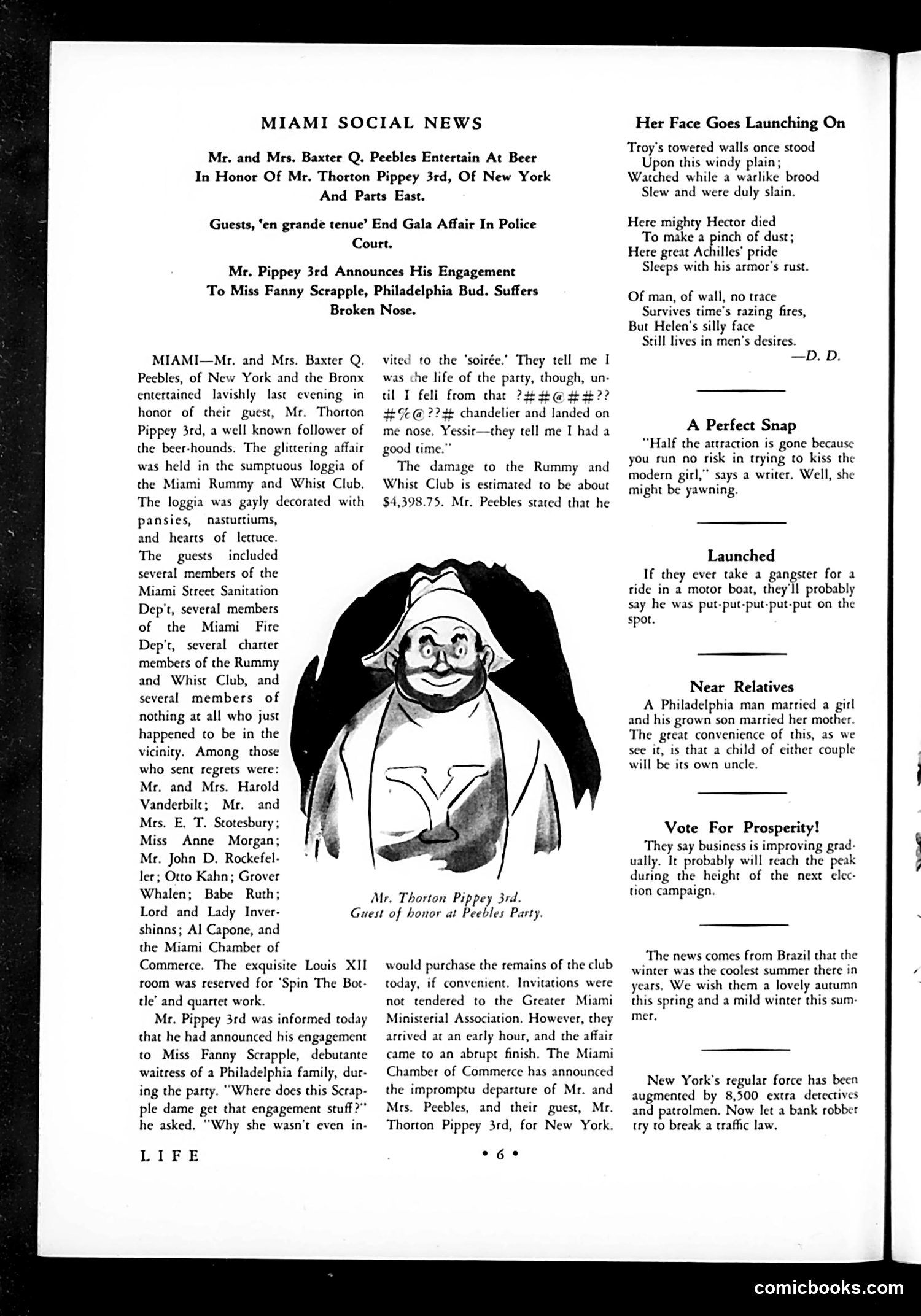
Analysis of Life Magazine Page This page contains social news about Miami society figures, centered on a caricature labeled "Mr. Thorton Pippey 3rd, Guest of honor at Peebles Party." The main cartoon depicts a rotund, jovial man in formal attire with an exaggerated smile—typical of 1920s caricature style. The accompanying text humorously describes a party hosted by Mr. and Mrs. Baxter Q. Peebles honoring Pippey, where he allegedly broke his nose and announced his engagement to "Miss Fanny Scrapple" of Philadelphia. The satire mocks wealthy society's pretensions through absurdist humor: ridiculous names (Scrapple, Pippey), an implausibly dramatic accident at an elegant party, and the mock-serious tone covering trivial social events. Right-column poetry parodies classical literature, adding literary mockery to the social critique.
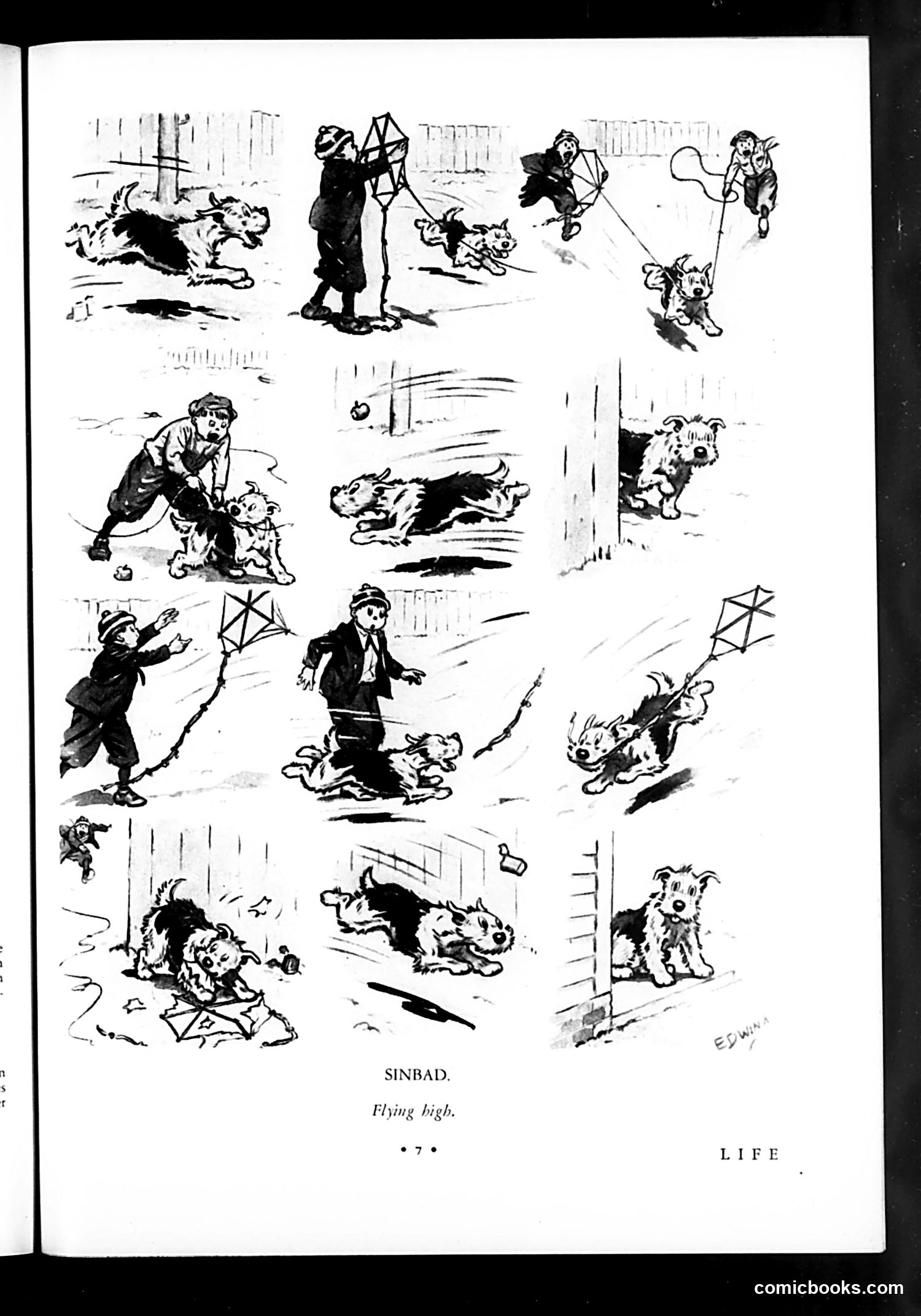
Analysis of "Sinbad: Flying High" This is a comic strip sequence titled "Sinbad" with the subtitle "Flying high," referencing the famous Arabian Nights character known for fantastic adventures. The strip depicts a child flying a kite in various scenes—launching it, managing the string, and dealing with mishaps as the kite flies unpredictably. The humor comes from the classic childhood experience: the difficulty of controlling a kite, the tension on the string, and the kite's tendency to behave erratically despite the flyer's efforts. The satire likely plays on the phrase "flying high"—the child's aspirations of successful kite-flying contrasted with the reality of losing control, suggesting broader themes about ambition versus reality, popular in Life magazine's satirical commentary.
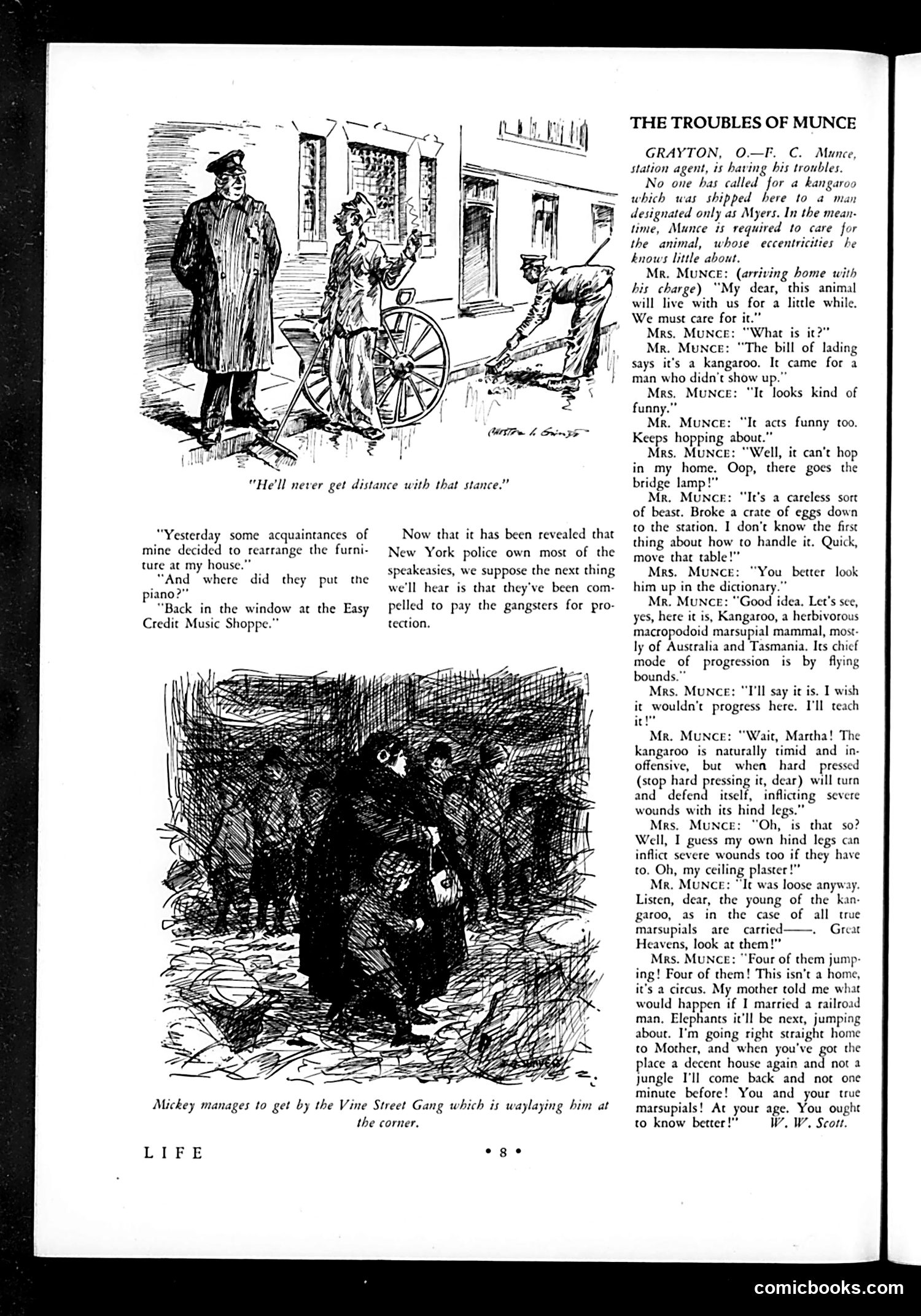
"The Troubles of Munce" - Analysis This is a humorous story about F.C. Munce, a railroad station agent dealing with an unexpected kangaroo that arrived at his station. The satire centers on bureaucratic absurdity: Munce must care for the animal despite having no expertise, and discovers it was shipped as a "bill of lading" for a man who never showed up. The joke mocks official incompetence—Munce must consult a dictionary to learn what a kangaroo is, and the animal causes domestic chaos (breaking eggs, hopping through the house). Mrs. Munce's exasperation and threat to leave illustrates the disruption of normal life caused by administrative failure and lack of accountability. The accompanying illustration shows the kangaroo cornered by the "Vine Street Gang," adding physical comedy to the bureaucratic mishap.
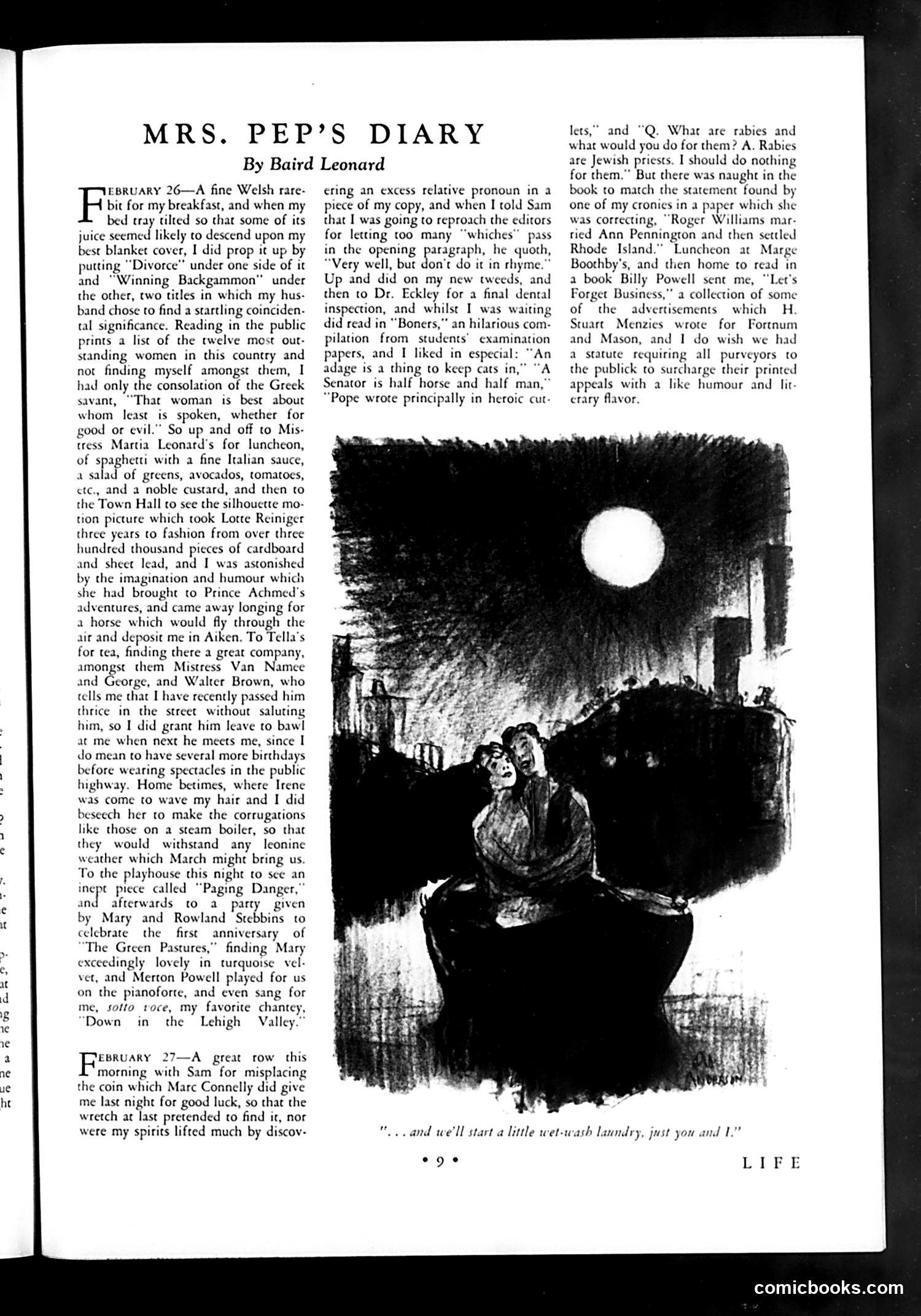
Mrs. Pep's Diary by Baird Leonard This page contains a humorous diary entry by "Mrs. Pep" dated February 26-27. The illustration depicts a woman and man in what appears to be a basement or laundry room, with the caption: "...and we'll start a little wet-wash laundry, just you and I." The humor relies on the double entendre of "wet-wash"—a laundry term that also suggests gossip or scandal-mongering. The diary entries reference mundane social activities (lunches, theater visits, parties) and social commentary about women in society. The satire gently mocks upper-middle-class domestic life and women's social preoccupations of the era, presented through the fictional Mrs. Pep's observations about her circle and daily activities.
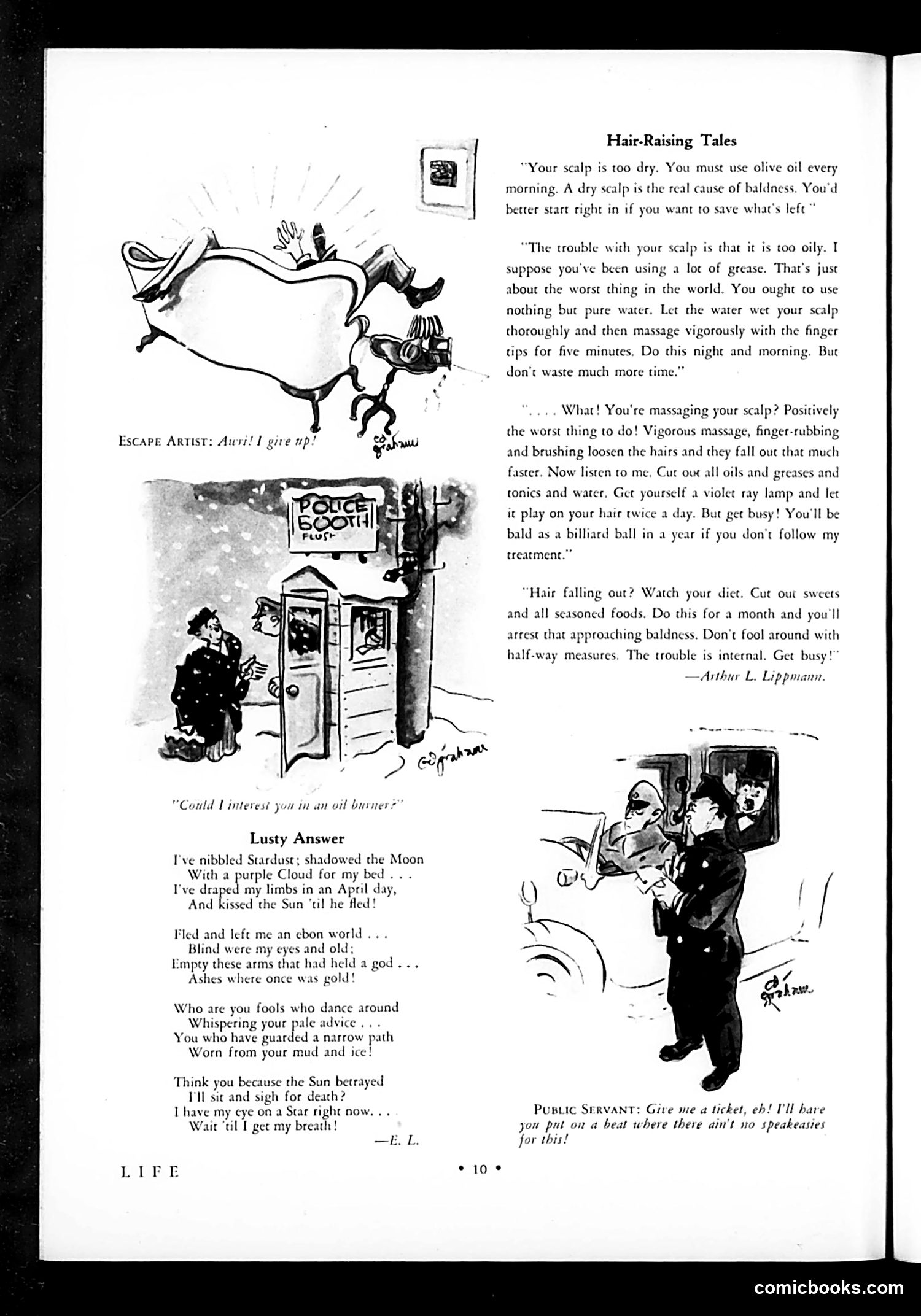
Hair-Raising Tales Page Analysis This page satirizes conflicting hair-care advice popular in the early 20th century. The "Hair-Raising Tales" section presents exaggerated, contradictory recommendations from different supposed experts—one advocates olive oil daily, another condemns grease entirely and recommends water massage, a third warns that vigorous massage causes hair loss and prescribes violet ray lamps and tonics. The cartoons mock this confusion: "Escape Artist" shows someone tangled in hair-care implements; "Could I interest you in an oil burner?" depicts a dubious salesman at a "Police Booth" storefront. The accompanying poem "Lusty Answer" by E.L. appears unrelated—romantic/fantastical verse about cosmic adventures. The final cartoon shows a frustrated public servant dealing with transit complaints, illustrating everyday urban frustrations.
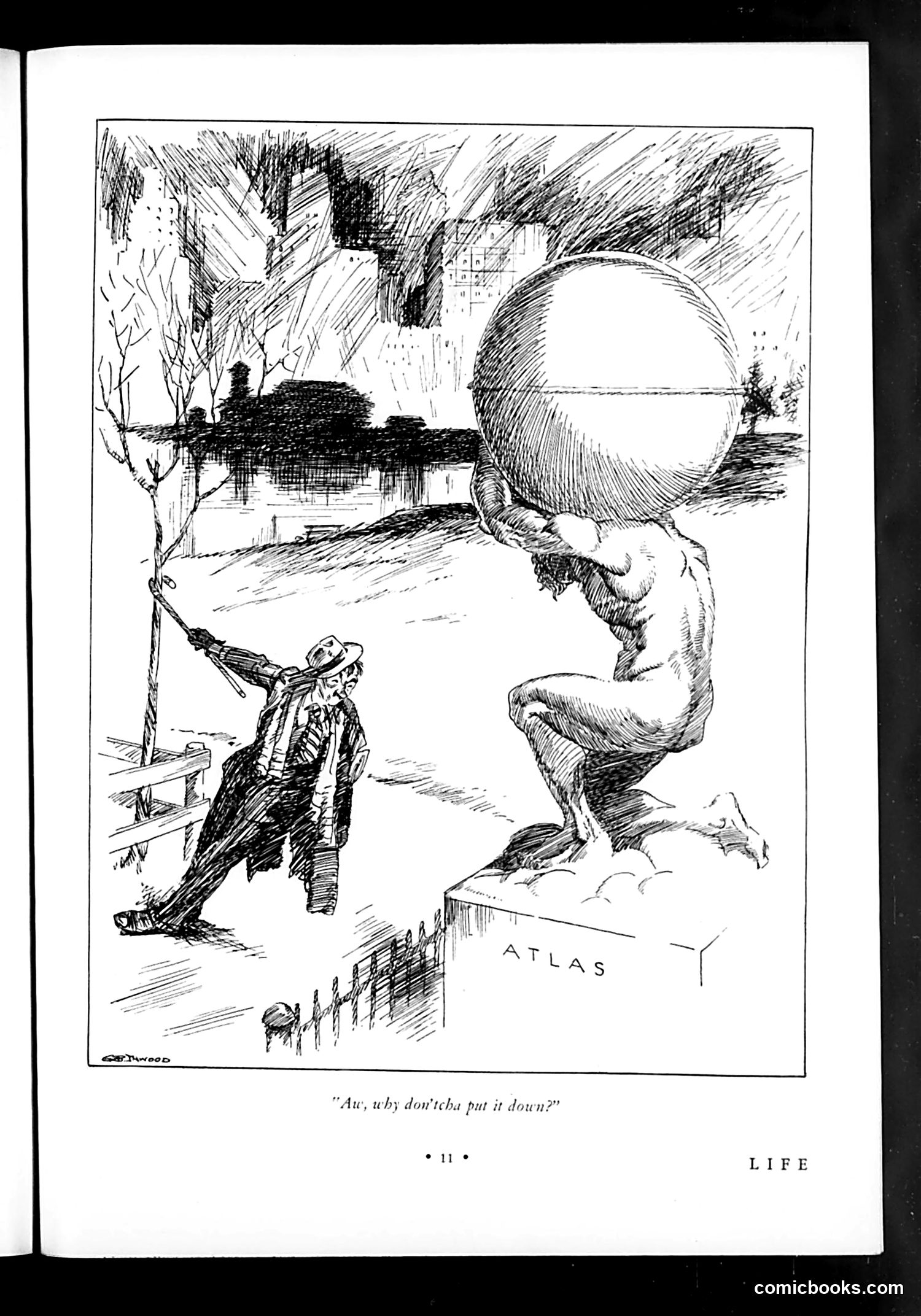
Political Cartoon Analysis This cartoon depicts a figure labeled "ATLAS" struggling to hold up an enormous globe, while a small man in period clothing (appearing to be early 20th century) tugs at the globe from below with the caption "Aw, why don't'cha put it down?" The satire critiques the burden of global responsibility or imperialism. Atlas—the mythological titan condemned to hold up the heavens—represents a nation (likely America) shouldering enormous international obligations. The ordinary man represents either the common citizen or perhaps an opposing political voice suggesting these burdens are unnecessary or unsustainable. The joke suggests that carrying the world's weight is exhausting and that someone is foolishly insisting on maintaining this impossible responsibility, when simply "putting it down" would be easier. This likely critiques American interventionism or expansionist policies of the era.
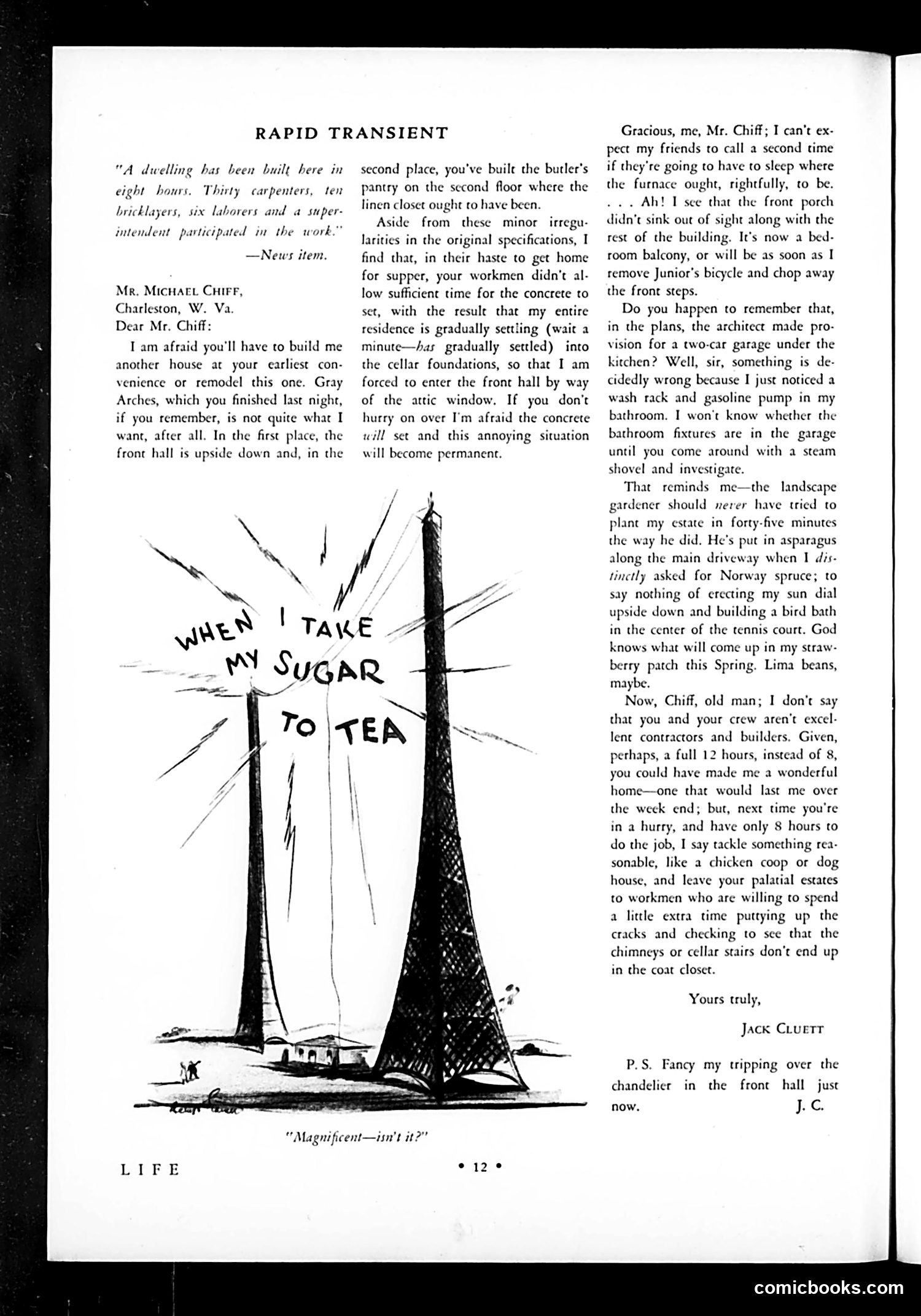
"Rapid Transient" - Life Magazine Humor Page This is a humorous letter-to-the-editor section. Mr. Michael Cliff of Charleston, W.Va. complains to the magazine about a house he had built, detailing construction problems: the front hall is upside down, the butler's pantry is on the wrong floor, concrete foundations are still settling, and various fixtures are misplaced or incomplete. The accompanying cartoon shows two absurdly tall, thin structures labeled "WHEN I TAKE MY SUGAR TO TEA" — appearing to be exaggerated buildings or smokestacks. The caption reads "Magnificent—isn't it?" The satire targets shoddy post-war construction quality and contractors' incompetence. Cliff's letter humorously catalogs domestic nightmares common to the era, mocking both builders and homeowners who accepted such poor workmanship without complaint.
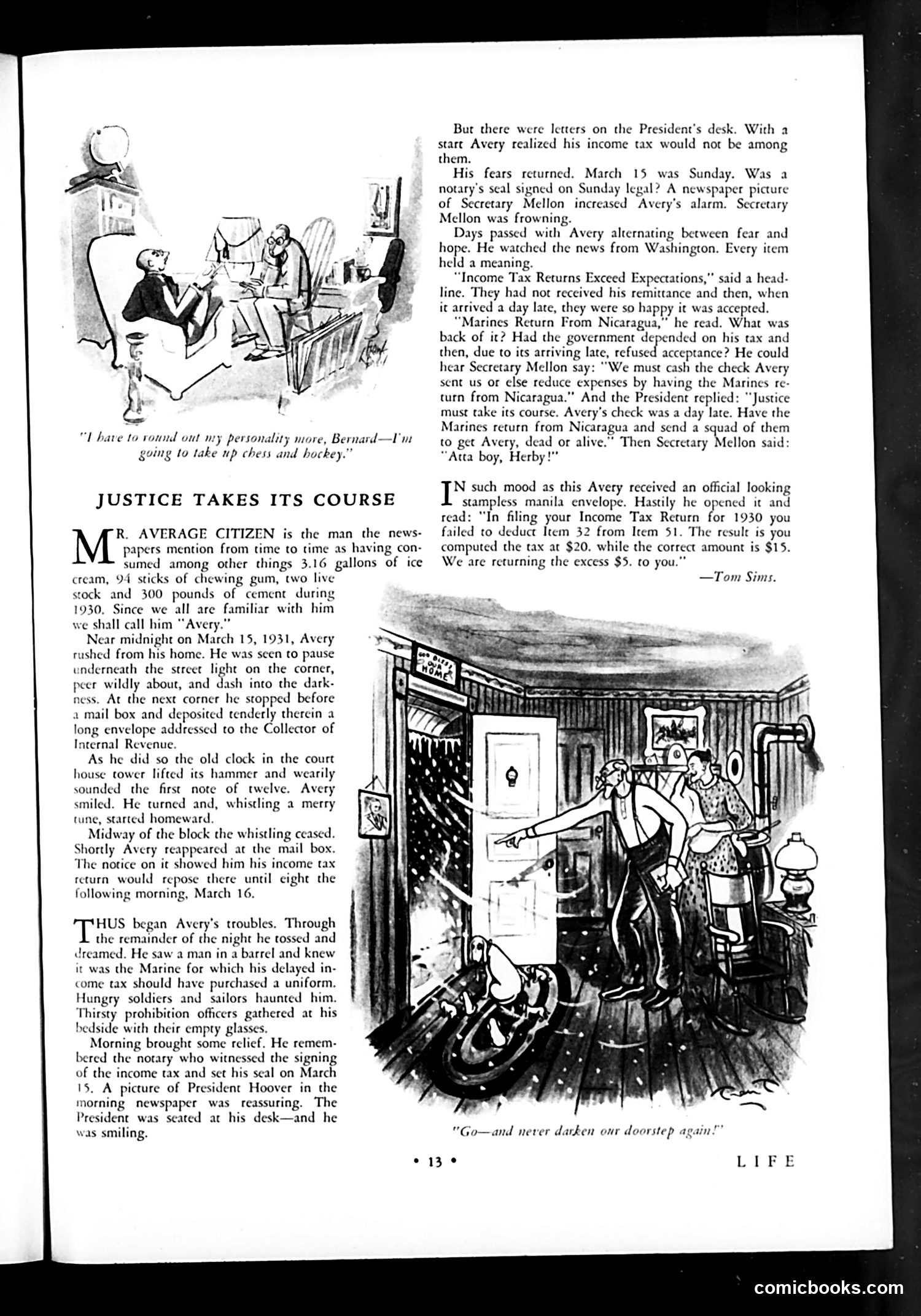
"Justice Takes Its Course" This satirical piece mocks "Mr. Average Citizen" named Avery, who panics about his income tax return. The narrative follows his escalating anxiety from March 15-16, 1931, as he fears his taxes won't be accepted and imagines military consequences. The satire targets both ordinary citizens' tax anxieties and government bureaucracy. References to Secretary Mellon and the President (likely Hoover) indicate contemporary fiscal policy debates. The punchline—that the IRS merely returns $5 to Avery—deflates his elaborate worries. The cartoon depicts Avery's home life disrupted by paranoia. The phrase "Go—and never darken our doorstep again!" suggests how tax fears invaded domestic peace. The humor ridicules Americans' relationship with taxation during the Depression era.
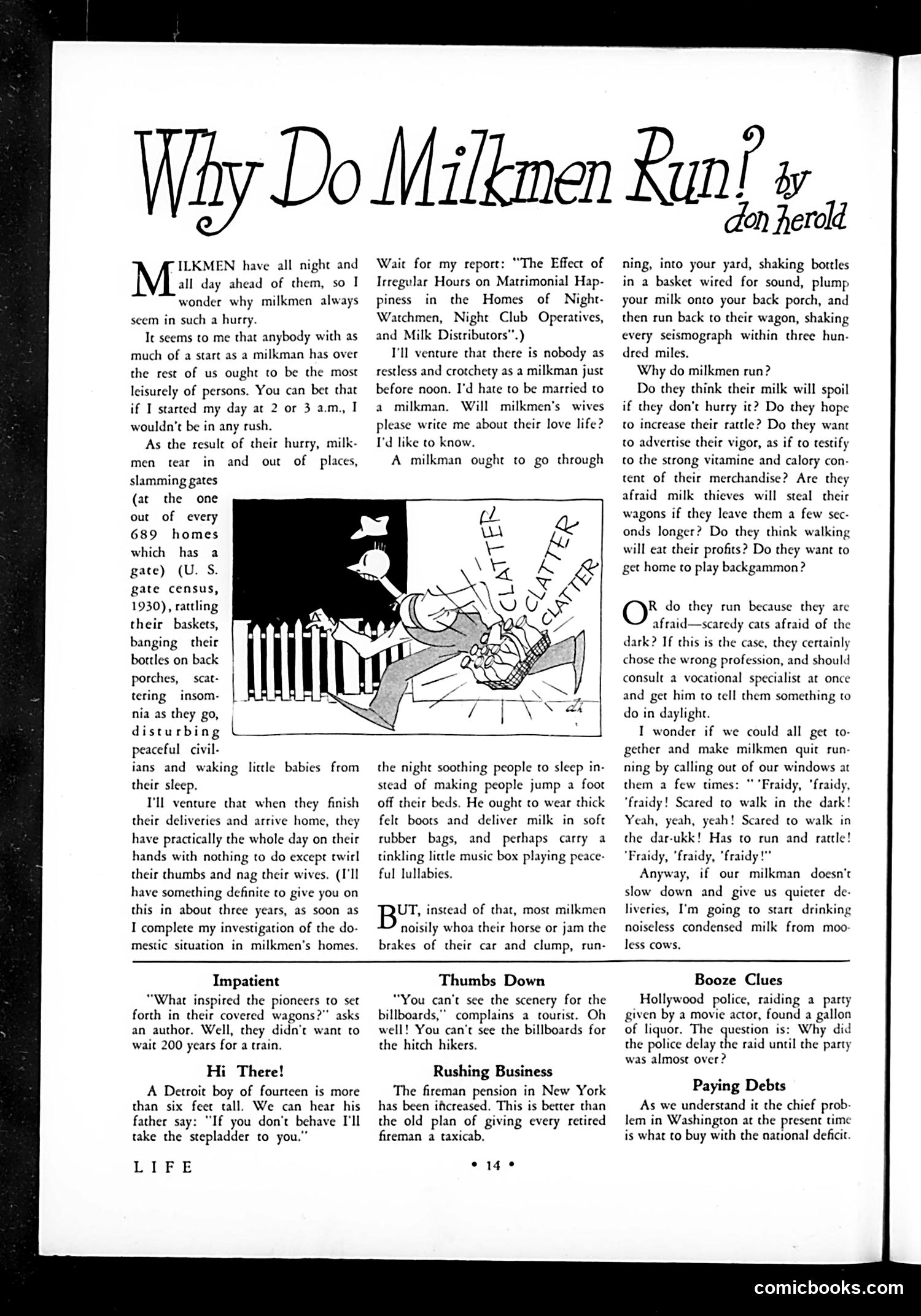
"Why Do Milkmen Run?" by Don Herold This satirical article humorously investigates why milkmen always seem to be in a rush during their deliveries. The accompanying cartoon depicts a milkman frantically running while delivering milk, with a horse and wagon visible. Herold's piece offers absurd theories: milkmen fear their milk will spoil, or they want to increase their rattles' sound to advertise vigor. He suggests they might be afraid of the dark or scarecats, or simply want to get home to play backgammon. The joke satirizes the observed behavior of urban milkmen in this era—their constant hurrying during early morning deliveries—by proposing increasingly ridiculous explanations rather than practical ones like efficiency or schedule demands. It's gentle social commentary on working-class routines that puzzle middle-class observers.
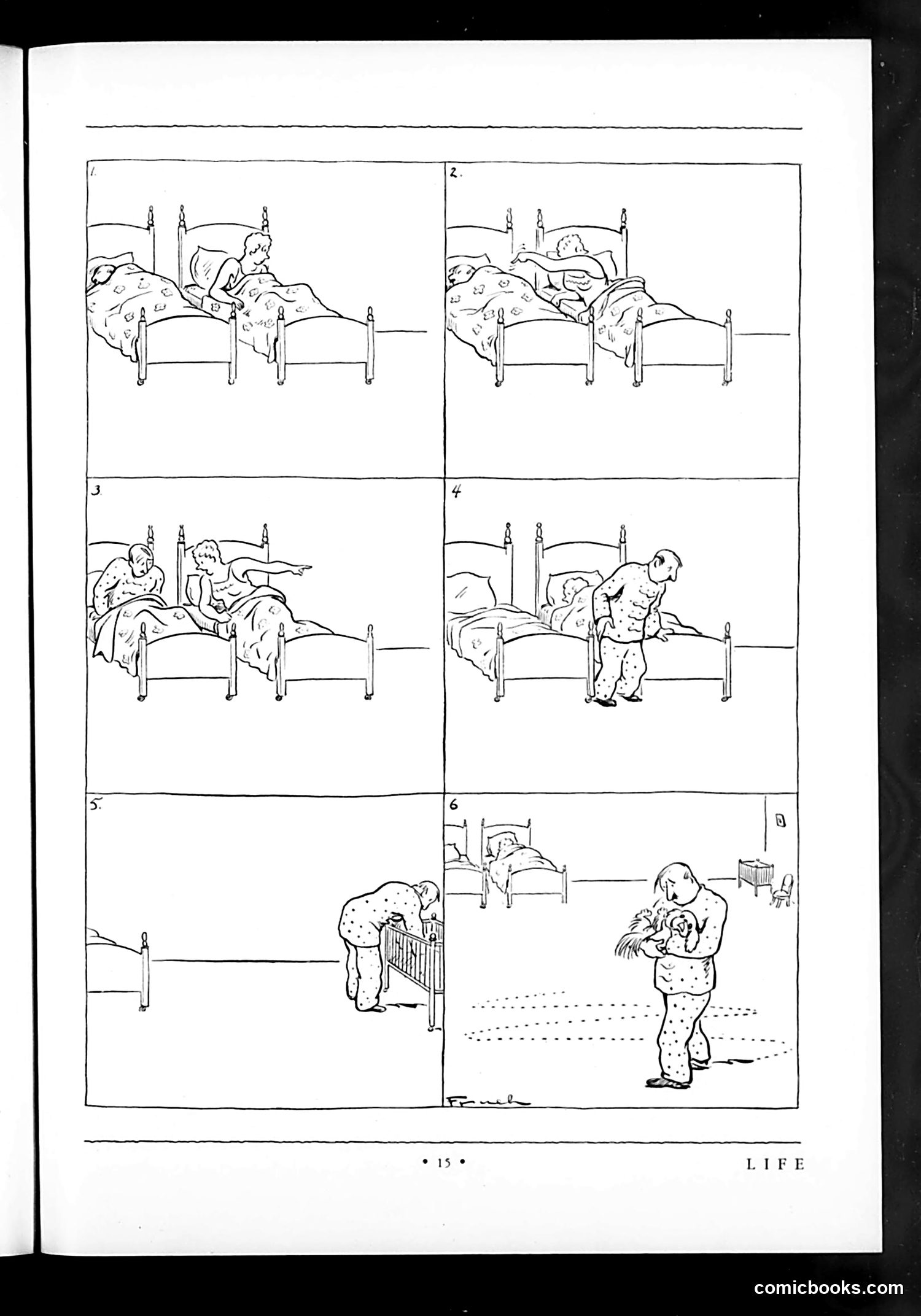
Analysis This is a six-panel comic sequence depicting a domestic sleeping scenario. The narrative progresses from panels 1-2 (showing couples in bed), through panels 3-4 (showing interaction between the sleeping figures), to panels 5-6 (showing one person getting up and attending to what appears to be a baby or small child). The comic appears to be satirizing the realities of married life with an infant—specifically the disruption to sleep and the division of nighttime duties. The humor targets the gap between romantic expectations of marriage (peaceful couples sleeping together) and the chaotic reality of parenting a demanding baby who requires nighttime attention. Without visible text or captions on this particular page, the specific satirical point relies on visual storytelling common to *Life* magazine's domestic humor of the early-to-mid 20th century.
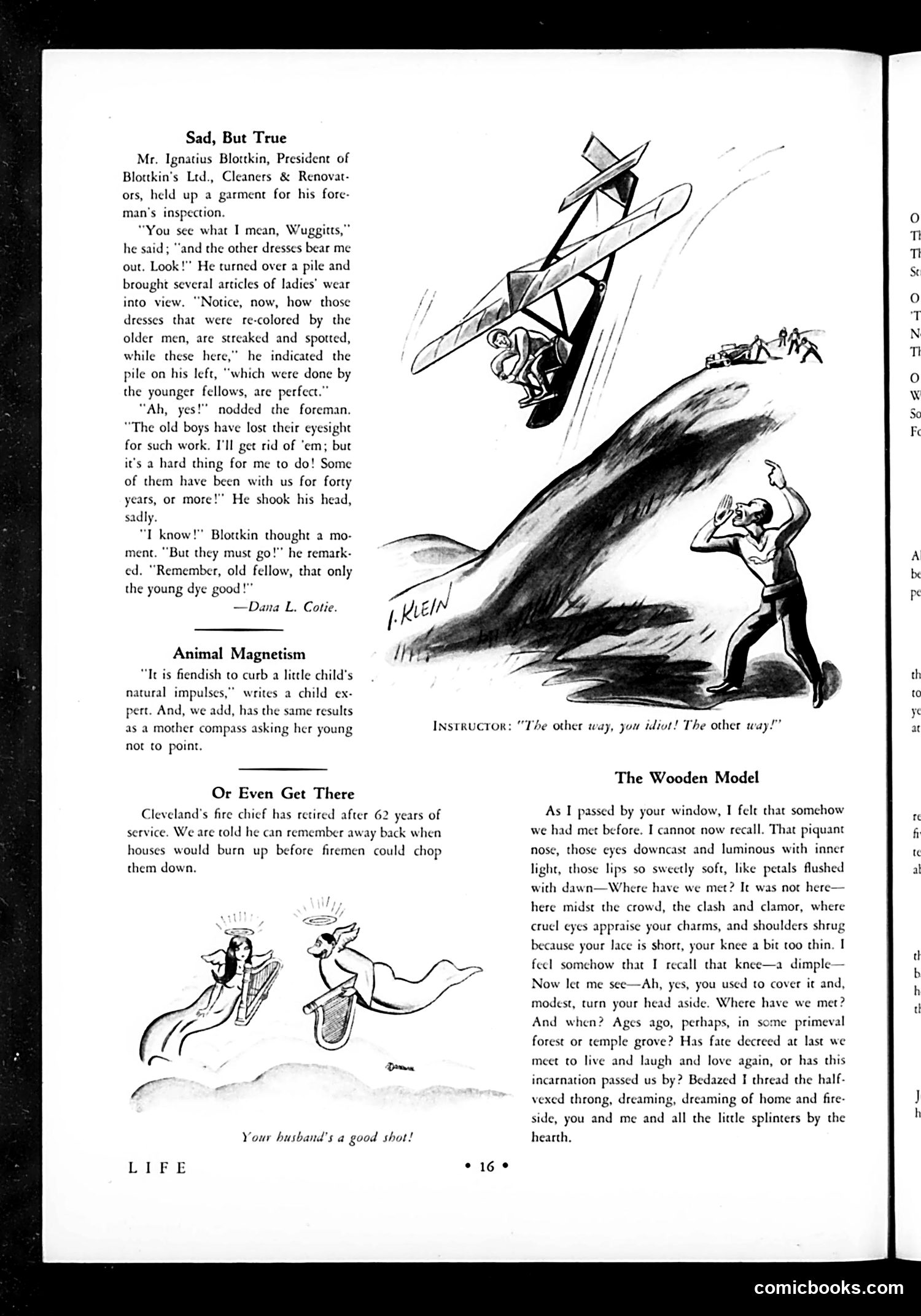
Analysis of Life Magazine Page 16 This page contains three distinct humor pieces: 1. "Sad, But True": A story about Mr. Ignatius Blotkin, a dry cleaning company president, observing that garments re-dyed by older workers show streaks and spots, while those handled by younger workers are perfect. The joke satirizes age discrimination in employment—the older workers, despite 40+ years of experience, are being judged inferior and face potential dismissal. 2. "Animal Magnetism": A brief quip about curbing children's impulses, comparing it to a compass needle's behavior. 3. "The Wooden Model": A romantic poem about encountering an idealized woman, possibly from a past life or memory. The cartoons by I. Klein and others use simple line drawings to illustrate these humorous observations about workplace, child-rearing, and courtship customs of the era.
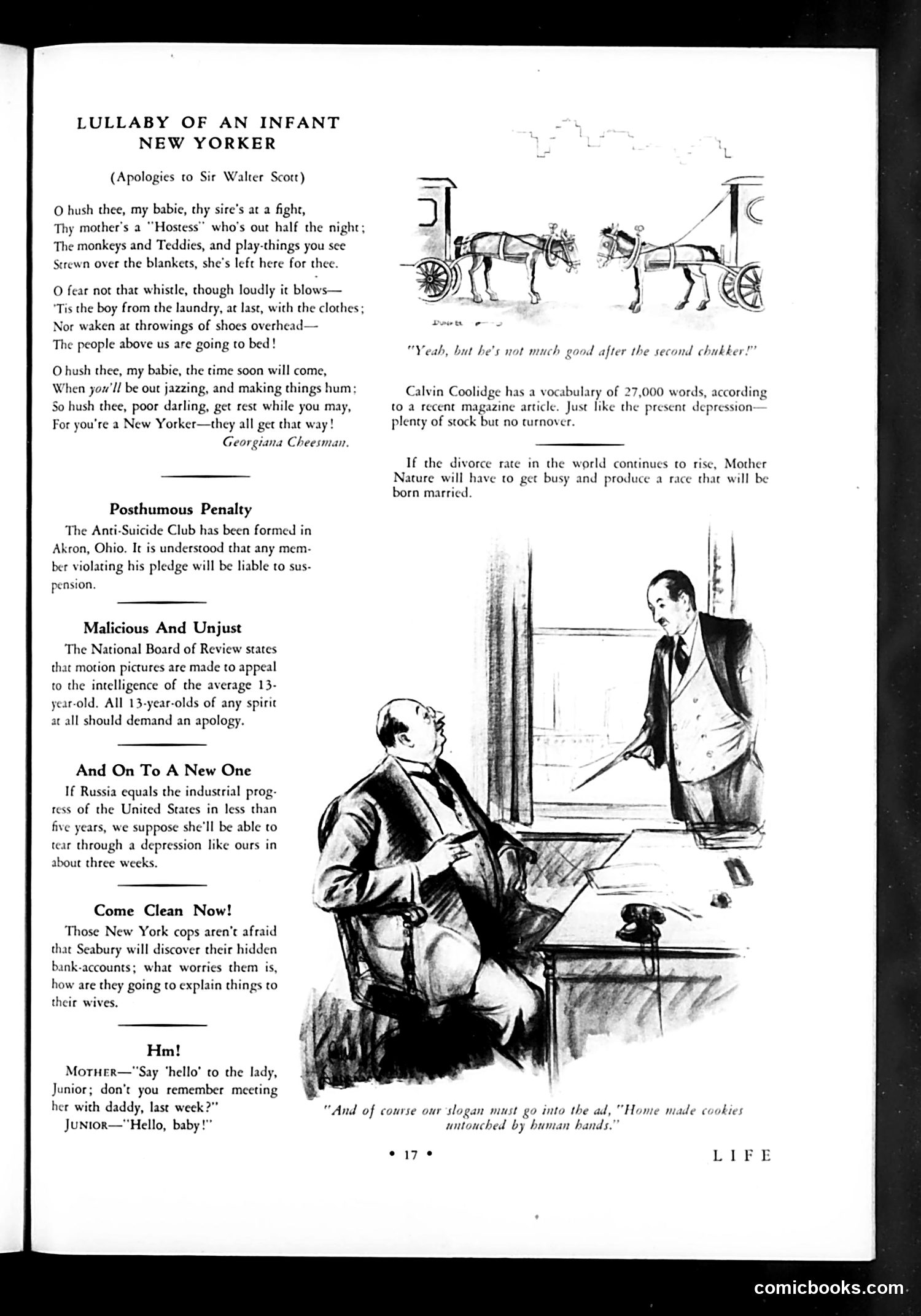
Analysis of Life Magazine Page 17 This page contains several brief satirical items typical of Life's format. The main cartoon depicts two men in an office: one seated at a desk, one standing. The caption reads: "And of course our slogan must go into the ad, 'Home made cookies untouched by human hands.'" The joke satirizes advertising's contradictory claims—emphasizing "homemade" (implying personal care) while simultaneously suggesting mass production or mechanical handling (untouched by humans). This likely reflects 1920s-30s anxieties about industrialization and mass marketing's disconnect from authentic domestic values. Other items on the page mock various contemporary concerns: divorce rates, Russian industrial progress, police corruption investigations, and motion picture standards. The "Lullaby of an Infant New Yorker" humorously depicts urban childhood chaos rather than pastoral tranquility.
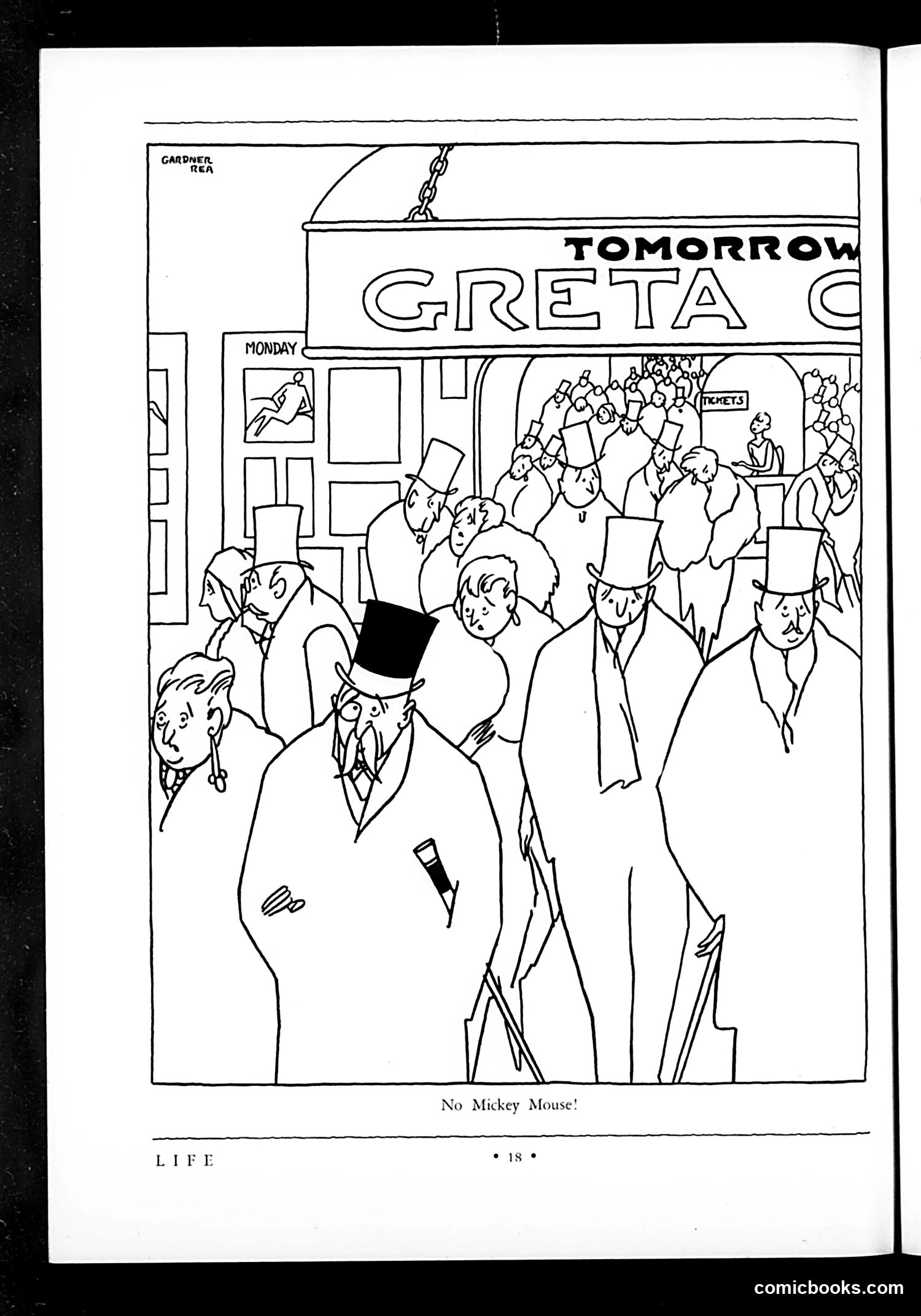
Cartoon Analysis: "No Mickey Mouse!" This is a satirical cartoon from *Life* magazine showing a crowded theater queue outside the "Greta" cinema (likely referencing Swedish actress Greta Garbo, a major Hollywood star of the era). The caption "No Mickey Mouse!" suggests the joke concerns expectations versus reality. The cartoon appears to satirize public disappointment: despite the prestigious marquee advertising "Greta," the crowd seems underwhelmed or the experience failed to match hype. The reference to "Mickey Mouse" (Disney's cartoon character) implies the public expected high-quality cinema but encountered something trivial or disappointing instead. The formal attire of the crowd contrasts with their apparent dissatisfaction, emphasizing the gap between cinematic prestige and actual entertainment value—a common target of *Life*'s satire on consumer culture and American entertainment.
"Sic Transit Gloria Mundi" (The Decline of The World) This article mourns the sudden closure of *The World*, a major New York newspaper. The piece uses the Latin phrase meaning "thus passes the glory of the world" to characterize the shock of its shutdown. Key points: - *The World* was the only Democratic paper in New York and widely respected for editorials and news coverage - Though financially declining, readers didn't expect its demise—the author compares the sudden closure to the Titanic sinking - Joseph Pulitzer's will made no provision for the paper's continuation, treating it like a controlled asset rather than a living institution - The article suggests *The Telegram* should absorb *The World's* properties, and proposes a smaller companion morning edition called *The World* to manage the merger The satirical cartoon (cupid figure) likely mocks the sentimentality around the newspaper's death—treating a commercial enterprise as a beloved departed friend.
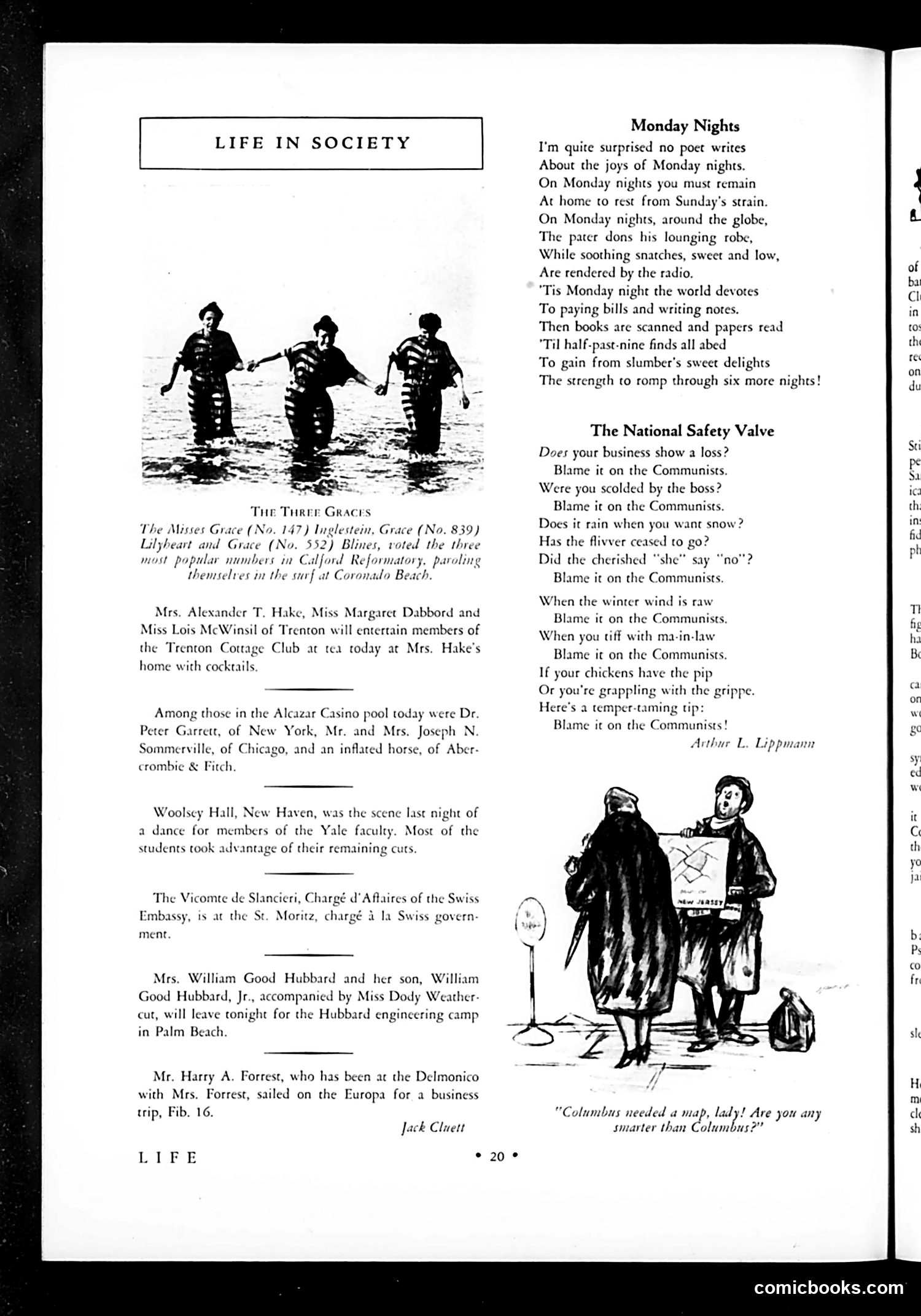
Analysis of Life Magazine Page This page from *Life* magazine contains social satire typical of the 1920s-30s era. "Life in Society" section: A parody of society column gossip. The humor lies in absurd juxtapositions—mention of "three most popular numbers in Calford Reformatory" (prison inmates) alongside wealthy socialites, and casually inserting "an inflated horse" among casino guests. It mocks the pretentiousness and vapidity of high society reporting. "Monday Nights" poem: Gentle domestic humor about middle-class routine—husbands in robes, radio entertainment, bill-paying, early bedtimes. Reflects post-WWI American suburban life. "The National Safety Valve": Political satire. The poem satirizes Americans' tendency to blame "Communists" for any grievance—weather, mechanical failures, romantic rejection, family arguments, even chicken diseases. This reflects 1920s-30s anti-Communist hysteria and Red Scare fears, mocking how indiscriminately the scapegoat was applied. Cartoon: A woman asks a man for directions using a map, quipping "Columbus needed a map, lady! Are you any smarter than Columbus?"—standard gendered humor about women's navigation abilities.
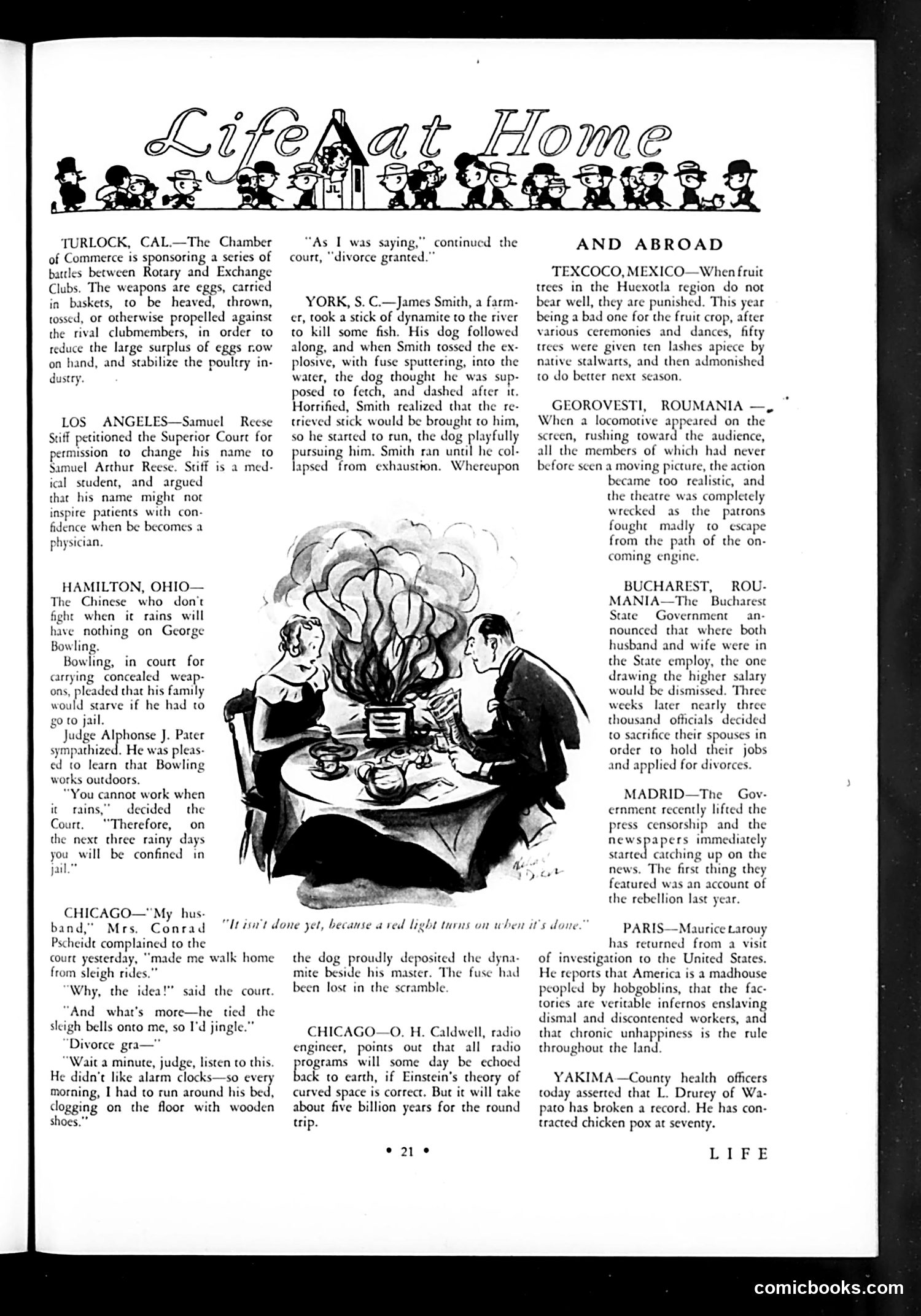
Explaining This Life Magazine Page This page collects humorous anecdotal stories—a typical Life format of the era—mixing domestic absurdities with international oddities. The central illustration shows a couple dining amid marital discord, captioning a Chicago story where a husband's refusal to work during rainy days (his excuse to avoid jail) becomes grounds for divorce after he also tied sleigh bells to his wife and forced her to wear wooden shoes as an "alarm clock." The satire targets petty spousal grievances and judicial tolerance of absurd excuses. International items mock cultural backwardness: Mexican villagers physically whipping unproductive fruit trees, a Bucharest cinema audience panicking at a film locomotive (suggesting technological unfamiliarity), and Romanian bureaucrats hastily divorcing to preserve employment when salary-reduction policies threaten spouses. The American stories satirize civic boosterism (egg-fighting tournaments to reduce surplus) and individual entitlement. The overall tone is gentle mockery of universal human folly—marital discord, poor judgment, and technological/cultural gaps—rather than sharp political critique.
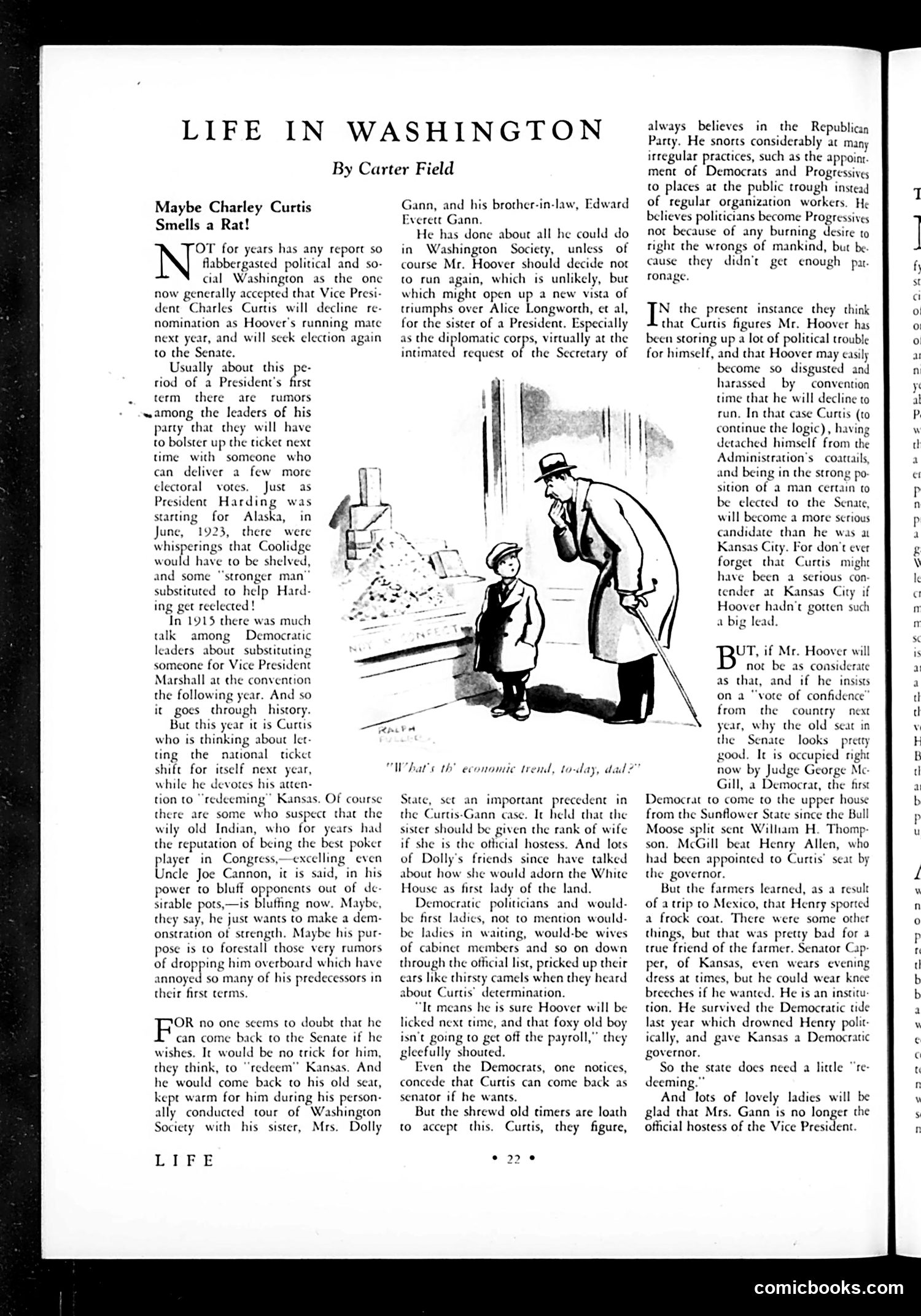
Explanation for Modern Readers This 1928 article by Carter Field speculates that Vice President Charles Curtis plans to leave Hoover's ticket and return to the Senate instead of seeking re-election as VP. The piece discusses Washington rumors and intrigue around this potential move. The cartoon illustrates the main joke: Curtis appears to be a shrewd political operator ("wily old Indian," a poker player known for bluffing) who may be signaling weakness strategically. The child asks an adult, "What's th' economic trend, today, dad?"—suggesting Curtis might be abandoning Hoover's sinking ship if the economy tanks before 1928's election. Key context: Curtis was Native American (Kaw), which the text references dismissively. His sister Dolly Gann served as his official hostess and generated controversy over her social precedence. Democrats assume Curtis knows Hoover will lose, so he's positioning himself to survive politically. The satire mocks Washington's Byzantine power calculations and Curtis's calculated maneuvers.
Theatre Review by Baird Leonard - Life Magazine This is a theatre column reviewing recent Broadway productions. The author, writing in the 1920s-30s, discusses several shows including "A Woman Denied" (starring Mary Nash) and references classics like "Abie's Irish Rose." The satire targets theatrical mediocrity: the author sarcastically compares failed plays to famous criminals (Arnold Rothstein and Legs Diamond), saying at least criminals "sold tickets" while bad plays don't. He invokes "Carthago delenda est" (Carthage must be destroyed) when dismissing "Abie's Irish Rose," claiming even Bernard Shaw acknowledged great plays require great audiences. The piece mocks both producers who can't predict success and actors like Mary Nash who accept poorly-written roles. References to Mayor Walker and Democratic failings add topical New York political humor. The column's tone—self-deprecating yet acerbic—was typical of sophisticated 1920s-30s arts criticism, balancing entertainment journalism with intellectual pretension.
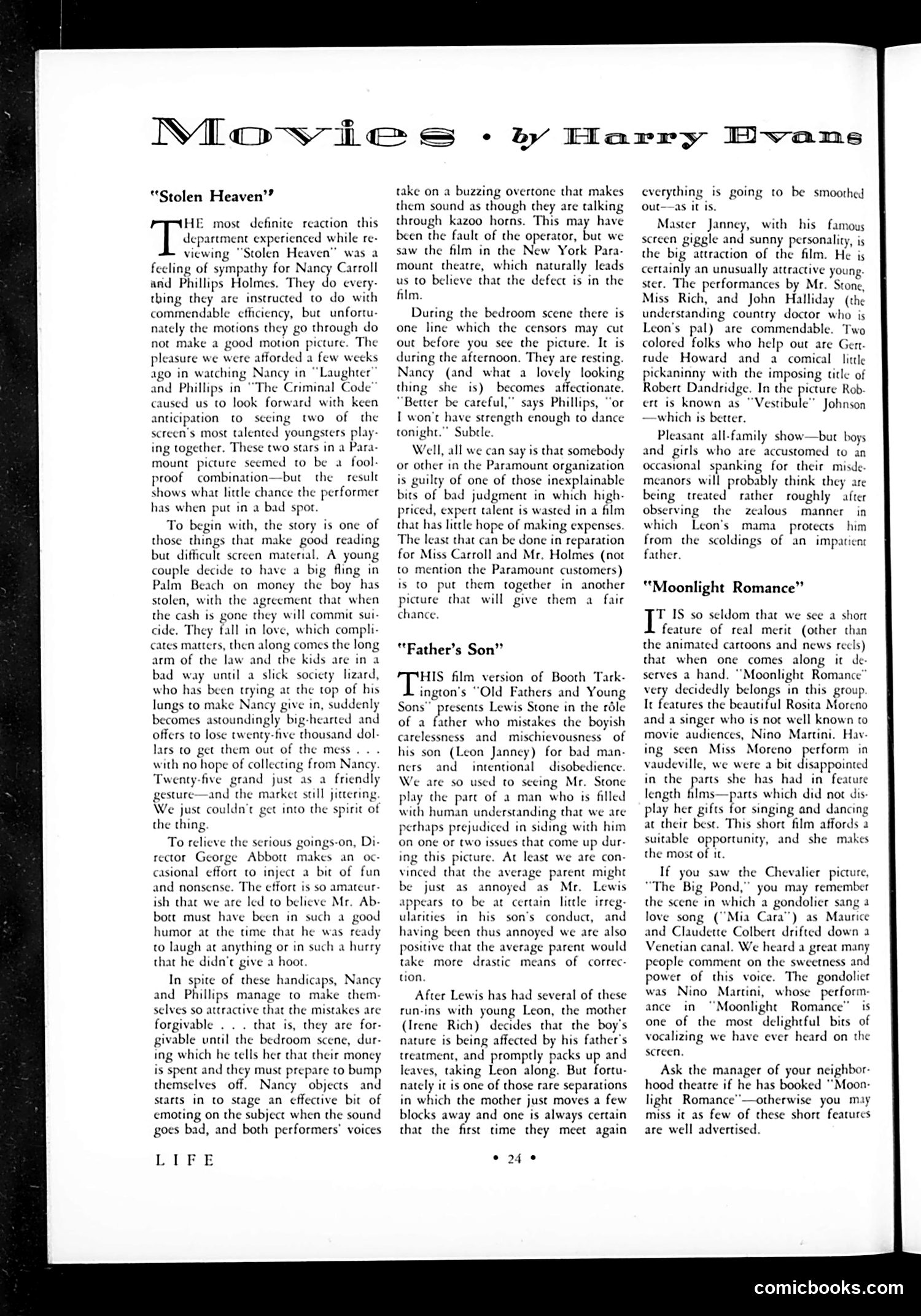
This page reviews three films. The main review criticizes "Stolen Heaven," starring Nancy Carroll and Phillips Holmes, as poorly written despite the actors' competence. The reviewer particularly mocks a plot point where a wealthy man generously loses $25,000 to help a young couple—calling this implausible given the stock market crash context (suggesting this is early 1930s). A technical flaw during an intimate bedroom scene where dialogue sounds like "kazoo horns" is noted, possibly the projectionist's or film's fault. "Father's Son" receives brief mention, starring Lewis Stone as a father misunderstanding his son's youthful behavior. The reviews are by Harry Evans, a film critic for Life magazine.
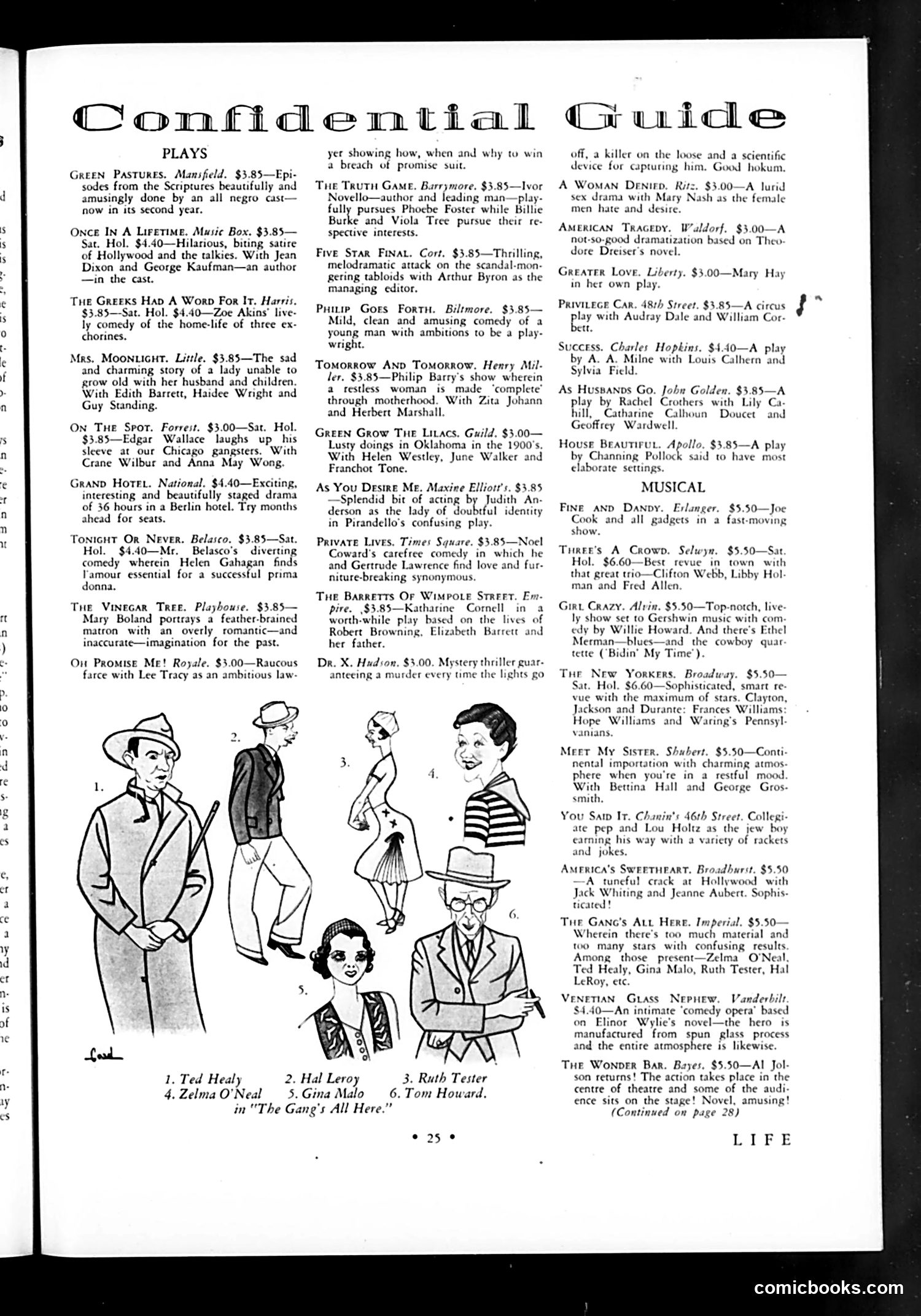
Analysis for Modern Readers This page from *Life* magazine presents theater reviews and advertisements—not political satire. The "Confidential Guide" catalogs Broadway plays and musicals with prices and cast information (typical of 1930s entertainment journalism). The cartoon at the bottom depicts six actors/performers from "The Gang's All Here," identifying them by name: Ted Healy, Hal Leroy, Ruth Tester, Zelma O'Neal, Gina Malo, and Tom Howard. This appears to be a straightforward theatrical cast illustration rather than satirical commentary. The play listings themselves reflect 1930s theatrical concerns: *Green Pastures* (an all-Black cast production), *Once in a Lifetime* (Hollywood satire), and various comedies and dramas. The prices ($3.00–$4.40) and venue names (theaters like the Barrymore, Guild, Royale) document Broadway's commercial landscape of this era. No political or social satire is evident—this is primarily entertainment industry documentation.
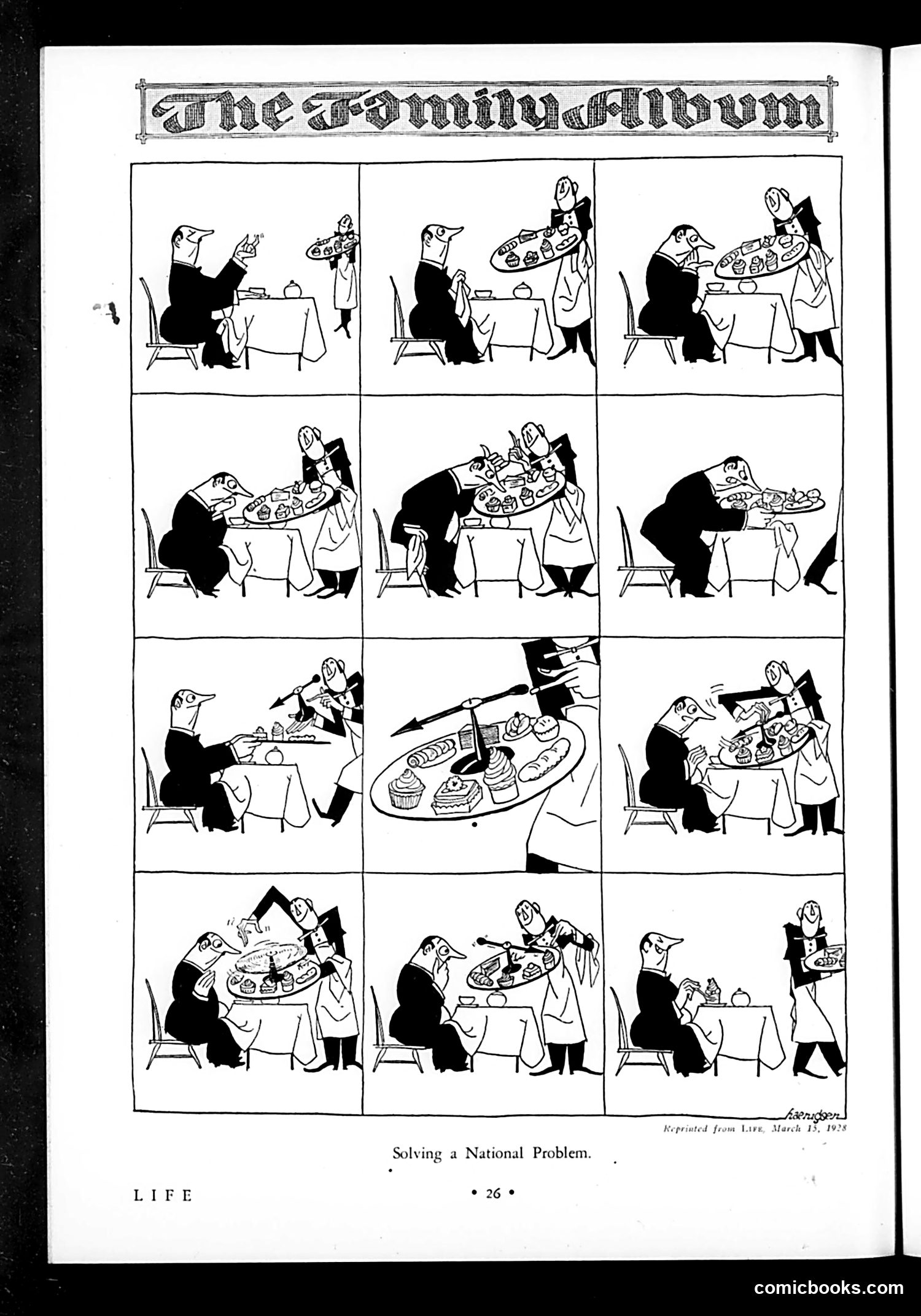
Analysis: "Solving a National Problem" This is a 12-panel satirical comic strip showing a dinner scene between a man in formal attire and a woman chef/server. The title "Solving a National Problem" suggests commentary on a contemporary issue, likely food-related or domestic economy given the dinner setting. The narrative appears to show the man's escalating frustration with the meal presentation, culminating in what seems to be a dramatic confrontation or complaint in the middle panel (where a large platter dominates). The final panels suggest resolution or capitulation. Without knowing the specific 1928 context, the cartoon likely satirizes either: culinary standards, rationing debates, household management conflicts, or possibly Prohibition-era dining. The repetitive panel structure emphasizes the cyclical nature of the "problem" being "solved."
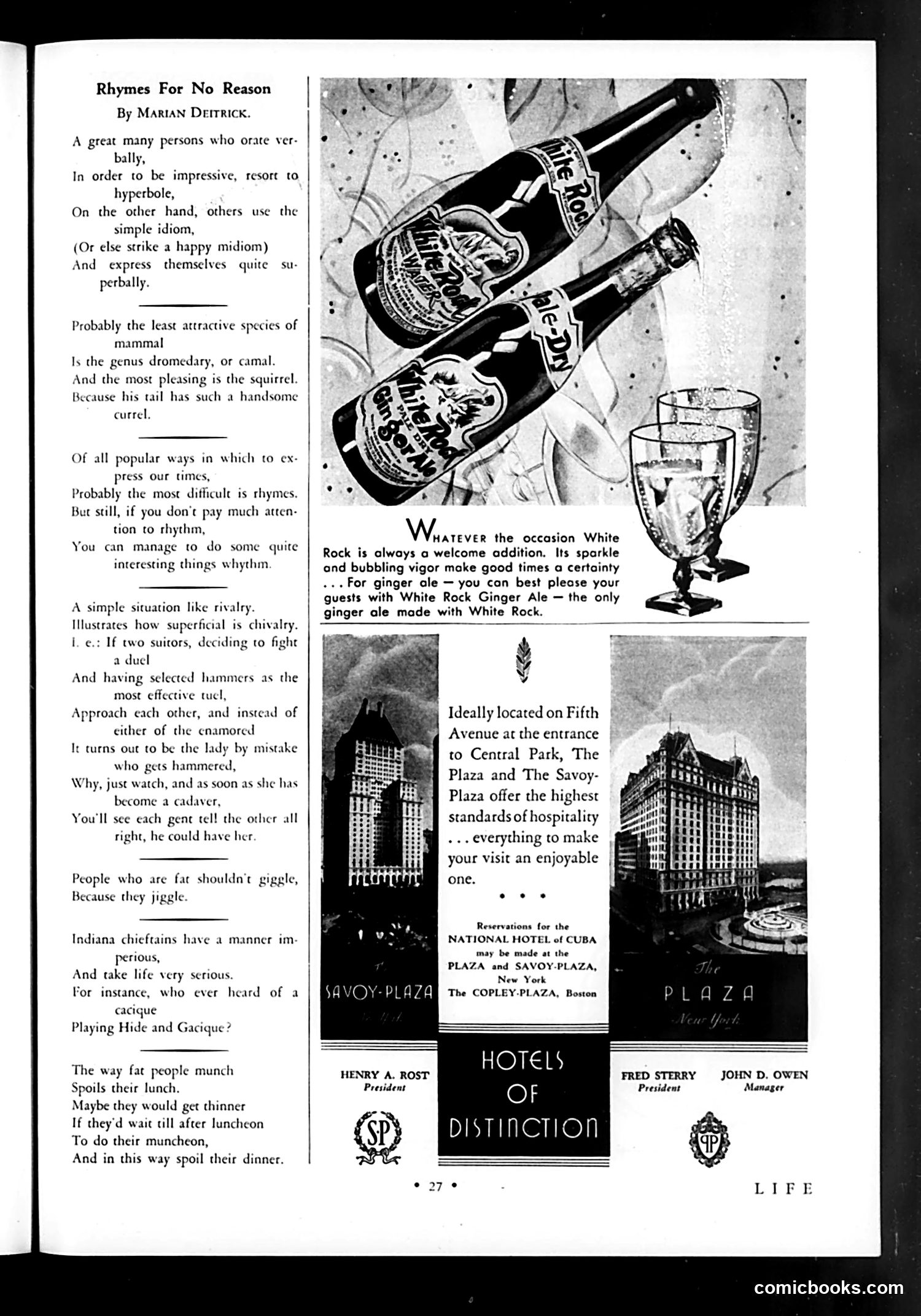
Analysis for Modern Readers This page combines light satirical verse with advertising. The left column features "Rhymes For No Reason" by Marian Derrick—humorous doggerel poking fun at how people use exaggerated language and forced rhymes to sound impressive. The jokes are gentle: camels are ugly, squirrels are cute, fat people jiggle when they eat, and Indiana chiefs take life too seriously. The satire isn't political but social—mocking pretentious speech and affectation. A notable example imagines two suitors dueling with hammers over a lady, accidentally hitting her instead; she dies, but the men still politely defer to each other afterward, illustrating how superficial "chivalry" is. The rest is advertising: White Rock ginger ale, and luxury hotels (Plaza, Savoy-Plaza, Copley-Plaza, National Hotel of Cuba). This was typical *Life* magazine content of the era—mixing humor with high-end advertising targeting affluent readers.
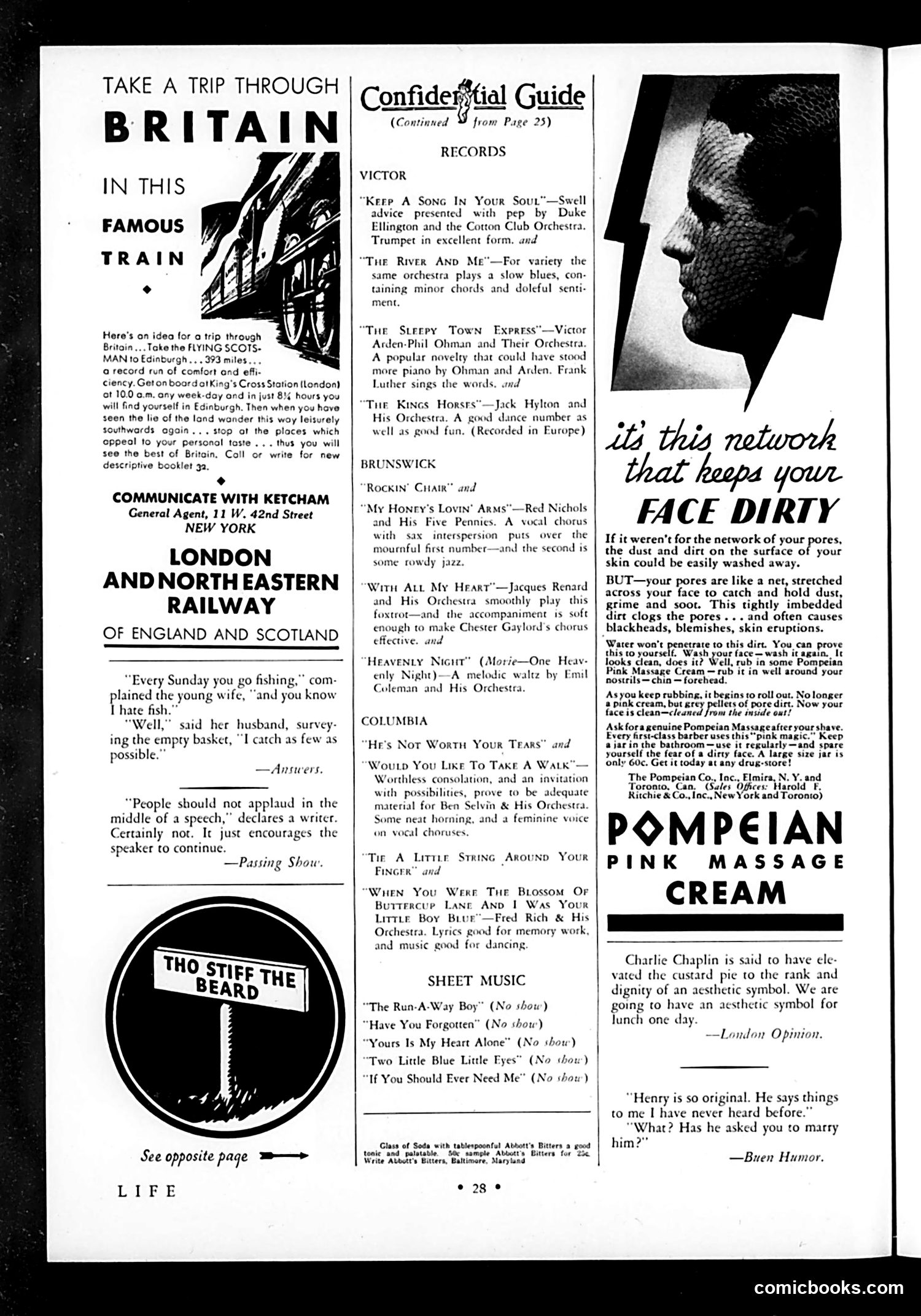
Analysis of This Life Magazine Page This page is primarily advertising and entertainment content, not political satire. The main elements are: 1. Railway advertisement (left): Promotes Britain's "Flying Scotsman" train to Edinburgh, targeting American tourists interested in travel. 2. Record and sheet music reviews (center): A "Confidential Guide" reviewing popular phonograph records from Victor, Brunswick, and Columbia labels, featuring jazz and popular orchestras of the era (Duke Ellington, Jack Hylton). This reflects 1920s-30s entertainment culture. 3. Product advertisements (right): - Pompeian Pink Massage Cream: A skincare product using pseudo-scientific language about pores trapping dirt—typical of interwar cosmetics marketing making dubious health claims. - Abbott's Bitters: A tonic product. 4. Humor fillers (bottom left): Brief jokes typical of period magazines. There is no political cartoon or satire on this page. It's a standard magazine layout mixing travel promotion, entertainment listings, and consumer product ads common to 1920s-30s American publications.
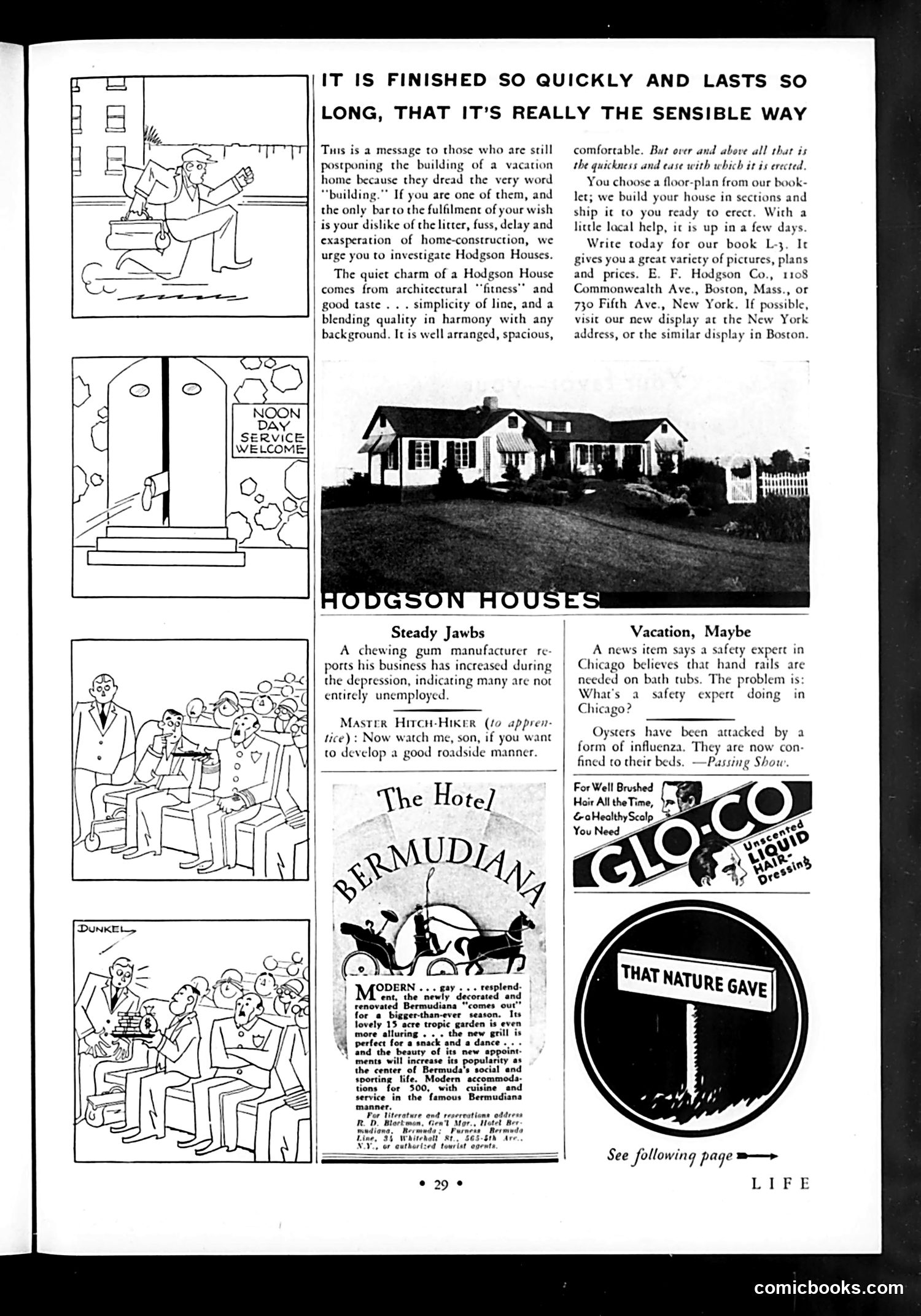
Content Analysis: Life Magazine Page 29 This page is primarily advertising and humor rather than political satire. The main content includes: Advertisements: - Hodgson Houses: Pre-fabricated vacation homes marketed as quick to build and assemble—a Depression-era solution addressing consumers' anxiety about construction delays and costs. - Hotel Bermudiana: A resort advertisement emphasizing luxury and reopening. - Clioco: A hair product advertisement. Humor sections: - "Steady Jawbs": A brief joke noting that chewing gum sales increased during the Depression, suggesting people weren't entirely jobless. - "Master Hitch-Hiker": An apprenticeship cartoon about roadside manners (unclear what specific behavior is being satirized). - Brief quips: Including jokes about bath tub safety rails in Chicago and oysters with influenza. Context for modern readers: This reflects Depression-era consumer anxiety about home construction costs and employment, marketed through convenient, affordable solutions. The humor is light observational comedy rather than sharp political commentary.
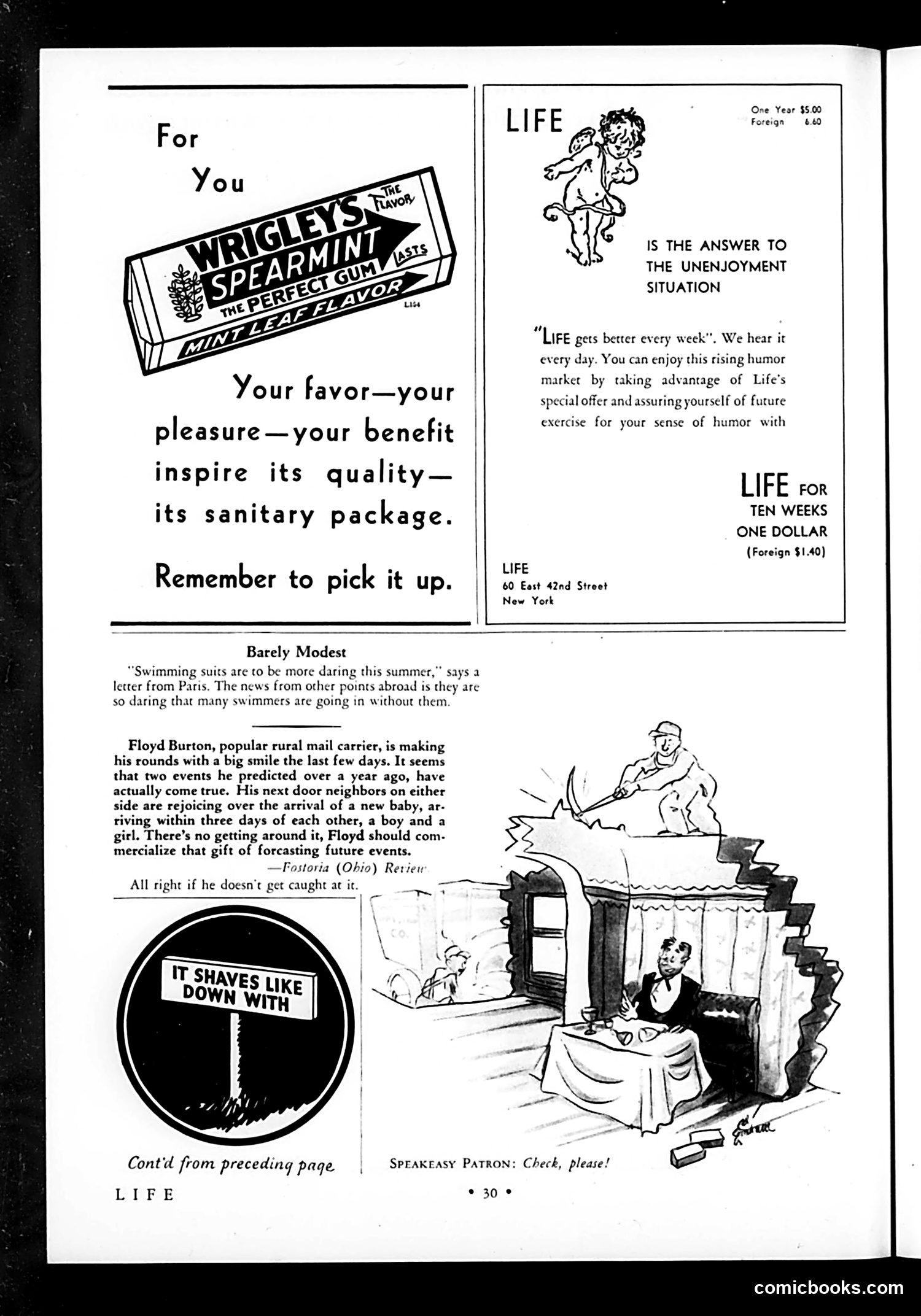
Analysis of Life Magazine Page This page contains satirical content typical of Life magazine's humor format. The Wrigley's Spearmint gum advertisement mimics editorial copy, blending advertising with the magazine's comedic voice—a common early 20th-century technique. The "Barely Modest" section satirizes European fashion trends, joking that Parisian swimsuits are becoming so minimal that swimmers abandon them entirely—social commentary on changing moral standards. The Floyd Burton anecdote humorously credits a rural mail carrier with "predicting" two babies born to neighbors, suggesting he should monetize this "gift of forecasting"—gentle small-town humor playing on coincidence. The speakeasy cartoon references Prohibition-era illegal bars. A man emerges from a basement speakeasy requesting a check, while patrons above remain visible—satirizing the era's poorly concealed illegal drinking establishments. These pieces collectively reflect 1920s-30s American anxieties: changing social mores, rural life oddities, and Prohibition enforcement challenges.
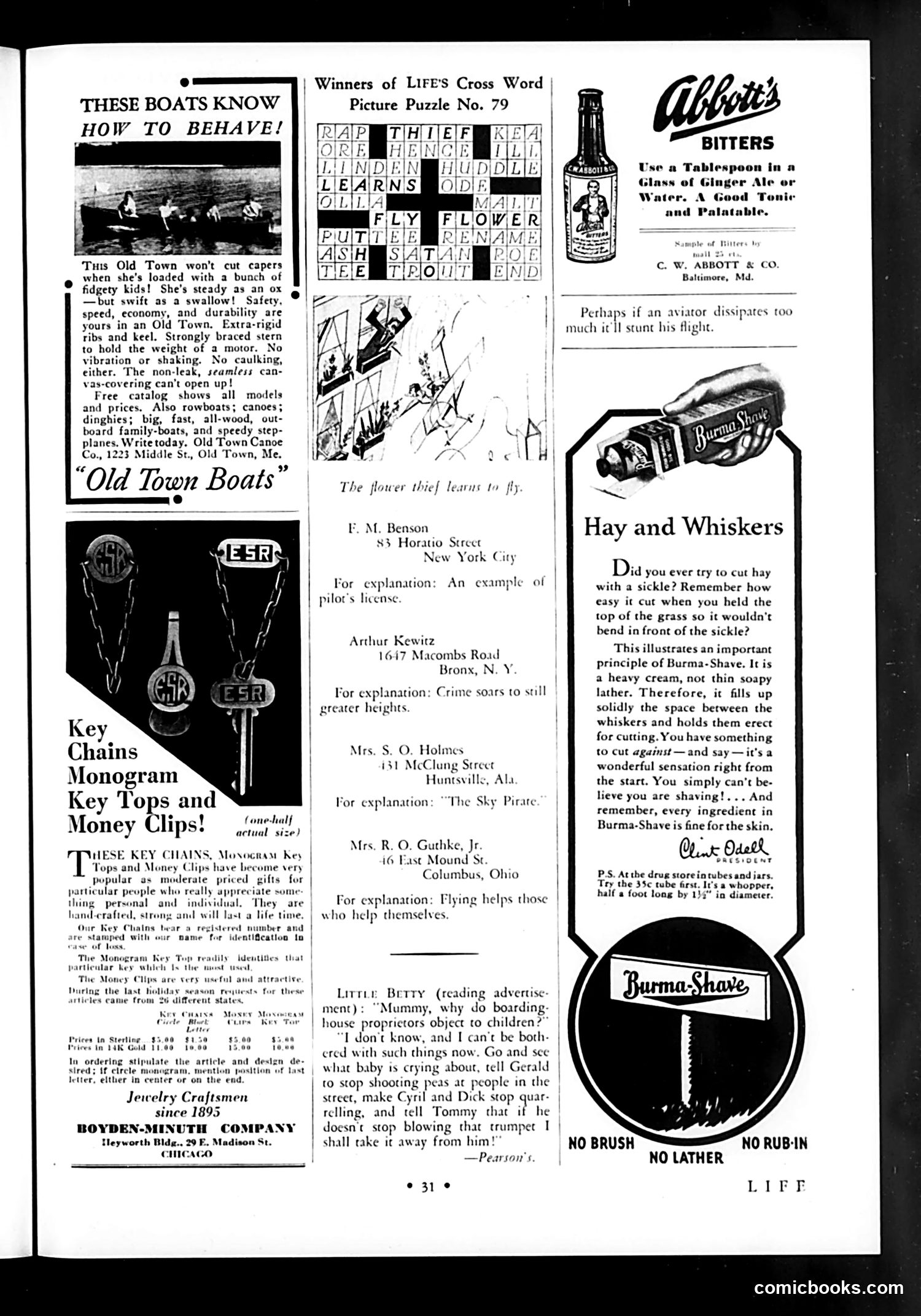
Page 31 of Life Magazine: Advertisements and Humor This page is primarily advertising, featuring boat manufacturers, key chain makers, and shaving cream. The main satirical content is a brief "Little Betty" joke at bottom-left, mocking the chaos of managing children in boarding houses. A mother lists her overwhelming tasks—stopping a child's trumpet-playing, preventing pea-shooting, managing quarrels—implying that boardinghouse proprietors object to children because they're exhausting and disruptive. The crossword puzzle solutions are joke explanations: "pilot's license" (flying helps those who help themselves), "crime soars to stall greater heights," and "the sky pirate." These are light wordplay rather than political satire. The Burma-Shave ad uses an analogy about cutting hay with a sickle to explain why their cream works—holding whiskers erect mimics holding grass upright for cutting. This is product education disguised as practical wisdom, typical of 1920s-30s advertising humor.
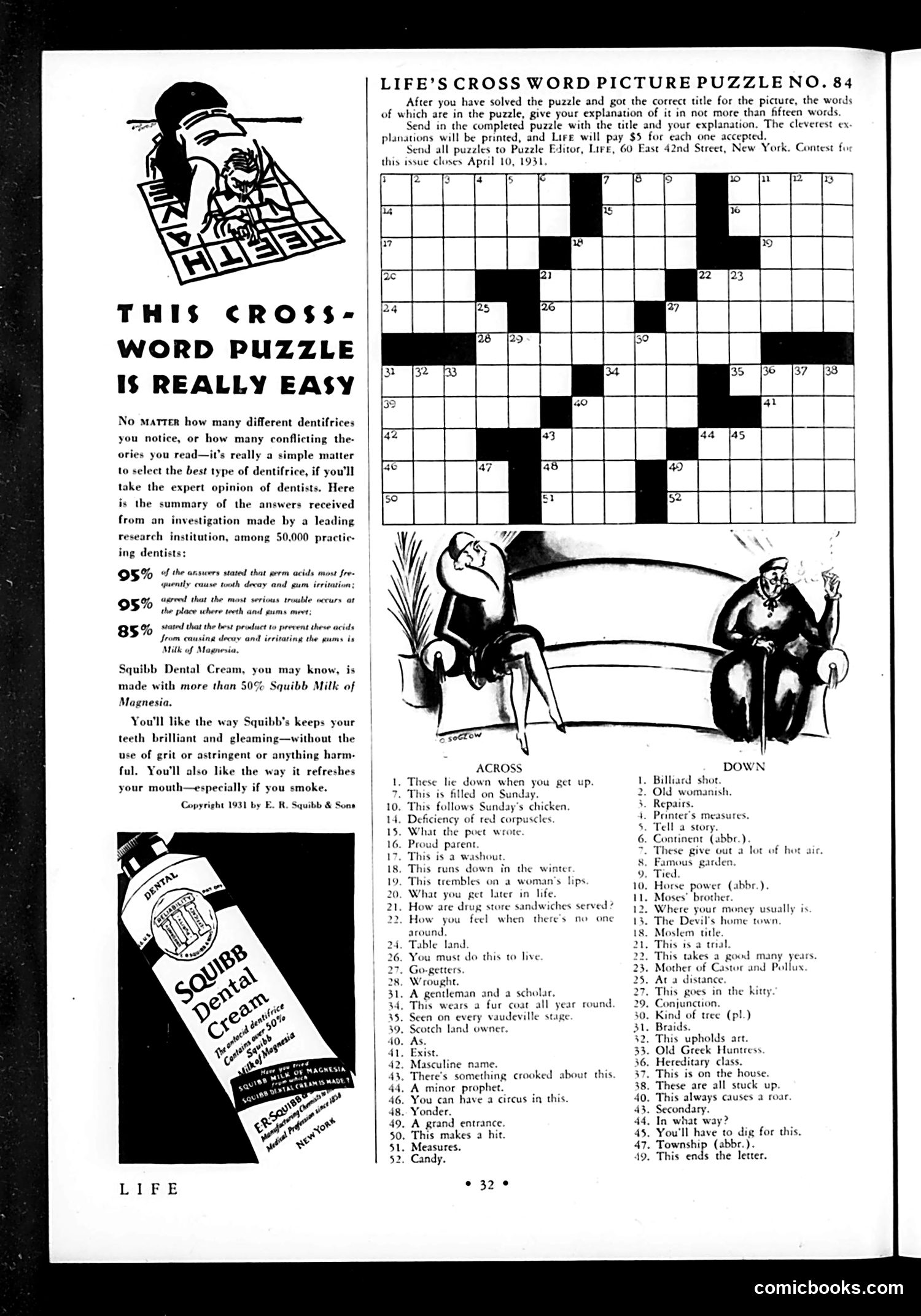
Life Magazine Crossword Puzzle Page (1931) This page is primarily advertising masquerading as editorial content. The crossword puzzle itself is generic filler, but the real purpose is promoting Squibb Dental Cream. The ad claims that among 50,000 practicing dentists, 95% identified germ acids as the main cause of tooth decay, and 85% recommended products containing milk of magnesia to prevent decay. Squibb's product, the ad emphasizes, is over 50% milk of magnesia. The accompanying cartoon shows two figures (appears to be a woman and a gnome-like character) in an absurdist scene—likely meant to be whimsical rather than satirical. This visual humor was typical of 1930s advertising designed to make the product memorable. The page represents how early 20th-century magazines blended advertising with entertainment, using "expert" endorsements from professionals to establish product credibility—a marketing technique now heavily regulated.
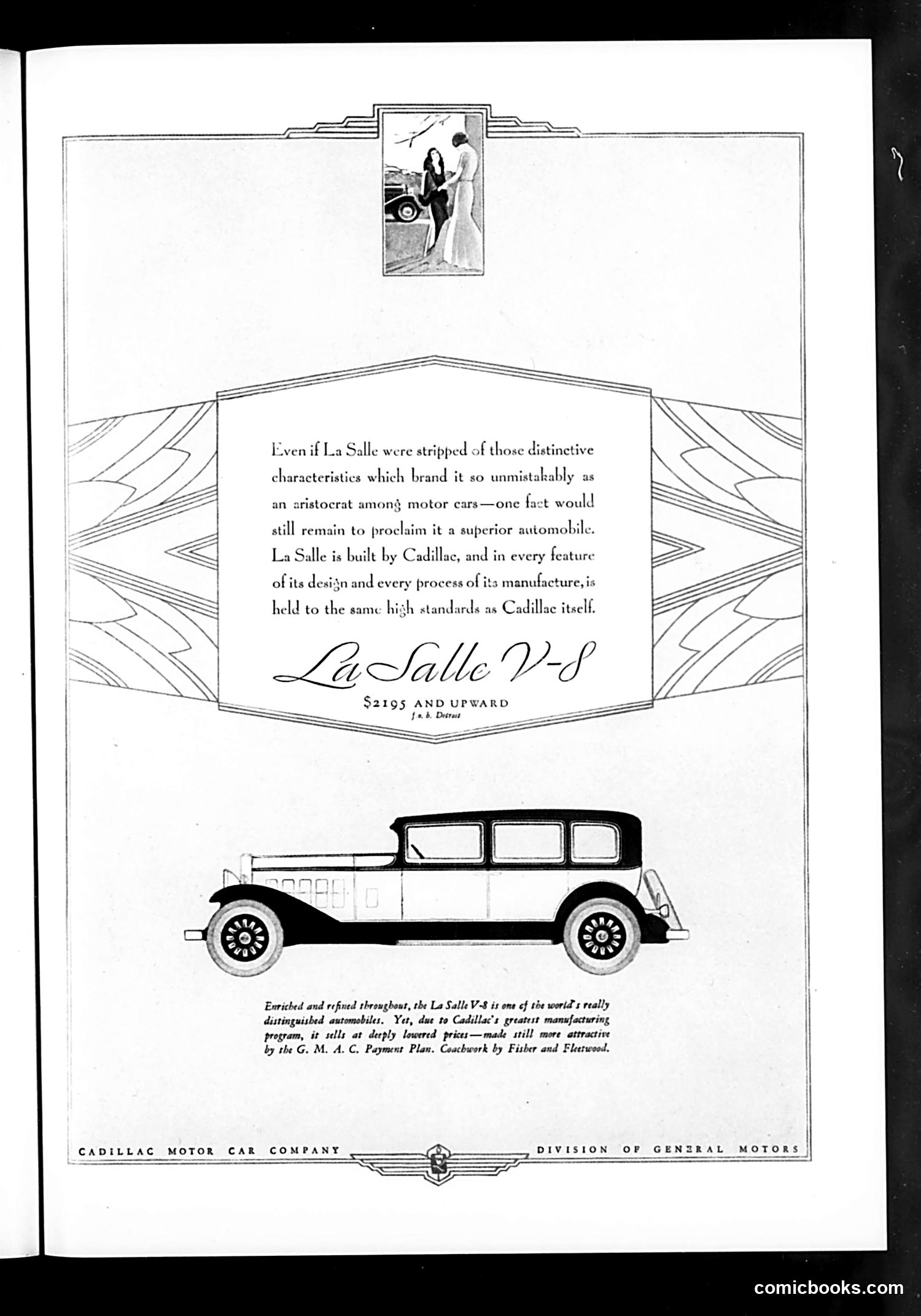
La Salle V-8 Advertisement This is a Cadillac automobile advertisement, not political satire. It promotes the La Salle V-8, positioned as a more affordable alternative to Cadillac itself, while maintaining Cadillac's manufacturing standards. The small illustration at top shows a couple with a car, depicting aspirational lifestyle imagery typical of luxury auto ads. The main image displays the car's side profile. The ad's central argument: despite La Salle's lower price ($2,195+), it shares Cadillac's engineering and quality—emphasizing value without sacrificing prestige. References to "Cadillac's greatest manufacturing program," Fisher and Fleetwood coachwork, and the G.M.A.C. Payment Plan reinforce that this is an attainable luxury car for middle-class buyers. This reflects Depression-era marketing: selling premium products at accessible prices to maintain sales while appearing democratic rather than elitist.
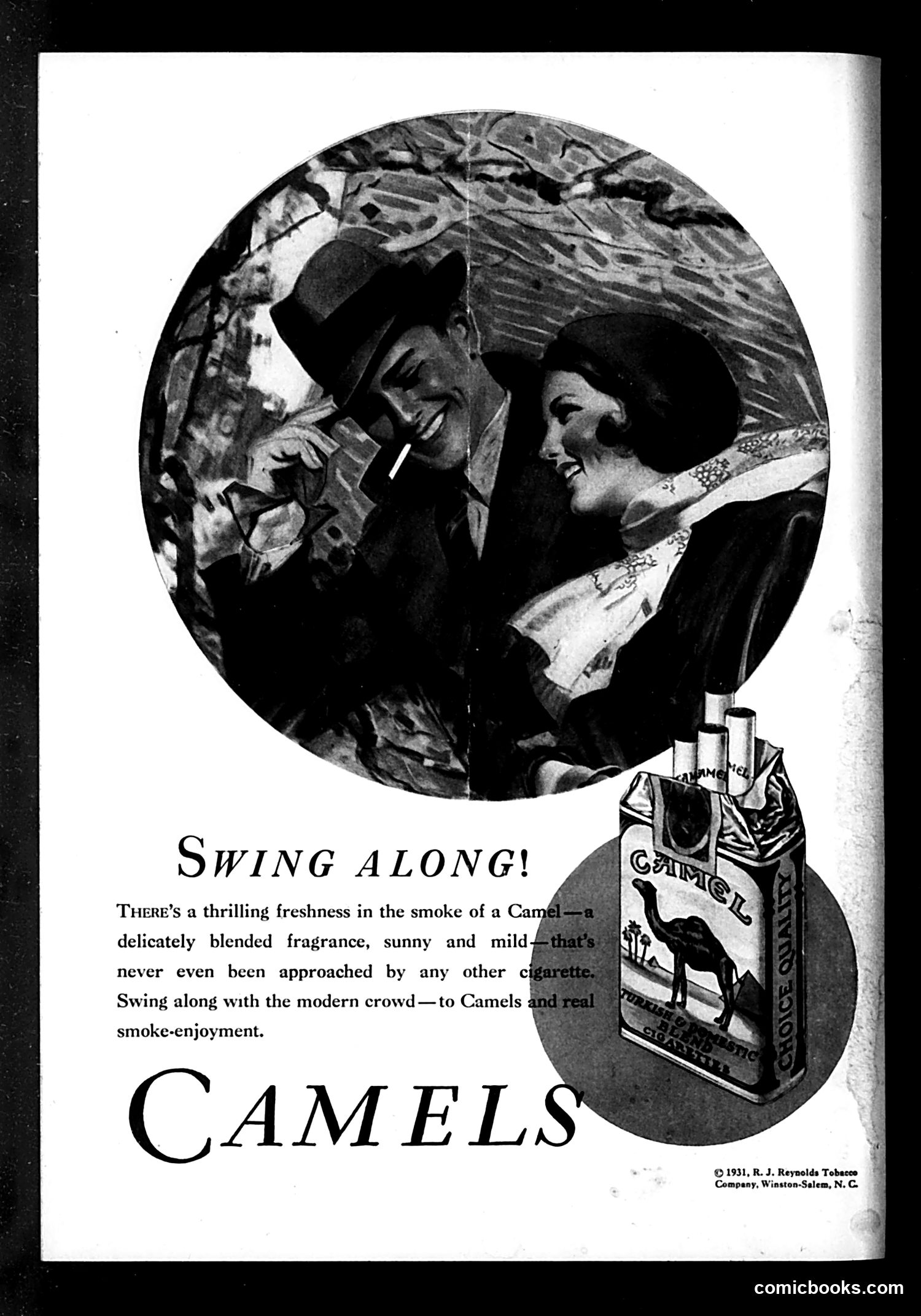
Analysis This is a Camel cigarette advertisement from 1931, not political satire. The circular vignette shows two figures in what appear to be 1930s clothing and hats, engaged in casual conversation while smoking. The ad uses the phrase "Swing along with the modern crowd" to associate Camels with contemporary, fashionable behavior. The "thrilling freshness" and "delicately blended fragrance" claims were typical tobacco marketing language of the era. The copyright credit confirms this is R.J. Reynolds Tobacco Company advertising. There is no political cartoon or satire present—this is straightforward commercial advertising targeting consumers by positioning the product as sophisticated and aligned with modern social trends of the period.

I can see this is a page from Life magazine, but the image quality is extremely poor—mostly black with some faint patterns visible on the right side and a white margin on the left. The OCR text only shows "comicbooks.com," which appears to be a watermark rather than actual page content. I cannot reliably identify any cartoons, figures, caricatures, or satirical content from this image. The page is too dark and degraded to read text, recognize illustrations, or determine what political or social commentary it contains. To properly analyze this page's meaning and historical context, a clearer, higher-contrast version would be necessary.