life
Life — March 27, 1931
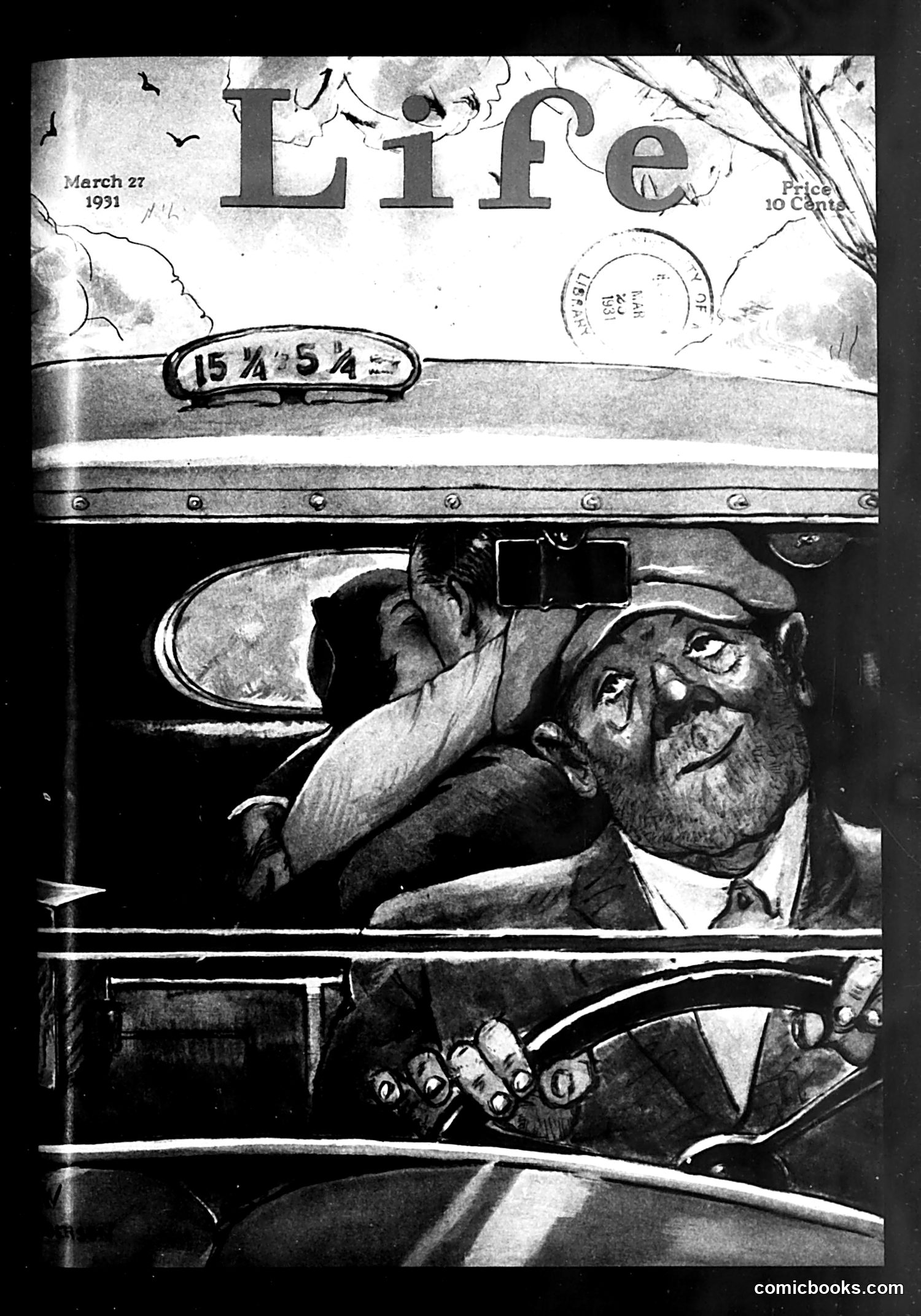
Life Magazine, March 27, 1931 This appears to be a satirical cartoon about reckless driving or automobile safety. The cover shows a speedometer reading "15¼ 5¼ 5" and depicts a man at a car's steering wheel with an exaggerated, wild facial expression suggesting panic or loss of control. Another figure appears in the background. The satire likely comments on dangerous driving habits during the early automobile era, when speeding and reckless motorists were social concerns. The distorted face and theatrical expression mock drivers who ignored safety, presenting the consequences as absurdly comedic. The speedometer's unusual reading may emphasize erratic, unpredictable driving behavior. This reflects 1931 anxieties about automobile safety and irresponsible operators on America's roads.
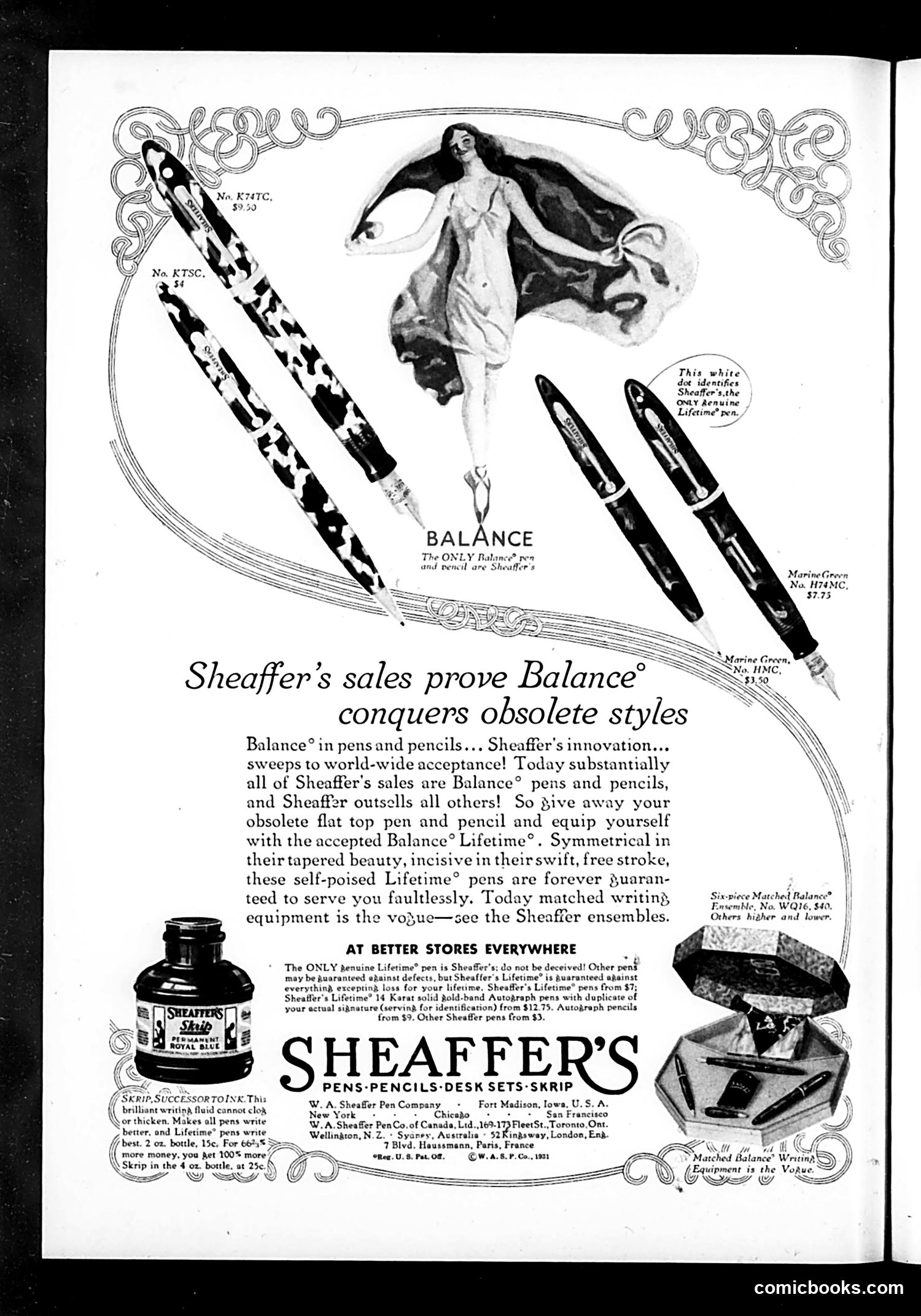
Sheaffer's Balance Pen Advertisement This is a commercial advertisement, not political satire. It promotes Sheaffer's "Balance" fountain pens and pencils, claiming they have made older "flat top" writing instruments obsolete. The central image shows a stylized woman in classical dress, symbolizing elegance and modernity. The advertisement emphasizes the pens' "symmetrical tapered beauty" and "self-poised" design, positioning them as the accepted standard in writing equipment. The text claims that "substantially all of Sheaffer's sales are Balance pens and pencils," suggesting market dominance. The ad targets middle-class consumers by promoting matched writing sets as status symbols and practical investments. This reflects 1920s-30s marketing strategies emphasizing innovation, style, and lifestyle aspiration tied to consumer goods.
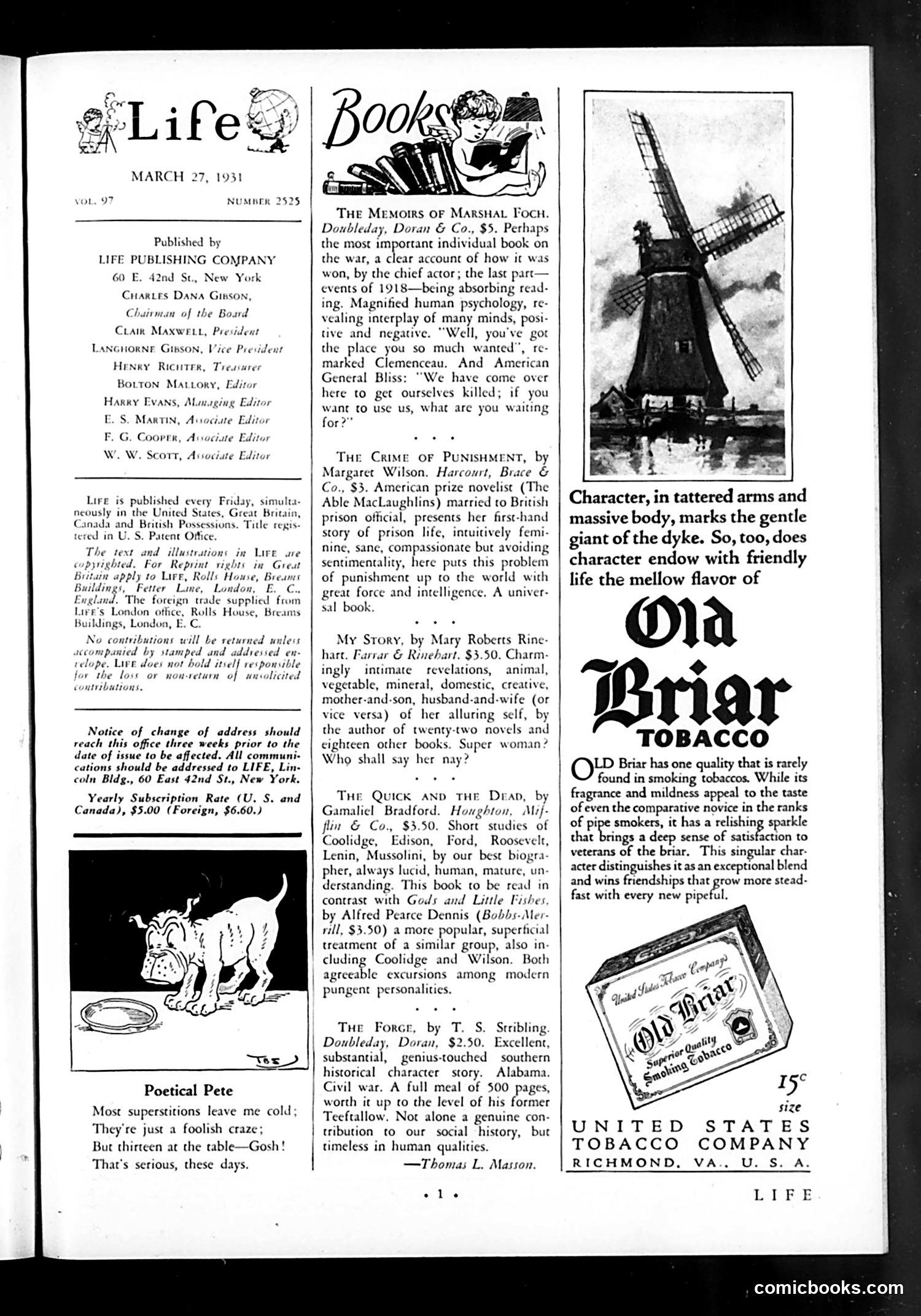
"Poetical Pete" Cartoon Analysis This small cartoon shows a dog next to an empty plate, illustrating a humorous poem about superstitions. The text reads: "Most superstitions leave the cold; They're just a foolish craze; But thirteen at the table—Gosh! That's serious, these days." The joke satirizes selective superstition—people who dismiss most superstitions as nonsense but remain genuinely anxious about the unlucky number 13 at dinner. The dog's empty plate may suggest that Pete (presumably the owner) has dismissed superstitions generally, yet still worries about this particular one. It's gentle social satire about human irrationality and how even skeptical people maintain certain folk beliefs, particularly surrounding dining customs and bad luck.
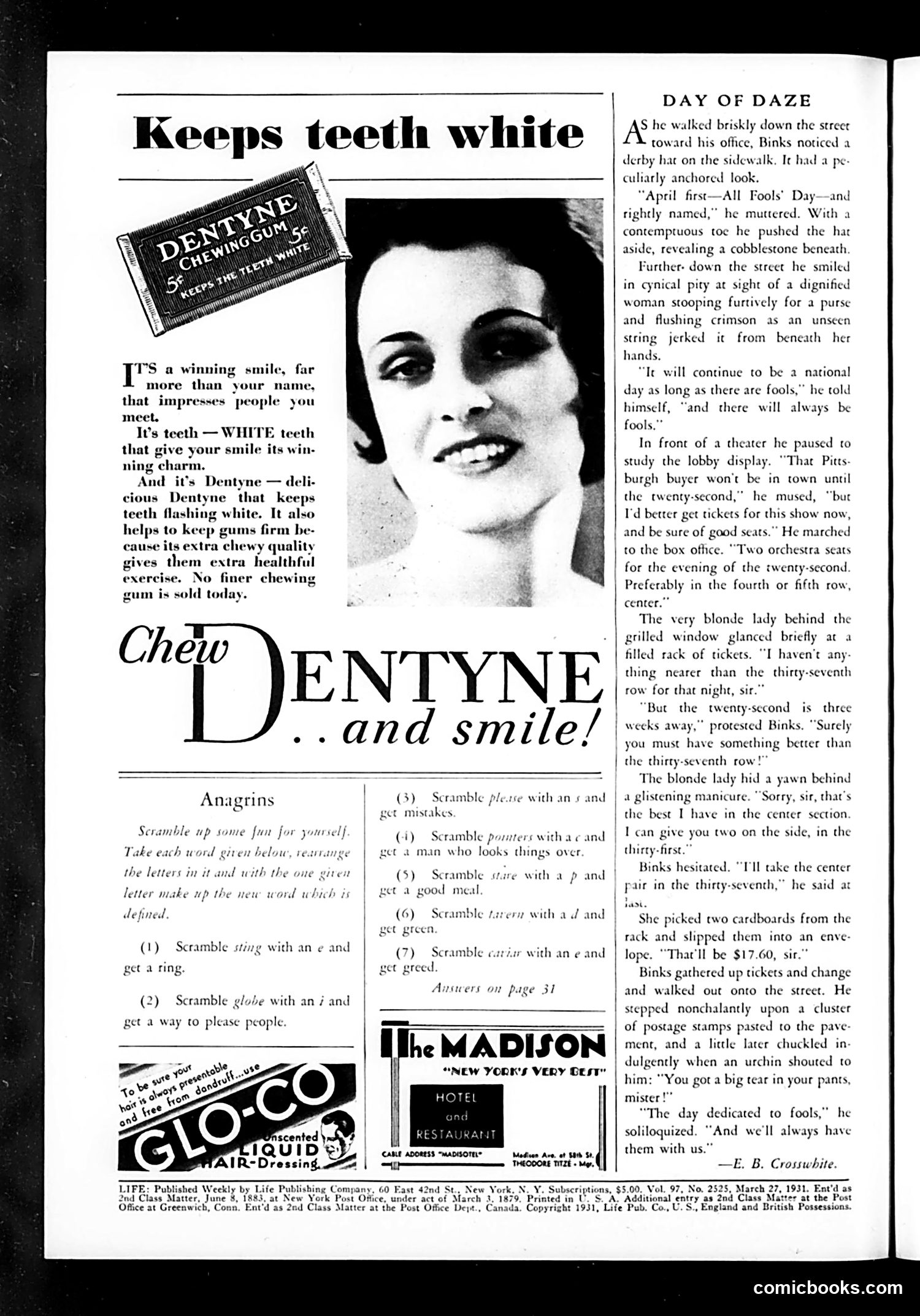
Content Analysis This page is primarily advertising and entertainment content rather than political satire. The main feature is a Dentyne chewing gum advertisement showing a woman's face with copy emphasizing that the product keeps teeth white and helps maintain firm gums. The ad uses the slogan "Chew Dentyne...and smile!" The right side contains "Day of Daze," a short humorous story by E.B. Crosswhite about a man named Binks encountering April Fools' Day pranks—a stolen hat, a dignified woman being pranked, confusion about theater tickets. The narrative plays on the chaos of April 1st foolishness. Below are word-scramble puzzles ("Anagrins") and advertisements for Gloco hair dressing and the Madison Hotel. The content reflects 1931 leisure reading: product promotion mixed with light humor and puzzles.
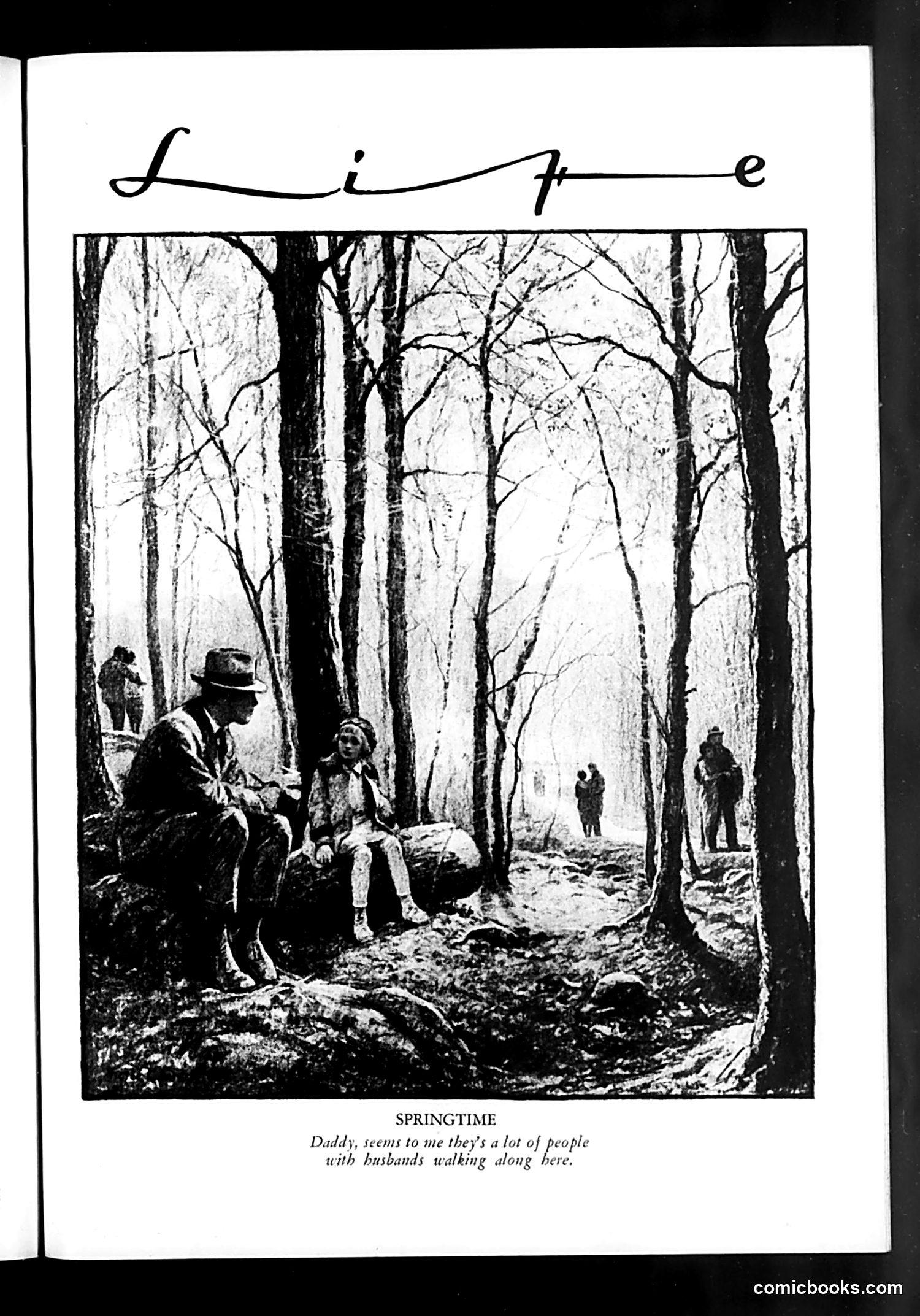
Analysis of "Springtime" Page This page from *Life* magazine presents a satirical illustration titled "Springtime." The image shows a man and child sitting on a log in a bare forest, with other figures visible in the distance along a path. The caption reads: "Daddy, seems to me they's a lot of people with husbands walking along here." The satire targets the prevalence of married women walking with men who are not their husbands—a commentary on infidelity or extramarital affairs. The child's innocent observation highlights the social scandal humorously. The springtime setting suggests renewal and outdoor leisure, a context where such encounters might occur. This reflects early 20th-century anxieties about moral behavior and changing social dynamics, using a child's blunt honesty to expose adult hypocrisy.
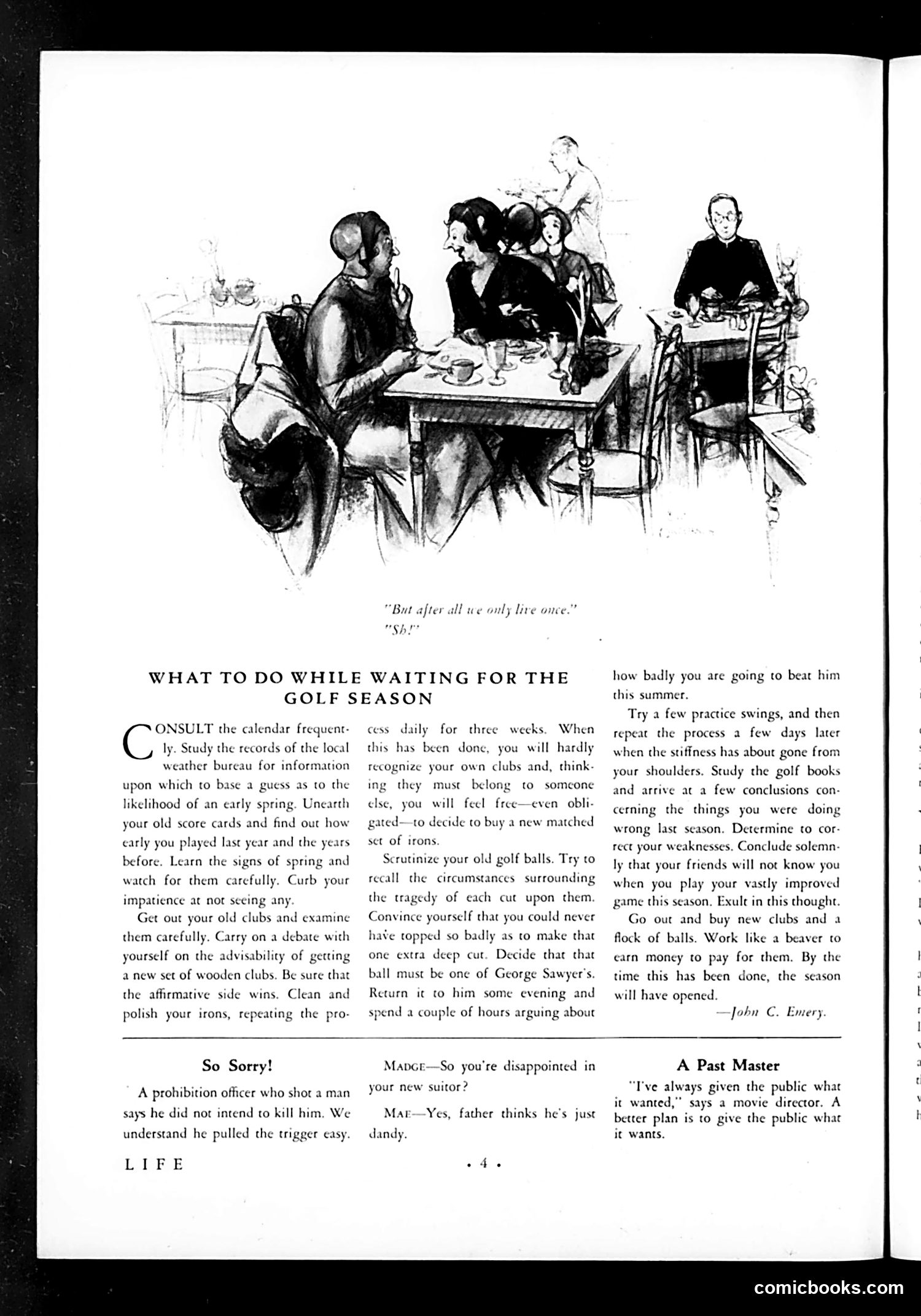
Analysis of Life Magazine Page The main cartoon depicts a social scene with a woman speaking to a man at what appears to be a dinner or social gathering. The caption reads: "But after all we only live once." / "Sh!" This appears to be a joke about discretion and propriety in social settings. The woman's comment about living only once suggests she's advocating for living freely or taking risks, while the man's "Sh!" indicates he's warning her to be quiet—implying her sentiments are socially inappropriate or scandalous to express openly. The article "What to Do While Waiting for the Golf Season" provides humorous advice for off-season golf enthusiasts, suggesting activities like examining old clubs and practicing swings. The page also includes brief humor items like "So Sorry!" and "A Past Master," typical of Life's satirical content format.
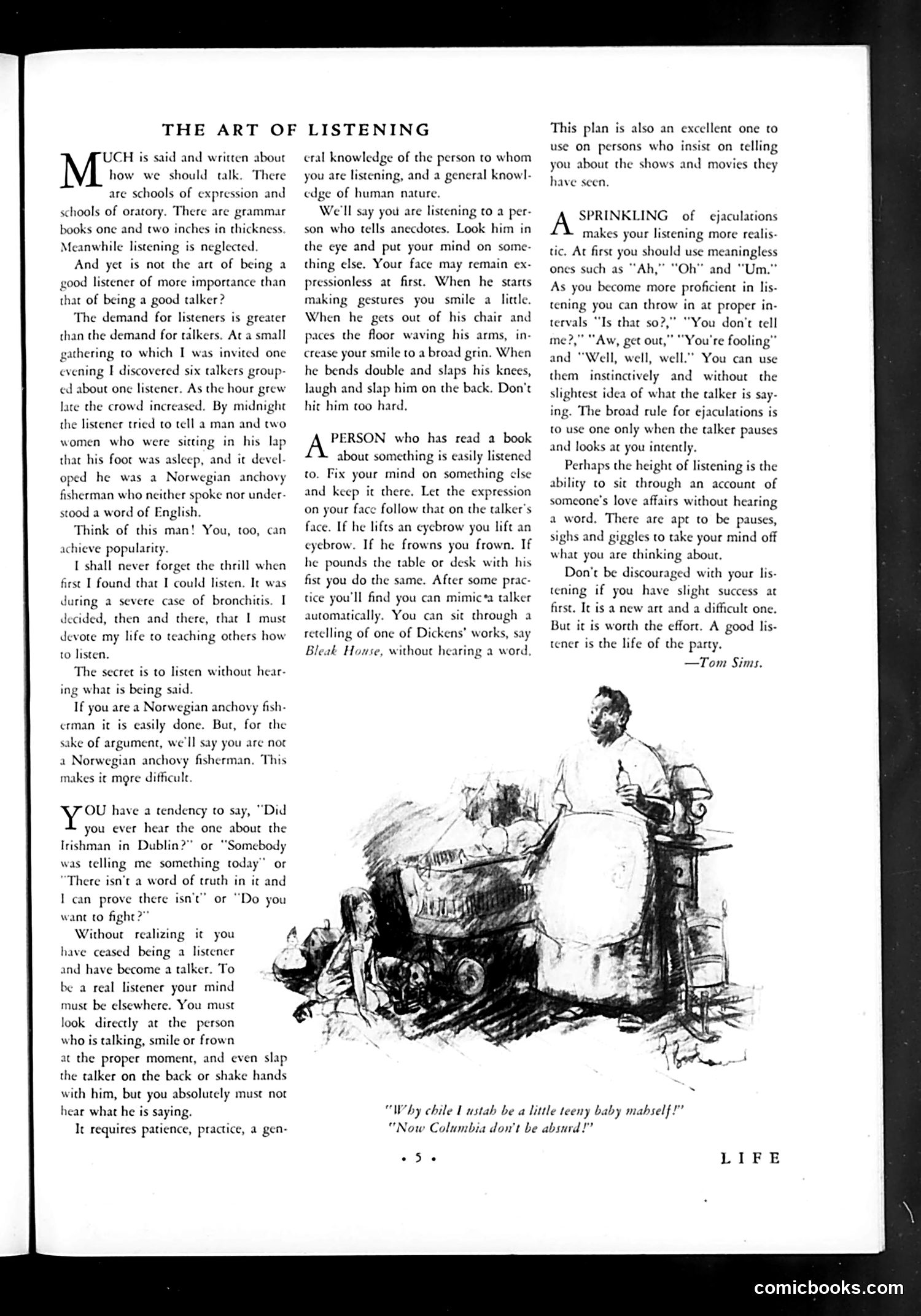
"The Art of Listening" - Life Magazine Page This page satirizes poor listening habits through Tom Sims's article and accompanying sketch. The cartoon depicts a scene where someone is clearly not listening—a figure appears distracted or disengaged while another person attempts to speak. The article argues that good listening is rarer and more valuable than good talking. It humorously notes that people interrupt, contradict speakers, or mentally drift away rather than genuinely absorb what's being said. The author uses the example of a Norwegian anchovy fisherman to illustrate how difficult true listening is for most people. The accompanying illustration appears to show a domestic or social scene emphasizing this disconnect between speaker and listener—capturing the satirical point that attentive listening remains an underappreciated skill.
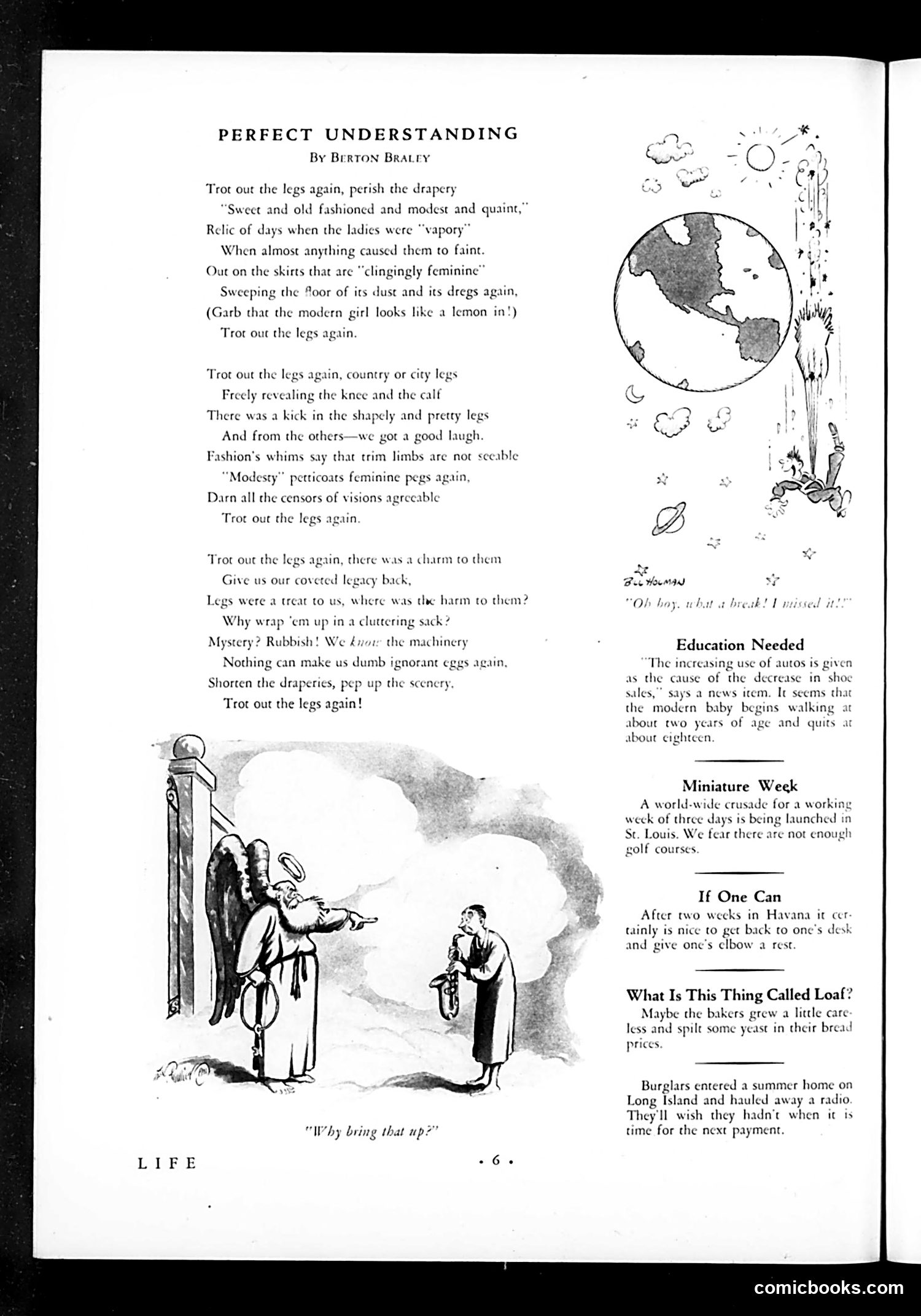
Analysis of "Perfect Understanding" by Burton Bradley This page satirizes changing women's fashion and social mores. The poem mocks the Victorian custom of concealing women's legs beneath long skirts and drapery, calling these garments outdated ("Sweet and old fashioned and modest and quaint"). The satire celebrates the modern trend of women revealing their legs—described as liberating ("Trot out the legs again"). The poem suggests fashion authorities ("Modesty" petticoats) artificially enforced leg-covering, which is now being abandoned. The accompanying cartoons illustrate the absurdity: one shows a woman gesturing at a massive globe, questioning what was lost by revealing legs; another depicts a bicycle-riding woman, likely referencing how bicycles necessitated more practical, leg-revealing clothing. The overall message endorses women's fashion modernization as both practical and socially acceptable progress.
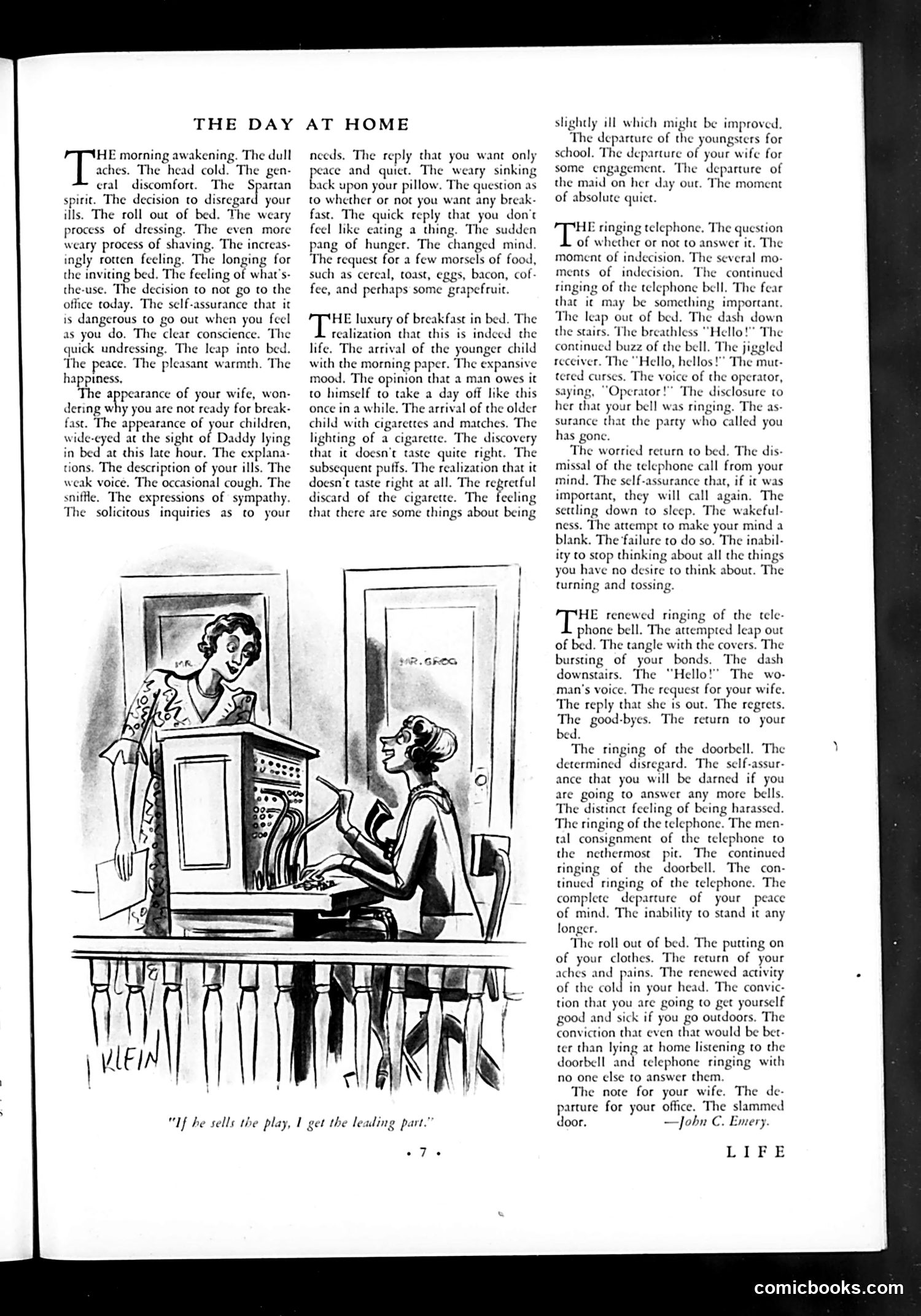
"The Day at Home" - Life Magazine Satire This is a humorous essay by John C. Emery satirizing the domestic frustrations of a married man stuck at home. The cartoon illustrates the central complaint: a wife talking on the telephone while the husband sits idle beside her, with the caption "If he sells the play, I get the leading part." The satire mocks the contradiction between spouses' domestic roles—while the husband deals with constant interruptions (telephone calls, doorbells, children), his wife remains preoccupied with her own interests, casually announcing she'll assume credit for his professional success. The piece humorously catalogs the husband's mounting irritations: illness, unwanted visitors, incessant ringing, and his wife's indifference to his need for peace and quiet. It's a commentary on early 20th-century marriage dynamics and household power imbalances.
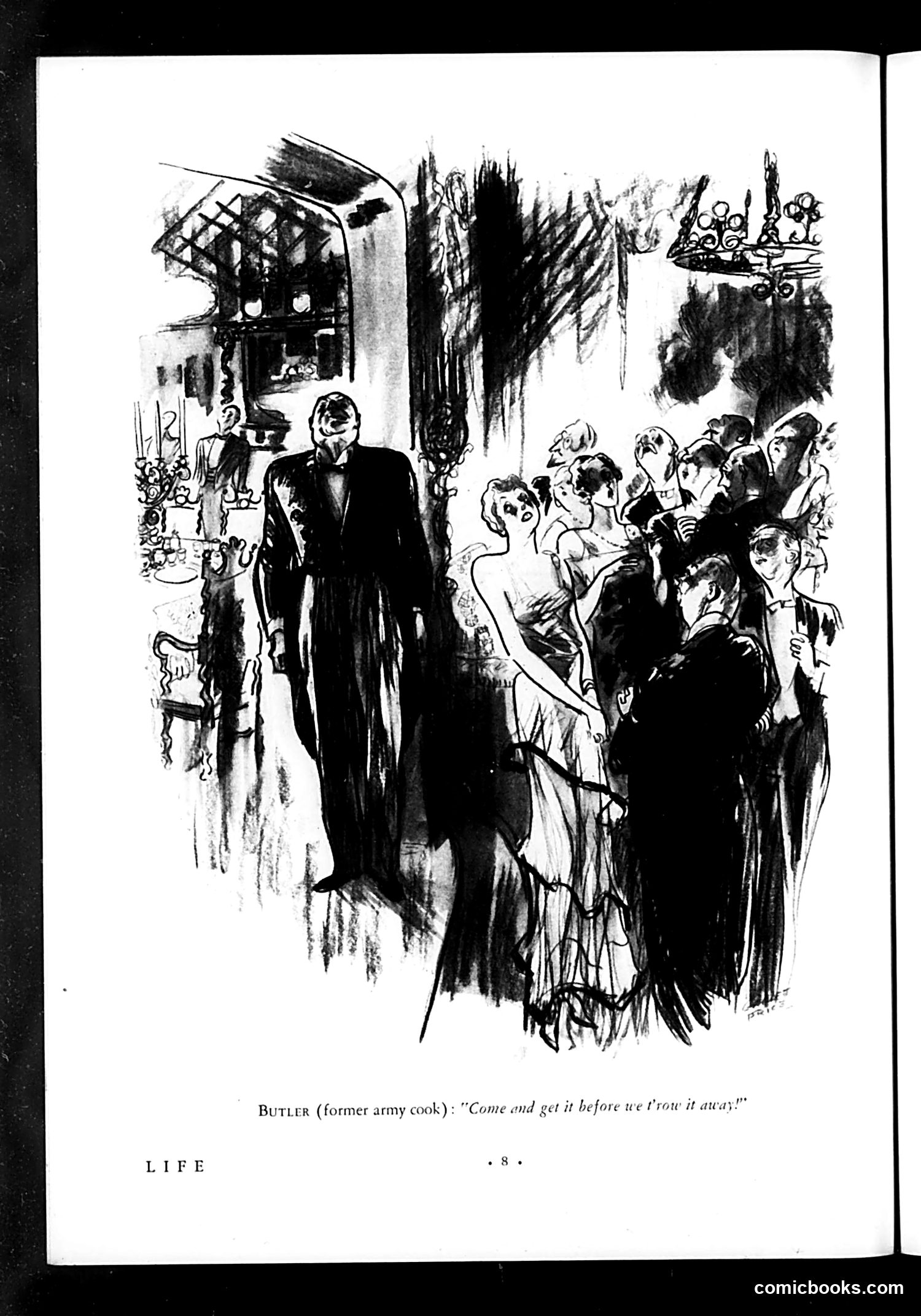
Life Magazine Cartoon Analysis This is a single satirical cartoon captioned with dialogue from "Butler (former army cook)": *"Come and get it before we prow it away!"* The scene depicts an elegant formal party or social gathering. A tall, formally-dressed man (the butler) stands prominently in the center, addressing a crowd of well-dressed guests. The humor appears to target class distinctions and social pretension: a former military cook—traditionally a working-class position—is now serving at an upper-class social event, sarcastically urging the wealthy guests to eat quickly as though it were a military mess hall rather than refined entertainment. The satire mocks both the pretensions of high society and the incongruity of a working-class figure in that setting, using the familiar military phrase to underscore the contrast.
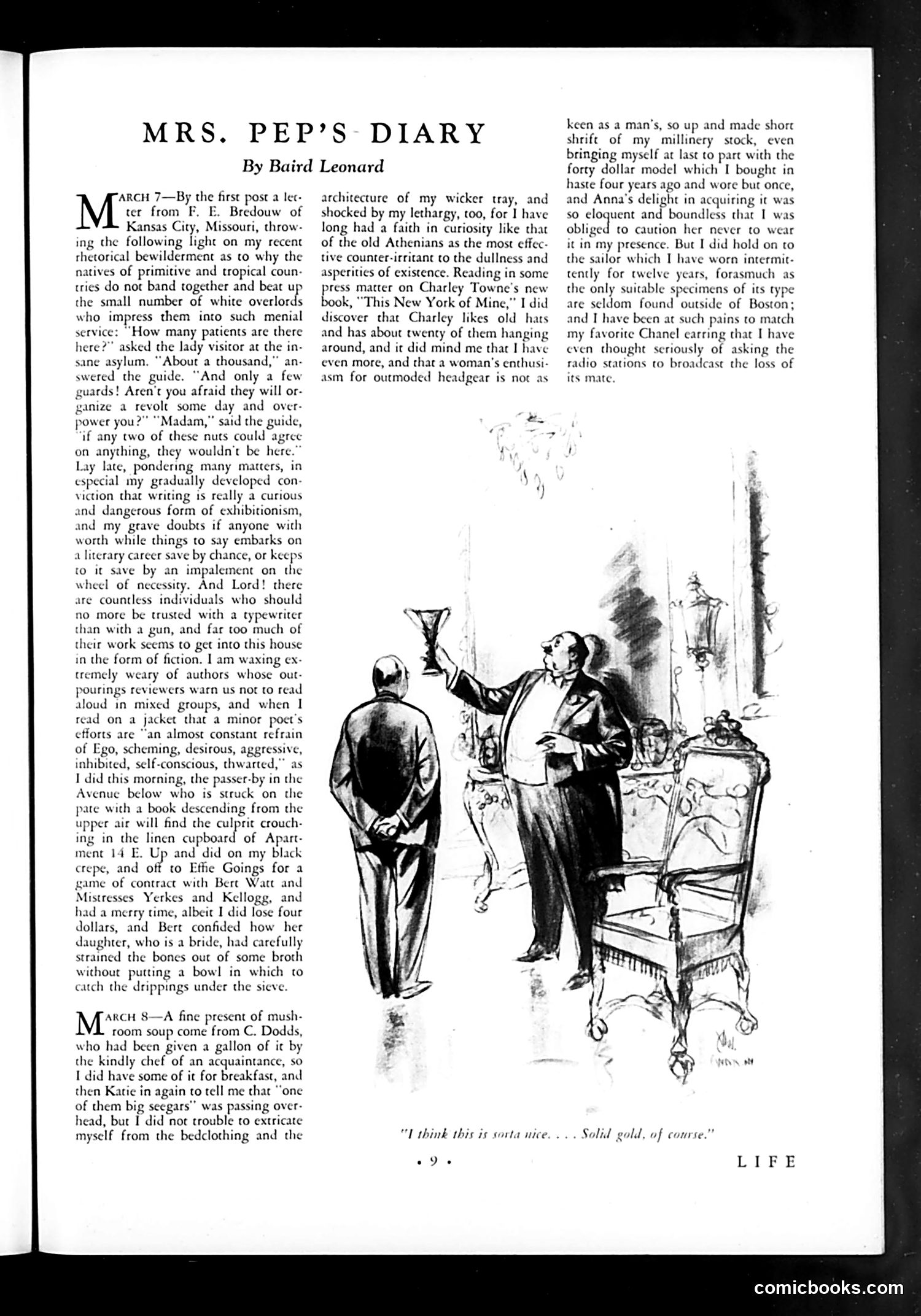
Mrs. Pep's Diary Analysis This page from *Life* magazine presents a humorous diary entry by Baird Leonard mocking pretentious literary culture. The main illustration depicts two figures examining what appears to be solid gold objects—likely satirizing wealthy dilettantes collecting expensive artifacts. The diary text ridicules affectations common among New York's upper class: affected enthusiasm for obscure antiques, pretentious book clubs, and self-important amateur writers. The narrator describes authors' egos as tiresome and compares typewriter-wielding writers to dangerous figures like gunmen. The caption "I think this is worth nice. . . . Solid gold, of course" suggests mockery of nouveau-riche characters who value objects primarily for their monetary worth rather than genuine artistic merit—a common target of *Life*'s satire about American social pretension in the early 20th century.
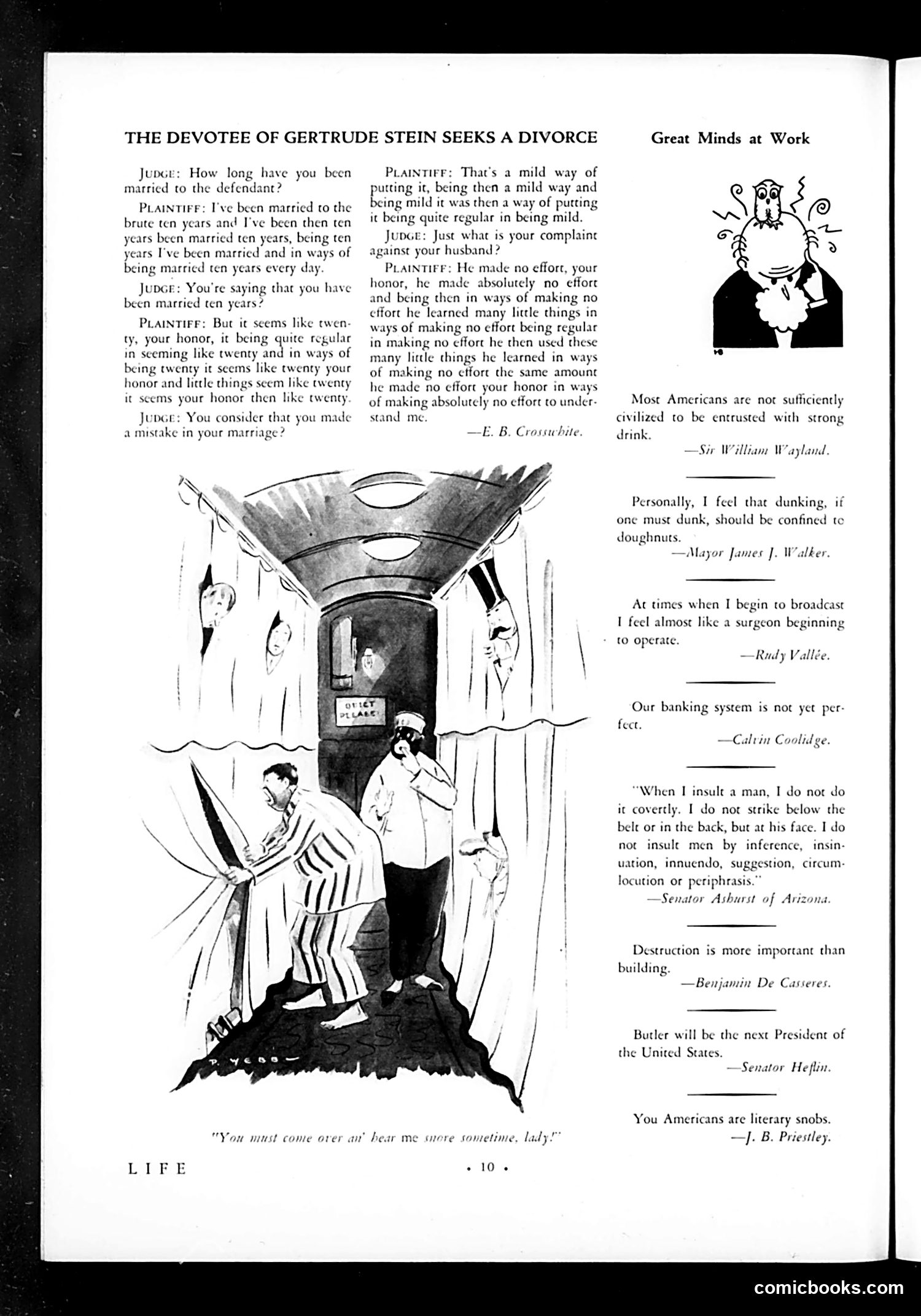
Analysis This page from *Life* magazine contains two distinct elements: Top Section: A satirical courtroom dialogue mocking Gertrude Stein's divorce proceedings. The plaintiff complains her husband made "no effort" for twenty years; the judge repeatedly notes she keeps saying "twenty," finding her testimony circular and repetitive. This appears to parody both Stein's notoriously repetitive writing style and her actual marital situation, presenting her verbose complaint as absurdly circular logic. Bottom Section: A cartoon showing a man entering what appears to be an elevator or confined space with several other figures. The caption reads "You must come over an' hear me swear sometime, lady!" The joke's exact meaning is unclear without additional context, though it likely satirizes social pretension or manners. Right margin: Quotes from various public figures offering pronouncements on contemporary issues (drinking, banking, insults), presented as satirical "great minds."
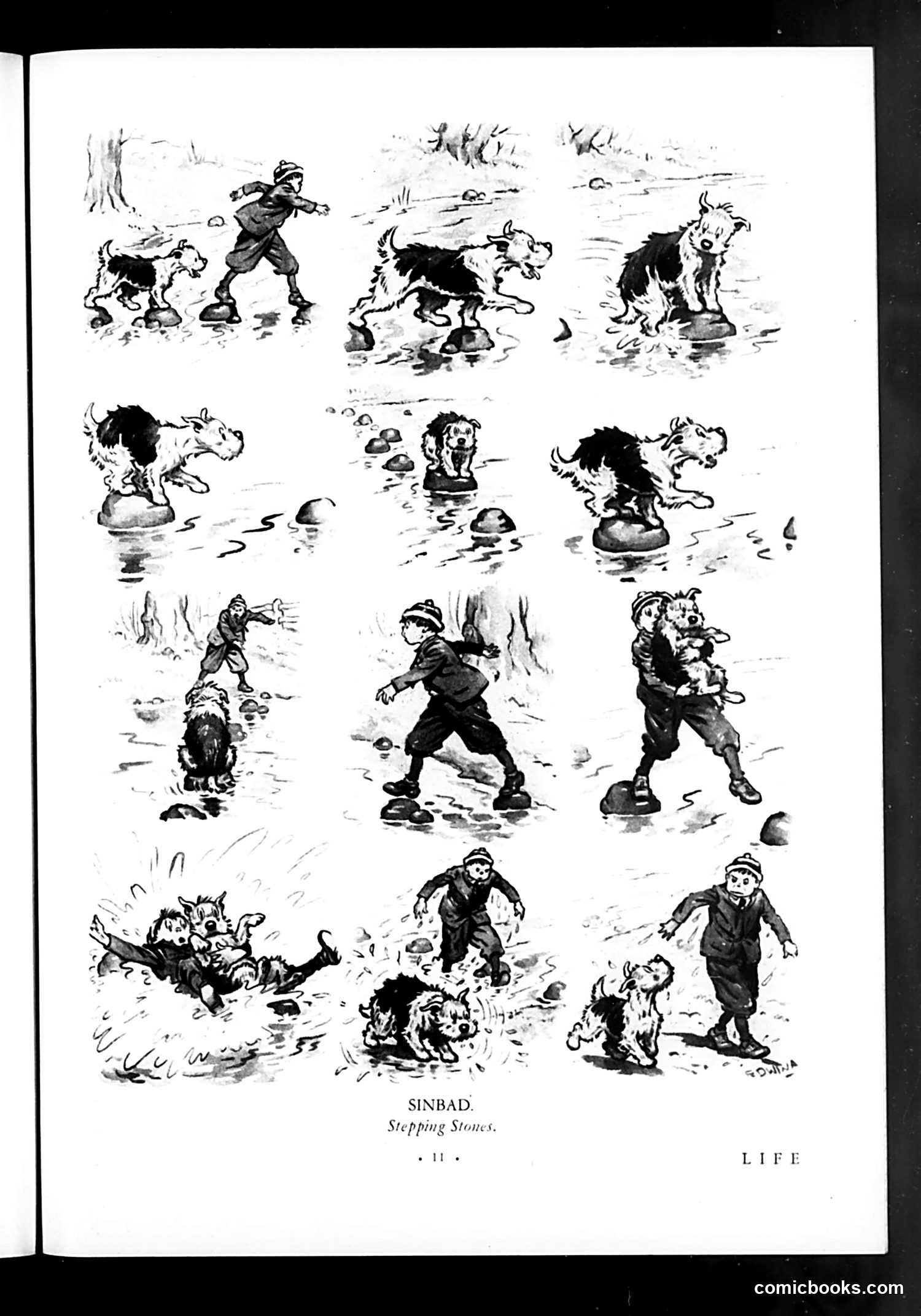
SINBAD: Stepping Stones This page presents a sequential visual narrative titled "Sinbad: Stepping Stones," depicting a person and dog navigating across stones in water. The twelve panels show various comedic moments of the pair attempting to cross—slipping, falling, struggling with balance, and the dog occasionally helping or hindering progress. The humor derives from slapstick physical comedy: the characters repeatedly lose their footing on unstable stepping stones, creating chaos and mishaps. The title references the famous sailor Sinbad's voyage adventures, applying that legendary journey metaphor to an everyday task of crossing water. This appears to be a humorous illustrated story rather than political satire, relying on visual gags and the relatability of attempting an awkward, accident-prone task rather than commentary on current events or social issues.
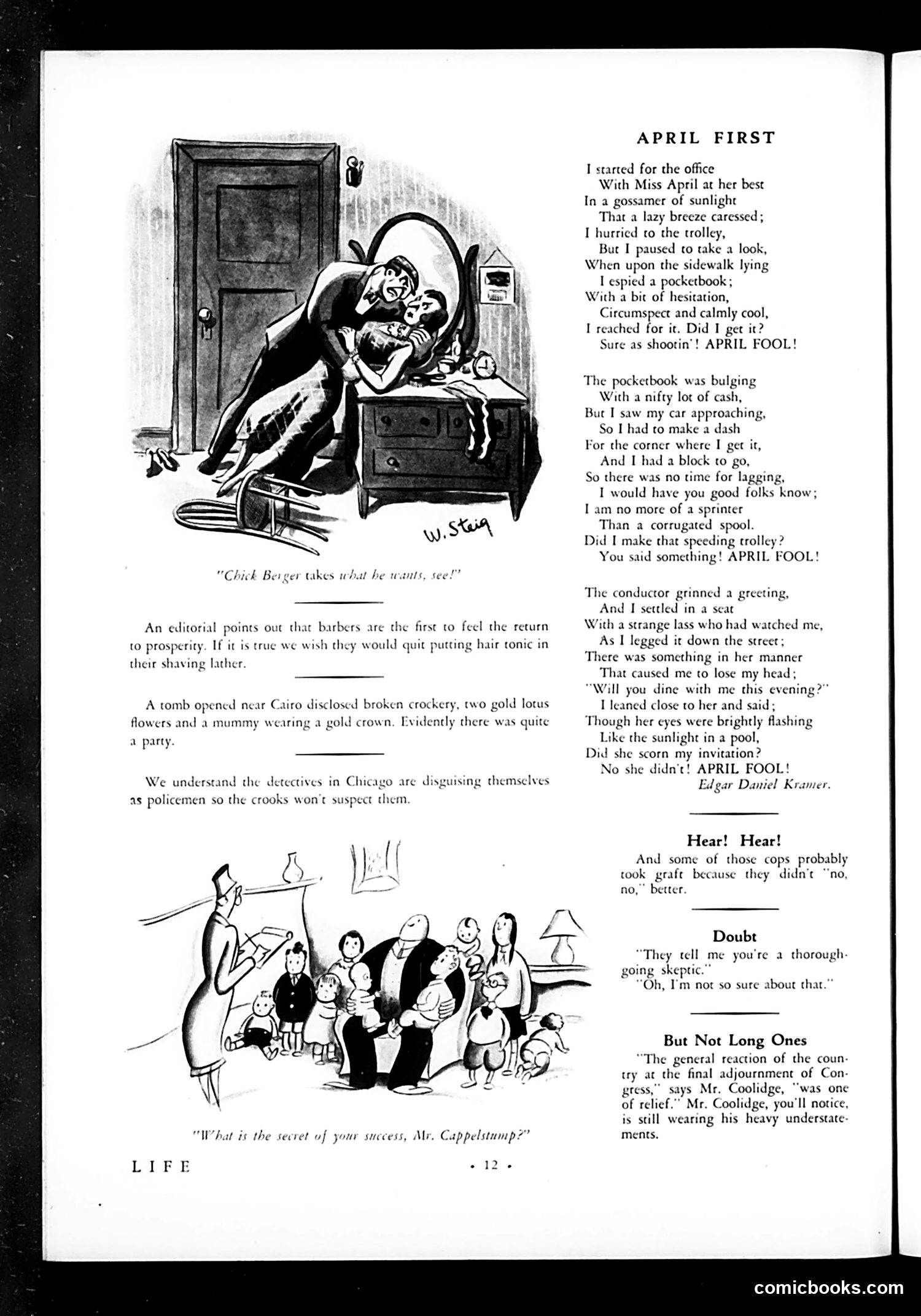
Analysis of Life Magazine Page This page contains April Fools' Day humor (1920s-era). The top cartoon by W. Steig shows someone stealing a pocketbook—a classic April Fools' prank setup. The accompanying poem "April First" by Edgar Daniel Kramer describes the narrator attempting to pick a woman's pocket as a joke, only to be caught and humiliated when she recognizes him on a trolley. The bottom cartoon captioned "What is the secret of your success, Mr. Cappelstump?" depicts a large man surrounded by many children, likely satirizing large families or fertility—the joke's point remains unclear from the image alone. The page also includes brief editorial commentary on Chicago detectives disguising themselves as policemen to catch criminals, and a joke about cops taking bribes.
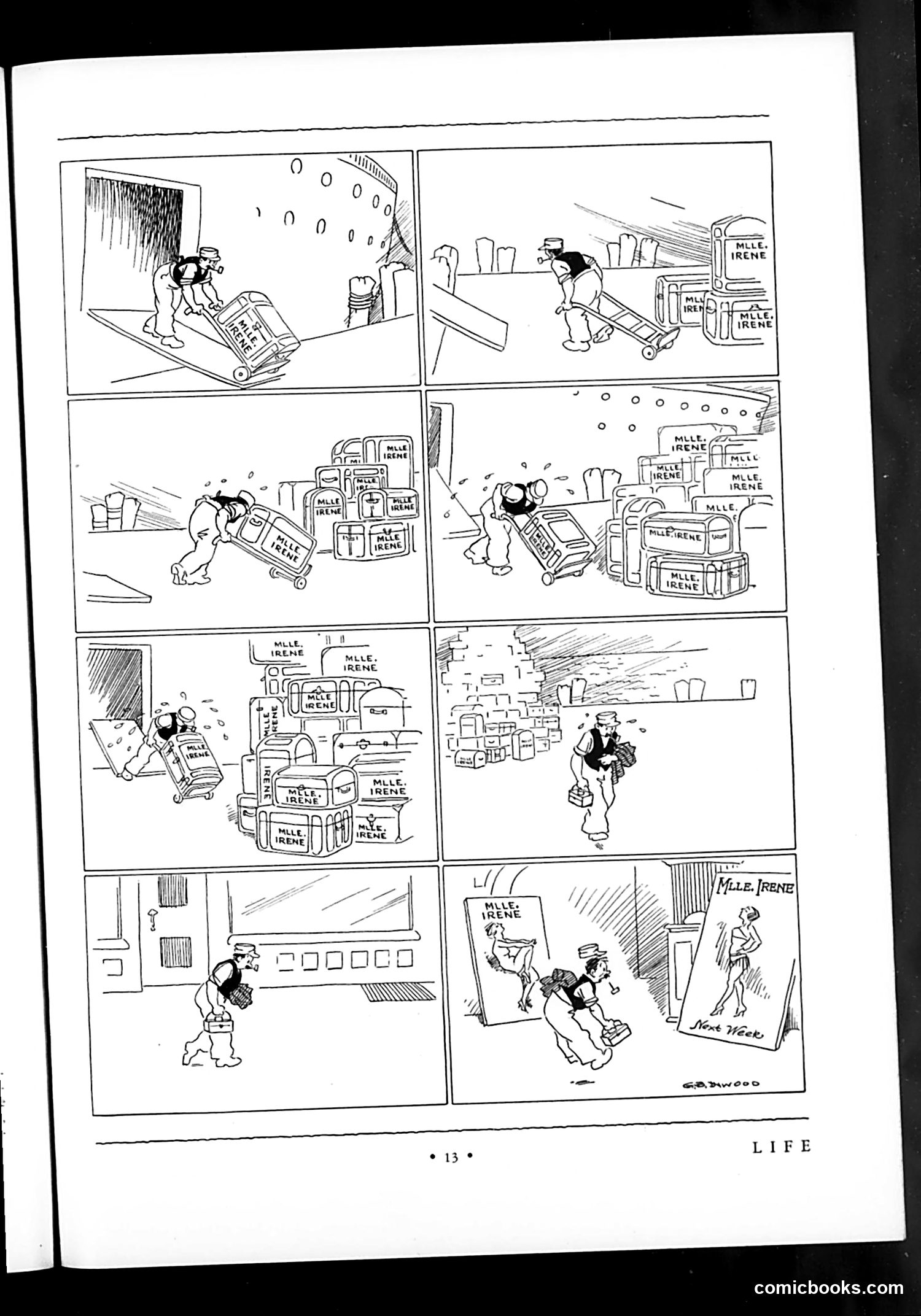
Analysis This is a comic strip narrative about someone repeatedly purchasing and transporting "Mlle. Irene" products (visible on numerous boxes throughout). The story progresses from the character struggling with increasingly massive quantities of these items—loading them onto carts, stacking them in piles—to finally arriving at what appears to be a store or display location. The strip satirizes excessive consumerism and impulse buying, likely mocking the era's advertising culture and women's susceptibility to marketed products. "Mlle. Irene" appears to be a fictional beauty or household brand. The humor derives from the escalating absurdity of accumulating so much product that it becomes physically unmanageable, suggesting the ridiculousness of following advertising claims or fashion trends without restraint. The artist signature appears to be "Darwood" (bottom right).
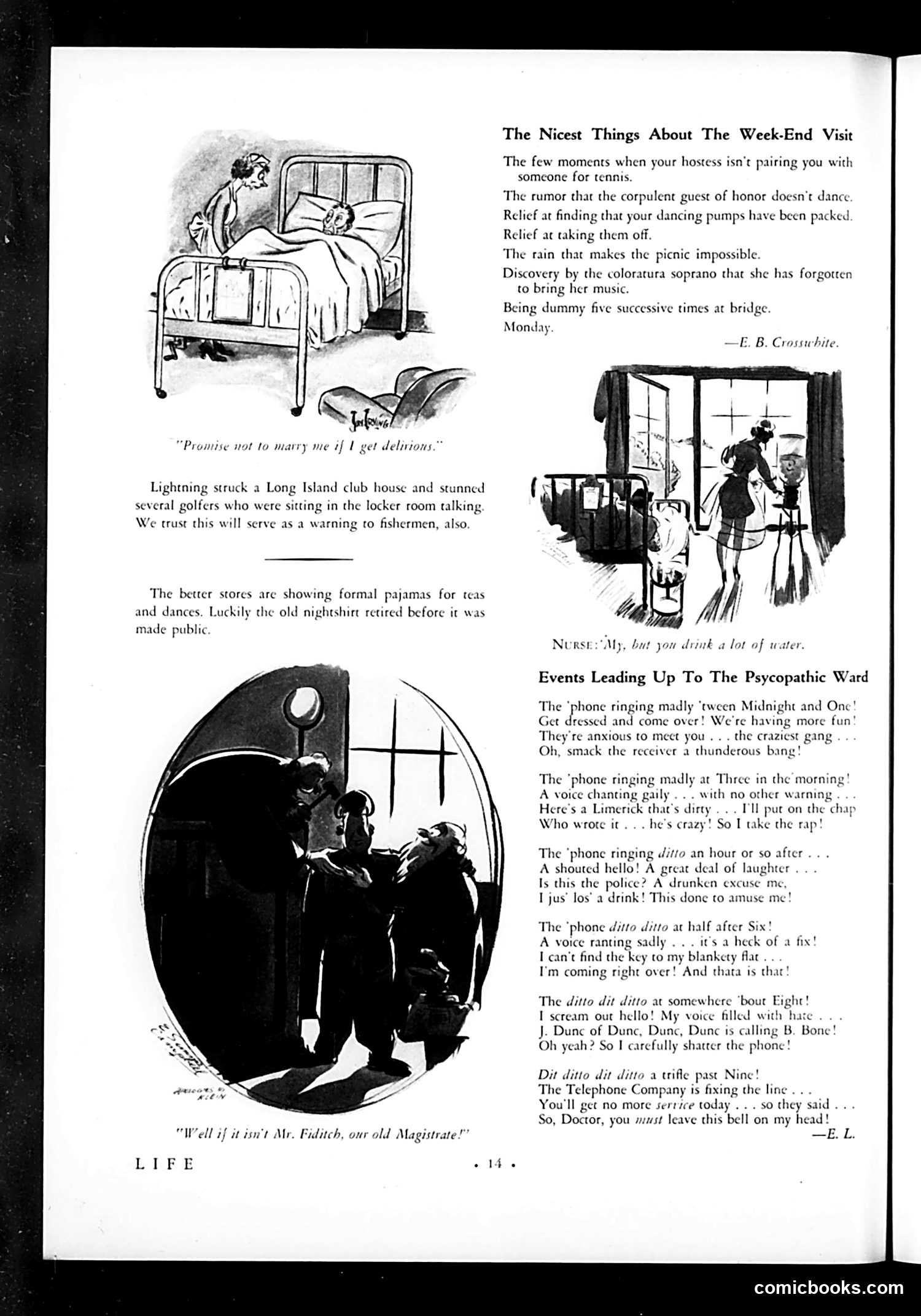
Analysis of Life Magazine Page 14 This page contains humorous sketches about social etiquette and modern life, circa early 20th century. The top section, titled "The Nicest Things About The Week-End Visit," satirizes guests overstaying their welcome—poking fun at awkward social situations like forgotten luggage and mandatory dancing. The middle cartoon shows a woman in bed with the caption "Promise not to marry me if I get delirious," mocking dramatic illness behavior. The lower section, "Events Leading Up To The Psycopathic Ward," humorously depicts increasingly frantic phone calls arriving at odd hours ("Midnight and One," "Three in the morning"), escalating to someone threatening to smash the telephone. The joke tracks someone's mounting hysteria from repeated late-night disturbances, culminating in mental breakdown. The final illustration shows figures outside at night with the caption referencing a magistrate, likely depicting arrest or legal consequences from the chaos.
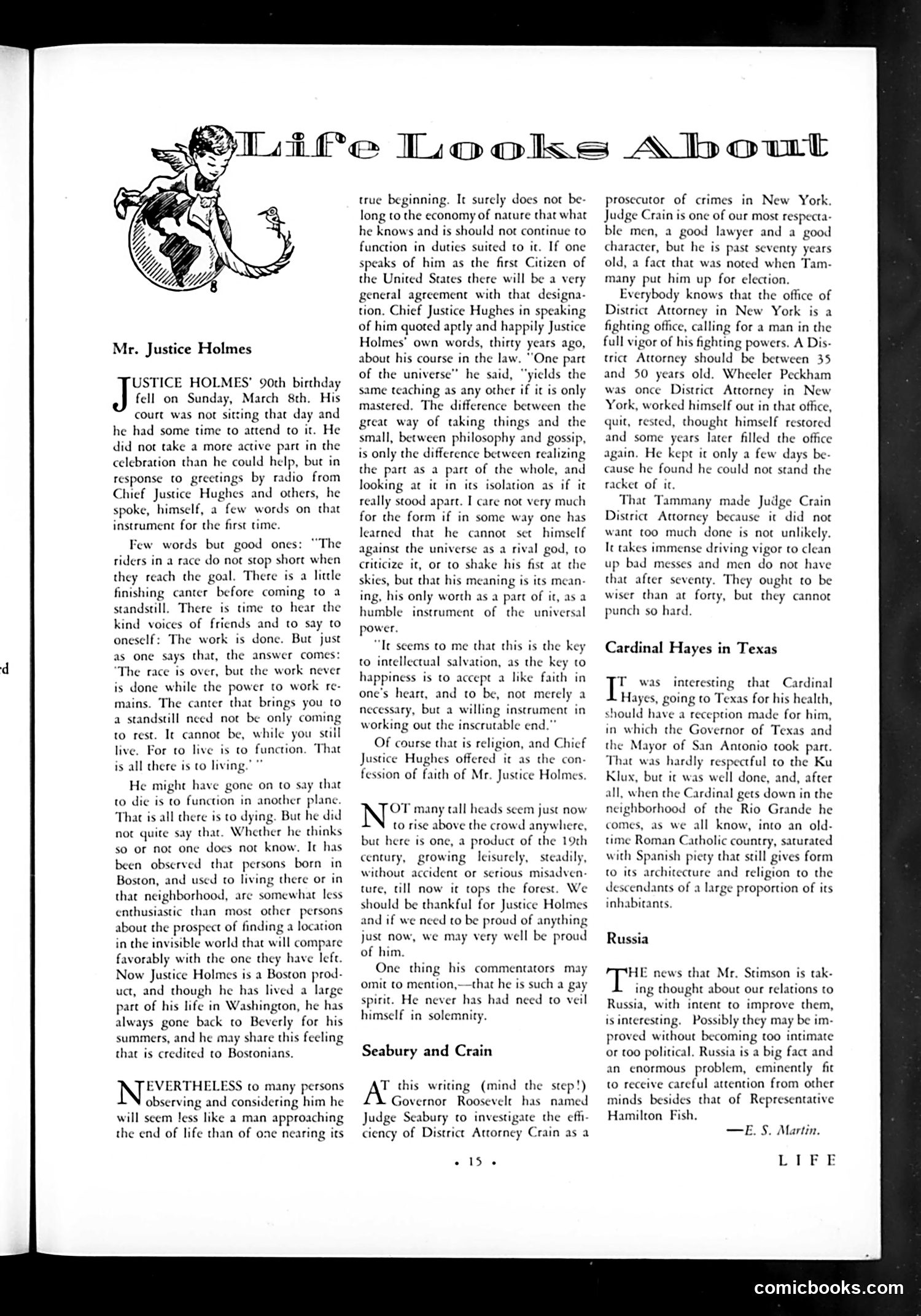
Analysis of "Life Looks About" Page This page contains four distinct articles celebrating prominent figures rather than satirical cartoons: 1. Mr. Justice Holmes - Honors Supreme Court Justice Oliver Wendell Holmes Jr. on his 90th birthday (March 8), praising his intellectual contributions and long career. 2. Seabury and Crain - Notes Governor Roosevelt's appointment of Judge Seabury to investigate District Attorney Crain's efficiency, implying corruption concerns. 3. Cardinal Hayes in Texas - Reports Cardinal Hayes visiting Texas, noting the Governor and Mayor of San Antonio's respectful reception of the Catholic leader. 4. Russia - Brief commentary on improving U.S.-Russian relations, suggesting diplomatic engagement without excessive intimacy. The page emphasizes prominent American institutional figures (judiciary, church, politics) rather than offering satire or caricature.
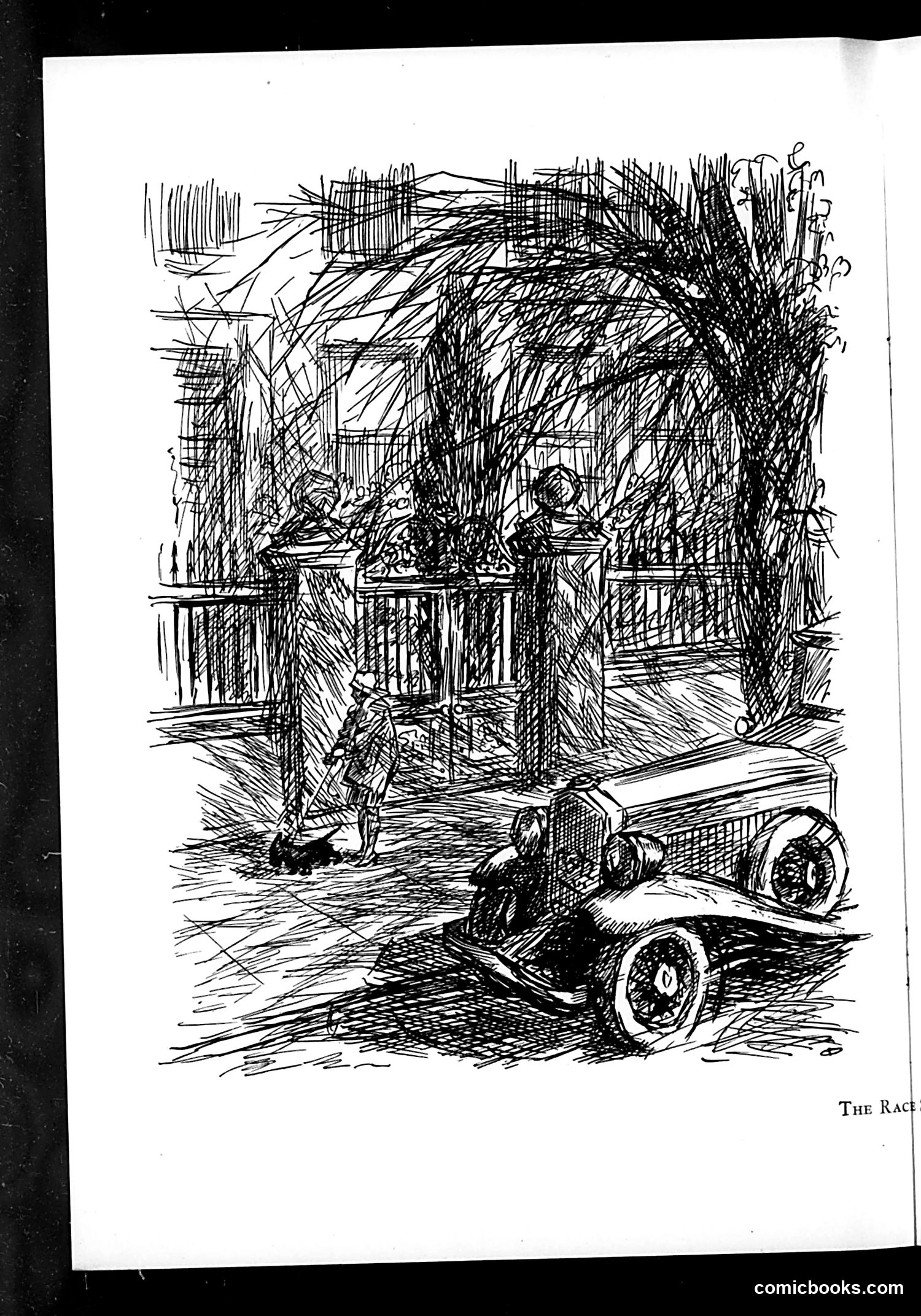
"The Race" This ink sketch depicts an early automobile race, showing two vintage racing cars competing on a street. The vehicles appear to be from the 1910s-1920s era, with characteristic open designs and large wheels. Spectators line the course, including figures watching from what appears to be a grandstand or pavilion structure with climbing vines. The title "The Race" suggests this illustrates a specific competitive event, likely satirizing the enthusiasm surrounding early automotive racing—a relatively new and fashionable spectacle for wealthy Americans. The detailed pen work emphasizes both the speed and danger of these primitive vehicles, capturing the era's fascination with mechanical innovation and competitive sport. Without additional context, the specific race or satirical target remains unclear.
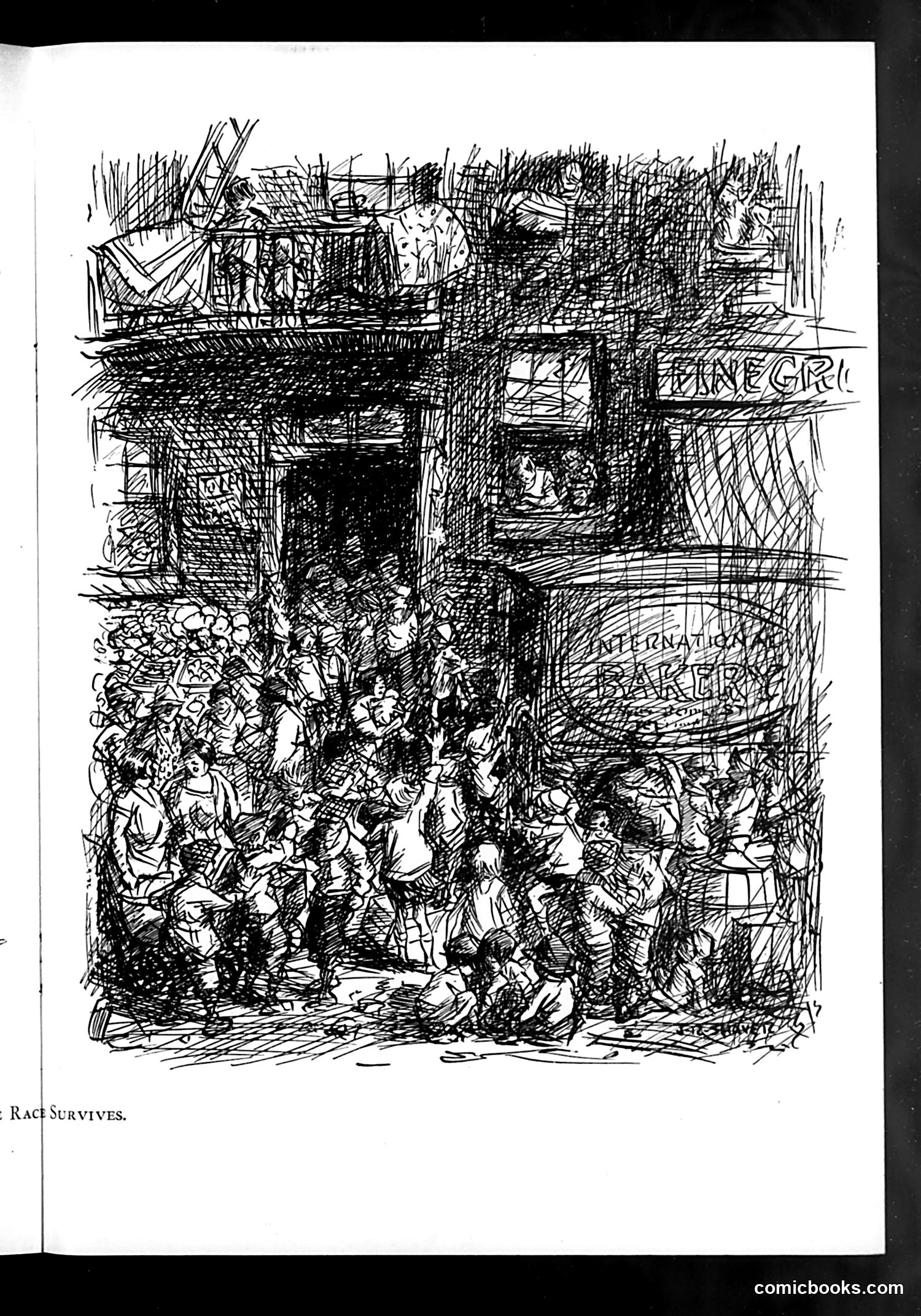
Analysis This appears to be a satirical illustration titled "Race Survives" (visible at bottom left). The sketch depicts a crowded street scene outside what looks like an "International Bakery" (text visible on storefront signs). The cartoon shows a dense mob of people gathered outside the establishment, rendered in quick, energetic pen strokes characteristic of early Life magazine illustrations. The "Race Survives" caption suggests this is social commentary, likely satirizing either ethnic or class dynamics of the era—possibly referencing immigration, working-class communities, or food culture controversies. Without additional context about the specific date or surrounding articles, the precise political target remains unclear, though the bakery setting and crowded immigrant-appearing figures suggest commentary on urban immigrant populations or their cultural institutions.
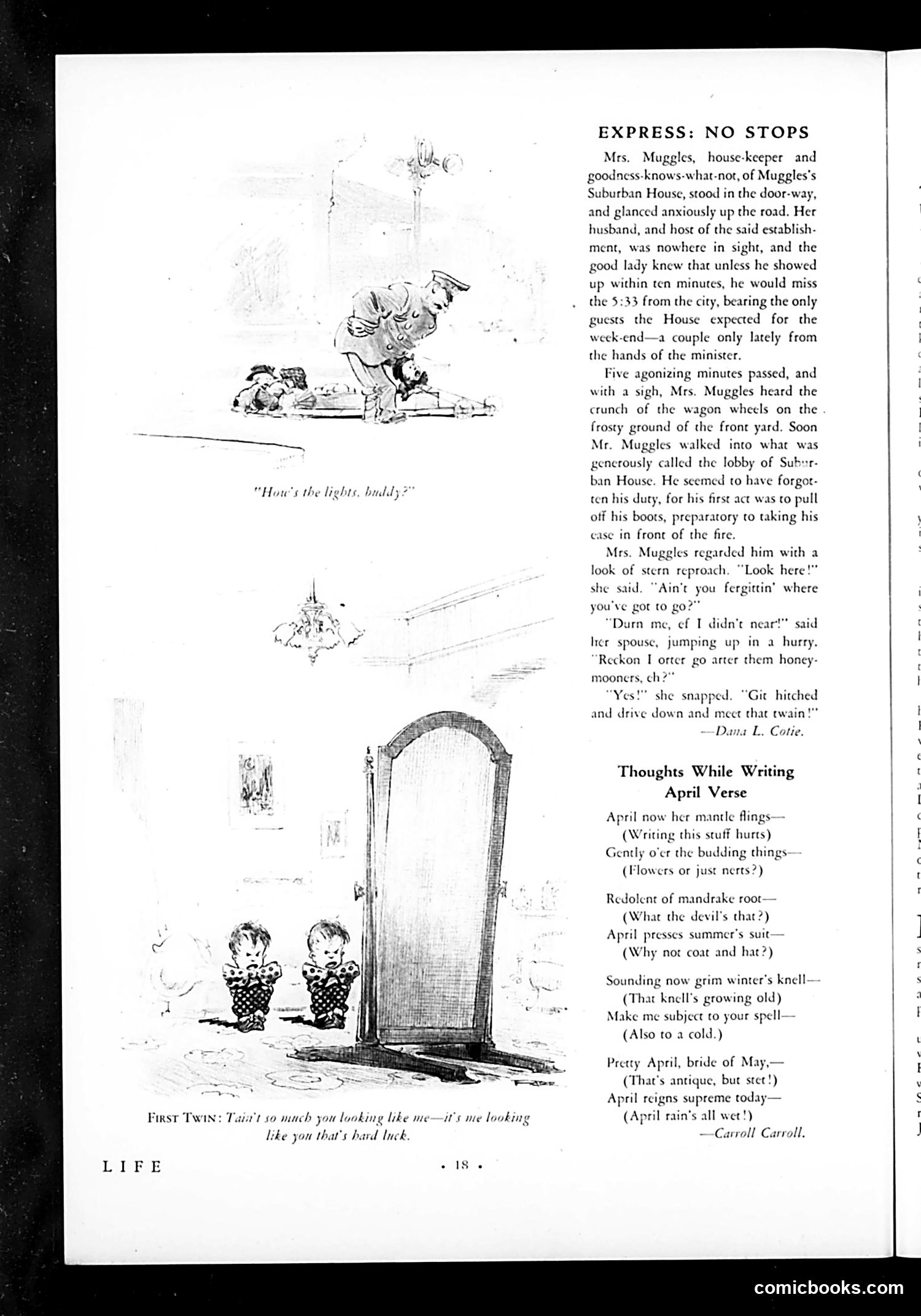
Analysis This page contains a humorous short story titled "Express: No Stops" illustrated with line drawings, plus a separate poem titled "Thoughts While Writing April Verse" attributed to Carroll Carroll. The main story depicts Mrs. Muggles, a house-keeper, anxiously waiting for her husband to arrive home before guests expected for a weekend. The cartoon illustrations show domestic comedy—a woman in distress, Mr. Muggles arriving late and forgetting his obligations, and their exchange of exasperated dialogue about catching a departing train to meet arriving guests. The secondary poem is light verse about April, using parenthetical asides that humorously undercut each sentiment (writing is difficult, April brings contradictions). Both pieces are genteel domestic humor typical of early 20th-century American magazines—no specific political references or caricatures are evident. The satire targets everyday marital miscommunications and seasonal observations.
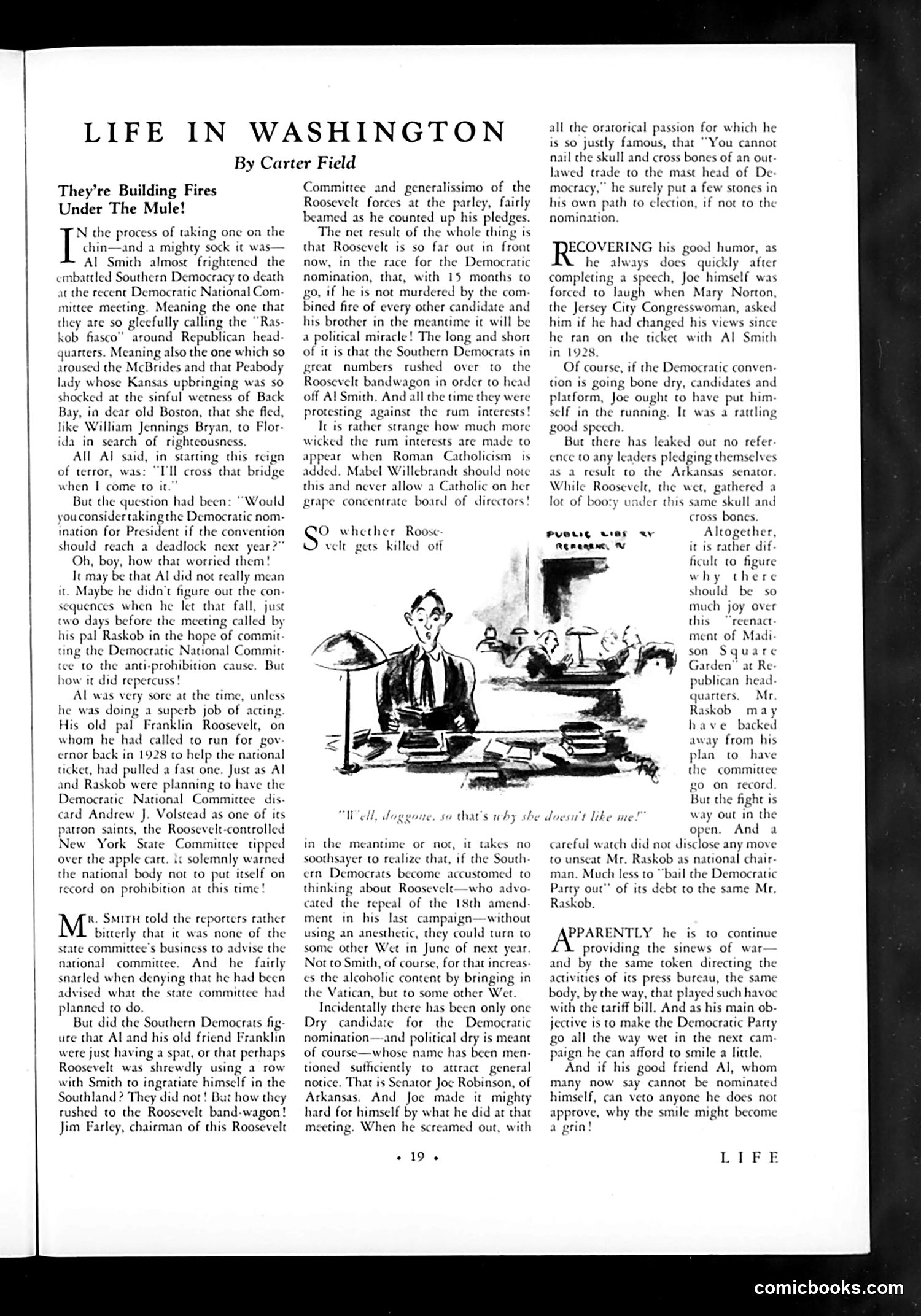
"Life in Washington" Analysis This satirical piece covers the 1928 Democratic National Committee meeting, focusing on Al Smith's (apparent presidential candidate) casual remark about accepting a nomination if there were a deadlock. The cartoon depicts Smith as someone stirring up trouble—hence "building fires under the mule." The satire targets Franklin Roosevelt's calculated political maneuvering. Roosevelt, whom Smith had helped get nominated for governor, sided with the anti-Smith faction by having New York's committee warn against the national committee taking a stand on prohibition. This split benefited Roosevelt enormously with Southern Democrats, who rushed to support him to block Smith's nomination. The irony: Southern Democrats claimed to oppose "rum interests," yet Smith (a "Wet" opposing Prohibition) represented exactly that. The author suggests Southerners were actually opposing Smith because he was Catholic—a prejudice masked by prohibition rhetoric. The political humor: Roosevelt appeared to undercut his old ally Smith while secretly securing Southern support for his own nomination.
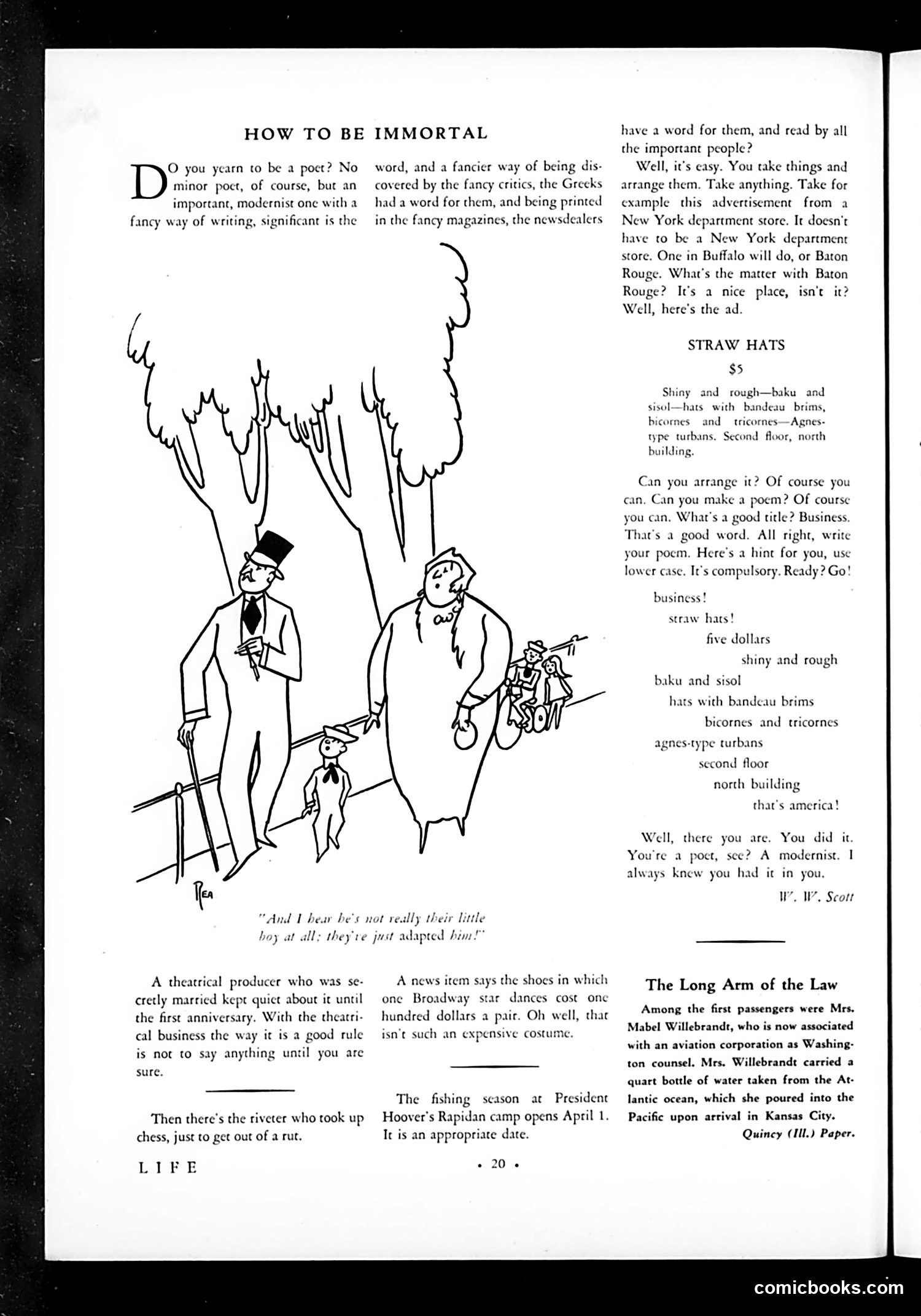
"How to Be Immortal" Satirical Essay This page satirizes modernist poetry's pretension and accessibility. The essay mocks the notion that becoming an important poet requires nothing but arranging ordinary words—particularly commercial copy—in lowercase and calling it art. The example demonstrates this absurdity: taking a department store advertisement for straw hats and simply reformatting it as "poetry" with the title "business." The author suggests this superficial technique fools critics into treating mundane text as profound modernist work. The cartoon above (showing adults with children in a surreal landscape) appears to illustrate the article's point about obscure, affected modernist sensibilities. The secondary jokes reference Prohibition (Broadway star's expensive shoes), theatrical secrecy, and a worker pursuing chess as self-improvement. The Willebrandt anecdote references the former Prohibition enforcer's post-government work and notes her quixotic act of symbolically connecting oceans—likely another example of meaningless modern "significance."
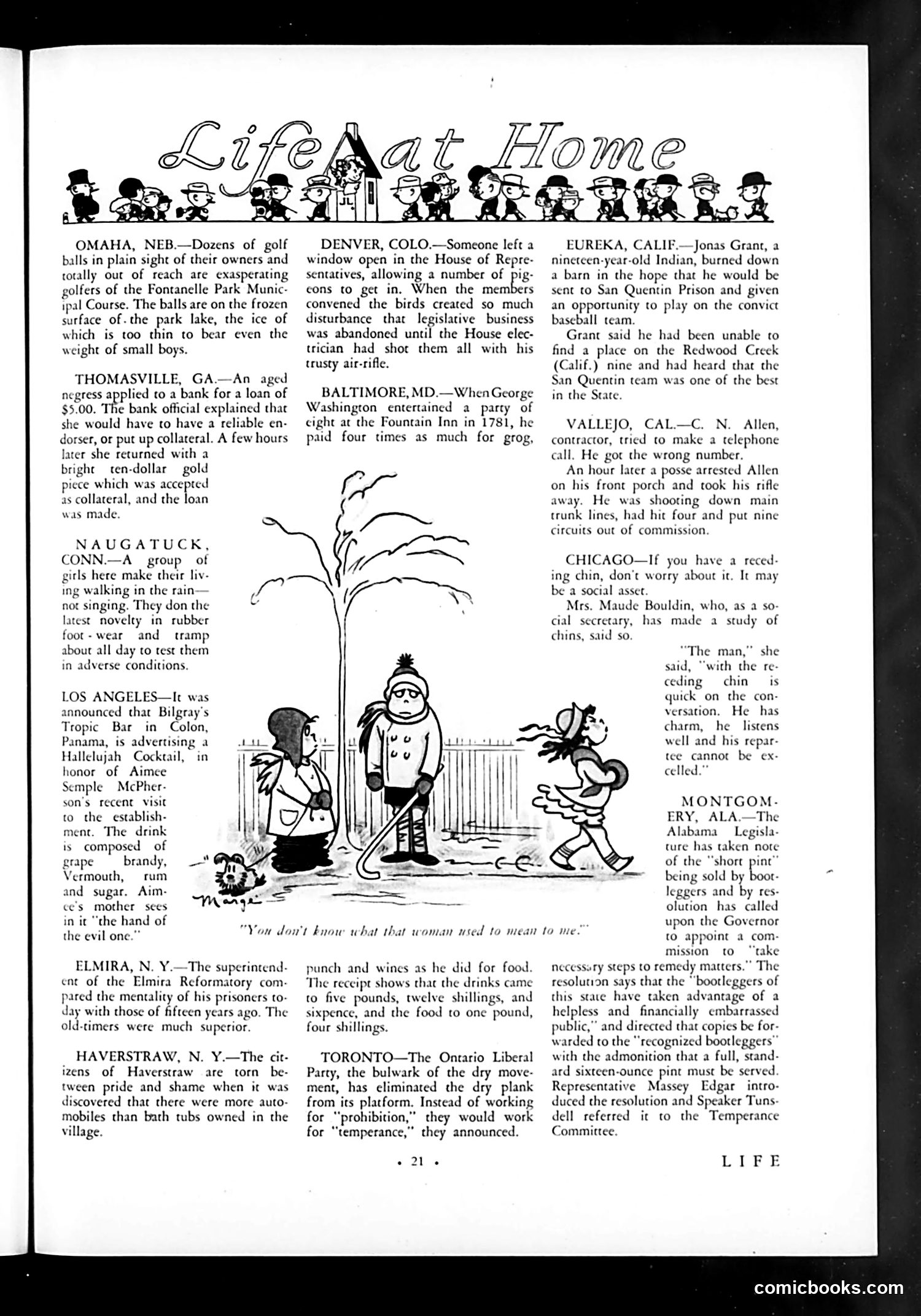
Life Magazine "Life at Home" Page Analysis This page collects humorous anecdotes from across America, with one central cartoon. The cartoon depicts a man confronting a woman, with the caption "You don't know what that woman used to mean to me"—likely illustrating a nostalgic or romantic regret theme common to the era's sentimental humor. The surrounding items satirize American social contradictions and absurdities: golf balls frozen in a lake; a Black woman using a gold piece as collateral (reflecting economic inequality and banking prejudice); girls testing rain boots; Aimee Semple McPherson's evangelist visit sparking moral concern over a cocktail named after her; Prohibition enforcement failures (pigeons disrupting Congress, a man shooting telephone lines); and most pointedly, Ontario's Liberal Party abandoning prohibition for mere "temperance"—mocking political hypocrisy around alcohol policy. The recurring themes are Prohibition-era contradictions, class disparities, and small-town absurdities. The humor relies on readers recognizing McPherson as a famous evangelist and understanding Prohibition's cultural tensions.
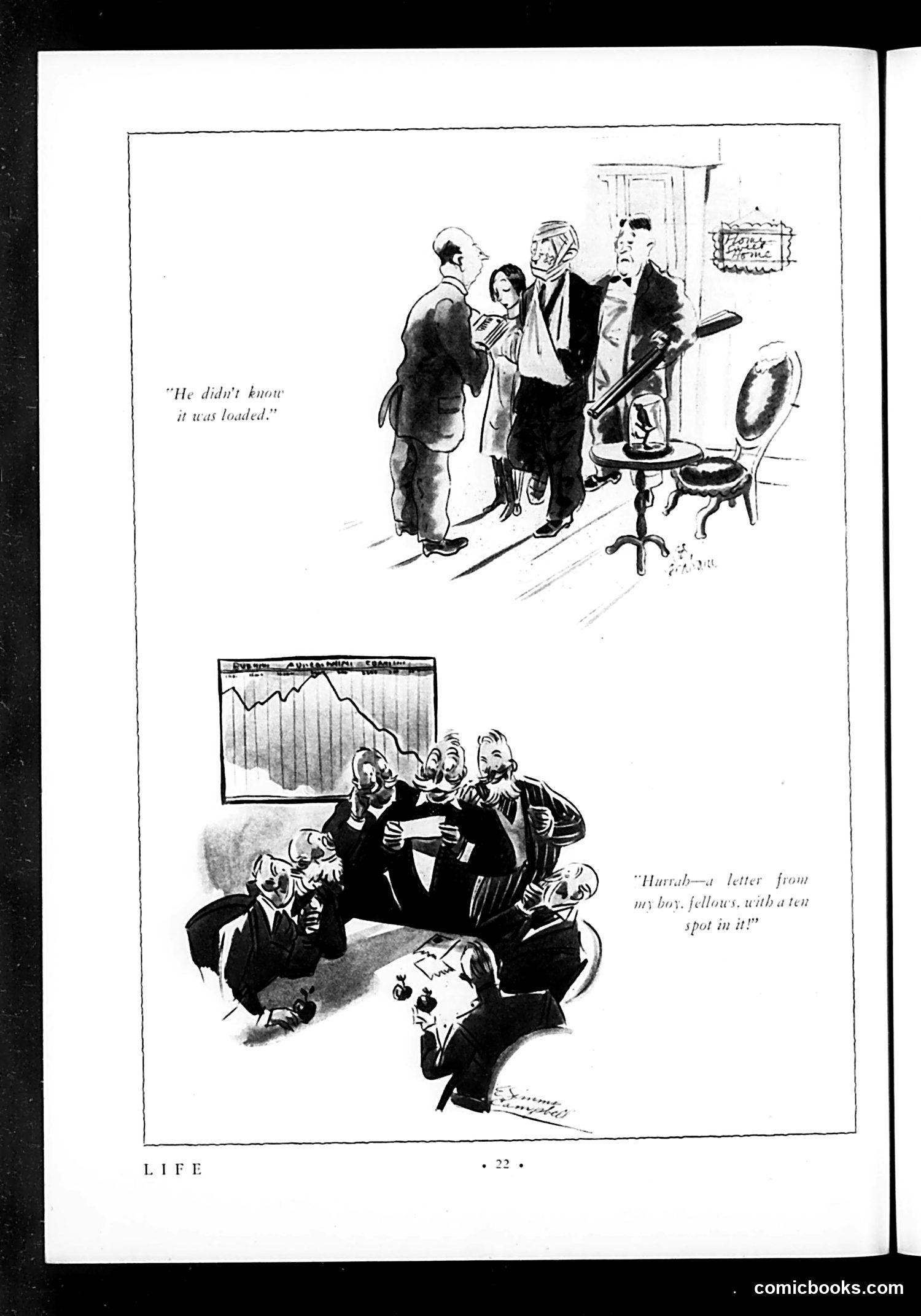
Political Cartoon Analysis This page contains two related cartoons satirizing financial negligence or fraud. The top panel shows a man excusing himself to others ("He didn't know it was loaded"), likely referring to a gun—suggesting plausible deniability for some harmful action. The bottom panel depicts men excitedly discovering "a letter from our boy, fellows, with a ten spot in it!"—apparently money received unexpectedly. A stock chart on the wall shows a sharp decline, suggesting financial loss. The satire appears to connect these scenarios: the men are celebrating receiving money while their overall investments are crashing. This likely mocks investors or businessmen who claim ignorance about risky financial dealings, or who become irrationally optimistic about minor gains despite major losses. The "didn't know it was loaded" phrase implies willful blindness to dangerous consequences.
"Cimarron" Film Review - Life Magazine This is a film review by Harry Evans of the 1930 movie "Cimarron," based on Edna Ferber's novel about early Oklahoma settlement. The critic praises the film's production values and performances but criticizes a significant change from source material: the protagonist Yancey Cravat (played by Richard Dix) has been "cleaned up" for movie audiences. Evans explains that Ferber's original character was morally complex—daring but flawed, a man respected despite his vices. Hollywood softened this, making him more conventionally heroic, which the critic argues undermines the story's psychological depth and creates plot inconsistencies. The review highlights strong supporting performances, particularly George Stone's portrayal of a Jewish peddler. This reflects 1930s Hollywood's assumption that audiences preferred virtuous heroes to psychologically complex ones.
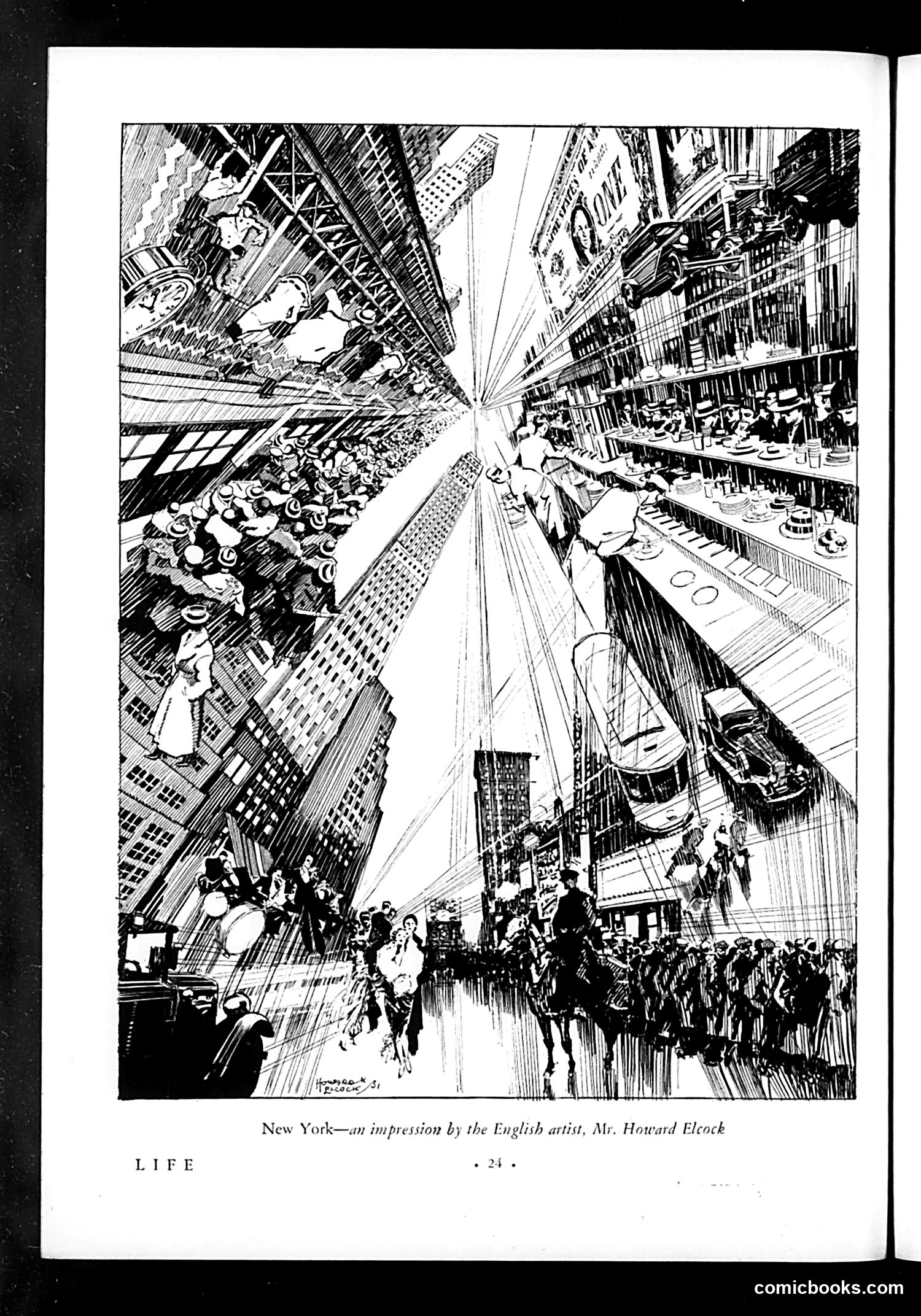
This page presents an artistic impression of New York City by English artist Howard Elcock, published in *Life* magazine (page 24). The image is a dramatic pen-and-ink drawing rendered in a bird's-eye perspective, depicting towering skyscrapers converging toward a central vanishing point, with street-level crowds of pedestrians and vehicles visible below. The exaggerated vertical lines and dynamic composition emphasize the city's overwhelming scale and frenetic energy. The work appears designed to capture a foreigner's awestruck reaction to New York's architectural grandeur and urban density—a common theme in early 20th-century depictions of the city. Rather than satirizing specific political figures or events, this illustration conveys the general cultural fascination with American urban modernity as experienced by European observers.
Analysis of This Theatre Review Page This is a theatre criticism column by Baird Leonard reviewing two stage productions. There are no cartoons or caricatures—this is straight theatrical commentary from *Life* magazine (the satirical publication, not the photo magazine). Leonard reviews two plays: A.A. Milne's "Give Me Yesterday" and a revival of J.M. Barrie's "The Admirable Crichton." The first review mocks Milne's nostalgic theme—a Cabinet Minister longing for his youth—as philosophically weak and insulting to audiences who've moved beyond childhood. Leonard sarcastically notes that while A.A. Milne found success writing children's literature ("Winnie the Pooh"), his adult dramas are where he truly struggles. The second review criticizes the 1931 revival's amateurish execution, poor orchestration, and William Gillette's mumbled reading of James Barrie's message. Leonard notes the production's period-costume authenticity paradoxically undermines its professionalism. The column represents typical early-20th-century theatrical criticism: witty, dismissive, class-conscious, and focused on artistic merit.
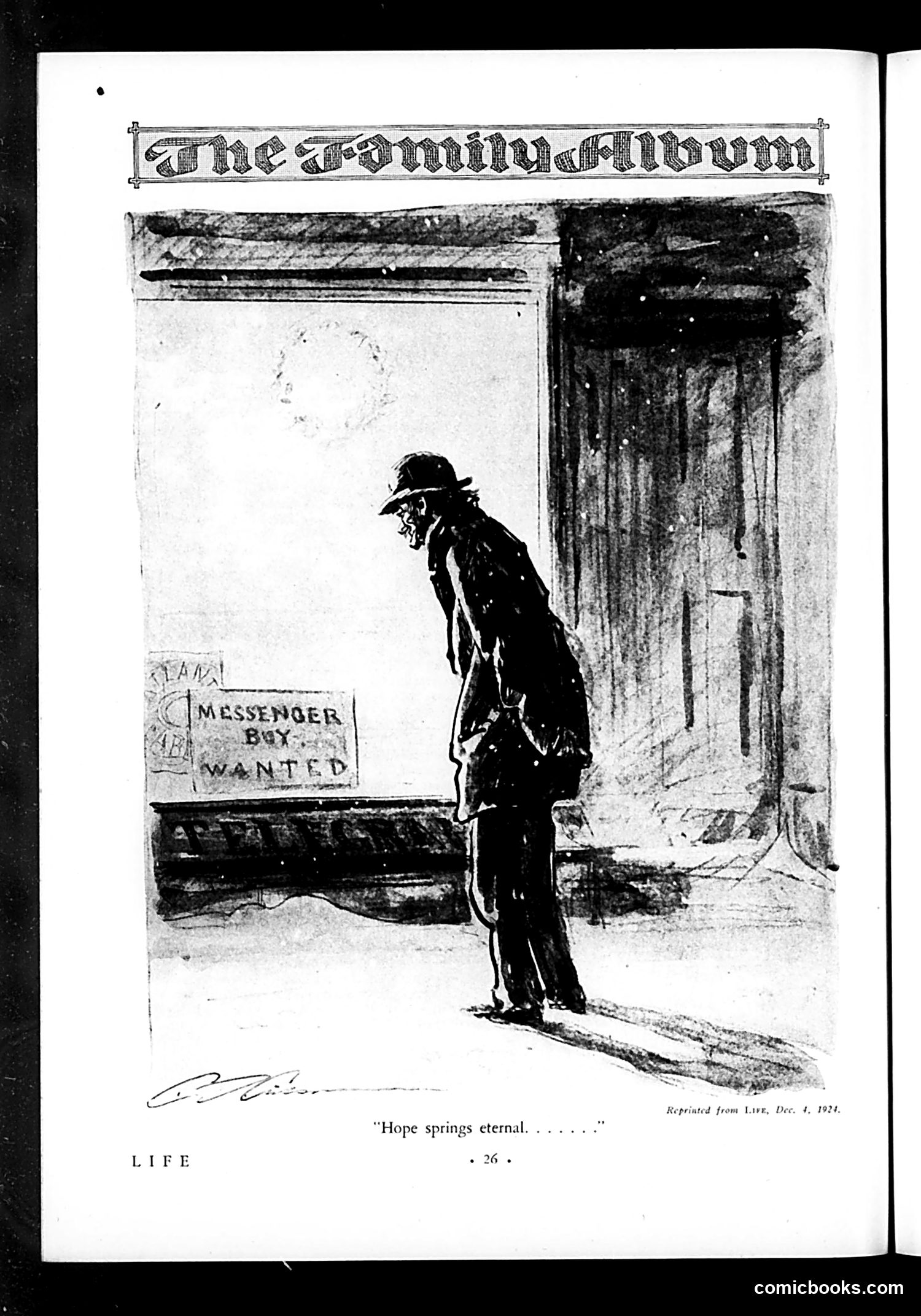
"Hope Springs Eternal" - Life Magazine, December 4, 1924 This cartoon depicts a ragged, impoverished man standing before a storefront window displaying a "Messenger Boy Wanted" sign. The figure's shabby clothing and hunched posture suggest economic hardship, likely reflecting the struggles of working-class Americans during the 1920s. The satire lies in the caption "Hope springs eternal"—a reference to Alexander Pope's famous line about human optimism. The cartoon cynically comments on persistent unemployment and underemployment; despite desperate circumstances, the man continues searching for work, clinging to hope even when opportunities appear scarce or unattainable. This reflects broader 1920s labor anxieties beneath the era's surface prosperity, satirizing both the gap between wealthy America and struggling workers, and the enduring human tendency to maintain hope despite grim circumstances.
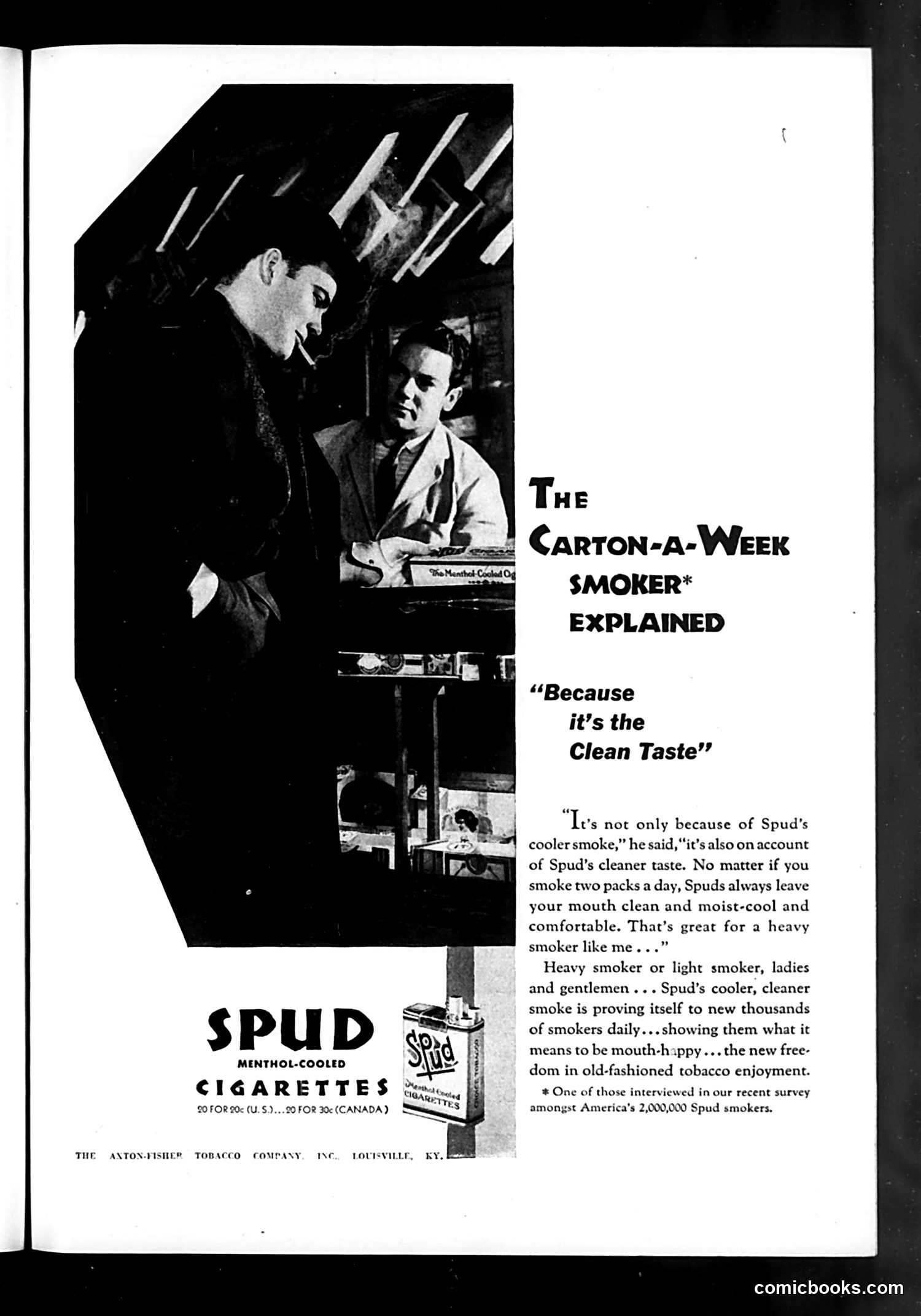
Analysis This is a cigarette advertisement, not a political cartoon. It promotes Spud menthol-cooled cigarettes by presenting a testimonial from what appears to be a "carton-a-week smoker"—a heavy user interviewed in a survey of 2 million Spud smokers. The ad's appeal centers on the claim of "clean taste" and menthol cooling properties, promising that even frequent smokers can maintain a "clean and moist-cool" mouth. The phrase "mouth-happy" and emphasis on "freedom in old-fashioned tobacco enjoyment" frames the product as offering guilt-free, comfortable smoking. Modern context: Today, such unqualified health claims about cigarettes would be illegal. The ad's casual celebration of heavy smoking ("carton a week") and absence of any health warnings reflect mid-20th-century tobacco marketing before surgeon general warnings were required. The menthol cooling was marketed as a health benefit—a claim now understood as deceptive.
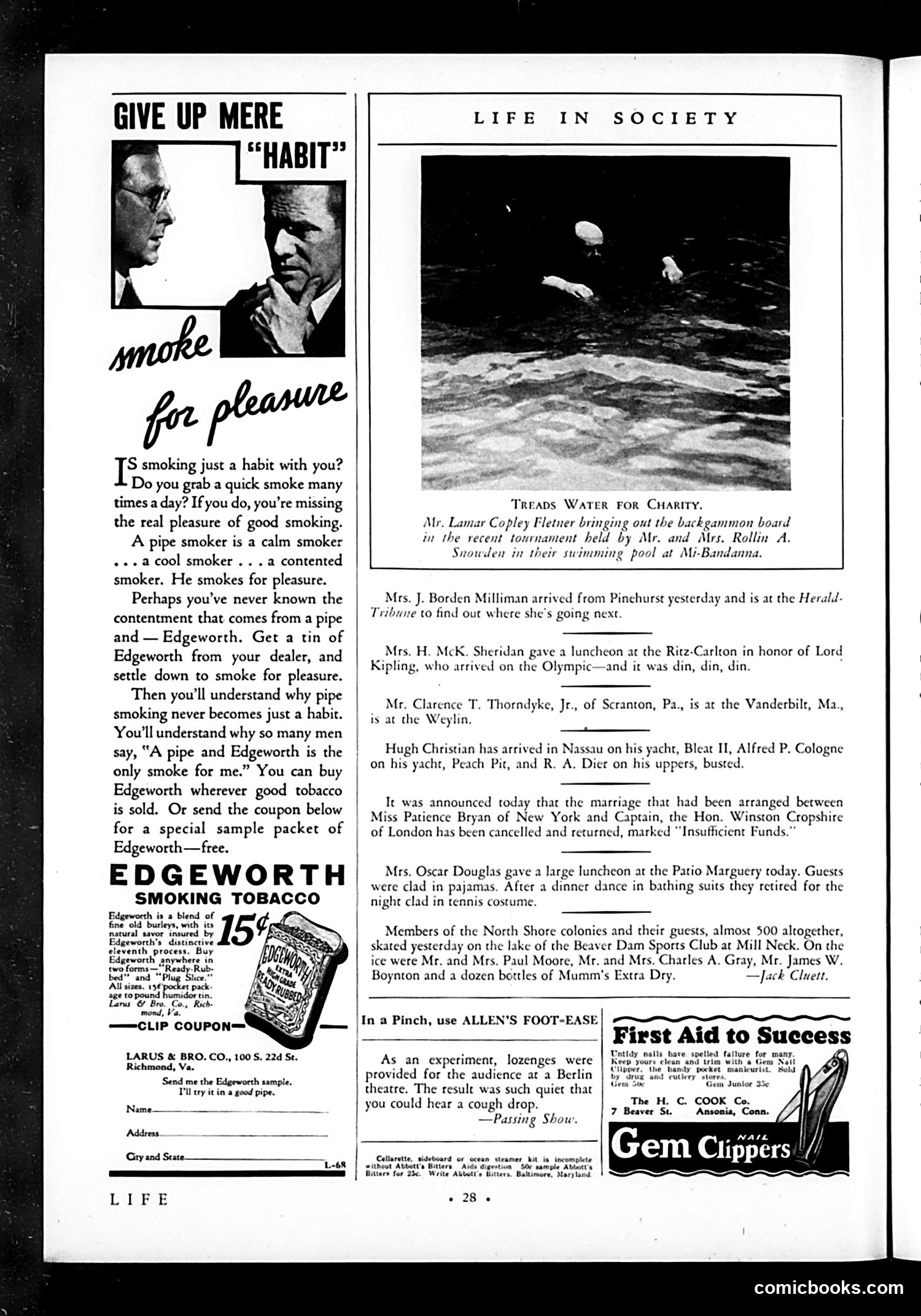
Analysis of Life Magazine Page Left Side - Edgeworth Tobacco Advertisement: This is a straightforward cigarette ad disguised as lifestyle advice. It portrays pipe smoking as sophisticated and leisurely versus habitual cigarette smoking. The ad uses two male portraits (identity unclear) to suggest that pipe smokers are "calm," "cool," and "contented," contrasting with the implication that cigarette smokers are anxious habit-slaves. The appeal targets masculine aspirations toward refinement and self-control. Right Side - "Life in Society" Column: This is satirical society gossip that mocks the wealthy's frivolous activities. Items like "treads water for charity" (a backgammon game in a swimming pool) and "Insufficient Funds" (canceling an arranged marriage) ridicule the upper class. The humor lies in absurd juxtapositions: guests dining in pajamas, then retiring in tennis costumes; millionaires appearing ridiculous rather than dignified. It's gentle satirical commentary on elite social pretension during what appears to be the 1920s-30s era.
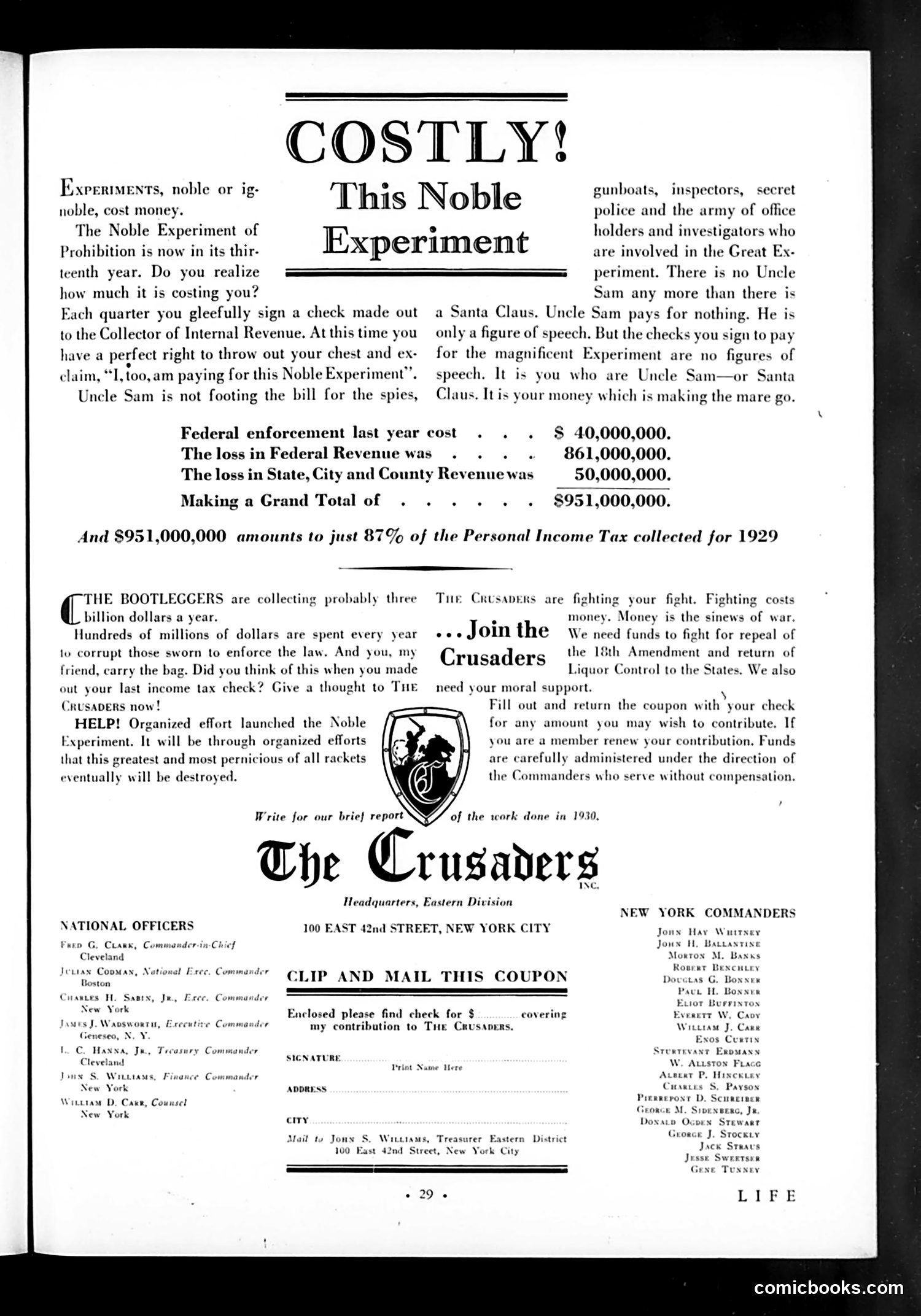
Prohibition Satire in Life Magazine This page satirizes the massive costs of Prohibition enforcement (the "Noble Experiment" of the 18th Amendment, in its 13th year by 1930). The main argument: Americans think "Uncle Sam" pays for Prohibition's enforcement through federal agents, spies, and gunboats—but actually, taxpayers foot the bill. The page lists staggering costs ($951 million total in 1929 alone, representing 87% of personal income tax collected), while bootleggers allegedly collect three billion dollars annually through illegal liquor sales. The satire cuts both ways: it mocks Prohibition's massive expense and apparent failure, while simultaneously promoting The Crusaders—an anti-Prohibition organization seeking donations to fight for the 18th Amendment's repeal and return liquor control to individual states. The irony is sharp: Life criticizes wasteful government spending on a failed policy, then immediately asks readers to donate money to oppose it—making them complicit in yet another expensive "experiment."
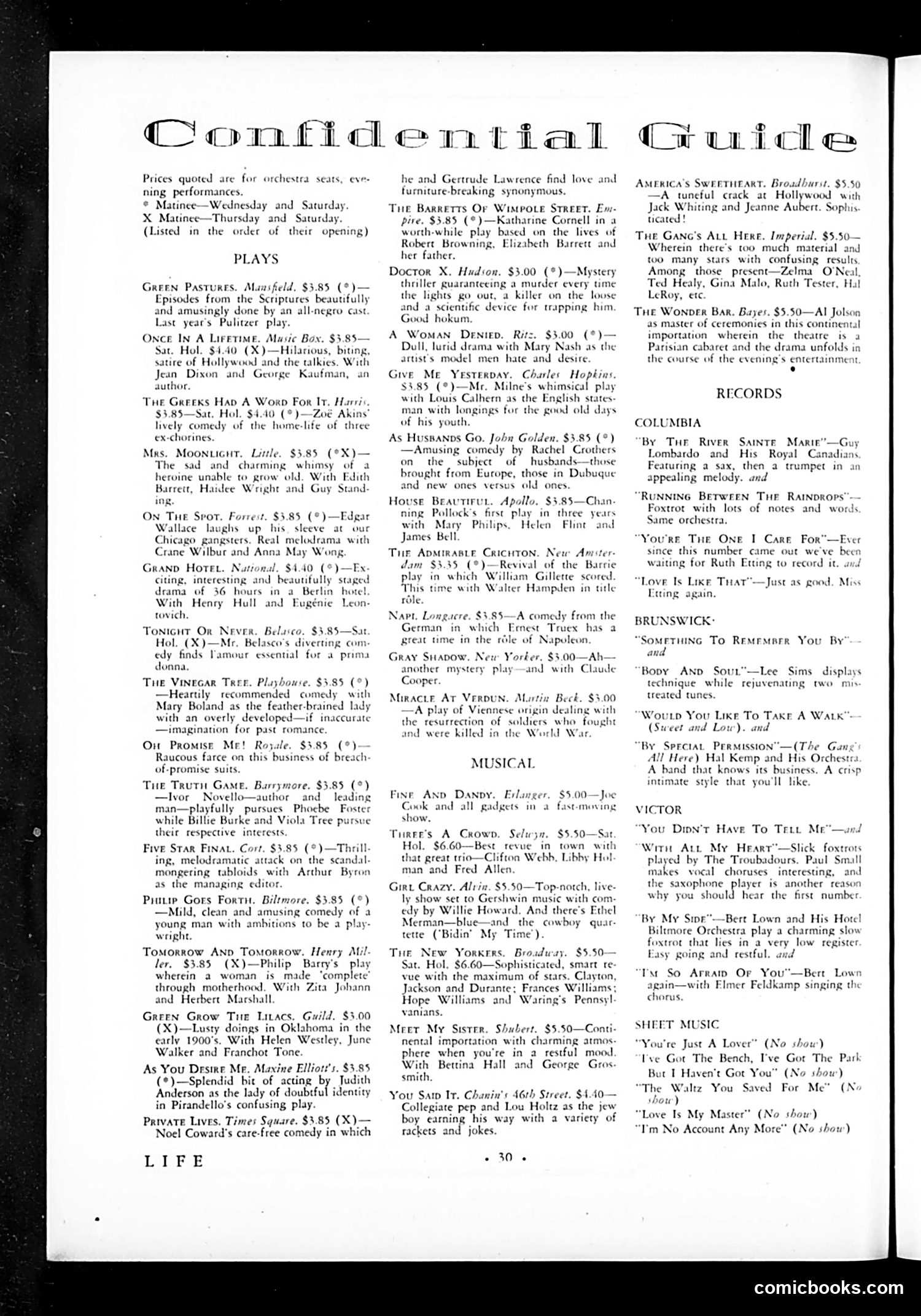
Confidential Guide Page Analysis This page is primarily theatrical advertising and entertainment listings, not political satire. It's a "Confidential Guide" to Broadway shows and musical recordings from Life magazine's entertainment section. The content consists of: 1. Play reviews/listings with prices and brief descriptions of Broadway productions (e.g., "Green Pastures," "Once in a Lifetime," "Private Lives") 2. Musical records from Columbia, Brunswick, and Victor labels 3. Sheet music listings The tone is gossipy and irreverent—typical of Life's satirical approach to culture—using witty descriptions ("Noel Coward's care-free comedy in which he and Gertrude Lawrence find love and furniture-breaking synonymous"). However, there is no political cartoon or substantive satire visible on this page. It's simply entertainment coverage aimed at affluent New York theatergoers during what appears to be the early 1930s.
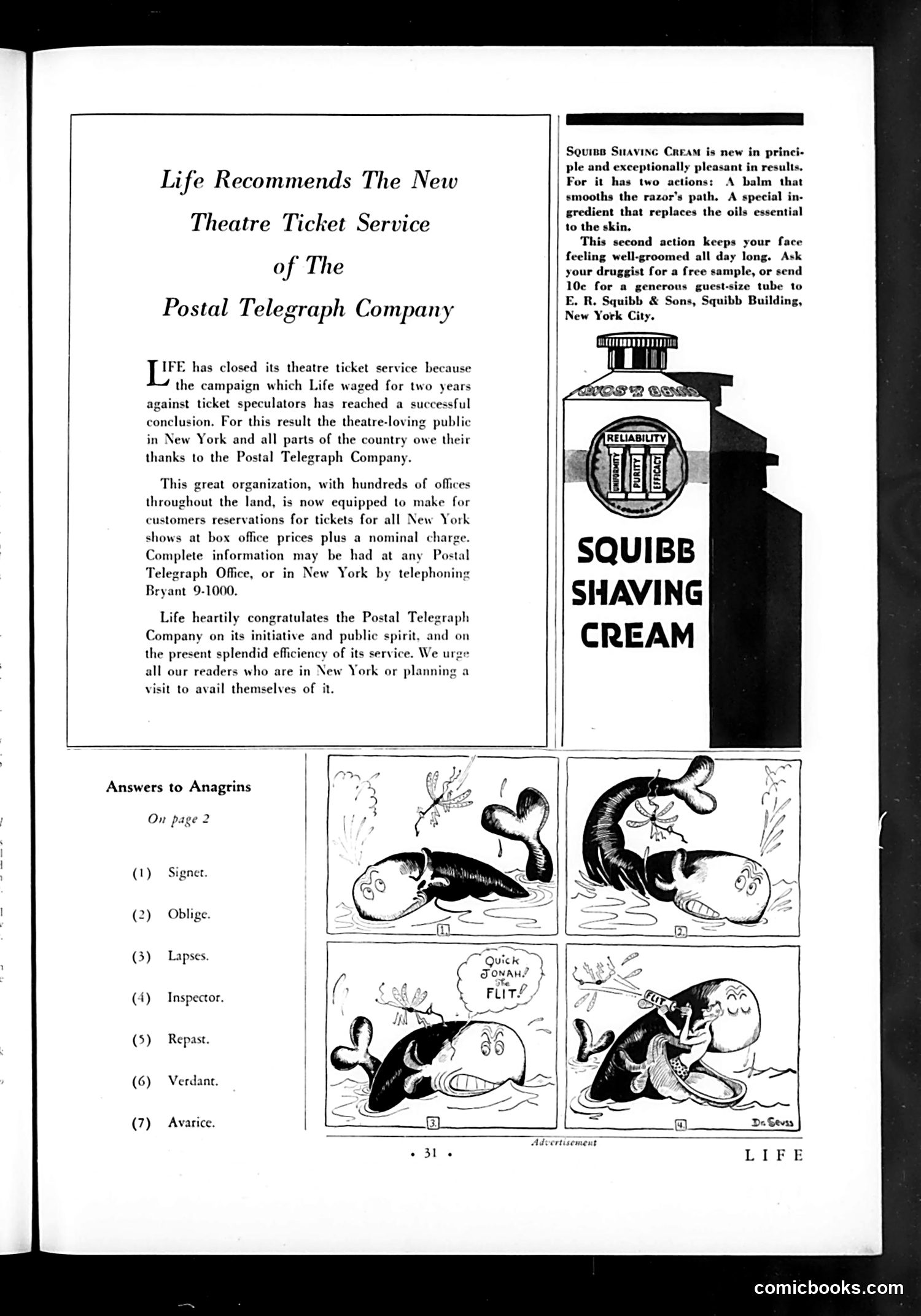
Page Analysis This page contains two distinct elements: Main Content: Life magazine announces it has closed its theater ticket service, crediting the Postal Telegraph Company for providing a replacement. For two years, Life had campaigned against ticket scalpers/speculators. Now the public can reserve Broadway tickets at face value through Postal Telegraph offices. This is presented as a public service victory. Advertisement: Squibb Shaving Cream advertisement highlighting its dual action—smoothing the razor's path and replacing oils lost to skin. Anagrams Section: Below these is an "Answers to Anagrins" (anagrams) puzzle solution from page 2, listing seven words: Signet, Oblige, Lapses, Inspector, Repast, Verdant, and Avarice. The Cartoon: Four whimsical panels featuring a character (possibly representing a ticket speculator or "scalper") being tossed around comically by what appears to be a large spherical object—likely visual commentary on Life's anti-scalping campaign's success in eliminating ticket speculation.
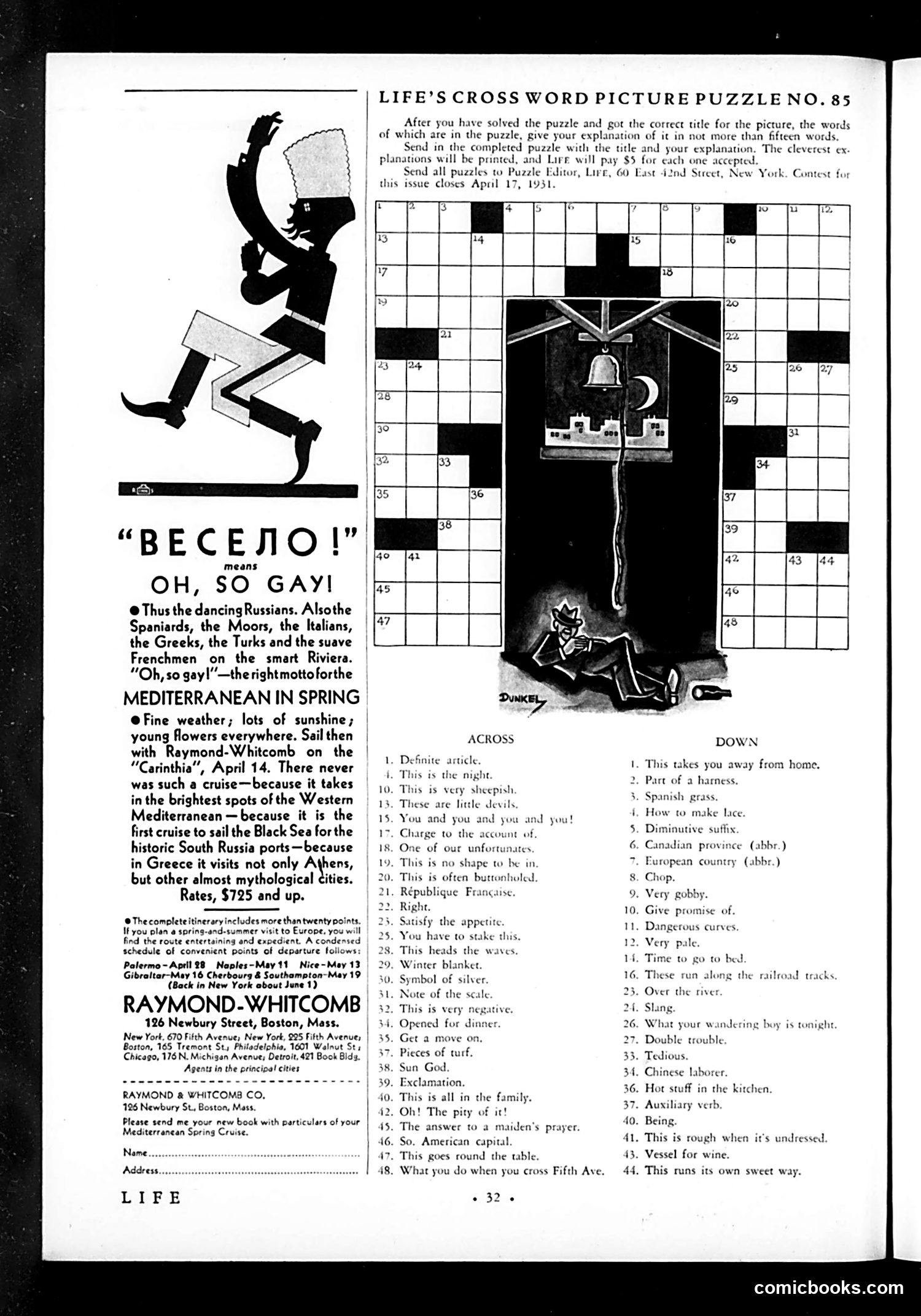
Explanation for Modern Readers This page is primarily a Raymond-Whitcomb cruise advertisement disguised as entertainment. The "Beceno!" cartoon (Russian for "Oh, so gay!") depicts a dancing Russian figure and promotes a Mediterranean spring cruise aboard the *Carinthia*, departing April 14, 1931. The ad targets wealthy Americans by invoking exotic European destinations—Russia, Spain, Italy, Greece, Turkey, and the French Riviera—as symbols of carefree sophistication. The phrase "Oh, so gay!" meant "cheerful" or "lively" in 1931, emphasizing leisure and pleasure. The crossword puzzle is a contest device encouraging reader engagement; solvers must title the cartoon and explain it in 15 words for a $5 prize. This was a common marketing tactic in Depression-era magazines. The cruise cost ($725+) positioned it as luxury travel for the affluent during economic hardship, appealing to aspirational readers seeking escapism.
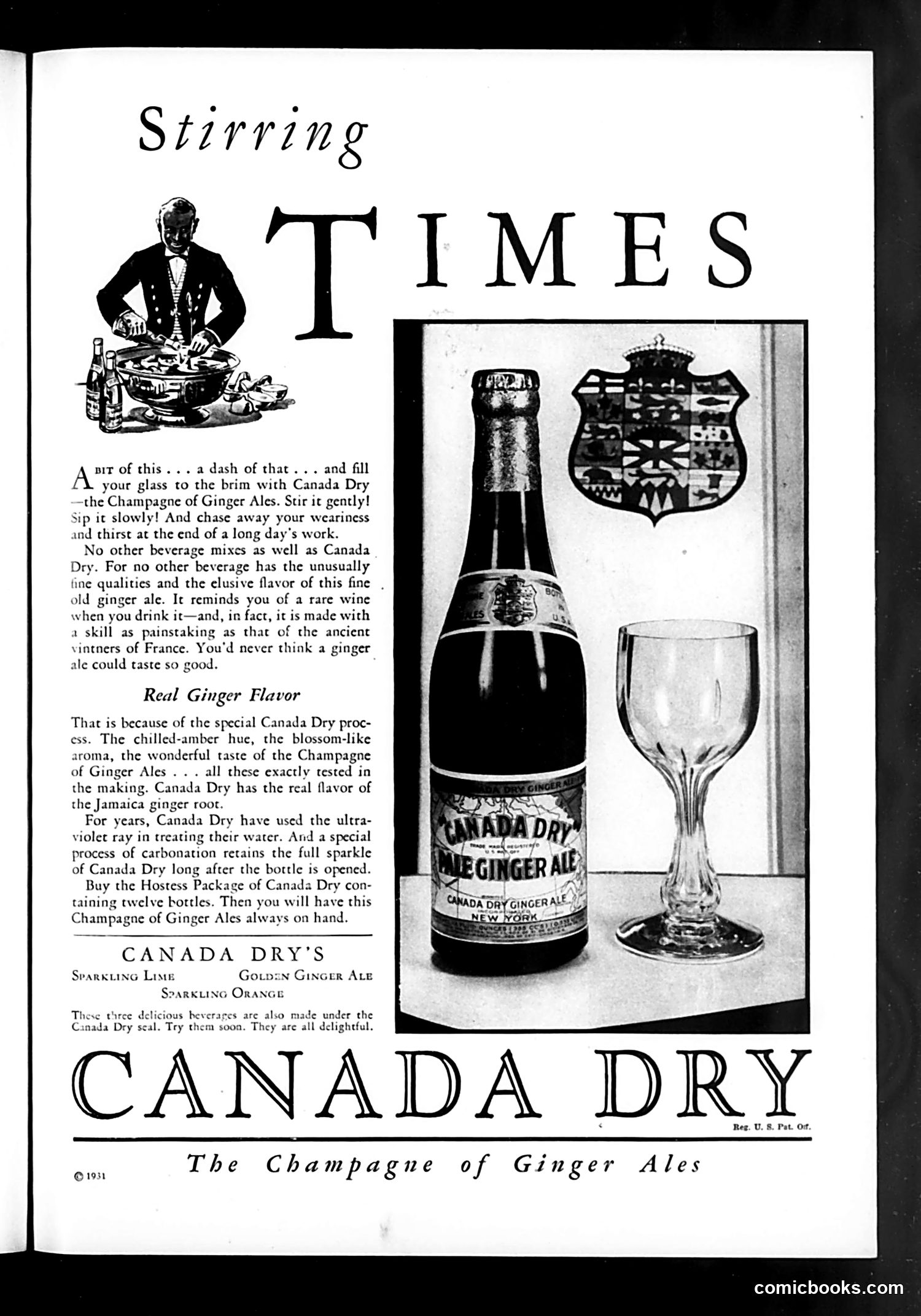
"Stirring Times" - Canada Dry Advertisement (1931) This is primarily a full-page advertisement, not political satire. The title "Stirring Times" is a pun referencing both cocktail-mixing and the contemporary era. The page depicts a well-dressed man in formal attire stirring a large mixing bowl surrounded by bottles—visualizing the "bit of this, a dash of that" mixing concept. The ad markets Canada Dry ginger ale as a premium mixer for alcoholic beverages, comparing it to French champagne and emphasizing its ginger-root flavor and carbonation technology. Historical context: Published in 1931, during Prohibition (1920-1933), this advertisement obliquely references illegal cocktail-making. The mixing imagery and emphasis on Canada Dry as a mixer for "stirring" drinks thinly disguises promotion for use with bootleg spirits—a wink-and-nod marketing strategy common during this period when advertising alcohol directly was illegal.
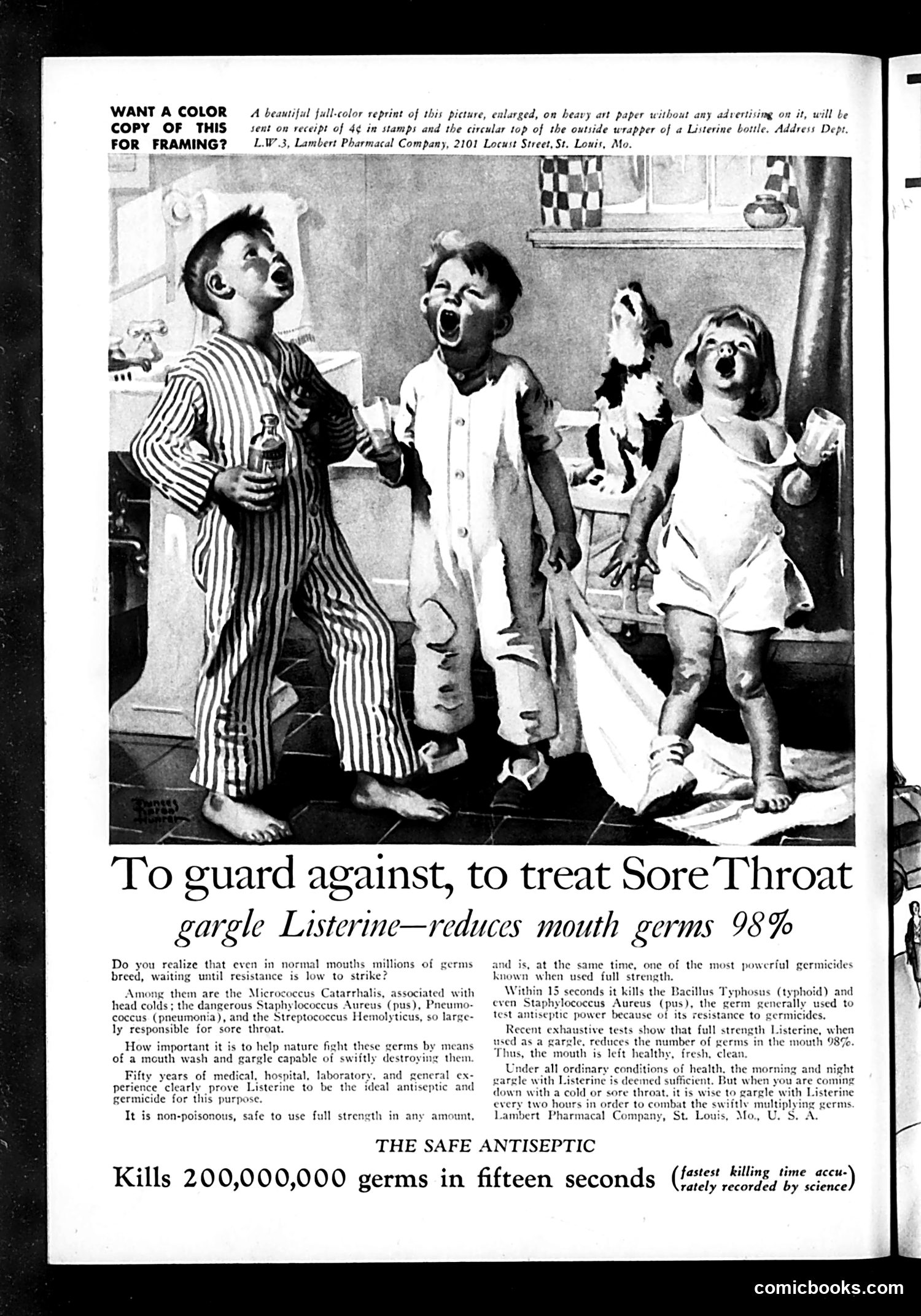
Listerine Advertisement (circa 1920s) This is a product advertisement, not satire or political commentary. It promotes Listerine mouthwash/gargle for treating sore throats. The image shows four young children with exaggerated open mouths, appearing to be yawning or gargling—a visual demonstration of the product's use. The advertisement claims Listerine kills 98% of mouth germs and 200 million germs in 15 seconds, citing medical authority ("fastest killing time accurately recorded by science"). The text lists specific bacteria supposedly eliminated: Streptococcus Hemolyticus (responsible for sore throats), Bacillus Typhosus (typhoid), and Staphylococcus Aureus. It emphasizes the product is "safe" and "non-poisonous." A notable feature: Life magazine offered readers a color reprint of this advertisement (suitable for framing) in exchange for 4 cents and the circular wrapper from a Listerine bottle—an early promotional/marketing tie-in typical of early 20th-century advertising.