life
Life — April 3, 1931
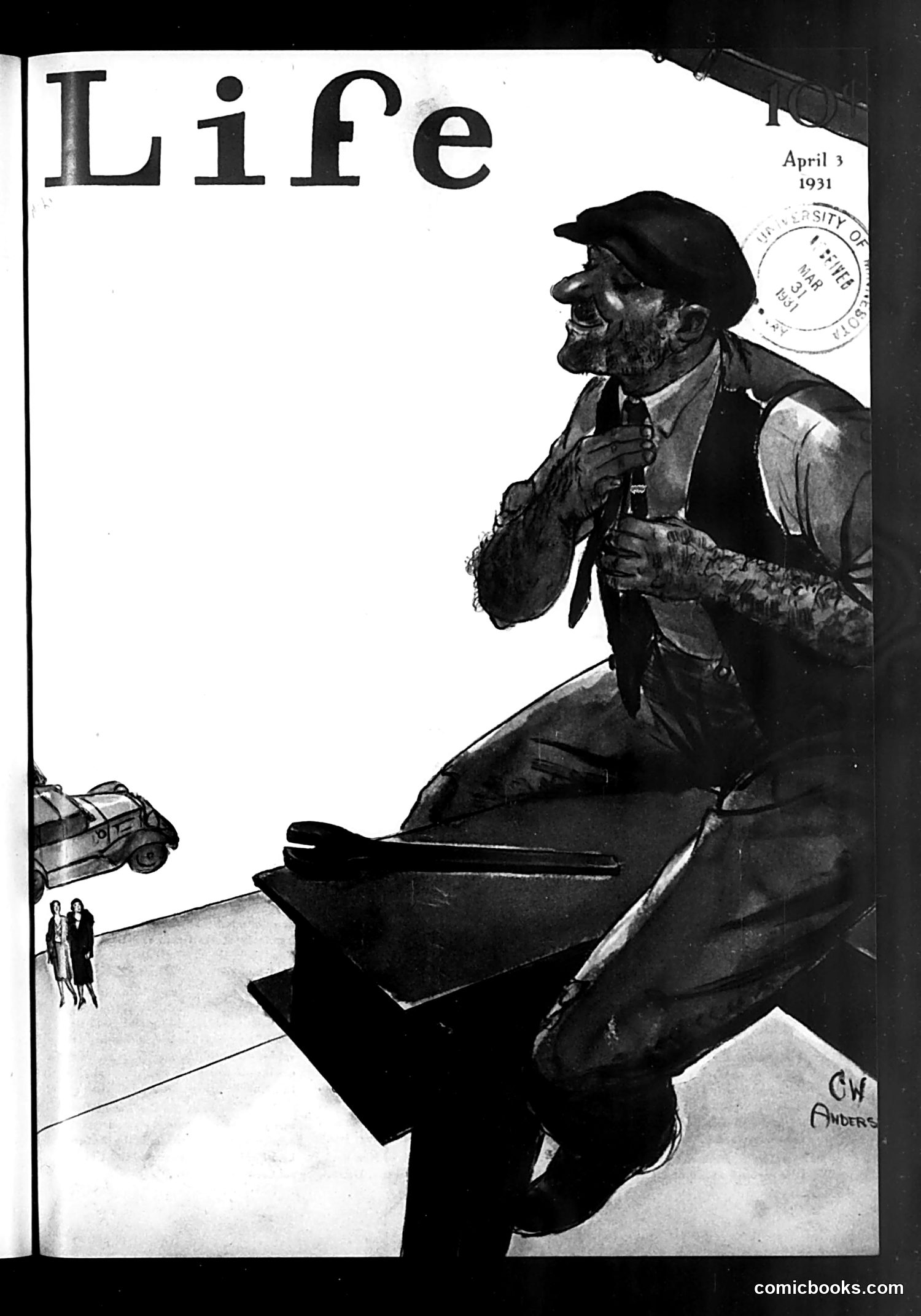
Life Magazine Cover Analysis (April 3, 1931) This cover depicts a disheveled, bearded man in worn clothing sitting in an oversized shoe, appearing distressed or contemplative. The shoe functions as a makeshift shelter or dwelling. The small vignette in the lower left shows a couple and an automobile, suggesting contrasting wealth and mobility. The cartoon satirizes homelessness and poverty during the Great Depression (which began in 1929). The "old woman who lived in a shoe" nursery rhyme reference becomes darkly ironic—here, a man literally inhabits a shoe as his only shelter. This juxtaposes Depression-era destitution against the car-owning middle class, highlighting economic inequality and the desperation of those made homeless by the economic collapse. The work critiques both poverty conditions and the indifference of the more fortunate.
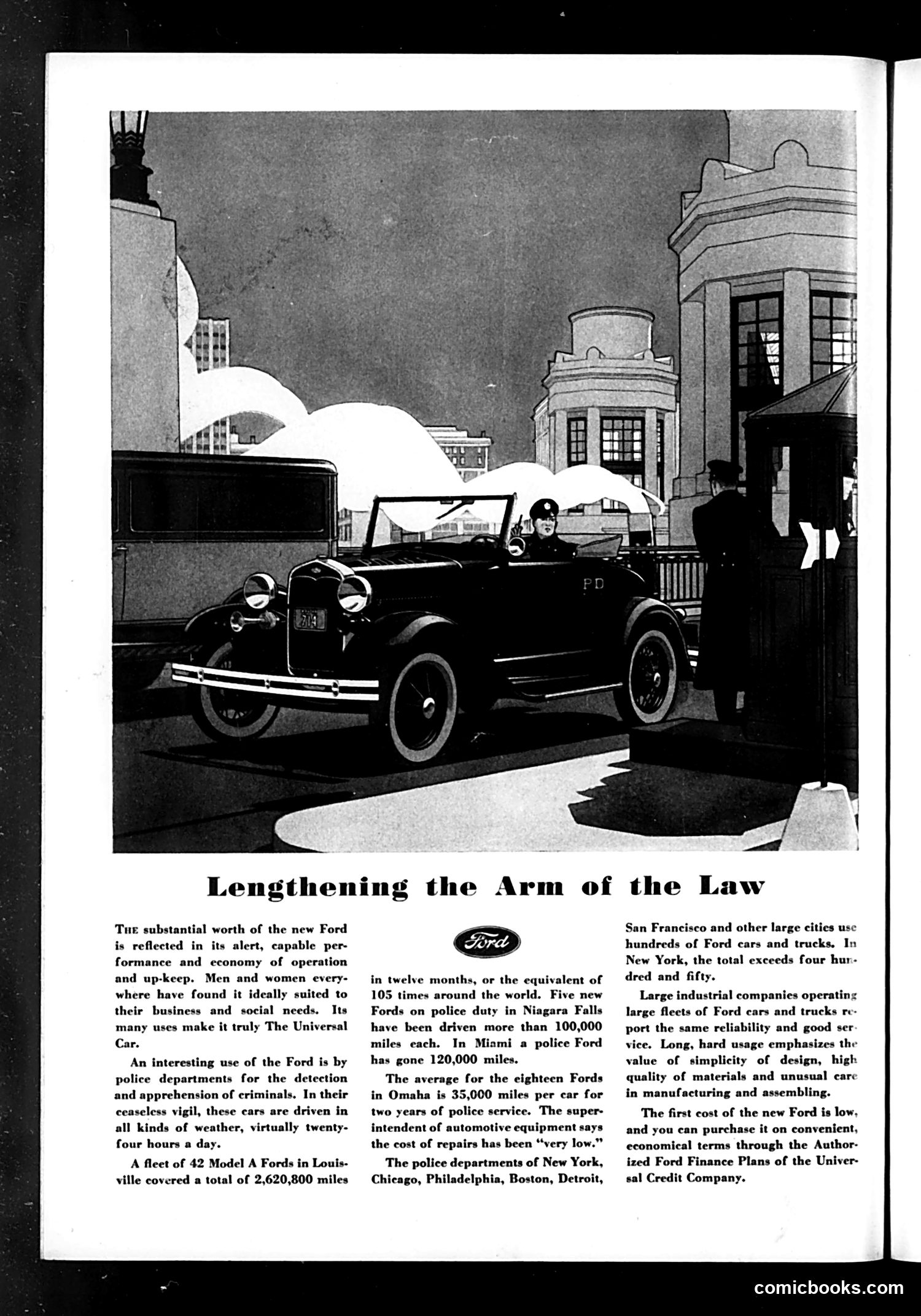
Analysis This is primarily a Ford automobile advertisement, not satire or political commentary. The headline "Lengthening the Arm of the Law" uses figurative language to promote Ford vehicles' use by police departments. The image shows a Model A Ford police car in an urban setting. The accompanying text highlights Ford's reliability for law enforcement: police fleets in major cities (New York, Chicago, Philadelphia, Boston, Detroit, San Francisco) use Ford vehicles extensively. Specific statistics mention a Louisville fleet covering 2,620,800 miles and Miami police accumulating 120,000 miles. The "arm of the law" metaphor simply means Ford cars extend police reach and effectiveness. The advertisement emphasizes durability, low operating costs, and convenient financing through Ford's finance plans—standard marketing appeals of the era aimed at institutional buyers.
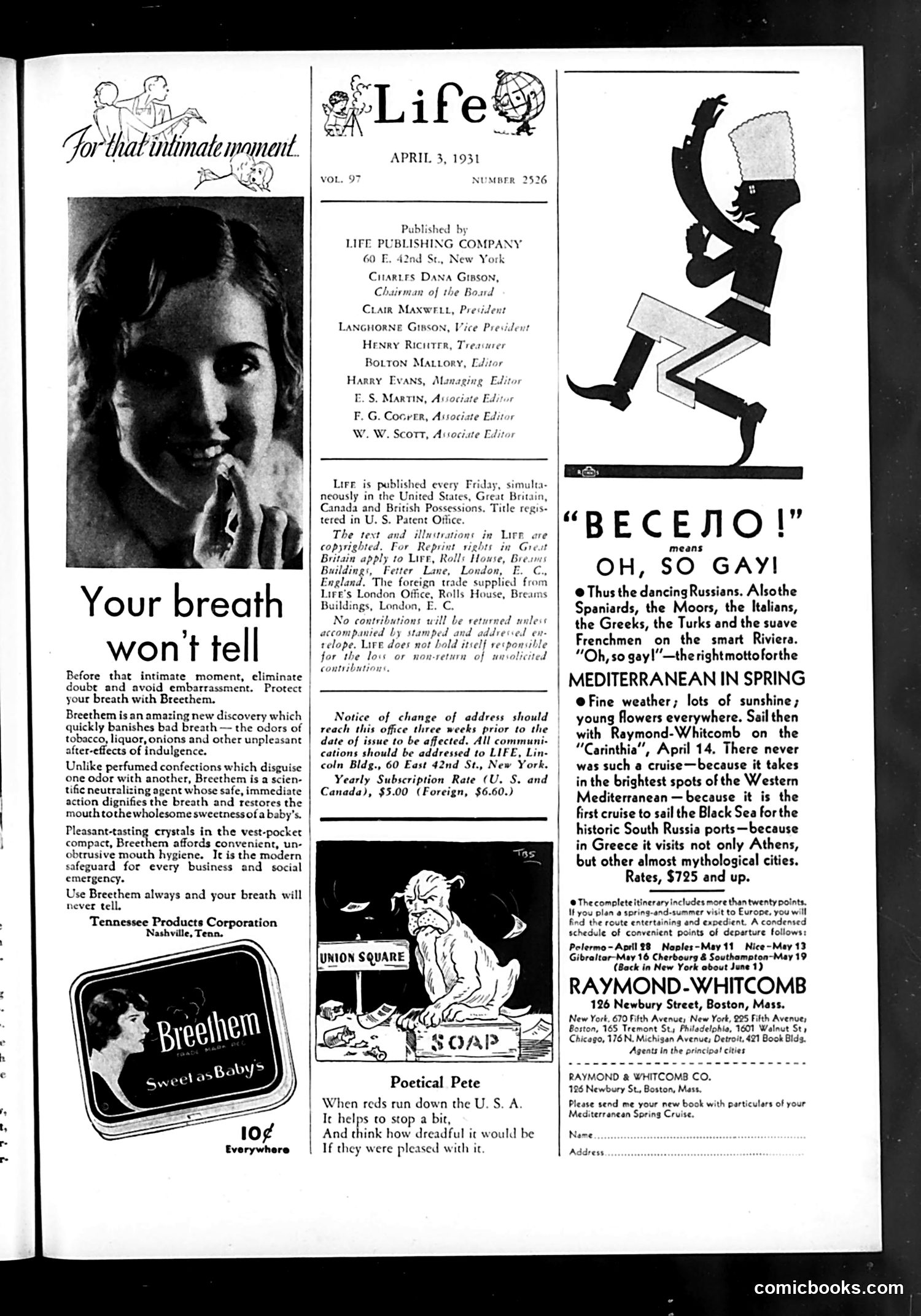
Content Analysis: Life Magazine, April 3, 1931 This is primarily a title/contents page with advertisements rather than satirical cartoons. The main visual content includes: 1. "Your Breath Won't Tell" - A Breethem breath mint advertisement emphasizing discretion about alcohol consumption, reflecting Prohibition-era concerns (Prohibition ended December 1933, so this is still relevant). 2. "Poetical Pete" - A brief cartoon/poem about stopping red ants, with minimal satirical value. 3. "Beseдo!" Advertisement - A Raymond-Whitcomb cruise line ad featuring a stylized dancing Russian figure (referencing the exoticized "Russian" cultural fascination of the 1930s), promoting Mediterranean spring cruises. The page is dominated by commercial content rather than political or social satire. The Breethem ad's alcohol reference is the only material with contemporary social commentary.
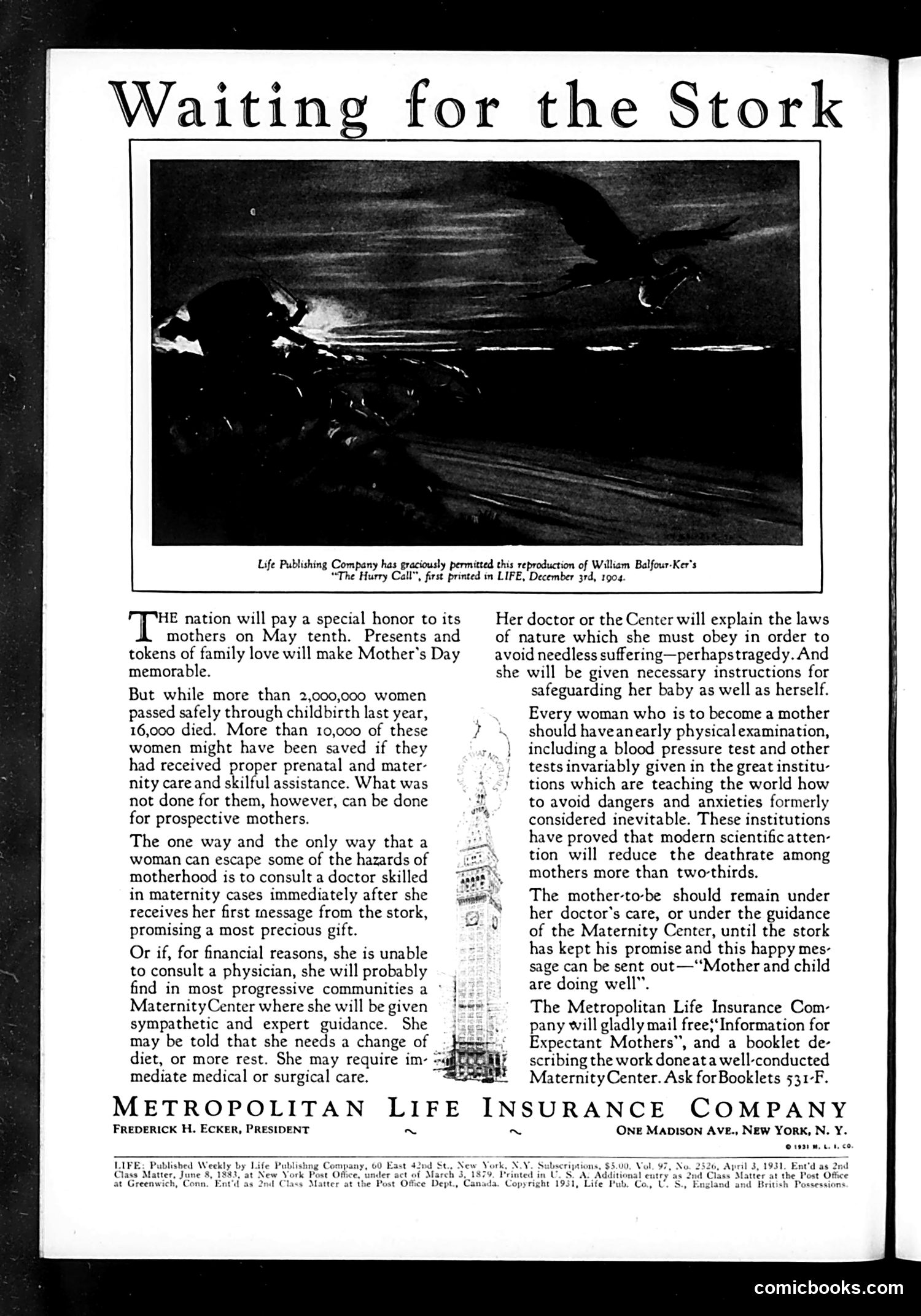
"Waiting for the Stork" - Analysis This page combines a dramatic illustration with a public health advocacy article. The silhouetted image appears to show an anxious figure awaiting childbirth, likely representing expectant parents or mothers. The text addresses maternal mortality—a significant public health crisis of the era. It notes that over 16,000 women died in childbirth the previous year, many preventable through proper prenatal care. The article advocates for medical consultation, physical examinations, and institutional maternity centers, positioning modern medical science as a solution to "hazards of motherhood." The remainder is a Metropolitan Life Insurance Company advertisement offering free maternal health information to "Expectant Mothers," framing insurance and medical care as interconnected services. This reflects early 20th-century corporate involvement in public health messaging.
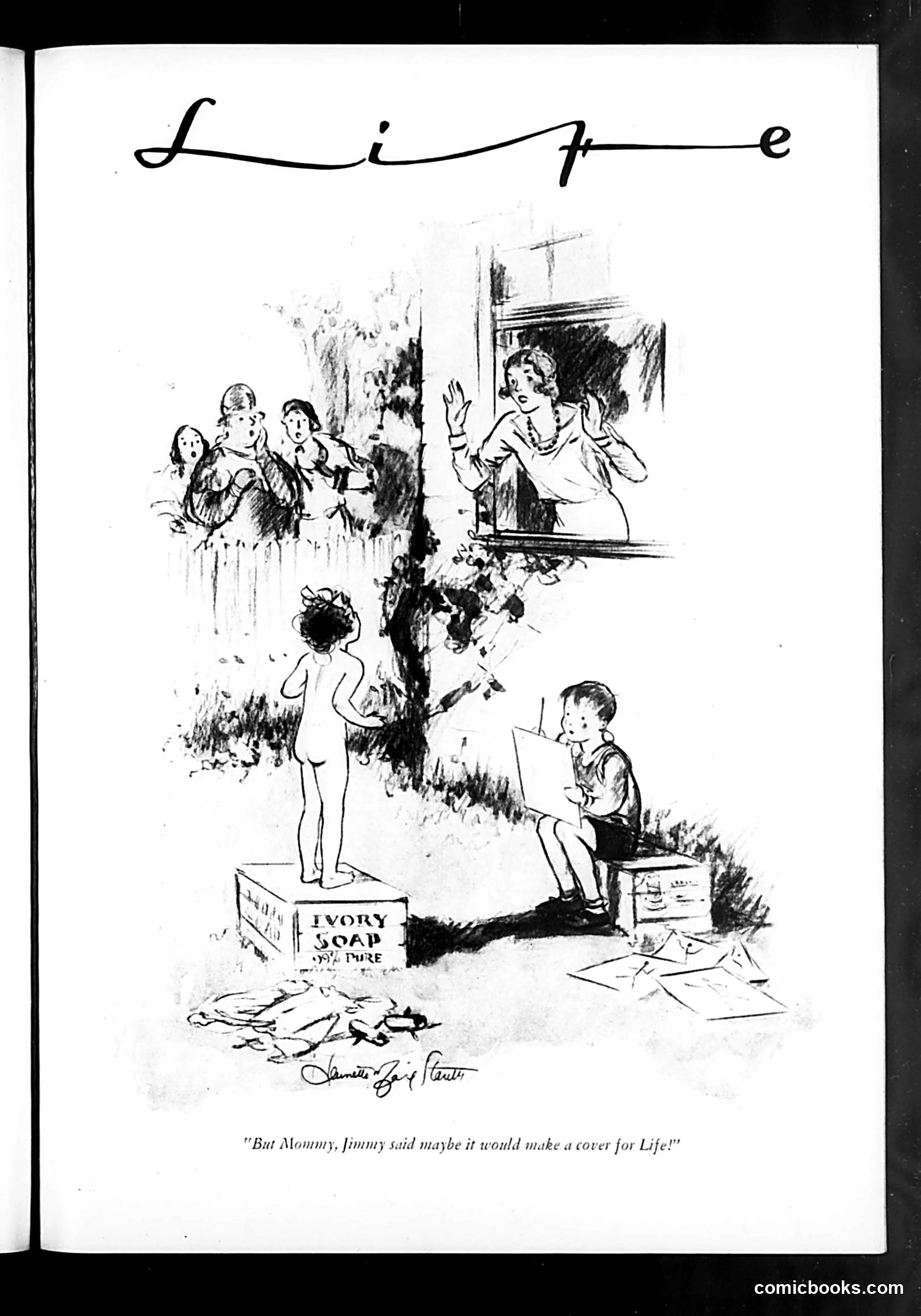
Analysis of "Life" Magazine Cartoon This is an advertisement for Ivory Soap disguised as humor. Two children stand on soap boxes labeled "Ivory Soap - 99⁴⁄₁₀₀ Pure," appearing to perform or give speeches to an audience visible through a window. The caption reads: "But Mommy, Jimmy said maybe it would make a cover for Life!" The joke plays on double meaning: the children are using soap boxes (literal platforms) while also making a pun on "cover"—both a magazine cover and the soap's cleaning/covering properties. It's gentle satire of advertising's use of children and of Life magazine itself, while promoting Ivory's famous "99.44% pure" purity claim. The cartoon suggests even children recognize advertising's pretensions.
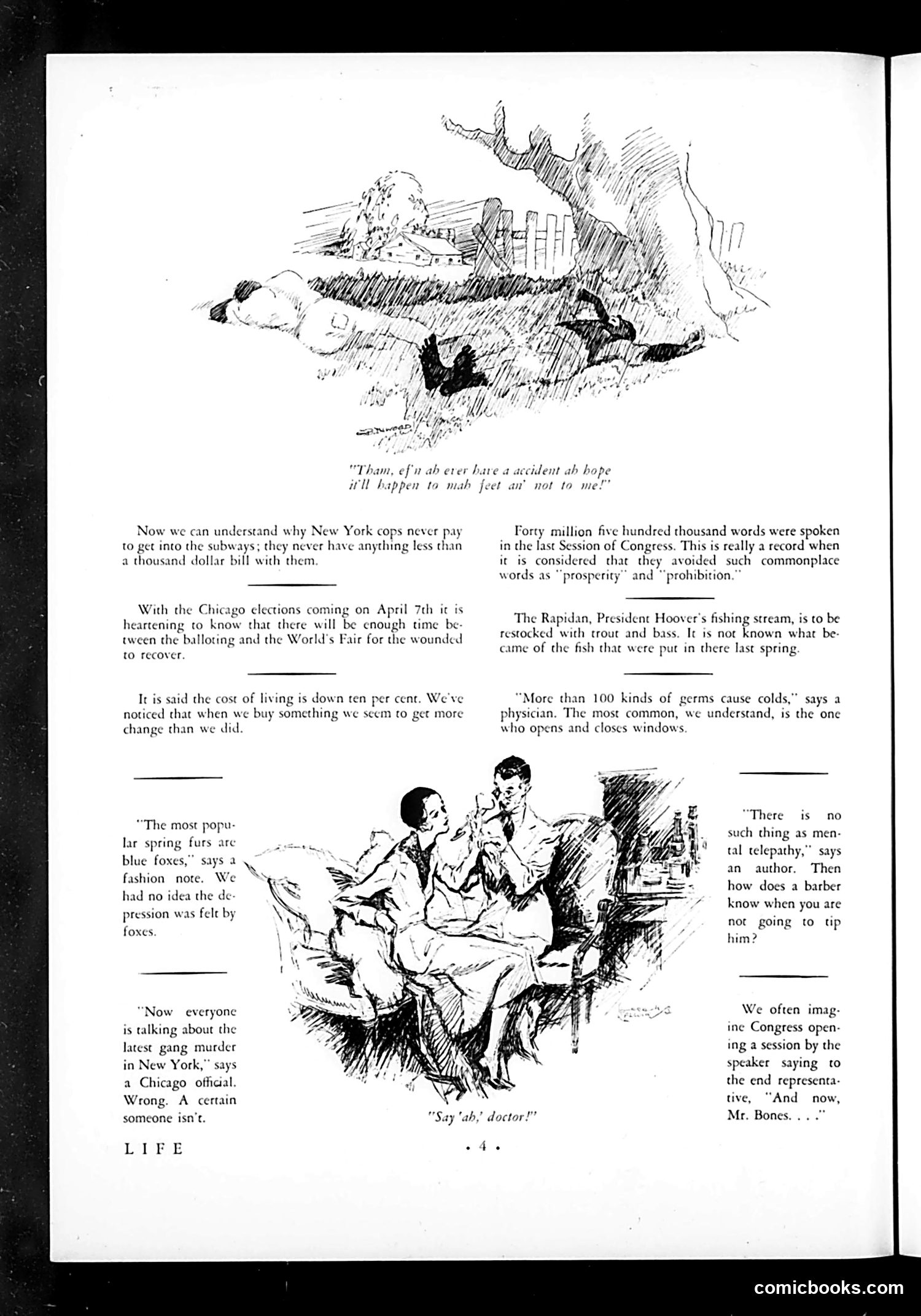
Analysis of Life Magazine Page This satirical page contains several distinct items: Top Cartoon: A rural scene with the quote "Tham, ef u eb eber hae a accident ah hope it'll happen to mah feet an' not to me." The dialect suggests rural/working-class commentary, likely mocking folk wisdom about accidents. Central Cartoon ("Say 'ah,' doctor!"): Shows two men—apparently a doctor and patient in consultation. The satire likely concerns medical practice or diagnosis, though the specific reference is unclear. Text Sections: Brief satirical commentary on contemporary issues including New York police corruption, Chicago elections, cost of living, spring fashions (blue foxes), Congress proceedings, the Rapidan (Hoover's fishing stream), cold transmission, and tipping etiquette for barbers. The page exemplifies *Life*'s typical format: mixing visual and textual humor targeting current events and social pretensions.
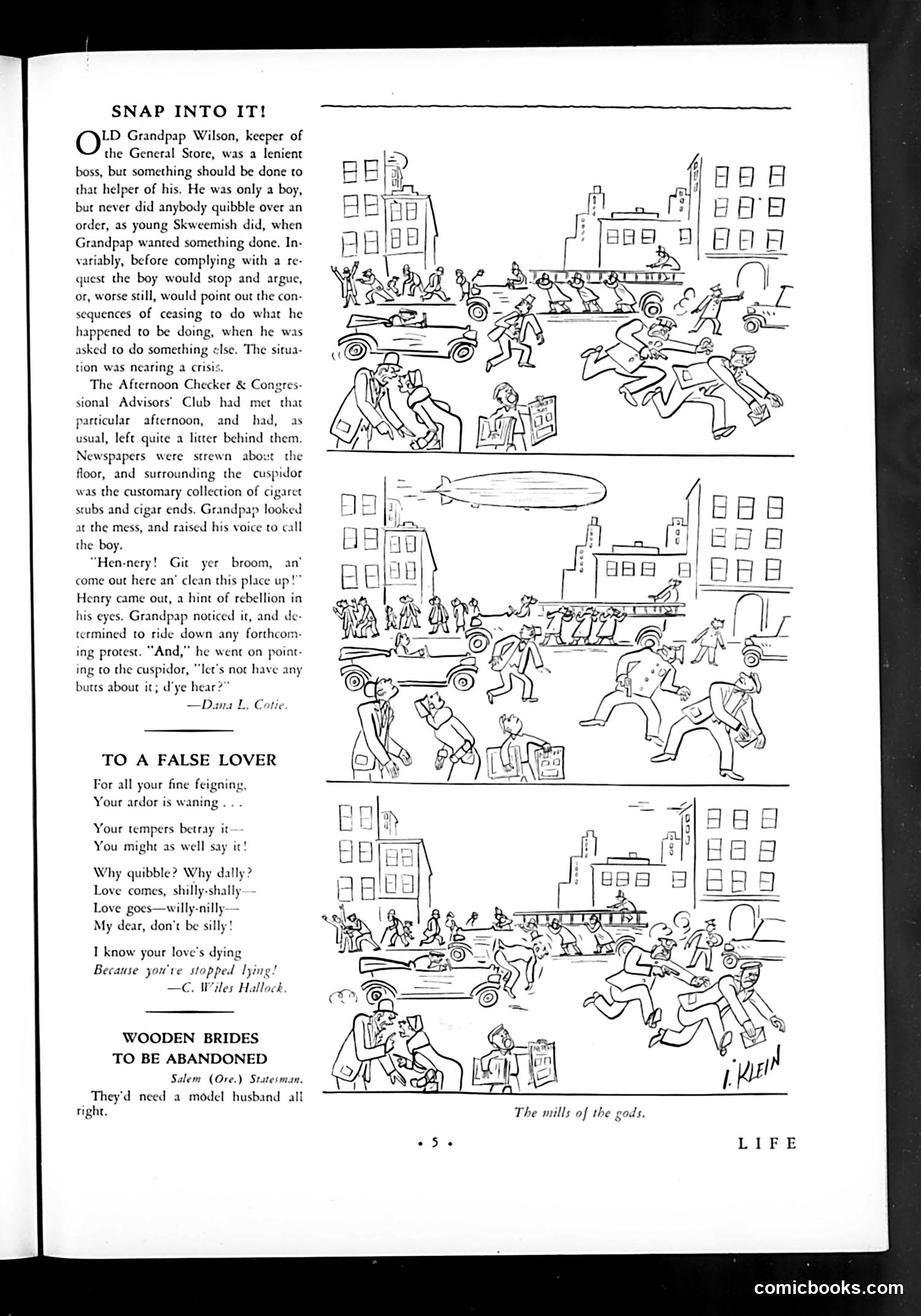
"Snap Into It!" - Satire of Store Management This comic strip by Riffin satirizes Old Grandpap Wilson, the lenient manager of a General Store, and his conflicts with a boy named Skeweemish (or similar). The story describes how Grandpap never quibbles over orders but also never complies quickly, causing frustration. The narrative mentions an "Afternoon Checker & Congressional Advisers' Club" meeting where newspapers cover the store floor alongside cigar stubs—suggesting both administrative chaos and slovenly conditions. Grandpap orders the boy to clean up ("Git yer broom"), but the boy protests. Grandpap threatens to "rule down any forthcoming protest," determined to impose discipline. The strip humorously depicts the clash between relaxed management and the need for actual workplace standards—a common workplace complaint regardless of era.
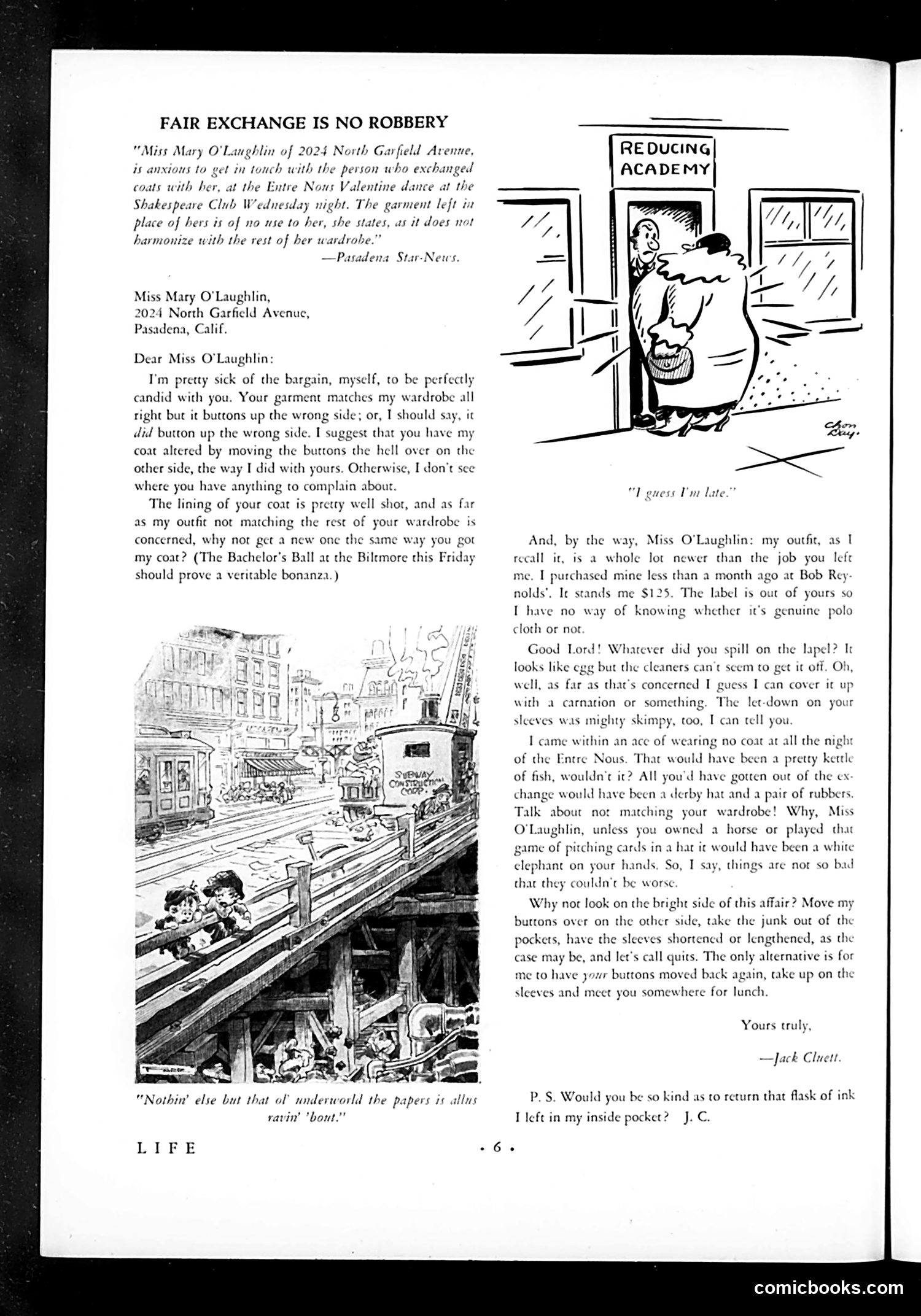
Analysis This page contains a humorous letter exchange about a clothing swap gone wrong. Miss Mary O'Laughlin of Pasadena exchanged a garment at an "Entre Nous Valentine dance" at the Shakespeare Club, but it didn't match her wardrobe—the buttons were on the wrong side and the lining didn't suit her outfit. Jack Cluett's response is tongue-in-cheek: he suggests she simply move the buttons rather than complain, jokes about worse fashion mishaps (stains, mismatched wardrobes), and proposes they meet for lunch to resolve things. The cartoons illustrate the mild social embarrassment of the mix-up. The satire gently mocks both the fussiness of fashion-conscious socialites and the casual dismissiveness of someone unbothered by wardrobe coordination—typical of Life magazine's mild social commentary on upper-class etiquette.
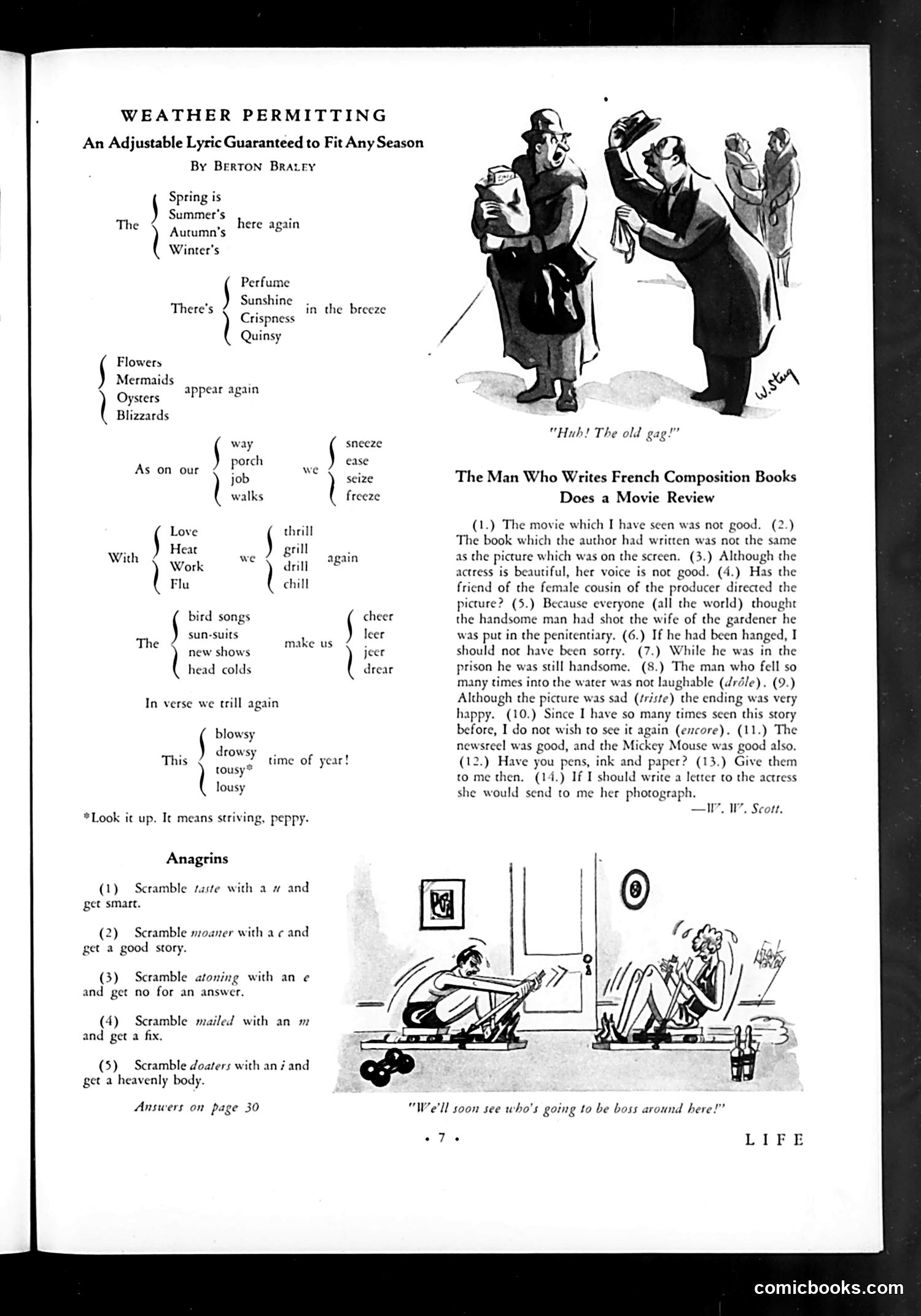
Analysis of Life Magazine Page 7 This page contains three humor pieces: 1. "Weather Permitting" by Berton Braley is a comic poem using fill-in-the-blank structure, allowing readers to insert seasonal words (Spring/Summer/Autumn/Winter) to make the verse adaptable year-round—a clever meta-joke about adjustable humor. 2. "The Man Who Writes French Composition Books Does a Movie Review" satirizes awkwardly literal translations. It lists numbered observations (like "Hah! The old gag!") that mimic stilted, grammar-textbook phrasing, mocking how foreign language instructional books produce unnatural English. 3. "Anagrins" presents word-scramble wordplay exercises. The bottom cartoon shows someone using exercise equipment while another figure arrives, captioned "We'll soon see who's going to be boss around here!"—suggesting domestic hierarchy concerns through fitness activity.
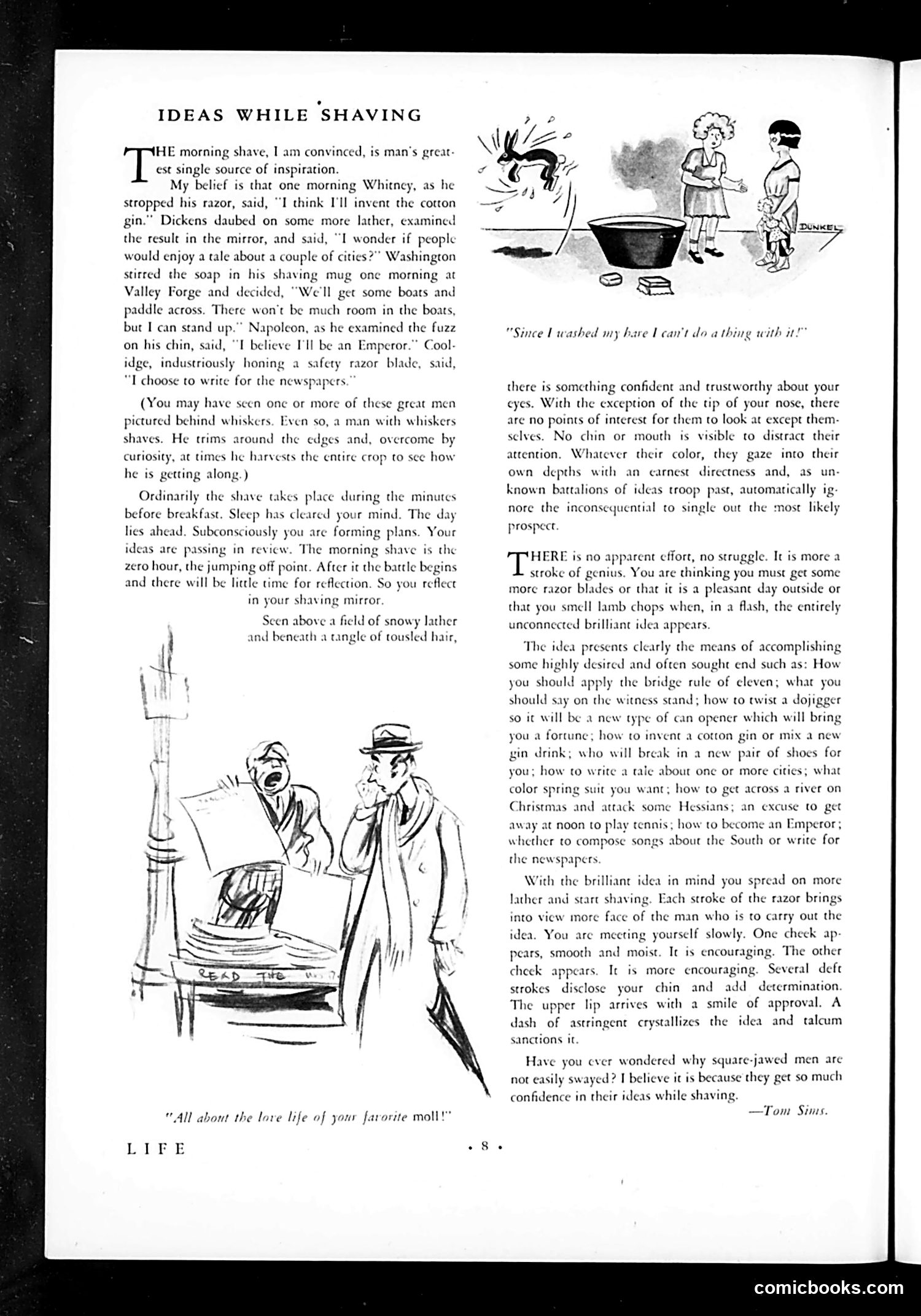
Analysis of "Ideas While Shaving" This is a humorous essay by Tom Sints about the creative inspiration men experience during their morning shave. The text references historical figures—Eli Whitney (cotton gin inventor), Dickens, Washington, Napoleon, and Coolidge—as examples of great men who had important ideas while shaving. The accompanying cartoons illustrate the theme: one shows a woman saying "Since I washed my hair I can't do a thing with it," while another depicts two men discussing "All about the love life of your favorite moll!" The piece humorously suggests that shaving provides men psychological clarity for creative thinking, contrasting their "confident" demeanor during this ritual with everyday uncertainty. It's a lighthearted commentary on masculine grooming habits and self-confidence.
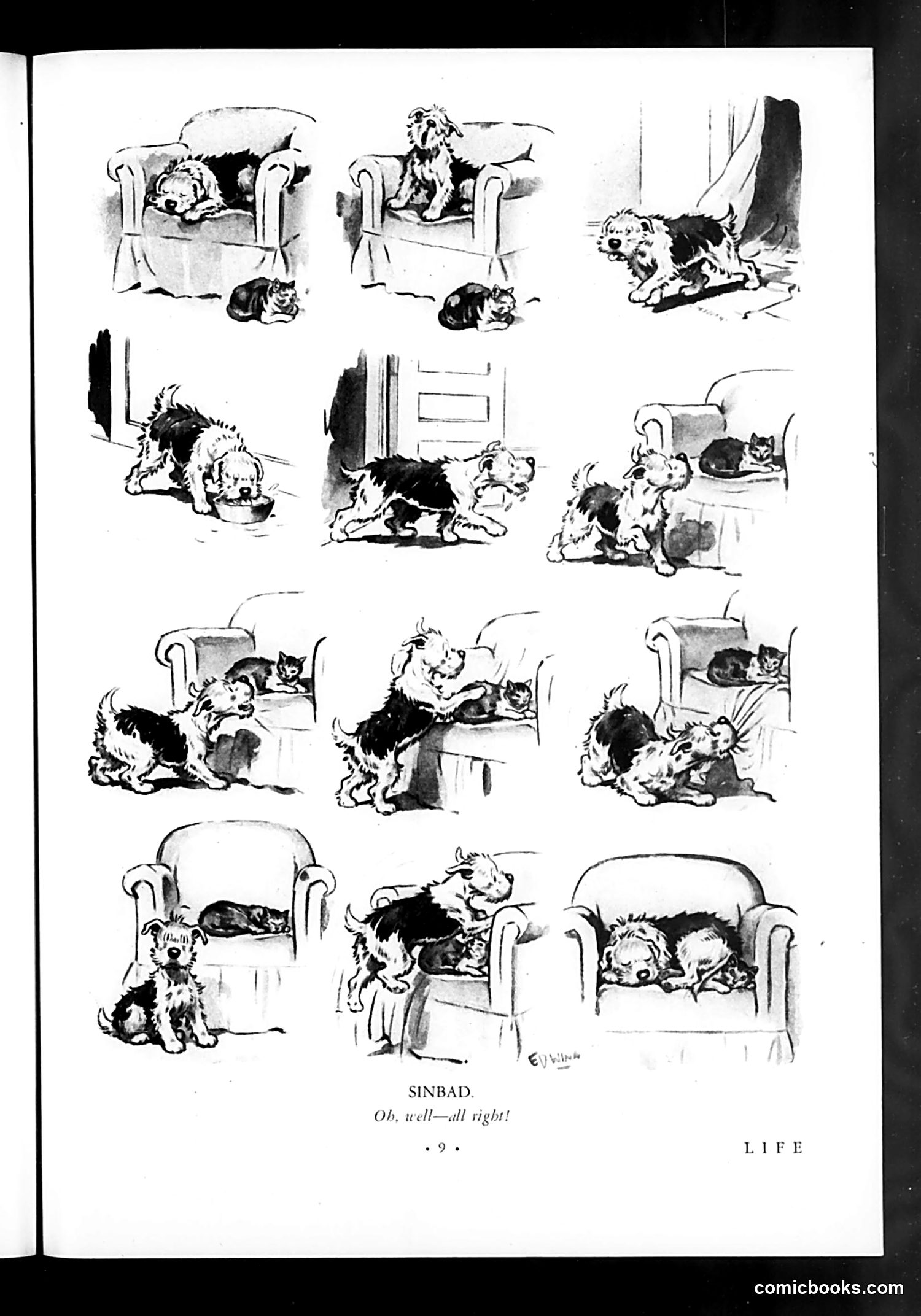
"Sinbad: Oh, well—all right!" This is a humorous comic strip showing a dog named Sinbad interacting with a cat across twelve panels. The narrative appears to depict a domestic dispute or negotiation between the two pets, culminating in apparent reconciliation on furniture. The title "Oh, well—all right!" suggests Sinbad (the dog) reluctantly agrees to something—likely cohabitation or peaceful coexistence with the cat. The comic plays on the common trope of dogs and cats as natural enemies, here shown learning to share living space and furniture. This appears to be gentle domestic humor rather than political satire, typical of Life magazine's lighter content. It celebrates the animals' eventual tolerance of one another, a relatable scenario for pet-owning readers of the era.
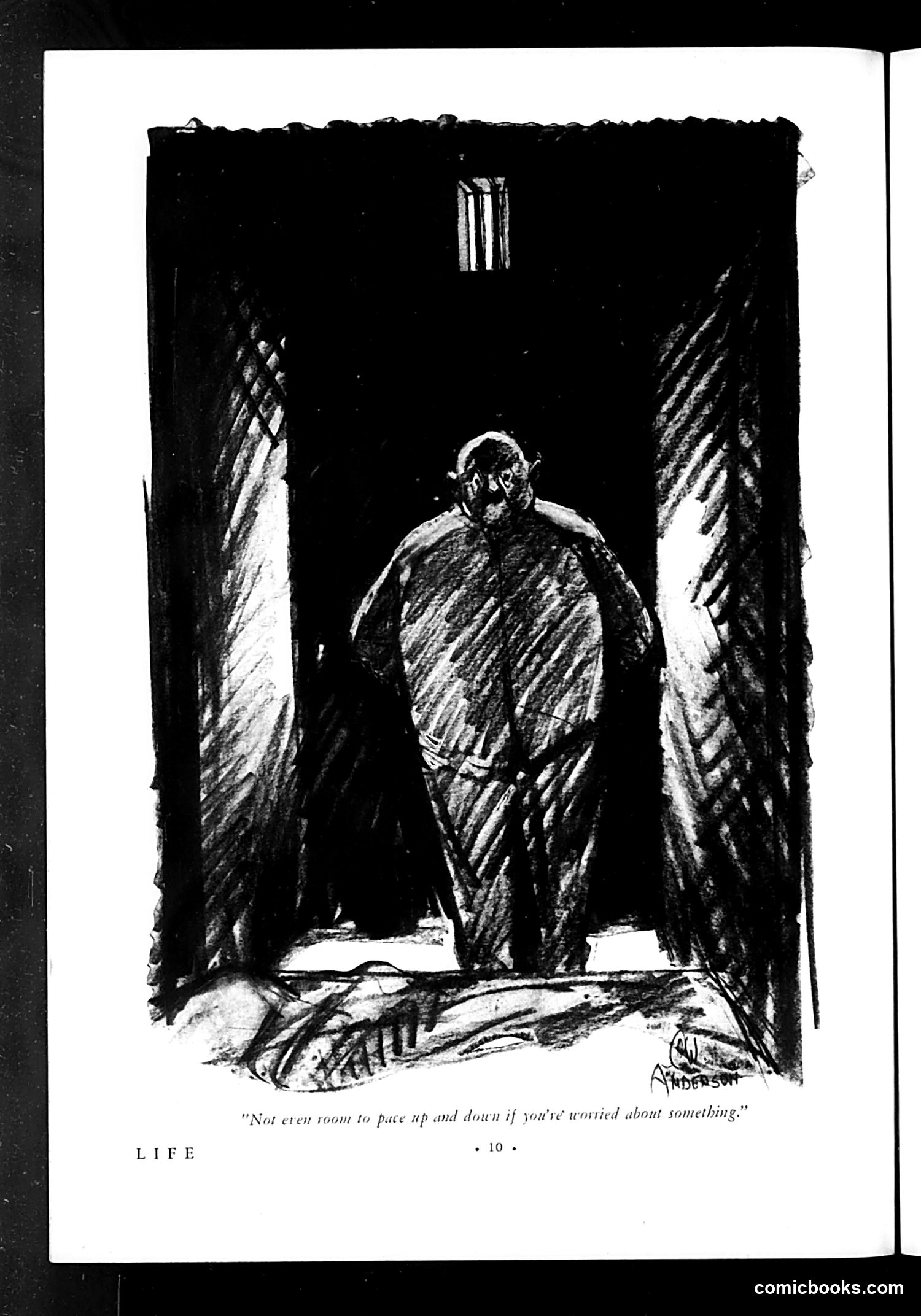
Analysis This is a single-panel cartoon signed by Anderson, appearing in *Life* magazine (page 10). It depicts a figure standing in a narrow, prison-like corridor or hallway with high walls and barred window, looking troubled or distressed. The caption reads: "Not even room to pace up and down if you're worried about something." The satire appears to be about confinement and anxiety—suggesting that worry itself requires physical space and freedom of movement. The cartoon satirizes either literal imprisonment or metaphorical constraint (possibly job stress, financial hardship, or domestic suffocation given the era). The joke's dark humor lies in the grim irony that the worried person is so confined they cannot even perform the nervous habit of pacing. The specific social or political context remains unclear without additional dating or historical markers.
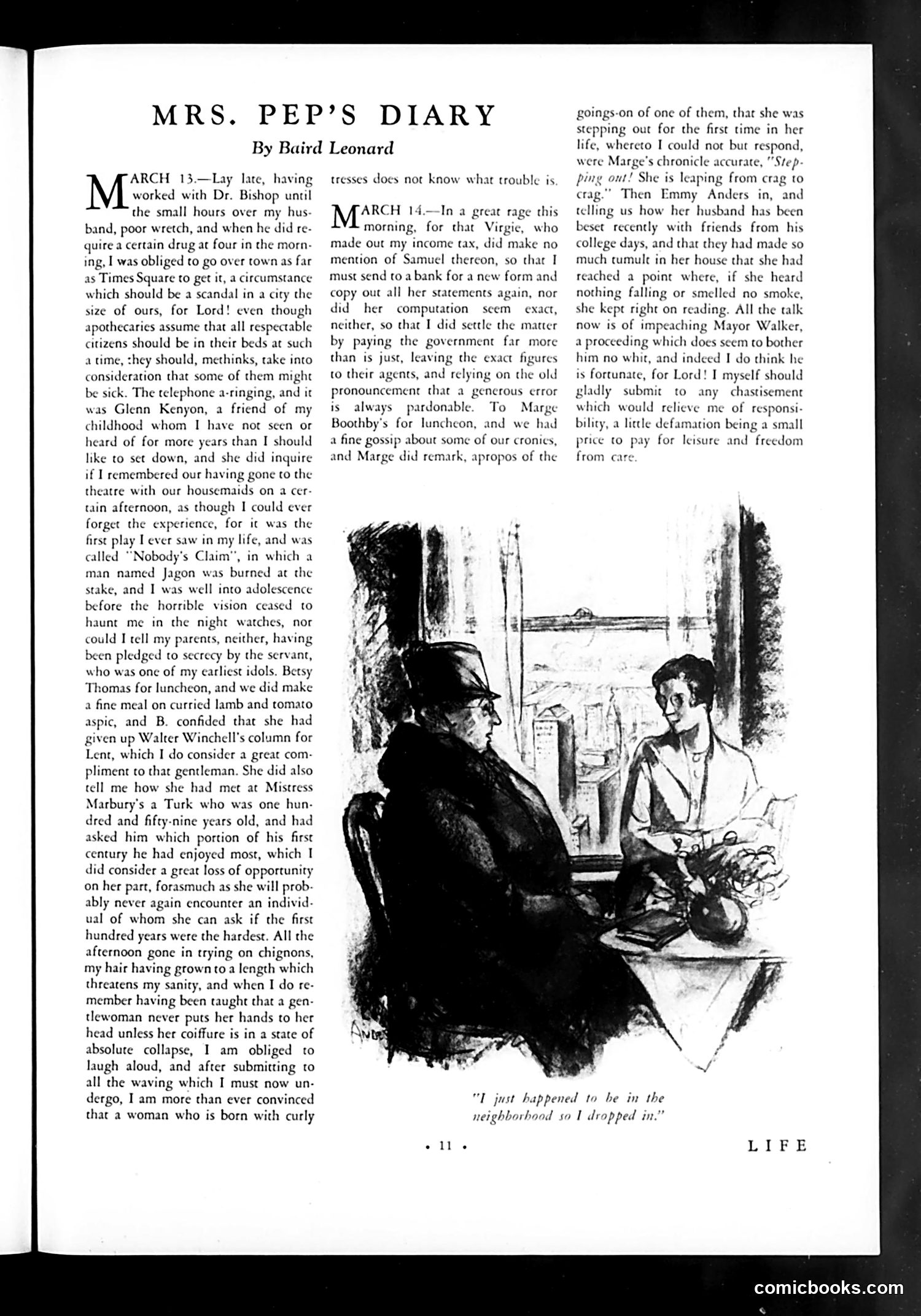
"Mrs. Pep's Diary" by Baird Leonard This is a humorous domestic diary entry satirizing middle-class life and women's concerns. The March 13-14 entries mock: 1. Marital frustration: The narrator's husband is a "poor wretch" who creates household chaos 2. Tax anxiety: Anxiety over Samuel Thereon (likely a tax agent) and government billing errors 3. Social pretension: References to theater outings and lunch with "Marge Boothby" 4. Hair vanity: An extended complaint about trying on chignons (hairpieces), joking that women with curly hair are inherently superior The accompanying illustration shows two women in conversation, with the caption "I just happened to be in the neighborhood so I dropped in." The satire targets upper-middle-class women's trivial preoccupations, domestic complaints, and social visiting routines—common targets of Life magazine's gentle mockery of American society.
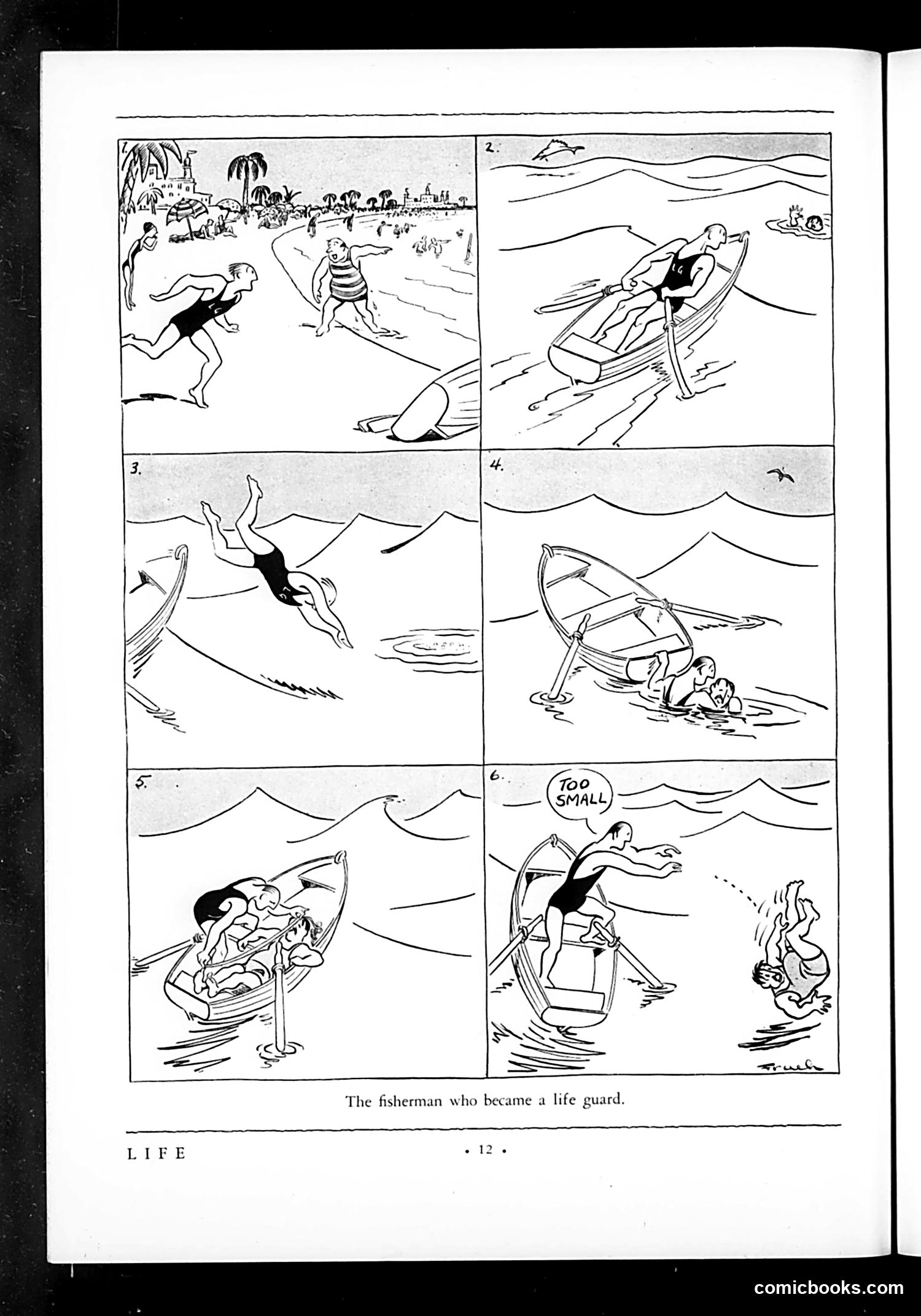
"The Fisherman Who Became a Life Guard" This is a humorous six-panel comic strip with a straightforward narrative arc, not political satire. It depicts a progression: Panels 1-2 show a fisherman at a beach resort; panel 3, him diving into the water; panels 4-5, him rescuing drowning people from capsized boats; panel 6, him telling a rescued swimmer "too small"—suggesting he's now evaluating swimmers by size rather than fishing for fish. The joke plays on role reversal: the fisherman has transitioned from catching fish to saving people, yet he maintains his fisherman's mentality of assessment and selection. It's gentle satire about occupational habits persisting despite changed circumstances. The humor relies on this ironic continuation of his previous mindset in a new context.
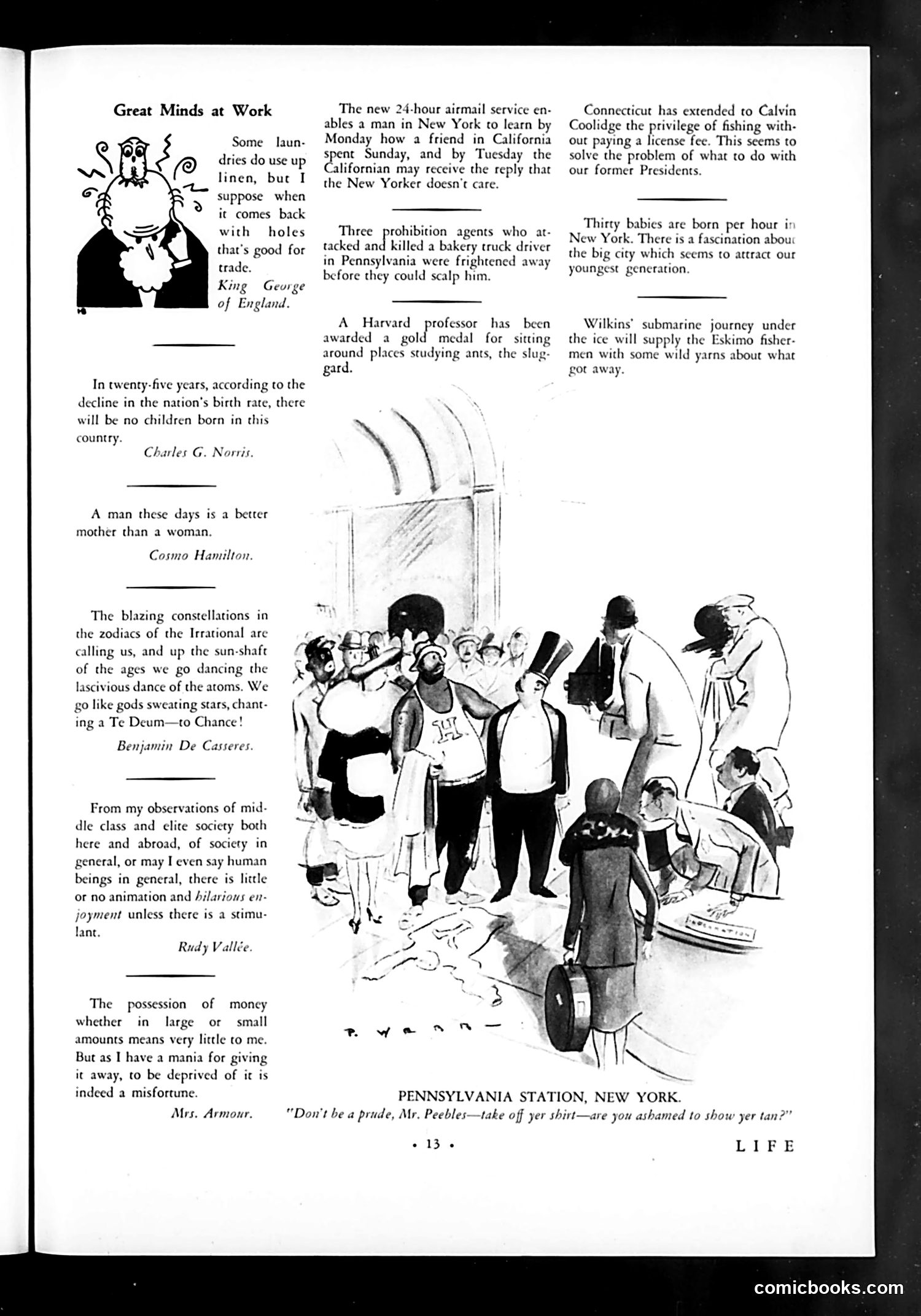
Pennsylvania Station, New York The main cartoon depicts a scene at Pennsylvania Station where a man is being told by another: "Don't be a prude, Mr. Peebler—take off yer shirt—are you ashamed to show yer tan?" The satire appears to target early 20th-century social pretension around tanning and leisure. At this era, a tan indicated wealth and leisure time (ability to vacation), contrasting with earlier eras when paleness signified refinement. The joke mocks both Mr. Peebler's modesty and the nouveau-riche eagerness to display vacation status through tanned skin—suggesting tackiness in this ostentatious behavior. The surrounding "Great Minds at Work" section collects humorous quotations on contemporary topics like air mail, birth rates, and gender roles, representing typical Life magazine satirical commentary on 1920s American society.
"Life Looks About" - Page Analysis This page from *Life* magazine features a column discussing notable figures and social commentary. The small illustration at top left shows a cherubic figure (likely representing Life magazine's mascot) in a dynamic pose. The text praises Einstein for his simplicity and kindness despite his intellectual stature. It discusses Bernard Shaw's visit to America, questioning whether his discourse comes from Shaw himself or interviewer Kathleen Woodward. The column expresses skepticism about inviting Shaw to the U.S., humorously suggesting figures like Kipling and Dean Inge shouldn't visit either. The pieces on "Necessity," "Two Great Men" (Holmes and James), and the final section on money and families appear to be editorial commentary on contemporary American social issues and prominent intellectual figures of the era.
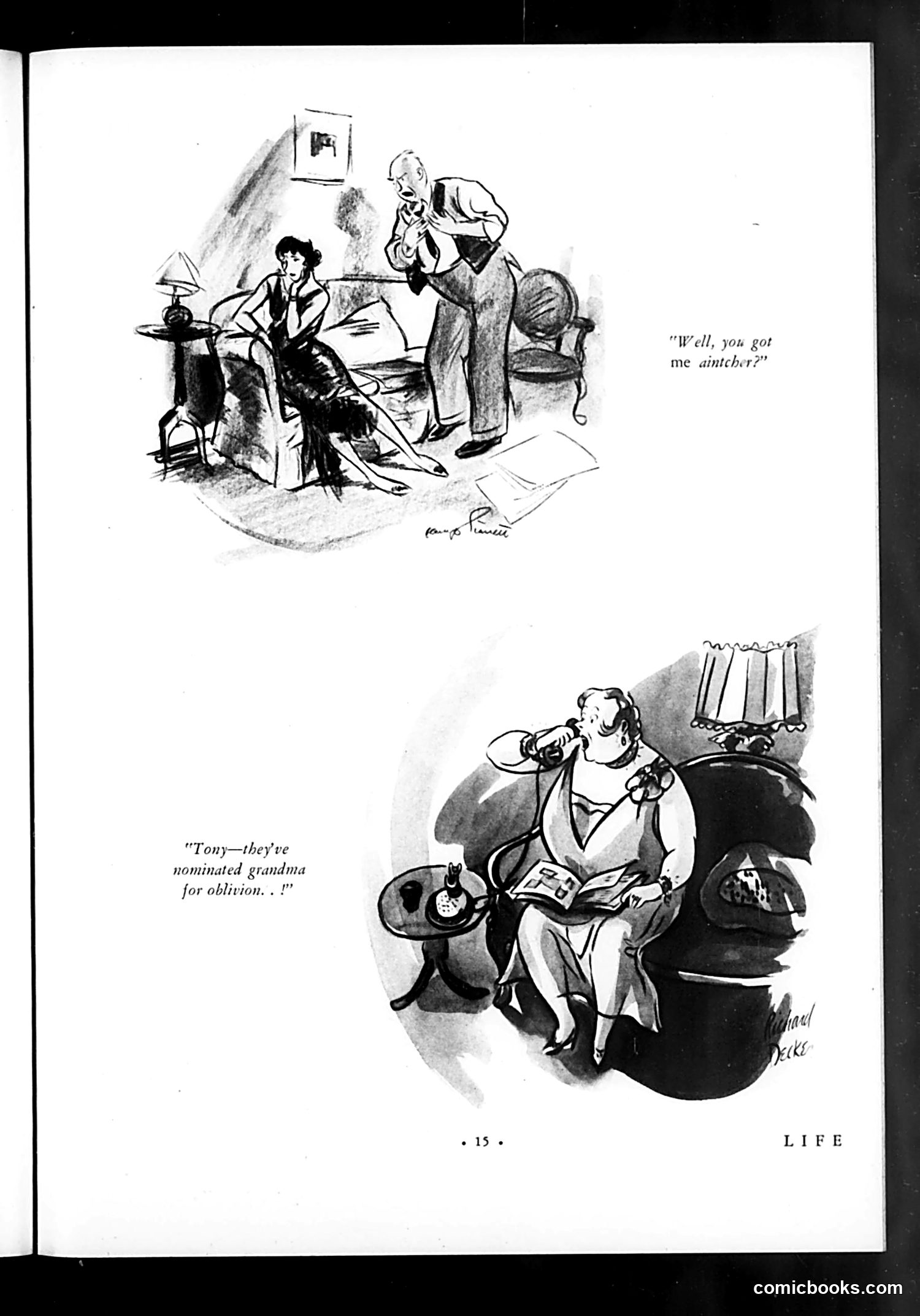
Analysis This page contains two satirical cartoons from *Life* magazine, likely from the mid-20th century based on the style. Top cartoon: A man asks a woman sitting at a desk, "Well, you got me airtight?" The setup appears to mock marital or romantic negotiation—suggesting the woman has trapped or cornered the man into some commitment or agreement. Bottom cartoon: A woman on a telephone excitedly tells someone named Tony, "They've nominated grandma for oblivion...!" The joke satirizes either a beauty pageant, award, or public recognition of some kind, with the absurdist humor being that "grandma" (an elderly woman) has been selected for something ridiculous. "Oblivion" likely means obscurity or irrelevance, making the nomination darkly comic. Both cartoons use domestic scenarios to mock social conventions around relationships and status-seeking.
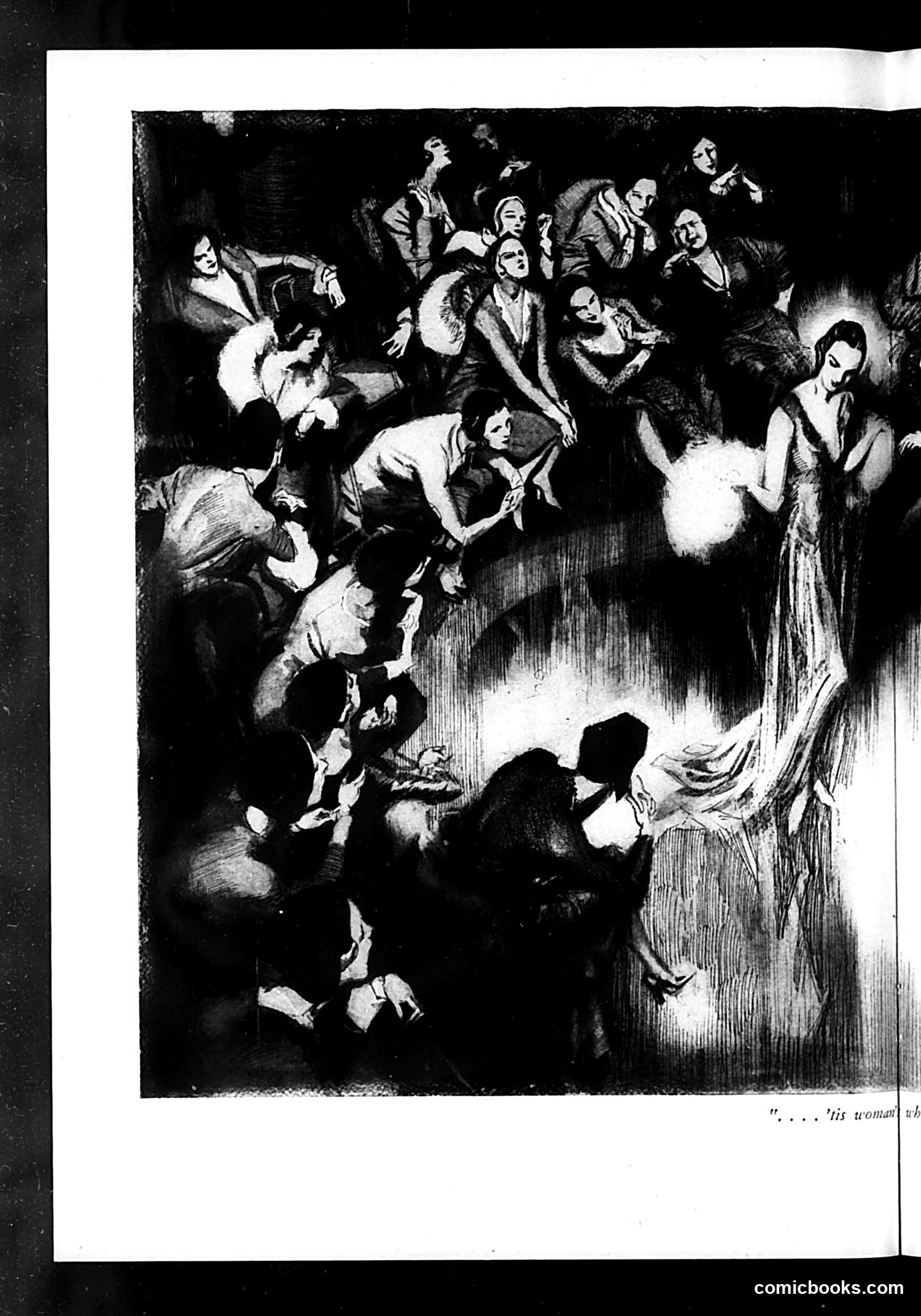
Analysis This appears to be a dramatic theatrical or supernatural scene rather than a political cartoon. The black and white engraving shows a large crowd of figures gathered around what seems to be a spiritual or mystical apparition on the right side of the image—a luminous female figure in flowing robes. The OCR text fragment ("his woman wh") is too incomplete to identify the specific reference. Based on the style and Life magazine's satirical nature, this likely lampoons contemporary spiritualism or séance culture, which was popular and often exposed as fraudulent in the late 19th/early 20th century. The chaotic crowd reactions—some reaching forward, others recoiling—suggest skepticism toward the "supernatural" display, consistent with debunking satire of that era.
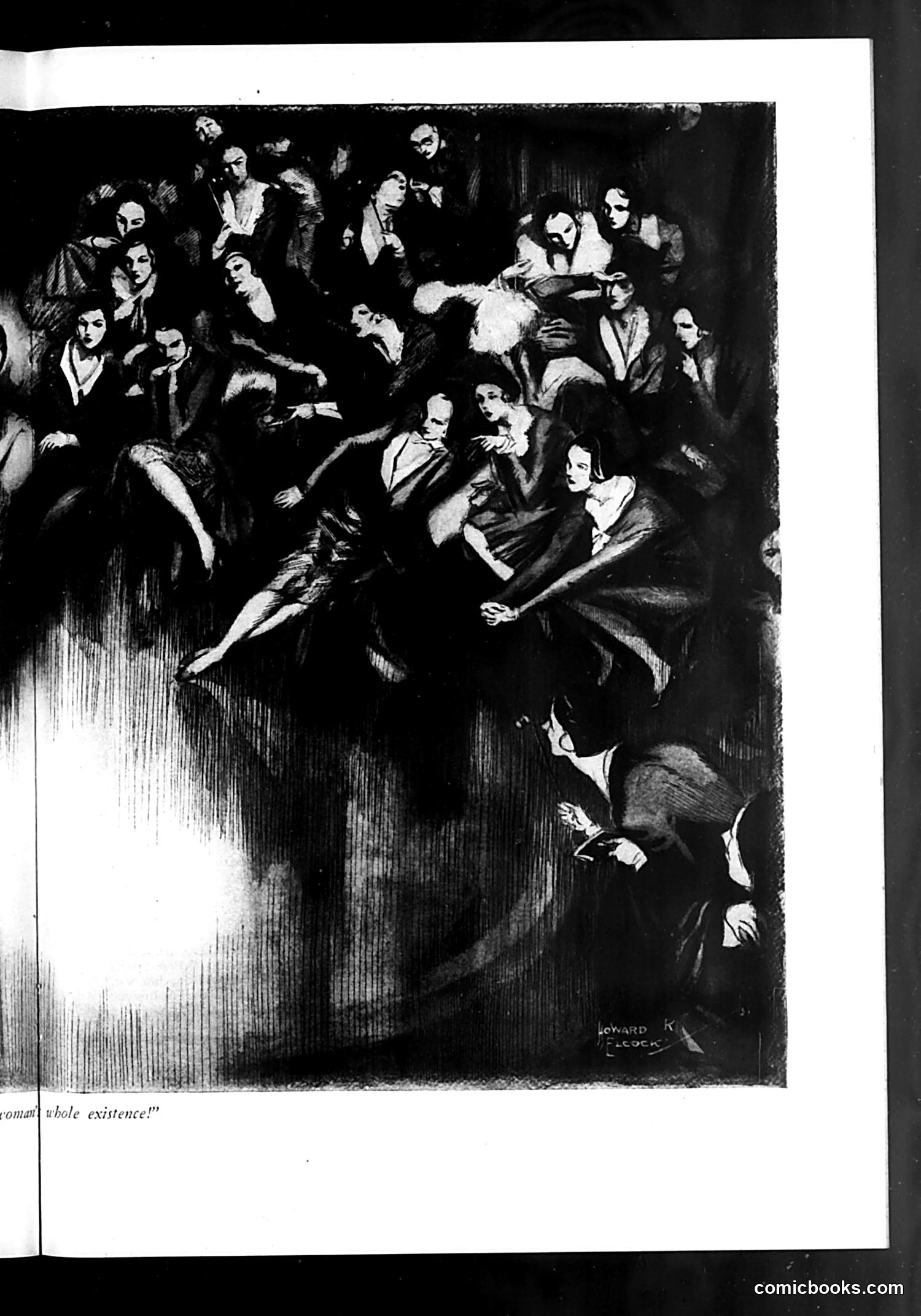
Analysis This appears to be a satirical illustration by Edward Penfield showing a crowded social gathering or nightclub scene. The sketch depicts numerous well-dressed figures in 1920s-style clothing gathered in what seems to be an indoor venue, with dramatic shadowing typical of period entertainment illustration. The partial caption visible reads "...woman's whole existence!" suggesting social commentary about women's roles or behavior during this era. Without the complete text context, the specific satirical target remains unclear—whether this critiques high society gatherings, Jazz Age culture, women's social participation, or another contemporary issue. The crowded composition and exaggerated expressions suggest mockery of fashionable social pretension typical of Life magazine's satirical approach during the early 20th century.
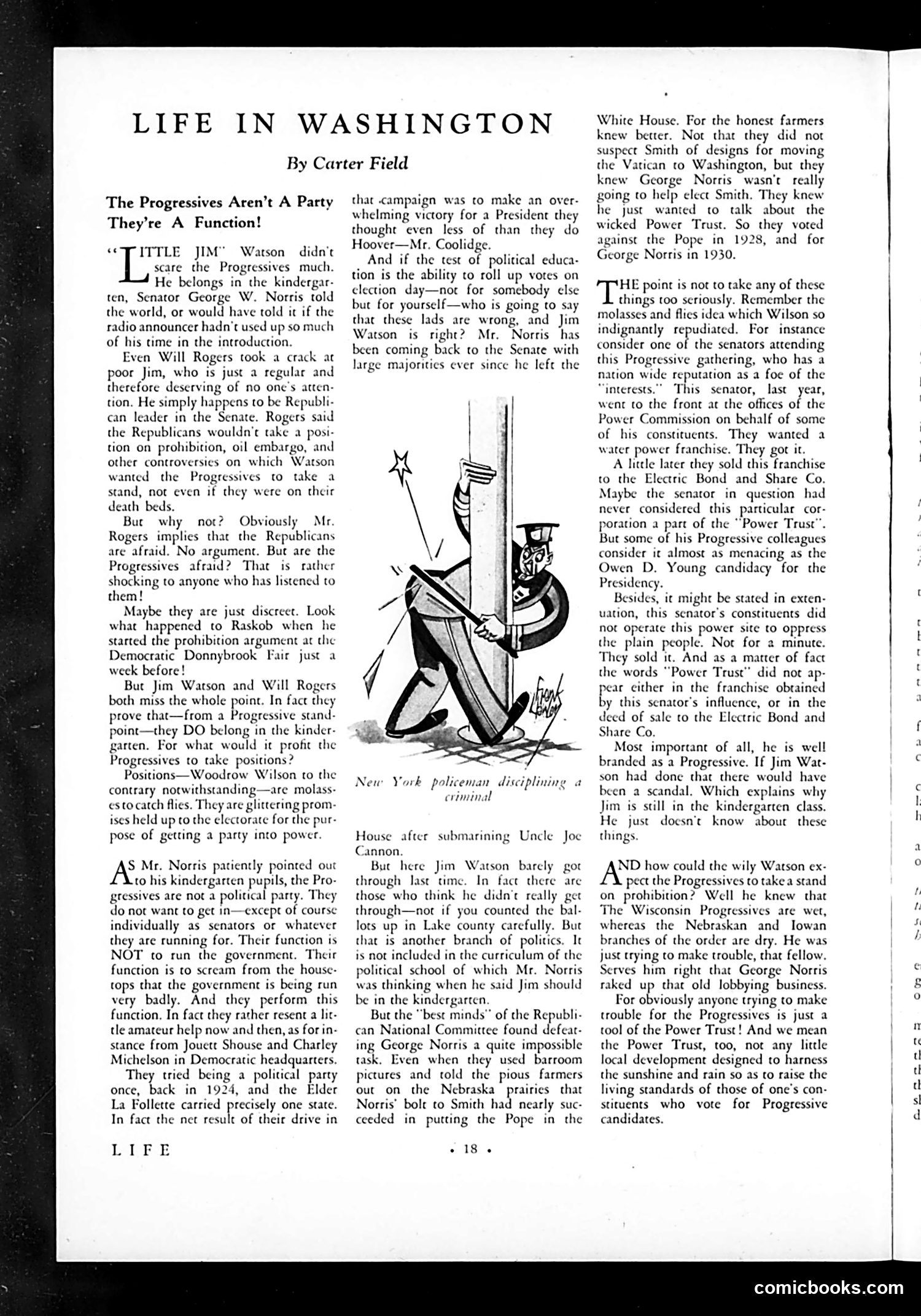
Political Cartoon Analysis This 1930s Life magazine page by Carter Field satirizes the Progressive Party's political inconsistency. The cartoon shows a policeman disciplining a criminal—illustrating Field's argument that Progressives claim to oppose the "Power Trust" (large corporations) yet their actions contradict this stance. The article criticizes Senator George Norris and other Progressives for failing to act on their stated principles. Field points out that while Progressives publicly campaign against corporate monopolies and the "Power Trust," they've actually supported or benefited from dealings with these same entities—revealing what Field sees as hypocrisy between their rhetoric and behavior. The cartoon's "disciplining" image reinforces this theme of inconsistency and accountability.
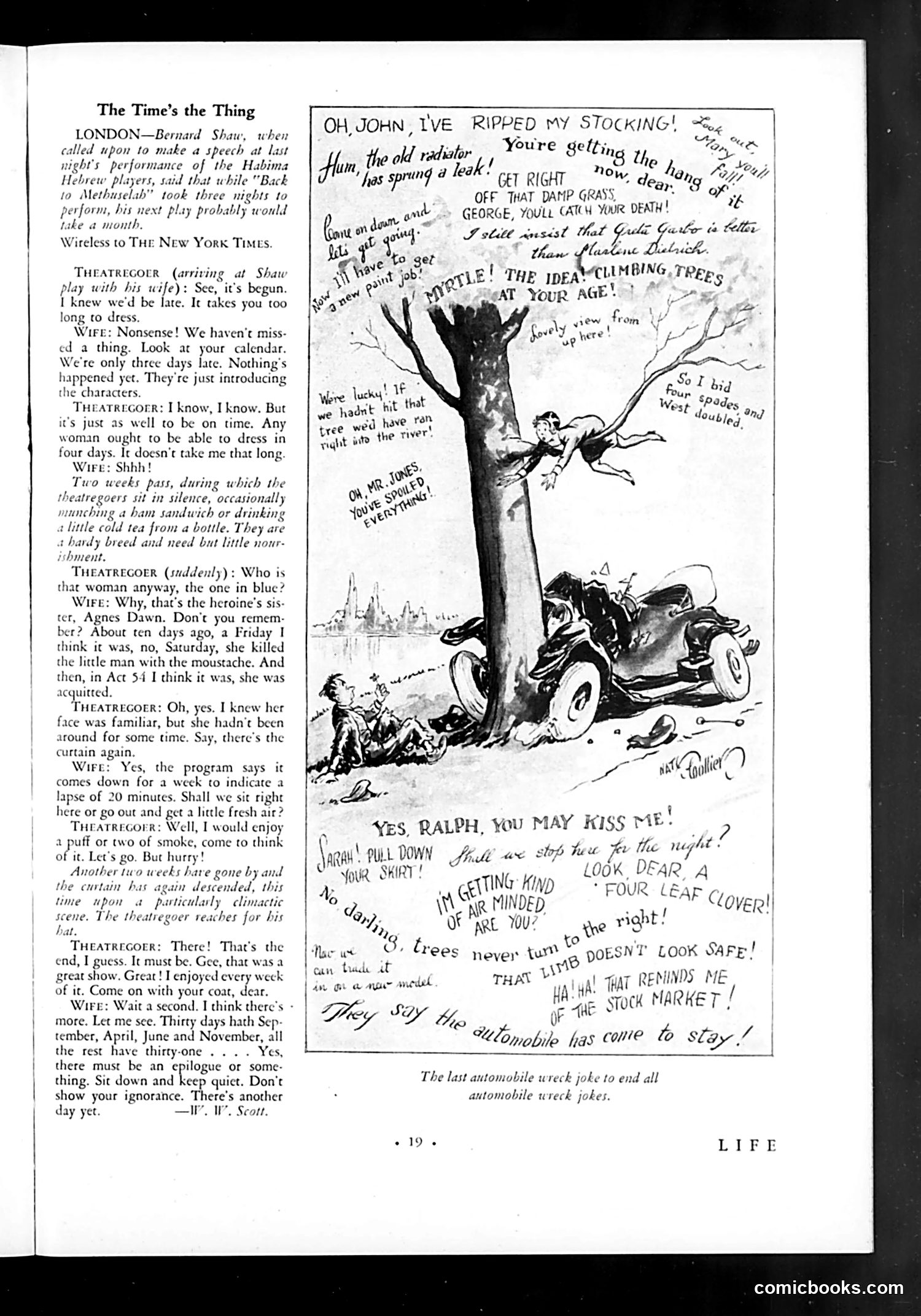
Commentary on "The Time's the Thing" This page satirizes two distinct targets: Left column: A lengthy dialogue mocking Bernard Shaw's notoriously long plays. The joke plays on Shaw's recent comment that his next play would take a month to perform (referencing his actual play "Back to Methuselah"). The sketch imagines theatergoers arriving three days late to a Shaw play, discovering nothing has happened—characters are still being introduced. Over "two weeks," an audience member learns the plot occurred "ten days ago." The satire: Shaw's plays are so verbose and slow-moving that attending feels like serving a sentence. Right side: An illustrated automobile crash joke showing a wrecked car against a tree. The surrounding dialogue parodies domestic squabbles (ripped stockings, cold radiators, marital banter about kissing and propriety). The caption explicitly states this is "the last automobile wreck joke to end all automobile wreck jokes"—a self-aware acknowledgment that such jokes had become exhausted clichés in early 20th-century humor. Both target entertainment excess and tired comedic conventions of the era.
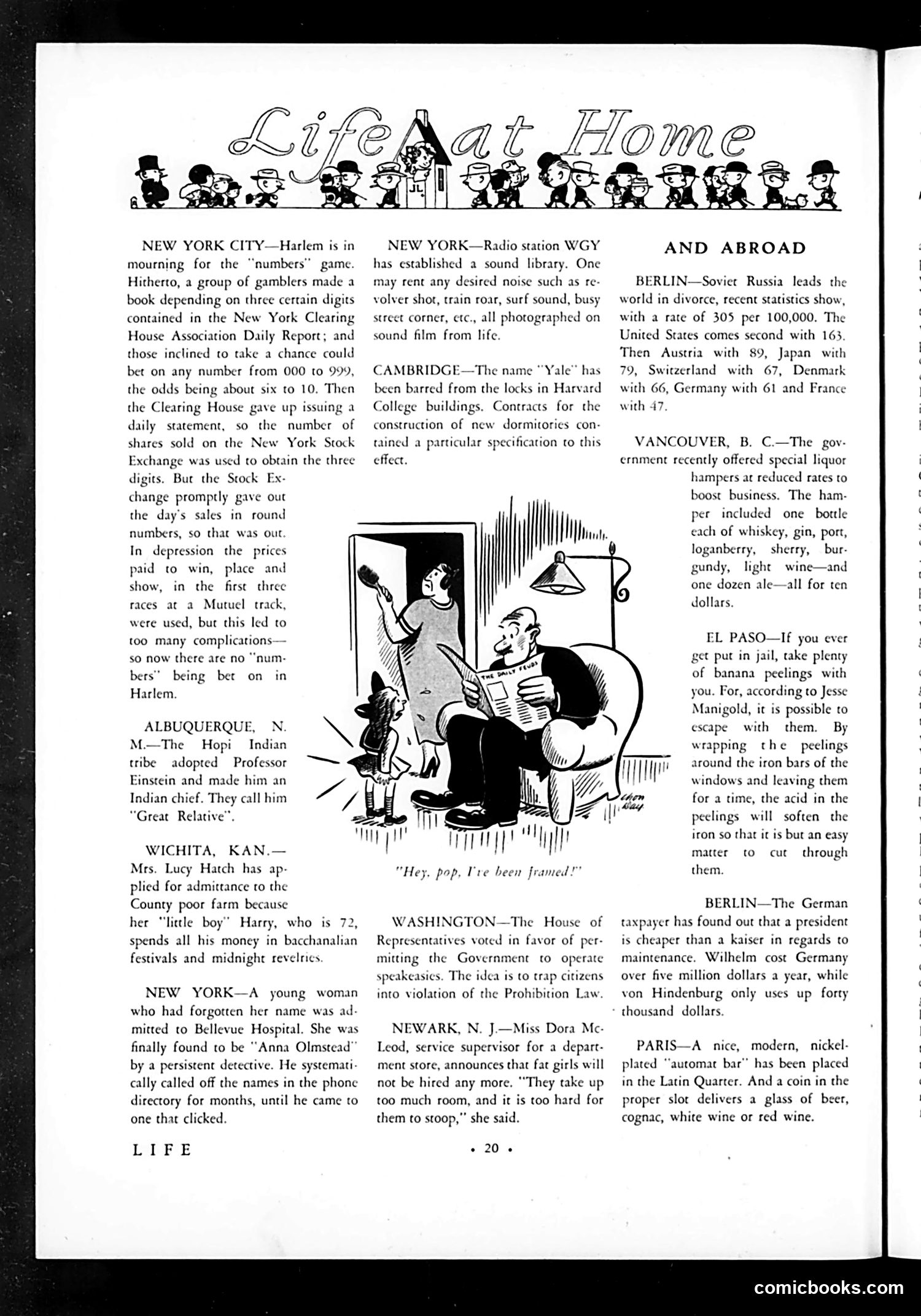
Life Magazine Page Analysis This page from Life magazine (likely 1920s-30s) collects humorous news briefs mixing domestic Americana with international observations. The prominent cartoon depicts a man reading a newspaper while a woman waves a frying pan, captioned "Hey, pop, I've been framed!" — a visual pun on the newspaper ("framed" as displayed) and marital discord. Key satirical content: - Harlem numbers game: Mockingly describes illegal gambling's collapse when authorities change reporting methods - Prohibition: Jokes that the government would operate speakeasies to "trap citizens" into violation - International divorce rates: Lists Soviet Russia leading with 305 per 100,000, positioning communist society as morally chaotic - Einstein: Notes the Hopi adopted him as "Great Relative" — gentle ethnic humor - Prison escape: Suggests banana peels can soften iron bars — absurdist humor The page reflects Depression-era sensibilities: cynical about government, amused by social disruption, and presenting global affairs (particularly communist nations) as inherently ridiculous.
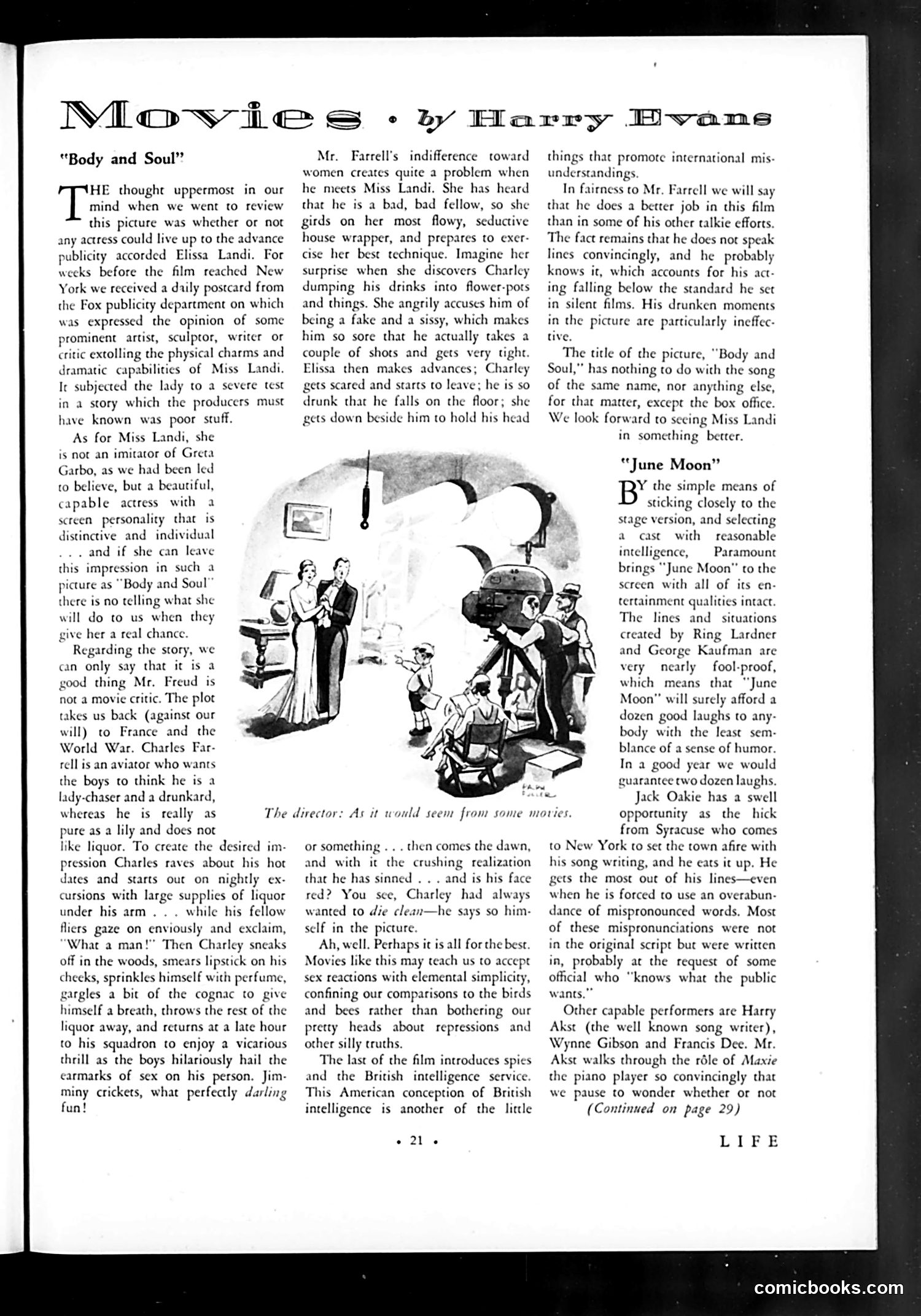
Life Magazine Movie Review: "Body and Soul" (1931) Harry Evans reviews two films. The main critique concerns "Body and Soul," starring Charles Farrell and Elissa Landi. The plot involves Farrell as an aviator who pretends to be a dissolute womanizer and drunk to impress fellow pilots, while secretly remaining pure—discarding alcohol in flowerpots and applying lipstick/perfume to fake debauchery. When Landi discovers his deception, she seduces him anyway; he gets genuinely drunk and they sleep together, after which he agonizes over his lost "cleanliness." Evans ridicules this contrived morality tale as psychologically absurd. The satirical point: the film's prudish anxiety about sex and its absurd plot mechanics expose Hollywood's shallow treatment of human behavior. The final jab about "British intelligence service" spies suggests the film's attempts at international sophistication ring false—typical American misconceptions about British competence.
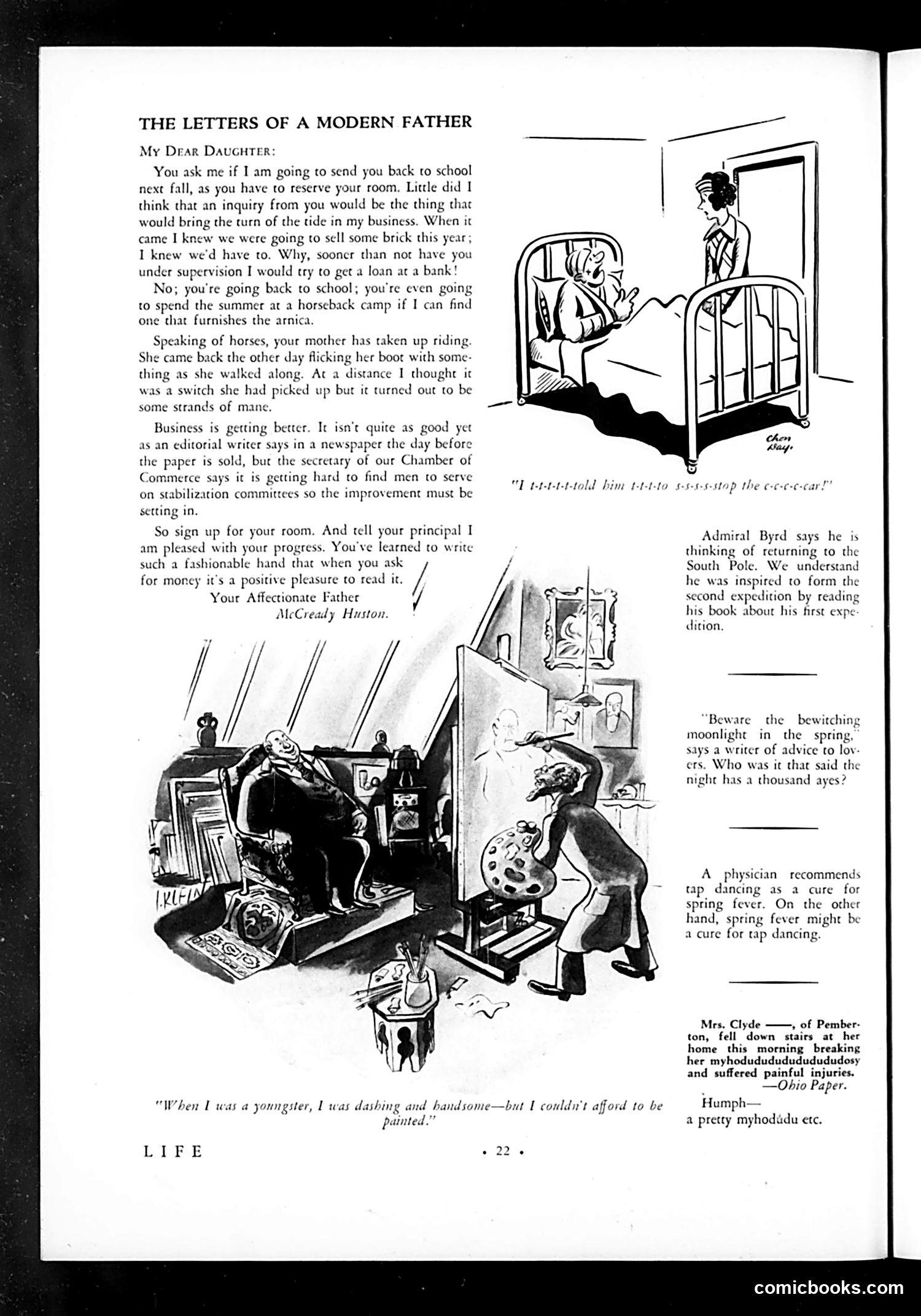
"The Letters of a Modern Father" - Life Magazine Page Analysis This satirical piece by McCready Huston uses a father's letter to his daughter to mock post-WWI economic optimism and changing social norms. Main Satire: The father's business is failing, yet he agrees to keep his daughter in school because her inquiry about reserving a room signals improving economic conditions. This inverts normal causality—her question becomes a "sign" of business recovery, revealing how businessmen grasp at straws during uncertain times. Social Commentary: - The mention of his wife taking up horseback riding satirizes wealthy leisure activities - References to "stabilization committees" mock Chamber of Commerce efforts to manage the economy - The daughter's "fashionable hand" in requesting money pokes fun at upper-class pretension Accompanying Jokes: Small fillers mock Admiral Byrd's polar expeditions, spring fever remedies, and a newspaper's garbled reporting ("myhodudududududududosy" instead of a proper anatomical term). The cartoons illustrate domestic scenes with gentle humor rather than sharp political critique.
What This Page Means to a Modern Reader This is a theater review by Baird Leonard critiquing Channing Pollock's play "The House Beautiful." The piece satirizes both the play's idealistic themes and theatergoers' willingness to embrace sentimental morality. Key references: - Channing Pollock: A prominent silent-film pantomimist/playwright of the 1920s known for theatrical grandeur - "The Fool": Pollock's earlier successful play - The play's plot: A married couple maintain ideals and romantic vision despite poverty and social pressure The satire: Leonard mocks the play's "unsound economics" and naive faith that virtue and imagination can overcome material hardship. He's cynical about audiences who "go to church and say the Nicene Creed with our fingers crossed"—enjoying uplifting morality while doubting it in real life. The reviewer admits admiration for the wife's romantic vision (played by Mary Phillips) but finds the overall message commercially manipulative rather than genuinely profound. The "pixie" comment suggests the ending is whimsically unrealistic.
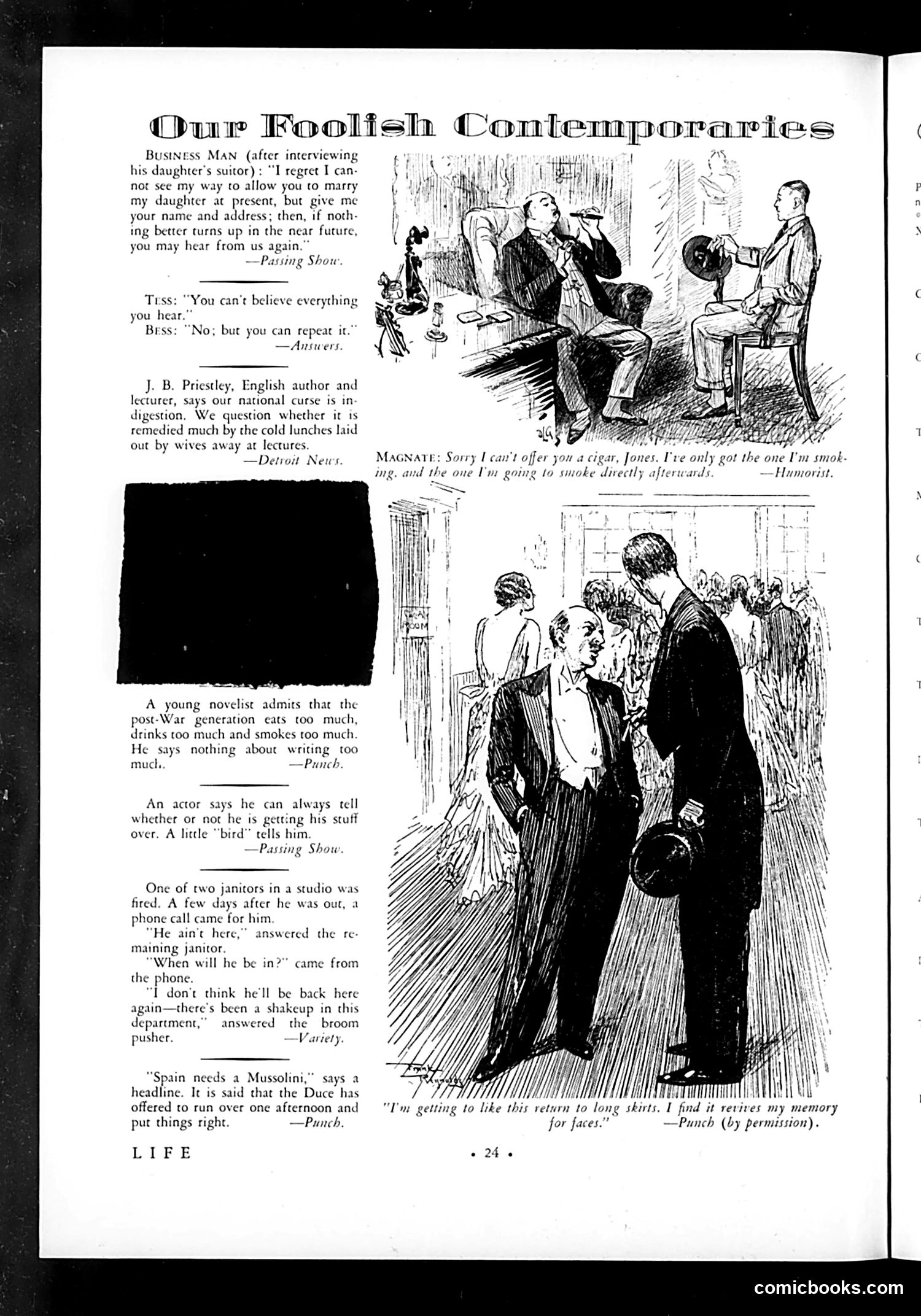
Our Foolish Contemporaries: Context for Modern Readers This page collects satirical quips and cartoons mocking contemporary social behaviors and attitudes. Key points: The cartoons depict: - A businessman dismissing his daughter's suitor with cold condescension, suggesting he'd only reconsider if "nothing better" came along - A magnet/wealthy man hoarding cigars, satirizing wealthy miserliness - A crowd scene where a man comments that longer skirts help him remember women's faces (implying he normally focuses on legs) The text snippets mock: - Post-WWI generational excess (eating, drinking, smoking too much) - Marital friction (wives attending lectures while husbands eat cold lunches) - Bureaucratic incompetence (a janitor's confused response about rehiring) - A satirical jab at Mussolini offering to "fix" Spain's problems The satire targets contemporary social pretension, generational criticism, and modern anxieties about changing customs (like hemlines). The humor assumes readers share these middle-class concerns about manners, marriage, and social order.
Confidential Guide to Theater Prices and Shows This page is not a cartoon or satire, but rather a practical theater guide from Life magazine—a listing of Broadway plays, musicals, and records currently running, with ticket prices, brief plot descriptions, and performance times. The "Confidential Guide" title is tongue-in-cheek marketing; the content serves as a genuine entertainment reference for readers. Notable entries include *Green Pastures* (an all-Black cast production that won the Pulitzer Prize), *The Barretts of Wimpole Street* (starring Katharine Cornell), and various comedies and mysteries. The guide reflects 1930s Broadway diversity, from serious drama to melodrama ("Doctor X" promises "a murder every time the lights go out"). Record listings suggest classical and popular music recommendations. This is primarily informational content, not political commentary or satire—though the magazine's satirical character likely extended to how shows were humorously described rather than in any visual commentary on this page.
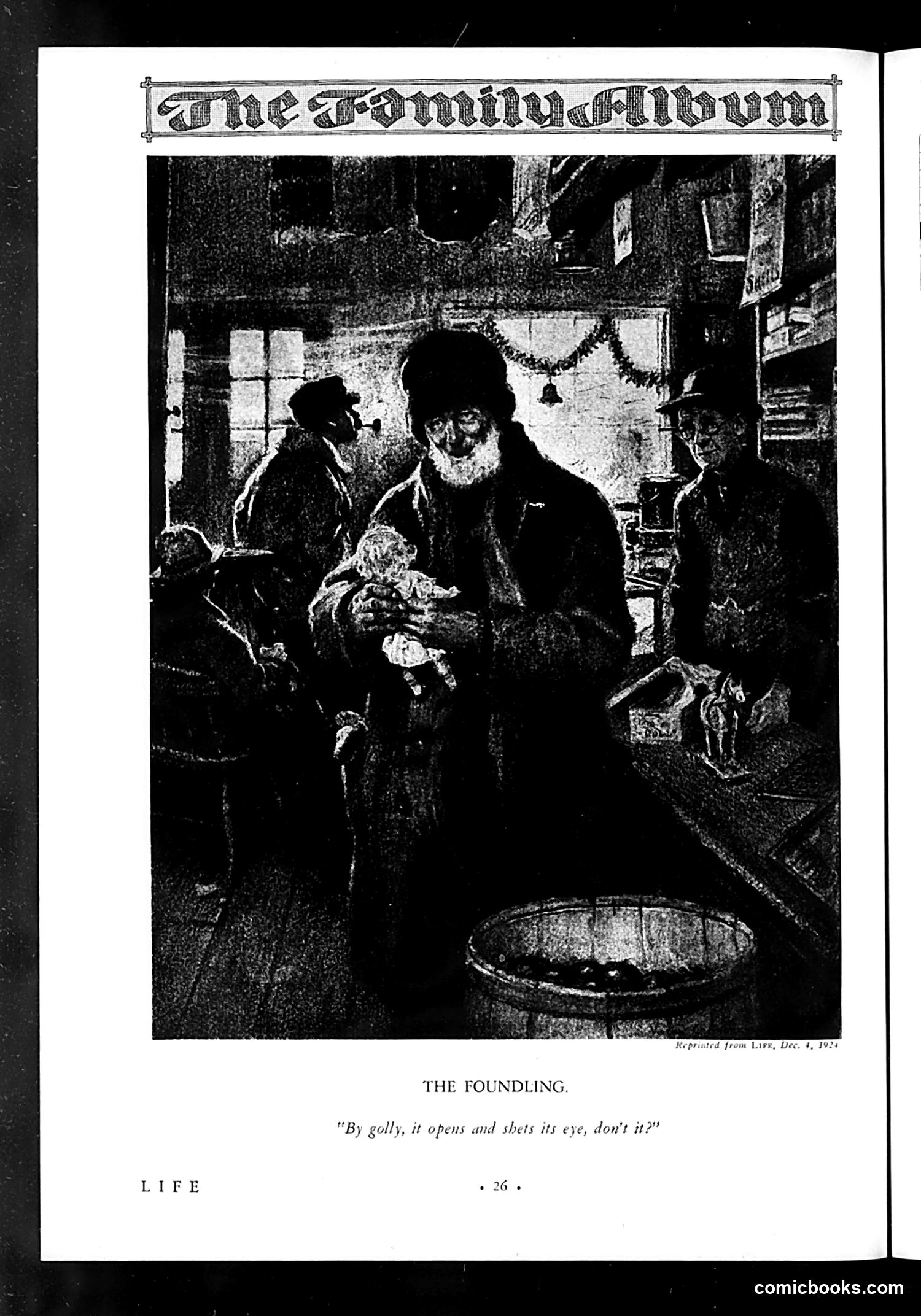
Analysis This appears to be a satirical illustration titled "The Foundling" from *Life* magazine (dated December 4, 1924, based on the credit line). The image depicts a darkly comedic scene: several working-class or poor figures in winter clothing gather around what appears to be a barrel or container, with one man prominently holding an infant. The caption—"By golly, it opens and shets its eye, don't it?"—suggests the men are marveling at the baby as if it were a novelty or curiosity rather than a human child. The satire likely critiques indifference to abandoned children or poverty, presenting the "foundling" as an object of casual wonder rather than concern. The crude language and demeanor of the figures emphasize the social commentary on how society treats the vulnerable poor.
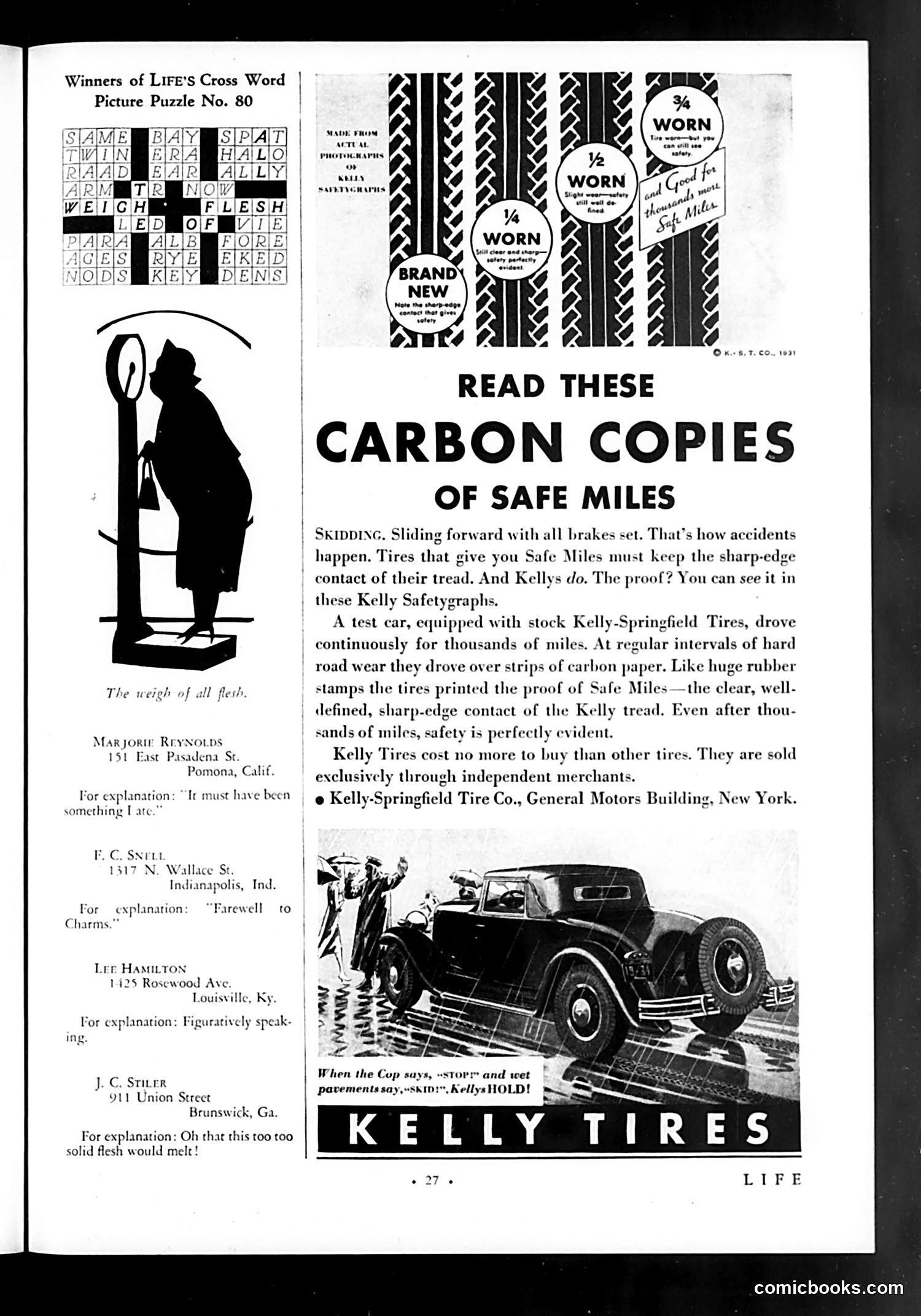
Analysis This page is primarily advertising, not political satire. The left side shows puzzle contest winners' names and their humorous explanations (puns like "It must have been something I ate" and "Oh that this too too solid flesh would melt!"). The right side is a full-page Kelly Tires advertisement from circa 1931. It promotes tire safety through "Safetygraphs"—carbon paper impressions showing that Kelly tires maintain sharp tread contact even after thousands of miles of wear, preventing skidding accidents. The advertisement uses a test-car photograph and technical demonstration to appeal to consumer safety concerns during the early automobile era. There is no political cartoon or satire here—it's straightforward product marketing emphasizing durability and accident prevention, a major selling point for tires in this period.
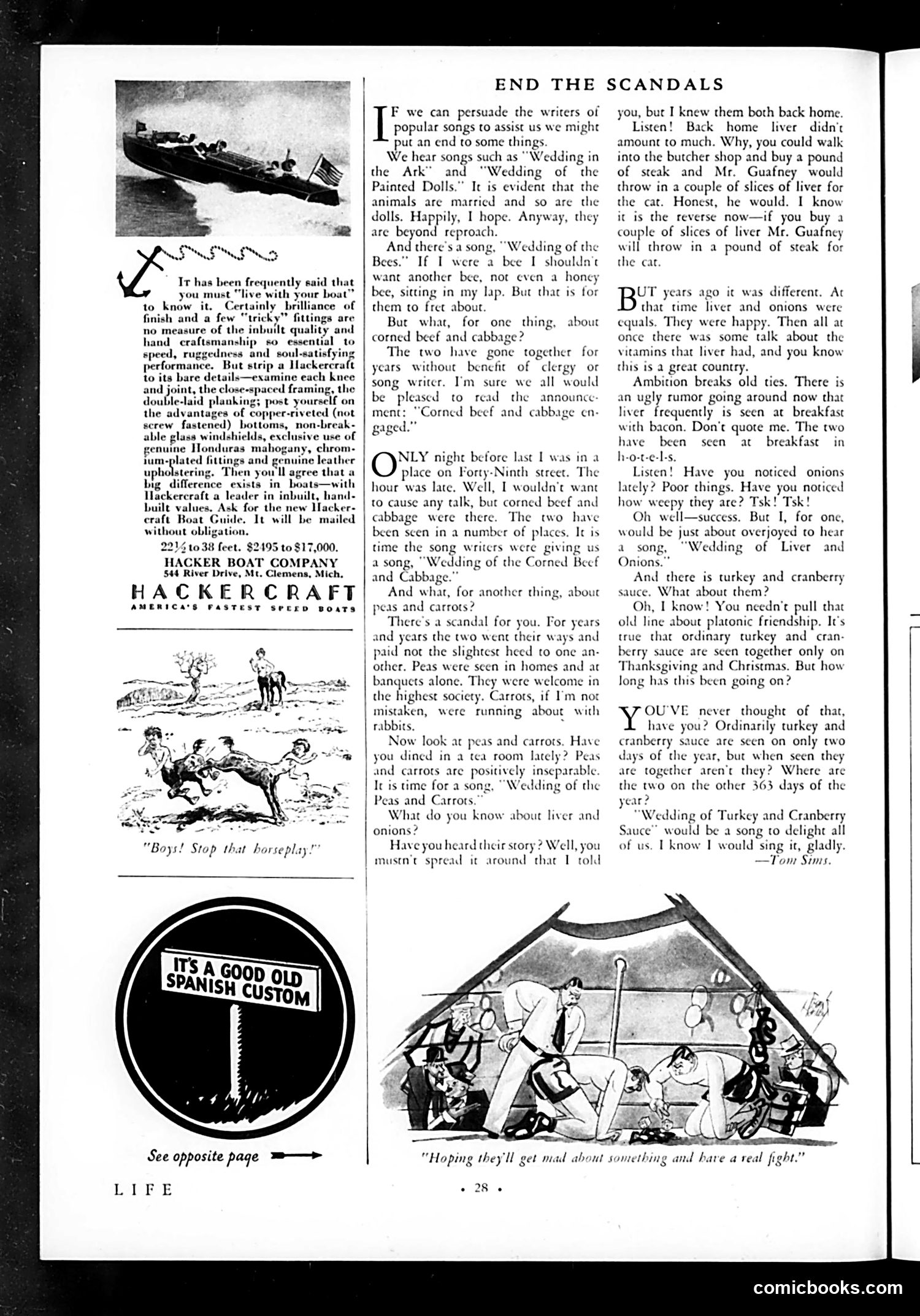
Analysis of "End the Scandals" This humorous essay satirizes the trend of popular songs celebrating unusual food pairings—particularly those involving previously uncommon combinations gaining respectability through newfound nutritional awareness. The author mock-scandalized tone treats mundane ingredient partnerships as romantic "weddings": corned beef and cabbage, peas and carrots, liver and onions. The satire targets how modern knowledge about vitamins and nutrition has elevated formerly humble or discarded foods (liver was once only fit for cats) into respectable dishes. The piece gently ridicules both food snobbery and the era's enthusiasm for nutritional science. It references actual popular songs with animal "weddings" ("Wedding in the Ark," "Wedding of the Painted Dolls") to justify the absurdity of commemorating food combinations in song. The closing illustration shows a chaotic domestic scene, likely depicting the social upheaval these "scandalous" food pairings represent—humorously suggesting proper society is disturbed by such culinary developments.
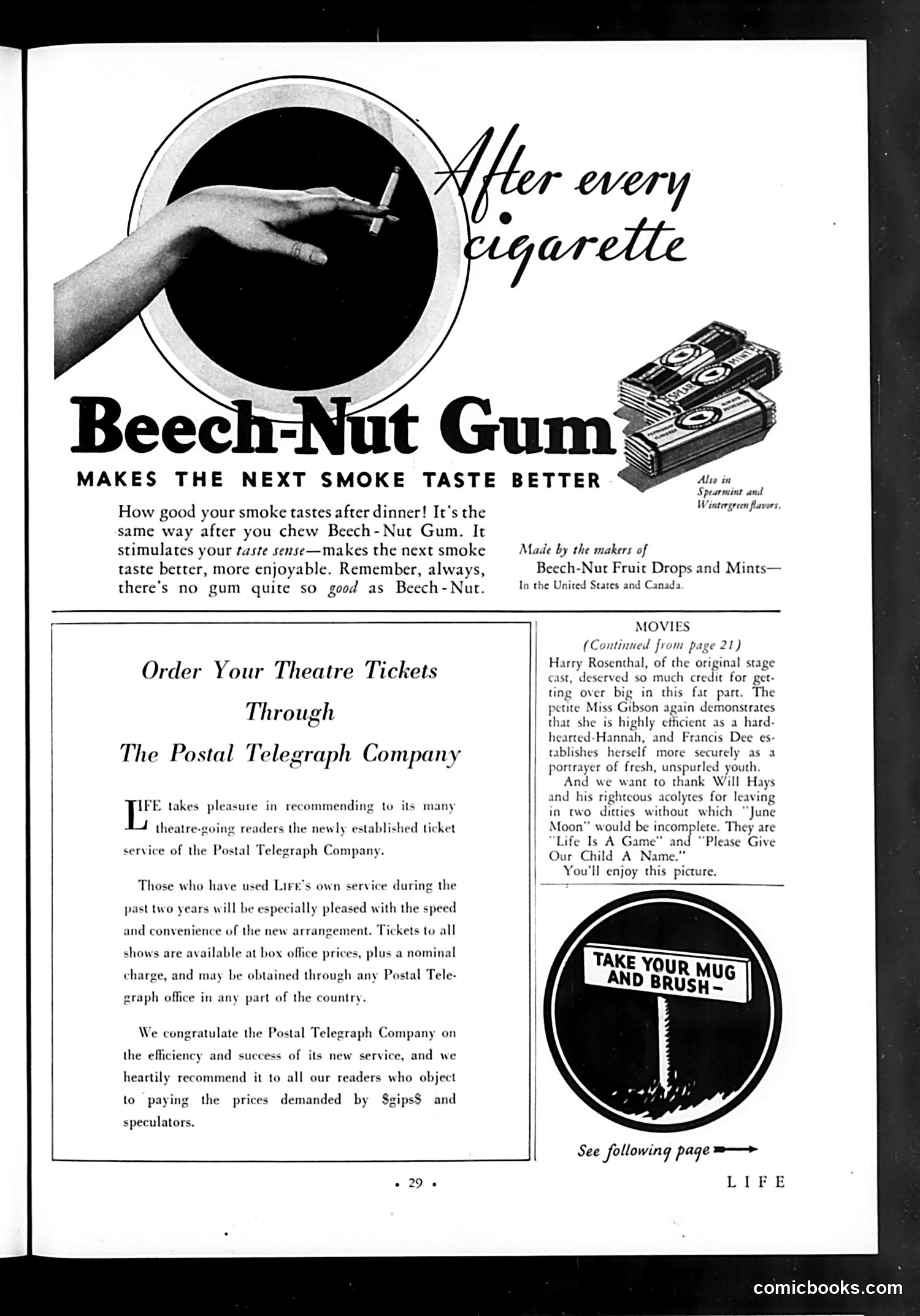
Page Analysis: Life Magazine Advertisement Section This page is primarily advertising and service announcements rather than satirical content. The Beech-Nut Gum ad uses a striking visual: a hand holding a cigarette over a circular black void, with the tagline "After every cigarette." The ad explicitly markets gum as enhancing smoking pleasure—a direct product tie-in promoting cigarette consumption. This reflects early 20th-century attitudes when tobacco and candy marketing openly coexisted without health warnings. The Postal Telegraph Company announcement promotes a new theatre ticket service. Life's editorial note sarcastically criticizes "Sgips$ and speculators"—scalpers who resold tickets at inflated prices. This was a genuine consumer complaint of the era. The Movies section briefly reviews films, praising actress Miss Gibson and Francis Dee. For modern readers: the casual cigarette marketing and the scalping complaint stand out as period artifacts—one now shocking due to health awareness, the other reflecting persistent ticket resale frustrations that persist today.
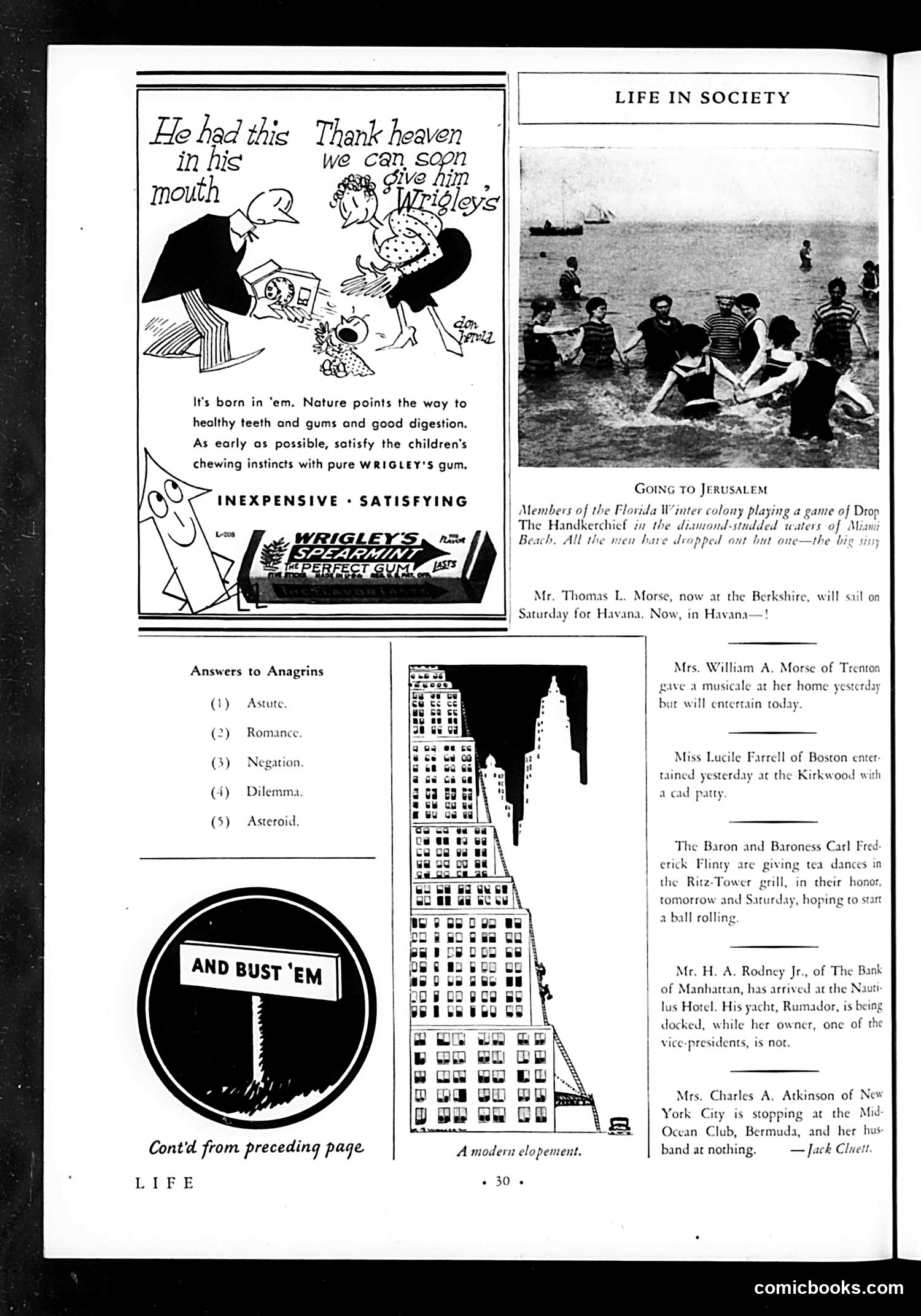
Analysis of Life Magazine Page 30 This page mixes advertising with society gossip typical of Life magazine's satirical coverage of the wealthy elite. The Wrigley's Gum Advertisement (top left) uses a cartoon showing two adults discovering a child chewing gum, with the tagline "It's born in 'em." The ad promotes teaching children to chew gum early for dental health—a straightforward product pitch, though the illustration style is humorous. "Life in Society" Section (right side) satirizes the leisure activities and social pretensions of wealthy Americans. Items include: - Florida Winter Colony members playing games at Miami Beach - Society figures traveling to Havana and Bermuda - Notes about tea dances and musical events among the upper class The satire lies in the breathless, breathless reporting of trivial social movements—who's traveling where, who's hosting what party—presented with mock seriousness. The final item's quip about a husband being "at nothing" gently mocks idle wealth. The "Answers to Anagrins" puzzle and architectural drawing appear unrelated filler content.
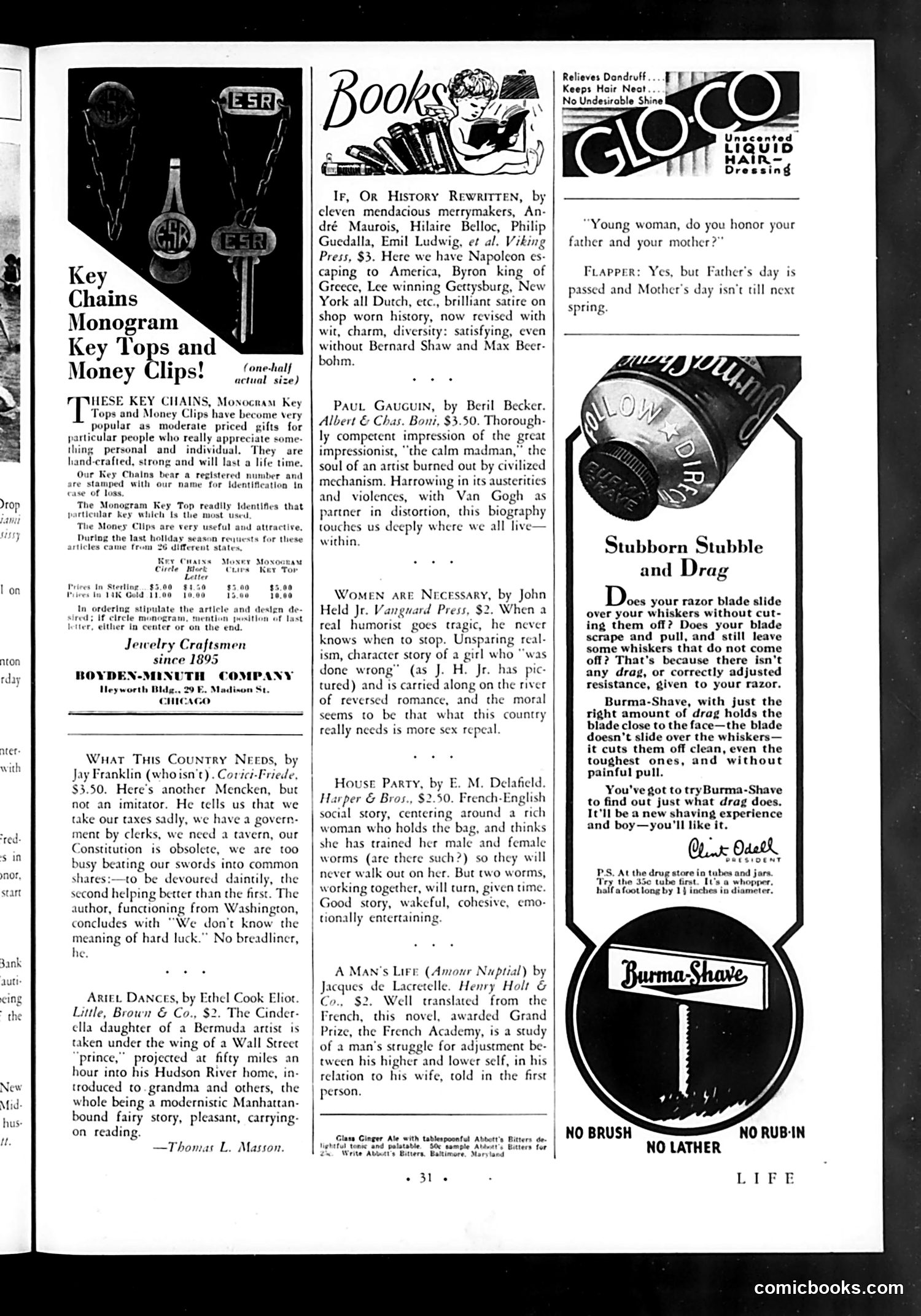
Content Analysis This is primarily a book review page from *Life* magazine, featuring literary reviews rather than political cartoons. The page includes advertisements for luxury goods (monogrammed key chains, Burma-Shave razors, hair dressing) interspersed with book notices. The reviews mock various literary trends of the era. Notable is John Held Jr.'s *Women Are Necessary*, where the reviewer sardonically comments that the book's moral "seems to be that what this country really needs is more sex repeal"—a joke referencing Prohibition-era anxieties about moral regulation. The reviews generally employ witty, dismissive commentary typical of *Life*'s satirical house style. For instance, the review of *If, Or History Rewritten* praises its "brilliant satire" of "shop worn history," suggesting contemporary interest in alternate-history humor. The page reflects 1920s-30s consumer culture and literary sophistication rather than political commentary. The Burma-Shave ad is notable as an early example of that brand's famous roadside advertising approach.
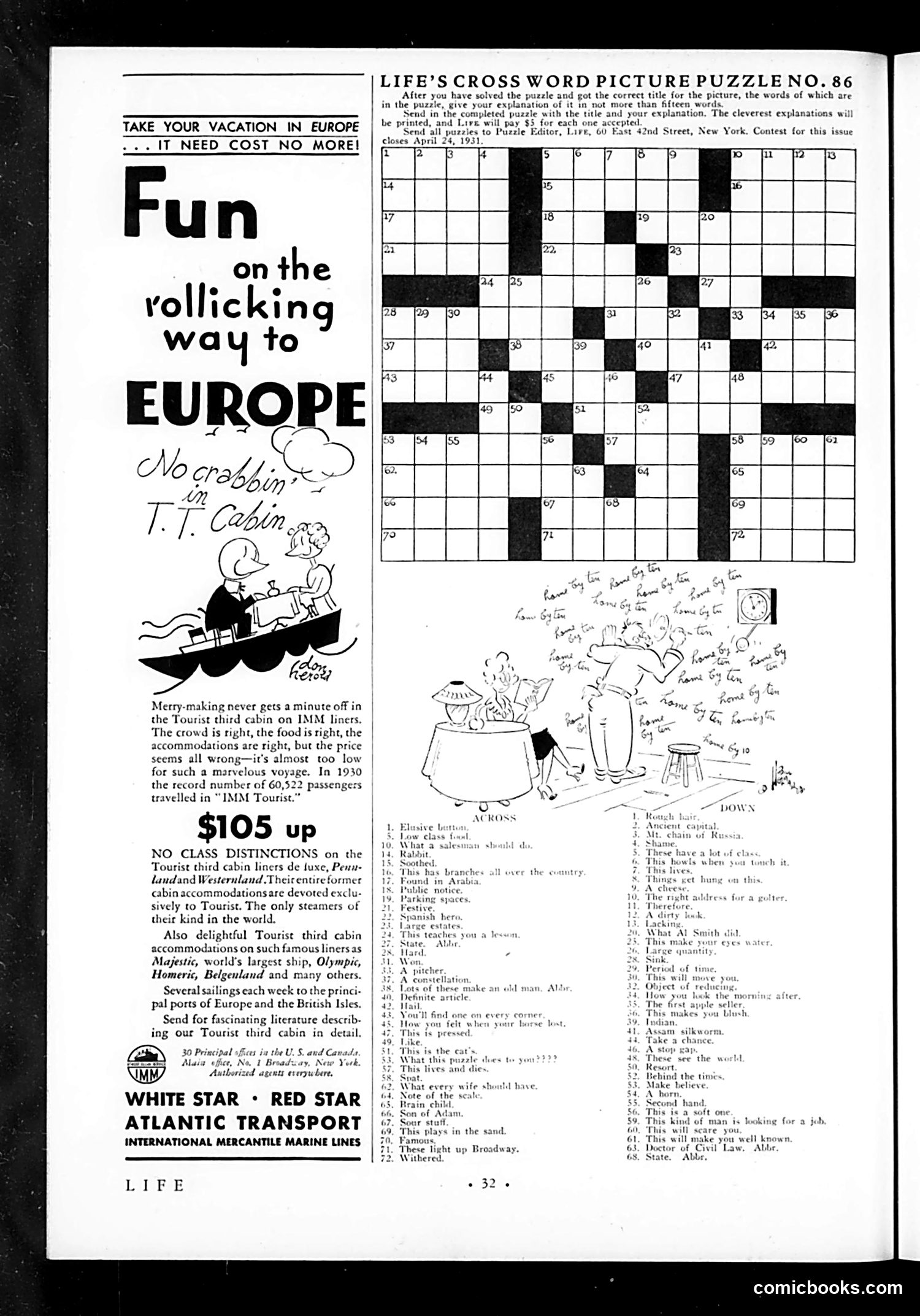
Analysis This page primarily features a cruise ship advertisement for White Star and Red Star Atlantic Transport lines, promoting budget-friendly European vacations starting at $105 in "Tourist third cabin." The cartoon shows a humorous scene of passengers crammed together in tight quarters aboard a ship, with the caption "Fun on the rollicking way to EUROPE" and "No crabbin' or T.T. Cabin" (a play on words). The joke is ironic satire: the ad claims the accommodations are "right" and merry-making "never gets a minute off," yet the cartoon depicts the opposite—overcrowded, chaotic conditions. This was common advertising humor of the era, using exaggeration to make budget travel seem amusing rather than unpleasant. The crossword puzzle below is unrelated content filler. Historical context: This is 1931 (April 24 date visible), during the Great Depression, when cheap transatlantic travel was marketed to middle-class Americans. The satire gently mocks the marketing claims while still promoting the service.
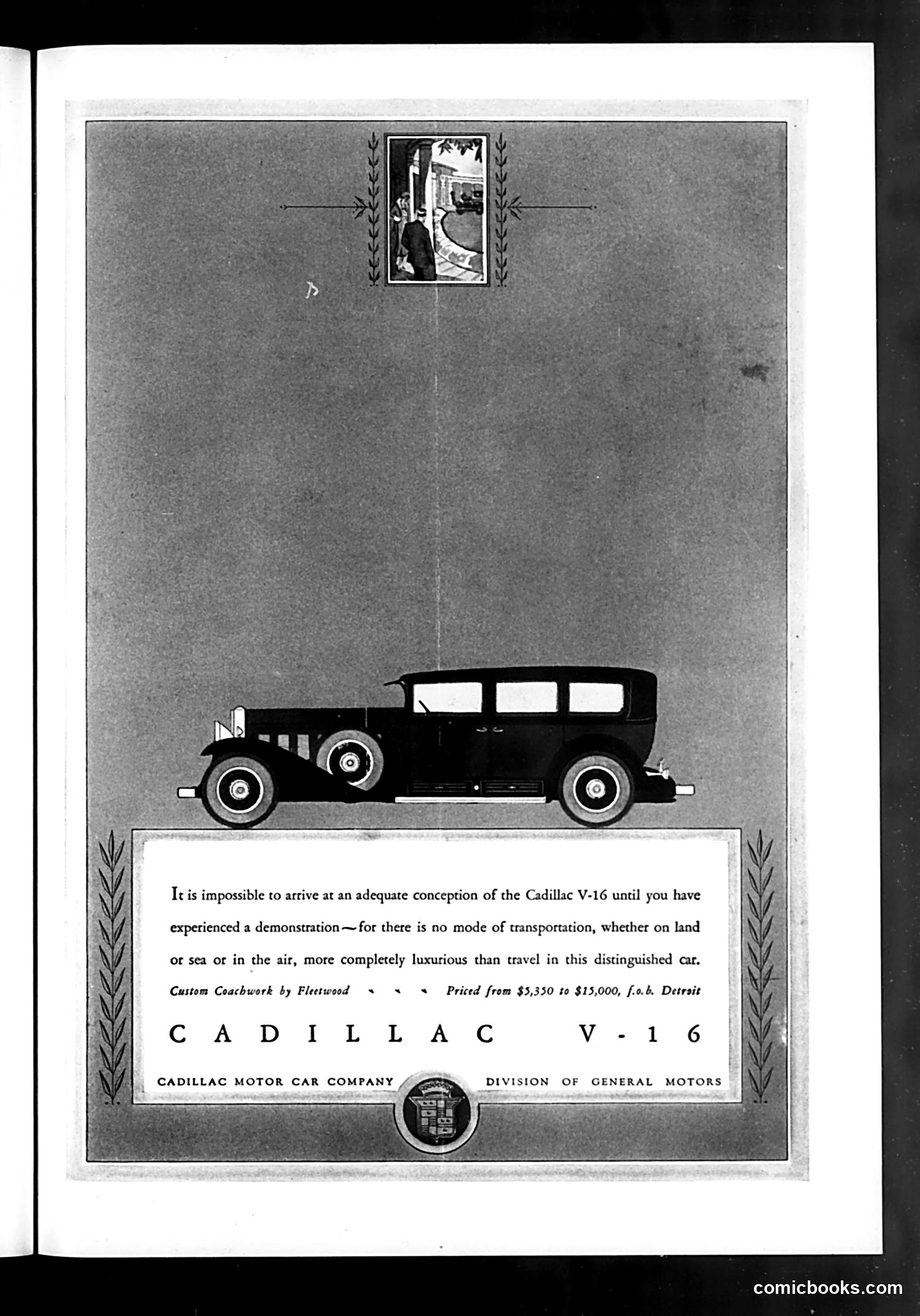
Analysis This is primarily a Cadillac automobile advertisement, not political satire. The page features a sleek side-profile illustration of a Cadillac V-16 luxury sedan against a minimalist background with decorative art deco borders. The text makes an extravagant marketing claim: that no form of transportation—land, sea, or air—is more luxurious than this car. This reflects the opulence and aspirational messaging typical of 1920s-30s advertising during the height of American industrial prosperity and the "Golden Age" of automobiles. The price range ($5,350-$15,000) indicates this was exclusively for the wealthy. The small vignette at top shows a scene of elegant passengers, reinforcing the car's status appeal. There is no discernible satire or political commentary—this is straightforward luxury-goods marketing targeting affluent readers.
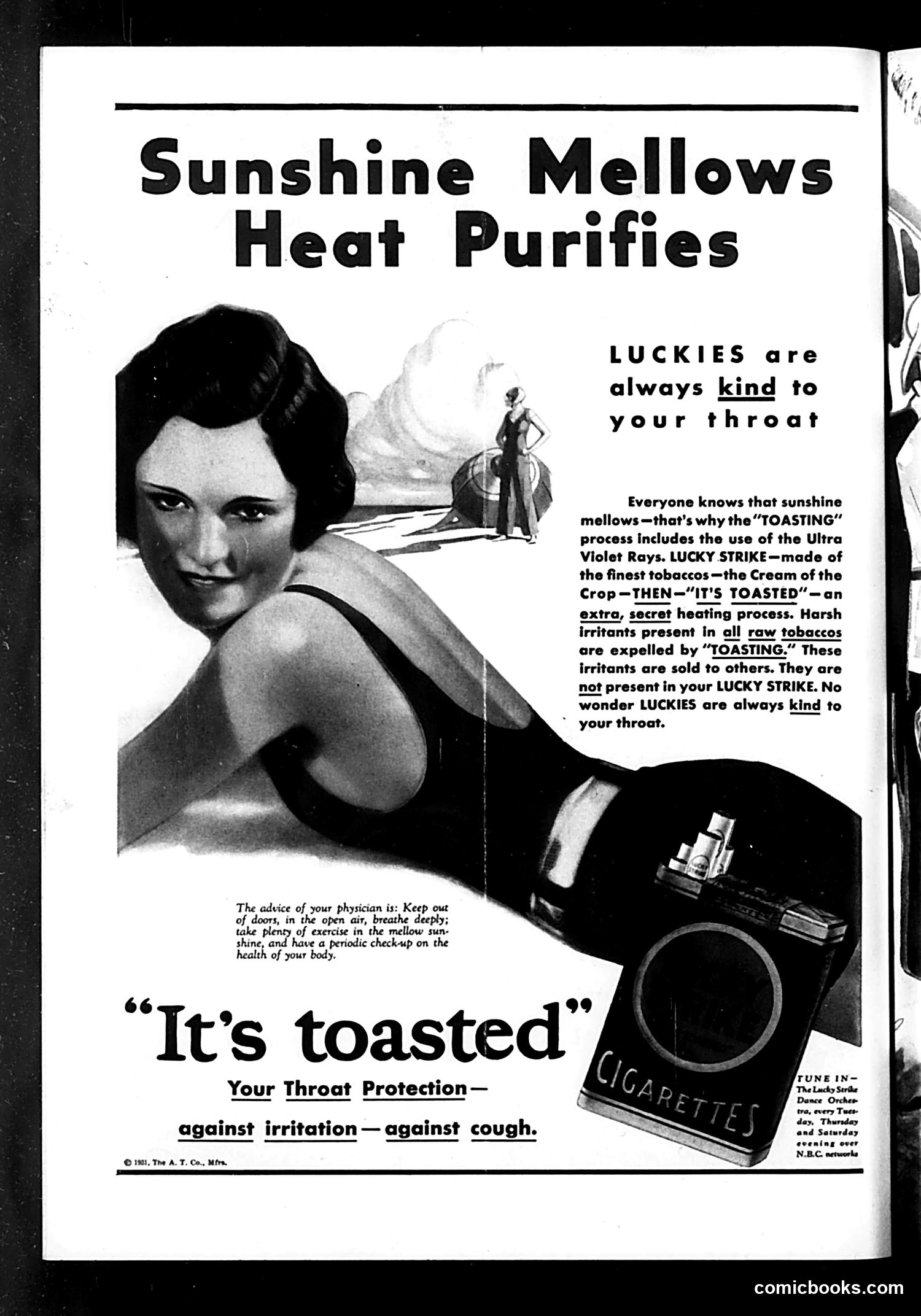
Analysis This is a Lucky Strike cigarette advertisement, not political satire. It's a vintage tobacco ad using health claims common in early-to-mid 20th century marketing. The ad employs pseudo-scientific reasoning: sunshine "mellows" tobacco, so Lucky Strike's "toasting" process similarly purifies cigarettes by removing "harsh irritants" that competitors supposedly sell. The tagline "It's toasted" is positioned as throat protection "against irritation — against cough." A woman in the image gazes toward a sunny landscape, reinforcing the "sunshine mellows" metaphor. Text from "your physician" recommends fresh air and exercise—ironic given the product being sold. Modern context: This represents an era when cigarette companies made explicit health claims now recognized as false. The ads exploited medical authority and pseudo-science to market an addictive, harmful product. Such advertising would be illegal today.