life
Life — April 10, 1931
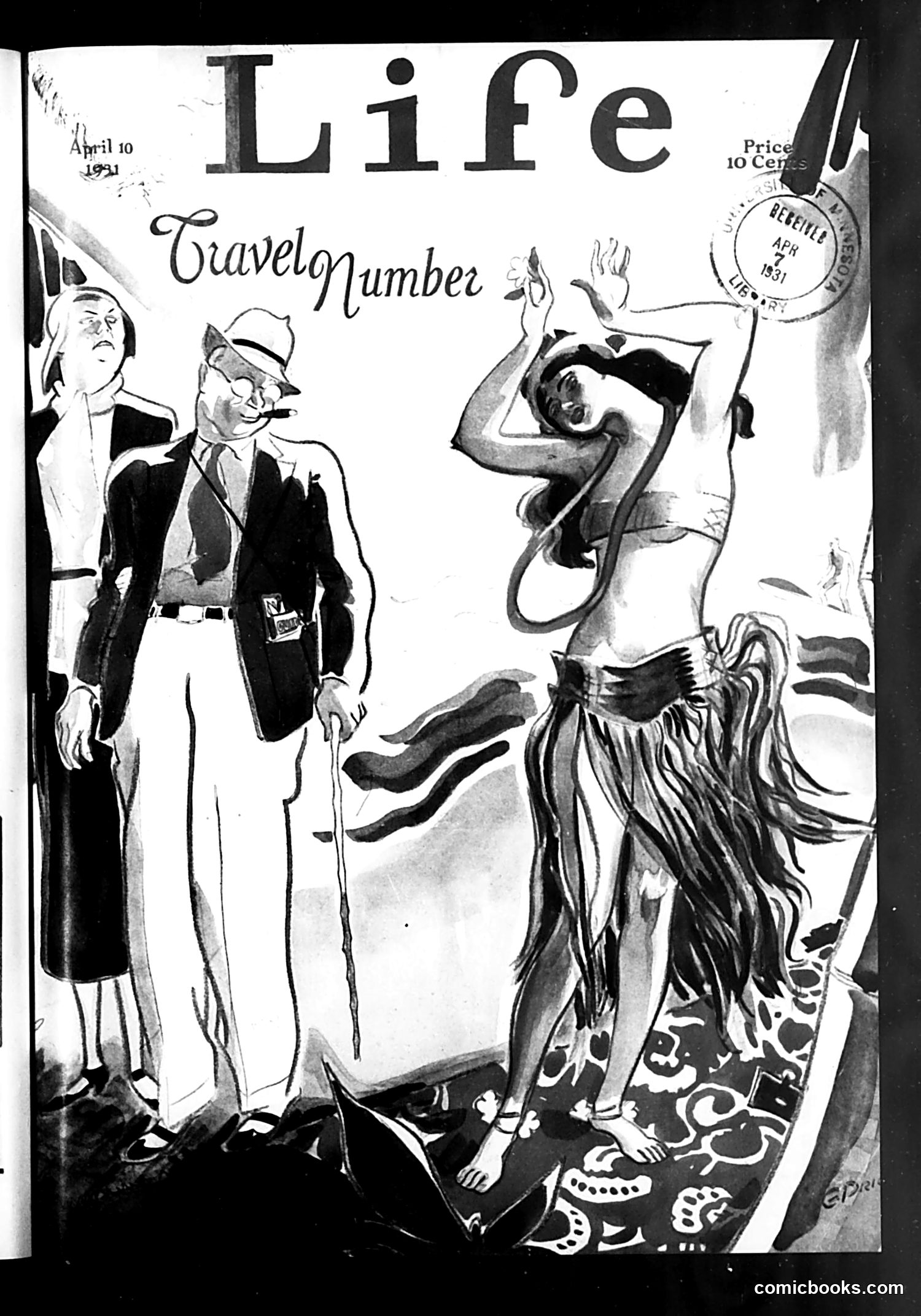
This is a Life magazine cover from April 10, 1921, labeled "Travel Number." The illustration depicts two well-dressed male tourists observing a belly dancer in what appears to be an exotic setting, likely meant to represent the Middle East or North Africa. The seated figures wear Western business attire and hats, while the dancer performs on a decorative carpet with ornamental patterns. The satire centers on early 20th-century American tourism and the fascination with "exotic" foreign entertainment. The cartoon mocks tourists who traveled abroad seeking sensual spectacles and cultural novelties as part of leisure travel. The contrast between the formal Western dress of the observers and the semi-nude performer emphasizes the cultural distance and voyeuristic nature of such tourism during the era.
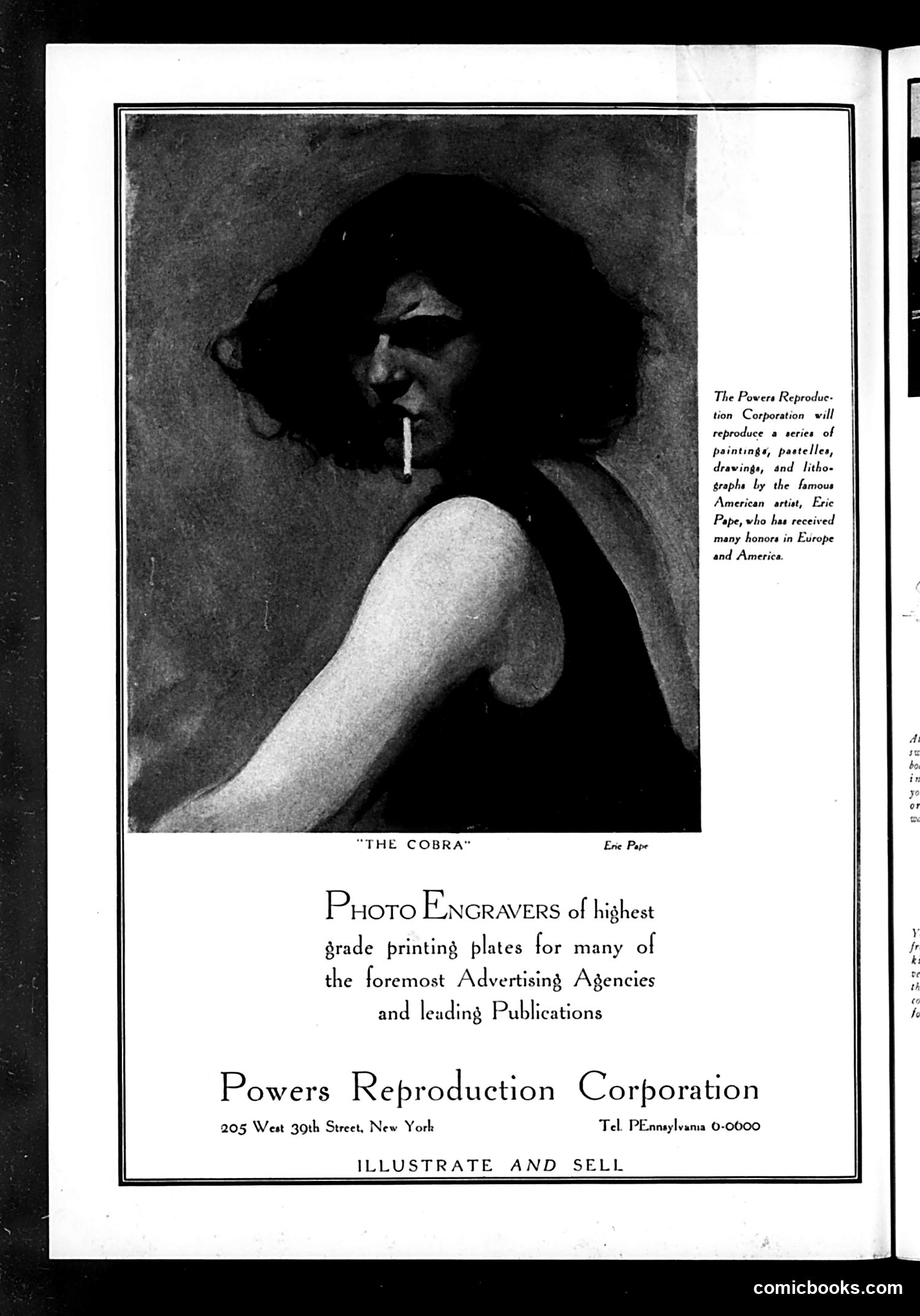
Analysis This page is primarily an advertisement, not satirical content. It promotes the Powers Reproduction Corporation, a photo-engraving company located at 205 West 30th Street in New York. The featured image is titled "The Cobra" and is credited to Eric Pape, described as a famous American artist who received many honors in Europe and America. The photograph shows a figure in dramatic pose wearing sunglasses and smoking, styled to evoke danger or intrigue—fitting the "cobra" metaphor. The advertisement uses Pape's prestigious reputation and artistic work as marketing, demonstrating the quality of reproduction services the corporation provides for advertising agencies and publications. This is a straightforward commercial endorsement rather than political satire.
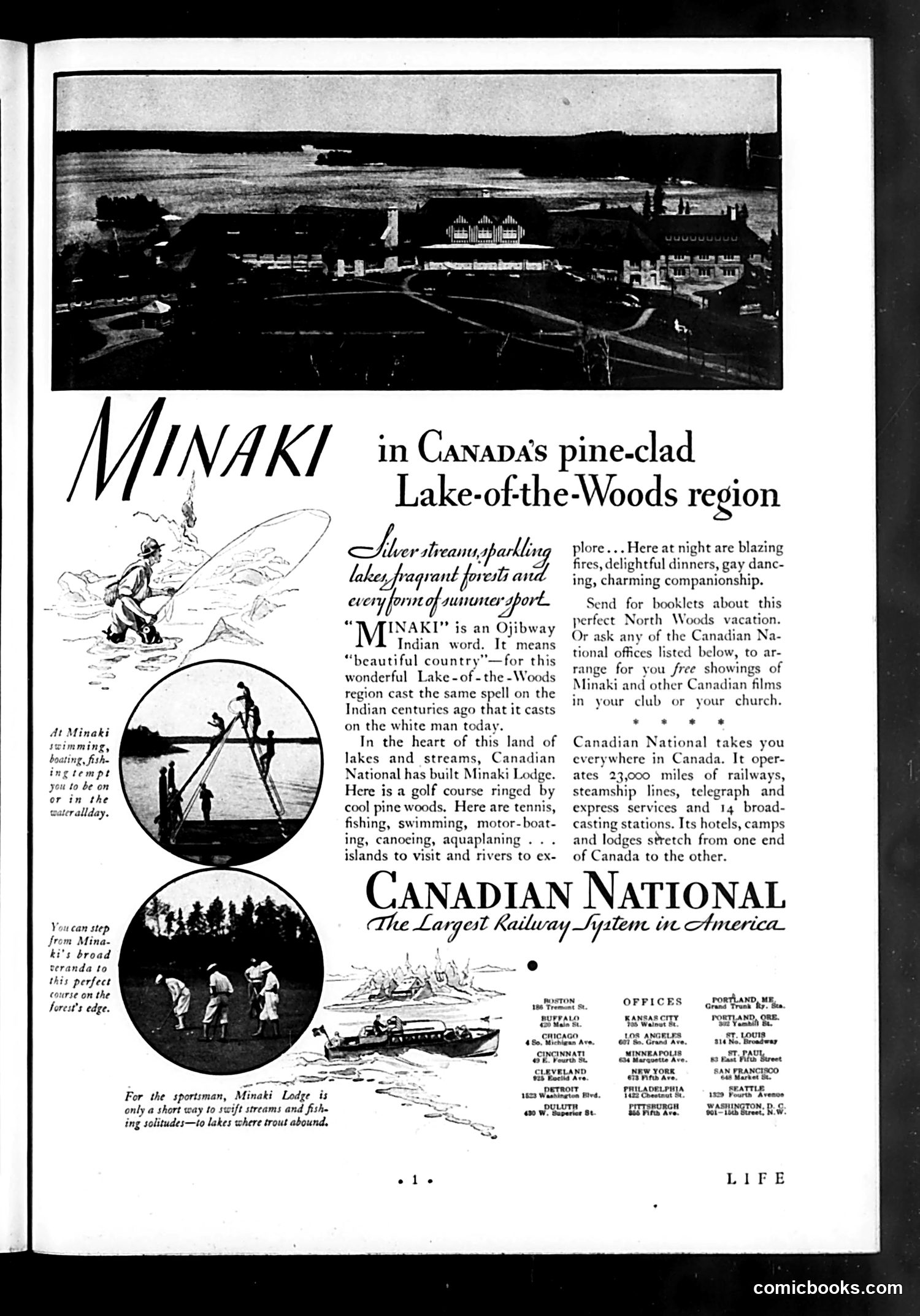
Minaki Lodge Advertisement This page is primarily advertising copy, not satire or political commentary. It promotes Minaki Lodge, a vacation resort in Canada's Lake-of-the-Woods region operated by Canadian National Railways. The advertisement uses the word "Minaki"—an Ojibway term meaning "beautiful country"—to market the destination to wealthy American tourists seeking North Woods leisure activities: fishing, golf, tennis, motor-boating, and canoeing. The circular illustrations depict recreational activities (fishing, forest exploration, boating) meant to appeal to sportsmen. The copy emphasizes accessibility via Canadian National's 23,000 miles of railways and steamship lines. This reflects early-20th-century tourism marketing, positioning wilderness recreation as an aspirational vacation experience for affluent audiences.
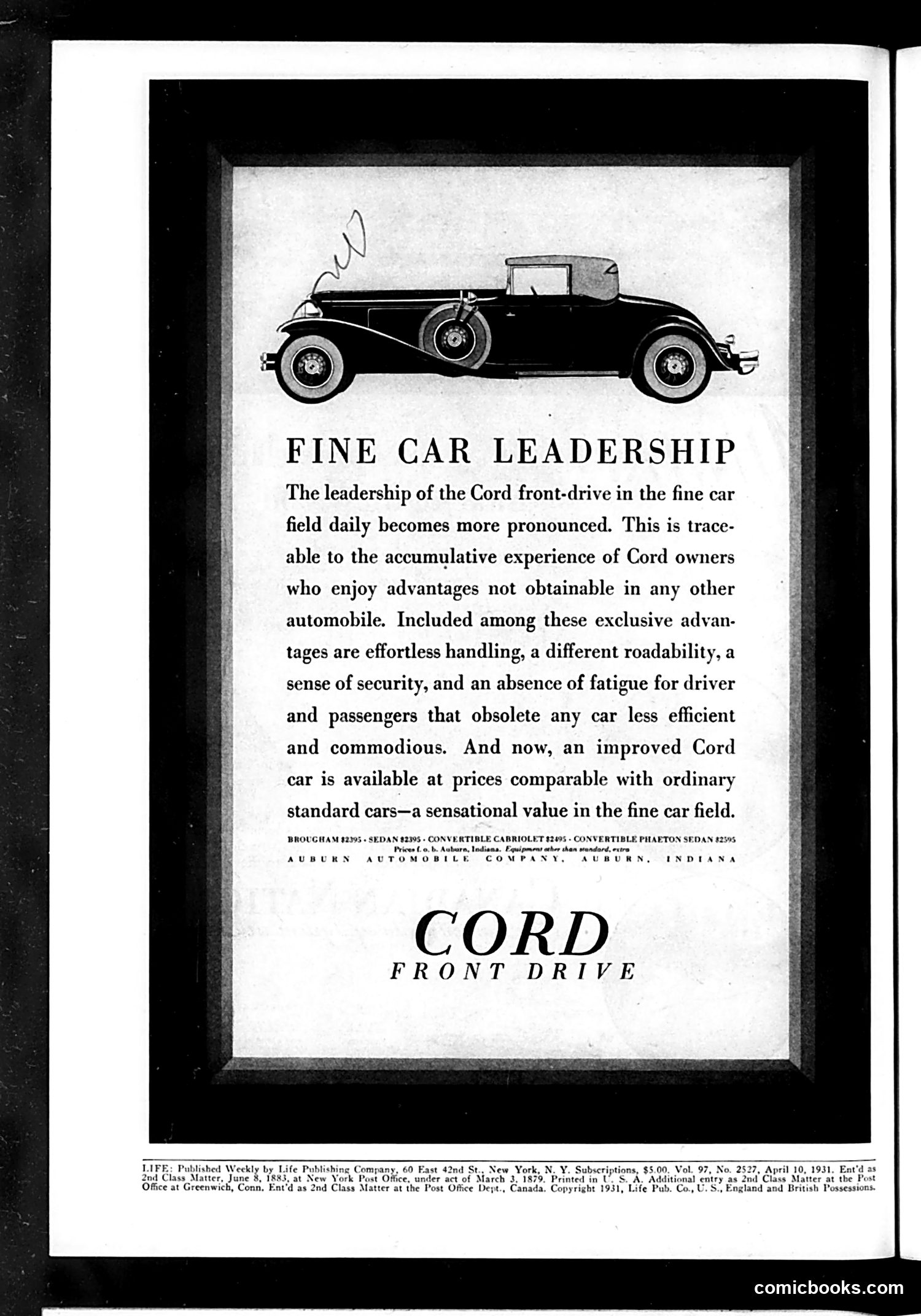
Analysis This is a full-page advertisement, not satirical content. It promotes the Cord automobile's front-drive system to a luxury market. The ad claims the Cord's front-wheel drive offers exclusive advantages—"effortless handling," superior roadability, security, and reduced driver fatigue—unavailable in competing cars. The key sales pitch: these premium features are now available at prices comparable to "ordinary standard cars," positioned as exceptional value in the fine-car segment. The stylized illustration of a Cord sedan reinforces the vehicle's elegant, modern design. The text emphasizes that Cord owners possess accumulated experience proving superiority, effectively appealing to status-conscious buyers seeking both prestige and practicality. This reflects 1931 automotive marketing emphasizing technical innovation as a luxury differentiator.
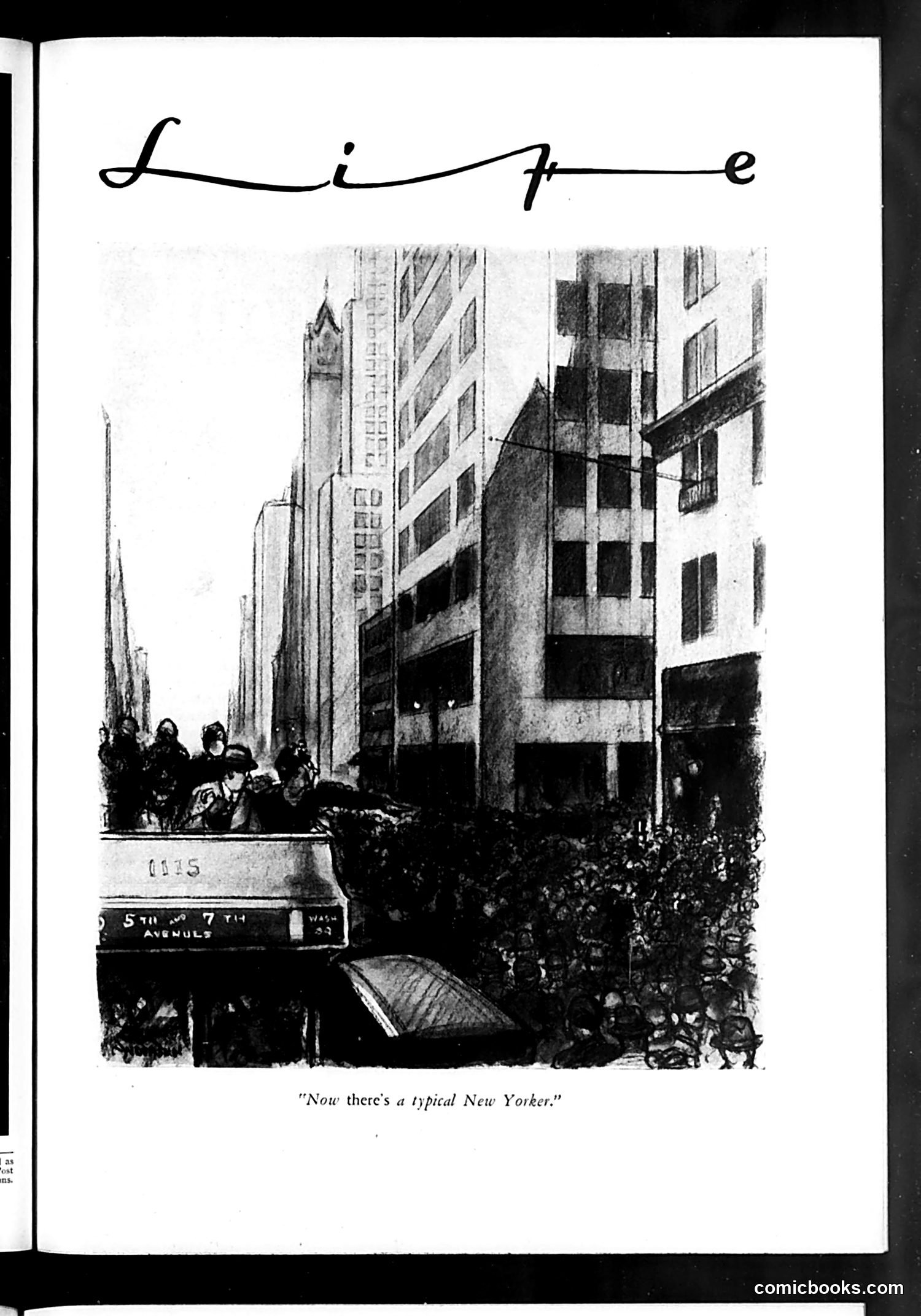
Analysis This page from *Life* magazine presents a satirical cartoon titled "Now there's a typical New Yorker." The image shows a crowded street scene in Manhattan with tall buildings, construction, and dense crowds of pedestrians. A sign visible on a storefront reads "5TH AVE" and "AVENUE." The satire appears to target New York City's urban character—specifically the congestion, commercialism, and frenetic pace of Manhattan street life. By calling this chaotic scene "typical," the cartoonist is mocking both the city itself and the stereotypical New Yorker who navigates it. The crowded masses, modern architecture, and bustling commercial activity represent the dehumanizing aspects of early-20th-century urban American life that *Life* frequently satirized.
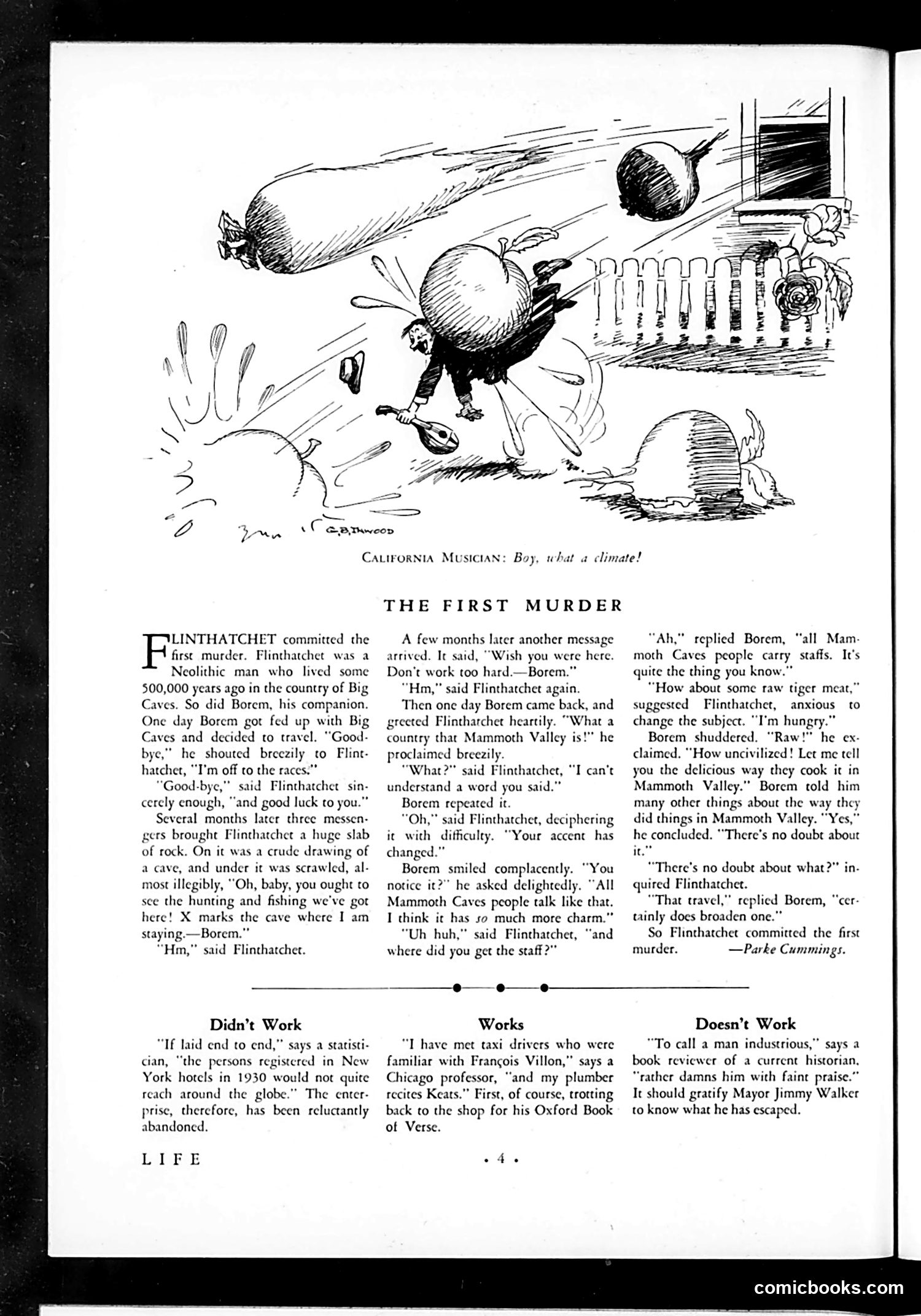
"The First Murder" - Life Magazine Page The top illustration depicts a prehistoric scene with an anthropomorphic insect or creature with a round body striking at early humans near a cave dwelling. The caption reads "California Musician: Boy, what a climate!" The accompanying story "The First Murder" by Parke Cummings is a humorous fictional account of how the first murder occurred among Neolithic cave dwellers—Flinthatcher and Borem—apparently triggered by a disagreement over cooking methods for mammoth meat and use of staffs as tools. It's presented as satirical pseudo-historical fiction. Below are three brief commentary sections titled "Didn't Work," "Works," and "Doesn't Work," containing unrelated social observations about 1930s New York taxicabs, famous people, and book reviewing practices.
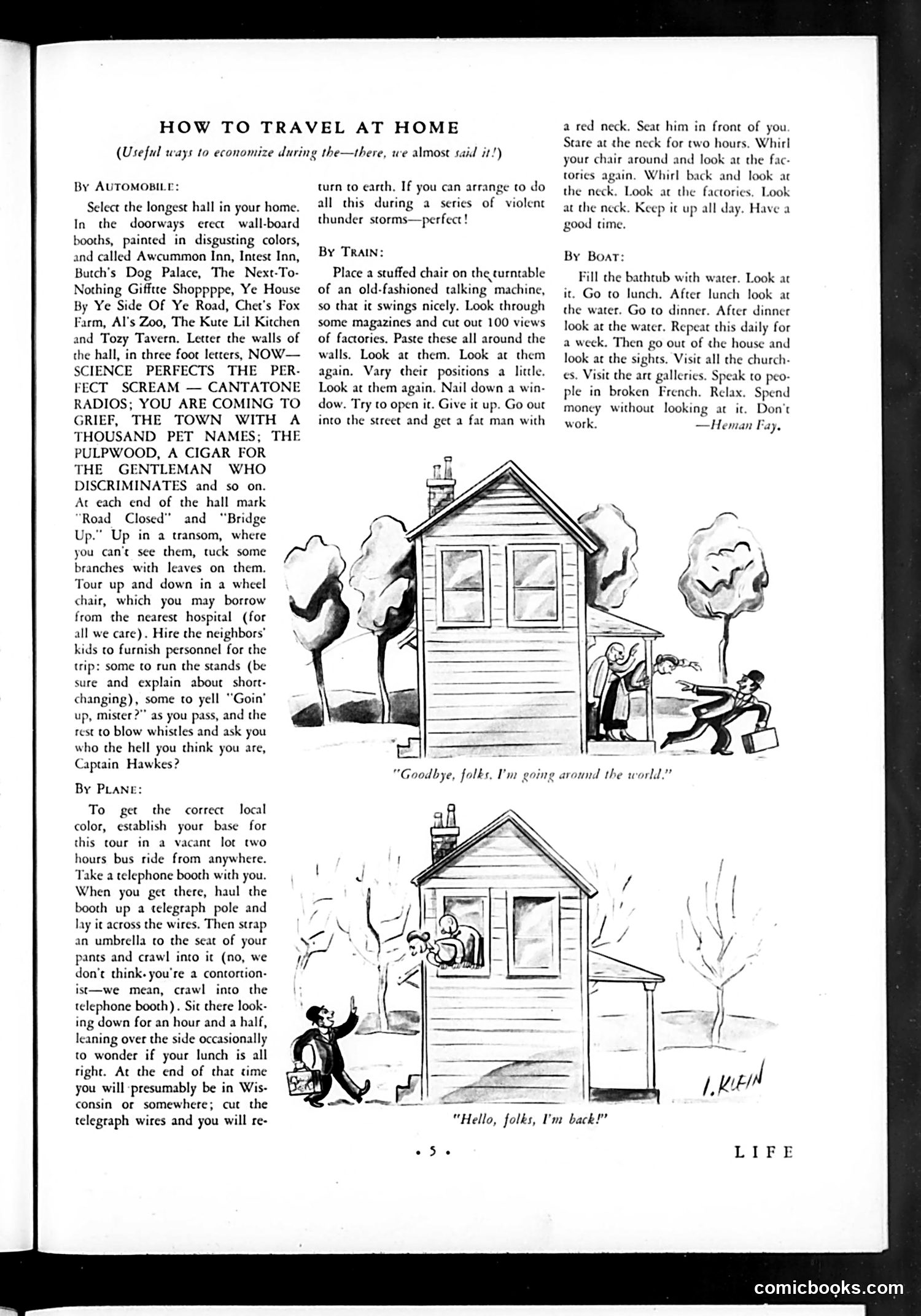
Analysis of "How to Travel at Home" This satirical article offers humorous "budget travel" alternatives during economically difficult times (the subtitle notes "economize during the—there, we almost said it!"), likely referencing the Great Depression era. The five sections mock different transportation modes by suggesting absurd home-based substitutes: - Automobile: Create a fake car interior in your hall with wall-boards and signs mimicking factory names - Train: Use a turntable chair while viewing magazine factory images - Plane: Simulate flight using a telephone booth suspended by wires - Boat: Fill a bathtub and simulate a week-long voyage - By foot: Stare at someone's neck for entertainment The cartoons illustrate these ridiculous scenarios. The satire targets both Depression-era poverty and Americans' desire for leisure travel they cannot afford—suggesting people stay home while pretending to vacation.
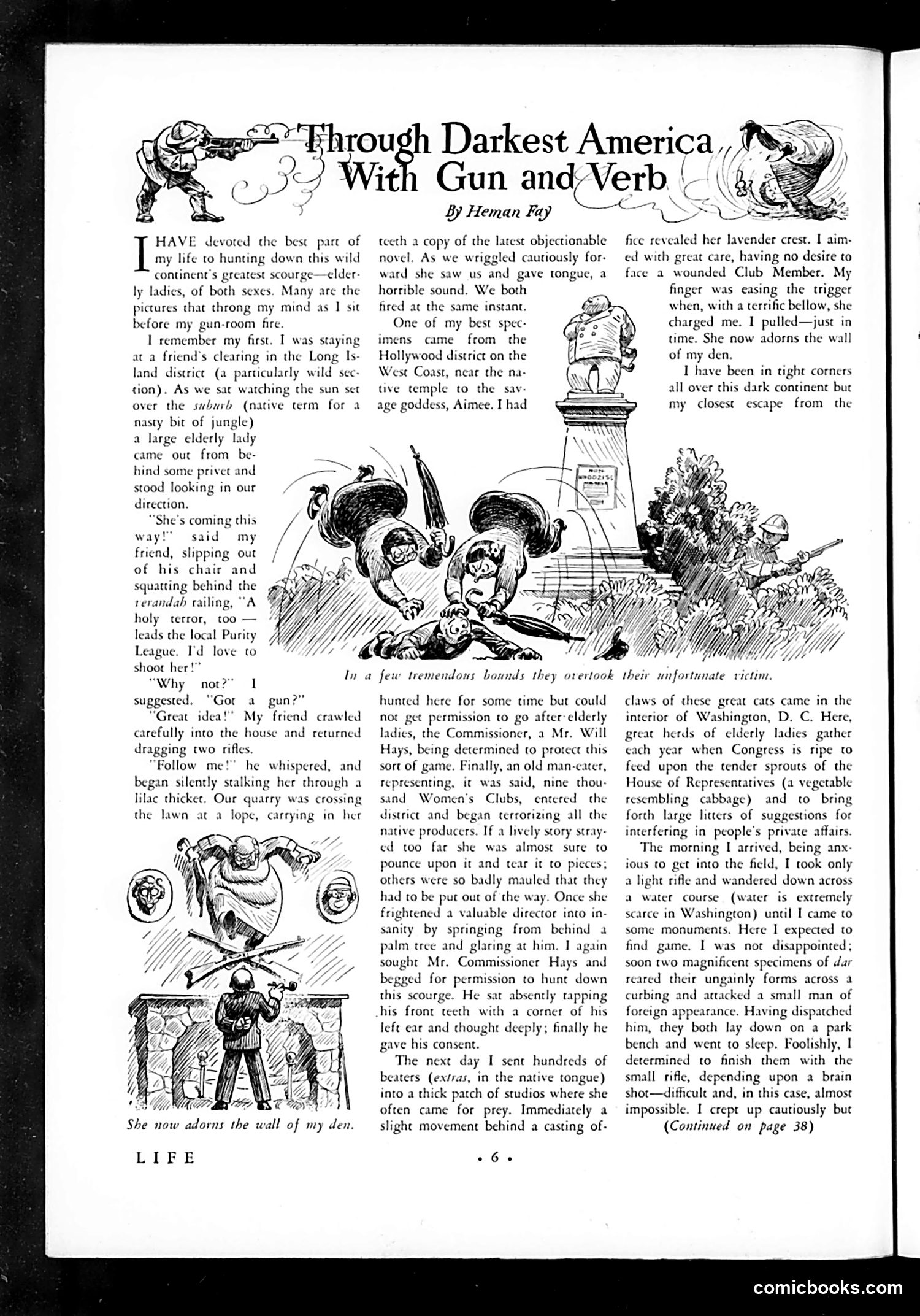
"Through Darkest America With Gun and Verb" by Iteman Foy This satirical article mocks the trend of sensational "darkest Africa" adventure narratives popular in early 20th-century literature. The author humorously recounts hunting dangerous wildlife in America—apparently large predatory cats—while also targeting women's political activism. The central joke targets the Women's Clubs and their interference in "private affairs." The illustration shows the author and friend encountering ferocious beasts, which appear to represent militant suffragettes or women's rights activists as literal monsters threatening the outdoorsman's world. The satire ridicules both the overwrought adventure-story genre and contemporary women's political organizing, positioning female activism as an exotic "danger" equivalent to African wildlife—a common anti-feminist trope of the era.
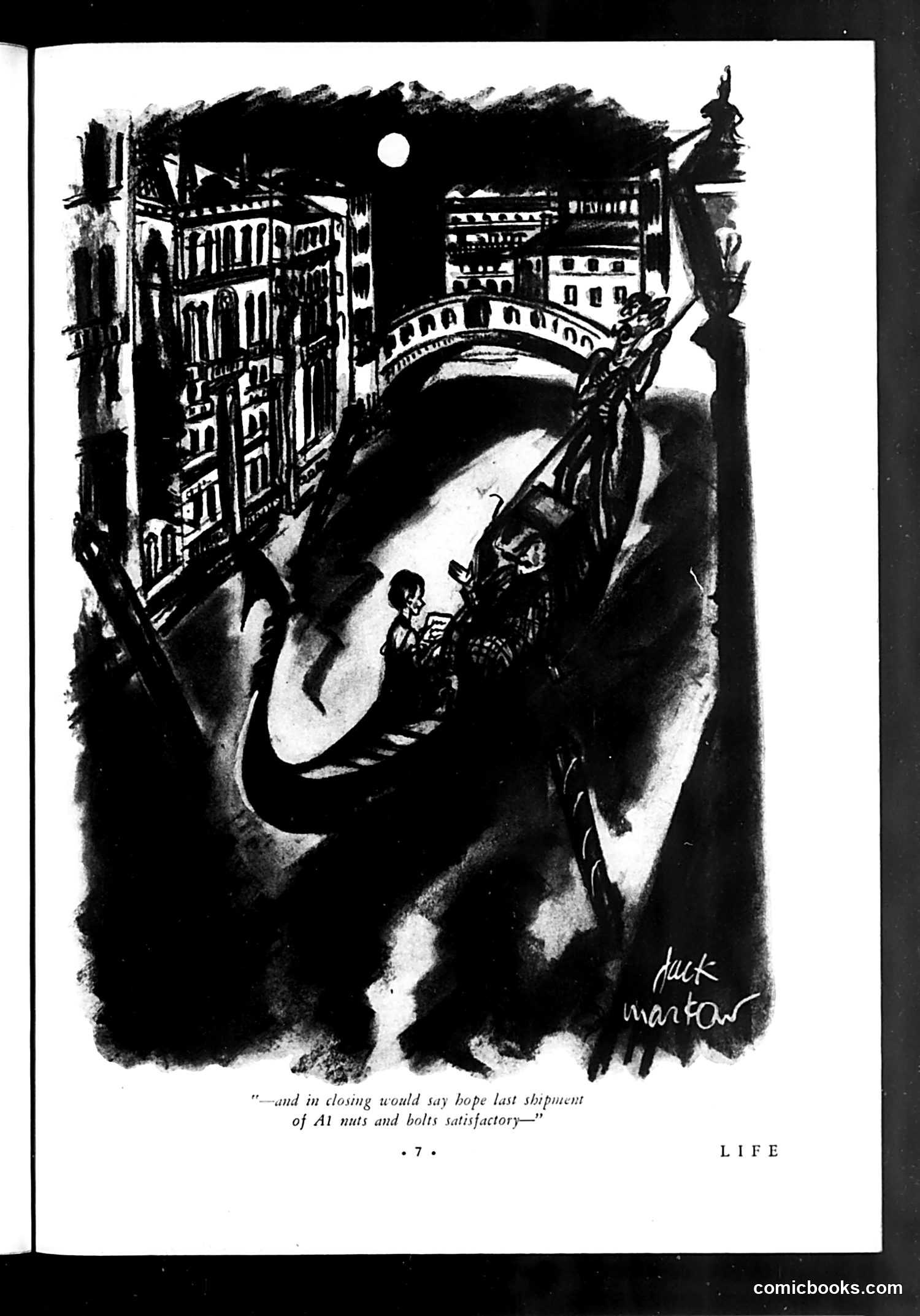
Analysis This is a satirical illustration from *Life* magazine depicting a Venetian canal scene at night. The caption reads: "—and in closing would say hope last shipment of Al nuts and bolts satisfactory—" The cartoon appears to be business satire, likely mocking formal or stilted commercial correspondence. The speaker seems to be conducting mundane business (discussing "nuts and bolts") in an absurdly romantic, moonlit Venetian setting—the contrast between prosaic commercial language and the poetic Italian backdrop creates the humor. The signature reads "Al(?) Marlow" (artist attribution). Without additional context, the specific commercial reference or historical event being satirized is unclear, though the joke relies on incongruity between romantic atmosphere and banal business matters.
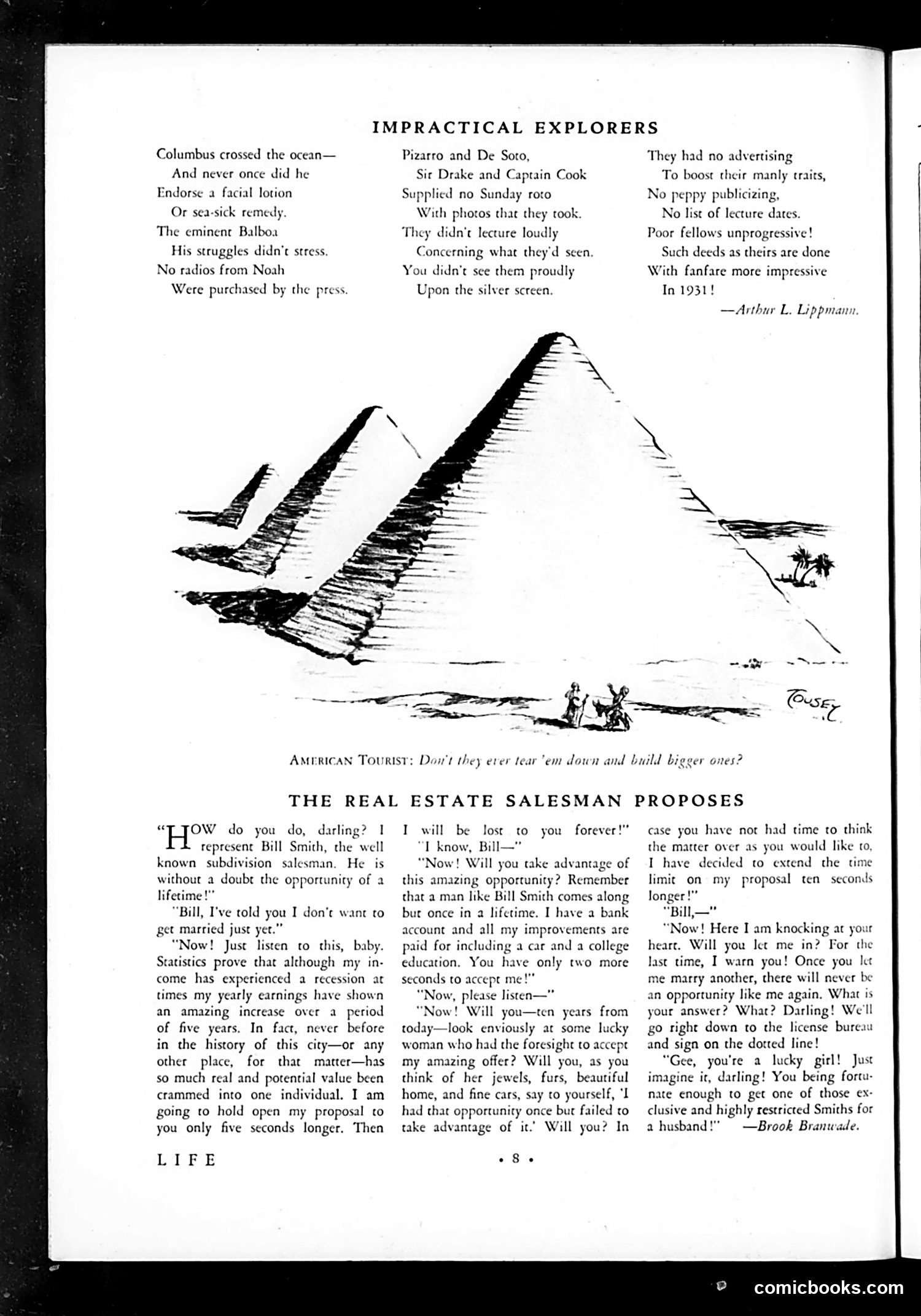
Analysis The page contains two distinct pieces: "Impractical Explorers" (top): A poem by Arthur L. Lippmann satirizing famous explorers—Columbus, Balboa, Drake, Cook, and Pizarro—for lacking modern self-promotion. They conducted major expeditions without advertising, lectures, or media coverage. The satire targets 1931's commercial culture: even heroic achievements now require publicity and merchandising to matter. The accompanying cartoon shows massive pyramids dwarfing tiny explorers and a tourist, emphasizing how past accomplishments are reduced to tourist attractions. "The Real Estate Salesman Proposes" (bottom): A humorous short story by Brook Brawalde depicting an aggressive real estate pitch disguised as a marriage proposal. The salesman conflates romantic commitment with property investment, using high-pressure sales tactics on his reluctant girlfriend. It satirizes 1930s aggressive salesmanship and commercialism invading personal relationships.
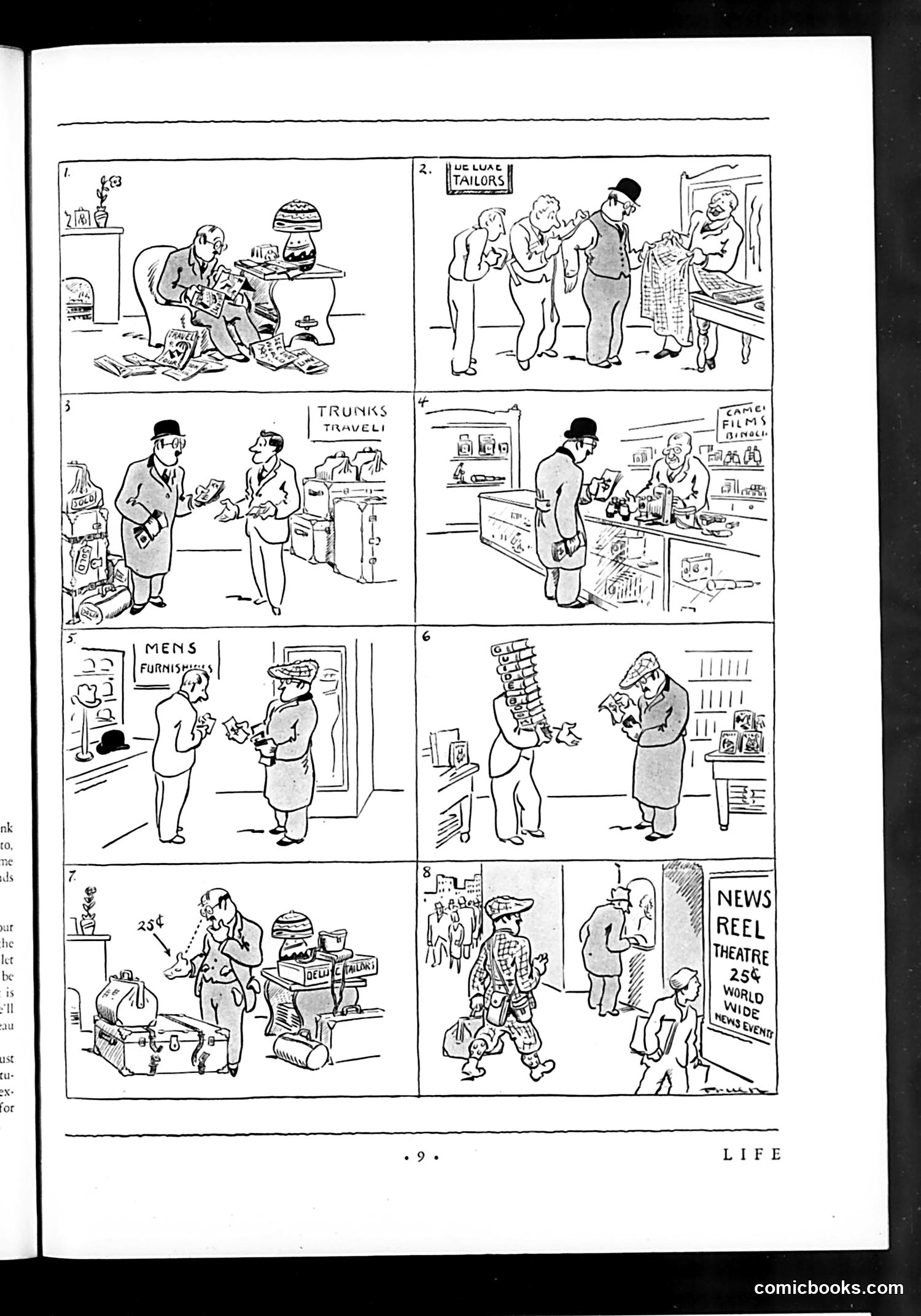
Analysis of Life Magazine Comic Page This is a wordless comic strip sequence depicting a man's shopping expedition through various retail establishments. The panels show: 1. A shopper at home surrounded by merchandise catalogs 2. At a tailor shop ("Deluxe Tailors") 3. At a luggage store ("Trunks Travel") 4. At a camera/film shop ("Camel Films") 5. At a men's furnishings store 6. Purchasing stacked merchandise 7. At what appears to be a restaurant or food counter 8. At a movie theater The satirical point appears to be commentary on consumer culture and impulse buying—the protagonist accumulates increasingly absurd quantities of goods and experiences, suggesting the ease with which Americans could be persuaded to spend money on various commercial offerings. The humor derives from the escalating absurdity of his purchases and the contrast between initial catalogs and actual retail encounters.
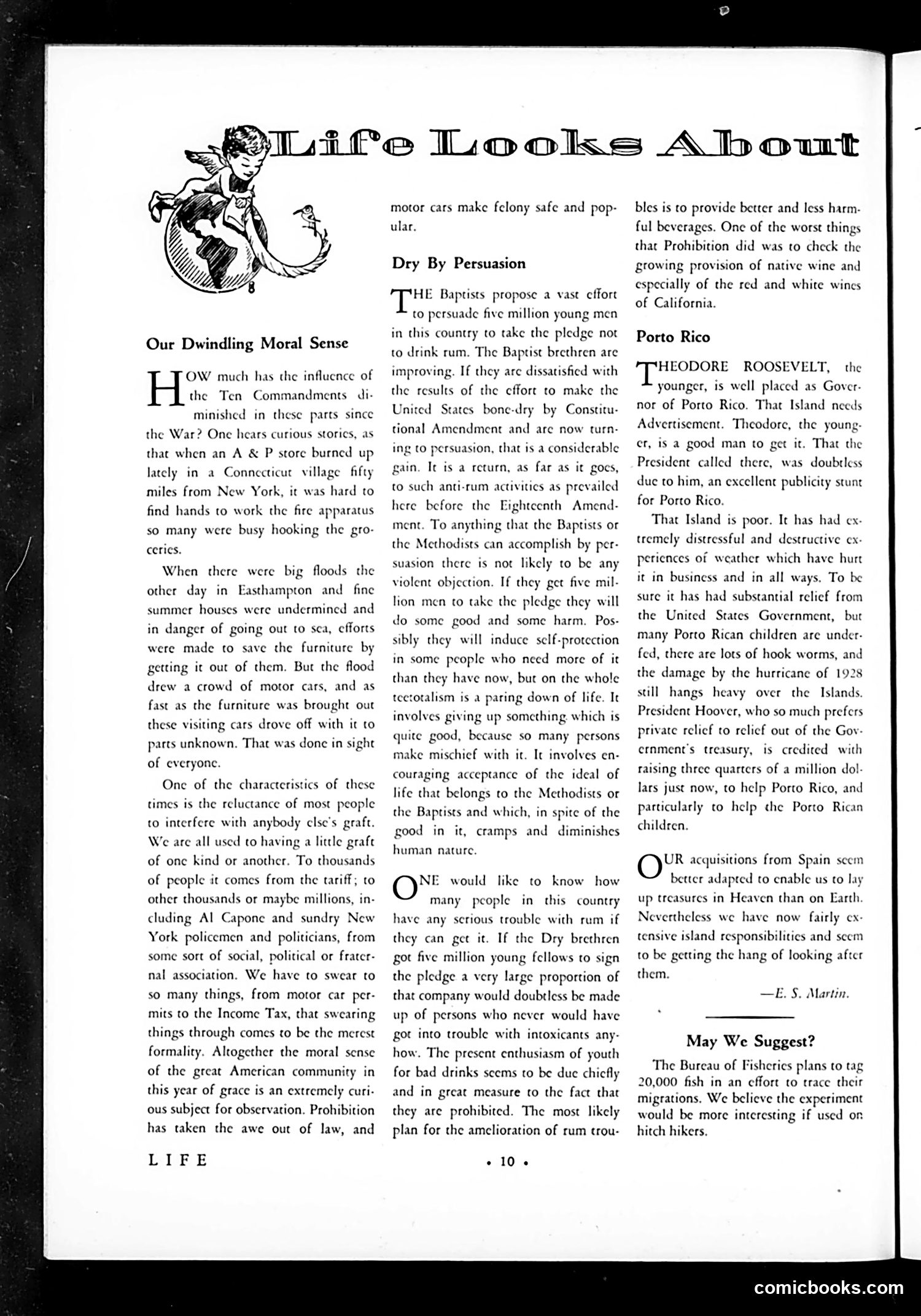
Analysis of Life Magazine Page This page presents satirical commentary on Prohibition-era America. The main illustration shows a cherub-like figure (representing Life magazine's editorial voice) holding what appears to be a broken vessel, symbolizing the failure of Prohibition policy. The articles critique: 1. "Our Dwindling Moral Sense" - argues that Prohibition's enforcement has paradoxically increased graft and corruption among officials (police, politicians) who profit from bootlegging and rule-breaking rather than reducing it. 2. "Dry By Persuasion" - skeptically examines Baptist efforts to persuade citizens to abstain from alcohol, suggesting moral persuasion alone cannot enforce laws. The satire suggests Prohibition created widespread hypocrisy and corruption rather than moral improvement—a common contemporary critique of the 18th Amendment.
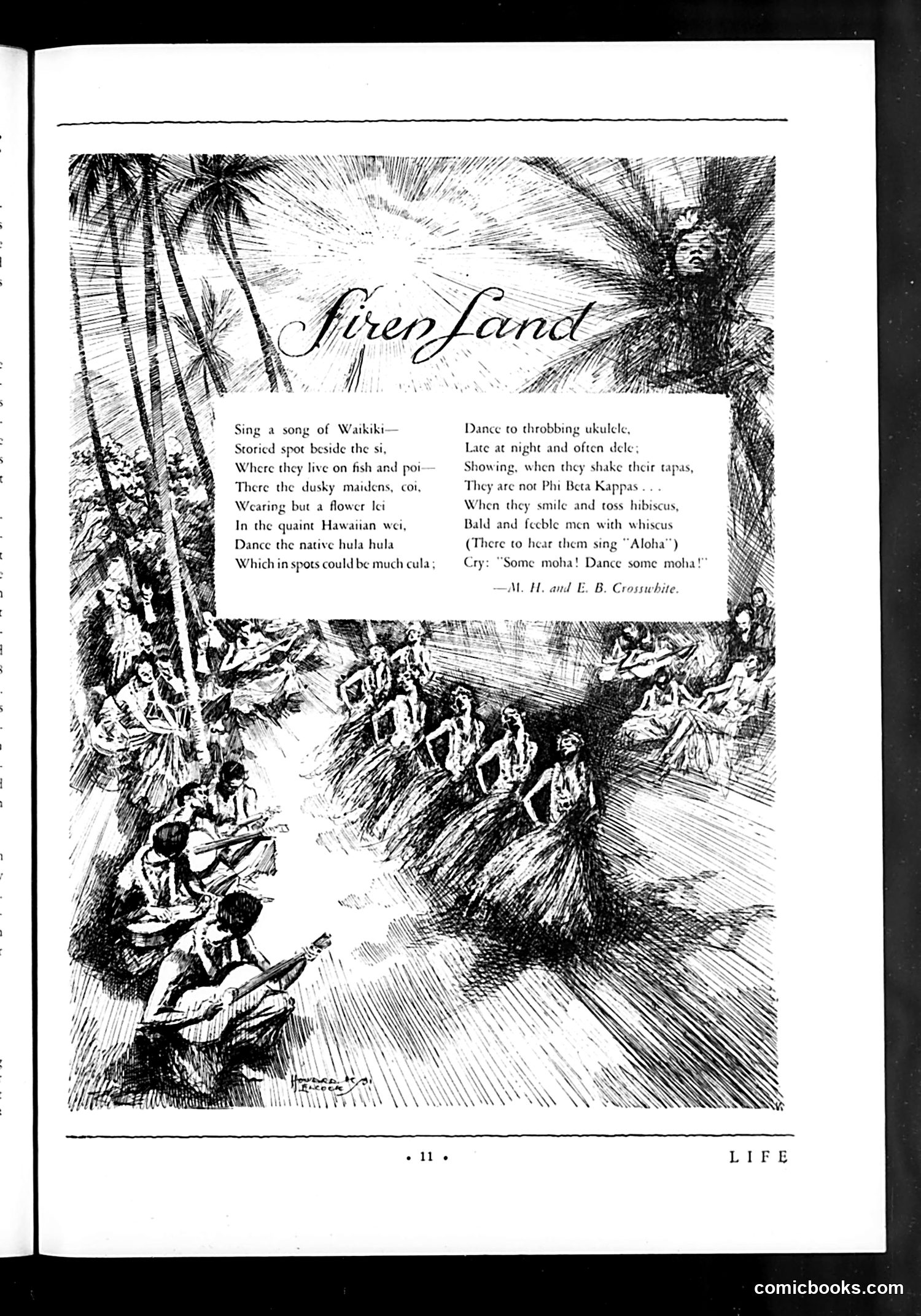
Siren Land This page presents a romantic poem about Hawaiian culture by M. H. and E. B. Crosswhite, illustrated with an evocative sketch of a tropical scene. The poem celebrates Hawaiian traditions—hula dancing, ukulele music, flower leis, and the phrase "Aloha"—with nostalgic appreciation for "native" customs. The illustration depicts palm trees, figures dancing and playing instruments, and a radiant sky, romanticizing Hawaii as an idyllic, exotic destination. The content reflects early 20th-century American attitudes toward Hawaii: treating indigenous culture as picturesque entertainment and spiritual escape rather than as a living, complex society. This "Orientalist" perspective was common in *Life* magazine, which often exoticized non-Western cultures for metropolitan readers seeking adventure and romance.
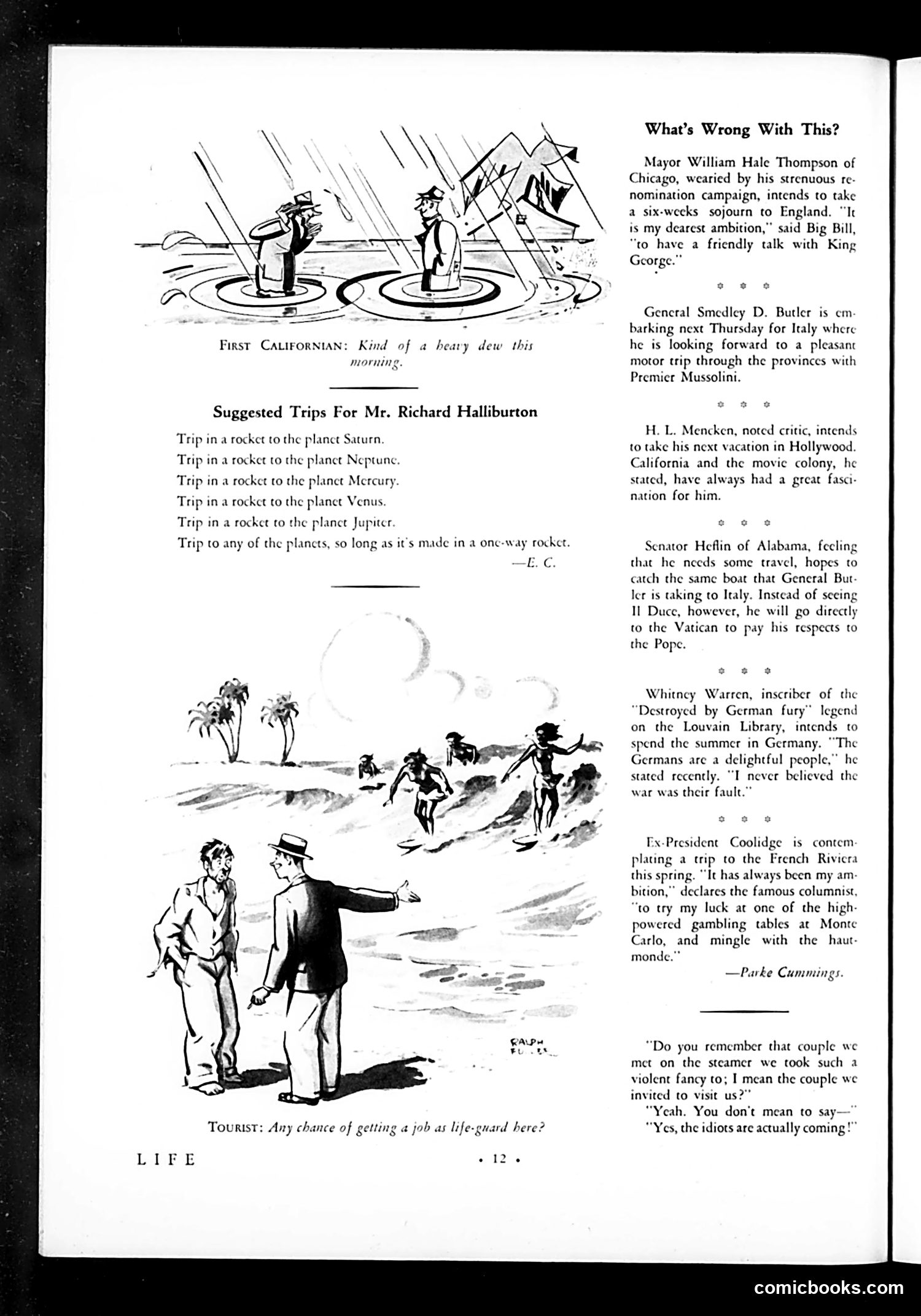
Analysis of Life Magazine Page This page contains political satire and humor pieces circa the 1920s era. Top cartoon ("What's Wrong With This?"): Shows Mayor William Hale Thompson of Chicago in rain, satirizing his renomination campaign. The text suggests he wants to visit King George—likely mocking Thompson's political ambitions and international pretensions. "Suggested Trips for Mr. Richard Halliburton": A sarcastic list suggesting one-way rocket trips to various planets. Halliburton was apparently a notable figure (likely a writer/adventurer), and the joke implies the author wishes he'd leave Earth. Bottom cartoon ("Tourist"): A man asks a lifeguard for employment, while others swim. The humor plays on desperation during economic hardship—the tourist is so broke he's seeking any job. Right column: Brief gossip items about various political and society figures' travel plans.
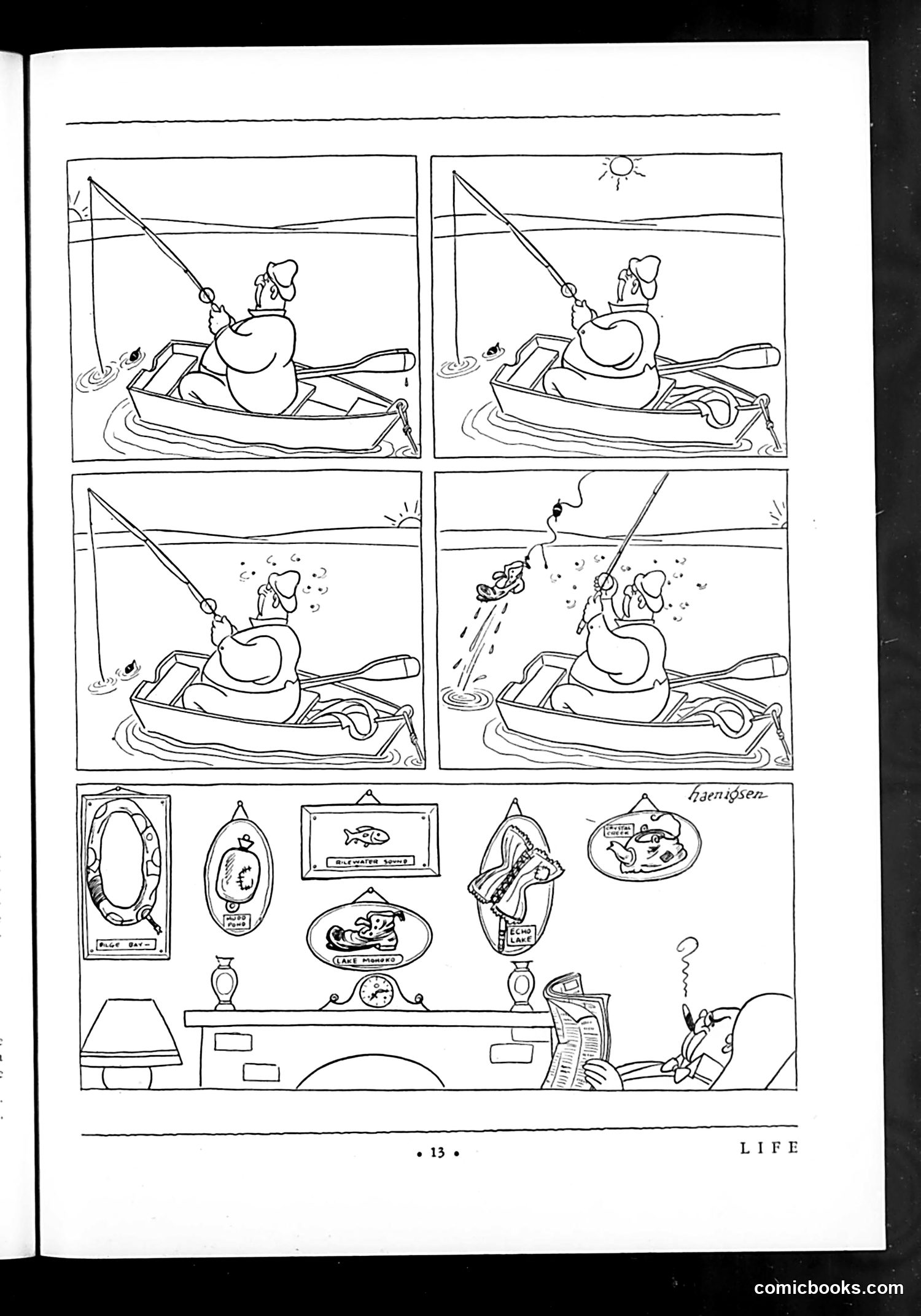
Analysis This is a humorous four-panel comic strip showing a fisherman's day, followed by a lower panel depicting his home display of fishing trophies. The joke: The top four panels show the fisherman fishing from morning (overcast) through afternoon (sunny), progressively getting soaked and struggling with his catch. The bottom panel reveals the ironic payoff—his home is decorated with framed fishing pictures and mounted displays, yet he appears to be a mediocre fisherman constantly failing at the actual task. This satirizes the gap between a sportsman's aspirations and reality: he displays his "conquests" proudly indoors while the comics show he's largely unsuccessful and uncomfortable in practice. It's gentle satire on masculine hobby culture and the tendency to mythologize modest accomplishments through home decoration. The signature appears to read "Esenlösen" or similar.
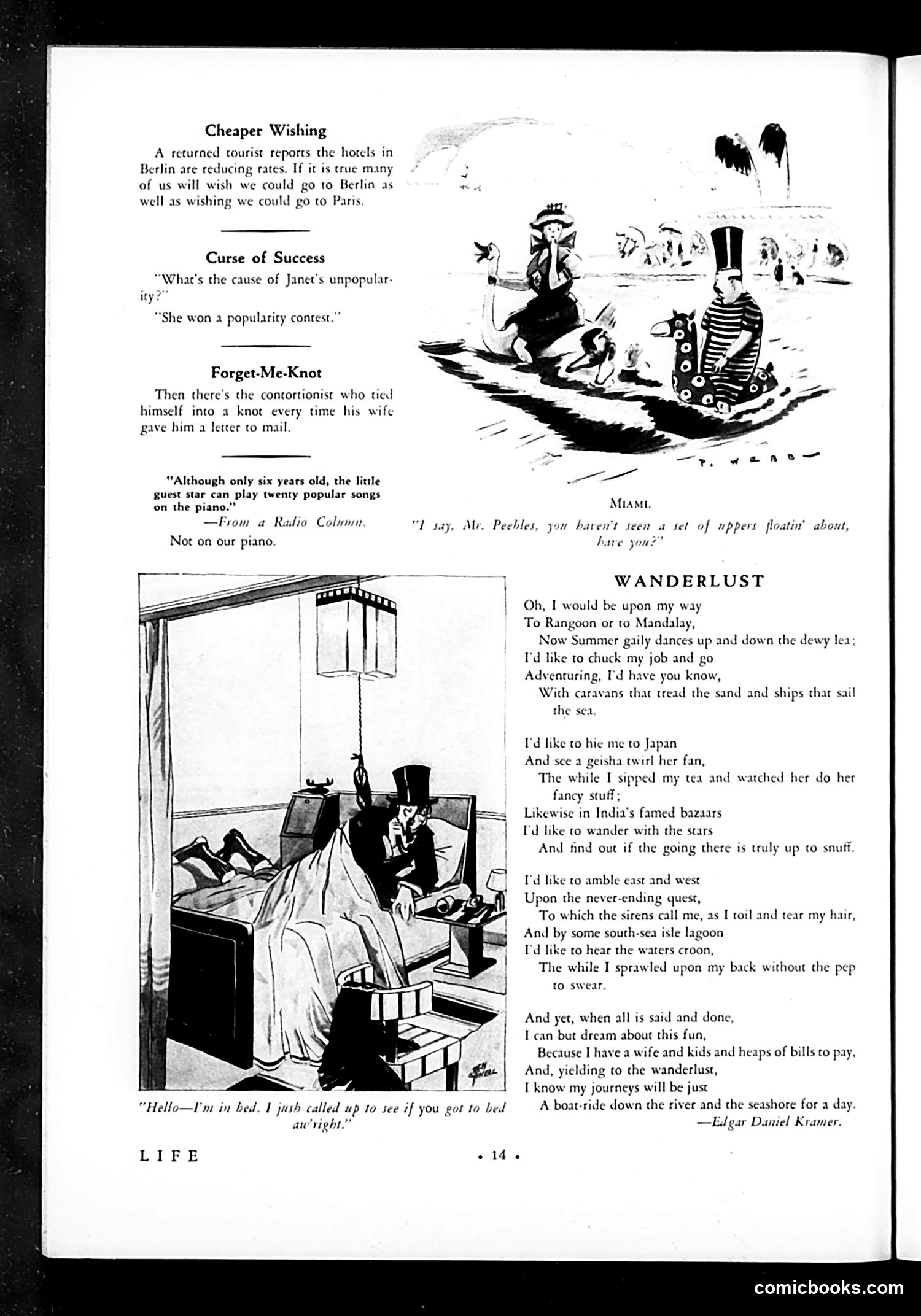
Explanation for Modern Readers This page from *Life* magazine contains several short humorous items and illustrations typical of early 20th-century satirical journalism. The cartoons mock everyday social situations: one depicts a couple in bed where the husband has been called out, another shows an elaborate boat scene in Miami. The text jokes include "Curse of Success" (a woman won a popularity contest, making her unpopular) and "Forget-Me-Knot" (a contortionist husband who ties himself in knots for his wife). The main feature is "Wanderlust," a poem by Edgar Daniel Kramer about desiring exotic travel to Japan, India, and the Far East—reflecting early 20th-century fascination with orientalism and colonial adventure. The poem's ironic conclusion admits the speaker will never leave due to family obligations, capturing period tension between wanderlust and domestic responsibility.
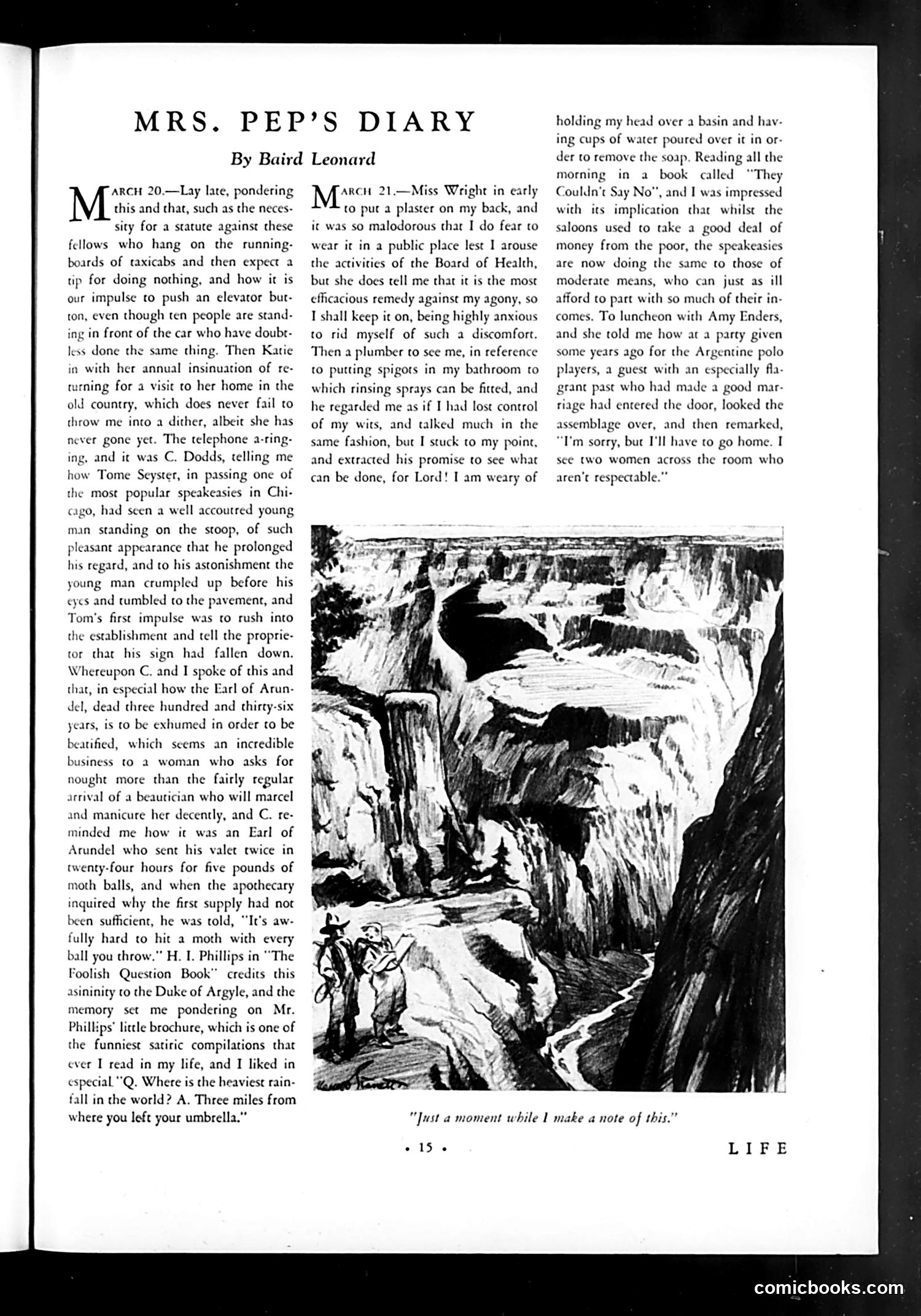
"Mrs. Pep's Diary" by Baird Leonard This is a humorous diary entry satirizing upper-class social anxieties of the early 20th century. The diarist complains about: - Domestic staff issues: hiring and tipping doormen and elevator operators for minimal service - Social embarrassments: an awkward guest at a polo party who disrupted proceedings - Beauty treatments: suffering through painful spa procedures (plaster treatments, bathroom sprays) to maintain appearance - Historical trivia: references to Earl of Arundel and H.I. Phillips' "Foolish Question Book" The cartoon caption shows a woman sketching in a canyon, saying "Just a moment while I make a note of this"—likely mocking how wealthy Americans documented leisure travels. The satire targets the vanity, pretension, and constant social anxieties of the leisure class.
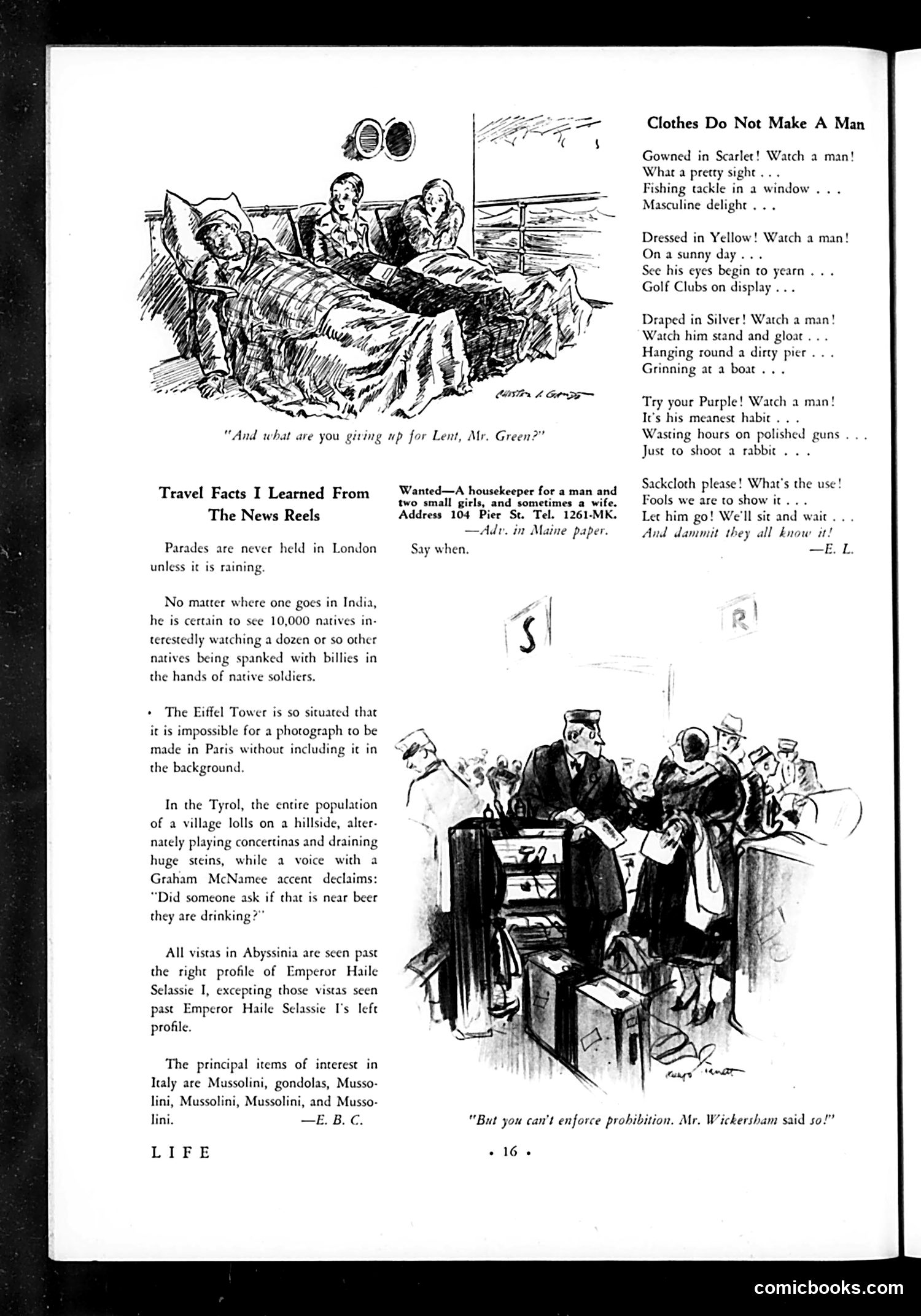
Cartoon Analysis: "But you can't enforce prohibition, Mr. Wickersham said so!" The bottom cartoon depicts a Prohibition-era scene where a man at what appears to be a speakeasy or illegal alcohol operation is being confronted by officials or law enforcement. The caption references "Mr. Wickersham," likely referring to George Wickersham, who headed the Wickersham Commission (1929-1931) investigating Prohibition's enforcement failures. The joke satirizes the futility of Prohibition enforcement: even government officials acknowledged it couldn't be effectively enforced, so criminals exploited this admitted weakness. The cartoon mocks both the policy's impracticality and the irony that authorities essentially admitted defeat while continuing the law. The top cartoon about "Clothes Do Not Make A Man" humorously lists various outfits without creating actual character or worth—a commentary on superficiality.
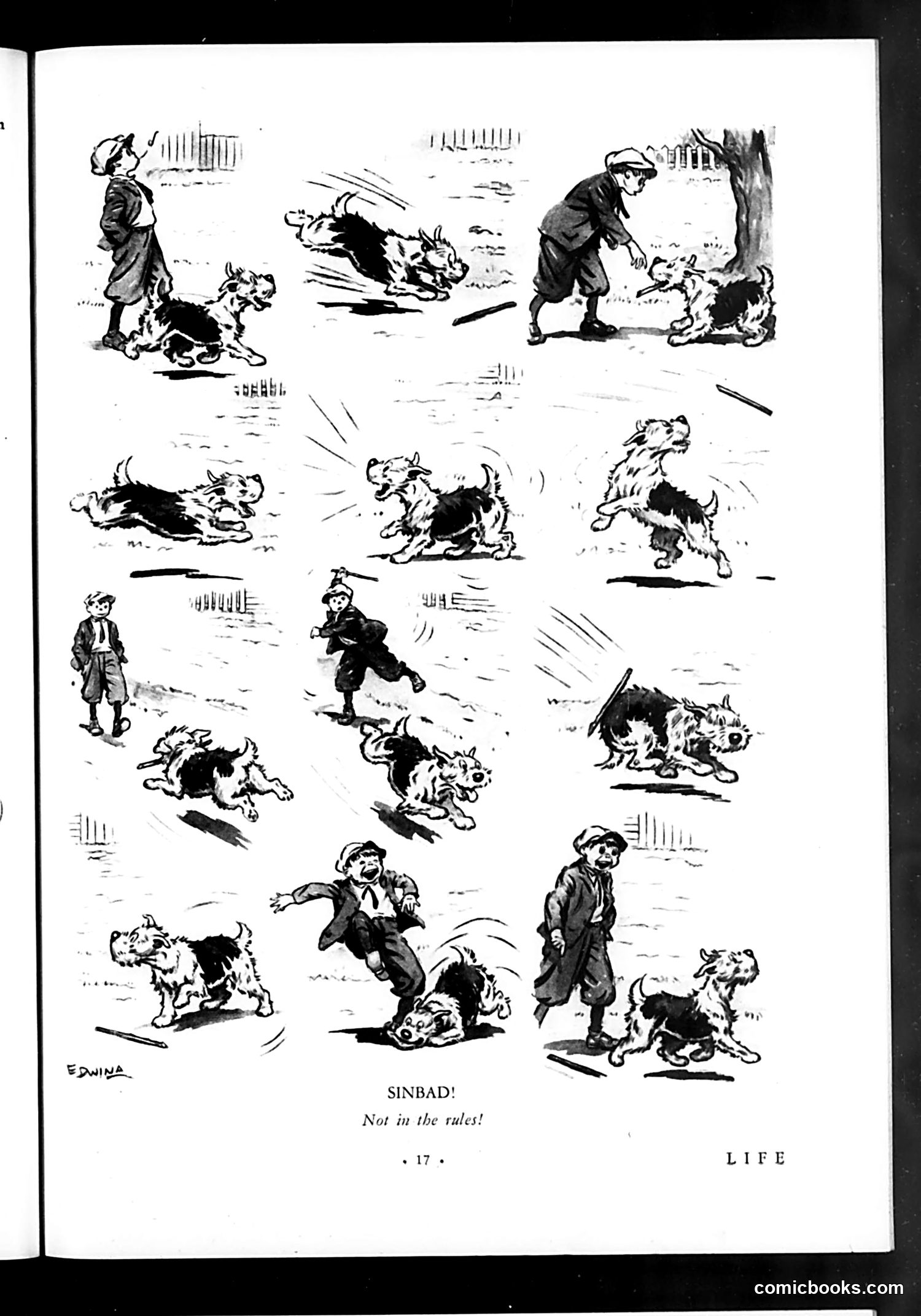
"Sinbad! Not in the Rules!" This cartoon by Edwina depicts a series of vignettes showing a dog (named Sinbad) engaged in various mischievous behaviors—chasing, jumping, playing rough—while men in suits and caps attempt to manage or restrain the animal. The repeated caption "Not in the rules!" suggests Sinbad consistently violates established guidelines or expectations of proper conduct. The satire appears to target either uncontrollable behavior or the gap between formal rules and practical reality. Without additional context about whether "Sinbad" references a specific contemporary figure, dog show scandal, or social situation, the exact target remains unclear. The cartoon likely commented on a topical issue familiar to Life magazine's 1920s-era readers.
Analysis of "Life in Washington: The President Likes Relief Problems" By Carter Field, this article satirizes President Hoover's approach to relief during what appears to be the Great Depression era. The piece mocks Hoover's visits to Puerto Rico and the Virgin Islands as performative—suggesting he travels to avoid confronting domestic crises like farmer suffering in Kansas and Iowa. The satire targets Hoover's detachment: while he tours colonies, American farmers face hardship. The text highlights contradictions in his policies regarding tariffs, trade, and government responsibility, particularly regarding Puerto Rico's sugar and tobacco industries. The piece suggests Hoover prioritizes appearances and distant concerns over pressing domestic poverty, portraying his relief efforts as inadequate theater rather than substantive policy response.
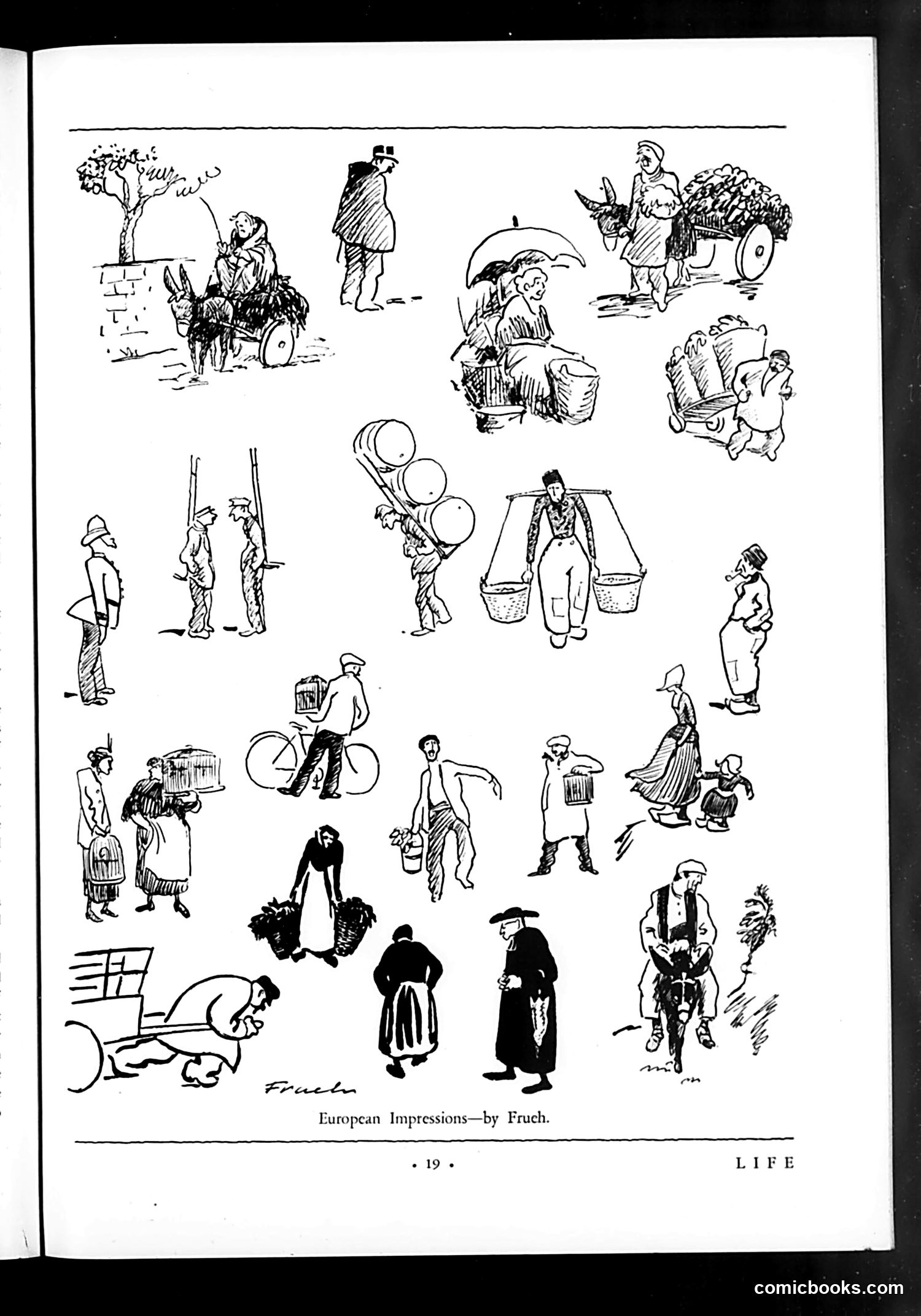
European Impressions—by Fruch This page presents a collection of satirical sketches titled "European Impressions" by artist Fruch, published in *Life* magazine (page 19). The drawings depict various European street scenes and character types through American eyes, likely from the early-to-mid 20th century. The sketches show stereotypical European figures and activities: vendors with carts and baskets, people with bicycles, figures in traditional dress, soldiers, women with umbrellas, and various working-class characters. The cartoons appear to offer humorous, somewhat patronizing observations about European life, customs, and social types for American readers unfamiliar with European culture. The style is characteristic of *Life*'s satirical approach—using exaggerated features and situations to create comedic commentary on foreign societies.
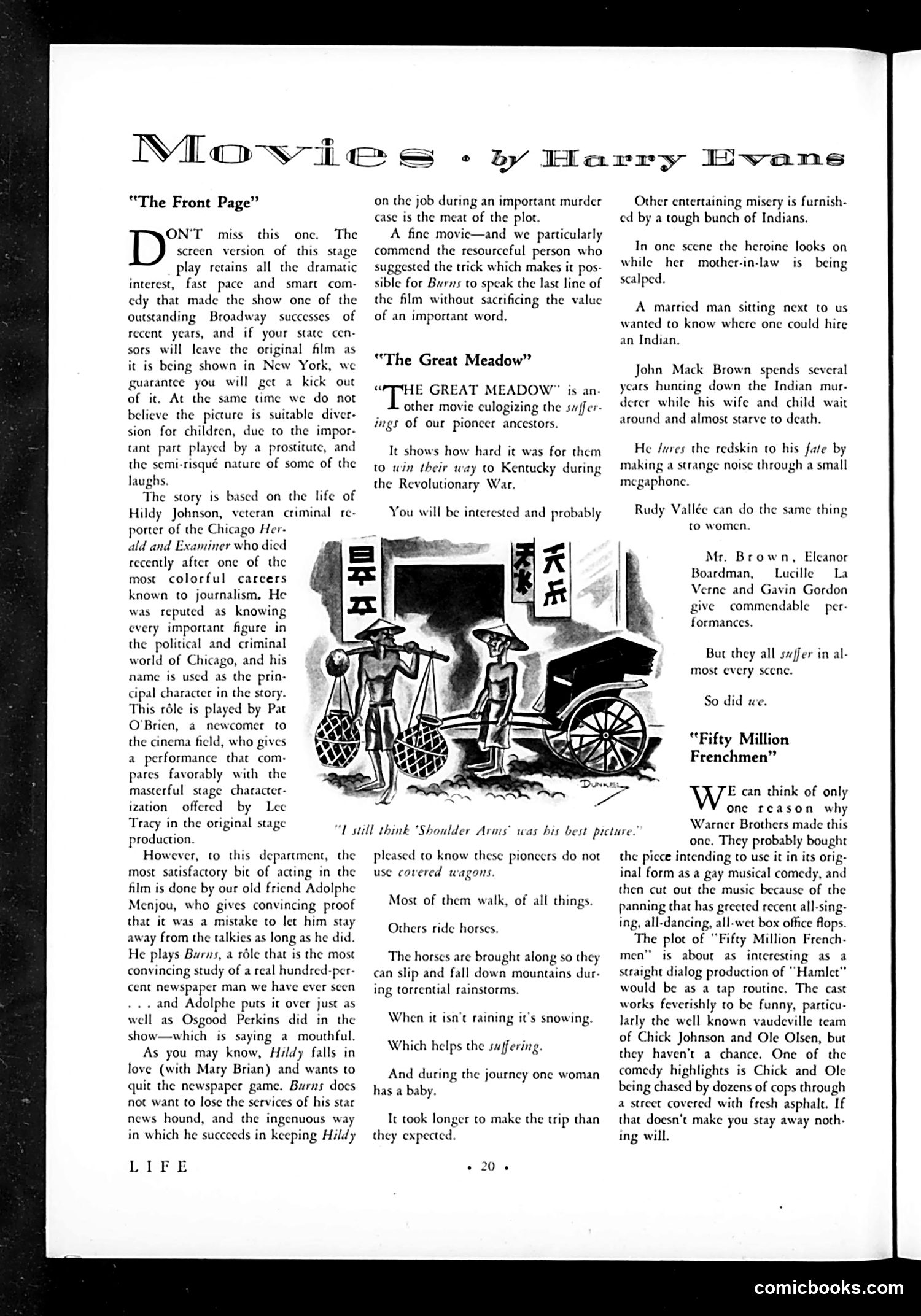
Analysis of Life Magazine Movie Review Page This page contains film reviews by Harry Evans critiquing three 1930 movies. The embedded cartoon depicts Chinese figures with a rickshaw, likely illustrating "The Great Meadow" review's satirical tone about pioneer hardships. Evans employs dry, sardonic humor throughout. He praises "The Front Page" (based on real Chicago reporter Hildy Johnson) for its fast pace despite censorship concerns about prostitution. He mocks "The Great Meadow" relentlessly—noting pioneers walked rather than used wagons, suffered constant rain and snow, endured Indian attacks, and one woman gave birth. His repeated emphasis on "suffering" is ironic commentary on the film's melodramatic earnestness. The cartoon's caption—"I still think 'Shoulder Arms' was his best picture"—references Chaplin's WWI comedy, suggesting nostalgia for better entertainment. Evans's reviews represent Life's satirical approach: witty deflation of pretentious or poorly-made films through exaggeration of their actual plot points, making the absurdities speak for themselves to sophisticated readers.
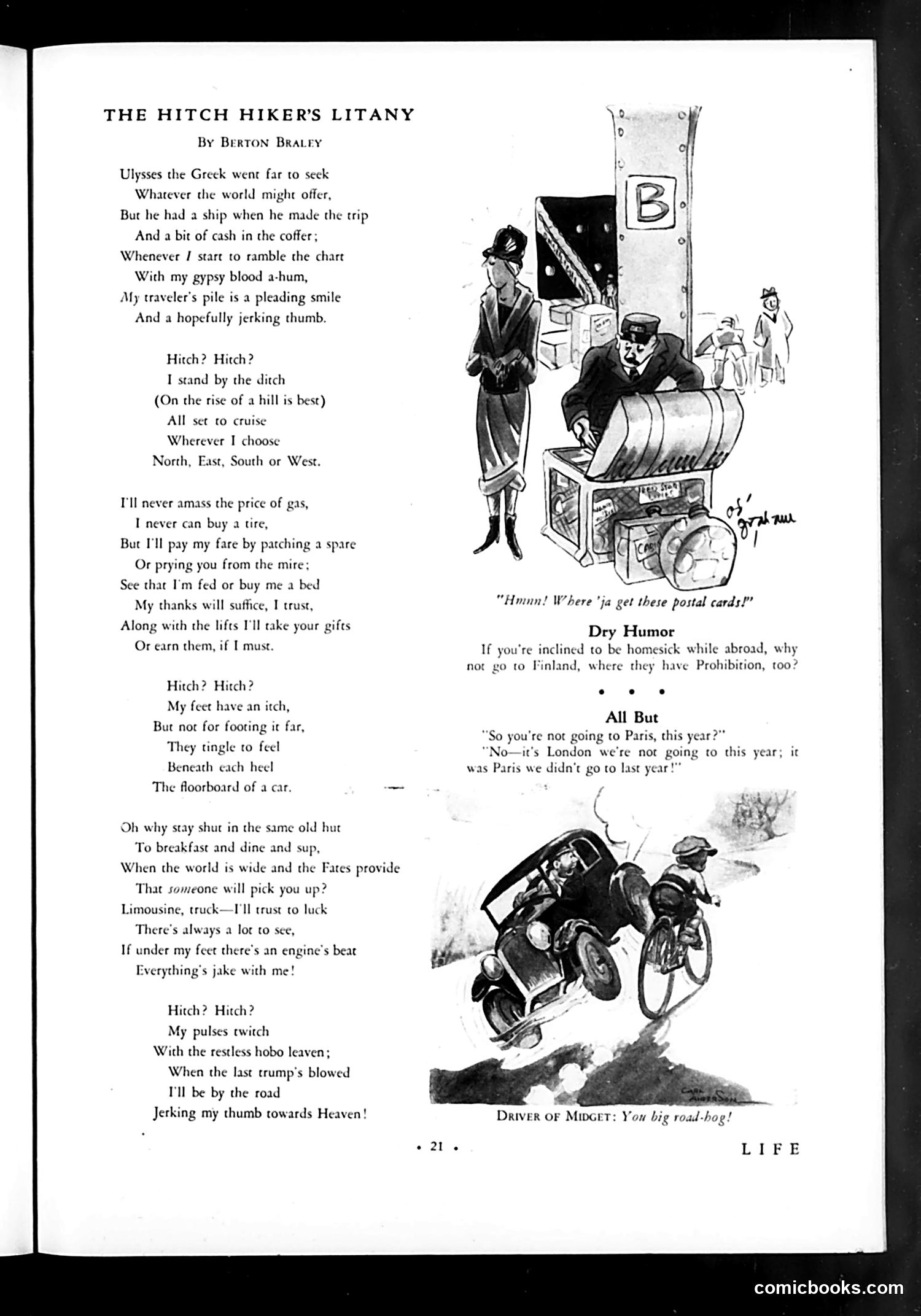
Explanation for Modern Readers This page satirizes 1920s hitchhiking culture and travel attitudes. "The Hitch Hiker's Litany" by Berton Bratey is a humorous poem celebrating the carefree hobo lifestyle—traveling without money by bumming rides and relying on drivers' charity. The speaker contrasts himself with Ulysses, who had resources; he has only a "pleading smile" and "hopefully jerking thumb." The accompanying cartoons offer dry social humor. One jokes about Prohibition-era homesickness (Finland also had Prohibition). Another depicts the absurdity of chronic travel plans: a couple hasn't gone to Paris this year, London the previous year—perpetually postponing trips. The final cartoon shows a car-versus-bicycle road conflict. The content reflects post-WWI American restlessness, economic mobility challenges for working people, and the emerging car culture's social dynamics. Hitchhiking represented romantic freedom but also economic necessity during this era.
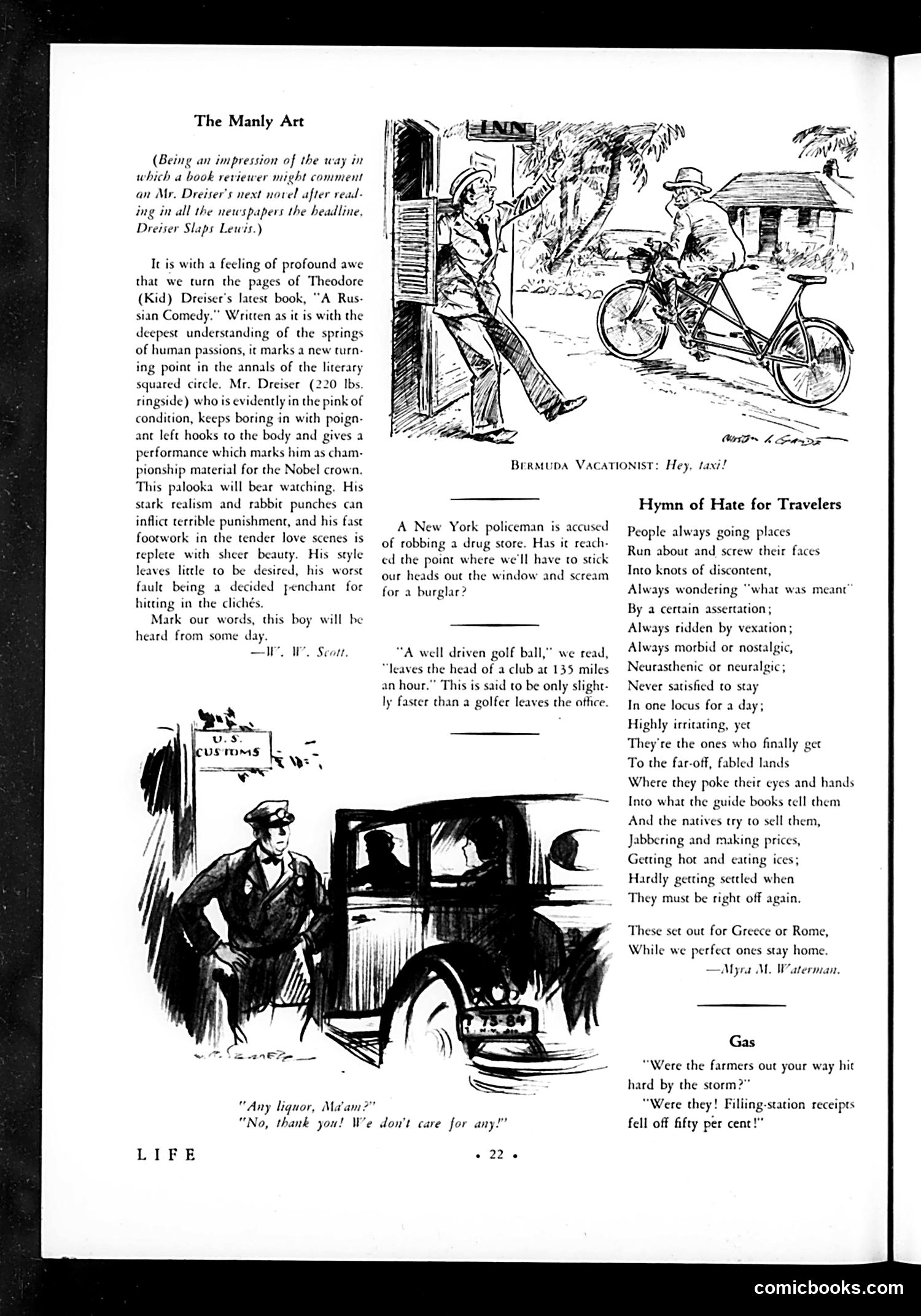
"The Manly Art" Page Analysis This *Life* magazine page satirizes literary criticism and modern life circa the 1920s-30s. "The Manly Art" mocks book reviewers who mindlessly adopt newspaper headlines. The setup references Theodore Dreiser (a major novelist) allegedly slapping Sinclair Lewis. The critic treats Dreiser's writing like prizefighting—using boxing terminology ("Kid," "220 lbs ringside," "palooka," "left hooks") to describe literary technique. The joke: serious book reviews are reduced to sports commentary based on gossip rather than actual reading. Other pieces include light humor about travelers (always discontent, obsessed with guidebooks), a policeman accused of theft, golf balls, and farmers losing income to gas station visits instead of farm damage—a wry Depression-era jab at changing rural economics. The cartoons are straightforward illustrations: a "Bermuda Vacationist" arriving by bike; a customs officer with a motorist. These support the text's themes of travel anxiety and bureaucratic absurdity rather than advancing specific political arguments.
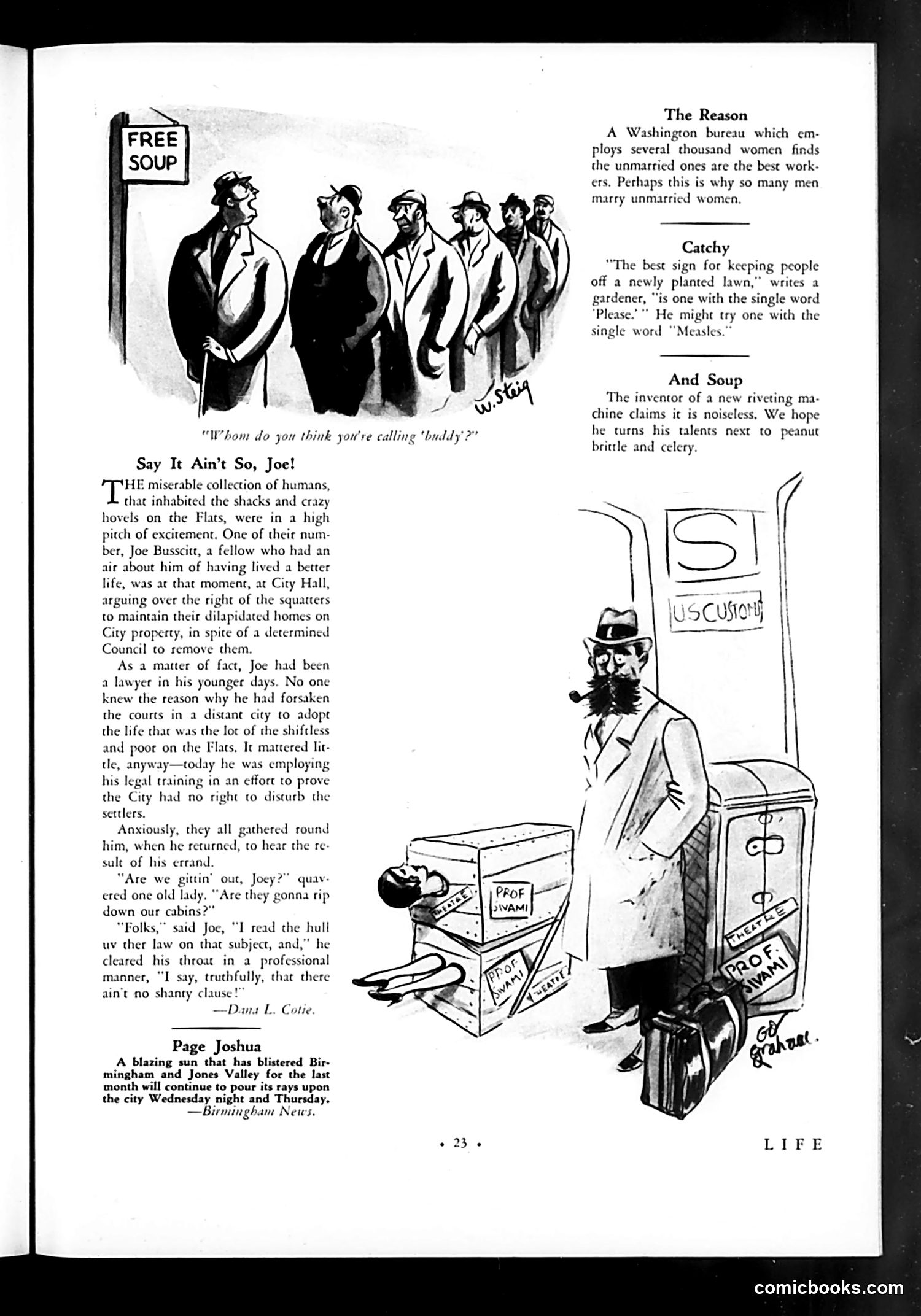
Explanation for Modern Readers This page contains multiple satirical pieces from *Life* magazine: Top left cartoon: Shows poor men queuing at a "Free Soup" station. The caption "Whom do you think you're calling 'buddy'?" suggests class tension—even desperate poverty doesn't eliminate dignity or pride. Main story, "Say It Ain't So, Joe!": A narrative about Joe Buscett, a former lawyer now living in poverty on "the Flats" (a poor neighborhood). He argues before the City Council to prevent eviction of squatters from city property. The joke's punchline—his claim there's "ain't no shanty clause" in the law—plays on his legal authority despite his current circumstances, mixing colloquial speech with legal language for comic effect. Right side cartoon: Shows a customs officer with luggage marked "Prof. Swami" and "Duty"—likely satirizing exotic imported goods or charlatan "professors" popular in the era. Brief humor items: Mock advice about lawn signs and a riveting machine inventor, typical of the magazine's short-form satire.
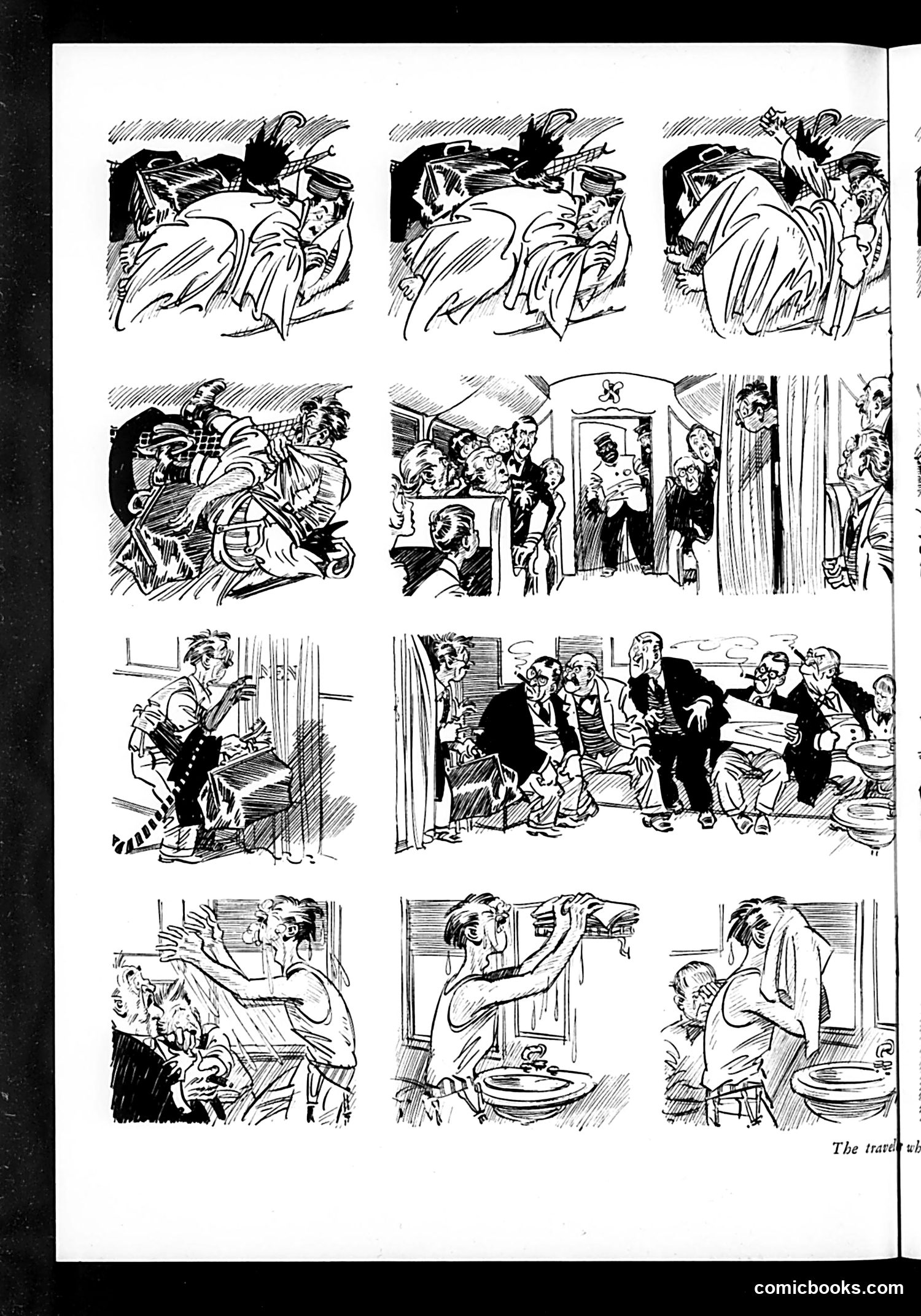
Analysis This page contains a sequential comic strip depicting what appears to be a humorous narrative about travel or lodging. The OCR text is too fragmented to determine the exact story, though the caption "The travel wh[ere]" suggests the title is cut off. The panels show: people in beds (possibly depicting bedbugs or similar travel mishaps—a common satirical subject), a crowded room scene, someone gesturing at a window or door, a group of men in formal wear discussing something, and final panels showing someone interacting with what looks like washing facilities. Without clearer text, the specific satirical target remains unclear, though the humor appears to involve the indignities or complications of travel accommodations—a perennial subject for Life magazine's social satire during the early-to-mid 20th century.
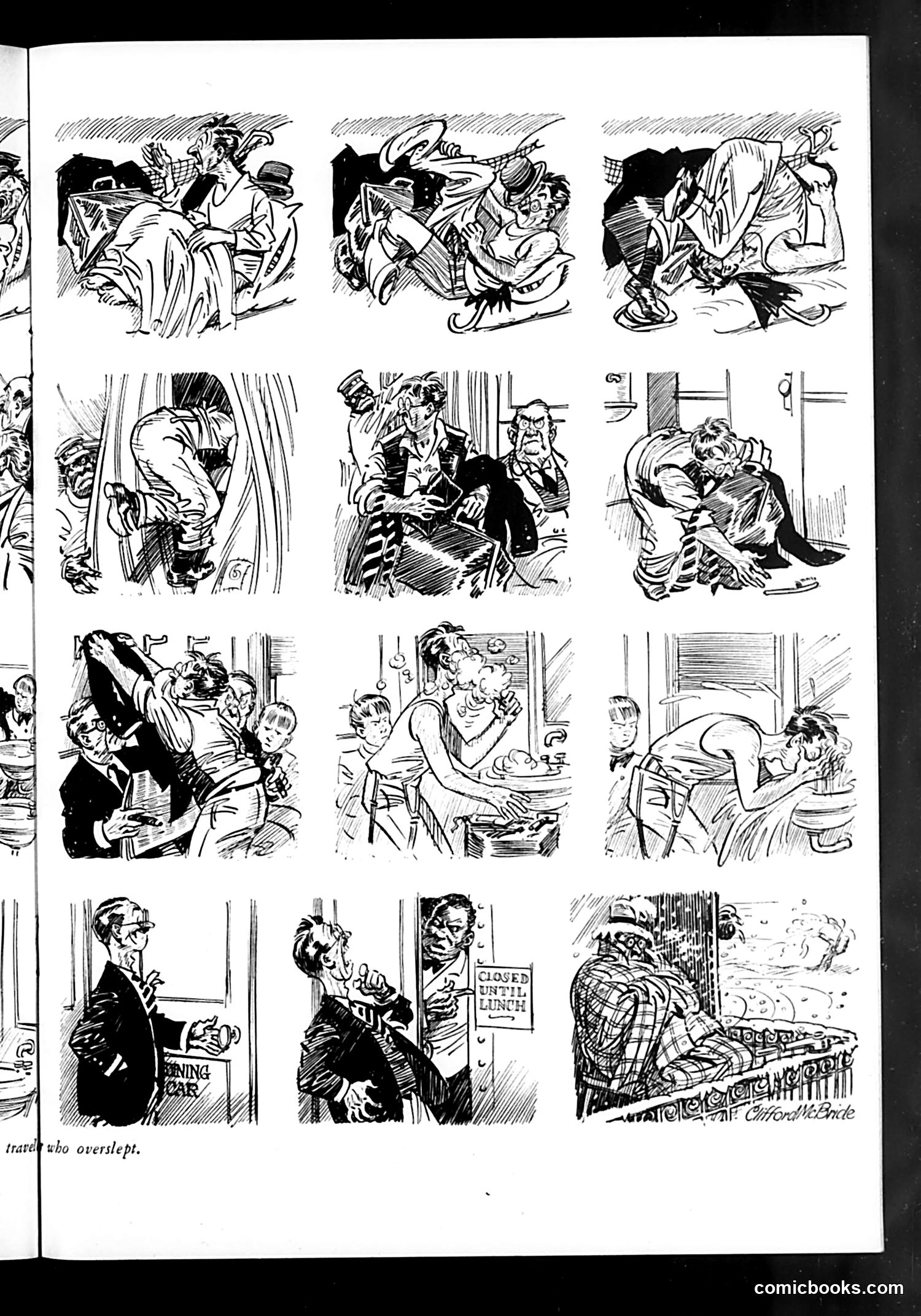
Analysis This appears to be a sequential comic strip depicting a humorous narrative about someone who overslept. The twelve panels progress through what seems to be a domestic comedy scenario: the top rows show chaotic morning activity with multiple figures (appearing to include a man in formal dress, women, and children) engaged in frantic preparation. The middle sections shift to what appears to be a workplace or dining establishment setting, with figures in formal attire. The final panels show someone at what's labeled "DINING CAR" and "UNTIL LUNCH," suggesting train travel. The visual gag appears to center on the consequences of oversleeping disrupting both domestic routine and travel plans. Without clearer text or attribution, the specific satirical target remains unclear, though it's likely social commentary on punctuality or modern transportation inconveniences common to 1920s-30s Life magazine humor.
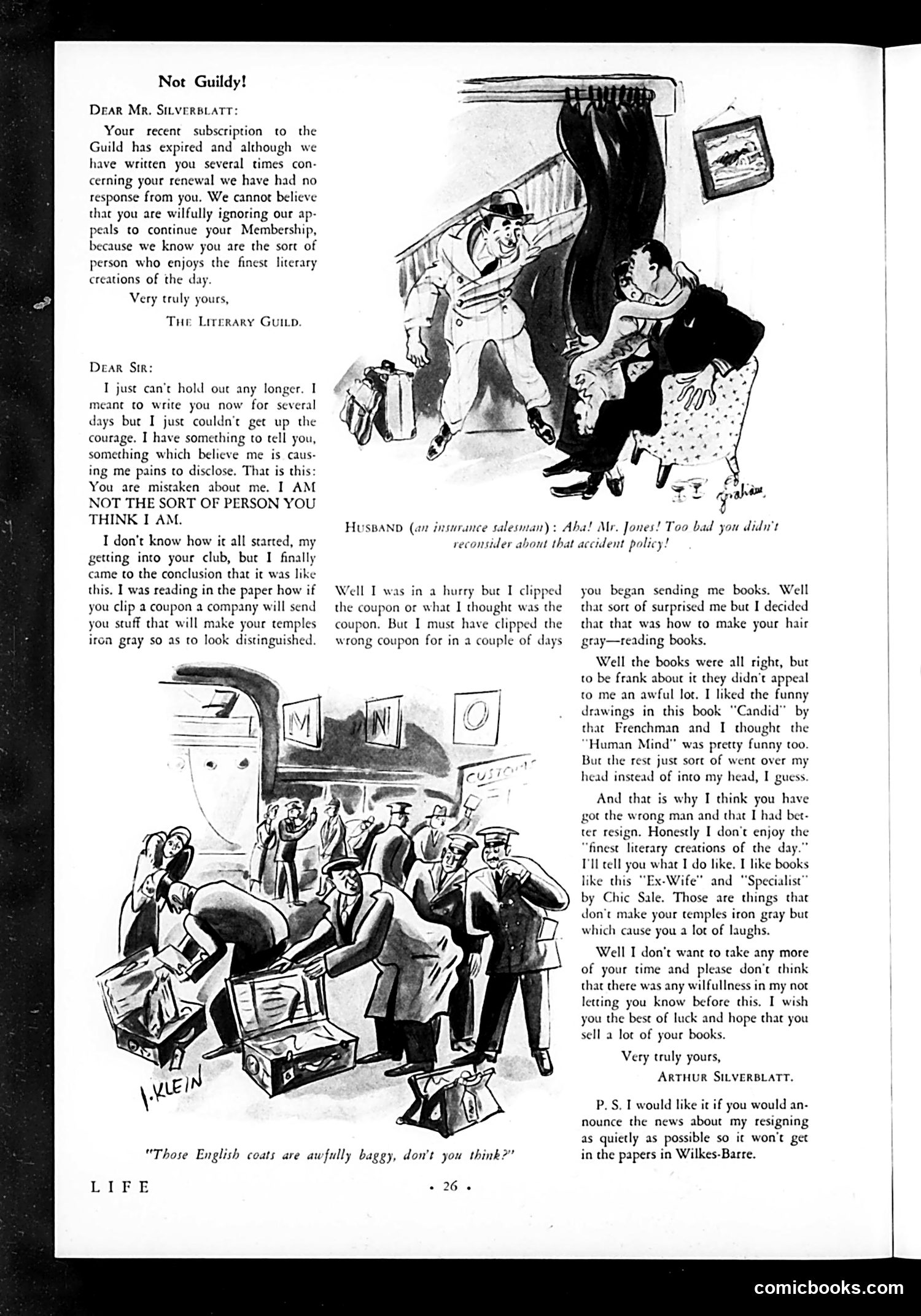
Explanation for Modern Readers This satirical piece mocks the Literary Guild (a book subscription club) and its pretensions. Arthur Silverblatt, a member, writes to explain he's resigning because he's "not the sort of person" they think he is. The joke: Silverblatt accidentally joined by clipping the wrong coupon, then received books he found boring and intellectual. He prefers humorous, lowbrow titles like "Ex-Wife" and "Specialist" by Chic Sale—light comedies that make him laugh rather than "finest literary creations" that go "over my head." The satire targets: - The Guild's snobbishness about "refined" literature - Class anxiety about appearing cultured (he wanted gray temples to look distinguished) - Advertising's deceptive coupons that trap unwilling customers The cartoons illustrate the confusion (couple receiving wrong items) and the gap between literary pretension and ordinary readers' actual tastes. The final P.S. adds humor: he wants his resignation kept quiet in his hometown paper—embarrassed by admitting he doesn't enjoy "high culture."
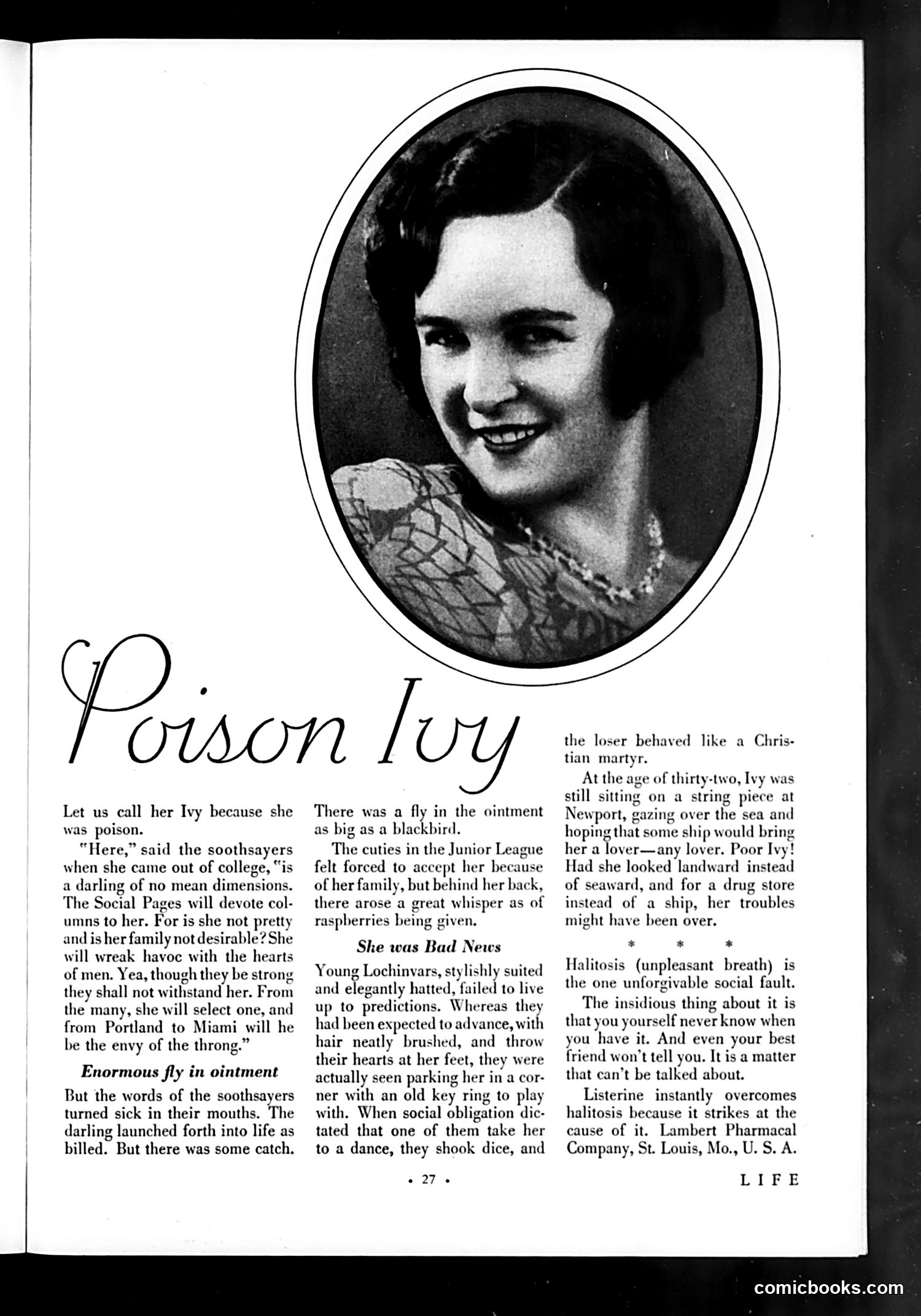
"Poison Ivy": A Social Satire with an Advertisement This page satirizes a socially prominent but unpopular young woman nicknamed "Ivy" (meaning poison). Despite predictions that her beauty and family status would make her a desirable debutante, she becomes "bad news"—rejected by Junior League members and avoided by eligible young men, who literally draw lots to see who must escort her to dances. The cruel punchline: at thirty-two, still unmarried and lonely at Newport, Ivy's real problem isn't her personality or looks—it's halitosis (bad breath). The revelation pivots into an advertisement for Listerine mouthwash, which "strikes at the cause" of this "unforgivable social fault." The satire mocks both upper-class social pretension and the emerging advertising culture that identified and exploited social anxieties. It's darkly humorous: Ivy's entire romantic failure, the text suggests, could be solved by a commercial product.
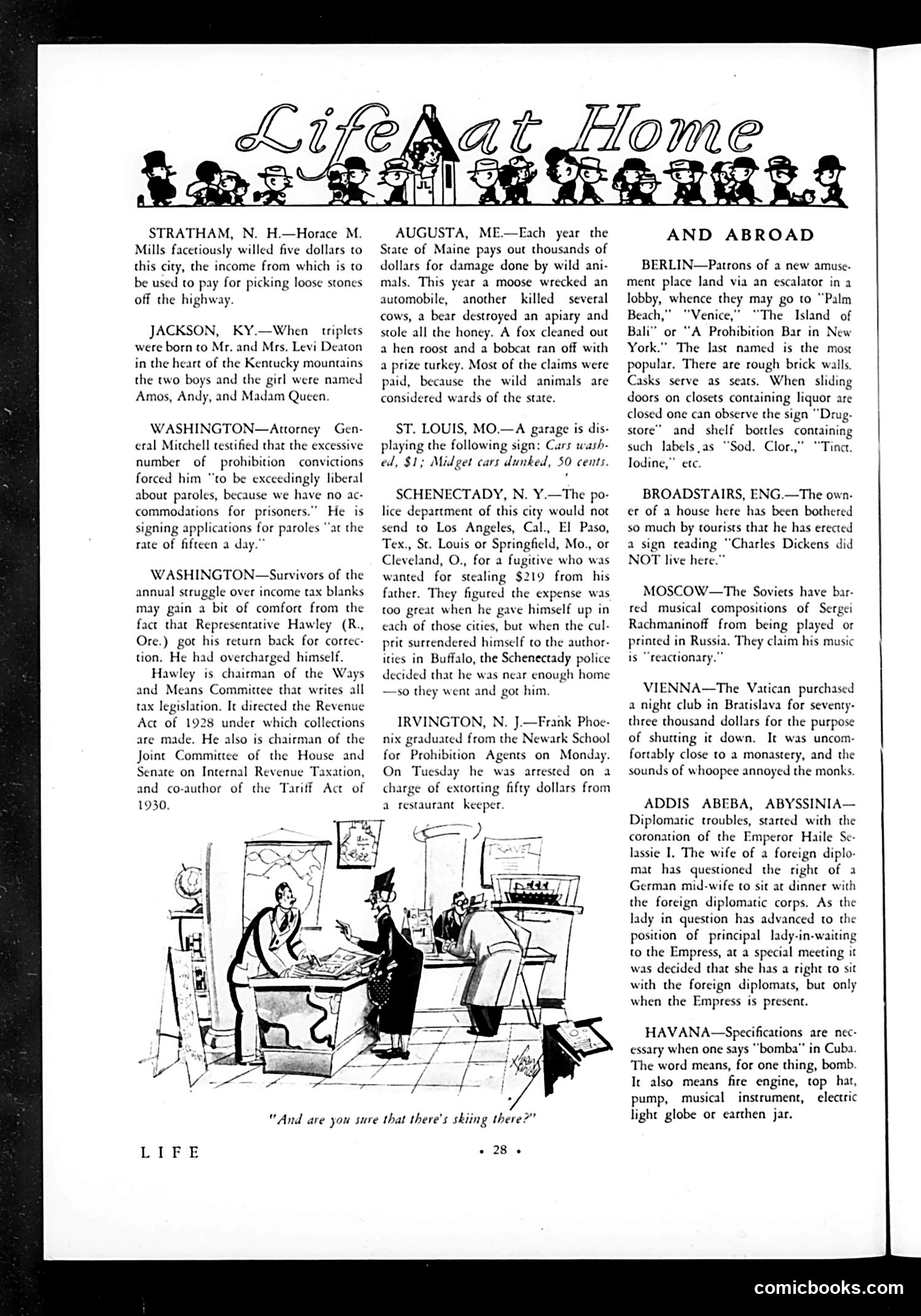
"Life at Home and Abroad" Page Analysis This page collects humorous anecdotes from around the world, mostly satirizing bureaucratic absurdity and hypocrisy during Prohibition era America (early 1930s). Domestic satirical targets: - Attorney General Mitchell: Mocked for releasing prisoners at "fifteen a day" due to overcrowding caused by excessive Prohibition convictions - Representative Hawley: Ironic commentary on the tax code author overcharging himself on his own return - Prohibition enforcement: A newly graduated Prohibition agent immediately arrested for extortion—exposing corruption in the enforcement system - Local incompetence: Schenectady police unwilling to extradite a fugitive except when nearby The cartoon shows what appears to be a domestic scene with someone asking "And are you sure that there's skiing there?"—likely referencing tourist confusion or false advertising. International items mock Prohibition hypocrisy (Berlin's fake speakeasy bar) and general absurdity. The page's broader point: America's Prohibition experiment and bureaucratic systems are fundamentally broken and ridiculous.
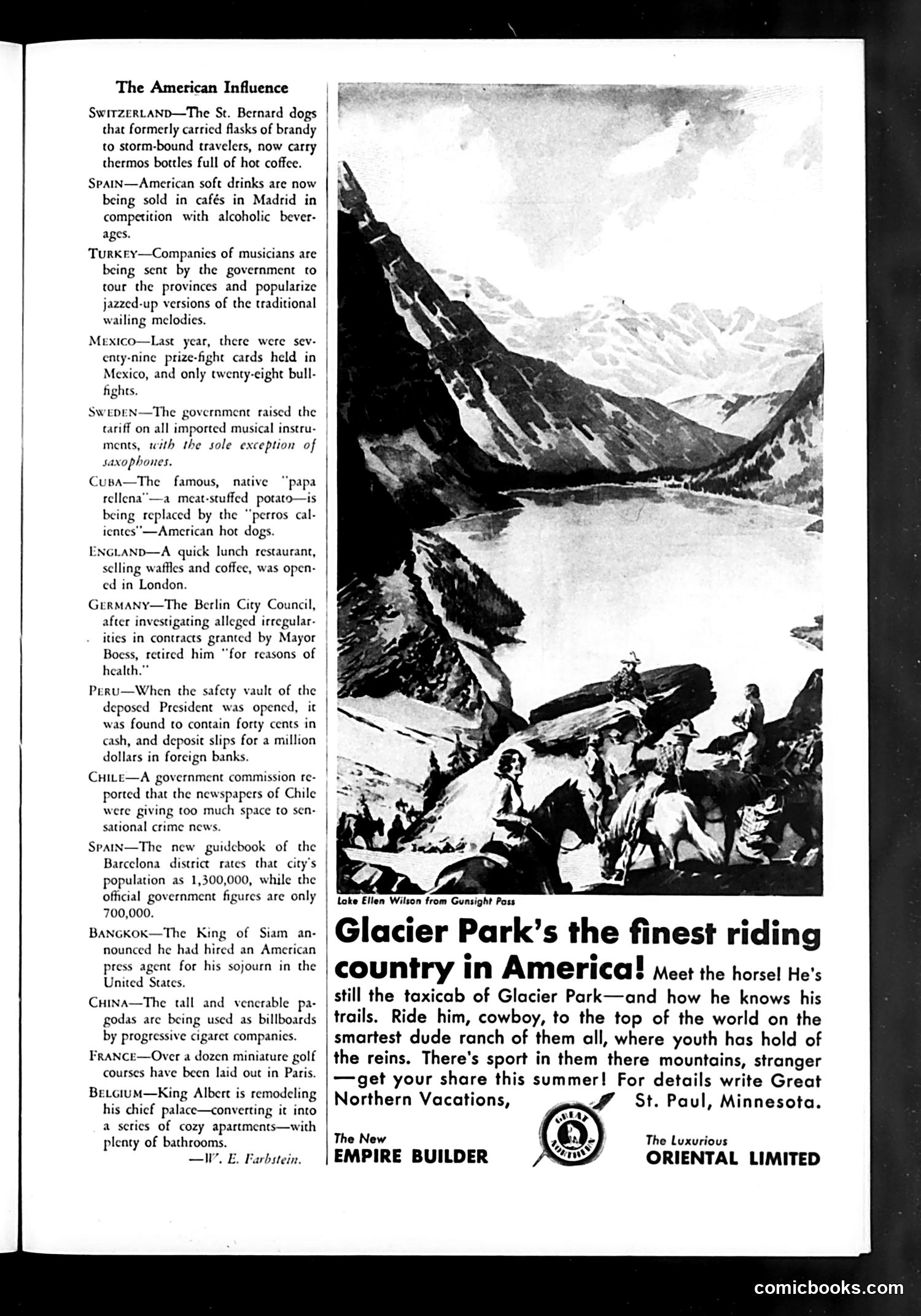
This page is primarily advertising content. The main feature is a large advertisement for Glacier Park vacation tourism in Montana, showing a dramatic mountain landscape photograph with riders on horseback. The upper portion contains "The American Influence"—a satirical column describing how American cultural trends are spreading globally: Swiss St. Bernard dogs now carry thermos bottles instead of brandy; Spain has American soft drinks competing with traditional beverages; Turkey promotes jazz versions of folk music; Cuba replaces traditional "papa rellena" with American hot dogs; England opens a waffles-and-coffee restaurant. The satire mocks American cultural dominance and commercialism spreading worldwide, often displacing local traditions. The recurring theme is American consumerism—soft drinks, hot dogs, jazz—infiltrating and replacing authentic cultural practices in other nations.
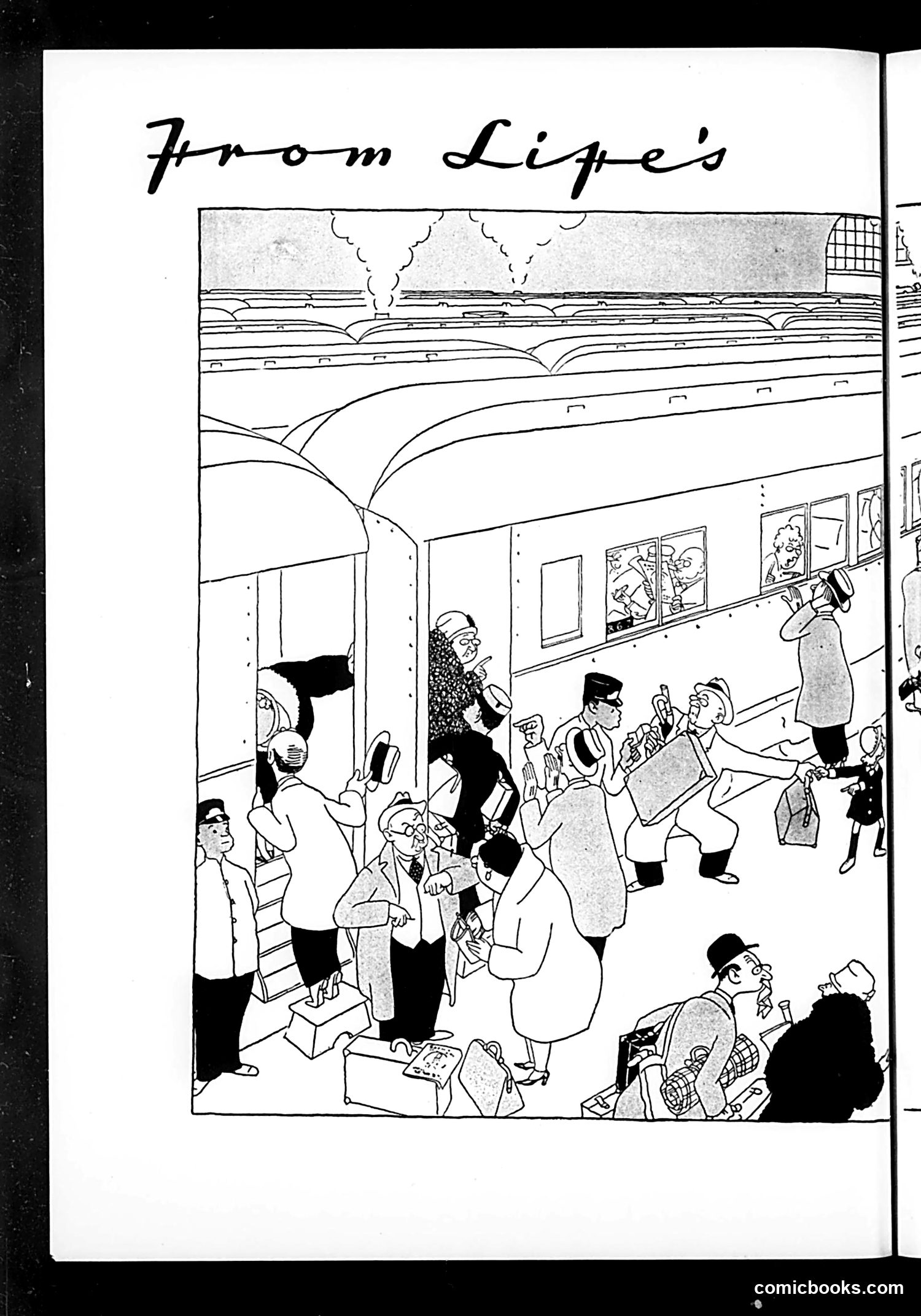
Analysis of "From Life's" Cartoon This cartoon depicts a crowded train station platform with passengers boarding or disembarking. The title "From Life's" indicates this is satirical commentary on contemporary society. The scene shows well-dressed travelers, porters, and station staff in what appears to be 1920s-1930s attire. The humor likely targets: - Travel chaos: The crowded, disorganized boarding scene satirizes the confusion and congestion of modern rail travel - Class distinctions: Different dress and demeanor of passengers versus workers suggests social commentary - Luggage and consumerism: Scattered baggage hints at materialism or excess Without clearer caricatures or text identifying specific public figures, the satire appears to be general social commentary on the contradictions and absurdities of contemporary travel culture rather than targeting particular individuals or events.
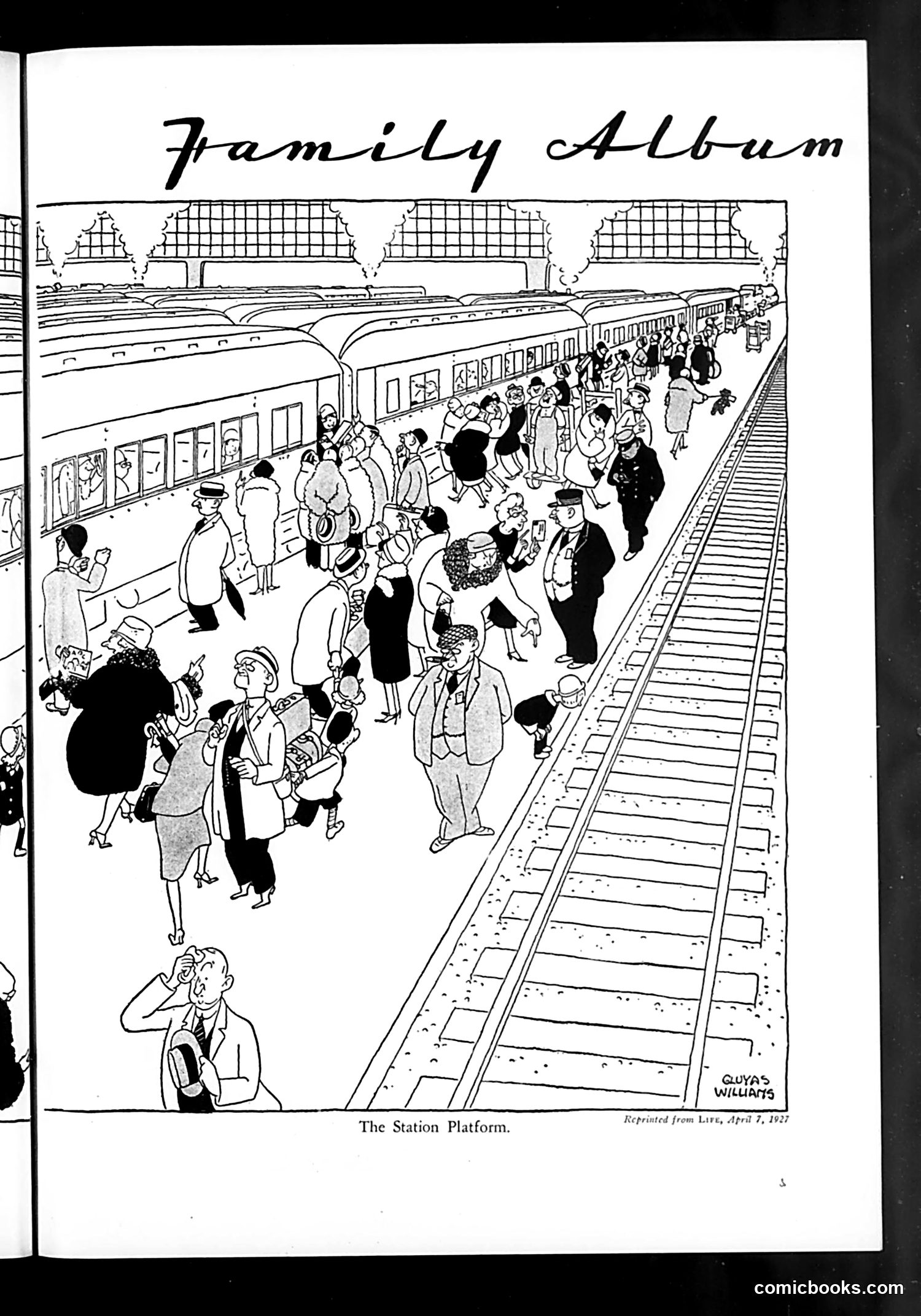
"The Station Platform" - Family Album This cartoon satirizes the chaos of family travel at a train station. The illustration shows a crowded platform with multiple generations—adults, children, and elderly relatives—boarding or preparing to board a train during what appears to be a family vacation or journey. The humor derives from the typical disorder of large family travel: children running about, parents juggling luggage and anxious expressions, a woman prominently carrying a large bag (likely a "mother's burden"), and various relatives in states of confusion or distraction. One man in the foreground appears especially frazzled, suggesting the stress of managing group travel logistics. The "Family Album" title frames this as a relatable domestic scene—a humorous snapshot of ordinary American family life and the challenges of coordinating multi-generational travel.
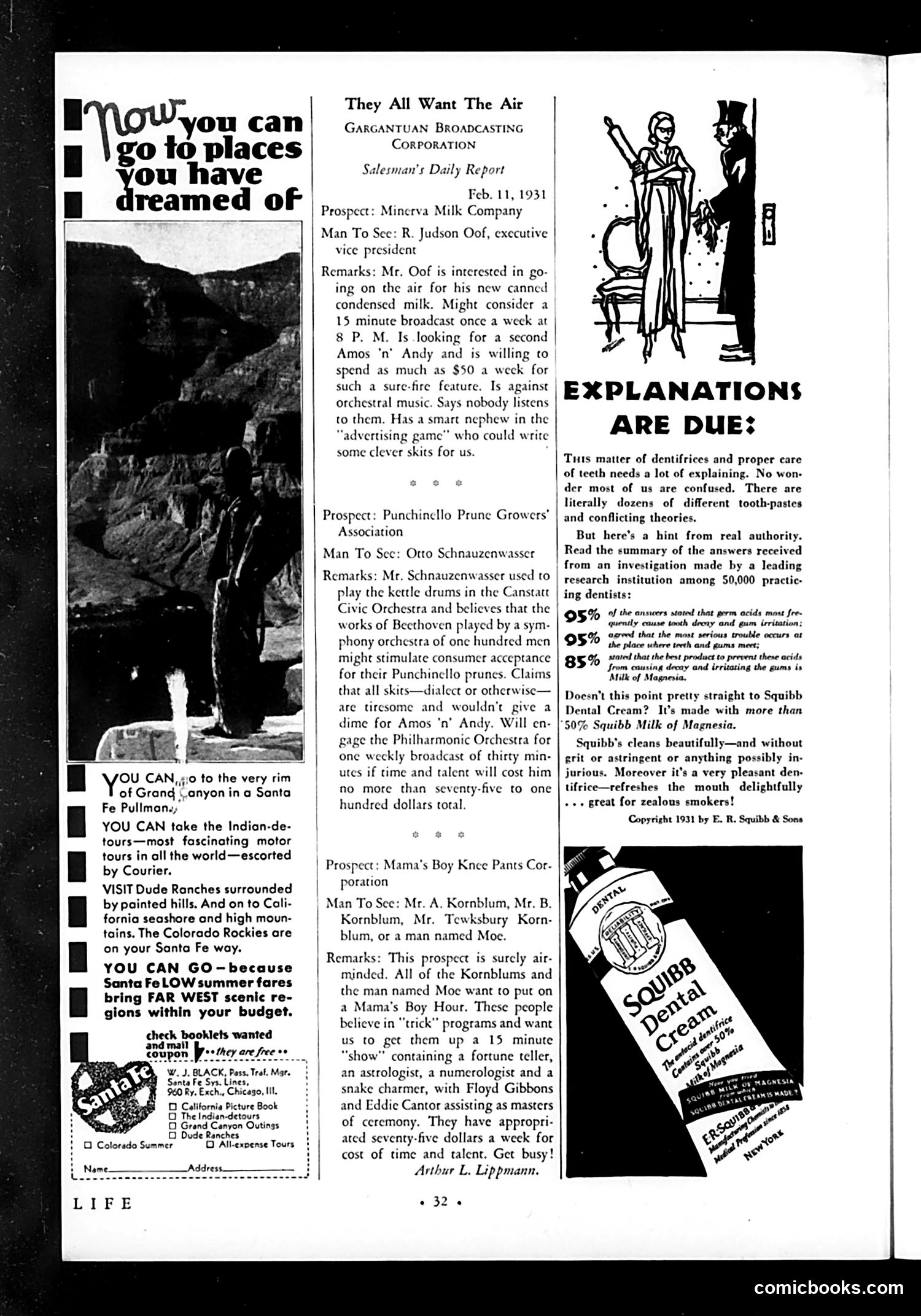
Explanation of Life Magazine Page (February 11, 1931) This page satirizes the emerging radio advertising industry of the early 1930s. The central feature, "They All Want The Air," mocks competing brands desperately seeking radio broadcast sponsorships—a new, untested advertising medium. The humor lies in the absurd desperation: a milk company wants to replicate "Amos 'n' Andy" (a hugely popular radio show); a prune growers' association proposes hiring a full 100-piece orchestra; and a children's clothing company plans an elaborate show featuring fortune tellers, astrologers, and celebrity performers—all spending $50-$75 weekly (substantial sums in 1931), hoping radio will sell their products. The satirist (Arthur L. Lippmann) captures the chaotic early days of broadcast advertising, when companies had no proven formula for success and were willing to spend lavishly on whatever seemed promising. The exaggerated, conflicting strategies reflect genuine industry uncertainty about what would actually work on radio. The page's left side advertises Santa Fe railway travel—itself using modern advertising techniques.
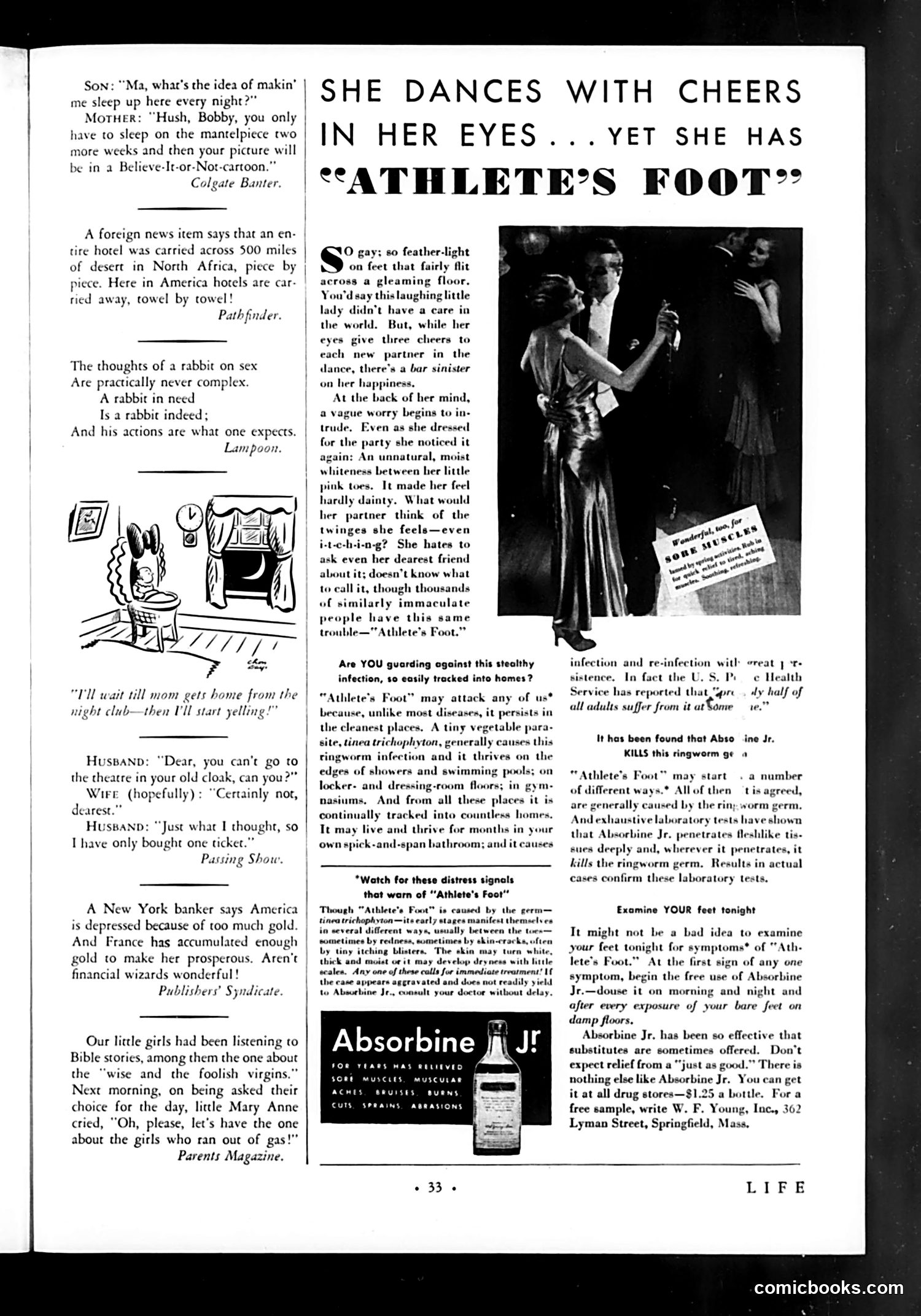
Explanation for Modern Readers This Life magazine page contains humorous short jokes and an advertisement for Absorbine Jr., a medicinal product. The cartoons are brief gags: a child sleeping on a mantelpiece hoping to appear in "Believe-It-or-Not" (a popular oddity column), hotel towels being stolen in America, and marital exchanges about theater tickets. These represent everyday social humor of the era—poking fun at consumerism, domestic relationships, and American behavior. The dominant content is a full-page advertisement disguised as an editorial feature about "Athlete's Foot," a fungal infection. It uses dramatic language ("bar sinister on her happiness") to create anxiety about the condition in an otherwise happy young woman dancer. The advertisement presents Absorbine Jr. as the solution, claiming it "kills" the ringworm and suggesting medical authority through laboratory testing mentions. This represents early 20th-century advertising strategy: creating social shame around a health condition to drive product sales, particularly targeting women's vanity and romantic prospects.
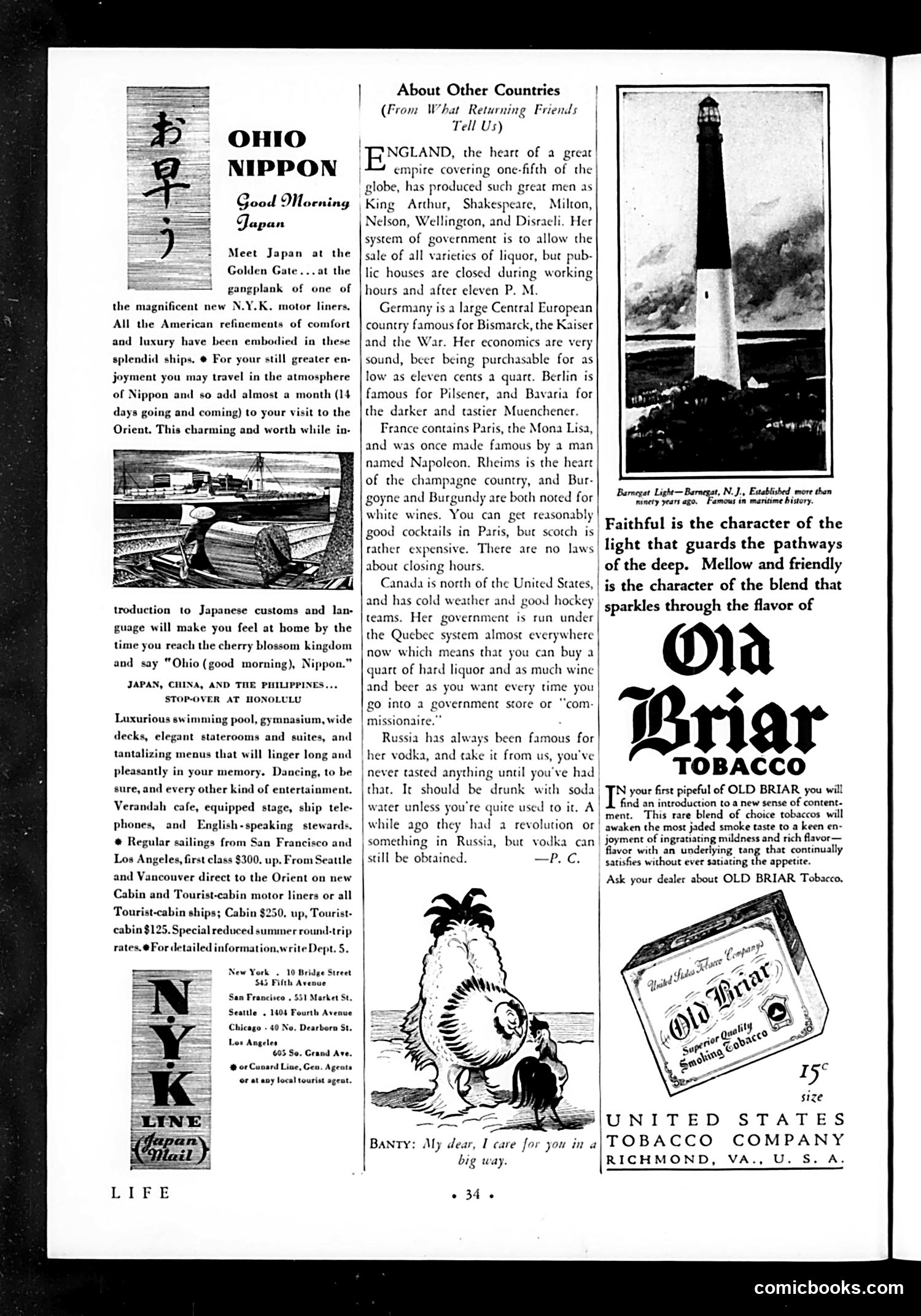
Explanation for Modern Readers This page contains travel advertising and satirical commentary typical of 1920s Life magazine. The left side advertises Japanese cruise travel via NYK (Nippon Yusen Kaisha) steamships, emphasizing cultural immersion and luxury. The center column satirizes international knowledge through superficial stereotypes: England is defined by literature and beer laws; Germany by Bismarck and cheap beer; France by Paris and Napoleon; Canada by cold weather and hockey; Russia by vodka and revolution. The humor relies on reducing entire nations to alcohol availability and a few famous names—mocking Americans' limited understanding of foreign cultures. The bottom cartoon shows a male figure (Banty) making a romantic overture to a female character, likely depicting courtship dynamics of the era. The right side advertises Old Briar tobacco, using poetic language about a lighthouse metaphor ("faithful light") to market smoking. The overall page reflects 1920s American consumer culture and attitudes toward travel, foreign nations, and masculinity.
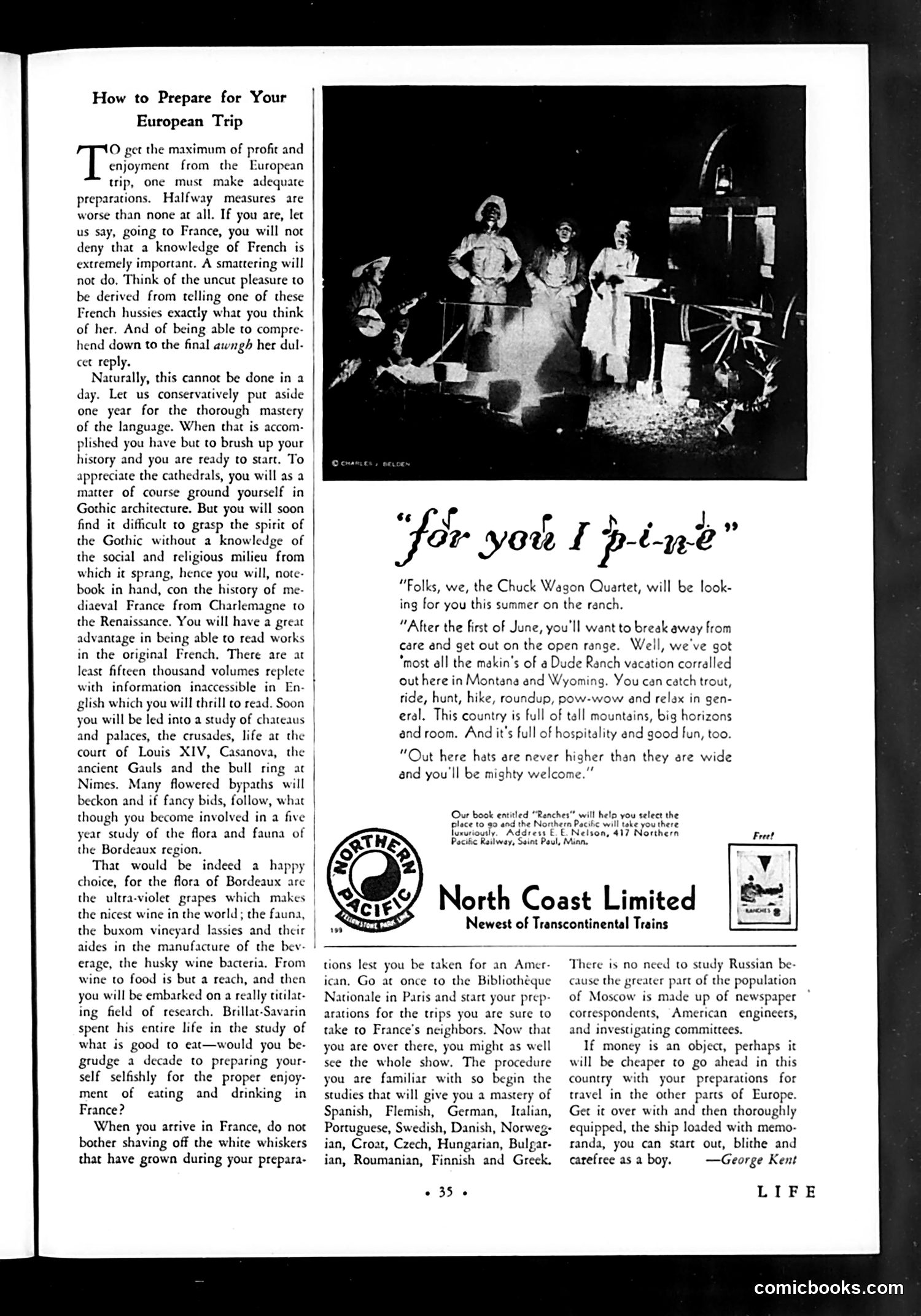
Analysis of Life Magazine Page Content This page contains satirical travel advice mocking American tourists preparing for European trips. The main article humorously exaggerates the preparation supposedly needed for France—suggesting one should spend a year mastering French, study medieval history and Gothic architecture, and dedicate years to understanding Bordeaux wines and cuisine. The satire targets American travelers' pretentiousness and lack of cultural sophistication. The photograph shows what appears to be a dude ranch scene with people in Western attire, accompanying an advertisement for ranch vacations in Montana and Wyoming (presented as an alternative to European travel). The satire's point: American tourists either over-prepare obsessively for European trips while remaining culturally ignorant, or they're better off staying home enjoying simpler American pleasures. The exaggeration of "five year study" requirements and jokes about not shaving before arrival mock both affected travelers and the American tendency toward self-important cultural tourism.
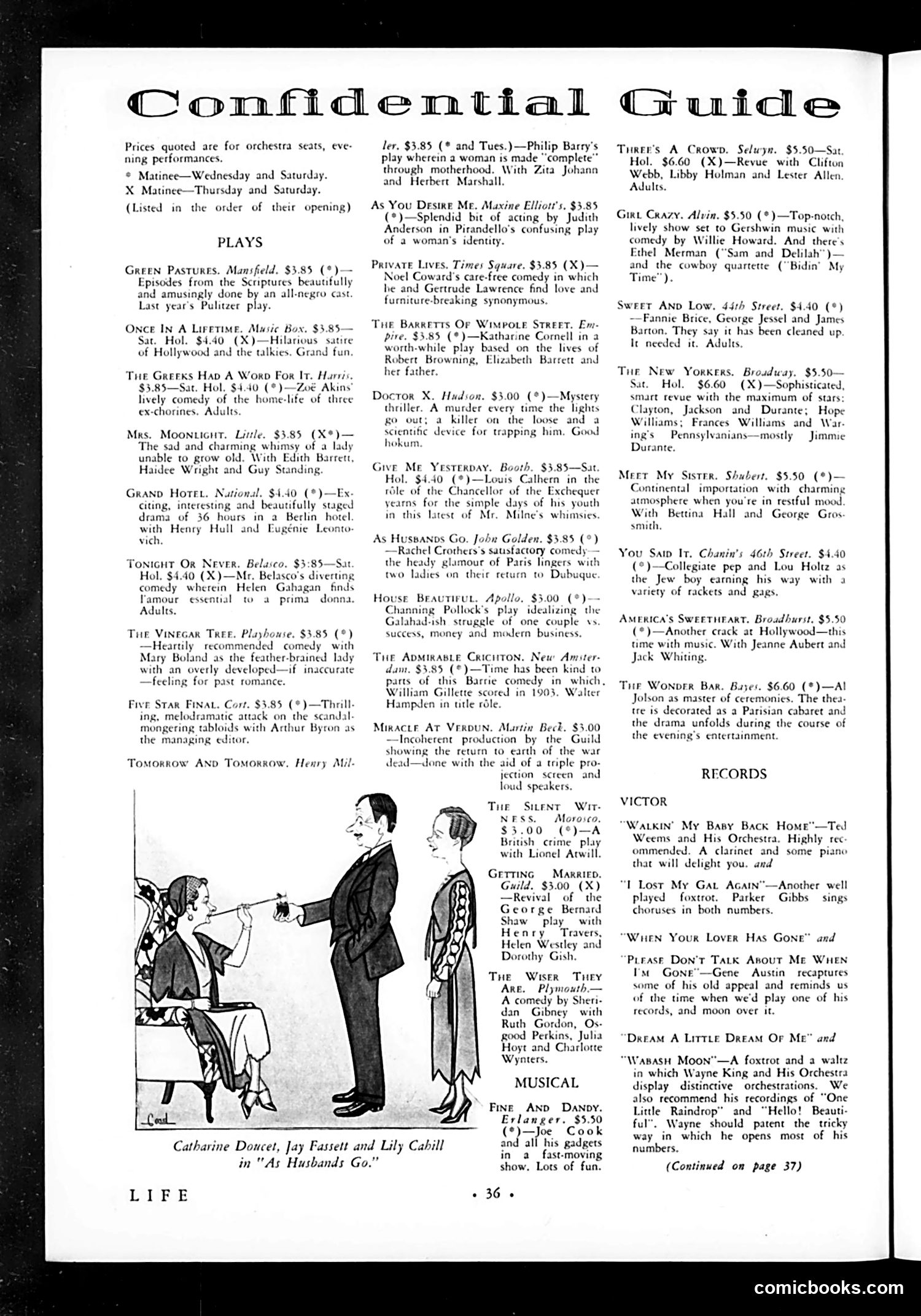
Analysis of Life Magazine Theatre Guide Page This is a theatre review and listings page from Life magazine, not a political cartoon. It contains no satirical cartoons or political commentary on this section. The page features: - A theatre guide listing Broadway shows with prices and brief reviews (Green Pastures, Once in a Lifetime, Private Lives, etc.) - One illustration showing three men in business attire in what appears to be an office or formal setting—likely accompanying a play review, though the specific reference is unclear - A records section listing Victor Records, including songs like "Walkin' My Baby Back Home" and "I Lost My Gal Again" The content is straightforward entertainment journalism and advertising typical of Life's cultural coverage in this era. There is no discernible satire or political message—it's simply informational content for readers seeking weekend theatre and entertainment options.
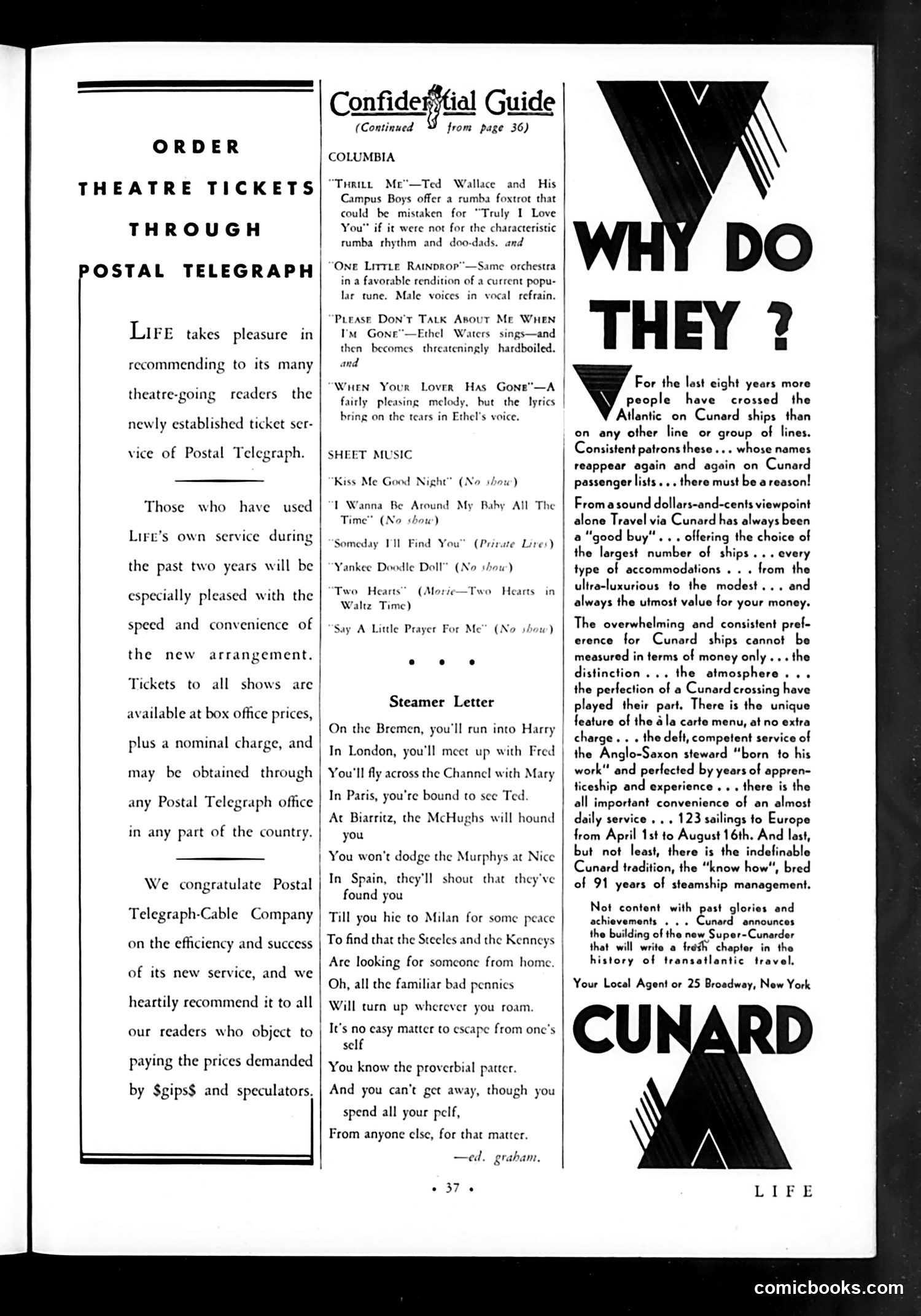
What This Page Means This is primarily a advertising and service announcement page from Life magazine, circa 1920s-1930s. The left column promotes Postal Telegraph's new theatre ticket service, positioning it as convenient and honest—notably contrasting it with "scalpers and speculators" who inflate prices. The center column is a "Confidential Guide" listing popular songs and sheet music, plus a humorous "Steamer Letter" (by Ed. Graham) about encountering acquaintances during transatlantic travel. The poem uses familiar names (Harry, Mary, Ted, the McHughs, Murphys, Steeles, Kenneys) that appear to be friends or characters readers would recognize—it's satirizing how you cannot escape familiar people even abroad. The right side is a Cunard steamship advertisement, answering "Why Do They?"—explaining why more people cross the Atlantic on Cunard than competitors. It emphasizes value, service quality, variety of accommodations, and the intangible "Cunard tradition" refined over 91 years. The page reflects the era when transatlantic travel was a luxury experience and major advertising focus.
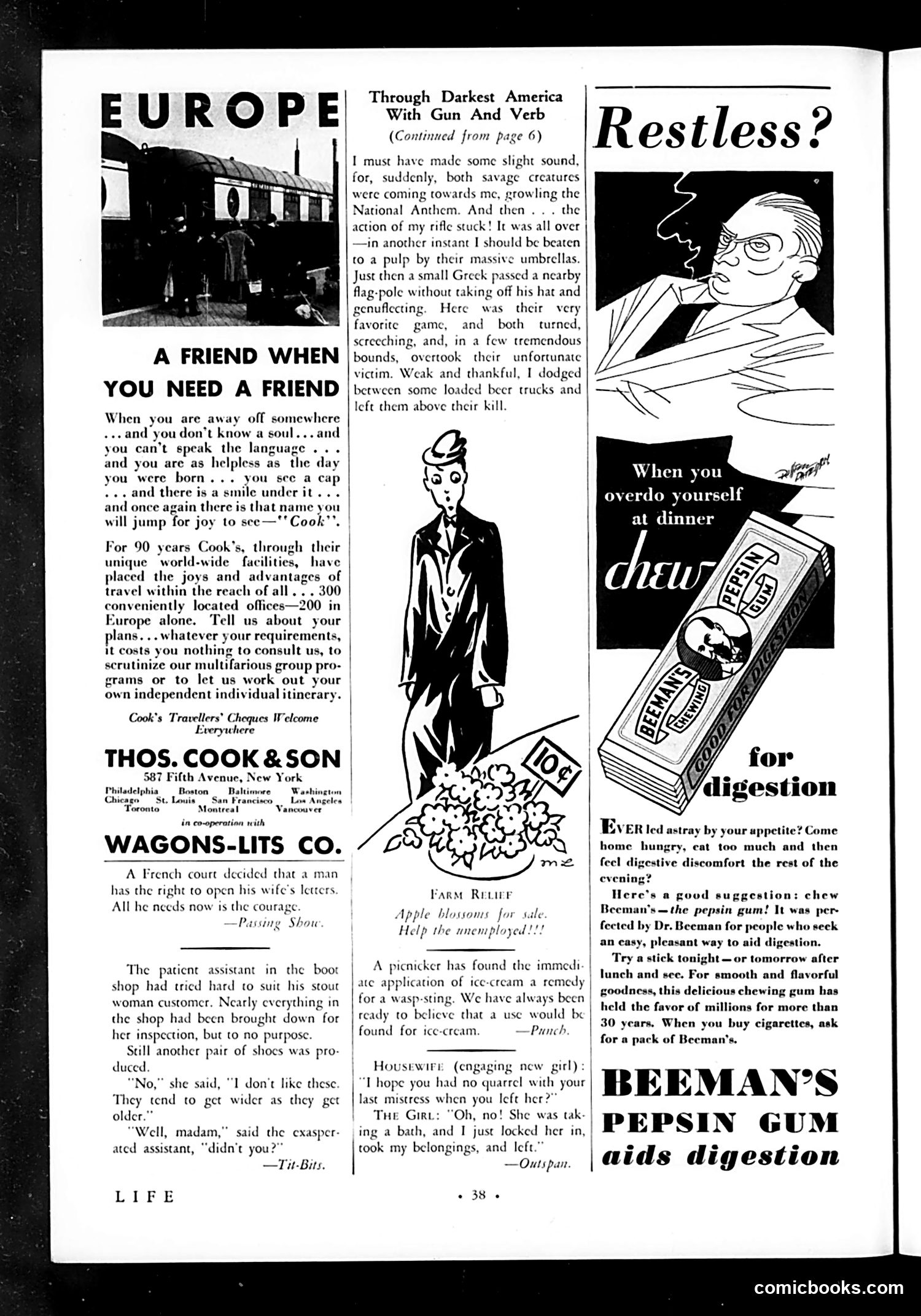
Analysis for Modern Readers This Life magazine page (page 38) contains several distinct elements: Main Content: A satirical travel narrative titled "Through Darkest America With Gun And Verb" mocks American xenophobia and cultural ignorance. The narrator describes encounters with hostile Americans as if they were dangerous wildlife—using hunting/safari language. The Greek character who doesn't remove his hat near a flagpole becomes prey for Americans obsessed with patriotic ritual. The satire targets American provincialism and intolerance toward foreigners. Advertisements: The page features vintage ads for Cook's travel services (emphasizing comfort abroad), Beeman's pepsin gum (for digestion), and other products—typical 1930s-era marketing. Humor Filler: Short jokes about shoe shopping, infidelity, and digestive remedies occupy the margins. The central satire inverts the "darkest America" framing: Americans themselves are portrayed as the "savage creatures," not foreign lands.
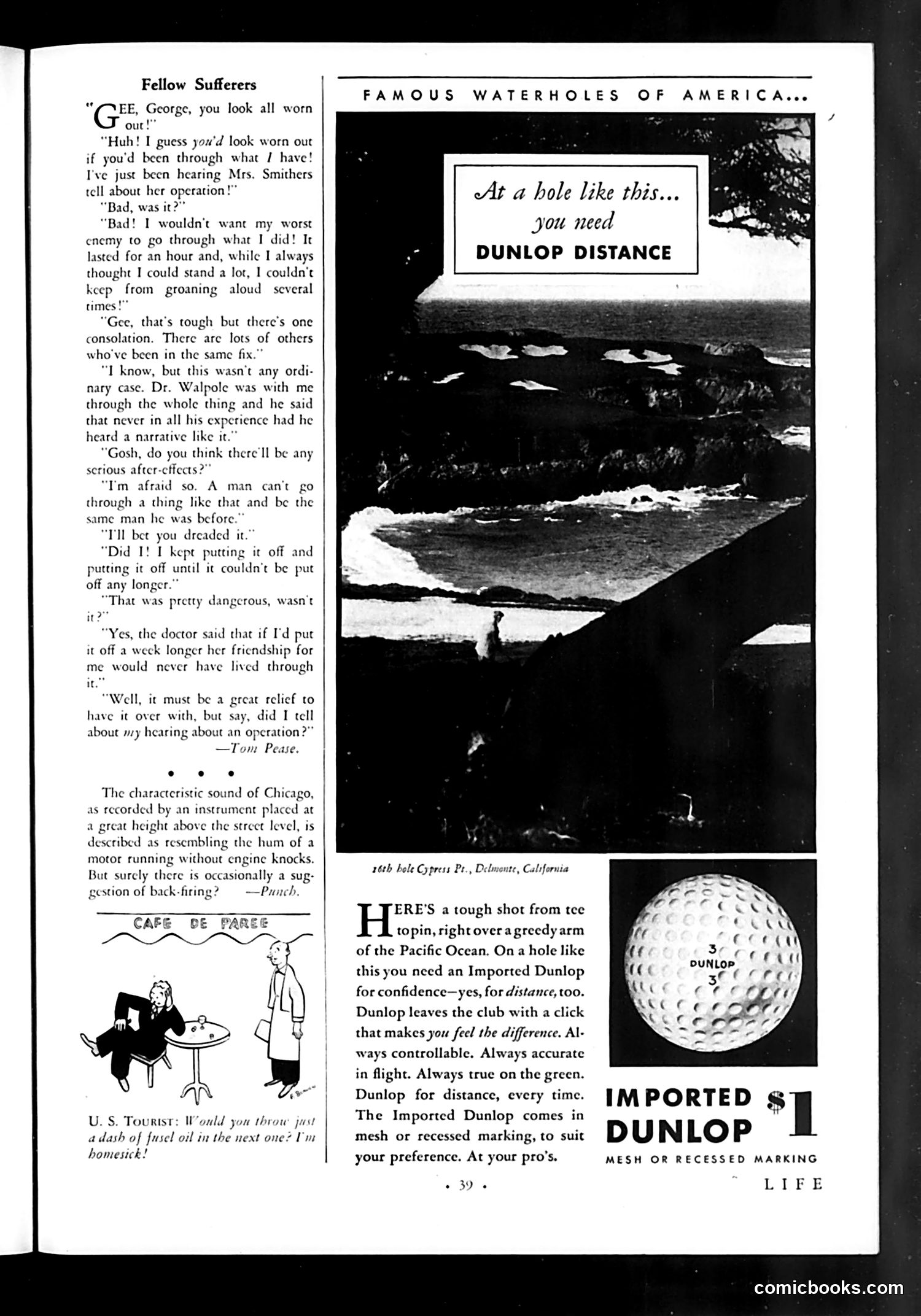
Fellow Sufferers This satirical cartoon jokes about *hearing someone else's story* about an ordeal, rather than experiencing it directly. George is exhausted not from undergoing surgery himself, but from listening to Mrs. Smithers's detailed account of her operation—which lasted an hour and was apparently dramatic enough that even the doctor found it remarkable. The humor lies in the absurd reversal: George treats secondhand narrative exposure as traumatic as the actual medical procedure. He dreaded it, delayed hearing it, and fears lasting psychological effects. His friend assumes George himself had surgery, then realizes George simply *heard about* one. The cartoon satirizes how people can become overwhelmed by others' medical stories and complaints—a common social phenomenon. It's gentle mockery of both excessive storytelling and the tendency to empathetically overidentify with others' experiences.
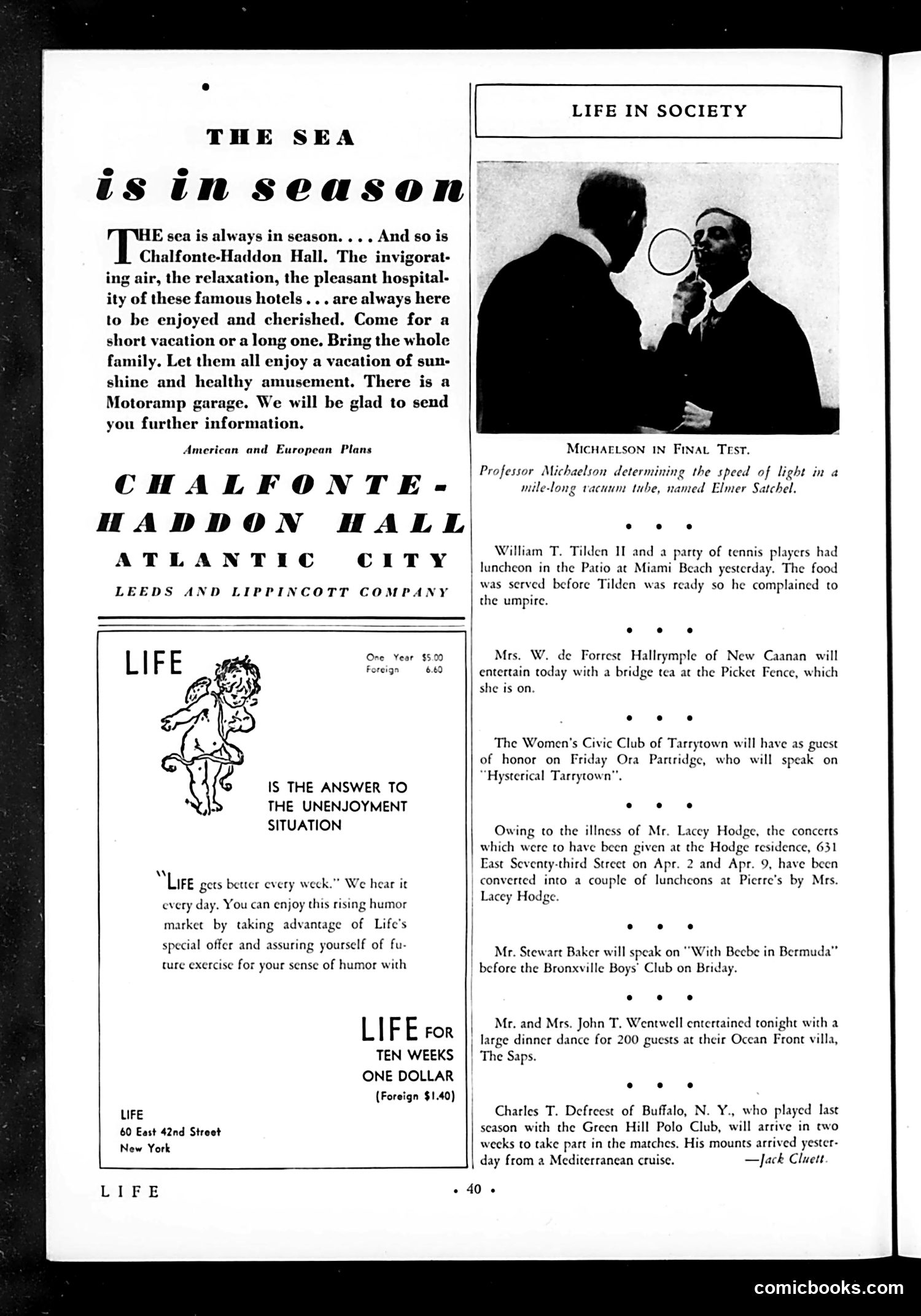
Analysis This page mixes advertising with society gossip and a single visual joke. The cartoon captioned "Michaelson in Final Test" depicts two men examining a vacuum tube labeled "Elmer Satchel"—a pun. The satire plays on the absurdity of naming scientific equipment after a person, treating the apparatus as if it were a character. This is gentle mockery of academic pretension. The "Life in Society" section contains satirical brief items about wealthy socialites and their trivial activities (bridge teas, dinner dances, polo). The joke about tennis star William T. Tilden complaining to an umpire about lunch timing mocks elite entitlement—even famous athletes demand special treatment. The advertisement for Life magazine itself (priced at one dollar for ten weeks) pitches the publication as a cure for "unenjoyment," using the slogan "Life gets better every week"—ironic marketing for a satirical humor magazine during what appears to be the 1920s-1930s era.
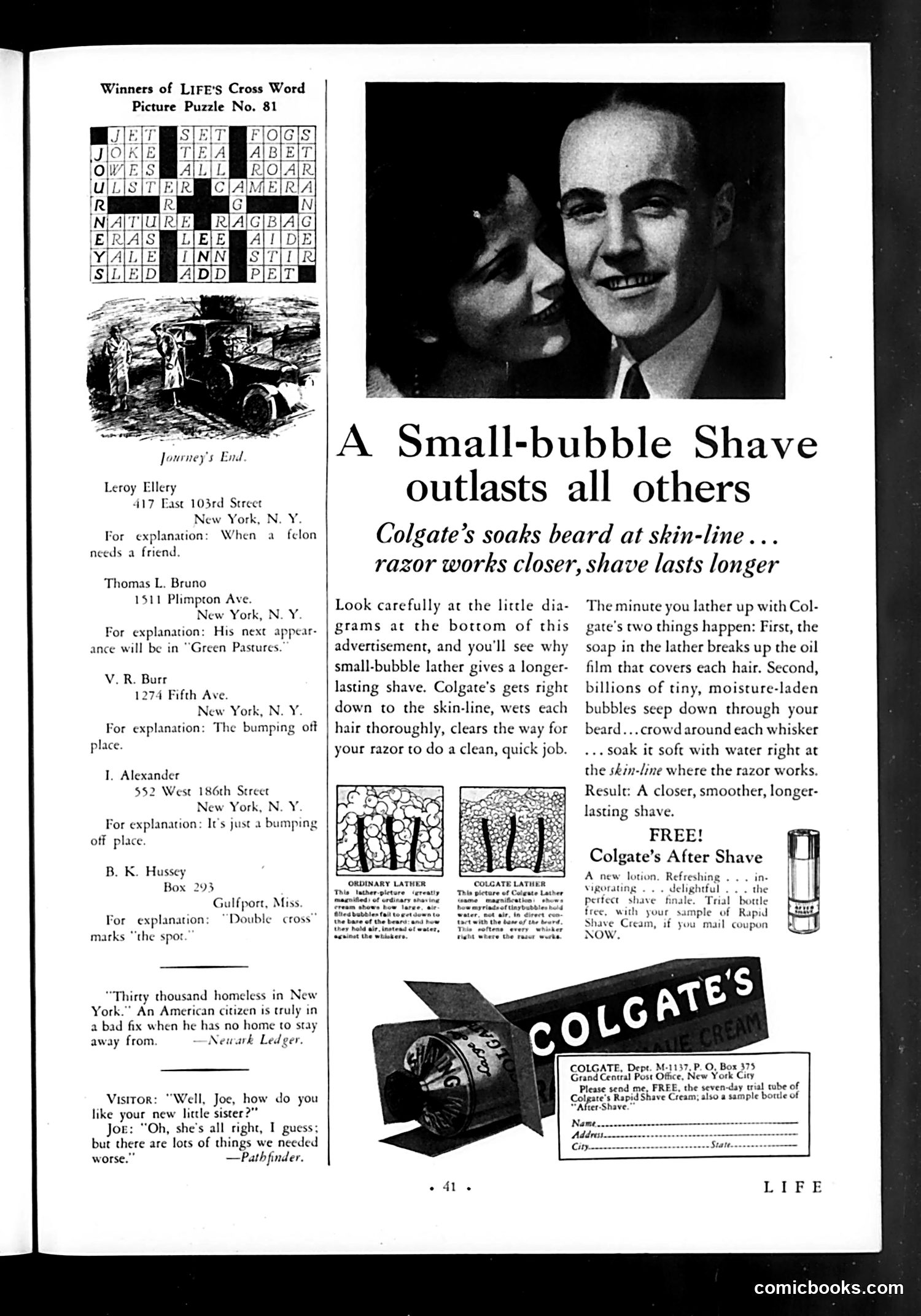
Analysis of Life Magazine Page 41 This page contains three distinct elements: 1. Crossword Puzzle Winners (Left): A picture puzzle contest conclusion listing five winners from New York and Mississippi with humorous explanations referencing crime/imprisonment slang ("felon needs a friend," "bumping off place"). The illustration shows an old car, labeled "Journey's End"—likely a reference to a then-current play or film. 2. Main Advertisement (Right): A Colgate shaving cream ad featuring a romantic photograph and technical diagrams explaining how small bubbles penetrate beard hair better than ordinary lather. This is straightforward product marketing with a mail-in coupon. 3. Humor Pieces (Bottom Left): Two brief jokes—one about homelessness in Depression-era New York, another about a child's sardonic reaction to a new sibling. Both are mild observational humor typical of 1930s magazines. The page primarily functions as advertising with puzzle results and filler humor. The satire is minimal; content reflects period attitudes toward crime slang and domestic life.
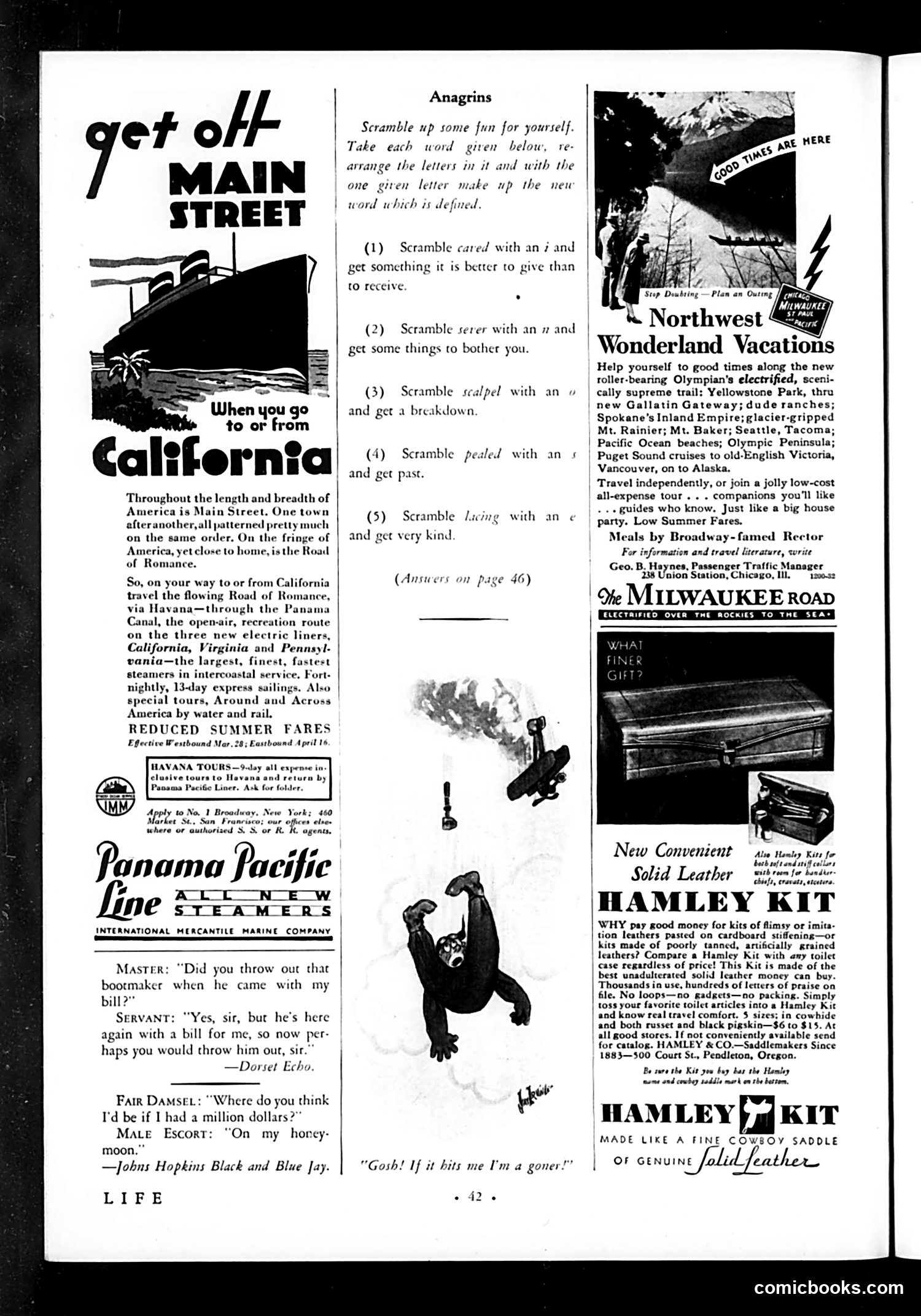
Content Analysis: Life Magazine Page This page is primarily advertising and filler content, not political satire. The main feature is a word-puzzle game ("Anagrins") asking readers to unscramble letters to form new words—a common recreational feature in magazines of this era. The advertisements promote travel and consumer goods: - Panama Pacific Line steamships to California via Havana - Milwaukee Road railroad excursions to Yellowstone, glacier parks, and Alaska - Hamley Kit, a solid-leather travel toiletry case marketed as superior to cheaper imitation-leather alternatives The page includes two brief humorous anecdotes (one about a persistent bill collector, another about honeymoon spending) typical of magazine filler. There is no political cartoon or satire on this page. It represents routine 1920s magazine content mixing practical puzzles, travel promotion, and consumer product advertising—reflecting Depression-era attempts to encourage leisure spending and distant vacations.
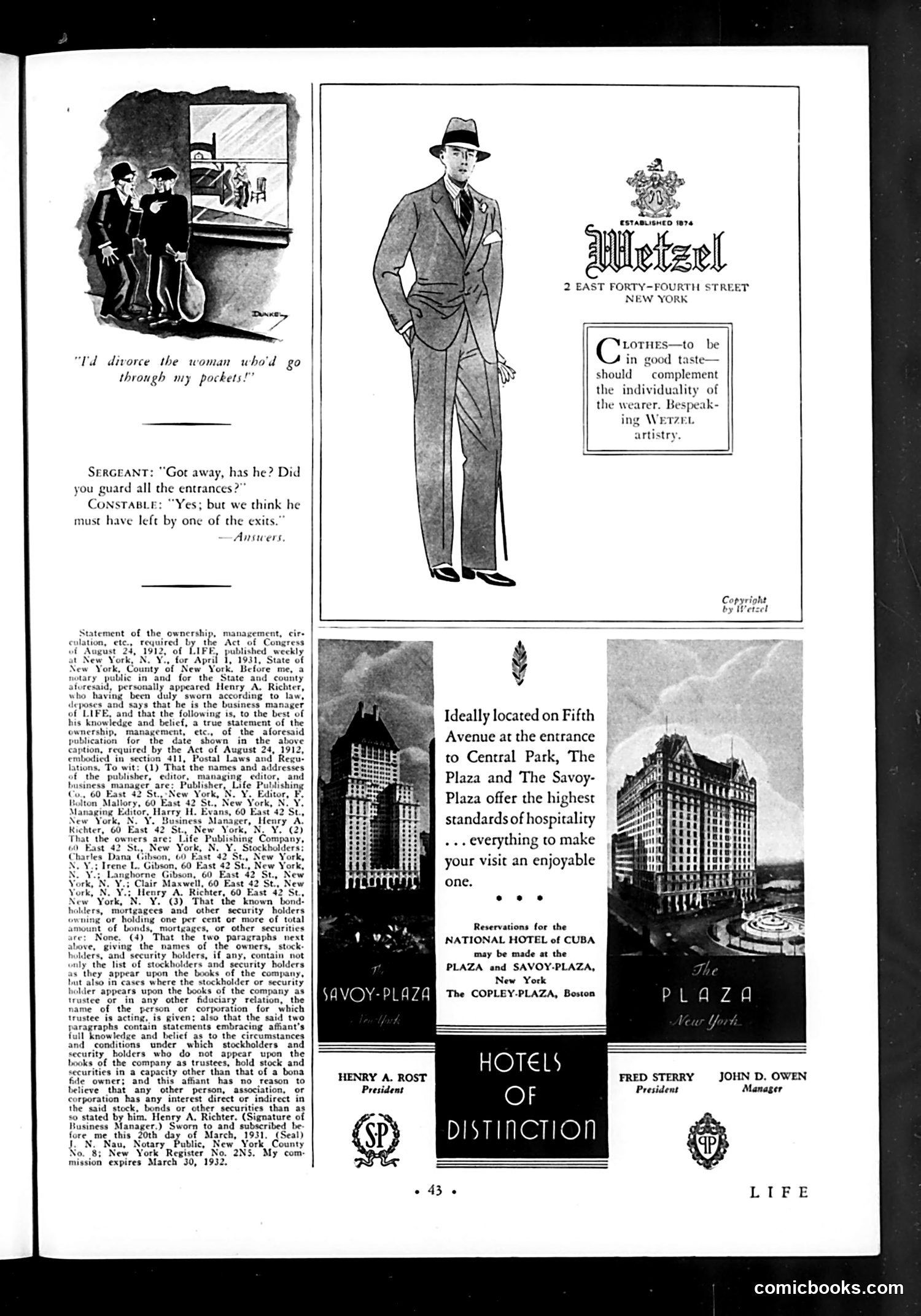
Explanation for Modern Readers This page contains two brief satirical cartoons and extensive advertising/legal notices. Top cartoon: A man complains he'd divorce any woman who goes through his pockets. The joke relies on 1931 assumptions about marital privacy and domestic suspicion—the implication being that pocket-checking represents a serious violation of trust. Middle cartoon: A sergeant and constable discuss a fugitive's escape. The constable's response—"he must have left by one of the exits"—is absurd circular logic (of course an exit is how one leaves). This is straightforward wordplay humor about obvious statements. Context: The page is mostly occupied by legal ownership statements (required by postal law) and luxury hotel/clothing advertisements (the Plaza, Savoy-Plaza, Wetzel menswear). These ads target affluent readers—typical of *Life* magazine's upscale audience in 1931. The cartoons are brief comic interludes amid commercial content.
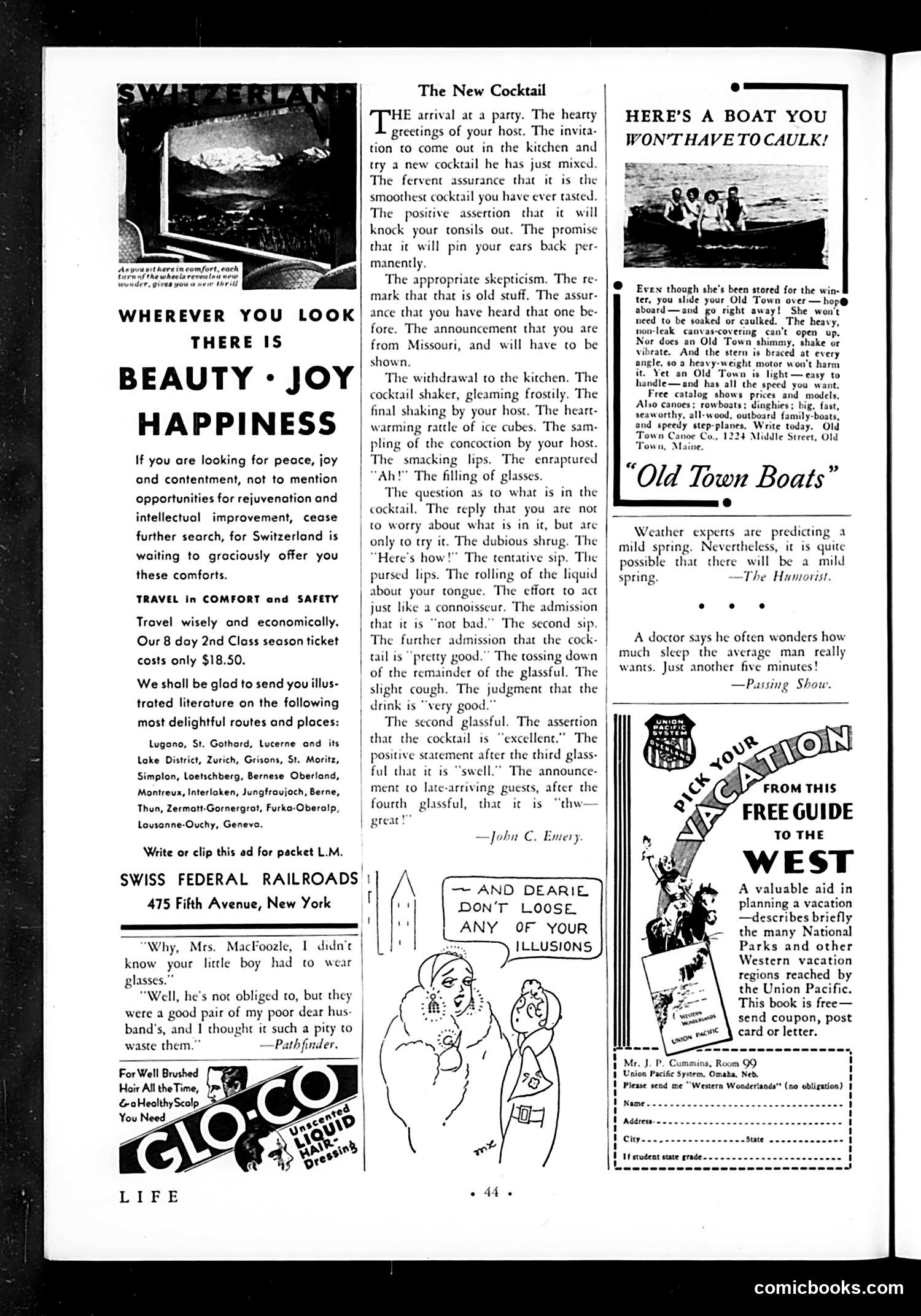
Analysis of Page 44, Life Magazine This page contains satirical humor typical of Life's style, mixing advertisements with social commentary. "The New Cocktail" Article: Humorist John C. Emery satirizes 1920s-30s cocktail culture through a blow-by-blow account of the predictable social ritual—the host's exaggerated claims, the guest's feigned skepticism ("show me," referencing the Missouri saying), the theatrical mixing process, and the guest's escalating praise after each sip, culminating in declaring it "swell." The satire mocks both hosts' pretentious claims and guests' transparent performance of connoisseurship. Small Cartoon: A woman explains she saves her late husband's old glasses for her son to wear—wasting nothing, even inheritance. It's mild satire on Depression-era thriftiness. "And Dearie" Cartoon: A woman warns someone not to lose their illusions—darkly humorous advice about maintaining comforting self-deceptions. The page also features period advertisements for Swiss travel, boat manufacturers, and hair products—standard Life content mixing commerce with editorial humor.
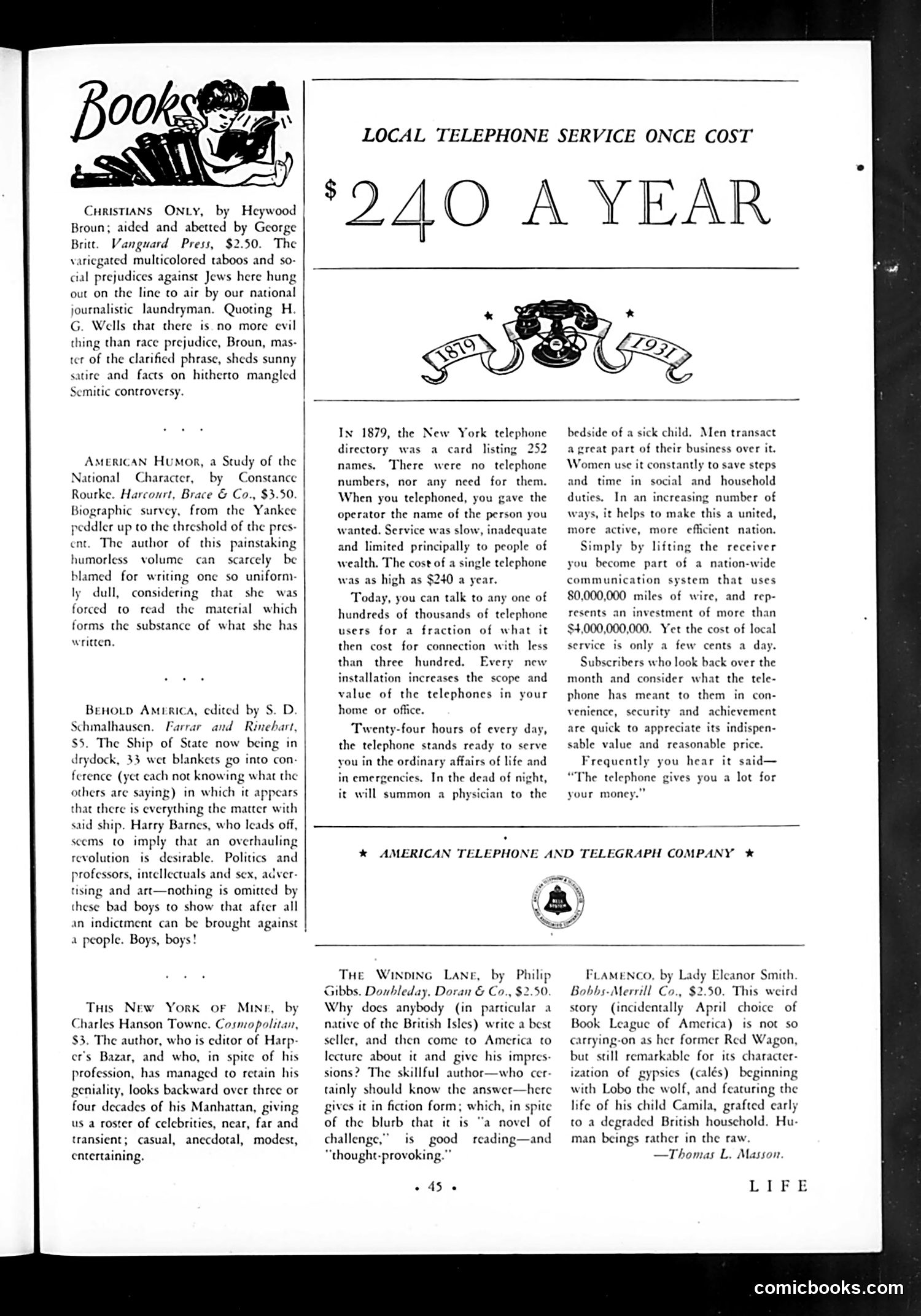
Content Analysis: Life Magazine Book Review Page This page consists primarily of book reviews rather than political cartoons. The left column reviews four books, including Heywood Broun's *Christians Only*, which critiques antisemitic prejudice using satire and journalism. The reviewer praises Broun for addressing "Semitic controversy" with "clarified phrase" and factual analysis. The right side features a telephone company advertisement (American Telephone and Telegraph) contrasting 1879 service ($240/year for limited access) with modern capability. The ad emphasizes how telephone technology has democratized communication across the nation. The decorative elements are minimal—mainly a book illustration and company logo. There are no political cartoons on this page. The satire is textual: the book reviews themselves critique American society (Broun on antisemitism, other books on flawed national character), while the advertisement ironically celebrates progress during an era when such critiques suggest society needed overhaul. The juxtaposition implies tension between corporate optimism and social critique.
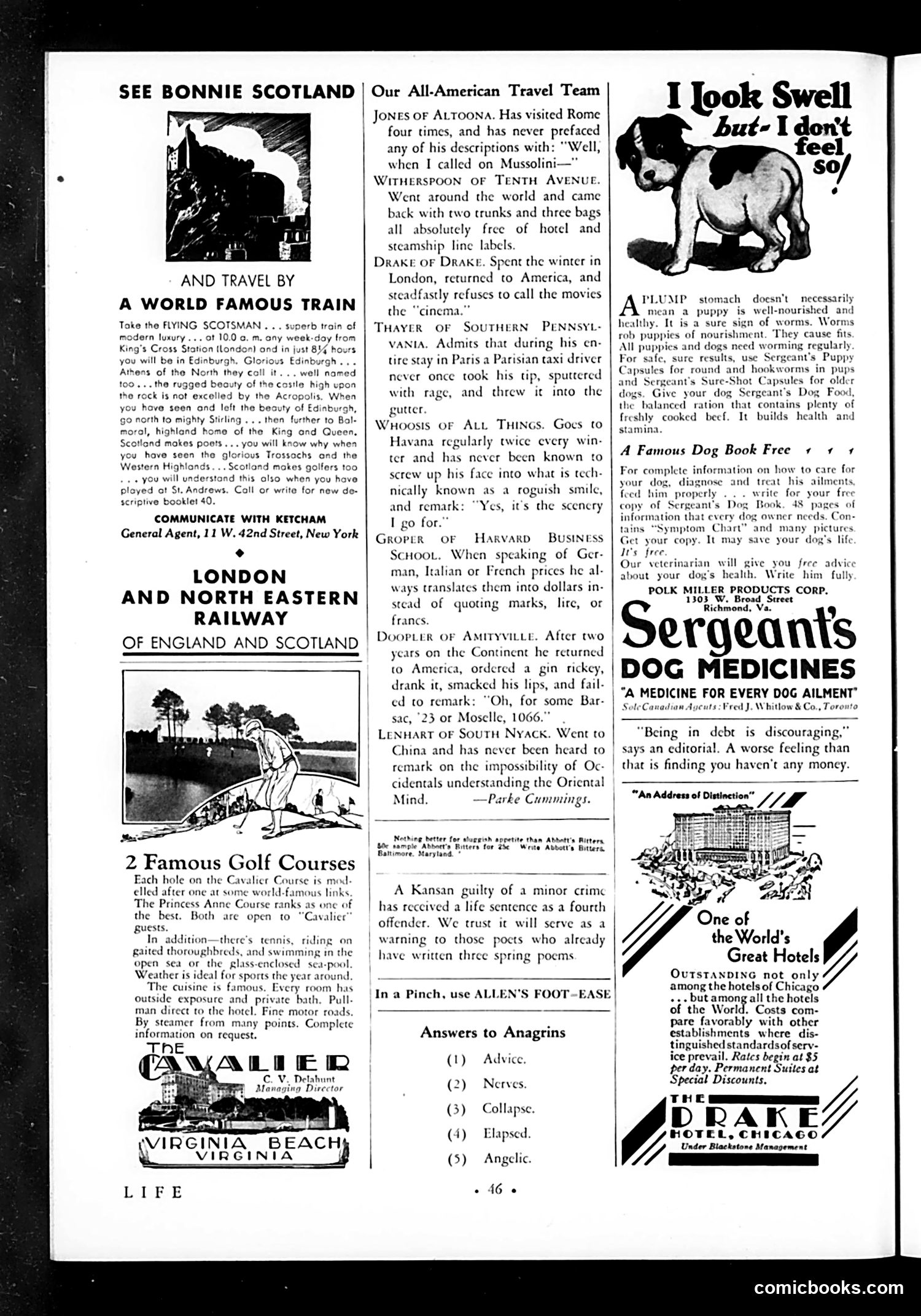
Analysis of Life Magazine Page This page primarily comprises travel advertisements and product ads rather than political satire. The "Our All-American Travel Team" section humorously profiles six travelers, each defined by their *affected sophistication* or deliberate rejection of travel clichés. The satire targets American tourists who either name-drop famous encounters (Jones mentioning Mussolini), obsess over authentic experiences (Whoosis refusing to make "roguish" remarks about scenery), or performatively adopt local mannerisms. The joke is these travelers are trying *too hard* to seem worldly or, conversely, affecting indifference to appear above tourist behavior. The page also includes genuine period advertisements for Scottish railways, Virginia Beach golf courses, dog medicines, and Chicago hotels—typical Life magazine content from this era. The final brief news item mocking a Kansas legal sentence represents typical satirical commentary, but occupies minimal space. Overall, this is a travel-themed advertising section with light social satire about American tourist pretensions, not political commentary.
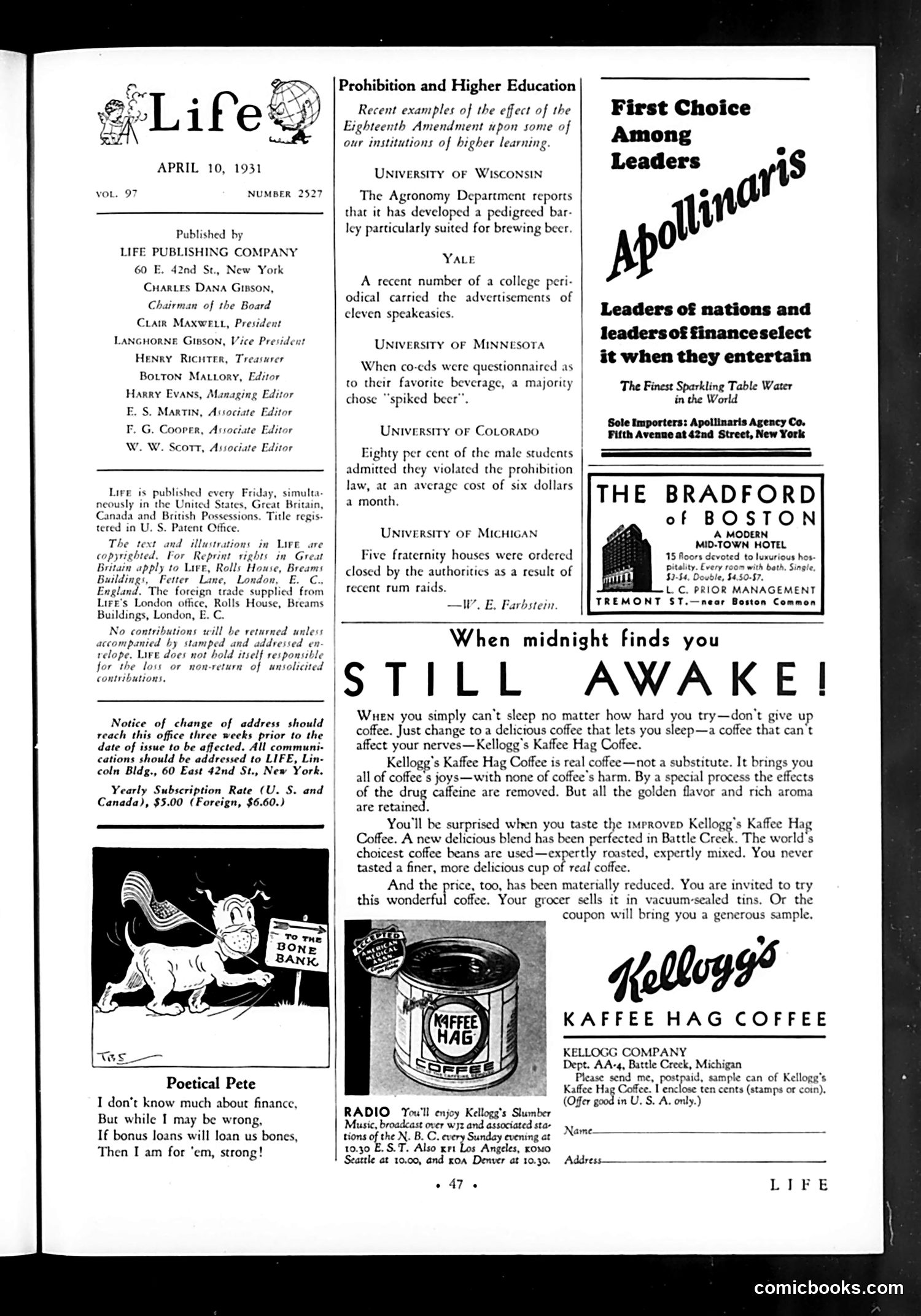
Life Magazine, April 10, 1931 This page contains satirical commentary on Prohibition's unintended consequences in higher education. The left column lists real examples from major universities documenting how students and institutions circumvented the 18th Amendment (alcohol ban, 1920-1933): - Wisconsin developed barley "for brewing beer" - Yale carried speakeasy advertisements - Minnesota co-eds preferred "spiked beer" - Colorado students admitted violating prohibition law - Michigan fraternity houses faced closure for rum violations The satire's point: Prohibition failed spectacularly even at institutions supposedly teaching ethics and discipline. Rather than eliminating drinking, it normalized law-breaking among America's future leaders. The page also includes unrelated advertisements and a humorous poem ("Poetical Pete") about bonus loans—likely referencing Depression-era veterans' benefits debates. The cartoon (unclear due to OCR) appears related to financial matters rather than prohibition.
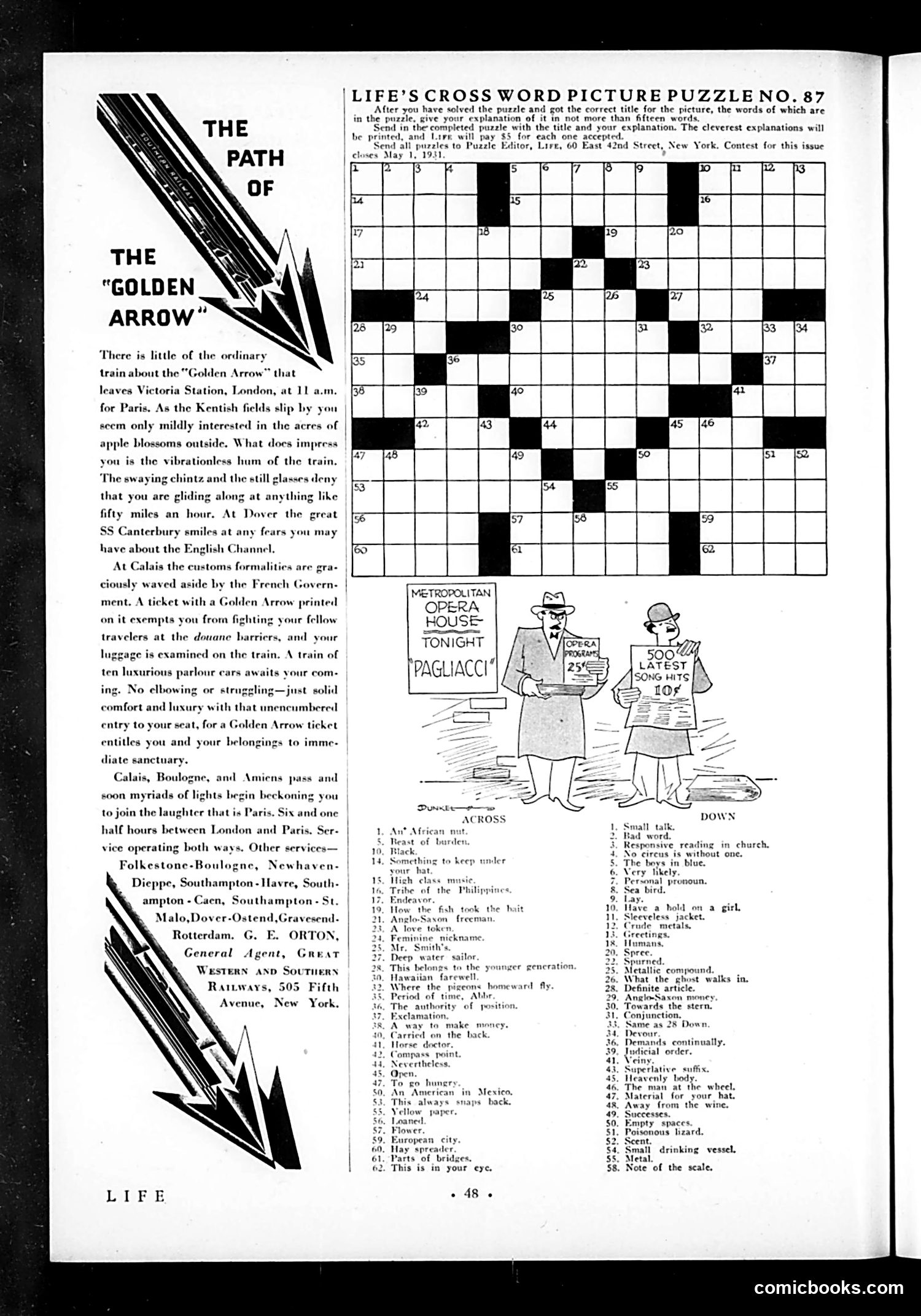
Analysis: Life Magazine Crossword Puzzle Page, c. 1931 This page features a crossword puzzle contest (No. 87) combined with advertising content for luxury rail travel. The main image shows two figures at the Metropolitan Opera House discussing "Pagliacci"—one holds a program advertising "500 latest song hits." This appears to be satirical commentary on opera-goers and popular entertainment culture. The accompanying article promotes the "Golden Arrow," a luxury train service between London and Paris. The text emphasizes comfort, speed, and exclusivity: smooth travel, no customs hassles, luxurious parlor cars, and "immediate sanctuary" for ticket-holders. This is essentially advertising dressed as editorial content, typical of Life's satirical approach—presenting the train's amenities with tongue-in-cheek glamorization of affluent leisure travel. The cartoonish style and the juxtaposition of high culture (opera) with commercial luxury services reflects Life's consistent satirizing of wealth and social pretension during the late 1920s-early 1930s.
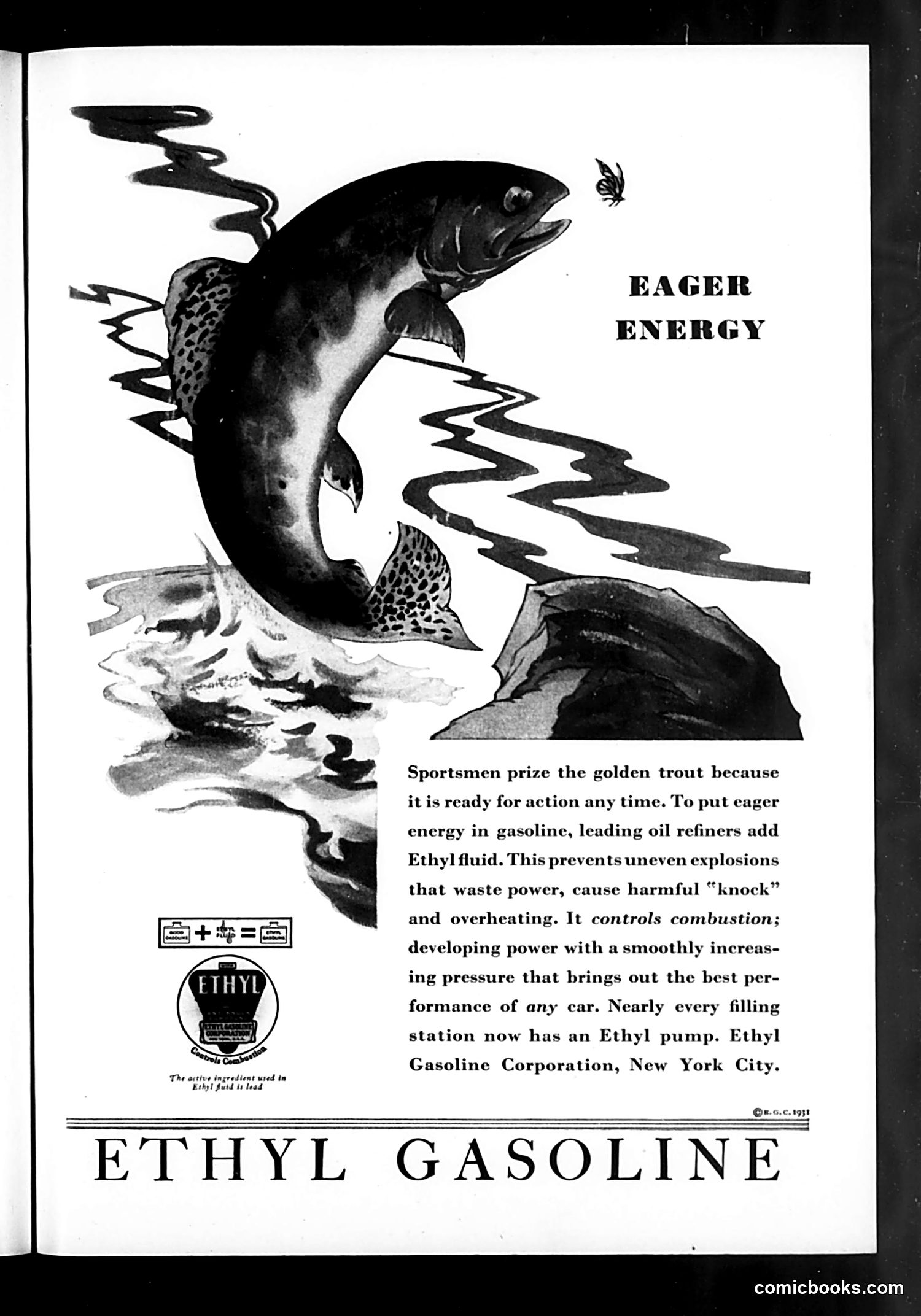
Ethyl Gasoline Advertisement (1931) This is a commercial advertisement, not political satire. It promotes Ethyl Gasoline by comparing a golden trout's readiness for action to the "eager energy" gasoline provides through added Ethyl fluid (tetraethyl lead). The imagery uses the trout—a sportsman's prize fish—as a metaphor for performance and responsiveness. The lightning bolt graphics emphasize power and quickness. The copy claims Ethyl fluid prevents engine "knock" and uneven combustion, delivering smoother performance. Historical note for modern readers: This advertisement openly promoted leaded gasoline at a time when lead's neurotoxic effects were already known but suppressed by the industry. Lead wasn't removed from U.S. gasoline until the 1970s-80s, making this a striking example of early corporate health risk concealment.
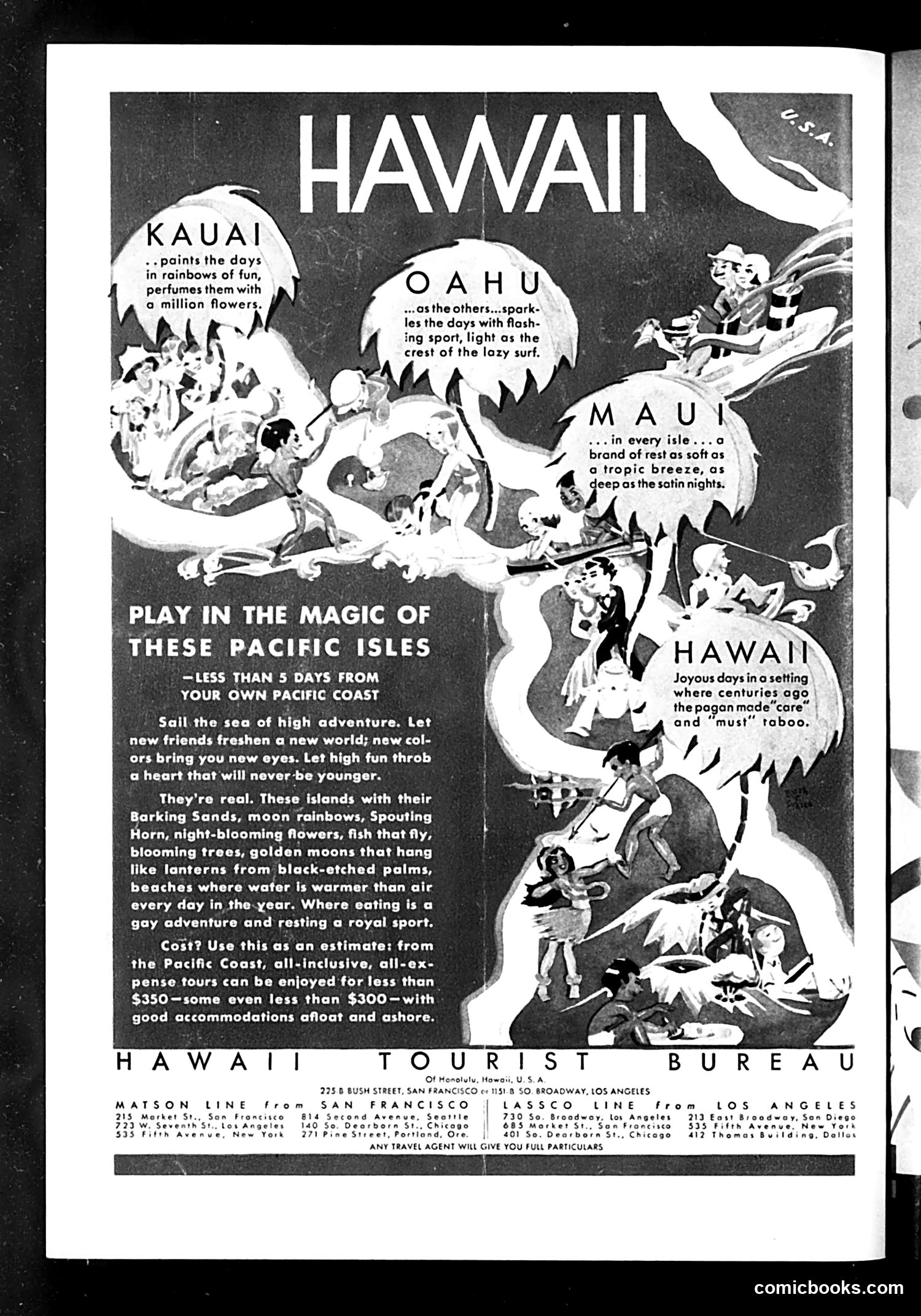
Hawaii Tourism Advertisement (Vintage) This is not satire or political commentary—it's a straightforward tourism advertisement for Hawaii, likely from the 1920s-1930s based on style and design. The page promotes Hawaiian islands (Kauai, Oahu, Maui) through romantic, idealized imagery: illustrated figures enjoying beaches, surfing, flowers, and leisure activities. The text emphasizes exotic escape ("magic," "adventure," "pagan" culture) and affordability ($300-350 all-inclusive from the Pacific Coast via Matson Line or Lassco Line cruise operators). The colonial/racial subtext a modern reader should recognize: the advertisement exoticizes Hawaii and its indigenous culture as a playground for white American tourists, reducing Hawaiian people and traditions to decorative backdrop ("where centuries ago the pagan made 'care' and 'must' taboo"). This reflects early-20th-century tourism marketing that commodified colonized cultures for Western consumption—historically typical but now understood as problematic. The ad targets Pacific Coast residents with disposable income, positioning Hawaii as accessible luxury travel.