life
Life — April 17, 1931
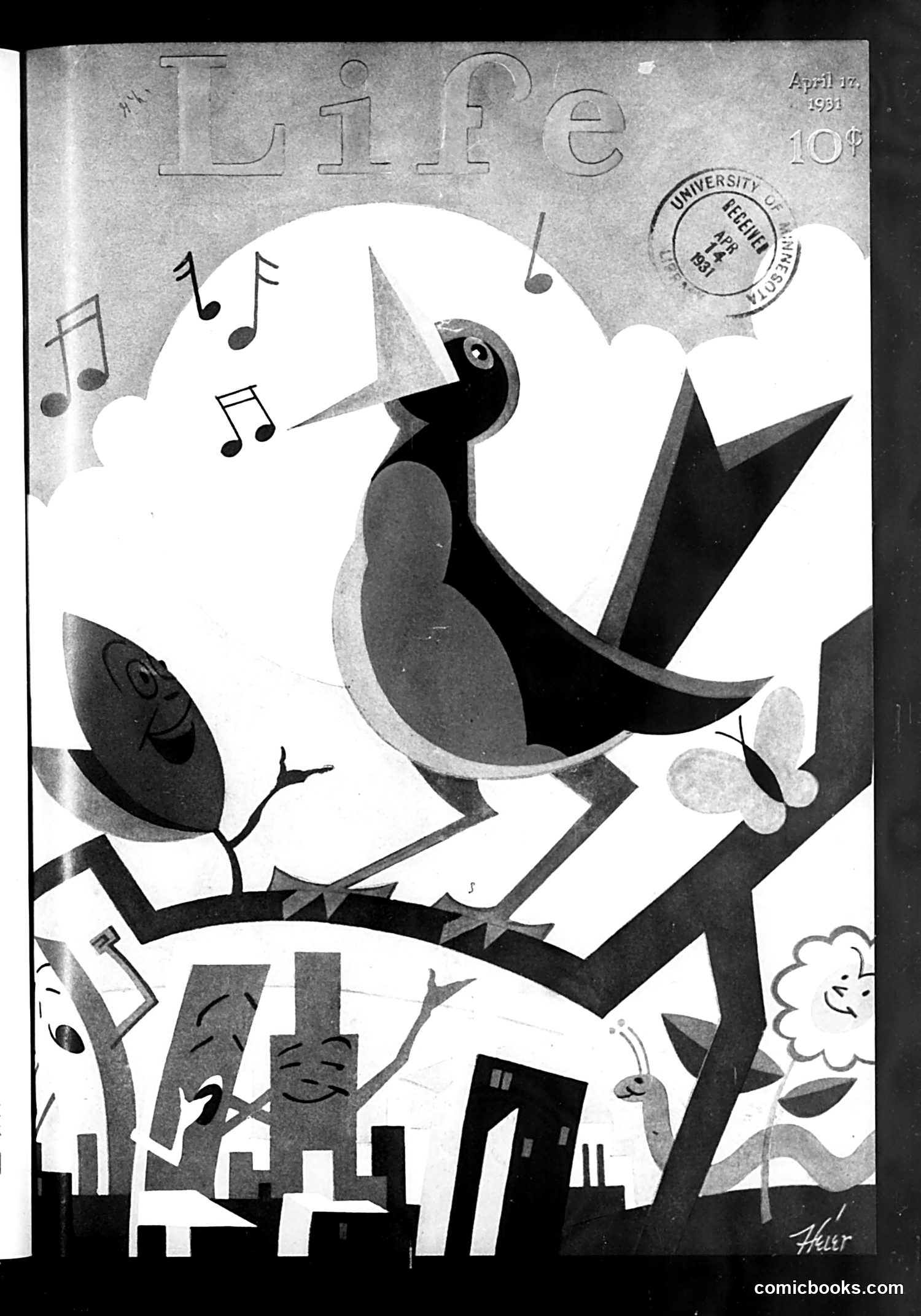
Life Magazine Cover, April 17, 1924 This cover illustration depicts a stylized bird singing joyfully above a cityscape, with musical notes floating upward. The bird appears to be a cheerful, anthropomorphized character rendered in Art Deco style—geometric and modernist. The image likely celebrates urban life, entertainment, and optimism during the 1920s (the Jazz Age). The singing bird symbolizes happiness and artistic expression, while the cityscape below represents American modernity and progress. The musical theme aligns with the era's cultural emphasis on jazz, popular music, and entertainment as defining features of contemporary society. The cover conveys an optimistic, celebratory mood about American urban culture and leisure during this prosperous period.

Analysis This page is primarily a Goodyear tire advertisement, not a political cartoon. The ad features a dramatic nighttime photograph of the Taj Mahal, with a large tire visible on the right side of the composition. The text argues that the Goodyear Double Eagle Tire represents "products of human aspiration and skill which cannot be measured in terms of utility alone." It claims the tire was designed for quality rather than cost, and notes that imitations have appeared due to its success—but remain inferior to the original. This is a luxury brand appeal using iconic world architecture to elevate the tire's prestige and craftsmanship. The copyright date "1931" appears at the bottom. There is no political or satirical content—it's straightforward premium product marketing.
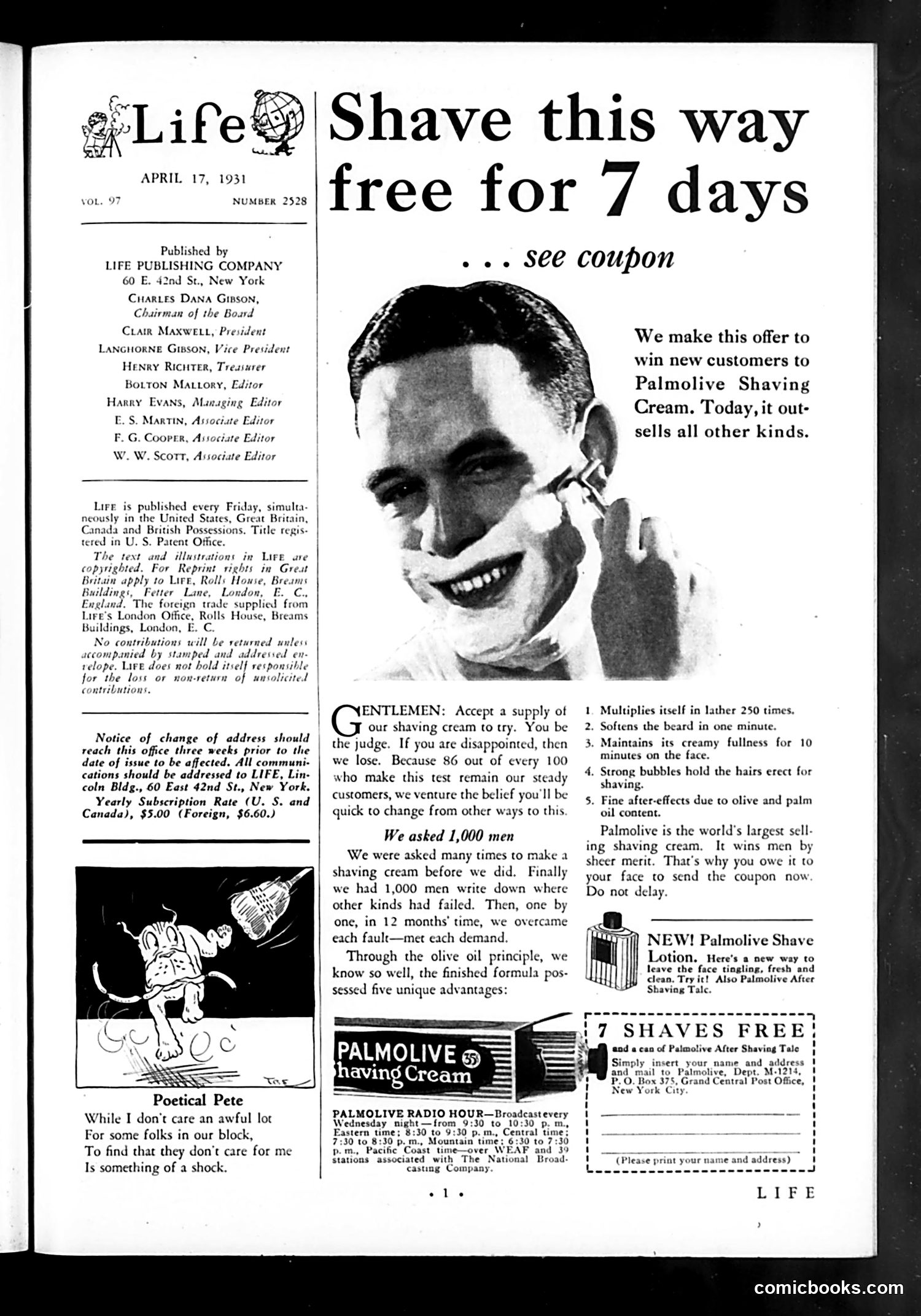
Analysis of Life Magazine Page (April 17, 1931) This page is primarily a Palmolive Shaving Cream advertisement masquerading as editorial content. The large photograph shows a smiling man's face mid-shave, meant to demonstrate the product's effectiveness. The small cartoon labeled "Poetical Pete" (bottom left) is satirical verse mocking social hypocrisy—the speaker claims indifference to neighborhood gossip, yet finds it shocking when people don't care about him. It's a mild joke about vanity and selective social concern. The advertisement emphasizes Palmolive's market dominance ("world's largest selling shaving cream") and includes a coupon offering a free 7-day trial plus a can of "Palmolive After Shaving Tale" (likely "Talc"). The copy cites that 1,000 men tested the product before its formula was finalized.
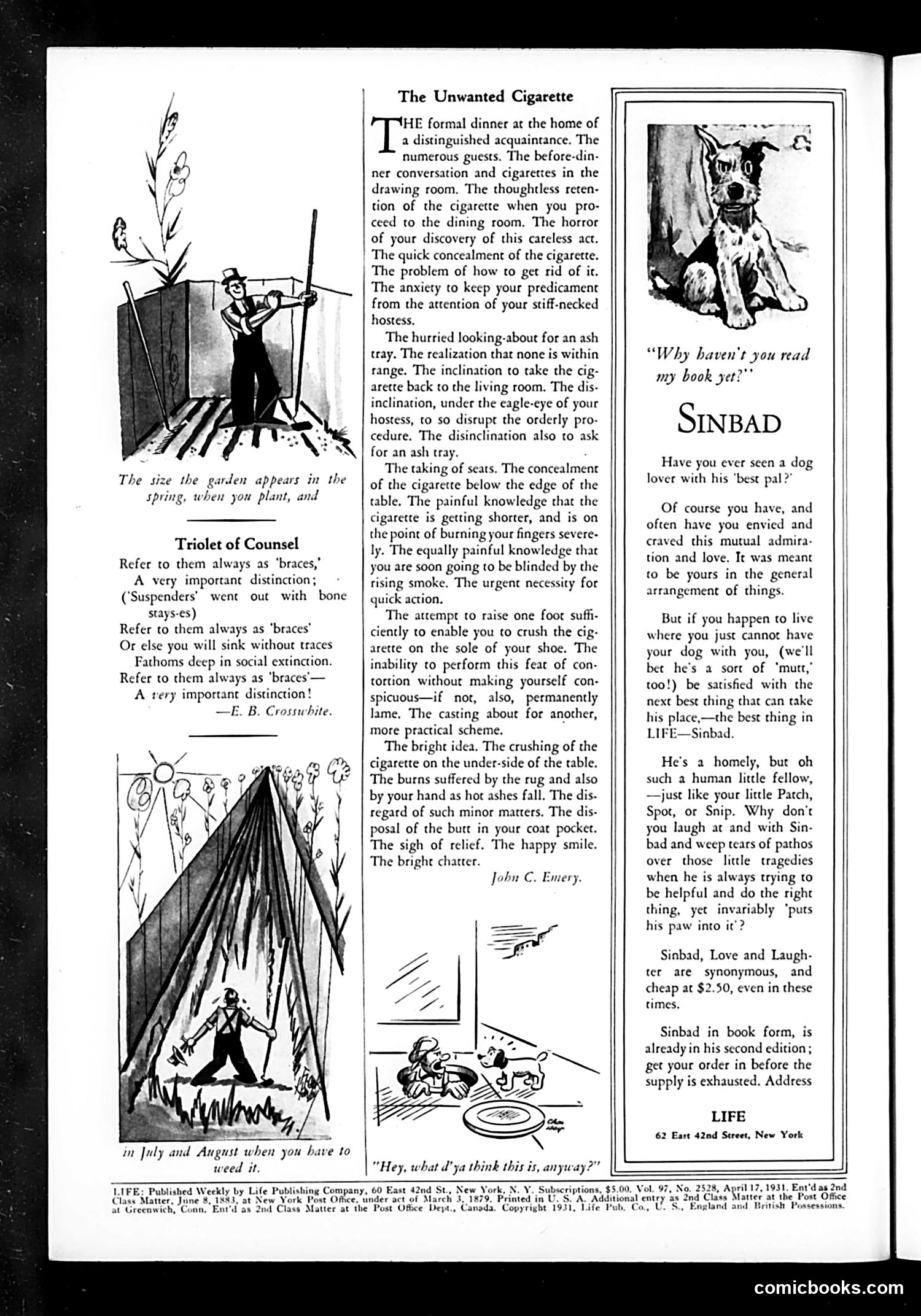
"The Unwanted Cigarette" Analysis This page contains social satire about smoking etiquette at formal dinner parties. The main article by John C. Emery humorously catalogs the awkwardness of discovering you've brought a lit cigarette into the dining room—the anxiety of hiding it from your hostess, the search for an ashtray, accidentally burning yourself or the furniture, and the embarrassment of disrupting formal proceedings. The accompanying illustrations show a man struggling with cigarette disposal in increasingly absurd situations. On the right, an advertisement for "Sinbad," a humorous dog-themed book about a well-meaning but clumsy dog who causes mishaps. The humor parallels the cigarette article—both depict the comedy of social predicaments and good intentions gone wrong. The satire reflects 1920s-30s middle-class anxieties about maintaining social propriety.
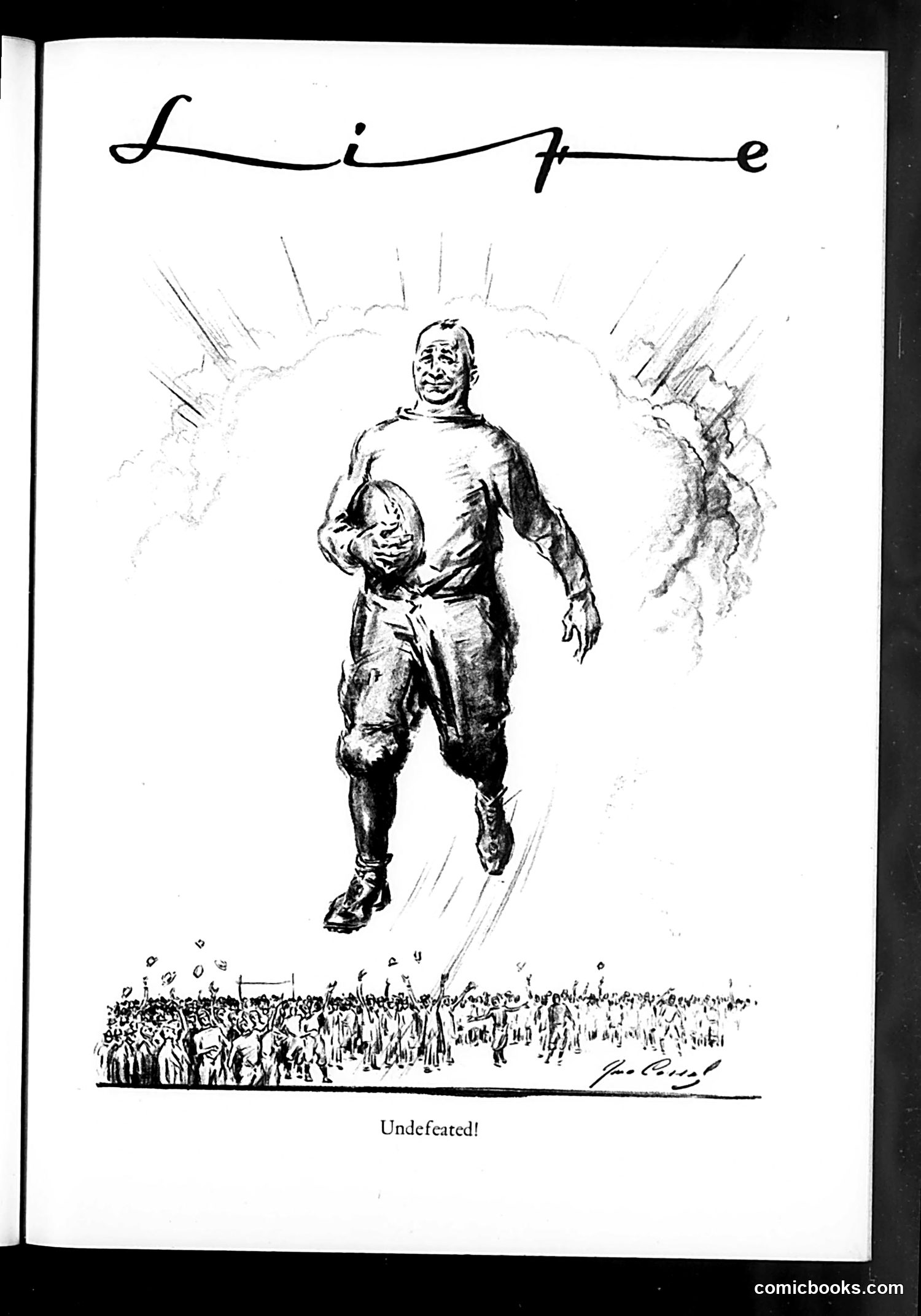
Analysis of "Life" Magazine Cartoon This political cartoon depicts a heroic, larger-than-life figure striding forward while holding what appears to be a child or small figure. Below stands a crowd of ordinary people gazing upward. The caption reads "Undefeated!" The image employs classical heroic iconography—the glowing halo effect and commanding posture suggest triumph or vindication. The towering figure appears to represent a political or military leader being celebrated as undefeated despite some challenge or conflict. Without the publication date visible, the specific identity and context remain unclear. However, the satire likely critiques either exaggerated propaganda celebrating a leader's achievements, or ironic commentary on someone claiming victory despite actual setbacks. The contrast between the idealized giant figure and the crowd below suggests commentary on public perception versus reality.
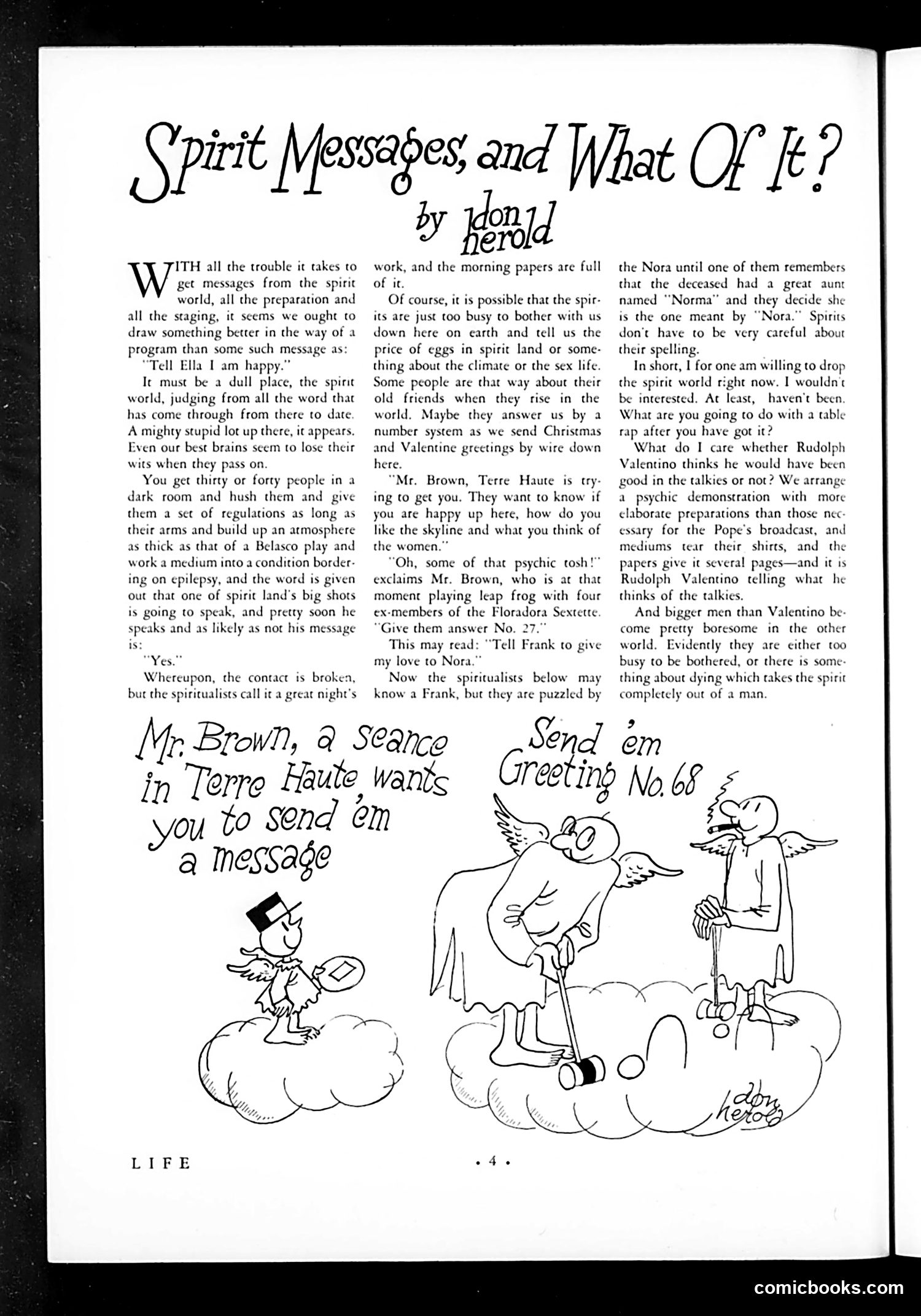
"Spirit Messages, and What Of It?" by Don Herold This satire mocks the spiritualist craze of the early 20th century. The article ridicules séances and spirit communication, suggesting spiritualists are either frauds or delusional—they're too busy receiving trivial "messages" to provide genuine insight. The cartoon depicts angels in heaven receiving a message request from "Mr. Brown" (a spiritualist on earth) via "Terre Haute" (likely referencing spiritualist activity in that Indiana city). One angel appears confused or indifferent, suggesting heaven has better things to do than relay greeting messages. The satire targets spiritualism's absurdity: grown adults spending resources on elaborate rituals to contact the dead, only to receive mundane communications like "Tell Frank to give my love to Nora."
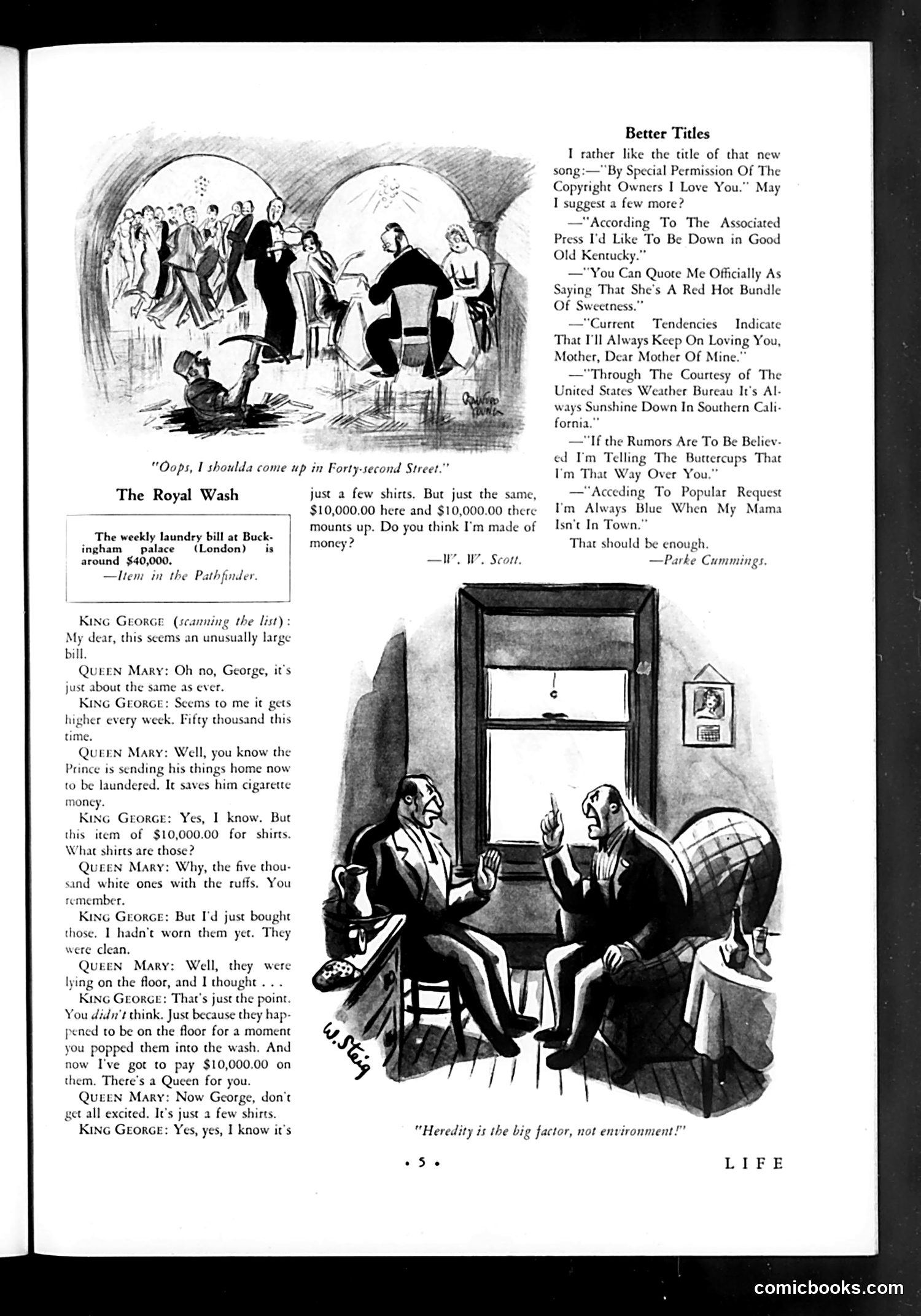
Analysis of Life Magazine Page This page contains two satirical pieces: "The Royal Wash" depicts King George and Queen Mary discussing an outrageous laundry bill of £40,000 from Buckingham Palace. The joke centers on the absurdly high cost—the King protests he's only bought a few shirts, while the Queen points out that five thousand white shirts were already on the floor and she sent them to be laundered. The satire mocks royal extravagance and the disconnect between the monarch's spending and awareness of expenses. "Better Titles" is a humor column suggesting alternative song titles, poking fun at overly sentimental popular music of the era with deliberately ridiculous alternatives. The bottom cartoon about "heredity" versus "environment" appears to satirize a contemporary debate about nature versus nurture.
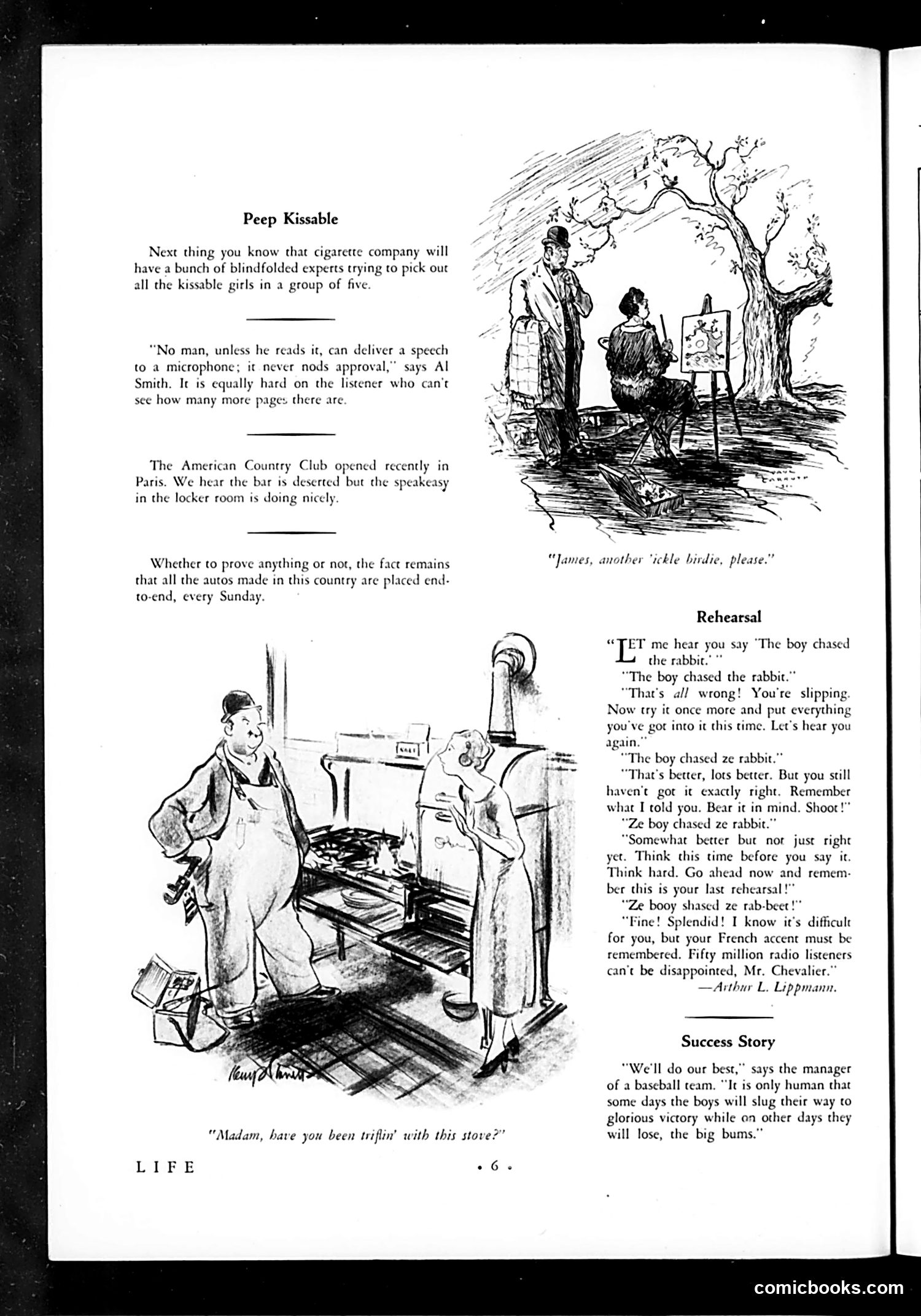
"Peep Kissable" Page Analysis This page from *Life* magazine contains three distinct humor pieces: 1. "Peep Kissable" (top): A satirical item about cigarette companies conducting "blindfolded expert" tests to identify kissable girls—a commentary on absurd advertising claims and marketing pseudoscience of the era. 2. "Rehearsal" (middle cartoon): Shows a radio director coaching a French actor on pronunciation, mocking the difficulty of French accent and the demands of radio broadcasting, where precise diction matters greatly to unseen audiences. 3. "Success Story" (bottom): A brief anecdote about a baseball manager's philosophy that teams win some games and lose others—gentle satire of obvious platitudes masquerading as wisdom. The cartoons collectively mock advertising excess, broadcasting pretension, and management clichés through gentle, observational humor typical of *Life*'s approach.
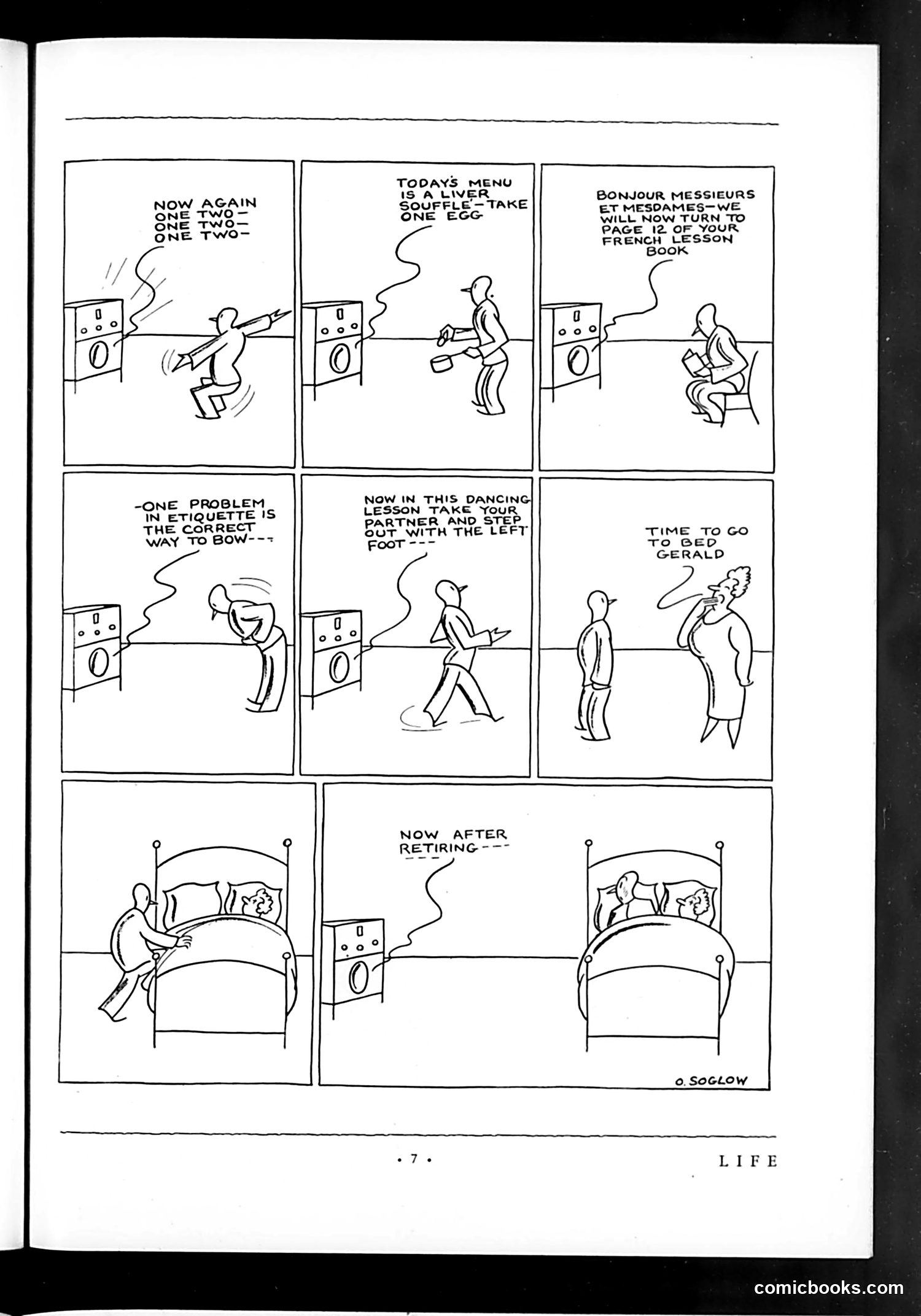
Analysis This is a humorous domestic comic strip by O. Soglow about the challenges of home cooking and marriage. The narrative follows a spouse attempting to prepare a French soufflé from a cookbook while their partner offers unsolicited instructions—counting eggs aloud, reciting today's menu, insisting on a French lesson, and correcting etiquette about bowing. The joke satirizes the clash between domestic instruction manuals (the French lesson book, the cookbook) and real-life chaos. The wife's mounting frustration—evident in her increasingly exaggerated reactions—culminates in the couple sleeping separately "after retiring," suggesting the cooking disaster and nagging instruction have strained their marriage. The humor derives from the gap between idealized domestic standards (proper French cooking, etiquette) and messy reality.
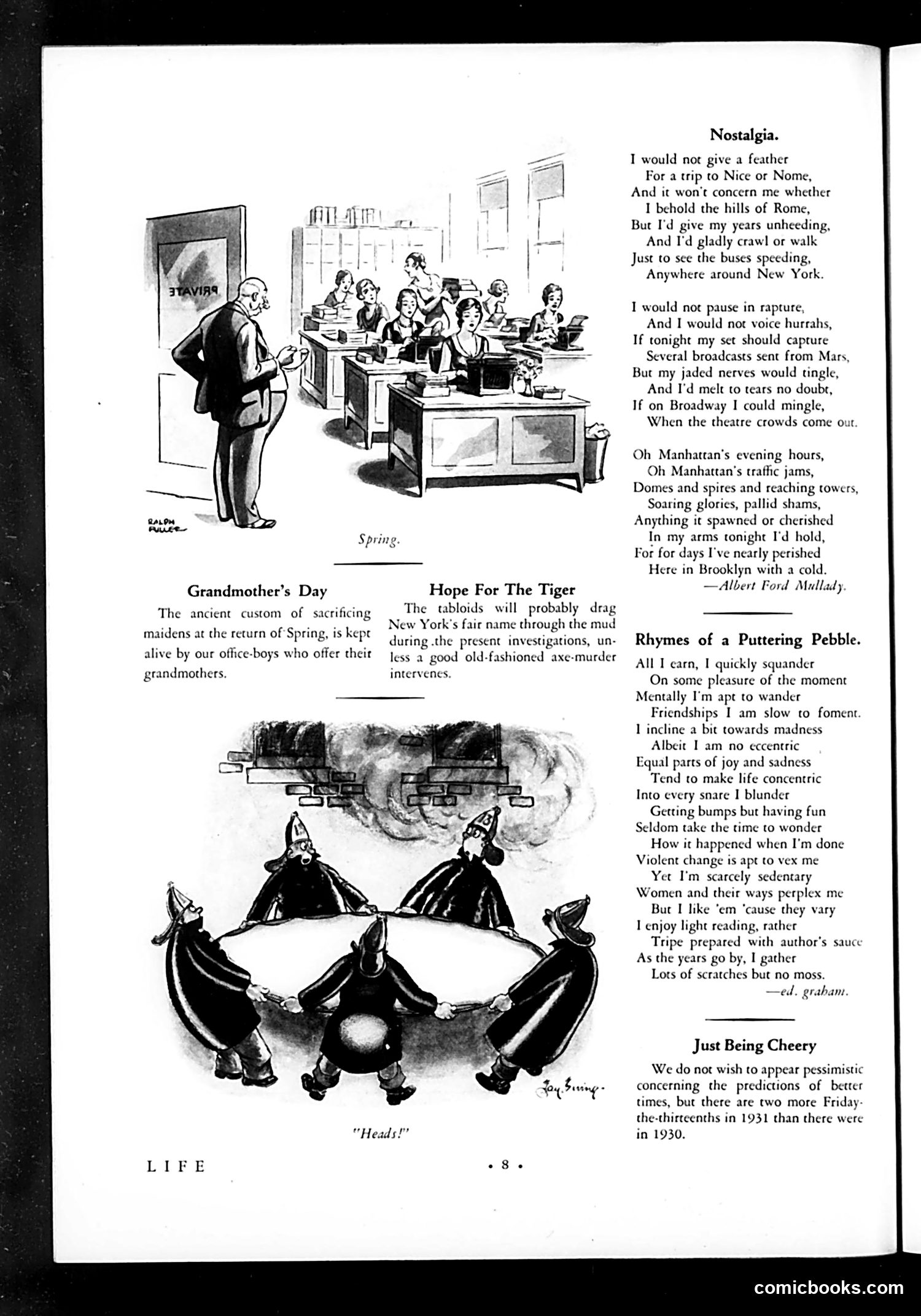
Analysis of LIFE Magazine Page 8 This page contains three distinct pieces: "Spring" (top cartoon): Shows an office manager observing workers at their desks. The caption "Grandmother's Day" references an "ancient custom of sacrificing maidens at the return of Spring," sarcastically comparing office work to ritualistic sacrifice. The joke equates spring office work to exploitation of female employees. "Heads!" (center cartoon): Depicts figures in pointed hats (appearing KKK-related) playing with a ball. The caption "Hope For The Tiger" references tabloid investigations into New York's crime, sarcastically suggesting such organizations represent "good old-fashioned" solutions to problems. Right side: Contains poetry and satirical commentary on 1931 life, including nostalgia for New York and reflections on personal change. The page reflects early 1930s anxieties about modernization, crime, and social transformation.
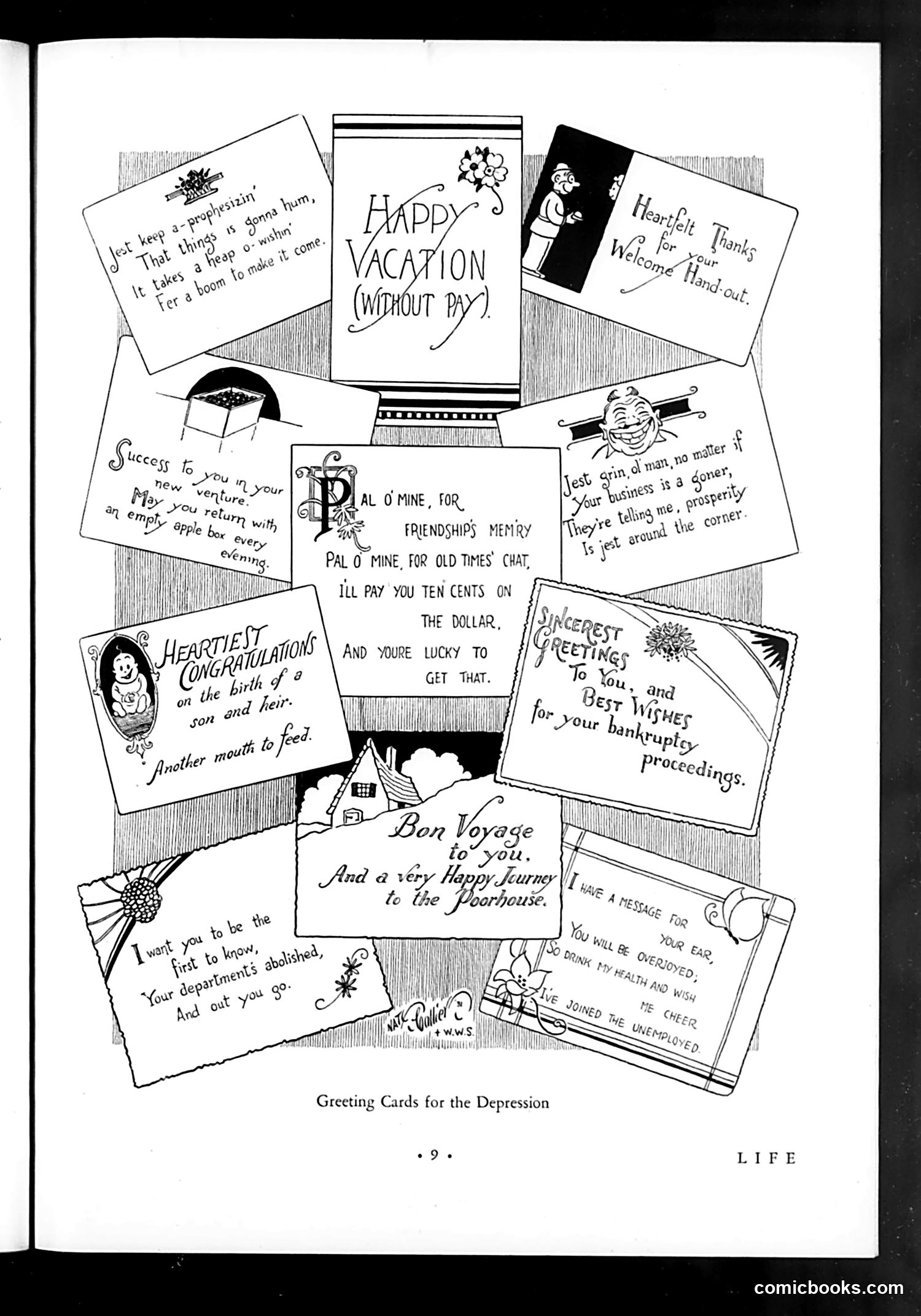
Greeting Cards for the Depression This page satirizes insincere or darkly humorous greeting cards circulating during the Great Depression era. The collection displays cards with contradictory, mocking messages—"Happy Vacation (Without Pay)" and "Bon Voyage to you / And a very Happy Journey to the Poorhouse" are particularly pointed examples. The satire targets how greeting-card sentiment became absurd during economic collapse. Cards congratulating people on unemployment, bankruptcy proceedings, and job loss represent the grim reality many Americans faced. Rather than offering genuine comfort, these cards acknowledge Depression hardships through bitter humor—the only appropriate response when traditional platitudes about success and happiness rang hollow. The illustration documents how even commercial sentiment became darkly comedic during national crisis.
Analysis of "Life Looks About" Page This page from *Life* magazine contains three opinion essays rather than cartoons. The header illustration shows a cherub-like figure, the magazine's mascot. The essays discuss: 1. "Purpose and Confusion": References Dr. Compton (a physicist) and President Murray Butler, critiquing their views on civilization's purpose. The author suggests Butler favors Jeffersonian principles and the 18th Amendment (Prohibition). 2. "The Magic of Property": Discusses Miss Ella Wendel's estate and property accumulation, using it to illustrate how wealthy landowners profit from others' labor. 3. Discusses young Rockefeller's real estate developments in Maine and New York, and the Wendels' property holdings, suggesting wealthy families concentrate land ownership. The satire critiques concentration of wealth and property among the elite during this period.
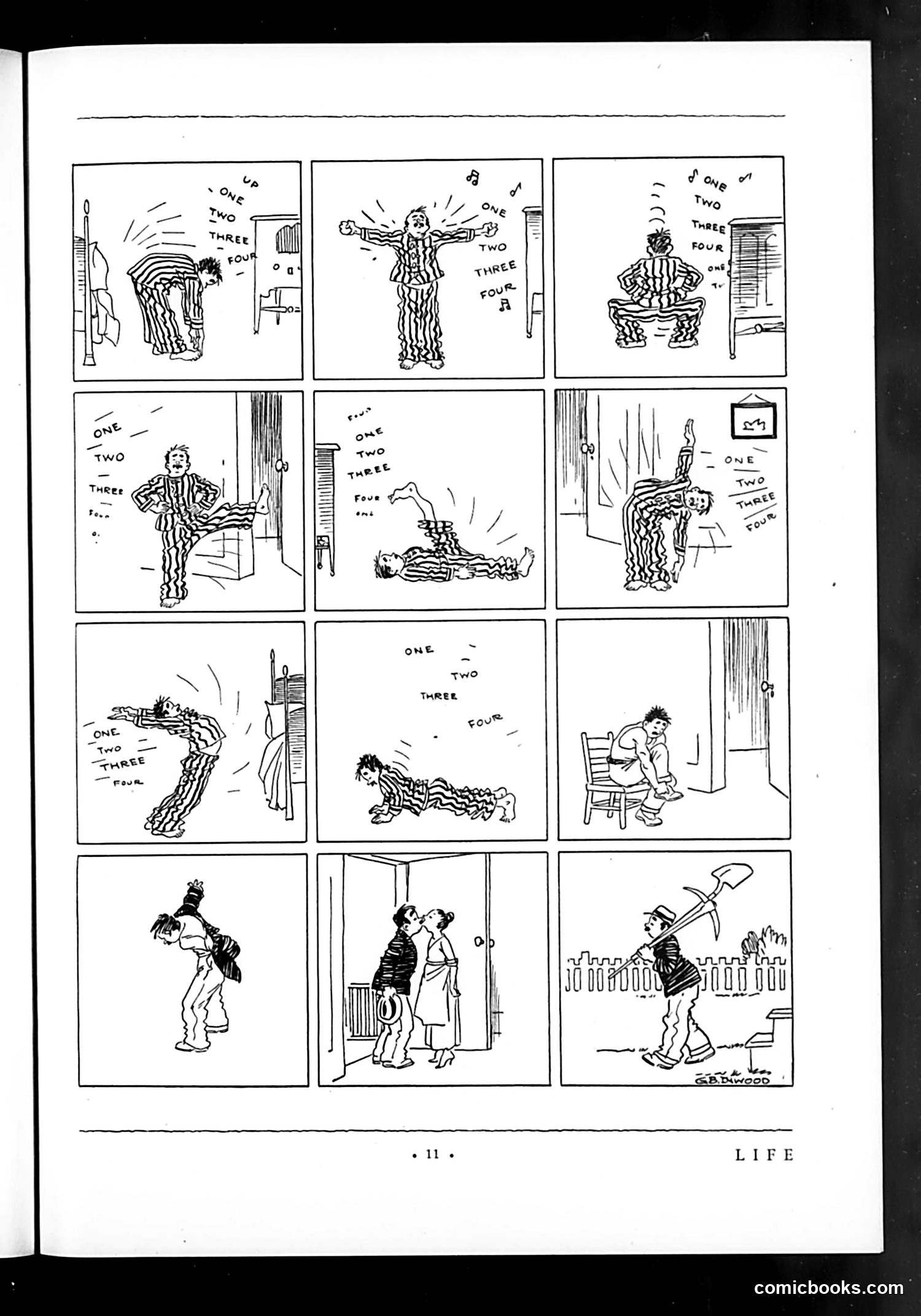
Analysis This is a humorous comic strip about exercise and physical fitness. The central figure—a scrawny, out-of-shape man—repeatedly counts "one, two, three, four" while attempting various exercises: stretching, standing with arms raised, sitting exercises, and calisthenics. The joke is visual: despite his enthusiastic counting and effort, the man remains comically skeletal and unfit throughout the sequence. The final panel shows him, still unchanged, wielding a large sword or spade outdoors, suggesting he's now ready for action despite his actual physical condition. This satirizes people who believe they can transform their bodies through minimal, half-hearted exercise routines—counting repetitions without achieving actual fitness results. The strip mocks the gap between exercise effort and visible improvement.
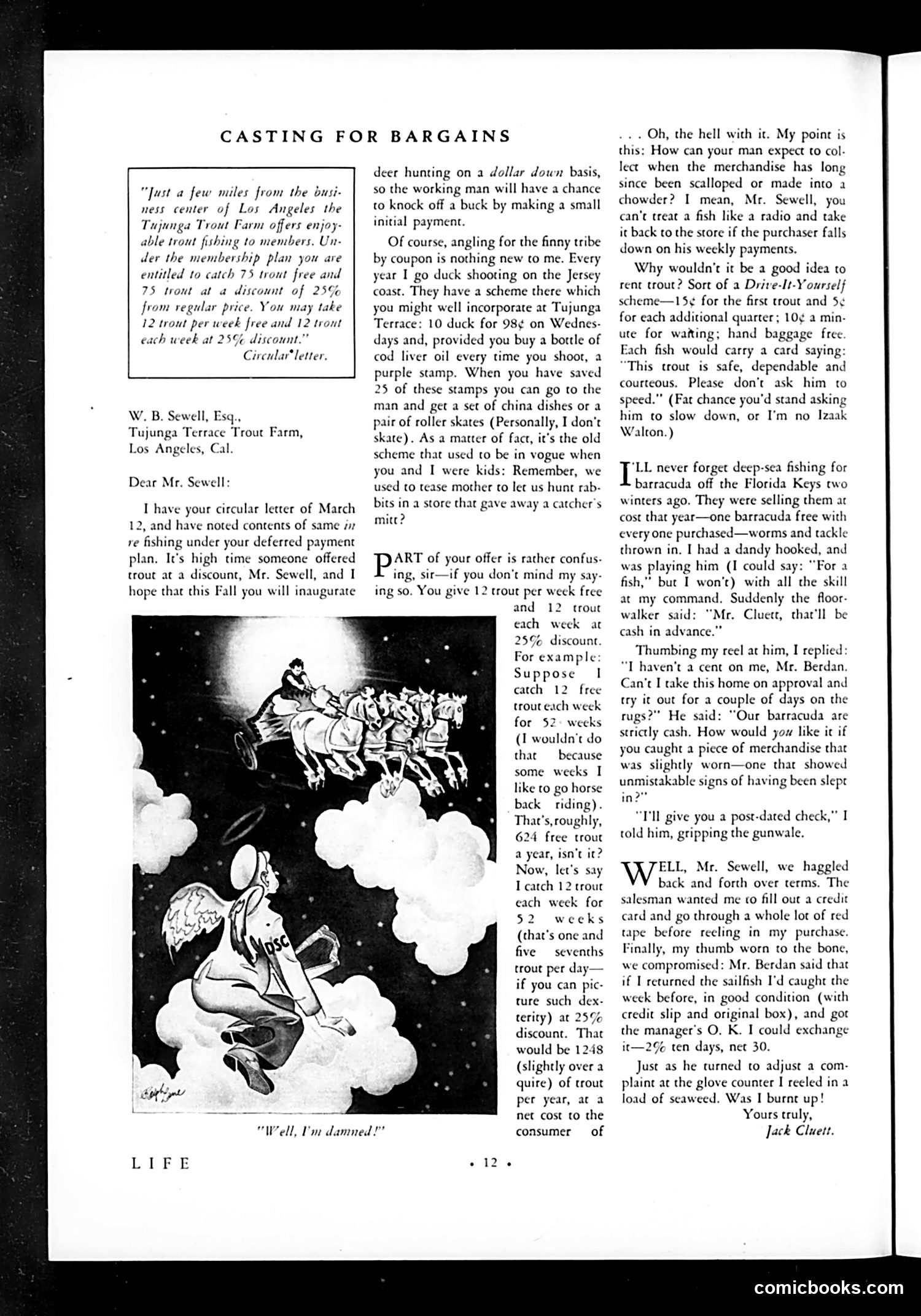
"Casting for Bargains" - Life Magazine This page presents humorous letters about consumer purchasing schemes. The main cartoon depicts Cupid riding a cloud chariot labeled "MOSS" (unclear reference), captioned "Well, I'm damned!" The satire targets aggressive sales tactics and deferred payment plans. W.B. Sewell, managing a trout farm, offers 12 free trout weekly at 25% discount if customers buy one bottle of oil per visit—accumulating 25 stamps for rewards. Jack Cluett responds skeptically, describing similar schemes: buying fish with mandatory merchandise purchases, receiving worn goods on approval, and post-dated checks. The humor mocks how retailers disguise high costs through coupons, loyalty programs, and bundled purchases, making "bargains" actually expensive when hidden requirements are revealed—a timeless consumer complaint.
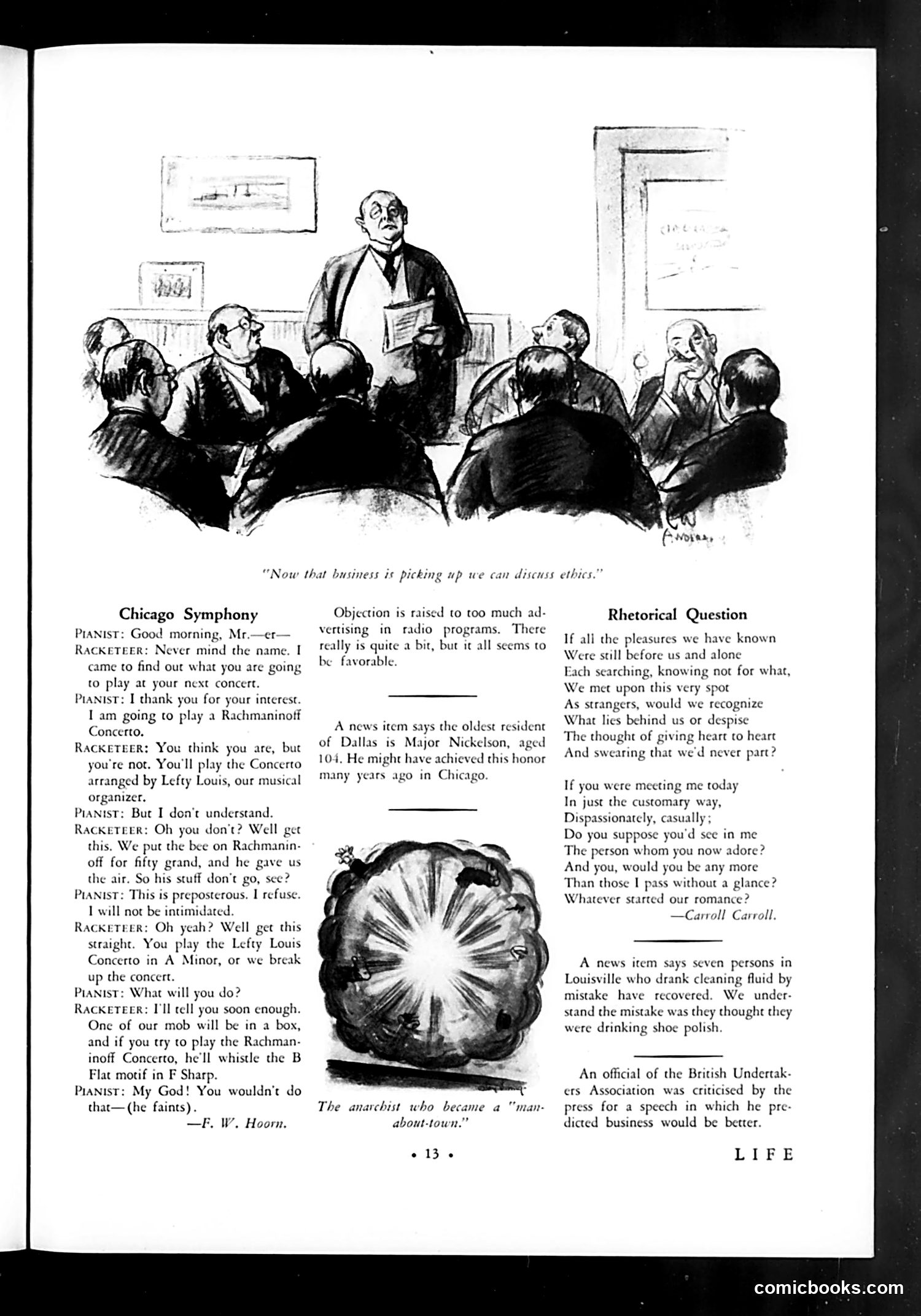
Analysis The top cartoon depicts a business meeting where a standing executive addresses seated men about ethics in radio advertising. The caption reads: "Now that business is picking up we can discuss ethics." The satire mocks corporate hypocrisy—the joke is that businessmen only consider ethical standards once profits improve. During economic hardship (implicitly the Depression era), ethics were apparently expendable; now that conditions improve, they become conveniently discussable. This critiques how corporations prioritize profit over principle. The accompanying "Chicago Symphony" dialogue is an unrelated humor piece about a pianist and concert racketeers negotiating performance terms—a separate satirical item about music industry corruption. The page also includes a poem titled "Rhetorical Question" by Carroll Carroll and brief news items, typical of *Life* magazine's mixed-content format combining political cartoon satire with short humor pieces.
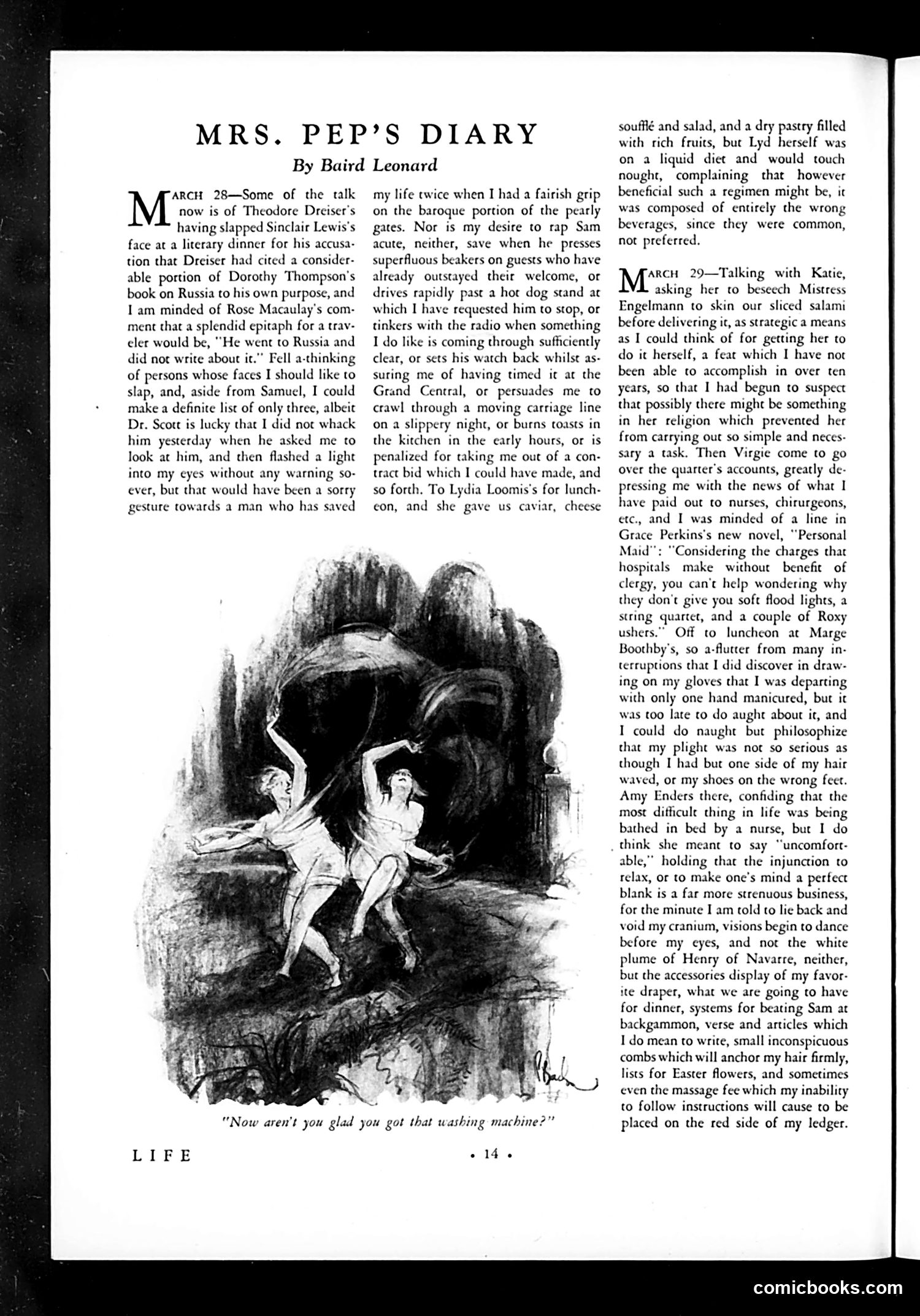
Analysis of "Mrs. Pep's Diary" by Baird Leonard This is a satirical diary column from *Life* magazine featuring social commentary on wealthy Manhattan society. The illustration shows what appears to be two figures in an intimate or comedic moment, accompanying the March 28-29 entries. The diary mocks upper-class concerns: complaints about servants (Sinclair Lewis, Dr. Scott), dietary restrictions, social obligations, and the narrator's preoccupations with appearance (manicures, hair waves, shoes). The satire targets how the wealthy obsess over trivial matters while employing household staff and patronizing high-end services. The caption "Now aren't you glad you got that waiting machine?" likely jokes about labor-saving devices or perhaps dating/courtship—unclear from context alone—but reinforces the column's mockery of frivolous concerns.
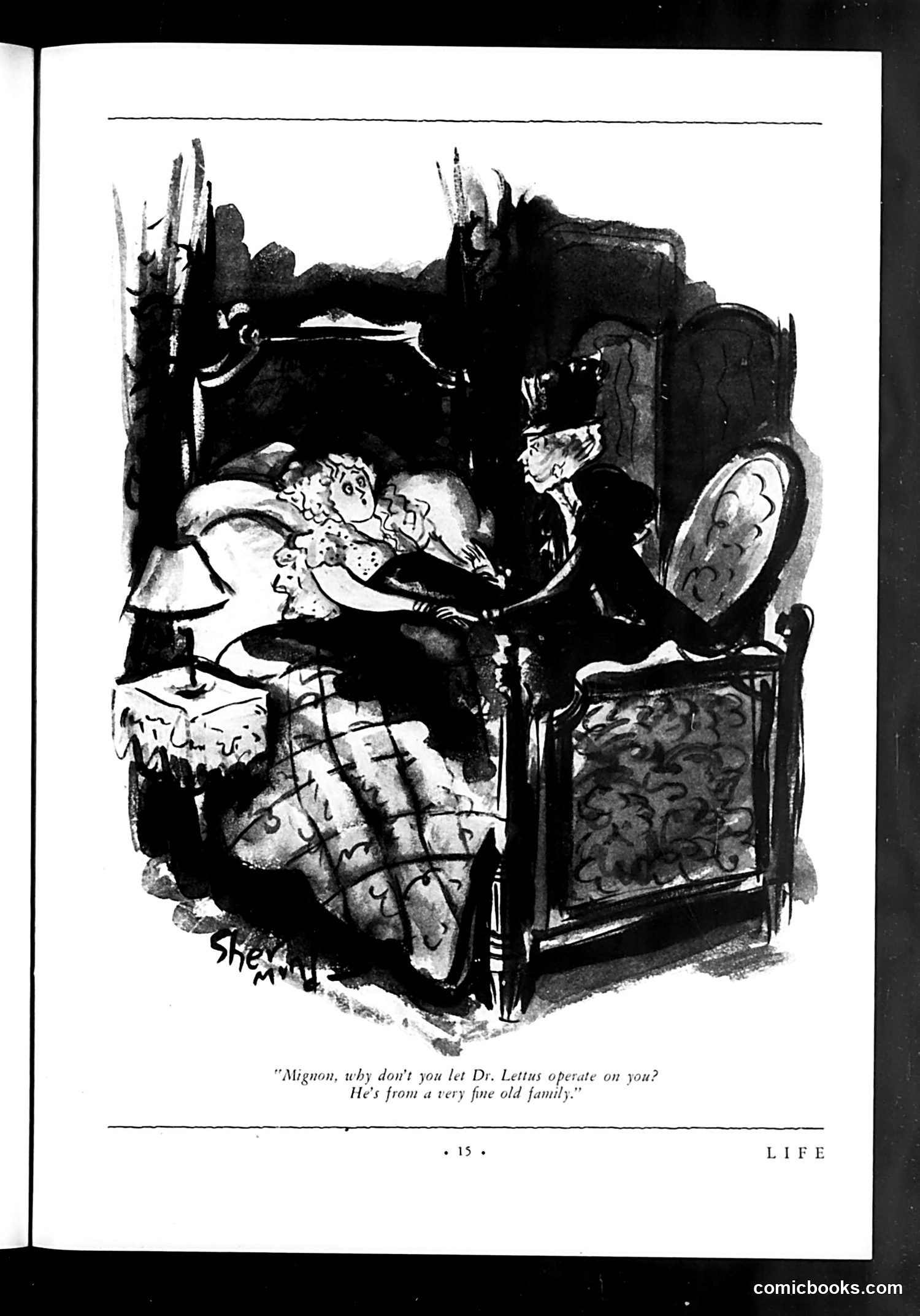
Analysis of Life Magazine Cartoon This cartoon depicts a domestic scene where a woman in bed is being pressured by two well-dressed men to accept surgery from "Dr. Lettus." The humor relies on wordplay: "Lettus operate" sounds like "let us operate," while "Lettus" appears to be a pun on a doctor's name. The satire targets medical quackery and social pressure—the woman is being coerced into unnecessary medical procedures by physicians claiming prestigious family credentials. The cartoon mocks both the false authority doctors invoked ("very fine old family") and patients' gullibility in accepting dubious treatments. This reflects early-20th-century concerns about unregulated medical practice and unnecessary surgery, particularly targeting vulnerable patients. The cartoonist (signed "Shey") uses the bedside setting to emphasize the intimate violation of unnecessary medical intervention.
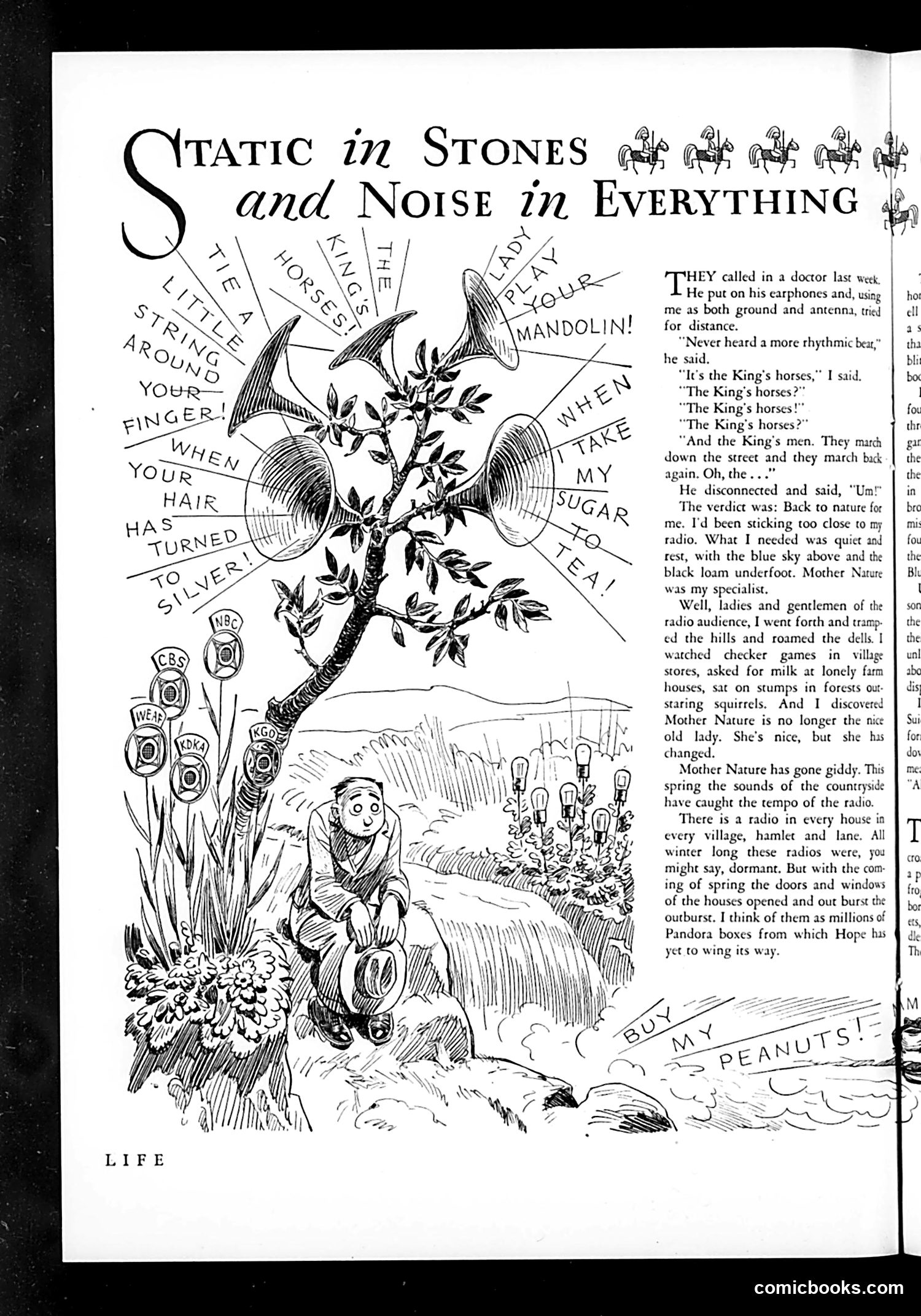
"Static in Stones and Noise in Everything" This satirical piece critiques the pervasive intrusion of radio into nature and everyday life. The central illustration shows a man surrounded by radio receivers planted like flowers in a pastoral landscape, with radio antennas replacing natural elements—a tree bearing radio dials instead of fruit, broadcasts interrupting natural sounds ("The King's horses," "When I take my sugar to tea"). The accompanying text laments how radios have invaded rural areas and countryside, disturbing the peace Mother Nature once provided. The author describes seeking escape from urban radio cacophony but finding radios everywhere—in village stores, farmhouses, and forests. The satire suggests radio technology, while novel, has become an inescapable nuisance that destroys natural quiet and rural tranquility, turning Mother Nature herself into something "giddy" and artificial.
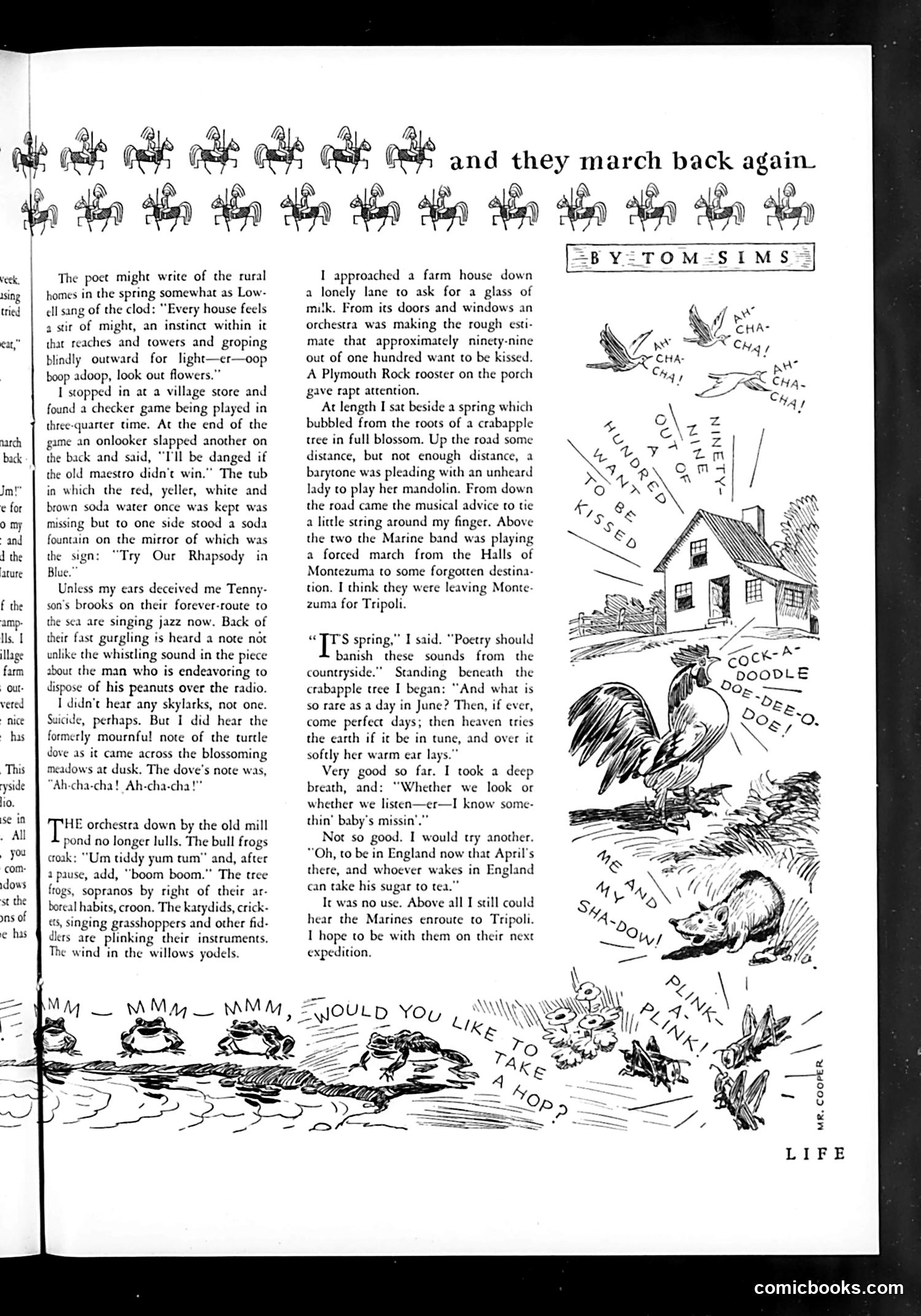
"By-Tom-Sims" Section Analysis This page features a prose piece accompanied by pastoral illustrations. The narrative describes a poet's spring wanderings through rural America, noting sounds of nature—bird calls, frog choruses, and military bands. The key satirical element appears in the section titled "It's spring," where the narrator contrasts idealized countryside sounds with the intrusion of a Marine band playing a "forced march from the Halls of Montezuma to some forgotten destination," suggesting they're departing Tripoli. The illustrations show a farmhouse with a rooster and frogs, and the final cartoon depicts frogs apparently inviting each other to "take a hop"—a visual pun accompanying the text's critique of unwanted noise disrupting spring's natural symphony. The satire targets military presence disrupting rural tranquility.
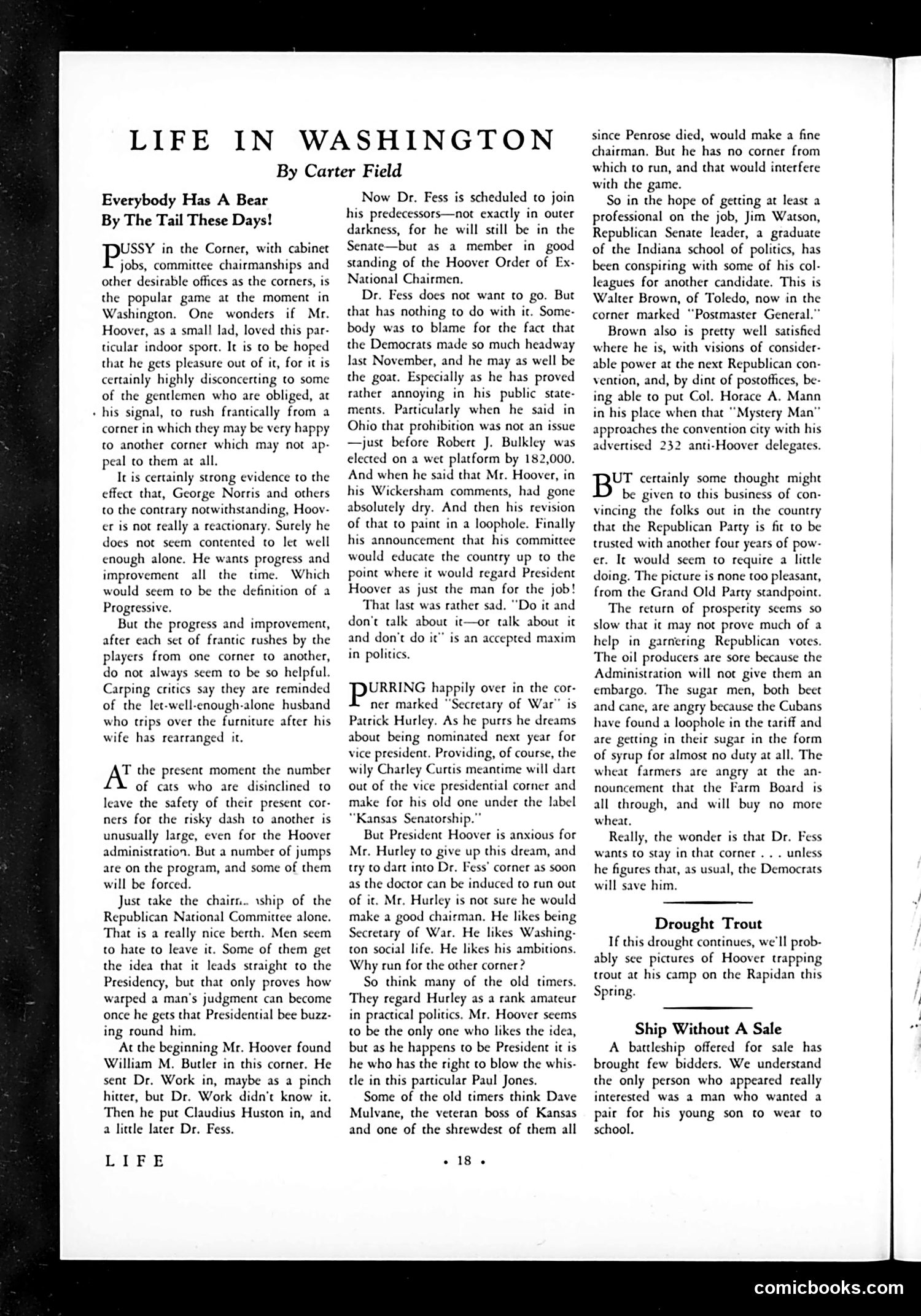
Analysis of "Life in Washington" by Carter Field This is a political commentary column, not a cartoon. Carter Field discusses Washington's political figures and intrigue during the Hoover administration. Key figures mentioned: - President Hoover, criticized as not truly "progressive" despite claims - Dr. Fess, likely a senator being considered for future political posts - Patrick Hurley, the "Secretary of War," rumored as a vice-presidential candidate - Walter Brown of Toledo, marked "Postmaster General" The satire: Field mocks Republican efforts to appear progressive while actually protecting business interests. He notes oil producers, sugar men, and wheat farmers complain the Hoover administration isn't helping them—suggesting the administration fails both reformers and special interests. The piece satirizes backroom political maneuvering and self-interested positioning among Republican leaders during what appears to be the late Hoover era.
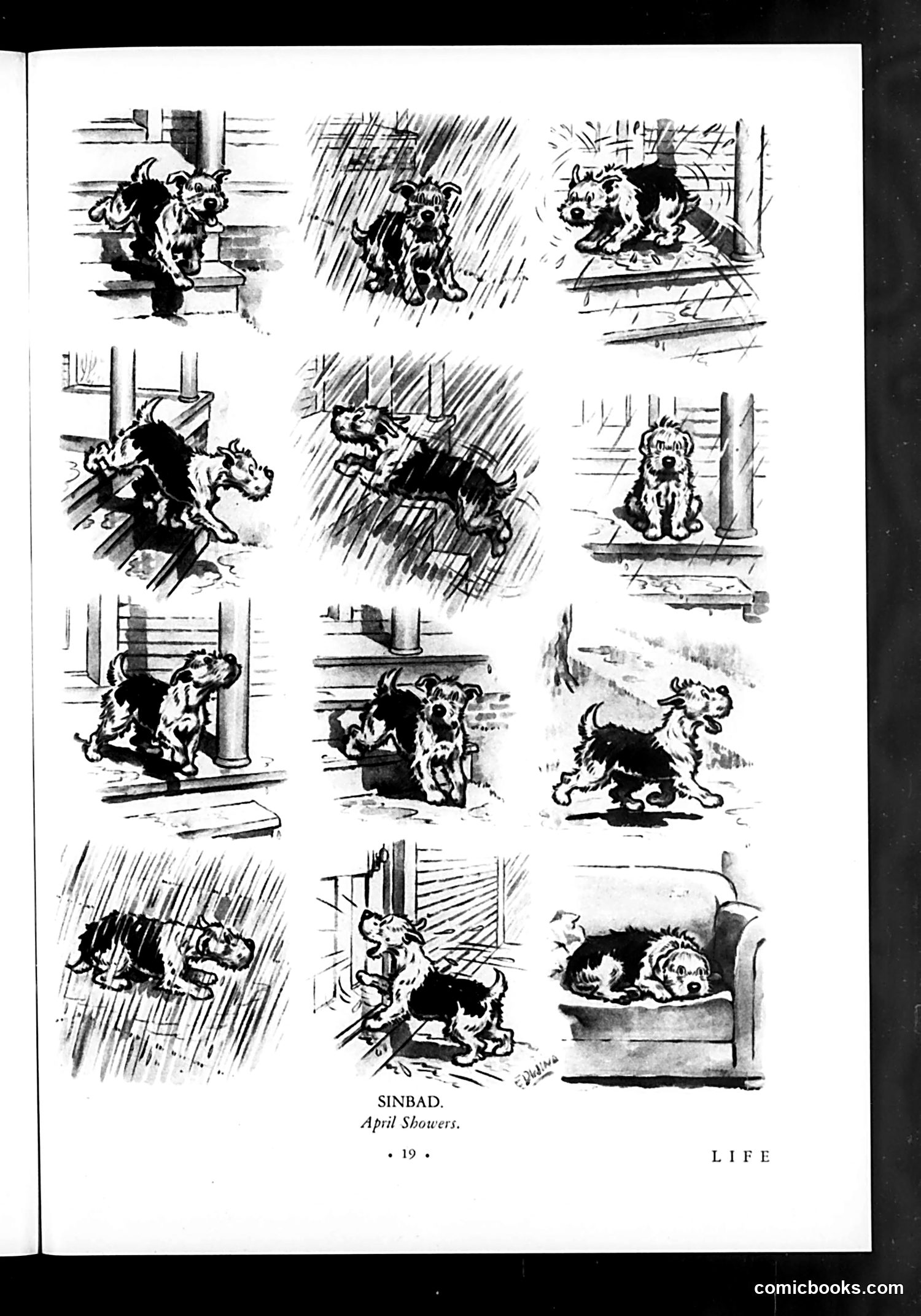
SINBAD: "April Showers" This is a humorous comic strip sequence titled "April Showers" featuring a character named Sinbad (likely a dog, given the animal appearance). The twelve panels depict a comedic narrative about dealing with rain during April. The joke plays on the common phrase "April showers bring May flowers"—but here, the character experiences typical spring weather mishaps: getting soaked, tracking mud indoors, slipping on wet surfaces, and creating general domestic chaos. The final panel shows the exhausted character finally dry and at rest indoors. The satire is gentle domestic humor rather than political—it's simply poking fun at the messy realities of spring weather versus the romantic notion of "April showers." The expressive ink-sketch style captures slapstick action typical of early 20th-century Life magazine humor.
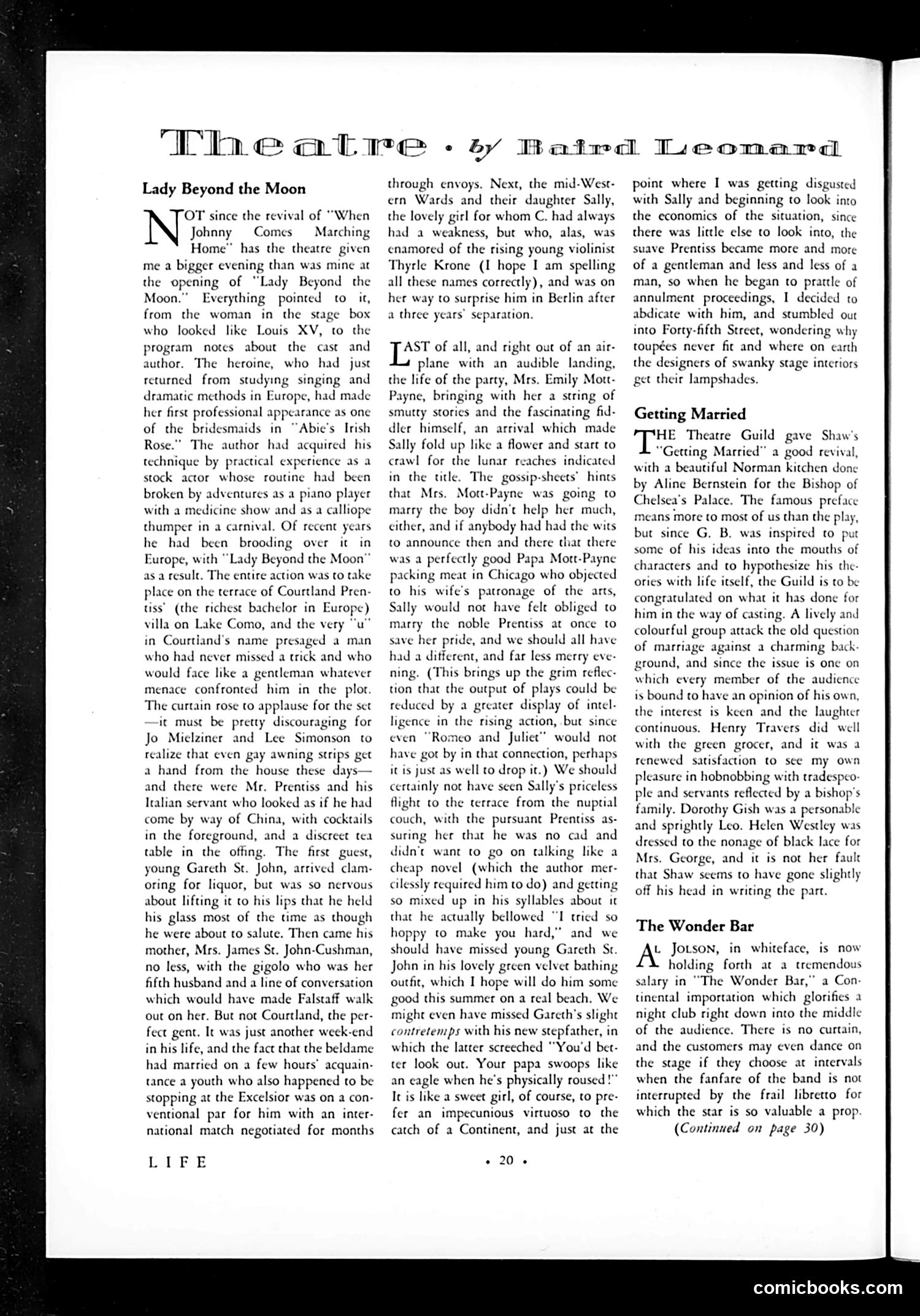
Theatre Review: "Lady Beyond the Moon" This is a theatre review by Baird Leonard, not a political cartoon. The page critiques a contemporary Broadway play opening at an unspecified date (the reference to "When Johnny Comes Marching Home" revival suggests early 20th century). Leonard satirizes the play's shallow plot mechanics and contrived dramatic construction. He mocks the absurd character introductions—wealthy bachelor Courtland Prentiss hosting guests at his Lake Como villa—and ridicules how the story resolves through implausible coincidences rather than believable motivation. His central joke: even famous plays like "Romeo and Juliet" would fail under such lazy dramatic logic. The reviewer names the scenic designers (Jo Mielziner and Lee Simonson) and various cast members, praising some performances while questioning the fundamental writing. His tone is witty and condescending toward what he views as formulaic European-set drawing-room comedy.
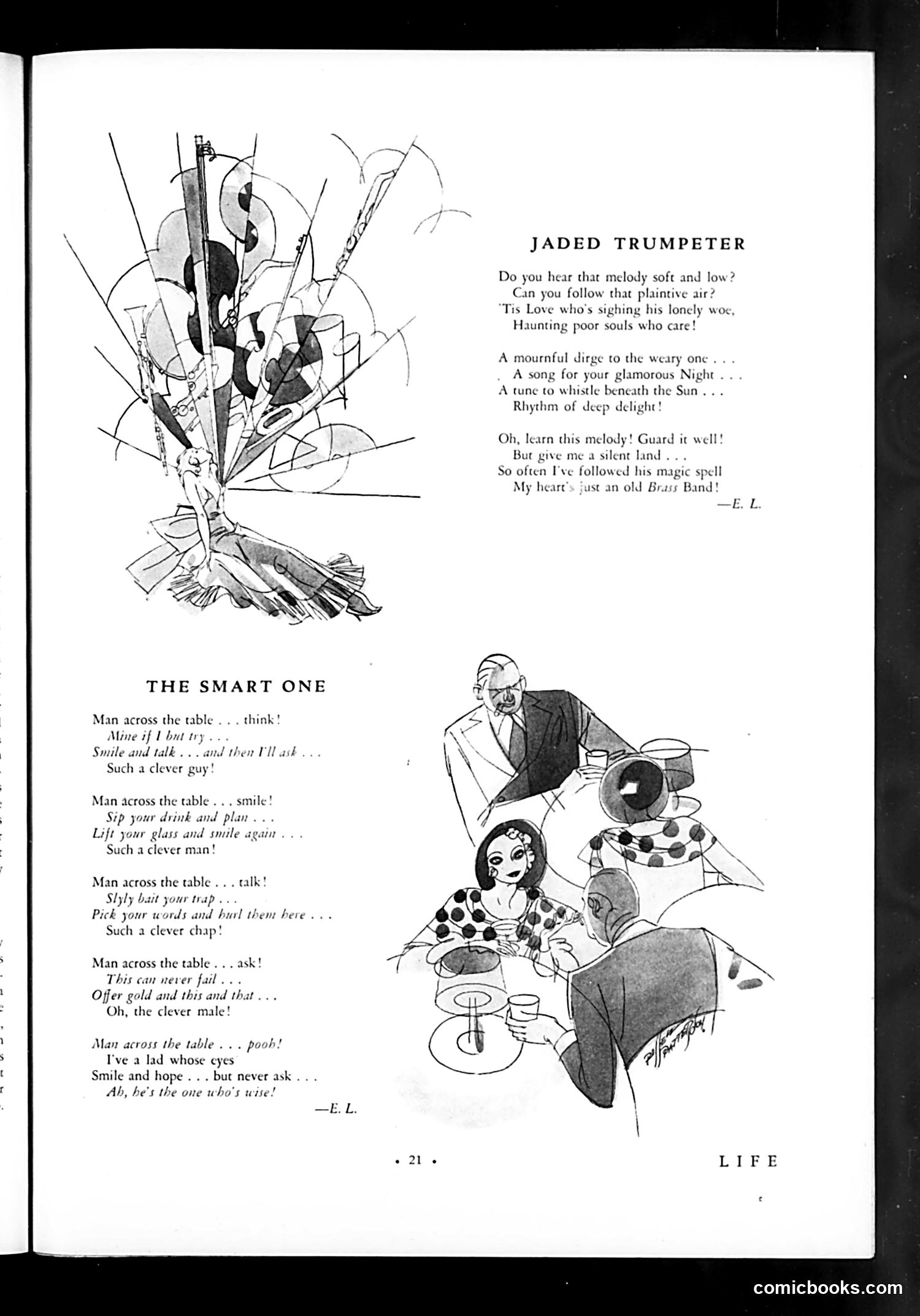
Page Analysis: Life Magazine, Page 21 This page contains two poems by E.L., both satirizing romantic and social dynamics of the era. "The Smart One" mocks manipulative courtship tactics. It describes a man employing calculated strategies—thinking, smiling, talking, and strategic questioning—to seduce a woman across a dinner table. The poem's twist ending reveals the "truly wise" man is the one who *doesn't* scheme or ask for anything, but simply smiles and hopes. The accompanying illustration shows a dinner scene with three figures, depicting this social game. "Jaded Trumpeter" expresses romantic disillusionment. A musician describes hearing love songs everywhere—mournful, glamorous, rhythmic—but craves silence. His heart has become as mechanical and lifeless as a "brass band," worn out from following love's "magic spell." The abstract illustration above shows a fragmented, chaotic trumpet, visually representing emotional exhaustion. Both poems target Jazz Age sophistication and emotional jadedness among urban adults.
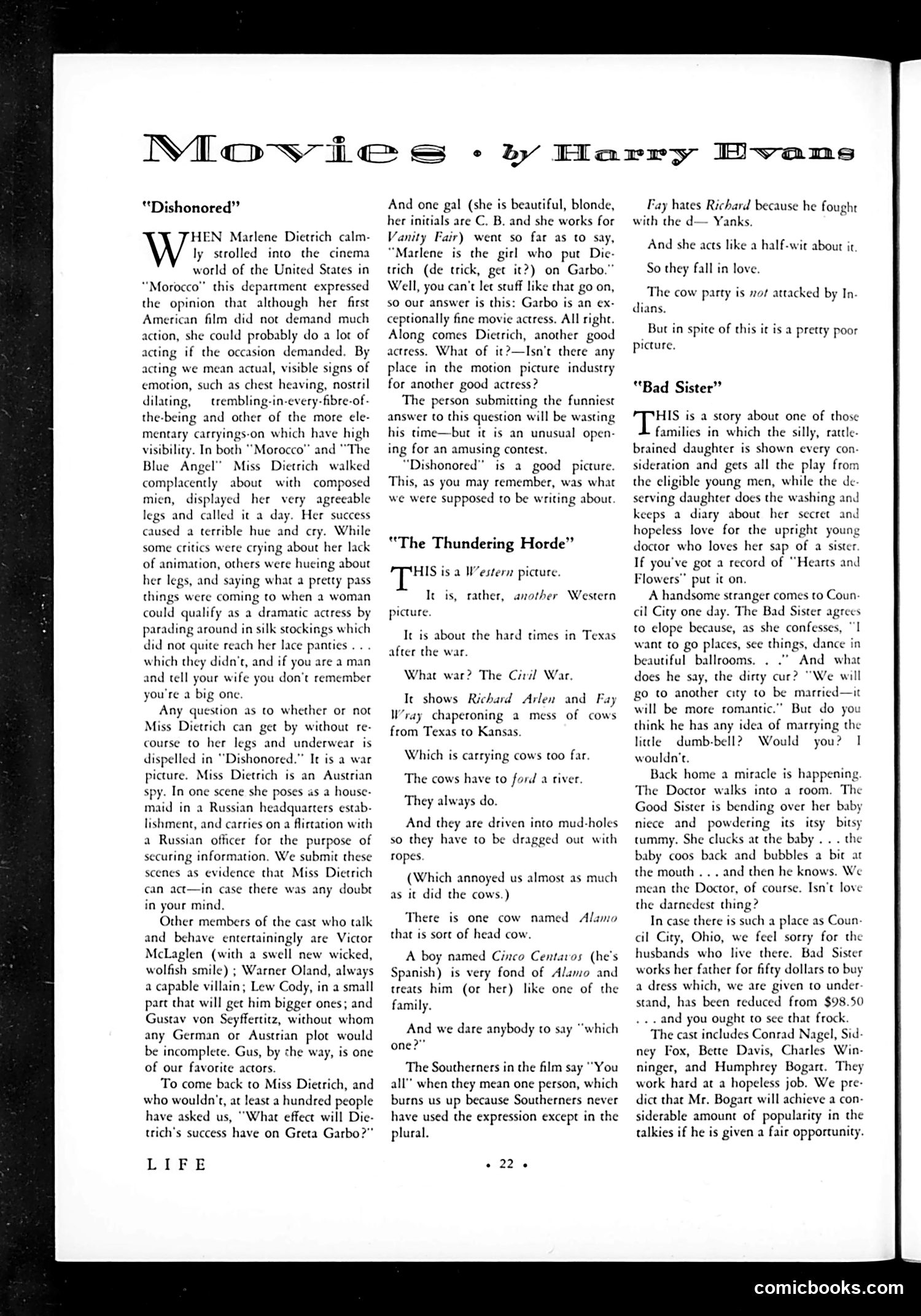
Movie Reviews by Harry Evans (Life Magazine) This page contains two film reviews by Harry Evans for *Life* magazine's entertainment section. "Dishonored" reviews Marlene Dietrich's latest spy thriller. Evans defends Dietrich against critics who claimed she succeeded solely on physical appearance rather than acting ability. He argues this war picture proves she can act through dramatic scenes—notably one where she poses as a housemaid to seduce a Russian officer for intelligence. He dismisses speculation that Dietrich's success threatens Greta Garbo, arguing there's room for multiple talented actresses in Hollywood. "The Thundering Horde" is a Western about herding cattle from Texas to Kansas after the Civil War, starring Richard Arlen and Fay Wray. Evans finds the premise absurd—particularly that cows must ford rivers and be rescued from mud-holes—and mocks the film's use of "you all" when characters address single individuals. The review is dismissively brief, suggesting a mediocre picture.
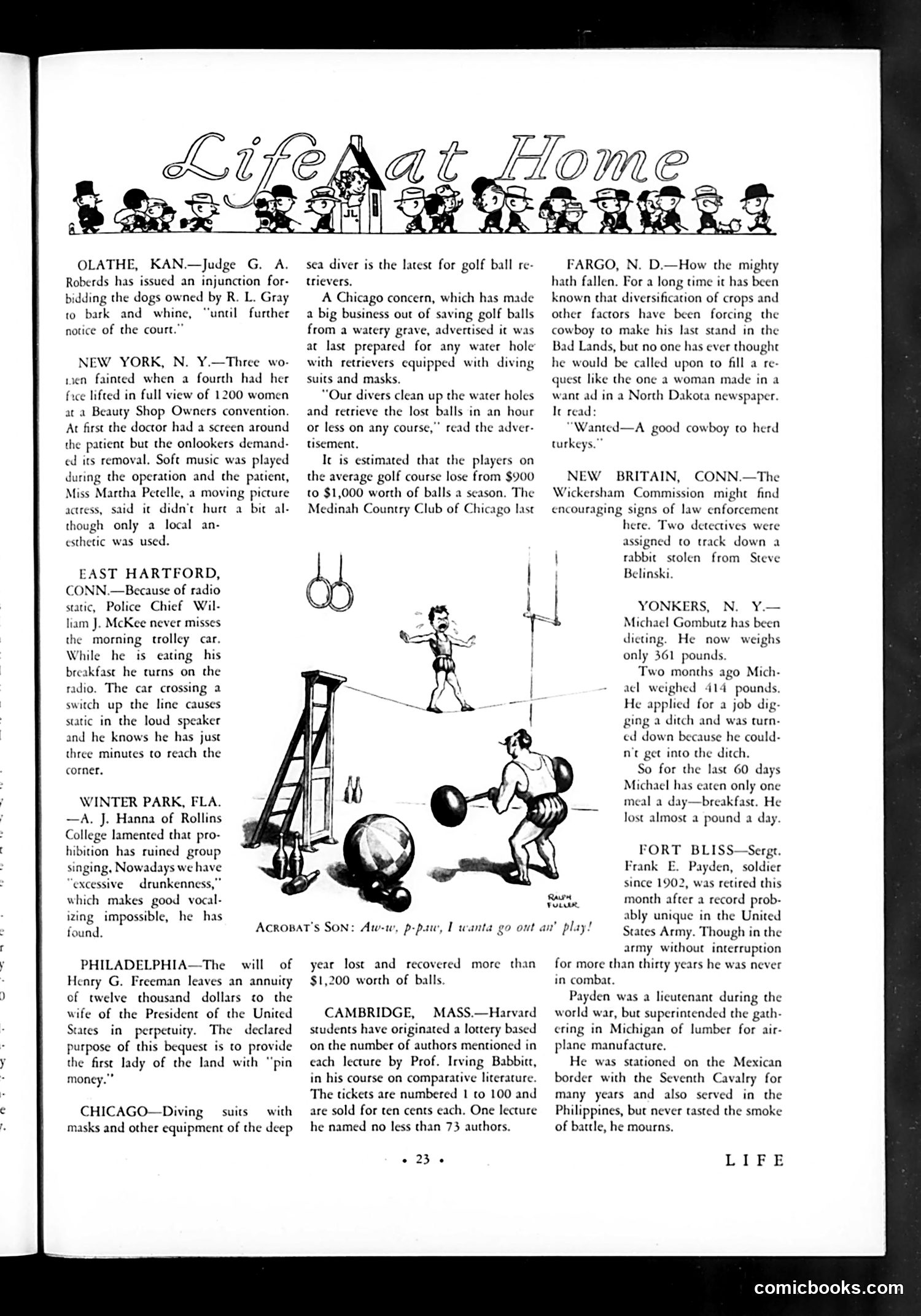
This "Life at Home" column collects humorous brief news items and anecdotes reflecting 1920s-30s American life. The cartoon shows a child on a tightrope with circus equipment, captioned "Acrobat's Son: Aw-w, p-paw, I wanta go out an' play!" — the joke being that dangerous acrobatic apparatus *is* the child's playset. The text items satirize contemporary absurdities: a Kansas judge issuing an injunction against a dog's barking; women fainting at a public face-lift procedure; a police chief timing his commute by radio static; Prohibition's supposed effect on group singing; someone hiring a deep-sea diver to retrieve golf balls; a woman seeking a cowboy to herd turkeys (mocking the cowboy's obsolescence); and an obese man who lost 53 pounds eating only breakfast. The humor relies on deadpan reporting of genuine oddities, reflecting modern anxieties about technology, urbanization, changing social customs, and economic shifts—presented as curiosities rather than serious commentary.
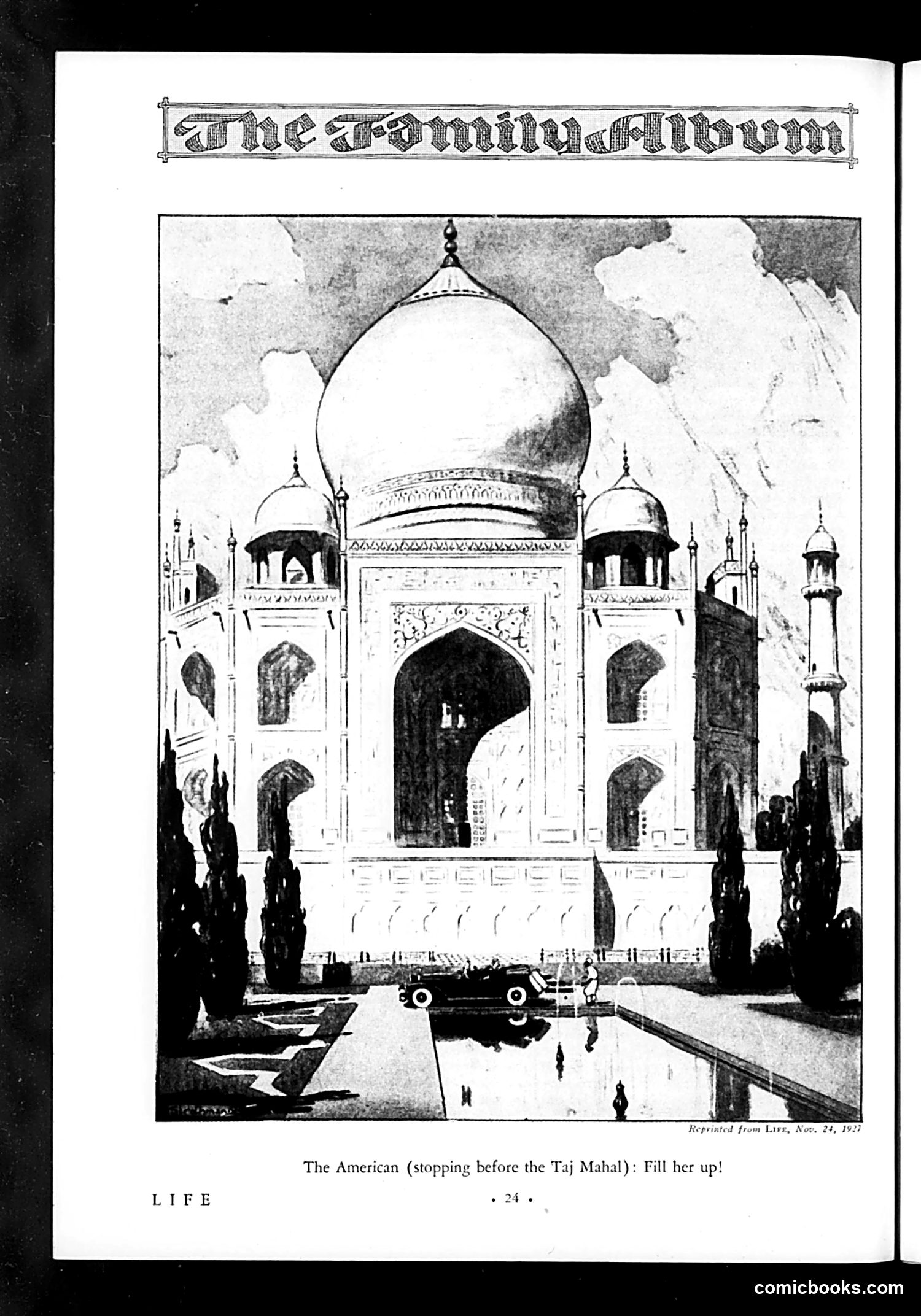
Analysis of Life Magazine Cartoon (November 24, 1927) This satirical cartoon depicts an American tourist in an automobile stopped before the Taj Mahal in India, commanding "Fill her up!"—a gas station phrase. The joke mocks American cultural insensitivity and materialism during the 1920s travel boom. The cartoon criticizes how wealthy Americans, newly mobile via automobiles, treated global landmarks with ignorance and irreverence. Rather than appreciating one of the world's most significant architectural monuments (built as a mausoleum by Mughal emperor Shah Jahan), the American character reduces the experience to mere refueling—treating India as functional infrastructure for American leisure. This reflects contemporary anxieties about American tourists abroad: their loud consumerism, cultural indifference, and assumption that the world existed to serve their convenience. The satire targets both American arrogance and the commodification of travel during the Jazz Age.
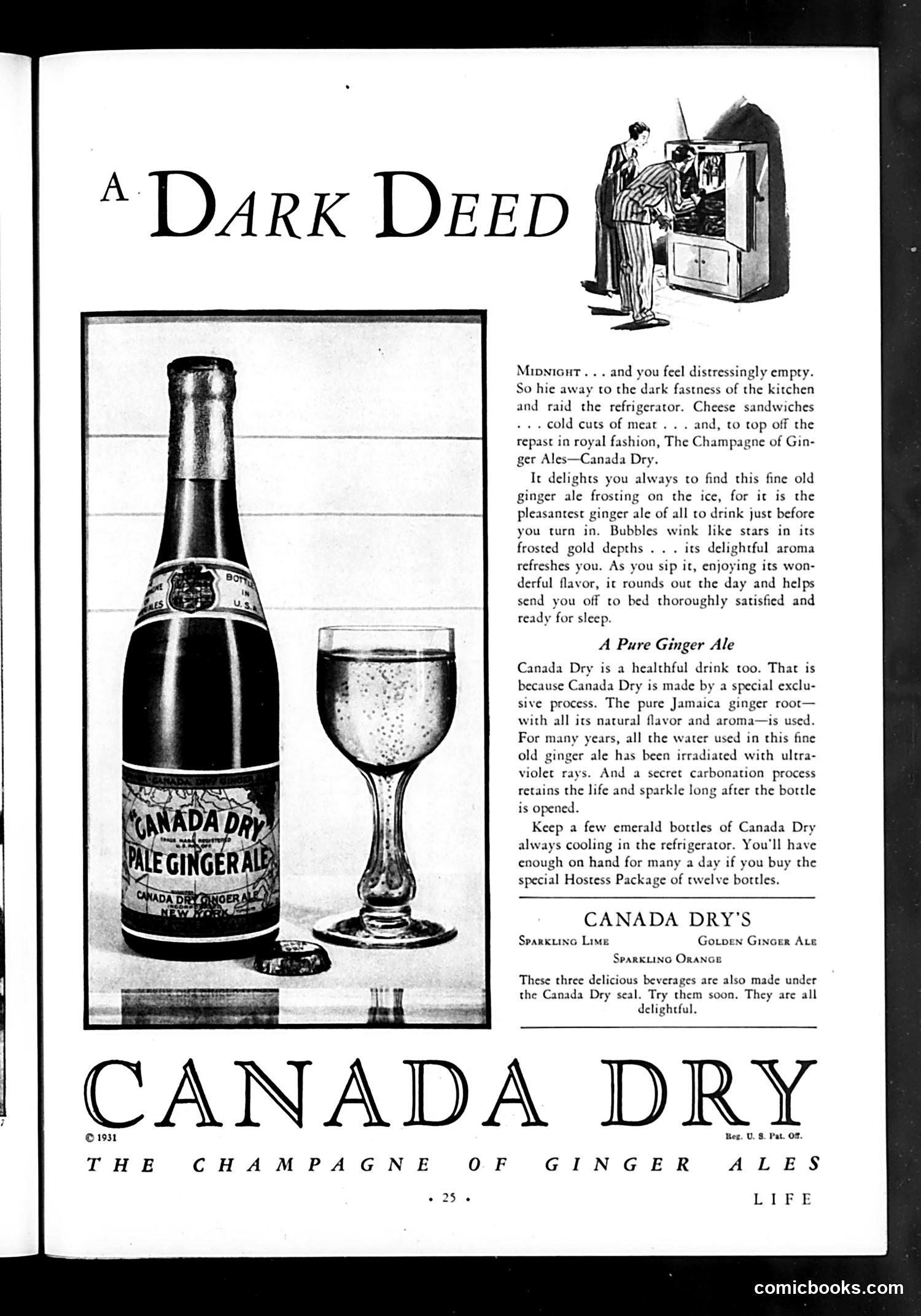
"A Dark Deed" - Canada Dry Advertisement (1931) This is a full-page advertisement, not political satire. The "dark deed" is a humorous euphemism for a late-night raid on the refrigerator—a relatable domestic scenario. The illustration shows someone sneaking into the kitchen at midnight seeking snacks. The ad markets Canada Dry ginger ale as the sophisticated solution to midnight hunger pangs, positioning it as "The Champagne of Ginger Ales." The copy emphasizes its purity (Jamaica ginger root, ultraviolet-treated water) and the pleasure of finding a cold bottle waiting in the refrigerator. The smaller illustration at top-right depicts someone at a vintage television or radio console, suggesting entertainment as part of the midnight ritual. This is straightforward advertising using relatable humor and lifestyle aspirations typical of 1931 consumer marketing.
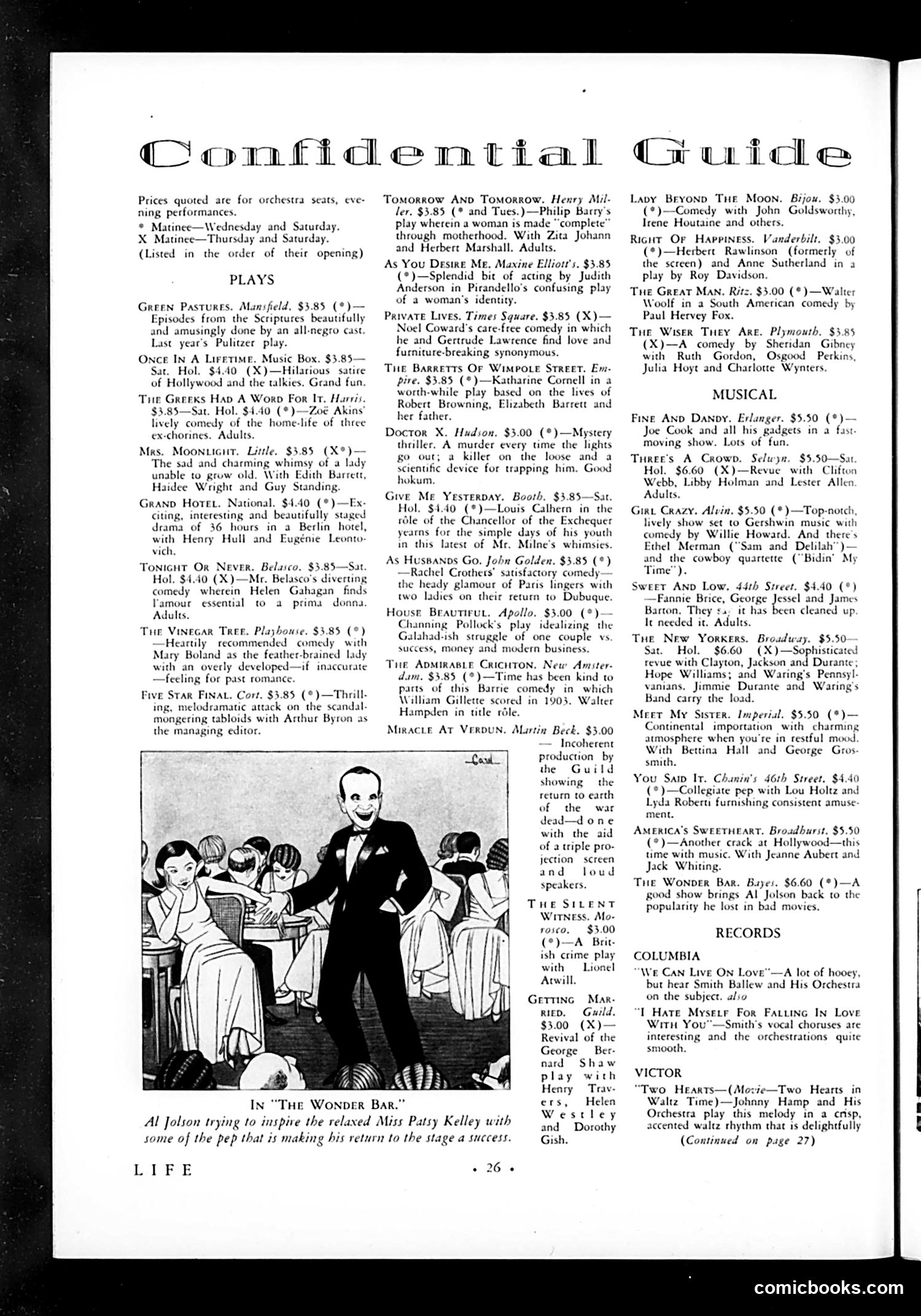
Analysis of This Life Magazine Theater Guide Page This is primarily a theater listings and reviews page from Life magazine's "Confidential Guide" section, not a political cartoon. The page catalogs Broadway plays with prices and brief critical descriptions. The single illustration shows Al Jolson performing in "The Wonder Bar," attempting to energize actress Patsy Kelley on stage. This references Jolson's recent return to theatrical performance—a significant cultural moment, as he was primarily known for films by this era. The caption's tone suggests this was noteworthy entertainment news. The reviews themselves are lighthearted and brief, mixing comedies, dramas, and melodramas typical of early 1930s Broadway. Notable entries include "Green Pastures" (an all-Black cast production and Pulitzer winner) and plays by established dramatists like Noel Coward and George Bernard Shaw. There is no political satire or social commentary visible on this page—it's straightforward entertainment journalism and advertising for theatergoers seeking evening plans and ticket prices.
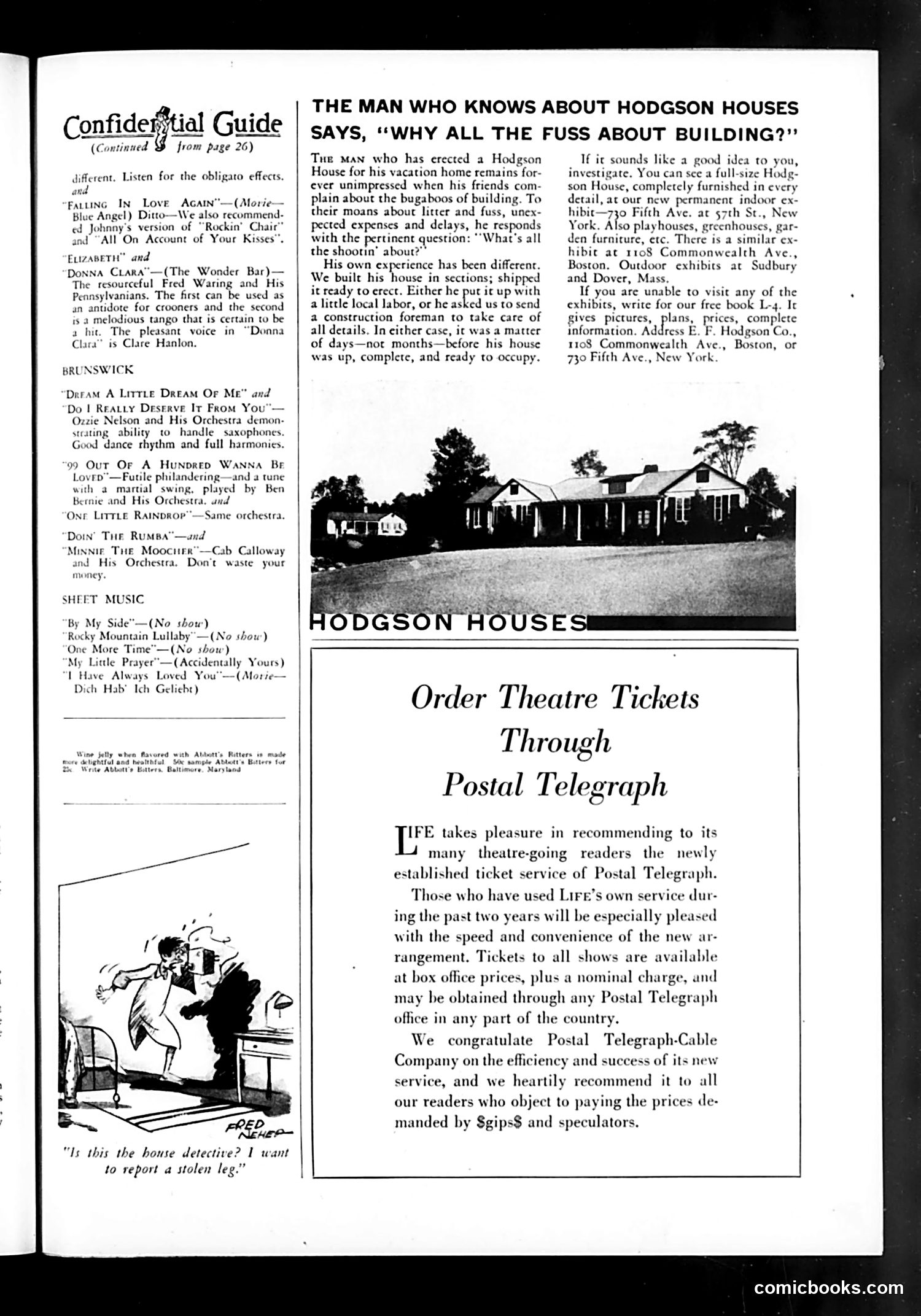
Analysis of Life Magazine Page Content This page contains primarily advertising and service announcements rather than political satire. The single cartoon—credited to Fred Neher—is a generic hotel humor gag: a guest calls the front desk to report "a stolen leg," a sight-gag playing on the double meaning of "leg" (limb vs. theatrical term for a performance). The substantive content includes: 1. "Confidential Guide" (left): Music and sheet music reviews of 1920s-30s recordings and songs, recommending orchestral performances and warning against poor ones. 2. Hodgson Houses advertisement (top right): Promotes prefabricated vacation homes shipped in sections, emphasizing quick assembly versus traditional construction delays. 3. Postal Telegraph advertisement (bottom right): Life magazine endorses a new theatre ticket-ordering service, notably criticizing scalpers ("gips and speculators") who mark up prices—suggesting ticket reselling was an established problem even then. The page reflects period consumer services and entertainment options rather than political commentary.
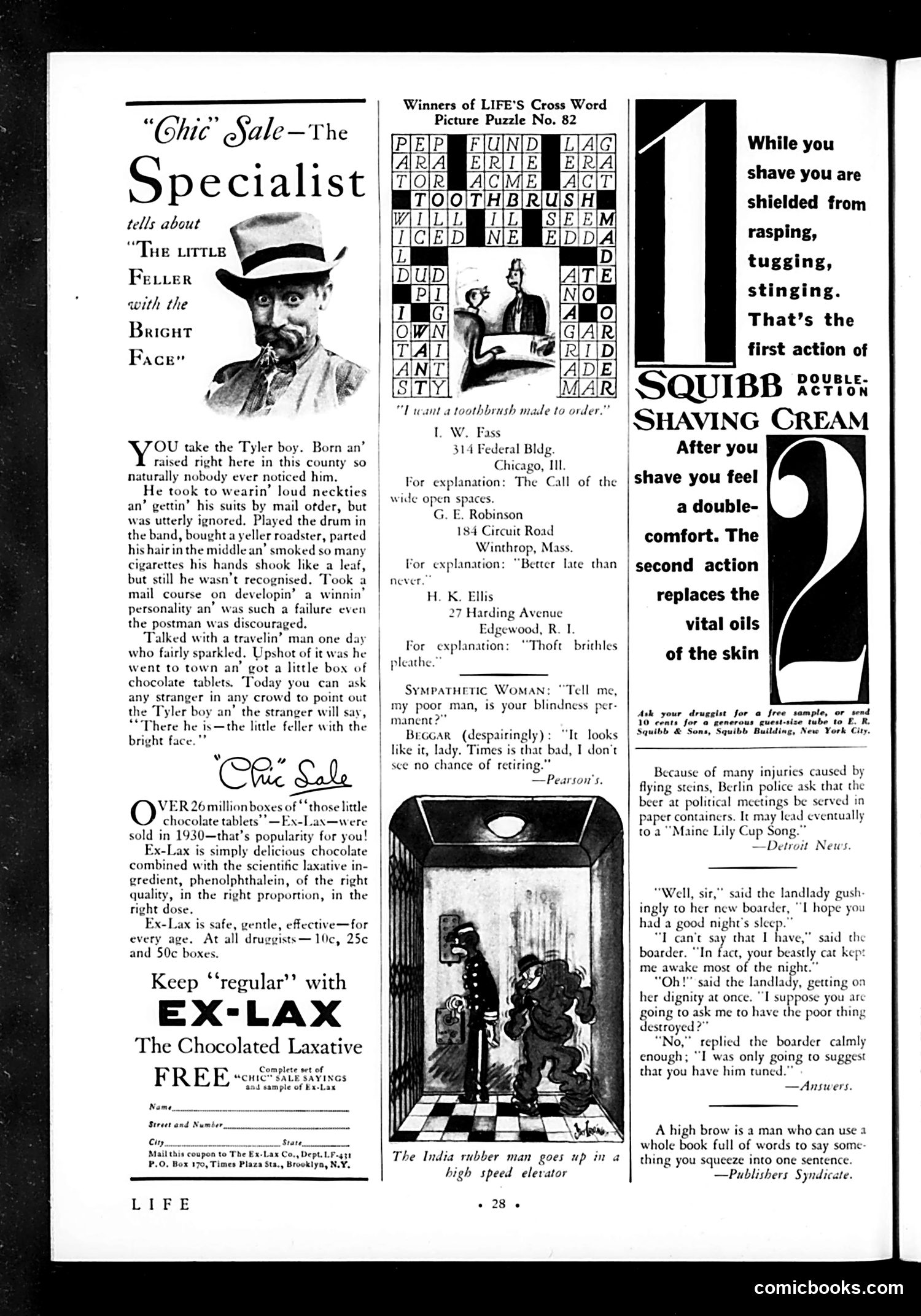
Life Magazine Page Analysis This is primarily a advertisements and humor page from Life magazine (circa 1930s based on references). The main content includes: "Chic Sale" story: A humorous narrative about a socially awkward boy ("Tyler boy") who transforms his social standing by purchasing Ex-Lax chocolate laxatives. The joke plays on the absurdity that acquiring a product—in this case a laxative—somehow makes him instantly popular and recognizable. It's satirizing both the boy's desperation for social acceptance and advertisers' claims that products can transform one's life. Advertisements: Ex-Lax (laxative), Squibb Shaving Cream dominate the page, using typical 1930s advertising copy promising comfort and effectiveness. Cartoons and jokes: Various single-panel cartoons about an "India rubber man" in an elevator, a blind beggar, and a landlady with a cat—typical period humor with mild social commentary. Sidebar note: A reference to Berlin police concerns about beer steins causing injuries at political meetings, suggesting pre-WWII German political tensions. The overall tone reflects 1930s American satirical magazine style: lighthearted, product-focused, mildly ribald.
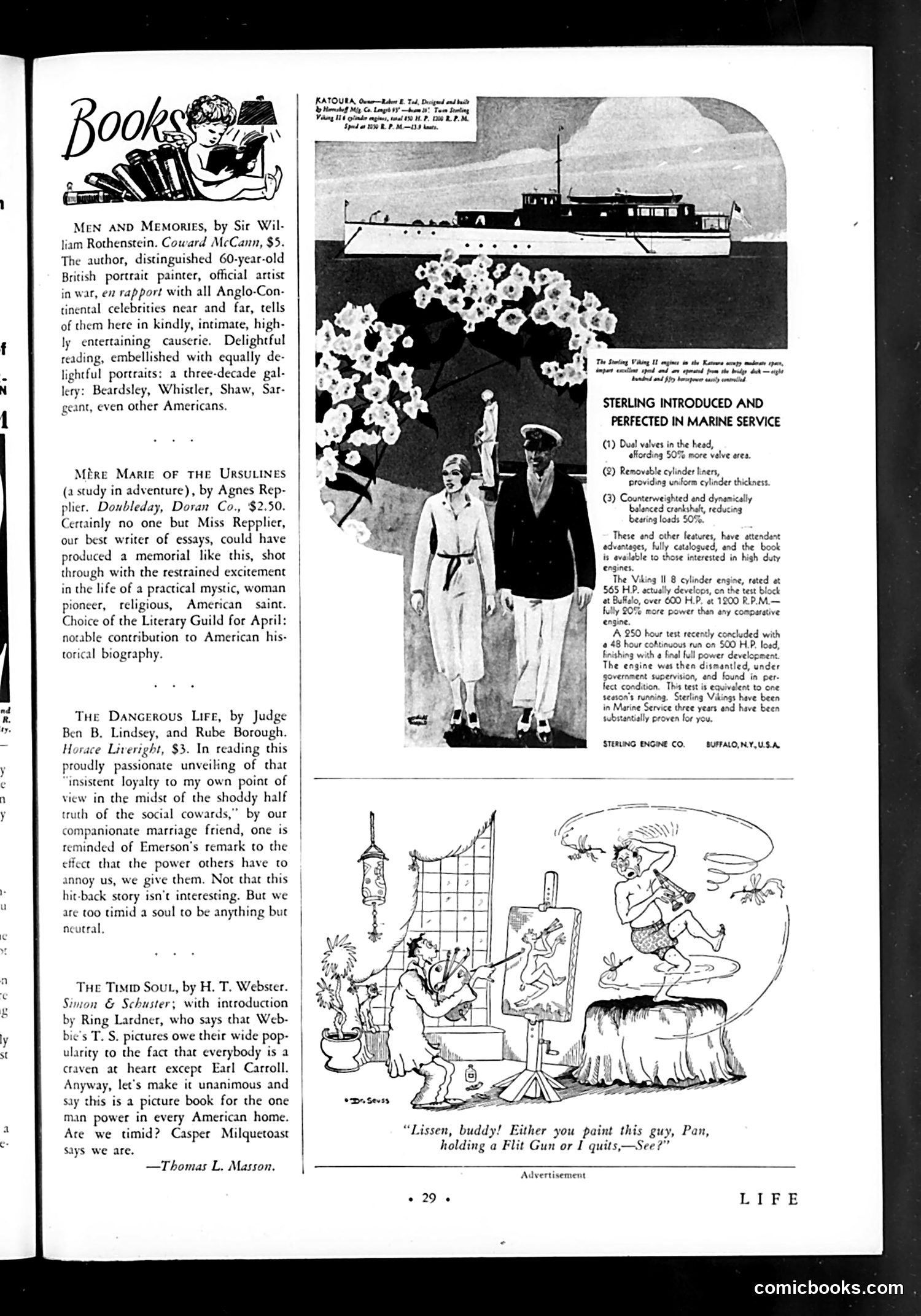
Analysis of This Life Magazine Page This page combines book reviews with advertisements and a cartoon. The cartoon at bottom depicts an artist being pressured by a client: the client demands the artist either paint "this guy, Pan, holding a Flit Gun" or quit the job. The satire: This mocks aggressive advertising and commercialism's intrusion into creative work. "Pan" likely references a classical artistic subject, contrasted with "Flit Gun"—a commercial pest-control product. The cartoon suggests advertisers are forcing artists to incorporate product placement into their work, even when it clashes with artistic integrity. The client's ultimatum ("or I quits") emphasizes advertising's power over art. Context: This reflects 1920s anxieties about mass marketing and consumer culture colonizing previously "pure" domains like fine art. The juxtaposition with highbrow book reviews about serious literature and biography underscores the tension between artistic merit and commercial pressures that dominated the era.
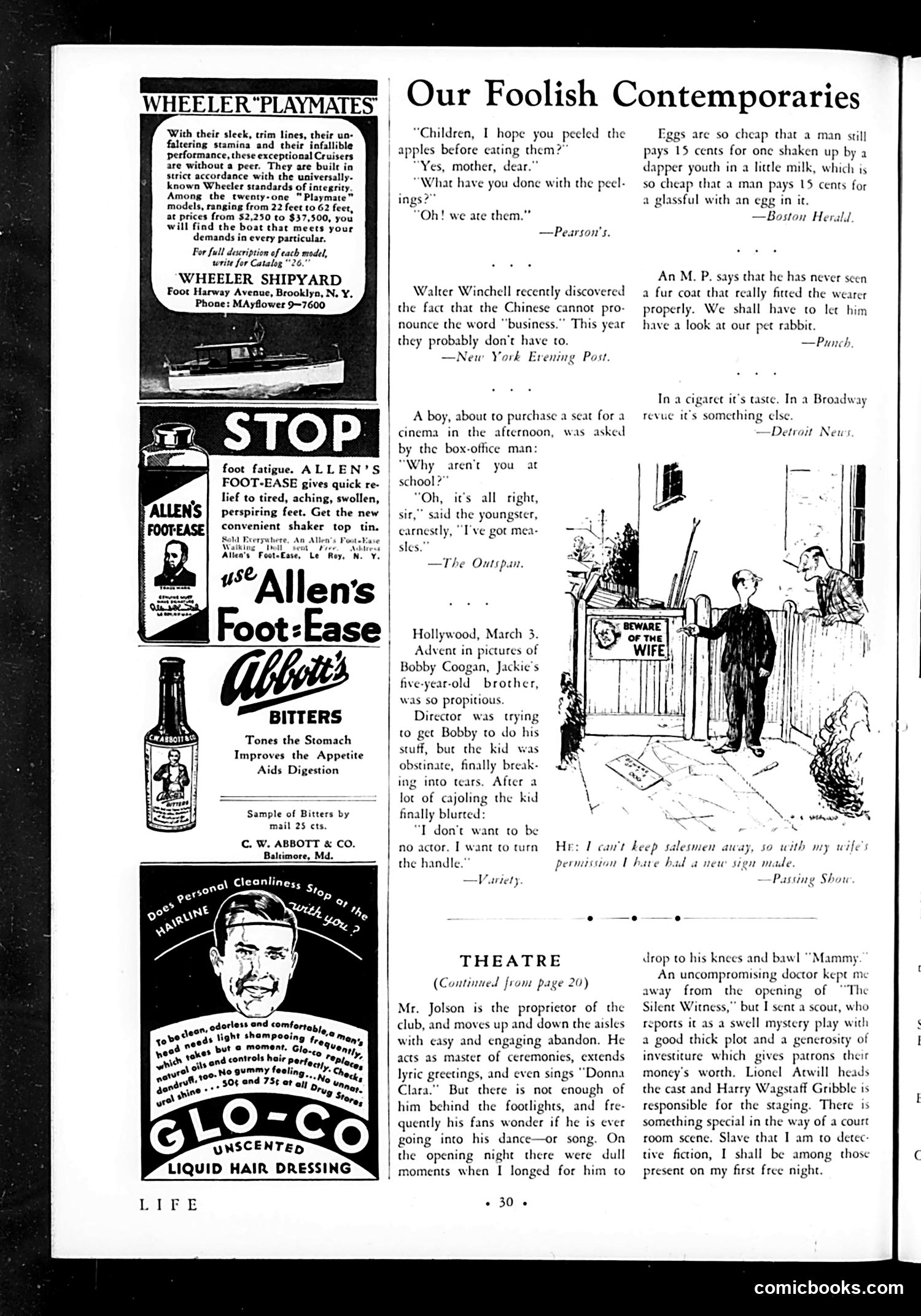
"Our Foolish Contemporaries" - Life Magazine Humor Page This page features Life's satirical humor column, a collection of short jokes and observations from contemporary newspapers and sources. The "Foolish Contemporaries" section mocks absurd logic and obliviousness: - A mother asks if her child peeled apples before eating them; the child ate the peels instead - Walter Winchell's observation that Chinese people "cannot pronounce 'business'" — a racist joke implying they won't need the word - A boy claiming to have measles to skip school - A child actor refusing to act, preferring to "turn the handle" (operate equipment) instead - A husband unable to keep salesmen away because his wife won't let him - A doctor so busy he avoided a theater opening The jokes target foolish reasoning, child logic, and social absurdities. The rest of the page contains product advertisements (boats, foot powder, bitters) and a theater review of a production featuring Al Jolson.
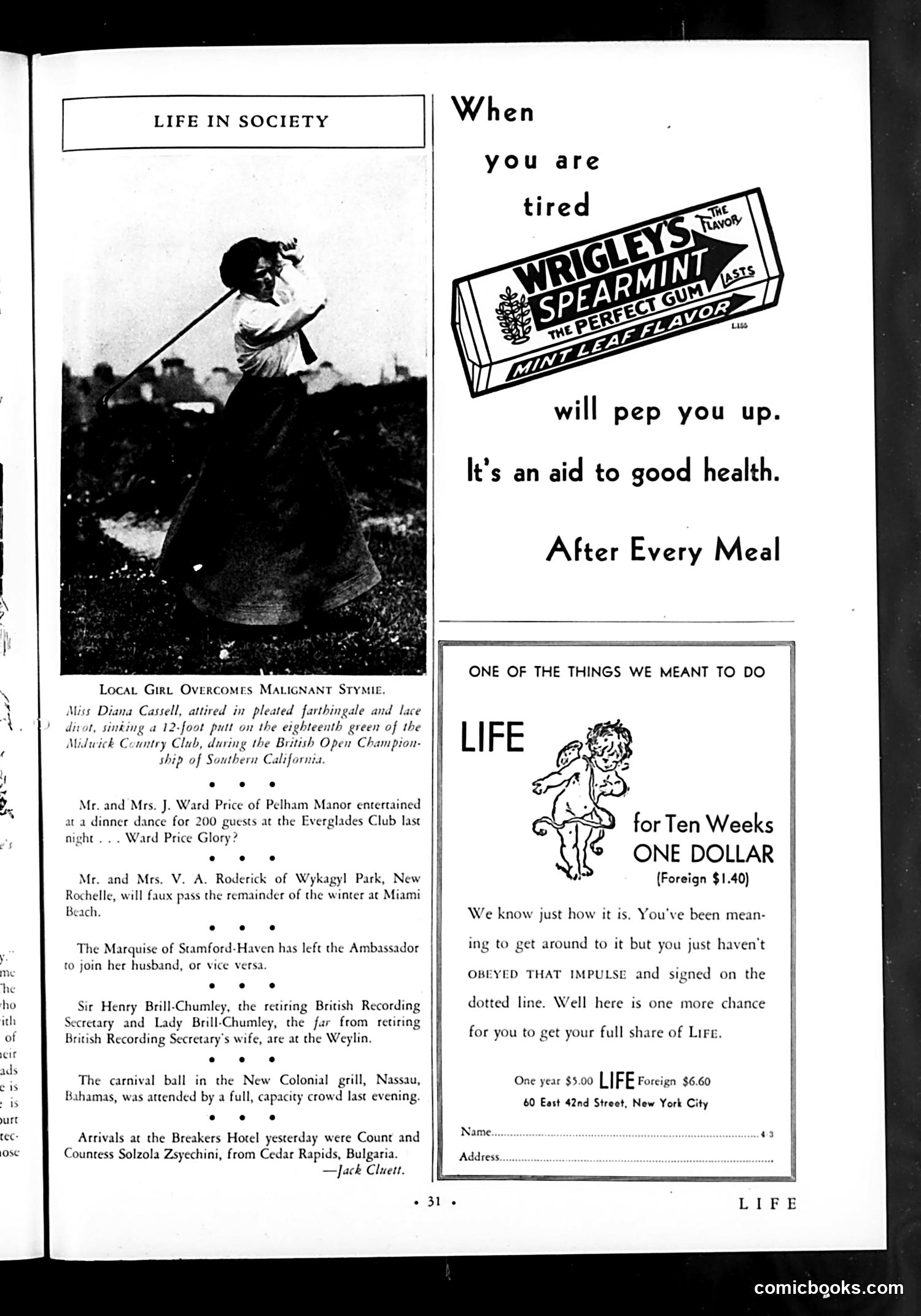
Explanation for Modern Readers This page satirizes upper-class social pretension through two elements: Left side ("Life in Society"): A gossip column mocking wealthy socialites with absurdist humor. The jokes rely on exaggeration and wordplay—a golfer in formal "farthingale and lace" attire, a couple who will "faux pass" (fake pas) at Miami Beach, and a fictional "Count and Countess Solzola Zsyechini, from Cedar Rapids, Bulgaria" (absurdly pairing an exotic title with a mundane Midwestern location). Bylined to "Jack Cluett," this ridicules how society pages breathlessly report trivial doings of the wealthy. Right side: A Wrigley's spearmint gum advertisement ("When you are tired...will pep you up") placed directly adjacent, plus a subscription pitch for *Life* magazine itself, offering "life for ten weeks" for one dollar. The juxtaposition suggests satirical commentary on consumer culture and magazine advertising targeting the same elite audience. The page demonstrates *Life*'s satirical approach: mocking high society while simultaneously courting advertisers and readers from that same demographic.
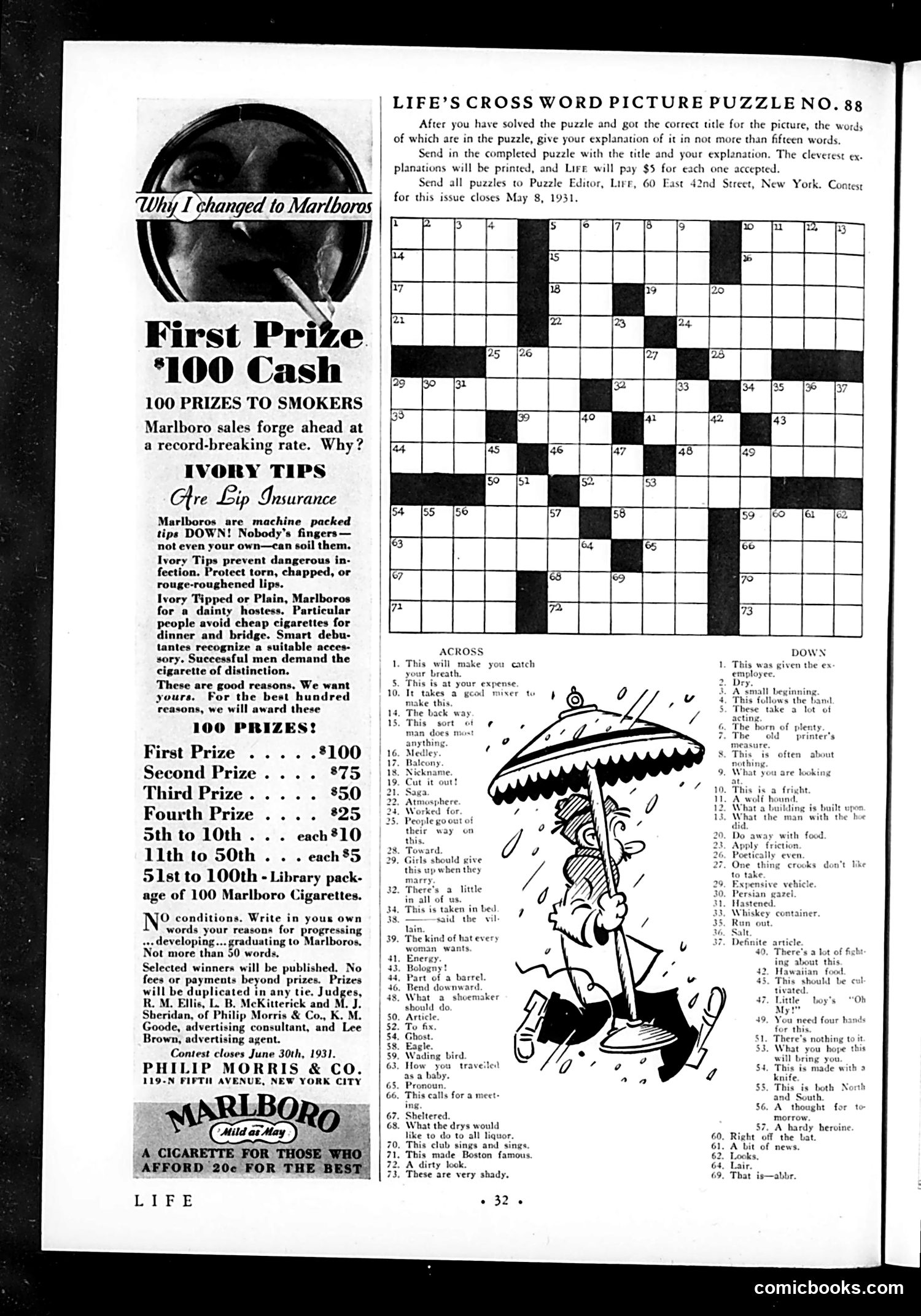
Life Magazine, June 1931: Advertisement and Puzzle Content This page combines a Marlboro cigarette advertisement with a crossword picture puzzle contest. The ad features a cartoon figure (appears to be a stylized person) endorsing Marlboro cigarettes with "Ivory Tips," marketed as "lip insurance" to prevent infection and chapping. The copy emphasizes that machine-packed tips keep fingers away from the cigarette—a selling point suggesting hygiene concerns. The ad offers $100 cash as first prize for essays explaining why smokers should switch to Marlboros. Below is Life's crossword picture puzzle #88, where readers solve clues to reveal a hidden title, then submit 15-word explanations for prizes up to $5. Context for modern readers: This reflects 1931 America before smoking's health dangers were widely acknowledged. Cigarette advertising directly claimed health benefits, and contests were standard marketing. The magazine monetized reader engagement through puzzle contests while hosting tobacco advertising—both now prohibited.
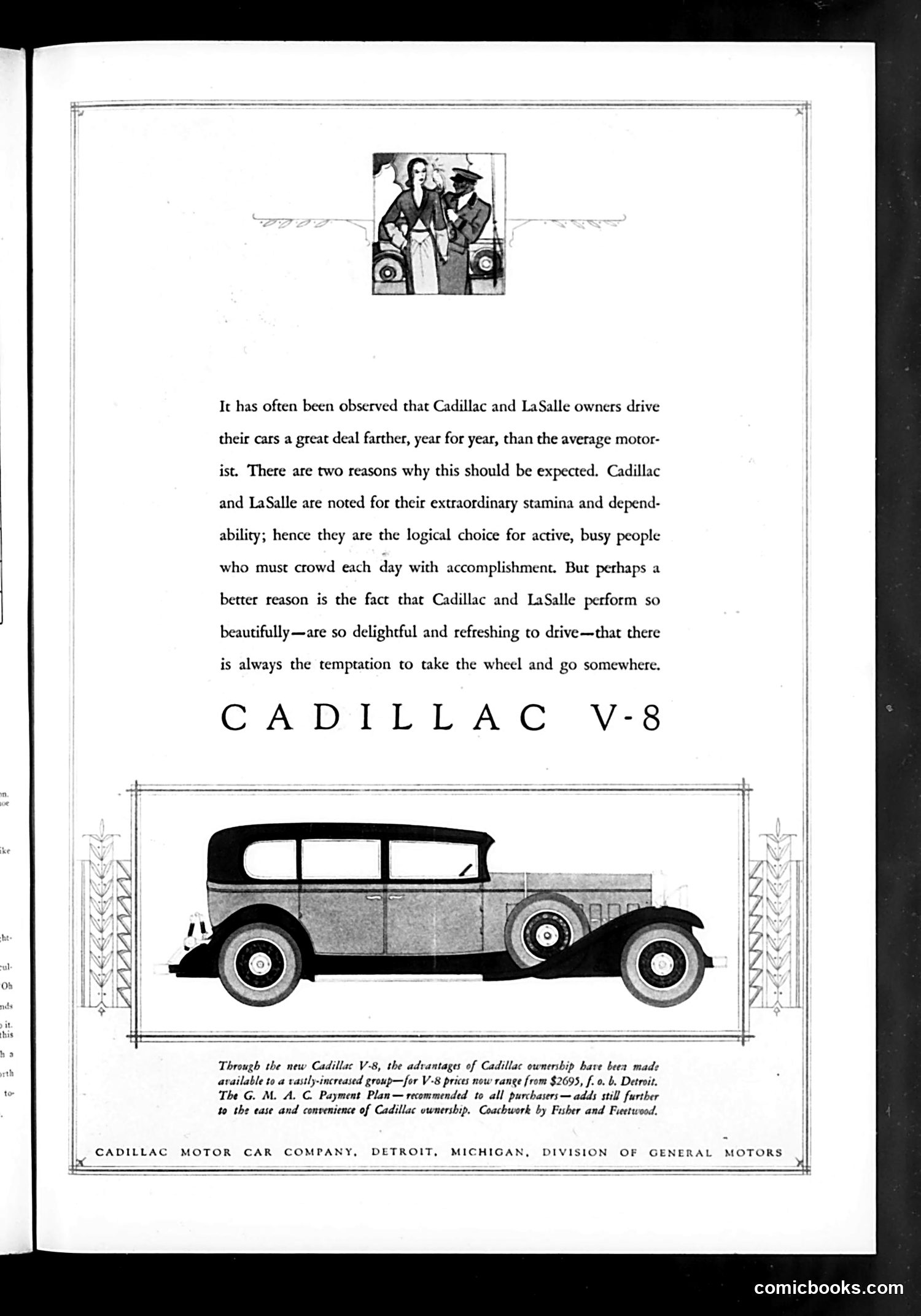
Analysis of Cadillac Advertisement Page This is primarily a Cadillac automobile advertisement, not political satire. The small illustration at the top shows two figures (a woman and man in period dress) beside what appear to be car speakers or audio equipment—likely meant to depict the leisure and pleasure of car ownership. The text argues that Cadillac and LaSalle owners drive more miles because these cars are both reliable ("extraordinary stamina") and enjoyable to drive, creating an irresistible urge to take trips. The advertisement emphasizes accessibility: the new V-8 model starts at $2,695 (f.o.b. Detroit), making Cadillac ownership available to a "vastly-increased group" beyond wealthy elites. The G.M.A.C. Payment Plan (General Motors' financing) is promoted as further democratizing luxury car ownership. This reflects 1920s-30s marketing positioning Cadillac as premium but increasingly attainable for middle-class aspirants. There is no political cartoon or satire on this page—it's straightforward product promotion in *Life* magazine.
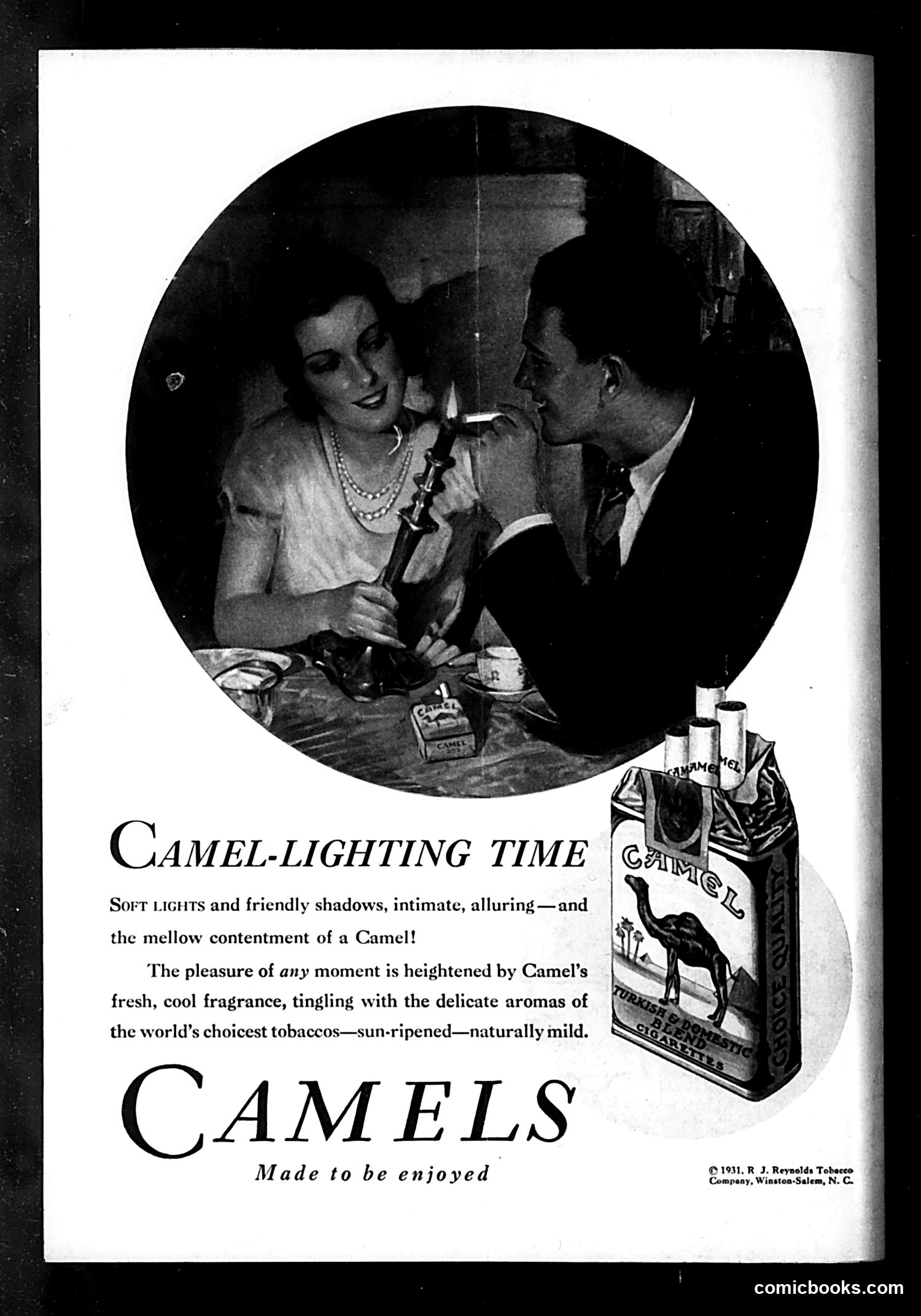
Analysis This is a Camel cigarette advertisement, not political satire. The page shows a romantic scene of a man lighting a woman's cigarette, framed in a circular vignette typical of 1930s advertising aesthetics. The ad copy uses period-standard marketing language: cigarettes enhance intimate moments, Camel's tobacco is "naturally mild" and aromatic. The tagline "Made to be enjoyed" emphasizes pleasure and sophistication. For modern readers: This represents pre-warning-label tobacco advertising that directly marketed cigarettes as enhancing romance and social bonding—tactics now prohibited. The gendered imagery (woman being lit by man) reflects 1930s social conventions. The copyright date (1931) confirms this predates the 1964 Surgeon General's warning and any federal advertising restrictions on cigarettes.

I can see this is a page from Life magazine, but the image quality is too dark and degraded for me to reliably make out specific cartoon content, caricatures, or text beyond the "comicbooks.com" watermark at the bottom. The page appears to be mostly black with some lighter areas on the right side that might contain illustrations or content, but I cannot discern sufficient detail to identify specific figures, political references, or satirical points with confidence. To provide accurate historical analysis as requested, I would need a clearer, higher-contrast version of this page. I cannot responsibly guess at content I cannot see clearly.