life
Life — April 24, 1931
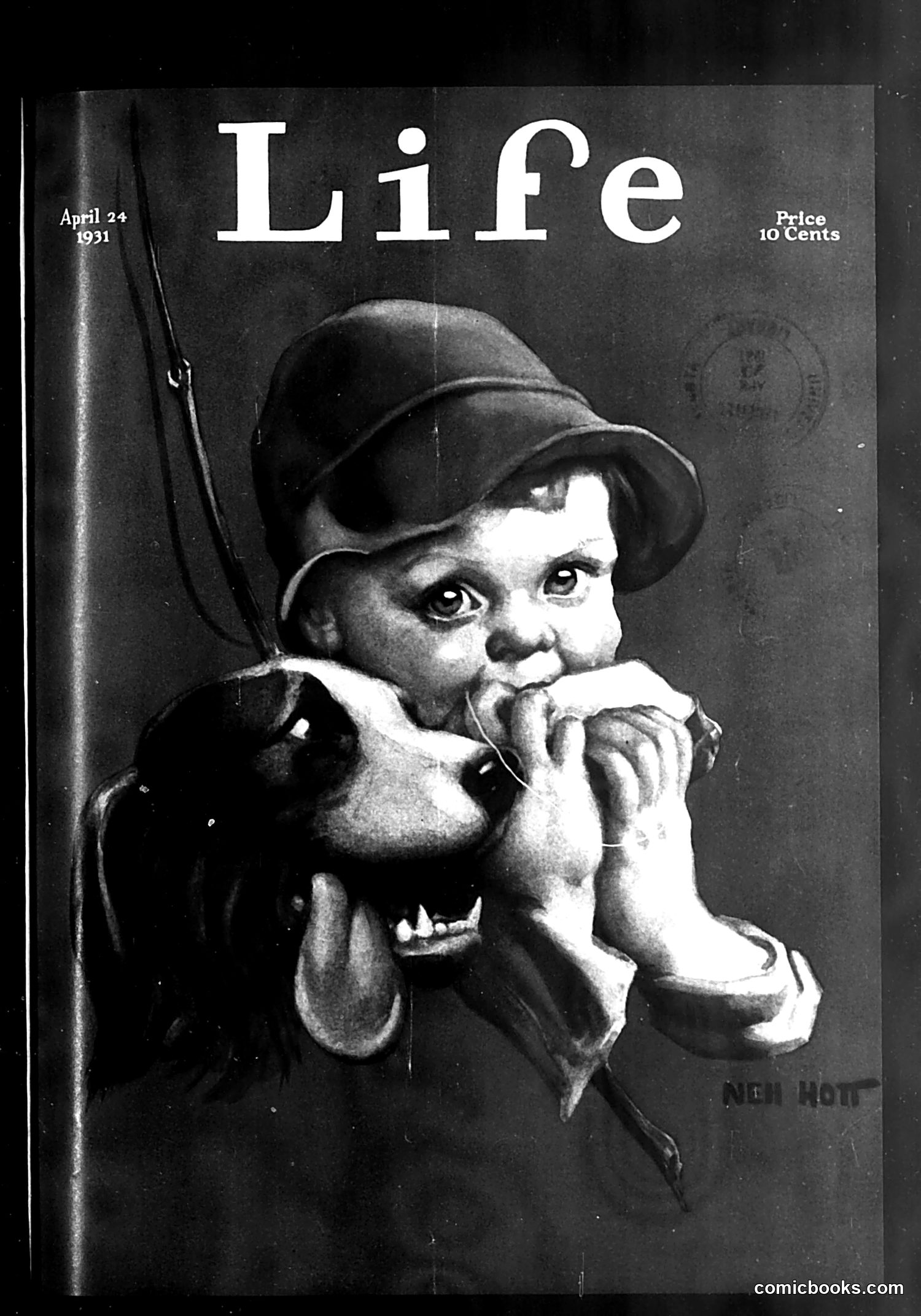
Life Magazine Cover Analysis (April 24, 1931) This appears to be a Life magazine cover featuring a caricatured figure—likely a ventriloquist's dummy or puppet character—wearing a bowler hat and formal clothing, shown in an exaggerated, grotesque style typical of 1931 satirical illustration. The specific identity of the figure and the satirical subject matter are unclear from the image alone without additional context or visible text identifying the target. The distorted facial features and dummy-like appearance suggest social or political commentary, possibly targeting a public figure or trend of the era, but the exact reference requires additional documentation beyond what's visible in this cover image. The 10-cent price indicates Depression-era publication.
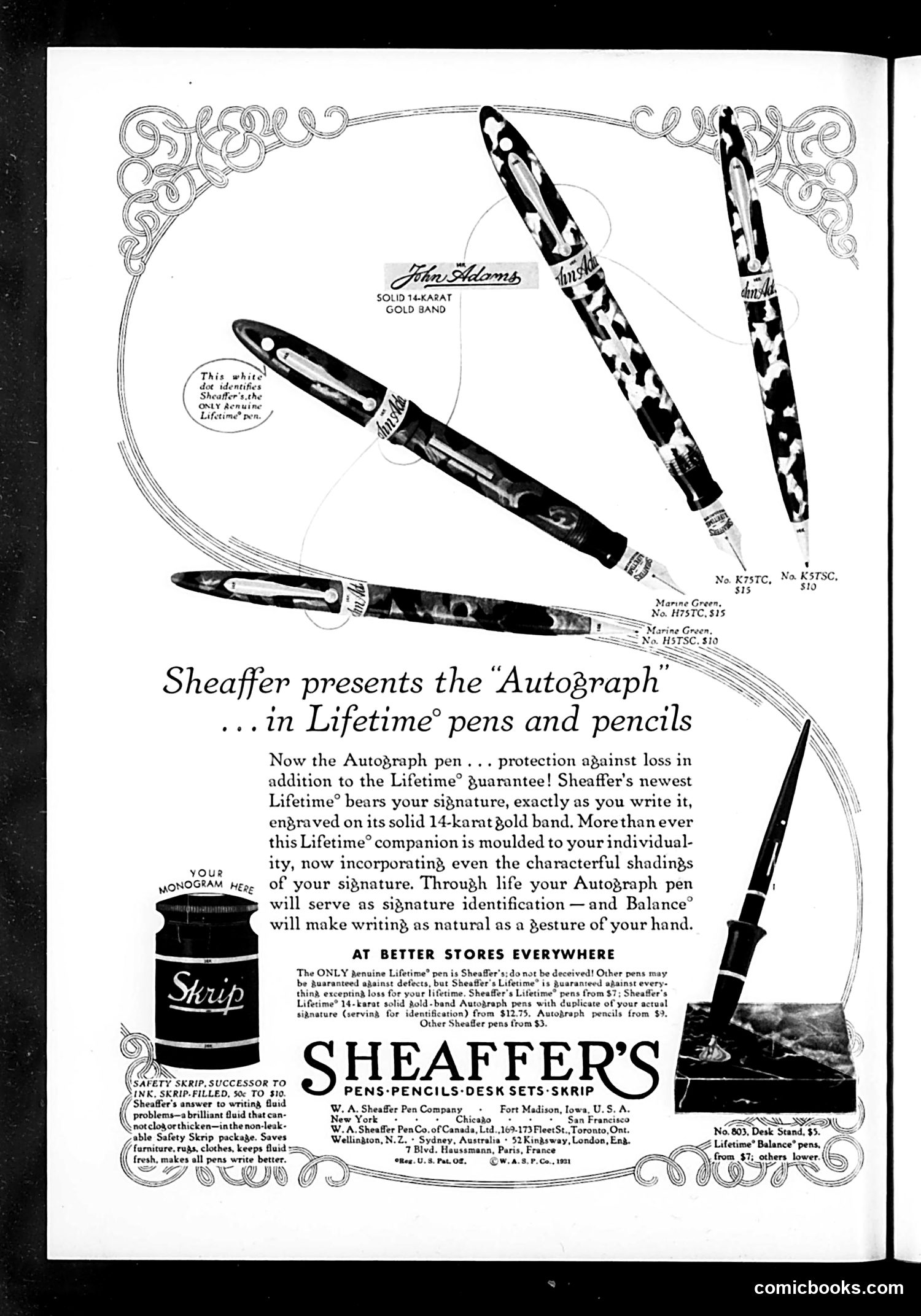
This page is primarily an advertisement for Sheaffer's pens and pencils, not satirical content. The ad promotes the "Autograph" line of Lifetime pens, featuring writing instruments with solid 14-karat gold bands. The marketing pitch emphasizes personalization—the pen supposedly bears your signature engraved on the gold band, making it a unique identifier and status symbol. The text highlights Sheaffer's "Lifetime" guarantee against defects and loss, positioning these pens as prestigious, long-lasting writing tools. A separate inset advertises Sheaffer's "Skrip" ink bottle as a "Safety Strip" product. The decorative border and fountain pen imagery are typical of 1920s-1930s luxury goods advertising in *Life* magazine. There is no political satire or cartoon commentary on this page—it is straightforward commercial promotion.
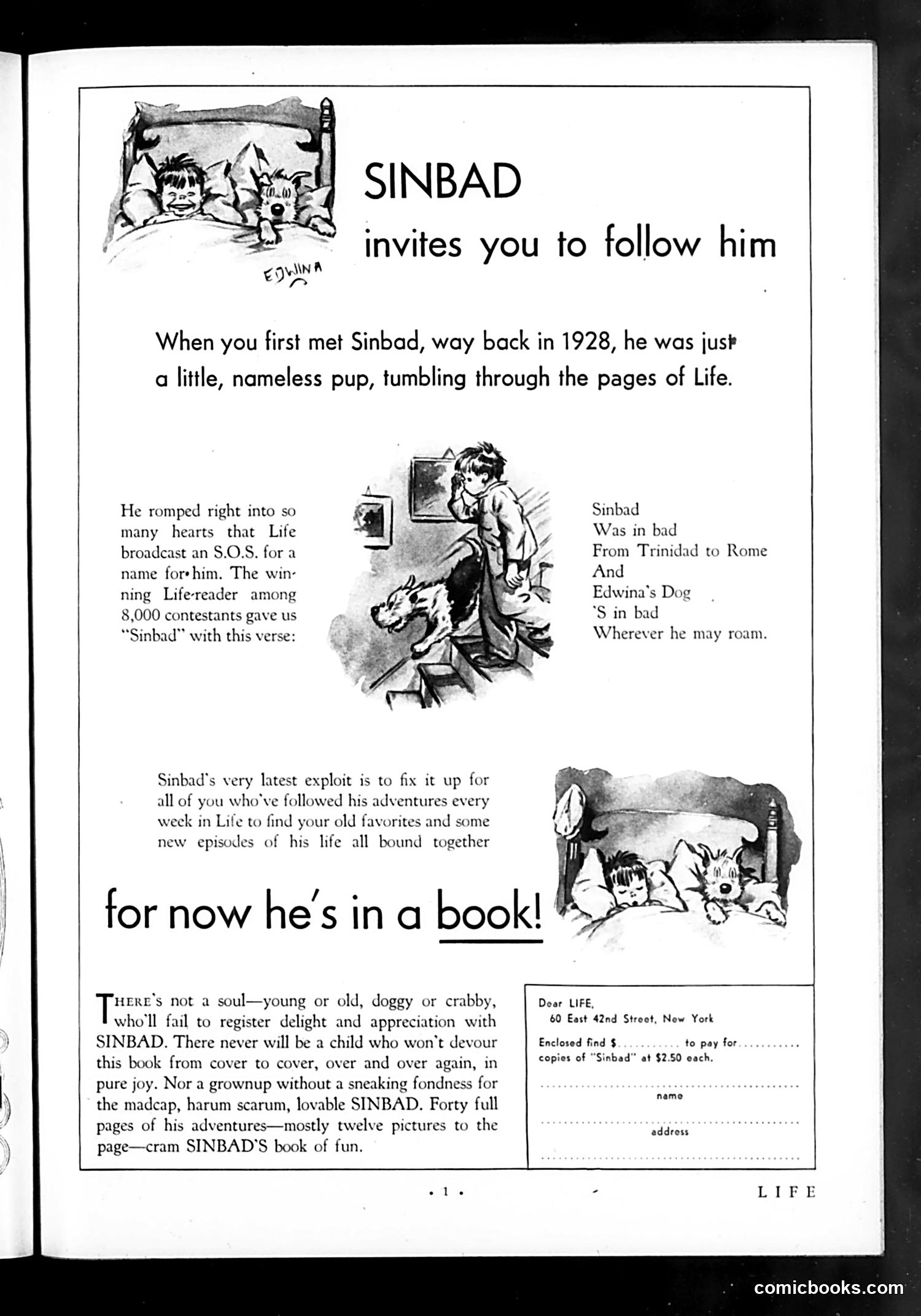
This is a book advertisement, not a political cartoon. The page promotes a children's book collection featuring "Sinbad," a mischievous dog character who had appeared in *Life* magazine's comic strips since 1928. The ad explains that Sinbad—described as having caused trouble "from Trinidad to Rome"—is now being compiled into a bound book. The illustrations show a playful pup getting into various mishaps (jumping on people, disrupting activities). The appeal targets both children and adults, promising "forty full pages of his adventures—mostly twelve pictures to the page." It's a straightforward promotional pitch to readers to purchase the compiled collection, using the character's established popularity in the magazine to drive book sales. No political satire is present.
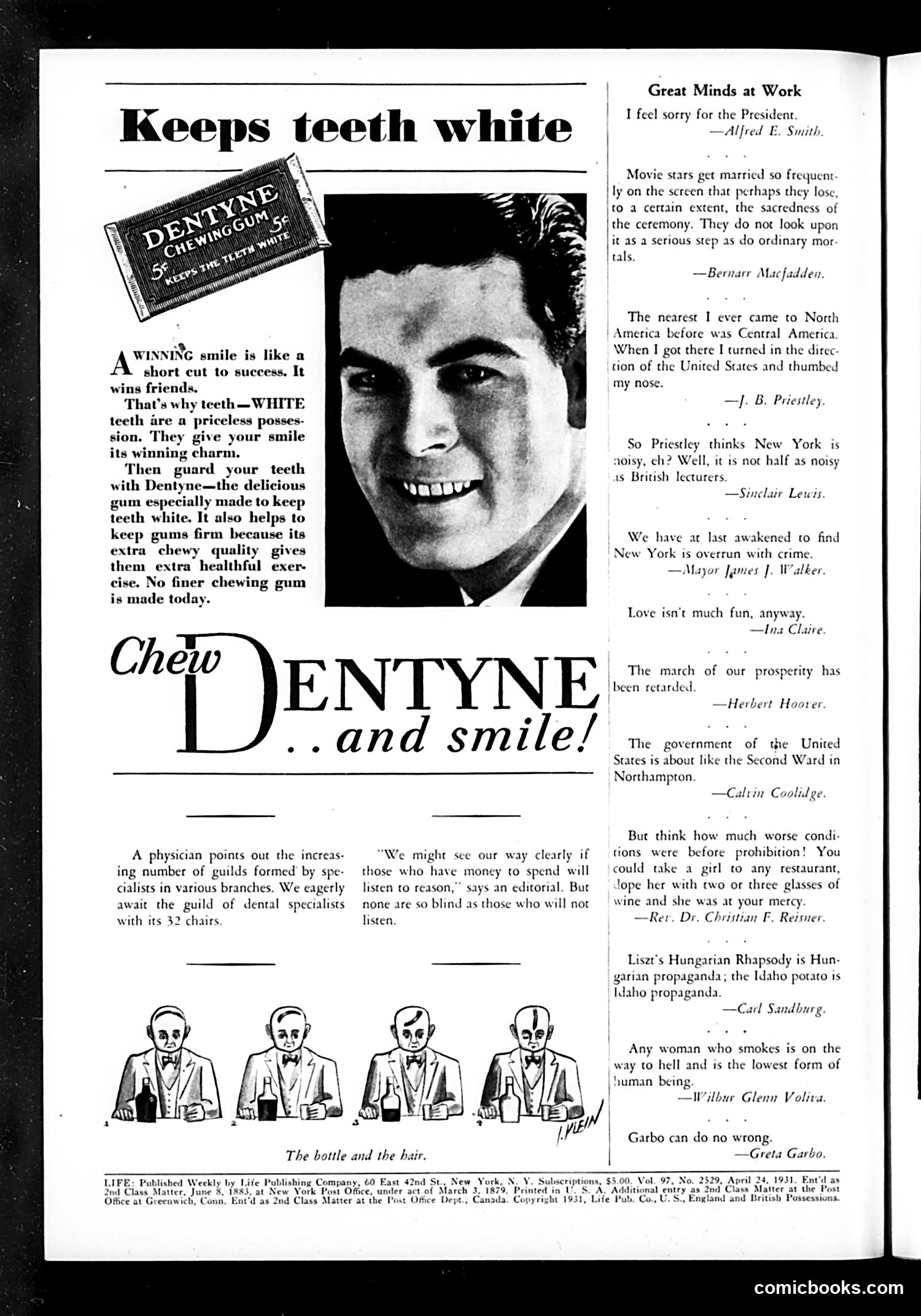
Dentyne Gum Advertisement with Social Commentary This page is primarily a Dentyne chewing gum advertisement from 1931 (per the publication info). The ad features a smiling man promoting white teeth and includes a cartoon showing four identical men at a dinner table with bottles, captioned "The bottle and the hair." The bottom cartoon appears to satirize Prohibition's effects—showing how alcohol consumption was supposedly affecting men's appearance (hair loss). This is social satire about the ongoing national Prohibition era (1920-1933). The right column contains "Great Minds at Work"—brief satirical quotes from public figures mocking politics, New York City, and social issues. These are light political jabs at contemporary figures and conditions, though specific identities are difficult to verify without additional context.
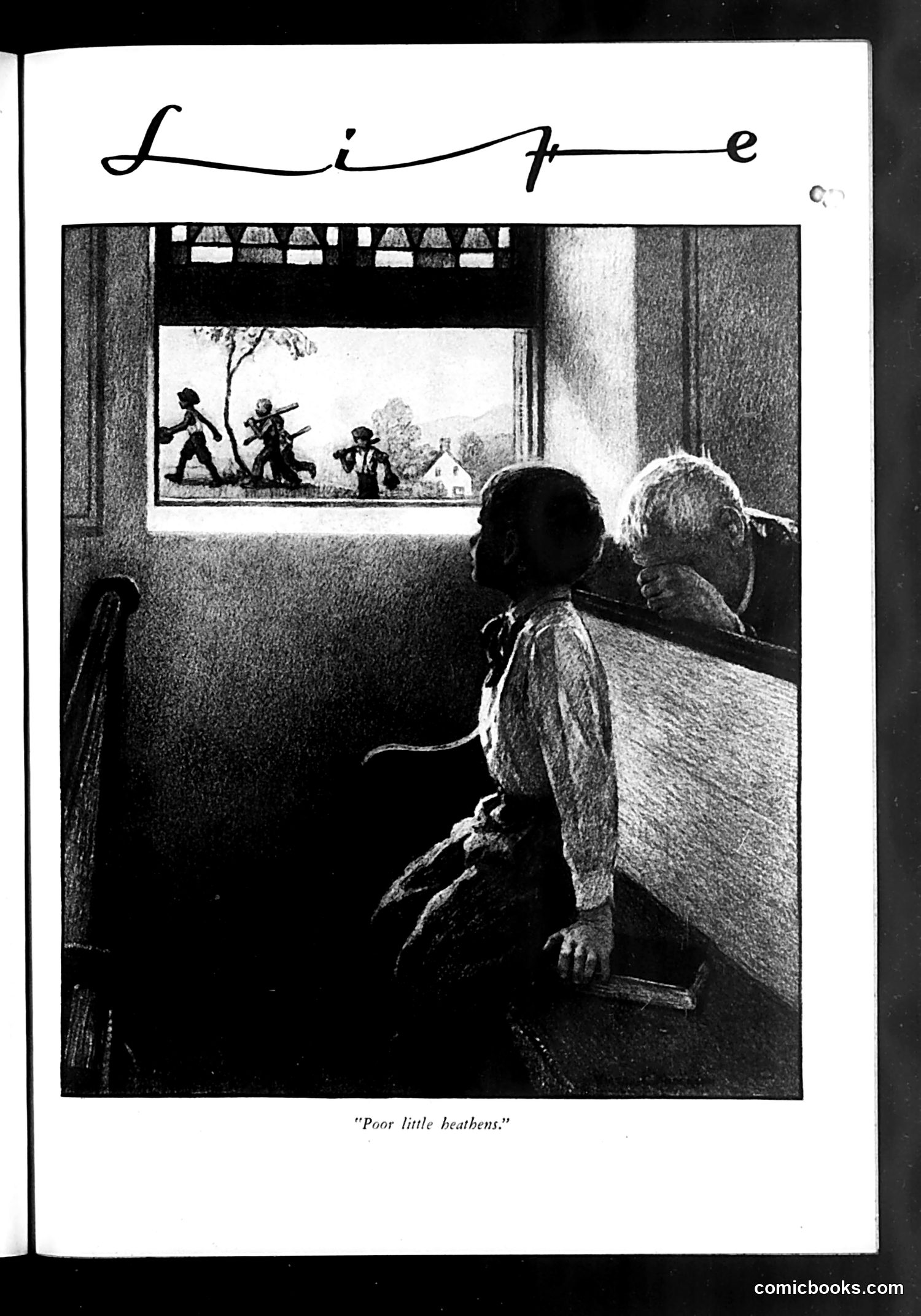
Analysis This appears to be a satirical illustration from *Life* magazine depicting two elderly observers watching a theatrical or cinematic screen showing soldiers in combat. The caption reads "Poor little heathens." The satire likely critiques American attitudes toward foreign peoples, particularly in colonial or missionary contexts. The elderly figures' patronizing comment—"Poor little heathens"—appears directed at the soldiers on screen, suggesting mockery of American condescension toward non-Western populations depicted as violent or uncivilized. The contrast between the comfortable, sheltered observers and the depicted warfare emphasizes how distant audiences consumed narratives about foreign conflicts with sentimental superiority rather than genuine understanding or concern. The work satirizes American imperialism and the paternalistic attitudes accompanying it.
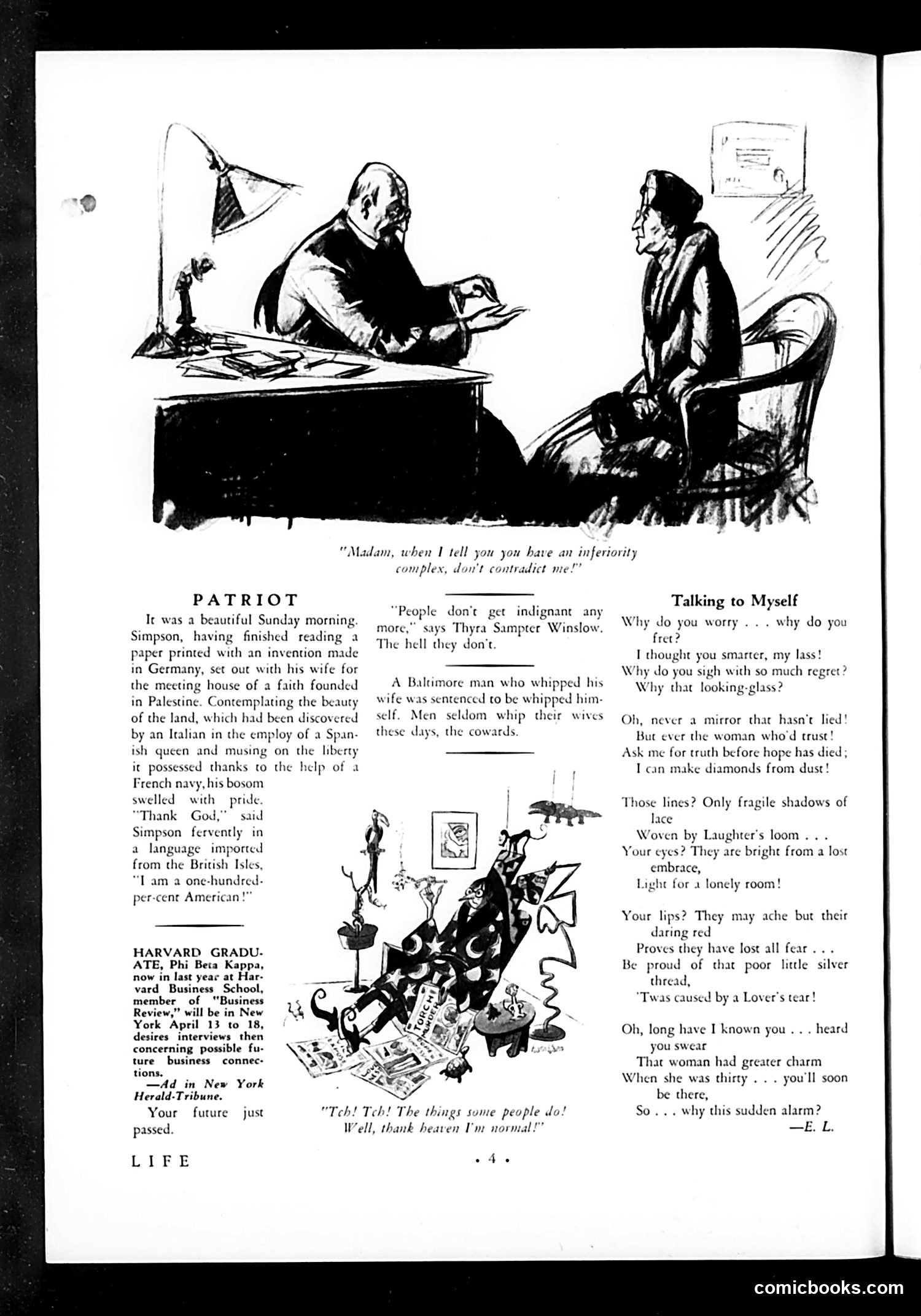
Analysis of Life Magazine Page The top cartoon depicts a psychiatrist or doctor interviewing a patient, with the caption "Madam, when I tell you you have an inferiority complex, don't contradict me!" This satirizes early 20th-century psychology and psychoanalysis—a trendy field among the wealthy. The joke mocks therapists' authority and the irony of patients with inferiority complexes being told they *have* them, suggesting the absurdity of psychiatric diagnosis and the power dynamic between doctor and patient. The page also contains lighter humor pieces: "Patriot" (a humorous story), "Talking to Myself" (a poem), and a cartoon about someone's chaotic life ("Tch! Tch! The things some people do!"). These reflect Life's satirical approach to contemporary social anxieties and human folly.
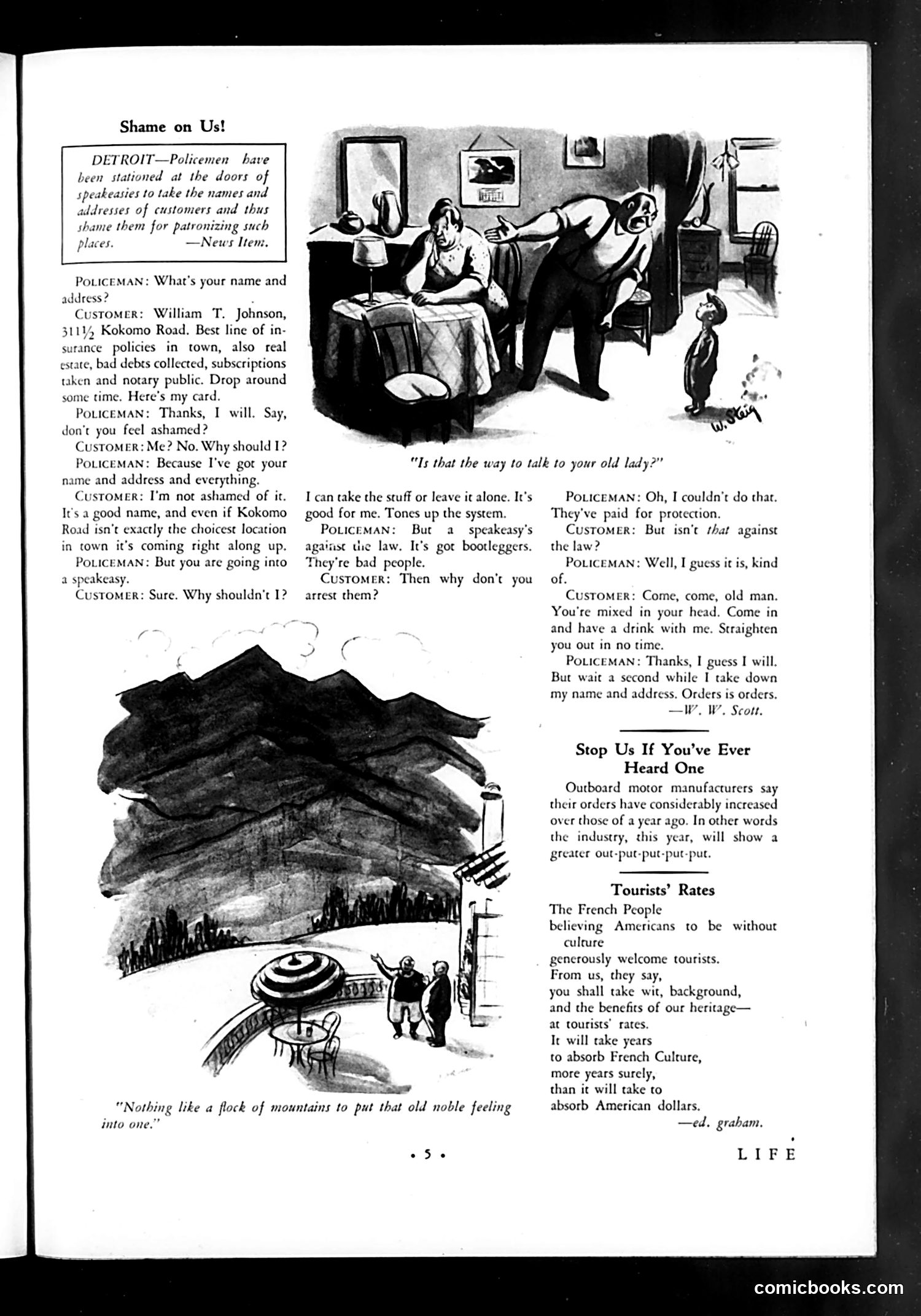
Analysis of Life Magazine Page This page satirizes police corruption and speakeasy culture during Prohibition. The main cartoon depicts a policeman demanding identification from a customer at an illegal bar, ostensibly to shame patrons—but the customer exposes the hypocrisy: police were *paid* for "protection," making them complicit in lawbreaking. The joke hinges on the policeman's indignation being fraudulent. He pretends moral authority while actually enforcing illegal establishments for bribes. The customer's defiant response ("Why should I?") and subsequent invitation to drink highlight how police and speakeasy operators were corrupt partners, not adversaries. The surrounding satirical pieces mock motor manufacturers' profits and mock French attitudes toward American tourists—lighter social commentary compared to the corruption critique.
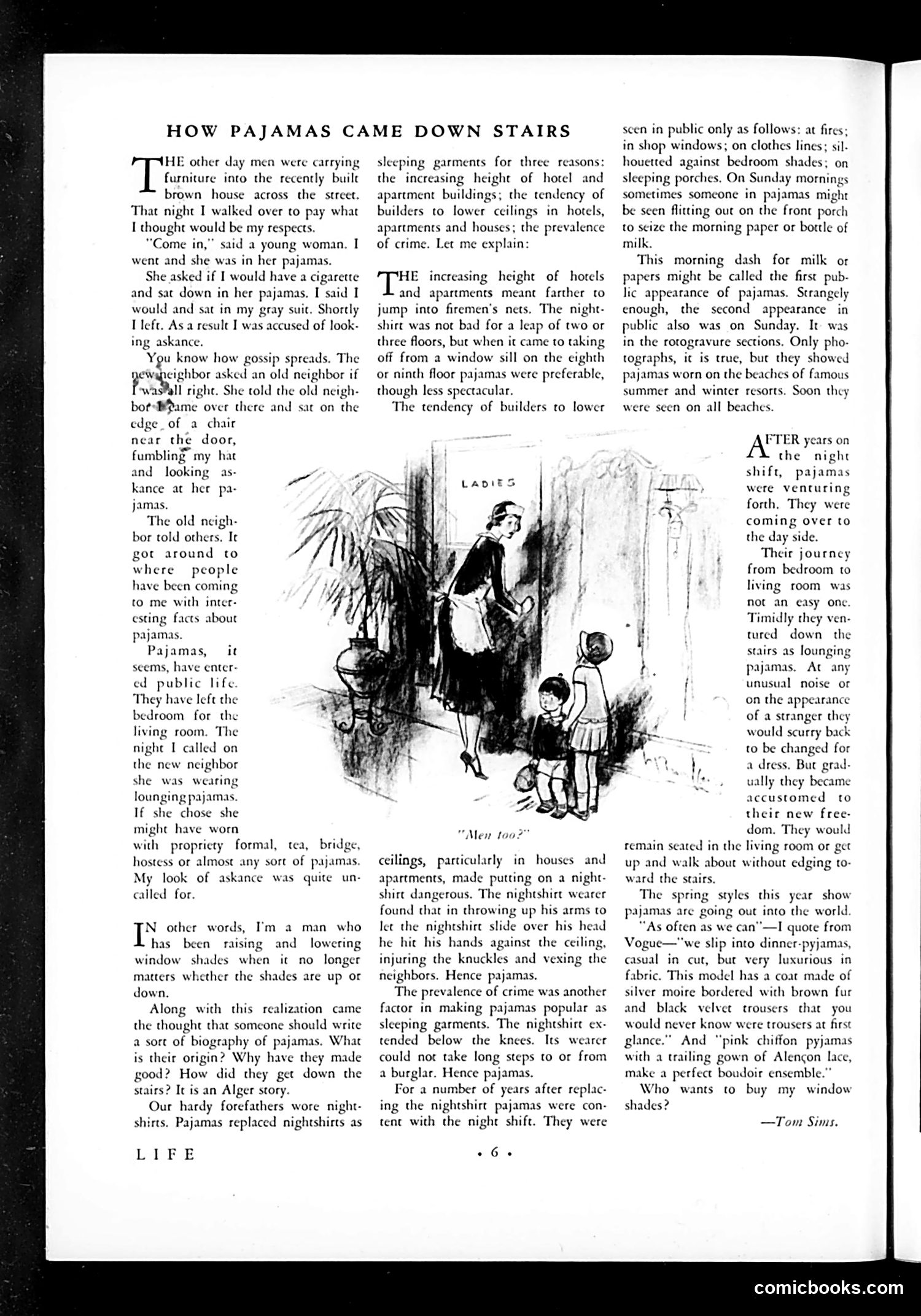
"How Pajamas Came Down Stairs" This humorous article by Tom Sims satirizes the early 20th-century fashion trend of wearing pajamas in public spaces—particularly during daytime. The accompanying sketch shows a woman in pajamas descending stairs while a man peers around a doorway, apparently surprised or scandalized. The satire targets how pajamas, once exclusively sleepwear, gradually infiltrated acceptable public appearance through successive steps: first at beachside resorts, then in shop windows and on clotheslines, eventually appearing in daytime social settings. Sims humorously traces this social shift to practical and criminal factors—nightshift workers, builders lowering ceilings forcing residents into higher apartments, and crime prevention—claiming these mundane reasons explain fashion's most ridiculous trend: casual pajama-wearing as normal daytime attire.
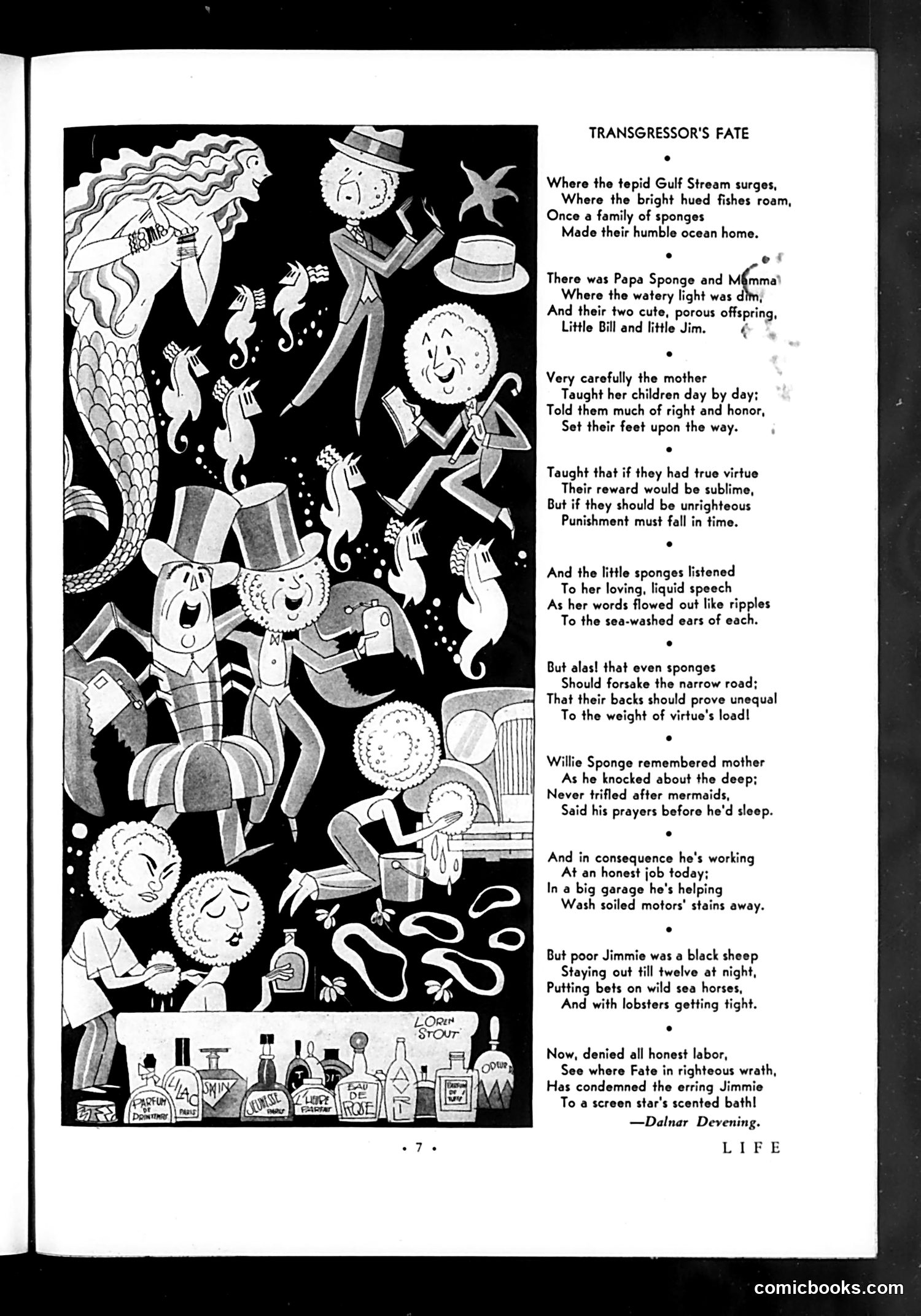
"Transgessor's Fate" Analysis This is a morality tale in verse by Dalnar Devening, illustrated with whimsical underwater characters. The narrative follows a sponge family—Papa, Mamma, and their children Willie, Jim, and Bill—living in the Gulf Stream. The poem teaches that virtue brings reward while wrongdoing brings punishment. Willie Sponge heeds his mother's moral lessons and becomes a hardworking laborer ("washing soiled motors' stains away"). In contrast, his brother Jimmie becomes a "black sheep," gambling and consorting with loose morals ("mermaids," "wild sea horses"), ultimately condemned to a "screen star's scented bath"—apparently satirizing the shallow, dissolute lifestyle of entertainment celebrities. The satirical point: vice leads to degradation, virtue to honest labor.
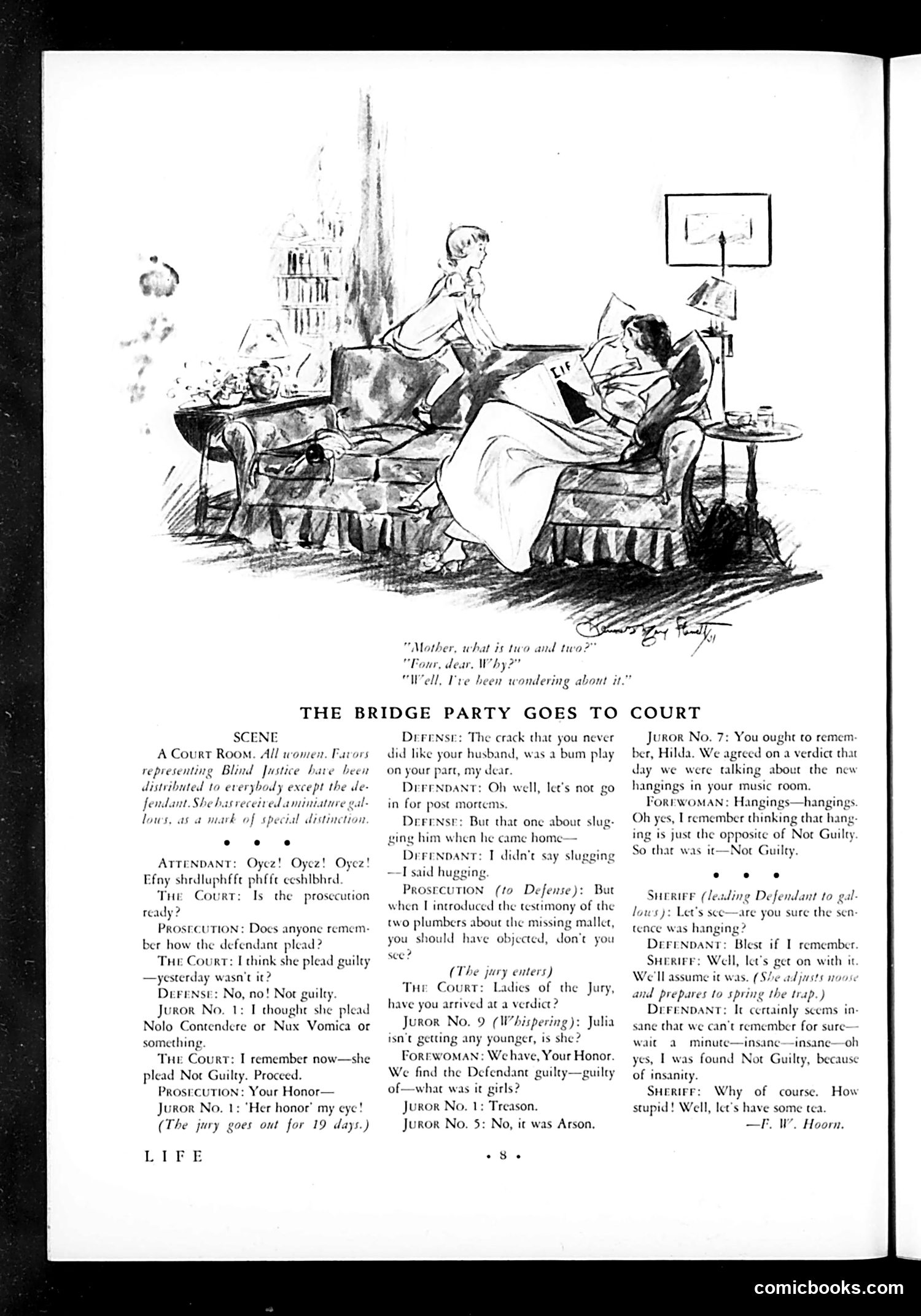
"The Bridge Party Goes to Court" This is a humorous sketch about a bridge card game lawsuit. The scene depicts a courtroom where women in evening dress are testifying about a bridge game that apparently went wrong—possibly involving a missing mallet or disputed hand. The satire mocks both the triviality of taking a social card game to court and the absurdity of the legal proceedings themselves. The jury members appear confused or dismissive (one juror whispers), while different witnesses give contradictory testimony about whether someone was "guilty" of what appears to be a minor infraction during the game. The joke targets the leisure activities of wealthy women and the comedy of legal formality applied to petty domestic disputes. It's social satire on class and gender.
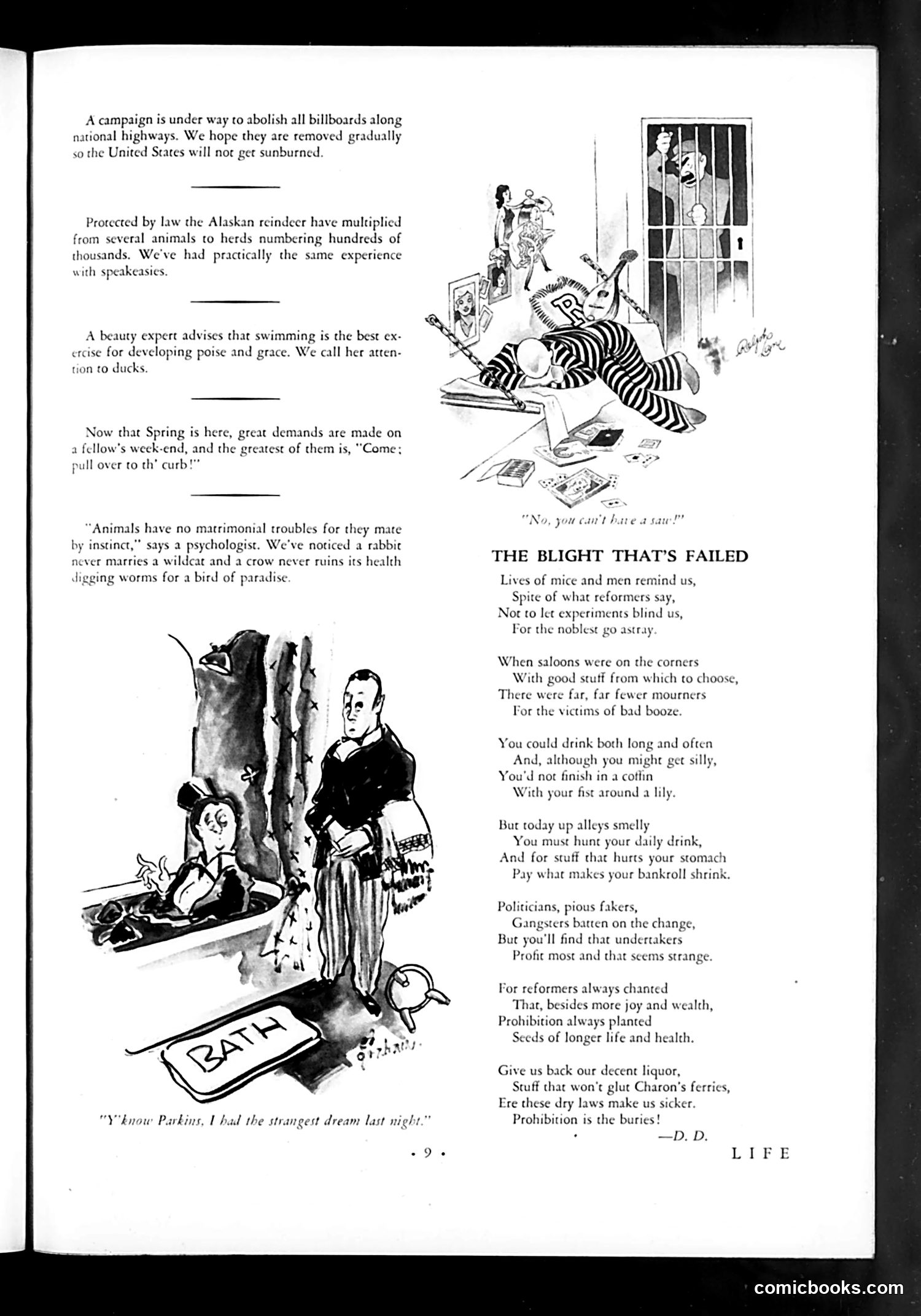
Political Satire on Prohibition This Life magazine page satirizes American Prohibition (the ban on alcohol sales). The cartoons and poem mock reform movements that claimed moral virtue. Left cartoon: Shows a figure in a bathtub labeled "BATH," with the caption "Y'know Parkins, I had the strangest dream last night"—implying people are secretly bathing in or drinking alcohol illegally. Right cartoon: A woman looking at caged animals, captioned "No, you can't have a suit!"—appears to reference scarcity or rationing related to Prohibition's economic effects. The poem "The Blight That's Failed": Directly attacks Prohibition, arguing reformers' promises of "longer life and health" have failed. Instead, it produced criminals, gangsters, and worse public health outcomes. The final lines express nostalgia for pre-Prohibition drinking culture and mock Prohibition as ineffective and harmful.
"Life Looks About" - Political Commentary Page This page contains three opinion columns critiquing American politics and urban governance circa early 1930s. "The Big Job" attacks Mayor Jimmy Walker of New York City, addressing corruption and his ineffectiveness combating Prohibition-era crime. The author argues Walker is too glamorous and socially distracted to govern seriously, suggesting he should be removed. "When the Mayor Ain't What He Used to Be" continues criticism of Walker, noting his popularity despite poor performance—attributing this to his "good actor" appeal rather than actual competence. "Vale Big Bill" discusses Mayor Thompson of Chicago, noting his electoral defeat and comparing it to similar voter rejections of failed urban leadership. The cartoonish masthead illustration depicts a cherub-like figure, typical of Life magazine's satirical style.
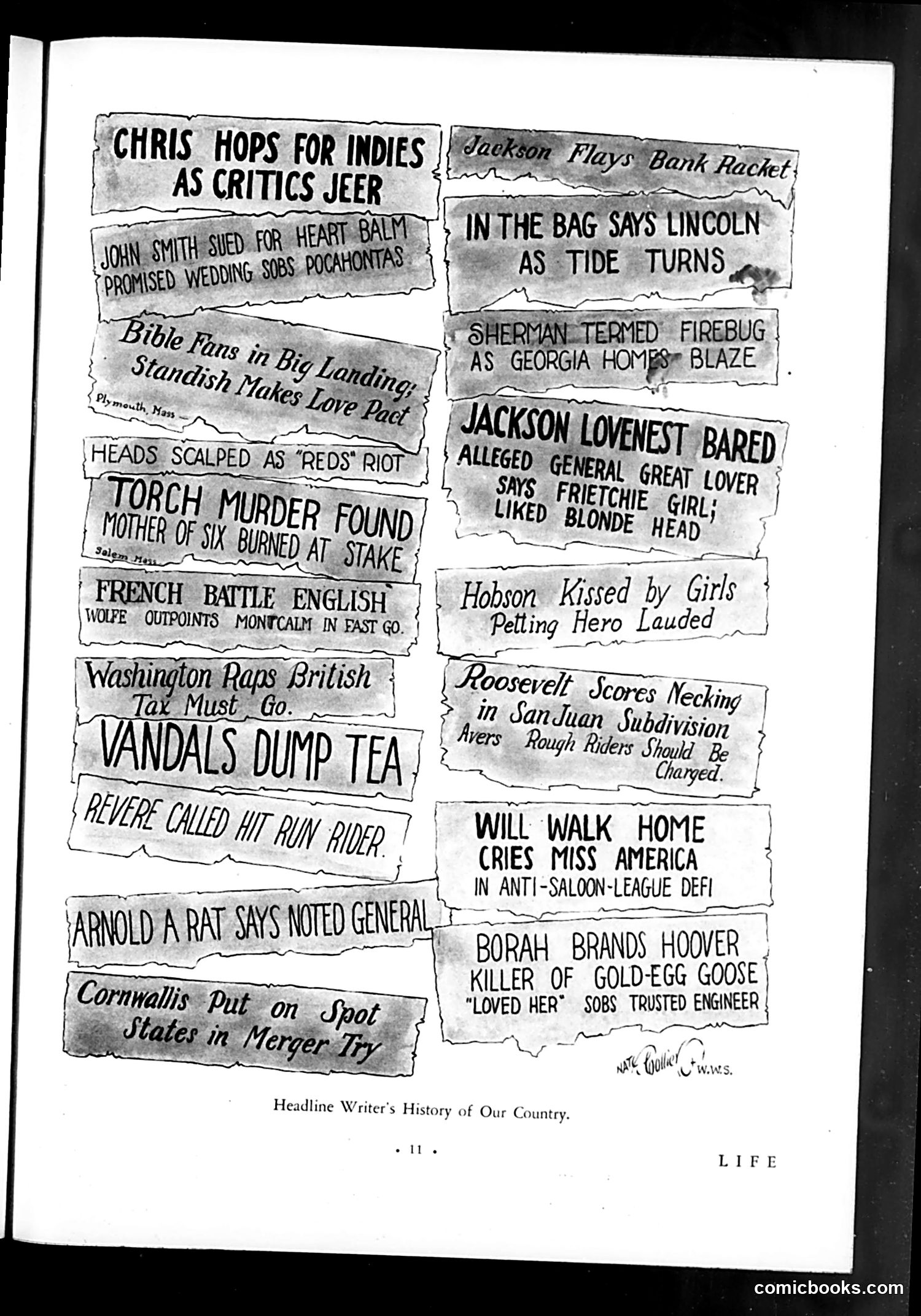
"Headline Writer's History of Our Country" This is a satirical collage mocking sensationalist newspaper headlines. The cartoon assembles absurd, exaggerated, or inflammatory headlines supposedly drawn from American history—ridiculing how tabloid journalism distorts events through sensationalism. The headlines reference historical figures (Lincoln, Washington, Roosevelt, Jackson) and events alongside invented or wildly distorted claims: "TORCH MURDER," "VANDALS DUMP TEA," "HEADS SCALPED AS 'REDS' RIOT." Some appear intentionally silly ("BORAH BRANDS HOOVER KILLER OF GOLD-EGG GOOSE"). The satire targets how headline writers sensationalize for shock value, prioritizing drama over accuracy. By presenting this as a "history" composed entirely of tabloid hyperbole, the cartoonist critiques journalism's role in distorting public understanding of actual historical events—a timeless concern about media manipulation and clickbait culture.
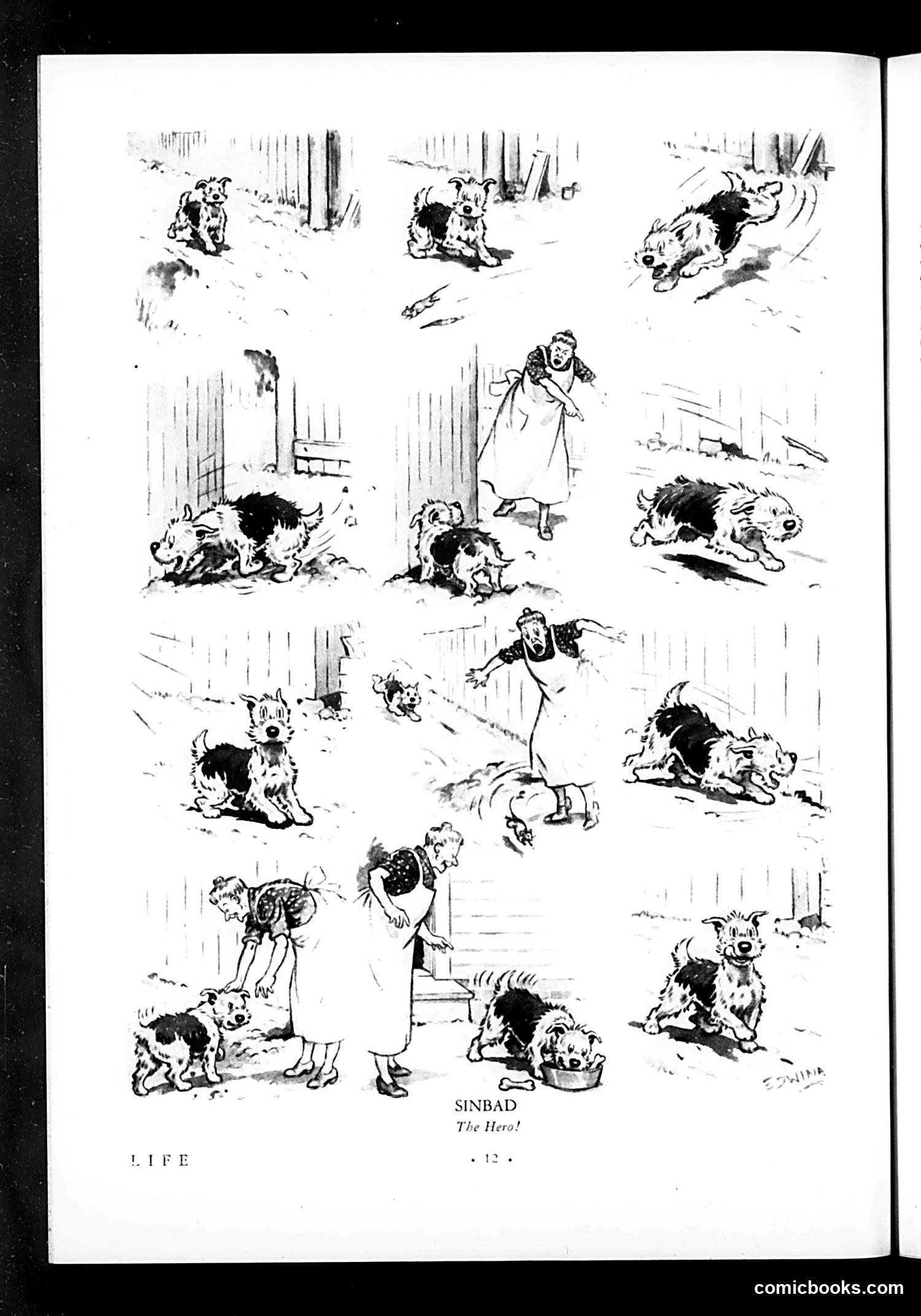
Analysis of "Sinbad: The Hero!" This page presents a comic strip sequence titled "Sinbad—The Hero!" featuring a woman (likely representing a traditional housewife or domestic figure) attempting to manage multiple small dogs in various comedic situations. The satire appears to mock the romanticized notion of heroism. Rather than depicting grand adventures, "Sinbad the Hero" is reduced to the mundane, chaotic task of controlling unruly pets—suggesting that everyday domestic management requires as much bravery as legendary quests. The humor lies in the contrast between the classical hero narrative and the unglamorous reality of household responsibilities, particularly for women. The proliferation of mischievous dogs emphasizes mounting chaos, making the domestic sphere the unexpected "battlefield" where true heroism is tested.
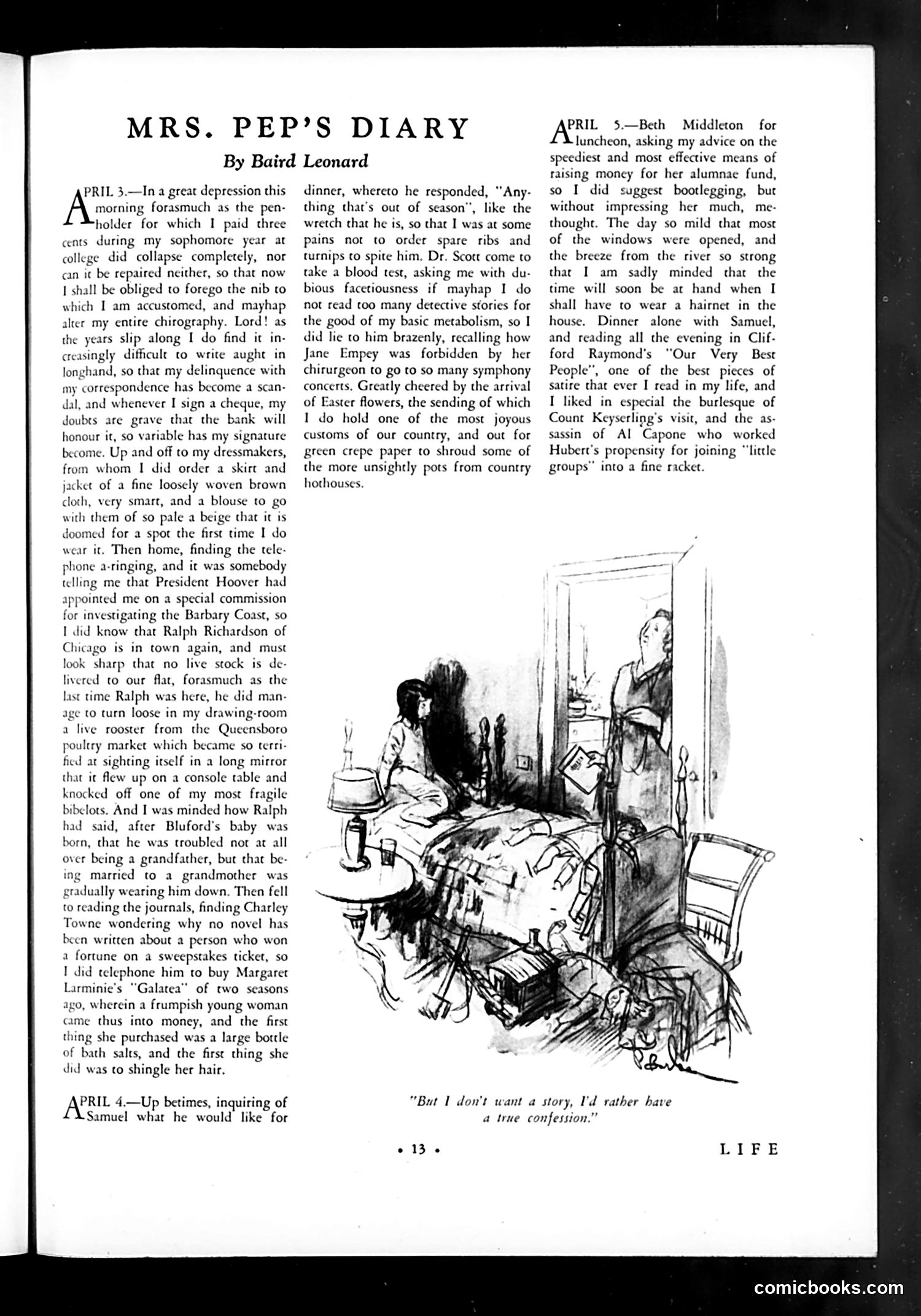
Mrs. Pep's Diary by Baird Leonard This is a humor column presenting a wealthy woman's daily observations. The illustrated scene shows her consulting with what appears to be household staff or advisors about various matters. The satirical content targets upper-class preoccupations: financial anxiety (stock market collapse, bank concerns), social status (Easter flowers, Count Keyserling's visit), and domestic management. References include President Hoover, Ralph Richardson, and literary gossip (Charley Towne). The caption "But I don't want a story, I'd rather have a true confession" suggests satire of popular magazine genres and women's entertainment preferences. The humor derives from contrasting the diarist's trivial concerns with serious economic depression-era issues, poking fun at wealthy Americans' obliviousness to broader hardship.
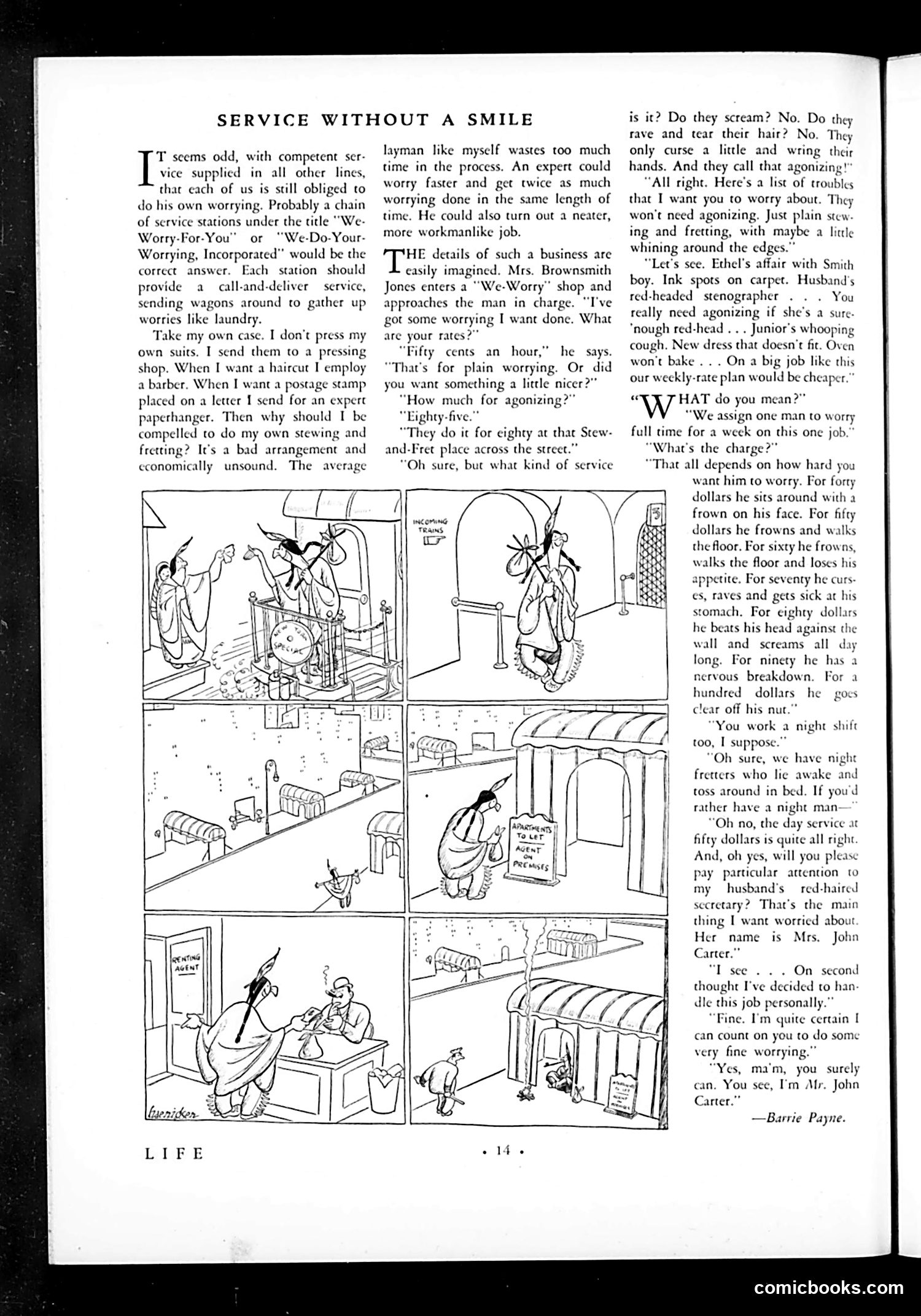
"Service Without a Smile" This satirical article by Barrie Payne critiques a hypothetical "We-Worry" service business—a concierge operation promising to handle customers' anxieties for payment. The humor lies in the escalating absurdity: the worrier's fee increases based on intensity of concern, from forty dollars (for mild frowning) to one hundred dollars (for complete nervous breakdown). The accompanying comic panels illustrate the chaos: a harried employee frantically managing multiple distressed clients simultaneously—wringing hands, pacing frantically, screaming, and generally embodying exaggerated anxiety rather than resolving it. The satire targets both the era's emerging service industries and the human condition itself: the joke is that paying someone to worry on your behalf is both ridiculous and oddly appealing, yet ultimately ineffective.
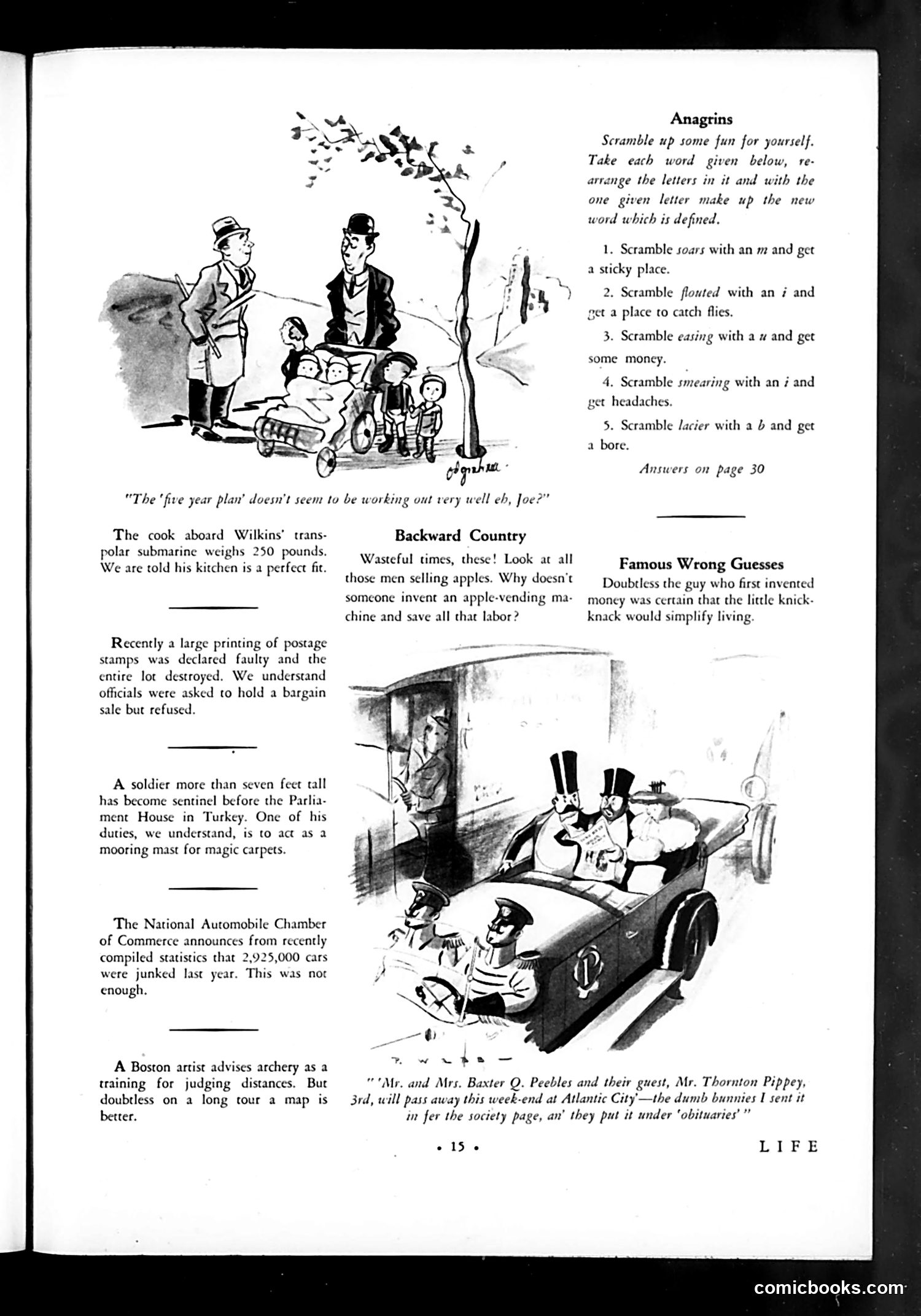
Analysis of Life Magazine Page This page contains several satirical items typical of early 20th-century Life magazine: Top cartoon: Shows two well-dressed men discussing a "five year plan" that "doesn't seem to be working out very well," with children in a toy car below. This likely mocks Soviet economic planning, a contemporary political reference. "Backward Country" section: Satirizes inefficient apple-selling, suggesting an apple-vending machine would improve labor productivity—critiquing manual street commerce. "Famous Wrong Guesses": Mocks someone's failed prediction about the "knick-knack" simplifying life. Bottom cartoon ("Mr. and Mrs. Baxter Q. Pebbles"): Shows a car overloaded with luggage and passengers heading to "Atlantic City," captioning that they're bringing a "guest" for the society page under "obituaries"—dark humor about the dangerous crowding. The page reflects Depression-era and pre-war American anxieties about efficiency, consumption, and social absurdities.
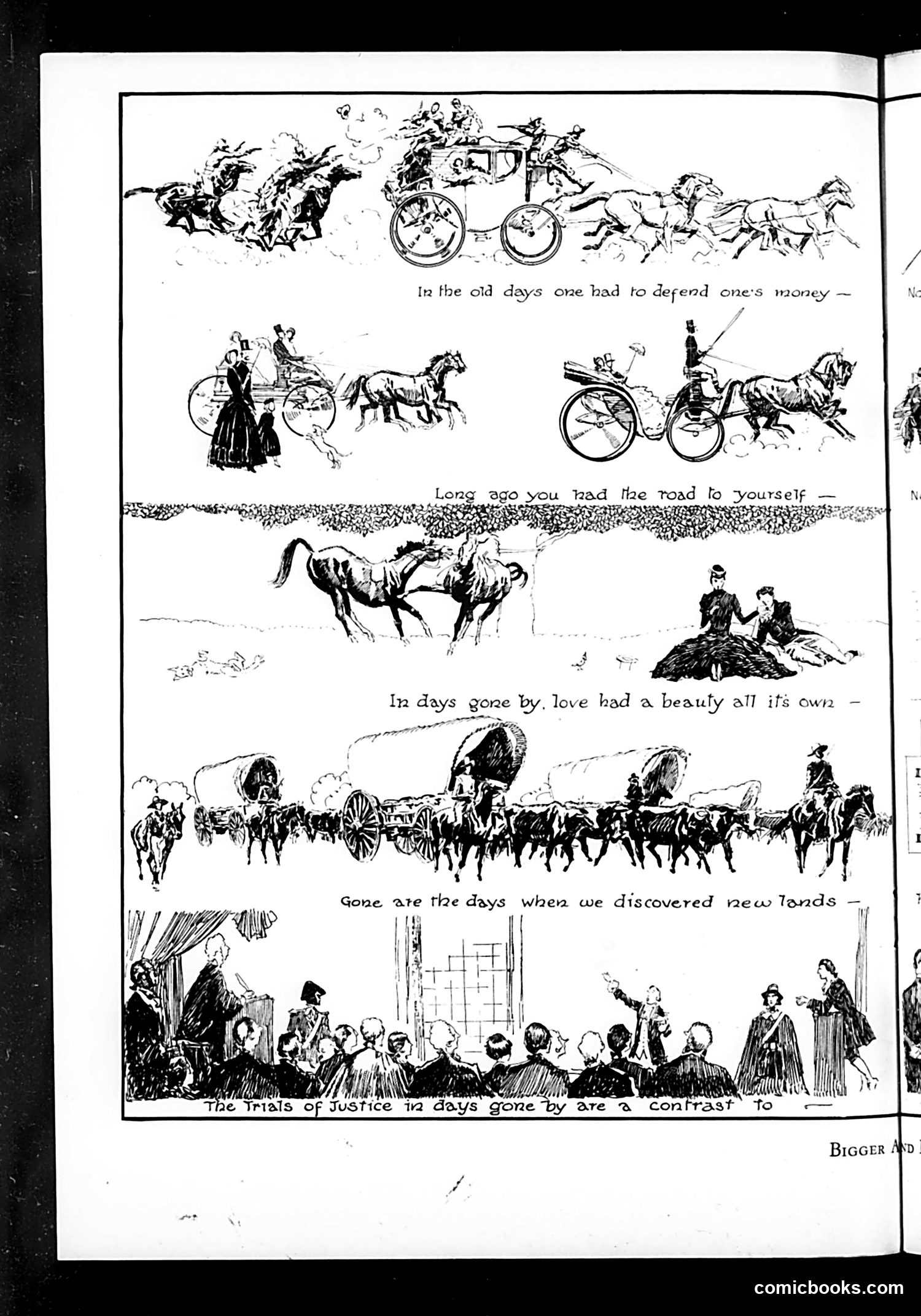
Analysis This page presents a nostalgic social commentary contrasting past and present through illustrated vignettes. The text reads: "In the old days one had to defend one's money — Long ago you had the road to yourself — In days gone by, love had a beauty all its own — Gone are the days when we discovered new lands — The trials of justice in days gone by are a contrast to..." The cartoons depict idealized historical scenes (horse-drawn carriages, country roads, romantic couples, exploration caravans, and formal court proceedings) alongside contemporary equivalents. The implicit critique suggests modern life has become congested, chaotic, and less romantic than an imagined past. This reflects early 20th-century nostalgia for a simpler era—a common *Life* magazine theme lamenting industrialization, urbanization, and social change. The "Bigger And" credit line suggests continued commentary continues on the following page.
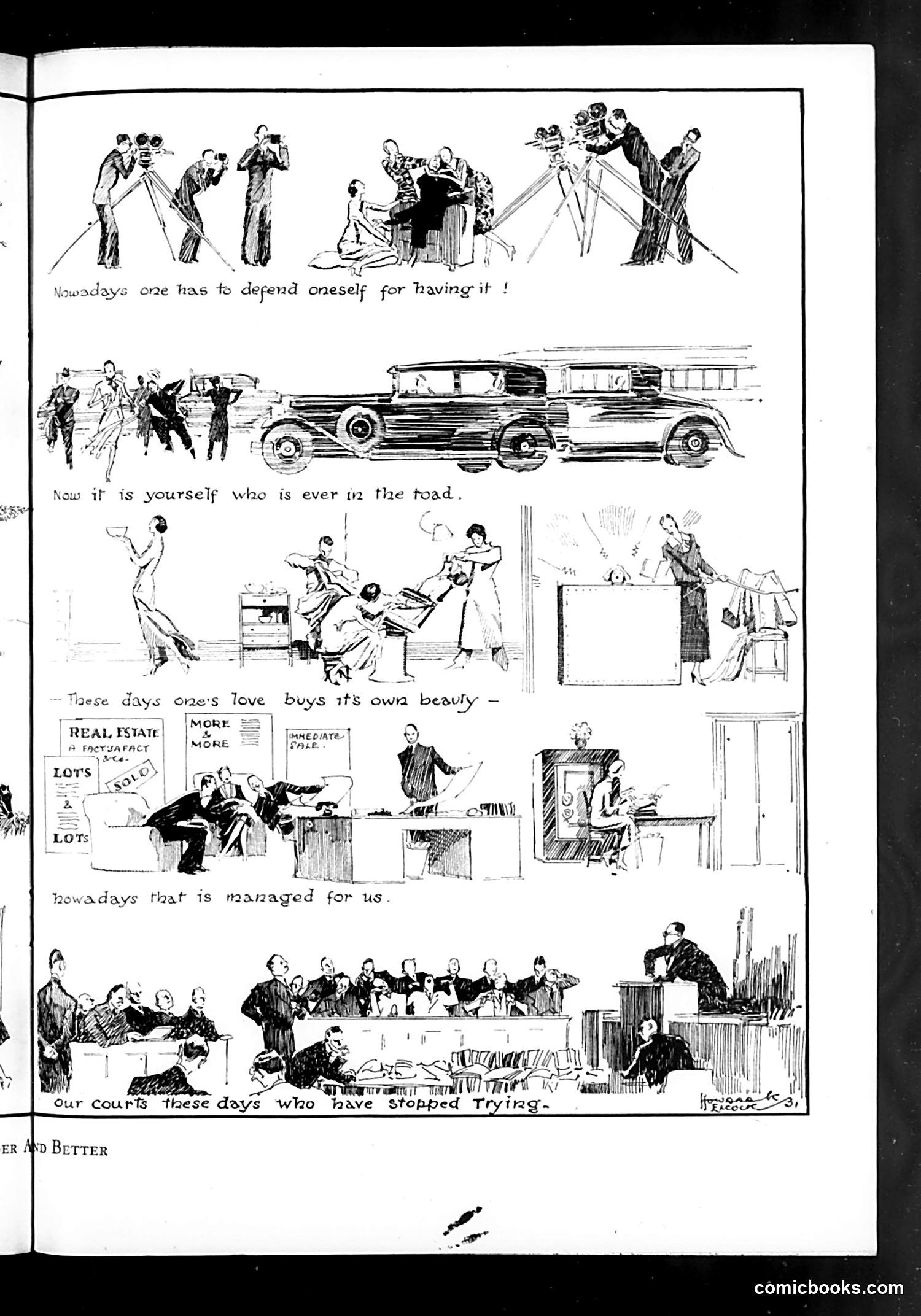
Analysis of This Life Magazine Cartoon This multi-panel satirical cartoon critiques early 20th-century social changes and the decline of traditional values. The progression shows: - Top panels: People must now provide their own entertainment (cameras, telescopes) rather than relying on others - Middle panels: Individuals increasingly buy their own homes and manage their own lives - Bottom panels: Modern business/real estate agents now manage affairs previously handled by courts and institutions The overall message: Traditional institutions—courts, community structures, established authorities—have been displaced by commercial interests and individual self-reliance. The final panel showing courts where "trying" has stopped suggests legal/justice systems have become ineffective or been replaced by private enterprise. The cartoon laments modernization's erosion of communal and institutional life in favor of commercialized, individualized systems.
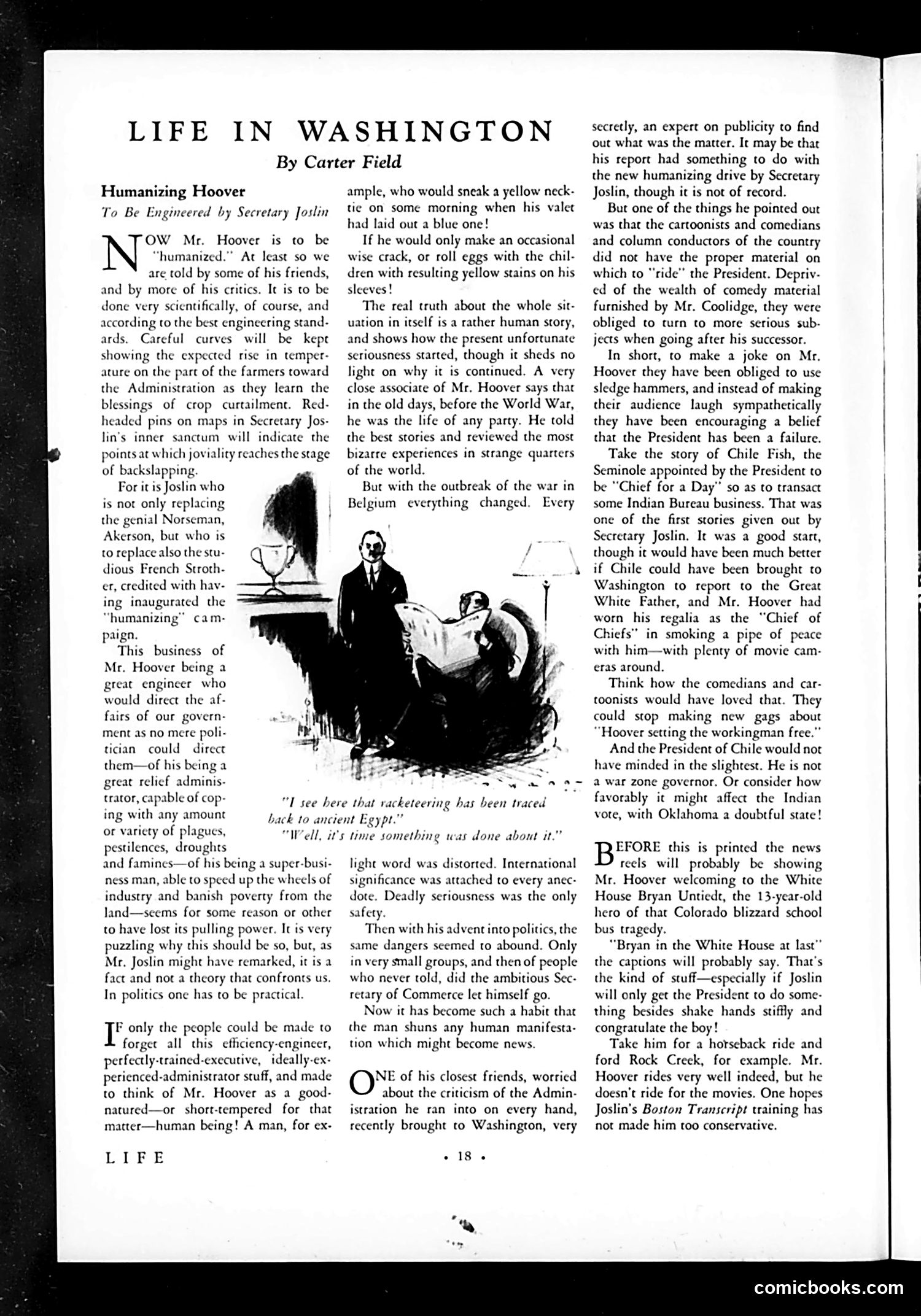
Analysis of "Life in Washington" by Carter Field This satirical piece critiques Secretary of Commerce Herbert Hoover's efforts to appear more relatable and human to the public—his "humanizing" campaign orchestrated by Secretary Joslin. The main cartoon depicts Hoover reading to what appears to be a child, illustrating the artificial nature of these publicity stunts. The satire suggests Hoover's image-making is transparently manufactured: the text mentions he borrowed comedians' material and awkwardly enacted scenes like smoking a peace pipe as "Chief for a Day." The article mocks how heavily managed Hoover's public persona has become, arguing that his actual administrative accomplishments would serve him better than staged photo opportunities. The underlying critique is that such transparent image-crafting undermines rather than enhances public confidence.
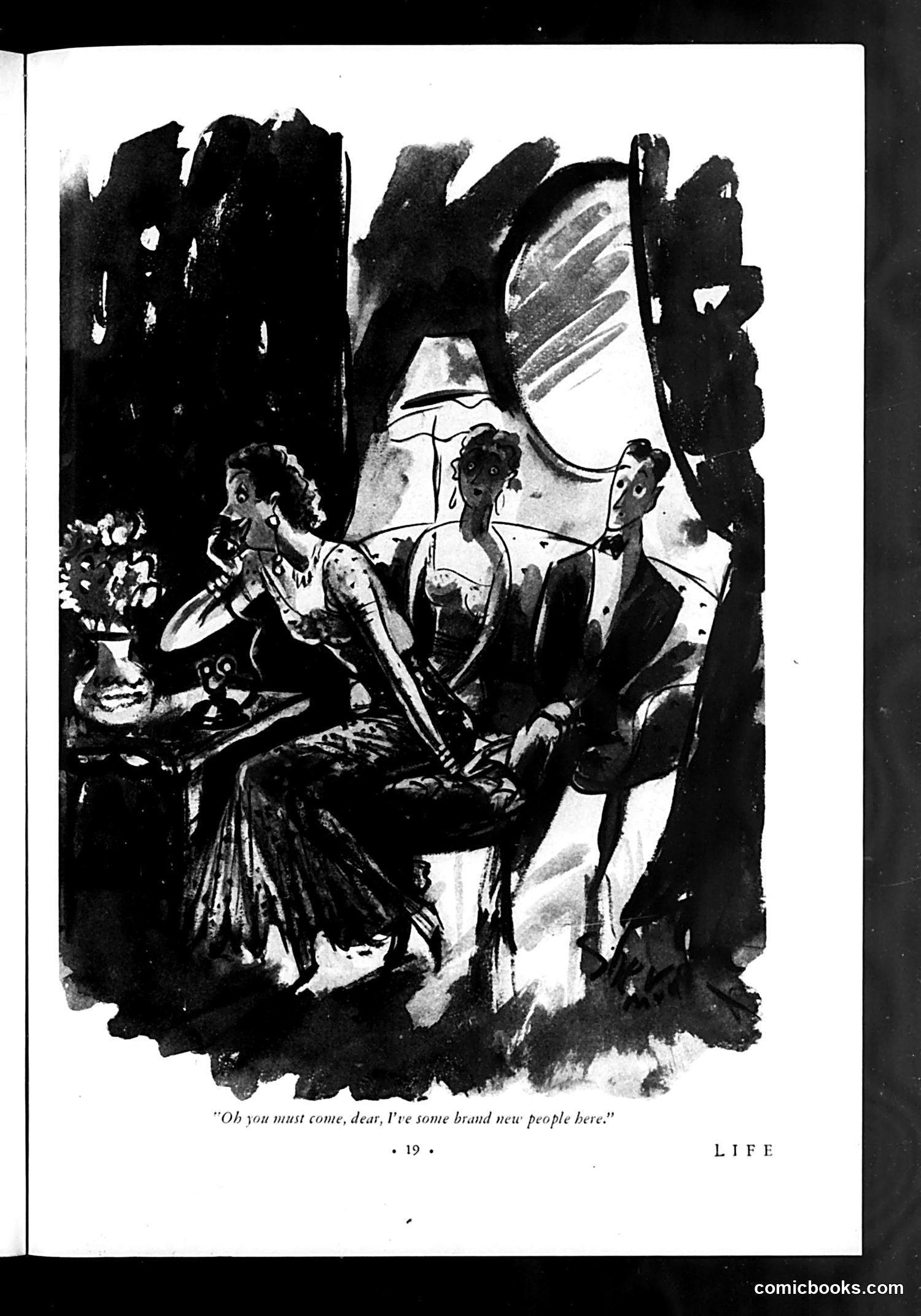
Analysis This is a single-panel cartoon from *Life* magazine satirizing high society's obsession with novelty and social climbing. The scene shows an elegantly dressed woman (likely a society hostess) enthusiastically greeting guests, presenting new acquaintances as though they were fashionable acquisitions or commodities—"brand new people." The satire targets the shallow materialism of upper-class social circles, where people are evaluated and collected like status symbols rather than valued for genuine character or merit. The dramatic, expressionistic art style emphasizes the absurdity of treating human relationships as consumer goods. The joke reflects early-to-mid 20th century critiques of wealthy socialites who defined themselves through exclusive gatherings and the acquisition of interesting or prestigious social connections.
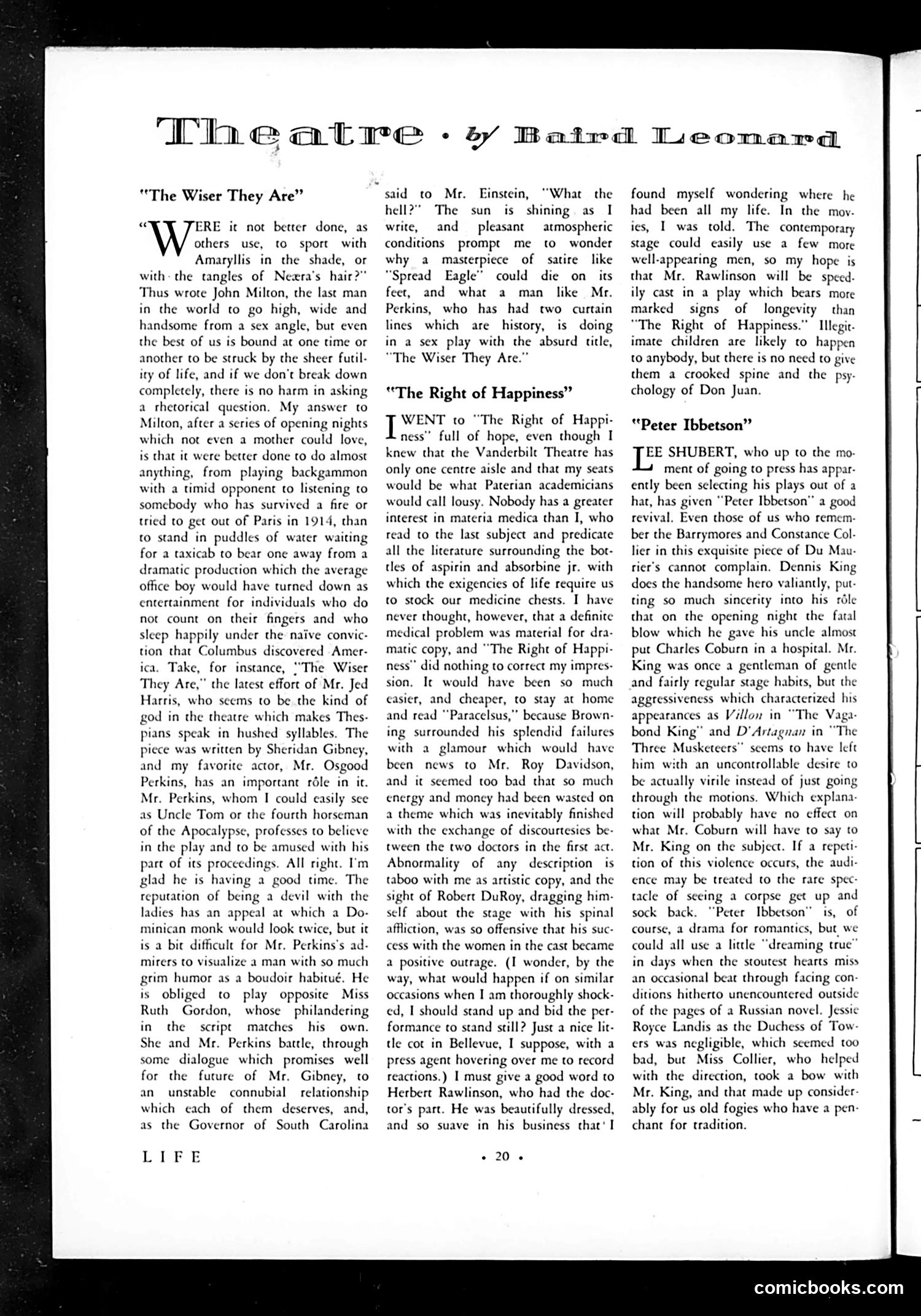
Theatre Reviews by Baird Leonard This page contains theatre criticism from Life magazine's "Theatre" section. The author reviews three Broadway plays with sharp, sardonic commentary: "The Wiser They Are" — A sex comedy by Sheridan Gibney, produced by Jed Harris and starring Osgood Perkins and Ruth Gordon. Leonard dismisses it as trivial entertainment, sarcastically noting he'd prefer almost any alternative activity. He questions why talented actor Perkins would waste time in such an absurd production. "The Right of Happiness" — A play centered on medical problems (aspirin, absorbine). Leonard criticizes using medical matters as dramatic material, suggesting the source material (Browning's "Paracelsus") would be more worthwhile than this adaptation. "Peter Ibbetson" — A revival featuring Lee Shubert's casting choices and Dennis King's performance. The satire operates through exaggerated complaint and mordant wit typical of 1920s-30s theatre criticism — the reviewer positions himself as intellectually superior to both the playwrights and their audiences.
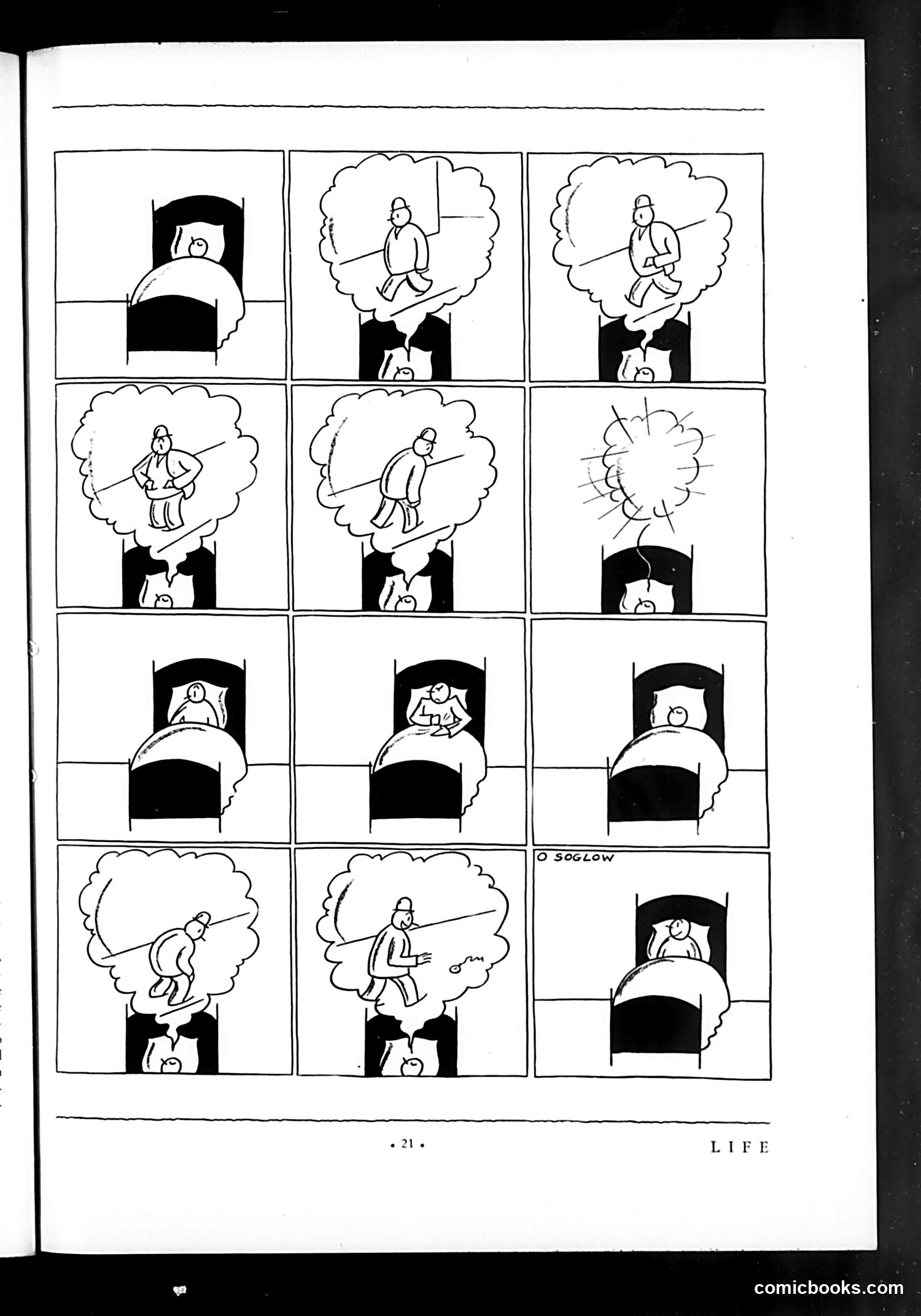
Analysis of Comic Strip This appears to be a satirical comic strip showing a person in bed experiencing a series of increasingly elaborate dreams or nightmares. The progression moves from simple scenarios to more chaotic scenes—the figure appears to be engaged in various activities (walking, gesturing, fishing) within thought bubbles above their sleeping form. The comic likely satirizes anxiety or overthinking, showing how a person's mind manufactures elaborate scenarios while at rest. The final panel labeled "O SOGLOW" (the artist's signature) returns the figure to bed, suggesting the cycle continues. Without clearer OCR text or additional context, the specific political or social references remain unclear, though the strip appears to comment on modern stress or preoccupation with daily concerns.
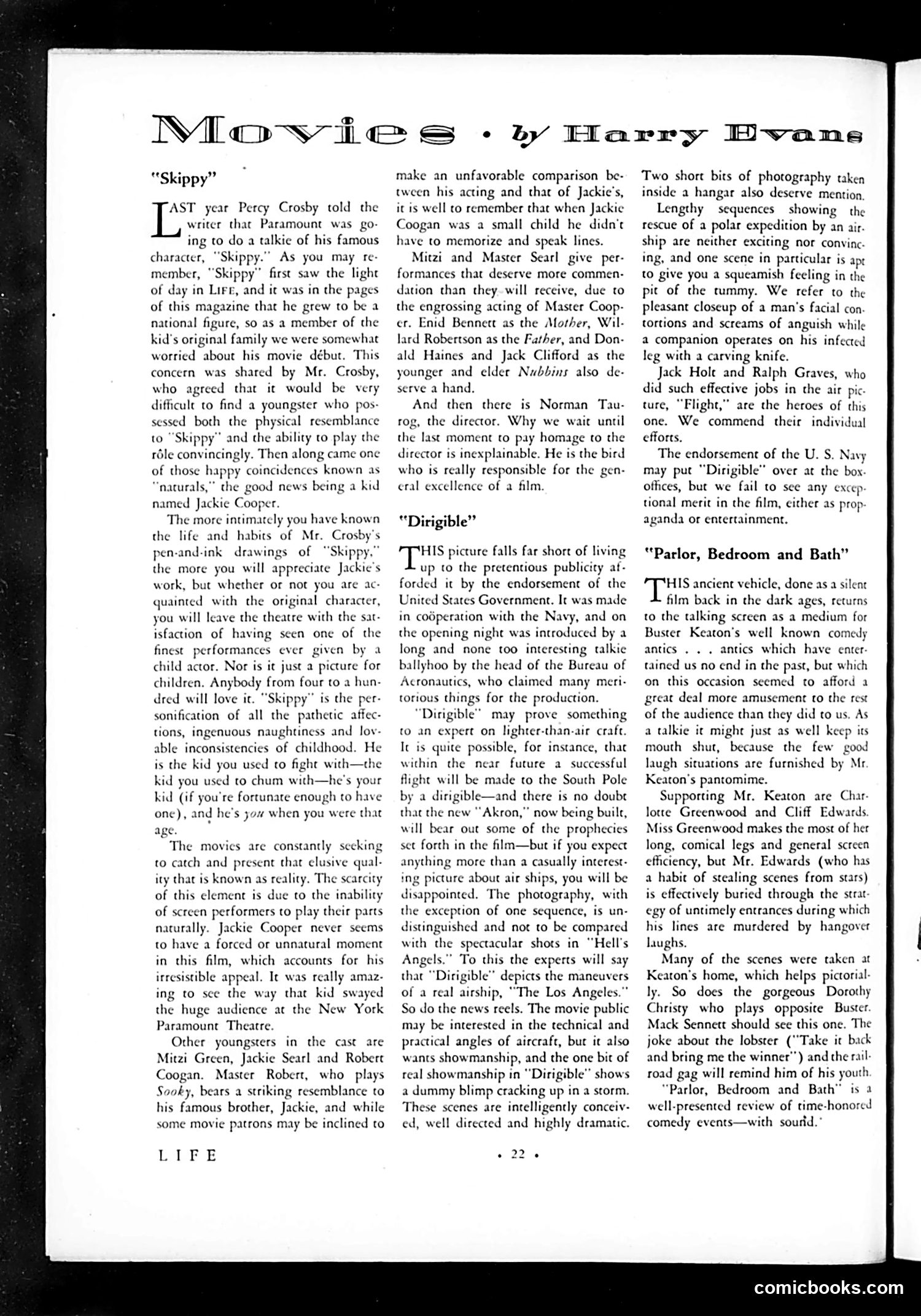
Life Magazine Movie Reviews: Understanding the Context This page reviews three early sound films ("talkies"). The main review concerns "Skippy," adapted from Percy Crosby's comic strip that debuted in *Life* magazine. The critic praises child actor Jackie Cooper's naturalistic performance, contrasting it favorably with other young performers like Robert Coogan (brother of famous child star Jackie Coogan). The review emphasizes Cooper's ability to play the mischievous but sympathetic character without seeming forced—a quality the critic sees as rare in cinema. The secondary review of "Dirigible" criticizes its overhyped Navy endorsement and government promotion. The critic suggests the film, about polar exploration by airship, appeals only to aviation experts, lacking broader entertainment value. Both reviews reflect 1930s *Life* magazine's dual mission: championing quality entertainment while satirizing Hollywood's promotional excess and government tie-ins.
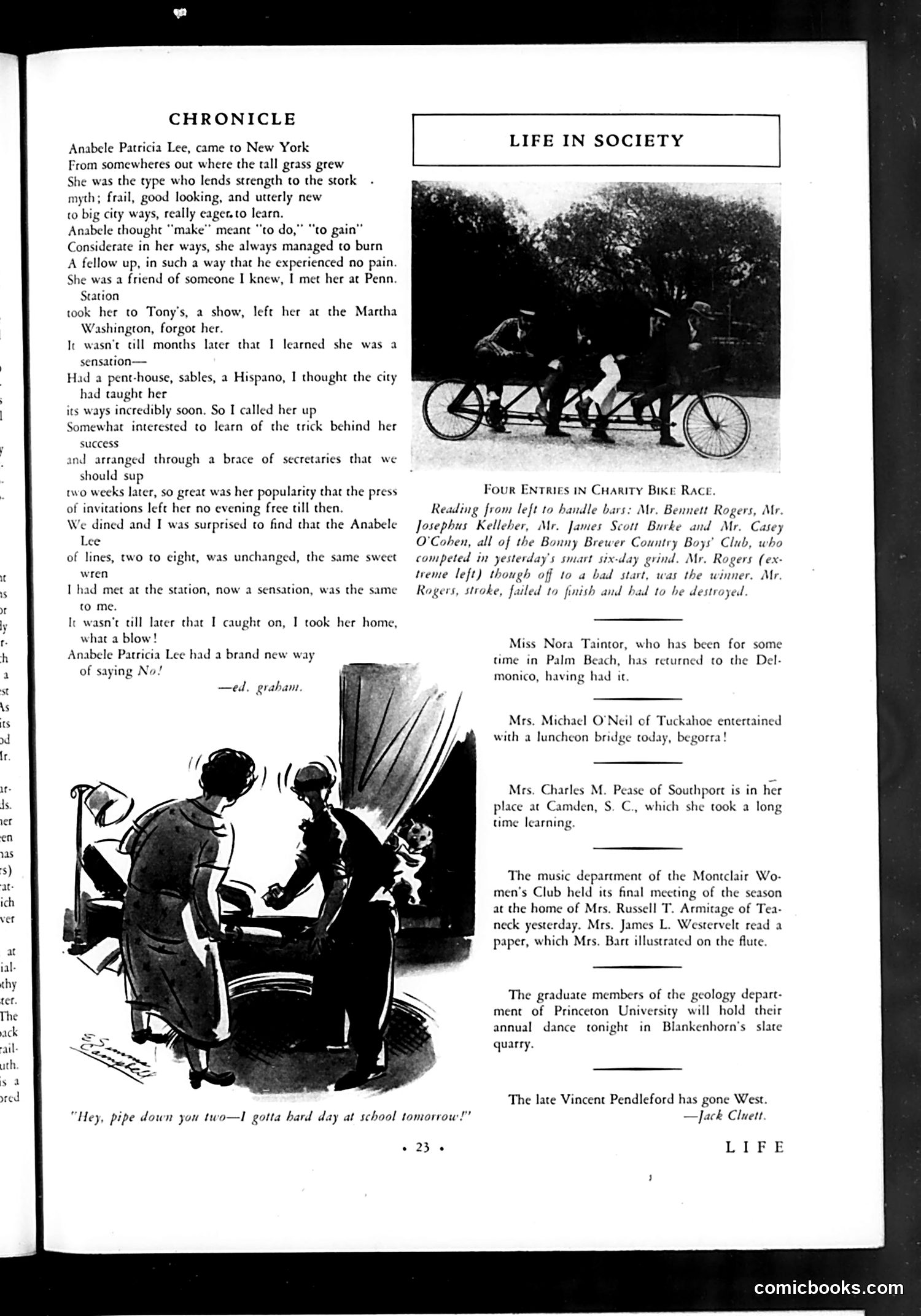
Analysis: Life Magazine Page This page contains satirical social commentary typical of 1920s-era Life magazine. "Chronicle" (left column): A narrative poem mocking the "self-made woman" trope. Anabele Patricia Lee arrives from rural America, becomes mysteriously successful in New York society (acquiring wealth, luxury goods, social prominence), yet remains unchanged in character. The joke's punchline—her newfound way of saying "No"—suggests her success derives from romantic/sexual manipulation rather than any actual skill or "trick" the narrator expected to learn. "Life in Society" (right column): Satirizes upper-class social pretension through mock-serious announcements. The charity bike race caption humorously notes that one competitor "failed to finish and had to be destroyed" (darkly joking about a bicycle, not a person). Other items mock wealthy women's leisure activities—bridge tournaments, club meetings, elaborate social rituals—presenting them as shallow and repetitive. The overall tone targets both the nouveau riche and established society for their vapidity and self-importance.
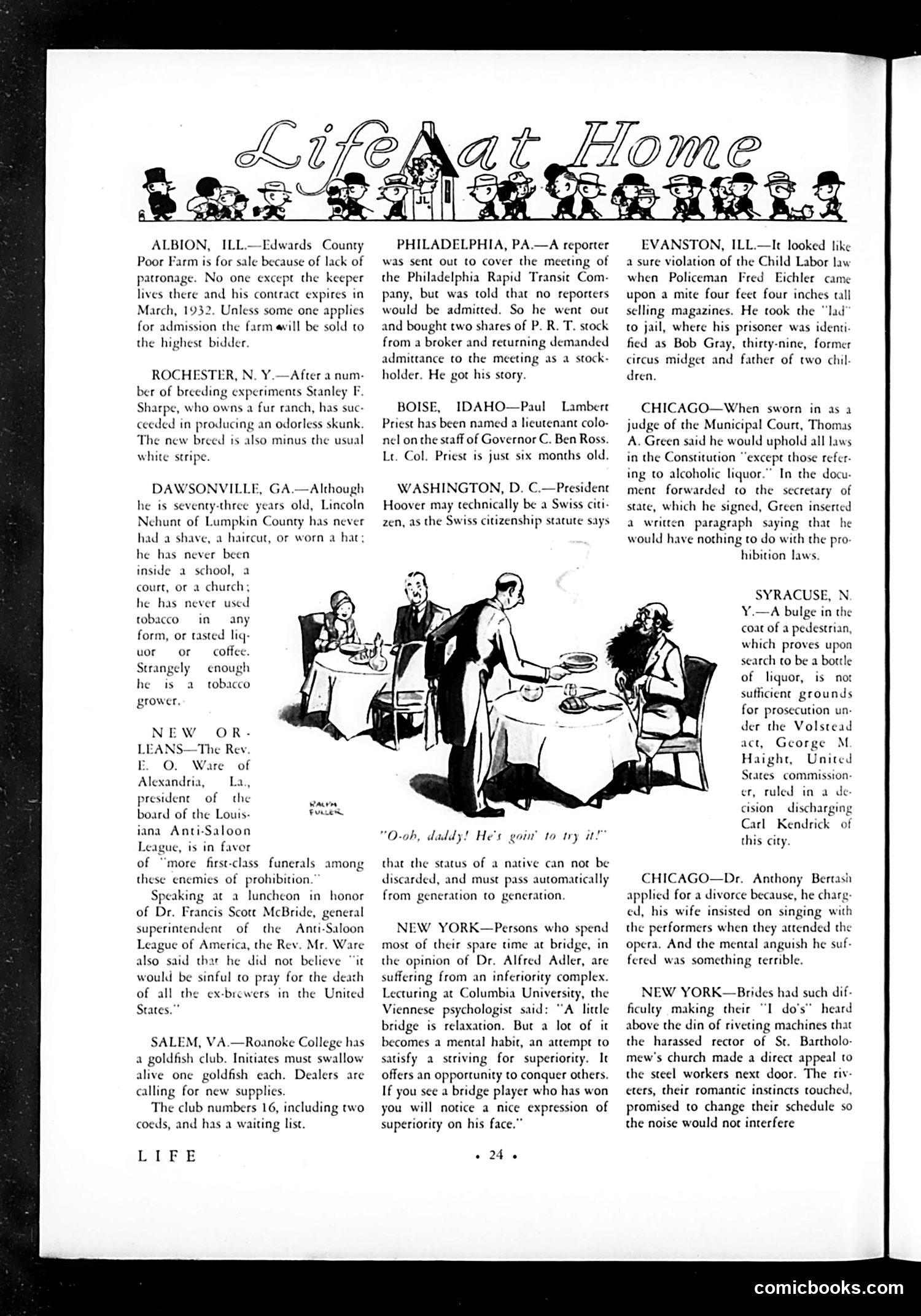
Life Magazine "Life at Home" Page Analysis This satirical section mocks American society during Prohibition (early 1930s). The cartoon depicts a dinner scene where a man says "O-oh, daddy! He's goin' to try it!"—likely referencing alcohol consumption despite the law. The surrounding anecdotes ridicule Prohibition's enforcement and effects: A Philadelphia reporter buys stock to access company meetings; a Chicago judge swears to uphold all laws except those banning alcohol; a Syracuse commissioner rules that finding liquor isn't grounds for prosecution. A Louisiana reverend advocates for the deaths of "ex-brewers." These stories expose the hypocrisy and ineffectiveness of Prohibition—authorities openly circumvent or reject the law, while ordinary citizens find loopholes. The cartoonist highlights how the amendment became unenforceable and widely disregarded by 1932, contradicting the law's intent. Other anecdotes (goldfish clubs, tiny midget selling magazines, odorless skunks) exemplify American eccentricity and oddity as additional satirical fodder.
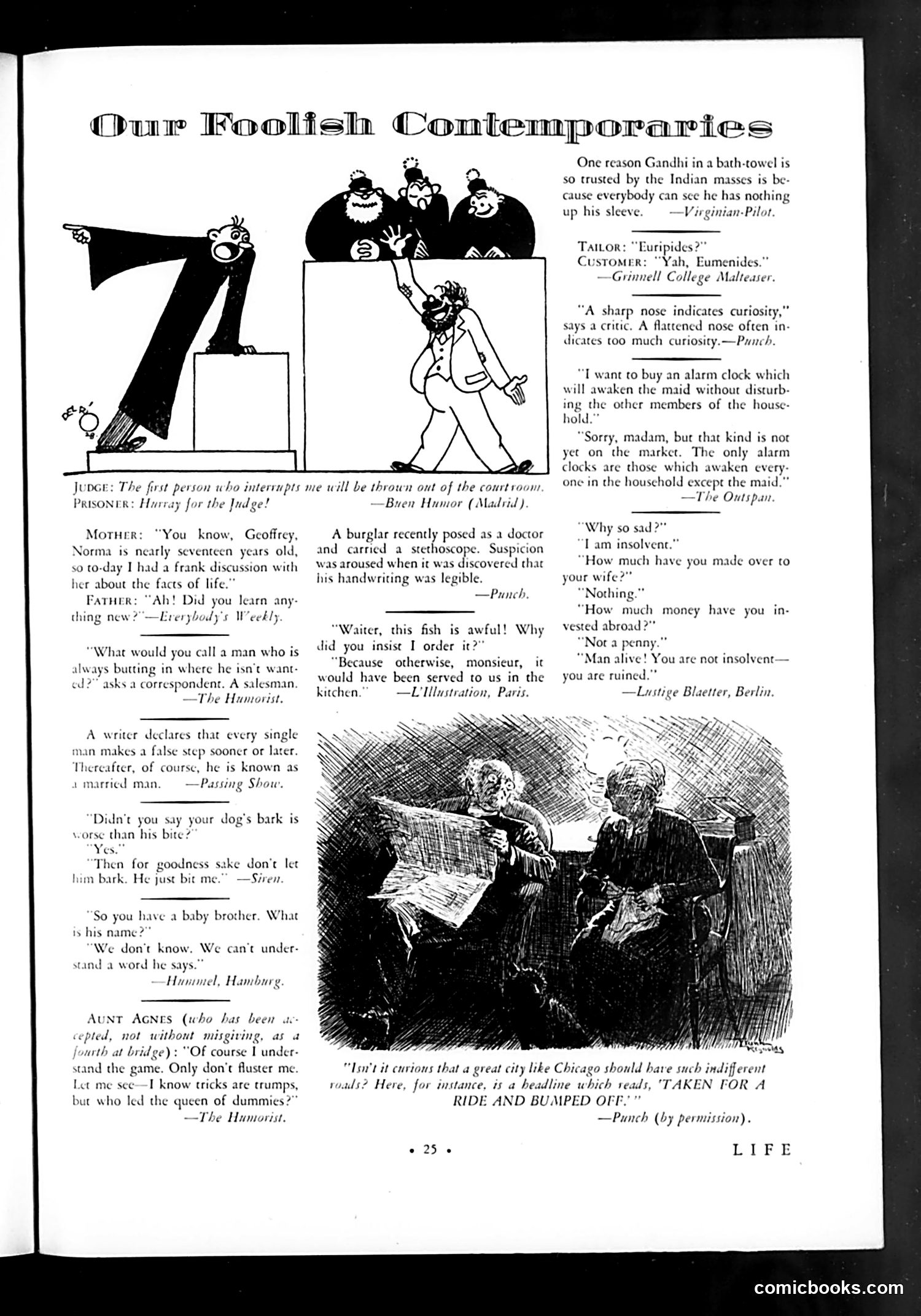
"Our Foolish Contemporaries" - Life Magazine Satire Page This page collects humorous short jokes and cartoons from international publications, a common Life magazine feature mocking social follies across cultures. Key observations: The cartoons and quips target domestic absurdities: a mother having "the talk" with her daughter, a judge threatening to eject interrupters (then a prisoner cheers), marital incompetence, and a bridge player who doesn't understand the game. Notable references: - Gandhi: The joke about Gandhi in a bath-towel relies on contemporary 1920s-30s awareness of his non-violent protests and ascetic lifestyle—his visible poverty demonstrated his authenticity. - "Taken for a Ride": The final cartoon references the 1920s-30s Chicago mob practice of kidnapping victims for execution, reflecting Depression-era criminal violence. The page's title—"Our Foolish Contemporaries"—frames these as timeless human absurdities: pomposity, marital miscommunication, pretense, and social incompetence, sourced from humor magazines worldwide.
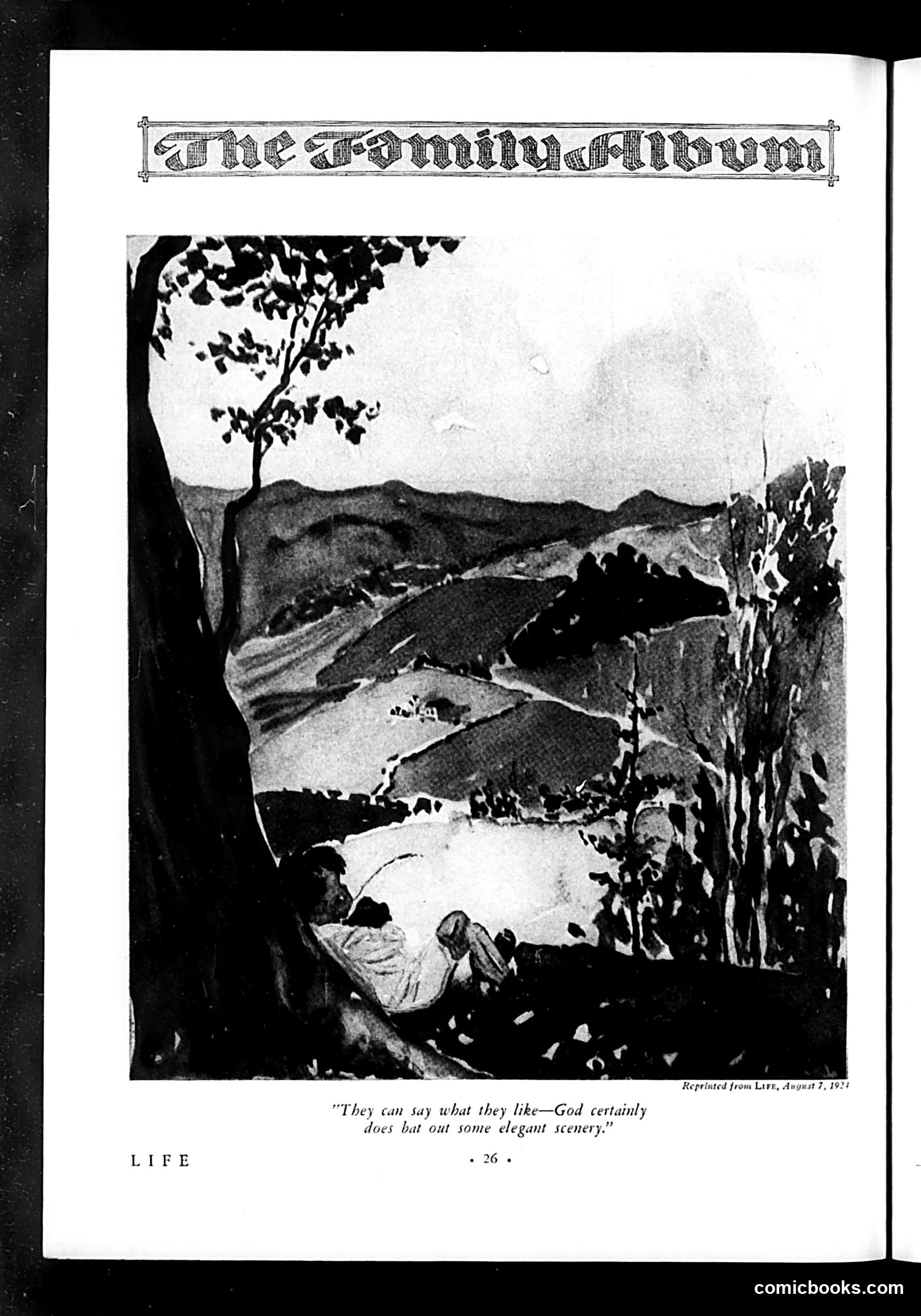
Analysis This page from *Life* magazine (August 7, 1924) features a pastoral illustration rather than a political cartoon. The image shows a rural landscape with rolling hills, a small house, cultivated fields, and vegetation framing the scene. A figure sits in the foreground observing the view. The caption expresses contentment with natural scenery, suggesting the illustration celebrates the beauty of the American countryside. The phrase "God certainly does bat out some elegant scenery" uses colloquial language ("bat out") to convey appreciation for nature's aesthetic qualities. The context appears to be 1920s Americana—celebrating rural life and landscape during an era when industrialization was transforming American society. The sentiment reflects popular nostalgia for pastoral beauty, likely resonating with readers amid rapid urbanization.
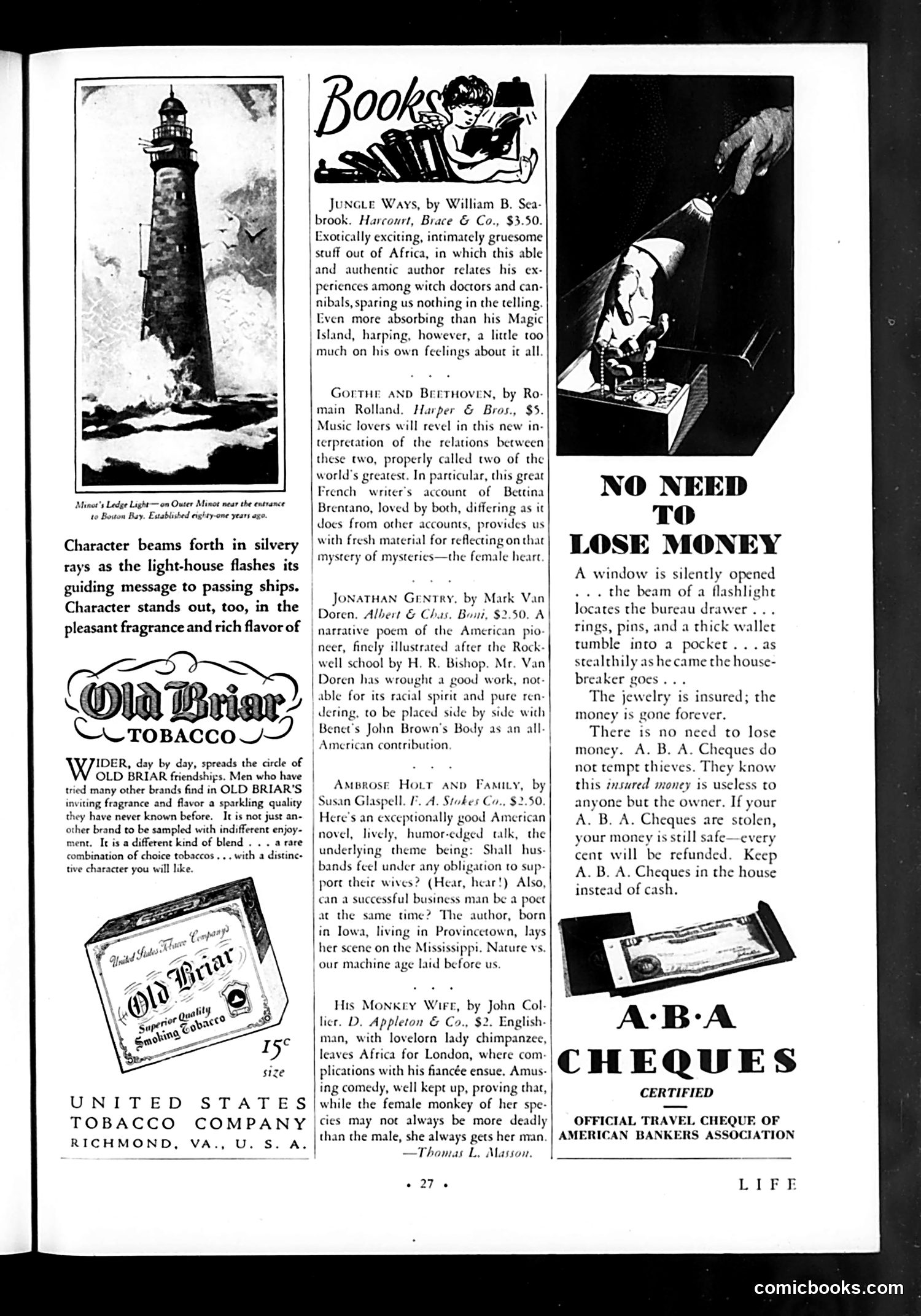
Analysis of Life Magazine Page Content This page is primarily advertising and book reviews rather than political satire or comics. The main elements are: Left side: Old Briar tobacco advertisement featuring a lighthouse image, using "character" as a metaphor for both the lighthouse's guiding beam and the tobacco's distinctive qualities. Center: Five book reviews covering literary works of the era—including William Seabrook's *Jungle Ways* (exotic African travel narrative), a Goethe-Beethoven study, and American novels exploring contemporary themes like whether husbands must support wives. Right side: An advertisement for A.B.A. Cheques (traveler's checks), featuring an illustration of a burglar stealing valuables. The ad's satire is purely commercial: it argues that unlike cash and jewelry, A.B.A. Cheques are useless to thieves since they're insured and non-transferable—a straightforward pitch for financial security rather than political commentary. The page reflects 1920s consumer culture and literary interests with no discernible political cartoon or social satire beyond standard advertising rhetoric.
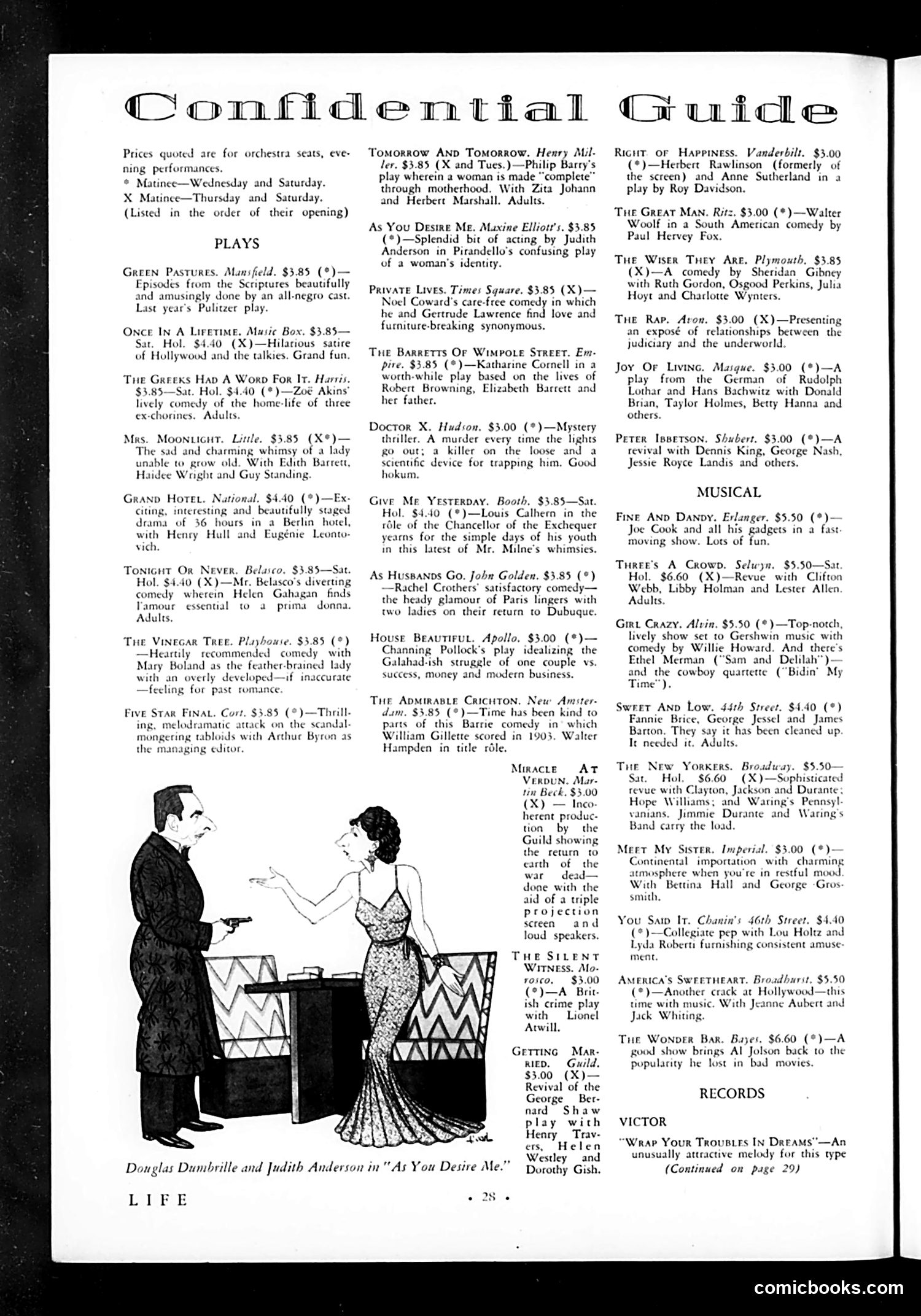
Analysis of Life Magazine "Confidential Guide" Page This page is primarily a theater listings and reviews guide for Broadway productions, not a political cartoon. The single illustration shows a scene from the play "As You Desire Me," featuring actors Douglas Dumbrille and Judith Anderson in a domestic moment—he offering her something while she reclines elegantly. The "satire" here is gentle and commercial rather than political. The guide reviews current Broadway shows with brief, witty descriptions emphasizing entertainment value. Notably, it includes *Green Pastures*, described as an "all-negro cast" production (using period language), which won the previous year's Pulitzer Prize—indicating mainstream theatrical acceptance of Black performers by the early 1930s. The page functions as a consumer guide for theatergoers, with prices, showtimes, and comedic capsule reviews designed to entice readers to purchase tickets. The tone is sophisticated and urbane, aimed at affluent audiences.
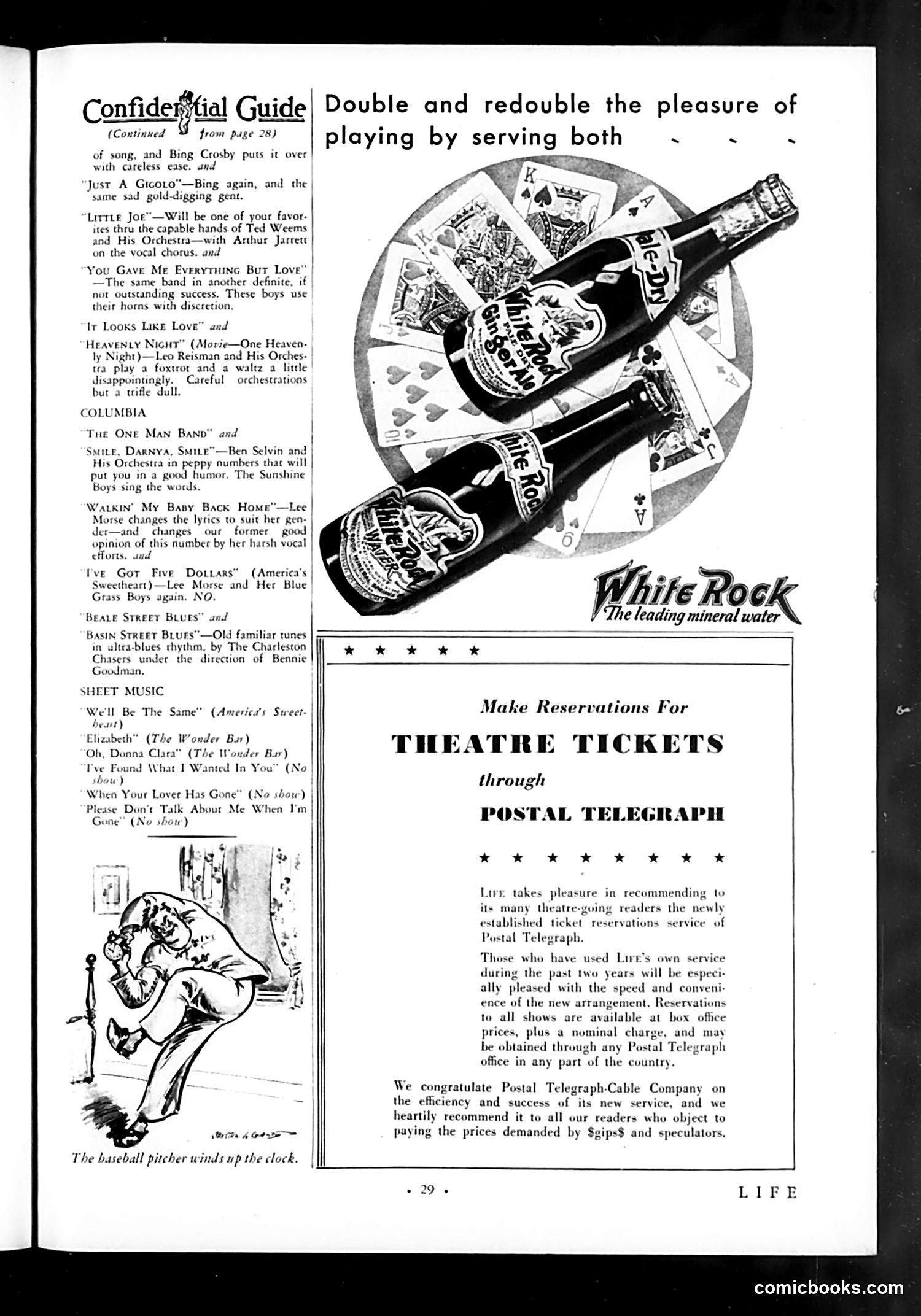
Explanation for Modern Readers This page is primarily advertising and entertainment listings from Life magazine (a 1920s-30s satirical publication). The left column reviews popular music recordings—songs by Bing Crosby, Ben Selvin, and others—rating their quality. This reflects Life's role as a cultural guide. The cartoon at bottom-left shows a baseball pitcher "winding up the clock," a visual pun: the pitcher's throwing motion resembles winding a clock mechanism. It's simple wordplay humor typical of the era. The right side advertises White Rock mineral water and Postal Telegraph's theater ticket service. The latter is notable: Life endorses this reservation system while criticizing scalpers and speculators who marked up ticket prices—a consumer-protection stance. The complaint about unfair pricing suggests ticket scalping was a recognized problem even then. This is primarily a commercial/entertainment page, not political satire.
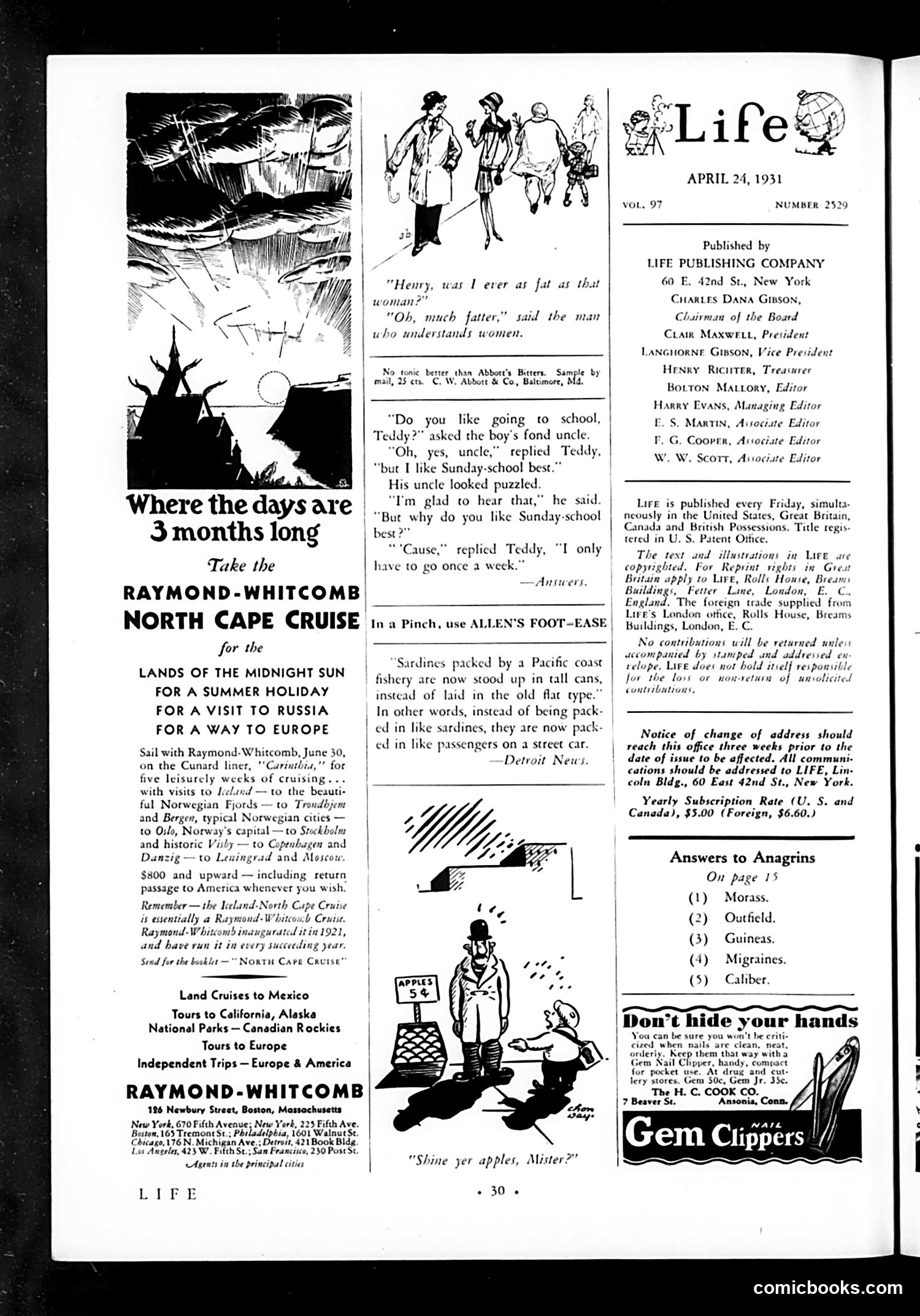
Satire and Humor in Life Magazine, April 24, 1931 This page contains three unrelated humor pieces typical of Life's satirical content: "Henry, was I ever as fat as that woman?" — A joke about male tactlessness. The punchline ("the man who understands women") suggests that a man claiming to "understand women" would flatter rather than insult, making the husband's blunt "much fatter" response absurdly ignorant. The Teddy dialogue — A child's logic joke. Young Teddy prefers Sunday school to regular school because he only has to attend once weekly. The humor lies in his innocent misunderstanding of the uncle's assumptions about education preferences. The sardine cartoon — Social commentary on crowded urban conditions. The Detroit News joke compares sardines packed upright in cans to passengers crammed into streetcars during rush hour—satirizing overcrowding in Depression-era public transportation. The page is primarily advertising (cruise lines, foot powder, clippers) with these humor pieces interspersed, typical of 1931 Life magazine format.
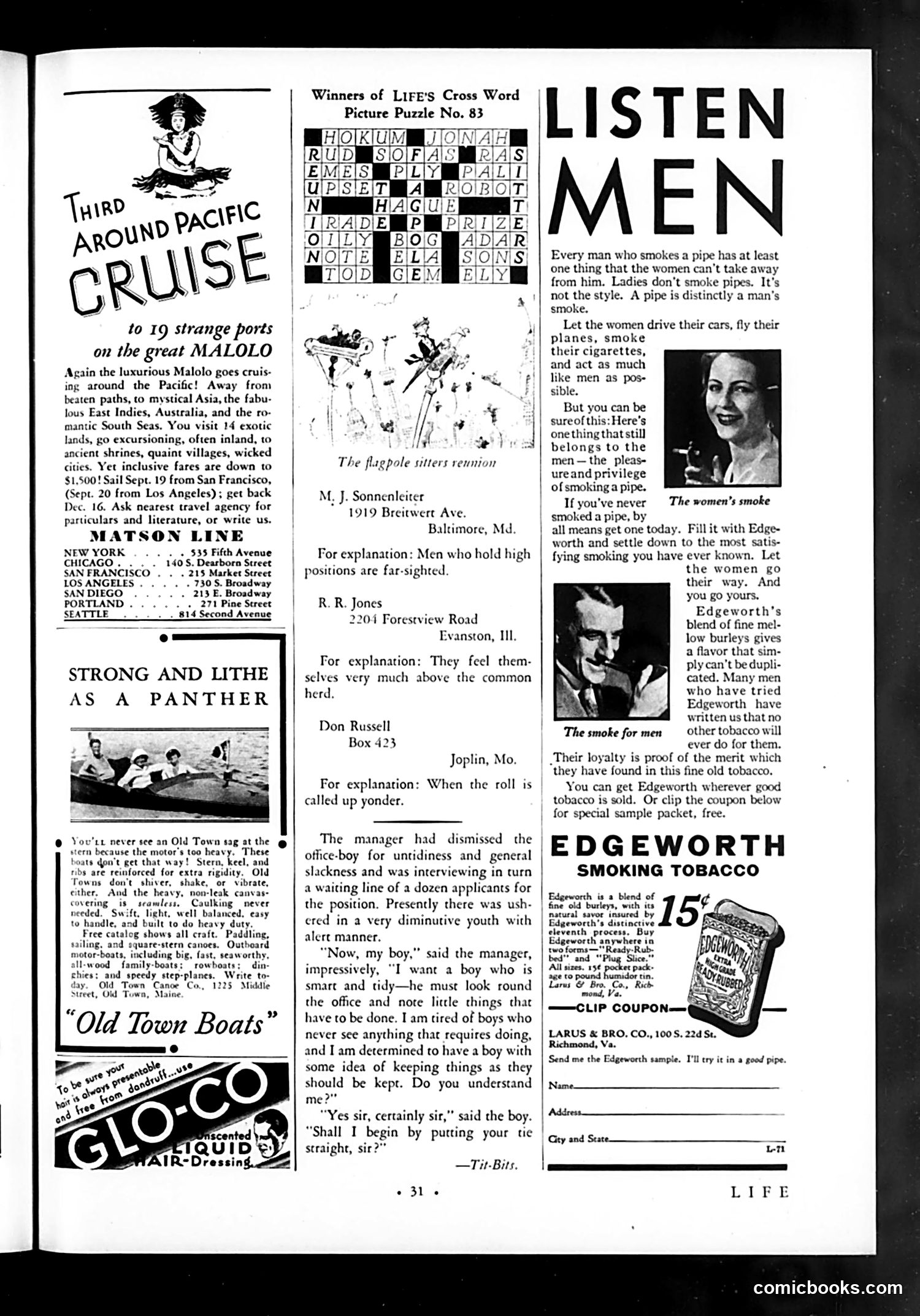
Analysis for Modern Readers This 1920s Life magazine page is primarily advertising and puzzle content, not political satire. The page features: 1. Travel advertisements (Matson Line cruise, Old Town Boats) promoting luxury leisure activities—reflecting the prosperity of the era. 2. A crossword puzzle with reader solutions explaining visual jokes (flagpole sitters = far-sighted men; tall figures = "above the common herd"). 3. A humorous anecdote about an office boy who immediately points out his new boss's crooked tie—a joke about unexpected honesty. 4. The main advertisement: Edgeworth tobacco, using gendered marketing. It positions pipe-smoking as distinctly masculine, contrasting with women gaining new freedoms (driving cars, flying planes, smoking cigarettes). The ad frames pipe-smoking as men's last exclusive domain—a defensive reaction to women's expanding roles in the 1920s. The gendered messaging reflects anxiety about changing social norms during this period of rapid female emancipation.
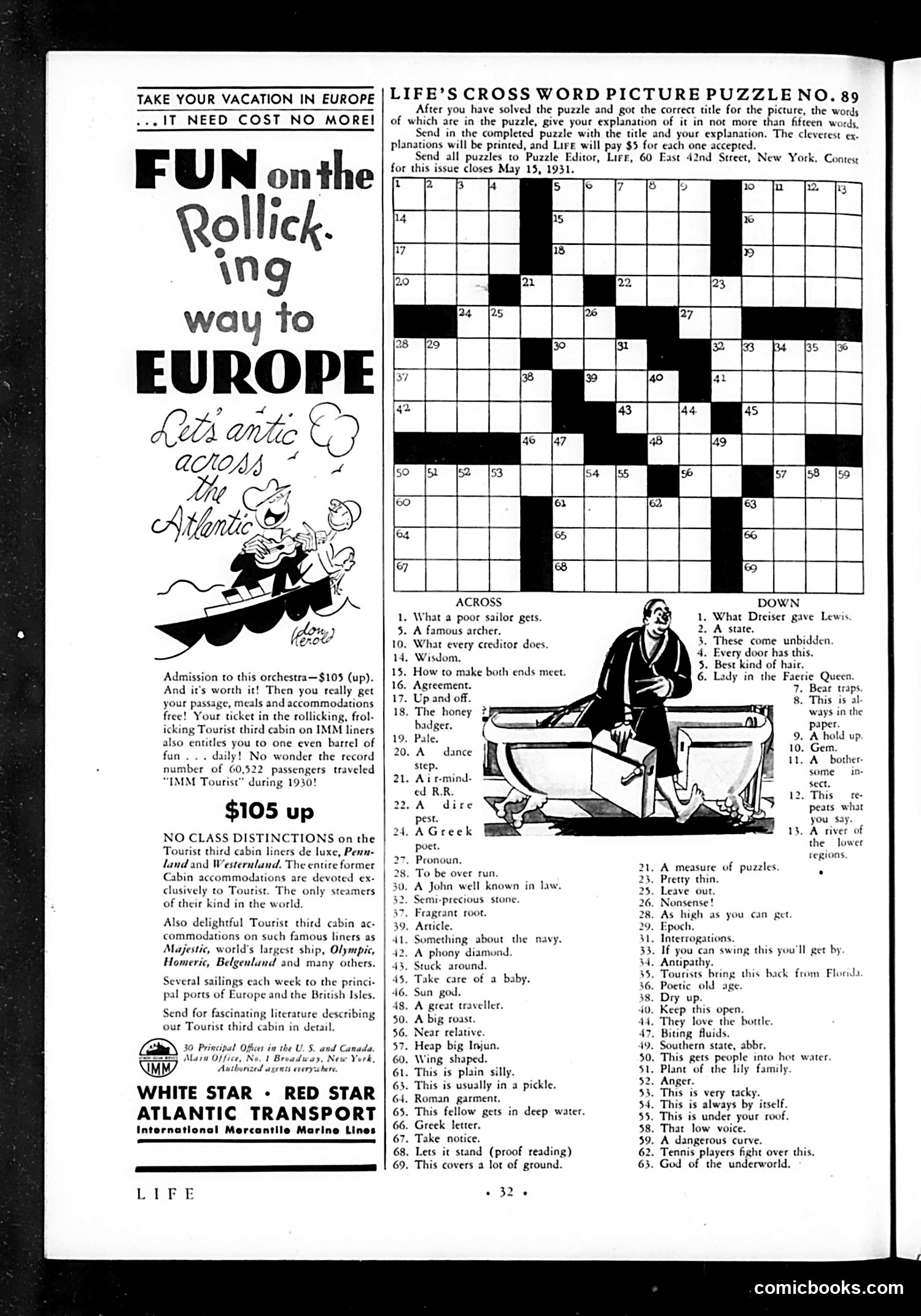
Analysis This page combines travel advertising with a crossword puzzle contest, reflecting 1930s leisure culture. The Advertisement: The left side promotes budget transatlantic travel on International Mercantile Marine Lines ships. The cartoon depicts carefree tourists dancing/rollicking aboard ship, emphasizing affordable luxury—"Tourist third cabin" passage ($105+) includes meals and entertainment. The pitch: you get your accommodations "free" because the fun is worth the ticket price alone. This targets middle-class Americans seeking European vacations during the Depression era, when such travel was still aspirational luxury. The Crossword Puzzle: The right side is a "Picture Puzzle"—solvers must complete the crossword, then identify and explain the resulting picture (apparently showing a figure, based on the cartoon illustration in the clues). Life paid $5 for clever solutions, encouraging reader participation. Together, these represent how 1930s magazines blended advertising, entertainment, and reader engagement—using puzzles and humor to promote consumer products while entertaining audiences during economic hardship.
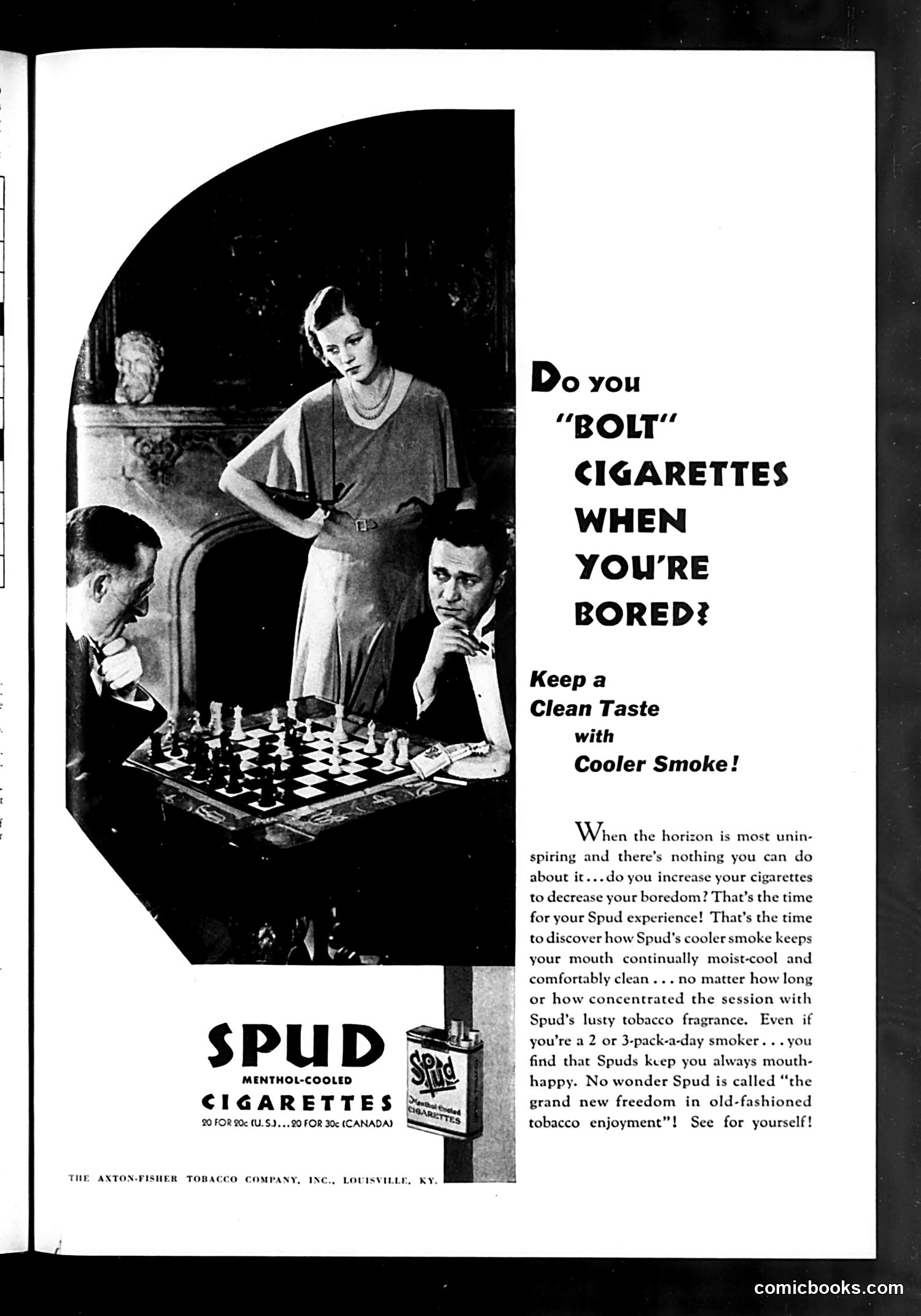
Analysis: Spud Cigarettes Advertisement This is a cigarette advertisement, not satire or political commentary. It promotes Spud menthol-cooled cigarettes to combat boredom. The image shows three people playing chess while a woman watches—depicting a boring, unstimulating social situation. The ad's premise is that when faced with tedium ("when the horizon is most uninspiring"), smokers increase cigarette consumption. Spud's solution: their menthol formula keeps the mouth "moist-cool and comfortably clean," allowing heavier smoking without discomfort. The tagline "grand new freedom" references menthol's cooling sensation as liberation from typical smoking harshness—a marketing angle common in mid-20th-century tobacco advertising that presented smoking as sophisticated leisure activity rather than addiction. The chess game likely symbolizes intellectual boredom—even mentally engaging activities need cigarette accompaniment, the ad implies.
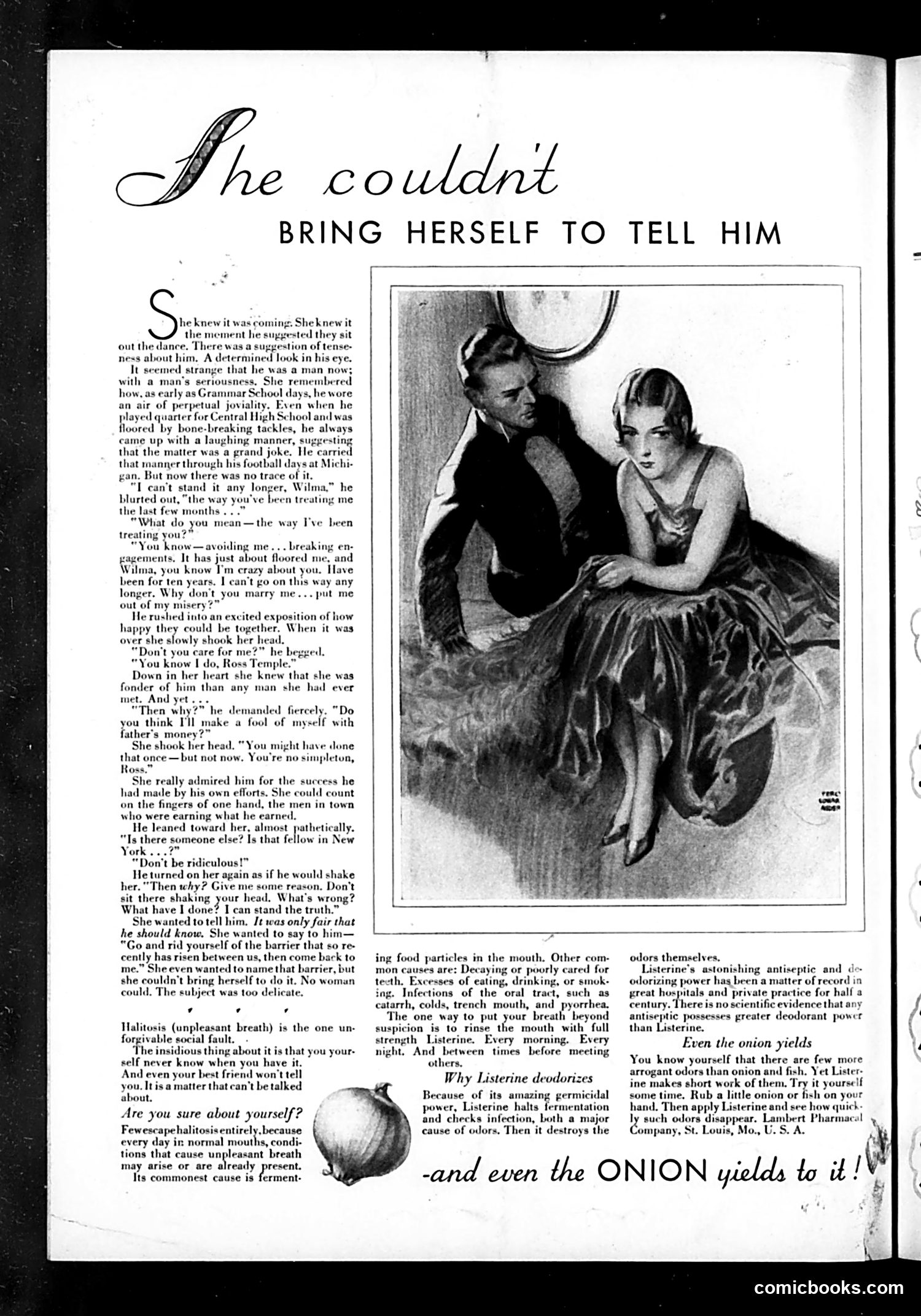
Analysis This page is primarily a Listerine mouthwash advertisement disguised as a romantic fiction story. The Setup The narrative depicts a woman ("Wilma" or similar) unable to tell her suitor Ross Temple why she won't marry him, despite caring for him. The story builds romantic tension—he's successful, earnest, and bewildered by her rejection. The Reveal The advertisement reveals the unspeakable barrier: halitosis (bad breath). The woman cannot bring herself to tell him because discussing oral hygiene is considered too delicate a social matter. The Sales Pitch This was a common advertising strategy of the era—create relatable social anxiety (here, romantic rejection caused by personal hygiene), then offer the product (Listerine) as the solution. The ad emphasizes that halitosis is "the one unforgivable social fault" and that sufferers never know they have it. Context This reflects early-20th-century marketing that weaponized shame and social embarrassment to drive consumer purchases, particularly for products addressing bodily functions or appearance. The ad's implication—that bad breath could destroy relationships—was sensationalist even by period standards.