life
Life — May 8, 1931
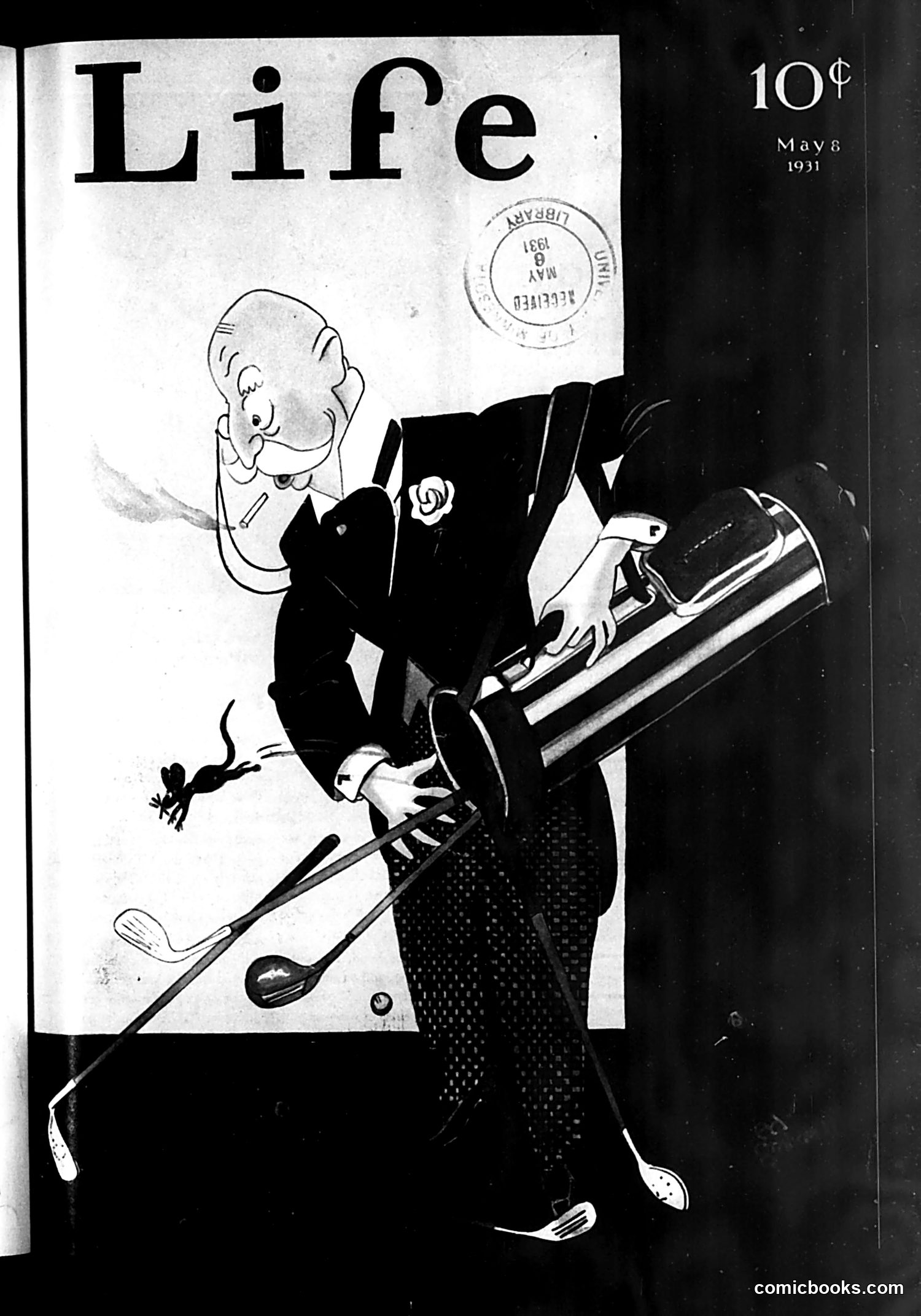
Life Magazine Cover Analysis (May 8, 1931) This cover depicts a caricatured golfer in formal attire holding a large golf club and what appears to be a vacuum cleaner or similar mechanical device. The exaggerated facial features and the incongruous combination of golfing equipment with household appliance suggest satirical commentary. Given the 1931 date during the Great Depression, this likely mocks either: - The wealthy continuing leisure pursuits (golf) while the economy collapsed - A specific public figure associated with both wealth and consumer goods The cartoonist's style emphasizes absurdity through the character's distorted features and the clash between formal dress, recreational equipment, and domestic machinery—typical of Life's satirical approach to social and economic commentary of the era.
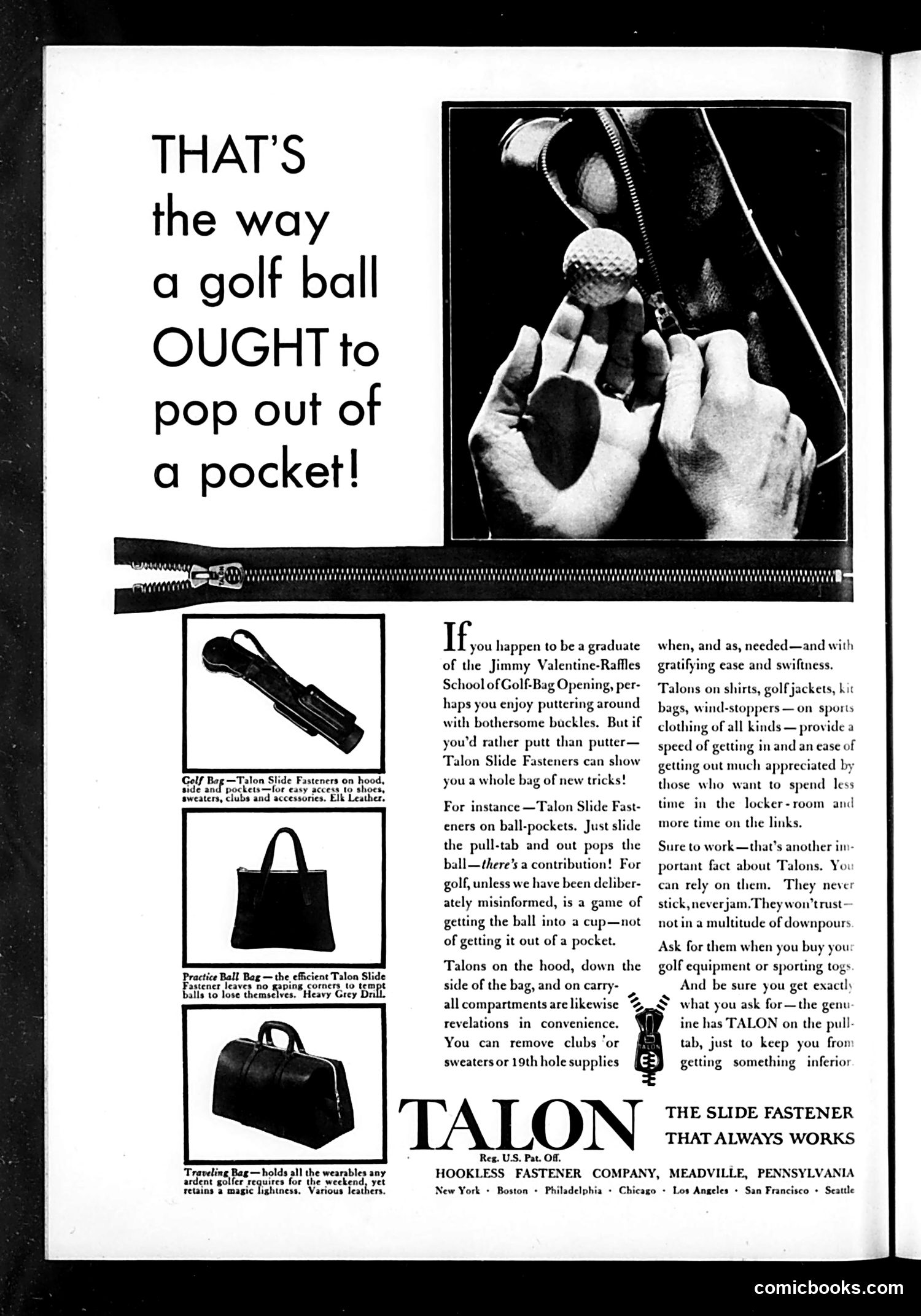
This is primarily an advertisement for Talon slide fasteners (zippers), not political satire or commentary. The ad uses humor to promote Talon brand zippers for golf bags and sports clothing. The joke in the headline—"THAT'S the way a golf ball OUGHT to pop out of a pocket!"—illustrates the convenience of Talon's quick-opening mechanism. The accompanying photograph shows a golf ball literally popping out of a pocket, dramatizing how easily the slider works. The page showcases three different Talon applications: a golf bag with a side pocket, a small "Practise Ball Bag," and a larger "Traveline Bag." The text emphasizes Talon's reliability ("never stick, never jam") and quality as superior alternatives to inferior fasteners. This represents typical mid-20th-century American advertising strategy: combining visual humor with product benefits to appeal to affluent male consumers interested in golf and sporting goods.
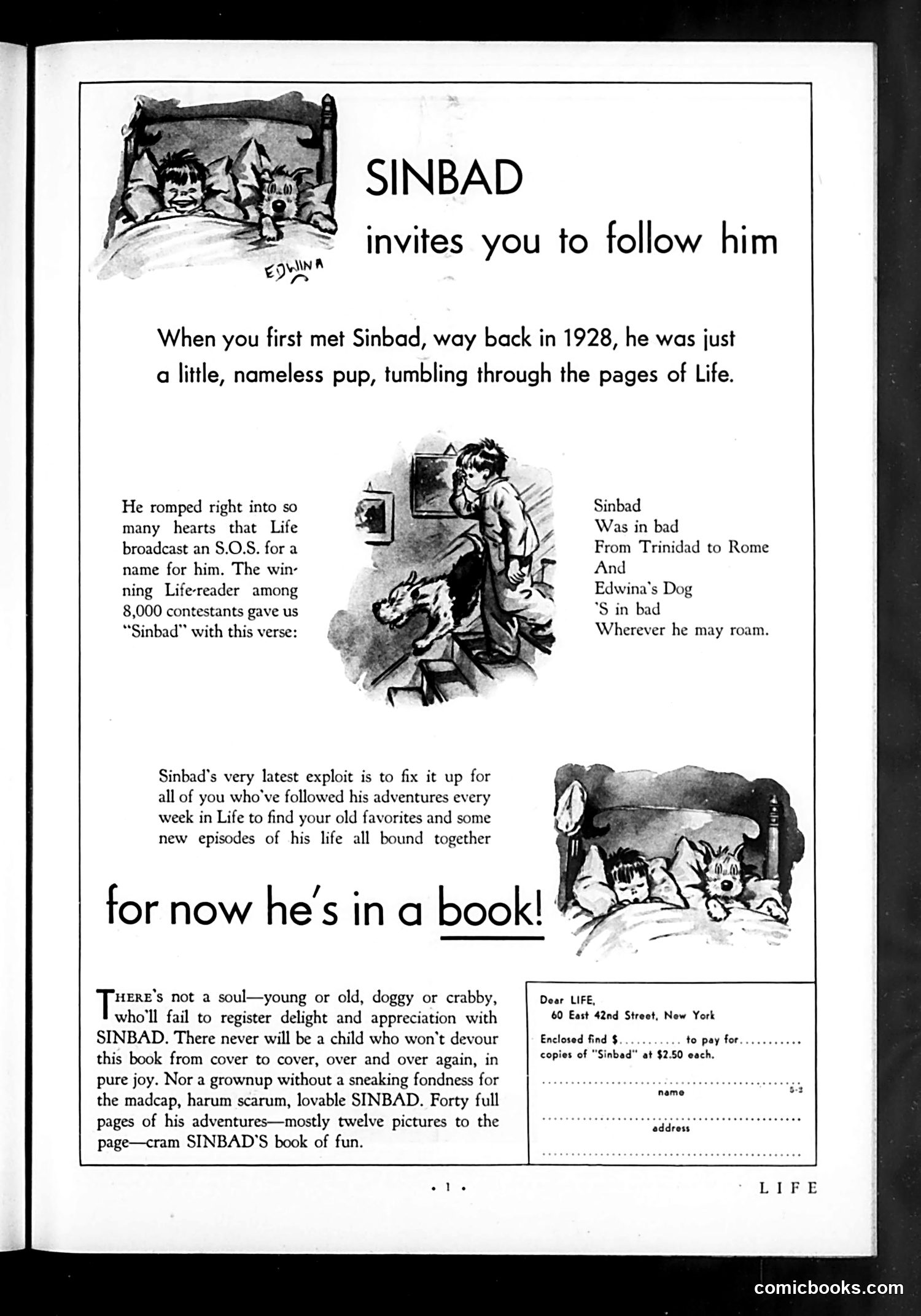
Analysis This is an advertisement, not a political cartoon. It promotes a children's book collection of "Sinbad" adventures, published by Life magazine. The page announces that Sinbad—a character who debuted in Life magazine in 1928 as "a little, nameless pup"—is now being compiled into a bound book. According to the text, Sinbad became popular enough that Life held a naming contest won by a reader who submitted the verse shown. The illustrations show a young boy and a dog in various adventures. The ad emphasizes the book contains "forty full pages" with "mostly twelve pictures to the page" of the character's exploits, marketed as wholesome entertainment for children and adults alike. This reflects early-20th-century magazine merchandising, where popular recurring comic characters were repackaged as collectible books.
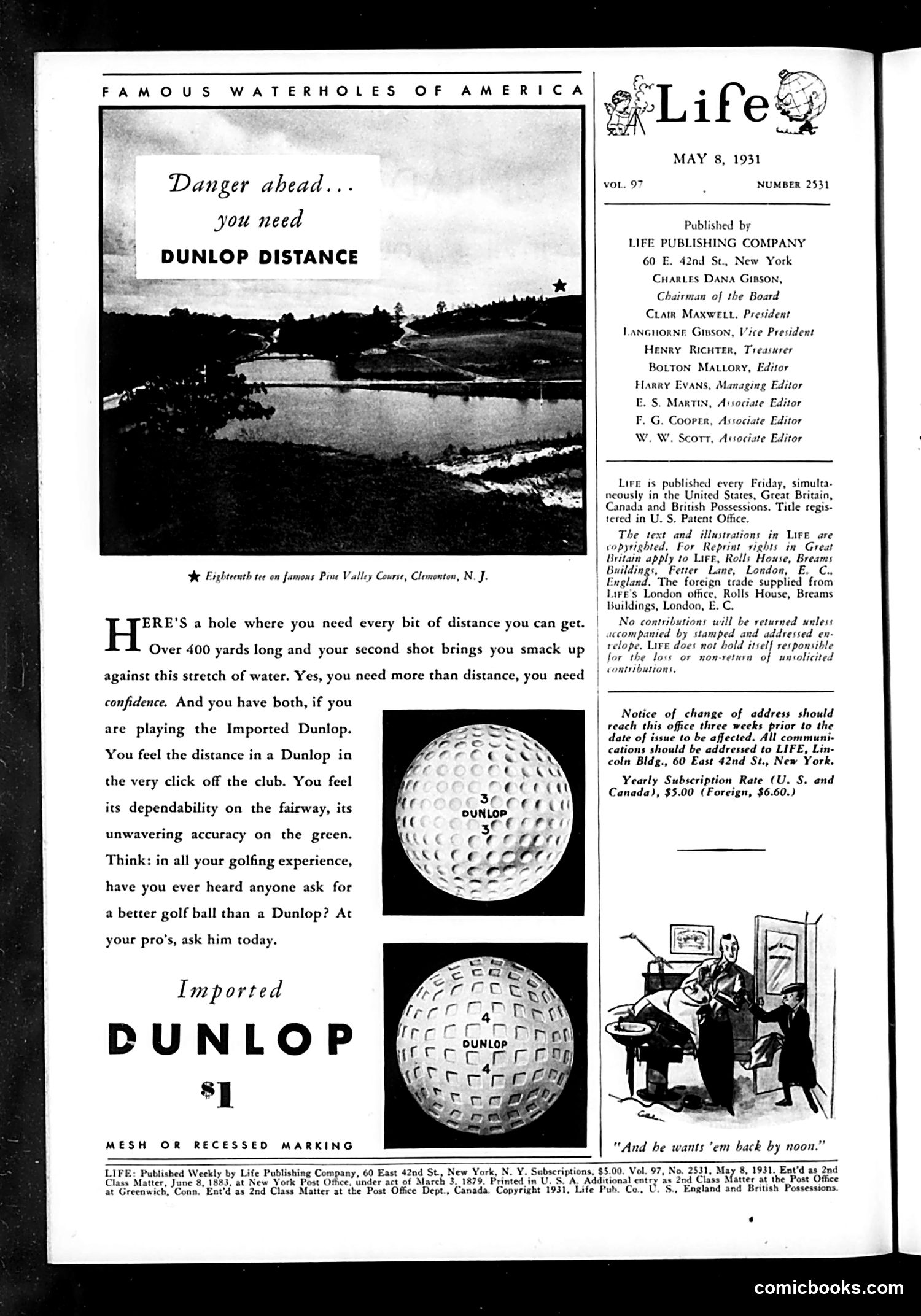
This page is primarily a golf ball advertisement for Dunlop, not political satire. The ad features: - A photograph of a famous waterhole at Pine Valley Country Club in Clementon, New Jersey, positioned as a golf hazard requiring distance and accuracy - Close-up images of two Dunlop golf ball designs (mesh and recessed marking patterns) - Marketing copy emphasizing that Dunlop balls provide the confidence, distance, and dependability golfers need The only cartoon element is a small illustration at bottom right showing a man at a desk with the caption "And he wants 'em back by noon" — likely a domestic humor joke about someone requesting their golf balls returned promptly. This is essentially a vintage sports equipment advertisement rather than political or social commentary.
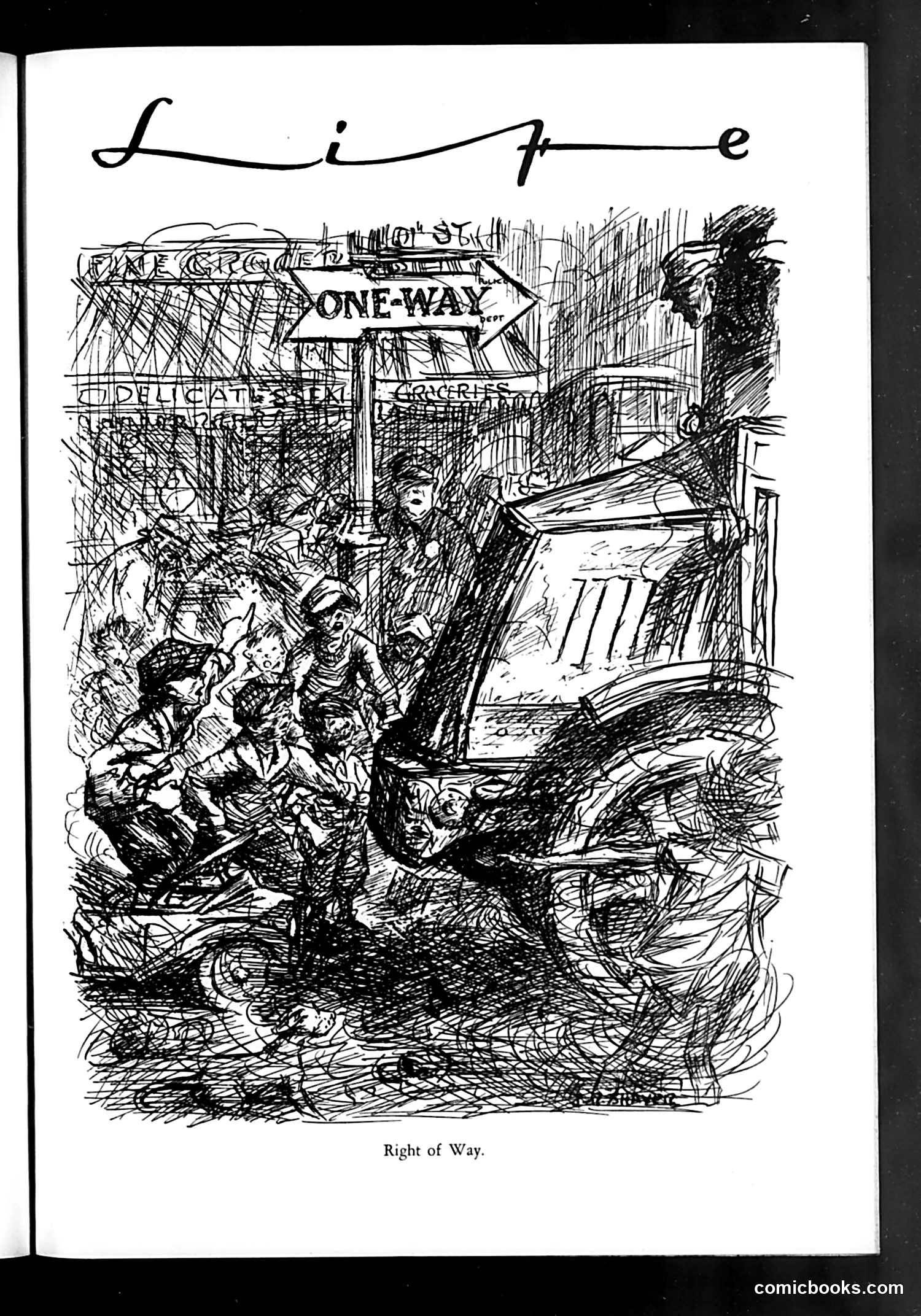
"Right of Way" - Life Magazine Cartoon This cartoon satirizes urban street congestion and pedestrian safety. The sketch depicts a chaotic street scene with a "ONE-WAY" sign visible above storefronts (one reading "DELICATESSEN" and "GROCERY"). Multiple figures—adults and children—crowd a narrow urban sidewalk near parked automobiles, creating dangerous congestion. The cartoon's title, "Right of Way," appears ironic: despite traffic regulations like the one-way sign meant to organize street flow, the reality shown is complete disorder with pedestrians and vehicles competing for the same cramped space. This likely critiques early-twentieth-century urban planning's failure to manage the explosive growth of automobile traffic, leaving pedestrians vulnerable and streets dangerously overcrowded.
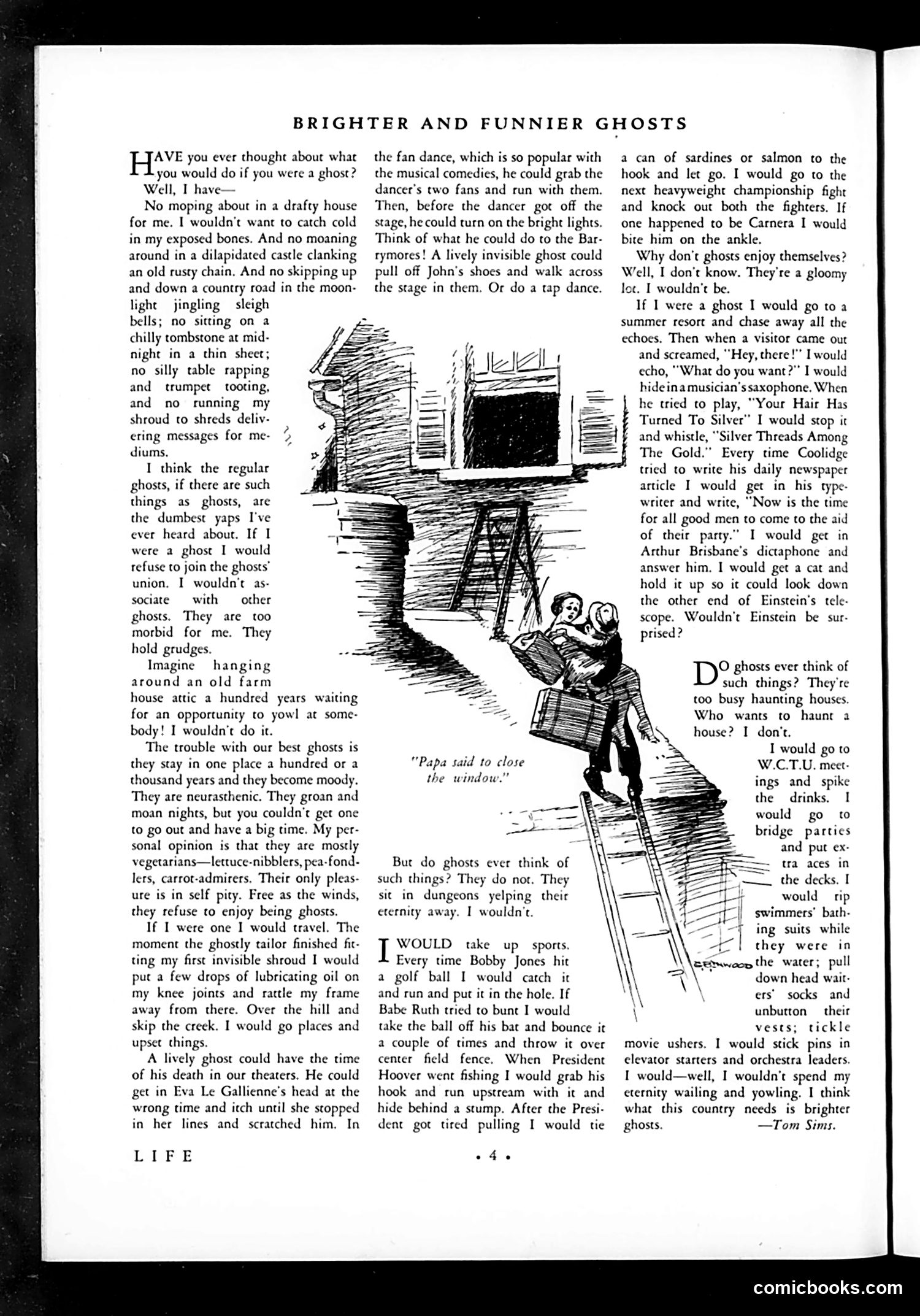
"Brighter and Funnier Ghosts" This is a humorous essay by Tom Simi imagining what life would be like if he were a ghost. Rather than the traditional gloomy specter, Simi proposes cheerful, mischievous hauntings—interfering with sports (catching Babe Ruth's home runs, intercepting President Hoover's fishing), sabotaging musical performances, and playing pranks on public figures like Arthur Brisbane and Albert Einstein. The central joke contrasts the stereotypical melancholy ghost with an energetic, prankster spirit who'd actually enjoy haunting. Simi suggests American culture needs "brighter" ghosts—a lighthearted social commentary using supernatural humor. The accompanying sketch shows figures on a ladder, illustrating the playful tone. The piece is essentially comedic fantasy rather than political satire.
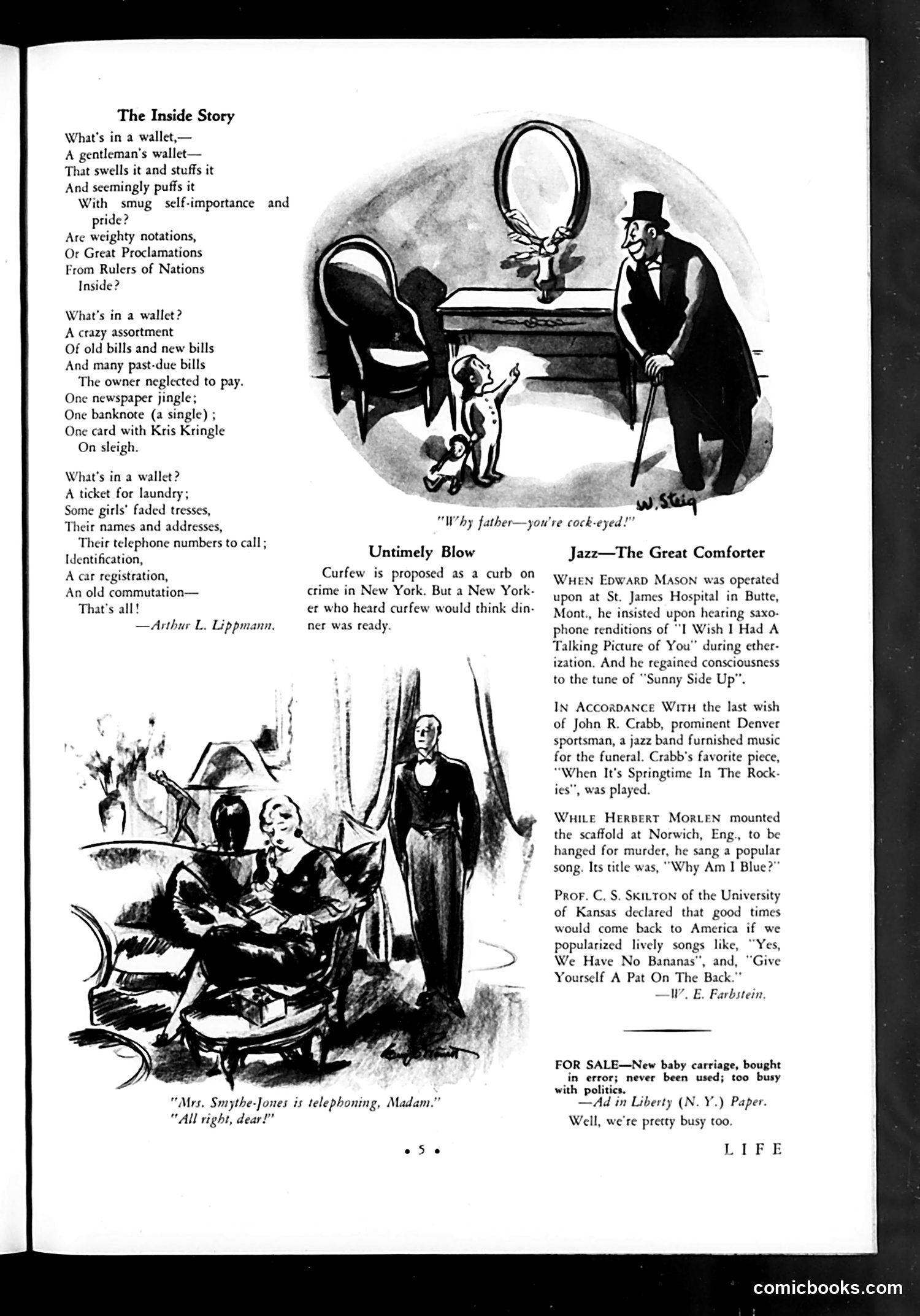
Analysis of Life Magazine Page "The Inside Story" is a satirical poem by Arthur L. Lippmann mocking the contents of a gentleman's wallet—bills, receipts, business cards—suggesting pretentiousness masked by mundane financial disorder. "Why Father—You're Cock-Eyed!" depicts a well-dressed man examining himself in a mirror held by a small dog, likely satirizing vanity or self-deception among the wealthy. "Untimely Blow" jokes about New York proposing curfews to combat crime, implying the city wasn't ready for such measures. "Jazz—The Great Comforter" describes Edward Mason's anesthesia during surgery accompanied by jazz music and popular songs, satirizing the era's enthusiasm for jazz as a cultural cure-all during the Jazz Age. The page exemplifies 1920s humor targeting social pretension, modern convenience culture, and contemporary fads.
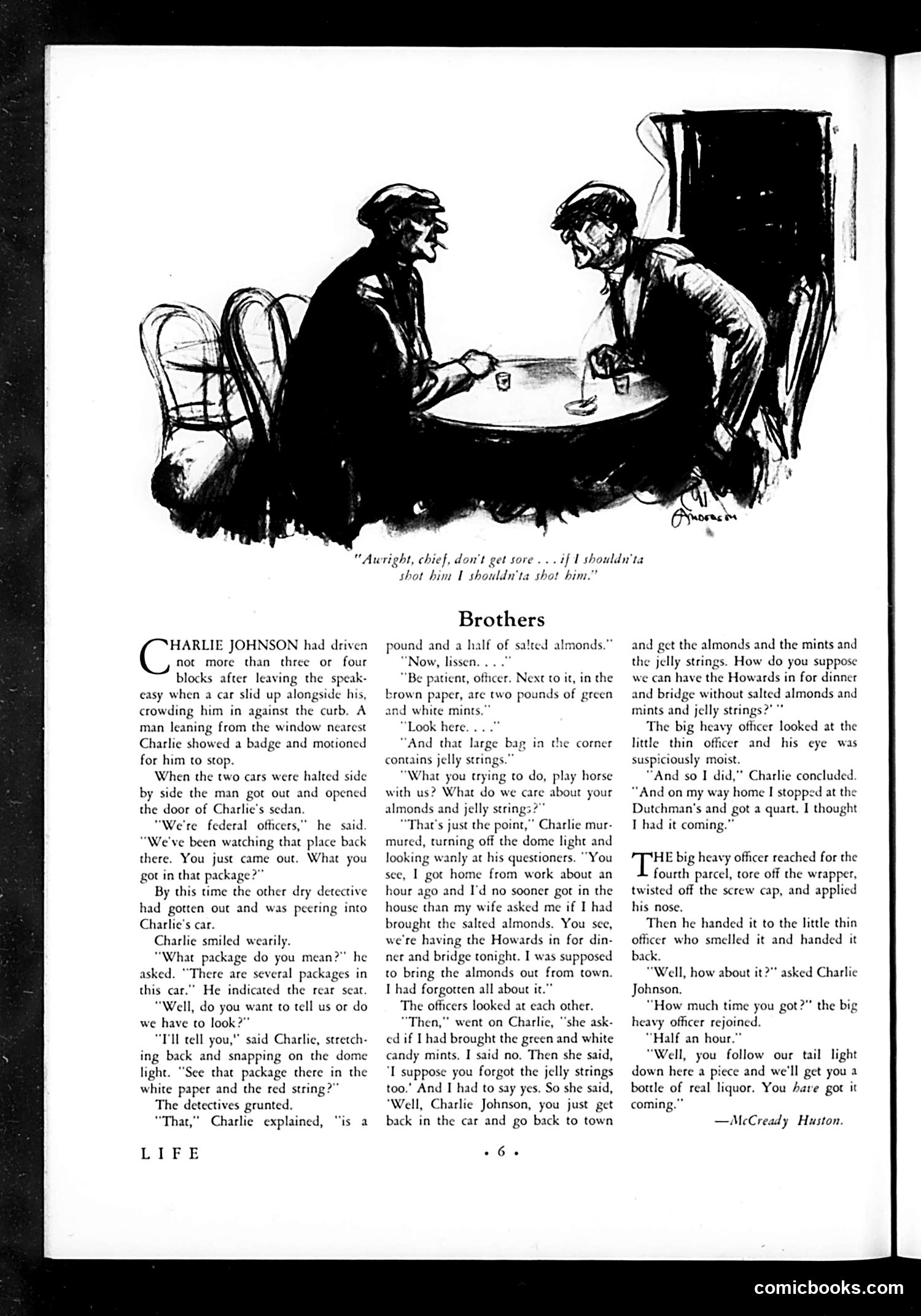
"Brothers" by McCready Hauton This is a humorous short story illustrated with a cartoon showing two men at a small table with drinks. The narrative concerns Charlie Johnson, who's been stopped by detectives while driving a car containing a suspicious package. The "joke" involves salted almonds and jelly strings intended for a dinner party. Charlie's brother, a police officer, initially suspects Charlie of smuggling contraband. The humor derives from the misunderstanding—the officers' suspicion that an innocent grocery delivery might be illicit cargo. This reflects early 20th-century American attitudes toward police work and fraternal relationships, playing on common anxieties about law enforcement and mistaken identity, rendered as light domestic comedy rather than serious drama.
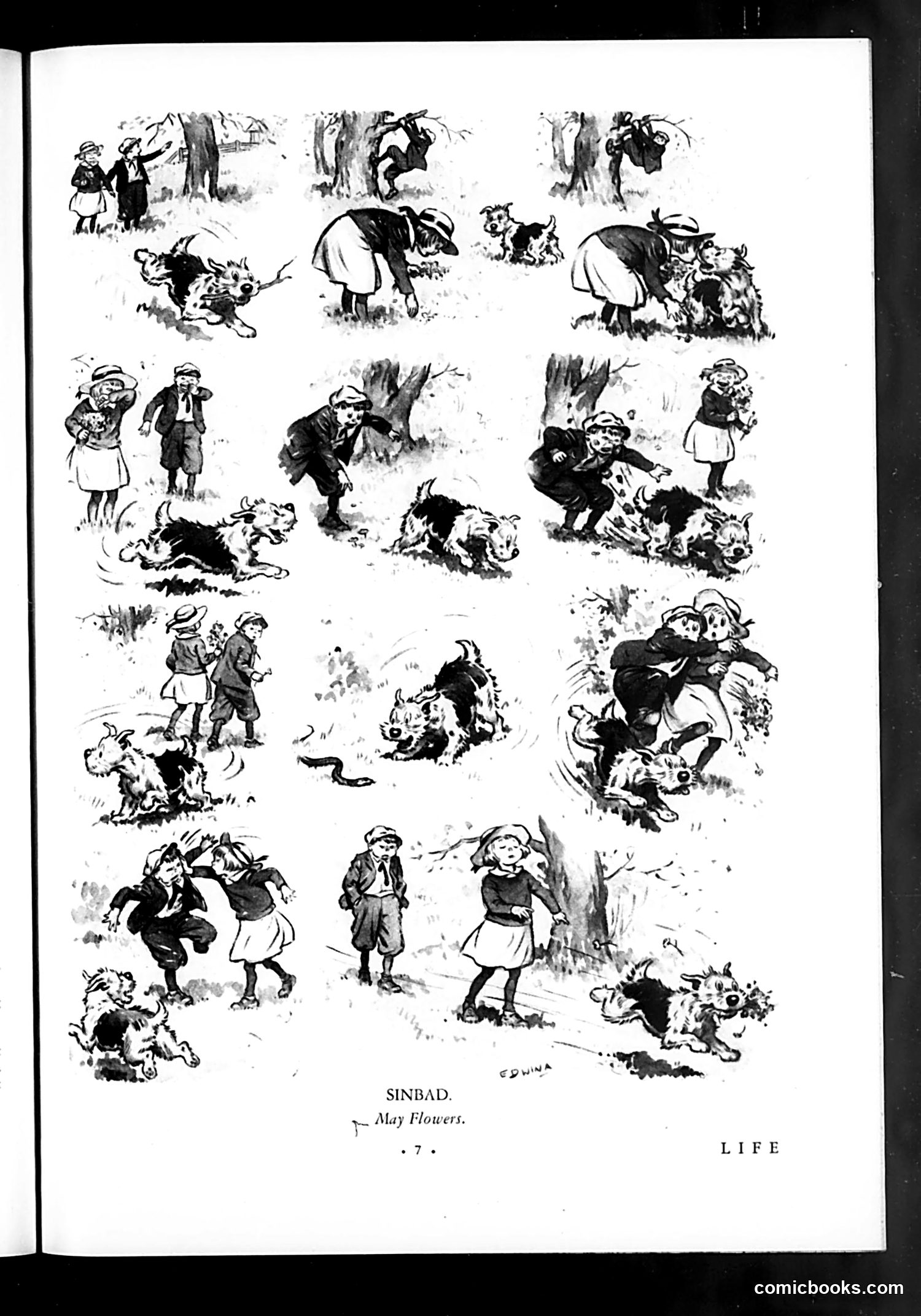
"Sinbad: May Flowers" - Life Magazine Comic This is a whimsical comic strip by artist Edna (signature visible) showing a character named Sinbad engaged in various spring activities with children and animals, particularly dogs. The scenes depict typical May Day or early spring pastimes: children playing outdoors, adults and kids interacting with pets, running, embracing, and celebrating in natural settings with trees and grass. The title "May Flowers" references the traditional association between May and spring blossoms. Rather than political satire, this appears to be lighthearted domestic humor depicting innocent childhood play and outdoor recreation—the kind of gentle, family-oriented comic content Life magazine regularly published alongside its satirical pieces.
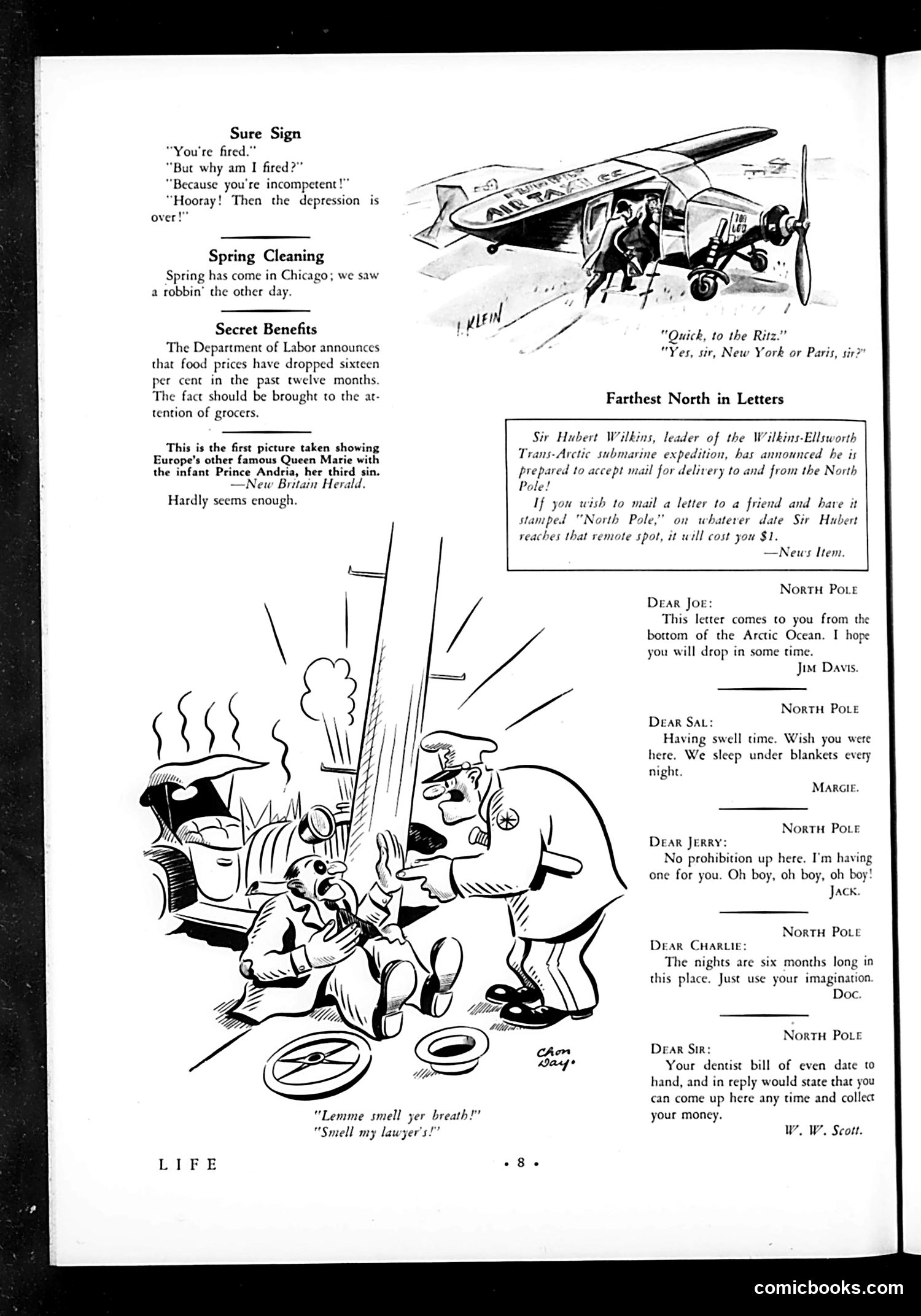
Content Analysis This page from *Life* magazine contains several satirical pieces: "Sure Sign" is a brief joke about job incompetence leading to depression relief through firing. "Spring Cleaning" notes a robin spotted in Chicago, suggesting winter's end. "Secret Benefits" reports food prices dropping 16% in twelve months—a positive economic indicator worth publicizing. The main cartoon depicts a chaotic kitchen scene where someone's breath is being remarked upon ("Lemme smell yer breath!" / "Smell my lawyer's!"). This appears to be Prohibition-era satire, mocking the absurdity of alcohol laws and their enforcement through humor about lawyer involvement in what should be simple matters. "Farthest North in Letters" features humorous postcards supposedly sent from the North Pole Arctic expedition, a novelty service advertised at $1 per letter.
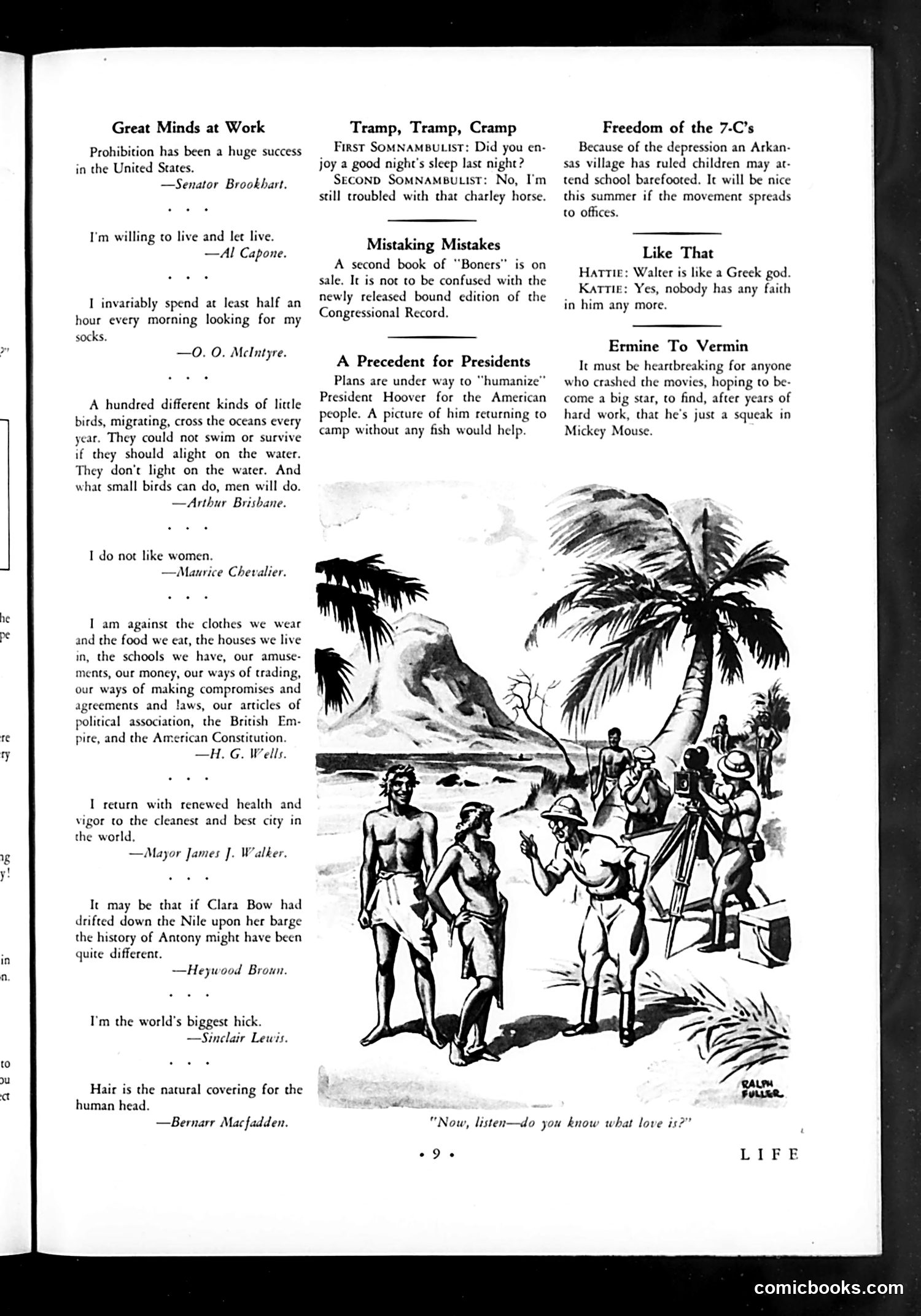
Analysis of Life Magazine Page This page contains miscellaneous satirical quotes and a cartoon illustration. The main visual depicts what appears to be a colonial or tropical scene with Indigenous people and European colonizers, with the caption "Now, listen—do you know what love is?" The satire likely mocks European colonialism and paternalistic attitudes toward Indigenous populations—the condescending framing of a "civilized" person explaining love to Indigenous people reflects period racism and the false assumption of European cultural superiority. The quotes above address various social topics (prohibition, fashion, politics) typical of Life's satirical format. The specific attributions appear to be humorous false citations rather than actual quotes from the named figures. Without a publication date visible, precise historical context remains unclear, though the colonial imagery and tone suggest early-to-mid 20th century.
"Life Looks About" - Page Analysis This page contains three opinion columns critiquing American public figures and social trends, rather than traditional political cartoons. "Salvation by Business" argues that having ambassadors with business backgrounds is sensible for a business-oriented country, defending this against isolationist criticism. "As Ford Sees It" quotes Henry Ford approvingly on business's role in society, suggesting business leaders understand practical solutions better than politicians. "Flouters of Garb" and "Accused of Frivolity" mock Mayor Walker (likely Jimmy Walker of New York) for neglecting his duties while pursuing private pleasures and nightlife, and criticize the National Republican Club for investigating his conduct rather than addressing substantive governance issues. The satire targets both political negligence and social hypocrisy regarding morality.
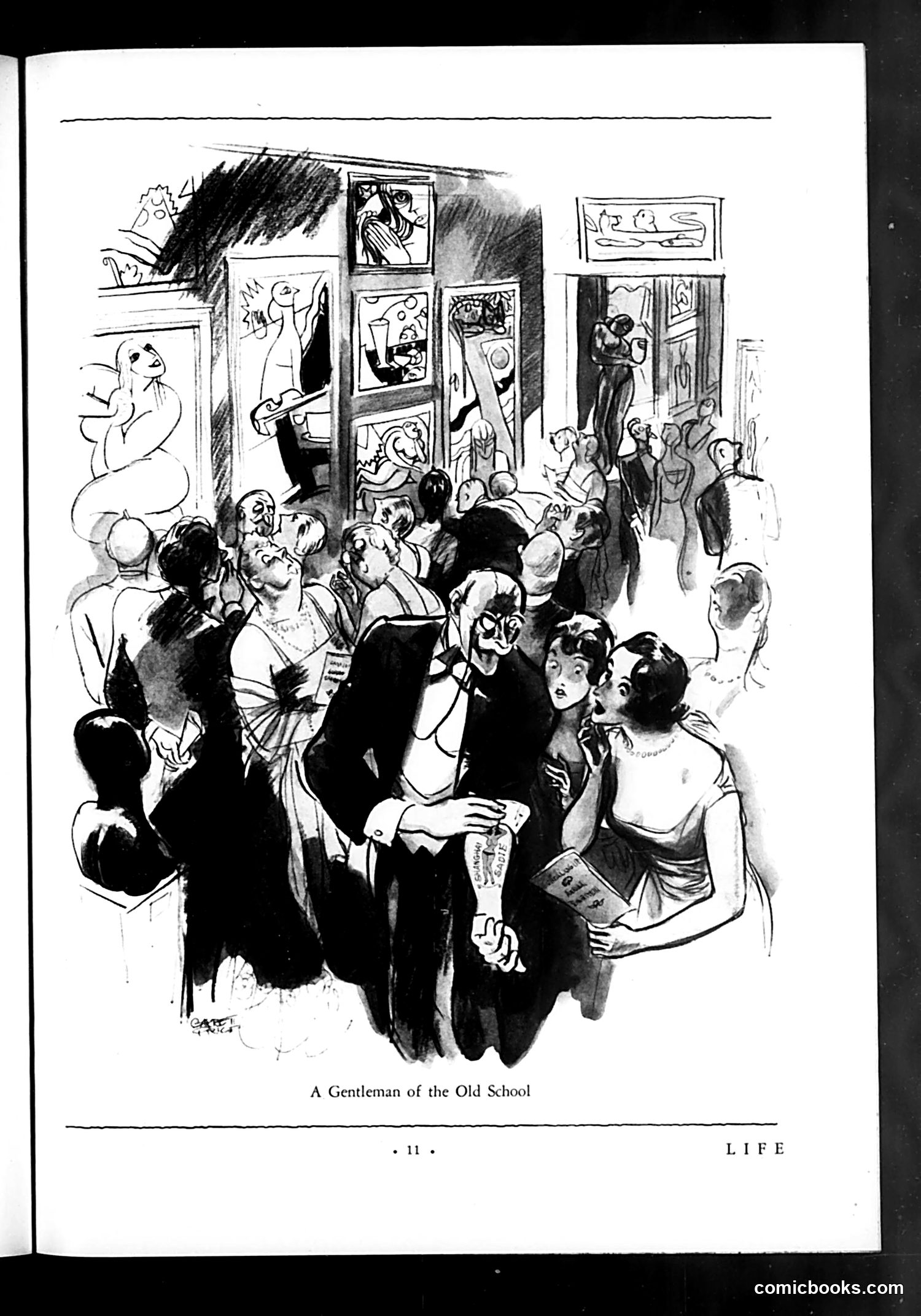
"A Gentleman of the Old School" This cartoon satirizes an old-fashioned man viewing modern art at what appears to be a gallery opening. The crowded, fashionably-dressed audience surrounds abstract or avant-garde artworks displayed on the walls. The central figure—wearing formal evening wear—appears bewildered or disapproving of the contemporary art scene. The satire targets the clash between traditional aesthetic values ("old school") and modernist art movements gaining prominence in early-20th-century America. The gentleman's formal, conservative appearance contrasts sharply with the bohemian gallery setting, suggesting he's an anachronism unable or unwilling to appreciate avant-garde artistic innovation. The cartoon mocks both conservative resistance to artistic progress and perhaps the pretentiousness of the modern art world itself.
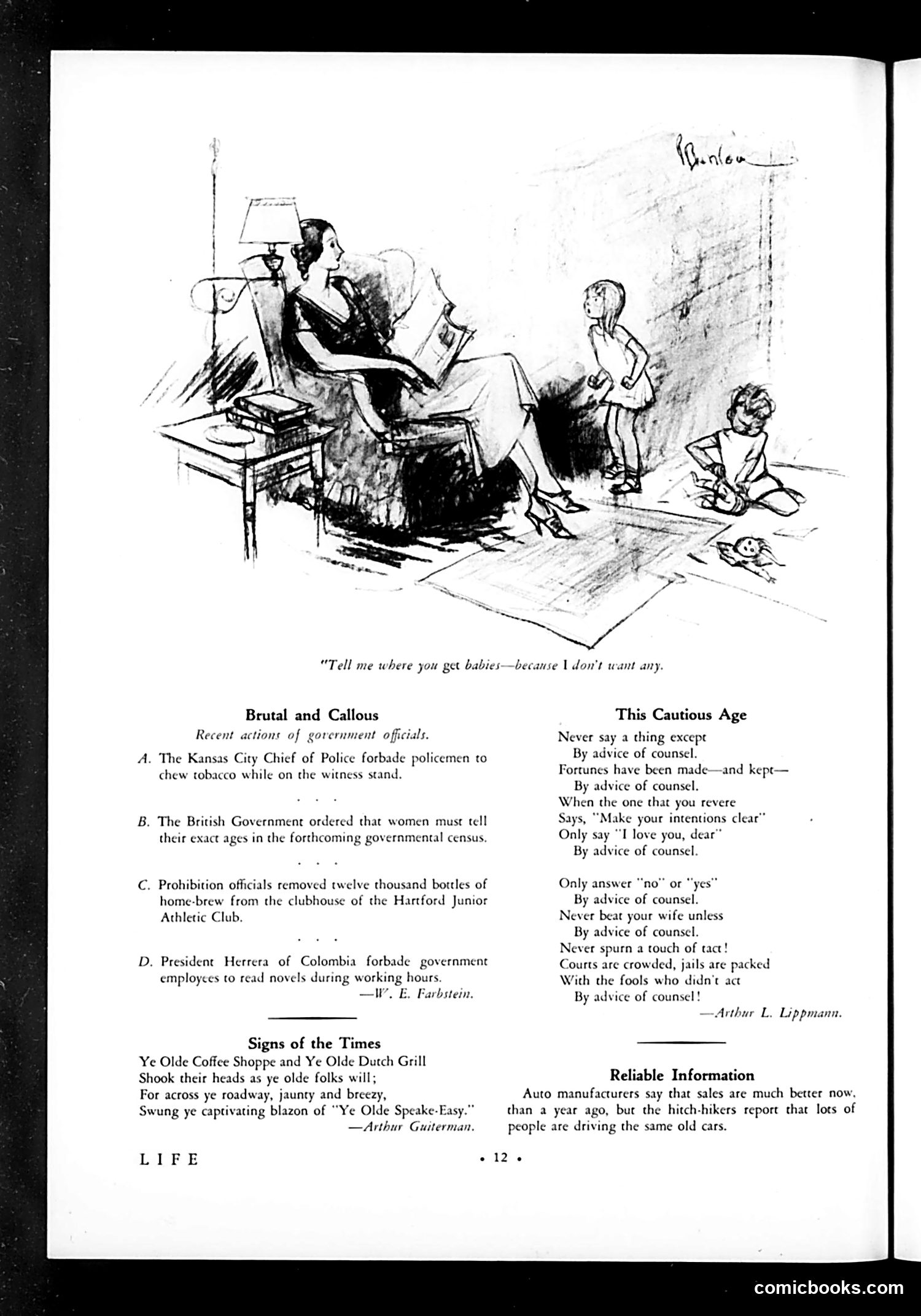
Analysis of Life Magazine Page 12 The Main Cartoon depicts a woman (apparently a parent or authority figure) seated at a desk with a lamp, confronting two children. One child stands while another sits on the floor. The caption reads: "Tell me where you get babies—because I don't want any." This satirizes the awkwardness of mid-20th century parental sex education. The joke operates on the parent's evasiveness: rather than answer honestly about reproduction, the parent deflects by claiming ignorance about the source, implying they want to avoid the topic altogether. Surrounding Content includes sections titled "Brutal and Callous" (documenting absurd government overreach) and "This Cautious Age" (satirizing overly legalistic modern behavior), reflecting Life magazine's typical satirical commentary on contemporary American social and political absurdities.
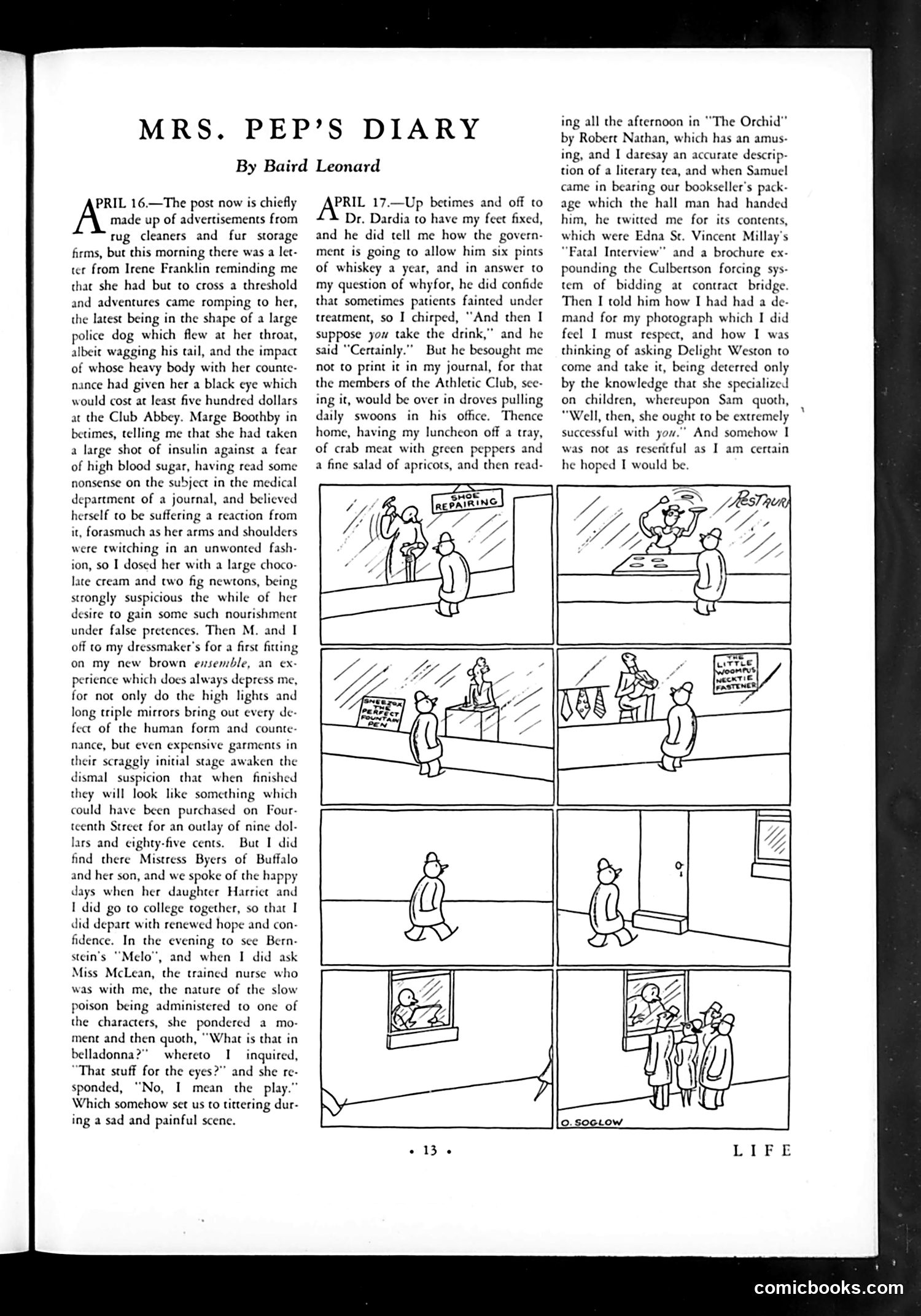
"Mrs. Pep's Diary" by Baird Leonard This is a humorous diary entry and comic strip (by O. Soglow) satirizing the social pretensions and anxieties of an upper-middle-class woman navigating 1920s-30s urban life. Mrs. Pep describes mundane domestic incidents—a police dog incident, a medical consultation, a dressmaker's fitting—while obsessing over appearances and social standing. The accompanying comic strip illustrates her visiting various shops and establishments, culminating in what appears to be a melancholic scene at a window. The satire targets how women of her class manufacture drama from trivial situations and maintain elaborate false pretenses about their lives and circumstances. The tone mocks her self-important anxieties about propriety and respectability, which the author presents as ridiculous and performative.
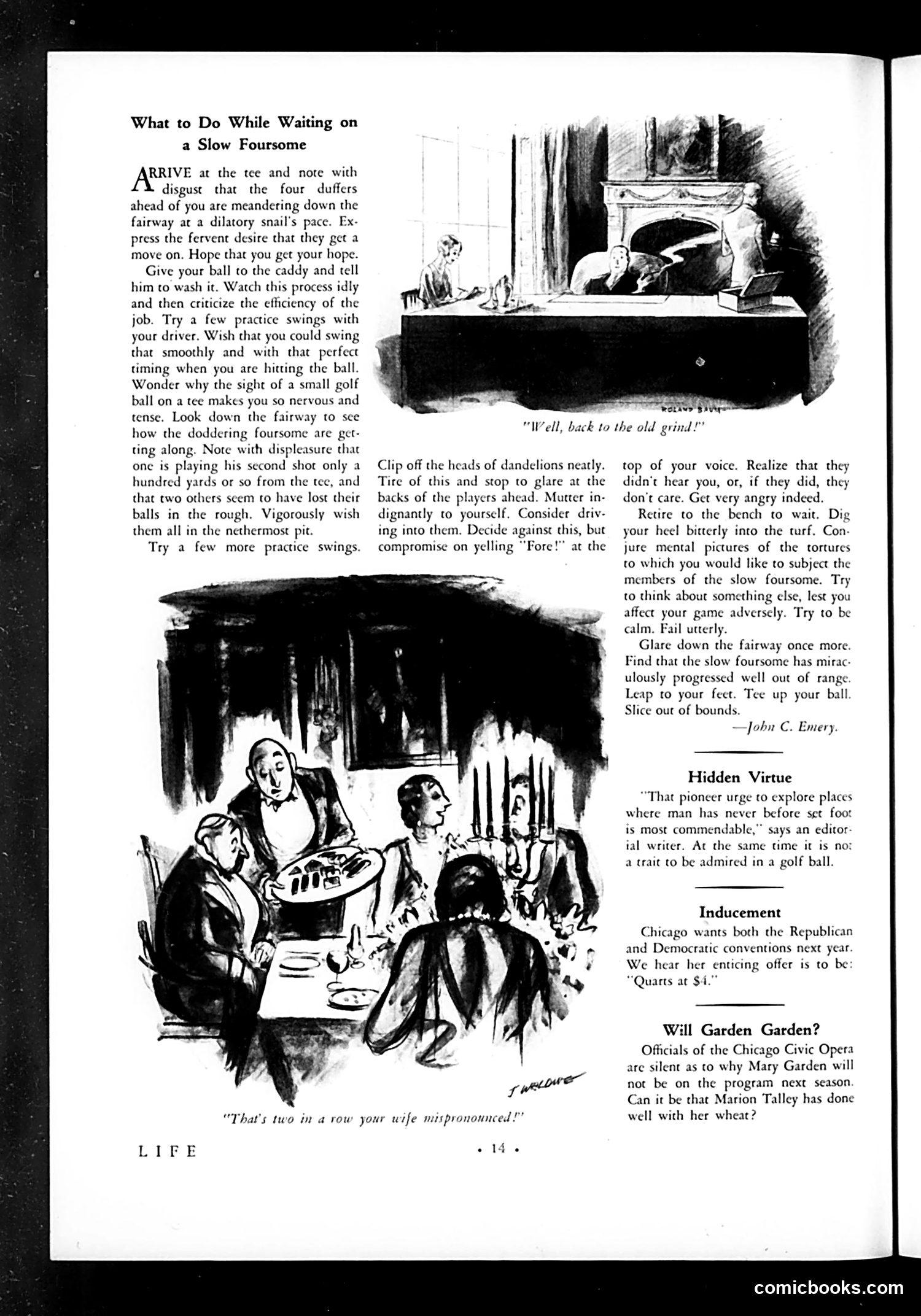
Analysis: Life Magazine Page 14 This page contains golf humor and brief gossip items typical of Life's satirical content. Main Article: "What to Do While Waiting on a Slow Foursome" by John C. Emery offers comedic advice for impatient golfers—wash your caddy's work, practice swings, clip dandelions, and mentally torture the slow players ahead. The accompanying cartoons show frustrated golfers at the course. Bottom Cartoon: Captioned "That's two in a row your wife mispronounced," depicts a dinner scene where someone appears to have made repeated verbal mistakes. Brief Items: - "Hidden Virtue" discusses explorer urges - "Inducement" references Chicago's political conventions, mocking a "Quarts at $1" offer - "Will Garden Garden?" gossips about Mary Garden's absence from Chicago Civic Opera's upcoming season, speculating Marion Talley replaced her The tone is lighthearted society commentary and inside-baseball chitchat.
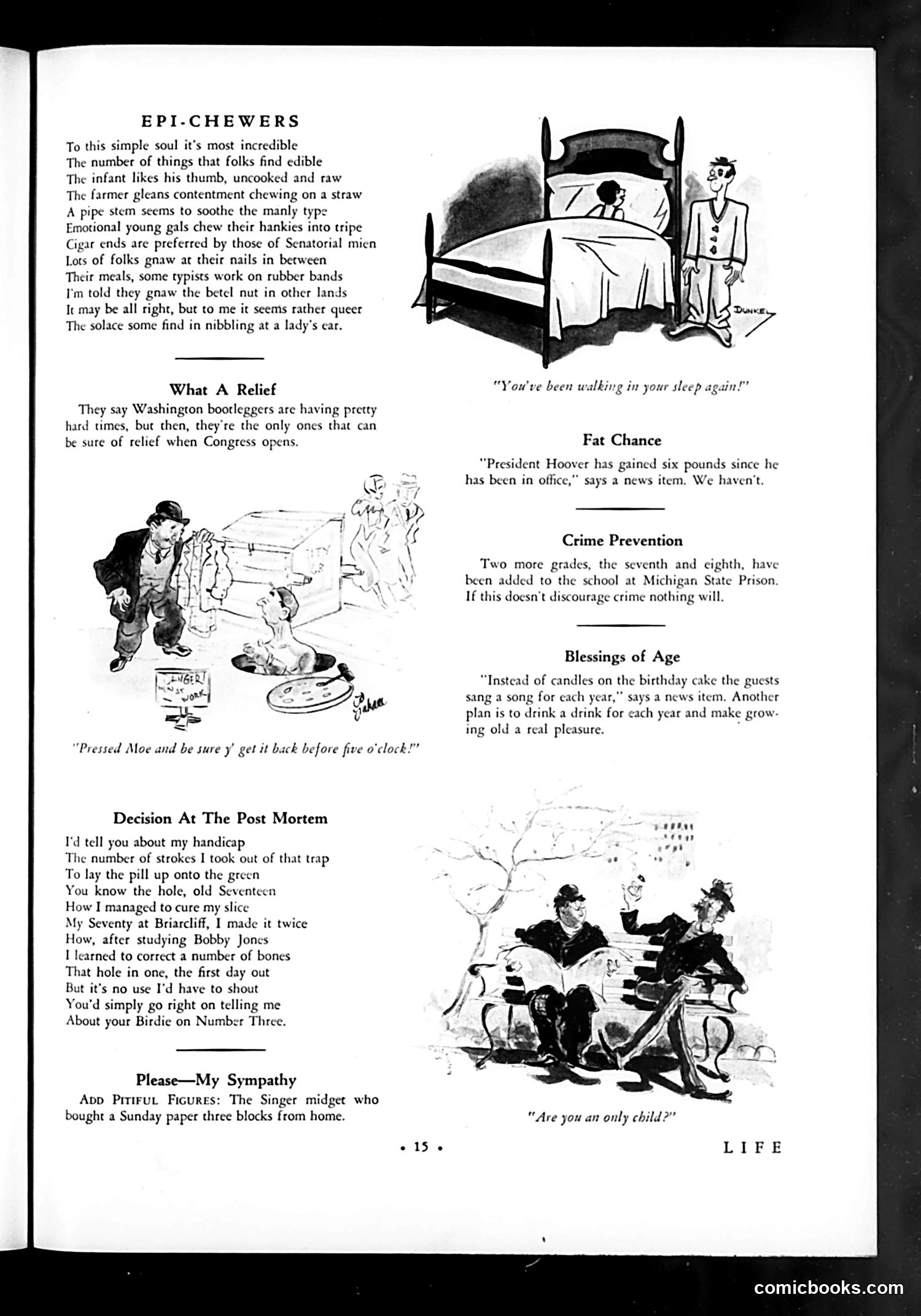
Analysis of Life Magazine Page This page contains humorous short pieces and cartoons typical of Life's satirical style. "Epi-Chewers" pokes fun at various people's chewing habits—infants, farmers, young women, and others—suggesting it's a universal, undignified behavior. "What A Relief" jokes that Washington bootleggers (illegal alcohol sellers during Prohibition) are having hard times, but Congress members can still get supplies—a dig at political hypocrisy during Prohibition. "Fat Chance" mocks President Hoover for allegedly gaining weight in office. "Decision At The Post Mortem" is a golfer's humorous monologue about his poor golf game, using death/cemetery language metaphorically. "Blessings of Age" satirizes alternative birthday celebrations replacing traditional candles. The cartoons feature simple line drawings accompanying these brief satirical observations about everyday American life and politics.
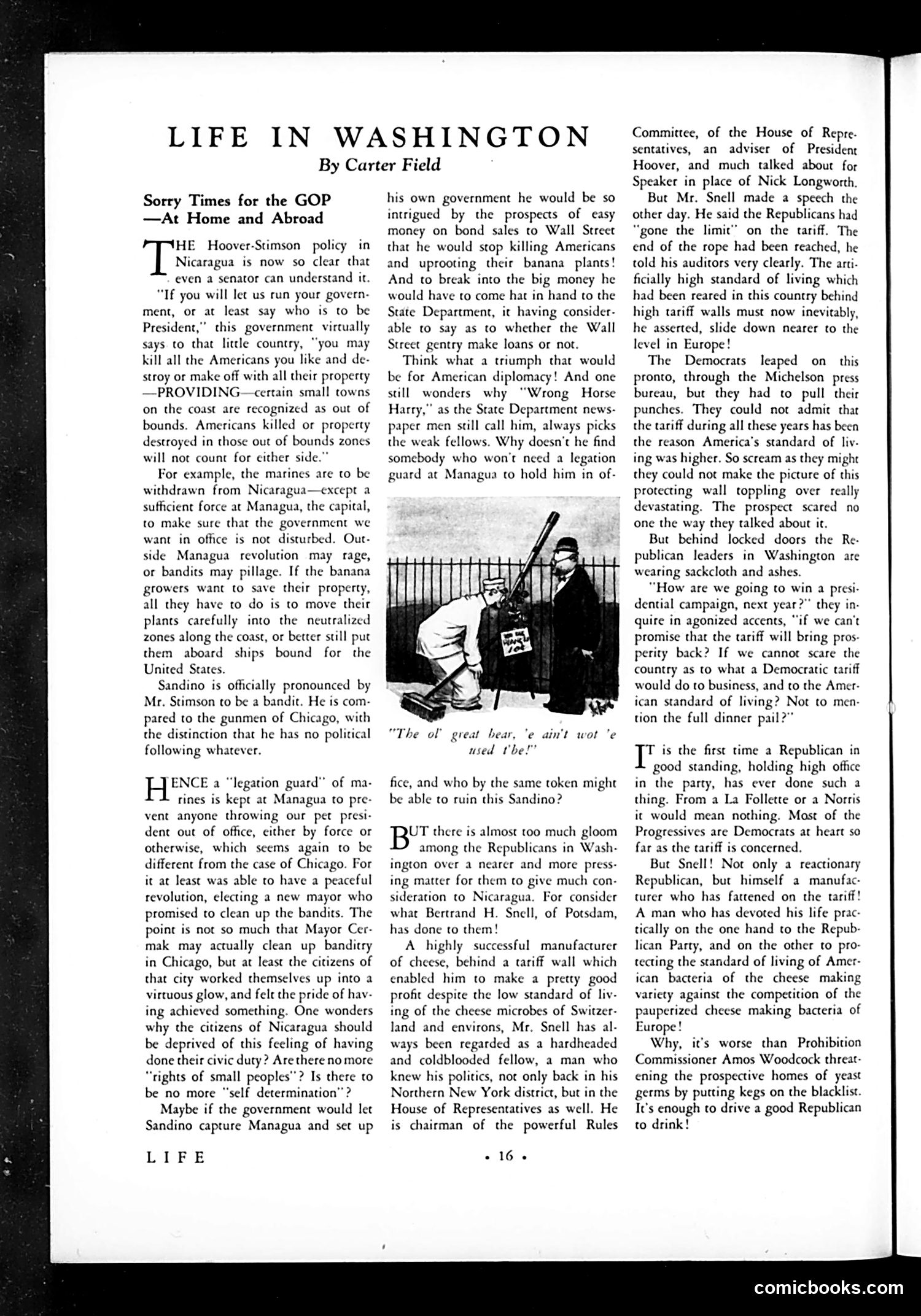
Analysis of Life Magazine Political Satire This page critiques Republican leadership's handling of Nicaragua policy and tariff issues. The cartoon depicts two figures discussing "the ol' great bear, 'e ain't wot 'e used t'be!"—likely referencing concerns about American diplomatic strength or Republican credibility. The article attacks the Hoover-Simson ploy regarding Nicaragua, criticizing Republican proposals to protect American business interests (particularly banana growers and cheese manufacturers) behind high protective tariffs. The author satirizes Republican leaders in Washington as divided and demoralized about campaign prospects, unable to confidently defend their tariff policies' effects on American living standards. The central complaint: Republicans have sacrificed consistent principles for special-interest protection, undermining their political standing.
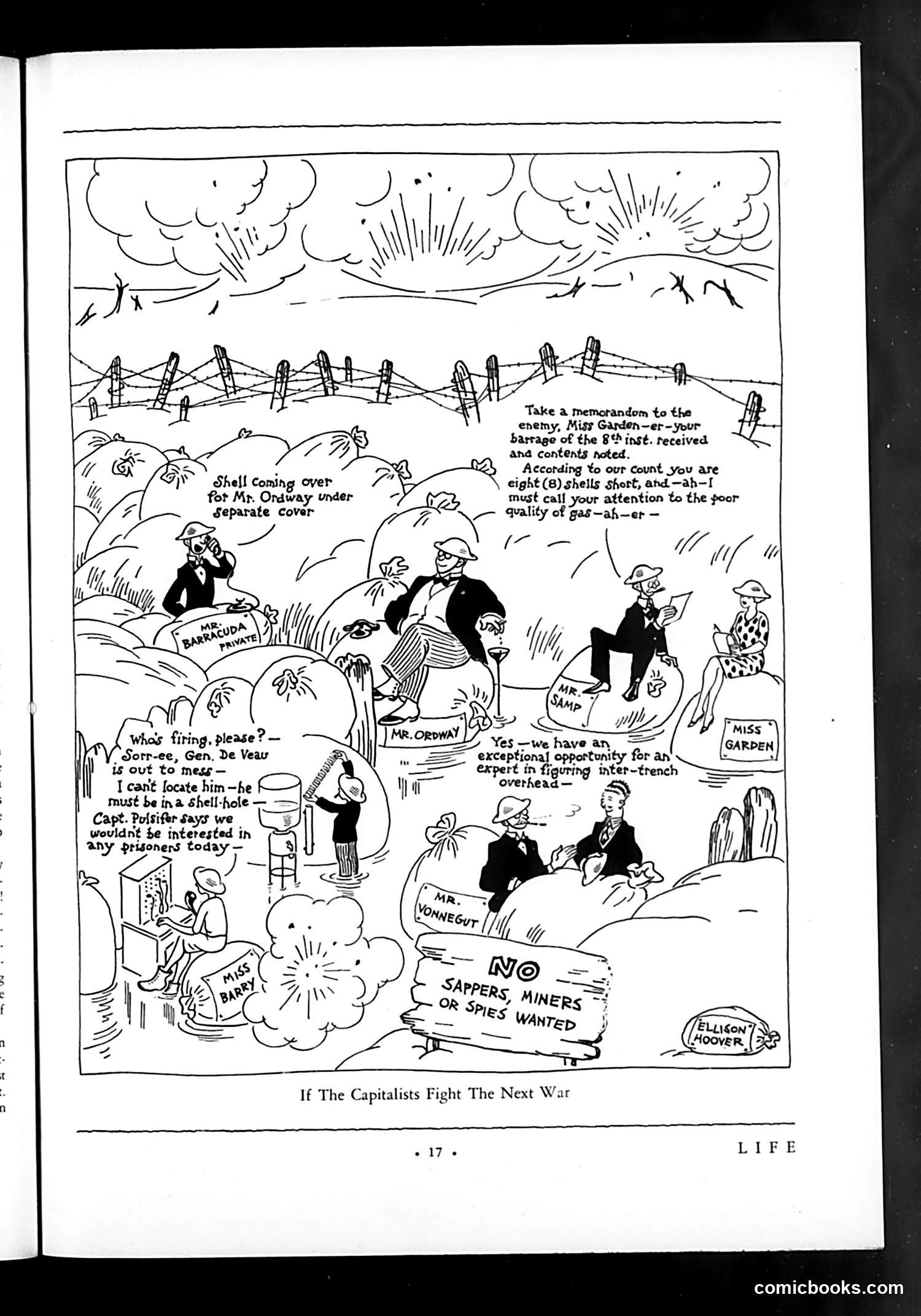
"If The Capitalists Fight The Next War" This satirical cartoon depicts a World War I-era trench scene where military officers discuss logistics. The humor centers on the absurd notion that capitalists would conduct warfare with the same bean-counting mentality they apply to business. Key elements include: - Officers with names like "Mr. Ordway," "Mr. Samp," and "Mr. Vonnegut" (business-like designations rather than military ranks) - A sign reading "NO SAPPERS, MINERS OR SPIES WANTED" — suggesting profit-conscious cost-cutting even in wartime - Discussion of "shell shortages" and "gas quality" with corporate efficiency concerns - The subtitle explicitly frames this as commentary on capitalist management of warfare The satire criticizes wealthy industrialists for prioritizing profit margins over military effectiveness and soldier welfare during combat.
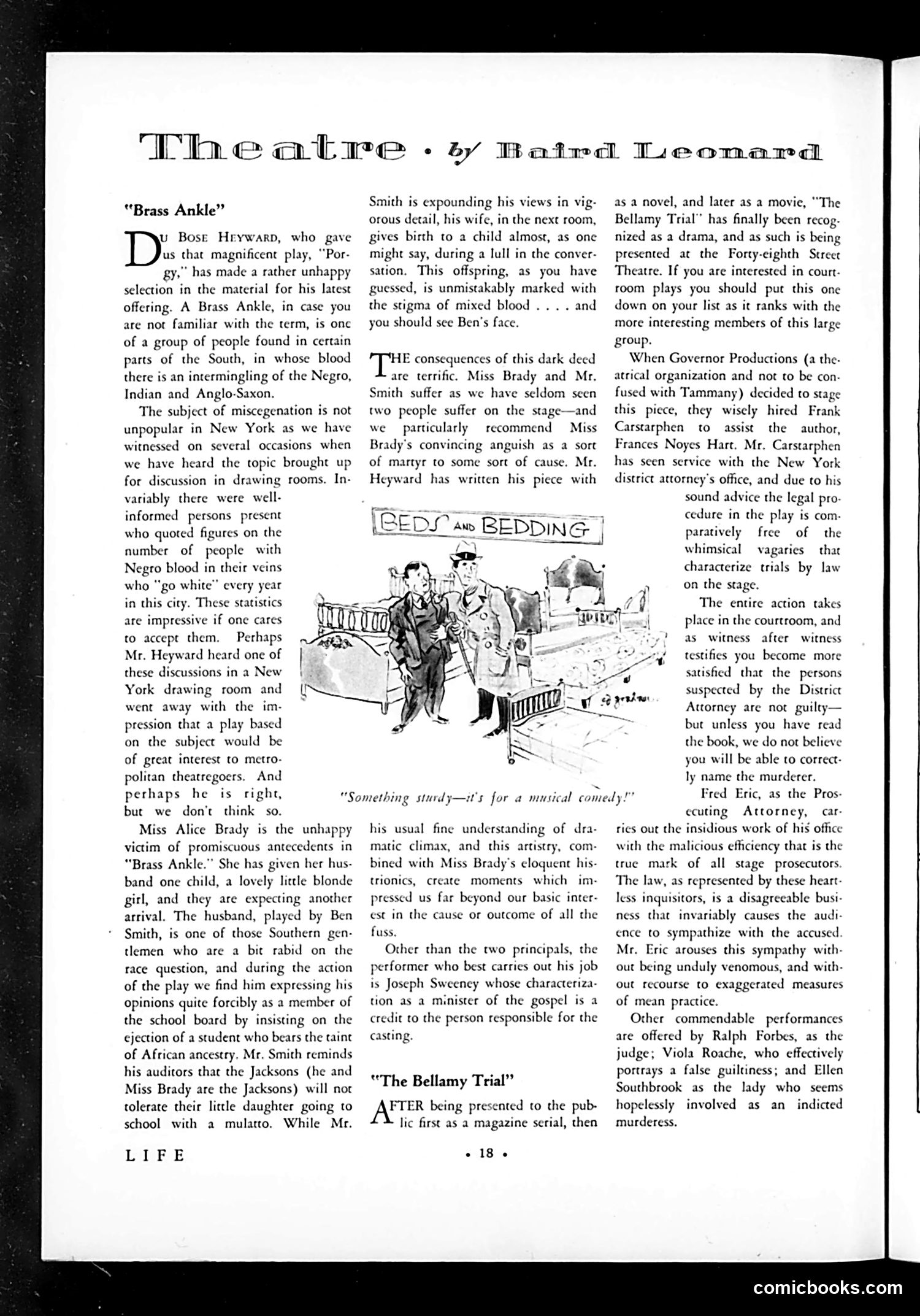
Analysis of Life Magazine Theatre Page This page reviews two theatrical productions. The main illustration, labeled "Beds and Bedding," depicts a bedroom scene and appears to accompany a review of a play involving marital drama and infidelity. The detailed text discusses "A Brass Ankle," a play by Du Bose Heyward exploring miscegenation—specifically relationships between white and Black characters in the American South. The review notes this was a controversial subject for 1920s New York audiences, referencing heated discussions about racial "purity" and mixed-race identity. The second review covers "The Bellamy Trial," originally a magazine serial, later adapted as a stage drama and film, involving a murder trial with complex character dynamics. Both reviews analyze performances and dramatic construction rather than promoting specific political positions.
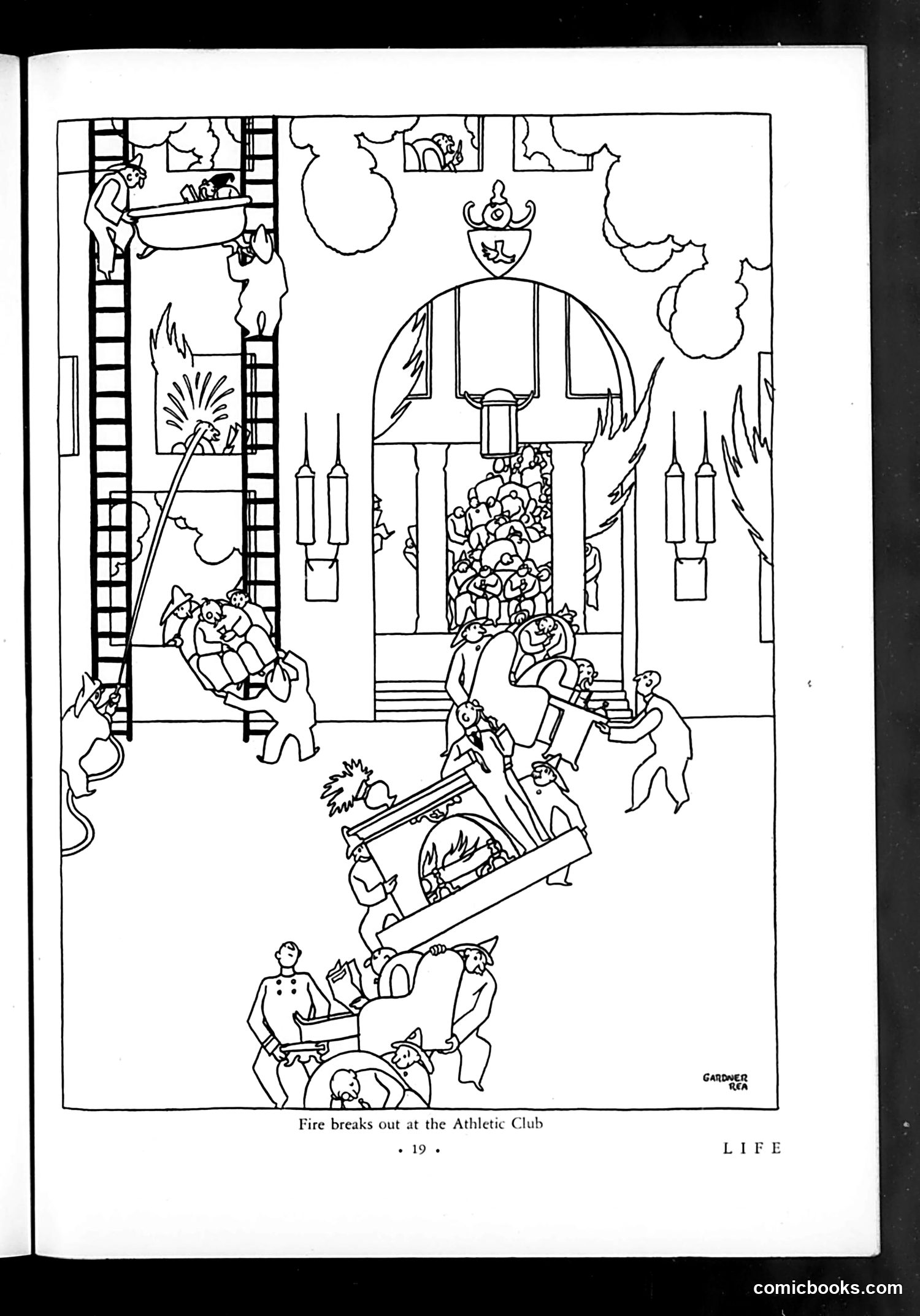
Analysis of "Fire breaks out at the Athletic Club" This is a humorous single-panel cartoon depicting a comedic disaster at an upscale Athletic Club. The illustration shows: - The scene: A grand building with an awning, ornate details, and lanterns, clearly an exclusive private club - The chaos: Multiple figures evacuating in panic—some descending ladders, others being carried out, with flames visible - The satire: The joke appears to target the pretensions and disorder lurking beneath the refined exterior of such exclusive establishments. The wealthy members' dignified composure dissolves into scrambling chaos when faced with emergency. The cartoon pokes fun at social elites and institutional pomposity by showing how quickly their orderly world collapses. The artist is Gardiner (signed lower right), and the page is credited to *Life* magazine, a major satirical publication of its era.
Life Magazine Movie Reviews - Historical Context This is a 1931 movie review column by Harry Evane covering three films. The key historical context: "The Millionaire" stars British actor George Arliss (a major star of the era) in a Horatio Alger-style rags-to-riches story. The reviewer praises Arliss's charm and acting ability so highly he composed verse about him—noting his charisma overcomes the implausibility of a British-accented actor playing an American self-made millionaire. James Cagney appears in a supporting role. "City Streets" is a Prohibition-era gangster film about bootlegging, featuring Gary Cooper and Sylvia Sidney. The reviewer dismisses the predictable "beer racket" plot formula where the villain has rivals assassinated, yet acknowledges the film is entertaining. The reviews reveal 1930s cinematic tastes: critics valued star charisma over plot originality, and gangster/bootlegging films were popular enough to warrant multiple similar productions. The Prohibition reference dates this to pre-1933.
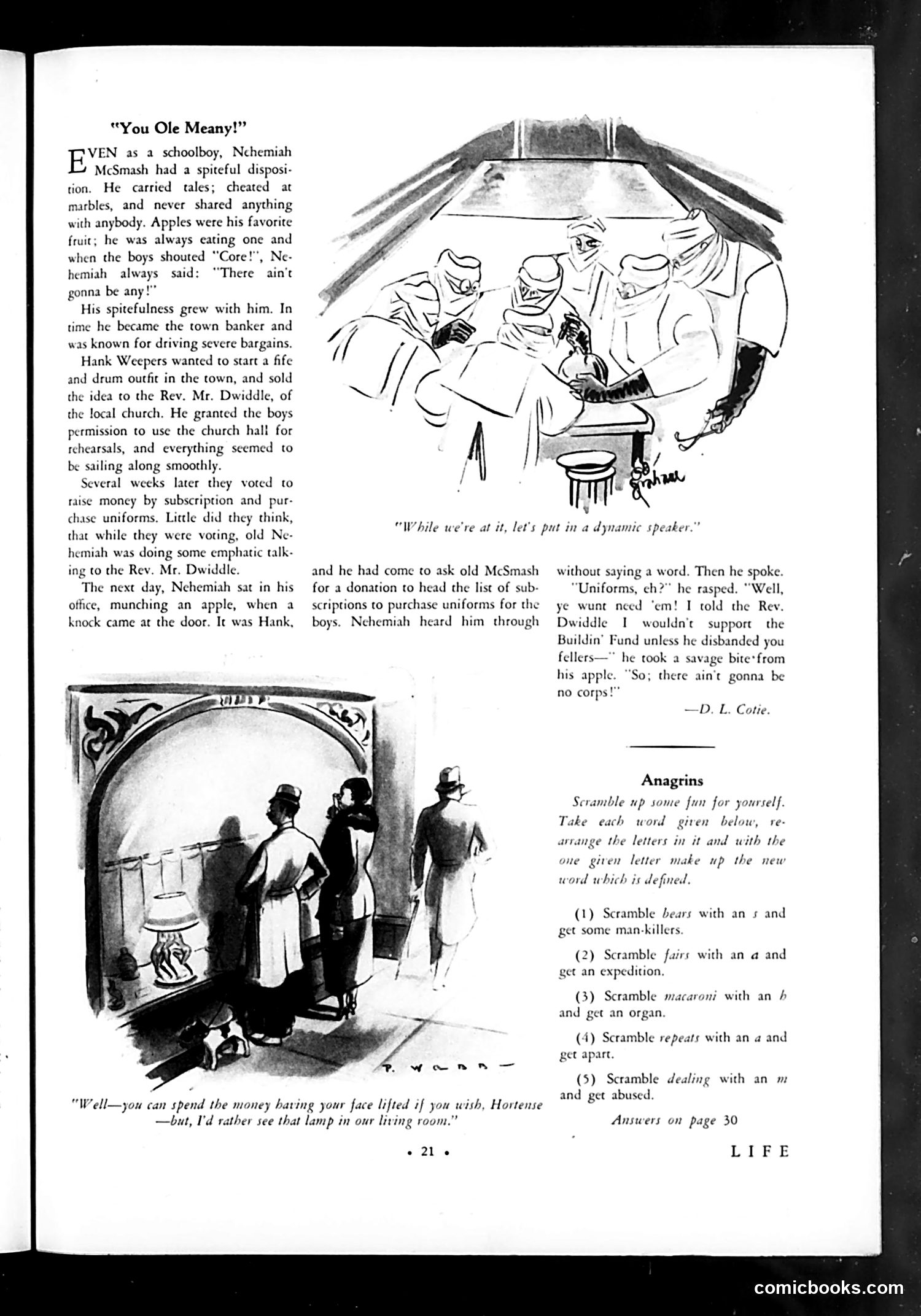
"You Ole Meany!" - Explanation for Modern Readers This story satirizes a miserly banker named Nehemiah McSmash, established as spiteful from childhood (hoarding apple cores, refusing to share). As an adult banker, he drives harsh bargains in his town. When local boys seek to form a fife and drum corps and need uniforms, they plan fundraising. McSmash, who already influenced the church reverend to deny them the hall, further sabotages the group by threatening to withdraw support from the church building fund unless the youth organization disbands. He does this purely from spite, not principle. The satire targets wealthy misers who weaponize their financial power against community activities, particularly those benefiting young people. The recurring "There ain't gonna be any" catchphrase emphasizes his petty refusal to allow others simple joys—a commentary on how the stingy and vindictive exploit their economic position to control others' lives. The page also includes an unrelated word puzzle feature ("Anagrins") typical of Life magazine's miscellaneous content.
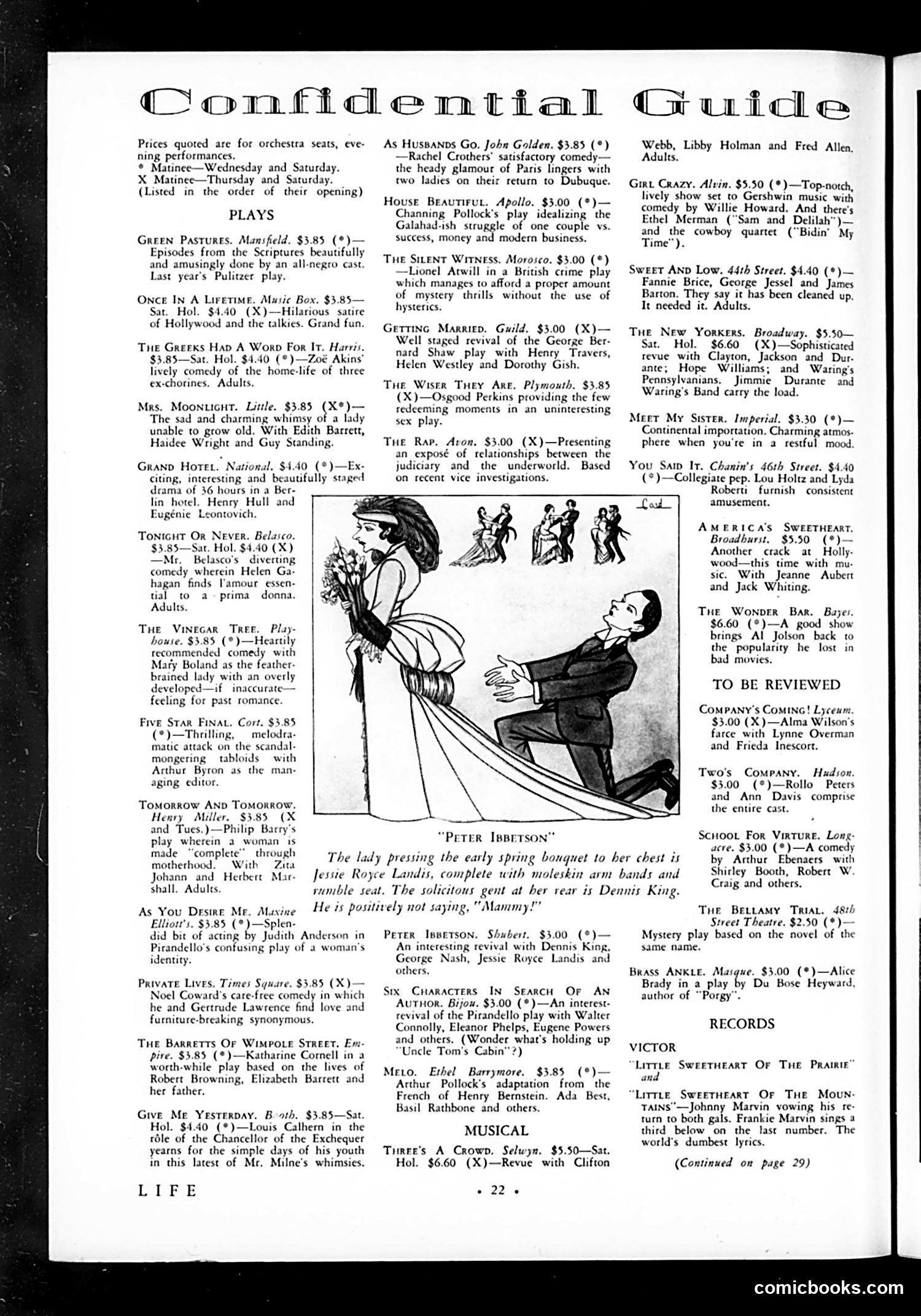
"Peter Ibbetson" Cartoon Explanation This page is primarily a theater guide listing Broadway shows with prices and brief reviews. The cartoon is a single illustration captioned "Peter Ibbetson," depicting a man in formal dress presenting an early spring bouquet to a woman in an elegant gown. The caption reads: "The lady pressing the early spring bouquet to her chest is Jessie Royce Landis, complete with moleskin arm bands and muddy seat. The reluctant gent at her rear is Donald King. He is pointedly not saying, 'Mammy!'" The satire: The joke appears to mock theatrical pretension—the woman's exaggerated, dramatic pose with the flowers contrasts with the man's obvious disinterest. The parenthetical comment about him "pointedly not saying 'Mammy!'" is unclear without additional context about Donald King's roles or contemporary theatrical in-jokes, but likely references an awkward or clichéd line he was known for or expected to deliver.
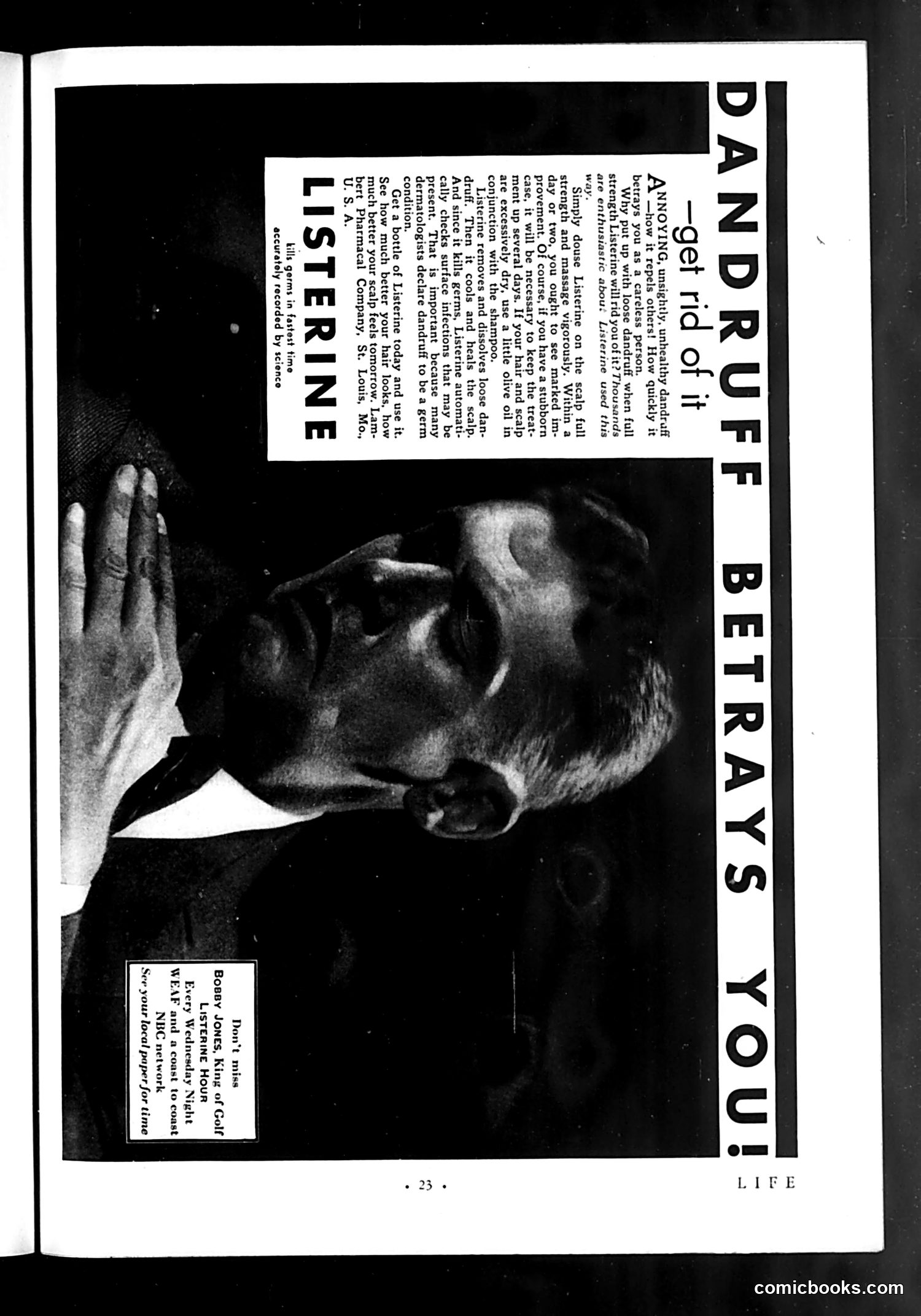
Analysis This page is primarily a Listerine advertisement, not political satire or a cartoon. The image shows a close-up photograph of a man's face/head in profile, used to demonstrate the product. The ad employs social shame as a marketing tactic, claiming dandruff "betrays you as a careless person" and "repels others"—appealing to readers' anxieties about social acceptance and personal hygiene. This was common advertising strategy of the era. The copy promises that Listerine mouthwash (its original purpose) can also treat dandruff when applied directly to the scalp, claiming it "kills germs" and dissolves loose dandruff. A secondary notice promotes "Bossy Jones, King of Golf" on the Listerine Hour radio program (Wednesday nights on NBC)—typical cross-promotion between print ads and sponsored radio entertainment. This reflects early-to-mid 20th century advertising's aggressive use of shame and pseudo-scientific claims about "germ-killing" products.
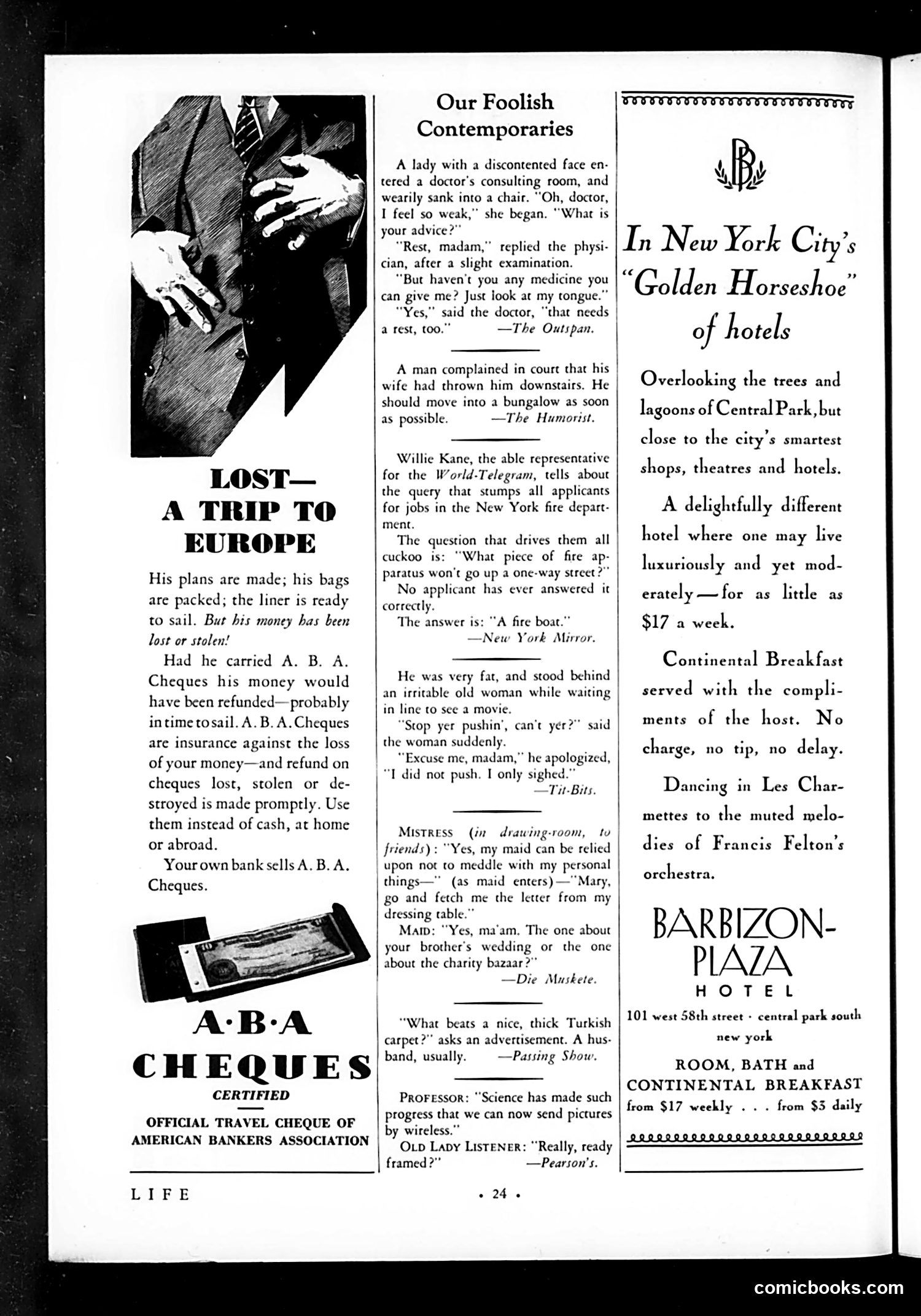
Analysis for Modern Readers This page combines humor and advertising. The left side features "Lost—A Trip to Europe," a cautionary tale illustrated with dramatic hands: a traveler's money is stolen before departure. The ad promotes A.B.A. Cheques (traveler's checks), positioning them as safer than carrying cash—a practical concern for 1920s-30s international travel when wire transfers didn't exist. The center section, "Our Foolish Contemporaries," collects short jokes from various publications satirizing everyday absurdities: a doctor recommending rest instead of medicine, a woman complaining about being pushed (the man was only sighing), a mistress asking her maid to fetch "the" letter while pretending the maid doesn't snoop. These mock human pretense and hypocrisy. The right side advertises the Barbizon-Plaza Hotel near Central Park, emphasizing luxury at modest cost ($17/week—roughly $300 today)—targeting middle-class travelers seeking upscale accommodations.
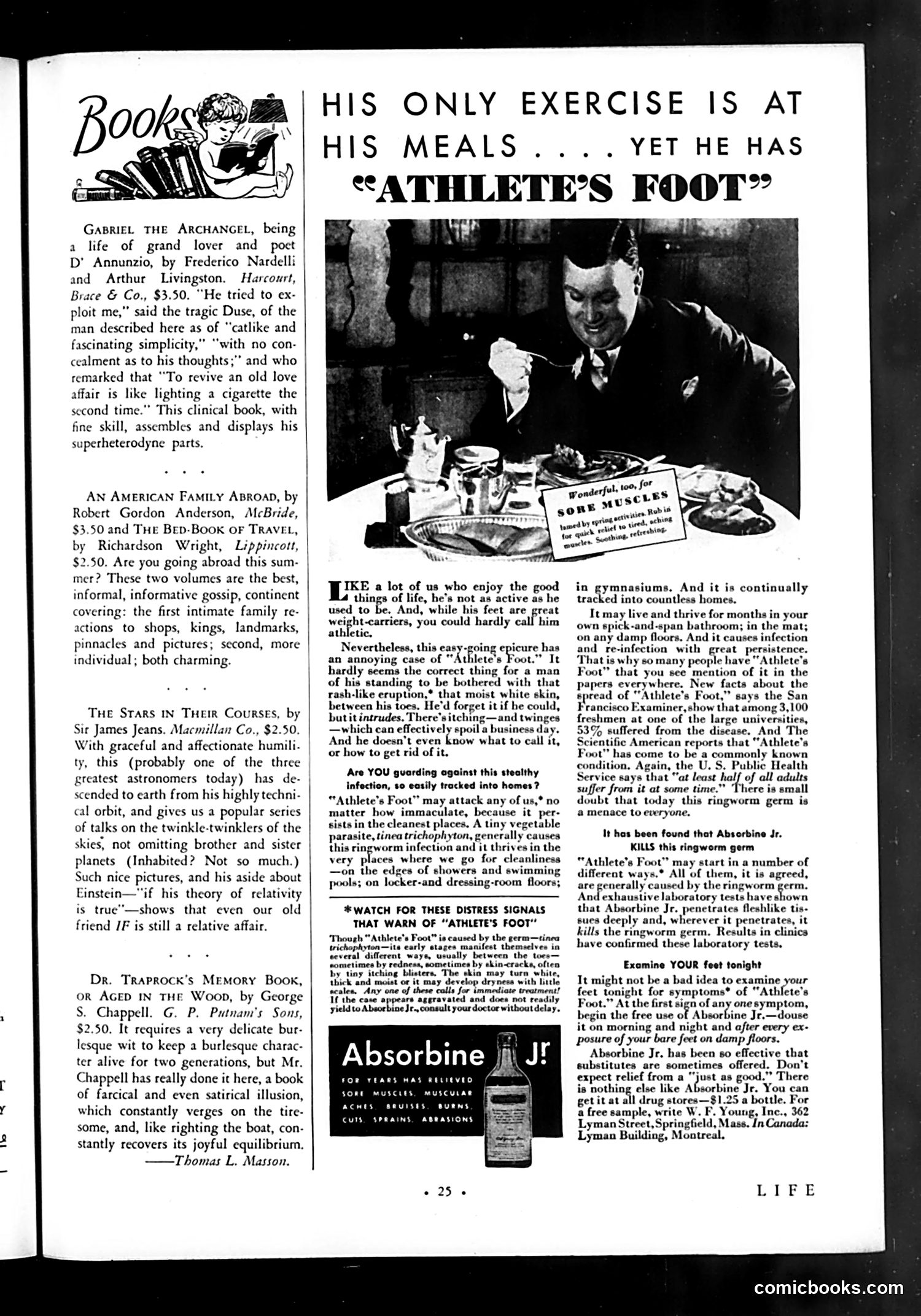
Explanation of This Life Magazine Page This page combines book reviews with a vintage advertisement for Absorbine Jr., a patent medicine marketed as a cure for athlete's foot. The advertisement's humor lies in its central image and headline: a sedentary, overweight man eating at a table is captioned as having "athlete's foot" despite doing "no exercise...at his meals." The joke satirizes the contradiction—this clearly inactive man paradoxically suffers from an ailment associated with athletic activity. This mocks both the ubiquity of the fungal infection (it spreads in public facilities, not just among athletes) and the absurdity of the disease's misleading name. The ad then shifts to earnest medical language, listing "distress signals" of the condition (redness, itching, blisters, white skin between toes) and warning readers to examine their feet. It positions Absorbine Jr. as an effective remedy, ultimately directing readers to consult doctors if symptoms persist. The page exemplifies 1920s-30s advertising: combining humor and fear to sell medicine to middle-class readers anxious about hygiene and respectability.
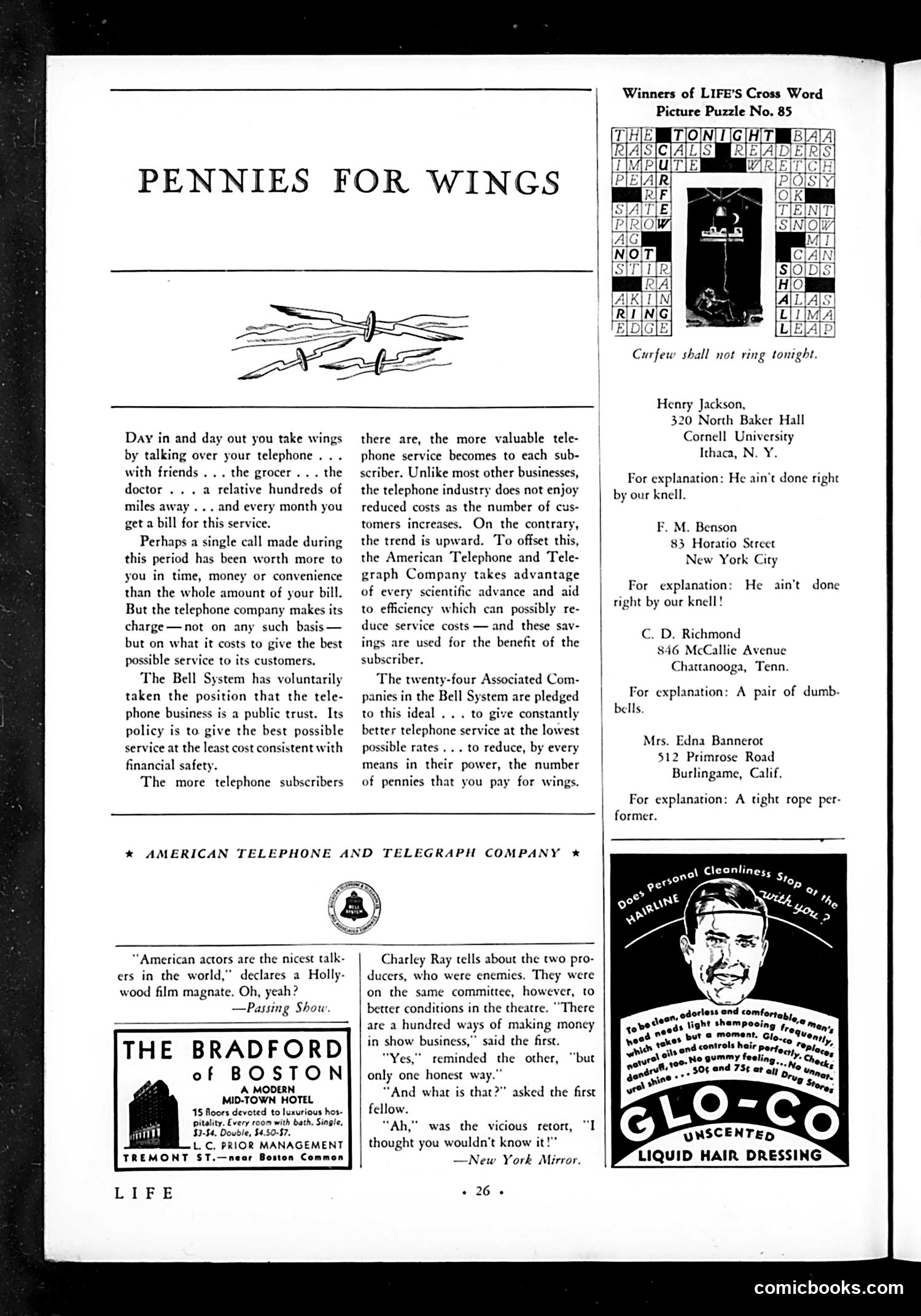
"Pennies for Wings" Analysis This is primarily a Bell System telephone company advertisement, not satire. The title uses "wings" as a metaphor for long-distance communication—the ability to reach people miles away instantly. The ad addresses a common consumer complaint: monthly telephone bills seem expensive relative to actual usage. Bell System's argument: charges reflect the *infrastructure cost* to provide service, not usage frequency. Unlike most businesses, telephone service *becomes more valuable* as more subscribers join, yet costs don't decrease—they increase. Therefore, "pennies" (small charges) fund the "wings" (communication capability). The accompanying content includes unrelated advertisements (Bradford Hotel, Clo-Co hair dressing) and humor sections mocking Hollywood producers' hypocrisy about business ethics. This represents mid-20th-century corporate messaging justifying utility rates through appeals to public trust and technological necessity.
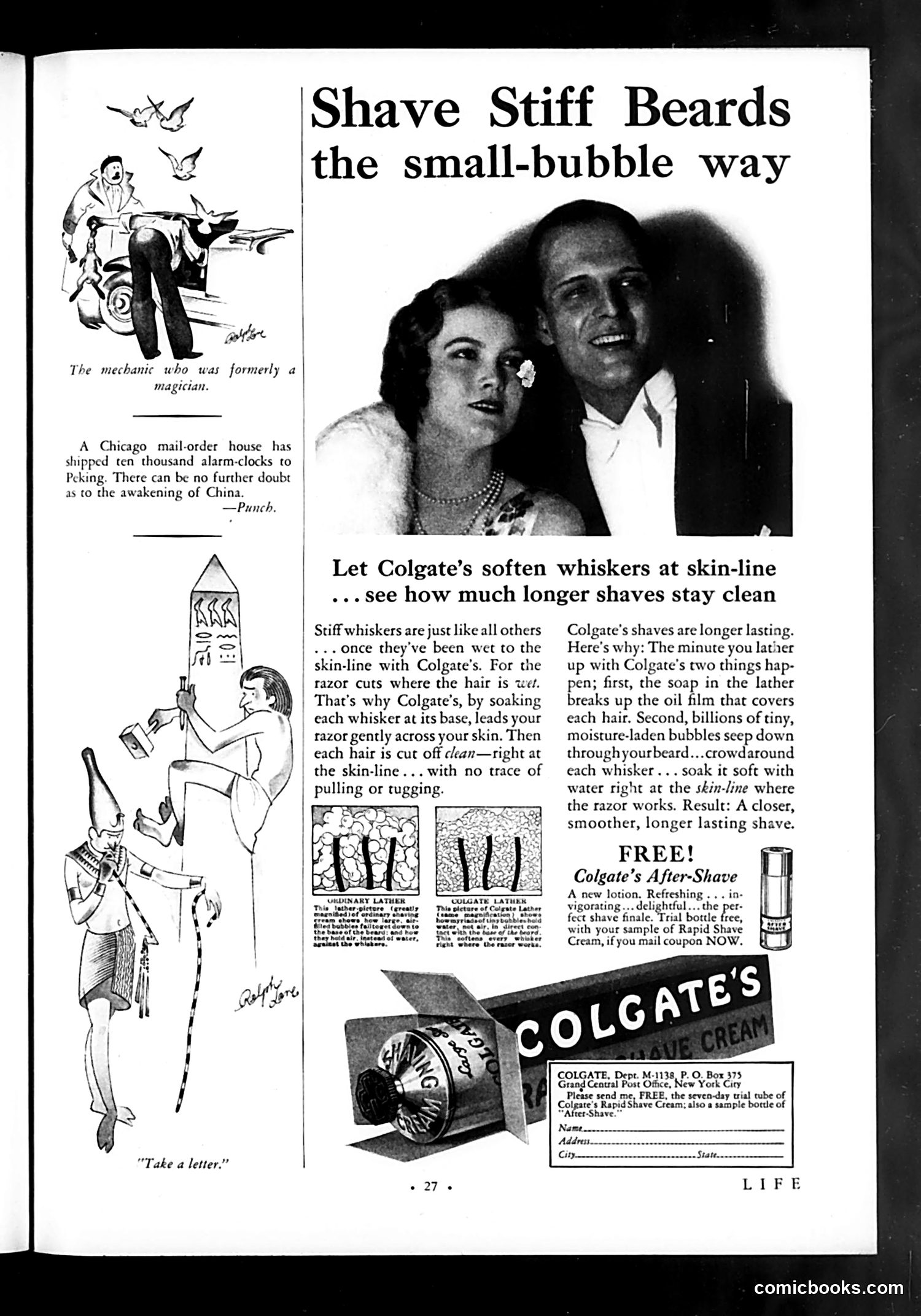
Explanation for Modern Readers This page combines three unrelated items typical of vintage *Life* magazine: Left cartoons: Two brief satirical jokes. The top depicts "The mechanic who was formerly a magician"—a visual gag about a man on a motorcycle. Below, a quoted item from *Punch* magazine jokes that a Chicago mail-order company shipping 10,000 alarm clocks to Peking (Beijing) proves China is "awakening"—a period reference to Western assumptions about modernizing China. The "Take a letter" cartoon shows office workers, likely poking fun at workplace dynamics. Right side: A full-page Colgate shaving cream advertisement exploiting gender dynamics typical of 1930s-40s advertising. It uses an attractive couple to promote the product, emphasizing how Colgate's lather softens whiskers at the "skin-line" for closer shaves. The ad includes microscopic imagery of lather bubbles and offers a free trial, using classic mid-century marketing techniques combining romance, scientific claims, and direct mail promotion. The page reflects era-specific humor and advertising conventions now largely obsolete.
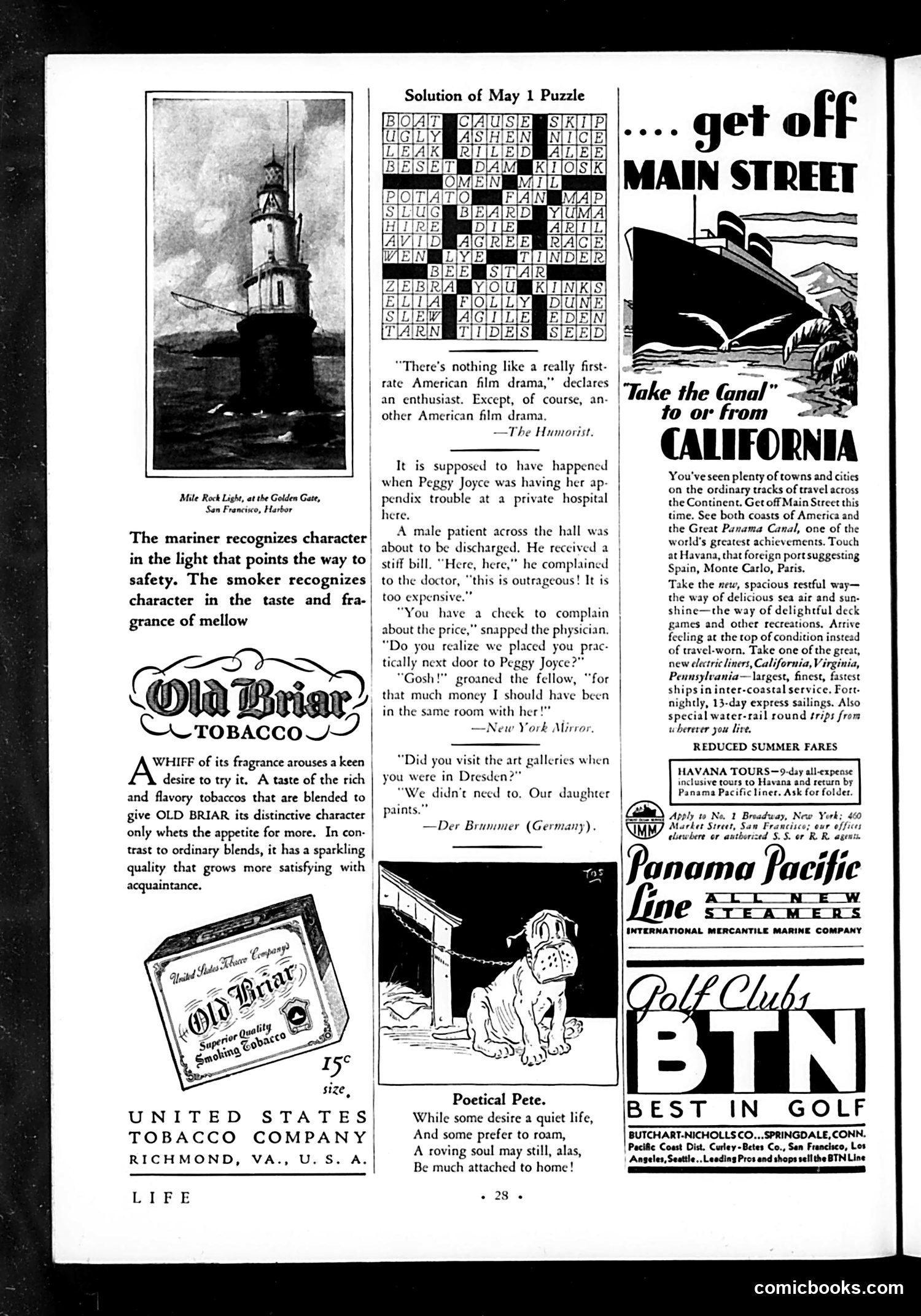
Explanation for Modern Readers This page mixes advertisements with humorous anecdotes typical of *Life* magazine's satirical format. The Jokes: The three brief humor pieces mock social pretension and celebrity obsession. The first joke ridicules inflated hospital bills by referencing Peggy Joyce, a 1920s socialite/actress famous for multiple marriages and lavish lifestyle—the patient jokes that proximity to her should justify the expense. The second mocks artistic pretension: a parent claims their daughter is an artist, but the punchline suggests mediocrity ("didn't need to see the galleries"). The third, "Poetical Pete," is gentle verse about wanderlust versus homesickness. The Cartoons: A dog labeled "Poetical Pete" illustrates the final verse—a visual pun on the name. The Advertisements: Old Briar tobacco, Panama Pacific cruise line, and BTN golf clubs dominate the page, using character and sophistication as selling points—common 1920s marketing appeals. The page reflects pre-Depression American consumer culture and celebrity-focused humor.
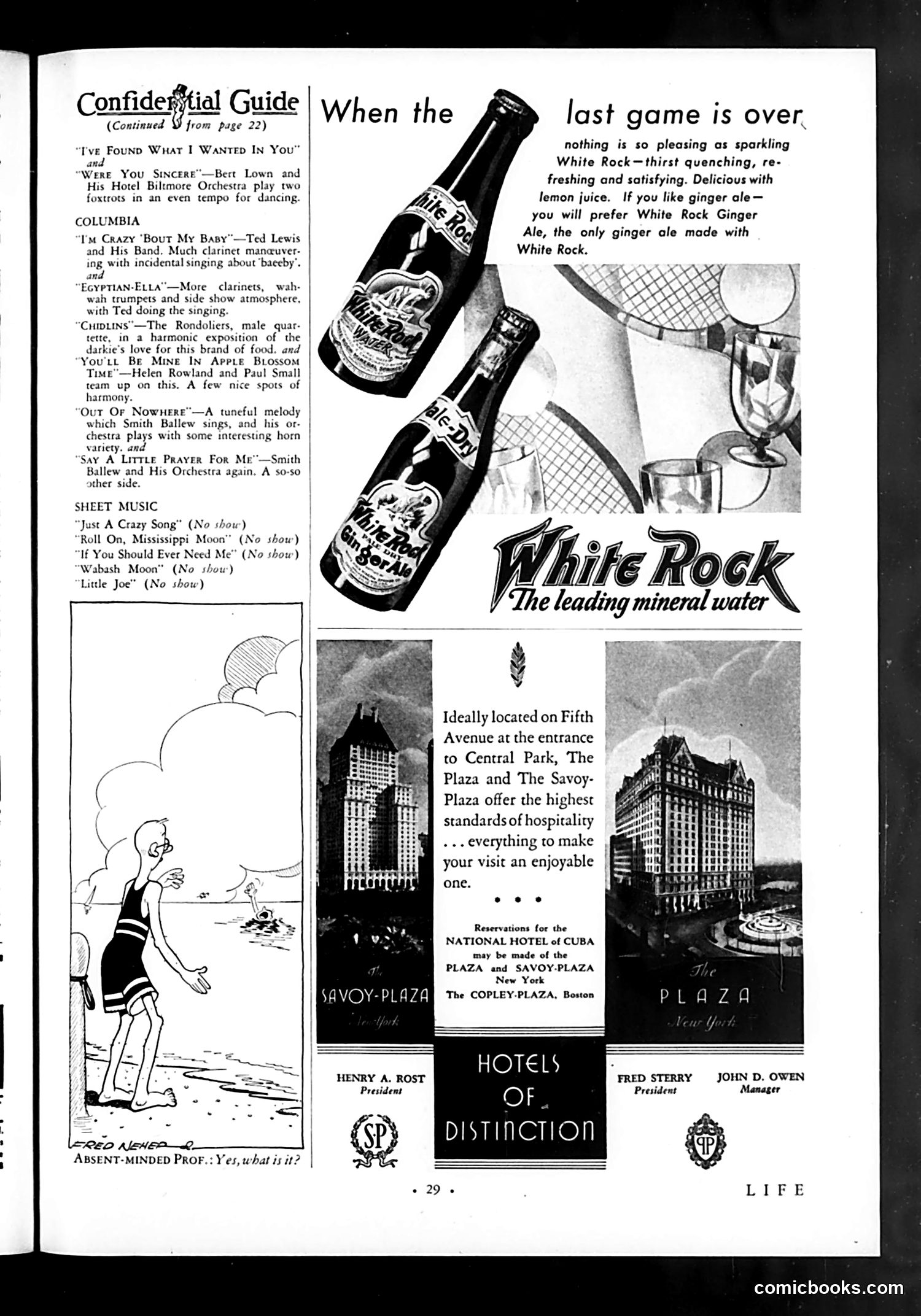
Analysis of Life Magazine Page (Circa 1920s) This page mixes entertainment listings with advertising. The upper left contains a "Confidential Guide" reviewing popular dance bands and sheet music of the era—Ted Lewis, Bert Lown, and others performing fox-trots and contemporary songs. The cartoon at bottom left depicts an absent-minded professor at the beach, a stock comedic figure of the period representing intellectual distraction from practical matters. The page's primary content is advertising: a large White Rock mineral water ad (positioned as post-sports refreshment), and hotel advertisements for New York's Plaza and Savoy-Plaza, plus Boston's Copley-Plaza, emphasizing luxury hospitality. A notably dated ad mentions "National Hotel of Cuba," suggesting pre-Castro travel accessibility. The page reflects 1920s American leisure culture—jazz-age entertainment, upscale hotel tourism, and branded beverages marketed to affluent readers.
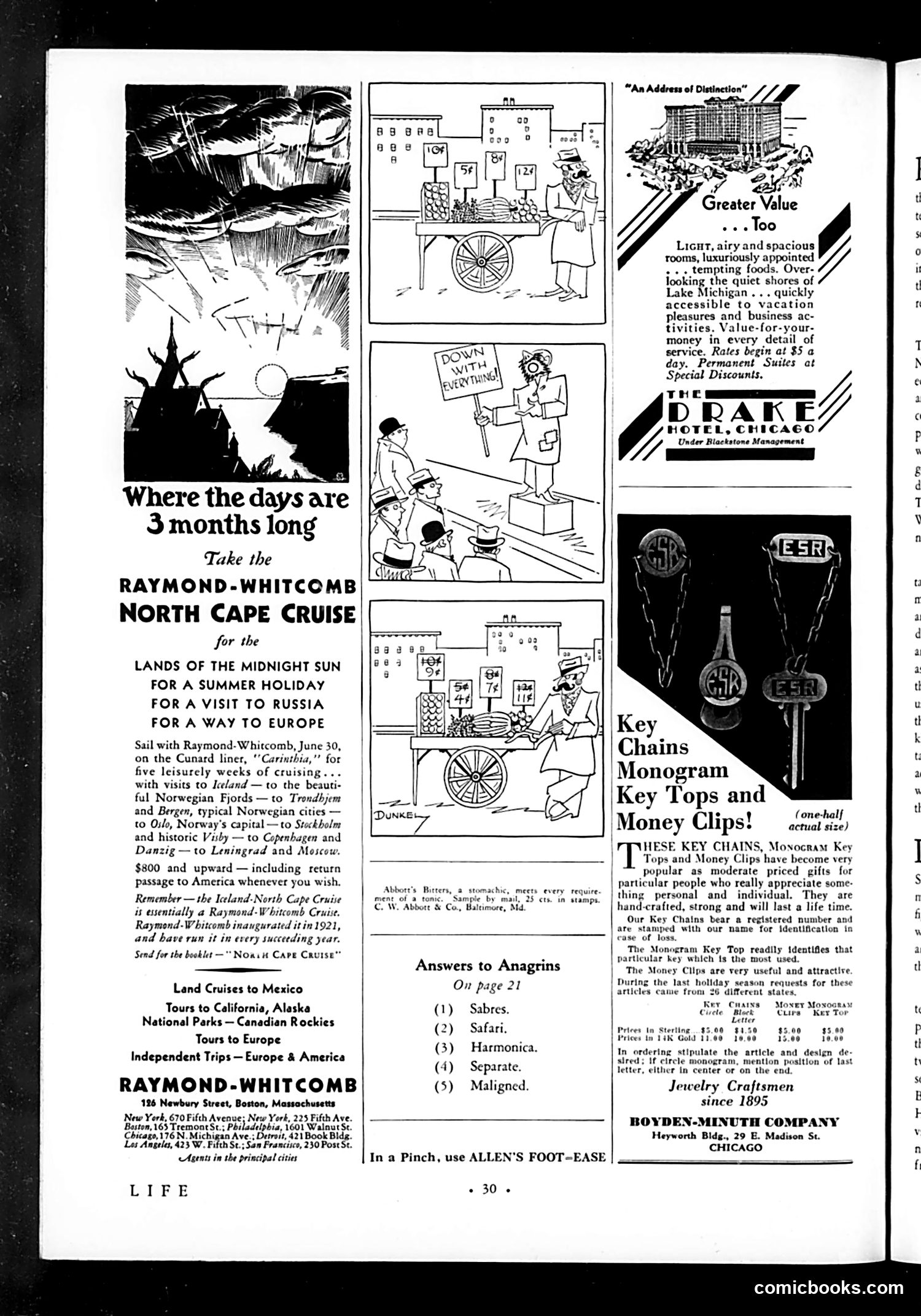
Analysis of Life Magazine Page This page is primarily advertising, not political satire. It contains three main advertisements: 1. Raymond-Whitcomb Cruise (left): Promotes a luxury Arctic cruise departing June 30 on the Cunard liner *Carinthia*, visiting Iceland, Norway, Russia (Leningrad and Moscow), and other European destinations. At $800 upward, this targets wealthy tourists seeking the "midnight sun" phenomenon. 2. Drake Hotel, Chicago (upper right): Markets lakefront luxury accommodations with rates beginning at $5/day and permanent suites available. 3. Boyden-Minuth Jewelry (lower right): Sells monogrammed key chains and money clips as gifts, hand-crafted and personalized. The page also includes puzzle answers and a small illustration about home organization (center), but these are filler content. There is no political satire or social commentary present—this is straightforward interwar-era consumer advertising aimed at affluent readers.
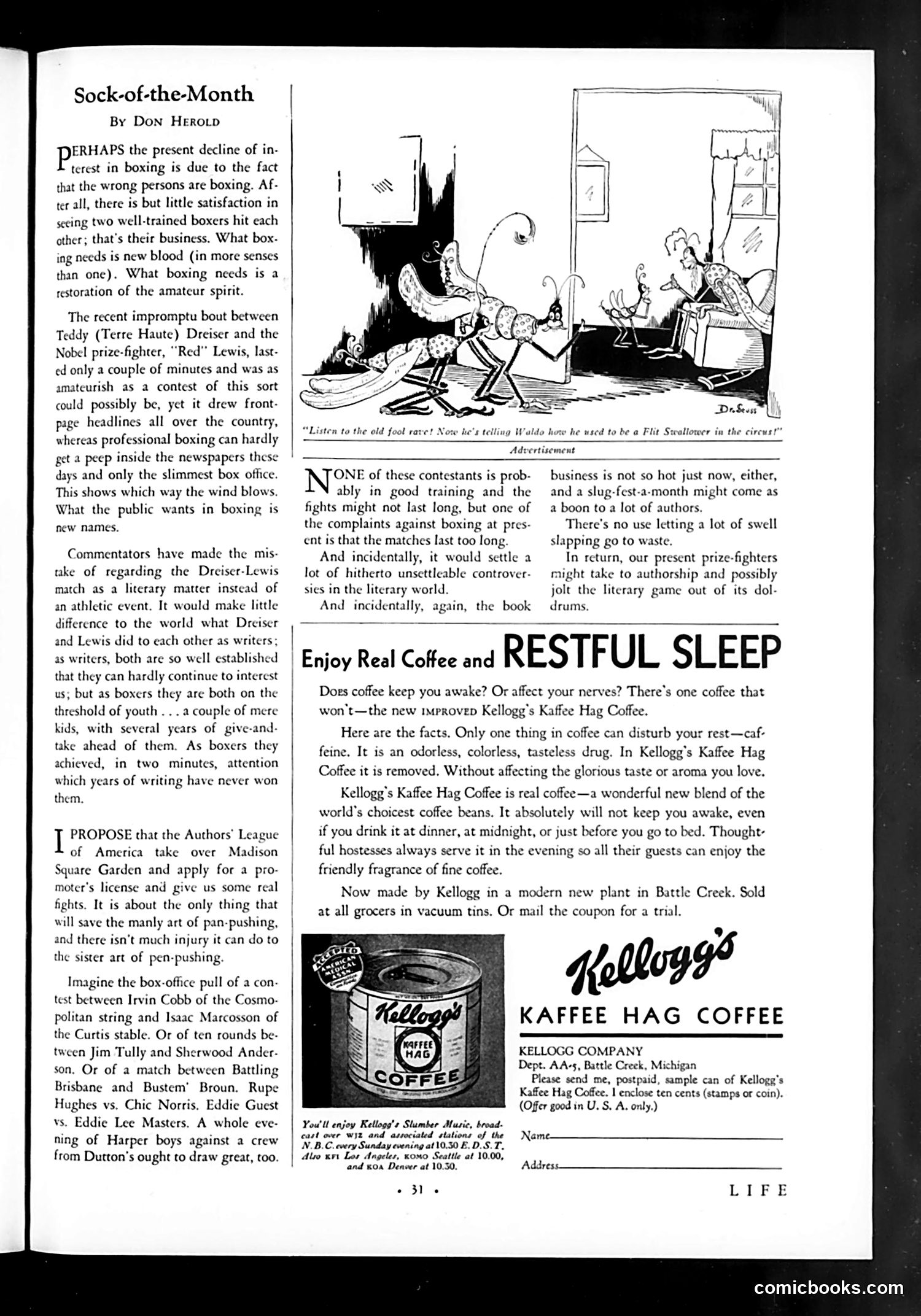
"Sock-of-the-Month" - Explanation for Modern Readers Don Herold's satirical essay proposes that professional boxing's declining popularity stems from the public wanting celebrity fights rather than skilled matchups. He references a recent impromptu bout between novelist Theodore Dreiser and boxer "Red" Lewis that garnered massive headlines despite lasting only minutes—proving audiences crave famous names over athletic quality. Herold's tongue-in-cheek solution: have the Authors' League of America promote boxing matches between famous writers (Irvin Cobb, Sherwood Anderson, etc.), treating literary feuds as literal fights. The cartoon depicts an elderly man telling tall tales to younger listeners, illustrating the exaggerated, boastful nature of such contests. The satire mocks both boxing's commercialism and the literary world's inflated egos, suggesting writers' conflicts are as entertaining as prizefights—and vice versa. It's a clever jab at celebrity culture and the absurdity of conflating intellectual reputation with physical prowess.
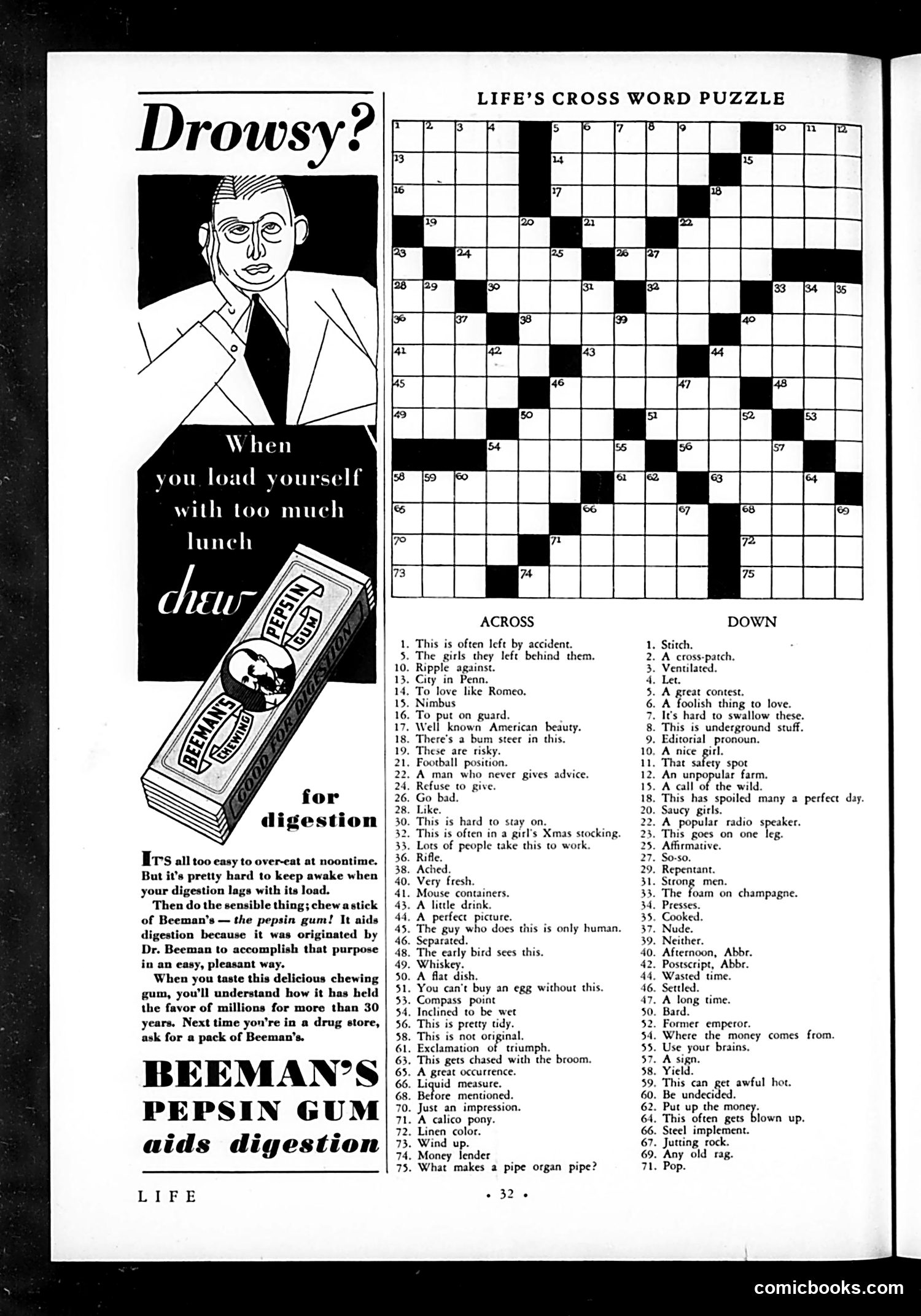
Life Magazine Advertisement & Crossword Puzzle Page This page combines a Beeman's Pepsin Gum advertisement with a crossword puzzle titled "Life's Crossword Puzzle." The Advertisement The ad addresses a common post-lunch problem: overeating at midday causes drowsiness and digestive sluggishness. The satirical cartoon shows a drowsy businessman, captioned "When you load yourself with too much lunch." The solution offered is Beeman's Pepsin Gum, which supposedly aids digestion. The ad claims the gum has been favored "for more than 30 years" and was originated by Dr. Beeman specifically to aid digestion "in an easy, pleasant way." The humor lies in the absurdity: chewing gum as a digestive aid for overeating. Modern readers would recognize this as dubious medical claim-making typical of early-20th-century advertising before FDA regulation. The Crossword The puzzle appears to be topical wordplay, with clues referencing contemporary people, places, and cultural references from the magazine's era, though specific identities aren't visible in the clue text provided.
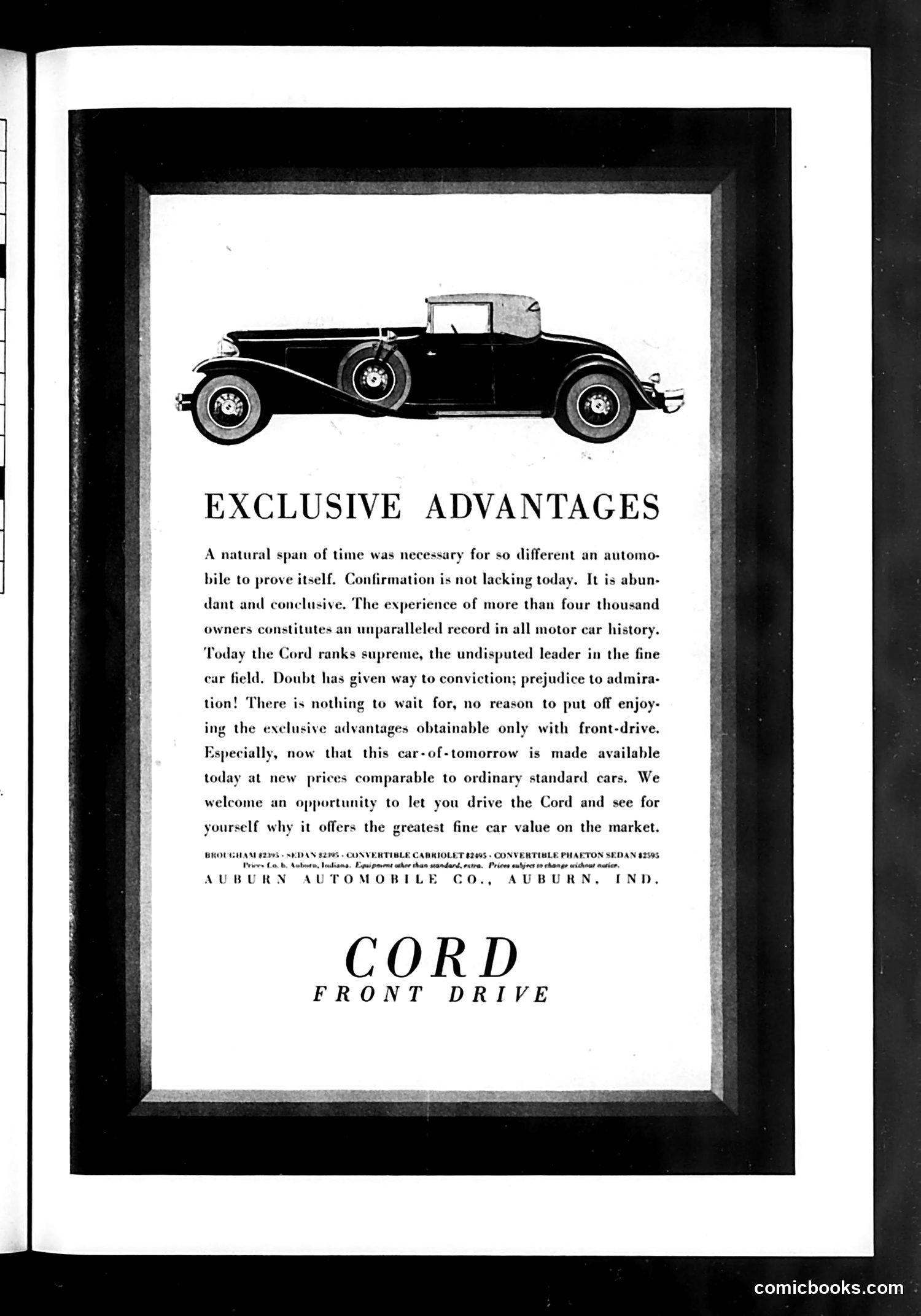
This is a car advertisement, not a political cartoon or satire. It promotes the Cord automobile, manufactured by Auburn Automobile Company in Indiana. The ad argues that the Cord's front-wheel drive represents revolutionary automotive technology ("car-of-tomorrow") that has now proven itself through four thousand owners' experience. The key selling point is exclusivity combined with affordability—the text emphasizes that this premium "fine car" is now priced comparably to standard vehicles, eliminating reasons to delay purchase. The accompanying illustration shows a sleek, open-air Cord roadster in profile, emphasizing its modern design. The advertisement targets affluent buyers seeking both prestige and practical value, appealing to pride in owning cutting-edge technology at competitive prices. There is no satire; this is straightforward promotional copy typical of 1920s-1930s luxury automobile marketing.
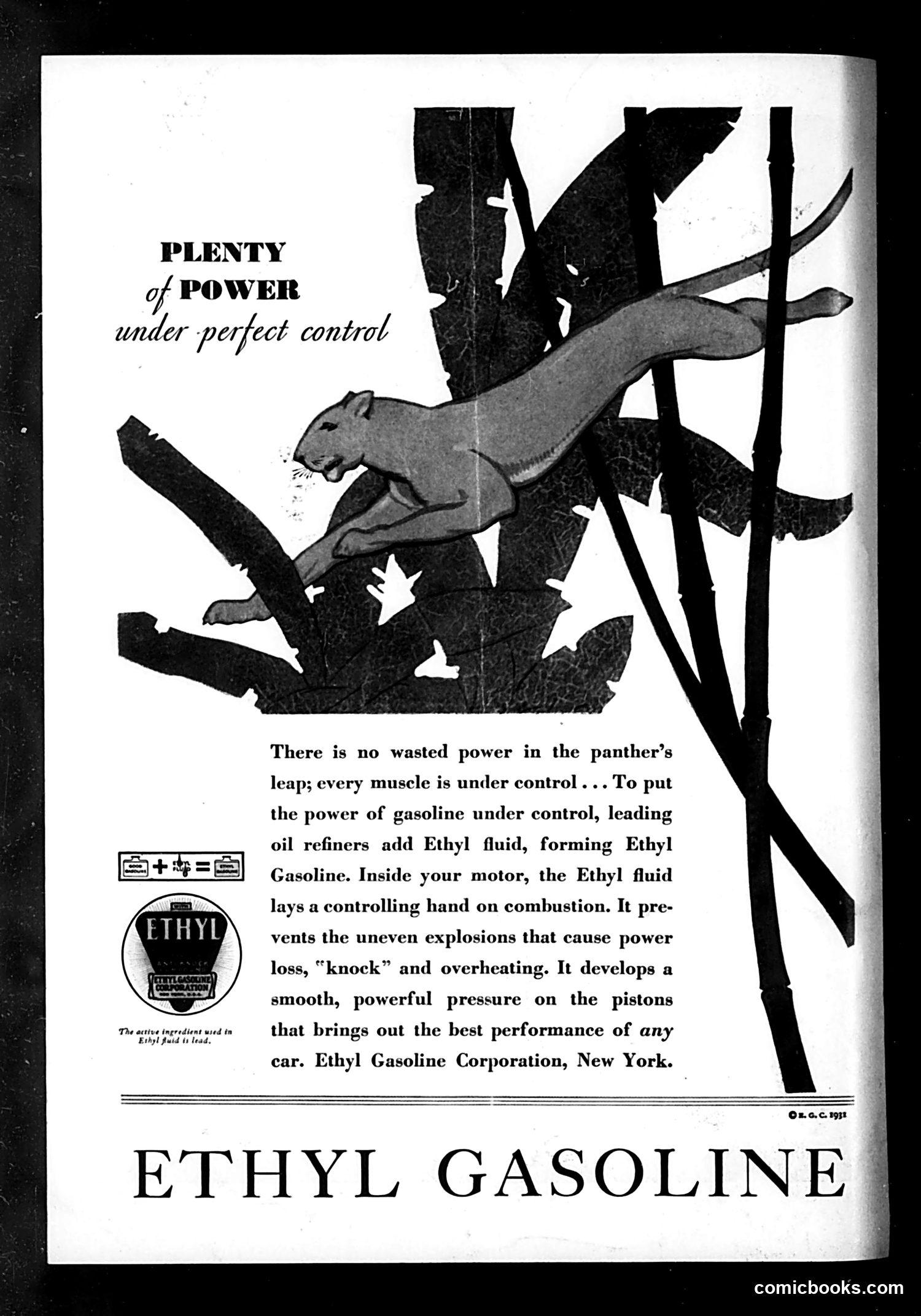
Ethyl Gasoline Advertisement This is a vintage product advertisement, not political satire. It promotes Ethyl Gasoline, a fuel additive product from the Ethyl Gasoline Corporation. The ad uses a panther leaping through foliage as a metaphor for controlled power and efficiency. The comparison suggests that just as a panther's muscles work in perfect coordination without wasted motion, Ethyl fluid additive controls gasoline combustion in car engines, preventing "knock" (engine detonation), power loss, and overheating. The ad emphasizes smooth, efficient performance through chemical control—the "ethyl fluid" acts as a "controlling hand on combustion." This appears to be early-to-mid 20th century advertising, when leaded gasoline additives were marketed as performance enhancers before their environmental and health dangers became widely known.

I can see this is a mostly black page with what appears to be a celestial body (moon or planet) visible near the top center, and some circular shapes on the right side that could be lunar features or craters. The left edge shows a white margin typical of a book or magazine page. However, the image is extremely dark and lacks sufficient clarity to discern specific cartoon figures, text, or satirical content. The OCR text only shows "comicbooks.com," which appears to be a watermark rather than actual page content from the original Life magazine. Without readable text or clear visual details, I cannot reliably identify political references, caricatures, or the intended satire. The page may be underexposed or poorly scanned, making analysis impossible.