life
Life — May 15, 1931

Life Magazine Cover Analysis (May 15, 1931) This is the cover of *Life* magazine from May 1931, featuring a caricature signed by Neil Halt. The drawing depicts a grotesque face with exaggerated features—bulbous nose, distorted mouth, and prominent ears—rendered in aggressive black and white contrast. The figure wears formal attire (white shirt visible). Without additional context or identifying text on the cover itself, I cannot definitively identify the specific public figure being caricatured. However, the style is typical of *Life*'s political satire from this era. The exaggerated physiognomy suggests this was meant as harsh commentary on a particular contemporary political or social figure, though the specific identity and referenced events remain unclear from the image alone.
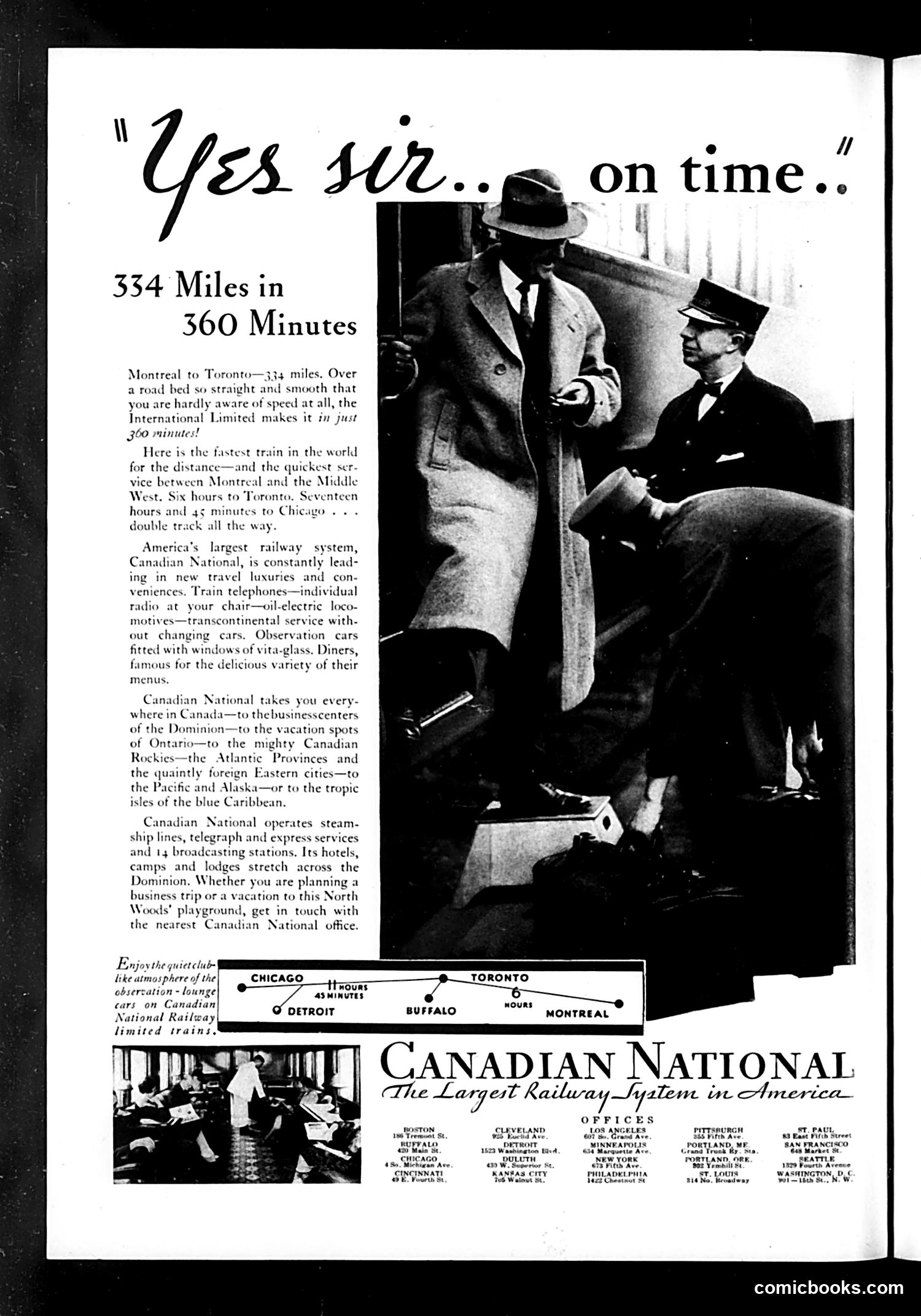
Analysis This is a Canadian National Railway advertisement, not political satire. The page promotes the speed and luxury of the International Limited train service between Montreal and Toronto (334 miles in 360 minutes). The central image shows two men in business attire and fedoras—likely a businessman and a porter or conductor—aboard the train, suggesting comfortable first-class service. The headline "Yes sir...on time" emphasizes the railway's reliability. The accompanying text boasts about amenities: telephones, radio, observation cars with vista-glass windows, and high-quality dining. A small route map shows connections to Chicago, Detroit, Buffalo, and other cities. A secondary photograph depicts the dining car's interior. The advertisement targets business travelers seeking speed and comfort, presenting rail travel as a modern, professional transportation option. This is commercial marketing rather than editorial cartoon content.
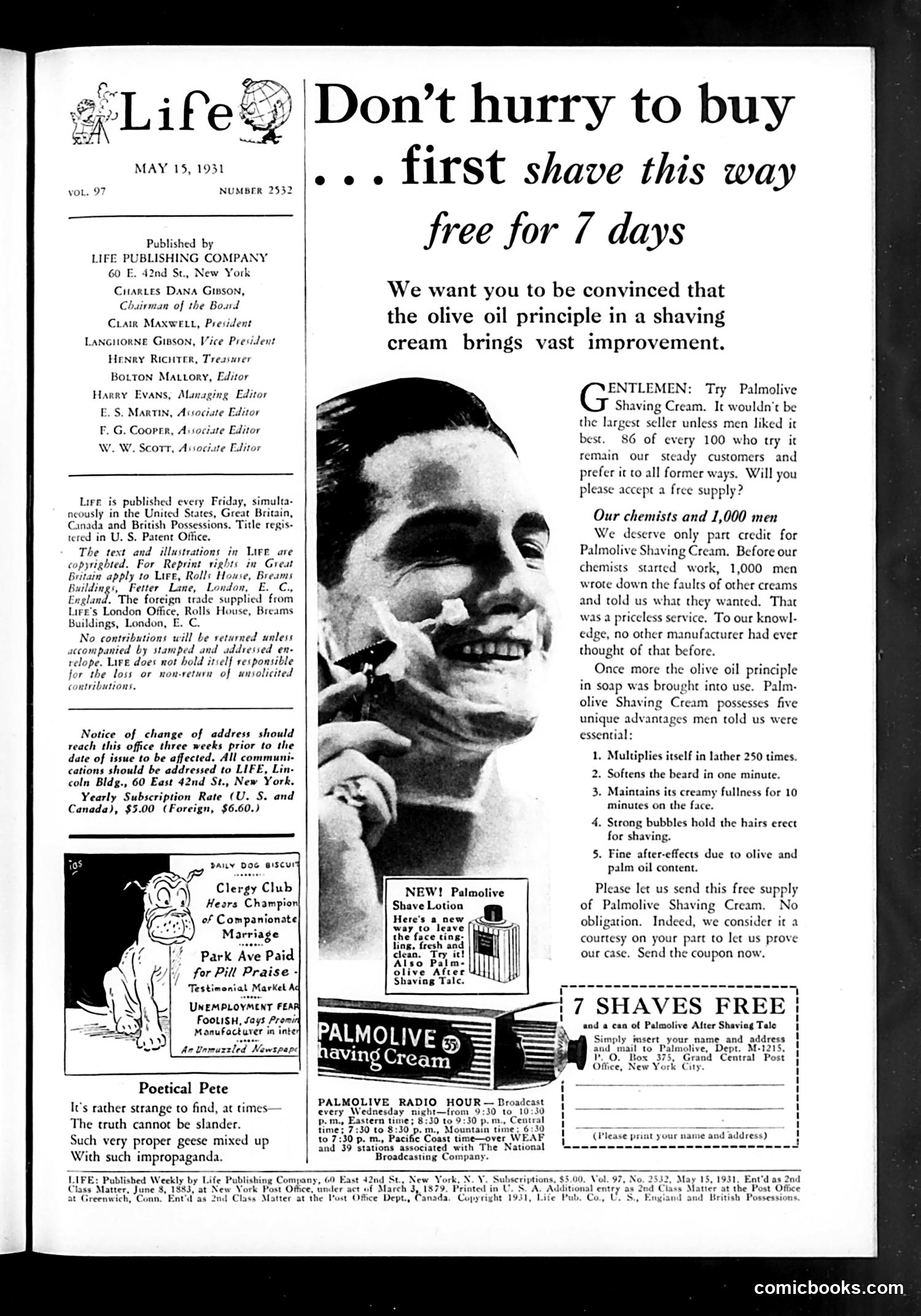
This page is primarily a Palmolive Shaving Cream advertisement rather than political satire. The large image shows a man's face demonstrating the product's effects, with marketing copy emphasizing the "olive oil principle" that supposedly improves shaving. The advertisement claims their chemists and "1,000 men" tested the cream, listing five benefits including increased lather and beard softening. It offers a free 7-day trial. The small "Poetical Pete" cartoon at bottom-left appears to be a regular humor feature, criticizing propaganda with a brief verse about truth and falsehood—likely commentary on exaggerated advertising claims generally, though the specific reference is unclear from this excerpt alone. The page reflects 1931 consumer marketing conventions, emphasizing scientific authority and free trials to build brand loyalty.
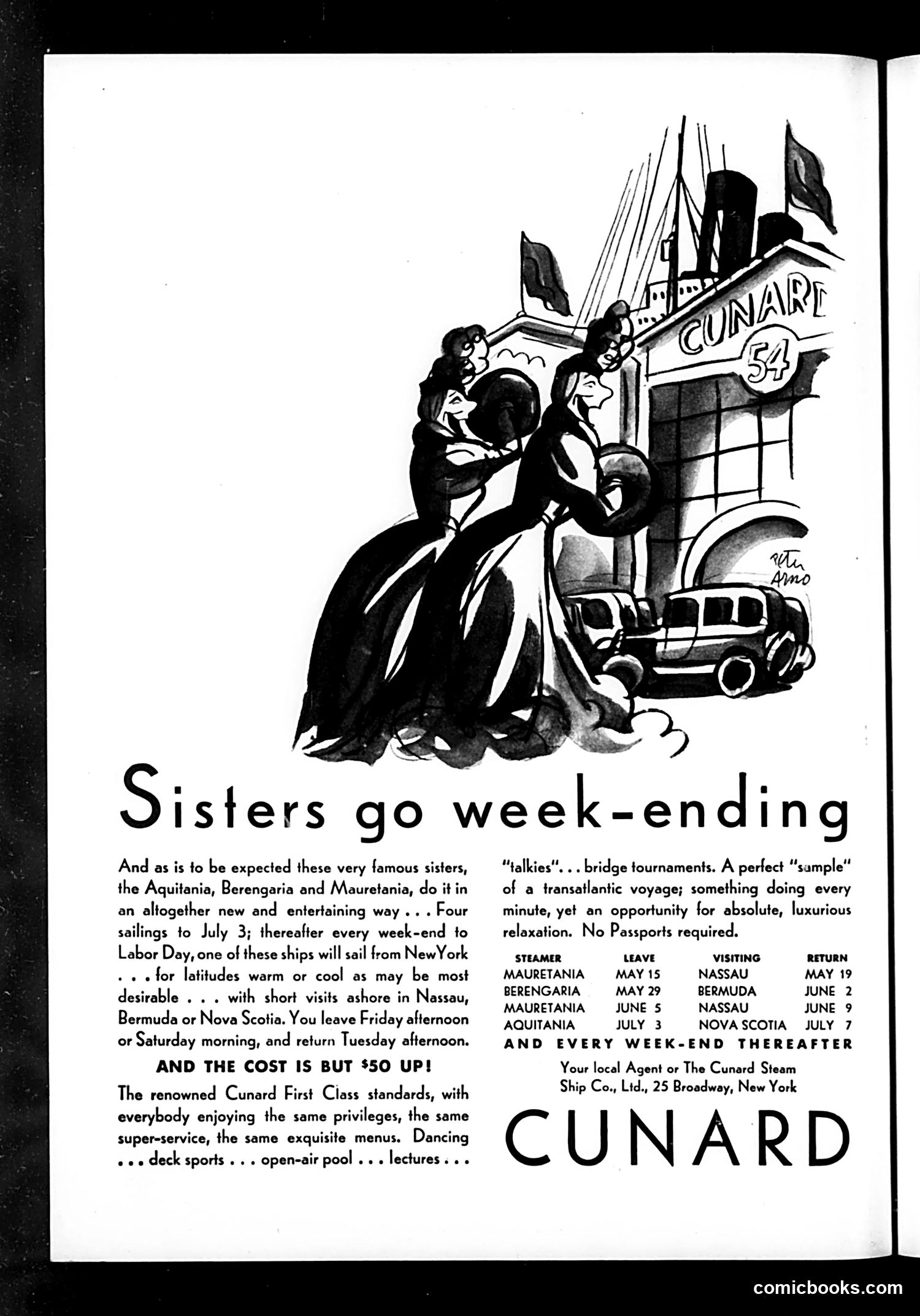
Analysis This is primarily a Cunard cruise ship advertisement, not political satire. The illustration depicts three fashionably dressed women boarding or positioned near the SS Mauretania, one of Cunard's famous ocean liners. The ad promotes "week-ending" cruises—brief luxury getaways departing Friday afternoons, returning Tuesday, priced at $50. Destinations include Bermuda and Nova Scotia. The text emphasizes Cunard's First Class amenities: deck sports, pools, fine dining, and dancing. The cartoon style reflects 1930s advertising aesthetics, using elegant line work to convey sophistication and leisure. The phrase "famous sisters" refers to multiple Cunard ships sailing together. This advertisement targets affluent Americans seeking affordable short-term ocean travel, positioning cruising as accessible luxury during the Depression era.
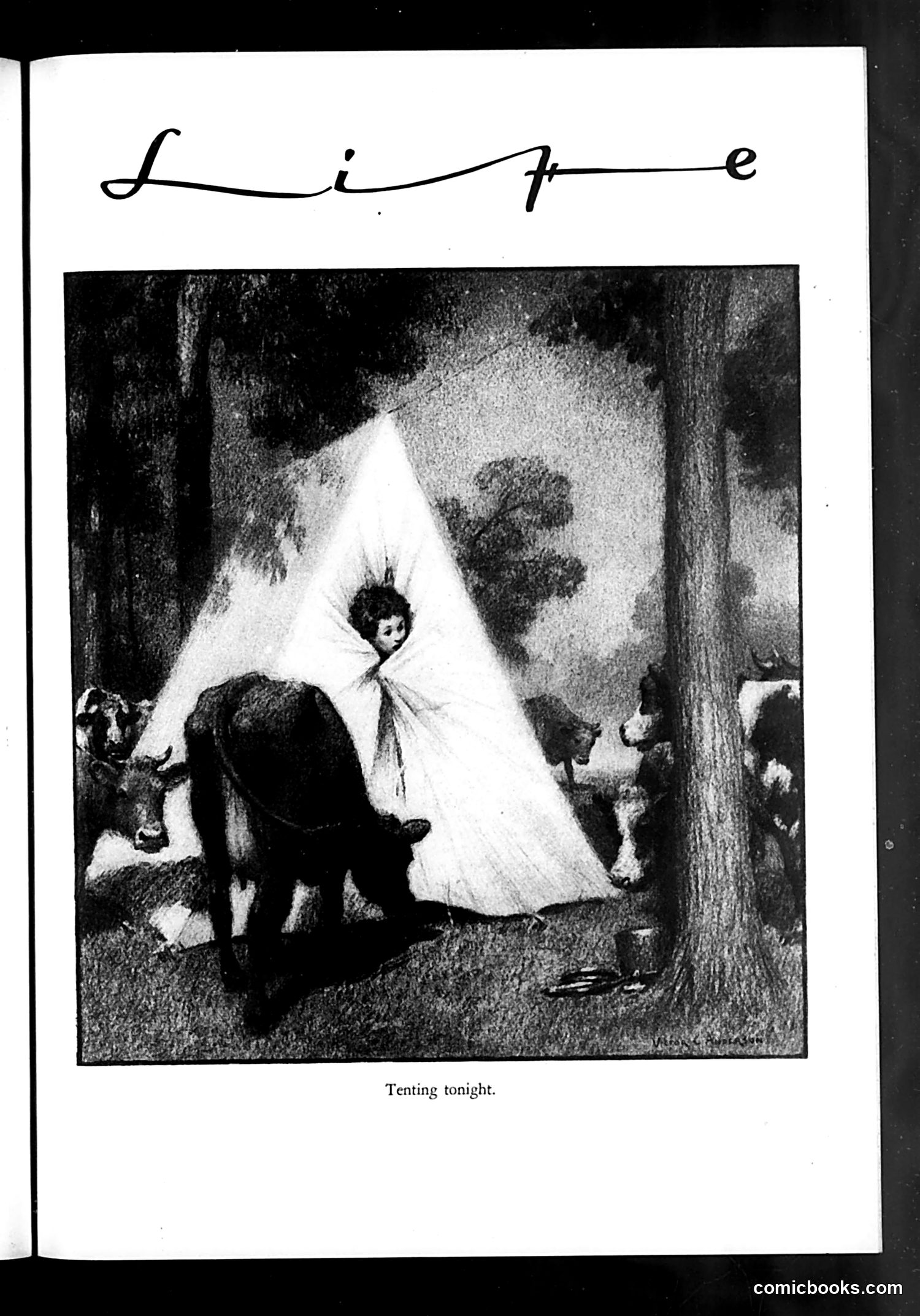
Analysis This page from *Life* magazine shows a black and white photograph captioned "Tenting tonight." The image depicts a woman in dark clothing inside a white tent, surrounded by what appear to be dogs or similar animals in a wooded setting. The handwritten text at the top reads "Life" (the magazine's masthead). Without additional context from surrounding articles or dates, the specific satirical target is unclear. However, the juxtaposition of the refined woman in the tent with animals suggests this may be mocking either: - Fashionable "camping" or "roughing it" culture among the wealthy - A specific contemporary social figure or trend The photograph's quality and composition suggest this is documentary-style satire rather than an illustrated cartoon. More context would be needed to identify the exact reference.
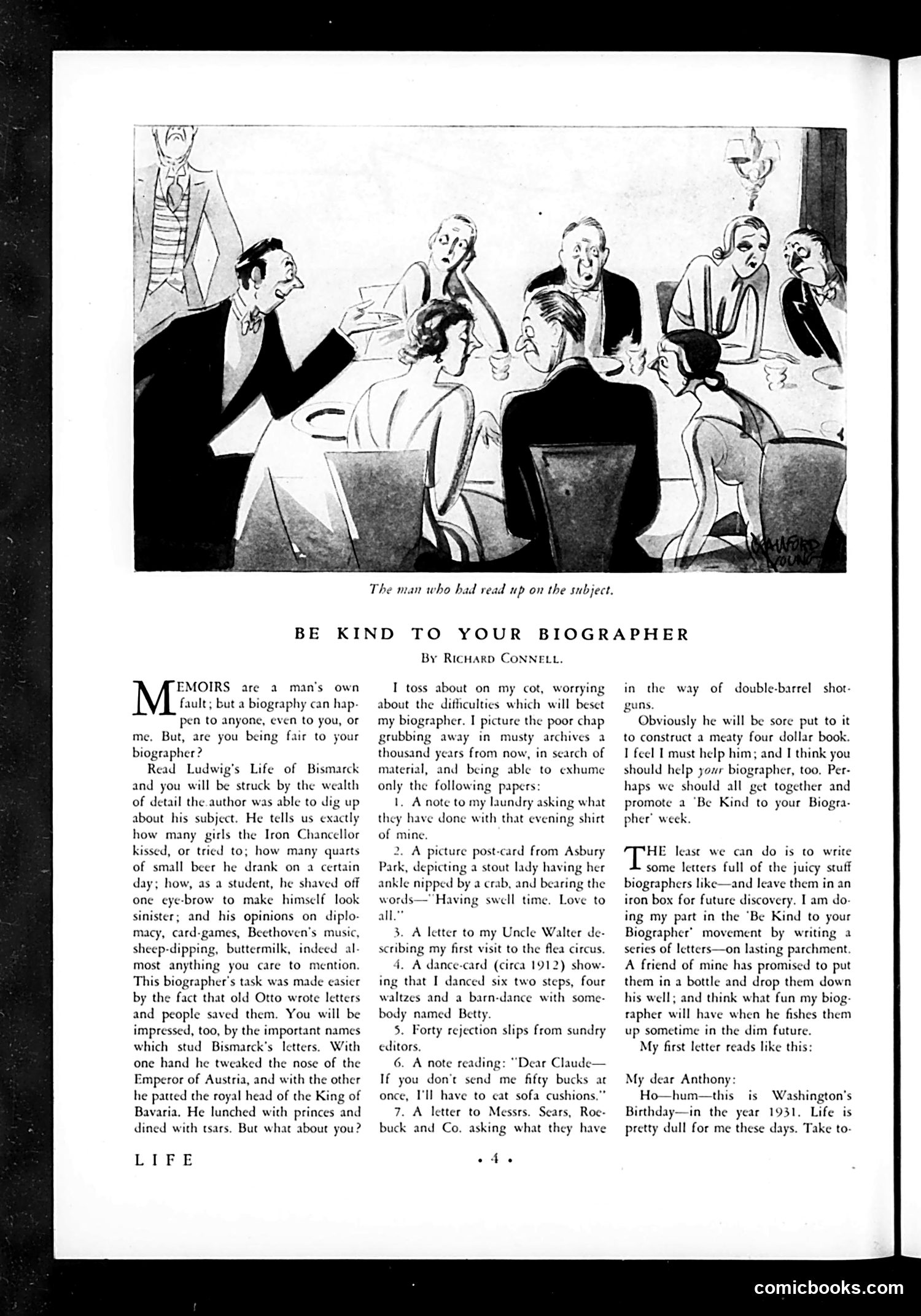
"Be Kind to Your Biographer" by Richard Connell This satirical article uses a cartoon and humorous narrative to mock both biography-writing and biographical subjects. The cartoon depicts a dinner party where "the man who had read up on the subject" is speaking—presumably a biographer sharing embarrassing or unflattering details about someone present. Connell's piece jokes that biographers will eventually excavate all your secrets—love letters, drinking habits, dancing mishaps, rejected job applications—from archives and correspondence. His tongue-in-cheek advice: help your biographer by keeping good records yourself, or at least organizing a coordinated effort among friends to promote a flattering narrative during "Be Kind to Your Biographer" week. The satire targets both the invasiveness of biographical research and vanity around one's historical legacy.
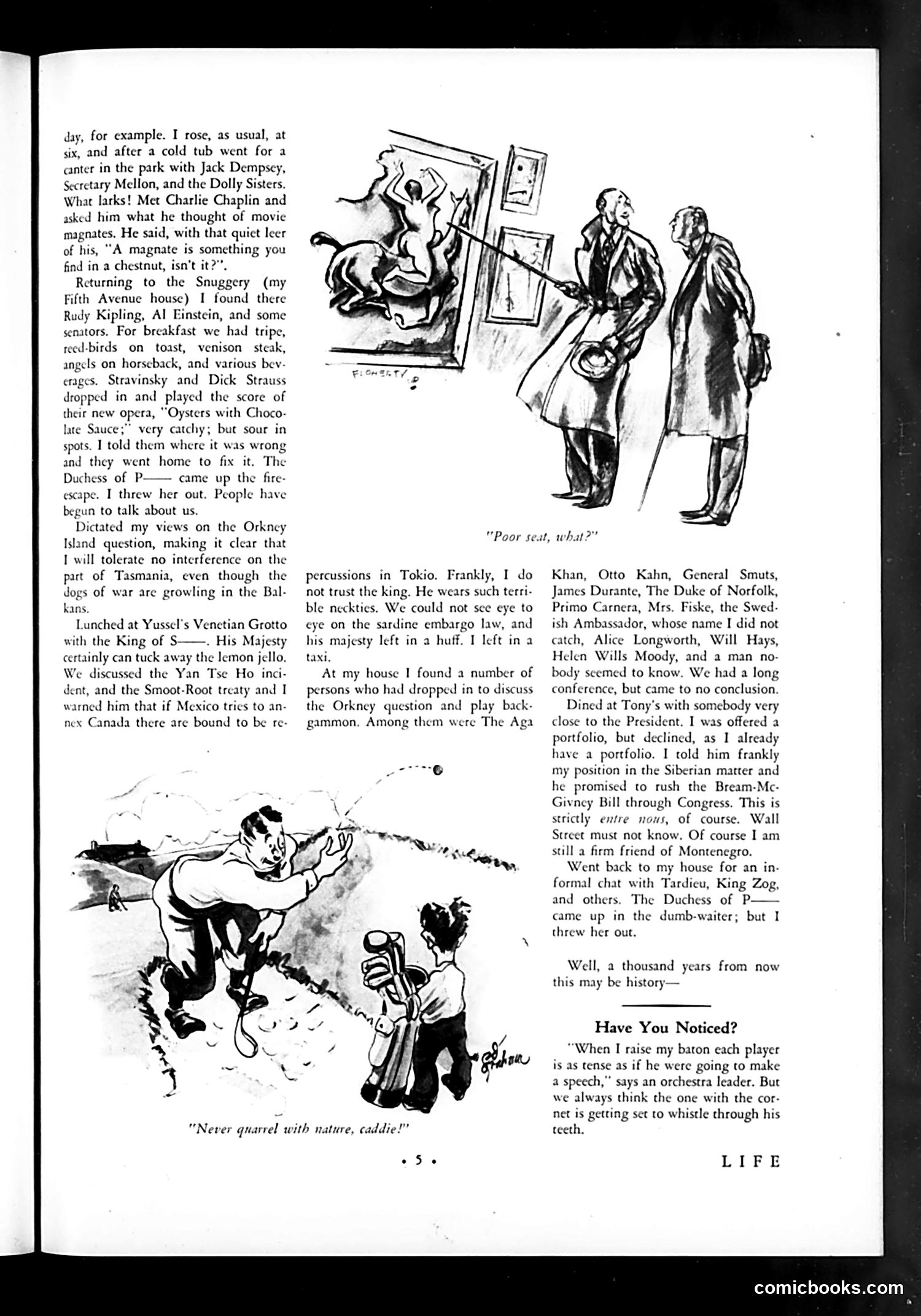
Analysis of Life Magazine Page This page contains memoir-style text with two satirical cartoons. The upper cartoon shows a chaotic scene labeled "Poor seat, what?" depicting what appears to be opera or theater-goers confronting disorder—likely satirizing audience behavior at cultural events. The lower cartoon, "Never quarrel with nature, caddie!" shows a golfer in an awkward position with a caddie, appearing to reference the absurdity of blaming external circumstances (nature) rather than one's own skill for poor performance. The accompanying text mentions numerous celebrities and political figures (Charlie Chaplin, various European nobility and diplomats), suggesting this recounts a society journalist's encounters with high-profile individuals. The "Orkney Island question" reference suggests pre-WWII political tensions. Overall, the page satirizes elite social pretension and incompetence through humor and caricature.
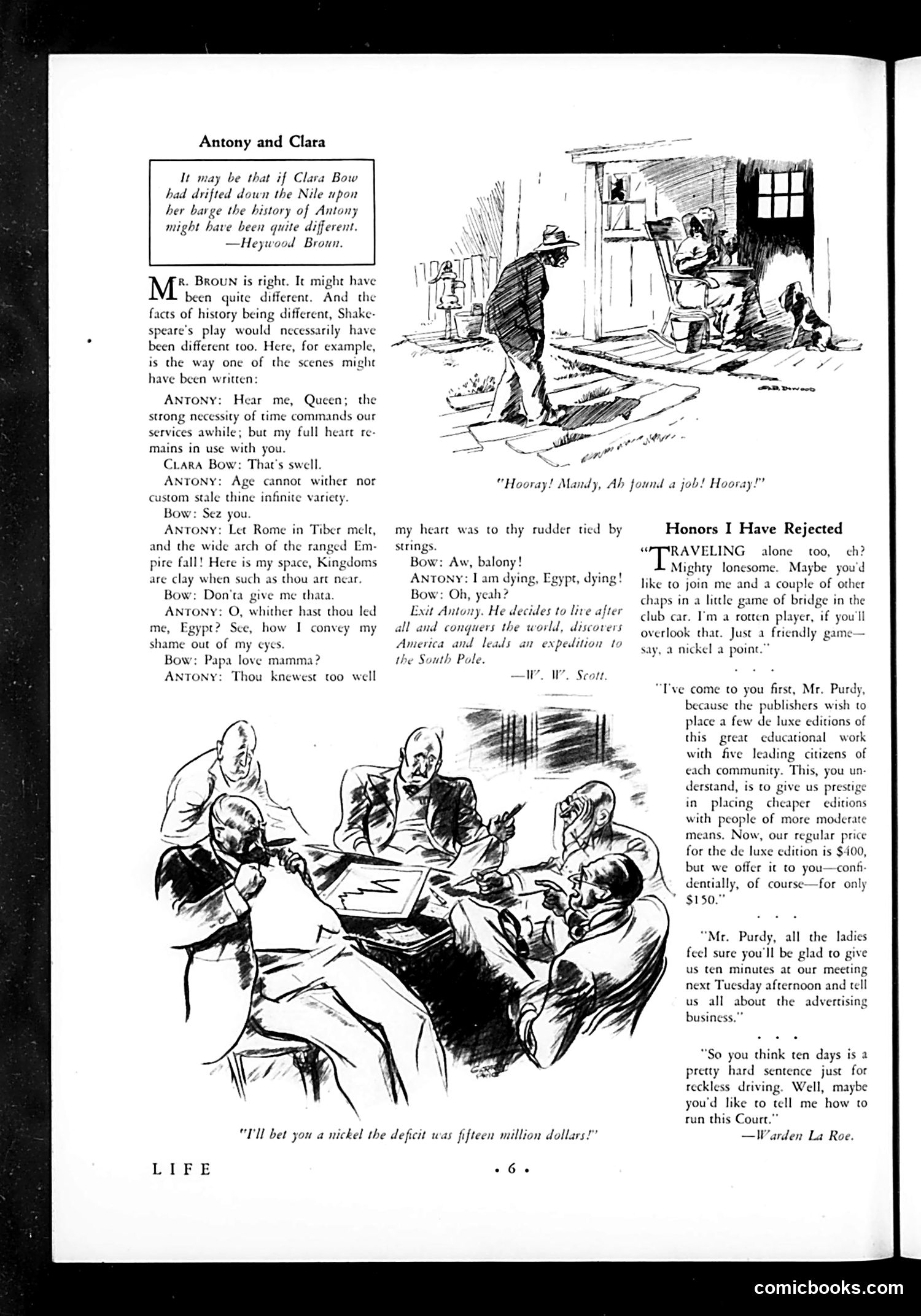
Analysis of Life Magazine Page This page contains two distinct sections: a Shakespeare adaptation discussion and a separate satirical sketch. The top section debates whether Clara Bow's life story might have differed from Shakespeare's *Antony and Cleopatra*. This references Clara Bow, the famous 1920s silent film actress known as the "It Girl." The lower cartoon satirizes the advertising/publishing industry. A man (labeled Mr. Purdy) meets with what appears to be magazine publishers or book salespeople. They're pitching him an expensive deluxe edition at $400, claiming he'd get it for only $150—framing this as a prestige opportunity. The final caption quotes someone sarcastically suggesting this inflated pricing is comparable to a harsh legal sentence. The satire targets deceptive sales tactics: presenting marked-up prices as exclusive deals while suggesting social status comes from owning expensive editions.
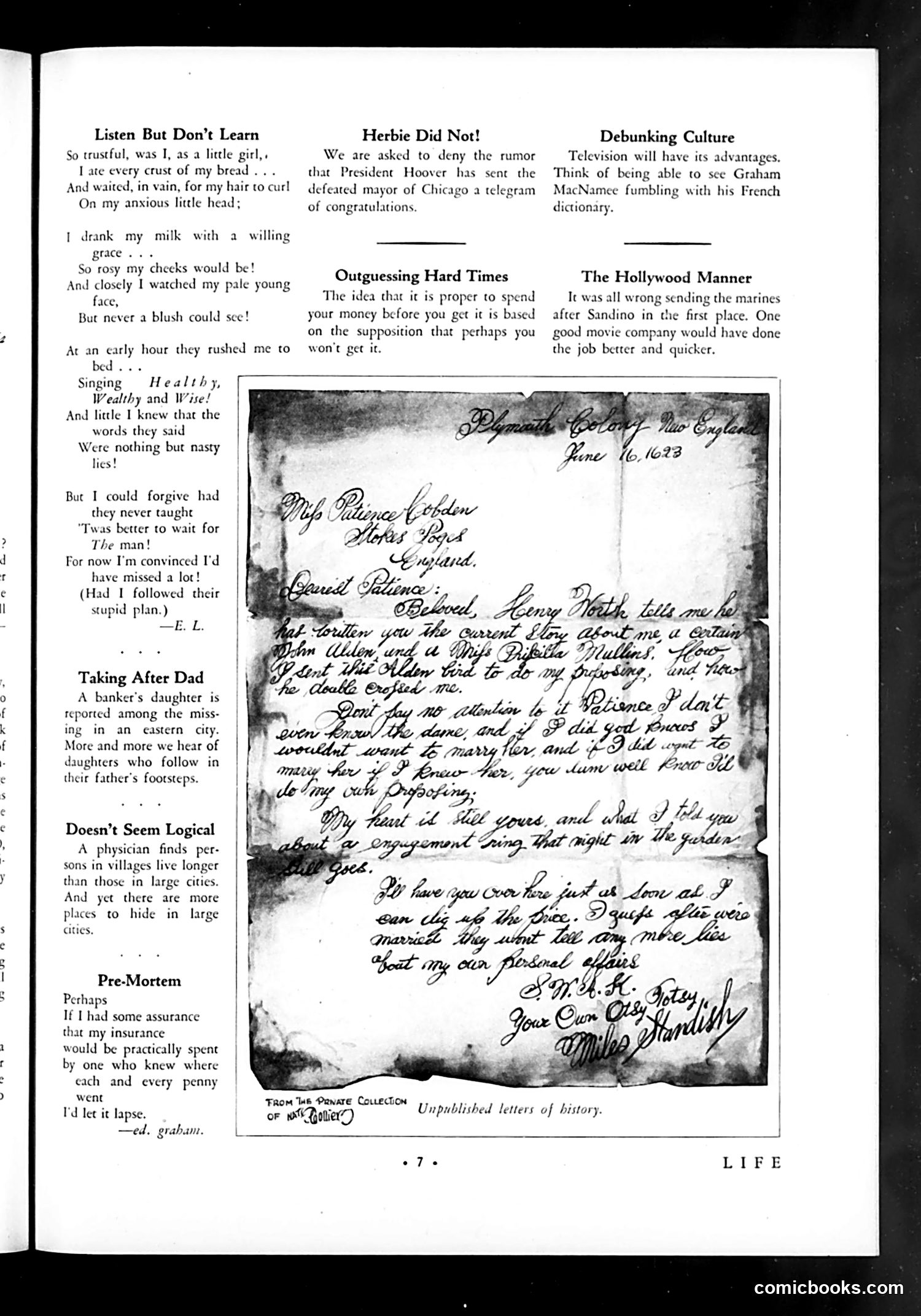
Life Magazine Page Analysis This page contains several short poems and satirical items rather than a political cartoon. The content includes: "Listen But Don't Learn" — A poem by E.L. about childhood obedience and missed lessons about waiting for "the man." "Herbie Did Not!" — A brief item denying rumors that President Hoover sent a congratulatory telegram to Chicago's defeated mayor. "Debunking Culture" — A quip about television's limitations compared to reference materials. The centerpiece is a facsimile of a handwritten historical letter dated June 16, 1623, from Plymouth Colony, addressed to "My Patience Bolden" in England. The letter discusses personal affairs and colonial matters. The remaining items are light satirical verses on various social observations: banker's daughters, physicians' longevity, and insurance preparedness. This appears to be a typical Life magazine page mixing humor, social commentary, and historical curiosities rather than focused political cartooning.
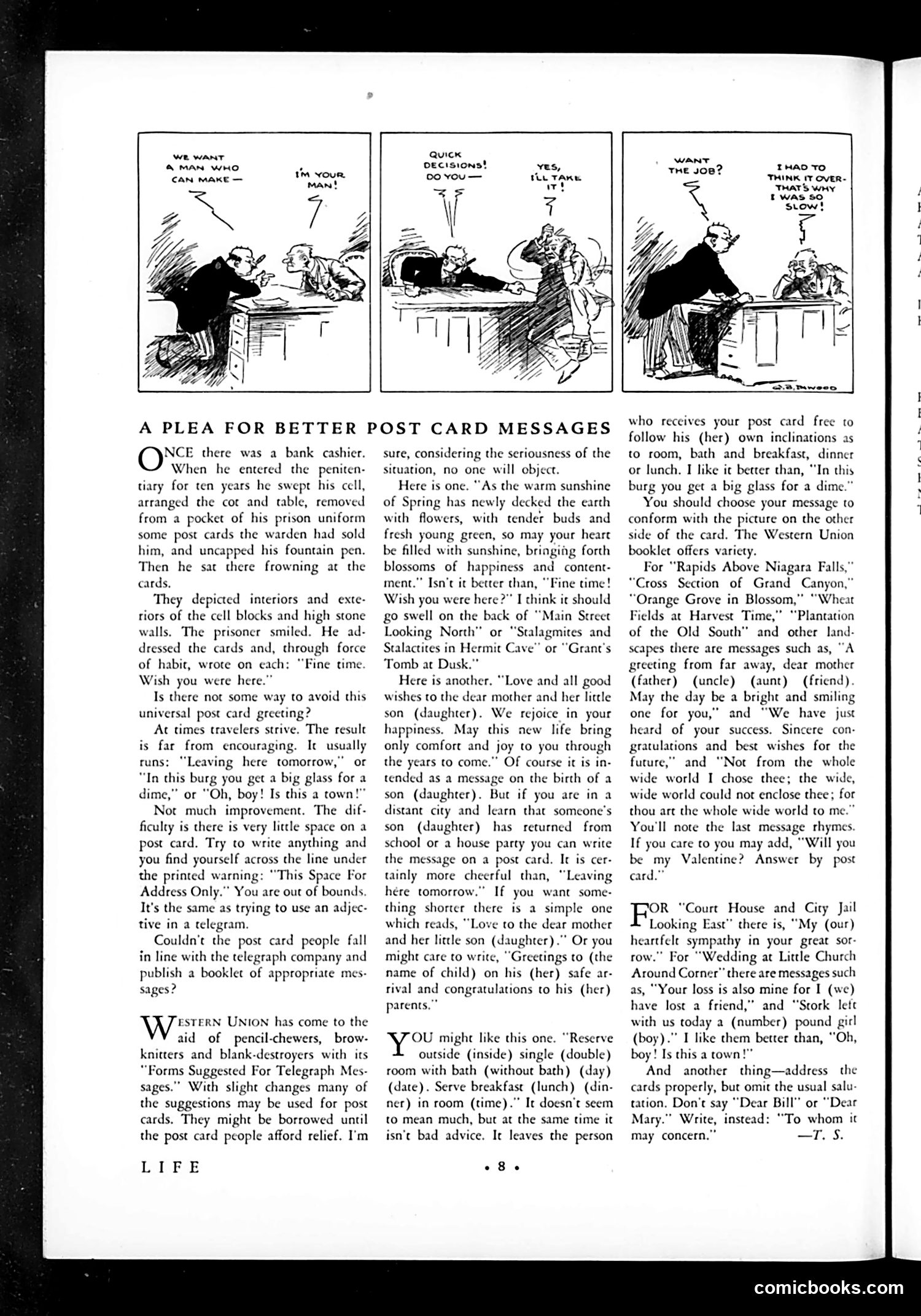
"A Plea for Better Post Card Messages" This three-panel cartoon satirizes the tedious, formulaic nature of postcards sent by travelers in the early 20th century. The joke: A bank cashier interviews job candidates. In panel one, he asks what they want; in panel two, he demands a quick decision; in panel three, he's annoyed the candidate is overthinking it. The satire: The article argues that postcards typically contain generic phrases like "Wish you were here?" or "Fine time!" The cartoonist ridicules this laziness by showing how even important decisions (hiring) get rushed responses—suggesting people apply the same thoughtless speed to postcards as to everything else. The accompanying article proposes specific message alternatives for different locations and occasions to encourage more meaningful correspondence.
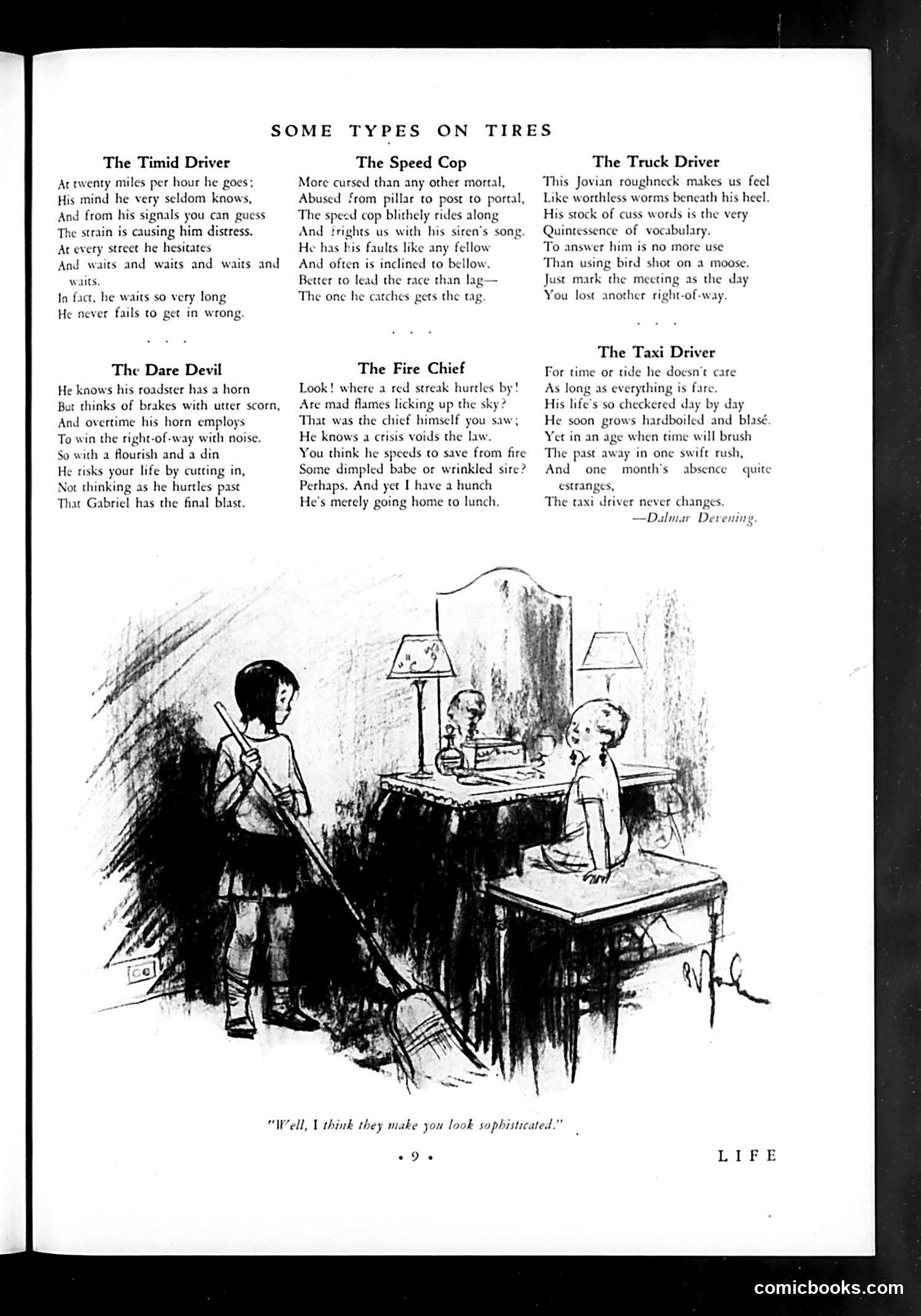
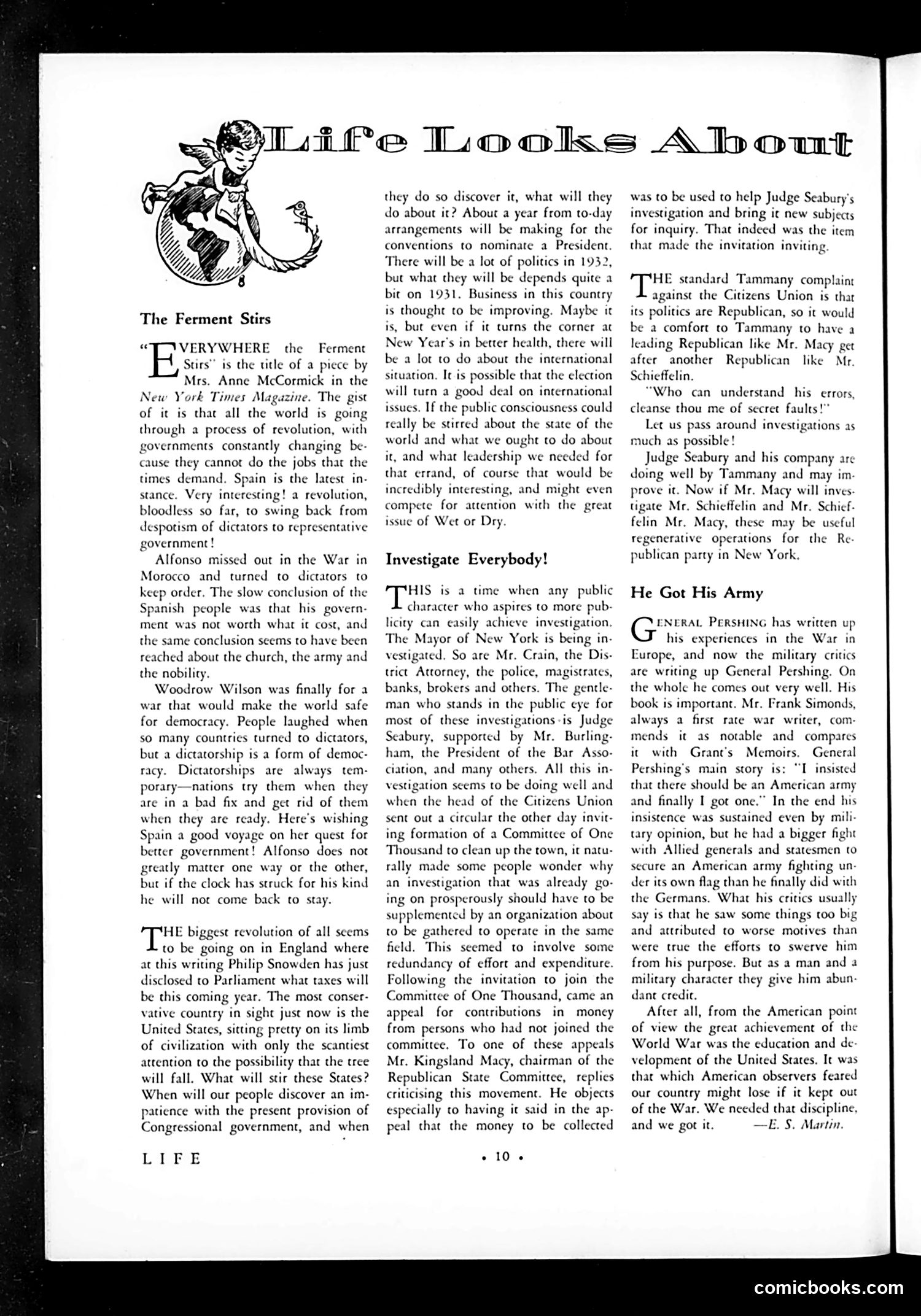
"Life Looks About" - Page Analysis This page from *Life* magazine contains three opinion columns rather than cartoons. The visible illustration shows a cherub/cupid figure, likely decorative for the "Ferment Stirs" column header. The columns discuss 1931-32 political issues: Alfonso of Spain's exile, the need for government investigation of corruption (mentioning Judge Seabury's inquiry into NYC's Citizens Union), and General Pershing's military memoirs. The commentary is conservative, praising Republican prospects and criticizing what the authors see as governmental inefficiency. References to "Wet or Dry" indicate Prohibition debate remains relevant. The tone suggests *Life*'s editorial stance favored Republican leadership and skepticism toward Democratic governance during the Depression era.
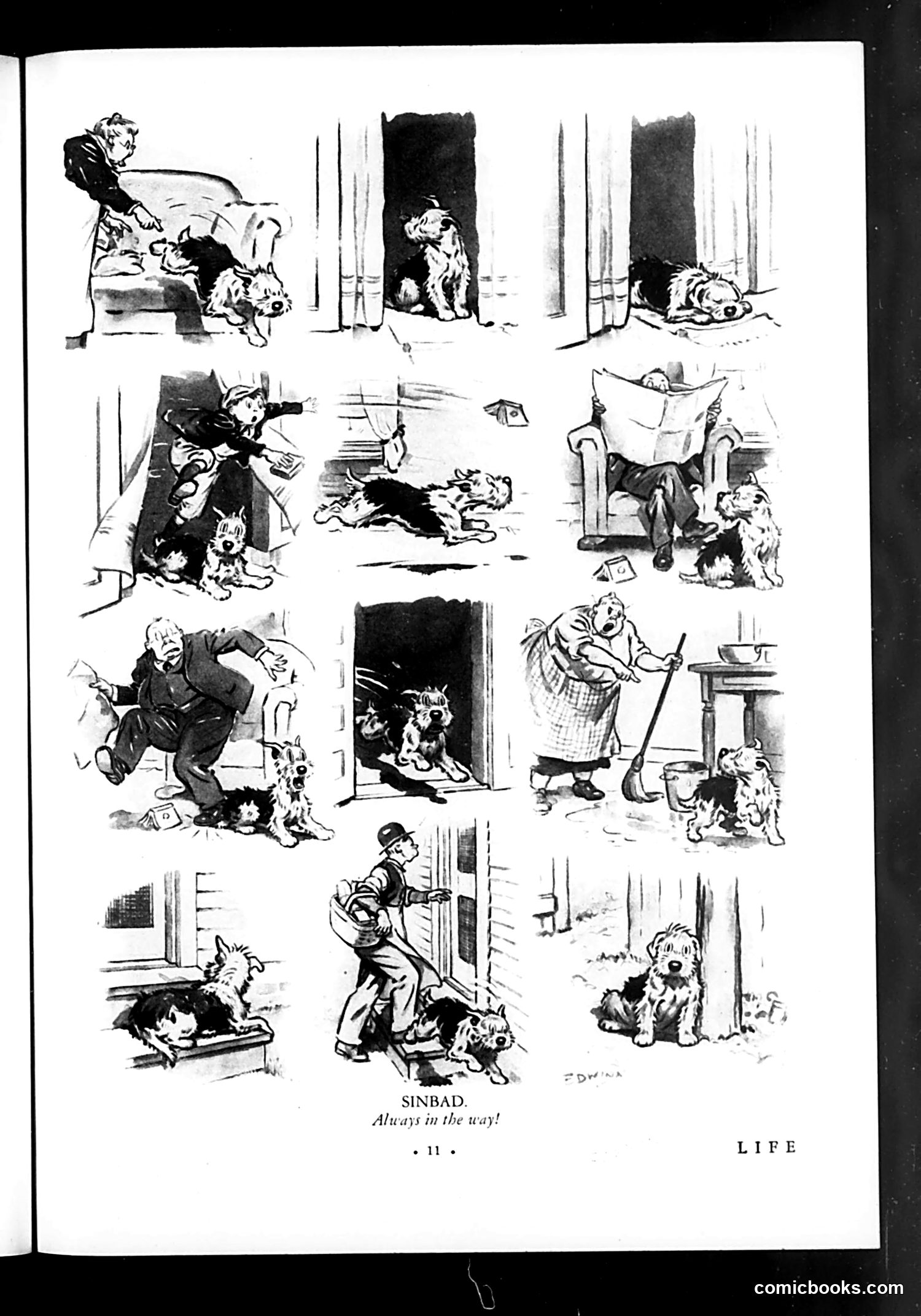
SINBAD: "Always in the way!" This is a humorous comic strip featuring a mischievous dog named Sinbad. The strip depicts a series of domestic scenarios where the dog consistently interferes with household activities—appearing underfoot during people's work, getting in the way while sweeping, lounging where people need to sit, and generally creating minor chaos in everyday situations. The satire is straightforward: the joke is that pets, particularly dogs, are perpetually "in the way" during normal household tasks. Each panel shows the dog's oblivious disruption of human endeavors, playing on the relatable frustration pet owners experience with animals who seem magnetically attracted to wherever their owners are trying to work or move about.
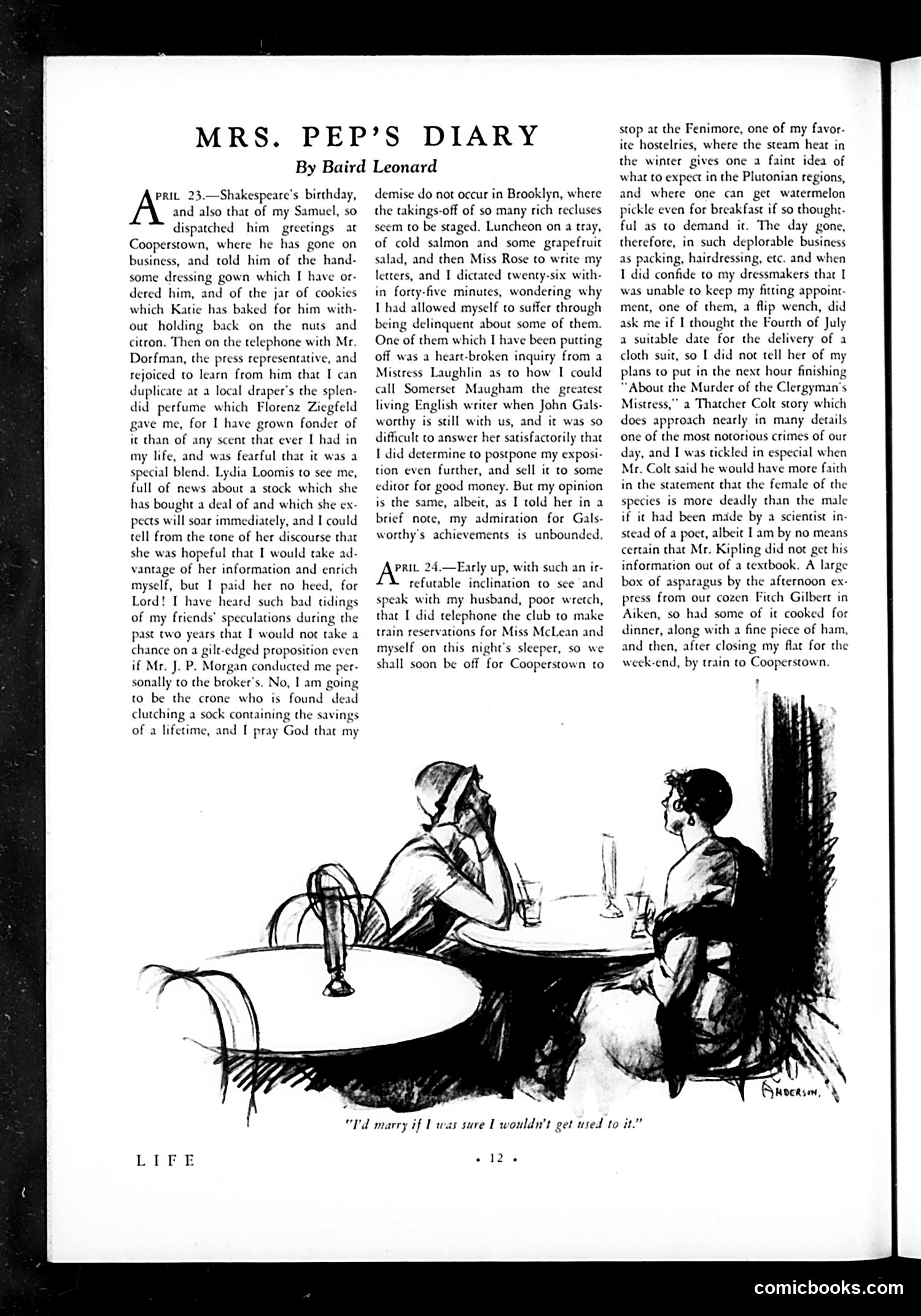
Analysis of "Mrs. Pep's Diary" Page This page contains a humorous diary entry by Baird Leonard satirizing domestic life and social pretensions. The entry covers April 23-24 and discusses the author's interactions with various society figures and social obligations. The cartoon at the bottom illustrates a scene between two women at a table. One says, "I'd marry if I was sure I wouldn't get used to it"—a joke about marriage becoming routine and losing its appeal. The cartoon satirizes women's attitudes toward matrimony, suggesting that the novelty and excitement of marriage might fade into mundane domesticity, making the prospect less appealing to unmarried women. The overall piece mocks upper-class social conventions, name-dropping, and the anxieties of maintaining one's social position during this era.
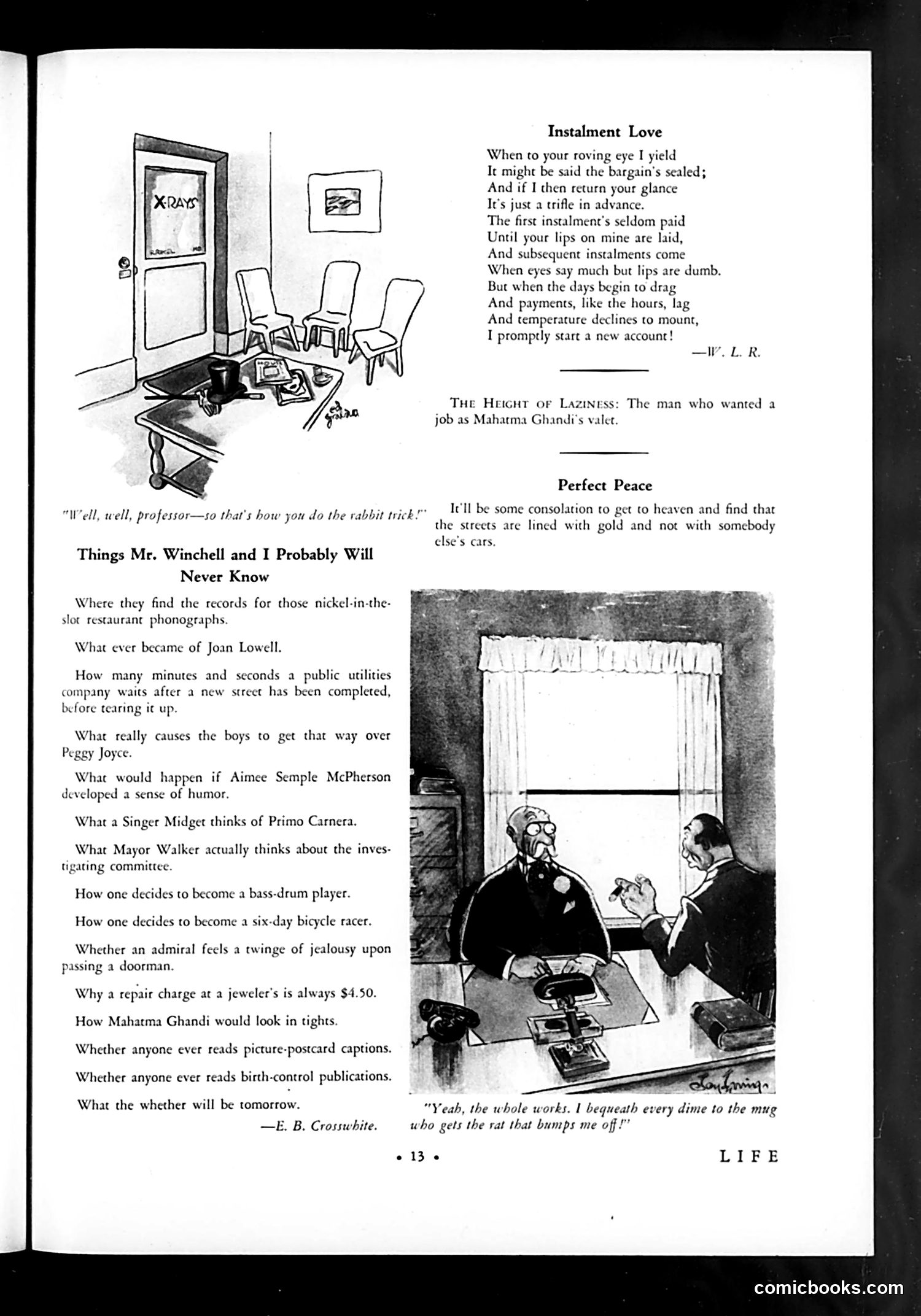
Analysis of Life Magazine Page 13 This page contains three humor pieces with illustrations: 1. "Instalment Love" (poem by W. L. R.): A satirical commentary on installment-plan purchasing, where romantic commitment is compared to buying on credit—initial excitement fades as payments drag on and expenses mount. 2. "Things Mr. Winchell and I Probably Will Never Know" (by E. B. Coyswhite): A list of unknowable mysteries referencing Walter Winchell (famous gossip columnist). References include Joan Lowell, Peggy Joyce, and Mayor Walker's investigating committee—all contemporary figures or scandals, suggesting insider knowledge of 1920s-30s New York society and politics. 3. "Perfect Peace" and a cartoon about heaven's streets paved with gold rather than "somebody else's cars"—commentary on wealth inequality and material status anxiety.
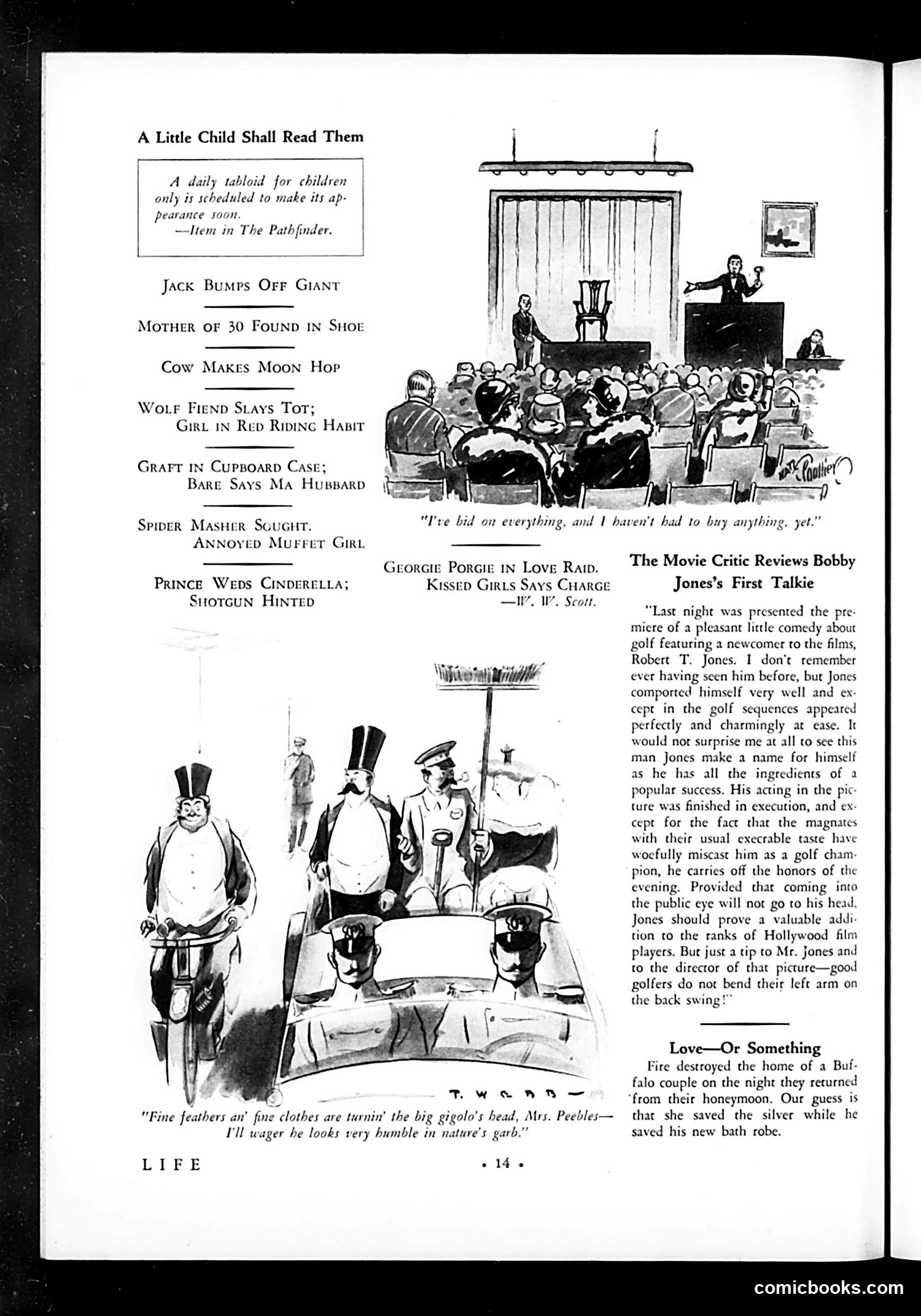
Analysis of Life Magazine Page 14 This page contains satirical headlines about tabloid stories ("Jack Bumps Off Giant," "Mother of 30 Found in Shoe") typical of sensationalist journalism of the era. The main cartoon depicts a crowded theater or lecture hall with the caption "I've bid on everything, and I haven't had to buy anything yet," satirizing auction culture or wealthy people's conspicuous consumption through bidding. The bottom cartoon shows oddly-dressed figures in what appears to be a car, captioned about "fine feathers" and looking "humble in nature's garb"—likely mocking ostentatious fashion or pretentious dress. The right column reviews a golf comedy film starring Robert T. Jones, offering practical criticism about actors' golf swings. The "Love—Or Something" item humorously notes a couple saved only a silver bath robe from a honeymoon house fire.
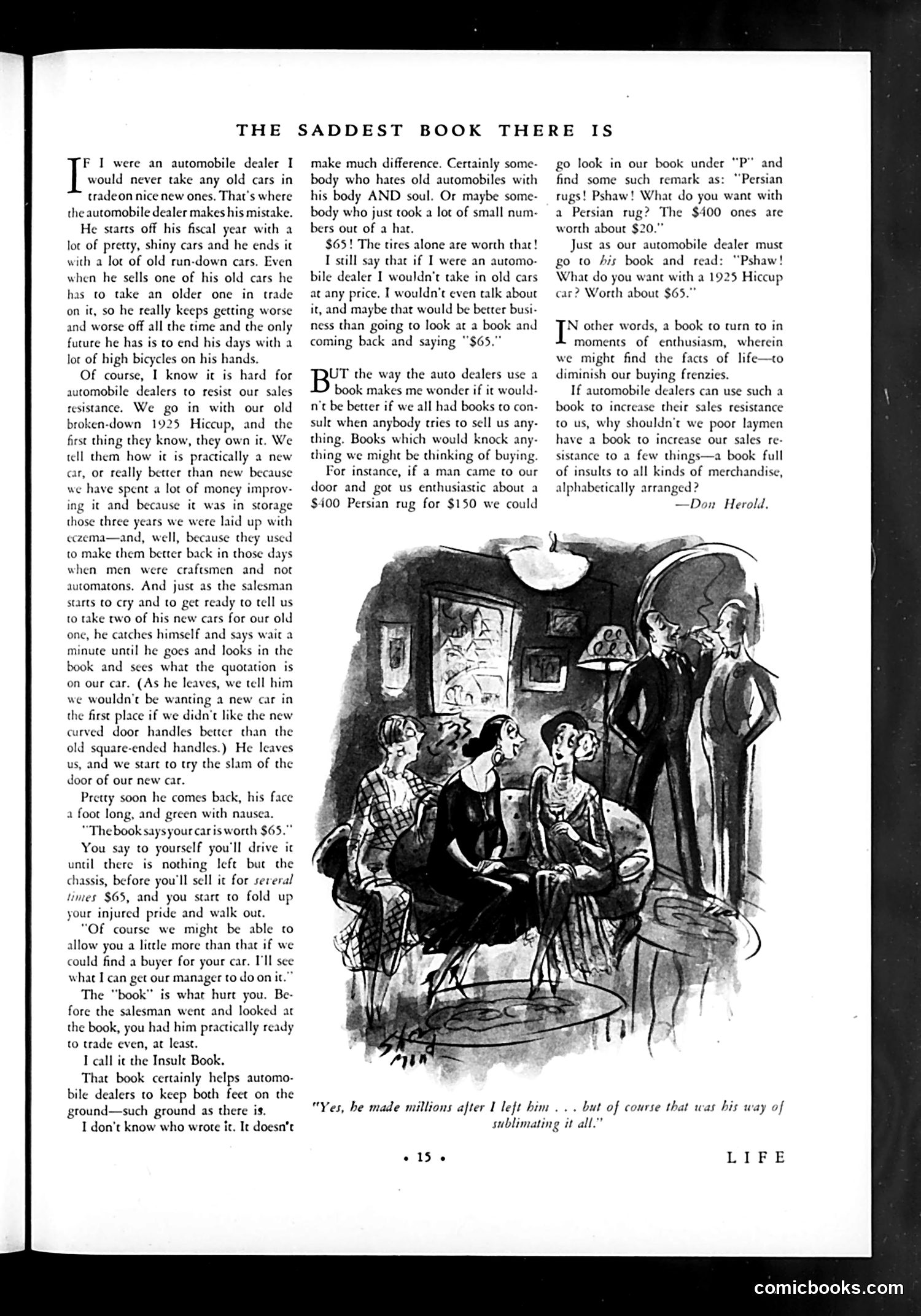
"The Saddest Book There Is" This satirical piece critiques automobile dealers' deceptive sales tactics. The author describes how dealers use an "Insult Book"—a reference guide showing trade-in values for used cars—to manipulate customers into accepting lowball offers for their old vehicles. The cartoon illustrates a salesman presenting this book to a family, claiming their car is worth far less than reality. The satire targets the deliberate gap between actual value and what dealers claim, using shame and confusion to pressure reluctant sellers. The article argues that if dealers had transparent, standardized pricing references available to *customers*, sales resistance would diminish. The piece is essentially exposing early 20th-century automotive sales fraud through consumer advocacy humor.
"Life in Washington" by Carter Field This is a political commentary article rather than a cartoon. The piece discusses Governor Louis Emmerson of Illinois and his political maneuvering regarding the 1928 presidential election and Prohibition enforcement. The article describes Emmerson as taking bold political risks—pushing his "chips to the centre of the table" by vetoing Illinois's state prohibition enforcement act, seemingly to position himself as a potential Vice Presidential candidate under Herbert Hoover. The satire critiques Emmerson's calculated political moves: his veto was strategically designed to appeal to wet (anti-Prohibition) voters while maintaining plausible deniability about his true motivations. The author suggests Emmerson is cynically gambling with his political future for national advancement.
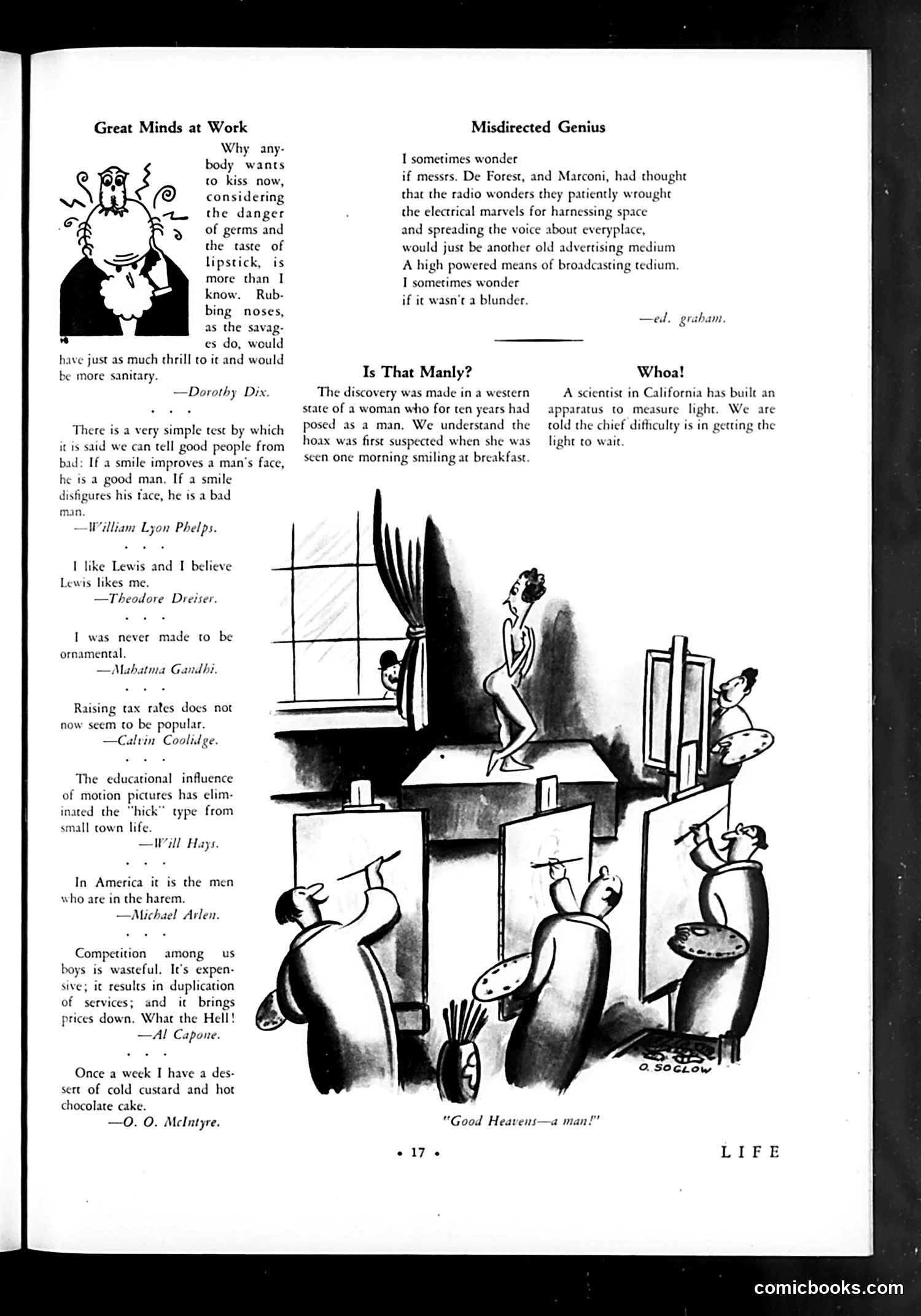
Analysis of Life Magazine Page 17 This page contains satirical quotes and a cartoon about gender roles and scientific progress. The main cartoon, titled "Good Heaven—a man!", depicts a woman artist's studio where male models pose—inverting the traditional scenario where female models posed for male artists. The satire mocks the novelty of women in professional artistic roles. The surrounding quotes critique various social issues: gender norms (Gandhi's rejection of ornamentation), economic competition, taxation, and motion pictures' cultural influence. The cartoon's humor derives from reversing expected gender dynamics in the art world, suggesting this reversal was still shocking enough to warrant satirical commentary in this era. The page reflects early-to-mid 20th century anxieties about changing social roles.
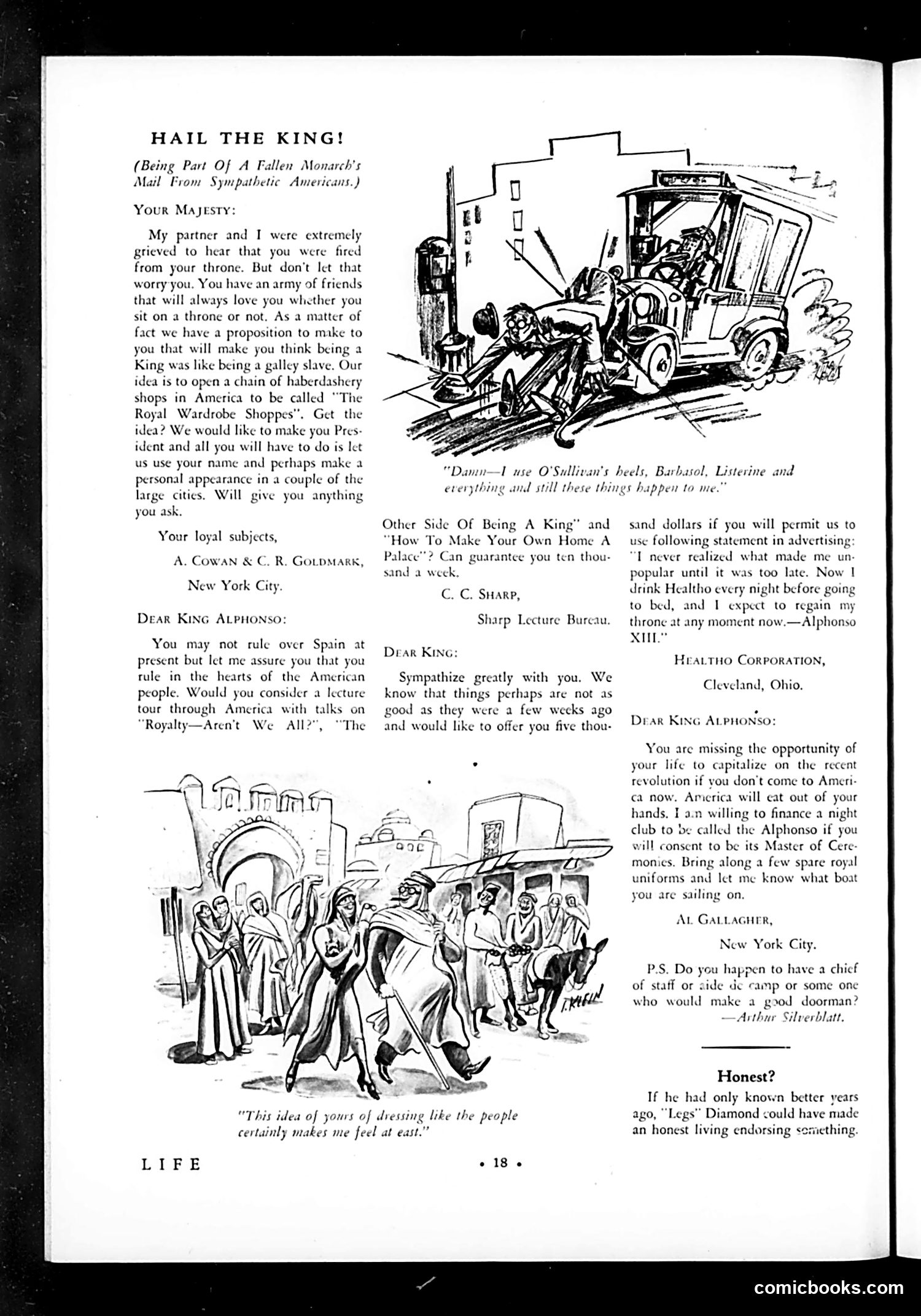
"Hail the King!" - Satire on King Alfonso XIII of Spain This page satirizes Spain's King Alfonso XIII, who was exiled from Spain around this period. The humor stems from sympathetic Americans offering him various business opportunities in the U.S. as consolation for losing his throne. The letters humorously propose: opening a chain of haberdasheries called "The Royal Wardrobe Shoppes," financing a night club, organizing lecture tours about "Royalty," and offering positions as Master of Ceremonies or doorman. The cartoons depict Alfonso's predicament—a fallen monarch reduced to potential wage-earning schemes in America. The satire mocks both the absurdity of a deposed king seeking ordinary employment and Americans' tendency to commercialize everything, even royalty. It's gentle mockery of both European aristocracy and American capitalist opportunism.
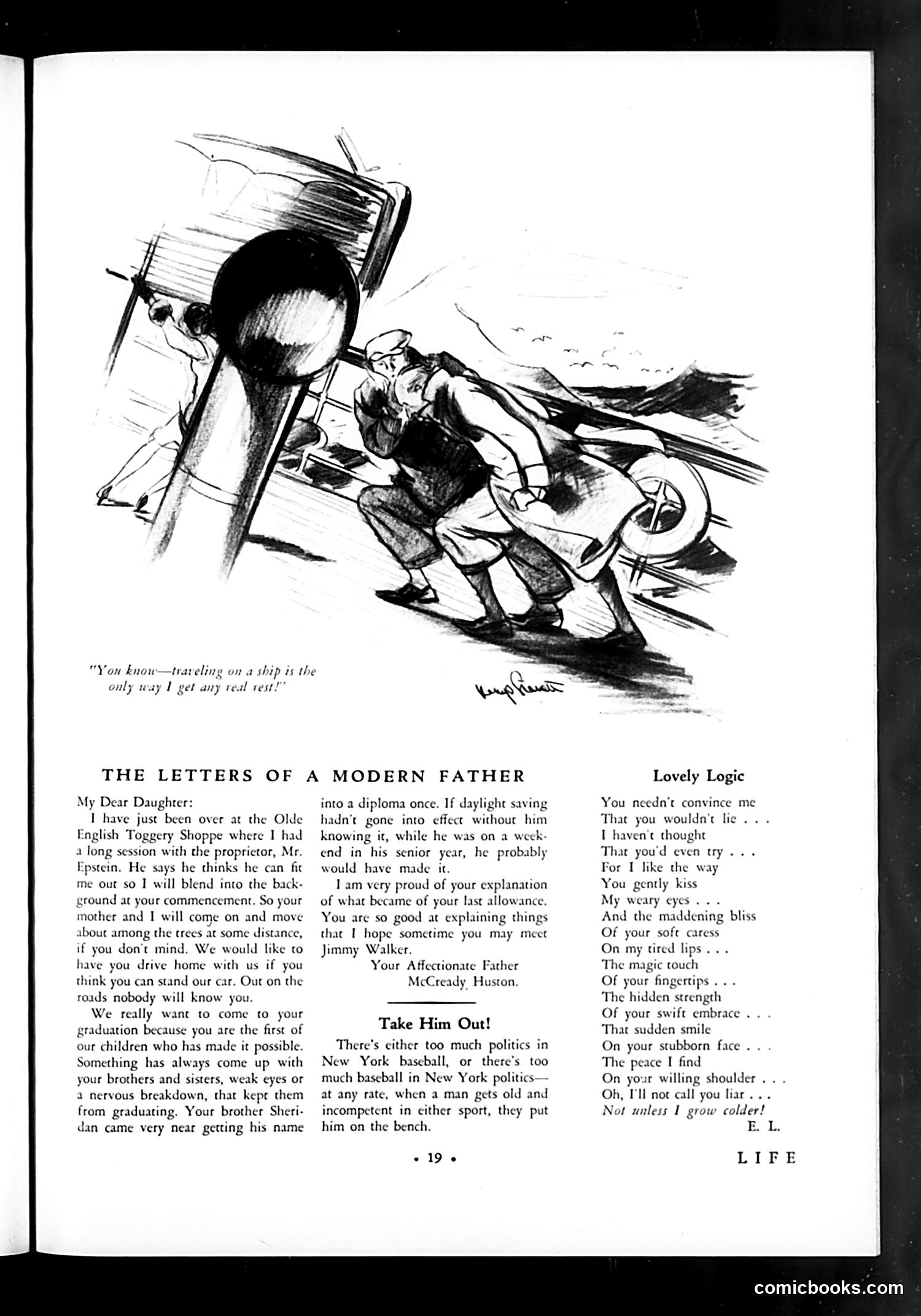
Explanation for Modern Readers The cartoon at top depicts a man being crushed by a large wrecking ball, likely representing financial or economic ruin. The caption reads: "You know—traveling on a ship is the only way I get any real rest!" Below, "The Letters of a Modern Father" presents a humorous letter from a father to his daughter about her upcoming graduation. He mentions visiting an English Toggery Shoppe with the proprietor Mr. Epstein, discusses financing her graduation (apparently expensively), and references her allowance explanations and a "Jimmy Walker." The satirical point targets both parental anxiety about expense and, possibly, corruption or excess associated with 1920s-30s figures. "Take Him Out!" on the right critiques baseball/sports management decisions. The page satirizes early 20th-century American middle-class concerns about spending and social expectations.
"Movies by Harry Evans" - Life Magazine Film Reviews This page contains three film reviews by critic Harry Evans. The main critique concerns "Tarnished Lady," starring Tallulah Bankhead, a famous Southern society woman making her American film debut. Evans argues the film wastes Bankhead's talent on a poorly conceived story, though he praises her screen presence and voice quality. The plot involves a woman choosing financial security over love, bearing an illegitimate child, then reuniting with her wealthy husband—which Evans finds melodramatic rather than mysterious. He humorously suggests the ending should reveal paternity ambiguity, making it an unsolved mystery rather than resolving sentimentally. Evans also briefly reviews "Iron Man," praising Lew Ayres's performance under director Tod Browning, and mentions "A Tailor Made Man" with William Haines. The reviews exemplify early sound-film criticism, discussing how new microphone technology affected acting styles and the film industry's tendency to squander star power through poor material selection.
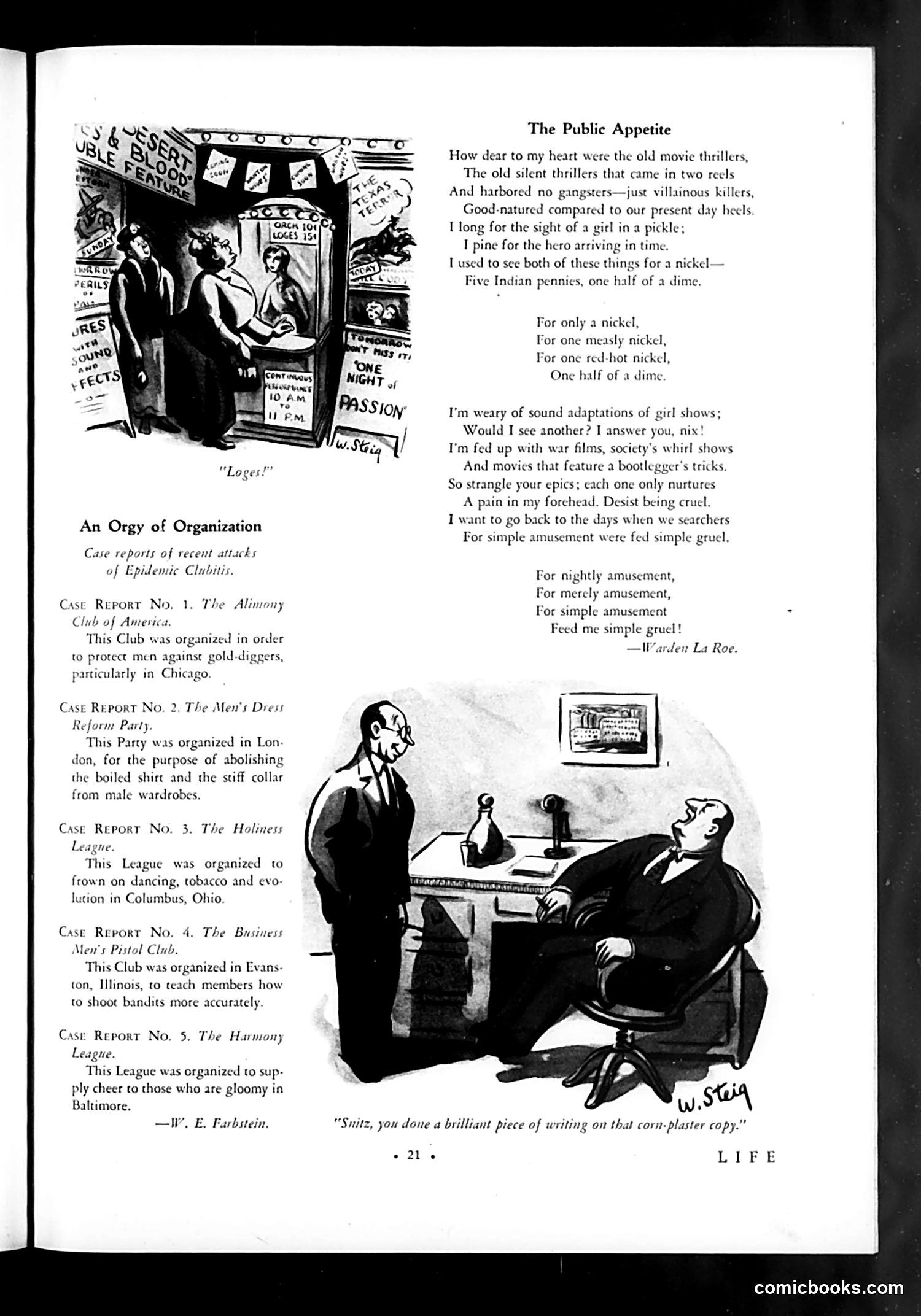
Explanation for Modern Readers This page satirizes two 1920s social trends: "An Orgy of Organization" mocks the era's proliferation of single-issue clubs and reform societies—groups addressing specific grievances like alimony payments, stiff collars, dancing/evolution, crime, and urban gloom. The term "Epidemic Clubitis" suggests these organizations are symptoms of social anxiety, treating minor complaints as medical emergencies requiring organized intervention. "The Public Appetite" is a nostalgic poem lamenting the shift from silent films (affordable at a nickel) to modern "talkies" with their contemporary subject matter: gangster films, war movies, Prohibition bootleggers. The speaker misses simple, innocent entertainment—heroic rescues and damsels in distress—rather than morally complex modern cinema reflecting current social problems. The lower cartoon shows a writer being praised for copy about corn plasters, likely satirizing advertising's inflated claims about mundane products. Together, the page critiques how contemporary American life generates both excessive organizational responses to social problems and a yearning for simpler, pre-modern entertainment values.
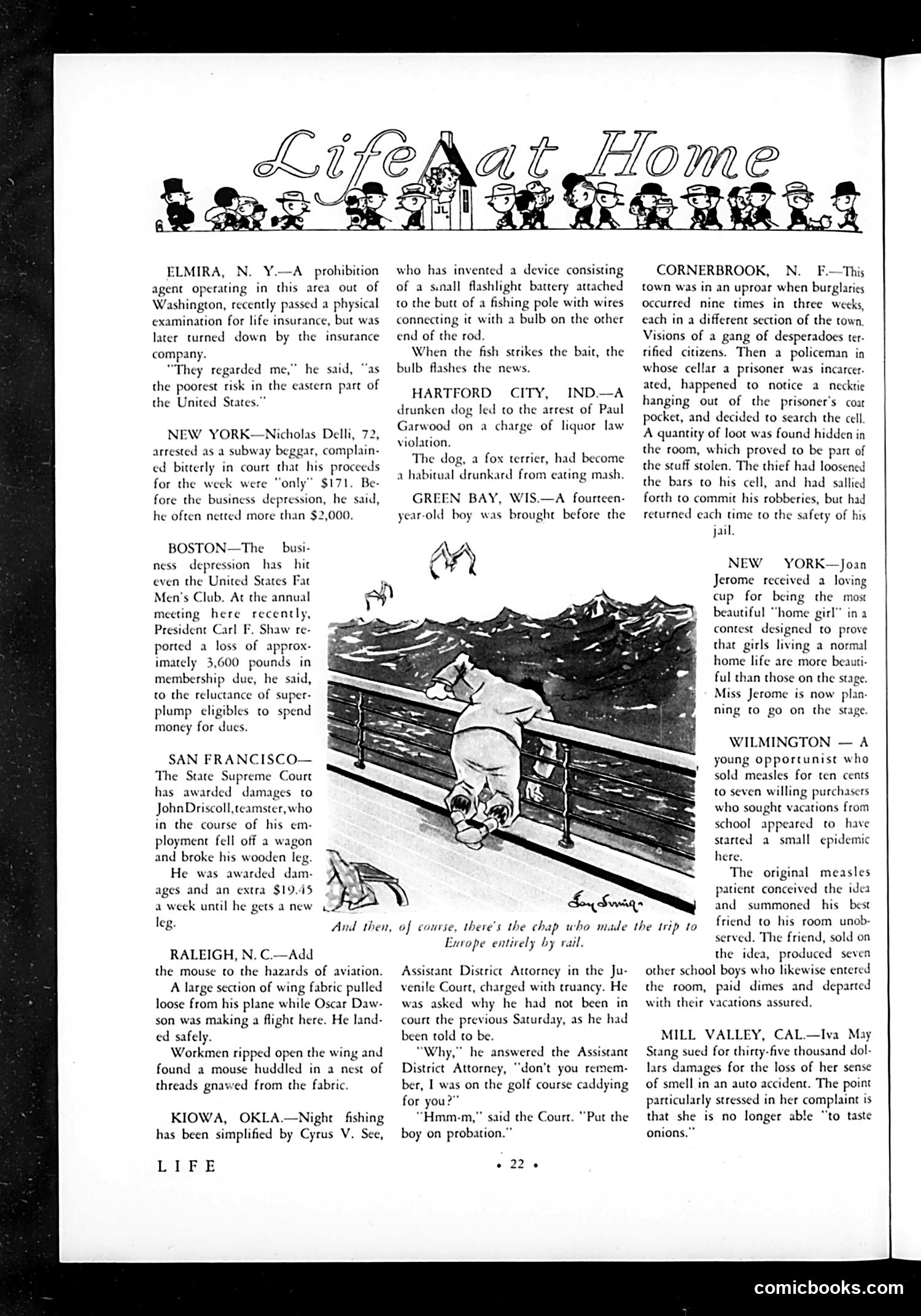
"Life at Home" Page Analysis This is a humor column from *Life* magazine featuring brief, absurdist anecdotes reflecting early Great Depression-era ironies. The cartoons satirize economic desperation and moral inversion: - A prohibition enforcement agent considered too dangerous to insure (implying he faces threats from bootleggers he pursues) - A subway beggar lamenting reduced earnings from $2,000 to $171 weekly - A Fat Men's Club losing 3,600 pounds of membership dues to Depression poverty - A truant boy who escapes court by caddying for the very judge hearing his case—highlighting institutional hypocrisy The main cartoon depicts a boy doing a handstand on a railing overlooking mountains, captioned about someone who "made the trip to Europe entirely by rail"—a visual pun on traveling by "rail" (the railing). Throughout, the humor turns on inverted values: prohibition agents endangered, beggars thriving pre-Depression, privilege evading consequences. The page mocks how economic collapse and established institutions' absurdities create darkly comedic situations.
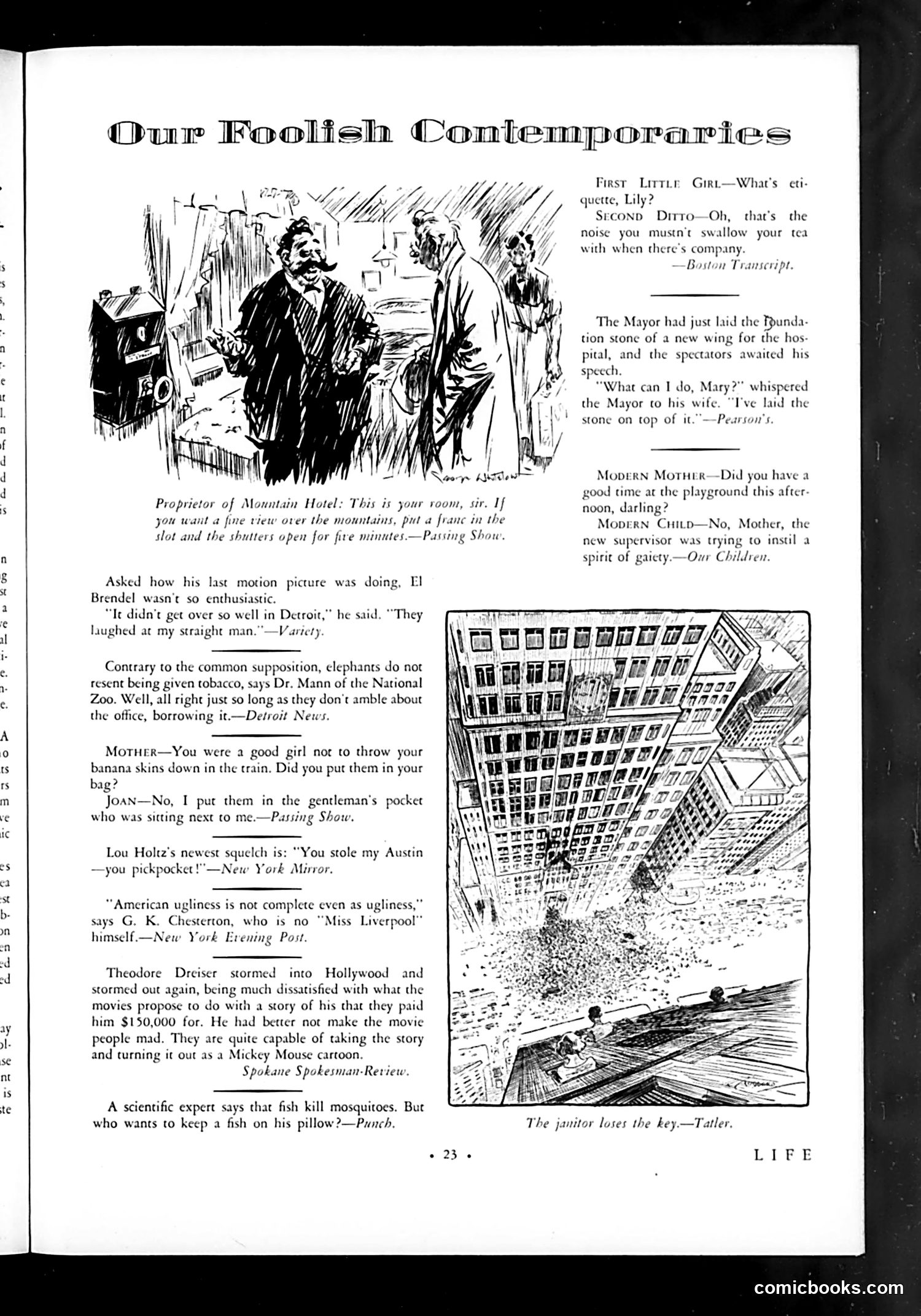
"Our Foolish Contemporaries" - Life Magazine Satire Page This page collects brief humorous anecdotes mocking contemporary social behaviors and public figures. The cartoons illustrate two jokes: one showing a hotel proprietor explaining a coin-operated mountain view (satirizing tourist traps), and another depicting a janitor who's lost a building key (literal visual joke). The written snippets ridicule various targets: etiquette confusion, a bumbling mayor who placed a foundation stone incorrectly, modern parenting failures, and actor El Brendel's unsuccessful film in Detroit. The page also jabs at Theodore Dreiser's Hollywood complaints and G.K. Chesterton's criticism of American aesthetics. The humor relies on absurdist logic and observational comedy about modern life's small embarrassments—lost keys, child misbehavior, social awkwardness. This format was typical of *Life*'s satirical approach: collecting short, punchy critiques of contemporary society's foibles through multiple voices and publications.
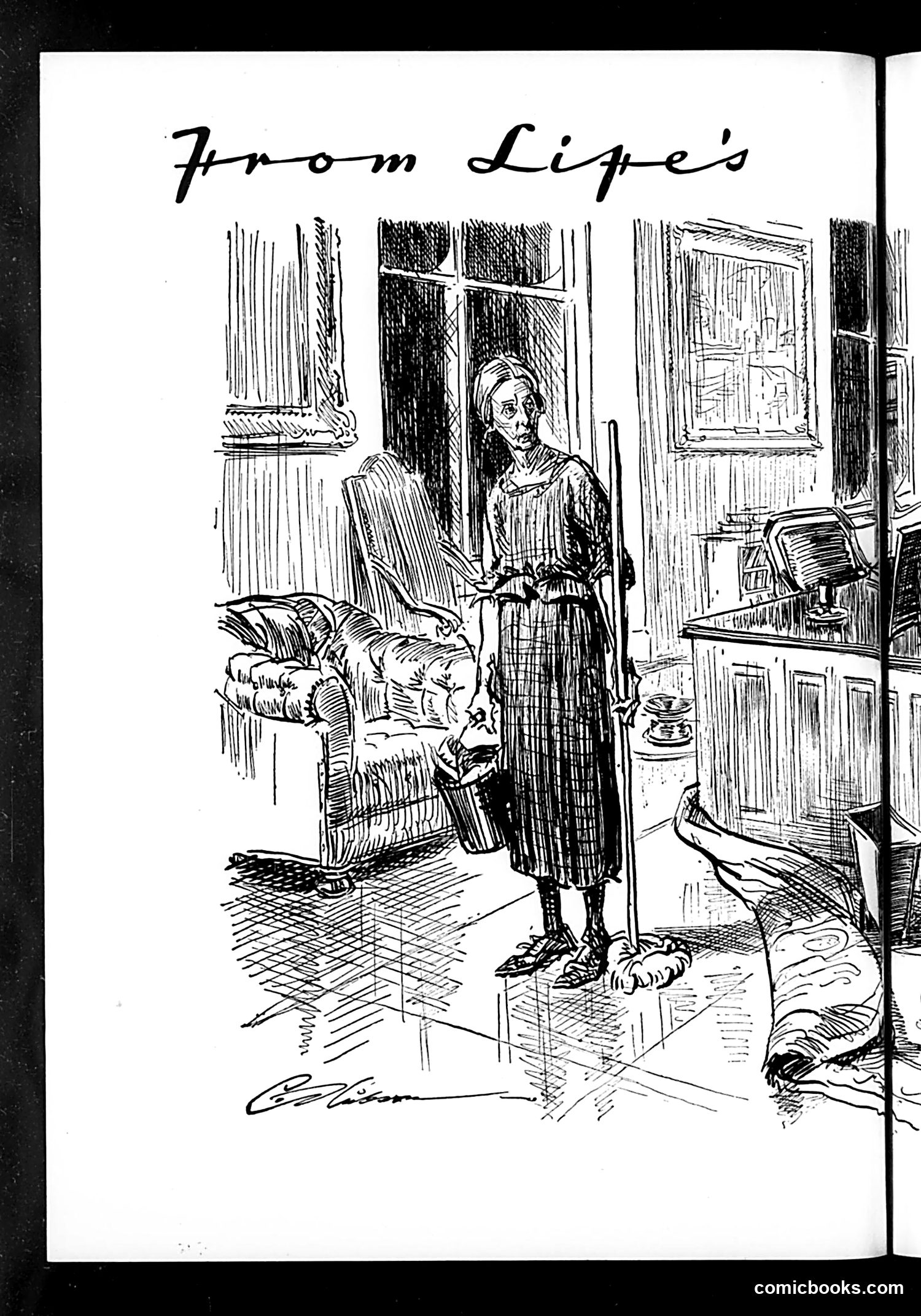
"From Life's" Illustration Analysis This appears to be a chapter heading or section divider from *Life* magazine, titled "From Life's" at the top in cursive script. The illustration shows a domestic interior scene: a woman stands in a doorway wearing a long dress, observing a man seated in an armchair by a window. The room contains period furniture and household items. The sketch is signed by the artist (signature visible at bottom left). Without additional context or accompanying text, the specific satirical point remains unclear—it could be commenting on domestic relationships, social behavior, or household situations typical of *Life* magazine's satirical humor. The scene itself appears to depict an everyday domestic moment rather than an overtly political reference.
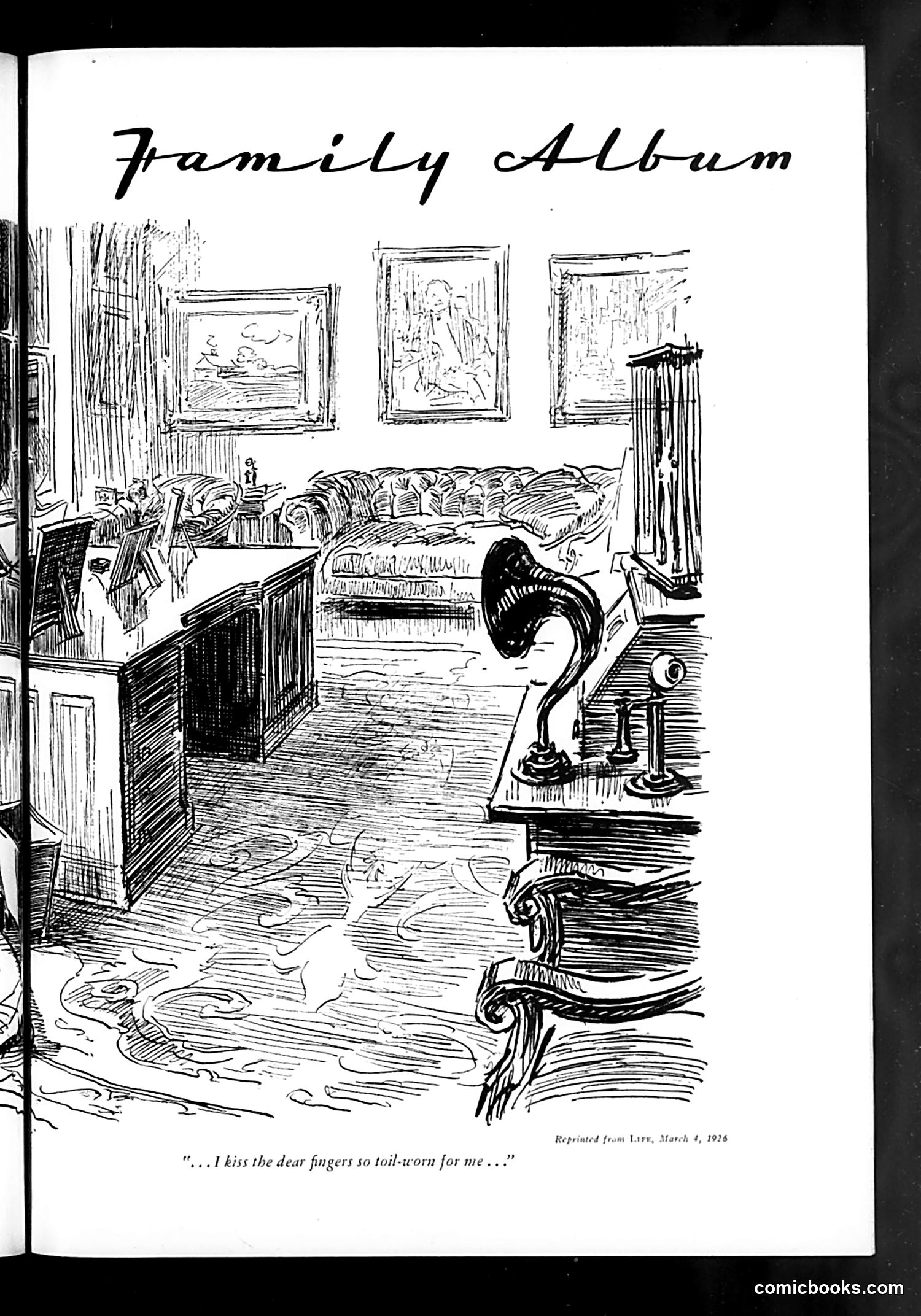
Family Album Page Analysis This is a sentimental domestic scene titled "Family Album," reprinted from *Life* magazine (March 4, 1926). The illustration shows a living room with a woman reclining on a sofa while a man kneels beside her, kissing her hand. The caption reads: "...I kiss the dear fingers so toil-worn for me..." The satire appears to target domestic sentimentality and performative romance. The elaborate, somewhat exaggerated pose suggests the man is theatrically expressing devotion while referencing the woman's "toil-worn" hands—presumably from housework. The joke likely mocks either his flowery, insincere flattery or the gap between romantic gestures and actual household labor dynamics of the era. The artwork's sketch style emphasizes the theatrical nature of the scene.
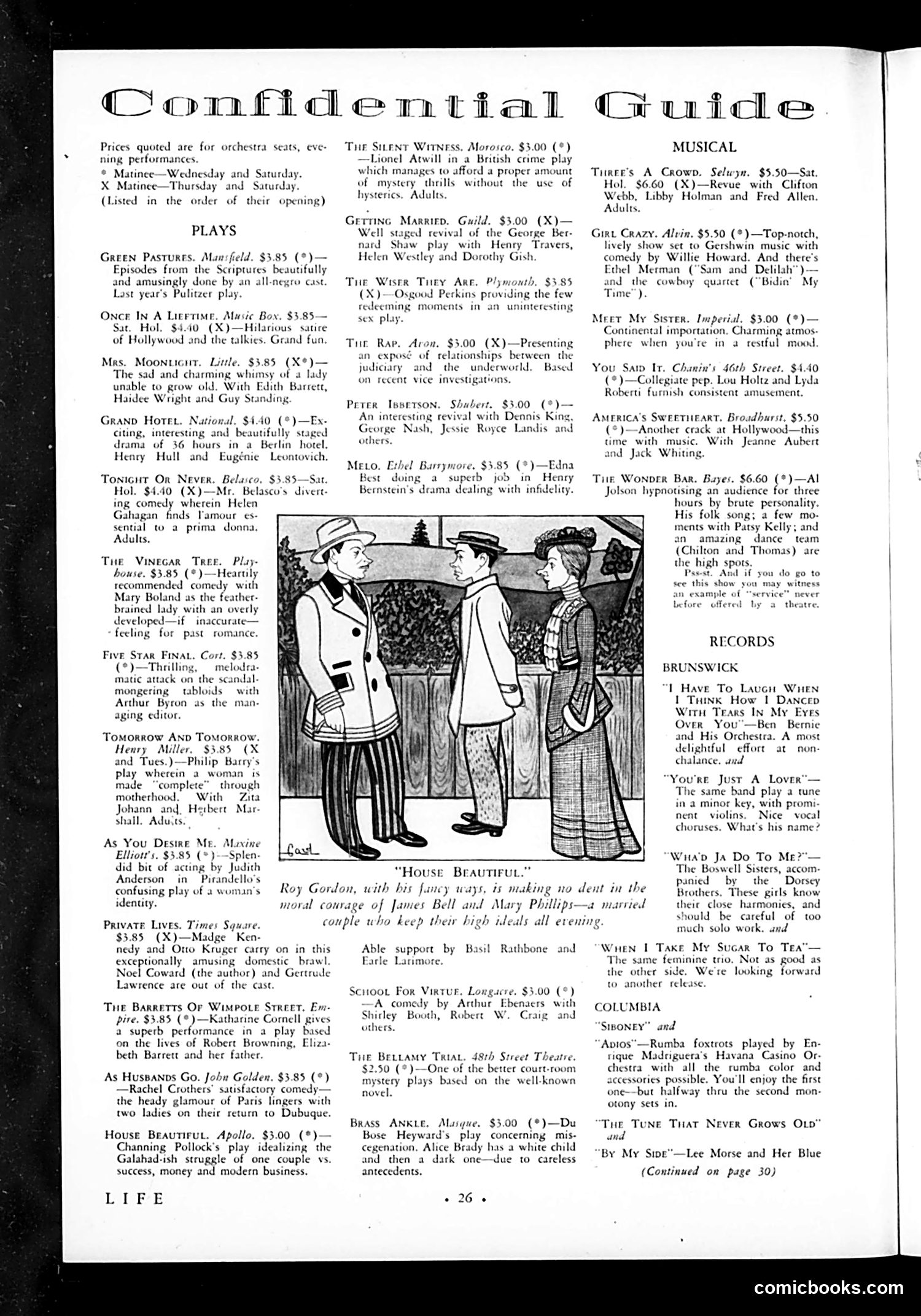
Understanding This Life Magazine Theater Guide Page This page is a theater review guide from Life magazine, listing Broadway productions with brief critiques and ticket prices. The single cartoon illustrates one review: "House Beautiful." The cartoon shows three figures—a well-dressed man (Roy Gordon) attempting to seduce or distract a married couple (James Bell and Mary Phillips) with his "fancy ways." The joke, explained in the caption, is that despite his sophisticated charm and material temptations, the couple stubbornly maintains their moral virtue and "high ideals." This reflects 1920s-30s theatrical themes: a morality play where working-class or earnest characters resist urban sophistication and corruption. The satire is gentle—mocking both the man's ineffectual seduction attempts and the couple's almost comical steadfastness. It's a period piece capturing Broadway's interest in testing American virtue against worldly temptation, presented as wholesome entertainment.
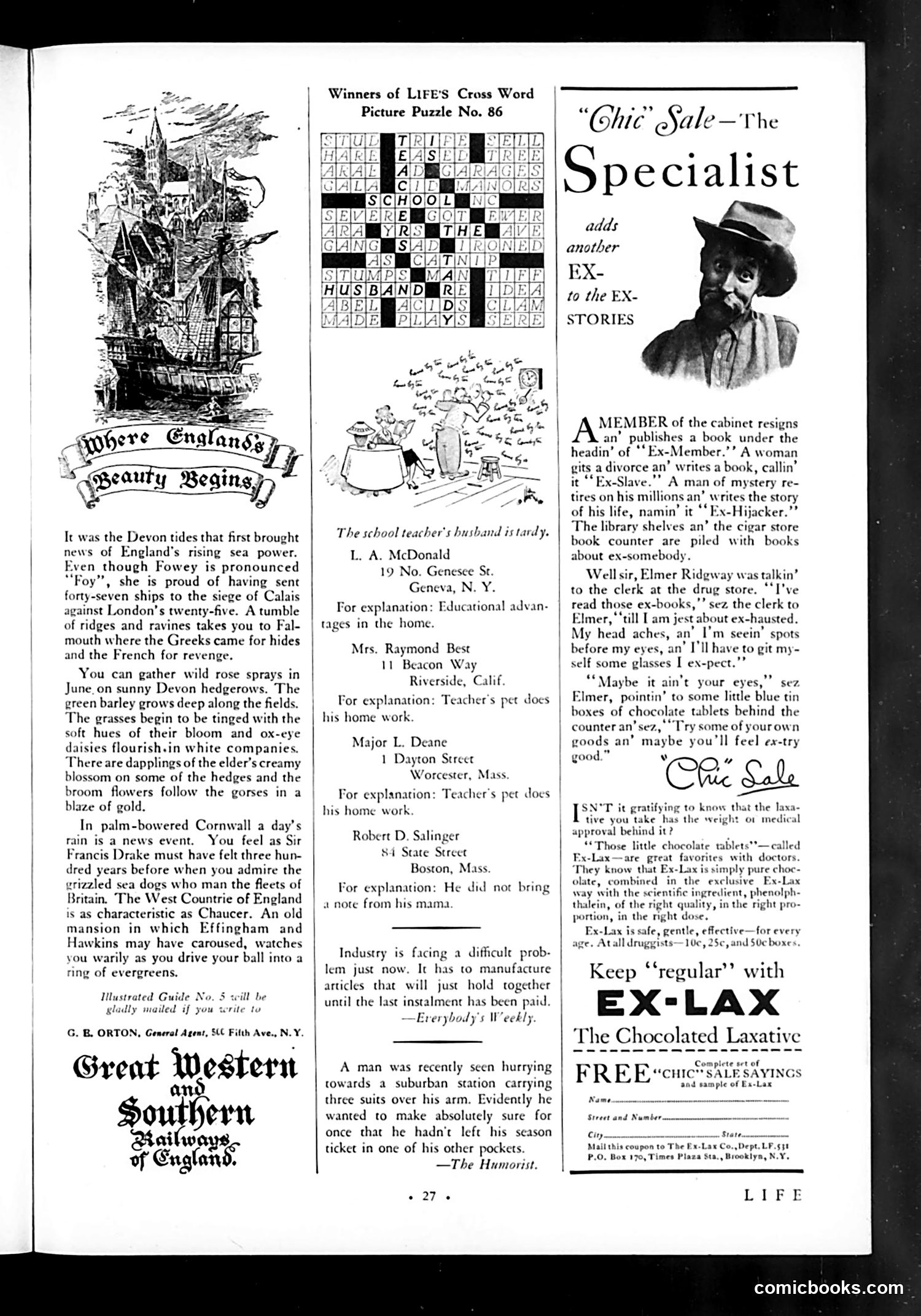
Analysis of Life Magazine Page Content This page is primarily advertising and light humor rather than political satire. The main content includes: Left side: A travel advertisement for Great Western and Southern Railways, promoting the scenic Devon and Cornwall regions of England with poetic descriptions of landscape and historical references (Drake, Hawkins, the siege of Calais). Center: A crossword puzzle and its winners, with solutions tied to a schoolteacher's tardy husband—a domestic humor theme. Right side: An advertisement for "Ex-Lax" laxative presented as satirical commentary. The humor plays on the era's publishing trend of "ex-" titled books (by ex-politicians, ex-slaves, ex-criminals). A character named Elmer Ridgway sardonically suggests that reading such "ex-books" causes physical ailments, recommending Ex-Lax tablets instead. The joke mocks both the publishing industry's trend and uses bathroom humor to sell the product. Overall, this is a typical Life magazine page blending travel promotion, puzzles, and irreverent product advertising rather than serious political commentary.
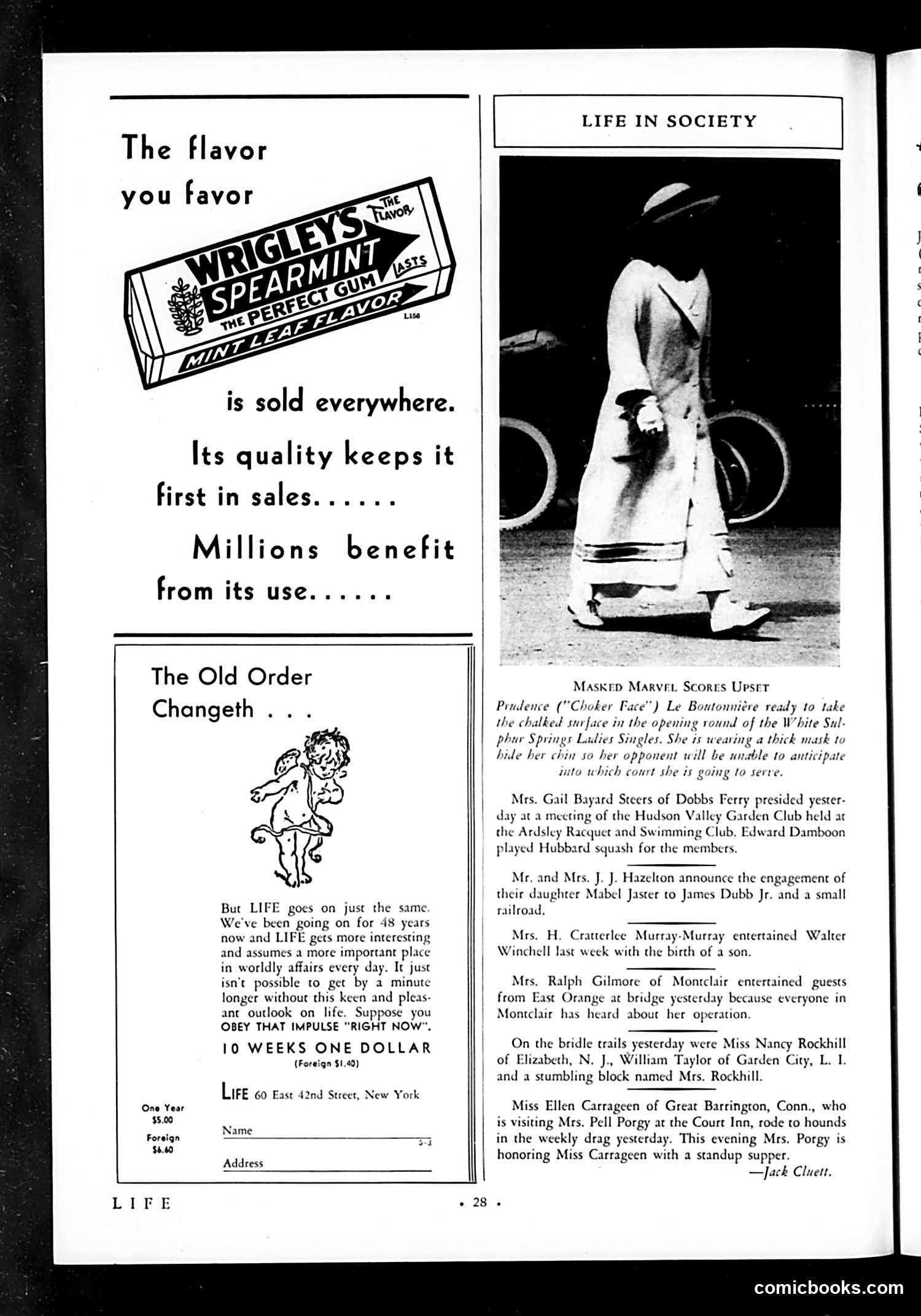
Analysis of Life Magazine Page This page contains social satire rather than political cartoons. The left side is a Wrigley's Spearmint gum advertisement and Life magazine subscription pitch. The right side mocks high-society gossip through absurdist humor. The "Life in Society" column parodies society page reporting by presenting ridiculous situations as news: a tennis player wearing a mask to hide her chin from opponents, someone entertaining guests specifically because they've heard about her surgery, and a woman described as "a stumbling block named Mrs. Rockhill." The satire targets wealthy society's pretensions and superficiality—the obsession with social events, operations, and engagements treated as major news. The humor relies on the disconnect between the breathless tone of society reporting and the triviality or absurdity of the actual events described. This reflects Life's role as a satirical magazine critiquing American upper-class culture and conventions.
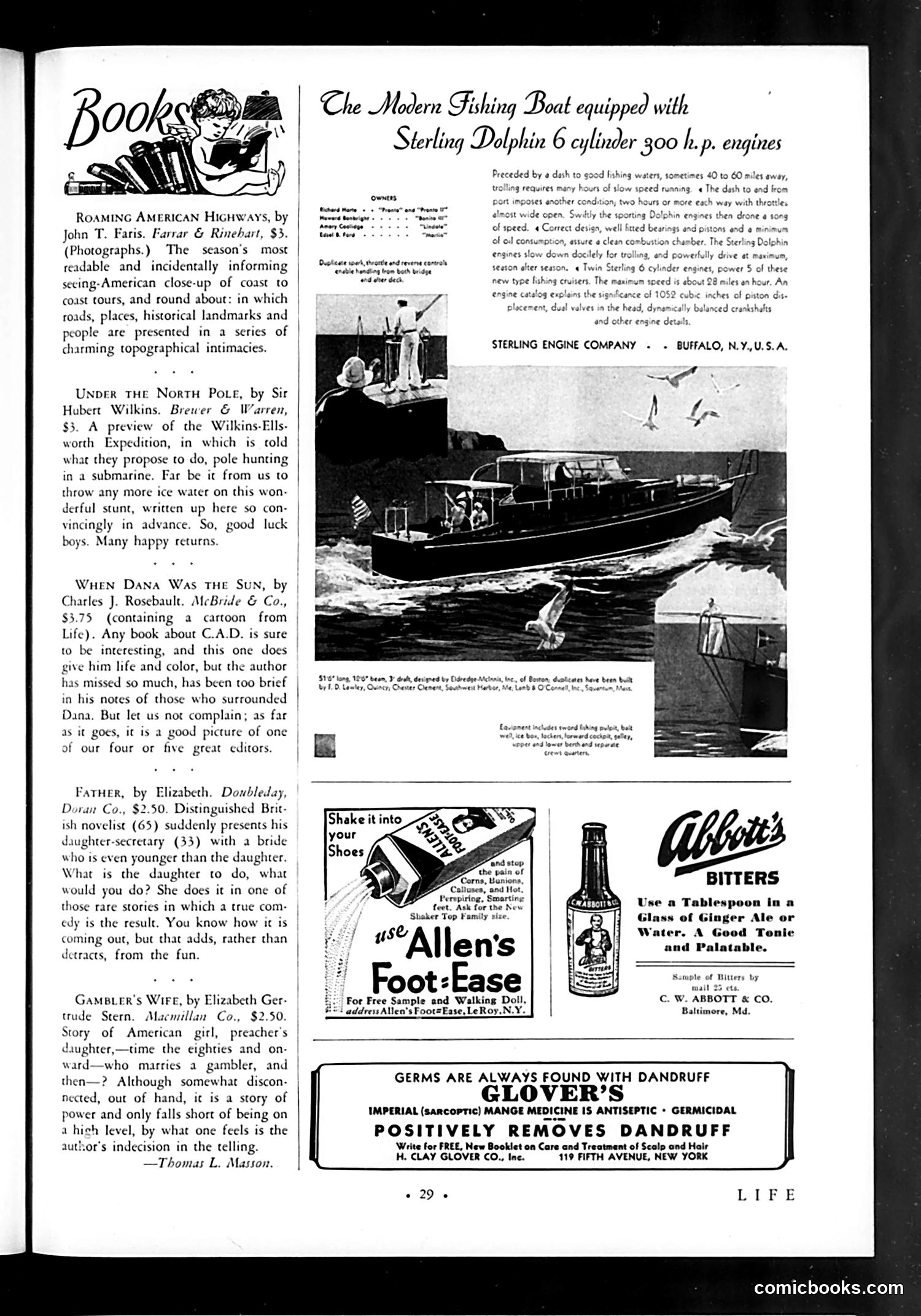
Analysis of Life Magazine Page This page is primarily a book review section with vintage advertisements, not satirical cartoons. The content discusses four books: a travel guide about American highways, an expedition narrative about Arctic exploration by submarine, a biography of newspaper editor C.A. Dana, and two novels about family drama and marriage. The advertisements reflect early-20th-century consumer products: Allen's Foot-Ease (a foot powder remedy), Abbitt's Bitters (a medicinal tonic), and Glover's dandruff treatment. These ads are notable for their medical claims and design conventions typical of the era—promising cures for common ailments with minimal regulation. The page also features a substantial advertisement for Sterling Dolphin marine engines used in fishing boats, emphasizing horsepower and reliability for commercial fishing. No political satire or caricature appears on this page. It represents straightforward editorial and advertising content from a 1920s-30s era Life magazine.
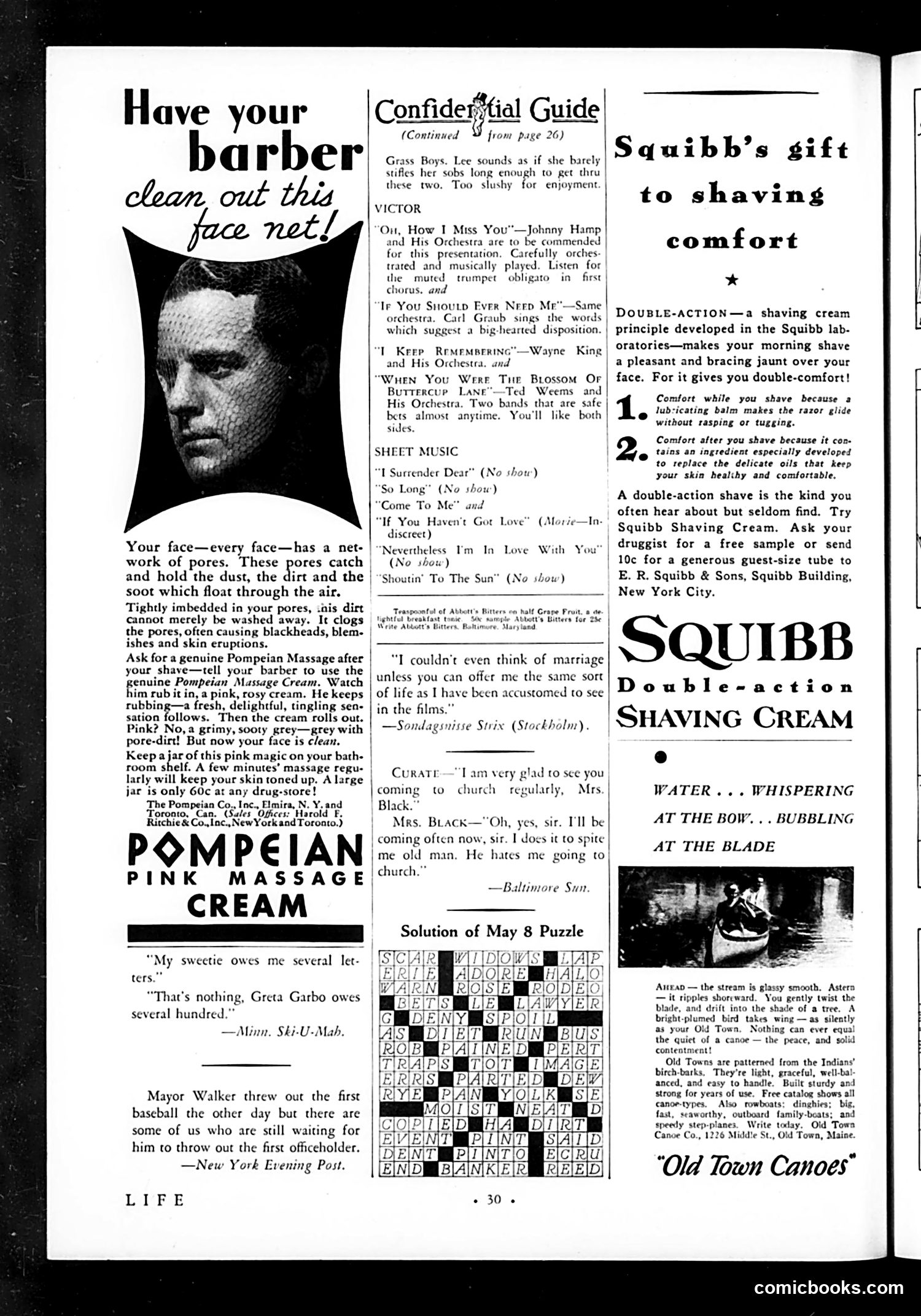
Analysis of Life Magazine Page Content This page consists primarily of advertisements and humor columns rather than political cartoons. Main advertisements: - Pompeian Pink Massage Cream (left): promotes pore-cleansing via barber massage - Squibb Double-Action Shaving Cream (right): highlights lubricating comfort features Humor section ("Confidential Guide"): A gossip/entertainment column reviewing music recordings and sheet music, with satirical social quips interspersed. Notable joke: references Mayor Walker throwing out the first baseball, then quips that some citizens await him "throwing out the first officeholder"—likely alluding to Mayor Jimmy Walker's administration (1926-1932), which faced corruption scandals. This is veiled political criticism of municipal malfeasance. Other jokes mock celebrities (Greta Garbo's unpaid letters) and include a humorous exchange between a Curate and Mrs. Black about church attendance. The page reflects 1930s-era advertising aesthetics and popular entertainment commentary rather than explicit political cartooning.
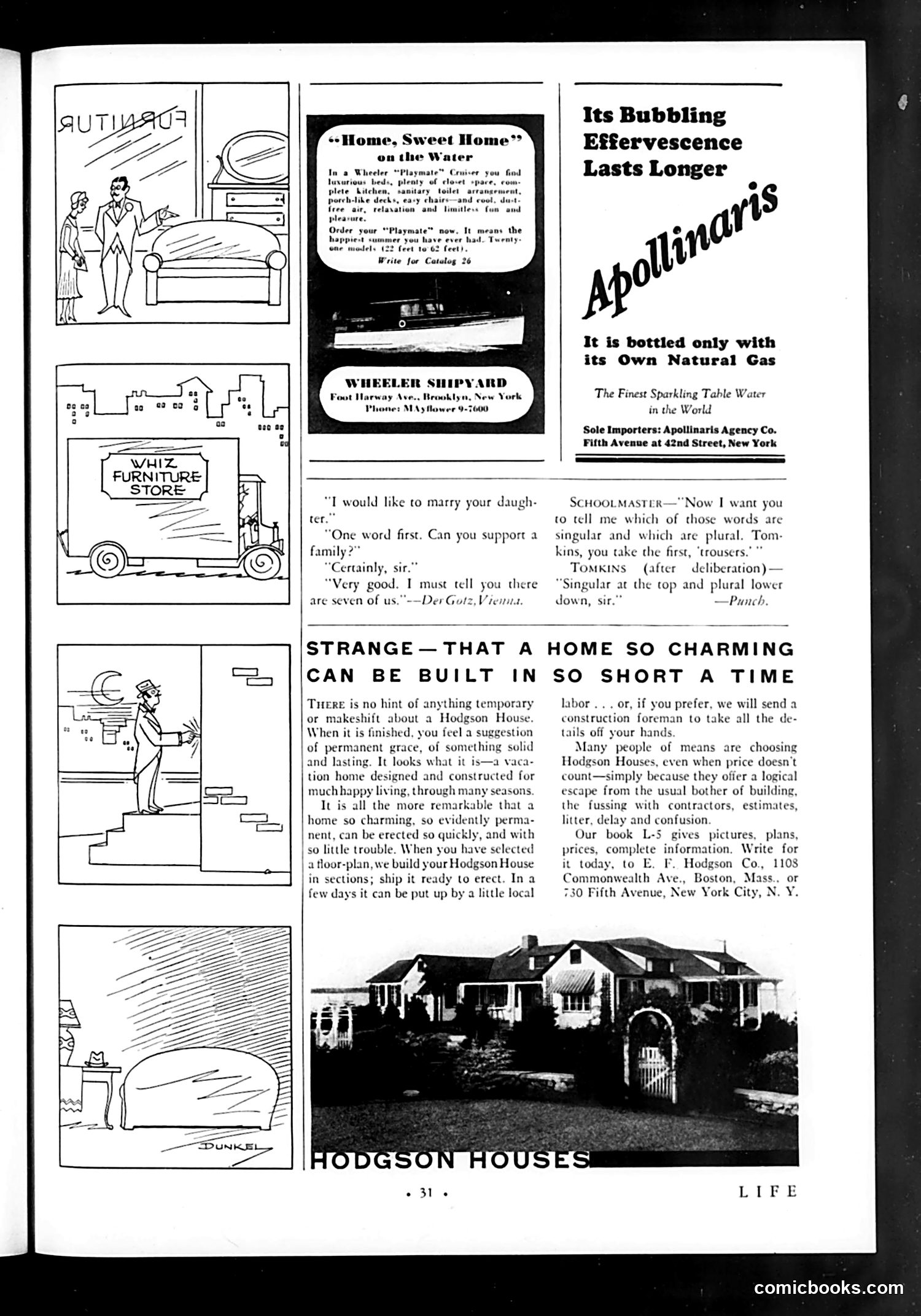
Hodgson Houses Advertisement Page This is primarily a vintage advertisement page (likely 1920s-30s) for prefabricated "Hodgson Houses"—shipped in sections and assembled on-site quickly. The page includes several humorous filler jokes typical of Life magazine: - A marriage proposal joke about supporting a large family - A schoolmaster's grammar lesson where a student cleverly argues "trousers" are singular at the top, plural below The main satire targets the appeal of Hodgson Houses to wealthy buyers: the ad claims affluent people choose them specifically to *escape* the typical hassles of home construction (contractors, delays, confusion)—suggesting that even when "price doesn't count," convenience matters more than traditional building. The cartoons on the left show domestic scenes (furniture delivery, a bed) and appear to be unrelated visual humor filler common to magazine layouts of this era. The page also includes other period advertisements: a Wheeler Shipyard "Playmate" boat and Apollinaris sparkling water.
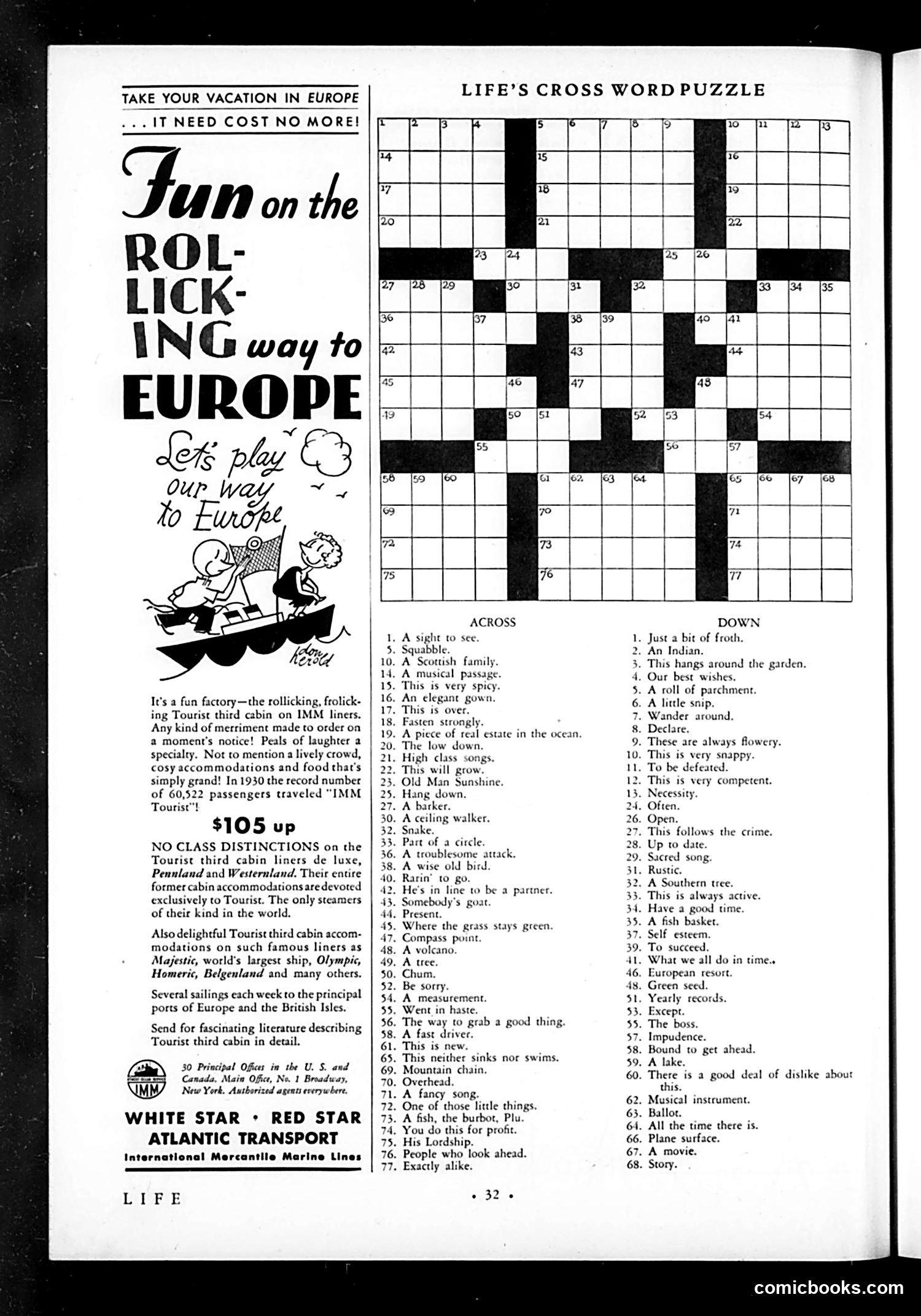
Analysis of Life Magazine Page This page combines advertising and entertainment—not satire or political commentary. Left side: A cheerful advertisement for White Star/Red Star Atlantic Transport steamship lines, promoting budget-friendly third-class "Tourist" cabin passage to Europe for $105 and up (1930s pricing). The cartoon illustration shows two figures playfully rolling toward Europe, emphasizing the fun and accessibility of transatlantic travel. The ad claims "no class distinctions" between Tourist and higher cabins on certain ships like the *Pennland* and *Westernland*, making European vacations affordable for ordinary Americans. Right side: A standard crossword puzzle titled "Life's Cross Word Puzzle," unrelated to the advertisement, with 77 clues across and down. The page reflects 1930s optimism about leisure travel and consumer commerce, before World War II disrupted transatlantic tourism. The tone is lighthearted and promotional rather than satirical.
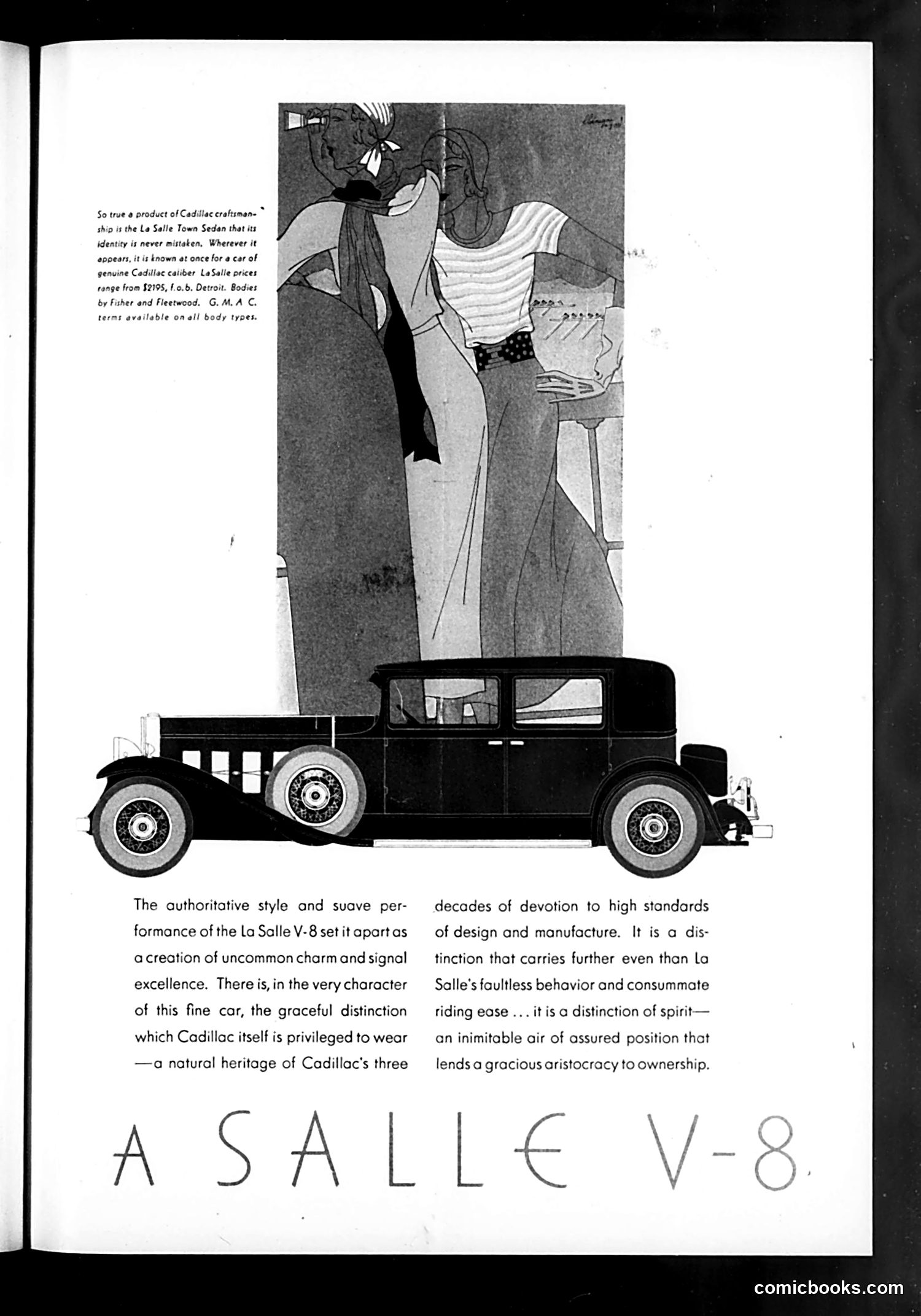
Analysis This is not satire or a political cartoon—it's a straightforward automobile advertisement for the La Salle V-8, a Cadillac product. The page features: - An illustration of an elegantly dressed woman in 1920s-30s fashion (stylized art deco illustration typical of the era) - A side-profile technical drawing of the La Salle sedan automobile - Marketing copy emphasizing luxury, craftsmanship, and social status The ad's pitch conflates car ownership with aristocratic distinction and refined taste. Phrases like "gracious aristocracy to ownership" and "air of assured position" appeal to aspirational middle-to-upper-class buyers by suggesting the vehicle confers social prestige. This represents typical interwar American advertising strategy: selling luxury goods not just for transportation but as status symbols reflecting personal character and refined sensibility. The elegant female figure was a common marketing device to associate the product with sophistication and desirability.
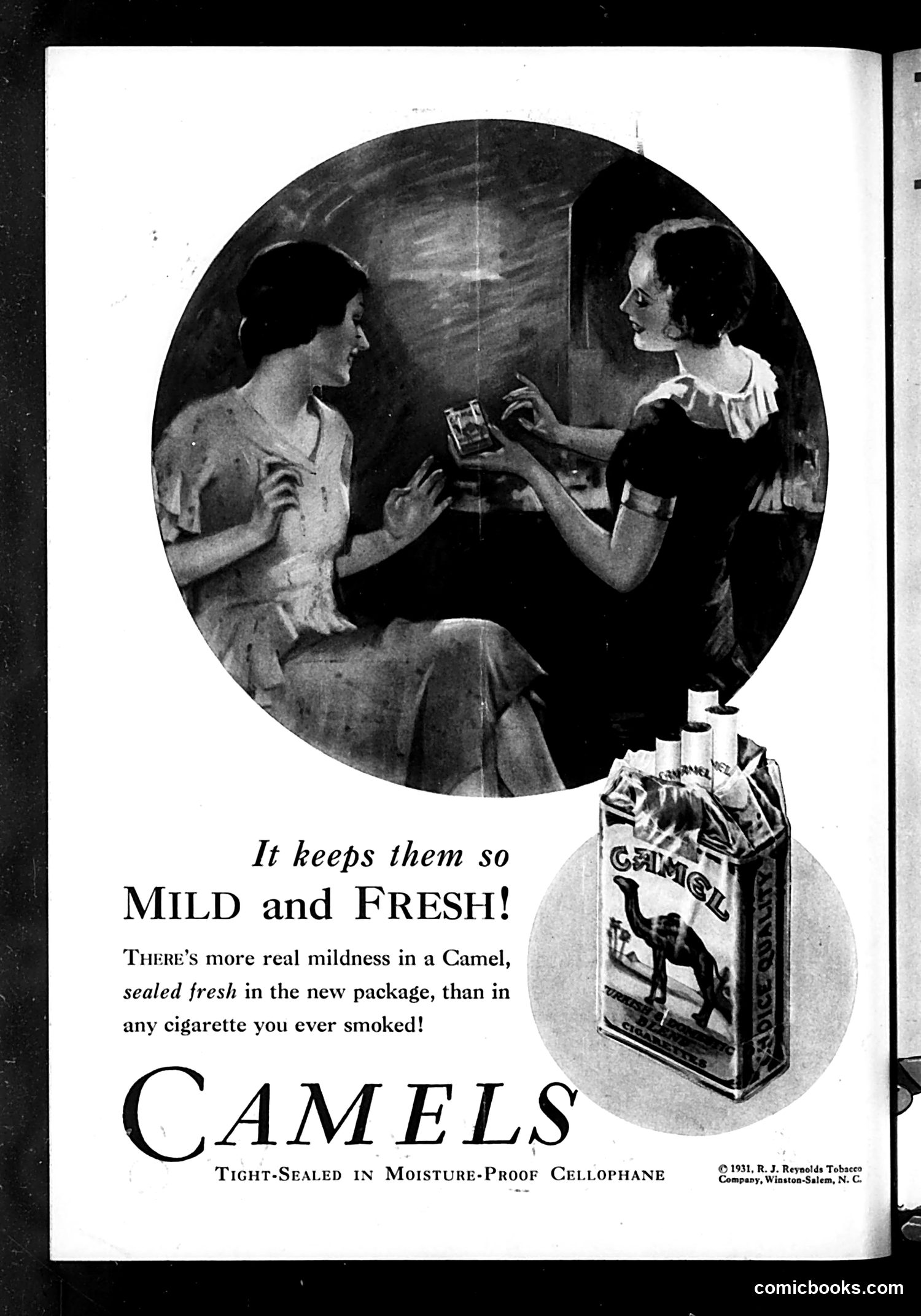
This is a Camel cigarette advertisement from 1931, not political satire. It features two women examining a cigarette package, emphasizing the product's new "moisture-proof cellophane" packaging that supposedly keeps cigarettes "mild and fresh." The ad claims Camels deliver superior mildness compared to competitors. The imagery and messaging reflect 1930s advertising conventions: women were frequent subjects in cigarette ads of this era, and health claims ("mildness") were standard marketing tactics before tobacco regulation. The circular vignette style was typical of period advertising design. This represents pre-warning-label cigarette marketing, when such health-adjacent claims were legally permissible and common industry practice.